Plan a Trip


Kathmandu Historical Heritage Sites: The Complete Travel Guidey
Why Kathmandu Historical Heritage Sites Are Unlike Anywhere on Earth
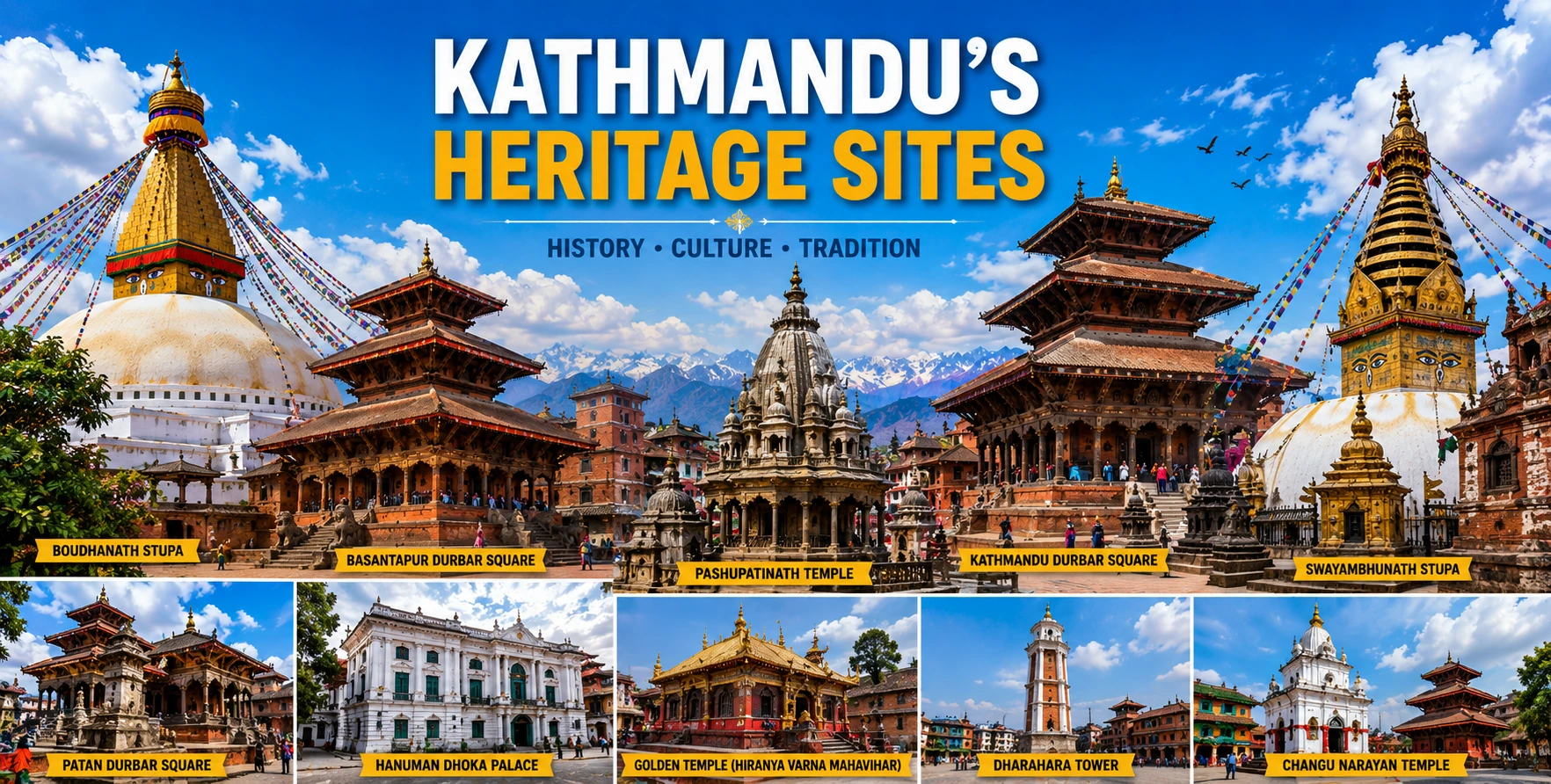
Kathmandu, the capital city of Nepal, is a place where ancient civilizations and modern life coexist in extraordinary harmony. Nestled in the foothills of the great Himalayas, this vibrant city is not merely a gateway to mountain trekking — it is one of the most culturally rich and historically significant destinations on the entire planet. Every alley, every courtyard, every carved wooden window in Kathmandu holds a story stretching back over a thousand years.
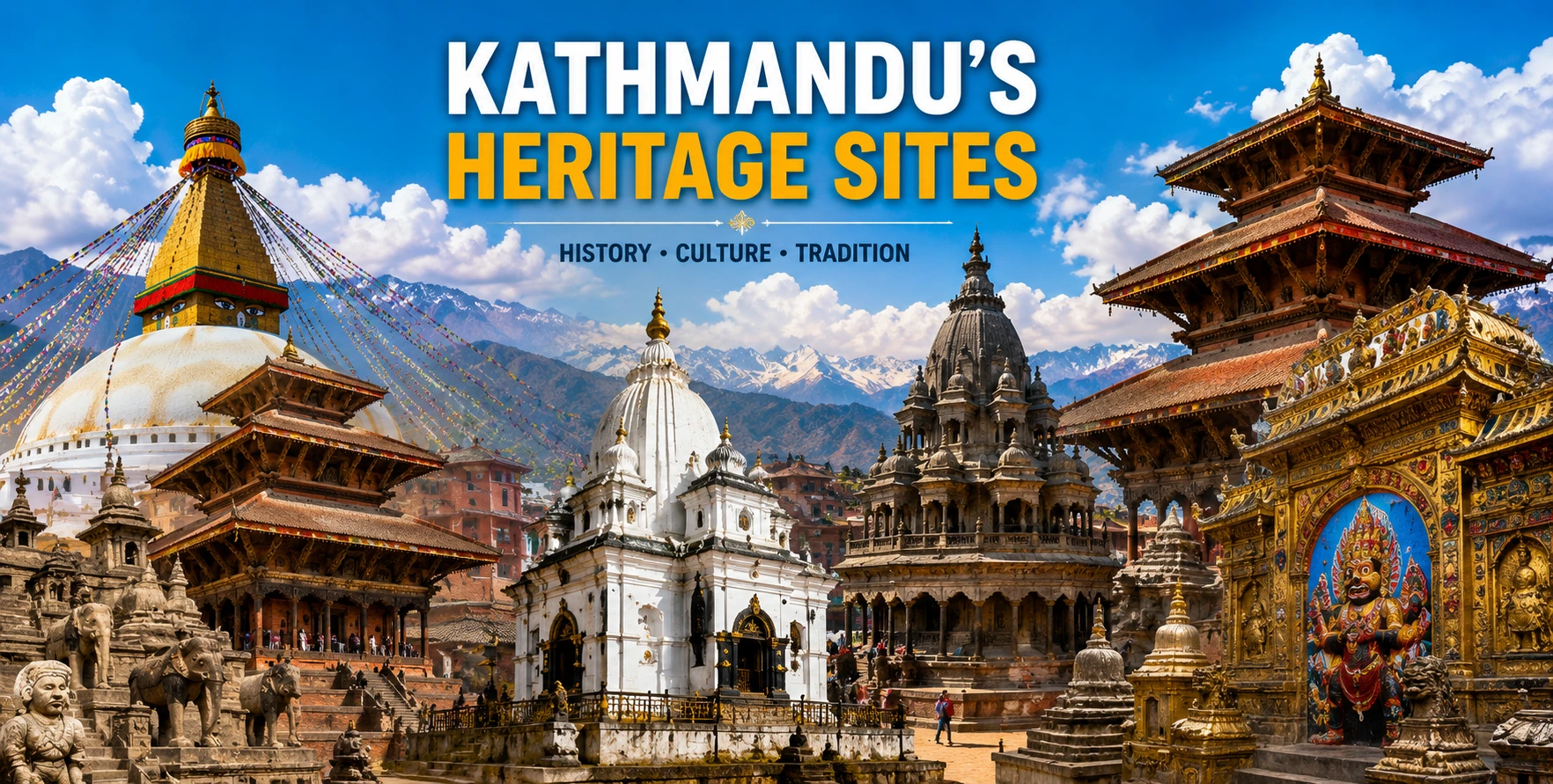
The Kathmandu Valley is home to seven UNESCO World Heritage Sites, all recognized for their outstanding universal value and inscribed in 1979. These sites — spread across the three ancient cities of Kathmandu, Patan, and Bhaktapur — represent the pinnacle of Newari civilization, showcasing breathtaking pagoda-style temples, intricately carved palaces, colossal Buddhist stupas, and sacred Hindu shrines that have been continuously worshipped for centuries.
What makes Kathmandu’s heritage sites truly exceptional is that they are not dead museum pieces. They are living, breathing cultural landscapes. Priests still perform ancient rituals at dawn. Tibetan monks still circumambulate the great stupas. Communities still gather in centuries-old courtyards for festivals and prayers. The Newar people, the indigenous inhabitants of the valley, continue to weave their art, music, and spirituality into every corner of these sacred spaces.
In this comprehensive guide, we will take you through each of the seven UNESCO-listed heritage sites in detail — covering the history, architecture, spiritual significance, practical travel information, entry fees, and insider tips to make your Kathmandu heritage tour truly unforgettable. And because exploring seven sites spread across a busy city can be physically and logistically challenging, we will also guide you on the smartest way to travel between them: by hiring a private vehicle from Nepal Vehicle Hiring Pvt. Ltd., your trusted, affordable, and reliable transportation partner in Nepal.
Quick Facts: Kathmandu Valley UNESCO World Heritage Sites
| At a Glance — Kathmandu Heritage Sites (2026) |
| Total UNESCO Sites: 7 Monument Zones in Kathmandu Valley |
| UNESCO Inscription Year: 1979 (updated 2006) |
| Total Area: 188.95 hectares across three districts |
| Civilizations Represented: Licchavi, Malla, and Shah Dynasties |
| Religions: Hinduism and Buddhism (often at the same site) |
| Best Time to Visit: October–December and March–May |
| All 7 sites can be covered in 1–2 days with a private vehicle |
| Estimated Total Entry Fees (Foreigner): Approx. NPR 5,000–6,000 |
Kathmandu Durbar Square (Hanuman Dhoka) — The Royal Heart of the Capital
History & Significance
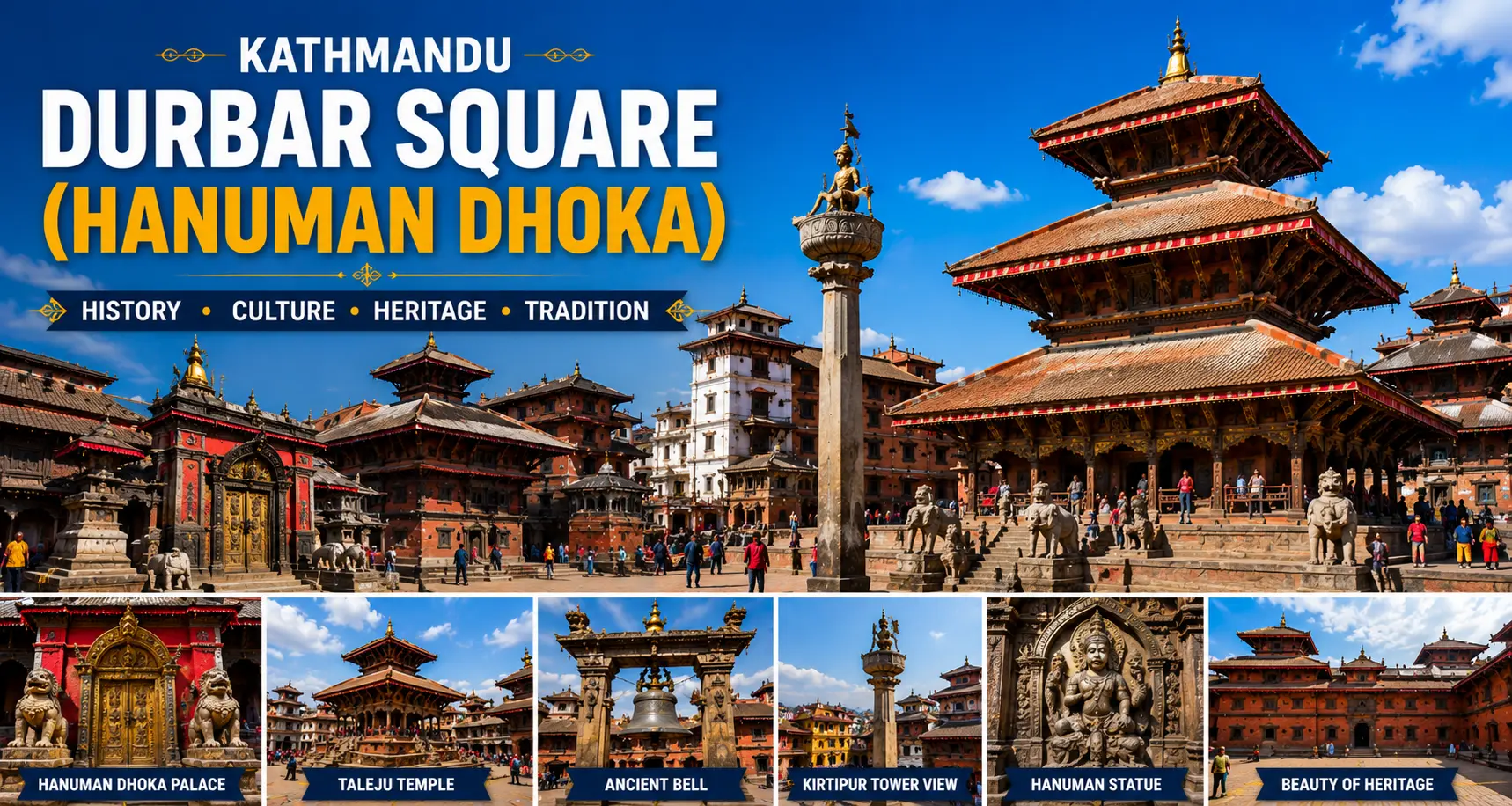
Kathmandu Durbar Square, also known as Hanuman Dhoka Durbar Square, is the historical and cultural epicenter of Nepal’s capital city. The name ‘Durbar’ means royal court in Nepali, and this sprawling complex was indeed the seat of power for Nepal’s greatest royal dynasties — the Malla kings (12th–18th century) and later the Shah dynasty — until the royal palace was relocated to Narayanhiti in the 19th century.
The square was originally founded in the 3rd century, though the majority of the present structures date from the 12th to the 18th century — the so-called ‘Golden Age’ of Newari art and architecture. During this era, Kathmandu was a thriving hub on the trade route between India and Tibet, and its rulers invested their wealth in building some of the most spectacular religious and civic monuments in all of Asia.
Walking into Hanuman Dhoka today feels like stepping into another era entirely. The square is dominated by a dense cluster of pagoda-style temples, medieval courtyards, ancient statues, and intricately carved wooden balconies. It is a visual feast that overwhelms the senses most wonderfully.
Key Monuments Inside the Square
- Hanuman Dhoka Palace Complex — The sprawling royal residence, named after the monkey god Hanuman, whose statue guards the entrance. The palace houses over 40 courtyards and the remarkable nine-story Basantapur Tower, which offers panoramic views of the entire valley.
- Kumari Ghar (House of the Living Goddess) — One of the most fascinating aspects of this square is the residence of the Kumari, a young girl selected from the Shakya community who is venerated as the living embodiment of the goddess Taleju. Visitors gather in the courtyard to glimpse her at the window between 10:00 AM and 12:00 PM daily.
- Taleju Temple — The tallest and most magnificent temple in the entire square, built in 1564 by King Mahendra Malla. This three-tiered pagoda is considered the tutelary goddess temple of the Malla kings and is open to non-Hindus only during the Dasain festival.
- Kal Bhairav — A massive stone relief of Lord Shiva in his fearsome Bhairav manifestation, standing over 10 feet tall. It is believed that anyone who tells a lie before this image will suffer immediate punishment.
- Kasthamandap — The legendary wooden pavilion believed to have been built from a single tree in the 12th century. This structure gave Kathmandu its very name, though the original was destroyed in the 2015 earthquake and has since been painstakingly reconstructed.
- Indra Chowk and Asan Bazaar — The vibrant market areas surrounding the square, where vendors sell spices, thangka paintings, prayer beads, and traditional Newari crafts.
Entry Fee & Visiting Hours
Entry Fee: NPR 1,000 for foreign nationals | NPR 150 for SAARC citizens | Free for Nepali nationals
Open Hours: 7:00 AM – 7:00 PM (Daily) | Tribhuvan Museum inside: 10:30 AM – 3:00 PM (Closed Tuesday)
Insider Tips for Kathmandu Durbar Square
- Arrive early in the morning (before 9 AM) for fewer crowds and better lighting for photography.
- Hire a licensed local guide (approx. NPR 500–800/hour) — the square’s history is incredibly rich and impossible to appreciate fully without expert context.
- Visit Kumari Ghar between 10 AM and 12 PM to catch a glimpse of the living goddess.
- Explore the backstreets behind the square to discover hidden temples and authentic Newari life.
- Be respectful inside temple premises — remove shoes before entering, dress modestly, and ask permission before photographing individuals.
Patan Durbar Square — The City of Fine Arts and Craftsmanship
History & Significance
Patan, also known by its ancient Sanskrit name Lalitpur (City of Beauty), is located just 5 kilometers south of Kathmandu. Its history dates back to the 2nd century BC, and it is one of the oldest continuously inhabited cities in Nepal. Patan was the capital of one of the three Malla kingdoms that divided the Kathmandu Valley, and its rulers were celebrated throughout the subcontinent for their extraordinary patronage of art, sculpture, and architecture.
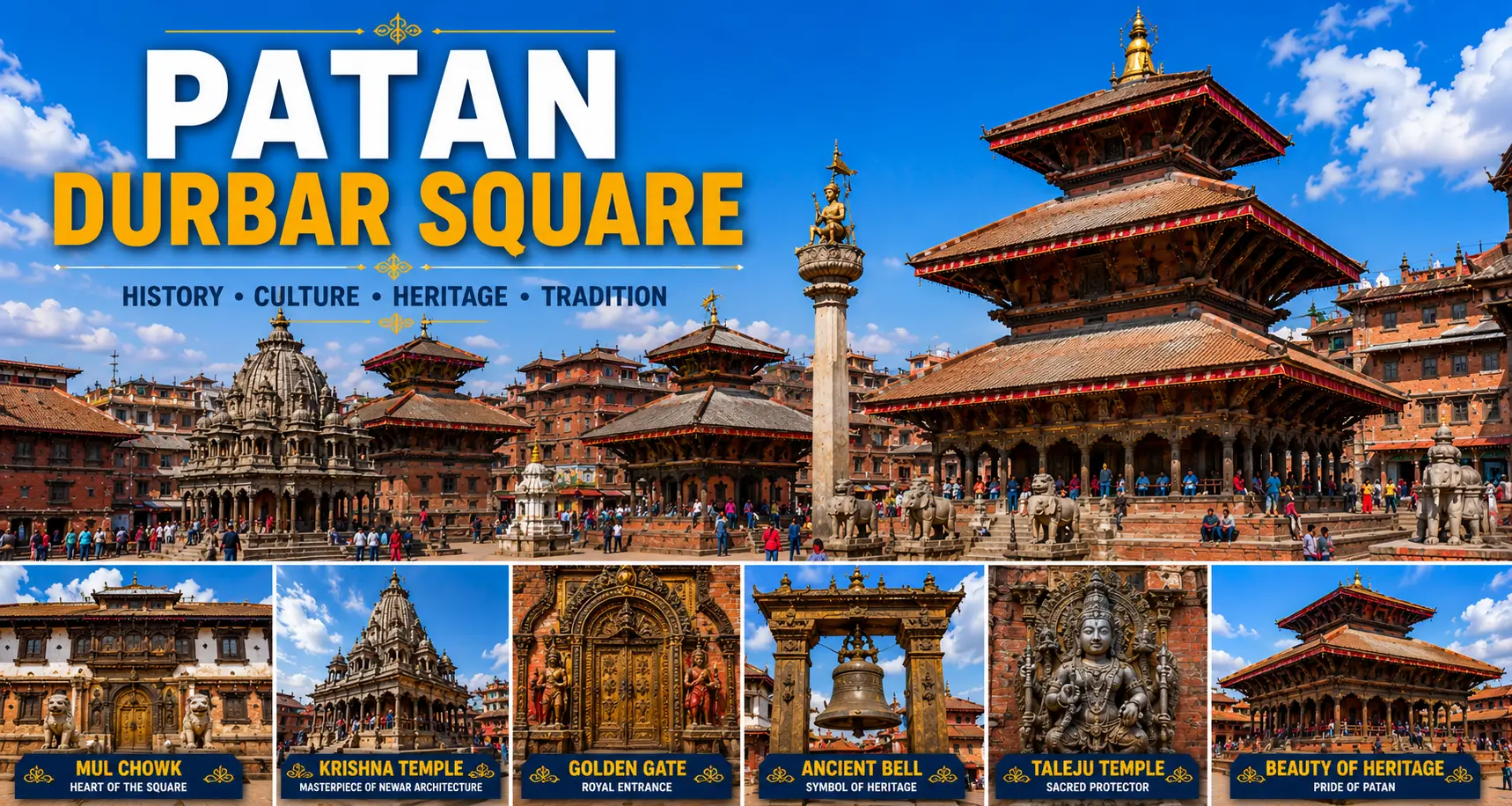
Patan Durbar Square is widely regarded as the most architecturally refined of the three Durbar Squares in Kathmandu Valley. Its symmetry, proportion, and the extraordinary density of temples, courtyards, and sculptures make it arguably the greatest achievement of Newari artistic heritage. The square’s monuments survived the 2015 earthquake better than other sites, and today it stands in remarkable condition.
The artisans of Patan have been producing exquisite bronze sculptures, thangka paintings, and stone carvings for centuries, and this tradition continues today. The streets surrounding the Durbar Square are lined with workshops where you can watch artisans at work using techniques passed down through generations.
Key Monuments Inside the Square
- The Royal Palace of Patan — Built primarily during the reign of King Siddhi Narayan Malla in the 17th century, the palace is a masterpiece of Newari architecture. It contains three main courtyards: Mul Chowk (the oldest, used for secret royal rituals), Sundari Chowk (featuring the sacred sunken royal bath, Tusha Hiti), and Mani Keshav Narayan Chowk.
- Patan Museum — housed inside the royal palace complex — is considered one of the finest museums in Asia. Its collection of medieval Hindu and Buddhist bronze sculptures, stone carvings, and ritual objects is breathtaking. The museum itself is a masterclass in heritage conservation.
- Krishna Mandir — An extraordinary stone temple built in 1637 by King Siddhi Narayan Malla in a shikhara style (North Indian temple style) rather than the typical Newari pagoda. Its 21 pinnacles and detailed stone panels depicting scenes from the Mahabharata and Ramayana make it unique in the valley.
- Bhimsen Temple — A multi-storied temple dedicated to Bhimsen, the patron deity of traders, this striking red-and-white structure dominates the northern end of the square.
- Char Narayan Temple — Dedicated to Lord Vishnu, this temple is notable for its erotic carvings on the roof struts — a common feature in Newari temple architecture believed to ward off lightning and serve as tantric teachings.
Entry Fee & Visiting Hours
Entry Fee: NPR 1,000 (approx. USD 7.50) for foreign nationals | NPR 150 for SAARC | Free for Nepali nationals
Patan Museum: NPR 400 additional | Open 9:00 AM – 5:00 PM (Closed Tuesday)
Insider Tips for Patan Durbar Square
- Do not miss the Patan Museum — it is easily among the top five museums in all of South Asia.
- Visit the Mahaboudha Temple nearby — an incredible shikhara-style temple covered entirely in terracotta Buddha tiles.
- Explore Tumari Chowk and the artisan workshops in the surrounding Mangal Bazaar for authentic bronze work and Newari handicrafts.
- The square is best enjoyed on foot — the vehicle drop-off point is a short walk away, and many of the finest details are best discovered at a slow, leisurely pace.
Bhaktapur Durbar Square — Nepal’s Best-Preserved Medieval City
History & Significance
Bhaktapur, which means ‘City of Devotees,’ is the most remarkably preserved medieval city in the entire Kathmandu Valley. Located 13 kilometers east of Kathmandu, it was the capital of the unified Malla Kingdom from the 12th to the 15th century and later of one of the three independent Malla kingdoms. When the Shah dynasty conquered the valley in the late 18th century, Bhaktapur lost its political prominence — and that is precisely why it has been so magnificently preserved. Without modern commercial development, its ancient streets, temples, and courtyards have remained largely unchanged for centuries.
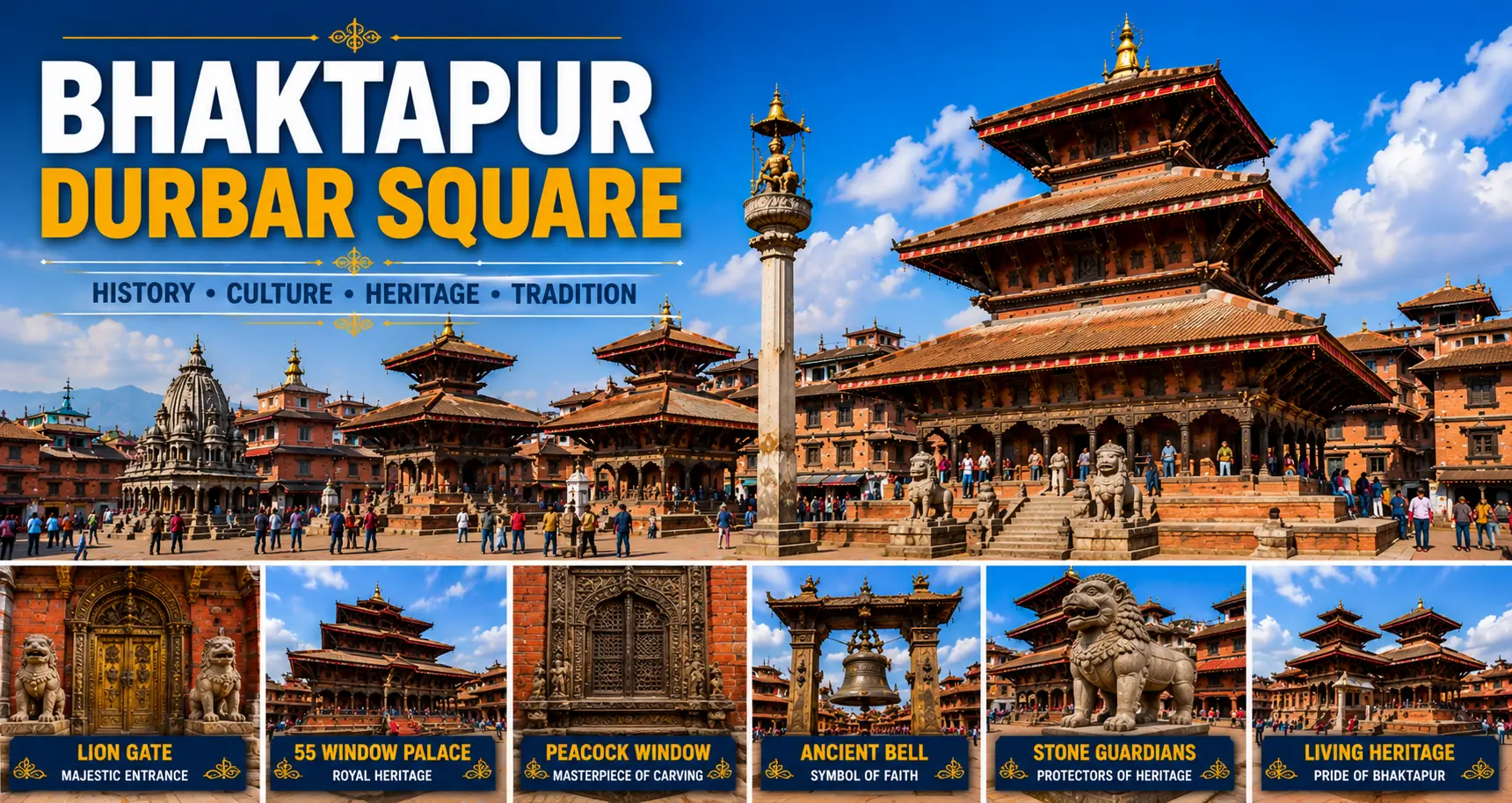
Walking through Bhaktapur is an experience unlike any other in Nepal. The city’s narrow brick-paved lanes, traditional Newari houses with carved wooden windows, and a remarkable collection of temples and public squares create an atmosphere that is simultaneously ancient and intensely alive. Bhaktapur is home to two of the seven UNESCO World Heritage Sites: Bhaktapur Durbar Square and Changu Narayan Temple.
The city is also famous for its unique Newari culture, its distinctive pottery tradition in Pottery Square, and the extraordinary Nyatapola Temple — the tallest pagoda in Nepal. Bhaktapur’s residents are deeply proud of their heritage and actively participate in preserving and celebrating their living cultural traditions.
Key Monuments in Bhaktapur
- 55-Window Palace — Built by King Bhupatindra Malla in the 15th century and completed in 1427, this magnificent palace is adorned with 55 elaborately carved windows. The intricate woodwork of the windows is considered one of the finest examples of Newari craftsmanship in the world.
- Nyatapola Temple — The tallest pagoda temple in Nepal, standing at five stories (30 meters). Built in 1702 by King Bhupatindra Malla and completed in just seven months, this temple is dedicated to the goddess Siddhi Lakshmi and has never been seriously damaged by any earthquake.
- Bhairavnath Temple — A three-storied temple dedicated to Bhairav, the fierce aspect of Lord Shiva. The temple was destroyed in the 2015 earthquake and subsequently rebuilt to its original design.
- Golden Gate (Sun Dhoka) — Considered the finest piece of art in the entire valley, this gilded gateway to the Royal Palace courtyard is an extraordinary example of craftsmanship in repousse metalwork.
- Pottery Square (Talako Tole) — One of Bhaktapur’s most authentic living traditions, where local potters still produce ceramic wares using traditional techniques on hand-operated wheels.
- Tachupal Tole (Dattatreya Square) — The oldest part of Bhaktapur, centered on the ancient Dattatreya Temple and the Peacock Window — another stunning example of Newari woodcarving.
Entry Fee & Visiting Hours
Entry Fee: NPR 1,500 for foreign nationals (highest of any heritage zone) | NPR 150 for SAARC | Free for Nepali nationals
Open: Daily, all day (most monuments accessible from sunrise to sunset)
Insider Tips for Bhaktapur
- Plan at least 3-4 hours for Bhaktapur — it is the most complex and richly detailed of the three Durbar Squares.
- Try Juju Dhau (King Curd) — Bhaktapur’s famous yogurt, sold in earthenware pots and considered Nepal’s finest
- Also try Chatamari (Newari rice crepes) and Kwati (mixed bean soup) at local restaurants near the square.
- The Bisket Jatra festival in April (Nepali New Year) is the most spectacular time to visit Bhaktapur.
- Bhaktapur is best reached by private vehicle — the drive from Kathmandu is about 30–45 minutes, and a private car from Nepal Vehicle Hiring Pvt. Ltd. can make multiple stops en route.
Pashupatinath Temple — The Holiest Hindu Shrine in Nepal
History & Significance
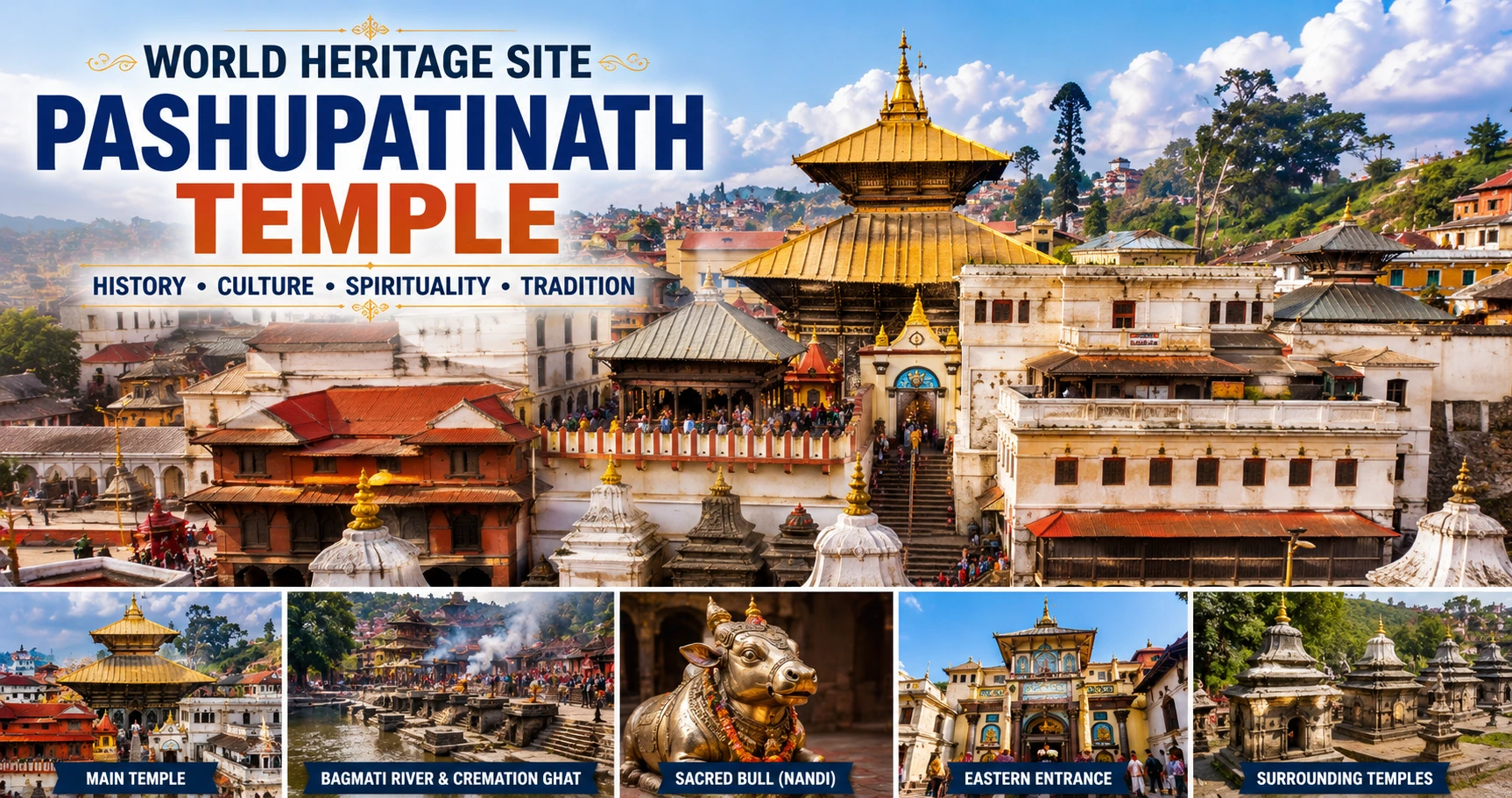
Pashupatinath Temple is not simply a monument — it is the beating spiritual heart of Hindu Nepal, nd one of the most sacred pilgrimage sites for Hindus anywhere in the world. Dedicated to Lord Pashupati, a manifestation of Lord Shiva as ‘Lord of Animals,’ this ancient temple complex sits on the banks of the holy Bagmati River in eastern Kathmandu. It draws hundreds of thousands of pilgrims from Nepal, India, and across the globe every year.
The main temple is believed to date back to the 4th or 5th century, though some accounts place its origins even earlier, in the 1st century BC. The temple complex as seen today was built in the early 15th century in the classic Newari pagoda style, featuring two-tiered roofs covered in gilded copper. The complex was listed as a UNESCO World Heritage Site in 1979 and remains one of the most visited sites in all of Nepal.
The spiritual atmosphere at Pashupatinath is unlike anything else. Along the ghats (sacred riverbank steps) of the Bagmati River, Hindu cremation ceremonies (last rites) are conducted daily and openly. This may seem confronting to Western visitors, but it is a deeply sacred and ancient tradition that Hindus regard as the most auspicious way to reach moksha (liberation from the cycle of rebirth). Witnessing these ceremonies — with respect and sensitivity — can be one of the most profoundly moving experiences of a lifetime.
What to See at Pashupatinath
- Main Pashupatinath Temple — The inner sanctum houses a sacred Shiva lingam (symbolic representation of Lord Shiva) and is accessible only to Hindus. Non-Hindus can admire the exterior and the surrounding area, which offers excellent views across the river.
- The Arya Ghats — The cremation ghats where funeral pyres burn daily. Visitors may observe respectfully from across the river without disturbing the ceremonies.
- The Sadhus — Holy men (sadhus) in saffron robes with ash-covered faces gather near the temple, offering blessings and posing for photographs (a small donation is expected).
- Guheswari Temple — A significant Shakti temple near Pashupatinath, dedicated to the goddess Sati.
- The Surrounding Forest and Deer Park — The peaceful forest surrounding the temple complex is home to deer and monkeys, offering a tranquil contrast to the busy temple area.
Entry Fee & Visiting Hours
Entry Fee: NPR 1,000 for foreign nationals | NPR 150 for SAARC | Free for Nepali nationals and Hindus
Open: 4:00 AM – 12:00 PM and 1:00 PM – 9:00 PM daily | Best visited at sunrise or during evening Aarti (6:30–7:30 PM)
Insider Tips for Pashupatinath
- The evening Aarti ceremony (around 6:30–7:30 PM) is a magnificent, deeply moving ritual with fire, chanting, and bells — absolutely not to be missed.
- Come early in the morning to witness the Maha Shivaratri festival if your visit coincides with it (February/March) — thousands of sadhus from across Asia gather here.
- Dress conservatively — shoulders and knees covered — out of respect for the religious atmosphere.
- Photography of the cremation ceremonies is sensitive — observe respectfully and always ask before photographing individuals.
Boudhanath Stupa — The Greatest Buddhist Stupa in Nepal
History & Significance
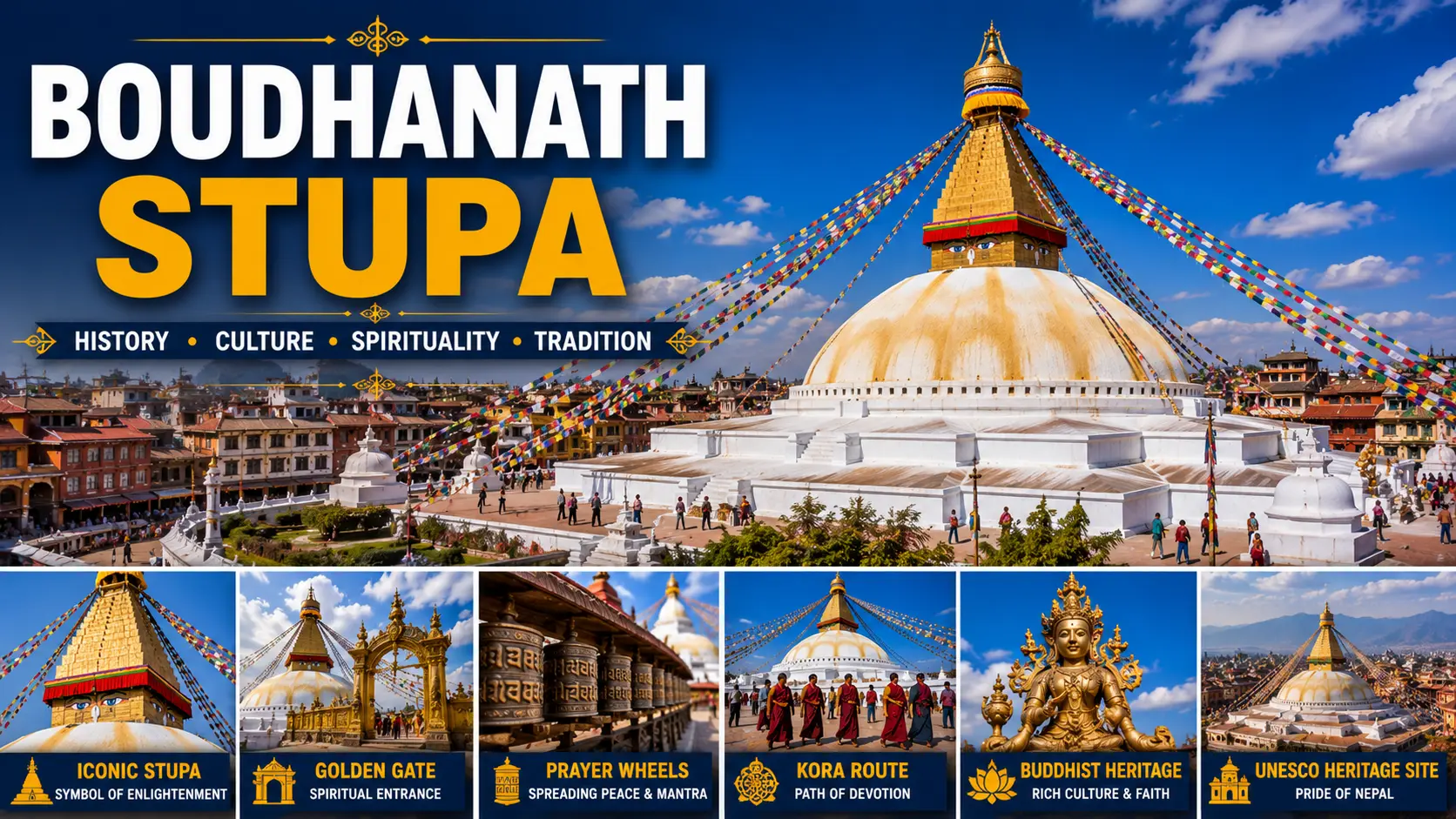
Boudhanath Stupa (also spelled Bauddhanath) is one of the largest Buddhist stupas in the world and the most important center of Tibetan Buddhism outside Tibet itself. Rising to a height of 36 meters, its massive white dome and golden spire dominate the northeastern skyline of Kathmandu, creating one of the most instantly recognizable skylines in all of Asia.
The stupa’s origins are shrouded in legend. Still, it is generally believed to have been built in the 5th century during the Licchavi period, possibly over the remains of a Licchavi king. It became a major stopping point on the ancient trade route between Nepal and Tibet. Over the centuries, it grew into a significant center of Tibetan Buddhist pilgrimage and learning. Following the Chinese occupation of Tibet in 1959, thousands of Tibetan refugees settled around the stupa, and today the Boudhanath area is one of the most vibrant and authentic Tibetan cultural enclaves outside Tibet.
The stupa was inscribed on the UNESCO World Heritage Site in 1979 and suffered significant damage during the 2015 earthquake. It was beautifully restored over the following years and today stands in magnificent condition, once again drawing hundreds of thousands of pilgrims and visitors annually.
What to See at Boudhanath
- The Great Stupa — The enormous white dome representing the universe, topped by a gilded tower bearing the all-seeing eyes of the Buddha on each of its four sides. Strings of colorful triangular flags radiate from the spire in all directions.
- Circumambulation (Kora) — Walk clockwise around the stupa’s base alongside Tibetan pilgrims spinning the 147 prayer wheels that line the perimeter. This meditative practice is deeply meaningful and can be done multiple times.
- The Surrounding Monasteries — Over 50 Tibetan Buddhist gompas (monasteries) surround the stupa, many of which are open to respectful visitors. Attending a puja (prayer ceremony) inside one of these monasteries is an unforgettable experience.
- Rooftop Cafes — Several cafes around the stupa offer rooftop seating with spectacular views of the stupa’s dome, particularly atmospheric at dawn and dusk.
Entry Fee & Visiting Hours
Entry Fee: NPR 400 for foreign nationals | Free for SAARC and Nepali nationals
Open: Dawn to dusk daily | Best visited at sunrise or at dusk when butter lamps are lit
Insider Tips for Boudhanath
- Visit at dawn (around 5:30–6:30 AM) when the local Tibetan community performs morning kora — the atmosphere is extraordinarily peaceful and authentic.
- Losar (Tibetan New Year, usually in February) is the most spectacular festival time, with the stupa decorated with thousands of butter lamps and thangkas.
- The surrounding streets are excellent for shopping — thangka paintings, singing bowls, mala beads, and Buddhist ritual objects are available at competitive prices.
Swayambhunath (Monkey Temple) — The Ancient Hilltop Stupa of Kathmandu
History & Significance
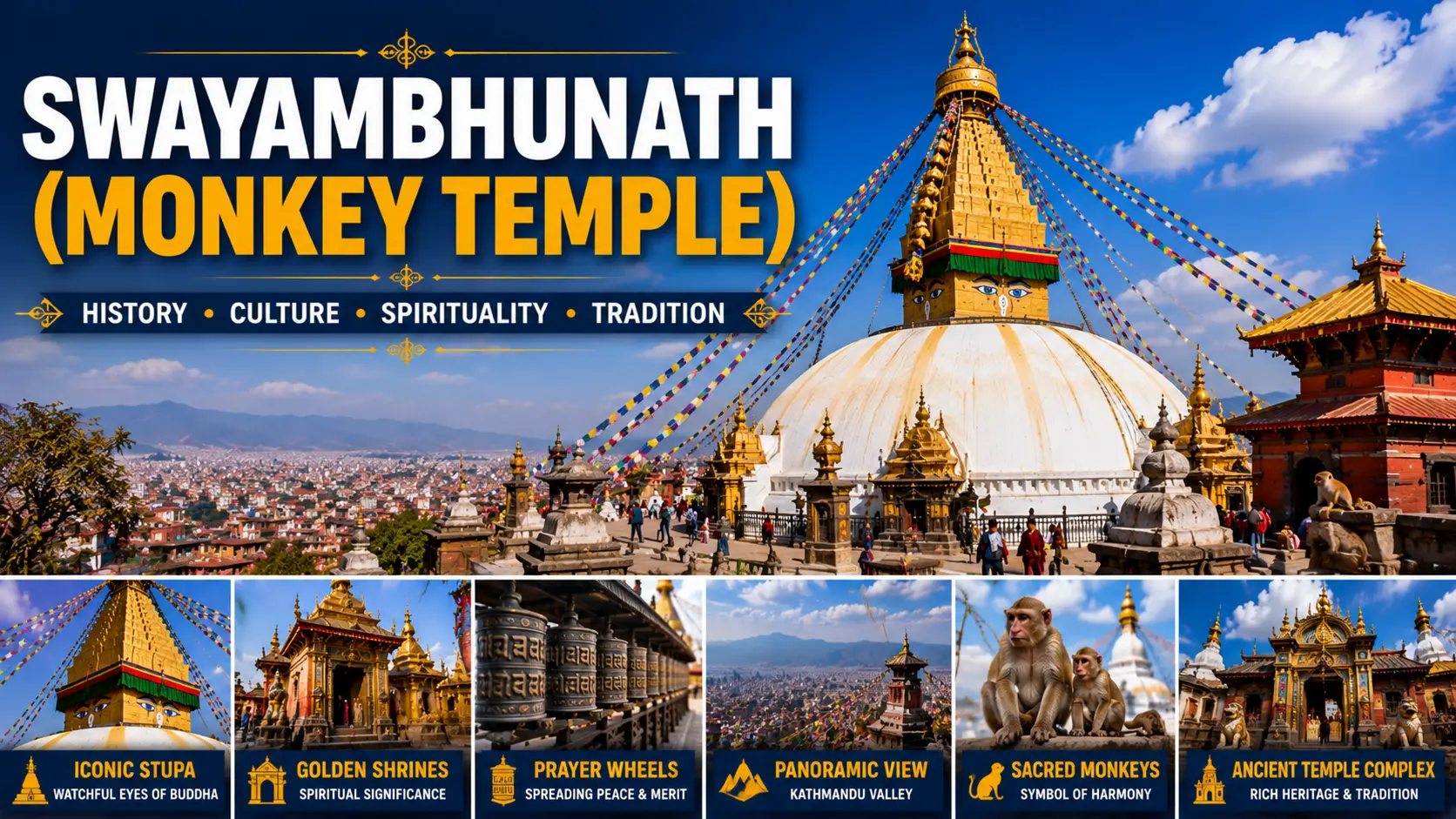
Swayambhunath, popularly known as the Monkey Temple, is one of the oldest and most revered Buddhist sites in the world and one of Nepal’smost iconic images. Perched on a hillock 77 meters above the Kathmandu Valley floor, the stupa can be seen from virtually anywhere in the city, its golden spire glittering in the sunlight and its Buddha eyes gazing serenely in all four directions.
Swayambhunath’s origins stretch back over 2,500 years, making it the oldest Buddhist monument in the entire Kathmandu Valley. According to legend, the valley was once a great lake, and when the Bodhisattva Manjushri drained it with his sword to create habitable land, he chose the Swayambhu hillock as a sacred site. The name itself means ‘Self-Existent’ — a reference to the belief that the stupa arose spontaneously from the earth without human construction.
The site is sacred to both Buddhists and Hindus, exemplifying the remarkable religious syncretism that characterizes all of Kathmandu’s heritage. Alongside Buddhist shrines and Tibetan prayer flags, you will find Hindu temples dedicated to Saraswati and Harati Devi. The resident troops of rhesus macaques — from which the popular nickname ‘Monkey Temple’ derives — add an unforgettable element of wildness to the spiritual atmosphere.
What to See at Swayambhunath
- The Great Stupa — The white dome topped by a square harmika (tower) bearing the omniscient eyes of the Buddha. The stupa is wrapped in a golden plate on certain auspicious days and circumambulated by thousands of pilgrims.
- The 365 Steps — The main approach to the stupa from the east involves climbing 365 stone steps, one for each day of the year. The ascent is lined with statues of deities, Tibetan prayer wheels, and, of course, the famous monkeys.
- The Viewpoint — From the hilltop, you are rewarded with a panoramic 360-degree view of the entire Kathmandu Valley — mountains, temples, green hills, and the urban sprawl.
- Dewa Dharma Monastery — A beautiful Tibetan monastery at the site that offers a serene space for meditation.
- Harati Devi Temple — A Hindu temple dedicated to the goddess of smallpox and children’s health, located near the main stupa and always busy with local devotees.
Entry Fee & Visiting Hours
Entry Fee: NPR 200 for foreign nationals | Free for SAARC and Nepali nationals
Open: 24 hours daily | Best at sunrise (5:30–7:00 AM) for golden light and morning rituals
Insider Tips for Swayambhunath
- Visit at sunrise for golden light on the stupa and extraordinary views over the morning mist in the valley below.
- Keep a firm grip on any food, bags, or sunglasses — the monkeys are famously opportunistic thieves.
- There is also a road that vehicles can take to reach the western entrance, making it accessible for those who prefer not to climb the 365 steps.
Changu Narayan Temple — Nepal’s Oldest Temple and Hidden Gem
History & Significance
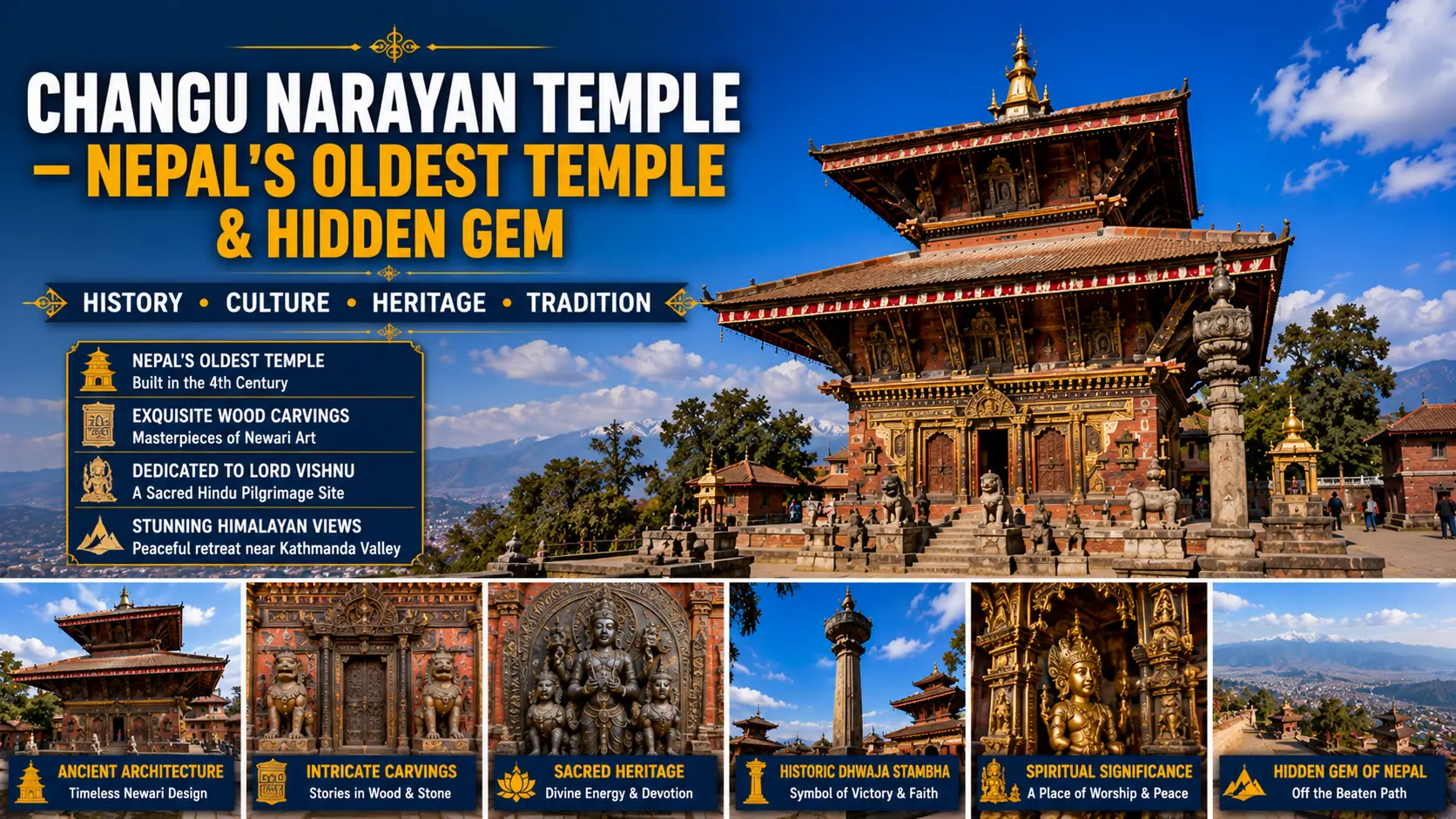
Changu Narayan is the oldest standing temple in Nepal and one of the most historically significant sites in the entire Kathmandu Valley — yet it is often overlooked by tourists who rush between the more famous sites. Located approximately 12 kilometers northeast of Kathmandu on a forested hilltop near Bhaktapur, this temple complex is a true hidden treasure that rewards those who make the effort to visit.
The temple is dedicated to Lord Vishnu and is believed to have been built as early as the 4th century AD, during the Licchavi period. It houses a stone inscription dated to 464 AD — the oldest written inscription found anywhere in Nepal — making it an invaluable record of the valley’s early history. The courtyard surrounding the temple is essentially an open-air museum of 5th-century stone sculpture, displaying some of the finest examples of Licchavi-era art ever discovered.
The UNESCO monument zone of Changu Narayan was inscribed in 1979 and encompasses both the temple complex and the traditional Newari village of Changu that surrounds it. The village itself is a living example of traditional Newari settlement patterns and community life.
What to See at Changu Narayan
- The Main Temple — A two-tiered pagoda structure clad in gilded metal roofing, with finely carved struts depicting the ten incarnations of Lord Vishnu. The main deity inside is the Vishvarupa Vishnu — a form with multiple heads and arms.
- The Stone Sculpture Gallery — The courtyard is lined with extraordinary Licchavi-era stone sculptures, including the famous eight-armed Vishnu image and the Garuda kneeling before the temple.
- The Ancient Inscription — The stone inscription from 464 AD, written in Sanskrit, records the victories of King Manadeva — the oldest such inscription in Nepal.
- Changu Narayan Village — The traditional Newari village around the temple is an authentic, unhurried community with a small local museum displaying traditional crafts and artifacts.
Entry Fee & Visiting Hours
Entry Fee: NPR 300 for foreign nationals | NPR 100 for SAARC | Free for Nepali nationals
Open: Daily 6:00 AM – 7:00 PM | Best combined with a Bhaktapur visit (12 km away)
Insider Tips for Changu Narayan
- Combine this site with Bhaktapur Durbar Square on the same day, as they are geographically close and both on the eastern side of the valley.
- The views from the hilltop toward the eastern Himalayas are spectacular — bring a camera with a good zoom lens.
- Because this is the least visited of the seven sites, you will often find the courtyard beautifully quiet and peaceful.
Complete Entry Fee Summary — All 7 UNESCO World Heritage Sites (2026)
Below is a consolidated table of entry fees for all UNESCO World Heritage monument zones in the Kathmandu Valley. Prices are in Nepali Rupees (NPR). Note that children under 10 years are typically admitted free at most sites.
| Heritage Site | Foreigner | SAARC | Open Hours |
| Kathmandu Durbar Square | NPR 1,000 | NPR 150 | 7:00 AM – 7:00 PM |
| Patan Durbar Square | NPR 1,000 | NPR 150 | 9:00 AM – 5:00 PM |
| Bhaktapur Durbar Square | NPR 1,500 | NPR 150 | Sunrise – Sunset |
| Pashupatinath Temple | NPR 1,000 | NPR 150 | 4:00 AM – 9:00 PM |
| Boudhanath Stupa | NPR 400 | Free | Dawn – Dusk |
| Swayambhunath Stupa | NPR 200 | Free | Open 24 Hours |
| Changu Narayan Temple | NPR 300 | NPR 100 | 6:00 AM – 7:00 PM |
Total Estimated Entry Fees: Approximately NPR 5,400 for a foreigner visiting all 7 sites (roughly USD 40). SAARC citizens pay approximately NPR 700 total for all sites.

How to Travel Between Kathmandu Historical Heritage Sites: Why a Private Vehicle Is the Best Option
The seven UNESCO heritage sites of Kathmandu Valley are spread across three different districts — Kathmandu, Lalitpur (Patan), and Bhaktapur — covering a total area of nearly 200 square kilometers. While public transport options exist, covering all seven sites efficiently and comfortably requires a private vehicle, especially if you are traveling with family, a group, or carrying luggage.
Transportation Options Compared
- Public Buses & Tempos: The cheapest option but extremely crowded, slow, and difficult to navigate for first-time visitors. Routes are complex, and the vehicles are not air-conditioned. Not recommended for heritage sightseeing.
- Taxis: Available 24/7 in Kathmandu. Convenient for short trips but can be expensive for a full-day multi-site tour, especially if the driver tries to negotiate per trip rather than a day rate.
- Ride-Hailing Apps (Pathao, inDriver): Good for individual journeys within the city but not ideal for multi-stop heritage tours with waiting time at each site.
- Private Vehicle Hire with Driver: By far, the most comfortable, convenient, and ultimately cost-effective option for a full-day heritage tour. A dedicated vehicle with a professional driver allows you to set your own pace, make spontaneous stops, and avoid the stress of navigation entirely.
Why Choose Nepal Vehicle Hiring Pvt. Ltd.
Nepal Vehicle Hiring Pvt. Ltd. (vehiclehiringnepal.com) is one of Nepal’s most trusted and experienced private vehicle rental companies, operating from the heart of Thamel, Kathmandu. With over 50k + happy customers and a 5.0 rating on TripAdvisor from over 200 reviews, we are the vehicle hire company of choice for travelers seeking reliability, comfort, and value.
| Why Book Your Heritage Tour Vehicle with Nepal Vehicle Hiring Pvt. Ltd. |
| 50,000+ satisfied customers | 5.0 TripAdvisor rating |
| Fleet of well-maintained, air-conditioned Cars, Jeeps, Hiace Vans, Coasters & Buses |
| Professional, bilingual drivers (English, Nepali, Hindi) |
| 24/7 customer support — WhatsApp: +977 9851013196 |
| Hotel pickup & drop-off included | No hidden charges |
| Flexible itinerary — you control the schedule |
| Best price guaranteed | Direct booking, no middlemen |
| Licensed & registered company (Reg No. 219204) |
Available Vehicle Fleet for Heritage Site Tours
| Vehicle Type | Best For | Capacity | Features |
| Car (Sedan/SUV) | Solo or couple | 1-3 pax | AC, comfortable, city-friendly |
| Jeep / Fortuner | Groups & trekkers | 4-6 pax | 4WD, rugged terrain, luggage space |
| Hiace Van | Medium groups | 7-14 pax | Spacious, AC, ideal for families |
| Coaster Bus | Large groups | 15-25 pax | Group tours are cost-effective |
| Tourist Bus | Budget travellers | 30+ pax | Intercity routes, economical |

Recommended 1-Day Heritage Tour Itinerary by Private Vehicle
- 7:30 AM — Hotel pickup from Thamel or your accommodation in a private, air-conditioned vehicle
- 8:00 AM — Swayambhunath Stupa (Monkey Temple) — sunrise visit, 60–90 minutes
- 9:30 AM — Kathmandu Durbar Square (Hanuman Dhoka) — 60–90 minutes
- 11:30 AM — Pashupatinath Temple — 60 minutes (observe morning rituals and Sadhus)
- 1:00 PM — Boudhanath Stupa — 45–60 minutes (lunch available at surrounding cafes)
- 2:30 PM — Drive to Patan (15 min) — Patan Durbar Square & Museum — 90 minutes
- 4:30 PM — Drive to Bhaktapur (30 min) — Bhaktapur Durbar Square — 90–120 minutes
- 7:00 PM — Return to hotel in Kathmandu
Optional Day 2 Addition: Changu Narayan Temple can be combined with Bhaktapur on a second day, including a scenic hike or private vehicle drop to the hilltop. Nepal Vehicle Hiring also offers customized multi-day itineraries across Nepal.
Best Time to Visit Kathmandu’s Historical Heritage Sites
Kathmandu has a temperate climate year-round, but certain seasons offer significantly better conditions for heritage sightseeing. Here is a season-by-season breakdown:
October – December (Post-Monsoon — BEST Season)
This is the absolute peak season for visiting Kathmandu’s heritage sites. The monsoon rains have cleared the air of pollution and dust, leaving the skies bright blue and the mountains dramatically visible on the horizon. Temperatures are mild and comfortable (15–25°C during the day). The festivals of Dasain (September/October) and Tihar/Diwali (October/November) add extraordinary cultural color to this period, with heritage sites decorated and alive with celebrants.
March – May (Pre-Monsoon — EXCELLENT)
Spring in Kathmandu is beautiful. Temperatures warm up pleasantly (20–28°C), and the surrounding hills burst into color with rhododendron blooms. The cultural festival of Holi (March) brings joyful color to the streets. This is also an excellent time for combining heritage visits with trekking in the Himalayas.
December – February (Winter — GOOD)
The winter months are cool and dry with clear skies. Heritage sites are less crowded during the off-season, which is ideal for photography and peaceful exploration. Temperatures can drop to 3–5°C at night but are typically pleasant during daylight hours. Boudhanath is particularly spectacular during Losar (Tibetan New Year, usually in February).
June – September (Monsoon — CHALLENGING)
The monsoon season brings heavy rainfall and humidity that can make outdoor sightseeing uncomfortable. Many trails become slippery, and cloud cover can obscure mountain views. However, the valley’s greenery is lush and beautiful, entry fees are lower, and heritage sites are virtually crowd-free. With a private vehicle and a flexible schedule, even a monsoon visit can be rewarding.
Essential Practical Tips for Visiting Kathmandu Historical Heritage Sites
What to Wear
- Dress conservatively at all religious sites — shoulders and knees should be covered for both men and women.
- Comfortable walking shoes with easy slip-on/off capability (you must remove shoes before entering temples).
- A light jacket or shawl for cooler mornings, particularly October–February.
- Sunscreen and a hat are essential for summer visits, as midday sun can be intense at altitude.
What to Bring
- Cash in Nepali Rupees (NPR) — entry fees and most local vendors prefer cash. ATMs are available near major sites but can be unreliable.
- A reusable water bottle — hydration is important, especially if you are climbing many steps.
- Camera with a wide-angle lens — the architecture, sculptures, and scale of these sites demand wide-angle photography.
- A portable power bank for your phone — full-day tours drain smartphone batteries.
- A guidebook or offline map app — detailed notes on each site’s history greatly enhance your appreciation.
Cultural Etiquette
- Always walk clockwise around stupas and temples — this is the prescribed direction of circumambulation in both Hinduism and Buddhism.
- Never point the soles of your feet toward a deity or shrine — this is considered deeply disrespectful in Nepali culture.
- Do not touch statues, sacred objects, or offerings unless explicitly invited to do so.
- At Pashupatinath, observe the cremation ghats with quiet, respectful silence — photography of the ceremonies should be done with extreme discretion.
- When entering monasteries, bow to the main deity and speak softly.
Photography Tips
- The golden hours at sunrise and sunset provide the most atmospheric light for heritage photography.
- The rooftop cafes around Boudhanath Stupa offer excellent elevated photography angles.
- Ask permission before photographing monks, sadhus, or devotees — most will be happy to oblige, and a small donation or a genuine smile of thanks is always appreciated.
- The 55-Window Palace in Bhaktapur and the Golden Gate are best photographed in the morning light.
Major Festivals at Kathmandu Historical Heritage Sites — Plan Your Visit Around These
Kathmandu’s heritage sites spectacularly come to life during the valley’s many festivals. These celebrations are not tourist performances — they are genuine, ancient religious events that have been observed for centuries and are among the most authentic cultural experiences available anywhere in Asia.
Indra Jatra (August/September): The eight-day festival celebrating the god Indra and the living goddess Kumari takes place in and around Kathmandu Durbar Square. The Kumari is carried through the city in a chariot procession, one of the most spectacular events on the Kathmandu calendar.
Dasain (October): Nepal’s biggest festival, celebrating the goddess Durga’s victory over the buffalo demon Mahishasura. Kathmandu Durbar Square and Patan Durbar Square are decorated magnificently, and the 10th day (Bijaya Dashami) sees the streets filled with celebration.
Tihar / Diwali (October/November): The five-day festival of lights transforms Kathmandu into a glittering spectacle of oil lamps and marigold garlands. Boudhanath and Swayambhunath are particularly beautiful during this festival.
Maha Shivaratri (February/March): Thousands of Hindu pilgrims, sadhus, and devotees gather at Pashupatinath Temple for this major annual festival dedicated to Lord Shiva. The atmosphere is extraordinarily charged with devotion and spectacle.
Losar — Tibetan New Year (February): Boudhanath becomes the epicenter of Tibetan New Year celebrations, with the stupa decorated with thousands of butter lamps and special pujas performed in surrounding monasteries.
Bisket Jatra (April/Nepali New Year): Bhaktapur’s New Year festival is among the most unique in Nepal — featuring the erection of a massive wooden pole (lingo) and chariot processions through the medieval streets.
Frequently Asked Questions (FAQ)
Can I visit all 7 UNESCO sites in one day?
Yes, it is physically possible to visit all seven sites in a single day, but it requires an early start (around 7:00–7:30 AM), a private vehicle, and a well-planned itinerary. It is better to dedicate one full day to the sites in Kathmandu city (Hanuman Dhoka, Swayambhunath, Pashupatinath, Boudhanath) and a second day to Patan, Bhaktapur, and Changu Narayan. Nepal Vehicle Hiring Pvt. Ltd. offers both single-day and multi-day private vehicle packages.
Is there a combined ticket for all heritage sites?
No, there is currently no single combined pass for all seven UNESCO sites in Kathmandu Valley. Each site has its own separate entry fee system. Foreigners must pay at each site individually. Carry sufficient cash (NPR) at all times, as card payment is not accepted at most entry counters.
Which heritage site is the most important to visit?
All seven sites offer unique and irreplaceable experiences. However, if you are limited in time, Pashupatinath, Boudhanath, and Bhaktapur Durbar Square are often considered the three most profound and distinctive experiences. Pashupatinath offers unparalleled spiritual intensity, Boudhanath offers peace and architectural grandeur, and Bhaktapur offers the most complete medieval urban experience.
How do I book a private vehicle for the heritage site tour?
Contact Nepal Vehicle Hiring Pvt. Ltd. directly via phone/WhatsApp at +977 9851013196, email at [email protected], or book online at vehiclehiringnepal.com. Share your group size, preferred pickup time, hotel name, and which sites you want to visit, and their team will arrange a customized vehicle with a professional driver.
Are guides available at the heritage sites?
Licensed local guides are available for hire at all seven sites, typically at rates of NPR 500–800 per hour per group. Having an expert guide dramatically enhances the experience at these complex, multi-layered sites. Nepal Vehicle Hiring Pvt. Ltd. can also connect you with recommended English-speaking heritage guides.
Are the heritage sites safe for solo female travelers?
Yes, Kathmandu’s heritage sites are generally safe and well-visited. Exercise normal travel precautions — stay aware of your surroundings, dress conservatively, and ideally visit with a guide or in a trusted private vehicle that can advise on local customs and safe areas.
How much should I budget for a full-day heritage tour?
A comprehensive one-day budget estimate for a foreign visitor: Entry fees for all sites (NPR 5,400) + private vehicle hire (NPR 6,000–8,000 for a car or jeep for the full day) + guide fees (NPR 3,000–5,000) + meals (NPR 800–1,500) + miscellaneous = Total approximately NPR 15,000–20,000 (USD 110–150). This is exceptional value for a day of world-class cultural exploration.
Conclusion —Kathmandu Historical Heritage Sites: A Journey Through Civilizations
Kathmandu’s seven UNESCO World Heritage Sites represent one of the greatest concentrations of cultural, spiritual, and architectural achievement anywhere on earth. In the space of a single valley — and in a single remarkable day — you can walk through royal palaces built in the 12th century, circumambulate stupas that have been sacred for over 2,500 years, witness living religious traditions that connect the present to the most ancient roots of human civilization, and marvel at woodcarving, bronze casting, and stone sculpture that has never been surpassed in the centuries since it was created.
These are not sites that you merely ‘tick off a list.’ They are places that change you — that shift your perspective on what human beings are capable of creating and preserving, and what it means to live in deep, generational connection to a place and a history.
To make the most of your Kathmandu heritage experience, plan well, dress respectfully, carry cash for entry fees, and — above all — give yourself time. Time to sit in an ancient courtyard and absorb the atmosphere. Time to talk with the locals who have grown up in the shadow of these monuments. Time to let the weight of history settle around your shoulders and the sound of temple bells carry you somewhere outside of ordinary time.
And to ensure your journey between these extraordinary sites is smooth, comfortable, and completely stress-free, trust Nepal Vehicle Hiring Pvt. Ltd. — your dedicated, professional, and affordable vehicle hire partner in Nepal. From airport transfers to full-day heritage sightseeing tours, multi-day excursions to Pokhara, Lumbini, Chitwan, and beyond, Nepal Vehicle Hiring is with you every kilometer of the way.
Book Your Kathmandu Historical Heritage Sites Tour Vehicle Today! |
| Website: www.vehiclehiringnepal.com |
| Phone / WhatsApp: +977 9851013196 |
| Email: [email protected] |
| Office: Bhagawatisthan, Thamel, Kathmandu, Nepal |
| Fleet: Car | Jeep | Hiace Van | Coaster | Tourist Bus |
| 50k+ Happy Customers | 5.0 Rating |15k+ TripAdvisor Reviews |
| Private Heritage Tour | Airport Transfers | Multi-Day Nepal Tours |
| WhatsApp us anytime — we respond 24/7! |
- Why Kathmandu Historical Heritage Sites Are Unlike Anywhere on Earth
- Quick Facts: Kathmandu Valley UNESCO World Heritage Sites
- Kathmandu Durbar Square (Hanuman Dhoka) — The Royal Heart of the Capital
- Patan Durbar Square — The City of Fine Arts and Craftsmanship
- Bhaktapur Durbar Square — Nepal's Best-Preserved Medieval City
- Pashupatinath Temple — The Holiest Hindu Shrine in Nepal
- Boudhanath Stupa — The Greatest Buddhist Stupa in Nepal
- Swayambhunath (Monkey Temple) — The Ancient Hilltop Stupa of Kathmandu
- Changu Narayan Temple — Nepal's Oldest Temple and Hidden Gem
- Complete Entry Fee Summary — All 7 UNESCO World Heritage Sites (2026)
- How to Travel Between Kathmandu Historical Heritage Sites: Why a Private Vehicle Is the Best Option
- Best Time to Visit Kathmandu's Historical Heritage Sites
- Essential Practical Tips for Visiting Kathmandu Historical Heritage Sites
- Major Festivals at Kathmandu Historical Heritage Sites — Plan Your Visit Around These
- Frequently Asked Questions (FAQ)
- Conclusion —Kathmandu Historical Heritage Sites: A Journey Through Civilizations

Related Blog & Articles

All Over Nepal Vehicle Hire – Private Car, Scorpio, 4WD Jeep, Hiace & Tourist Bus

Car Hire in Nepal – Complete Guide for Travelers