Plan a Trip


Kalinchok Scorpio and Jeep Hire – Ultimate Private 4WD Guide to Kalinchowk Bhagwati Temple 2026
Nepal’s Most Beloved Weekend Pilgrimage Destination
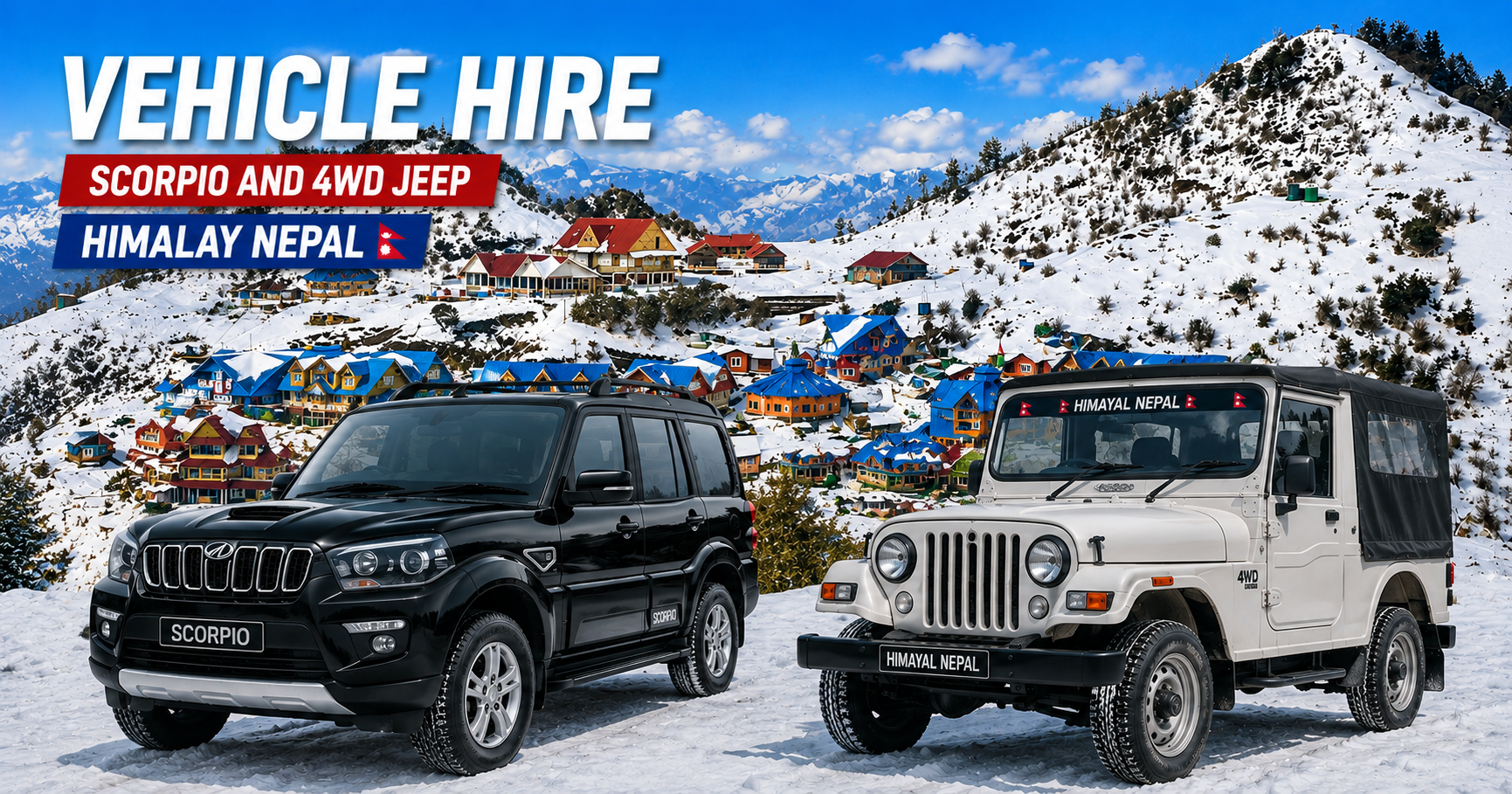
Nestled at a commanding 3,842 meters above sea level on a rocky mountain ridge in the Dolakha District of Bagmati Province, the Kalinchowk Bhagwati Temple is one of the most beloved, most accessible, and most spiritually powerful pilgrimage destinations in all of Nepal. For the residents of Kathmandu — only 150 km to the northeast — Kalinchowk represents the perfect intersection of high-altitude adventure, sacred Hindu pilgrimage, breathtaking Himalayan panorama, and winter snowfall experience, all within reach of a weekend trip. Nepal Vehicle Hiring Pvt Ltd offers the finest Kalinchok Scorpio and jeep hire service in 2026 — your most reliable, comfortable, and expert private 4WD vehicle service for the journey to Kalinchowk.
The Kalinchowk experience is, in essence, a journey of three extraordinary acts: First, the 5–6-hour scenic drive from Kathmandu along the Araniko Highway through medieval Bhaktapur, across the Sunkoshi River gorge at Dolalghat, and through the Newari mountain town of Charikot. Second, the steep, breathtaking 15–18 km off-road ascent from Charikot to Kuri Village — a 4WD Scorpio or Land Cruiser adventure through pine and rhododendron forest to the isolated mountain village at 2,300 m. And third, the pre-dawn hike or cable car ascent to the temple summit — arriving as the first golden light of sunrise transforms the snow-covered peaks of Gaurishankar, Everest, Langtang, Jugal Himal, and Ganesh Himal into a landscape of transcendent, burning beauty.
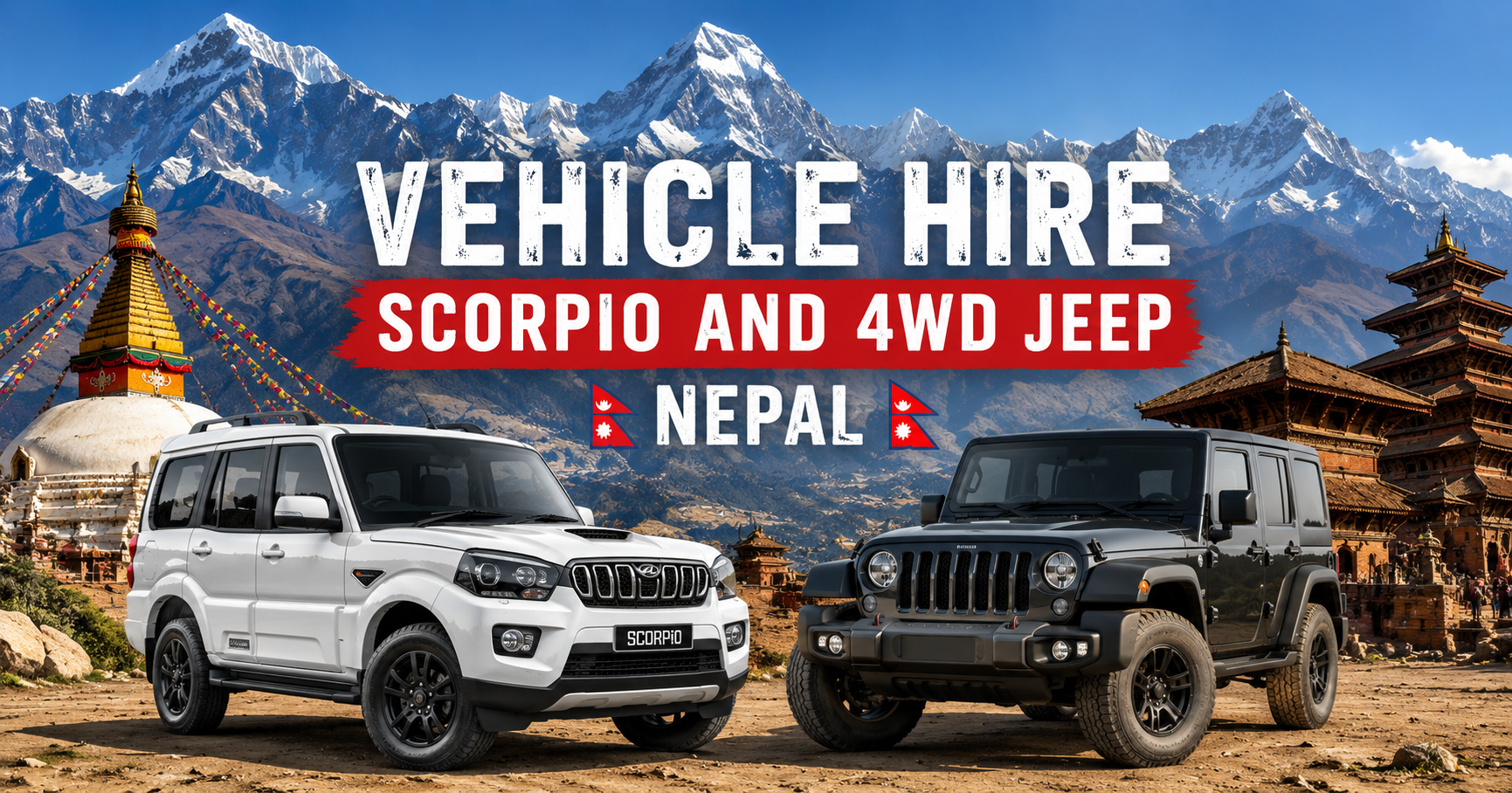
The central reason a Mahindra Scorpio or Toyota Land Cruiser 4WD is essential for this journey — and why it has become Nepal’s most iconic domestic road-trip vehicle pairing — is the Charikot-to-Kuri Village off-road section. This 15–18 km mountain track is steep, narrow, rocky, and in the winter months covered in snow and ice. No standard car, van, or microbus can navigate it. The Scorpio’s genuine 4WD system, powerful diesel engine, 180–200 mm ground clearance, and proven mountain reliability make it the vehicle of choice for 95% of Kalinchowk visitors — and Nepal Vehicle Hiring operates a fully maintained, professionally driven fleet dedicated to this route.
Book your Kalinchowk Scorpio or jeep hire now: Nepal Vehicle Hiring – Jeep | All Vehicles | Call/WhatsApp: +977 9851013196
E-mail: [email protected]
Kalinchok Scorpio & Jeep Hire – Complete Route Overview 2026
| Full Route | Kathmandu -> Banepa -> Dolalghat -> Charikot -> Kuri Village -> Kalinchowk Temple |
| Total Distance | Approx. 150 km (Kathmandu to Kalinchowk) |
| Kathmandu to Charikot | 132 km via Araniko Highway | 5–6 hours on paved road |
| Charikot to Kuri Village | 15–18 km steep off-road mountain track | 1.5–2 hours |
| Kuri to Temple | 2 km hike (45–60 min) OR cable car (NPR 500 two-way, 10 min) |
| Altitude | Charikot: 1,554 m | Kuri Village: 2,300 m | Kalinchowk Temple: 3,842 m |
| Temperature Range | Summer: up to 29°C | Winter nights: as low as –10°C to –15°C |
| Best Vehicle | Mahindra Scorpio 4WD (most popular) | Toyota Land Cruiser (premium) |
| Recommended Stay | 1 Night 2 Days (most popular) | 2 Night 3 Days (for winter snow experience) |
| Best Seasons | Winter (Dec–Feb) for snow | Autumn (Oct–Nov) for Himalayan views | Spring (Mar–May) for rhododendrons |
| Availability | Daily – 24/7 hotel pick-up from Kathmandu |
| Contact | +977 9851013196 | vehiclehiringnepal.com |
About Kalinchowk Bhagwati Temple – History, Significance & Spiritual Importance
The Sacred Geography of Kalinchowk
Kalinchowk Bhagwati Temple sits on a rocky summit ridge within the Gaurishankar Conservation Area (GCA) — a 2,179 sq. km protected zone declared by the Government of Nepal in 2010 to safeguard one of the most ecologically and culturally significant landscapes in the Himalayan region. The Gaurishankar Conservation Area is named for the majestic Gaurishankar peak (7,134 m) visible from the temple summit — a twin-peaked mountain considered sacred by both Hindu and Buddhist traditions as the earthly embodiment of Shiva and Parvati united.
Within the conservation area, the Sunkoshi (Sun Koshi) and Tamakoshi (Tama Kosi) rivers originate — two of Nepal’s major river systems flowing southward through Dolakha and Sindhupalchok districts to join the Koshi system and eventually the Ganges in India.
The temple’s elevation of 3,842 meters (12,605 feet) places it firmly in sub-alpine terrain — above the treeline in winter when deep snow covers the ridge and the surrounding rhododendron and pine forests are white-laden and ice-crystal quiet. In spring and autumn, the ridge is carpeted in flowering rhododendron species (Rhododendron arboreum, R. campanulatum) — Nepal’s national flower — alongside juniper, dwarf bamboo, and alpine grasses. The Himalayan Monal (Danphe), Nepal’s vibrantly coloured national bird, is frequently sighted in the forest between Kuri Village and the temple trail.
Historical and Religious Background
The Kalinchowk Bhagwati Temple is dedicated to Goddess Bhagwati — one of the most powerful and widely revered manifestations of the divine feminine in Hinduism, representing the supreme Mother Goddess in her aspect as protector, destroyer of evil, and granter of boons. Bhagwati (also known as Durga, Shakti, or Kali in her various forms) is the central deity of the Shakta tradition. This Hindu theological stream regards the Goddess as the ultimate reality and the source of all creation.
The temple is considered one of the Shakti Peethas — sacred sites of the Goddess — within Nepal’s broader network of Shakti pilgrimage sites. Historical and local accounts suggest the site has been a place of worship for many centuries, with the present temple structure established in the 19th century to serve the growing pilgrim community. The temple became formally incorporated into the Gaurishankar Conservation Area in 2010, ensuring its environmental and cultural heritage is protected for future generations.
The Kalinchowk Bhagwati is particularly famous throughout eastern Nepal for one central spiritual belief: that the Goddess at Kalinchowk fulfills the sincere prayers and desires of devotees who make the difficult pilgrimage to her mountain shrine. This belief — rooted in centuries of devotional tradition and countless personal testimonies — drives tens of thousands of pilgrims to the temple every year, with the largest gatherings during Dashain (October), Navaratri (spring and autumn), Maghe Sankranti (January), and Teej (September). The temple’s remoteness and the physical effort required to reach it are themselves considered part of the tapasya (spiritual austerity) that purifies the devotee and makes the prayer more powerful.
Architectural Features of the Temple
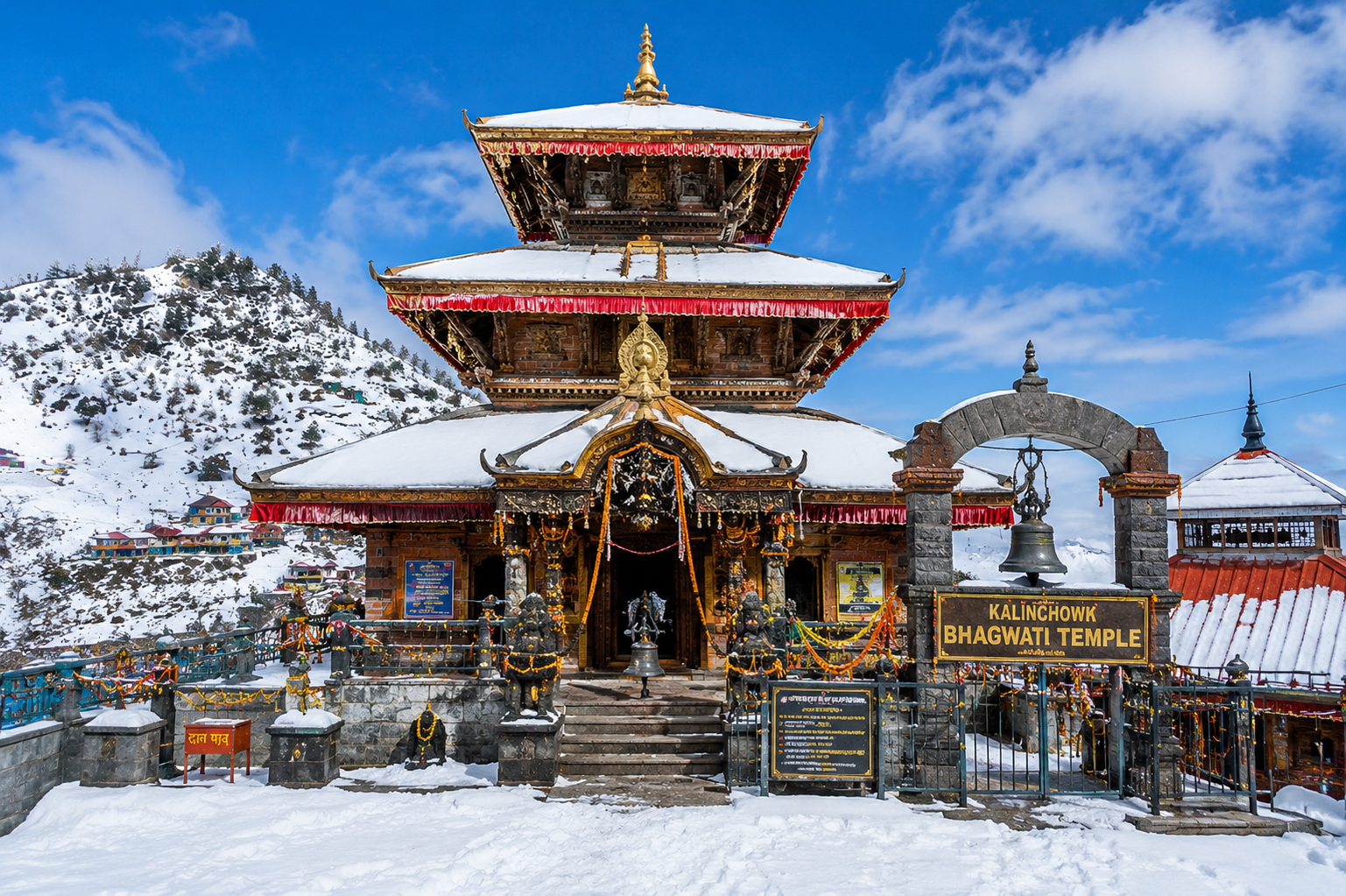
The Kalinchowk Bhagwati Temple is a relatively modest stone structure, as befits a high-altitude mountain shrine that must withstand severe winter conditions. Its architecture reflects the traditional Himalayan hill temple style — a compact, sturdy stone building with a corrugated metal roof (replacing the original stone slate), wooden door frames carved with traditional motifs, prayer flags fluttering from the roof and surrounding poles, and a simple forecourt for devotees to make offerings.
The main sanctum houses the idol of Goddess Bhagwati — a black stone image adorned with red cloth, gold jewelry, and fresh flower garlands replenished by the temple priests. The surrounding forecourt has smaller shrines to associated deities — Ganesh (for obstacle removal), Navagraha (the nine planetary deities), and subsidiary forms of the Goddess. Bells of various sizes hang from the entrance gate, rung by devotees as they enter to announce their presence to the Goddess and to ward off negative energies from the sacred precinct.
The 360-degree panoramic view from the temple forecourt is arguably the most extraordinary feature of the Kalinchowk site — a gift of geography that amplifies the spiritual experience with a reminder of the sublime scale of the Himalayan world. On the clearest days (typically October, November, March, and the occasional February morning after a strong cold front), the visible peaks include: Gaurishankar (7,134 m), Mt Everest (8,849 m) — visible as a distant dark pyramid on the northeast horizon, Langtang Lirung (7,234 m), Dorje Lakpa (6,966 m), Ganesh Himal (7,422 m), Jugal Himal (6,935 m), Shishapangma (8,027 m, Tibet), Langtang II, and the broad sweep of the Kathmandu Valley spread below to the southwest.
Why Is the Mahindra Scorpio the Most Popular Vehicle for Kalinchowk?
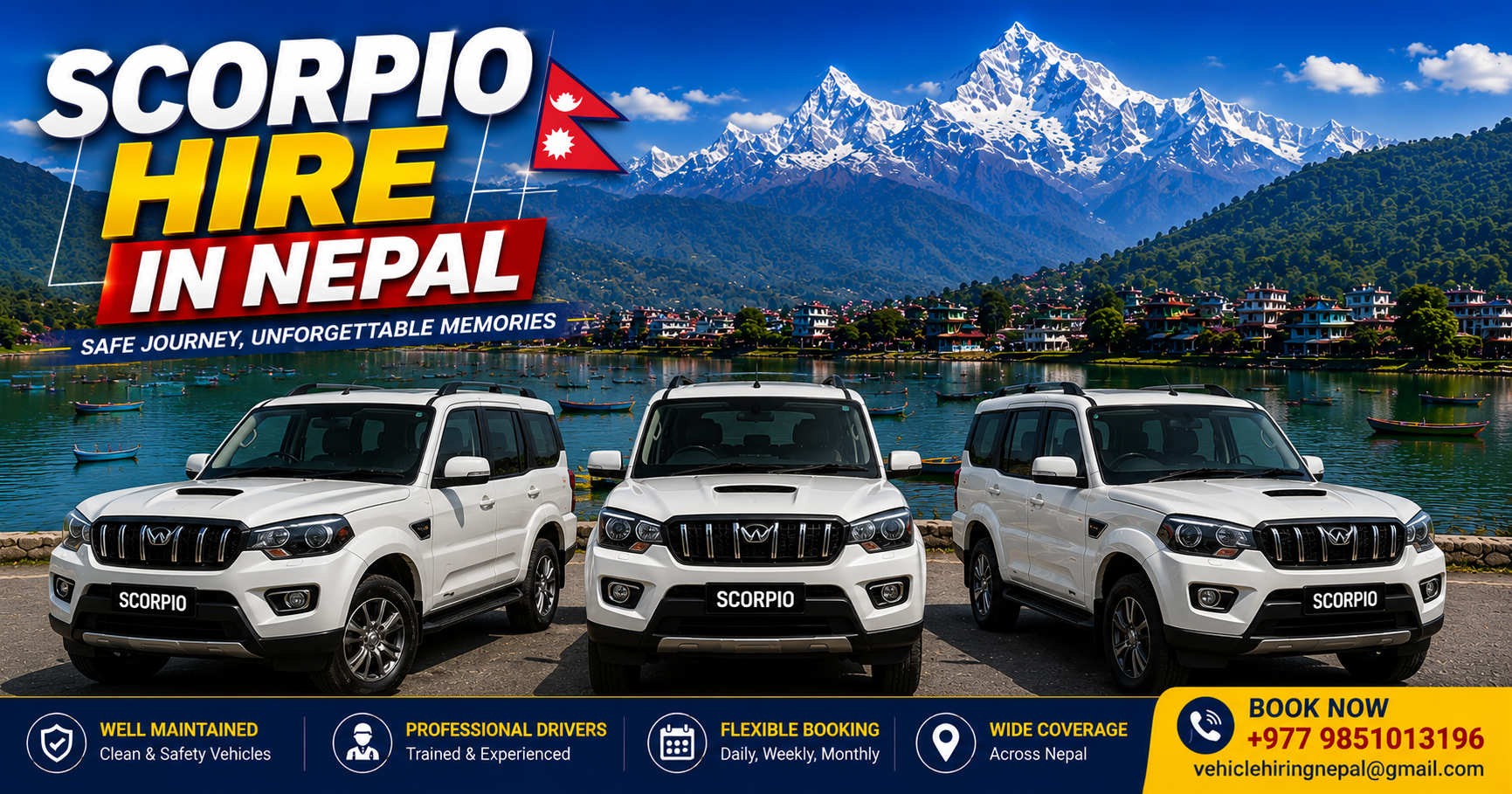
Among all vehicles used for the Kathmandu–Kalinchowk journey, the Mahindra Scorpio 4WD has become virtually synonymous with the route — to the point where locals, travel agents, and pilgrims across Nepal refer to a Kalinchowk trip simply as “going by Scorpio.” This association is neither accidental nor merely traditional — it is the product of the Scorpio’s remarkable suitability for the specific challenges of the Charikot–Kuri Village off-road section:
Genuine 4-Wheel Drive with Low-Range Transfer Case
The Mahindra Scorpio’s switchable 4WD system — providing both 4H (high-range 4WD) and 4L (low-range 4WD) — is the fundamental technical requirement for the Charikot–Kuri Village mountain track. Low-range 4WD delivers maximum torque multiplication for steep uphill sections with minimal forward speed — essential for crawling over boulders and rock steps on the upper sections of the off-road track. High-range 4WD provides additional traction on the moderately rough lower sections. Standard SUVs with AWD (all-wheel drive) systems are NOT equivalent to true 4WD — they lack the low-range transfer case that the Kuri Village ascent demands in winter and on wet rock.
Ground Clearance – The Critical Number
The Scorpio’s 180–200 mm of ground clearance is the minimum required for safe passage on the Charikot–Kuri road. The track has numerous exposed rock ledges, embedded boulders, deep ruts, and sudden drop-offs where a vehicle with lower clearance would ground out or lose traction. By comparison, a standard sedan has 130–150 mm of clearance (dangerously insufficient), and a standard city SUV (crossover) has 160–170 mm of clearance (marginal at best). The Scorpio’s engineering is precisely calibrated for this category of use — its approach and departure angles allow it to climb over and descend from obstacles that would completely trap lower-slung vehicles.
Seven-Passenger Capacity – Maximum Group Value
A key economic advantage of the Scorpio for Kalinchowk groups is its comfortable 6–7 passenger capacity. For a group of 7 friends or family members, the total private Scorpio hire cost is shared across all 7 seats, making the per-person cost comparable to or even cheaper than multiple shared jeep tickets — while delivering the incomparably superior experience of a private vehicle with full control over timing, stops, and comfort. Nepal Vehicle Hiring’s Scorpios can accommodate 7 adults with day bags; for overnight trips with larger luggage, we recommend a maximum of 6 passengers to maintain luggage comfort.
Proven Reliability in Extreme Cold
In December and January, the Kuri Village track can be snow-covered, ice-patched, and sub-zero. The Scorpio’s diesel engine delivers reliable cold-start performance at these temperatures, unlike petrol engines that can struggle in extreme cold. With snow chains fitted, the Scorpio has proven year after year that it can complete the full Charikot–Kuri round trip safely even in heavy snowfall conditions — though our drivers monitor conditions carefully and will make the professional call to park at Deurali if the final section becomes unsafe.
Cost-Effectiveness for Private Groups
Compared to the Toyota Land Cruiser (the premium alternative), the Mahindra Scorpio offers similar off-road capability at a more accessible price point — making private Kalinchowk jeep hire genuinely affordable for groups of 5–7. Nepal Vehicle Hiring’s Scorpio hire rate is among the most competitive in Kathmandu for this route. See our Jeep Hire page for current pricing.
Complete Vehicle Guide – Kalinchok Scorpio and Jeep Hire 2026
| Vehicle | Capacity | Off-Road Rating | Winter Snow Capability | Best For |
| Mahindra Scorpio 4WD | 6–7 pax | Excellent | With snow chains | Families / Friend groups |
| Toyota Land Cruiser 4WD | 1–6 pax | Outstanding | Best in class | VIP / Premium pilgrims |
| Mahindra Bolero 4WD | 6–7 pax | Excellent | With snow chains | Budget groups |
| Hiace Van (to Charikot) | 8–13 pax | Highway only | Not suitable beyond Charikot | Large groups (Charikot base) |
| Mini Bus / Coaster | 20–30 pax | Highway only | Not suitable for off-road | Large group highway transfer |
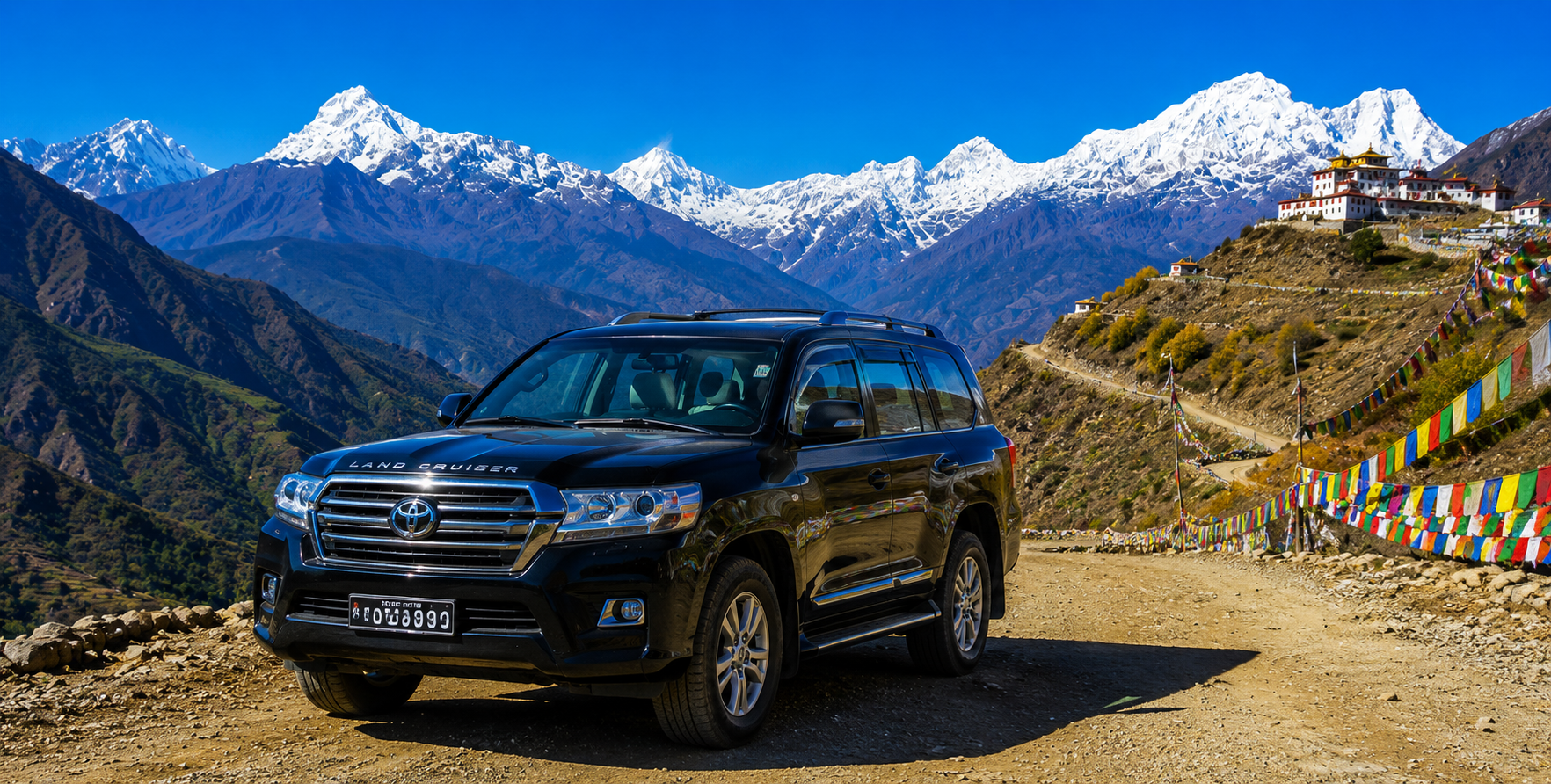
Toyota Land Cruiser 4WD – The Kalinchowk Premium Experience
For pilgrim families, VIP guests, and those who want the absolute pinnacle of comfort, reliability, and off-road safety on the Kalinchowk route, the Toyota Land Cruiser 4WD stands alone. Its outstanding 220 mm ground clearance, locking front and rear differentials, superior suspension with adjustable ride height, and vast torque reserve make the Charikot–Kuri Village section feel almost effortless compared to lesser vehicles. The Land Cruiser’s leather-appointed cabin, powerful dual-zone climate control, and noise suppression mean passengers arrive at Kuri Village in remarkable comfort after the bumpy mountain track, which is especially important for elderly devotees, children, and anyone with joint or back sensitivities.
Mahindra Scorpio 4WD – Nepal’s Kalinchowk Workhorse
The Mahindra Scorpio is the undisputed workhorse of the Kalinchowk route and the most widely trusted private vehicle for this journey throughout Nepal. It is the vehicle our drivers know best on this specific road, the vehicle our fleet is most thoroughly trained for, and the vehicle that delivers the best balance of capability, comfort, and value for the typical Kalinchowk group of 4–7 passengers. Nepal Vehicle Hiring’s Scorpios are maintained to a higher standard than the local rental market — clean interiors, regular service intervals, pre-trip mechanical inspection, and snow chains available from November through February.
Mahindra Bolero 4WD – The Budget 4WD Option
The Mahindra Bolero 4WD shares the Scorpio’s 4WD drivetrain architecture and provides genuine off-road capability for the Kalinchowk route at a slightly reduced price point. The Bolero’s interior is more utilitarian than the Scorpio’s, but it carries 6–7 passengers with equivalent mechanical safety on the off-road track. Recommended for pilgrim groups and budget-conscious families who prioritize cost savings over cabin refinement.
Hiace Van and Mini Bus – For Groups to Charikot Only
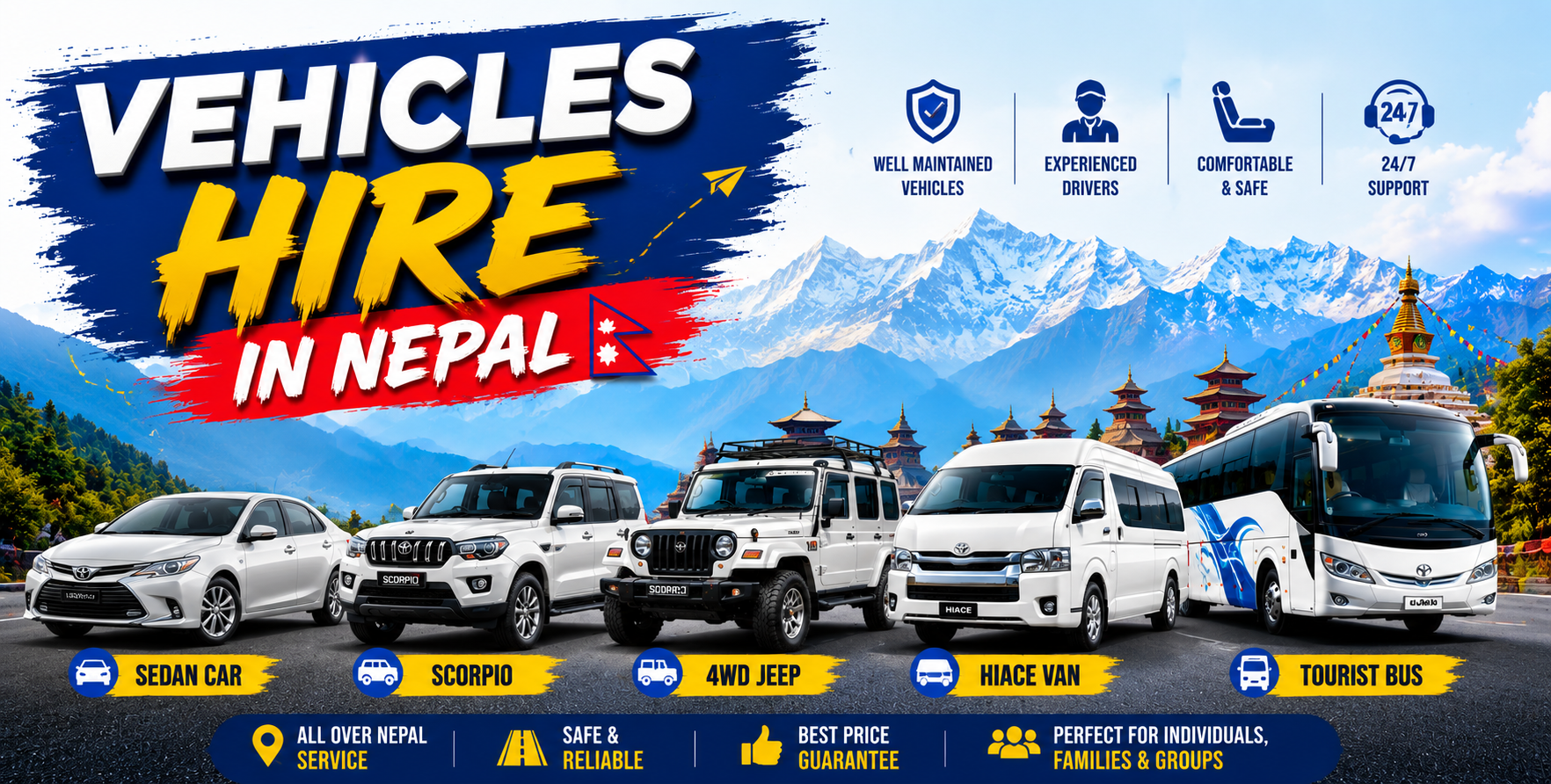
For large groups of 8–30 passengers, Nepal Vehicle Hiring provides Toyota Hiace van (8–13 pax) and Mini Bus / Coaster (20–30 pax) transfers from Kathmandu to Charikot on the paved Araniko Highway. From Charikot, the group is transferred to separate local Scorpios for the off-road section to Kuri Village (local shared Scorpios are available from Charikot). This two-vehicle system is the practical solution for large groups — see our Hiace Van Hire and Coaster Hire pages.
Kathmandu to Kalinchowk – Detailed Route & Segment Guide
The Kathmandu–Kalinchowk road journey is an experience of progressively intensifying scenery — from the cultural richness of the Kathmandu Valley to the dramatic river gorges of the middle hills, and finally to the extraordinary off-road mountain ascent to Kuri Village. Here is the complete route, segment by segment:
| Segment / Checkpoint | Distance | Travel Time | Road Condition & Key Feature |
| Kathmandu to Bhaktapur | 15 km | 30–40 min | Paved Araniko Highway; UNESCO World Heritage City |
| Bhaktapur to Banepa | 12 km | 20–25 min | Paved highway; Sanga Giant Shiva Statue en route |
| Banepa to Dolalghat | 30 km | 40–50 min | Paved hilly road; Sunkoshi River confluence; scenic gorge |
| Dolalghat to Mude | 35 km | 50–60 min | Winding mountain road; forested valleys; Mude rest stop |
| Mude to Charikot | 40 km | 60–75 min | Hilly paved road; Dolakha district entry; Bhimsen Temple |
| Charikot to Kuri Village | 15–18 km | 1.5–2 hrs | STRICT OFF-ROAD: steep, rocky, narrow – 4WD with high clearance MANDATORY |
| Kuri Village to Temple | 2 km | 45–60 min hike / 10 min cable car | Hike through rhododendron forest OR cable car (NPR 500 two-way) |
Kathmandu to Bhaktapur – Cultural Gateway (15 km | 30–40 min)
The journey departs from your Kathmandu hotel and heads east on the Araniko Highway — Nepal’s famous road to China, following the ancient trade route between the Kathmandu Valley and Tibet. The first major landmark is the historic Bhaktapur (Bhadgaon) — a UNESCO World Heritage City and the most perfectly preserved medieval Newari kingdom-city in the world. Bhaktapur’s extraordinary Durbar Square, Nyatapola Temple (five-story pagoda), Taumadhi Tole, and the 55-Window Palace are among Nepal’s greatest cultural treasures.
While a full Bhaktapur visit is a separate half-day experience, the drive through the city’s outer ring offers glimpses of its distinctive brick-and-timber architecture, the traditional pottery market at Kumale Tole, and the towering Nyatapola pagoda visible above the rooflines. Your Kalinchowk Scorpio driver can arrange a short Bhaktapur photo stop on request.
Banepa to Dolalghat – The Sunkoshi River Gorge (42 km | 60–75 min)
Beyond Banepa — a busy market town 27 km from Kathmandu — the Araniko Highway begins its descent toward the Sunkoshi River at Dolalghat. The Sanga area on this section is home to the spectacular Kailashnath Mahadev Statue — at 43 meters, one of the tallest Shiva statues in the world, visible from the highway in its entirety and a magnificent roadside spectacle. Dolalghat (57 km from Kathmandu) sits at the confluence of the Sunkoshi and Indrawati rivers — a scenic gorge location popular for picnics, river swimming, and rafting. The suspension bridges over the Sunkoshi at Dolalghat are frequently photographed, and the riverside tea houses are a classic first stop for Kalinchowk groups.
Mude Rest Stop – The Halfway Point (90 km from KTM)
Approximately 90 km from Kathmandu, the Mude rest stop has become a beloved institution on the Kalinchowk Scorpio journey. A cluster of roadside restaurants and tea houses perched on a hillside with sweeping valley views, Mude is the natural halfway lunch or breakfast stop for groups departing Kathmandu early. The views from Mude — particularly in clear autumn weather — often include the first glimpse of the high Himalayan peaks to the north, considerably raising excitement levels in the jeep as Kalinchowk draws closer. Mude’s dal bhat, thukpa, and fresh chai are excellent value, and the restaurant owners have decades of experience serving Kalinchowk-bound pilgrim and tourist groups.
Charikot (Bhimeshwar) – The District Capital at 1,554 m
Charikot is the headquarters of Dolakha District — a characterful mountain town built around the ancient Dolakha Bhimsen Temple. At 1,554 m, Charikot’s climate is already noticeably cooler than Kathmandu’s, and the surrounding hills and valleys strongly hint at the dramatic landscapes ahead. The Dolakha Bhimsen Temple is one of Nepal’s most sacred and mysterious religious sites — an ancient pagoda housing a unique triangular black stone idol of Lord Bhimsen, believed by devotees to represent three divine manifestations simultaneously.
The legendary “sweating idol” phenomenon — where the idol’s surface reportedly becomes moist before major national events — has been documented and discussed by scholars and devotees for centuries, adding an extraordinary mystical dimension to Charikot’s religious heritage. Most Kalinchowk groups visit the Bhimsen Temple on the return journey on Day 2, giving the day a bookend of spiritual significance at both the mountain summit (Kalinchowk Bhagwati) and the valley shrine (Dolakha Bhimsen).
Charikot to Kuri Village – The Essential 4WD Section (15–18 km | 1.5–2 hrs)
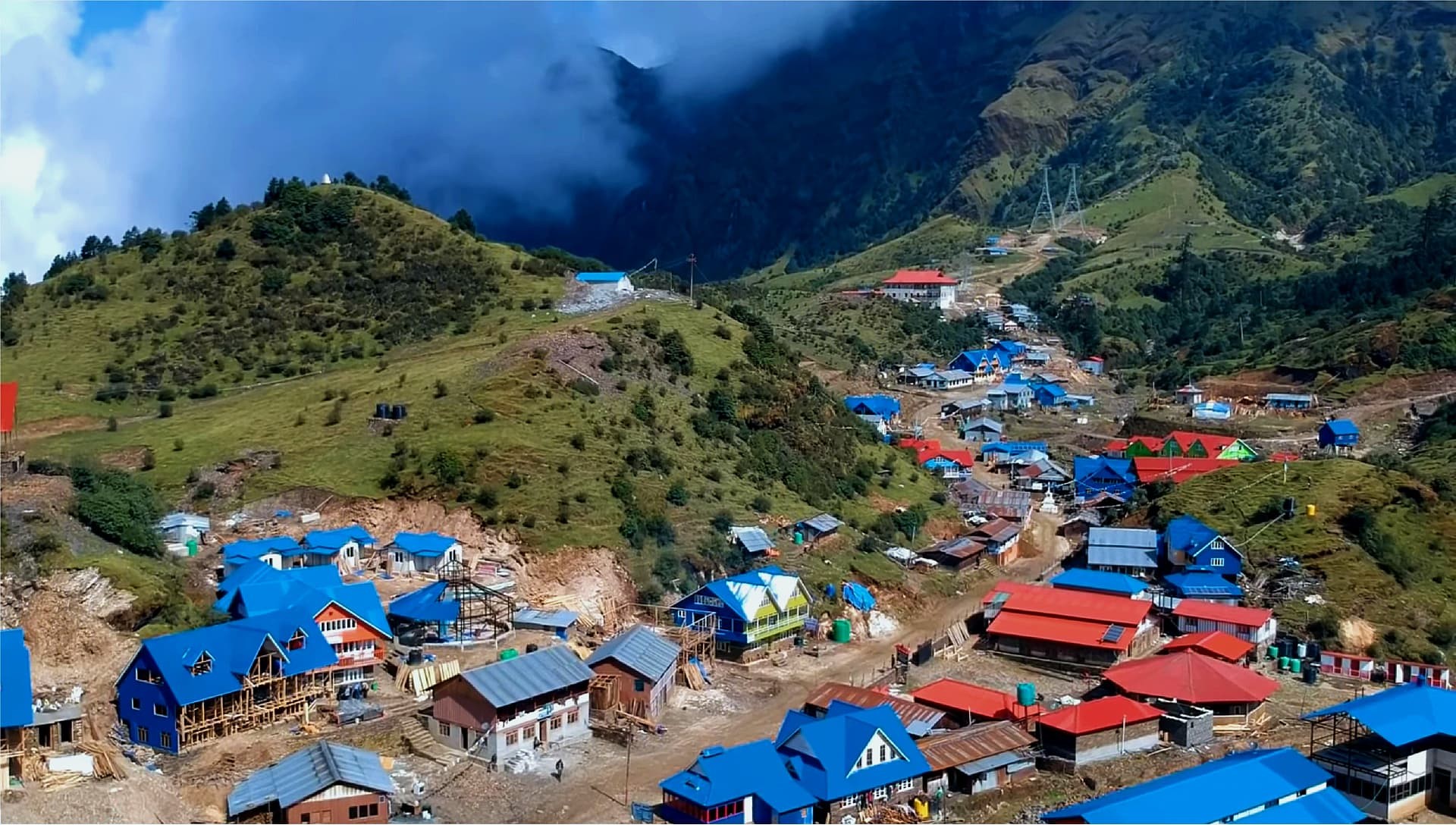
The moment your Nepal Vehicle Hiring Scorpio or Land Cruiser turns off the paved Araniko Highway at Charikot and heads north-east onto the mountain track toward Kuri Village, the character of the journey transforms completely. The road immediately narrows to a single-vehicle width, the surface becomes compacted gravel and exposed rock, and the ascent steepens dramatically. Dense pine and rhododendron forest closes in on both sides of the track, interrupted by occasional valley viewpoints where the full sweep of the surrounding mountain landscape becomes visible — Dolakha’s ridge systems extending in every direction, with the high peaks of the Gaurishankar massif growing progressively closer and more magnificent as altitude is gained.
The Deurali checkpoint — approximately 15 km from Charikot — is the final significant waypoint before Kuri Village, and in winter, the point where snow chains are fitted to the Scorpio’s tires if snow covers the upper section of the track. Beyond Deurali, the track climbs through its final steep, rocky 3 km section to Kuri Village (2,300 m). The arrival at Kuri Village, after 6–7 hours of driving from Kathmandu, is always a moment of genuine relief, excitement, and awe — the village’s cluster of mountain lodges, prayer flags, and the towering snow-covered ridge of Kalinchowk above creating an atmosphere of achieved pilgrimage that begins the moment you step out of the jeep.
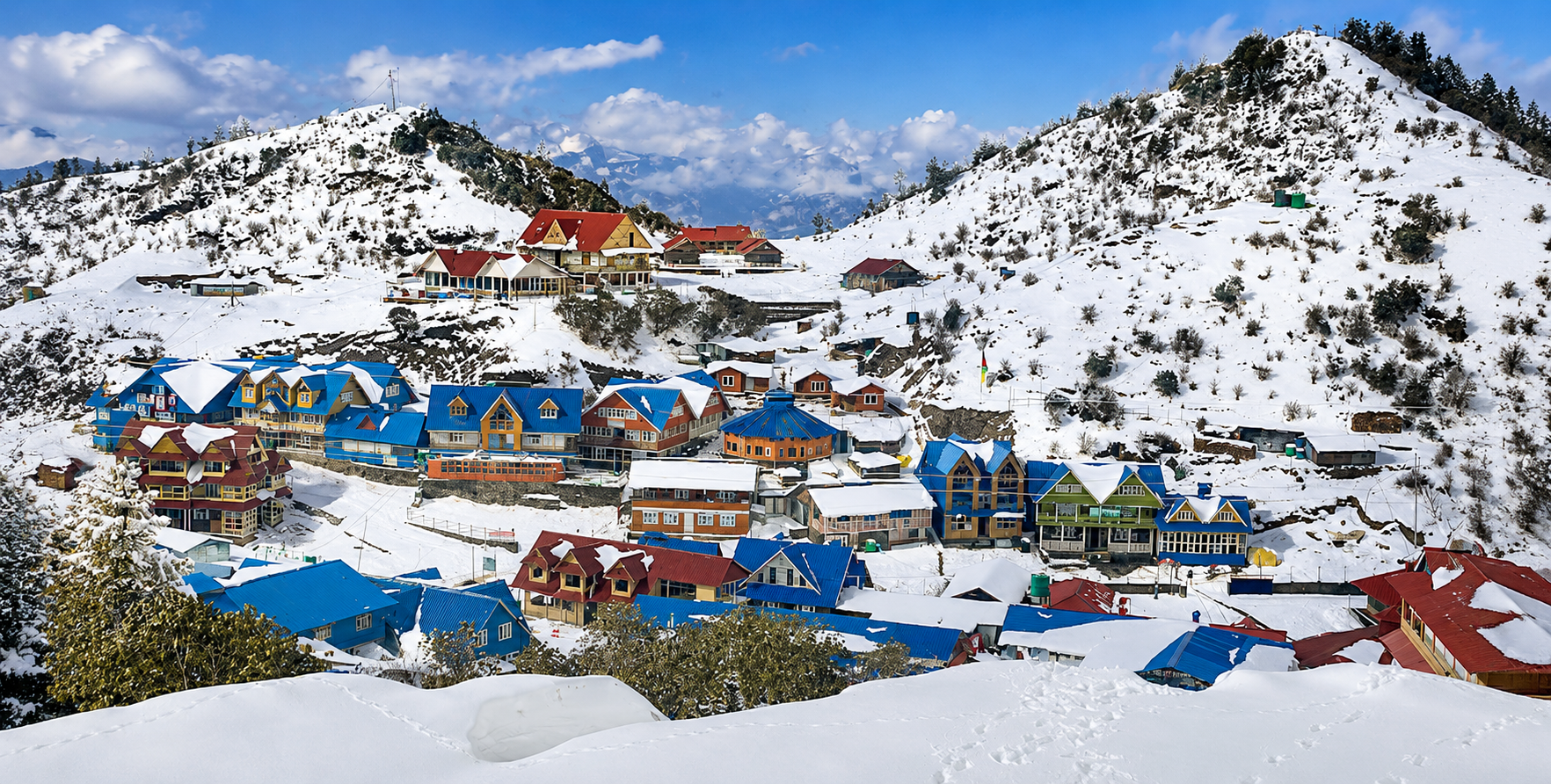
Kuri Village – Your Mountain Base Camp at 2,300 m
Kuri Village is a small but perfectly equipped mountain settlement that has evolved over the past decade into one of Nepal’s most popular weekend escape destinations for Kathmandu residents. There are 15–20 lodges and guesthouses, ranging from simple dormitory teahouses to surprisingly comfortable private-room lodges with attached bathrooms, electric heaters or bukhari (wood-burning stoves), dining halls, and outdoor fire pit/campfire facilities — the essential Kuri Village evening experience.
On winter weekends, the campfire courtyard of every Kuri lodge becomes the social heart of the village — groups singing, roasting corn and sweet potatoes, making snowmen, sledding on improvised slides, and sharing hot raksi (local spirit) and butter tea under a sky of extraordinary star density at this altitude away from light pollution.
In December and January, Kuri Village is frequently under 50–100 cm of snowfall — the entire village is transformed into a white landscape of extraordinary photogenic beauty. Snow-laden rhododendron branches arch over the village paths, the rooftops are buried under heavy snow caps, and the surrounding forest is a silent, crystal wonderland. For the majority of Kathmandu’s residents who have never experienced significant snowfall, Kuri Village in January is Nepal’s closest and most accessible snow experience, requiring no special trekking permits, no altitude sickness risk, and no extended holiday — just a Scorpio and two days.
Kalinchowk Bhagwati Temple – Complete Darshan and Visitor Guide
How to Reach the Temple from Kuri Village
From Kuri Village, the Kalinchowk Bhagwati Temple is accessible by two routes:
- The Hike (2 km | 45–60 minutes): A well-worn stone-stepped and earthen trail climbs steeply from Kuri Village through the upper edge of the rhododendron and juniper forest before emerging onto the open rocky ridge leading to the temple. The hike gains approximately 1,500 m from Kuri to the temple summit. In clear autumn and spring weather, the trail is a magnificent experience in its own right — a gradual unfolding of the Himalayan panorama as altitude is gained, with Gaurishankar appearing first over the ridge and the full panorama expanding as the final approach to the temple opens up. In winter, the hike requires crampons or good-grip boots and is not recommended after heavy recent snowfall unless accompanied by experienced locals.
- The Cable Car (NPR 500 two-way | ~10 minutes): Inaugurated in 2018, the Kalinchowk Cable Car has made the temple genuinely accessible to elderly devotees, families with young children, and pilgrims of all physical abilities. The cable car runs from the Kuri Village base station to a point approximately 10–15 minutes’ walk below the temple. The cable car cabin holds approximately 6 passengers per run and operates from approximately 7:00 AM to 5:00 PM daily (check locally for 2026 operating hours, as winter weather can temporarily suspend service). From the cable car’s upper station, a 10–15 minute walking path leads to the temple forecourt.
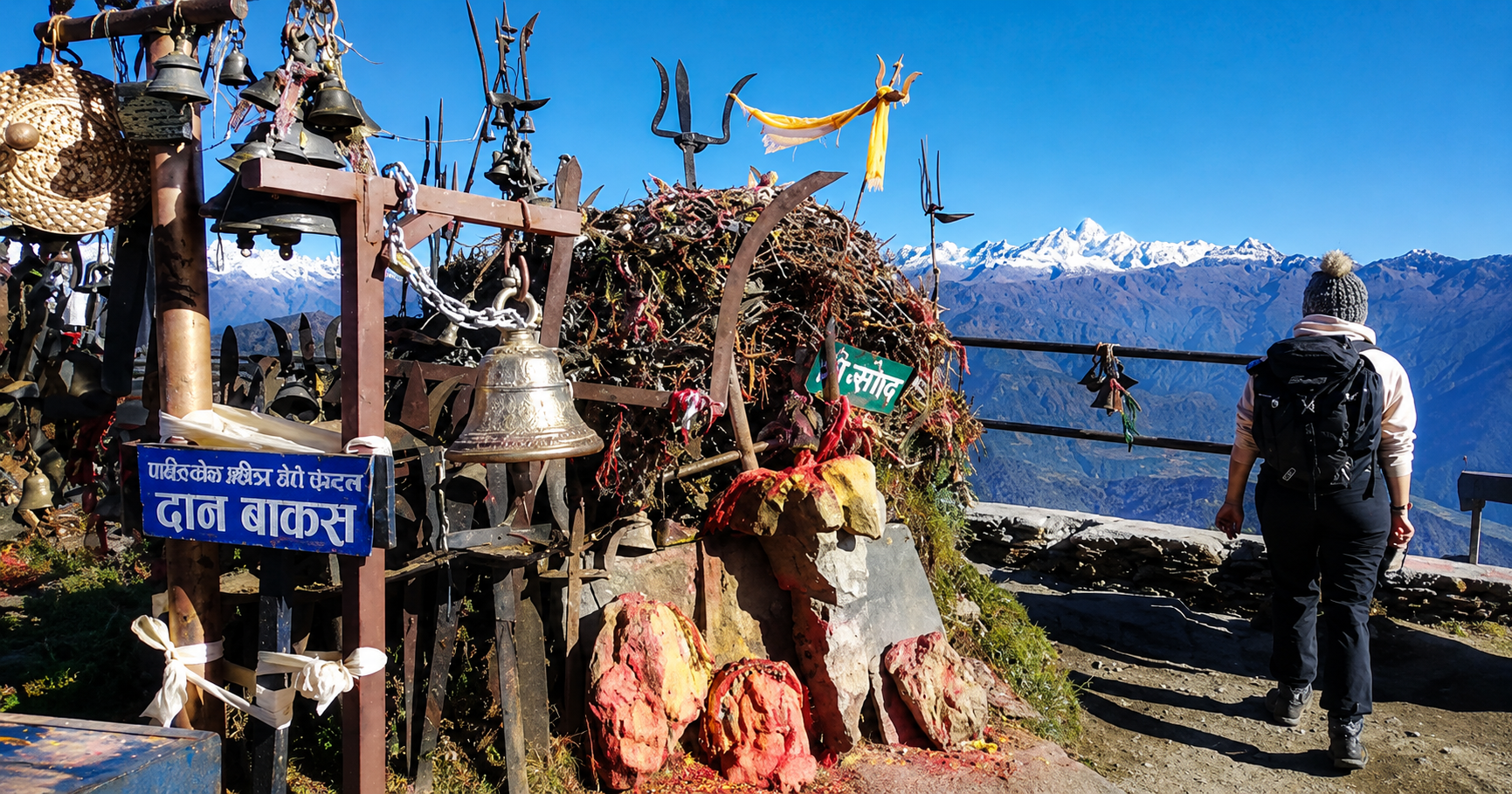
The Sunrise Darshan – The Greatest Kalinchowk Experience
Without question, the pre-dawn sunrise hike or the early cable car to Kalinchowk Temple is the defining experience of any visit to Kalinchowk. Departing Kuri Village at 4:30–5:00 AM (with headlamps), pilgrims and trekkers ascend in the darkness to be at the temple forecourt as dawn approaches. The sunrise spectacle at Kalinchowk is extraordinary — the Himalayan peaks first catching the alpenglow (sunrise reddening) before the valley is lit, the snow surfaces burning gold and crimson. At the same time, the sky transitions from deep blue to lavender to orange. Gaurishankar’s double summit glows like twin torches in the first light, and on clear days, Everest’s distant dark pyramid is visible to the northeast.
After darshan and sunrise, puja (ritual worship) is performed at the temple — devotees offer flowers, incense, oil lamps, and prayers to Goddess Bhagwati and receive prasad (blessed food offerings) distributed by the temple priests. The priests perform morning aarti (lamp ceremony) at dawn, and the sight of the butter lamps flickering in the mountain wind against the backdrop of snow peaks is one of the most moving religious experiences available in the Nepal hills.
Temple Etiquette and Visiting Guidelines
- Remove footwear before entering the main temple sanctum.
- Modest dress is required — shoulders and legs covered for both men and women.
- Photography is generally permitted in the forecourt and approach; ask the priest before photographing inside the sanctum.
- Walk clockwise around the temple and any chorten (Buddhist stupa) structures on the ridge.
- Carry out all waste — the temple conservation area has strict littering prohibitions enforced by local volunteers and NTNC rangers.
- Animal sacrifice is practiced at the temple during major festivals (Dashain, Navaratri) — prepare children and sensitive visitors if visiting then.
Full Guide to Kalinchowk Attractions – Complete Visitor Table
| Attraction / Site | Distance & Highlights |
| Kalinchowk Bhagwati Temple (3,842 m) | Summit | Main pilgrimage shrine; Goddess Bhagwati idol; 360-degree Himalayan panorama incl. Gaurishankar, Everest, Langtang, Jugal, Ganesh Himal |
| Kuri Village (2,300 m) | Base camp | Traditional mountain village; campfire lodges; snowfall Dec–Feb; rhododendron forest; Himalayan ridge views |
| Kalinchowk Cable Car | Kuri base | NPR 500 two-way (2026); 10-minute ride; aerial views of Gaurishankar Conservation Area; walk 10–15 min from cable car top to temple |
| Dolakha Bhimsen Temple | Charikot | One of Nepal’s most sacred Bhimsen shrines; ‘sweating idol’ legend; 15th-century pagoda; annual festival |
| Charikot Bazaar (Bhimeshwar) | 132 km from KTM | Dolakha District HQ; old Newari market town; local restaurants; mid-trip rest stop |
| Sanga Shiva Statue | 25 km from KTM on Araniko Highway | One of the world’s tallest Shiva statues (Kailashnath Mahadev, 43 m); roadside photo stop |
| Sunkoshi River Valley at Dolalghat | 57 km | Scenic confluence of Sunkoshi and Indrawati rivers; picnic spot; rafting; dramatic gorge views |
| Gaurishankar Conservation Area | Surrounding Kuri & Kalinchowk | 2,179 sq. km protected zone; Gaurishankar peak (7,134 m); Sun Koshi & Tama Koshi river origins; rich wildlife |
| Deurali Village | 15 km from Charikot | Last paved road point in winter; snow chain required from here in Dec–Feb; scenic ridgeline views |
Best Time for Kalinchok Scorpio & Jeep Hire – Seasonal Guide 2026
| Season | Months | Kalinchowk Experience | Off-Road Condition | Recommendation |
| Winter | Dec–Feb | Heavy snowfall; Kuri becomes a snow paradise; ski-like activities | Snow chains required; possible Deurali park | MOST POPULAR – Book 1–2 weeks ahead |
| Autumn | Oct–Nov | Crystal Himalayan panorama; ideal temple darshan; cool & clear | Dry & excellent | BEST FOR VIEWS – Highly recommended |
| Spring | Mar–May | Rhododendron bloom; warm days; good mountain clarity | Good – some muddy sections | Excellent for nature & pilgrims |
| Summer | Jun–Sep | Green & lush; cloudy; limited mountain views | Road usable; light landslide risk | Quiet season; manageable |
Winter (December–February) – The Snow Season – Nepal’s Most Popular
The winter months — particularly December and January — are by far the most popular season for the Kalinchowk Scorpio hire from Kathmandu. The reason is simple and irresistible: Kuri Village and the Kalinchowk ridge receive heavy, reliable snowfall during these months, transforming the mountain into what countless visitors describe as “Nepal’s Switzerland” or “our own snow paradise”. For most residents of subtropical Kathmandu — who have never experienced significant snow — a weekend at Kuri Village in January represents a unique, exhilarating, and deeply memorable life experience.
During peak winter weekends (particularly following significant snowfall), demand for Kalinchowk Scorpio hire vastly exceeds supply. Nepal Vehicle Hiring urges all winter visitors to book their Scorpio at least 1–2 weeks in advance — and preferably 2–3 weeks for specific January weekends immediately following snowfall reports. The most experienced and sought-after drivers on this route are booked weeks in advance during the winter peak season.
Autumn (October–November) – Best for Himalayan Views
October and November deliver the clearest and most spectacular Himalayan panoramas from Kalinchowk — the post-monsoon atmosphere is razor-sharp, the peaks free of cloud, and the visibility can extend to Everest, Shishapangma (Tibet), and multiple 7,000+ m peaks. The off-road Charikot–Kuri track is in its best dry-season condition, and the rhododendron forests are displaying their deepest autumn foliage. The Dashain festival season (usually in October) brings the largest annual pilgrimage to the temple — an extraordinary occasion of collective devotion that transforms the atmosphere around Kuri Village and the Kalinchowk summit. Book at least 5–7 days in advance for October during the Dashain and Navaratri periods.
Spring (March–May) – Rhododendrons and Warm Trekking
Spring brings the spectacular rhododendron bloom to the forests between Charikot and Kuri Village — Nepal’s national flower in vivid red, pink, and white, transforming the off-road ascent into a floral tunnel of extraordinary beauty. March and April are warm by day (comfortable for driving and hiking) with good mountain clarity on clear mornings. The spring Chaite Dashain and Navaratri festivals (usually in March–April) bring significant numbers of pilgrims to Kalinchowk. The Kuri–Temple hike is at its most pleasant in April — warm, colorful, and with reliable morning views before afternoon cloud builds.
Summer / Monsoon (June–September) – The Quiet Green Season
Summer is the quietest season at Kalinchowk and the most challenging for the Charikot–Kuri off-road track. Heavy monsoon rainfall creates muddy, slippery conditions on the unpaved Kuri section, and there is a low risk of landslides on steeper sections of the road. Mountain views from the temple are largely obscured by cloud during monsoon months. However, the lush green landscape along the lower Araniko Highway is exceptionally beautiful in the rain, meaning lower accommodation prices and a peaceful Kuri Village atmosphere. Nepal Vehicle Hiring’s drivers assess road conditions carefully before each summer departure and advise clients on safety and suitability.
Recommended Kalinchowk Itineraries – 1 Night 2 Days and 2 Night 3 Days
| Option | Duration | Best For |
| 1 Night 2 Days | Day 1: KTM → Kuri | Day 2: Temple → KTM | Most popular. Temple darshan + sunrise viewpoint + Dolakha Bhimsen Temple on return |
| 2 Night 3 Days | Day 1: KTM → Kuri | Day 2: Temple + Kuri explore | Day 3: Temple → KTM | Best for winter snow experience. Two mornings at Kuri; snow play on Day 2; darshan Day 2 or Day 3 sunrise |
| Day Trip (Summer only) | Depart 4:30–5 AM; return by 10 PM | Only possible May–September. Very long and tiring. Not recommended. 1N2D is far superior. |
1 Night 2 Days – The Classic Kalinchowk Scorpio Itinerary
This is the most popular Kalinchowk itinerary for Kathmandu visitors and the format used by the vast majority of Nepal Vehicle Hiring clients:
- Day 1 – Morning: Depart Kathmandu hotel by 6:30–7:00 AM in the private Scorpio. Drive Araniko Highway: Bhaktapur, Banepa, Sanga Shiva stop (photo), Dolalghat Sunkoshi River viewpoint, Mude rest stop (breakfast or snack).
- Day 1 – Midday: Arrive at Charikot (12:00–1:00 PM) for lunch. Optional visit to Dolakha Bhimsen Temple in Charikot Bazaar (30 min). Continue the off-road Scorpio climb to Kuri Village, arriving by 3:00–4:00 PM. Check into the lodge.
- Day 1 – Afternoon/Evening: Explore Kuri Village and surroundings. Snow play and photography in winter. Sunset views from the village ridge. Campfire dinner at the lodge with hot Thakali/Nepali food.
- Day 2 – Pre-Dawn: Wake at 4:30–5:00 AM. Hike or take the first cable car to Kalinchowk Bhagwati Temple. Watch sunrise over the Himalayas. Perform darshan and puja. Receive prasad from the temple priest.
- Day 2 – Morning: Descend to Kuri Village for breakfast by 9:00–10:00 AM. Check out the lodge. Board Scorpio for return.
- Day 2 – Return: Scorpio descends off-road track to Charikot. Visit Dolakha Bhimsen Temple for darshan (if not done on Day 1). Lunch at Charikot. Drive back along the Araniko Highway to Kathmandu, arriving by 6:00–7:00 PM.
2 Night 3 Days – The Full Winter Snow Experience
For winter visitors who want to maximize the Kuri Village snow experience, night photography, and two separate temple visits, the 2 Night 3 Days itinerary is the ideal choice:
- Day 1: Kathmandu to Kuri Village (same as 1N2D Day 1). Arrive afternoon. Snow activities. Campfire dinner.
- Day 2: Pre-dawn sunrise hike to Kalinchowk Temple (main darshan). Return to Kuri for breakfast. Full day of snow play, photography, forest walks, and exploration around Kuri Village. Second campfire dinner. Night sky photography (Kuri’s 2,300 m altitude gives superb Milky Way visibility on clear nights away from city lights).
- Day 3: Optional second sunrise temple hike OR relaxed morning. After breakfast, depart from Kuri by Scorpio. Charikot: Dolakha Bhimsen Temple darshan. Lunch. Return to Kathmandu by evening.
Complete Packing Guide for Your Kalinchowk Trip
| Category | Essential Items |
| Clothing (Winter) | Heavy down jacket, thermal inner layers (top & bottom), fleece mid-layer, waterproof outer shell, gloves, wool hat/beanie, warm socks (2–3 pairs), waterproof hiking boots |
| Clothing (Spring/Autumn) | Light trekking shirt, fleece jacket, windproof outer layer, light trekking trousers, comfortable hiking shoes, thin gloves, sun hat |
| Footwear | Waterproof ankle-support hiking boots mandatory (not trainers) for Kuri–Temple hike in all seasons. In winter: boots with a good grip for icy/snowy trails |
| Documents & Money | National ID or Passport (for lodge check-in), cash in Nepali rupees (Charikot last ATM), cable car fee (NPR 500), lodge payment (NPR 800–1,500/night) |
| Health & Safety | Personal medications, basic first aid, lip balm & sunscreen (high UV at altitude), altitude sickness tablets if prone, water purification tablets |
| Photography Gear | Camera with fully charged batteries (cold drains batteries fast in winter), extra batteries, lens cloth, wide-angle lens for panorama |
| Miscellaneous | Headlamp with spare batteries (for pre-dawn hike to temple), water bottle (keep close to body in winter to prevent freezing), energy snacks, power bank |

Winter Kalinchowk Special Guide – Snow, Chains, and Cold Weather Tips 2026
Winter (December–February) is Kalinchowk’s peak season for snow lovers, but it requires specific preparation, vehicle equipment, and realistic expectations. Here is a complete winter-specific guide from Nepal Vehicle Hiring:
| Winter Factor | What to Know / What to Do |
| Snow Chains | MANDATORY from December to February. Nepal Vehicle Hiring fits snow chains at Deurali (15 km before Kuri) if snow is present. Included in winter hire rate. |
| Deurali to Kuri (snow) | If heavy snow blocks the final stretch (Deurali to Kuri), the driver parks at Deurali; passengers continue by local shared transport or on foot. The driver and vehicle wait at Deurali. |
| Temperature at Kuri | Night: –10°C to –15°C in Jan–Feb. Pack a heavy down jacket, thermal layers, gloves, a hat, and waterproof boots. No exception. |
| Temperature at Temple | –15°C to –20°C on clear winter mornings at Kalinchowk summit (3,842 m). Sunrise hike requires full cold-weather gear. |
| Road Check Before Booking | Nepal Vehicle Hiring monitors road conditions daily in winter. We advise clients on the current snow depth and whether Kuri Village is drivable or requires Deurali park. |
| Weekend Booking | Winter weekends (Fri–Sun) after snowfall are Nepal’s most popular Kalinchowk dates. Book 1–2 WEEKS in advance. Last-minute winter bookings are almost impossible. |
| Cable Car in Winter | The cable car operates year-round but may suspend service during heavy snowfall or extreme wind. Always have the hike as a backup plan in winter. |
What to Expect at Kuri Village in Peak Winter
When Kuri Village is under significant snowfall — typically 50–100+ cm in January and February after major snowfall events — the experience is genuinely extraordinary. The entire village is blanketed in deep, powdery white, the pine trees bent under snow loads, the surrounding hills an unbroken white canvas with the Gaurishankar massif gleaming above. Activities available in winter Kuri Village include:
- Snow play and snowball fights across the village’s open areas
- Improvised sledding using plastic sheets and laundry tubs (local providers rent equipment)
- Snow trekking and photography along forest trails
- Snowman building and snow sculpture contests
- Night sky photography — extraordinary clarity in winter at altitude
- Campfire evenings with traditional Nepali mountain food, hot butter tea, raksi, and music
- Sunrise at Kalinchowk Temple with snow-covered peaks — the defining Kalinchowk experience
How to Book Your Kalinchok Scorpio or Jeep Hire with Nepal Vehicle Hiring
- Step 1 – Browse Fleet: Visit com/jeep and review our Kalinchowk-ready 4WD fleet.
- Step 2 – Contact Us: Call or WhatsApp +977 9851013196 with: travel date, group size (up to 7 for Scorpio / up to 6 for Land Cruiser), your Kathmandu hotel pick-up address, chosen itinerary (1N2D or 2N3D), and whether you need snow chains (December–February automatically included in winter hire).
- Step 3 – Confirm Kuri Lodge: Nepal Vehicle Hiring can assist with Kuri Village lodge recommendations and bookings. In winter peak season, book your Kuri lodge simultaneously with the Scorpio — lodges fill as fast as jeeps on snowfall weekend dates.
- Step 4 – Receive Confirmation: Your booking confirmation includes the driver’s name, vehicle registration, and pick-up time.
- Step 5 – Day of Travel: Driver arrives at your Kathmandu hotel at the agreed time. Scorpio is fully prepared, inspected, and ready. Snow chains are in the vehicle for the entire winter season. Your Kalinchowk adventure begins.
Related Vehicle Hire Services – Nepal Vehicle Hiring
- Kathmandu to Dolakha Vehicle Rental 2026
- Kathmandu to Dhulikhel Car Hire
- Kathmandu Sightseeing Tour by Jeep
- Bhaktapur Durbar Square Day Tour
- Kathmandu to Nagarkot Vehicle Hire
- Nagarkot Sunrise Tour by Hiace
- Hiace Van Hire Nepal
- Coaster Hire Nepal
- Nepal Trekking Packages
Frequently Asked Questions – Kalinchok Scorpio & Jeep Hire 2026
How far is Kalinchowk from Kathmandu?
The total distance from Kathmandu to Kalinchowk (Kuri Village) is approximately 150 km — 132 km on the paved Araniko Highway to Charikot, plus 15–18 km of off-road mountain track to Kuri Village. The total journey takes 6–8 hours one way, including the off-road section and a mid-trip rest stop.
Is a Scorpio or 4WD jeep truly mandatory for Kalinchowk?
Yes — unconditionally mandatory from Charikot to Kuri Village. The 15–18 km off-road mountain track has steep gradients, rocky surfaces, narrow ledge sections, and in winter heavy snow and ice that make it physically impassable for standard cars, SUVs without 4WD, vans, and microbuses. Only genuine 4WD vehicles with high ground clearance — primarily the Mahindra Scorpio, Bolero, and Toyota Land Cruiser — can navigate this section year-round. Nepal Vehicle Hiring does not offer non-4WD vehicles for the Charikot–Kuri section under any circumstances.
What is the cable car cost at Kalinchowk in 2026?
The Kalinchowk Cable Car costs approximately NPR 500 for a two-way ticket in 2026 (prices may vary slightly—confirm locally on arrival in Kuri Village). The cable car runs from approximately 7:00 AM to 5:00 PM daily, subject to weather and technical operation. In heavy snowfall or high wind, the cable car may temporarily suspend service. Nepal Vehicle Hiring recommends always having the hike as a backup plan, particularly for winter visits.
How cold does it get at Kuri Village and Kalinchowk in winter?
In December and January, temperatures at Kuri Village (2,300 m) can drop to –10°C to –15°C overnight. At the Kalinchowk Temple summit (3,842 m), pre-dawn temperatures during the sunrise hike can drop to –15°C to –20°C on clear nights, with wind chill. Kuri lodges provide blankets and electric heaters or wood-burning stoves, but a heavy down jacket, thermal underlayers, and warm gloves are non-negotiable for winter visitors.
When should I book for the winter snowfall experience?
For the most popular December–January winter-snowfall weekends, Nepal Vehicle Hiring strongly recommends booking at least 1–2 weeks in advance, and 2–3 weeks in advance for specific high-demand dates (particularly immediately after snowfall news spreads on social media). Winter weekends at Kalinchowk are the most in-demand vehicle hire dates in Nepal’s domestic tourism calendar — last-minute bookings on snowfall weekends are rarely available.
Can I do a day trip to Kalinchowk from Kathmandu?
A same-day return is theoretically possible in summer (May–September) with a 4:30–5:00 AM departure from Kathmandu, arriving at Kuri by 11:00 AM and returning to Kathmandu by 10:00 PM. However, this 17–18-hour day is extremely exhausting and leaves minimal time for temple darshan and the Kuri Village experience. Nepal Vehicle Hiring strongly recommends the 1 Night 2 Days itinerary for all seasons — it delivers a vastly superior experience for a very reasonable added cost of one night’s lodge accommodation (NPR 800–1,500).
What is included in Nepal Vehicle Hiring’s Scorpio hire rate?
Our Kalinchowk Scorpio hire rate includes the vehicle, a professional mountain driver, fuel for the full round trip, snow chains (fitted at Deurali in the winter months), and all vehicle running costs. Not included: cable car entry fee (NPR 500), Kuri Village lodge accommodation, meals en route and in Kuri, Dolakha Bhimsen Temple entrance (if applicable), and driver gratuity. A full transparent quote is provided before confirmation.
Can Nepal Vehicle Hiring arrange the Kuri Village lodge along with the Scorpio hire?
Yes — Nepal Vehicle Hiring can recommend and assist in booking Kuri Village lodges simultaneously with your Scorpio hire. In winter peak season, we strongly encourage booking both the vehicle and lodge in the same transaction, as popular Kuri lodges fill as quickly as jeeps on high-demand snowfall weekends. Contact us at +977 9851013196, and our team will coordinate both bookings for you.
How many passengers can fit in a Scorpio for the Kalinchowk trip?
The Mahindra Scorpio officially seats 7 passengers. For a 1-night trip with day bags only, 7 passengers are comfortable. For a 2-night trip with larger overnight luggage, Nepal Vehicle Hiring recommends a maximum of 6 passengers to ensure adequate luggage space and comfortable seating throughout the 6–8-hour journey. For groups of 8 or more, two Scorpios are arranged.
Can I combine a visit to Kalinchowk with a visit to the Dolakha Bhimsen Temple?
Yes — and this is our most recommended itinerary combination. Dolakha Bhimsen Temple is located in Charikot Bazaar — directly on the Kalinchowk route — and adds only 30–45 minutes to the journey. Most groups visit the Bhimsen Temple either on the way to Kuri Village (Day 1) or on the return to Kathmandu (Day 2). The spiritual double — Kalinchowk Bhagwati (mountain summit) and Dolakha Bhimsen (valley shrine) — makes the Kalinchowk Scorpio tour one of the most complete pilgrimage experiences in eastern Nepal.
What is Deurali, and why is it significant in winter?
Deurali is a small settlement approximately 15 km from Charikot on the Kuri Village track — the last point before the road climbs into the heaviest snow zone in winter. It serves as the snow-chain fitting stop for Nepal Vehicle Hiring’s Scorpios — our driver assesses the snow depth and fits chains here if the final 3 require them. In periods of extreme snowfall when the Deurali–Kuri section is completely buried, Deurali becomes the vehicle parking point, and passengers continue to Kuri Village on foot (30–40 minutes through snow), by local snowcat (if available), or by shared local tractor. The Nepal Vehicle Hiring driver remains at Deurali and assists passengers on return.
Book Your Kalinchok Scorpio or Jeep Hire Today – Nepal Vehicle Hiring 2026
Nepal Vehicle Hiring Pvt Ltd is Kathmandu’s most trusted, most experienced, and most professionally equipped Scorpio and jeep hire service for Kalinchowk in 2026. Whether you are a Hindu devotee seeking the blessings of Kalinchowk Bhagwati Mata, a Kathmandu family wanting your children’s first snowfall experience at Kuri Village, a photographer chasing the golden Gaurishankar sunrise, a group of friends escaping the city for a campfire mountain weekend, or a nature lover seeking the rhododendron-covered trails of the Gaurishankar Conservation Area — Nepal Vehicle Hiring’s Scorpios, Land Cruisers, and expert mountain drivers are ready to take you there.
With 24/7 booking availability, hotel pick-up from anywhere in Kathmandu, snow chains for winter travel, the best-maintained 4WD fleet on the Kalinchowk route, experienced and professional mountain drivers, and transparent competitive pricing, Nepal Vehicle Hiring is the first choice of thousands of Kalinchowk visitors every year. Book early — especially for winter weekends. Availability is strictly limited during the peak snowfall season.
Call / WhatsApp: +977 9851013196 | Website: vehiclehiringnepal.com | E-mail: [email protected]
Book Scorpio or Land Cruiser | Book Hiace or Coaster
- Nepal's Most Beloved Weekend Pilgrimage Destination
- Kalinchok Scorpio & Jeep Hire – Complete Route Overview 2026
- About Kalinchowk Bhagwati Temple – History, Significance & Spiritual Importance
- Why Is the Mahindra Scorpio the Most Popular Vehicle for Kalinchowk?
- Complete Vehicle Guide – Kalinchok Scorpio and Jeep Hire 2026
- Kathmandu to Kalinchowk – Detailed Route & Segment Guide
- Kalinchowk Bhagwati Temple – Complete Darshan and Visitor Guide
- Full Guide to Kalinchowk Attractions – Complete Visitor Table
- Best Time for Kalinchok Scorpio & Jeep Hire – Seasonal Guide 2026
- Recommended Kalinchowk Itineraries – 1 Night 2 Days and 2 Night 3 Days
- Complete Packing Guide for Your Kalinchowk Trip
- Winter Kalinchowk Special Guide – Snow, Chains, and Cold Weather Tips 2026
- How to Book Your Kalinchok Scorpio or Jeep Hire with Nepal Vehicle Hiring
- Related Vehicle Hire Services – Nepal Vehicle Hiring
- Frequently Asked Questions – Kalinchok Scorpio & Jeep Hire 2026
- Book Your Kalinchok Scorpio or Jeep Hire Today – Nepal Vehicle Hiring 2026

Related Blog & Articles
Kathmandu to Dolakha Vehicle Rental 2026 – Car, Jeep, Van, Hiace & Bus Hire
Kathmandu to Dhulikhel Car Hire – Private Car Rental for a Perfect Day Trip
Kathmandu to Halesi Mahadev Transport
Jeep Hire in Nepal – Best Vehicle for Mountain Roads