Plan a Trip


Pokhara to Ghasa Jeep Service – Complete Transport Guide
Pokhara to Ghasa Jeep Service – Complete Transport Guide
Ghasa is a beautiful, forested village in the heart of the Kali Gandaki River valley – one of the deepest gorges on earth and the main corridor leading from the Annapurna foothills to the high-altitude desert of Mustang. Located at 2,010 m on the Annapurna Circuit route, Ghasa sits where the lush subtropical forest gives way to the stark, arid Tibetan-influenced landscape of Upper Mustang. It is a key overnight stop for Annapurna Circuit trekkers and a gateway village for travellers heading further north to Tatopani, Marpha, Jomsom, Muktinath, and beyond.
This complete 2026 guide covers everything you need to know about the jeep service from Pokhara to Ghasa – route details, road conditions, prices, what to see along the way, trekking information, and how to book your private jeep with Vehicle Hiring Nepal.
Where is Ghasa, and Why Go There?
Location: Ghasa, Mustang District, Gandaki Province, Nepal
Altitude: 2,010 m above sea level
Distance from Pokhara: Approximately 110–120 km by road via Beni
Travel Time from Pokhara: 3.5 to 5 hours by 4WD jeep
Road Type: Paved road, Pokhara to Beni + rough Kali Gandaki gorge track from Beni onwards
Vehicle Required: 4WD Jeep mandatory from Beni – sedans cannot reach Ghasa
Trek Connection: Ghasa is on the Annapurna Circuit and a trail stop on the Annapurna Conservation Area route
Famous For: Dense forest, waterfalls, dramatic gorge scenery, gateway to Mustang
Ghasa marks the transition point in the Kali Gandaki valley, where the landscape shifts from the lush subtropical forests of the lower gorge to the increasingly arid, wind-sculpted terrain of the upper valley. The village is a significant rest stop on the Annapurna Circuit and one of the last places with dense forest before the treeless Mustang plateau begins. The area around Ghasa is also known for its dramatic waterfalls and the chance to see and hear snow leopards in winter.
Why Book a Private Jeep from Pokhara to Ghasa?
Whether you are a trekker skipping the lower section of the Annapurna Circuit, a pilgrim on the way to Muktinath making an overnight stop, or a traveller exploring the Kali Gandaki Valley, a private jeep from Pokhara to Ghasa is the most comfortable and reliable option. Here is why:
- Direct hotel pickup from your Pokhara Lakeside hotel – no need to navigate to the local bus park with a heavy trekking pack
- Depart at your preferred time – early morning departures recommended to arrive in Ghasa before the famous Kali Gandaki afternoon wind begins
- Full luggage space for trekking backpacks, sleeping bags, and gear – far more comfortable than local shared transport
- Faster journey than local buses – private jeep takes 3.5 to 5 hours vs 5 to 7 hours by local shared vehicle
- Skip the lower Annapurna Circuit section from Nayapul to Tatopani and begin trekking from Ghasa or above
- Stop for photos, rest, and refreshments at your own pace along the stunning Kali Gandaki gorge
- The driver can be pre-arranged to return you from Ghasa, Tatopani, or Jomsom at the end of your trek
- 4WD capability essential from Beni onwards – private jeep hire guarantees the right vehicle for the road
Jeep Service Prices: Pokhara to Ghasa
Vehicle Hiring Nepal offers competitive 2026 pricing for private jeep service from Pokhara to Ghasa:
| Vehicle Type | Capacity | One-Way Price (USD) | Round Trip (USD) | Notes |
| Toyota Land Cruiser | 4–6 pax | $300 – $400 | $500 – $800 | Most recommended for the Kali Gandaki road |
| Toyota Land Cruiser Prado | 4–5 pax | $300 – $600 | $600 – $1000 | Premium comfort on rough terrain |
| Mahindra Bolero / Scorpio | 4–6 pax | $150 – $250 | $400– $600 | Budget 4WD option, capable |
| Toyota Hiace Van | 7–14 pax | To Beni only – USD 200–300 | Not suitable beyond Beni | Cannot proceed on the Gorge Road to Ghasa |
All prices include the driver, full fuel for the journey, and vehicle insurance. Round-trip pricing includes the driver staying in Ghasa or nearby Tatopani during your trek and returning you to Pokhara at the end. Contact us for exact 2026 pricing based on your travel date and specific requirements.
Route Guide: Pokhara to Ghasa
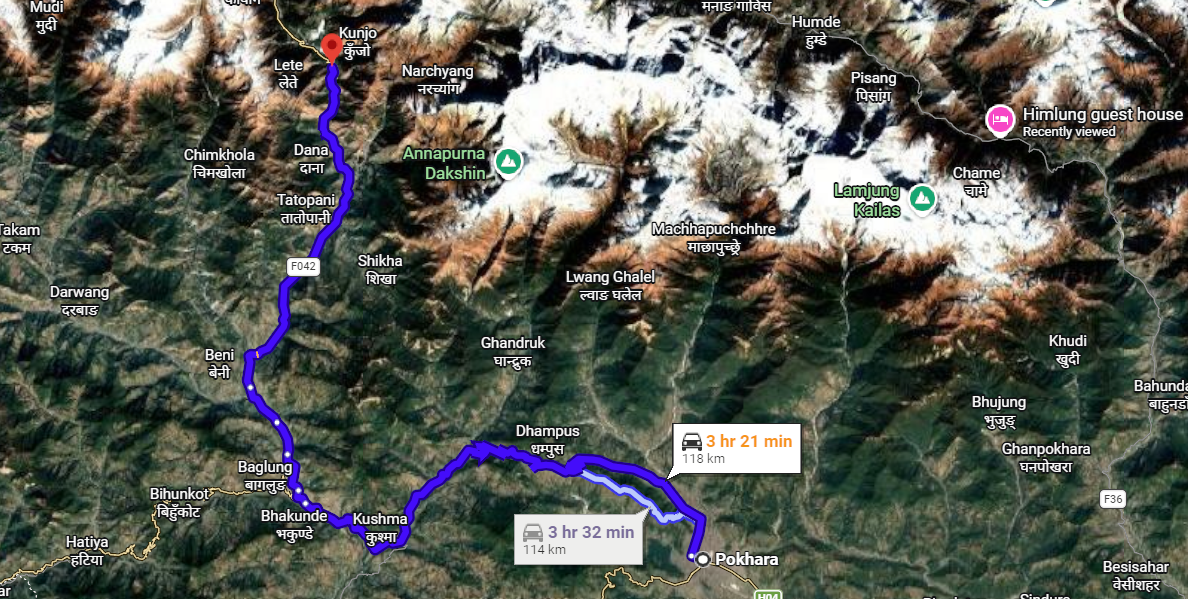
The journey from Pokhara to Ghasa follows the Kali Gandaki Highway through the Annapurna foothills and into the world’s deepest river gorge. The route has two distinct sections: the comfortable paved road to Beni and the dramatic mountain track into the gorge beyond.
| Stage | Distance | Road Type | Travel Time | Key Landmark |
| Pokhara to Naya Pul junction | 18 km | Paved – city & foothills road | 30 min | Annapurna range views begin |
| Naya Pul to Baglung | 25 km | Paved – Baglung Highway | 40 min | Modi Khola valley, terraced hills |
| Baglung to Beni | 19 km | Paved – good condition | 30 min | Myagdi River confluence, last ATM |
| Beni to Tatopani | 45 km | Rough gravel – Kali Gandaki gorge | 1.5 hrs | Hot springs, waterfall views |
| Tatopani to Ghasa | 25 km | Very rough – narrow gorge track | 1–1.5 hrs | Dense forest, cascading streams |
Detailed Road Guide: Pokhara to Ghasa Stage by Stage
Pokhara Lakeside to Baglung Chowk Junction (18 km | ~30 min)
Depart from your Pokhara Lakeside hotel early—ideally between 6:00 and 6:30 AM—to maximise your driving time before the afternoon Kali Gandaki wind arrives. Head south through Pokhara city toward Baglung Chowk, Pokhara’s main southwest junction. The road passes through busy urban Pokhara traffic before clearing into the cleaner foothills road. On clear mornings, the Annapurna range is brilliantly visible to the north.
Baglung Chowk to Baglung Town (25 km | ~40 min)
From Baglung Chowk, the road heads west through lush rice paddies and terraced hillsides, crosses the Modi Khola River, and climbs into the Baglung district. Baglung is a pleasant mid-sized town known as the ‘city of suspension bridges’ – the area has more suspension bridges than anywhere else in Nepal. The road is paved and in generally good condition through this section.
Baglung to Beni (19 km | ~30 min)
From Baglung, the road descends to Beni, the district headquarters of Myagdi District and the last major town before the Kali Gandaki gorge road begins. Beni sits at the confluence of the Kali Gandaki and Myagdi rivers at 830 m. This is a crucial stop – the last ATM, the last reliable fuel station, and the last large market before Jomsom, far to the north. Stop in Beni for fuel, cash withdrawal, final supplies, and a tea break before the mountain road begins.
Beni to Tatopani (45 km | ~1.5 hrs by jeep)
Beyond Beni, the paved road ends, and the Kali Gandaki gorge track begins. The character of the journey changes completely – the road narrows, the river gorge deepens, and the landscape becomes more dramatic with every kilometre. The track follows the east bank of the Kali Gandaki River through a succession of small villages, including Shahasradhara, Titi, and Maldhunga.
The Kali Gandaki gorge is one of the world’s geological wonders. Flanked by Dhaulagiri (8,167 m) to the west and Annapurna I (8,091 m) to the east, it is statistically the world’s deepest gorge measured from peak to river level. The vertical scale of the landscape is almost incomprehensible – giant cliff walls, hanging waterfalls, and the fast-flowing green river below create an extraordinary natural drama.
Tatopani, at 1,190 m, is the most popular rest and overnight stop on the Pokhara-to-Jomsom route. The village is famous for its natural hot springs on the riverbank – a blessed relief for tired muscles after the rough road. Tatopani has numerous teahouses, restaurants, and lodges.
Tatopani to Ghasa (25 km | ~1 to 1.5 hrs)
The road from Tatopani to Ghasa climbs steadily through increasingly dramatic scenery. The Kali Gandaki gorge narrows further, and the river becomes louder and faster. Large waterfalls cascade down the cliff faces on both sides of the valley. The road winds through Dana (1,400 m), Rupse Chhahara waterfall viewpoint, and Kokhethanti before reaching Ghasa at 2,010 m.
The Rupse Chhahara waterfall – visible from the road between Dana and Ghasa – is one of the most spectacular waterfalls in the Annapurna region, plunging dramatically into the gorge. Ask your driver to stop here for a few minutes.
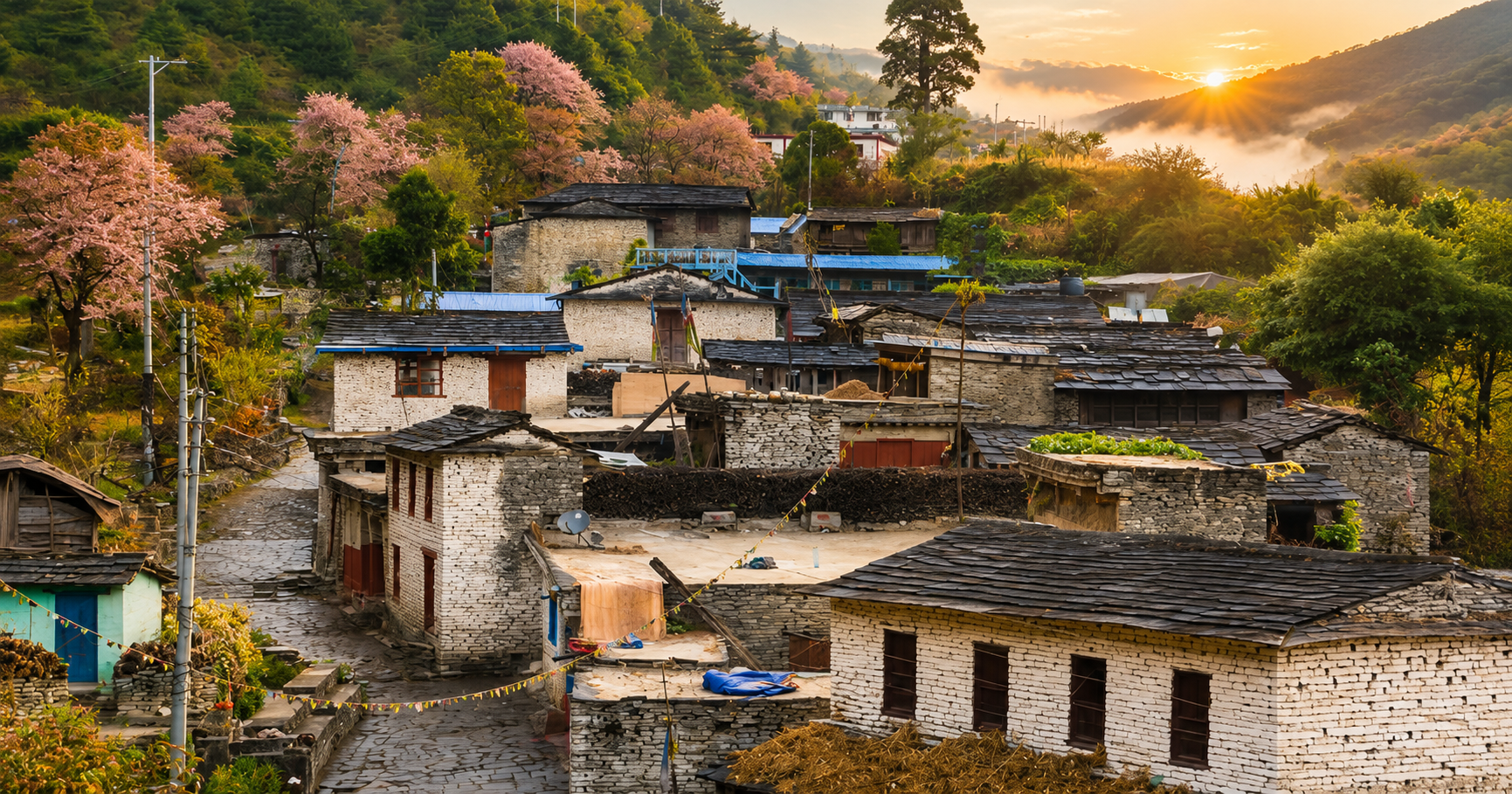
Arrival at Ghasa. The village sits in a beautiful mixed forest of oak, rhododendron, and pine at the transition zone where the subtropical lower gorge meets the cooler, drier upper valley. The air is cooler and crisper than Tatopani below, and the scenery is markedly more alpine. Several teahouses and lodges serve trekkers and travellers.
Road Conditions: Pokhara to Ghasa
Understanding road conditions on the Kali Gandaki route is essential for planning your jeep service from Pokhara to Ghasa:
| Section | Surface | Difficulty | Season Notes |
| Pokhara to Beni | Paved highway | Easy | Good year-round – no 4WD needed |
| Beni to Tatopani | Rough gravel track | Moderate–Hard | 4WD required – rocky, narrow gorge road |
| Tatopani to Dana | Very rough track | Hard | Narrow with river-edge drops, rockfall risk |
| Dana to Ghasa | Rocky Mountain track | Hard | Steep climbs, exposed sections above the gorge |
The road from Beni to Ghasa is categorised as rough mountain terrain and is only suitable for well-maintained 4WD vehicles with high ground clearance. Do not attempt this section in a standard sedan or minivan. Vehicle Hiring Nepal only dispatches capable 4WD jeeps on this route.
The Kali Gandaki Afternoon Wind – Critical Travel Warning
The Kali Gandaki valley is famous – and notorious – for one of the world’s most powerful thermal wind systems. Every afternoon from about 12:00 to 1:00 PM, a fierce wind begins sweeping up the valley from south to north at 60 to 100 km/h or more. This wind:
- Makes driving very difficult and dangerous on the exposed sections of the gorge road
- Covers everything in thick dust and grit – vehicles, clothing, and eyes
- It is bitterly cold even in the summer months at Ghasa altitude and above
- Can reduce road visibility significantly on dusty, dry-season days
- Forces the closure of Jomsom Airport every afternoon as aircraft cannot land safely
The golden rule for the Pokhara-Ghasa jeep service: depart Pokhara no later than 6:30 AM and aim to reach Ghasa by 11:00–11:30 AM at the latest. Arriving in Ghasa before noon means you have safely completed the exposed gorge section before the worst of the wind arrives. Attempting the Tatopani-Ghasa section after midday is strongly discouraged.
Best Time for Pokhara to Ghasa Jeep Service
October to November (Best Season)
The post-monsoon is the finest time for the Pokhara-to-Ghasa jeep journey. The gorge road has dried after the monsoon, skies are brilliantly clear, and the Dhaulagiri and Annapurna peaks appear impossibly close and sharp above the gorge walls. The Kali Gandaki forest around Ghasa is lush and green. This is peak Annapurna Circuit season – book your jeep 2 to 4 weeks in advance. The morning drive through the gorge in October and November light is one of Nepal’s great travel experiences.
March to May (Excellent)
Spring is the second-best season for this route. Rhododendron forests on the lower gorge slopes (between Tatopani and Ghasa) bloom spectacularly in March and April – red, pink, and white against the grey gorge walls and blue sky. Morning mountain views are excellent. The road is in good condition. Temperatures are warm and pleasant at Tatopani and comfortable at Ghasa.
December to February (Cold but Beautiful)
Winter travel to Ghasa is possible, and the gorge is dramatically beautiful in the cold, clear winter air. Temperatures in Ghasa drop to -5 to -10°C at night, and the upper gorge walls may carry snow. The road from Beni to Ghasa is passable in dry winter conditions, but early-morning ice on rocky sections requires careful driving. The gorge is very quiet in winter, with far fewer trekkers and a more intimate experience of the landscape.
June to September (Monsoon – High Risk)
The monsoon season brings the highest risk to the Beni-Ghasa road. Heavy rainfall causes frequent landslides, particularly on the steep gorge walls between Tatopani and Ghasa. Road closures of several days are common after heavy rain. Rivers flood and can cut the road at lower crossing points. We advise against attempting the Pokhara-Ghasa road during the active monsoon unless local road conditions have been confirmed on the day of travel. If monsoon travel is necessary, the Beni to Tatopani section is generally more reliable than the Tatopani to Ghasa upper gorge section.
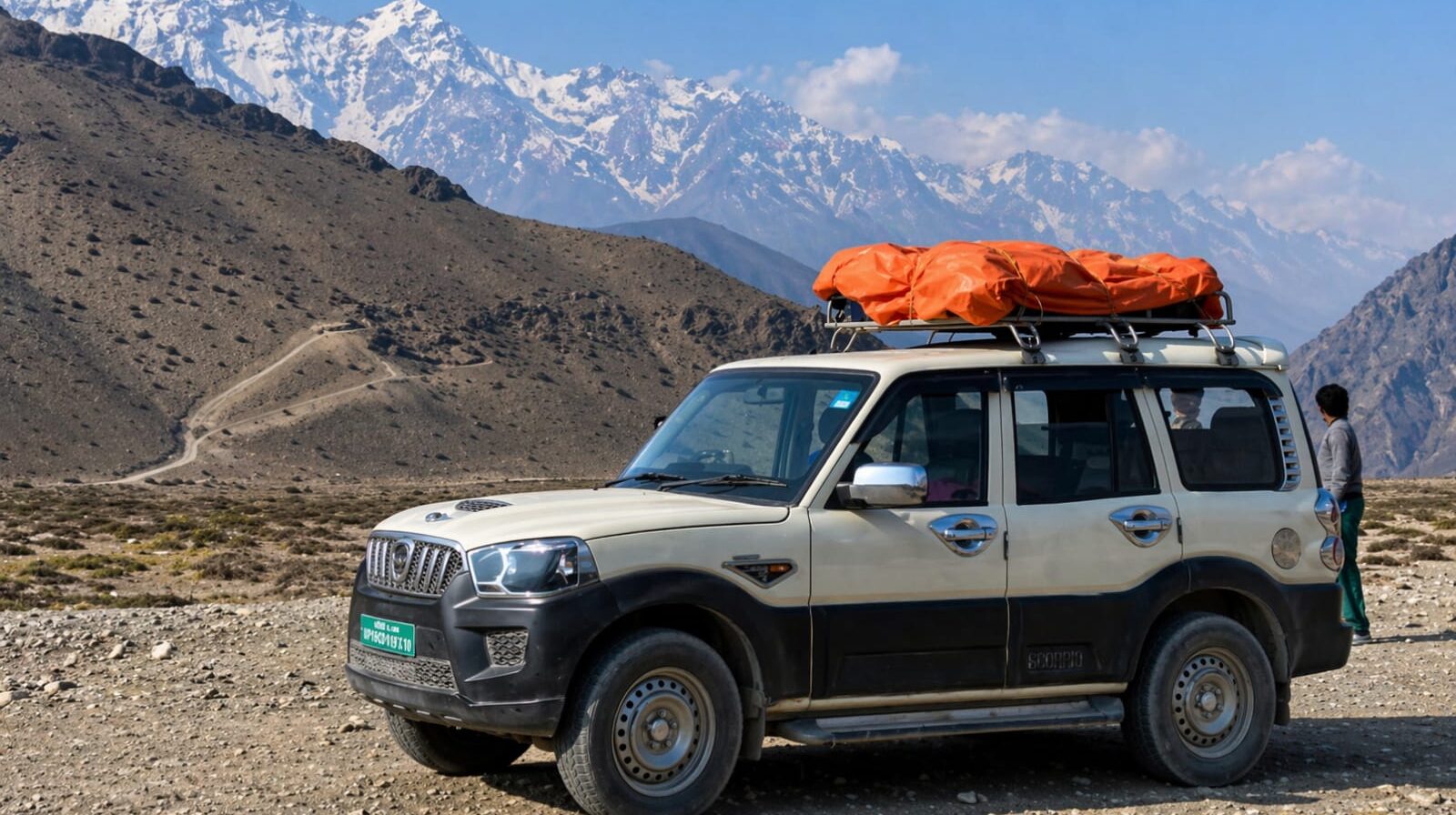
What to See Along the Pokhara to Ghasa Route
Annapurna South and Machhapuchhre Views – Pokhara to Nayapul
On clear mornings, the first section of the drive from Pokhara offers spectacular views north of the Annapurna range and the iconic Machhapuchhre (Fishtail) peak at 6,993 m. The best views come as the road passes through the foothills west of Pokhara, then descends into the Modi Khola valley.
Baglung District – Suspension Bridge Country
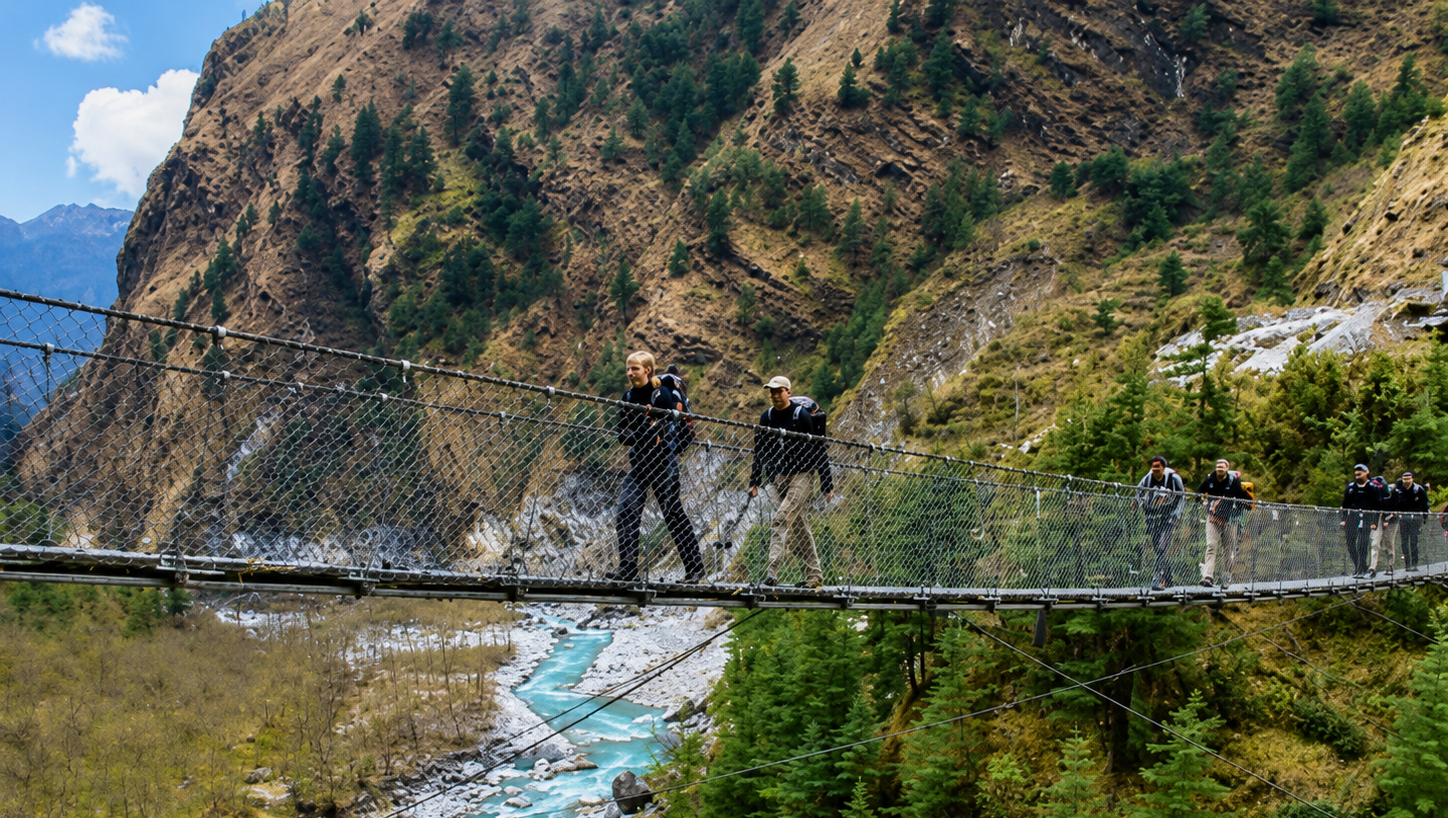
The Baglung area contains more suspension bridges than any district in Nepal. As you drive through the Modi Khola valley and approach Beni, you will cross several of these bridges and see others spanning tributary gorges. The engineering of these bridges – many built with community labour – is remarkable.
Beni – River Confluence Town
Beni sits at the dramatic confluence of the Kali Gandaki and Myagdi rivers. From the bridgeide, you can look south down the Myagdi Valley and north up the narrowing Kali Gandaki Gorge. The busy market town is worth a brief walk through – local life here is a world away from Pokhara Lakeside tourism.
Tatopani Hot Springs
Tatopani’s natural hot springs are among the most welcome stops along the Kali Gandaki route. The springs emerge from the riverbank at a comfortable bathing temperature and have been developed into public bathing pools with facilities. A soak at Tatopani after the rough road from Beni is deeply restorative. A small entry fee applies. Several excellent restaurants near the springs serve fresh meals.
Rupse Chhahara Waterfall
Between Dana and Ghasa, the Rupse Chhahara waterfall plunges in multiple cascades down the gorge wall directly beside the road. This is one of the most dramatic waterfalls visible from a vehicle in all of Nepal. Ask your driver to stop here – the waterfall is powerful and thunderous in the wet season and still impressive in dry months. The spray reaches the road, creating a cool, refreshing mist on hot days.
Ghasa Village and Forest
Ghasa itself is a beautiful Thakali and Magar village surrounded by mixed oak, rhododendron, and pine forest – the densest and most lush forest on the entire Annapurna Circuit. The village features traditional Thakali architecture: flat-roofed stone houses, prayer flags, and carved wooden windows. The forest above Ghasa is one of the best areas in Nepal for sighting langur monkeys, Himalayan thar, and – in winter – snow leopards.
Ghasa as a Trekking Base – Annapurna Circuit
Many trekkers begin their Annapurna Circuit from Ghasa rather than Besisahar or Nayapul, arriving by jeep from Pokhara to skip the lower sections and start trekking in the more dramatic upper gorge. Here is what lies ahead from Ghasa on the Annapurna Circuit:
| Stage from Ghasa | To | Distance | Altitude Gain | Highlights |
| Day 1 from Ghasa | Kalopani | 10 km | 2,010m → 2,530m | Dhaulagiri full view, Nilgiri North |
| Day 2 | Marpha | 20 km | 2,530m → 2,670m | Apple orchards, Tibetan monastery, brandy |
| Day 3 | Jomsom | 8 km | 2,670m → 2,720m | Jomsom town, airport, Kali Gandaki beach |
| Day 4 | Muktinath | 22 km | 2,720m → 3,710m | Sacred temple, 108 spouts, Kagbeni |
| Day 5 | Muktinath (rest/pilgrimage) | – | 3,710m | Full pilgrimage day at Muktinath |
| Day 6+ | Thorong La / Lo Manthang | – | 5,416m | Annapurna Circuit high pass or Upper Mustang |
Starting the Annapurna Circuit from Ghasa immediately puts you into the dramatic high-Himalayan landscape of the upper Kali Gandaki valley, with Dhaulagiri towering above Kalopani on your very first day of trekking. The lower gorge section from Tatopani to Ghasa, which many trekkers now skip by jeep, is the least scenic portion of the circuit – starting from Ghasa means you begin trekking in the finest scenery from Day 1.
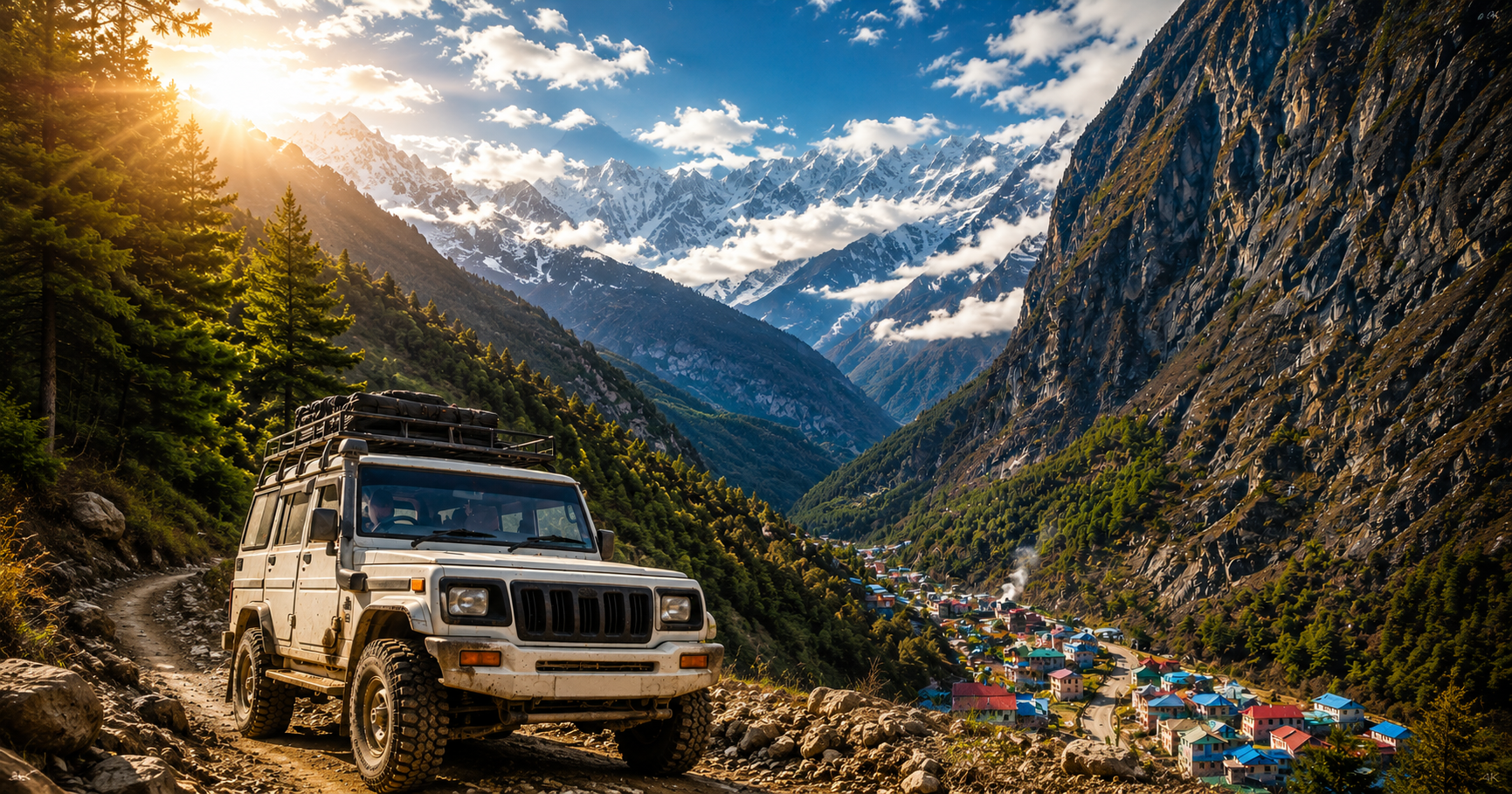
Beyond Ghasa – Continuing by Jeep to Mustang
Vehicle Hiring Nepal provides jeep service beyond Ghasa for travellers continuing to Tatopani, Marpha, Jomsom, Kagbeni, Muktinath, and Upper Mustang. Here are the continuation options from Ghasa:
| Destination | Distance from Ghasa | Additional Time | Additional Price (USD) | Notes |
| Tatopani | 25 km south | 1 hr (return) | Included in Pokhara–Ghasa price | Hot springs – a popular rest point |
| Kalopani | 10 km north | 30 min | $30–40 extra | Dhaulagiri views |
| Marpha | 30 km north | 1–1.5 hrs | $40–50 extra | Apple orchards, monastery |
| Jomsom | 38 km north | 1.5–2 hrs | $45–60 extra | Airport, district HQ |
| Muktinath | 60 km north | 3–3.5 hrs | $70–90 extra | Sacred pilgrimage site, 3,710 m |
| Lo Manthang | 140 km north | 6–7 hrs | $150–200 extra | Upper Mustang permit required |
If you are planning to continue beyond Ghasa to Jomsom or Muktinath, it is more cost-effective to book a single Pokhara-to-Jomsom or Pokhara-to-Muktinath jeep hire rather than two separate bookings. Contact Vehicle Hiring Nepal to discuss the most economical option for your full itinerary.
Trekking Permits for the Ghasa Area
All travellers entering the Ghasa area via the Kali Gandaki corridor must carry valid trekking permits. These are checked at the Beni checkpoint and again at Ghasa:
| Permit | Cost 2026 | Where to Obtain | Required For |
| ACAP – Annapurna Conservation Area Permit | NPR 3,000 (~USD 22) | Nepal Tourism Board – Kathmandu or Pokhara (Damside office) | All visitors to Ghasa and the Kali Gandaki valley within ACAP |
| TIMS Card – Trekkers Information Management System | USD 10 | Nepal Tourism Board / TAAN office | Required for trekkers – confirm if required for vehicle-only pilgrims |
Obtain all permits in Pokhara at the Nepal Tourism Board office in Damside (near the Phewa Lake dam) the day before your departure. The permit office opens at 9:00 AM. Allow 30 to 60 minutes for processing. Permits are checked at the Beni entry checkpoint and again at various points along the Kali Gandaki. Carry all permits and present them at each checkpoint.
Accommodation at Ghasa
Ghasa has a small but functional selection of teahouse lodges for Annapurna Circuit trekkers and travellers. Here is what to expect:
- Simple twin or dormitory rooms with basic foam mattresses and blankets – bring a sleeping bag liner for extra warmth
- Shared bathrooms with cold water – hot showers available at most lodges at an extra charge (NPR 200–400)
- Electricity from solar panels – charge devices in the morning before the afternoon wind arrives
- Teahouse menus include dal bhat, noodle soup, fried rice, pasta, egg dishes, Tibetan bread, and hot drinks
- Apple products begin appearing at Ghasa – apple juice, apple pie, and apple cider become staples from here northward
- Mobile signal available in Ghasa – NTC is more reliable than Ncell in the upper gorge
- No ATM in Ghasa – withdraw cash in Pokhara or Beni before arriving
- Approximate cost per night: NPR 400–800 per person, including basic meals
Pokhara to Ghasa vs Pokhara to Tatopani – Which Stop is Right for You?
Many travellers debate whether to stop for the night at Tatopani (1,190 m) or continue to Ghasa (2,010 m). Here is how to decide:
| Factor | Tatopani (1,190 m) | Ghasa (2,010 m) |
| Drive time from Pokhara | 2.5–3.5 hrs | 3.5–5 hrs |
| Famous for | Natural hot springs | Dense forest, dramatic gorge |
| Accommodation quality | Better – more options | Basic – fewer teahouses |
| Temperature | Warm and pleasant | Cool to cold at night |
| Altitude acclimatization | Low (1,190m) – gentle | Better (2,010m) – gradual |
| Trek Day 1 from here | Longer climb to Ghasa | Shorter reach to Kalopani |
| Afternoon wind impact | Strong from 1:00 PM | Strong from 12:30 PM – arrive early |
| Best for | Relaxation, pilgrims, hot soak | Trekkers, Mustang-bound travellers |
Our recommendation: If you depart Pokhara by 6:00 AM, you can reach Tatopani by 9:00–10:00 AM, enjoy the hot springs, have lunch, and continue to Ghasa, arriving by 12:00–1:00 PM before the afternoon wind picks up. This is the ideal one-day schedule for the Pokhara-to-Ghasa journey.
What to Bring for the Pokhara to Ghasa Jeep Journey
- Trekking permits – ACAP and TIMS card – must be obtained in Pokhara before departure
- Sufficient Nepali Rupees cash – withdraw in Pokhara or Beni, as no ATM at Ghasa
- Water – 2 litres per person, minimum, for the journey. Ghasa teahouses provide drinking water.
- Snacks for the road – the only proper meal stop is at Tatopani (halfway) or Beni
- Windproof and warm jacket – Ghasa at 2,010 m is significantly cooler than Pokhara
- Sunglasses and scarf/buff – dust from the dry gorge track can be intense on windy days
- Motion sickness medication, if needed – the road from Beni onwards has many sharp bends
- Camera with a charged battery – Rupse waterfall and gorge scenery deserve documentation.n
- Offline maps downloaded (Maps.me or Gaia GPS) – mobile signal can be patchy in the gorge.
- Headlamp in case of unexpected delay and late arrival at Ghasa
What is Included in Your Jeep Service with Vehicle Hiring Nepal?
- Private 4WD jeep (Toyota Land Cruiser or equivalent) with experienced Kali Gandaki route driver
- Full fuel cost for the complete Pokhara to Ghasa journey
- Vehicle insurance for the full journey duration
- Hotel pickup from your Pokhara Lakeside hotel or guesthouse
- Drop-off directly at your teahouse or lodge in Ghasa village
- Rest stops at Beni for fuel and supplies, and Tatopani for hot springs and lunch
- Pre-arranged return pickup from Ghasa, Tatopani, or onward Mustang destinations
- 24/7 WhatsApp support during the journey and throughout your stay in the Kali Gandaki valley
Not included: Trekking permits (ACAP and TIMS), personal meals at stops, teahouse accommodation costs, hot spring entry fees at Tatopani, and any additional detour stops beyond the agreed route.
How to Book Your Pokhara to Ghasa Jeep Service
- Contact Vehicle Hiring Nepal via WhatsApp at 977- 9814227196 or visit vehiclehiringnepal.com
- Provide your travel date and preferred departure time from Pokhara (6:00–6:30 AM recommended)
- Give your pickup address or hotel name in Pokhara Lakeside
- Confirm your group size and number of trekking packs/luggage pieces
- Choose your vehicle type – Land Cruiser is strongly recommended for the Kali Gandaki road
- Specify if you need a return pickup from Ghasa or onward service to Tatopani, Jomsom, or Muktinath
- Receive booking confirmation with driver name, vehicle details, and departure plan
- Arrange your ACAP permit and TIMS card at the Nepal Tourism Board, Damside, Pokhara, the day before
WhatsApp: 977- 9814227196
Email: [email protected]
Website: www.vehiclehiringnepal.com
Frequently Asked Questions
How long does it take to drive from Pokhara to Ghasa?
The journey from Pokhara Lakeside to Ghasa takes approximately 3.5 to 5 hours by private 4WD jeep, depending on road conditions and rest stops. Departing from Pokhara at 6:00 AM, you can expect to arrive in Ghasa between 10:00 and 11:00 AM, with brief stops at Beni and Tatopani.
Can a normal car or taxi reach Ghasa from Pokhara?
No. The road from Beni to Ghasa through the Kali Gandaki gorge is a rough mountain track that requires a 4WD with high ground clearance. Standard city taxis and sedans can only reach Beni on the paved road. Beyond Beni, a Toyota Land Cruiser or equivalent 4WD is the only reliable option. Vehicle Hiring Nepal dispatches only capable 4WD jeeps on this route.
Is Ghasa a good place to start the Annapurna Circuit?
Yes – for trekkers who want to begin in the most dramatic section of the Annapurna Circuit, Ghasa at 2,010 m is an excellent starting point. By jeep from Pokhara to Ghasa, you skip the lower gorge section from Tatopani to Ghasa (now largely beside the jeep road and less scenic to walk). From Ghasa, Day 1 of trekking takes you to Kalopani, with extraordinary views of Dhaulagiri – some of the finest mountain scenery on the entire circuit.
What happens if a landslide blocks the road?
The Kali Gandaki gorge road is prone to landslides, especially during and after the monsoon. Our drivers monitor road conditions daily and will inform you of any blockages before departure. In the event of a landslide during the journey, your driver will assess the situation and communicate options – waiting for clearance, turning back to Tatopani, or finding an alternative approach. We maintain real-time contact with local road crews and will keep you updated via WhatsApp throughout the process.
Can I book a jeep from Ghasa back to Pokhara at the end of my trek?
Yes. Vehicle Hiring Nepal provides return jeep service from Ghasa, Tatopani, Marpha, Jomsom, and Muktinath back to Pokhara. If you book your return at the same time as your outward journey, we give a combined round-trip rate. Alternatively, WhatsApp us from anywhere in the Kali Gandaki valley when you know your return date, and we will arrange a pickup within 24 to 48 hours of your message.
How much does it cost per person to travel from Pokhara to Ghasa by jeep?
A private jeep costs USD 120-155 for a full-vehicle one-way. For a group of 4 trekkers sharing, this works out to USD 30-39 per person – very competitive with local shared jeep rates, but with the huge advantage of private departure, door-to-door service, and full luggage space. For a group of 6, the cost is approximately USD 20-26 per person.
What is the Kali Gandaki gorge famous for?
The Kali Gandaki is statistically the world’s deepest gorge when measured from the river level (approximately 2,500 m) to the summits of the flanking peaks – Dhaulagiri (8,167 m) to the west and Annapurna I (8,091 m) to the east. The height difference between the river and the surrounding peaks exceeds 5,500 m. The gorge is also famous for its Shaligram fossil stones – sacred black ammonite fossils found only in the Kali Gandaki riverbed and considered the living form of Lord Vishnu.
Final Thoughts
The jeep journey from Pokhara to Ghasa through the Kali Gandaki gorge is one of Nepal’s great road adventures – a 4 to 5 hour drive that takes you from the bustling Lakeside city of Pokhara deep into one of the world’s most dramatic river gorges, with Dhaulagiri and Annapurna towering 5,500 m above the river on either side. By the time you step out of the jeep in Ghasa’s cool, forested village, you are already deep inside the Annapurna Conservation Area and surrounded by some of the most extraordinary mountain terrain on earth.
Vehicle Hiring Nepal provides the most reliable and experienced jeep service for the Pokhara-Ghasa route in 2026. Our 4wd Land Cruiser drivers know every bend of the Kali Gandaki road, every landslide-prone section, and every timing consideration to ensure you arrive safely before the afternoon wind. Whether you are trekking the Annapurna Circuit, making a pilgrimage to Muktinath, or simply exploring the extraordinary Kali Gandaki valley, we are your most trusted transport partner.
- Pokhara to Ghasa Jeep Service – Complete Transport Guide
- Where is Ghasa, and Why Go There?
- Why Book a Private Jeep from Pokhara to Ghasa?
- Jeep Service Prices: Pokhara to Ghasa
- Route Guide: Pokhara to Ghasa
- Detailed Road Guide: Pokhara to Ghasa Stage by Stage
- Road Conditions: Pokhara to Ghasa
- The Kali Gandaki Afternoon Wind – Critical Travel Warning
- Best Time for Pokhara to Ghasa Jeep Service
- What to See Along the Pokhara to Ghasa Route
- Ghasa as a Trekking Base – Annapurna Circuit
- Beyond Ghasa – Continuing by Jeep to Mustang
- Trekking Permits for the Ghasa Area
- Accommodation at Ghasa
- Pokhara to Ghasa vs Pokhara to Tatopani – Which Stop is Right for You?
- What to Bring for the Pokhara to Ghasa Jeep Journey
- What is Included in Your Jeep Service with Vehicle Hiring Nepal?
- How to Book Your Pokhara to Ghasa Jeep Service
- Frequently Asked Questions
- Final Thoughts

Related Blog & Articles
4WD Himalayan Jeep in Nepal
Pokhara to Jomsom Jeep Rental Guide
Kathmandu to Mustang (Muktinath)
Best time to visit Mustang Nepal