Plan a Trip


Nepal Vehicle Rental
Vehicle Rental In Nepal: Your Route to Amazing Adventures
Nepal is a country that resists easy movement by design. In the space of roughly 200 kilometers, measured north to south at its widest point, the land rises from the malarial lowlands of the Terai at under 100 meters above sea level to the summit of Sagarmatha at 8,849 meters — a vertical compression of nearly every climate zone on earth, achieved with almost no flat ground in between.
There is no national railway network to speak of, no river system navigable for any meaningful distance through the hill country, and a topography so relentlessly vertical that even the country’s capital sits in a valley reached, until 1956, by nothing more substantial than a mule track. Every meaningful journey in Nepal, for as long as the country has existed in anything resembling its present form, has depended on a road — and for the overwhelming majority of visitors and a great many Nepalis themselves, that road is traveled not by personal car ownership but by hired vehicle.
This single geographic fact — that roughly three-quarters of Nepal’s territory is mountain and hill country where wheeled transport of any kind was, within living memory, simply impossible — explains more about the structure of the country’s modern vehicle rental industry than any regulation, price list, or fleet specification ever could. Every operator, every driver, and every traveler booking a private jeep today is, knowingly or not, operating within a transport system that is still actively catching up with a landscape that spent most of recorded human history trying to defeat wheeled vehicles entirely, and continues, in places, to do so even now.
This is the foundational fact that makes vehicle rental — not merely a convenience but a structural necessity — the backbone of how Nepal actually moves. Trekkers reach trailheads by jeep before a single boot touches the trail.
Pilgrims reach sacred temples thousands of meters above sea level by the same private vehicles that, an hour earlier, navigated city traffic in Kathmandu. Wildlife safari guests reach the subtropical plains of Chitwan, heritage travelers reach the medieval squares of Bhaktapur, and cross-border travelers reach the edges of India, China, and beyond — all of it threaded together by a relatively young, still-evolving, and surprisingly well-organized vehicle rental industry that this guide sets out to explain in genuine depth.
What follows is not simply a list of vehicle types and prices, as covered in our companion guides to private vehicle hire and the complete Nepal vehicle fleet. It is a deeper look at how Nepal’s roads were built, how its vehicle rental sector came to be regulated, how the colour of a license plate quietly encodes the entire structure of who is permitted to drive whom and where, how the country’s hydropower abundance is reshaping its vehicle fleet in real time, and ultimately, how all of this assembles into the practical decision a traveler faces today: which vehicle. On this road, for which adventure?
A Country Built Without Roads, Then Built Entirely Around Them
It is worth pausing on a fact that modern visitors rarely consider: Kathmandu, the seat of Nepali political and economic life for centuries, had no motorable road connection to the rest of the world until the mid-1950s. Before the Tribhuvan Rajpath was completed between 1953 and 1956 with Indian engineering and financial assistance, every vehicle that ever reached the Kathmandu Valley — and there were, by the early twentieth century, a small number of cars belonging to the Rana ruling family — had to be carried in pieces on the backs of porters over the mountain passes, then reassembled once inside the valley. The Tribhuvan Rajpath changed this permanently, connecting Kathmandu to Birgunj on the Indian border and, through it, to the entire Indian road and rail network beyond.
| Highway | Built / Opened | Significance |
| Tribhuvan Rajpath | 1953–1956 (Indian assistance) | Nepal’s first highway — the first road link between Kathmandu and the outside world |
| Araniko Highway | 1963–1967 (Chinese assistance) | First overland link to Tibet/China via Kodari, named after the 13th-century Nepali architect |
| Prithvi Highway | Completed 1973 | Kathmandu–Pokhara link opened the western hills and Annapurna region to road tourism |
| East-West (Mahendra) Highway | Built in stages, 1960s–2000s | ~1,028 km spanning Nepal’s entire Terai, from Mechi to Mahakali — the nation’s central spine |
| BP (Sindhuli) Highway | Completed in stages through the 2010s–2020s | Direct Kathmandu–Bardibas link, bypassing the older Mugling–Narayanghat detour |
Each of the highways in this brief history was built not as a tourism project but as an act of national integration and, in several cases, geopolitical positioning — the Araniko Highway in particular, completed with Chinese assistance in the 1960s and explored in depth in our dedicated Kodari border guide, gave Nepal its first land link to Tibet, a strategically significant counterweight to the country’s near-total historical dependence on routes through India. The much more recent BP Highway, cutting a direct path from Kathmandu to the eastern Terai and substantially shortening journeys that previously required the long detour through Mugling and Narayanghat, reflects a newer phase of road-building aimed specifically at reducing Kathmandu’s relative isolation from its own eastern districts.
What this history makes clear is that Nepal’s road network — and, by extension, its vehicle rental industry — remains a comparatively young and continuously evolving system. Routes that were impassable for any vehicle a generation ago, such as the off-road jeep tracks now reaching deep into the Annapurna Circuit’s Marsyangdi valley or partway up toward Upper Mustang, are themselves part of an ongoing process of road extension that continues to reshape which adventures are accessible by vehicle and which still require trekking on foot. A traveler renting a vehicle in Nepal today is, in a very real sense, participating in the latest chapter of a road-building story that is barely seventy years old.
The Quiet Bureaucracy Behind Every Rented Vehicle
Renting a vehicle in Nepal involves stepping into a regulatory architecture that, while largely invisible to the passenger in the back seat, governs nearly every aspect of the journey: who is licensed to drive, what category a vehicle is registered under, what color its license plate must be, and what rates may legally be charged for its hire. The Department of Transport Management, operating under Nepal’s Ministry of Physical Infrastructure and Transport, issues every vehicle registration in the country through its network of Transport Management Offices, historically organized at the zonal level and still commonly referred to by the zone-code prefixes — Ba, Pa, and others — that appear on every Nepali number plate.
One of the more genuinely interesting and under-appreciated aspects of this system, from a deep-research perspective, is how directly the color of a vehicle’s license plate encodes its legal purpose. Private vehicles carry white plates with black lettering. Public transport and standard tourist-category vehicles carry yellow plates with black lettering. Vehicles specifically registered for tourist carriage have, under a dedicated regulation, additionally been required to carry green-colored plates and to adhere to a mandated chauffeur dress code for their drivers — a rule explicitly designed to visibly distinguish a genuine licensed tourist vehicle and its professionally presented driver from an ordinary private car. Government-owned vehicles carry white plates with red lettering, and foreign or diplomatic vehicles carry white plates with blue lettering.
| Plate Colour | Vehicle Category | Lettering |
| White | Private vehicles | Black letters |
| Yellow | Public transport and standard tourist-category vehicles | Black letters |
| Green | Vehicles specifically registered for tourist carriage (per dedicated tourist-vehicle regulation) | Black letters, with mandated chauffeur dress code |
| White (red letters) | Government-owned vehicles | Red letters |
| White (blue letters) | FForeign/diplomaticvehicles | Blue letters |
This system has not been without genuine controversy, and the controversy itself is instructive about how Nepal’s transport bureaucracy actually functions in practice. A plan to replace Nepal’s traditional plates with digitally embossed, RFID-chip-equipped versions was first floated in the government’s Three-Year Interim Plan covering 2007 to 2010. Still, it was not launched until the 2015–16 fiscal year, when the contract was awarded to the Bangladeshi firm Tiger IT.
The project subsequently became entangled in years of dispute: the original design replaced Nepal’s traditional Devanagari script with Latin lettering, prompting a public outcry and a Supreme Court petition that led the Court to halt the rollout in 2018; the contractor itself was separately blocked by the World Bank in 2019 over allegations of corrupt bidding practices in an unrelated Bangladeshi project, yet the Nepali government proceeded with the contract regardless; and as recently as April 2026
Nepal’s Central Federation of Public Transport was still publicly urging vehicle owners not to install the new embossed plates until further practical concerns were resolved. For a traveler simply hoping to book a jeep to a mountain trailhead, none of this bureaucratic history is visible — but it is a genuine and ongoing part of the institutional environment within which every vehicle rental company in Nepal, including Nepal Vehicle Hiring Pvt Ltd, must operate.
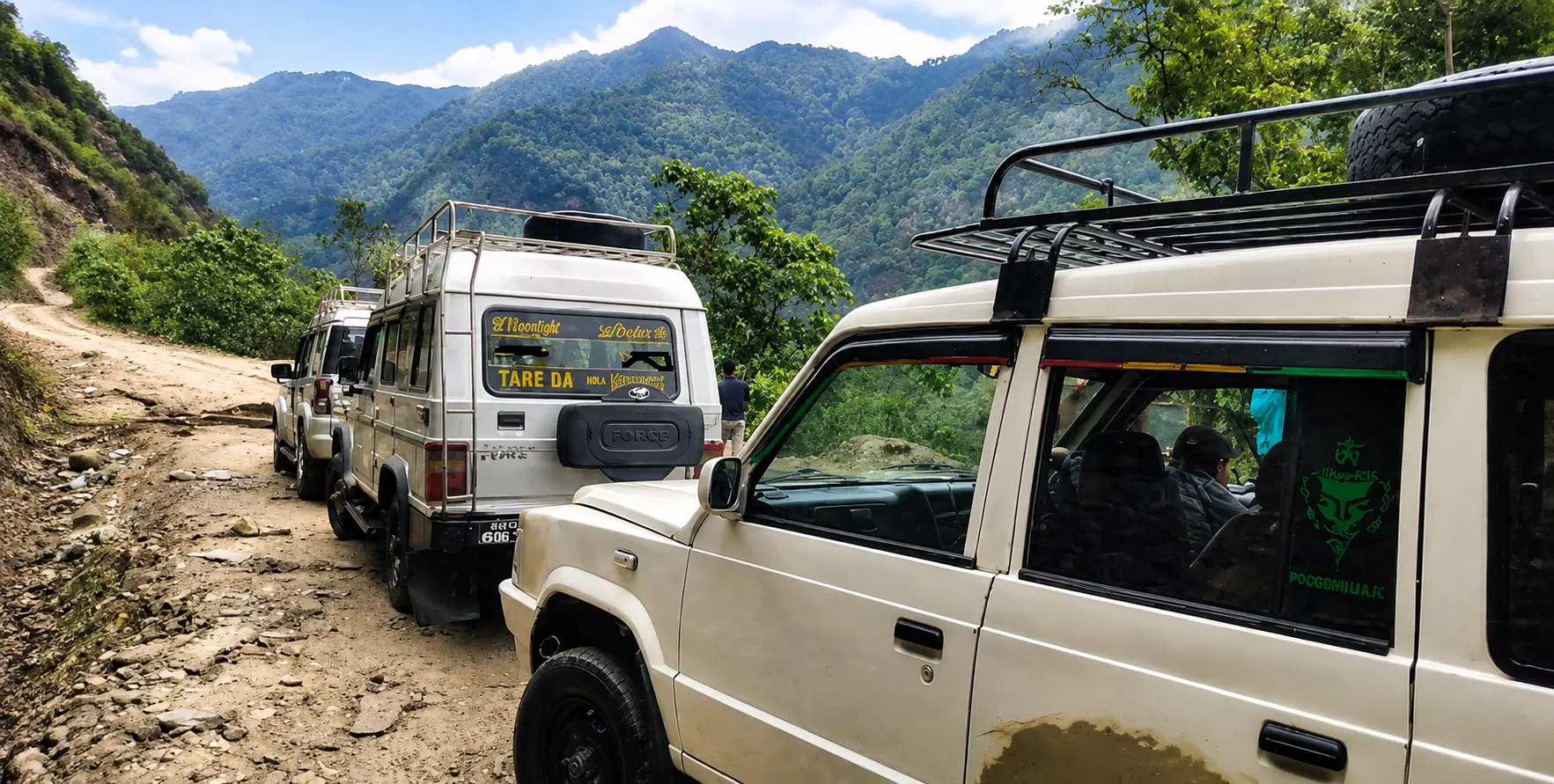
The Association That Standardized an Industry
Before 2004, Nepal’s tourist vehicle hire sector operated with considerably less coordination than it does today — individual operators setting their own rates with little reference to any shared industry standard. This situation created genuine unpredictability for both visitors and the operators themselves. The founding of the Nepal Tourist Vehicle Association (NTVA) in Nepali year 2060 B.S. (2004 in the Gregorian calendar) changed this, bringing together vehicle owners and transporters specifically engaged in serving foreign and domestic visitors under a single coordinating body. NTVA’s membership has grown steadily since its founding. The association now counts 65 distinct vehicle companies among its members, collectively responsible for publishing and periodically updating the standardized tourist vehicle rate schedules — hourly, daily, and route-specific — that legitimate operators across the country, including Nepal Vehicle Hiring Pvt Ltd, generally reference as the baseline for fair and transparent pricing.
This standardization matters more than it might first appear. In an industry where a visitor typically has no independent way to verify whether a quoted price for a Kathmandu-to-Pokhara private jeep is fair, inflated, or suspiciously cheap, the existence of an industry association that periodically publishes reference rates provides a genuine, if imperfect, anchor against which both operators and travelers can calibrate expectations. It is a quiet but structurally important piece of how trust functions in a tourism economy built so heavily on private, individually negotiated vehicle hire rather than fixed-price public transport.
From Trolley Bus to Electric Taxi — Nepal’s Surprisingly Long Electric Vehicle History
It comes as a genuine surprise to most visitors that Nepal’s relationship with electric vehicles did not begin with the recent global EV boom but stretches back exactly half a century. In 1975, Kathmandu briefly operated a trolley bus service connecting the capital to neighboring Bhaktapur — an early, government-led experiment in electric public transport that, while it did not survive in its original form, established a precedent that would resurface decades later. In the 1990s, the distinctive Safa Tempo — a small, boxy electric three-wheeler — began appearing on Kathmandu’s streets. In 1999, regulatory action specifically targeting polluting diesel tempos accelerated the wider adoption of these electric alternatives, making Kathmandu one of the earliest cities in South Asia to have a meaningful fleet of zero-emission public transport vehicles, decades before the term ‘EV’ entered everyday vocabulary.
This long and largely self-driven history helps explain why Nepal has, in the 2020s, emerged as one of the fastest-growing electric-vehicle markets in South Asia — a development with direct and growing relevance to the vehicle rental sector specifically. The underlying logic is, in environmental and economic terms, almost unanswerably strong: Nepal generates more than 90 percent of its electricity from hydropower, a renewable resource the country possesses in genuine abundance given its mountain river systems, while simultaneously importing virtually all of its petroleum fuel at high cost and balance-of-payments strain. Every liter of diesel a tourist jeep burns on the long drive to Jomsom is fuel that Nepal has paid hard currency to import; every kilowatt-hour an electric vehicle draws from the grid is, overwhelmingly, generated domestically from rainfall and gravity.
| EV Policy Element | 2026 Status | Relevance to Vehicle Rental |
| Hydropower’s share of electricity | Over 90% of Nepal’s electricity generation | Makes EV charging genuinely low-carbon, unlike most of South Asia |
| Government EV transition target | Goal to replace ICE vehicle imports with EVs by 2031 | Signals a long-term shift in the national rental and private fleet composition |
| Charging infrastructure | ~490+ public charging stations nationwide (early 2026), concentrated on Kathmandu–Pokhara and East-West Highway corridors | Directly relevant to long-distance tourist vehicle routes covered in this guide |
| EV import volume | 19,477 units imported in the first eight months of FY 2025/26 (NPR 16.33 billion) | Reflects the rapid pace of EV adoption across Nepal’s vehicle market |
| Provincial EV mandates | Bagmati Province requires all new taxis to be electric from 2024 onward | An early signal of where broader tourist and rental fleet regulation may move |
The Government of Nepal has backed this logic with sustained policy support: a stated ambition to replace internal combustion engine vehicle imports with electric alternatives entirely by 2031, a tax structure that has remained deliberately stable and favourable toward EVs across recent fiscal years specifically to signal policy reliability to importers and buyers, and — as recently as April 2026 — Cabinet approval for legal provisions permitting the retrofitting of existing petrol and diesel vehicles with electric powertrains, a measure that could eventually allow part of Nepal’s existing tourist vehicle fleet to transition to electric propulsion without requiring complete vehicle replacement. Import data for the first eight months of the 2025–26 fiscal year recorded 19,477 electric vehicle units entering Nepal, worth NPR 16.33 billion, with Chinese manufacturers — BYD, Changan’s Deepal brand, Seres, and MG — accounting for the vast majority of this volume.
For the vehicle rental sector specifically, the most directly relevant infrastructure development is the steady build-out of public charging stations along exactly the corridors that long-distance tourist vehicle hire depends upon most heavily: the Kathmandu–Pokhara highway and the East-West Mahendra Highway spanning the Terai.
With approximately 490 charging stations operating nationwide as of early 2026 and continued expansion projected, the practical case for electric vehicles serving Nepal’s major tourist routes — as opposed to its more remote, charging-infrastructure-poor mountain tracks — strengthens with each passing year. Bagmati Province’s mandate that all newly registered taxis be electric from 2024 onward offers an early signal of where broader provincial regulation of commercial and tourist vehicle fleets may eventually move, even if mountain off-road tourist jeep hire — given current battery range and charging limitations at altitude — remains, for now, firmly the domain of diesel-powered 4WD vehicles.

Why Nepal Rents Drivers, Not Just Cars
Visitors arriving from countries where self-drive car rental is the overwhelming norm are often surprised to discover that self-drive hire is, by comparison, a marginal and rarely offered option across most of Nepal’s tourist vehicle market. The default model — and the model Nepal Vehicle Hiring Pvt Ltd, like virtually every established operator in the country, follows as standard practice — is chauffeur-driven hire: a vehicle and a professional, licensed local driver supplied together as a single package, rather than a bare vehicle handed over to a self-driving visitor.
Several genuinely structural factors explain why this model dominates so completely. Nepal’s mountain roads, even where paved, frequently involve hairpin gradients, single-lane bridges, unmarked livestock crossings, and the locally specific hazard knowledge — which exact bend tends to ice over first, which stretch of riverbank track becomes impassable after a particular rainfall threshold — that a visiting driver, however experienced on roads at home, simply cannot be expected to possess.
International driving permit recognition and local licensing requirements add further legal complexity for any visitor wishing to drive independently. And at a more basic level, the driving culture and traffic conventions of Nepal’s crowded city streets and narrow mountain roads alike differ enough from most international visitors’ home experience that a chauffeur-driven model functions, in practice, as much as a safety measure as a convenience.
This is also, importantly, an employment structure with genuine economic significance reaching well beyond the vehicle rental transaction itself. A professional driver’s livelihood, and frequently that of his extended family, depends directly on the chauffeur-driven hire model that dominates Nepali tourist transport — meaning that every private jeep booking is, in a small but real way, also a direct contribution to a specific household’s income in a country where formal employment opportunities, particularly outside Kathmandu and Pokhara, remain limited.
Matching the Vehicle to the Adventure
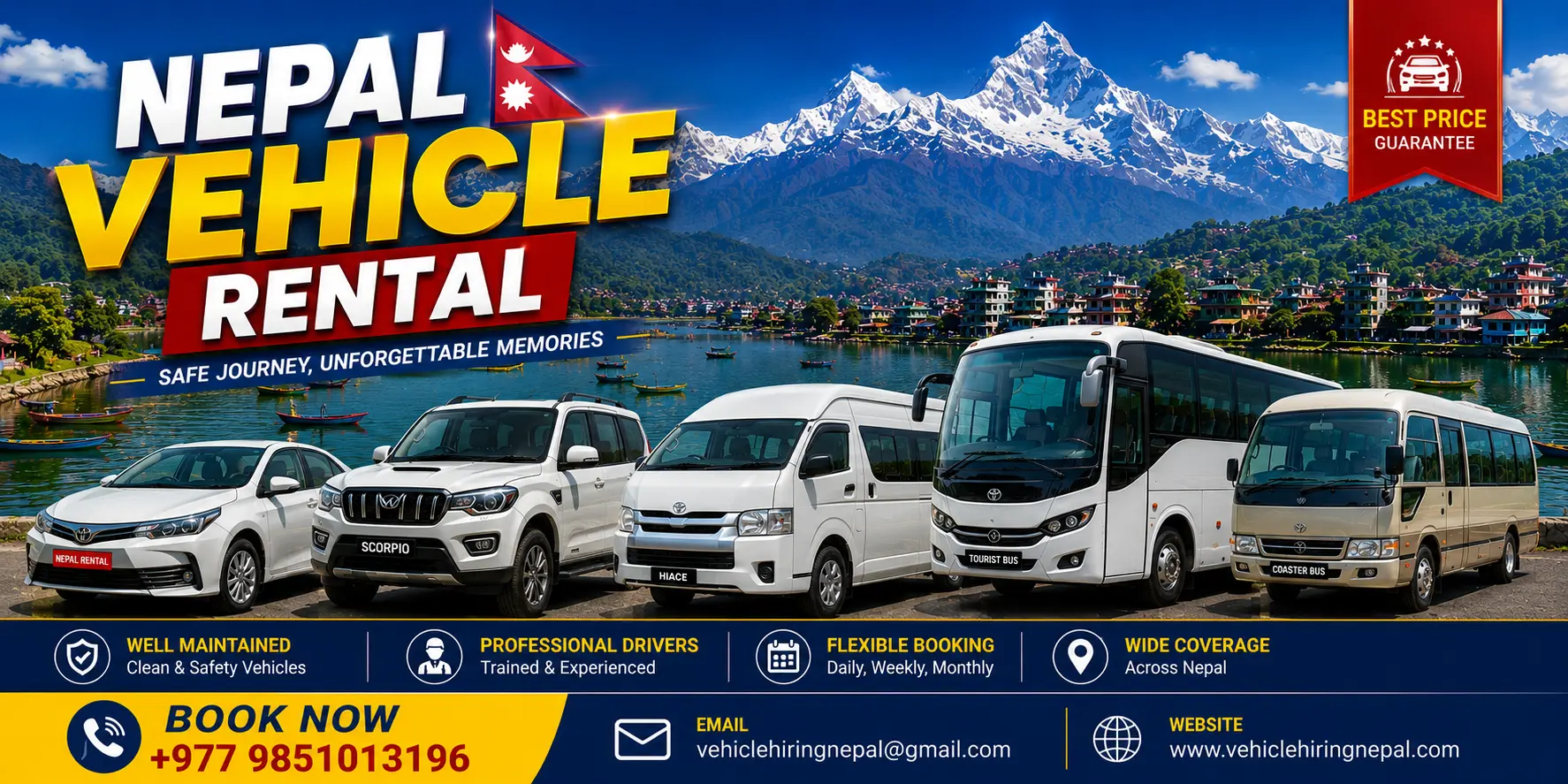
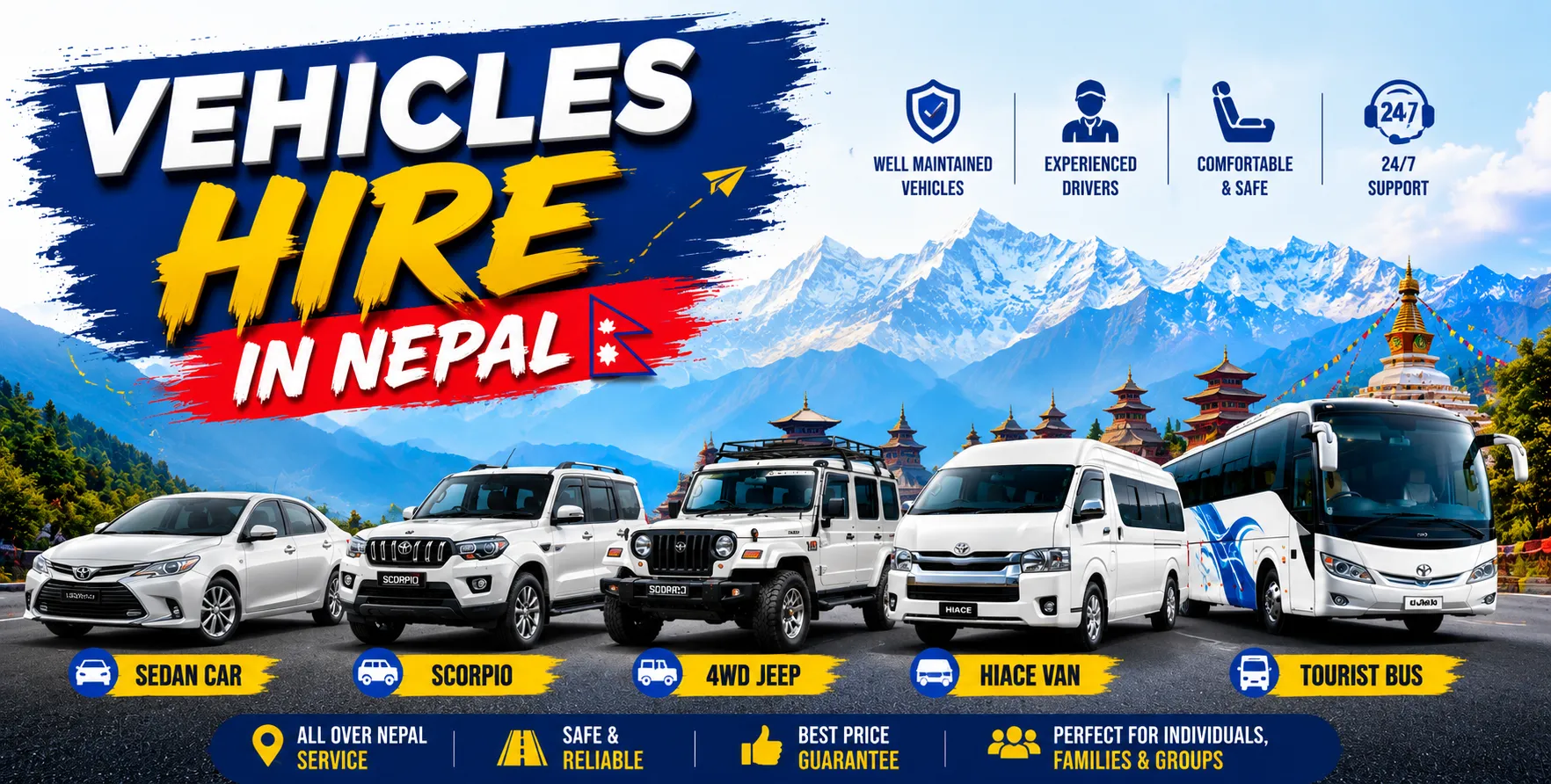
Nepal’s vehicle rental fleet, as covered in this guide’s earlier sections, has evolved over the decades into a genuinely differentiated spectrum of vehicle types, each suited to a specific combination of terrain, group size, and adventure type.
| Vehicle Type | Best Matched Adventure | Typical Capacity |
| Private Sedan | City heritage circuits, airport transfers, and Terai highway routes | 1–3 passengers |
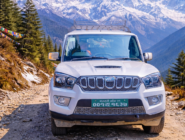
| Mahindra Scorpio 4WD | Mountain trailheads, pilgrimage routes, and moderate off-road | 4–6 passengers |
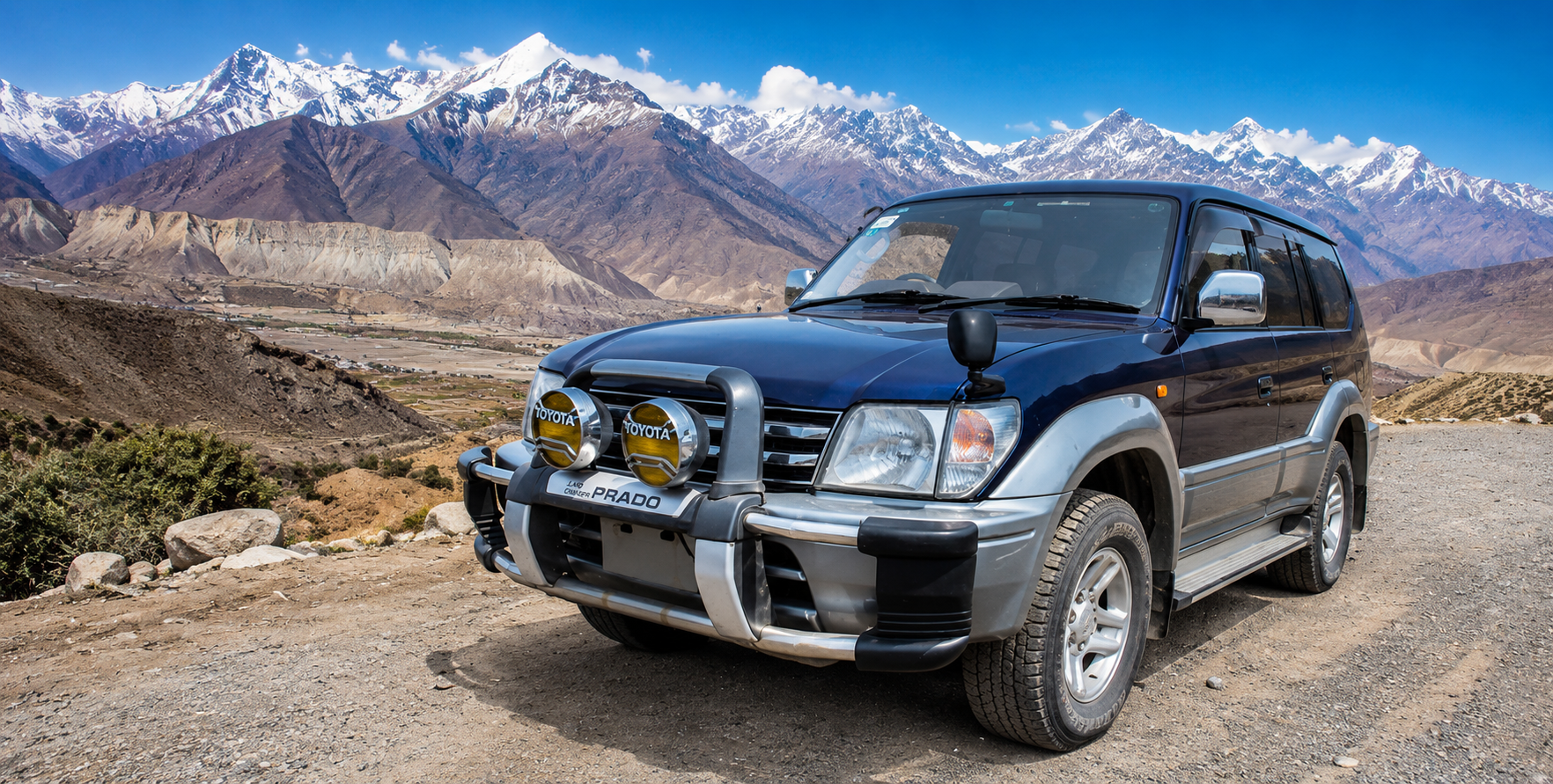
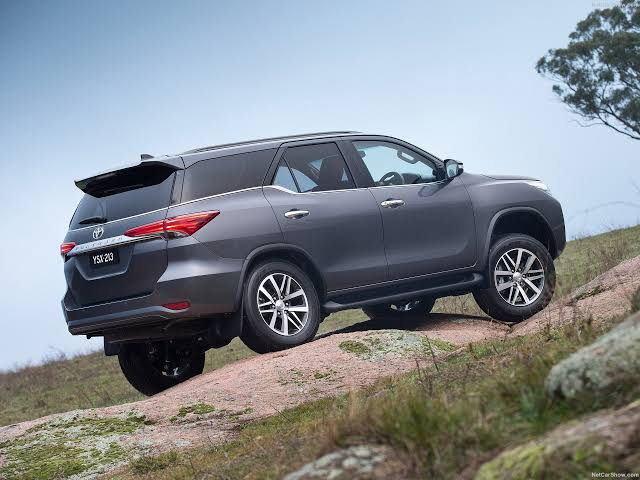
| Toyota Hilux / Fortuner 4WD | Demanding off-road — Annapurna Circuit, Muktinath, Langtang | 5–6 passengers |
| Toyota Land Cruiser 4WD | Extreme remote routes — Upper Mustang, Rara Lake, VIP touring | 6–7 passengers |
| Toyota Hiace Van | Group highway travel — Pokhara, Chitwan, Lumbini tours | 12–14 passengers |
| Tourist Coaster / Bus | Large pilgrimage groups, corporate and wedding parties | 24–45 passengers |
The underlying logic connecting vehicle type to adventure type runs throughout every destination-specific guide in our wider blog series: a private sedan comfortably handles the smooth highway sections to Pokhara, Chitwan, or Lumbini, and the city streets of the Kathmandu Valley’s heritage circuit, but cannot safely attempt the off-road gorge sections of the Annapurna Circuit beyond Besisahar, the rough final approach to Halesi Mahadev, or the high-altitude Jomsom-to-Muktinath track. A 4WD Scorpio or Hilux extends real capability into exactly these mountain off-road corridors.
A Land Cruiser becomes necessary only at the very end of the spectrum — Upper Mustang’s canyon roads to Lo Manthang, or the rare and genuinely demanding route to Rara Lake in Nepal’s far northwest. And the larger Hiace vans and tourist buses exist specifically to serve the economics of group travel on Nepal’s paved highway network, where per-person cost falls dramatically as group size rises, but which cannot follow a trekking group onto any genuinely off-road mountain track.
The Economics of a Booking
The cost structure underlying any Nepal vehicle rental booking is shaped by a handful of consistent factors that recur across every route covered in our wider guide series: vehicle type and its corresponding fuel consumption and maintenance cost; distance and the corresponding driver time and fuel required; road difficulty, with off-road mountain routes generally commanding higher rates than equivalent-distance paved highway journeys due to greater vehicle wear, slower average speeds, and the specialised driving skill required; and seasonality, with October–November and March–May — Nepal’s two peak trekking and tourism windows — generally seeing tighter vehicle availability and correspondingly less room for rate negotiation than the quieter monsoon and deep winter months.
NTVA’s standardized rate publications, discussed earlier in this guide, provide the industry-wide reference point against which individual operator quotes can be assessed. However, actual market rates inevitably vary somewhat by operator reputation, vehicle condition and age, specific inclusions (fuel, tolls, and driver accommodation on multi-day routes, for example), and the simple dynamics of supply and demand on any given booking date. A transparent, all-inclusive quote — covering driver, fuel, and tolls with no hidden charges added on arrival — remains, across virtually every guide in this blog series, the single clearest marker distinguishing a reliable operator from a less trustworthy one.
Roads, Risk, and the Driver’s Real Expertise
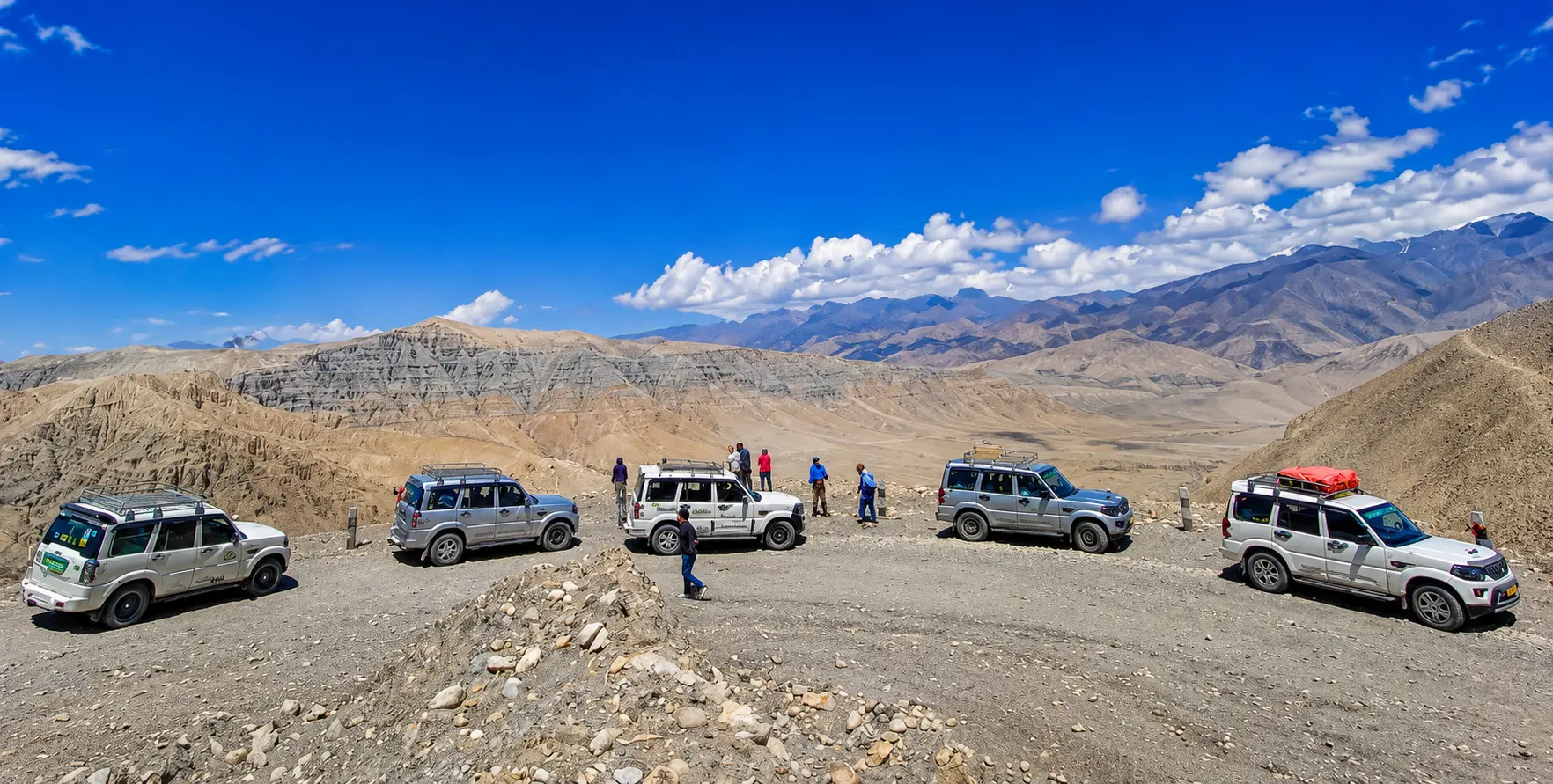
Nepal’s road safety record, like that of many mountainous developing nations with rapidly growing vehicle fleets, carries genuine and well-documented challenges — narrow roads, mixed traffic of pedestrians, livestock, motorcycles, and heavy vehicles sharing the same carriageway, and mountain sections where landslide risk, particularly during the monsoon, can alter road conditions with little warning. Against this backdrop, the practical expertise of a genuinely experienced local driver constitutes far more than simple convenience; it is, in a very direct sense, the primary safety system protecting passengers on routes where formal infrastructure — guardrails, lighting, emergency services response time — often lags well behind what travelers from more developed road networks might assume as a baseline.
This expertise is built specifically through repeated, route-specific experience: knowing exactly which stretch of the Araniko Highway tends to develop fog at a particular hour, which precise section of the Besisahar-to-Manang gorge road requires low-range 4WD engagement regardless of how dry conditions appear, and how a particular vehicle’s braking performance changes when fully loaded with passengers and roof-rack luggage on a long mountain descent. It is this accumulated, route-specific knowledge — not simply a valid driving license — that genuinely differentiates a professional Nepali tourist vehicle driver from any visitor who might otherwise attempt the same roads independently. It is this expertise that Nepal Vehicle Hiring Pvt Ltd considers the single most important criterion for selecting and retaining drivers across our fleet.
How Bookings Actually Happen — The WhatsApp Economy
Despite Nepal’s rapidly growing digital infrastructure and the proliferation of formal booking platforms and travel agency websites, the practical reality of how the large majority of Nepal vehicle rental transactions are actually arranged remains strikingly direct: a phone call or, increasingly and now overwhelmingly, a WhatsApp message, exchanged between a traveler or their trekking agency and a vehicle operator, often initiated within hours rather than weeks of the planned departure date. This is not a sign of an underdeveloped industry; it reflects the genuine flexibility that mountain travel in Nepal requires — flight delays to Lukla, sudden changes in trekking itinerary, last-minute group size adjustments — none of which a rigid, pre-paid, non-negotiable online booking system handles nearly as gracefully as a direct conversation with an operator capable of adjusting a vehicle assignment within minutes.
Nepal Vehicle Hiring Pvt Ltd operates squarely within this same WhatsApp-driven booking culture, while bringing the consistency, transparent pricing, and verified vehicle standards that distinguish a professionally run operation from the more informal, individually negotiated arrangements that still characterize parts of the wider market. A booking conversation typically begins with the basic logistics — date, group size, pickup location, destination — and concludes, usually within minutes during business hours, with a confirmed vehicle, driver, and all-inclusive price.
Where This Leaves the Traveler Today
Pulling together the threads of this guide — a seventy-year road-building history still actively extending into Nepal’s remotest valleys, a regulatory architecture encoded quietly into every license plate colour, an industry association that has spent two decades standardising what would otherwise be unpredictable pricing, a half-century-old and rapidly accelerating electric vehicle transition powered by domestic hydropower, and a chauffeur-driven hire culture rooted as much in genuine safety logic as in convenience — the practical task facing any traveler renting a vehicle in Nepal today is considerably more informed than it might first appear.
Choosing the right vehicle for a specific adventure is not simply a matter of group size and budget, though both matter enormously. It is also a question of which decade of Nepal’s road-building history your specific destination belongs to: a smooth, fully paved, EV-charging-corridor journey to Pokhara or Chitwan belongs to the country’s oldest and most mature highway infrastructure; a jeep journey into the Marsyangdi gorge toward Manang belongs to a frontier of road-building that is, even now, still actively extending; and a trek that begins with a flight to Lukla or a multi-day camping approach to a destination like Panch Pokhari belongs to terrain that road-building, at least for now, has not yet reached at all. Nepal Vehicle Hiring Pvt Ltd exists specifically to help travelers navigate exactly this layered reality — matching the right vehicle, the right driver, and the right route knowledge to wherever in this seventy-year continuum of Nepali road history your own adventure happens to fall.
Nepal’s First Highway Tunnel — and the Bureaucracy of Building One
No discussion of Nepal’s evolving road network would be complete without the single most ambitious infrastructure project currently reshaping how vehicles move in and out of the Kathmandu Valley: the Nagdhunga–Sisnekhola Tunnel, Nepal’s first modern highway tunnel, bored through the mountain that has for decades formed the single most notorious bottleneck on the entire Tribhuvan Highway corridor connecting Kathmandu to Dhading and, beyond it, to Pokhara and the rest of western Nepal. The existing surface road over Nagdhunga is a chronic source of delay for every vehicle rental operator running routes west or south from Kathmandu — nineteen hairpin bends, a section perpetually vulnerable to landslides, and a stretch that the project’s own planning documents estimate currently consumes roughly half an hour in each direction even without traffic congestion or weather disruption.
Construction on the tunnel began in October 2019, with an original 42-month completion target that would have placed its opening sometime in 2023. It did not go that way. The COVID-19 pandemic halted work for extended periods, local protests over compensation and construction impacts caused further obstruction, and a series of genuine geological and engineering challenges pushed the project’s cost from an initial estimate of roughly NPR 22 billion to more than NPR 27 billion, financed through a concessional loan from the Japan International Cooperation Agency alongside direct contributions from the Government of Nepal. By late 2025, with the physical tunnel boring and lining work reported at 97 to 98 percent complete, Prime Minister Pushpa Kamal Dahal publicly described the project as marking Nepal’s entry into what he termed the ‘tunnel age’ — a genuinely significant moment for a country that had, until this point, never bored a single highway tunnel through any of its mountains.
And yet the tunnel’s opening has, as of mid-2026, still not occurred on schedule, amid a sequence of delays that itself offers a small but genuinely instructive case study in how infrastructure is actually built and operated in Nepal. The government first promised a January 2026 opening, then revised this to April 2026 to coincide with the Nepali New Year, and has since acknowledged that even this date cannot be firmly guaranteed.
The reasons are threefold and each one is revealing in its own right: first, selecting a qualified operator to actually run the tunnel — an entirely new operational category for Nepal, requiring 24-hour staffing, jet fan and CCTV systems, emergency response capability, and digital toll collection — required an international tender process that took far longer than anticipated, eventually awarding a five-year operating contract to Yusin
ART, a joint venture between Chinese and Nepali firms, after technical and financial evaluation of ten competing international bidders; second, a significant landslide at the tunnel’s Dhading-side entrance required engineers to develop a permanent, monsoon-resistant stabilisation solution rather than a temporary fix, given that the entire point of the tunnel is to bypass exactly this kind of landslide vulnerability; and third, the construction of toll plazas at both ends, without which the tunnel cannot legally begin commercial operation regardless of its physical readiness, has proceeded on its own separate and slower timeline.
For the vehicle rental sector specifically, the tunnel’s eventual opening — whenever it finally occurs — promises to meaningfully reshape journey times on one of Nepal’s busiest tourist corridors: official estimates suggest the Sisnekhola-to-Balambhu travel time could fall from over thirty minutes to as little as seven, bypassing the nineteen hairpin bends and chronic landslide risk of the existing surface road entirely.
Toll rates of NPR 65 for cars and vans entering Kathmandu and NPR 60 for exiting have already been fixed by a government gazette notification, with planners estimating that roughly 859 vehicles will enter and 646 will exit the valley through the tunnel daily once operations stabilize. Whether this estimate proves accurate will depend substantially on how quickly Nepal’s tourist vehicle operators — including Nepal Vehicle Hiring Pvt Ltd — incorporate the new route into routine Kathmandu-to-Pokhara and Kathmandu-to-Chitwan trip planning once the tunnel finally and definitively opens.
The Monsoon Problem — Why a Road That Was Fine in October May Not Be Fine in July
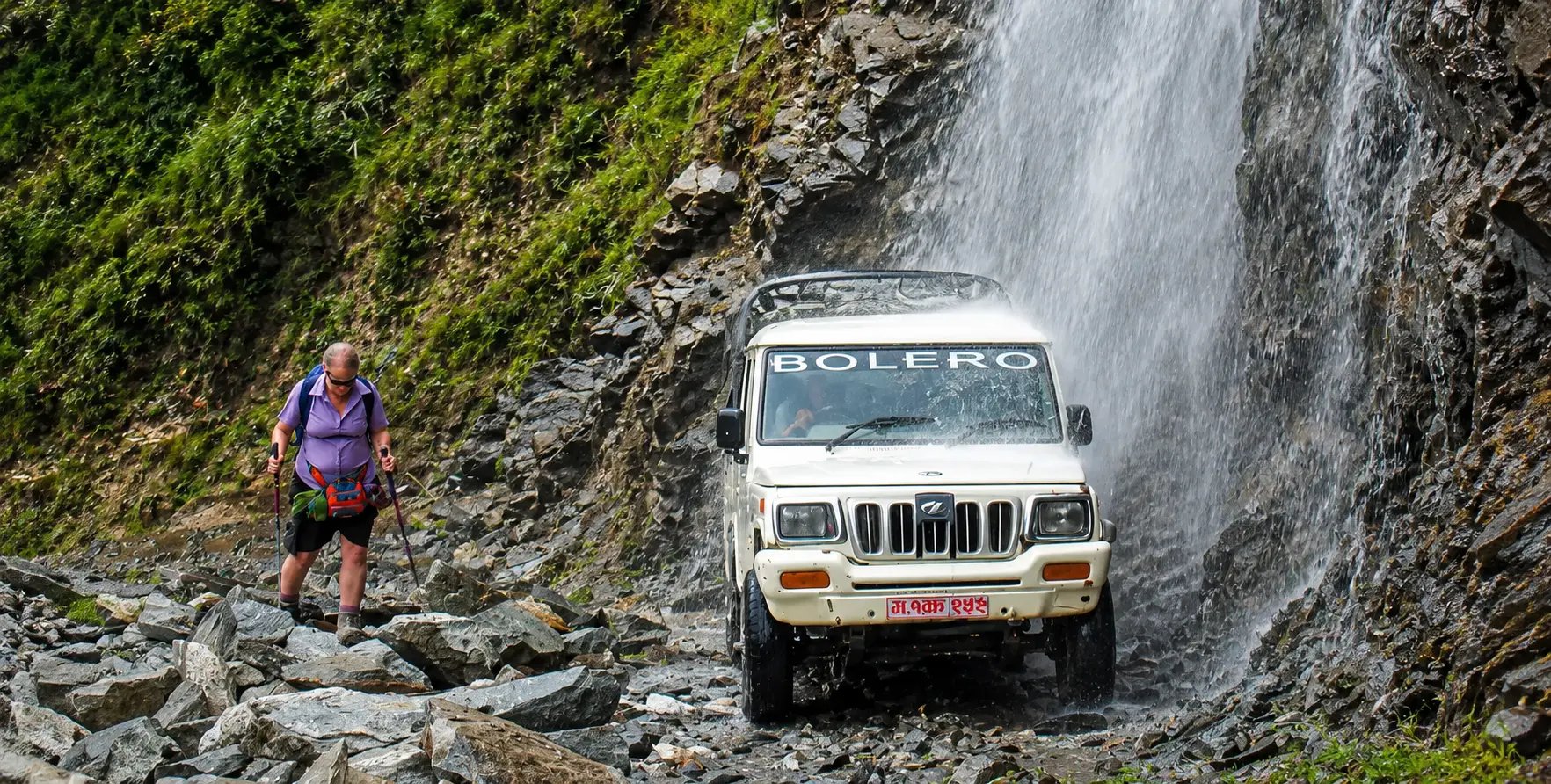
Underlying every route guide in our wider blog series, and underlying this guide’s broader argument that Nepal’s road network remains a young and still-evolving system, sits a recurring seasonal reality that any serious account of Nepal vehicle rental must address directly: roughly three-quarters of Nepal’s total land area consists of hills and high mountains, and the overwhelming majority of the country’s highway network beyond the flat southern Terai consists of two-lane roads winding through precisely this steep, geologically young, and monsoon-saturated terrain.
Nepal’s monsoon, arriving each year from roughly June through September, does not simply make travel uncomfortable; it actively and repeatedly damages the physical road surface itself, in ways that can change a route’s drivability from one week to the next.
The scale of this disruption, in any given monsoon season, is substantial enough that Nepal’s Department of Roads maintains running, location-specific restoration data rather than treating monsoon damage as a single seasonal event: recent reporting on highway conditions recorded two-way traffic restored at 345 separate landslide-affected locations nationwide, with one-way traffic (meaning traffic must alternate direction, typically controlled by a traffic officer or temporary signal at the damaged section) still in effect at a further 408 locations.
The Nagdhunga–Mugling road specifically — one of the most heavily used tourist vehicle corridors in the entire country, carrying virtually all Kathmandu-to-Pokhara and Kathmandu-to-Chitwan traffic before the Nagdhunga tunnel’s eventual completion — has its own well-documented roster of chronically landslide-prone sections with names familiar to every experienced Nepali driver: Mauwa Khola, Hukdi Khola, Fishling, Kali Khola, Simaltal, Jalbire, and Ghopte Bhir among them, each requiring its own seasonal monitoring and repeated repair.
This is precisely why every transport-specific guide in our blog series, from the Kodari border crossing to the Besisahar–Manang off-road route to the Kathmandu–Kakarbhitta long-distance corridor, repeatedly emphasizes the same practical point: a private vehicle hire booking with an operator who actively monitors current road conditions is not a luxury add-on but a genuine, sometimes safety-critical, service.
A road that carried smooth two-way traffic in October may be reduced to single-lane alternating traffic, or briefly closed entirely, after a single heavy monsoon downpour in July — a reality that no fixed online booking platform can account for in real time, but which an experienced local operator, in direct daily contact with drivers actually on these roads, generally can.
Insurance, Liability, and the Question Few Travelers Think to Ask
Amid the excitement of planning a Himalayan adventure, the question of what insurance coverage actually applies to a hired vehicle is one that remarkably few travelers think to raise before booking. Yet, it sits at the center of the entire regulatory and commercial structure this guide has described. Under Nepal’s Motor Vehicles and Transport Management framework, every registered commercial and tourist vehicle is legally required to carry at least third-party insurance, covering injury or damage to people and property outside the vehicle itself.
Reputable tourist vehicle operators, including Nepal Vehicle Hiring Pvt Ltd, offer more comprehensive coverage that extends to passengers in the vehicle as well. However, the specific scope, exclusions, and claim procedures can vary meaningfully between operators in ways that are not always obvious from a simple price quote.
This matters in practical terms for several genuinely common scenarios that arise on Nepal’s roads: a landslide-damaged section forcing an unplanned detour or delay, a mechanical breakdown on a remote mountain track far from any service center, or, in rarer but real cases, an accident involving another vehicle or a pedestrian on a narrow mountain road. A traveler booking through an established, NTVA-aligned operator benefits from a vehicle that is not only mechanically maintained to a higher standard but also genuinely insured in a way that protects the traveler’s own interests, rather than simply meeting the bare legal minimum required to keep the vehicle on the road.
This is one of the less visible but more consequential differences between booking through a transparent, established operator and accepting an informally negotiated arrangement with an unverified individual driver — a distinction this guide has returned to repeatedly, because it is, in the end, one of the clearest practical markers of trustworthiness in an industry built so heavily on direct, person-to-person negotiation rather than fixed institutional contracts.
Travelers are also well served by ensuring their own personal travel insurance policy — a requirement explored in detail in our dedicated guide to Muktinath altitude health, where helicopter evacuation coverage is the central concern — extends to cover road travel incidents as well as the trekking and altitude-related risks more commonly discussed. A policy that covers high-altitude rescue but excludes road traffic incidents, or vice versa, leaves a genuine gap in protection for a journey that, as this entire guide has emphasized, depends on vehicles and roads just as fundamentally as it depends on trails and altitude.
Why Choose Nepal Vehicle Hiring Pvt Ltd
- Complete Fleet Coverage: From private sedans for Kathmandu Valley heritage circuits to Land Cruisers for Upper Mustang expeditions — every vehicle category is covered in this guide, available from one trusted operator.
- NTVA-Aligned Transparent Pricing: Our quotes are benchmarked against industry-standard rates, with driver, fuel, and tolls included — no hidden charges added after booking.
- Route-Specific Driver Expertise: Our drivers bring the accumulated, road-specific knowledge this guide has described as the single most important safety factor on Nepal’s mountain routes.
- Operating Within Nepal’s Evolving Regulatory Framework: We maintain full compliance with the Department of Transport Management’s registration, licensing, and standards for tourist vehicle plates and chauffeur presentation, as described in this guide.
- 24/7 WhatsApp Booking: Reflecting the booking culture this guide has explained, we respond to inquiries directly and quickly — often within minutes during business hours.
- A Genuine Stake in Nepal’s Road Future: As Nepal’s highway network continues to expand and its vehicle fleet gradually electrifies, we are committed to adapting alongside an industry that, as this guide has shown, never stops evolving.
Frequently Asked Questions — Vehicle Rental In Nepal
Why is chauffeur-driven hire the standard in Nepal rather than self-drive rental?
Nepal’s mountain roads, mixed traffic conditions, and locally specific hazards make professional local driving expertise a genuine safety necessity rather than simply a convenience. Licensing complexity for visiting drivers and the broader driving culture also support this model, which is why nearly all established Nepali operators, including Nepal Vehicle Hiring Pvt Ltd, provide vehicle and driver as a single package.
What do the different license plate colors in Nepal mean?
White plates with black letters denote private vehicles; yellow plates with black letters denote public transport and standard tourist-category vehicles; green plates (with a mandated chauffeur dress code) denote vehicles specifically registered for tourist carriage; white plates with red letters denote government vehicles; and white plates with blue letters denote foreign or diplomatic vehicles.
What is the Nepal Tourist Vehicle Association (NTVA)?
NTVA was founded in 2004 (2060 B.S.) by tourist vehicle operators and transporters to coordinate and standardize the tourist vehicle hire industry. It now counts 65 member vehicle companies and periodically publishes reference rate schedules that legitimate operators use as a transparent pricing benchmark.
Is Nepal moving toward electric vehicles for tourist transport?
Yes, gradually. Nepal generates over 90% of its electricity from hydropower and has set a target to replace imports of combustion-engine vehicles with EVs by 2031. Charging infrastructure is expanding fastest along paved highway corridors such as Kathmandu-Pokhara and the East-West Highway. However, remote mountain off-road routes currently remain the domain of diesel-powered 4WD vehicles due to charging infrastructure and range limitations at altitude.
How do I get a fair price when renting a vehicle in Nepal?
Request an all-inclusive quote covering driver, fuel, and tolls, and compare it against NTVA’s published reference rates where possible. Booking with an established, transparent operator like Nepal Vehicle Hiring Pvt Ltd, rather than negotiating informally on arrival, is the most reliable way to avoid hidden charges.
When was Nepal’s first road built, and why does this matter for vehicle rental today?
The Tribhuvan Rajpath, completed between 1953 and 1956, was Nepal’s first highway connecting Kathmandu to the outside world. This relatively recent history explains why Nepal’s road network, and the vehicle rental industry built upon it, remain young and continuously evolving systems — with new off-road routes still actively extending into previously roadless mountain valleys today.
What is the Nagdhunga Tunnel and how does it affect vehicle rental journeys?
The Nagdhunga–Sisnekhola Tunnel is Nepal’s first modern highway tunnel, built to bypass the chronically congested and landslide-prone Nagdhunga section of the Tribhuvan Highway, which connects Kathmandu to Dhading. Once fully operational, it is expected to cut travel time on this stretch from over 30 minutes to as little as 7 minutes, benefiting Kathmandu-Pokhara and Kathmandu-Chitwan journeys by vehicle. As of 2026, its commercial opening has been repeatedly delayed by operator selection and landslide stabilization works.
Conclusion
Nepal Vehicle Rental is not simply a transactional convenience layered on top of the country’s mountains, temples, and trails — it is the connective infrastructure that makes nearly every Nepali adventure possible in the first place, built upon seventy years of road history, a quietly sophisticated regulatory architecture, an industry association that has spent two decades standardising fair pricing, a vehicle fleet now in the early stages of a hydropower-driven electric transition that few visitors ever think to ask about, and — as the still-unfinished Nagdhunga tunnel saga makes clear — a road network that continues, in real time, to be built, delayed, rebuilt, and gradually improved by a government and an engineering sector still learning, project by project, how to do this work at the scale modern tourism now demands.
Understanding this depth does not change which vehicle you need for your own journey — but it does change how you understand the road beneath you, and the driver beside you, as you travel it. Every jeep that climbs toward Manang, every sedan that glides smoothly toward Pokhara, every tourist bus carrying a pilgrim party toward Lumbini is moving through a system shaped by sixty years of highway diplomacy, four decades of EV policy experimentation, and a regulatory bureaucracy still actively working out how to manage its own modernization. Nepal Vehicle Hiring Pvt Ltd is glad to be your route to that adventure, wherever in Nepal’s vast and still-evolving road network it takes you.
Book your Nepal vehicle rental — Call or WhatsApp: +977-9851013196
Email: [email protected]
- Vehicle Rental In Nepal: Your Route to Amazing Adventures
- A Country Built Without Roads, Then Built Entirely Around Them
- The Quiet Bureaucracy Behind Every Rented Vehicle
- The Association That Standardized an Industry
- From Trolley Bus to Electric Taxi — Nepal's Surprisingly Long Electric Vehicle History
- Why Nepal Rents Drivers, Not Just Cars
- Matching the Vehicle to the Adventure
- The Economics of a Booking
- Roads, Risk, and the Driver's Real Expertise
- How Bookings Actually Happen — The WhatsApp Economy
- Where This Leaves the Traveler Today
- Nepal's First Highway Tunnel — and the Bureaucracy of Building One
- The Monsoon Problem — Why a Road That Was Fine in October May Not Be Fine in July
- Insurance, Liability, and the Question Few Travelers Think to Ask
- Why Choose Nepal Vehicle Hiring Pvt Ltd
- Frequently Asked Questions — Vehicle Rental In Nepal
- Conclusion

Related Blog & Articles
Kathmandu Airport to Pokhara Vehicle Rental

Kathmandu to Chitwan Transfer
Kathmandu to Besisahar Hiace Transfer – Complete Guide 2026
Kathmandu to Ramechhap Airport Transfer Full Guide 2026