


 Plan a Trip


Why Choosing a Reliable Vehicle Makes Your Nepal Trip Better
Why Choosing a Reliable Vehicle Makes Your Nepal Trip Better
Nepal is one of the world’s most geographically extreme travel destinations. Within a country smaller than England, the terrain spans from the flat Terai plains at 60 meters above sea level to Everest’s summit at 8,849 meters — a vertical range unmatched anywhere on Earth. The roads that connect these worlds are equally varied: smooth national highways, rough provincial tracks, dramatic mountain gorge roads, and off-road terrain beyond the tarmac’s end. The vehicle you choose for Nepal is not just a comfort decision — it is a safety decision, a scheduling decision, an experience decision, and ultimately the single most controllable factor in whether your Nepal trip unfolds as planned or as a series of avoidable disruptions.
Most Nepal trip disruptions that experienced travel writers document — the missed flight because the airport taxi did not arrive, the trekking group that spent a day waiting in a roadside town because their vehicle broke down on the Prithvi Highway, the Nagarkot sunrise that became a Nagarkot 9 a.m. because the driver could not find the pre-dawn hotel pickup — share a common root: an unreliable vehicle and driver arrangement that was made cheaply and quickly rather than carefully and properly. These stories are preventable. Nepal Vehicle Hiring Pvt. Ltd. exists specifically to prevent them.
This guide explains, specifically and concretely, why choosing a reliable vehicle improves every part of your Nepal trip — from the airport transfer that begins your journey to the final departure drop that ends it. Each section addresses a real dimension of Nepal travel where vehicle reliability directly affects the experience.
Mountain Road Safety — Where Vehicle Reliability Is Literally Life-Critical
Nepal has some of the world’s most spectacular and most demanding mountain roads. The Kali Gandaki gorge road to Muktinath and Jomsom, the Marsyangdi gorge road to Manang and the Annapurna Circuit, the Betrawati-to-Syabrubesi road to Langtang and the Tibet border, and the countless other mountain approach roads that serve Nepal’s trekking regions are not highways where vehicle failure is merely inconvenient. They are roads where a blown tire on a cliff-face section, a brake failure on a steep descent, or an engine cutting out in the middle of a river crossing can have consequences that go beyond inconvenience.
A reliable vehicle for Nepal’s mountain roads means:
- Recent service history: Nepal Vehicle Hiring’s vehicles complete their manufacturer-recommended service schedule before deployment on mountain approach routes. We check and verify the brakes, tires, engine systems, and 4WD drivetrain. A vehicle that has not been recently serviced is a significant risk on the sustained downhill sections of the Kali Gandaki gorge road and the steep switchbacks of the Annapurna approach.
- Appropriate vehicle type: the 4WD jeep hire requirement for routes beyond Besisahar, beyond Beni, and beyond Syabrubesi is not an upsell — it is a genuine minimum standard. A standard car attempting the Besisahar-to-Manang mountain road is not merely uncomfortable; it is potentially We check and verify the brakesWe check and verify the brakesoutirestirestiresthe sections where clearance and experienced mountain road drivers: Nepal’s mountain approach roads have specific hazards—the oncoming vehicle in the blind curve, the loose rockfall area where the speed must slow regardless of schedule, and the river-crossing depth assessment that requires a driver who has crossed this point before. Nepal Vehicle Hiring’s mountain route drivers are specifically experienced on the routes they serve.
- Vehicle insurance: every Nepal Vehicle Hiring vehicle carries current third-party liability insurance. In the event of an accident or incident, our vehicles are insured—unregistered or uninsured informal vehicles on Nepal’s tourist routes are not.
When you choose Nepal Vehicle Hiring’s 4WD jeep hire for a Muktinath or Manang approach, you choose a vehicle that has passed pre-deployment mechanical checks, is driven by a driver who knows the route, and is insured for the journey. When tourists choose the informal jeep at the Pokhara bus park because it is NPR 3,000 cheaper per vehicle, they are choosing none of these things.
Schedule Certainty — How Reliable Transport Protects Your Entire Itinerary
Nepal travel operates on tighter schedule interdependencies than most travelers expect. The Lukla domestic flight departs at 6:16:15 a.m.—missing it by 10 minutes means you miss the start of that day; a full itinerary can collapse if the next available flight is 2 days later. Nagarkot Sunrise Viewpoint is worth visiting only between 5:45 a.m. and 7:30 a.m.—arriving at 8:00 a.m. means the clouds have already formed. The Pashupatinath evening Aarti starts at 5:00 p.m. — arriving at 5:45 p.m. means half the ceremony has concluded. The Muktinath temple closes at 7:00 p.m. — arriving at 6:30 p.m. after a long day’s drive means you get 30 minutes at Nepal’s most sacred temple instead of 2 hours.
Reliable vehicle hire protects every one of these timing-sensitive moments:
- Confirmed pickup time is honored: Nepal Vehicle Hiring’s drivers arrive at the confirmed pickup time. The 3:3:00 a.m. vehicle for the EBC Lukla flight arrives at 3:00 a.m., not 3:45 a.m. The 4:30 a.m. Nagarkot departure vehicle is there at 4:30 a.m., not absent at 5:00 a.m., when the best light is already beginning.
- Driver knows the timing requirements: our Nagarkot drivers know the drive time from Thamel to the best Nagarkot viewpoint (approximately 70 minutes at pre-dawn) and depart with sufficient margin for the current road conditions. Our Muktinath approach drivers know the temple closing time and pace the journey to allow adequate time at the temple.
- Vehicle reliability prevents schedule-destroying breakdowns: a well-maintained vehicle won’t break down on the Prithvi Highway 3 hours before the Kathmandu-to-Pokhara connection your trekking guide is waiting for in Pokhara. Vehicle maintenance is schedule assurance.
- No last-minute vehicle substitutions: when you book Nepal Vehicle Hiring’s car hire in Nepal or Hiace van hire for a specific journey, the confirmed vehicle arrives—not a different, smaller, or less appropriate substitute arranged when the original vehicle becomes unavailable.
Driver Expertise — The Local Knowledge That GPSwon’tProvide
Navigation in Nepal is more complex than a GPS app suggests. Kathmandu’s narrow network changes one-way directions by the time of day, and the app’s route may take a foreign-registered tourist vehicle down a street that experienced local drivers know is practically inaccessible at 6:00 a.m. The Bhaktapur east gate approach for tourist vehicles differs from the main road approach the GPS routes toward, and a driver who parks at the main gate rather than the east gate adds 15 minutes of unnecessary walking to the heritage visit. The Manakamana cable car queue at 11:00 a.m. is 45 minutes longer than the queue at 9:30 a.m., and a driver who knows this times the Prithvi Highway departure accordingly.
Nepal Vehicle Hiring’s driver expertise adds value at every stage of the Nepal trip:
- Heritage site sequencing: our Kathmandu Valley sightseeing drivers sequence the seven UNESCO sites in a different order — not alphabetical as they appear on a map, but in the order that uses the morning light for photography, catches the Boudhanath kora at its peak before the tour groups arrive, and delivers the Pashupatinath Aarti as the final site of the day when the ceremony is at its most powerful.
- Mountain route knowledge: our Pokhara to Mustang jeep drivers know the Tatopani hot spring timing, the Kalopani Dhaulagiri viewpoint stop, the Marpha apple village stroll, and the Kagbeni medieval monastery visit — not because we programmed these into a route, but because our drivers have made this journey dozens of times and know what makes it extraordinary versus merely functional.
- Current road conditions: no GPS or travel blog has today’s road conditions between Besisahar and Manang. Our drivers talk to other drivers and have up-to-date intelligence on sections damaged in last week’s rain and sections where a recent rockfall requires slow travel.l This real-time knowledge prevents schedule-destroying road-condition surprises.
- Emergency protocol knowledge: if a tire blows on the Kali Gandaki gorge road, a reliable driver knows the nearest flat section to pull over safely, has a functional spare, and knows the nearest mechanical assistance point. An inexperienced, unconditionally prepared driver does not.
Cost Transparency — What ‘All-Inclusive’ Actually Means
Nepal’s informal vehicle hire market has a well-documented pattern of end-of-journey additions that turns a seemingly good initial price into a frustrating final reckoning. The NPR 8,000 Kathmandu-to-Pokhara jeep becomes NPR 10,500 when the driver adds a ‘fuel supplement’ for the mountain sections, a ‘driver meal charge’ that was not mentioned at booking, and an ‘extra hour waiting fee’ for the Manakamana stop. The NPR 15,000 per-vehicle Kathmandu-to-Mustang quote becomes NPR 20,000 when the ‘road toll’ and ‘permit fee’ are added at the Mustang checkpoint.
Nepal Vehicle Hiring’s all-inclusive pricing eliminates every one of these additions:
- Fuel is included: the quoted price covers fuel for the entire journey. No fuel supplements, no surcharges for mountain road fuel consumption.
- Driver accommodation and meals are included for multi-day journeys: the driver’s overnight expenses in Jomsom, Manang, and Chitwan are included—no end-of-journey driver expense addition.
- Road and bridge tolls are included: Nepal’s highway tolls, bridge crossing fees on mountain roads, and all applicable vehicle permits are included in the quoted price.
- Waiting time at stops is included: the Manakamana cable car stop (2 to 2.5 hours), the Tatopani hot spring stop, and the Mugling fish lunch—no hourly waiting charges apply when our drivers wait while guests enjoy scheduled stops.
- The quoted price is the price paid: Nepal Vehicle Hiring provides prices in writing (via WhatsApp confirmation or our plan your trip page booking) before any journey begins. The confirmed price is the price paid at the end. No negotiation at the destination, no pressure to add gratuities above what the guest chooses.
This transparency is not merely convenient — it is budget-protective. For travelers on structured Nepal trip budgets, knowing vehicle costs before departure from Kathmandu lets you allocate the remaining NPR cash accurately for trekking fees, accommodation, food, and activities. Surprise vehicle additions eat into activity budgets that cannot easily be recovered mid-trip.
Vehicle Quality — How the Right Vehicle Changes the Experience
The vehicle’s physical condition affects the Nepal trip experience in ways that are easy to underestimate when booking from abroad on a website. The difference between a well-maintained Toyota Land Cruiser on the Kathmandu-to-Pokhara Prithvi Highway and a tired, high-mileage microvan on the same road is not merely a comfort difference—it is a sensory difference that shapes how the journey feels and what it lets you notice.
In a well-maintained vehicle:
- The windows open smoothly for photography—the Trishuli gorge views, the first Annapurna views approaching Pokhara, the Dhaulagiri panorama from the Kali Gandaki gorge — are all photographed through open windows, not dirty fixed glass.
- The suspension absorbs the rough sections of mountain tracks rather than transmitting them directly to passengers—the Besisahar-to-Manang road is rough regardless of the vehicle. Still, the difference between a Land Cruiser’s suspension and a worn-out vehicle’s suspension is the difference between ‘adventurously bumpy’ and ‘genuinely exhausting’.
- The air conditioning works in the Terai heat — the Kathmandu-to-Chitwan drive in October (32°C in the Chitwan lowlands) in a vehicle with non-functioning air conditioning is far less pleasant than the same drive in a properly climate-controlled vehicle.
- The engine climbs consistently — the sustained gradient sections of the Kali Gandaki approach road and the Annapurna Circuit mountain track require an engine that maintains power at altitude. A poorly maintained vehicle that struggles on gradient sections creates both schedule uncertainty and, at certain mountain road sections, genuine safety concerns.
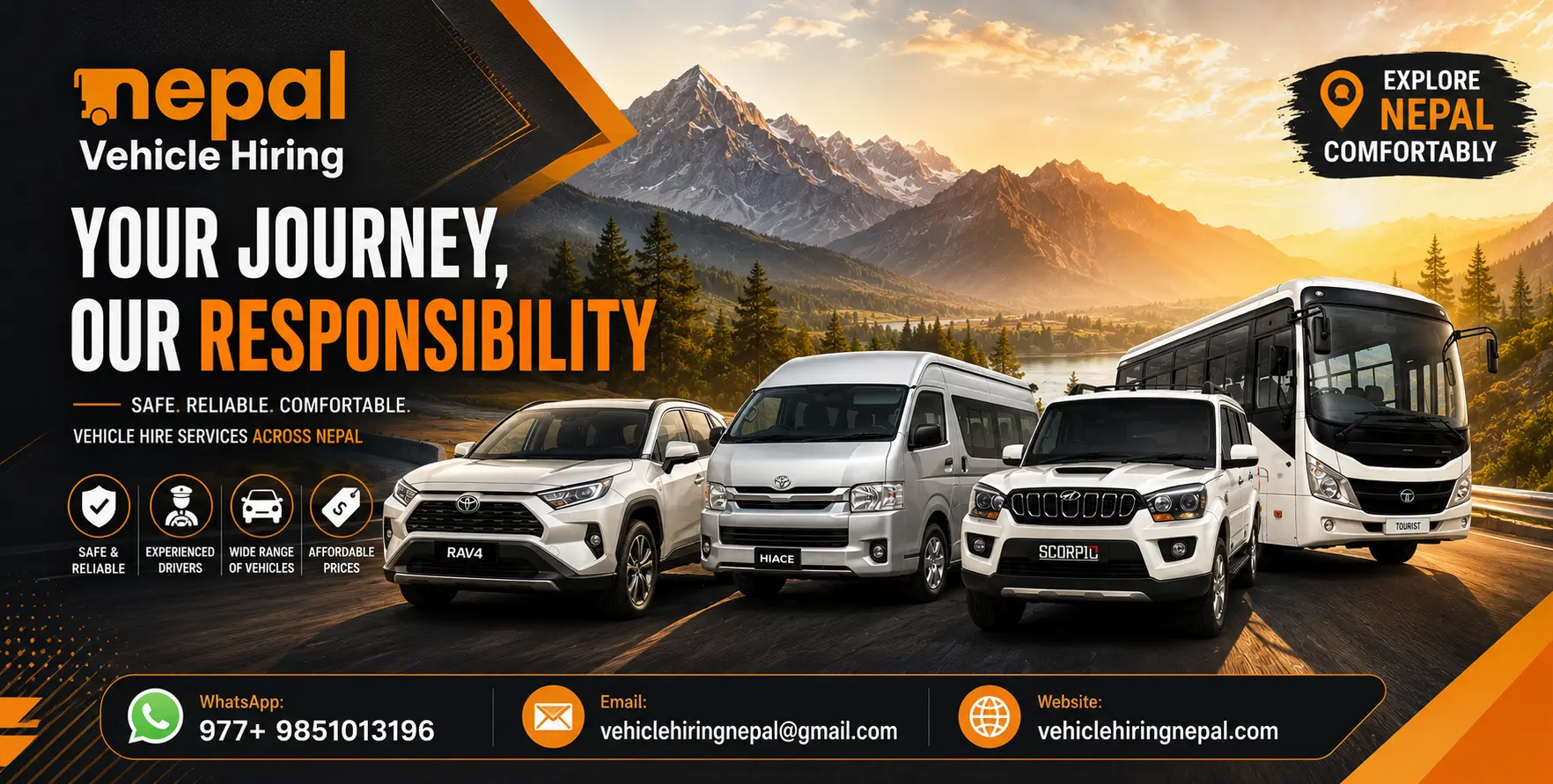
Nepal Vehicle Hiring’s fleet — private car hire, 4WD jeep hire, Hiace van hire, Coaster bus hire, and full bus hire — meets consistent mechanical and comfort standards across all vehicle types. Our monthly service schedule ensures every vehicle deployed on tourist circuit duty meets the standards Nepal’s demanding terrain requires.
How Vehicle Reliability Affects Different Nepal Trip Types
For Trekkers: The Approach Vehicle Sets the Trek’s Tone
For trekkers, the vehicle is not the adventure — the trek is. But the approach vehicle shapes how the trekker arrives at the trailhead: tired and frustrated after a breakdown, a late start, and wrong-vehicle confusion, or rested, on schedule, and oriented after a smooth, well-paced drive with a knowledgeable driver who has explained what the first day’s trail entails. Vehicle H’s trekking transport services are designed around this understanding—the approach vehicle is the first chapter of the trekking story, and it matters.
The Kathmandu to Manang jeep, Pokhara to Mustang jeep, Besisahar private vehicle service, and Everest Base Camp trek transport—all of these are approach services where vehicle quality and driver knowledge set up the trekking days that follow. A trekker who arrives at Jomsom tired from a broken-down jeep that lost 3 hours on the Kali Gandaki has less energy for Day 1 of the Muktinath approach than a trekker who arrived in a comfortable, on-schedule vehicle with the right information about the trail ahead.
For Pilgrims: The Vehicle Is Part of the Sacred Journey
For Hindu and Buddhist pilgrims making the Muktinath Yatra, the Kailash Mansarovar pilgrimage, or the Lumbini-Janakpur sacred circuit, the vehicle is not merely logistics — it is part of the pilgrimage itself. Pilgrims carrying puja materials (flowers, coconuts, sweets, incense, shaligram collections) need a vehicle that accommodates them respectfully. Pilgrims on the Muktinath Yatra itinerary need to arrive at the temple before 7:00 p.m. and ideally before 8:00 a.m. for auspicious morning darshan—schedule reliability is not just convenient; it is devotionally significant.
Nepal Vehicle Hiring provides pilgrimage vehicle services with cultural awareness of these requirements. Our drivers are briefed on temple protocols, arrival timing requirements, and the journey’s devotional purpose. The Nepal Nekhor tour vehicle coordination reflects this understanding at every stage.
For Holiday Tourists: The Vehicle Is the Connection
For holiday tourists doing the Nepal triangle or a broader circuit, the vehicle is the connective tissue of the entire experience. This element joins Kathmandu’s heritage to Pokhara’s mountain scenery to Chitwan’s wildlife in a coherent, comfortable journey. A reliable vehicle means transitions between these extraordinary places are smooth, not stressful gaps in the journey. Nepal Vehicle Hiring’s Nepal holiday tour and Nepal tour package services coordinate every vehicle in the circuit, ensuring the connective tissue between Nepal’s finest destinations is as reliable and rewarding as the destinations themselves.
For Business Travelers and Corporate Groups
Corporate travelers and incentive tour groups visiting Nepal have specific requirements that informal vehicle arrangements rarely meet: confirmed vehicle allocations documented before departure, drivers with appropriate English communication skills, vehicles that arrive at confirmed times for airport connections with zero tolerance for delay, and a single point of accountability for the complete vehicle service. Nepal Vehicle Hiring’s corporate vehicle service provides all of these—with written confirmation for every vehicle, 24/7 WhatsApp contact, and the professionalism business travel demands.
What Goes Wrong When You Choose an Unreliable Vehicle in Nepal
The strongest argument for reliable vehicle hire in Nepal is the catalog of things that go wrong with unreliable arrangements. Nepal Vehicle Hiring’s operations team has seen or heard of every one of the following from tourists who contacted us after a problematic informal vehicle experience:
- The 3:00 a.m. Ramechhap driver who did not appear: the trekking group woke at 2:30 a.m. for the pre-arranged 3:00 a.m. pickup, waited until 4:00 a.m., and then found that the informal driver had found a better-paying job that night. They missed the Lukla flight and lost a trekking day.
- The wrong vehicle for the mountain road: a group of 6 hired a standard Hiace van for the Besisahar-to-Manang mountain track. The van’s clearance was insufficient for one river crossing; the vehicle had to turn back, and the group lost a day that cost them the Thorong La Pass crossing before their scheduled international flight.
- The end-of-journey addition: a couple hired an informal jeep for the Kathmandu-to-Pokhara journey at a quoted NPR 9,000. On arrival in Pokhara, the driver requested an additional NPR 4,000 for ‘fuel, toll, and waiting time’. The couple paid under pressure — the alternative was a confrontation at 7:00 p.m. on an unfamiliar Pokhara street with their luggage in the jeep.
- The vehicle breakdown on the Prithvi Highway: a group’s hired van broke down near Mugling at 11:30 a.m. on the Kathmandu-to-Chitwan journey. The informal operator had no replacement vehicle available. The group waited 4 hours for a repair attempt that ultimately failed, then arranged their own shared taxis for the rest of the journey, arriving at Sauraha at 8:00 p.m.—too late for the afternoon jeep safari they had booked and paid for.
- The Pashupatinath Aarti miss: a family hired a local Kathmandu taxi for a self-arranged sightseeing day. The driver didn’t know the evening Aarti start time (5:00 p.m.) and brought the family to Pashupatinath at 5:40 p.m.—40 minutes into the ceremony, after the most powerful opening sequence had concluded.
Every one of these stories has a Nepal Vehicle Hiring version where nothing went wrong — because the vehicle was confirmed, the driver was experienced, the timing was understood, and the price was agreed before the journey began.
How to Identify a Reliable Vehicle Provider in Nepal
For tourists who want to verify that any Nepal vehicle hire provider meets the minimum reliability standard, the following checklist covers the most important indicators:
- Written confirmation: does the provider confirm the vehicle, driver name, pickup time, and all-in price in writing (WhatsApp message, email, or booking form) before the journey? No written confirmation is a significant red flag.
- Vehicle registration: can the provider show you the vehicle’s Department of Transport Management registration certificate? Legitimate operators have it immediately available.
- Driver license class: is the driver licensed for the specific vehicle class (commercial passenger vehicle, heavy vehicle) and route? Route-specific licensing matters on Nepal’s mountain approaches.
- Service history: when was the vehicle last serviced? A legitimate operator knows the answer. ‘I don’t know’ is a significant reliability concern.
- 24/7 contact: is there a direct phone or WhatsApp number that connects to the operations team throughout the journey? If the only contact is the driver’s personal number, there is no operational backup if the driver is incapacitated.
- Clear refund and cancellation policy: what happens if the journey must be canceled due to road closure, weather, or personal emergency? A reliable provider has a clear, stated policy. An informal arrangement has no policy.
Nepal Vehicle Hiring meets all six criteria for every booking. Contact us via WhatsApp +977 9851013196 or our plan your trip page — our operations team provides written confirmation, vehicle documentation, all-in pricing, and 24/7 support for every Nepal journey we coordinate.
The Bigger Picture: Why Transport Investment Pays for Itself in Nepal
The decision between reliable and unreliable vehicle hire in Nepal is ultimately an investment decision. The premium charged by Nepal Vehicle Hiring over informal market alternatives — typically NPR 2,000 to 5,000 per vehicle journey on the main tourist circuits — buys specific, quantifiable value:
- One avoided missed flight: a Lukla domestic flight costs NPR 18,000 to 25,000 per person. Missing it due to an unreliable 33:00 a.m. vehicle costs the price of the next available flight, plus potentially a full trekking day lost. The Nepal Vehicle Hiring reliability premium is considerably cheaper than one missed flight.
- One avoided end-of-journey price addition: informal vehicle end-of-journey additions in Nepal average NPR 2,000 to 5,000 per vehicle based on commonly reported experiences. The Nepal Vehicle Hiring all-inclusive price eliminates this.
- One avoided breakdown delay: a Prithvi Highway breakdown that costs 4 hours involves NPR 2,000 to 4,000 in alternative transport arrangements, plus the value of lost time—a missed safari slot, the Manakamana cable car’s last entry time passed, or arriving at the hotel after dinner service ended.
- One wrong vehicle on a mountain road: the cost of turning back from the Besisahar-to-Manang road with the wrong vehicle 1 lost trekking day, accommodation at Besisahar paid, the correct vehicle booked separately is NPR 8,000 to 15,000 minimum.
The Nepal trip is an investment in the first place — international flights, accommodation, permits, guides, activities. Protecting this investment with reliable vehicle transport, at a premium of NPR 2,000 to 5,000 per journey, is one of the highest-return spending decisions a Nepal traveler makes.
Nepal Vehicle Hiring: Every Vehicle You Need for a Reliable Nepal Trip
Nepal Vehicle Hiring Pvt. Ltd., Thamel, Kathmandu, provides every tourist vehicle service needed for a reliable Nepal trip:
- Kathmandu airport transfer — confirmed, named driver, 24/7
- Kathmandu sightseeing service — expert-sequenced UNESCO valley circuit
- Bhaktapur Durbar Square day tour
- Nagarkot sunrise tour via Kathmandu to Nagarkot vehicle
- Car hire in Nepal — 2–4 passengers, all Nepal circuits
- 4WD jeep hire — 4–7 passengers, mountain approaches and premium highway
- Hiace van hire — 8–14 passengers, group circuits
- Coaster bus hire — 15–25 passengers
- Full bus hire — 25–45 passengers
- Kathmandu to Pokhara bus — highway transit
- Sarangkot sunrise tour vehicle
- Pokhara to Nayapul transportation
- Muktinath Yatra itinerary
- Pokhara to Mustang jeep and Kathmandu to Mustang private jeep
- Kathmandu to Manang jeep and Besisahar private vehicle service
- Kathmandu to Besisahar bus ticket
- Everest Base Camp trek transport
- Trekking transport services
- Nepal Nekhor tour
- Nepal holiday tour and Nepal tour package
- WhatsApp / Call: +977 9851013196
- Email: [email protected]
- www.vehiclehiringnepal.com
Visit our Plan Your Trip page to plan every vehicle element of your Nepal journey. Reliable transport is the foundation of a great Nepal trip — and Nepal Vehicle Hiring is the foundation of reliable transport in Nepal.
Nepal’s Roads in 2026: Understanding the Terrain Your Vehicle Must Handle
Nepal’s road network in 2026 is significantly better than it was a decade ago, but it remains one of the world’s most challenging for vehicle operation. Understanding what the roads are actually like ot the idealized map version but the physical reality- puts the vehicle reliability argument in the most concrete terms possible.
The Prithvi Highway (Kathmandu to Pokhara)
Nepal’s busiest tourist highway is undergoing a multi-year widening program that has improved significant sections to dual-carriageway standard. In 2026, about 40 to 50 percent of the highway is newly widened and in excellent condition. The remaining sections include construction zones with rough surfaces, single-lane passages, and periodic narrow gorge sections where the original road width is unchanged. The Nagdhunga-Sisnekhola Tunnel—Nepal’s first modern highway tunnel—has dramatically improved the Kathmandu Valley exit. Overall, the Prithvi Highway is the easiest Nepal road for tourist vehicles but still rewards vehicle maintenance and driver experience, particularly on the construction transition sections.
The BP Highway (Kathmandu to Salleri andof Eastern Nepal)
The BP Highway east from Kathmandu through Khurkot toward the Everest region is a smooth, well-maintained concrete highway through the Sun Koshi Valley section. Beyond Khurkot, the road becomes progressively more provincial in character — narrower, with more traffic, and more susceptible to monsoon damage in the Okhaldhunga hills section. The Salleri-and-beyond off-road sections require genuine 4WD capability and driver experience. For EBC trekkers using the Paiya/Surke approach, the BP Highway section is comfortable, but the mountain road beyond Salleri is where vehicle quality and driver experience matter most.
Mountain Approach Roads
Nepal’s mountain approach roads — Besisahar to Manang, Beni to Jomsom, Betrawati to Syabrubesi, Arughat to the Manaslu Circuit trailhead — are all at various stages of improvement and all require proper 4WD vehicles and route-experienced drivers. International off-road standards do not technically complicate these roads. Still, they present specific Nepal challenges: the combination of altitude, narrow passing sections, occasional loose surface, and loaded commercial vehicles and local motorcycles creates a driving environment where experience and vehicle quality matter far more than on a standard highway.
Terai Highways
Nepal’s Terai highways — the east-west Mahendra Highway and the connecting roads to Chitwan, Lumbini, and the India border crossings — are predominantly well-maintained blacktop suitable for all vehicle types. The Terai is Nepal’s easiest driving environment, and vehicle reliability is less critical here than on mountain roads. However, Terai roads in monsoon season carry heavy-vehicle traffic and occasional flooding risks, so driver experience and a vehicle in good mechanical condition still matter.
The Nepal Vehicle Hiring Difference: Seven Commitments
Nepal Vehicle Hiring’s service model is built on seven specific commitments that distinguish our tourist vehicle hire from the informal alternatives:
- Commitment 1 — Written confirmation for every booking: every Nepal Vehicle Hiring booking receives a WhatsApp or email confirmation stating the vehicle type, driver name, pickup time, pickup location, destination, and all-in price. No verbal-only arrangements, no ‘trust me’ pricing.
- Commitment 2 — Registered and insured vehicles: every vehicle in our fleet is registered with Nepal’s Department of Transport Management and carries current third-party liability insurance. Documentation available on request.
- Commitment 3 — Licensed and experienced drivers: every driver is licensed for their specific vehicle class. Mountain approach drivers are specifically experienced on the routes they serve. Kathmandu valley sightseeing drivers know the heritage site sequences, parking, and timing.
- Commitment 4 — Monthly vehicle service schedule: every tourist circuit vehicle completes its manufacturer-recommended service before deployment; pre-deployment checks cover brakes, tires, engine, 4WD system, and all safety systems. We do not deploy vehicles with outstanding service items on tourist routes.
- Commitment 5 — All-inclusive pricing with no end-of-journey additions: the quoted price includes vehicle, driver, fuel, driver accommodation and meals on multi-day journeys, and all road and bridge charges: no supplements, no additions, no pressure.
- Commitment 6 — 24/7 WhatsApp operations: our operations team is available on +977 9851013196 throughout every Nepal journey we coordinate. Real-time support for schedule changes, road condition queries, additional vehicle requirements, and any operational issue that arises mid-journey.
- Commitment 7 — One provider, complete circuit: Nepal Vehicle Hiring coordinates every vehicle from the airport transfer on arrival to the final departure drop: no handoffs to partner operators, no quality inconsistency between vehicles, no gaps between destinations.
Real Nepal, Real Roads: A Day-by-Day Reliability Example
To make the vehicle reliability argument concrete, consider how it operates across a typical 8-day Nepal holiday tour circuit:
Day 1 (Arrival): Nepal Vehicle Hiring confirms a driver at TIA with a name sign, then drives you directly to your Thamel hotel in a private car. Reliability matters: the first 30 minutes of a Nepal trip set the tone for everything that follows. A smooth, confirmed pickup versus a non-panic taxi negotiation in the TIA arrival hall is a meaningful quality difference.
Day 2 (Kathmandu sightseeing): Nepal Vehicle Hiring sightseeing car departs at 7:30 a.m., reaches Boudhanath for the 8:00 a.m. morning kora, sequences all seven UNESCO sites, and ends at Pashupatinath for the 5:00 p.m. Aarti. Reliability matters: every timing in this sequence depends on drive times between sites, parking at each, and the optimal sequence. An inexperienced driver improvising the sequence adds 40 minutes of inefficiency and will likely miss the Aarti timing.
Day 3 (Nagarkot): Nepal Vehicle Hiring car departs at 4:30 a.m.M, reaches Nagarkot by 6:00 a.m. for the sunrise. Reliability matters: the sunrise window lasts 25 to 35 minutes. Missing the timing means an ordinary morning landscape instead of a world-class Himalayan dawn photograph.
Day 4 (Kathmandu to Pokhara): Nepal Vehicle Hiring Hiace van departs 7:00 a.m., Manakamana stop 9:30 a.m. (avoiding the midday queue), Mugling fish lunch, arrives Pokhara Lakeside by 3:00 p.m. for afternoon boat. Reliability matters: Manakamana timing (cable car closes at noon for maintenance until 2 p.m.) requires a Kathmandu departure by 7:00 a.m. at the latest for the 9:30 a.m. arrival window.
Day 5 (Sarangkot sunrise and Pokhara): Nepal Vehicle Hiring van departs at 5:00 a.m. for Sarangkot for Annapurna dawn, then returns for breakfast. Reliability matters: Sarangkot sunrise is the Pokhara highlight—missing it by 30 minutes means missing the point of the dawn departure.
Day 6 (Pokhara to Chitwan): Nepal Vehicle Hiring Hiace van, Pokhara to Sauraha, arrives in the afternoon for a canoe trip. Reliability matters: the afternoon canoe timing (3:30 p.m. to 6:00 p.m.) is the most productive wildlife window on the first day in Chitwan.
Day 7 (Chitwan activities): local Chitwan safari vehicles arranged through Jungle Lodge. Nepal Vehicle Hiring is not involved for park activities.
Day 8 (Chitwan to Kathmandu and departure): Nepal Vehicle Hiring Hiace van, confirmed departure from Sauraha, arrives Kathmandu by 1:1:00 p.m.or afternoon international flight. Reliability matters: missing the international departure flight because the return vehicle from Chitwan was late is one of Nepal’s most painful and expensive trip-ending experiences. Nepal Vehicle Hiring’s confirmed departure time protects the international connection.
Eight days, eight reliability moments, one provider, zero disruptions. This is what a reliable Nepal vehicle hire delivers—not just comfort, but protection for every timing-sensitive element that makes the Nepal trip the extraordinary experience it is meant to be.
Frequently Asked Questions: Reliable Vehicle Hire for Nepal
How do I verify that a Nepal vehicle hire provider is reliable?
Ask for: written booking confirmation (WhatsApp message with vehicle, driver name, price, and pickup time), vehicle registration documentation, driver’s license, and the operator’s 24/7 contact number. A reliable provider provides all of these immediately. An informal provider provides none of them.
Is Nepal Vehicle Hiring more expensive than local alternatives?
Nepal Vehicle Hiring’s prices are competitive with the established Nepal tourist vehicle market — typically NPR 2,000 to 5,000 per vehicle journey above the cheapest informal alternatives. This premium buys written confirmation, registered vehicles, experienced route-specific drivers, all-inclusive pricing, and 24/7 WhatsApp support. Compared with the cost of a missed Lukla flight or a Prithvi Highway breakdown, this premium is excellent value.
Can I book Nepal Vehicle Hiring from abroad before arriving?
Yes — Nepal Vehicle Hiring accepts bookings via WhatsApp (+977 9851013196), email ([email protected]), and our Plan Your Trip page on vehiclehiringnepal.com. Pre-arrival booking ensures your airport transfer is confirmed before you land in Kathmandu—the most important single reliability step for any Nepal trip.
What happens if a Nepal Vehicle Hiring vehicle breaks down?
Nepal Vehicle Hiring’s well-maintained fleet makes breakdowns extremely rare. In the unlikely event of a mechanical issue, our 24/7 operations team coordinates a replacement vehicle. Our drivers carry basic tool kits and emergency contact protocols for every major Nepal route. The operations team tracks long-distance journeys and initiates backup protocols proactively if a driver reports any mechanical concern.
Does Nepal Vehicle Hiring operate year-round, including monsoon?
Yes — Nepal Vehicle Hiring operates 365 days a year. Monsoon brings specific road condition challenges (landslide risk on mountain approach roads, flooding risk on Terai routes) that our operations team monitors daily. We advise clients on current road conditions before every monsoon-season departure and adjust endpoints or timing when conditions warrant. We do not deploy vehicles on routes with active safety concerns — client safety is the first reliability principle.
Vehicle Reliability and Mental Rest: The Psychological Dimension
There is a dimension of the reliable vehicle argument that is rarely discussed but that every experienced traveler recognizes:
Mental energy saved by not worrying about transport logistics lets the Nepal trip experience take up the attention it deserves.
Nepal is a genuinely demanding travel destination — the altitude, the unfamiliar cultural landscape, the physical demands of trekking approaches, the logistics of permits, guides, and accommodation booking — all of these place real cognitive and physical demands on the traveler. Adding transport uncertainty to this load — Will the vehicle be there? Will it be the right type? Will the driver know the way? Will the price change? — compounds the demand unnecessarily.
When transport is pre-confirmed, appropriately equipped, reliably operated, and clearly priced, it becomes a background element of the journey rather than a foreground concern. The mental energy that would have been spent managing transport uncertainty is instead available for what the Nepal trip is actually for: watching the Annapurna range catch the first morning light from Sarangkot, hearing the Pashupatinath evening Aarti through the Bagmati River air, feeling the altitude change as the jeep climbs from the Kali Gandaki valley floor to the Muktinath plateau, or photographing the one-horned rhinoceros from a Chitwan canoe without the distraction of wondering how you are getting back to Sauraha.
Nepal Vehicle Hiring’s service model is designed to create exactly this mental rest. The WhatsApp confirmation the night before the pre-dawn Nagarkot departure, the driver’s name and vehicle type confirmed in writing, the all-inclusive price that removes any financial uncertainty at the journey’s end — all of these are, at their core, anxiety-reduction services. And in a country where so many elements of the travel experience are genuinely unpredictable, having the transport element predictably managed is a significant quality-of-experience contribution.
First-Time Nepal Visitors: What to Know About Transport Before You Land
For first-time Nepal visitors, the transport landscape on arrival can be one of the most disorienting aspects of the journey. Understanding what to expect — and having a Nepal Vehicle Hiring confirmation already arranged — makes the transition from international flight to Nepal experience as smooth as it should be.
At Tribhuvan International Airport (TIA)
TIA’s international arrivals hall exits directly onto a chaotic forecourt where taxi touts, prepaid taxi counters, and confirmed private vehicle drivers all compete for incoming passengers’ attention. Without a pre-arranged confirmed pickup, navigating this forecourt — jet-lagged, carrying trekking packs, unfamiliar with the NPR exchange rate, and uncertain about the right Thamel hotel approach route — is the single most stressful 10 minutes of the average Nepal trip. A Nepal Vehicle Hiring confirmed driver with a name sign in the arrivals hall eliminates this stress. Our drivers wait at the meeting point, help with luggage, and have the vehicle ready immediately.
Currency and Payment
Nepal Vehicle Hiring’s all-in price is payable in NPR at the end of the journey (or in advance for pre-booked circuits via bank transfer). The current NPR exchange rate for major currencies is approximately NPR 133 to 135 per USD, NPR 160 to 165 per Euro, and NPR 170 to 175 per GBP as of September 2026 (rates fluctuate — confirm at time of travel). First-time visitors should exchange sufficient NPR at TIA’s currency exchange counters on arrival for airport transfer payment and the first day’s expenses. Nepal Vehicle Hiring’s confirmed all-in price eliminates exchange rate uncertainty for the vehicle cost — the NPR amount is fixed at booking.
Thamel Orientation
Thamel is a compact, walkable district of about 1.5 square kilometers. Still, its dense network of narrow lanes, lack of clear signposting, and the sensory intensity of a busy Nepal tourist market can disorient first-time visitors. Nepal vehicle-hiring drivers know every hotel in Thamel. They will drop you directly at the hotel entrance—often using delivery lanes and approaches the hotel’s signage doesn’t clearly indicate. The driver handles the first Thamel navigation, not the guest.
Mobile Connectivity
First-time Nepal visitors should get a Nepal SIM card (NCell or NTC, available at TIA arrivals) as soon as possible after landing—a local SIM enables WhatsApp communication with Nepal Vehicle Hiring’s operations team throughout the trip. Data rates in Nepal are inexpensive, and coverage is good in all major tourist areas and most trekking routes up to approximately 3,500 meters. WhatsApp is Nepal Vehicle Hiring’s primary communication channel for all real-time trip support.
What Nepal’s Finest Experiences Have in Common: Timing
The most iconic Nepal experiences — the Annapurna dawn from Sarangkot, the Everest sunrise from Kala Patthar, the Pashupatinath evening Aarti, the Boudhanath morning kora, the Chitwan morning rhino sighting — share a common characteristic: they are
available only at a specific time of day and for a specific duration. Unlike a museum or heritage site open for 8 hours daily, Nepal’s finest experiences are time windows that open briefly and close completely.
This timing dependence is the main reason vehicle reliability matters for travel in Nepal. The Sarangkot sunrise is available between approximately 5:45 and 7:30 a.m. (seasonal variation) and at no other time of day. The Pashupatinath Aarti begins at 5:00 p.m., and its most powerful sequence is the opening 30 minutes. The Muktinath Temple closes at 7:00 p.m. The Chitwan morning jeep safari slot (the highest wildlife activity probability) requires you to be at the park gate at 5:30 a.m. Missing any of these windows by 30 to 45 minutes due to late vehicle departure or breakdown significantly diminishes the Nepal experience in ways that no amount of additional time at the site can recover.
A Nepal Vehicle Hiring driver who leaves your Pokhara Lakeside hotel at 55:00 a.m.for the Sarangkot sunrise, knowing that 50 minutes of driving time is required and that arriving at6:00 a.m.M gives a 15-minute buffer before the sunrise window opens — this is vehicle reliability translated into experience quality. The driver who promises to leave ‘around 5:00 a.m.’ and actually departs at 5:30 a.m. has cost his passengers the sunrise and delivered an ordinary morning mountain view instead.
Nepal Vehicle Hiring’s operations team briefs every driver on the timing requirements of their specific journey before departure. The Nagarkot driver knows the pre-dawn drive time and the departure time needed to arrive on time. The Pashupatinath sightseeing driver knows that the last site of the day must be Pashupatinath and the arrival must be before 5:00 p.m. The Ramechhap driver knows the flight check-in time and the required Kathmandu departure time. This briefing is the operational mechanism that translates reliable vehicles into reliable experiences.
Choosing Nepal Vehicle Hiring: The Practical Steps
For travelers who have read this guide and want to book Nepal Vehicle Hiring for their trip, the practical steps are straightforward:
- Step 1 — WhatsApp or contact us before your trip: send a WhatsApp message to +977 9851013196 or complete the Plan Your Trip form on vehiclehiringnepal.com with your Nepal travel dates, group size, Kathmandu hotel, and planned circuit (Kathmandu sightseeing, Pokhara transfer, Chitwan, trekking approach, etc.).
- Step 2 — Receive a written vehicle proposal: within 24 hours during Nepal business hours, our operations team responds with a complete vehicle plan covering every leg of your Nepal circuit — vehicle type, all-in price per leg, and departure timing recommendations.
- Step 3 — Confirm the booking: respond with your agreement to the vehicle plan. Nepal Vehicle Hiring confirms the booking in writing, including driver name, vehicle type, pickup time, and all-in price for each leg.
- Step 4 — Receive pre-departure reminders: for pre-dawn departures (Nagarkot, Ramechhap, Sarangkot), our operations team sends a WhatsApp reminder the previous evening confirming the pickup time and driver name.
- Step 5 — Travel: your confirmed driver arrives at your hotel door at the confirmed time. The journey proceeds as planned, with our 24/7 WhatsApp team available for any real-time adjustments needed.
- Step 6 — Post-journey feedback: Nepal Vehicle Hiring welcomes feedback on every journey. This feedback helps us maintain and improve service quality — we review driver performance, vehicle condition, and timing accuracy against client feedback.
This process takes approximately 24 to 48 hours from first contact to confirmed booking — the most important pre-travel Nepal preparation investment a visitor can make. Book Nepal Vehicle Hiring before your flights, before your accommodation, before your trekking permits. The transport that connects all of these elements deserves to be the first thing confirmed.
What Nepal Travelers with Experience Say About Vehicle Reliability
The value of reliable vehicle hire becomes clearest when you compare experiences—the trip where transport worked and the trip where it did not. Nepal’s travel community generates a steady stream of trip reports, forum posts, and social media accounts that document both types. The pattern in experienced Nepal travelers’ advice is consistent: transport reliability is the single most frequently cited factor separating a great Nepal trip from a frustrating one.
Experienced Nepal travelers who have made multiple visits consistently report that their first trip — often arranged with informal or budget transport — included at least one transport-related disruption: a missed sunrise, a missed domestic flight connection, a breakdown delay, or an end-of-journey price dispute. Their subsequent trips, typically booked with established operators like Nepal Vehicle Hiring, report no such disruptions. The learning curve from first-trip transport problems to subsequent-trip reliability is one every experienced Nepal visitor has some version of — and one you can skip entirely by choosing reliable vehicle hire from the first trip.
First-time Nepal visitors who pre-book Nepal Vehicle Hiring before arrival — rather than discovering transport reliability the hard way on their first trip — experience Nepal at its best from day one. The Nagarkot sunrise their less-prepared fellow hotel guests missed because their informal taxi was 30 minutes late is the sunrise Nepal Vehicle Hiring delivered on time, with the photographs and experience that define the Nepal you. This is the concrete, specific, experiential difference that reliable vehicle hire makes.
Responsible Tourism and Vehicle Reliability
Choosing a tourist vehicle provider in Nepal has implications beyond the individual trip experience. Choosing a licensed, registered, insured, and fairly compensating vehicle operator — rather than informal operators whose registration, insurance, and labor practices may be less regulated — is a responsible tourism choice that has real effects on Nepal’s transport and labor ecosystem.
Nepal Vehicle Hiring’s operating model includes specific responsible tourism commitments: fair driver compensation that includes accommodation and meal allowances for multi-day journeys (not transferred to the driver as an unexpected expense); vehicles maintained to roadworthiness standards that protect both driver and passenger safety; compliance with Nepal’s transport licensing and insurance regulations; and driver working hour limits that prevent the fatigue-related driving risk that informal operators often ignore by demanding drivers complete very long single-day runs without adequate rest.
For travelers who prioritize responsible tourism choices and their travel purchases, choosing Nepal Vehicle Hiring over informal alternatives is a concrete expression of that priority. The NPR 2,000 to 5,000 per vehicle premium Nepal Vehicle Hiring charges over informal alternatives largely reflects the cost of doing this right — fair driver pay, proper vehicle maintenance, legal compliance, and insurance. The informal alternative is cheaper precisely because it does not bear these costs — costs that exist whether or not the informal operator acknowledges them.
Nepal Travel in 2026: Why Reliability Matters More Than Ever
Nepal’s tourism sector in 2026 is experiencing its strongest recovery and growth period since the 2015 earthquake disrupted the industry. International visitor numbers have returned to, and now exceeded, pre-earthquake and pre-pandemic highs, driven by strong growth in Indian tourist arrivals, recovering international trekking demand, and Nepal’s growing profile as a spiritual pilgrimage destination for Hindu and Buddhist communities worldwide.
This growth has created specific challenges for the Nepal tourist vehicle rental market. The increased demand—particularly in the October to November and March to May peak seasons—has stretched vehicle and driver availability to new limits, increasing pressure on informal operators to deploy vehicles that are not fully ready and drivers who are not fully rested. The same peak demand that fills Nepal’s jungle lodges and houses entrenters informal vehicle market’s relireliabilityks in tduring periods when the most tourists are present.
Nepal Vehicle Hiring has responded to this demand increase with fleet expansion and driver-training investment—ensuring our capacity grows to meet demand without compromising the standards our clients expect. Our booking requirements (4 to 6 weeks for peak-season tourist vehicles) reflect the real demand in 2026 Nepal travel, and our recommendation to book well in advance is a practical way to protect service quality, not a sales tactic.
In 2026 Nepal, the gap between reliable and unreliable vehicle hire is wider than ever. Choosing reliable, peak-season service is also choosing between a real trip and a Nepal trip with preventable disruptions. Nepal VehiHirewayiwayprotectivelyctly delivers the former.
A Final Word: The Vehicle Is How Nepal Reaches You
Nepal’s extraordinary landscapes — the Himalayan peaks that dwarf every other mountain range on Earth, the sacred rivers and temple cities of the Kathmandu Valley, the wildlife-rich sal forests of Chitwan, the ancient walled cities of Mustang — do not reach you passively. They require the physical journey to reach them: the hours of driving through the Trishuli gorge before the Annapurna range reveals itself above the valley wall; the pre-dawn kilometers on the Nagarkot road before the first Himalayan light; the long approach through the Kali Gandaki gorge before the Muktinath plateau opens above; the gentle Terai highway that delivers you to Chitwan’s jungle boundary.
The vehicle that carries you through these journeys is not a container for your Nepal experience — it is the vehicle of the experience itself. The gorge views from the window, the mountain profile that appears above the road horizon, the rhododendron forests that open above Bhaktapur, the gradual color change of the landscape as the altitude changes and the vegetation shifts — all of these are experienced through and in the vehicle. A reliable,well-maintained, appropriately equipped, and expertly driven vehicle makes these landscape transitions a continuous part of the Nepal experience. An unreliable vehicle that demands attention for mechanical anxiety, driver uncertainty, or pricing disputes interrupts the landscape reception that is the fundamental purpose of the journey.
Nepal Vehicle Hiring’s purpose is to ensure the vehicle never demands your attention on a Nepal journey—only Nepal itself. The confirmed pickup that requires no anxious checking, the all-inclusive price that requires no end-of-journey calculation, the experienced driver who manages the road so that you can watch the mountains — these are the conditions under which Nepal reaches you fully. And Nepal, when it reaches you fully, is one of the most extraordinary places on Earth.
WhatsApp Nepal Vehicle Hiring at +977 9851013196, email [email protected], or visit vehiclehiringnepal.com to begin planning your Nepal journey with the transport foundation it deserves.
- Why Choosing a Reliable Vehicle Makes Your Nepal Trip Better
- Mountain Road Safety — Where Vehicle Reliability Is Literally Life-Critical
- Schedule Certainty — How Reliable Transport Protects Your Entire Itinerary
- Driver Expertise — The Local Knowledge That GPSwon'tProvide
- Cost Transparency — What 'All-Inclusive' Actually Means
- Vehicle Quality — How the Right Vehicle Changes the Experience
- How Vehicle Reliability Affects Different Nepal Trip Types
- What Goes Wrong When You Choose an Unreliable Vehicle in Nepal
- How to Identify a Reliable Vehicle Provider in Nepal
- The Bigger Picture: Why Transport Investment Pays for Itself in Nepal
- Nepal Vehicle Hiring: Every Vehicle You Need for a Reliable Nepal Trip
- Nepal's Roads in 2026: Understanding the Terrain Your Vehicle Must Handle
- The Nepal Vehicle Hiring Difference: Seven Commitments
- Real Nepal, Real Roads: A Day-by-Day Reliability Example
- Frequently Asked Questions: Reliable Vehicle Hire for Nepal
- Vehicle Reliability and Mental Rest: The Psychological Dimension
- First-Time Nepal Visitors: What to Know About Transport Before You Land
- What Nepal's Finest Experiences Have in Common: Timing
- Choosing Nepal Vehicle Hiring: The Practical Steps
- What Nepal Travelers with Experience Say About Vehicle Reliability
- Responsible Tourism and Vehicle Reliability
- Nepal Travel in 2026: Why Reliability Matters More Than Ever
- A Final Word: The Vehicle Is How Nepal Reaches You
