Plan a Trip


Korala – Nepal’s Gateway to Tibet: The Mustang Jeep Route to the Nepal-China Border 2026
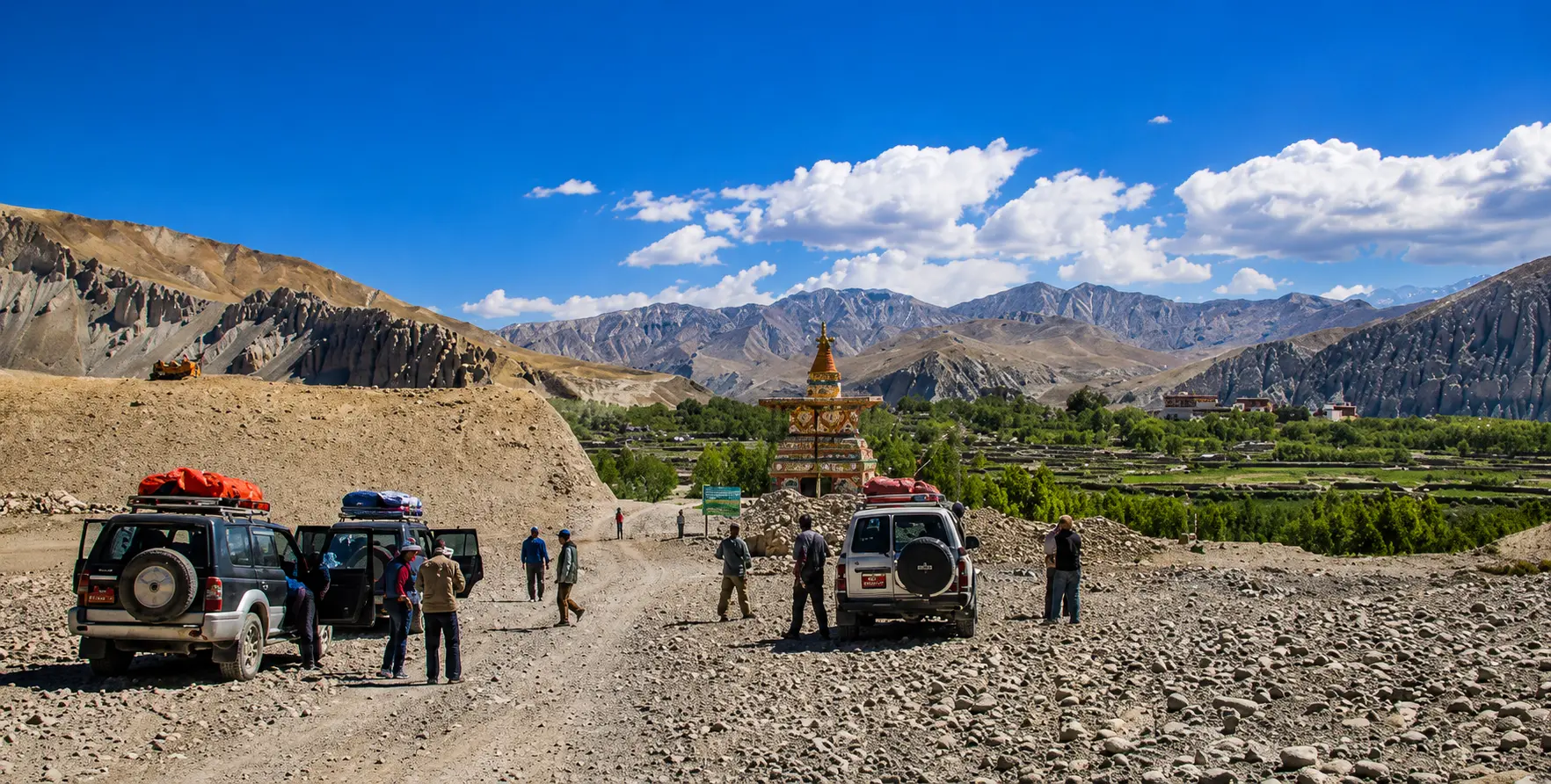
Korala Tibet Border Nepal – Nepal’s Gateway to Tibet: The Mustang Jeep Route to the Nepal-China Border 2026
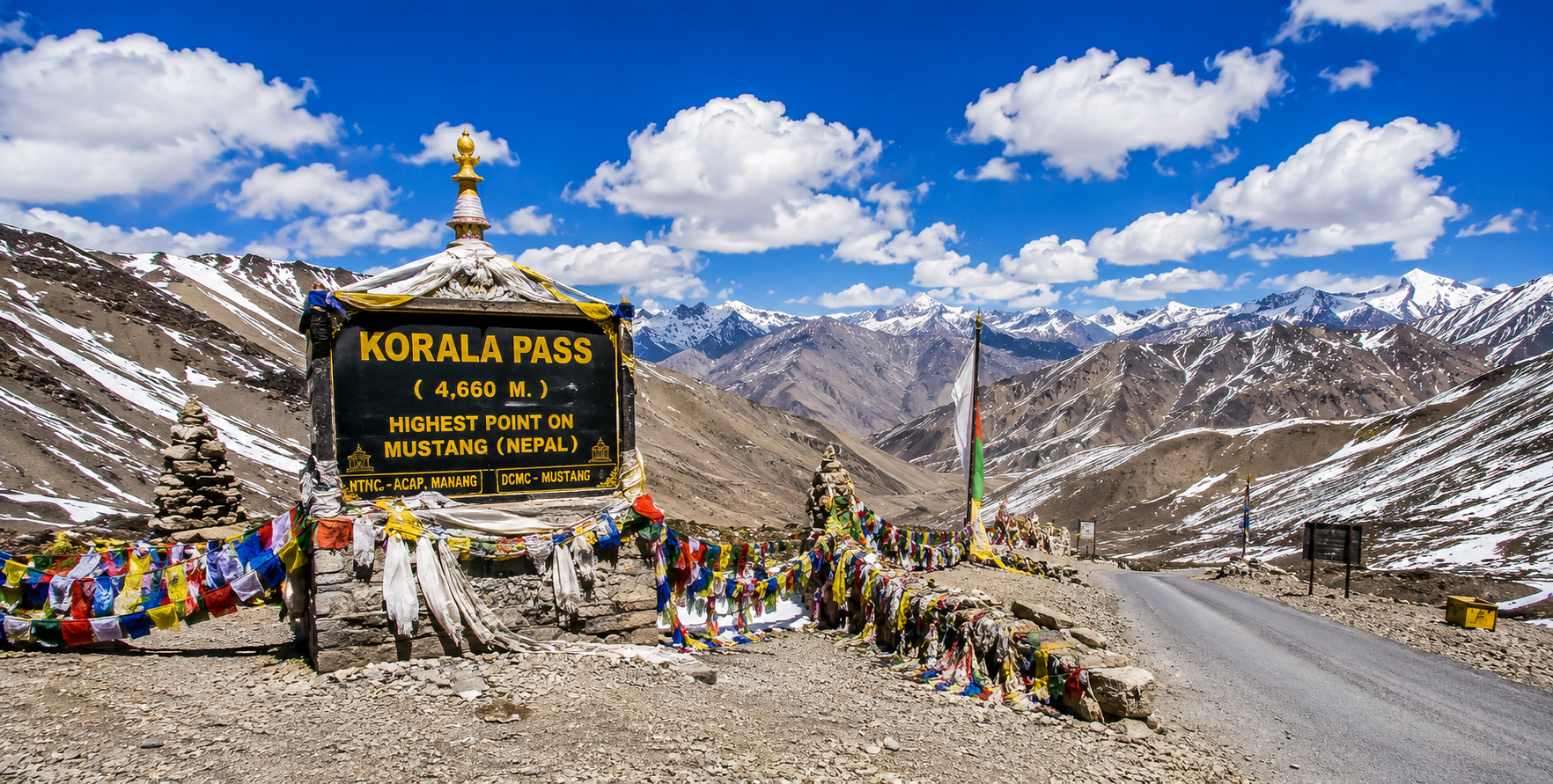
High on the wind-scoured plateau north of Lo Manthang, where the Kali Gandaki River has its source, and the Trans-Himalayan desert finally surrenders to the Tibetan Plateau, lies Korala — a remote mountain pass at 4,610–4,660 meters that holds a unique distinction in the entire Himalayan range: it is the lowest drivable crossing point between the Tibetan Plateau and the Indian subcontinent.
For centuries, this gentle saddle in the world’s highest mountain wall was the primary conduit of the great salt trade between Tibet and Nepal — the route that built the wealth of the Kingdom of Lo and its walled capital, Lo Manthang. Then, in the 1960s, it was sealed — a casualty of Cold War geopolitics, CIA-backed Khampa resistance operations, and the deepening freeze between Nepal’s northern neighbor and the outside world. For over sixty years, Korala stood as a closed gate on one of Asia’s most sensitive frontiers.
In 2026, that long closure is — for the first time in two generations — coming to an end. The Nechung immigration office became operational in November 2025, and Korala has rapidly transformed from a sealed military frontier into Nepal’s newest and most talked-about Himalayan gateway — recording over 6,000 domestic tourists in a single two-day period and generating more than NPR 200 crore in trade and customs revenue within just 14 days of expanded operations.
For pilgrims, Korala now offers a shorter, more direct, and significantly more affordable overland route to Mount Kailash and Lake Mansarovar than the traditional Kerung (Rasuwagadhi) crossing — and for travelers and photographers, it offers one of the most extraordinary jeep journeys remaining anywhere in Nepal: a drive through the walled medieval kingdom of Lo Manthang to the literal edge of Chinese-controlled Tibet.
Nepal Vehicle Hiring Pvt Ltd provides private 4WD jeep hire for the complete Pokhara/Jomsom to Lo Manthang and Korala border route — Nepal’s most demanding and most rewarding extreme off-road jeep journey. This guide covers the history of Korala, the current 2026 border situation, the complete road route, vehicle requirements, permits, the new Kailash Mansarovar pilgrimage connection, and a comprehensive FAQ.
Book your Korala / Upper Mustang jeep: Nepal Vehicle Hiring – Luxury Jeep | All Vehicles | Call/WhatsApp: +977 9851013196
Korala Tibet Border Nepal – Complete Overview 2026
| Location | Korala Pass, Lo Manthang Rural Municipality, Upper Mustang, Gandaki Province, Nepal |
| Altitude | 4,610–4,660 m – the lowest drivable pass across the main Himalayan range |
| Border With | Tibet Autonomous Region, China (Nechung–Liji customs point) |
| Status (2026) | Active vehicle border crossing – reopened 2023; immigration office at Nechung operational since Nov 2025 |
| Route from Pokhara | Pokhara → Jomsom (flight or road) → Lo Manthang (96 km jeep track) → Korala (~30 min further) |
| Road Distance (Pokhara–Korala) | Approx. 400 km via Beni, Jomsom, Kagbeni, Lo Manthang |
| Vehicle Required | 4WD MANDATORY – Toyota Land Cruiser strongly recommended above Kagbeni |
| Permits Required | Restricted Area Permit (RAP) USD 50/day + ACAP ~USD 30 + TIMS USD 20 + licensed guide mandatory |
| Why It Matters | New, shorter, more affordable overland route to Mount Kailash & Lake Mansarovar via Tibet |
| Best Season | June–September (rain-shadow desert, dry even in monsoon) and October–November |
| Crossing Status | Open to Nepali/Chinese/3rd-country pilgrims with a Chinese visa; NOT open for casual foreign tourists crossing the border |
| Contact | +977 9851013196 | vehiclehiringnepal.com |
Important – Understand What Korala Currently Is and Is Not
Before any practical planning, it is essential to understand the precise current status of the Korala crossing in 2026, since this is a rapidly evolving and highly sensitive international border:
- Korala is an officially active vehicle border crossing between Nepal and the Tibet Autonomous Region of China, with functioning customs facilities at Nechung (Nepal side) and Lektse (Chinese side).
- Crossing INTO Tibet requires a valid Chinese visa and registration with the Nechung immigration office — this is not a casual walk-up tourist border crossing. Chinese and foreign nationals entering NEPAL through Korala receive a 150-day on-arrival visa, but the reverse direction (from Tibet into Nepal) requires advance Chinese visa arrangements.
- The pilgrimage and trade use case is currently the primary driver of Korala’s reopening — specifically, supporting the Kailash Mansarovar Yatra for Nepali, Indian, and third-country pilgrims, as well as cross-border trade in consumer goods, pashmina, agricultural products, and yarsagumba.
- For the vast majority of travelers — independent tourists, photographers, and trekkers — the realistic and fully achievable experience is the jeep journey TO the Korala border post itself, standing at the fenced boundary line, viewing the Tibetan plateau and the Chinese military outpost in the distance, and returning to Lo Manthang. This is now a well-established and increasingly popular day excursion included in many Upper Mustang jeep tour itineraries.
- Always verify the current border status with your trekking agency and Nepal Vehicle Hiring before finalizing any itinerary — border-crossing regulations for this sensitive frontier can change with little notice, and Nepal Vehicle Hiring’s operations team monitors developments closely.
The History of Korala – From Salt Road to Sealed Frontier to Reopening
| Period | Key Development |
| Ancient era | Korala (4,660 m) was used for centuries as the main salt-trade route between Tibet and the Kingdom of Lo; it was the foundation of Lo Manthang’s wealth and culture |
| 1959–1960s | Tibetan Khampa guerrilla fighters use Mustang as a CIA-supported base for raids into Tibet; border tension rises sharply |
| 1961 | Nepal and China formally sign a border agreement; the international boundary is fixed slightly north of the traditional Korala marker stupa |
| 1960s–1990s | Border sealed by China; salt trade collapses; Mustang’s economy and Lo Manthang go into prolonged decline |
| 1992 | Upper Mustang formally opens to foreign trekkers for the first time as a Restricted Area |
| 2012 | Nepal and China agree to open 6 additional official border crossings, including Korala |
| 2016 | Nepal government announces that Korala is expected to become the third most important Nepal-China crossing |
| 2022–2023 | Chinese-side border infrastructure (Lektse port) completed; Nepali-side road and Nechung port developed; crossing formally opens for cargo. |
| Nov 2025 | Nechung immigration office becomes operational – first Nepali civilian delegation crosses into Tibet via Korala with Chinese visit visas |
| 2026 | Korala opens as a pilgrimage gateway to Mount Kailash & Lake Mansarovar; over 6,000 domestic tourists are recorded in a single 2-day period; trade revenue exceeds NPR 200 crore in 14 days. |
The Ancient Salt Trade – The Foundation of Mustang’s Civilization
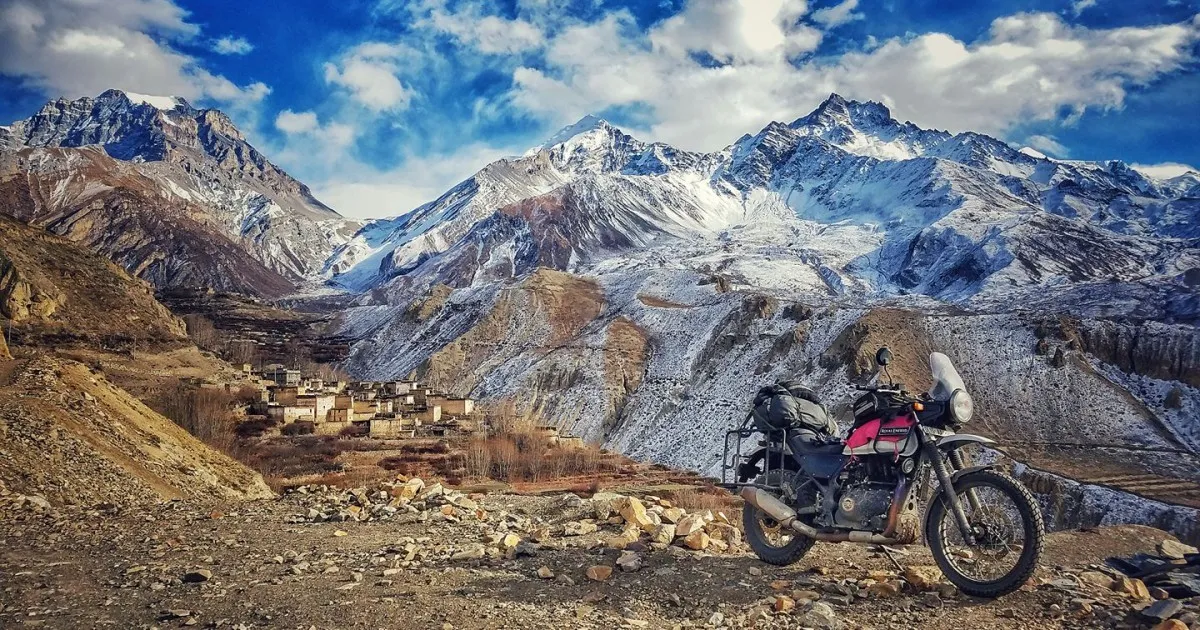
For the better part of a millennium, Korala Pass was the most important commercial artery connecting the Tibetan Plateau with the fertile lowlands of Nepal and India. Its unique geographical significance — at only 4,660 m, it is the lowest pass crossing the main Himalayan range anywhere along its 2,400 km length — made it accessible to heavily laden mule and yak caravans in a way that the higher, more treacherous passes elsewhere in the Himalaya were not.
Through Korala flowed Tibetan rock salt, harvested from the high-altitude lakes of the Changthang plateau, traded for grain, textiles, and manufactured goods from the Kali Gandaki valley and beyond. The Thakali people of the middle Kali Gandaki valley became the great commercial intermediaries of this trade, accumulating substantial wealth as middlemen — while further north, the Kingdom of Lo Manthang, founded in 1380 CE by Ame Pal, built its entire walled capital city, its monasteries, and its semi-autonomous political identity on the revenues and cultural exchange this trade route generated.
Cold War Closure – The CIA, the Khampas, and the Sealed Border
The pass’s long and largely peaceful commercial history was abruptly and dramatically interrupted in the late 1950s and 1960s, when Tibetan Khampa guerrilla fighters — armed and supported by the CIA — used the remote, sparsely governed terrain of Upper Mustang as a base for cross-border raids into Tibet against the People’s Liberation Army.
A tragic border incident — in which a Nepalese officer was mistakenly killed by Chinese border guards who believed him to be a Tibetan rebel — accelerated the crisis. In 1961, Nepal and China formally signed a border agreement fixing the international boundary slightly north of the traditional Korala marker, a stone stupa that had for centuries marked the unofficial frontier. Following the dramatic flight of the 17th Karmapa, Ogyen Trinley Dorje, across this same border area in December 1999, China constructed a substantial border fence — a visible, physical symbol of just how completely the once-thriving trade route had been severed.
The economic consequences for Mustang were severe and long-lasting. With its primary commercial lifeline cut, the region — already remote and difficult to access from the Nepali side — entered decades of economic decline and depopulation, as younger generations of Loba (the people of Lo) migrated to Kathmandu, Pokhara, and abroad in search of livelihoods that the isolated, trade-starved valley could no longer provide.
The only remaining echo of the great salt trade was a modest twice-yearly cross-border trade fair, permitted under careful supervision, where traders from both sides could meet for a few days at the sealed border — a fragile and symbolic remnant of what had once been a flourishing commercial corridor.
The Reopening – Infrastructure, Diplomacy, and 2025–2026 Breakthrough
The modern reopening of Korala has been a gradual, carefully managed diplomatic and infrastructure process spanning more than a decade. In 2012, Nepal and China agreed in principle to open six additional official border crossings, with Korala identified as one of the most strategically important. By 2016, the Nepali government was publicly projecting Korala as set to become the third most significant Nepal-China border crossing, after Rasuwagadhi-Kerung and Tatopani-Khasa.
Physical construction proceeded steadily through the following years: the Nepali government built the motorable road from Jomsom through Lo Manthang to the Korala border itself, while on the Chinese side, port facilities at Lektse in Shigatse Prefecture were completed, alongside a parallel new immigration and customs facility at Nechung, on the Nepali side in Chhoser, Lomanthang Rural Municipality.
The crossing formally reopened for cargo and limited cross-border trade in 2023 — but the truly transformative breakthrough came in November 2025, when the Nechung immigration office finally became fully operational, allowing — for the first time since the 1960s — Nepali citizens with valid Chinese visit visas to cross into Tibet through Korala formally.
A historic first delegation of 13 local representatives, led by Lomanthang Rural Municipality Chairperson Tashi Nhurbu Gurung, made the symbolic crossing — a moment that local leaders, including Mustang Chamber of Commerce President Raju Lalchan, described as “a big achievement for the entire Gandaki Province.”
The Jeep Route to Korala – Pokhara / Jomsom to Lo Manthang and Beyond
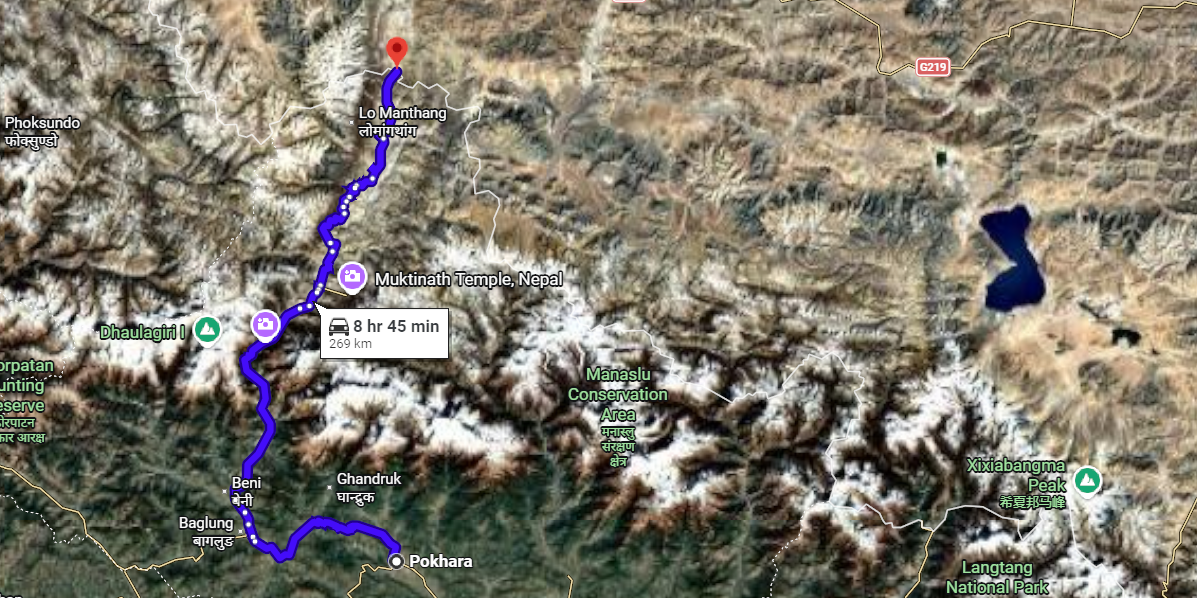
| Segment | Distance | Time | Road & Highlights |
| Pokhara to Jomsom | 165–200 km | 8–9 hrs (road) / 25 min (flight) | Beni, Tatopani, Kali Gandaki gorge – the world’s deepest river gorge between Annapurna and Dhaulagiri |
| Jomsom to Kagbeni | 12 km | 30–45 min | Last ACAP checkpoint before Upper Mustang Restricted Area; Kali Gandaki riverbed track |
| Kagbeni to Charang | 50 km | 3–4 hrs | RAP checkpoint at Kagbeni; trans-Himalayan high desert; red cliffs of Dhakmar; Ghami village |
| Charang to Lo Manthang | 20 km | 1.5–2 hrs | Walled medieval city (3,810 m); 600-year-old Kingdom of Lo capital; royal palace; ancient monasteries |
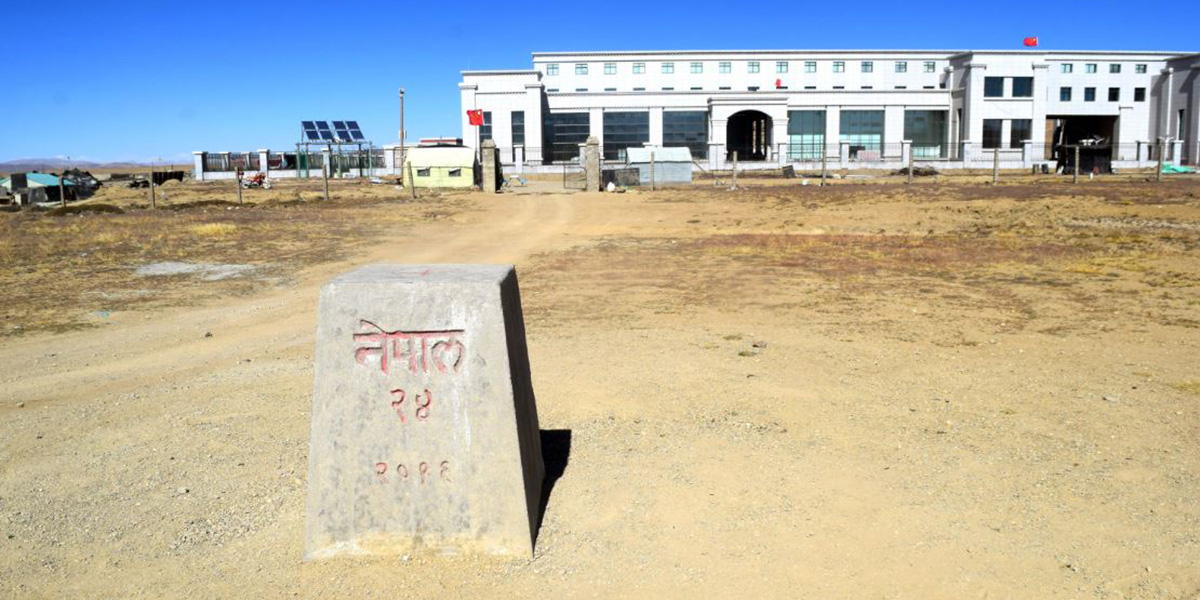
| Lo Manthang to Korala | 24–30 km | 45 min – 1 hr | Final off-road jeep track; trans-Himalayan desert plateau; PILLAR 24 Nepal-China border marker |
Pokhara to Jomsom – Entering the Trans-Himalayan World
The journey to Korala begins with the now-classic Pokhara to Jomsom route — either a dramatic 25-minute mountain flight past the flanks of the Annapurna and Dhaulagiri massifs, or an equally spectacular 8–9 hour jeep drive via Beni and the Kali Gandaki gorge — widely considered the deepest river gorge on Earth, with the Kali Gandaki flowing in the shadow of two 8,000-metre peaks (Annapurna I and Dhaulagiri I) standing on either bank. Nepal Vehicle Hiring operates this route regularly as part of our broader Muktinath and Upper Mustang jeep services — see our Pokhara Airport to Muktinath Jeep Rental guide for full route details. blog.
Jomsom to Lo Manthang – Entering the Forbidden Kingdom
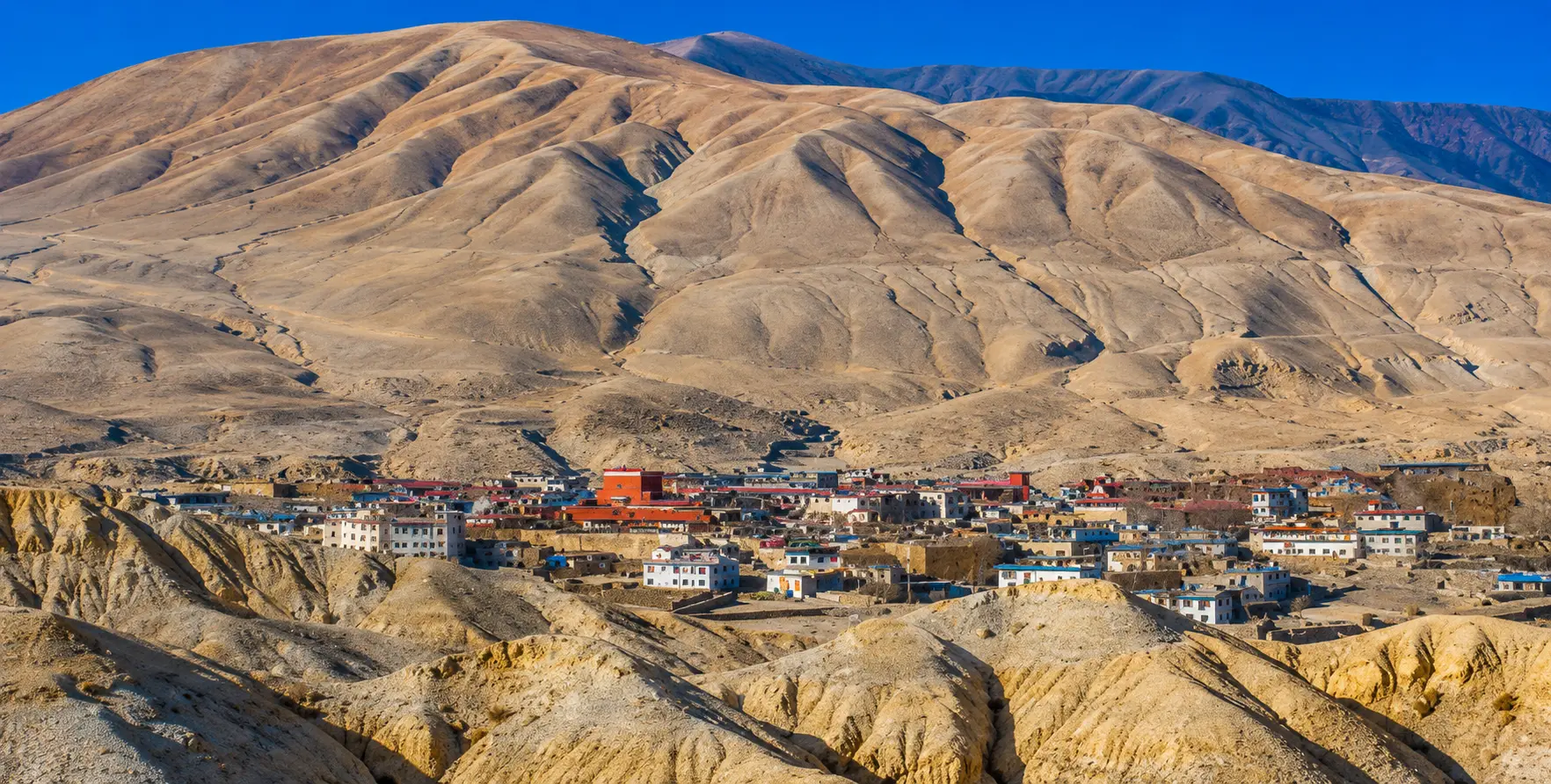
From Jomsom, the route continues north through Kagbeni (2,810 m) — the final ACAP checkpoint and the formal gateway into the Upper Mustang Restricted Area. Beyond Kagbeni, the landscape transforms completely: lush valley vegetation gives way to a genuine trans-Himalayan high-altitude desert — eroded red and ochre cliffs, wind-sculpted canyon formations, scattered chortens and mani walls, and the famous sky caves carved into vertical rock faces by communities seeking refuge and meditation retreat over many centuries.
The jeep track passes through Chele, Ghami, Charang, and the dramatic red cliffs of Dhakmar before arriving at Lo Manthang (3,810 m) — the walled medieval capital of the former Kingdom of Lo, home to approximately 1,300 people of Tibetan descent and one of the last intact medieval Tibetan Buddhist urban environments anywhere in the world.
Lo Manthang to Korala – The Final Approach to the Border
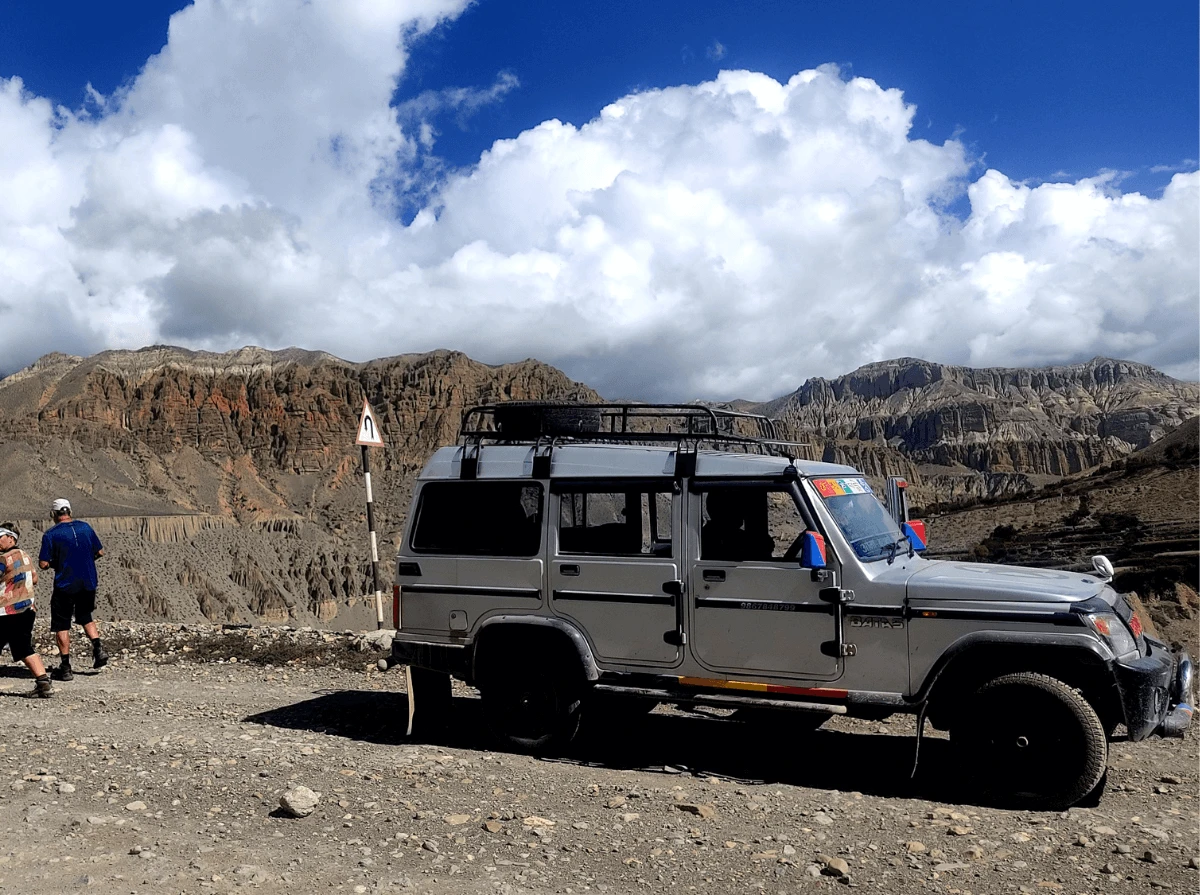
From Lo Manthang, the road to Korala covers a final 24–30 km of off-road jeep track across the high trans-Himalayan plateau, taking approximately 45 minutes to one hour. This is among the most remote and dramatic drivable sections of road anywhere in Nepal — a windswept, treeless, near-lunar landscape where the only vegetation is sparse high-altitude scrub, and the only sounds are wind and the engine of your own vehicle.
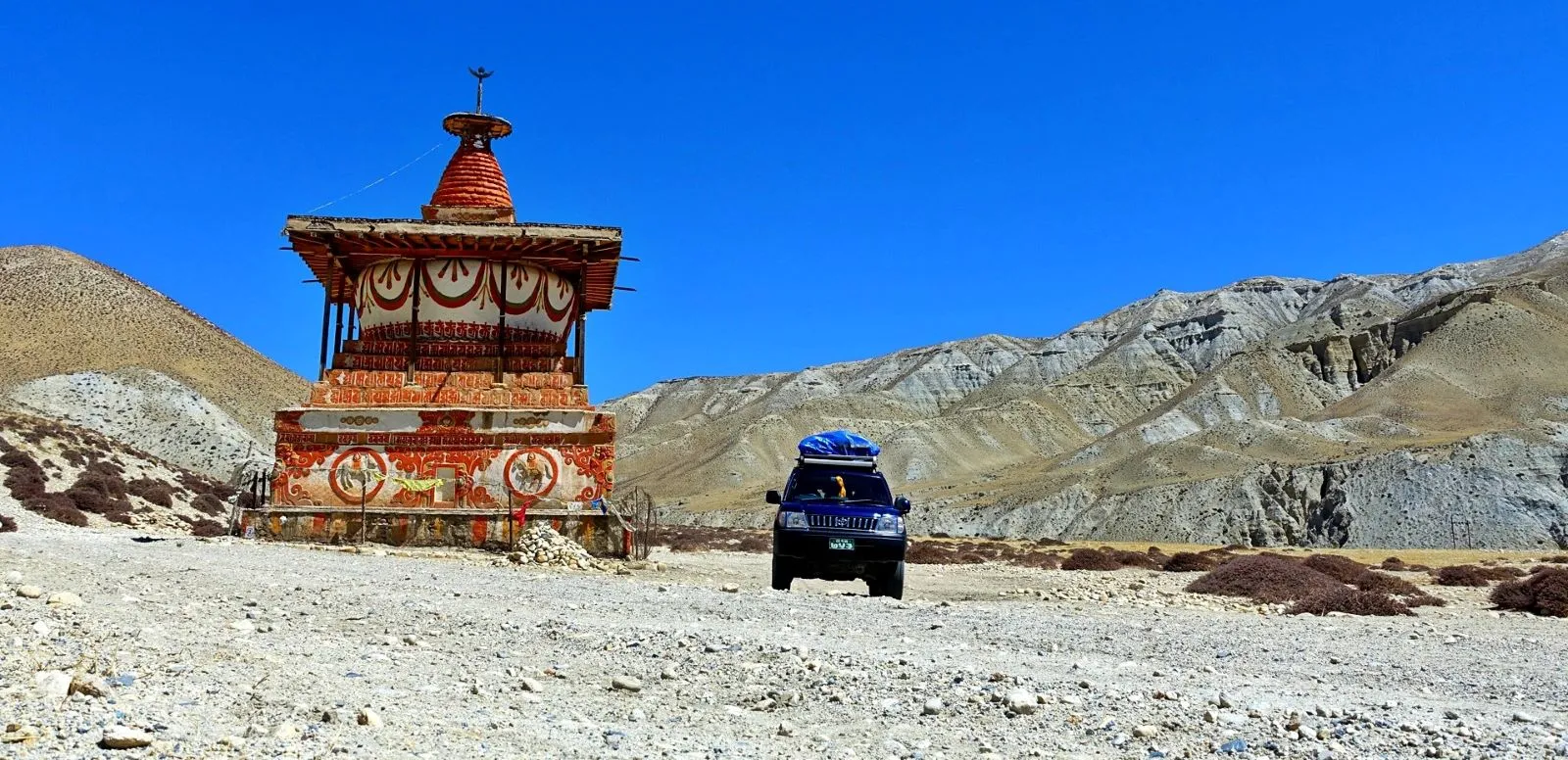
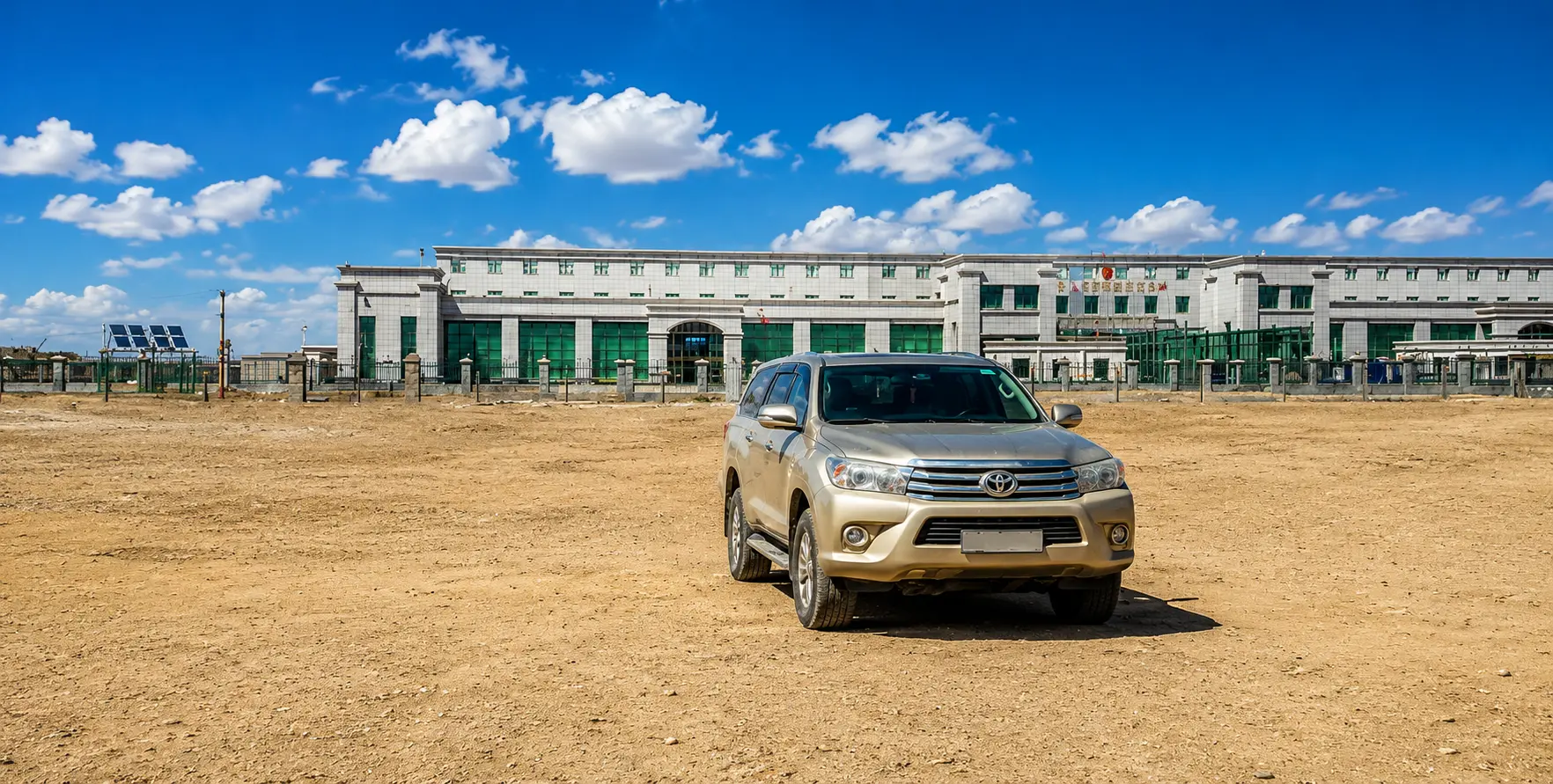
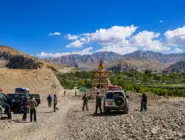
The road climbs gradually to the Korala pass itself at 4,610–4,660 m, where travelers can stand at the fenced international boundary, view the ancient marker stupa just south of the formally demarcated line, and look north into the vast, empty expanse of the Tibetan plateau, with the Chinese military outpost visible in the distance. As of 2026, there are functioning customs and immigration facilities at the Nepal-side Nechung port, a significant change from the bare, unstaffed frontier of even a few years earlier.
Korala and the New Mustang Route to Mount Kailash and Mansarovar
Perhaps the single most significant practical consequence of Korala’s 2025–2026 reopening is the emergence of a genuinely new, shorter, and more affordable overland pilgrimage route to Mount Kailash and Lake Mansarovar — sacred to Hindus, Buddhists, Jains, and followers of the indigenous Tibetan Bon religion alike. For Hindu pilgrims in particular, Mount Kailash (6,638 m) is revered as the eternal abode of Lord Shiva, and circumambulating it — along with bathing in the pristine waters of Lake Mansarovar — is believed to confer profound spiritual merit and liberation.
Until recently, virtually all overland pilgrims traveling from Nepal reached Kailash via the Rasuwagadhi-Kerung border crossing in the Langtang region. This route involved a significant detour through central Nepal before entering Tibet. The Korala route offers a dramatically more direct alternative for pilgrims already in or traveling through Mustang and Gandaki Province.
From Som, it is approximately 96 km by jeep to Lo Manthang (around 4.5 hours), followed by a short drive to the Nechung-Liji customs point at Korala. From the Chinese side, modern paved roads at Xiong Wazhen in Shigatse Prefecture connect onward — a roughly 580 km, six-hour drive — to Mount Kailash and Lake Mansarovar. Pilgrims can now overnight in Lo Manthang and reach the Nepal-Tibet border at Korala within just half an hour the following morning — a logistical transformation compared to the older routes.
According to Immigration Office Chief Pravesh Baduwal, this route is also significantly more economical, with pilgrims traveling the traditional Indian routes to Kailash often spending upwards of NPR 200,000 per person. In contrast, the Mustang-Korala route offers a substantially cheaper path to the same sacred destination.
Chinese and foreign nationals entering Nepal through Korala are granted a 150-day free on-arrival visa. However, foreign pilgrims traveling in the opposite direction — into Tibet — must still complete standard formalities, including a USD 500 restricted-area entry fee and an additional cap charge, arranged through a registered trekking or pilgrimage agency.
Nepal Vehicle Hiring provides the essential first-leg jeep transport for any Korala-route Kailash Mansarovar pilgrimage — the private 4WD journey from Pokhara or Jomsom through Kagbeni, Lo Manthang, and to the Korala customs point itself, where pilgrims transition to the Tibet-side arrangements coordinated by their registered pilgrimage agency.
The Geography and Natural Significance of Korala
Korala’s elevation of 4,610–4,660 m makes it not merely a convenient trade route but a genuine geographical landmark of the entire Himalayan range. As the lowest pass crossing the main Himalayan chain along its full length, it forms a critical point on the watershed ridgeline — sitting precisely on the drainage divide between the Yarlung Tsangpo river basin (which becomes the Brahmaputra) to the north and the Ganges river basin to the south.
Remarkably, the Kali Gandaki River — one of Nepal’s seven major river systems and the river that has carved the world’s deepest gorge between Annapurna and Dhaulagiri — has its very source near the southern side of the Korala pass. Geologists and mountaineers also note Korala’s role as a key connecting col on the long ridgeline linking K2 to Mount Everest within the broader Himalayan-Karakoram chain. This detail places this remote, little-known pass within one of the most significant topographic frameworks on the planet.
The landscape immediately surrounding Korala is classic high trans-Himalayan desert — situated firmly within the rain shadow of the Annapurna and Dhaulagiri ranges, which intercept the vast majority of monsoon moisture arriving from the Bay of Bengal before it can reach Upper Mustang. The result is a landscape of striking aridity: bare eroded hillsides in shades of ochre, red, and grey, sparse vegetation, and an intensity of light and color that feels genuinely otherworldly — closer in character to the Tibetan plateau itself than to any other part of Nepal.
This rain-shadow effect also makes Upper Mustang, including the Korala excursion, one of the very few regions in Nepal that remain fully accessible and enjoyable even during the summer monsoon season (June–August), when most of the rest of the country is shrouded in cloud and rain.
Permits and Requirements for the Korala Jeep Excursion 2026
| Permit | Cost | Applies To | Notes |
| Restricted Area Permit (RAP) | USD 50 per person per day | Upper Mustang beyond Kagbeni, incl. Korala excursion | 2026 reform: pay only for actual days, no 10-day minimum |
| ACAP | USD 30 (NPR 3,000) | All Annapurna Conservation Area incl. Mustang | Obtain in Kathmandu or Pokhara before departure |
| TIMS Card | USD 20 | All foreign trekkers in conservation areas | Standard safety registration |
| Licensed Guide | Included in the agency package | Mandatory – checked at Kagbeni | Solo trekking has been permitted since March 2026, but a guide is still required. |
| Tibet entry (if crossing) | Chinese visit visa + cap charge | Only those physically crossing into Tibet at Korala | NOT for casual tourists – separate from RAP; arranged via registered agency |
The 2026 Restricted Area Permit Reform
A significant change for travelers in 2026 is the reform of the Upper Mustang Restricted Area Permit (RAP) system. The previous flat USD 500 fee for a mandatory minimum 10-day stay has been replaced by a flexible USD 50 per person per day rate, calculated based on the actual number of days spent in the restricted zone beyond Kagbeni. This makes shorter jeep tours to Lo Manthang and Korala significantly more affordable than under the old system.
For example, a 5-day jeep tour now costs approximately USD 250 in RAP fees, down from the previous flat USD 500. Additionally, as of March 2026, the historic ‘minimum two-person’ group requirement has been lifted, officially permitting solo trekkers and travelers to obtain permits in their own name — though a licensed guide remains mandatory for all visitors, checked at the Kagbeni checkpoint.
Distinguishing the RAP Excursion from Actually Crossing the Border
Travelers need to understand the distinction between two very different activities: (1) the jeep excursion to Korala viewpoint/border post, which is covered entirely by the standard Upper Mustang RAP, ACAP, and TIMS permits that any Upper Mustang visitor already holds — no additional permit is required to drive to and view the border simply
(2) physically crossing into Tibet at Korala, which requires a separate Chinese visit visa, registration through the Nechung immigration office, and (for foreign nationals specifically) the standard USD 500 restricted area fee plus cap charge on the Chinese side — arranged exclusively through a registered pilgrimage or trekking agency with established Tibet-side partnerships. The vast majority of Nepal Vehicle Hiring’s Korala jeep clients undertake activity (1) — the spectacular jeep drive to the border itself.
Best Vehicles for the Lo Manthang and Korala Jeep Route
Toyota Land Cruiser 4WD – The Only Vehicle for This Terrain
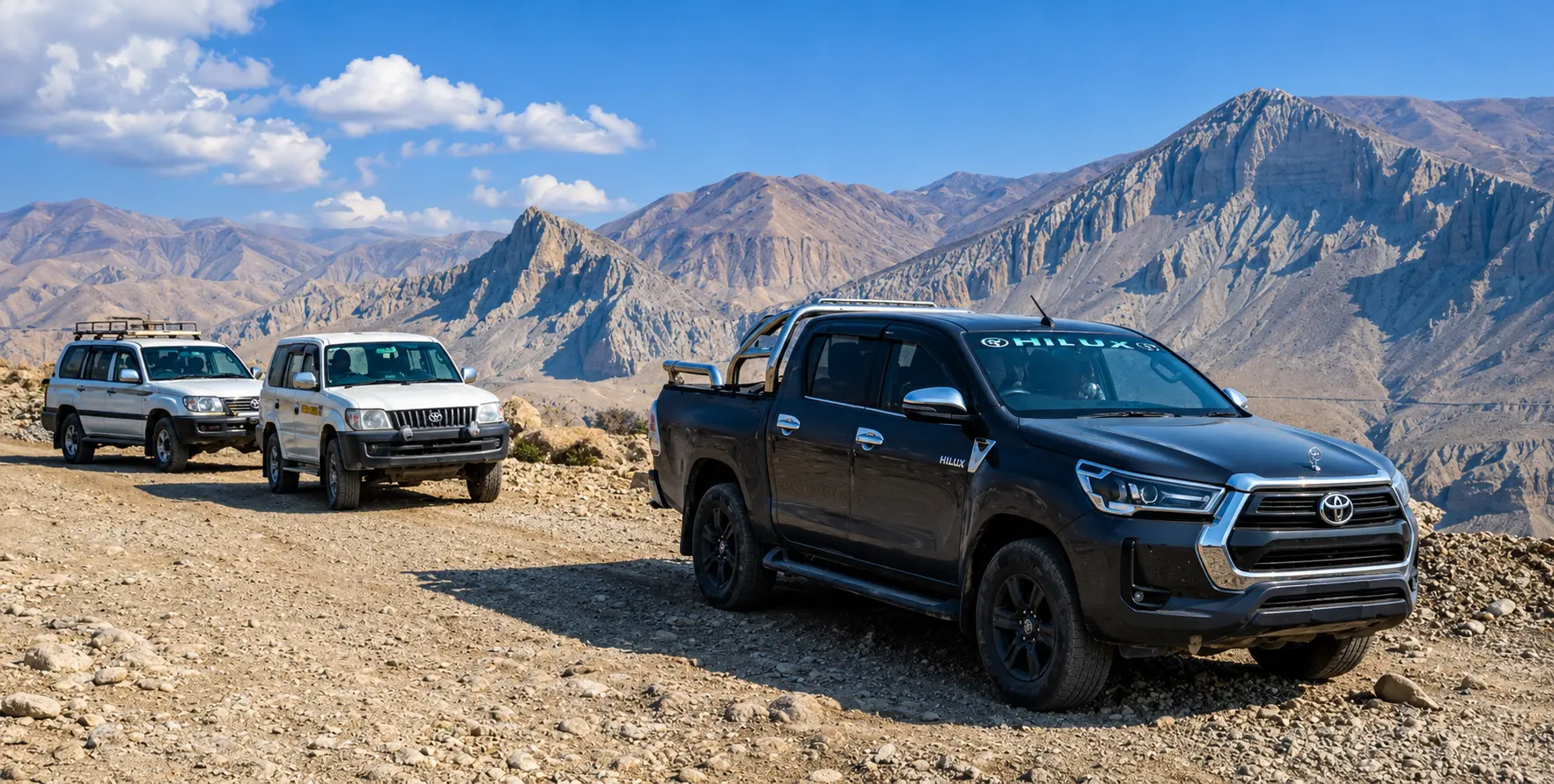
Nepal Vehicle Hiring deploys Toyota Land Cruiser 4WD vehicles (LC300 and LC200 series) exclusively for the Kagbeni-Lo Manthang-Korala route — the single most demanding extreme off-road jeep journey in our entire Nepal route network. The 82 km Kagbeni–Lo Manthang track alone is widely regarded as Nepal’s most challenging highway-accessible off-road route, with exposed cliff sections, loose scree fields, river crossings, and sustained altitude above 3,800 m for its entire length.
The additional 24–30 km of final approach from Lo Manthang to Korala adds genuinely extreme high-altitude desert terrain, with climbs to over 4,600 m. The Land Cruiser’s 225 mm ground clearance, locking differentials, multi-terrain select system, and proven mechanical reliability at extreme altitude are not luxuries on this route — they are the minimum standard required for safe, reliable travel. See our Luxury Jeep Hire Nepal page for full Land Cruiser specifications.
Why Standard 4WDs and the Scorpio Are Not Recommended Beyond Lo Manthang
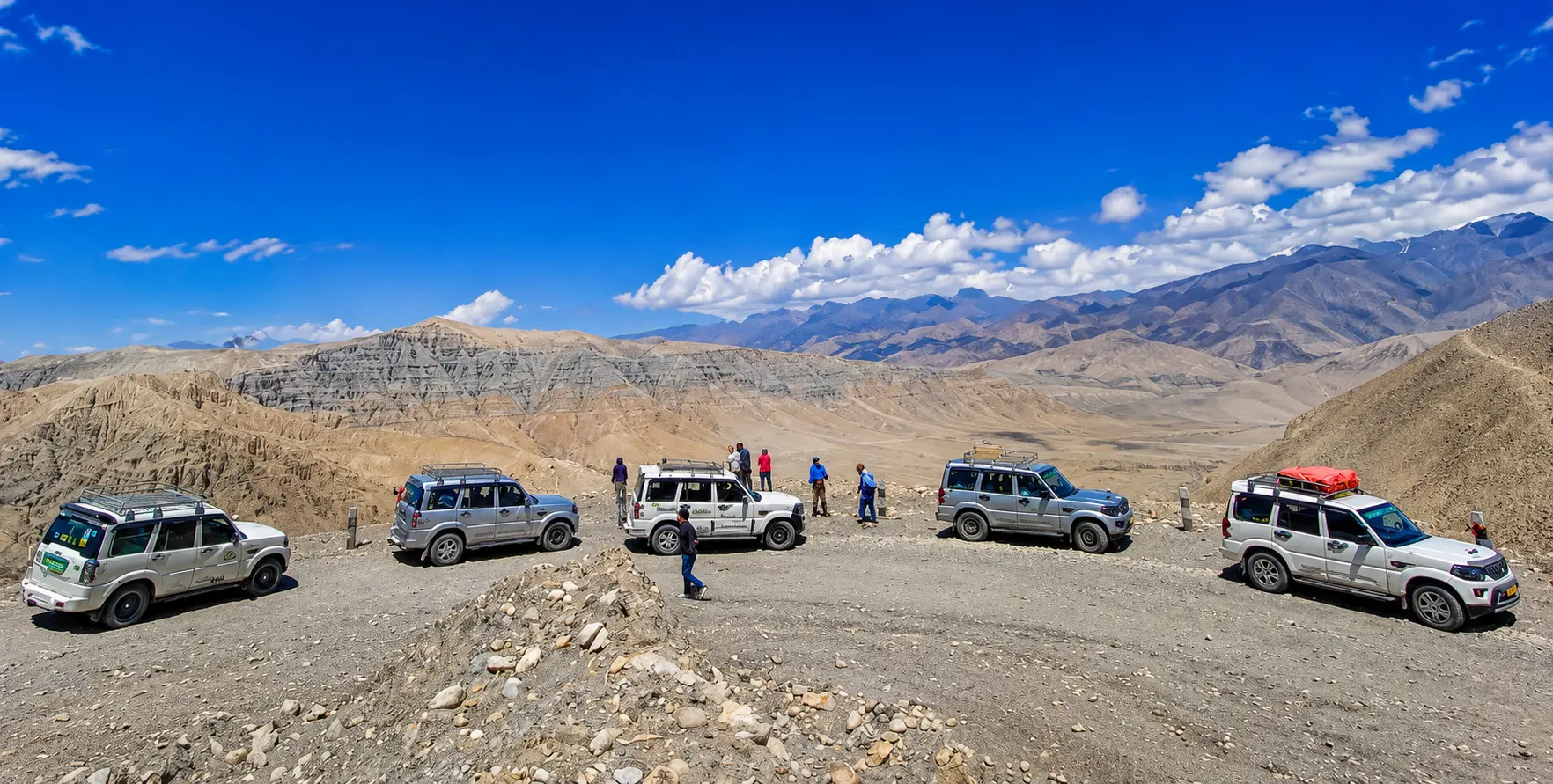
While the Mahindra Scorpio and Bolero are excellent, fully proven vehicles for most of Nepal’s mountain routes, including the Kagbeni to Lo Manthang section in good conditions, Nepal Vehicle Hiring’s specific professional recommendation for the final Lo Manthang–Korala extension is the Land Cruiser exclusively. The combination of extreme altitude (above 4,600 m), the genuinely remote and unsupported nature of this final stretch, and the proximity to a sensitive international border makes the additional margin of mechanical reliability and high-altitude engine performance that the Land Cruiser provides a genuine safety consideration rather than a comfort preference.
Best Time to Visit Korala – Seasonal Guide 2026
Korala and the wider Upper Mustang region benefit from a unique seasonal calendar compared to the rest of Nepal, owing to their position deep within the Annapurna-Dhaulagiri rain shadow:
- June to September (Monsoon): Paradoxically, it is one of the best times to visit Korala and Upper Mustang, precisely because the rain shadow keeps the region largely dry while the rest of Nepal experiences heavy monsoon rainfall and landslide risk. The Pokhara–Beni–Jomsom approach road can experience monsoon-related delays, but once in the Mustang rain-shadow zone, conditions are typically excellent. This is also the peak season for the Kailash Mansarovar Yatra via the Tibetan plateau, with most pilgrimage operators recommending May to September for the crossing.
- October to November (Autumn): Excellent visibility, stable road conditions, and comfortable daytime temperatures make this Nepal’s classic peak-trekking and jeep-touring season for Upper Mustang and Korala alike. Cold nights at Lo Manthang and Korala (sub-zero) should be expected.
- March to May (Spring): A strong second option, with good road conditions and warming temperatures, though afternoon winds in the Kali Gandaki valley sections can be strong — early morning starts are recommended.
- December to February (Winter): Extremely cold at the Korala altitude, with the possibility of snow closure on sections of the route. Not recommended for the Korala extension without specific local guidance and a highly experienced driver-guide team.
Why Travel to Korala – The Experience
Standing at One of Asia’s Most Storied Frontiers
There are few places in the world where a traveler can stand at a genuine, functioning international border between two of the planet’s most significant civilizations in a landscape of such stark, silent, high-altitude beauty, with over a thousand years of trade, conflict, faith, and human exchange embedded in the very ground underfoot. The ancient marker stupa, the ruins of historic trade infrastructure, the new customs buildings, and the fenced demarcation line with the Chinese military post visible across the plateau together create an experience that is simultaneously historically profound, geopolitically fascinating, and visually extraordinary.
The Ultimate Extension to an Upper Mustang Jeep Tour
For travelers who have already committed to the substantial investment of time, permit fees, and travel required to reach Lo Manthang, the Korala extension represents a relatively modest additional time commitment (45 minutes to 1 hour each way) for an outsized increase in the depth and uniqueness of the experience. Many Upper Mustang jeep tour itineraries — including those operated by Nepal Vehicle Hiring’s partner trekking agencies — now build in a dedicated half-day or full-day excursion to Korala as the symbolic culmination of the journey to “the end of the road” in Nepal’s far northern frontier.
Essential Travel Tips – Korala Jeep Excursion 2026
- Confirm Current Border Access Status: Given the rapidly evolving nature of this reopening, always confirm with Nepal Vehicle Hiring and your trekking agency the current status of Korala access before finalizing your itinerary — conditions and regulations at this sensitive frontier can change.
- Acclimatize Properly Before Lo Manthang and Korala: With Korala at 4,610–4,660 m, proper acclimatization through the Kagbeni–Lo Manthang ascent is essential. Do not attempt a rushed single-day dash to Korala without prior altitude exposure.
- Pack for Extreme Cold and Wind: Temperatures at Korala can be bitterly cold even in summer, with strong, sustained winds across the exposed plateau. A down jacket, a windproof outer layer, gloves, and a warm hat are essential year-round.
- Carry Cash – No Facilities Beyond Lo Manthang: There are no ATMs or shops beyond Lo Manthang. Carry sufficient Nepali Rupees for the entire Upper Mustang and Korala excursion.
- Respect the Sensitivity of the Border Zone: Photography restrictions may apply near the immediate customs and military facilities. Always follow your guide’s and driver’s specific guidance at the border post itself.
- Book Land Cruiser Well in Advance: Given the surging interest in Korala following its 2025–2026 reopening, Nepal Vehicle Hiring recommends booking Land Cruiser jeep hire for this route 3–4 weeks in advance, particularly during the June–September and October–November peak windows.
Related Vehicle Hire Services – Nepal Vehicle Hiring
- Pokhara Airport to Muktinath Jeep Rental
- Muktinath Tour from Kathmandu – Complete Guide
- Luxury Jeep Hire in Nepal (Land Cruiser)
- Pokhara to Beni Jeep Hire
- The Ultimate Nepal Vehicle Rental Guide
- Mahindra Bolero and Tata Sumo Trekking Transfer
- Nepal Trekking Packages
Frequently Asked Questions – Korala Tibet Border Nepal 2026
Can foreign tourists cross the border at Korala into Tibet?
Crossing into Tibet at Korala requires a valid Chinese visit visa and registration through the Nechung immigration office, arranged through a registered pilgrimage or trekking agency — it is not a casual walk-up tourist crossing. Foreign nationals also pay a USD 500 restricted area fee plus an additional cap charge. The vast majority of independent travelers instead undertake the jeep excursion to the Korala border post and viewpoint, which requires only the standard Upper Mustang RAP, ACAP, and TIMS permits.
How far is Korala from Kathmandu and Pokhara?
From Pokhara, the road distance to Korala via Beni, Jomsom, Kagbeni, and Lo Manthang is approximately 400 km. From Jomsom specifically, it is approximately 96 km by jeep to Lo Manthang (around 4.5 hours), with Korala a further 24–30 km (45 minutes to 1 hour) beyond.
What vehicle do I need to reach Korala?
A genuine 4WD vehicle is mandatory, and Nepal Vehicle Hiring strongly recommends the Toyota Land Cruiser exclusively for the Lo Manthang-Korala extension, given the extreme altitude (over 4,600 m), remote terrain, and proximity to a sensitive international border zone.
Is Korala part of the new Kailash Mansarovar pilgrimage route?
Yes — since the Nechung immigration office became operational in November 2025, Korala has emerged as a new, shorter, and more affordable overland route to Mount Kailash and Lake Mansarovar for pilgrims, connecting via Nechung-Liji customs to Xiong Wazhen in Shigatse Prefecture and onward to Kailash (approximately 580 km / 6 hours on the Tibetan side).
What permits do I need for the Korala jeep excursion?
The standard Upper Mustang Restricted Area Permit (RAP – USD 50/day as of 2026), ACAP (~USD 30), and TIMS Card (USD 20) cover the jeep excursion to the Korala border post. A licensed guide is mandatory and is checked at the Kagbeni checkpoint. No additional permit is required to view the border, provided you are not physically crossing into Tibet.
What is the best time of year to visit Korala?
October–November and March–May are the classic peak seasons. Notably, because Upper Mustang sits in the Annapurna-Dhaulagiri rain shadow, June–September (monsoon) is also a genuinely excellent and increasingly popular time to visit, as the region remains largely dry while most of Nepal experiences heavy rainfall.
Can Nepal Vehicle Hiring arrange the full Pokhara-to-Korala jeep journey?
Yes — Nepal Vehicle Hiring provides complete private 4WD Land Cruiser jeep hire for the full Pokhara/Jomsom-to-Kagbeni, Lo Manthang, and Korala border route, including experienced high-altitude drivers familiar with this extreme route. Contact us at +977 9851013196 to plan your Korala jeep excursion or your first-leg transport to Kailash Mansarovar.
Book Your Korala Border Jeep Excursion Today – Nepal Vehicle Hiring 2026
Korala represents something genuinely rare in 2026 Nepal travel: a historic frontier reopening in real time, a journey to the literal edge of the Tibetan plateau, and a route steeped in a thousand years of salt-trade history, Cold War drama, and renewed 21st-century diplomacy — all reachable by private 4WD jeep from Pokhara through the walled medieval kingdom of Lo Manthang. Nepal Vehicle Hiring Pvt Ltd’s Toyota Land Cruiser fleet and experienced high-altitude drivers make this extraordinary journey to Nepal’s northern frontier safe and comfortable.
Call / WhatsApp: +977 9851013196 | Website: vehiclehiringnepal.com | Book Land Cruiser for Upper Mustang & Korala | Nepal Trekking Packages
- Korala Tibet Border Nepal – Nepal's Gateway to Tibet: The Mustang Jeep Route to the Nepal-China Border 2026
- Korala Tibet Border Nepal – Complete Overview 2026
- Important – Understand What Korala Currently Is and Is Not
- The History of Korala – From Salt Road to Sealed Frontier to Reopening
- The Jeep Route to Korala – Pokhara / Jomsom to Lo Manthang and Beyond
- Korala and the New Mustang Route to Mount Kailash and Mansarovar
- The Geography and Natural Significance of Korala
- Permits and Requirements for the Korala Jeep Excursion 2026
- Best Vehicles for the Lo Manthang and Korala Jeep Route
- Best Time to Visit Korala – Seasonal Guide 2026
- Why Travel to Korala – The Experience
- Essential Travel Tips – Korala Jeep Excursion 2026
- Related Vehicle Hire Services – Nepal Vehicle Hiring
- Frequently Asked Questions – Korala Tibet Border Nepal 2026
- Book Your Korala Border Jeep Excursion Today – Nepal Vehicle Hiring 2026

Related Blog & Articles
Adventure Bike Hire in Nepal: The Complete 2026 Guide to Motorcycle Rentals
4WD Himalayan Jeep in Nepal
Hidden Kingdom Adventure Nepal Upper Mustang Jeep Tour
Mustang Full Guide: Upper & Lower Mustang Vehicle Hire