Lumbini to Pokhara Private Jeep | Best Price Guide


QUICK REFERENCE: Lumbini to Pokhara Private Jeep
| |
| Approximate Distance | Roughly 180-200 km via the Siddhartha Highway |
| Typical Drive Time | 6 to 8 hours by private vehicle, including rest stops |
| Route Character | Terai plains, then sustained winding mountain road through the hills |
| Recommended Vehicle | Private car or SUV for small groups; Jeep or Hiace for families and groups |
| Best Season | October to April for the clearest mountain views on arrival |
| Contact | +977 9814227196 | vehiclehiringnepal.com |
Few journeys in Nepal deliver a change of scenery as complete as the road from Lumbini to Pokhara. You begin on the flat, subtropical plains of the Terai at the birthplace of the Buddha, and you finish beside a lake in the foothills of the Annapurna range, with Machapuchare rising directly above the water. A
Lumbini to Pokhara private jeep transfer is by some distance the most comfortable and flexible way to make that transition, and this guide covers everything the journey involves.
Below you will find the route in detail, realistic timing, an honest explanation of what actually determines price on this corridor, vehicle guidance, seasonal considerations, and how to slot this transfer into a wider Nepal itinerary. Nepal Vehicle Hiring has run this corridor for years, and this guide draws on that direct route experience rather than generic travel copy.
Why This Route Is Different From Nepal’s Other Terai Transfers
It is worth noting from the outset that this isn’t a flat highway journey. Travellers who have driven the
Lumbini to Chitwan corridor, covered in our companion guide, will find this route substantially different. Where that journey runs east along the Terai plains on largely level ground, the Lumbini to Pokhara route turns north at Butwal and climbs into the hills on the Siddhartha Highway, a road known throughout Nepal for its sustained curves, steep drop-offs, and genuine scenic reward.
This matters in several practical ways: the drive takes longer than the distance suggests, motion sickness becomes a real consideration for susceptible travellers, vehicle condition and driver skill matter much more, and monsoon-season landslide risk is a real factor rather than a theoretical one.
The Route in Detail
Lumbini to Butwal: The Terai Leg
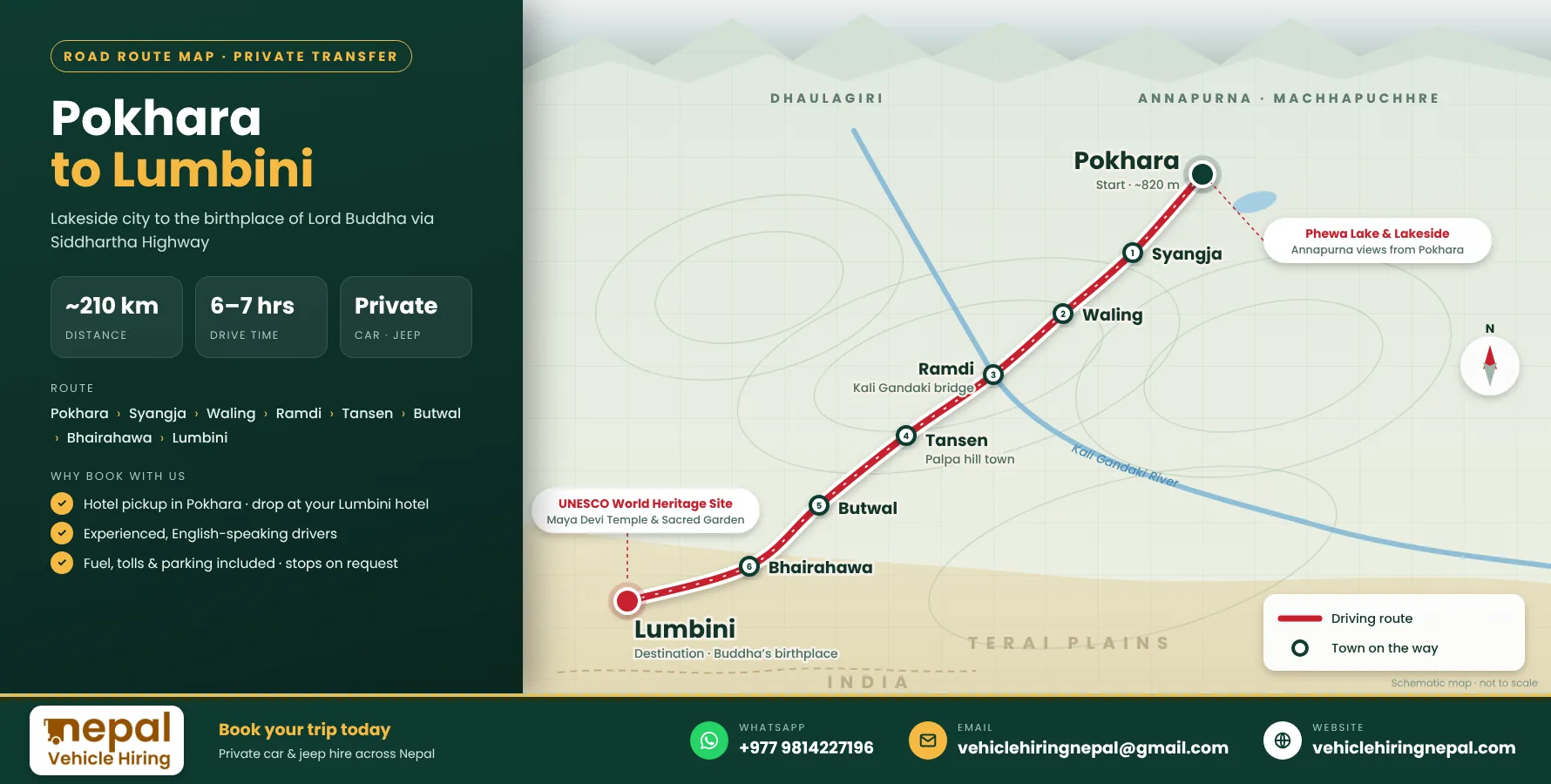
The first stage runs roughly 40 kilometres east and north from Lumbini through Bhairahawa to Butwal, taking about an hour on a flat, well-surfaced road. Butwal sits where the Terai plains meet the first hills, making it both a geographic transition and the practical junction where the Siddhartha Highway begins its climb north toward Pokhara.
Butwal is the best place to handle practical needs before the mountain section begins: fuel, cash from an ATM, snacks and water, and a proper restroom stop. Services become considerably more limited and more basic once the road starts climbing.
Butwal to Tansen: Into the Hills
From Butwal, the Siddhartha Highway climbs steadily through forested hillsides, following the Tinau River valley before winding up toward Palpa district. This stretch offers the journey’s first genuine mountain driving, with continuous curves and rising elevation. Tansen, the hill town and Palpa’s district headquarters, sits roughly midway along the route and is the most rewarding lunch or rest stop on the entire drive.
Tansen to Waling and Syangja
Beyond Tansen, the road continues north through Syangja district, passing Waling and a series of hill settlements, with the terrain remaining consistently winding throughout. On clear days, this section offers the first distant glimpses of the Annapurna range, a genuine highlight that builds anticipation for arrival.
The Final Approach to Pokhara
The last stretch descends toward the Pokharavalleye.On a clear morning, the reveal of Machapuchare and the Annapurna massif as you approach the city ranks among Nepal’s most memorable arrivals. Most itineraries end at a Lakeside hotel, roughly twenty to thirty minutes beyond the city’s edge, depending on the property.
Tansen: The Stop Worth Building In
Tansen deserves more than a passing mention. This Newar hill town, sitting at around 1,350 metres, retains a genuinely well-preserved traditional character with narrow stone-paved streets, traditional Newar architecture, and a hilltop setting offering panoramic views across the surrounding Mahabharat range and, on clear days, north toward the Himalaya.
The town is known for its handwoven dhaka fabric, used in the traditional Nepali topi, and the local weaving workshops make a worthwhile short visit. Srinagar Danda, a short walk or drive above the town, offers the best viewpoint in the area and is a genuinely rewarding thirty-minute detour for travellers not pressed for time.
Many travellers treat Tansen simply as a lunch stop, which is entirely reasonable given the length of the day. Those with flexibility, however, sometimes break the journey overnight here, turning a long single-day transfer into two considerably more relaxed half-days with a genuine cultural stop in between.
Understanding Pricing: An Honest Guide
Travellers searching for the best price on this route deserve a clear explanation of what drives costs, not a headline figure that may not apply to their circumstances. Several genuine variables shape pricing on this corridor, and understanding them puts you in a much stronger position when comparing quotes.
Vehicle Class
A standard private car costs meaningfully less than a Land Cruiser, Scorpio, or larger Hiace. Unlike genuinely rough trekking routes, the Siddhartha Highway is paved throughout, so a standard car is mechanically adequate. That said, the sustained curves make a slightly larger, better-suspended vehicle noticeably more comfortable over six to eight hours, and many travellers consider the difference worth the cost.
Group Size
Cost per person falls considerably as group size rises. A single Hiace carrying eight travellers is far more economical per head than multiple cars covering the identical route.
One-Way Versus Round Trip
A one-way drop in Pokhara means the driver returns to base empty, and pricing reflects this. Travellers continuing onward from Pokhara rather than returning should expect this to be factored in.
Season and Demand
The October to April window sees peak demand across this corridor, with both tourist traffic and vehicle availability tightening. Booking ahead during these months secures both availability and better rates than last-minute arrangements.
Stops and Detours
Adding a Tansen sightseeing stop, a Srinagar Danda viewpoint detour, or an overnight break affects the driver’s schedule and total engagement time, which is reflected in pricing.
Rather than quoting a figure here that may be outdated by the time you read this, we recommend contacting our team with your group size, travel dates, and exact pickup and drop points for a current, transparent quote. Visit our
homepage or explore our
Hiace hire pages for the full fleet.
How to Recognise a Fair Quote on This Route
A genuinely fair quote on the Siddhartha Highway should be transparent about several specifics. It should name the exact vehicle model rather than a vague category, since the comfort difference across six to eight hours of continuous curves is substantial. It should confirm whether fuel, driver allowance, and any tolls are included rather than added later. It should state the exact drop-off point, since Lakeside hotels vary in their approach access. It should also confirm the vehicle’s air conditioning and general mechanical condition, both of which matter on a long mountain day.
Suspiciously low quotes on this corridor sometimes indicate shared rather than private transport, an older vehicle with tired suspension that turns the winding sections genuinely unpleasant, or an operator without proper commercial insurance on a route where accident risk is meaningfully higher than on flat highway. On the Siddhartha Highway in particular, the cheapest option is frequently poor value.

Vehicle Options for This Route
Private Car
Adequate and economical for one to three passengers with modest luggage, though the ride quality on sustained curves is noticeably firmer than a larger vehicle.
SUV or Jeep
Generally the sweet spot for this route. The higher seating position, better suspension, and additional space make a genuine difference across a long winding day, bookable through our
Jeep Hire in Nepal service.
Hiace Van
The standard choice for groups of six to ten, offering both seating and luggage capacity. Travellers prone to motion sickness should request a front seat where possible, since rear seating in a van can amplify the sensation of curves.
Coaster and Bus
For larger tour groups and pilgrimage parties, our
Coaster and Bus hire fleet handles the full group in one vehicle.
Motion Sickness: A Genuine Consideration Here
This deserves its own section because it affects a meaningful proportion of travellers on this specific route. The Siddhartha Highway involves several hours of near-continuous curves, and passengers who are entirely comfortable on flat highway journeys frequently struggle here. Practical measures genuinely help: sit in the front seat when possible, keep a window slightly open for airflow, avoid reading or screen use while moving, eat lightly before departure rather than heavily, and take motion sickness medication in advance rather than after symptoms begin.
Travellers who know they are susceptible should mention this when booking, so we can assign a vehicle with better ride quality, brief the driver to maintain smoother, more measured cornering, and build in more frequent short stops.
Best Time of Year for This Journey
Autumn (October to November)
The clearest skies of the year, offering the best chance of the full Annapurna reveal on approach to Pokhara, along with stable road conditions. This is peak season, so book in advance.
Winter (December to February)
Excellent visibility continues, with cool but comfortable conditions in the hills. Occasional morning fog in the Terai around Butwal can delay early departures during the coldest weeks.
Spring (March to April)
Rhododendron bloom colours the hill sections, and conditions remain generally good, though increasing haze can reduce mountain visibility toward late spring.
Monsoon (June to September)
The Siddhartha Highway is genuinely susceptible to landslide disruption during heavy monsoon rainfall, and this is the one season when schedule flexibility isn’t optional. Travel remains possible, and the hillsides are spectacularly green, but travellers should build buffer time into their plans.
Road Safety and Monsoon Considerations
The Siddhartha Highway has a reputation in Nepal for demanding driving conditions, with sustained curves, steep roadside drops, and mixed traffic, including heavy goods vehicles. This is not cause for alarm, but it is a genuine reason to choose your operator on quality rather than price alone. An experienced driver familiar with this specific corridor, in a well-maintained vehicle with reliable brakes, transforms the risk profile of the journey.
During and immediately after the monsoon, landslide activity can temporarily close sections of the highway. Our drivers monitor current conditions and will advise on realistic timing, alternative routing where available, or in rare cases a recommendation to postpone. Travellers journeying between June and September should treat a buffer day as sensible, not excessive.
Lumbini Before You Depart
Most travellers give Lumbini at least a full day before continuing to Pokhara, and the site rewards it. The Maya Devi Temple marks the traditionally identified birthplace of Siddhartha Gautama, with the marker stone and ancient brick foundations visible within. The nearby Ashoka Pillar, dating to 249 BCE, provides epigraphic evidence that supports the site’s identification. The surrounding monastic zone, where Buddhist nations from across the world have built monasteries in their own architectural traditions, is best explored slowly by bicycle.
Travellers arriving in Lumbini from Kathmandu can arrange that leg through our
Kathmandu to Lumbini bus and private vehicle service, making a full Kathmandu, Lumbini, Pokhara sequence a single coordinated booking.
Pokhara on Arrival: What Awaits
Pokhara holds an unusual place in Nepal’s tourism landscape, serving as both a relaxed lakeside destination and the primary gateway to the Annapurna trekking region. Phewa Lake anchors the Lakeside district, with boating, waterfront restaurants, and the Tal Barahi temple on its island. The World Peace Pagoda above the lake’s southern shore offers a classic Pokhara panorama, and the city’s caves, waterfalls, and museums fill additional days comfortably.
For travellers continuing into the mountains, Pokhara serves as the departure point for virtually every Annapurna region trek, covered in full detail in our companion guide to
trekking transport hire in Pokhara, alongside our
Sarangkot sunrise tour services for travellers staying in the city itself.
A Realistic Timeline for the Day
A well-planned transfer day begins with departure from Lumbini between seven and eight in the morning. This allows the Butwal leg to finish before the day warms, gets you to Tansen around midday for a proper, unhurried lunch, and leaves a comfortable margin to reach Pokhara Lakeside in daylight in the late afternoon.
Departing later compresses everything, and arriving in Pokhara after dark removes both the scenic arrival and the convenience of settling into accommodation in daylight. Travellers wanting a final Lumbini sacred garden visit on departure morning should plan it for the very opening hour, returning to depart by eight at the latest.
Combining This Route Into a Wider Nepal Itinerary
This transfer slots into several common Nepal itinerary structures. Travellers entering overland from India via the Sunauli crossing near Bhairahawa often start in Lumbini before continuing to Pokhara and then Kathmandu. Travellers flying into Gautam Buddha International Airport at Bhairahawa follow a similar pattern with a shorter initial leg.
Others reverse the sequence entirely, arriving in Pokhara from Kathmandu via our
Kathmandu-to-Pokhara service before travelling south to Lumbini and exiting toward India. A third common structure adds Chitwan, creating a Lumbini, Chitwan, Pokhara triangle covered partly in our
Pokhara to Chitwan guide.
Why Choose Nepal Vehicle Hiring for This Corridor
Our drivers assigned to the Siddhartha Highway are familiar with this road’s curves, traffic patterns, reliable rest stops, and the current landslide-prone sections that change season to season. Our vehicles undergo inspection with particular attention to brakes, suspension, and tyres, all of which matter more on sustained mountain descent than on flat highway. We also coordinate closely with our sister companies,
Trek Nepal Himalayas, for travellers continuing from Pokhara into the Annapurna region on treks such as the
The Siddhartha Highway: History and Engineering
Named after the Buddha’s given name and connecting his birthplace region to the Pokhara valley, the Siddhartha Highway represents a significant piece of Nepal’s mid-twentieth-century infrastructure development. Built with Indian assistance and completed in stages through the 1960s and 1970s, the road opened a direct north-south connection between the Terai plains and the hill regions of western Nepal, transforming trade and travel patterns that had previously depended on foot trails and considerably longer circuitous routes.
The engineering challenge was substantial. The route climbs from around 100 metres at Butwal to over 1,500 metres at points along the Palpa ridge before descending toward Pokhara’s valley floor at roughly 800 metres, all through geologically young and actively eroding Mahabharat range terrain. The sustained curves travellers experience today are a direct result of the gradient management this terrain demanded, and the ongoing landslide maintenance the road requires reflects the same underlying geology.
Understanding the Terrain You Cross
This journey crosses three distinct physiographic zones within a single day. The Terai, where Lumbini sits, forms part of the Gangetic plain, with alluvial soils, subtropical climate, and intensive agriculture. The Siwalik, or Churia hills, appear first after Butwal; they are Nepal’s youngest and most erosion-prone range, composed of relatively soft sedimentary rock. Beyond them lies the Mahabharat range, higher and more geologically stable, where Tansen and most of the route’s hill sections sit.
This progression explains much of what travellers experience: the heat and humidity of the opening leg, the particularly winding and landslide-prone early climb through the Siwaliks, and the more settled, cultivated hill landscape of the Mahabharat section before the final descent into Pokhara’s valley.
Palpa District and Its Cultural Character
The hill sections of this route pass through Palpa, a district with a genuinely distinct historical identity. Palpa was an independent principality before Nepal’s unification, and Tansen served as its seat. The district retains a strong Newar cultural presence alongside Magar communities, and this mixed heritage shows in Tansen’s architecture, festivals, and craft traditions.
The Rani Mahal, sometimes called the Taj Mahal of Nepal, sits below Tansen on the banks of the Kali Gandaki River and was built in 1893 by a Nepali general in memory of his wife. Reaching it requires a substantial detour and a walk, so most single-day transfer itineraries skip it, but travellers breaking the journey overnight in Tansen sometimes include it.
Rest Stops Along the Route
Choosing good rest stops makes a real difference on this journey. Butwal offers the most comprehensive services on the route, with fuel, ATMs, pharmacies, and a range of restaurants, and it should be treated as the main practical stop before the mountain section begins. Tansen offers the best combination of food quality and scenic setting for a main meal break, and its position roughly midway makes the timing natural.
Beyond Tansen, roadside options become more basic, typically small tea shops and simple dal bhat establishments serving mostly local traffic. These are perfectly serviceable for a short break, but travellers with specific dietary requirements or a preference for more developed facilities should plan their main stops around Butwal and Tansen.
What to Bring for the Journey
- Water and light snacks, since roadside options between main stops are limited and basic.
- Motion sickness medication if you are susceptible, taken before departure rather than after symptoms begin.
- A light layer, since hill sections can feel noticeably cooler than the Terai even on warm days.
- Cash in Nepali rupees, since card acceptance is limited outside Butwal and Pokhara.
- A camera that’s easy to carry rather than packed, given the scenic sections and potential mountain views.
- Any medication you need during the day, since pharmacies are concentrated in Butwal and Pokhara.
Photography Along the Siddhartha Highway
This route rewards photographers considerably more than its reputation as a transfer corridor suggests. The early hill sections above Butwal offer layered ridge views through morning haze. Tansen’s traditional streetscape and the Srinagar Danda viewpoint deliver both cultural and landscape opportunities. On clear days, the Syangja section can offer distant Annapurna views, and the final descent toward Pokhara occasionally reveals the full massif that so many travellers remember from this journey.
Travellers prioritising photography should mention this when booking, since a driver briefed to stop at better viewpoints rather than drive through can transform what’s possible. Autumn and winter mornings offer the best visibility for mountain photography on this corridor.
Birdlife and Natural Features Along the Route
The forested sections of the Siwalik and lower Mahabharat hills support a genuinely diverse bird population, and interested travellers may spot a range of species from the vehicle during slower sections. The Tinau and Kali Gandaki river systems, visible at points along the route, add further habitat variety, and the transition from subtropical Terai vegetation to temperate hill forest across the day’s elevation gain is evident to anyone watching the changing tree species alongside the road.
Travelling This Route With Children
Families should carefully weigh the route’s length and winding character when travelling with young children. Private vehicle hire offers substantial advantages over shared transport here: the ability to stop whenever needed, control over cabin temperature and airflow, space for children to be comfortable, and no fixed schedule creating pressure. Motion sickness affects children disproportionately on this corridor, and the practical measures outlined earlier apply even more strongly.
Families with genuine concerns about the journey length sometimes split it across two days with an overnight in Tansen, which most find transforms the experience considerably for younger travellers.
Travelling This Route With Elderly Passengers
Elderly travellers generally manage this route well provided the vehicle offers good ride quality, and the schedule includes regular stops. Sustained curves are more physically tiring than flat highway driving, so adding an extra rest stop beyond the standard Butwal and Tansen breaks is worthwhile. Travellers with back or joint conditions,, in particular benefit from aetter suspension, and this is one route where paying for a more comfortable vehicle class is genuinely justified rather than simply a luxury.
Accessibility Considerations
Travellers with mobility limitations should discuss specific requirements when booking, since vehicle selection, assistance availability at rest stops, and the accessibility of the final Pokhara destination all warrant advance consideration. Nepal’s general accessibility infrastructure remains limited compared to many countries, and careful planning yields a much better outcome than assuming facilities will be available.
Comparing Private Jeep to Tourist Bus on This Route
Tourist buses operate between the Lumbini and Bhairahawa area and Pokhara, and for solo budget travellers they offer a genuinely economical option. The trade-offs on this specific corridor are more pronounced than on flatter routes, however. Fixed departure times, no control over stop frequency across six to eight hours of winding road, shared cabin conditions where motion sickness in other passengers affects the whole vehicle, and drop-off at a central bus park rather than your Lakeside hotel all matter more here than they would on a shorter, flatter journey.
For families, groups, elderly travellers, anyone susceptible to motion sickness, or travellers who value comfort on a demanding road, private hire delivers proportionally greater benefit on this route than on almost any other Terai-origin transfer covered across our guides.
Comparing the Overland Route to Flying
Some schedules connect Bhairahawa to Pokhara by domestic flight, offering an obvious time saving over a six- to eight-hour drive. The trade-offs include limited and sometimes seasonal scheduling, weather-related cancellation risk, baggage limitations, and the complete loss of the scenic and cultural content the overland route delivers. Travellers with very tight schedules sometimes fly, but most choose the road, and most report that the drive itself is a genuine part of the experience rather than merely transit.
Luggage Planning
Travellers on a broader Nepal circuit frequently carry substantial luggage, particularly those continuing from Pokhara into trekking. Communicating total luggage volume at booking ensures vehicle selection accounts for it, since a vehicle adequate for passenger seating may not comfortably take the accompanying bags. This matters particularly for groups that choose a Hiace for seats but need to confirm matching luggage capacity.
Connectivity Along the Corridor
Mobile coverage along the Siddhartha Highway is generally serviceable but not continuous, with reliable signal around Butwal, Tansen, Waling, and the Pokhara approach, and patchier coverage through some of the intervening forested and steep-sided sections. Travellers should not rely on continuous connectivity across the full journey. However, the gaps are brief, and this corridor remains far better served than the remote mountain routes covered elsewhere in our guides.
Currency and Payment Practicalities
Nepali rupees remain essential throughout the journey for roadside stops, tea shops, and incidental purchases. ATMs are readily available in Butwal and Pokhara, and Tansen has limited facilities, but travellers should not count on card acceptance at any point between Butwal and Pokhara. Withdrawing adequate cash in Butwal before the hill section begins is the practical approach.
Travel Insurance for This Route
Standard travel insurance covering road travel is appropriate for this journey, with no special high-altitude or adventure activity provisions required for the transfer itself. Travellers continuing from Pokhara into trekking should separately confirm their policy covers the specific altitude and activity level of their planned trek, a point covered in more detail in our Pokhara trekking transport guide.
A Sample Five-Day Lumbini and Pokhara Itinerary
A practical five-day structure begins with arrival in Lumbini, whether from the Sunauli border, Bhairahawa airport, or overland from Kathmandu, with an afternoon for orientation and rest. Day two offers a full Lumbini exploration, with the sacred garden in the cool early morning and a bicycle tour of the monastic zone in the afternoon. Day three covers the transfer throughout this guide, departing early and arriving in Pokhara Lakeside by late afternoon. Day four allows a full Pokhara day, typically a Sarangkot sunrise excursion followed by lakeside relaxation, boating, or a visit to the World Peace Pagoda. Day five continues either to Kathmandu, into an Annapurna trek, or for onward departure.
Travellers with additional time can comfortably extend either end, with an extra Pokhara day in particular offering scope for a Sarangkot paragliding flight, a day hike, or simply a slower pace before continuing.
Extending Into an Annapurna Trek
A substantial proportion of travellers making this transfer continue directly into an Annapurna region trek from Pokhara. Practically, at your arrival time, rest-day planning should account for an early trekking departure, typically the following morning. Arriving in Pokhara with a full evening and a relaxed morning before a trek departure gives you a much better start than arriving late and leaving at dawn.
Our companion guide to
trekking transport hire in Pokhara covers every major trailhead reachable from the city, including Nayapul, Kande, Phedi, and the longer Jomsom corridor, and coordinating both this transfer and the onward trailhead transport through one provider simplifies the overall booking considerably.
Pilgrimage Travel Along This Corridor
Buddhist pilgrims visiting Lumbini often travel in organised groups that require Coaster or full bus capacity, and these bookings come with their own coordination needs around ceremony timings at the sacred garden, group dietary arrangements along the route, and realistic pacing for older pilgrims over a long, winding day. Our team regularly supports this kind of group pilgrimage transport and can advise on appropriate vehicle configuration and timing.
Travellers combining Buddhist and Hindu pilgrimage within a single Nepal journey may find our companion guides to
Muktinath Temple and the
Rasuwagadhi Kerung route for Kailash Yatra useful, since Muktinath in particular is reachable onward from Pokhara and pairs naturally with a Lumbini visit for travellers interested in both traditions.
Seasonal Character of the Hill Sections
The hill sections between Butwal and Pokhara change noticeably through the year, affecting the travel experience beyond road conditions. Autumn brings the clearest air of the year, with terraced hillsides in the final stages of the rice harvest and golden fields layered across the slopes. Winter delivers crisp visibility and cool,l comfortable travel, with occasional morning fog pooling in the valleys below the road,d creating genuinely striking conditions.
Spring adds rhododendron colour through the higher forested stretches alongside the fresh green of new cultivation. At the same time,ile the monsoon transforms the entire corridor into dense, saturated green, with waterfalls appearing on hillsides that are dry the rest of the year. Each season offers something distinct, and flexible travellers may find the choice worth considering beyond pure weather reliability.
Understanding Highway Traffic Patterns
The Siddhartha Highway carries a genuine mix of traffic, including heavy goods vehicles moving between the Indian border and Nepal’s hill regions, local buses serving communities along the route, and tourist vehicles. Heavy vehicle traffic tends to be most concentrated during daytime hours, and slow-moving trucks on the steeper climbing sections can extend journey times beyond estimates during busier periods.
An early departure helps in this respect as well as for the reasons already covered, since the earlier hours generally see lighter commercial traffic on the climbing sections above Butwal. Experienced drivers familiar with the corridor understand these patterns and pace the journey accordingly.
What Previous Travellers Say About This Journey
Feedback from travellers who have made this transfer consistently emphasises several themes. The journey takes longer than the map distance suggests, and travellers who arrive expecting a four-hour drive are consistently surprised. Tansen is repeatedly mentioned as an unexpected highlight, with many travellers wishing they had allowed more time there. The winding sections genuinely affect susceptible passengers, and those who prepared for this report a much better experience than those who did not. And the mountain reveal on approach to Pokhara, when conditions allow it, is frequently described as a genuine trip highlight rather than simply an arrival.
Choosing Your Departure Point in Lumbini
The Lumbini spans a considerable footprint, with accommodation ranging from properties immediately adjacent to the sacred garden to hotels in Bhairahawa town roughly twenty kilometres away, plus comfortable monastery guesthouses within the development zone itself and confirming your exact pickup point when booking avoids confusion on departure morning, especially since the monastic zone’s internal road network isn’t always obvious to drivers unfamiliar with a specific property.
Travellers staying in Bhairahawa rather than Lumbini proper effectively shorten the journey slightly, since Bhairahawa sits closer to Butwal and the start of the Siddhartha Highway.
Choosing Your Arrival Point in Pokhara
Pokhara also stretches across a wide area, and the practical difference between a central Lakeside hotel, a property in the quieter northern Lakeside stretch, and a hotel near Pokhara city can mean a meaningful extrave at the end of an already long day. Providing your exact hotel name and address at booking allows accurate routing. It avoids the frustration of arriving in the general area and then circling to find a specific property in fading light.
Arriving in Pokhara: First Evening Suggestions
Travellers arriving in Lakeside in the late afternoon often find the simplest first evening works best after a long transfer: a walk along the lake shore, an early dinner at a waterfront restaurant, and an early bedtime ahead of whatever the following days hold. Sarangkot sunrise excursions, the most popular Pokhara morning activity, require a pre-dawn departure, so travellers planning that for their first full morning benefit particularly from an early night on arrival day.
Environmental Considerations on This Corridor
The Siwalik and Mahabharat hill sections of this route pass through genuinely fragile terrain, where road construction, vehicle traffic, and ongoing erosion interact in ways visible to any attentive traveller through landslide scars, road repair work, and slope stabilisation efforts. Travellers can contribute in real ways by avoiding roads. Travellers can along a corinaste collection is limited, and by choosing operators who maintain their vehicles, thereby mitigating lotheir vehicles, thereby route also form ppal’s community forestry network, among the more successful programmes of its kind globally, with local user groups managing and protecting forest resources. The visible forest cover along parts of the Siddhartha Highway reflects decades of that community management rather than simply undisturbed wilderness.
Supporting Local Economies Along the Route
Stopping in Butwal and Tansen, rather than simply driving through, supports roadside economies that depend on highway traffic, from restaurants and tea shops to craft producers in Tansen whose Dhaka weaving tradition is genuinely distinctive. Travellers who treat the journey as including these stops, rather than simply as necessary pauses, contribute meaningfully to communities along a corridor that sees considerable through-traffic but comparatively little lingering visitor spending.
A Final Word on Value Versus Price
Returning to the pricing question that brings many readers to this guide, genuine value on the Siddhartha Highway comes from a combination of factors rather than the headline number alone. A vehicle with suspension and ride quality appropriate to six or more hours of sustained curves. A driver with specific experience of this road’s demands rather than general driving experience. Transparent inclusion of fuel, driver allowance, and tolls. Direct delivery to your actual Pokhara hotel rather than a central drop point. And proper commercial insurance on a corridor where road risk is genuinely higher than on a flat highway.
A quote satisfying all of these at a fair rate represents real value. The lowest available figure on this route often does not, and this is one corridor where we encourage travellers to weigh quality heavily rather than optimise purely on cost. Our team is glad to explain exactly what any quote includes and the reasoning behind it.
Thank You for Reading
We hope this guide gives you an honest, genuinely useful picture of what the Lumbini to Pokhara journey involves, from the Siddhartha Highway’s demanding curves and the cultural reward of Tansen to the practical factors that determine fair pricing. Whether you are a pilgrim, a trekker heading for the Annapurnas, a family on a broader Nepal circuit, or a traveller crossing overland from India, we look forward to helping arrange this leg of your journey.
Wishing You a Comfortable Journey
From the quiet of Lumbini’s sacred garden, through the stone streets of Tansen, to the first sight of Machapuchare rising above Phewa Lake, this route connects three genuinely different faces of Nepal across a single memorable day. We wish you clear skies, smooth roads, and a journey you remember for the right reasons.
Booking Timelines and What to Confirm
For travel during the October to April peak, we recommend confirming your booking at least a week ahead, and considerably earlier for larger vehicles or group bookings where fleet availability is more constrained. Outside peak season, shorter notice is generally workable, though the months still warrant earlier communication, since current road conditions genuinely affect realistic timing advice.
At booking, the details worth confirming are your exact pickup address in Lumbini or Bhairahawa, your exact hotel name and address in Pokhara, total passenger count and luggage volume, preferred departure time, any planned stops such as Tansen sightseeing, and whether any passengers have specific needs such as motion sickness sensitivity or mobility considerations. Spending ten minutes on these details at booking prevents the most common problems on the day.
What Happens If Conditions Change
Occasionally, particularly during or shortly after the monsoon, landslide activity temporarily closes a section of the Siddhartha Highway. When this occurs, our drivers and office team assess the situation and advise honestly on the options available: waiting when the delay is expected to be short, an alternative route when one exists, or, in genuinely difficult situations, a recommendation to postpone or consider the flight alternative. We would rather give an accurate picture and let you decide than commit to a schedule we cannot reliably deliver.
Final Practical Checklist
- Confirm vehicle model, inclusions, and exact pickup and drop-off addresses when requesting your quote.
- Depart Lumbini by eight in the morning to arrive in Pokhara comfortably in daylight.
- Take motion sickness precautions in advance if you are susceptible to winding roads.
- Withdraw cash in Butwal before the hill section, since ATMs are scarce until Pokhara.
- Build a buffer day into monsoon-season itineraries given genuine landslide risk.
- Allow time for a proper Tansen stop rather than rushing straight through.
Why This Corridor Matters in Nepal’s Tourism Map
The Lumbini to Pokhara connection links two of Nepal’s most visited destinations while crossing a stretch of the country that comparatively few travellers explore deliberately. Palpa district, Tansen, and the wider Siddhartha Highway corridor offer genuine cultural and scenic interest, yet most visitors experience them purely in transit. Travellers willing to slow down slightly, whether by building a longer Tansen stop into the day or by breaking the journey overnight, access a side of Nepal that sits largely outside the standard Kathmandu, Pokhara, Chitwan circuit.
Reliable private transport along this corridor plays a key role in making that middle ground accessible, since shared bus schedules effectively rule out the flexible stops that turn this route from transit into an experience.
| BOOK YOUR LUMBINI TO POKHARA TRANSFER Nepal Vehicle Hiring Pvt. Ltd. Website: vehiclehiringnepal.com WhatsApp / Phone:+977 9814227196 Email: [email protected] Office: Bhagawatisthan, Thamel, Kathmandu, Nepal |
Frequently Asked Questions
How long does the drive from Lumbini to Pokhara take?
Six to eight hours by private vehicle, including rest stops, depending on traffic, road conditions, and how long you stop in Tansen.
Is this route dangerous?
The Siddhartha Highway demands experienced driving because of its sustained curves and roadside drop. l, Still, with a properly maintained vehicle and a driver familiar with the corridor, thousands of vehicles travel it ly safely every day.
Price depends on vehicle class, group size, one-way versus round trip, season, and any stops added. Contact us with your specifics for a current, transparent quote rather than relying on a generic figure.
Should I break the journey in Tansen overnight?
If your schedule allows, it turns one long day into two relaxed halves and adds a genuinely worthwhile cultural stop. Most travellers do it as a lunch stop instead, which is also entirely reasonable.
Will I see the Himalaya on the way?
On clear days, yes, with distant Annapurna views appearing from the Syangja section onward and the full reveal on approach to Pokhara. Autumn and winter offer the best odds.
Is this route affected by the monsoon?
Yes, meaningfully. Landslide disruption is a real possibility between June and September, so it’s strongly advised to build buffer time into your itinerary during those months.
Can I do this journey by tourist bus instead?
Yes, and it is more economical for solo travellers. The trade-offs are fixed timing, no control over stops, shared cabin conditions, and drop-off at a central point rather than your hotel.
Is this transfer suitable for elderly travellers?
Yes, with the right vehicle and a measured pace, though the sustained curves are more demanding than a flat Terai transfer. A comfortable SUV and additional rest stops make a substantial difference.
Related Guides for Planning Your Nepal Journey
Travellers building a wider Nepal itinerary around this route may find these guides useful:
- Lumbini to Chitwan Private Jeep
- Trekking Transport Hire in Pokhara
- Pokhara to Jhinu Danda Private Jeep
- Best Time to Visit Mustang Nepal
- Muktinath Temple: Vehicle Hire and Pilgrimage Route Guide
- Luxury Airport Transfer Nepal
- Why Luxury Vehicle Hire Is Transforming Nepal Travel
Final Thoughts
The Lumbini to Pokhara journey offers more variety than almost any comparable stretch of road in Nepal, taking travellers from subtropical plains to a Newar hill town to a Himalayan lakeside within a single day. It asks more of both vehicle and driver: a flat Terai transfer, and choosing well on those two counts makes the difference between an enjoyable scenic journey and a tiring one.
Book this route
Keep reading