
- Home
- Kathmandu to Lumbini Tour Package by Private Car or Jeep
Kathmandu to Lumbini Tour Package by Private Car or Jeep
Trip overview
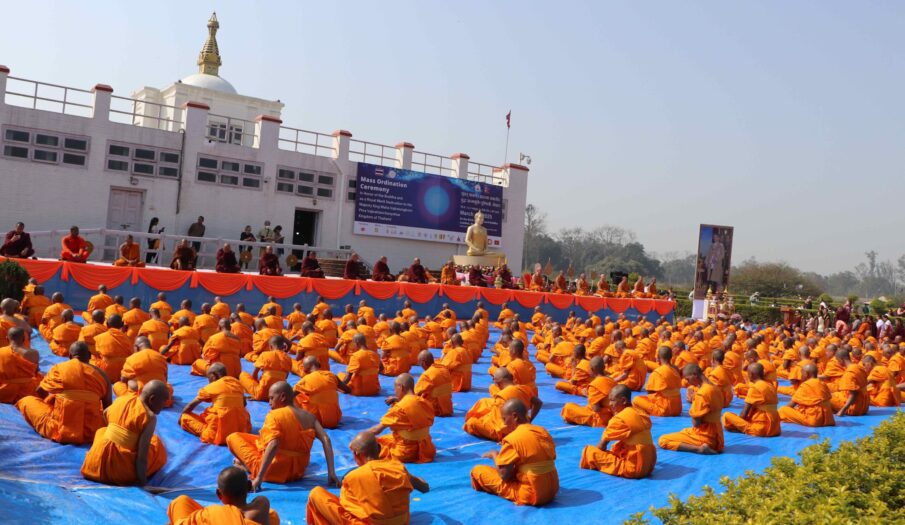
The Kathmandu to Lumbini tour package takes you from Nepal’s capital to the place where, according to Buddhist tradition, Queen Maya Devi gave birth to Prince Siddhartha more than 2,500 years ago. Lumbini lies in the Terai lowlands of southern Nepal, close to the Indian border, and it is one of the four great pilgrimage sites of the Buddhist world, alongside Bodh Gaya, Sarnath and Kushinagar in India. Today, it is a UNESCO World Heritage Site and a peaceful place of gardens, ruins, pools, and temples, visited by pilgrims and travelers from every continent. This package lets you reach it comfortably by road in a private vehicle with a driver from Nepal Vehicle Hiring Pvt Ltd, and spend enough time to understand its deep significance.
The standard program lasts four days. On the first day, you drive from Kathmandu to Lumbini, following the Prithvi Highway beside the Trishuli River, descending through the Narayani gorge to the plains, and crossing the Terai to Butwal and Bhairahawa. On the second day,y you explore the Sacred Garden at your own pace, with time for meditation at the Maya Devi Temple, and spend the afternoon among the international monasteries. On the third day, ay you travel west to Tilaurakot and the Ashoka pillars of the Kapilavastu area, the landscape of the Buddha’s childhood. On the fourth day, you return to Kathmandu, with the option of a short stop at Devdaha, associated with Queen Maya’s family.
Why choose a private vehicle? The journey between Kathmandu and Lumbini is long, and the sites around Lumbini are spread across farmland and villages with little public transport. A private driver lets you leave when you are ready, take breaks whenever you need them, and visit the region’s scattered Buddhist sites without searching for taxis or rickshaws. For pilgrims traveling with elderly relatives or monastic groups, this comfort and flexibility make a real difference. If you only need transport between the two cities, our Kathmandu to Lumbini vehicle hire page covers simple one-way and return transfers, and our guide to private vehicle booking in Nepal explains how the service works.
The Kathmandu to Lumbini tour package suits every kind of traveler: Buddhist pilgrims and monastic groups, families, couples, history and religion students, photographers, and visitors who want to see a different side of Nepal from the mountains. Couples and small families travel by car, groups of four to six by jeep or Scorpio, and larger pilgrim groups by Hiace, Coaster, or bus. Every vehicle is tourist-registered and driven by a licensed driver who knows this route well. For help choosing, see our article on which vehicle is best for 6 people in Nepal.
Lumbini also fits naturally into a wider journey. Many visitors combine it with the Buddhist sites of the Kathmandu Valley, such as Swayambhunath and Boudhanath, on our Kathmandu sightseeing tour, with wildlife in Chitwan, or with the lakes of Pokhara. Buddhist groups can follow the full Nepal Nekhor Tour, and travelers continuing to the great Buddhist kingdoms of the Himalaya can join the Luxury Bhutan Tour or the Lhasa Tibet Tour arranged by our sister companies, including Alpine Luxury Treks.
To plan your pilgrimage, send your dates, group size, hotel preferences, and vehicle choice through the Plan a Trip page or on WhatsApp, and we will reply with a day-by-day plan for your group.
Highlights
- A private journey from Kathmandu to Lumbini, the birthplace of Siddhartha Gautama, the Buddha, and one of the four most sacred places in Buddhism.
- The UNESCO World Heritage Sacred Garden, with the Maya Devi Temple, the marker stone of the birthplace, the Puskarini pond and the Ashoka Pillar.
- A full day in the Lumbini monastic zone, where countries from across Asia and beyond have built temples in their own national styles.
- The World Peace Pagoda, the Lumbini Museum and the crane sanctuary in the northern part of the Lumbini development area.
- A day at Tilaurakot, widely identified with ancient Kapilavastu, the palace city where the young prince grew up, plus the Ashoka pillars of Nigali Sagar and Gotihawa.
- A comfortable private vehicle and experienced highway driver from hotel door to hotel door, the same service as our Kathmandu to Lumbini car
- A scenic drive along the Trishuli River, through the Narayani gorge and across the Terai plains.
- A choice of car, jeep, Scorpio, Hiace, Coaster or bus for pilgrims, families and groups of any size.
- Easy extensions to Chitwan National Park, Pokhara, Devdaha, Ramagrama or the Indian border at Sunauli.
- The vehicle stays with you in Lumbini for all sightseeing, so there is no need to hire local transport.
Kathmandu to Lumbini by other vehicles
Itinerary
Day 1Itinerary of Kathmandu to Lumbini Tour Package
The plan below is the standard four-day program. You can adjust the order of visits in Lumbini and Kapilavastu to suit your interests, prayer times, and the weather.

Day 1: Kathmandu to Lumbini by Private Vehicle
Your driver will pick you up from your hotel in Kathmandu at about 6:30 to 7 am. An early start is important because the journey of about 270 to 290 km usually takes eight to ten hours with stops.
The vehicle leaves the valley at Nagdhunga, descends to Naubise and follows the Prithvi Highway beside the Trishuli River through Galchhi, Malekhu and Kurintar to Mugling, where the road to Pokhara branches west. Breakfast is often taken at Malekhu, famous for its fried river fish.
From Mugling, the road turns south through the Narayani gorge, a narrow valley where the river cuts through the last range of hills, to Narayanghat and Bharatpur on the edge of the plains. Here you join the East-West Highway and head west across the Terai, through farmland, sal forest and busy market towns such as Daldale and Sunwal, to Butwal, the gateway to the hills of western Nepal.
From Butwal, the road runs south for about 22 km to Bhairahawa, also called Siddharthanagar, then west for about 22 km to Lumbini. You usually have lunch around Narayanghat or on the highway towards Butwal.
You reach Lumbini in the late afternoon. After checking into your hotel, take a gentle evening walk to the Sacred Garden or the central canal to enjoy the quiet atmosphere as the sun sets over the plains. Lumbini lies at about 150 meters above sea level, so the air is warm for much of the year.
Day 2: The Sacred Garden and the Monastic Zone
Today is devoted to Lumbini itself. Start early, when the light is soft, and pilgrims gather for morning prayers. The vehicle drops you at the entrance to the Sacred Garden, the heart of the World Heritage Site.
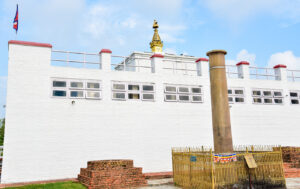
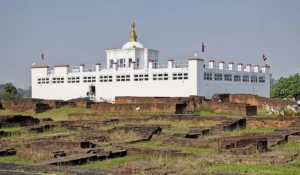
At the center of the garden stands the Maya Devi Temple, a simple white building that protects the ancient ruins of earlier temples and the marker stone believed to show the exact spot of the Buddha’s birth. Inside, a walkway leads around the excavated brick foundations to the marker stone and an old stone carving of the nativity scene, showing Queen Maya holding a tree branch as she gives birth.
Beside the temple lies the Puskarini, the sacred pond where Queen Maya is believed to have bathed before the birth and where the infant was first bathed. Nearby stands the Ashoka Pillar, raised by the Mauryan emperor Ashoka during his pilgrimage to Lumbini in the third century BCE, with a Brahmi inscription recording his visit and identifying the place as the Buddha’s birthplace. Prayer flags hang around the pond from an old Bodhi tree, and the ruins of ancient stupas and monasteries surround the temple.
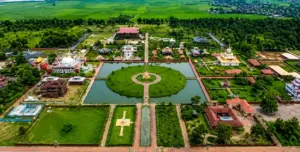
After the Sacred Garden, the vehicle takes you north through the Lumbini development area, a long, carefully planned zone of gardens, canals and monasteries about 4.8 km long and 1.6 km wide. TA central canal divides the monastic zone. The eastern side holds monasteries of the Theravada tradition, such as those of Thailand, Myanmar, Sri Lanka, and Cambodia.
In contrast,e the western side holds Mahayana and Vajrayana monasteries, such as those of China, Korea, Vietnam, Japan, Germany, and Nepal. Each is built in its own national style, from the gleaming white marble of the Royal Thai Monastery and the golden stupa of the Myanmar temple to the colorful murals of the Tibetan-style monasteries and the elegant halls of the Chinese temple. Spend the day visiting your favorites, joining a prayer session if you wish, and resting in the shade of the gardens.
In the late afternoon, the vehicle continues to the northern end of the development area for the World Peace Pagoda, a large white stupa built by Japanese Buddhists, the Lumbini Museum, and the crane sanctuary, where the tall sarus cranes can sometimes be seen in the wetlands. Return to your hotel in the evening. If you would like a licensed guide to explain the history, symbols and inscriptions of Lumbini, one can be arranged on request.
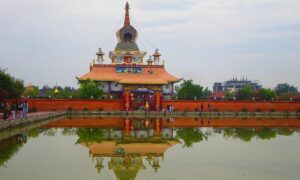
Day 3: Tilaurakot, Kapilavastu and the Ashoka Pillars
Today you travel west into the countryside of Kapilvastu district, the land of the Shakya clan into which the Buddha was born. The vehicle drives about 27 km west of Lumbini to Tilaurakot, on the banks of the Banganga River, which most scholars identify with ancient Kapilavastu. In this city, Prince Siddhartha is said to have spent his first twenty-nine years.
Walk through the excavated remains of a fortified citadel about 500 by 400 meters, with brick foundations, gateways, a well, and street outlines, all set among tall trees. The eastern gate is traditionally associated with the prince’s Great Departure, when he left palace life in search of enlightenment. Nearby, the small Kapilvastu Museum displays pottery, coins, terracotta figures and other finds from the excavations.
From Tilaurakot, the vehicle visits Nigali Sagar, about 4.5 km northwest, where a broken Ashoka pillar bears an inscription, and Gotihawa, where a third Ashoka pillar stands near the remains of a stupa. Your driver can also take you to other sites in the area traditionally linked with the life of the Buddha and his family, depending on time and your interests. The day is relaxed, with plenty of time for reflection in the quiet villages and fields of the Terai. Return to Lumbini in the late afternoon.
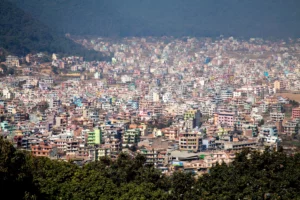
Day 4: Lumbini to Kathmandu
After breakfast, and perhaps a final early-morning visit to the Sacred Garden, the vehicle sets off for Kathmandu. The route reverses the outbound journey: east to Bhairahawa and north to Butwal, then along the East-West Highway to Narayanghat, up the Narayani gorge to Mugling, and along the Trishuli River to Naubise, then on to the final climb into the Kathmandu Valley.
Near Butwal, you can make a short detour to Devdaha, associated in Buddhist tradition with the family of Queen Maya. The drive takes eight to ten hours, and you reach your Kathmandu hotel in the evening. YourKathmandu-to-Lumbinii tour package ends here, though many guests continue to Chitwan or Pokhara instead of returning straight to the capital.
Trip information
Trip Glance
The Kathmandu to Lumbini tour package is a four-day, three-night round trip from Kathmandu with three nights in Lumbini. The vehicle covers about 650 to 700 km, including two long highway days and two days of sightseeing around Lumbini and Kapilavastu. Kathmandu sits at about 1,400 meters and Lumbini at about 150 meters, so altitude isn’t a concern; the main challenge is the Terai heat in the warmer months. The whole route is paved, though parts of the East-West Highway between Narayanghat and Butwal are busy, and some sections are under widening. No permits are needed. For a broader picture of road travel in Nepal, read our guide Explore Nepal Your Way.
Lumbini: The Birthplace of the Buddha
According to Buddhist tradition, Queen Maya Devi of the Shakya kingdom was traveling from Kapilavastu to her parents’ home at Devdaha when she stopped to rest in the gardens of Lumbini and gave birth to Prince Siddhartha, who would become the Buddha. Over the centuries, Lumbini became a pilgrimage site. The Mauryan emperor Ashoka visited in the third century BCE and erected the pillar that still stands today, and Chinese pilgrims recorded visits in the centuries that followed. Later, the site was forgotten and overgrown until the Ashoka Pillar was rediscovered in the late nineteenth century and the birthplace was once again recognized.
In modern times, Lumbini has been developed as a center of peace and pilgrimage, with a long master plan that links the Sacred Garden, the monastic zone and a cultural area by a central canal and walkways. UNESCO inscribed Lumbini as a World Heritage Site, and today it welcomes visitors from Sri Lanka, Thailand, Myanmar, Japan, Korea, China, Vietnam, India, Europe, the Americas and Nepal itself. Despite these numbers, the gardens remain calm and contemplative, especially in the early morning and evening.

Kapilavastu and the Land of the Shakyas
West of Lumbini lies Kapilvastu district, the heartland of the ancient Shakya clan. The archaeological site of Tilaurakot, widely accepted as the remains of Kapilavastu, preserves the outline of a fortified city with gateways, streets and building foundations, set beside the Banganga River. Around it, the countryside holds other sites associated with the Buddha’s life and earlier Buddhas of tradition, including the Ashoka pillars at Nigali Sagar and Gotihawa. These places see far fewer visitors than Lumbini, and walking among them in the quiet fields gives a powerful sense of the world into which the Buddha was born.
East of Lumbini, Devdaha near Butwal is associated with Queen Maya’s family, and Ramagrama in Parasi district is believed to hold one of the original relic stupas built after the Buddha’s death, which Nepalese archaeologists consider the only one of the original eight to remain undisturbed. You can add both to the tour.
Monasteries Not to Miss in the Monastic Zone
With dozens of temples spread along the central canal, it helps to know where to begin. These are some of the most visited.
- Royal Thai Monastery. A gleaming white marble temple with sweeping golden roofs, set in manicured gardens on the canal’s eastern side
- Myanmar Golden Temple. A golden stupa and shrine in the Burmese style, glowing in the late afternoon sun.
- Chinese Monastery. An elegant complex of halls, courtyards, and bell towers, reminiscent of Beijing’s temples.
- Great Drigung Kagyud Lotus Stupa. A striking stupa built with German support, with bright murals inside.
- Korean Temple. A large temple complex where visitors can sometimes join simple meals or meditation.
- Vietnamese Phat Quoc Tu Temple. A graceful pagoda with pastel colors and carved dragons.
- Sri Lankan Monastery. A serene Theravada temple with a white stupa and a peaceful prayer hall.
- Nepal Vajrayana Mahavihara and the Tibetan-style monasteries. Colorful halls filled with thangkas, butter lamps, and chanting.
Opening hours vary between monasteries, and most close at midday for a few hours, so mornings and late afternoons are the best times to visit. Many visitors hire a bicycle or electric rickshaw inside the development area, while the vehicle waits at the canal ends.
Route Overview: Kathmandu to Lumbini
Kathmandu to Mugling (about 110 km). The road climbs out of the valley at Nagdhunga, descends to Naubise and follows the Prithvi Highway along the Trishuli River through Galchhi, Gajuri, Malekhu, Benighat and Kurintar to Mugling. This is the slowest part of the journey because of bends, heavy traffic, and road widening.
Mugling to Narayanghat (about 36 km). A smooth, widened road through the Narayani gorge, emerging onto the plains at Narayanghat beside the wide Narayani River.
Narayanghat to Butwal. The East-West Highway runs west across the Terai through farmland, sal forest and market towns. This section is flat and generally faster, but it carries heavy traffic, including trucks and buses, and some sections have been widened or are under improvement.
Butwal to Lumbini (about 45 km). From Butwal, the road runs south through the city of Bhairahawa (Siddharthanagar), near the Indian border at Sunauli, and then west to Lumbini.
For travelers who only need a shared seat, our Kathmandu to Lumbini bus and Lumbini to Kathmandu bus pages list tourist bus services. However, a bus cannot offer sightseeing in Lumbini or Kapilavastu.
Road Condition and Safety
The whole route is paved. The Prithvi Highway section between Kathmandu and Mugling is the most demanding, with bends, heavy goods traffic, and road-widening stretches that can cause delays. The Mugling to Narayanghat road is smooth, and the East-West Highway across the Terai is flat but busy. In the monsoon season, landslides can affect the Prithvi Highway, and heavy rain can flood low-lying roads in the Terai. In winter, thick fog often covers the plains in the early morning, so departures from Lumbini may start a little later for safety.
Our drivers are licensed for tourist vehicles, drive this route regularly, never overtake on blind bends,s and take a rest every two to three hours. We service vehicles on schedule and check them before every multi-day tour; seat belts are fitted in every seat, and we avoid highway driving after dark. Read more in our article on the importance of safe transportation during Nepal tours.

Vehicle Options for the Lumbini Tour
The road is paved throughout, so every vehicle in our fleet is suitable. Choose by group size, luggage, and comfort over two long driving days.
Car. A private sedan or hatchback for one to three travelers with normal luggage. It is comfortable on the highway and easy to park at the sites. Most couples and small families book a private car with driver.
Jeep and Scorpio. A Mahindra Scorpio or similar jeep for four to six travelers with more luggage space and a higher seating position. It is a good choice for families and for rural roads around Kapilavastu. See our jeep hire in Nepal page.
Hiace. The Toyota Hiace seats seven to thirteen pilgrims and offers air-conditioning, large windows, and luggage space. It is the most popular choice for family groups and small pilgrim groups. See the Hiace page and our note on Nepal vehicle rental with roof luggage space.
Coaster bus. A Coaster seats fifteen to twenty-five pilgrims, with reclining seats and a luggage area, and is ideal for monastic groups and temple associations.
Bus. A full-size tourist bus for thirty to forty pilgrims. Large buses use designated parking areas in Lumbini, and some rural sites in Kapilavastu may be reached on foot from the nearest parking point.
Service Options: Private, One-Day, Two-Way and Shared
Private hire. This package is a private hire. The vehicle is reserved for your group alone for all four days, and the plan follows your wishes.
One-day hire. A vehicle for a single day, such as a one-way transfer from Kathmandu to Lumbini or a day of sightseeing around Lumbini and Kapilavastu. Our Kathmandu to Lumbini car and Lumbini to Kathmandu car pages cover single transfers.
Two-way hire. A round trip with the same vehicle, such as this tour, where the vehicle stays with you in Lumbini and brings you back.
Shared. Individual seats on tourist buses between Kathmandu and Lumbini. Shared seats suit flexible solo travelers but offer no sightseeing, hotel pickup, or flexibility.
For any of these options, send your dates and group size through our contact page.
Pickup and Drop Options
The tour normally starts and ends at your hotel in Kathmandu. It can also start directly from Tribhuvan International Airport with our Kathmandu airport transfers team. Pilgrims flying into Gautam Buddha International Airport at Bhairahawa, about 30 minutes from Lumbini, can begin the tour there and drive back to Kathmandu at the end, or fly back from Bhairahawa. Travelers arriving overland from India at the Sunauli border can start the tour from the border with our Lumbini to Sunauli border vehicle service in reverse, or with the Sunauli to Kathmandu car. Guests flying out of Kathmandu at the end can take our Lumbini to Kathmandu airport transfer. Straight to the terminal
Best Time for a Kathmandu to Lumbini Tour
Autumn brings clear skies, comfortable temperatures, and dry roads after the monsoon. It is a popular time for pilgrim groups and a good season for photography in the gardens and monasteries.
Winter is cool and pleasant in the Terai during the day, though mornings can be cold and foggy. Fog often lies over the plains until mid-morning, which can slow early departures and give the Sacred Garden a beautiful, misty atmosphere at dawn. This is one of the busiest seasons for pilgrims from Asia.
Spring begins warm and becomes very hot in the Terai as the season advances. Buddha Jayanti, which celebrates the Buddha’s birth, enlightenment, and passing, falls on the full moon of the Nepali month of Baisakh and draws large crowds of pilgrims to Lumbini. If you plan to visit, book early and expect a lively, devotional atmosphere.
Monsoon brings heavy rain, high humidity, and lush green fields. The monastic zone is quieter, but outdoor sightseeing can be uncomfortable, and rain can delay the highway. A private vehicle is especially useful in this season.
Places to See Along the Way
A private vehicle lets you enjoy the long drive with stops at interesting places.
- Riverside stalls beside the Trishuli, known for fried fish, and a good breakfast stop.
- Kurintar and Manakamana. The cable car to the hilltop temple of Manakamana, an optional stop on the way out or back, described on our Manakamana Temple cable car and vehicle tour
- The meeting of the Trishuli and Marsyangdi rivers and the junction of the roads to Pokhara and the Terai.
- The Narayani gorge. A dramatic river valley through the last range of hills before the plains.
- A sacred confluence near Narayanghat, where elderly Hindus traditionally come to spend their final years.
- A busy city at the foot of the hills and the starting point of the Siddhartha Highway to Pokhara.
- A site near Butwal associated with Queen Maya’s family.
- A growing city near the Sunauli border and home to Gautam Buddha International Airport.
Entry Fees and Etiquette at Lumbini
Visitors pay an entry fee for the Sacred Garden and the Maya Devi Temple, with different rates for foreign, SAARC, and Nepali visitors; some museums and archaeological sites charge lower fees. Pay these fees at the gate; they are not included in the vehicle hire. Rates change from time to time, so carry Nepali rupees in cash.
Lumbini is a sacred place, and visitors are asked to behave with quiet respect. Remove your shoes before entering the Maya Devi Temple and monastery halls, dress modestly with shoulders and knees covered, walk clockwise around stupas and shrines, and keep your voice low. Photography is not permitted inside the Maya Devi Temple. Ask before photographing monks, nuns, and pilgrims at prayer. Many visitors bring a white silk scarf, flowers, or butter lamps as offerings; these arethese are available near the garden.
Meditation, Retreats and Spiritual Activities
Lumbini is a place for reflection as well as sightseeing. Many monasteries welcome visitors to morning and evening chanting, and some offer meditation classes or longer retreats. The Sacred Garden offers quiet spaces under the trees where pilgrims meditate, especially near the Bodhi tree beside the Puskarini pond. The eternal peace flame near the central canal, the lamps lit at the monasteries, and the evening prayer sessions are among the most memorable experiences of a visit. If you would like to join a retreat or spend extra time meditating, please tell us when you book, and we can adjust your schedule.
Extend Your Journey
The Lumbini tour connects easily with other destinations in Nepal and beyond.
- Chitwan National Park. Break up the return journey with one or two nights in Sauraha for wildlife, using our private car from Lumbini to Chitwan and from Chitwan to Kathmandu. Our sister company arranges the Chitwan jungle safari and the 1 Night 2 Days Chitwan Tour.
- Travel north from Butwal along the Siddhartha Highway to the lake city, then return to Kathmandu by car. In Pokhara, our car hire in Pokhara and Sarangkot sunrise tour vehicle covers sightseeing.
- Ramagrama and Devdaha. Add a day for the relic stupa of Ramagrama and the Devdaha area east of Lumbini.
- The Indian border. Pilgrims continuing to Kushinagar, Sarnath, and Bodh Gaya in India can be dropped at Sunauli with our Lumbini to Sunauli border vehicle, and travelers arriving from India can follow our Nepal tour from Gorakhpur.
- A night in the hill town on the way back, using our Pokhara to Bandipur car and Bandipur to Kathmandu car.
- A complete Nepal holiday. Our Nepal holiday tour combines Kathmandu, Pokhara, Lumbini and Chitwan, and the Classic Nepal Tour from our sister company includes guided sightseeing. For upgraded hotels and private guides, choose the Nepal Golden Triangle luxury tour.
Buddhist Heritage Beyond Lumbini
Nepal and the neighboring Himalaya hold many more places sacred to Buddhists.
- Kathmandu Valley. Swayambhunath and Boudhanath are among Nepal’s most important Buddhist monuments, and we visit them on our Kathmandu sightseeing tour and our sister company’s guided Kathmandu day tour. We reach the Momobuddha Nemonastery ar Dhulikhel with our Kathmandu-to-Nagarkot vehicle and onward drive.
- A pilgrimage site sacred to both Hindus and Buddhists, behind the Annapurna range, reached by our Muktinath Yatra, the Kathmandu-to-Muktinath jeep, or the Muktinath Yatra by helicopter.
- Upper Mustang. The old Tibetan kingdom of Lo, with ancient monasteries and cave temples, visited on the Upper Mustang Trek and the Upper Mustang luxury lodge tour.
- The Everest region. Tengboche Monastery and the Sherpa villages of the Khumbu, on the Everest View Trek and the Everest Base Camp Trek.
- Tibet and Kailash. The monasteries of Lhasa on the Kathmandu to Lhasa Tour and the sacred mountain on the Mount Kailash Tour; pilgrims from India can read our Kailash Yatra tour from Gorakhpur
- The last great Himalayan Buddhist kingdom, on the Luxury Bhutan Tour and the Nepal Tibet Bhutan Tour.
Nature and Adventure Along the Way
The road to Lumbini passes some of Nepal’s best rivers, forests and wildlife areas, and adventurous travelers can easily add an activity or two.
- River rafting. Start the journey with a morning of Trishuli River rafting on the way out of Kathmandu, or raft the Kali Gandaki on a detour towards Pokhara.
- Beyond Chitwan, the wilder Bardia National Park in the far west and the wetlands of Koshi Tappu in the east offer superb wildlife and birdlife.
- Pokhara adventures. If you continue north to Pokhara, try paragliding in Pokhara or the giant swing at the Kusma bungee jump.
- Mountain flights. Back in Kathmandu, the Mt Everest by helicopter tour offers a breathtaking close-up of the highest peaks.
Treks to Combine with Your Pilgrimage
Many pilgrims and travelers pair the calm of Lumbini with a few days of walking in the hills.
- Short treks from Pokhara. The Ghorepani Poon Hill Trek and the Muldai View Trek take four to six days and start with our Pokhara-to-Nayapul transportation. The Annapurna Base Camp Trek takes about ten days.
- Near Kathmandu. The Langtang Valley Trek and Tamang Heritage Trek begin with a day’s drive north from Kathmandu to Syabrubesi on our jeep transfer. At the same time, the Langtang Helambu Trek explores Buddhist villages close to the valley.
- Comfortable treks. For upgraded lodges and services, browse the luxury treks, short scenic treks and signature treks of Alpine Luxury Treks.
- Everest by road. Trekkers heading to the Khumbu can use our Ramechhap Manthali transportation for flights to Lukla, or the Kathmandu to Salleri Phaplu jeep.
Where to Stay in Lumbini
Hotels are not included in the vehicle package, so you can choose the style of accommodation that suits you. Most visitors stay in one of three areas. The small town of Lumbini Bazaar, next to the Sacred Garden, has simple hotels, guesthouses and restaurants within walking distance of the Maya Devi Temple. Several comfortable hotels lie along the road on the northern and eastern edges of the development area, close to the monastic zone and the World Peace Pagoda. Some monasteries offer simple guest rooms to pilgrims, especially those attending retreats, though these should be arranged directly in advance. Larger hotels with more facilities are also available, about 30 minutes away, which is convenient for travelers flying in or out of Gautam Buddha International Airport. Please tell us where you plan to stay, and the driver will plan the best route each day. We are also happy to suggest hotels that suit your budget and group size.
Who This Tour Suits
Buddhist pilgrims. Lumbini, Tilaurakot and the Ashoka pillars form one of the most meaningful pilgrimages in Asia, and a private vehicle lets your group follow its own rhythm of prayer and visits.
Monastic groups and temple associations. Coasters and buses carry large groups comfortably, and our drivers are used to working around prayer times and ceremonies.
Families. The gardens, monasteries and peaceful atmosphere appeal to all ages, and the driver can stop whenever children or elderly relatives need a break.
History and culture lovers. Archaeology, inscriptions and the living traditions of many Buddhist nations come together in one place.
Photographers. Dawn mist in the Sacred Garden, colorful monasteries, monks in saffron and maroon robes, and evening lamps by the canal offer wonderful images.
Travelers seeking peace. For many visitors, a few quiet days in Lumbini are a welcome change from the busy cities and trekking trails.
Packing and Preparation Tips
- Light, breathable clothing for the warm Terai, plus a warm layer for cool winter mornings and evenings.
- Modest clothing that covers shoulders and knees for temples and monasteries.
- Shoes that are easy to remove, and socks for walking inside temple halls.
- Sun protection: a hat, sunglasses, nd sunscreen, as the gardens are wide and open.
- Insect repellent, especially in the warmer months and the monsoon.
- A refillable water bottle and light snacks for the drive and sightseeing days.
- Cash in Nepali rupees for entry fees, offerings, and small purchases.
- A small torch for early-morning visits.
- If you suffer from motion sickness, take your usual remedy before the winding Prithvi Highway section.
Travel Tips for a Smooth Pilgrimage
- Leave Kathmandu early to complete the long drive in daylight.
- Visit the Sacred Garden at dawn or late afternoon, when it is cooler and quieter.
- Hire a bicycle or rickshaw inside the development area if you wish, while the vehicle meets you at the next point.
- In winter, allow extra time in the mornings because of fog on the plains.
- Book hotels early if you plan to visit around Buddha Jayanti or the peak pilgrim season.
- Let your driver know prayer times or ceremonies you want to attend so that they can plan the schedule around them.
Why Choose Nepal Vehicle Hiring Pvt Ltd
Nepal Vehicle Hiring Pvt Ltd is a Kathmandu-based tourist transport company that regularly arranges pilgrim journeys to Lumbini, Muktinath and other sacred sites. Learn more on our About Us page.
- Experienced highway drivers. Licensed, courteous, and familiar with every stretch of the route and every site around Lumbini.
- One vehicle, one driver. The same team for all four days.
- A full fleet. Car, jeep, Scorpio, Hiace, Coaster and bus for pilgrims, families and groups.
- Flexible itineraries. Add Chitwan, Pokhara, Ramagrama or the Indian border, or spend extra days in meditation.
- Clear written plans. A day-by-day itinerary listing what is included and what is not.
- Tour partners. Through our sister companies,s we can arrange guided tours, treks and journeys to Tibet and Bhutan.
Our article on quality transport in Nepal explains the standards we follow.
Related Vehicle Hire Services
- Kathmandu to Lumbini car for a one-way transfer.
- Kathmandu to Lumbini vehicle hire for all vehicle types on this route.
- Chitwan to Lumbini private car for travelers coming from the jungle.
- Kathmandu to Sunauli car and Kathmandu to Sunauli border private jeep for the border crossing.
- Sunauli to Pokhara car and Pokhara to Sunauli car for the Siddhartha Highway route.
- Kathmandu to Janakpur car for another great pilgrimage city in the Terai.
- Kathmandu to Chitwan bus and Pokhara to Chitwan bus for shared tourist bus seats.
- Our complete Nepal tour package page, trekking transport services, and Nepal Vehicle Hiring blog.
How to Book
- Step 1: Send your details. Share your travel dates, group size, hotel preferences, and preferred vehicle through the Plan a Trip form, by email,l or on WhatsApp at +977 9814227196.
- Step 2: Receive your plan. We reply with a day-by-day itinerary and booking details for your group.
- Step 3: Confirm. Confirm the booking, and we reserve the vehicle and driver for your dates.
- Step 4: Travel. We send your driver’s name and phone number before departure, and he collects you from your hotel on Day 1.
Reviews of this trip
Write a reviewNo reviews of this trip yet. If you have travelled it with us, we would like to hear how it went.
Similar trips
 7-8 Hours
 3 Days
 3 Days
More routes
- Kathmandu to Pokhara Tour by Private Car, Jeep or Hiace
- Kathmandu to Mustang Private jeep
- Pokhara to Ghorepani Poon Hill Jeep Hire
- Nepal Tour from Gorakhpur
- Nepal Nekhor Tour
- Chitwan to Lumbini Private Car
- Nepal Tour Package
- Muktinath Upper and Lower Mustang 8 Day Tour Package by Jeep
- Kathmandu Pokhara Muktinath Lumbini Chitwan Tour Package
- Pokhara Chitwan Lumbini Janakpur Tour Package with Guide
- Kathmandu Bandipur Pokhara Chitwan Tour Package | 9 Days
- Kathmandu Pokhara Lumbini Tour Package by Private Vehicle