Plan a Trip


Duration
8 Days
Travel Time
4-9 hour
Distance
550-650 km
Driver
Included
Group Size
1-30 Pax
Max. Altitude
4000 Metres
Best Season
Round the year
Activity
Multi Day Tour
Highlights of Muktinath Upper and Lower Mustang 8 Day Tour Package by Jeep
- A complete 8-day overland journey through Mustang: the Kali Gandaki Gorge, Lower Mustang, the forbidden kingdom of Upper Mustang, and the sacred temple of Muktinath.
- An experienced, government-licensed tour guide for the whole trip, which is not only valuable but required by law for travel in the restricted area of Upper Mustang.
- A sturdy 4WD jeep or Scorpio with an experienced mountain driver, the same service as our Pokhara to Mustang jeep and jeep rental for Mustang tour.
- Lo Manthang, the walled capital of the old Kingdom of Lo, with its royal palace and centuries-old monasteries of Jampa, Thubchen, Chode and Choprang.
- Ghami’s famous long mani wall, the red cliffs of Dhakmar, and Ghar Gompa, one of Mustang’s oldest monasteries.
- The cliff dwellings of Chhoser, including the multi-story Jhong cave carved into a sandstone cliff.
- Muktinath, sacred to Hindus and Buddhists, with 108 water spouts, holy ponds and the natural flame of Jwala Mai.
- The medieval villages of Kagbeni, Jharkot and Marpha, and the apple orchards and whitewashed houses of Lower Mustang.
- Views of Dhaulagiri, Annapurna I, Nilgiri and Tukuche from the Kali Gandaki valley, and a soak in the hot springs at Tatopani on the way back.
- Our team will help with both the Upper Mustang Restricted Area Permit and the Annapurna Conservation Area permit.

Introduction of Muktinath Upper and Lower Mustang 8 Day Tour Package by Jeep
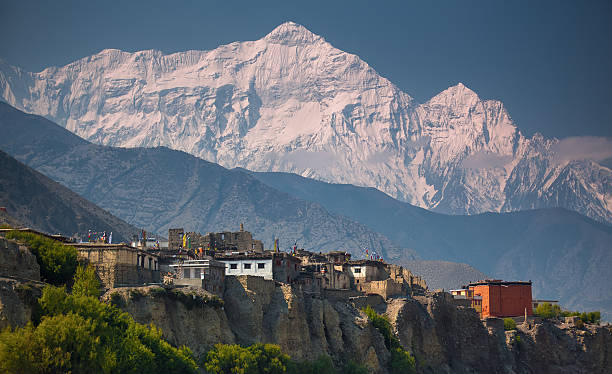
The Muktinath Upper and Lower Mustang tour package takes you by 4WD jeep from Pokhara through one of the Himalayas’ most extraordinary landscapes. Mustang lies behind the Annapurna and Dhaulagiri ranges, in a rain shadow so deep that its valleys look more like the Tibetan plateau than the rest of Nepal: wind-sculpted cliffs in shades of red, ochre, and grey; barley fields watered by snowmelt; whitewashed villages; and ancient monasteries.
In the north lies Upper Mustang, the former Kingdom of Lo, closed to outsiders until the early 1990s and still a restricted area today. In the south lies Lower Mustang, home to the Thakali people and to the sacred temple of Muktinath. This eight-day package takes you to both, traveling in a private jeep with an experienced mountain driver and a licensed tour guide from Nepal Vehicle Hiring Pvt Ltd.
Until recently, reaching Lo Manthang meant a 10-day trek or more. Today, a rough but improving road follows the Kali Gandaki north from Jomsom, making it possible to visit Upper Mustang by jeep in far less time. That does not make the journey ordinary. The road climbs over high passes, crosses dry riverbeds, and winds along cliff edges above deep canyons, while the villages along the way remain deeply traditional.
With a good driver and a knowledgeable guide, the jeep journey becomes a remarkable cultural and scenic adventure, suitable for travelers who cannot spare the time for a long trek or prefer not to walk at altitude. Trekkers who would rather walk can follow the classic Upper Mustang Trek instead.
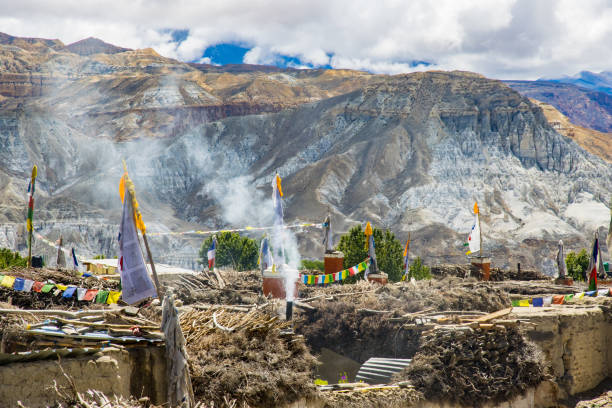
The route is designed to help your body adjust to altitude while seeing the most important sites. On the first day, you drive from Pokhara up the Kali Gandaki gorge to Jomsom or Marpha. You then enter Upper Mustang at Kagbeni and travel north through Chele, Samar and Syangboche to Ghami. The next day you visit Dhakmar, Ghar Gompa and Tsarang before arriving in Lo Manthang, where you spend a full day exploring the walled city and the caves of Chhoser. On the way back, you visit Muktinath, then descend through Lower Mustang to Marpha, Tatopani, and finally Pokhara.
Your guide is essential on this tour. Travel in Upper Mustang requires a Restricted Area Permit obtained through a registered agency and a licensed guide accompanying the group, and our team helps arrange both. Beyond the paperwork, your guide explains the history of the Kingdom of Lo, the art and symbolism of its monasteries, the Hindu and Buddhist significance of Muktinath, and the daily life of the people who live in these harsh, beautiful valleys. The guide also watches for signs of altitude sickness, helps you find warm lodges and good food, and coordinates every day with your driver.

Itinerary of Muktinath Upper and Lower Mustang 8 Day Tour Package by Jeep
Itinerary of Muktinath Upper and Lower Mustang Tour Package
The itinerary below is the standard eight-day plan from Pokhara. Mountain roads change with the seasons, so your guide and driver may adjust timings and overnight stops to suit road conditions, weather, and your energy.
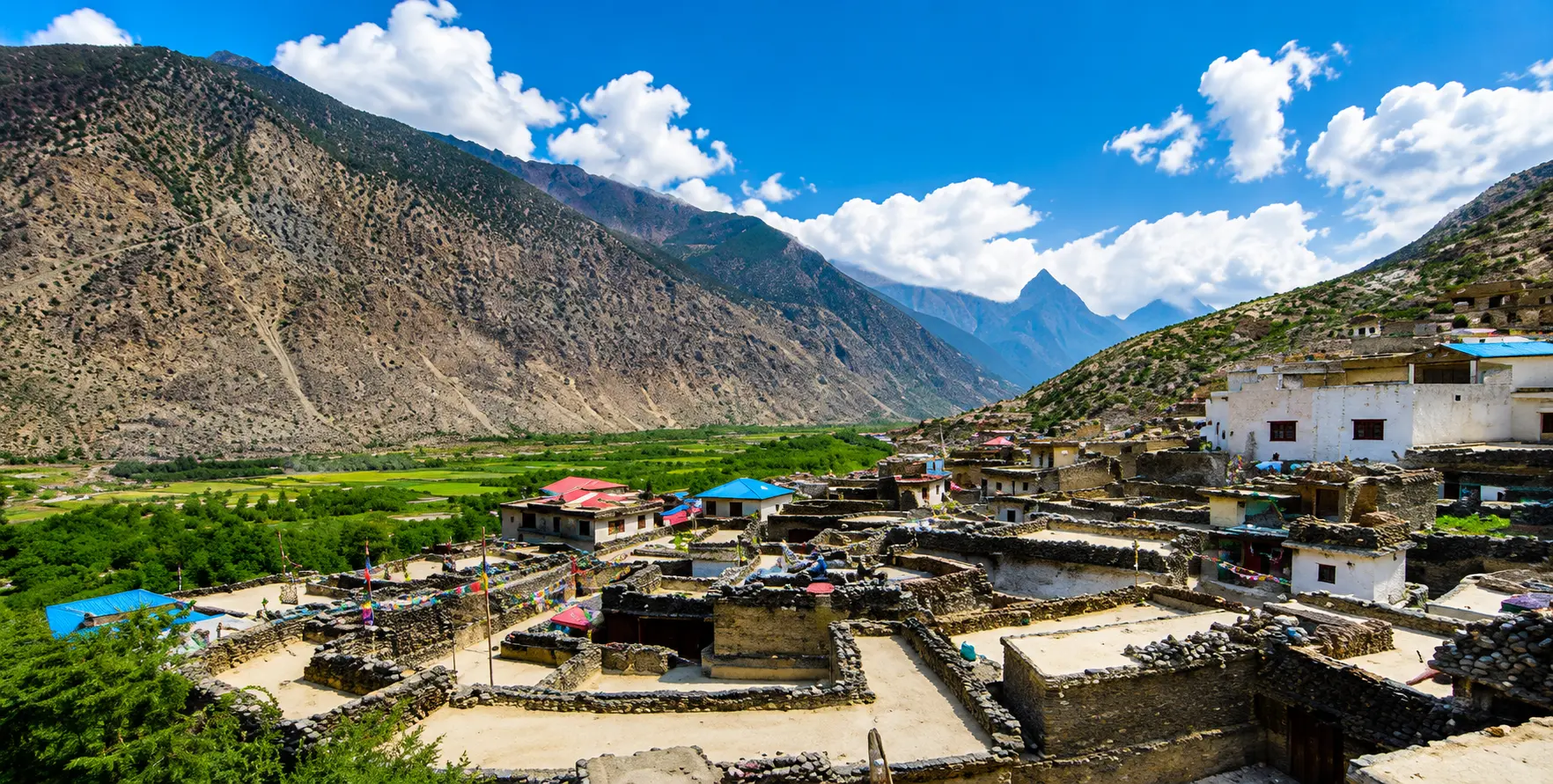
Day 1: Pokhara to Jomsom or Marpha (about 2,700 meters)
Your jeep, driver, and guide will pick you up from your hotel in Pokhara early in the morning. The road runs west through Nayapul to Beni, where the Kali Gandaki and Myagdi rivers meet, on a paved road.
Beyond Beni, the road enters the Kali Gandaki gorge, one of the deepest on earth, between Dhaulagiri and Annapurna I. You pass Tatopani with its hot springs, the roaring Rupse waterfall, and the villages of Ghasa, Lete, and Kalopani, where the forest shifts from subtropical to pine, then to the dry, windswept upper valley around Tukuche and Marphao.
Jomsom is about 160 to 180 km away, and the drive takes about seven to nine hours. Overnight in Jomsom, the headquarters of Mustang district, at about 2,720 meters, or in the beautiful Thakali village of Marpha. Our Pokhara to Mustang road overview describes the route.
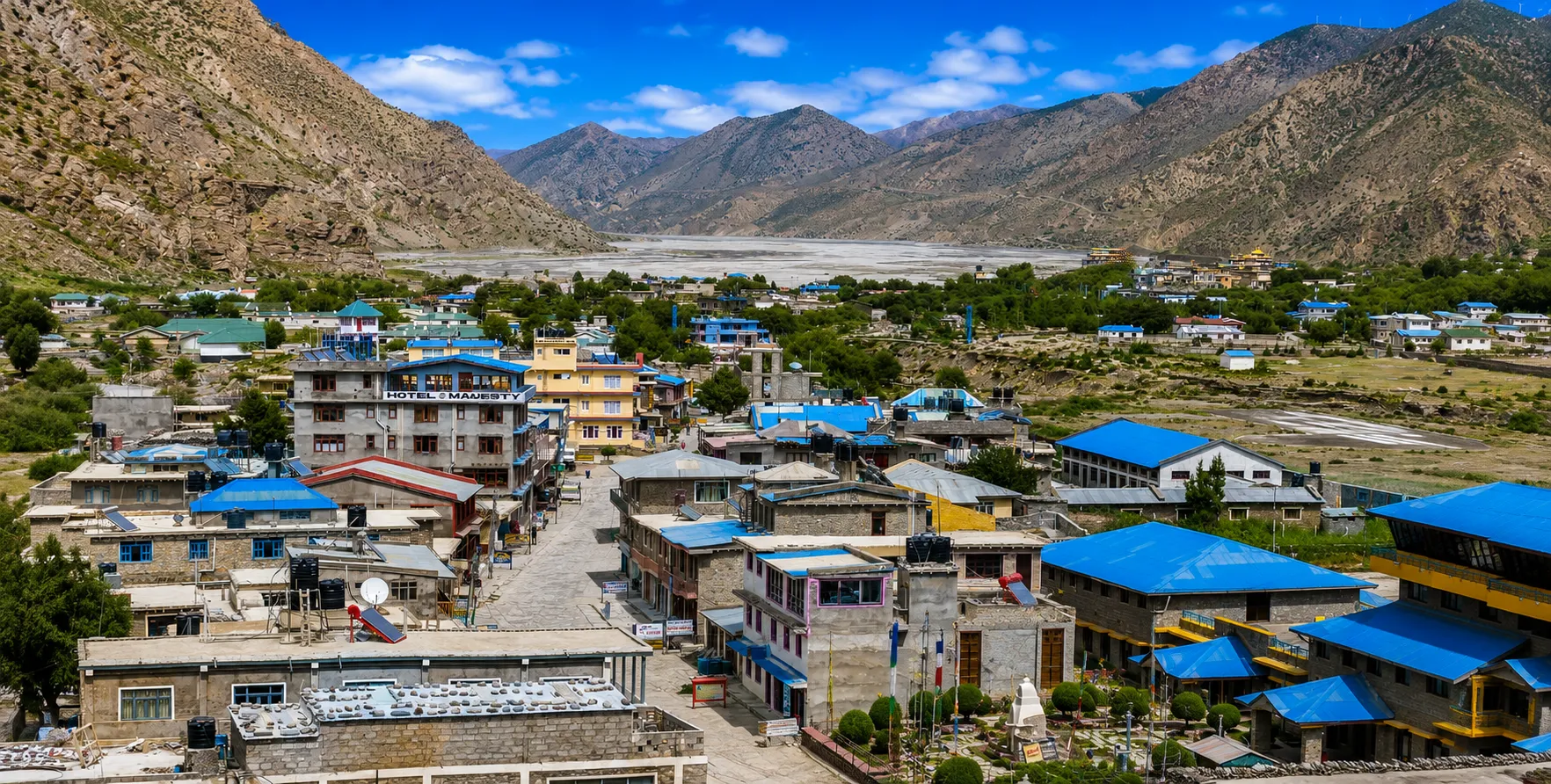
Day 2: Jomsom to Kagbeni and into Upper Mustang, Overnight in Ghami (about 3,500 meters)
After breakfast, the jeep drives about an hour up the valley to Kagbeni, a medieval village of mud-brick houses, narrow alleys and the old Kag Chode monastery, guarded by clay protector figures. Kagbeni is the gateway to Upper Mustang, and your guide completes the permit formalities at the checkpost just north of the village.
From Kagbeni, the road follows the wide, stony bed of the Kali Gandaki north to Chhusang, where ancient cave dwellings are carved high into the cliffs, then climbs to Chele, the first village of the old Kingdom of Lo, at about 3,050 meters.
The road continues over ridges and passes to Samar and Syangboche, with views of the red and ochre cliffs and the snow peaks of the Annapurna and Dhaulagiri ranges behind. In the afternoon, you reach Ghami, a village of whitewashed houses surrounded by barley fields at about 3,500 meters.
Near Ghami stands one of Nepal’s longest mani walls: a long line of stones carved with prayers, which local legend links to the defeat of a demon by the great teacher Padmasambhava. The drive takes about five to seven hours.
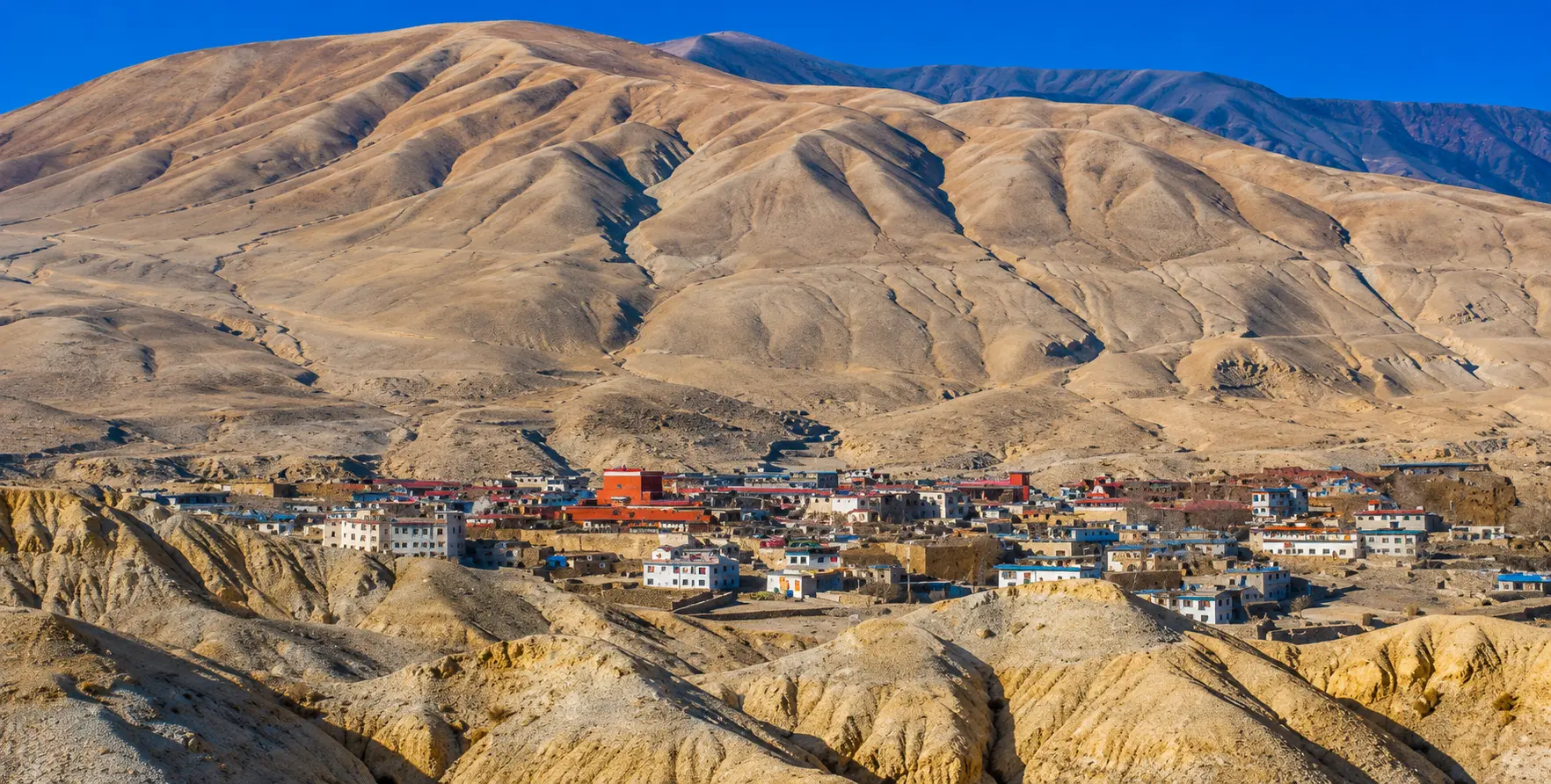
Day 3: Ghami to Dhakmar, Ghar Gompa and Tsarang, then Lo Manthang (about 3,800 meters)
Today you visit some of Mustang’s most remarkable sites. A short drive leads to Dhakmar, a village beneath towering red cliffs. Legend says the cliffs were stained by the blood of a demoness Padmasambhava defeated.
Nearby, in a quiet side valley at about 3,930 meters, stands Ghar Gompa, also known as Lo Gekar, traditionally said to have been founded by Padmasambhava himself and to be one of Mustang’s oldest monasteries. Inside, painted walls and an image of Padmasambhava are surrounded by carved mani stones. Your guide explains the legends and the monastery’s Nyingma tradition.
Continuing north, you reach Tsarang, also called Charang, at about 3,500 meters, a large village with a red-walled monastery and a five-story former royal palace overlooking a deep canyon.
In the afternoon, the jeep crosses a final ridge and descends to Lo Manthang, the walled capital of the old kingdom, at about 3,800 meters. Check in to your lodge and take a first walk inside the city walls as the evening light turns the mud-brick buildings gold.
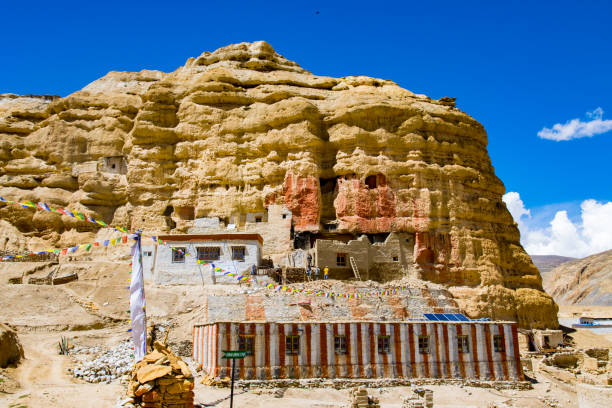
Day 4: Exploring Lo Manthang and the Chhoser Caves
Lo Manthang was founded in the late fourteenth century by Ame Pal, the first king of Lo, and its whitewashed mud-brick walls still enclose the old city, with narrow lanes, chortens and houses built around courtyards.
With your guide, visit the four great monasteries: Jampa Lhakhang, the oldest, dating from the early fifteenth century, with a huge statue of the future Buddha Maitreya and remarkable wall paintings; Thubchen Gompa, a vast red assembly hall from the late fifteenth century; Chode Gompa, the main active monastery of the city, with a monastic school; and Choprang Gompa, known as the new monastery.
You’ll also see the exterior of the royal palace, a multi-story building in the city center. You may visit the Amchi school of traditional Tibetan medicine, where local healers train.
In the afternoon, the jeep drives north to the Chhoser area, where hundreds of caves are carved into the sandstone cliffs. The most famous is the Jhong cave, a multi-level complex of rooms connected by passages and ladders, believed to be more than two thousand years old.
Nearby, Nyiphu and Garphu monasteries are built into the cliffs. Return to Lo Manthang for the night. On clear days, your guide may suggest a short walk to a viewpoint above the city for sunset.
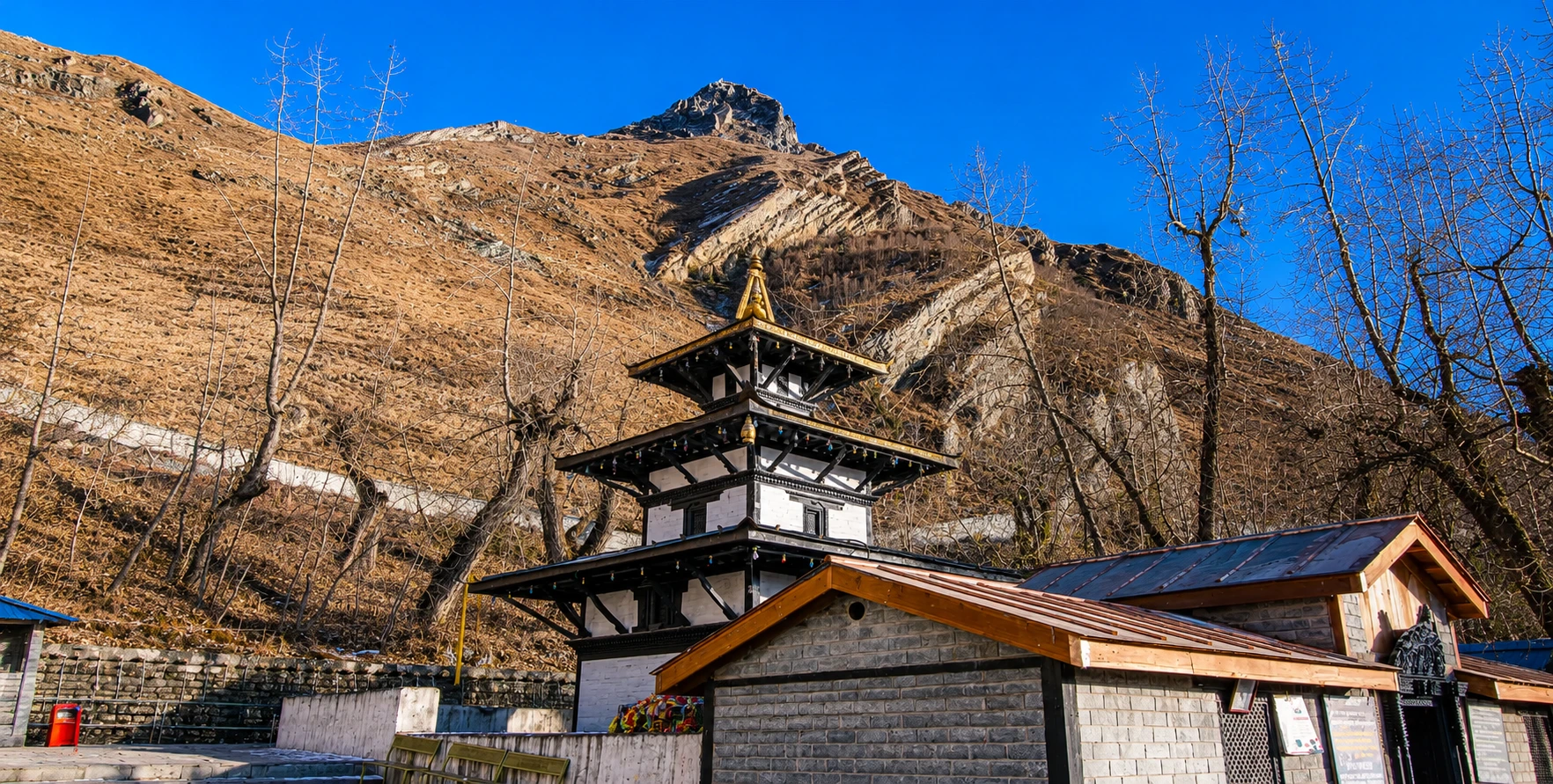
Day 5: Lo Manthang to Muktinath (about 3,700 to 3,800 meters)
After an early breakfast, the jeep begins the long drive south, retracing the route through Tsarang, Ghami and Syangboche back towards Chele and the Kali Gandaki valley. From the valley, the road climbs east past Jharkot to Ranipauwa, the settlement just below the Muktinath temple.
The drive takes about six to eight hours, depending on road conditions and stops. Overnight in Ranipauwa, where lodges offer warm rooms and hearty meals.
Day 6: Muktinath Temple and Lower Mustang, Overnight in Marpha
Rise early to visit Muktinath, one of the world’s highest temples and one of Nepal’s most sacred pilgrimage sites for both Hindus and Buddhists. For Hindus, it is a temple of Lord Vishnu and a place of liberation, where pilgrims bathe under 108 water spouts and in two holy ponds.
For Buddhists, it is Chumig Gyatsa, the place of a hundred springs, associated with Avalokiteshvara and Padmasambhava. Beside it, the small Jwala Mai temple shelters a flame that burns above water, fed by natural gas. Your guide helps with rituals and explains the site’s meaning to both faiths. The short walk from Ranipauwa to the temple can be done slowly on foot or by pony.
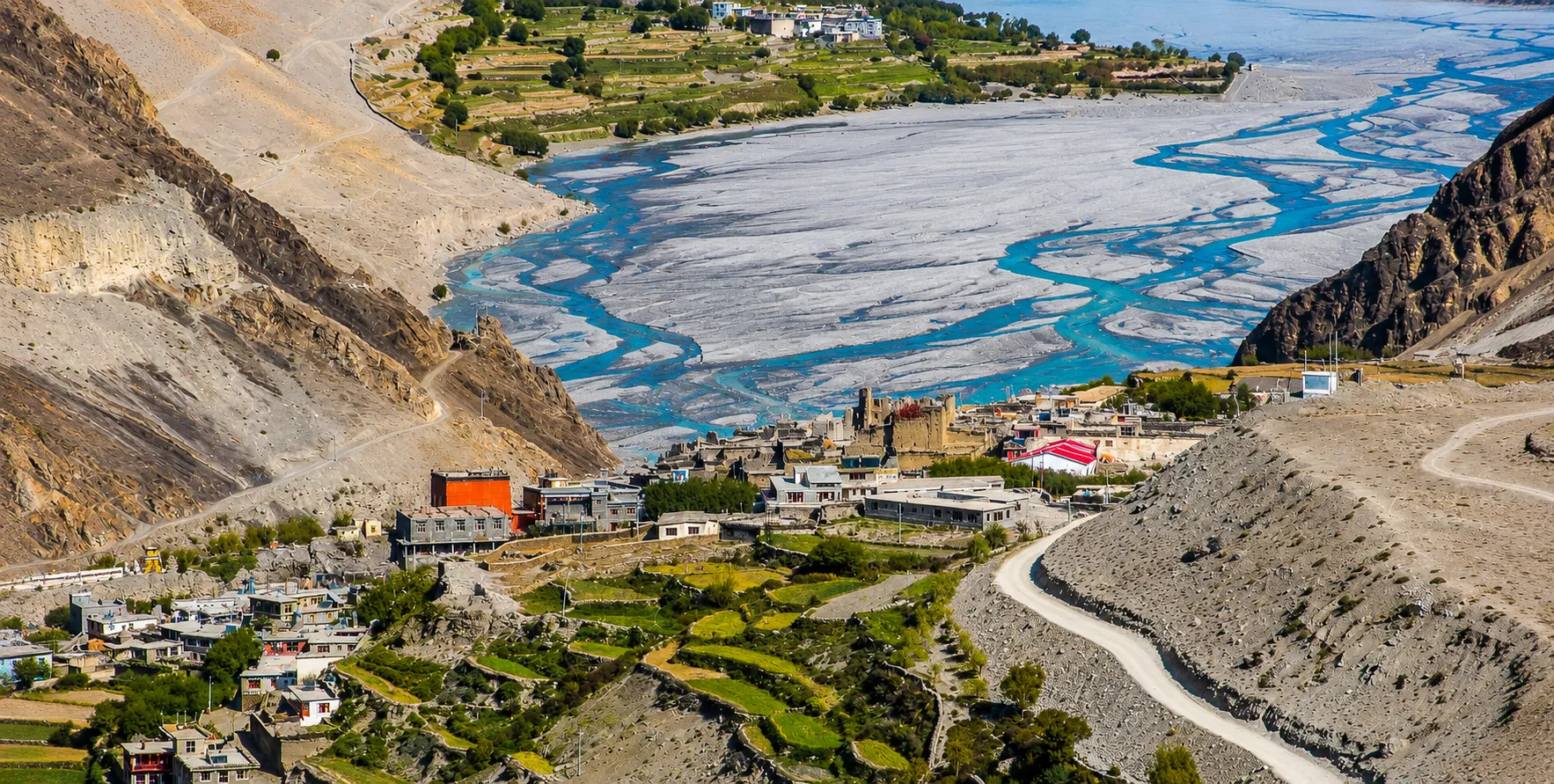
After the temple, the jeep descends through Jharkot, with its old fort and monastery, and Kagbeni to Jomsom, then continues to Marpha, a whitewashed Thakali village of stone-paved lanes, flat-roofed houses stacked with firewood, a hilltop monastery and apple orchards. If time allows, visit the old village of Thini and the small Dhumba Lake near Jomsom, sacred to local people and framed by the peak of Nilgiri. Overnight in Marpha at about 2,670 meters, a comfortable altitude after the high north.
Day 7: Marpha to Tatopani through the Kali Gandaki Gorge
After a slow morning in Marpha, the jeep continues down the valley through Tukuche, once an important salt-trading town, Kobang and Larjung, with close views of Dhaulagiri and Nilgiri, and Kalopani, famous for its mountain panorama.
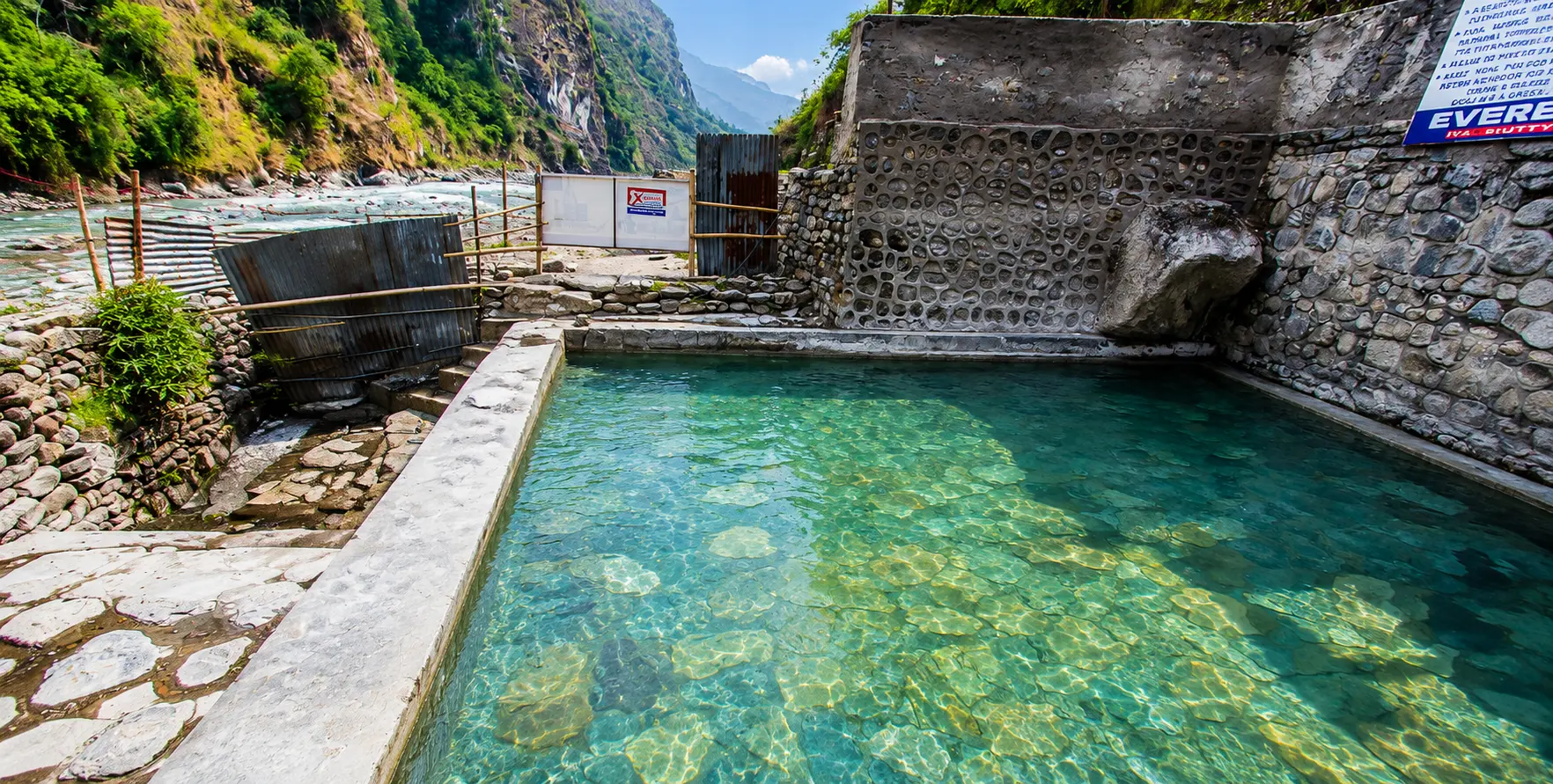
The road then descends through Lete and Ghasa, where pine forests give way to greener slopes, past the Rupse waterfall to Tatopani at about 1,190 meters. Relax in the natural hot springs beside the river, a perfect end to the days in the cold, dry north.
Day 8: Tatopani to Pokhara
After breakfast and perhaps a final soak, the jeep follows the Kali Gandaki down to Beni and continues on the paved road to Pokhara, a four- to six-hour drive on the same route as our Muktinath to Pokhara jeep. The driver and guide drop you at your hotel in Lakeside, and your Muktinath Upper and Lower Mustang tour package ends

Activity: 8 day

Max. Altitude: 4000m

Meal: Not Included

Accommodation: Not Included

Includes & Excludes
What is included?
- A private 4WD jeep or Scorpio with an experienced mountain driver for all eight days, with additional jeeps for larger groups.
- An experienced, government-licensed, English-speaking tour guide for the whole trip, as required for Upper Mustang.
- The driver’s and guide’s meals, accommodation, and daily allowances throughout the tour.
- Fuel, vehicle taxes, and road charges for the full itinerary.
- Pick-up from and drop-off at your hotel in Pokhara.
- Guided visits to Kagbeni, Ghami, Dhakmar, Ghar Gompa, Tsarang, Lo Manthang, Chhoser, Muktinath, Jharkot and Marpha.
- Help with preparing and processing the Upper Mustang Restricted Area Permit through a registered agency, and with the Annapurna Conservation Area permit.
- Photos and rest stops whenever you ask.
- Phone and WhatsApp support from our office throughout the tour.
What is not included?
- The Upper Mustang Restricted Area Permit fee and the Annapurna Conservation Area permit fee.
- Lodge and guesthouse accommodation.
- Meals for travelers
- Monastery entry fees and donations.
- Pony rides at Muktinath and other optional activities.
- Transport between Kathmandu and Pokhara, unless added to your booking.
- Extra days due to landslides, road closures, or weather.
- Travel insurance, tips, and personal spending.

Trip Information
Trip Glance
The Muktinath Upper and Lower Mustang tour package is an eight-day, seven-night jeep tour starting and ending in Pokhara. The jeep covers about 550-650 km on paved roads, gravel tracks, and rough mountain roads. On the first day, the route climbs from Pokhara (about 820 meters) to Jomsom (about 2,720 meters), then into Upper Mustang, where you sleep at about 3,500 meters in Ghami and about 3,800 meters in Lo Manthang, and visit Ghar Gompa and Muktinath at around 3,800 to 3,900 meters.
Some passes along the way are even higher. The return journey descends steadily from Marpha to Tatopani, about 1,190 meters. Two permits are required: the Upper Mustang Restricted Area Permit for the area north of Kagbeni and the Annapurna Conservation Area permit for the whole Mustang region. For more ideas on traveling Nepal by road, read our guide Explore Nepal Your Way.
Upper Mustang Permits Explained
Upper Mustang is a restricted area, and the rules are different from the rest of the Annapurna region. Understanding them in advance avoids surprises.
- Restricted Area Permit. All foreign visitors traveling north of Kagbeni need an Upper Mustang Restricted Area Permit, issued by the Department of Immigration. You cannot obtain it at the counter; a registered Nepali trekking or tour agency must apply on your behalf with a copy of your passport, photos, and your exact entry and exit dates. The fee covers a set number of days, with an additional daily fee beyond that; amounts change from time to time, so we confirm the current fee when you book.
- Licensed guide. A licensed Nepali guide must accompany visitors in the restricted area, whether traveling on foot or by jeep. This package includes an experienced licensed guide for the whole tour.
- Group size. Rules on the minimum number of travelers have recently been relaxed, so solo travelers can now obtain a permit. We confirm the current requirements for your dates.
- Annapurna Conservation Area permit. Required for everyone entering the conservation area, including Lower Mustang and Muktinath. You can obtain it in Kathmandu or Pokhara, and we can help arrange it.
- Permits are checked at the checkpoint just north of Kagbeni and may be checked again in Lo Manthang and at other points. Your guide carries the documents and handles the formalities.
- Nepali citizens and SAARC visitors. Nepali citizens do not need the Restricted Area Permit. Requirements for Indian and other SAARC visitors may differ, and we will confirm them for you.
- The Korala border. The area around the Korala pass on the Tibetan border has additional restrictions and is not included in this tour.
Allow at least a few working days for permit processing, and send passport details as early as possible, especially in the spring and autumn seasons.
Your Tour Guide: What to Expect
- Licensed and experienced. Our guides hold a government tour guide license and have traveled the Mustang road many times.
- English-speaking guides are standard; Hindi and other languages can be arranged with notice.
- History and culture. Your guide explains the history of the Kingdom of Lo, the art of the monasteries, the lives of the Loba and Thakali people, and the legends of Padmasambhava that run through the landscape.
- Pilgrim support. At Muktinath, the guide helps with rituals, offerings, and puja for Hindu and Buddhist pilgrims.
- Altitude care. The guide watches for signs of altitude sickness, adjusts the pace, and knows when it is wiser to descend.
- Practical help. The guide handles permits, checkposts, lodge bookings, meals, monastery visits, and coordination with the driver.
Upper Mustang: The Former Kingdom of Lo
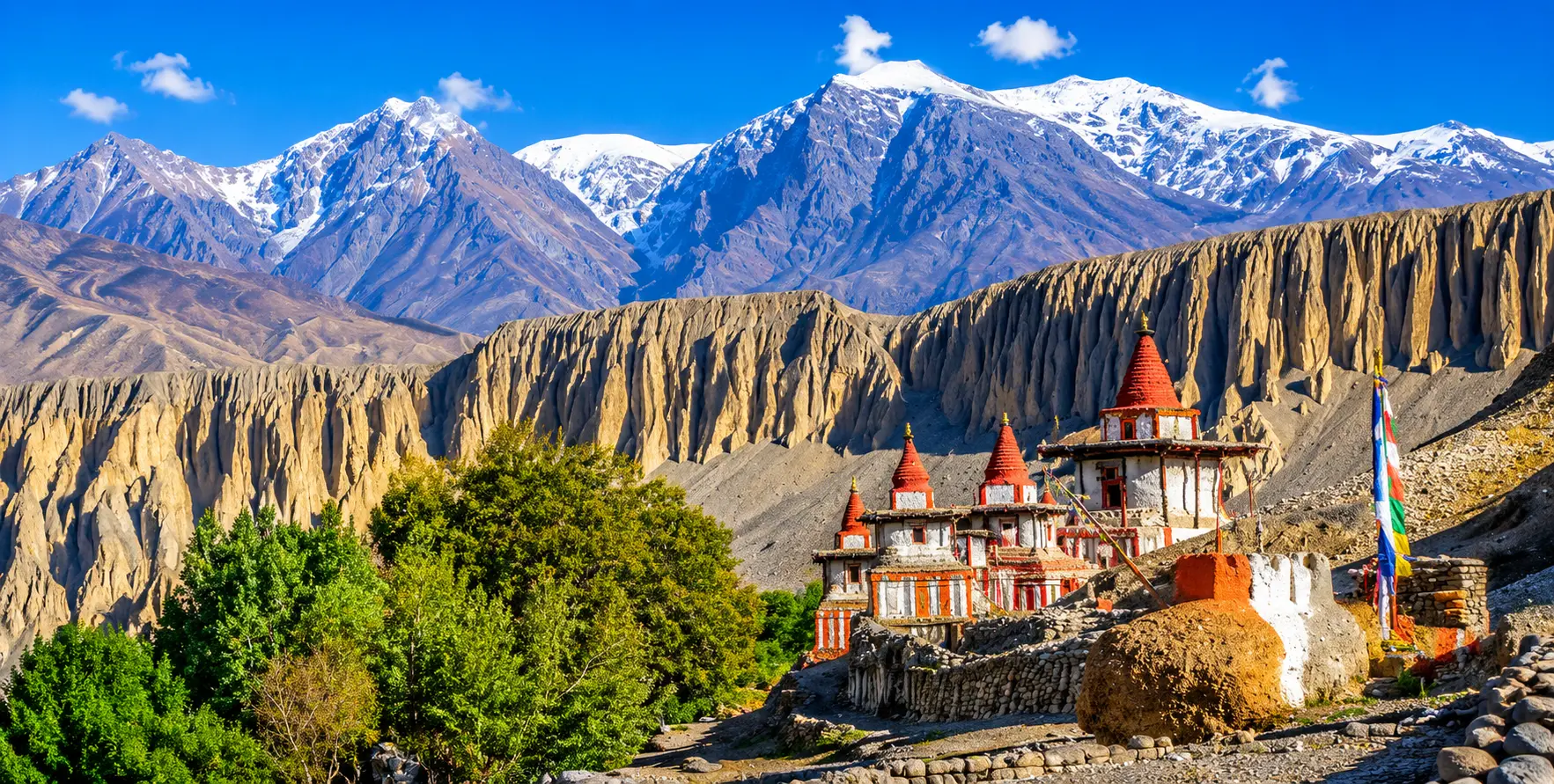
Upper Mustang covers the northern part of Mustang district, a high, dry land of about 2,000 square kilometers bordering Tibet. Most villages lie between about 2,800 and 3,900 meters along the Kali Gandaki and its side valleys. Ame Pal founded the Kingdom of Lo in the late fourteenth century, and for centuries it controlled trade in salt, wool, and grain between Tibet and Nepal’s lower hills. It later became part of Nepal, but the royal family of Lo kept a ceremonial role until the monarchy ended in the early twenty-first century.
The region opened to foreign visitors only in the early 1990s, and its culture remains strongly Tibetan, with Sakya and Nyingma monasteries, mani walls, chortens, and prayer flags in every village.
The caves of Upper Mustang are among its greatest mysteries. Thousands of artificial caves are carved into the cliffs, some used as homes, others as meditation retreats, and others as burial chambers. Archaeologists have found ancient manuscripts and remarkable Buddhist paintings in some. The Chhoser caves near Lo Manthang and the cliff caves at Chhusang are the most accessible to visitors.
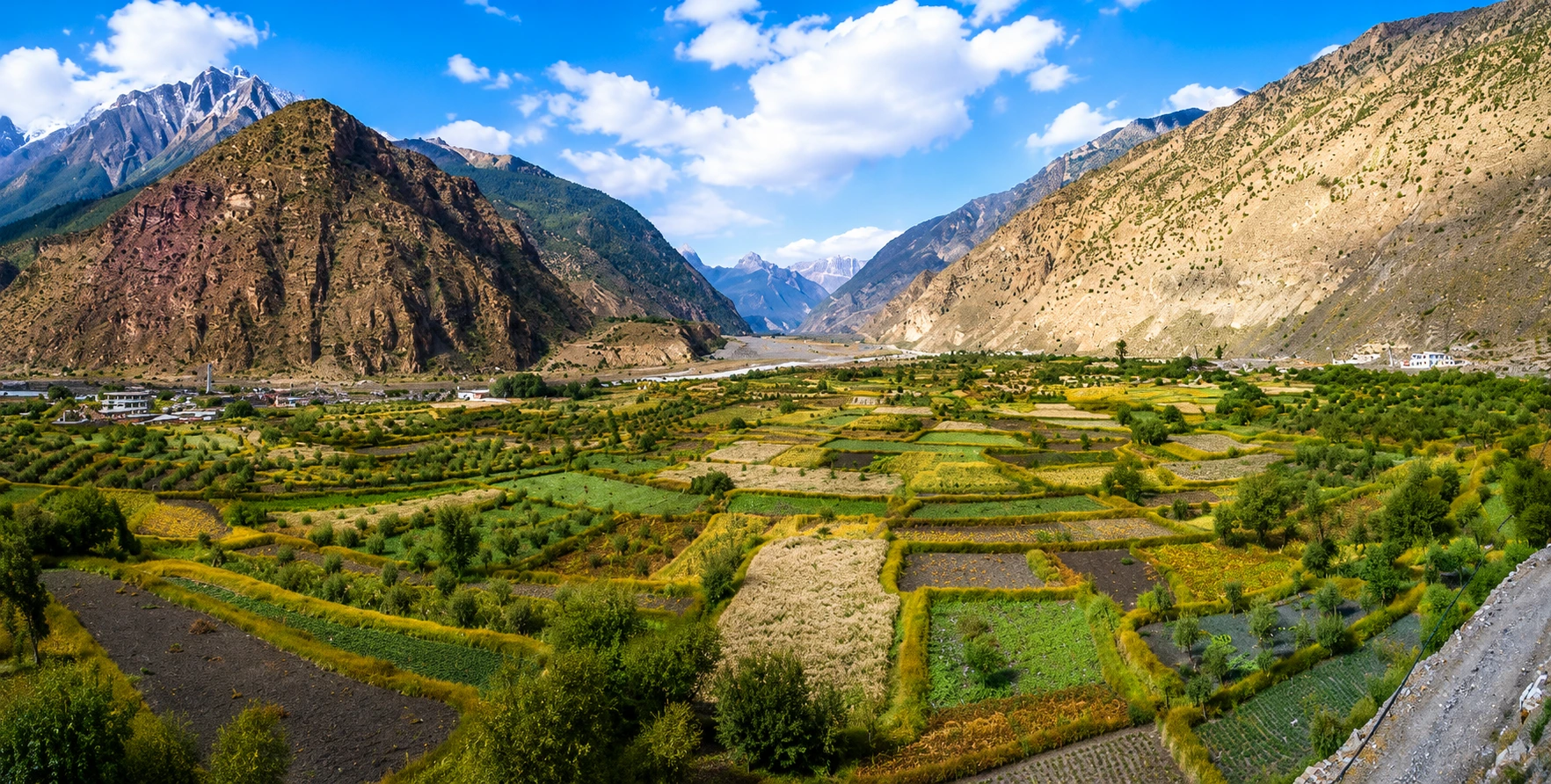
Lower Mustang and the Thakali Villages
Lower Mustang stretches from Ghasa and Lete in the south to Kagbeni in the north. Its villages belong mainly to the Thakali people, famous across Nepal for their hospitality and their dal bhat, and to the Bhotia communities of the upper valley. Marpha is known for its whitewashed houses, stone-paved streets and apple orchards. Tukuche was once a wealthy salt-trading town, and its large old houses recall that prosperity.
Jomsom is the district headquarters, with an airport, banks,s and shops. Kagbeni and Jharkot, near Muktinath, are medieval villages with old monasteries and forts. Near Jomsom, the village of Thini and the small sacred Dhumba Lake make for a pleasant short excursion, and the Bon village of Lupra preserves one of the Himalayas ‘ oldest religious traditions.
Route Overview
Pokhara to Beni (about 80 km). A paved road runs from Pokhara through Nayapul to Beni at the confluence of the Kali Gandaki and Myagdi rivers.
Beni to Jomsom (about 80 to 100 km). The road up the Kali Gandaki gorge passes Tatopani, Ghasa, Lete, Kalopani, Tukuche and Marpha. Parts are paved or improved; other sections are rough, with river crossings, dust in the dry season, and mud and landslides in the monsoon.
Jomsom to Lo Manthang (about 70 to 80 km). From Jomsom, the road follows the Kali Gandaki to Kagbeni and Chhusang, then climbs over ridges and passes through Chele, Samar, Syangboche, Ghami, and Tsarang to Lo Manthang. Sections run along dry riverbeds and cliff edges, and some passes rise above 4,000 meters. Travel time usually spans two days to allow sightseeing and acclimatization.
Lo Manthang to Muktinath and back to Pokhara. The return follows the same road south to the Kali Gandaki valley, then climbs east to Muktinath before descending through Jomsom, Marpha and the gorge to Tatopani and Pokhara.
Altitude and Health
This tour reaches altitudes where altitude sickness is possible, so take it seriously. The itinerary is designed to help: you sleep at about 2,700 meters on the first night, about 3,500 meters on the second, and about 3,800 meters in Lo Manthang for two nights before descending. Symptoms of mild altitude sickness include headache, nausea, tiredness, and poor sleep. Drink plenty of water, walk slowly, avoid alcohol, eat well, and tell your guide immediately if you feel unwell.
If symptoms worsen, the most effective treatment is to descend, and the jeep can do that at any time. Travelers with heart, lung, or blood pressure conditions, pregnant travelers, and very elderly pilgrims should consult a doctor before booking. Read our notes on altitude sickness before you travel.
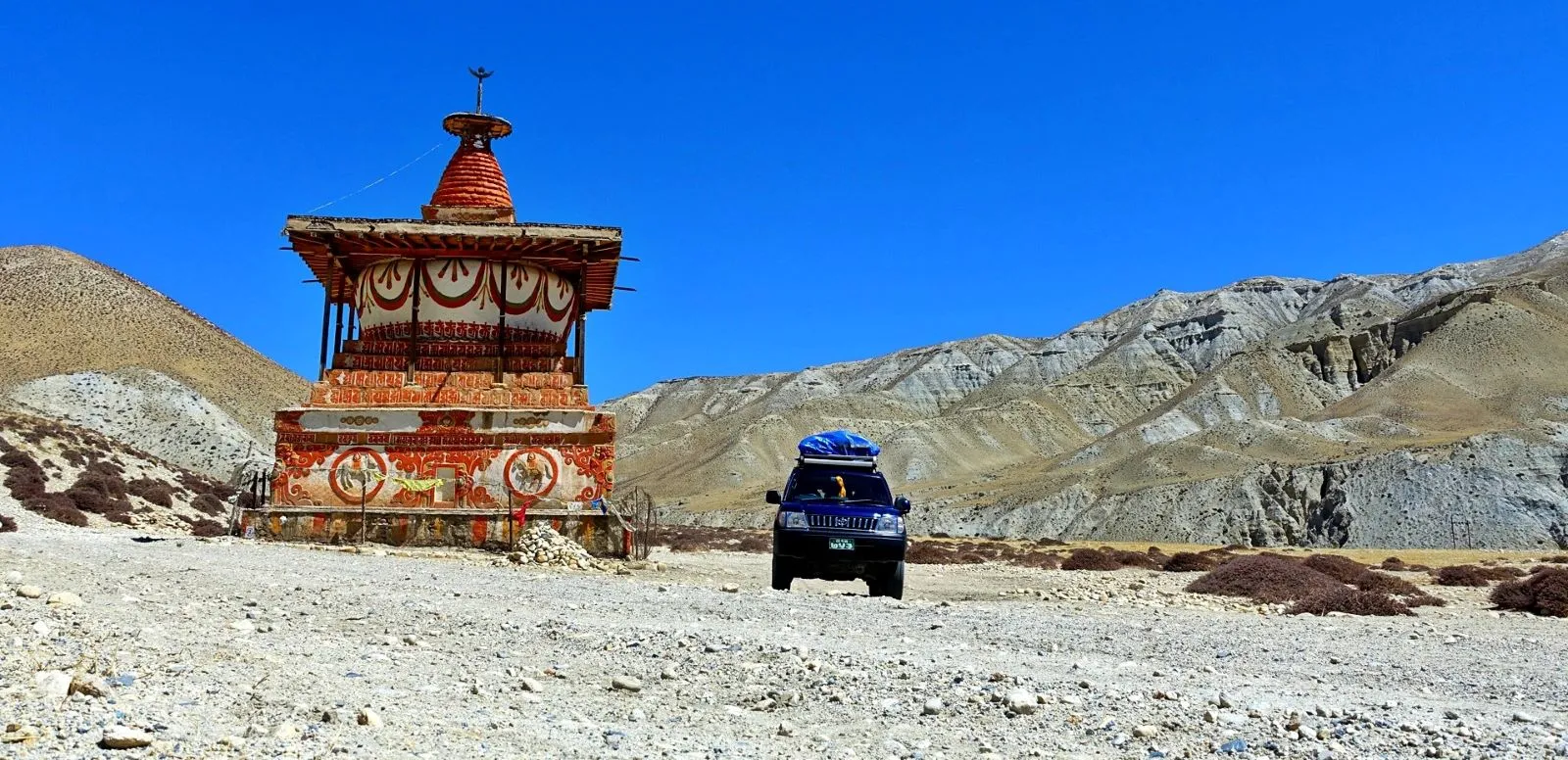
Road Condition and Safety
The Mustang road is the most demanding road on any of our tours. The paved section from Pokhara to Beni is straightforward, but beyond Beni the road shifts between paved, improved gravel, and rough dirt sections, with river crossings, steep climbs, hairpin bends, and drops above deep gorges. In Upper Mustang, parts of the route follow dry river beds that change after floods.
Dust is heavy in the dry seasons, and strong winds blow up the Kali Gandaki valley from late morning, which is why we travel the higher sections early in the day. In the monsoon, landslides are common in the lower gorge between Beni and Ghasa, even though Upper Mustang itself receives little rain. In winter, snow can block passes in Upper Mustang and the road to Muktinath.
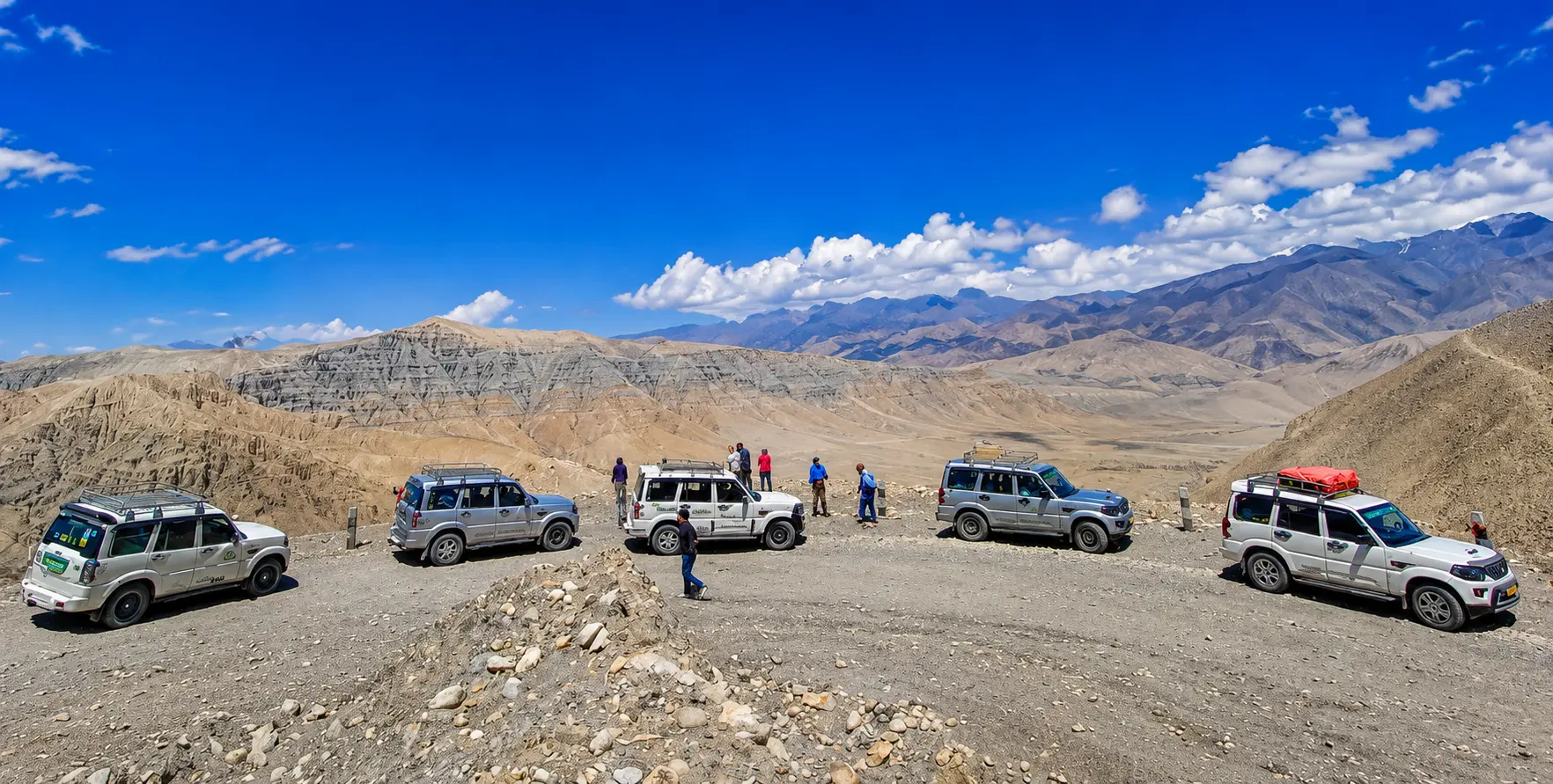
For these reasons, we use only well-maintained 4WD jeeps and Scorpios with experienced mountain drivers who regularly drive the route. We check vehicles before every trip, with special attention to tires, brakes, and four-wheel drive. Seat belts are fitted; we avoid driving after dark, and the guide and driver will never take risks on a section that looks unsafe. Read more in our article on the importance of safe transportation during Nepal tours.
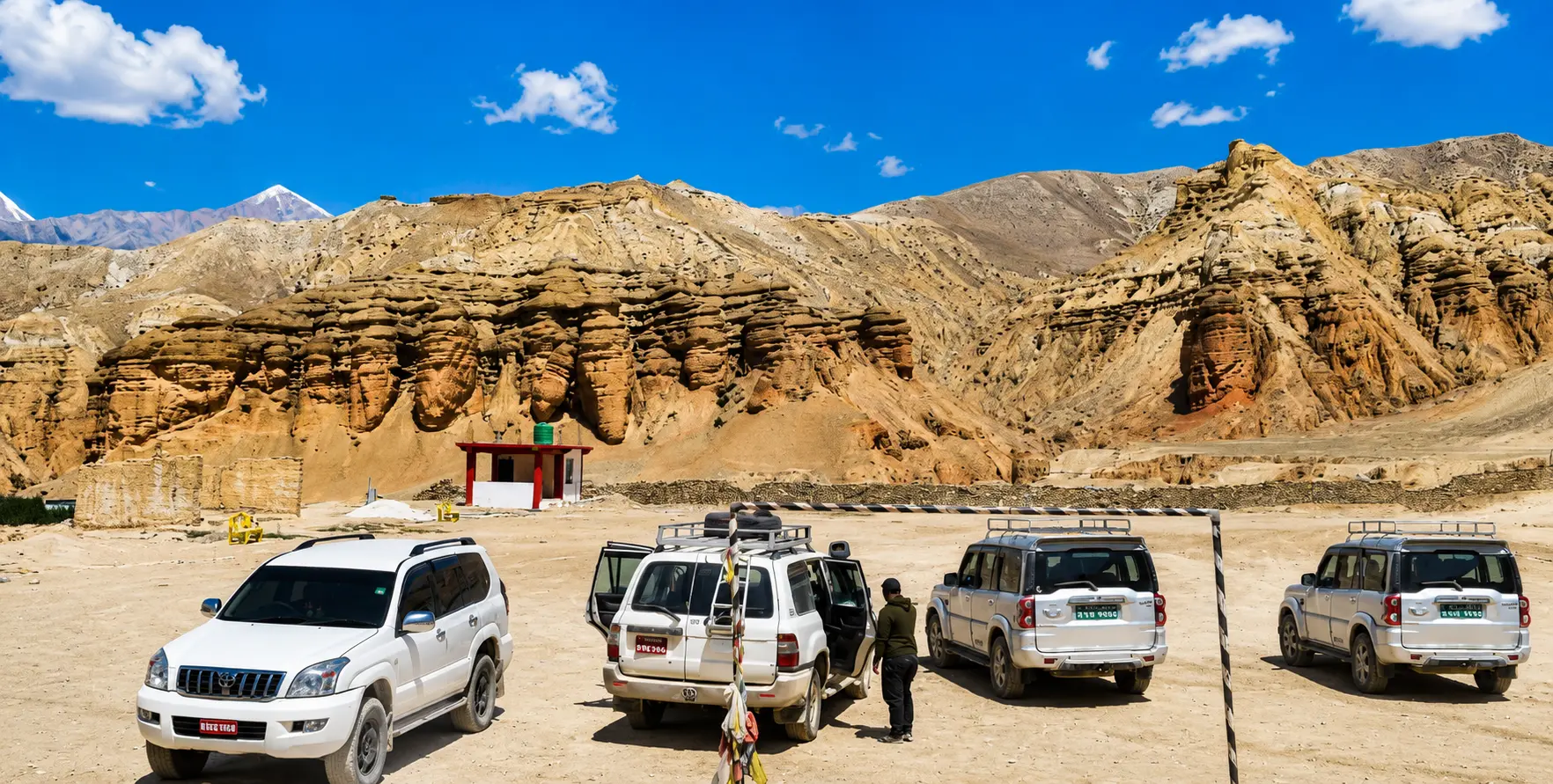
Vehicle Options for the Mustang Tour
4WD jeep or Scorpio (required). A Mahindra Scorpio or similar 4WD jeep is the only suitable vehicle for this route. Each jeep carries up to four or five passengers with luggage, plus the guide. Larger groups travel in a convoy of jeeps with experienced drivers, which is safer and more comfortable than overcrowding a single vehicle. See our jeep hire in Nepal page and our jeep rental for Muktinath tour guide.
Car, Hiace, Coaster and bus. We use these vehicles only for transfers between Kathmandu and Pokhara before and after the tour. A private car suits small groups, a Toyota Hiace suits families and groups of up to twelve, and a Coaster or bus suits large pilgrim groups.
Luggage. Space is limited, and luggage is carried on the roof under a cover. Pack in soft duffel bags rather than hard suitcases, and keep valuables, documents and warm layers in a daypack inside the jeep. Our notes on Nepal vehicle rental with roof luggage space and jeep rental with camping equipment explain how to pack bags.
Service Options: Private, One-Day, Two-Way and Shared
Private hire. This package is a private hire. The jeep, driver, and guide are reserved for your group alone, which is essential for travel in the restricted area.
One-day hire. Single transfers, such as Pokhara to Jomsom, are possible for travelers visiting only Lower Mustang and Muktinath, using our Pokhara to Mustang jeep or Kathmandu to Mustang private jeep.
Two-way hire. A round trip with the same jeep, such as this tour from Pokhara to Lo Manthang and back.
Shared. Public buses and shared jeeps run between Pokhara, Jomsom and Muktinath, and local jeeps run in Upper Mustang, but foreign visitors in the restricted area must still travel with a licensed guide and a valid permit. Shared transport offers little flexibility for sightseeing.
For any of these options, send your dates and group size through our contact page.
Pickup and Drop Options
The tour starts and ends at your hotel in Pokhara. If you are coming from Kathmandu, we can arrange a transfer with our Kathmandu-to-Pokhara car or Kathmandu-to-Pokhara private Scorpio; guests flying into Pokhara can use our Pokhara airport transfer. At the end, the jeep can take you directly to Pokhara airport or the tourist bus park.
Useful Travel Information for Mustang
Money, ATMs and Cash
Carry enough Nepali rupees in cash for the whole trip before you leave Pokhara. Jomsom has banks and an ATM, but machines in the mountains can run out of cash or stop working, and Upper Mustang has no reliable ATMs. Lodges, tea houses, monasteries and small shops in Lo Manthang, Ghami and Tsarang accept cash only. Keep small notes for monastery donations, snacks and tips. Your guide can advise how much to carry based on your trip length and travel style. For a wider view of planning, read our article on private vehicle booking in Nepal.
Electricity, Charging and Mobile Network
Most lodges in Jomsom, Marpha, Muktinath and Lo Manthang have electricity, often supported by solar power, but supply can be limited in the evenings and in smaller villages. Dining rooms may offer charging, sometimes for a small fee. Bring a power bank, spare camera batteries, and a universal adapter. Mobile signal is available in Jomsom, Kagbeni, Muktinath and much of Lower Mustang, and coverage has improved in Upper Mustang, but expect gaps between villages. Some lodges offer Wi-Fi, though it can be slow. Your guide carries a phone and stays in touch with our office.
Food and Drinking Water
Lodges serve dal bhat, Thakali sets, noodles, momos, Tibetan bread, thukpa, potatoes,s and simple Western dishes. Marpha is famous for apples, apple brandy, and dried fruit, and the Thakali kitchens of Tukuche, Kalopani, and Marpha serve some of Nepal’s best dal bhat. In Upper Mustang, menus are simpler, and vegetables are limited, so expect hearty, warming food. Buckwheat bread and tsampa are local staples. Drink only boiled, filtered,d or purified water; many lodges offer refill stations, which reduce plastic waste in this fragile region. Bring a reusable bottle and purification tablets.
Clothing and Cold
Mustang is cold for much of the year, especially at night. Even in the warmer months, temperatures in Lo Manthang can fall close to freezing after dark, and in late autumn and winter they fall well below. Bring a warm down jacket, fleece, thermal layers, a warm hat and gloves. Days can be sunny and bright, so sunglasses, sunscreen, lip balm and a sun hat are just as important. A buff or dust mask helps against the dust and wind on the road, and a light windproof jacket is useful in the afternoons.
Monastery Etiquette and Photography
Remove your shoes and hat before entering a monastery, walk clockwise around chortens, mani walls, ls, and prayer wheels, and never touch or point at statues and paintings. Photography is often not allowed inside monastery halls, and in Lo Manthang this rule is strictly enforced in some temples; always ask your guide or the caretaker first. Ask permission before photographing people, especially monks and elders. A small donation at each monastery is appreciated and helps support its upkeep.
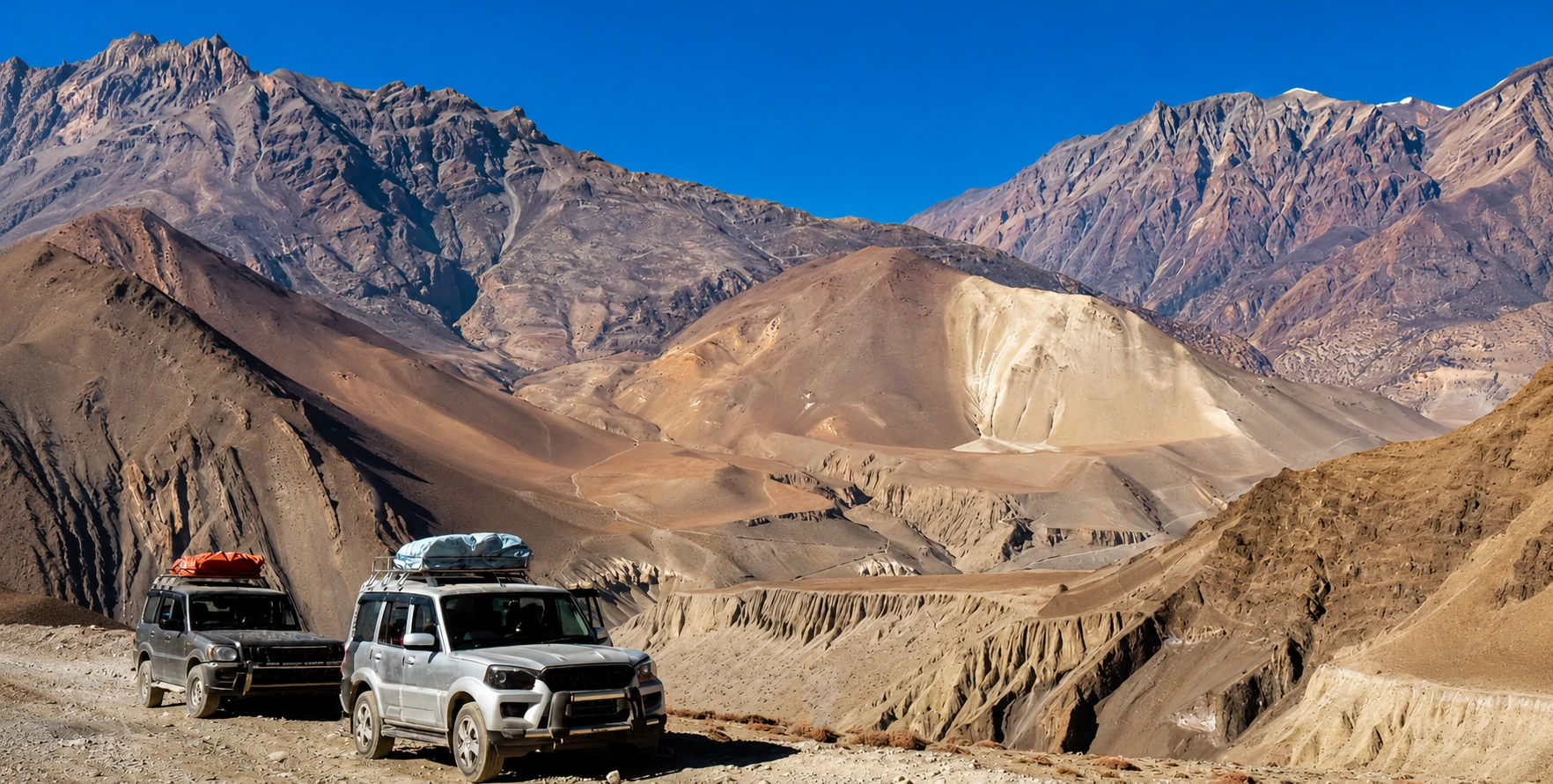
Best Time for the Muktinath Upper and Lower Mustang Tour
Spring
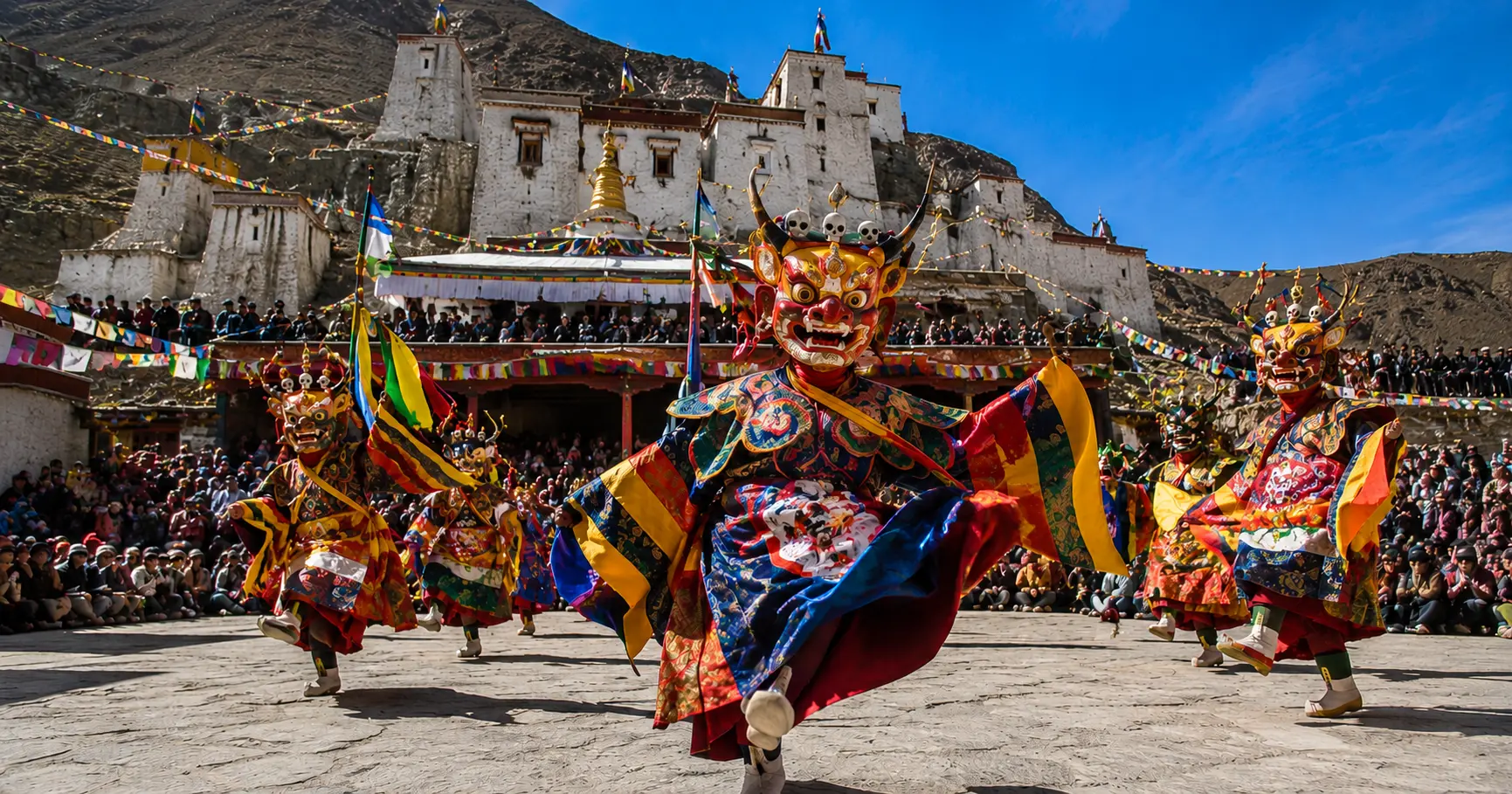
Spring is one of the best times for the Muktinath Upper and Lower Mustang tour package. Skies are usually clear during the day, temperatures are comfortable, and the apple trees of Marpha and Tukuche blossom. In Lo Manthang, spring is the season of the Tiji festival, a three-day ritual of masked dances in the main square that celebrates the victory of good over evil. Book early if you want to attend, as lodges fill quickly.
Summer and Monsoon
Upper Mustang lies in the rain shadow of the Annapurna and Dhaulagiri ranges and receives only about 250 to 400 mm of rain in a year, so it stays mostly dry while the rest of Nepal is green and wet. The monsoon season is therefore a good time to visit Upper Mustang, and the barley fields around Lo Manthang, Tsarang, and Ghami are at their greenest. The challenge is the lower road between Beni and Ghasa, where landslides are common. We plan extra time, travel early, and keep in close contact with drivers on the route. Pilgrims often prefer this season for Muktinath during the Janai Purnima festival.
Autumn
Autumn brings clear skies, crisp air, and excellent mountain views, making it the most popular season. Days are bright and nights cold. The harvest season adds color to the villages, and the Dhaulagiri and Nilgiri peaks stand out sharply above the Kali Gandaki. Permit offices and lodges are busy, so book well ahead through our contact page, and read our Pokhara to Mustang jeep page for road transfer details.
Winter
Winter is cold, and many families in Lo Manthang move to lower villages or Pokhara for the coldest weeks, so some lodges close. Snow can block passes in Upper Mustang and the road to Muktinath. Lower Mustang, Marpha and Jomsom remain accessible on most days, and skies are often clear. Travel in winter only with flexible plans and warm gear.
Places to See on the Tour
- Jomsom – the district headquarters, with views of the Tsen-Khang and the Mustang Eco Museum.
- Marpha – whitewashed lanes, the Marpha monastery, apple orchards, and Thakali culture.
- Kagbeni – a medieval village at the gateway to Upper Mustang, with the red Kag Chode monastery and old fortress ruins.
- Chhusang and Chele – cave dwellings in the red cliffs and the first views of Upper Mustang’s eroded landscape.
- Ghami – one of the largest villages in Lo, with what is often described as the longest mani wall in Nepal.
- Dhakmar – red cliffs linked by legend to the defeat of a demon by Padmasambhava.
- Ghar Gompa – an ancient Nyingma monastery associated with Padmasambhava and famous for its paintings and carved mani stones.
- Tsarang – a large village with a historic monastery and the ruins of a five-story palace.
- Lo Manthang – the walled capital of Lo, with Jampa, Thubchen, Chode and Choprang monasteries, the royal palace and the Amchi school of traditional medicine.
- Chhoser caves – the five-story Jhong cave, believed to be more than 2,000 years old, and the Garphu and Nyiphu cliff monasteries.
- Muktinath – the temple of Vishnu with 108 spouts, two holy ponds, and the Jwala Mai eternal flame.
- Jharkot – a fortress village with a Tibetan medicine center.
- Tukuche and Kalopani – historic Thakali salt-trading villages beneath Dhaulagiri and Annapurna I.
- Tatopani – natural hot springs beside the Kali Gandaki River.
Pilgrims combining this tour with a longer journey can also read our Muktinath Yatra itinerary and our Nepal Nekhor tour for Buddhist pilgrimage ideas.
Festivals and Culture of Mustang
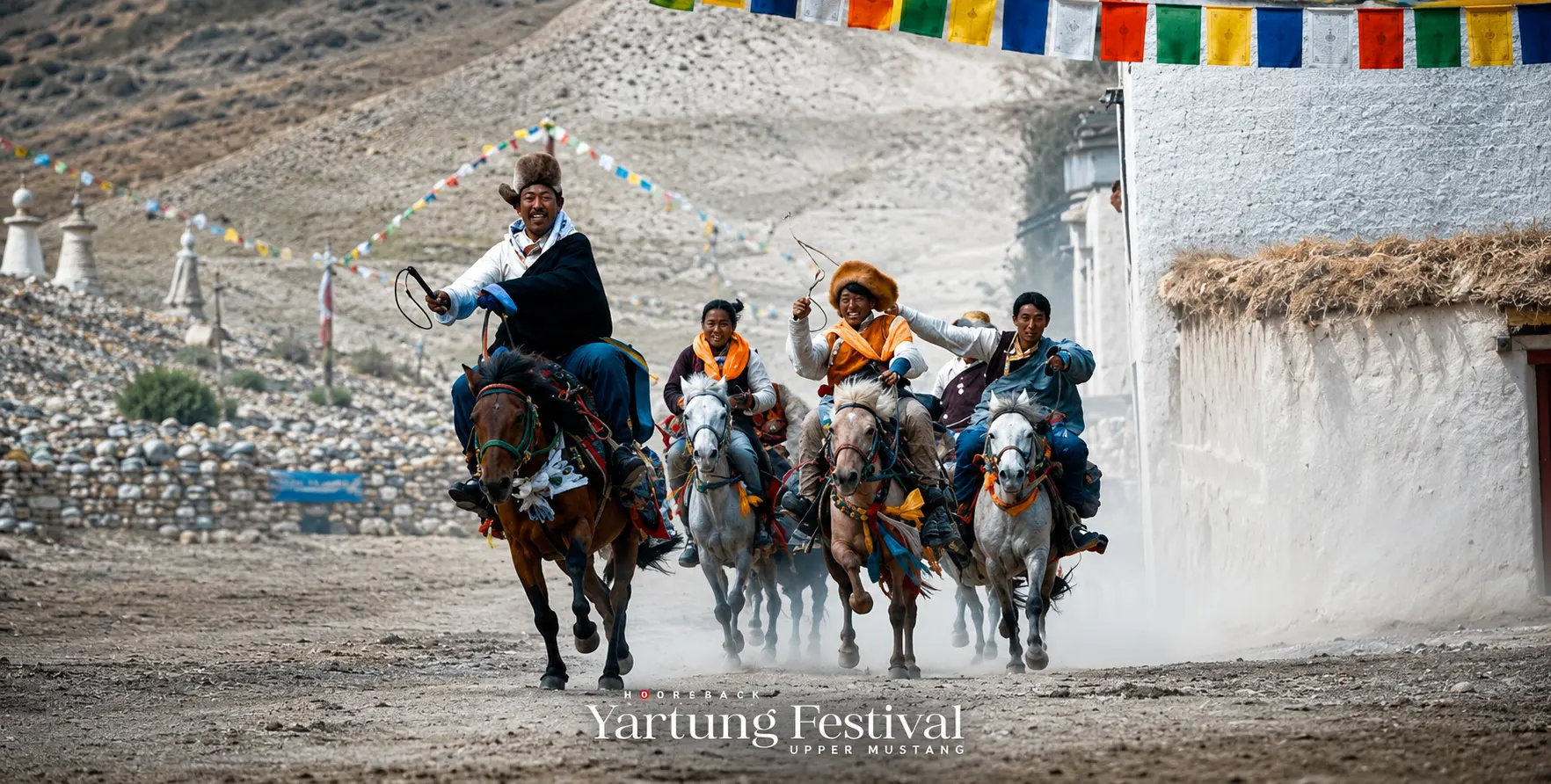
The people of Upper Mustang, known as the Loba, share language, religion, and customs with Tibet. Daily life revolves around farming barley and buckwheat, herding goats, yaks,s and horses, and the monasteries that shape every village. Tiji is the best-known festival. Other celebrations include Yartung, a harvest festival with horse races held near the end of summer, and Losar, the Tibetan New Year in late winter. In Lower Mustang, the Thakali people keep their own festivals and traditions, and Muktinath draws large numbers of Hindu pilgrims during Janai Purnima, Rishi Panchami, and other holy days. Your guide will explain any festivals happening during your visit.
Responsible Travel in Mustang
Mustang is a fragile environment and a living culture, and visitors play an important part in preserving it. Use refill stations instead of buying bottled water, carry your rubbish back to Jomsom or Pokhara, and support local lodges, shops and craftspeople. Respect monastery rules, dress modestly, and never buy or remove antique religious objects, which are protected. Stay on established tracks and do not disturb livestock or wildlife. Choosing a guided tour with local staff also supports the communities along the route. Our note on quality transport in Nepal explains how we work.
Extend Your Journey
Kathmandu Before or After
Spend a day or two in the capital with a guided Kathmandu sightseeing tour of Pashupatinath, Boudhanath, Swayambhunath and the old palace squares, or visit Bhaktapur Durbar Square. Our trekking partner also offers a Kathmandu day tour. Arriving guests can book our Kathmandu airport transfers, and the highway journey is covered by our Kathmandu to Pokhara vehicle transfer, Kathmandu to Pokhara bus, and, for the return, our Pokhara to Kathmandu car, Pokhara to Kathmandu bus, or Pokhara to Kathmandu transport.
Pokhara and the Annapurna Foothills
Before or after the Mustang road, Pokhara is the perfect place to relax. Watch sunrise over the Annapurnas with our Sarangkot sunrise tour vehicle or Pokhara to Sarangkot jeep, book car hire in Pokhara for the lakeside and caves, or try paragliding in Pokhara and the Kusma bungee jump. Short drives take you to hill villages with our Pokhara to Dhampus jeep, Pokhara to Ghandruk jeep, Pokhara to Kande jeep, Pokhara to Sikles jeep rental, and Pokhara to Pumdikot Mahadev temple jeep.
Lumbini and Chitwan
Many pilgrims continue to the birthplace of the Buddha with our Kathmandu to Lumbini vehicle hire or a Pokhara to Sunauli car, and wildlife lovers head south with our Pokhara to Chitwan by private car for a Chitwan jungle safari. The Manakamana temple lies on the highway between Pokhara and Kathmandu.
Muktinath by Helicopter or Flight
For travelers short on time, a Muktinath Yatra by helicopter or an Annapurna helicopter tour offers a quick alternative, and scenic flights connect Pokhara and Jomsom. For pilgrims coming from India, our Nepal tour from Gorakhpur and Kathmandu to the Unauli border by private jeep makes overland travel easy.
Tibet, Kailash and Bhutan
Mustang’s Tibetan culture inspires many travelers to visit Tibet itself. Consider a Lhasa Tibet tour, the overland Kathmandu to Lhasa tour, a Mount Kailash tour, or the Kailash overland tour, with road transfers through our Kathmandu to Kerung border service. For Bhutan, see the luxury Bhutan tour or the combined Nepal, Tibet and Bhutan tour.
Treks and Adventures Near Mustang
The Mustang road connects with some of Nepal’s finest walking. The Upper Mustang trek follows the old trading trail to Lo Manthang on foot, and the Annapurna Circuit trek crosses the Thorong La pass from Manang to Muktinath. The remote Nar Phu trek explores hidden valleys north of the Annapurnas, and the Ghorepani Poon Hill trek and Annapurna Base Camp trek start near Pokhara, with transportation options including private jeeps from Pokhara to Ulleri and from Pokhara to Ghorepani Poon Hill.
Short trek lovers can try the Mulda View trek. Adventure seekers can raft the Kali Gandaki, and cyclists can read our guide to the Upper Mustang bike ride with vehicle support. For comfort-focused journeys, browse luxury treks, short scenic treks and signature classic treks from Alpine Luxury Treks. Find all our trekking transfers on our trekking transport page.
Where You Stay
Accommodation on this tour is in simple, comfortable lodges and guesthouses. Jomsom and Marpha have good lodges with attached bathrooms and hot showers. In Ghami and Lo Manthang, lodges are family-run, with warm dining rooms heated by stoves, cozy rooms and, in many cases, attached bathrooms and solar hot water. Muktinath has a good choice of lodges in Ranipauwa. Tatopani has lodges near the hot springs. Rooms in Upper Mustang can be cold at night, so a warm sleeping bag liner or bag is useful. We can book lodges on your behalf, or you can choose your own; tell us your preference when you enquire. For travelers who want more comfort, Alpine Luxury Treks offers an Upper Mustang luxury lodge tour.
Who This Tour Suits
- Travelers who want to see Upper Mustangwithout aa two-week trek
- Hindu and Buddhist pilgrims who want to combine Muktinath with the monasteries of Lo.
- Photographers drawn to the desert landscapes, cliff caves, and walled villages.
- Families and older travelers who are in reasonable health and can manage altitude.
- Solo travelers subject to current permit rules.
- Small, organized groups of friends traveling in a convoy of jeeps.
Families choosing vehicles for larger groups can read our guide on which vehicle is best for 6 people in Nepal.
Packing List
- Passport with valid visa, passport copies and photos for permits.
- Warm down jacket, fleece, thermal layers, warm hat, gloves and woolen socks.
- Windproof jacket, comfortable trousers and sturdy walking shoes.
- Sunglasses, sunscreen, lip balm and a sun hat.
- Buff or dust mask for the road.
- Reusable water bottle and purification tablets.
- Power bank, spare batteries and a universal adapter.
- Personal medicines, a basic first-aid kit and any altitude medicine your doctor recommends.
- Small daypack, headlamp and toiletries.
- Enough cash in Nepali rupees for the full trip.
Travel Tips
- Send passport details early so the guide can prepare your permits.
- Spend a night in Pokhara before departure to rest after travel.
- Start each day early to avoid the strong afternoon winds.
- Drink water regularly and walk slowly in higher villages.
- Keep a warm layer and water in the jeep, not on the roof.
- Allow a spare day at the end of your trip in case of road delays.
- Respect local customs and ask before taking photographs.
- Read our tips on booking a jeep from Pokhara before you plan.
Why Choose Nepal Vehicle Hiring
- Mountain-ready vehicles. Well-maintained 4WD jeeps and Scorpios, checked before every Mustang journey.
- Experienced drivers. Drivers who know the Kali Gandaki road and the Upper Mustang tracks.
- Licensed guide included. An experienced tour guide for the whole trip, as required in the restricted area.
- Permit support. Help with the Restricted Area Permit and conservation area permit through a registered agency.
- Flexible itineraries. Tailor the days, add stops, or extend to Kathmandu, Lumbini, or Chitwan.
- Local office support. Phone and WhatsApp support from our team throughout your tour.
Learn more about us on our About Us page, and see how we plan multi-day trips on our Nepal holiday tour page.
Related Services
- Kathmandu to Muktinath jeep
- Muktinath to Kathmandu jeep
- Muktinath to Pokhara jeep
- Kathmandu to Muktinath bus
- Muktinath to Kathmandu bus
- Pokhara to Mustang road overview
- Jeep rental for Mustang tour and Lo Manthang
- Besisahar private vehicle
- Nepal tour packages
- Travel blog
How to Book
- Send your travel dates, group size, nationality, and pickup point via WhatsApp or email, or use our plan-your-trip form.
- Share passport copies and photos so the guide can begin the permit process.
- Confirm the itinerary, vehicle, and lodge preferences with our team.
- Receive your confirmation with the driver’s and guide’s details.
- Meet your guide and driver at your Pokhara hotel on day one.
Book Your Muktinath Upper and Lower Mustang Tour
Ready to explore the hidden Kingdom of Lo and the sacred temple of Muktinath? Our Muktinath Upper and Lower Mustang tour package includes a private 4WD jeep, an experienced mountain driver, and an experienced licensed tour guide for eight unforgettable days.
WhatsApp: +977 9814227196
Email: [email protected]
Send us your dates and group size today, and our team will help you plan your journey to Upper Mustang and Muktinath. Visit Nepal Vehicle Hiring to explore more tours.
Frequently Asked Question (FAQ’s)
Yes. An experienced, licensed tour guide is included for all eight days, along with the guide’s meals and accommodation. A licensed guide is also compulsory for foreign visitors in Upper Mustang.
Yes. Foreign visitors need an Upper Mustang Restricted Area Permit, issued through a registered agency, as well as the Annapurna Conservation Area permit. We help prepare both.
Group size rules have recently been relaxed, so solo travel may now be possible. We will confirm the current rules for your dates before you book.
You sleep at about 3,800 meters in Lo Manthang and visit Ghar Gompa and Muktinath at around 3,800- 3,900 meters. Some passes on the road are higher.
Yes, it is possible. The itinerary gains height gradually, and your guide watches for symptoms. Descending is the best treatment, and the jeep makes that easy.
A private 4WD jeep or a Mahindra Scorpio with an experienced mountain driver. Cars, Hiaces, Coasters, and buses are used only between Kathmandu and Pokhara.
Usually four to five passengers, plus luggage and the guide. Larger groups travel in several jeeps.
The road is rough in places, but experienced drivers, well-maintained 4WD vehicles, early starts, and no night driving keep the journey as safe as possible.
Yes. We can add a transfer from Kathmandu to Pokhara before the tour and back afterward, or arrange a direct jeep from Kathmandu to Jomsom.
Yes. Upper Mustang stays mostly dry, though landslides can affect the lower road. We plan extra time and travel early.
Tiji takes place in Lo Manthang in spring, with dates set by the Tibetan lunar calendar. Contact us for the dates and book early.
No reliable ones. Carry enough Nepali cash from Pokhara; Jomsom has banks, but they cannot always be relied on.
Photography is often not allowed inside monastery halls. Always ask your guide or the caretaker first.
Many older travelers complete it, but because of the altitude and rough roads, a doctor’s advice is recommended before booking.
Yes. Add days in Lo Manthang, include Lupra or Thini, or extend to Kathmandu, Lumbini, or Chitwan.

Reviews on Muktinath Upper and Lower Mustang 8 Day Tour Package by Jeep

Related Trips

Kathmandu to Mustang Private jeep

Pokhara to Mustang Jeep
Kathmandu Pokhara Muktinath Lumbini Chitwan Tour Package

Muktinath Yatra