Plan a Trip


Jeep Rental for Mustang Tour
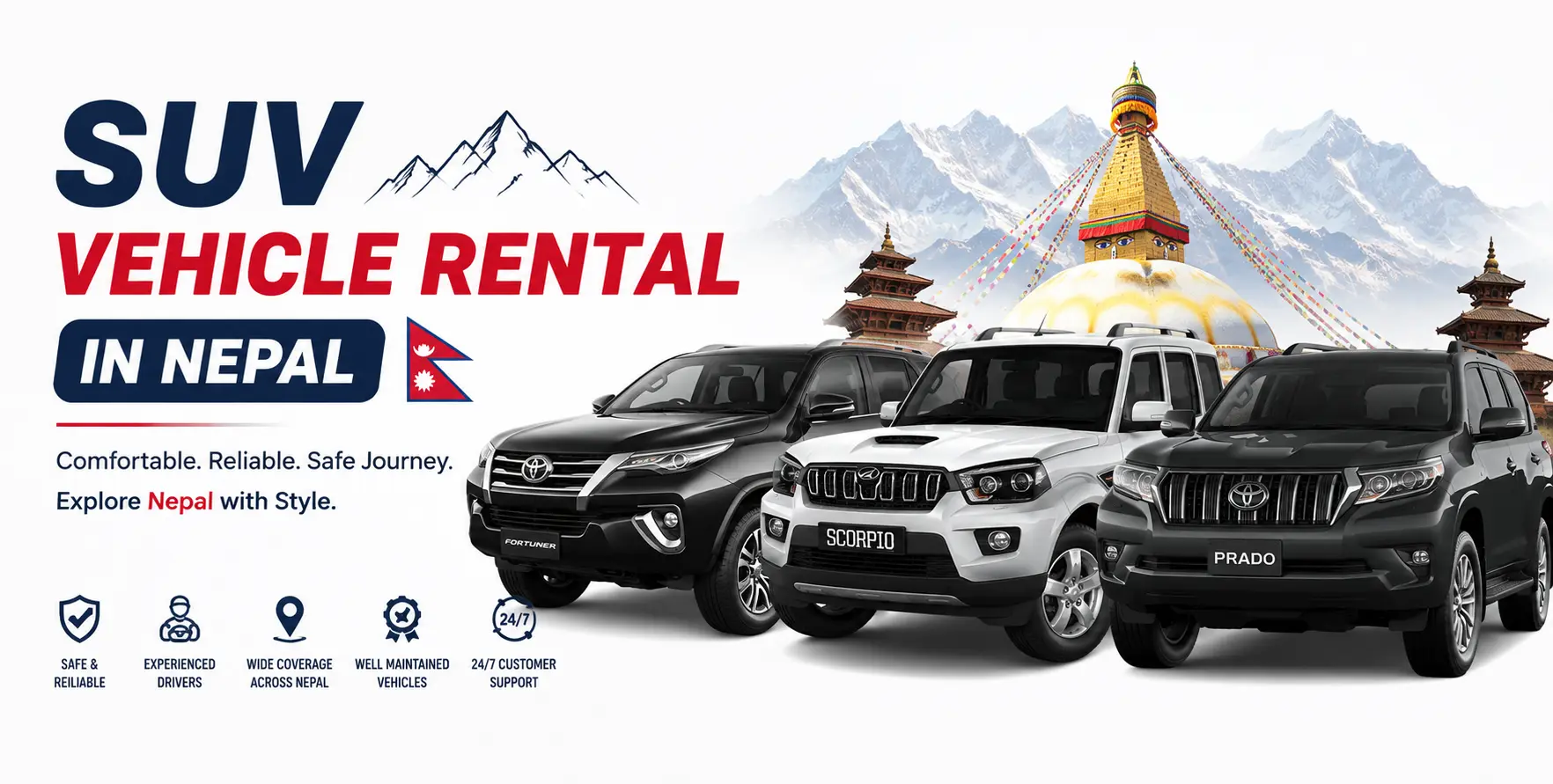
Jeep Rental for Mustang Tour: The Complete Guide
Mustang used to demand two weeks on foot to reach the walled city of Lo Manthang. Today, thanks to expanded roads and a genuinely game-changing 2026 permit reform, jeep rental for a Mustang tour can cover the same ground in as little as four to six days—and cost a fraction of what it did just a year ago. This guide walks through what’s changed, what isn’t, and exactly how to plan a jeep-based journey into one of the Himalayas’ last truly remote kingdoms.
Whether you’re weighing a short Lower Mustang loop through Kagbeni and Muktinath or a full Upper Mustang expedition to Lo Manthang and Chhoser, this guide covers permits, costs, routes, seasonal timing, vehicle choice, and every practical detail you need for 2026 and 2027.
Why Jeep Tours Have Overtaken Trekking in Mustang
For decades, visiting Upper Mustang meant a demanding 12- to 16-day trek across high-desert terrain. Rapid road development over the past several years has changed that calculation almost entirely — new paved and improved gravel roads now reach deep into the region, close to Lo Manthang itself, meaning the same distance a trekker once covered in two weeks can now be driven in a matter of days. This shift has made jeep touring the dominant way most visitors now experience Mustang, particularly since Nepal’s 2026 permit reform (covered in full below) removed the biggest financial penalty short trips used to face.
A jeep tour also solves the altitude and stamina problem that put many travellers off Mustang entirely. Lo Manthang sits at roughly 3,730 to 3,840 meters, with some side excursions and passes reaching over 4,200 meters — a jeep gets you there without days of cumulative physical exertion at altitude beforehand. However,h sensible acclimatisation still matters, covered later in this guide. Our existing Upper Mustang 4WD jeep guide covers the vehicle side in more depth, alongside this article’s fuller route and permit breakdown.
It’s worth acknowledging the trade-off honestly: a jeep tour moves faster and covers more ground with less physical demand, but a multi-week trek still offers a different, slower relationship with the landscape and its communities — more time in each village, more chance encounters along the trail, and the particular satisfaction of arriving at Lo Manthang on foot after weeks of walking. Neither approach is objectively better; they serve different travellers, timelines, and physical capabilities. For anyone with two weeks or more, able to walk at altitude for sustained periods, and drawn to a slower pace, the traditional trek remains a genuinely rewarding option. For everyone else — the majority of modern visitors, particularly international travellers balancing Mustang against a broader Nepal itinerary — the jeep tour has become the practical default.
Lower Mustang vs Upper Mustang: Know the Difference
Lower Mustang covers the area from roughly Jomsom down through Kagbeni, Muktinath, Marpha, and the surrounding villages — accessible with only a standard Annapurna Conservation Area Permit (ACAP), no restricted-area permit required, and open to independent travel without a mandatory guide. Most visitors on a Muktinath pilgrimage stay in Lower Mustang the entire trip, covered by our Jomsom to Muktinath jeep rental and best time to visit Muktinath guides.
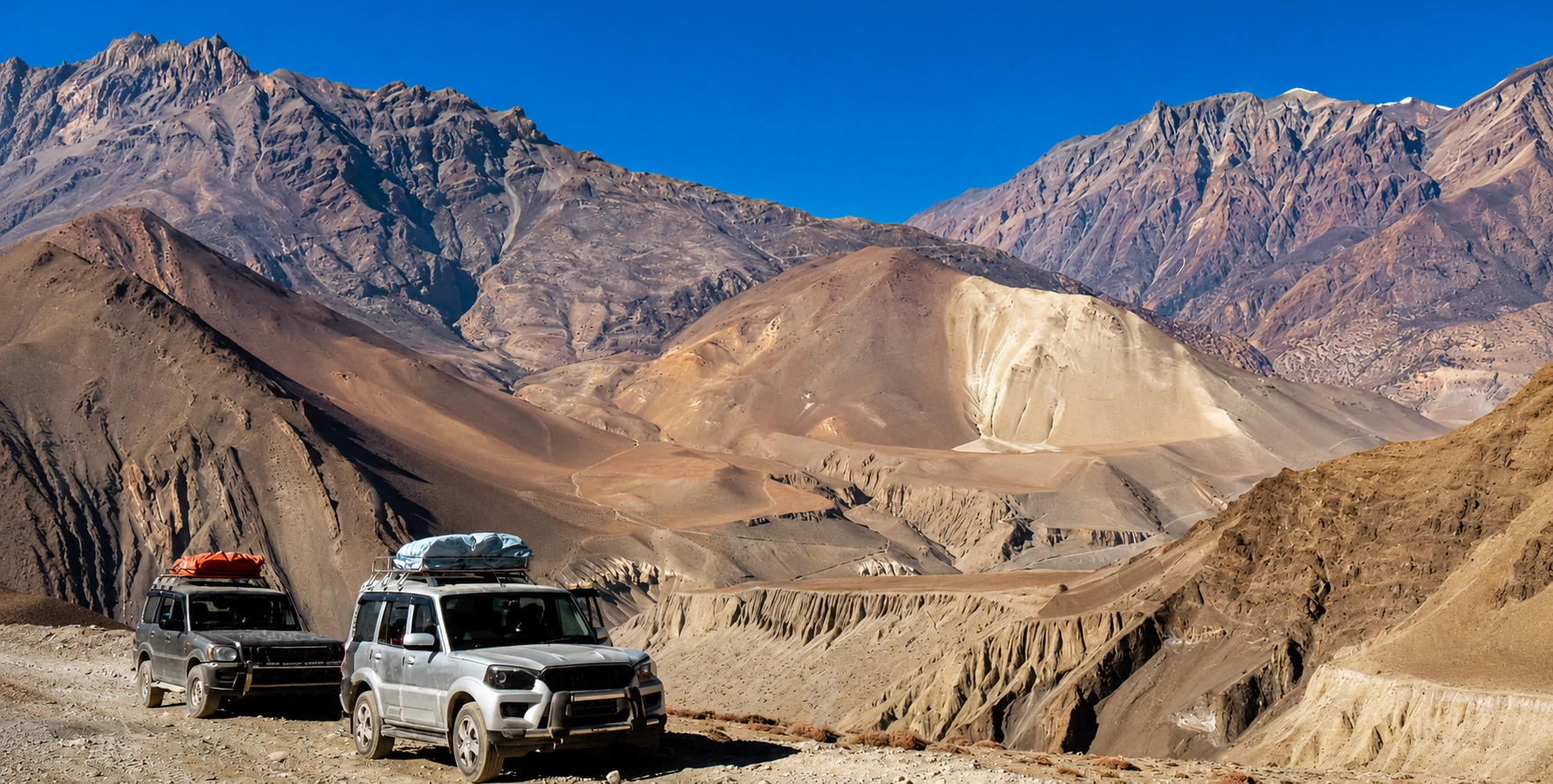
Upper Mustang begins at the checkpoint just past Kagbeni or Chele and extends north to Lo Manthang, Chhoser, and the Tibetan border area. This is Nepal’s most iconic restricted region — a former independent kingdom, closed to outside visitors until 1992, and still governed by a specific permit system covered in detail in the next section. This is where the real jeep-touring adventure begins, through the ochre cliffs, wind-carved canyons, and centuries-old walled settlements that make Mustang so distinct from the rest of Nepal.
A Brief History of the Kingdom of Lo
Understanding Mustang’s history adds real depth to a jeep tour through the region. Upper Mustang was once the independent Kingdom of Lo, founded in the 14th century by Ame Pal, strategically positioned along a key salt-trade route between Tibet and the Indian subcontinent. For centuries, the kingdom maintained a distinct identity and close cultural ties to Tibet, developing its own royal lineage, monastic traditions, and distinctive Tibetan Buddhist art and architecture that still define the region today.
The unified Kingdom of Nepal annexed Mustang in the 18th century, but it retained considerable local autonomy and its own titular king well into the modern era; the last Raja of Mustang, Jigme Dorje Palbar Bista, was recognised locally even after the formal monarchy’s political authority ended. The region remained entirely closed to outside visitors until 1992, when Nepal first opened it to a strictly limited number of permitted tourists. This restriction shaped both the permit system covered in this guide and the remarkably well-preserved character of Lo Manthang and the surrounding villages, largely untouched by mass tourism until very recently.
The New Upper Mustang Permit Rules (What Changed)
This is the single most important update for anyone planning a Mustang jeep tour, and it fundamentally changes the economics of a short trip. For years, the Upper Mustang Restricted Area Permit (RAP) was a flat USD 500 per person, charged for a mandatory minimum of 10 days regardless of how long you actually stayed. A Cabinet decision amending Schedule 12 of Nepal’s Immigration Regulations replaced that flat fee with a pay-as-you-go structure: USD 50 per person, per day, charged only for the days you’re physically inside the restricted zone.
The practical effect is dramatic. A 5-day jeep tour to Lo Manthang that used to cost a flat USD 500 in permit fees now costs USD 250. A tight 3-day dash to catch the Tiji Festival now costs USD 150 instead of the old flat 500. This reform specifically targets the jeep-touring, motorbiking, and short-festival-visit segment of Mustang travel — exactly the kind of trip this guide is built around.
- How the clock works: Your permit days only count from the moment you cross into the restricted zone (generally at Kagbeni or Chele) until you exit. Time spent in Kathmandu, Pokhara, or even Jomsom beforehand doesn’t count toward your permit days.
- Group size: Since 22 March 2026, the old two-person minimum for restricted-area permits has been scrapped, meaning solo travellers can now obtain a permit, though you must still travel with a licensed guide through a registered agency, which remains mandatory regardless of group size.
- Independent travel: Still not permitted. The RAP can only be issued to travellers through a Nepal-registered trekking or travel agency, applied for at the Department of Immigration in Kathmandu or Pokhara — you cannot apply as a walk-in individual.
- Additional permits: You also need an ACAP (Annapurna Conservation Area Permit) on top of the RAP, since Upper Mustang sits within the wider conservation area, along with a TIMS card.
Our ACAP permit guide and broader Annapurna Conservation Area guide cover this base-level permit in more detail, useful groundwork before tackling the restricted-area application specifically.
One more detail worth flagging: the permit reform applies specifically to the core Upper Mustang restricted zone administered under the current rules. A small number of areas near the Nepal-China border, including the Korala border crossing itself, remain under additional restriction beyond the standard RAP, and your agency and guide will be familiar with exactly where those boundaries sit along your specific route.
Total Permit Cost Breakdown
For a typical 4 to 6 day jeep tour into the restricted zone, expect RAP fees of roughly USD 200 to 300 per person, plus ACAP and TIMS fees generally totaling around USD 30 to 40. A short 3-day Tiji Festival visit runs closer to USD 150 in RAP fees alone. These figures cover permits only — they do not include your jeep rental, guide fees, agency service charges, accommodation, or meals, which are covered separately below. Full package costs for a complete Upper Mustang jeep expedition, permits included, commonly range from roughly USD 1,500 to 4,000 or more depending on trip length, group size, and vehicle class.
Route Overview: Getting to Lo Manthang by Jeep
Most Mustang jeep tours start in Pokhara or Kathmandu, head through Jomsom, and continue north through Kagbeni into the restricted zone. Here’s how the approach breaks down.
Starting From Pokhara
The most common starting point. Fly from Pokhara to Jomsom in about 20 minutes, or drive the full overland route via our Pokhara-to-Beni jeep hire service, then continue to Jomsom. From Jomsom, our Jomsom to Muktinath jeep rental page covers the short detour to Muktinath, which many travellers add before or after heading north into the restricted zone.
Starting From Kathmandu
Travellers beginning in the capital can arrange the full overland journey via our Kathmandu to Mustang private jeep service, or connect through Pokhara first using our Kathmandu to Pokhara bus, Kathmandu to Pokhara VIP Sofa Bus, or Kathmandu to Pokhara private Scorpio services, before continuing north.
Into the Restricted Zone: Kagbeni to Lo Manthang
From Kagbeni, the jeep route continues through Chele, where the restricted-area checkpoint sits, then climbs through Syangboche (around 3,475 meters) and on to Ghami (around 3,520 meters). From Ghami, the route continues to Charang (also spelt Tsarang, around 3,490 meters), home to an impressive five-story former royal palace and monastery, before the final approach to Lo Manthang itself at roughly 3,730 to 3,840 meters.
Weather and Road Conditions by Season
Mustang’s rain-shadow position means the region behaves quite differently from the rest of Nepal across the calendar. Autumn (September to November) delivers the year’s most reliable combination of clear skies, dry roads, and comfortable daytime temperatures, making it the busiest and most popular season for jeep tours, with correspondingly higher demand for both vehicles and teahouse accommodation along the route. Spring (March to May) comes in a close second, with the Tiji Festival in May drawing many travellers to time their trip around it.
Summer monsoon (June to August) affects Mustang far less than most of Nepal, given the rain-shadow effect, though the approach roads through Beni and the lower Kali Gandaki valley — outside the rain-shadow zone — can still see landslide disruption during this period, even if Mustang itself stays comparatively dry. Winter (December to February) brings serious cold, occasional snow at higher points along the route, and the shortest daylight hours of the year. However, jeep access to Lo Manthang generally remains possible on clear days, just with a smaller and hardier group of visitors willing to brave the conditions.
Group Size and Solo Travel Considerations
Since the March 2026 reform scrapped the old two-person minimum, solo travellers can now genuinely plan a Mustang jeep tour without first needing to find a travel partner. However, the mandatory guide requirement means you’re never truly travelling alone in the restricted zone. For solo travelers, jeep charter costs work out considerably higher per person than for a group, since the vehicle itself is priced per charter rather than per seat — grouping with other travelers through your agency, where possible, meaningfully reduces the per-person cost without changing the itinerary itself.
Larger groups of four to six benefit most from the jeep’s per-vehicle pricing structure, and for groups beyond that size, arranging two vehicles travelling together is generally more practical than trying to fit additional passengers into a single jeep across multi-day mountain roads.
Choosing a Jeep Tour Operator
- Confirm the operator is a registered agency authorised to process RAP applications — this isn’t optional given Upper Mustang’s restricted status.
- Ask exactly what’s included in your quoted price: permits, guide fees, vehicle, fuel, driver accommodation, and your own accommodation and meals are sometimes bundled and sometimes billed separately.
- Check the specific vehicle model being offered, not just the general category, since condition and capability vary between operators.s
- Ask about your guide’s specific experience on the Mustang route, not just general trekking guide credentials.
- Clarify cancellation and rescheduling policies given how weather-dependent flights into Jomsom can be at the start of your trip.
Return Journey Options
Most jeep tours return the same way they came, retracing the route back through Charang, Ghami, Chele, and Kagbeni to Jomsom. From there, travellers typically fly back to Pokhara for speed, or continue by road via our Muktinath-to-Pokhara jeep service, which broadly follows the same overland approach used further south on the return leg. A small number of adventurous groups extend their trip further north or combine it with an Annapurna Circuit crossing rather than returning the way they came. However, this requires additional planning around permits and timing that your agency and guide can advise on directly.
Sample Jeep Tour Itinerary (5 Days From Jomsom)
Day 1: Jomsom to Kagbeni to Chele, crossing into the restricted zone and continuing to Syangboche, with an overnight stop.
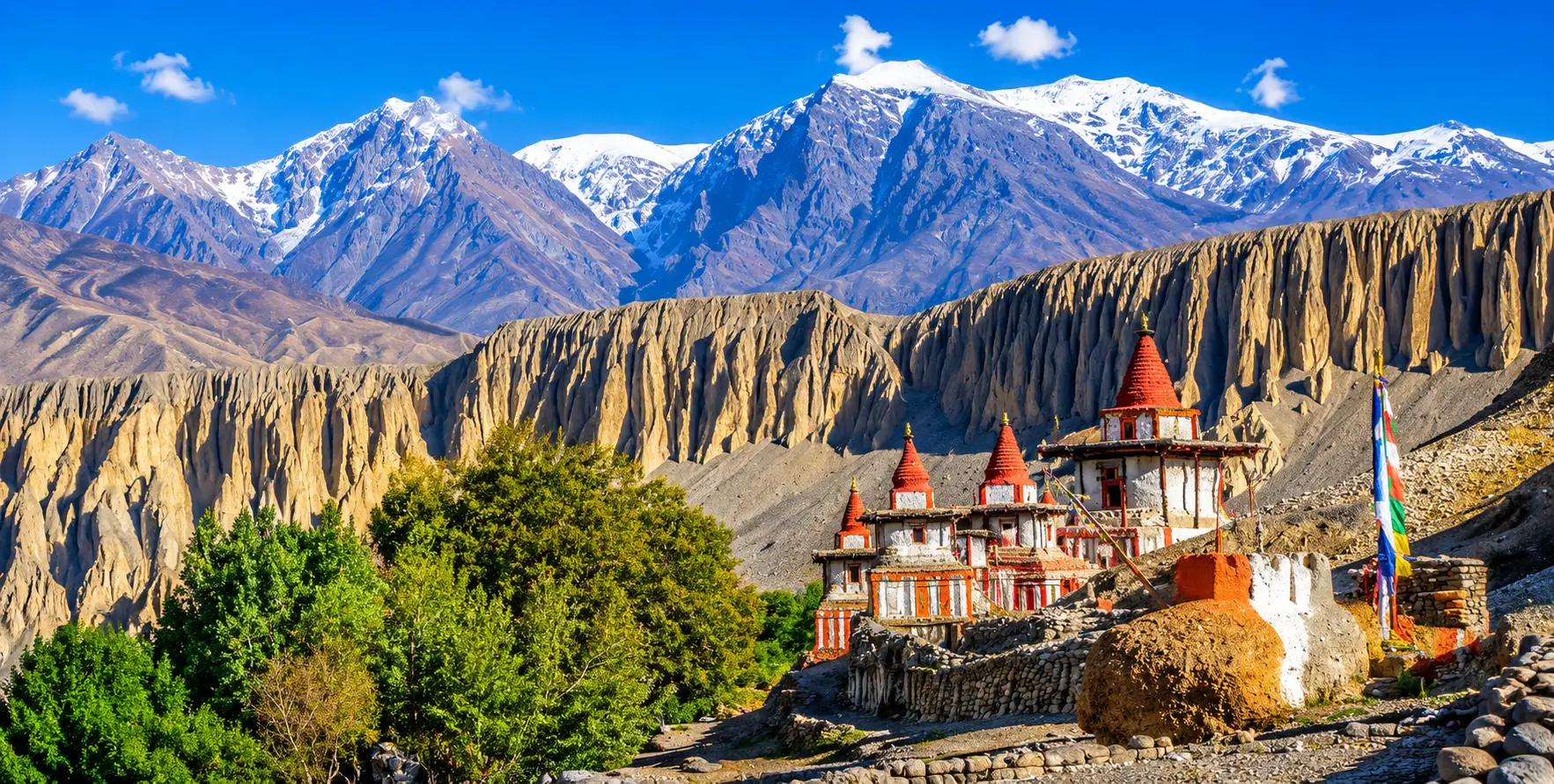
Day 2: Syangboche to Ghami, passing through striking canyon scenery and the region’s characteristic red-ochre cliffs, with time to explore Ghami’s old monastery.
Day 3: Ghami to Charang, visiting the old royal palace and monastery complex, then on to Lo Manthang for the night.
Day 4: Full day exploring Lo Manthang’s walled old city, the royal palace, and the Jampa, Thupchen, and Chode monasteries, with an optional side trip to the Chhoser caves.
Day 5: Return journey back through Charang and Ghami toward Chele and Kagbeni, exiting the restricted zone and continuing to Jomsom.
This can be compressed to 4 days for travellers on a tighter permit budget, or extended to 6-7 days to add rest days, side excursions to Dhakmar’s red cliffs, Ghar Gompa, or a Tiji Festival visit if timed correctly.
Extended 7-Day Itinerary Option
Travellers with a little more time and permit budget often extend the standard 5-day plan with two additional days: one built in as a genuine rest and acclimatisation day in Lo Manthang itself, allowing for a slower exploration of the old city’s monasteries and markets without rushing, and a second added to properly visit Dhakmar’s striated cliffs and the remote Ghar Gompa monastery, one of the oldest Buddhist monasteries in the entire Mustang region, often overlooked on tighter itineraries. This extra time also creates a natural buffer against any weather-related delays on the return journey, without which a tight 5-day schedule can become stressful if a single day is lost to poor road conditions.
Cultural Etiquette in Mustang’s Villages and Monasteries
Mustang’s villages and monasteries remain living religious and cultural spaces, not simply photogenic backdrops, and a respectful approach matters throughout your jeep tour. Dress modestly, especially when entering monastery buildings, and always ask permission before photographing monks, nuns, or active religious ceremonies—a request rarely refused when asked politely, but appreciated nonetheless. Many of Lo Manthang’s monasteries charge a small entry fee that goes directly toward preserving centuries-old murals and structures; this is money well spent, given how remarkably intact these buildings remain compared to more heavily visited Buddhist sites elsewhere in the Himalayas.
Circumambulation around chortens, mani walls, and monastery structures traditionally follows a clockwise direction — walk with the structure on your right, following the lead of local pilgrims and residents. Given how recently Mustang opened to outside visitors (only since 1992), many communities still maintain a strong, largely undiluted connection to traditional Tibetan Buddhist practice, and a visitor’s genuine curiosity and respect tend to be warmly received in return.
Photography in Mustang
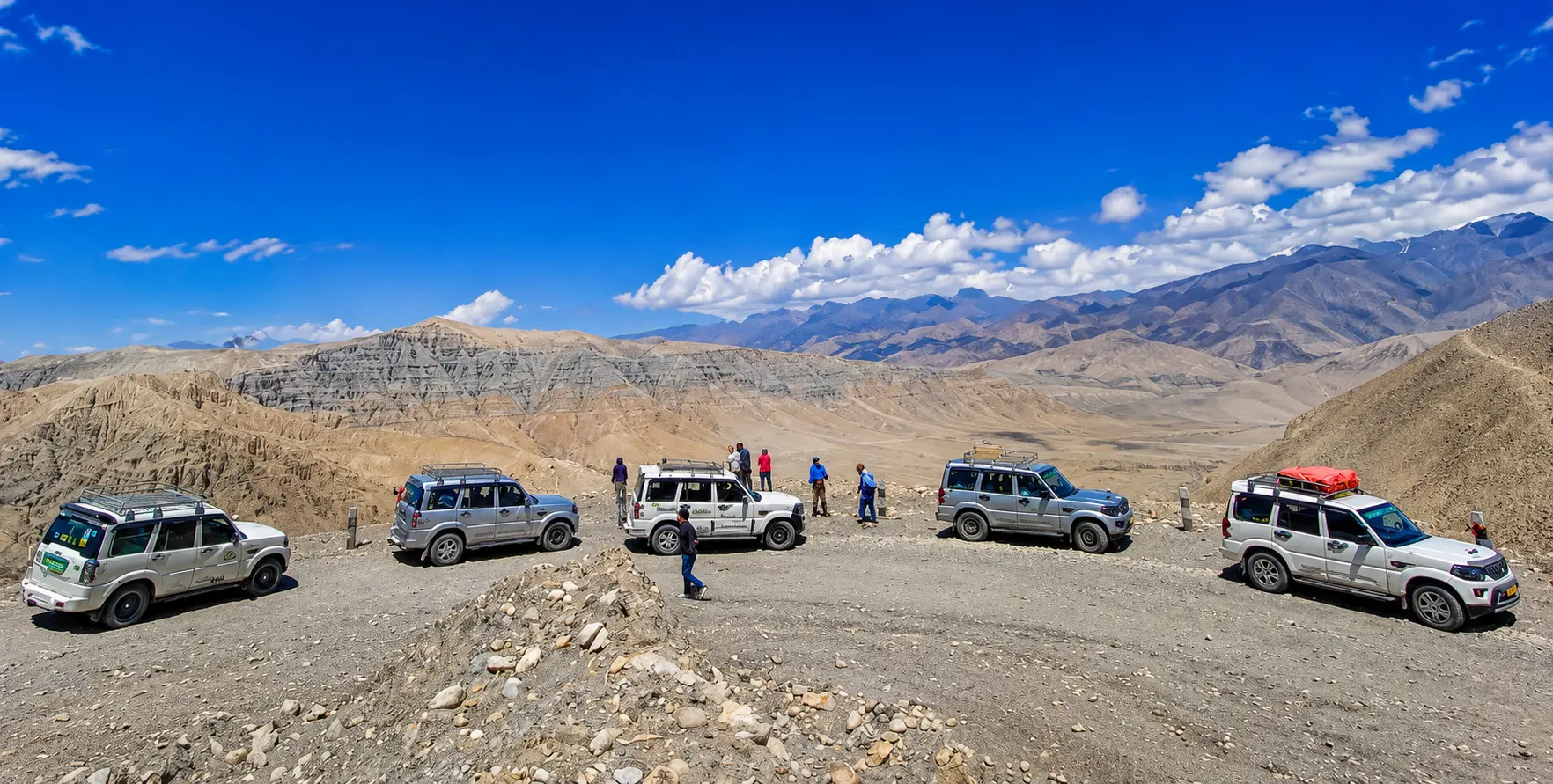
Few places in Nepal reward photographers as consistently as Upper Mustang. The stark, wind-carved canyon landscape between Chele and Ghami offers dramatic light throughout the day. At the same time, Lo Manthang’s whitewashed walls and prayer flags photograph beautifully against the region’s deep blue skies, especially in the clear autumn and spring. Dhakmar’s red-and-white cliffs are a particular highlight for landscape photographers willing to spend an extra day to reach them. As with monasteries generally, always ask before photographing people directly, and be aware that some inner monastery chambers restrict photography entirely to protect fragile centuries-old murals from flash damage.
Common Mistakes to Avoid When Planning a Mustang Jeep Tour
- Assuming you can apply for the RAP permit independently — it must go through a registered agency.
- Underestimating how quickly permit days add up if your itinerary includes extra rest or side-trip days inside the restricted zone
- Booking a rigid, no-buffer itinerary during shoulder season, when road conditions are less predictable than peak autumn
- Forgetting that Kathmandu, Pokhara, and Jomsom time doesn’t count toward your restricted-area permit days, but still needs to be budgeted into your overall trip length.h
- Choosing a standard car or lightly-built vehicle instead of a genuine 4WD for a route that still includes real off-road sections beyond the improved main road
- Not confirming Tiji Festival dates for the specific year in advance, since the exact dates shift annually with the Tibetan lunar calendar.
Key Stops and Attractions Along the Way
Kagbeni
A medieval village at the gateway to the restricted zone, with narrow alleyways, mud-brick houses, and an old monastery — the last stop most independent travellers can reach without a restricted-area permit, and the traditional starting point for the jeep route north.
Chele and Syangboche
Chele marks the restricted-zone checkpoint itself, while Syangboche offers some of the route’s first proper high-desert scenery, with wind-carved rock formations beginning to dominate the landscape.
Ghami
Home to one of Nepal’s longest mani walls and a monastery worth a stop, Ghami also sits near some of the most photogenic red-cliff scenery along the route.
Charang (Tsarang)
Once the second-largest settlement in the Kingdom of Lo, Charang’s five-story former royal palace and adjoining monastery remain among the region’s most impressive historical structures, predating Lo Manthang’s rise as the capital.
Lo Manthang
The walled former capital of the Kingdom of Lo, with whitewashed mud-brick houses, a royal palace, and centuries-old monasteries — Jampa, Thupchen, and Chode among them — housing some of the best-preserved Buddhist murals in the Himalayas. This is the natural centrepiece of any Mustang jeep tour and typically warrants a full day of exploration.
Chhoser Caves (Jhong Cave)
A short side trip from Lo Manthang, the Chhoser caves are a massive, multi-level complex carved into a cliffside roughly a thousand years ago, with stunning views over the surrounding canyon—one of the most popular optional add-ons to a standard Lo Manthang jeep itinerary.
Dhakmar
Known for its striking red-and-white striated cliffs, Dhakmar is a common stop for trekkers, and an extra day or two offers some of the most photographed scenery in Upper Mustang.
Best Time for a Mustang Jeep Tour
Mustang sits in the rain shadow of the Annapurna and Dhaulagiri ranges, so it receives far less monsoon rainfall than Nepal, a genuine advantage for travellers whose schedules allow only a summer trip. That said, autumn (September to November) and spring (March to May) remain the most popular and comfortable windows, offering the clearest skies and most stable road conditions.
The Tiji Festival, a three-day masked-dance festival held annually in Lo Manthang, typically falls in May and draws a noticeable spike in visitors, who specifically time their jeep tour around it. Winter (December to February) brings serious cold and occasional road closures from snow, while for a full breakdown of seasonal weather patterns in the wider Mustang and Muktinath area, our best time to visit Muktinath guide covers the climate logic in much greater depth, since Lower and Upper Mustang share broadly the same rain-shadow weather pattern.
Choosing the Right Jeep for a Mustang Tour
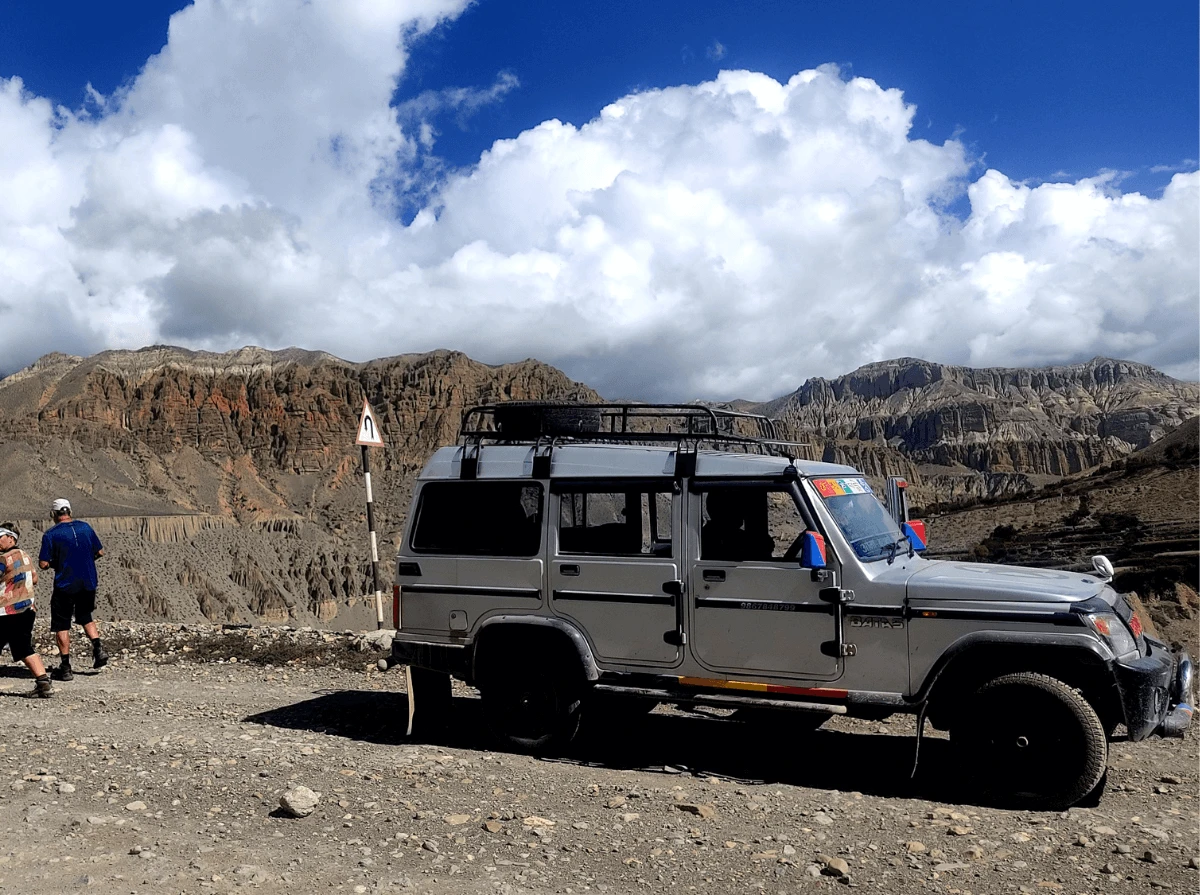
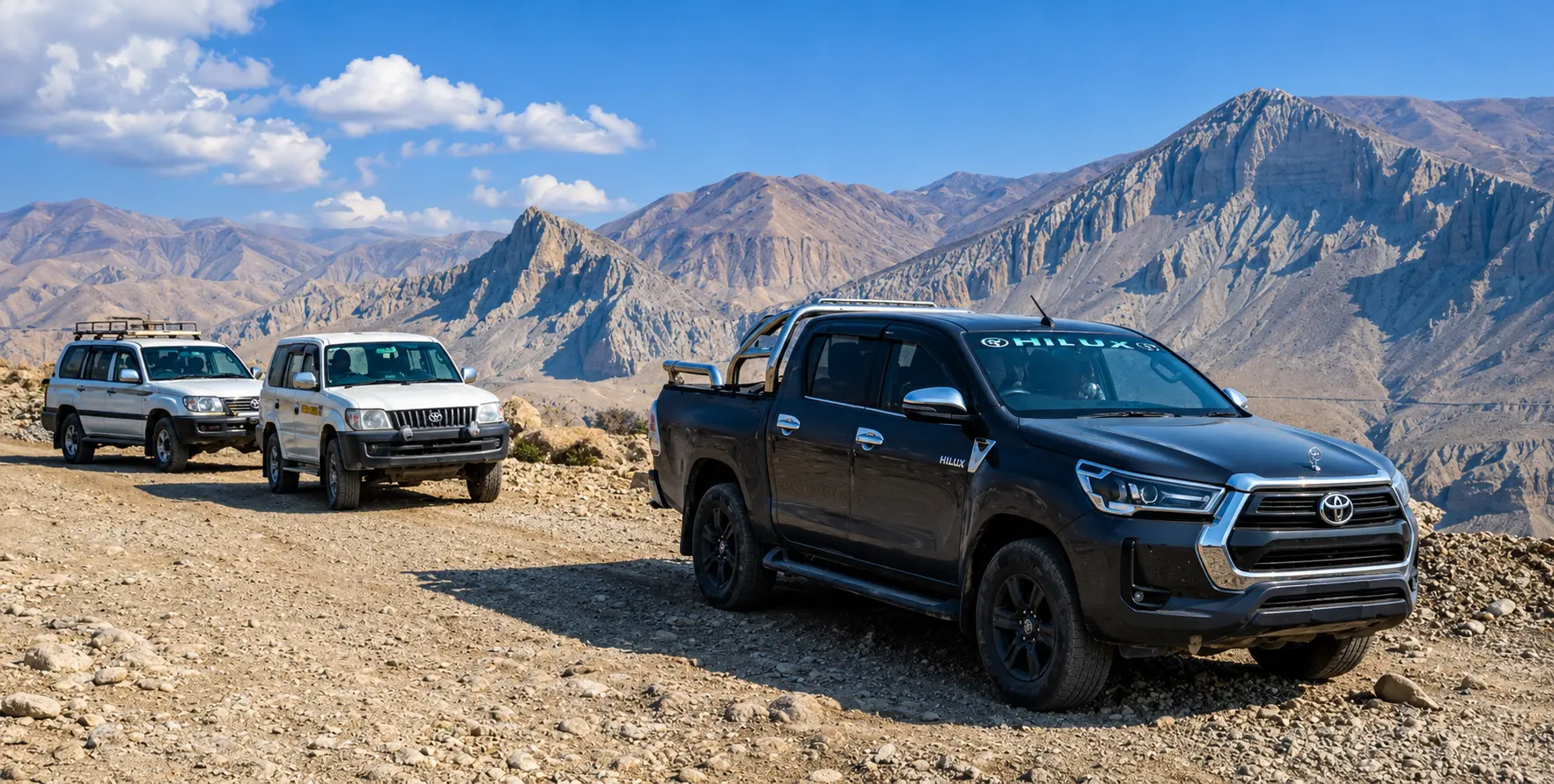
Upper Mustang’s roads, while considerably improved in recent years, still mix paved sections with rough gravel, river crossings, and high-altitude passes—a genuine 4WD remains essential, not optional. A Scorpio jeep hire is the standard, reliable choice for most groups, while travellers wanting extra comfort on the longer multi-day drive can consider a Toyota Land Cruiser 4WD hire. Our broader guide on why 4WD is best for Nepal explains the terrain reasoning in more depth if you’re deciding between vehicle classes, and our jeep and SUV comparison and SUV rental in Nepal guide covers the comfort-oriented alternative if that fits your group better. A small number of independent-minded travellers also tackle Mustang by motorbike; if that interests you, see our adventure bike rental in Nepal page, though a jeep remains the more common and practical choice for most groups and families.
Jeep Rental Cost for a Mustang Tour
Jeep charter costs for a Mustang tour are priced per vehicle, not per passenger, and typically accommodate up to six passengers, making group travel much more cost-effective per person than a solo trip. Rates depend on trip length, vehicle class, and season, with autumn and spring peak-season bookings generally priced a little higher than shoulder-season trips. This vehicle cost sits alongside — not instead of — the permit fees covered above, along with your guide’s daily fee (mandatory for the restricted zone), accommodation in teahouses or guesthouses along the route, and meals.
Guide and Agency Requirements
Because Upper Mustang remains a restricted area bordering Tibet, independent travel is not permitted under any circumstances, regardless of the 2026 permit reform. Every visitor must travel with a licensed guide arranged through a registered Nepali agency, which also handles your RAP application at the Department of Immigration in Kathmandu or Pokhara — this isn’t a formality you can skip by applying yourself. Your guide manages route logistics, teahouse arrangements, and serves as the primary point of contact for safety and, if needed, emergency evacuation coordination.
Altitude and Health Considerations
Lo Manthang’s elevation of roughly 3,730 to 3,840 meters, with some side excursions and passes reaching over 4,200 meters, is high enough to warrant basic altitude awareness, even though a jeep tour avoids the cumulative physical exertion of a multi-day trek. Altitude sickness is possible but considered less frequent on jeep tours than on strenuous treks to similar elevations, given the more moderate pacing. Even so, stay hydrated, avoid rushing straight into strenuous sightseeing on arrival, and pay attention to headaches, nausea, or unusual fatigue, particularly if you’ve flown directly into Jomsom rather than acclimatising more gradually by road.
What to Pack for a Mustang Jeep Tour
- Warm, windproof layers — Mustang’s high-desert climate swings sharply between sun and shade, and wind is a near-constant feature of the landscape.e
- Dust protection — a scarf or light mask, and eye protection, given the region’s dry, wind-blown terrain
- Sturdy, comfortable shoes for walking around Lo Manthang’s old city and any side excursions to Chhoser or Dhakmar
- Cash in Nepali rupees — card and ATM access is unreliable or nonexistent beyond Jomsom.m
- A basic first-aid kit and any personal medications, given the region’s remoteness from major medical facilities
- A camera or phone with adequate storage — Mustang’s landscapes and Lo Manthang’s architecture are genuinely photogenic throughout the trip.
Combining Your Mustang Tour With Other Nepal Destinations
Very few travellers treat Mustang as an entirely standalone trip. Many combine it with a Muktinath pilgrimage on the way through, covered in our Jomsom to Muktinath jeep rental guide, or extend south toward places to visit in Mustang more broadly for a fuller regional picture. Others connect their Mustang trip to the wider Annapurna Circuit via Pokhara to Manang transport, Besisahar to Chame and Upper Pisang, or a stop in Ghandruk. After returning to Pokhara, many travellers add a day at Sarangkot for sunrise views or stop in Sikles before continuing their Nepal itinerary.
Explore More Nepal Routes, Tours, and Vehicles
Whatever shape your Mustang jeep tour takes, here’s a fuller map of the routes, tours, and vehicle options we cover, in case your trip extends further across Nepal. Very few visitors treat Mustang as a fully isolated destination — most weave it into a longer itinerary covering the wider Annapurna region, the Kathmandu Valley, or beyond, and the resources below cover most of the natural extensions.
Mustang, Muktinath, and Annapurna Region
Explore Upper Mustang 4WD jeep, places to visit in Mustang, Kathmandu to Mustang private jeep, Pokhara to Beni jeep hire, Muktinath to Pokhara jeep, our Jomsom to Muktinath jeep rental guide, our best time to visit Muktinath guide, the ACAP permit guide, and the Annapurna Conservation Area overview.
Annapurna Circuit and Trekking Approaches
See Pokhara to Manang transport, Manang to Kathmandu private jeep hire, Kathmandu to Manang jeep, Besisahar to Chame and Upper Pisang, why Dharapani is the Annapurna Circuit’s most popular starting point, Kathmandu to Ghandruk private jeep hire, Pokhara to Ghandruk jeep, Pokhara to Sikles jeep rental, Pokhara to Nayapul transportation, the Everest Base Camp trek, and our general trekking services.
Kathmandu and Pokhara Transport
See Kathmandu to Pokhara bus tickets, Kathmandu to Pokhara bus ticket, Pokhara to Kathmandu bus, Kathmandu to Pokhara road trip, Kathmandu to Pokhara vehicle rental, Kathmandu to Pokhara private Scorpio, our Pokhara bus ticket price guide, VIP Sofa Bus hire in Nepal, Kathmandu to Pokhara VIP Sofa Bus, tourist bus hire in Nepal, and coaster and tourist bus hire.
Kathmandu Valley Sightseeing
Round out your trip with Kathmandu sightseeing, Kathmandu’s historical heritage sites, our Nepal UNESCO World Heritage Sites guide, Bhaktapur Durbar Square, Kathmandu to Nagarkot vehicle hire, the Nagarkot sunrise tour, and reliable Kathmandu airport transfers. If you’re staying in Thamel, see our Thamel to airport private vehicle hire guide or our airport pickup to Thamel and hotel drop guide; if you’re staying in Patan instead, see our airport to Patan private vehicle drop guide.
Chitwan, Lumbini, and the Terai
Extend your trip with Pokhara to Chitwan bus, Chitwan to Kathmandu bus, our Chitwan VIP bus ticket price guide, Kathmandu to Chitwan VIP Sofa Bus Ticket, Kathmandu to Chitwan luxury car hire, Kathmandu to Lumbini bus, Lumbini to Kathmandu bus, eastern border vehicle hire, Chitwan to Birgunj border transport, and Janakpur airport transfer service.
Vehicle Fleet and Booking Resources
Compare our full fleet: jeep, car, Hiace, bus, coaster, car hire in Nepal, car hire in Pokhara, our alternate Hiace van hire listing, our why 4WD is best for Nepal guide, why private vehicle hire is the smartest way to travel Nepal, why a genuine 4WD jeep matters, and our ultimate Nepal vehicle rental guide.
Plan and Learn More
Use our plan your trip tool, browse our Nepal tour package options, learn more about us, read our luxury trek vehicle hire guide, or browse our blog for further route guides across the country.
Mustang’s Unique Geography and Climate
Upper Mustang sits within the Trans-Himalayan zone, in the rain-shadow carved by the Annapurna and Dhaulagiri massifs on either side of the Kali Gandaki Gorge — among the deepest gorges on earth. This geography gives Mustang a climate and landscape unlike almost anywhere else in Nepal: a high-altitude desert of wind-eroded cliffs, sparse vegetation, and a stark, almost lunar palette of ochre, red, and grey rock, closer in character to the Tibetan plateau just across the border than to Nepal’s greener mid-hills further south. Annual rainfall is minimal, but wind is a near-constant presence, particularly in the afternoons, shaping both the landscape itself and the timing of daily travel along the jeep route.
Local Cuisine Along the Route
Food along the Mustang jeep route reflects the region’s Tibetan-influenced culture as much as its geography. Expect hearty, simple teahouse meals — thukpa (noodle soup), dal bhat (Nepal’s staple lentil and rice meal), momos (Tibetan-style dumplings), and, particularly around Marpha and Jomsom, apples and apple-based products including local brandy, given the area’s well-known orchards. Tsampa (roasted barley flour) and butter tea appear more frequently the further north you travel, reflecting Upper Mustang’s closer cultural ties to Tibetan tradition. Meals are generally included in package pricing or paid per item at teahouses along the route, and portions are typically generous given the physical demands of high-altitude travel, even by jeep.
Environmental and Responsible Tourism in Mustang
The Annapurna Conservation Area, which encompasses the entire Mustang region, operates under a community-managed conservation model, with ACAP fees directly supporting local infrastructure and preservation projects. Given how recently Upper Mustang opened to tourism, and how well-preserved its villages and monasteries remain, responsible travel matters more here than anywhere else in Nepal. Pack out any waste you generate, minimise single-use plastic given the region’s limited waste infrastructure, and support local teahouses and guides rather than bringing all your own supplies from Kathmandu or Pokhara, since tourism revenue is a genuinely important part of these remote communities’ economies.
Health and Safety Beyond Altitude
Beyond altitude awareness, a few other health and safety points are worth planning for. Medical facilities in Upper Mustang are extremely limited—Lo Manthang has only basic services, and any serious medical issue typically requires evacuation back toward Jomsom or, in urgent cases, a helicopter evacuation to Pokhara or Kathmandu, which is why travel insurance with evacuation coverage is so strongly recommended for this region. Road conditions, while much improved, still include exposed sections with real consequences for reckless driving, which is another strong argument for booking through an established operator with experienced local drivers rather than the cheapest available option.
Itemised Cost Breakdown for a Typical Jeep Tour
Pulling together everything covered above, a realistic 5-day Mustang jeep tour budget breaks down roughly as follows: RAP permit fees around USD 250 per person (5 days at USD 50/day), ACAP and TIMS fees around USD 30-40 per person, guide fees typically charged as a daily rate on top of the permit costs, jeep charter costs split across the group (considerably cheaper per person in a group of 4-6 than solo), and accommodation and meals at teahouses along the route, generally modest compared to mainstream trekking regions given the area’s remoteness and limited infrastructure. Altogether, most travellers should budget between USD 400 and 800 per person for a group tour of this length, with solo travellers or shorter, more compressed itineraries pushing toward the higher end as fixed costs spread across fewer days.
It’s worth budgeting a modest contingency on top of these core figures as well — unexpected teahouse rate increases during festival periods, an extra night if road conditions or weather force a delay, or optional add-ons like the Chhoser cave side trip or a Dhakmar detour, none of which are strictly mandatory but are commonly added once travellers are already on the ground and see what else is within easy reach. A contingency of roughly 10 to 15 per cent above your core budget is a sensible buffer for most Mustang jeep tour itineraries.
Why Book With Nepal Vehicle Hiring Pvt Ltd
We arrange complete Mustang jeep tours from Pokhara or Kathmandu to Lo Manthang and back, with drivers experienced on the region’s mixed paved and gravel roads, and we handle the RAP and ACAP permit process through registered channels. Every booking includes a well-maintained 4WD vehicle, transparent pricing agreed before you travel, and flexibility to adjust your itinerary around the 2026 pay-as-you-go permit structure.
Reach out through our contact page to start planning your Mustang jeep tour, whether you’re chasing the Tiji Festival, a quiet shoulder-season trip, or simply the shortest, most efficient route to Lo Manthang’s walled city.
Comparing Mustang to Other Nepal Trekking and Touring Regions
Travellers weighing Mustang against Nepal’s other major regions should know it offers a genuinely different experience from Everest or the wider Annapurna Circuit. Where Everest region trekking centres on dramatic high-mountain scenery and the Everest Base Camp trek itself, and the Annapurna Circuit combines diverse ecosystems from subtropical forest to high alpine terrain over Thorong La, Mustang’s appeal is almost entirely different: a stark, Tibetan-feeling high desert, a rich and unusually well-preserved cultural and historical dimension, and — thanks to the jeep-touring shift covered throughout this guide — a far more time-efficient way to reach a genuinely remote-feeling destination. Travellers with limited time who still want an authentic, culturally rich Himalayan experience increasingly choose Mustang specifically because a jeep tour delivers so much in so few days compared to the multi-week commitment other regions typically demand.
Mustang also pairs unusually well with a second Nepal region rather than replacing one, precisely because a jeep tour compresses it into so few days. A traveller with weeks total could realistically combine a 5-6 day Mustang jeep tour with an Everest Base Camp trek or a full Annapurna Circuit crossing, something that would have been far more difficult to fit alongside the traditional 12-16 day Mustang trek. This flexibility is arguably the single biggest practical benefit of the shift toward jeep touring, beyond the direct cost savings from the 2026 permit reform.
Understanding Mustang’s Place Names
A few names are worth keeping straight when planning: Mustang refers to the wider district, split into Lower Mustang (unrestricted, ACAP-only) and Upper Mustang (the restricted zone this guide focuses on). Jomsom is the district headquarters and airport hub, sitting in Lower Mustang. Kagbeni marks the traditional boundary between the two zones. Lo Manthang is the historic walled capital of Upper Mustang. The Kingdom of Lo is the historical name for the former independent kingdom that once governed the region — you’ll see all of these terms used somewhat interchangeably in casual conversation, but keeping the distinctions clear helps when reading permit rules, itineraries, and route descriptions, since each refers to a genuinely different point or zone along the journey.
A Final Word on Planning Your Mustang Jeep Tour
Mustang has changed more in the past few years than in the previous few decades combined — roads have crept deeper into what was once a multi-week trekking-only destination, and the 2026 permit reform has removed the single biggest financial barrier that used to make short trips disproportionately expensive. The result is a region that’s more accessible than ever, without having lost the remote, culturally distinct character that made it worth visiting in the first place.
A well-planned jeep tour, booked through a registered agency with an experienced guide and driver, can now deliver the walled city of Lo Manthang, the ochre canyons of the high desert, and centuries-old monasteries in a matter of days rather than weeks — making Mustang a genuinely realistic addition to almost any Nepal itinerary, not just a trip reserved for dedicated long-haul trekkers.
Who Should Take a Mustang Jeep Tour
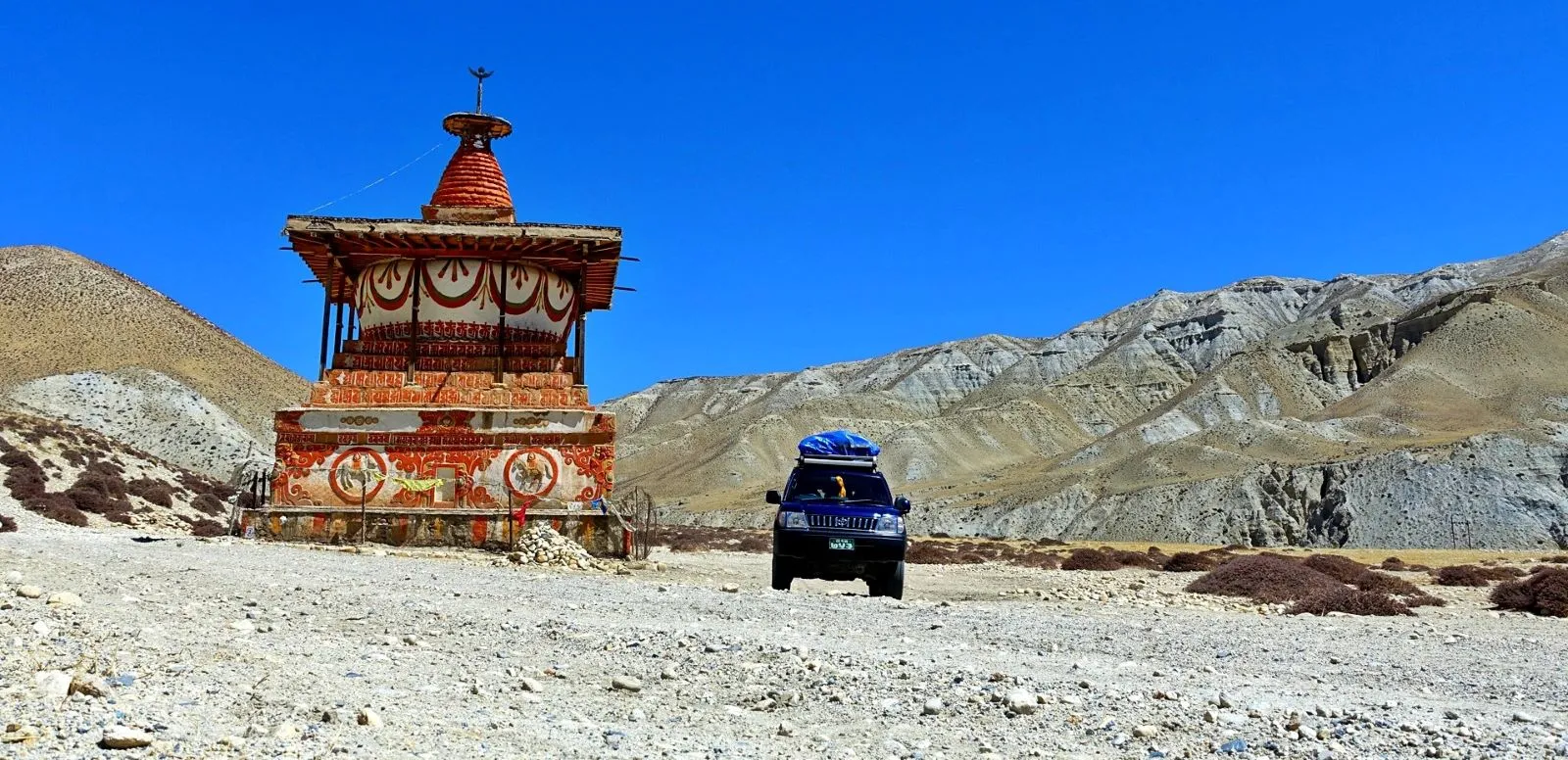
History and culture enthusiasts will find Mustang unusually rewarding given how recently the region opened to outsiders — Lo Manthang’s monasteries and the Charang palace remain far better preserved than more heavily visited Himalayan Buddhist sites, and a jeep tour makes this cultural depth accessible without a multi-week time commitment.
Photographers can access some of the Himalayas’ most distinctive, least-photographed landscapes—the red cliffs of Dhakmar, the canyon approach through Ghami, and Lo Manthang’s whitewashed walls against deep blue skies —all reachable in days rather than weeks.
Time-constrained travellers balancing Mustang with a broader Nepal itinerary—Kathmandu Valley sightseeing, a Chitwan safari, or Everest or Annapurna trekking—benefit most from the jeep tour’s compressed timeline compared to the traditional 12-16 day trek.
Families and older travellers who want to experience Upper Mustang without the sustained physical demands of trekking at altitude find the jeep tour format considerably more accessible, provided normal altitude precautions are respected.
Festival-focused travellers timing a trip around the Tiji Festival in Lo Manthang benefit enormously from the 2026 permit reform, since a short, focused 3-day festival visit now costs a fraction of what it did under the old flat-rate system.
Dedicated long-distance trekkers with two weeks or more and a preference for the slower, on-foot experience may still prefer the traditional trek over a jeep tour — both remain valid ways to experience the same remarkable region.
Whichever category best describes your travel style, the practical reality of the 2026 permit reform is that a Mustang jeep tour is no longer a niche, expensive add-on reserved for travellers with unlimited time and budget — it’s become one of the more efficient, accessible ways to add a genuinely distinctive cultural and landscape experience to a Nepal trip of almost any length.
Planning Checklist Before You Book
- Decide on trip length based on your permit budget — 4-6 days covers the core Lo Manthang highlights, 7 days adds meaningful buffer and side excursions. ions
- Book through a registered agency capable of processing your RAP and ACAP applications directly
- Confirm your guide’s specific experience on the Mustang jeep route, not just general trekking credentials. tials
- Check current Tiji Festival dates if timing your trip around it, since the date shifts annually with the Tibetan lunar calendar.
- Arrange travel insurance covering high-altitude emergency evacuation before departure.
- Confirm your specific vehicle model and whether it’s a genuine 4WD given the route’s mixed road conditions.
- Build in at least one buffer day if flying into Jomsom at the start of your trip, given the airport’s weather-dependent morning-only flight window.
Working through this checklist before finalising your booking helps avoid the most common planning mistakes covered earlier in this guide, whether you’re organising a short 2026 festival visit or a longer 2027 expedition combining Mustang with the wider Annapurna region.
Frequently Confused Terms and Permit Names
Newcomers to Mustang planning often get tangled in the permit terminology, so it’s worth spelling out clearly: the RAP (Restricted Area Permit) is the Upper Mustang-specific permit covered throughout this guide, priced at USD 50 per person per day since the 2026 reform. ACAP (Annapurna Conservation Area Permit) is a separate, much cheaper base-level permit required for the entire Annapurna Conservation Area, including both Lower and Upper Mustang.
TIMS (Trekkers’ Information Management System) is a basic tracking permit historically required for trekkers. While jeep tourists follow a slightly different administrative path through their agency, the underlying purpose remains the same: keeping a record of who is travelling through the region for safety. Your booking agency handles all three as part of a properly organised Mustang jeep tour, so you shouldn’t need to navigate these applications individually yourself.
Documents You’ll Need
- A valid passport with at least six months’ remaining validity
- Passport-sized photographs (typically 2-4 copies; check current requirements with your agency)
- Your Nepal tourist visa, arranged separately from the trekking/restricted-area permits
- Proof of travel insurance, particularly one covering high-altitude evacuation, even where not strictly mandatory
- Any pre-arranged agency booking confirmation, since this is required for your RAP application
Keep both physical and digital copies of each document where possible — mobile signal is unreliable for much of the route, so having printed copies of your permits and passport photo page readily accessible saves time at checkpoints along the way, particularly at Chele where the restricted-zone entry is verified.
What Makes Mustang Worth the Extra Planning
Given the permit process, mandatory guide requirement, and remote logistics covered throughout this guide, it’s fair to ask whether Mustang is worth the additional planning compared to Nepal’s more straightforward, unrestricted destinations. For most visitors who make the trip, the answer is a clear yes — precisely because those restrictions have preserved something increasingly rare in the Himalayas: a genuinely intact traditional culture, largely untouched by the trekking-lodge commercialisation visible in parts of the Everest and Annapurna regions after decades of mass tourism.
Lo Manthang’s monasteries house original centuries-old murals rather than restorations built for visitors, the region’s Tibetan Buddhist traditions continue largely as they have for generations, and the landscape itself — a genuine high-altitude desert unlike anywhere else in Nepal — offers something visually and culturally distinct from every other major trekking or touring region in the country. The 2026 permit reform hasn’t changed any of that; it’s made it dramatically more accessible to experience within a realistic travel timeframe.
For travellers weighing whether to commit the extra planning time, think of Mustang less as an add-on to a standard Nepal trip and more as its own distinct destination that happens to share a border region with the Annapurna Circuit. Visitors who go in expecting Everest-style mountain grandeur are sometimes surprised by Mustang’s very different character — this is a trip for travellers drawn to history, living Tibetan Buddhist culture, and stark desert landscapes rather than towering snow peaks at every turn, and setting that expectation correctly before booking tends to make for a far more satisfying trip once you’re actually on the road to Lo Manthang.
Booking Timeline: When to Start Planning
For an autumn or spring trip, start arranging your agency, guide, and RAP application at least 4 to 6 weeks in advance, particularly if you’re targeting a specific window like the Tiji Festival, when both permits and teahouse accommodation along the route see a genuine surge in demand. Shoulder-season and winter trips generally allow more last-minute flexibility because demand is lower overall. However, the mandatory agency-guide-permit process still requires lead time regardless of season; you can’t realistically book this trip the week before departure, unlike a simple Kathmandu Valley day tour.
If your travel dates are fixed well in advance, it’s worth confirming with your chosen agency exactly how far ahead they recommend booking for your specific season, since demand patterns shift from year to year based on factors like festival dates, overall Nepal tourism trends, and any road or infrastructure changes along the route. A good agency will be transparent about current wait times for permit processing and vehicle availability rather than simply promising availability regardless of how late you book.
A Note on Road Development and What to Expect
Because Mustang’s road network has changed so quickly in recent years, set realistic expectations. While significant stretches of the route are now paved or well-graded gravel, this remains an evolving mountain road system, not a finished highway. Seasonal maintenance, occasional landslides beyond the immediate rain-shadow zone, or ongoing construction as the network continues to expand further into the region can still affect sections.
A good operator stays current on which sections are in good condition versus which require extra care, and builds realistic timing into your itinerary accordingly rather than assuming the entire route matches its best-maintained stretches.
Frequently Asked Questions
How much does the Upper Mustang permit cost in 2026? USD 50 per person per day for the Restricted Area Permit, charged only for days spent inside the restricted zone, plus separate ACAP and TIMS fees.
Can I travel to Upper Mustang alone? The two-person minimum was scrapped, so solo travellers can now get a permit, but a licensed guide through a registered agency is still mandatory.
How many days do I need for a Mustang jeep tour? A focused trip to Lo Manthang and back typically takes 4 to 6 days from Jomsom, though 3-day trips are possible for a tighter Tiji Festival visit.
Do I need a guide even on a jeep tour? Yes, a licensed guide is required for the entire restricted area, whether you’re trekking or driving.
Is jeep touring better than trekking for Mustang? For travellers with limited time, yes — a jeep tour covers the same core sights in days rather than the 12-16 days a full trek requires.
What’s the best time of year for a Mustang jeep tour? Autumn (September-November) and spring (March-May) offer the most stable conditions; May is also when the Tiji Festival typically takes place.
Is Upper Mustang accessible in winter? It’s considerably colder and can be affected by snow-related road closures, so autumn or spring is the more reliable choice for most travellers.
What vehicle is best for a Mustang jeep tour? A genuine 4WD, like a Mahindra Scorpio or Toyota Land Cruiser, is best, given the mix of paved and rough gravel roads throughout the route.
Can I combine a Mustang jeep tour with a Muktinath visit? Yes, most itineraries naturally pass through or near Muktinath on the way to or from the restricted zone.
Do I need travel insurance for a Mustang jeep tour? Given the region’s remoteness and altitude, travel insurance covering emergency evacuation is strongly recommended.
How much does a full Mustang jeep tour package cost? Including permits, vehicle, guide, and accommodation, packages commonly range from roughly USD 1,500 to 4,000 or more depending on trip length and style.
Can I apply for the Upper Mustang permit myself? No — the RAP can only be issued through a registered Nepali agency at the Department of Immigration; independent walk-in applications are not accepted.
What’s the difference between Lo Manthang and Jomsom? Jomsom is the district headquarters and airport hub in Lower Mustang; Lo Manthang is the historic walled capital deep in Upper Mustang, roughly 2-3 days further north by jeep.
Is travel insurance mandatory for a Mustang jeep tour? Not legally mandatory, but strongly recommended given the region’s remoteness and the potential need for emergency evacuation.
Can I visit Mustang and Muktinath in the same trip? Yes, most itineraries naturally combine both, since the route to Upper Mustang passes directly through the Jomsom-Muktinath area.
What language is spoken in Upper Mustang? Locally, a dialect closely related to Tibetan is widely spoken alongside Nepali; most guides and teahouse staff also speak functional English.
Is there mobile phone or internet coverage in Upper Mustang? Coverage is limited and inconsistent, improving somewhat in Lo Manthang itself but largely unavailable in the more remote stretches between villages.
Do children need a separate permit for Upper Mustang? Yes, the RAP and ACAP fees generally apply per person regardless of age, though your agency can confirm any specific exceptions.
Ready to plan your trip into the old Kingdom of Lo? Book your jeep rental for a Mustang tour through our contact page, and let an experienced driver and guide handle the permits and mountain roads while you take in one of the Himalayas’ most remarkable landscapes.
- Jeep Rental for Mustang Tour: The Complete Guide
- Why Jeep Tours Have Overtaken Trekking in Mustang
- Lower Mustang vs Upper Mustang: Know the Difference
- A Brief History of the Kingdom of Lo
- The New Upper Mustang Permit Rules (What Changed)
- Total Permit Cost Breakdown
- Route Overview: Getting to Lo Manthang by Jeep
- Weather and Road Conditions by Season
- Group Size and Solo Travel Considerations
- Choosing a Jeep Tour Operator
- Return Journey Options
- Sample Jeep Tour Itinerary (5 Days From Jomsom)
- Cultural Etiquette in Mustang's Villages and Monasteries
- Photography in Mustang
- Common Mistakes to Avoid When Planning a Mustang Jeep Tour
- Key Stops and Attractions Along the Way
- Best Time for a Mustang Jeep Tour
- Choosing the Right Jeep for a Mustang Tour
- Jeep Rental Cost for a Mustang Tour
- Guide and Agency Requirements
- Altitude and Health Considerations
- What to Pack for a Mustang Jeep Tour
- Combining Your Mustang Tour With Other Nepal Destinations
- Explore More Nepal Routes, Tours, and Vehicles
- Mustang's Unique Geography and Climate
- Local Cuisine Along the Route
- Environmental and Responsible Tourism in Mustang
- Health and Safety Beyond Altitude
- Itemised Cost Breakdown for a Typical Jeep Tour
- Why Book With Nepal Vehicle Hiring Pvt Ltd
- Comparing Mustang to Other Nepal Trekking and Touring Regions
- Understanding Mustang's Place Names
- A Final Word on Planning Your Mustang Jeep Tour
- Who Should Take a Mustang Jeep Tour
- Planning Checklist Before You Book
- Frequently Confused Terms and Permit Names
- Documents You'll Need
- What Makes Mustang Worth the Extra Planning
- Booking Timeline: When to Start Planning
- A Note on Road Development and What to Expect
- Frequently Asked Questions

Related Blog & Articles
Best Time to Visit Muktinath
Best time to visit Mustang Nepal
Altitude and Health: Essential Muktinath Advice