Plan a Trip


Jeep or SUV
Jeep and SUV? Choosing the Right Hire Vehicle for Nepal’s Mountain Roads
Every trekker, expedition team, and overland traveller who has ever planned a journey into Nepal’s mountains eventually faces the same question: should I hire a jeep or will an SUV do the job? It sounds like a simple decision, but in a country where road conditions can shift from smooth tarmac to boulder-strewn riverbeds within a single kilometre, the answer carries real weight. Choose the wrong vehicle, and you may find yourself stranded on a landslide-prone mountain track, paying for repairs to a vehicle that was never designed for the terrain, or simply enduring a far less comfortable journey than necessary. Choose the right vehicle, and the drive to your trailhead becomes part of the adventure, not an obstacle.
At Nepal Vehicle Hiring Pvt Ltd, we field this exact question almost daily from travellers planning everything from a short cultural tour around the Kathmandu Valley to a multi-day expedition into the high passes of Upper Mustang or Manang. The honest answer is that no single choice fits every journey. The right vehicle depends entirely on where you are going, how many people are travelling with you, how much luggage you are carrying, what time of year you are travelling, and how much comfort you are willing to trade for cost savings. This guide walks through every dimension of that decision in detail, so that by the end, you will know with confidence whether a jeep or an SUV is the right hire vehicle for your specific journey in Nepal.
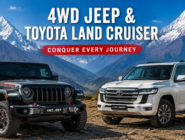
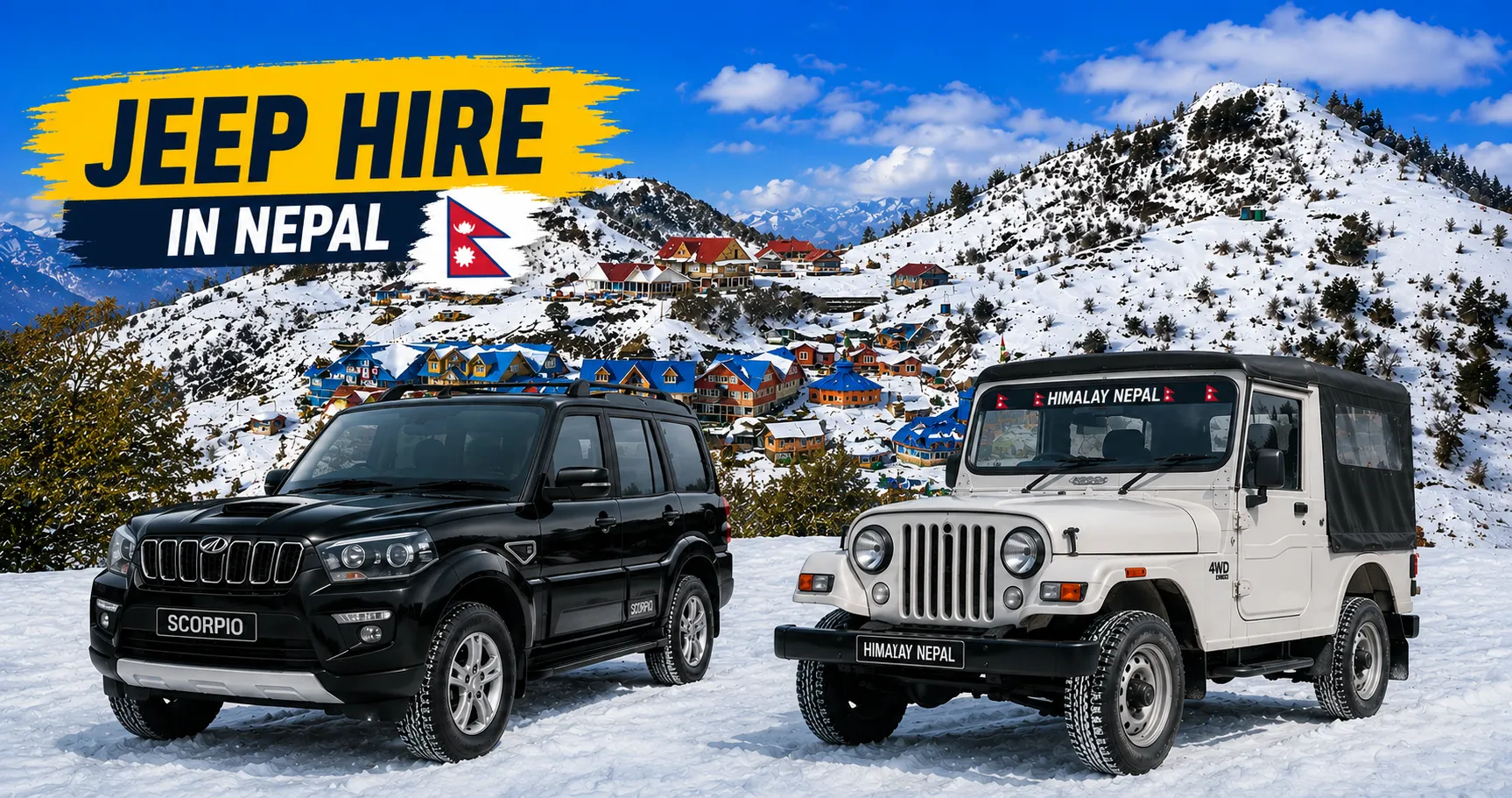
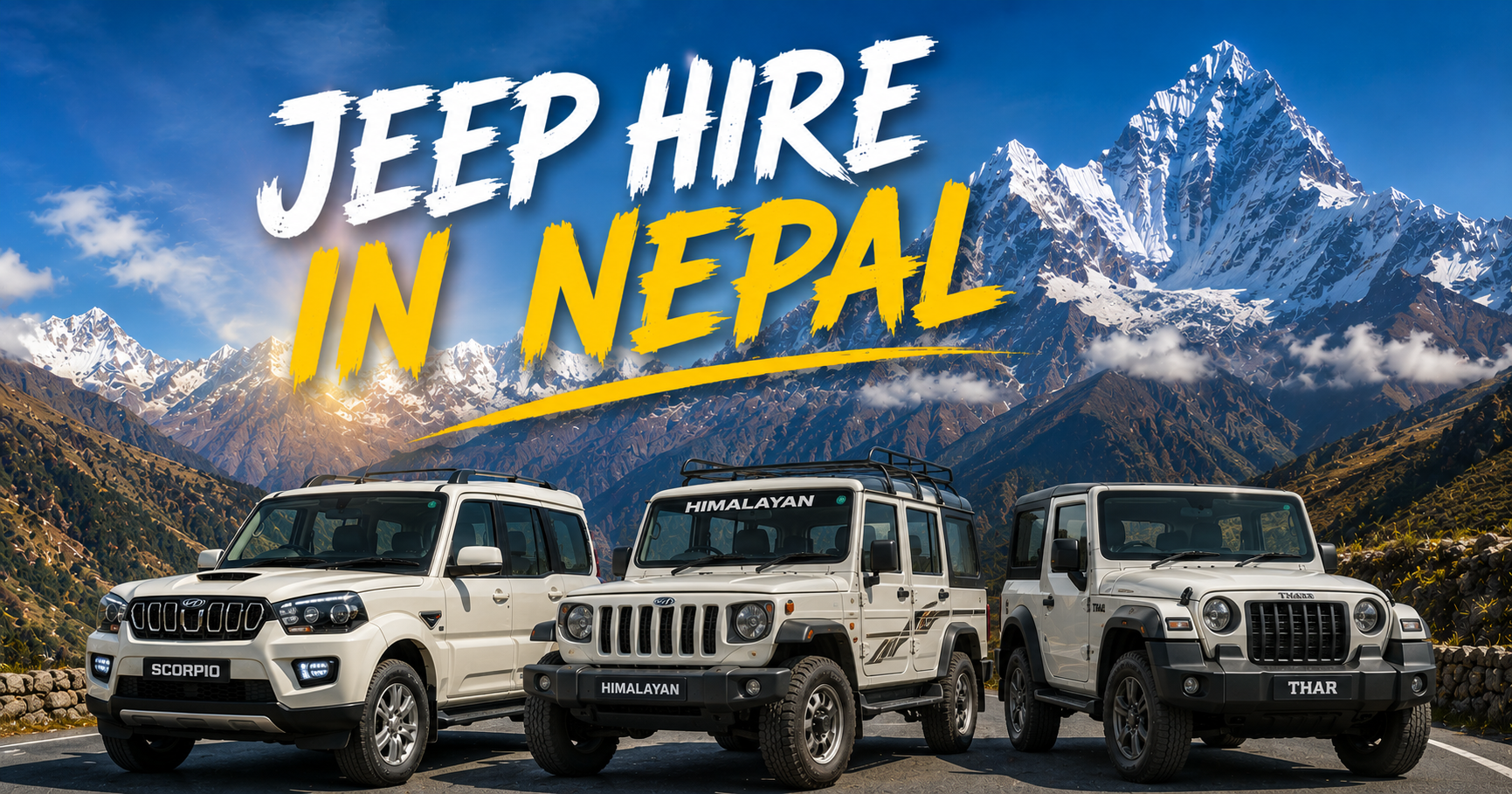
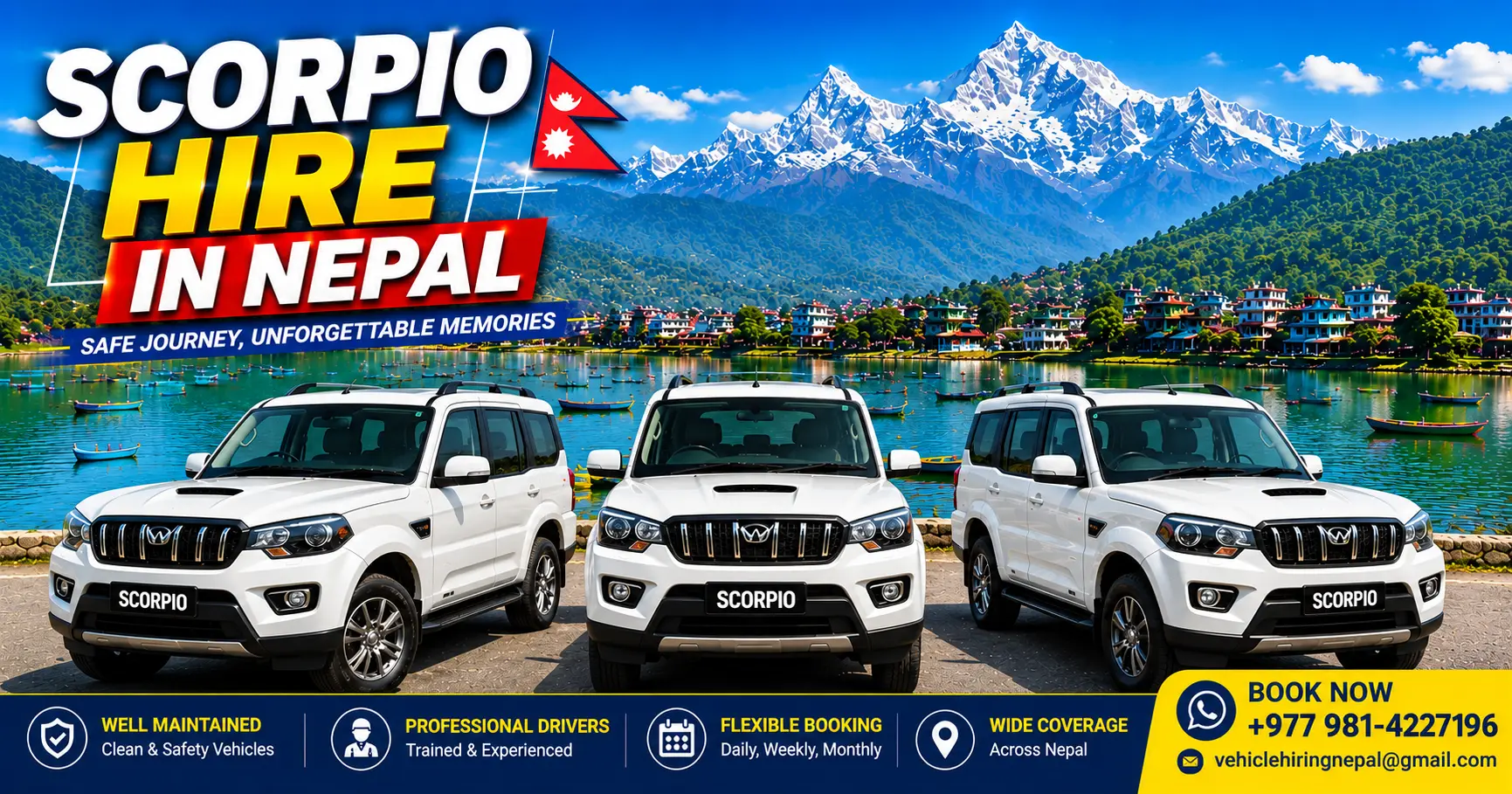
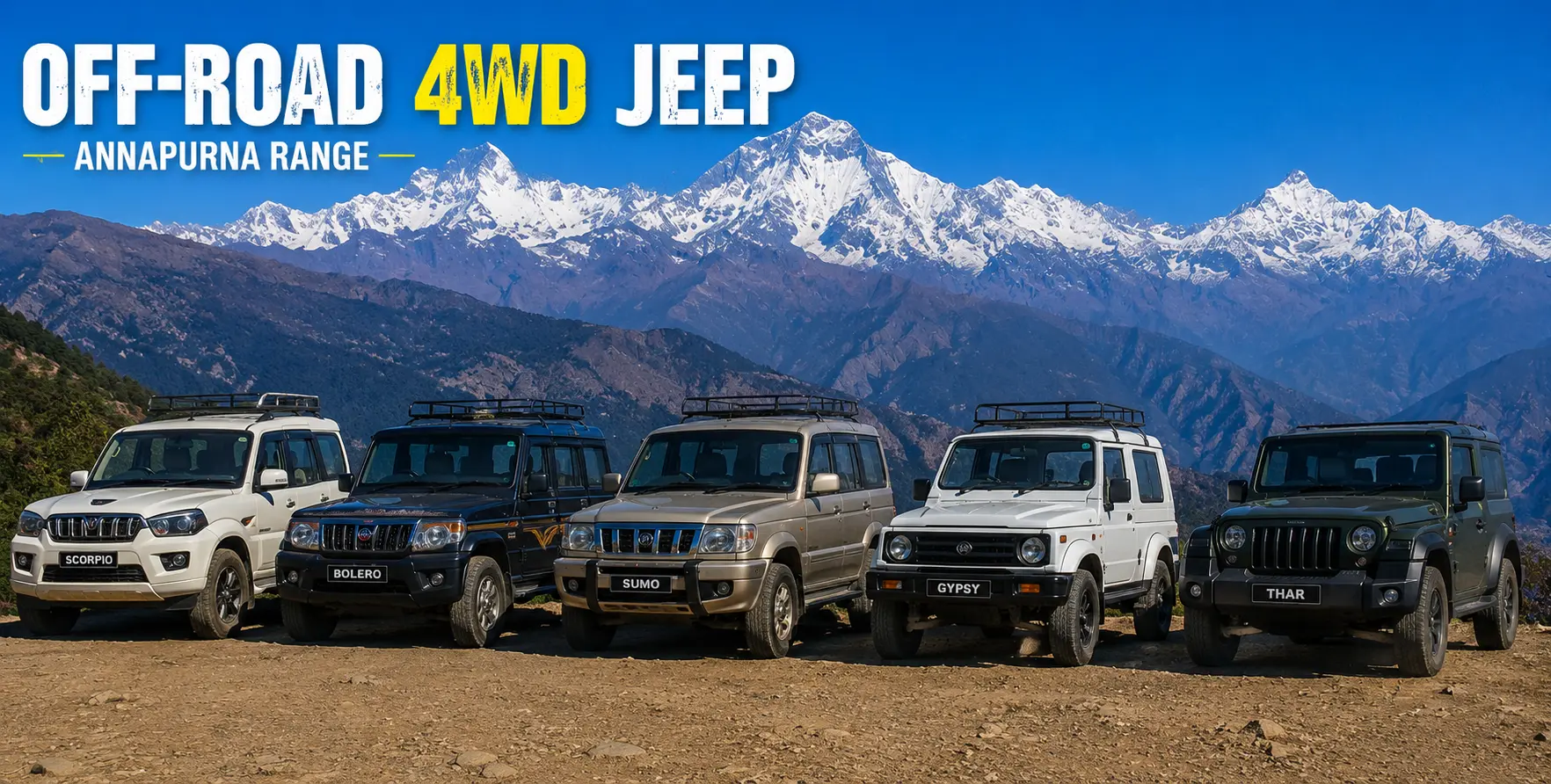
Before diving into the comparison, it helps to clarify what we mean by ‘jeep’ and ‘SUV’ in the Nepal context, because the terminology can be confusing for international visitors. In everyday Nepali usage, the word ‘jeep’ rarely refers to the American Jeep brand. Instead, it is used as a catch-all term for rugged, body-on-frame four-wheel-drive vehicles built for off-road work — most commonly the Mahindra Scorpio, Mahindra Bolero, Toyota Land Cruiser, and similar utilitarian vehicles. These are the vehicles you will see lined up. Jeeps stand in Besisahar, Syabrubesi, and Pokhara, ready to climb into the hills. The word ‘SUV’, on the other hand, is generally used in Nepal to describe more comfort-oriented, often unibody or semi-monocoque vehicles such as the Toyota Fortuner, Toyota Prado, Hyundai Tucson, or Mahindra XUV700 — vehicles that blend off-road capability with a noticeably more refined ride, better sound insulation, and a more car-like driving experience.
This guide treats ‘jeep’ as shorthand for the rugged, traditionally built 4WD vehicles favored for genuinely rough mountain tracks, and ‘SUV’ as shorthand for the more comfort-focused 4WD and AWD vehicles favored for highways, semi-paved roads, and shorter excursions. Understanding this distinction is the first step toward making the right choice for your trip.
Understanding Nepal’s Road Conditions Before You Choose
You can’t make a sensible decision between a jeep and an SUV without first understanding the sheer diversity of road conditions you might encounter in Nepal. The country’s road network can be loosely divided into three broad categories, and the vehicle you need changes dramatically depending on which category your journey falls into.
The first category is the paved highway network connecting major cities — Kathmandu to Pokhara, Kathmandu to Chitwan, Pokhara to Lumbini, and similar well-trodden routes. These roads are generally asphalted, though often narrow, winding, and shared with slow-moving trucks, buses, motorcycles, and the occasional herd of goats. On these routes, almost any vehicle will get you from point A to point B without drama. A sedan, a van, an SUV, or a jeep will all perform adequately, and the choice here often comes down to comfort, passenger capacity, and budget rather than necessity.
The second category is the semi-improved district road network — roads that connect district headquarters to more remote towns, often paved in sections but reverting to gravel, dirt, or broken tarmac elsewhere. Examples include the road from Pokhara to Besisahar, much of the route from Kathmandu to Syabrubesi, and the lower stretches of road toward Arughat in the Manaslu region. These roads require a vehicle with reasonable ground clearance and sturdy suspension, even if full low-range four-wheel drive isn’t strictly necessary for the entire journey. A capable SUV can often handle these roads competently, though a Jeep will always feel more at home.
The third category is the true mountain track—unpaved, narrow, frequently affected by landslides, river crossings, and steep switchback climbs that gain hundreds of meters of elevation within a few kilometres. This category includes the road from Besisahar to Chame and onward to Manang, the final approach to Lo Manthang in Upper Mustang, and stretches of road in the Manaslu and Dolpo regions. On these tracks, nothing replaces a properly built 4WD jeep with low-range gearing, strong underbody protection, and an experienced driver who knows how to read the terrain ahead. Attempting these roads in a standard SUV—let alone a sedan or van—is not simply uncomfortable; it can be genuinely unsafe and may leave the vehicle stuck, damaged, or unable to proceed.
Recognizing which category your planned route falls into is the single most important factor in deciding between a jeep and an SUV. Many travellers choose a vehicle based on comfort alone, without first determining whether the road itself even allows a less rugged vehicle to pass safely.
What Exactly Is a ‘Jeep’ in Nepal, and Why Does It Dominate Mountain Routes?
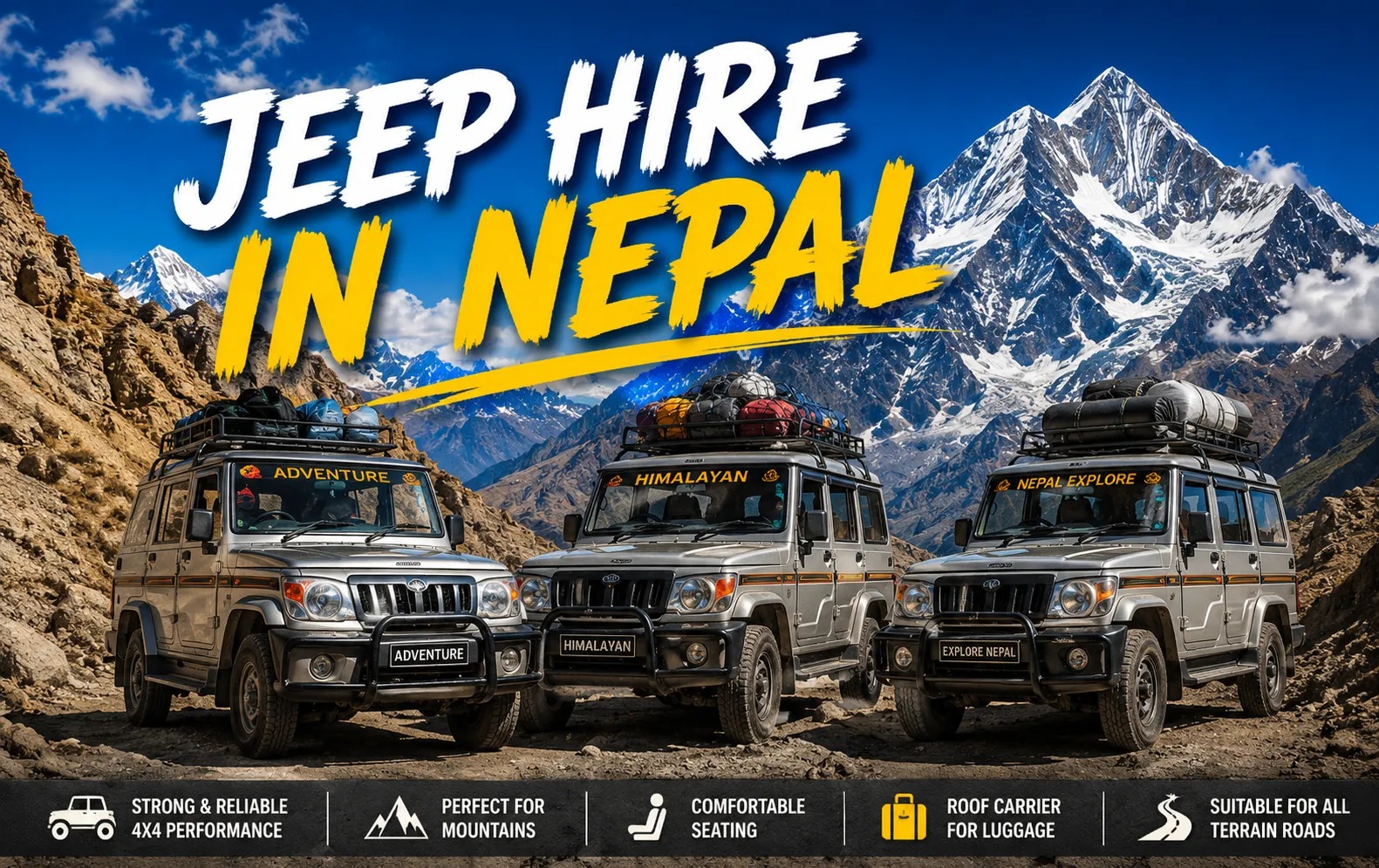
The vehicles Nepali drivers and trekkers call ‘jeeps’ share a handful of defining characteristics that make them uniquely suited to the country’s most demanding roads. First and foremost is ground clearance. A typical Mahindra Scorpio or Bolero sits noticeably higher off the ground than a passenger car or even many crossover SUVs, allowing it to pass over rocks, ruts, and washouts that would otherwise scrape or damage the undercarriage of a lower vehicle. This single feature is often the deciding factor between a vehicle that completes a mountain journey and one that does not.
Second is the construction style. Most jeeps used in Nepal’s hire fleet are built on a traditional body-on-frame chassis, similar to a pickup truck, rather than the unibody construction used in most modern SUVs and crossovers. Body-on-frame construction is inherently more resistant to the twisting and flexing stresses that occur when one wheel is lifted high on a rock while another dips into a rut — a common occurrence on Nepal’s roughest tracks. This robustness comes at the cost of a stiffer, bumpier ride on smooth roads, but it’s what lets these vehicles survive years of punishing mountain use without structural damage.
Third is the drivetrain. Genuine 4WD Jeeps used on Nepal’s mountain routes typically include a proper low-range transfer case, allowing the driver to select a gear ratio suited to crawling over obstacles at very low speeds with maximum torque. This differs fundamentally from the ‘all-wheel drive’ systems found in many crossover SUVs, which are designed primarily to improve traction on slippery paved roads rather than provide genuine rock-crawling capability. When a driver needs to ease a vehicle down a steep, loose-surface switchback above a river gorge, low-range gearing can mean the difference between a controlled descent and a frightening loss of control.
Fourth, and often overlooked by first-time visitors, is repairability. The jeeps used throughout Nepal — predominantly Mahindra and Toyota models — are mechanically simple by modern automotive standards, and spare parts plus mechanics familiar with these vehicles are available even in fairly remote district towns. If something goes wrong on a remote mountain road, a local mechanic in a town like Besisahar or Jomsom is far more likely to have the knowledge and parts needed to fix a Mahindra Scorpio than a more complex, electronically sophisticated modern SUV. This practical consideration matters enormously when you are days away from the nearest city.
Taken together, these characteristics explain why genuine jeeps remain the default and recommended vehicle for nearly all of Nepal’s classic trekking trailhead routes — Besisahar to Chame and Manang on the Annapurna Circuit, the road to Jomsom and Lo Manthang in Upper Mustang, the approach to Soti Khola and Arughat for the Manaslu Circuit, and similar rugged corridors. Any provider who suggests a standard SUV for these specific routes is either unfamiliar with current road conditions or willing to compromise your safety and comfort for a marginal cost saving.
What Exactly Is an ‘SUV’ in Nepal, and Where Does It Excel?
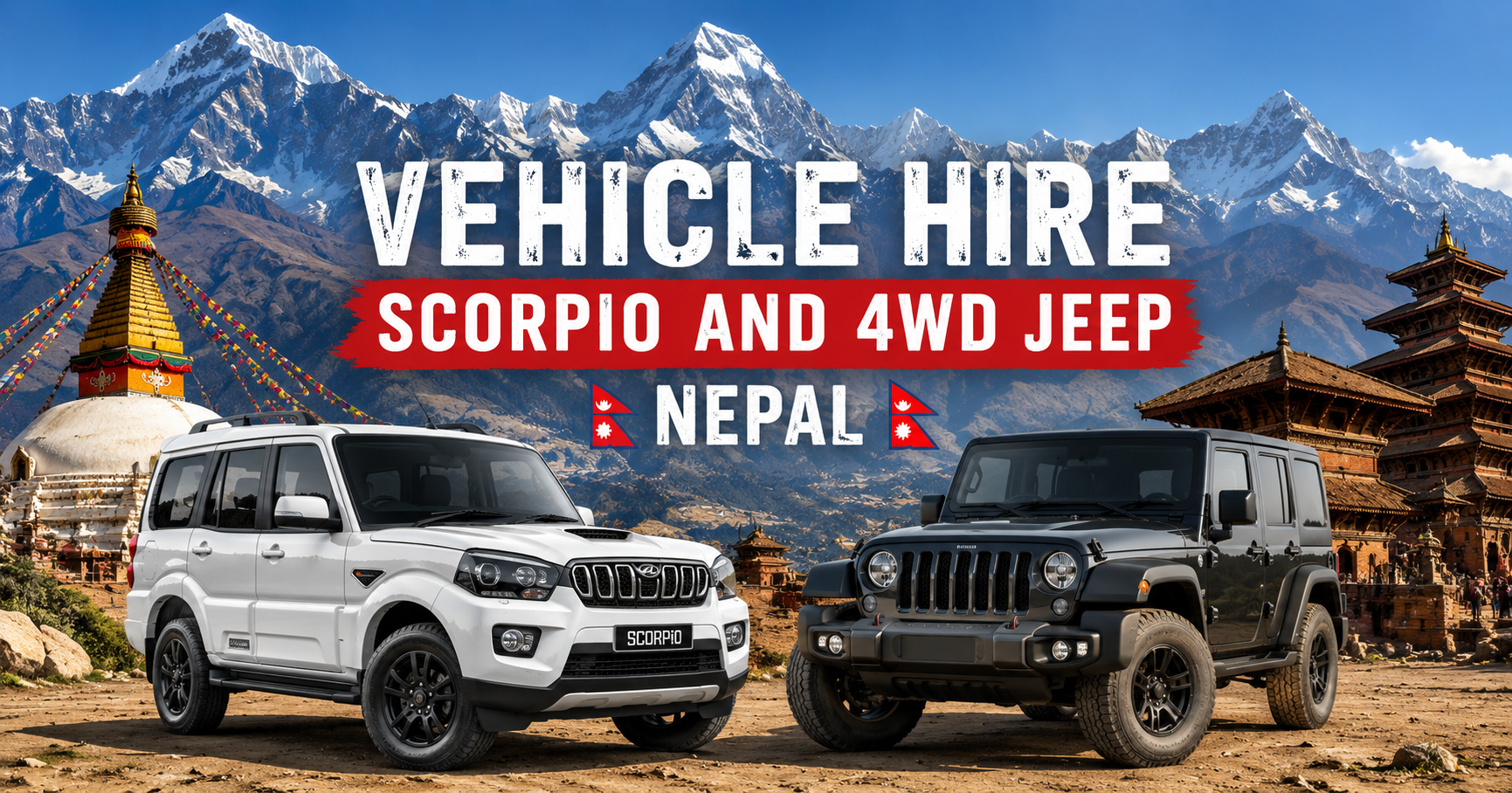
If jeeps are defined by their ruggedness, SUVs in Nepal’s hire market are defined by balance—a deliberate compromise between off-road capability and everyday comfort. Vehicles such as the Toyota Fortuner, Toyota Prado, Mahindra XUV700, and similar mid-size SUVs sit at an interesting midpoint: many do retain genuine four-wheel-drive systems and respectable ground clearance, but they are engineered first and foremost around passenger comfort, refined handling on paved roads, and a smoother, quieter ride than a traditional jeep can offer.
This makes SUVs the better choice for many Nepal travel scenarios that don’t involve the roughest mountain tracks. Consider a family flying into Kathmandu for a two-week holiday that includes sightseeing around the Kathmandu Valley, a scenic drive to Pokhara, a few days relaxing by Phewa Lake, and perhaps a half-day excursion to Sarangkot for sunrise views. None of this itinerary requires the rock-crawling capability of a true jeep. What it does require is a comfortable, air-conditioned cabin, smooth highway manners, decent luggage space, and a pleasant ride for several hours straight. An SUV delivers exactly this, with considerably more comfort than a traditional Jeep, whose stiffer suspension and more basic interior trim are keenly felt on longer paved-road journeys.
SUVs also tend to offer better noise insulation, more comfortable seating with proper lumbar support, and often features like rear air-conditioning vents, which matter a great deal on a four- or five-hour highway drive. For travellers whose itinerary centres on cultural tourism, shorter treks accessible by good roads (such as Nayapul for Annapurna Base Camp or Ghorepani Poon Hill), wildlife safaris in Chitwan, or general sightseeing circuits, an SUV is often the more sensible and pleasant choice.
Where SUVs begin to show their limitations is on the genuinely rough mountain tracks described earlier. While premium SUVs like the Toyota Prado do offer serious off-road hardware and can, with a skilled driver, handle many of Nepal’s rougher roads competently, the lower-cost mid-range SUVs more commonly available in hire fleets — and certainly any vehicle marketed as an SUV but built on a car-like unibody platform with modest ground clearance — are not engineered for the punishment of routes like Besisahar to Chame or the final stretches into Upper Mustang. Travellers who insist on an SUV for these roads, perhaps for comfort, often face slower progress, a higher risk of underbody damage, and, in some cases, are unable to continue and must transfer to a jeep partway through the journey.
The Fundamental Trade-Off: Comfort Versus Capability
At the heart of the jeep-versus-SUV decision lies a trade-off you can’t fully escape, no matter how much a hire company markets a particular vehicle. Capability and comfort sit, broadly speaking, at opposite ends of a spectrum. The very features that make a Jeep capable of surviving Nepal’s harshest mountain tracks — stiff, heavy-duty suspension, a tall and narrow stance, basic interior trim, firm seats designed to withstand years of abuse — are the same features that make it a less comfortable vehicle to sit in for hour after hour on a smooth highway. Conversely, the features that make an SUV pleasant on a long paved drive — softer, more compliant suspension tuning, sound-deadening materials, plush seating — are often the very features that limit its ability to absorb the punishment of a genuinely rough mountain road without component failure or driver discomfort from excessive body roll and impact harshness.
This is not a marketing exaggeration or a simplification designed to sell one vehicle category over another; it reflects genuine engineering reality. A vehicle’s suspension, chassis, and ground clearance are tuned during design and manufacture toward a particular use case, and few vehicles excel equally at both ends of the spectrum. Even the most expensive and capable SUVs, which can certainly handle moderate off-road conditions well, will still find genuine high-mountain tracks more punishing than a purpose-built jeep, simply because their underlying engineering philosophy prioritises different outcomes.
Understanding this trade-off helps travellers set realistic expectations. If your journey is entirely on paved or well-graded roads, you can enjoy the comfort benefits of an SUV without any meaningful capability compromise, because the road conditions never demand more than the SUV can deliver. If your journey includes any meaningful stretch of genuine mountain track, you must accept that a Jeep will deliver superior safety and reliability, even though the ride may be noticeably firmer and louder than in a more comfort-oriented vehicle. No vehicle perfectly satisfies both ends of this spectrum, and recognising this honestly, rather than hoping for an unrealistic compromise, leads to far better trip planning.
Cost Considerations: Is a Jeep Always More Expensive Than an SUV?
Many first-time visitors assume that a rugged 4WD Jeep must automatically cost more to hire than a comfort-oriented SUV. Still, Nepal’s vehicle hire market is far more nuanced. Pricing depends far more on the specific route, the season, vehicle age and condition, and the particular model within each category than on whether the vehicle is broadly classified as a jeep or an SUV.
On routes that genuinely require a jeep — such as Besisahar to Chame, Pokhara to Jomsom overland, or Kathmandu to Arughat for the Manaslu Circuit — jeep hire often costs more than an equivalent SUV would on an easier route, not because jeeps are inherently more expensive vehicles, but because these routes are longer, more time-consuming, more fuel-intensive, and place greater wear on the vehicle and driver. A driver navigating eight hours of rough mountain track earns and deserves a higher day rate than a driver completing a comfortable four-hour highway transfer, and this is reflected in the final hire cost regardless of vehicle category.
On routes where both a jeep and an SUV are viable options — for instance, Kathmandu to Pokhara — a mid-range SUV will often cost somewhat more to hire than a basic jeep of similar age, because SUVs generally have a higher purchase price, more expensive parts, and are marketed toward a customer base willing to pay a premium for comfort. A premium SUV like a Toyota Prado, hired for a multi-day sightseeing tour, can be considerably more expensive than a Mahindra Scorpio jeep covering the same distance, simply because the vehicle sits at a higher price point in the market.
The most reliable way to think about cost is not ‘jeep versus SUV’ in the abstract, but rather ‘which specific vehicle, on which specific route, for how many days, in which season.’ A Mahindra Bolero jeep hired for a short transfer in the dry season will almost always be cheaper than a Toyota Fortuner SUV hired for the same transfer, but that same Bolero jeep hired for a demanding multi-day mountain expedition in monsoon season, requiring an experienced driver and additional contingency time, may end up costing more than a comfort-oriented SUV used for an easy highway tour. Always request a route-specific quote from Nepal Vehicle Hiring Pvt Ltd rather than assuming a fixed price applies to both vehicle categories.
Passenger Capacity, Luggage Space, and Group Dynamics
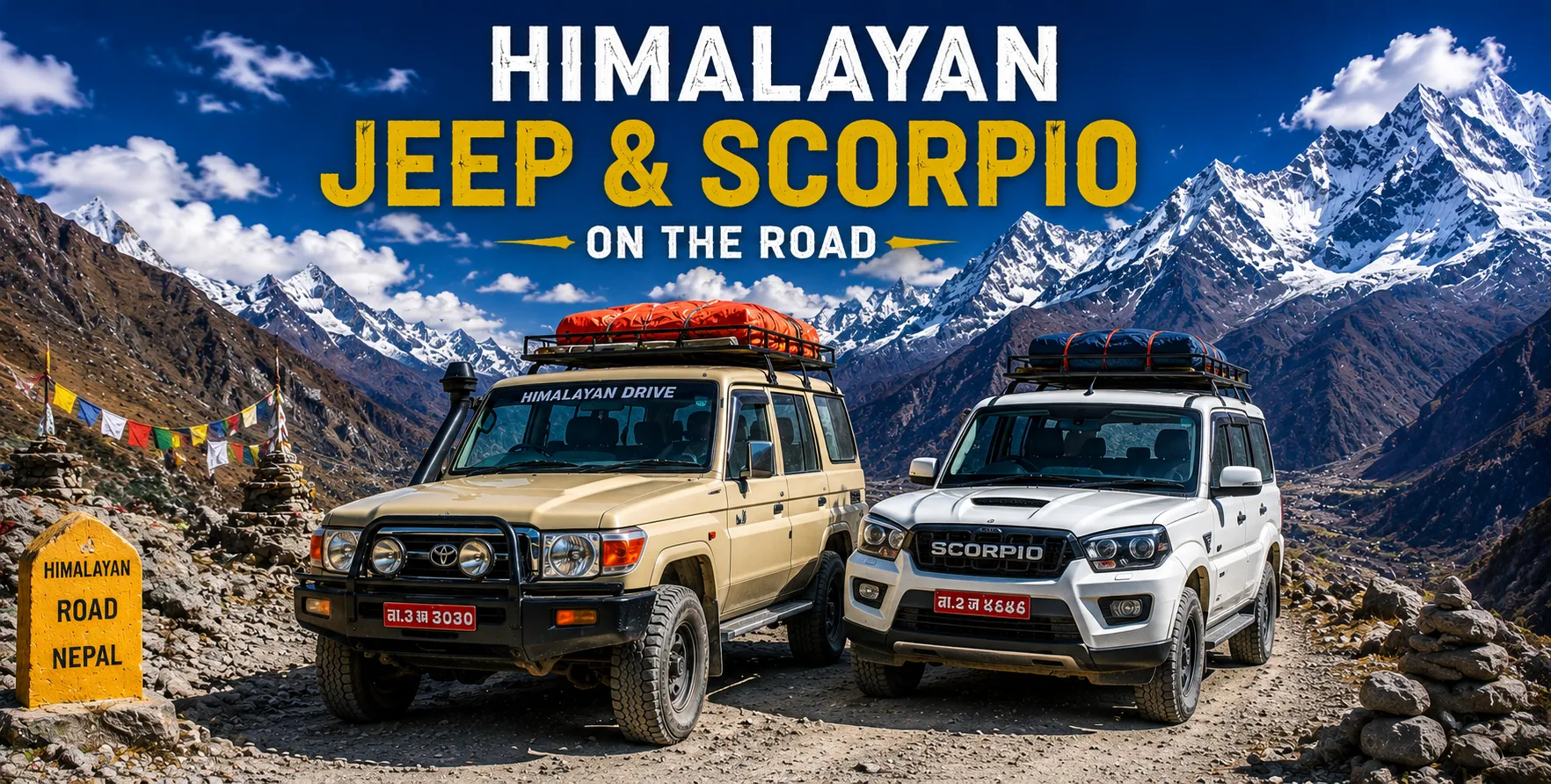
Beyond road suitability and cost, the practical question of how many people and how much luggage you are travelling with plays a significant role in the jeep-versus-SUV decision. Most traditional jeeps used in Nepal’s hire fleet, such as the Mahindra Scorpio or Bolero, are configured to seat four to six passengers comfortably. However, they are sometimes advertised with higher nominal seating capacities that become genuinely uncomfortable once you factor in luggage, trekking gear, and the realities of mountain road conditions. Toyota Land Cruiser jeeps, often used for premium mountain hire, typically offer a comfortable four- to six-passenger capacity with considerably more luggage space in the rear.
Mid-size SUVs like the Toyota Fortuner generally offer comparable seating, often configured for five to seven passengers across three rows. However, in most SUVs, the third row is best reserved for children or shorter journeys, as legroom becomes cramped for adults on longer drives. Premium SUVs like the Toyota Prado tend to offer a more genuinely comfortable seven-seat configuration with better third-row space and more sophisticated luggage management, though at a correspondingly higher hire cost.
For trekking groups carrying duffel bags, trekking poles, and expedition equipment in addition to personal luggage, both jeeps and SUVs can struggle to accommodate the load if the group size approaches the maximum seating capacity. A group of six trekkers with full gear will often find that hiring two smaller jeeps, rather than one larger vehicle, offers more realistic comfort and luggage space, even though it costs more overall. This is a conversation worth having with your vehicle hire provider before finalising a booking, since group size and luggage volume can change which vehicle configuration makes sense, regardless of the jeep-versus-SUV question.
Solo travellers and couples enjoy considerably more flexibility, since either a jeep or an SUV will comfortably accommodate two passengers and a reasonable amount of luggage with room to spare. In these cases, you can decide almost entirely based on road conditions and personal comfort preferences, without worrying about passenger-capacity constraints.
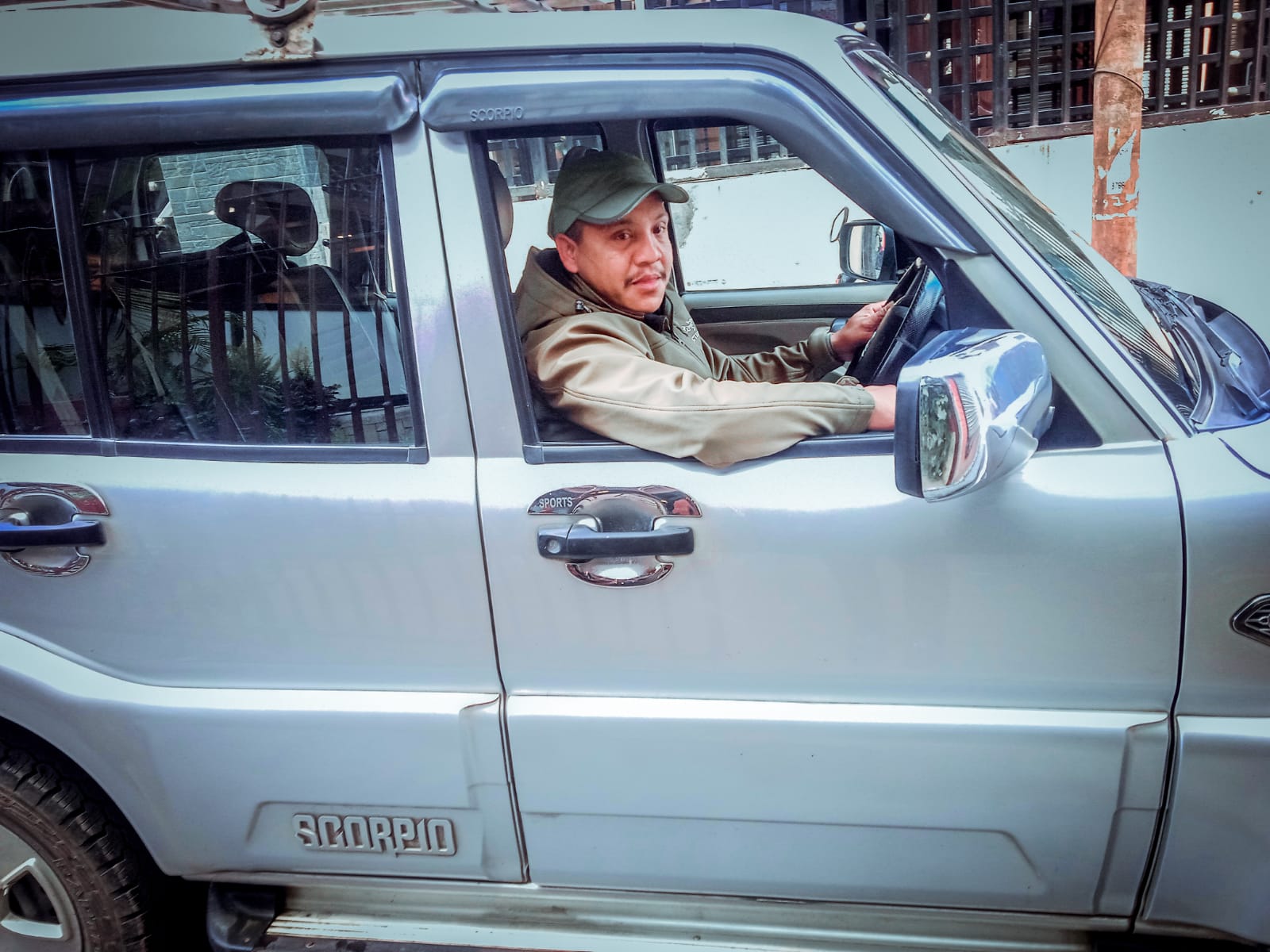
Why the Driver Often Matters More Than the Vehicle Itself
It is worth pausing to make a point that experienced travellers in Nepal often learn the hard way: your driver’s skill and local knowledge often matter as much as, or more than, the vehicle category you hired. A highly experienced driver who has navigated theBesisahar-to-Chamee road hundreds of times will extract noticeably better performance, safety, and passenger comfort from even a modest jeep than an inexperienced driver would in the same vehicle. Conversely, an inexperienced or overly cautious driver in a capable SUV may struggle with sections of road that a skilled mountain driver would handle confidently and smoothly.
This is one of the central reasons Nepal Vehicle Hiring Pvt Ltd places such heavy emphasis on driver experience and route-specific knowledge when assigning vehicles to bookings. We match drivers to routes based on their familiarity with that ue’route’sseasonal quirks, known trouble spots, best rest stops, and the optimal driving technique for its unique combination of surface, gradient, and width. A driver who regularly covers the Kathmandu-to-Syabrubesi route will instinctively know exactly how to approach the Ramche landslide zone near Dhunche, when traffic tends to back up at narrow points, and which sections demand extra caution during or after rainfall.
When evaluating a vehicle hire quote, it is therefore worth asking not just ‘what vehicle will I be travelling in’ but also ‘how experienced is the driver with this specific route.’ A slightly less premium vehicle paired with a highly experienced, route-specific driver will almost always deliver a safer and more satisfying journey than a premium vehicle paired with a driver unfamiliar with the road’s particular challenges.
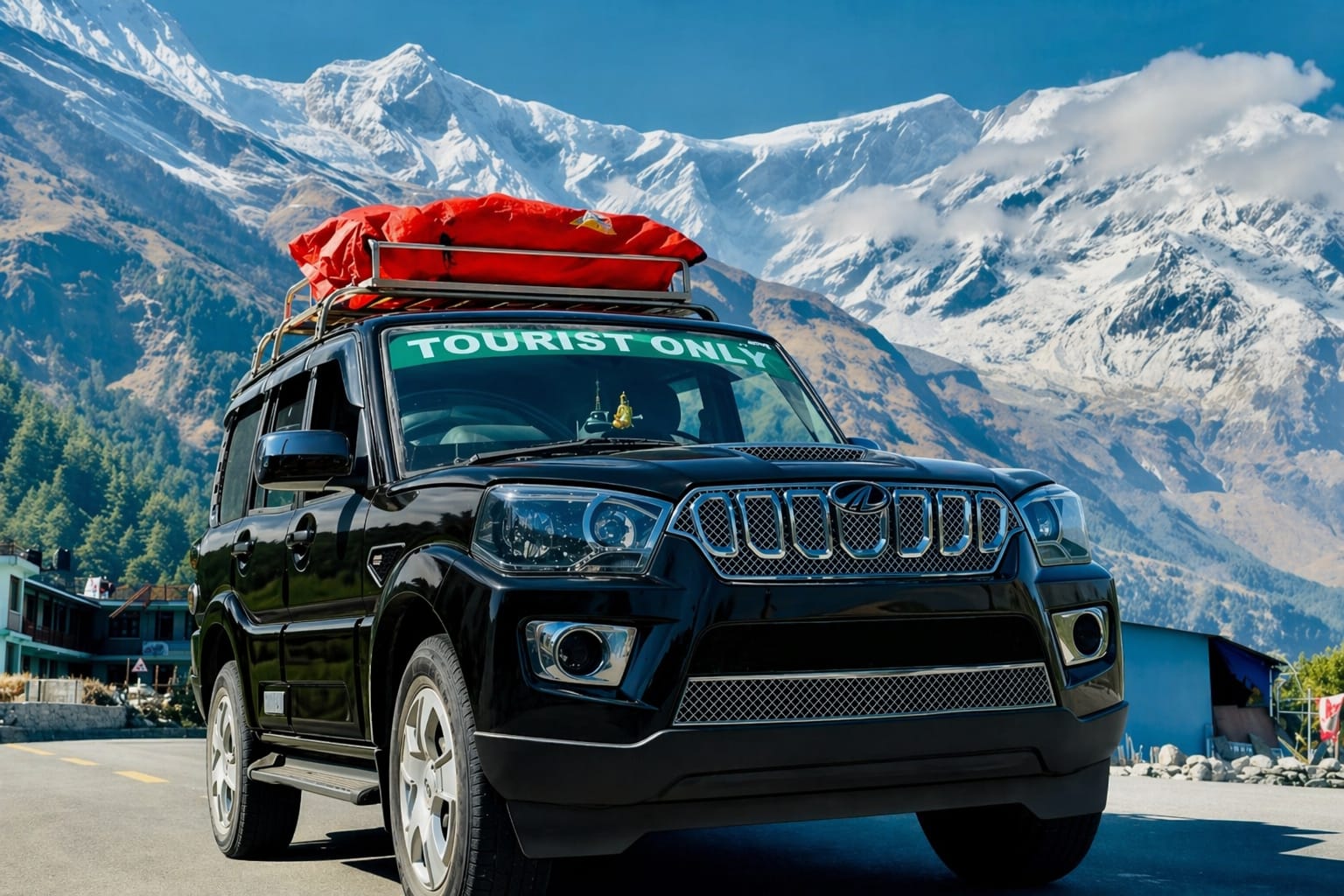
How Season Changes the Jeep-and-SUV Equation
Nepal’s dramatic seasonal variation adds another layer of complexity to the vehicle choice decision, one that many first-time visitors fail to appreciate until they are already fully on the road. During the dry, stable conditions of autumn (September through November) and spring (March through May), many semi-improved roads that would otherwise demand a jeep become passable, with some caution, in a capable SUV. Firm, dry road surfaces, predictable conditions, and the absence of standing water or fresh landslide debris widen the margin for vehicle choice during these peak trekking seasons.
Monsoon season (June through August) changes this calculation entirely. Heavy rainfall transforms previously manageable gravel and dirt roads into slick, rutted, landslide-prone hazards almost overnight. Roads that an SUV might handle comfortably in October can become genuinely dangerous, or entirely impassable, during a heavy monsoon downpour in July. During this period, the safety margin provided by a proper jeep’s low-range gearing, superior ground clearance, and robust construction becomes far more valuable, even on routes that might otherwise suit SUVs in drier months. Nepal Vehicle Hiring Pvt Ltd routinely recommends upgrading to a full jeep for monsoon-season travel on routes where an SUV might ordinarily suffice in dry conditions, purely as a safety precaution against the unpredictability of landslide-affected mountain roads.
Winter (December through February) introduces a different set of challenges, particularly on higher-altitude routes approaching 3,000 meters, where snow and ice can affect road surfaces even when lower sections remain perfectly dry. On routes like Besisahar toward Manang, or Jomsom toward Lo Manthang, winter conditions at altitude can demand jeep-level capability even when the lower portions of the same route would be entirely manageable in an SUV during the dry season. Seasonal awareness, in other words, is not a minor footnote to the jeep-versus-SUV decision; it can fundamentally shift which vehicle category is appropriate for the same physical route, depending purely on when you are travelling
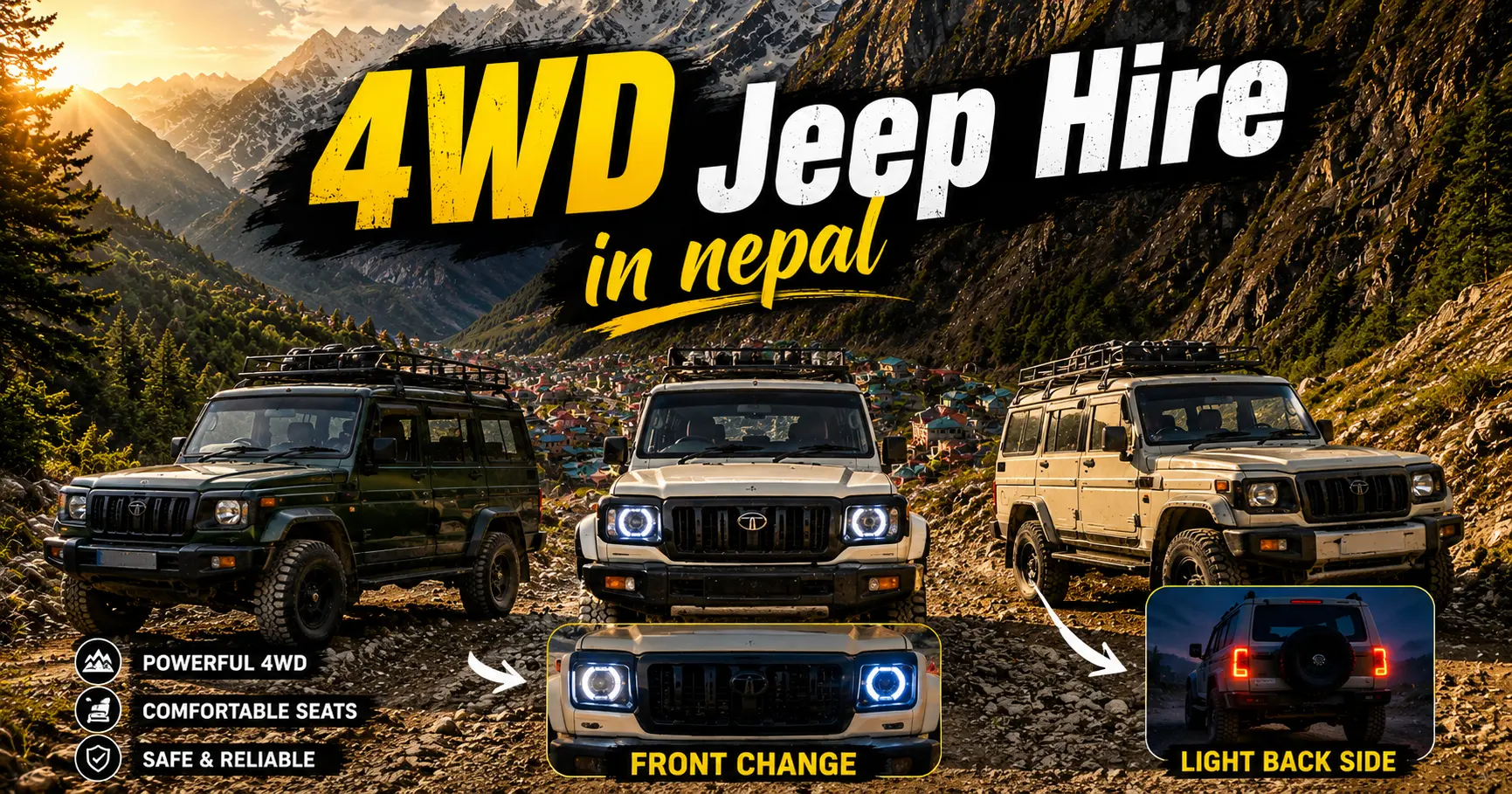
Matching Vehicle Choice to Nepal’s Most Popular Routes
With the underlying principles established, it helps to walk through how this decision plays out on some of Nepal’s most frequently travelled routes; concrete examples often clarify abstract guidance far more effectively than general rules alone.
On the Kathmandu to Pokhara highway, one of the country’s busiest and best-maintained long-distance routes, either a jeep or an SUV will perform perfectly adequately. Here, the decision genuinely comes down to comfort preference and budget. Families and travellers prioritising a smooth, quiet ride for the five-to-six-hour drive will generally prefer an SUV. At the same time, budget-conscious solo travellers or small groups happy to trade some comfort for cost savings often opt for a jeep with no practical disadvantage.
On the route from Pokhara to Besisahar, the gateway to the Annapurna Circuit, conditions are mixed: the road is mostly paved but narrows considerably and includes some rougher patches, particularly in the final approach to Besisahar itself. A capable SUV will generally manage this route without major difficulty in good weather. However, a jeep remains the more comfortable and confident choice, especially during monsoon season or if your journey continues beyond Besisahar onto the rougher Chame road immediately afterwards.
Beyond Besisahar, on the legendary stretch toward Chame and Manang, the calculation changes entirely. This is unambiguously Jeep territory. The unpaved, narrow, cliff-edge mountain track demands the ground clearance, low-range gearing, and structural robustness that only a properly built jeep can reliably provide. Attempting this route in a standard SUV, no matter how capable it is on other Nepali roads, is not a sensible choice, and any hire provider suggesting otherwise should be treated with caution.
The route from Kathmandu to Syabrubesi, the gateway to the Langtang region, sits somewhere between these extremes. Much of the journey follows reasonably maintained roads through Trishuli Bazaar, but the final stretch through the Ramche landslide zone near Dhunche presents genuine off-road challenges, particularly after rainfall. A jeep is generally the recommended choice here, especially for groups travelling with significant trekking gear. However, a well-driven SUV can sometimes manage this route in favourable dry-season conditions.
For the popular Annapurna Base Camp and Ghorepani Poon Hill trailheads, accessed via Nayapul from Pokhara, the road is well paved and well maintained for virtually its entire length. This is one of the clearest cases where an SUV, or even a standard car, performs perfectly well, and there is no meaningful capability advantage to choosing a Jeep for this particular transfer.
Upper Mustang, by contrast, represents the far end of the spectrum. The overland route from Pokhara through Jomsom toward Lo Manthang traverses some of the most demanding high-altitude road-accessible terrain in Nepal, combining rough surfaces, river crossings, and significant altitude gain. Take this route only in a proper 4WD jeep with an experienced high-altitude driver, regardless of how capable a particular SUV may seem on paper.
The Manaslu Circuit trailhead approach via Arughat or Soti Khola similarly demands jeep-level capability for the rougher final sections, even though the initial portion of the journey from Kathmandu follows reasonably maintained roads. As with Langtang, the deciding factor tends to be the final approach kilometres rather than the overall journey, reinforcing the importance of considering your entire route rather than just its easiest sections when making a vehicle decision.
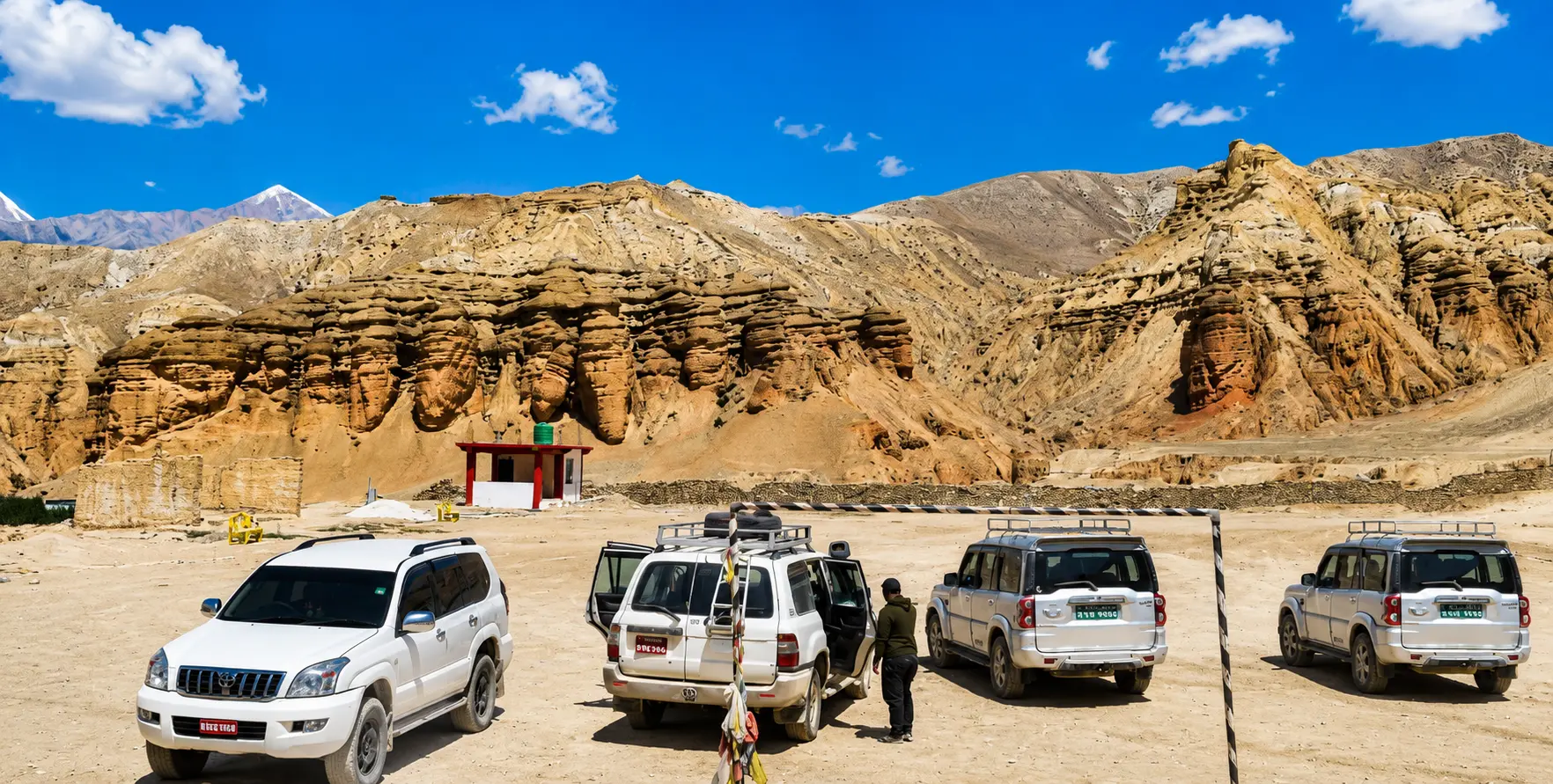
Quick Reference: Jeep and SUV by Route The Hybrid Approach: Combining Vehicles Across a Single Trip
| Route | Road Character | Recommended Vehicle |
|---|---|---|
| Kathmandu ↔ Pokhara | Paved highway, well-maintained | Either — comfort preference decides |
| Pokhara → Besisahar | Mostly paved, some rough patches | SUV (dry season), Jeep (monsoon) |
| Besisahar → Chame / Manang | Unpaved mountain track, cliff edges | Jeep only |
| Kathmandu → Syabrubesi (Langtang) | Mixed paved/rough, landslide zone near Dhunche | Jeep recommended |
| Pokhara → Nayapul (ABC / Poon Hill) | Fully paved, well-maintained | SUV or standard car |
| Pokhara → Jomsom → Lo Manthang (Upper Mustang) | High-altitude rough track, river crossings | Jeep only |
| Kathmandu → Arughat / Soti Khola (Manaslu) | Mixed, rough final approach | Jeep recommended |
| Kathmandu ↔ Chitwan | Paved highway | Either — SUV preferred for comfort |
One strategy experienced Nepal travellers and trekking agencies increasingly favour is the hybrid approach — using an SUV for the comfortable, paved portions of a journey and switching to a jeep only for the genuinely demanding mountain sections. This approach makes particular sense for itineraries that begin in Kathmandu or Pokhara, traverse well-maintained highways for most of the distance, and encounter rough terrain only on the final approach to a specific trailhead.
For example, a trekker heading to the Manaslu Circuit might travel comfortably from Kathmandu to the outskirts of Gorkha in a smooth SUV, then transfer to a dedicated jeep for the final, rougher stretch toward Soti Khola or Arughat. While this requires an additional vehicle change and slightly more logistical coordination, it lets travellers enjoy maximum comfort wherever the road permits, while still ensuring genuine off-road capability is available exactly where it is needed most.
This hybrid strategy does involve additional cost and planning complexity, since it requires coordinating two separate vehicles and a smooth transfer point between them, as well as the logistics of moving luggage and trekking gear between vehicles. For travellers with flexible budgets and a strong preference for comfort wherever possible, however, it represents an excellent middle path between the pure comfort of an SUV and the pure capability of a jeep. Nepal Vehicle Hiring Pvt Ltd can arrange exactly this kind of hybrid multi-vehicle itinerary for clients who want the best of both worlds across a longer, more complex journey.
Safety Implications of Choosing the Wrong Vehicle
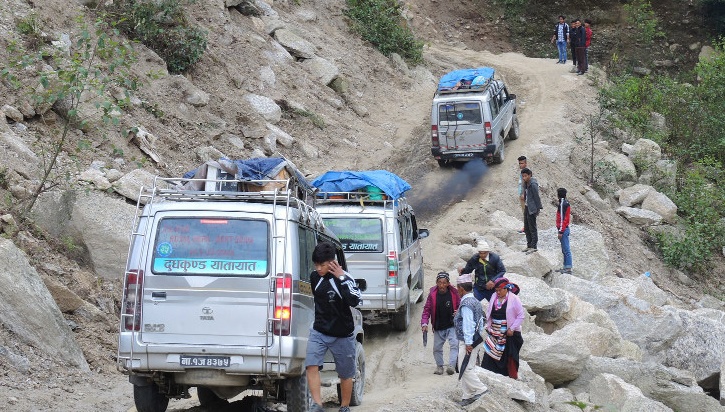
It would be a disservice to readers not to address the safety implications of choosing an unsuitable vehicle for Nepal’s more demanding mountain roads. This is not merely a matter of comfort or convenience; it has genuine consequences for traveller safety, particularly on routes with steep gradients, narrow cliff-edge sections, and unpredictable surface conditions.
A vehicle with insufficient ground clearance attempting a rough mountain track risks not just minor underbody scrapes but potentially serious damage to critical components such as the fuel tank, exhaust system, or drivetrain, damage that can leave a traveller stranded in remote areas far from professional repair services. A vehicle without proper low-range gearing attempting a steep, loose-surface descent may struggle to maintain controlled speed, increasing the risk of skidding or loss of control on exactly the kind of cliff-edge roads where such an incident would be most dangerous. A vehicle without adequate structural robustness may still mechanically fail under the sustained stress of rough-road use, again potentially in locations far from any assistance.
Beyond the vehicle itself, choosing an inappropriate vehicle category often correlates with inadequate driver preparation for the specific demands of mountain driving. Drivers experienced mainly in highway and city driving, even if technically competent, may lack the skills to read mountain terrain, judge the safest line through a rough section, or respond appropriately to an unexpected obstacle on a narrow, cliffed road. This is why Nepal Vehicle Hiring Pvt Ltd insists on matching vehicle category to route difficulty as a firm policy, rather than accommodating whatever vehicle preference a client requests when that preference would compromise safety on a known difficult route.
Note: If a vehicle hire provider offers to take you on a known rough mountain route in a vehicle category that seems inadequate for the terrain — particularly a standard SUV, van, or sedan on routes like Besisahar to Chame or the approach to Upper Mustang — treat this as a significant warning sign about that provider’s standards, regardless of the price being offered.
Altitude, Temperature, and Engine Performance Considerations
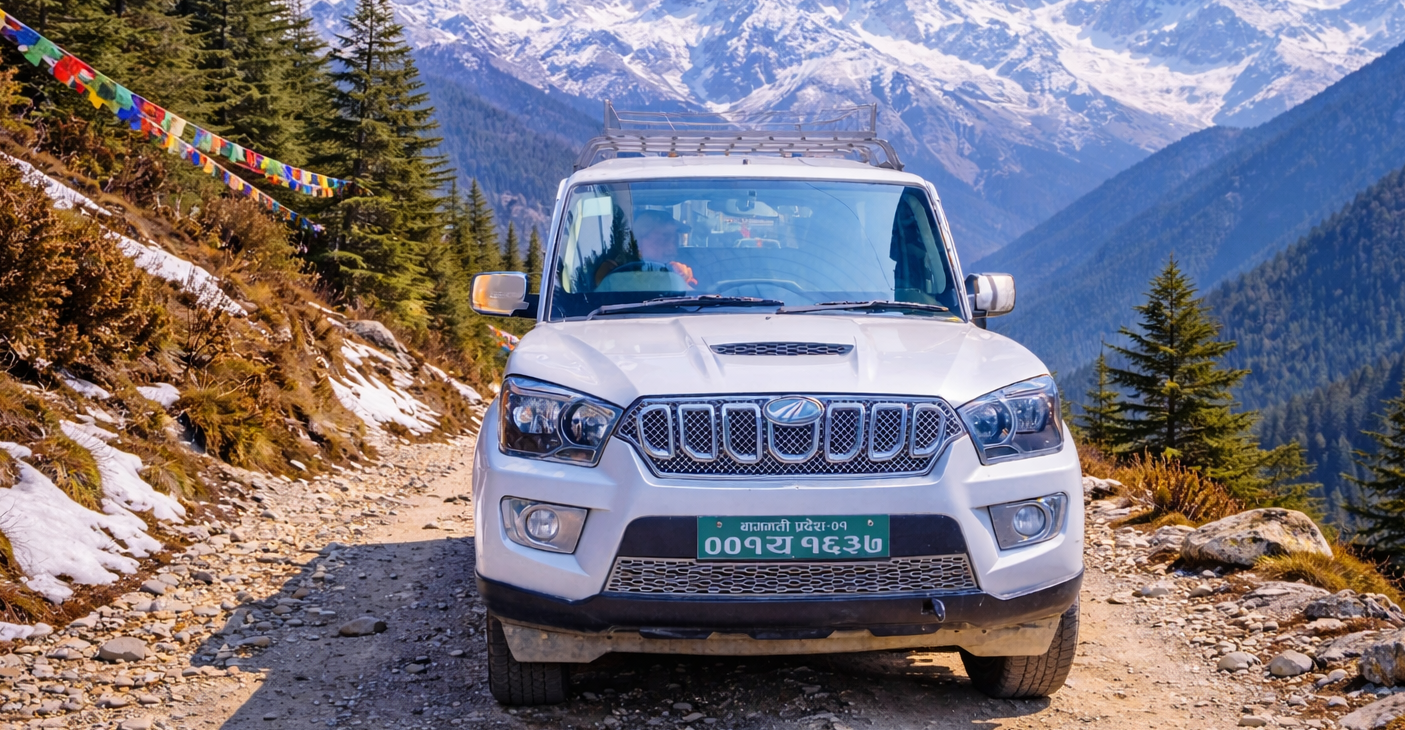
A factor that receives surprisingly little attention in most vehicle comparison discussions, but matters considerably in Nepal’s high-altitude trekking regions, is how altitude affects engine performance and overall vehicle behaviour. As elevation increases, atmospheric oxygen density decreases,reducings the power output of naturally aspirated internal combustion engine the type used in most jeeps and many mid-range SUVs inNepal’sl hire fleet. This effect becomes increasingly noticeable above roughly 2,500 to 3,000 meters, exactly the altitude range where many trekking trailheads, such as the road to Manang or sections of the Upper Mustang route, are located.
Vehicles equipped with turbocharged engines tend to cope somewhat better with this altitude-related power loss than naturally aspirated equivalents, since the turbocharger partially compensates for reduced air density. This is one reason experienced Nepal vehicle hire providers often favour specific engine configurations for their highest-altitude routes, and it is a legitimate question to ask your provider when booking a vehicle for a route that climbs significantly above 3,000 meters.
Temperature extremes present a related consideration. Vehicles operating in the high mountains may face overnight temperatures well below freezing, particularly in winter, which can affect battery performance, diesel fuel gelling in poorly maintained vehicles, and general cold-start reliability. A well-maintained jeep from a reputable provider like Nepal Vehicle Hiring Pvt Ltd will be properly prepared for these conditions, with appropriate fuel additives and battery maintenance during the colder months. However, confirm directly with your provider if your itinerary includes overnight stops at high altitude during winter travel.
Fuel Consumption and Practical Running Costs
Beyond the headline hire price, it is worth understanding how fuel consumption differs between jeeps and SUVs, since this affects not only environmental considerations but also the practical cost structure of longer journeys, particularly on routes where fuel must be carried in reserve due to limited availability at remote petrol stations. Traditional jeeps, with their heavier body-on-frame construction and less aerodynamically refined shapes, generally consume more fuel per kilometre than comparably sized SUVs built on more efficient unibody platforms, particularly at highway speeds where aerodynamic drag becomes a bigger factor.
However, this efficiency gap narrows considerably, and sometimes reverses, on genuinely rough mountain terrain, where a Jeep’s low-range gearing and torque characteristics let it climb steep, technical sections more efficiently than an SUV could, even if the SUV could technically attempt the same climb. An SUV labouring up a low-traction gradient in a higher gear ratio than ideal for the terrain, or requiring multiple attempts to find traction, can, in practice, consume more fuel for that section than a Jeep equipped with proper low-range capability designed for this scenario.
For motor travellers, fuel consumption differences are already factored into the hire price quoted by providers like Nepal Vehicle Hiring Pvt Ltd, since our quotes are typically all-inclusive of fuel for the agreed route. It remains a useful piece of background knowledge, however, travellerslers planning lengthy or remote multi-day itineraries, where understanding the practical operating characteristics of their chosen vehicle category can inform better trip planning and realistic expectations arrefuellingeling Refuellingueling Vehicle Choice to TravelerType
Different traveller categories have different priorities, and it is worth explicitly considering how traveller type interacts with the jeep-versus-SUV decision, beyond the purpose-based analysis already covered.
Solo backpackers and budget-conscious independent trekkers often prioritise cost; for these travellers, a jeep is the more economical choice, particularly when shared jeep services are available on popular routes, splitting the cost across multiple unrelated passengers. The firmer ride and more basic interior of a jeep matter less to travellers already accustomed to teahouse accommodation and basic trekking infrastructure.
Families travelling with younger children, in particular, often place a much higher premium on ride comfort, since long journeys on rough roads can be genuinely distressing for young passengers prone to motion sickness or discomfort from extended periods on firm seating. For families whose itinerary permits it—meaning routes that do not strictly require jeep-level capability—an SUV is often the better choice, even at a higher hire cost, for the well-being of young travellers during transfers.
Photography enthusiasts and travellers who prioritise their journey often find that the specific vehicle category matters less than the flexibility of a private hire arrangement, regardless of whether the hire is a jeep or an SUV. Both vehicle categories, when hired privately rather than as part of a shared service, offer the flexibility to stop freely for photographs, viewpoints, and cultural sites along the route — a significant advantage over shared jeep or bus services regardless of which vehicle category is ultimately chosen.
Expedition teams and trekking groups carrying substantial technical equipment, climbing gear, or scientific instruments often find that the load-carrying capability and underbody protection of a proper jeep outweigh any comfort considerations, since equipment damage or loss represents a far more serious problem than passenger discomfort during the approach journey. For these groups, jeep hire is often the default choice regardless of the specific road conditions, simply as a precaution against equipment damage.
Older travellers or those with mobility considerations sometimes find the higher step-in height and firmer ride of traditional jeeps more physically demanding than the often more accessible cabin height and softer ride of a comfort-oriented SUV. For these travellers, where road conditions permitconditions permit, an these travellersen the more comfortable and practical option, and this consideration is worth discussing openlyit’sre provider when bthis ooking.
How Nepal Vehicle Hiring Pvt Ltd Helps You Choose Correctly
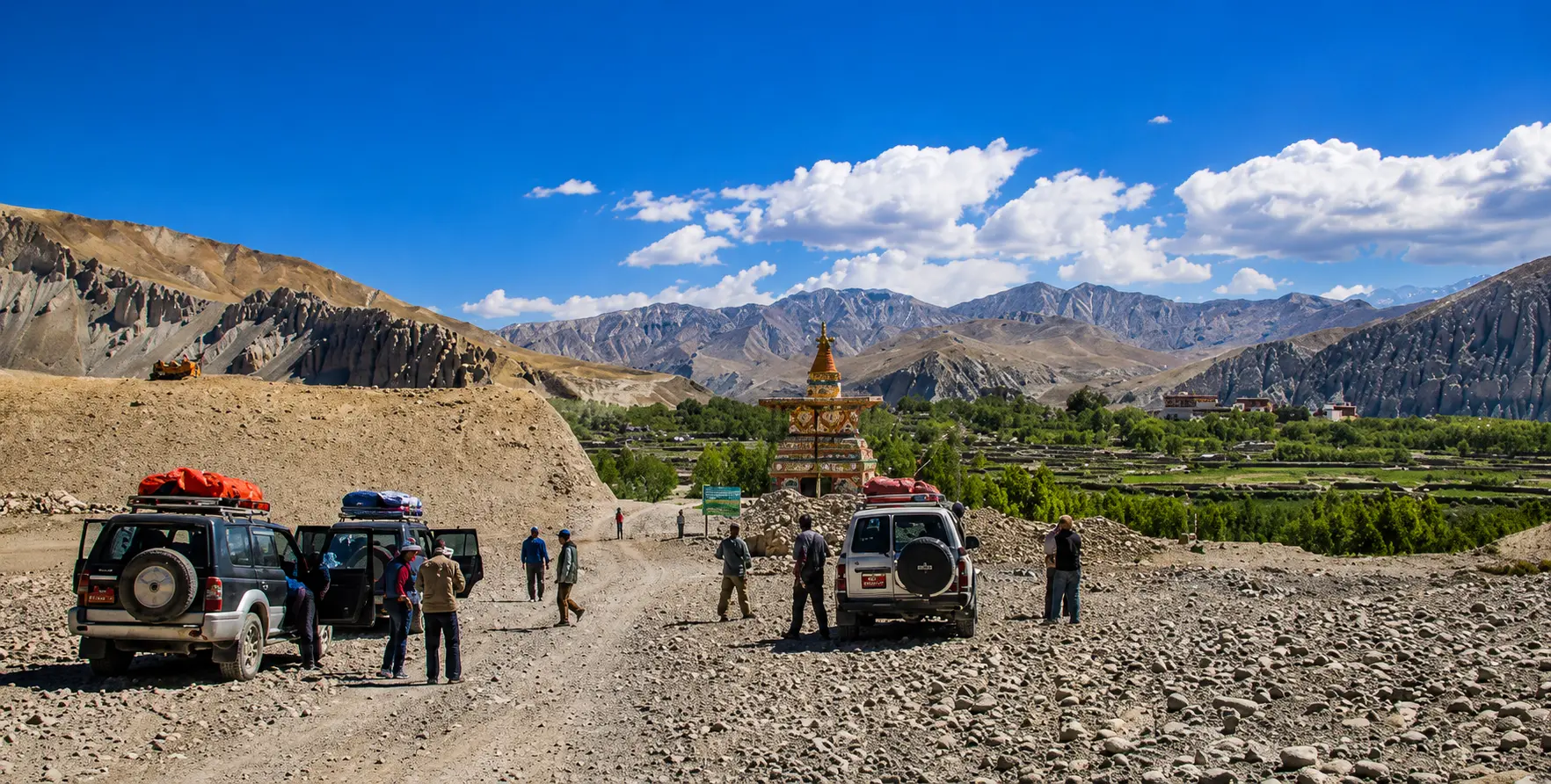
Given the complexity outlined throughout this guide, the jeep-versus-SUV decision is rarely a simple binary choice that can be made correctly without route-specific knowledge. This is precisely the gap that Nepal Vehicle Hiring Pvt Ltd exists to fill for our clients. Rather than simply renting out the vehicle a customer initially requests, our team actively discusses the specific route, season, group size, luggage requirements, and comfort priorities for each booking. We provide an honest recommendation based on current road conditions and years of accumulated, route-specific experience.
This consultative approach occasionally means recommending a less expensive jeep over a more profitable SUV hire when the route genuinely demands it. It also means recommending the comfort of an SUV over a jeep when the route doesn’t require additional capability and the traveller would benefit more from a smoother ride. We believe this honest, route-specific guidance builds far more trust and long-term value for our clients than simply maximising Aniooking’s revenue, and it reflects our broader commitment to safe, reliable, and genuinely helpful service across every journey we arrange.
Our fleet includes a full range of vehicles across both categories—from rugged Mahindra Scorpio and Bolero jeeps for the most demanding mountain routes, to premium Toyota Land Cruiser jeeps, to comfort-oriented Toyota Fortuner and Prado SUVs for highway touring and easier trailhead approaches. We regularly maintain and inspect every vehicle in our fleet to meet Nepali road conditions. We match every driver to routes based on demonstrated experience with that terrain, rather than on general familiarity with driving in Nepal.
Jeep vs SUV: Core Characteristics Compared
| Characteristic | Traditional Jeep (Scorpio, Bolero, Land Cruiser) | SUV (Fortuner, Prado, XUV700) |
|---|---|---|
| Ground Clearance | High — built for rocks, ruts, washouts | Moderate to good — varies by model |
| Construction | Body-on-frame, highly robust | Often unibody or semi-monocoque, more refined |
| Drivetrain | True 4WD with low-range gearing | 4WD/AWD, often without true low-range |
| Ride Comfort (paved roads) | Firm, utilitarian | Smooth, car-like |
| Ride Comfort (rough roads) | Superior — designed for this terrain | Compromised — softer suspension struggles |
| Repairability in remote areas | Excellent — parts and mechanics widely available | Limited — fewer rural mechanics are familiar with the model |
| Best Suited For | Besisahar–Chame, Upper Mustang, Manaslu approach | Kathmandu–Pokhara, Nayapul, Chitwan, sightseeing |
| Typical Passenger Comfort | Basic but functional | Higher — better seating, insulation, AC |
Common Mistakes Travellers Make When Choosing Between a Jeep and SUV
Having guided thousands of clients through this decision over the years, I’veseen certain recurring mistakes clearly. The first and most common is choosing a vehicle based solely on the easiest or most scenic-sounding portion of a route, while overlooking a shorter but more demanding final stretch. A traveller’s journey to Manaslu, for instance, might focus on the comfortable initial highway drive from Kathmandu and underestimate the genuinely rough final approach to Soti Khola, leading to an SUV booking that proves inadequate for the complete journey.
The second common mistake is assuming that a higher-priced SUV automatically offers superior capability to a lower-priced Jeep, based purely on the assumption that higher cost equals better performance. As this guide has explained at length, capability and price do not correlate in any simple way between these two vehicle categories; priced JeeppricedJeepp will frequently outperform a considerably more expensive SUV on genuinely rough mountain terrain, regardless of the price difference.
The third mistake is failing to account for seasonal variation, booking a vehicle appropriate for dry-season conditions without considering that the same journey undertaken during monsoon season may demand significantly greater capability. Travellers planning trips during the shoulder seasons, in particular, should discuss current road conditions directly with their hire provider rather than relying on general assumptions based on typical seasonal patterns.
The fourth mistake is underestimating the volume of luggage and equipment when selecting vehicle capacity, leading to an uncomfortably cramped journey regardless of whether a jeep or an SUV was chosen. Trekking groups, in particular, should share their full equipment list with their hire provider before finalising a vehicle category and size, rather than assuming a given seating capacity automatically accommodates the final amount of luggage.
The fifth and final common mistake is selecting a vehicle hire provider based purely on price without adequately investigating driver experience and vehicle maintenance standards. As this guide has emphasised, an experienced, route-specific driver’s skill often matters as much as the vehicle category itself, and a slightly higher hire cost from a provider with genuinely experienced mountain drivers and well-maintained vehicles often offers far better value than a marginally cheaper option that compromises on either.
A Practical Decision Framework for Your Next Booking
By bringing together everything covered in this guide, travellers can approach their jeep-versus-SUV decision with a straightforward sequence of questionsStarttn by honestlassessing the fullle route, including its most demanding sections rather than just its average characte r,andecideee whether any portion genuinely requires jeep-level off-road capability. If any meaningful stretch of your journey falls into the rough mountain track category described earlier in this guide, a jeep should be your default choice for the entire journey, or at a minimum for that specific demanding section if a hybrid multi-vehicle approach is feasible.
Next, consider the season and whether current conditions might make your route harder than its typical dry-season character. If you are travelling during the winter at higher altitudes, lean toward the more capable option even on routes that might otherwise permit an SUV during more favourable months; the travel composition, including passenger count, presence of children or older travellers, equipment volume, and overall comfort, will guide your final decision.
Finally, and perhaps most importantly, discuss your complete itinerary honestly and in detail with your vehicle hire provider, rather than simply requesting a specific vehicle category based on your own assumptions. A reputable provider like Nepal Vehicle Hiring Pvt Ltd will ask detailed questions about your route, timing, and priorities precisely because this information is essential to recommending the vehicle that will actually serve your journey safely and comfortably, rather than simply fulfilling whatever initial request you submitted.
Ultimately, there is no universally correct answer to the question of which vehicle is best for your journey. Trightect answer depends entirely on where you are going, when you are going, who ou are travelling with, and what you are carrying. What remains constant across all scenarios is the need for honest, route-specific guidance from an experienced local provider, combined with a realistic understanding of the trade-off between comfort and capability that defines this decision at its core.
Conclusion: Let Local Expertise Guide Your Choice
Choosing between a jeep and an SUV for your Nepal journey is ultimately a decision about matching the right tool to the right task. A jeep’s rugged capability makes it the indispensable choice for Nepal’s true mountain trailhead routes, where comfort must yield to safety and reliability on demanding terrain. An SUV’s refined comfort makes it the superior choice for highway touring, cultural sightseeing, and easier trailhead approaches where the road never demands more than a well-built, comfort-oriented vehicle can deliver. Understanding this distinction and applying it honestly to your specific itinerary rather than your initial vehicle preference is the surest path to a safe, comfortable, and genuinely enjoyable journey through Nepal’s extraordinary landscapes.
Nepal Vehicle Hiring Pvt Ltd has spent years building the route-specific knowledge and well-maintained, diverse vehicle fleet needed to guide travellers through this decision. Whether your journey demands the rugged capability of a Mahindra Scorpio jeep on the road to Manang, the comfort of a Toyota Fortuner SUV on the highway to Pokhara, or a thoughtfully planned hybrid combination of both across a longer itinerary, our team is ready to provide honest, experienced guidance and a well-matched vehicle for every stage of your Nepal adventure.
- Jeep and SUV? Choosing the Right Hire Vehicle for Nepal's Mountain Roads
- Understanding Nepal's Road Conditions Before You Choose
- What Exactly Is a 'Jeep' in Nepal, and Why Does It Dominate Mountain Routes?
- What Exactly Is an 'SUV' in Nepal, and Where Does It Excel?
- The Fundamental Trade-Off: Comfort Versus Capability
- Cost Considerations: Is a Jeep Always More Expensive Than an SUV?
- Passenger Capacity, Luggage Space, and Group Dynamics
- Why the Driver Often Matters More Than the Vehicle Itself
- How Season Changes the Jeep-and-SUV Equation
- Matching Vehicle Choice to Nepal's Most Popular Routes
- Safety Implications of Choosing the Wrong Vehicle
- Altitude, Temperature, and Engine Performance Considerations
- Fuel Consumption and Practical Running Costs
- How Nepal Vehicle Hiring Pvt Ltd Helps You Choose Correctly
- Common Mistakes Travellers Make When Choosing Between a Jeep and SUV
- A Practical Decision Framework for Your Next Booking
- Conclusion: Let Local Expertise Guide Your Choice

Related Blog & Articles
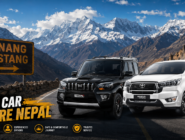
4WD Himalayan Jeep in Nepal
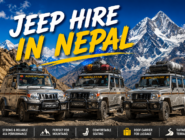
Jeep Hire in Nepal – Best Vehicle for Mountain Roads
Kalinchok Scorpio and Jeep Hire – Ultimate Private 4WD Guide to Kalinchowk Bhagwati Temple

4WD Vehicles in Nepal: The Ultimate Hire Guide