Plan a Trip


Jeep Rental for Muktinath Tour
Jeep Rental for Muktinath Tour: Best for Pilgrims
Muktinath Temple — perched at 3,710 meters above sea level in Nepal’s Gandaki Province, Mustang District — is one of the most sacred destinations in the world for Hindu and Buddhist pilgrims. Known to Hindus as Mukti Kshetra (the Place of Liberation) and to Tibetan Buddhists as Chumig Gyatsa (Hundred Waters), the temple complex draws hundreds of thousands of devotees annually to its 108 sacred water spouts, its eternal natural gas flame that burns simultaneously through Earth and water, and its Vishnu temple that offers the rare blessing of all four elements — Earth, fire, water, and air — at a single sacred site. For both Hindu and Buddhist traditions, the pilgrimage to Muktinath is considered one of the most meritorious acts a devotee can undertake — a journey that offers liberation (mukti) from the cycle of rebirth.
Reaching Muktinath by road requires a private jeep rental — there is no other way to get there. The mountain road from Jomsom (2,720 m) to Muktinath (3,710 m) is a rough, unpaved 21-kilometre track that climbs 990 meters through the Kali Gandaki rain-shadow landscape of arid stone, sparse juniper, and the extraordinary dry-valley character of the world’s deepest gorge. Standard cars cannot navigate this road. Buses cannot reach it. Shared public transport is limited. For most pilgrims and trekkers on the Muktinath journey, a private 4WD jeep rental is the vehicle of choice—and Nepal Vehicle Hiring Pvt. Ltd. provides the finest jeep rental service for the Muktinath tour from both Kathmandu and Pokhara.
Nepal Vehicle Hiring’s dedicated Muktinath Yatra itinerary service is designed specifically for pilgrims and trekkers on the Muktinath journey. Our Pokhara to Mustang jeep service covers the most popular approach from Nepal’s second city, and our Kathmandu to Mustang private jeep covers the full overland journey from the capital. This complete jeep rental guide for the Muktinath tour covers every route option, every section of road, vehicle costs and what is included, the sacred significance of each stop, practical pilgrimage tips, seasonal guidance, and exactly how Nepal Vehicle Hiring makes the Muktinath Yatra journey as smooth, dignified, and spiritually focused as possible.
Why a Jeep is Essential for the Muktinath Tour
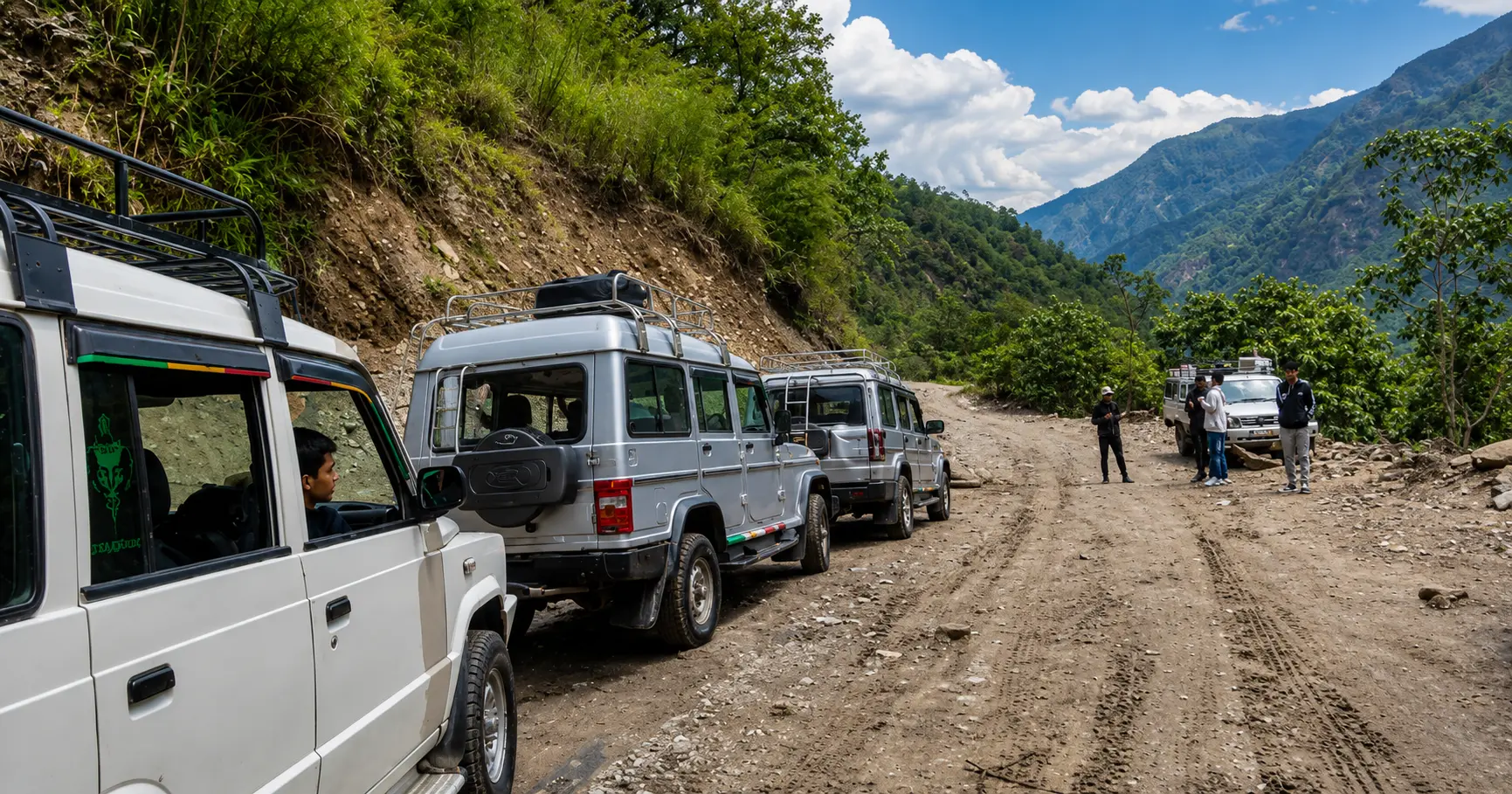
The Muktinath tour requires a 4WD jeep for one simple reason: the road from the Kali Gandaki valley floor to Muktinath isn’t suitable for any other vehicle type. The Jomsom-to-Muktinath road climbs 990 meters in 21 kilometres on an unpaved mountain track through the terrain of the Mustang District — compacted gravel and dirt where road quality exists, bare rocky track and river crossings where it does not. The road surface varies significantly by season and by how badly the previous monsoon damaged it. In good conditions, an experienced driver in a capable 4WD can cover the 21 kilometres in 1 to 1.5 hours. In poor conditions — after rain, after a hard monsoon, or in the strong afternoon Kali Gandaki winds that can blow sand and grit across the track — the same distance can take 2 to 3 hours and requires real mountain road skill.
Beyond the Jomsom-to-Muktinath track, the road from Beni to Jomsom through the Kali Gandaki gorge — the main approach from Pokhara that all Muktinath tour vehicles travel — is itself a mountain road that demands 4WD capability and experienced driving. The gorge section between Tatopani and Marpha, in particular, has rough, narrow sections that a standard car could technically navigate but would be very uncomfortable and potentially dangerous without the ground clearance and drivetrain a proper 4WD jeep provides.
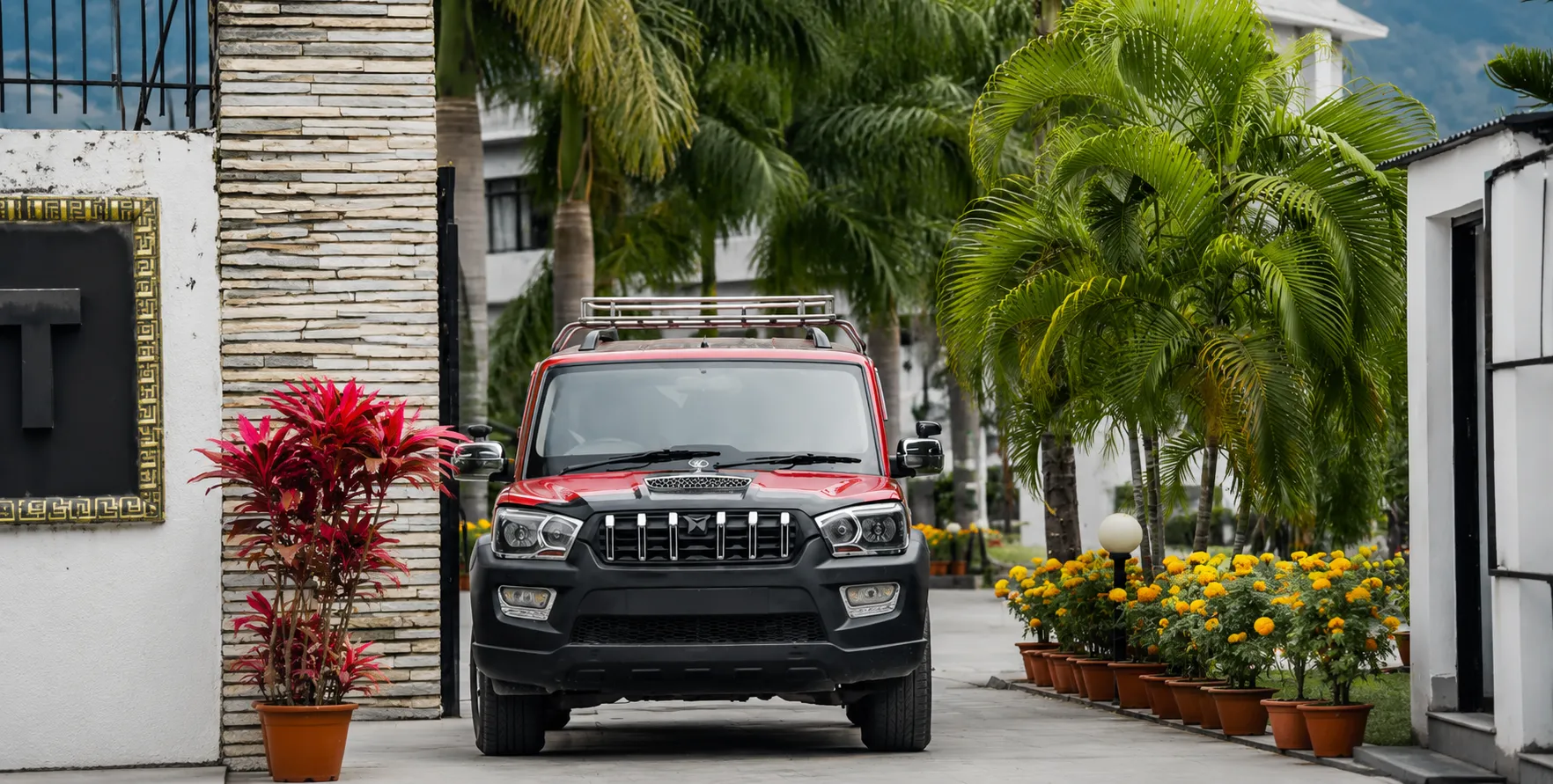
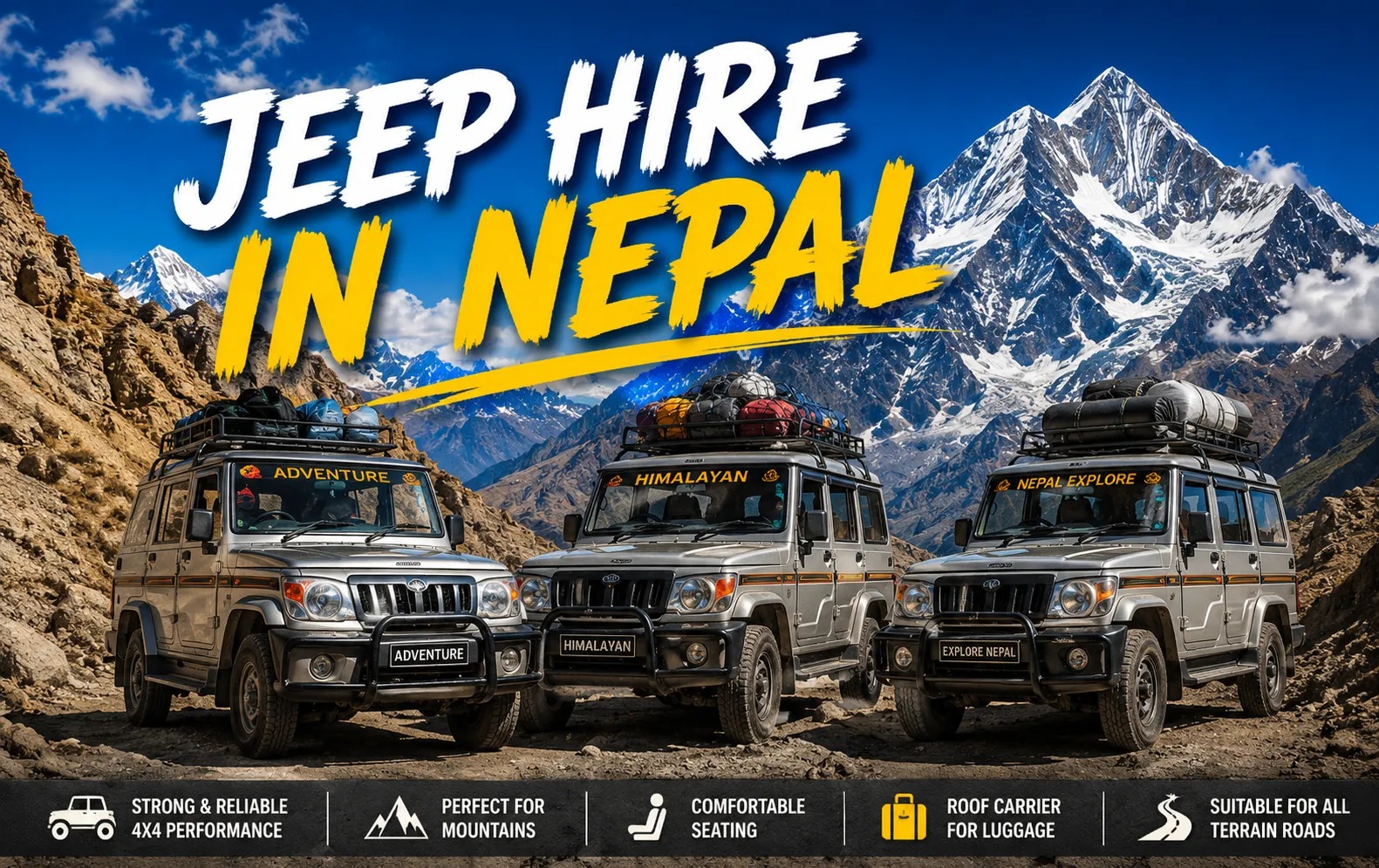
Nepal Vehicle Hiring deploys exclusively from our 4WD jeep hire fleet for all Muktinath tour vehicle services — Mahindra Scorpio (seats 5 to 7 passengers) and Toyota Land Cruiser (seats 4 to 5 passengers). Both vehicles are maintained to high mechanical standards specifically for the demands of the Kali Gandaki gorge road and the Jomsom-to-Muktinath track. Our drivers are route specialists — many have made the Muktinath journey hundreds of times and know every difficult section, every potential hazard, and the best stops for photos and pilgrimage appreciation along the route.
Two Routes to Muktinath: Pokhara Approach and Kathmandu Approach
Route 1: Pokhara to Muktinath (The Recommended Approach)
The Pokhara-to-Muktinath approach is the most popular jeep rental route for the Muktinath tour, and Nepal Vehicle Hiring’s Muktinath Yatra itinerary is built around it. Starting from Pokhara Lakeside (827 m), the jeep journey covers approximately 200 kilometres to Muktinath (3,710 m) via Beni and Jomsom, taking 8 to 11 hours as a direct single-day drive — though Nepal Vehicle Hiring’s recommended approach is two days with an overnight at Jomsom (2,720 m) for altitude acclimatisation.
The Pokhara-to-Muktinath route via the Pokhara to Mustang jeep service follows:
- Pokhara (827 m) to Beni (830 m): 68 km, approximately 2 hours — Gandaki Highway through the Pokhara valley and Baglung District hills to the Kali Gandaki confluence at Beni.
- Beni to Tatopani (1,190 m): 53 km, approximately 2 to 2.5 hours — the road enters the Kali Gandaki gorge and begins climbing. Tatopani (meaning ‘hot water’ in Nepali) has famous natural hot springs — a natural stop for both trekkers and pilgrims.
- Tatopani to Ghasa (2,010 m): 32 km, approximately 1.5 hours — the gorge narrows, and the landscape transitions from subtropical to temperate forest. Ghasa is a Thakali village with excellent guesthouses.
- Ghasa to Marpha (2,670 m): 30 km, approximately 1 to 1.5 hours — passing through Kalopani (with extraordinary Dhaulagiri and Nilgiri peak views), Tukuche (a historic Thakali trading town), and arriving at Marpha, Nepal’s apple capital and one of the Kali Gandaki’s most charming walled villages.
- Marpha to Jomsom (2,720 m): 12 km, approximately 30 minutes — Jomsom is the Mustang District headquarters, domestic airport town, and the base for the Muktinath final approach.
- Jomsom to Muktinath (3,710 m): 21 km, approximately 1 to 1.5 hours — the final mountain track to Muktinath via Kagbeni (2,810 m).
Nepal Vehicle Hiring’s standard two-day Pokhara-to-Muktinath jeep rental: Day 1 — Pokhara to Jomsom (9 to 10 hours); Day 2 — Jomsom to Muktinath darshan, return to Jomsom or Pokhara. The Jomsom overnight allows altitude adjustment from 827 m to 2,720 m before the final rise to 3,710 m — significantly reducing altitude sickness risk at the temple.
Route 2: Kathmandu to Muktinath (The Full Overland Journey)
The Kathmandu-to-Muktinath overland journey via our Kathmandu-to-Mustang private jeep covers about 368 to 380 kilometres. It takes 12 to 15 hours of total driving time — comfortably spread over 2 to 3 days with a recommended itinerary of: Day 1 — Kathmandu to Pokhara (6 to 7 hours) or Kathmandu to Beni (8 to 9 hours); Day 2 — continuing up the Kali Gandaki to Jomsom overnight; Day 3 — Jomsom to Muktinath, full darshan, return to Jomsom or begin return journey.
The Kathmandu approach makes most sense for pilgrims and travellers who: begin their Nepal journey in Kathmandu and want to combine Muktinath with Kathmandu’s sacred sites (Pashupatinath, Boudhanath); are making the Muktinath pilgrimage as part of the Nepal Nekhor tour sacred circuit; or prefer the maximum overland journey experience rather than beginning from Pokhara. Our Kathmandu to Mustang private jeep service covers the full Kathmandu-to-Muktinath overland as a single coordinated booking with hotel door pickup from Thamel.
The Kali Gandaki Gorge Road: What to Expect
The road through the Kali Gandaki gorge — the world’s deepest river gorge, passing between Dhaulagiri (8,167 m) to the west and Annapurna I (8,091 m) to the east — is one of the most extraordinary road journeys accessible by vehicle anywhere in Asia. Understanding what each section of this road involves prepares Muktinath tour travellers for more than a means to reach the temple; it’s one of Nepal’s most dramatic landscape experiences.
Beni to Tatopani: The Gorge Begins
From Beni, the road enters the Kali Gandaki gorge, and the landscape immediately changes character. The river — milky grey with glacial flour in monsoon, clear green-turquoise in dry season — fills the gorge bottom, and the road clings to the valley walls above it. The first major section from Beni to Tatopani crosses the Kali Gandaki multiple times via suspension bridges and concrete crossings, passing through subtropical forest that gives way to scrubby hillside as altitude increases. Tatopani (1,190 m) — the hot spring village — is the standard lunch stop on the Pokhara-to-Jomsom run. The natural thermal pools here are available for bathing (NPR 200 to 300 entry) and are particularly valued by trekkers returning from the circuit who stop to soak tired muscles on the way down. Our jeep drivers always allow 45 to 60 minutes at Tatopani for lunch and optional hot spring use.
Tatopani to Ghasa: The Gorge Narrows
Above Tatopani, the gorge narrows dramatically, and the road becomes more demanding — narrower, with more frequent river crossings and steeper gradient sections. The Dana and Ghasa sections involve some of the most technically challenging driving on the Kali Gandaki road — the road is cut into cliff faces in places, with the river visible far below and the gorge walls rising hundreds of meters on both sides.
The afternoon Kali Gandaki wind, one of the world’s most powerful daily wind phenomena, blows up the gorge from the Indian plains from about 11 a.m. to 5 p.m., reaches gale force in this section, and throws dust and grit across the road. Nepal Vehicle Hiring’s drivers time the Beni-to-Jomsom run with an early 6:30 a.a.m. departure from Pokhara, specifically to pass through the narrowest gorge sections before the wind peaks.
Ghasa to Marpha: The Thakali Villages
Above Ghasa, the gorge gradually opens, and the landscape shifts to the distinctive character of the Thakali heartland—the traditional homeland of the Thakali people, one of Nepal’s most commercially successful ethnic communities, whose teahouse and hospitality businesses have defined trekking culture in the Annapurna region for decades. The road passes through Kalopani (2,530 m) —
where the view of Dhaulagiri I (8,167 m) directly to the northwest is one of the finest accessible mountain views in Nepal; the peak fills the entire western sky in a way that is genuinely disorienting in its scale — then through Tukuche (2,590 m) (a historic Thakali trading town with traditional architecture), and Marpha (2,670 m) — Nepal’s apple capital, with apple orchards, apple brandy distilleries, and whitewashed stone houses lining a cobbled main street that is one of the Kali Gandaki valley’s most photogenic settings. Nepal Vehicle-Hiring drivers pause at Marpha’s main street viewpoint for photos.
Marpha to Jomsom: The Mustang Gateway
The 12-kilometre section from Marpha to Jomsom (2,720 m) continues up the widening valley floor on a road that is in better condition than the lower gorge sections. Jomsom is the administrative headquarters of Mustang District, a proper mountain town with a domestic airport (Jomsom Airport serves direct flights from Pokhara on fair-weather days), government buildings, hotels, restaurants, banks, and a small market. Jomsom is the base for the Muktinath approach—most Muktinath Yatra groups spend one or two nights here to acclimatise before continuing to the temple. Nepal Vehicle Hiring’s jeep rental service includes hotel recommendations in Jomsom based on your group’s requirements and budget.
Jomsom to Kagbeni to Muktinath: The Sacred Approach
From Jomsom, the Muktinath approach road heads north through Kagbeni (2,810 m) — a remarkable medieval walled village at the confluence of the Kali Gandaki and Jhong Khola rivers, and the gateway to Upper Mustang (beyond Kagbeni is the restricted area of Upper Mustang, requiring the USD 50/day restricted area permit). Kagbeni’s ancient monastery, mud-brick labyrinthine lanes, and position at the junction of two great valleys make it one of the Mustang District’s finest heritage stops — Nepal Vehicle Hiring’s drivers pause here for 20 to 30 minutes for photos and a brief village walk.
From Kagbeni, the road climbs steeply for 16 kilometres to Muktinath (3,710 m) through the Jhong Khola valley — a dramatic desert landscape of eroded gullies, sparse juniper scrub, and the extraordinary arid plateau character that the Annapurna rain shadow produces. The ACAP checkpoint at Kagbeni verifies all permits before the final approach to Muktinath. Nepal Vehicle Hiring’s drivers handle all checkpoint formalities — passengers should keep their permit documents accessible.
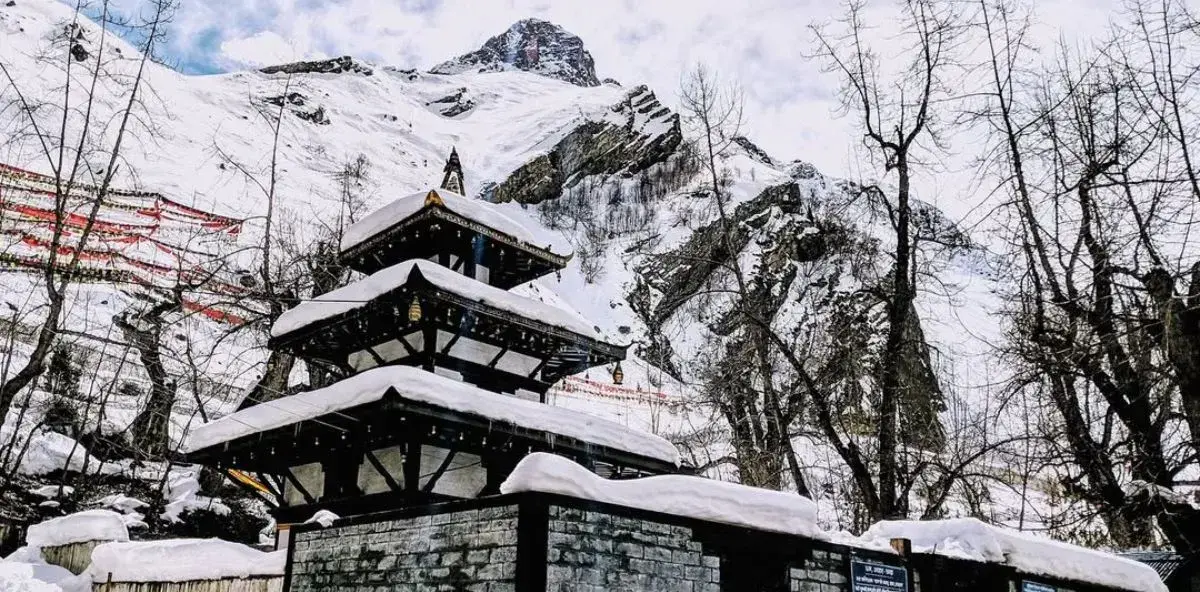
Muktinath Temple: The Sacred Experience
Arriving at Muktinath after the long drive and the 3,710-meter altitude feels like a true arrival—a sense of having reached somewhere genuinely elevated, both geographically and spiritually. The temple complex sits on a plateau above the Mustang valley with a panoramic 360-degree view: Dhaulagiri and Tukuche Peak to the west, Nilgiri to the south, the great mountains of the Annapurna range to the southeast, and the high Tibetan plateau to the north.
The 108 Water Spouts
The 108 dhara (water spouts)—108 sacred Makara (celestial water-serpent) head spouts arranged in a semicircle around the main temple, from which water flows continuously year-round—are the site’s most distinctive physical feature and the central focus of the ritual bathing most Hindu pilgrims perform. The number 108 is auspicious in Hindu and Buddhist cosmology — it represents the 108 names of the divine, the 108 beads of a prayer mala, and the 108 Upanishads. Bathing under all 108 spouts in sequence is a ritual of extraordinary spiritual potency in the Hindu tradition—the icy mountain water flowing continuously from the glaciers above creates a physical challenge that becomes part of the merit-earning experience. Most pilgrims complete the full 108-spout bath; Nepal Vehicle Hiring’s drivers carry extra towels and dry change sets for clients who choose to complete this ritual.
The Eternal Flame
The Jwala Mai (eternal flame) is one of Muktinath’s most remarkable natural phenomena — a natural gas seep that burns as an eternal flame through a water channel, creating the extraordinary sight of fire emerging from water. In Hindu tradition, this simultaneous manifestation of fire and water at a single sacred point is considered the rarest and most auspicious sign of divine presence—the point where normally opposing elements unite in the sacred geography of Mukti Kshetra. The flame is located within the Jwala Devi Temple, a small temple adjacent to the main Vishnu shrine and accessible to all pilgrims.
The Vishnu Temple (Muktidhama)
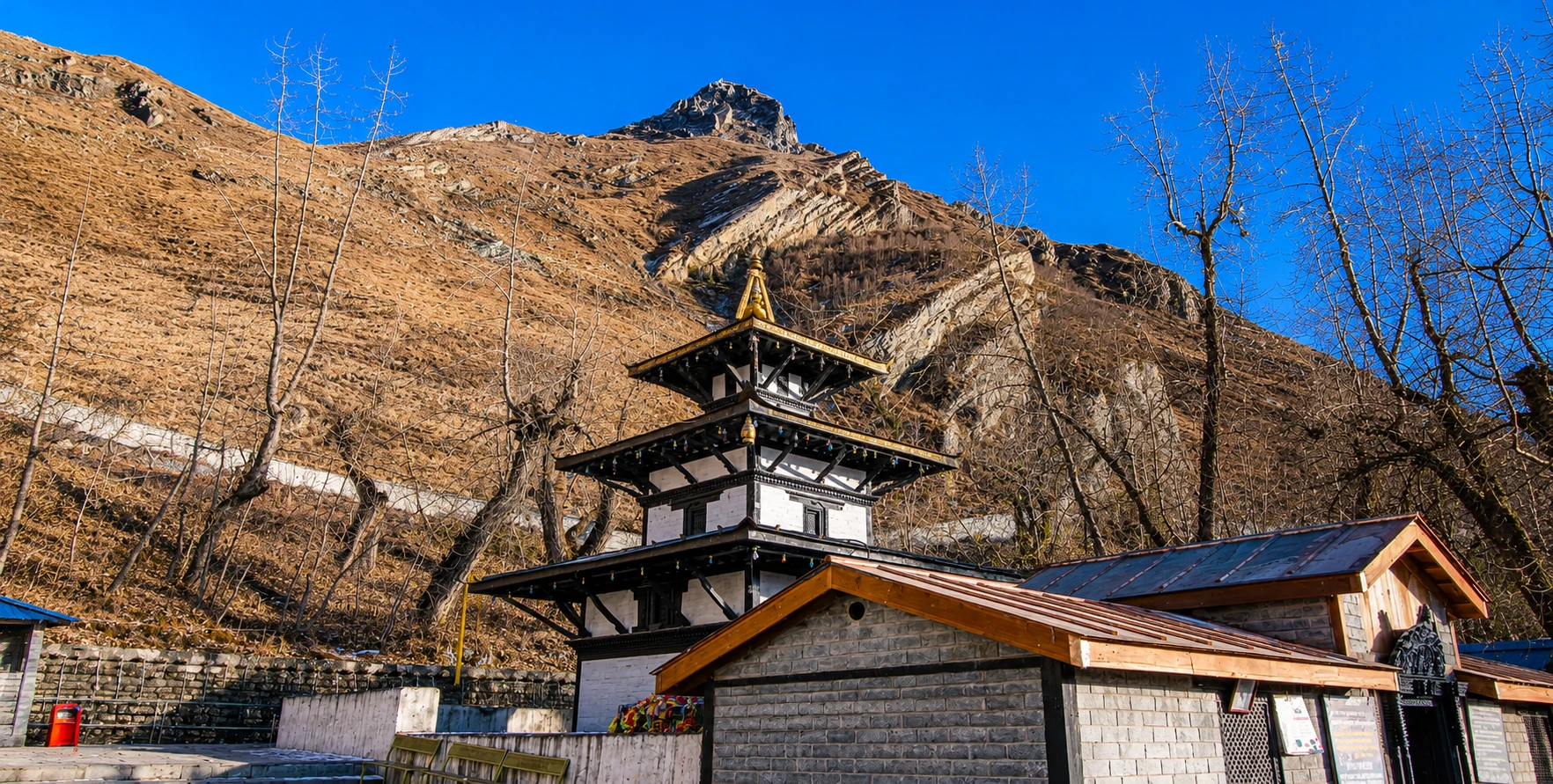
The main Muktidhama Temple is dedicated to Lord Vishnu in his form as Muktinathasvami — the Lord of Liberation. The main sanctum houses the image of Vishnu in black stone (shaligram), flanked by images of Lakshmi and Saraswati. Non-Hindus may not enter the inner sanctum, but they can access the outer temple courtyard, the 108 water spouts, and the surrounding sacred complex. The temple is open daily from 5:00 a.m. to 7:00 p.m. The most auspicious darshan (holy viewing) time is early morning between 6:00 and 8:00 a.m. — Nepal Vehicle Hiring’s two-day itinerary (overnight Jomsom, early morning drive to Muktinath on Day 2) is specifically timed to achieve this morning darshan window.
The Buddhist Dimension: Chumig Gyatsa
For Tibetan Buddhist pilgrims, Muktinath is Chumig Gyatsa — Hundred Waters — one of the 24 Tantric power places (pithas) of the Himalayan Buddhist world. The Jwala Devi Gompa, adjacent to the main temple complex, is a Buddhist monastery administered by Tibetan Buddhist monks, and pilgrims perform their own kora (circumambulation) around the main sacred complex. The coexistence of Hindu and Buddhist devotion at Muktinath — pilgrims of both traditions sharing the 108 water spouts, the eternal flame, and the temple courtyard in a single sacred space — is one of the most profound expressions of Nepal’s syncretic religious culture and one of the most moving experiences available at any sacred site in the country.
Jeep Rental Costs for the Muktinath Tour
Nepal Vehicle Hiring’s jeep rental pricing for the Muktinath tour is all-inclusive — vehicle, experienced driver, fuel, driver accommodation and meal allowance for multi-day journeys, and all road and bridge charges. No hidden supplements, no end-of-journey additions:
Pokhara to Muktinath and Return (2-Day Package)
The most common Muktinath jeep rental configuration: Pokhara Lakeside pickup, Day 1 drive to Jomsom overnight, Day 2 Jomsom to Muktinath darshan and return to Jomsom or Pokhara. Approximate all-inclusive price: NPR 28,000 to 40,000 per vehicle (USD 205 to 280). Per person at various group sizes:
- 3 passengers: NPR 9,333 to 12,667 per person
- 4 passengers: NPR 7,000 to 9,500 per person
- 5 passengers: NPR 5,600 to 7,600 per person
- 6 passengers: NPR 4,667 to 6,333 per person
Kathmandu to Muktinath and Return (4 to 5-Day Package)
Full overland from Thamel, Kathmandu — Kathmandu to Pokhara or Beni (Day 1), Beni to Jomsom (Day 2), Jomsom to Muktinath darshan (Day 3), return journey (Days 4 to 5)—approximate all-inclusive price: NPR 55,000 to 75,000 per vehicle for the complete return circuit. Contact us through our Plan Your Trip page for a detailed multi-day quote.
Pokhara to Jomsom One-Way (for Trekkers)
Trekkers who drive to Jomsom and then walk the Annapurna Circuit southward through Marpha, Tatopani, and Nayapul: Pokhara-to-Jomsom one-way jeep rental approximately NPR 18,000 to30,000 per vehicle (5 to 7 hours). Our Pokhara-to-Nayapul transportation covers the southern exit of the circuit.
Permits Required for the Muktinath Tour by Jeep
Annapurna Conservation Area Permit (ACAP)
The ACAP is mandatory for all foreign nationals travelling through the Annapurna Conservation Area, which covers the entire Kali Gandaki gorge road from below Beni northward through Tatopani, Ghasa, Marpha, Jomsom, and Muktinath. 2026 fee: NPR 3,000 per person. Obtainable at the Nepal Tourism Board office in Kathmandu or Pokhara (strongly recommended — arrange before departure). The ACAP is checked at multiple points along the road i, including the Beni checkpoint and the Kagbeni checkpoint before Muktinath. Nepal Vehicle Hiring’s drivers handle checkpoint formalities — passengers need to have their permits accessible in a day bag.
TIMS Card
The TIMS card is not currently mandatory for Muktinath tour travellers with a valid ACAP permit. Confirm current requirements with Nepal Vehicle Hiring at the time of booking — regulations can be updated without prominent published notice.
Restricted Area Permit for Upper Mustang: Travellers continuing north of Kagbeni into Upper Mustang (Lo Manthang) require an additional Restricted Area Permit of USD 50 per person per day. This is not required for the standard Muktinath tour that ends at the temple complex. The Upper Mustang extension requires a licensed guide and an RAP arranged through a licensed Nepal trekking agency. Nepal Vehicle Hiring’s Pokhara-to-Mustang jeep service and Kathmandu-to-Mustang private jeep both cover the Upper Mustang extension.
What to See on the Pokhara to Muktinath Jeep Journey
The Muktinath jeep tour is not just a way to reach the temple; the journey through the Kali Gandaki gorge is one of Nepal’s finest road experiences, and Nepal Vehicle Hiring’s private jeep rental lets you stop at every key viewpoint and village along the way. Key stops:
- Tatopani Hot Springs (1,190 m): natural thermal pools. Lunch stop. Optional bathing (NPR 200 to 300). 45 to 60 minutes.
- Kalopani Dhaulagiri Viewpoint (2,530 m): the closest and most dramatic accessible view of Dhaulagiri I (8,167 m). 1515-minutehotography stop.
- Marpha Village (2,670 m): cobbled streets, apple orchards, apple brandy distillery—20 to 30 minutes.
- Jomsom (2,720 m): Mustang District headquarters. Overnight stop for acclimatisation. Visit the Jomsom Museum (Thakali and Mustang culture)—morning departure for Muktinath.
- Kagbeni (2,810 m): medieval walled village. Ancient monastery. Upper Mustang gateway. 20 to 30 minutes for photos and a walk through the village.
- Jhong Cave Monastery (approximately 3,200 m): ancient cave monastery visible from the Muktinath approach road. Brief stop.
- Muktinath Temple (3,710 m): the sacred destination. 108 water spouts, eternal flame, Vishnu temple, Jwala Devi Gompa. Allow 2-3 hours for a complete darshan and circumambulation.
Best Time for the Muktinath Jeep Tour
Spring (March to May): Finest Overall Season
Spring is the premier season for the Muktinath jeep tour. Pre-monsoon skies deliver extraordinary Himalayan views throughout the Kali Gandaki gorge, rhododendrons bloom on the hillsides below Ghasa, the road is in its best annual condition, and temperatures at Muktinath (3,710 m) are cold but manageable (daytime 5°C to 12°C, nights below 0°C). The Muktinath Mela (fair) — a large annual pilgrimage gathering at Muktinath — typically occurs in spring, drawing Hindu pilgrims from across Nepal and India. Nepal Vehicle Hiring’s Muktinath Yatra itinerary is at peak demand in April and May — book 4 to 6 weeks in advance.
Monsoon (June to August): Best for Rain-Shadow Mustang
The Mustang District — including Jomsom and Muktinath — is one of Nepal’s most celebrated monsoon-season destinations because it lies in the rain shadow of the Annapurna and Dhaulagiri ranges and receives dramatically less rainfall than the rest of Nepal during the June-to-September monsoon. While Pokhara and the Kali Gandaki valley below Ghasa can receive significant rain, Jomsom and Muktinath typically remain relatively dry. The Beni-to-Tatopani section of the gorge road is the most vulnerable to monsoon landslides — Nepal Vehicle Hiring monitors this section daily and can advise on current road status. July and August also host the Yartung Festival at Muktinath and throughout Mustang District—a celebration of the end of the harvest season with horse racing, archery, and traditional Thakali and Tibetan cultural performances.
Autumn (September to November): Peak Season
Autumn is Nepal’s premier trekking and travel season and an excellent time for the Muktinath jeep tour. Post-monsoon clarity delivers outstanding mountain views throughout the gorge. The road has been assessed and partially repaired after monsoon damage. Temperatures at Muktinath in October and November are cool but comfortable for the darshan (daytime 0°C to 10°C). Nepal Vehicle Hiring’s Muktinath tour jeep rental is in peak demand in October and November — book 4 to 6 weeks in advance.
Winter (December to February): Cold but Accessible
Muktinath is accessible by jeep in winter, though temperatures at 3,710 meters are severe — nights can reach minus 20°C, and daytime temperatures rarely exceed 2°C to 5°C. The 108 water spouts at Muktinath partly freeze in deep winter, creating extraordinary icicle formations that give the temple complex a dramatic, otherworldly appearance. For pilgrim groups seeking the winter atmosphere at Muktinath, Nepal Vehicle Hiring offers full Muktinath tour jeep rentals year-round, with winter-experienced drivers who know the Jomsom-to-Muktinath track’s icy conditions.
Muktinath by Jeep: Serving the Pilgrimage Community
Nepal Vehicle Hiring has extensive experience serving the pilgrimage community — Hindu and Buddhist devotees from India, Nepal, and the global diaspora for whom the Muktinath Yatra is one of the most significant spiritual journeys of their lives. Our approach to pilgrim transport recognises that the vehicle journey is part of the sacred experience, not merely a logistics exercise, and we provide our Muktinath tour jeep rental service with this understanding embedded in every element:
- Temple arrival timing: our drivers are briefed on Muktinath Temple opening hours (5:00 a.m. to 7:00 p.m.) and the most auspicious darshan window (early morning, 6:00 to 8:00 a.m.). Our two-day itinerary is timed around arrival at Muktinath early in the morning.
- 108 water spout support: drivers carry extra towels, dry clothing, and warm layers for pilgrims completing the ritual bath under all 108 spouts — essential practical support in a location where the water temperature is close to 0°C.
- Puja material management: pilgrims typically carry flowers, coconuts, sweets, incense, and other offering materials. Our jeeps accommodate puja material luggage alongside personal luggage without cramping passenger space.
- Shaligram collection: the shaligram ammonite fossils found in the Kali Gandaki riverbed between Kagbeni and Jomsom are sacred manifestations of Vishnu in Hindu tradition and important Tibetan Buddhist artefacts. Our drivers know the best riverbed access points for shaligram collection during appropriate rest stops.
- Return route planning: pilgrims who fly Jomsom-to-Pokhara on the return rather than driving (25 minutes by domestic flight, a dramatic time-saver) can arrange this with Nepal Vehicle Hiring’s team at booking — we coordinate the Jomsom-to-airport drop on the return day.
For large pilgrim groups (15 to 25 people), our Coaster bus hire covers the Pokhara-to-Beni highway section, with our 4WD jeep hire fleet taking over from Beni for the gorge road and the Jomsom-to-Muktinath approach. For very large groups (25 to 45 people), our full bus hire covers the highway section, with multiple jeeps for the mountain-road stages. Contact us through our Plan Your Trip page for customised large-group Muktinath Yatra vehicle packages.
Frequently Asked Questions: Jeep Rental for Muktinath Tour
How much does a jeep rental for Muktinath cost?
The all-inclusive Pokhara-to-Muktinath-and-return 2-day jeep rental costs approximately NPR 28,000 to 40,000 per vehicle. For 5 passengers, this is NPR 5,600 to 7,600 per person — competitive with or cheaper than tourist bus per-person fares for a dedicated private vehicle with hotel pickup and a flexible schedule.
How long does the jeep journey from Pokhara to Muktinath take?
Pokhara to Jomsom (Day 1): 8 to 10 hours, including a lunch stop at Tatopani and a Marpha photography stop. Jomsom to Muktinath (Day 2 morning): 1 to 1.5 hours. Nepal Vehicle Hiking recommends the two-day approach, with an overnight in Jomsom, for altitude acclimatisation.
Is a 4WD jeep really necessary for the Muktinath road?
Yes — the road from Jomsom to Muktinath is an unpaved mountain track that requires 4WD, high ground clearance, and an experienced mountain road driver. The Beni-to-Jomsom gorge road also benefits significantly from 4WD capability. Nepal Vehicle Hiring uses only its 4WD jeep hire fleet for all Muktinath tour services.
What permit do I need for the Muktinath jeep tour?
The Annapurna Conservation Area Permit (ACAP, NPR 3,000 per foreign national) covers the entire Kali Gandaki gorge route and Muktinath. Arrange at the Nepal Tourism Board office in Kathmandu or Pokhara before departure. Upper Mustang beyond Kagbeni requires an additional Restricted Area Permit (USD 50 per person per day).
Can Nepal Vehicle Hiring arrange a helicopter alternative for an elderly pilgrim?
Yes — for elderly or mobility-limited pilgrims unable to make the full jeep journey, Nepal Vehicle Hiring coordinates helicopter services from Pokhara directly to Muktinath (approximately 40 to 50 minutes, weather dependent) combined with our ground jeep service for the Pokhara approach and hotel coordination. Contact us through the Plan Your Trip page for helicopter Muktinath packages.
Can I combine the Muktinath tour with Upper Mustang?
Yes — Nepal Vehicle Hiring’s Pokhara to Mustang jeep service and Kathmandu to Mustang private jeep both extend the Muktinath tour into Upper Mustang (Lo Manthang, 3,840 m). The Upper Mustang extension requires the USD 50/day Restricted Area Permit and a licensed guide, adding 3 to 5 days to the total itinerary.
Book Your Muktinath Tour Jeep Rental with Nepal Vehicle Hiring
Nepal Vehicle Hiring Pvt. Ltd., Thamel, Kathmandu — your specialist provider for Muktinath Yatra jeep rental from both Pokhara and Kathmandu. Our complete Muktinath-related services:
- Muktinath Yatra itinerary — the dedicated Muktinath pilgrimage transport service
- 4WD jeep hire — Mahindra Scorpio and Toyota Land Cruiser for all Muktinath approaches
- Pokhara to Mustang jeep — Pokhara-start approach service
- Kathmandu to Mustang private jeep — full overland from the capital
- Nepal Nekhor tour — Muktinath within the complete Nepal sacred circuit
- Coaster bus hire — Pokhara-to-Beni highway section for groups of 15 to 25
- Full bus hire — highway section for large pilgrim parties
- Pokhara to Nayapul transportation — Annapurna Circuit southern exit after Muktinath
- Kathmandu airport transfer — Kathmandu arrival logistics
- Kathmandu sightseeing — Pashupatinath and valley sacred circuit before departure
- Sarangkot sunrise tour vehicle — Pokhara Himalayan dawn before the Muktinath drive
- Nepal holiday tour and Nepal tour package — Muktinath within a broader Nepal circuit
- WhatsApp / Call: +977 981-4227196
- Email: [email protected]
- www.vehiclehiringnepal.com
Visit our Plan Your Trip page with your Muktinath tour dates, group size, starting city (Pokhara or Kathmandu), and any specific requirements. We respond within 24 hours with a complete vehicle plan, an assessment of current road conditions, and all-in pricing. Muktinath’s 108 water spouts, eternal flame, and the liberation (mukti) that has drawn pilgrims across centuries — Nepal Vehicle Hiring will take you there in the vehicle it deserves.
The Kali Gandaki: Geography of the World’s Deepest Gorge
The Kali Gandaki River — the waterway that the entire Muktinath jeep tour follows upstream for most of its journey — is one of the world’s most geographically remarkable rivers and the defining physical feature of the Muktinath pilgrimage route. Understanding the Kali Gandaki’s geography enriches every kilometre of the jeep journey through its valley.
The Kali Gandaki originates in the high Tibetan plateau near Mustang’s northern border and descends through the world’s deepest river gorge — measured between the summits of Dhaulagiri (8,167 m) to the west and Annapurna I (8,091 m) to the east, the gorge depth exceeds 5,000 meters below the flanking peaks, making it deeper than any other gorge on Earth by this measurement.
The river drops from Kagbeni at 2,810 meters to Beni at 830 meters over about 60 kilometres—an average gradient of 33 meters per kilometre that creates the powerful, fast-moving river the Muktinath jeep tour follows upstream through the gorge.
The Kali Gandaki’s other remarkable feature is its ancient role as a trade route between the Indian subcontinent and Tibet. Long before the jeep road was built, this gorge was the primary overland corridor for salt, grain, and goods traded between the Tibetan plateau and the Nepalese and Indian hills.
The Thakali people of the Mustang valley built their prosperity on controlling this trade, and the imposing Thakali merchant houses of Tukuche and the fortified trading settlements of Marpha and Kagbeni all reflect the gorge’s historical function as a commercial highway. Walking (or driving) through the Kali Gandaki means moving along one of Central Asia’s great historical trade corridors—a dimension that gives the jeep journey to Muktinath significance beyond the sacred site at its northern end.
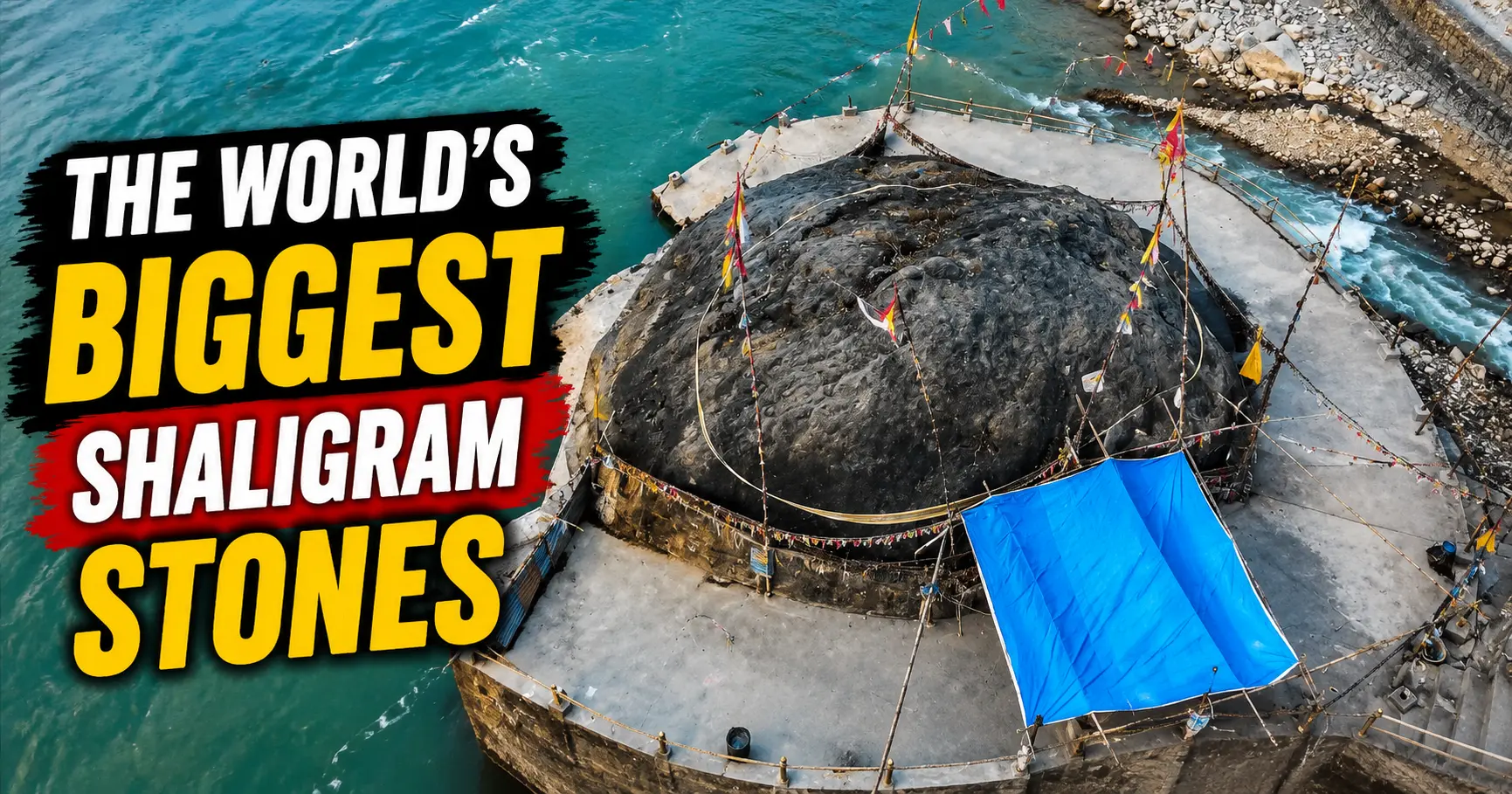
The Kali Gandaki is also the world’s richest known source of shaligram fossils—the black, ammonite-shaped stones sacred to Vishnu in Hindu tradition (each shaligram is considered a direct manifestation of Vishnu’s presence, too sacred to be ‘made’ by human hands and found only in this river).
The riverbed between Kagbeni and Jomsom is the traditional zone for collecting shaligrams. Pilgrim groups on the Muktinath Yatra by jeep traditionally stop at a suitable river access point to collect shaligrams. Nepal Vehicle Hiring’s drivers know the safest river access points along the route. On request, they will pause at the right point in the journey for shaligram collection.
Muktinath and the Upper Mustang Extension: Planning the Longer Journey
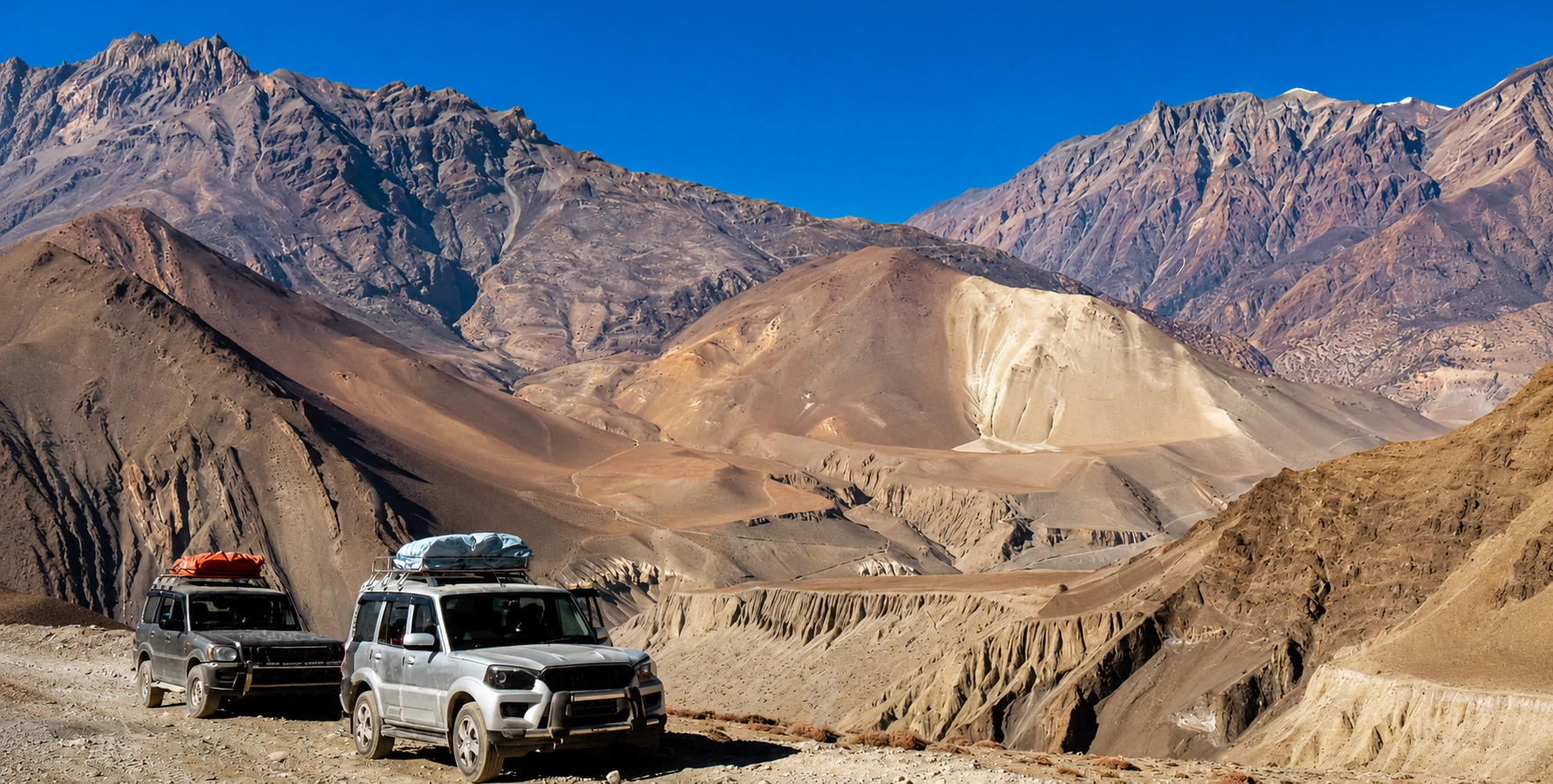
Many travellers who reach Muktinath by jeep and experience the extraordinary landscape of the Mustang District’s Kali Gandaki rain-shadow plateau are immediately drawn to the question of what lies further north — and what lies further north is Upper Mustang, the ancient Kingdom of Lo, one of Nepal’s most extraordinary and most restricted destinations.
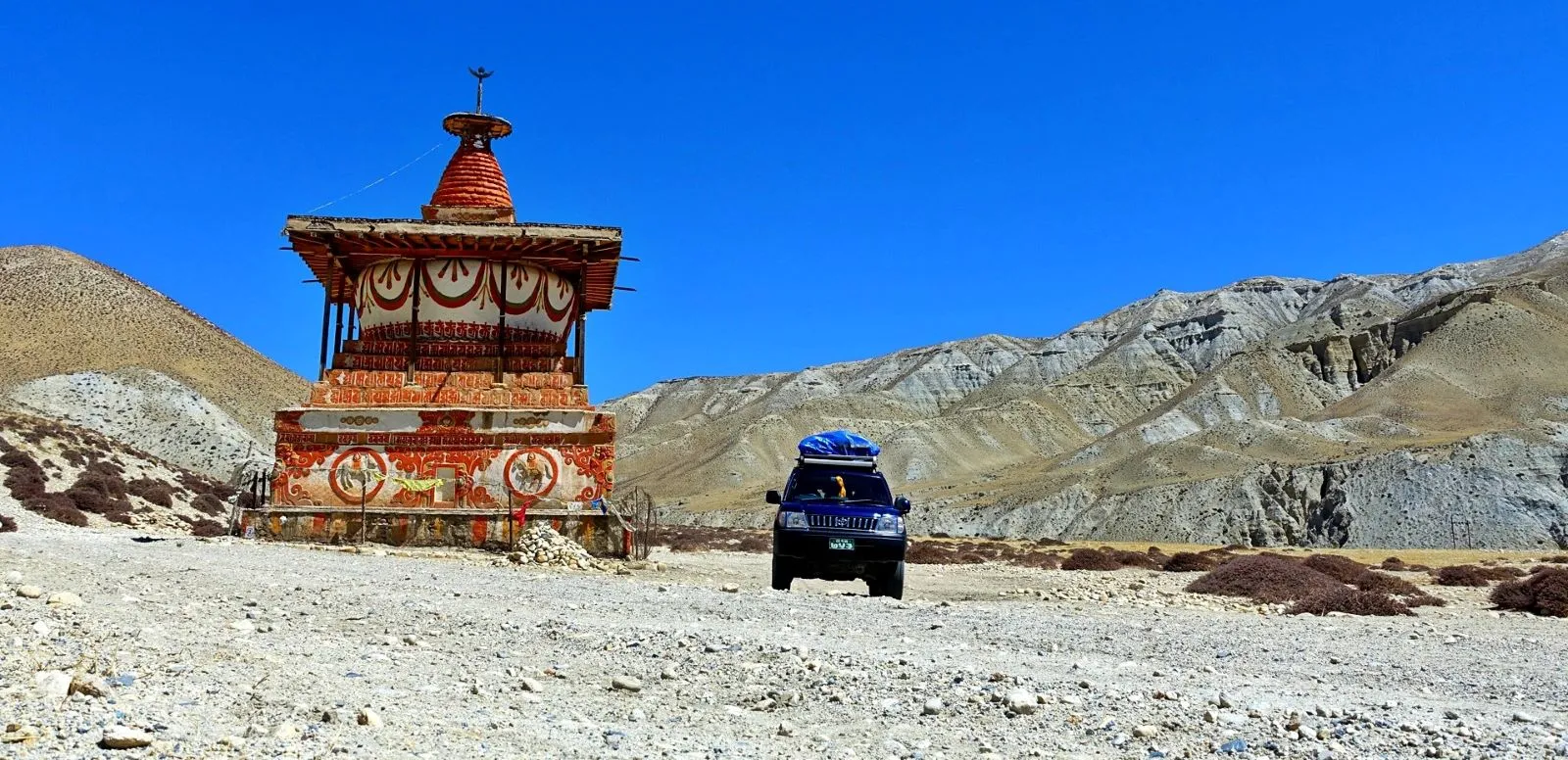
Upper Mustang begins at Kagbeni (2,810 m) — the walled medieval village that the standard Muktinath jeep tour passes through on the approach to the temple. North of Kagbeni’s checkpoint, the restricted area begins and continues for 61 kilometres of jeep track northward to Lo Manthang (3,840 m) — the ancient walled capital of the Kingdom of Lo, inhabited continuously for over 600 years and accessible by vehicle since the road was pushed through in the early 2000s. Lo Manthang is one of Nepal’s most extraordinary destinations: a complete medieval Tibetan Buddhist city with whitewashed walls, an ancient palace, four monastery compounds, cave dwellings carved into the cliffs above, and an atmosphere of genuine antiquity that the modern world has barely touched.
The Upper Mustang extension adds 3 to 5 days to the Muktinath jeep tour itinerary. It requires the Restricted Area Permit (USD 50 per person per day), a licensed guide, and vehicle hire that extends north of Kagbeni. Nepal Vehicle Hiring’s Pokhara to Mustang jeep service and Kathmandu to Mustang private jeep both cover the full Upper Mustang circuit, including Lo Manthang.
The Tiji Festival—held in Lo Manthang in May—is the most spectacular cultural event in the Mustang District and draws visitors from across Nepal and internationally to witness the three-day masked dance ceremony that reenacts the defeat of a demon threatening the kingdom. For the Tiji Festival, book Upper Mustang jeep rental 2 to 3 months in advance.
Comparing Muktinath Transport Options: Jeep vs Helicopter vs Walk
For travellers planning the Muktinath pilgrimage, three transport options are available for the Jomsom-to-Muktinath section specifically, and understanding the comparison helps make the right choice for different traveller profiles:
Jeep Rental (Nepal Vehicle Hiring — Recommended for Most)
The private jeep rental from Jomsom to Muktinath takes 1 to 1.5 hours and costs approximately NPR 3,000 to 5,000 per vehicle for the Jomsom-to-Muktinath leg alone (the larger Pokhara-to-Muktinath all-in package includes this). The jeep allows a stop in Kagbeni, a shaligram collection stop, flexible timing for the temple visit, and flexibility on the return. For groups of 2 to 6, the private jeep is the standard and recommended approach.
Domestic Flight Jomsom to Muktinath
There is no direct domestic flight from Pokhara or Jomsom to Muktinath — the Jomsom Airport serves Pokhara (25 minutes, NPR 8,000 to 15,000 per person on Buddha Air or Yeti Airlines) but not Muktinath directly. Trekkers flying Pokhara to Jomsom still need a jeep for the Jomsom-to-Muktinath section. The domestic flight saves time on the Pokhara-to-Jomsom leg (25 minutes vs 8 to 10 hours by jeep), and Nepal Vehicle Hiring can co-arrange a Jomsom pickup vehicle for travellers arriving by air.
Helicopter to Muktinath
Helicopter service from Pokhara to Muktinath is available through licensed helicopter operators (approximately NPR 25,000 to 35,000 per person one-way, weather dependent, 40 to 50 minutes flight time). This is the fastest option for elderly or mobility-limited pilgrims who cannot make the jeep journey. NepalVehicle Hiring coordinates helicopter service as part of a combined Muktinath package — helicopter outward flight from Pokhara to Muktinath, temple visit, then jeep downward from Muktinath to Jomsom and Pokhara for those who want to experience the gorge road on the return.
Trekking
The original Muktinath approach is on foot—the Annapurna Circuit trail from Pokhara via Nayapul or the Kali Gandaki Valley on foot. Trekking the full circuit to Muktinath takes 10 to 14 days from Pokhara via the southern Annapurna Circuit approach. Nepal Vehicle Hiking’s Pokhara to Nayapul transportation includes a drop-off at the Nayapul trailhead for trekkers choosing the walking approach, and our Pokhara to Mustang jeep service includes a return from Jomsom at the circuit’s completion.
Practical Packing Tips for the Muktinath Jeep Tour
The Muktinath jeep tour crosses a significant altitude range — from Pokhara (827 m) to Muktinath (3,710 m) — and the temperature difference between departure and arrival is genuinely extreme. Packing correctly for the vehicle journey ensures maximum comfort at the temple and a dignified pilgrimage experience:
- Warm layers for Muktinath: the temperature at 3,710 m is cold even in summer—bring a fleece and a windproof outer layer in your day bag, not packed in the roof luggage. At Muktinath, even in May, the wind can bite, and temperatures drop near freezing after sundown.
- Ritual bathing preparation: if you intend to complete the full 108-spout ritual bath (highly recommended for pilgrims), pack a complete change of dry, warm clothes, a large towel, and waterproof sandals. The water at the spouts is glacier-cold, and the 108-spout circuit takes 20 to 30 minutes — being cold and wet at 3,710 m requires an immediate change into warm clothing.
- ACAP permit accessible: you’ll check the permit at Beni, Tatopani, and Kagbeni. Keep it in a day bag front pocket rather than in your main luggage to avoid delays from unpacking at checkpoints.
- Sun protection: the altitude and the arid, clear atmosphere of the Mustang District produce intense solar radiation even at cool temperatures. SPF 50 sunscreen, UV-protective sunglasses, and a wide-brimmed hat are essential — sunburn at 3,710 m in clear Mustang air can be severe even in a few hours.
- Shaligram collection bag: a small cloth bag for shaligram collection at the Kali Gandaki riverbed stop. The stones range from small pebbles to large boulders — bring a bag sized for the quantity you intend to collect.
- Water and snacks for the gorge sections: the road from Tatopani to Jomsom has limited roadside stops. Carry 1.5 litres of water per person and trail snacks for the afternoon gorge driving section.
- Cash in NPR: carry enough NPR for the Jomsom hotel, Muktinath temple entry (NPR 200 per person), offerings at the temple, meals at Marpha and Tatopani, and any emergency expenses. Jomsom has ATMs (sometimes functional), but Muktinath itself has no banking facilities.
Muktinath and the Hindu Sacred Circuit: Connecting to the Broader Pilgrimage
For Hindu pilgrims, Muktinath is best experienced not as a standalone destination but as part of Nepal’s sacred circuit, which links the country’s most important Hindu shrines into a coherent pilgrimage geography. Nepal Vehicle Hiring’s transport network covers every element of this sacred circuit:
The classic Nepal Hindu pilgrimage circuit begins in Kathmandu with Pashupatinath—one of the most important Hindu temples in the world—whose evening Aarti on the Bagmati River ghats is one of the most extraordinary ceremonies in Asia. From Kathmandu, our Kathmandu sightseeing service covers the full valley sacred circuit,t including Pashupatinath, Boudhanath, Swayambhunath, and Budhanilkantha. Our Kathmandu-to-Pokhara bus service or private car hire then takes you to Pokhara, where our Sarangkot sunrise tour vehicle offers a Himalayan dawn panorama that previews the mountain world ahead.
From Pokhara, the Muktinath Yatra jeep carries pilgrims north through the Kali Gandaki gorge to the temple complex, completing Nepal’s first great arc of the sacred circuit. After Muktinath, the circuit continues south — either back through the Kali Gandaki to Pokhara, or through the Annapurna Circuit exit at Dharapani to Besisahar. Our Hiace van hire then carries pilgrim groups east along the Terai highway to Lumbini (the birthplace of the Buddha, also revered by Hindu pilgrims), and then to Janakpur (the birthplace of Goddess Sita, the divine feminine complement to the Muktinath Vishnu shrine). The complete circuit — Kathmandu to Muktinath to Lumbini to Janakpur and back to Kathmandu — is the Nepal Nekhor pilgrimage tour that Nepal Vehicle Hiring coordinates as a complete managed transport package.
For pilgrims who want to extend the sacred circuit into the Gosaikunda alpine lake pilgrimage (particularly during the Janai Purnima festival in July/August), our trekking transport services cover the Kathmandu-to-Syabrubesi approach for the Gosaikunda trek. The full Nepal sacred circuit—Pashupatinath, Muktinath, Lumbini, Janakpur, and Gosaikunda—connects five of Nepal’s most important pilgrimage sites into a single coherent devotional journey through Nepal Vehicle Hiring’s comprehensive transport network.
Sample Muktinath Yatra Itineraries with Jeep Rental Plans
5-Day Pokhara Muktinath Yatra (Most Popular)
Day 1: Arrive in Pokhara. Nepal Vehicle Hiring: airport transfer or Kathmandu to Pokhara bus service. Evening: Pokhara Lakeside orientation, Phewa Lake sunset, hotel check-in.
Day 2 (Pre-Trek): Sarangkot sunrise tour, vehicle at 5:00 a.m.AM for the Annapurna dawn panorama — a preview of the mountain world the Muktinath journey will enter—Pokhara Lakeside activities: Phewa Lake boat, Bindabasini Temple, Gupteshwar Mahadev Cave.
Day 3: Depart Pokhara Lakeside at 6:30 a.m. by Nepal Vehicle Hiring private 4WD jeep on the Muktinath Yatra itinerary. Drive via Beni through the Kali Gandaki gorge — Tatopani hot spring lunch stop, Kalopani Dhaulagiri viewpoint, Marpha apple village, Jomsom arrival late afternoon. Overnight Jomsom (2,720 m). Acclimatisation.
Day 4: Depart Jomsom at 7:00 a.m. by jeep. Stop in Kagbeni village (20 minutes; explore the medieval monastery and village). Continue to Muktinath (3,710 m) via Jhong Valley; arrive around 9:00 to 9:30 a.m. for the auspicious morning darshan window. 108 water spouts ritual bath (pilgrim groups). Visit the eternal flame at Jwala Devi Temple. Vishnu Temple main darshan. Circumambulation. Buddhist monastery Chumig Gyatsa kora. Lunch at Muktinath. Return to Jomsom by jeep (early afternoon).
Day 5: Jomsom to Pokhara return by jeep (8 to 10 hours, same gorge road southbound with afternoon light on different mountain faces). Arrive Pokhara in the evening. Airport transfer for international departure or Kathmandu connection via Kathmandu to Pokhara bus service.
3-Day Express Muktinath Tour from Pokhara
Day 1: Depart Pokhara at 5:00 a.m. by private jeep (Nepal vehicle hiring). Push directly to Jomsom without extended stops (8 to 9 hours). Overnight in Jomsom with evening rest and altitude adjustment.
Day 2: Early departure from Jomsom; stop in Kagbeni; Muktinath morning darshan—full sacred site circuit. Return to Jomsom late afternoon. Optional: Jomsom to Pokhara domestic flight (25 minutes, if seats available) for those wanting the fastest return.
Day 3: If returning by jeep — Jomsom to Pokhara (8 to 10 hours). Airport transfer or onward connection.
10-Day Nepal Sacred Circuit (Kathmandu to Muktinath to Lumbini)
Days 1 to 2: Kathmandu arrival, airport transfer, Kathmandu sightseeing (Pashupatinath evening Aarti, Boudhanath kora, Swayambhunath).
Day 3: Kathmandu to Pokhara by private car hire or Kathmandu to Pokhara bus service (Manakamana Temple stop). Pokhara Lakeside.
Day 4: Sarangkot sunrise tour by vehicle—Pokhara’s sacred sites.
Days 5 to 6: Muktinath Yatra — Pokhara to Jomsom (Day 5), Jomsom to Muktinath darshan and return to Jomsom or Pokhara (Day 6).
Day 7: Return from Jomsom to Pokhara by jeep or domestic flight. Pokhara overnight.
Day 8: Pokhara to Lumbini by Hiace van hire (200 km, 4 to 5 hours). Lumbini Maya Devi Temple and Sacred Garden.
Day 9: Full Lumbini day — international monastery zone, Tilaurakot day trip (Kapilavastu, 25 km west, birthplace of Prince Siddhartha’s upbringing).
Day 10: Lumbini to Kathmandu by Hiace van hire (300 km, 6 to 8 hours). Airport transfer. Departure.
Muktinath Festivals and Festival-Season Jeep Rental
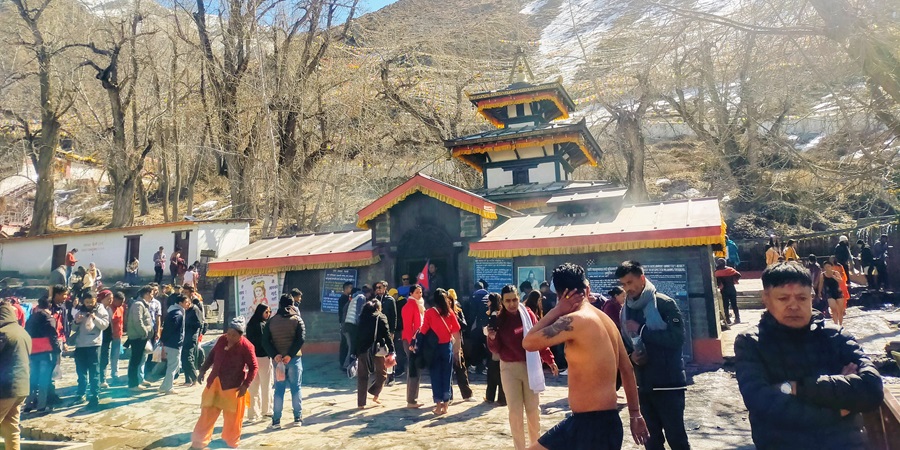
Several significant festivals at Muktinath and in the broader Mustang region attract concentrated pilgrim and visitor traffic that directly affects jeep rental availability and should be considered when planning the Muktinath tour:
Muktinath Mela (Spring Festival)
The Muktinath Mela — the annual fair at the temple — attracts Hindu pilgrims from across Nepal and India, particularly from the western hill and Terai regions. The festival falls in the Hindu month of Baisakh or Jestha (typically April to May). It coincides with the spring pilgrimage season, when the weather at Muktinath is most accessible. Nepal Vehicle Hiring’s jeep rentals during the Muktinath Mela are in high demand—book 6 to 8 weeks in advance.
Yartung Festival (July to August)
The Yartung Festival — celebrated throughout Mustang District in the Nepali month of Shrawan (July to August) — is the traditional harvest celebration of the Thakali and Lo-pa communities, featuring horse racing on the Mustang plain, archery competitions, traditional music and dance, and the distinctive cultural atmosphere of a genuinely local festival with minimal tourist presence. The festival is held in multiple locations, including Muktinath, Marpha, and Jomsom, over several weeks. Monsoon travel to the Mustang region is generally reliable (Mustang’s rain-shadow character means limited monsoon impact), and Nepal Vehicle Hiring’s jeep rental service operates throughout.
Tiji Festival (May — Upper Mustang)
The Tiji Festival at Lo Manthang in Upper Mustang is one of Nepal’s most visually spectacular cultural events — a three-day masked dance ceremony performed by Tibetan Buddhist monks that reenacts the myth of Dorje Jono defeating a demon threatening the kingdom. The festival attracts significant international attention, and the Upper Mustang jeep rental market is extremely tight in the weeks around Tiji. Nepal Vehicle Hiring recommends booking an Upper Mustang jeep rental 2 to 3 months in advance for the Tiji Festival window—and pairing Tiji with a Muktinath Yatra in the same rental package creates one of Nepal’s finest combined cultural and spiritual experiences.
- Jeep Rental for Muktinath Tour: Best for Pilgrims
- Why a Jeep is Essential for the Muktinath Tour
- Two Routes to Muktinath: Pokhara Approach and Kathmandu Approach
- The Kali Gandaki Gorge Road: What to Expect
- Muktinath Temple: The Sacred Experience
- Jeep Rental Costs for the Muktinath Tour
- Permits Required for the Muktinath Tour by Jeep
- What to See on the Pokhara to Muktinath Jeep Journey
- Best Time for the Muktinath Jeep Tour
- Muktinath by Jeep: Serving the Pilgrimage Community
- Frequently Asked Questions: Jeep Rental for Muktinath Tour
- Book Your Muktinath Tour Jeep Rental with Nepal Vehicle Hiring
- The Kali Gandaki: Geography of the World's Deepest Gorge
- Muktinath and the Upper Mustang Extension: Planning the Longer Journey
- Comparing Muktinath Transport Options: Jeep vs Helicopter vs Walk
- Practical Packing Tips for the Muktinath Jeep Tour
- Muktinath and the Hindu Sacred Circuit: Connecting to the Broader Pilgrimage
- Sample Muktinath Yatra Itineraries with Jeep Rental Plans
- Muktinath Festivals and Festival-Season Jeep Rental

Related Blog & Articles
Altitude and Health: Essential Muktinath Advice
Best Time to Visit Muktinath
Best time to visit Mustang Nepal