Plan a Trip


Pokhara to Mustang Road Overview: Complete Jeep Guide
Pokhara to Mustang Road Overview: Complete Jeep Guide
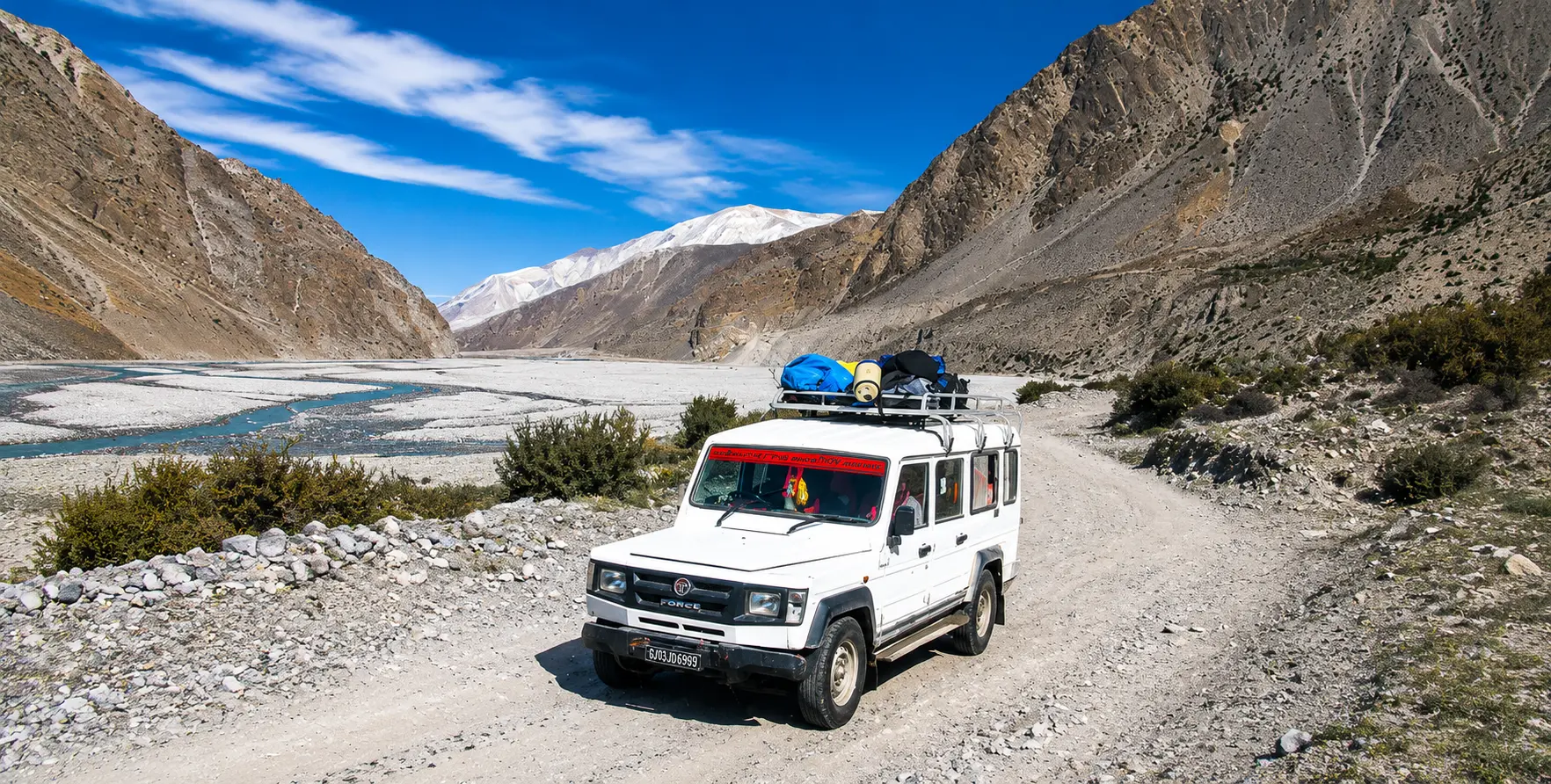
A road in Nepal begins beside the reflections of the Annapurna range on Phewa Lake in Pokhara and ends in a 14th-century walled city on the edge of the Tibetan Plateau. It passes through the world’s deepest gorge, climbs through apple orchards and ancient salt-trading villages, and crosses a rain shadow boundary where the monsoon loses its grip. The landscape shifts from a green valley to high desert in a few kilometres. Eventually, it delivers the traveller to one of Asia’s most extraordinary destinations: Lo Manthang, the ancient capital of the Kingdom of Lo—what the world knows as Upper Mustang.
The Pokhara-to-Mustang road is not a single road but a sequence of roads, each with its own character and demands. It begins on a well-paved highway heading northwest through the Myagdi hills, transitions to a rougher mountain track at Beni, follows the Kali Gandaki River gorge through some of the most dramatic scenery in the Himalayan world, and eventually becomes a high-altitude off-road track that only a capable 4WD vehicle with an experienced mountain driver can navigate safely. The total distance from Pokhara to Lo Manthang is approximately 222 kilometres, but those kilometres bear no resemblance to a conventional 222-kilometre road. They are 222 kilometres of Nepal — variable, demanding, spectacular, and utterly unlike anything you will have driven through before.
Nepal Vehicle Hiring Pvt. Ltd., based in Thamel, Kathmandu, offers the definitive Pokhara to Mustang jeep service for this route — well-maintained 4WD vehicles, experienced mountain road drivers who know every section from Pokhara’s Lakeside to Lo Manthang’s palace gates, and an all-in pricing model that removes uncertainty from one of Nepal’s most logistically complex journeys. This guide provides a complete, research-backed road overview for every kilometre of the Pokhara–Mustang route — distances, altitudes, road conditions, key villages, permit requirements, best stops, and everything else you need to understand and prepare for this extraordinary overland journey.
Whether you are comparing it with the Kathmandu-to-Mustang private jeep option, planning a combined Muktinath Yatra itinerary, or building a broader Nepal tour package that includes Mustang alongside Kathmandu, Pokhara, and Chitwan — this guide has everything you need.
Pokhara to Mustang: Full Route Overview and Distance Breakdown
The complete road journey from Pokhara to Lo Manthang is broken into four distinct legs, each with its own road surface, difficulty level, and character. Understanding these legs before you travel helps you set realistic expectations and plan your overnight stops.
Leg 1: Pokhara to Beni — 85 km, 2.5 to 3 hours
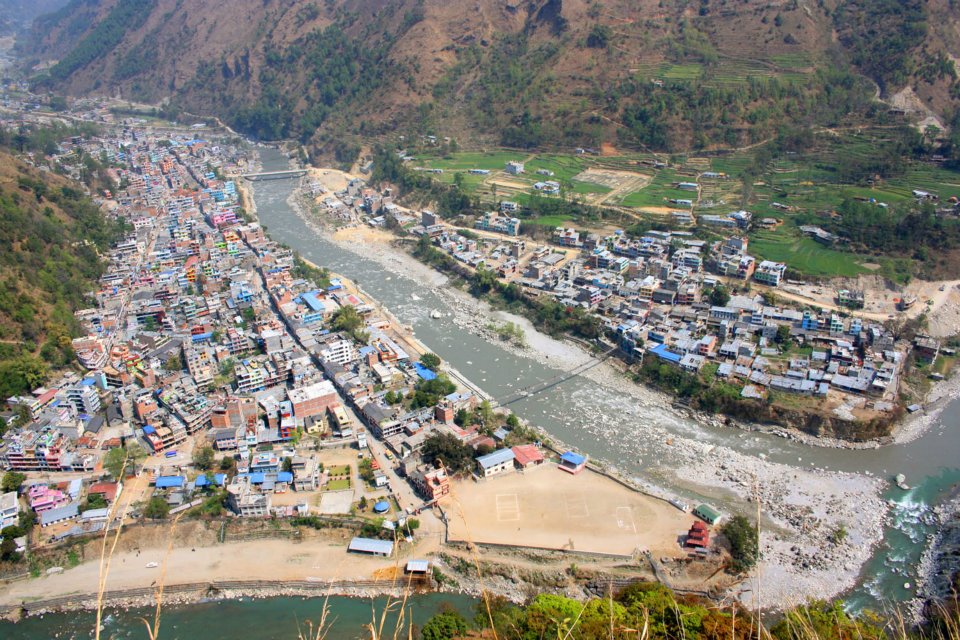
The journey begins in Pokhara’s Lakeside district and heads northwest on a well-maintained paved road through the foothills of Myagdi District. The road passes through Naudanda (Nine Hills) — a ridge viewpoint offering some of the finest panoramic views of the Annapurna range available by road, including Annapurna South, Machhapuchare (the Fishtail), Annapurna I, and Dhaulagiri — before descending to the Modi Khola valley and continuing to Beni (830 m), the headquarters of Myagdi District and the last substantial town before the road turns serious.
The Pokhara–Beni road is mostly blacktop and well maintained. It is comfortable for standard vehicles and passes through increasingly dramatic hill country as it approaches Beni. The Sarangkot sunrise tour vehicle many visitors use for the pre-dawn Pokhara mountain panorama often transitions directly into the Beni departure — travellers who watch the Annapurna sunrise from Sarangkot and then depart for Mustang the same morning make good use of the northward mountain view that anchors both experiences. Beni itself is a compact town at the confluence of the Myagdi and Kali Gandaki rivers, with basic facilities, fuel, and the last reliable ATM before the mountains.
Leg 2: Beni to Jomsom — 85 km, 5 to 6 hours
Beyond Beni, the road changes character entirely. The blacktop surface becomes intermittent and ultimately disappears as the road follows the Kali Gandaki River north through an extraordinary gorge. This section — roughly 85 kilometres from Beni to Jomsom — is the most dramatic and most demanding leg of the Pokhara–Mustang drive, and it is where the 4WD requirement becomes absolute. The road is a mix of gravel, compacted rock, and rough track that requires high ground clearance and four-wheel-drive capability, particularly through river-crossing sections and the narrow cliff passages above the Kali Gandaki gorge.
The Kali Gandaki gorge between Beni and Jomsom is widely recognised as the world’s deepest river gorge, with the Kali Gandaki River flowing between Dhaulagiri (8,167 m) to the west and Annapurna I (8,091 m) to the east, two of the world’s highest peaks standing barely 35 kilometres apart, with the gorge floor at approximately 1,200 meters. The vertical relief of approximately 7,000 meters from the gorge floor to the mountain summit is unmatched anywhere on Earth, and the experience of driving through this gorge — with the river roaring below and the colossal mountain walls closing in from both sides — is one of the most viscerally impressive natural environments accessible by road anywhere in Nepal.
Key stops along the Beni–Jomsom leg include:
- Tatopani (1,190 m) — a small village famous throughout Nepal for its natural hot springs beside the Kali Gandaki River. After the rough road from Beni, a 30-minute soak in the thermal pools at Tatopani is one of the most restorative experiences on the entire journey. The village also serves as a lunch stop for most Mustang-bound vehicles, with a cluster of teahouses offering dal bhat and the opportunity to rest before the harder road ahead. Tatopani lies about 21 kilometres north of Beni.
- Ghasa (2,010 m) — the boundary village between the Annapurna Conservation Area’s lower zone and the upper Mustang region. Ghasa marks the point where the vegetation changes dramatically — the lush subtropical forest of the lower gorge gives way to more arid pine and juniper as the altitude rises. The rain shadow begins to assert itself. Ghasa itself is a traditional Thakali village worth a brief stop to see the stone houses, prayer flags, and the landscape transition that defines this crucial boundary point.
- Kalopani (2,530 m) — arguably the finest mountain viewpoint accessible by road on the entire Beni–Jomsom leg. The Dhaulagiri Icefall — a massive cascade of glacial ice on the eastern face of Dhaulagiri — is directly visible from the road at Kalopani, and at certain times of day (particularly early morning) the icefall catches the light in a way that makes it one of the most spectacular sights in all of Nepal. Several small guesthouses have established themselves at Kalopani specifically to capture the dawn and dusk views. Tukuche Peak (6,920 m), Nilgiri (7,061 m), and Annapurna I also dominate the view here.
- Marpha (2,667 m) — the apple orchard capital of Nepal, with beautifully whitewashed, immaculately maintained stone-paved lanes, is famous for producing the finest apples in Nepal and the apple brandy distilled from them. Marpha apple products—dried fruit, juice, brandy—are sold in teahouses across the Annapurna and Mustang regions. Stopping in Marpha to walk its pristine alleys and visit its monastery is a highlight of the lower Mustang drive. The village sits just 14 kilometres south of Jomsom.
The Rupse Waterfall — a spectacular 300-meter cascade visible from the road — is another memorable sight on this leg, typically encountered between Tatopani and Ghasa. Your Nepal Vehicle Hiring driver will know exactly where to pull over safely for the best view of the waterfall and the gorge section below it.
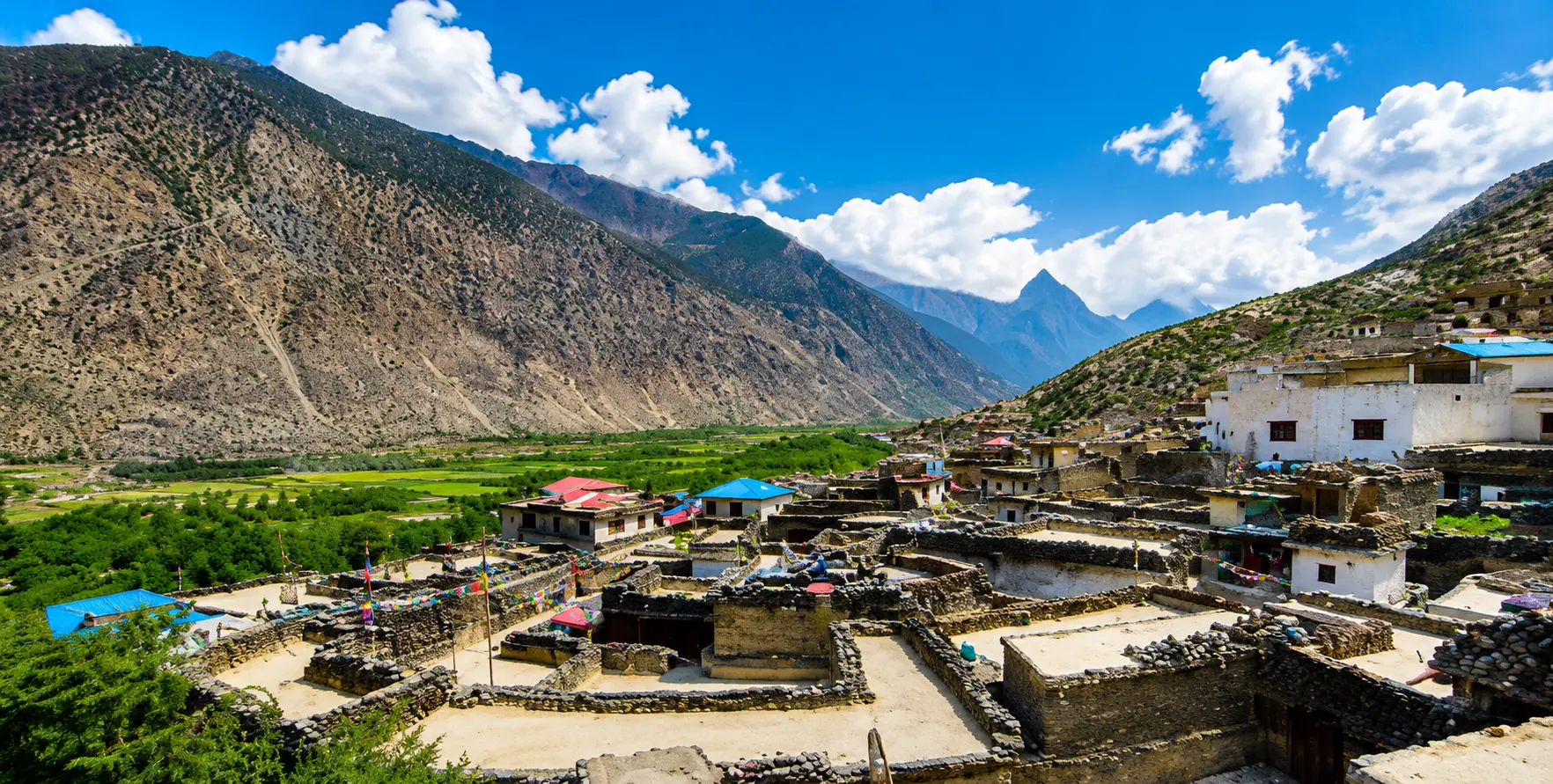
Leg 3: Jomsom to Kagbeni — 11 km, 30 to 45 minutes
Jomsom (2,720 m) is the district headquarters of Mustang District and the main hub of the Kali Gandaki valley — a surprisingly substantial town with an airport (the small Jomsom Airport receives daily morning flights from Pokhara), government offices, banks, lodges, and trekking equipment shops. Jomsom is the natural overnight stop for vehicles driving up from Beni in a single day, and most travellers spend their first night in the Mustang region there before continuing north the following morning.
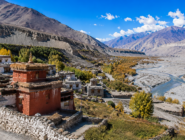
From Jomsom, the road continues 11 kilometres north to Kagbeni (2,810 m) — the medieval gateway village that marks the beginning of Upper Mustang’s restricted zone. The 11-kilometre Jomsom-to-Kagbeni section follows the Kali Gandaki River bank on a relatively flat, easy road taking 30 to 45 minutes by jeep. Kagbeni is one of the most architecturally compelling villages in the entire Mustang region — a cluster of medieval stone buildings, narrow underpass lanes, a dramatically sited red-walled monastery (Kagbeni Gompa), and a confluence of rivers that lends the village a natural drama, reinforced by the sheer scale of the surrounding mountain walls. The Kagbeni checkpoint at the village’s northern exit is where all Restricted Area Permits are checked before allowing entry into Upper Mustang — no traveller passes this point without the RAP, regardless of any other documentation they carry.
Leg 4: Kagbeni to Lo Manthang — 61 km, 3.5 to 5 hours
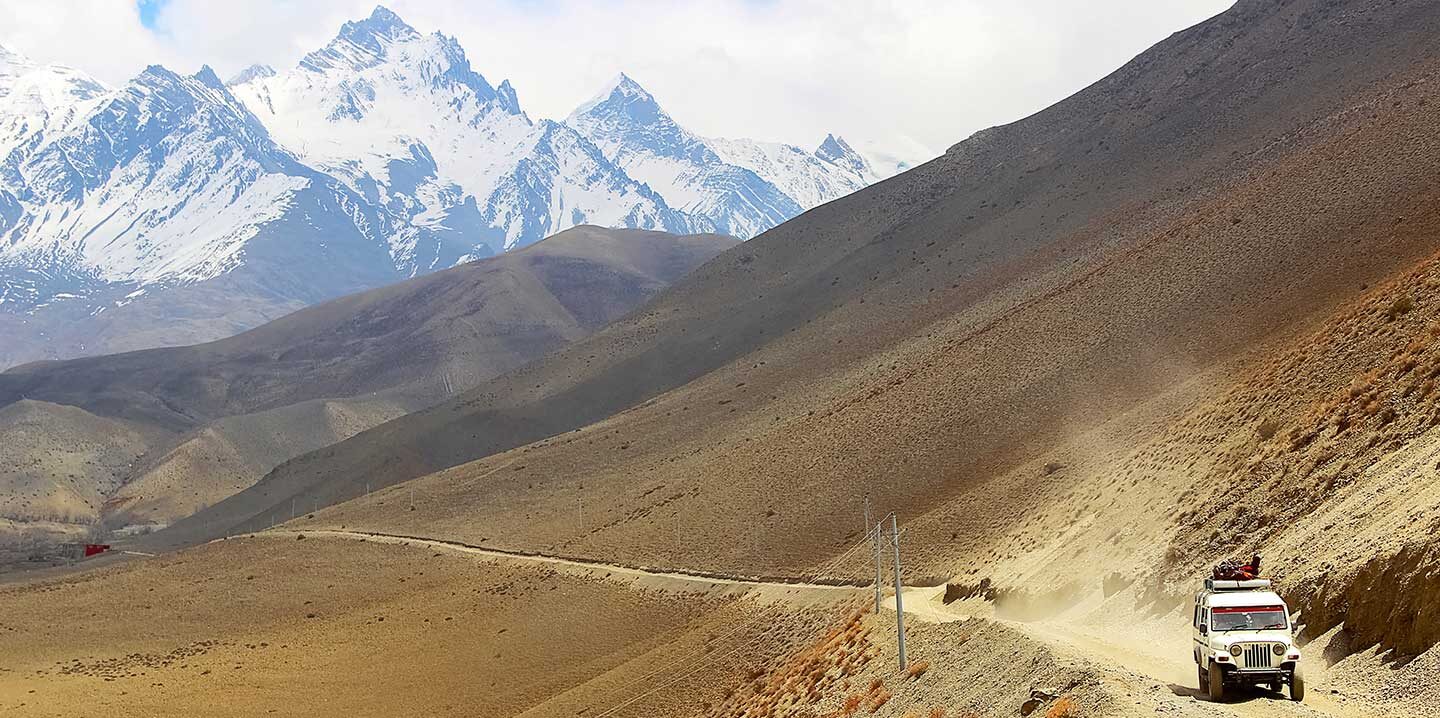
The Kagbeni-to-Lo Manthang section is what gives Upper Mustang its character and reputation. Beyond the checkpost, the road leaves the Kali Gandaki valley behind and enters the true rain-shadow plateau. This landscape shifts from narrow gorge to broad canyon country to high desert plateau over 61 kilometres. This section requires the most capable vehicle and the most experienced driver, with steep climbs, exposed traverses above deep gorges, seasonal river fords, and road surfaces ranging from compacted gravel to loose rock to raw Earth that turns to mud after any rain.
The Theagbeni–Lo Manthang journey passes through the following key villages and waypoints, each deserving attention:
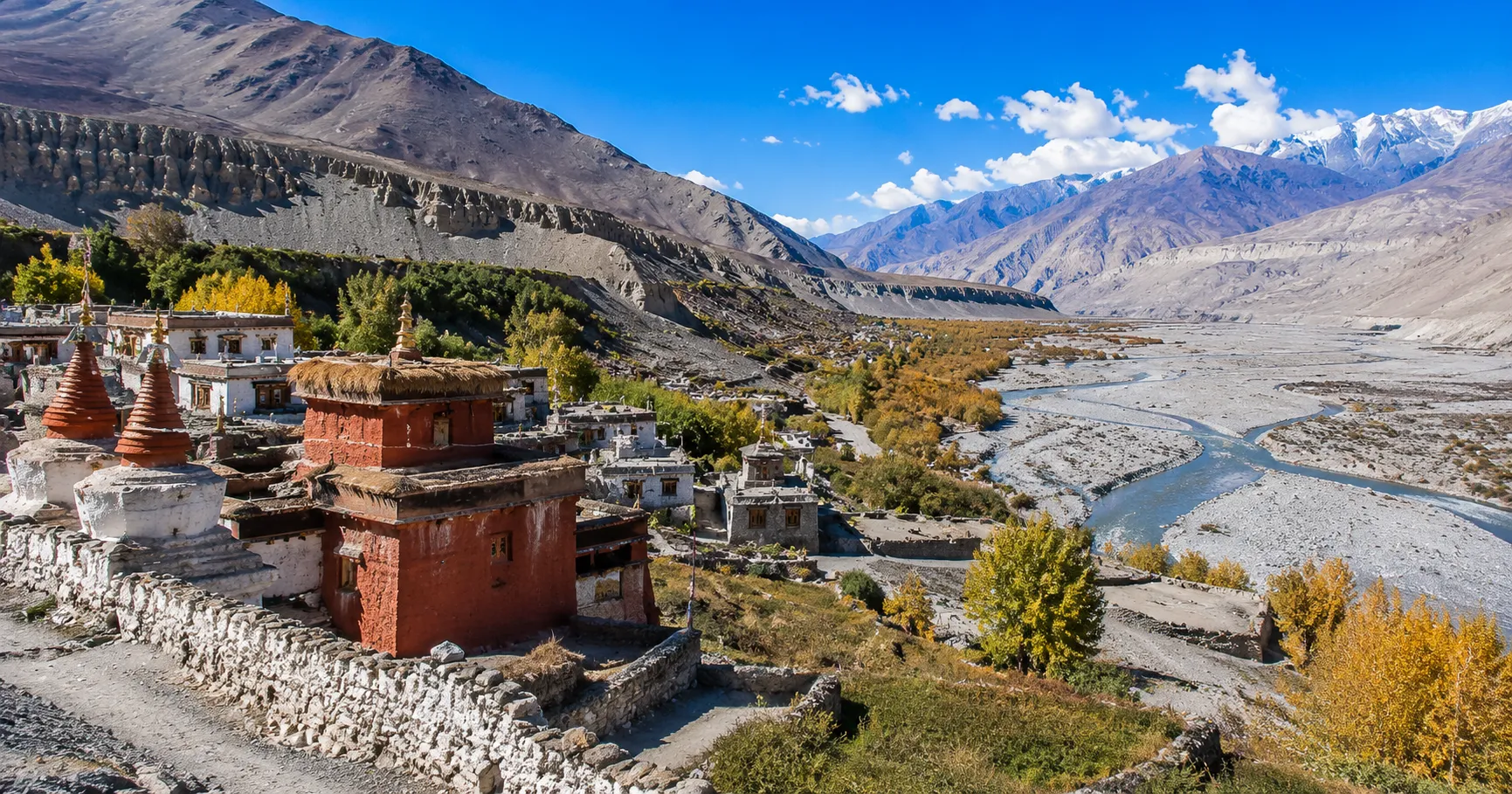
The Villages of Upper Mustang: What You See Between Kagbeni and Lo Manthang
Chhusang / Chhuksang (2,980 m): First Village of the Forbidden Kingdom
Approximately 20 kilometres north of Kagbeni, Chhusang (also written Chhuksang) is the first substantial village inside the Upper Mustang restricted zone, sitting at the confluence of the Kali Gandaki and a smaller side valley at 2,980 meters. The village is notable for its striking, eroded red-sandstone cliffs above the settlement — one of the first clear signs that the landscape has shifted into the extraordinary geological theatre of the Mustang plateau. From Chhusang, a short side trip takes you to the abandoned village of Tetang and the ruins of Gompa Gang monastery, perched dramatically on a clifftop above the valley. Chhusang typically serves as the first overnight stop for jeep tours that prefer to spread the Kagbeni–Lo Manthang driveovers over two days rather than a single long push.
Chele (3,050 m): Entry to Canyon Country
Chele, approximately 7 kilometres north of Chhusang, announces the full drama of Upper Mustang’s canyon landscape. The road from Chhusang to Chele passes through a narrow gorge where the cliffs glow in shades of ochre, rust, and purple, and where the wind — the famous Mustang wind that blows strongly from the north every afternoon as warm air rises from the plains — begins to make its presence felt. Chele village itself sits at 3,050 meters on a bench above the gorge, with a small monastery, traditional flat-roofed Tibetan-style houses, and views north toward the expanding plateau. The route from Chele begins a sustained climb toward the Syangboche plateau, which provides one of the most dramatic driving sections on the entire Pokhara–Mustang road.
Samar (3,660 m) and the Chungsi Cave
The village of Samar at 3,660 meters is a rewarding pause point — a traditional Loba (Lo-pa) community with a well-maintained gompa, stone walls hung with prayer flags, and a wide plateau view that opens dramatically north and east toward the high Mustang landscape. Between Chele and Samar, and then continuing toward Syangboche, the route passes near the Chungsi Cave Monastery — an ancient meditation cave revered as a site where Guru Padmasambhava (Guru Rinpoche) is said to have meditated during his 8th-century journey through the Himalayan kingdoms. The cave is set dramatically in a canyon wall, accessible by a short trail from the main jeep road. It contains ancient paintings and offerings, making it one of the most spiritually resonant stops in Upper Mustang.
Syangboche (3,800 m): The High Plateau Begins
Syangboche, at 3,800 meters, marks the point at which the road gains the Upper Mustang plateau in earnest. At this elevation, the landscape is definitely high-altitude desert. The same barren, wind-scoured terrain characterises the Tibetan Plateau immediately, with sparse grasses, low scrub, and the bone-dry air of the deep rain shadow. The road at Syangboche crosses the Syangboche La pass (3,850 m) and the nearby Nyi La (4,020 m) — two of the higher passes on the Kagbeni–Lo Manthang route, where the driving demands are at their greatest, and the mountain views are at their most expansive. Dhaulagiri, Tukuche, Nilgiri, Tilicho Peak, and Damodar Danda are all potentially visible from the high points near Syangboche on a clear day.
Ghami / Ghemi (3,520 m): The Longest Mani Wall in Nepal
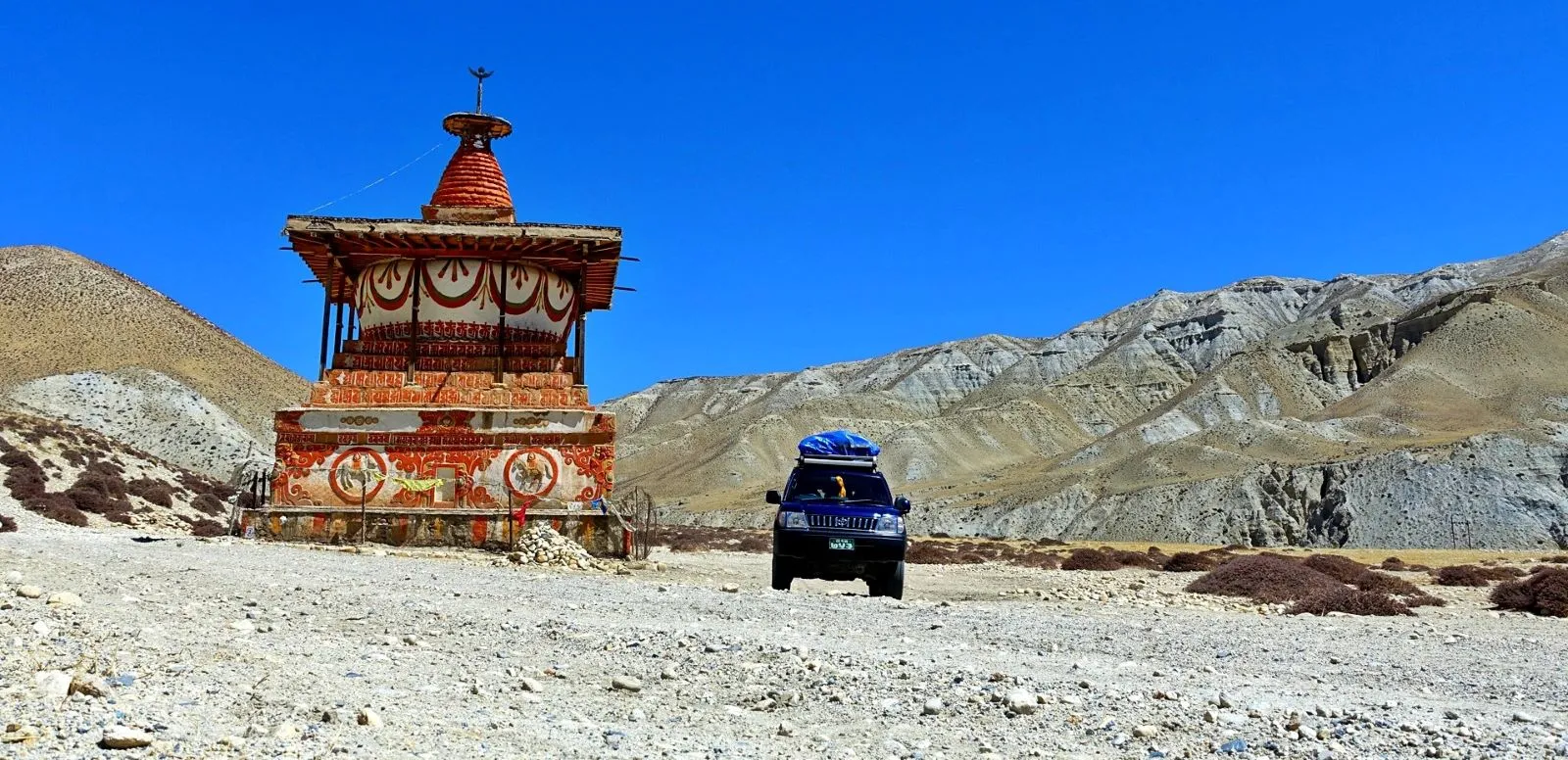
Ghami (also spelt Ghemi), at 3,520 meters, is one of Upper Mustang’s larger and more historically significant villages — a warm, sheltered settlement in a broad valley bowl with substantial cultivated land (barley and buckwheat fields that glow gold in autumn) and one of the most photogenic cultural features on the entire route: the longest mani wall in Nepal. This extraordinary structure — a wall of stones, each carved with Buddhist prayers and mantras, stretching for hundreds of meters — represents centuries of accumulated devotion from the Loba community. Walking along the mani wall, reading the carved inscriptions, and looking across Ghami’s fields to the surrounding plateau is one of Upper Mustang’s most quietly moving cultural experiences. Ghami also has a centuries-old monastery, colourful chortens, and traditional architecture that has changed little in several hundred years.
Dhakmar (3,820 m): The Red Cliffs
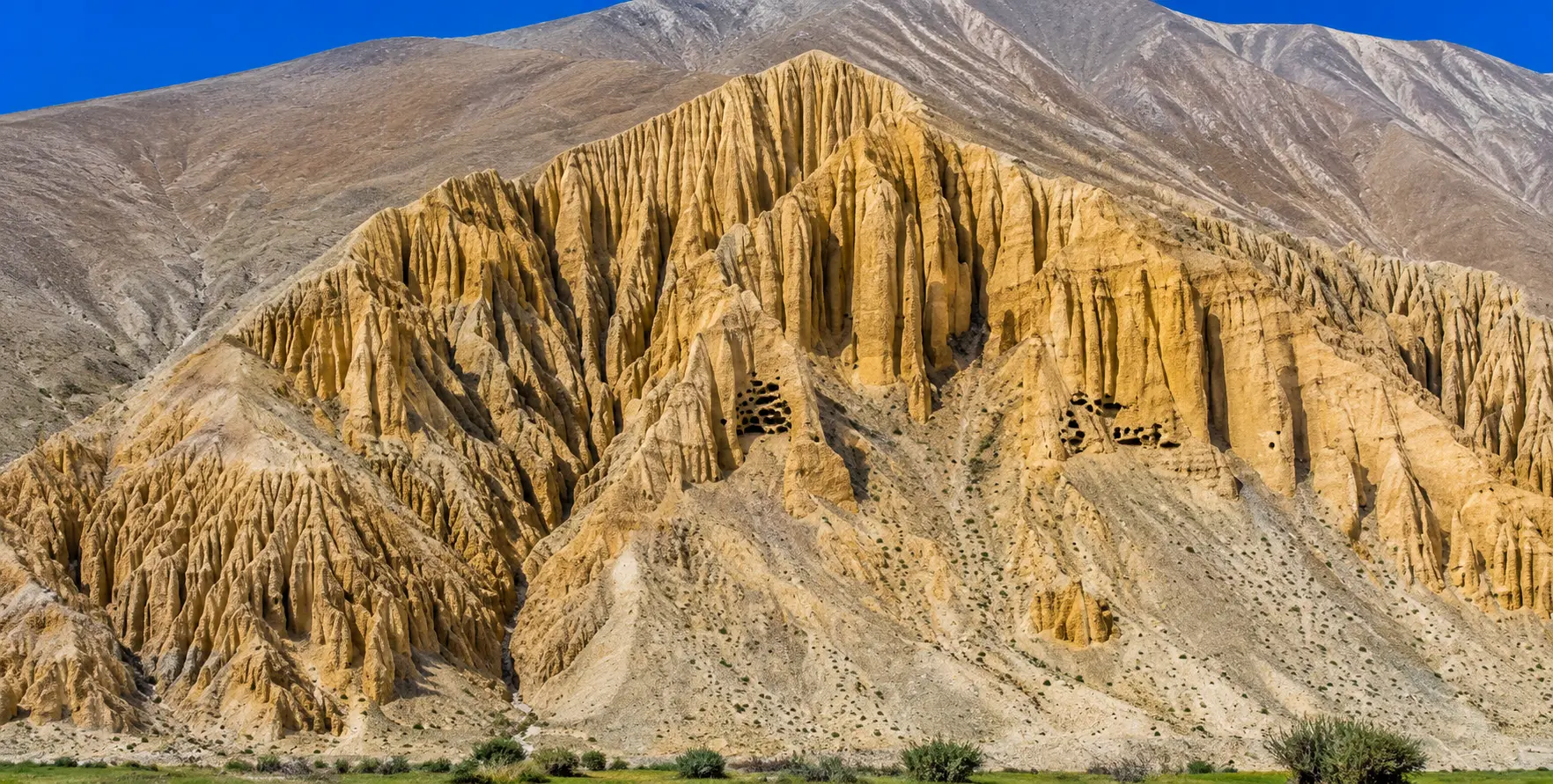
Dhakmar is not the largest village on the route, but it may be the most visually extraordinary. The settlement sits at 3,820 meters beneath a massive escarpment of blood-red sandstone cliffs that glow with an almost surreal intensity at sunrise and sunset — the crimson walls loom above the whitewashed village, creating a colour contrast photographers describe as one of the finest natural compositions in the Himalayas. The Dhakmar cliffs are honeycombed with ancient cave dwellings carved into the rock face at various levels — some accessible only by ladder, others permanently sealed — that are believed to date back more than two thousand years. The drive through Dhakmar — particularly in the late afternoon when the western light catches the cliff face — is one of the highlights of the full Mustang road journey.
Tsarang / Charang (3,560 m): The Palace and the Ancient Monastery
Tsarang (also known as Charang), at 3,560 meters, is the second-largest ustang and one of its most historically significant. The five-story Charang Palace — one of the oldest palace structures in the Mustang region — rises dramatically above the village on a hilltop. At the same time, the Tsarang Gompa (Charang Monastery), built in the 14th century, houses an outstanding collection of ancient thangka paintings, clay sculptures, and Buddhist manuscripts, representing some of the finest religious art in the Himalayan world. The monastery’s inner sanctum murals are particularly remarkable — highly detailed iconographic paintings in the Western Tibetan style that have survived largely intact due to the extreme aridity of the Mustang climate. Tsarang is approximately 2 kilometres south of Lo Manthang and typically serves as the penultimate overnight stop before arriving at the capital.
Lo Manthang (3,840 m): The Walled Capital
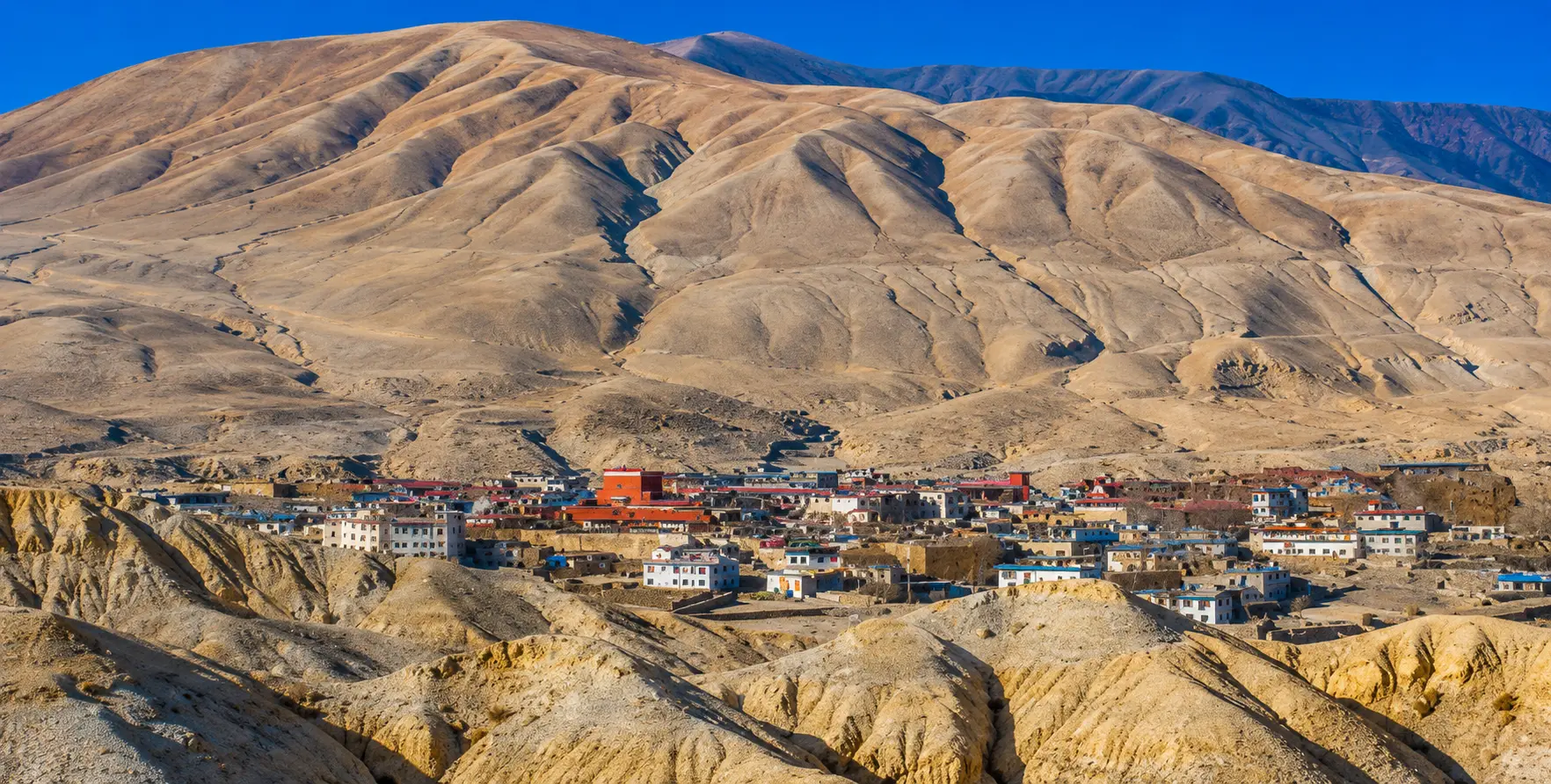
The road winds through Lo Manthang — 3,840 meters above sea level — surrounded by high mud-brick walls that have enclosed the ancient capital of the Kingdom of Lo since its founding in 1380 AD by King Ame Pal. Inside those walls, whitewashed houses line narrow alleys, the five-story royal palace of the King of Lo rises above everything, and the monasteries of Thubchen Gompa, Chode Gompa, and Jampa Lhakhang house some of the finest Buddhist art in the entire Himalayan world. The city that the road has been building toward for 222 kilometres from Pokhara is genuinely worth every kilometre of the approach. This living medieval city has survived at the edge of the world, with its culture, architecture, and spiritual traditions essentially intact.
Nepal Vehicle Hiring’s Pokhara to Mustang jeep service takes you to Lo Manthang’s gates after a journey most travellers describe as one of the finest overland adventures of their lives. The route’s mix of gorge driving, plateau landscapes, ancient villages, and the steady reveal of the Tibetan cultural world makes the 222-kilometre drive from Pokhara to Lo Manthang not just a way to reach a destination, but a travel experience in its own right.
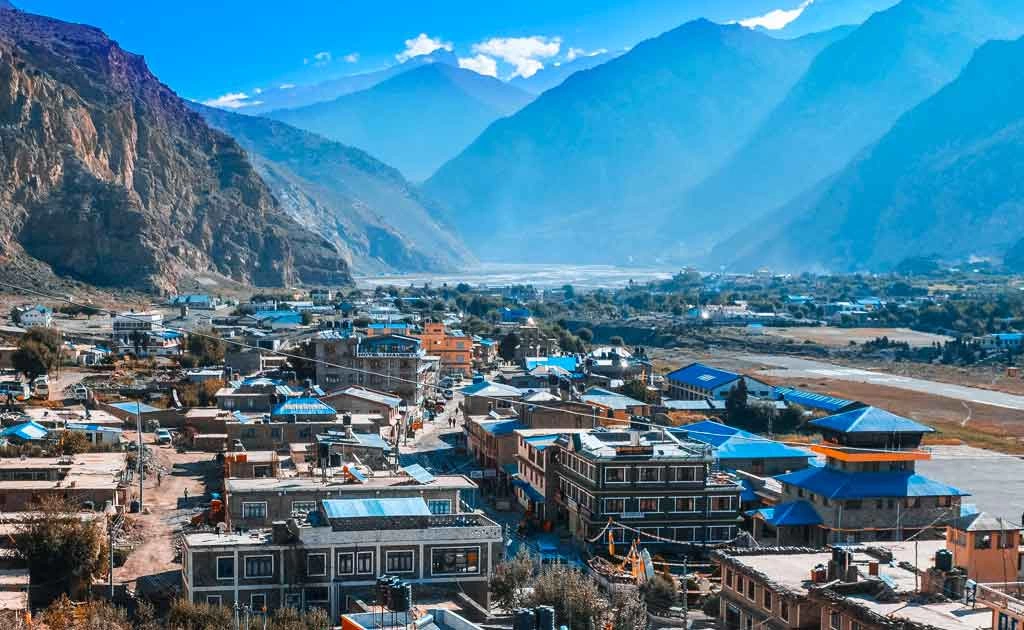
Lower Mustang: The Valley Between Jomsom and Kagbeni
Many travellers focus exclusively on Upper Mustang north of Kagbeni, but the Lower Mustang valley between Jomsom and Kagbeni deserves attention in its own right. This section — which does not require the Restricted Area Permit — contains some of the most interesting cultural landscapes in PTandaki Province, and any vehicle-based Mustang journey should set aside time to explore it properly.
Jomsom itself is worth half a day — the town sits between two dramatic mountain walls with a wide valley floor swept by the famous Mustang wind that builds every afternoon. The small Jomsom Museum covers the cultural and natural history of the Mustang region, and the ACAP office in Jomsom is where you can get conservation area permits if you didn’t arrange them in Pokhara or Kathmandu. Jomsom’s airport offers twice-daily morning flights from Pokhara — typically Twin Otter or Dornier aircraft that land before the afternoon wind makes flying impossible — and is the flight option for travellers who want to reach Jomsom quickly, then drive or trek northward from there.
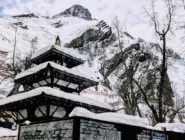
Muktinath Temple (3,710 m) — accessible via the Jomsom–Muktinath side road — is one of the most important sacred sites in both Hinduism and Buddhism, located 21 kilometres north of Kagbeni and eastward up the Jhong Khola valley. Our dedicated Muktinath Yatra itinerary covers this section in detail for pilgrims and spiritual travellers. The Muktinath visit can be incorporated into the Pokhara–Mustang itinerary as a side trip before the main push to Lo Manthang, or as a stop on the return journey.
Road Conditions on the Pokhara to Mustang Route: Section by Section
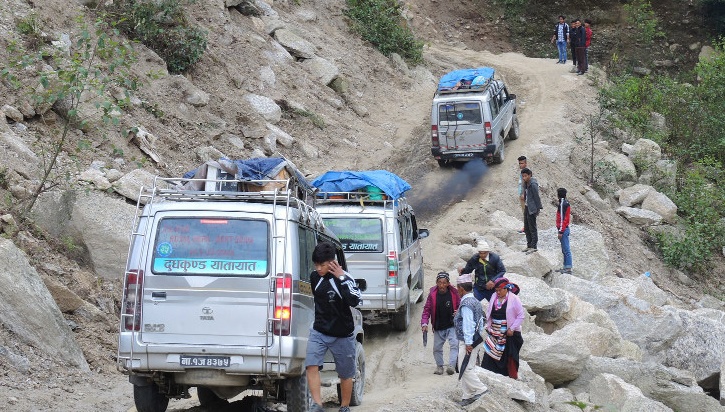
Understanding road conditions on each section of the Pokhara–Mustang route is essential for planning your vehicle choice, overnight schedule, and expectations for the journey. The route spans a dramatic range of road quality—from smooth blacktop to raw mountain track—and conditions change significantly with the seasons.
Pokhara to Beni: Good Blacktop
The Pokhara to Beni section (85 km) is on a predominantly well-maintained paved road with occasional construction sections. Standard vehicles can handle this leg, though Nepal Vehicle Hiring always deploys a 4WD jeep from the outset, given the conditions on the onward mountain road. The road is two lanes for most of its length, narrowing to a single lane in hill sections. Expect 2.5 to 3 hours of comfortable driving with clear mountain views on good-weather mornings.
Beni to Tatopani: Rough Begins
The 21 kilometres from Beni to Tatopani mark the beginning of the rough road. Blacktop becomes patchy and then disappears, replaced by compacted gravel and loose rock. River crossing points exist in this section. The road follows the Kali Gandaki River bank closely, with occasional drops to the river’s edge that demand careful driving. This section takes approximately 1.5 to 2 hours.
Tatopani to Jomsom: The Gorge Road
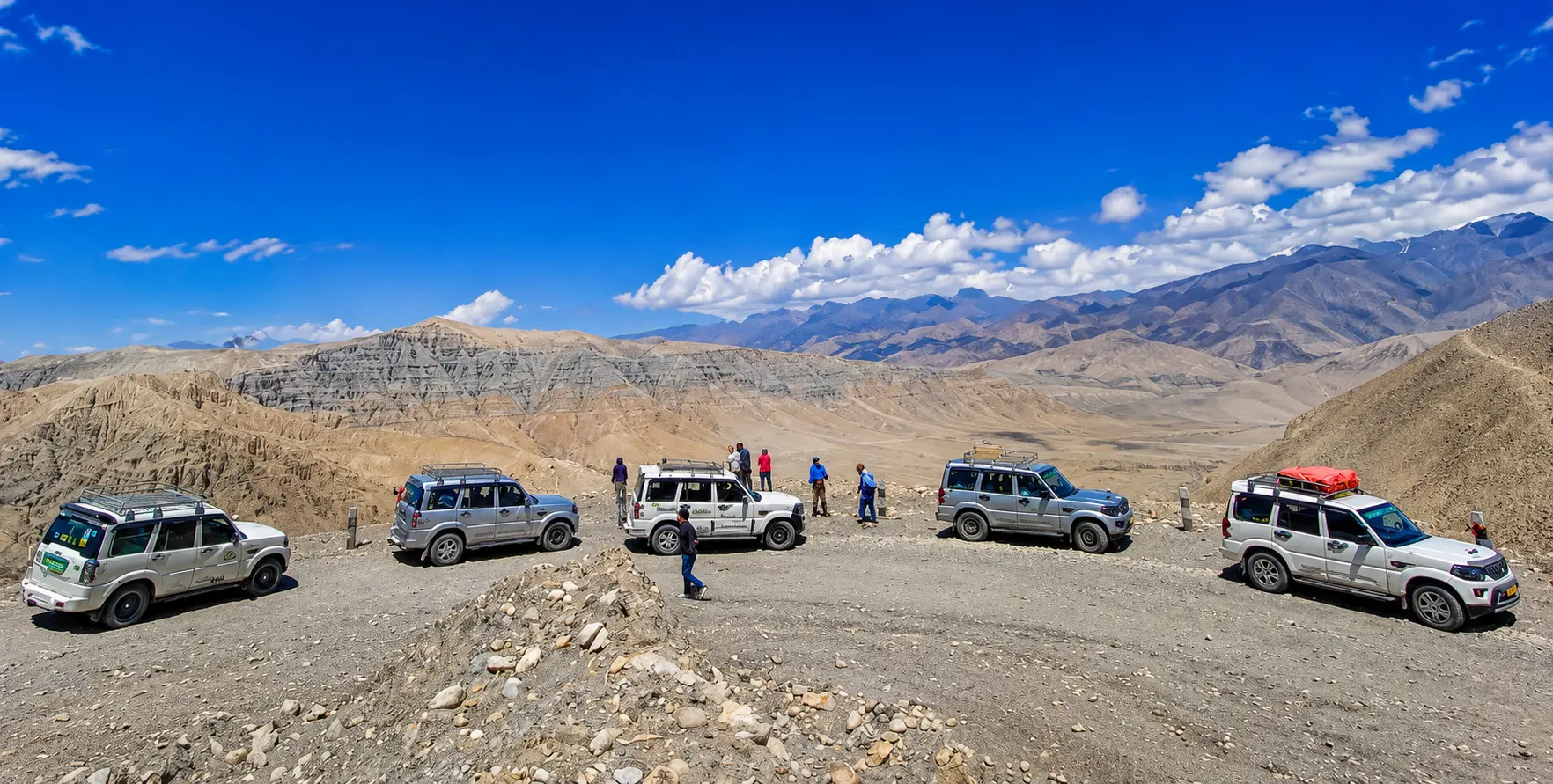
The remaining 64 kilometres from Tatopani to Jomsom through Ghasa, Kalopani, Tukuche, Marpha, and the upper gorge are the most demanding road section below Kagbeni—consistently rough, narrow in places, and requiring full 4WD engagement through the steeper switchbacks and river-level sections where the road cuts across unstable scree fans. The afternoon wind in the Kali Gandaki gorge is one of the world’s most powerful valley wind systems, building every afternoon from the south and making conditions increasingly difficult for open vehicles and motorcycles after midday. This is why Nepal Vehicle Hiring recommends leaving Beni early (by 7 AM), so you complete the gorge section before the winds pick up. The Tatopani–Jomsom section takes 3.5 to 4.5 hours depending on conditions.
Kagbeni to Lo Manthang: Full Off-Road
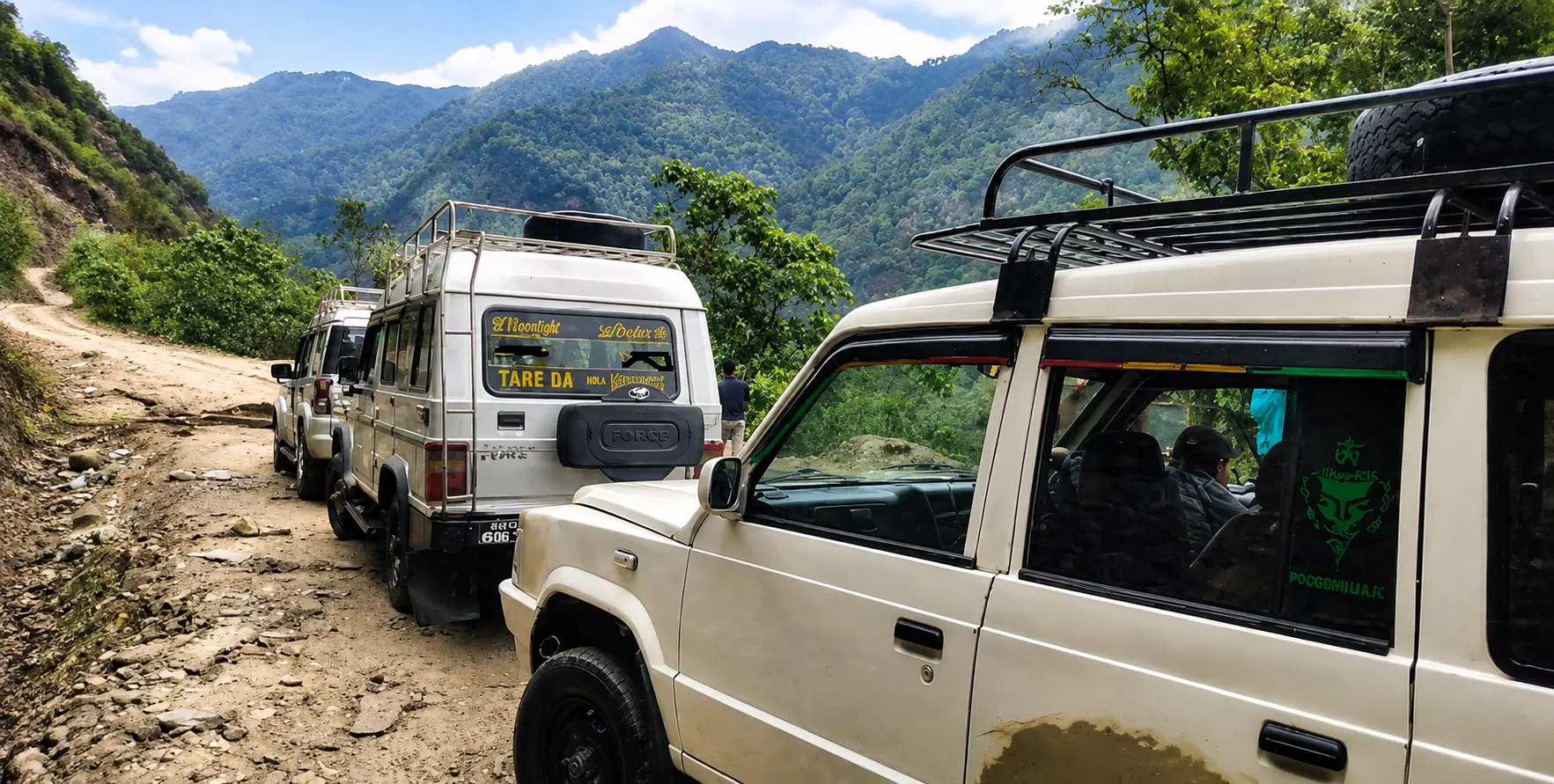
The 61 kilometres from Kagbeni to Lo Manthang via Chhusang, Chele, Syangboche, Ghami, Dhakmar, and Tsarang are genuinely off-road—unpaved throughout, with stream crossings, steep climbs, exposed cliff-edge sections, and surfaces ranging from packed gravel to loose shale to raEarthth. The passes near Earthyangboche (NyNyi Earthtarth 0 m) are the highest points on the road, where thin air reduces engine performance,e and driver fatigue requires careful management. This section should be planned as a two-day drive for comfortable overland travel — Kagbeni to Ghami (approximately 40 km, 4 to 5 hours) on day one, and Ghami to Lo Manthang via Tsarang (approximately 21 km, 2 to 3 hours) on day two. Some itineraries with strong drivers and good conditions complete the full Kagbeni–Lo Manthang section in a single long day (7 to 8 hours), but this is physically demanding and leaves little time for en route village exploration.
Monsoon Season Road Conditions (June to September)
The Beni–Jomsom section is particularly vulnerable to monsoon-season disruption. Landslides, rockfalls, and road washouts occur regularly between June and September in the Kali Gandaki gorge, and the road is often blocked for hours to several days during heavy monsoon rain. Nepal Vehicle Hiring’s drivers monitor road conditions daily during the monsoon and will proactively advise clients if the route is blocked or alternative scheduling is required.
The Upper Mustang section north of Kagbeni is significantly drier during the monsoon season because it lies within the Himalayan rain shadow. Road conditions there are generally manageable even in the monsoon months, making Upper Mustang one of the few Nepal mountain destinations that remain fully accessible year-round. Travellers specifically targeting monsoon visits to the green lower valley, combined with the dry upper plateau, can do so with proper planning and a reliable 4WD vehicle.
Permits Required for the Pokhara to Mustang Road Journey
The Pokhara–Mustang road journey crosses several administrative and conservation zone boundaries, each with its own permit requirement. Understanding the full permit picture before departure avoids delays at checkpoints and ensures your itinerary is not disrupted.
Annapurna Conservation Area Permit (ACAP)
The ACAP is required for all foreign nationals entering the Annapurna Conservation Area, which covers the Beni–Jomsom corridor and the lower Mustang region. The current fee (2026) is NPR 3,000 (approximately USD 22–25) per person and is valid for the duration of your visit without a daily limit. You can obtain ACAP permits at the Nepal Tourism Board office in Kathmandu, the ACAP office in Pokhara or Beni, or through a registered travel or trekking agency. Nepal Vehicle Hiring coordinates ACAP permit processing through our partner agencies as part of the full Mustang jeep service.
Upper Mustang Restricted Area Permit (RAP)
Entry into Upper Mustang—specifically, the zone north of Kagbeni—requires a Restricted Area Permit (RAP). In November 2025, the Government of Nepal formally overhauled the RAP fee structure, replacing the old flat-fee system (USD 500 per person for the first 10 days) with a daily rate of USD 50 per person per day for the exact number of days spent inside the restricted zone. This means a 3-day visit to Lo Manthang costs USD 150 per person; a 5-day visit costs USD 250 per person — a far more flexible and equitable system that makes shorter visits significantly more affordable than before.
The RAP must be arranged through a licensed Nepal trekking or tour agency; foreign nationals cannot obtain it independently. All foreign visitors to Upper Mustang must also travel with a licensed guide. As of March 2026, the minimum group size requirement has been removed, meaning solo foreign travellers can enter Upper Mustang as long as they have the RAP and a licensed guide. Nepal Vehicle Hiring works with licensed partner agencies to arrange all permit processing in Pokhara or Kathmandu before departure, ensuring clients arrive at the Kagbeni checkpoint fully documented and ready to proceed without delay.
TIMS Card
The TIMS (Trekkers’ Information Management System) card requirement has been revised in recent years. It is no longer mandatory for travellers holding a valid ACAP permit for the Annapurna and Mustang regions. However, requirements can change, and Nepal Vehicle Hiring recommends confirming the current TIMS requirements with our team at the time of booking rather than assuming they have not changed since this guide was published.
Recommended Itinerary: Pokhara to Lo Manthang and Back (7 Days)
The following 7-day itinerary is Nepal Vehicle Hiring’s recommended schedule for a Pokhara–Mustang jeep journey that balances comfortable driving stages with meaningful time for village exploration and acclimatisation. You can adjust it based on acclimatisation constraints and interests.
- Day 1: Pokhara to Jomsom via Beni, Tatopani, Ghasa, Kalopani, and Marpha. Depart Pokhara by 6:30 AM. Breakfast at Malekhu or Tatopani. Lunch at Kalopani with Dhaulagiri Icefall view. Visit Marpha Apple Village. Overnight in Jomsom. (195 km, 7 to 8 hours with stops.)
- Day 2: Jomsom exploration and Muktinath side trip. Morning drive to Muktinath Temple (3,710 m) via Kagbeni — see Muktinath Yatra itinerary. Return to Kagbeni for permit registration and overnight. Explore Kagbeni’s medieval lanes and monastery.
- Day 3: Kagbeni to Ghami via Chhusang, Chele, Chungsi Cave, Samar, and Syangboche. Permit checkpoint at Kagbeni exit. Chungsi Cave stop. Nyi La Pass crossing. Overnight in Ghami. (Approximately 40 km, 5 to 6 hours.)
- Day 4: Ghami to Lo Manthang via Dhakmar and Tsarang. Dhakmar Red Cliff stop—Tsarang Palace and Gompa visit. Arrive in Manthang late in the afternoon. Explore Thubchen, Chode, and Jampa monasteries. Overnight in Lo Manthang. (Approximately 25 km, 3 to 4 hours.)
- Day 5: Lo Manthang exploration and Chhoser side trip. Day in the walled city — King’s Palace, Tashi Gephel Palace courtyard, village lanes. Afternoon excursion to Chhoser Valley (Jhong Cave). Overnight Lo Manthang.
- Day 6: Lo Manthang to Jomsom return via Tsarang, Ghami, Samar, Kagbeni. Permit exit at Kagbeni. Overnight Jomsom.
- Day 7: Jomsom to Pokhara via Marpha, Tatopani (hot spring stop), Beni. Arrive in Pokhara in the afternoon. Return to the Lakeside Hotel.
This itinerary uses Nepal Vehicle Hiring’s Pokhara-to-Mustang jeep service throughout. The service includes all vehicle, driver, and fuel costs. The client arranges accommodation and food independently or through our partner agency. Contact us through the “Plan Your Trip “ page to receive a full quote and a customised itinerary.

Vehicle Requirements: Customarily, a 4WD Jeep Will Do
The Pokhara to Mustang road is one of Nepal’s most vehicle-demanding routes, and a capable 4WD with an experienced mountain driver is not a suggestion — it is an absolute necessity. Here is why any other vehicle type is unsuitable:
Standard Cars and Sedans: Not Suitable Beyond Beni
Standard cars and sedans — regardless of brand or age — are completely unsuitable for the Beni–Jomsom road. The river crossings, loose rock surfaces, steep-gradient sections, and narrow cliff passages require ground clearance that no standard car provides. Cars that attempt the Beni–Jomsom road are routinely damaged by rocks scraping the undercarriage, get stuck at river crossings, and can’t climb the steeper gradient sections. Nepal Vehicle Hiring never deploys sedans or standard cars above Beni for the Mustang route.
Hiace Vans: Suitable for Jomsom Only
Nepal Vehicle Hiring’s Hiace van hire is an excellent vehicle for the Pokhara-to-Beni and Pokhara-to-Jomsom road sections, used by groups of 8 to 14 who want to travel to the Lower Mustang region and Jomsom without the full Upper Mustang jeep requirement. The Hiace handles the Beni–Jomsom road reasonably well in good conditions, though it is more susceptible to monsoon-related road damage than a dedicated 4WD. Beyond Jomsom toward Kagbeni and certainly beyond Kagbeni into Upper Mustang, the Hiace is not appropriate. For Upper Mustang itself, the 4WD jeep takes over from the Hiace at Jomsom.
4WD Jeep: The Only Appropriate Vehicle for Upper Mustang
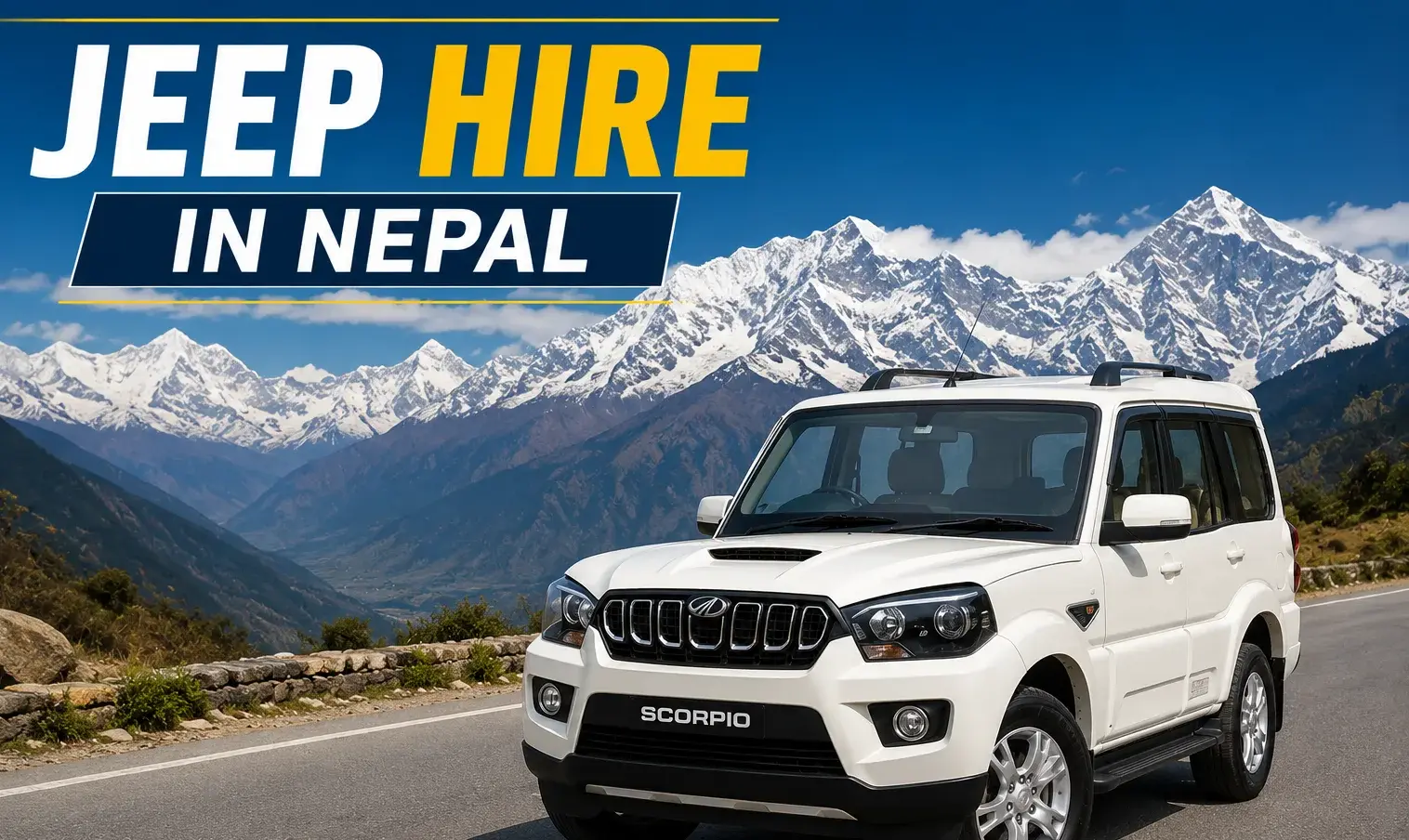
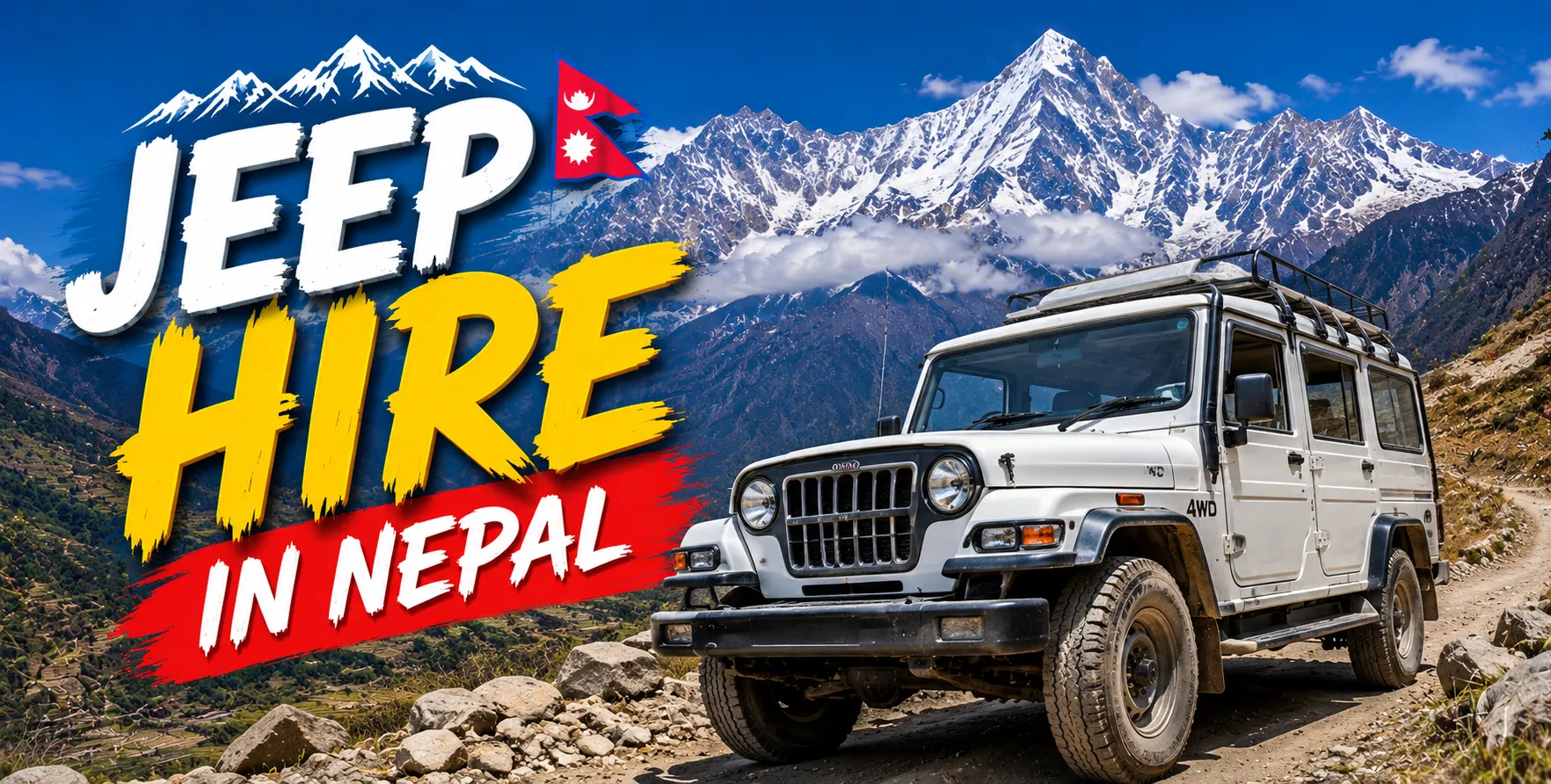
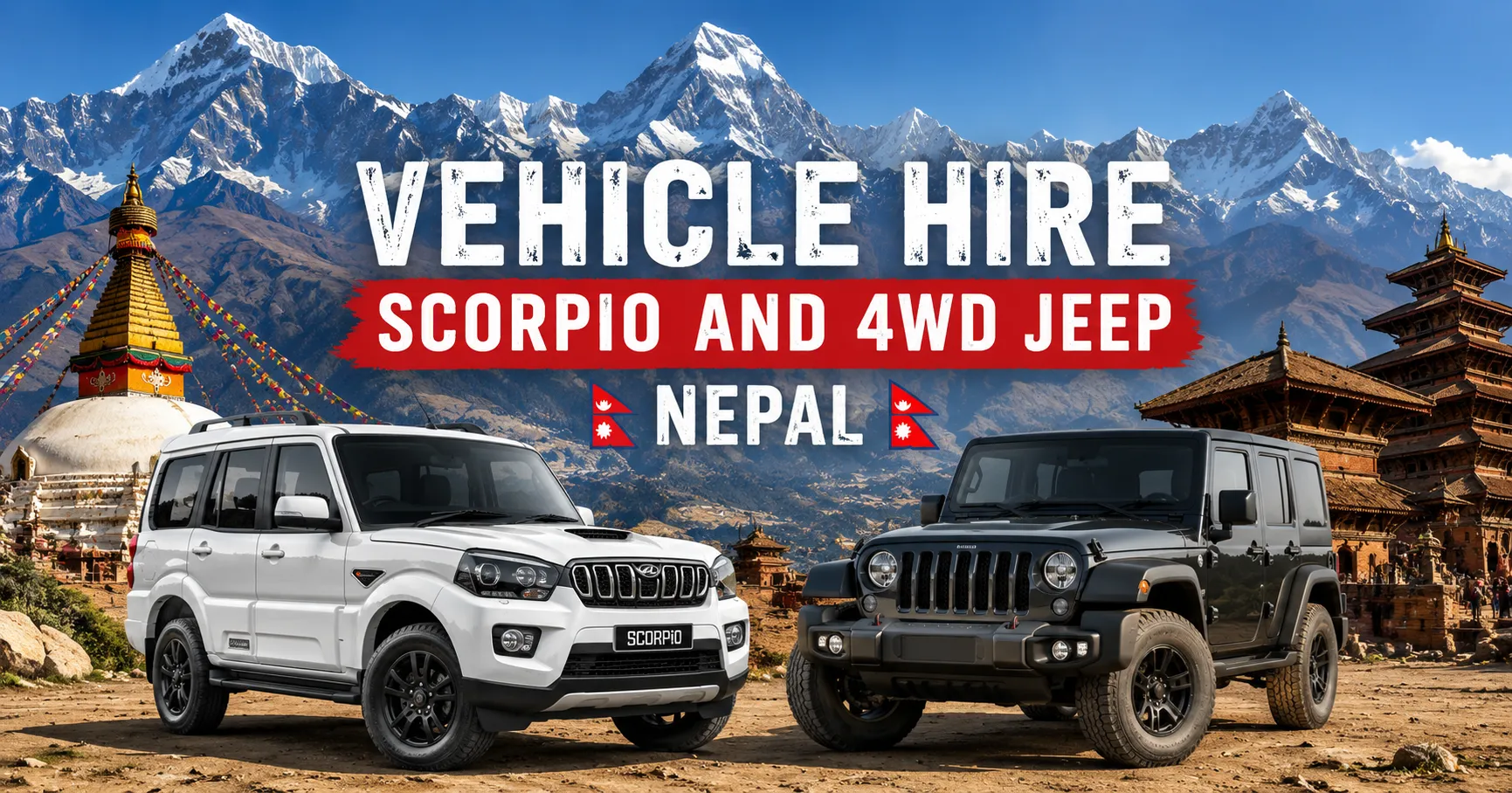
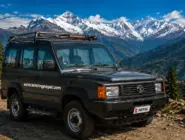
Nepal Vehicle Hiring’s 4WD jeep hire fleet — Mahindra Scorpio and Toyota Land Cruiser options — is the right vehicle for the full Pokhara–Lo Manthang journey. Both vehicles offer high ground clearance, full 4WD capability, a robust suspension rated for rough mountain roads, and the power-to-weight ratio needed to tackle the Nyi La and Syangboche La passes at elevations over 4,000 meters. Our mountain road drivers for the Mustang route have specific experience on every section from Pokhara’s Lakeside to Lo Manthang’s gates—a depth of local knowledge no city driver with a GPS can replicate. Fortravellers beginning their Nepal journey in Kathmandu rather than Pokhara can book Nepal Vehicle Hiring’s Kathmandu-to-Mustang private jeep to cover the full overland journey from the capital, including the Prithvi Highway leg to Pokhara and then the full Pokhara–Muroad as described in this guide.
Trekkingvs. Jeep on the Pokhara–Mustang Route: What’s Right for You?
Before the road to Lo Manthang was constructed (it reached Kagbeni in the early 2000s and was gradually extended to Lo Manthang over the following decade), trekking was the only way to reach Upper Mustang. The classic Upper Mustang Trek from Jomsom to Lo Manthang covers approximately 125 kilometres return and takes 10 to 14 days of walking. It remains a deeply rewarding experience and arguably the most authentic way to encounter the landscape and villages of Mustang — the pace of walking offers a level of observation and engagement with the environment that driving simply cannot match.
However, the road’s presence has changed the calculation in important ways. The jeep road now follows the same valley as the trekking trail for much of the route, meaning trekkers share the track with vehicle traffic and lose some of the solitude that characterised the pre-road trek. Many experienced guides now recommend a hybrid approach — using a jeep for some sections (typically the lower gorge from Beni to Jomsom, and the return journey from Lo Manthang) while walking the finest trekking sections (the upper plateau between Kagbeni and Lo Manthang). Nepal Vehicle Hiring’s trekking transport services are designed for this hybrid approach—vehicle drop-off at the trekking start point, vehicle pickup at the trek end point, coordinated as a single seamless booking.
For travellers with limited time, a 7-day full-jeep journey from Pokhara to Lo Manthang and back covers the essential landscape and cultural highlights, leaving more time to explore Lo Manthang itself. For travellers with 14+ days and a genuine appetite for Himalayan trekking, the walking approach to Upper Mustang is one of Nepal’s finest trekking experiences— right alongside the Annapurna Circuit and the Everest Base Camp trek in terms of landscape and cultural rewards.
Best Time to Drive the Pokhara to Mustang Road
Spring (March to May): The Premier Season
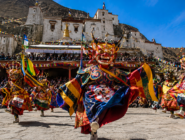
Spring is the most popular season for the Pokhara–Mustang jeep drive, and for good reason. The skies are clear, the mountain views are at their pre-monsoon finest, and the Tiji Festival — typically held in May at Lo Manthang — is the most spectacular cultural event in the Mustang calendar. The road is in its best annual condition in spring: the previous monsoon’s damage has been repaired over winter, the surfaces are dry and compacted, and the passes near Syangboche are snow-free. Nepal Vehicle Hiring’s Pokhara-to-Mustang jeep service is in the highest demand during April and May — booking 6 to 8 weeks in advance is strongly recommended for the spring window.
Monsoon (June to August): Surprisingly Good for Upper Mustang
Upper Mustang is one of the few mountain destinations in Nepal that are actively recommended during the monsoon. The rain shadow blocks almost all monsoon precipitation north of Kagbeni, meaning the plateau landscape is dry and clear even as the rest of Nepal disappears under cloud. The lower gorge section from Beni to Jomsom is more challenging during the monsoon due to landslide risk, and Nepal Vehicle Hiring recommends a careful day-by-day assessment of road conditions for this section. But above Jomsom, and certainly above Kagbeni, the monsoon months offer a unique combination of clear plateau sky and vivid green lower-valley views with their own photographic and experiential appeal.
Autumn (September to November): Post-Monsoon Clarity
Autumn is Nepal’s peak trekking season and one of the finest times for the Mustang drive. Post-monsoon clarity delivers extraordinary mountain views; the road has been assessed and partially repaired after monsoon damage; and the autumn harvest gives the Ghami and Tsarang barley fields a warm golden character. October in Lo Manthang, with the harvest complete and the plateau landscape in its late-season clarity, is one of Nepal’s finest travel moments. Book in advance — autumn demand is second only to spring for our Mustang jeep service.
Winter (December to February): Cold but Possible
Winter visits to Upper Mustang are possible but require careful planning. Lo Manthang can drop to minus 20 to minus 25 degrees Celsius at night in January and February; most teahouses reduce capacity or close entirely, and the Nyi La and Syangboche La passes may be snow-covered and icy. The Beni–Jomsom road section is generally passable in winter, except during heavy snowfall. Winter suits experienced cold-weather travellers seeking the solitude and stark beauty of Mustang in its quietest season.
Connecting to the Pokhara–Mustang Road from Kathmandu and Beyond
For most international travellers, the Pokhara–Mustang road begins not in Pokhara but in Kathmandu. The journey from Nepal’s capital adds approximately 200 kilometres and 6 to 7 hours of additional highway driving (or a 25-minute domestic flight) to the total Mustang itinerary. Nepal Vehicle Hiring coordinates the full journey from Kathmandu through a single booking.
Starting with a Kathmandu airport transfer on arrival, travellers typically spend 1 to 2 days in the Kathmandu Valley — our Kathmandu sightseeing service, the Bhaktapur Durbar Square day tour, and the Nagarkot sunrise tour via our Kathmandu-to-Nagarkot vehicle are the most popular Kathmandu Valley additions before the Mustang departure. The Kathmandu-to-Pokhara bus or a private Hiace van hire covers the capital-to-Pokhara leg, with the Mustang jeep departing from Pokhara’s Lakeside the following morning.
Travellers combining Mustang with other Nepal destinations can draw on Nepal Vehicle Hiring’s full fleet: car hire in Nepal for Kathmandu Valley sightseeing, Coaster bus hire, or full bus hire for large-group highway sections, plus dedicated mountain-road jeeps for every section above Beni. Complete Nepal holiday tour packages can include Mustang as the centrepiece of a broader itinerary covering Kathmandu, Pokhara, Chitwan, and Lumbini—all coordinated by a single team with a single point of contact throughout.
Frequently Asked Questions: Pokhara to Mustang Road
How many days does the drive from Pokhara to Lo Manthang take?
The minimum comfortable drive is 3 days from Pokhara to Lo Manthang (Day 1: Pokhara to Jomsom, Day 2: Jomsom to Ghami, Day 3: Ghami to Lo Manthang). Most travellers prefer a 3- to 4-day approach that adds more time in Lo Manthang itself, and our recommended 7-day return itinerary (including 2 nights in Lo Manthang and a Muktinath side trip) offers the best balance of drive time, village exploration, and acclimatisation.
Can a standard car handle the Pokhara-to-Mustang journey?
No. Standard cars are not suitable beyond Beni. Tourist buses are not suitable beyond Jomsom. The road from Kagbeni to Lo Manthang — and indeed from Beni onward — requires a 4WD vehicle with high ground clearance. Nepal Vehicle Hiring uses only its dedicated 4WD jeep fleet for the Mustang route.
What is the total road distance from Pokhara to Lo Manthang?
The total road distance from Pokhara’s Lakeside to Lo Manthang is approximately 222 kilometres, broken down as follows: Pokhara to Beni (85 km), Beni to Jomsom (85 km), Jomsom to Kagbeni (11 km), and Kagbeni to Lo Manthang (61 km).
Is the Pokhara-to-Mustang road safe?
With the right vehicle and an experienced driver, the Pokhara–Mustang road is safe and manageable. The risks — rough road surfaces, river crossings, landslide zones in the lower gorge, thin air at altitude — are all manageable by an experienced operator. Nepal Vehicle Hiring’s mountain road drivers have extensive experience on every section of this route and are equipped to handle the conditions typical of Himalayan mountain roads.
Can I fly to Jomsom and drive to Lo Manthang from there?
Yes—this is a popular approach for travellers with limited time. The 220- to 25-minute morning flight from Pokhara to Jomsom (operated by Yeti Airlines and other carriers) saves approximately 7 to 8 hours of driving. From Jomsom, Nepal Vehicle Hiring can arrange a 4WD jeep for the onward journey to Kagbeni and Lo Manthang. Jomsom flights are frequently cancelled due to weather and wind conditions, so build flexibility into your schedule and always have a road trip as a backup option. Nepal Vehicle Hiring’s Pokhara-to-Mustang service can be configured for a Jomsom departure if you fly the first leg.
How do I book a jeep from Pokhara to Mustang with Nepal Vehicle Hiring?
Contact us through our Plan Your Trip page, WhatsApp +977 9851013196, or email [email protected] with your travel dates, group size, and preferred itinerary. We respond within 24 hours with a full vehicle proposal, driver assignment, and all-in pricing.
Book Your Pokhara to Mustang Jeep with Nepal Vehicle Hiring
Nepal Vehicle Hiring Pvt. Ltd., based in Thamel, Kathmandu, is your specialist transport partner for the Pokhara–Mustang road journey. Our fleet, our drivers, and our permit coordination services are designed specifically for this extraordinary route, and our team is available seven days a week to help you plan and book the perfect Mustang overland adventure.
Services available for the Pokhara–Mustang route:
- Pokhara to Mustang jeep — dedicated 4WD service from Pokhara Lakeside to Lo Manthang and return
- Kathmandu to Mustang private jeep — full overland from the capital, including highway and mountain road
- Muktinath Yatra itinerary — combining Muktinath Temple with the Mustang road journey
- Trekking transport services — jeep drop-off and pickup for hybrid trek/jeep Mustang itineraries
- Nepal tour packages and Nepal holiday tours — Mustang within a broader Nepal circuit
Contact us:
- WhatsApp / Call: +977-9814227196
- Email: [email protected]
- www.vehiclehiringnepal.com
The road from Pokhara to Lo Manthang is 222 kilometres of Nepal at its most extraordinary — gorges, villages, plateau, wind, altitude, and at the end of it all, a walled city that has survived on the roof of the world for seven centuries. Nepal Vehicle Hiring will get you there and bring you back safely, in the comfort a journey of this calibre deserves.
Essential Packing List for the Pokhara to Mustang Road Journey
The Pokhara to Mustang route spans elevations from 830 meters at Beni to 3,840 meters at Lo Manthang, crossing warm subtropical gorges and frigid high-altitude plateaus in the same overland journey. Packing correctly for this remarkable range of conditions matters, especially for first-time Himalayan travellers who may underestimate how quickly the temperature, terrain, and environment change as the road climbs northward. Here is what Nepal Vehicle Hiring recommends packing for the full Pokhara-to-Lo Manthang jeep journey.
Warm layers: a down jacket is essential above Jomsom, particularly in the evenings when temperatures drop sharply even in spring and autumn. A thermal base layer, a fleece mid-layer, and a windproof outer shell cover all conditions, from the Beni gorge heat at lower altitudes to the bitter cold of o Manthang above 3,800 meters.
Sun protection: At 3,840 meters, UV radiation is significantly more intense than at sea level. Sunscreen with SPF 50 or higher, UV-blocking sunglasses rated for high altitude, and a wide-brimmed hat or warm wool cap are essential above Kagbeni. Snow blindness and severe sunburn are real risks at Lo Manthang’s altitude if you neglect proper protection.
Cash in Nepali Rupees: There are no ATMs above Jomsom. Carry sufficient rupees for accommodation, food, gratuities, and any emergency expenses for the full Upper Mustang stay. NPR 15,000 to 25,000 per person for a five- to seven-day Upper Mustang visit is a reasonable working minimum, but personal spending on souvenirs, additional excursions, and tips for the licensed guide should be factored in separately.
Altitude medication: Diamox (acetazolamide) can be used preventively at altitudes above 3,000 meters and is particularly relevant for the Kagbeni-to-Lo Manthang section. Consult a qualified doctor before travel. Carry basic ibuprofen for headaches and oral rehydration salts for altitude-related dehydration as standard altitude management tools throughout the journey.
Dust protection: the road above Kagbeni generates significant dust during the dry season, particularly on the exposed plateau sections between Chele and Ghami. A scarf, buff, or quality dust mask for use when the jeep window is open helps protect your lungs and eyes during dustier sections. This is one of the most overlooked practical preparations for the Upper Mustang jeep journey.
Offline maps and a power bank: mobile signal is available in Jomsom and Kagbeni, but becomes very patchy above Kagbeni, inside the restricted zone. Download offline maps covering the Upper Mustang route before departingfrom Pokhara. A fully charged power bank ensures your camera, phone, and GPS remain functional throughout the multi-day journey when vehicle charging points may not be available.
- Pokhara to Mustang Road Overview: Complete Jeep Guide
- Pokhara to Mustang: Full Route Overview and Distance Breakdown
- The Villages of Upper Mustang: What You See Between Kagbeni and Lo Manthang
- Lower Mustang: The Valley Between Jomsom and Kagbeni
- Road Conditions on the Pokhara to Mustang Route: Section by Section
- Permits Required for the Pokhara to Mustang Road Journey
- Recommended Itinerary: Pokhara to Lo Manthang and Back (7 Days)
- Vehicle Requirements: Customarily, a 4WD Jeep Will Do
- Trekkingvs. Jeep on the Pokhara–Mustang Route: What's Right for You?
- Best Time to Drive the Pokhara to Mustang Road
- Connecting to the Pokhara–Mustang Road from Kathmandu and Beyond
- Frequently Asked Questions: Pokhara to Mustang Road
- Book Your Pokhara to Mustang Jeep with Nepal Vehicle Hiring
- Essential Packing List for the Pokhara to Mustang Road Journey

Related Blog & Articles
ACAP Permit – The Annapurna Conservation Area Entry Pass: Complete Guide
Altitude and Health: Essential Muktinath Advice
Muktinath Pilgrimage and Mustang Tour
Kathmandu to Mustang (Muktinath)