Chitwan to Lumbini Private Jeep

Chitwan to Lumbini Private Jeep: Best Price Guide
The drive from Chitwan National Park (Sauraha) to Lumbini — the birthplace of the Buddha and one of Nepal’s most sacred UNESCO World Heritage Sites — is one of Nepal’s finest and most rewarding tourist vehicle journeys: a straight Terai highway run of approximately 165 to 175 kilometres, taking 3 to 4 hours by private vehicle, connecting Nepal’s finest wildlife destination with its most important Buddhist pilgrimage site in a single comfortable day’s travel.
Most tourists who visit both Chitwan and Lumbini route through Kathmandu or Pokhara between the two — a detour that adds 2 to 3 unnecessary travel days to the Nepal circuit. The direct Chitwan-to-Lumbini private jeep connection makes this detour entirely avoidable: Sauraha to Lumbini via the Terai highway is quicker, cheaper, and more direct than any Kathmandu-routed alternative. Nepal Vehicle Hiring Pvt. Ltd. offers this direct connection as a standard service—private car hire, Hiace van hire, and Coaster bus hire for every group size —with all-inclusive pricing and confirmed hotel-to-hotel delivery.
This complete guide covers the Chitwan-to-Lumbini route in detail: distance and drive time, the best price for private jeep hire by vehicle type and group size, what to do in Lumbini, seasonal considerations, and how to combine Chitwan and Lumbini into the most efficient Nepal circuit.
Chitwan to Lumbini: Quick Reference
| Distance (Sauraha to Lumbini Sacred Garden) | 165 to 175 km via Narayanghat–Butwal–Bhairahawa |
| Drive time | 3 to 4 hours by private vehicle (no major stops) |
| Road type | Flat Terai highway (Mahendra Highway / East-West Highway) — smooth blacktop |
| Best vehicle for 2 pax | Private car hire — NPR 8000 to 15,000 all-in |
| Best vehicle for 4–6 pax | 4WD jeep (Scorpio) — NPR 10 to 22,000 all-in |
| Best vehicle for 8–14 pax | Hiace van — NPR 15,000 to 30,000 all-in |
| Best vehicle for 15–25 pax | Coaster bus — NPR 25,000 to 40,000 all-in |
| Lumbini entry fee | NPR 200 per foreign national |
| Recommended visit time | 2 to 3 hours minimum; full day for monastery zone |
| Booking lead time | 24–48 hours (off-peak); 3–5 days (Oct–Nov peak) |
Private Jeep Hire Prices: Chitwan to Lumbini
All Nepal Vehicle Hiring prices are all-inclusive — vehicle, licensed driver, fuel, and all road charges—no end-of-journey additions.
| Vehicle | Capacity | All-In Price | ||
| Private Car (Sedan/SUV) | 2–4 pax | NPR 6000–15,000 | ||
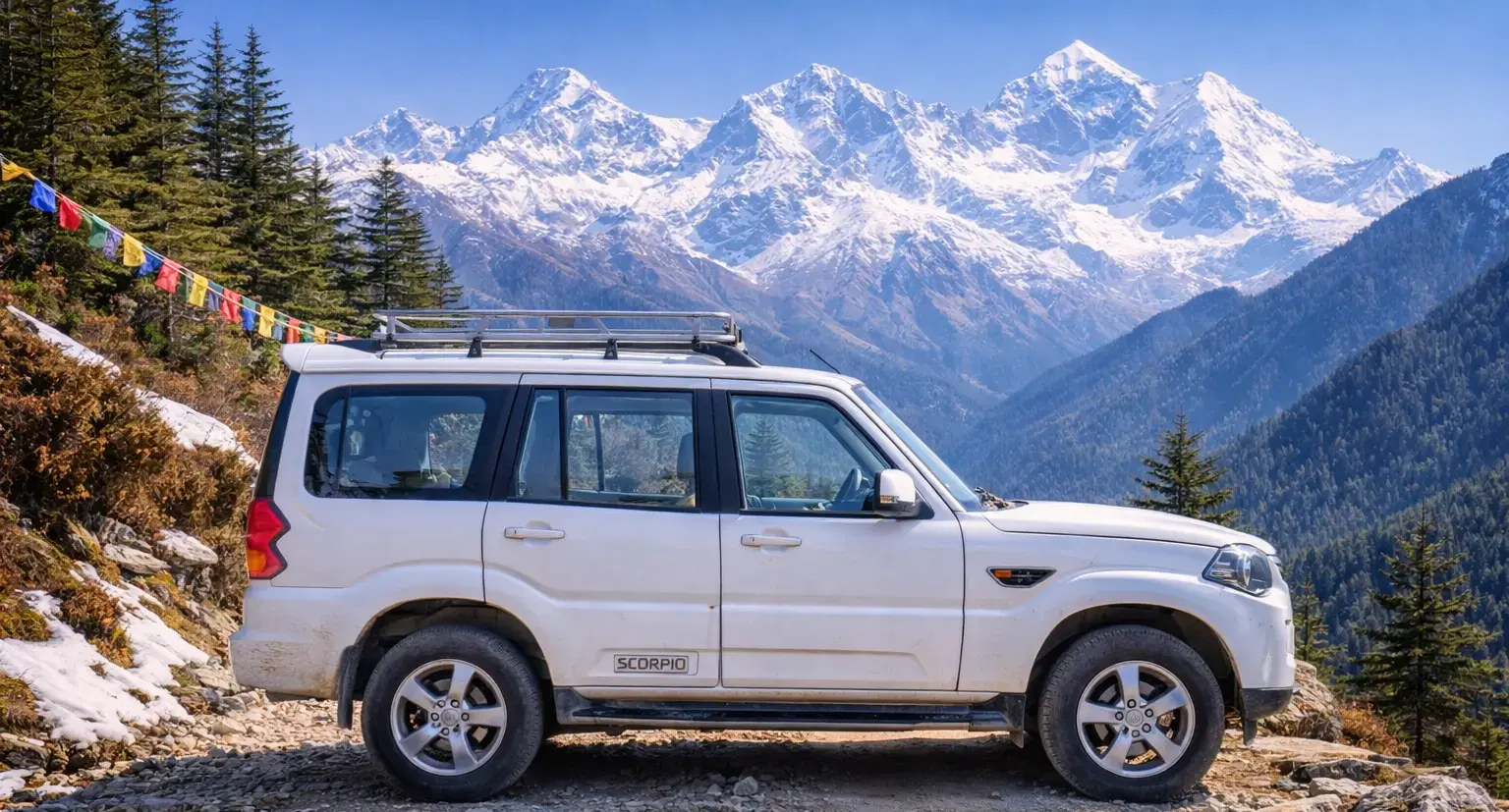
| 4WD Jeep (Mahindra Scorpio) | 4–7 pax | NPR 10,000–22,000 | ||
| Toyota Land Cruiser | 4–5 pax | NPR 25,000–40,000 | ||
| Hiace Van | 8–14 pax | NPR 20,000–30,000 | ||
| Coaster Bus | 15–25 pax | NPR 30,000–40,000 |
Contact Nepal Vehicle Hiring via our plan your trip page or WhatsApp +977 9814227196 for confirmed pricing. Note: Nepal Vehicle Hiring’s Sauraha driver may need to deadhead from Kathmandu or Pokhara to reach Sauraha for the pickup — for early morning departures, arrange the vehicle the day before to ensure the driver is overnight in Sauraha.
The Route: Sauraha to Lumbini via Terai Highway
The Chitwan-to-Lumbini route runs entirely on Nepal’s flat Terai highway network—one of Nepal’s most comfortable and fastest driving environments. No mountain roads, no off-road sections, no altitude changes. The route:
| Section | Distance | Road | Drive Time | Notes |
| Sauraha to Narayanghat | ~30 km | Provincial road | 40–50 min | Through Tadi Bazaar and Bharatpur; last reliable ATMs |
| Narayanghat to Butwal | ~115 km | Mahendra Highway | 2–2.5 hrs | Flat Terai, fast highway; passes Deukhuri valley |
| Butwal to Bhairahawa | ~22 km | Mahendra Highway | 25–30 min | Siddharthanagar — last city before Lumbini |
| Bhairahawa to Lumbini Sacred Garden | ~22 km | Siddhartha Highway | 25–30 min | Road east from Bhairahawa; UNESCO site entrance |
The Mahendra Highway between Narayanghat and Butwal is the longest and most comfortable section — wide, well-maintained blacktop through the western Terai sal forest belt. The highway passes through the scenic Deukhuri valley where the Terai plains give way briefly to a forested mid-hill corridor before returning to flat Terai near Butwal. This section has limited stopping points, but the sal forest corridor is a genuine wildlife sightings zone — langur monkeys and occasional deer are visible from the road.
Why the Direct Chitwan–Lumbini Route Beats Going via Kathmandu
The most common Nepal tourist circuit routes Chitwan and Lumbini via Kathmandu — either because tourists don’t realise the direct Terai connection exists, or because packaged itineraries are built around the Kathmandu hub. The direct Sauraha-to-Lumbini vehicle connection is significantly better on every practical dimension:
| Factor | Via Kathmandu | Direct Terai Route |
| Distance | ~490 km (Sauraha → KTM → Lumbini) | ~170 km (Sauraha → Lumbini direct) |
| Drive time | 2 days minimum | 3–4 hours —same-day arrival |
| Cost (private car, 2 pax) | ~NPR 18,000–35,000 (two vehicle legs) | NPR 5,500–15,000 (one vehicle leg) |
| Overnight accommodation | Extra 1–2 nights in Kathmandu | None required — same-day connection |
| Fatigue | Two mountain/highway road days | One flat, comfortable Terai drive |
| Schedule flexibility | Fixed via Kathmandu hub | Depart any time from Sauraha lodge |
Lumbini: What to See and Do After the Jeep Arrival
Arriving at Lumbini by private jeep from Chitwan lets tourists explore the UNESCO site at their own pace—not on a fixed group tour schedule. The site’s key components:
Maya Devi Temple and Sacred Garden
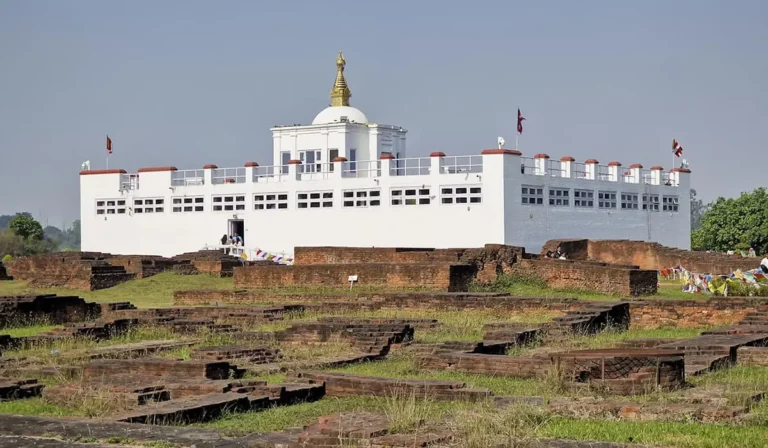
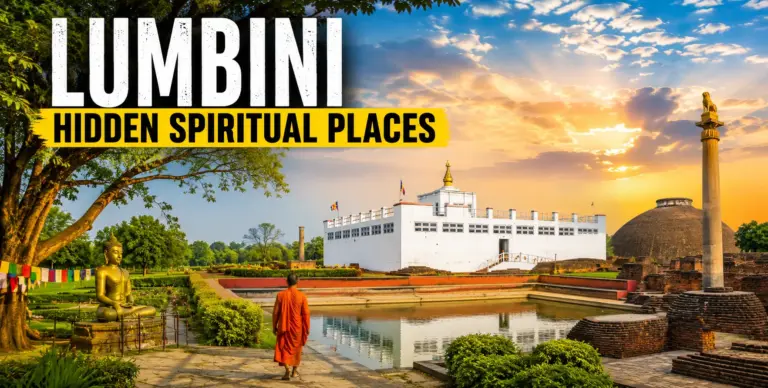
The Maya Devi Temple marks the precise birthplace of Siddhartha Gautama (the historical Buddha, born c. 563 BCE) — confirmed by the Ashoka Pillar, inscribed in 249 BCE by Emperor Ashoka, who visited Lumbini on pilgrimage, with the inscription ‘Here the Buddha, the Sage of the Shakyas, was born.’ The stone bearing the birth marker is visible in the temple’s inner sanctum. The surrounding Sacred Garden contains the Puskarini sacred pool — where, according to Buddhist tradition, Maya Devi (the Buddha’s mother) bathed before giving birth — and ancient brick ruins of monasteries dating to the Maurya and later periods.
The International Monastery Zone
North of the Sacred Garden, along a 1.5-kilometre central canal, runs the international monastery zone — two parallel rows of national monastery compounds built by Buddhist countries from around the world. The east zone has Theravada monasteries (Myanmar, Sri Lanka, Thailand, Cambodia, Laos); the west zone has Mahayana and Vajrayana monasteries (Nepal, China, Korea, Japan, Germany, France, Vietnam, Bhutan, Tibet). Each monastery is architecturally distinctive — the Myanmar Golden Temple, the Korean temple, the Japanese Peace Pagoda, and the Royal Thai Monastery are the most visited. A focused monastery circuit takes 1 to 1.5 hours at a relaxed pace.
World Peace Flame and Eternal Peace Flame
The Eternal Peace Flame in the Sacred Garden — lit from flame fragments collected from conflict zones worldwide — burns continuously as a symbol of the Buddha’s message of peace. Nepal Vehicle-Hiring drivers know the exact location and include a brief stop as part of the Sacred Garden circuit.
Who Books the Chitwan–Lumbini Private Jeep
Buddhist Pilgrims
Buddhist pilgrims — from Nepal, Sri Lanka, Myanmar, Thailand, Korea, Japan, China, and the global Buddhist diaspora — make the Chitwan-to-Lumbini connection as part of a broader Buddhist sacred circuit of India and Nepal. The Lumbini pilgrimage (the Buddha’s birthplace), combined with India’s Buddhist circuit (Bodh Gaya, Sarnath, Kushinagar), is the most important Buddhist pilgrimage journey. Chitwan wildlife is a natural, rewarding addition for flexible pilgrim groups. Nepal Vehicle Hiring’s Hiace van hire and Coaster bus hire serve Buddhist pilgrim groups on this route.
Hindu Pilgrims
Hindu pilgrims incorporating Lumbini into their Nepal pilgrimage circuit — whether as part of the Nepal Nekhor tour sacred circuit (Pashupatinath, Muktinath, Lumbini, Janakpur) or as a Lumbini visit after Chitwan’s wildlife — find the direct Terai route far more practical than routing through Kathmandu. Many Hindu pilgrims venerate the Buddha as an avatar of Vishnu, making Lumbini a natural and theologically coherent addition to the pilgrimage.
Nepal Triangle + Lumbini Extension
Tourists doing the standard Nepal triangle (Kathmandu-Pokhara-Chitwan) who want to add Lumbini without significantly extending their itinerary can do so via the direct Chitwan-to-Lumbini connection — spending 2 nights at Chitwan for wildlife, then a half-day drive to Lumbini (arriving in the afternoon), a Lumbini morning visit, and then Bhairahawa-to-Kathmandu by bus or the Sunauli-to-Kathmandu return. This adds only 1-2 days to the standard triangle itinerary.
Kailash Yatra Return Pilgrims
Kailash Mansarovar Yatra return pilgrims coming from Kodari through Kathmandu and heading to the Sunauli border (as covered in the Kodari-to-Sunauli guide) sometimes include a Chitwan 1-night extension before the Bhairahawa border crossing. The Chitwan-to-Lumbini connection serves these pilgrims perfectly — a Chitwan wildlife overnight followed by the short Lumbini morning visit before the Sunauli India border crossing.
Sample Itineraries Combining Chitwan and Lumbini
2-Day Chitwan + Lumbini Circuit from Kathmandu
Day 1: Kathmandu → Chitwan (Nepal Vehicle Hiring: Hiace van hire or car hire in Nepal, 4 to 5 hours, Manakamana optional). Afternoon canoe on the Rapti River.
Day 2: Early morning Chitwan jeep safari (core zone, 5:30 AM). Return for breakfast. Nepal Vehicle Hiring: private jeep from Sauraha to Lumbini (3 to 4 hours; depart 10:00 AM, arrive 1:30 PM). Lumbini Sacred Garden and monastery zone visit (2 to 3 hours). Depart Lumbiniat 4:30 PM. Nepal vehicle hire continues from Lumbini to Kathmandu via Bhairahawa and Prithvi Highway (6 to 7 hours, overnight journey or next-morning flight).
Lumbini as Part of the Nepal Nekhor Pilgrimage Circuit
The Nepal Nekhor tour sacred circuit — connecting Pashupatinath, Muktinath, Lumbini, and Janakpur — can be routed to include Chitwan before Lumbini: Kathmandu → Chitwan (2 nights) → Lumbini (1 to 2 nights) → Janakpur (1 night) → return to Kathmandu. The Chitwan-to-Lumbini private jeep connects wildlife to the sacred circuit, while the Lumbini-to-Janakpur leg continues east on the Terai highway.
Pokhara–Chitwan–Lumbini–Sunauli One-Way Circuit
For tourists ending their Nepal visit at the India border: Pokhara → Chitwan (Nepal Vehicle Hiring vehicle, 3 to 4 hours) → 1 night Chitwan → Chitwan to Lumbini direct (3 to 4 hours) → Lumbini visit → Bhairahawa → Sunauli India border crossing. This one-way circuit avoids returning to Kathmandu entirely and is the most efficient overland exit from Nepal to India for tourists who have already done the Kathmandu circuit.
Seasonal Conditions: Chitwan to Lumbini Drive
| Season | Months | Road Conditions | Notes |
| Spring | Mar–May | Excellent — dry, hot (30–38°C) | Good wildlife at Chitwan; Lumbini busy pre-monsoon |
| Monsoon | Jun–Sep | Generally fine — Terai highway rarely floods | Chitwan park partially restricted; Lumbini open year-round |
| Post-Monsoon | Oct–Nov | Best — cool, dry, clear | Peak season; best Chitwan wildlife and Lumbini conditions |
| Winter | Dec–Feb | Good — cool (18–25°C), comfortable | Excellent visibility; Lumbini at its best — cool and clear |
The Terai highway between Narayanghat and Bhairahawa is one of Nepal’s most weather-resilient roads — the flat Terai terrain means it rarely floods or closes even in heavy monsoon rain. The Chitwan-to-Lumbini drive is reliable year-round, keeping this connection open for tourists in all seasons.
Practical Tips: Chitwan to Lumbini by Private Jeep
- Depart Sauraha after the morning safari: the 5:30 AM morning jeep safari ends by 9:00 to 9:30 AM — a 10:00 AM Sauraha departure reaches Lumbini by 1:30 to 2:00 PM, allowing a 2 to 3 hour Sacred Garden visit before the 5:00 PM closing approach.
- Withdraw cash at Narayanghat: ATMs in Narayanghat (NIC Asia, Nepal SBI) are the most reliable on the Terai route. Lumbini has some ATMs, but reliability is variable — carry NPR for Lumbini entry, restaurant meals, and monastery donations from Narayanghat.
- Book Lumbini accommodation in advance for overnight stays: Lumbini has a range of accommodation from budget guesthouses to the Lumbini Garden New Crystal Hotel — book in advance for October-November peak season and the Buddhist pilgrimage festivals (Vesak/Buddha Purnima in May is Lumbini’s most important festival and draws tens of thousands of pilgrims).
- Allow time in the monastery zone: many tourists underestimate how long the monastery zone rewards exploration. The Myanmar Golden Temple, the Korean temple, and the Great Drigung Kagyud Lotus Stupa each deserve 15 to 20 minutes of your attention. Allow 1.5 to 2 hours for the monastery zone circuit.
- The Sacred Garden closes at sunset: the Maya Devi Temple inner sanctum has restricted entry times (check current hours with your jungle lodge before departure from Sauraha). Arriving at Lumbini by 2:00 PM ensures 3+ hours of Sacred Garden visiting time before closing.
- Consider the Lumbini Museum: the Lumbini International Research Institute and the Lumbini Museum (in the northern monastery zone area) provide excellent contextual exhibits on Buddhist history, Ashokan inscriptions, and the archaeological history of the Lumbini site — worth 45 minutes for interested visitors.
Frequently Asked Questions: Chitwan to Lumbini Private Jeep
How far is Chitwan from Lumbini?
The distance from Sauraha (Chitwan’s tourist hub) to the Lumbini Sacred Garden entrance is approximately 165 to 175 kilometres by road, taking 3 to 4 hours by private vehicle on the Terai highway.
What is the best price for a private jeep from Chitwan to Lumbini?
Nepal Vehicle Hiring’s all-inclusive prices for the Chitwan-to-Lumbini private vehicle: NPR 8,000 to 15,000 for a private car (2 to 4 passengers); NPR 10,000 to 20,000 for a Scorpio jeep (4 to 7 passengers); NPR 15,000 to 25,000 for a Hiace van (8 to 14 passengers). All prices include vehicle, driver, fuel, and road charges. Contact Nepal Vehicle Hiring on WhatsApp +977 9814227196 for confirmed pricing.
Is it better to go directly from Chitwan to Lumbini or via Kathmandu?
Directly. The Chitwan-to-Lumbini direct Terai highway (165 km, 3 to 4 hours) is significantly faster, cheaper, and simpler than routing via Kathmandu (490 km, 2 days, 2 extra nights’ accommodation). The direct route is the obvious practical choice for any tourist who wants to see both Chitwan and Lumbini on the same Nepal trip.
Can I visit Lumbini as a day trip from Chitwan?
Yes — a Lumbini day trip from Chitwan is practical. Depart Sauraha at 9:00 to 10:00 AM (after the morning safari), arrive in Lumbini by 1:00 to 2:00 PM, visit the Sacred Garden and selected monasteries (2 to 3 hours), and return to Sauraha by 8:00 to 9:00 PM. The day trip requires a round-trip vehicle — add approximately 30 to 40% to the one-way price for the return journey. Most tourists prefer an overnight stay in Lumbini for a more complete visit.
Does Nepal Vehicle Hiring provide vehicles in Sauraha (Chitwan)?
Nepal Vehicle Hiring is based in Thamel, Kathmandu. For Sauraha pickups, our driver travels to Sauraha from Kathmandu or Pokhara the previous day for morning departures. Confirm your Sauraha departure at least 24 to 48 hours in advance to allow driver positioning. Contact us via our plan your trip page or WhatsApp +977 9814227196
Nepal Vehicle Hiring’s all-inclusive price covers the vehicle, experienced licensed driver, fuel for the complete Chitwan-to-Lumbini journey, and all road and bridge charges. Not included: Lumbini entry fee (NPR 200 per foreign national), passenger meals and accommodation, Lumbini museum entry, and driver tip (at passenger discretion).
Book Your Chitwan to Lumbini Vehicle with Nepal Vehicle Hiring
Nepal Vehicle Hiking Pvt. Ltd., Thamel, Kathmandu — all vehicle types for the Chitwan-to-Lumbini Terai route:
- Car hire in Nepal — 2–4 passengers, Sauraha to Lumbini
- 4WD jeep hire — 4–7 passengers, families and small groups
- Hiace van hire — 8–14 passengers, pilgrim and tour groups
- Coaster bus hire — 15–25 passengers, large groups
- Nepal Nekhor tour — Lumbini as part of complete Nepal sacred circuit
- Nepal holiday tour — Chitwan and Lumbini within complete Nepal tour
- Nepal tour package — Nepal circuit including wildlife and pilgrimage
- Kathmandu to Pokhara bus — for onward Pokhara connection after Lumbini
- Kathmandu airport transfer — for return to Kathmandu after Lumbini
- WhatsApp / Call: +977 9814227196
- Email: [email protected]
- www.vehiclehiringnepal.com
Visit our Plan Your Trip page with your Sauraha departure date, group size, and Lumbini plans. We confirm the vehicle, all-in price, and driver within 24 hours. Chitwan’s wildlife and Lumbini’s sacred history are two of Nepal’s finest experiences — Nepal Vehicle Hiring connects them in a single comfortable journey.
Lumbini’s Sacred Significance: What Every Visitor Should Know
Lumbini is not simply a heritage site or a museum — it is one of the four most sacred places in Buddhism, alongside Bodh Gaya (where the Buddha attained enlightenment), Sarnath (where he delivered his first teaching), and Kushinagar (where he passed into parinirvana). Together, the four form the most important Buddhist pilgrimage circuit in the world, drawing hundreds of thousands of devotees annually from every Buddhist country.
The historical certainty of Lumbini’s identification as the Buddha’s birthplace is exceptional for ancient religious sites — the Ashoka Pillar’s 249 BCE inscription (‘Here the Blessed One was born’) is the oldest known dated stone inscription in the Indian subcontinent and provides documentary confirmation more than 300 years before most comparable sacred sites have any written record. Archaeological excavations since 1996 have uncovered a brick structure beneath the Maya Devi Temple that radiocarbon-dates to approximately the 6th century BCE — consistent with the traditional birth date of Siddhartha Gautama.
For Hindu visitors — who make up a significant proportion of Lumbini’s visitors given India and Nepal’s predominantly Hindu populations — Lumbini is the birthplace of an avatar of Vishnu. The Dashavatara tradition (ten primary avatars of Vishnu) includes the Buddha as the ninth avatar in most traditional listings, making Lumbini as much a Vaishnava sacred site as a Buddhist one. Lumbini’s mixed Hindu-Buddhist visitor community reflects this shared sacred landscape.
Tourists approaching Lumbini from Chitwan by Nepal Vehicle Hiring’s private jeep arrive at one of the best-preserved and best-managed UNESCO sacred landscapes in South Asia — a site where the historical significance is substantiated by archaeology, the sacred dimension is living and actively practised, and the physical setting (the Sacred Garden, the Ashoka Pillar, the ancient ruins, the international monastery corridor) is genuinely beautiful and deeply moving.
Butwal: The Midpoint Stop on the Chitwan–Lumbini Road
Butwal — approximately halfway between Narayanghat and Bhairahawa on the Mahendra Highway — is the standard midpoint rest stop on the Chitwan-to-Lumbini drive. With a population of about 200,000, Butwal is one of Nepal’s fastest-growing cities and a key commercial centre for the western Terai. For tourists on the Chitwan-to-Lumbini vehicle journey:
- Rest stop: Butwal’s highway food stalls and restaurants along the main Terai bazaar road serve standard Nepali dhaba (roadside eatery) food — dal bhat, noodle soup, fried rice, and tea. Nepal Vehicle Hiring drivers use Butwal for a standard 20- to 30-minute rest and food stop, about 1.5 to 2 hours from Sauraha.
- Fuel: Butwal has reliable petrol stations with both petrol and diesel — Nepal Vehicle Hiring drivers fuel at Butwal if needed for the Bhairahawa approach.
- Tinau River: The Tinau River crossing at Butwal is one of the more scenic moments on the otherwise flat Terai highway — the river emerges from the Siwalik Hills immediately north of Butwal in a dramatic gorge before spreading into the plains. The Butwal riverside area offers a pleasant walk along the riverbank if you have time for a 15-minute stop.
Beyond Butwal, the highway continues through the flat Bhairahawa plains to Siddharthanagar — the city renamed in honour of Siddhartha Gautama and the urban gateway to Lumbini. The 22-kilometre Bhairahawa-to-Lumbini road east of the city follows the Siddhartha Highway into the UNESCO site.
Lumbini Development Zone: Understanding the Site’s Layout
The Lumbini Development Zone — the managed UNESCO heritage area — was designed by the Japanese architect Kenzo Tange in the 1970s as a comprehensive master plan for the site’s development. Understanding Tange’s design helps visitors navigate the zone’s layout and make the most of their time:
The zone is organised on a north-south axis approximately 4.8 kilometres long. At the southern end is the Sacred Garden — the original pilgrimage area containing the Maya Devi Temple, the Ashoka Pillar, the Puskarini pool, and the ancient monastic ruins. North of the Sacred Garden, a central canal runs the length of the 1.5-kilometre monastery zone — the east bank with Theravada Buddhist country monasteries, the west bank with Mahayana and Vajrayana monasteries. At the zone’s northern end are the Lumbini Museum and the Lumbini International Research Institute. A tourist bus (electric vehicle) runs along the central canal for visitors who prefer not to walk the full 1.5-kilometre length.
Most Chitwan-to-Lumbini visitors on a 2- to 3-hour visit focus on the Sacred Garden and Maya Devi Temple (45 to 60 minutes), 3 to 4 selected monasteries in the international zone (30 to 45 minutes), and a walk along the central canal (15 minutes). For visitors with 4+ hours, the full monastery zone circuit plus the museum is a deeply rewarding extended visit.
Lumbini is best explored on foot (within the Sacred Garden and the immediately accessible monastery zone) or by the electric tourist bus (for the northern sections). Nepal Vehicle Hiring’s vehicle waits at the Lumbini Development Zone car park while passengers explore the site — our driver will be at the car park and available by phone for any timing adjustments during the visit.
Bhairahawa: The Lumbini Gateway City
Bhairahawa (officially renamed Siddharthanagar) is the major city nearest to Lumbini — 22 kilometres west of the Sacred Garden and the practical base for Lumbini visitors who need hotels, restaurants, ATMs, and services not available within the development zone itself.
For Chitwan-to-Lumbini private jeep passengers, Bhairahawa serves as: the final city before Lumbini for any last cash withdrawals (NIC Asia, Nepal SBI, Everest Bank ATMs); the accommodation base for overnight Lumbini stays (several hotels including Hotel Nirvana and similar mid-range properties are well-positioned for the Lumbini morning visit); the connection point for passengers who need to fly back to Kathmandu from Gautam Buddha International Airport (BHR, domestic flights 30 minutes to KTM) or onward to India via the Sunauli-Belahiya border crossing (4 km south of Bhairahawa city centre).
Nepal Vehicle Hiring’s Sauraha-to-Lumbini vehicle passes through Bhairahawa as part of the standard route, and our driver makes any needed city stops (ATM, hotel drop, airport connection, or Sunauli border drop) as required. Passengers who want the vehicle to continue from Lumbini to the Sunauli India border or to Bhairahawa Airport can request this as part of the onward journey — confirm with Nepal Vehicle Hiring’s operations team when booking.
The Chitwan–Lumbini Journey: What the Terai Reveals
For many international tourists, the Chitwan-to-Lumbini Terai highway drive is their longest encounter with Nepal’s southern plain, he lowland ecological zone that extends from India’s Gangetic plain, constitutes about 17 per cent of Nepal’s total land area and supports over half its agriculture and a significant portion of its population.
The Terai along the Mahendra Highway between Narayanghat and Butwal passes through the Churia (Siwalik) range’s southern foothills on one side and the flat agricultural plains on the other — a landscape of rice and wheat fields, thatched village houses, sal forest patches, and the occasional river crossing. The Deukhuri valley section (roughly between Lamahi and Sunwal) is particularly scenic — a broad river valley between the outer Siwalik range and the inner Churia that creates a momentary mid-hills character in the middle of the otherwise flat Terai highway.
Birdlife along the Terai highway is rich for observant passengers — the sal forest patches adjacent to the highway corridor support painted storks, adjutant storks, Asian openbill storks, common mynas, various bee-eaters, and the Terai’s distinctive raptor community including crested serpent eagles and changeable hawk-eagles. Nepal Vehicle Hiking drivers will pause briefly at the roadside for any exceptional wildlife sighting, on request.
The overall character of the Chitwan-to-Lumbini drive — flat, comfortable, fast, through one of South Asia’s most biodiverse lowland landscapes — makes it a genuinely pleasant and interesting journey in its own right, not just a transit between two destinations. The contrast with the mountain approaches that most Nepal tourists are more familiar with is striking: this is Nepal at sea level, warm and green and richly populated, as different from Kathmandu or the Annapurna foothills as possible while still being Nepal.
From Lumbini: Where to Go Next
After the Lumbini visit, Nepal Vehicle Hiring provides onward transport in several directions depending on the tourist’s circuit:
- Lumbini to Kathmandu (300 km, 6 to 7 hours): the most common onward route — north on the Siddhartha Highway to Butwal, then east on the Mahendra Highway to Narayanghat and north on the Prithvi Highway to Kathmandu. Nepal Vehicle Hiring’s Hiace van and car hire serve this route for groups of all sizes.
- Lumbini to Pokhara (200 km, 4 to 5 hours): north from Bhairahawa on the Siddhartha Highway through the Palpa hills to Pokhara. A scenic alternative to the Kathmandu route for tourists doing Pokhara before flying home.
- Lumbini to Sunauli border (22 km, 30 minutes): for India-bound tourists ending their Nepal circuit at the Sunauli-Belahiya crossing. Nepal Vehicle Hiring drops at the Belahiya Nepal immigration gate.
- Lumbini to Janakpur (300 km, 5 to 6 hours east on the Mahendra Highway): for the Nepal Nekhor pilgrimage circuit continuing to the birthplace of Goddess Sita in the Mithila heartland.
- Lumbini to Bhairahawa Airport (22 km, 30 minutes): for domestic flights back to Kathmandu (25 minutes) or connections via Kathmandu to international destinations.
Nepal Vehicle Hiring coordinates all onward connections from Lumbini as part of the complete Nepal circuit booking — one operator, all vehicle legs, complete circuit certainty. Contact us via WhatsApp +977 9814227196 to plan the complete Chitwan-Lumbini-onward vehicle circuit for your Nepal trip.
Lumbini and Chitwan in Nepal’s Tourism: The Under-Explored Connection
Despite the obvious logic of combining Chitwan and Lumbini in a single Nepal circuit — wildlife and spirituality, two UNESCO World Heritage Sites, flat highway connection, no backtracking — the Chitwan-Lumbini direct connection remains significantly less trafficked than it deserves. Most tour operators route tourists through Kathmandu between the two sites because their itineraries are built around the capital hub; most individual tourists follow these operator itineraries without realising the direct option exists.
Nepal Vehicle Hiring’s Chitwan-to-Lumbini private jeep service addresses this gap directly — making the direct connection as easy to book as any Kathmandu-routed alternative, at a fraction of the cost and time. The 165-kilometre Terai drive connecting Nepal’s finest wildlife park to its most sacred Buddhist pilgrimage site is one of Nepal’s best-kept logistical secrets, and Nepal Vehicle Hiring’s transparent pricing and 24/7 WhatsApp booking make it accessible to every Nepal tourist who knows to ask.
WhatsApp +977 9814227196 to book a private jeep from Chitwan to Lumbini. The drive takes 3-4 hours. Memories from both destinations will last much longer.
Chitwan and Lumbini: Two UNESCO Sites, One Day’s Drive Apart
Nepal has ten UNESCO World Heritage Sites — more per square kilometre than almost any other country on Earth. Two of these sit within a single day’s drive of each other on the western Terai: Chitwan National Park (inscribed 1984, Outstanding Universal Value for its biodiversity and wildlife conservation achievements) and Lumbini, the Birthplace of the Lord Buddha (inscribed 1997, Outstanding Universal Value as the most sacred place of one of the world’s great religions).
Combining two UNESCO World Heritage Sites in a single day in Nepal— a morning wildlife safari at Chitwan and an afternoon sacred garden at Lumbini—offers an extraordinary concentration of Nepal’s finest heritage in a single 12-hour period. Few places in the world offer this density of UNESCO-designated experiences within a 3-hour drive. The Chitwan-to-Lumbini private jeep makes this combination possible.
Nepal Vehicle Hiring’s drivers understand the UNESCO significance of both sites and typically share relevant historical and ecological context with passengers during the Terai highway journey — the drive between two extraordinary sites is itself a time for learning, for quiet reflection, or for the simple pleasure of watching Nepal’s flat southern landscape roll by as the vehicle transitions from the wildlife world to the sacred world.
Understanding Chitwan National Park Before Leaving
Most tourists who make the Chitwan-to-Lumbini jeep connection depart from Sauraha after at least one night and one morning safari at Chitwan. Understanding what Chitwan’s wildlife experience offers — and what it means in global conservation terms — gives the departure a richer sense of what you’ve just witnessed.
Chitwan National Park protects one of the last undisturbed areas of the Terai-Duar savanna and grassland ecosystem — a landscape that once extended continuously from Pakistan’s Indus plain to Bangladesh’s Brahmaputra delta before agriculture, urbanisation, and hunting reduced it to scattered fragments. Chitwan’s 952-square-kilometre core zone and 750-square-kilometre buffer zone together represent the finest remaining expression of this lowland ecosystem in Asia.
The greater one-horned rhinoceros population at Chitwan — approaching 700 individuals — represents one of wildlife conservation’s most dramatic success stories. Commercial hunting and habitat loss reduced the species to fewer than 100 animals by the early 20th century; today, Chitwan holds the largest single population of the species anywhere. Tourists who saw rhinos during the morning jeep safari or from the riverbank witnessed animals whose survival reflects decades of conservation effort, legal protection, and community engagement that Nepal has sustained even during periods of significant political and economic challenge.
The Bengal tiger population at Chitwan — approximately 100 animals — has more than doubled since Nepal’s conservation programme began its most intensive phase in the early 2000s. Nepal is one of the few countries where tiger populations are genuinely increasing, and Chitwan is the centrepiece of this recovery. The animal that may have been glimpsed as a pugmark in the mud, an alarm call from a deer, or — in the fortunate moments — a direct sighting in the sal forest is one of the most endangered large mammals on Earth, and its presence at Chitwan is a conservation achievement that deserves genuine recognition.
Departing Chitwan for Lumbini with this wildlife context in mind gives the journey its proper weight: leaving one of the world’s most important conservation landscapes for one of the world’s most important sacred landscapes, connected by a flat Terai highway through the fertile plains that both wildlife and human civilisation have always depended on in this part of the subcontinent.
Lumbini’s International Community: The Monastery Zone in Depth
The international monastery zone at Lumbini — which tourists crossing from Chitwan have the afternoon to explore — is one of the most remarkable architectural and cultural collections in South Asia: a living embodiment of Buddhism’s global reach, assembled in a single planned landscape in the southern Nepal plains.
East Zone: Theravada Buddhism
The east bank of the central canal hosts the Theravada Buddhist countries — the tradition dominant in Southeast Asia and Sri Lanka. The Myanmar Golden Temple (Mahabodhi Society of Myanmar) is the most visually striking in this zone — a pagoda in the distinctive Myanmar tiered-spire style, with intricate gilded exterior carving. The Sri Lanka Mahabodhi Society temple, the Cambodia-style vihara, and the Thai monastery each express their country’s distinctive Buddhist architectural language.
West Zone: Mahayana and Vajrayana Buddhism
The west bank hosts the Mahayana and Vajrayana traditions — dominant in East Asia and the Himalayan regions. The Korean monastery and its distinctive wooden pavilion architecture, the Chinese Buddhist Association temple with its classical Chinese roof forms, the German Dharmaduta Society’s European-inflected meditation centre, the Vietnamese Phap Hoa Monastery, and the Great Drigung Kagyud Lotus Stupa (Tibetan Vajrayana) each represent different expressions of the northern Buddhist traditions that stretch from Germany to Japan.
Nepal’s Own Monastery
Nepal’s contribution to the international monastery zone, the Lumbini Buddhist Viha, represents the host nation’s Newar Buddhist tradition, which has maintained continuous Buddhist practice in the Kathmandu Valley for over 1,500 years and is one of the world’s oldest surviving Buddhist communities. The Newar Buddhist tradition blends Vajrayana tantric practice with local Kathmandu Valley cultural forms in ways that distinguish it from both the Theravada and the Tibetan Vajrayana.
For tourists arriving from Chitwan with 2 to 3 hours at Lumbini, the monastery zone circuit is best approached with specific priorities: choose 3 to 5 monasteries that reflect either the Buddhist traditions you know best (for practising Buddhists) or the architectural styles you find most striking (for cultural tourists), and take time inside each to appreciate the specific expression of Buddhist practice and aesthetics that the national community has brought to this shared sacred landscape.
Vesak and Buddhist Festival Season at Lumbini
For tourists who can time their Chitwan-to-Lumbini visit to coincide with a major Buddhist festival, the itinerary becomes a living pilgrimage, gathering extraordinary scale and diversity.
The most important Lumbini festival is
Vesak — also known as Buddha Purnima, Buddha Jayanti, or Visakha Puja depending on the tradition — is celebrated on the full moon of the lunar month of Vaishakha (typically April to May). Vesak commemorates the Buddha’s birth, enlightenment, and parinirvana simultaneously and is the single most important day in the Buddhist calendar for all traditions worldwide. At Lumbini, the Vesak celebration draws tens of thousands of pilgrims from across Nepal, India, and internationally — the Sacred Garden and the monastery zone fill with devotees from every Buddhist country, the central canal is lit with butter lamps, and the Maya Devi Temple receives a continuous stream of worshippers through the day and night.
For Chitwan-to-Lumbini private jeep passengers timing a Vesak visit: Nepal Vehicle Hiring recommends arriving at Lumbini the day before Vesak for accommodation booking (Lumbini and Bhairahawa fill on Vesak) and the full-day experience of the festival. Contact Nepal Vehicle Hiring via WhatsApp +977 9814227196 at least 3 to 4 weeks before a Vesak Lumbini visit for vehicle booking — demand is high across the entire Terai in this window.
Comparing Private Jeep vs Tourist Bus: Chitwan to Lumbini
Some tourists consider using the public tourist bus network to connect Chitwan and Lumbini rather than booking a private jeep. The following comparison helps with this decision:
- Private jeep (Nepal Vehicle Hiring): departs your Sauraha jungle lodge gate at your chosen time (typically 9:30 to 10:00 AM after morning safari), delivers directly to Lumbini Sacred Garden entrance or Bhairahawa hotel, all-inclusive price confirmed in advance, luggage in the vehicle throughout, flexible stops at Butwal and Narayanghat as required. Journey time: 3 to 4 hours door-to-door.
- Tourist bus (shared/public): departs from Sauraha bus stand at fixed morning times (approximately 6:30 to 7:00 AM — incompatible with morning safari), requires tuk-tuk from jungle lodge to bus stand, drops at Bhairahawa bus park (not Lumbini — requires local tuk-tuk from Bhairahawa to Lumbini, 22 km additional journey), shared with other passengers, luggage management on the bus. Per-person cost is lower (approximately NPR 400 to 600 per seat), but total time and logistics are significantly more complex.
Nepal Vehicle Hiring: Your Terai Transport Specialist
Nepal Vehicle Hiring’s Terai route services — Chitwan to Lumbini, Lumbini to Kathmandu, Lumbini to Pokhara, Chitwan to Kathmandu, and the complete western Terai circuit — are operated with the same standards as our mountain approach and Kathmandu Valley services: licensed vehicles, experienced drivers, all-inclusive pricing, written booking confirmation, and 24/7 WhatsApp operations support.
The Terai highway is one of Nepal’s easiest driving environments. Still, it rewards drivers who know the specific road conditions, the best rest stops, and the optimal timing for each section—knowledge our Terai-experienced drivers bring from hundreds of journeys on this corridor. Nepal Vehicle Hiring’s Chitwan-to-Lumbini service is not a generic ‘Terai route vehicle’ but a carefully planned journey with attention to the ri departure times, the Lumbini visit window, and the onward connections that make the combined Chitwan-Lumbini day trip or circuit work smoothly.
Book the Chitwan-to-Lumbini private jeep via WhatsApp +977 9814227196, email [email protected], or our plan your trip page at vehiclehiringnepal.com. Specify your Sauraha departure date, group size, Lumbini arrival preference, and onward destination after Lumbini. Nepal Vehicle Hiring confirms the vehicle, driver, all-in price, and departure time within 24 hours. Chitwan’s rhinoceros and Lumbini’s sacred garden await — one vehicle, one comfortable day’s drive connects them both.
The Mahendra Highway: Nepal’s East-West Lifeline
The Mahendra Highway — officially known as the East-West Highway or Purba Paschim Rajmarg — is Nepal’s longest road, running about 1,027 kilometres from Mechi in the far east to Mahendranagar in the far west along Nepal’s Terai belt. The Chitwan-to-Lumbini private jeep uses the western section of this highway between Narayanghat and Butwal, covering approximately 115 kilometres of the highway’s most commercially active and tourist-frequented section.
The highway was constructed in stages from the 1960s to the 1990s, with bilateral assistance from the United States, China, and India on different sections, and represents Nepal’s most significant ground-level infrastructure investment since the Rana era. For tourists accustomed to Nepal’s more famous mountain roads — the Prithvi Highway’s gorge sections, the Solu-Khumbu off-road tracks, the Kali Gandaki approach — the Mahendra Highway’s flat, fast, straight character can feel anticlimactic. But its flatness serves a purpose: it carries Nepal’s agricultural produce, commercial goods, and people through the country’s most productive lowland zone, and its reliability as a transport artery is a significant asset for the communities it serves.
For tourists on the Chitwan-to-Lumbini journey, the Mahendra Highway section offers a specific pleasure: watching Nepal’s Terai landscape at speed without the distraction of road-management anxiety. The windows open easily, the vehicle holds its lane comfortably, and the passing landscape — the sal forest canopy, the rural villages, the occasional flash of a river crossing, the distant Himalayan foothills on the northern horizon on clear days — can be absorbed without the white-knuckle attention that Nepal’s mountain roads demand from alert passengers.
Lumbini for Non-Buddhist Visitors: Why the Site Resonates Universally
Lumbini’s appeal extends significantly beyond the Buddhist pilgrim community. For non-Buddhist tourists — secular travellers, Hindu pilgrims, Christian or Muslim visitors, or simply curious travellers without specific religious affiliation — Lumbini offers a set of experiences that transcend any particular faith:
Historical Significance
The Buddha is one of the most historically significant human beings who ever lived — his teachings shaped the civilisations of East Asia and Southeast Asia. Over 2,500 years, the Himalayan world has influenced Western philosophy from the Hellenistic period onward and today guides the practice of approximately 500 million people. Standing at the precise location of his birth—confirmed by archaeology and epigraphy to a degree of historical certainty that very few ancient religious sites can match—offers an encounter with history that any culturally aware visitor will find meaningful, regardless of religious affiliation.
Architectural Diversity
The international monastery zone is one of the world’s most concentrated displays of contemporary Buddhist architecture — a living comparison of how 20 Buddhist countries from Myanmar to Germany have interpreted their tradition’s sacred building conventions. For architecture enthusiasts, the monastery zone is an extraordinary open-air museum of 20th- and 21st-century religious architecture across cultures.
Landscape Peace
The Sacred Garden’s physical setting — the tree-lined central canal, the ancient mound of the Maya Devi Temple, the Ashoka Pillar rising from its stone base, the Puskarini pool reflecting the surrounding garden — has a quality of stillness and spatial dignity that is genuinely calming. Many non-religious visitors report Lumbini as one of the most peaceful places they visited in Nepa a quality the site’s careful management, the absence of the commercial intensity found at many South Asian pilgrimage sites, and the Terai’s gentle light and atmosphere all contribute to.
Lumbini Accommodation: Overnight Options Near the Sacred Garden
For tourists arriving from Chitwan by private jeep who want to overnight at Lumbini rather than continuing to Bhairahawa, the Lumbini development zone and its immediate environs have a growing accommodation offer:
- Lumbini Buddha Garden Hotel: within the development zone, reasonable quality, peaceful setting, popular with Buddhist pilgrim groups
- Lumbini Garden New Crystal Hotel: mid-range, good facilities, close to Sacred Garden entrance
- Hotel Nirvana and similar Bhairahawa hotels: 22 km from Lumbini but better services and more hotel options; suitable for groups wanting hotel quality above budget guesthouse standard
- Monastery guesthouses: several international monasteries in the zone have basic guest facilities for Buddhist practitioners — enquire directly with specific monastery compounds
Nepal Vehicle Hiking recommends overnight in Lumbini (or Bhairahawa) rather than a day-trip-and-return to Sauraha for tourists who want a full Lumbini experience. The Sacred Garden at dawn—before the day-tour groups arrive from Bhairahawa—is one of Nepal’s most serene morning experiences, and only overnight visitors get to experience this window. Book accommodation in advance for October-November peak season and for Vesak (April-May full moon).
Packing for the Chitwan–Lumbini Day: What to Bring
The Chitwan-to-Lumbini journey shifts from the jungle microclimate of Sauraha to the open plains of Lumbini—but in the Terai, with a slightly different character. The following packing guidance covers the combined Chitwan morning safari + Lumbini afternoon visit day:
- Light layers for temperature transition: Sauraha mornings in the 5:30 AM safari hour can be cool (15 to 20°C in October-November); the midday Terai highway and Lumbini afternoon rise to 28 to 35°C. Carry a light fleece in the vehicle cabin for early departure, then switch to lighter clothes for the Lumbini visit.
- Sun protection: the Lumbini development zone has minimal shade in the open monastery zone corridor. Sunscreen (SPF 50), sunglasses, and a hat are important for the 2 to 3 hour Lumbini visit, particularly in the post-monsoon and spring seasons when the sun is intense.
- Comfortable walking shoes: the Lumbini monastery zone involves 1 to 2 km of walking on paved paths. After a morning safari (often involving vehicle seating), comfortable flat walking shoes are appropriate and appreciated.
- Camera and binoculars: the Chitwan morning safari and the Lumbini monastery zone are both visually rich environments deserving serious photography. Charge your camera fully the previous evening; clear the memory card for the day.
- NPR cash: Lumbini entry fee (NPR 200 per foreign national), monastery donations (optional but appropriate — NPR 100 to 500 per visited monastery), lunch at Lumbini’s restaurants (NPR 400 to 800 per person), and any Lumbini souvenir or book purchases. ATMs are in Bhairahawa (22 km) — carry NPR from Narayanghat (30 minutes from Sauraha), where ATMs are reliable.
- Water: carry at least 1.5 litres per person for the Lumbini visit. Water is available at Lumbini restaurants,, butcarrying your ownl supply for the monastery zone walk is practical.
The Terai’s Sacred Landscape: Chitwan, Lumbini, and Beyond
Chitwan and Lumbini are the best-known sacred and natural sites in Nepal’s Terai. Still, the western Terai has a much richer sacred landscape than these two UNESCO sites alone suggest. For tourists with extended Nepal schedules, the following additional Terai sacred sites are accessible from the Chitwan-to-Lumbini route:
- Devghat (near Narayanghat): the confluence of the Trishuli and Kali Gandaki Rivers — a sacred tirtha (crossing place) where Hindu pilgrims cremate their dead, old sadhus come to live out their final years, and the annual Makar Sankranti festival draws 100,000+ pilgrims—a 115-to 220-minute detour from the Narayanghat route.
- Palpa and Tansen: in the Palpa hills between Butwal and Pokhara, the historic Newari market town of Tansen is one of Nepal’s finest and least-visited medieval urban heritage sites — a 45-minute detour from the Butwal junction for tourists with time.
- Kapilvastu (Tilaurakot): 27 km west of Lumbini, the archaeological site believed to be the palace of King Suddhodana — the Buddha’s father — where Siddhartha Gautama spent his childhood and young adulthood before renouncing the world. The site has a small museum and the atmospheric ruins of the ancient city, a natural extension of the Lumbini visit for interested tourists.
- Janakpur: 300 km east of Lumbini on the Mahendra Highway, the birthplace of Goddess Sita and Nepal’s most important Mithila cultural centre. Nepal Vehicle Hiring’s Hiace van hire serves the Lumbini-to-Janakpur Terai highway connection as part of the Nepal Nekhor sacred circuit.
Nepal Vehicle Hiring’s Terai route vehicles can stop at any of these sacred and heritage sites on the Chitwan-to-Lumbini journey or as extensions of the Lumbini visit—coordinate with our operations team via WhatsApp at +977 9814227196 when planning the Terai circuit.
Book this route
Keep reading