Plan a Trip


Future of Vehicle Rental Nepal
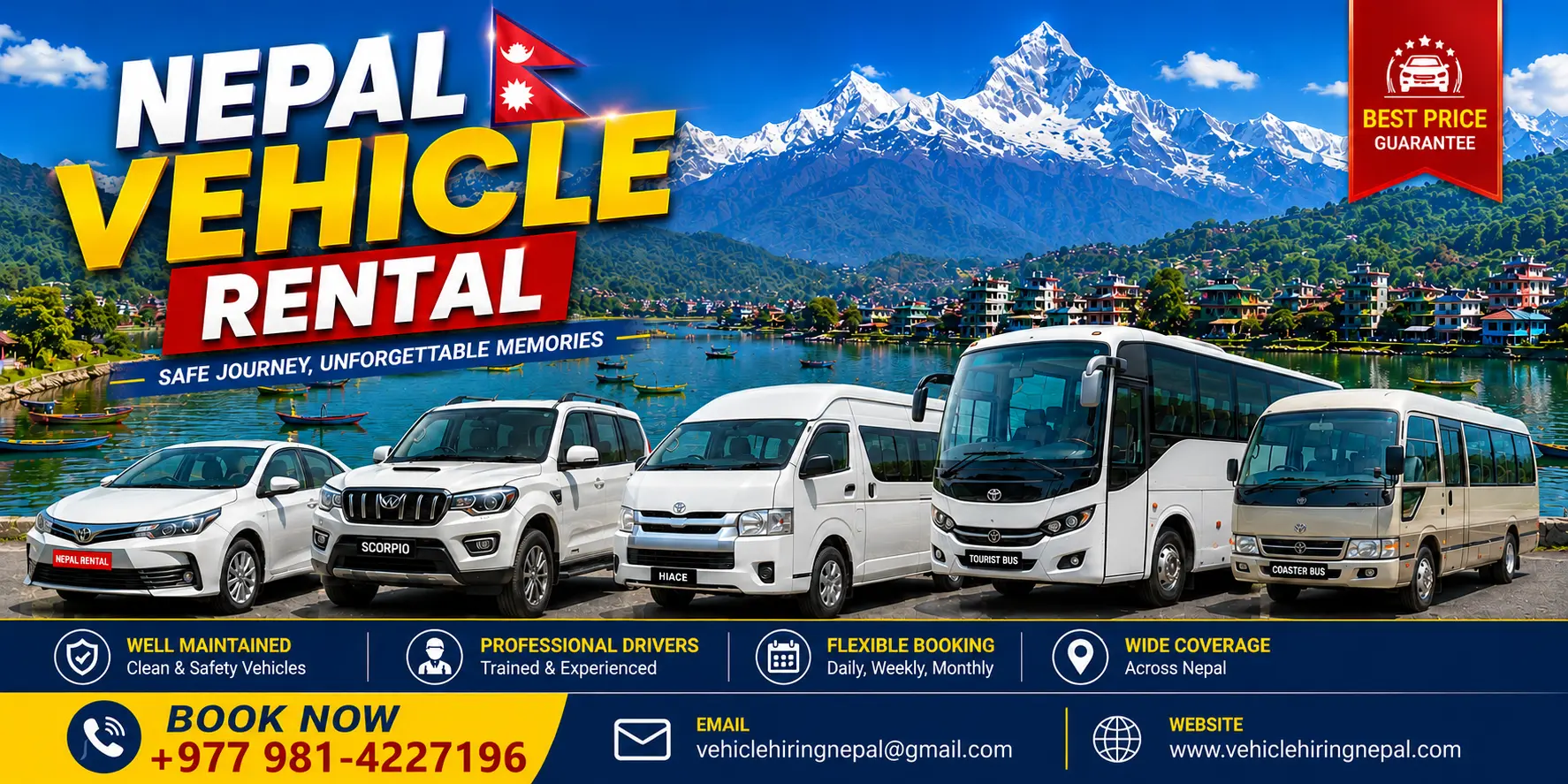
Future of Vehicle Rental Nepal — Trends, Growth and What’s Next and Beyond
Nepal’s vehicle rental industry stands at one of the most significant inflection points in its history. The country’s tourism sector — which generates approximately 7 to 8 percent of GDP and supports hundreds of thousands of livelihoods across the vehicle hire, trekking, hospitality, and guiding sectors — is simultaneously experiencing rapid demand growth and navigating a period of accelerating structural change in technology, vehicle technology, road infrastructure, and traveler behaviour. Operators that understand these changes—and position their services ahead of trends rather than behind them—will define Nepal’s vehicle rental landscape for the decade ahead.
Nepal Vehicle Hiring Pvt Ltd has operated private vehicle hire services across Nepal’s complete road network through multiple cycles of change — the post-earthquake 2015 tourism recovery, the COVID-19 disruption and post-pandemic rebound, the infrastructure improvements that have progressively extended the road network toward trekking trailheads, and the natural disaster events like the August GLOF that periodically reshape routing and demand patterns. This guide examines the key forces shaping the future of vehicle rental in Nepal—from electric vehicle adoption and road infrastructure development to digital booking platforms, luxury segment growth, and the evolving expectations of Nepal’s international visitors.
Nepal’s Tourism Growth — The Demand Foundation
Nepal’s international visitor arrivals have grown by an average of 8 to 12 per cent per year over the past decade (excluding COVID-19 disruption years), and the country’s tourism development targets are ambitious: Nepal’s Visit Nepal campaigns and Tourism Master Plan projections point toward sustained visitor growth through 2030 and beyond. This growth is the foundational demand driver for vehicle rental. Each additional international visitor needs airport transfers, Kathmandu sightseeing car hire, Pokhara-to-Chitwan private vehicle hire, and trekking trailhead jeep hire. Sustained tourism expansion drives aggregate demand growth, creating a vehicle rental market that will be structurally larger in 2030 than it is today.
The specific growth segments within Nepal’s tourism market that will drive the strongest vehicle rental demand increase are: the luxury and premium tier (which requires the highest-specification vehicles — Scorpio, Hiace van hire, tourist coaster); the MICE segment (conference delegates and corporate incentive groups who need fleet-scale vehicle coordination); and the domestic Nepal tourism market, which has grown significantly as Nepal’s middle class expands and weekend travel becomes a normal leisure pattern for Kathmandu’s growing urban population.
Nepal’s Vehicle Rental Market — The Baseline
Before examining the future, understanding the current baseline of Nepal’s vehicle rental market provides the context for assessing how significant each future trend will be. In 2026, Nepal’s private vehicle hire market is served by a mix of fully professional operators, mid-tier semi-professional services, and a large informal sector of individual vehicle owners who offer casual hire. The professional segment—operators like Nepal Vehicle Hiring Pvt Ltd that offer all-inclusive pricing, verified vehicles, route-experienced drivers, and real-time communication— accounts for about 20 to 30 per cent of Nepal’s total private vehicle hire volume, but a higher share of international tourism vehicle hire spend.
The market’s dominant vehicle types are the 4WD Scorpio and Hilux jeep for mountain approach roads, the Toyota Corolla sedan for urban and highway tourist routes, the Toyota Hiace van for medium groups, the tourist coaster for large groups on major routes, and the full tourist bus for the largest pilgrimage and conference groups. The dominant booking channels are WhatsApp direct contact, hotel concierge referral, and word-of-mouth recommendation — with digital platform booking growing but still secondary to personal relationship and direct operator contact. Pricing is primarily negotiated rather than published — a market characteristic that professional operators with transparent all-inclusive pricing are progressively changing as they demonstrate the value of price certainty.
This 2026 baseline — growing but fragmented, professional-informal mix, personal-channel dominant — is the platform from which all the future trends described in this guide will develop. Operators that understand each trend’s direction and position their services accordingly will capture a disproportionate share of Nepal’s vehicle rental market growth and beyond. Nepal Vehicle Hiring Pvt Ltd‘s positioning — professional standards, transparent pricing, digital accessibility, route coverage, and safety leadership — is designed for this trend direction. Plan your Nepal vehicle hire through our plan trip page or contact us at +977 9814227196.
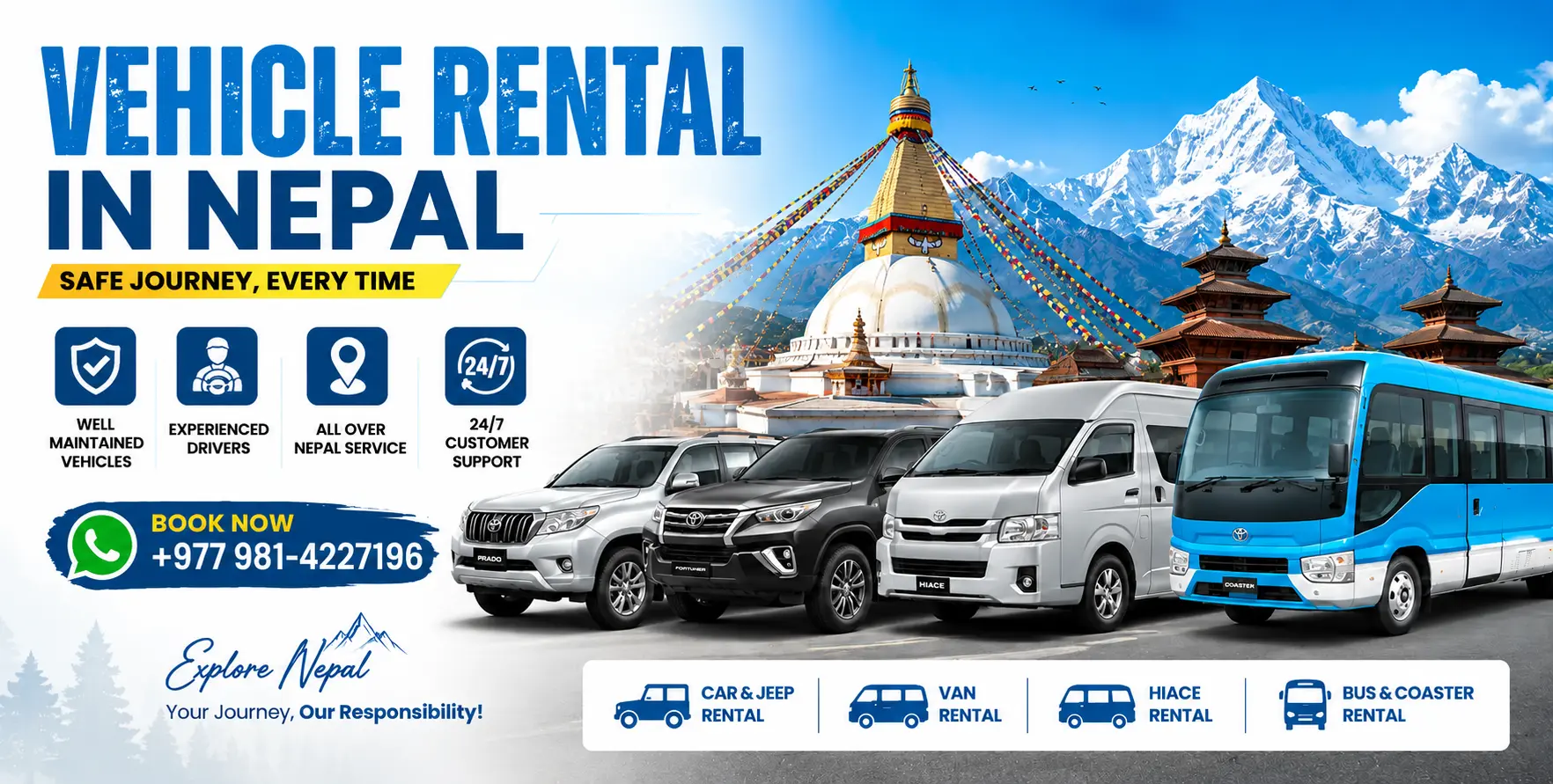
Electric Vehicles — Nepal’s Clean Energy Transport Transition
Nepal’s vehicle fleet is undergoing a significant electrification transition that will progressively reshape the vehicle rental market over the coming 5 to 10 years. Nepal has one of the world’s highest hydroelectric power generation potentials relative to population — the country generates virtually all of its electricity from renewable hydropower — making electric vehicle adoption environmentally logical in a way that is unusual even by global EV-transition standards. A Nepali EV charged on the national grid runs on clean hydropower; the same EV in most other countries draws on a mixed or fossil-fuel-based grid.
Electric vehicles are already present in Nepal’s urban vehicle rental market—electric three-wheelers (tempos) have served Kathmandu’s urban routes for over two decades, and full-size electric cars and SUVs entered the market in the 2020s, supported by tax incentives that the Nepal government has periodically adjusted to manage import and forex implications. The specific EV models now available in Nepal—including Chinese- and Indian-manufactured electric SUVs and sedans- are—are re-entering the mid-range private car hire segment for urban routes and highway corridors where charging infrastructure is accessible.
For Nepal’s mountain road trekking trailhead transfers — the segment that most defines Nepal’s vehicle rental market internationally — EV adoption faces a more significant challenge: charging infrastructure on the Besisahar gorge road, the Soti Khola approach, and other remote approach corridors is not yet established. The 4WD diesel Scorpio and Hilux currently serve these routes. They will remain the appropriate vehicle for mountain approach transfers in the immediate term, with EV adoption most likely occurring first on paved highway tourist routes where charging infrastructure develops more readily. Nepal Vehicle Hiring Pvt Ltd monitors EV market development in Nepal’s vehicle rental context and will integrate electric vehicles as the charging infrastructure and vehicle capability reach the standard required for professional client service.
Road Infrastructure Development — Expanding Nepal’s Vehicle Rental Geography
Nepal’s Department of Roads has been progressively extending and improving the road network that reaches Nepal’s trekking trailheads—a structural change that directly expands the geography of vehicle rental by reducing the walking distance between the road end and the trekking start point. The extension of the jeep road from Machha Khola toward Jagat on the Manaslu Circuit corridor, the improvement of the Besisahar-to-Manang road in the Annapurna Conservation Area, and the ongoing extension of vehicle access on multiple eastern and western Nepal district roads all represent the Department of Roads’ sustained commitment to road network expansion that progressively brings more Nepal destinations within reach of private vehicle hire.
This road expansion has two parallel effects on Nepal’s vehicle rental market: it extends the vehicle hire leg of each trailhead transfer further into the mountain corridor (replacing 1 to 2 days of walking with a further 1 to 2 hours of driving), and it opens new vehicle rental destinations in districts that previously had no road access. The growing network of district roads in the Karnali, Sudurpashchim, and Madhesh provinces—regions where road coverage was historically minimal—creates new vehicle rental demand corridors as rural communities gain road access and tourism infrastructure follows the road network into previously inaccessible areas.
The Panch Pokhari trek transport corridor in Sindhupalchok and the Rolwaling approach via the Tamakoshi valley are examples of approach roads that have improved sufficiently in recent years to support regular private vehicle hire service where this was not previously practical. This road development trajectory will continue — and Nepal Vehicle Hiring Pvt Ltd tracks road improvements specifically to extend our service coverage to new destinations as roads reach the quality required for professional private vehicle hire.
Digital Booking Platforms — Nepal’s Vehicle Rental Goes Online
The global shift to online and app-based service booking has reached Nepal’s vehicle rental market, and its impact on how travellers find, compare, and book private vehicle hire will accelerate through 2026 and beyond. Travellers planning a Nepal visit from London, Sydney, or Tokyo now expect to research vehicle hire options, compare operators, and confirm bookings through the same digital channels they use for flights and hotels—not to negotiate in person at a Thamel street corner on arrival.
Nepal Vehicle Hiring Pvt Ltd’s plan trip page represents the first generation of this digital booking transition — a web-based submission form that accepts complete itinerary specifications and returns confirmed all-inclusive quotes within hours, accessible from any device in any time zone. The WhatsApp booking channel at +977 9814227196 extends this digital accessibility to the world’s most widely used messaging platform, meeting travellers on the communication channel they already use for international connectivity.
The next generation of digital vehicle rental booking in Nepal will likely involve: real-time availability and pricing transparency comparable to the hotel booking platforms travellers already use; GPS tracking of booked vehicles in transit, viewable by the client; digital payment options that eliminate cash settlement at journey end; and integration between trekking booking platforms and ground transport booking so that the Annapurna Circuit trek booking and the Besisahar jeep transfer booking are completed in the same transaction. Nepal Vehicle Hiring Pvt Ltd is committed to evolving with this digital booking transition — keeping our service standards consistent across the new channels as they develop.
The Luxury Vehicle Rental Segment — Nepal’s Premium Future
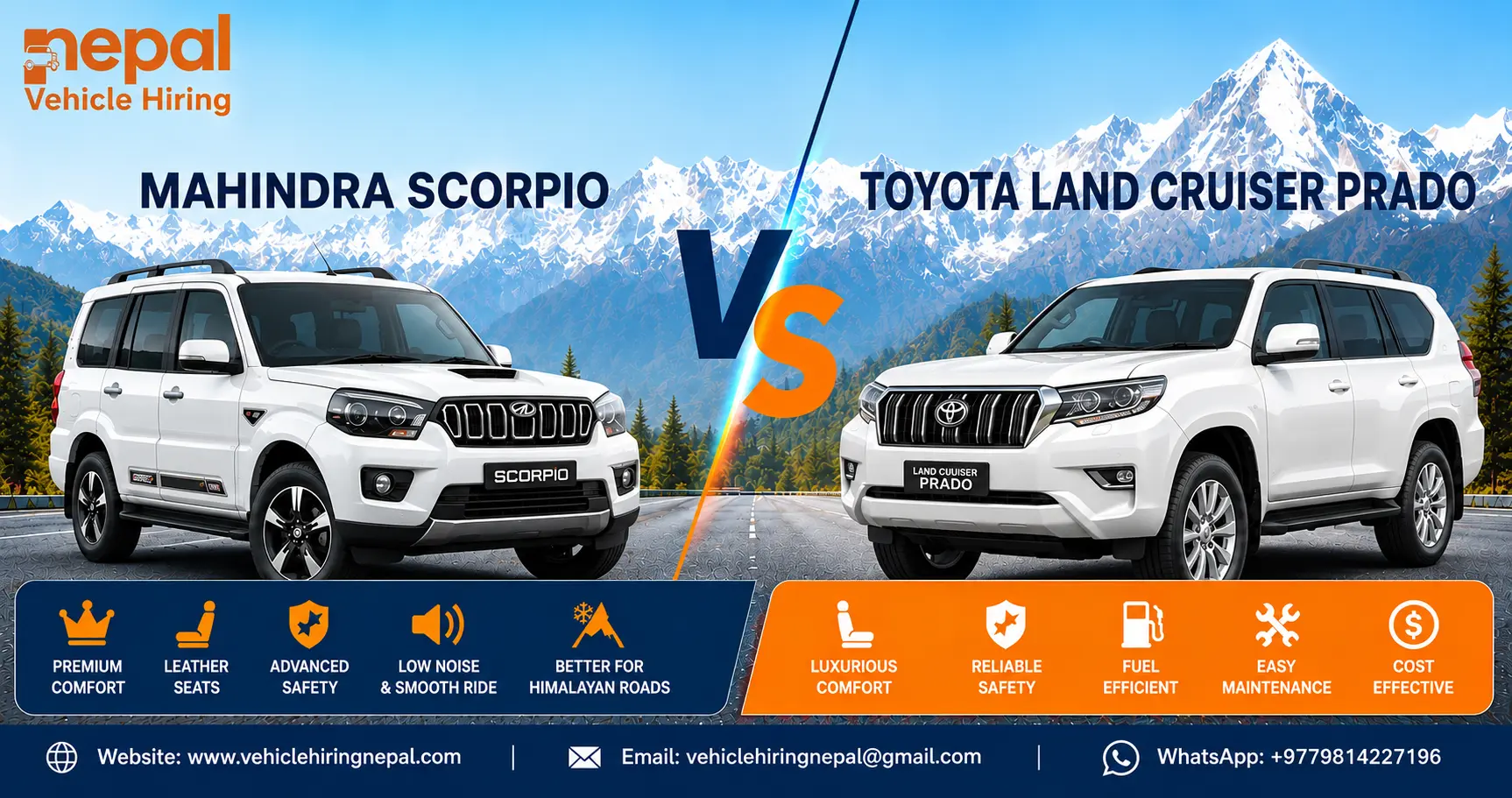
Nepal’s luxury tourism market has grown faster than the overall tourism market in recent years—driven by the global expansion of high-net-worth adventure travel that targets Nepal as a Himalayan bucket-list destination. The luxury Everest Base Camp lodge trek and Alpine Luxury Treks’ premium Himalayan experiences rely on a vehicle rental market that must provide Land Cruiser Prado convoys, uniformed drivers, airport meet-and-greet, and the VIP service standard luxury Nepal visitors expect at every touchpoint.
The luxury vehicle rental segment’s growth drivers for 2026 and beyond include: the maturation of Nepal’s premium trekking lodge network (which attracts a client profile that expects luxury-standard ground transport alongside luxury accommodation); the growing Chinese and Southeast Asian luxury travel market whose Nepal interest continues to grow; and the European and North American high-net-worth traveler for whom a Nepal private helicopter charter combined with a Land Cruiser Prado ground transport programme represents the ideal adventure luxury format. Nepal Vehicle Hiring Pvt Ltd’s VIP fleet—Land Cruiser Prado hire, Toyota Fortuner, and Toyota Hiace van hire for premium group transport—is specifically positioned for this growing luxury segment.
Post-GLOF Rerouting — The New Nepal Transport Geography
The August glacial lake outburst flood that destroyed the Rasuwagadhi-Kerung border crossing has permanently shifted Nepal’s transport geography and will shape vehicle rental demand patterns for several years. The Langtang Valley approach via the Pasang Lhamu Highway — one of Nepal’s most popular trekking transport corridors for the Langtang Valley trek — has been significantly disrupted. The Kailash Mansarovar yatra overland via Kerung has been eliminated. Increased helicopter and flight demand on the Hilsa-Simikot-Nepalgunj corridor has created a new ground transport requirement at Nepalgunj that didn’t exist at the same scale before August.
These changes create specific vehicle rental demand shifts: reduced Kathmandu to Syabrubesi jeep hire demand while the road is disrupted; increased demand for helicopter alternatives and the Kathmandu airport transfer for Langtang visitors who now fly to Kyanjin Gompa; and increased Nepalgunj-to-Kathmandu private vehicle hire demand as Kailash yatra return traffic reroutes through the Hilsa-Nepalgunj corridor. Nepal Vehicle Hiring Pvt Ltd has adapted to these shifts in real time—extending our Nepalgunj service capacity and monitoring the Pasang Lhamu Highway reconstruction progress to resume the Syabrubesi route.
The reconstruction of the Rasuwagadhi-Kerung border crossing — expected to take 12 to 24 months from the August event — will restore the Langtang approach corridor and the Kerung-based Kailash route. When restoration is complete, Nepal Vehicle Hiring Pvt Ltd will resume full Kathmandu-to-Dhunche and Syabrubesi jeep service to our full pre-event service standard.
Sustainable Tourism — The Green Transport Imperative
International tourism’s sustainability expectations will increasingly shape Nepal’s vehicle rental market. European and North American travellers—who represent Nepal’s largest high-spend tourist source markets—are increasingly making travel decisions that factor in carbon footprint, environmental impact, and the sustainability practices of tour operators and transport providers. Vehicle rental operators who cannot demonstrate sustainable practices — lower-emission vehicles, responsible driving practices, carbon offset programmes — will face growing preference disadvantage in the market segments where sustainability is most weighted in booking decisions.
The specific sustainability practices that Nepal’s vehicle rental future demands: the progressive adoption of hybrid and electric vehicles for urban and highway routes as charging infrastructure develops; the use of well-maintained vehicles (properly tuned engines produce lower emissions than poorly maintained ones) as a dual safety and environmental practice; route optimisation that minimises unnecessary fuel consumption on long-distance bookings; and the transparent communication of vehicle emission standards that gives booking clients the information to make sustainability-informed choices.
Nepal Vehicle Hiring Pvt Ltd is committed to this sustainability transition — maintaining our vehicle fleet at the highest mechanical standard (which directly reduces per-kilometre emissions through optimal engine performance), monitoring EV developments in Nepal’s 4WD market for mountain road applicability, and providing booking clients with accurate vehicle information so that sustainability-conscious travellers can make informed choices. Our car hire in Nepal, jeep hire, and bus hire services will evolve toward lower-emission vehicles as the market and infrastructure allow.
The Domestic Nepal Tourism Market — The Rising Demand Layer
Nepal’s domestic tourism market has grown substantially over the past decade — a product of rising middle-class incomes in Kathmandu, Pokhara, Biratnagar, and the Terai cities; the democratisation of weekend leisure travel as road infrastructure reaches more destinations; and the cultural shift among Nepal’s urban youth toward outdoor recreation, heritage tourism, and domestic travel as valued leisure activities. This domestic market growth adds a significant new demand layer to Nepal’s vehicle rental sector, which operates largely independently of international tourism cycles.
Domestic Nepal tourists drive the specific vehicle rental demand for: Kathmandu Valley day trip vehicles (Nagarkot, Bhaktapur, Panauti, Godavari); Pokhara car hire for domestic visitors to the Annapurna region; weekend camping approach jeep hire for Kathmandu’s growing outdoor recreation community; and the Lumbini pilgrimage bus charters and Muktinath yatra vehicles that serve Nepal’s own Hindu and Buddhist pilgrimage communities. This domestic demand provides vehicle rental operators with a year-round booking base that complements the seasonal peaks of international trekking and tourism.
Nepal’s Tourism Targets — What They Mean for Vehicle Hire
Nepal’s government-set tourism targets aim to reach 2 million international visitors annually—roughly double the pre-COVID peak and a significant growth trajectory from the 2026 base. Achieving this target requires parallel investment in three areas: aviation access (new international routes and frequency on existing routes), accommodation capacity (hotels and trekking lodges across the range from budget to luxury), and ground transport (the vehicle hire, road infrastructure, and driver capacity to serve a doubled visitor volume without proportionally doubling journey times and quality degradation).
The ground transport implications of Nepal’s 2030 visitor target are substantial: doubled visitor numbers mean approximately doubled airport transfer demand, doubled Kathmandu sightseeing car hire bookings, doubled Kathmandu to Pokhara private vehicle volume, and doubled trekking trailhead jeep hire demand. Meeting this demand without degrading service quality requires larger vehicle fleets across all operators, more licensed and trained drivers (particularly those with mountain-road experience), and booking management systems that coordinate higher volume, which often creates service lapses. Nepal Vehicle Hiking Pvt Ltd is scaling our operational capacity to meet this demand growth—expanding our fleet, training additional route-experienced drivers, and developing systems to handle higher current booking volumes while maintaining our communication standards.
The tourism target also emphasises quality over quantity in Nepal’s tourism strategy — the government and tourism industry recognise that higher-spending visitors create more economic value per arrival than budget visitors, and that Nepal’s natural and cultural assets support a premium pricing strategy that lower-volume, higher-quality tourism serves better than mass-market arrival maximisation. This quality emphasis directly supports the premium private vehicle hire market—the Land Cruiser Prado hire, Toyota Hiace van hire, and the complete professional service Nepal Vehicle Hiring Pvt Ltd provides.
Nepal’s Chinese and Indian Visitor Markets — The Growth Markets of the Future
Nepal’s two largest and fastest-growing international visitor source markets—India and China—represent the biggest growth opportunity for Nepal’s vehicle rental industry in the decade ahead. Indian visitors already make up the largest single nationality in Nepal’s international visitor count. The growth potential remains enormous: India’s rapidly expanding middle class, its strong cultural and religious ties to Nepal (shared Hindu and Buddhist sacred sites), and increasingly easy air and land connectivity between the two countries all point to sustained growth in Indian visitor numbers.
Indian visitors create specific vehicle rental demand patterns that are already well-established in Nepal’s market: Muktinath yatra vehicle hire from the Sunauli border, Lumbini pilgrimage bus charters, Kathmandu to Pokhara private vehicle hire for multi-city Nepal circuits, and — increasingly — the adventure trekking market as Indian outdoor recreation culture grows. Nepal Vehicle Hiring Pvt Ltd serves Indian visitor groups through both direct bookings and an India-based tour operator partnership network that coordinates Nepal ground transport on behalf of clients visiting Nepal.
Chinese visitors to Nepal — historically significant before COVID-19, in recovery since — represent the highest per-visitor spend in Nepal’s tourism market and the strongest demand for luxury and premium vehicle hire. Chinese visitors from top-tier cities typically seek the highest-specification vehicle available, the most professional driver presentation, and complete logistics coordination that Mandarin-speaking international travellers expect from premium travel services. The Chinese premium visitor market prioritises Land Cruiser Prado VIP hire, private Hiace van hire, and Kathmandu airport VIP transfers with name board meet-and-greet. Alpine Luxury Treks coordinates the luxury end of the Chinese visitor market for Nepal, with Nepal Vehicle Hiking Pvt Ltd providing the ground transport for all luxury-tier Chinese visitor groups.
Climate Change and Nepal’s Vehicle Rental — Adapting to a Changing Mountain Environment
Climate change is reshaping Nepal’s mountain environment in ways that will increasingly affect vehicle rental operations — through the intensification of extreme weather events, the acceleration of glacial retreat that changes river flow patterns and road vulnerability, and the shifting of seasonal precipitation patterns that alter the reliability of Nepal’s mountain road network through the year.
The August 2026 GLOF that destroyed the Syabrubesi corridor is one manifestation of this climate-change reality—glacial lake outburst floods are becoming more frequent as Himalayan glaciers retreat. The glacial lakes they leave behind grow larger and less stable. Road infrastructure built in glacial river valleys — precisely where many of Nepal’s most important trekking approach roads are located — faces increasing vulnerability to these events. For Nepal’s vehicle rental industry, this vulnerability means: a higher frequency of route disruption events that require rerouting or temporary suspension, a stronger premium on real-time road condition monitoring as the key safety practice, and the increasing value of the operator’s adaptability and communication quality as the variables that distinguish professional service from informal hire when conditions change unexpectedly.
Nepal Vehicle Hiring Pvt Ltd has invested in the specific operational practices that climate change demands of Nepal’s responsible vehicle hire operators: the morning-of road condition confirmation that catches overnight weather events before a vehicle departs; the driver network intelligence that provides real-time information from routes in progress; the honest client communication when a departure must be delayed for safety; and the routing flexibility that identifies alternative approaches when the primary route is disrupted. These practices are our adaptation to Nepal’s increasingly variable mountain environment — and they will become more, not less, important as climate change continues to affect the Himalayan landscape that our private vehicle hire service operates within.
MICE Tourism — Nepal’s Corporate Travel Future
Nepal’s MICE (meetings, incentives, conferences, and exhibitions) tourism market is one of the sector’s fastest-growing segments — driven by Nepal’s investment in international-standard conference infrastructure in Kathmandu and Pokhara, by the country’s growing reputation as an Asia-Pacific incentive travel destination, and by the specific appeal of Nepal’s adventure activities (helicopter tours, trekking, wildlife safaris) as unique incentive programme elements that competing MICE destinations cannot replicate.
MICE groups create specific vehicle rental demand that differs from individual tourist bookings: the need for fleet-scale coordination (10 to 50 vehicles on the same schedule), the professional presentation standards expected by corporate clients (uniformed drivers, on-time convoy discipline), and the event-day logistics management that conference organisers need from their transport provider. Nepal Vehicle Hiring Pvt Ltd’s MICE transport capability— a private car fleet for VIP executive transport, a Hiace van fleet for delegate sub-groups, a Coaster fleet for full delegate movements, and bus charters for the largest groups—positions us well for Nepal’s growing MICE transport demand.
Safety Regulation Evolution — Nepal’s Transport Safety Future
Nepal’s transport safety regulation has been progressively strengthened by the Department of Roads and the Traffic Police — a trend that will continue as Nepal’s vehicle fleet modernises, as GPS and telematics become standard vehicle equipment, and as the government’s commitment to reducing Nepal’s road accident statistics translates into regulatory requirements that professional operators already meet. Still, informal operators must now meet these requirements or exit the market.
The specific regulatory trends that will shape Nepal’s vehicle rental future: mandatory vehicle GPS tracking for commercial passenger transport (which professional operators like Nepal Vehicle Hiking Pvt Ltd can readily accommodate); mandatory driver training certification for mountain road assignments (which formalises the route-experience assignment practice that professional operators already follow); stricter vehicle age and emission standards that will progressively retire the oldest commercial vehicles from the market; and insurance requirement increases that raise the operating cost baseline for all commercial transport operators.
These regulatory trends will improve Nepal’s road safety outcomes — and will consolidate the professional end of the vehicle rental market while reducing the informal, unregulated sector that currently competes on price below the cost of safe, professional operation. For Nepal Vehicle Hiring Pvt Ltd, the safety regulation trajectory is confirmation that our operating standards — already meeting and exceeding current requirements — position us correctly for Nepal’s regulatory future. Our private vehicle hire standards are built for the professional market’s future, not just its present.
The Besisahar Road — A Case Study in Nepal Road Progress
The Besisahar to Manang jeep road in the Marsyangdi River gorge is one of Nepal’s most dramatic examples of progressive road extension. Over a decade, this route moved the effective Annapurna Circuit trek starting point from Besisahar northward through Syange, Jagat, Chamje, and Tal to Dharapani and eventually to Chame and beyond. Each extension of the jeep road reduced the walking days on the lower gorge section and increased the vehicle hire distance from Kathmandu — shifting the Besisahar private vehicle hire from a simple 175-kilometre highway and gorge-road transfer into an increasingly extended mountain road experience that now takes 7 to 10 hours from Kathmandu to the current road-end point.
This case study illustrates the broader pattern of Nepal’s road extension impact on vehicle rental: as roads extend, walking days decrease and demand for vehicle hire increases. Trekkers who previously walked 4 days from Besisahar to Chame now drive 7 to 10 hours from Kathmandu to Chame. This shift substantially increases vehicle hire revenue per trekker while reducing porter work on the lower gorge section. The same pattern is playing out on the Manaslu Circuit approach road from Soti Khola toward Jagat. The same pattern will play out on every other Nepal trekking corridor where road extension is ongoing. For Nepal Vehicle Hiring Pvt Ltd, road extension is the single most powerful long-term driver of private vehicle hire revenue growth. Each kilometre of new mountain road creates a new kilometre of vehicle hire demand.
WhatsApp Booking — Nepal’s Digital Transport Channel
Nepal’s adoption of WhatsApp as the primary business communication channel has fundamentally changed the vehicle rental booking experience in ways that the broader global trend toward app-based booking has not yet displaced in Nepal’s specific context. WhatsApp’s combination of instant messaging, voice calls, photo and document sharing, and group communication makes it uniquely suited to the real-time coordination demands of Nepal’s vehicle rental market — where road condition updates, departure time adjustments, loading assistance confirmations, and return vehicle date changes all happen through a single communication thread.
Nepal Vehicle Hiring Pvt Ltd’s WhatsApp contact at +977 9814227196 has become the primary communication channel for many of our international bookings—used for initial enquiries, quote confirmations, evening-before driver details, morning-of road condition updates, and travel-day coordination. WhatsApp’s convenience for international travellers—available on every smartphone, requiring no additional app and compatible with standard international data plans—makes it the most accessible booking channel for Nepal vehicle hire across all client geographies.
The future evolution of this channel will likely include: WhatsApp Business API integration that allows automated booking confirmations and status updates; richer media sharing (360-degree vehicle photos, route video previews) within the booking conversation; and payment integration as WhatsApp Pay or similar services reach Nepal’s financial infrastructure. The underlying principle — that real-time, personal, flexible communication is the right channel for Nepal’s complex mountain road vehicle hire — will remain valid regardless of the specific platform evolution. Nepal Vehicle Hiring Pvt Ltd will evolve our communication channels with the market while maintaining the real-time responsiveness that Nepal’s vehicle rental requires. Book through +977 9814227196 or our plan trip page.
Nepal’s Aviation and Ground Transport Integration
Nepal’s domestic aviation network and ground transport system are increasingly interdependent—each mode serves segments and corridors where it has specific advantages, and their integration creates Nepal’s complete mobility network. The helicopter and domestic flight network serves the most remote mountain destinations (Simikot, Lukla, Dolpo, Humla), the main scheduled network connects the major cities (Kathmandu, Pokhara, Biratnagar, Nepalgunj), and the ground transport network connects everything else — the great mass of Nepal’s road-accessible destinations that aircraft cannot serve at the required frequency and cost.
The future of this aviation-ground integration is closer and more seamless coordination between the modes: the Nepal trtravellerho flies Kathmandu-to-Pokhara (20 minutes by domestic flight) and then needs the Pokhara car hire for the Lakeside hotel transfer and the Sarangkot sunrise vehicle the following morning; the Kailash yatra pilgrim who flies Kathmandu-to-Nepalgunj and then needs the Nepalgunj-to-border private vehicle hire; and the Langtang trekker who hflies by helicopterto Kyanjin Gompa and needs the Kathmandu airport transfer back from the helicopter landing. These aviation-ground connection bookings — managed as integrated transport arrangements rather than separate aviation and vehicle bookings — are an increasingly important service category for Nepal Vehicle Hiring Pvt Ltd.
The growth of Nepal’s domestic aviation network (new domestic airports in Taplejung, Bajhang, and other district headquarters; increased frequency on existing routes) will create new aviation-to-ground transport connection demand points. Each new domestic airport creates a corresponding ground transport need for connecting vehicle hire from the airport to the trek start, pilgrimage site, or tourism destination. Nepal Vehicle Hiring Pvt Ltd monitors Nepal’s domestic aviation development and expands our ground transport coverage to new airport connection points as domestic aviation reaches them.
Young Nepal TTravellers— The Domestic Adventure Tourism Generation
Nepal’s domestic adventure tourism sector is being shaped by a generation of young Nepali travellers university students, young professionals, and outdoor recreation enthusiasts in their 20s and 30s whose approach to leisure travel differs fundamentally from their parents’. Where the previous generation’s domestic travel was primarily pilgrimage-focused and family occasion-based, the emerging generation combines pilgrimage visits with outdoor recreation, heritage exploration, and the kind of experiential travel that international tourism guidebooks have long promoted but that domestic Nepali travellers are now claiming for themselves.
This young domestictravellerr generation creates specific vehicle rental demand patterns: weekend Kathmandu Valley day trip car hire for Nagarkot, Kakani, and Dhulikhel; camping equipment jeep rental for weekend camping at Shivapuri, the Helambu ridgelines, and near-Kathmandu Valley camping zones; Pokhara car hire for the Lakeside experience and Sarangkot sunrise vehicle; and the Kathmandu to Pokhara private vehicle hire for multi-day domestic holiday circuits. This domestic demand is growing faster than Nepal’s international tourism market in proportional terms — and it gives Nepal Vehicle Hiking Pvt Ltd a robust, year-round booking base that insulates our business from the seasonal and geopolitical volatility international tourism faces.
Nepal’s Road Safety Future — Towards Zero Preventable Accidents
Nepal’s road safety trajectory—driven by government policy, international development agency programmes, and commercial pressure from professional vehicle hire operators like Nepal Vehicle Hiring Pvt Ltd, which model higher safety standards—points toward a future where Nepal’s road accident rate converges toward the lower levels achieved by more regulated markets. The specific interventions that will drive this improvement include: mandatory vehicle fitness certificates with stricter inspection standards that reduce the proportion of mechanically unfit vehicles in commercial service; mandatory GPS and telematics for commercial passenger vehicles that creates accountability for speeding, harsh braking, and route deviation; driver fatigue management regulations that restrict the continuous driving hours allowed for commercial passenger transport drivers; and the progressive upgrading of Nepal’s mountain road infrastructure that reduces the hazard density on the most dangerous sections.
For Nepal Vehicle Hiring Pvt Ltd, this safety regulation trajectory validates our operating approach — our pre-departure vehicle checks, route-experienced driver assignment, maximum daily driving time policy, and 24/7 client communication are practices that the future regulatory environment will require of all operators but that we already deliver as standard. We have already built future regulatory compliance costs into our service model. The private car hire, 4WD jeep hire, Hiace van hire, and bus hire that Nepal Vehicle Hiring Pvt Ltd provides are not just meeting today’s standards — they are built for Nepal’s transport safety future. Contact our team at+977 9814227196 or through our plan trip page.
The Trekking Industry’s Future — More Trekkers, More Vehicle Hire
Nepal’s trekking industry is projected to grow substantially — driven by global outdoor recreation trends, the specific marketing appeal of the Himalayan trekking experience among the global adventure travel community, and the growing accessibility of Nepal for Asian traveller markets (particularly from India, China, and Southeast Asia) as regional air connectivity improves. Every additional trekker on the Everest Base Camp trek, the Annapurna Circuit, the Langtang Valley trek, or the Manaslu Circuit is a private jeep hire booking for the approach and return transfer—the ground-transport foundation of the trekking experience that grows proportionally with the trek market.
The trekking industry’s future growth will also extend to less-visited corridors, the Kanchenjunga Base Camp trek, the Rolwaling Valley, the Helambu circuit, and Nepal’s dozens of lesser-known but high-quality trekking corridors, s gmainstream trekking infrastructure congestion drives experienced trekkers toward less-crowded alternatives. This mainstream shift will create new demand for vehicle hire on currently low-volume approach roads, which will grow rapidly as trekkers shift their attention.
The Future of Trekking Support Vehicles — Beyond the Road-End
The trekking support vehicle concept — the 4WD jeep positioned at the road-end throughout a trek for kitchen team advance deployment, resupply, and emergency evacuation — will become more sophisticated and more widely used as Nepal’s camping and supported trekking market grows. The future trekking support vehicle will integrate satellite communication (allowing the trek leader on the trail to communicate directly with the driver at the road-end regardless of mobile network coverage), GPS tracking that the trekking operator can monitor from Kathmandu, and the pre-loaded emergency evacuation protocol that connects the road-end vehicle to the nearest helicopter evacuation operator for high-altitude medical emergencies.
Nepal Vehicle Hiring Pvt Ltd’s trekking support vehicle service for Manaslu Circuit camping treks, Annapurna Circuit camping expeditions, and Rolwaling Valley camping approaches will evolve as satellite communication devices and GPS tracking become standard equipment for Nepal’s professional trekking vehicle fleet. Alpine Luxury Treks and Trek Nepal Himalayas’ guided camping programmes will integrate these capabilities as they develop, providing clients with the most advanced trekking support-vehicle coordination available in Nepal.
The Future Route Network — New Nepal Trekking Corridors Opening
Nepal’s expanding road network is progressively opening new trekking corridors for vehicle-supported access—destinations that 10 years ago required 5 to 7 days of approach walking now require 1 to 2 days of driving followed by 2 to 3 days of trekking. This compression of approach time is opening Nepal’s remote trekking corridors to a broader range of visitors while creating new demand for private vehicle hire and roads that previously generated no vehicle rental traffic.
The corridors most likely to see significant road extension and corresponding vehicle hire growth through 2030: the far-western Nepal districts (Humla, Jumla, Mugu, Dolpa) where road construction is currently active and where each completed kilometre opens new access to one of Nepal’s finest and most remote trekking environments; the far-eastern corridors (Taplejung, Sankhuwasabha) where the Kanchenjunga Base Camp approach road is gradually improving; and the mid-western hill districts (Myagdi, Baglung, Parbat) where district road networks are expanding into the Annapurna Conservation Area periphery and creating new trekking access points.
Nepal Vehicle Hiring Pvt Ltd specifically tracks Nepal’s road development programmespecifically —monitoring which new sections open to 4WD access each season and extending our private jeep hire coverage to new road-end points as they become accessible. Our contact team can advise on the current maximum drivable distance for any Nepal trekking approach corridor — information that changes as new road sections open and that our driver network tracks in real time. The future of Nepal’s vehicle rental geography is larger than today’s — and Nepal Vehicle Hiring Pvt Ltd will be present at every new road-end point as Nepal’s mountain access expands.
Nepal’s vehicle rental future is ultimately a story of progress: connecting more of Nepal’s extraordinary mountain, cultural, and wildlife destinations to international and domestic visitors through a ground transport network that is more professional, more accessible, more sustainable, and more technologically integrated than today’s. Every road kilometre extended, every electric vehicle charged on Nepal’s clean hydropower grid, every digital booking confirmed through the plan trip page, every young Nepali traveller who discovers the Nagarkot sunrise or the Bhaktapur heritage walk or the Besisahar gorge road approach for the first time in a private vehicle hire — each of these is a moment in the future of Nepal’s vehicle rental industry. Nepal Vehicle Hiring Pvt Ltd is committed to being part of that future at every kilometre of Nepal’s roads. Contact our team at +977 9814227196 to join us on our journey today.
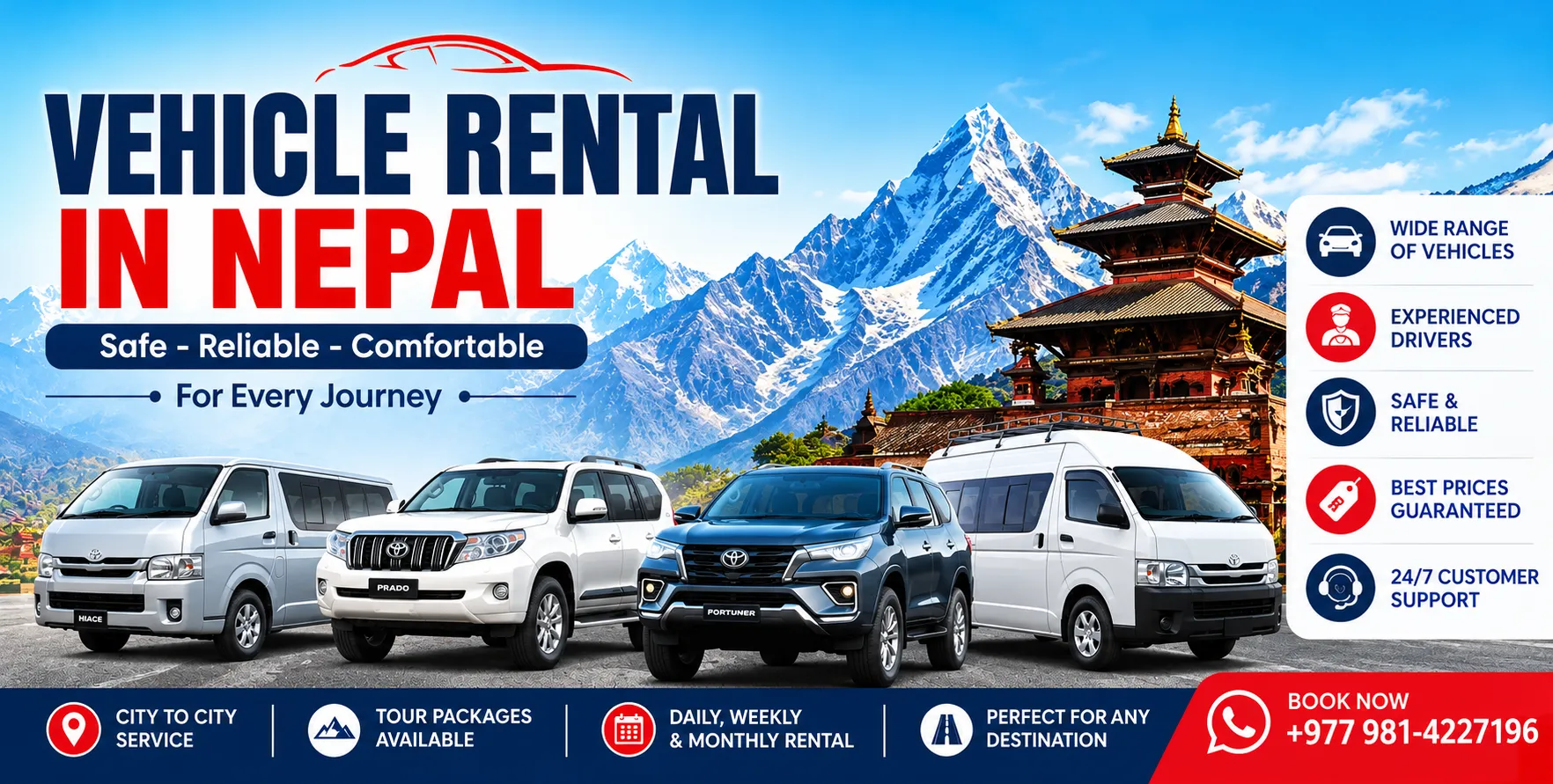
Nepal Vehicle Hiring Pvt Ltd — Positioned for Nepal’s Transport Future
Nepal Vehicle Hiring Pvt Ltd is Nepal’s professional private vehicle hire operator for the long term—not a market participant positioned only for today’s conditions, but a transport business committed to the standards, service evolution, and operational discipline Nepal’s vehicle rental future requires.
- Fleet modernisation: Upgrade vehicles as better-specification models become available, while maintaining the mechanical reliability and comfort standards our clients expect.
- EV readiness: Monitoring Nepal’s EV market for urban and highway route integration as charging infrastructure develops.
- Digital booking evolution: Plan trip page and WhatsApp (+977 9814227196) today; expanding digital booking capability as the market develops.
- Route expansion: Extending private vehicle hire coverage to new corridors as road infrastructure reaches new Nepal destinations.
- Safety standards leadership: Maintaining and exceeding Nepal’s transport safety regulations as they evolve.
- Luxury tier: VIP vehicle hire, Land Cruiser Prado, and premium service for Nepal’s growing luxury segment in partnership
- MICE capacity: Fleet-scale coordination for Nepal’s growing conference and corporate incentive market.
Frequently Asked Questions — Future of Vehicle Rental Nepal
Q: Will electric vehicles replace diesel jeeps on Nepal’s mountain roads?
Not in the near term. Charging infrastructure on Nepal’s trekking approach roads does not yet support EV operation. Diesel 4WD jeeps will continue to serve mountain road transfers for the foreseeable future, with EV adoption occurring first on paved urban and highway routes.
Q: How will road improvements affect vehicle hire costs in Nepal?
Road improvements reduce the rough-road premium that currently applies to mountain approach routes — as roads improve, the per-km cost of the Besisahar jeep hire and similar mountain transfers should decrease as surface quality and maintenance improve.
Q: Will online booking replace WhatsApp for Nepal vehicle hire?
Both will coexist — WhatsApp is deeply embedded in Nepal’s transport booking culture and provides the real-time flexibility that complex mountain road transfers require. Online booking will grow alongside WhatsApp, not replace it, particularly for advance itinerary planning.
Q: How is Nepal Vehicle Hiring Pvt Ltd preparing for Nepal’s transport future?
Through fleet modernisation, EV monitoring, digital booking development, route expansion as roads improve, and consistent safety standard leadership. Contact us at +977 9814227196 or via our plan trip page.
Conclusion
Nepal’s vehicle rental industry is entering a period of significant a,ccelerating transformation —diven by tourism growth, road infrastructure development, electric vehicle adoption, digital booking evolution, luxury market expansion, and the regulatory trend toward professionalisation that favours operators who already meet thfuturetandards. Nepal Vehicle Hiring Pvt Ltd is positioned for this future—with service standards, fleet quality, route coverage, and operational discipline that Nepal’s vehicle rental market will increasingly reward. Whether you are planning a Nepal visit today or building a Nepal travel programme and beyond, Nepal Vehicle Hiring Pvt Ltd is the transport partner whose service standards will be as relevant and reliable then as they are now.
Plan your Nepal transport — present and future — with Nepal Vehicle Hiring Pvt Ltd. Call or WhatsApp +977 9814227196, visit vehiclehiringnepal.com, or submit your itinerary through our plan trip page.
- Future of Vehicle Rental Nepal — Trends, Growth and What's Next and Beyond
- Nepal's Tourism Growth — The Demand Foundation
- Nepal's Vehicle Rental Market — The Baseline
- Electric Vehicles — Nepal's Clean Energy Transport Transition
- Road Infrastructure Development — Expanding Nepal's Vehicle Rental Geography
- Digital Booking Platforms — Nepal's Vehicle Rental Goes Online
- The Luxury Vehicle Rental Segment — Nepal's Premium Future
- Post-GLOF Rerouting — The New Nepal Transport Geography
- Sustainable Tourism — The Green Transport Imperative
- The Domestic Nepal Tourism Market — The Rising Demand Layer
- Nepal's Tourism Targets — What They Mean for Vehicle Hire
- Nepal's Chinese and Indian Visitor Markets — The Growth Markets of the Future
- Climate Change and Nepal's Vehicle Rental — Adapting to a Changing Mountain Environment
- MICE Tourism — Nepal's Corporate Travel Future
- Safety Regulation Evolution — Nepal's Transport Safety Future
- The Besisahar Road — A Case Study in Nepal Road Progress
- WhatsApp Booking — Nepal's Digital Transport Channel
- Nepal's Aviation and Ground Transport Integration
- Young Nepal TTravellers— The Domestic Adventure Tourism Generation
- Nepal's Road Safety Future — Towards Zero Preventable Accidents
- The Trekking Industry's Future — More Trekkers, More Vehicle Hire
- The Future of Trekking Support Vehicles — Beyond the Road-End
- The Future Route Network — New Nepal Trekking Corridors Opening
- Nepal Vehicle Hiring Pvt Ltd — Positioned for Nepal's Transport Future
- Frequently Asked Questions — Future of Vehicle Rental Nepal
- Conclusion

Related Blog & Articles
Kathmandu to Pikey Peak Trek Transport
4WD Himalayan Jeep in Nepal
ACAP Permit – The Annapurna Conservation Area Entry Pass: Complete Guide

Annapurna Circuit Jeep Tours Nepal