Plan a Trip


Places to Visit in Mustang Nepal: Budget Travel Guide
Places to Visit in Mustang, Nepal: Budget Travel Guide: Why Mustang Is Nepal’s Most Underrated Budget Destination
When travellers hear that Upper Mustang requires a USD 500 restricted area permit, many immediately assume the entire Mustang region of Nepal is out of reach for budget-conscious travellers. Th s assumption is both understandable and fundamentally incorrect — because Nepal’s Mustang region is not a single uniform landscape with a single price tag, but rather a vast and extraordinarily diverse highland territory divided into Lower Mustang and Upper Mustang sections that differ dramatically in terms of permit requirements, costs, accessibility, and the specific character of the cultural and natural experiences they offer. Lower Mustang, encompassing the famous destinations of Jomsom, Marpha, Muktinath, and Kagbeni, requires no special restricted area permit at all — only the standard Annapurna Conservation Area Permit (ACAP) that applies throughout the Annapurna region — and delivers one of the most spectacular and culturally rich landscapes in all of Nepal at a cost that any genuine budget traveller can manage with basic planning.
The key difference between Lower Mustang and Upper Mustang is the single piece of information that unlocks budget travel in this region. Lower Mustang sits on the Nepali side of the Thorong La pass within the Kali Gandaki gorge—the world’s deepest gorge—and is freely accessible to all trekkers and visitors with the standard ACAP permit. The spectacular Muktinath Temple at 3,800 metres, the medieval village of Kagbeni that guards the entrance to the upper valley, the apple-orchard paradise of Marpha, the windy but magnificent district headquarters of Jomsom, and the dramatic Kali Gandaki Valley itself — all of these extraordinary destinations are in Lower Mustang, require no special permits beyond the ACAP, and are accessible via the Pokhara to Muktinath jeep hire service or by trekking the classic Annapurna Circuit route.
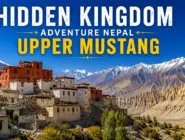
Upper Mustang — the ancient Kingdom of Lo sealed from the outside world until 1992, featuring the walled medieval capital of Lo Manthang and the extraordinary red-cliff desert landscape that many visitors describe as the closest thing to Tibet accessible anywhere — does require the USD 500 restricted area permit and a licensed guide, making it genuinely more expensive. B t even Upper Mustang can be approached with budget consciousness through the right transport choices, the right season, and a realistic understanding of what the permit covers and why it represents reasonable value.
This deep-research guide covers every significant place to visit in Mustang, Nepal, for travellers at every budget level—from the backpacker arriving by overnight bus from Kathmandu through Pokhara to the traveller joining a private Land Cruiser expedition with Nepal Vehicle Hiring Pvt. Ltd. across the desert plateau of Upper Mustang. It clearly identifies the transport choices that make each destination accessible, with Nepal Vehicle Hiring Pvt. Ltd. providing the specific vehicle services—from Pokhara car hire to specialised Upper Mustang jeep expeditions—that make these extraordinary destinations reachable.
Mustang Budget Travel — Quick Reference
Lower Mustang: Jomsom, Marpha, Muktinath, Kagbeni — No special permit required (ACAP only: NPR 3,000)
Upper Mustang: Lo Manthang, Tsarang, Ghami, Chhoser — Restricted Area Permit: USD 500 for 10 days
Getting There: Pokhara → Jomsom flight (35 min, USD 120–175) OR Pokhara → Jomsom by jeep (8–9 hrs)
Budget Jeep Option: Pokhara to Muktinath by private jeep (NPR 25,000–40,000 full vehicle)
Budget Accommodation: NPR 500–1,500/night in Jomsom, Marpha, Kagbeni teahouses
Budget Meals: Dal Bhat NPR 350–600 in Lower Mustang | NPR 600–1,000 in Upper Mustang
Best Season: March–May (spring) and September–November (autumn) — June–August also good
Vehicle Hire: Nepal Vehicle Hiring Pvt. Ltd. |+977 9814227196 | vehiclehiringnepal.com
Understanding the Mustang Region — Lower vs Upper
Lower Mustang: Budget-Friendly and Spectacular
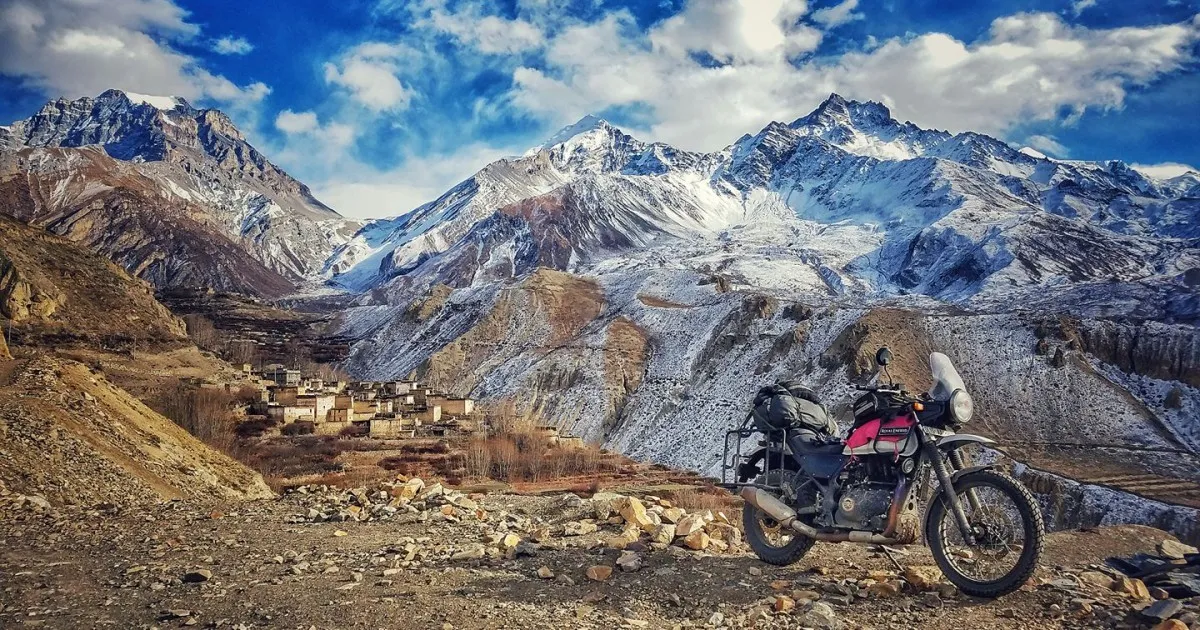
Lower Mustang covers the southern part of the Mustang District, roughly from the Kali Gandaki River junction near Ghasa north through Jomsom to Kagbeni, and west to Muktinath. It sits within the Annapurna Conservation Area (ACAP) and follows the same permit rules as the Annapurna Circuit Trek and the Ghorepani Poon Hill Trek. For foreign nationals in 2026, the ACAP permit costs NPR 3,000—a reasonable amount for access to one of Nepal’s most dramatic and beautiful highland landscapes. Lower Mustang’s landscape is extraordinary: the Kali Gandaki gorge—carved between the flanking massifs of Dhaulagiri at 8,167 meters and Annapurna at 8,091 meters —is the world’s deepest gorge, creating a valley of raw geological drama that frames every journey through this region with mountain scales that defy ordinary comprehension.
The villages of Lower Mustang — Jomsom, Marpha, Tukuche, Kagbeni — are themselves among the finest examples of Thakali cultural architecture in Nepal, characterised by flat-roofed houses, narrow covered alleyways that protect against the fierce afternoon winds, whitewashed walls with dark-framed windows, and the distinctive stone-paved lane networks that give each village its characteristic labyrinthine character. Historically, the Thakali people of Lower Mustang are among Nepal’s most successful trading communities, building wealth through the ancient salt trade between Tibet and the Indian plains along the Kali Gandaki corridor. This trade brought prosperity to the region and shaped its distinctive cultural character.
Upper Mustang: Worth Saving For
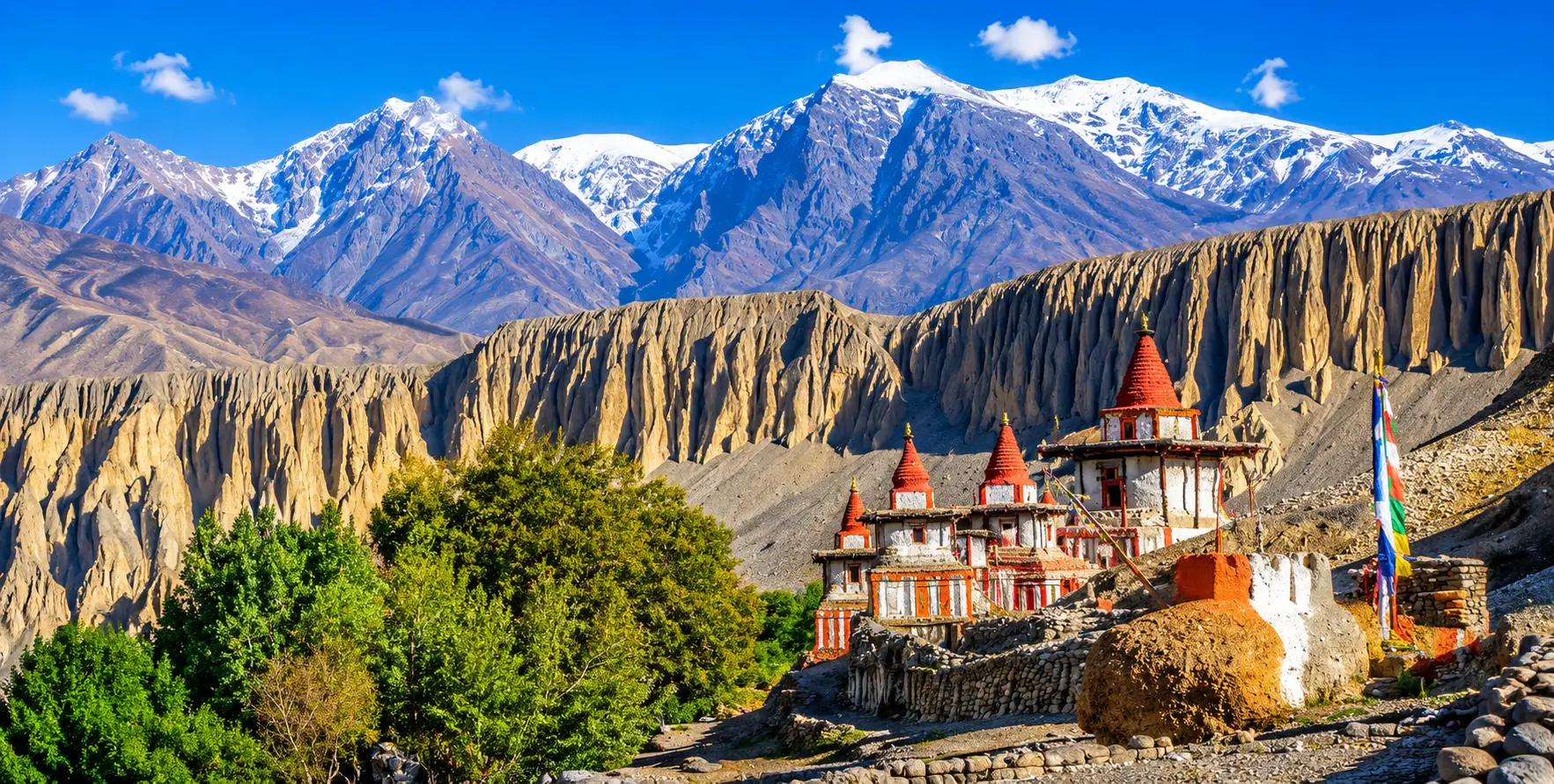
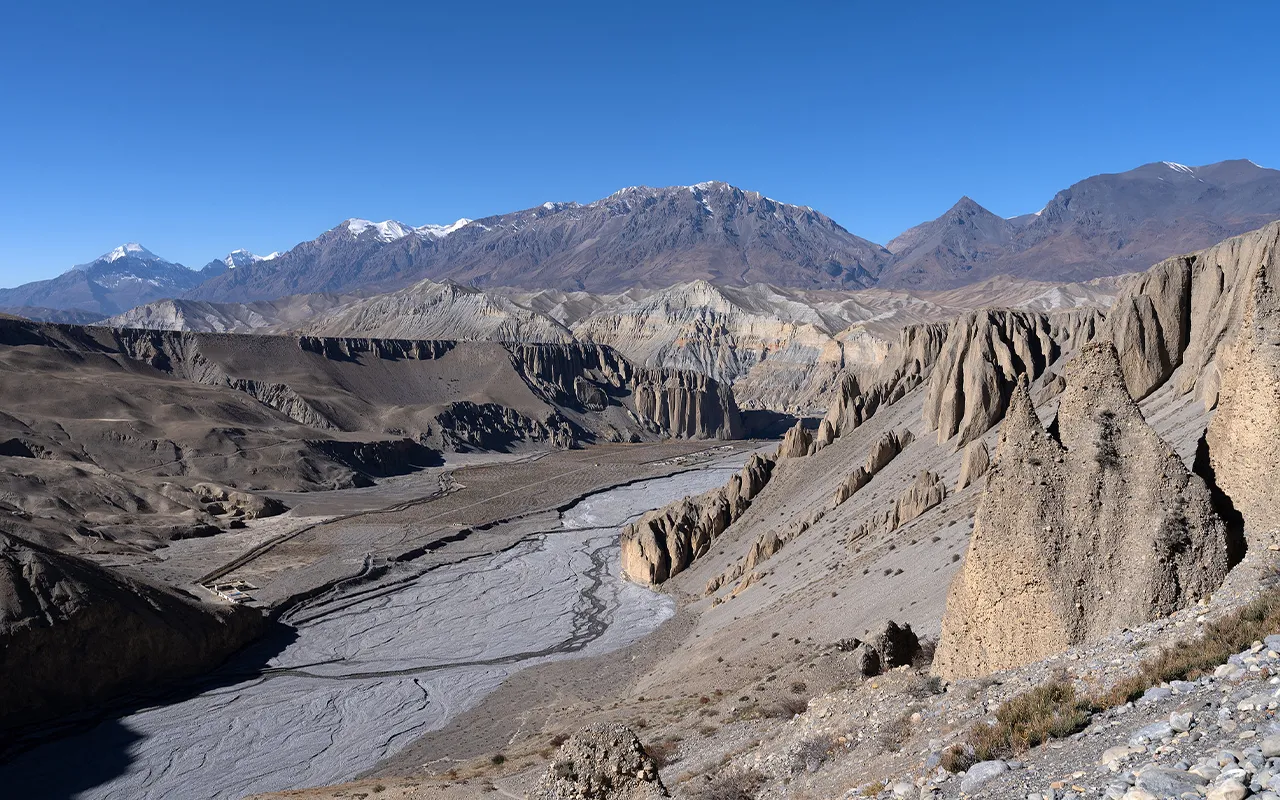
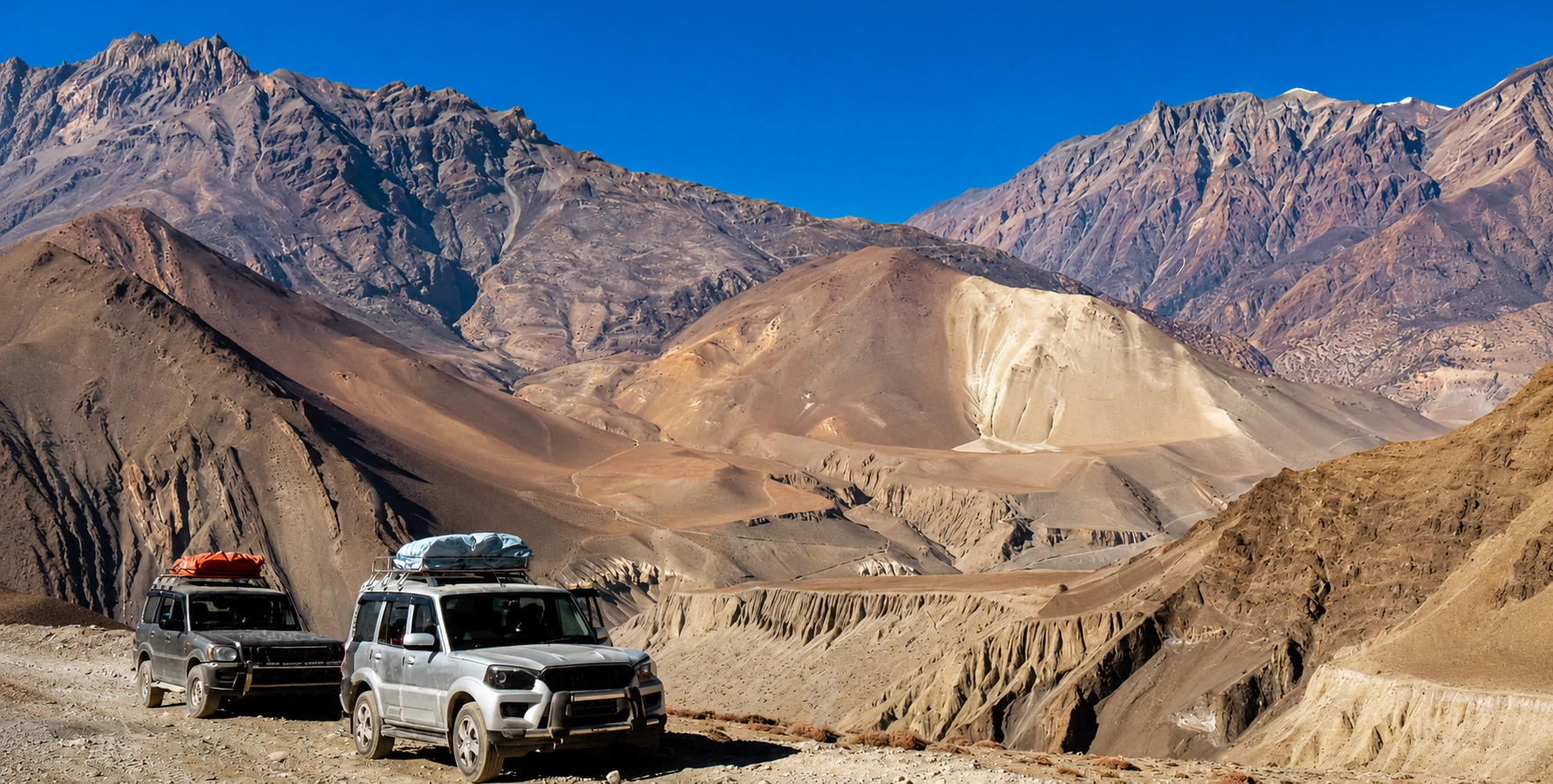
Upper Mustang begins north of Kagbeni at the official restricted area checkpoint and extends to the Tibetan border. The landscape transforms dramatically after Kagbeni: the lush terraced farmland and forested hillsides of the Kali Gandaki valley give way to a high-altitude desert plateau of extraordinary visual character — eroded red, orange, and ochre cliffs, ancient cave complexes carved into cliff faces, wind-sculpted badlands, and the sparse, light-catching texture of a landscape that many visitors describe as the most Mars-like accessible on earth. This landscape has made Upper Mustang one of the world’s most celebrated and sought-after destinations for adventure photography and cultural travel, and the USD 500 restricted-area permit exists specifically to limit visitor numbers and protect its extraordinary cultural and environmental integrity.
For budget-conscious travellers, the Upper Mustang permit is a real cost threshold—USD 500 per person for the first 10 days, plus USD 50 per day for each additional day—making Upper Mustang a deliberate financial commitment rather than a casual itinerary addition. However, there are meaningful strategies for managing this cost: travelling in a group of four to six shares the 4WD jeep expedition costs that are the primary Upper Mustang transport expense; travelling outside the absolute peak October and March-April windows may find slightly better rates on accommodation; and careful planning of the permit days to match the actual time needed — typically eight to ten days for a complete Upper Mustang circuit — avoids unnecessary permit overage charges.
Budget Places to Visit in Lower Mustang — No Special Permit Needed
Jomsom — The Windy Gateway Town
At 2,720 meters, Jomsom is the district headquarters of Mustang District and the primary transport hub for the entire Mustang region. In this town, the famous Jomsom Airport handles flights from Pokhara, and the road from Pokhara ends at the northern terminus of the vehicle-accessible route. Jomsom is not a sightseeing destination in the conventional sense—it is a functional, somewhat wind-battered administrative and transport town—but its setting is absolutely extraordinary. The town sits in the Kali Gandaki Valley with the massive wall of Nilgiri (7,061 m) rising directly to the east and the Annapurna range visible on the southern horizon, creating a mountain backdrop of raw scale and power that reminds the visitor at every moment that they are in one of the most geographically extraordinary places on earth.
The Jomsom to Pokhara journey can be made by the famous small-aircraft flight (USD 120–175 per person, roughly 20 minutes of spectacular mountain flying) or by the progressively improving road via private jeep hire from Nepal Vehicle Hiring Pvt. Ltd.. The Pokhara to Jomsom road follows the Kali Gandaki gorge for approximately 150 km and takes eight to nine hours in a capable 4WD vehicle. For budget travellers, sharing a Fortuner jeep hire from Pokhara with three or four companions yields per-person costs of NPR 6,000–8,000—competitive with public jeep alternatives while offering the comfort of a private vehicle.
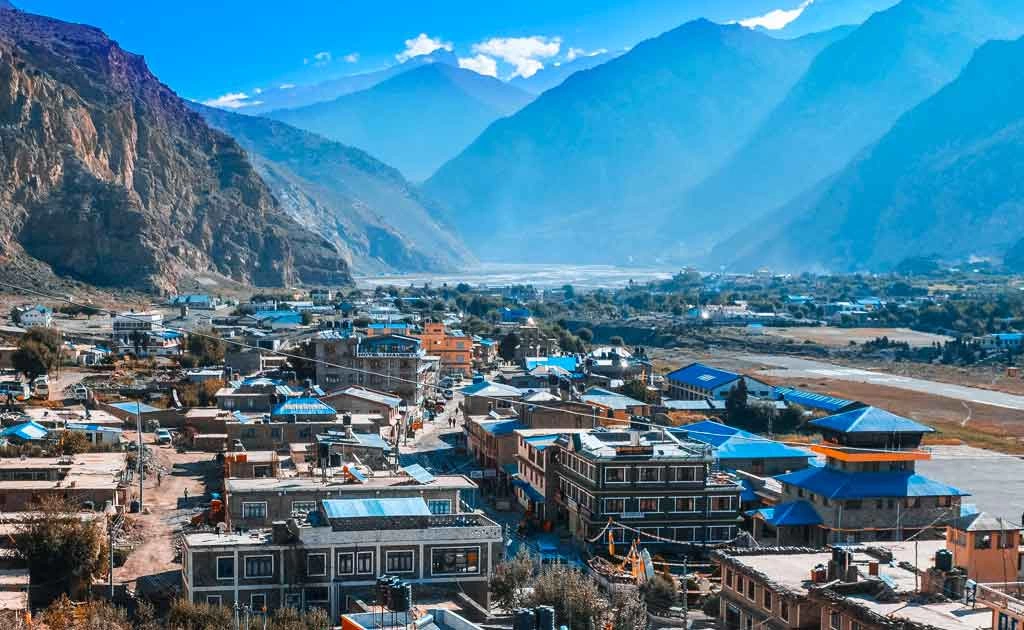
In Jomsom, budget accommodation is readily available at the numerous teahouses along the main street, with basic rooms starting at NPR 500–800 per night. Meals are modest — standard dal bhat (Nepal’s national dish of rice, lentil soup, and vegetable curry, with unlimited refills) is available at most Jomsom teahouses for NPR 400–600 and provides excellent caloric value for trekkers. The famous Jomsom local apple products — fresh apples in season, apple juice, apple cider vinegar, and the celebrated Marpha apple brandy (available at shops in both Marpha Village — The Apple Capital of Nepal
Marpha village, about 5 kilometres south of Jomsom at 2,670 meters, is widely regarded as one of the most beautiful traditional villages in the Mustang District and one of the finest examples of Thakali architecture in Nepal. The village is celebrated throughout Nepal for its extraordinary apple orchards; hillside orchards surrounding Msurroundingarpha produce some of the country’s finest apples. The village’s apple-based products (fresh apples, dried apple chips, apple juice, apple wine, apple brandy, and apple pie at the village teahouses) are central to its economy and appeal to visitors. Walking through Marpha’s narrow, paved, whitewashed alleyways, protected from the fierce Kali Gandaki afternoon winds by their covered passage design, is one of Nepal’s most pleasant and immersive village-walking experiences.
The Marpha Monastery, perched on a hillside above the village, offers an excellent vantage point for photographing the village roofscape and the surrounding valley. In contrast, the village’s water-powered prayer wheel — a technical and spiritual curiosity — demonstrates the ingenuity with which Thakali communities have traditionally harnessed the Kali Gandaki’s resources. Marpha is easily reached from Jomsom on foot in about one and a half hours, making it an excellent first-morning walk for travellers arriving on the early Jomsom flight or the overnight jeep service from Pokhara. Budget accommodation in Marpha includes several comfortable guesthouses at NPR 600–1,200 per night, and trekkers describe the village’s apple pie as the finest on the Annapurna Circuit.
Muktinath Temple — The Sacred Pilgrimage Destination
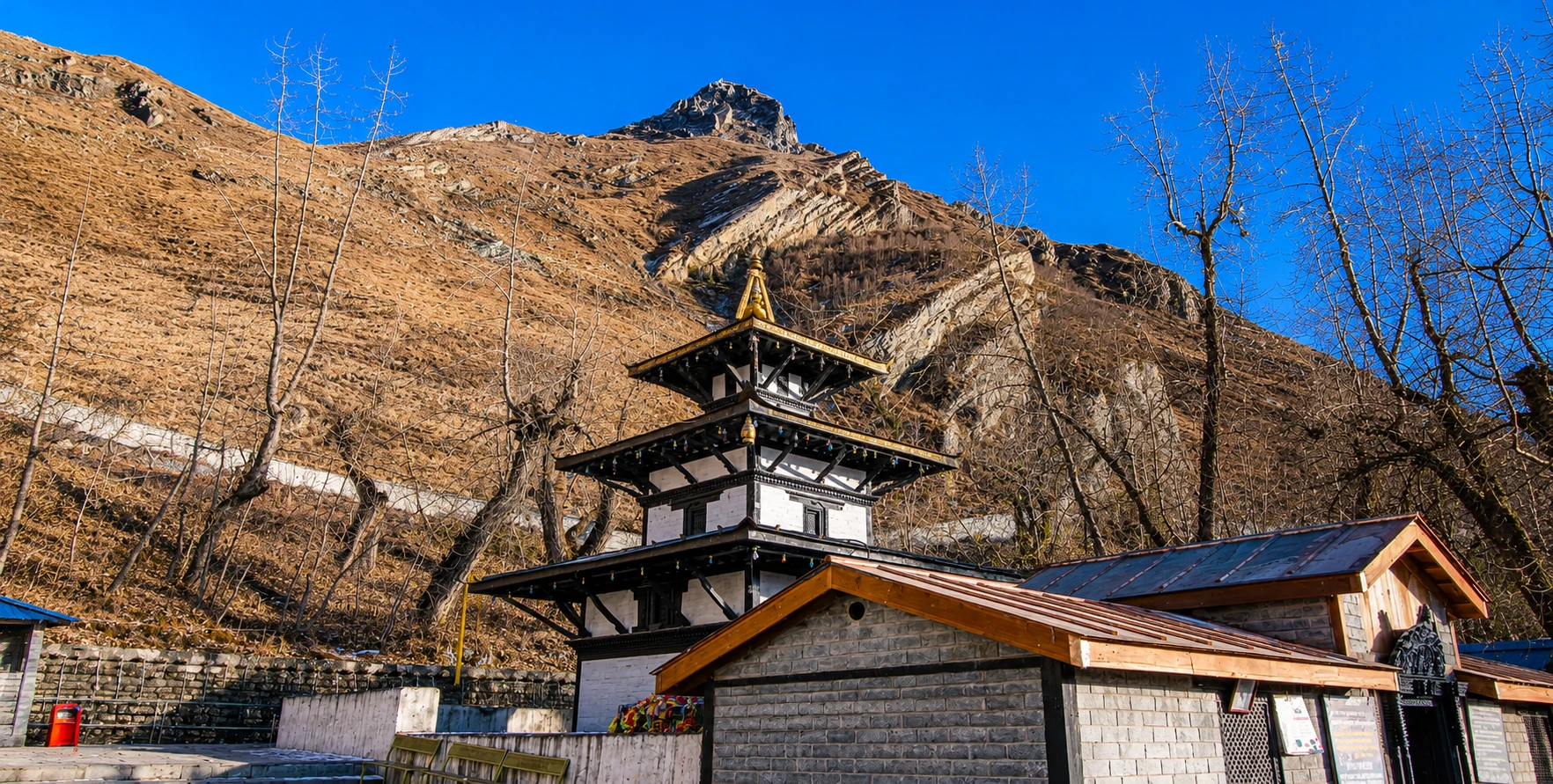
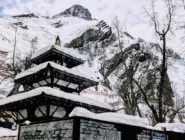
At 3,800 meters, Muktinath Temple is, without question, the most significant and most visited destination in the Mustang region for most travellers —a sacred site of profound importance to both Hinduism and Buddhism that draws pilgrims from across Nepal and India in enormous numbers throughout the year. The temple complex is dedicated to Vishnu in the Mukti Nath manifestation. It is one of the 108 Divya Desams (sacred Vishnu shrines) recognised in Vaishnavite Hindu tradition—its status in Hindu devotional geography is equivalent to, or in some traditions surpasses, many better-known Himalayan pilgrimage sites. For Buddhists, the same complex is sacred as a Dakini place associated with the goddess Jwala Mai, and the permanent flame burning at the site — fed by natural gas seeping through the rock — is regarded as a manifestation of the divine that transcends sectarian boundaries.
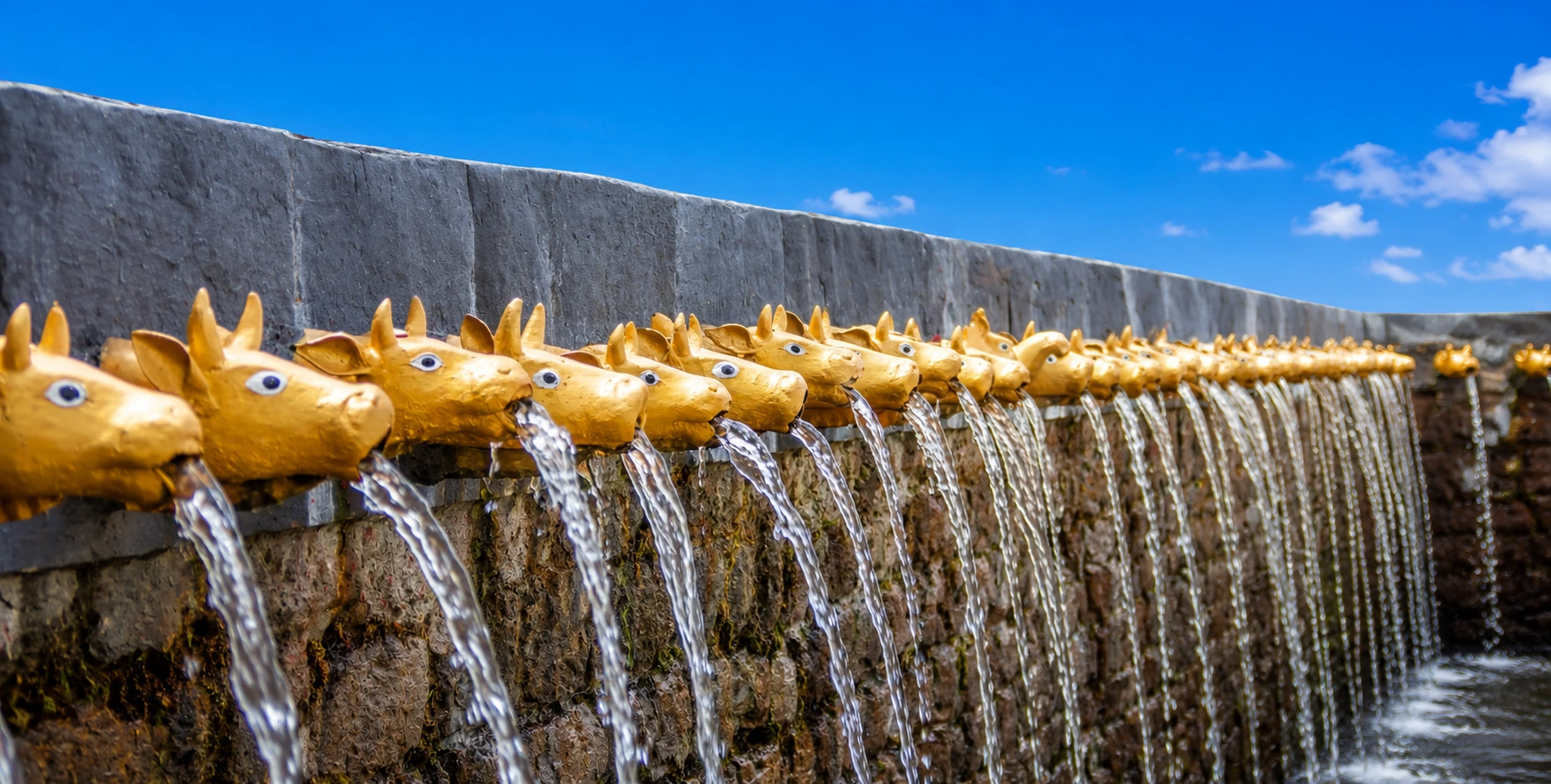
The 108 water spouts that surround the main Muktinath temple courtyard — each carved in the form of a bull’s head and dispensing the sacred Gandaki River water that is itself considered holy — provide the primary devotional experience for pilgrims, who circulate the spouts and douse themselves in the icy water as an act of purification. The sight of hundreds of pilgrims performing this circumambulation, many of them older men and women from remote Indian villages who have travelled days or weeks to reach this point, gives Muktinath an atmosphere of concentrated devotional energy among the most powerful at any Himalayan sacred site.
Muktinath is accessible from Jomsom by a road that has improved significantly in recent years, with a local jeep transfer from Jomsom to Muktinath available for NPR 1,500–2,500 per person in shared jeeps (or approximately NPR 8,000–14,000 for the full vehicle in a private jeep booking). Alternatively, many trekkers choose to walk the approximately 5-kilometre climb from Ranipauwa (the village below Muktinath where vehicles park) to the temple complex, a rewarding one- to one-and-a-half-hour uphill walk through prayer-flag-decorated hillside terrain. Those travelling directly from Pokhara can book the Pokhara-to-Muktinath jeep hire service from Nepal Vehicle Hiring Pvt. Ltd. for NPR 25,000–45,000 for the full vehicle—one of Nepal’s most popular long-distance private jeep routes.
Budget accommodation in the Ranipauwa village below the Muktinath temple — where almost all accommodation for Muktinath visitors is located — starts from NPR 600–1,000 per night for basic but clean teahouse rooms, with more comfortable options available at NPR 1,500–2,500. The village is small, and accommodation options are concentrated, making it easy to shop around on arrival. The cold at night at 3,80 meters is significant — rooms with an attached bathroom and hot shower, available at NPR 1,200–2,000, are worth the additional cost for the hot water access after a day of walking or jeep travel in the mountain air.
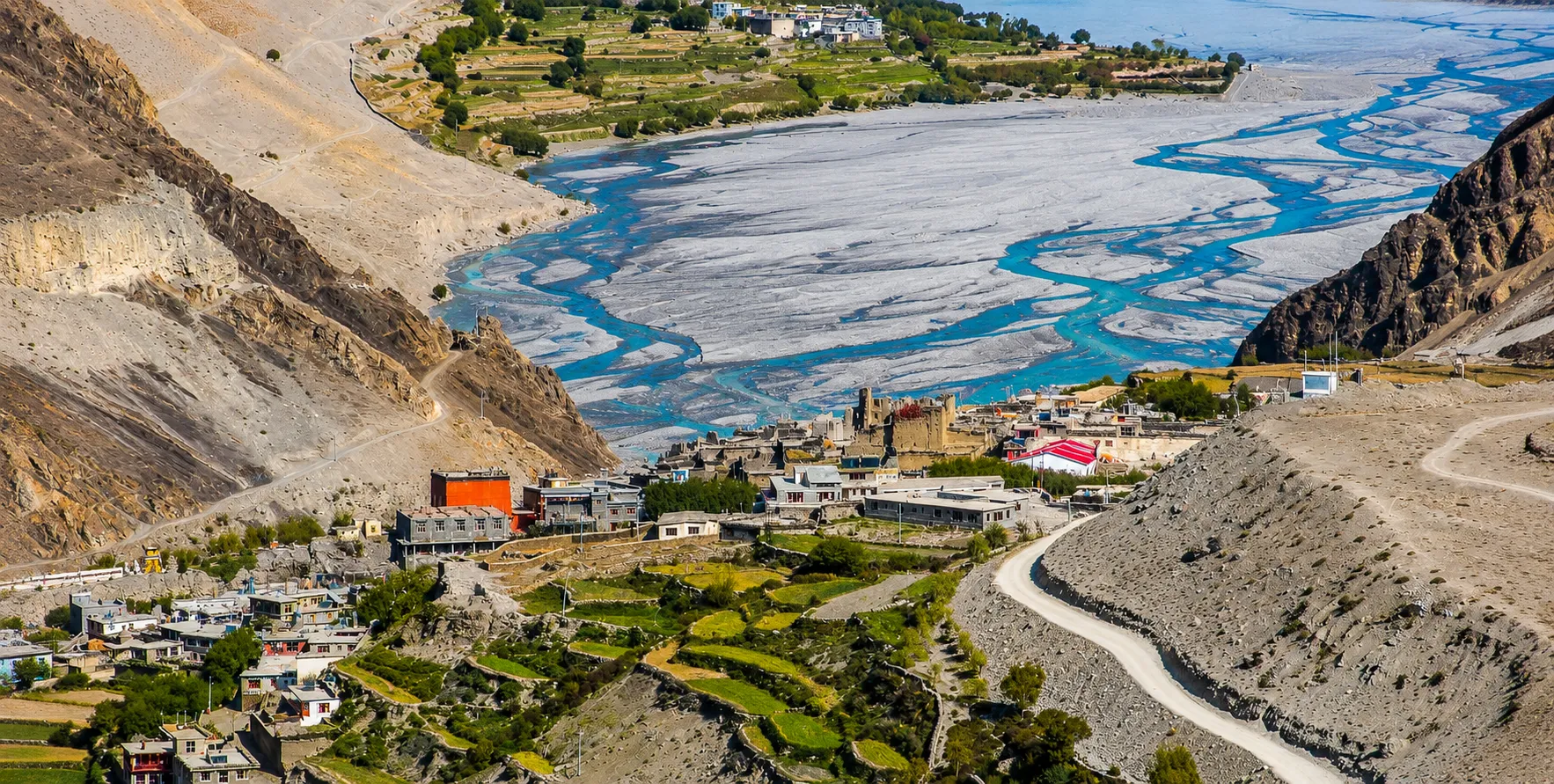
Kagbeni — The Medieval Gateway to Upper Mustang
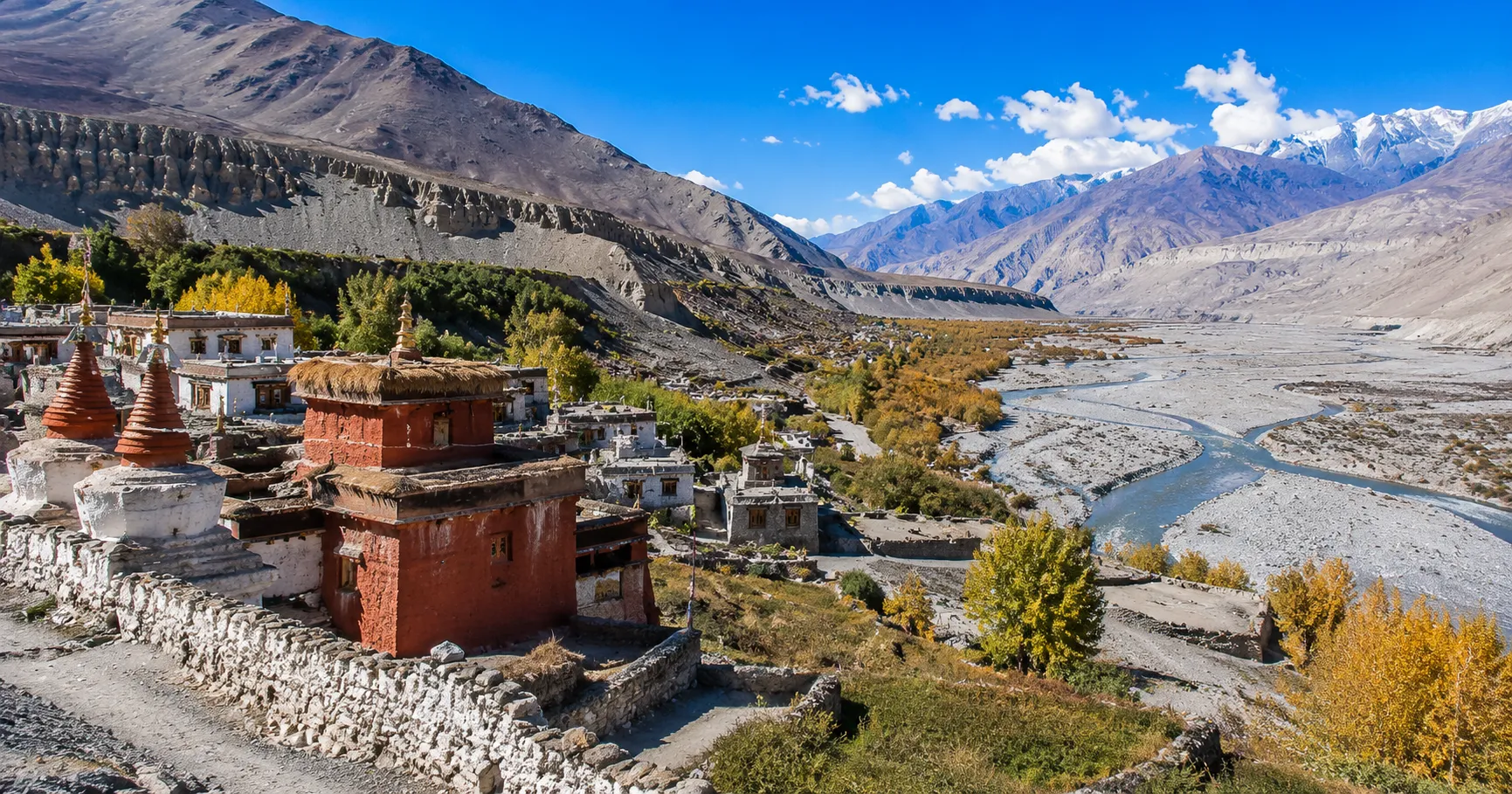
Kagbeni, at approximately 2,810 meters, is one of the most fascinating and atmospheric villages in the entire Mustang region — a compact, medieval-character settlement at the junction of the Kali Gandaki and Jhong Khola rivers that serves simultaneously as the last major Lower Mustang village and the official restricted area checkpoint beyond which Upper Mustang begins. For budget travellers who do not hold the Upper Mustang restricted area permit, Kagbeni represents the furthest north that the standard ACAP permit allows — and it is an outstanding destination in its own right, offering an authentic and genuinely atmospheric taste of the Upper Mustang cultural landscape without the financial commitment of the restricted area permit.
The village of Kagbeni is visually extraordinary: its dense cluster of red-painted fortress walls, flat-roofed mud-brick houses, and narrow alleyways gives it an unmistakably medieval character that is closer to the architectural atmosphere of a Tibetan village than to anything in the Lower Mustang towns below. The Kag Chode Thubten Samph l Ling Monas ery — a large, active Sakya monastery perched dramatically above the village — is one of the most impressive religious buildings in the Mustang region and welcomes respectful visitors. The view north from Kagbeni into the start of the Upper Mustang plateau offers a tantalising preview of the red-cliff desert landscape that characterises the restricted area beyond, and many visitors report that simply sitting at the Kagbeni checkpoint and looking north is one of the most striking atmospheric moments of their entire Nepal journey.
Kagbeni is about a 2-hour walk from Jomsom along the flat river-valley track, or reachable by local jeep in about 30 to 45 minutes. Budget teahouse accommodation in Kagbeni starts from NPR 500–800 per night, and several teahouses offer rooftop seating with exceptional views of the surrounding landscape — particularly rewarding in the late afternoon when the light turns the surrounding cliffs warm shades of amber and gold.
The Kali Gandaki Gorge — A Landscape That Defies Comprehension
The Kali Gandaki Gorge itself — the extraordinary geological feature running through the heart of Lower Mustang and defining the region’s visual experience — is one of Nepal’s most overwhelming natural landscapes, and it requires no permit beyond the standard ACAP. At its deepest measurement points, the gorge plunges approximately 6,000 meters from the flanking summits of Dhaulagiri and Annapurna to the riverbed below, making it the world’s deepest gorge by some definitions — a geological wonder of a scale that only becomes comprehensible when standing on the valley floor and craning upward at the walls that seem to go on forever.
The gorge’s most distinctive and practically important characteristic for Mustang travellers is the daily wind pattern that has shaped life in this valley for millennia: from late morning through the afternoon, a powerful up-valley wind — locally known as the Kali Gandaki updraft — funnels through the gorge with remarkable regularity and intensity, sometimes reaching speeds of 60 to 80 kilometres per hour. The traditional communities of the Mustang region have structured their entire daily schedule around this wind pattern—early-morning travel and activity, with rest and shelter from midday onward—and experienced travellers quickly learn to adopt the same approach. The best time to walk in the Kali Gandaki valley is early morning, before 9 or 10 AM, when the air is still, the light warms the valley walls, and the extraordinary landscape can be appreciated without the distraction and discomfort of the afternoon wind.
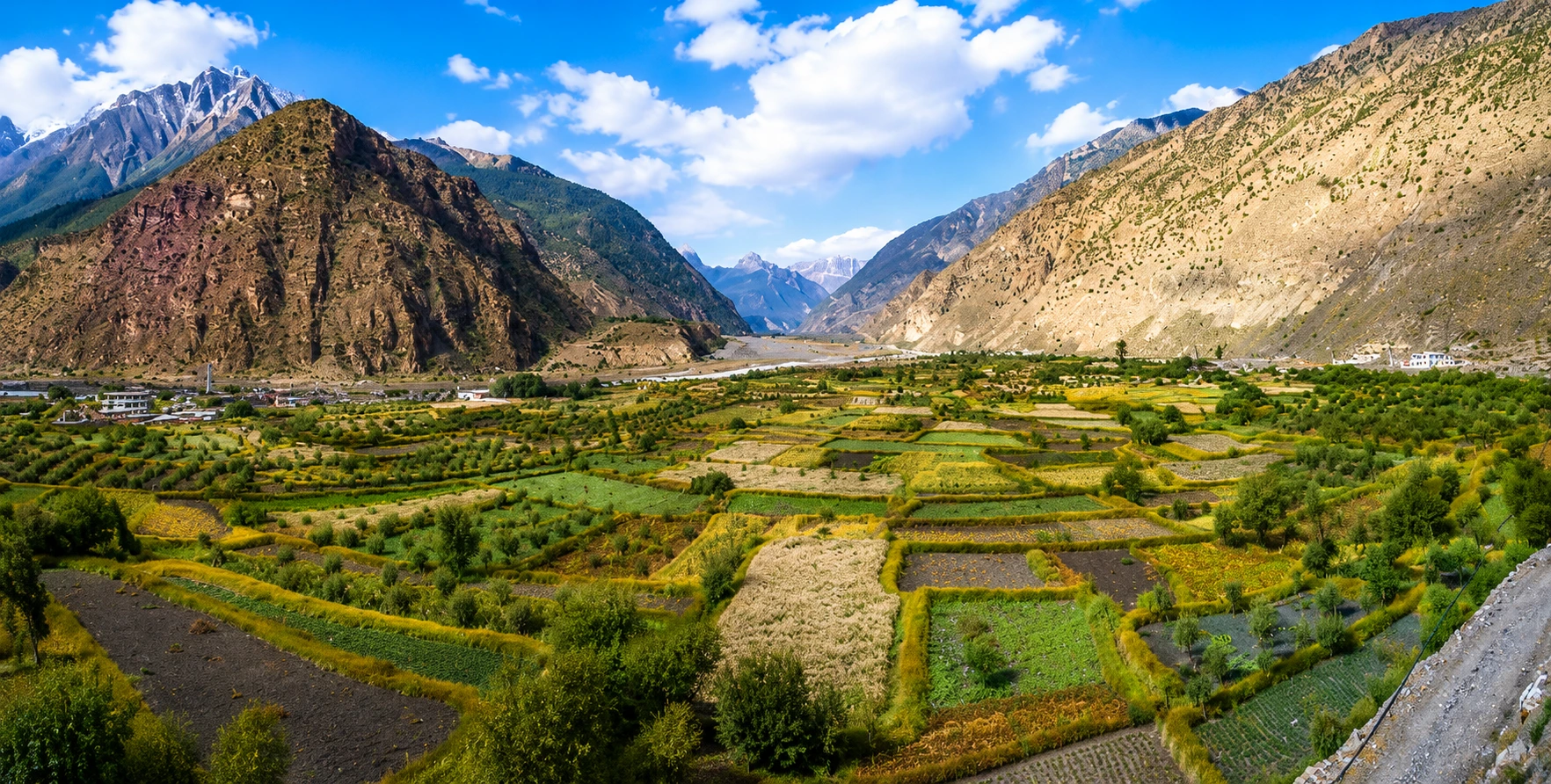
Tukuche and Lete — The Forgotten Villages of Lower Mustang
South of Jomsom and Marpha, the villages of Tukuche and Lete are among the most rewarding and least visited destinations in Lower Mustang—traditional Thakali communities whose historical importance in the trans-Himalayan salt trade made them among the wealthiest villages in nineteenth-century Nepal, and whose architecture reflects that prosperity in extraordinary detail. Tukular is best known for its well-preserved Thakali merchant hues—some of the finest examples of this domestic architectural tradition anywhere in Nepal—and for the Himalayan Distillery, which has produced famous Mustang brandy since 1975 and offers tours. The village sits on the classic Annapurna Circuit trekking route, so trekkers pass through regularly. Still, most move through without stopping for more than a brief rest—making it a rewarding destination for travellers who take the time to explore its lanes and architectural heritage at a slower pace.
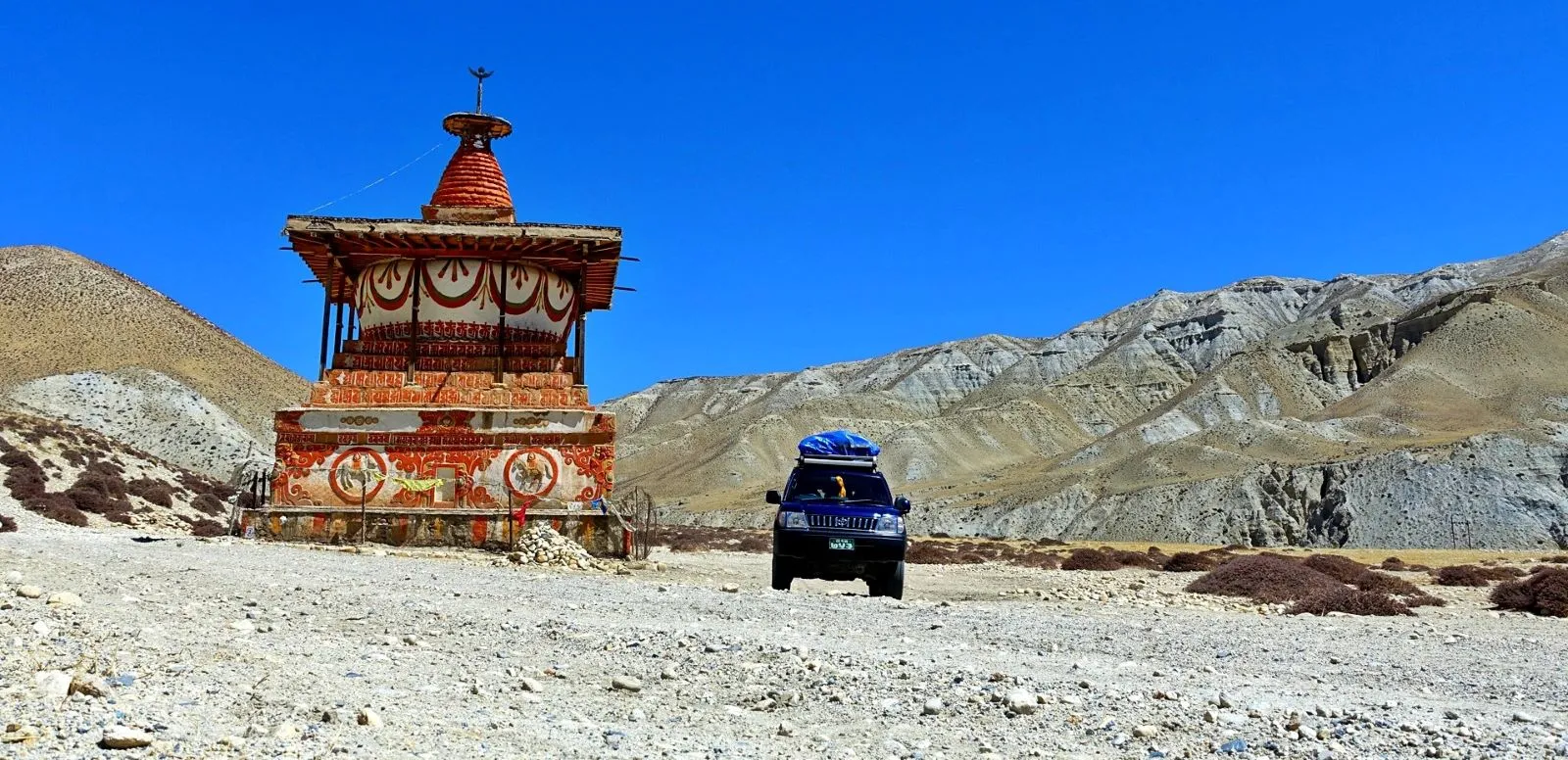
Upper Mustang — Making the Forbidden Kingdom Affordable
Lo Manthang — The Walled City of the Forbidden Kingdom
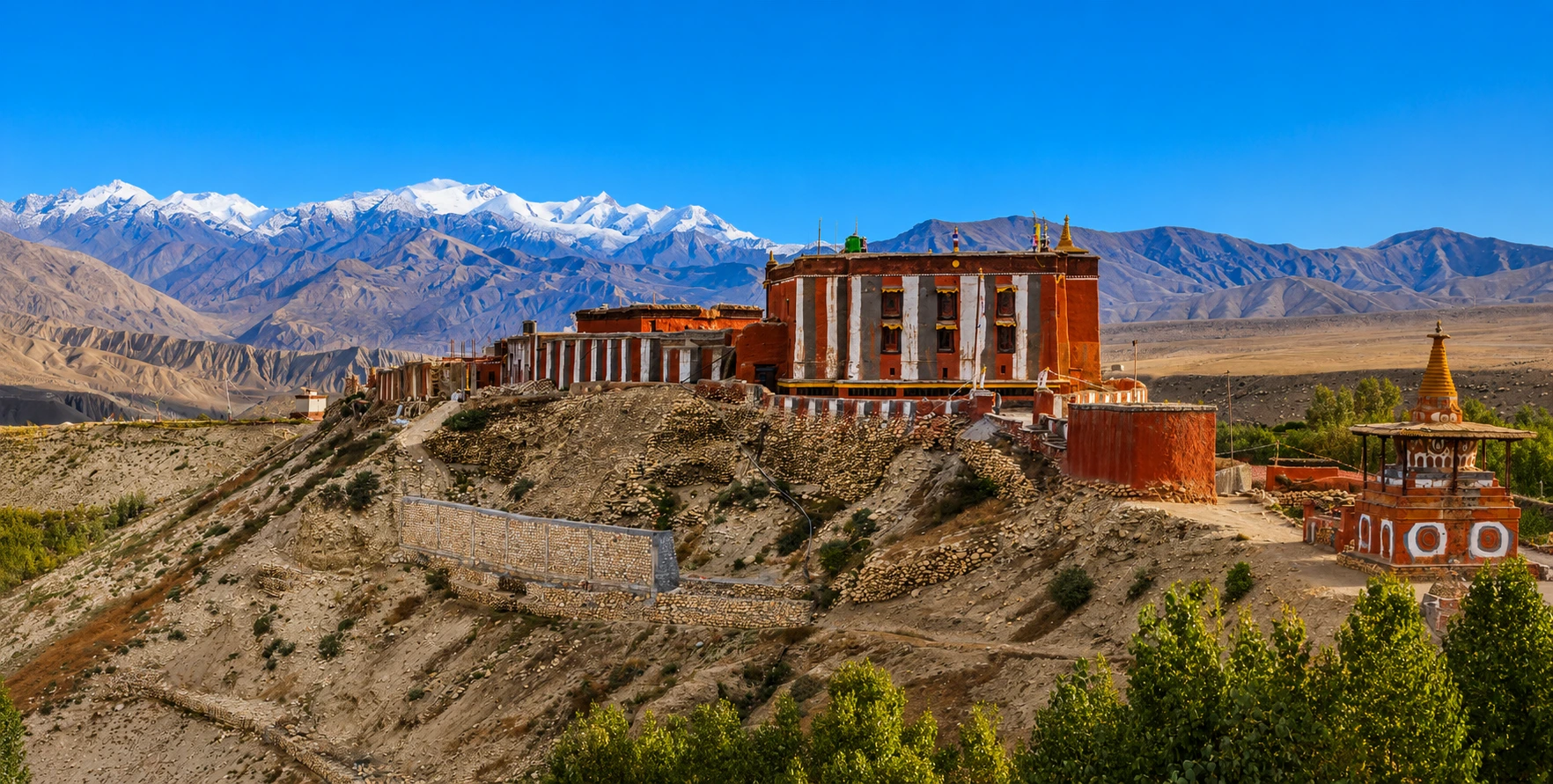
At 3,840 meters, Lo Manthang is the ancient walled capital of the Kingdom of Lo—a living medieval city of extraordinary historical and cultural significance that remains one of Nepal’s most remote, most authentic, and most atmospheric destinations. The city’s whitewashed defensive walls, enclosing a dense settlement of traditional Tibetan-influenced buildings, four major monasteries, the five-story royal palace of the King of Mustang, narrow winding alleyways, and the daily rhythms of a community whose cultural life continues largely as it has for centuries, create an experience that is genuinely unlike anything else accessible by road anywhere in the Himalayan world.
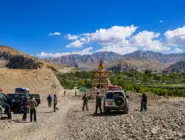
The most budget-conscious approach to Lo Manthang is the shared jeep expedition from Jomsom —organising four to six travellers to share the cost of a Land Cruiser or Fortuner hire from Jomsom to Lo Manthang and back, which reduces the per-person vehicle cost significantly while maintaining the efficiency of vehicle transport on the rough Upper Mustang plateau tracks. Nepal Vehicle Hiring Pvt. Ltd. provides specialised per-Mustang jeep expedition services with Land Cruiser vehicles and drivers experienced on the plateau tracks beyond Kagbeni—drivers who understand the afternoon wind schedule, know the locations of the few fuel sources, and have navigated the plateau’s more challenging sections in all seasonal conditions.
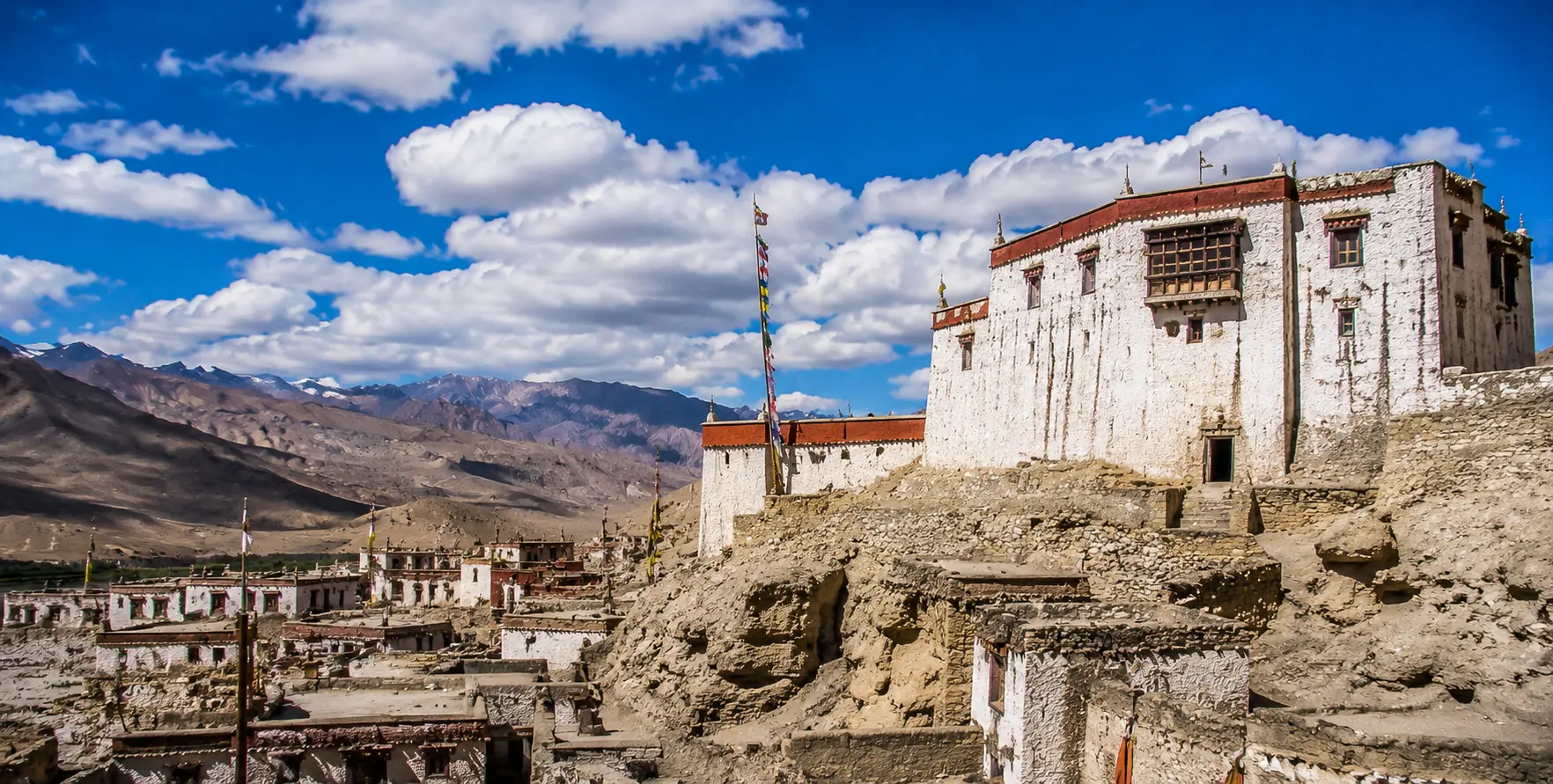
The three great monasteries of Lo Manthang — Thupchen Gompa, Jampa Lhakhang, and Chode Gompa — are among the finest examples of Tibetan Buddhist religious art and architecture accessible anywhere outside Tibet itself. Thupchen Gompa, in particular, houses a remarkable collection of murals painted in the fifteenth and sixteenth centuries, considered among the most significant surviving examples of Tibetan Buddhist painting in the Himalayan world, and has been the subject of major international conservation efforts. Visiting all three monasteries during a Lo Manthang stay costs extra beyond the RAP permit and is deeply rewarding for anyone interested in Himalayan Buddhist art and culture.
Tsarang — The Ancient Sub-Capital
At 3,560 meters and about 8 kilometres south of Lo Manthang, Tsarang is one of Upper Mustang’s most significant historical sites and an important destination for travellers spending more than a day or two in the restricted area. The village is dominated by the magnificent ruins of the Tsarang Fort and the Tsarang Monastery — a remarkable Sakya monastery built in the fourteenth century whose assembly hall contains exceptional thangkas and wall paintings. The cliff-top location of Tsarang above the Mustang valley provides some of the finest panoramic views of the Upper Mustang landscape available from any easily accessible vantage point, and the walk from Lo Manthang to Tsarang — approximately two to three hours on a clear plateau track — is one of the most beautiful and meditative walks in the entire region.
The Sky Caves of Mustang — Ancient Cliff Dwellings
One of the Mustang region’s most extraordinary and least-known attractions is its collection of sky caves—ancient cliff-dwelling complexes carved or naturally formed in the vertical face of the red and ochre cliffs that characterise the Mustang landscape. These caves, some dating back more than two thousand years and many accessible only by rope or ladder, have yielded extraordinary archaeological discoveries in recent decades: manuscripts, human remains, ritual objects, and painted artefacts that suggest sophisticated human habitation at these extraordinary heights long before the recorded history of the Mustang kingdom. The most accessible and best-known cave concentration is near the village of Chhoser, north of Lo Manthang, where a cluster of cave complexes includes several with painted interiors and significant archaeological content. Day excursions to Chhoser start from Lo Manthang, typically by local jeep hire from the Lo Manthang parking area, and most Upper Mustang itineraries include them, adding archaeological and historical intrigue to the region’s already rich experiential portfolio.
The Ghami Monastery and the Long Mani Wall
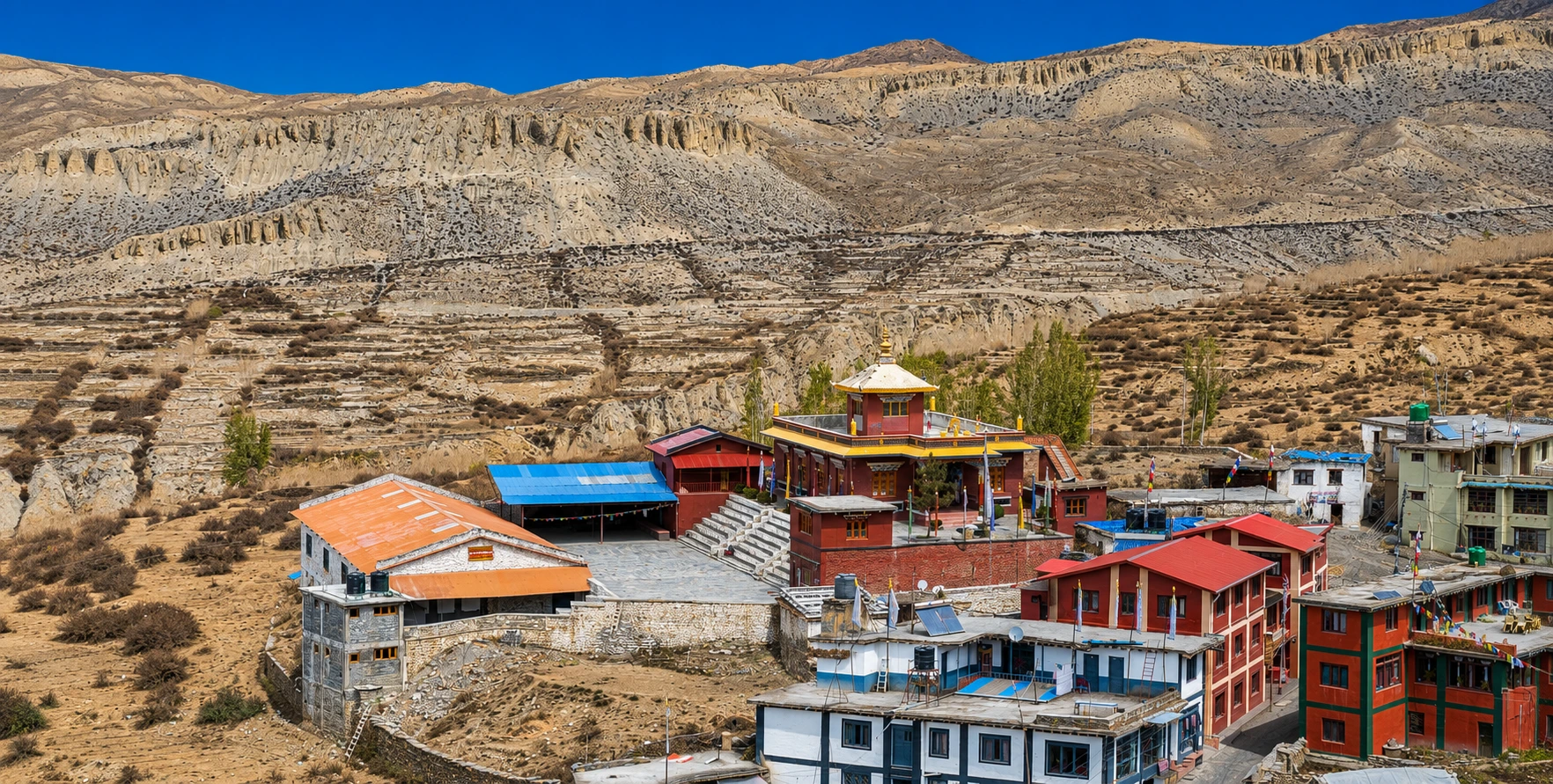
Ghami village at approximately 3,520 metres on the classic Upper Mustang jeep and trek route between Kagbeni and Lo Manthang is home to two of the region’s most notable cultural landmarks: the Ghami Monastery, one of the oldest in Mustang, and the Long Mani Wall — a centuries-old prayer wall more than 400 metres in length, covered in thousands of mani stones inscribed with the Buddhist mantra Om Mani Padme Hum and stretching across the plateau in a structure that is simultaneously one of the longest and one of the most devotionally charged religious objects in the entire Himalayan world. People always circumambulate the Ghami Mani Wall clockwise, and passing through Ghami without pausing to walk its length means missing one of Upper Mustang’s most quietly extraordinary experiences.
How to Reach Mustang — Budget Transport Options
The Budget Route: Kathmandu to Pokhara to Jomsom
The most budget-conscious route to the Mustang region from Kathmandu runs as follows: an overnight tourist bus from Kathmandu to Pokhara (NPR 1,000–1,500, approximately 6–7 hours); a day in Pokhara to obtain permits and rest; and then either the early morning Pokhara to Jomsom flight (USD 120–175 per person, 20 minutes of spectacular mountain flying) or the longer Pokhara to Jomsom by road option (shared jeep NPR 1,500–2,000 per person, 8–9 hours, or private jeep hire from Nepal Vehicle Hiring Pvt. Ltd. at NPR 22,000–40,000 for the full vehicle). The flight is significantly faster and provides extraordinary aerial views of the Annapurna range. Still, the road journey through the Kali Gandaki gorge is itself one of Nepal’s most dramatic and rewarding overland experiences. Travellers often prefer it to start the Mustang experience as early as possible.
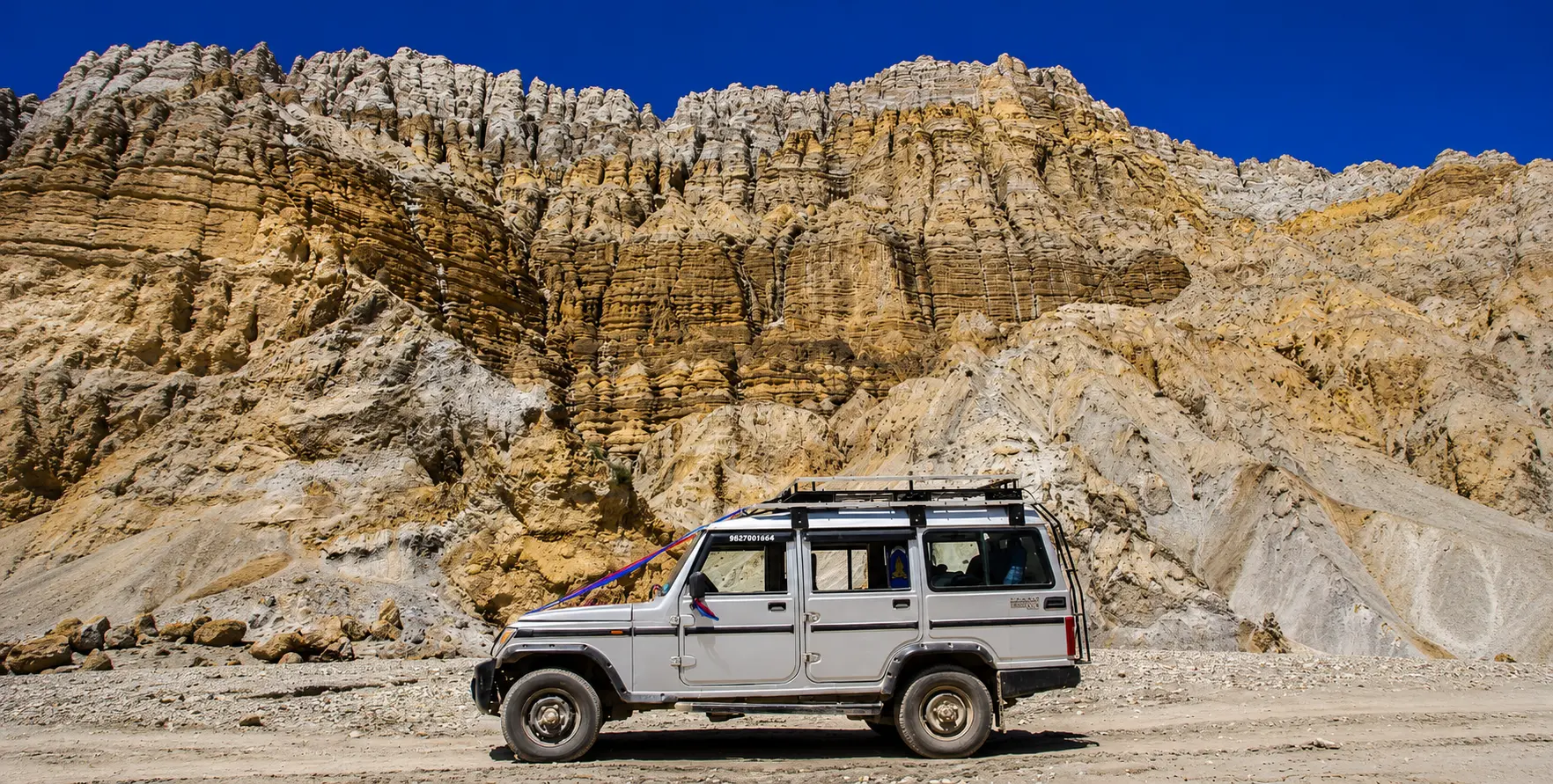
For the most budget-efficient option overall—for solo travellers or couples—sharing a Pokhara-to-Muktinath private jeep hire with other travellers met in Pokhara Lakeside is consistently the most cost-effective private-vehicle solution. Nepal Vehicle Hiring Pvt. Ltd. can sometimes facilitate connections between travellers with compatible Mustang itineraries who want to share vehicle costs — contact the team at +977 9814227196 or vehiclehiringnepal.com to enquire about this possibility for your travel dates.
The Mid-Budget Route: Direct Pokhara to Muktinath Jeep Hire
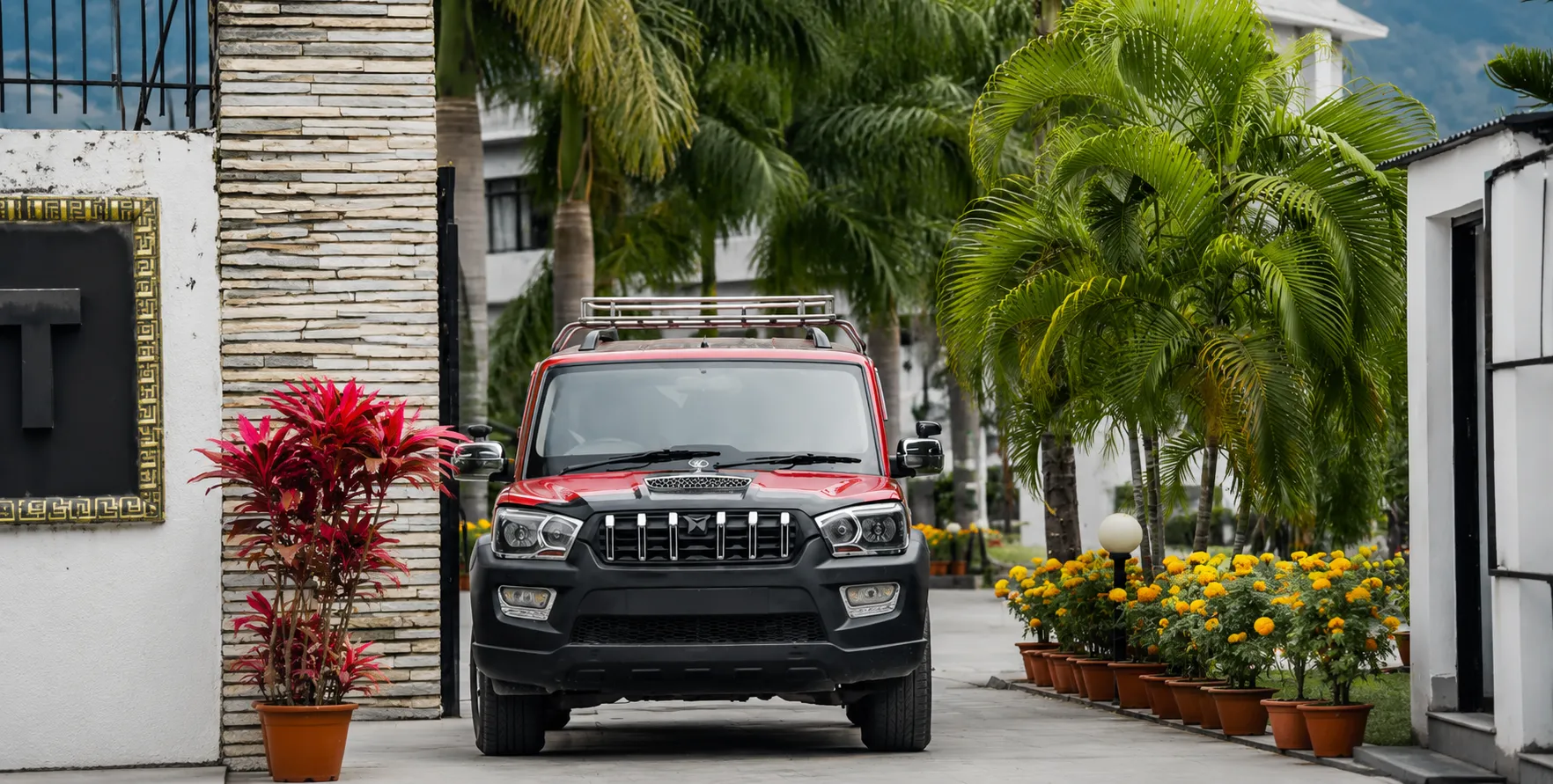
For travellers whose primary goal is Muktinath Temple and the Lower Mustang villages—the most common Lower Mustang itinerary—the Pokhara-to-Muktinath direct private jeep hire is the most time-efficient and comfortable option. The Nepal Vehicle Hiring Pvt. Ltd. service covers approximately 165 km via Beni and the Kali Gandaki gorge in a day, delivering travellers directly below the Muktinath temple for NPR 25,000–35,000 all-inclusive in a Toyota Fortuner. For a group of five or six sharing the vehicle, the per-person cost of NPR 4,200–7,000 is genuinely competitive with shared jeep alternatives while providing the significant advantages of hotel pickup in Pokhara, flexible timing, and direct delivery to the destination.
The Pokhara to Muktinath road journey itself is one of Nepal’s most dramatically scenic drives — the progressive entry into the Kali Gandaki gorge, the views of Dhaulagiri and Annapurna growing larger as the vehicle climbs northward, the passage through Tatopani and Ghasa, the apple orchards of Marpha, and the final approach through the increasingly arid and wind-swept Mustang plateau terrain to the temple — provides a visual narrative of Nepal’s extraordinary geographic diversity that no other single road journey can replicate. Nepal Vehicle Hiring Pvt. Ltd.’s drivers on this route are experienced with the Kali Gandaki road’s specific character and weather. They will also suggest leaving Pokhara by 7:00 AM to ensure you arrive at Muktinath before the afternoon winds pick up.
Permits Required for Mustang — Complete Guide
ACAP Permit — Required for All of Mustang
The Annapurna Conservation Area Permit (ACAP), NPR 3,000 for foreign nationals, is the foundational permit required to enter any part of the Mustang region, both Lower and Upper. Obtain this permit from the Nepal Tourism Board office in Kathmandu or the NTNC office in Pokhara before departure. SAARC nationals pay NPR 200 for the ACAP. The permit covers the entire Annapurna Conservation Area, including all of Lower Mustang and the approach roads.
TIMS Card — Required for Trekking
The TIMS Card (NPR 2,000 for individual trekkers, NPR 1,000 with a registered agency) is required for all trekkers in Nepal’s major trekking areas, including Mustang. Like the ACAP, it is best obtained in Kathmandu or Pokhara before departure.
Upper Mustang Restricted Area Permit — For Lo Manthang and Beyond
The Restricted Area Permit (RAP) for Upper Mustang has changed significantly in 2026. The 2026 policy requires all foreign nationals to pay USD 500 per person for the first 10 days in the restricted area, plus USD 50 per day for each additional day. Crucially, the 2026 regulation requires that all Upper Mustang visitors be accompanied by a licensed guide arranged through a registered agency — independent trekking or jeep touring in Upper Mustang without a licensed guide is not permitted. You cannot obtain the RAP independently; you must arrange it through a registered trekking agency. This guide and agency requirement is a genuine additional cost consideration for budget travellers planning Upper Mustang.
The mandatory guide requirement for Upper Mustang does not apply to Lower Mustang — Jomsom, Marpha, Muktinath, Kagbeni, and the Kali Gandaki valley south of the Kagbeni checkpoint can all be visited independently with only the ACAP and TIMS card. This makes Lower Mustang genuinely budget-accessible, unlike Upper Mustang, which requires a USD 500 RAP and a mandatory guide. Budget travellers should plan their Mustang itinerary with this distinction clearly in mind.
Budget Accommodation and Food in Mustang
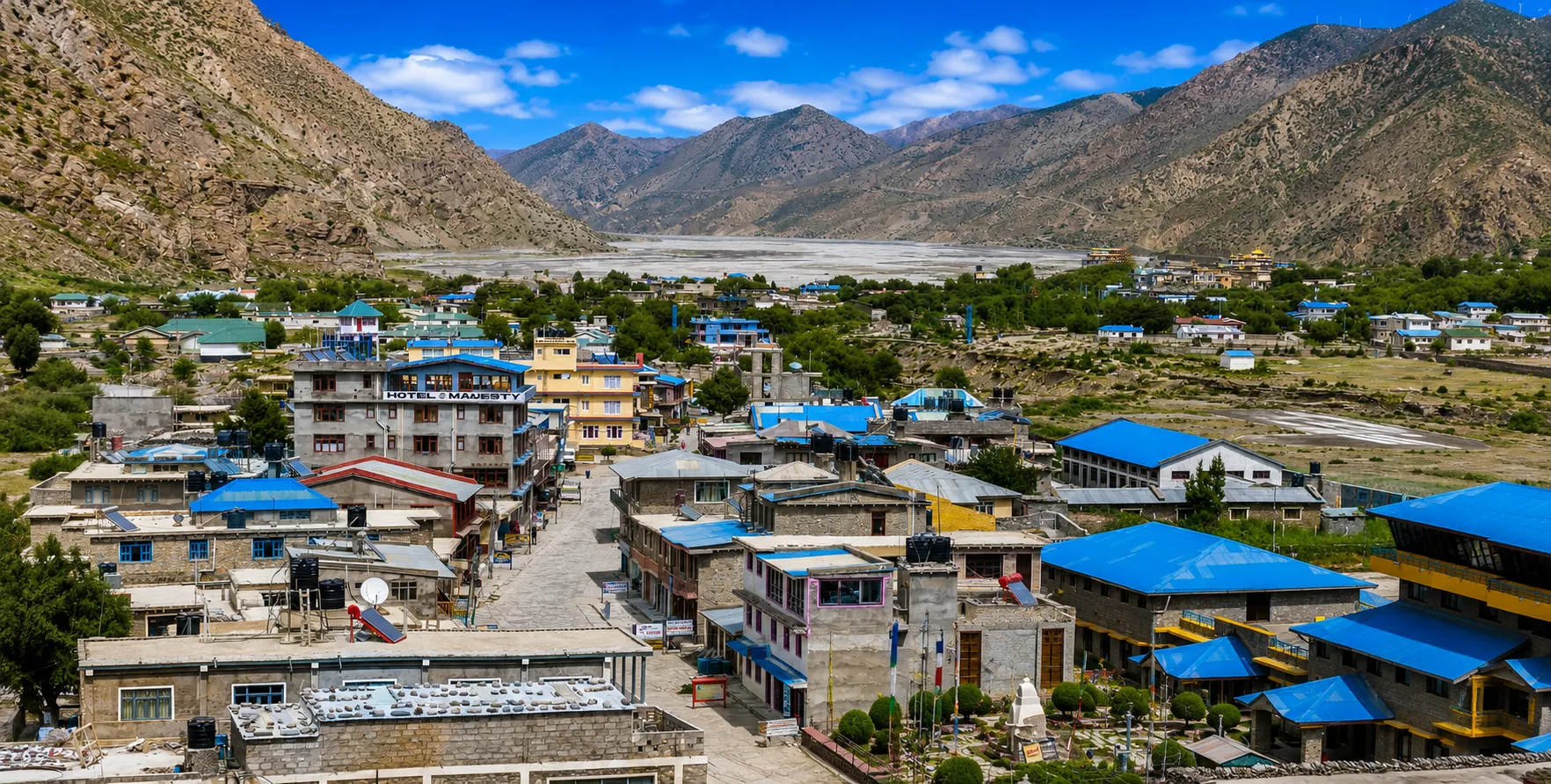
Teahouse Culture — Mustang’s Budget Accommodation Network. Mustang’s teahouse accommodation network is well developed throughout Lower Mustang and increasingly so in Upper Mustang, and it forms the backbone of budget travel in the region. In Lower Mustang villages — Jomsom, Marpha, Kagbeni, Ranipauwa, Tukuche — basic but functional teahouse rooms with shared bathroom facilities start from NPR 500–800 per night, with attached bathroom and hot shower available at NPR 800–1,500. These prices are broadly similar to teahouse rates elsewhere in the Annapurna and Everest trekking regions, though energy costs in remote locations mean that some services carry a premium.
In Upper Mustang — particularly in Tsarang and Lo Manthang — accommodation is more limited and consequently more expensive, with basic double rooms starting from approximately NPR 1,000–1,500 and running to NPR 2,500–4,000 for the best available rooms in the village. The accommodation market in Lo Manthang has improved considerably as the region’s tourism infrastructure has developed. Still, it remains genuinely basic compared to the more established trekking circuits. Most Upper Mustang teahouses offer accommodation at very low or zero cost to guests who eat their meals there. This common Himalayan teahouse arrangement bundles accommodation costs with meals, and negotiating them separately is often impractical.
Eating on a Budget in Mustang
Dal bhat — Nepal’s national dish and the single most important element of budget eating throughout the country — is universally available in Mustang teahouses and represents the best caloric and nutritional value available at any price point in the region. A standard dal bhat in Lower Mustang teahouses costs NPR 400–600 and includes unlimited rice and lentil soup refills, plus seasonal vegetable curry and often a side of pickle—enough calories for a full day of mountain trekking or vehicle travel. In Upper Mustang, dal bhat prices rise to approximately NPR 700–1,000, reflecting the higher logistics cost of supplying remote villages.
Beyond dal bhat, Mustang’s food specialities offer budget-friendly culinary experiences you shouldn’t miss. The famous Marpha apple products — apple pie at teahouses (NPR 150–300), dried apple snacks (NPR 100–200 per packet), apple juice (NPR 150–250 per glass) — are widely available in Jomsom and Marpha at modest prices. Thakali cuisine—the traditional cooking of Mustang’s Thakali community, characterised by well-spiced meat dishes, thick dal, and buckwheat bread—is available at speciality Thakali restaurants in Jomsom and some teahouses in Marpha, offering an outstanding introduction to a regional cuisine distinct from standard Nepali teahouse fare.
Best Season and Timing for Budget Mustang Travel
The Mustang region has one of the most distinctive and genuinely helpful seasonal patterns of any Nepal trekking destination — its position in the rain shadow of the Annapurna and Dhaulagiri ranges means that Lower Mustang and Upper Mustang remain accessible and enjoyable throughout the year, including the monsoon months of June through September when most of Nepal’s trekking destinations are significantly less rewarding due to rainfall, cloud cover, and leeches.
The spring season from March through May is Mustang’s most celebrated time — the Kali Gandaki valley is clear, the rhododendron forests on the approach from Pokhara are in bloom, and the famous Tiji Festival of Lo Manthang (typically held in May, though exact dates vary annually) brings three days of extraordinary costumed dance, mask ritual, and religious ceremony that represents the single most spectacular cultural event accessible anywhere in Nepal. For budget travellers who can plan around the Tiji Festival dates, the festival atmosphere and spring clarity make May one of the best months to visit Upper Mustang. However, accommodation in Lo Manthang is in high demand during Tiji and should be booked well in advance.
The autumn season from September through November offers the clearest mountain visibility and the most reliable walking and driving conditions on both the Kali Gandaki road and the Upper Mustang plateau tracks. October is consistently rated the finest single month for Mustang travel—the air is clear and cool, the landscape has been freshened by the tail end of the monsoon, and the afternoon winds, while still present, are at their least ferocious of the year. Pokhara-to-Muktinath jeep hire and Upper Mustang jeep expedition services from Nepal Vehicle Hiring Pvt. Ltd. see their highest demand in October and November—book early for this period.
Unlike most Nepal trekking regions, experienced Mustang travellers often recommend the monsoon season from June through September for Upper Mustang. While occasional landslides during heavy monsoon rainfall can affect the approach road from Pokhara through the Kali Gandaki, the Upper Mustang plateau receives very little monsoon rain, and the Lower Mustang villages offer genuine off-season tranquillity, with significantly lower accommodation prices and no crowds that characterise the peak months.
Nepal Vehicle Hiring Pvt. Ltd. — Your Mustang Transport Partner. Reaching Mustang’s extraordinary destinations from Pokhara or Kathmandu requires the right vehicle, an experienced driver, and a transport provider that understands the specific demands of Mustang’s roads. Nepal Vehicle Hiring Pvt. Ltd. offers a full range of Mustang transport services—from Pokhara-to-Muktinath jeep hire for Lower Mustang visitors to specialised Mustang Land Cruiser expeditions that take permitted travellers through the full restricted area to Lo Manthang.
The company’s Pokhara car hire service covers all Pokhara-based transfers and sightseeing, with experienced drivers available at any time from your Lakeside hotel. For travellers beginning their trip, we offer Kathmandu sightseeing, tours, Ajiathe River tour, and Nagarkot sunrise tours in Pokhara and Mustang. Nepal Vehicle Hiring Pvt.Ltd.‘s 8,000+ satisfied customers, 5.0 TripAdvisor rating, and 200+ verified five-star reviews reflect a consistent standard of service that makes it Nepal’s most trusted private vehicle hire provider — particularly for the demanding mountain routes of the Mustang region.
Pre-Mustang Kathmandu and Pokhara Activities
Most travellers visiting Mustang spend time in either Kathmandu or Pokhara before heading into the Mustang region, and both cities reward the time invested in pre-Mustang exploration. In Kathmandu, the Kathmandu sightseeing tour from Nepal Vehicle Hiring Pvt. Ltd. covers Boudhanath, Pashupatinath, Swayambhunath, and Patan in a single comfortable day by private vehicle. The Bhaktapur Durbar Square day tour adds Nepal’s finest medieval city to the pre-Mustang cultural circuit. In contrast, the Nagarkot sunrise tour from Nepal Vehicle Hiring Pvt. Ltd. offers a first glimpse of the Himalayan range, and the day before the Mustang departure is best used for permit collection at the Pokhara NTNC office and a restful evening at Lakeside. Nepal Vehicle Hiring Pvt. Ltd. offers car hire for Pokhara city sightseeing—Sarangkot viewpoint, World Peace Pagoda, the International Mountain Museum, and Phewa Lake—before the Mustang departure. Sarangkot sunrise from Pokhara offers the best preview of the Annapurna and Dhaulagiri ranges that frame the Mustang journey, and many experienced Mustang travellers recommend starting their Pokhara stay with Sarangkot sunrise to orient themselves to the mountain geography they are about to enter at ground level.
The Kathmandu to Pokhara private vehicle hire from Nepal Vehicle Hiring Pvt. Ltd. connects the two cities efficiently along the Prithvi Highway—a 200 km journey of five to seven hours that can include stops at the famous riverside restaurants at Malekhu and the celebrated curd vendors at Mugling. Booking the Kathmandu to Pokhara jeep hire and the Pokhara to Muktinath transfer together through Nepal Vehicle Hiring Pvt. Ltd. creates a fully coordinated transport chain from Kathmandu to Muktinath with a single trusted provider—the most efficient, stress-free way to organise a complete Nepal and Mustang journey.
Frequently Asked Questions — Mustang Budget Travel
Can I visit Mustang without a special permit?
Yes — Lower Mustang, including Jomsom, Marpha, Muktinath, Kagbeni, and the Kali Gandaki gorge, requires only the standard ACAP permit (NPR 3,000 for foreign nationals), with no special restricted area permit. Only Upper Mustang — north of Kagbeni, including Lo Manthang — requires the USD 500 Restricted Area Permit. Budget travellers who limit their Mustang itinerary to Lower Mustang can experience extraordinary destinations with minimal permit costs.
How much does it cost per day to travel in Lower Mustang on a budget?
A realistic budget daily cost in Lower Mustang for an independent traveller in 2026 is about NPR 2,500–4,000 per day, covering a basic teahouse room (NPR 600–1,000), two meals (NPR 500–1,200 each), and incidentals. The ACAP permit (NPR 3,000) is a one-time cost spread across the trip. Transport within Lower Mustang — shared jeeps between villages — is NPR 200–500 per person per short journey, making it very affordable.
What is the cheapest way to get from Pokhara to Muktinath?
The cheapest single option is the public/shared jeep from Pokhara to Muktinath, costing approximately NPR 1,500–2,500 per person with multiple stops and a 9–12 hour journey. For groups of four or more, private jeep hire from Nepal Vehicle Hiring Pvt. Ltd. at NPR 25,000–35,000 for the full Fortuner produces a per-person cost of NPR 5,000–8,750 — significantly more comfortable, faster (7–8 hours), and with hotel pickup included. The Pokhara-to-Muktinath private jeep is the best-value option for groups.
Is the Tiji Festival worth planning around?
Absolutely — the Tiji Festival in Lo Manthang is considered one of the most extraordinary cultural events accessible in Nepal and the Himalayan world. The three-day festival of masked dance, ritual music, and costumed ceremony in the courtyard of the Lo Manthang monastery complex draws visitors from across the world specifically to witness it. However, it requires an Upper Mustang RAP permit (USD 500), a licensed guide, and advance accommodation booking. For travellers with the budget for Upper Mustang, the Tiji Festival timing—typically late May—is one of the most compelling reasons to choose that travel window.
Is Mustang safe for budget solo travellers?
Lower Mustang is safe and suitable for solo budget travellers with standard trekking experience in Nepal. Trails are well marked, teahouses are consistently available, and mobile phone coverage exists in most Lower Mustang villages, including Jomsom and Ranipauwa. Shared vehicles serve the Aliandakid wells. The main practical challenges for solo travellers are the afternoon winds, which make exposed walking uncomfortable, and the altitude, which requires appropriate acclimatisation at 3,800 m. Upper Mustang requires a licensed guide by regulation and should not be attempted independently regardless of experience.
How do I book a Pokhara-to-Muktinath jeep with Nepal Vehicle Hiring?
Contact Nepal Vehicle Hiring Pvt. Ltd. via WhatsApp at +977 9814227196, by email at [email protected], or through vehiclehiringnepal.com. Provide your departure date from Pokhara, group size, vehicle preference, and any planned stops along the Kali Gandaki. The Gandaki. The company confirms the booking and provides the driver’s contact details. B k at least 2–3 days in advance during peak season (October and March–May), or same-day during off-peak periods.
Conclusion: Mustang Is More Accessible Than You Think
The most important takeaway from this guide is one too many potential visitors to the Mustang region miss: most of Mustang’s most extraordinary destinations are genuinely budget-friendly. Kali Gandaki Gorge, Muktinath Temple, Marpha village, Kagbeni, and Jomsom—each remarkable in its own right, together forming one of the finest concentrations of natural and cultural highlights in any single Nepal travel corridor—all lie in Lower Mustang and require nothing beyond the standard ACAP permit at NPR 3,000. The USD 500 restricted area permit for Upper Mustang opens an extraordinary additional dimension: The ancient forbidden kingdom; it is not a prerequisite for a Mustang experience of genuine depth and lasting impact.
Whether you arrive by shared jeep from Pokhara on the most budget-conscious arrangement possible, or by private Fortuner jeep hire from Nepal Vehicle Hiring Pvt. Ltd. with the flexibility and comfort that a quality private vehicle provides, the destinations of Mustang deliver an experience that is in all the ways that matter — the scale of the landscape, the depth of the cultural heritage, the spiritual power of the pilgrimage sites, the extraordinary quality of the light on the red cliffs and the desert plateau — entirely worth the journey. C tact Nepal Vehicle Hiring Pvt. Ltd. at +977 9814227196 or vehiclehiringnepal.com for Kathmandu sightseeing tours, Bhaktapur day trips, Nagarkot sunrise, and all Nepal vehicle hire needs to plan your Mustang vehicle hire today.
Book Your Mustang Vehicle with Nepal Vehicle Hiring Pvt. Ltd.
Website: www.vehiclehiringnepal.com
Phone / WhatsApp: +977 9814227196 (24/7 Support)
Email: [email protected]
Office: Bhagawatisthan, Thamel, Kathmandu, Nepal
Pokhara to Muktinath Jeep: Toyota Fortuner | NPR 25,000–40,000 (full vehicle)
Pokhara to Jomsom Road: NPR 22,000–60,000
Upper Mustang Expedition: NPR 35,000–70,000/day
Budget Group Sharing: Per-person cost NPR 4,000–7,000 for groups of 5–6
- Places to Visit in Mustang, Nepal: Budget Travel Guide: Why Mustang Is Nepal's Most Underrated Budget Destination
- Mustang Budget Travel — Quick Reference
- Understanding the Mustang Region — Lower vs Upper
- Budget Places to Visit in Lower Mustang — No Special Permit Needed
- Upper Mustang — Making the Forbidden Kingdom Affordable
- How to Reach Mustang — Budget Transport Options
- Permits Required for Mustang — Complete Guide
- Budget Accommodation and Food in Mustang
- Best Season and Timing for Budget Mustang Travel
- Pre-Mustang Kathmandu and Pokhara Activities
- Frequently Asked Questions — Mustang Budget Travel
- Conclusion: Mustang Is More Accessible Than You Think
- Book Your Mustang Vehicle with Nepal Vehicle Hiring Pvt. Ltd.

Related Blog & Articles
Altitude and Health: Essential Muktinath Advice
Hidden Kingdom Adventure Nepal Upper Mustang Jeep Tour
Mustang Full Guide: Upper & Lower Mustang Vehicle Hire
Kathmandu to Mustang (Muktinath)
Korala – Nepal’s Gateway to Tibet: The Mustang Jeep Route to the Nepal-China Border