Plan a Trip


Sacred Sites of Muktinath – A Complete Pilgrimage Guide
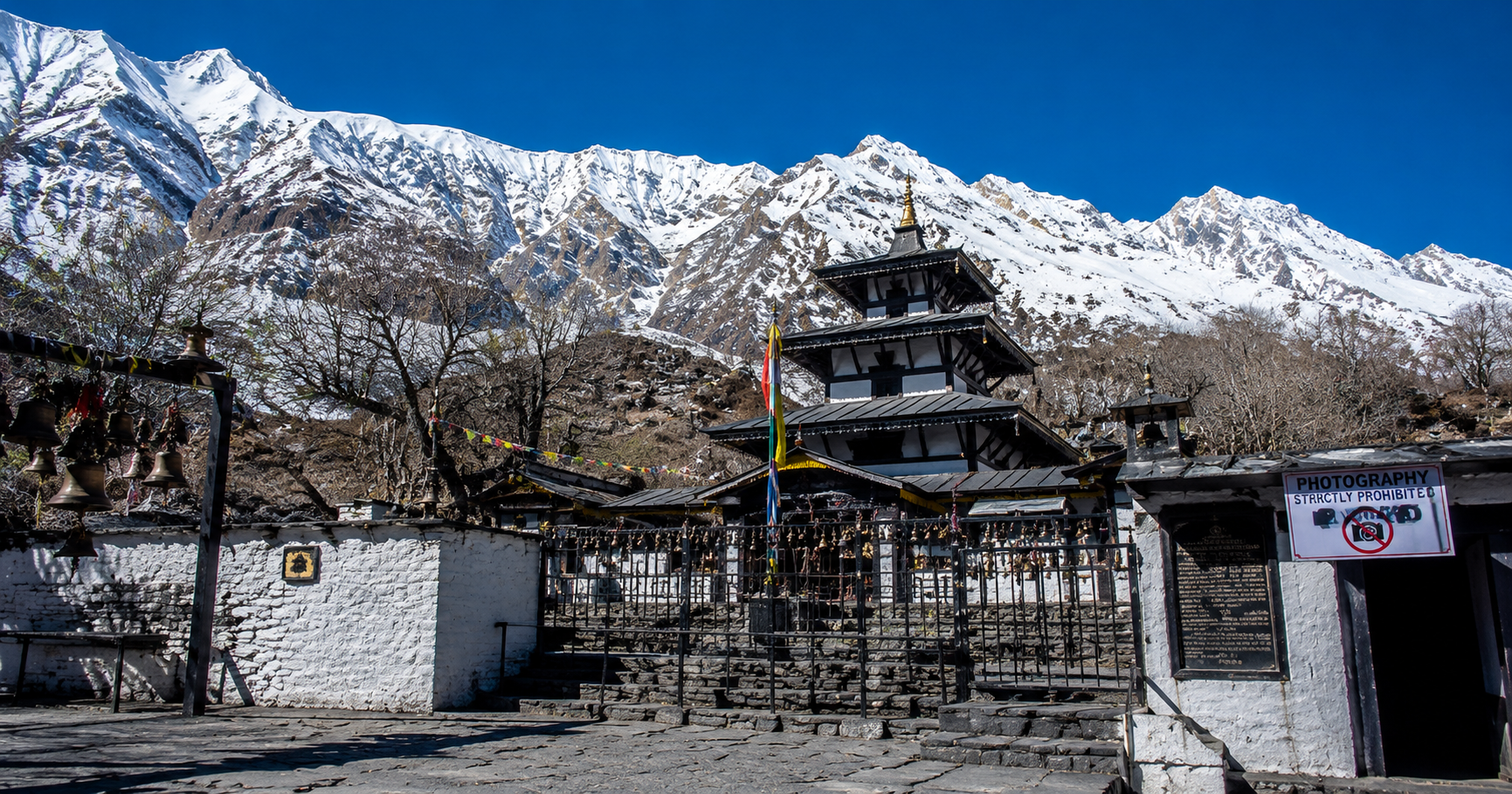
Sacred Sites of Muktinath – A Complete Pilgrimage Guide
High in the arid Himalayan desert of Upper Mustang, Nepal, at an altitude of 3,710 meters, stands one of the most extraordinary sacred sites on Earth. Muktinath – whose very name means the Lord of Liberation or the Lord of Salvation – has drawn pilgrims, seekers, and wanderers for thousands of years. It is the only place in the world where the five sacred Hindu elements – Earth, water, fire, sky, and air – are all found together in one divine compound. For Tibetan Buddhists, it is Chumig Gyatsa, the Hundred Waters, a site of deep meditation power and spiritual grace.
Muktinath is not a single temple. It is a sacred complex – a constellation of shrines, natural phenomena, ancient stone, flowing water, and eternal flame spread across the high-altitude plateau below the Thorong La Pass. Visiting Muktinath means stepping into one of Asia’s oldest living pilgrimage traditions, shared across centuries by Vaishnavas, Shaivites, Shaktas, and Tibetan Buddhists. This complete guide leads you through every sacred site within the Muktinath complex – their history, their religious significance, their rituals, and what to expect as a visitor in 2026.
Muktinath – The Sacred Geography
Location: Ranipauwa village, Mustang District, Gandaki Province, Nepal
Altitude: 3,710 meters (12,172 feet) above sea level
Setting: High-altitude Tibetan plateau landscape – arid, dramatic, sky-filling
Surrounding Peaks: Dhaulagiri (8,167 m) to the south-west, Nilgiri (7,061 m) to the south, Thorong La Pass (5,416 m) to the north-east
Nearest Town: Jomsom – 22 km South, 1.5 to 2 hours by jeep
Religious Status: One of the 108 Divya Desams (sacred Vishnu temples) of Vaishnavism. Sacred to Shaivites, Shaktas, and Tibetan Buddhists
Annual Pilgrims: Hundreds of thousands annually – peak pilgrimage during Janmashtami, Balachaturdashi, and religious full moons
The Muktinath sacred complex sits on a wide plateau at the foot of a high cliff face from which the sacred spring water emerges. The landscape around Muktinath is unlike anything else in Nepal – stark, wind-scoured, almost lunar in its ochre and grey colours, yet presided over by enormous snow peaks on all horizons. The contrast between the harsh outer landscape and the deep peace of the sacred complex within the temple walls is one of Asia’s most powerful spiritual juxtapositions.
“To bathe in the 108 spouts of Muktinath is to wash away the sins of all previous lifetimes. To see the eternal flame is to witness the divine light that never dies. To stand in this high place is to understand why the ancients called this land the place of liberation.” – Traditional pilgrim saying.
The History and Origins of Muktinath
Ancient Origins
The history of Muktinath as a pilgrimage destination stretches back at least 2,600 years, though oral traditions and some textual references suggest its sacred importance may be far older. The site is referenced in ancient Sanskrit texts, including the Skanda Purana, which identifies Muktinath as the supreme Vaishnava Kshetra (sacred field) north of the Himalayas – a place where Vishnu himself descended and blessed the Earth.
The name Muktinath comes from two Sanskrit words: Mukti (liberation, moksha) and Nath (Lord, master). Together they form Muktinath – the Lord Who Grants Liberation. The Hindu theological concept embedded in the name is profound: this is not merely a place to worship a deity but a place where the ultimate spiritual goal – freedom from the cycle of birth, death, and rebirth – can be attained through pilgrimage, devotion, and ritual bath.
The Ashoka Connection
Several historical accounts suggest that the Emperor Ashoka, the great 3rd-century BCE Mauryan emperor who converted to Buddhism after the Kalinga War and became the most powerful patron of Buddhism in Indian history, may have sent emissaries to Muktinath and contributed to the construction of early sacred structures here. While archaeological proof is limited, the sacred pond adjacent to the main temple is named Mukti Kund, and the architecture of certain early brick structures suggests construction techniques consistent with the Mauryan period.
Buddhist Adoption of Muktinath
As Buddhism spread from Nepal and India into Tibet between the 7th and 11th centuries CE, Muktinath was identified by Tibetan Buddhist masters as Chumig Gyatsa – a sacred site mentioned in Tibetan Buddhist canonical texts as a place of great spiritual power. Guru Rinpoche (Padmasambhava), the great 8th-century tantric master credited with bringing Buddhism to Tibet, is said to have meditated at Muktinath and recognised the site’s profound energy.
The Tibetan Buddhist monastery (Gompa) built adjacent to the Hindu temple complex – and managed by Buddhist nuns (anis) – established the tradition of shared pilgrimage that continues to define Muktinath today. Hindus and Buddhists worship side by side at Muktinath with deep mutual respect – a living model of religious coexistence unique in the Himalayan world.
The Kingdom of Mustang Connection
Muktinath has long been central to the spiritual and political life of the Kingdom of Mustang – the ancient Tibetan-culture kingdom that maintained semi-independence within Nepal until the 21st century. The Lo Raja (King of Mustang) historically served as protector of the Muktinath sacred complex and made annual royal pilgrimages there. The carved stone walls, prayer flag poles, and mani stones surrounding the temple complex reflect centuries of royal patronage and Mustang’s unique Tibetan Buddhist-Hindu cultural synthesis.
The Mukti Dhaam Temple – Heart of the Sacred Complex
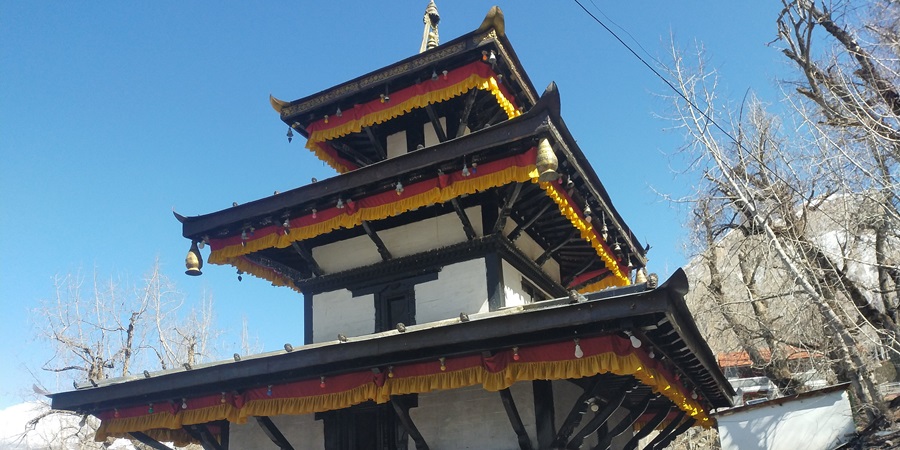
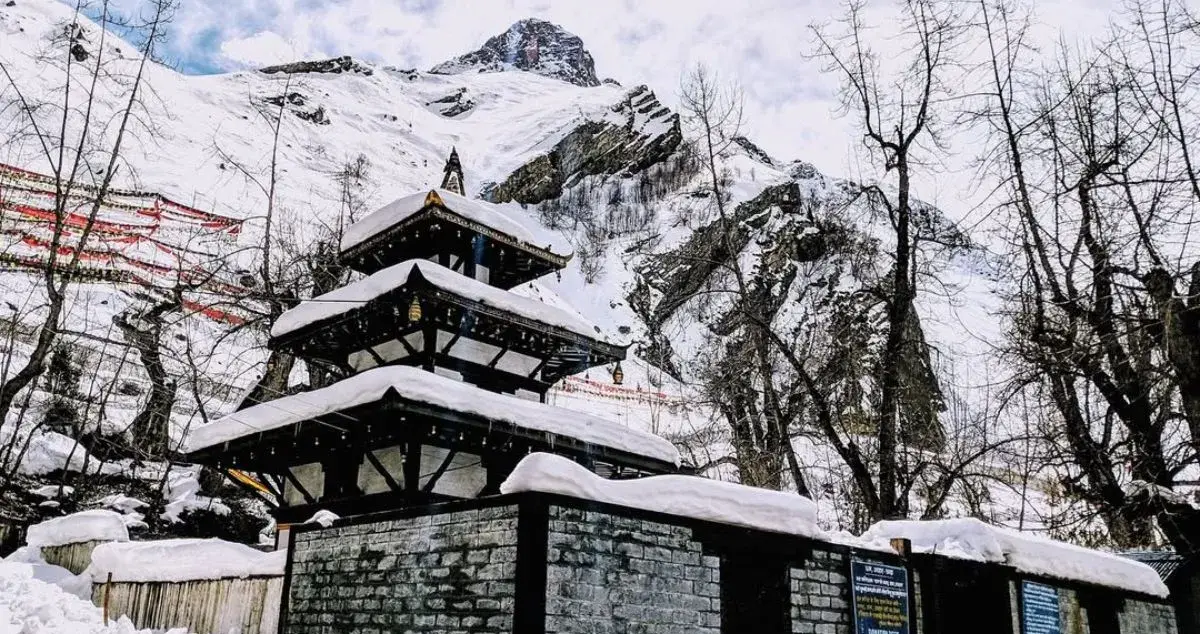
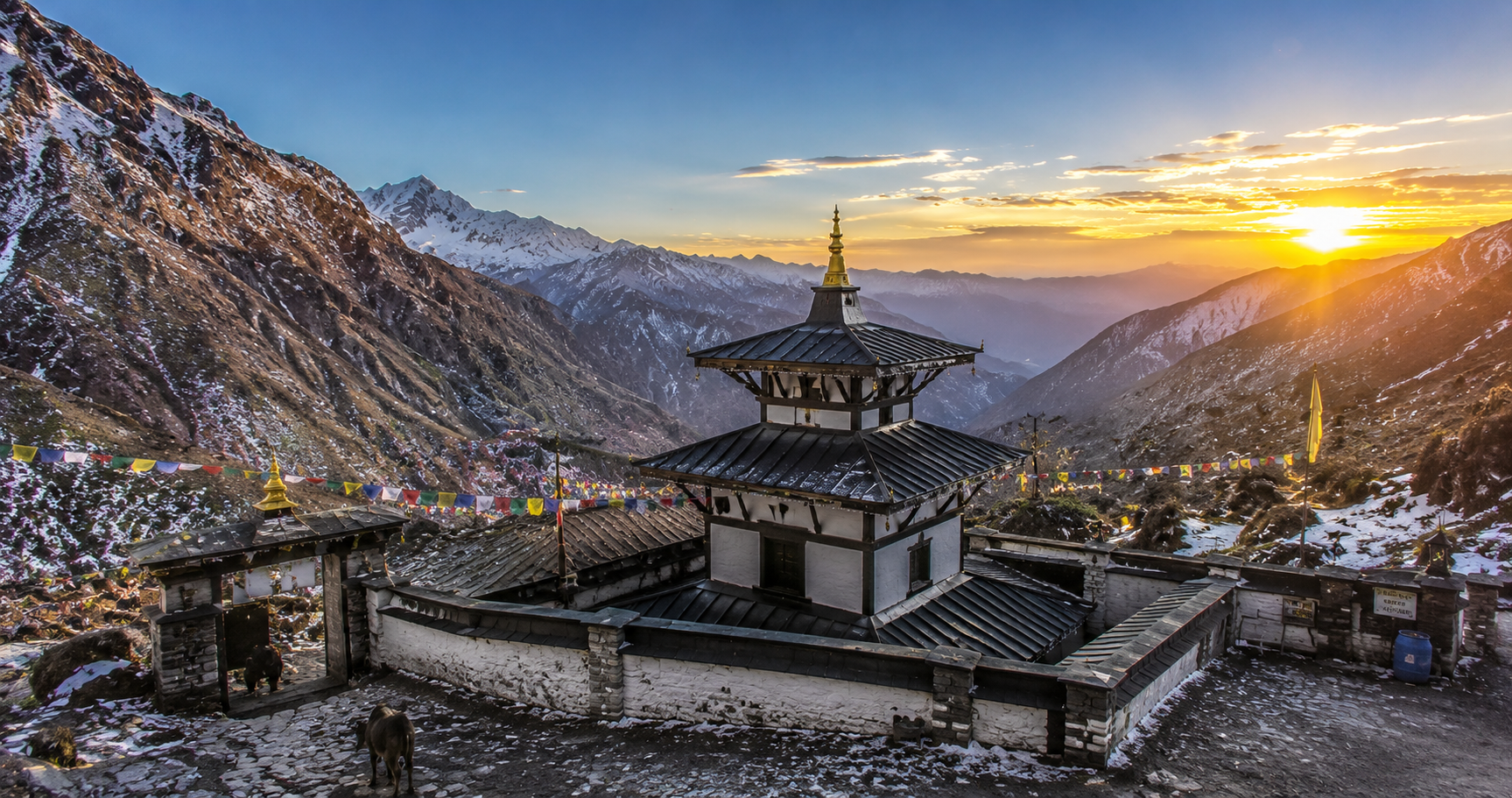
The main temple of Muktinath is called Mukti Dhaam – the Abode of Liberation. This golden-roofed, pagoda-style temple serves as the centrepiece of the sacred complex and marks the culmination of the pilgrimage.
The Vishnu Shrine – Inner Sanctum
Inside the Mukti Dhaam temple, the main deity enshrined is Lord Vishnu in the form of Muktinath – one of the 108 Divya Desam Vishnu temples enumerated in the Sri Vaishnava tradition. In Sri Vaishnavism – the devotional tradition that most deeply venerates the 108 Divya Desams – Muktinath holds particular importance as the only Divya Desam located in the Himalayas, the one that is furthest from the traditional South Indian heartland of the tradition, and therefore the most distant and difficult pilgrimage, which only amplifies its merit.
The image of Lord Vishnu in the inner sanctum is an ancient black stone figure adorned with golden ornaments and silken garments, changed daily by the temple priests. The deity holds the traditional Vishnu symbols – the conch (shankha), discus (chakra), mace (gada), and lotus (padma). The image is flanked by consorts Lakshmi and Saraswati. The divine presence in the inner sanctum is palpable to devotees – this space carries centuries of worship, prayer, and accumulated spiritual energy.
Temple Architecture and Design
The Mukti Dhaam temple is a compact, two-tiered pagoda structure with a gleaming golden roof that catches the high-altitude sunlight brilliantly – visible from a great distance as you approach Ranipauwa village. The temple walls are whitewashed stone, and the doors are ornately carved wood painted in the traditional Nepali temple style. Around the outer walls, carved stone panels depict scenes from the Vishnu Puranas.
The approach to the temple is through a gateway marked by the Garuda – Vishnu’s divine eagle vehicle – carved in stone. Prayer flags strung from tall poles flutter constantly in the Mustang wind. The outer courtyard is paved with ancient stone slabs worn smooth by the passage of millions of pilgrims over the centuries. The atmosphere of the outer courtyard – the smell of incense, the sound of bells, the colour of marigold garlands – is immediately and unmistakably sacred.
Daily Temple Rituals and Puja
The Mukti Dhaam temple follows a rigorous daily ritual schedule maintained by the resident Hindu priests:
- Mangala Aarti (Dawn Worship) – 5:00 to 5:30 AM: The first puja of the day, conducted in near darkness with oil lamps and incense, invoking the divine presence for the new day. Deeply atmospheric – this is the most spiritually powerful time to be in the temple.
- Abhisheka (Sacred Bath) – 6:00 AM: The ritual bathing of the deity with sacred water from the 108 spouts, milk, honey, and yoghurt, accompanied by Vedic chants
- Shringar (Adornment) – 7:00 AM: The deity is dressed in fresh garments and adorned with flowers, tulsi leaves, and gold ornaments
- Bhog (Food Offering) – 12:00 PM: Sacred food offerings, including rice, fruits, sweets, and ghee lamps,s are presented to the deity
- Midday Closing – 12:00 to 1:00 PM: The temple closes briefly for the midday rest period
- Afternoon Darshan – 1:00 to 6:00 PM: The temple reopens for afternoon pilgrims and visitors
- Sandhya Aarti (Evening Worship) – 5:00 to 6:00 PM: The evening lamp ceremony – one of the most beautiful experiences at Muktinath – bells, conch shells, fire lamps, and devotional singing in the golden afternoon light
- Shayan (Night Rest) – 6:30 PM: The deity is put to rest, st and the temple closes for the night
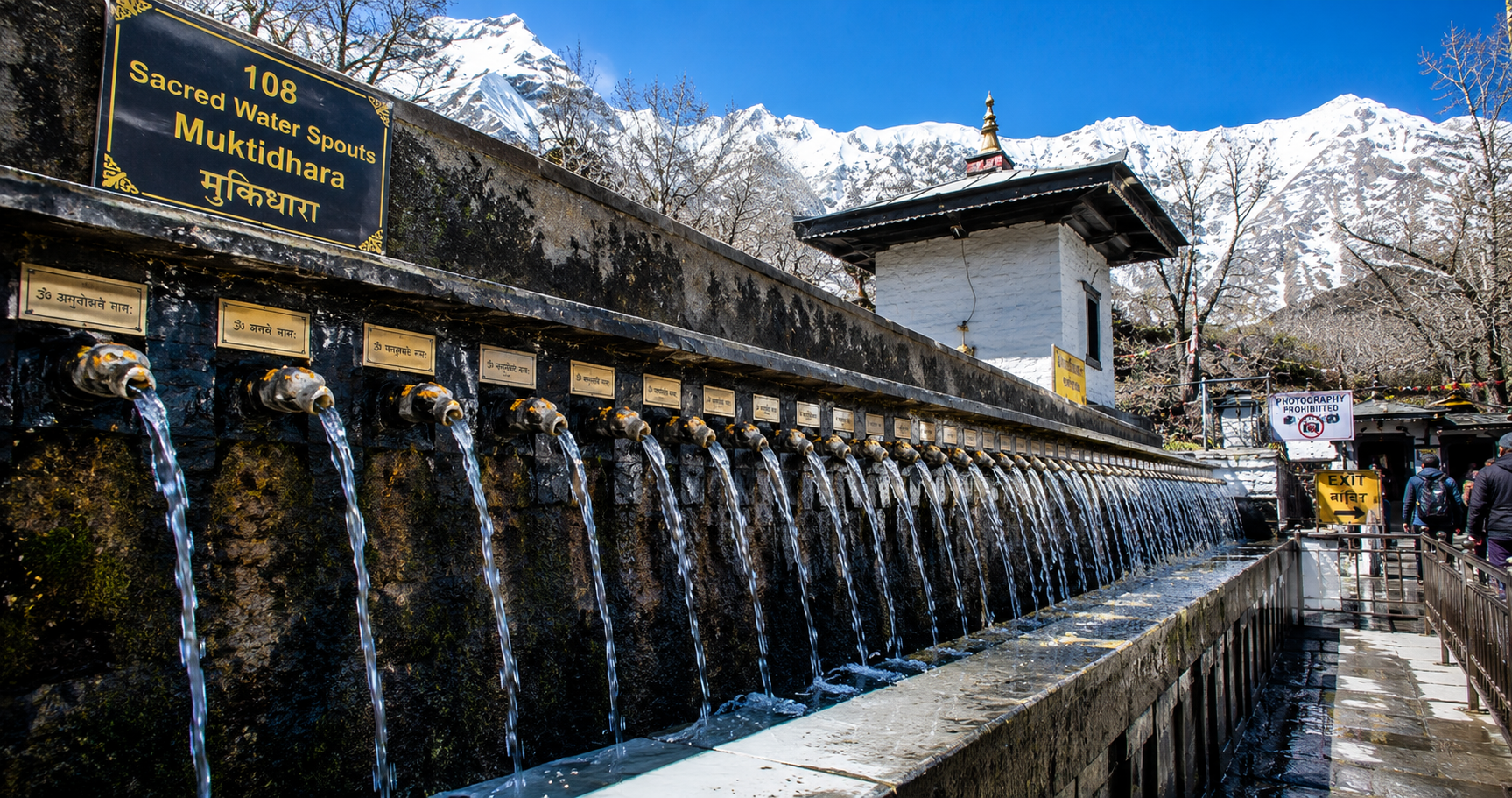
The 108 Sacred Water Spouts – Muktidhara
Of all the sacred sites at Muktinath, it is the 108 water spouts – collectively known as Muktidhara – that hold the most universal significance for pilgrims of all traditions. These are the experiences of the Muktinath pilgrimage.
The Architecture of the Spouts
The 108 spouts are arranged in a graceful semicircle set into a long stone wall that curves around the eastern side of the main temple compound. Each spout is carved in the shape of a makara or cow’s head (gomukhi) in black stone, and from the mouth of each animal pours a continuous, unfailing stream of sacred spring water that originates from the cliff face and underground springs of the Muktinath plateau above. The water is ice-cold year-round – approximately 4 to 6°C in all seasons – a fact that makes the ritual bath both a physical and spiritual ordeal for most pilgrims.
The spouts are arranged in a gentle arc approximately meters long and about meters above the ground. Below each spout, stone-paved channels carry the water away in small streams that flow down through the temple complex. The sound of 108 streams of water pouring simultaneously – a constant, rushing, musical sound – fills the entire sacred complex and can be heard from outside the temple walls.
The Sacred Number 108
The number 108 is among the most sacred numbers in Hindu and Buddhist cosmology. Its significance at Muktinath is multi-layered and profound:
- In Vaishnavism, 108 represents the 108 sacred names of Lord Vishnu (Ashtottara Shatanamavali). To bathe under each spout while chanting one of the 108 names is to complete a full circumambulation of all of Vishnu’s divine attributes
- In astronomy and cosmology, the distance between the Earth and the Sun is approximately 108 times the Sun’s diameter. The distance between the Earth and the Moon is approximately 108 times the Moon’s diameter. Hindu sages recognised this and considered 108 cosmically significant.
- In yoga and meditation, 108 beads on a prayer mala (rosary) represent the 108 earthly desires that must be overcome on the path to liberation.
- In Buddhism, 108 represents the 108 defilements (kleshas) of the mind that must be eliminated on the Buddhist path. Buddhist prayer malas also have 108 beads.
- In the human body: According to Vedic tradition, 108 marma points (sacred energy junctions) correspond to the 108 spouts.
The Ritual Bath – How It Is Performed
The ritual bath under the 108 spouts is the central act of the Muktinath pilgrimage for Hindu devotees. Here is how the traditional ritual is observed:
- Pilgrims arrive at the spout area before dawn – ideally arriving by 5:00 AM for the most spiritually powerful time before crowds gather
- Carry a complete change of dry clothing in a waterproof bag – you will be soaked to the skin
- Begin at the first spout on the left end of the arc and work methodically across all 108 spouts from left to right
- At each spout, stand under the stream of water and recite one of the 108 names of Lord Vishnu, or repeat your chosen mantra or the Vishnu Sahasranama (thousand names)
- Allow the water to flow over the crown of the head – the crown (brahmarandhra) is considered the sacred gateway of the soul.
- Move steadily and with devotion – the complete bath under all 108 spouts takes approximately 45 minutes to 1.5 hours, depending on speed and devotion.
- After completing all 108 spouts, dry off immediately with the pre-bought towel and change into the dry clothes you brought.
- Proceed directly to the main Vishnu temple for darshan while in the state of ritual purity established by the bath.
Non-Hindu visitors and those who do not wish to participate in the full bath are welcome to observe respectfully and may touch the water from individual spouts as a blessing. Many non-pilgrims touch the water with folded hands and receive Muktinath’s blessing without the full ritual bath.
The Spiritual Merit of the 108 Spout Bath
According to Hindu tradition, a single sacred bath under all 108 spouts at Muktinath is believed to:
- Wash away the accumulated sins (papas) of the current and all previous lifetimes
- Break the cycle of samsara (rebirth) and open the path to moksha (liberation)
- Purify the seven sacred rivers of India simultaneously – as if the pilgrim had bathed in the Ganga, Yamuna, Saraswati, Narmada, Sindhu, Godavari, and Kaveri all at once
- Remove all obstacles to spiritual progress and worldly prosperity
- Grant the merit equivalent to completing the four Char Dham pilgrimages (Badrinath, Dwaraka, Puri, Rameswaram) simultaneously
The Jwala Mai Shrine – The Eternal Sacred Flame
Behind the main Vishnu temple, accessible through a narrow stone passageway, lies one of the world’s most extraordinary natural-sacred phenomena. In this Jwala Mai shrine, an eternal flame of natural gas has burned from the living rock for as long as human memory reaches.
The Natural Miracle
The Jwala Mai flame emerges from a small cave where a seep of natural methane gas ignites upon meeting the air – a geological phenomenon caused by the deep subterranean conditions of the Himalayan plateau. What makes this site so extraordinarily sacred is not just the flame itself, but the fact that, immediately beside it, a continuous stream of water also flows from the same rock face. Flame and water – fire and the sacred spring – emerging simultaneously from the same sacred rock.
In Hindu theology, the union of fire (agni) and water (jal) is the union of the masculine and feminine divine principles – the union of Shiva and Shakti, the union of Vishnu and Lakshmi, the union of all opposing forces in the cosmos. To witness this union at a single point in the rock is to witness the divine mystery of existence itself. This is why Muktinath is called the place where all five sacred elements unite – fire, water, Earth, air, and sky are all present and perceptible within the sacred complex.
Jwala Devi – The Goddess of the Flame
The eternal flame is venerated as the manifestation of Jwala Devi – the Goddess of the Divine Flame – a form of the Goddess Shakti. A small shrine image of the Goddess is installed beside the flame, garlanded with marigolds and adorned with red sindoor powder. Pilgrims offer ghee (clarified butter), incense, camphor, red cloth, and flowers to the Goddess. The flame flares and dances when ghee is offered, which devotees experience as the Goddess directly accepting their offering.
The Buddhist Perspective on the Flame
For Tibetan Buddhist pilgrims, the eternal flame of Muktinath is associated with the concept of the indestructible clear light – the most subtle level of consciousness in Tibetan Buddhist philosophy, said to be present at the moment of death and in deep meditation. The flame that never goes out, that has burned since before living memory, represents the continuity of consciousness, the deathlessness of the awakened mind. The same rock that holds the flame also holds the water – a representation of compassion (water, yin, receptive) and wisdom (fire, yang, active) in union – the two wings of the Buddhist path.
Visiting the Jwala Mai Shrine
The Jwala Mai shrine is accessible through the rear of the main temple compound. A narrow stone corridor leads to a small chamber where the flame and water emerge from the rock. The space is intimate and dim, lit by the flame itself and by butter lamps placed by pilgrims. The atmosphere is one of concentrated sacred energy. Visitors should:
- Remove shoes before entering the shrine chamber
- Bring ghee or clarified butter to offer to the flame – purchased in Ranipauwa village
- Bring flowers, red cloth, or incense as additional offerings to Jwala Devi
- Maintain silence inside the shrine – this is a space of deep reverence
- Sit or kneel for a few moments of quiet prayer or meditation – the flame is mesmerising
- Touch the sacred water flowing from the rock and bring it to the forehead and crown as a blessing
The Mukti Narayan Gompa – The Buddhist Monastery
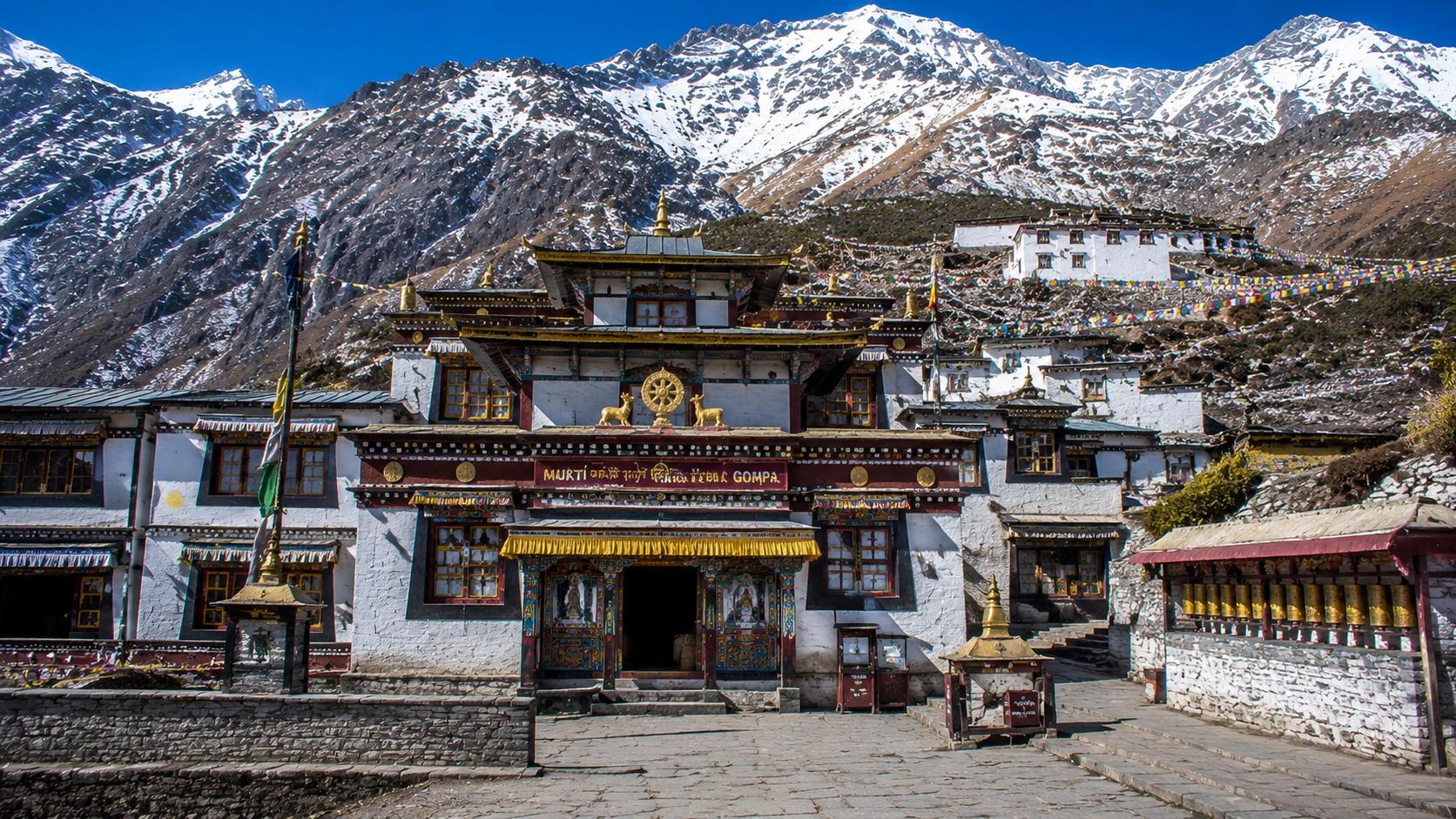
Adjacent to the Hindu Vishnu temple, sharing the same sacred compound, stands the Mukti Narayan Gompa – an ancient Tibetan Buddhist monastery managed by Buddhist nuns (anis). This monastery is the principal Buddhist sacred site within the Muktinath complex and one of the most important active nunneries in the Mustang region.
Architecture and Sacred Art
The Mukti Narayan Gompa is a traditional Tibetan gompa – with thick stone walls painted white and ochre, a flat roof lined with prayer flags, and an entrance porch featuring elaborate paintings of protective deities (dharmapalas) and the Wheel of Life (bhavachakra). The interior is a single large prayer hall centred on a gilded altar with a large statue of Shakyamuni Buddha, flanked by statues of Guru Rinpoche (Padmasambhava) and Chenrezig (Avalokitesvara).
The walls of the prayer hall are covered in ancient thangka paintings – some estimated to be 400 to 500 years old – depicting the life of the Buddha, the Wheel of Existence, the protector deities of the Mustang valley, and elaborate mandalas. These thangkas represent some of the finest traditional Tibetan Buddhist art in the entire Mustang region and are extraordinary cultural heritage objects. Photography is generally permitted in the outer areas – ask the nuns for permission before photographing the thangkas and altar.
The Nuns of Muktinath
A community of Buddhist nuns tends the Mukti Narayan Gompa, living in small stone houses immediately adjacent to the monastery. The nuns perform daily ritual practices, including morning and evening puja, circumambulating the sacred compound, spinning prayer wheels, and maintaining butter lamps. Their presence at Muktinath for centuries has helped establish the site’s character as a place of women’s spiritual power and dedication.
The nuns maintain a daily ritual schedule that complements and runs parallel to the Hindu puja in the adjacent Vishnu temple. The sounds of Buddhist drums, cymbals, and the chanting of mantras from the gompa blend with the Hindu bell ringing and conch shell calls from the Vishnu temple – a sonic landscape unique in the Himalayan world.
Sacred Buddhist Iconography at Muktinath
The Mukti Narayan Gompa and the surrounding sacred precinct contain several significant Buddhist sacred objects and icons:
- The large prayer wheels arranged around the outer wall of the temple compound – spin clockwise while circumambulating; each rotation of a prayer wheel generates the same merit as reciting the mantra inscribed within (usually Om Mani Padme Hum), the number of times it is written on the paper coil inside
- Mani walls – long stone walls built from carved mani stones (stones inscribed with Om Mani Padme Hum) – pass these always to your left while circumambulating
- Stone stupas and chortens of various sizes surround the compound – each one contains sacred relics or dharma texts and is an object of prostration and circumambulation.
- The Guru Rinpoche shrine – a small side shrine dedicated to Guru Padmasambhava, who is said to have meditated at Muktinath and recognised its sacred power
The Sacred Shaligram Stones of Muktinath
The entire stretch of the Kali Gandaki River from Kagbeni to Muktinath and beyond is the only place on Earth where Shaligram stones – fossilised ammonite shells from the ancient Tethys Ocean – are found naturally embedded in the riverbed. These stones hold the highest sacred significance in Hinduism.
What Are Shaligram Stones?
Shaligrams are black or dark grey fossilised ammonites – the coiled shells of ancient marine creatures that lived in the Tethys Ocean approximately 140 to 65 million years ago, when the land that is now the Himalaya was the floor of a shallow tropical sea. As the Indian subcontinent collided with Asia and the Himalayas rose, these ancient seabeds were pushed to extraordinary heights. The Kali Gandaki River cuts through these ancient marine sediments, exposing ammonite fossils – tumbled and polished by millennia of river action into smooth, black, spiral-marked stones.
Shaligrams hold immense sacred significance in Hinduism. They are considered the living, physical embodiment of Lord Vishnu – not merely a symbol of Vishnu, but Vishnu himself dwelling in the stone. The Garuda Purana states that the sight of a Shaligram, the touch of a Shaligram, and the water in which a Shaligram has been bathed are all supremely purifying. Unlike an idol or murti that must be consecrated to be sacred, the Shaligram is considered inherently divine and self-manifested (svayambhu).
Collecting Shaligrams as a Pilgrimage
One traditional act of the Muktinath pilgrimage is collecting Shaligram stones from the Kali Gandaki riverbed between Kagbeni and Muktinath. The collection itself is considered a sacred act – discovering a Shaligram is considered a sign of divine blessing, as if Vishnu himself has chosen to come home with you. Pilgrims wade into the cold river, search among the smooth river stones, and select Shaligrams of appropriate size and markings for worship at home temples.
Different types of Shaligrams are identified by the number and arrangement of their spiral ammonite chambers – these are believed to represent different forms of Lord Vishnu. A Shaligram with two spirals represents Vishnu in his two-armed form. One with four spirals represents the four-armed Vishnu holding the conch, discus, mace, and lotus. Particularly rare and perfect specimens are considered highly auspicious and treasured as sacred heirlooms, passed down through generations.
Responsible Shaligram Collection
In 2026, travellers should be aware of Nepal’s regulations on collecting and exporting Shaligram stones. While collecting a small number of Shaligrams for personal religious worship is a long-standing tradition, the stones are considered a protected natural and cultural heritage resource. Exporting large numbers of Shaligrams or collecting them commercially is prohibited. Pilgrims may collect a small number of stones for personal worship – typically 1 to 5 stones – without difficulty. Attempting to export large quantities will result in confiscation at customs.
Sacred Sites of Muktinath
The Sacred Compound – Additional Holy Sites
The Mukti Kund – Sacred Pond
At the base of the 108 water spouts, the flowing water collects in the Mukti Kund – a small sacred pond. The pond is considered holy and its water purifying. Some traditions hold that the water of Mukti Kund is connected underground to all seven sacred rivers of India – a cosmological belief that makes bathing in or drinking from the Mukti Kund equivalent to bathing in the Ganga and all other sacred rivers simultaneously.
The Gomukh – The Cow’s Mouth Spring
Above the 108 spouts, the primary spring from which all the sacred water flows emerges from a cleft in the rock in the form of a gomukh (cow’s mouth) – a traditional Hindu sacred symbol in which water emerging from a cow’s mouth represents the divine grace flowing from the cosmic mother. The gomukh spring is considered the source of the entire sacred water system of Muktinath and is worshipped separately from the 108 spouts below.
The Mani Walls and Prayer Circumambulation Path
A traditional Tibetan stone wall encloses the entire Muktinath sacred compound, lined with prayer wheels and interspersed with mani stones. The circumambulation path (kora) that follows the inner perimeter of this wall is one of the most important rituals for Buddhist pilgrims at Muktinath. A complete clockwise circumambulation of the entire compound, spinning each prayer wheel as you pass and maintaining a meditative mind, is considered to generate enormous merit and to bring blessings to all living beings.
The circumambulation path is shared by Hindu and Buddhist pilgrims who walk it together – Hindus folding their hands in namaste at the shrines they pass, Buddhists spinning prayer wheels and reciting Om Mani Padme Hum. This shared circumambulation is one of the most moving expressions of the deep religious harmony that characterises Muktinath.
The Sacred Fire Pits of the Outer Compound
In the outer area of the Muktinath compound, stone fire pits are used for Havan (sacred fire sacrifice) rituals conducted by visiting pilgrims and Hindu priests. A havan at Muktinath – conducted with sacred wood, ghee, sesame seeds, and Vedic mantras – is considered to have vastly amplified merit due to the site’s sacred power. Many devout Hindu pilgrims arrange a private havan at Muktinath as part of their pilgrimage, particularly for ancestral rites (pitru tarpanam) and to purify the soul after a long illness or hardship.
The Vishnu Footprint Stone
Within the main temple compound, a carved stone slab is believed to bear the footprint (charan paduka) of Lord Vishnu – a direct physical mark of the divine presence at this site. Footprint stones are among the most venerated objects in Hindu worship – the physical impression of the divine foot on the Earth is considered a portal of blessing. Devotees touch the footprint stone with both hands and bring their hands to their foreheads in a gesture of surrender and reverence.
Jharkot and Kagbeni – Sacred Sites Near Muktinath
Jharkot – The Warrior Village
Just 2 km below Ranipauwa on the jeep road from Jomsom, the ancient fortified village of Jharkot sits on a small hillock above the valley floor. The village contains the Jharkot Dzong – a ruined fortress palace of the former Mustang nobility – and the Jharkot Gompa, an active Tibetan Buddhist monastery with important tantric sacred art. The gompa is associated with the Sakya school of Tibetan Buddhism and contains magnificent wall paintings and a collection of gilded statues.
Many Muktinath pilgrims stop at Jharkot on the way to or from the main temple. The combination of the ruined fortress, the active monastery, and the sweeping views of the Muktinath plateau from the village makes Jharkot one of the most atmospheric minor sacred sites in the entire Mustang region.
Kagbeni – The Gateway to Upper Mustang
Kagbeni is a medieval village at the confluence of the Kali Gandaki and Kak rivers, approximately 18 km below Muktinath, marking the southern entry point to Upper Mustang. The Kag Chode Thupten Samphel Ling Monastery in Kagbeni is one of the most significant and best-preserved Tibetan Buddhist monasteries in the entire Mustang region – a complex of ancient buildings, courtyards, prayer halls, and sacred images that dates in its present form to the 15th century. The monastery contains an extraordinary collection of ancient thangka paintings, gilded statues, and ritual objects.
For pilgrims arriving at Muktinath by jeep from Jomsom, Kagbeni is always passed on the route and is well worth a 45-minute to 1-hour stop. Walking the narrow medieval lanes of Kagbeni, passing under stone archways, beside mani walls and ancient chortens, offers a profound sense of temporal depth – this village has looked more or less the same for 600 years.
The Kali Gandaki Shaligram Zone
The stretch of the Kali Gandaki River between Kagbeni and Muktinath is the world’s primary Shaligram zone. Pilgrims who wish to search for Shaligrams should plan time at the river between these two points. The best conditions for searching are in spring (March to May) and autumn (October to November), when the river is lower and the stones are more accessible. A guide from Kagbeni or Ranipauwa can show you the best collecting areas.
Festivals and Sacred Times at Muktinath
Balachaturdashi – November/December
Balachaturdashi is the most important annual pilgrimage festival at Muktinath – a full-moon night in late November or early December when hundreds of thousands of Hindu pilgrims from across Nepal and India descend on the Muktinath sacred complex for the sacred ritual of Satbij (seven seeds). The ritual involves scattering seven types of seeds at the sacred site as an offering for the liberation of deceased family members.
The night of Balachaturdashi at Muktinath – with pilgrims moving through the 108 spouts by torchlight, the chanting of mantras, the smell of incense and marigolds, and the brilliant stars of the high-altitude sky above – is one of the most extraordinary religious experiences in Nepal. Book vehicles and accommodation many months in advance if travelling for Balachaturdashi.
Janmashtami – August
The birthday of Lord Krishna (a major avatar of Vishnu) is celebrated at Muktinath with great devotion, particularly by Vaishnava pilgrims. The Janmashtami festival at Muktinath includes midnight puja, devotional singing (bhajan and kirtan), and the sacred bathing of the Vishnu image. The contrast between the festival colour and devotion and the stark Himalayan landscape of Mustang in the monsoon is memorable.
Yartung Festival – September
Yartung is a traditional festival in the Mustang region that celebrates the end of the agricultural season and the descent from the high pastures. Horse races, traditional Thakali and Gurung dances, archery competitions, and communal feasting mark the festival. The Yartung festival connects the sacred Muktinath complex with the living cultural traditions of the Mustang people and offers one of the finest opportunities to experience the region’s authentic culture.
Muktinath Purnima – Full Moon Pilgrimage
Every full Moon (purnima) is considered particularly auspicious for bathing at Muktinath. Pilgrims time their journey to arrive on purnima day specifically to perform the 108-spout bath under the full Moon. The purnima in Kartik (October–November) and Magh (January–February) are considered especially sacred. The Kartik Purnima – the full Moon of the month of Kartik – is one of the holiest full moons in the Hindu calendar and draws particularly large numbers to Muktinath.
The Muktinath Pilgrimage – A Step-by-Step Guide
For those making the Muktinath pilgrimage for the first time, here is a complete guide to the traditional sequence of the sacred visit:
- Arrive in Ranipauwa the evening before your pilgrimage day and rest. Take the sacred bath and morning puja on a body that has rested, is clean, and has eaten lightly or not at all.
- Wake before dawn – 4:30 to 5:00 AM. Dress in clean clothes. Bring your waterproof bag with a change of dry clothing, a towel, offerings (flowers, ghee, incense, fruit), and your prayer book or mala if you use one.
- Walk to the Muktinath compound gate – a 5 to 10-minute walk from most teahouses in Ranipauwa. The gate opens around 5:00 AM.
- Enter the compound and proceed directly to the 108 water spouts. Begin your ritual bath at the first spout on the left and work across all 108 spouts from left to right. Chant your mantra or the names of Vishnu at each spout. The water is bitterly cold – this is part of the spiritual ordeal.
- After completing all 108 spouts, dry off and change into your dry clothing immediately. Do not sit in wet clothes at this altitude.
- Proceed to the Jwala Mai shrine behind the main temple. Offer ghee to the eternal flame. Touch the sacred water flowing beside the flame. Sit for a few moments in silent prayer.
- Enter the main Mukti Dhaam Vishnu temple for darshan. Approach the deity, offer flowers and incense, touch the Vishnu footprint stone, and receive the temple prasad (sacred food blessing) from the priest.
- Visit the Mukti Narayan Gompa (Buddhist monastery). Spin the prayer wheels around the outer wall. Enter the prayer hall, light a butter lamp, bow before the Buddha, and make a small donation.
- Circumambulate the entire sacred compound clockwise, spinning each prayer wheel as you pass – a meditative, slow walk around the inner perimeter of the wall.
- Collect Shaligram stones from the riverbed near Kagbeni on your return journey.
- Return to your teahouse for breakfast and rest. Reflect on the experience. Many pilgrims report a profound inner shift – a lightness, a clarity, a sense of release – after completing the full Muktinath pilgrimage sequence.
Visitor Etiquette and Sacred Customs
Above all, Muktinath is an active place of worship. Visitors of all faiths and backgrounds are warmly welcomed, but respectful behaviour is essential:
Clothing and Modesty
- Dress modestly for the entire sacred compound – cover shoulders and knees regardless of the temperature.
- Women should carry a scarf or shawl to cover their heads when entering the main temple’s inner sanctum.
- Avoid wearing leather items (belts, shoes, bags) inside the temple – leather from cow or buffalo is considered polluting in a Vishnu temple.
- White or saffron clothing is traditional for pilgrims taking the ritual bath – it symbolises purity and a sacred intent.
Ritual Conduct
- Remove footwear completely before entering any temple, gompa, or sacred shrine area.
- Walk clockwise around all temples, stupas, mani walls, and sacred objects – never anti-clockwise.
- Enter sacred spaces with reverence and quiet – avoid loud conversation, laughter, or distracted phone use inside shrines.
- The main Vishnu temple’s inner sanctum is small and intimate, allowing pilgrims to enter an active prayer space and receive priority.
- Do not point your feet toward sacred images – sit with legs crossed or folded, never with soles facing the deity.
Photography Guidelines
- Photography of the outer compound, the 108 spouts area, and the monastery exterior is generally permitted.
- Always ask permission before photographing inside the main temple’s inner sanctum – this is usually not permitted.
- Never photograph someone in active prayer without their consent
- Photography of the Jwala Mai flame is permitted – avoid using flash in the intimate shrine space
- Photograph the thangkas in the monastery only with explicit permission from the resident nuns
Best Time to Visit the Sacred Sites of Muktinath
| Season | Months | Temple Conditions | Weather | Crowd Level |
| Post-Monsoon (Best) | Oct – Nov | All sites are fully accessible and beautiful | Clear, crisp, magnificent views | High – peak pilgrimage season |
| Spring (Excellent) | Mar – May | All sites open, rhododendrons in bloom | Good – warm and dry | Moderate – excellent season |
| Winter | Dec – Feb | Accessible but very cold at dawn | Clear views but -15°C at night | Very low – deeply spiritual |
| Monsoon | Jun – Sep | All sites open – Mustang stays dry | Sunny in Mustang (rain shadow) | Low – unique season |
October and November are the prime months for the Muktinath pilgrimage – perfect weather, maximum views, and the spiritual energy of peak pilgrimage season. However, December through February offers perhaps the most profound spiritual atmosphere – the sacred compound is quiet, the mountains are startlingly clear, and the act of bathing in the ice-cold 108 spouts in the winter dawn cold takes on the character of a genuine spiritual ordeal that many devotees consider the most powerfully transformative version of the pilgrimage.
Reaching Muktinath – Transport Options
Muktinath is accessible from Pokhara and Kathmandu by road, by air to Jomsom, and by jeep or on foot as part of the Annapurna Circuit trek. Here is a summary:
| Route | From | Mode | Journey Time | Best For |
| Pokhara – Beni – Tatopani – Jomsom – Muktinath | Pokhara | Private 4WD jeep | 1.5 to 2 days | Road journey lovers, groups |
| Kathmandu – Pokhara – Jomsom – Muktinath | Kathmandu | Vehicle + road | 2 to 3 days | Pilgrims, families, budget groups |
| Pokhara airport – Jomsom airport – Muktinath | Pokhara | Flight + jeep | 1 day | Short on time, comfort |
| Annapurna Circuit Trek – via Thorong La | Besisahar | Trek | 16–21 days | Serious trekkers, full circuit |
Vehicle Hiring Nepal specialises in private jeep hire between Pokhara and Muktinath, as well as between Kathmandu and Muktinath. Our experienced drivers know the Kali Gandaki road and the timing needed to arrive at Muktinath before the famous afternoon wind. Contact us to arrange your transport for the Muktinath pilgrimage.
Accommodation at Ranipauwa – Muktinath
Ranipauwa village – the settlement immediately below the Muktinath temple compound – has about 20 to 30 teahouses and simple hotels that provide accommodation for pilgrims and trekkers. Here is what to expect in 2026:
- Basic Teahouse Room: NPR 300 to NPR 600 per night – simple twin bed, blankets, shared bathroom, and cold water
- Mid-range Lodge: NPR 800 to NPR 2,000 per night – better rooms, some with attached bathrooms, hot showers available, restaurant
- Best Available (Hotel Bob Marley, Hotel North Pole, Hotel Muktinath View): NPR 2,000 to NPR 4,000 per night – comfortable rooms, good restaurant, hot water, some with temple views
- All accommodation includes the option of simple Nepali meals – dal bhat, noodle soup, Tibetan bread, eggs, and tea.
- Electricity is solar-powered in Ranipauwa – charge during the day; power may be limited in the evening hours.
- NTC mobile signal works in Ranipauwa. Ncell is weak. WiFi is available at larger teahouses at a small fee.
- Book accommodation in advance for October–November and festival periods (Balachaturdashi, Kartik Purnima)
Frequently Asked Questions
Is Muktinath open to non-Hindu visitors?
Yes. Muktinath warmly welcomes visitors of all faiths, backgrounds, and nationalities. There are no entry restrictions based on religion. The inner sanctum of the main Vishnu temple is open to all. Visitors are asked to observe the dress code (remove shoes and cover shoulders and knees) and to maintain respectful behaviour in the sacred spaces.
Can I do the 108-spout bath without being Hindu?
Yes. While the 108-spout bath holds specific theological significance for Hindu devotees, many non-Hindu visitors and Buddhist pilgrims also participate in it for spiritual purification and to experience the sacred water firsthand. No one needs to be Hindu to stand under the spouts. Even a brief touch of the sacred water from one or two spouts is considered a blessing in local tradition.
How cold is the water in the 108 spouts?
The water temperature in the 108 spouts is approximately 4 to 6 degrees Celsius year-round – slightly above freezing. Underground springs and snowmelt from the Himalayan cliffs feed the water, which stays at this temperature regardless of the season or air temperature. Bathing in winter (December to February), when the air temperature at dawn is -10 to -15°C, makes the full-spout bath one of Nepal’s most physically demanding acts of devotion.
How long does the full Muktinath pilgrimage take?
A complete Muktinath pilgrimage – the 108 spout bath, the Vishnu temple darshan, the Jwala Mai flame visit, the Buddhist gompa visit, and the compound circumambulation – takes approximately 3 to 5 hours when done with proper attention and devotion. Most pilgrims arrive before dawn and complete the full pilgrimage by mid-morning, before the famous Kali Gandaki afternoon wind makes outdoor activity uncomfortable.
Can temple priests assist with rituals?
Yes. Resident Hindu priests are present at the Mukti Dhaam temple during all opening hours. They can conduct abhisheka (sacred bathing of the deity on your behalf), havan (fire sacrifice), puja services, and ancestral rite ceremonies. A prior arrangement with the temple office is recommended for private rituals. The priests speak Nepali and basic Hindi. A small dakshina (ritual donation) for the priest’s services is traditional and appropriate.
What is the entry fee for Muktinath?
The Muktinath sacred compound itself is free to enter for all pilgrims and visitors in 2026. However, all visitors to the Mustang region arriving by road require an ACAP (Annapurna Conservation Area Permit), which costs approximately NPR 3,000 (USD 22). You can get this permit at the Nepal Tourism Board office in Pokhara or Kathmandu before your trip. The Upper Mustang Restricted Area Permit (USD 500) is required only for travel north of Kagbeni toward Lo Manthang and is NOT required to visit Muktinath.
Can I bring children to Muktinath?
Yes. Many families make the Muktinath pilgrimage together, and children are very welcome. The altitude of 3,710 m should be considered – children should be watched carefully for altitude sickness symptoms, and the journey should be done gradually with appropriate acclimatisation. Many parents bathe their children with water from the spouts as a blessing, though a 108-spout bath is at the parents’ discretion because the water is very cold.
Final Thoughts – Why Muktinath Endures
Muktinath endures as one of the world’s great pilgrimage destinations not because of the size of its temple, the wealth of its offerings, or the fame of its imagery – but because of what happens in the human heart when a person stands in that high desert plateau, surrounded by the greatest mountains on Earth, and allows the ice-cold water of the 108 sacred spouts to flow over their head while calling on the divine.
In that moment – the cold water, the ancient stone, the prayer flags snapping in the Himalayan wind, the blue flame burning from the rock, the smell of incense, the sound of bells from two religious traditions sharing a single sacred space – Muktinath delivers something rare and real. It delivers the direct experience of the sacred. Not a representation of it, not a symbol of it, but the thing itself.
That is why pilgrims have been coming here for thousands of years. That is why they will keep coming. And that is why, whether you arrive by jeep on the dusty Mustang road or on foot after crossing the Thorong La, Muktinath will give you something you cannot find anywhere else.
Vehicle Hiring Nepal arranges private jeep transport from Pokhara and Kathmandu to Muktinath and Jomsom for pilgrims, trekkers, and travellers. Contact us on WhatsApp at +977 981-4227196 or visit vehiclehiringnepal.com to plan your Muktinath journey.
WhatsApp: +977 981-4227196
Email: [email protected]
Website: www.vehiclehiringnepal.com
- Sacred Sites of Muktinath – A Complete Pilgrimage Guide
- Muktinath – The Sacred Geography
- The History and Origins of Muktinath
- The Mukti Dhaam Temple – Heart of the Sacred Complex
- The 108 Sacred Water Spouts – Muktidhara
- The Jwala Mai Shrine – The Eternal Sacred Flame
- The Mukti Narayan Gompa – The Buddhist Monastery
- The Sacred Shaligram Stones of Muktinath
- The Sacred Compound – Additional Holy Sites
- Jharkot and Kagbeni – Sacred Sites Near Muktinath
- Festivals and Sacred Times at Muktinath
- The Muktinath Pilgrimage – A Step-by-Step Guide
- Visitor Etiquette and Sacred Customs
- Best Time to Visit the Sacred Sites of Muktinath
- Reaching Muktinath – Transport Options
- Accommodation at Ranipauwa – Muktinath
- Frequently Asked Questions
- Final Thoughts – Why Muktinath Endures

Related Blog & Articles
Muktinath Tour from Kathmandu – Complete Travel Guide
Muktinath Tour guide – Complete Travel & Pilgrimage Guide from Nepal
Kathmandu to Mustang (Muktinath)