Plan a Trip


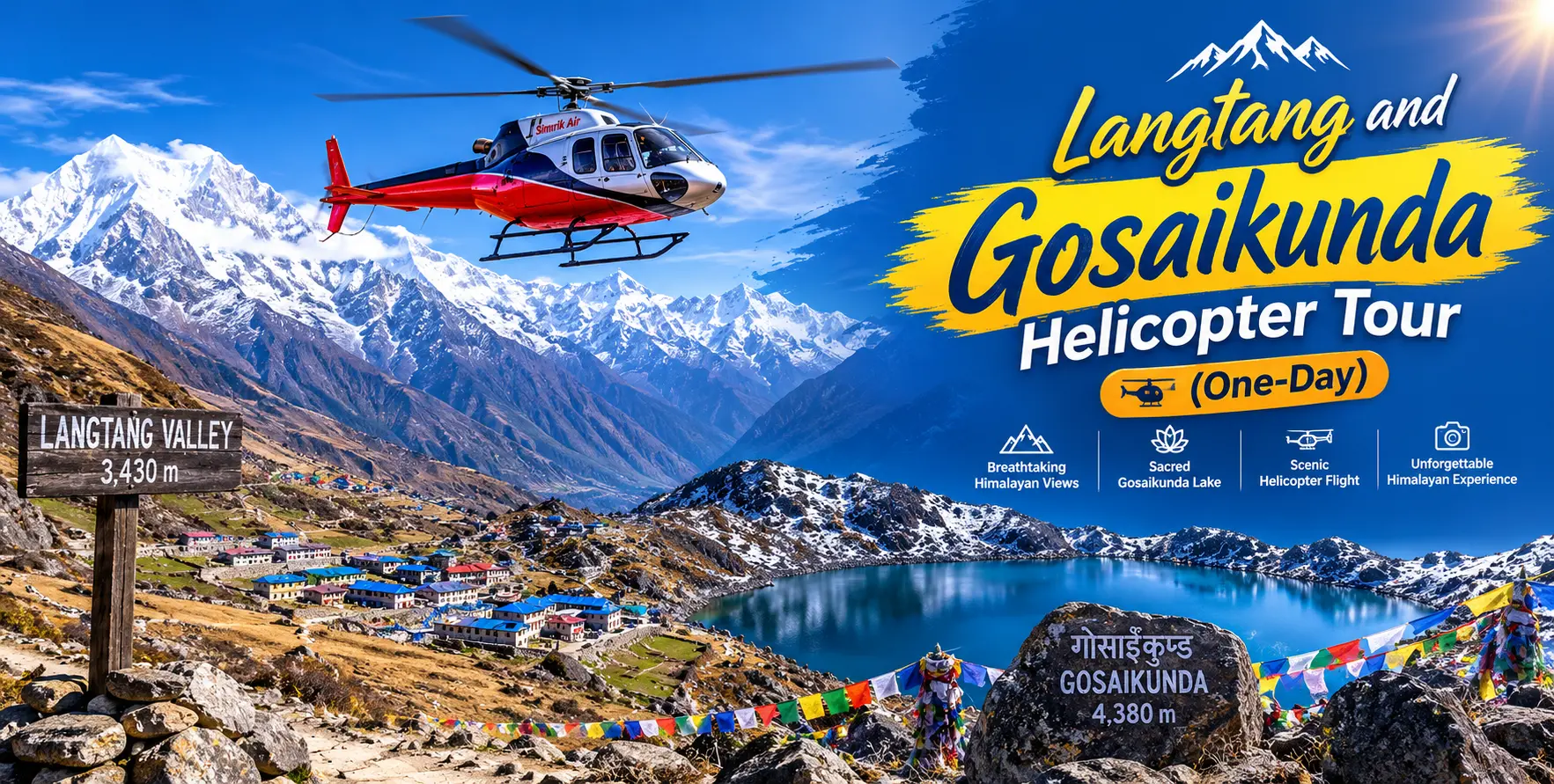
Langtang Valley and Gosaikunda Lake Helicopter Tour
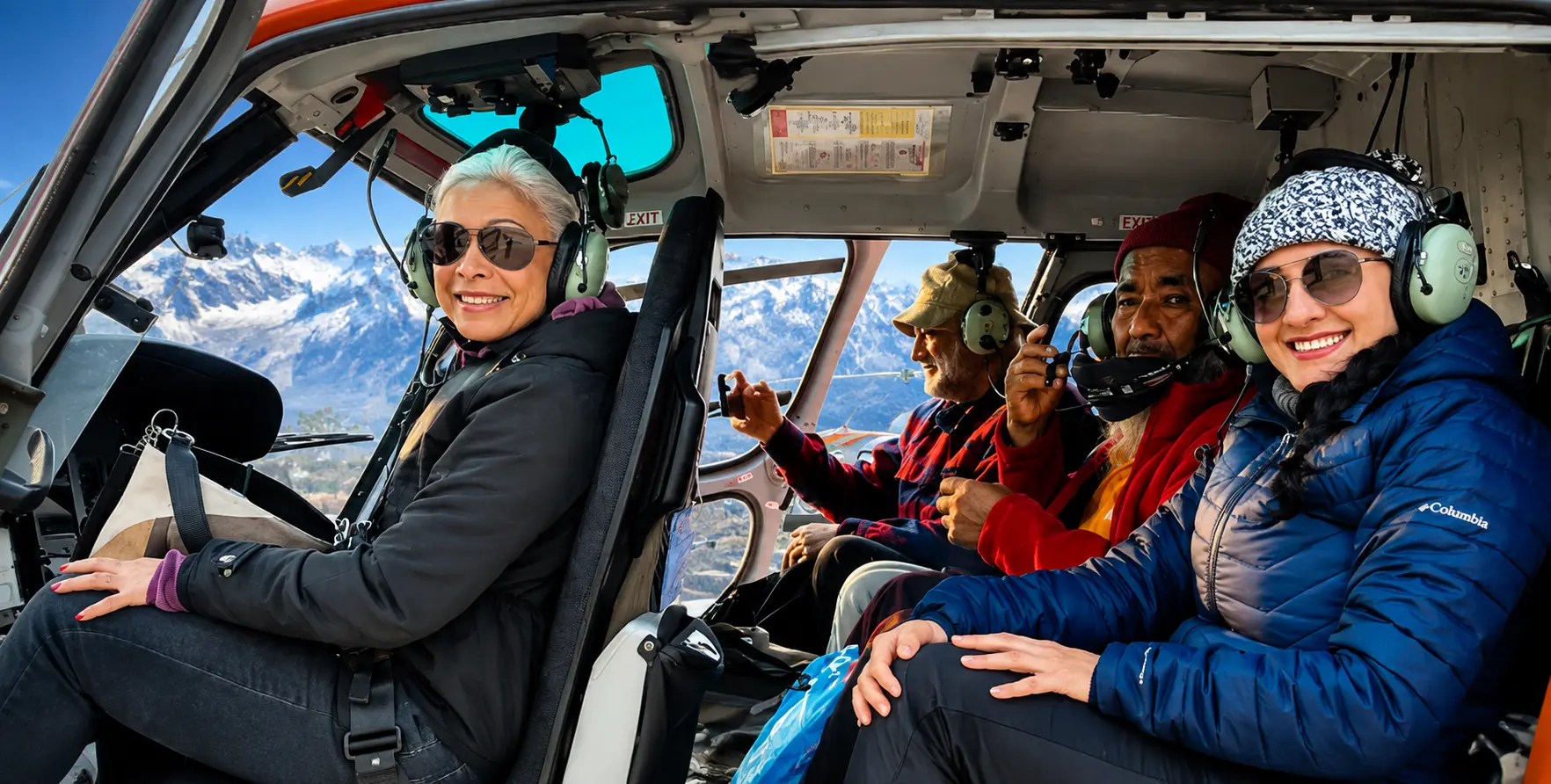
Langtang Valley and Gosaikunda Lake Helicopter Tour — Complete Guide
Nepal’s Most Sacred Helicopter Tour
Of all the helicopter tours available in Nepal in 2026 — and there are extraordinary options across the Everest, Annapurna, and Mustang regions — the Langtang Valley and Gosaikunda Lake helicopter tour stands out at the intersection of natural grandeur, spiritual significance, and logistical accessibility. In a single half-day aerial journey departing from Kathmandu‘s Tribhuvan International Airport, travellers reach two of Nepal’s most compelling destinations — the sacred alpine lake of Gosaikunda at 4,380 metres, one of the holiest sites in both Hindu and Buddhist traditions, and the Kyanjin Gompa area of Langtang Valley at 3,830 metres, the cultural heart of the Langtang National Park trekking region — without a single day of trekking required.
Gosaikunda Lake sits in Nepal’s Rasuwa District, north of Kathmandu in Langtang National Park — an alpine freshwater lake complex comprising over 108 individual water bodies at altitudes between 4,000 and 4,380 meters. The main Gosaikunda lake, at 4,380 meters, is venerated by Hindus as the site where Lord Shiva struck his trident into the mountainside to create water after drinking poison during the cosmic churning of the ocean, producing the lake whose icy meltwater feeds the Trishuli River that flows southward through the Kathmandu hinterland. The lake remains frozen from October to June in most years, and the extraordinary spectacle of its blue-white surface, ringed by the Langtang and Ganesh Himal ranges, is one of the finest aerial landscape compositions on any Nepal helicopter route.
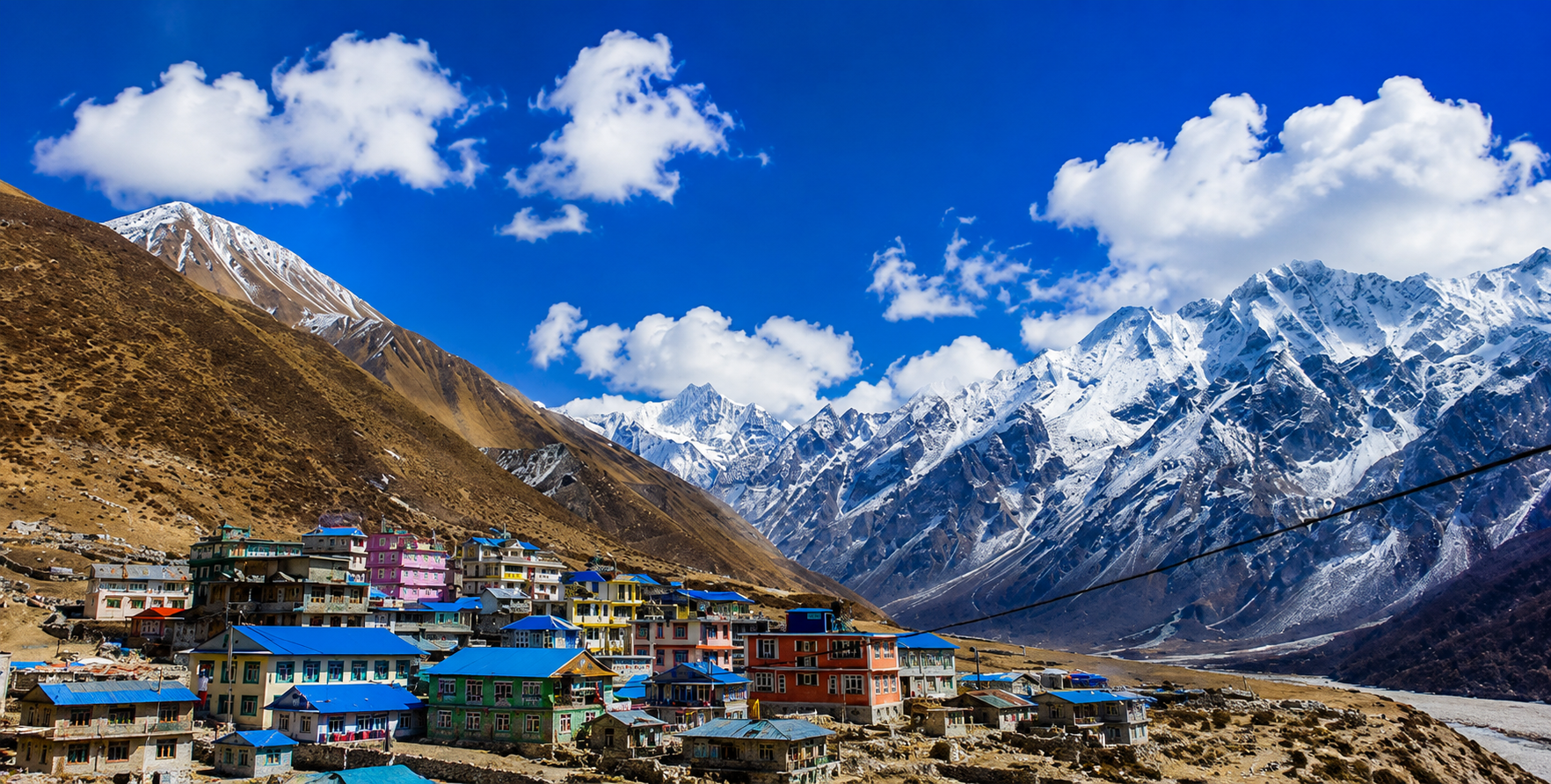
The Langtang Valley helicopter tour component—the Kyanjin Gompa landing at 3,830 meters—brings travelers into the cultural heartland of Langtang National Park, Nepal’s third most popular trekking destination after the Annapurna and Everest regions. The Kyanjin Gompa monastery, the surrounding yak cheese factory, the Langtang Lirung glacier directly above the valley, and the panoramic views of the Ganesh Himal, Yala Peak at 5,500 m, and Naya Kanga at 5,844 m create an environment of extraordinary mountain richness accessible — in the helicopter tour context — without the five- to six-day trek from Syabrubesi that the standard Langtang Valley trekking approach requires. For travelers with limited time in Nepal, the helicopter tour delivers the Langtang Valley experience in a single morning in a way no other transport option can replicate. However, for those who want the full Langtang trekking experience, Nepal Vehicle Hiring Pvt. Ltd. provides the most reliable Kathmandu to Syabrubesi jeep hire. This ground transport begins the classic Langtang Valley Trek.
Langtang Gosaikunda Helicopter Tour — Quick Reference
Flight: Kathmandu (Tribhuvan Airport) to Gosaikunda Lake and Kyanjin Gompa (Langtang Valley)
Total Duration: 1.5 to 2 hours (airtime) + exploration time at each landing point
Gosaikunda Lake Altitude: 4,380 m (14,370 ft) | Kyanjin Gompa: 3,830 m (12,566 ft)
Mountains Visible: Langtang Lirung, Ganesh Himal, Yala Peak, Naya Kanga, Gaurishankar
Cost: USD 900-1,100 per person (group of 4) | USD 1,300 per person (group of 2) | USD 2,500 solo
Best Season: Oct-Nov and Mar-May | Jul-Aug also possible (clear morning windows)
Ground Transport: Nepal Vehicle Hiring Pvt. Ltd. | Kathmandu-Syabrubesi | +977 9851013196
Ground Transfer: Kathmandu to Syabrubesi NPR 14,000-18,000 | 4WD Jeep | vehiclehiringnepal.com
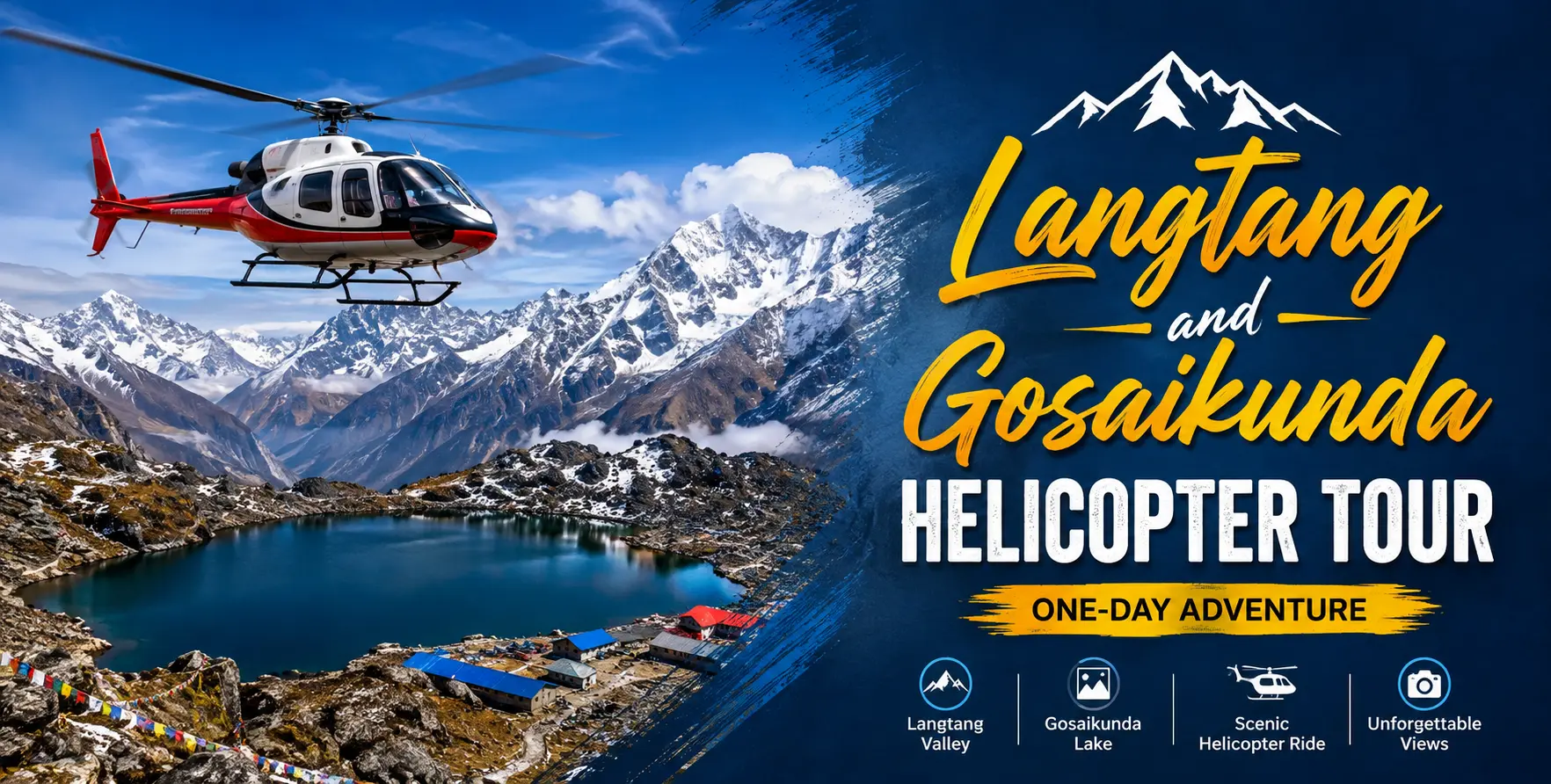
Understanding the Langtang Gosaikunda Helicopter Tour Route
Takeoff: Tribhuvan International Airport, Kathmandu
The Langtang Gosaikunda helicopter tour departs from Tribhuvan International Airport in Kathmandu — the same airport that serves international flights to Nepal. Most operators depart early, between 6:30 and 8:00 a.m., taking advantage of stable atmospheric conditions in the high Himalayas before afternoon thermal activity can create turbulence and cloud build-up by midday. The standard Nepal Vehicle Hiring Pvt. Ltd. hotel pickup service for helicopter tour clients — available via WhatsApp at +977 9851013196 — gets travelers to the airport departure point comfortably before the scheduled departure time, eliminating the stress of early-morning airport navigation in Kathmandu.
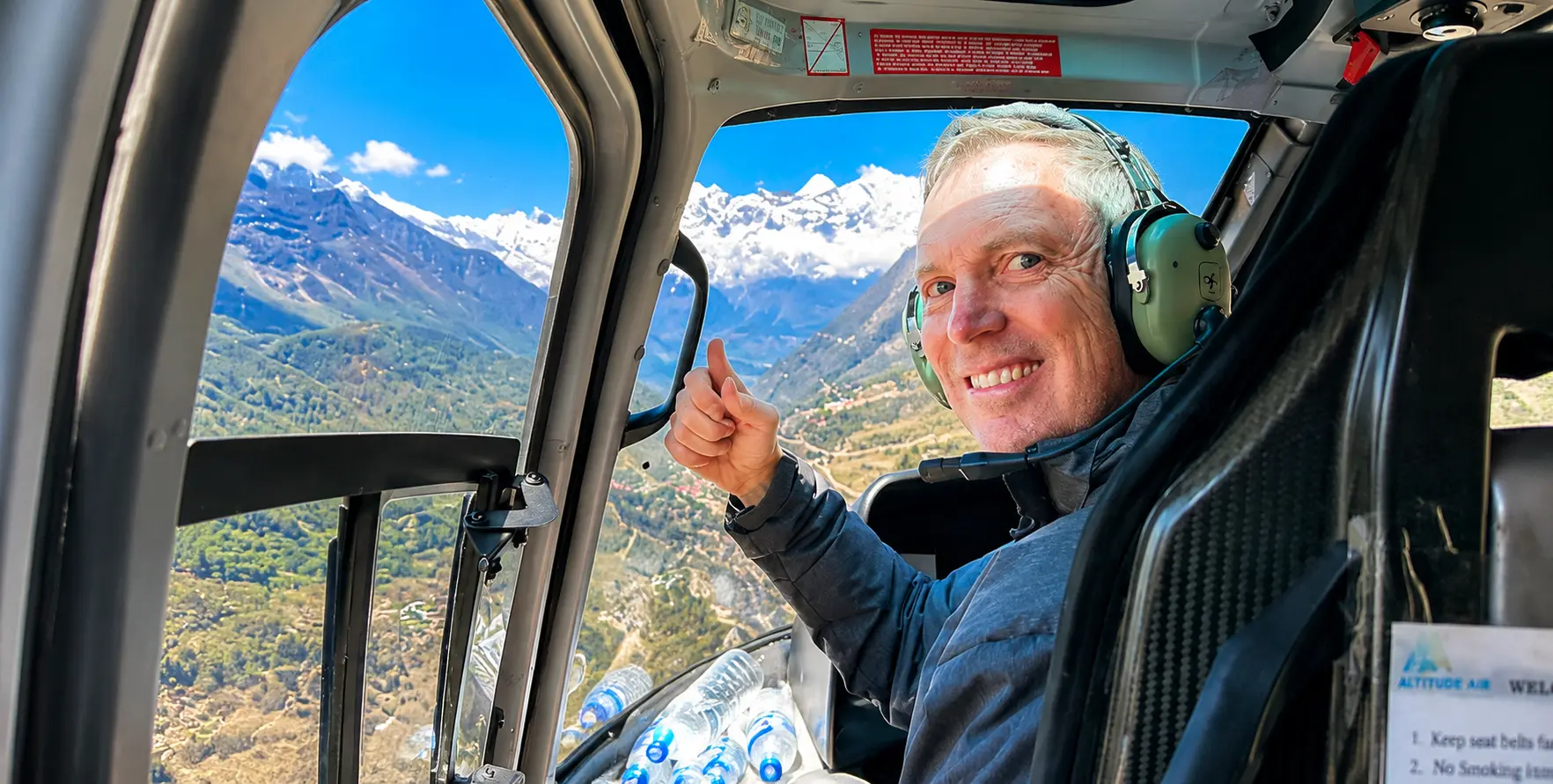
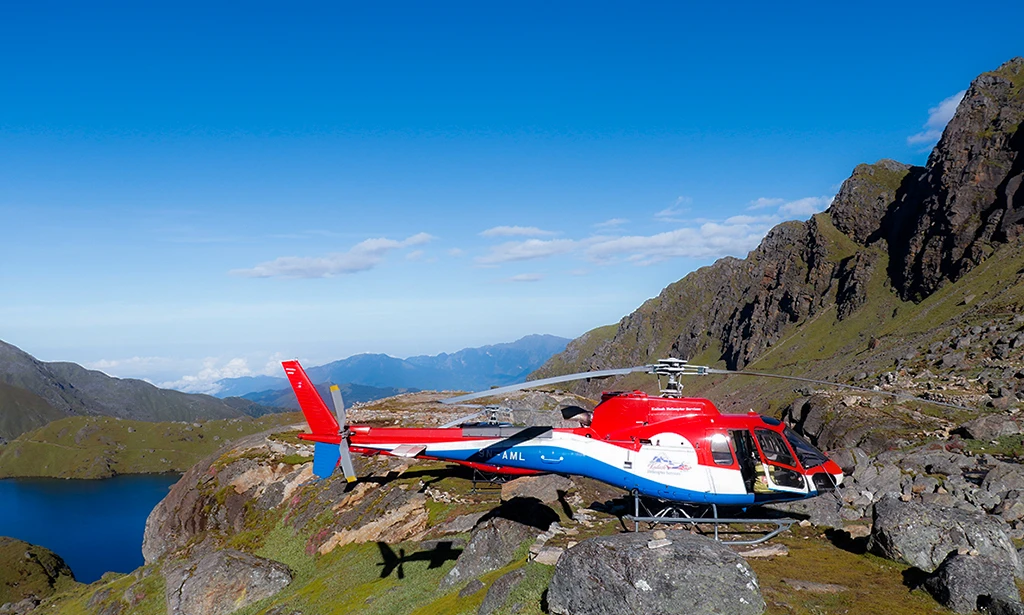
The helicopter used for the Langtang Gosaikunda tour is typically a Bell 407 or Airbus AS350 B3 — high-altitude-capable turbine helicopters certificated for the Himalayan operating environment and regularly maintained to Civil Aviation Authority of Nepal standards. These aircraft seat four to five passengers plus the pilot and provide panoramic visibility through large cabin windows, essential for the photography and sightseeing that is the tour’s primary purpose. Most operators offer private charters for individuals and couples, as well as shared group departures—prices vary significantly between solo charters and group bookings of four to five people.
The Aerial Approach to the Langtang Region
The helicopter flight from Kathmandu to the Langtang region takes about 15 to 20 minutes—making it one of the quickest transitions from a major Asian city to a high-altitude Himalayan environment anywhere in the world. The initial approach from the airport crosses the Kathmandu Valley rim, providing aerial views of the valley’s dense urban fabric, its remarkable ring of ancient temple sites, and the first panoramic perspectives of the Himalayan range that forms the northern horizon from the capital. As the helicopter climbs northward, the Shivapuri National Park forest cover below gives way progressively to the steeper terrain of the Rasuwa District foothills, and the dramatic Trishuli River gorge becomes visible below — the same valley that the Kathmandu to Syabrubesi road follows northward to the Langtang Valley trekking trailhead.
As the helicopter gains altitude approaching the Langtang National Park boundary, the dramatic transition from the subtropical foothills to the alpine landscape begins — the mixed forest belt gives way to rhododendron and juniper at mid-altitude, then to open alpine terrain and snow-covered ridges above 3,500 meters. The Langtang Lirung at 7,227 m — the highest peak in the Langtang massif — becomes visible to the northeast as a massive wall of ice and rock that dominates the skyline above the valley, its scale becoming increasingly apparent as the helicopter approaches the landing sites. The Ganesh Himal range to the west, the Jugal Himal to the east, and the Tibet Autonomous Region plateau vn the far north together create a 360-degree Himalayan panorama that the helicopter’s altitude and speed allow travelers to absorb in its extraordinary entirety.
Landing 1: Gosaikunda Lake (4,380 m)
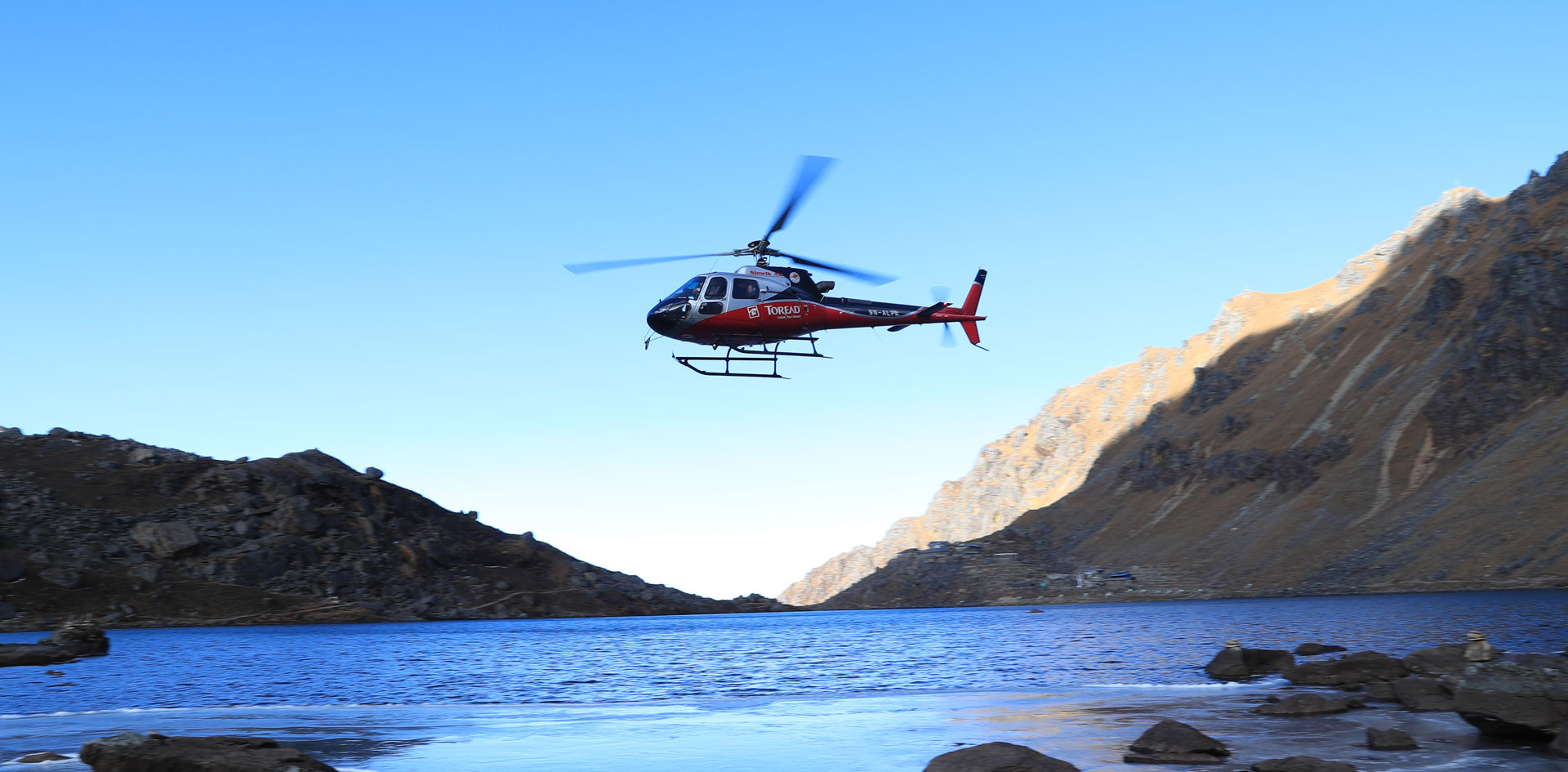
The first landing on the Langtang Gosaikunda helicopter tour is typically at the Gosaikunda Lake shoreline at 4,380 meters—the sacred alpine lake and spiritual centerpiece of the tour. The helicopter touches down on a flat area near the lake edge. Passengers typically have 20 to 40 minutes at the lake to walk the shoreline, photograph the extraordinary composition of the frozen or semi-frozen lake surface, the Langtang and Ganesh Himal backdrop, and the small Gosaikunda Shrine on the lake’s southern bank that serves as the primary devotional site for Hindu pilgrims viGosaikunda’sing the lade at Gosaikunda is significant — 4,380 meters icauseenough to produce noticeable breathlessness in visitors unacclimatized to altitude. The brief time at the lake means acute mountain sickness is not a serious risk. Still, travelers should move slowly and avoid strenuous activity during the visit.
The Gosaikunda Lake complex in the immediate vicinity includes several other sacred water bodies — Bhairavkunda, Saraswatikunda, and Suryakunda among them — each with its own mythological significance in the Hindu and Buddhist traditions that have venerated this high-altitude lake complex for centuries. The lake surface is frozen from approximately October to June in most years, creating the spectacular blue-white landscape that characterizes the winter and spring helicopter tour experience. In July and August, the lake surface is typically open water—a deep turquoise color created by the reflection of the sky and dissolved minerals from the surrounding glacial terrain—offering a different but equally extraordinary visual experience. The Janai Purnima festival, typically held in July or August at the full moon, draws thousands of Hindu pilgrims to Gosaikunda on foot — those who reach the lake on the helicopter tour outside the festival period experience the extraordinary site in relative solitude.
Landing 2: Kyanjin Gompa, Langtang Valley (3,830 m)
The second landing of the Langtang Gosaikunda helicopter tour is at Kyanjin Gompa in the upper Langtang Valley at approximately 3,830 meters — the cultural and logistical hub of the Langtang trekking circuit and the highest permanently settled point in the valley accessible to international visitors. The Kyanjin Gompa monastery — a small but actively maintained Tibetan Buddhist monastery with a resident monastic community — sits at the valley floor below the extraordinary Langtang Lirung glacier wall that descends almost to the valley floor from the 7,227 m summit above. The glacier’s crevassed blue-white face, viewed from the monastery courtyard at a distance of perhaps two kilometers, creates the most dramatic single mountain composition in the entire Langtang trekking region.
The Kyanjin yak cheese factory — producing a distinctive high-altitude cheese from the milk of the yaks that graze the valley’s alpine meadows — is a cultural and gastronomic landmark of the Langtang Valley that helicopter tour visitors can visit during the landing stop. A short walk from the helicopter landing area brings visitors to the Kyanjin Ri viewpoint base — the approach to the 4,773 m viewpoint above the monastery, which offers the finest panoramic view in the entire valley. While the full Kyanjin Ri ascent takes 2 to 3 hours on foot and isn’t practical during a helicopter tour landing stop, the valley-floor views from the monastery area are enough to convey the extraordinary scale and character of the Langtang mountain environment. The time at Kyanjin Gompa on the helicopter tour is typically 30 to 60 minutes — enough for breakfast at one of the teahouses, a walk to the monastery, and photography of the glacier and surrounding peaks before the return flight to Kathmandu.
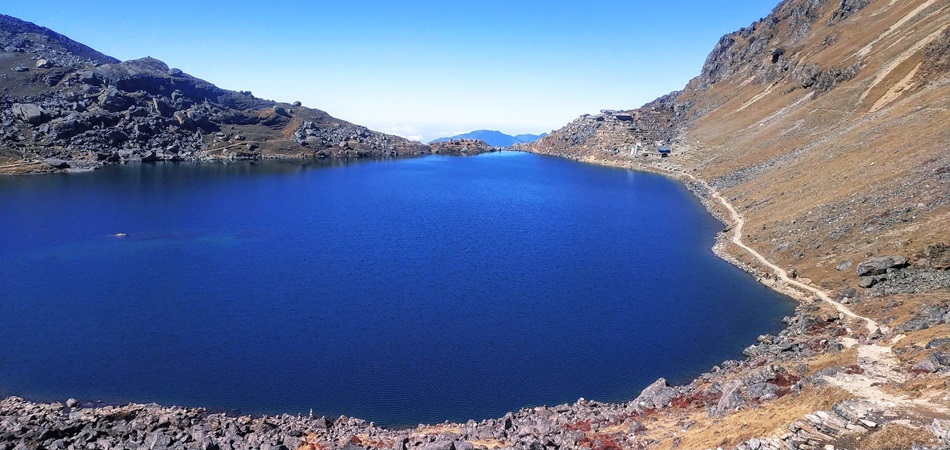
Gosaikunda Lake — Sacred Significance and Natural Character
The Hindu and Buddhist Mythological Heritage
Tosaikunda Lake holds a position in Nepal’s Himalayan sacred landscape without parallel — a site simultaneously venerated in Hindu and Buddhist traditions that together form the spiritual bedrock of Nepali culture. Hindu mythology associates Gosaikunda with the cosmic churning of the ocean (Samudra Manthan) described in the Puranas — the event in which the poison Halahala emerged from the ocean and threatened to destroy all creation until Lord Shiva consumed it to protect the world. The poison burned Shiva’s throat, and seeking relief, he struck his trident (Trishul) into the mountainside above the Trishuli River valley, creating the lake of Gosaikunda from the water that gushed forth. The name itself reflects this mythology — Gosaikunda translates approximately as ‘the lake of the lord’ in Nepali, and the lake is regarded as the abode of Shiva and his consort Gauri.
The Buddhist tradition associates Gosaikunda with the Naga serpent deities believed to inhabit the lake’s depths and with the broader sacred geography of the Langtang National Park — an area that Tibetan Buddhist texts identify as a beyul, or hidden valley of special spiritual significance, described in the revelatory writings of Guru Rinpoche (Padmasambhava) as a place of refuge and spiritual intensification. The Kyanjin Gompa monastery in the valley below maintains the Buddhist sacred presence in the region with a continuous monastic community. For pilgrims of both traditions, the helicopter tour to Gosaikunda represents a significant religious undertaking — the ability to reach the sacred lake without the demanding multi-day trek is particularly valued by elderly pilgrims, those with limited mobility, and devotees for whom the pilgrimage itself is the primary purpose rather than the trekking experience.
The Lake’s Natural Character — Altitude, Glaciology, and Ecology
From a natural science perspective, Gosaikunda is classified as an alpine freshwater oligotrophic lake- a cold, nutrient-poor, high-clarity water body characteristic of glacially scoured, high-altitude environments. The lake covers about 13.8 hectares and sits within a glacial cirque carved by Pleistocene glaciation, with its basin fed by meltwater from the surrounding snowfields and the Gosaikunda Glacier above. The Trishuli River — one of Nepal’s most significant rivers, draining the entire western Langtang National Park watershed and eventually joining the Narayani/Gandaki River system — has its effective headwaters in the Gosaikunda meltwater system. The lake freezes to a depth that allows safe walking across the surface in the deepest winter months. The ice surface’s color—ranging from opaque white to translucent blue-green depending on ice thickness, snow cover, and light angle—creates the extraordinary visual character that makes it so photographically compelling from both the helicopter and the lakeside.
Langtang Valley — Geography, Culture and Trek Overview
The Langtang National Park — Nepal’s Third Most Popular Trek
Langtang National Park — established in 1976 as Nepal’s first Himalayan national park — covers 1,710 square kilometers of extraordinary alpine landscape in Rasuwa and Nuwakot districts north of Kathmandu, sharing a long border with the Tibet Autonomous Region to the north. The park’s terrain spans the full altitudinal range from subtropical forest at 800 meters to permanent glaciers and high Himalayan peaks above 7,000 meters — a compressed vertical landscape that supports extraordinary biodiversity, including the red panda, snow leopard, Himalayan tahr, Ghoral, and hundreds of bird species. The Langtang Valley Trek is Nepal’s third most popular trek after the Annapurna Circuit and the Everest Base Camp Trek, offering an extraordinary combination of mountain scenery, Tibetan cultural heritage, and relative accessibility from Kathmandu that makes it the favorite Nepal trek for many repeat visitors.
The 2015 Gorkha earthquake and its associated avalanche caused devastating damage to the Langtang Valley — Langtang village itself was largely destroyed by an earthquake-triggered ice avalanche from the slopes above, and the community lost a significant portion of its population in a few terrible minutes. The village has been rebuilt and the trekking infrastructure reconstructed. Still, the rebuilt Langtang village has a different character from the pre-earthquake settlement, and the disaster’s trauma remains in the community’s memory. The Langtang Valley’s extraordinary natural environment — the Langtang Lirung glacier wall, the Kyanjin Ri panorama, the open valley floor — survived the earthquake without fundamental alteration, and the valley’s trekking and helicopter tour experience is as compelling in 2026 as it was before.
The Langtang Valley Trek — The Ground Transport Alternative
For travelers who want the full Langtang Valley experience rather than the helicopter overview, the classic Langtang Valley Trek begins at Syabrubesi — the roadhead town on the Bhote Koshi River accessible by the Kathmandu to Syabrubesi jeep hire from Nepal Vehicle Hiring Pvt. Ltd. in approximately 7 to 8 hours. From Syabrubesi at 1,470 m, the trek ascends through the gorge of the Langtang Khola to Lama Hotel (2,380 m), then to Ghoda Tabela (3,000 m), Langtang Village (3,430 m), and finally Kyanjin Gompa (3,830 m) — a 5 to 6 day return journey that is considered one of the finest tea-house trek itineraries available from Kathmandu. The Kathmandu to Syabrubesi private jeep from Nepal Vehicle Hiring Pvt. Ltd. is the most comfortable and efficient approach — hotel pickup in Kathmandu, a 4WD vehicle for the mountain road, and direct delivery to the Syabrubesi trailhead.
Helicopter Tour Costs and Pricing Structure
Group Pricing — Per Person Rates
The Langtang Gosaikunda helicopter tour is priced per person, with significant discounts for larger groups. Based on verified 2026 pricing from established Nepal helicopter tour operators, the standard rates are approximately USD 2,500 for a solo private charter, USD 1,300 per person for a group of two, USD 1,100 per person for a group of three, and USD 900 per person for a group of four sharing the same helicopter. These rates are typically all-inclusive — covering the helicopter charter, airport handling fees, Langtang National Park entry permit (NPR 3,000 for foreign nationals), landing fees at Gosaikunda and Kyanjin Gompa, and the operator’s guide or crew member who accompanies the flight. Some operators include a breakfast at Kyanjin Gompa in the rate; others charge this separately.
Pricing varies significantly between operators in Nepal — the cheapest available Gosaikunda helicopter tour rates are considerably below the figures above, while premium luxury operators charge substantially more. Key factors that justify higher pricing include the aircraft’s quality and maintenance standards, the operator’s Civil Aviation Authority of Nepal certification status, the pilot’s experience (Gosaikunda and Langtang Valley approaches require precise low-altitude navigation in variable mountain weather), and the included ground support. Travelers should verify that their operator holds current CAAN certification and that the specific helicopter assigned to their flight has a current airworthiness certificate. This is not a corner to cut to save USD 100 or 200 on an aviation safety decision.
Nepali Citizen Pricing
For Nepali citizens, the Gosaikunda helicopter tour is significantly cheaper than the international visitor rates—most operators offer group-joining departures specifically for Nepali citizens at rates well below foreign visitor charter rates. These group departures, typically scheduled on specific days of the week (many operators run Monday and Saturday departures for the Nepali citizen market), allow individual bookings to combine with other Nepali travelers to fill the helicopter at the shared rate. The Janai Purnima festival season in July and August sees particularly high Nepali citizen demand for helicopter access to Gosaikunda, with many operators offering special festival rates to accommodate the large number of pilgrims seeking the aerial approach to the sacred lake during this most auspicious visiting period.
What Is and Is Not Included
A standard Langtang Gosaikunda helicopter tour package in 2026 typically includes a helicopter charter (airport to Gosaikunda to Kyanjin Gompa and return), a Langtang National Park entry permit, one crew member or guide, basic insurance coverage, and airport pickup from the hotel. Items typically NOT included: travel insurance (travelers must arrange their own policy covering emergency helicopter evacuation from altitude — this is legally required for trekking permits in Nepal and strongly recommended for helicopter tour passengers as well), meals at Kyanjin Gompa, personal porters or photography guides, and the ground transport from the hotel to the airport. Nepal Vehicle Hiring Pvt. Ltd. provides airport transfers for helicopter tour clients—a private vehicle from the Kathmandu hotel to Tribhuvan Airport for early-morning departures and a return pickup after the tour ends—coordinated via WhatsApp at +977 9851013196.
Best Season for the Langtang Gosaikunda Helicopter Tour
Autumn — October and November (Peak Season)
The autumn season from October through November is the finest overall period for the Langtang Gosaikunda helicopter tour — the post-monsoon atmosphere of extraordinary clarity that makes October Nepal’s finest photography month is equally advantageous for the helicopter aerial perspective. The Langtang Lirung, Ganesh Himal, and Jugal Himal ranges are at their most visible and most vivid in October; the Gosaikunda Lake ice is beginning to form (creating the extraordinary blue-white surface that is the most photogenic lake state), and the flight conditions are at their most stable and clear. November extends the autumn quality with fewer tourists but progressively colder temperatures at the high landing sites — Gosaikunda at 4,380 m in November requires warm clothing even for the brief time outside the helicopter.
Spring — March to May
Spring from March through May is the second-best period for the helicopter tour — the weather is broadly stable, visibility is excellent in the mornings, and the rhododendron forests of the Langtang foothills visible from the helicopter are in spectacular bloom in March and April. In spring, Gosaikunda Lake is typically still frozen or semi-frozen, offering the photographic contrast of the ice surface against the warming alpine landscape. May brings increasingly unstable afternoon weather as pre-monsoon atmospheric instability builds—for May helicopter tours, early morning departures (6:30 to 7:00 a.m.) are essential to complete the flight before afternoon cloud develops.
Summer Monsoon — July and August
The monsoon season (June to September) is generally not recommended for helicopter tours due to the cloud, rain, and reduced visibility that characterize Nepal’s monsoon weather. However, July and August do have clear morning windows—from dawn to about 9:00 a.m. —when conditions are often clear before the day’s moisture builds into cloud. For the Janai Purnima festival period specifically—when the Gosaikunda pilgrimage is at its peak—July and August helicopter tours are in high demand, and operators schedule early morning departures to take advantage of the clear morning windows. Travelers booking monsoon-season helicopter tours should plan flexible dates and confirm departure conditions on the morning of the scheduled flight.
Winter — December to February
Winter helicopter tours to Gosaikunda (December to February) are possible but require careful weather assessment and appropriate cold-weather preparation for the brief time outside the helicopter at 4,380 m. Winter Gosaikunda is the most dramatically frozen — the lake ice is at its deepest and most photogenic — and the winter air clarity can be exceptional on the clear days between the occasional snowfall events that characterize the Langtang region in winter. The snow leopard habitat of Langtang Park’s higher elevations is at its most accessible in winter when the animals descend in search of prey, and wildlife-focused travelers who combine the Gosaikunda helicopter tour with winter wildlife observation in the Langtang foothills accessible by the Kathmandu to Syabrubesi jeep hire have the opportunity for one of Nepal’s finest combined nature experiences.
The Gosaikunda Trek Alternative — Walking to the Sacred Lake
The Gosaikunda Trek Route from Syabrubesi
For travelers who have more time and who want the complete experience of walking to Gosaikunda Lake, the overland approach combines the Kathmandu to Syabrubesi private jeep hire from Nepal Vehicle Hiring Pvt. Ltd. with a 5 to 7 day trek through the Langtang National Park that reaches both Kyanjin Gompa in the Langtang Valley and Gosaikunda Lake via the Lauribina La Pass at 4,610 m. The Syabrubesi jeep transfer is the essential starting point — the Kathmandu to Syabrubesi road covers approximately 120 km in 7 to 8 hours by 4WD jeep from Nepal Vehicle Hiring Pvt. Ltd. — a mountain road journey through the Trishuli Valley that is itself a rewarding experience and the appropriate preparation for the mountain landscape that awaits.
The Kathmandu to Syabrubesi jeep hire from Nepal Vehicle Hiring Pvt. Ltd. is all-inclusive — hotel pickup from Kathmandu, 4WD vehicle, experienced driver, and direct delivery to the Syabrubesi trailhead at NPR 14,000 to 18,000. Book the service via WhatsApp at +977 9851013196, and combine it with the return pickup from Syabrubesi after the trek—creating a complete Langtang Valley trekking transport package from a single provider. Many trekkers who have done the Langtang Valley Trek return specifically for the helicopter tour to see the same landscape from an aerial perspective—and many helicopter tour visitors, inspired by the brief Kyanjin Gompa landing, later plan a return trip to walk the full Syabrubesi to Kyanjin Gompa route.
Practical Planning Guide for the Helicopter Tour
How to Book the Langtang Gosaikunda Helicopter Tour
You can book the Langtang Gosaikunda helicopter tour through numerous licensed helicopter tour operators in Kathmandu, from large established operators such as Simrik Air, Kailash Helicopter Services, Fishtail Air, and Manang Air to smaller boutique helicopter tour agencies. Most operators accept bookings via email or WhatsApp, and booking at least 2 to 3 days in advance is recommended—particularly in peak October and April seasons, when Nepal helicopter tour demand constrains helicopter capacity. For the Janai Purnima festival period in July or August, book 1 to 2 weeks in advance, as this is the highest-demand period for the Gosaikunda helicopter route.
When booking, confirm the following specifics with the operator: the exact helicopter model and its CAAN airworthiness certificate number, the specific landing locations (both Gosaikunda and Kyanjin Gompa should be included in the standard tour), the time allocation at each landing site, whether Langtang National Park permits are included in the quoted price, the weather cancellation policy (refund or reschedule), and the morning departure time). Nepal Vehicle Hiring Pvt. Ltd. can refer clients to trusted helicopter tour operators when booking ground transport services, providing a valuable local-knowledge connection for visitors planning their helicopter tour alongside the ground-transport components of their Nepal itinerary.
What to Wear and Bring
- Warm jacket — Gosaikunda at 4,380 m is cold even in summer; a down jacket is recommended for October through May
- Gloves and hat — the high-altitude cold is significant even for the brief time outside the helicopter
- Sunscreen SPF 50+ — UV radiation at 4,380 m is intense regardless of temperature.
- Sunglasses with UV protection — essential at Gosaikunda’s altitude and the brilliant ice/snow reflection
- Camera — bring extra batteries,s as cold temperatures drain batteries quickly at Gosaikunda altitude.
- Motion sickness medication — some passengers experience discomfort in the helicopter’s mountain turbulence, particularly in afternoon conditions
- Water — stay hydrated before and during the flight; the high altitude combined with the helicopter’s low-humidity cabin air requires active hydration.on
- Travel insurance documentation — carry proof of emergency evacuation insurance coverage
Health Considerations at High Altitude
The brief nature of the Gosaikunda helicopter tour means altitude sickness risk is genuinely lower than for trekking visitors who ascend to 4,380 m over multiple days — the body has minimal time to respond to altitude during a 20 to 40 minute landing. The rapid return to Kathmandu at 1,400 m eliminates any sustained altitude exposure. However, visitors with known heart conditions, severe respiratory conditions, or uncontrolled high blood pressure should consult their physician before booking any high-altitude helicopter tour. Mild breathlessness, slight headache, and increased heart rate during the Gosaikunda landing stop are normal physiological responses to the 4,380 m altitude that will resolve within minutes of returning to lower altitude. Severe symptoms — confusion, loss of coordination, severe headache — are rare given the brief high-altitude exposure but should be communicated to the pilot immediately if experienced.
Combining the Helicopter Tour with the Kathmandu Sightseeing Circuit
Travelers visiting Nepal for a short trip — 5 to 7 days — can combine the Langtang Gosaikunda helicopter tour with the full Kathmandu sightseeing circuit to create an extraordinary Nepal experience in a compact itinerary. The helicopter tour occupies only a half-day, leaving the remainder of the day for Kathmandu heritage sightseeing. The Kathmandu sightseeing tour from Nepal Vehicle Hiring Pvt. Ltd., covering Boudhanath Stupa, Pashupatinath Temple, Swayambhunath, and Patan Durbar Square, connects the aerial Gosaikunda and Langtang experience with the ground-level heritage richness of the Kathmandu Valley. The Bhaktapur Durbar Square day tour and the Nagarkot sunrise tour — the pre-dawn departure from Kathmandu for the Himalayan panorama from the valley’s eastern rim — complete the recommended ground-level Kathmandu experience that frames and enriches the aerial Langtang and Gosaikunda perspectives.
For travelers combining the helicopter tour with the Langtang Valley Trek — seeing Kyanjin Gompa and Gosaikunda first from the air and then on foot — the Kathmandu to Syabrubesi private jeep transfer from Nepal Vehicle Hiring Pvt. Ltd. can be booked simultaneously with the hotel pickup for the helicopter departure, creating a seamlessly coordinated Nepal itinerary through a single trusted provider.
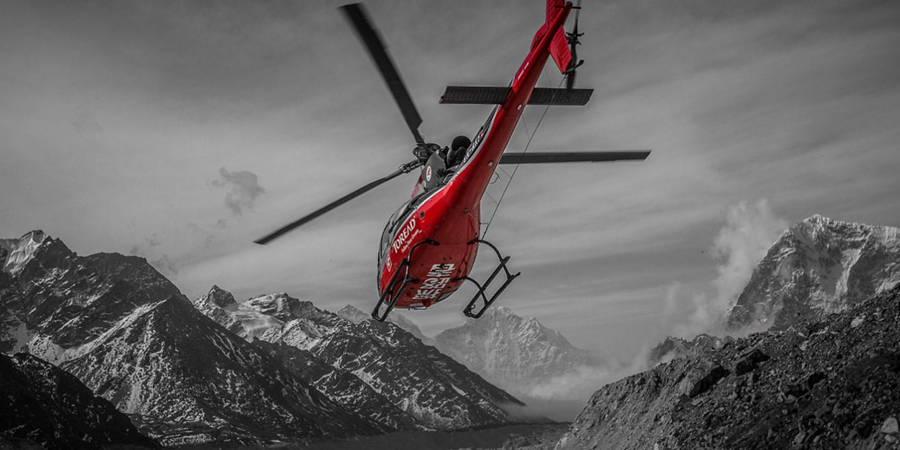
Kyanjin Gompa — The Cultural Heart of Langtang Valley
History and Significance of Kyanjin Gompa Monastery
Kyanjin Gompa is the most important Tibetan Buddhist monastery in the Langtang National Park and the cultural anchor of the Langtang Valley’s permanent community. The monastery — whose name translates approximately as ‘dwelling of the dharma’ in Tibetan — has a history of continuous Buddhist practice in this remote high-altitude valley that extends back several centuries, maintained by a resident monastic community that has served as the religious and cultural center for the surrounding Tamang and Tibetan-heritage communities of the Langtang region. The monastery’s prayer hall contains a remarkable collection of Buddhist iconography—thangka paintings depicting the major figures of the Tibetan Buddhist pantheon, butter-lamp offerings maintained throughout the day, and the deep, resonant sound of monastic chanting that carries across the valley floor in the still early morning air.
The Kyanjin Gompa village surrounding the monastery is a compact settlement of about 50 to 60 stone buildings—teahouses, private homes, the yak cheese factory, and the associated structures of a self-sufficient high-altitude community that has adapted over generations to the extreme conditions of life above 3,800 meters. The community’s economy is based on yak herding and cheese production, the trekking teahouse service for the Langtang Valley trekking circuit’s growing visitor numbers, and — increasingly — revenue from helicopter tour visitors who land at the village for a brief stop. The Langtang Gosaikunda helicopter tour landing at Kyanjin Gompa has created a new and growing visitor stream for this remote community, bringing revenue and cultural exchange without requiring the full infrastructure investment of mass tourism.
Kyanjin Ri — The Panoramic Viewpoint Above the Village
Rising directly above Kyanjin Gompa to the north is Kyanjin Ri — the classic viewpoint hill at 4,773 meters, and the most popular day hike from the village for trekkers spending one or more nights at Kyanjin Gompa. The Kyanjin Ri panorama is consistently ranked among the finest in the entire Langtang National Park — a 360-degree sweep of Himalayan peaks that includes Langtang Lirung at 7,227 m looming directly to the north, Yala Peak at 5,500 m to the east, Naya Kanga at 5,844 m to the south, and on the clearest October and April days the distant profiles of Manaslu at 8,163 m and Ganesh Himal to the southwest. For helicopter tour visitors who land at Kyanjin Gompa, the base of the Kyanjin Ri trail is within walking distance of the landing area, and the first 20 to 30 minutes of the ascent — gaining perhaps 100 to 150 vertical meters — delivers a significant improvement in panoramic perspective over the valley floor views available at the landing site.
The Langtang Lirung glacier is visible from Kyanjin Gompa village without any hiking — the glacier’s terminal ice face descends to within a kilometer or two of the valley floor and its crevassed blue-white surface, viewed against the brilliant Himalayan sky, is the single most dramatic visual element of the entire Langtang Valley landscape. For photographers specifically, the dawn light on the Langtang Lirung glacier face — when the first sunlight catches the ice high on the peak before the valley floor is illuminated — creates a photographic condition of extraordinary quality that helicopter tour visitors who arrive in the early morning can experience at the landing site before the day’s light changes. Nepal Vehicle Hiring Pvt. Ltd. consistently recommends the Kathmandu to Syabrubesi jeep hire for trekkers who want to spend multiple days at Kyanjin Gompa to capture the full range of lighting conditions on the Langtang Lirung face.
The Yak Cheese Factory — A Unique Cultural Experience
The Kyanjin Gompa yak cheese factory — established with Swiss development assistance in the 1950s as part of an agricultural development initiative in the Langtang Valley — produces a distinctive high-altitude cheese from the milk of the community’s yak herds, and it has become one of the most famous artisanal food products accessible on any Nepal trekking route. The cheese — firm, slightly salty, with a complex flavor that reflects the mineral-rich alpine grasses of the Langtang Valley’s high pastures — is available for purchase at the factory and at the village teahouses, and visiting the factory during the Langtang Gosaikunda helicopter tour landing stop provides a genuinely interesting glimpse of the traditional cheese-making process. The yak herds whose milk supplies the factory range across the high pastures above Kyanjin Gompa during the summer months, and in early morning or late afternoon these herds are often visible on the valley floor near the village — their large, shaggy forms grazing against the backdrop of the Langtang Lirung glacier creating one of the characteristic Langtang Valley visual experiences.
The Janai Purnima Festival — Gosaikunda at Its Most Sacred
For the Langtang Gosaikunda helicopter tour traveler who can align their Nepal visit with the Janai Purnima festival, the experience of Gosaikunda Lake during this annual Hindu celebration is qualitatively different from the peaceful solitude of the lake at other times — a day of extraordinary human energy, devotional intensity, and cultural spectacle that contextualizes the sacred lake’s significance in the living religious tradition of Nepal. Janai Purnima — the festival of the sacred thread, typically held on the full moon of the month of Shrawan (July or August) — is one of Nepal’s most widely observed Hindu festivals, and Gosaikunda is its most important pilgrimage destination. Tens of thousands of pilgrims make the journey to the lake each year on this day, most of them on foot via the multi-day trek from Syabrubesi or the southern approach through Dhunche and Sing Gompa. A significant and growing number of pilgrims — particularly elderly devotees, those with limited mobility, and those who have made a personal vow to reach the lake — access Gosaikunda by helicopter specifically for the festival.
The festival scene at Gosaikunda on Janai Purnima day is extraordinary — thousands of white-clad pilgrims circumambulating the lake, priests performing puja ceremonies at the lakeside shrine, the deep sound of conch shells and ritual drums carrying across the high-altitude silence, and the collective devotional energy of one of Nepal’s largest annual pilgrimages concentrated in the single sacred geography of the alpine lake basin. For helicopter tour visitors who reach Gosaikunda on this day, the scene’s cultural and spiritual richness adds a dimension to the aerial journey that is genuinely unmatched on any other Nepal helicopter tour. Practically, helicopter availability is extremely limited on Janai Purnima day — every helicopter in Nepal capable of operating at this altitude is working the pilgrimage route on festival day — and you must book weeks or months in advance, with a premium rate typically applying.
Langtang National Park — Conservation and Biodiversity
Flora and Fauna of the Langtang Region
Langtang National Park is one of Nepal’s most biodiverse protected areas — its altitudinal range from 800 metres to over 7,000 metres encompasses the full spectrum of Himalayan ecological zones, from the subtropical broadleaf forest of the lower valleys through the temperate mixed forest of rhododendron, oak, and maple that colours the mid-altitude slopes in spectacular bloom in March and April, to the sub-alpine juniper and birch forests above 3,000 metres, the alpine meadows and rocky fell-fields of the highest accessible terrain, and finally the permanent snow and ice of the high peaks that form the park’s northern boundary with Tibet. The red panda — the park’s most charismatic wildlife symbol, living in the rhododendron and bamboo forests between 2,200 and 4,000 meters — is a sought-after wildlife sighting for Langtang Valley trekkers. The Langtang Valley trek via the Kathmandu to Syabrubesi jeep transfer is one of the best Nepal trekking routes for red panda sightings in the appropriate forest habitat.
The snow leopard is permanently present in the park’s high-altitude terrain above 33,500 meters,Nepal’s most elusive large carnivore and a focus of significant conservation attention from park authorities and international wildlife organizations. Langtang National Park is one of Nepal’s designated snow leopard conservation areas, and camera trap monitoring programs in the park have documented a healthy resident population of the species. Winter helicopter tours to Gosaikunda in December and January occasionally provide aerial sightings of snow leopards in the high terrain below the flight path—an extraordinary wildlife experience that is impossible from the ground without dedicated multi-day wildlife tracking expeditions. The Himalayan tahr, ghoral, musk deer, and numerous Himalayan pheasants, including Danphe (Nepal bird), are regularly seen on the Langtang Valley trek and occasionally visible from the helicopter on the Gosaikunda tour approach.
Langtang National Park Entry Permits
All visitors to Langtang National Park — whether by helicopter or on foot — are required to hold the Langtang National Park entry permit at NPR 3,000 for foreign nationals (SAARC nationals NPR 1,000, Nepali citizens NPR 100). Trekkers can obtain the permit from the Nepal Tourism Board office in Kathmandu (Bhrikutimandap area) or at the park entry checkpoint in Syabrubesi. For helicopter tour visitors, the permit is typically included in the tour package and arranged by the helicopter operator — confirm this explicitly at the time of booking. The TIMS card (Trekkers’ Information Management System) is also required for trekkers entering the park on foot; helicopter tour passengers are generally exempt from the TIMS requirement but should confirm current regulations with their operator before the tour. Nepal Vehicle Hiring Pvt. Ltd. provides current permit requirement information for trekkers booking the Kathmandu to Syabrubesi jeep transfer.

Ground Transport to Langtang — The Full Trekking Option
Why Choose the Syabrubesi Trek Over the Helicopter?
The Kathmandu to Syabrubesi private jeep hire followed by the 5 to 7 day Langtang Valley Trek offers a completely different experience from the helicopter tour — not better or worse in absolute terms, but different in character in ways travelers should understand when choosing between the options. The helicopter tour delivers the aerial perspective, the sacred Gosaikunda landing, and the Kyanjin Gompa environment in hours. The trek delivers the same destinations through a week of gradual immersion — the changing forest character as altitude increases, the successive cultural encounters with teahouse communities from the Bhulbhule forest floor to the Kyanjin Gompa high plateau, the physical experience of the mountain environment at walking pace, and the acclimatization and absorption that the body and mind undergo over multiple days in the Himalayan landscape.
The trek approach via the Syabrubesi jeep transfer from Nepal Vehicle Hiring Pvt. Ltd. also includes experiences that the helicopter entirely bypasses — the gorge walk through the Langtang Khola river valley below Lama Hotel, the extraordinary Langtang forest with its diverse bird life and red panda habitat, the small teahouse communities of Ghoda Tabela and Langtang Village, and the gradual build of anticipation as each day’s walking brings the Langtang Lirung glacier closer and larger until it fills the northern horizon from the Kyanjin Gompa valley floor. Many travelers who have done both experiences report that the helicopter tour, while extraordinary in its own right, makes them appreciate more fully what the trekking approach had given them — and vice versa, that the helicopter overview provides a mapping perspective that enriches the subsequent trekking experience with a spatial understanding of the landscape that the ground-level journey alone cannot provide.
The Syabrubesi Jeep Road — What the Drive Is Like
The Kathmandu to Syabrubesi road is one of Nepal’s more scenic mountain road journeys — 120 km via Bidur and the Trishuli River valley, providing continuous visual interest as the route climbs through the Rasuwa District foothills. The road passes through Betrawati, Dhunche (the Rasuwa District headquarters), and the Trishuli River gorge before reaching Syabrubesi at the confluence of the Bhote Koshi and Trishuli rivers at 1,470 m. The Kathmandu to Syabrubesi jeep vs bus comparison consistently favors the private 4WD jeep from Nepal Vehicle Hiring Pvt. Ltd. — the mountain road conditions, particularly the upper sections from Dhunche to Syabrubesi, require appropriate ground clearance and 4WD capability that public buses and shared vehicles provide less reliably than a dedicated 4WD Fortuner or Hilux. The all-inclusive rate of NPR 14,000 to 18,000 for the full Kathmandu to Syabrubesi private jeep transfer includes hotel pickup, all-inclusive driving, fuel, and direct delivery to the Syabrubesi trailhead — the most comfortable and reliable start to the Langtang Valley trekking adventure.
Nepal Vehicle Hiring Pvt. Ltd. — Your Langtang Ground Transport Partner
While Nepal Vehicle Hiring Pvt. Ltd. does not operate helicopter tours, its core expertise is private 4WD jeep hire, Kathmandu sightseeing tours, and Nepal trekking trailhead transfers; it plays an essential role in the complete Langtang tourism experience through its Kathmandu to Syabrubesi jeep hire service. For trekkers who want the full Langtang Valley Trek experience before or after the helicopter tour overview, the Syabrubesi private jeep transfer at NPR 14,000 to 18,000 all-inclusive offers a reliable, comfortable start to the mountain journey. The company also provides all Kathmandu city transfers — airport pickup, hotel-to-helicopter-terminal transfers for the tour, and return airport delivery — coordinated through the 24-hour WhatsApp service at +977 9851013196.
Book Nepal Vehicle Hiring Pvt. Ltd. for Langtang Ground Transport
Website: www.vehiclehiringnepal.com
Phone / WhatsApp: +977 9851013196 (24/7 Support — Early Morning Available)
Email: [email protected]
Office: Bhagawatisthan, Thamel, Kathmandu, Nepal
Kathmandu to Syabrubesi (4WD Jeep): NPR 14,000-18,000 all-inclusive
Kathmandu Hotel to Airport (Helicopter Departure): NPR 600-1,200
Kathmandu Sightseeing Tour: Boudhanath, Pashupatinath, Swayambhunath, Patan
Bhaktapur Durbar Square Day Tour | Nagarkot Sunrise Tour | Pokhara Car Hire
8,000+ Happy Customers | 5.0 TripAdvisor | 200+ Verified Reviews
Frequently Asked Questions — Langtang Gosaikunda Helicopter Tour
How long does the Langtang Gosaikunda helicopter tour take?
The total flight time for the Langtang Gosaikunda helicopter tour is about 1.5 to 2 hours of airtime, and the full tour, including exploration time at Gosaikunda Lake and Kyanjin Gompa, takes about 3 to 4 hours from airport departure to return. The helicopter departs Kathmandu at approximately 6:30 to 7:00 a.m. It typically returns by 10:00 to 11:11:00 a.m., making it a half-day experience that leaves the afternoon free for Kathmandu sightseeing or other activities.
What is the altitude of Gosaikunda Lake?
Gosaikunda Lake sits at 4,380 meters (14,370 feet) above sea level in Nepal’s Rasuwa District, within Langtang National Park. It is an alpine freshwater lake that remains frozen from approximately October to June in most years. The lake is part of a complex of over 108 sacred water bodies in the Gosaikunda area.
How much does the Gosaikunda helicopter tour cost ?
Based on verified 2026 operator pricing, the Gosaikunda helicopter tour costs about USD 900 per person for a group of four, USD 1,100 for a group of three, USD 1,300 for two people, and USD 2,500 for a solo charter. Most packages include the Langtang National Park permit, helicopter charter, and guide. Confirm what is included before booking.
What is the best time of year for the Gosaikunda helicopter tour?
October and November offer the best mountain clarity and stable flying conditions, followed by March and April for spring rhododendron views and reliable weather. July and August are popular for the Janai Purnima festival when Gosaikunda pilgrimage peaks — book well in advance for this period. The monsoon season has fewer reliable flying days overall, but clear morning windows remain possible.
How do I get to the Langtang Valley by road instead of helicopter?
The road approach to Langtang Valley starts at Syabrubesi — accessible by the Kathmandu to Syabrubesi private jeep hire from Nepal Vehicle Hiring Pvt. Ltd. at NPR 14,000 to 18,000 all-inclusive. The drive takes approximately 7 to 8 hours from Kathmandu. From Syabrubes, i the Kyanjin Gompa trek takes 5 to 6 days return. Book via WhatsApp at +977 9851013196.
Can I see the Langtang National Park permit at Gosaikunda by helicopter?
Yes — all helicopter tours entering the Langtang National Park airspace and landing at Gosaikunda and Kyanjin Gompa require the ACAP/Langtang National Park entry permit at NPR 3,000 for foreign nationals. Most reputable operators include this in their package price. Confirm permitinclusion whenf booking.
Is the Gosaikunda helicopter tour safe?
Helicopter tours in Nepal operate under the oversight of the Civil Aviation Authority of Nepal (CAAN), which certifies operators and aircraft. The Gosaikunda and Langtang routes are among Nepal’s most regularly operated helicopter tour corridors — flown by experienced Himalayan pilots with specific route knowledge. Travelers should verify their chosen operator’s CAAN certification and carry personal travel insurance with emergency helicopter evacuation coverage before boarding.
Conclusion: The Most Sacred Helicopter Journey in Nepal
The Langtang Valley and Gosaikunda Lake helicopter tour offers what may be the most spiritually resonant aerial journey available in Nepal — a half-day flight that combines the physical grandeur of the Langtang Himal, the Ganesh Himal, and the Jugal Himal ranges with the deeply sacred atmosphere of Gosaikunda Lake and the warm cultural life of Kyanjin Gompa in the Langtang Valley. For travelers with limited time in Nepal, it offers the Langtang experience in hours, not days. For pilgrims seeking the sacred waters of Gosaikunda without the demanding multi-day trek, it offers safe, respectful aerial access to one of the world’s most revered Himalayan spiritual sites.
Whether you are planning the helicopter tour only, combining it with the ground-level Langtang Valley Trek via the Kathmandu to Syabrubesi jeep hire, or incorporating it into a broader Nepal itinerary that includes the Kathmandu sightseeing tour, Bhaktapur Durbar Square day tour, Nagarkot sunrise experience, and car hire in Pokhara — Nepal Vehicle Hiring Pvt. Ltd. provides the ground transport infrastructure that connects every element of the Nepal journey with reliability and professional quality. Contact the team at +977 9851013196 or vehiclehiringnepal.com to plan your complete Nepal experience—from your first Kathmandu sightseeing tour to the Gosaikunda helicopter landing and beyond.
- Langtang Valley and Gosaikunda Lake Helicopter Tour — Complete Guide
- Nepal's Most Sacred Helicopter Tour
- Understanding the Langtang Gosaikunda Helicopter Tour Route
- Gosaikunda Lake — Sacred Significance and Natural Character
- Langtang Valley — Geography, Culture and Trek Overview
- Helicopter Tour Costs and Pricing Structure
- Best Season for the Langtang Gosaikunda Helicopter Tour
- The Gosaikunda Trek Alternative — Walking to the Sacred Lake
- Practical Planning Guide for the Helicopter Tour
- Combining the Helicopter Tour with the Kathmandu Sightseeing Circuit
- Kyanjin Gompa — The Cultural Heart of Langtang Valley
- The Janai Purnima Festival — Gosaikunda at Its Most Sacred
- Langtang National Park — Conservation and Biodiversity
- Ground Transport to Langtang — The Full Trekking Option
- Nepal Vehicle Hiring Pvt. Ltd. — Your Langtang Ground Transport Partner
- Frequently Asked Questions — Langtang Gosaikunda Helicopter Tour
- Conclusion: The Most Sacred Helicopter Journey in Nepal

Related Blog & Articles
Everest Base Camp Helicopter Tour One Day
Annapurna Base Camp Helicopter Tour
Everest Base Camp Trek Heli Return