Plan a Trip


Nepal Trekking Transport Guide | Private Jeep Hire 2026
Nepal Trekking Transport Guide | — The Complete 2026 Guide to Getting to Every Trailhead
There are two parts to every Nepal trek. The part that every guidebook, every Instagram post, and every trekking company’s website describes in full: the trail itself, the altitude, the mountain views, the teahouses, the culture, the pass crossing. And the part that almost every planning resource treats as a footnote: the transport. The jeep hire or the bus that takes you from your Kathmandu or Pokhara hotel to the trailhead where the walking begins. The pre-dawn road transfer to Ramechhap airport before the Lukla flight. The rough 4WD track beyond Besisahar that you never quite expected to be that dramatic. The pre-arranged pickup from Dharapani or Syabrubesi at the trek’s end when you step off the trail after 14 days and want to sit in a comfortable vehicle and be driven home.
Nepal trekking transport is not a footnote. It is the first and last chapter of every Himalayan adventure, and in many cases it is also a genuine adventure in its own right — one of the most spectacular road journeys on earth, threading through a landscape that transitions, in a single driving day, from urban river valley to glacier-fed gorge. This complete 2026 guide covers every dimension of Nepal trekking transport: the vehicles available, the routes and their real road characters, the region-by-region breakdown of how transport works for every major Nepal trek, and how Nepal Vehicle Hiring Pvt Ltd provides the private jeep hire, Hiace van, tourist bus, and coaster service that connects every Kathmandu and Pokhara hotel to every major trekking trailhead in the country.
Why Nepal Trekking Transport Deserves Serious Planning
Nepal’s geography makes transport planning for trekking non-trivial in a way that has no real equivalent among the world’s other major trekking destinations. There is no railway system connecting any trekking region to either Kathmandu or Pokhara. There are no broad, flat approach roads that allow a standard hire car to reach any significant mountain trailhead without encountering at minimum one rough, unpaved, 4WD-necessary section. There are no standardized, published timetables for the shared jeep services that operate on most trekking corridors, which fill and depart when they have enough passengers rather than at any fixed time. There is also no single point of coordination for domestic flights, airport transfers, and trekking-agency logistics that together constitute the full transport chain for any flight-dependent approach like the Everest region.
This complexity is not a problem to be complained about — it is simply the practical expression of Nepal’s extraordinary topography, which compresses nearly every climate zone on earth between the Terai lowlands and the Himalayan summits within a north-south distance of approximately 200 kilometers. Roads into this terrain are, by definition, mountain roads: steep, winding, seasonally damaged, and requiring the kind of genuine local knowledge and appropriate vehicle specification that distinguishes a professional vehicle hire service from an improvised arrangement. Every traveler who has arrived at a Kathmandu trailhead in a flat-tired shared jeep two hours later than planned, or who has missed a Lukla flight because their airport transfer was poorly timed, understands viscerally why this planning matters. Every traveler who has arrived at a trailhead in a properly maintained 4WD Scorpio from Nepal Vehicle Hiring Pvt Ltd, on time, with their luggage intact and their driver’s phone number confirmed, understands the opposite.
Nepal Trekking Transport Guide | — Understanding Your Options
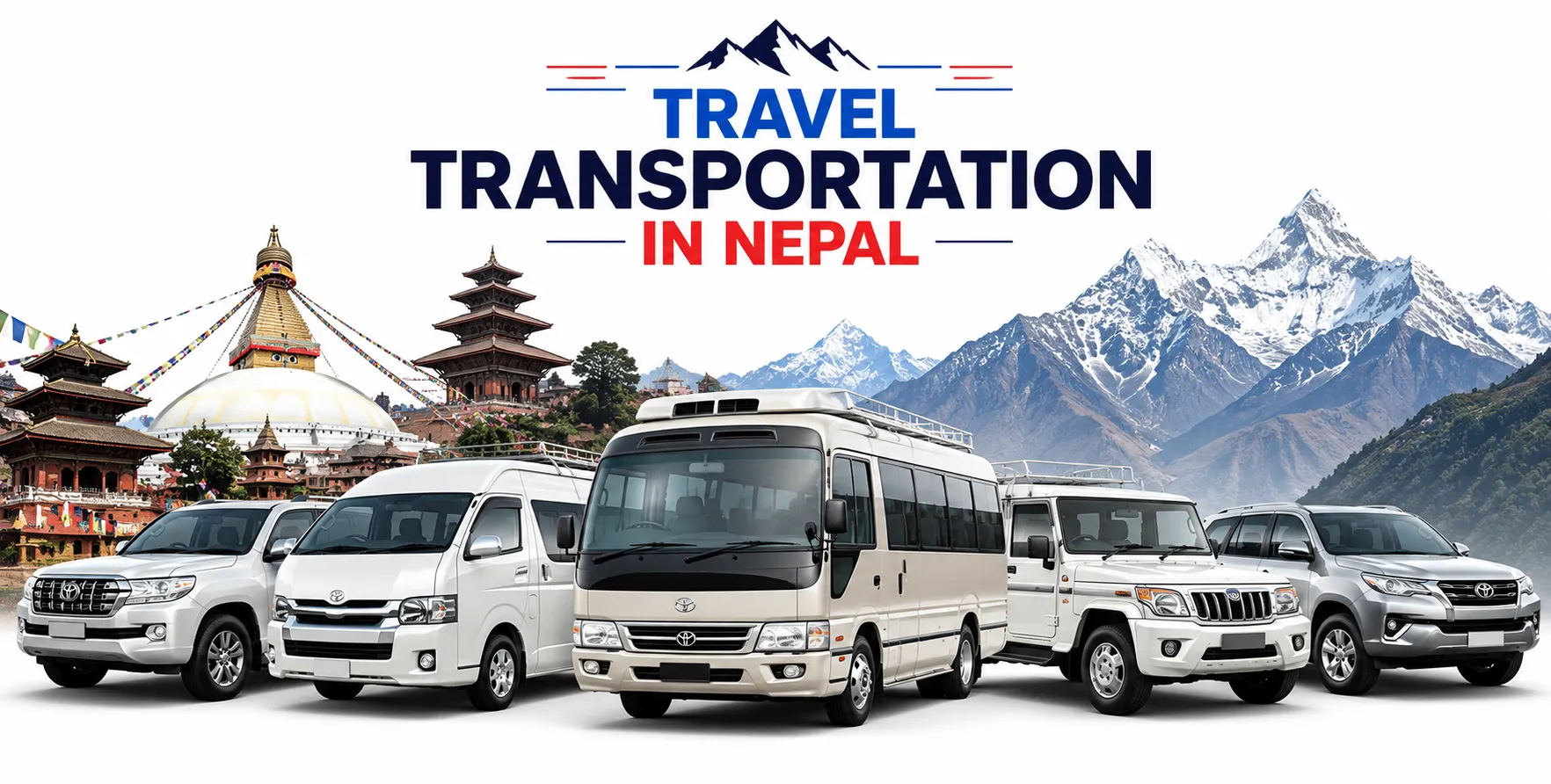
The first question in any Nepal trekking transport booking is vehicle type, and the right answer depends specifically on group size, distance, destination, and the road character of the final approach. Nepal Vehicle Hiring Pvt Ltd provides the complete spectrum of vehicle options for every trekking transport need.
Private Sedan / Car. The private car hire from Nepal Vehicle Hiring Pvt Ltd is the right choice for shorter, fully paved transfers: Kathmandu airport transfers, Kathmandu sightseeing, Bhaktapur day tours, and the Pokhara car hire for city excursions and shorter Lakeside-area transfers. For groups of 1 to 3 with minimal luggage, a private car is also appropriate for paved-highway transfers such as Kathmandu to Pokhara by road or Pokhara to Besisahar. A sedan is not suitable for any trekking trailhead approach that includes off-road sections.
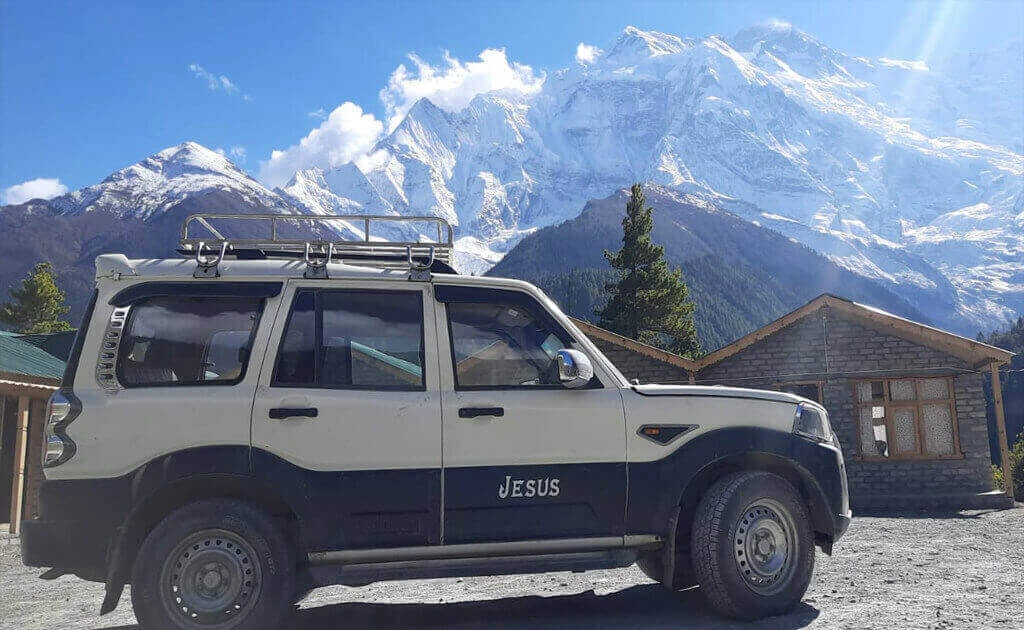
Private 4WD Jeep (Scorpio / Hilux). The private 4WD jeep is the single most versatile and most widely used vehicle in Nepal’s trekking transport fleet. The Mahindra Scorpio 4WD and Toyota Hilux 4WD — the two primary workhorses of Nepal Vehicle Hiring Pvt Ltd’s jeep hire fleet — combine the ground clearance, low-range capability, and load-carrying capacity required for every major Nepal trekking trailhead approach, with comfortable cabin space for 4 to 6 passengers and roof-rack luggage capacity for full expedition duffel bags. A private jeep hire covers every trekking transfer in this guide: Everest region overland approaches via Salleri, Phaplu, and Kharikhola; the Langtang trek Syabrubesi transfer; the Manaslu Circuit trailhead; and the Besisahar private vehicle service extending into the Marsyangdi gorge toward Manang.
Toyota Hiace Van. The Toyota Hiace seats 12 to 14 passengers comfortably and is the right choice for medium-sized trekking groups on paved highway routes and moderate hill roads. Nepal Vehicle Hiring Pvt Ltd’s Hiace van hire covers Kathmandu to Pokhara bus corridor, the approach to Besisahar, the approach to Syabrubesi and Dhunche for the Langtang trek, and any other transfer where the road quality allows a van-height vehicle and the group exceeds 6 people. For approaches that include genuinely rough off-road sections — Soti Khola, Machha Khola, the Annapurna gorge beyond Besisahar — the Hiace transfers passengers at the pavement’s end, with a 4WD jeep shuttle covering the rougher final section.
Tourist Coaster and Bus. For large trekking groups of 20 to 45 people — school expeditions, corporate trekking programs, pilgrimage parties — Nepal Vehicle Hiring Pvt Ltd provides tourist coaster hire and full tourist bus hire on Nepal’s paved highway network. These larger vehicles cover the Kathmandu-to-Pokhara corridor, the approach to Besisahar, the Lumbini road via our Kathmandu to Lumbini bus service, and the Pokhara to Chitwan bus connection — all at significantly lower per-person cost than smaller vehicles for groups that fill them.
Land Cruiser — For the Most Demanding Terrain. For the most technically demanding Nepal trekking transport routes — Upper Mustang’s canyon roads to Lo Manthang, remote Dolpo District approaches, and the Rara Lake circuit in the far northwest — a Toyota Land Cruiser provides the highest available combination of 4WD capability, passenger comfort, and luggage capacity for small groups of 4 to 5. Nepal Vehicle Hiring Pvt Ltd provides Land Cruiser hire on these premium remote routes on booking. The Land Cruiser’s larger fuel tank, higher ground clearance, and greater low-range torque make it specifically suitable for multi-day, very remote transfers where the combination of long distance, rough terrain, and limited roadside support requires a vehicle with the greatest available margin of mechanical reliability.
Everest Region Trekking Transport — The Most Complex Logistics in Nepal
The Everest Base Camp trek is Nepal’s most famous trekking experience — and its most logistically complex to reach, because the standard trailhead at Lukla (2,860 m) is accessed by a short but frequently weather-canceled domestic flight rather than any road. Understanding how the transport chain for Everest region trekking actually works in 2026 is essential for avoiding the single most common source of Everest itinerary disruption.
The Lukla flight most commonly departs from Ramechhap’s Manthali Airport during the peak spring (March to May) and autumn (October to November) seasons, due to congestion management at Kathmandu’s Tribhuvan International Airport. This means the Everest trekking transport chain for most travelers runs as follows: a predawn private vehicle departure from Kathmandu at approximately 3:00 to 4:00 AM, a 4- to 5-hour drive to Ramechhap by private jeep, the short Manthali-to-Lukla flight, and then the Everest Base Camp trek on foot through Phakding, Namche Bazaar, and the Khumbu. Nepal Vehicle Hiring Pvt Ltd specializes in the Kathmandu-to-Ramechhap predawn transfer, calculating each departure time based on the specific flight slot to ensure arrival at Manthali Airport with adequate check-in time regardless of the pre-dawn start.
The overland alternative for Everest region trekking bypasses the Lukla flight entirely, using a private jeep transfer from Kathmandu to Phaplu, Salleri, or Kharikhola and Surke — the traditional overland approach route covered in detail in our dedicated Kathmandu to Salleri Phaplu guide and our Kathmandu to Kharikhola Surke guide. From Surke, a short 2 to 3 hour walk connects to Lukla and the main EBC trail. From Phaplu or Salleri, the Jiri to Everest historical overland route begins — the same approach all pre-1964 Everest expeditions used. For travelers wary of flight cancellations or seeking a more immersive, historically grounded introduction to the Everest region, Nepal Vehicle Hiring Pvt Ltd’s overland transfer to Soti Khola and beyond is one of the finest decisions an Everest-bound trekker can make.
For Gokyo Lakes trekkers and those undertaking the Everest Three Passes circuit, the same Lukla or overland approach transport applies. For the Everest View Trek — a shorter Khumbu itinerary reaching the famous Everest View Hotel above Namche without the full Base Camp commitment — the Lukla flight or the Surke overland approach delivers trekkers to the same starting point. The luxury Everest Base Camp lodge trek and the EBC with helicopter return from our sister company Trek Nepal Himalayas use the same outward Lukla approach combined with a helicopter return that eliminates the return road journey — a popular choice for travelers who want the historical overland walk in one direction and the spectacular aerial return in the other.
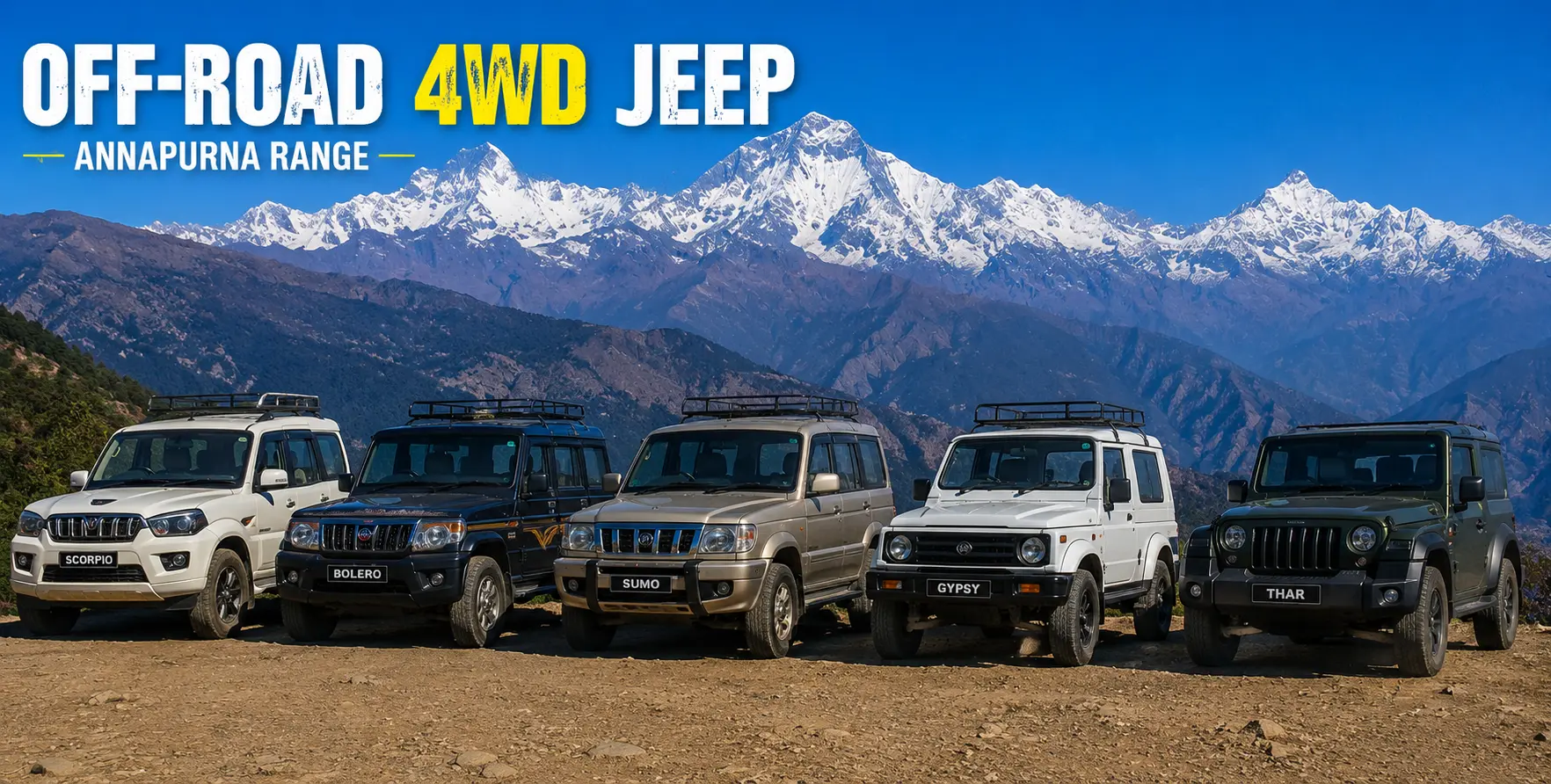
Annapurna Region Trekking Transport — The Most Road-Changed Landscape
The Annapurna region offers Nepal’s widest diversity of trekking experiences — from the 4- to 5-day Ghorepani Poon Hill trek to the full Annapurna Circuit at 12 to 18 days, with the Annapurna Base Camp trek, Muldai View Trek, and Nar Phu Valley trek filling in between. It is also the region where Nepal trekking transport has changed most dramatically in the past decade, as road construction has pushed drivable tracks far deeper into the Marsyangdi gorge and the Kali Gandaki valley than any planning done before 2015 would have anticipated.
For the Ghorepani Poon Hill trek and Annapurna Base Camp trek, the transfer from Pokhara is the defining logistics step: typically a short Pokhara-to-Nayapul private jeep ride of 45 minutes to 1.5 hours, reaching the Nayapul or Birethanti trailhead on the Modi Khola valley. Nepal Vehicle Hiring Pvt Ltd provides this Pokhara trailhead transfer with hotel pickup from anywhere in Lakeside, making it one of Nepal’s smoothest and most reliable trekking transport arrangements — short, fully paved, and done before breakfast.
For the Annapurna Circuit trek, the key transport booking is the Besisahar private vehicle service — covered in dedicated detail in our Besisahar pickup drop guide — which now extends for many groups well beyond Besisahar itself, with private 4WD jeeps carrying trekkers deep into the Marsyangdi gorge toward Jagat, Chame, and Manang and reducing what was historically a full week of approach walking to 1 or 2 days of vehicle travel. The Kathmandu to Besisahar bus ticket provides the public transport option for budget-conscious trekkers on the same corridor.
For the return from the Annapurna Circuit via Jomsom, Muktinath, and the Kali Gandaki valley, car hire in Pokhara or a private jeep arrangement from Pokhara covers the Beni-to-Pokhara or Tatopani-to-Pokhara sections on the circuit’s western exit. At the same time, the Sarangkot sunrise vehicle provides the classic post-trek Pokhara view experience for groups who want to celebrate the Annapurna Circuit completion with the finest mountain panorama the city offers.
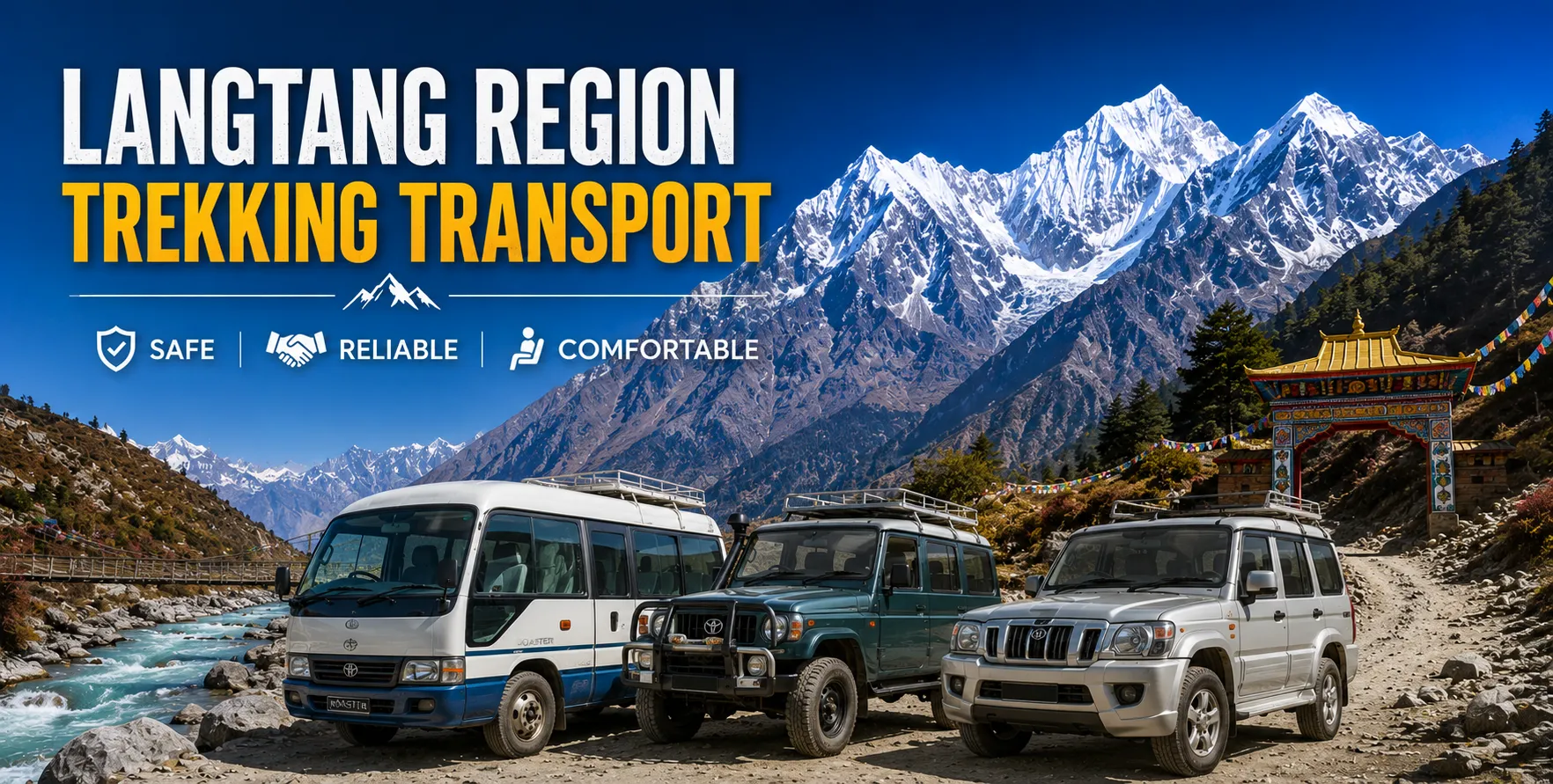
Langtang Region Trekking Transport — The Closest Trek, the Best Road Story
The Langtang Valley trek is Nepal’s closest major Himalayan trek to Kathmandu — accessible via a single Kathmandu to Syabrubesi jeep transfer of 6 to 8 hours along the Pasang Lhamu Highway, with no flight required at any stage. The standard vehicle-hire drop-off for the Langtang trek is Syabrubesi (1,460 m) for the main Langtang Valley route toward Lama Hotel, Langtang village, and Kyanjin Gompa, or Dhunche (1,970 m) for the Gosaikunda sacred lake approach. The Ramche Landslide zone — a specific section approximately 3 km south of Dhunche — is this route’s most consistently monitored road challenge, and Nepal Vehicle Hiring Pvt Ltd tracks conditions through our driver network before every scheduled departure.
The Helambu trek — often combined with Langtang and Gosaikunda into one of Nepal’s finest 12 to 16 day multi-region circuits — exits at Melamchi Bazaar, from where a private vehicle or local bus service connects back to Kathmandu. Nepal Vehicle Hiring Pvt Ltd coordinates the Melamchi pickup as a return leg alongside the outward Syabrubesi drop for combined Langtang-Gosaikunda-Helambu itineraries — one of our most popular multi-leg trekking transport arrangements for groups spending 12 or more days in the Rasuwa and Sindhupalchok mountain corridor.
The Panch Pokhari trek transport — a hidden gem of the Sindhupalchok region, with its sacred five-lake complex beneath the Jugal Himal — uses a related approach corridor, reachable via the Melamchi Bazaar road or via Chautara depending on the specific itinerary chosen. Our Panch Pokhari trek transport guide covers this approach in dedicated detail, and Nepal Vehicle Hiring Pvt Ltd provides private jeep hire to both standard gateways.
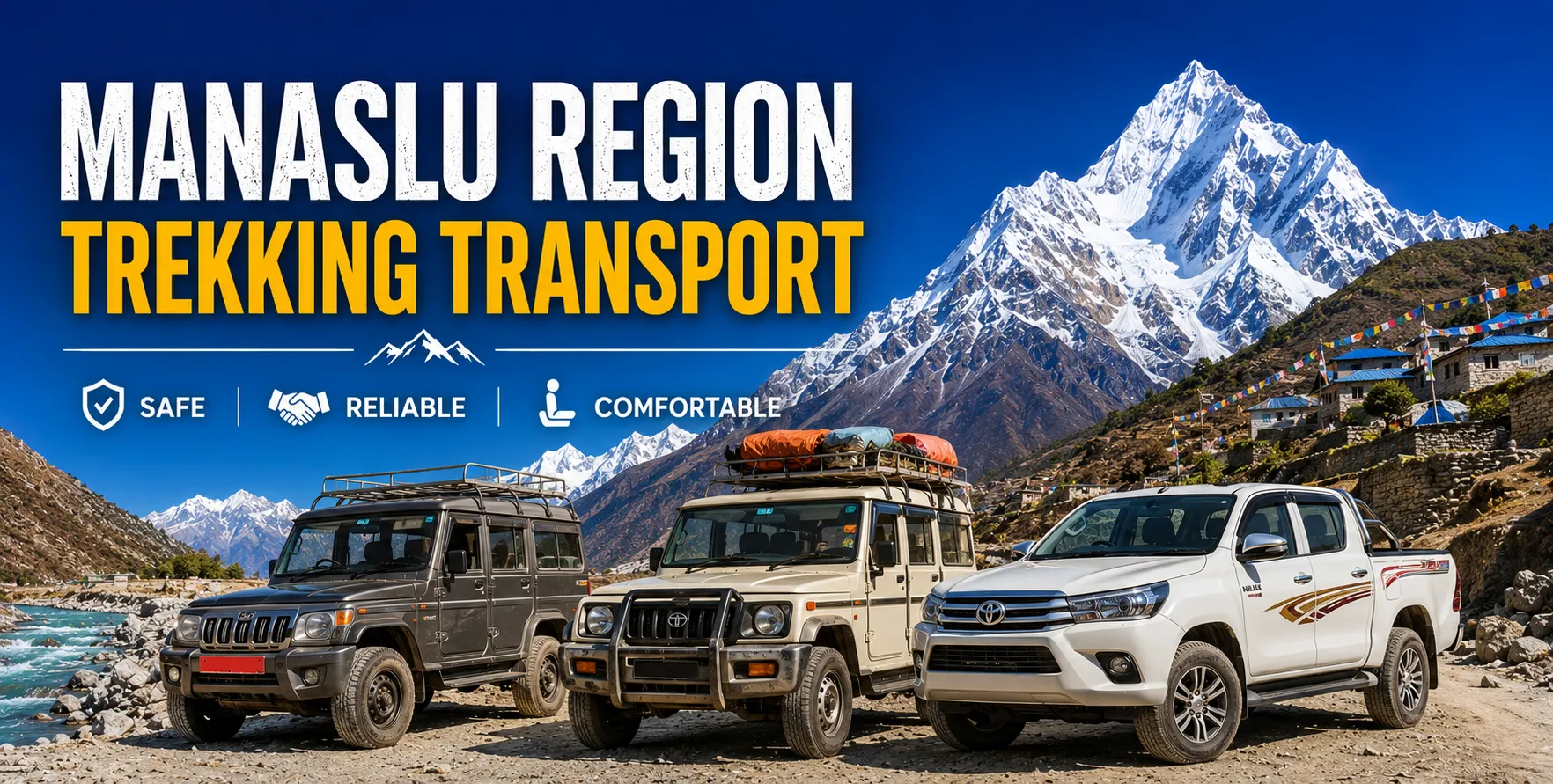
Manaslu Region Trekking Transport — Road Journey as Prologue
The Manaslu Circuit trek has, within the past five years, moved from relative obscurity to one of Nepal’s most-booked premier trekking experiences — its combination of teahouse infrastructure comparable to the Everest and Annapurna corridors with trail quietness dramatically greater than either has given it a specific and loyal following among trekkers who have completed the classic routes and are specifically seeking the combination of comfort and solitude. The Manaslu Circuit trek transport from Kathmandu is a 7 to 10 hour private 4WD jeep journey along the Prithvi Highway and Arughat corridor to the trailheads at Soti Khola (710 m) or Machha Khola (870 m), with the section from Arughat onward being the genuine rough off-road approach that makes 4WD essential rather than simply preferable.
The Manaslu Circuit requires the three-permit combination of Restricted Area Permit (RAP), Manaslu Conservation Area Permit (MCAP), and Annapurna Conservation Area Permit (ACAP) for the Larkya La crossing — all obtained in Kathmandu before departure. The circuit exits at Dharapani and Besisahar, from where Nepal Vehicle Hiring Pvt Ltd provides a private return vehicle service to Kathmandu or Pokhara. The Tsum Valley trek — one of Nepal’s finest and most culturally intact hidden valley experiences, covered in detail in our dedicated Tsum Valley trekkers guide — branches from the main Manaslu approach and uses the same trailhead transfer, making the Soti Khola and Machha Khola jeep transfer the gateway for both of the Manaslu region’s finest trekking destinations.
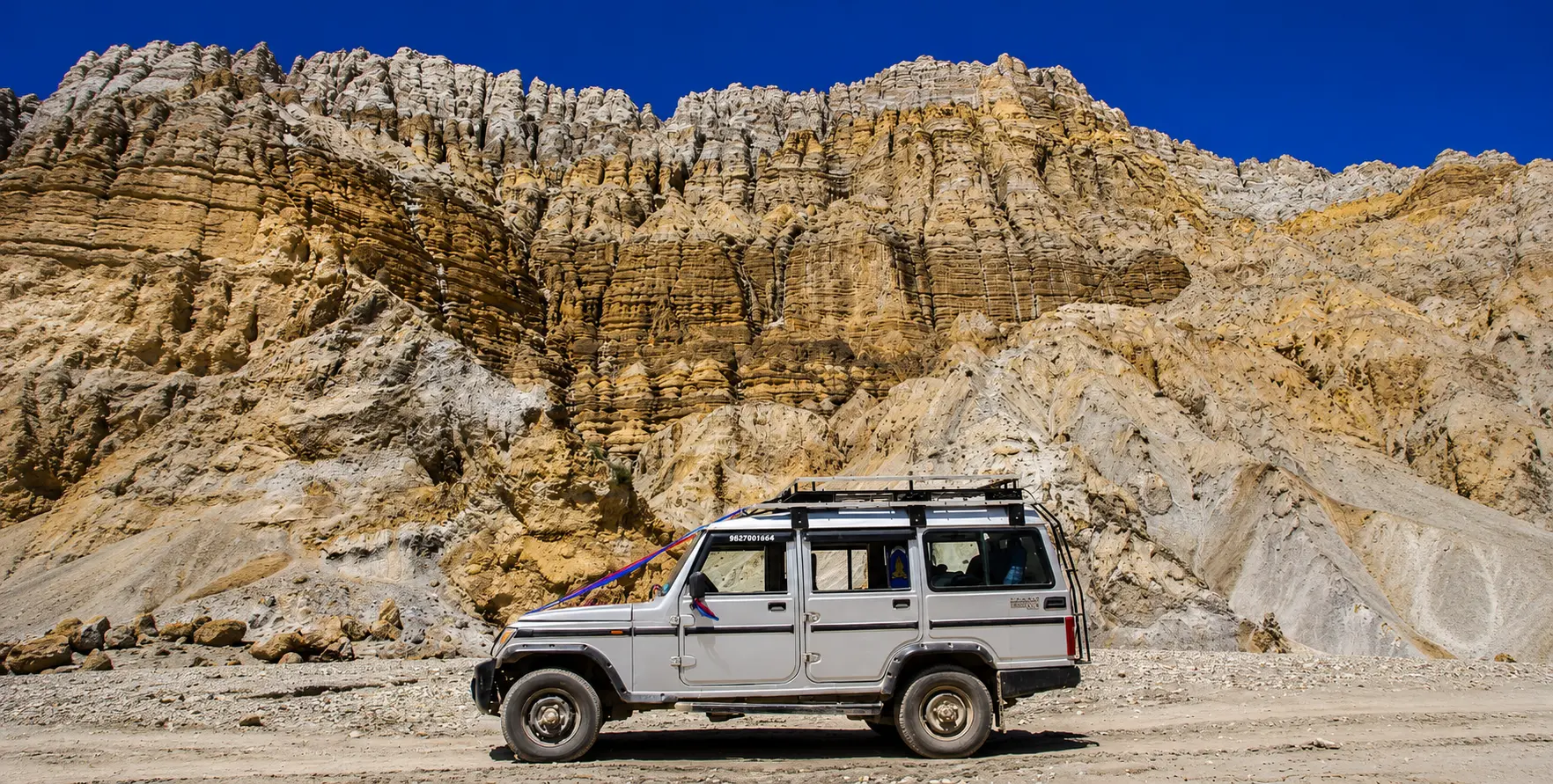
Upper Mustang and Muktinath — Trekking by Jeep
The Upper Mustang trek has undergone the most dramatic transport transformation of any major Nepal trekking route: road construction through the Kali Gandaki valley has advanced to the point that, as of 2026, the former multi-week walking approach to Lo Manthang is now largely drivable by private 4WD vehicle or Land Cruiser, making it one of Nepal’s finest jeep tour experiences as well as one of its most dramatic overland drives. Nepal Vehicle Hiring Pvt Ltd provides private vehicle hire for the Jomsom-to-Lo Manthang corridor within the broader Upper Mustang restricted area, coordinating with the Pokhara-to-Jomsom Yeti Airlines flight that begins most Upper Mustang itineraries.
Muktinath, the sacred pilgrimage site at 3,710 meters, is now reachable entirely by road from Jomsom via the extended Kali Gandaki valley track — a journey completed in private jeep hire by pilgrims and trekkers alike, and one of Nepal’s most popular altitude drives combining Hindu and Buddhist sacred site access with spectacular high-desert mountain scenery. The Nar Phu Valley trek — accessible from Koto village beyond Chame on the Annapurna Circuit approach road — is a restricted-area trek with rapidly growing reputation among experienced trekkers seeking genuine remote Himalayan wilderness, with the Besisahar to Manang jeep transfer serving as its transport entry point.
Eastern Nepal Trekking Transport — The Untrodden Corridors
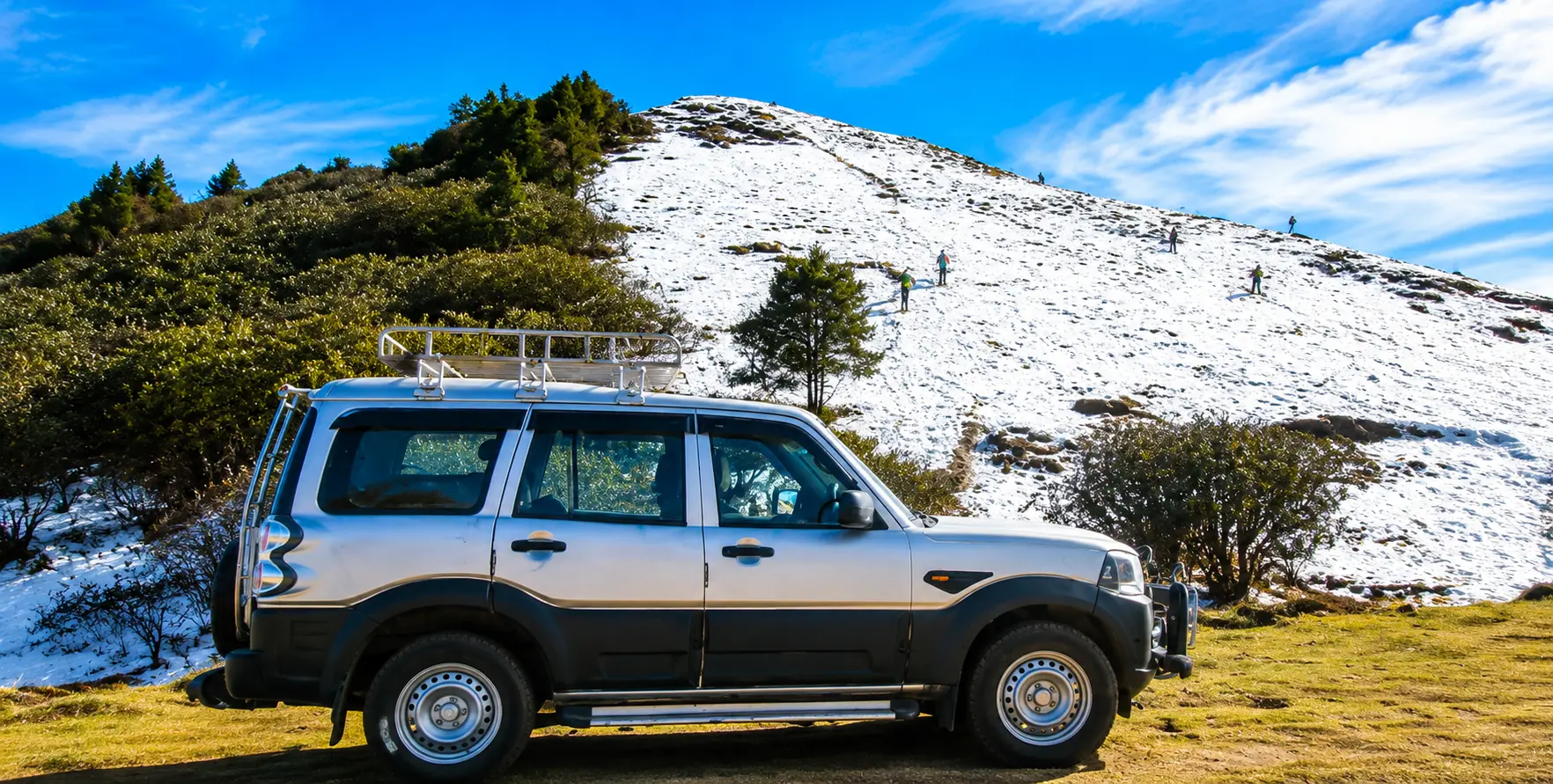
Nepal’s eastern trekking regions — Kanchenjunga, Makalu, Rolwaling, and the Solu Khumbu overland approaches — represent the frontier of Nepal trekking transport in the sense that their approach roads combine the greatest distances with the roughest terrain and the most limited alternative transport options of any major trekking destination in the country. The Kanchenjunga Base Camp trek in Nepal’s far east requires either a domestic flight to Taplejung or a very long private vehicle transfer from Kathmandu via Itahari and the Mechi Highway — a journey that, by road, takes the better part of two days and tests even the most experienced of Nepal jeep drivers. Nepal Vehicle Hiring Pvt Ltd coordinates Kanchenjunga region transfers on booking, ensuring the right vehicle and driver experience for this demanding eastern corridor.
The Solukhumbu overland approach corridor — Kathmandu to Jiri, Salleri, Phaplu, Kharikhola, and Surke — has been covered in dedicated detail in our Kathmandu to Salleri Phaplu guide and our Kathmandu to Soti Khola guide, and represents the historical overland approach to the Everest region that bypasses the Lukla flight entirely. The Rolwaling Valley trek — accessed via Charikot in Dolakha District — uses an approach corridor reachable via the BP Highway from Kathmandu, with private 4WD jeep hire to Charikot taking approximately 5 to 6 hours. Nepal Vehicle Hiring Pvt Ltd provides Rolwaling and Dolakha District trailhead transfers on request.
What characterizes all of these eastern Nepal trekking transport routes—beyond their individual distance and road-quality specifics—is that they reward prior knowledge and punish improvisation more than any other Nepal trekking corridor. A driver who has done the Charikot approach once, two years ago, in a different vehicle, in different season conditions, is fundamentally less reliable than one who has done it regularly, recently, and specifically with the 4WD jeep model they are driving today. This is precisely the distinction Nepal Vehicle Hiring Pvt Ltd maintains through our driver assignment policy: every remote eastern Nepal trailhead booking is confirmed with a driver whose personal, current experience on that specific corridor we have verified — not assigned to the nearest available vehicle from a general pool. Contact our plan trip team for any eastern Nepal trekking transport inquiry to confirm driver availability and current road conditions before finalizing your booking dates.
Shared vs Private — The Decision That Shapes Your Entire Trek Start
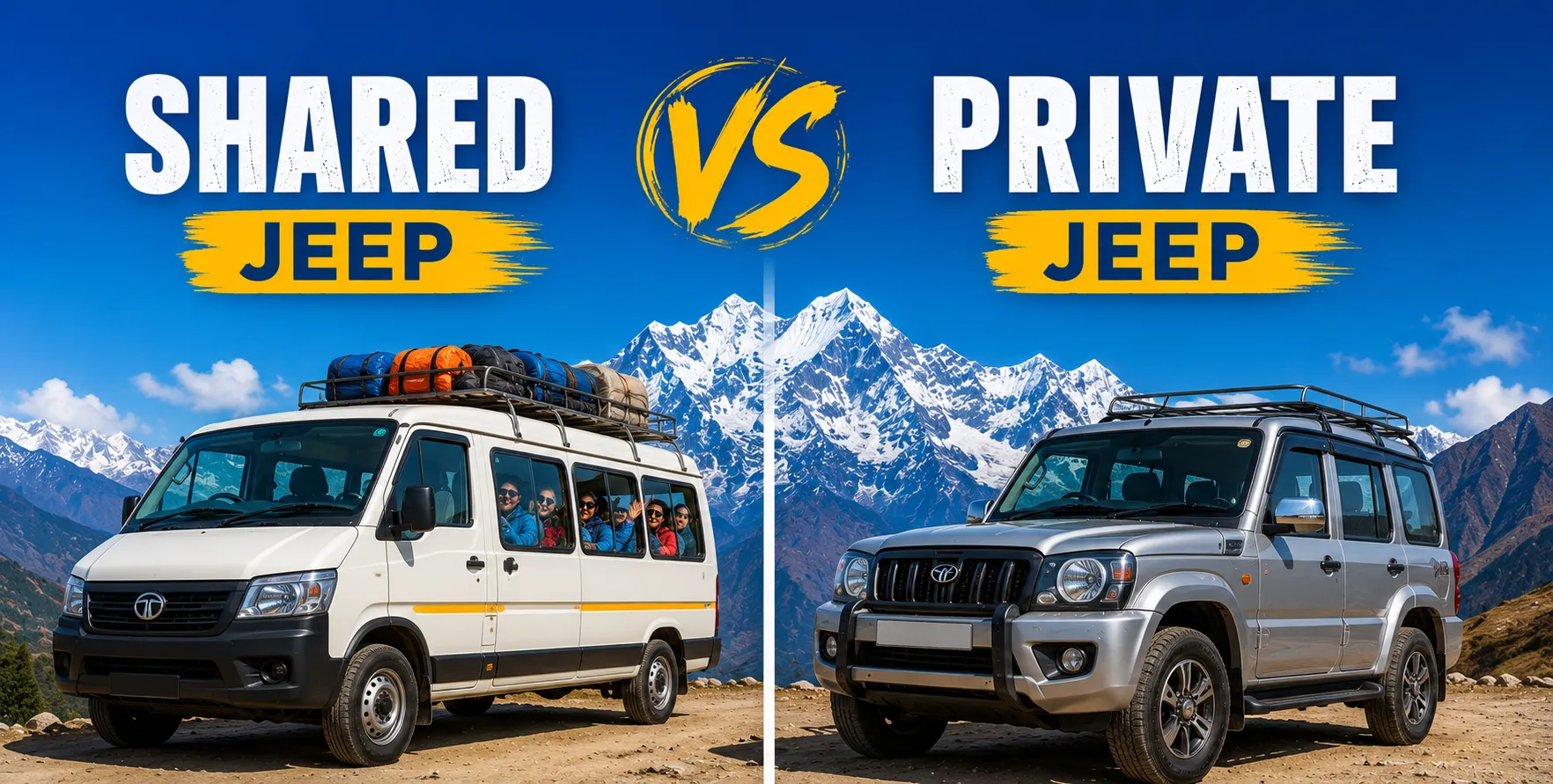
The choice between shared and private Nepal trekking transport is, for many first-time Nepal visitors, made on price alone — and while cost is a legitimate consideration, it is rarely the only one that matters on the morning of a trek departure. Understanding the practical differences between shared and private vehicle hire for Nepal trekking helps travelers make an informed choice rather than a purely reflexive one.
Shared jeep services on Nepal’s major trekking corridors — to Besisahar, Syabrubesi, Salleri, or Phaplu — operate on a departure model that is, in honest terms, a departure when full: vehicles wait at their Kathmandu departure points until they have enough passengers to make the run economically worthwhile, then depart. In practice, during peak season, this usually means a departure by 7:00 to 9:00 AM. In off-peak months, it can mean waiting until 10:00 AM or later as passenger numbers build more slowly. None of this is unreasonable by the standards of rural Nepali shared transport. Still, it is incompatible with any trekking itinerary that requires a specific departure time to ensure daylight arrival at a distant trailhead.
A private 4WD jeep from Nepal Vehicle Hiring Pvt Ltd departs at the time you and our team agree in advance, from your hotel door, with a verified vehicle and driver specifically assigned to your booking. For the Manaslu Circuit approach where a 5:30 AM departure from Kathmandu is standard to allow daylight arrival at Soti Khola or Machha Khola, this fixed departure time is not a preference but a safety necessity. The same applies to the Ramechhap airport transfer, where a 3:30 or 4:00 AM departure is standard and a shared vehicle fill-and-go model is simply incompatible with meeting a specific domestic flight check-in window.
The cost difference between shared and private also narrows dramatically with group size. For a group of 4 to 6, the private jeep total divided among the group frequently comes within NPR 500 to 1,000 per person of the shared fare — a difference that, measured against the departure timing certainty, hotel pickup convenience, and luggage handling of the private vehicle hire arrangement, most experienced Nepal trekkers regard as straightforwardly worth paying. Nepal Vehicle Hiring Pvt Ltd’s private jeep hire also includes a dedicated roof rack with securing ropes for heavy trekking luggage — an arrangement far more secure than the typical shared vehicle roof handling.
Ramechhap Manthali Airport Transfer — The Forgotten First Leg of EBC
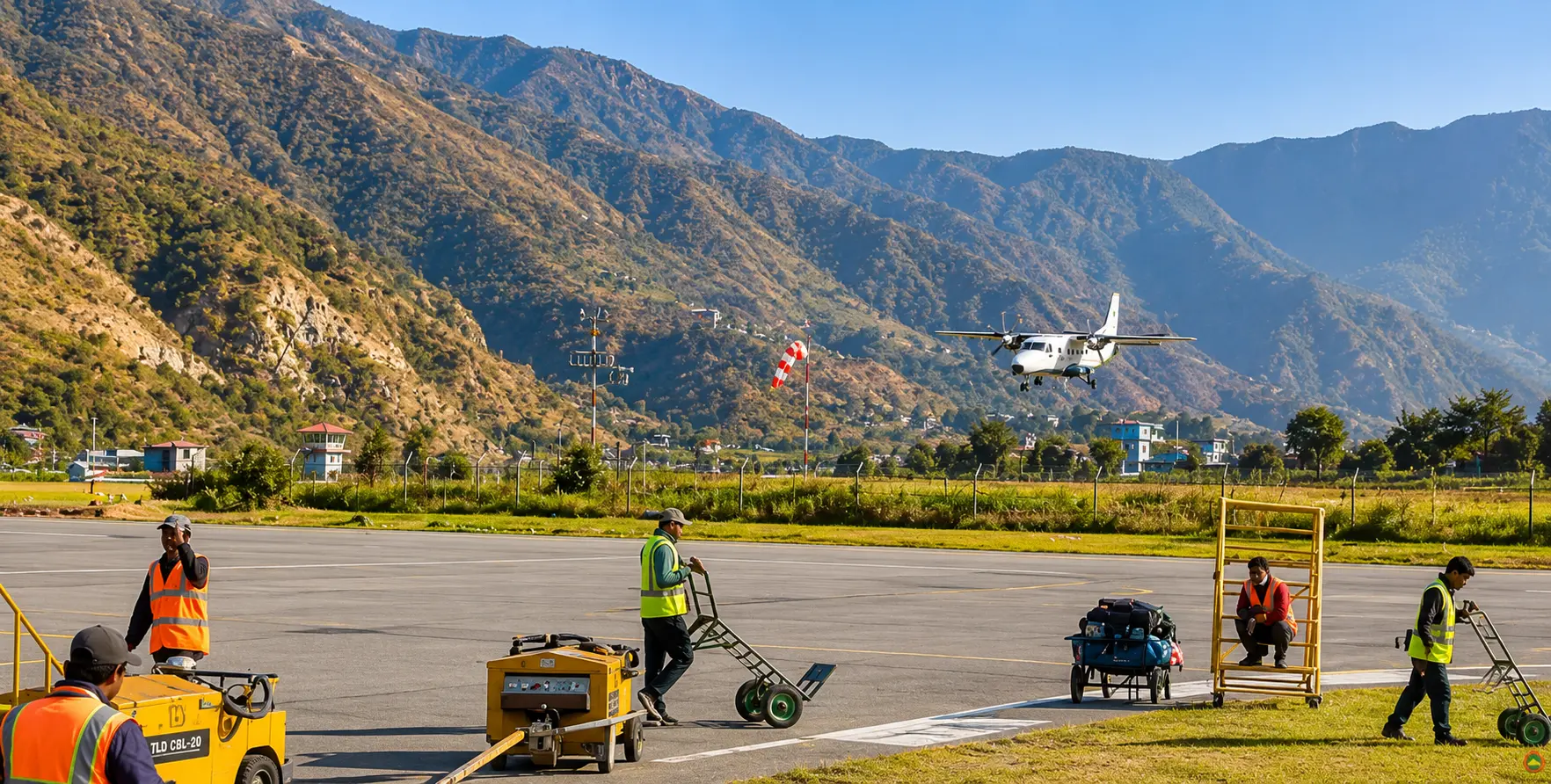
Ramechhap’s Manthali Airport has, over the past several trekking seasons, transitioned from an occasional overflow option to the standard departure point for the vast majority of Lukla-bound flights during Nepal’s two peak trekking windows — spring from March to May and autumn from September to November. The practical consequence for Everest Base Camp trekking transport is that the Everest trek now routinely begins with a 4 to 5 hour predawn private vehicle journey from Kathmandu to Ramechhap, departing at 3:00 to 4:00 AM to allow adequate check-in time for early morning Lukla flights.
Nepal Vehicle Hiring Pvt Ltd’s Kathmandu to Ramechhap airport transfer service is specifically calibrated to this early departure requirement: departure time is calculated backward from each client’s specific Lukla flight slot, buffer time is built in for both standard early morning Kathmandu traffic and the occasional construction zone on the Sindhuli Highway approach, and our drivers confirm pickup timing with clients by WhatsApp the evening before departure. A miscalculated departure or a driver who is even 30 minutes late can mean a missed Lukla flight in the worst cases, or not being rebooked for several days due to limited seat availability, creating a cascading delay that affects the entire EBC trek itinerary. This is the trekking transport booking where precision matters most, and where Nepal Vehicle Hiring Pvt Ltd’s specific Ramechhap experience pays for itself entirely.
For the luxury Everest Base Camp lodge trek and the EBC with helicopter return from Trek Nepal Himalayas, the same Ramechhap transfer serves as the outward journey, while the helicopter return eliminates the return road journey. The Jiri to Everest overland trek and Gokyo Lakes trek use the same flight approach. For those choosing the full overland alternative via Salleri and Phaplu, no flight is involved, and no Ramechhap transfer is needed — making this the single most logistically simplified Everest region approach available.
The Evolving Road Network — How Transport Options Are Changing Every Year
One of the most important — and most under-appreciated — aspects of planning Nepal trekking transport in 2026 is that the available options are genuinely, measurably different from those of even three or four years ago. Road construction in Nepal’s mountain districts is ongoing, ambitious, and in many areas specifically targeting the trekking corridor approach roads that private vehicle hire services depend upon. The drivable road beyond Besisahar has extended progressively year by year, shrinking the walking approach to Manang by multiple days compared to what the standard Annapurna Circuit trek guide published five years ago would have described. The road toward Kharikhola and Surke has similarly advanced beyond what guides published pre-2020chartst. Upper Mustang’s Lo Manthang is now substantially road-accessible, making the term ‘trek’ for the lower approach section increasingly a matter of personal choice rather than logistical necessity.
This means that any Nepal trekking transport planning based on published guidebooks older than two or three years should be treated with caution. The distances, driving times, and trailhead positions cited in those sources may have changed significantly—and almost always in the direction of roads getting longer, trailheads moving farther into the mountains, and the available starting altitude for any private jeep transfer increasing. Nepal Vehicle Hiring Pvt Ltd actively monitors road extension and condition changes on every major trekking corridor we serve, and our drivers’ current knowledge of what is and isn’t currently drivable is one of the most practically valuable aspects of booking your trek transport with a professional local operator rather than relying on outdated published information.
Booking Nepal Trekking Transport — What Separates Good from Poor Arrangements
The single most important distinction in any Nepal trekking transport booking is between an all-inclusive, hotel-pickup private vehicle arrangement with a transparent upfront price and a verified operator — and an informal, last-minute negotiation with an unverified driver or shared vehicle service whose actual cost, departure time, vehicle condition, and driver experience are all unknown until the morning of the journey. This distinction matters far more for Nepal trekking transport than for most other contexts, because the consequences of poor vehicle choice or poor driver quality on a mountain approach road are not merely inconvenient — they can be genuinely dangerous on the exposed cliff-edge and landslide-prone sections that define several of Nepal’s most important trekking corridors.
The specific markers of a trustworthy Nepal trekking transport arrangement are: a clearly stated all-inclusive price covering driver, fuel, and road tolls; specific mention of the vehicle type (confirming 4WD for any approach that requires it); hotel pickup confirmation rather than meeting at a bus park; driver contact details provided before the departure date; and a named, established operator rather than an anonymous WhatsApp number. Nepal Vehicle Hiring Pvt Ltd provides every one of these markers on every booking — which is why experienced trekking guides, operators, and repeat Nepal visitors consistently recommend our vehicle hire service for the transport legs of their clients’ and their own Himalayan journeys.
Permits and the 2026 Guide Mandate — How Transport and Documentation Connect
One of the most practically important intersections between Nepal trekking transport planning and trekking logistics is the permit requirement: permits for all of Nepal’s major trekking regions must be obtained in Kathmandu or Pokhara before the trailhead transfer departs, because there is no permit processing infrastructure at any trailhead itself. The Besisahar checkpoint verifies ACAP permits for every vehicle entering the Annapurna Conservation Area. The Dhunche checkpoint verifies Langtang National Park permits. The Jagat checkpoint on the Manaslu route verifies the Restricted Area Permit and MCAP. And the Sagarmatha National Park checkpoint at Monjo, several days’ walk above the Lukla flight arrival point, verifies the national park entry permit for Everest Base Camp trekkers.
The practical implication is that permit day and departure day cannot be the same day for any major Nepal trek. Budget at least one full day in Kathmandu or Pokhara for permit processing before the trailhead transfer departs — the Nepal Tourism Board offices in both cities process ACAP, Langtang National Park permits, and TIMS cards relatively quickly (typically within an hour for straightforward applications), but the Manaslu Circuit’s Restricted Area Permit requires registered agency submission. It can take a day or more to process, particularly during peak season when the Department of Immigration is handling large volumes of applications. Nepal Vehicle Hiring Pvt Ltd’s booking team advises clients on current permit processing times when they make their trekking transport booking, and our plan trip page allows you to flag your permit status at the time of transfer inquiry so we can advise the optimal departure schedule.
The mandatory licensed guide requirement — in force for all major Nepal trekking regions since 2023 — adds a further coordination dimension to trekking transport planning. The guide must be confirmed, licensed, and in possession of their own documentation before the group’s transfer departs, and in many cases the guide travels with the group in the private jeep from Kathmandu or Pokhara to the trailhead, making the vehicle hire sizing relevant to the total number of travelers including the guide. Nepal Vehicle Hiring Pvt Ltd routinely includes the guide in the vehicle manifest when trekking groups booking through our contact page specify their guide arrangement upfront.
Monsoon, Landslides, and the Weather That Changes Everything
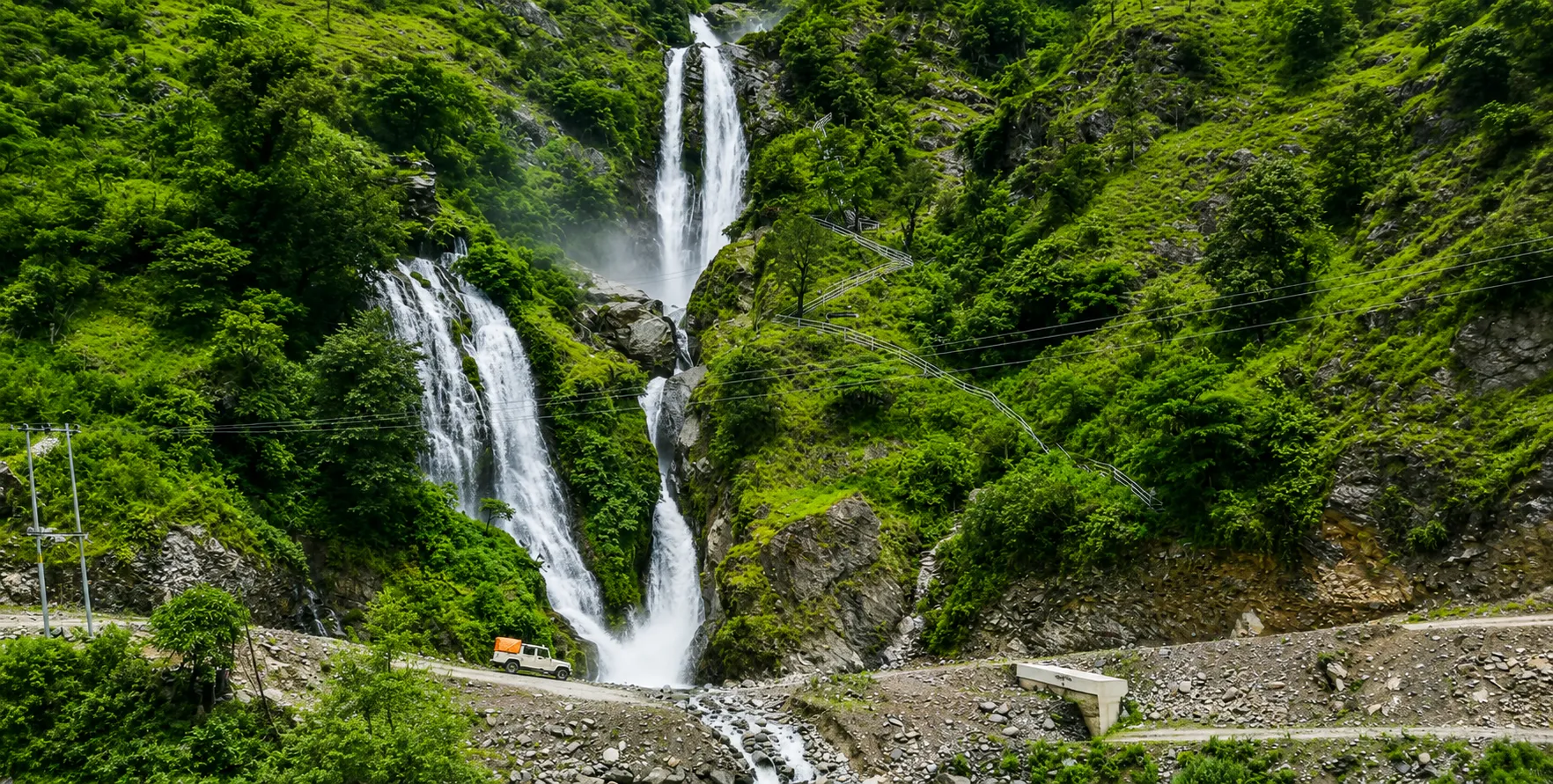
No honest guide to Nepal trekking transport can avoid discussing the monsoon — the annual June-to-September rainfall period that transforms the character of every mountain approach road in the country and introduces the landslide risk factor that sits quietly behind every driving day in Nepal’s middle hills and mountain districts. Nepal receives between 80 and 90 percent of its annual rainfall during the monsoon months. This concentration creates a predictable but highly variable pattern of road surface damage that affects the Annapurna gorge road, the Manaslu approach beyond Arughat, the Langtang highway’s Ramche zone, and the Solukhumbu overland corridor toward Phaplu and Kharikhola on a seasonal basis.
The specific practical advice for monsoon-season trekking transport is not to avoid it categorically — many experienced trekkers and pilgrims travel these routes through June, July, and August with entirely successful outcomes — but to add one specific step to the planning process: a road condition check with Nepal Vehicle Hiring Pvt Ltd on the morning of any scheduled departure that includes an off-road mountain approach section. Our driver network provides real-time, current reports on the sections of the Manaslu approach road beyond Arughat, the Ramche zone on the Langtang highway, the Dumre-to-Besisahar hill section for the Annapurna Circuit approach, and the Okhaldhunga and Salleri approaches for the Solukhumbu transfers. If a specific section is reported closed or restricted, we proactively advise clients and offer schedule alternatives— delaying departure to a clearer forecast day or using an alternative route that avoids the affected section where one exists.
The broader ecology of Nepal’s post-monsoon trekking season — September and October specifically — is shaped directly by this road damage cycle: the first weeks of autumn trekking season often see Department of Roads crews actively repairing monsoon damage on approach roads simultaneously with the first wave of peak-season trekkers arriving at trailheads, meaning that early October departures on some corridors encounter more construction delays than mid-to-late October, when the main repair season has had more time to complete. Nepal Vehicle Hiring Pvt Ltd’s seasonal experience on all major trekking transport corridors allows us to advise clients on which specific departure dates within the early-autumn window are likely to encounter more versus fewer road complications — a detail that makes a genuinely meaningful difference to journey time on certain routes.
2026/27 Cost Guide — Nepal Trekking Transport by Region
The 2026/27 pricing landscape for Nepal trekking transport reflects a combination of fuel cost increases, road improvement investment, and growing demand for private 4WD jeep hire over shared and public transport options across all major trekking corridors. The following represents current Nepal Vehicle Hiring Pvt Ltd pricing for one-way private vehicle transfers:
Everest region: Kathmandu to Ramechhap Manthali Airport (for Lukla flight): NPR 8,000 to 13,000 (USD 60 to 98) by private jeep. Kathmandu to Phaplu or Salleri: NPR 18,000 to 28,000 (USD 135 to 210). Kathmandu to Kharikhola/Surke: NPR 24,000 to 35,000 (USD 180 to 265). All via our Solukhumbu route services.
Annapurna region: Pokhara to Nayapul: NPR 2,500 to 4,000 (USD 19 to 30). Kathmandu or Pokhara to Besisahar: NPR 7,000 to 22,000 (USD 53 to 165) depending on departure city. Besisahar to Manang extension: additional NPR 8,000 to 15,000 (USD 60 to 113).
Langtang region: Kathmandu to Syabrubesi: NPR 15,000 to 22,000 (USD 113 to 165). Kathmandu to Dhunche: NPR 13,000 to 20,000 (USD 98 to 150).
Manaslu region: Kathmandu to Soti Khola/Machha Khola: NPR 18,000 to 28,000 (USD 135 to 210). Full details are available in our Manaslu trek transport guide.
For all route-specific quotes and current pricing, contact Nepal Vehicle Hiring Pvt Ltd at +977-9851343204 via WhatsApp or through our plan trip page.
Combining Trekking Transport with Kathmandu and Pokhara Services
For most international travelers, the trekking transport booking sits within a broader Nepal itinerary that also includes Kathmandu airport transfer from Tribhuvan International, pre-trek Kathmandu sightseeing days covering the UNESCO-listed monument zones, Bhaktapur heritage visits, and the Nagarkot sunrise transfer for the classic pre-trek Himalayan panorama. In Pokhara, car hire covers the lakeside sightseeing circuit, the Sarangkot sunrise vehicle provides the finest city viewpoint over the Annapurna range, and post-trek transfers connect to Chitwan via Pokhara to Chitwan bus for the jungle safari extension that so many Annapurna Circuit completers add to their itinerary.
Nepal Vehicle Hiring Pvt Ltd coordinates all of these components — from airport arrival through to final airport departure — as a single, managed transport relationship. Our Nepal tour packages combine trekking transport, city sightseeing, wildlife extensions, and heritage visits into coordinated itineraries, bookable through our plan trip page. For the trekking component itself, our sister company Trek Nepal Himalayas provides fully guided packages for every major route — the Annapurna Circuit, Annapurna Base Camp, Ghorepani Poon Hill, Everest Base Camp, Langtang Valley, Manaslu Circuit, and Upper Mustang — coordinated alongside Nepal Vehicle Hiring Pvt Ltd’s vehicle hire service. For luxury trekking experiences, Alpine Luxury Treks provides premium-grade guiding and accommodation across the same routes.
Why Choose Nepal Vehicle Hiring Pvt Ltd for All Your Trekking Transport
Nepal Vehicle Hiring Pvt Ltd has built its reputation specifically on the trekking transport segment of Nepal’s vehicle hire market — the predawn Ramechhap transfers, the 9-hour Manaslu gorge runs, the Syabrubesi drop with the Ramche zone check, the Besisahar pickup after a 14-day Annapurna Circuit. Our drivers are not general-purpose highway drivers who occasionally do a mountain run — they are professional, experienced mountain transport specialists who know specific road conditions on specific corridors, who have driven the Chamche waterfall section and the Soti Khola approach and the Dhunche descent on dozens of separate occasions, and who bring to every jeep hire booking the kind of route-specific knowledge that is genuinely different from what a navigation app can provide.
Our fleet is verified and maintained: 4WD Scorpio and Hilux jeeps for all mountain approach transfers, Hiace vans for medium-sized groups on paved routes, tourist coasters and buses for large groups on highway corridors. Every booking includes hotel pickup from any location in Kathmandu or Pokhara, all-inclusive transparent pricing covering driver, fuel, and tolls, and direct driver contact details 24 hours before departure. Book through WhatsApp at +977-9851013196 via our plan trip page or the contact page.
Frequently Asked Questions — Nepal Trekking Transport
What vehicle do I need for Nepal trekking transport?
For any trekking trailhead approach that includes off-road sections — which includes Everest region overland, Manaslu, Langtang beyond Dhunche, and Annapurna gorge beyond Besisahar — a 4WD jeep is required. For fully paved transfers (Pokhara to Nayapul, Kathmandu to Pokhara, airport transfers), a sedan or Hiace is appropriate.
How do I get from Kathmandu to the Everest Base Camp trailhead?
The standard 2026 approach is a predawn transfer from Kathmandu to Ramechhap Manthali Airport (4 to 5 hours by private jeep), then the Manthali-to-Lukla domestic flight. Alternatively, the overland approach via Salleri, Phaplu, or Kharikhola bypasses the flight entirely for trekkers with extra time.
What is the cost of private jeep hire for Nepal trekking transport?
Costs vary by route. From NPR 2,500 (Pokhara to Nayapul) to NPR 35,000+ (Kathmandu to Kharikhola). See our region-by-region guide above or contact us via WhatsApp at +977-9851343204 for a specific quote.
Can I use public buses for Nepal trekking transport?
Yes, for budget trekkers. The Kathmandu to Besisahar bus and general bus services from Gongabu Bus Park reach many trekking approach towns. However, buses involve fixed departure times, multiple stops, and no hotel pickup — making private jeep hire the strongly preferred option for any group with fixed trek schedules.
How do I arrange my return transport from a trek?
Nepal Vehicle Hiring Pvt Ltd arranges pre-confirmed return pickups from all major trek exit points — Syabrubesi, Dhunche, Besisahar, Dharapani, Phaplu, Salleri — as part of the outward booking. Confirm your expected return date at booking; adjustments accepted via WhatsApp.
Which Nepal trekking regions need 4WD vehicles?
Everest region overland (Salleri, Phaplu, Kharikhola), Manaslu (Soti Khola, Machha Khola), Langtang (Syabrubesi), Annapurna gorge (beyond Besisahar toward Chame and Manang), and Rolwaling (Charikot approach) all require 4WD jeep hire. Pokhara to Nayapul and paved highway transfers can use a sedan or van.
Conclusion
Nepal trekking transport is the infrastructure that makes every Himalayan adventure possible — and in a country whose road network is still actively extending into previously roadless valleys, where the trailhead of today is further into the mountains than the trailhead of five years ago, this infrastructure is evolving faster than almost any other aspect of the Nepal trekking experience. Understanding which vehicle suits which approach, which roads require 4WD, which trailheads have moved, and how the Ramechhap airport transfer has changed the standard Everest approach is the foundation of any well-organized Nepal trekking trip.
Nepal trekking transport is not a footnote. It is the first and last chapter of every Himalayan adventure — and in a country where road construction is actively extending into previously roadless mountain valleys year by year, the transport options available today are meaningfully different from those of three years ago. They will be different again in three years. Staying current with these changes, matching the right vehicle to the right route, and booking with a professional operator whose drivers carry real, recent, route-specific experience is the foundation on which every great Nepal trek is built. Nepal Vehicle Hiring Pvt Ltd has been that foundation for hundreds of trekking groups across all of Nepal’s major mountain regions, and our team is ready to provide the same reliable, experienced, and transparent service for your own journey into the Himalaya.
Nepal Vehicle Hiring Pvt Ltd provides the complete spectrum of trekking transport across every region covered in this guide — from private jeep hire to Hiace van, from airport transfer to trek-end pickup. For luxury trekking packages above the trailhead, Alpine Luxury Treks and Trek Nepal Himalayas provide the guided experience that begins where our road ends. Book your Nepal trekking transport with Nepal Vehicle Hiring Pvt Ltd — call or WhatsApp +977-9851013196, visit vehiclehiringnepal.com, or plan your full journey through our plan trip page.
- Nepal Trekking Transport Guide | — The Complete 2026 Guide to Getting to Every Trailhead
- Why Nepal Trekking Transport Deserves Serious Planning
- Nepal Trekking Transport Guide | — Understanding Your Options
- Everest Region Trekking Transport — The Most Complex Logistics in Nepal
- Annapurna Region Trekking Transport — The Most Road-Changed Landscape
- Langtang Region Trekking Transport — The Closest Trek, the Best Road Story
- Manaslu Region Trekking Transport — Road Journey as Prologue
- Upper Mustang and Muktinath — Trekking by Jeep
- Eastern Nepal Trekking Transport — The Untrodden Corridors
- Shared vs Private — The Decision That Shapes Your Entire Trek Start
- Ramechhap Manthali Airport Transfer — The Forgotten First Leg of EBC
- The Evolving Road Network — How Transport Options Are Changing Every Year
- Booking Nepal Trekking Transport — What Separates Good from Poor Arrangements
- Permits and the 2026 Guide Mandate — How Transport and Documentation Connect
- Monsoon, Landslides, and the Weather That Changes Everything
- 2026/27 Cost Guide — Nepal Trekking Transport by Region
- Combining Trekking Transport with Kathmandu and Pokhara Services
- Why Choose Nepal Vehicle Hiring Pvt Ltd for All Your Trekking Transport
- Frequently Asked Questions — Nepal Trekking Transport
- Conclusion

Related Blog & Articles

Kathmandu to Panch Pokhari Trek Vehicle: The Sacred Five Lakes Within Reach of the Capital
Pokhara to Nayapul Trek Transport – Complete Guide for Trekkers (2026)
Langtang Trek Pickup Vehicle
Api Himal Trek Transport: The Complete Vehicle Service Guide (2026)

Besisahar to Dharapani Jeep Hire – Complete 4WD Transfer Guide for Annapurna Circuit Trekkers