Plan a Trip


Kathmandu to Pokhara Road Condition Overview
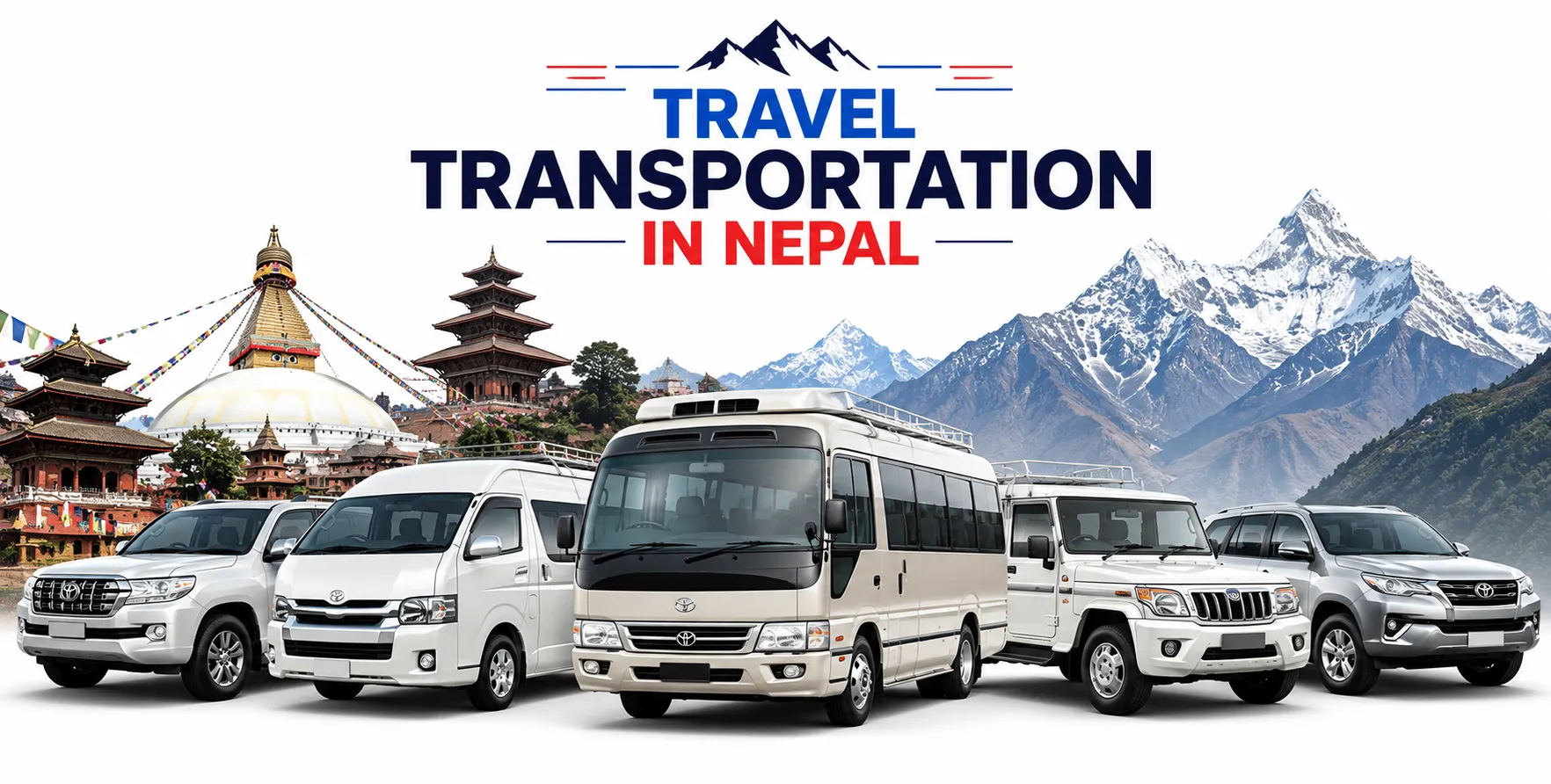
Kathmandu to Pokhara Road Condition Overview 2026/27 – Best Vehicle Guide
The Kathmandu to Pokhara journey on the Prithvi Highway is Nepal’s most traveled road — a 200 km corridor between the mountain capital and the lakeside city that carries trekkers, tourists, pilgrims, business travelers, and daily commuters in a continuous flow throughout the year. As Nepal’s primary road connection between its two most important cities, the Prithvi Highway is also the country’s most actively maintained road — receiving regular attention from the Department of Roads, undergoing ongoing widening and improvement works, and subject to the same weather stresses that affect all of Nepal’s major road arteries.
For travelers planning the Kathmandu to Pokhara journey in 2026 and 2027, understanding the current road conditions—which sections have been recently improved, which are undergoing active construction, where seasonal hazards exist, and what the honest travel-time expectations are under different conditions—is essential for making good transport decisions. This complete guide provides a section-by-section road condition assessment for 2026/27, vehicle recommendations for different group sizes and priorities, seasonal condition variations, and practical advice from Vehicle Hiring Nepal’s drivers who make this journey regularly throughout the year.
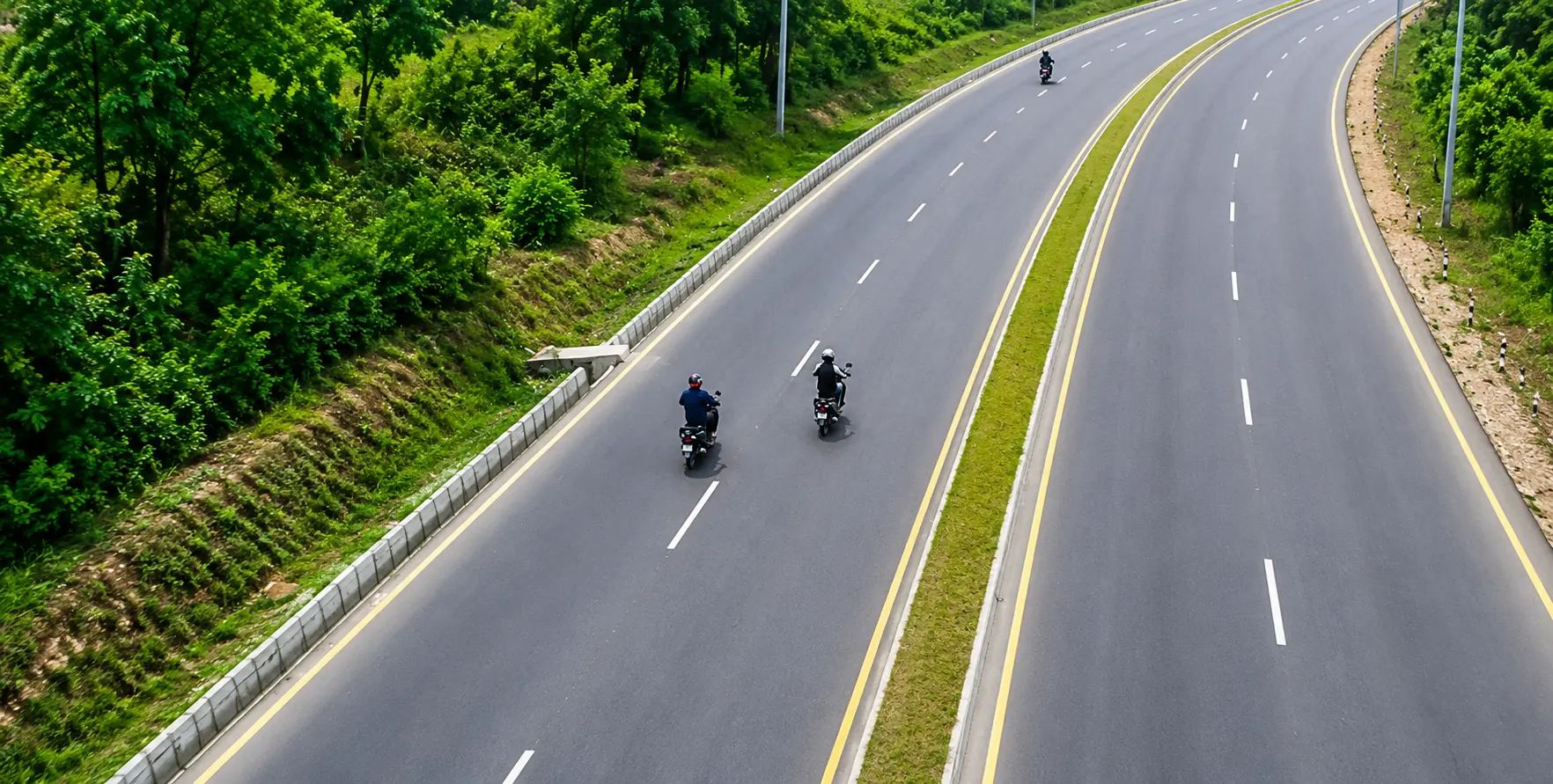
The Prithvi Highway — Overview and Strategic Importance
Official Name: Prithvi Highway (B.P. Highway section connects at Naubise; Prithvi Highway properly begins from there)
Total Distance: Approximately 200 km from central Kathmandu (New Bus Park area) to Pokhara Lakeside
Classification: National Highway — Nepal’s primary westbound arterial road
Maintained by: Department of Roads (DoR), Nepal Government
Construction Year: Originally built 1968–1974 with Chinese assistance; progressively upgraded since
Key Intermediate Towns: Naubise, Malekhu, Mugling (midpoint junction), Damauli, Pokhara
Traffic Volume: One of Nepal’s highest-traffic roads — heavy truck, bus, and private vehicle mix
The Prithvi Highway serves not merely as a tourist corridor but as the economic lifeline connecting Pokhara, the Gandaki Province hill districts, and the western mountain regions to Kathmandu. Heavy goods vehicles carry cement, fuel, food, and construction materials westward in continuous convoys. Tourist buses and private vehicles fill the early morning departure windows. Local buses connect the dozens of market towns along the route. Understanding the highway’s character — busy, paved, maintained but subject to ongoing construction and seasonal disruption — is the starting point for any realistic assessment of the 2026/27 journey.
Overall Road Condition Rating 2026/27
Based on Vehicle Hiring Nepal driver assessments and current road department information, here is the overall 2026/27 condition snapshot for the Kathmandu to Pokhara highway:
| Road Section | Distance | Condition 2026/27 | Key Issue | Rating |
| Kathmandu → Naubise | 30 km | Good | Kalanki–Naubise widening works ongoing in sections; some delays possible. | ★★★★☆ |
| Naubise → Malekhu | 50 km | Good–Very Good | Trishuli gorge section generally well-maintained; minor landslide risk in monsoon. | ★★★★☆ |
| Malekhu → Mugling | 30 km | Good | Some rough patches post-monsoon; repair works frequent | ★★★★☆ |
| Mugling → Dumre | 45 km | Very Good | Marsyangdi valley road — widening completed in most sections; smooth driving | ★★★★★ |
| Dumre → Damauli | 25 km | Good | Mostly paved and smooth; some road works in 2026 near Bimalnagar | ★★★★☆ |
| Damauli → Pokhara | 40 km | Good–Very Good | Best section of the highway; wide, well-paved, fast driving | ★★★★★ |
| OVERALL KTM → POKHARA | 200 km | Good | Fully paved throughout 2026/27; no unpaved sections | ★★★★☆ |
The bottom line for 2026/27: the Kathmandu to Pokhara Prithvi Highway is fully paved throughout and in generally good to very good condition. It is a reliable, manageable journey for any standard vehicle in any season. The headline concerns for 2026/27 are the ongoing road widening works near Kathmandu, the post-monsoon rough patches in the Trishuli gorge section, and the standard monsoon landslide risk on the Naubise to Mugling gorge corridor. None of these represent serious obstacles for a properly planned journey with an experienced driver.
Section-by-Section Condition Detail
Section 1: Kathmandu to Naubise (30 km | 45–60 min)
Road Status 2026/27: Paved; road widening and improvement works ongoing in several sections
Key Challenge: Kalanki to Thankot and Thankot to Naubise — active road widening project creating some single-lane working and temporary surface irregularities
Traffic Factor: Heaviest traffic congestion of the entire journey; Kathmandu ring road exit and Kalanki junction are bottlenecks at peak hours
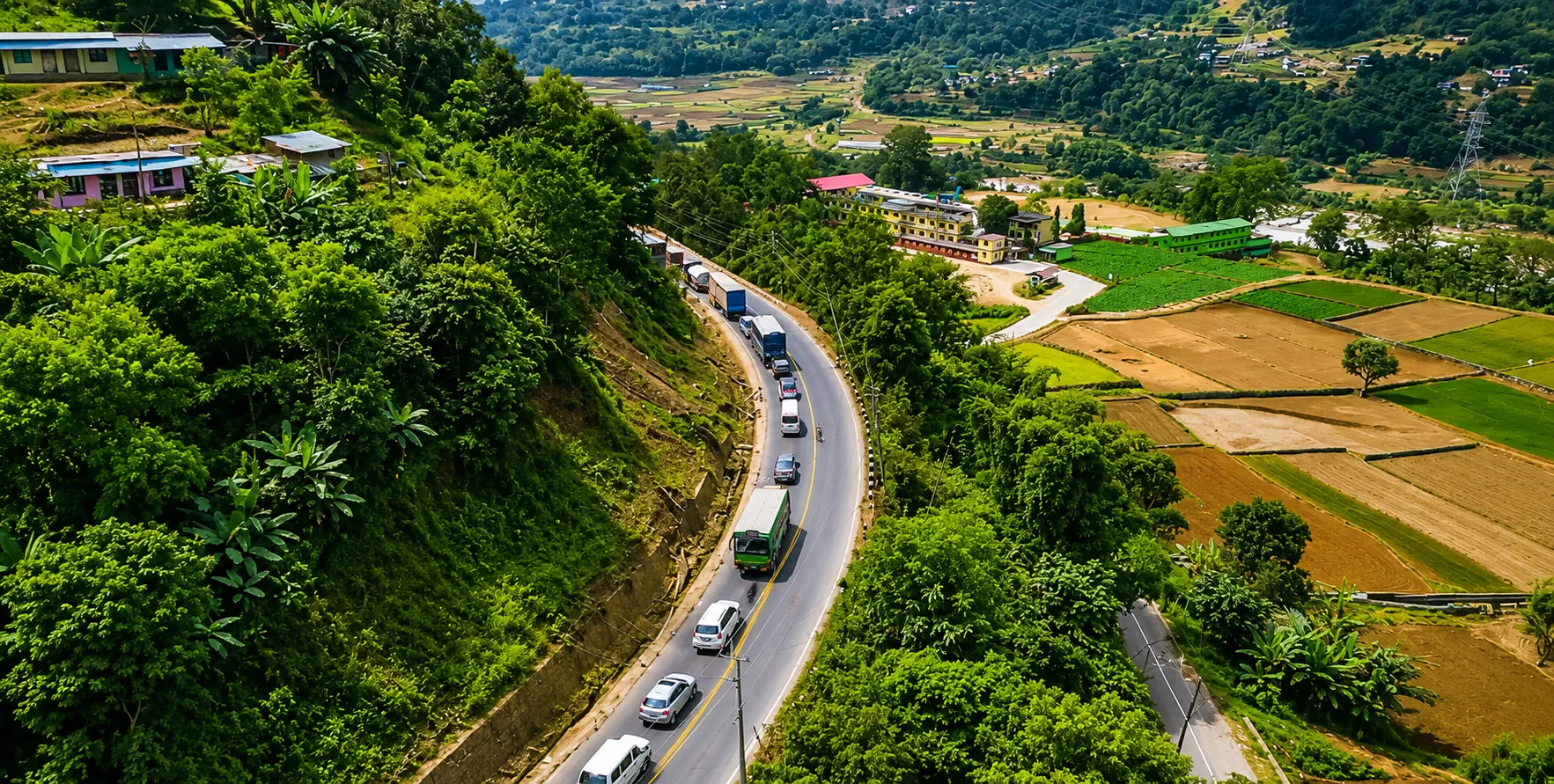
The first 30 km from Kathmandu to Naubise is consistently the most time-unpredictable section of the entire journey. The road climbs from the Kathmandu Valley through the Chandragiri hills to Naubise — a gradient section that has been subject to significant road widening works as part of the ongoing Prithvi Highway improvement project. In 2026/27, this section has sections under active construction with temporary single-lane working and compacted sub-base surfaces rather than final asphalt in places.
Traffic at Kalanki junction — the main southwestern exit from Kathmandu’s ring road — is consistently the worst bottleneck on the entire Pokhara route. Rush hour (7:00–9:00 AM and 5:00–7:00 PM) can add 30 to 45 minutes to this section alone. The standard Vehicle Hiring Nepal departure time of 6:00–7:00 AM is specifically chosen to clear the Kalanki junction before the morning rush builds. A 5:30 AM departure in peak trekking season is even better.
2026/27 Improvement Note: The Thankot to Naubise section road widening is expected to be substantially completed in the second half of 2026, which will significantly improve this section’s condition and flow. Check with Vehicle Hiring Nepal at the time of booking for the current construction status.
Section 2: Naubise to Malekhu (50 km | 1 hr 10 min – 1 hr 30 min)
Road Status 2026/27: Paved throughout; generally good condition
Scenic Rating: Highest of the entire journey — Trishuli River gorge driving
Key Challenge: Post-monsoon debris and minor slides on the gorge sections; narrow sections near the river
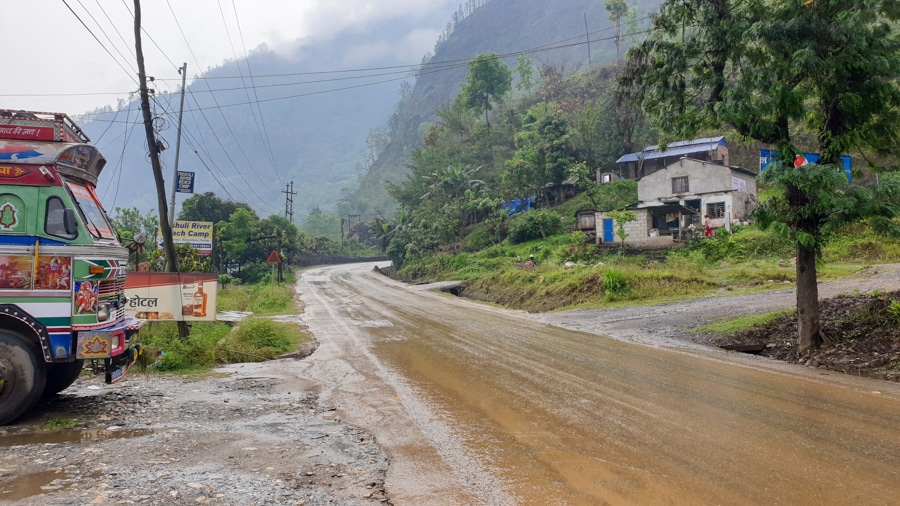
From Naubise, the road descends dramatically into the Trishuli River gorge — the most scenically spectacular section of the entire Kathmandu to Pokhara drive. The road follows the right bank of the Trishuli through a narrow, forested gorge with the river running green and powerful below on the left side of the vehicle. This section was heavily affected by road construction over the past decade, and the 2026/27 condition reflects a much-improved but still gorge-constrained road.
The primary risks in this section are monsoon-related. The gorge walls above the road are subject to regular small rockfalls and debris flows during and after heavy rain. The Department routinely clears the road, and major blockages are unusual outside of severe weather events. In 2026/27, the condition of the asphalt surface through this section is good with some rough patches near Malekhu where repair works have created uneven transitions.
Malekhu town, approximately 80 km from Kathmandu, is the traditional first rest stop on the Pokhara journey. The roadside restaurants here are known throughout Nepal for fresh Trishuli River fish—a specialty that has made Malekhu a standard lunch stop for generations of Kathmandu-Pokhara travelers. A 20-minute tea or breakfast stop at Malekhu is built into most Vehicle Hiring Nepal Pokhara journey schedules.
Section 3: Malekhu to Mugling (30 km | 35–45 min)
Road Status 2026/27: Paved; good condition with post-monsoon repair works in progress
Key Feature: Approach to the Mugling junction — the midpoint of the entire journey
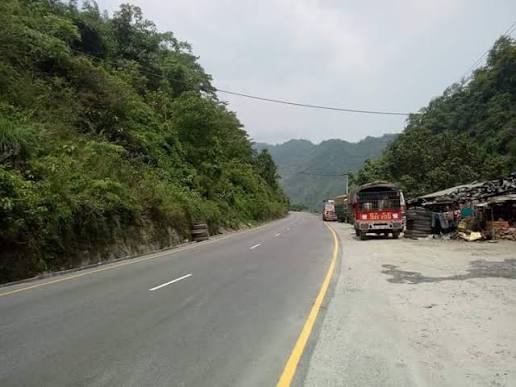
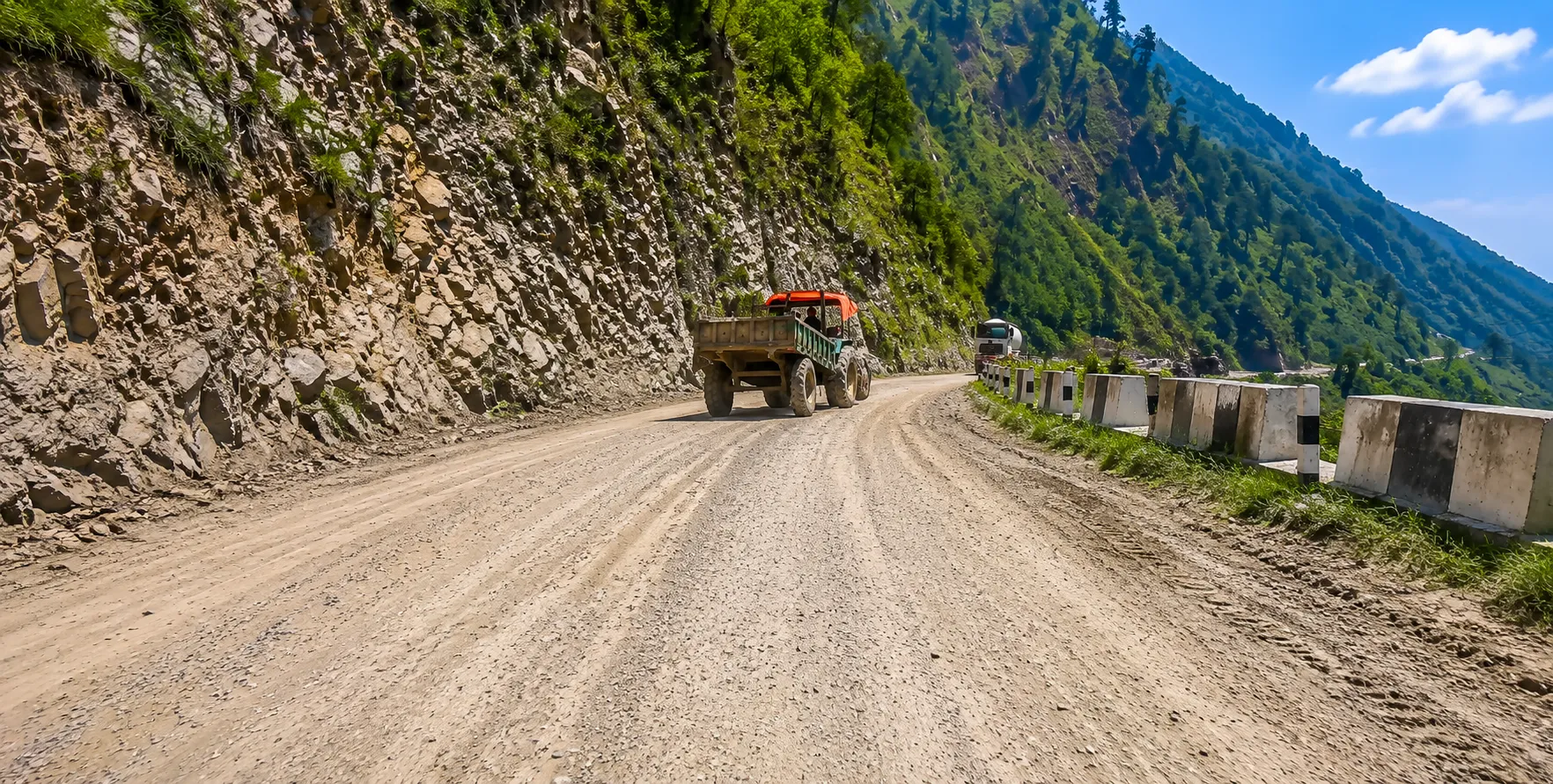
The road continues west through the deepening Trishuli gorge from Malekhu to Mugling. The river remains the constant companion on the left side of the road, and this section retains the dramatic gorge character of the previous section but with a slightly wider road in most places. Some rough patches in this section reflect the ongoing cycle of monsoon damage and repair that characterizes Nepal’s gorge roads — the DoR patches these annually, and in 2026/27 the condition is functional but not glass-smooth throughout.
Mugling junction — at the confluence of the Trishuli and Marsyangdi rivers, approximately 110 km from Kathmandu — is the geographical and logistical midpoint of the journey. It is where the Prithvi Highway turns northwest up the Marsyangdi valley toward Pokhara, while a branching road continues north toward Besisahar and the Annapurna Circuit. Mugling is the universally standard lunch stop — a busy river junction town with dozens of roadside restaurants. Budget 30 to 45 minutes here; it is the longest planned stop of the journey and the best opportunity for a proper meal.
Section 4: Mugling to Dumre (45 km | 50 min – 1 hr)
Road Status 2026/27: Very good — this is the best-maintained and most recently improved section of the highway
Key Feature: Marsyangdi River valley road; recently widened in many sections
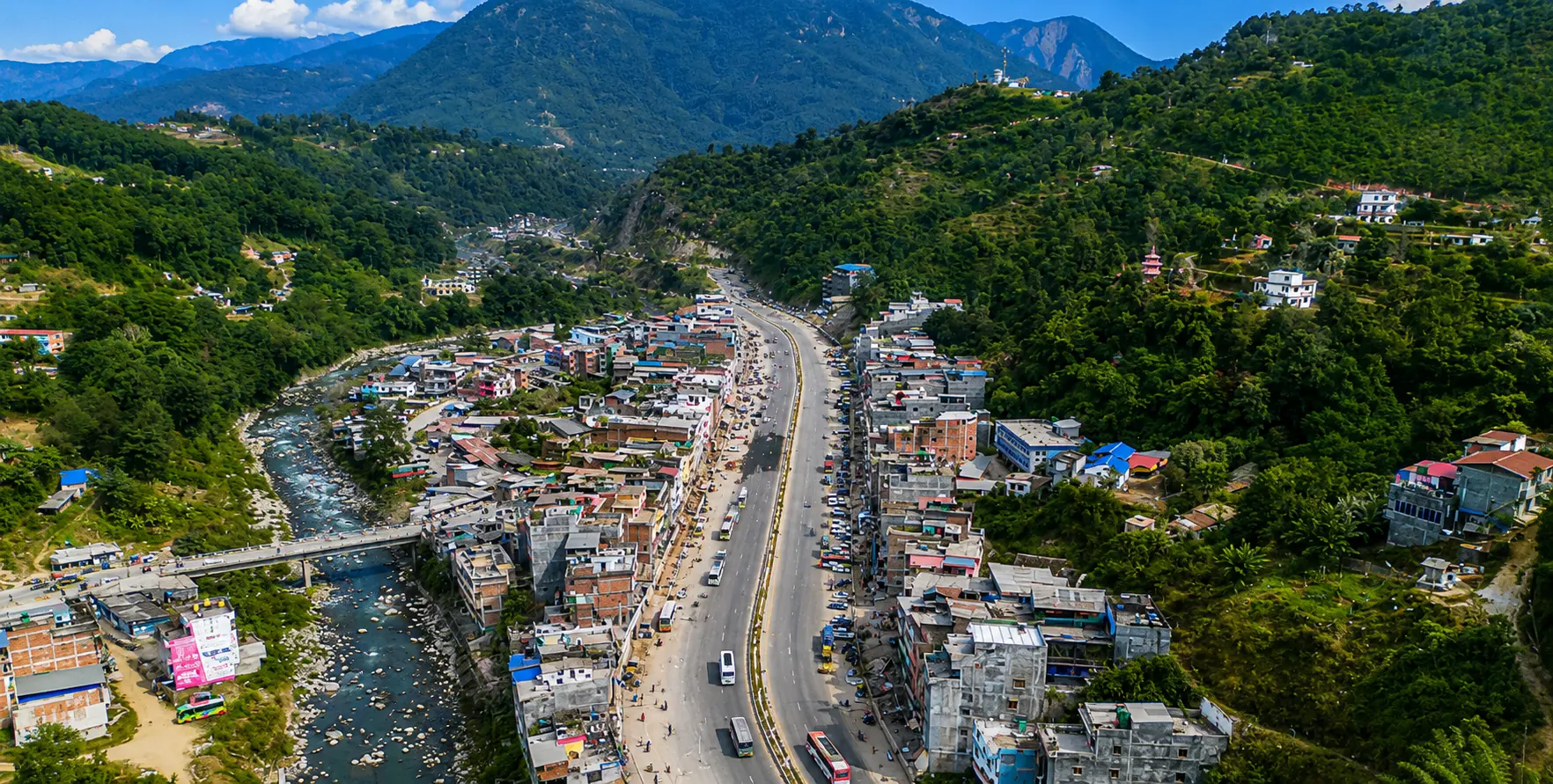
From Mugling, the road turns northwest along the Marsyangdi River valley — the most recently improved section of the Prithvi Highway and in 2026/27 noticeably better than the gorge sections behind. The road has been widened to near-double-lane standard in several sections along this stretch, and the asphalt surface is in good to very good condition. Traffic moves quickly here; this is where a private vehicle makes up time lost in the Kathmandu traffic and Trishuli gorge sections.
Dumre is the junction town for the Besisahar road heading north toward the Annapurna Circuit. For travelers heading to Pokhara, Dumre is simply a brief visual landmark — the junction is clearly marked, and your driver turns left (continuing west) without stopping.
Section 5: Dumre to Damauli (25 km | 30–35 min)
Road Status 2026/27: Good; some road works near Bimalnagar in 2026
Key Feature: Approach to the Gandaki district; road becomes wider and flatter
From Dumre,e the road continues northwest through flatter valley terrain. Damauli is the district headquarters of Tanahun District and a pleasant hilltop town with views over the Seti and Madi river confluence. In 2026, the road has some construction activity near Bimalnagar that may cause brief single-lane sections—check with Vehicle Hiring Nepal for the current status. Beyond these works, the road is good quality, and the approach to Damauli offers the first distant views of the Annapurna range on clear mornings.
Section 6: Damauli to Pokhara Lakeside (40 km | ~40–50 min)
Road Status 2026/27: Best section of the highway — wide, well-paved, fast
Key Feature: Annapurna range approach panorama; Pokhara valley descent
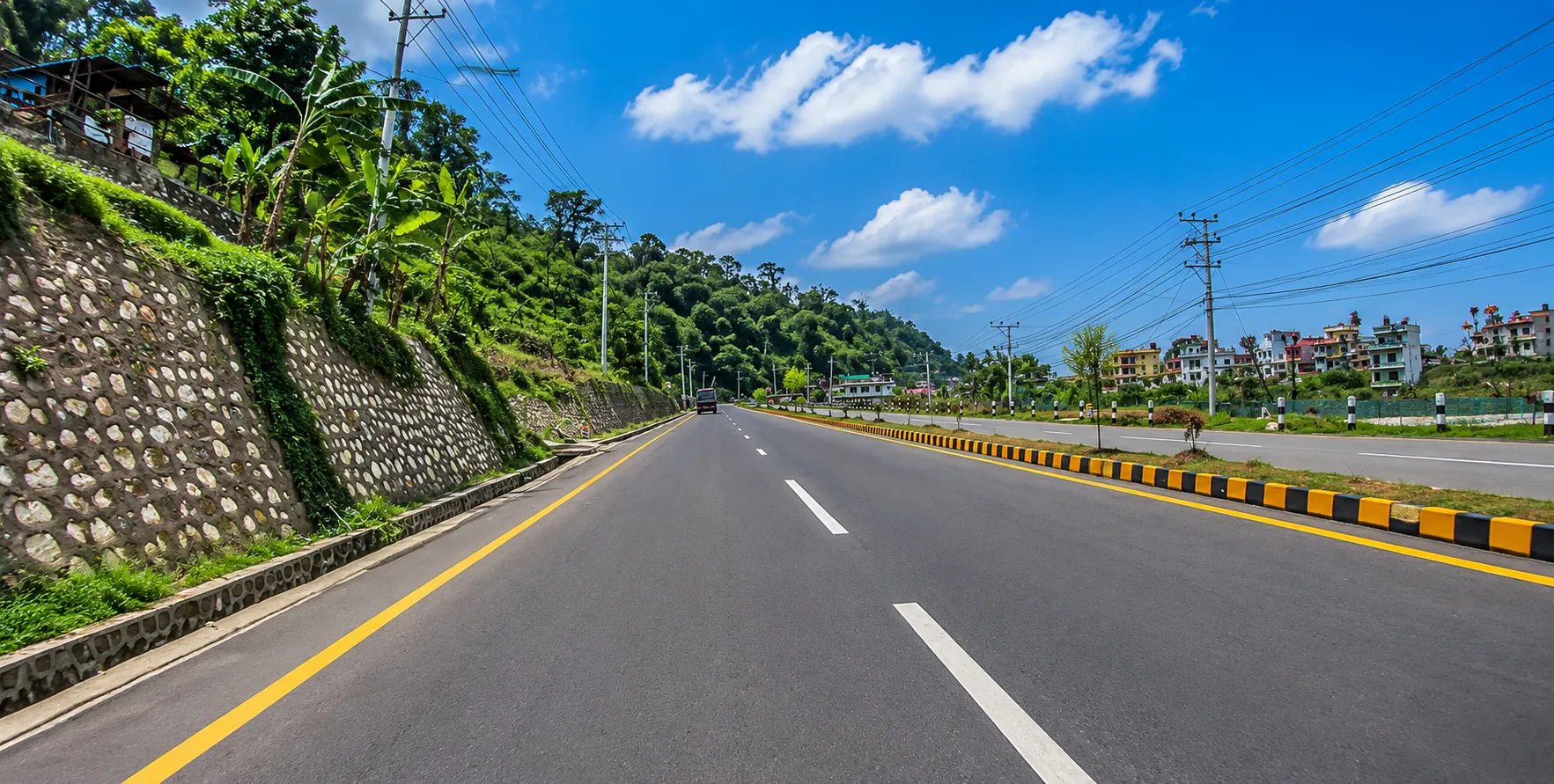
The final 40 km from Damauli to Pokhara is consistently the finest section of road on the entire Kathmandu to Pokhara highway. The road is wide, well-paved, carries lower vehicle density than the gorge sections, and on clear mornings the Annapurna range fills the northern horizon in a spectacular progressive reveal as the road descends toward the Pokhara valley. Machhapuchhre (Fishtail) appears first — its distinctive double-summit visible above the foothills — before Annapurna South, Hiunchuli, and eventually Annapurna I come into view. This 40 km section is one of the finest mountain-view road approaches anywhere in Nepal.
Private vehicles enter Pokhara from the east, with the driver taking you directly to your Lakeside hotel address. Tourist buses drop at the Baidam/Lakeside bus stop. Traffic in Pokhara city can add 10 to 20 minutes to the final approach during peak afternoon hours.
Key Road Hazard Zones 2026/27
| Hazard Zone | Location | Type of Risk | Season | Impact on Journey |
| Kalanki Junction | Kathmandu exit, 5 km | Traffic congestion | Year-round; worst peak hours | Add 20–45 min at peak hours; depart before 7 AM |
| Thankot–Naubise works | 15–30 km from KTM | Road widening construction | 2026 (ongoing) | Occasional single-lane; add 15–30 min |
| Naubise–Malekhu gorge | 30–80 km | Landslide/rockfall risk | Monsoon June–Sep | Occasional brief closures; rare major blockage |
| Malekhu–Mugling rough patches | 80–110 km | Surface irregularity | Post-monsoon Aug–Oct | Slow sections; no closure risk |
| Mugling–Dumre construction | 110–155 km (select) | Active widening works | 2026 (targeted sections) | Brief single-lane; minimal delay |
| Damauli road works | 165–170 km | Construction near Bimalnagar | 2026 | Short delay; confirm status at booking |
| Pokhara city traffic | 195–200 km | Urban congestion | Peak afternoons | Add 10–20 min; avoid 4–6 PM entry |
Realistic Travel Times 2026/27
One of the most commonly asked questions about the Kathmandu to Pokhara journey is: how long does it actually take? Here are honest, experience-based estimates for 2026/27:
| Departure Time | Season / Conditions | Estimated Total Time | Notes |
| 6:00–6:30 AM | Dry season, weekday | 5.5–6.5 hrs | Best option — beats Kalanki rush, good road conditions |
| 6:00–6:30 AM | Peak trekking season Oct–Nov | 6–7 hrs | Higher overall traffic; Mugling busy |
| 7:00–8:00 AM | Dry season, weekday | 6–7 hrs | Kalanki rush begins; add time for exit |
| 8:00–9:00 AM | Dry season | 6.5–8 hrs | Full morning rush; significant Kalanki delay likely |
| Any time | Monsoon (Jun–Sep) | 6.5–9 hrs | Construction delays, possible brief road works; landslide risk adds uncertainty |
| Any time | Festival/holiday | 7–10 hrs | Dashain, Tihar, major public holidays — extreme traffic; avoid if possible |
The practical conclusion: the Kathmandu to Pokhara journey takes 5.5 to 7 hours under good conditions with a 6:00–7:00 AM departure. Allow 7 to 8 hours as your planning buffer. Do not plan an afternoon arrival activity that requires you to be in Pokhara by a fixed time, as traffic and road conditions can add hours to the journey unexpectedly.

Best Vehicle for Each Traveler Type 2026/27
The Kathmandu to Pokhara highway is fully paved and accessible by all vehicle types — this is not a road where 4WD is required. The vehicle choice is therefore about matching the right vehicle to your group size, budget, comfort expectations, and onward travel plans rather than road capability requirements.
Solo Traveler or Couple — Tourist Bus or Sedan
For 1 to 2 passengers, the standard tourist bus (USD 10–15 per person, 7–8 hours) or Greenline luxury bus (USD 25–30 per person, 6–7 hours including lunch) provides excellent value. A private sedan hire (USD 80–110 for the full vehicle) is a worthwhile upgrade if you value privacy, a faster journey, and the flexibility to stop at Manakamana Temple en route.
Small Family of 3 to 5 — Private Sedan or SUV
For 3 to 5 passengers, a private sedan or Toyota Fortuner is the clear recommendation. Split between 4 passengers, the sedan costs USD 20–28 per person — comparable with a Greenline bus ticket but with door-to-door service, 1 to 1.5 hours saved, and complete flexibility for stops. The Fortuner seats 5 comfortably with luggage and is the preferred vehicle for families with children due to its space and high seating position.
Trekking Group of 6 to 14 — Toyota Hiace Van
The Toyota Hiace is the outstanding choice for trekking groups heading to Pokhara. It keeps the full group together (no splitting into multiple taxis), provides ample boot and roof space for trekking packs, departs from the group’s Kathmandu hotel rather than the tourist bus park, and at USD 130–170 for the full vehicle works out to USD 10–25 per person for a group of 6–14 — often less expensive than individual tourist bus tickets. The Hiace comfortably completes the Prithvi Highway in the same 5.5 to 6.5 hours as a private sedan with an early departure.
Group Continuing to Mustang / Annapurna — Land Cruiser
If your journey continues from Pokhara to the Kali Gandaki gorge, Muktinath, Jomsom, Lo Manthang, or any destination requiring a 4WD vehicle, hire the Land Cruiser from Kathmandu. The Prithvi Highway section is easy for a Land Cruiser, and having the same vehicle and driver continue from Pokhara into the mountains saves the cost and logistics of changing vehicles in Pokhara. The Land Cruiser costs USD 110–145 for the Kathmandu to Pokhara section — a small premium over the sedan for the benefit of continuity.
Large Group of 15 to 22 — Toyota Coaster Bus
For groups of 15 to 22, a private Toyota Coaster bus hire (USD 175–230) is the most practical option — keeping everyone together in a single vehicle with a private departure time and direct hotel drop. The Coaster handles the Prithvi Highway well and offers better comfort than many shared tourist buses.
Very Large Group of 23+ — Full Size Private Bus
Groups exceeding 22 passengers require a full-size private bus. Vehicle Hiring Nepal provides 30–45 seat buses for the Kathmandu to Pokhara route at USD 250–360 for the full vehicle — the most economical per-person option for very large groups.

Vehicle Comparison Table — Kathmandu to Pokhara 2026/27
| Vehicle | Capacity | Price (Full Vehicle) | Travel Time | Comfort | Best For |
| Tourist Bus (shared) | Per seat | USD 10–15/person | 7–8 hrs | Good | Solo, couple, budget traveler |
| Bus (shared) | Per seat | USD 25–30/person | 6–7 hrs | Very Good | Comfort-seeking solo/couple, includes lunch |
| Private Sedan | 1–3 pax | USD 80–110 | 5.5–6.5 hrs | Good | Couple, small family |
| Private SUV/Fortuner | 4–5 pax | USD 100–135 | 5.5–6.5 hrs | Very Good | Family, small group |
| Toyota Land Cruiser | 4–6 pax | USD 110–145 | 5.5–6.5 hrs | Excellent | Groups continuing to the mountains |
| Toyota Hiace Van | 7–14 pax | USD 130–170 | 5.5–6.5 hrs | Good | Trekking groups — best value |
| Toyota Coaster Bus | 15–22 pax | USD 175–230 | 6–7 hrs | Good | Large groups |
| Full Size Private Bus | 23–45 pax | USD 250–360 | 6–7 hrs | Standard | Very large groups |
Seasonal Road Condition Variations
October to November 2026 — Best Season
Post-monsoon is consistently the finest period for the Kathmandu to Pokhara drive. The monsoon has ended, road repair works are completed on the gorge sections, surfaces are dry and firm, and the Annapurna range on the final Pokhara approach is at its most brilliantly clear. October is the busiest single month on this road — the volume of tourist and trekking traffic is at its annual maximum, which means the Mugling lunch stop is crowded, and Pokhara-bound traffic is heavy. Despite this, road conditions are their best and travel times are reliable. Expect 5.5 to 6.5 hours with a 6:00–6:30 AM departure.
November to February 2026/27 — Good Winter Season
After the October peak, traffic reduces,s and road conditions remain very good through winter. Dry weather continues; no monsoon risks; road repair works from monsoon are completed. The mountain views on the final Pokhara approach in December and January are often the sharpest and clearest of the year — the cold, dry air provides exceptional visibility. The Naubise–Malekhu gorge section can be frosty on early morning descents in December and January — not a problem for standard vehicles but worth noting for early 6:00 AM departures.
March to May 2027 — Spring Season
Spring is excellent for the drive. Rhododendrons are blooming in the forested sections above Naubise and on the hillsides above the Marsyangdi valley. Road conditions remain good from the dry season. Traffic builds again from March as the spring trekking season begins, and the Kathmandu morning exit becomes busy again. Pre-monsoon clouds build in May afternoons, reducing mountain views until October–November.
June to September 2026/27 — Monsoon Season
The monsoon is the most challenging season for the Prithvi Highway — not because the road becomes impassable (it rarely does completely) but because it introduces several specific risk factors that honest travelers must acknowledge:
- Landslide risk in the Naubise to Mugling gorge section — the gorge walls above the road are subject to debris flows in heavy rain. Road crews clear minor slides within hours; major events can block the road for 12 to 24 hours.
- Surface degradation — the constant rain softens road edges and creates potholes that develop rapidly, particularly in the Malekhu to Mugling section
- Reduced visibility — low cloud and rain reduce visibility on the gorge sections and completely obscure the Annapurna mountain views on the final Pokhara approach.
- Extended journey times — add 1 to 2 hours to dry-season journey time estimates for monsoon travel
Vehicle Hiring Nepal drivers monitor road conditions before every monsoon season departure. We will advise on same-day conditions through our local contact network if there are concerns about specific sections on your travel date.
Key Stops on the Kathmandu to Pokhara Route
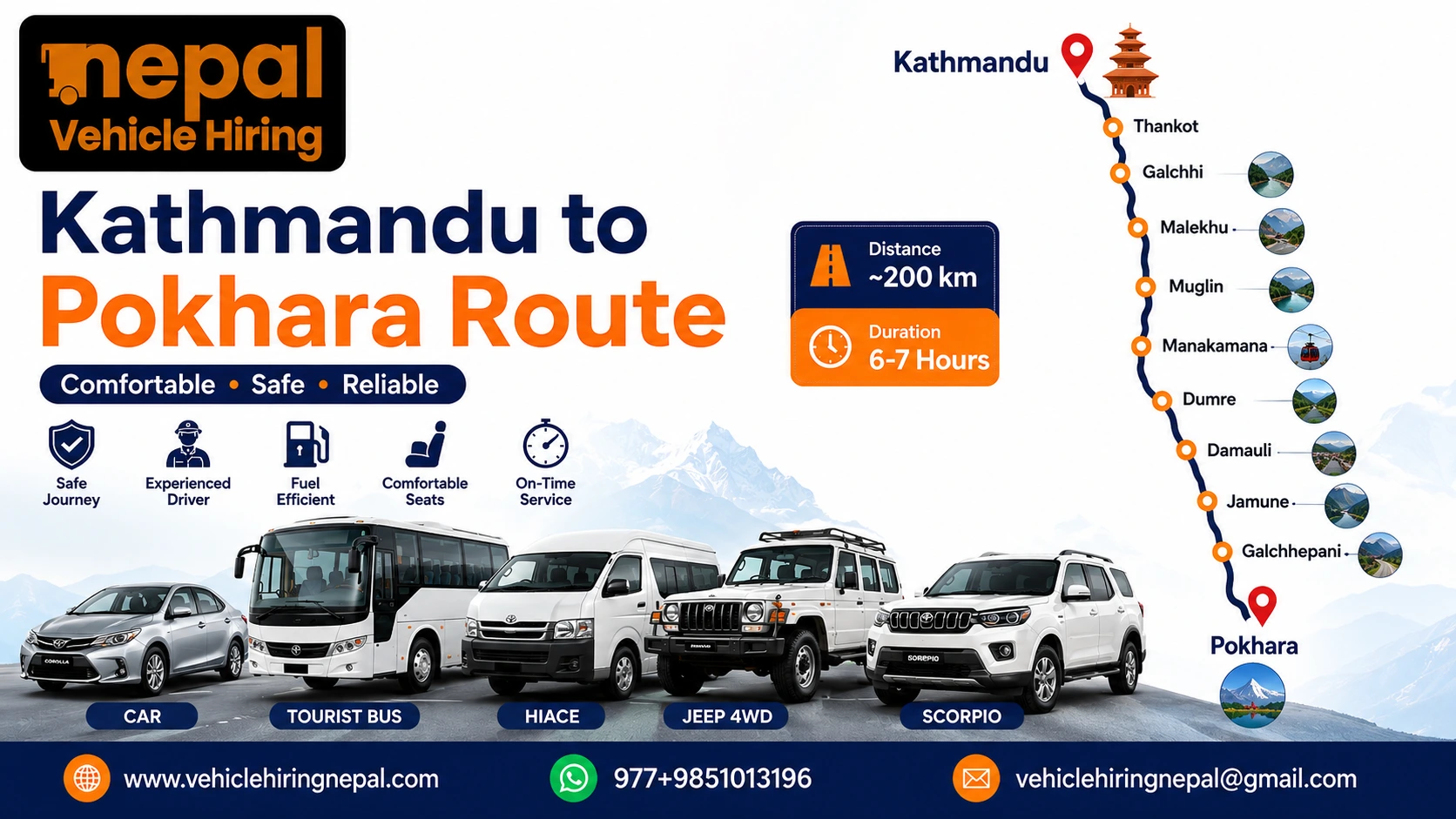
Manakamana Temple Cable Car — Kurintar (105 km | 2.5 hrs from KTM)
The most popular en-route stop on the Kathmandu to Pokhara journey, Manakamana sits on a hilltop above the Trishuli River, accessible by a 10-minute cable car from Kurintar on the highway. The temple of Goddess Bhagwati (an incarnation of Parvati) is one of Nepal’s most beloved pilgrimage destinations, revered as wish-fulfilling. The cable car (NPR 2,700 round trip for foreigners; NPR 770 for Nepali citizens in 2026) operates 9:00 AM to 5:00 PM with a midday break. A Manakamana stop adds 1.5 to 2.5 hours to the journey. Inform Vehicle Hiring Nepal at booking to include this stop.
Malekhu Tea Stop (~80 km from KTM)
The riverside tea houses and fish restaurants of Malekhu are legendary on the Kathmandu to Pokhara route. A 20-minute tea and snack stop here is both practical and atmospheric — the Trishuli River runs past the restaurant terraces, and the fresh river fish (reared in the Trishuli) is available from early morning. Most Vehicle Hiring Nepal drivers build this stop in automatically.
Mugling Lunch Stop (~110 km | midpoint)
Mugling is the universally recognized lunch stop — the junction town at the midpoint of the journey with the largest concentration of roadside restaurants on the highway. Dal bhat, momo, noodles, and grilled chicken are all available at numerous establishments. Budget 30 to 45 minutes. The riverside location at the Trishuli-Marsyangdi confluence makes this a visually pleasant lunch break as well as a practical one.
Damauli Optional Stop (~165 km from KTM)
Damauli is an underappreciated stop on the route — a pleasant hill town with a good teahouse culture and views over the Seti-Madi river confluence. A brief tea break here is worth considering for groups who want to break up the final 40 km to Pokhara with a scenic pause.
Road Widening Project — 2026/27 Status
The Kathmandu to Pokhara highway has been under a major widening and upgrading project for several years, aimed at transforming it from its current mostly two-lane standard to a proper four-lane divided highway on key sections. Here is the 2026/27 project status:
- Kalanki to Thankot section: Active widening — some sections now two-lane each direction, others still under construction. Expected completion of this section: late 2026 to early 2027
- Thankot to Naubise section: Widening under way — significant improvement from 2025 condition but not yet complete in all sections. Expect some single-lane working areas.
- Naubise to Malekhu gorge: Road improvement works limited by the gorge geography — widening not feasible in the narrowest gorge sections; safety barrier installation and surface improvement ongoing
- Mugling to Dumre section: Most recently improved section — widening largely complete; near four-lane standard in several stretches. Best road quality on the entire highway in 2026/27
- Damauli to Pokhara: Good two-lane condition throughout; widening works in select sections near Bimalnagar and Prithvi Chowk
The practical implication: in 2026/27, the Kalanki to Naubise section near Kathmandu has the most active construction activity and the greatest potential for journey time addition. As works complete in late 2026 and 2027, this section will improve significantly. By mid-2027, this section is expected to be substantially better than its 2026 condition.
Tips for the Best Kathmandu to Pokhara Journey Experience
- Depart between 6:00 and 6:30 AM — this is the single most impactful decision you can make for the journey. Clearing Kalanki before the rush, enjoying Malekhu in morning light, and arriving in Pokhara by early-to-mid afternoon gives the best overall experience.e
- Book a left-side seat in the vehicle (or request left-side seats on the tourist bus) — the left side of the vehicle faces the Trishuli River through the gorge section, providing the best views of the river and cliffs.fs
- The Annapurna mountain view on the final Pokhara approach is clearest in the morning — arriving before 1:00 PM on clear days gives the best chance of seeing the full range before afternoon cloud builds
- Motion sickness tablets for the gorge section — the Naubise to Mugling road has sustained bends that affect susceptible passengers. Take medication 30 minutes before the Naubise descent if needed.
- For groups using a private vehicle: confirm with your driver exactly which stops you want — Manakamana, Malekhu, Mugling, or others — at the time of booking, not on the day of travel
- Carry water and snacks for the vehicle — the standard stops are Malekhu and Mugling, but having your own supplies for between-stop sections is comfortable.
- Do not attempt to rush the journey — the Kathmandu to Pokhara road is not a fast highway. The 5.5 to 6.5 hour journey is the realistic minimum with an early start.
- For the return journey, Pokhara to Kathmandu, depart Pokhara by 7:00–7:30 AM to arrive in Kathmandu in the early afternoon and avoid both the Pokhara morning traffic and the Kathmandu afternoon rush.
Private Vehicle vs Tourist Bus — The Decision
| Factor | Private Vehicle | Tourist Bus (Shared) |
| Cost for solo | USD 80–110 full vehicle (expensive solo) | USD 10–30 — cheapest option for 1 |
| Cost for 4 pax | USD 20–34/person (sedan or SUV split 4) | USD 10–30/person (similar or more) |
| Cost for 10 pax | USD 13–17/person (Hiace, full value) | USD 10–30/person (Hiace better value) |
| Departure time | Flexible — any time you choose | Fixed 7:00 or 8:00 AM only |
| Departure location | Your hotel door | Tourist bus park, Kantipath |
| Arrival | Your Pokhara hotel door | Lakeside bus stop (walk/taxi needed) |
| Journey time | 5.5–6.5 hrs with private vehicle | 7–8 hrs standard; 6–7 hrs Greenline |
| Stops | Any stop, any duration | Fixed — Mugling lunch only |
| Luggage | Full boot + roof rack | Hold only (limited and unsecured) |
| Manakamana option | Yes — easy en-route stop | No — not possible on bus |
| Mountain views | Stop anywhere for photos | Cannot stop for views |
| Best for | Groups of 4+, families, trekkers | Solo, budget, backpacker |

What is Included in Your Private Vehicle Hire
- Your chosen vehicle (sedan, SUV, Land Cruiser, Hiace, Coaster, or bus) — fully maintained and insured
- Professional, licensed driver with experience on the Prithvi Highway and knowledge of current road conditions
- Full fuel cost for the Kathmandu to Pokhara journey
- Vehicle insurance throughout
- Pickup from your Kathmandu hotel or any specified address
- Drop-off at your Pokhara hotel or any Lakeside/Pokhara address
- Malekhu tea stop and Mugling lunch stop (standard); additional stops on request
- Manakamana cable car stop if requested at booking (driver waits below during your temple visit)
- 24/7 WhatsApp support throughout the journey
Not included: Manakamana cable car ticket (NPR 2,700 for foreigners), personal meals at stops, accommodation, and any continuation journeys beyond Pokhara.
How to Book Your Kathmandu to Pokhara Vehicle
- Contact Vehicle Hiring Nepal via WhatsApp at +977 9851013196 or visit vehiclehiringnepal.com
- Choose your vehicle based on group size and onward travel plans
- Confirm your travel date and preferred departure time (6:00–6:30 AM recommended)
- Provide your Kathmandu hotel pickup address
- Provide your Pokhara destination hotel name and address
- Specify any en-route stops — Manakamana, Malekhu, Mugling
- Receive booking confirmation with driver details, pickup time, and vehicle information
Frequently Asked Questions
What is the current road condition on the Kathmandu to Pokhara highway in 2026?
The Kathmandu to Pokhara Prithvi Highway is fully paved throughout in 2026 and in good to very good overall condition. The Mugling to Pokhara section is in very good to excellent condition following recent widening works. The Kalanki to Naubise section near Kathmandu has active road widening construction in 2026 that can add 15 to 30 minutes in some areas. The Naubise to Mugling gorge section is in good condition but subject to the standard monsoon landslide risk (June to September). No 4WD vehicle is required at any point on this route.
Is the road to Pokhara open year-round?
Yes. The Kathmandu to Pokhara Prithvi Highway is open year-round without exception in normal conditions. Even during monsoon, the road closes only temporarily for major landslide clearance — these events are uncommon and typically resolved within a few hours. Unlike Nepal’s mountain routes which can be seasonally impassable, the Prithvi Highway is a national highway maintained to an all-season standard.
How much does a private vehicle from Kathmandu to Pokhara cost in 2026?
In 2026, private vehicle hire for the Kathmandu to Pokhara one-way journey costs approximately USD 80–110 for a sedan (1–3 passengers), USD 100–135 for an SUV/Fortuner (4–5 passengers), USD 110–145 for a Land Cruiser (4–6 passengers), and USD 130–170 for a Toyota Hiace van (7–14 passengers). All prices include the driver, fuel, and vehicle insurance. Contact Vehicle Hiring Nepal at +977 9851013196 for an exact quote for your specific date and group size.
Is there construction on the Prithvi Highway in 2026?
Yes — the ongoing Prithvi Highway widening project has active construction sections in 2026, primarily in the Kalanki to Naubise section near Kathmandu and some targeted works near Damauli. These construction areas may cause brief single-lane working sections and 15 to 30-minute delays in some cases. Vehicle Hiring Nepal drivers are aware of current construction locations and factor them into departure time planning.
What is the best time of year to drive from Kathmandu to Pokhara?
October and November are the best months for the Kathmandu to Pokhara drive — dry roads, sharp mountain views on the Pokhara approach, and optimal conditions throughout. March and April are excellent for spring rhododendrons. December to February offers clear winter air and the sharpest mountain views. Monsoon (June to September) is the most challenging period due to gorge landslide risk and surface degradation, but the road remains open and passable throughout.
Final Thoughts
The Kathmandu to Pokhara road in 2026/27 is fundamentally a good news story for travelers: a fully paved, actively maintained national highway in its best-ever overall condition, connecting Nepal’s two most visited cities with a journey that is manageable in 5.5 to 7 hours with the right departure time. The construction works underway near Kathmandu will, once complete, make this section significantly better than it has ever been. The ongoing improvements to the Mugling to Pokhara section have already made the western half of the journey notably smoother than previous years.
The key to a good Kathmandu to Pokhara experience in 2026/27 remains what it has always been: depart early (6:00–6:30 AM), choose the right vehicle for your group size and onward plans, stop at Malekhu and Mugling, and arrive in Pokhara in time to enjoy the afternoon before the mountain view clouds over. Vehicle Hiring Nepal provides the vehicles and drivers to make that formula work every time.
Book your Kathmandu to Pokhara vehicle today. WhatsApp: +977 9851013196 | Website: www.vehiclehiringnepal.com | Email: [email protected]
- Kathmandu to Pokhara Road Condition Overview 2026/27 – Best Vehicle Guide
- The Prithvi Highway — Overview and Strategic Importance
- Overall Road Condition Rating 2026/27
- Section-by-Section Condition Detail
- Key Road Hazard Zones 2026/27
- Realistic Travel Times 2026/27
- Best Vehicle for Each Traveler Type 2026/27
- Vehicle Comparison Table — Kathmandu to Pokhara 2026/27
- Seasonal Road Condition Variations
- Key Stops on the Kathmandu to Pokhara Route
- Road Widening Project — 2026/27 Status
- Tips for the Best Kathmandu to Pokhara Journey Experience
- Private Vehicle vs Tourist Bus — The Decision
- What is Included in Your Private Vehicle Hire
- How to Book Your Kathmandu to Pokhara Vehicle
- Frequently Asked Questions
- Final Thoughts

Related Blog & Articles

Chitwan to Pokhara Family Vehicle Hire

Kathmandu Airport to Pokhara Vehicle Rental
Kathmandu to Pokhara Bus – Traveler’s Complete Guide (2026)

Kathmandu to Pokhara by All Vehicle Transfer

Kathmandu to Pokhara by Private Car – Complete Guide (2026)

Kathmandu to Pokhara Luxury Jeep Hire 2026/27
Kathmandu to Pokhara Road Trip Guide