Plan a Trip


Manang Hidden Valley
Manang Hidden Valley: Historical and Spiritual Significance
There are places in the world where the past does not simply recede into history but continues to breathe, visible in the architecture of the stones, audible in the cadence of a monk’s morning chant, palpable in the quality of the light falling across a landscape that human beings have inhabited for so long that the land itself seems to carry their accumulated presence. Manang Valley is one of these places.
Tucked behind the great wall of the Annapurna massif, hidden from the monsoon rains and from much of the modern world’s attention by the same geography that has defined its character for centuries, Manang is at once one of Nepal’s most visited trekking destinations and one of its least understood — a place that most travellers pass through in two acclimatisation days while preparing for the Thorong La crossing, and that comparatively few take the time to know genuinely.
This essay attempts to give Manang Valley the attention its history and spiritual significance deserve. It draws on the accumulated understanding of Himalayan scholars, the oral traditions of the Manangi people themselves, the physical evidence of ancient monasteries and trade routes, and the broader context of Tibetan Buddhist civilisation in the high Himalayas to offer a portrait of a valley that has been a crossroads of commerce, faith, and cultural exchange for at least a thousand years.
Understanding Manang’s history does not merely enrich the experience of passing through it; it fundamentally transforms what a traveller sees when they look at its stone houses, its wind-worn chortens, its ancient monastery clinging to a hillside, and the faces of the people who have made this extraordinary, forbidding landscape their home across countless generations.
Manang District sits at the coordinates of approximately 28.67 degrees north, 84.02 degrees east, in the Gandaki Province of north-central Nepal, covering an area of 2,246 square kilometres and constituting Nepal’s least densely populated district, with 5,658 residents recorded in the 2021 national census — a density of just three persons per square kilometre.
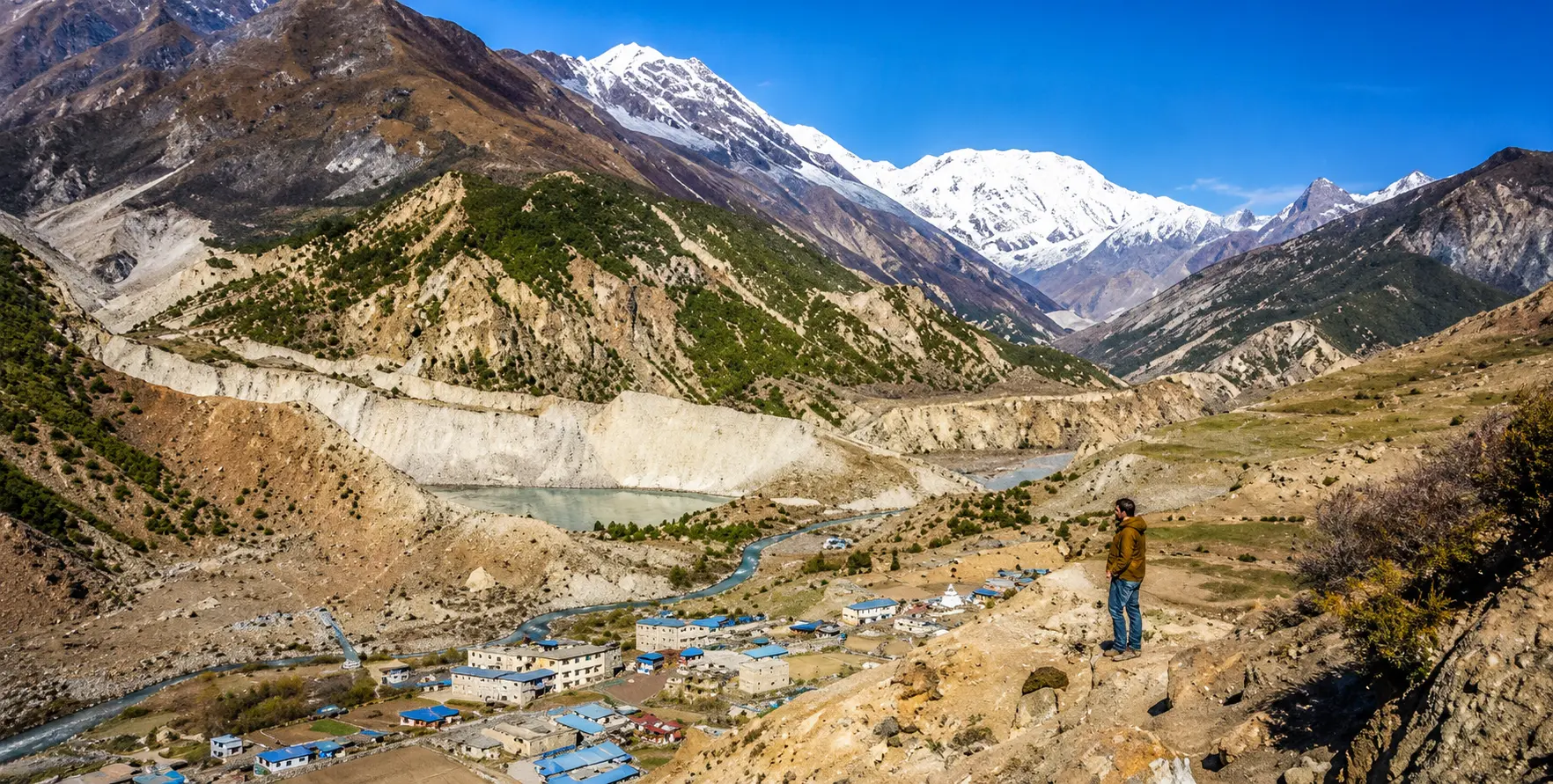
The district’s geography spans elevations ranging from roughly 3,000 meters in the lower valley sections to over 8,000 meters in the surrounding peaks, including Annapurna I at 8,091 meters, Annapurna II at 7,937 meters, Gangapurna at 7,455 meters, and Pisang Peak at 6,091 meters. The valley of Manang town itself sits at approximately 3,519 meters above sea level, in the broad Marsyangdi River valley behind the Annapurna range, looking northward toward the Tibetan plateau and westward toward the great wall of the Thorong La.
It is this geography that has made Manang what it is — a fact worth stating explicitly from the outset because the valley’s history, culture, spiritual character, and the lives of its people are all ultimately expressions of what it means to inhabit this particular landscape at this particular altitude in the heart of the greatest mountain range on Earth. Everything that follows in this essay is, at some level, an elaboration of that foundational geographic reality.
Geography as Destiny: How the Mountains Made the People
The single most important geographic fact about Manang is its position in the rain shadow of the Annapurna massif. The Annapurna range is so tall and so broad — rising to over 8,000 metres across a ridge line that runs roughly east to west, presenting an almost unbroken wall to the moisture-laden monsoon winds that blow northward from the Bay of Bengal each summer — that by the time these winds encounter the northern slopes of the range, the vast majority of their moisture has already been released on the southern faces.
The result is a landscape that receives dramatically less rainfall than the surrounding Nepali hills: Manang Valley receives approximately 200 to 400 millimetres of annual precipitation, compared to 1,500 to 3,000 millimetres in the subtropical hills south of the range. This is not simply a climatic fact — it is the foundational condition that has shaped every aspect of Manang’s human geography.
To visitors arriving from Nepal’s lush middle hills, Manang’s arid, rain-shadow landscape looks like a different world. The browns and ochres of bare rock and scree replace the greens of terraced rice paddy and subtropical forest. The vegetation is sparse, alpine, and wind-sculpted — juniper and wild rose at the lower elevations, alpine grasses and sedges higher up, and above 4,500 meters, the barren rock and snow of the high Himalayan environment that knows no seasonal softening.
The Marsyangdi River flows through the valley in a channel of startling clarity, fed not by monsoon runoff but by glacial melt from the peaks above, carrying the cold, mineral-rich waters that have supported the high-altitude agriculture — principally buckwheat and barley, the two grains that can be cultivated above 3,000 meters — on which Manang’s population has depended for its subsistence across many centuries.
This landscape demanded, and produced, a particular kind of human being. The Manangi people — known formally as the Nyishangte, a term derived from ‘Nyishang,’ the traditional name for the upper Marsyangdi valley — are among the most physically and culturally adapted highland communities in all of South Asia. Centuries of life at extreme altitude have produced physiological adaptations: a remarkable tolerance for hypoxic conditions, robust cardiovascular systems, and an efficient metabolism calibrated for the high-calorie diet that cold-weather, high-altitude existence demands.
These biological adaptations are matched by equally deep cultural adaptations — traditional knowledge systems for reading weather and avalanche risk, architectural practices that produce buildings capable of surviving decades of extreme cold, wind, and snow loading, and social structures that have historically balanced the needs of a small, isolated community through the careful management of shared resources and collective decision-making.
The landscape also shaped the economic logic that defined Manang for centuries. The valley could not produce enough food to sustain its population through agriculture alone, and the resources available in the high pastures — yaks, wool, and the dairy products that sustained life through the long winters — needed to be exchanged for the grain, rice, spices, and manufactured goods that the valley could not produce. This necessity drove the Manangi people northward, over the high passes to Tibet, and southward, down through the Marsyangdi gorge to the middle hills and ultimately to the Terai plains and beyond. Trade was not simply an economic activity for the Manangi; it was a survival strategy, a cultural identity, and the mechanism through which this isolated community maintained its connections to the wider world. Understanding this trade heritage is the key to understanding Manang’s history.
The Nyishangte: Traders of the Himalayan Passes
The origins of permanent human settlement in Manang Valley extend back further than written records can firmly establish. Archaeological evidence from neighbouring high-altitude valleys in the Himalayan arc suggests that nomadic pastoralists may have seasonally inhabited these elevations for several millennia, following yak herds to high-summer pastures and retreating southward before winter. Historians generally place the transition from seasonal pastoralism to permanent settlement in Manang in the first millennium CE, coinciding with the broader southward expansion of Tibetan cultural and political influence across the Himalayan range.
The formal historical record of Manang as a distinctive political and cultural entity becomes clearer in the context of the great trans-Himalayan trade networks that developed during the Licchavi period of Nepali history (approximately the 4th to 9th centuries CE) and expanded dramatically during Tibetan imperial expansion. The Kali Gandaki and Marsyangdi corridors that run north-south through the Himalayan range were among the most important trade arteries in all of Asia during these centuries, carrying salt from the vast salt lakes of the Tibetan plateau southward to the salt-starved communities of Nepal’s hills and plains, and returning northward with grain, rice, spices, cotton textiles, and the other products of the warmer, more agriculturally productive south that Tibet could not produce for itself. Manang Valley, positioned at a critical node on the Marsyangdi branch of this network, became an important staging post and control point on this trade.
The Manangi people’s extraordinary trading prowess and willingness to travel enormous distances—far beyond Nepal’s borders and into the markets of Tibet, India, and eventually Southeast Asia—are among the most remarkable aspects of their cultural history. In the 1700s, relatives of the Raja of neighbouring Mustang briefly ruled Manang, reflecting its strategic position in the region’s shifting power dynamics.
The valley was formally incorporated into Nepal during the Gorkha unification campaigns led by Prithvi Narayan Shah in the 1760s, marking the end of its semi-autonomous status — but the Gorkha kings, recognising the commercial importance of maintaining Manangi loyalty along the northern border, granted the Nyishangte special trade privileges, including tax exemptions that formalised what had already been a de facto trading freedom for generations.
These royal trade privileges gave the Nyishangte extraordinary advantages in Nepal’s commercial landscape, and the community exploited them brilliantly. By the 19th century, Manangi traders had established commercial networks stretching from Lhasa in the north to Calcutta in the south, and from Burma in the east to Southeast Asia’s port cities in the west.
The image of the Manangi merchant — travelling light, moving quickly, trading in everything from gems and medicinal herbs to textiles and manufactured goods, always returning home to the valley with enough wealth to sustain the community through another Himalayan winter — became one of the defining archetypes of Nepal’s commercial culture. Stories of Manangi trading acumen and the distances their merchants were willing to travel entered Nepali folklore as evidence of what determination and commercial intelligence could accomplish even from the most isolated and unpromising of starting points.
Manang’s trade heritage remains visible today not just in historical accounts but in the valley’s physical fabric. The quality and scale of the traditional stone houses in Manang village and the surrounding settlements—particularly in Braga, a short walk from the main village—speak to a community with access to more resources than subsistence agriculture alone could have provided. The monasteries’ collections of thangkas (scroll paintings), ancient manuscripts, and ritual objects from Tibet, India, and beyond reflect the movements of a trading community with connections across the Himalayan world.
And the Manangi people’s reputation for hospitality to travellers—one that now shows in the quality of Manang’s teahouse infrastructure—has roots in a deeply embedded cultural practice of welcoming those who passed through their valley, whether as trade partners, pilgrims, or guests.
Manang Hidden Valley: Historical & Spiritual Significance
The Arrival and Deepening of Tibetan Buddhist civilisation in the spiritual landscape of Manang Valley is inseparable from the history of Tibetan Buddhism’s southward expansion across the Himalayan range. This process began in earnest in the 7th and 8th centuries CE and has continued to shape the valley’s religious life in unbroken succession to the present day. Buddhism arrived in the Manang region not simply as a set of doctrines and practices imported from outside, but as the living religious culture of a community already deeply connected to Tibet through trade, language, and kinship — a community for whom the adoption of Tibetan Buddhist practice was less a conversion than a recognition of the religious framework most naturally consonant with their existing worldview.
The founding of the first permanent monasteries in Manang Valley is traditionally dated to the medieval period, with several of the valley’s most ancient religious institutions tracing their origins to the 14th and 15th centuries — the same period that saw the great flowering of Tibetan Buddhist monastery foundation across the high Himalaya, driven by the religious patronage of powerful regional kingdoms and the missionary zeal of the great Tibetan Buddhist teachers of the era. The Sakya, Nyingma, and Kagyu schools of Tibetan Buddhism all established presences in the Manang region during this period, and the valley’s layered religious character —with different monasteries maintaining different lineage traditions and ritual emphases—reflects this history of multiple simultaneous streams of Buddhist transmission.
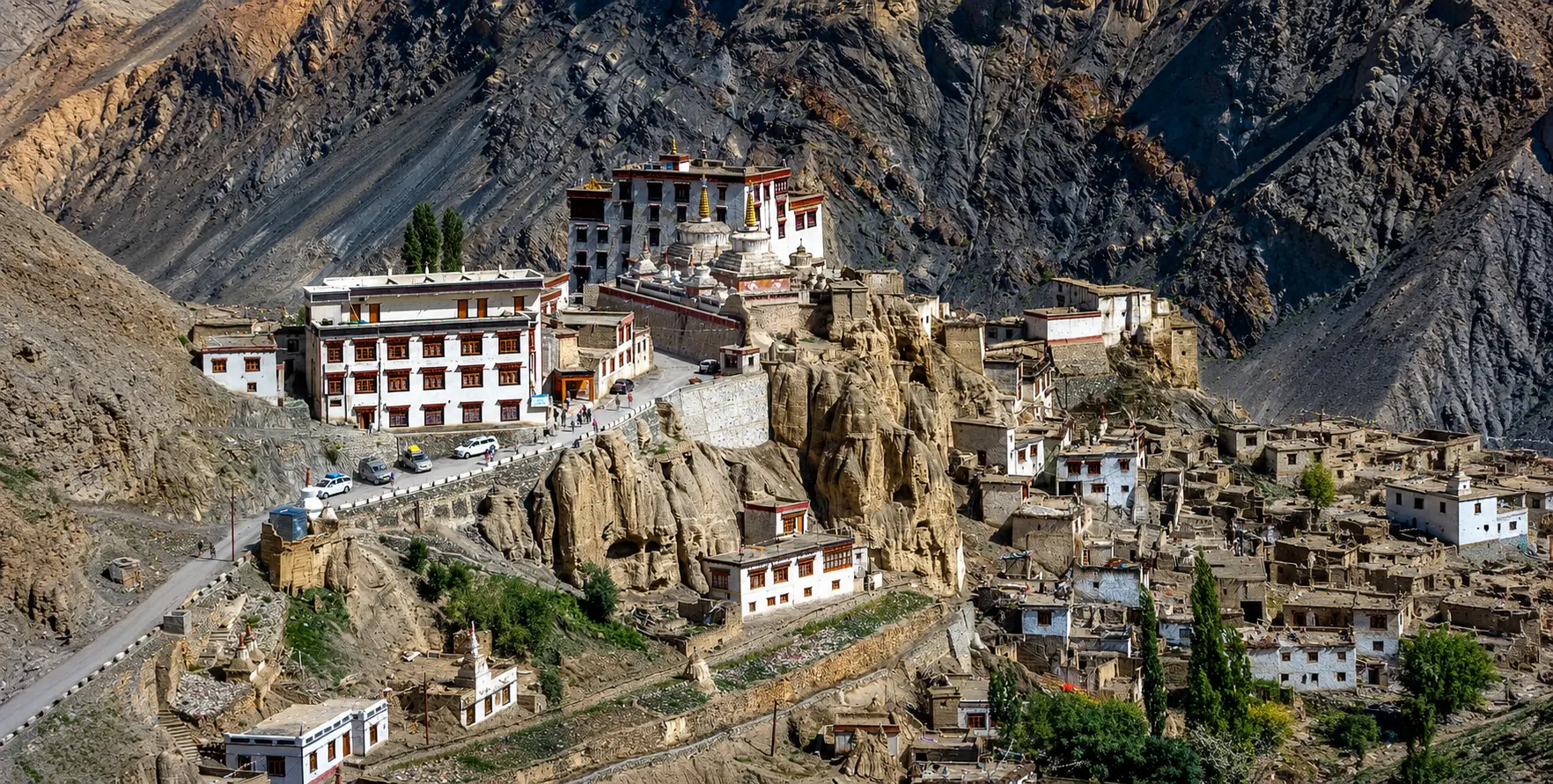
The most visible and historically significant of Manang’s monastery foundations is Braga Gompa, locally known as Bhraka Monastery, which sits on a hillside above the small settlement of Braga, approximately fifteen minutes’ walk from the main Manang village. Researchers and religious authorities consistently describe Braga Gompa as one of the oldest and most important Buddhist monasteries in the Annapurna region, with its foundation traditionally dated to about 600 years ago—placing its establishment in the late 14th or early 15th century.
What makes Braga Gompa particularly remarkable is not simply its age but the quality and completeness of its surviving religious heritage. The monastery houses an extraordinary collection of ancient statues, thangka paintings, and religious manuscripts that have survived in remarkable condition, protected by the valley’s extreme dryness and the continuity of monastic care that has sustained the institution for six centuries.
Walking through Braga Gompa carries the visitor across centuries in a few meters. The central hall contains statues of a quality and antiquity rarely encountered outside major museum collections, their gilded surfaces and intricate detailing reflecting the finest standards of medieval Tibetan Buddhist sacred art. The walls are lined with thangka paintings — the elaborate scroll paintings on silk that serve simultaneously as devotional objects, teaching aids, and artistic expressions of Buddhist cosmological understanding — depicting the great saints and bodhisattvas of the Tibetan tradition in iconographic programs that tell the complete story of the Buddhist path from ordinary consciousness to full Enlightenment. Ancient manuscripts in Tibetan script, some several centuries old, line the shelves of the monastery’s library, preserving texts that represent important transmissions of Buddhist teaching and might otherwise have been lost.
The religious life of Braga Gompa continues today, maintained by a community of monks who observe the daily rituals of prayer, meditation, and ceremonial observances that have characterised the monastery’s practice throughout its history. The morning prayers at Braga—beginning before dawn, with the deep resonance of horns and drums mingling with monastic chant in the cold mountain air—create an atmosphere of concentrated spiritual practice that most visitors find profoundly affecting, regardless of their religious background or prior familiarity with Buddhist practice.
Something in the combination of the ancient setting, the continuous living tradition, and the physical stillness of the high-altitude dawn makes Braga Gompa at morning prayer one of the most genuinely moving encounters available anywhere along the Annapurna Circuit.
Beyond Braga, the spiritual landscape of Manang Valley is richly studded with the physical markers of Tibetan Buddhist civilisation. Mani walls ong stone barriers of flat stones individually carved with Buddhist mantras, most commonly the foundational mantra Om Mani Padme Hum, line the trails between villages, their accumulated weight of individual devotional effort representing centuries of laypeople’s spiritual practice materialised in stone. Chortens (stupas) of various sizes and periods mark village approaches, pass-tops, and sites of particular spiritual significance.
Their whitewashed forms are visible from considerable distances against the valley’s brown and ochre landscape. Prayer flags in the five traditional colours—each colour associated with one of the five elements and carried on the wind as continuous offerings of prayer for the benefit of all sentient beings—are strung between rooftops and across passes. Over the spans of suspension bridges throughout the valley, their faded, wind-torn appearance speaks eloquently of the continuous passage of time and weather that characterises high-altitude Himalayan life.
Milarepa and the Sanctification of the High Passes
Of all the spiritual presences associated with the Manang Valley and its surrounding landscape, none carries greater weight in the living religious imagination of the Himalayan Buddhist world than Jetsun Milarepa — the great 11th-century Tibetan saint, poet, and meditator whose life story represents one of the most dramatic narratives of spiritual transformation in the entire Buddhist tradition. Milarepa, born in 1052 CE in western Tibet, began his spiritual life as a practitioner of black magic who used his powers to avenge his family’s mistreatment at the hands of relatives, causing the deaths of multiple people in the process.
The profound guilt he experienced following these acts drove him to seek a teacher who could help him purify the negative karma he had accumulated, leading him ultimately to the great Kagyu master Marpa the Translator, under whose harsh and demanding tutelage he underwent years of spiritual trial before receiving the full transmission of Kagyu Buddhist teachings.
Milarepa spent decades devoted to solitary meditation in caves throughout the high Himalaya, eventually attaining what the Tibetan Buddhist tradition describes as full Enlightenment within a single lifetime feat considered exceptional even within a tradition that regards Enlightenment as the universal goal of human existence. The caves where Milarepa meditated became immediately and permanently sacred in the eyes of his followers, and the tradition of marking, protecting, and visiting these meditation sites has continued unbroken for nine centuries since his death.
The Milarepa Cave near Manang — a natural rock cavity on the hillside above the valley — carries this sanctifying association with one of the most revered figures in the entire Himalayan Buddhist world. Local tradition describes the cave as a place where Milarepa rested and meditated during his journeys through the high passes, and attributes physical impressions in the cave’s rock interior to the imprint of his meditation postures—an attribution consistent with similar traditions at numerous Milarepa cave sites throughout Nepal and Tibet.
Whether or not one accepts the literal historical accuracy of these attributions, the deeper significance of the Milarepa Cave association is the way it connects Manang Valley to the broadest currents of Himalayan Buddhist spirituality: the tradition of the wandering meditator who sanctifies the high mountain landscape through the quality of contemplative practice brought to bear upon it, and who leaves behind not just physical impressions in rock but a living presence of spiritual energy that subsequent practitioners can access and draw upon.
The idea that the meditation of great teachers has sanctified the landscape of the high Himalaya — that the mountains, lakes, caves, and passes carry a spiritual charge accumulated across generations of contemplative practice — is fundamental to the religious sensibility that animates life in Manang Valley. This is not merely a metaphorical claim but a living dimension of the Manangi people’s relationship to their environment, shaping which sites are regarded as spiritually potent, which directions are considered auspicious for particular activities, which passes are approached with particular ritual care, and how the rhythms of natural phenomena are interpreted within a cosmological framework that sees the natural and the sacred as fundamentally inseparable categories.
Praken Gompa and the Living Tradition of Blessing
Perched on the hillside above Manang at approximately 3,940 meters, Praken Gompa (also written as Pragken Gompa) is one of the most practically significant religious institutions in the valley for the trekking community that now passes through Manang in large numbers each season. The monastery is home to an elderly monk who has maintained the practice of blessing trekkers before they attempt the challenging climb toward Thorong La Pass. This tradition has become one of the most celebrated and emotionally resonant encounters available on the entire Annapurna Circuit route.
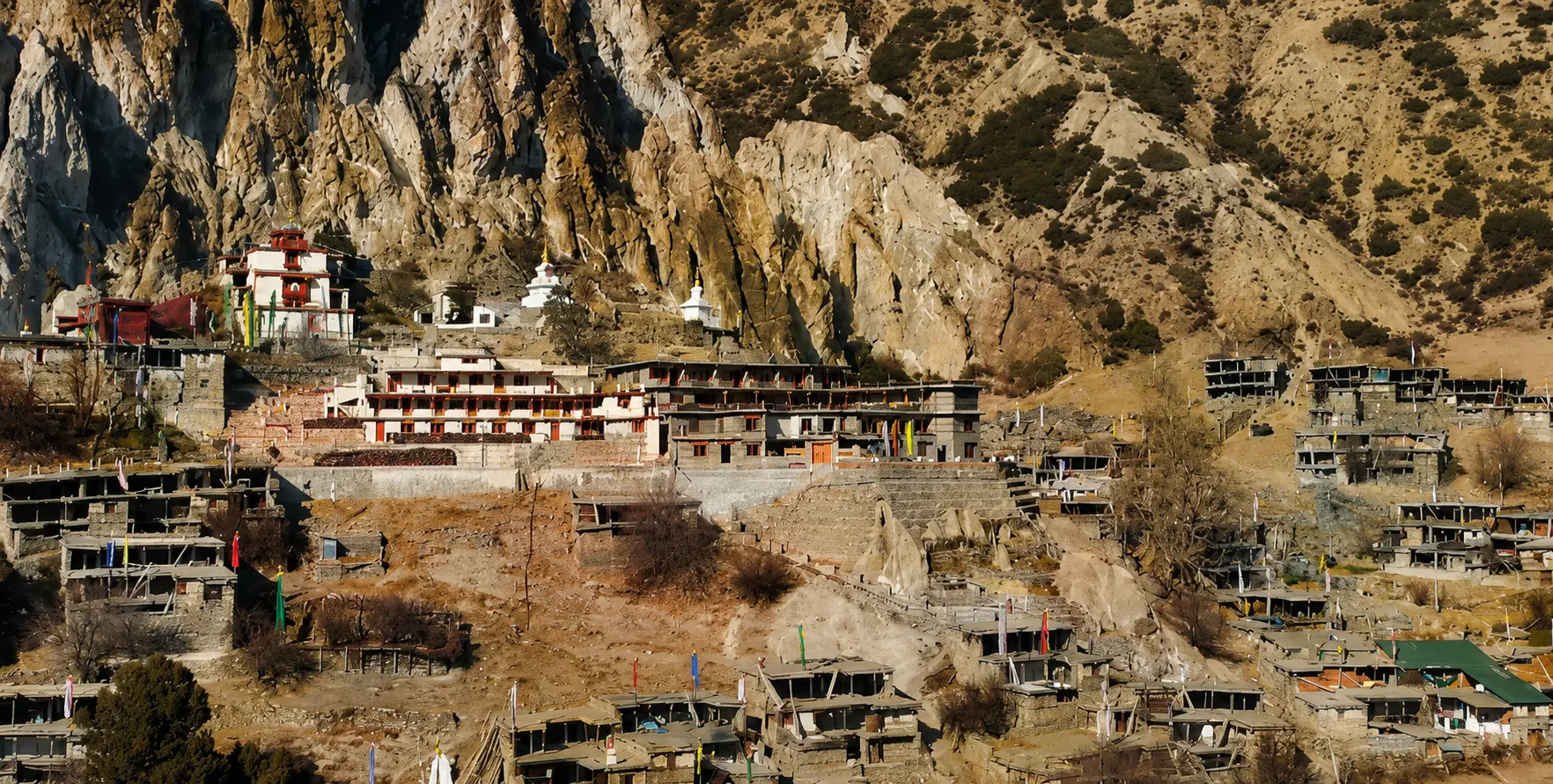
The blessing offered at Praken Gompa is not a tourist performance or a cultural display staged for visiting trekkers; it is an authentic expression of the Buddhist practice of dedicating merit and generating protective intention for those undertaking a potentially dangerous journey. The monk’s blessing is accompanied by prayers from the Tibetan Buddhist liturgical tradition, by the tying of a blessing cord around the recipient’s wrist, and by the particular quality of personal attention and genuine spiritual intention that a practitioner with decades of experience brings to the act.
Many trekkers who have received the blessing at Praken Gompa describe the encounter as one of the most unexpectedly moving moments of their entire Annapurna Circuit experience — a brief but genuine encounter with a living tradition of Himalayan Buddhist kindness that reaches across the considerable cultural and linguistic distance between an isolated mountain monk and a visitor from the urban centres of the modern world.
The tradition of seeking a blessing before a dangerous mountain crossing reflects deep roots in the religious culture of all Himalayan communities. The high passes of the Himalaya have long been understood not simply as geographic challenges but as thresholds between worlds—places where thin air and extreme conditions bring people into closer proximity with the non-human dimensions of existence that Tibetan Buddhist cosmology describes in elaborate detail.
Approaching such a threshold with the appropriate spiritual preparation, including the protection of a monk’s prayers and the merit generated by an act of devotional humility, is not superstition but a rational response to the genuine precariousness of high-pass travel in an environment where the weather can change within hours and where the consequences of a wrong turn or a sudden storm can be fatal. The blessing of Praken Gompa has kept this understanding alive in the consciousness of the tens of thousands of trekkers who have sought it over the years since the Annapurna Circuit became a major international trekking route.
Yartung: The Great Festival of the Valley
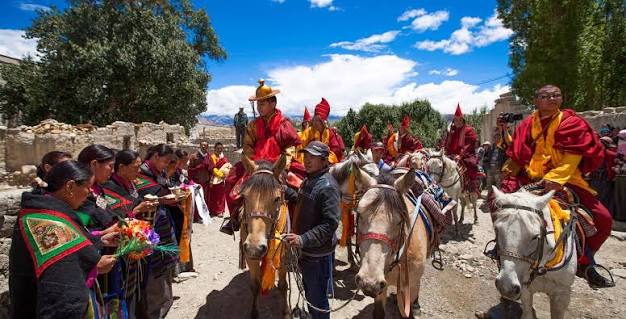
Of all the cultural events that animate life in Manang Valley across the annual calendar, none is more spectacular or more deeply rooted in the community’s historical identity than the Yartung Festival, held each year in August or early September according to the Tibetan lunar calendar. Yartung is primarily associated with horse racing — the sight of riders galloping across the broad Manang valley floor beneath a backdrop of snow peaks, with prayer flags streaming in the mountain wind and the entire community gathered on the hillsides to watch and celebrate, is one of the most dramatic cultural spectacles available anywhere in Nepal — but to understand Yartung only as a horse race is to miss the deeper layers of meaning it carries.
In Tibetan Buddhist cultural tradition, the horse is not merely a domestic animal but a sacred symbol of spiritual power, speed, and the capacity to carry prayers and aspirations into the higher realms. The Lung-ta, or Wind Horse, is one of the central symbols of Tibetan Buddhist iconography, depicted on prayer flags as the creature that carries the jewel of perfect wisdom across the space between the ordinary and the sacred — and the horses of Yartung, racing across the Manang valley floor, carry echoes of this symbolic resonance. The festival is simultaneously a celebration of the community’s pastoral heritage, a religious observance in honour of the protective deities of the valley and the high passes, a community gathering that reinforces social bonds across a population otherwise scattered across the landscape in small settlement clusters, and an assertion of cultural vitality in the face of the considerable challenges that modernity poses to the traditional way of life.
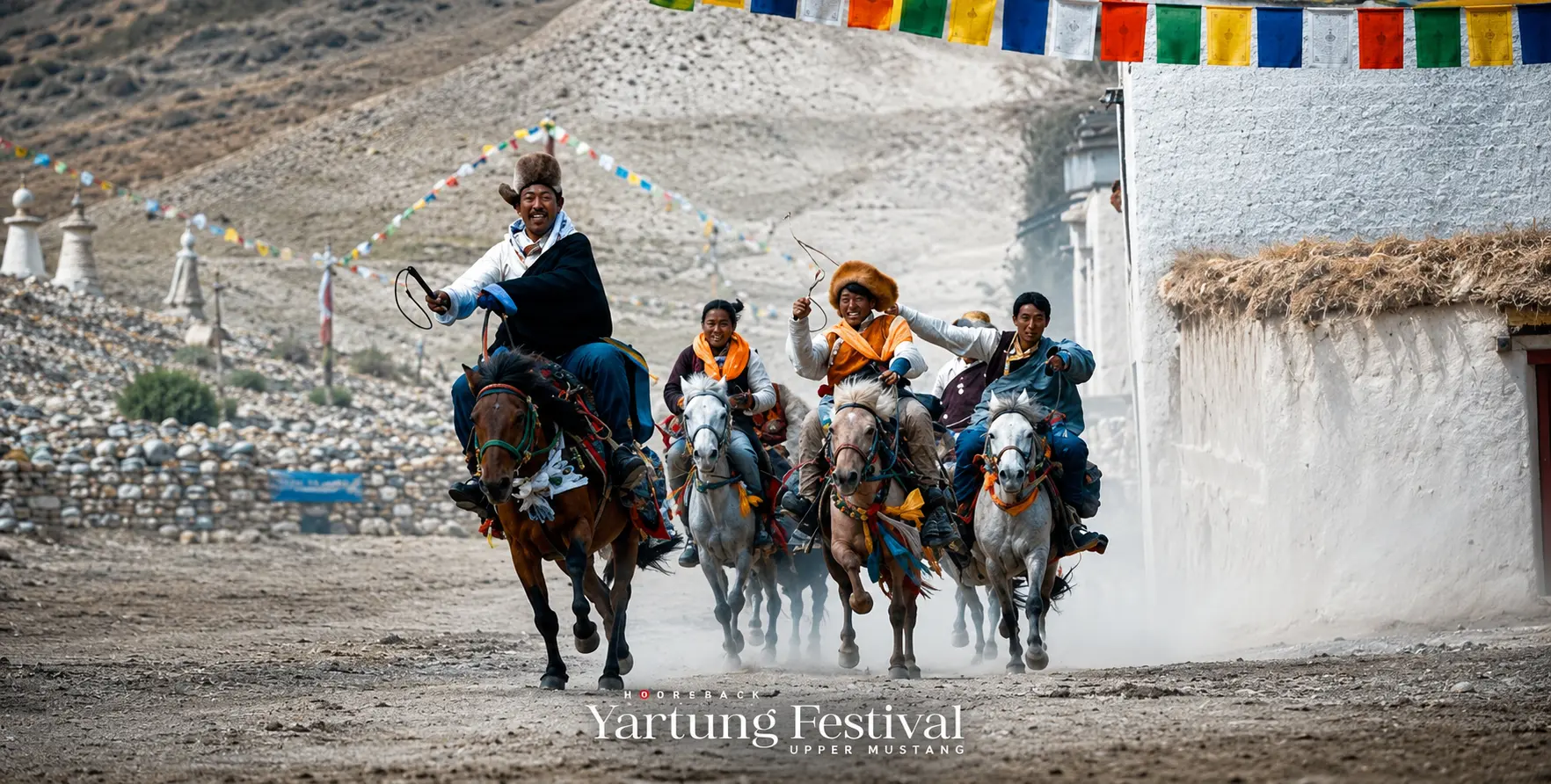
Yartung also involves traditional songs, communal feasts, the wearing of elaborate traditional dress, and the performance of masked dances at the valley’s monasteries that mirror the more famous Mani Rimdu celebrations of the Everest region and the Tiji Festival of Lo Manthang in their function as community-wide expressions of the Buddhist cosmological narrative and its application to the specific geography and history of the local community. The August-September timing of Yartung coincides with the end of the short growing season and the beginning of the harvest period, linking the festival to the agricultural cycle that has governed life in the valley for centuries and connecting the celebration’s religious and social dimensions to the material realities of high-altitude subsistence.
Losar, the Tibetan New Year celebrated in February or March on the lunar calendar, is the other major religious festival in Manang’s community calendar. During Losar, butter lamps are lit in every home and monastery, fresh prayer flags are hung across the valley in a ritual renewal of the protective spiritual framework they represent, and the community gathers at the monasteries for masked dances and blessings that mark the transition from the old year to the new. The timing of Losar at the darkest, coldest point of the Himalayan year — when the community has been isolated for months by winter snow and the passes are closed — gives the festival a particular emotional intensity: the light of the butter lamps is not merely symbolic but genuinely precious in the deepest mountain winter, and the communal gathering of Losar breaks a long period of isolation that even the most resilient Himalayan community finds challenging in its accumulation.
Tilicho Lake: Sacred Waters at the Edge of the Possible
No account of Manang Valley’s spiritual significance would be complete without addressing Tilicho Lake, the extraordinary glacial body of water that lies at approximately 4,919 meters above sea level on a high shelf above the valley’s western approach, and that holds a specific place in the Hindu religious imagination as a site of exceptional sacred power. Tilicho Lake is widely described as the highest lake of significant size in the world, a distinction that in itself carries the kind of superlative quality that Himalayan sacred geography tends to associate with proximity to the divine — the higher the elevation, the closer to the celestial realms, the more concentrated the spiritual potency of the place.
In Hindu tradition, Tilicho Lake is associated with the Ramayana: the lake is believed to be the site where Lord Ram’s devotee, Hanuman, collected the medicinal herb Sanjivani to revive the fallen Lakshmana during the great battle of Lanka. This association connects Tilicho to one of the most widely known and emotionally resonant narratives in South Asian religious culture. It has made the lake a pilgrimage site for Hindu devotees, alongside its role as a destination for Tibetan Buddhist practitioners and secular trekkers.
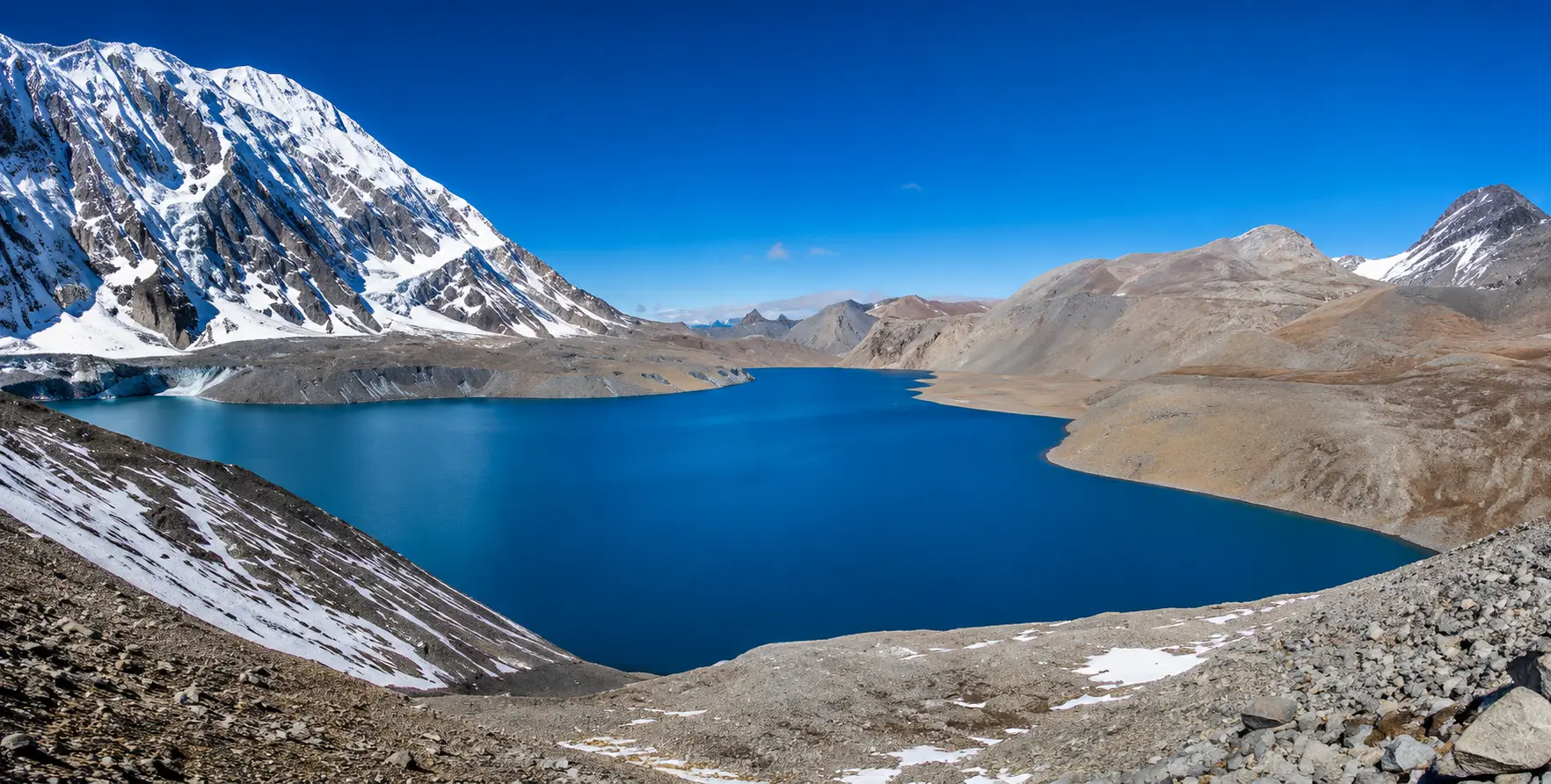
The fact that a single natural feature can carry this kind of multi-tradition sacred significance — revered by both Hindu and Buddhist practitioners for different but equally deep reasons — is characteristic of the Himalayan religious landscape more broadly, where the boundaries between traditions have historically been more permeable than the doctrinal categories of each tradition might suggest.
The journey from Manang village to Tilicho Lake takes about three to four days round trip and involves a significant high-altitude crossing that tests even well-acclimatised trekkers. The approach passes through increasingly stark alpine terrain above the tree line and ultimately traverses a snowfield below the lake before reaching the lakeshore. The view from the Tilicho shore — the vast expanse of high-altitude water reflecting the surrounding peaks, the absolute stillness of the air at this elevation, the sense of having reached an extremity of the habitable world — consistently gives visitors an experience they struggle to describe in ordinary language.
The combination of physical effort, extreme altitude, extraordinary beauty, and the accumulated spiritual associations of the site creates something that many visitors describe as a moment of genuine transcendence, a disruption of ordinary consciousness that produces insight or feeling unavailable at lower elevations and lower levels of physical and emotional intensity.
The Living Landscape: Glaciers, Sacred Waters and Himalayan Ecology
The spiritual significance of Manang Valley is not confined to its monasteries, its festivals, or the mythological associations of specific sites. It extends, in the Tibetan Buddhist understanding that animates the religious life of the Manangi community, to the landscape itself — to the glaciers that feed the valley’s rivers, the peaks that define its horizons, and the ecology of the high alpine zone that connects the human community to a web of non-human life stretching from the golden eagle circling above Gangapurna Peak to the snow leopard whose pug marks occasionally appear in the fresh snow above the last settlement and whose presence in the landscape is regarded not simply as a wildlife sighting but as an encounter with a being of exceptional spiritual significance in the Tibetan Buddhist cosmological framework.
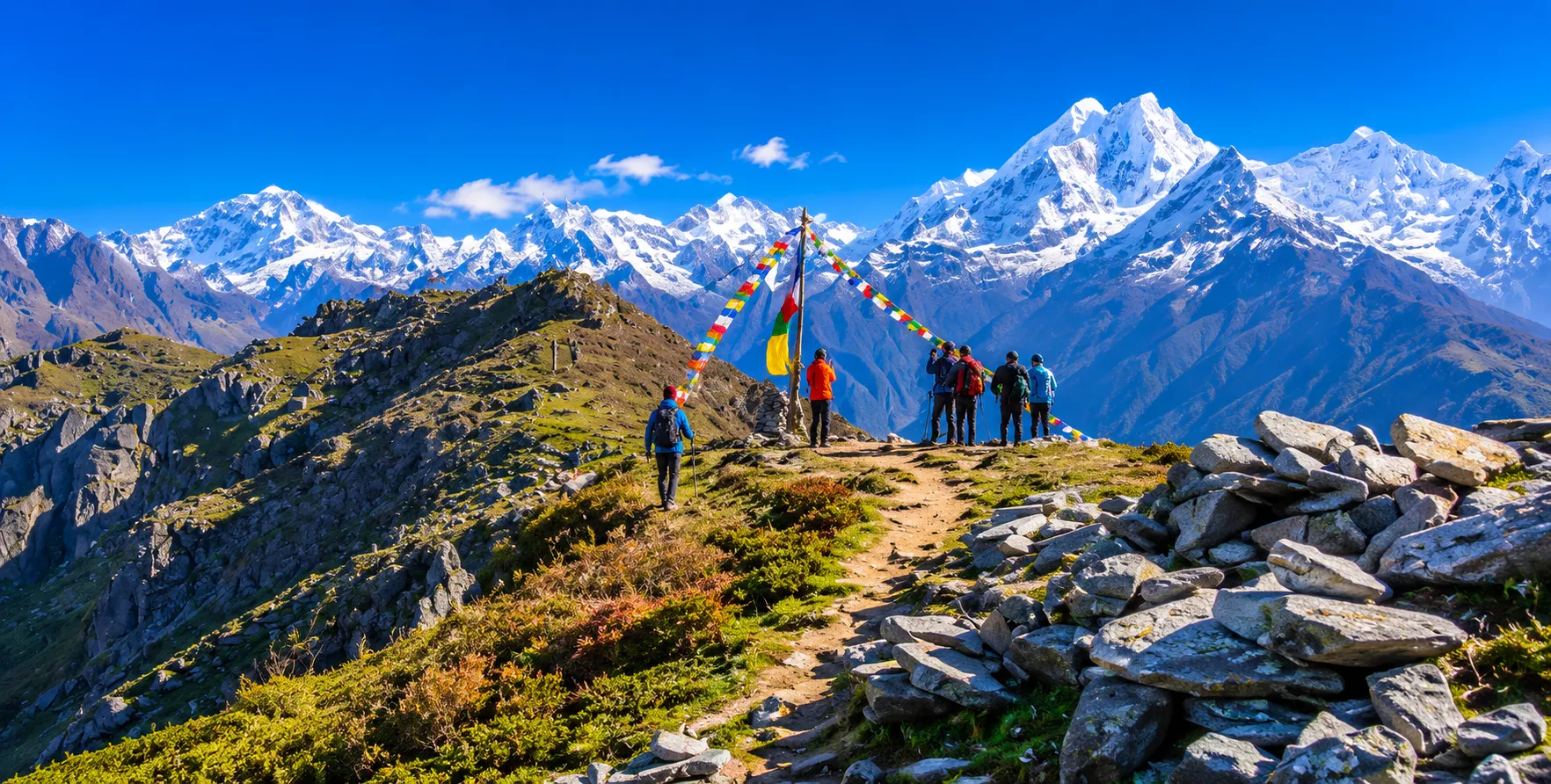
Gangapurna Peak at 7,455 meters and its associated glacier form the most dramatically visible feature of Manang’s immediate mountain setting, the glacier’s lower reaches ending in the distinctive turquoise glacial lake that lies just a short walk from the main village and that has become one of the most photographed natural features in the entire Annapurna region. The word ‘Gangapurna’ itself carries significant meaning — ‘Ganga’ refers to the sacred river of Hinduism, and ‘purna’ means complete or full — connecting the peak to the broader sacred geography of South Asian water mythology and the deep cultural significance of river sources and glacier-fed springs in the religious traditions of the region.
The glacial lakes of the Manang area — Gangapurna Lake, Ice Lake (Kicho Tal) at 4,600 metres, and ultimately Tilicho Lake — are all understood within the local religious cosmology as sacred water bodies, connected to the naga (serpent deity) tradition of Tibetan and Hindu religious geography that regards bodies of water as the domain of powerful non-human beings whose wellbeing is directly connected to the health of the surrounding landscape and community. Ritual offerings to the nagas of these lakes are part of Manang’s traditional religious practice, maintained alongside the more visible Tibetan Buddhist practices of the monastery system, within a layered religious ecology that has adapted ancient pre-Buddhist traditions of landscape veneration into the broader framework of Himalayan Buddhist practice.
The retreat of Gangapurna Glacier, clearly documented in satellite imagery and the living memory of longtime Manang residents over recent decades, is experienced by the Manangi community not merely as a climatic observation but as a deeply troubling spiritual and ecological portent. The glaciers are understood as the sources of the valley’s water, the foundations of its agricultural possibility, and the physical embodiment of the sacred relationship between the high mountain landscape and the human community that has made its home within it. Their retreat is watched with an anxiety that combines practical concern for the valley’s water future with a more diffuse but deeply felt spiritual unease — a sense that something essential in the relationship between the human community and its mountain environment is being disrupted in ways whose full consequences are not yet visible but whose significance is unmistakable.
Stone, Wood, and Wind: The Architecture of Himalayan Faith
The built environment of Manang Valley is itself a form of spiritual expression, encoding in its materials, its proportions, and its spatial organisation the values and cosmological understandings of a community shaped by centuries of Tibetan Buddhist practice and high-altitude necessity. The traditional stone houses of Manang and Braga—flat-roofed, massively walled, built from the local schist and granite that glaciers have scoured from the surrounding peaks and deposited on the valley floor—are among the finest examples of vernacular high-altitude domestic architecture anywhere in the Himalayan arc. Their walls, often a meter or more thick, provide the thermal mass needed to maintain habitable temperatures through the extreme winters. At the same time, their flat roofs serve as drying platforms for the barley and buckwheat harvest that sustains the community through months when the passes are closed, and the valley is sealed into winter isolation.
The spatial relationship between domestic architecture and religious architecture in Manang reflects the Tibetan Buddhist understanding of the sacred as something that interpenetrates ordinary life rather than existing apart from it. Monasteries are built into the hillsides above the village, looking down over the settlement, visually and symbolically placing the religious institution in a position of protective oversight over the community below. Prayer walls run alongside the paths between buildings and between settlements, so that the act of walking the ordinary routes of daily life — from house to field, from village to pasture — is simultaneously an act of devotional practice, the walker’s movement past the carved mantras generating merit for both the walker and for all beings.
The artistic heritage preserved within Manang’s monasteries and visible in the carved and painted surfaces of even modest domestic and religious structures speaks to a community with deep roots in the high tradition of Tibetan Buddhist art. The thangka paintings of Braga Gompa, the carved mani stones of the valley’s prayer walls, and the decorative elements of the older domestic buildings reflect a visual culture of considerable sophistication — one that served not merely aesthetic but deeply functional purposes, using the language of sacred iconography to make the abstract truths of Buddhist teaching concrete and accessible to a largely non-literate rural community for whom image and symbol carried the weight that text carried in more literate traditions.
Manang in the Modern World: Continuity, Change and Cultural Resilience
The Manang that the contemporary trekker encounters is a community in active negotiation with modernity — not a museum piece frozen in an idealised past but a living society confronting the same pressures of economic change, cultural contact, and environmental uncertainty that characterise communities across the developing world, while simultaneously drawing on the deep reserves of cultural resilience and adaptive intelligence that have sustained the Manangi people through centuries of challenge far more absolute than anything the present moment imposes.
The arrival of the Annapurna Circuit as an international trekking route in the 1970s and the broader opening of Nepal to foreign tourism transformed Manang’s economy in ways that are still unfolding. Tourism has become the primary income source for most Manang households, with over fifty lodges operating in the upper Manang valley area and the daily flow of international trekkers through the village during peak season generating economic activity on a scale that the traditional combination of agriculture and trans-Himalayan trade could never have produced. Daily foreign tourist arrivals exceeded 270 as of November 2025, indicating continued growth in the 2025/26 fiscal year, and the valley’s infrastructure — its teahouses, communications networks, and medical facilities anchored by the Himalayan Rescue Association clinic, which educates trekkers about altitude sickness — reflects this economic transformation.
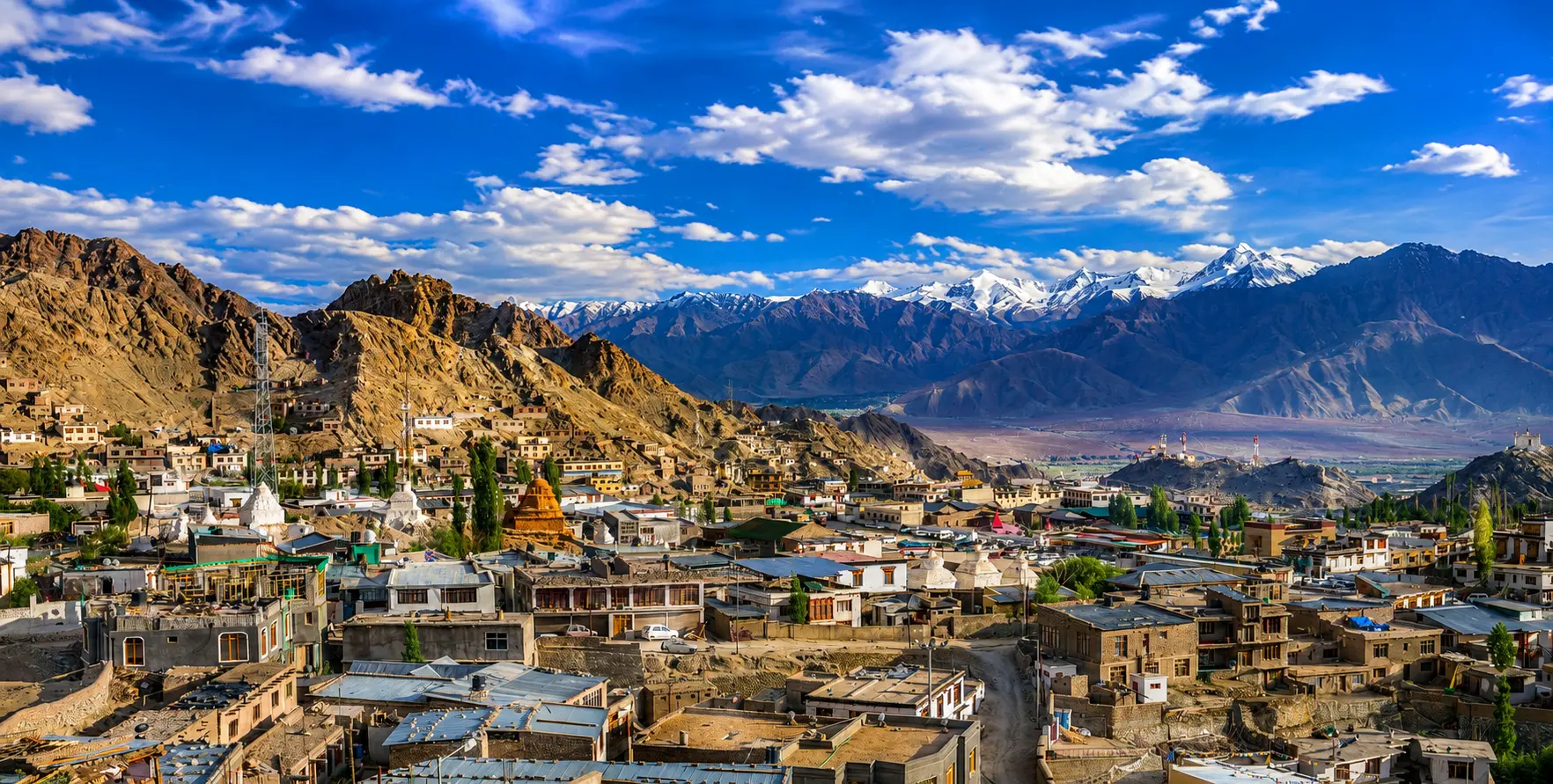
The cultural consequences of this economic change are more complex to assess. On one hand, tourism income has allowed many Manangi families to remain in the valley rather than migrate permanently to Kathmandu or Pokhara as economic necessity might otherwise have demanded, keeping the community alive in its home landscape even as the traditional economic base of herding and highland agriculture has declined. International visitors’ interest in Manang’s monasteries, festivals, and cultural practices has created economic incentives for their preservation and, in some cases, supported the restoration of religious heritage that might otherwise have deteriorated without maintenance funding.
On the other hand, the homogenising pressures of global tourism culture — the standardisation of menus, the adoption of international guesthouse norms, the gradual displacement of the local Loba dialect by Nepali as the primary language of inter-community communication — create real risks of cultural dilution over time. The Manangi community’s characteristic historical response to external cultural pressure has been a sophisticated balancing act: adopting what is useful from outside while maintaining the core elements of identity — language, religious practice, festival tradition, community governance — that define the community to itself. This adaptive capacity has served the Manangi well across centuries of changing external circumstances, and there is good reason to believe it will continue to do so. Still, the speed and reach of contemporary cultural globalisation represent a challenge of a different order of magnitude from anything the community has navigated before.
Reaching Manang: The Vehicle Hire Journey from Kathmandu or Pokhara
Understanding the historical and spiritual significance of Manang Valley deepens the experience of reaching it by every available means. Still, the practical reality of the journey deserves careful attention for travellers planning their visit. Manang is accessible either by the traditional trekking route along the Annapurna Circuit — a journey of approximately 7 to 10 days on foot from Besisahar — or by a combination of vehicle transport and walking that has become increasingly common as the jeep road through much of the lower Annapurna Circuit has been developed and extended in recent years.
The most common vehicle-assisted approach to Manang in 2025 begins with a private vehicle transfer from Kathmandu or Pokhara to Besisahar, the gateway town of the Annapurna Circuit, nd then continues by 4WD jeep from Besisahar through Chame and onward to Manang. The distance from Kathmandu to Besisahar is approximately 175- 178 kilometres and typically takes 6-8 hours by private vehicle. In comparison, the distance from Pokhara to Besisahar is approximately 106 kilometres and takes 3 to 4 hours. From Besisahar, the rough mountain road to Chame covers a further 65 to 70 kilometres and requires a dedicated 4WD jeep and an experienced driver, taking 4 to 6 hours. The road continues from Chame to Manang for those who prefer to reach the valley by vehicle rather than on foot.
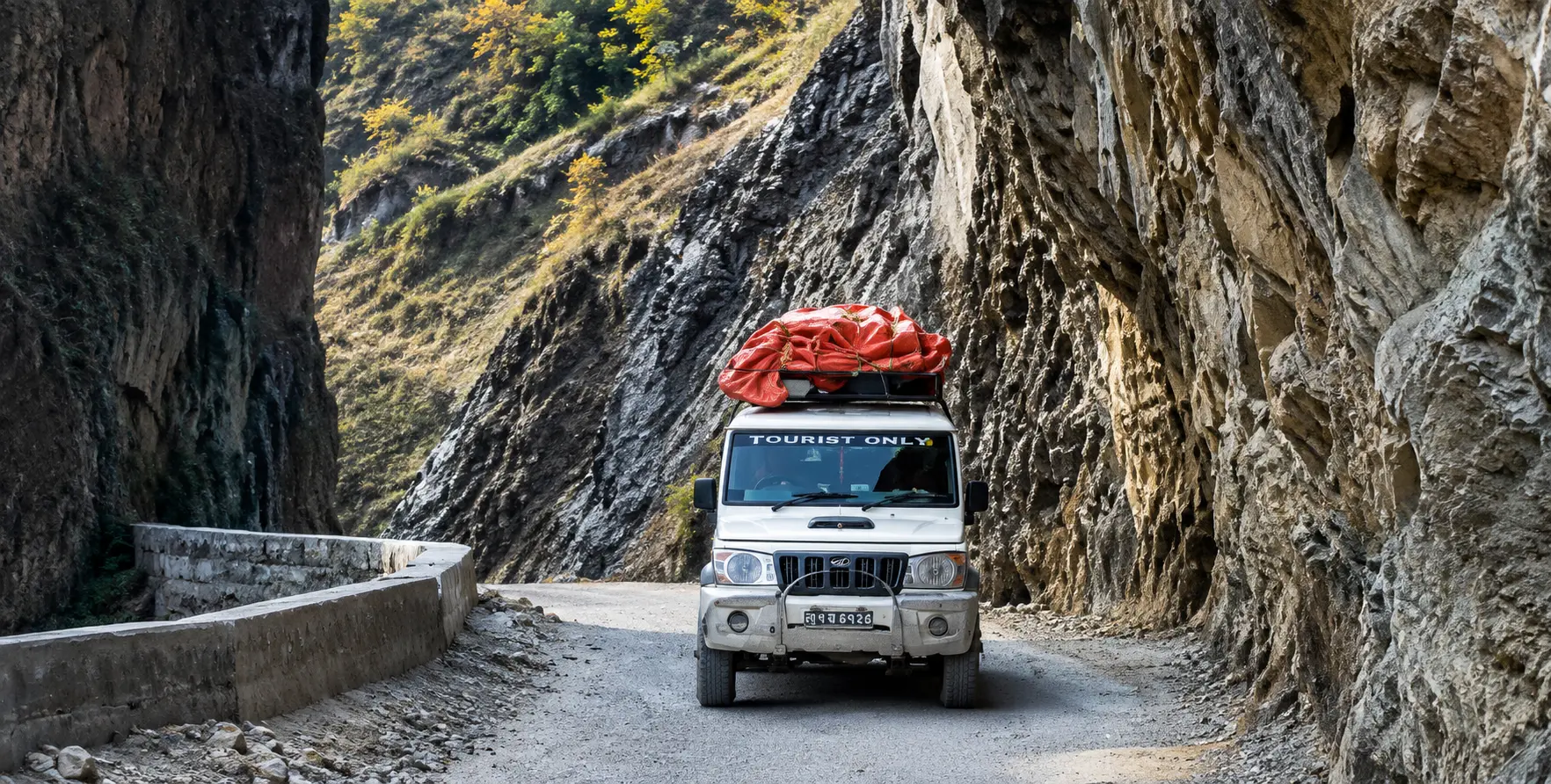
Nepal Vehicle Hiring Pvt Ltd (vehiclehiringnepal.com) provides private vehicle hire for every stage of the approach to Manang Valley, with vehicles matched to the specific road conditions of each segment — a comfortable SUV or private car for the Kathmandu-Besisahar or Pokhara-Besisahar highway legs, upgrading to a properly equipped Toyota Land Cruiser or equivalent 4WD jeep for the Besisahar-to-Chame and Chame-to-Manang mountain road segments where the terrain genuinely demands this capability.
Our drivers for the upper Annapurna Circuit approach are experienced on these roads, with the route knowledge and technical driving skills required to handle the demanding conditions of the Besisahar-Chame track. All our Manang approach transfers include the vehicle, an experienced driver, fuel, and applicable tolls, with transparent pricing in both Nepali rupees and US dollars.
For trekkers who are visiting Manang specifically for its historical and spiritual dimensions — rather than simply as an acclimatisation stop on the way to Thorong La — we recommend building additional time into any Manang itinerary, both for the valley’s own exploration and for the side trips to Braga Gompa, Praken Gompa, Gangapurna Lake, and ultimately Tilicho Lake that reveal the full depth of what this extraordinary high-altitude valley has to offer. The jeep road gives access to the valley; what the valley reveals to those who take time to look and listen is something that no road, however well-maintained, can deliver by itself.
Conclusion: What Manang Teaches
Manang Valley teaches, above all, the extraordinary human capacity for meaningful existence in apparently impossible circumstances. A community of fewer than six thousand people, living in one of the harshest, most isolated, and most demanding high-altitude environments on Earth, has sustained for centuries a civilisation of genuine richness artistically, spiritually, commercially, and socially.
The monasteries of Braga and Praken Gompa are not merely old buildings but living institutions of spiritual practice. The festivals of Yartung and Losar are not folk customs but profound expressions of a cosmological understanding that has guided human beings through centuries of Himalayan challenge. The mani walls and prayer flags that line every path in the valley are not decorations but the material expression of the understanding that daily life and spiritual practice are not separate categories but rather dimensions of a single, integrated reality.
The Milarepa Cave sanctifies the landscape with the presence of one of the Himalayan Buddhist world’s greatest spiritual figures. Tilicho Lake connects the valley to the sacred geography of both Hindu and Buddhist traditions. The glaciers and the alpine ecology of the surrounding peaks are understood not as scenery but as participants in a web of relationships that includes the human community and demands its respectful attention.
The trans-Himalayan trade heritage of the Nyishangte people speaks to the extraordinary reach of human ingenuity and determination in the face of geographic isolation. And the valley’s ongoing negotiation with modernity, undertaken with the same adaptive intelligence that has sustained the Manangi community across centuries of change, offers a quietly inspiring example of cultural resilience rooted in something deep enough to withstand the pressures the contemporary world applies to communities everywhere.
For travellers who arrive in Manang not simply as acclimatisation stoppers but as genuine visitors to a place of exceptional historical and spiritual significance, the valley offers what the best travel always offers: an encounter with a way of understanding and inhabiting the world that is fundamentally different from the one you brought with you, and that leaves you — if you are paying attention — with questions and perceptions that continue to work on you long after the journey is complete. Manang is not hidden in the sense of being difficult to find; it is on the map and on the trekking circuit, visited by tens of thousands of travellers each year. It is hidden in the deeper sense: hidden within the ordinary appearance of things, waiting for the kind of attention that sees not just the stone houses and the prayer flags but the centuries of human meaning those surfaces contain.
Book Your Manang Valley Jeep Transfer Today
Email:[email protected]
WhatsApp: +977 981-4227196
Kathmandu / Pokhara → Besisahar | Besisahar → Chame | Chame → Manang
Private Cars, SUVs & 4WD Jeeps | Experienced Drivers | NPR & USD Pricing | 24/7 Support
- Manang Hidden Valley: Historical and Spiritual Significance
- Geography as Destiny: How the Mountains Made the People
- The Nyishangte: Traders of the Himalayan Passes
- The Arrival and Deepening of Tibetan Buddhist civilisation in the spiritual landscape of Manang Valley is inseparable from the history of Tibetan Buddhism's southward expansion across the Himalayan range. This process began in earnest in the 7th and 8th centuries CE and has continued to shape the valley's religious life in unbroken succession to the present day. Buddhism arrived in the Manang region not simply as a set of doctrines and practices imported from outside, but as the living religious culture of a community already deeply connected to Tibet through trade, language, and kinship — a community for whom the adoption of Tibetan Buddhist practice was less a conversion than a recognition of the religious framework most naturally consonant with their existing worldview.
- Milarepa and the Sanctification of the High Passes
- Praken Gompa and the Living Tradition of Blessing
- Yartung: The Great Festival of the Valley
- Tilicho Lake: Sacred Waters at the Edge of the Possible
- The Living Landscape: Glaciers, Sacred Waters and Himalayan Ecology
- Stone, Wood, and Wind: The Architecture of Himalayan Faith
- Manang in the Modern World: Continuity, Change and Cultural Resilience
- Reaching Manang: The Vehicle Hire Journey from Kathmandu or Pokhara
- Conclusion: What Manang Teaches

Related Blog & Articles

4WD Himalayan Jeep in Nepal

Kathmandu to Manang Jeep Service Guide

Besisahar to Manang Jeep