Plan a Trip


Nepal 1-Day Helicopter Tour Cost
Nepal 1-Day Helicopter Tour Cost
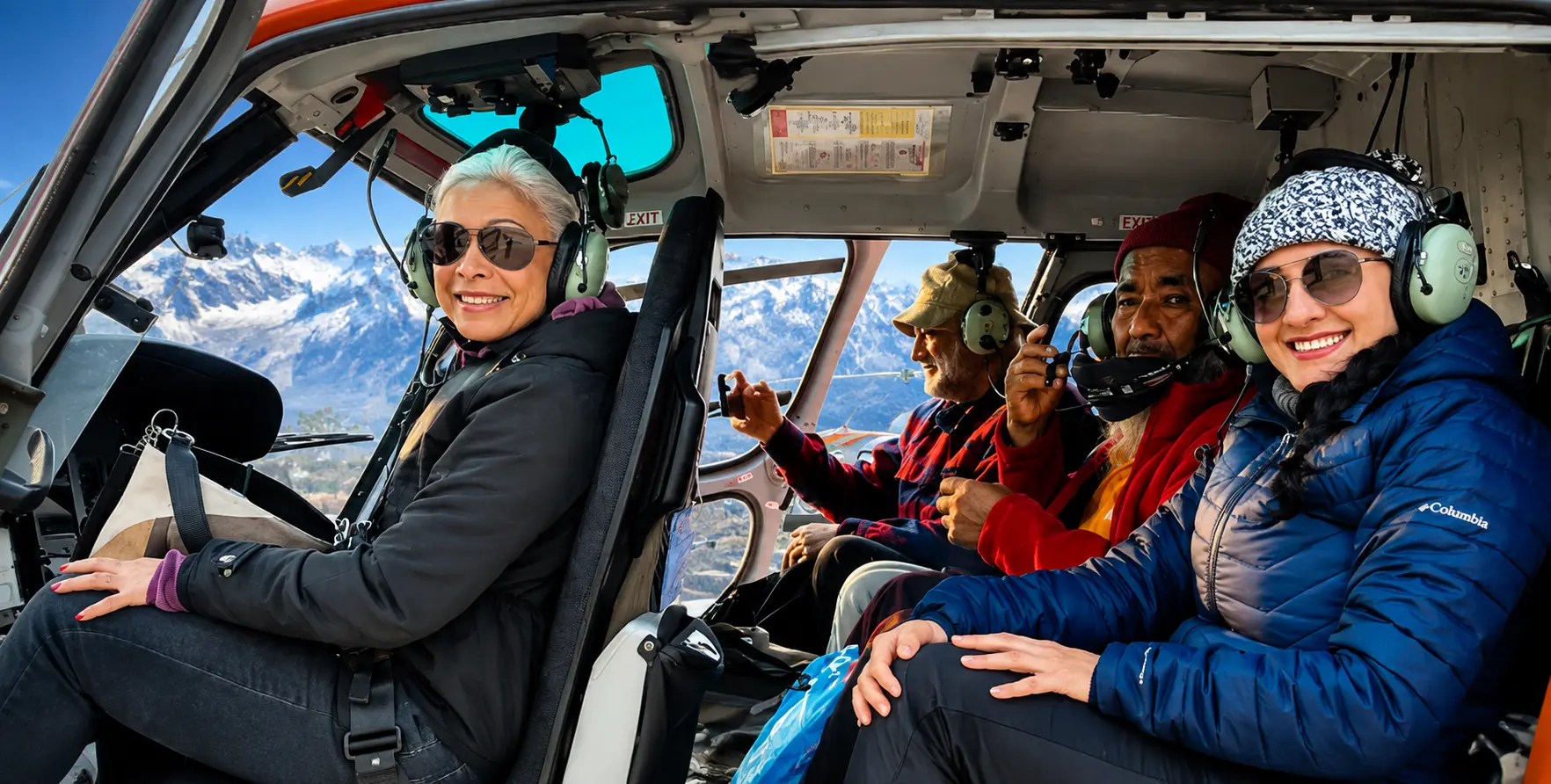
Nepal’s helicopter tour industry has evolved dramatically over the past decade from a niche luxury offering for a handful of high-budget travellers into a mainstream Nepal tourism product serving tens of thousands of visitors annually — from Everest Base Camp helicopter tours that allow travellers to reach 5,364 metres in under an hour to sacred lake tours over Gosaikunda and cultural flyovers of the ancient Mustang Kingdom that would require weeks of trekking to access on foot. In Nepal, helicopter tours are one of the finest value propositions in adventure tourism globally—delivering Himalayan experiences of extraordinary visual power and physical authenticity at price points that, while not budget travel, are accessible to a much broader traveler profile than the expedition-style trekking they compress.
This comprehensive guide covers every major Nepal one-day helicopter tour route and its verified 2026/27 cost structure — the Everest Base Camp helicopter tour, the Annapurna Base Camp helicopter tour, the Langtang and Gosaikunda helicopter tour, the Mustang helicopter tour, and several specialist routes including the Everest sunrise helicopter and the Manaslu helicopter circuit. For every route, we provide the per-person cost for different group sizes. These factors drive price variation between operators, what is and isn’t included in standard packages, the best season for each route, and how Nepal Vehicle Hiring Pvt. Ltd. provides the ground transport infrastructure—Kathmandu sightseeing tours, trekking trailhead transfers, and airport connections—that completes every Nepal helicopter tour experience.
Nepal Helicopter Tour Cost — Quick Reference
Everest Base Camp Helicopter Tour: USD 1,150-1,500 per person (group of 4-5)
Everest Sunrise Helicopter Tour: USD 1,300-1,700 per person (group of 4-5)
Annapurna Base Camp Helicopter Tour: USD 900-1,200 per person (group of 4-5)
Gosaikunda + Langtang Valley Helicopter Tour: USD 900-1,100 per person (group of 4)
Mustang (Muktinath) Helicopter Tour: USD 800-1,100 per person (group of 4-5)
Everest Solo Charter (1 person): USD 4,000-5,500 | Couple: USD 2,500- 3,500.
All tours depart from Tribhuvan Airport, Kathmandu | Duration: 4-6 hours total
Ground Transport: Nepal Vehicle Hiring Pvt. Ltd. | +977 9851013196 | vehiclehiringnepal.com
How Nepal Helicopter Tour Pricing Works
The Group Sharing Model — The Key to Affordable Prices
The charter model drives the fundamental economics of Nepal helicopter tour pricing — most operators price their tours by the helicopter rather than by the passenger. A standard Bell 407 or Airbus AS350 B3 helicopter — the two most commonly used aircraft on Nepal tourist routes — seats four to five passengers plus the pilot. The total charter cost is fixed regardless of how many passengers share it. The per-person cost, therefore, falls dramatically as group size increases: a USD 5,000 total helicopter charter divided by five passengers costs USD 1,000 each, while divided by two passengers it costs USD 2,500 each.
For travelers who cannot fill a helicopter with their own group, most operators offer group joining—a system where individual travelers or small groups are matched with others on the same route to share the helicopter and split the cost. Group-joining departures for popular routes like the Everest Base Camp helicopter tour and Annapurna Base Camp helicopter tour are scheduled almost daily during the peak October and April seasons, and solo travelers who book in advance can typically join a group departure at the standard per-person shared rate. The group-joining system also applies to Langtang and Gosaikunda helicopter tours and the Mustang helicopter tour from Pokhara.
What Drives Price Variation Between Operators
Nepal helicopter tour prices vary significantly between operators for reasons that travelers should understand before booking. The primary cost drivers are: the aircraft type and age — newer aircraft with more modern avionics and better high-altitude performance capability command higher charter rates; the pilot experience — pilots with more hours on Himalayan routes, particularly the high-altitude approaches to Everest Base Camp and similar landing sites, are both more expensive and significantly more valuable for safety; the CAAN certification and maintenance standard of the operator; and the inclusions in the package — landing fees, park permits, breakfast at the landing site, and guide accompaniment all add to the base charter cost and are bundled differently by different operators.
The cheapest available Nepal helicopter tour rates reflect genuine compromises in one or more of these factors — older aircraft, less experienced pilots, minimal inclusions, or operators with less robust CAAN compliance. The most expensive rates reflect premium everything — new aircraft, senior pilots, maximum inclusions, and the market positioning of Nepal’s premium helicopter tour operators. The sweet spot for most travelers is mid-range pricing from established operators with strong safety records, current CAAN certification, and competitive group joining rates. Saving USD 100 to 200 per person by choosing an unverified, cheap operator for a Himalayan helicopter flight is a safety compromise that Nepal Vehicle Hiring Pvt. Ltd. consistently advises against when referring clients to helicopter tour operators when booking ground transport services.
Everest Base Camp Helicopter Tour
Route Overview: Kathmandu to EBC
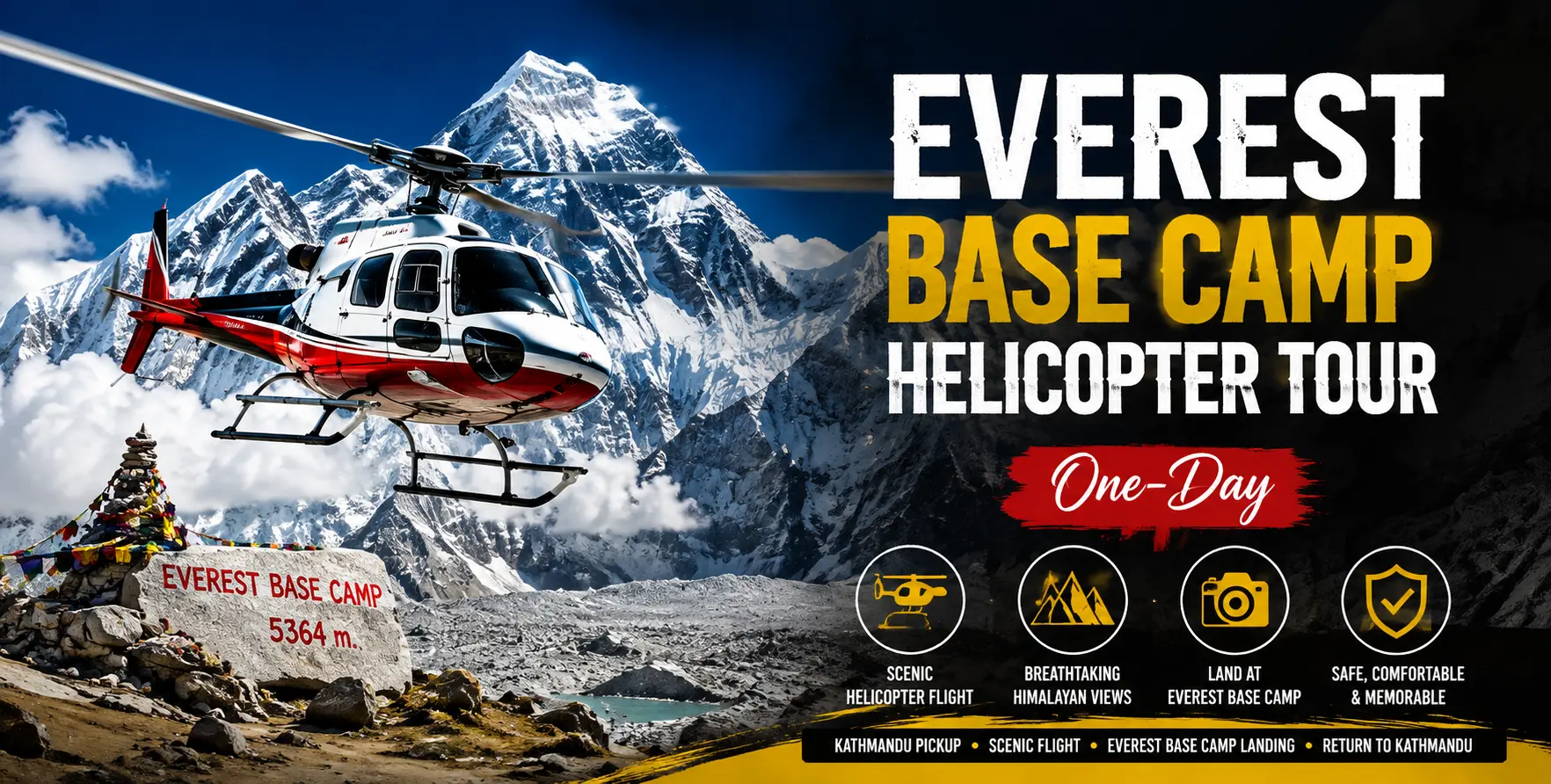
The Everest Base Camp helicopter tour is Nepal’s most popular and most iconic helicopter tour — a half-day flight from Kathmandu that delivers passengers to Everest Base Camp at 5,364 meters and the Kalapathar viewpoint area at 5,545 meters — the highest accessible point on any standard Nepal helicopter tour, with the closest aerial views of Mount Everest at 8,849 meters available from any commercial aviation route. The standard EBC helicopter tour departs Kathmandu in the early morning, flies to Lukla for a fuel stop, then continues to the Gorak Shep landing area near Everest Base Camp for a 20- to 40-minute exploration stop before the return flight to Kathmandu. Alternatively, some operators fly direct from Kathmandu to EBC on high-altitude-capable aircraft, without the Lukla fuel stop. Total flight time is about 4 to 6 hours, with the helicopter tour complete by mid-morning.
The mountains visible on the Everest Base Camp helicopter tour include Mount Everest (8,849 m), Lhotse (8,516 m), Nuptse (7,861 m)), Ama Dablam (6,812 m)), Pumori (7,161 m)), Cho Oyu (8,188 m)), and the full panorama of the Khumbu Himalaya stretching eastward to the Tibetan border — arguably the finest single concentration of high Himalayan scenery accessible by any form of transport. The ground-level Everest Base Camp landscape — the Khumbu Glacier terminal moraine, the Base Camp tents of current expeditions visible in season, the extraordinary wind-sculpted topography of the high Khumbu — is visible from the landing area in a way that the standard Everest Base Camp Trek approach on foot also delivers, but in a fraction of the time.
Everest Base Camp Helicopter Tour Cost
Per person, group of 5 (sharing): USD 1,150-1,300. The most economical rate for the EBC helicopter tour — five passengers sharing the Bell 407 or AS350 produces the lowest per-person cost. Most group-joining departures are priced in this range for a shared seat.
Per person, group of 4 (sharing): USD 1,300-1,500. The standard group size for most EBC helicopter tours is four passengers plus the pilot in a five-seat helicopter. This is the most commonly quoted group tour rate.
Per person, group of 3: USD 1,600-1,900. Smaller groups cost more per person. Some operators will match a group of three with an additional solo traveler to reach the standard four-person group rate.
Per person, couple (2 people): USD 2,200-2,800. Couples chartering the helicopter privately produce a significantly higher per-person cost. Some operators offer a ‘couple sharing’ arrangement where two couples share the helicopter.
Solo private charter: USD 4,000-5,500. The full helicopter charter for one person only. Quoted less commonly as most solo travelers use group joining, but available for clients who require maximum flexibility on timing and route.
Everest Sunrise Helicopter Tour — Premium Option
The Everest sunrise helicopter tour is a premium variation of the standard EBC tour that times the Kalapathar or Gorak Shep landing for dawn light on the Everest face. This extraordinary phenomenon makes Everest photography at dawn among the finest in the Himalayan world. The sunrise tour requires an earlier departure from Kathmandu (typically 5:00 to 5:30 a.m.) and careful timing to arrive at the landing site during the brief alpenglow window before full daylight. This premium product commands a 10 to 20 percent higher rate than the standard EBC tour—approximately USD 1,300 to 1,700 per person for a group of four to five—reflecting the added operational complexity and the premium visual experience it delivers.
Annapurna Base Camp Helicopter Tour
Route Overview: Kathmandu or Pokhara to ABC
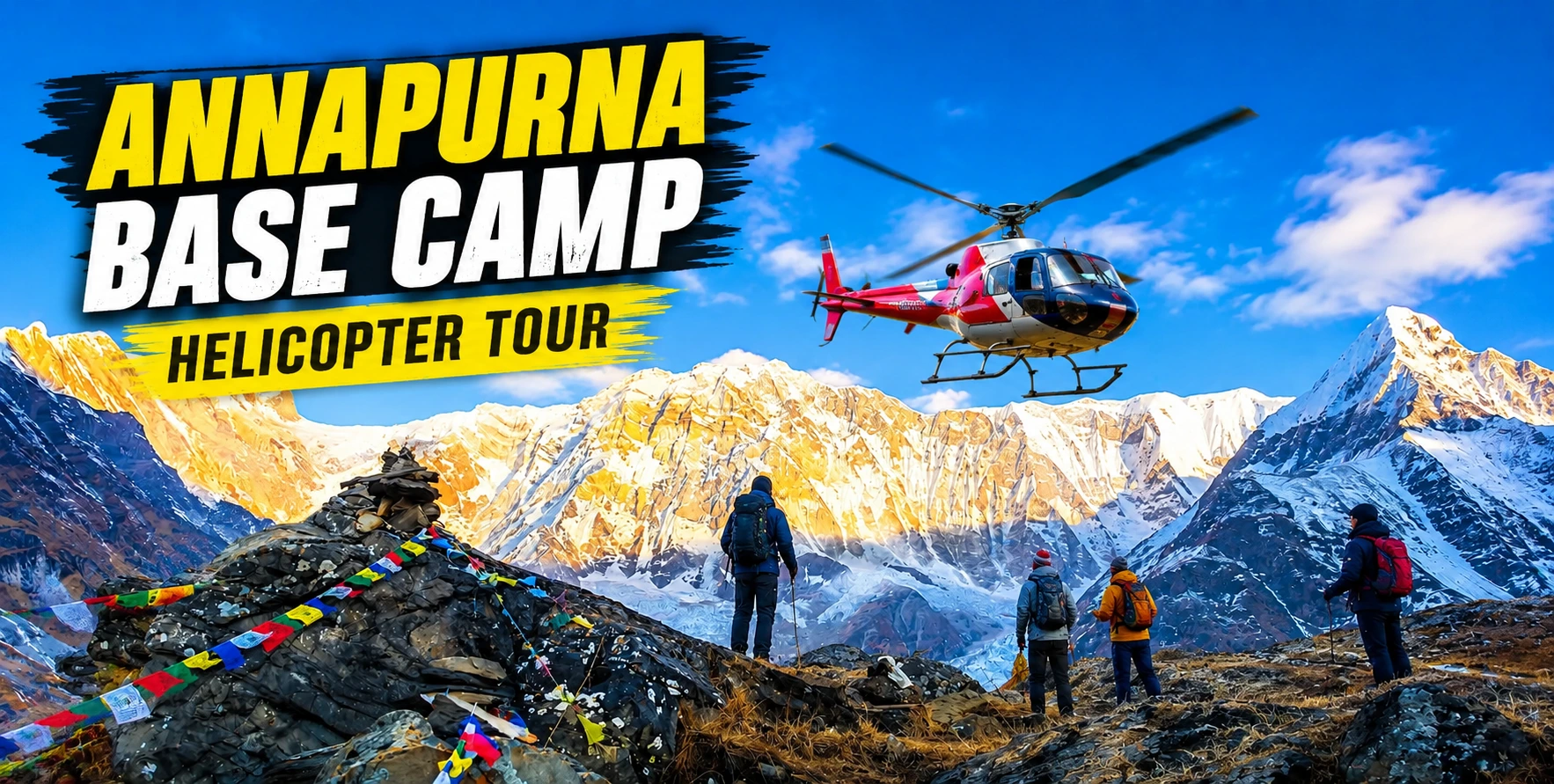
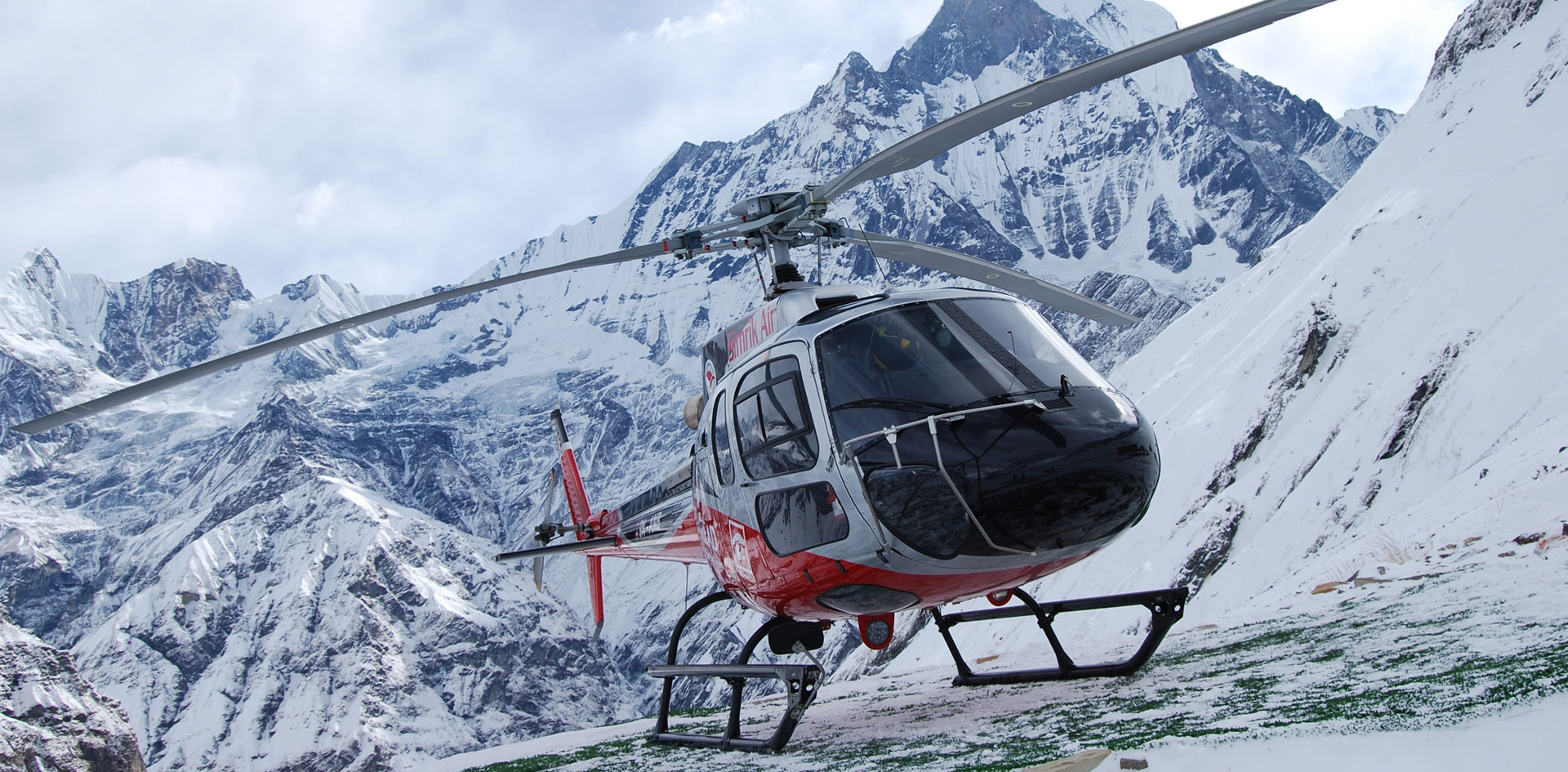
The Annapurna Base Camp helicopter tour operates from either Kathmandu (approximately a 45-minute flight to ABC) or Pokhara (approximately a 20- to 25-minute flight to ABC), with the Pokhara departure costing significantly less due to reduced total flight time and fuel. Annapurna Base Camp at 4,130 metres sits in one of the world’s most dramatic natural amphitheatres — a circular basin of Himalayan peaks including Annapurna I (8,091 m), Annapurna South (7,219 m)), Hiunchuli (6,441 m)), Gangapurna (7,455 m)), and Machhapuchhre (6,993 m) — the fishtail peak that is Pokhara’s iconic skyline profile and one of Nepal’s most recognizable mountain silhouettes. The helicopter landing at ABC allows 20 to 40 minutes of exploration in the extraordinary amphitheater — the same high-altitude mountain cirque that the Annapurna Base Camp Trek reaches after 6 to 8 days of walking.
Annapurna Base Camp Helicopter Tour Cost
From Pokhara, per person, group of 4-5: USD 600-850. The shortest and most economical approach to ABC by helicopter — Pokhara’s proximity to the Annapurna range means a 20- to 25-minute flight to ABC rather than the 45 minutes from Kathmandu. The Pokhara to ABC helicopter tour is the most affordable of Nepal’s major helicopter tours per person.
From Kathmandu, per person, group of 4-5: USD 900-1,200. The longer flight from Kathmandu to ABC costs more but allows you to combine the tour with the Kathmandu sightseeing circuit for travelers not visiting Pokhara separately.
From Pokhara, solo charter: USD 2,500-3,200. The private charter option for maximum flexibility. Car hire: Car Pokhara from Nepal Vehicle Hiring Pvt. Ltd. provides hotel-to-helipad transfers for all Pokhara helicopter tour departures.
The ABC helicopter tour from Pokhara also commonly includes a Ghorepani Poon Hill flyover — the famous 3,210 m rhododendron-forested ridge that provides the finest accessible views of the Dhaulagiri, Annapurna, and Machhapuchhre ranges. Adding this viewpoint extends the flight time by about 15 to 20 minutes and adds about USD 50 to 100 per person to the standard ABC rate.
Gosaikunda and Langtang Valley Helicopter Tour — Costs
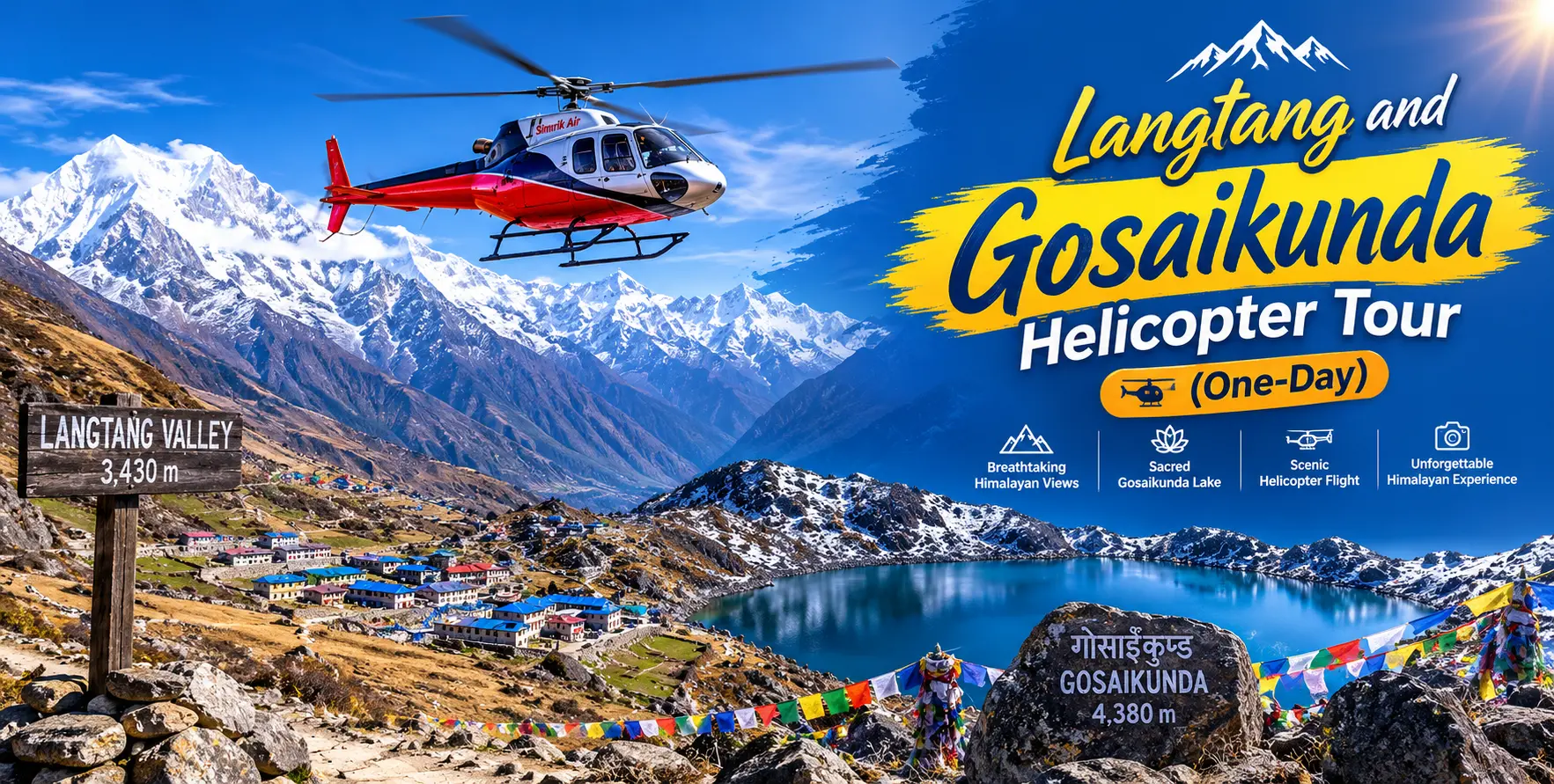
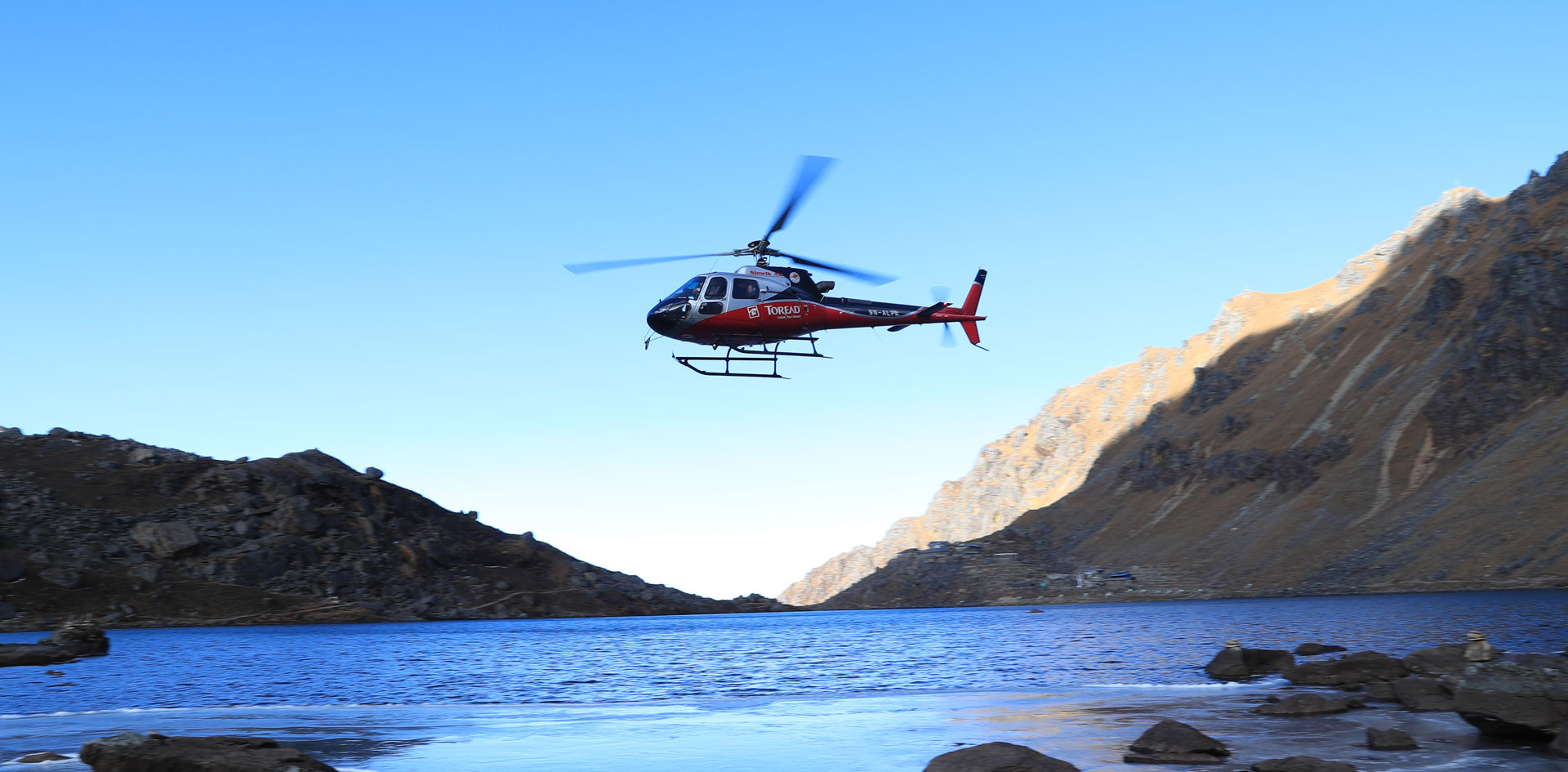
As covered in detail in the Langtang Gosaikunda helicopter tour guide, the standard Gosaikunda and Langtang Valley helicopter tour from Kathmandu costs approximately USD 900 to 1,100 per person for a group of four, USD 1,300 per person for a group of two, and USD 2,500 for a solo private charter. Our tour covers two landing sites — Gosaikunda Lake at 4,380 m (the sacred alpine lake of Hindu and Buddhist significance) and Kyanjin Gompa at 3,830 m in the Langtang Valley — in a half-day tour departing Kathmandu at approximately 6:30 to 7:00 a.m. and returning by mid-morning. The Kathmandu to Syabrubesi jeep hire from Nepal Vehicle Hiring Pvt. Ltd. at NPR 14,000 to 18,000 provides a ground-transport alternative for travelers choosing the full Langtang Valley Trek instead of, or after, the helicopter tour.
Mustang Helicopter Tour — Costs
Route Overview: Pokhara to Muktinath and Mustang
The Mustang helicopter tour operates primarily from Pokhara — the nearest major city to the Mustang District — and covers the extraordinary landscape of the upper Kali Gandaki gorge and the ancient Mustang Kingdom (Lo Manthang region). The most popular Mustang helicopter tour route combines a landing at Muktinath (3,800 m) — one of the most sacred pilgrimage sites in both Hindu and Buddhist traditions, associated with the eternal fire that burns at the temple complex — with a scenic flight over the extraordinary desert landscape of the Kali Gandaki gorge, the world’s deepest gorge by some measurements, and the ancient walled city of Lo Manthang in Upper Mustang. The Mustang helicopter tour delivers an extraordinary landscape and cultural experience — the arid, Tibetan-plateau-like character of Upper Mustang, the ancient cave monasteries and traditional architecture of the Mustang Kingdom, and the sacred fire of Muktinath.
The Pokhara to Muktinath jeep hire from Nepal Vehicle Hiring Pvt. Ltd. is the ground-transport alternative for travelerswho prefer the road approach to Muktinath — the increasingly well-maintained road via Beni, Ghasa, and the Kali Gandaki gorge delivers ttravelerso Jomsom, ,where a local vehicle covers the final section to Muktinath. Nepal Vehicle Hiring Pvt. Ltd. provides car hire in Pokhara, including all Pokhara-area transport and hotel-to-helipad transfers for the Mustang helicopter tour.
Mustang Helicopter Tour Cost
Muktinath day tour from Pokhara, per person, group of 4-5: USD 800-1,100. The most economical Mustang helicopter option — the Muktinath landing and Kali Gandaki Gorge flyover without the Upper Mustang Lo Manthang extension. Approximately 3 to 4 hours total.
Upper Mustang (Lo Manthang) tour from Pokhara, per person, group of 4-5: USD 1,100-1,500. The extended Mustang tour, including the Lo Manthang flyoverrequires the Upper Mustang restricted area permit (USD 500 per person per 10 days),,which adds significantly to the total tour cost.
Solo charter, Muktinath from Pokhara: USD 2,800-3,500. Full private charter for one person. The car hire in Pokhara from Nepal Vehicle Hiring Pvt. Ltd. provides hotel-to-helipad service at NPR 600 to 1,200 for this departure.
Manaslu Circuit and Tsum Valley Helicopter Tour — Costs
The Manaslu helicopter tour is a specialist route covering the Manaslu Conservation Area — the remote, spectacular mountain landscape surrounding Manaslu at 8,163 m, Nepal’s eighth-highest peak. The route typically includes a landing at Sama Gaon (3,520 m) — the highest permanently inhabited village on the Manaslu Circuit and the cultural center of the area’s Tibetan-heritage community — and a scenic flight over the Manaslu Glacier and the extraordinary Tsum Valley restricted area. This route is less commonly operated than the Everest, Annapurna, or Gosaikunda tours and is typically available on a private charter basis from Kathmandu. Cost: approximately USD 2,500 to 3,500 per person for a group of four, reflecting the longer flight distance from Kathmandu and the route’s specialist nature. The Kathmandu to Arughat jeep hire from Nepal Vehicle Hiring Pvt. Ltd. is the ground transport starting point for the full Manaslu Circuit Trek alternative.
What Is Typically Included — And What Is Not
Standard Inclusions
- Helicopter charter (the aircraft and pilot for the full round-trip route)
- National Park entry permit (Sagarmatha/Langtang/Annapurna depending on route)
- Landing fees at all designated stopping points
- One crew member or guide accompanying the flight
- Basic flight insurance coverage (operator liability — NOT personal travel insurance)
- Hotel pickup from the hotel to the helipad (check with operator — not always included)
- Breakfast at the primary landing site (Lukla for EBC, Kyanjin for Langtang — included by many operators but verify)
Standard Exclusions
- Personal travel insurance with emergency helicopter evacuation coverage — MUST be arranged independently; legally required for trekking permits in Nepal.
- Personal guide or photographer accompanying the flight (available at additional cost from most operators)
- Meals and drinks beyond the included breakfast at landing sites
- Ground transport to and from the helipad airport — book with Nepal Vehicle Hiring Pvt. Ltd. at +977 9851013196
- Upper Mustang restricted area permit (USD 500 per person per 10 days) for tours extending to Lo Manthang
- Rescue or evacuation costs above the operator’s basic insurance limit
Best Season for Nepal Helicopter Tours
October and November — Peak Season for All Routes
October and November are the finest months for every Nepal helicopter tour route — the post-monsoon atmospheric clarity that characterizes this period produces maximum mountain visibility and photographic quality at every landing site. October specifically is considered the single best month for Himalayan aerial photography, when the air is completely clear after the monsoon’s cleansing and the autumn light has a golden quality that makes every landscape vivid. Helicopter availability is at its maximum in October (operators schedule additional aircraft and crews to meet peak demand), but booking at least two to three weeks in advance is essential, especially for Everest Base Camp helicopter tour departures, where five-seat helicopters fill quickly with group-joining bookings. All Nepal Vehicle Hiring Pvt. Ltd. ground transport services — Kathmandu sightseeing tours, Bhaktapur day tours, Nagarkot sunrise tours, trekking trailhead transfers — see their highest demand in October. Book early.
Spring — March, April, May
Spring is the second-best period for Nepal helicopter tours — the weather is broadly stable through April, visibility is excellent in the mornings (afternoon cloud builds from May onward), and the rhododendron forests visible from the helicopter approach corridors are in spectacular bloom in March and April, adding a spectacular floral dimension to the approach views that the autumn season cannot provide. April is widely considered the best spring month — the summit conditions for Himalayan mountaineering are at their optimum (making the EBC helicopter tour particularly rewarding as Base Camp is typically populated with expedition teams preparing for summit bids), and the overall Nepal travel infrastructure is fully operational after the winter quiet season.
Monsoon and Winter
The monsoon season (June to September) generally produces the least reliable helicopter tour weather — cloud and precipitation can ground helicopters for days at a time, and booking with a flexible cancellation/rescheduling policy is essential for monsoon-season helicopter tours. However, early morning windows are often clear before the day’s moisture builds, and operators experienced in the Himalayan flying environment can often complete helicopter tours in the early morning hours even during the nominal monsoon season. Winter (December to February) brings cold and occasional snowfall to high landing sites. Still, clear, exceptionally transparent air between weather events means winter EBC helicopter tours run regularly, and the extra-cold, extra-clear atmosphere produces extraordinary photographic conditions for those willing to accept the cold at high landing sites.

Ground Transport Before and After the Helicopter Tour
Every Nepal helicopter tour begins and ends at a ground-level location—the helipad, the hotel, the Kathmandu sightseeing circuit, or the trekking trailhead—that offers an alternative ground-level experience to the aerial one. Nepal Vehicle Hiring Pvt. Ltd. provides all of these ground transport connections with the same professional quality that defines its trekking trailhead transfer service. Book the Kathmandu hotel to Tribhuvan Airport transfer for early-morning helicopter departures, the airport return pickup after the tour, and the Kathmandu sightseeing tour in the afternoon after the helicopter’s mid-morning return—all via WhatsApp at +977 9851013196 for seamless same-day coordination.
For travellers who want to combine the helicopter tour with overland trekking — seeing the Everest region first by air and then walking from Lukla (accessed by domestic flight from Kathmandu), or seeing Annapurna Base Camp from the air and then trekking from Pokhara via Nayapul, or seeing the Langtang Valley by helicopter and then trekking from Syabrubesi — Nepal Vehicle Hiring Pvt. Ltd. provides the trailhead jeep transfers that begin all of these overland journeys. The Kathmandu to Besisahar jeep hire for the Annapurna Circuit, the Kathmandu to Syabrubesi jeep transfer for the Langtang trek, and the Pokhara car hire for the Annapurna approach are all available from the same trusted provider at all-inclusive transparent rates.
Book Nepal Vehicle Hiring Pvt. Ltd. for All Ground Transport
Website: www.vehiclehiringnepal.comPhone / WhatsApp: +977 9851013196 (24/7 — Airport Transfers from 55 a.m.
Email: [email protected]
Office: Bhagawatisthan, Thamel, Kathmandu, Nepal
Hotel to Tribhuvan Airport (Helicopter Departure): NPR 600-1,200
Kathmandu Sightseeing Tour (Post-Helicopter Afternoon): Full Heritage Circuit
Kathmandu to Syabrubesi: NPR 14,000-18,000 | Besisahar: NPR 18,000- 22,000
Pokhara Car Hire: Full day from NPR 6,000| Annapurna/Mustang approach routes
Bhaktapur Day Tour | Nagarkot Sunrise Tour | All Trekking Trailhead Transfers
How to Book a Nepal Helicopter Tour — Step by Step
Step 1: Choose Your Route and Season
Begin with the route that best matches your Nepal itinerary, available time, and budget. For travelers visiting Kathmandu only, the Everest Base Camp helicopter tour or the Gosaikunda and Langtang Valley helicopter tour are the most accessible departure options; for travelers visiting Pokhara, the Annapurna Base Camp helicopter tour from Pokhara is the most economical and logistically straightforward option. Confirm that your Nepal visit falls within the recommended season for your chosen route — October through November and March through May are the most reliable months for all Nepal helicopter tours.
Step 2: Select a CAAN-Certified Operator
Verify that your chosen helicopter tour operator holds current Civil Aviation Authority of Nepal (CAAN) certification for tourism charter operations. Major certified operators active in 2026 include Simrik Air, Kailash Helicopter Services, Fishtail Air, Manang Air, and Heli Everest, among others. Check the CAAN website (caan.gov.np) to verify operator status before booking. Fishtail’s CAAN certification number should be readily available from any legitimate operator on request—if an operator can’t or won’t provide it, treat that as a red flag.
Step 3: Confirm Group Joining or Private Charter
Determine whether you want to join an existing group (the most economical option for solo travelers and small groups) or book a private charter. For group joining, provide your preferred travel date, and the operator will confirm availability in a group departure. For private charters, provide your date and group size for a specific charter quotation. Most operators can confirm group-joining availability within 24 to 48 hours of inquiry, and booking two to three weeks in advance is recommended for October, November, and April peak-season departures.
Step 4: Arrange Travel Insurance
Before confirming any Nepal helicopter tour booking, arrange personal travel insurance that explicitly covers emergency helicopter evacuation from altitude. Nepal’s mountain rescue services — including the voluntary rescue organizations that coordinate with CAAN-certified operators — require documented insurance coverage before initiating rescue operations. The insurance cost for a Nepal trekking and helicopter tour trip is typically USD 50 to 150 depending on coverage level and trip duration — a modest cost relative to the helicopter tour itself and an essential element of responsible Nepal mountain travel.
Step 5: Book Ground Transport with Nepal Vehicle Hiring
When booking the helicopter tour, arrange the hotel-to-airport transfer for the morning of departure with Nepal Vehicle Hiring Pvt. Ltd. at +977 9851013196. Helicopter tours typically require a 5:30 to 6:00 a.m. pickup for 6:30 to 7:00 a.m. departures. Nepal Vehicle Hiring Pvt. Ltd. offers 24-hour WhatsApp booking and provides early-morning airport pickups at the same all-inclusive, transparent rates that apply to all ground transport services. After the helicopter tour returns (typically by 10:00 to 11:00 a.m.), the same team can arrange the Kathmandu afternoon sightseeing tour, the Bhaktapur Durbar Square day tour, or the onward Kathmandu to Pokhara private transfer — creating a seamlessly organized Nepal day from the pre-dawn airport transfer to the evening hotel return.
Helicopter Tour Safety in Nepal — What Every Traveler Must Know
Nepal’s Helicopter Safety Record and CAAN Oversight
Nepal’s helicopter aviation sector operates under the oversight of the Civil Aviation Authority of Nepal (CAAN), the government body responsible for certifying operators, approving aircraft airworthiness, licensing pilots, and setting operational standards for commercial helicopter flights in the country. CAAN certification is the primary safety assurance mechanism available to helicop; an operathelicopterl, anan operatoror wiensuring that operators meetintenagency’sational, and pilot and operatesn requrequirements within Nepal’s commercial aviation The CAframework (caan.gov.np) maintains a public register of certified operators that travelers can consult before booking.
The Himalayan operating environment places specific demands on helicopter aviation that distinguish Nepal flying from standard commercial helicopter operations elsewhere. High altitude significantly reduces helicopter performance — air at 5,000 meters is about half the density of sea-level air, reducing lift, engine power output, and the helicopter’s maximum payload capacity. Weather changes rapidly in the mountains — what begins as a clear morning flight can quickly turn into cloud or turbulence in approach corridors, and experienced Himalayan pilots’ ability to read these weather patterns and make appropriate go/no-go decisions is the most practically important pilot quality in Nepal helicopter tour operations. Operators with the best safety records on Nepal’s helicopter tour routes are those whose pilots have the most accumulated Himalayan hours and the most conservative weather assessment protocols—qualities that correlate with, but are not guaranteed by, CAAN certification alone.
Emergency Evacuation Insurance — Non-Negotiable
Emergency helicopter evacuation insurance is not optional for any Nepal mountain activity — it is a legally required condition for trekking permit issuance and a practical necessity for anyone undertaking helicopter tours that land at high altitude. The insurance covers a medical emergency at a high-altitude landing site that requires helicopter evacuation—a situation where the evacuation helicopter cost alone can exceed USD 5,000 to 10,000, and uninsured travelers face potentially catastrophic personal financial liability on top of the medical emergency itself. Major travel insurance providers with Nepal mountain coverage include World Nomads, Battleface, IMG Global, Allianz, and numerous others — verify that your specific policy explicitly covers helicopter evacuation from altitude above 4,000 m (or above 5,000 m for Everest Base Camp helicopter tours) before purchasing.
Weather Cancellation Policies — What to Expect
Nepal helicopter tour operators apply weather cancellation protocols that prioritize safety over schedule. If the flight conditions at any point on the route do not meet the operator’s safety threshold on the morning of the scheduled departure, the flight will be canceled or postponed. This is the correct outcome from a safety perspective. Still, it requires travelers to build date flexibility into their Nepal itinerary—leaving a one- to two-day buffer after the scheduled helicopter tour departure before other fixed commitments (international flights, hotel checkout) is the most practical protection against weather delays. Most reputable operators offer a full refund or free rescheduling for weather cancellations — confirm this policy explicitly at booking. Weather-related cancellations are not the operator’s fault and are non-negotiable — the mountain weather that grounds one helicopter also affects every other operator’s helicopter that day.
Combining Nepal Helicopter Tours with Heritage Tourism
Kathmandu Heritage Sites — The Perfect Complement
The Kathmandu Valley‘s extraordinary concentration of UNESCO World Heritage Sites — seven monuments spanning 1,400 years of Newar civilization in an area of 570 square kilometers — provides the most culturally rich complement to any Nepal helicopter tour. The Kathmandu sightseeing tour from Nepal Vehicle Hiring Pvt. Ltd., covering Boudhanath Stupa — the world’s largest stupa and the spiritual center of Nepal’s Tibetan Buddhist community — Pashupatinath Temple on the sacred Bagmati River, Swayambhunath on its forested hill above the valley, and Patan Durbar Square with its extraordinary concentration of Newari temple architecture, can all be visited in a single day by private vehicle. The afternoon following the helicopter tour’s mid-morning return is a perfect time for this cultural immersion.
The Bhaktapur Durbar Square day tour — visiting Nepal’s finest medieval city, whose 55 Chowks and dense network of temples, courtyards, and traditional Newari houses are virtually unchanged since the sixteenth century — is an extraordinary companion experience to the aerial Himalayan tour. The contrast between the concentrated human achievement of Bhaktapur’s heritage architecture and the vast natural scale of the Himalayas experienced from the helicopter creates a Nepal experience of remarkable breadth. The Nagarkot sunrise tour — a pre-dawn departure from Kathmandu for a Himalayan panorama from the valley’s eastern rim — offers a ground-level Himalayan panorama that complements the helicopter tour’s aerial perspective and is bookable through Nepal Vehicle Hiring Pvt. Ltd. for the evening before or after the helicopter departure.
Pokhara Sightseeing Before the Annapurna Helicopter
For travelers combining the Annapurna Base Camp helicopter tour from Pokhara with time in Nepal’s second city, Pokhara car hire from Nepal Vehicle Hiring Pvt. Ltd. covers the full Pokhara sightseeing circuit — the World Peace Pagoda above Phewa Lake, Bindhabasini Temple, Seti Gorge, Gupteshwor Cave, and the International Mountain Museum — in a single comfortable day by private vehicle. The famous Sarangkot sunrise — a 4:30 a.m. departure from Lakeside for the dawn of the Annapurna range, Lakeside side, 1,592 m ridge above the city — is a ground-level Lakeside Annapurna mountain experience that complements the aerial ABC helicopter view and is arranged by the Nepal Vehicle Hiring Pvt. Ltd. Pokhara team at the same all-inclusive transparent rate that governs all car hire in Pokhara services.
The Everest Base Camp Helicopter Tour — A Deeper Look
What You Actually See at Gorak Shep and EBC
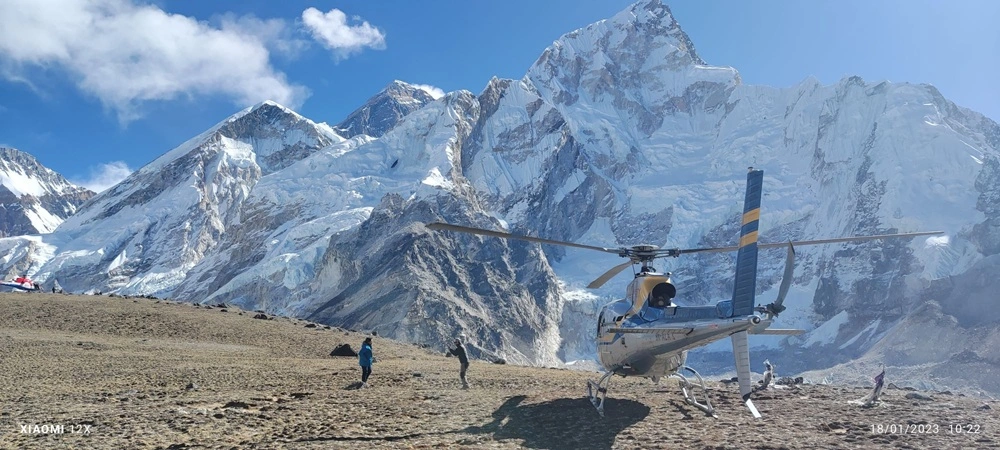
The Gorak Shep landing area at approximately 5,140 meters — the highest helicopter landing point on the standard EBC tour — sits on a flat glacial sand plain between the Khumbu Glacier and the rocky moraine that separates the glacier from the approach trail. From this extraordinary vantage point, the South Col of Everest is directly visible above the Western Cwm, with the Lhotse face rising to the right and Nuptse’s great ridge dominating the skyline to the left. The Khumbu Icefall — the famously dangerous section of glacier that expedition climbers must navigate to reach Camp I on the South Col route — is visible below the Western Cwm, its chaotic towers of ice and crossing ladders visible from the Gorak Shep area as a dramatic white cascade descending from the upper glacier. For many visitors, this first direct view of the Everest climbing route — seeing the actual line of the world’s most attempted mountain summit — is the most affecting visual experience of the entire helicopter tour.
Everest Base Camp itself — the flat moraine area at approximately 5,364 meters where expedition teams establish their seasonal camps — is a 20 to 30 minute walk from the Gorak Shep landing area, accessible on foot during the helicopter landing stop. In the pre-monsoon climbing season (March to May), Base Camp is populated with expedition tents, team mess tents, communication equipment, and the full infrastructure of multiple international expeditions simultaneously preparing for summit bids — a genuinely extraordinary human scene in one of the world’s most extreme environments. Post-monsoon (September to November), Base Camp is typically cleared, but the landscape itself—the moraine, the glacier, the icefall, and the mountain walls—remains fully present and accessible. The Kathmandu-to-Lukla flight plus the full Everest Base Camp Trek takes 12 to 14 days to reach the same point the helicopter reaches in under an hour— a comparison that underscores the extraordinary logistical compression the helicopter tour represents.
Kalapathar — The Finest Everest Viewpoint
While the EBC helicopter tour’s primary landing is at Gorak Shep, some operators offer a Kalapathar flyover or landing option — the 5,545 m rocky peak above Gorak Shep, widely regarded as the finest accessible viewpoint of Mount Everest’s complete south face. From Kalapathar, Everest’s famous South Summit, the Hillary Step (now the Hillary Headwall after its restructuring in 2015), and the Summit Pyramid are all visible in a composition that shows the complete climbing route from Base Camp to the summit in a single dramatic aerial perspective. The Kalapathar viewpoint is also the location most commonly used for the extraordinary photograph of Everest and its neighboring peaks against the deep blue high-altitude sky that defines the classic Everest photography aesthetic. If your operator offers the Kalapathar extension, it is worth the additional time and cost for the superior Everest viewing perspective it provides.
The Lukla Fuel Stop — A Mountain Airstrip Experience
Most Everest Base Camp helicopter tours from Kathmandu include a refueling stop at Lukla — the famous mountain airstrip at 2,860 meters that serves as the main gateway for the Khumbu trekking region and is consistently rated among the world’s most dramatic commercial airport approaches. The Tenzing-Hillary Airport at Lukla — named after the first Everest summiteers — has a runway of only 527 meters that ends in a steep drop-off at its lower end and a cliff face at its upper end, with a 112-degree gradient that makes each landing and takeoff a dramatic visual spectacle. The helicopter fuel stop at Lukla typically allows 10 to 15 minutes on the ground—enough to observe the airstrip operation, take photographs of the extraordinary mountain setting, and stretch before continuing to EBC. This brief Lukla stop is one of the distinctive experiences of the EBC helicopter tour, offering insight into the Khumbu trekking gateway that most helicopter tour operators treat as a logistics stop but that passengers recognize as one of the tour’s genuine supplementary highlights.
The Annapurna Base Camp Experience From the Air
The Annapurna Sanctuary — Nature’s Amphitheater
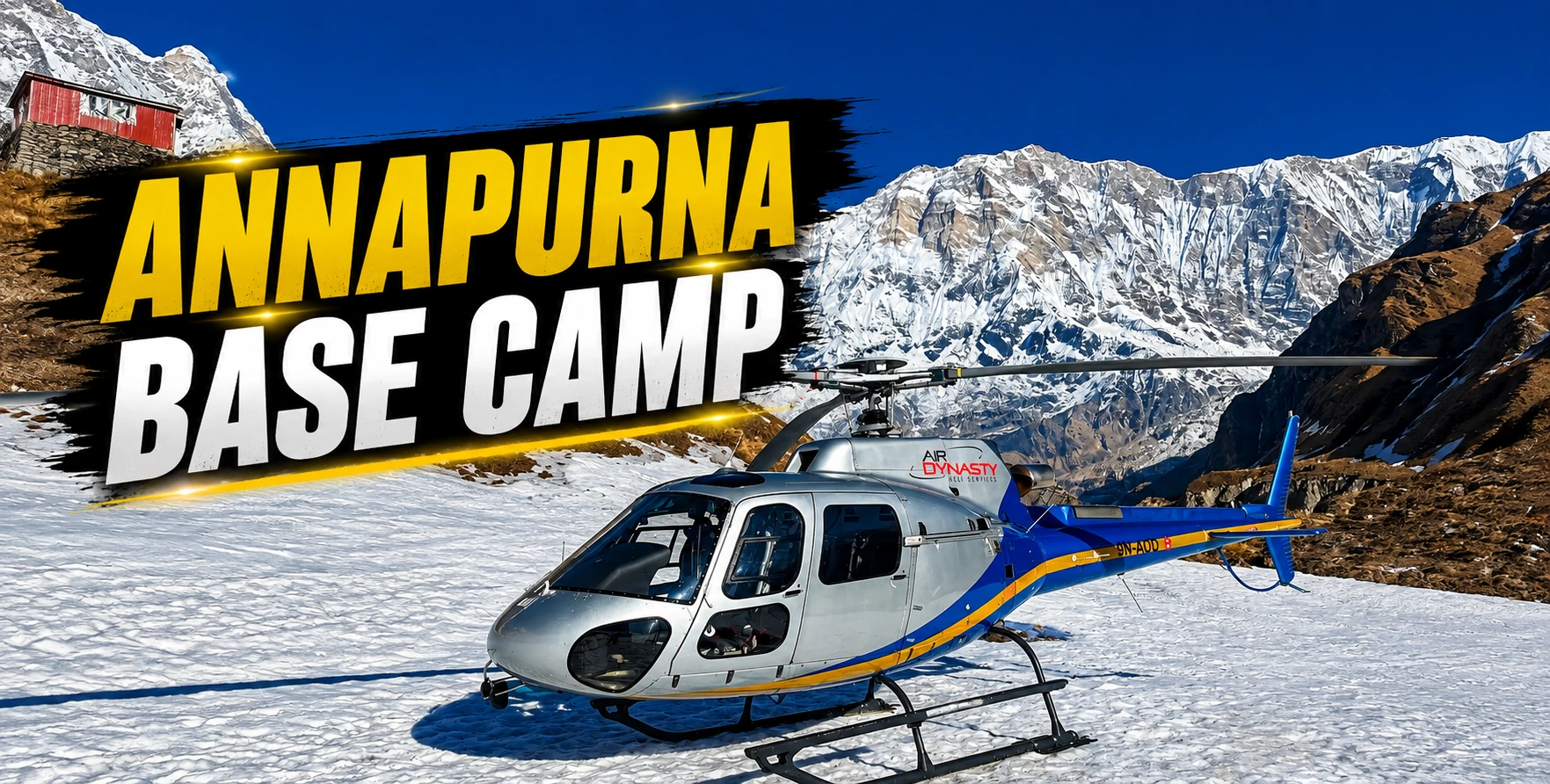
Annapurna Base Camp at 4,130 meters sits within what mountaineers have famously called the Annapurna Sanctuary — a natural high-mountain amphitheater of extraordinary visual drama, created by the circular arrangement of Himalayan peaks that surrounds the upper Modi Khola glacier basin on virtually every compass point. The encircling peaks — Annapurna I at 8,091 m to the north, Annapurna South at 7,219 m and Hiunchuli at 6,441 m to the south, Gangapurna at 7,455 m and Annapurna III at 7,555 m to the northeast, and the incomparable Machhapuchhre (Fishtail Mountain) at 6,993 m guarding the southern entrance to the sanctuary — create a complete circle of Himalayan summits that the helicopter tour sees from directly within, rotating in a 360-degree sweep that the standard ABC Trek approach on foot delivers with the same completeness after 6 to 8 days of walking.
The Machhapuchhre (Fishtail Mountain) visible from the helicopter approach to ABC deserves particular attention—its distinctive twin-peaked summit profile, which appears as a perfectly symmetrical fishtail from PoLakesidelakeside but reveals a complex three-dimensional structure from the helicopter’s aerial perspective. Lakesides around the peak, Fishtail of Nepal’s most distinctive and most photographed mountain forms. The mountain is a sacred peak closed to climbing by the Nepal government since the 1960s — its unsummited fishtail in a landscape where virtually every other major peak has been climbed multiple times gives Machhapuchhre a particular mystique that the helicopter tour approach to ABC — flying directly beneath and around the peak — conveys with extraordinary intimacy.
Ghorepani Poon Hill From the Air
The Ghorepani Poon Hill flyover option available on some Annapurna Base Camp helicopter tours from Pokhara adds a significant cultural and natural dimension to the ABC aerial experience — the famous Poon Hill at 3,210 m, the most popular sunrise viewpoint in the Annapurna Conservation Area, is visible from the helicopter approach corridor between Pokhara and ABC. The rhododendron forests that blanket the Ghorepani ridge in spectacular bloom from March through May are among Nepal’s finest botanical landscapes. The ground-level Ghorepani Poon Hill Trek from Pokhara via Nayapul takes 4 to 5 days — the helicopter flyover compresses the entire trek’s approach into a few minutes of aerial perspective that many travelers find inspires them to return to Nepal specifically to walk the route they saw from above.

Ground Transport Packages Around Nepal Helicopter Tours
The Complete Nepal Tour Package with Nepal Vehicle Hiring
Nepal Vehicle Hiring Pvt. Ltd. provides ground transport for the complete Nepal journey that surrounds the helicopter tour experience — from the first day’s airport pickup through the Kathmandu sightseeing circuit covering Boudhanath, Pashupatinath, Swayambhunath and Patan, the early morning Nagarkot sunrise tour, the Bhaktapur Durbar Square day tour, and then the helicopter departure day’s hotel-to-airport transfer. After the helicopter tour returns, the same Nepal Vehicle Hiring Pvt. Ltd. team provides the Kathmandu to Pokhara private transfer (if the itinerary continues to Pokhara), the Pokhara car hire for the Sarangkot sunrise and Lakeside sightseeing, and any trekking trailhead transfers — to Besisahar for the Annapurna Circuit, to Syabrubesi for the Langtang Valley Trek, or to Arughat for the Manaslu Circuit. All services through a single trusted provider, coordinated via WhatsApp at +977 9851013196, 24 hours a day.
The Nepal Vehicle Hiring Pvt. Ltd. team at vehiclehiringnepal.com can also connect helicopter tour clients with trusted, CAAN-certified helicopter tour operators in Kathmandu and Pokhara when booking ground transport services—providing valuable local knowledge for visitors planning their helicopter tour alongside their Nepal ground itinerary. With 8,000+ satisfied customers, a 5.0 TripAdvisor rating from 200+ verified reviews, and Company Registration No. 219204, Nepal Vehicle Hiring Pvt. Ltd. delivers the most professional, reliable, and transparently priced private vehicle hire service across every Nepal tourism route — from Kathmandu heritage sightseeing to the most remote trekking trailheads in the Himalayan north.
Nepal Helicopter Tour Cost Summary — Quick Reference
Everest Base Camp Helicopter Tour (from Kathmandu): USD 1,150-1,300 per person (group of 5) | USD 1,300-1,500 (group of 4) | USD 4,000-5,500 (solo)
Everest Sunrise Helicopter Tour (from Kathmandu): USD 1,300-1,700 per person (group of 4-5) | 10-20% premium over standard EBC rate
Annapurna Base Camp Helicopter Tour (from Pokhara): USD 600-850 per person (group of 4-5) | USD 2,500-3,200 (solo)
Annapurna Base Camp Helicopter Tour (from Kathmandu): USD 900-1,200 per person (group of 4-5)
Gosaikunda and Langtang Valley Helicopter Tour (from Kathmandu): USD 900-1,100 per person (group of 4) | USD 1,300 (group of 2) | USD 2,500 (solo)
Muktinath/Mustang Helicopter Tour (from Pokhara): USD 800-1,100 per person (group of 4-5) | USD 2,800-3,500 (solo)
Upper Mustang (Lo Manthang) Helicopter Tour (from Pokhara): USD 1,100-1,500 per person (group of 4-5) + USD 500 Upper Mustang restricted area permit
Manaslu/Tsum Valley Helicopter Tour (from Kathmandu): USD 2,500-3,500 per person (group of 4) | Specialist/private charter route
All ground transport surrounding Nepal helicopter tours — hotel to helipad transfers, Kathmandu sightseeing tours, Bhaktapur day trips, Nagarkot sunrise, trekking trailhead transfers — contact Nepal Vehicle Hiring Pvt. Ltd. at +977 9851013196 or vehiclehiringnepal.com.
Frequently Asked Questions — Nepal Helicopter Tour Costs
What is the cheapest Nepal helicopter tour?
The Annapurna Base Camp helicopter tour from Pokhara is the most affordable major Nepal helicopter tour — approximately USD 600 to 850 per person for a group of four to five. The Gosaikunda and Langtang Valley helicopter tour from Kathmandu is similarly priced at USD 900 to 1,100 per person for a group of four. The most expensive is the solo private charter Everest Base Camp tour at USD 4,000 to 5,500.
What is included in the Nepal helicopter tour price?
Standard inclusions typically cover the helicopter charter, national park permit, landing fees, one crew member or guide, and basic flight insurance. What is typically NOT included: personal travel insurance (arrange separately — essential), meals beyond the included breakfast at landing sites, personal photography guides, and hotel-to-helipad ground transport. Nepal Vehicle Hiring Pvt. Ltd. (+977 9851013196) handles the ground transport component for all Nepal helicopter tour routes.
How early should I book a Nepal helicopter tour?
For October and April peak season departures — especially Everest Base Camp and Annapurna Base Camp helicopter tours — book at least two to three weeks in advance to secure your preferred date in a group joining departure. For the quieter months (November, March, May, and September), one week’s booking is typically sufficient. For the Janai Purnima festival period (Gosaikunda tour in July/August), book four to six weeks in advance.
Can I do a helicopter tour in the monsoon season?
Nepal helicopter tours are possible in the monsoon season (June to September) but require flexible date planning and a confirmed cancellation/rescheduling policy with the operator. Most successful monsoon helicopter tours depart very early (5:30 to 6:30 a.m.) to take advantage of the clear morning windows before the day’s moisture builds into cloud. The operator will assess conditions on the morning of the scheduled departure and make the go/no-go decision — a reputable operator will not fly in unsafe conditions regardless of booking pressure.
How long does an Everest Base Camp helicopter tour take?
The Everest Base Camp helicopter tour is a half-day experience — the helicopter departs Kathmandu at approximately 6:30 to 7:00 a.m., lands at Gorak Shep near EBC for 20 to 40 minutes of exploration, and returns to Kathmandu by 10:00 to 11:00 a.m. Total flight time is approximately 2.5 to 3.5 hours,s including the Lukla fuel stop. The afternoon is free for Kathmandu sightseeing tours or other activities.
Conclusion: Nepal Helicopter Tours — Extraordinary Value
Nepal’s one-day helicopter tours represent one of the finest value propositions in adventure tourism globally — delivering Himalayan experiences of extraordinary visual power and physical authenticity at price points that, while not budget travel, are genuinely accessible. From the USD 600 per person Annapurna Base Camp tour from Pokhara to the USD 1,500 per person Everest Base Camp sunrise experience, the Nepal helicopter tour market offers a range of price points and route options that can accommodate most travelers’ budgets and itinerary structures. The key to maximizing value is group size — sharing a helicopter with four to five people reduces per-person costs to the lowest possible level — and operator quality — verifying CAAN certification and pilot experience before booking the mountain flight that defines the Nepal helicopter tour’s safety.
For all ground transport surrounding the Nepal helicopter tour experience — the early morning Kathmandu hotel to airport transfer, the Kathmandu sightseeing tour and Bhaktapur Durbar Square day trip in the days surrounding the flight, the Nagarkot sunrise tour for the first Himalayan panorama, the Kathmandu to Syabrubesi jeep hire for the Langtang trek alternative, the car hire in Pokhara for the Annapurna circuit, and every other Nepal private vehicle hire service — contact Nepal Vehicle Hiring Pvt. Ltd. at +977 9851013196 or vehiclehiringnepal.com.
- Nepal 1-Day Helicopter Tour Cost
- Nepal Helicopter Tour Cost — Quick Reference
- How Nepal Helicopter Tour Pricing Works
- Everest Base Camp Helicopter Tour
- Annapurna Base Camp Helicopter Tour
- Gosaikunda and Langtang Valley Helicopter Tour — Costs
- Mustang Helicopter Tour — Costs
- Manaslu Circuit and Tsum Valley Helicopter Tour — Costs
- What Is Typically Included — And What Is Not
- Best Season for Nepal Helicopter Tours
- Ground Transport Before and After the Helicopter Tour
- How to Book a Nepal Helicopter Tour — Step by Step
- Helicopter Tour Safety in Nepal — What Every Traveler Must Know
- Combining Nepal Helicopter Tours with Heritage Tourism
- The Everest Base Camp Helicopter Tour — A Deeper Look
- The Annapurna Base Camp Experience From the Air
- Ground Transport Packages Around Nepal Helicopter Tours
- Nepal Helicopter Tour Cost Summary — Quick Reference
- Frequently Asked Questions — Nepal Helicopter Tour Costs
- Conclusion: Nepal Helicopter Tours — Extraordinary Value

Related Blog & Articles
Everest Base Camp Helicopter Tour One Day

Annapurna Base Camp Helicopter Tour
Gosaikunda Lake Helicopter Tour