Plan a Trip


Tiji Festival
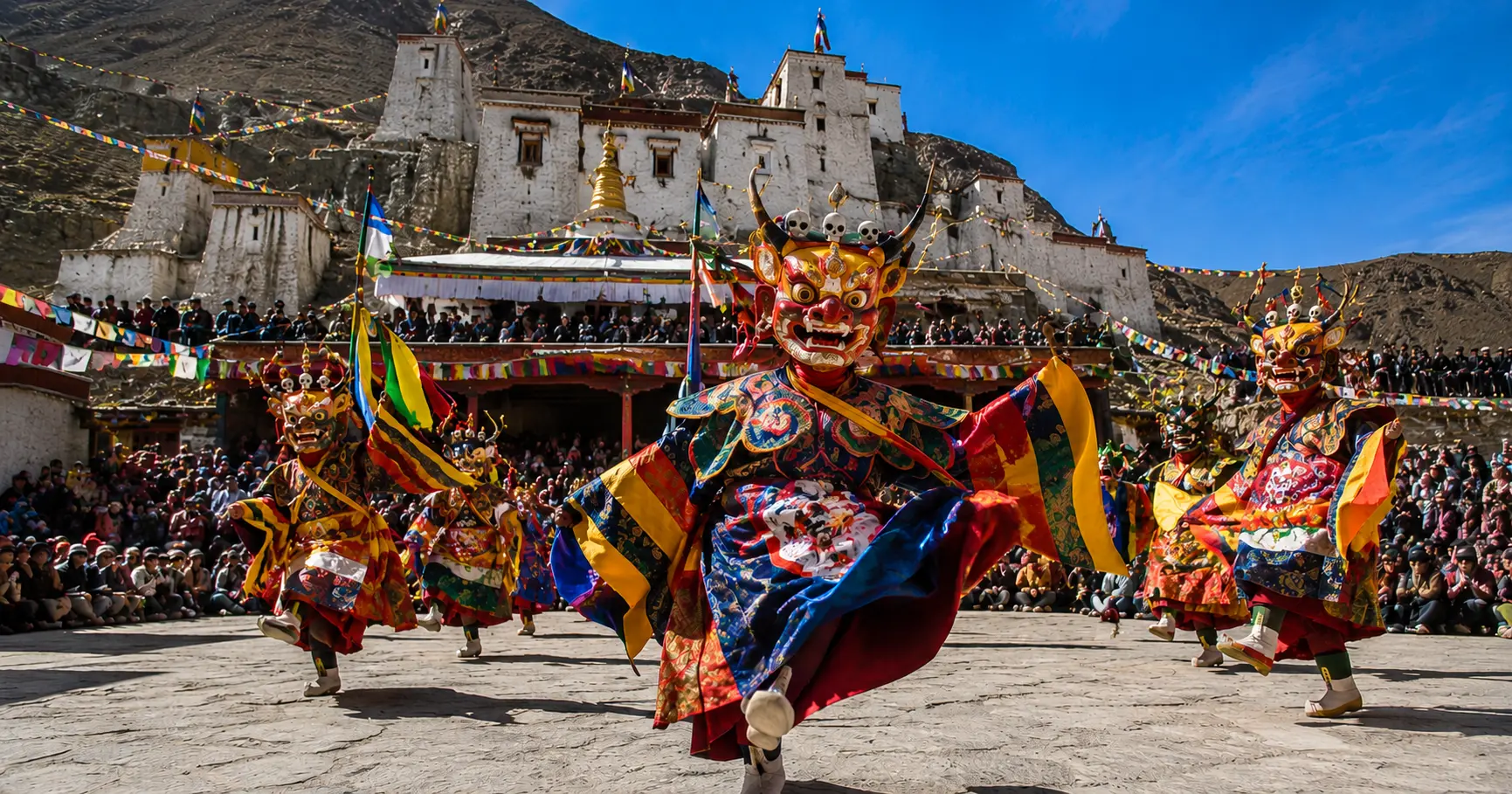
Tiji Festival Upper Mustang: The Grand Celebration of Upper Mustang
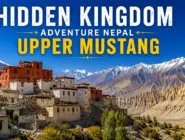
Somewhere in the high-altitude rain-shadow desert of northern Nepal, beyond the wind-scoured gorges of the Kali Gandaki and past the last checkpoint at Kagbeni, lies a walled city that time seems to have forgotten. Lo Manthang, the ancient capital of Upper Mustang, sits at 3,840 meters, surrounded by ochre cliffs and empty plateaus that stretch toward Tibet. For most of the year, the city goes about its unhurried rhythms — monks chanting in centuries-old monasteries, farmers tending their barley fields in the short agricultural window, horses grazing on sparse highland grass. But every May, when the third month of the Tibetan lunar calendar arrives, Lo Manthang transforms into one of the most extraordinary festival grounds on the planet.
This is the time of the Tiji Festival — three days of masked dances, sacred rituals, thundering ceremonial horns, and deep communal prayer that draw visitors from every corner of the world. Formally known as Tempa Chirim, which translates to “Prayer for World Peace” in the local Lo-pa dialect, the Tiji Festival is one of the most visually spectacular and spiritually profound events in the Himalayan Buddhist world. It is also one of the most inaccessible — and that inaccessibility is precisely what makes it so unforgettable.
If you have ever wanted to witness a living tradition that has remained essentially unchanged for over three centuries, performed in a setting that looks like something from the pages of an ancient manuscript, the Tiji Festival in Upper Mustang is your answer. This guide covers everything you need — the history, the mythology, the day-by-day festival rituals, the permits, the best travel routes, and how Nepal Vehicle Hiring Pvt. Ltd. can handle your complete transport from Kathmandu or Pokhara so that you arrive comfortably and on time for every moment of the celebration.
What Is the Tiji Festival? Origins and Meaning
The word Tiji is a contraction — an abbreviated form of Tenchi or Tempa Chirim, meaning Prayer for World Peace. The festival has roots in the Vajrakila ritual tradition, a tantric Buddhist practice that originated in 8th-century India and was introduced to Tibet and the Himalayan kingdoms by Padmasambhava—the revered tantric master also known as Guru Rinpoche. Padmasambhava is credited with bringing Buddhism to Tibet, Bhutan, and Nepal’s mountain kingdoms, and the Vajrakila ceremony he transmitted became the spiritual backbone of what we now know as the Tiji Festival.
The festival’s formal codification in its current form dates to the 17th century. Historical documents suggest that around 1650 AD, King Samadup Rabten of Mustang invited a senior Sakya lama — Trijin Ngawang Kunga, also written as Sakya Trizin Ngawang Kunga Sonam — to Lo Manthang to perform the Vajrakila ritual. The ceremony took place at Chode Gompa, the main monastery of Lo Manthang, over three days. It aimed to purify the land, drive away evil forces, and restore peace and prosperity to the kingdom. The monks of Chode Gompa have maintained the tradition every year since then, a continuous thread of devotion stretching across more than three and a half centuries.
The Myth at the Heart of the Festival
The Tiji Festival enacts the dramatic legend of Dorje Jono, a deity and incarnation of Vajrakumara (Vajrakila), said to be the son of a demon king named Ma Tam Ru Ta. The demon was a vicious creature who caused terrible suffering in the kingdom of Mustang — unleashing storms, droughts, and disease that left the people desperate and the land barren. Guided by Guru Padmasambhava, Dorje Jono decided to confront his own father and engage him in a cosmic battle between good and evil. Despite the horror of fighting a parent, Dorje Jono ultimately defeated the demon, banished him to the realm of enlightenment, and restored peace, rainfall, and prosperity to Upper Mustang.
This myth — the sacrifice of a son to save his people, the triumph of compassion over destruction — is not merely told during the Tiji Festival. It is performed. Through three days of elaborate masked dances, chants, and ritual ceremonies, the monks of Chode Monastery bring Dorje Jono’s story to life in the courtyard of the Tashi Gephel Palace, the royal palace of Lo Manthang. Every step, every costume, every drum beat carries meaning accumulated over generations. Witnessing it is not like watching a performance; it is like standing inside a living scripture.
Tiji Festival Dates: When Does It Take Place?
The Tiji Festival follows the Tibetan lunar calendar, which means the exact Gregorian dates shift from year to year. The celebration always falls in the third month of the Tibetan calendar, which corresponds to May in most years — though in some years it can extend into late April or early June. The three-day event was held from May 24 to May 26 in 2025, and is scheduled for May 13 to May 15 in 2026. For travelers planning, it is always wise to confirm the exact dates through a licensed Nepal travel agency, since official announcements are made according to the lunar calendar months before the event.
May is also one of the finest months to travel in Upper Mustang. The region sits in the rain shadow of the Annapurna and Dhaulagiri ranges, which means it receives very little monsoon rainfall even when the rest of Nepal is drenched. Spring brings clear skies, manageable temperatures during the day, and some of the best photographic light of the year — making the Tiji Festival not just a cultural experience but a landscape photographer’s dream.
Planning your visit around the Tiji Festival means committing to one of Nepal’s most logistically detailed journeys. Upper Mustang requires restricted area permits, a licensed guide, and either a multi-day drive or a flight combination. None of this should discourage you — it is entirely manageable with the right team behind you. Our Kathmandu to Mustang private jeep service handles every detail of this journey from the moment you arrive in Kathmandu.
The Three Days of the Tiji Festival: A Day-by-Day Guide
Day One: The Tsa Chham — Invoking the Cosmic Battle
The first day of the Tiji Festival begins at noon in the courtyard of Tashi Gephel Palace. The atmosphere is electric — the courtyard fills with monks, locals, and visitors, and the scent of burning incense drifts across the high-altitude air. The day’s central performance is the Tsa Chham dance, which translates as the Dance of the Thunderbolt. The lead dancer, known as the Tsowo, wears an elaborate costume and a fearsome mask representing Dorje Jono. Accompanying monks wear masks depicting various incarnations of Lord Buddha, animal deities, and protective spirits. The performance illustrates the initial confrontation between Dorje Jono and the demon Ma Tam Ru Ta — the moment when the son decides to act, despite the weight of that decision.
The Tsowo is not simply a dancer; he is a ritual practitioner who must undergo a three-month meditation retreat before the festival. He must also master the 52 distinct steps of the Tsacham dance, passed down through the lineage of Chode Monastery for centuries. The musical accompaniment includes large ceremonial horns, drums, cymbals, and oboe-like instruments that produce a sound unlike anything heard outside the monastery. The first day ends at sundown, the battle engaged but not yet resolved, and the monks retire to the monastery for night prayers.
Day Two: The Nga Chham — The Birth and Struggle
The second day carries a more contemplative mood. The locals of Lo Manthang spend the morning preparing offerings — ritual food, butter lamps, and tormas (sculpted flour offerings) — which are carried to the monks of Chode Monastery. The central performance is the Nga Chham dance, which represents Dorje Jono’s birth as the demon’s son and the intensifying struggle between the forces of destruction and compassion. This day’s dances are longer and more complex, and for photography enthusiasts, the afternoon light falling on the elaborately masked dancers against the whitewashed palace walls is perhaps the finest moment of the entire festival.
The second day also features moments of deep community participation. Older residents of Lo Manthang, many of whom have attended the Tiji Festival every year of their lives, sit in the outer areas of the courtyard murmuring prayers. Children watch wide-eyed from elevated perches on surrounding rooftops. Butter tea and local barley wine circulate among the gathered community. For a foreign visitor, this is not merely a spectacle—it is an invitation to observe a community engaged in something genuinely sacred, a ritual the local people believe directly ensures the wellbeing of their land and families for the coming year.
Day Three: Victory, Tsampa, and the Procession
The third day is the culmination, and it begins before dawn. Morning prayers in Chode Monastery fill the air with deep, resonant chanting. In the afternoon, the lead ritual dancer performs a final nectar offering — a ceremonial invocation that symbolizes Dorje Jono’s ultimate victory over his demon father. Additional monks in animal masks dance around the offering, and a tsampa effigy — a figure made of roasted barley flour representing the demon Ma Tam Ru Ta — is brought out. The effigy is ritually destroyed, signifying the defeat of evil and the restoration of peace to Mustang.
The festival concludes with a grand procession led by the masked dancers, followed by the King of Mustang and members of the royal family — even though Nepal’s monarchy was officially dissolved in 2008, the Lo Manthang royal family remains deeply respected in Upper Mustang and leads the Tiji Festival procession every year. The procession winds through the narrow alleys of Lo Manthang before ascending to the palace rooftop, where tsampa is thrown into the air as an offering to the gods. The King and the head monk (Khempo) exchange formal greetings. Another year of Tiji is complete. The kingdom, by the faith of its people and the devotion of its monks, has been secured for one more cycle.
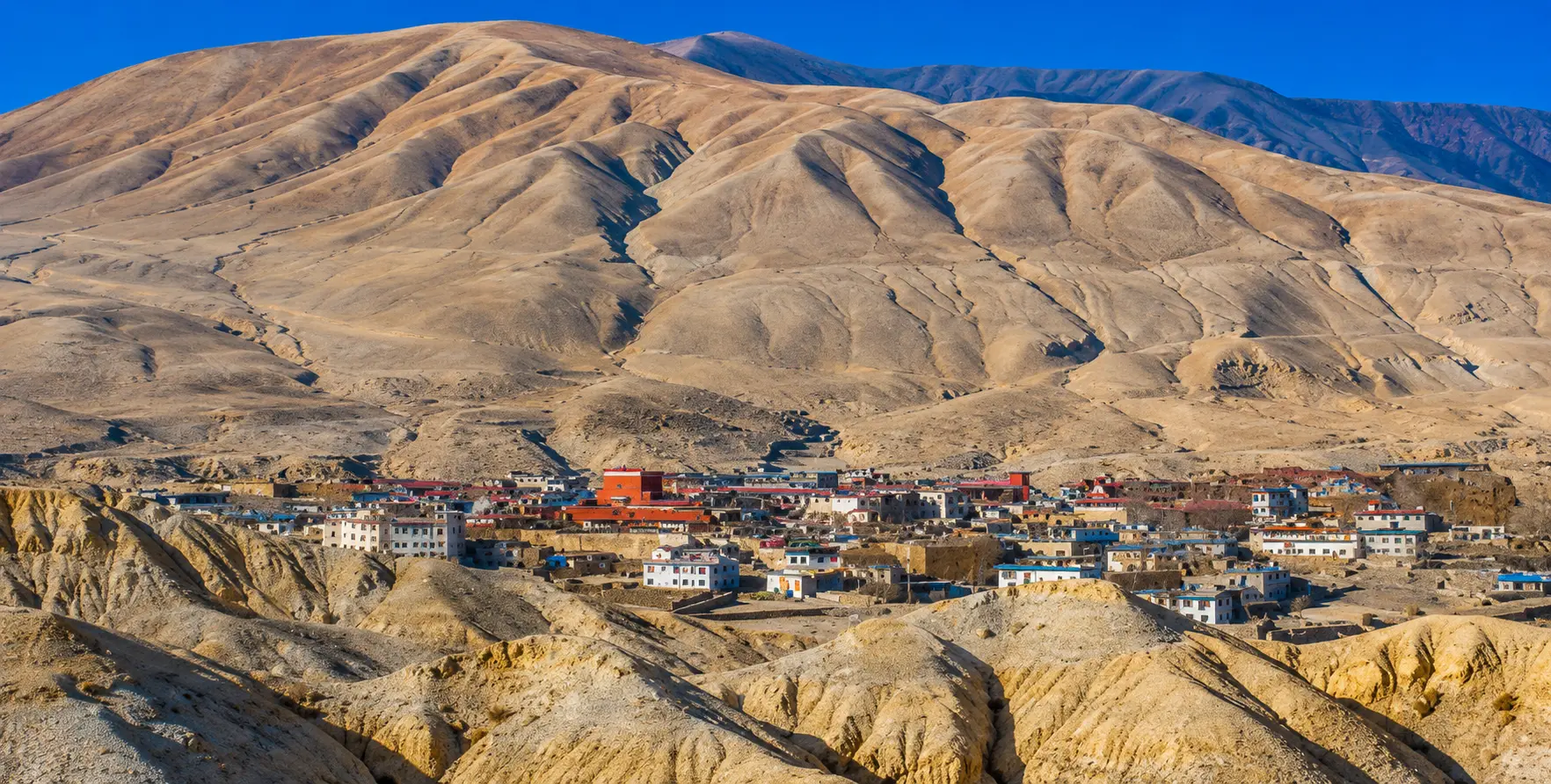
Lo Manthang: The Walled City at the Heart of the Festival
The Tiji Festival cannot be understood apart from the place where it is held. Lo Manthang is one of the most remarkable settlements in all of Nepal — arguably in all of Asia. Founded in 1380 by the warrior king Ame Pal, the city is encircled by high mud-brick walls that have stood for over six centuries. Inside those walls, whitewashed houses crowd together along narrow lanes, monasteries house priceless murals and scriptures, and the five-story royal palace of the King of Lo rises above everything else.
The city’s isolation has been its greatest preservative force. Located at 3,840 meters in a high-altitude desert that borders the Tibetan Plateau, Lo Manthang was cut off from the outside world for much of its history. When Nepal opened Upper Mustang to foreign tourists in 1992, visitors discovered a place where Tibetan culture, language, architecture, and religious practice had survived essentially intact — something that could not be said of Tibet itself after decades of cultural disruption. The Dalai Lama has famously observed that authentic Tibetan culture survives only in exile, in places like Mustang.
The main monasteries of Lo Manthang — Thubchen Gompa, Chode Gompa, and Jampa Lhakhang — contain some of the finest Buddhist art in the Himalayan world. Thubchen houses enormous clay sculptures and ancient thangka paintings. Chode is the monastery of the Tiji Festival itself, home to the monks who perform the Vajrakila ceremonies. Jampa Lhakhang, dedicated to Maitreya Buddha, is one of the city’s oldest structures. Walking between these three buildings on the quiet days before the festival begins, as the city prepares and the air smells of incense and roasting barley, is a deeply moving experience.
Beyond Lo Manthang: Sights Worth Adding to Your Journey
Upper Mustang offers far more than the festival itself. Travelers who arrive a few days early or linger after the ceremony ends have the chance to explore one of the most singular landscapes in the world. The Chosar Caves, located near the Tibetan border, are a series of ancient sky caves carved into red cliffs that once served as meditation retreats, granaries, and possibly burial sites. Some of the caves date back more than 2,000 years and are accessible only by ladder — a scramble that rewards the effort with extraordinary views across the plateau.
The village of Tsarang (Charang) lies about 45 minutes by jeep south of Lo Manthang. It features one of Mustang’s most dramatically sited monasteries — Thupten Shedrup Monastery, built in 1385 AD on the edge of the Kali Gandaki gorge. The ruins of the old palace of the Raja of Tsarang stand on a nearby hilltop, offering sweeping views across the valley. Further south, Ghar Gompa (Lo Gekar Monastery) — dating back about 1,200 years — is considered one of Nepal’s oldest monasteries and houses remarkable early Buddhist imagery. For those with extra days, the 4WD journey to these sites is worth every kilometer of rough road.
Muktinath, the sacred pilgrimage site revered by both Hindus and Buddhists, lies on the return route between Upper Mustang and Pokhara. The temple complex features 108 water spouts and an eternal flame fuelled by natural gas seeping through water—a combination pilgrims consider miraculous. If you are traveling with Nepal Vehicle Hiring, you can combine our Muktinath Yatra itinerary with the Tiji Festival trip into a single, seamless journey.
Permits for Upper Mustang: Everything You Need to Know in 2025 and 2026
Upper Mustang is one of Nepal’s classified restricted areas, and visiting it requires a specific set of permits that you can’t obtain independently—they must be arranged through a licensed trekking or tour agency registered with the Nepal Tourism Board. Understanding the permit system is essential before you begin planning.
The Restricted Area Permit (RAP)
The Restricted Area Permit (RAP) is the primary document you need to enter Upper Mustang — specifically, the zone north of Kagbeni village. In late 2025, the Government of Nepal made a landmark change to the permit fee structure. The old system required a flat fee of USD 500 per person for 10 days regardless of how long you actually stayed. The new system, confirmed by cabinet decree, charges USD 50 per person per day for the exact number of days spent inside the restricted zone. This means a 5-day visit now costs USD 250 per person, and a 3-day visit to attend the Tiji Festival costs USD 150 per person — a far more flexible and fair arrangement that has significantly boosted the appeal of shorter visits to Upper Mustang.
The Annapurna Conservation Area Permit (ACAP)
The ACAP is required for the entire Annapurna Conservation Area, which encompasses Upper Mustang. It costs NPR 3,000 (approximately USD 22–25) per person and has no daily limit — you pay it once for the duration of your visit. The ACAP is separate from the RAP and must be obtained in addition to it. Both permits are checked at multiple checkpoints along the route to Lo Manthang, so you must carry them at all times.
Mandatory Guide and Agency Requirements
All foreign visitors to Upper Mustang must travel with a licensed, government-registered guide and through a registered Nepal trekking or tour agency. No exceptions apply. The RAP cannot be processed without agency involvement, and checkpoints will not allow entry without the permit documents. Since March 2026, the minimum group size requirement has been reduced—solo foreign travelers can now visit Upper Mustang as long as they have a licensed guide, making the destination more accessible than ever for individual adventurers.
When you book transport through Nepal Vehicle Hiring Pvt. Ltd., we coordinate with our partner licensed agencies to process your RAP and ACAP permits in advance in Kathmandu, so there are no surprises at the checkpoints and your festival schedule isn’t disrupted.
How to Get to the Tiji Festival: Transport Routes from Kathmandu and Pokhara
Getting to Lo Manthang for the Tiji Festival is one of Asia’s great overland adventures. Several approaches work, depending on your schedule, budget, and appetite for road travel, and Nepal Vehicle Hiring offers transport solutions for every option.
Route 1: Kathmandu to Lo Manthang by Private Jeep (Full Overland)
The total road distance from Kathmandu to Lo Manthang is approximately 411 kilometers. In ideal conditions, the full drive takes around 18 hours — which is why it is always broken across multiple days. The standard overland itinerary runs Kathmandu to Pokhara on day one (about 200 km, 6–8 hours on the Prithvi Highway), Pokhara to Jomsom or Kagbeni on day two (passing through Beni and up the Kali Gandaki gorge, about 155 km, 7–8 hours on a progressively rougher road), and Kagbeni to Lo Manthang on day three (61 km, but 4–5 hours due to rough off-road conditions). The total experience, including overnight stops and acclimatization time, typically spans 3 to 4 days of driving in each direction.
This route requires a 4WD vehicle—the roads beyond Kagbeni are narrow, steep, and unpaved, with river crossings and sharp switchbacks that are unsuitable for regular cars or buses. Our 4WD hire fleet in Nepal includes well-maintained Mahindra Scorpio and Land Cruiser options, driven by experienced mountain-road drivers who know every stretch of this route. If you are traveling as a group of 8 or more, our Hiace van hire can handle Kathmandu to Pokhara and Pokhara to Jomsom sections comfortably, with the jeep taking over beyond Kagbeni.
For travelers joining from Kathmandu, check our dedicated Kathmandu to Mustang private jeep service for pricing, availability, and itinerary options.
Route 2: Fly Kathmandu to Pokhara, Then Drive to Lo Manthang
Many festival-bound travelers choose to fly from Kathmandu to Pokhara — a 25–30 minute domestic flight — and then begin the overland journey from Pokhara. This saves a full day of driving and gets you to Pokhara rested and ready for the mountain roads ahead. The jeep ride from Pokhara to Lo Manthang takes about 2 to 3 days and covers roughly 400–450 km via Beni, Tatopani, Jomsom, and Kagbeni.
Our Pokhara to Mustang jeep service is the perfect companion for this approach. We arrange pick-up from your Pokhara hotel and handle the complete drive to Lo Manthang, with experienced drivers and support throughout the journey.
Route 3: Fly Pokhara to Jomsom, Then Jeep to Lo Manthang
The fastest way to reach Upper Mustang is to fly from Pokhara to Jomsom — a 20-minute mountain flight through the Kali Gandaki gorge that offers incredible aerial views of the Dhaulagiri and Annapurna ranges. From Jomsom, a jeep drive of approximately 4–5 hours covers the 61 km to Lo Manthang via Kagbeni, Chele, Syangboche, Ghami, and Tsarang. This option is ideal for travelers with limited time who want to arrive in Lo Manthang with minimum travel fatigue, ready for the first day of the Tiji Festival.
The Jomsom to Lo Manthang jeep section is the most demanding stretch of road on the entire journey — a rough, high-altitude track that climbs through arid desert plateaus and deep gorges. Acclimatization is important here; travelers who fly directly from Pokhara to Jomsom and then immediately drive to Lo Manthang should allow at least a day in Jomsom or Kagbeni to adjust to the elevation before ascending further.
Getting From Kathmandu to Pokhara for Your Onward Journey
Regardless of which onward route you choose to Upper Mustang, the journey begins in Kathmandu. If you prefer the scenic overland option, our Kathmandu to Pokhara bus service is comfortable and reliable. For groups or families wanting more privacy and flexibility, our fleet of cars and sedans handles the Kathmandu–Pokhara leg smoothly on the well-maintained Prithvi Highway. If your group is large enough to need a mid-size van, our Hiace van service provides excellent comfort for this 6–8 hour drive.
For international travelers arriving at Tribhuvan International Airport for the first time, we offer a seamless Kathmandu airport transfer service that gets you from the arrivals hall to your Thamel hotel in comfort, giving you maximum rest before the adventure begins. If you have a day in Kathmandu before departing for Mustang, consider adding a Kathmandu sightseeing tour — our vehicles and guides can show you Pashupatinath, Boudhanath, Swayambhunath, and the Kathmandu Durbar Square in a single day.
Best Time to Visit Upper Mustang and the Tiji Festival
May, when the Tiji Festival takes place, is one of the best times to visit Upper Mustang. Because the region lies in the rain shadow of the Annapurna and Dhaulagiri ranges, the monsoon — which paralyzes much of Nepal from June to September — barely touches Mustang. The plateau stays dry and accessible even during the wet season, but May offers something extra: clear skies before the monsoon haze builds, wildflowers on the lower valley slopes, fresh green in the fields around Lo Manthang, and cool, pleasant daytime temperatures at altitude.
Spring—roughly March through May—is generally considered the best overall time to visit Upper Mustang, combining manageable weather with the extraordinary cultural bonus of the Tiji Festival in May. Autumn, from September to November, is the second-best window: clear skies return after the monsoon, the harvest is complete, and the plateau landscape takes on warm golden tones. Winter visits (December to February) are possible but challenging — the high passes can be blocked, temperatures at Lo Manthang drop to as low as minus 25 degrees Celsius, and many facilities operate at reduced capacity.
For most international travelers, the Tiji Festival window in May is the single most compelling reason to visit Upper Mustang, and building your Nepal trip around those specific three days in Lo Manthang is entirely worthwhile. Nepal Vehicle Hiring recommends departing Kathmandu or Pokhara at least 3–4 days before the festival begins, to allow for the overland drive, permit registration, and a day of rest and exploration in Lo Manthang before the ceremonies start.
What to Expect During Your Stay in Lo Manthang
Accommodation in Lo Manthang
Lo Manthang has a growing number of guesthouses and small hotels for festival visitors. Standards range from very basic rooms with shared facilities to reasonably comfortable lodges with attached bathrooms, hot showers, and western-style toilets. Expect to pay around USD 10–15 per person per night at the simpler places, with better-equipped lodges charging USD 20–35. Demand is extremely high during the Tiji Festival window — rooms book out months in advance, and traveling without a reservation is a serious risk. Any reputable tour agency or vehicle hire company arranging your trip should include accommodation booking.
Food and Drink in Lo Manthang
Food in Lo Manthang is hearty, warming, and surprisingly varied given the location’s remoteness. Dal bhat — the Nepali staple of lentil soup with rice and vegetable curry — is available everywhere and is a reliable, nutritious choice at altitude. Tibetan staples like thukpa (noodle soup), thenthuk (hand-pulled noodle soup), and momos (steamed dumplings) are widely served and reflect the area’s cultural ties to Tibet. Local dishes made with buckwheat and barley are worth seeking out. Butter tea, made with yak butter, salt, and strong tea, is the traditional drink of the region — an acquired taste for many visitors, but excellent for staying warm and hydrated at altitude. Bottled water is available in Lo Manthang but carries a high environmental cost at this distance from supply chains; a water purification system or purification tablets are recommended.
Altitude and Health Considerations
Lo Manthang sits at 3,840 meters — well above the altitude at which some people begin to feel the effects of Acute Mountain Sickness (AMS). Symptoms can include headache, nausea, dizziness, fatigue, and disturbed sleep. The most important thing you can do is ascend gradually. Whether you are driving from Jomsom or trekking from Kagbeni, take the journey in stages and allow at least a full day of acclimatization before the festival begins. Stay well hydrated, avoid alcohol during the first 48 hours at high altitude, and listen to your body. If symptoms are severe, descending is the only reliable remedy. Diamox (acetazolamide) can be used preventively, but discuss it with a doctor before travel.
Travelers with pre-existing heart or respiratory conditions should seek medical advice before planning any trip above 3,000 meters, and particularly before considering a journey to Lo Manthang.
Photography During the Tiji Festival
The Tiji Festival is a photographer’s paradise. The combination of vivid masked dancers in colorful costumes, the ochre-and-white architecture of Lo Manthang’s palace courtyard, and the dramatic Himalayan light that characterizes the high desert plateau creates images of extraordinary power. Bring more memory cards than you think you will need, a long lens for close-up work on the dancers, and a wide-angle lens for capturing the courtyard scene. During the first and third days of the festival, the afternoon light is particularly good. Respect for the ritual space is essential — stay outside the main performance area, be unobtrusive, and follow your local guide’s guidance on where photography is and isn’t appropriate. The monks and locals are generally welcoming of respectful photography, but the ceremony itself is sacred and should be treated as such.
Trekking to the Tiji Festival vs. Jeep Tour: Which Is Right for You?
One of the most common questions for first-time Mustang visitors is whether to trek to Lo Manthang or travel by jeep. Both approaches have real merits, and the right choice depends on your time, fitness level, and the kind of experience you want.
The Case for Trekking
Trekking to Lo Manthang via the classic route — Jomsom to Kagbeni to Chele to Syangboche to Ghami to Tsarang and finally to Lo Manthang — takes approximately 5 to 7 days one way, covering 125 to 160 kilometers depending on your exact route and pace. The trek is rated as moderate, with no passes exceeding 4,000 meters, and is accessible to reasonably fit walkers without technical mountaineering experience. The rewards are extraordinary: you pass through some of the most dramatically eroded landscapes on Earth, with red-and-ochre cliffs, ancient walled villages, sky caves carved into cliffsides, and the deep silence of the rain-shadow plateau. Villages like Ghami, Tsarang, and Kagbeni each carry their own character and history, and the slow pace of trekking allows deep engagement with the landscape and the people who live in it.
If you have three weeks available for your Nepal visit and are in good physical condition, trekking to the Tiji Festival is the definitive immersive experience. Nepal Vehicle Hiring can arrange a vehicle to pick you up in Pokhara or Kathmandu at the start of your journey, drive you to Beni or Nayapul as your trekking start point, and wait for you in Jomsom or Pokhara when you come back down.
The Case for the Jeep Tour
For travelers with 10 to 14 days available, the jeep tour to Lo Manthang is not a compromise — it is a distinct adventure in its own right. Driving through the Kali Gandaki gorge, the world’s deepest gorge, and then ascending the dirt roads into the high Mustang plateau is a visceral, exhilarating experience. You still pass through all the major villages, but at a pace that allows multiple stops and day excursions rather than daily forced marches. The jeep also offers flexibility—if weather closes a road section, a good driver can find alternatives; if you want to spend longer in Tsarang, you can.)
Jeep tours have become increasingly popular since the new per-day permit fee structure took effect, making shorter visits significantly more affordable. For families, older travelers, those with limited time, or anyone who wants to prioritize the Tiji Festival itself over the journey, the jeep tour is the ideal choice. Our Kathmandu to Mustang private jeep and Pokhara to Mustang jeep services include experienced mountain drivers, comfortable 4WD vehicles with good ground clearance, and full logistical support throughout the journey.
Cultural Sensitivity and Responsible Tourism at the Tiji Festival
The Tiji Festival is a sacred religious ceremony, not a tourist show. The people of Lo Manthang celebrate it because they sincerely believe that the Vajrakila ritual performed by the monks of Chode Monastery ensures the wellbeing of their community for the coming year. Foreign visitors are welcomed at the festival, but that welcome comes with responsibilities.
Dress modestly — the high altitude means you will be in warm layers anyway, but avoid shorts or exposed shoulders in monastery precincts. Remove footwear before entering monastery buildings. Do not walk in front of praying monks or ritual performers. Do not touch the sacred objects, costumes, or masks. Ask your guide before photographing individuals, particularly monks or older residents. Keep noise to a minimum during the ritual chanting. Do not bring alcohol into the performance area. If you are given butter tea or food during the festival, accept it gracefully — refusing an offering can be seen as disrespectful, though a polite decline will always be understood by residents accustomed to foreign visitors.
Upper Mustang’s ecosystem is fragile, and its cultural sites are irreplaceable. Carry out all your rubbish, stay on established paths when exploring the landscape, and support local guesthouses and tea houses rather than bringing all your own food and supplies from the city. The permit fees you pay — the RAP and ACAP — support local conservation and community development. Still, your day-to-day spending in Lo Manthang matters just as much to the livelihoods of the families who maintain this extraordinary place.
Combining the Tiji Festival with Other Nepal Destinations
Nepal is a country of extraordinary density — you can experience five completely different environments and cultures within a two-week trip, often with just a few hours of driving between them. The Tiji Festival journey lends itself naturally to combination with several of Nepal’s most beloved destinations.
Pokhara: Gateway to the Himalayas
Almost every overland route to Upper Mustang passes through Pokhara, Nepal’s second city and the gateway to the Annapurna region. Whether you arrive by road or by domestic flight, spending a day or two in Pokhara before or after the Mustang journey is highly recommended. The lakeside city offers incredible views of the Annapurna range, the famous Sarangkot sunrise tour — one of the finest sunrise viewpoints in all of Nepal — and a relaxed pace that is perfect for acclimatization before heading to altitude. Our Pokhara to Nayapul transportation service is also useful if you plan to add any day hikes around the Annapurna foothills before continuing north to Mustang.
Annapurna Circuit and Manang
For trekkers with extra time, the Annapurna Circuit passes through Manang—another high-altitude destination with deep Buddhist cultural roots. Combining Manang with Upper Mustang makes for one of Nepal’s most epic itineraries, and our Kathmandu to Manang jeep service and Besisahar private vehicle options provide the logistical backbone for getting in and out of the circuit efficiently.
Kathmandu Valley
Most international travelers will have at least a day in Kathmandu at the start or end of their Nepal journey. The Kathmandu Valley packs an astonishing concentration of UNESCO World Heritage Sites into a small area — Pashupatinath, Boudhanath, Swayambhunath, and the three Durbar Squares of Kathmandu, Patan, and Bhaktapur. Our Bhaktapur Durbar Square day tour is an excellent way to start your Nepal experience, offering a window into the Newari culture and medieval architecture that predates modern Nepal by centuries. For a dawn experience that rivals anything in the world, the Nagarkot sunrise tour—accessible via our Kathmandu to Nagarkot vehicle service—offers a panorama of the central Himalayan range from Dhaulagiri to Kanchenjunga that puts every other mountain view in perspective.
For a fully curated multi-destination Nepal experience that includes the Tiji Festival alongside other highlights, explore our Nepal holiday tour packages and our Nepal tour packages, designed to combine the best of the country in a single seamless journey.
Why Choose Nepal Vehicle Hiring for Your Tiji Festival Journey?
Reaching Lo Manthang for the Tiji Festival is not like booking a taxi to the airport. It is a multi-day overland journey on roads that demand experienced drivers, reliable vehicles, and meticulous planning. Nepal Vehicle Hiring Pvt. Ltd., based in Thamel, Kathmandu, has spent years perfecting this kind of logistics for travelers to Nepal’s most remote destinations.
Our fleet covers every scenario. Solo travelers and couples can arrange a dedicated 4WD jeep hire in Nepal for the complete journey from Kathmandu to Lo Manthang and back. Groups of 8 to 12 can combine a Hiace van hire for the Kathmandu-Pokhara section with a fleet of jeeps for the mountain road. Larger groups—festival tour parties, corporate groups, or extended family pilgrimages—can use our Coaster bus hire and full-size bus services for the low-altitude sections.
Our drivers know the Mustang road. They have navigated it in spring mud, summer dust, post-monsoon washouts, and autumn clarity. They know where to stop for photographs, which guesthouses are reliable, and when to push through versus when to wait out a weather window. You can’t replicate this experience by renting a vehicle independently.
We also work with licensed partner agencies to coordinate your Upper Mustang permits. As a result, we process permits in Kathmandu before you leave, so you arrive at the Kagbeni checkpoint fully documented and ready to proceed.
Ready to start planning? Visit our Plan Your Trip page to submit your requirements, or reach out directly using the contact details below. Our team is available seven days a week to help you design the perfect Tiji Festival journey.
Sample Tiji Festival Jeep Tour Itinerary from Kathmandu (12 Days)
The following is a general sample itinerary for a Tiji Festival jeep tour from Kathmandu. Exact days can be adjusted based on your arrival date and the official festival dates for your travel year.
- Day 1: Arrive in Kathmandu. Airport transfer to Thamel hotel. Permit processing and trip briefing.
- Day 2: Kathmandu sightseeing — Pashupatinath, Boudhanath, Swayambhunath. Early evening departure briefing.
- Day 3: Drive Kathmandu to Pokhara (200 km, 6–8 hours). Evening at leisure on Phewa Lake.
- Day 4: Drive Pokhara to Jomsom (155 km, 7–8 hours via Beni and Tatopani). Overnight in Jomsom for acclimatization.
- Day 5: Drive Jomsom to Kagbeni, permit registration, then continue to Chele or Syangboche. Begin Upper Mustang road.
- Day 6: Drive to Lo Manthang via Ghami and Tsarang. Arrive and settle into a guesthouse. Explore Lo Manthang’s monasteries and palace.
- Day 7: Rest and acclimatization day. Explore Thubchen Gompa, Chode Monastery, Jampa Lhakhang. Visit sky caves and viewpoints.
- Day 8: Tiji Festival Day 1 — Tsa Chham dance, opening ceremonies at Tashi Gephel Palace courtyard.
- Day 9: Tiji Festival Day 2 — Nga Chham dance, community offerings, full day of ritual performances.
- Day 10: Tiji Festival Day 3 — Final ceremonies, tsampa effigy, royal procession. Optional excursion to Chosar Caves.
- Day 11: Drive Lo Manthang to Muktinath via Kagbeni. Visit Muktinath temple (Muktinath Yatra). Overnight Muktinath or Jomsom.
- Day 12: Drive Jomsom to Pokhara. Option to fly Jomsom to Pokhara (20 min) or continue overland. Overnight in Pokhara.
- Optional Day 13: Sarangkot sunrise tour from Pokhara, then drive or fly Pokhara to Kathmandu.
This itinerary can be customized — extended with trekking sections, shortened by using the Pokhara to Jomsom flight, or combined with other Nepal destinations. Contact us through the Plan Your Trip page to discuss your specific requirements.
Frequently Asked Questions About the Tiji Festival
Can anyone attend the Tiji Festival?
Yes. The Tiji Festival is open to foreign visitors. You will need to obtain a Restricted Area Permit and an ACAP permit (arranged through a licensed Nepal agency), and you must travel with a licensed guide. Beyond those requirements, the festival welcomes all respectful visitors.
Is it safe to visit Upper Mustang?
Upper Mustang is considered one of Nepal’s safest trekking and touring destinations. Crime is virtually nonexistent in the region, the people are deeply hospitable, and the main risks are altitude-related rather than security-related. Standard travel precautions and altitude awareness are sufficient.
How far in advance should I book my Tiji Festival trip?
For the Tiji Festival specifically, we recommend booking at least 3 to 4 months in advance. Permits have limited quotas, guesthouses in Lo Manthang fill up quickly for the festival window, and our vehicles and drivers are in high demand during May. Early booking also allows time for permit processing and flight reservations for any domestic flights you may need.
Can I visit Upper Mustang without attending the Tiji Festival?
Absolutely. Upper Mustang is a remarkable destination year-round. The best non-festival windows are April, September, and October. The landscape, monasteries, and villages are compelling in any season. Nepal Vehicle Hiring offers Mustang jeep tours year-round.
What is the difference between Lower Mustang and Upper Mustang?
Lower Mustang — the area around Jomsom, Marpha, Tukuche, and Kagbeni — does not require a Restricted Area Permit. You can access it with just an ACAP permit, and it’s a popular destination in its own right. Upper Mustang begins north of Kagbeni and requires the full RAP permit. Lo Manthang, the Tiji Festival venue, is firmly in Upper Mustang.
Can I combine the Everest region with a Mustang visit?
Nepal’s geography makes combining Everest and Mustang in a single trip quite demanding, as they are on opposite sides of the country. However, both are absolutely achievable in a well-planned three-week trip. Our Everest Base Camp trek transport covers the eastern approach, and our Mustang services cover the western approach. We can help you design an itinerary that covers both.
Final Thoughts: Why the Tiji Festival Belongs on Your Nepal Bucket List
Nepal has no shortage of extraordinary experiences — from the summit of Everest to the jungles of Chitwan, from the temples of Kathmandu to the glacial lakes of the Annapurna Sanctuary. But the Tiji Festival in Upper Mustang occupies a unique place even within this extraordinary catalog. It is a ceremony that has continued uninterrupted for over three centuries, performed by monks who spend months preparing to get it right, in a city inhabited continuously for over six hundred years, in a landscape that feels like the edge of the known world.
To witness the Tsa Chham dance on the first day, to hear the deep rumble of the ceremonial horns echoing off the palace walls, to watch the tsampa fly into the high-altitude sky at the end of the third day while the King of Lo and the head monk exchange their formal greetings — these are moments that do not fade. They stay with you the way only the truly exceptional does.
The journey to get there is part of it. The long drive up the Kali Gandaki gorge, the first sight of the barren Mustang plateau opening up north of Kagbeni, the smell of juniper smoke drifting from a village gompa — all of it builds toward Lo Manthang in a way that makes arrival feel earned. And it is. The Tiji Festival rewards the traveler who commits to getting there.
Nepal Vehicle Hiring is ready to be your partner on that journey. From your first step out of Tribhuvan International Airport to your final drive back to Kathmandu, we handle the transport so that you can focus entirely on the experience. Explore our full range of Nepal tour packages, browse our trekking transport services, and when you are ready, visit our plan your trip page to begin.
How to Book Your Tiji Festival Transport with Nepal Vehicle Hiring
Booking your transport for the Tiji Festival journey is straightforward with Nepal Vehicle Hiring Pvt. Ltd. Here is how to get started:
- Visit vehiclehiringnepal.com to browse our fleet and service pages.
- Complete the inquiry form on our Plan Your Trip page with your travel dates, group size, starting point, and preferred route.
- Our team will respond within 24 hours with a customized quote and itinerary options.
- Confirm your booking, and we will begin coordinating permits, drivers, and vehicles for your festival journey.
Contact us directly:
- WhatsApp / Call: +977 9851013196
- Email: [email protected]
- Website: www.vehiclehiringnepal.com
Our team is based in Thamel, Kathmandu, and is available seven days a week. We speak English, Nepali, and Hindi, and we have experience helping travelers from around the world navigate Nepal’s most extraordinary destinations. The Tiji Festival is waiting — let us get you there.
- Tiji Festival Upper Mustang: The Grand Celebration of Upper Mustang
- What Is the Tiji Festival? Origins and Meaning
- Tiji Festival Dates: When Does It Take Place?
- The Three Days of the Tiji Festival: A Day-by-Day Guide
- Lo Manthang: The Walled City at the Heart of the Festival
- Permits for Upper Mustang: Everything You Need to Know in 2025 and 2026
- How to Get to the Tiji Festival: Transport Routes from Kathmandu and Pokhara
- Best Time to Visit Upper Mustang and the Tiji Festival
- What to Expect During Your Stay in Lo Manthang
- Trekking to the Tiji Festival vs. Jeep Tour: Which Is Right for You?
- Cultural Sensitivity and Responsible Tourism at the Tiji Festival
- Combining the Tiji Festival with Other Nepal Destinations
- Why Choose Nepal Vehicle Hiring for Your Tiji Festival Journey?
- Sample Tiji Festival Jeep Tour Itinerary from Kathmandu (12 Days)
- Frequently Asked Questions About the Tiji Festival
- Final Thoughts: Why the Tiji Festival Belongs on Your Nepal Bucket List
- How to Book Your Tiji Festival Transport with Nepal Vehicle Hiring

Related Blog & Articles
Best time to visit Mustang Nepal
Hidden Kingdom Adventure Nepal Upper Mustang Jeep Tour

Jeep Rental for Mustang Tour