Plan a Trip


Kathmandu to Gosaikunda Trek Vehicle Hire
Kathmandu to Gosaikunda Trek Vehicle Hire: Full 2026 Guide
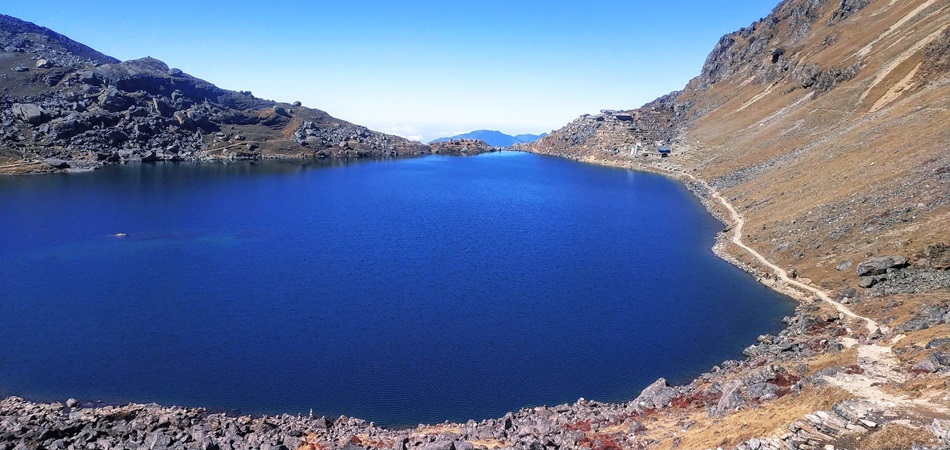
Among Nepal’s Himalayan trekking destinations, Gosaikunda Lake holds a unique position — it is simultaneously one of the country’s most spiritually significant pilgrimage sites and one of its finest high-altitude trekking experiences, all within striking distance of Kathmandu. Sitting at 4,380 meters above sea level in the Langtang National Park of Rasuwa District, Gosaikunda is a glacial lake of extraordinary beauty whose surface — deep turquoise in summer, frozen solid in winter — has been a sacred destination for Hindu pilgrims seeking the blessings of Lord Shiva for centuries. The name itself is Sanskrit: ‘Gosain’ (saint or master) and ‘kunda’ (lake or pond) — the Lake of the Saint. According to Hindu mythology, the lake was created by Lord Shiva when he struck the frozen Himalayan ground with his trident to cool himself after swallowing the cosmic ocean’s poison during the churning of the sea of milk.
For trekkers and pilgrims alike, the journey to Gosaikunda begins not at the trailhead but at the vehicle hire desk in Kathmandu — because reaching the two main trailheads for the Gosaikunda trek (Syabrubesi at 1,503 m and Dhunche at 1,960 m) requires a road journey of approximately 122 kilometers from Kathmandu, taking 6 to 9 hours by private vehicle. This approach drive — following the Pasang Lhamu Highway north through the Trishuli valley, past Betrawati, and up through the forests to the Langtang National Park gateway — is itself a significant journey that demands the right vehicle and the right driver.
Nepal Vehicle Hiring Pvt. Ltd., based in Thamel, Kathmandu, is the premier provider of private jeep hire for the Kathmandu-to-Gosaikunda approach, covering both the Syabrubesi and Dhunche trailheads. Our trekking transport services are specifically designed for Langtang region trekkers who need reliable, experienced 4WD transport from their Thamel hotel to the exact trailhead they are targeting — whether that is Syabrubesi for the classic Gosaikunda circuit via Langtang Valley, Dhunche for the shorter direct Gosaikunda approach, or Sundarijal on the valley rim for the alternative Helambu-Gosaikunda circuit. This complete 2026 guide covers every vehicle option, every trailhead, the road itself section by section, the permits required, transport fares, seasonal conditions, and how Nepal Vehicle Hiring delivers trekkers to the Gosaikunda approach in the best possible condition for the days of high-altitude walking ahead.
Gosaikunda Trek Overview: Why the Vehicle Approach Matters
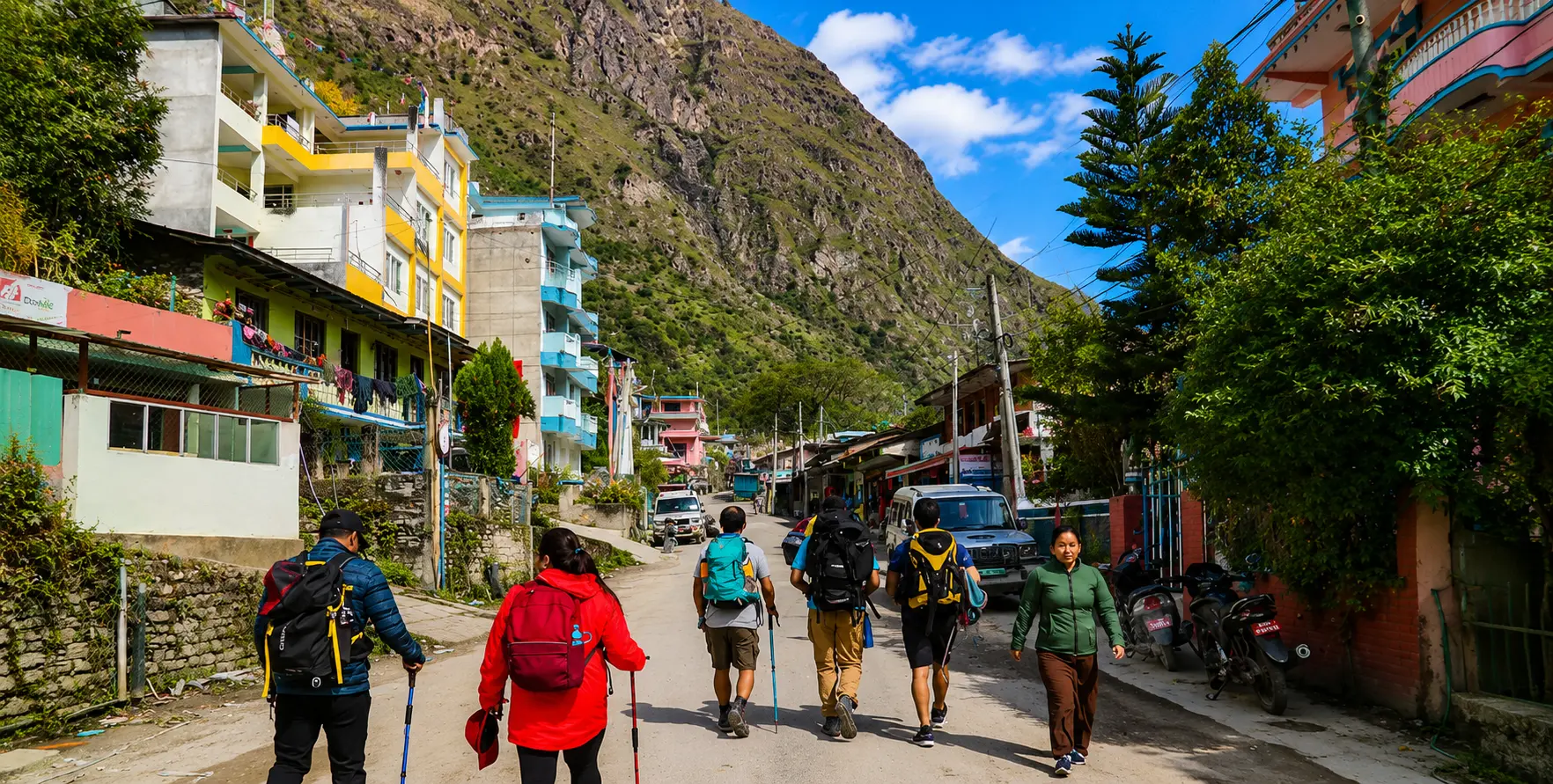
The Gosaikunda trek is one of Nepal’s finest moderate-grade trekking experiences — accessible enough for reasonably fit first-time Himalayan trekkers yet rewarding enough to satisfy experienced walkers, with a combination of forest, alpine meadow, Buddhist monastery culture, and the extraordinary high-altitude lake destination that makes it a complete Himalayan experience. The standard itinerary covers 60 to 140 kilometers of trekking (depending on whether you include the Langtang Valley extension and/or the Helambu descent) over 6 to 13 days, reaching a high point of 4,610 meters at Lauribina La Pass above Gosaikunda Lake.
There are three main trekking approaches to Gosaikunda, and each begins with a different vehicle journey from Kathmandu:
- Syabrubesi approach (most popular, 122 km from Kathmandu): Begins at Syabrubesi (1,503 m), follows the Langtang Khola through Bamboo, Lama Hotel, and Langtang Village before reaching Gosaikunda. Can be combined with the classic Langtang Valley trek (10 to 13 days total) or done as a direct Gosaikunda route (7 to 9 days) via Thulo Syabru.
- Dhunche approach (shorter drive, same road): Branches off at Dhunche (1,960 m) rather than continuing to Syabrubesi, taking a direct trail through Sing Gompa (3,330 m) to Gosaikunda (4,380 m) in 3 to 4 days of walking. Best for trekkers with limited time who want the Gosaikunda experience without the full Langtang Valley circuit.
- Sundarijal approach (Kathmandu valley rim start): Begins at Sundarijal on the northeast rim of the Kathmandu Valley (accessible by taxi or local vehicle, approximately 15 km from Thamel), climbs through Helambu to Gosaikunda via Chisapani, Kutumsang, and Ghopte over 5 to 7 days. Returns via Dhunche or Syabrubesi by vehicle.
For all three approaches, Nepal Vehicle Hiring provides the optimal vehicle solution. Our 4WD jeep hire covers both the Syabrubesi and Dhunche drops, our car hire in Nepal handles the Sundarijal approach for small groups, and our Hiace van hire serves groups of 8 to 14 trekkers traveling together to any of these trailheads.
The Road: Kathmandu to Syabrubesi and Dhunche — Section by Section
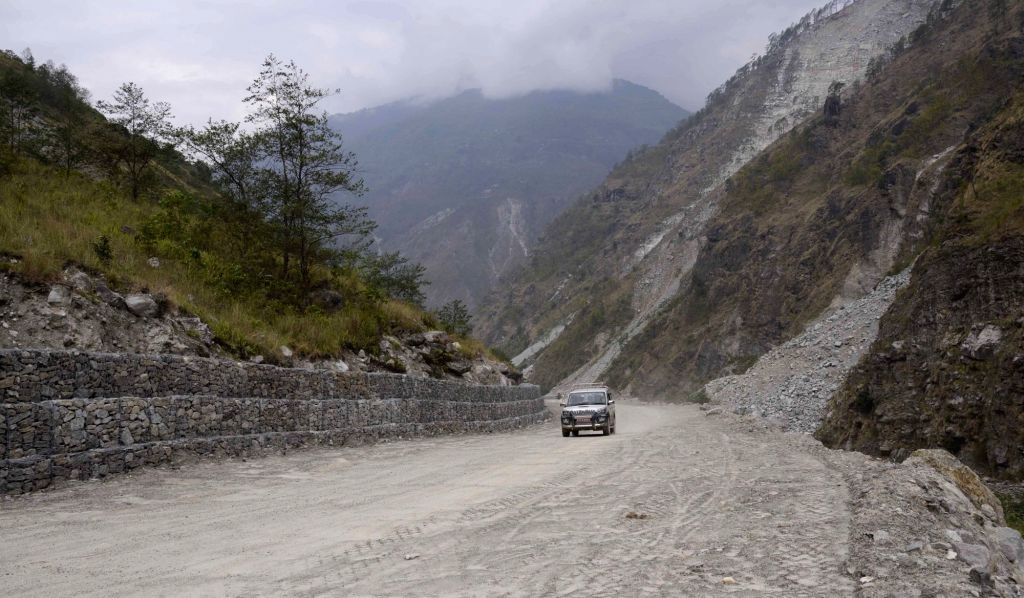
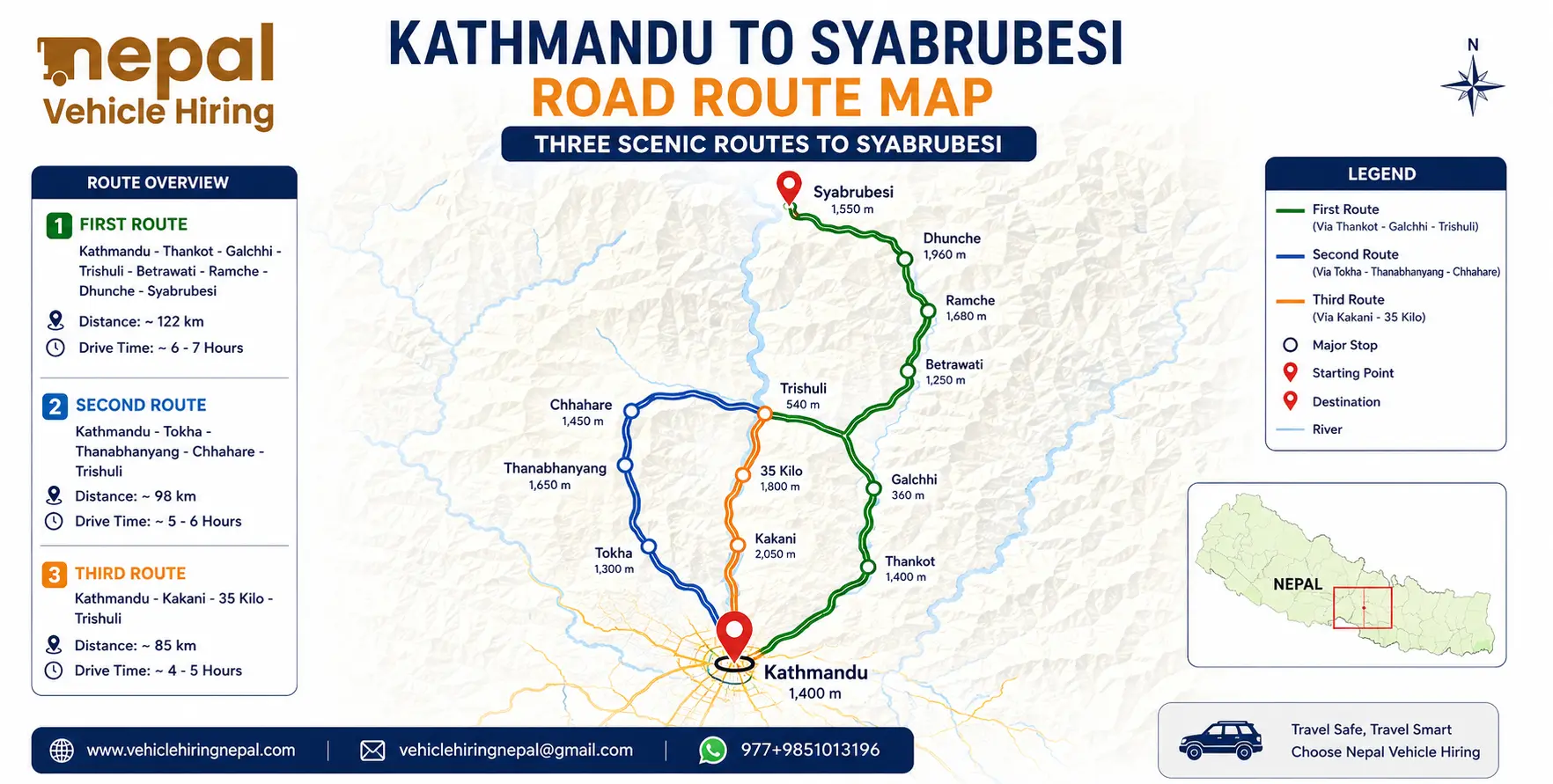
The Kathmandu-to-Syabrubesi road follows the Pasang Lhamu Highway (also known as the Trishuli-Dhunche Road, Highway F070). This 122-kilometer mountain road is one of Nepal’s most scenically rewarding approaches to any trekking region. Here is the complete section breakdown:
Kathmandu to Galchhi Junction (35 km, 1 to 1.5 hours)
The journey begins by heading west from Thamel on the Prithvi Highway — Nepal’s main Kathmandu-Pokhara artery — for approximately 35 kilometers to the Galchhi junction (800 m). This section is a fully paved national highway and comfortable for all vehicles. Kathmandu’s exit traffic can add 30 to 60 minutes to this section if departing between 7:30 and 9:30 AM — Nepal Vehicle Hiring consistently recommends a 6:30 AM departure from Thamel to clear the city before the morning rush peaks. At Galchhi, the Prithvi Highway continues west, and our route turns north onto the Pasang Lhamu Highway toward the Trishuli River and ultimately Syabrubesi.
Galchhi to Trishuli Bazaar (18 km, 45 to 60 minutes)
From Galchhi, the Pasang Lhamu Highway runs north alongside the Trishuli River (870 m) — one of Nepal’s most important whitewater rivers and a stunning gorge section that sets the visual tone for the increasingly dramatic landscape ahead. The river here is fast, clear, and flanked by forested hills. Trishuli Bazaar is a riverside market town with fuel stations, restaurants, and a lively morning market atmosphere. It is the standard breakfast stop for early-morning Syabrubesi-bound vehicles — arriving around 8:00 to 8:30 AM for a 6:30 AM Kathmandu departure. Fresh river trout is a regional specialty at Trishuli’s riverside restaurants. Nepal Vehicle Hiring drivers always know the best current establishments.
Trishuli to Betrawati (12 km, 30 to 40 minutes)
The 12 kilometers from Trishuli to Betrawati (1,000 m) continue along the river before the road crosses to the east bank. Betrawati is where the vehicle permit checkpoint is located — all vehicles heading north are checked here. Nepal Vehicle Hiring’s drivers carry all required documentation and handle checkpoint formalities without passenger involvement, typically taking 2 to 5 minutes. Betrawati marks the beginning of the sustained climb toward Dhunche, and here the road leaves the river valley and begins ascending into Rasuwa District’s mid-hill country.
Betrawati to Dhunche (50 km, 2 to 2.5 hours)
The 50-kilometer section from Betrawati to Dhunche (1,960 m) is the longest, most scenically dramatic, and most variable stretch of road quality in the entire Kathmandu-Syabrubesi journey. The road climbs from 1,000 meters to 1,960 meters through a landscape of progressive beauty, passing through Ramche (approximately 1,600 m) — a popular tea stop with excellent northward views — before reaching Dhunche.
Near Kalikasthan, approximately 15 to 20 kilometers north of Betrawati, the peaks of Ganesh Himal (7,422 m) and Langtang Lirung (7,227 m) become visible above the forested ridgelines on clear mornings — the first genuine Himalayan peak views of the journey, and the moment many trekkers grasp what lies ahead. In spring (March to April), the rhododendron forests near Ramche and Dhunche are in full bloom — vivid red and pink blossoms filling the roadside forest in one of Nepal’s finest botanical displays.
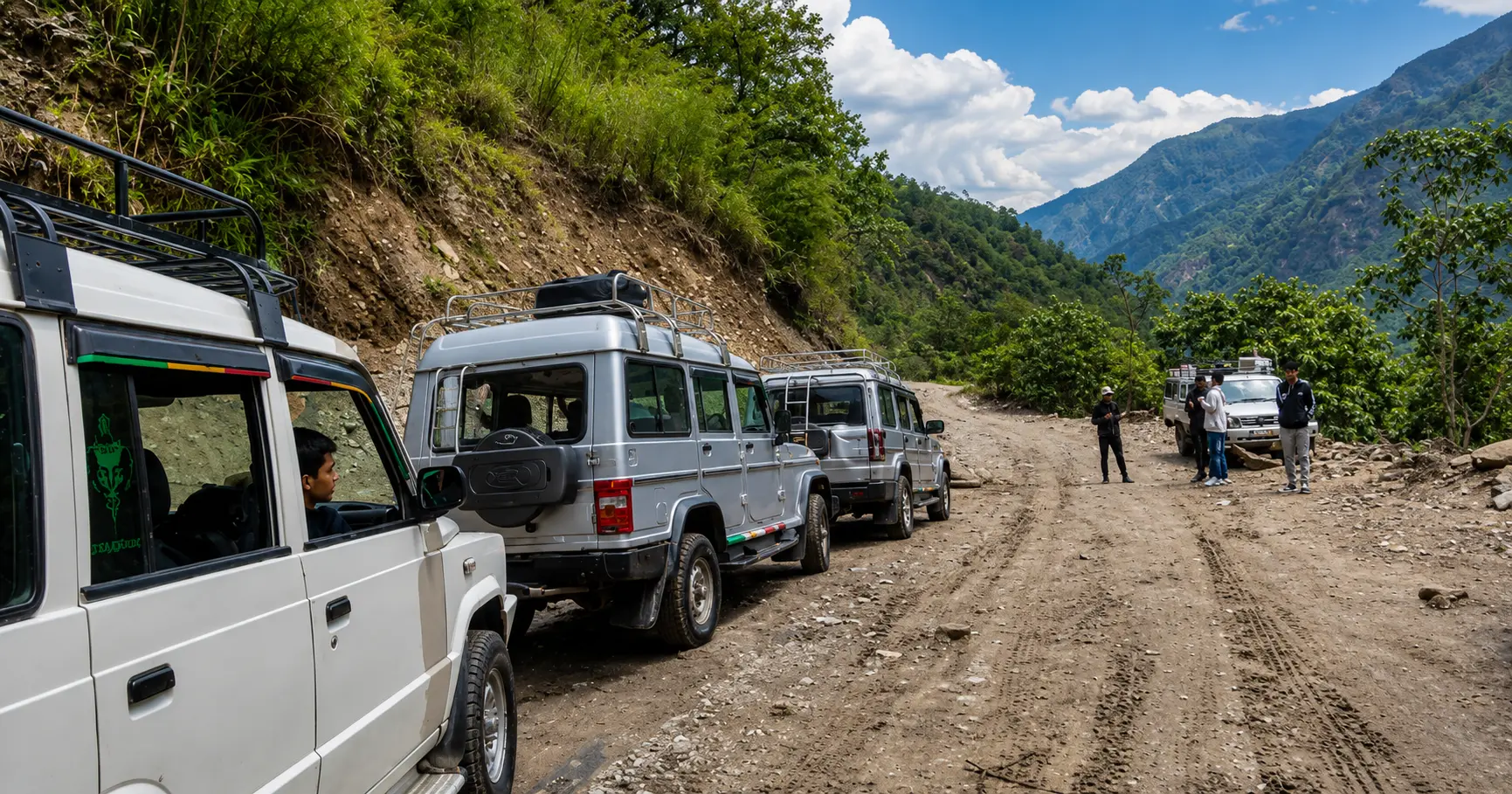
Road quality from Betrawati to Dhunche is variable in 2026 — the lower sections (Betrawati to Ramche) are rough but passable, while the upper sections (Ramche to Dhunche) are more challenging — narrower, steeper, and more susceptible to monsoon landslides. This is the section that most clearly distinguishes the Nepal Vehicle Hiring private 4WD experience from a public bus journey: our jeeps handle the rough upper sections smoothly, with experienced drivers who know every narrow passing point and every hazard. Dhunche (1,960 m) is the administrative headquarters of Rasuwa District, the Langtang National Park permit checkpoint, the last point with a bank (ATM sometimes operational — carry cash from Kathmandu to be safe), and the trailhead for the direct Dhunche-to-Gosaikunda route.
Dhunche to Syabrubesi (15 km, 1 to 1.5 hours)
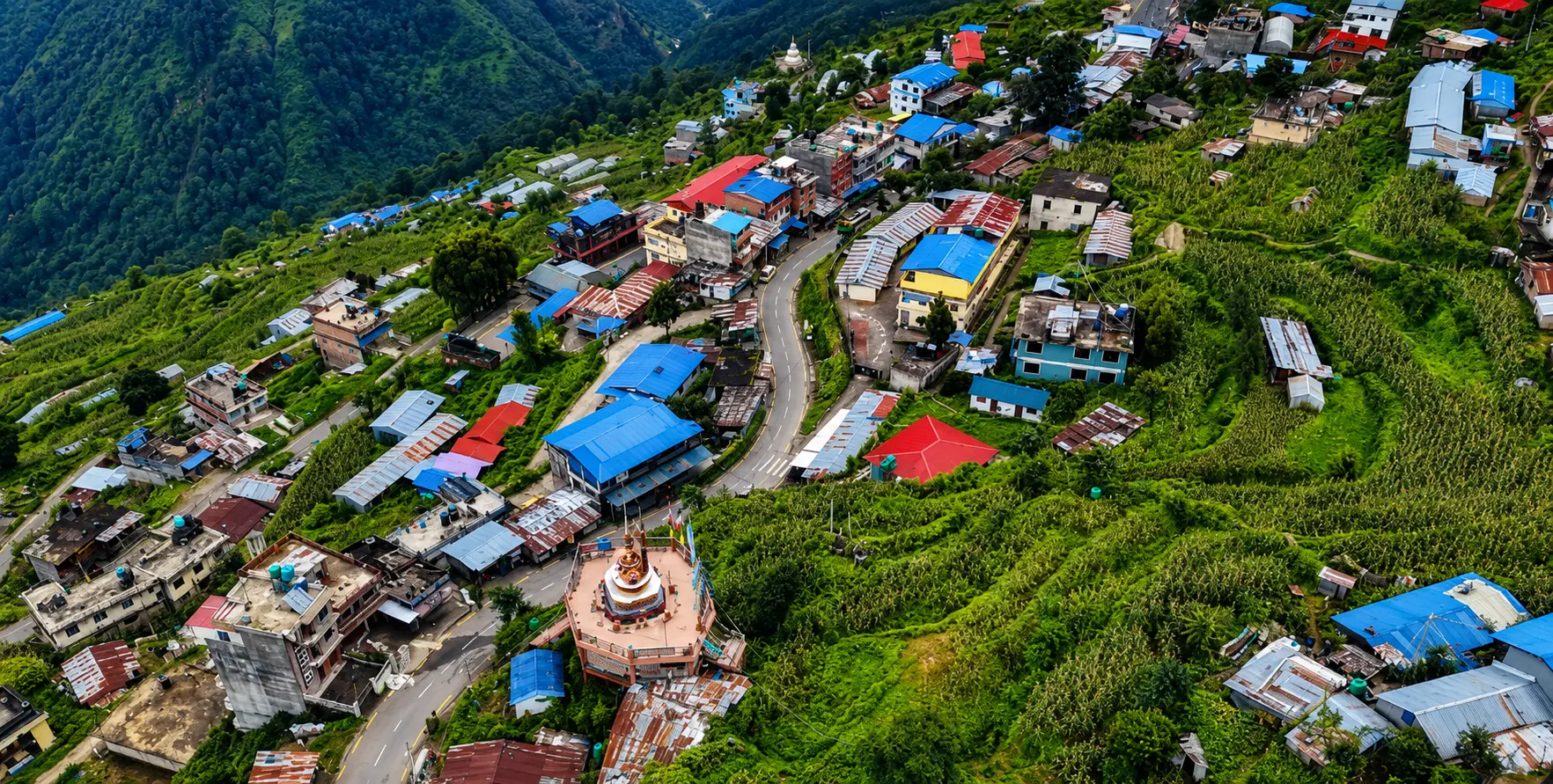
Trekkers targeting the Syabrubesi trailhead continue 15 kilometers beyond Dhunche on a narrow, steep descent to Syabrubesi (1,503 m) — the village at the confluence of the Langtang Khola and the Bhote Koshi River. This 570-meter descent in 15 kilometers is a series of tight switchbacks through mixed cloud forest that is beautiful but technically demanding — a 4WD vehicle with high ground clearance is essential for this section. The descent can be slippery in wet conditions and requires careful mountain road driving in the narrow sections. Nepal Vehicle Hiring’s Langtang-route drivers know this descent well, navigating it confidently while passengers can focus entirely on the spectacular forest and river valley views.
Syabrubesi’s main roadside trip has 15 to 20 guesthouses and teahouses catering to Langtang and Gosaikunda trekkers, a permit registration checkpoint at the village’s northern edge, and basic supplies for the trek ahead. Nepal Vehicle Hiring drops trekkers directly at their guesthouse — no additional local transport required on arrival.
Vehicle Options for the Kathmandu to Gosaikunda Approach
Private 4WD Jeep Hire (Recommended for All Gosaikunda Trekkers)
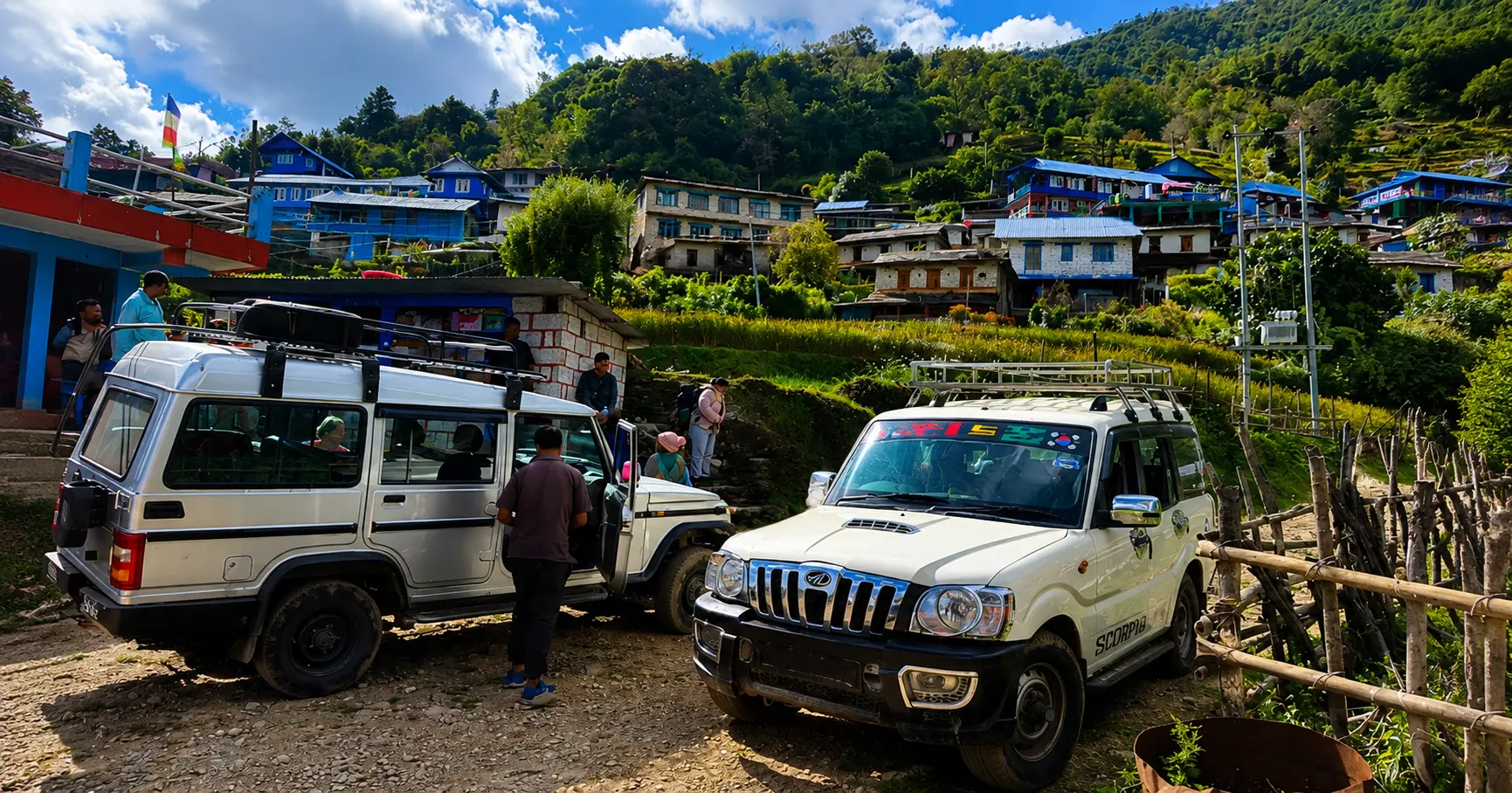
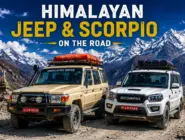
Nepal Vehicle Hiring’s private 4WD jeep hire is the recommended vehicle for every Gosaikunda approach — whether you are heading to Syabrubesi, Dhunche, or any point in between. Our Mahindra Scorpio (seats 5 to 7 passengers) and Toyota Land Cruiser (seats 4 to 5 passengers in premium comfort) handle the full 122-kilometer Kathmandu-to-Syabrubesi road with the high ground clearance and 4WD traction that the Betrawati-to-Syabrubesi mountain section demands.
Private jeep hire for the Kathmandu-to-Syabrubesi journey costs approximately NPR 18,000 to 25,000 per vehicle (USD 130 to 185 at 2026 exchange rates) all-inclusive — vehicle, experienced Langtang-route driver, fuel, and driver accommodation for the overnight in Syabrubesi if required. For a group of 4 trekkers splitting the cost, this equates to approximately NPR 4,500 to 6,250 per person — directly competitive with shared jeep fares, with hotel drop-off and schedule flexibility included. For 6 trekkers splitting, the per-person cost drops to NPR 3,000 to 4,166 — significantly cheaper than the shared jeep.
Private jeep hire to Dhunche only (not continuing to Syabrubesi) costs approximately NPR 15,000 to 20,000 per vehicle — 15 km and 1 to 1.5 hours less than the full Syabrubesi journey, saving both time and cost for trekkers using the Dhunche-start direct Gosaikunda route.
Contact Nepal Vehicle Hiring through our plan your trip page or WhatsApp +977 9851013196 for current pricing and availability on all Gosaikunda approach vehicle options.
Hiace Van Hire: Groups of 8 to 14 Trekkers
For trekking groups of 8 to 14 people traveling together to the Gosaikunda trailhead, our Hiace van hire provides comfortable, economical group transport from Kathmandu to Dhunche or Syabrubesi. The Hiace handles the Kathmandu-to-Dhunche section (107 km) well in good conditions. For the final 115-kilometer Dhunche-to-Syabrubesi descent — the most demanding section—Nepal Vehicle Hiring can arrange a vehicle size assessment based on current road conditions and group size. In dry season, the Hiace generally handles this section; in monsoon or after heavy rain, the 4WD jeep is the more appropriate vehicle for the descent. Our Hiace van hire for the Gosaikunda approach is often combined with our Kathmandu to Pokhara bus service for trekking groups spending time in Pokhara before or after their Langtang-Gosaikunda adventure.
Shared Jeep (Budget Option)
Shared jeeps from Kathmandu’s Machhapokhari Bus Park (Balaju) depart for Syabrubesi daily from approximately 6:00 to 7:00 AM when full. Shared jeep fares to Syabrubesi: approximately NPR 1,200 to 1,500 per person (USD 9 to 11). Journey time: 6 to 7 hours. The shared jeep is the cheapest motorized option for the Gosaikunda approach and works well for solo trekkers and pairs on a budget. Limitations: departure when full (potential 30 to 60 minute wait), no flexibility on stops, limited luggage space, and the cramped seating of a fully loaded jeep for 7 to 9 hours of mountain road. From Machhapokhari Bus Park, add 15 to 20 minutes of taxi or Pathao motorbike travel from Thamel — plan and budget accordingly.
For trekkers comparing the shared jeep with Nepal Vehicle Hiring’s private service: at 4 or more trekkers traveling together, our private 4WD jeep hire delivers per-person costs competitive with the shared jeep fare while providing hot pickup, guaranteed early departure, and luggage stored safely inside the vehicle rather than on an overcrowded roof rack. Use our plan your trip page to request a current quote and comparison.
Public Bus (Budget — NPR 600 to 1,000)
Local buses from Machhapokhari Bus Park serve both Dhunche and Syabrubesi — Dhunche buses run for approximately NPR 600 to 800 per person and take 7 to 8 hours; Syabrubesi buses cost NPR 800 to 1,000 per person and take 8 to 10 hours. Buses depart in the morning (typically 6:00 to 7:00 AM) and are the cheapest available option. The trade-off is significant: minimal comfort on the rough upper sections, no flexibility on stops, and journey times considerably longer than the private jeep. Public buses are appropriate for solo budget trekkers with maximum time flexibility. Nepal Vehicle Hiring does not provide public bus services on this route — we provide private vehicle services that deliver better value for almost every group configuration above 2 passengers.
The Three Gosaikunda Trailheads: Which Is Right for Your Trek?
Syabrubesi (1,503 m): The Classic Gateway — 122 km from Kathmandu
Syabrubesi is the most popular starting point for Gosaikunda treks because it opens access to both the Langtang Valley (northeast) and the Gosaikunda route via Thulo Syabru (south), allowing trekkers to combine both destinations in a single circuit. For the Langtang-Gosaikunda combination — Nepal’s finest medium-length trek combining a spectacular glacial valley with a sacred alpine lake — Syabrubesi is the only logical starting point.
From Syabrubesi, the Gosaikunda approach via Langtang follows: Syabrubesi (1,503 m) → Bamboo (1,960 m) → Lama Hotel (2,470 m) → Langtang Village (3,430 m) → Kyanjin Gompa (3,870 m) → [optional acclimatisation day] → return to Lama Hotel or Syabru Bensi → Thulo Syabru (2,210 m) → Sing Gompa (3,330 m) → Lauribina Yak (3,920 m) → Gosaikunda (4,380 m) → Ghopte (3,430 m) → Dhunche (1,960 m) → vehicle return to Kathmandu. Total duration: 10 to 13 days. Total trekking distance: approximately 100 to 140 kilometers
Nepal Vehicle Hiring’s Syabrubesi private jeep drop takes 6 to 8 hours from Thamel (6:30 AM departure, arrival Syabrubesi 1:00 to 2:30 PM), leaving time for afternoon guesthouse check-in, permit registration at the checkpoint, and preparation for the first day’s walking. Our trekking transport services for the Syabrubesi approach coordinate pickup and drop-off timing with your trek’s specific first-day requirements. If you need an early 6:30 AM departure to reach Lama Hotel on day one, our driver is at your Thamel hotel door at the agreed time.
Dhunche (1,960 m): The Shorter Approach — 107 km from Kathmandu
Dhunche is the direct approach for trekkers targeting Gosaikunda alone — without the Langtang Valley extension. From Dhunche, the direct Gosaikunda route follows: Dhunche (1,960 m) → Chandanbari/Sing Gompa (3,330 m) → Lauribina Yak (3,920 m) → Gosaikunda (4,380 m) in 3 to 4 days of walking. The total Dhunche-based Gosaikunda trek takes 5 to 7 days return, making it Nepal’s most accessible high-altitude lake trek from Kathmandu — 5 days total including 2 days vehicle transport.
The Dhunche approach is particularly popular with: trekkers with limited time (5 to 7 days total trip); Hindu pilgrims making the Gosaikunda sacred lake visit without a full mountain circuit; and experienced trekkers revisiting Gosaikunda who have already done the Langtang Valley circuit on a previous trip. Nepal Vehicle Hiring’s private jeep hire to Dhunche (107 km, 5 to 7 hours) is approximately 15 km shorter and 1 to 1.5 hours faster than the full Syabrubesi run, and the Dhunche-only vehicle cost is lower than the full Syabrubesi service — contact us through the plan your trip page for current Dhunche-specific pricing.
For the return from a Dhunche-start Gosaikunda trek, Nepal Vehicle Hiring’s return vehicle can be pre-booked to collect trekkers at Dhunche at a specific agreed date — eliminating the uncertainty of finding shared transport at the end of a multi-day trek when you are tired and ready to return to Kathmandu. Our 4WD jeep hire return service from Dhunche to Kathmandu takes 5 to 7 hours and can be booked as part of the original drop-off booking.
Sundarijal (1,350 m): The Kathmandu Valley Rim Start — 15 km from Thamel
The Sundarijal approach begins on the northeast rim of the Kathmandu Valley itself — accessible by taxi or Pathao motorbike from Thamel in 20 to 30 minutes. From Sundarijal, the Gosaikunda route via Helambu follows: Sundarijal (1,350 m) → Chisapani (2,215 m) → Kutumsang (2,470 m) → Ghopte (3,530 m) → Lauribina La Pass (4,610 m) → Gosaikunda (4,380 m) over 5 to 6 days of walking. The return is typically by vehicle from Dhunche or Syabrubesi — meaning the Sundarijal trek exits north onto the Pasang Lhamu Highway and then travels south by vehicle back to Kathmandu.
For the Sundarijal starting point, Nepal Vehicle Hiring provides: a simple taxi or car hire in Nepal from Thamel to Sundarijal (15 km, 20 to 30 minutes) as the outward transport, and a full private jeep hire from Dhunche or Syabrubesi back to Kathmandu (107 to 122 km, 5 to 7 hours) as the return. This approach gives trekkers the benefit of starting right from the Kathmandu Valley without any long vehicle journey on the outbound leg, while using Nepal Vehicle Hiring’s private jeep for the comfortable return from the trek’s endpoint.
Permits Required for the Gosaikunda Trek in 2026
Langtang National Park Entry Permit
The Langtang National Park Entry Permit is mandatory for all foreign nationals trekking to Gosaikunda. The 2026 fee is NPR 3,000 per person (approximately USD 22 to 25). SAARC nationals pay NPR 1,000. The permit is checked at the Dhunche checkpoint — the main park entry point — before trekkers proceed to either Syabrubesi or the Dhunche trailhead. Permits can be obtained at:
- Nepal Tourism Board office, Bhrikutimandap, Kathmandu (most reliable, weekdays 9 AM to 5 PM)
- The Dhunche checkpoint (available during office hours — less reliable for afternoon arrivals)
- Through Nepal Vehicle Hiring’s partner agency coordination — we can arrange permit processing in Kathmandu before your departure; contact us via the Plan Your Trip page.
Nepal Vehicle Hiring strongly recommends obtaining the Langtang National Park permit in Kathmandu the day before your departure, avoiding any checkpoint delay that could affect first-day trekking plans.
ACAP Permit (for some Gosaikunda routes)
The Gosaikunda area is within the Langtang National Park boundary, which means the Langtang National Park Entry Permit covers the standard trek. The ACAP (Annapurna Conservation Area Permit) is NOT required for Gosaikunda trekking — it is relevant for Annapurna-region treks covered by Nepal Vehicle Hiring’s Kathmandu to Manang jeep service and Besisahar private vehicle service.
Licensed Guide Requirement
Nepal government regulations require a licensed guide for trekking in Nepal’s protected areas, including Langtang National Park. The guide is not required for road travel to the trailhead but must accompany all foreign trekkers from the trail start. Nepal Vehicle Hiring works with partner licensed guide services — contact us when booking your Gosaikunda approach vehicle to arrange guide coordination as part of the complete trekking support package.
Best Time for the Kathmandu to Gosaikunda Trek: Seasonal Guide
Spring (March to May): Premier Trekking Season
Spring is the finest season for the Gosaikunda trek and for the Kathmandu-to-Syabrubesi vehicle journey. Rhododendrons bloom along the road from Ramche to Dhunche in March and April — vivid red, pink, and white blossoms that make the approach road as beautiful as the trek itself. Pre-monsoon skies deliver clear mountain views at Kalikasthan and the Dhunche approach, and the road is in its best annual condition — dry, compacted, and free from monsoon damage. Gosaikunda Lake, while still partially frozen in early March, is fully thawed and dazzling turquoise by late April and May. Nepal Vehicle Hiring’s trekking transport services to Syabrubesi and Dhunche are at peak demand in spring — book 3 to 4 weeks in advance for the April-May window.
Janai Purnima (July to August): The Pilgrimage Season
The full moon of Shrawan (July or August) marks Janai Purnima — the annual Hindu pilgrimage to Gosaikunda Lake that draws tens of thousands of devotees who believe ritual bathing in the sacred waters on this auspicious day cleanses the sins of a lifetime. During Janai Purnima, Gosaikunda is one of the most extraordinary human gatherings in the Himalayan world — pilgrims chanting, bells ringing, fires burning, the lake surface broken by thousands of ritual bathers in what is, for most observers, one of the most genuinely moving spectacles available in Nepal.
Nepal Vehicle Hiring’s transport to Dhunche and Syabrubesi during Janai Purnima requires booking 0 to 2 months in advance. Every vehicle on this route is committed well in advance for the pilgrimage peak. The road is also significantly more congested during this period than at any other time of year. Our 4WD jeep hire and Hiace van hire both operate during this period, with experienced drivers who know how to manage the Janai Purnima traffic on the narrow mountain road. For Hindu pilgrim groups specifically targeting the Janai Purnima Gosaikunda visit, our trekking transport services coordinate the full approach and return vehicle for the pilgrimage window.
Autumn (September to November): Post-Monsoon Clarity
Autumn is Nepal’s peak trekking season and the Gosaikunda route’s finest time for mountain views. Post-monsoon atmospheric clarity delivers outstanding Himalayan panoramas at every viewpoint — from the Kalikasthan road view of Langtang Lirung to the summit views from Lauribina La Pass at 4,610 mmeters The road from Kathmandu to Syabrubesi has typically been assessed and partially repaired after monsoon damage by October. The trail conditions in Langtang National Park are at their annual best. Nepal Vehicle Hiking’s private jeep hire for the Gosaikunda approach books quickly for October and November — 3 to 4 weeks’ booking recommended.
Monsoon (June to August): Challenging but Possible
The monsoon brings the most challenging road conditions on the Kathmandu-to-Syabrubesi route — the Betrawati-to-Dhunche section is susceptible to landslides and surface water damage, and the Dhunche-to-Syabrubesi descent can be slippery and slow. Nepal Vehicle Hiring operates the Gosaikunda approach route throughout the monsoon with daily road condition monitoring and experienced drivers who know when to proceed and when to wait. Travel time estimates should be extended by 1 to 2 hours for monsoon driving, and schedule flexibility is essential. The trek itself above Gosaikunda is genuinely challenging in monsoon conditions — the trail is wet, some sections can be obscured, and Lauribina La Pass can be dangerous in poor visibility. Outside of the Janai Purnima pilgrimage window, the monsoon is the quietest and least recommended period for the Gosaikunda trek.
Winter (December to February): Frozen and Quiet
Gosaikunda Lake freezes completely from approximately December through March — transforming from a turquoise alpine lake to a vast sheet of ice and snow that has its own extraordinary stark beauty. Winter trekking to Gosaikunda is possible but demanding: overnight temperatures at the lake can fall to minus 15°C, the Lauribina La Pass requires microspikes or crampons for icy conditions, and most guesthouses above Dhunche have minimal facilities (or are closed) in the depths of winter. The road to Syabrubesi is generally accessible in winter with a 4WD vehicle, though icy patches near Dhunche in very cold periods can slow the journey. Nepal Vehicle Hiring’s 4WD jeep hire operates year-round with winter-experienced drivers who can assess and advise on road conditions in real time.
Optimal Departure Timing from Kathmandu
For the Kathmandu-to-Syabrubesi journey, Nepal Vehicle Hiring recommends a 6:30 AM departure from Thamel. Here is why this timing matters:
- Clears Kathmandu traffic: departure before 7:00 AM avoids the city’s morning rush hour (7:30 to 9:30 AM) entirely, saving 30 to 90 minutes of urban congestion.
- Arrives at Trishuli for breakfast: a 6:30 AM departure reaches Trishuli Bazaar at approximately 8:00 to 8:30 AM — perfect timing for a 20-minute breakfast stop before the climb to Dhunche begins.
- Reaches Dhunche for lunch: arriving at Dhunche at approximately 11:30 AM to 12:30 PM allows a proper lunch stop with time to visit the national park permit checkpoint without rushing.
- Arrives Syabrubesi in early afternoon: a 6:30 AM departure delivers trekkers at Syabrubesi guesthouses by approximately 1:30 to 2:30 PM — leaving the afternoon for rest, guesthouse choice, permit registration at the checkpoint, and preparation for day one of the trek.
- For Dhunche-only drop: a 6:30 AM departure arrives at Dhunche by approximately 11:30 AM to 12:00 PM, allowing a full afternoon for the first day’s walking toward Sing Gompa if desired — an excellent option for energetic trekkers who don’t want to lose a trekking day to vehicle transport.
Nepal Vehicle Hiring’s private vehicle service guarantees the 6:30 AM departure from your Thamel hotel door — no walking to a bus park, no waiting for a vehicle to fill, no uncertainty about departure time. Your driver is at your hotel at the agreed time, vehicle ready, your trekking bags loaded, and the Gosaikunda adventure begins immediately.
What to Pack for the Kathmandu to Syabrubesi Vehicle Journey
The 6 to 8 hour Kathmandu-to-Syabrubesi drive crosses multiple altitude zones and road types — preparation for the vehicle journey itself makes a significant difference to comfort on arrival:
- Layers accessible in a day pack: temperature at Syabrubesi (1,503 m) is noticeably cooler than Kathmandu (1,350 m), and the Dhunche section at 1,960 m can be genuinely cold in early morning. Keep a fleece in your day bag rather than in the roof-stored trekking bag.
- Langtang National Park permit: arrange this at the Nepal Tourism Board office in Kathmandu the day before departure. Without it, the Dhunche checkpoint will delay the journey and may require returning to Kathmandu to obtain it — avoidable entirely with preparation. Nepal Vehicle Hiring can assist with permit coordination through our plan your trip page.
- Sufficient cash in NPR: the last reliable ATM is in Trishuli Bazaar (70 km from Kathmandu) or at Dhunche (sometimes operational, but frequently not). Carry NPR 8,000 to 15,000 per person for the full trek — accommodation, food, guide fees, and any emergency expenses.
- Snacks and 2 liters of water: the road from Betrawati to Dhunche (50 km, 2 to 2.5 hours) has limited food stops. Your Nepal Vehicle Hiring driver will stop at Ramche for tea if requested, but carrying trail snacks and water ensures comfort through this section.
- Motion sickness medication if needed: the Betrawati-to-Dhunche and Dhunche-to-Syabrubesi sections involve sustained switchback roads that can trigger nausea in susceptible travelers. Take medication before departure rather than waiting for symptoms to appear.
- Offline maps downloaded: mobile signal is available at Trishuli and Dhunche but patchy on the mountain sections. Download Maps.me or Gaia GPS for the Rasuwa District route before leaving Kathmandu.
- Left-side seating preference: sit on the left side of the vehicle (facing forward) for the best river gorge views along the Trishuli section and the clearest sightlines toward the Langtang peaks at Kalikasthan. Inform your Nepal Vehicle Hiring driver if you have photography priorities — our drivers know the best stop points for mountain views along the route.
Combining the Gosaikunda Trek with Other Nepal Experiences
The Gosaikunda trek sits naturally within a broader Nepal itinerary that Nepal Vehicle Hiring’s complete fleet can support. Most international trekkers arrive in Kathmandu first, spend 1 to 2 days in the valley, and then head to the Gosaikunda trailhead. Nepal Vehicle Hiring coordinates all elements of this sequence:
Beginning with our Kathmandu airport transfer on arrival, trekkers typically spend 1 to 2 days in the Kathmandu Valley — our Kathmandu sightseeing service covers Pashupatinath, Boudhanath, Swayambhunath, and Patan Durbar Square in a single well-paced day. Our Bhaktapur Durbar Square day tour and Nagarkot sunrise tour via our Kathmandu to Nagarkot vehicle provide additional valley experiences before the trek begins. The Nagarkot sunrise tour is particularly appropriate for Gosaikunda-bound trekkers — the Himalayan panorama from Nagarkot includes the full Langtang range (Langtang Lirung, Ganesh Himal, Dorje Lakpa) that will be the visual backdrop of the coming weeks’ walking.
After completing the Gosaikunda trek and returning to Kathmandu, trekkers commonly continue to Pokhara for lakeside recovery, and the Sarangkot sunrise tour — our Kathmandu to Pokhara bus service and Hiace van hire cover this well-established transit. From Pokhara, many post-Gosaikunda trekkers add the Annapurna Circuit approach for a second Himalayan trekking experience, or the Muktinath Yatra for the spiritual dimension of the Annapurna region. Our Nepal tour packages and Nepal holiday tours cover all multi-destination combinations that include the Gosaikunda trek alongside broader Nepal experiences.
Frequently Asked Questions: Kathmandu to Gosaikunda Trek Vehicle Hire
How far is Kathmandu from the Gosaikunda trailhead?
The road distance from Kathmandu (Thamel) to Syabrubesi (the main Gosaikunda trailhead) is approximately 122 kilometers, taking 6 to 8 hours by private 4WD jeep. The Dhunche trailhead (for the direct Gosaikunda route) is approximately 107 kilometers, taking 5 to 7 hours. The Sundarijal approach is only 15 kilometers from Thamel — accessible by taxi or car hire in 20 to 30 minutes.
What vehicle is best for the Kathmandu to Syabrubesi drive?
A 4WD vehicle with high ground clearance and an experienced mountain road driver is the right choice for the full Kathmandu-to-Syabrubesi journey. Nepal Vehicle Hiring’s private jeep hire (Mahindra Scorpio or Toyota Land Cruiser) is specifically recommended for the Betrawati-to-Dhunche and Dhunche-to-Syabrubesi sections, which have narrower, rougher road surfaces that demand mountain road capability. Standard sedans and cars are not appropriate for the mountain sections above Betrawati.
Can I take a public bus from Kathmandu to Syabrubesi?
Yes — public buses from Machhapokhari Bus Park run to Syabrubesi for approximately NPR 800 to 1,000 per person and take 8 to 10 hours. This is the cheapest option but least comfortable. For 4 or more trekkers traveling together, Nepal Vehicle Hiring’s private jeep hire delivers per-person costs competitive with the shared jeep (NPR 1,200 to 1,500 per person) while providing hot pickup, guaranteed departure time, and flexibility for stops. Visit our plan your trip page for a current per-person cost comparison.
How long does the Gosaikunda trek take?
The Gosaikunda trek duration depends on the route and trailhead: the Dhunche-start direct Gosaikunda route takes 5 to 7 days total (3 to 4 days walking to the lake and back plus 2 days vehicle transport). The Syabrubesi-start Langtang-Gosaikunda combination takes 10 to 13 days. The Sundarijal-start Helambu-Gosaikunda route takes 8 to 10 days. Nepal Vehicle Hiring coordinates the vehicle transport for all three approaches.
What permits do I need for the Gosaikunda trek?
The Langtang National Park Entry Permit (NPR 3,000 for foreign nationals) is required. Obtain it at the Nepal Tourism Board office in Kathmandu before departure — not at the Dhunche checkpoint, which is less reliable. A licensed guide is also required for trekking in the national park. Nepal Vehicle Hiring can coordinate permit processing through our partner agencies — contact us through the plan your trip page.
Can Nepal Vehicle Hiring arrange both the drop-off and the return pickup? Nepal Vehicle Hiring provides both the outward drop-off (Kathmandu to Syabrubesi/Dhunche) and the return pickup (Syabrubesi/Dhunche to Kathmandu) as a single coordinated booking. The return vehicle is scheduled for your specific trek completion date — eliminating the uncertainty and discomfort of finding shared transport at the trailhead when you are tired after a multi-day trek. Contact us through our plan your trip page to book both legs together.
Book Your Kathmandu to Gosaikunda Trek Vehicle with Nepal Vehicle Hiring
Nepal Vehicle Hiring Pvt. Ltd., based in Thamel, Kathmandu, is your specialist transport provider for the Kathmandu-to-Gosaikunda trek approach and return. Our services for Gosaikunda trekkers:
- Private 4WD jeep hire — Kathmandu to Syabrubesi or Dhunche, single vehicle for 2 to 6 trekkers
- Hiace van hire — Kathmandu to Dhunche/Syabrubesi for groups of 8 to 14
- Car hire in Nepal — Kathmandu to Sundarijal (15 km) for Helambu approach trekkers
- Trekking transport services — complete Langtang region approach and return coordination
- Kathmandu airport transfer — smooth arrival for arriving trekkers
- Kathmandu sightseeing service — pre-trek Kathmandu Valley experience
- Bhaktapur Durbar Square day tour — cultural preparation before the trek
- Nagarkot sunrise tour via Kathmandu to Nagarkot vehicle — Langtang range panorama preview
- Kathmandu to Pokhara bus — post-trek Pokhara continuation
- Muktinath Yatra itinerary and Pokhara to Mustang jeep — post-trek Annapurna extensions from Pokhara
- Nepal tour packages and Nepal holiday tours — Gosaikunda trek within a complete Nepal itinerary
- WhatsApp / Call: +977 9851013196[email protected]
- Email:
- www.vehiclehiringnepal.com
Visit our plan your trip page to submit your trek dates, group size, preferred trailhead (Syabrubesi or Dhunche), and any specific requirements. We respond within 24 hours with a vehicle proposal, driver assignment, and all-in pricing. The Gosaikunda Lake — with its extraordinary combination of Himalayan scenery, sacred significance, and wild alpine beauty — is waiting. Nepal Vehicle Hiring will get you to the trailhead safely, on time, and ready for every step of the journey ahead.
Gosaikunda Lake: The Sacred Destination That Makes the Journey Worthwhile
Every kilometer of road from Kathmandu to Syabrubesi, every hour of walking from Syabrubesi through Bamboo and Lama Hotel and Langtang Village, and every steep step of the climb from Sing Gompa through Lauribina Yak to Lauribina La Pass exists to deliver the trekker to one of the most extraordinary natural and sacred sites in Nepal. Gosaikunda Lake at 4,380 meters is not merely a trekking destination — it is a place that has been venerated as sacred for centuries longer than modern trekking has existed, a lake whose mythology, visual power, and high-altitude atmosphere combine into an experience that most visitors describe as one of the most affecting moments of their Nepal journey.
The lake sits in a glacially carved bowl at the upper edge of the Langtang National Park, surrounded by rocky peaks and high-altitude meadows that in summer are dotted with wildflowers and in winter are buried under heavy snowfall. The water is a deep, almost impossibly vivid shade of turquoise — the color produced by glacial flour suspended in the water that catches and scatters blue light in a way that no photograph quite captures. On a clear autumn morning, the lake’s surface reflects the surrounding peaks and the sky above with a mirror-like precision that produces the kind of double-world landscape image that stays in the memory permanently. On a monsoon afternoon, with clouds wreathing the surrounding ridges and the lake surface broken by rain, the atmosphere is entirely different — wilder, more mysterious, more appropriate to a place that Hindu mythology describes as Shiva’s own creation.
The sacred geography around Gosaikunda includes not just the main lake but a sequence of smaller lakes at various altitudes: Saraswatikunda (4,295 m), Bhairavkunda (4,220 m), and Suryakunda (4,610 m), among others — each with its own mythological identity and ritual significance. Hindus understand the Gosaikunda area as a manifestation of the sacred Himalayan tirtha concept — a crossing point between the human world and the divine, where the extraordinary natural environment, the altitude, and the effort of the journey reduce the distance between devotee and deity. This is why even physically demanding monsoon pilgrimages to Gosaikunda during Janai Purnima carry so much spiritual merit in the Hindu tradition — the hardship of the journey is itself the offering.
For Buddhist pilgrims and trekkers, the route to Gosaikunda passes through the living Buddhist culture of the Tamang people — the indigenous community of the Rasuwa hills whose villages, monasteries, and daily life express a tradition of Tibetan Buddhism that has maintained extraordinary continuity in this relatively remote mountain district. The gompas at Sing Gompa and the prayer flags strung between the ridgelines above Gosaikunda connect the sacred lake to the wider tradition of Himalayan Buddhist sacred geography, in which high-altitude lakes, passes, and mountain summits are understood as the dwelling places of protective deities.
The Langtang Valley Connection: Why Most Trekkers Start at Syabrubesi
The fact that Nepal Vehicle Hiring’s most common Gosaikunda vehicle drop is at Syabrubesi rather than Dhunche reflects a fundamental reality about the trekking experience: the Gosaikunda trek is at its finest when combined with the Langtang Valley circuit rather than approached directly from Dhunche. Understanding why most experienced trekkers and guides recommend the Syabrubesi start helps explain why the longer, more challenging vehicle journey to Syabrubesi is so consistently chosen over the shorter Dhunche drop.
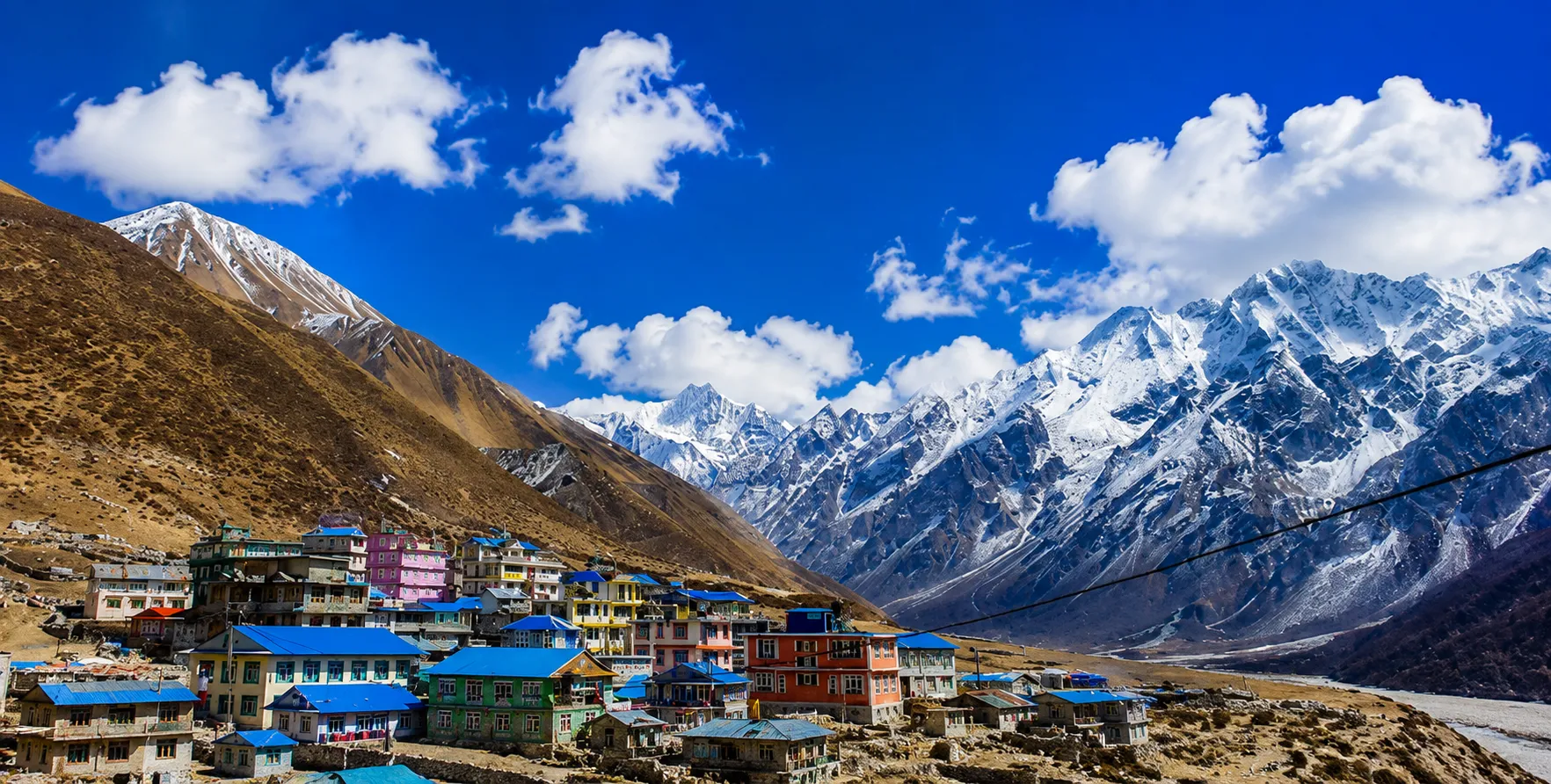
The Langtang Valley offers a trekking experience that is, by almost universal agreement, one of Nepal’s finest. The valley follows the Langtang Khola northeast from Syabrubesi through progressively more dramatic mountain country, passing through the ancient forests of Bamboo and Riverside (named for the features that define each stop), then climbing to the open valley floor at Lama Hotel and the gradually widening upper Langtang where the great peaks begin to dominate the skyline. Langtang Village (3,430 m) — rebuilt since the devastating 2015 earthquake-triggered avalanche that destroyed the original settlement — is a living Tamang community set directly beneath the wall of the Langtang range, with Langtang Lirung (7,227 m) rising on the northern skyline in a scale that is genuinely difficult to process.
Kyanjin Gompa (3,870 m) at the upper end of the valley is the trek’s first major high-altitude destination. In this small but active monastery community, yak cheese is produced and sold, where the HRA (Himalayan Rescue Association) maintains an outpost during trekking seasons, and where the surrounding peak views (Tserko Ri at 5,033 m offers a full-day hike with panoramic 360-degree mountain views) are among the finest accessible from the Langtang region. After 1 to 2 nights at Kyanjin Gompa, most trekkers descend back to the Lama Hotel area before crossing west via Syabru Bensi to the Gosaikunda approach via Thulo Syabru and Sing Gompa.
This full Langtang-Gosaikunda circuit covers approximately 100 to 140 kilometers of walking over 10 to 13 days. It delivers a complete Himalayan trekking experience: glacial valley, ancient forest, Tamang Buddhist culture, high-altitude yak pastures, sacred alpine lake, and Himalayan pass crossing. It is a journey that begins and ends with Nepal Vehicle Hiring’s vehicle — our private jeep hire delivering trekkers to Syabrubesi on day one and collecting them from Dhunche or Syabrubesi at the circuit’s completion.
Transport for Gosaikunda Pilgrims vs Trekkers: Different Needs, Same Vehicle
The Gosaikunda approach road serves two quite different user communities — trekkers visiting for the mountain experience and Hindu pilgrims visiting for the sacred lake’s spiritual significance — and Nepal Vehicle Hiring’s vehicle service meets both communities’ needs with the same professional, experienced approach.
Trekker Transport Needs
For trekkers, the Gosaikunda vehicle hire is primarily about efficiency, comfort, and timing. Trekkers want to reach the trailhead in good physical condition — not exhausted from a 10-hour bus journey in an overloaded vehicle — with time to settle into their guesthouse, check permits, and rest before the first day of walking. They may have large trekking bags (60 to 80 liter packs plus day packs) that require proper luggage storage rather than roof-rack tie-downs. They may have a specific trekking schedule linked to booked teahouse accommodation or guide availability. Nepal Vehicle Hiring’s private jeep hire addresses all of these trekker transport requirements: hotel drop-off pickup, guaranteed departure time, luggage stored safely inside the vehicle, experienced driver who manages timing efficiently, and arrival at the trailhead in the mid-afternoon window that allows proper first-day preparation.
Pilgrim Transport Needs
For Hindu pilgrims visiting Gosaikunda — particularly during Janai Purnima — the transport requirements have an additional dimension of spiritual significance. The vehicle journey from Kathmandu to the Syabrubesi or Dhunche trailhead is understood as the beginning of the pilgrimage itself, not merely a logistics step. The quality of the vehicle, the punctuality of the journey, and the dignity of the approach to the sacred mountain region all contribute to the spiritual experience. Nepal Vehicle Hiring’s temple-time-aware approach to religious tour transport, described in detail in our Nepal Nekhor tour and Muktinath Yatra itinerary services, extends equally to the Gosaikunda pilgrim transport — our drivers are briefed on the pilgrimage context of the journey, respectful of the devotional purpose of the trip, and experienced in managing the Janai Purnima traffic on the Pasang Lhamu Highway.
For large pilgrim groups — parties of 15 to 25 people making the Janai Purnima Gosaikunda pilgrimage together — our Coaster bus hire provides group transport to Dhunche, with 4WD jeep hire covering the Dhunche-to-Syabrubesi section if required. For smaller pilgrim families and groups of 4 to 7, our private 4WD jeep hire is the standard approach — offering the flexibility to stop for roadside prayers, for photographing the mountain views at Kalikasthan, and for the brief offerings that Tamang-tradition travelers make at the wayside shrines along the Pasang Lhamu Highway.
Road Improvement Plans for the Kathmandu-Syabrubesi Route
The Kathmandu-to-Syabrubesi road is a road in active transition. The Rasuwa District local government and the provincial government of Gandaki Province have both identified the Pasang Lhamu Highway as a priority development corridor, given its importance as the primary access route for Langtang National Park trekking tourism, for the Rasuwagadhi-Kerung Tibet border crossing, and for connecting the Rasuwa District’s population centers to the Kathmandu Valley. Several improvement initiatives are underway as of 2026:
- Betrawati to Dhunche surfacing: The most important ongoing infrastructure project on this route is the progressive surfacing of the Betrawati-to-Dhunche section with asphalt rather than compacted gravel. As of 2026, approximately 40 to 50 percent of this section has been surfaced, with the remainder scheduled for completion in 2027 and 2028. Each surfaced section significantly improves the driving experience — the eventual completion of this project will reduce the Kathmandu-to-Syabrubesi drive time to approximately 5 to 6 hours and make the road manageable for a wider range of vehicles.
- Bridge improvements: Several of the stream crossing points between Betrawati and Dhunche have been upgraded with permanent concrete bridge structures replacing the older temporary bridges that were more vulnerable to monsoon damage. These bridge upgrades improve both safety and year-round accessibility on the most critical sections of the approach road.
- Dhunche-to-Syabrubesi: The final 15-kilometer descent from Dhunche to Syabrubesi remains the most challenging section and the least improved. This section follows a very steep gradient through tight terrain that makes road widening difficult and expensive. In the near term (2026 to 2028), this section will likely remain the primary 4WD-essential section of the route. Nepal Vehicle Hiring’s jeep fleet is specifically equipped for this section’s demands.
For trekkers planning the Kathmandu-to-Gosaikunda vehicle journey in 2026 and 2027, the ongoing road improvements mean conditions will generally be better than in previous years — but the route is still a mountain road that rewards proper vehicle selection and experienced drivers. Nepal Vehicle Hiring monitors road conditions daily during all seasons and updates our Langtang-route drivers with current surface information before each departure.
Sample Two-Day Gosaikunda Trek Approach Itinerary
For trekkers who want to make the most of the approach without rushing, Nepal Vehicle Hiring recommends a two-day approach that combines the vehicle journey with a night in Dhunche or Syabrubesi and a leisurely exploration of the trailhead area before beginning the main trek:
Day 1: Kathmandu to Syabrubesi or Dhunche
- 6:30 AM: Nepal Vehicle Hiring private jeep picks up from Thamel hotel. Trekking bags and day packs loaded.
- 8:00 to 8:30 AM: Breakfast stop at Trishuli Bazaar. Fresh river trout or dal bhat. 20-minute stop.
- 9:30 AM: Arrive Betrawati. Vehicle checkpoint formalities handled by driver. Continue northward toward Ramche and Dhunche.
- 11:00 to 11:30 AM: Tea stop at Ramche with views of Ganesh Himal and early sightlines toward Langtang range. 10 to 15 minute stop.
- 12:30 to 1:00 PM: Arrive Dhunche. Langtang National Park permit registration at the checkpoint. Lunch at Dhunche teahouse. Trekkers starting the Dhunche-route Gosaikunda trek can begin the first hour of walking toward Sing Gompa after lunch.
- 1:30 to 2:30 PM (Syabrubesi trekkers): Depart Dhunche for the 15-kilometer descent to Syabrubesi. Arrive Syabrubesi approximately 2:30 to 3:30 PM.
- Afternoon at Syabrubesi: Guesthouse check-in, trail permit verification at the northern checkpoint, equipment check, and rest—optional short exploration of the village and the Langtang Khola riverside.
Day 2: Trek Begins
- 7:00 AM: First day of trekking from Syabrubesi trailhead. The trail follows the Langtang Khola northeast. First destination: Bamboo (1,960 m, approximately 2 hours from Syabrubesi) or Lama Hotel (2,470 m, approximately 4 to 5 hours) for the Langtang Valley circuit, or Thulo Syabru (2,210 m, approximately 2.5 to 3 hours) for the direct Gosaikunda route.
This two-day approach allows trekkers to arrive at the trailhead in good physical condition, well-rested and well-fed, with the full day of trekking energy intact for day two. Nepal Vehicle Hiring coordinates this approach as a standard option — our driver delivers you to your trailhead guesthouse on day one, and you begin trekking fresh on day two. The alternative of combining the full 66-to 88-hourvehicle journey and the first day of trekking in a single exhausting day is possible but not recommended by our Langtang-experienced team.
- Kathmandu to Gosaikunda Trek Vehicle Hire: Full 2026 Guide
- Gosaikunda Trek Overview: Why the Vehicle Approach Matters
- The Road: Kathmandu to Syabrubesi and Dhunche — Section by Section
- Vehicle Options for the Kathmandu to Gosaikunda Approach
- The Three Gosaikunda Trailheads: Which Is Right for Your Trek?
- Permits Required for the Gosaikunda Trek in 2026
- Best Time for the Kathmandu to Gosaikunda Trek: Seasonal Guide
- Optimal Departure Timing from Kathmandu
- What to Pack for the Kathmandu to Syabrubesi Vehicle Journey
- Combining the Gosaikunda Trek with Other Nepal Experiences
- Frequently Asked Questions: Kathmandu to Gosaikunda Trek Vehicle Hire
- Book Your Kathmandu to Gosaikunda Trek Vehicle with Nepal Vehicle Hiring
- Gosaikunda Lake: The Sacred Destination That Makes the Journey Worthwhile
- The Langtang Valley Connection: Why Most Trekkers Start at Syabrubesi
- Transport for Gosaikunda Pilgrims vs Trekkers: Different Needs, Same Vehicle
- Road Improvement Plans for the Kathmandu-Syabrubesi Route
- Sample Two-Day Gosaikunda Trek Approach Itinerary

Related Blog & Articles

Jeep vs Bus to Syabrubesi 2026
Kathmandu to Langtang Trek Vehicle Hire: The Complete Guide (2026)

Kathmandu to Tamang Heritage Trail Transport

Kathmandu to Syabrubesi Jeep Guide 2026
Kathmandu to Syabrubesi Road Overview