Plan a Trip


Nepal Travel Transport Companion
Nepal Travel Transport Companion – Complete Guide to Getting Around Nepal
Nepal is not a country you consume from a fixed point. It is a country you travel through — physically, actively, and continuously — across a landscape that changes character every hour and at every altitude. The way you move through Nepal is not incidental to your experience of it. It is your experience of it. The turquoise Trishuli River glimpsed between the seats of a mountain jeep, the Annapurna range filling the windscreen on the Kathmandu-to-Pokhara Prithvi Highway, the medieval rooftops of Bhaktapur sliding past a car window on the way to the Changu Narayan temple — these are not background details to your journey. They are the journey itself, rendered in motion.
Nepal is also a country whose transport landscape is genuinely unlike any other — a complex, layered ecosystem of private cars, shared jeeps, tourist coaches, local buses, domestic aircraft, helicopters, mountain jeep tracks, and some of the most dramatic and challenging roads on Earth. Understanding this ecosystem — what each option actually delivers in practice, what it costs, when it is the right choice and when it is dangerously wrong, and how to navigate it intelligently as a first-time or returning traveler — is the difference between a Nepal journey that flows with grace and one that is consumed by logistical friction and unnecessary stress.
This guide from Nepal Vehicle Hiring Pvt Ltd is your complete Nepal Travel Transport Companion for 2026 — a thorough, honest, research-grounded resource covering every significant mode of transport available to visitors, from the taxis of Thamel to the Land Cruisers of Upper Mustang, from the VIP Sofa Buses of the Lumbini pilgrimage circuit to the pre-dawn drives to Manthali airport for the Lukla Everest flight. There are no affiliate incentives in this guide, no exaggeration of convenience, and no concealment of the genuine challenges. Nepal’s transport ecosystem is extraordinary, navigable, and deeply rewarding once properly understood. This guide provides that understanding.
Plan your Nepal transport: Nepal Vehicle Hiring | Call/WhatsApp: +977 9851013196
Understanding Nepal’s Road Network – The Foundation of Everything
Before choosing any vehicle, route, or transport option in Nepal, the most important investment any traveler can make is fifteen minutes to understand what Nepal’s road network actually is and how it behaves. Most visitors arrive with assumptions shaped by road experiences in their home countries — assumptions that Nepal’s physical geography renders immediately obsolete.
Nepal is one of the most topographically extreme countries on Earth. This nation compresses almost every climate zone and altitude from 70 meters above sea level in the Terai plains to 8,849 meters at the summit of Everest within a horizontal distance of barely 200 km. Its roads were not built on a flat canvas. They were carved into the flanks of geologically young, inherently unstable mountains whose slopes continue to be shaped by seismic activity, monsoon erosion, glacial melt, and landslide events that no amount of engineering can entirely predict or prevent. The result is a road network that ranges from the smooth, reasonably wide Prithvi and Mahendra highways of the Terai and middle-hill corridors to narrow single-track jeep paths clinging to cliff edges 1,000 meters above river gorges with no barriers, no street lighting, and no margin for error.
In 2026, around 75–80% of the Kathmandu–Pokhara Prithvi Highway is smooth and well-maintained, with travel time reduced to approximately 6 to 6.5 hours for private vehicles — a significant improvement from earlier years. City roads in Kathmandu and Pokhara are predominantly paved but frequently congested, narrow, and shared with motorcycles, pedestrians, cycle rickshaws, sacred cows, and construction equipment simultaneously. Mountain roads above approximately 1,500 meters often transition from paved to gravel to unpaved track within a few kilometers, and seasonal conditions — particularly monsoon landslides, winter frost, and post-flood debris fields — can close sections without notice.
The single most important practical truth about Nepal’s road network, confirmed by every transport specialist and safety advisory in 2026, is this: the quality of your vehicle and driver matters enormously more in Nepal than in almost any other country in the world. A poorly maintained bus on the Mugling–Narayanghat corridor, a standard sedan attempting the Besisahar–Dharapani off-road section, or an inexperienced driver on the Dhunche–Syabrubesi mountain road are not merely uncomfortable choices — they are genuinely hazardous ones. Road safety in Nepal is a real, documented, serious consideration. The World Health Organization’s data places Nepal’s road fatality rate at 28.2 deaths per 100,000 population — nearly double the Asia-Pacific regional average, with overloaded, poorly maintained public buses accounting for the significant majority of serious tourist-affecting accidents. Understanding this context is not meant to discourage Nepal road travel — it is meant to ensure you make informed choices that keep you safely on the right side of that statistic.
Private Vehicle Hire – Nepal’s Most Intelligent Transport Choice
Private vehicle hire — engaging a dedicated vehicle with a professional driver for your exclusive use — is the most widely recommended transport option for visitors to Nepal who value their time, safety, comfort, and flexibility. Every major Nepal transport guide, trekking agency, and government travel advisory published in 2026 points in the same direction. As one leading Nepal transport specialist summarises: the best option to travel in Nepal right now is private tourist transport such as cars, jeeps, tourist Hiace vans, EV vehicles, tourist buses, and Coasters with drivers. If you are a tourist, hiring a vehicle from a registered tourist vehicle service is the recommended approach.
The word ‘private’ in this context is critical: a private hired vehicle carries only your group, departs from your hotel at the time you specify, makes stops at places you choose, adjusts its pace to your preferences, and delivers you to your specific destination rather than to a fixed bus terminal. This is not luxury — it is the normal standard of transport service that most visitors from developed countries assume as a baseline and that Nepal’s public transport system structurally cannot provide.
The Private Car – Urban and Highway Travel for Small Groups
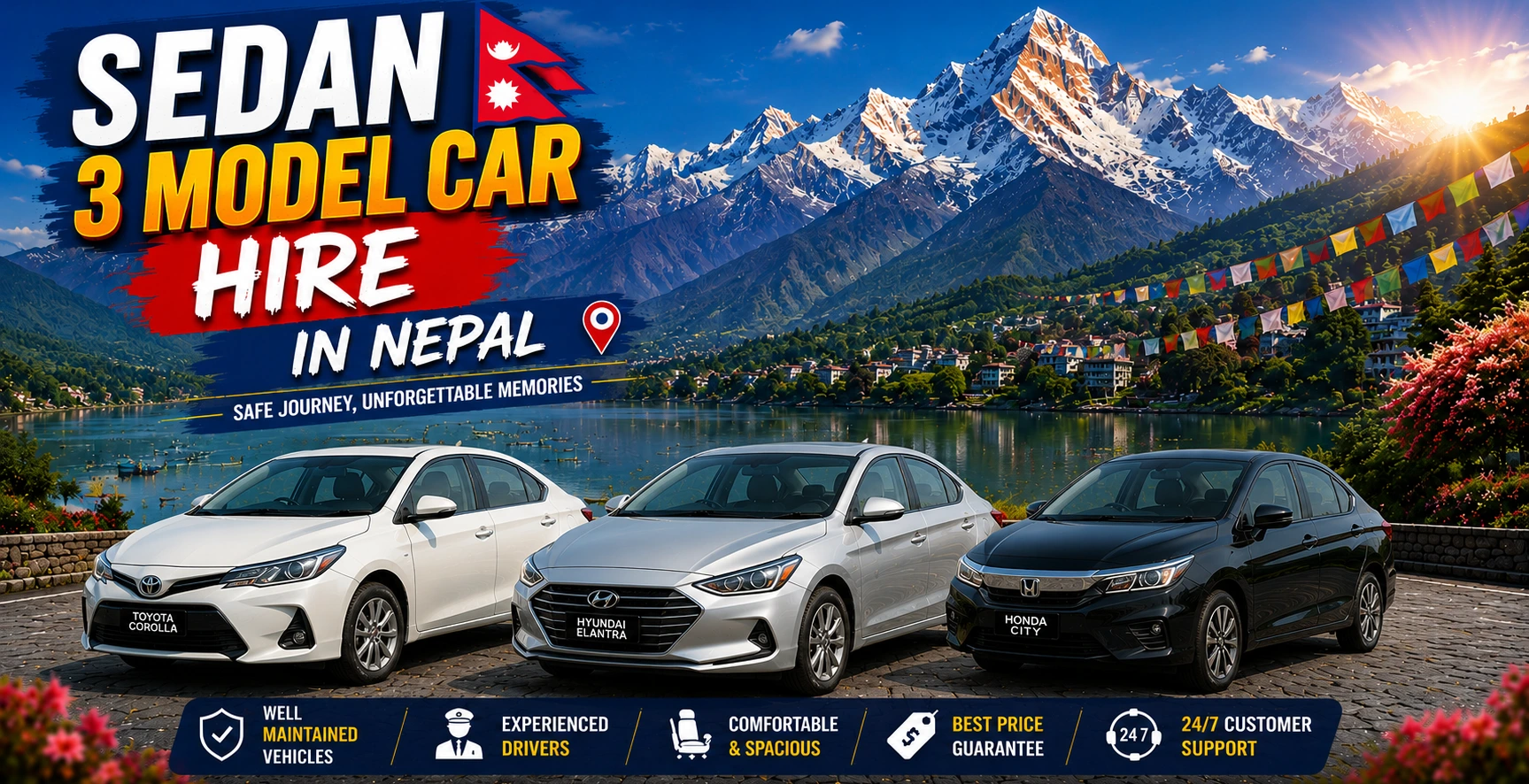
For groups of one to four people traveling within Kathmandu Valley, between major cities on paved highways, or for airport transfers, the private car — typically a sedan or compact SUV — is Nepal Vehicle Hiring’s most economical and comfortable offering. The Kathmandu airport-to-Thamel transfer by private taxi or car costs approximately NPR 400–1,500, with the wide variance reflecting the difference between negotiated unmetered taxis and professional pre-booked services. Nepal Vehicle Hiring’s private car service provides a fixed, transparent price with hotel-to-hotel service, eliminating the arrival-day negotiation stress that can add unnecessary friction to the start of a trip.
On longer inter-city routes — Kathmandu to Pokhara (200 km, 6–6.5 hours), Kathmandu to Chitwan (150 km, 4–5 hours) — a private car is the most efficient vehicle for small groups, allowing stops at Bandipur, Daman, or any roadside viewpoint without schedule constraints. The Prithvi Highway’s ongoing improvement means the Kathmandu-Pokhara drive is now consistently faster than it was even in 2024, with the scenic stretches along the Trishuli River gorge and through the Gandaki valley offering some of Nepal’s finest highway scenery. However, private cars are not suitable for any off-road mountain route — the ground clearance and traction of a standard sedan or city SUV are fundamentally inadequate for Nepal’s Category 3 and 4 mountain roads, where the road surface transitions from gravel to rock to muddy track in quick succession.
The 4WD Jeep – The Heart of Nepal’s Mountain Transport
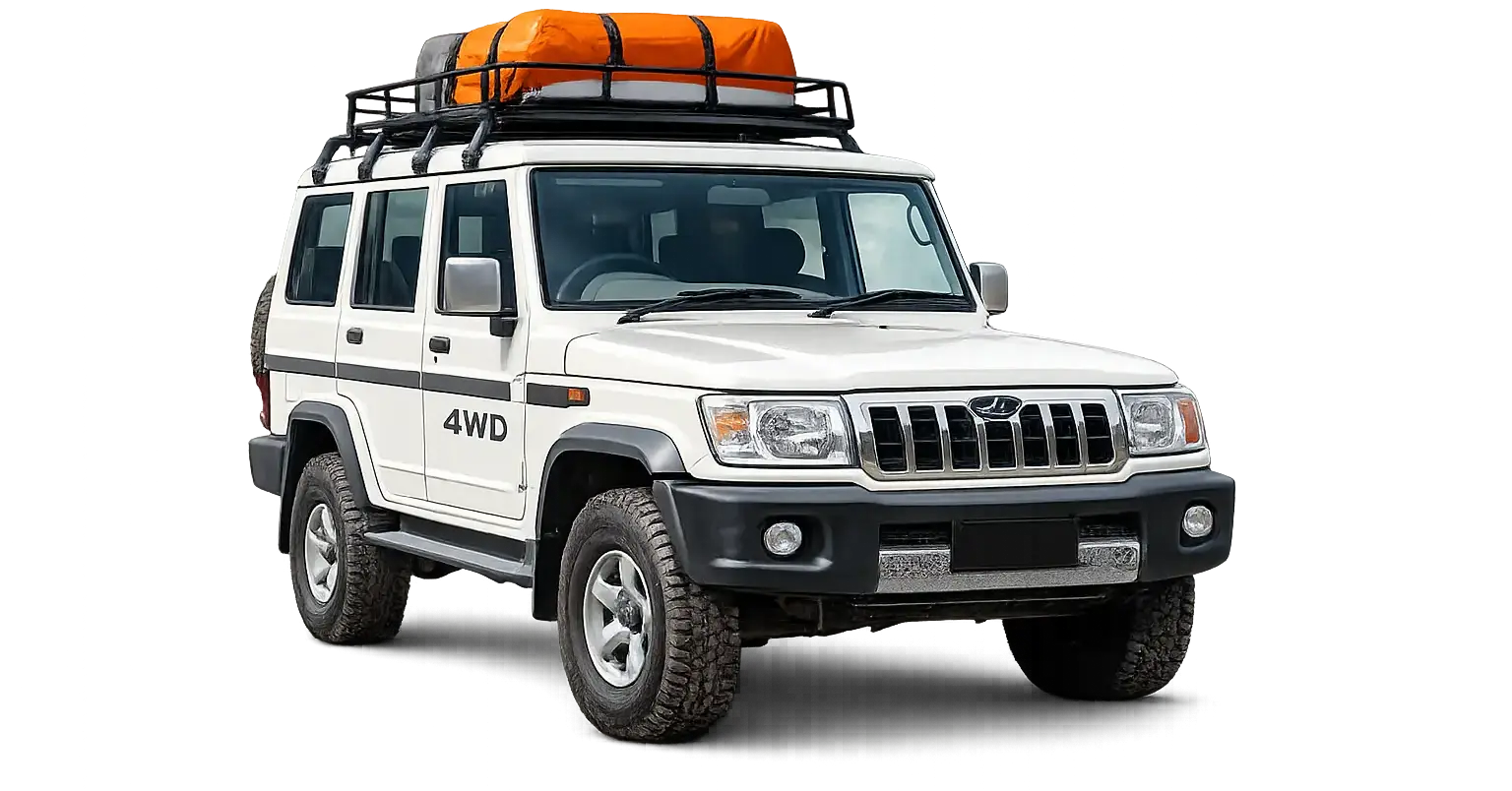
The 4WD jeep — principally the Mahindra Scorpio, Mahindra Bolero, and Toyota Land Cruiser variants — is Nepal’s most important and most broadly useful private vehicle hire category, serving the full range of mountain trekking transfers, off-road pilgrimage routes, and extreme terrain destinations that make up the majority of Nepal’s most rewarding travel experiences. Jeep hire is not a specialized niche in Nepal — it is the standard solution for any journey that leaves the paved highway network, and it covers an enormous proportion of the country’s most significant destinations.
The appeal of jeep transport in Nepal is rooted in a set of characteristics that precisely match the country’s demands. The 4WD capability — switchable between 2H, 4H, and 4L modes — provides the traction and climbing force required on steep, loose-surfaced mountain tracks. The high ground clearance of 180–225+ mm — dramatically higher than any standard car — allows the vehicle to pass over the rocks, ruts, drainage channels, and debris that characterize Nepal’s off-road surfaces without grounding the chassis. The diesel engine’s maximum torque at low RPM is precisely calibrated to the slow, powerful climbing that mountain tracks require. And the 7-passenger capacity of vehicles like the Scorpio and Bolero means that a complete trekking group can travel as a single unit in a single vehicle, sharing cost and experience equally.
Among Nepal’s 4WD fleet, the Mahindra Scorpio is the single most widely used and trusted mountain vehicle in Nepal’s private hire market. Its combination of genuine switchable 4WD, proven reliability in extreme conditions, adequate interior comfort for full-day mountain drives, and competitive pricing makes it the gold standard for Annapurna Circuit transfers, Kalinchowk winter trips, Muktinath approaches, Langtang and Tamang Heritage Trail transfers, and dozens of other off-road routes. The Mahindra Bolero — Nepal’s most widely distributed 4WD rural vehicle, with spare parts available in virtually every district headquarters in the country — offers the same essential off-road capability at a slightly lower hire rate, making it the preferred choice for budget-conscious groups who understand that spare parts availability in remote areas is a genuine safety consideration, not an abstract technical detail.
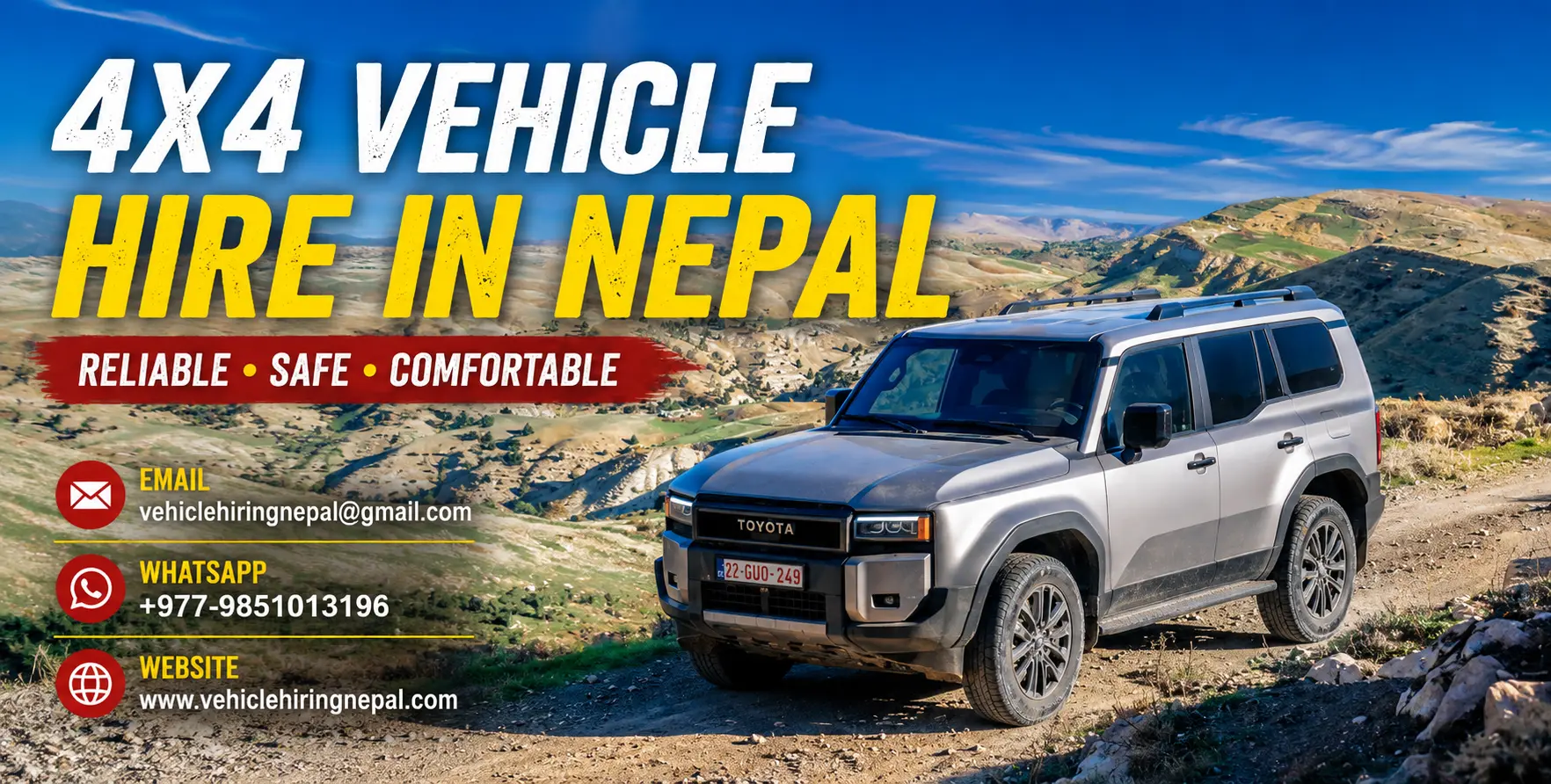
The Toyota Land Cruiser occupies the premium tier of Nepal’s jeep hire market — and its premium is genuinely earned rather than merely marketed. Its 225+ mm ground clearance, multi-terrain select system, locking differentials, air suspension, crawl control, and powerful high-altitude diesel performance deliver a categorically different experience on Nepal’s most demanding routes — Upper Mustang beyond Kagbeni, the Kali Gandaki gorge approach to Muktinath, extreme remote routes in Dolpo and Karnali, and high-altitude winter crossings — where the margin of safety and capability it provides over the Scorpio is not merely comfortable but operationally significant. For VIP pilgrims, expedition teams, senior travelers, and premium tour operators, the Land Cruiser is the unambiguous correct choice regardless of its higher hire rate.
The Toyota Hiace Van – The Group Highway Standard
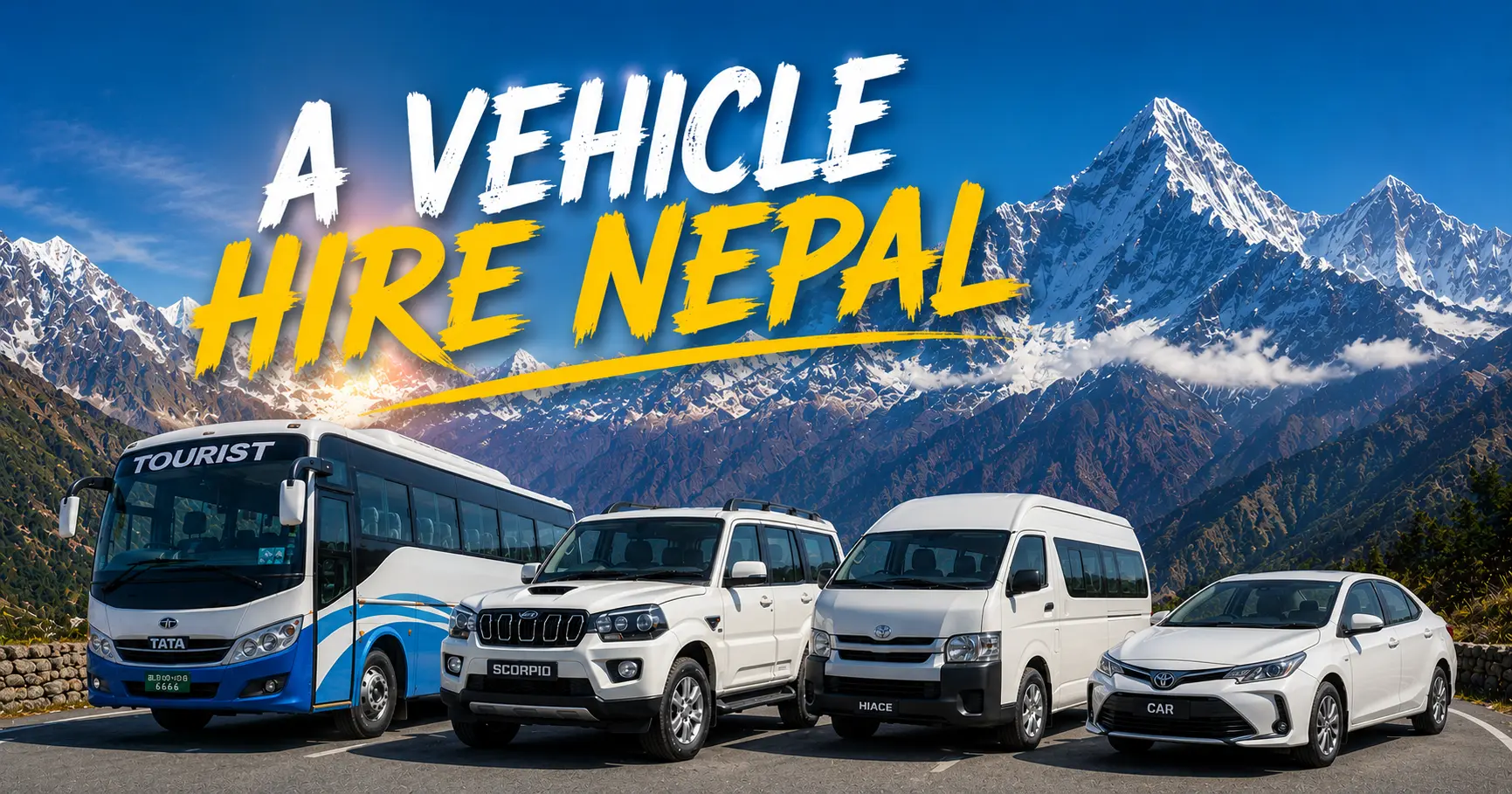
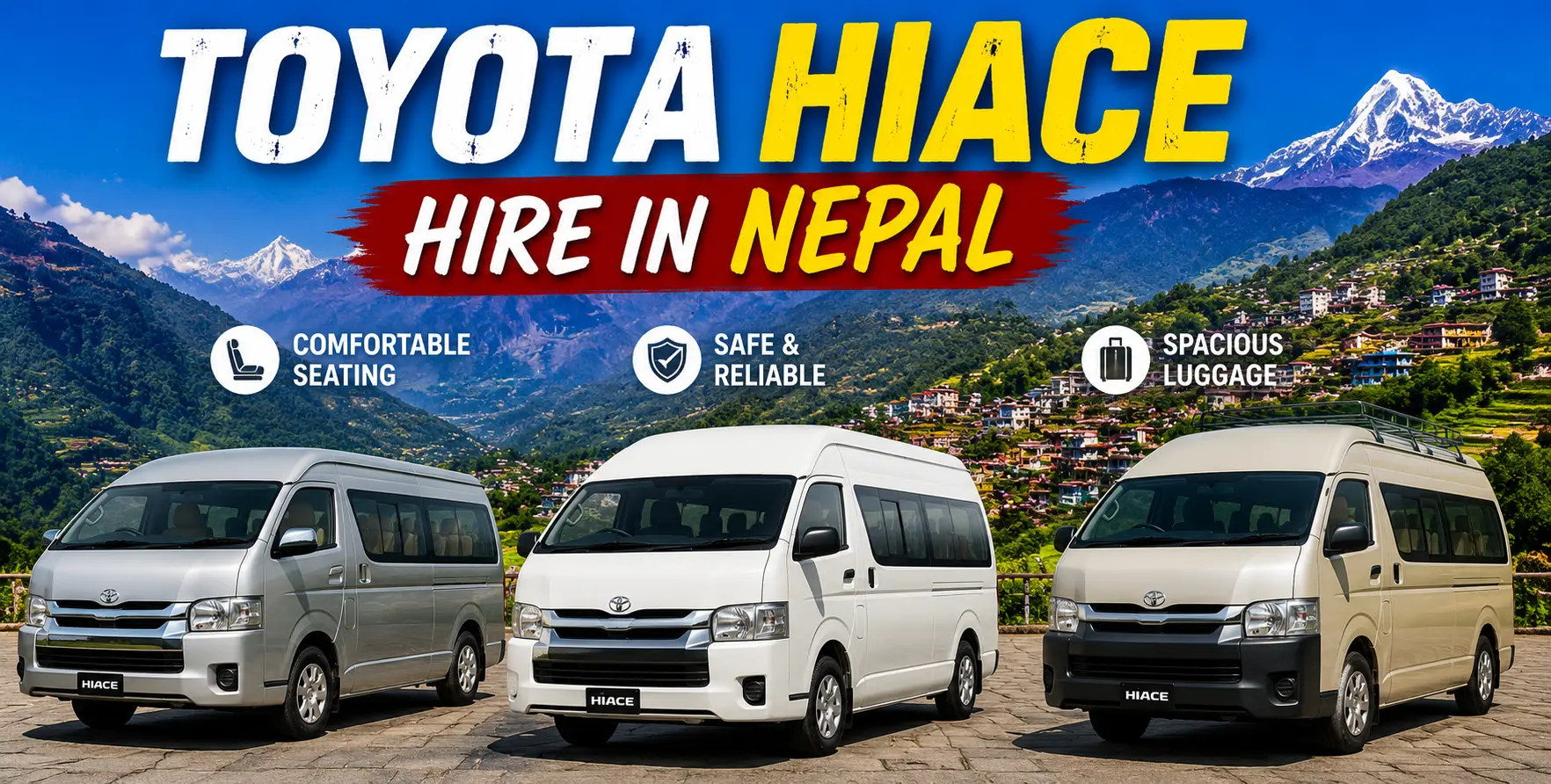
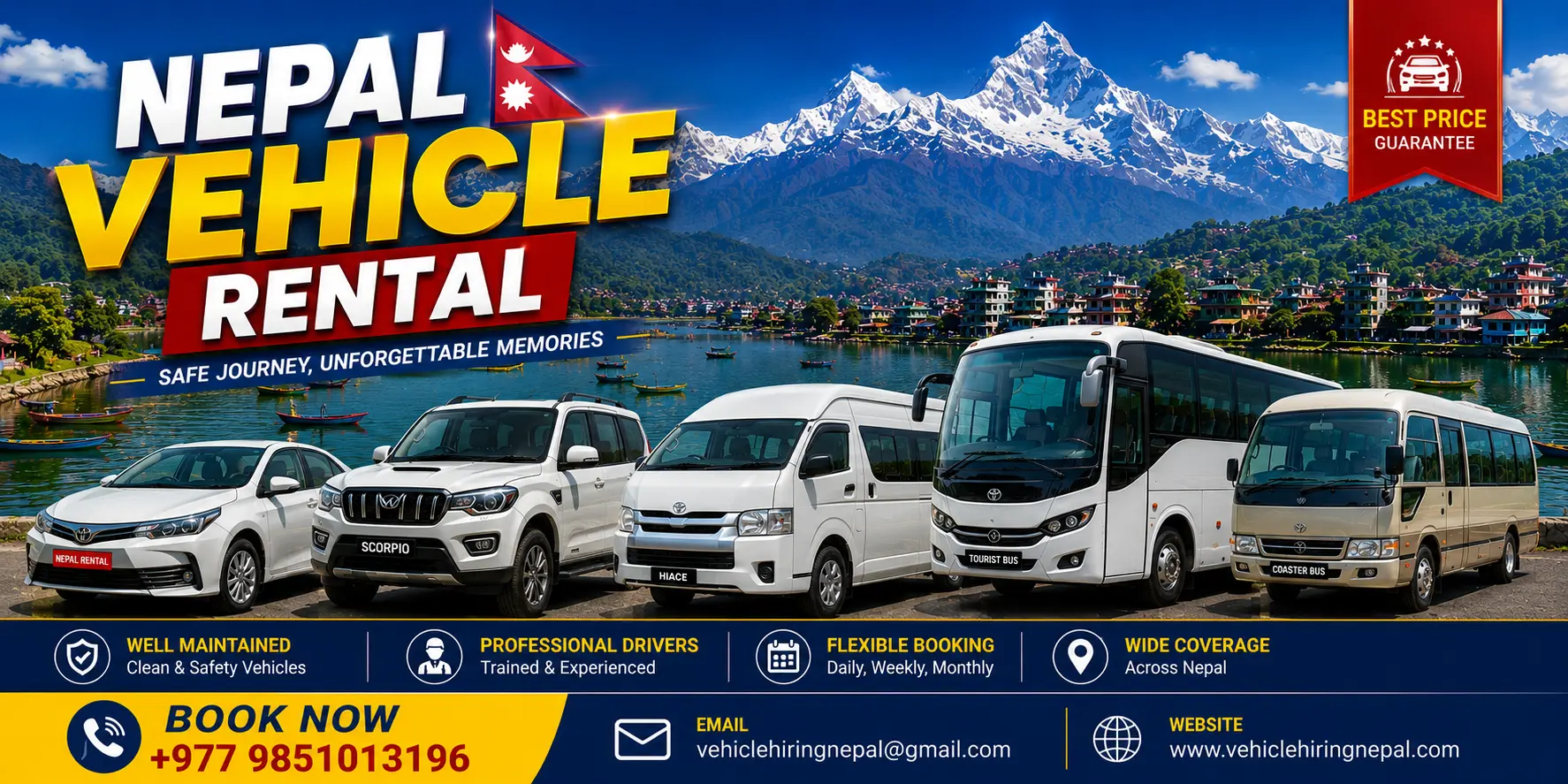
For medium-sized groups of 8–13 people traveling on Nepal’s paved highway network, the Toyota Hiace van is Nepal Vehicle Hiring’s most cost-effective per-head private vehicle. Spacious, comfortable, fully air-conditioned, and offering significantly more luggage capacity than a jeep, the Hiace is the preferred vehicle of trekking agencies, pilgrimage groups, corporate tour parties, and international operators bringing medium-sized groups to Nepal. The Hiace handles all of Nepal’s major paved highway routes — Kathmandu to Pokhara, Kathmandu to Lumbini, Kathmandu to Chitwan, Pokhara to Chitwan — smoothly, efficiently, and at a per-person cost that often matches or beats individual tourist bus tickets. Its critical limitation is equally clear: the Hiace is a highway vehicle and cannot be deployed on Category 3 or 4 off-road mountain routes. Groups of 8–13 people who need to reach off-road destinations like Besisahar–Dharapani or Syabrubesi–Rasuwagadhi require either multiple 4WD jeeps or a Hiace to the highway endpoint followed by separate local 4WD vehicles.
VIP Sofa Bus and Tourist Bus – Premium and Standard Group Highway Transport
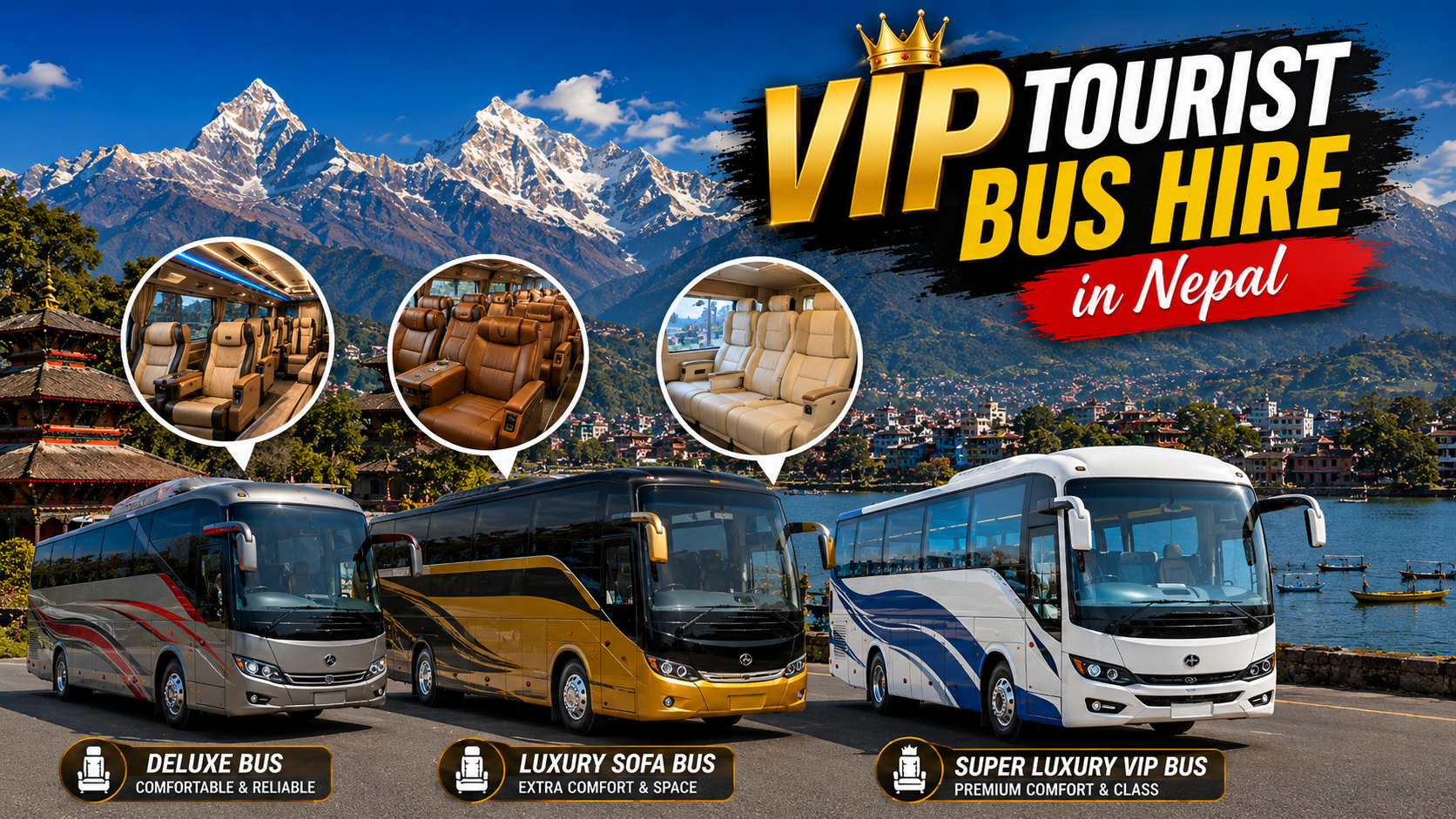
For large groups of 20–45 people traveling Nepal’s highway network, the VIP Sofa Bus (2×1 seating, 21–30 passengers) and Deluxe Tourist Bus (2×2 seating, 30–45 passengers) represent Nepal’s finest and most practical group highway transport options respectively. The VIP Sofa Bus is distinguished by its single seat on the right and double seat on the left seating arrangement, giving each passenger exceptional personal space for a bus, combined with full air conditioning, individual USB charging, WiFi on major routes, air suspension for a smoother ride, and panoramic windows. It is the standard vehicle for international Buddhist pilgrimage delegations to Lumbini, premium corporate tour groups, and senior travelers for whom comfort on the 8–10 hour Kathmandu-to-Lumbini or Kathmandu-to-Pokhara routes is non-negotiable. Nepal Vehicle Hiking also provides a Coascoaster minibus for groups of 18–25 people, particularly valued for its compact size, which allows it to navigate secondary roads and hill approaches inaccessible to full-size coaches.
Public Transport Options – When They Work and When They Don’t
Nepal’s public transport system is extraordinarily extensive, surprisingly affordable, and genuinely appropriate for certain types of traveler and certain types of journey. Understanding its realistic capabilities and limitations — without either dismissing it entirely or romanticizing beyond its practical merits — is essential for any complete Nepal transport guide.
Local Buses – The Country’s Arterial Network
The local bus network connects virtually every district headquarters and major settlement in Nepal — an extraordinary logistical achievement given the country’s terrain. Buses depart primarily from Kathmandu’s Gongabu (New Bus Park) at Machhapokhari, with separate terminals for different regional routes. Fares are genuinely low — NPR 700–2,000 for journeys of 7–9 hours that would cost three to four times as much by shared jeep and ten to fifteen times as much by private vehicle. For travelers on extremely tight budgets or for those seeking an authentically local experience of Nepal’s road culture, the local bus offers both.

The limitations are equally genuine. Local buses are frequently overcrowded, and operate without meaningful seat-reservation enforcement on the day of travel. Luggage for trekkers with large packs is almost always consigned to the roof rack, where it is exposed to dust, rain, and the handling of strangers. Schedules are nominal — buses depart when the driver decides the vehicle is sufficiently full, not at the printed time, and intermediate stops to pick up and drop off local passengers extend already long journey times unpredictably. The route from Kathmandu to Syabrubesi, for example, takes 8–10 hours by local bus compared to 5–6 hours by private jeep on the faster Tokha shortcut route. The mechanical reliability of some fleet vehicles is questionable by any developed-world standard, and the driving culture on mountain roads — overtaking on blind bends, operating in failing light, and the documented danger of driver fatigue on long night routes — has contributed to Nepal’s high road fatality rate in ways that disproportionately affect public bus passengers.
Nepal’s major government and independent travel advisories are consistent on this point: we recommend taking tourist buses or hiring a vehicle for leaving the Kathmandu Valley due to safety concerns. The specific risk from local public buses in Nepal is not theoretical — it is documented in WHO fatality data, in the annual reports of Nepal’s Department of Transportation Management, and in the hard practical reality of the country’s mountain roads.

Tourist Buses – The Middle Ground
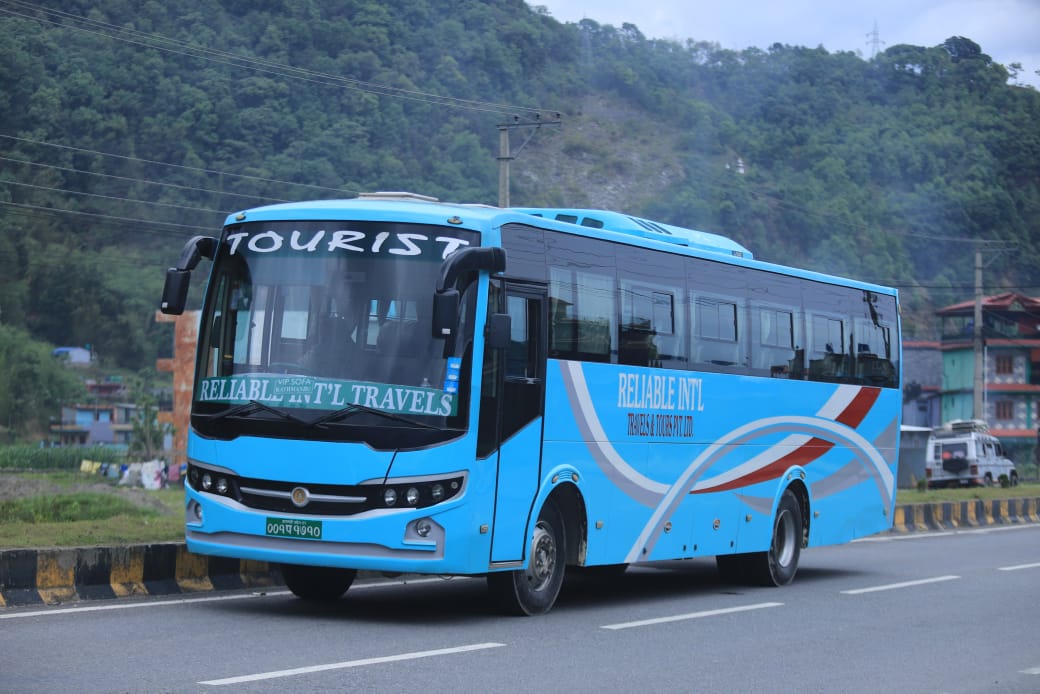
The tourist bus category occupies a meaningful middle ground between local public buses and private vehicle hire — offering fixed departure times, designated seating, air conditioning (on the best services), and a passenger profile exclusively of tourists rather than mixed local and tourist loads. Tourist buses operate primarily on the Kathmandu–Pokhara, Kathmandu–Chitwan (Sauraha), Kathmandu–Lumbini, and Pokhara–Chitwan highway routes. They depart from tourist-area collection points in Thamel or from the main bus park, with Kathmandu–Pokhara tourist buses taking 6–8 hours and Kathmandu–Chitwan services 5–6 hours.
Tourist buses are a legitimate and reasonable choice for solo travelers on tight budgets traveling between highway-connected destinations. They are not suitable for off-road routes, mountain destinations, or any journey requiring 4WD capability. They also provide no flexibility for timing, route, or stops — a tourist bus to Pokhara leaves at its scheduled time and arrives at the Pokhara bus park, from which a separate taxi or tuk-tuk is required to reach Lakeside hotels. For groups of 4 or more, the per-person cost of a tourist bus is typically comparable to private vehicle hire when the secondary taxi costs and timing inflexibility are properly accounted for, making private hire the more economical real-world choice even on a purely financial basis.
Night Buses – A Word of Honest Caution
Nepal’s overnight bus services — operating primarily on the Kathmandu–Pokhara and Kathmandu–Lumbini routes — are marketed as comfortable time-saving options but deserve careful consideration before booking. The honest assessment, confirmed by multiple 2026 transport guides: most passengers get very little sleep regardless of seat quality, because Nepal’s mountain roads are rough and winding throughout the journey and the overnight driving conditions on Nepal’s unlit mountain roads are objectively more hazardous than daytime travel. The risk of theft is higher on overnight journeys, particularly for luggage stored on the bus roof. There is also the documented danger of drivers falling asleep on night routes- a risk that Nepal’s transport operators have not yet systematically addressed through mandatory rest policies or two-driver requirements on all overnight routes. Nepal Vehicle Hiring does not offer night bus services and strongly recommends that visitors avoid overnight buses in favor of daytime travel, adjusted departure times, or an extra hotel night if time pressure is the driver of the overnight bus consideration.
Shared Jeeps – Budget Access to Mountain Routes
The shared jeep — known locally as a Sumo (after the dominant Tata Sumo model historically used) — fills a distinctive niche in Nepal’s transport ecosystem: faster than the local bus, more capable of mountain terrain than any bus, and significantly cheaper than a private jeep for solo or small-party ttravelers Shared jeeps operate from Gongabu Bus Park in Kathmandu and from equivalent stands at major town transit points across Nepal, typically carrying 6–7 passengers and departing when full rather than on a fixed schedule.
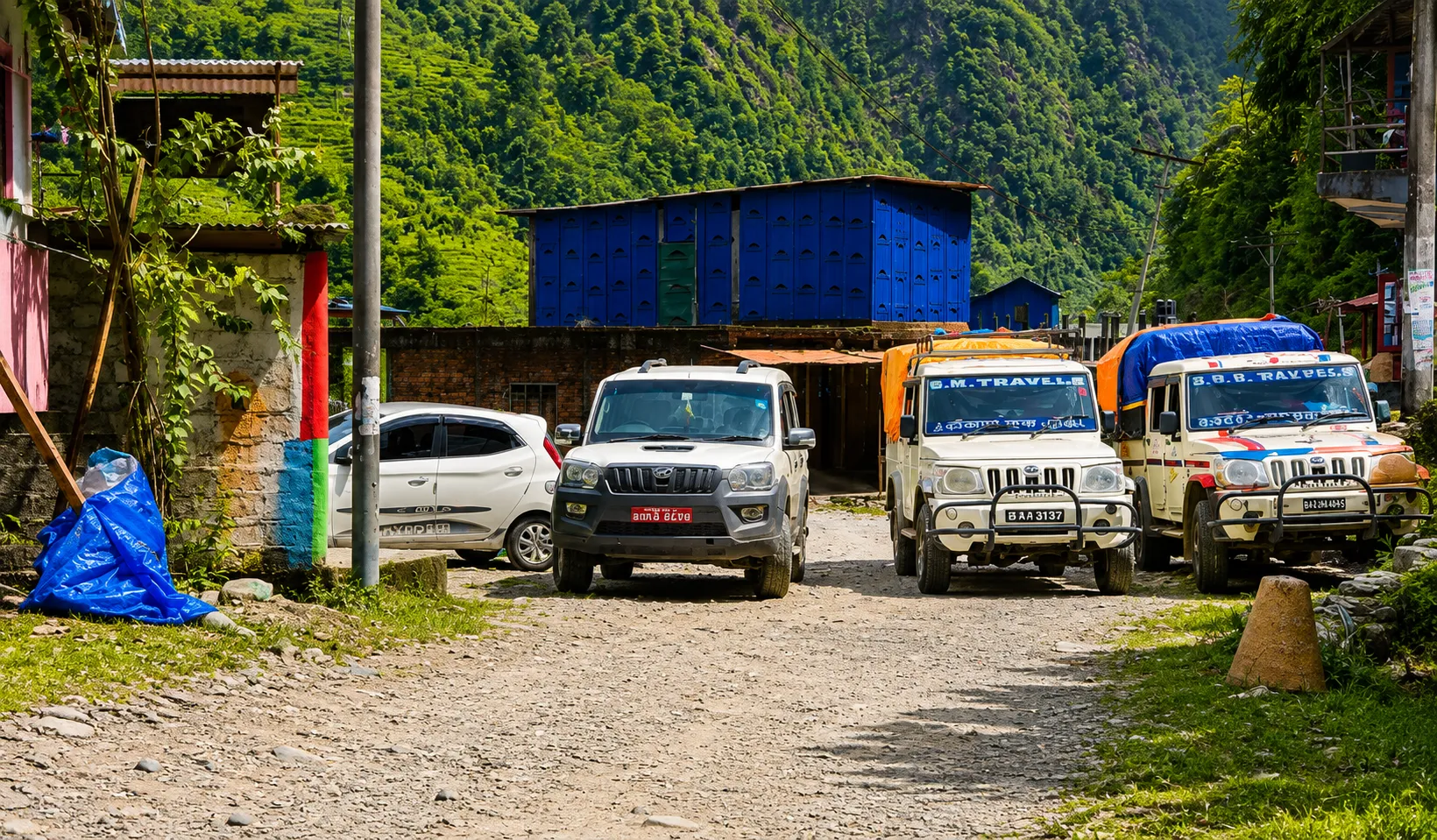
The shared jeep is genuinely the preferred option for experienced solo trekkers heading to mountain trailheads — Syabrubesi for Langtang, Besisahar for the Annapurna Circuit, Salleri for the Everest lower approach — where cost efficiency matters more than timing control and where the travelers are comfortable with the wait-to-fill departure model and the shared cabin with strangers. A shared jeep seat to Syabrubesi costs NPR 2,500–3,000 per person, compared to NPR 700–2,000 for the bus and NPR 25,000–35,000 for the full private vehicle. The time saving over the bus is approximately 2–3 hours on the Kathmandu–Syabrubesi route, due to the private vehicle’s faster Tokha shortcut and fewer stops.
For groups of 5 or more traveling together, however, the arithmetic of shared jeep versus private jeep changes fundamentally: five people each paying NPR 3,000 for a shared jeep seat totals NPR 15,000 — more than half the cost of a private vehicle, for a service that provides none of the flexibility, timing control, or luggage security of private hire. For any group of five or more, private vehicle hire is almost always the correct economic and practical choice over multiple shared jeep seats.
Domestic Flights – When the Air Is the Only Sensible Option
Nepal’s domestic aviation network plays a role in the transport ecosystem that is in some ways even more important than its international connections. While road transport serves the majority of Nepal’s tourist destinations, certain places are so remote, so geographically isolated, or so time-constrained that the domestic flight is not merely convenient but operationally necessary. Understanding when to fly and when to drive is one of the most important transport decisions in Nepal travel planning.
The Lukla Flight – The Most Famous Mountain Landing in the World
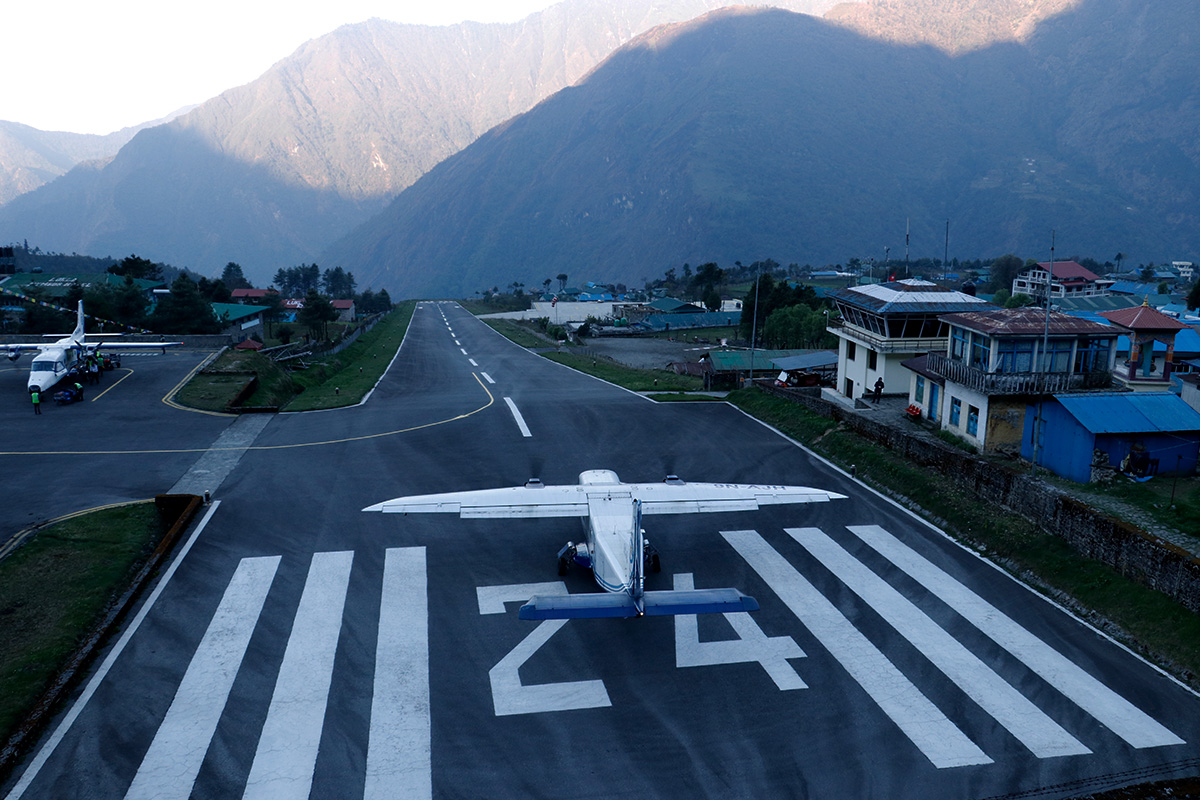
The Manthali (Ramechhap) to Lukla flight is in a category of its own in Nepal’s domestic aviation landscape. Since 2019, all Lukla flights have departed from Manthali (Ramechhap) domestic airport rather than Kathmandu’s Tribhuvan International Airport, requiring trekkers to complete a 4–5 hour pre-dawn drive from their Kathmandu hotel — departing at 2:00–3:00 AM — before the 20-minute mountain flight to Lukla’s Tenzing-Hillary Airport (2,860 m). Nepal Vehicle Hiring provides the Kathmandu -Anthali pre-dawn transfer as a 24/7 service, with experienced drivers on the highway at any hour. The Lukla flight itself — a twin-otter approach between mountain walls to a 527-meter sloped runway cut into the Khumbu hillside — is one of aviation’s most famous experiences. The reliability concerns of Lukla flights (frequently canceled by weather for days at a time) make the Salleri road alternative increasingly popular for trekkers who cannot afford itinerary uncertainty.
Pokhara to Jomsom – The Mustang Air Gateway
The Pokhara to Jomsom flight (approximately 25 minutes) provides direct access to the Mustang region and the Muktinath pilgrimage circuit without the 8–9 hour Kali Gandaki valley jeep drive. While the jeep drive is one of Nepal’s most spectacular road journeys—threading the world’s deepest gorge between the 8,000-meter flanks of Annapurna and Dhaulagiri—the Jomsom flight is preferred by time-constrained travelers, senior pilgrims, and those with altitude concerns who benefit from gradual land-based acclimatization rather than rapid air ascent. Nepal Vehicle Hiring coordinates the Pokhara hotel-to-Pokhara Airport transfer and the Jomsom Airport-to-Muktinath jeep connection for combined flight-plus-vehicle itineraries.
Key Domestic Airlines and Booking Guidance
Nepal’s primary domestic airlines in 2026 include Buddha Air, Yeti Airlines, Shree Airlines, Summit Air, and Tara Air. Nepal’s domestic aviation market has a documented history of schedule irregularity, weather delays, and in some cases serious safety incidents. The Longest Way Home’s comprehensive 2026 transport guide is specific on one point that every Nepal traveler should internalize: book domestic flights through licensed local travel agents rather than directly online where possible, as agents can manage rebooking and alternative arrangements during cancellation events far more effectively than self-managed online tickets. Weather-related cancellations at Lukla, Jomsom, and other mountain airstrips are genuinely common, particularly during monsoon and transition seasons, and a good local agent becomes a critical logistics partner when these occur.
Getting Around the Cities – Taxis, Apps and Urban Navigation
Within Kathmandu, Pokhara, and Nepal’s other major urban centers, the transport landscape shifts completely from the mountain vehicle ecosystem to a dense, often chaotic, but ultimately navigable urban mobility mix of taxis, ride-hailing apps, cycle rickshaws, tempos, and micro-buses.
Taxis – Ubiquitous, Useful, and Negotiation-Required
Taxis are the most convenient and most commonly used urban transport option for foreign visitors in Kathmandu and Pokhara. They are readily identifiable by their yellow-and-white livery and black number plates, and available at every major hotel, tourist site, and street corner in both cities. The range of pricing is wide: Kathmandu airport to Thamel typically costs NPR 400–1,500 depending on negotiation skill, vehicle condition, and whether the driver has a functioning meter. As multiple 2026 guides confirm, drivers are supposed to use the meter. Still, most are unwilling to do so, which means negotiating the fare before getting in is the standard expectation rather than a special technique. Visitors who arrive without this knowledge routinely pay two to three times the reasonable rate on their first journey. The approximate 2026 fare rates for key Kathmandu journeys: Thamel to Pashupatinath NPR 300–400; Thamel to Boudhanath NPR 400–500; Thamel to Patan Durbar Square NPR 250–350; full-day city tour NPR 3,000–5,000.
Pathao, Tootle and inDriver – Nepal’s Ride-Hailing Revolution
Nepal’s ride-hailing apps — Pathao, Tootle, and the recently launched inDriver — have transformed urban transport in Kathmandu and Pokhara since their introduction, providing the price transparency, route tracking, and driver accountability that traditional taxi culture historically lacked. Both Pathao and Tootle operate motorcycle taxi and car options, with motorcycle taxis being the fastest and cheapest option for solo travelers navigating Kathmandu’s congested lanes. InDriver, launched more recently, uses a bidding model where drivers compete for your ride with their own price offers, typically resulting in very competitive fares. Nepal Hiking Team’s 2026 transport guide confirms: using Pathao or Tootle can save you a lot of time and money compared to negotiating with unmetered taxis, especially if you need a taxi frequently. The apps require a Nepali or international SIM card and a smartphone with data connection — easy to arrange at the Kathmandu airport on arrival.
Cycle Rickshaws and Auto-Rickshaws
Cycle rickshaws remain a slow but charming and environmentally benign way to navigate the narrow heritage lanes of Kathmandu’s old city areas, Bhaktapur, and Patan — particularly useful for the lane networks of Thamel, Asan Chowk, and the approach lanes of Kathmandu Durbar Square that are inaccessible or impractical for taxis. Auto-rickshaws (tuk-tuks) were removed from Kathmandu’s central area as part of the city’s air pollution reduction program but remain widely available in Pokhara’s Lakeside area and in smaller Terai towns like Lumbini, where they are the primary way to navigate the wide distances between the sacred garden and the international monastic zone.
Mountain Roads, Monsoon, and the Real Safety Landscape
Nepal’s mountain road environment is genuinely different in character from any road experience most international visitors have previously encountered, and it deserves direct, honest discussion rather than either alarmism or reassurance that papers over real risks.
The Four Road Categories Every Nepal Traveler Should Understand
Nepal’s roads broadly fall into four categories that determine vehicle requirements and realistic journey times. Category 1 roads are the major paved highways — the Prithvi Highway (Kathmandu–Pokhara), Mahendra Highway (Terai east-west), Tribhuvan Highway (Kathmandu–Birgunj), and Arniko Highway (Kathmandu–Tibet border). These are the country’s arterial connections, accessible to all vehicle types including standard cars and tourist coaches. Category 2 roads are secondary paved routes — district connections and regional roads that are paved but narrower, with more wear and more frequent roadwork disruption. Standard cars and jeeps handle these well; large coaches are awkward on the tighter sections. Category 3 roads are the unpaved or gravel mountain tracks — the Besisahar–Dharapani Annapurna approach, the Beni–Muktinath Kali Gandaki valley road, the Trishuli–Syabrubesi–Rasuwagadhi mountain corridor, and hundreds of district and rural mountain roads. These require 4WD with genuine off-road capability as a minimum specification. Category 4 represents extreme off-road mountain tracks — the Kagbeni–Lo Manthang Upper Mustang track, sections of the Karnali Highway, and similar routes accessible only to the Toyota Land Cruiser and equivalent vehicles driven by experienced mountain specialists.
Monsoon Travel – The Most Important Annual Variable
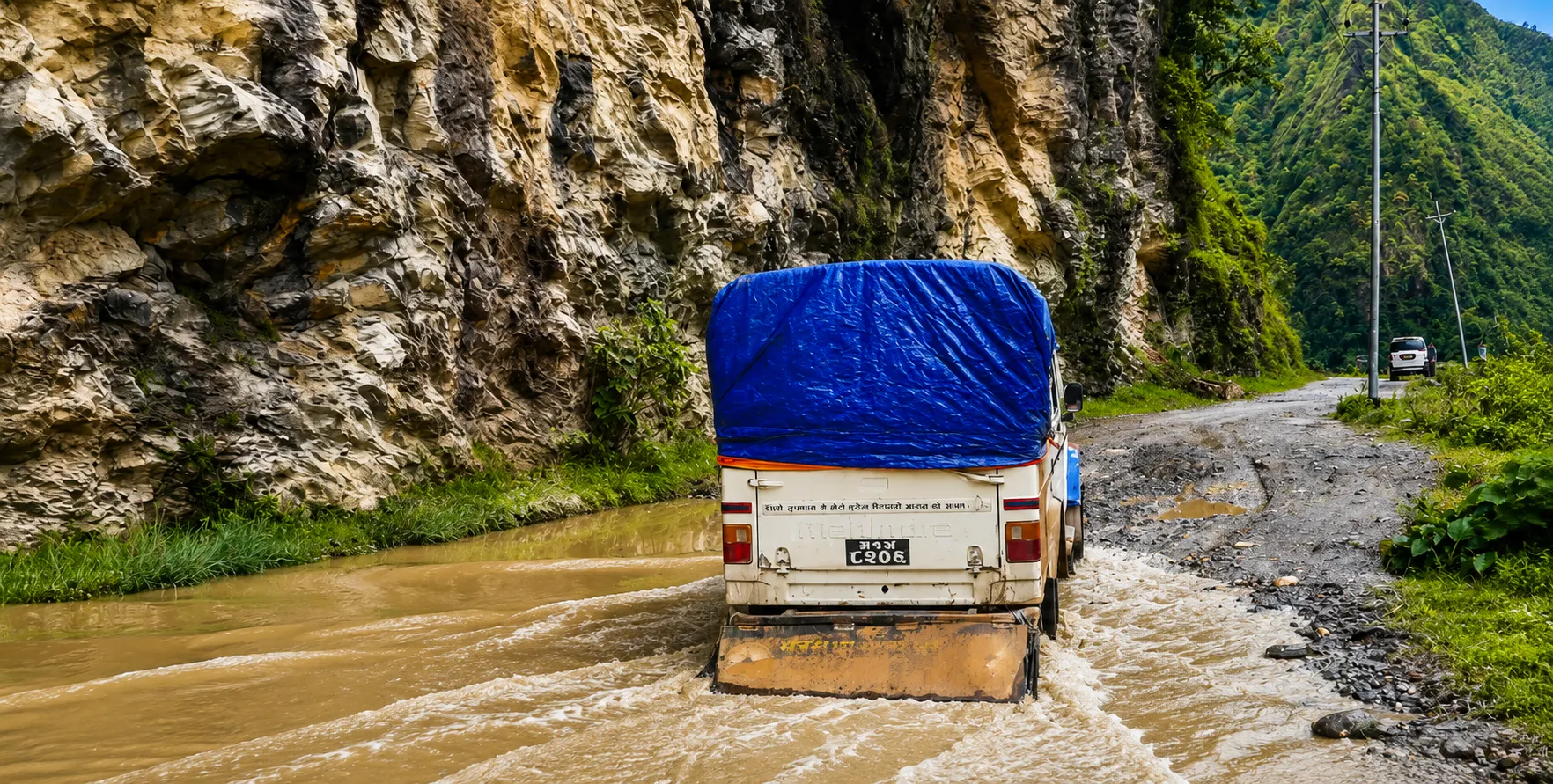
Nepal’s monsoon season (June–September) transforms the road transport landscape more fundamentally than any other single variable. The Nepal Himalaya receives some of the world’s most intense monsoon rainfall — Lumle near Pokhara exceeds 5,000 mm annually — and the concentrated delivery of this rainfall onto geologically young, steep mountain slopes produces frequent landslides, road closures, bridge damage, and surface deterioration that make monsoon mountain road travel significantly riskier and slower than the same journeys in dry season. The Ramche zone on the Kathmandu–Syabrubesi road, the Mugling–Narayanghat highway, sections of the Besisahar–Dharapani track, and the Syabrubesi–Rasuwagadhi approach are among the routes most consistently disrupted by monsoon landslides. Nepal Vehicle Hiring monitors road conditions daily throughout the monsoon and actively communicates with all clients about current route status. This daily intelligence is one of the most valuable services we provide, particularly for time-sensitive itineraries during the challenging season.
Monsoon travel is not categorically impossible — millions of Nepalis and thousands of tourists travel Nepal’s roads successfully during June–September every year. The correct approach is to build genuine flexibility into monsoon itineraries, have contingency accommodation plans for road-closure delays, deploy 4WD vehicles for all mountain routes regardless of conditions at departure time, and choose operators who actively monitor and communicate rather than those who operate regardless of conditions.
Night Driving – An Avoidable Risk
The established expert consensus on night driving in Nepal is unambiguous: any journey is best done in daylight hours. Nepal’s mountain roads have no street lighting in rural areas, no barriers on cliff-edge sections, and minimal road marking. The debris of overloaded trucks and buses that misjudged a bend is a real and visible feature of Nepal’s mountain roads, and driving during darkness compounds every risk factor that these roads already carry. Nepal Vehicle Hiring’s operational policy is to plan all mountain route departures for early morning to ensure arrival before dark and to avoid night driving on any route above Category 1 classification.
Bandhs and Strikes – Nepal’s Unique Transport Disruption Factor
Any honest Nepal transport guide must address the bandh — the Nepali general strike that periodically brings road transport to a complete halt across entire regions or even the whole country. The Longest Way Home’s 2026 guide is direct about the scale of the issue: Nepal’s strikes (bandas) can really hamper a journey if you are not careful. A bandh — declared by a political party, ethnic group, labor union, or community organization — typically involves a complete prohibition on private vehicle movement on public roads for a specified period, enforced by demonstrators and, in extreme cases, by stone-throwing or vehicle damage.
The practical implications for transport planning are significant. Public buses, shared jeeps, and tourist buses typically halt operations during a bandh. Registered tourist vehicles (identified by their green number plates) are frequently exempted from bandh restrictions, either formally or through a tacit understanding between operators and organizers that disrupting international tourism carries political costs. This is one of the most practically significant advantages of booking through a registered, professional private vehicle hire operator like Nepal Vehicle Hiring rather than an informal local service: our green-plated registered tourist vehicles and experienced drivers navigate bandh situations with the combination of local political knowledge, route flexibility, and operator relationships that make continued safe travel possible in circumstances where unregistered vehicles and public transport have ceased entirely.
Nepal Vehicle Hiring’s 24/7 operations team monitors bandh announcements and advises clients in real time on whether travel should proceed, be delayed, or be rerouted to avoid affected areas. Building one day of schereroutedxibility into any Nepal itinerary longer than five days is a practical risk management measure that experienced Nepal operators universally recommend.
Nepal’s Major Tourist Routes – Vehicle Hire in Practice
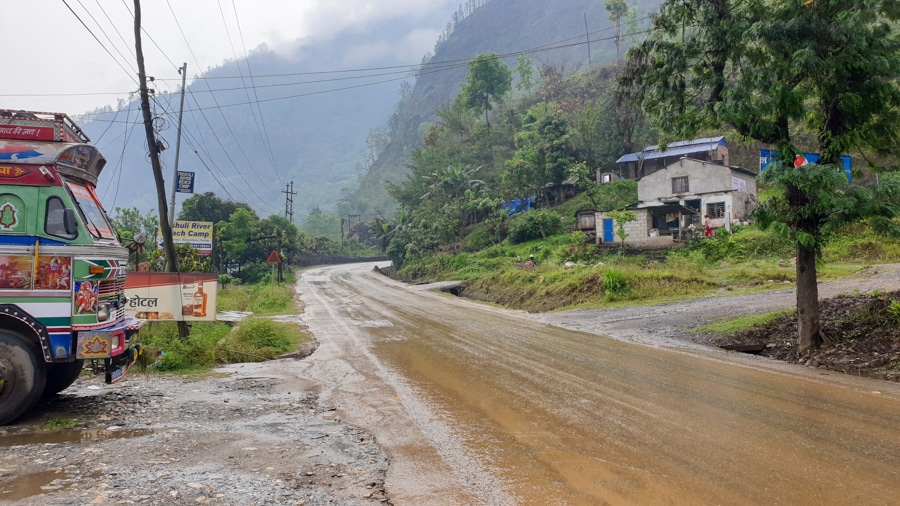
Having covered the transport landscape in principle, it is useful to apply it to the specific routes that carry the majority of Nepal’s international visitors:
Kathmandu Valley Heritage Circuit
The Kathmandu Valley heritage circuit — visiting the seven UNESCO monument zones across Kathmandu, Patan, Bhaktapur, Pashupatinath, Boudhanath, Swayambhunath, and Changu Narayan — is best served by a private car with driver for groups of 1–4, or a Hiace van for groups of 5–13. The sites are distributed across 30+ km of valley terrain, connected by roads that are paved but frequently congested. Timing is critical — Pashupatinath at dawn, Boudhanath at dawn for the kora, Bhaktapur before 9 AM before coach groups arrive, Nagarkot for sunrise the following morning. None of these timing requirements are achievable with public transport. Still, all are effortlessly managed by a Nepal Vehicle Hiring private car whose driver knows the optimal window for each site.
Kathmandu to Pokhara
The 200 km Kathmandu to Pokhara journey (6–6.5 hours by private vehicle in 2026) is Nepal’s most heavily traveled tourist route. The Prithvi Highway passes through the spectacular Trishuli River gorge, the Marsyangdi Valley, and the hill country above Mugling in a journey that, in daylight, offers some of Nepal’s finest highway scenery. For small groups, Nepal Vehicle Hiring’s private car provides the most comfortable and flexible option. For groups of 8–13, the Hiace van is the most economical per-head solution. For groups of 20+, Nepal Vehicle Hiring’s VIP Sofa Bus provides the most comfortable large-group highway experience available on this route.
Kathmandu to Chitwan
The 150 km, 4–5 hour Kathmandu to Chitwan route via the Prithvi Highway to Mugling, then south, is straightforward and accessible by any vehicle category. Nepal Vehicle Hiking’s most popular Chitwan transfer innovation is the optional Trishuli white-water rafting combination — the Trishuli River runs alongside the highway for much of the Pokhara–Chitwan route, with operators arranging half-day Class 3–4 rafting on the Trishuli before the vehicle continues to Chitwan, making the transfer day itself an activity rather than a logistical interlude.
Kathmandu to Lumbini
The 280 km, 8–10 hour Kathmandu to Lumbini drive via the Prithvi Highway, ay and then the Terai’s BP Highway and East-West Highway is a full-day overland journey for which the VIP Sofa Bus is particularly well-suited for large pilgrimage parties — its exceptional passenger comfort making the long flat-terrain Terai hours genuinely relaxing rather than fatiguing. For small groups, a private car or Hiace covers the route efficiently. Nepal Vehicle Hiring’s Lumbini to Kathmandu Airport transfer service — which coordinates departure time backward from the exact flight schedule — is one of our most frequently used and highly rated services among international Buddhist pilgrimage operators.
Mountain Trekking Transfers
For trekking trailhead transfers — Besisahar (Annapurna Circuit), Syabrubesi (Langtang/Tamang Heritage), Nayapul or Ulleri (Poon Hill/Ghorepani), Salleri (Everest road alternative), and the dozens of other off-road trekking gateways — 4WD private vehicle hire is the only responsible recommendation. The specific vehicles, routes, road conditions, and permit requirements for each of these transfers are covered in Nepal Vehicle Hiring’s dedicated route blogs. The principle is universal: a proper 4WD vehicle with an experienced, route-specific driver is not an upgrade for mountain trekking transfers — it is the minimum standard.
How to Choose the Right Nepal Transport Operator – What Matters and What Doesn’t
In Nepal’s vehicle hire market, the quality gap between operators is wider than in almost any other comparable tourism market in Asia. At one end are professional, registered, properly insured operators with maintained fleets, licensed drivers, and genuine accountability; at the other are informal, unregistered fixers who produce a vehicle and a driver of unknown qualification at whatever rate the client will accept. The differences between these two categories are not merely cosmetic. They are the difference between a vehicle that has been mechanically inspected before departure and one that has not; between a driver with specific route experience and one who has never driven that road; between a company that monitors road conditions and communicates proactively with its clients and one that sends a vehicle regardless.
When evaluating any Nepal vehicle hire operator, the key verification questions are consistent: Does the vehicle carry green tourist number plates (the legally required registration for tourist-use vehicles)? Does the driver hold a valid Class A+ commercial license at the appropriate category? Is the vehicle fully insured with passenger coverage, not merely third-party coverage? Is pricing quoted in writing before departure, with no undisclosed additions? Does the operator have a 24/7 operations contact — a number that is actually answered in emergencies? And for mountain routes specifically: has this driver driven this specific road before, and how many times? Every one of these questions has a correct answer, and an operator who responds defensively to any of them is providing its own answer.
Nepal Vehicle Hiring Pvt Ltd meets every one of these standards across our complete fleet and route network. Our vehicles carry green tourist plates, our drivers hold appropriate commercial licenses, all vehicles are fully insured, all pricing is disclosed in writing before travel, our 24/7 operations line at +977 9851013196 is staffed throughout all operating hours, and every driver we assign to a mountain route has specific, documented experience on that road. These are not marketing claims — they are operational standards that our clients verify in person on every journey.
Practical Transport Planning – The Complete Nepal Traveler’s Checklist
Drawing together everything in this guide, the following principles apply consistently across all Nepal transport planning:
- Depart early for all mountain routes. 6:00–7:00 AM is the latest appropriate departure for any route that involves mountain road driving. Morning light, cleaner air, and daylight arrival all depend on early starts.
- Match vehicle to terrain, not budget to terrain. The most expensive error in Nepal transport planning is choosing a vehicle category based on cost rather than route requirements. A standard car that cannot navigate the Ramche zone has wasted the entire booking budget.
- Book ahead in peak season. October–November and March–May are the peak months for both trekking transfers and Kathmandu Valley sightseeing vehicle hire. Premium vehicles — Land Cruisers for Upper Mustang, Scorpios for Kalinchowk — book out well in advance. Minimum 7–14 days ahead for all mountain routes in peak season.
- Last ATM awareness on mountain routes. Trishuli Bazaar (KTM–Syabrubesi route), Besisahar (Annapurna Circuit), Pokhara (Mustang and Muktinath), and Phaplu (Everest road) are all last-reliable-ATM points. Nepal Vehicle Hiring drivers know these points and stop on request.
- Build monsoon flexibility. June–September travel requires a minimum of one day of schedule contingency per mountain road segment. Nepal Vehicle Hiring provides daily road condition monitoring throughout monsoon.
- Domestic flights need agent management. Book domestic flights through licensed local agents who can manage rebooking and alternatives when — not if — weather causes cancellations on mountain airstrips.
- Avoid night buses. The safety, theft, and sleep deprivation issues documented in multiple 2026 guides are consistent and confirmed. An extra hotel night is a safer and more restful choice than an overnight bus on Nepal’s unlit mountain roads.
- Nepal Vehicle Hiring is available 24/7. +977 9851013196 is answered throughout all operating hours for real-time road intelligence, re-routing, emergency support, and booking advice
Related Vehicle Hire Services and Blogs
- The Ultimate Nepal Vehicle Rental Guide 2026
- Why Private Vehicle Hire Is the Smartest Way to Travel Nepal
- Best Vehicle Hire Routes for Trekking Trailheads Nepal
- Kathmandu to Tamang Heritage Trail Transport Guide
- Everest Region Nepal Complete Guide 2026
- Nepal Annapurna Circuit Road 2026 Vehicle Hire Guide
- Lumbini to Kathmandu Airport Transfer
- VIP Sofa Bus Hire Nepal
- Luxury Jeep Hire Nepal (Land Cruiser)
- Nepal Trekking Packages
Frequently Asked Questions – Nepal Travel Transport 2026
What is the best way to get around Nepal as a tourist?
For most visitors, the best combination is private vehicle hire with Nepal Vehicle Hiring for inter-city and mountain routes, and ride-hailing apps (Pathao, Tootle, inDriver) for urban navigation within Kathmandu and Pokhara. Private vehicle hire provides the safety, flexibility, door-to-hotel service, and mountain road capability that public transport cannot match. Domestic flights supplement road travel for time-critical remote destinations like Lukla (Everest approach) and Jomsom (Mustang).
Is it safe to travel by bus in Nepal?
Tourist buses operated on Nepal’s main highway routes (Kathmandu-Pokhara, Kathmandu-Chitwan) are reasonably safe for daytime travel. Local public buses carry documented safety risks due to overloading, poor maintenance, and mountain road driving standards — multiple government travel advisories recommend against them for tourists. Night buses on any route should be avoided due to the combination of road conditions, driver fatigue risk, and theft exposure. For all mountain routes, private 4WD hire is the safe choice.
Do I need a 4WD vehicle for all Nepal travel?
No — a standard car is adequate for Kathmandu Valley sightseeing, the Prithvi Highway (Kathmandu–Pokhara), Kathmandu–Chitwan, Kathmandu–Lumbini, and all Category 1 paved highway travel. A 4WD vehicle is mandatory for any route involving mountain off-road driving: Annapurna Circuit (Besisahar onward), Muktinath via Beni, Kalinchowk, Syabrubesi upper section, and all Category 3–4 mountain tracks.
How do ride-hailing apps work in Nepal?
Pathao, Tootle, and inDriver all operate via smartphone app and require a SIM card with data. They operate in Kathmandu and Pokhara for both motorcycle taxis and car rides. They are significantly more price-transparent than traditional taxis, provide driver tracking and accountability, and generally offer lower and more consistent fares than street-haled taxis.
What should I do if a bandh is declared during my Nepal trip?
Contact Nepal Vehicle Hiring immediately at +977 9851013196. Our team monitors bandh announcements in real time and advises whether travel should proceed (registered tourist vehicles are frequently exempted), be rerouted, or rescheduled. Building one day of schedule flexibility into any Nepal itinerary longer than five days is the standard risk management recommendation for bandh disruption.
Can Nepal Vehicle Hiring arrange all my transport throughout Nepal?
Yes — Nepal Vehicle Hiring provides complete end-to-end transport coordination for entire Nepal itineraries: airport arrivals and departures, Kathmandu Valley heritage circuits, inter-city highway transfers (Pokhara, Chitwan, Lumbini), mountain trekking transfers (Annapurna, Langtang, Everest road), the Manthali pre-dawn Everest flight transfer, Rasuwagadhi border transport, and return journey coordination. All in a single booking relationship with transparent pricing, 24/7 support, and the country’s most experienced driver fleet.
Your Nepal Journey Starts with the Right Transport – Nepal Vehicle Hiring
Nepal is one of the most extraordinary travel destinations on Earth. Its mountains are the highest. Its valleys are among the most historically and spiritually dense. Its wildlife parks protect species at the edge of extinction. Its pilgrimage routes carry the faithful of two of the world’s great religions to their most sacred geographies. And its roads — demanding, dramatic, and sometimes genuinely challenging — are themselves part of the experience, threading through landscapes that reward every kilometer with something worth seeing.
Traveling Nepal with the right vehicle, the right driver, and the right operator is not an optional upgrade. It is the difference between a journey that unfolds with the ease and grace this extraordinary country deserves, and one that is consumed by logistical friction, safety anxiety, and the accumulated stress of wrong choices made at the beginning. Nepal Vehicle Hiring Pvt Ltd provides Nepal’s most complete, most professional, and most reliably supported private vehicle hire service — for every route, every group size, every destination, and every season that this guide has described.
Call / WhatsApp: +977 9851013196 | Website: vehiclehiringnepal.com | Book Your Nepal Transport | Nepal Trekking Packages
- Nepal Travel Transport Companion – Complete Guide to Getting Around Nepal
- Understanding Nepal's Road Network – The Foundation of Everything
- Private Vehicle Hire – Nepal's Most Intelligent Transport Choice
- Public Transport Options – When They Work and When They Don't
- Domestic Flights – When the Air Is the Only Sensible Option
- Getting Around the Cities – Taxis, Apps and Urban Navigation
- Mountain Roads, Monsoon, and the Real Safety Landscape
- Bandhs and Strikes – Nepal's Unique Transport Disruption Factor
- Nepal's Major Tourist Routes – Vehicle Hire in Practice
- How to Choose the Right Nepal Transport Operator – What Matters and What Doesn't
- Practical Transport Planning – The Complete Nepal Traveler's Checklist
- Related Vehicle Hire Services and Blogs
- Frequently Asked Questions – Nepal Travel Transport 2026
- Your Nepal Journey Starts with the Right Transport – Nepal Vehicle Hiring

Related Blog & Articles

4WD Vehicles in Nepal: The Ultimate Hire Guide 2026
Best Nepal Tour Package: Best Vehicle Hire Guide for 2026/2027
Luxury Vehicles for Trekking in Nepal | Land Cruiser Hire
Car Hire in Nepal – Complete Guide for Travelers
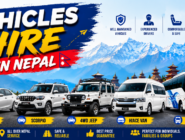
All Over Nepal Vehicle Hire – Private Car, Scorpio, 4WD Jeep, Hiace & Tourist Bus
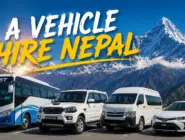
car, jeep, hiace, bus hire in Nepal