Plan a Trip


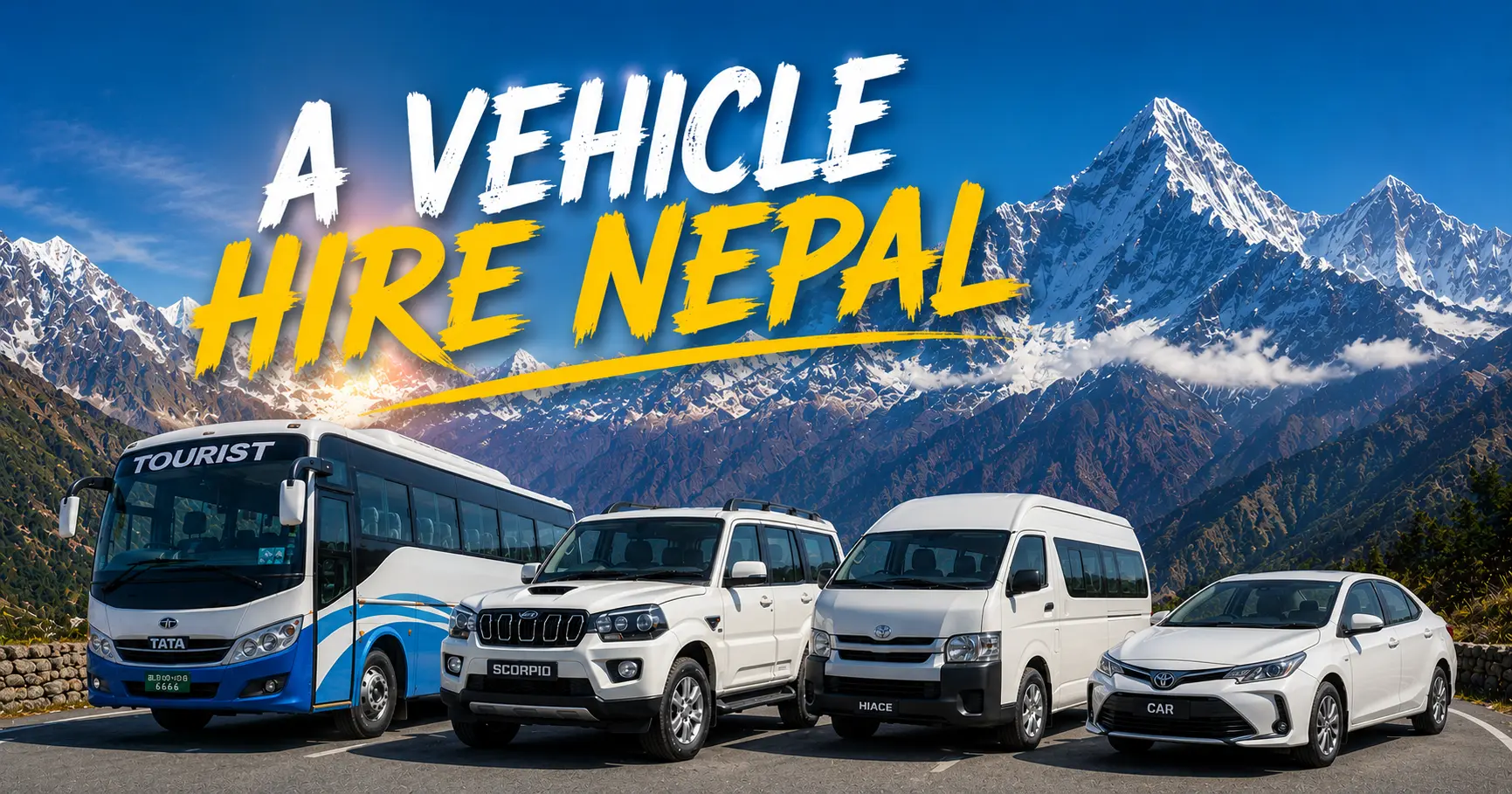
car, jeep, hiace, bus hire in Nepal
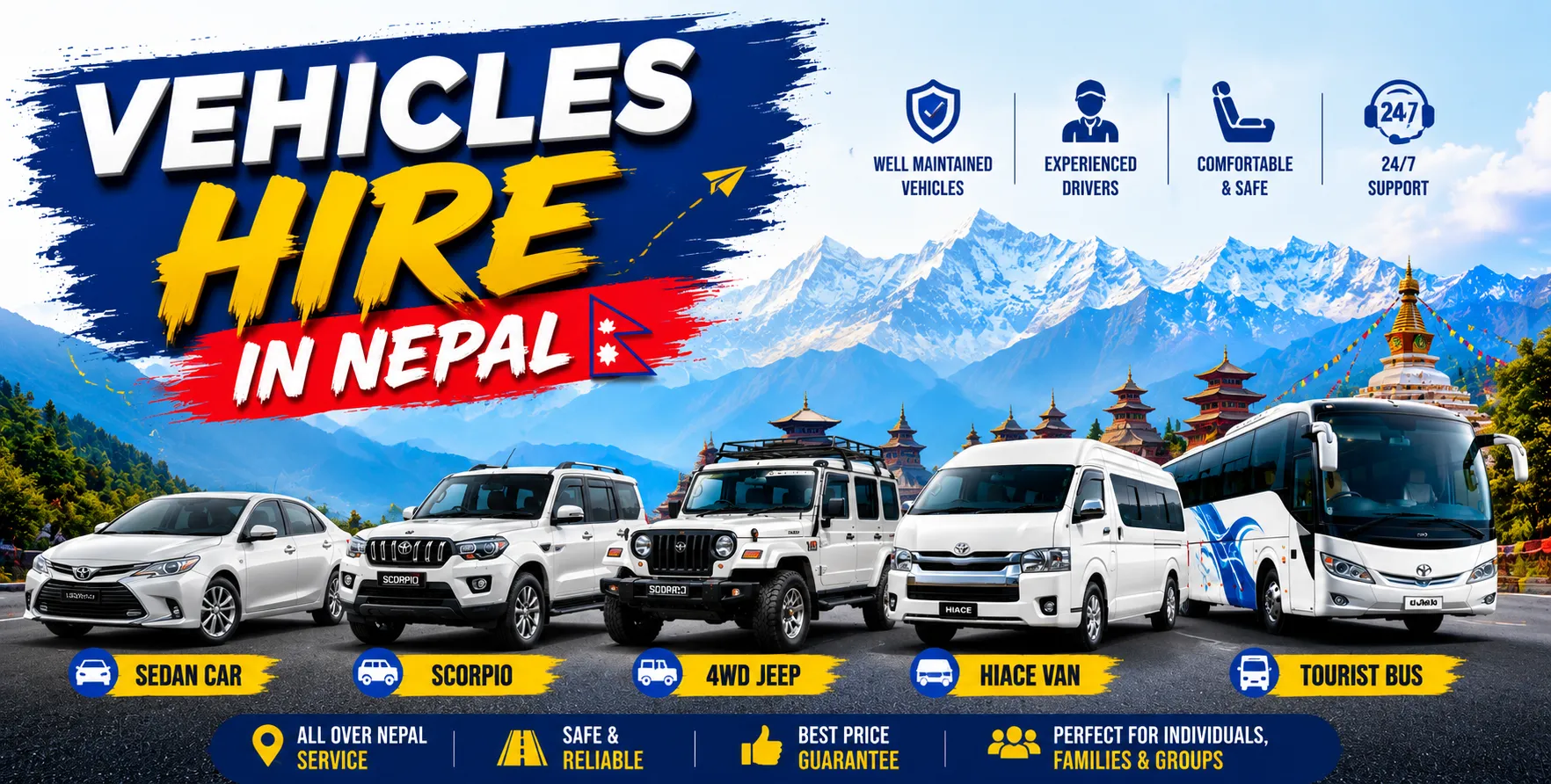
Nepal’s terrain changes more dramatically, more often, than almost anywhere else on earth — from flat highways through the Terai to hairpin mountain roads climbing thousands of meters, and unpaved tracks that no ordinary car was ever built to handle. This is precisely why there is no single ‘best’ vehicle for travelling around Nepal. The right choice for car, jeep, Hiace, or bus hire in Nepal depends entirely on your group size, route, budget, and whether your itinerary includes rough mountain roads that demand genuine 4WD capability. This guide compares all four major vehicle categories in detail — what each one is built for, what it costs and which specific Nepal routes suit it best — so that you can book the right vehicle the first time, rather than discovering halfway up a mountain road that your sedan should have been a jeep, or paying for an oversized coaster when a single shared car would have done the job for a couple travelling alone.
Every comparison in this guide links directly to the specific vehicle and route pages on Nepal Vehicle Hiring Pvt Ltd’s website, so you can move straight from reading about a vehicle category to checking availability and pricing for your exact trip.
Quick Overview: car, jeep, Hiace, and bus hire in Nepal
Before diving into the details, here is the short version. A private car suits solo travellers and small families sticking to paved roads — Kathmandu Valley sightseeing, the Kathmandu–Pokhara highway, and Terai routes toward Lumbini and Chitwan. A 4WD jeep is the only sensible choice once your route includes unpaved mountain roads — Mustang, Manaslu, Annapurna trailheads, and most trekking gateway towns above 2,000 meters. A Hiace van fits families and small groups of up to fourteen who want one comfortable vehicle rather than splitting across two cars. A tourist bus or coaster suits larger groups and budget-conscious solo travellers between major tourist hubs on fixed schedules and well-paved routes.
How This Guide Is Organised: The vehicle category below follows the same structure: what the vehicle is built for, what it typically costs, which specific Nepal routes it suits best, and where its practical limits lie. Reading through all four sections, even if you already have a vehicle category in mind, helps clarify the trade-offs at the boundaries between categories, since many real Nepal itineraries combine more than one vehicle type across different legs of the same trip, rather than relying on a single vehicle for an entire journey from arrival to departure.
Car Hire in Nepal: Comfort for City and Highway Travel
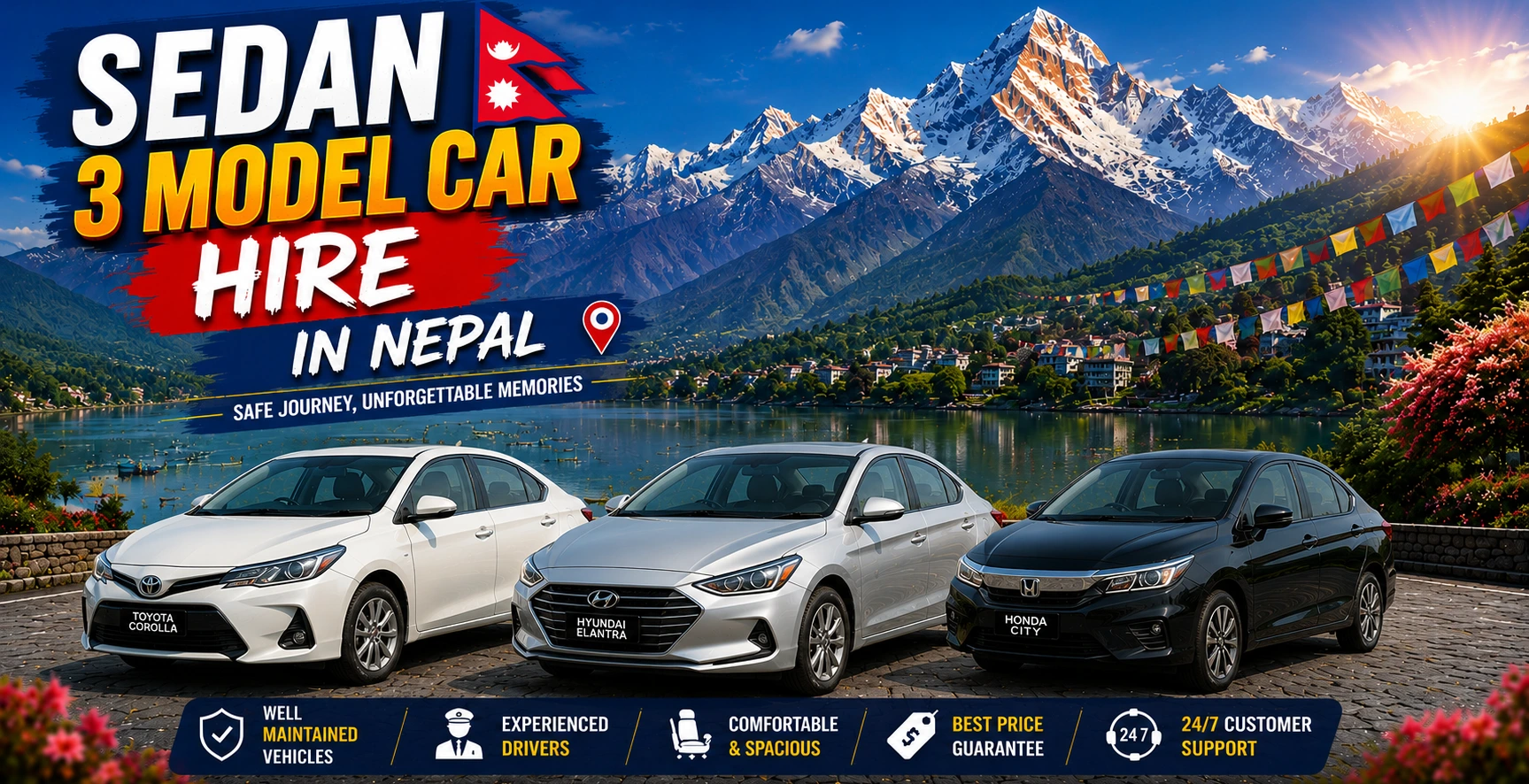
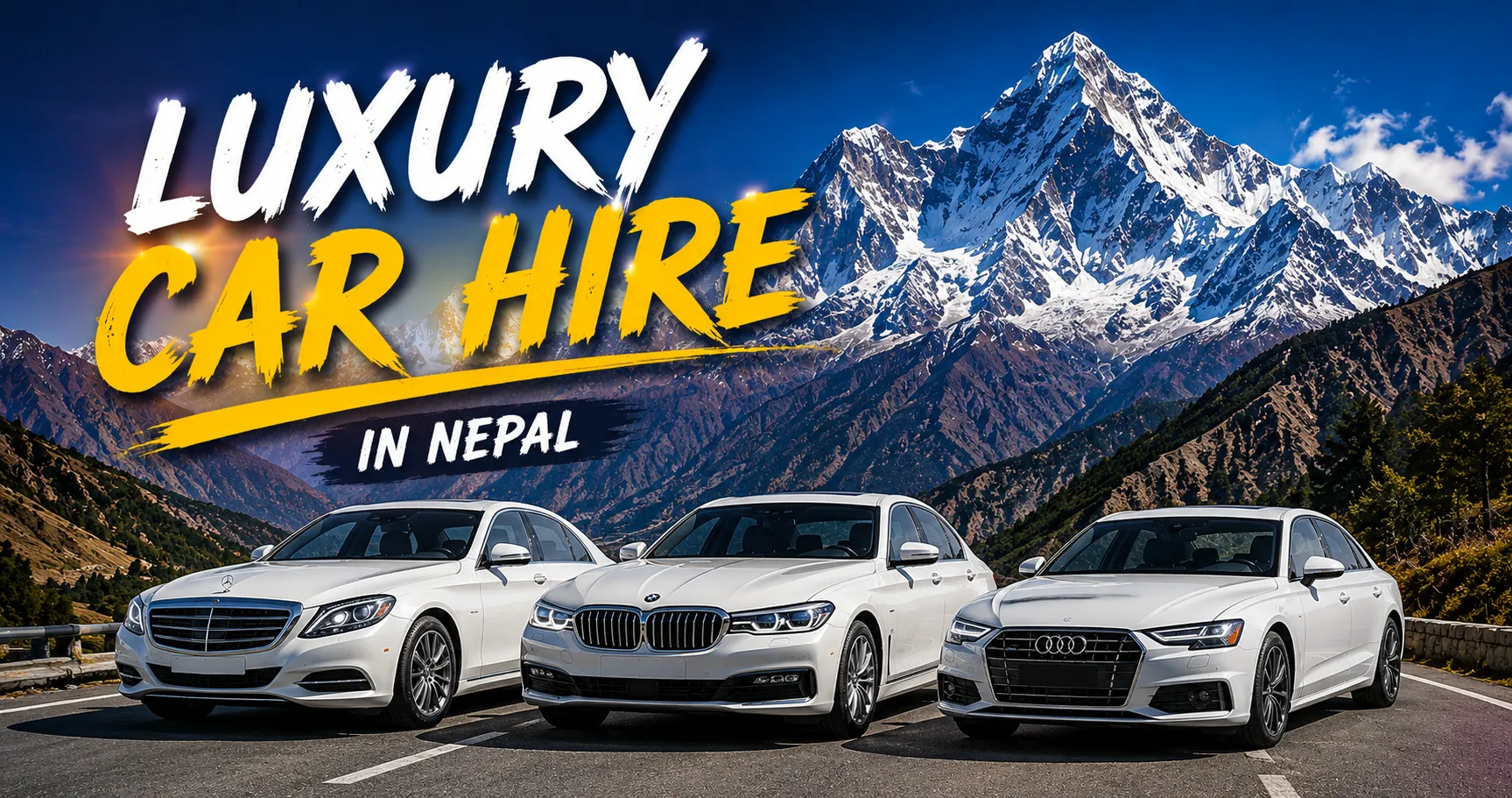
A standard car hire in Nepal is the most popular choice for travellers on itineraries that stay on paved roads: Kathmandu Valley sightseeing, the Kathmandu–Pokhara highway, transfers to and from the airport, and day trips around Pokhara, Chitwan, and Lumbini. Sedans and small SUVs typically seat one to three passengers comfortably, with luggage space sufficient for a few suitcases, making them ideal for solo travellers and honeymooners who prioritise privacy over carrying capacity.
Typical Car Hire Pricing
Within the Kathmandu Valley, sedan hire with a professional driver typically starts around NPR 5,000–6,000 per day (roughly US$38–45), rising modestly for trips outside the valley due to additional fuel and driver accommodation costs. Hourly bookings, useful for half-day sightseeing or short transfers, generally run NPR 600–800 per hour with a minimum booking of around five hours. These rates conventionally include the driver’s salary, fuel, parking fees, and standard road tolls. However, confirm what is included before booking, since some providers charge extras for late-evening trips on a set mileage allowance.
Best Routes for Car Hire
- Kathmandu sightseeing tour — Durbar Squares, Boudhanath, Swayambhunath, all on paved valley roads.
- Kathmandu airport transfers — the most common single-use case for car hire among first-time visitors.
- Bhaktapur Durbar Square day tour — a comfortable half-day excursion well suited to a private car.
- Car hire in Pokhara — ideal for Lakeside sightseeing and short excursions around the city once you’ve arrived.
Cars are not suited to unpaved mountain roads, steep trekking-trailhead access tracks, or routes above roughly 2,000 meters, where road surfaces deteriorate; for any of these, a jeep is the appropriate choice, which is covered next.
Jeep and 4WD Hire in Nepal: The Mountain Specialist
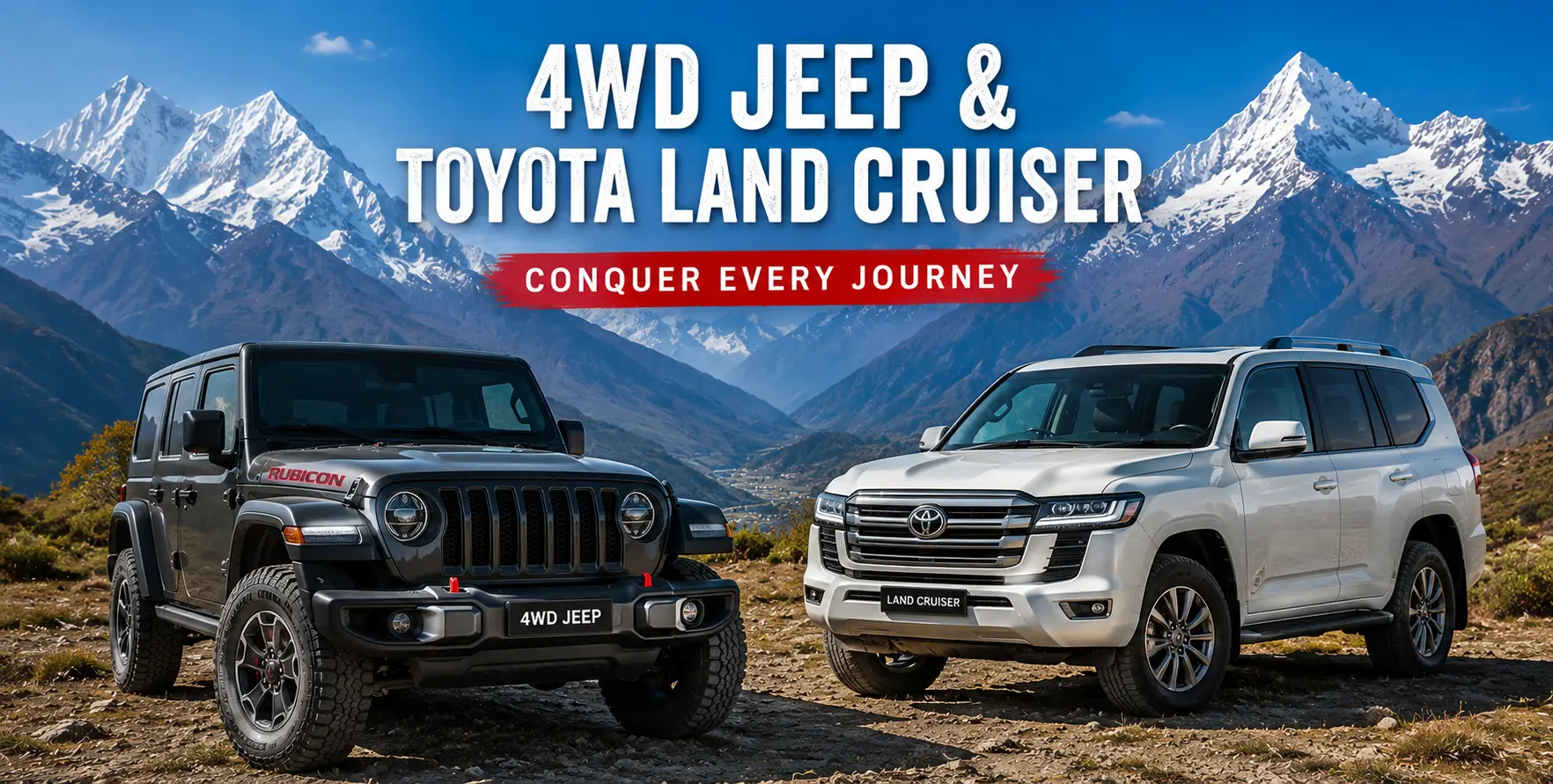
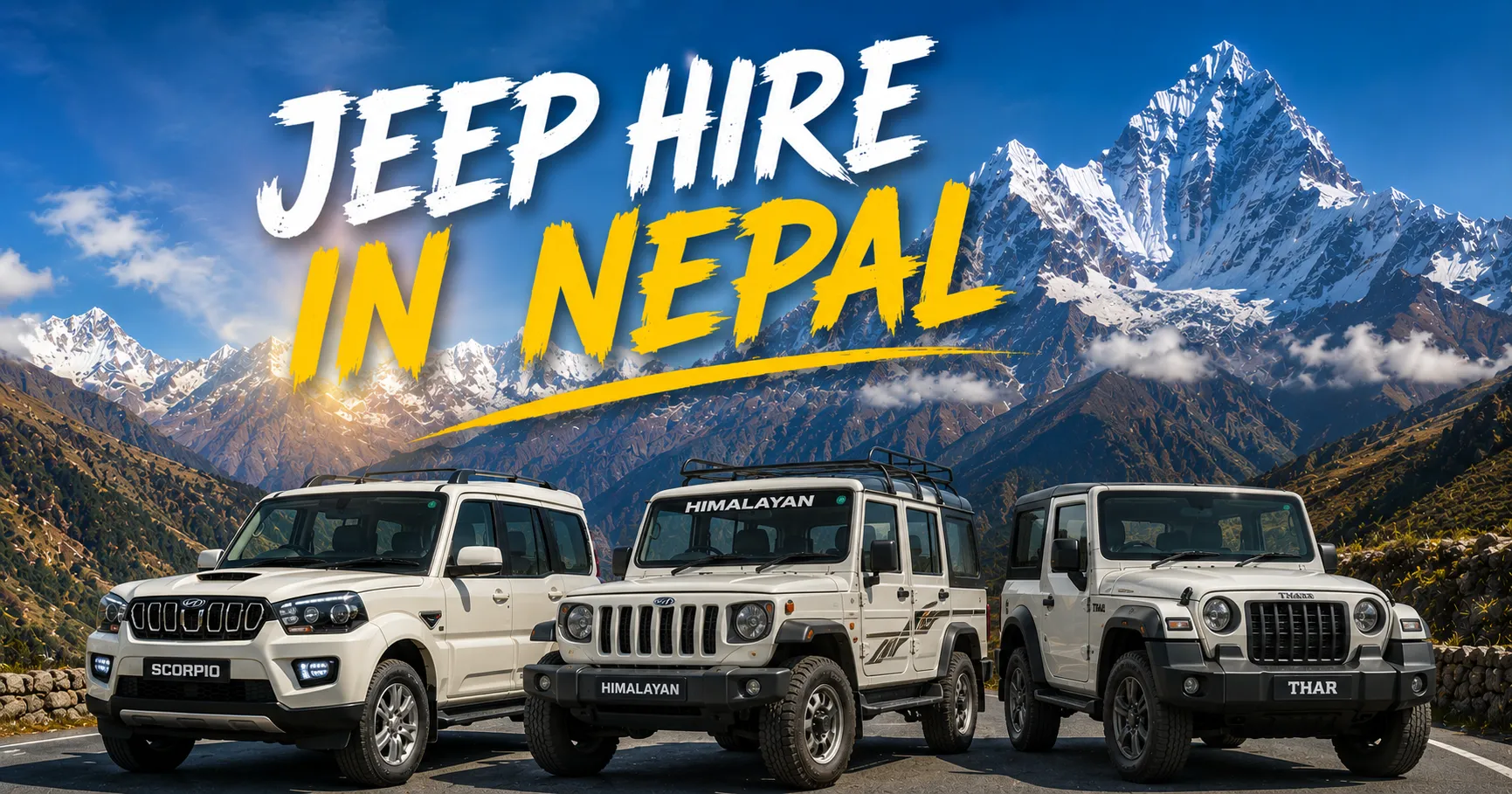
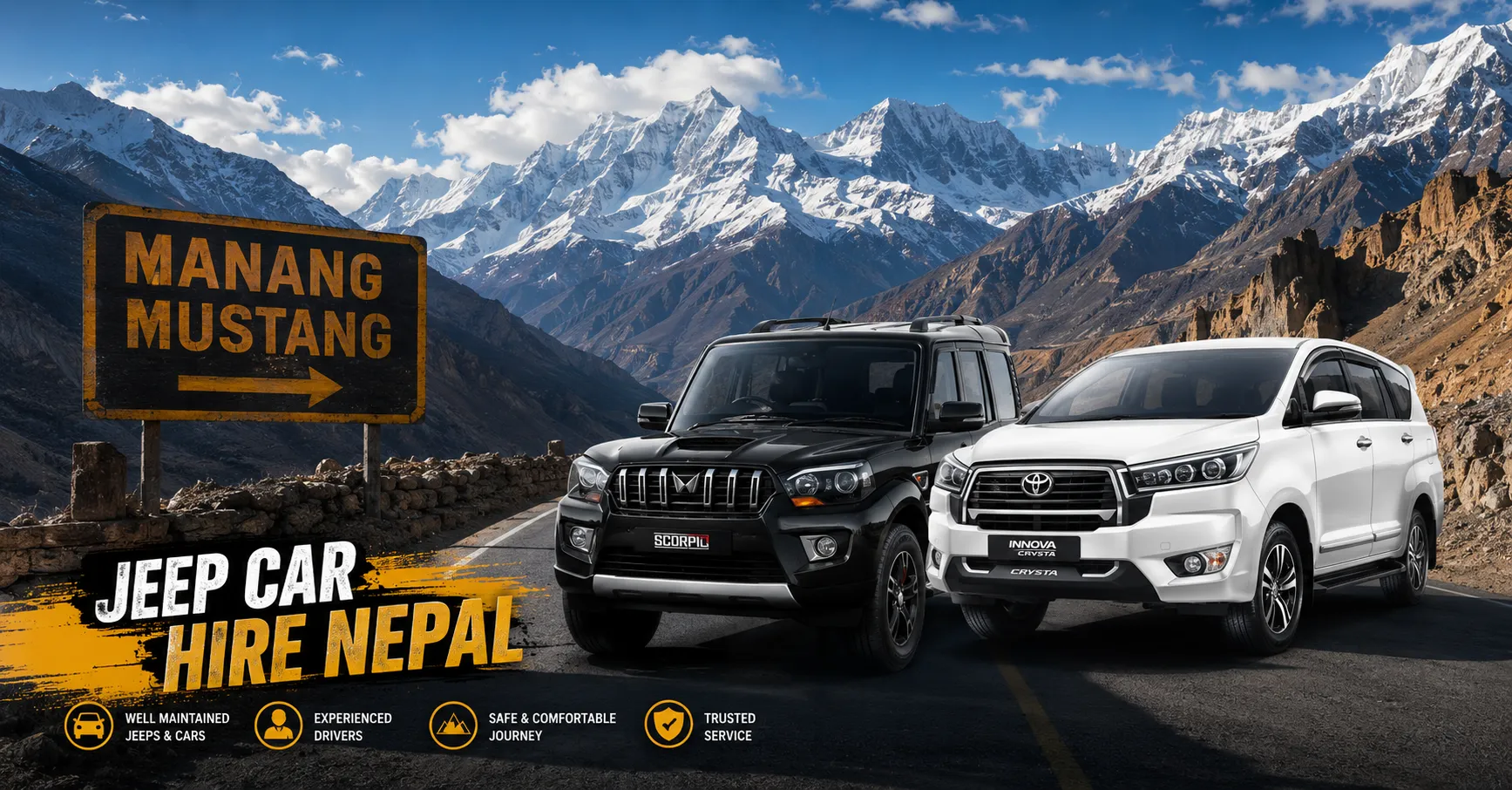
For Nepal’s mountain districts, 4WD hire is not a luxury upgrade; it is a structural requirement. Routes into Mustang, Manang, Manaslu, Dolpa, and most trekking trailheads above 2,000 meters climb steep, unpaved switchbacks that a standard sedan cannot manage safely, especially after monsoon rains wash sections of road into rutted tracks. A purpose-built jeep hire in Nepal — typically a Mahindra Scorpio, Bolero, Toyota Hilux, or Toyota Land Cruiser Prado — provides the ground clearance, four-wheel drive, and experienced mountain driving needed for these roads.
2WD vs 4WD Jeep: Which Do You Need?
Most Jeep fleets in Nepal offer both two-wheel-drive (2WD) and four-wheel-drive (4WD) variants of the same vehicle models. 2WD Jeeps are a comfortable, slightly more affordable option for long-distance paved highway travel and gentler unpaved stretches. At the same time, genuine 4WD is essential for steep, loose-surface mountain roads, river crossings, and the high-altitude trekking trailhead access roads common throughout Nepal’s restricted trekking regions. As a rule of thumb, if your itinerary includes any route described online as requiring ‘4WD only’ or passing through districts such as Mustang, Manang, Dolpa, or Manaslu, book a genuine 4WD rather than the cheaper 2WD option.
Typical Jeep Hire Pricing
Jeep hire with a driver typically runs NPR 7,500–9,000 per day (roughly US$56–68) within and immediately around Kathmandu, with rates rising for multi-day mountain itineraries that involve higher fuel consumption, steeper terrain, and overnight accommodation for the driver in remote areas. Standard jeep models such as the Mahindra Scorpio and Bolero comfortably seat up to seven passengers, including the driver, with rooftop space for luggage and trekking gear, making them practical for both family groups and small trekking parties.
Best Routes for Jeep Hire
- Kathmandu to Soti Khola jeep — the standard 4WD approach to the Manaslu Circuit trailhead.
- Kathmandu to Salleri Phaplu jeep — the overland alternative to flying into the Everest region.
- Besisahar private vehicle — the gateway to the Annapurna Circuit trailhead.
- Sarangkot sunrise tour vehicle — a shorter excursion where jeeps handle the steep approach road comfortably.
- Pokhara to Nayapul transportation — the trailhead access for Ghorepani–Poon Hill and Annapurna Base Camp treks.
Jeeps are also the standard choice for pilgrimage routes to high-altitude temples such as Muktinath, and for travelling Upper Mustang’s expanding network of jeep-accessible roads, where the terrain shifts from forested hillside to high-altitude desert within a single day’s drive.
Hiace Van Hire in Nepal: The Group Comfort Option
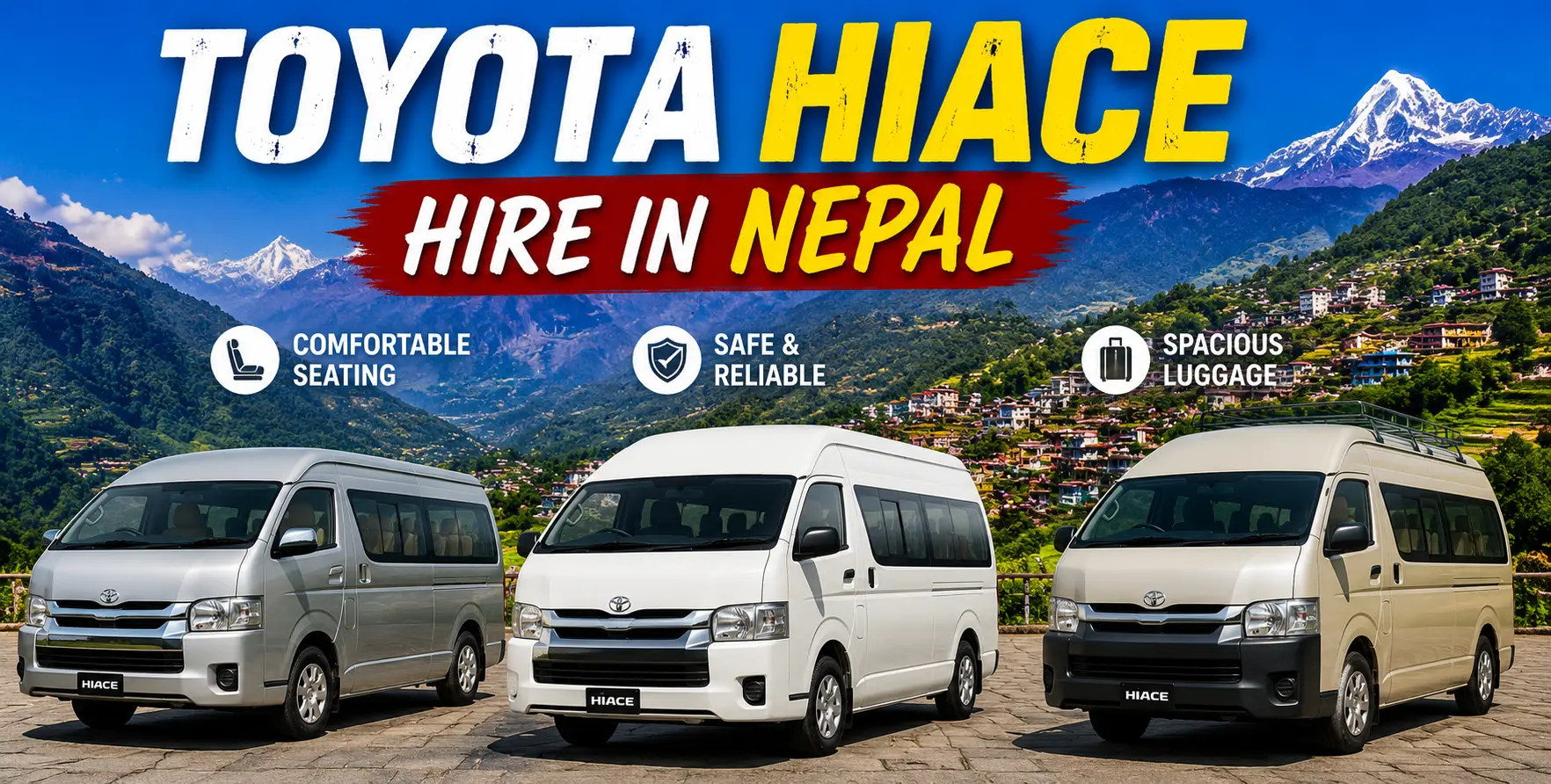
For families and small groups of seven to fourteen people, a Hiace van hire offers the comfort of a single shared vehicle rather than splitting a group across two cars or a car and a jeep. The Toyota Hiace, Nepal’s standard tourist van, offers individual reclining seats, generous luggage space, and — on most tourist-grade models — air conditioning, making it a popular middle ground between a private car’s intimacy and a bus’s economy of scale.
Typical Hiace Hire Pricing
Hiace van hire with a driver typically costs NPR 7,500–9,000 per day for valley and short-distance use, broadly comparable to jeep pricing, with hourly rates around NPR 850 per hour for shorter bookings, subject to a minimum hours requirement. For multi-day touring itineraries combining several cities, daily rates are usually quoted as part of a package that also covers driver accommodation and meals for overnight trips.
Best Uses for Hiace Hire
- Kathmandu sightseeing tour — a Hiace comfortably carries a family or small group between Durbar Squares and temples in one vehicle.
- Kathmandu to Nagarkot vehicle — popular for groups heading to the sunrise viewpoint together.
- Bhaktapur Durbar Square day tour — comfortably suited to extended family groups or small tour parties.
Hiace vans handle paved and lightly unpaved roads well but, like cars, are not suited to the steepest, roughest mountain trailhead roads — for those routes, a jeep convoy or a smaller group split between jeeps is the more practical choice.
Bus, Coaster, and Tourist Bus Hire in Nepal: Budget and Scale
For larger groups, budget-conscious solo travellers, and fixed-route intercity travel, Nepal’s bus hire network is reliable, inexpensive, and well-suited to the country’s main paved tourist corridors. Standard tourist buses operate scheduled daily departures on routes such as Kathmandu–Pokhara, Kathmandu–Lumbini, and Pokhara–Chitwan, with reclining seats, onboard storage, and, on the better-equipped lines, air conditioning and onboard refreshment stops.
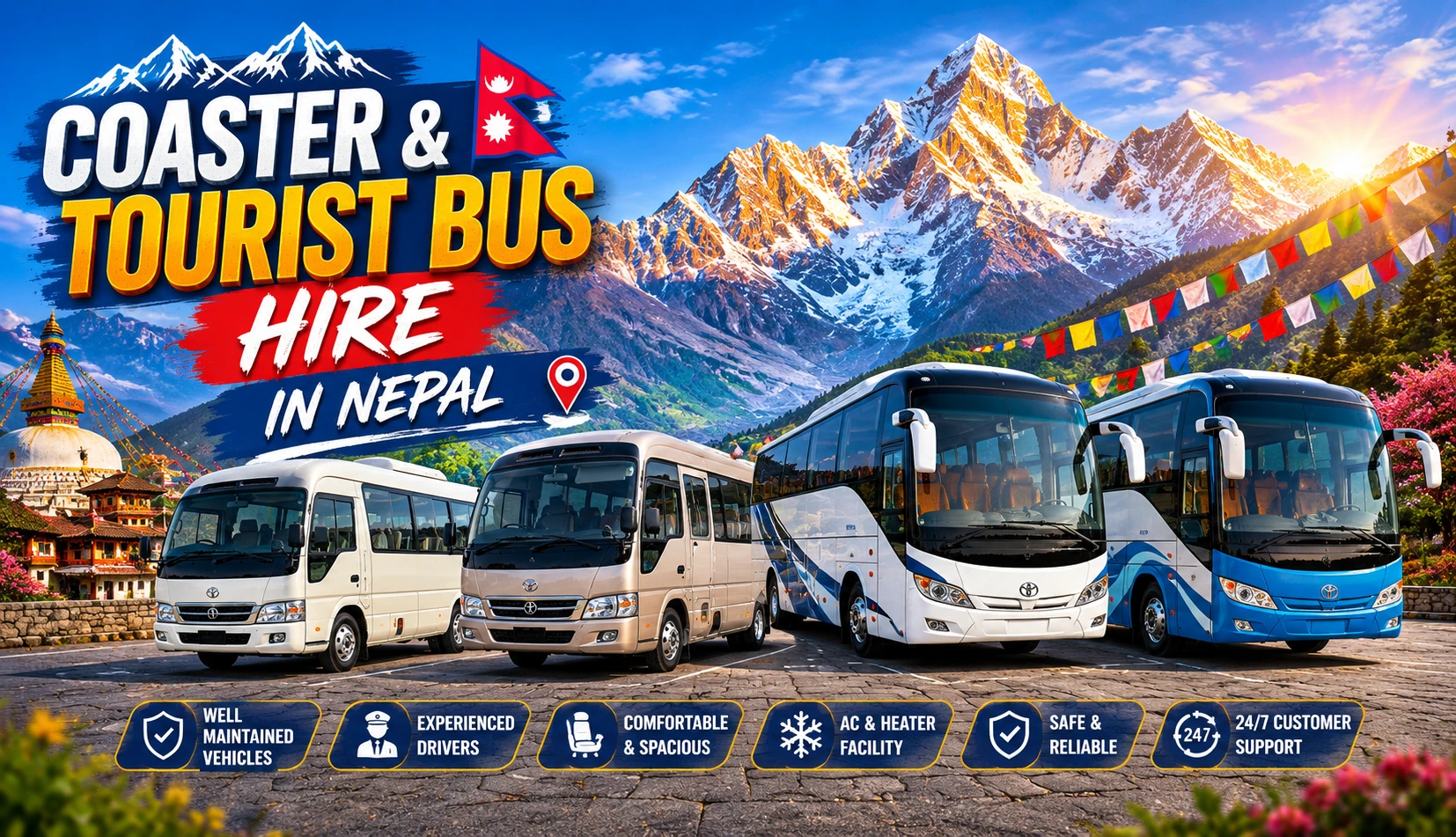
For private group charters rather than scheduled seats, a coaster bus—Nepa’s standard 20-seater minibus— offers a cost-effective option for groups of 15–20 travelling on a fixed itinerary, commonly used for company retreats, tour groups, and extended family travel.
Typical Bus and Coaster Pricing
Scheduled tourist bus seats between Kathmandu and Pokhara typically cost around US$10 per person, with similar pricing on the Lumbini and Chitwan corridors, making bus travel by far the most economical way to move between Nepal’s major tourist hubs. Private coaster charters are quoted per day or per itinerary rather than per seat, scaling with route length and number of travel days, and represent better value than multiple car or jeep bookings once a group exceeds roughly fifteen people.
Best Routes for Bus and Coaster Hire
- Kathmandu to Pokhara bus and its return, the Pokhara to Kathmandu bus — Nepal’s busiest and most reliable tourist bus corridor.
- Kathmandu to Lumbini bus and Lumbini to Kathmandu bus — connecting the capital to the Buddha’s birthplace.
- Pokhara to Chitwan bus — the standard onward route for travellers, combining lake views with jungle safari.
- Kathmandu Besisahar bus ticket — the budget option for solo Annapurna Circuit trekkers heading to the trailhead.
Buses are not recommended for the steep, unpaved trailhead access roads covered earlier under jeep hire; even where a bus route nominally exists toward a mountain district, the ride is typically slower, less comfortable, and less reliable than a private jeep over the same rough terrain.
Side-by-Side: Matching the Vehicle to Your Trip
Solo traveller or couple, city and highway only: A private car hire offers the best balance of comfort, privacy, and cost for Kathmandu sightseeing, airport transfers, and the Kathmandu–Pokhara highway.
Solo traveller, mountain trailhead access: A 2WD or 4WD jeep is necessary once your route leaves paved roads, even for just one or two passengers, since the vehicle choice is dictated by road surface rather than group size on these routes.
Family of four to seven, mixed itinerary: A jeep or Hiace both work well; choose the jeep if any part of the route is unpaved or mountainous, and the Hiace if the entire itinerary stays on paved roads and you want a more spacious, car-like ride.
Group of eight to fourteen, paved or lightly mixed roads: A Hiace van is generally the most comfortable and cost-effective single-vehicle solution for this group size.
Group of fifteen or more, fixed touring itinerary: A coaster bus charter typically offers the best value, particularly for multi-day group tours covering several cities.
Budget solo or pair travel between major cities: Scheduled tourist bus seats on routes like Kathmandu to Pokhara offer the lowest per-person cost for travellers on a tight schedule or with heavy luggage.
What’s Typically Included in a Nepal Vehicle Hire Price
Reputable vehicle hire providers in Nepal, across all four categories covered in this guide, generally structure their pricing to include the driver’s daily salary, fuel for the agreed route, standard road tolls and parking fees, and, for multi-day trips, the driver’s meals and overnight accommodation in towns along the route. What is typically included, and what to confirm before booking, includes: routes beyond the originally agreed route; late-night surcharges for pickups or drop-offs outside standard daytime hours; and any tips for the driver, which remain customary but optional at the end of a satisfactory trip.
For multi-day mountain itineraries in particular, confirm whether the quoted price assumes a fixed number of driving days or a fixed itinerary regardless of weather delays, since road closures from landslides or snow are not uncommon during shoulder seasons and can affect both timing and cost if not clarified up front.
Seasonal Considerations for Vehicle Hire
Nepal’s vehicle hire market generally follows the same seasonal rhythm as its tourism calendar. Autumn (late September through November) and spring (March through May) represent peak demand, when vehicles of every category, but particularly jeeps serving popular trekking trailheads, should be booked at least a week or two in advance to guarantee availability on the exact dates needed. Monsoon season (June through early September) adds the complication of landslide risk on several mountain roads, making jeep drivers’ local route knowledge especially valuable; experienced operators know which roads remain passable and which require detours.
Winter (December through February) is generally the easiest season for last-minute vehicle bookings outside the main Everest and Annapurna trekking windows. However, some high-altitude roads, including sections of the Mustang and Manang jeep routes, may close temporarily due to snow at the highest passes.
Vehicle Hire for Special Occasions and Pilgrimage Travel
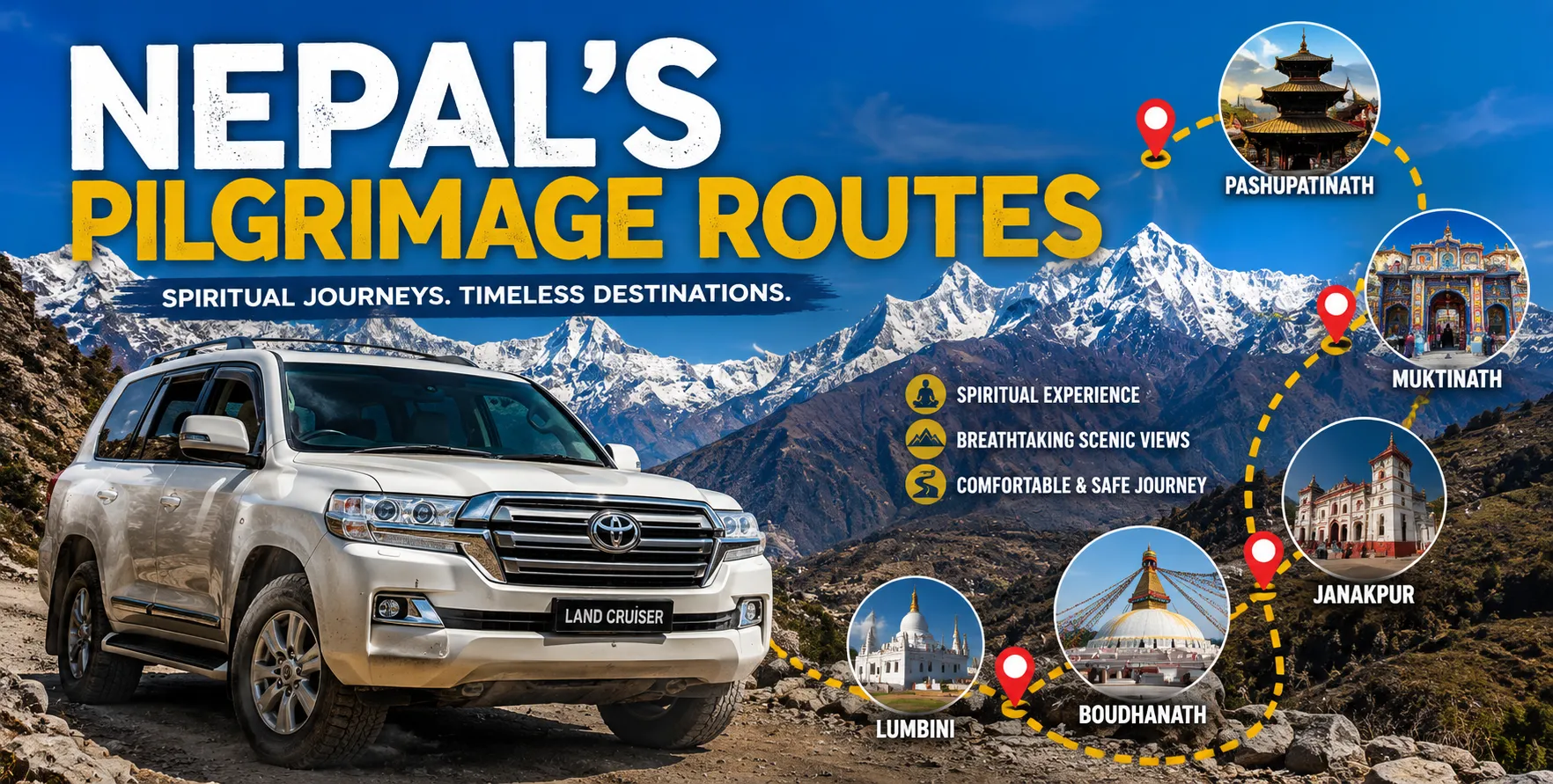
Beyond standard sightseeing and trekking logistics, vehicle hire in Nepal also plays a central role in religious pilgrimage travel, a significant segment of the country’s domestic and international tourism economy. Hindu pilgrims travelitravellinggtinath, Pashupatinath, and other sacred sites, alongside Buddhist pilgrims visiting Lumbini, Boudhanath, and Swayambhunath, often have specific scheduling needs tied to auspicious dates and religious festivals, requiring vehicle providers experienced in coordinating around these calendars rather than purelyrd tourist scheduschedules hire, in particular, plays an outsized role in pilgrimage logistics to high-altitude sites like Muktinath, where the final approach road climbs well above 3,000 meters and genuinely demands the same 4WD capability used for standard trekking trailhead access elsewhere in this guide.
Wedding parties, corporate retreats, and milestone celebrations represent another distinct category of vehicle-hire needs, often requiring multiple coordinated vehicles to arrive and depart in sequence, sometimes alongside decoration or branding requests for the vehicles themselves. Reputable providers serving this segment typically offer dedicated coordination for multi-vehicle convoys, ensuring that a ng party’s cars, a Hiace for the families, and a coaster for extended guests all arrive at the correct venue at the correct time without the logistics falling to the event organisers. Hire for Business and Corporate Travel in Nepal.
Nepal’s growing business tourism sector, including conferences, corporate retreats, and site visits for international NGOs and development organisations, relies heavily on reliable vehicle hire services distinct from those for standard leisure tourism. Corporate clients typically prioritise reliability, vehicle presentation, and driver professionalism over the adventure-oriented capability that leisure trekkers might prioritise, so many providers maintain a distinct fleet tier of well-presented sedans and SUVs for executive and corporate transfers, alongside their standard tourist fleet.
For multi-day corporate retreats or site visits spanning several Nepal locations, the same vehicle category logic that applies to leisure travel still holds: a sedan or SUV suits Kathmandu Valley meetings and airport transfers, while site visits to rural project locations outside the valley may require a 4WD jeep depending on the specific road conditions involved, a detail worth clarifying with local project staff before booking transport for an unfamiliar rural route. Many corporate clients also value the option to scale a vehicle fleet up or down across a multi-day program, starting with a single executive car for airport arrival and adding jeeps or a Hiace for field visits later in the itinerary, which a fleet-diverse local provider can typically accommodate far more smoothly than a company relying on a single rental partner with a narrower vehicle range.
Practical Tips for Booking Vehicle Hire in Nepal
- Book in advance during October–November and March–May, Nepal’s two peak tourist seasons, when popular vehicle categories and routes can sell out, particularly jeeps serving major trekking trailheads.
- Confirm whether your route requires 4WD specifically, not just ‘a jeep’ — some providers default to 2WD unless 4WD is explicitly requested, which matters considerably on rough mountain roads.
- Clarify what is included in the quoted price: driver costs, fuel, tolls, and meals are usually included, but always confirm before booking rather than assuming.
- For group travel, compare the total cost of multiple smaller vehicles with that of a single larger vehicle, such as a Hiace or Coaster — beyond a certain group size, the larger vehicle is almost always more economical and more comfortable.
- Ask about the driver’s experience on your specific route, particularly for mountain destinations, since local route knowledge meaningfully affects both safety and trip pacing.
- Pre-book airport transfers rather than negotiating with curbside taxi operators on arrival, since pre-arranged rates are typically more transparent and eliminate wait time.
Vehicle Models Explained: What You’re Actually Riding In
Sedans and SUVs (Car Category)
Nepal’s car hire fleets typically draw from a mix of Japanese, Korean, and Indian models well suited to Kathmandu Valley roads and the Kathmandu–Pokhara highway. Compact sedans like the Suzuki Dzire and Honda Amaze offer fuel-efficient, comfortable rides for one to three passengers. At the same time, small SUVs and crossovers add a bit more ground clearance and luggage space without stepping into full off-road territory. For travellers seeking a more premium experience, larger SUVs such as the Toyota Land Cruiser Prado are increasingly offered in a ‘luxury car’ tier, combining genuine comfort with enough capability to handle lightly rough roads if an itinerary occasionally strays off the main highway.
Mahindra Scorpio and Bolero (Jeep Category)
The Mahindra Scorpio is Nepal’s most widely used mountain vehicle, prized for its balance of power, ground clearance, and relatively affordable running costs compared to larger 4WD options. Seating up to seven passengers, including the driver, with full rooftop luggage capacity, the Scorpio handles everything from the steep switchbacks toward Manaslu’s Soti Khola trailhead to the high-altitude tracks of Upper Mustang. The Mahindra Bolero, a slightly more rugged and basic sibling to the Scorpio, is a popular budget-friendly alternative for the same routes, trading a little cabin refinement for an even lower price point, while remaining fully capable on rough terrain in its 4WD configuration.
Toyota Hilux and Land Cruiser Prado (Premium Jeep Category)
For travellers seeking a higher comfort tier on mountain routes, the Toyota Hilux and Toyota Land Cruiser Prado offer noticeably smoother rides and more robust off-road engineering than the Scorpio or Bolero, at a correspondingly higher daily rate. These vehicles are particularly popular for VIP transfers, longer multi-day mountain itineraries where ride comfort matters for hours of driving, and travellers seeking a premium experience for occasions such as honeymoons or milestone celebrations.
Toyota Hiace (Van Category)
The Toyota Hiace remains the standard tourist van across Nepal, valued for its reliability, parts availability, and comfortable individual seating compared to older minibus designs. Tourist-grade Hiace vans typically include air conditioning, tinted windows, and a dedicated luggage compartment separate from the passenger cabin, distinguishing them from the more basic Hiace models used for local public transport.
Coaster and Coach Buses (Bus Category)
The Toyota Coaster, Nepal’s standard 20-seater minibus, bridges the gap between vans and full-size buses and is commonly chartered by tour groups, corporate retreats, and extended families. For larger parties, full-size tourist coaches seating roughly 35 passengers handle the major scheduled routes between Kathmandu, Pokhara, Lumbini, and Chitwan, typically offering reclining seats, onboard sound systems, and scheduled rest stops at clean roadside restaurants along the route.
Why the Driver Matters as Much as the Vehicle
Across every vehicle category covered in this guide, the single factor that most affects trip quality, beyond the vehicle itself, is the driver. Nepal’s mountain roads demand genuine local knowledge: which sections wash out first in monsoon rain, where landslide risk is highest in shoulder seasons, which detours avoid current roadwork, and how to pace a long mountain drive so passengers arrive comfortable rather than exhausted. An inexperienced driver in a perfectly capable 4WD jeep can still produce a stressful, unsafe trip. In contrast,e an experienced driver in a more modest vehicle often delivers a smoother, more reassuring journey.
When booking any vehicle category, it comes down to the driver’s experience on your intended route, not just their general years of driving experience. A driver who regularly runs the Kathmandu to Soti Khola route, for instance, will know the current state of the Budhi Gandaki Valley better than a driver whose experience is mostly confined to Kathmandu Valley city driving, even if both are equally skilled behind the wheel overall.
Understanding Nepal’s Road Conditions by Region
Nepal’s road network broadly falls into three categories that determine which vehicle type best suits a given route. Major highways — the Prithvi Highway connecting Kathmandu and Pokhara, the Mahendra Highway running the length of the Terai, and the roads linking Kathmandu to Bhaktapur and the airport — are sealed, well-maintained, and suitable for any vehicle category, including standard sedans. Secondary district roads, connecting smaller towns and the lower stretches of most trekking approach routes, are a mix of paved and unpaved surfaces, generally manageable by a 2WD jeep or Hiace but increasingly rough toward their upper reaches.
The third category, rural and high-altitude trekking access roads, is where this choice matters most. Roads like those toward Soti Khola, Besisahar’s upper reaches, and the jeep tracks through Upper Mustang are unpaved, frequently rutted, and prone to seasonal washouts that can render sections temporarily impassable, even to 4WD vehicles, during heavy monsoon rain. These roads are preciseal’s vehicle hire market maintains such a clear distinction between car, jeep, Hiace, and bus categories — the underlying infrastructure genuinely requires different vehicles for different routes, not a matter of marketing or upselling.
Understanding the Full Cost of Vehicle Hire
Beyond the daily or per-route rate quoted by a vehicle hire provider, several additional cost factors are worth understanding before booking. Multi-day mountain itineraries typically include the driver’s overnight accommodation and meals as part of the quoted package, since drivers cannot return to Kathmandu each night on remote routes; this is standard practice and should already be reflected in any quoted multi-day rate rather than appearing as a surprise add-on. Toll roads and entry fees for certain protected areas, such as national park entrance fees for routes through Chitwan or conservation area fees near Annapurna and Manaslu, are sometimes included in quoted vehicle prices and sometimes charged separately, so it is worth clarifying this distinction explicitly when booking.
Fuel costs are almost always included in quoted daily rates for standard itineraries. Still, it is sensible to confirm whether significant detours or mid-trip itinerary changes would incur additional charges, since most providers price routes based on an agreed distance and itinerary established at the time of booking. Tipping, while not contractually required, remains a customary and appreciated gesture for drivers at the end of a satisfactory multi-day trip, particularly for challenging mountain routes where driver skill directly affects passenger comfort and safety.
How to Book Vehicle Hire in Nepal: A Step-by-Step Overview
Booking vehicle hire in Nepal, whether for a car, jeep, Hiace, or bus, generally follows a similar process regardless of the provider. Travellers typically start by sharing the itinerary, including pickup and drop-off locations, dates, and any multi-day routing; the provider then responds with a vehicle recommendation and an itemised quote, ideally clarifying what is included (driver, fuel, tolls, accommodation for multi-day trips) and what is excluded. Confirmation usually requires a partial deposit, with the balance settled on arrival or at trip completion, and most established providers in Kathmandu and Pokhara accept a mix of cash, bank transfer, and, increasingly, card payments for deposits.
For travellers planning a multi-stop itinerary spanning several of the vehicle categories covered in this guide — perhaps a car for Kathmandu sightseeing, a jeep for a mountain trailhead, and a bus for the return leg — booking through a single provider that maintains a full fleet across all categories, such as Nepal Vehicle Hiring Pvt Ltd, simplifies logistics considerably compared to coordinating separate bookings with different companies for each leg of the journey.
This kind of integrated booking also tends to produce more accurate quotes overall, since a single provider managing the full itinerary can plan driver rotations, vehicle positioning, and route sequencing as one coordinated plan rather than as several disconnected bookings that may not account for how each leg interacts with the others in terms of timing, vehicle availability, and driver scheduling across a multi-day trip.
Safety Standards and What to Check Before Booking
Vehicle safety standards vary considerably across Nepal’s vehicle hire market, and a few practical checks help travellers identify reputable providers before committing to a booking. Reputable companies maintain documented vehicle insurance, including third-party coverage, and can confirm this on request; vehicles should be visibly well-maintained, with functioning seatbelts for every passenger seat, a spare tyre, and safety equipment such as a first aid kit and warning triangle, particularly important for mountain routes where breakdown assistance can be hours away.
Drivers operating tourist routes generally need a commercial driving license appropriate to the vehicle class, and experienced operators are usually happy to share their experience and familiarity with the requested route when asked directly. For mountain routes in particular, asking whether the vehicle carries snow chains or recovery equipment for high-altitude winter conditions is reasonable during the November–February window, when some higher passes can experience unexpected early snowfall.
Comfort Considerations for Long-Distance Nepal Drives
Several of Nepal’s most popular routes involve genuinely long driving days, and a few practical considerations help travellers choose the right vehicle for comfort, rather than just capability. The Kathmandu–Pokhara highway, while fully paved, still takes six to eight hours depending on traffic and weather, making the seating comfort and air-conditioning quality a key factor in the experience, not merely a luxury detail. Mountain jeep routes, while often shorter in raw distance, can involve several hours of continuous, low-speed driving over rough terrain, which is physically more tiring than an equivalent highway distance and is worth factoring into trip planning, particularly for travellers prone to motion sickness or with limited mobility.
For any drive expected to exceed four to five hours, requesting scheduled rest stops in advance, rather than assuming the driver will offer them unprompted, ensures the journey includes reasonable breaks for meals, restroom access, and simply stretching, particularly important on winding mountain roads where the cumulative effect of continuous turns can be considerably more fatiguing than a straight highway drive of similar duration. Travellers, children, or anyone prone to motion sickness should factor this into route planning, choosing shorter daily driving segments over a single very long push wherever the itinerary allows
Planning Vehicle Logistics for Larger Groups
Group travel in Nepal often requires more careful vehicle planning than solo or couple itineraries, particularly when a group’s size sits awkwardly between categories — too large for a single jeep but not quite justifying a full coaster charter. In these cases, a combination approach often works best: splitting a group of ten or twelve across two jeeps for a mountain trailhead route, for instance, rather than forcing everyone into a single overcrowded vehicle or chartering an oversized coaster that struggles on narrower mountain roads where coasters and full-size buses are sometimes simply unable to pass at all.
For mixed-ability groups — families travelling with young children and elderly members, for example — vehicle choice should also weigh comfort and ease of entry and exit alongside raw capacity. A Hiace van’s lower step height and more car-like seating generally suit less mobile travellers than its higher ground clearance, which, while excellent for rough terrain, can make entry and exit noticeably more difficult for anyone with limited mobility- a worthwhile trade-off to discuss when booking for a mixed-ability group.
Sustainable and Responsible Vehicle Hire Choices
As tourist traffic has grown along Nepal’s most popular routes, several practical choices help travellers reduce their transport footprint without sacrificing comfort or reliability. Sharing a single appropriately sized vehicle for the entire trip, rather than booking multiple smaller vehicles for convenience, reduces both costs and road congestion, which matters on narrow mountain roads where vehicle volume directly affects everyone’s travel time. Choosing well-maintained, newer-model vehicles, where available, also tends to mean better fuel efficiency and lower emissions per kilometre travelled than fleet vehicles that are common among some budget providers.
Supporting local Nepali-owned vehicle hire operators, rather than international rental chains with comparatively limited local route knowledge, also channels tourism revenue more directly into the communities along Nepal’s major travel corridors, including the drivers, mechanics, and roadside businesses that depend on steady tourist vehicle traffic throughout the high season. This is not simply a feel-good consideration; it tends to produce a more knowledgeable, more invested driver, since locally rooted operators generally have a longer-term stake in their reputation among both fellow operators and the travel agencies who refer repeat business their way.
Self-Drive vs Driver-Included Hire: A Closer Comparison
While self-drive rental exists in Nepal for certain vehicle categories, the overwhelming majority of foreign visitors choose driver-included hire, and for good reason. Nepal’s traffic patterns differ considerably from those in most visitors’ home countries: lane discipline is loosely observed at best in Kathmandu, horn use serves as a primary communication tool rather than an emergency signal, and mountain roads frequently lack guardrails, clear signage, or consistent surface quality, particularly during and immediately after monsoon season. International visitors attempting to self-drive on unfamiliar mountain roads face a meaningfully higher risk of accidents than experienced local drivers who have spent years learning these routes.
Beyond safety, driver-included hire also removes the practical burden of navigation, parking logistics in congested city centres, and the constant vigilance required by Nepal’s traffic conditions, freeing travellers to actually enjoy the scenery rather than focus entirely on the road ahead. For travellers who want the independence of self-drive, specialist providers still offer it, generally requiring an International Driving Permit, a security deposit, and a valid international credit card. However, this is a minority choice among foreign visitors rather than the standard approach.
Vehicle Availability Across Nepal’s Main Tourist Hubs
Kathmandu offers by far the widest selection of vehicle categories and individual fleet options, simply because it is the country’s primary entry point and largest tourism hub. Pokhara maintains a strong, well-developed fleet across car, jeep, and Hiace categories,s given its role as the launch point for most Annapurna-region trekking. However, bus and coaster availability, while still solid, is somewhat more limited than in Kathmandu. Smaller tourist hubs such as Chitwan’s Sauraha and Lumbini generally offer adequate car and jeep availability for local excursions but a more limited selection for long-distance or specialist mountain vehicles, making it more practical to arrange multi-day or mountain-bound vehicle hire from Kathmandu or Pokhara before travelling to these smaller hubs.
This uneven distribution of fleet availability is another reason many travellers find it more convenient to arrange their full vehicle logistics — covering multiple legs of a Nepal itinerary across different vehicle categories — through a single Kathmandu-based provider with a comprehensive fleet, rather than sourcing vehicles locally at each stop along a multi-city itinerary.
Common Mistakes When Hiring Vehicles in Nepal
- Booking a car or 2WD vehicle for a route that actually requires 4WD. Always specify your exact destination, including the final unpaved stretch, rather than just the nearest major town, since road conditions can change dramatically in the last few kilometres to a trekking trailhead.
- The assumed price covers the entire trip duration, regardless of delays. Confirm whether weather-related delays on mountain routes affect pricing before departure, particularly during monsoon season.
- Underestimating group size needs. A group of nine or ten people is awkward for a single jeep or Hiace and may need two vehicles or a coaster; clarify exact passenger and luggage counts when requesting a quote.
- Booking too close to peak season dates. Popular jeep routes to major trekking trailheads can sell out a week or more in advance during October and November.
- Not confirming driver language ability for remote routes. While most tourist-facing drivers speak functional English, confirming this in advance helps avoid miscommunication on day mountain trips.
Are there electric or hybrid vehicle options for hire in Nepal?
Electric vehicle adoption in Nepal’s tourist transport sector has grown steadily in recent years, particularly for sightseeing in the Kathmandu Valley and airport transfers, supported by the country’s reliance on domestically generated hydropower, which makes charging electric vehicles both clean and relatively inexpensive compared to imported fuel. Electric sedan and SUV options are increasingly available for travellers seeking low-emission city transport. However, electric 4WD jeeps for genuine mountain trekking routes remain limited because infrastructure in remote districts is lacking, meaning petrol jeeps will remain the standard choice for mountain itineraries for the foreseeable future.
How far in advance should I book a vehicle hire for a trip to Nepal?
For standard car or Hiace hire within Kathmandu or Pokhara, booking a few days in advance is generally sufficient outside peak season, and many providers can accommodate same-day requests when fleet availability allows. For jeep hire to popular trekking trailheads during October–November and March–May, booking one to two weeks in advance is strongly advised, as street capacity on the most popular mountain routes can become genuinely constrained during the busiest weeks of these peak seasons. Bus and coaster charters for larger groups typically benefit from several weeks’ advance notice, particularly for multi-day itineraries that require coordinated scheduling across multiple destinations.
Frequently Asked Questions
What is the cheapest way to travel between Kathmandu and Pokhara?
A scheduled seat on the Kathmandu-to-Pokhara bus is the most economical option, typically costing around US$10 per person, compared with the considerably higher cost of a private car, jeep, or domestic flight for the same route.
Do I need a 4WD jeep for the Kathmandu-Pokhara highway?
No. The Kathmandu–Pokhara highway is fully paved and well-maintained, suitable for a standard car or a Hiace van. 4WD jeeps become necessary when the route leaves paved roads, typically toward mountain trekking trailheads or remote districts like Mustang and Manaslu.
How many people fit in a Hiace van?
A standard Hiace van comfortably seats up to fourteen passengers, making it the preferred choice for families and small groups who want to travel together in a single vehicle.
Is it cheaper to hire a jeep or take a public bus to a trekking trailhead?
Public buses are cheaper per person but considerably slower and less comfortable on the rough, unpaved roads typical of trekking trailhead access, and many remote trailheads have no reliable public bus service. A private jeep costs more but saves significant time, offers door-to-door convenience, and is often the only practical option for restricted or very remote trekking regions.
What vehicle is best for a family of five visiting Kathmandu, Pokhara, and Chitwan?
A jeep or Hiace van works well for this itinerary; a jeep is preferable if any leg includes rougher roads, while a Hiace offers slightly more interior space and comfort if the entire route stays on paved highways.
Can I rent a vehicle without a driver in Nepal?
Self-drive rentals are available in Nepal for certain vehicle categories and generally require a national driving permit, a security deposit, and a valid credit card. However, most visitors choose driver-included hire, given Nepal’s unfamiliar traffic patterns, mountain road conditions, and the value of a driver’s local route knowledge, particularly outside the Kathmandu Valley.
Combining Vehicle Categories Across a Single Itinerary
Many of the most satisfying Nepal itineraries do not rely on a single vehicle category throughout; instead, they combine two or three categories strategically across different legs of the trip. A common pattern for first-time visitors looks like this: a car or Hiace for Kathmandu Valley sightseeing and the highway transfer to Pokhara, a jeep for any trekking trailhead access from Pokhara, and a scheduled bus or private car for a final loop through Chitwan before returning to Kathmandu for departure. This approach matches each leg’s actual conditions and the group’s needs rather than forcing one vehicle type to handle an entire itinerary, including stretches it is particularly suited for. A multi-vehicle itinerary works best when arranged through a single provider from the outset, since coordinating handoffs between vehicle categories, confirming each leg’s specific route and timing, and ensuring drivers are briefed correctly on each segment all become considerably simpler when one company manages the full logistics chain rather than several independent bookings needing to be reconciled against each other.
Final Thoughts: Matching Vehicle to Journey
There is no universally ‘best’ vehicle for travelling around Nepal — only the right vehicle for your specific itinerary, group size, and the road conditions your route actually involves. A car serves city sightseeing and highway travel beautifully but has no business on a mountain trailhead road; a jeep handles that same rough terrain with ease but is unnecessary overkill for a flat Terai transfer; a Hiace comfortably carries a family or small group on paved routes; and a bus or coaster delivers the best value once a group grows large enough or a budget tight enough to make per-seat economics matter most.
Nepal Vehicle Hiring Pvt Ltd maintains a full fleet across all four categories covered in this guide — car, jeep, Hiace, and bus — with experienced drivers who know Nepal’s routes, seasonal road conditions, and trailhead access points firsthand. Browse our full range of vehicle packages, and we’ll include the right vehicle for your itinerary, from arrival to departure.
Still unsure which vehicle suits your specific route? Contact our team directly — we help travellers match the right car, jeep, Hiace, or bus to their exact itinerary every day of the season, whether that means a single half-day city tour or a complex multi-vehicle itinerary spanning several weeks and every corner of the country.
Book your car, jeep, Hiace Bus Pickup & Drop Today
WhatsApp: +977 981-4227196
E-mail: [email protected]
Kathmandu → Salleri / Kathmandu → pokhara / Kathmandu → besisahar / kathmandu → chitwan / Kathmandu → Lumbini| Year-Round Service
- Quick Overview: car, jeep, Hiace, and bus hire in Nepal
- What's Typically Included in a Nepal Vehicle Hire Price
- Vehicle Models Explained: What You're Actually Riding In
- Why the Driver Matters as Much as the Vehicle
- How to Book Vehicle Hire in Nepal: A Step-by-Step Overview
- Vehicle Availability Across Nepal's Main Tourist Hubs
- Frequently Asked Questions
- Final Thoughts: Matching Vehicle to Journey

Related Blog & Articles
4WD Himalayan Jeep in Nepal
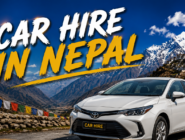
Car Hire in Nepal – Complete Guide for Travelers
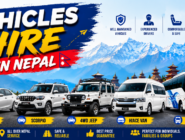
All Over Nepal Vehicle Hire – Private Car, Scorpio, 4WD Jeep, Hiace And Tourist Bus
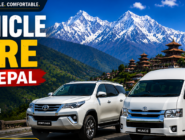
Hiace Hire in Nepal