Plan a Trip


Ancient Temples and Hidden Histories: A Journey Through Nepal’s Sacred Past
Ancient Temples and Hidden Histories: A Journey Through Nepal’s Sacred Past
Nepal is home to one of the oldest continuously inhabited civilisations on Earth. In this country, the sacred and the everyday have coexisted for so long that the distinction between them has all but dissolved. Here, morning mist rises over river ghats where cremation fires have burned for two thousand years. Ancient stone temples, blackened with incense smoke and adorned with offerings of marigold and rice, stand amid living cities—not as museum pieces but as active centres of daily devotion. Gods are addressed as neighbours. Pilgrims sleep in the courtyards of structures that were already centuries old when the great European cathedrals were being built.
Nepal’s sacred heritage encompasses Hindu temples of extraordinary antiquity, Buddhist stupas and monasteries that predate the written history of many nations, Kirant traditions that go back to the earliest human settlement of the Himalayan foothills, and the hidden stories of kingdoms, dynasties, saints, and ordinary people whose faith shaped every stone, every carving, and every ritual that survives into the present.
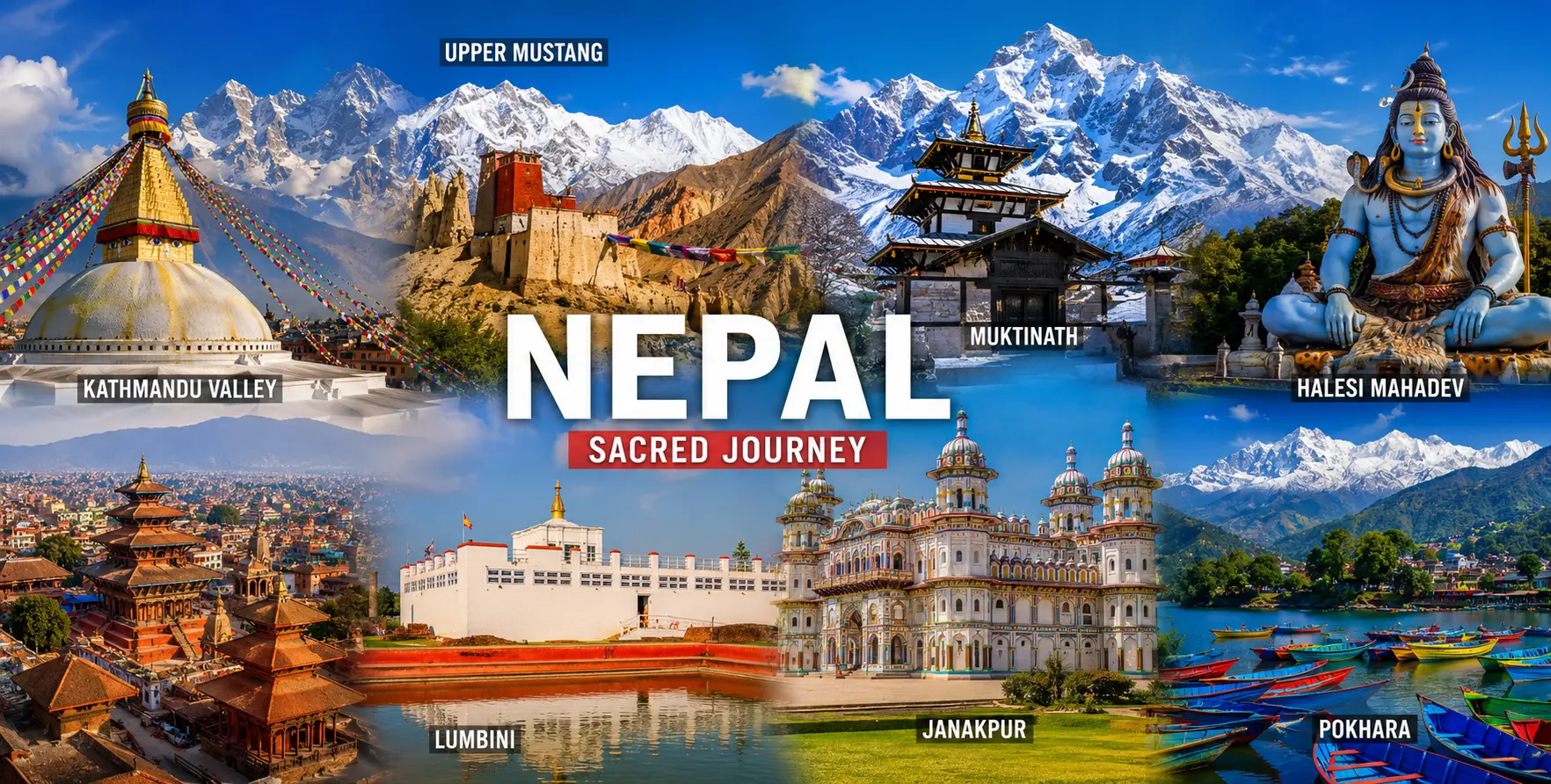
This journey through Nepal’s sacred past visits the greatest and the most hidden — from the UNESCO World Heritage temples of the Kathmandu Valley to the tri-faith cave sanctuary of Halesi Mahadev in the remote eastern hills, from the birthplace of Lord Buddha in the Terai plains to the high-altitude sacred flame of Muktinath at 3,710 meters. Nepal Vehicle Hiring Pvt Ltd is your transport partner for this extraordinary cultural and spiritual journey across one of the world’s most profoundly sacred landscapes.
For travellers who want to trek and also explore Kathmandu, we recommend continuing your journey with our trusted sister companies, Trek Nepal Himalayas and Alpine Luxury Treks. We specialise in organising a wide range of travel experiences across Nepal, from classic trekking adventures to cultural and wildlife tours.
Our top offerings include iconic journeys such as the Everest Base Camp Trek, immersive Kathmandu sightseeing tours, breathtaking Nagarkot sunrise experiences, exciting Chitwan jungle safaris, and luxury packages. We can also arrange short hikes, heritage tours, mountain flights, and customised travel plans tailored to your schedule and interests.
Whether you want a budget-friendly trip or a luxury trekking experience with premium lodges, private guides, and high-end services, we manage every detail professionally. Our goal is to provide a seamless transition from your trekking adventure to a comfortable) and a memorable travel experience in Nepal.
Nepal’s Sacred Heritage — A Living Civilisation
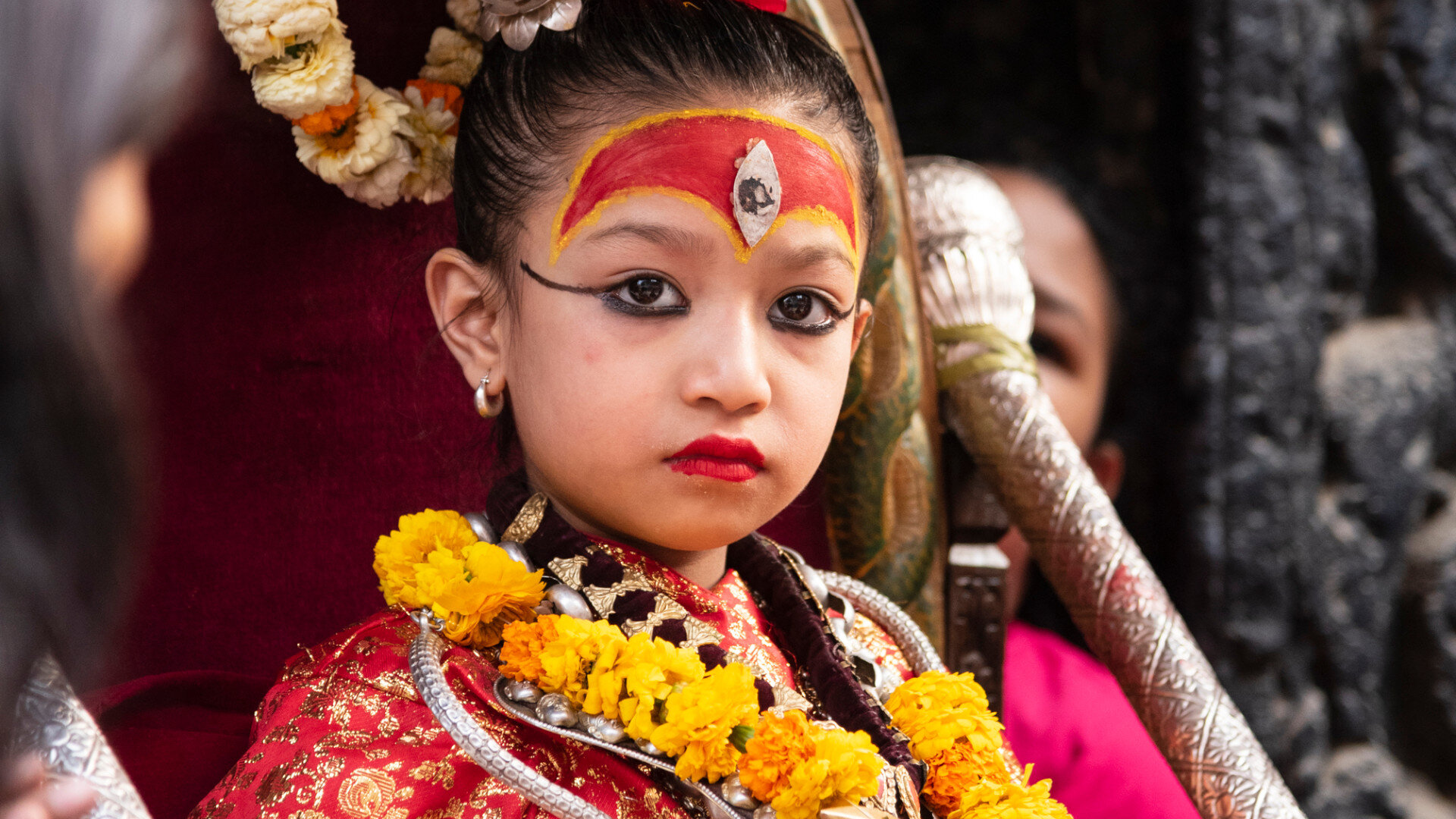
Most countries of comparable historical significance preserve their ancient heritage in museums, carefully separated from contemporary life by glass cases and scholarly plaques. Nepal does something far more remarkable — it lives inside its history. The Kumari, the living goddess of Kathmandu, still peers from her carved lattice window at Kumari Chowk as she has for centuries. The cremation ghats of Pashupatinath still receive the bodies of the faithful without interruption, as they have for over a thousand years. Monks still circle the Boudhanath Stupa at dawn, spinning prayer wheels, exactly as their predecessors did when the stupa was first constructed in the 5th century CE.
This quality of life — the fact that Nepal’s ancient sacred heritage is not a relic but a continuing reality — is what makes a journey through Nepal’s temples and histories unlike any museum tour or heritage walk in the world. Every site visited here is a place of active faith, not passive observation. Every carving, every festival drum, every waft of incense smoke connects the present to a past that in Nepal has never entirely receded.
The Three Great Religious Traditions of Nepal
- Hinduism: Nepal’s dominant religion, practised by about 80% of the population. Nepal’s Hindu tradition is ancient — predating major South Asian Hindu reform movements and retaining characteristics of Vedic and Tantric practice that have disappeared elsewhere. The Hindu temples of the Kathmandu Valley are among the finest surviving examples of classical South Asian temple architecture.
- Buddhism: Buddhism arrived in Nepal from its birthplace in the Nepalese Terai (Lumbini, the birthplace of Siddhartha Gautama) and from Tibet, giving rise to a distinctive Nepali Buddhist tradition. The great stupas of Boudhanath and Swayambhunath are among the world’s most important Buddhist sacred sites. Nepal’s monasteries also preserve a living Tibetan Buddhist tradition that has been severely disrupted in Tibet itself.
- Kirant and Indigenous Traditions: The Kirant people — particularly the Rai and Limbu communities of eastern Nepal — maintain the oldest surviving indigenous spiritual tradition in the Himalayas, predating both Hinduism and Buddhism. The Kirant tradition venerates the sacred landscape itself — mountains, rivers, forests, and caves — and has powerfully shaped sacred sites such as Halesi Mahadev, which is simultaneously Hindu, Buddhist, and Kirant.
The Kathmandu Valley — Seven UNESCO World Heritage Sites
The Kathmandu Valley is Nepal’s most concentrated repository of ancient sacred heritage — a UNESCO World Heritage zone encompassing seven distinct monument zones that together represent one of the finest collections of historic architecture, religious art, and living cultural tradition anywhere in the world. Within a 30-kilometre radius, a traveller can visit temples, stupas, palaces, and monasteries spanning fifteen centuries of continuous artistic and religious achievement.
| Site | Distance from Thamel | Recommended Time | Vehicle | Entry / Notes |
| Pashupatinath Temple | 3 km east | 2–3 hours | Sedan / Jeep | Non-Hindus observe from the east bank; NPR 1,000 |
| Boudhanath Stupa | 5 km northeast | 1–2 hours | Sedan / Jeep | NPR 400 entry; sunrise ideal visit time |
| Swayambhunath | 3 km west | 1.5–2 hours | Sedan / Jeep | 366 steps or drive to the top; NPR 200 entry |
| Kathmandu Durbar Square | 1.5 km south | 2–3 hours | Walk / city taxi | NPR 1,000 entry; Kumari Court viewing |
| Patan Durbar Square | 6 km south | 2–3 hours | Sedan / Jeep | NPR 1,000 entry; finest Newar architecture |
| Bhaktapur Durbar Square | 16 km east | Half day | Sedan / Jeep | NPR 1,500 entry; medieval city, Nyatapola Temple |
| Changu Narayan Temple | 22 km east | 2–3 hours | Sedan / Jeep | Oldest temple in Nepal; hilltop location; free entry |
Pashupatinath Temple — Lord of All Living Beings
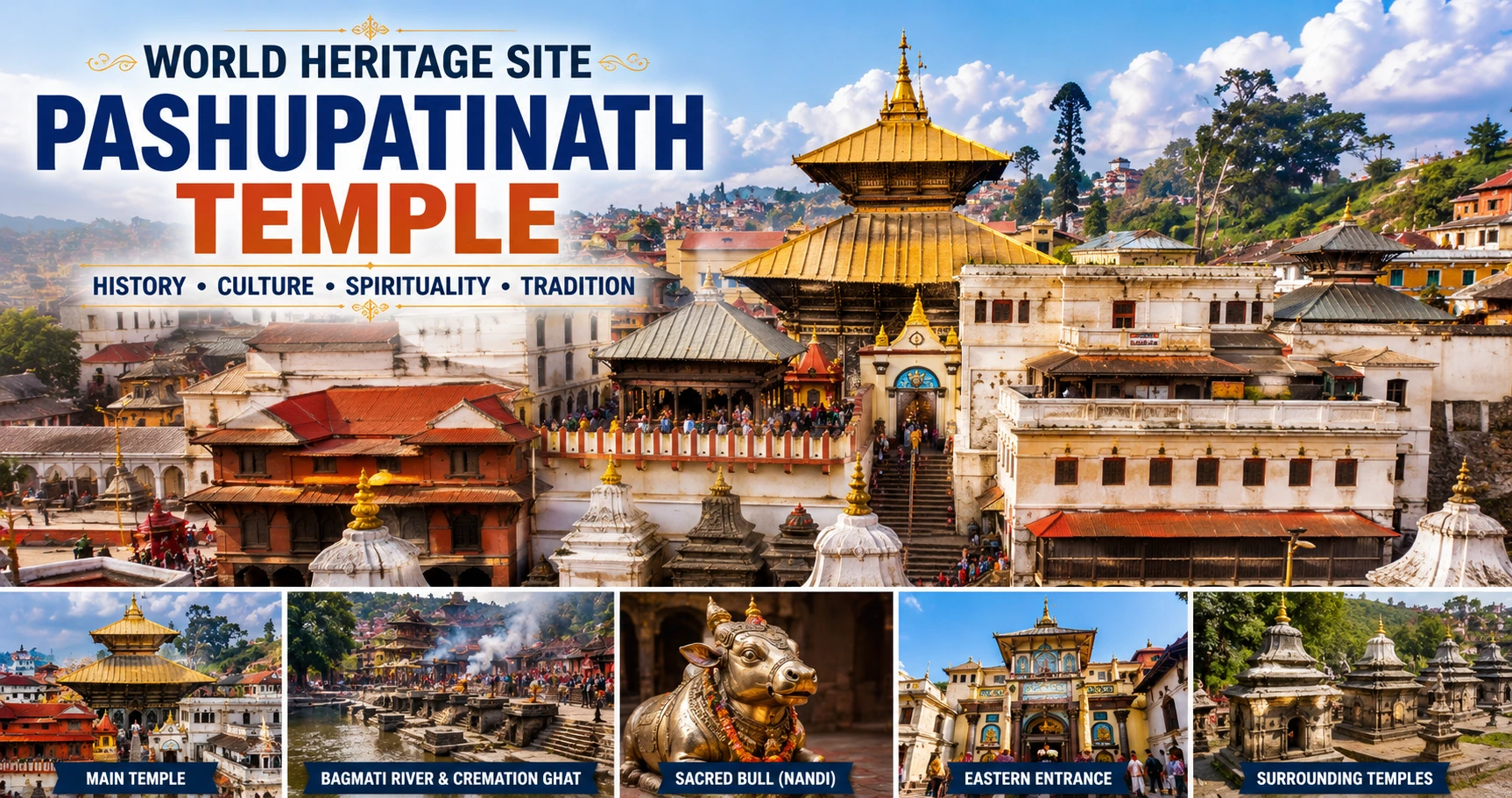
Pashupatinath is Nepal’s most sacred Hindu temple—the primary Shiva temple in the subcontinent —where Lord Shiva is worshipped as Pashupati: the Lord of All Living Beings. Situated on the sacred banks of the Bagmati River, which Hindus regard as having the same sanctity as the Ganges, the Pashupatinath complex covers over 264 hectares. It encompasses hundreds of temples, shrines, ashrams, and religious institutions around the main golden-roofed pagoda.
The Bagmati River ghats at Pashupatinath are among the most spiritually intense public spaces on Earth. Cremation ceremonies performed here day and night — conducted with dignified ritual by Hindu priests and attended by grieving families — are a frank acknowledgement of mortality that most modern cultures carefully shield from public view. For visitors who approach with appropriate respect and sensitivity, witnessing a Pashupatinath cremation is a profound encounter with the Hindu understanding of death as liberation: the body returning to the five elements, the soul continuing its journey toward moksha.
The temple itself — a two-tiered golden pagoda of extraordinary beauty — is accessible only to Hindus in its inner sanctum. Non-Hindu visitors observe from the eastern bank of the Bagmati, which offers clear views of the main temple across the river. The atmosphere — ash-smeared sadhus meditating in riverside alcoves, orange-robed pilgrims circumambulating the temple, the smell of marigold and incense drifting across the water — is unforgettable at any time of day.
- Best time to visit: Early morning at dawn for temple opening puja, or late afternoon for evening aarti ceremony
- Distance from Thamel: ~3 km east — 15 minutes by private vehicle
- Entry: NPR 1,000 per foreign visitor (non-Hindus observe from the east bank — free)
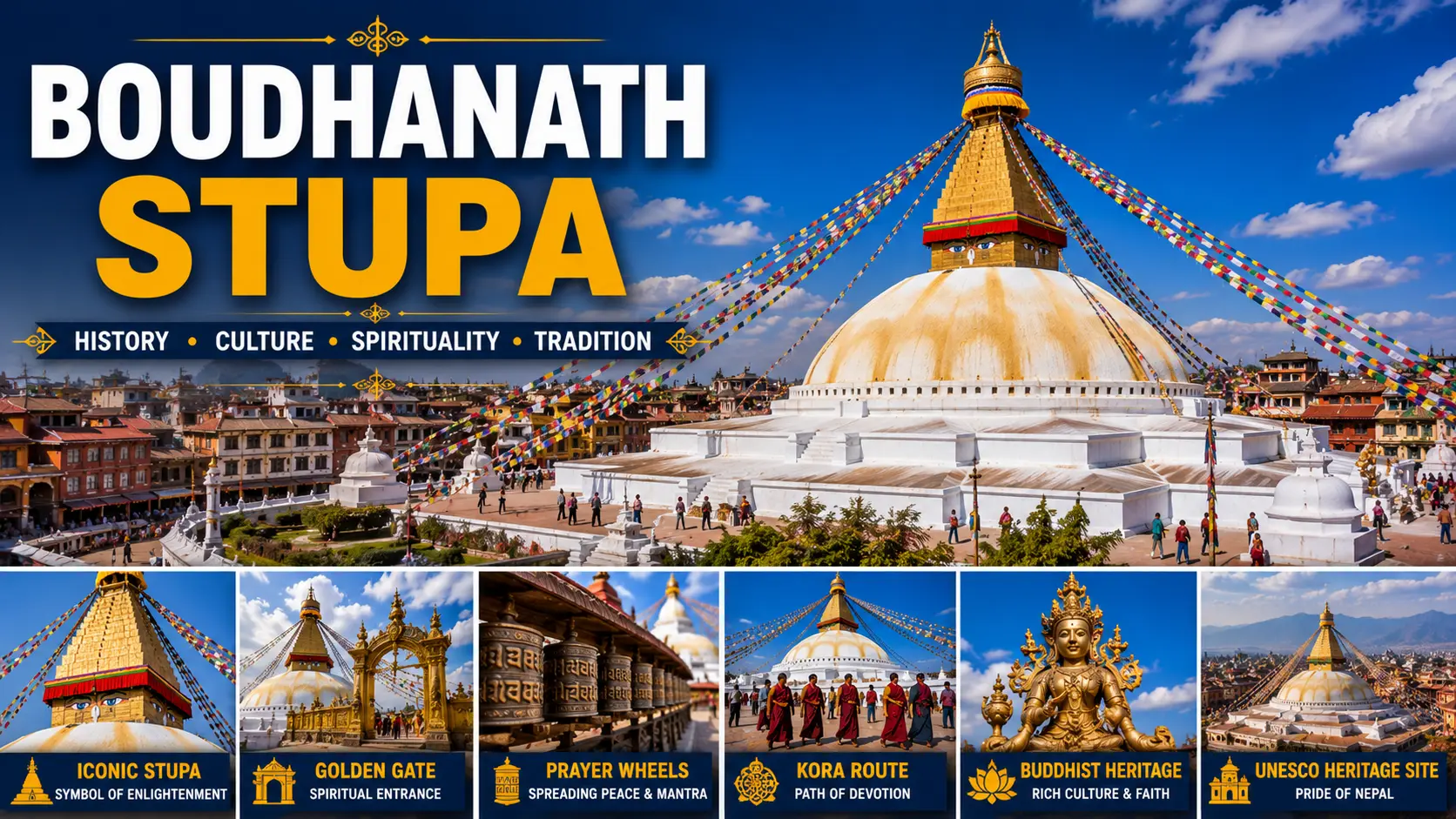
Boudhanath Stupa — The Heart of Himalayan Buddhism
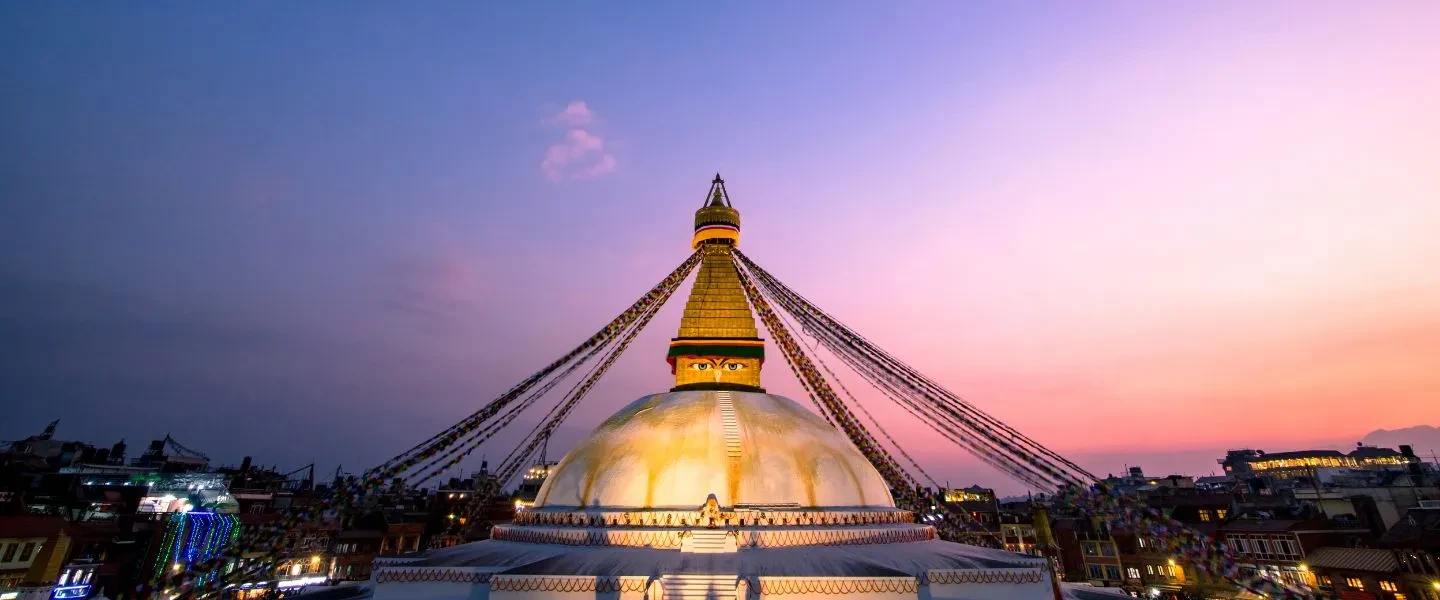
Boudhanath Stupa is one of the world’s largest and most spiritually significant Buddhist stupas — a vast white dome 36 meters high, crowned by a golden tower, topped by thirteen steps representing the stages of Enlightenment, and painted on all four sides with the all-seeing eyes of the Buddha. The stupa sits on a circular platform lined with prayer wheels, enclosed by a ring of monasteries and sacred shops, creating a complete spiritual ecosystem unlike anything else in the Buddhist world.
For Tibetan Buddhists, Boudhanath holds a significance that has only deepened since the Chinese occupation of Tibet in 1959. The Tibetan refugee community settled around Boudhanath brought lamas, monks, and the complete living tradition of Tibetan Buddhism — and the monasteries of Boudhanath have become the most important centres of Tibetan Buddhist scholarship and practice outside Tibet itself. Thousands of Tibetan devotees circumambulate the stupa each morning, making it one of Nepal’s most moving daily spectacles.
- Best time: Sunrise — the circumambulation crowds are most atmospheric in early morning golden light
- Distance from Thamel: ~5 km northeast — 20 minutes by private vehicle
- Entry: NPR 400 per foreign visitor
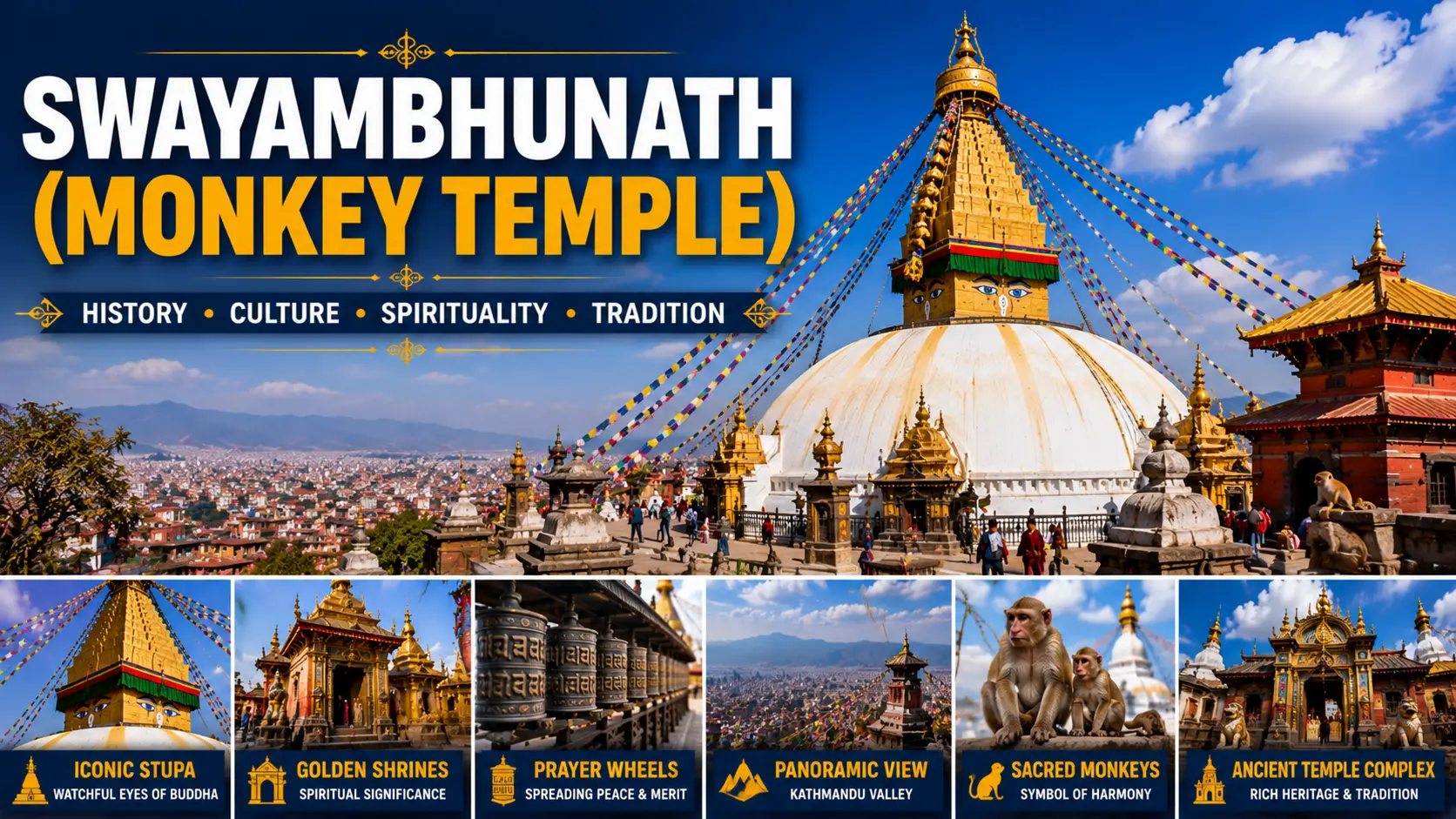
Swayambhunath — The Self-Arising One
Swayambhunath Stupa — popularly known as the Monkey Temple for its resident troop of rhesus macaques — crowns a conical hill rising 77 meters above the Kathmandu Valley floor. The stupa’s tradition extends over 2,500 years, though the current structure dates primarily from the 5th century CE. The name Swayambhunath means ‘the self-arising’ — referring to the sacred flame believed to have spontaneously manifested from the primordial lotus that once grew from the ancient Kathmandu lake. The stupa built over this flame has grown and been embellished over 25 centuries into the extraordinary monument that stands today.
Swayambhunath perfectly exemplifies Nepal’s religious syncretism — a Buddhist stupa surrounded by Hindu shrines, visited devoutly by both Buddhists and Hindus, with the Buddha’s all-seeing eyes looking out from a tower that also bears the symbols of tantric Hinduism. The 366 stone steps climbing to the summit are lined with carved images of deities from both traditions. At the top, the panoramic view of the Kathmandu Valley — with Himalayan peaks on the northern horizon on clear mornings — is one of Nepal’s finest accessible viewpoints.
- Best time: Sunrise from the hilltop — the valley in morning light is extraordinary
- Distance from Thamel: ~3 km west — 15 minutes by vehicle, or a rewarding 40-minute walk
- Entry: NPR 200 per foreign visitor
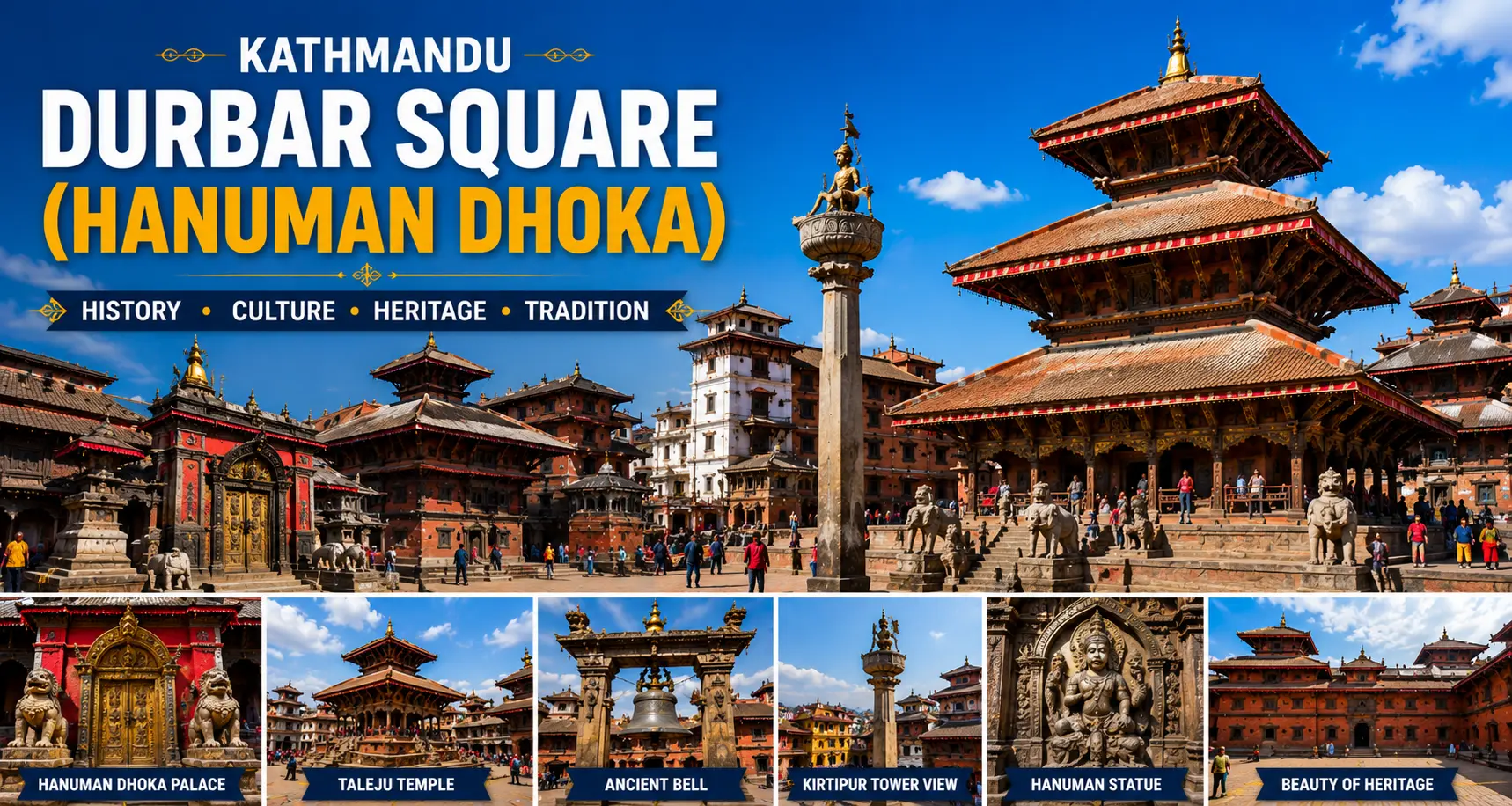
Kathmandu Durbar Square — The Living Royal City
Kathmandu Durbar Square — known locally as Hanuman Dhoka, after the statue of Hanuman guarding its entrance — was the seat of the Malla and Shah dynasties, who ruled Kathmandu for over six centuries. The complex encompasses dozens of temples, courtyards, towers, and palaces — a royal city within a city, continuously inhabited and ceremonially active since the 12th century.
The Kumari Chowk (Kumari Court) houses the living goddess Kumari — a young girl selected from the Newar Shakya community to embody the goddess Taleju until puberty, after which she returns to ordinary life. The Kumari occasionally appears at her carved lattice window to bless visitors — a moment that, for many, is the most extraordinary cultural encounter of their visit to Nepal. The Taleju Temple, built in 1564 by King Mahendra Malla, rises nine stories above the surrounding buildings — the finest pagoda tower in the Kathmandu Valley.
- Distance from Thamel: ~1.5 km south — 10-minute walk or short taxi ride
- Entry: NPR 1,000 per foreign visitor
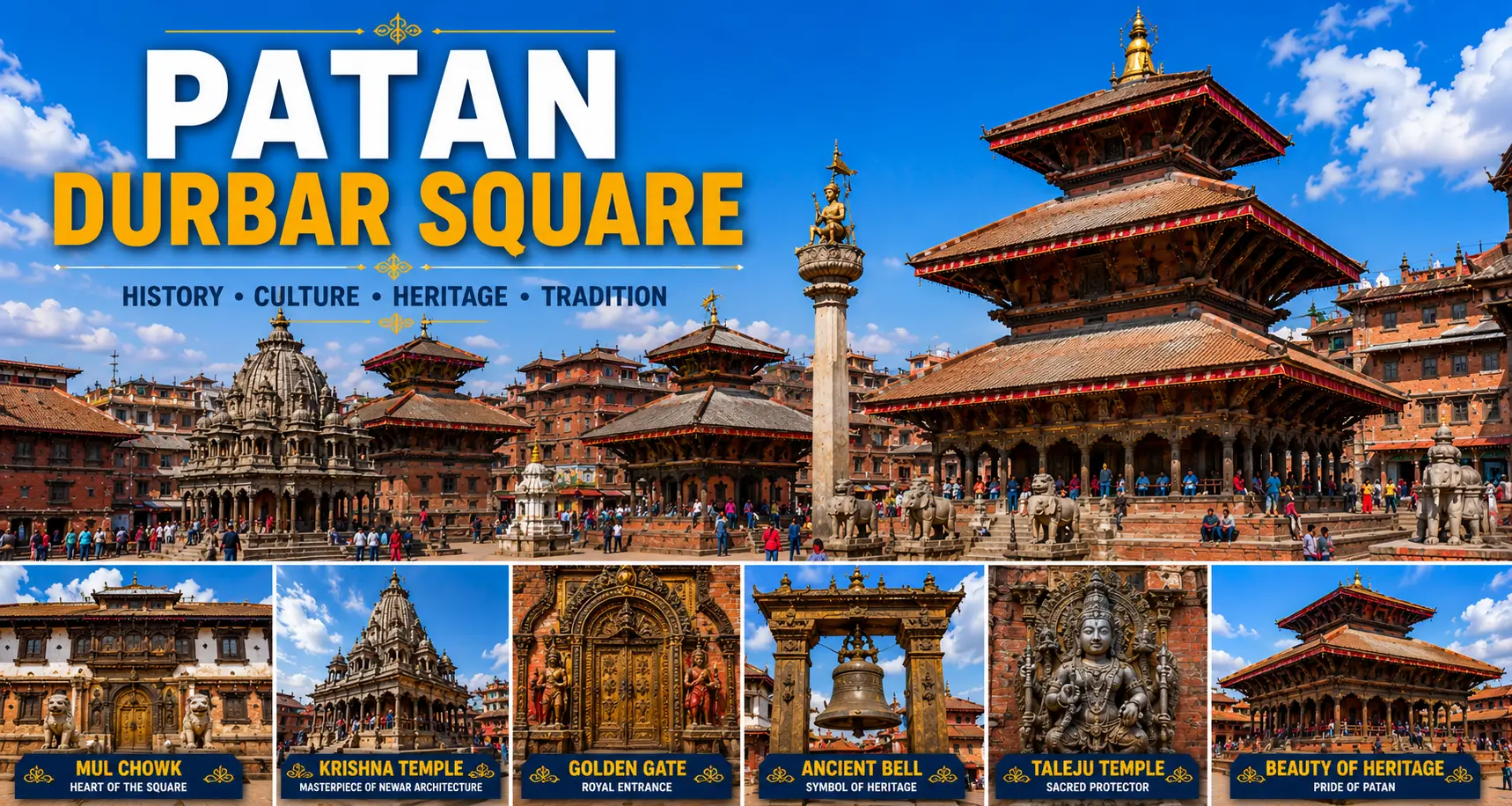
Patan Durbar Square — The City of a Thousand Golden Spires
Patan (Lalitpur — City of Beauty) contains what many architectural historians consider the finest concentration of traditional Newar architecture on Earth. The Krishna Temple — a masterpiece of the Shikhara style, built entirely of stone in 1637 with 21 gilded spires — dominates the square with its intricately carved friezes depicting scenes from the Mahabharata and the Ramayana. Every surface of Patan’s temples showcases the extraordinary skill of Newar master artisans — exquisitely detailed torana (doorway arch) panels, gilded copper repoussé windows, and intricately worked struts that represent the finest surviving examples of classical Newar sacred art.
- Distance from Thamel: ~6 km south — 20–25 minutes by private vehicle
- Entry: NPR 1,000 per foreign visitor — also includes the outstanding Patan Museum
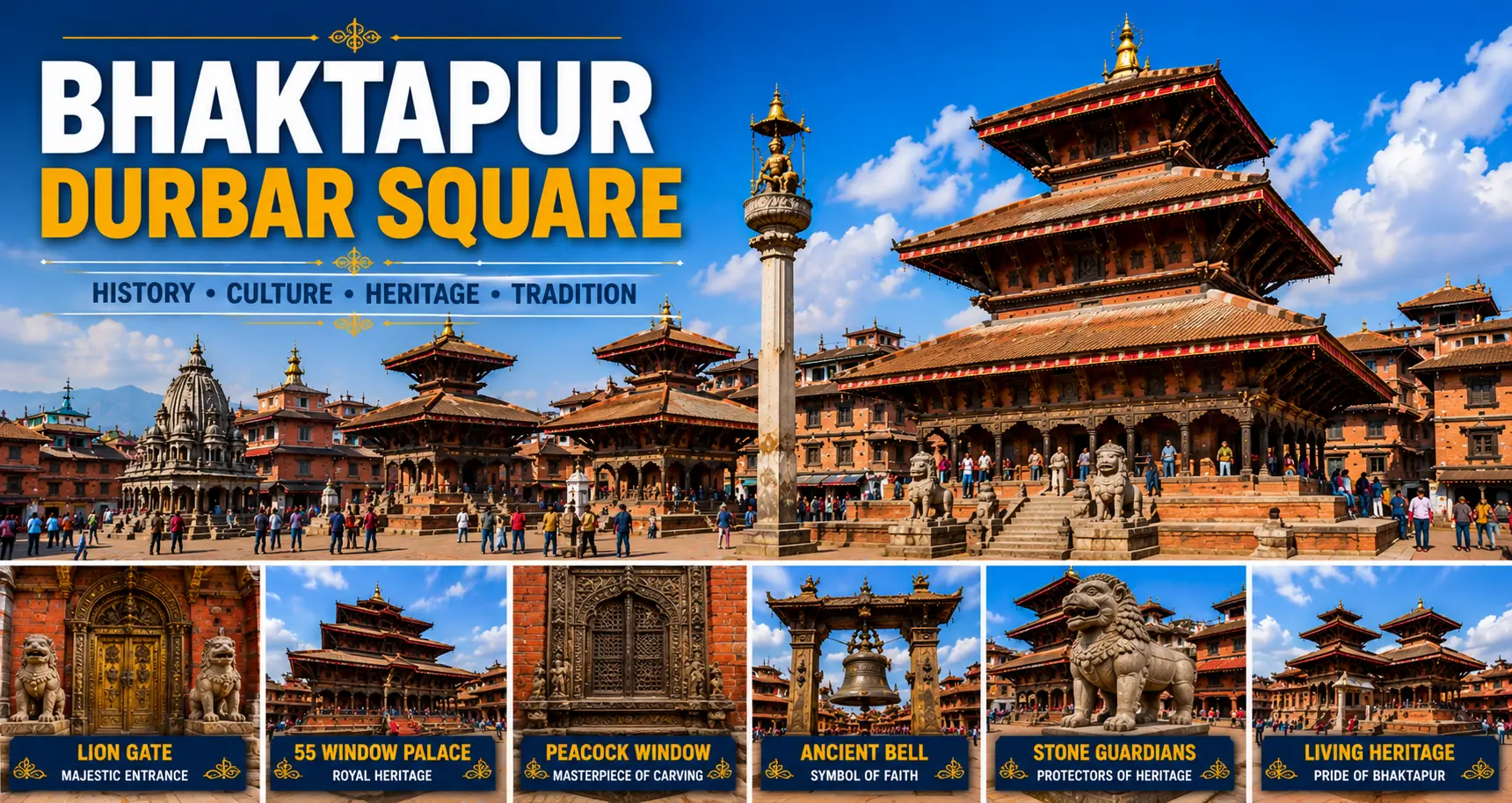
Bhaktapur Durbar Square — The Perfectly Preserved Medieval City
Bhaktapur is the most completely preserved of the three medieval Kathmandu Valley cities — its medieval brick-paved streets, traditional three-story Newar houses with carved lattice windows, and deep silence of a city that still follows traditional rhythms, making it feel like a genuine step back in time. The crown jewel is the Nyatapola Temple — a soaring five-story pagoda built in 1702 that is Nepal’s tallest temple, flanked by paired guardian figures on its stairway, arranged in ascending order of mythological power. The Nyatapola survived the devastating 2015 Gorkha earthquake without significant damage — a testament to the structural genius of Newar temple engineering.
- Distance from Thamel: ~16 km east — 35–45 minutes by private vehicle
- Entry: NPR 1,500 per foreign visitor — funds support Bhaktapur’s heritage conservation
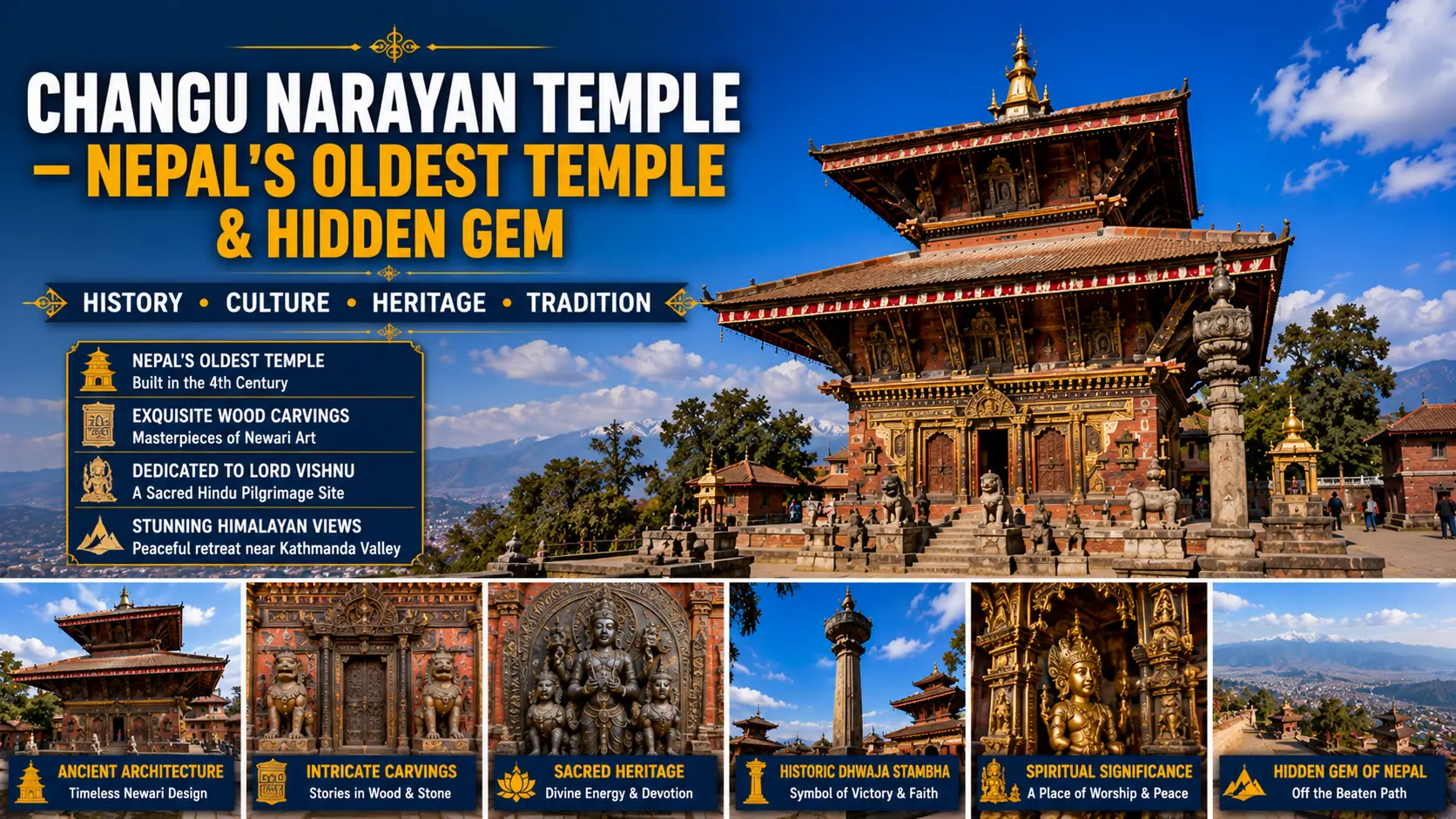
Changu Narayan — Nepal’s Oldest Standing Temple
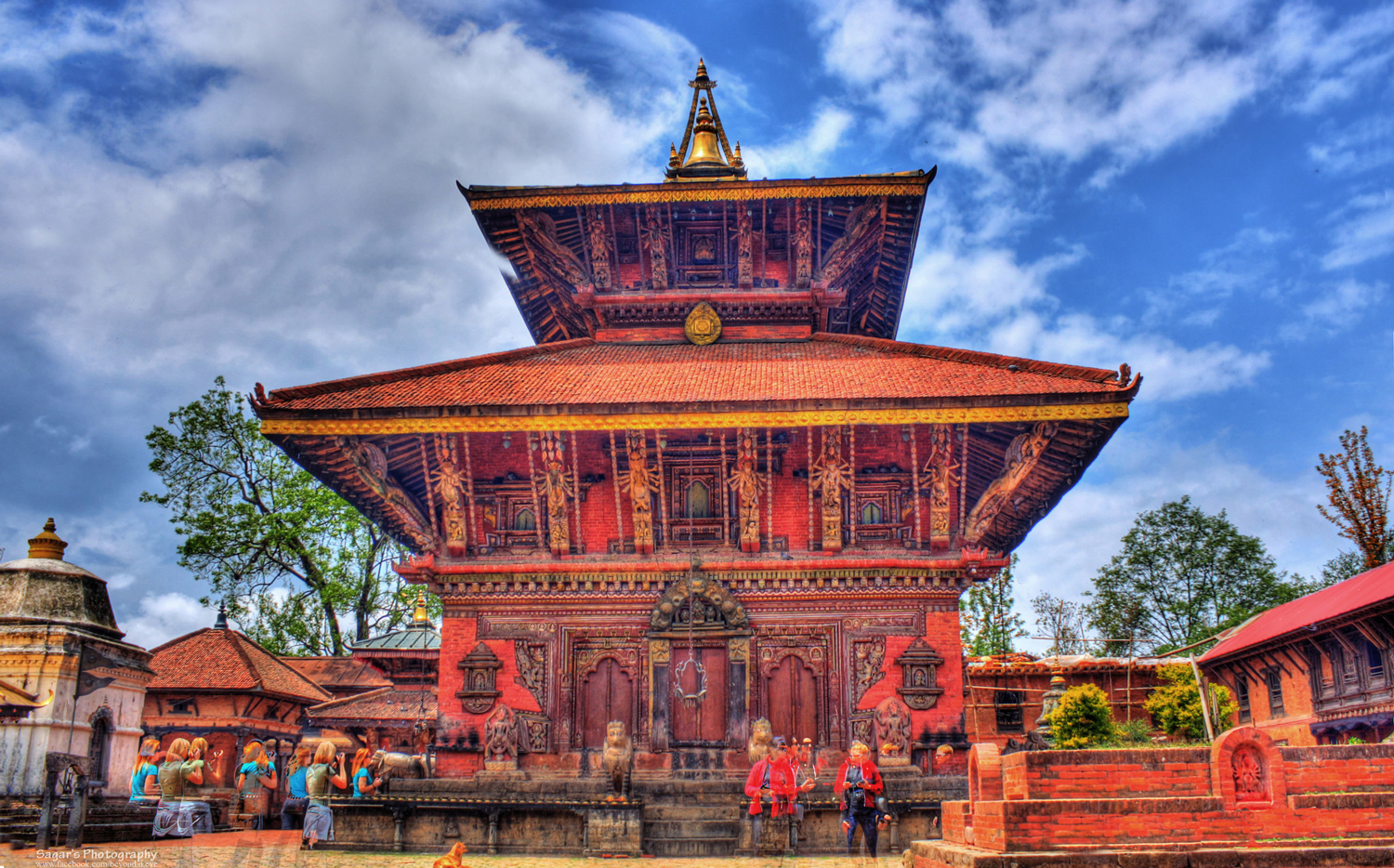
Changu Narayan Temple holds the extraordinary distinction of being the oldest still-standing temple in Nepal — the main structure dates from the 5th century CE, placing it among the oldest surviving Hindu temples in South Asia. Dedicated to Lord Vishnu, the temple houses one of the most remarkable collections of ancient stone sculpture in Nepal — including the Vishnu Vikranta (Trivikrama) carving from the 7th century CE and inscriptions providing some of the earliest historical records of the Licchavi Dynasty that ruled the Kathmandu Valley in the 1st to 9th centuries CE.
- Distance from Thamel: ~22 km east — 45 minutes by private vehicle to hilltop
- Entry: Free (donations welcome)
Full Valley Circuit: Nepal Vehicle Hiring Pvt Ltd offers private sedan or Scorpio hire for the complete Kathmandu Valley heritage circuit. NPR 7,000–11,000 per day — door-to-door hotel pickup, all seven UNESCO sites in 2–3 relaxed days.
All Major Sacred Sites — Complete Reference Table
| Sacred Site | Location | Age / Era | Religion | UNESCO Status |
| Pashupatinath Temple | Kathmandu (Bagmati River) | 5th century CE (current form) | Hindu (Shaivite) | World Heritage (1979) |
| Boudhanath Stupa | Kathmandu (Boudha) | 5th century CE | Buddhist | World Heritage (1979) |
| Swayambhunath Stupa | Kathmandu hillside | 5th century CE (2,500+ yr tradition) | Buddhist / Hindu | World Heritage (1979) |
| Kathmandu Durbar Square | Old Kathmandu (Hanuman Dhoka) | 12th–18th century (Malla era) | Hindu | World Heritage (1979) |
| Patan Durbar Square | Patan (Lalitpur) | 12th–17th century (Malla era) | Hindu / Buddhist | World Heritage (1979) |
| Bhaktapur Durbar Square | Bhaktapur city | 14th–18th century (Malla era) | Hindu | World Heritage (1979) |
| Changu Narayan Temple | Changu Hill, Kathmandu Valley | 5th century CE — oldest in Nepal | Hindu (Vaishnava) | World Heritage (1979) |
| Lumbini — Maya Devi Temple | Rupandehi, southern Nepal | 623 BCE (Buddha’s birthplace) | Buddhist | World Heritage (1997) |
| Muktinath Temple | Mustang District, 3,710 m | Ancient — pre-Hindu and Hindu | Hindu / Buddhist / Kirant | Sacred landmark |
| Janaki Temple (Janakpur) | Mithila region, Madhesh | 1911 CE (current); ancient site | Hindu | Major heritage site |
| Halesi Mahadev | Khotang District | Ancient — tri-faith tradition | Hindu / Buddhist / Kirant | Rare tri-faith site |
| Manakamana Temple | Gorkha, on gorge ridge | 16th-century tradition | Hindu | Highly revered |
Beyond Kathmandu — Nepal’s Hidden Sacred Histories
Nepal’s spiritual landscape extends far beyond the Kathmandu Valley — to remote mountain shrines, ancient pilgrimage cities, sacred lakes, and hidden cave temples that hold equally profound histories and attract devotees from across the subcontinent and the wider world.
| Sacred Destination | Distance from KTM | Best Vehicle | Travel Time | Spiritual Tradition |
| Lumbini (Buddha’s Birthplace) | 280 km | Sedan / Hiace / Coaster | 7–8 hrs | Buddhist — global pilgrimage site |
| Janakpur (Sita’s Birthplace) | 228 km | Sedan / Hiace | 6–7 hrs | Hindu — Mithila culture, Janaki Temple |
| Muktinath Temple (3,710 m) | 368 km via Pokhara | 4WD Jeep / Hilux | 2 days | Hindu + Buddhist + Kirant |
| Halesi Mahadev | 222 km | Scorpio 4WD / Jeep | 7–9 hrs | Hindu + Buddhist + Kirant — tri-faith |
| Manakamana Temple (Gorkha) | 105 km + cable car | Sedan / Jeep | 2.5 hrs + cable car | Hindu — Goddess Bhagwati |
| Gosaikunda Lake (4,380 m) | 142 km + trek | Jeep to Syabrubesi | 1 day drive + 2 day trek | Hindu + Buddhist — sacred lake |
| Pathibhara Devi (Taplejung) | 525 km | 4WD Jeep | 2 days | Hindu — sacred Himalayan goddess |

Lumbini — Where the World’s Light Was Born
Lumbini, in the plains of southern Nepal, approximately 280 km from Kathmandu, is one of the most significant sacred sites in human history — the birthplace of Siddhartha Gautama, who became the Buddha and whose teachings transformed the spiritual, philosophical, and cultural life of Asia and the entire world. A marker stone in the sacred garden at Lumbini—confirmed by archaeological excavation and inscriptions—marks the exact spot where Queen Maya Devi gave birth to Siddhartha in 623 BCE while holding a branch of a sal tree.
The Maya Devi Temple at the heart of Lumbini’s sacred zone encloses both the birth marker stone and the foundations of temples built on the site by Emperor Ashoka, who visited circa 249 BCE and erected a pillar — still standing — with an inscription confirming the site. The sacred garden contains the ancient Bodhi tree, the Puskarni pool where Queen Maya Devi bathed before her birth, and the Ashoka Pillar with its remarkable 3rd-century BCE inscription.
Surrounding the sacred zone, the international monastic zone is one of the most extraordinary landscapes of intercultural religious architecture anywhere in the world — Buddhist nations from Japan, Sri Lanka, China, Germany, Thailand, Korea, and dozens of others have built national monasteries at Lumbini, creating a landscape where the full diversity of global Buddhism is represented in a single sacred valley.
Janakpur — The Kingdom of King Janak and Birthplace of Sita
Janakpur, in the Mithila cultural heartland of Nepal’s Madhesh Province, is the birthplace of Sita Devi — the divine consort of Lord Rama and heroine of the Ramayana epic — and the city of King Janak, the philosopher-king whose dialogues in the Brihadaranyaka Upanishad remain among the most profound in the Vedic tradition. The Janaki Temple, built in 1911, is one of Nepal’s most visually striking religious structures: a vast white marble and coloured stone palace-temple of domes, minarets, and pavilions that enshrine the images of Goddess Sita and Lord Rama.
Janakpur is also the living capital of Mithila culture — one of the most distinctive regional artistic traditions in South Asia. Mithila painting (Madhubani art) — a vibrant, highly stylised folk painting tradition practised primarily by women on home paper and cloth — originated in this region and has been practised continuously for thousands of years, depicting scenes from the Ramayana and mythological stories in a distinctive geometric style.
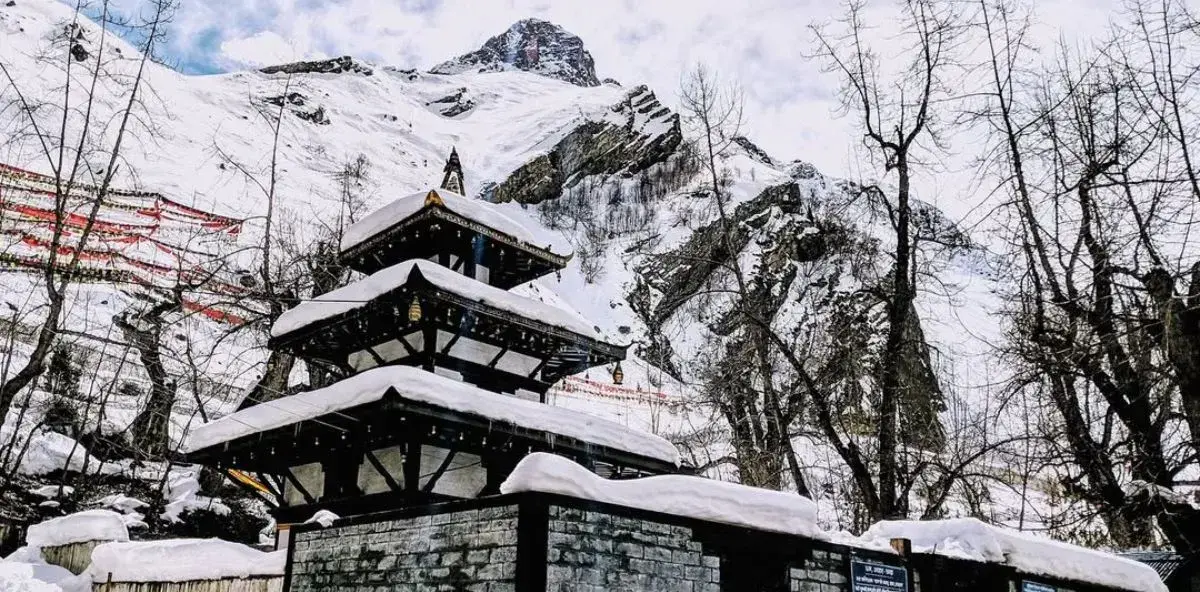
Muktinath — Where All Five Elements Meet
Muktinath Temple (3,710 m) is sacred to three distinct religious traditions simultaneously —one of the rarest spiritual sites on Earth. For Hindus, Muktinath is one of the 108 Divya Desams of Sri Vaishnavism and one of the Char Dham pilgrimage destinations. For Tibetan Buddhists, it is one of the 24 Tantric places sacred to Guru Padmasambhava. For the Kirant Rai people, it is their most ancient sacred mountain shrine. The eternal natural gas flame burning beside a stream within the temple complex — a phenomenon centuries or millennia old — represents for Hindu devotees the miraculous co-presence of all five natural elements (panch tatwa) in a single sacred space. The 108 glacial water spouts, Shaligram ammonite fossils in the riverbed, and the extraordinary high-altitude landscape make Muktinath a uniquely powerful convergence of natural and spiritual phenomena.
Halesi Mahadev — Where Three Faiths Converge in a Cave
Halesi Mahadev in Khotang District is among the most spiritually remarkable sites in the entire Himalayan world. In a single limestone cave complex on the banks of the Dudh Koshi River, the sacred traditions of Hinduism, Tibetan Buddhism, and the indigenous Kirant religion simultaneously claim the deepest antiquity. For Hindus, the cave is the sanctuary where Lord Shiva hid from the demon Bhasmashur.
For Tibetan Buddhists, the adjacent Maratika Cave is where Guru Padmasambhava meditated for three months and attained the rainbow body of immortal light — one of the most sacred events in the history of Vajrayana Buddhism. For the Kirant Rai people, the cave is the abode of their primordial deities Paruhang and Sumnima — the original ancestors of the Kirant and the site of creation itself. This extraordinary convergence of three independently ancient sacred traditions in a single place makes Halesi Mahadev one of the world’s most significant and least-known religious sites.
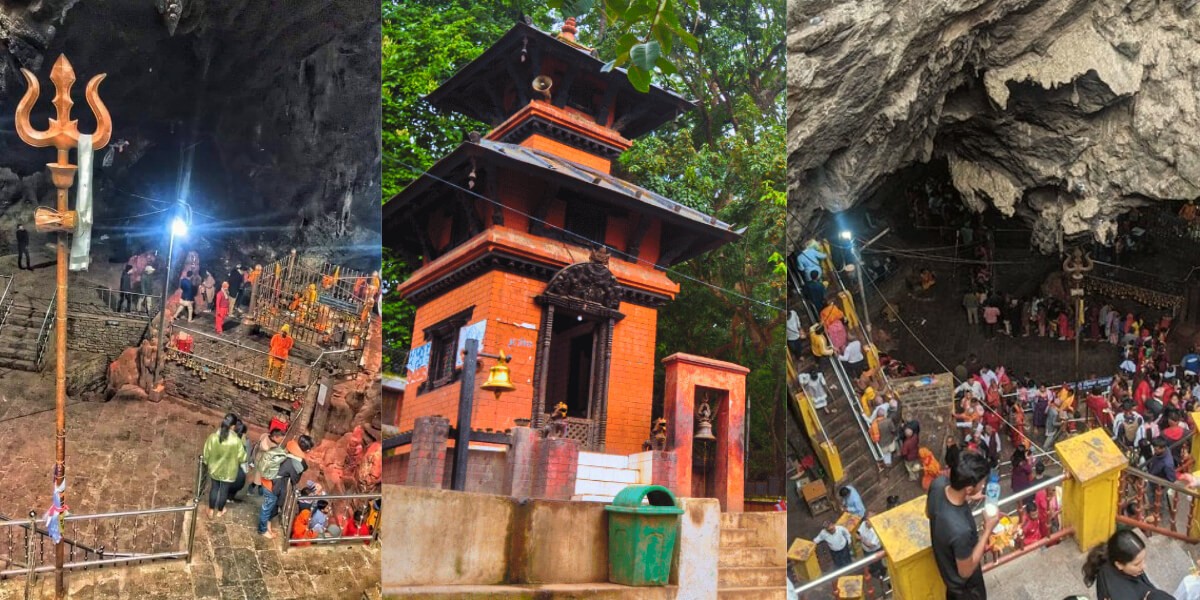
Manakamana — The Temple That Grants Wishes
Manakamana Temple, perched on a ridge above the Trishuli-Marsyangdi river confluence in Gorkha District, is dedicated to Goddess Manakamana Bhagwati — ‘Mana’ meaning heart and ‘Kamana’ meaning desire — a manifestation of the divine mother believed to grant devotees’ heartfelt wishes. The Manakamana Cable Car (opened in 1998) spans the dramatic gorge below, offering extraordinary views of the river gorge and distant Himalayan peaks during the 10-minute aerial approach. The temple attracts an unbroken stream of pilgrims year-round and serves as a sacred en route stop on the Kathmandu-Pokhara Prithvi Highway.
Sacred Architecture — Nepal’s Greatest Artistic Legacy
| Architectural Element | Description | Where to See the Best Examples |
| Pagoda Temple | Multi-tiered roofs — Nepal’s greatest contribution to Asian architecture | Nyatapola (Bhaktapur), Krishna Temple (Patan), Taleju (KTM) |
| Torana | Carved temple doorway arch — complete theological statement in wood or stone | Changu Narayan, Patan Durbar Square, Golden Gate (Bhaktapur) |
| Stupa / Chorten | Dome-shaped Buddhist monument — cosmic model of Enlightenment | Boudhanath, Swayambhunath; thousands across trekking routes |
| Shikhara | North Indian curvilinear spire — also used in Newar temples | Krishna Mandir, Patan; Char Narayan Temple |
| Dharahara (Watchtower) | Tall octagonal tower — royal watch and beacon tower | Bhaktapur National Art Museum tower |
| Mandapa (Open Pavilion) | Pillared open hall for community gathering and ceremony | Kasthamandap (KTM); many palace courtyards |
| Woodcarving (Lattice windows) | Intricately pierced wooden windows — among Asia’s finest | Peacock Window (Bhaktapur); Patan Museum gallery |
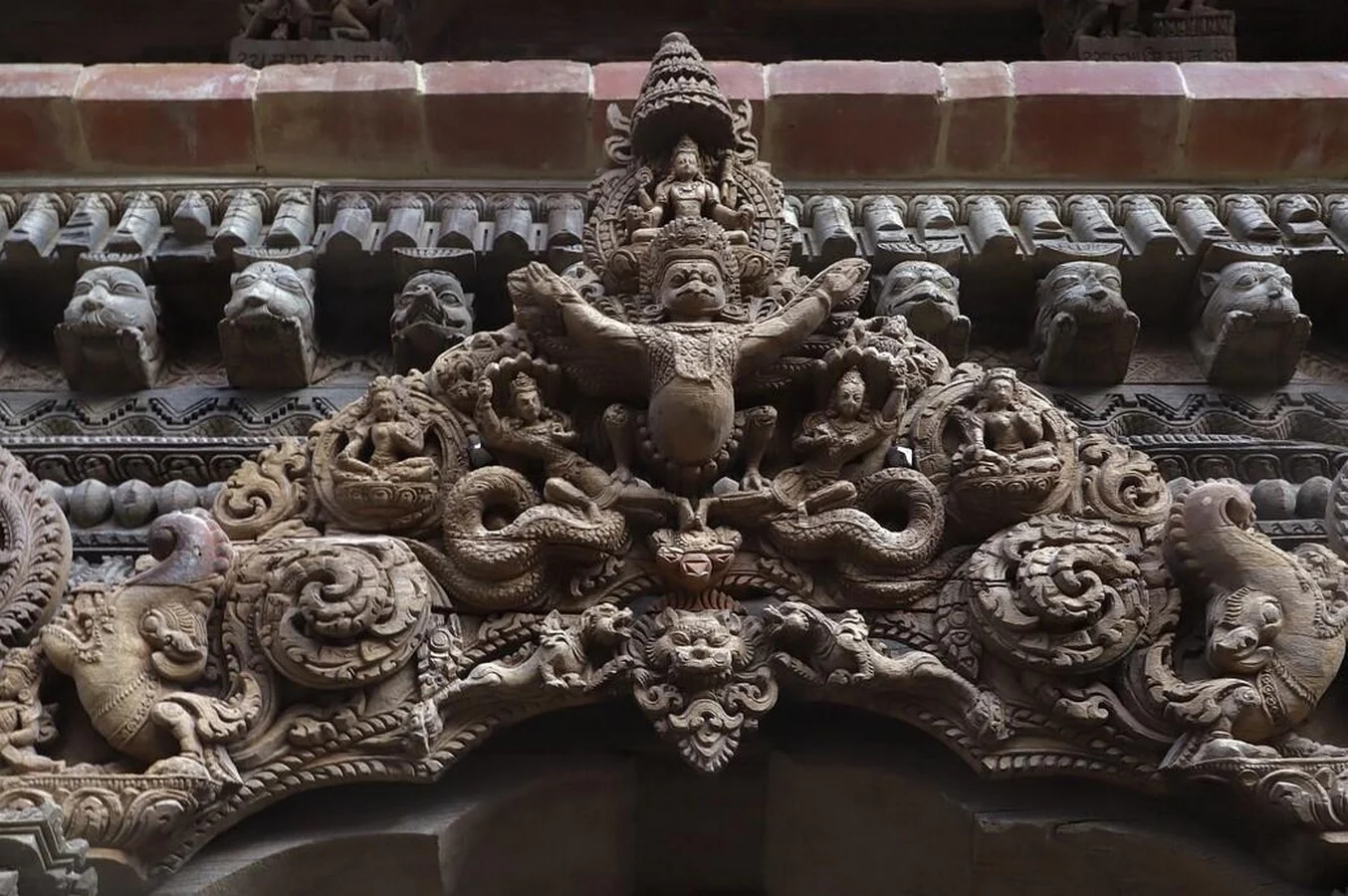
The Pagoda — Nepal’s Gift to Asian Architecture
The multi-tiered pagoda temple is widely believed to have originated in Nepal and spread to China, Japan, Korea, and Southeast Asia along the Silk Road trade routes. The Nepali architect who carried the pagoda form to China was Araniko — the 13th-century master craftsman for whom the Araniko Highway to Kodari is named — who built the White Pagoda in Beijing and dozens of temples across China for the Yuan Dynasty court of Kublai Khan. The rooflines of Chinese temples, the wooden tower temples of Japan, the tiered spires of Southeast Asian royal palaces — all may ultimately trace their origin to the master artisans of the Kathmandu Valley.
Torana — The Sacred Doorway
The torana — the ornate carved arch above every major temple entrance in Nepal — is one of the most distinctive elements of Newar sacred architecture. Each torana is a complete theological statement in wood, metal, or stone: the temple’s central deity appears at the apex of the arch, flanked by subsidiary deities, mythological beings, and symbolic imagery describing the cosmic domain of the temple’s presiding god. The finest toranas — at Changu Narayan, Patan Durbar Square, and the Golden Gate of Bhaktapur (the latter regarded as Nepal’s finest piece of metalwork) — are works of extraordinary artistic complexity that reward extended contemplation.
The Stupa — Architecture of Enlightenment
The Buddhist stupa — from the vast dome of Boudhanath to the hundreds of small white chortens dotting Nepal’s trekking trails and mountain passes — is the fundamental architectural form of Himalayan Buddhism. Each stupa is a three-dimensional model of the Buddhist cosmos: the circular dome represents the mind of the Buddha; the spire represents the path of Enlightenment through thirteen stages; the eyes of the Buddha on the four sides of the tower represent all-seeing awareness; and the single mark above — resembling a question mark — is the ultimate statement of Buddhist non-duality. Even the smallest chorten on a trekking trail is a complete philosophical statement in stone.
Nepal’s Sacred Festivals — When History Comes Alive
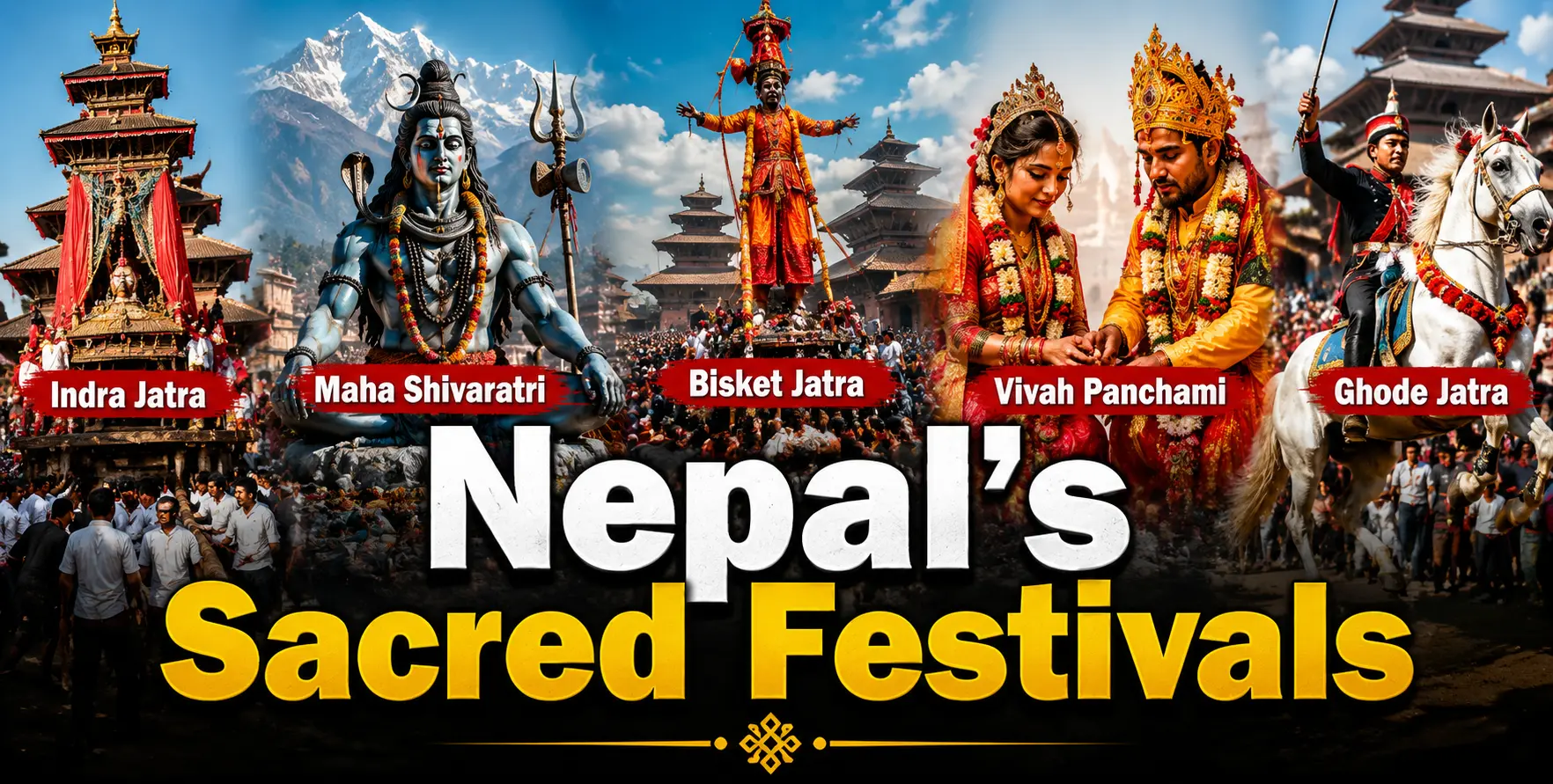
Nepal’s festival calendar is the most vivid expression of its living sacred heritage—moments when the boundary between the divine and the human dissolves, and the streets of ancient cities become stages for mythological dramas performed in the same spaces for hundreds of years.
| Festival | Timing | Location | Significance |
| Indra Jatra | September (8 days) | Kathmandu Durbar Square | Kumari chariot, Lakhey masked dance, Yosin pole raising |
| Maha Shivaratri | February–March | Pashupatinath, Halesi, Muktinath | Largest Hindu festival — sadhus, night vigil, Shiva worship |
| Bisket Jatra | April (Nepali New Year) | Bhaktapur Taumadhi Square | Chariot tug-of-war, Yoshin pole, ancient serpent myth ritual |
| Vivah Panchami | November–December | Janakpur | Ram-Sita wedding anniversary — largest Janakpur festival |
| Tiji Festival | April–May | Lo Manthang, Upper Mustang | 3-day Buddhist masked dance — most spectacular cultural event |
| Buddha Jayanti | May (full moon) | Boudhanath, Swayambhunath, Lumbini | Buddha’s birth, Enlightenment, and parinirvana anniversary |
| Dashain | October (15 days) | All Nepal | Largest festival — goddess Durga worship, family reunion |
Indra Jatra — Kathmandu’s Greatest Festival
Indra Jatra, celebrated in Kathmandu for eight days in September, is the capital’s most spectacular festival — a celebration of Indra, king of the gods and lord of rain, combined with the Kumari’s first public appearance outside her palace. The festival features enormous chariot processions through the streets of old Kathmandu, masked Lakhey dances performed in the ancient city squares, and the raising of giant bamboo poles (Yosin) at city intersections. The climax is the Kumari’s chariot procession — the child goddess carried through the streets of Kathmandu to receive the state’s blessing, surrounded by thousands of devoted spectators in a living enactment of divine sovereignty that has continued unbroken for centuries.
Maha Shivaratri — The Great Night of Shiva
Maha Shivaratri, falling in February or March, is Nepal’s most important Hindu festival — a night-long vigil dedicated to Lord Shiva, drawing hundreds of thousands of pilgrims to Pashupatinath Temple and Shiva temples across the country. The entire Pashupatinath complex is illuminated with oil lamps,s and the scent of sacred dhatura fills the air. Ash-smeared sadhus from across India and Nepal gather at Pashupatinath — their matted hair, orange robes, and trident staffs creating a visual spectacle unlike any other in Nepal’s festival calendar. At Halesi Mahadev and Muktinath, Shivaratri transforms these normally remote sites into seas of devotional humanity.
Bisket Jatra — Bhaktapur’s New Year
Bisket Jatra, celebrated in Bhaktapur during the Nepali New Year in mid-April, features a dramatic ceremonial tug-of-war between the city’s eastern and western halves for control of the deity’s chariot. The festival culminates in the raising of an enormous bamboo pole (Yoshin) accompanied by the crash of drums and the roar of competing crowds — enacting the ancient story of the princess whose successive husbands were killed by a serpent until a brave prince conquered it. The pole’s eventual fall symbolises the conquest of death-bringing forces — a ritual of extraordinary antiquity and cultural continuity.
Vivah Panchami — Ram and Sita’s Wedding
Vivah Panchami, celebrated at Janakpur in November or December, marks the anniversary of the divine marriage of Lord Rama and Goddess Sita — the most celebrated union in the Hindu epic tradition. Hundreds of thousands of pilgrims from across Nepal and India gather in Janakpur for five days of ceremony and celebration. The Janaki Temple is adorned with lights and flowers, and the streets fill with devotional music and elaborate religious processions re-enacting the ancient wedding story in the very city where, according to tradition, the original event took place thousands of years ago.
Planning Your Nepal Heritage Journey — Transport Guide
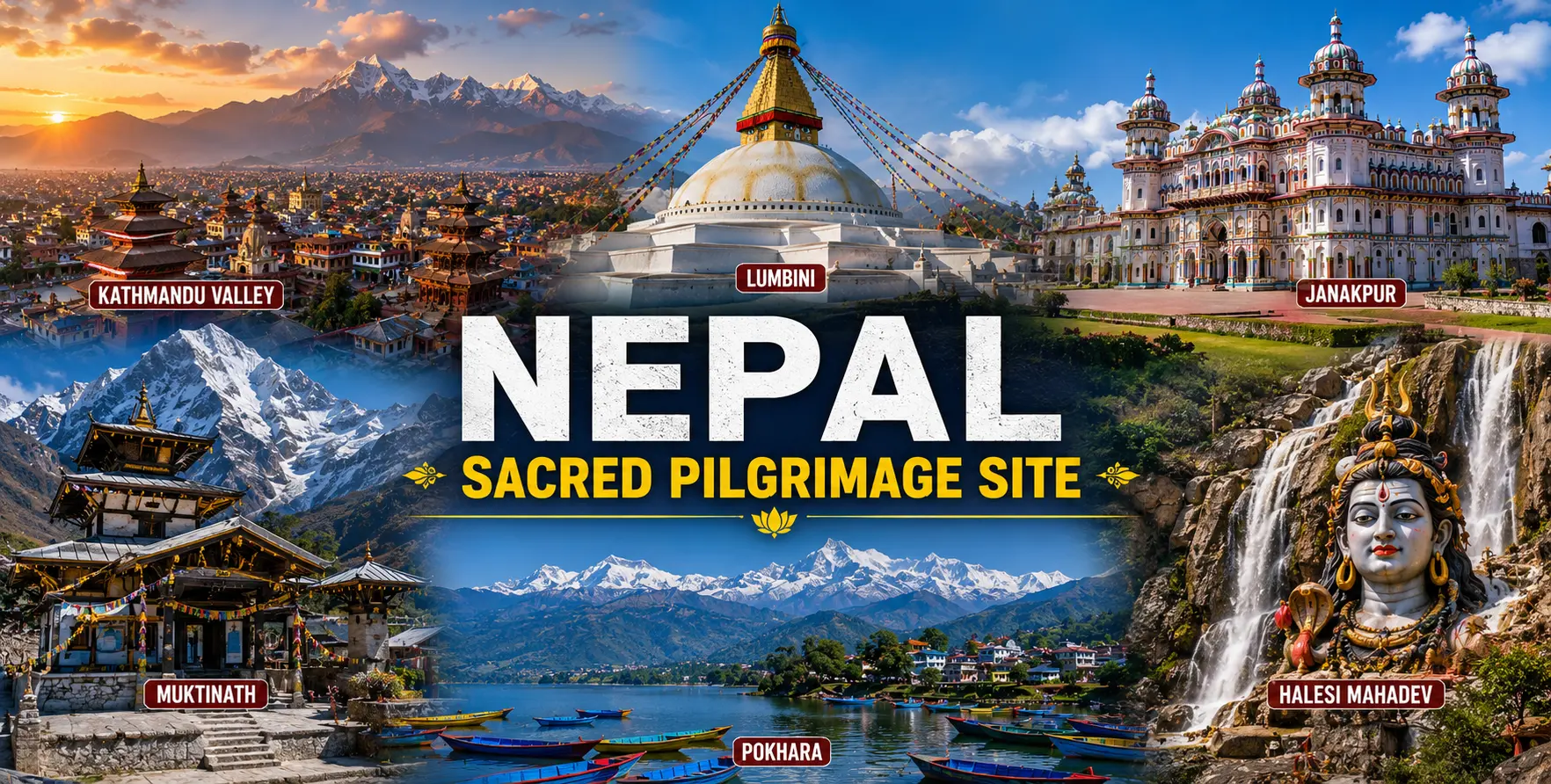
Experiencing Nepal’s ancient temples and hidden histories requires thoughtful transport planning. Sacred sites span a country of remarkable geographical diversity—from the dense urban heritage of the Kathmandu Valley to Muktinath at 3,710 meters and the sacred plains of Lumbini in the southern Terai. Nepal Vehicle Hiring Pvt Ltd provides private vehicle hire for every stage of a heritage journey in Nepal.
Kathmandu Valley — 2- to 3 Day Heritage Circuit
- Day 1: Pashupatinath (morning puja) → Boudhanath Stupa → Swayambhunath
- Day 2: Kathmandu Durbar Square (Hanuman Dhoka + Kumari) → Patan Durbar Square
- Day 3: Bhaktapur Durbar Square (half day) → Changu Narayan Temple
- Vehicle: Private sedan NPR 5,000–10,000 / day or Scorpio NPR 7,000–15,000 / day — hotel pickup included
Lumbini — Sacred Journey to the Terai
- Journey: 280 km from Kathmandu — 7 to 8 hours each way
- Recommended: Minimum 2 days — stay overnight to experience evening meditation in the sacred garden
- Vehicle: Private sedan NPR 18,000–24,000 (round trip) / Hiace van NPR 28,000–38,000 (round trip)
Janakpur — Mithila Cultural Pilgrimage
- Journey: 228 km from Kathmandu — 6 to 7 hours each way via Araniko Highway and East-West Highway
- Recommended: Overnight stay to experience morning and evening puja at Janaki Temple
- Vehicle: Private sedan NPR 18,000–24,000 / Hiace van NPR 24,000–32,000 (round trip)
Muktinath — High-Altitude Sacred Journey (2 Days from Pokhara)
- Day 1: Pokhara → Jomsom by 4WD jeep (6–7 hrs) — overnight in Jomsom for acclimatisation
- Day 2: Jomsom → Muktinath Temple (1.5 hrs) — full darshan, 108 spouts, monastery visit
- Vehicle: Toyota Hilux 4WD or Fortuner — NPR 16,000–22,000 (Pokhara to Jomsom) + NPR 5,000–8,000 (Jomsom to Muktinath return)
Halesi Mahadev — Eastern Nepal Tri-Faith Pilgrimage
- Journey: 222 km from Kathmandu — 7 to 9 hours via BP Highway and Okhaldhunga
- Recommended: Overnight at Halesi Bazaar — visit both Halesi Mahadev and Maratika Cave
- Vehicle: Scorpio 4WD or Hilux — NPR 22,000–30,000 (round trip from Kathmandu)
Complete Nepal Heritage Circuit: Nepal Vehicle Hiring Pvt Ltd’s most popular cultural package combines 3 days of Kathmandu Valley heritage, 1 day’s drive to Pokhara, 2 days at Muktinath for the pilgrimage, and an optional Lumbini or Janakpur extension — a complete sacred Nepal journey in 7 to 10 days. Contact us for a custom package quote.
Visitor Etiquette at Nepal’s Sacred Sites
- Dress modestly: Cover shoulders and knees when entering all Hindu and Buddhist temples. Carry a shawl or scarf for added coverage — particularly for women at some sites.
- Remove footwear: All Hindu and Buddhist sacred spaces require you to remove your shoes before entering. Socks are fine. Wear footwear that is easy to slip on and off throughout your heritage day.
- Non-Hindus at Hindu temples: Many inner sanctums (particularly Pashupatinath) are restricted to Hindus. Respect these boundaries — there is always an equally moving experience from the permitted areas.
- Photography: Always ask permission before photographing people, priests, and religious ceremonies. Some temples prohibit photography of specific images or of the inside of sanctuaries.
- Sadhus: A small donation (NPR 50–100) when photographing sadhus is customary and appreciated.
- Circumambulation: Always circumambulate Buddhist stupas and chortens clockwise. Following this practice demonstrates respect and is deeply appreciated by local devotees.
- Cremations at Pashupatinath: Watch from a respectful distance. Keep voices low. Do not photograph grieving families without permission. This is a sacred and intimate moment for the families present.
- Festival visits: Arrive early at major festival sites — Shivaratri at Pashupatinath, Indra Jatra in Kathmandu Durbar Square — as crowds build dramatically through the day.
- Offerings: Small donations placed in temple donation boxes are always welcome and help support the maintenance of sites that receive limited government conservation funding.
Why Nepal Vehicle Hiring Pvt Ltd for Your Heritage Journey
- Complete Fleet: Private sedan for the Kathmandu Valley circuit; 4WD Hilux or Fortuner for Muktinath and Halesi Mahadev; Hiace and Coaster for pilgrim family groups and large heritage tour parties.
- Experienced Drivers: Our drivers have extensive knowledge of heritage site access points, parking areas, optimal visiting times, and the surrounding cultural context — enriching visits with local insights.
- Door-to-Door Service: Hotel pickup from anywhere in Kathmandu or Pokhara — no logistics complexity on days that deserve full cultural attention.
- Multi-Day Packages: Complete Nepal heritage circuit packages coordinated as single bookings — Kathmandu Valley, Pokhara, Muktinath, Lumbini, Janakpur — tailored to your interests and time available.
- 24/7 Booking: WhatsApp at +977 9814227196 — book your heritage journey vehicle anytime and receive confirmation within minutes.
Frequently Asked Questions — Nepal’s Sacred Heritage
How many UNESCO World Heritage Sites does Nepal have?
Nepal has ten UNESCO World Heritage Sites in total — seven cultural heritage sites concentrated in the Kathmandu Valley (Pashupatinath, Boudhanath, Swayambhunath, Kathmandu Durbar Square, Patan Durbar Square, Bhaktapur Durbar Square, and Changu Narayan) plus Lumbini (Buddha’s birthplace), Sagarmatha National Park (Everest), and Chitwan National Park.
Can non-Hindus visit Pashupatinath Temple?
Non-Hindu visitors may not enter the inner sanctum of Pashupatinath Temple. Still, they can observe the temple, the sacred Bagmati River ghats, and the cremation ceremonies from the eastern bank — an equally powerful and moving experience. The surrounding garden and ghats area are accessible to all. Many international visitors find the eastern-bank perspective on Pashupatinath one of the most profound experiences of their journey in Nepal.
What is the entry fee for the Kathmandu Valley UNESCO heritage sites?
Entry fees for foreign visitors: Boudhanath NPR 400; Swayambhunath NPR 200; Kathmandu Durbar Square NPR 1,000; Patan Durbar Square NPR 1,000; Bhaktapur Durbar Square NPR 1,500; Changu Narayan NPR free. A combined valley heritage pass is also available — check the current offer at the Nepal Tourism Board office in Thamel.
How do I get from Kathmandu to Lumbini?
Lumbini is 280 km from Kathmandu — a 7 to 8 hour drive. Nepal Vehicle Hiring Pvt Ltd provides private sedan, Hiace van, and Coaster bus hire for the Lumbini pilgrimage. An overnight stay in Lumbini is strongly recommended. Return round-trip sedan hire costs approximately NPR 18,000 to NPR 24,000 all-inclusive.
What is the best time to visit Nepal’s temples?
October to May is generally the best time to visit Nepal’s heritage sites—dry weather, clear skies, and comfortable temperatures. Specific festivals add an extraordinary atmosphere to particular sites: Shivaratri (February–March) at Pashupatinath and Halesi Mahadev; Indra Jatra (September) in Kathmandu; Bisket Jatra (April) in Bhaktapur; Vivah Panchami (November–December) at Janakpur.
Can Nepal Vehicle Hiring arrange transport for the complete heritage circuit?
Yes — Nepal Vehicle Hiring Pvt Ltd coordinates complete multi-destination heritage circuits as single bookings. From a one-day Kathmandu Valley private vehicle tour to a 10-day Nepal sacred journey covering the valley, Muktinath, Lumbini, and Janakpur — we provide the right vehicle for every leg of the journey, with professional drivers and transparent, all-inclusive pricing. Contact us at +977 9814227196
Conclusion
Nepal’s ancient temples and hidden histories are not the past — they are the living present of a civilisation that has maintained unbroken continuity with its spiritual roots for over two thousand years. Nepal’s sacred sites are not monuments to what once was but active centres of what still is: faith, devotion, community, artistic excellence, and the ongoing conversation between the human and the divine that has defined Nepali civilisation since the first settlements arose in the Kathmandu Valley.
A journey through Nepal’s sacred past — from the cremation ghats of Pashupatinath to the birthplace of the Buddha at Lumbini, from the medieval streets of Bhaktapur to the eternal flame at Muktinath, from the caves of Halesi Mahadev where three faiths converge to the festival streets of Janakpur where the Ramayana still lives — is one of the most profound and transformative travel experiences available anywhere in the world.
Nepal Vehicle Hiring Pvt Ltd is honoured to be the transport partner for these sacred journeys. With professional private vehicles for every route and every group size, experienced, culturally knowledgeable drivers, and the flexibility to create a heritage itinerary perfectly matched to your time and spiritual interests — we are ready to take you through Nepal’s sacred past and into the living present of one of the world’s most remarkable civilisations.
Book your Nepal heritage journey — Call or WhatsApp: +977 9814227196
E-mail: [email protected]
- Ancient Temples and Hidden Histories: A Journey Through Nepal's Sacred Past
- Nepal's Sacred Heritage — A Living Civilisation
- The Kathmandu Valley — Seven UNESCO World Heritage Sites
- All Major Sacred Sites — Complete Reference Table
- Beyond Kathmandu — Nepal's Hidden Sacred Histories
- Sacred Architecture — Nepal's Greatest Artistic Legacy
- Nepal's Sacred Festivals — When History Comes Alive
- Planning Your Nepal Heritage Journey — Transport Guide
- Visitor Etiquette at Nepal's Sacred Sites
- Why Nepal Vehicle Hiring Pvt Ltd for Your Heritage Journey
- Frequently Asked Questions — Nepal's Sacred Heritage
- Conclusion

Related Blog & Articles
Best Nepal Tour Package: Best Vehicle Hire Guide

All Over Nepal Vehicle Hire – Private Car, Scorpio, 4WD Jeep, Hiace And Tourist Bus
Muktinath Tour from Kathmandu – Complete Travel Guide

Kathmandu to Lumbini by Private car, jeep, hiace, and bus full Vehicle Guide