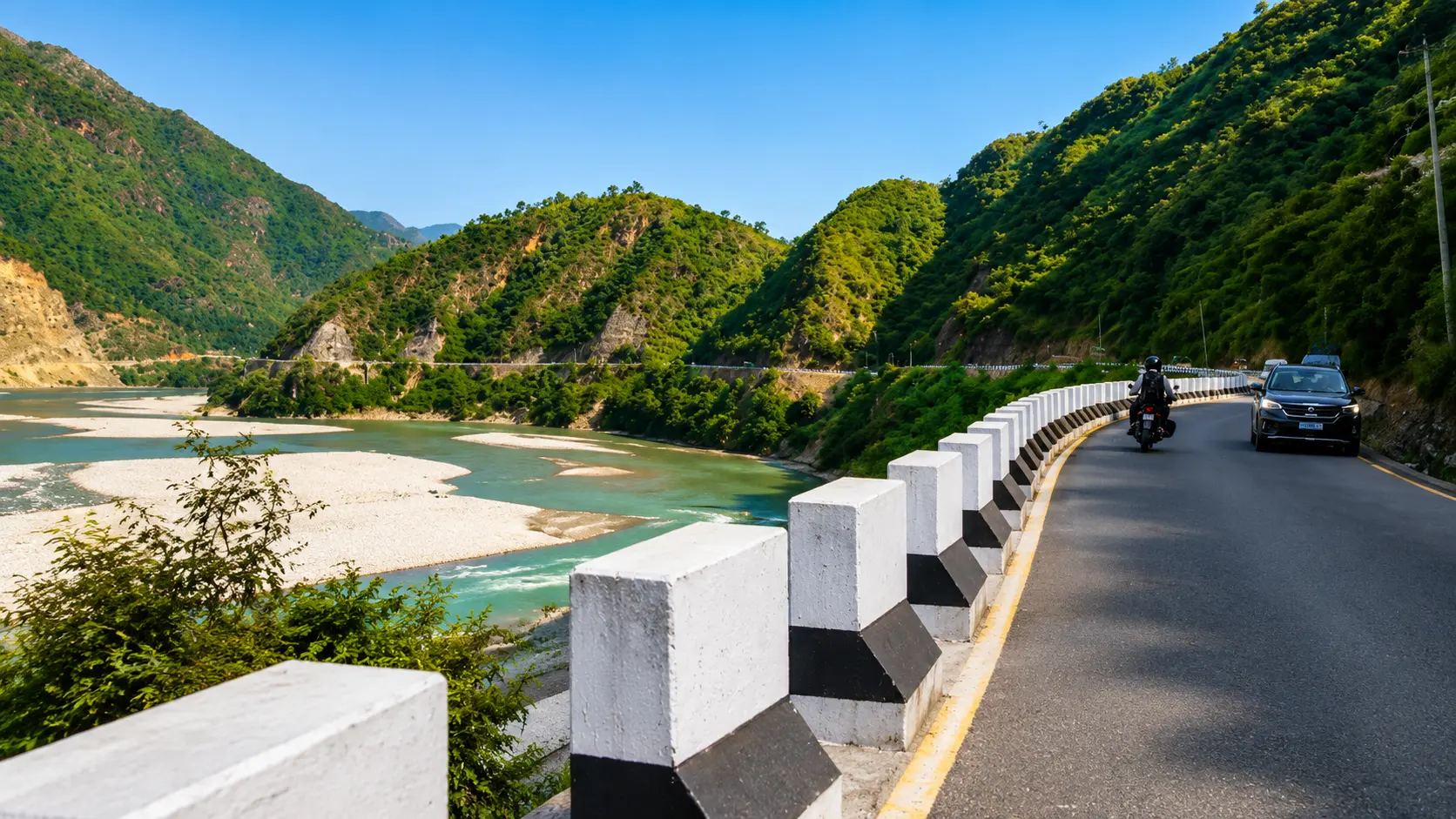
Car and Jeep Hire with Baby Seats for Nepal Tours

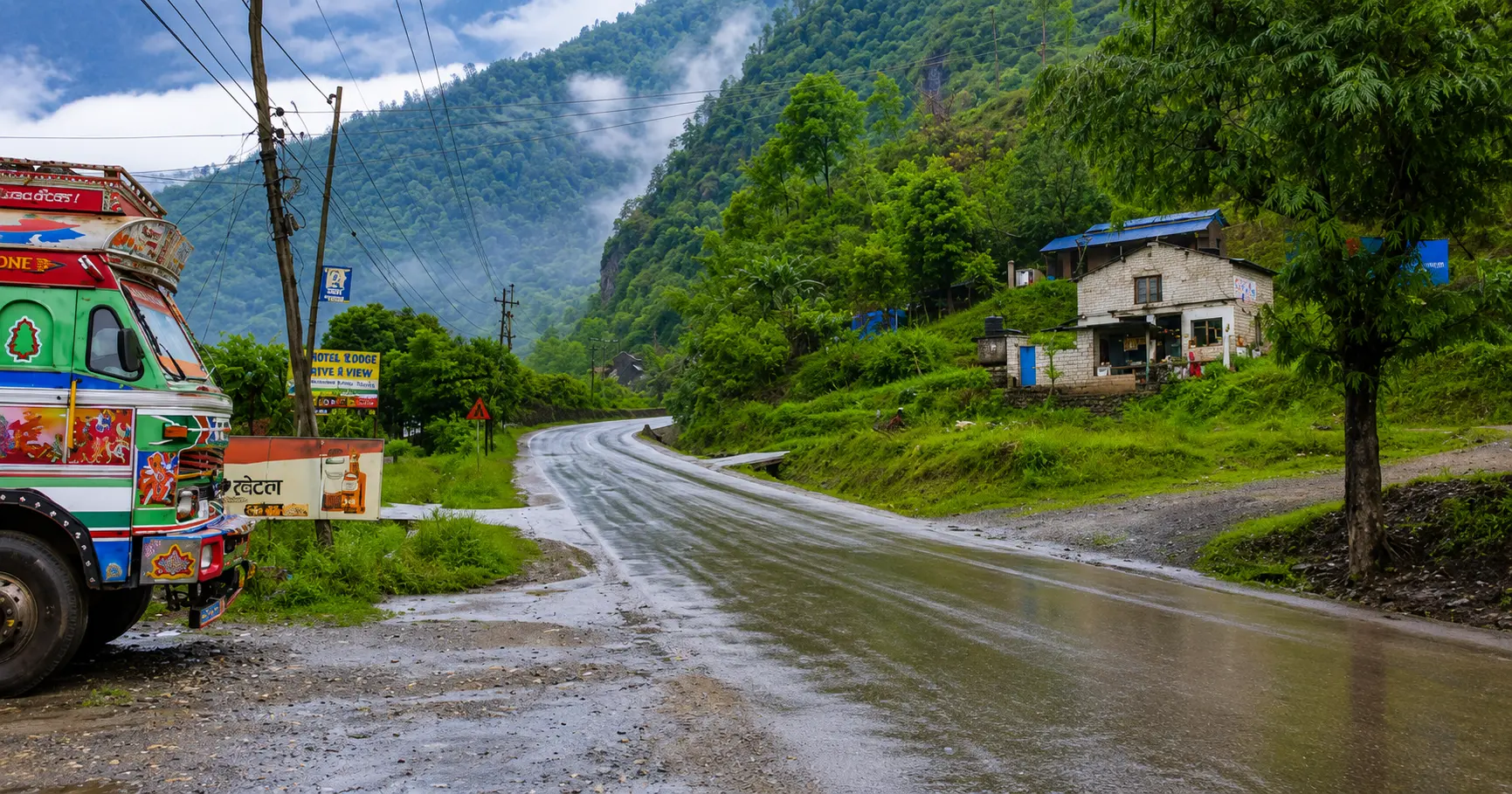
Bg highway

Nepal Tour Baby Seat Car & Jeep Hire: The Family Travel Guide

Travelling around Nepal with a baby or young child is a wonderful adventure. Temples, lakes, jungle safaris and mountain views are all within reach, and Nepali people adore children. But one question worries almost every parent before they arrive: how do we travel safely by road with a baby? Child seats are rare in Nepal’s taxis, many local vehicles have no rear seat belts, and mountain roads can be long and winding.

This guide explains how Nepal tour baby seat car and jeep hire works with Nepal Vehicle Hiring. You’ll learn which child seat suits your child’s age and size, which vehicle in our fleet works best, how seats are installed, what to expect on popular family routes, USD price ranges, and practical tips for road trips with little ones.

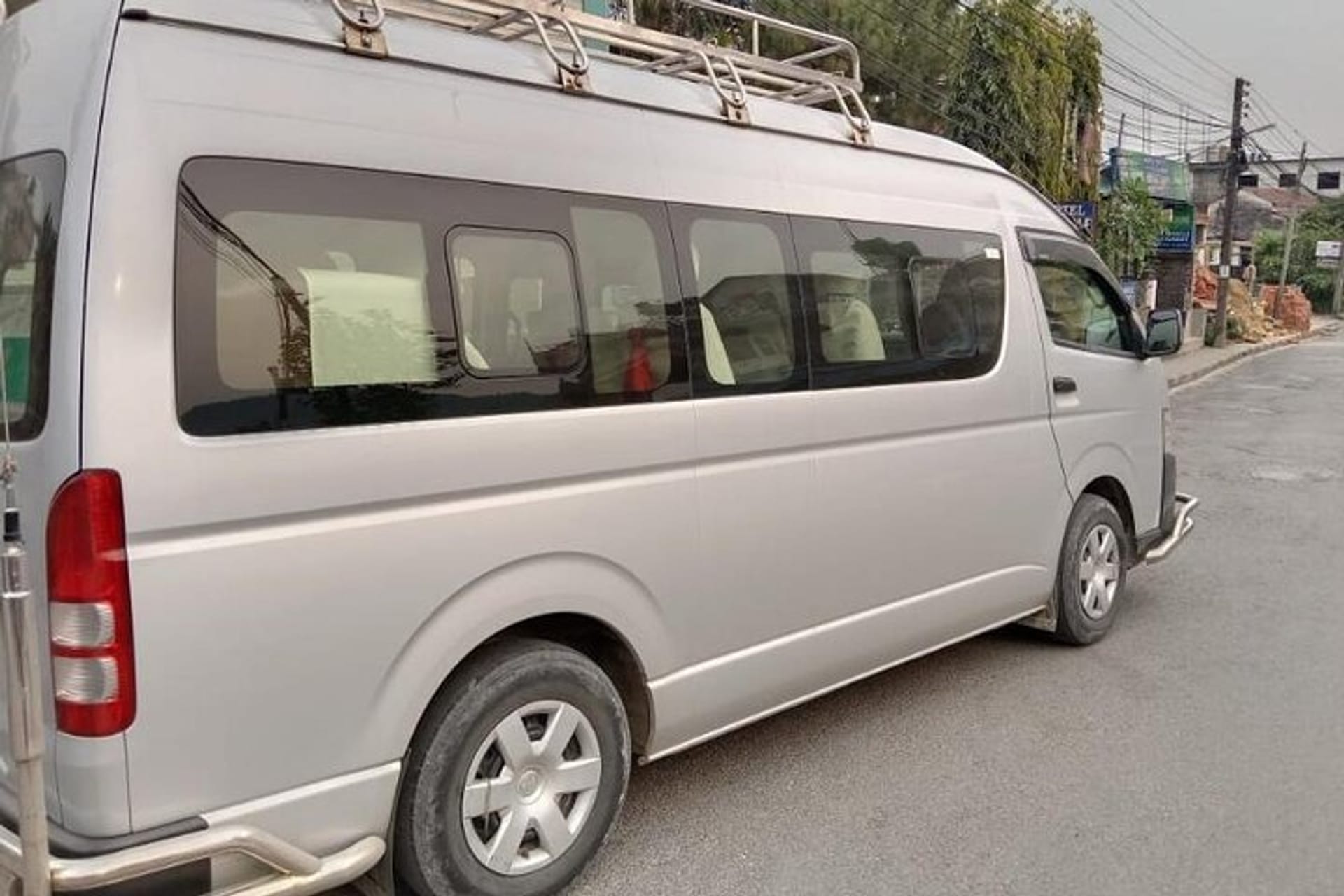
We provide private cars, jeeps, Mahindra Scorpios and Toyota Hiace vans with infant, toddler and booster seats on request, all with experienced, careful drivers.

Already know your plans? Message us on WhatsApp or email [email protected] with your children’s ages and your route, or use our trip planner.

Why Baby Seats Matter in Nepal

In many countries, child seats are standard. In Nepal, it is the exception. Most taxis do not carry child seats, rear seat belts are often missing or broken in older vehicles, and parents commonly hold small children on their laps.

Enforcement of child restraint use is very limited, so safety responsibility falls on parents and the transport company they choose.

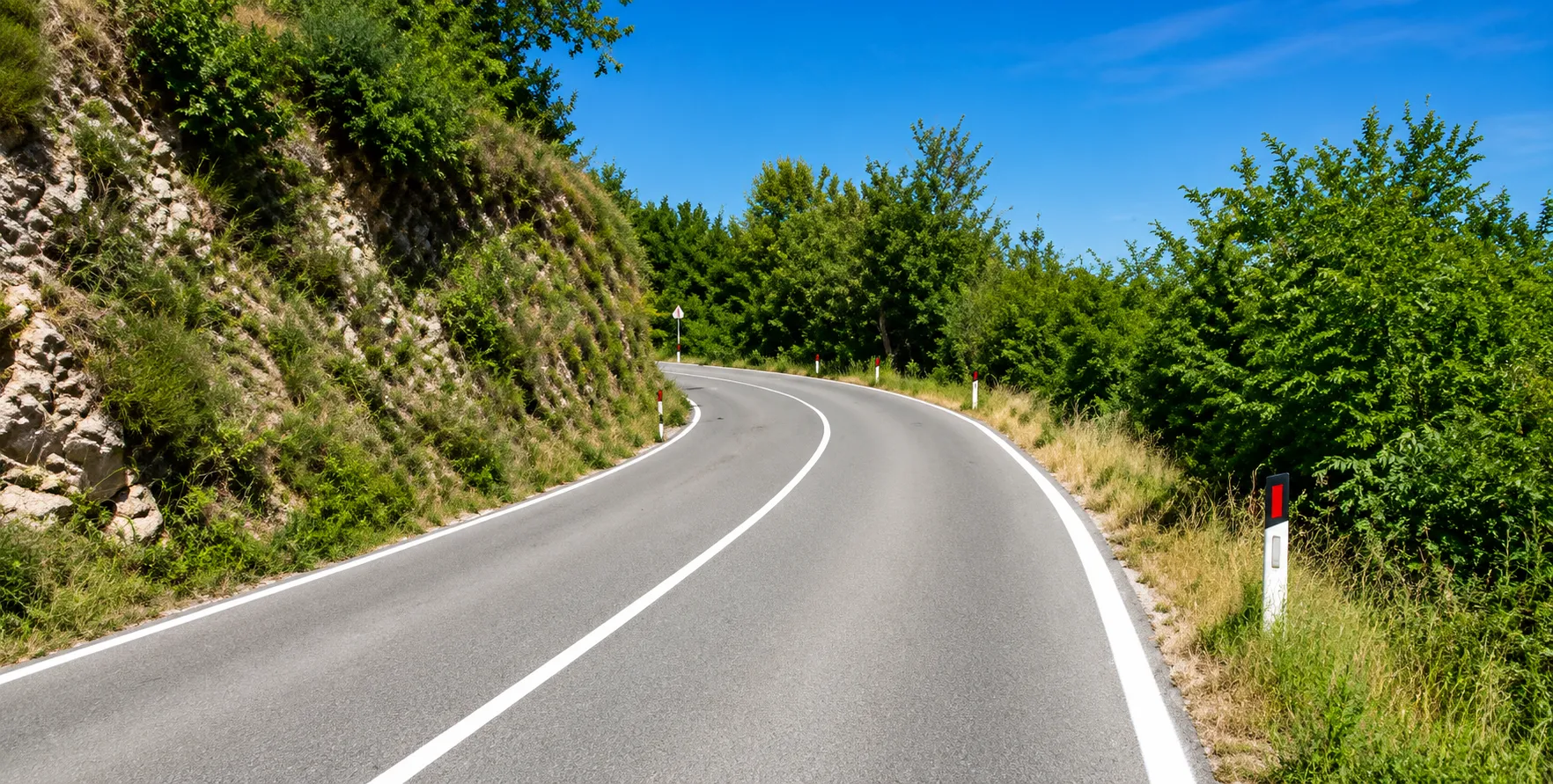
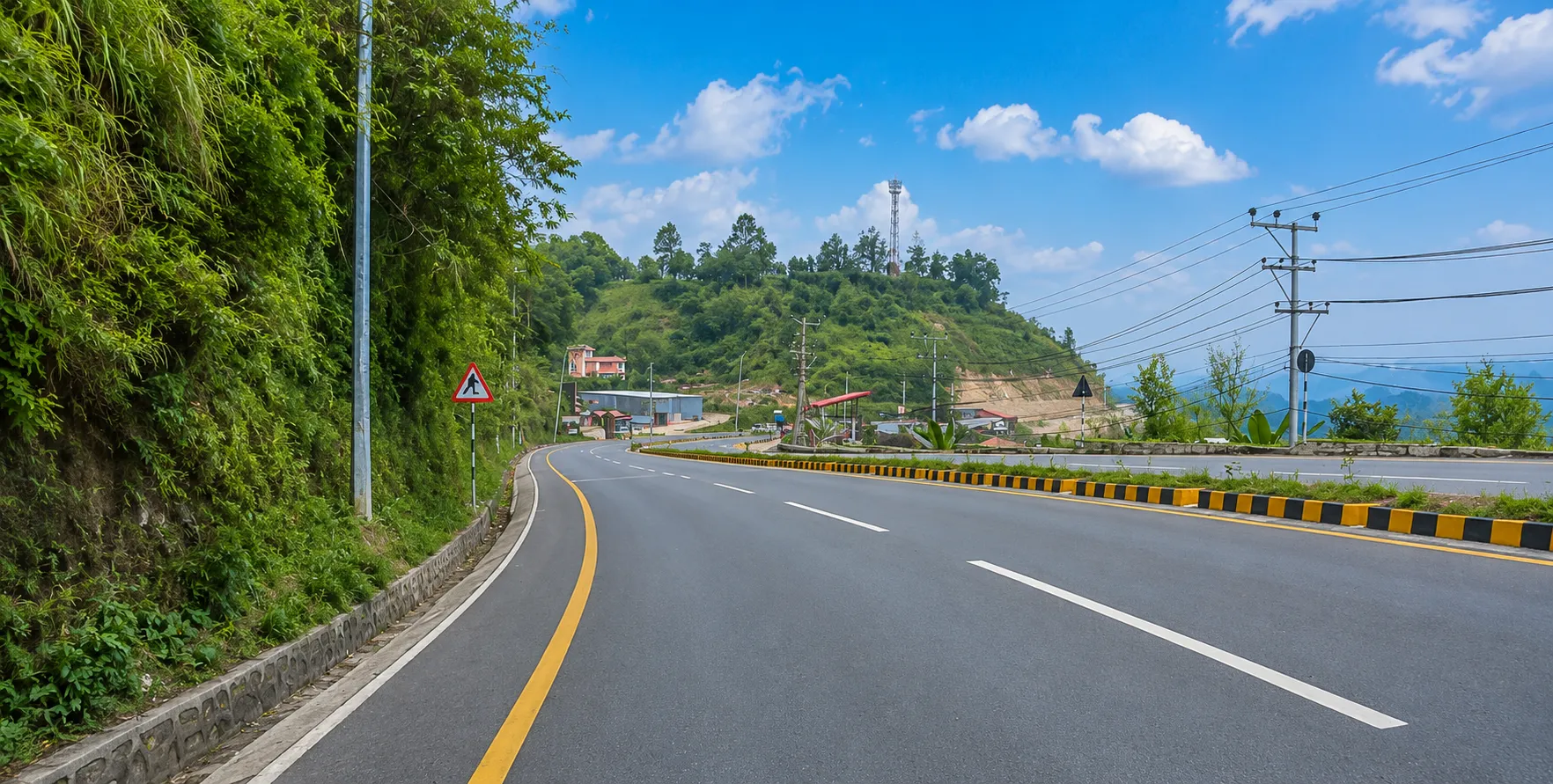
Holding a baby on your lap is unsafe during sudden stops, even at low speed. Kathmandu’s traffic involves frequent braking, and highways such as the Prithvi Highway to Pokhara include sharp bends, overtaking trucks and uneven surfaces. A correctly fitted child seat keeps your child secure, comfortable and often more relaxed, so many babies sleep through long drives.

That is why we treat baby seats as a core part of family travel, not an afterthought. When you book a private car or jeep with a child seat through us, we check, fit, and prepare the seat before your driver arrives.

NOTE: Nepal’s road rules require seat belts for front-seat occupants, and children should not ride in the front seat. Rules and enforcement can change, so we always fit child seats in the rear and follow international safety guidance as our standard.
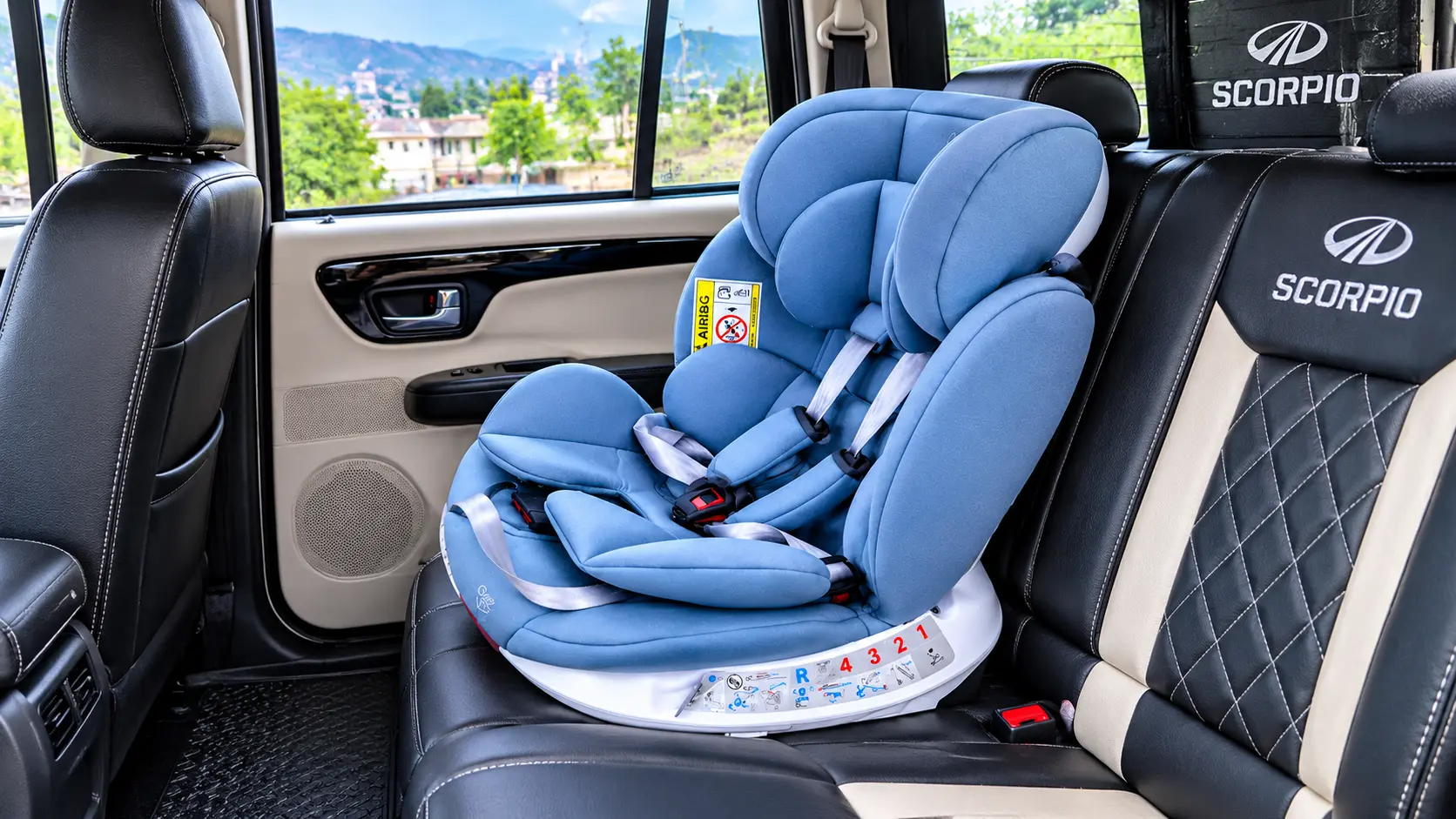
Nepal Tour Baby Seat Car & Jeep Hire

Types of Child Seats We Provide

Child seats are designed for specific ages and sizes. Choosing the right one is the most important safety decision. Here is a simple guide based on widely followed international recommendations, such as those from the American Academy of Paediatrics.

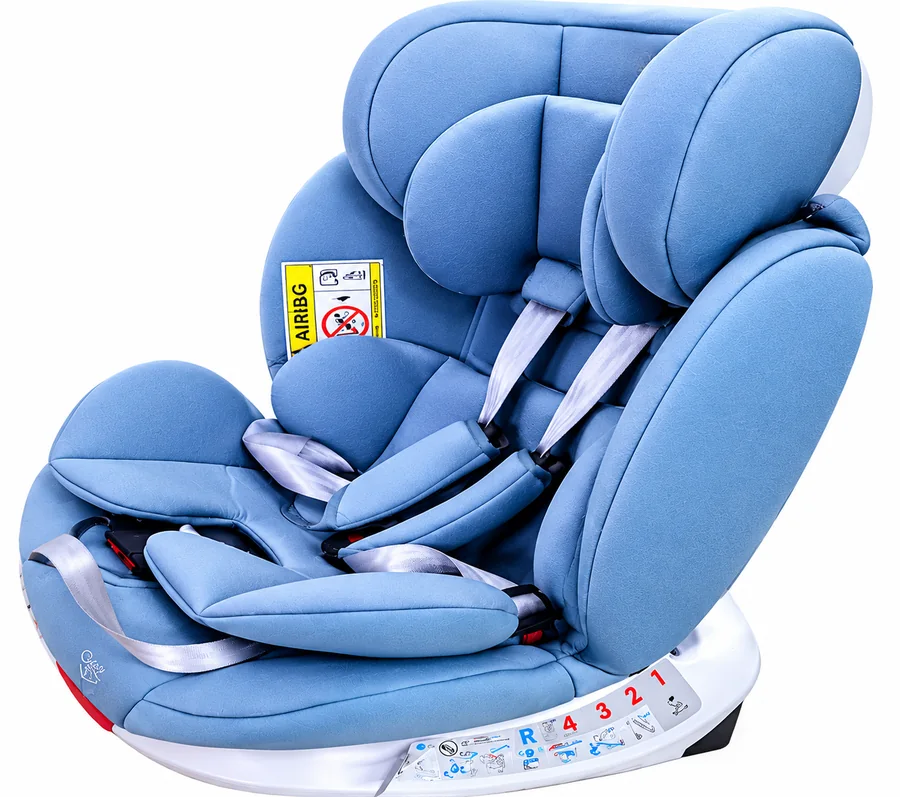
Rear-Facing Infant Seat (Baby Seat)

For newborns and babies, a rear-facing infant seat supports the head, neck and spine in a sudden stop. International guidance recommends keeping children rear-facing for as long as possible, until they reach the maximum height or weight allowed by the seat. Infant seats are ideal for Kathmandu airport transfers, city sightseeing and shorter drives.

Convertible or Toddler Seat

Convertible seats can be used rear-facing for babies and toddlers, then turned forward-facing with a five-point harness once a child outgrows rear-facing limits. They are a good choice for toddlers and preschoolers on longer routes such as Kathmandu to Pokhara or Pokhara to Chitwan.

Forward-Facing Harness Seat

For older toddlers and young children who have outgrown rear-facing, a forward-facing seat with a five-point harness keeps them secure while giving a better view out of the window, which helps with motion sickness on winding roads.

High-Back Booster Seat

Once children outgrow a harness seat, a booster raises them so the adult seat belt fits correctly across the shoulder and hips. Children usually need a booster until the belt fits properly, often around 145 cm (4 feet 9 inches) tall, which many reach somewhere between 8 and 12 years old.

TIP: Tell us your child’s age, weight and height when you book. We will match the seat to your child, not just to their age.
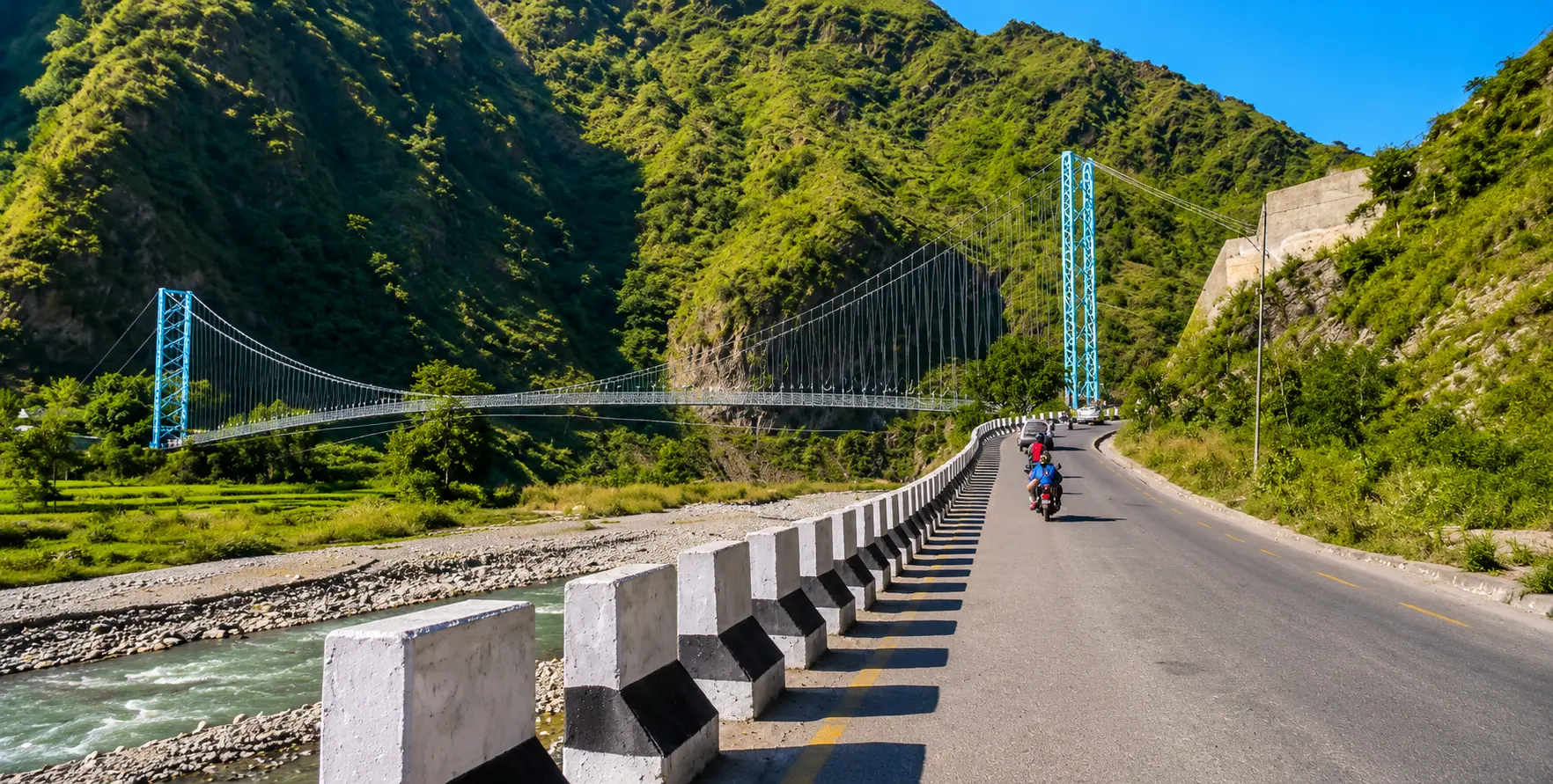
Way to manthali airport bp highway

Which Vehicle Is Best With a Baby Seat?

Not every vehicle suits every child seat. The key requirement is a working rear seat belt in the right position, because most vehicles in Nepal don’t have ISOFIX anchor points. All our child seats can be installed using the vehicle seat belt.

Private Car – City Trips and Airport Transfers

A private car is ideal for couples with one child on city tours, airport transfers and highway trips on good roads. It has a smooth ride and enough space for one or two child seats in the back, plus a pram in the boot.

Mahindra Scorpio – Our Top Family Choice

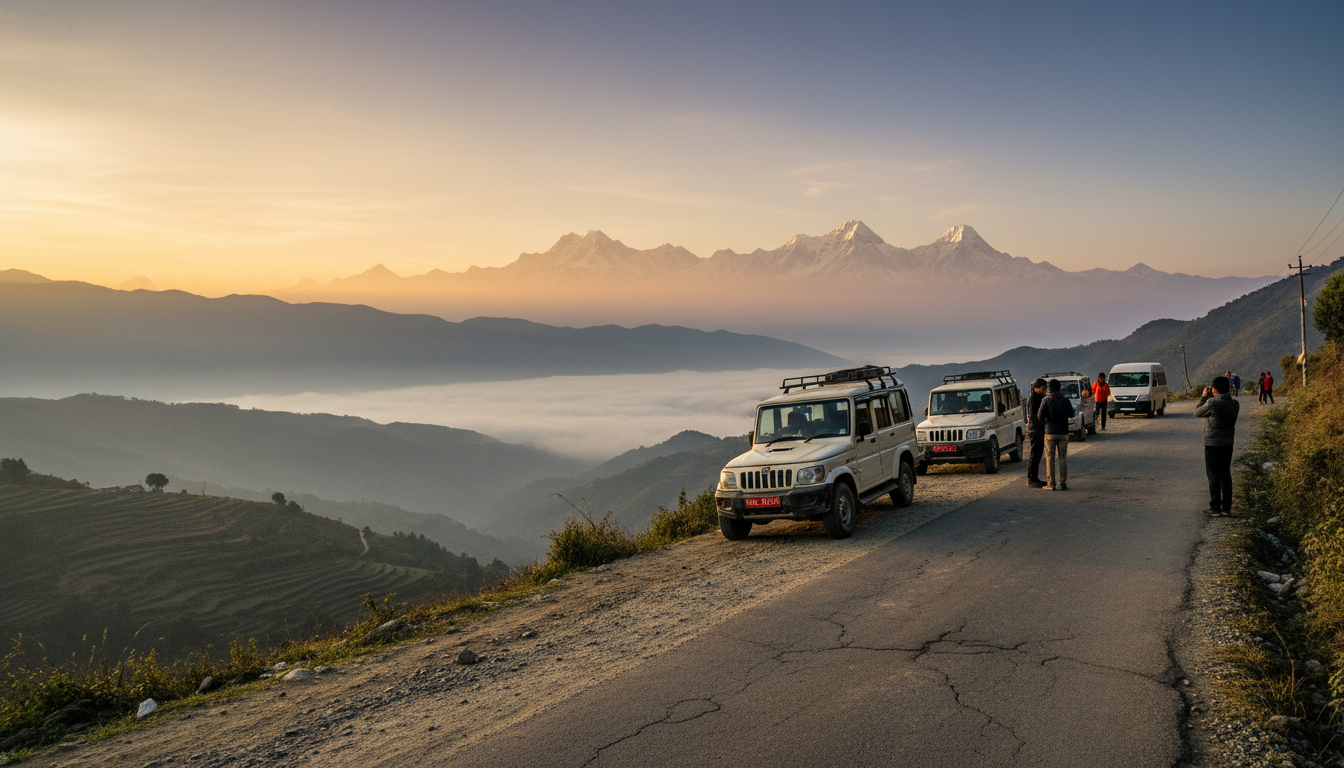
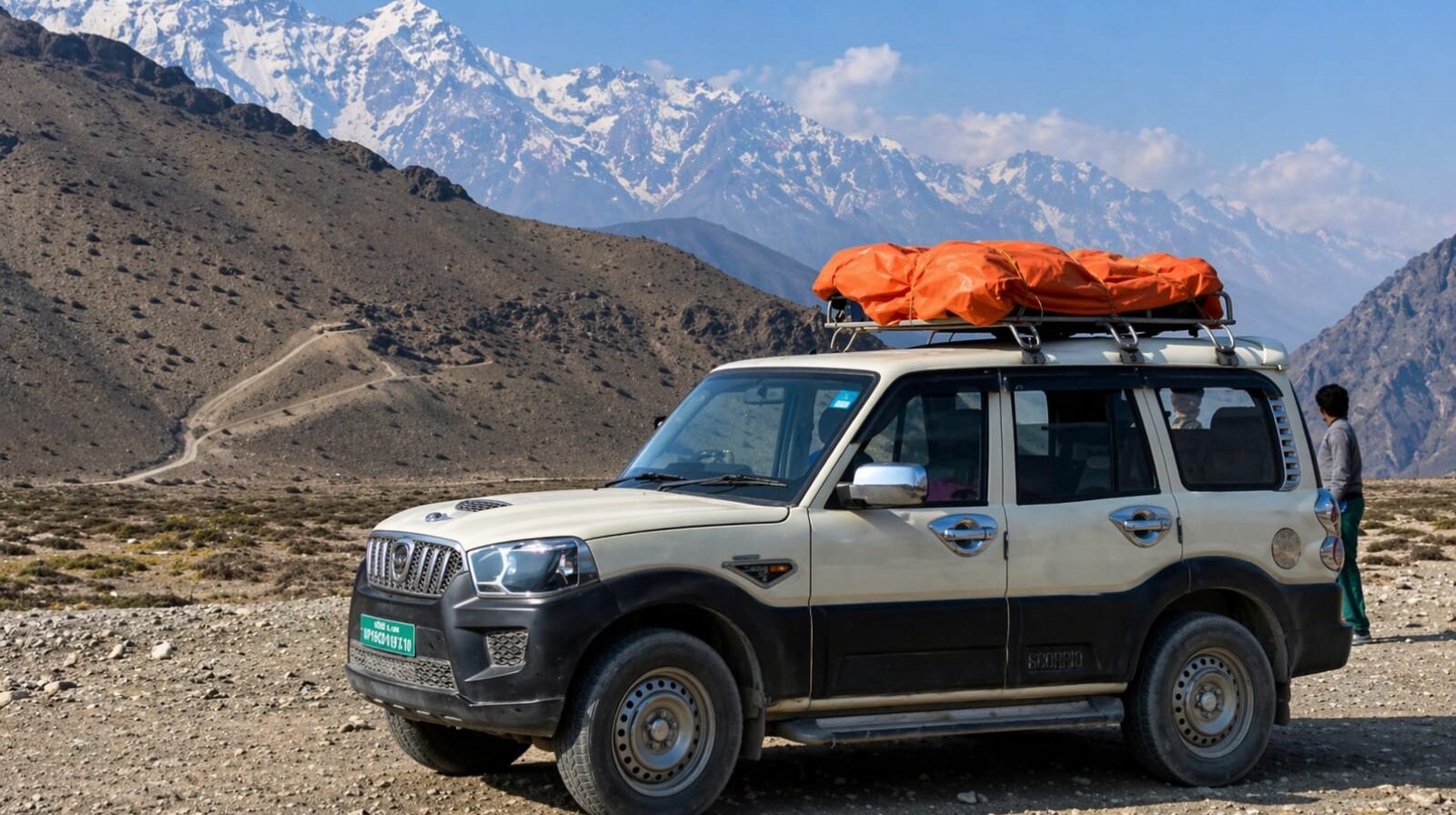
The Mahindra Scorpio combines a comfortable ride with higher ground clearance, more luggage space and rear seat belts. It suits families of three to five on highways and hill roads, from the Kathmandu to Pokhara drive to Sarangkot and Nagarkot.

4WD Jeep – Mountain and Rural Roads

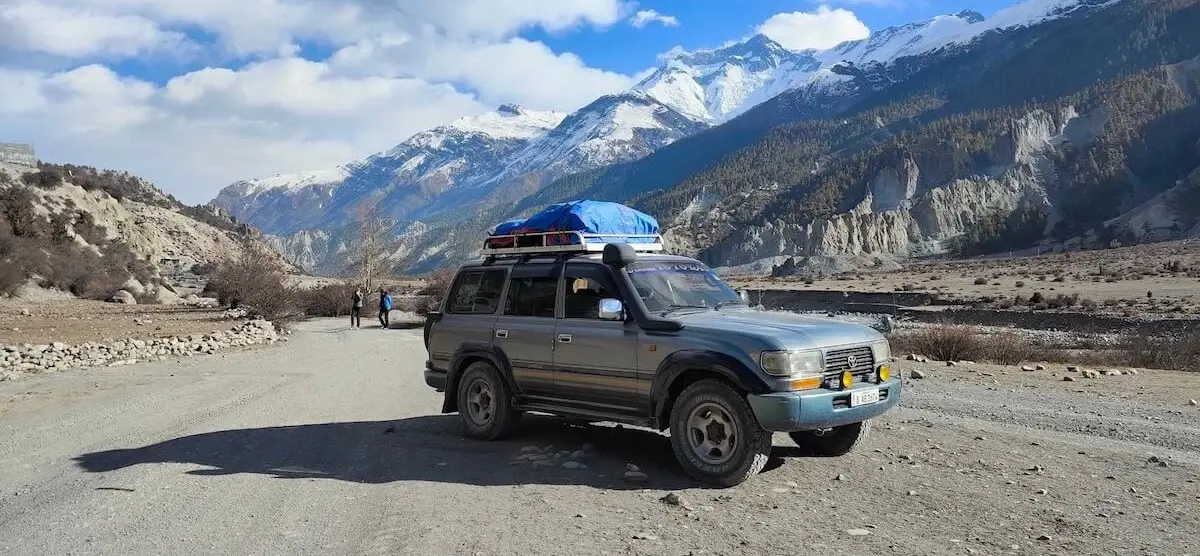
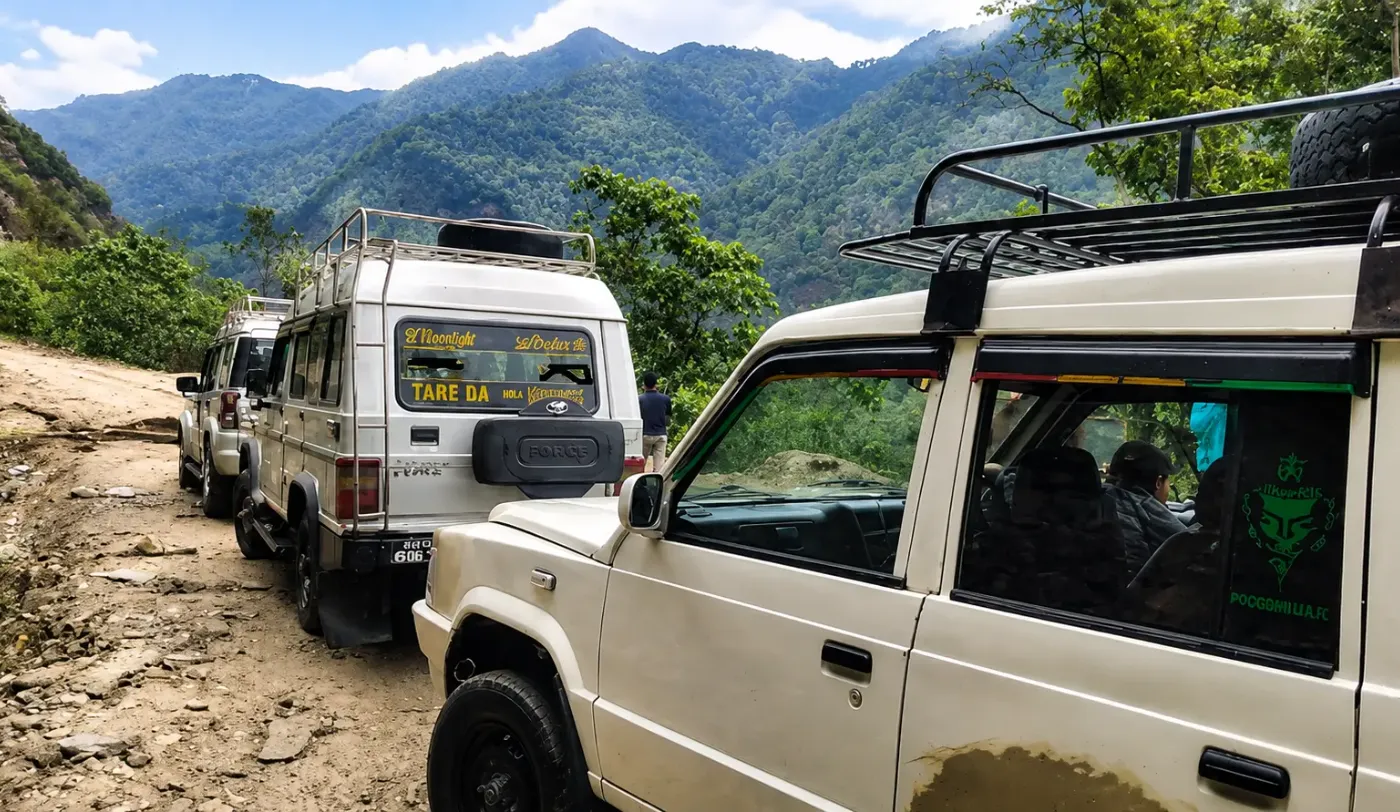
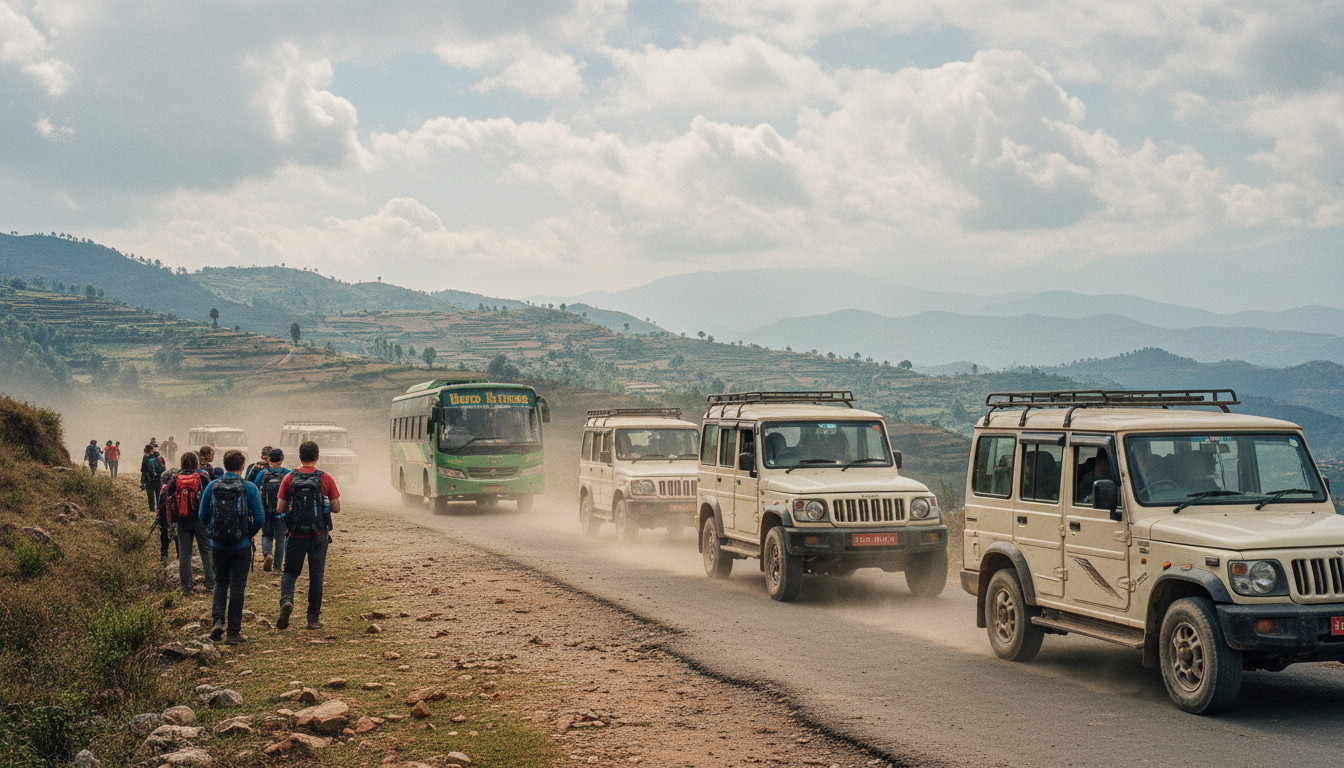
For rough mountain roads, such as routes to trekking villages, a 4WD jeep is the safe option. We fit child seats in rows with working belts. Families heading toward Nayapul for Ghandruk or the Besisahar area usually choose a jeep.

Baby Seat Car and Jeep Hire Prices in Nepal (USD)

Our prices are quoted in US dollars and include a private vehicle, an experienced driver, fuel, the driver’s food and accommodation, insurance, taxes and parking. Child seats are added for a small fee per seat. Final quotes depend on the season, route, and number of days.

Airport Transfers With a Baby Seat

  • Kathmandu airport to Thamel or city hotel by car: USD 30–35 plus seat
  • By Mahindra Scorpio or jeep: USD 40–45 plus seat
  • Kathmandu to Pokhara by car: USD 150–160
  • Kathmandu to Pokhara by Scorpio or jeep: USD 190–200
  • Kathmandu to Chitwan (Sauraha) by car: USD 180–190
  • Pokhara to Chitwan by car: USD 150–160
  • Kathmandu to Nagarkot by car: USD 70–80

Our rates are a little higher than the cheapest local options because we provide clean, checked child seats, vehicles with working rear seat belts, and drivers who understand families’ needs. For parents, that peace of mind is worth every dollar.

How We Install and Check Your Baby Seat

A child seat only protects your child when it is installed correctly. Here is our routine for every family booking:

  • Seat chosen for your child: based on the age, weight and height you give us
  • Cleaned and inspected: straps, buckles and shell checked for damage before every trip
  • Rear seat only: child seats are always fitted in the back, never in front of an airbag
  • Belt installation: fitted tightly using the vehicle seat belt following the seat’s instructions
  • Movement check: the seat should not move more than a little side to side at the belt path
  • Parent check on arrival: our driver shows you the fitting so you can adjust the harness for your child

TIP: Harness straps should be snug. If you can pinch a fold of strap at your child’s shoulder, tighten it a little more. Remove bulky jackets before buckling in and use a blanket over the harness instead.

Bring Your Own Seat or Rent From Us?

Bringing Your Own

Many families bring their own seat. You know its history, your child is used to it, and you know how it fits. Check that it can be installed with a lap-and-shoulder seat belt, because ISOFIX points are uncommon in Nepal.

Most airlines let you check a child seat, often at no extra charge, but check with your airline.

Renting From Us

Renting saves you carrying bulky gear through airports and on flights to Pokhara or Bharatpur. Our seats are ready in the vehicle when you arrive. We keep a selection of infant, convertible, harness and booster seats, subject to availability, so book early, especially for peak seasons.

Either way, our drivers will help install the seat and our vehicles are chosen to have working rear belts in the right positions.

Family Routes With a Baby Seat

Kathmandu Airport Arrival

After a long flight with a baby, the last thing you want is a scramble for a taxi. Our driver meets you outside arrivals at Tribhuvan International Airport with a name board, with the child seat already fitted. Book your Kathmandu airport transfer in advance and share your flight details.

Kathmandu Valley Sightseeing

Swayambhunath, Boudhanath, Pashupatinath and Patan Durbar Square are all short drives apart. A private car with driver lets you stop for feeds, naps and nappy changes whenever needed. Add a Bhaktapur Durbar Square tour for pottery square and the famous juju dhau yoghurt.

Nagarkot Sunrise

Nagarkot on the valley rim offers sunrise views over the Himalaya and is just a short drive from Kathmandu. An overnight stay works better than a pre-dawn start with little ones. Our Nagarkot sunrise trip can include a child seat.

Kathmandu to Pokhara

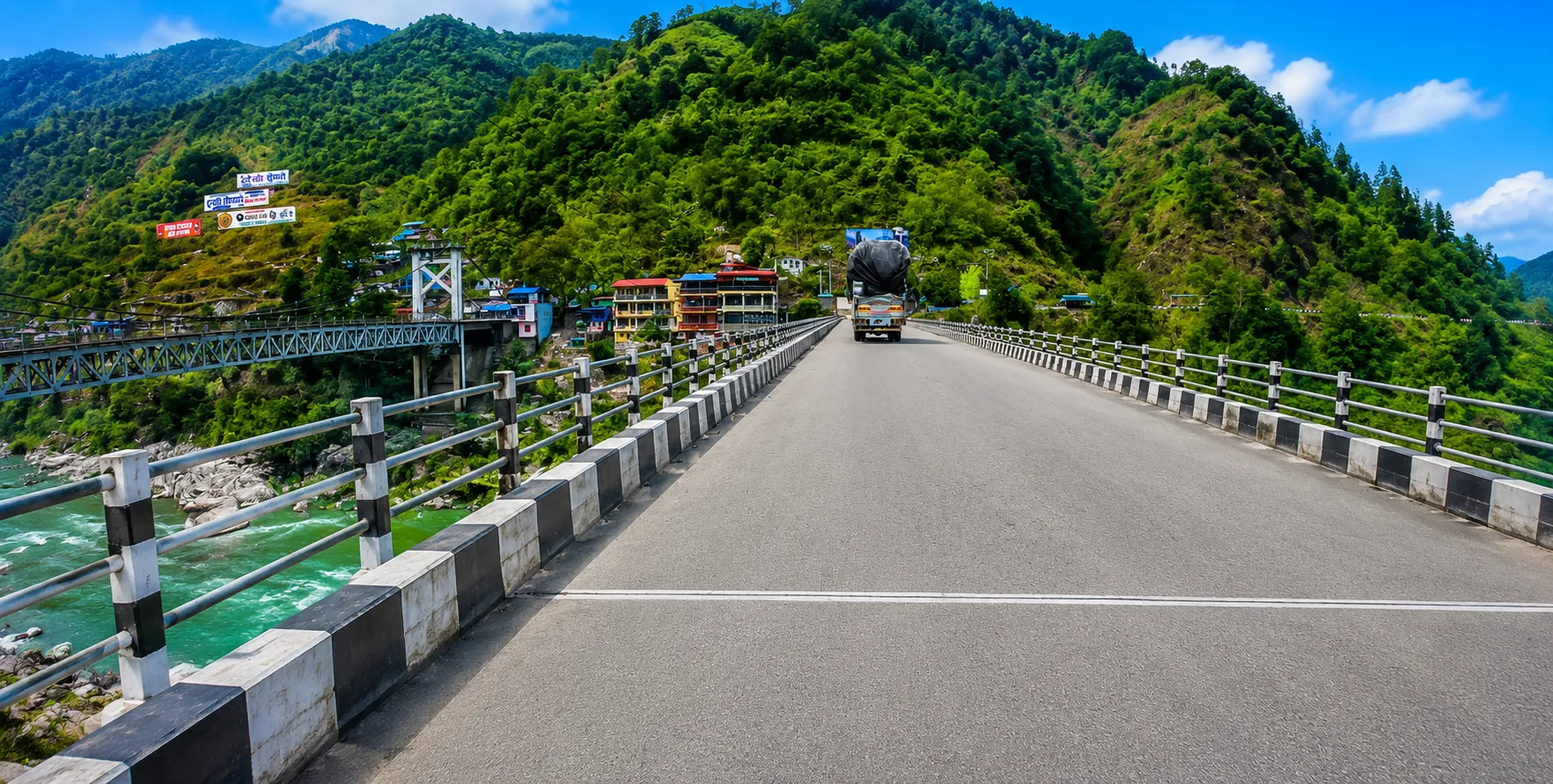
This is Nepal’s most popular family road trip. The highway follows the Trishuli River through hills and gorges and can take most of the day, depending on traffic and roadworks. A private car or Scorpio with a child seat lets you stop at clean roadside restaurants, take breaks and travel at your child’s pace.

See our Kathmandu to Pokhara options and the return trip.

Pokhara With Kids

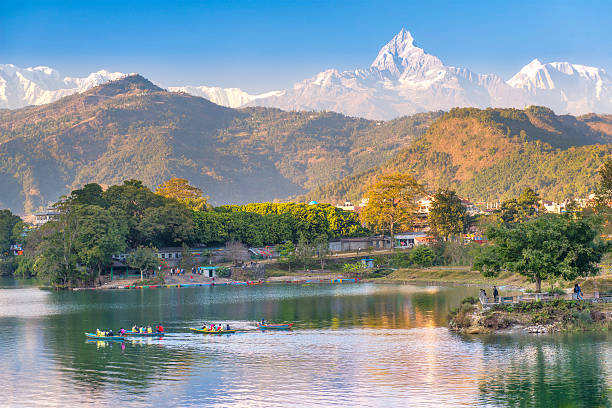
Pokhara is perfect for families: boating on Phewa Lake, the World Peace Pagoda, Davis Falls, the caves and the International Mountain Museum. Hire a Pokhara car with driver for a day or take an early Sarangkot sunrise drive.

Chitwan National Park

Children love jungle walks, canoe rides and spotting rhinos and birds. The drive from Kathmandu or Pokhara to Sauraha is comfortable by private car—Book Pokhara to Chitwan transport and a Chitwan jungle safari with our sister company.

Lumbini

The birthplace of the Buddha is a peaceful, flat area easy to explore with a pram. Travel by private car, not a crowded bus, with our Lumbini transfer.

Road Trip Tips for Parents in Nepal

  • Start early: traffic is lighter, and children are fresh. Many babies sleep through morning drives.
  • Plan stops every 1.5 to 2 hours: for feeds, nappy changes and leg stretches. Our drivers know family-friendly restaurants on the main highways.
  • Carry a day bag in the car: nappies, wipes, spare clothes, snacks, water and a favourite toy.
  • Bring motion sickness help: winding roads affect some children. Keep sick bags, wipes and a change of clothes handy.
  • Use sun shades: clip-on window shades keep the sun off your baby on long drives.
  • Keep loose items secured: in a sudden stop, unsecured objects can fly around the cabin.
  • Never leave a child alone in the vehicle: even for a moment.
  • Ask the driver to slow down if needed: our drivers are happy to drive extra gently with young children.

What Makes a Family-Friendly Driver

The driver matters as much as the seat. We choose drivers for family bookings for calm, careful driving and patience. They:

  • Drive smoothly, with no hard braking or aggressive overtaking
  • Plan rest stops around your child’s routine
  • Help carry prams, bags and child seats
  • Keep the vehicle clean and smoke-free
  • Speak basic English and can help with local shops and restaurants
  • Know clean toilets and safe food stops on major routes

If you hire a vehicle for several days, the same driver usually stays with you, so your child gets to know them, which makes every drive easier.

Health and Safety for Babies in Nepal

Every family should speak to their doctor or a travel clinic before visiting Nepal. Common advice includes:

  • Use bottled, filtered or boiled water for drinking, formula and brushing teeth
  • Choose freshly cooked hot food and peel fruit
  • Ask your doctor about recommended vaccinations, including rabies, as stray dogs and monkeys are common
  • Pack a children’s first-aid kit and any regular medicines
  • Use a mask in dusty city traffic
  • Use sunscreen, hats and shade at altitude, where the sun is strong
  • Know where the nearest hospital is; Kathmandu and Pokhara have good private hospitals

If you plan to visit higher areas, ask your doctor about altitude and young children. Most family tours stay at comfortable altitudes, such as Kathmandu, Pokhara, Chitwan, Nagarkot and Sarangkot.

Packing List for a Nepal Road Trip With a Baby

  • Your own child seat (optional) or a booking for one of ours
  • Lightweight foldable pram or baby carrier for temples and narrow lanes
  • Enough nappies for the first days; brands are available in Kathmandu and Pokhara
  • Formula, bottles and a sterilising method
  • Warm layers for cool mornings and evenings
  • Sun hat, sunscreen and window shades
  • Mosquito repellent suitable for children, especially for Chitwan
  • Thermometer, rehydration salts and children’s paracetamol as advised by your doctor
  • Toys, books and downloaded shows for long drives
  • Plastic bags for dirty clothes and nappies

Trekking and Mountain Trips With Children

Families with older children often add a short trek. The Ghorepani Poon Hill trek and short village walks around Ghandruk are popular family choices, and you can reach Nayapul by private jeep. For very young children, consider a village stay or a short day hike instead of a multi-day trek.

Longer treks such as Annapurna Base Camp, the Annapurna Circuit or Langtang Valley suit older children who are used to walking. Our sister company Trek Nepal Himalayas runs family treks, and Alpine Luxury Treks offers comfortable lodge-based trips. We provide trekking transport with child seats where needed.

Sample Family Itineraries With Baby Seat Transport

Seven-Day Family Tour

Four-Day Short Break

  • Day 1: Arrival and rest
  • Day 2: Kathmandu heritage sites
  • Day 3: Bhaktapur and Nagarkot
  • Day 4: Return and airport drop

Want something different? We can adapt our Nepal tour packages for families, or you can plan your own route.
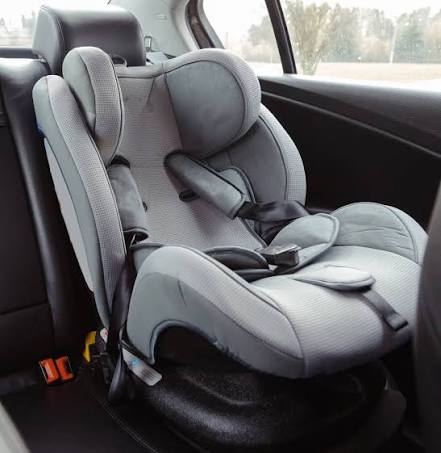
Nepal Tour Baby Seat Car & Jeep Hire

A Family Road Day: Kathmandu to Pokhara With a Toddler

What does a long road day with a little one actually look like? Here is a typical example from our family bookings.

  • Early morning: your driver arrives at your Kathmandu hotel with the convertible seat already fitted. Bags and the pram go in the boot, and the day bag goes on the back seat next to your child.
  • First hour: you leave the valley before the traffic builds. Many toddlers fall asleep on the winding descent toward the Trishuli River.
  • Breakfast stop: a riverside restaurant with a garden, where your child can run around while you have tea.
  • Mid-morning: books, songs and window-watching. Your driver points out suspension bridges, rafts on the river and roadside fruit stalls.
  • Lunch: a family-friendly stop around the halfway point, with simple dal bhat, noodles or fried rice.
  • Afternoon: often a second nap as the road climbs toward Pokhara.
  • Arrival: drop-off at your Lakeside hotel, with time for an evening walk by the lake.

Because the vehicle is private, you can shape every part of the day around your child’s routine. If you would rather split the drive, a night in Bandipur turns it into two easy half-days. Book with our Kathmandu to Pokhara service.

Keeping Kids Happy on Long Drives

  • Audio stories and music: downloaded before you leave, as mobile data can drop in the hills
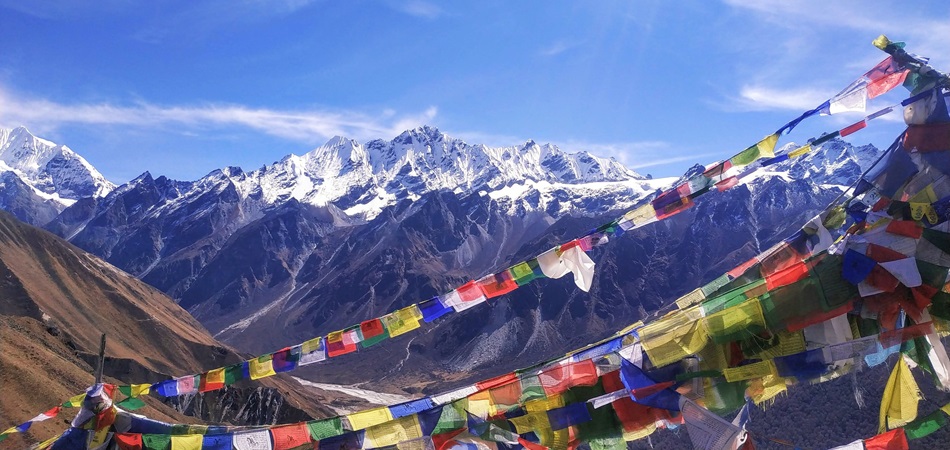
  • Window games: count buses, spot cows and goats, look for prayer flags and temples
  • Small new toys: wrapped surprises handed out every hour or so work wonders
  • Sticker books and drawing pads: mess-free and quiet
  • Healthy snacks: biscuits, fruit and crackers from Kathmandu supermarkets
  • Comfort items: a familiar blanket or soft toy helps with naps in a new seat
  • Regular breaks: a 10-minute run-around every couple of hours keeps everyone calmer

Bhaktapur and Nagarkot: An Easy Family Overnight

If you have just a few days, a Bhaktapur and Nagarkot overnight is one of the easiest family trips from Kathmandu. The drive is short, so little ones spend more time exploring than sitting in the car.

Start with a morning in Bhaktapur, where the brick squares are largely car-free, and children can watch potters spin clay in Pottery Square. Try the famous creamy juju dhau yoghurt, then continue up to Nagarkot for the afternoon.

Family hotels on the ridge have gardens and terraces, and on clear mornings the Himalaya stretch across the horizon at sunrise, often visible from your room. Book our Bhaktapur tour and Nagarkot trip with a child seat in the same vehicle.

Common Child Seat Mistakes to Avoid

Even experienced parents can slip up when travelling, especially after a long flight. Watch out for these common mistakes:

  • Loose installation: the seat should not move more than a little at the belt path. Ask the driver to re-tighten it if it feels loose.
  • Loose harness: straps should be snug against the collarbone, with the chest clip at armpit level.
  • Bulky clothing: thick jackets compress in a crash and leave the harness too loose. Use a blanket on top instead.
  • Turning forward too soon: keep babies and toddlers rear-facing until they reach the seat’s rear-facing limit.
  • Moving to a booster too early: a harness gives more protection; wait until your child truly outgrows it.
  • Using an adult belt too soon: the shoulder belt should cross the middle of the shoulder and the lap belt should sit low on the hips, not across the stomach.
  • Front-seat travel: children belong in the back, away from front airbags.

Our drivers know the basics of child seat fitting, but you know your child best. Take a minute to check the fit before every drive.
Nepal Tour Baby Seat Car & Jeep Hire

Should You Fly or Drive With a Baby?

Between Kathmandu and Pokhara, families can either take a short domestic flight or drive. Both work, and the right choice depends on your child.

Flying

The flight is short and saves a long day on the road. However, you still need transfers at both ends; flights can be delayed by weather; baggage limits on small aircraft are strict; and car seats can be awkward to carry. If you fly, book a Kathmandu airport transfer and a Pokhara car with a seat at the other end.

Driving

A private road trip takes longer but gives you complete control: stop whenever your baby needs a feed, nap or change, keep all your gear with you and enjoy river and hill scenery on the way. Many families break the journey with a night in the hilltop town of Bandipur, a car-free, family-friendly heritage village just off the highway. A private car or Scorpio with a fitted child seat makes the drive comfortable.

Family Rest Stops on the Kathmandu to Pokhara Highway

Our drivers know the cleanest and most family-friendly stops on the Prithvi Highway:

  • Riverside restaurants along the Trishuli: breakfast and tea with river views
  • Kurintar area: popular lunch stops with gardens where children can stretch their legs
  • Mugling junction: a busy halfway point with plenty of food options
  • Bandipur: an optional detour or overnight stop with car-free streets and mountain views
  • Damauli area: a final stop before the climb into the Pokhara valley

Clean toilets and baby-changing facilities are limited on Nepal’s highways, so carry a portable changing mat and wipes. Your driver will tell you which stops are best.

Prams, Carriers and Getting Around on Foot

Kathmandu’s old-town lanes, temple steps, and uneven pavements are not always pram-friendly. Many families bring both a light foldable pram and a baby carrier. Use the pram in hotels, Pokhara Lakeside, Lumbini’s gardens and flat areas, and switch to the carrier for temples, Bhaktapur’s brick lanes and hill viewpoints.

With a private vehicle, the pram stays in the boot, and the driver drops you close to each site, so you never have to carry gear far. This is a big advantage over walking between sites or bargaining with taxis on the street.

Child-Friendly Places in the Kathmandu Valley

  • Swayambhunath (Monkey Temple): children love the monkeys, but keep food out of sight and hands away
  • Boudhanath Stupa: a wide, flat circuit around the stupa that is easy with a pram
  • Garden of Dreams: a calm, walled garden in Thamel for a quiet break
  • Central Zoo in Jawalakhel: a favourite with local and visiting children
  • Patan Durbar Square and museum: open squares and shaded courtyards
  • Bhaktapur: car-free squares, pottery wheels and the famous yoghurt

A full-day Kathmandu sightseeing car lets you combine a few of these at a relaxed pace, with naps in the car between stops.
Nepal Tour Baby Seat Car & Jeep Hire

Best Seasons for Family Travel in Nepal

Autumn

Clear skies, comfortable temperatures and dry roads make autumn the best time for families. It is also peak season, so book vehicles and child seats early.

Spring

Warm days and flowering rhododendrons make spring lovely, though lowlands such as Chitwan and Lumbini can get hot. Plan early starts and shady breaks.

Winter

Kathmandu and Pokhara are crisp and sunny by day but cold at night. Pack warm layers for babies. The Terai can be foggy in the mornings, which slows driving.

Monsoon

Rain is heavy; roads can be affected by landslides, and journeys take longer. Travel is still possible, especially for city stays, but allow extra time and choose a sturdy Scorpio or jeep for hill roads.

Multi-Generation Family Trips

Nepal is a wonderful destination for grandparents, parents and children travelling together. For these trips, a Toyota Hiace is usually the best choice: everyone travels together, there is room for child seats, prams and luggage, and grandparents get comfortable seats with easy access.

For bigger family reunions or wedding groups, we can combine a Hiace with a coaster bus and use cars or Scorpios for the families with babies. One coordinator manages all vehicles and timings.

If Your Child Feels Unwell on the Road

Children sometimes feel unwell on long drives. Our drivers will stop as soon as it is safe, help you find clean water or a pharmacy, and, if needed, drive you to the nearest clinic or hospital. Kathmandu and Pokhara have well-equipped private hospitals, and our office can help coordinate.

Keep your travel insurance details and your child’s medical information easy to find.

Hygiene and Care of Our Child Seats

Babies touch, chew and sleep on their seats, so hygiene matters as much as safety. Every seat we supply goes through the same simple care routine between bookings.

  • Covers are washed, and seats are  wiped down between bookings
  • Straps and buckles are checked for wear and correct function
  • Seats are stored indoors, away from dust and sun
  • Damaged seats, or seats known to have been in a crash, are removed from use.
  • Seats are fitted only when needed, so they stay clean between trips.

Taxis, Ride Apps and Private Hire: What Parents Should Know

In Kathmandu and Pokhara, you will see plenty of metered taxis, and ride-hailing apps operate in the bigger cities. They are cheap and handy for adults, but they are not designed for families with babies.

  • Taxis: usually small cars with limited boot space, no child seats and sometimes no working rear belts
  • Ride apps: car options vary widely, and you cannot request a child seat
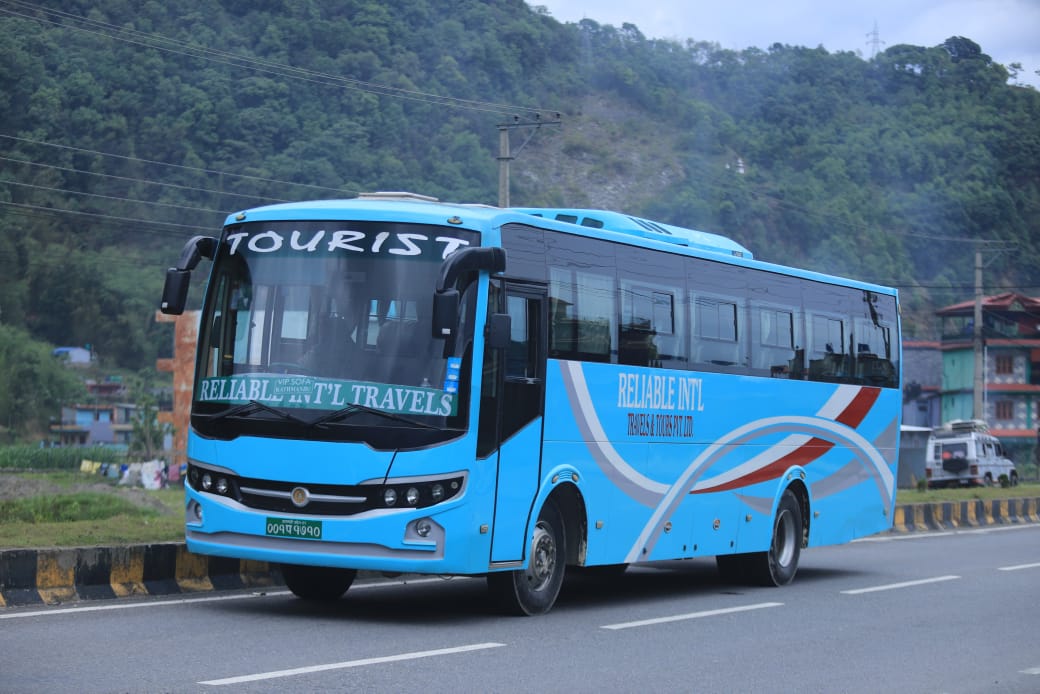
  • Public and tourist buses: fine for adults, but child seats are hard to fit, and seat belts are often lap-only or missing
  • Private hire with a seat: a pre-booked car, Scorpio, jeep or Hiace, a fitted child seat and a known driver

For families with babies and toddlers, private hire is the safest and least stressful way to get around Nepal, especially for airport transfers and longer highway journeys.

Quick Child Seat Selector

Use this simple guide when you book. Always follow the limits printed on the seat label, as they vary by model.

  • Newborn to about 12–15 months: rear-facing infant seat or rear-facing convertible seat
  • Toddler to preschool: rear-facing convertible seat for as long as limits allow, then forward-facing harness seat
  • Preschool to early primary: forward-facing harness seat until your child reaches its maximum height or weight
  • Primary school age: high-back booster seat until the adult belt fits correctly, often around 145 cm tall
  • Older children: adult belt in the rear seat, with the lap belt low across the hips and the shoulder belt across the chest

Not sure? Share your child’s age, weight, and height when you plan your trip,  and we will recommend the right seat.

Kathmandu to Chitwan With Kids

Chitwan is one of Nepal’s most popular family destinations. The drive from Kathmandu runs down to the Terai lowlands, following river valleys to the national park gateway at Sauraha. It is a comfortable trip in a private car or Scorpio, with river views and plenty of lunch stops.

In Sauraha, children can watch elephants bathing, take a canoe ride, visit the community museum and look for rhinos from a jeep safari. Combine your road transfer with a Chitwan jungle safari package. From Chitwan, continue to Pokhara with our Chitwan to Pokhara transfer or head to Lumbini.

TIP: Chitwan is hot in spring and humid in the monsoon. Plan activities for early morning and late afternoon, and pack child-safe mosquito repellent.

Village Stays and Short Hill Trips With Children

Families who want a taste of mountain village life without a long trek have plenty of options. Ghandruk, a large Gurung village with Annapurna views, is reached by jeep from Pokhara via Nayapul, then a short walk. Sarangkot and Nagarkot give mountain sunrises close to the cities, and the Pokhara hills hold many quiet homestay villages.

For these trips, we use a 4WD jeep with a child seat for the rough final section. Our drivers go slowly and stop as needed. Older children might enjoy a short walk on the first stage of the Poon Hill trek or a day hike before returning to Pokhara.

Where to Stay With Kids

  • Kathmandu: quieter areas such as Lazimpat, Patan or the edges of Thamel are calmer than the busiest tourist lanes
  • Bhaktapur and Nagarkot: peaceful stays with fresh air and space for kids
  • Pokhara Lakeside: flat lakeside walks, gardens, boats and plenty of family-friendly cafés
  • Chitwan (Sauraha): resorts with gardens and pools, close to the jungle
  • Lumbini: quiet hotels near the sacred garden and monasteries

Please tell us where you are staying, and your driver will pick you up at the door, with the child seat already fitted.

Eating Out With Children on the Road

Nepali food is generally mild and child-friendly. Plain rice, dal (lentil soup), boiled eggs, momos (dumplings), chapati, noodles, curd and fresh fruit are easy to find. Tourist areas in Kathmandu, Pokhara and Sauraha have many cafés with Western food, pasta, pancakes and fresh juices.

  • Choose busy restaurants where food is freshly cooked
  • Ask for less spicy food, ‘kam piro’
  • Avoid raw salads and ice on the road
  • Bring snacks and baby food for long drives, as highway choices are limited
  • Carry your own bottled water

School Trips and Children’s Groups

We also arrange transport for schools, youth groups and children’s charities. For these, we assign vehicles with seat belts in every used seat wherever possible and provide booster seats for younger children on request. A Hiace works for small groups, while a coaster or bus suits larger groups, with a lead coordinator on call.

Contact us via the contact page with your group details.

Pokhara With Babies and Toddlers: A Closer Look

Pokhara is probably the most relaxing place in Nepal for young families. The lakeside promenade is flat and pram-friendly, the air is cleaner than in Kathmandu, and there is plenty of space to slow down. With a private car with a child seat, you can explore at your child’s pace:

  • Phewa Lake: a gentle rowing boat to the Tal Barahi temple island, with life jackets for children
  • World Peace Pagoda: drive most of the way, then take a short walk for views of the lake and the Annapurna range
  • Davis Falls and Gupteshwor Cave: short visits that fascinate older toddlers, though cave steps are steep
  • International Mountain Museum: spacious, indoor and good on a rainy or hot day
  • Begnas Lake: quieter than Phewa, with peaceful lakeside walks
  • Sarangkot: a sunrise drive for mountain views; an early start, but children often sleep on the way up

Plan sightseeing in the morning and keep afternoons free for naps. Your driver can bring you back to the hotel whenever needed, then collect you again later for dinner or a sunset view, all with the Sarangkot sunrise or day-hire option.

Lumbini With Young Children

Lumbini, the birthplace of the Buddha, is a calm, flat and spacious destination that suits families well. The sacred garden, the Maya Devi Temple and the international monastery zone are spread across a large area. So a private vehicle, a pram, and plenty of water make the visit much easier.

Lumbini is hot for much of the year, so start early and rest in the middle of the day. A private car with a child seat lets you move between monasteries without long walks in the sun. Book your Lumbini transfer from Kathmandu, Pokhara or Chitwan as part of a wider family tour.

Transfer or Full-Day Hire?

Families can book vehicles in two main ways.

Point-to-Point Transfer

A transfer takes you from one place to another, for example from the airport to your hotel or from Kathmandu to Pokhara. It is the simplest and most economical option when you know exactly where you are going.

Full-Day or Multi-Day Hire

With day hire, the vehicle and driver stay with you all day, and your child seat stays fitted. You can visit several sites, return to the hotel for naps and go out again later. Multi-day hire works the same way across a whole tour, with the same driver throughout.

For families, this is often the most comfortable choice because you never need to reinstall the seat or deal with new drivers.

Compare our car hire in Nepal and Nepal tour package options.

A Note on Safety Standards

Child seats greatly improve safety, but road travel always carries some risk. We reduce that risk through careful drivers, checked vehicles, correct seat fitting and sensible planning, such as avoiding night driving on mountain roads and allowing extra time in the monsoon.

Parents remain responsible for buckling children in correctly on every drive and should follow the seat manufacturer’s instructions. If anything about a seat or vehicle doesn’t feel right, tell the driver or call our office straight away. We will fix it.

Key Takeaways

  • Child seats are rare in Nepal’s taxis, so pre-book a private vehicle with a fitted seat.
  • Choose the seat for your child’s size: rear-facing infant, convertible, forward-facing harness or booster.
  • ISOFIX is uncommon, so seats are installed with the vehicle seat belt, always in the rear.
  • A Mahindra Scorpio is our top family choice, with cars for city trips, jeeps for rough roads and Hiace vans for larger families.
  • Child seats cost about USD 6–15 per seat per day, added to the vehicle price.
  • Plan early starts, regular stops, and day hire for the most relaxed family travel.

Why Families Choose Nepal Vehicle Hiring

  • Child seats for every stage: infant, convertible, harness and booster seats on request
  • Family-ready vehicles: cars, Mahindra Scorpios, jeeps and Hiace vans with working rear belts
  • Careful drivers chosen for family trips
  • Clear USD pricing with no hidden extras
  • One team for everything: airport, sightseeing, highway transfers and trekking transport
  • Fast replies on WhatsApp and email

Explore more of our services: car hire in Nepal, Pokhara car hire, bus and coaster hire for groups.

What to Tell Us When You Book

The more we know, the better we can prepare. When you send your enquiry, include:

  • Number of adults and children
  • Each child’s age, approximate weight and height
  • Whether you are bringing your own seats or need ours
  • Your route, dates and pick-up times, including flight numbers for airport pick-ups
  • Luggage: number of suitcases, a pram, travel cot or other large items
  • Any special needs, such as motion sickness, medical needs or a grandparent with limited mobility

With this information,n we choose the right vehicle, prepare the correct seats, ts and brief your driver before the trip.

Our Promise to Families

We know how much trust it takes to hand your child’s safety to a company in another country. That is why our family service is built on a few simple promises: the seat you booked will be the seat in the vehicle; it will be clean, checked and fitted in the rear; your driver will be calm, careful and patient; and our office will answer your messages quickly from arrival to departure.

If anything isn’t right, please tell us, and we will fix it as fast as we can. Many of our family guests come back for a second trip with older children, and that is the best compliment we could ask for.

How to Book a Car or Jeep With a Baby Seat

  • Step 1: Send your dates, route, number of adults and children, and each child’s age, weight and height on WhatsApp or email.
  • Step 2: We recommend the vehicle and seat type, and send a USD quote.
  • Step 3: Confirm with a small advance.
  • Step 4: We send driver details and confirm the seats before arrival.
  • Step 5: Your driver arrives with the seat fitted and checks the harness with you.

You can also use our trip planner or contact page.

Frequently Asked Questions

Can I hire a car with a baby seat in Nepal?

Yes. We provide private cars, Scorpios, jeeps and Hiace vans with infant, convertible, harness and booster seats on request. Book in advance to secure the right seat.

Do taxis in Nepal have child seats?

Generally no. Most taxis do not carry child seats, and some lack working rear seat belts. A pre-booked private car with a fitted seat is the safer choice.

How much does a baby seat cost?

Child seats usually cost about USD 10–15 per seat per day for infant and harness seats, and USD 6–10 for boosters, added to the vehicle price.

Can a child sit in the front seat?

We always fit child seats in the rear. Children should not sit in front, especially in front of an airbag.

Do your vehicles have ISOFIX?

ISOFIX is uncommon in Nepal, so we install our seats with the vehicle seat belt. If you bring your own seat, make sure it can be installed with a seat belt.

Which vehicle is best for a family with a baby?

A Mahindra Scorpio is our top family choice for highways. A car suits city trips, a jeep suits rough roads, and a Hiace suits bigger families.

Can you provide seats for more than one child?

Yes. Please share each child’s details, and we will provide the right seats and a vehicle with enough belted rear seats.

Is the Kathmandu to Pokhara drive OK with a baby?

Yes, with a child seat, frequent stops and an early start. Many families find it easier than juggling luggage on a flight.

Can I book a baby seat for a Kathmandu airport pick-up?

Yes. Share your flight number and your child’s details, and your driver will meet you in arrivals with the seat already fitted. See our airport transfer service.

Can I hire a jeep with a child seat for mountain roads?

Yes. Our 4WD jeeps can be fitted with child seats in rows with working seat belts, for routes such as Nayapul and Besisahar.

Do I need to bring my own car seat to Nepal?

It is optional. Bringing your own offers familiarity, while renting saves you from carrying bulky gear. Make sure any seat you bring can be installed with a seat belt.

How far ahead should I book a child seat?

For autumn and spring, and for multiple seats, book a few weeks ahead. In quieter seasons, a few days’ notice is usually enough.

Can you provide transport for a family with grandparents and babies?

Yes. A Toyota Hiace is ideal for multi-generation families, with space for child seats, prams and comfortable seating for grandparents.

Book Your Family Vehicle With a Baby Seat

Travelling in Nepal with a baby is easier than many parents expect when you have the right transport. With a correctly fitted child seat, a comfortable vehicle and a careful driver, you can focus on the temples, lakes, wildlife and mountains, and on the smiles your child will get everywhere you go.

WhatsApp

Email: [email protected]

Online: Plan your trip | Contact us | Nepal Vehicle Hiring

Send your route and your children’s ages today, and we’ll reply with the right vehicle, the right seats and a clear USD quote.

Whether it is a quick airport pick-up, a day exploring Kathmandu’s temples, a road trip to Pokhara’s lakes or a jungle adventure in Chitwan, your child deserves the same level of safety on Nepal’s roads as at home. A private car, Scorpio, jeep or Hiace with a properly fitted child seat and a careful driver gives you exactly that, and lets the whole family relax and enjoy the journey.

We look forward to welcoming your family to Nepal and to being part of your children’s first Himalayan adventure. Every family trip we plan starts with one simple message, so reach out whenever you are ready, and we will take care of the rest.
Private Nagarkot Sunrise Tour

nagarkot

Private Nagarkot Sunrise Tour by Car, Jeep, and Hiace Van: Complete Guide

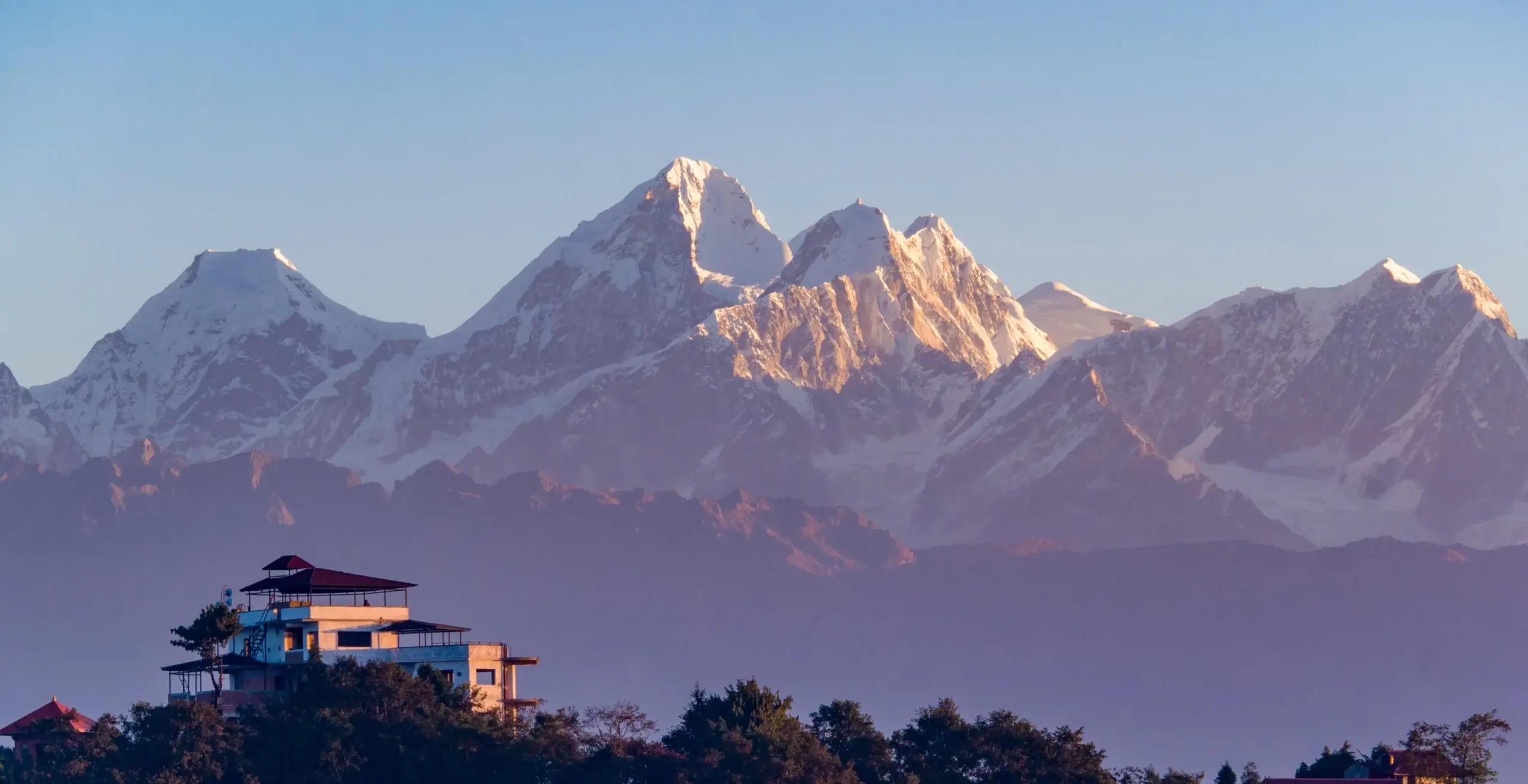
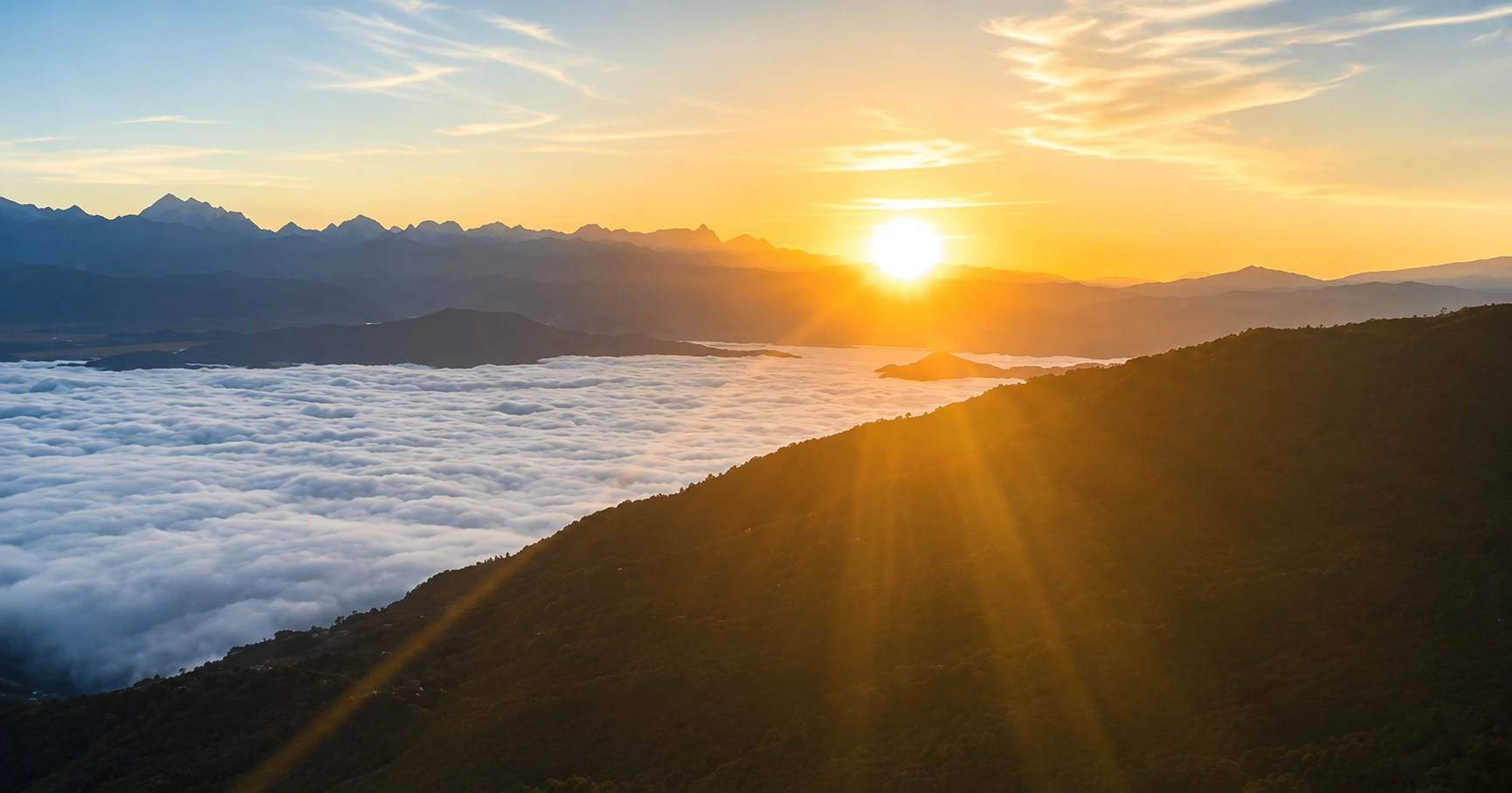
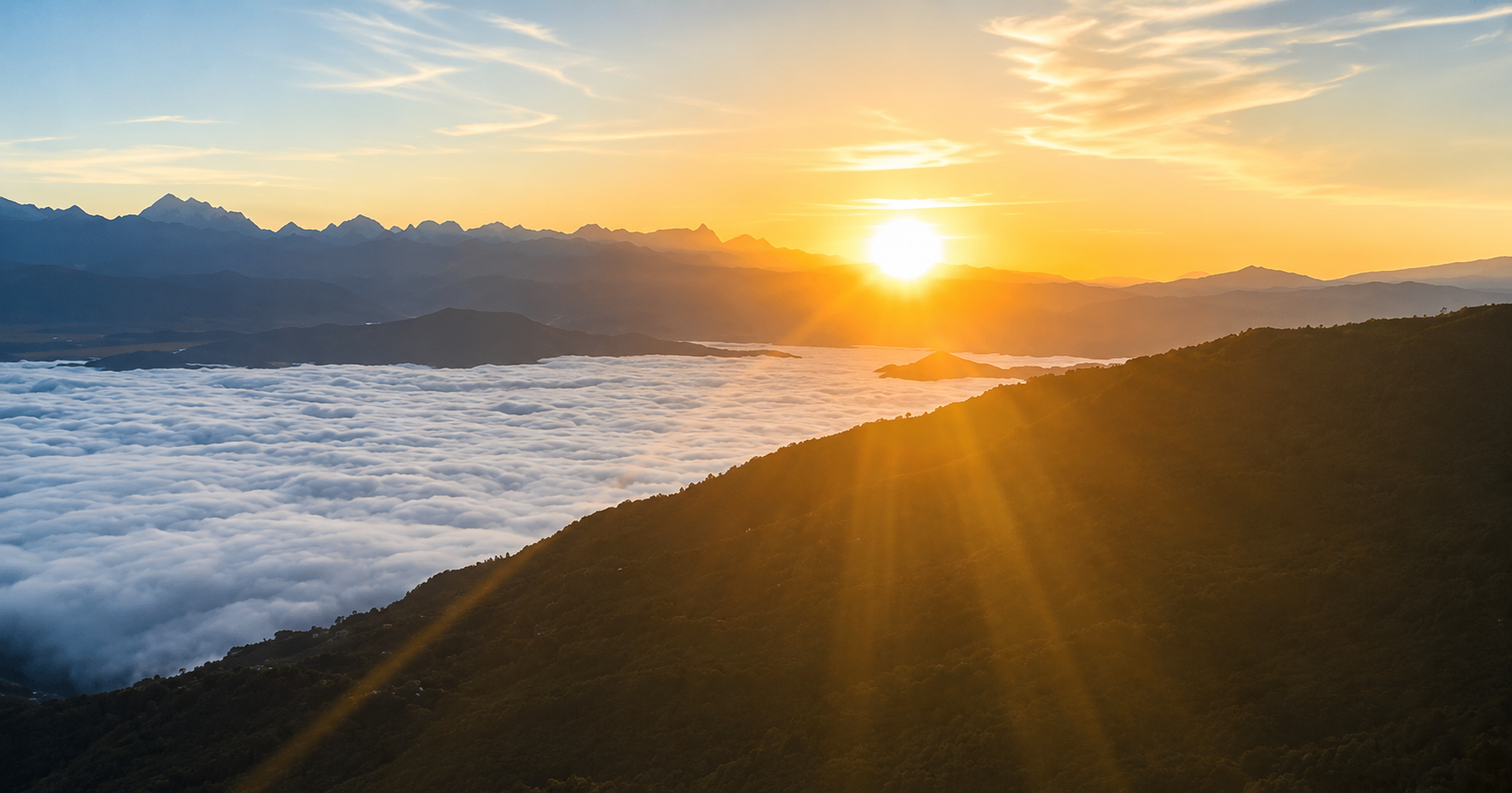
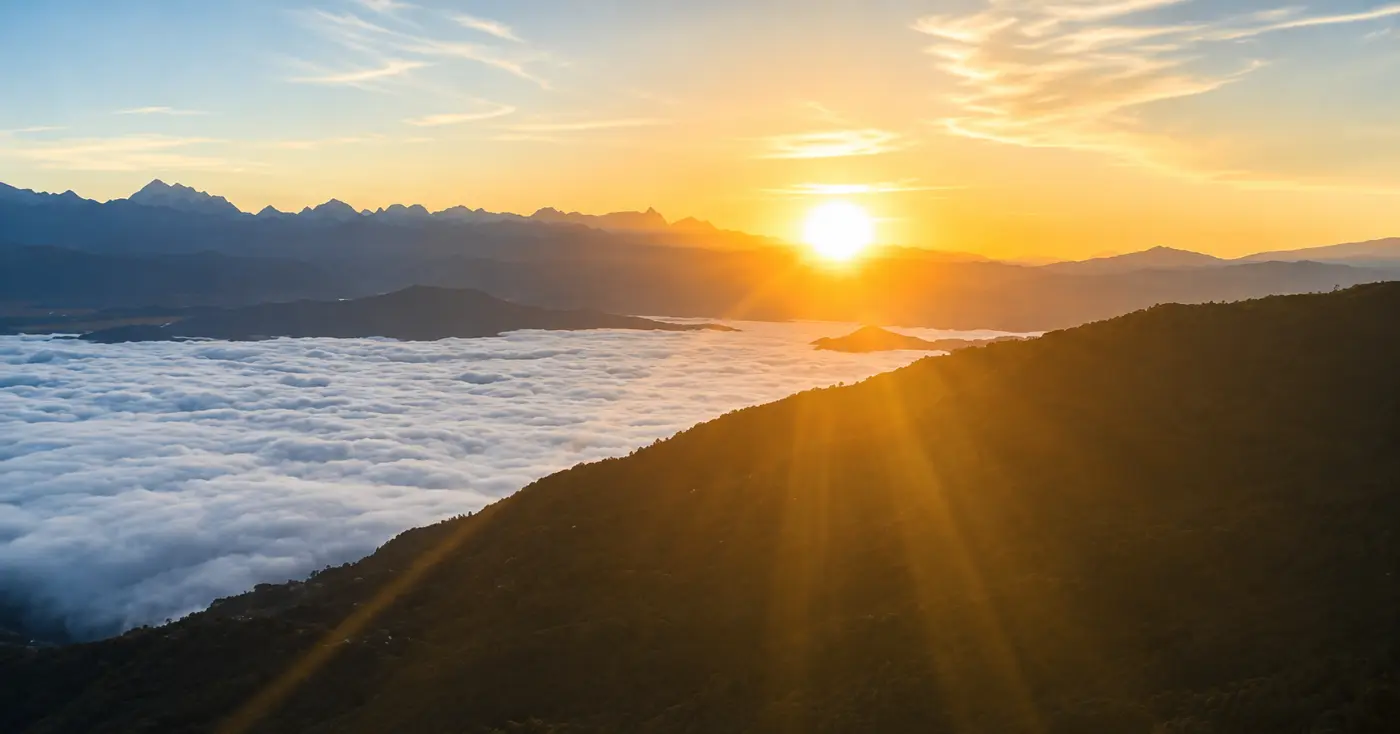
Few experiences in Nepal evoke such awe as watching the sun rise over the Himalayas from Nagarkot. As the first golden light touches peaks like Ganesh Himal, Langtang Lirung, and Manaslu—and even Mount Everest on clear mornings—the world feels briefly transformed into something extraordinary.

Nagarkot is a peaceful hilltop village in the Bhaktapur District, sitting at an altitude of 2,175 meters above sea level, just 32 kilometres east of Kathmandu. It is the most popular and accessible sunrise viewpoint near the capital, offering a panoramic view of eight major Himalayan ranges from a single location.

A private vehicle sunrise tour to Nagarkot is one of the most rewarding experiences on any visit to Kathmandu.

At Nepal Vehicle Hiring Pvt Ltd, we specialize in private vehicle services for the Nagarkot sunrise tour. Whether you need a private car for a couple, a 4WD jeep for a small group, or a Toyota Hiace van for a larger party, we provide comfortable, reliable, and professionally driven vehicles with flexible itineraries.

This 2026 guide covers everything you need to plan your perfect Nagarkot sunrise tour by vehicle.

Why Visit Private Nagarkot for Sunrise?

Panoramic View of Eight Himalayan Ranges

Nagarkot offers one of the widest panoramic views of the Himalayas from any easily accessible viewpoint in Nepal. On a clear morning, you can see eight distinct Himalayan ranges from a single spot: Annapurna, Manaslu, Ganesh Himal, Langtang, Jugal, Rolwaling, Mahalangur (Everest region), and Numbur. This 360-degree mountain panorama is genuinely rare and exceptional.

Glimpse of Mount Everest

On exceptionally clear mornings, particularly in autumn and early spring, Mount Everest (8,849 m) is visible as a distinctive dark pyramid on the far eastern horizon from the Nagarkot View Tower. Seeing the world’s highest peak at sunrise so close to Kathmandu is a memorable, uniquely Nepali experience.

Easily Accessible from Kathmandu

Just 32 kilometres from Kathmandu, Nagarkot is the closest major Himalayan viewpoint, reachable in only 1.5 to 2 hours by private vehicle. This comfortable drive makes early mornings stress-free and accessible for all travellers.

Perfect for All Ages and Groups

The Nagarkot sunrise tour suits solo travellers, couples, families with children, senior travellers, and large tour groups. With a private vehicle from Nepal Vehicle Hiring, the tour is fully customised to your group’s pace, with stops wherever you choose.

Combine with Other Attractions

The Nagarkot sunrise tour pairs well with a morning visit to Bhaktapur Durbar Square, a hike to Changu Narayan Temple, or an exploration of Dhulikhel—turning the sunrise trip into a full, rewarding day tour of the eastern Kathmandu Valley.

Kathmandu to Nagarkot Vehicle

Nagarkot Sunrise Tour – Quick Facts

DetailInformation
Nagarkot Distance from KathmanduApproximately 32 km
Drive Time (Private Vehicle)1.5 to 2 hours one way
Nagarkot Altitude2,175 meters (7,135 feet) above sea level
Nagarkot DistrictBhaktapur District, Bagmati Province
Recommended Hotel Pickup Time4:00 AM – 4:30 AM (exact time depends on season)
Sunrise Time (approximate)5:30 AM – 6:30 AM (varies by season)
Nagarkot View Tower Entry FeeNPR 150 (foreigners)
Mountains VisibleEverest, Manaslu, Ganesh Himal, Langtang, Annapurna, and more
Tour DurationHalf day (4–6 hours) or full day (8–10 hours with add-ons)
Best SeasonAutumn (Sep–Nov) and Spring (Mar–May)

Private Nagarkot Sunrise Times by Season

Planning your departure time from Kathmandu correctly is essential to arriving in Nagarkot before sunrise. Here is a seasonal guide to approximate sunrise times at Nagarkot:

MonthSunrise Time (Approx.)Recommended Hotel PickupConditions
January7:00 AM5:00 AMCold, clear skies, excellent mountain views
February6:30 AM4:30 AMCold but improving, good views
March6:00 AM4:00 AMSpring starts, excellent clarity, the best season begins
April5:40 AM3:45 AMPeak spring, warm, spectacular mountain views
May5:25 AM3:30 AMLate spring, hazy some days, pre-monsoon
June5:20 AM3:20 AMMonsoon starts, clouds are frequent
July5:25 AM3:25 AMHeavy monsoon; mountain views are often blocked
August5:40 AM3:40 AMLate monsoon, some clear mornings possible
September5:55 AM3:55 AMPost-monsoon clearing, views improving
October6:10 AM4:10 AMPeak autumn season, outstanding mountain views
November6:25 AM4:20 AMExcellent clarity, one of the best months
December6:50 AM4:45 AMCold, clear skies, peaceful atmosphere

Note: Sunrise times are approximate and vary slightly by location and year. Nepal Vehicle Hiring will confirm your pickup time based on your tour date.

Vehicle Options for Nagarkot Sunrise Tour

Nepal Vehicle Hiring Pvt Ltd offers three main private vehicle options for the Nagarkot sunrise tour. Here is a complete comparison:

Vehicle TypeCapacityRound Trip Cost (NPR)Round Trip Cost (USD)Best For
Private Car (Sedan/SUV)1–4 passengersNPR 5,000–8,000USD 37–60Solo, couple, small family
Private Jeep (4WD)4–6 passengersNPR 8,000–14,000USD 60–105Groups, families, adventurers
Toyota Hiace Van7–12 passengersNPR 14,000–20,000USD 105–150Large families, tour groups
Coaster / Mini Bus15–25 passengersNPR 25,000–38,000USD 185–285School groups, large tours

Note: Prices are for round-trip hotel pickup in Kathmandu and return to Nagarkot. Prices include driver and fuel. Additional charges apply for extended itineraries that include Bhaktapur, Changu Narayan, or Dhulikhel. Contact Nepal Vehicle Hiring for a custom quote.

nagarkot

Nagarkot Sunrise Tour by Private Car

A private car is the most popular choice for couples, solo travellers, and small families of up to 4 people. Nepal Vehicle Hiring offers well-maintained, air-conditioned sedans and SUVs for the Nagarkot sunrise tour.

Why Choose a Private Car

  • Most affordable private vehicle option for small groups
  • Comfortable air-conditioned interior for the early morning drive
  • Experienced driver picks you up directly from your Kathmandu hotel
  • A smooth sedan or SUV is perfectly adequate for the well-maintained Nagarkot road
  • Ideal for couples or families wanting a personal, intimate sunrise experience

Private Car Cost – Nagarkot Sunrise Tour

Car TypeRound Trip (NPR)Round Trip (USD)CapacityIncludes
Standard SedanNPR 5,000–6,500USD 37–491–3 paxDriver, fuel, and hotel pickup
SUV/CrossoverNPR 6,500–8,000USD 50–1003–4 paxDriver, fuel, and hotel pickup
Top-end SUVNPR 8,000–10,000USD 100–1504 paxDriver, fuel, and hotel pickup

Chisapani nagarkot trek

Nagarkot Sunrise Tour by Private Jeep

A private 4WD jeep is the preferred vehicle for slightly larger groups and travellers who want the most comfortable and capable option for the Nagarkot road. The road to Nagarkot climbs steeply and winds through the Bhaktapur hills — a jeep handles these conditions with ease and provides a more assured, comfortable ride.

Why Choose a Jeep for Nagarkot

  • Higher ground clearance and 4WD capability for the winding hillside road to Nagarkot
  • More spacious interior — comfortable for 4 to 6 passengers with camera equipment and personal bags
  • Better suspension for the winding road on the pre-dawn drive
  • Professional 4WD mountain driver experienced on the Nagarkot route
  • Ideal for photography groups who want ample space for tripods and equipment
  • Excellent for families with children who need more room and comfort

Nagarkot Sunrise Tour by Toyota Hiace Van

The Toyota Hiace van is the ideal vehicle for groups of 7 to 12 passengers. It is spacious, air-conditioned, comfortable, and economical for larger parties. The Hiace is the best choice for family reunions, school trips, corporate groups, and tour groups looking for a shared private-vehicle experience for the Nagarkot sunrise tour.

Toyota Hiace Key Details

DetailInformation
Seating Capacity7 to 12 passengers
Luggage/Equipment SpaceLarge rear storage + roof rack
Air ConditioningFull AC front and rear
Round Trip CostNPR 14,000–20,000 (USD 105–150)
Best ForTour groups, families, school trips, corporate tours
PickupHotel pickup anywhere in Kathmandu Valley
Departure TimeFlexible – as early as 3:30 AM on request

Why Groups Love the Hiace for Nagarkot

  • Seats up to 12 passengers – cost split per head is very economical
  • Spacious enough for camera bags, tripods, and large backpacks
  • Comfortable high seating gives everyone an excellent window view on the drive up
  • A single vehicle for the whole group means no one gets left behind or separated
  • Air conditioning keeps the pre-dawn journey comfortable even in summer

Full Vehicle Comparison: Nagarkot Sunrise Tour

FeaturePrivate CarPrivate JeepHiace VanCoaster/Bus
Capacity1–44–67–1215–25
Round Trip CostNPR 5,000–8,000NPR 8,000–14,000NPR 14,000–20,000NPR 25,000–38,000
Per Person (group of 4)NPR 1,250–2,000NPR 2,000–3,500NPR 1,167–2,857NPR 1,000–2,533
ComfortHighHighHighMedium-High
Hotel PickupYesYesYesYes
Departure FlexibilityFullFullFullFull
Luggage/EquipmentGoodExcellentExcellentExcellent
4WD CapabilitySUV optionYes (all jeeps)No (paved road)No
Best ForCouples, soloGroups, familiesLarger groupsSchool/corporate

Nagarkot sunrise

Suggested Itinerary: Nagarkot Sunrise Tour by Private Vehicle

Here are two complete itinerary options for your Nagarkot sunrise tour with Nepal Vehicle Hiring — a half-day sunrise-only option and a full-day option that includes the most popular add-on attractions.

Option A: Half-Day Nagarkot Sunrise Tour (4 to 5 Hours)

TimeActivityDetails
4:00–4:30 AMHotel pickup in KathmanduVehicle arrives at your hotel. Departure for Nagarkot.
5:30–6:00 AMArrive at Nagarkot View TowerShort walk up to the viewing platform.
5:45–6:30 AMSunrise over the HimalayasWatch the sunrise paint the peaks in golden light.
6:30–7:30 AMExplore Nagarkot, breakfastWalk around the hilltop. Breakfast at a local café or hotel.
7:30–8:00 AMDepart Nagarkot for KathmanduReturn journey begins.
9:00–9:30 AMArrive back in KathmanduDrop off at your hotel.

Option B: Full-Day Nagarkot Sunrise + Bhaktapur Tour (8 to 10 Hours)

TimeActivityDetails
4:00–4:30 AMHotel pickup in KathmanduThe vehicle collects you from your hotel for Nagarkot.
5:30–6:00 AMArrive at Nagarkot View TowerWalk up the steps to the summit viewpoint.
5:45–6:30 AMSunrise over the HimalayasPanoramic Himalayan sunrise experience.
6:30–7:30 AMBreakfast in NagarkotEnjoy local tea, coffee, and breakfast with mountain views.
7:30–9:00 AMDrive to Changu Narayan or Bhaktapur30-min drive to Changu Narayan Temple (UNESCO site).
9:00–11:00 AMExplore Changu Narayan TempleNepal’s oldest Hindu temple. Ancient Licchavi carvings.
11:00 AM–1:00 PMBhaktapur Durbar SquareUNESCO World Heritage Site. Newari palaces and temples.
1:00–2:00 PMLunch in BhaktapurTraditional Newari cuisine at a local restaurant.
2:00–3:00 PMDrive back to KathmanduReturn to your hotel in Kathmandu.

Note: Itinerary timing is approximate and fully flexible. All stops are customizable based on your preferences. Additional entrance fees apply for Bhaktapur Durbar Square (NPR 1,500 for foreigners) and Changu Narayan Temple.

Private Nagarkot Sunrise Tour

Nagarkot Sunrise Tour Package Prices 2026

Nepal Vehicle Hiring offers the following complete tour packages for the Nagarkot sunrise tour. All packages include hotel pickup and drop-off, a private vehicle, and an experienced driver:

PackageVehicleWhat’s IncludedCost (NPR)Cost (USD)
Sunrise Only – CarPrivate Car (1–4 pax)Hotel pickup, Nagarkot return transferNPR 5,000–8,000USD 37–60
Sunrise Only – JeepPrivate Jeep (4–6Jeep)Hotel pickup, Nagarkot return transferNPR 8,000–14,000USD Jeep05
Sunrise Only – HiaceToyota Hiace (7–12 pax)Hotel pickup, Nagarkot return transferNPR 14,000–20,000USD 105–150
Sunrise + Bhaktapur – CarPrivate Car (1–4 pax)Nagarkot + Bhaktapur Durbar SquareNPR 7,000–10,000USD 52–75
Sunrise + Bhaktapur – JeepPrivate Jeep (4–6Jeep)Nagarkot + Bhaktapur Durbar SquareNPR 10,000–15,000USD 75–Jeep
Sunrise + Changu Narayan + Bhaktapur – CarPrivate CarFull day – all 3 locationsNPR 9,000–12,000USD 67–90
Sunrise + Changu + Bhaktapur – JeepPrivate JeepFull day – all 3 locationsNPR 12,000–18,000USD 90–135
Sunrise + Changu + Bhaktapur – HiaceToyota HiaceFull day – all 3 locations (group)NPR 18,000–25,000USD 135–185

Note: Entrance fees for Bhaktapur Durbar Square (NPR 1,500/foreigner), Changu Narayan Temple (NPR 300/foreigner), and Nagarkot View Tower (NPR 150/foreigner) are not included in vehicle prices.

Key Attractions on the Nagarkot Sunrise Tour

Nagarkot View Tower

The Nagarkot View Tower is the primary sunrise viewpoint and the highest publicly accessible point in Nagarkot village. The tower offers an unobstructed 360-degree panoramic view encompassing eight Himalayan ranges. The viewing platform is a short uphill walk from where the vehicle parks.

Most Nepal Vehicle Hiring drivers know the exact parking point and will guide you to the tower entrance.

Entry fee: NPR 150 for foreign visitors. The tower opens well before sunrise and is staffed by local attendants.

Nagarkot Village

After the sunrise, take time to walk through the peaceful lanes of Nagarkot village. The area around the view tower has several excellent cafés and breakfast spots where you can enjoy tea, coffee, and a fresh Nepali breakfast while still gazing at the mountain panorama. The atmosphere in Nagarkot after sunrise is wonderfully calm and refreshing.

Bhaktapur Durbar Square

Bhaktapur is located approximately 20 kilometers from Nagarkot on the return route to Kathmandu, making it a natural and highly rewarding add-on to the sunrise tour. One of Nepal’s three royal cities and a UNESCO World Heritage Site, Bhaktapur Durbar Square is a magnificent collection of ancient Newari temples, courtyards, palaces, and wooden carvings that showcase the finest medieval craftsmanship in the Kathmandu Valley.

Key highlights within Bhaktapur include Nyatapola Temple (Nepal’s tallest pagoda temple), Bhairabnath Temple, the 55-Window Palace, Taumadhi Square, and the Pottery Square. Entry fee: NPR 1,500 for foreign visitors (valid for multiple entries within the same day).

Changu Narayan Temple

Changu Narayan Temple is Nepal’s oldest Hindu temple, perched on a hilltop at 1,541 meters, and is one of the seven UNESCO World Heritage Sites in the Kathmandu Valley. The temple complex contains some of the finest examples of Licchavi-era stone carvings and woodwork in all of Nepal, dating back to the 4th century AD.

A visit to Changu Narayan is an outstanding cultural experience and a natural midway stop on the full-day tour between Nagarkot and Bhaktapur. Entry fee: NPR 300 for foreign visitors.

Nagarkot to Changu Narayan Hiking Trail

For those who enjoy combining hiking with their sunrise tour, the trail from Nagarkot down to Changu Narayan Temple is one of the finest short hikes near Kathmandu. The 12-kilometer trail descends through pine forests, terraced fields, and traditional Newari villages, taking approximately 3 to 4 hours to complete. Nepal Vehicle Hiring can arrange for your vehicle to meet you at Changu Narayan at the end of the hike rather than at Nagarkot.

Dhulikhel Viewpoint (Extension)

Dhulikhel, located approximately 30 kilometers from Nagarkot, is another outstanding Himalayan viewpoint in the Bhaktapur-Kavre area. Adding a stop in Dhulikhel to your full-day tour creates an exceptional extended Kathmandu Valley viewpoint circuit. The Nepal Vehicle Hiring driver can include a stop in Dhulikhel at your request for a small additional cost.

Himalayan Peaks Visible from Nagarkot

On a clear morning, Nagarkot offers one of the widest panoramic views of the Himalayas from any viewpoint near Kathmandu. Here is a guide to the major peaks visible:

PeakHeightRangeDirection from Nagarkot
Mount Everest8,849 mMahalangur HimalFar east (distant)
Makalu8,485 mMahalangur HimalEast
Cho Oyu8,188 mMahalangur HimalEast
Manaslu8,163 mMansiri HimalNorthwest
Langtang Lirung7,234 mLangtang HimalNorth
Dorje Lakpa6,966 mJugal HimalNorth
Ganesh Himal7,422 mGanesh HimalNorthwest
Rolwaling Peaks~6,000–7,000 mRolwaling HimalNortheast
Annapurna Rangeup to 8,091 mAnnapurna HimalFar west (distant)

Note: Visibility of distant peaks such as Everest and Annapurna depends on atmospheric clarity. The best views are in late October through December and March to April. Monsoon season (June–August) often results in cloud cover blocking the mountains.

Nagarkot Sunrise Tour

Best Time for the Nagarkot Sunrise Tour

Autumn (October to November) – Best Season

Autumn is the finest season for the Nagarkot sunrise tour. After the monsoon, the atmosphere is crystal clear, the skies are a deep, brilliant blue, and the mountain views are outstanding. October and November are the peak months for mountain visibility.

This is when you have the best chance of seeing Mount Everest from Nagarkot. Temperatures are mild, and the pre-dawn drive is comfortable.

Spring (March to May) – Excellent

Spring is the second-best season. The weather is warming after winter, rhododendrons are in bloom across the Bhaktapur hills, and the mountain views are generally excellent. March and early April offer particularly clear mornings before the pre-monsoon haze builds in May—a superb time for the tour.

Winter (December to February) – Very Good for Views

Winter mornings in Nagarkot are cold — temperatures can drop below 0°C at the View Tower — but the clarity of the air and the sharpness of the mountain views is exceptional. Snow-capped peaks appear even more dramatic in winter light. Bring warm layers, gloves, and a hat.

Nepal Vehicle Hiring provides warm, comfortable vehicles for the pre-dawn drive.

The summer monsoon brings clouds and rain that frequently obscure views of the Himalayas from Nagarkot. While the lush green monsoon landscape is beautiful, mountain visibility is poor and unpredictable during this period. The sunrise tour is not recommended in June, July, and August unless you are comfortable with the possibility of cloud-covered mountains.

What to Bring for the Nagarkot Sunrise Tour

  • Warm jacket, fleece layer, and windproof outer layer – the View Tower is exposed and cold before sunrise
  • Gloves and a warm hat – essential in winter months, advisable in autumn and spring mornings
  • Camera with fully charged battery – cold mornings drain batteries quickly; bring a spare
  • Wide-angle lens or smartphone with panorama mode for the 360-degree mountain view
  • Tripod – essential for low-light sunrise photography
  • Torch or headlamp – the path to the View Tower is dark in the pre-dawn hours
  • Water bottle and light snacks – for the early morning departure and return drive
  • Nepali cash – for entrance fees (NPR 150 at the View Tower) and breakfast at Nagarkot
  • Valid ID or passport – for the Bhaktapur Durbar Square and Changu Narayan entry (if visiting)
  • Sunscreen and sunglasses – UV intensity is high at Nagarkot altitude after sunrise

Expert Tips for the Nagarkot Sunrise Tour

  • Book your vehicle at least 1 to 2 days in advance; during peak autumn and spring seasons, book 3 to 5 days ahead
  • Confirm your exact pickup time with Nepal Vehicle Hiring on the evening before your tour – our team will check the seasonal sunrise time for your date
  • Dress in layers and add more than you think you need – Nagarkot is significantly colder than Kathmandu at 4 AM, especially in the October to February period
  • Face east at the View Tower for the sunrise and the best mountain panorama – do a full 360 turn to appreciate the complete view
  • Arrive at the View Tower at least 20 to 30 minutes before sunrise to find a good viewing position and allow your eyes to adjust
  • Pre-monsoon haze in April and May can reduce visibility – October and November offer the very best clarity
  • If combining with Bhaktapur, visit the Pottery Square and Taumadhi Square as well as the main Durbar Square – they are nearby and equally magnificent
  • Ask your driver to stop at scenic points on the winding road up to Nagarkot – there are beautiful valley views even before reaching the summit
  • Carry hand warmers or keep hands in pockets during the pre-dawn wait at the View Tower – the wind chill can be significant
  • If your tour includes the Changu Narayan hike, wear comfortable walking shoes and bring a small daypack with water and snacks

How to Book Your Nagarkot Sunrise Tour Vehicle

Booking your Nagarkot sunrise tour vehicle with Nepal Vehicle Hiring Pvt Ltd is simple:

  • Step 1: Contact us via phone, WhatsApp, or at vehiclehiringnepal.com
  • Step 2: Tell us your tour date, number of passengers, hotel name in Kathmandu, and preferred vehicle type
  • Step 3: Choose your itinerary – sunrise only, sunrise and Bhaktapur, or full-day with Changu Narayan
  • Step 4: Receive your booking confirmation with driver details and exact pickup time for your tour date
  • Step 5: Our driver arrives at your hotel on the morning of your tour, 10 minutes before the confirmed pickup time

We recommend booking at least 24 to 48 hours in advance for weekday tours, and 3 to 5 days in advance for weekend tours and peak-season bookings.

Frequently Asked Questions (FAQ)

What time should I leave Kathmandu for the Nagarkot sunrise?

The recommended departure time from your Kathmandu hotel is between 4:00 AM and 4:30 AM for most of the year. In the summer months (May and June) when sunrise is earlier, departure can be as early as 3:30 AM. Nepal Vehicle Hiring will confirm your exact pickup time when you book.

Can I see Mount Everest from Nagarkot?

Yes, on exceptionally clear mornings — particularly in October, November, and March — Mount Everest is visible as a dark pyramid on the far eastern horizon from the Nagarkot View Tower. Visibility depends on atmospheric clarity and weather conditions. Autumn is the most reliable season for an Everest sighting.

How much does the Nagarkot sunrise tour by private car cost?

A round-trip private car for the Nagarkot sunrise tour costs NPR 5,000-8,000 (USD 37–60). A private jeep costs NPR 8,000-14,000 (USD 60–105). A Toyota Hiace for groups costs NPR 14,000-20,000 (USD 105–150).

All prices include driver and fuel.

Is it worth combining the Nagarkot tour with a visit to Bhaktapur?

Yes, absolutely. Bhaktapur Durbar Square is one of Nepal’s greatest cultural treasures and lies directly along the return route from Nagarkot to Kathmandu. Combining both in a single day is extremely efficient and rewarding.

Most travelers who do both describe it as one of the highlights of their entire visit to Nepal.

What is the Nagarkot View Tower entrance fee?

The entrance fee for the Nagarkot View Tower is NPR 150 for foreign visitors. Entry to Bhaktapur Durbar Square costs NPR 1,500 for foreigners (valid for the day). Changu Narayan Temple costs NPR 300 for foreigners.

These fees are not included in the vehicle hire price.

Which vehicle is best for a group of 8 people for the Nagarkot sunrise tour?

A Toyota Hiace van is the perfect choice for 8 people. It seats 7 to 12 passengers comfortably, has ample luggage and equipment space, and is air-conditioned. The round-trip cost of NPR 14,000 to 20,000 split among 8 passengers makes it very economical per person.

Is the road to Nagarkot safe at 4 AM?

Yes. The Nagarkot road is well-maintained and traveled by vehicles every morning for the sunrise tour. Nepal Vehicle Hiring employs experienced drivers who know this route thoroughly, including the winding hillside section leading to Nagarkot village.

Pre-dawn departures are standard and completely safe with a professional driver.

Can I do the Nagarkot tour in the monsoon season?

It is possible, but not recommended, for mountain views. The monsoon months of June, July, and August bring frequent cloud cover that blocks views of the Himalayas from Nagarkot. If you are visiting Nepal during the monsoon and want a green, lush landscape experience, the drive is still beautiful — do not expect to see the mountains.

Book Your Private Nagarkot Sunrise Tour Vehicle with Nepal Vehicle Hiring

The Nagarkot sunrise experience is one of the most magical and accessible Himalayan moments available to any visitor in Nepal. As the first light of dawn spreads across the snow-capped peaks — Ganesh Himal, Langtang, Manaslu, and perhaps even Everest on the far horizon — you understand why travelers return to this hilltop viewpoint again and again.

Whether you arrive in a private car for two, a comfortable jeep for a group of six, or a spacious Hiace van for your family or tour party, Nepal Vehicle Hiring Pvt Ltd ensures your vehicle is waiting at your hotel door in the pre-dawn hours, your driver is experienced and professional, and your journey to Nagarkot and back is smooth, safe, and perfectly timed for the sunrise.

Contact Nepal Vehicle Hiring Pvt Ltd today at vehiclehiringnepal.com to book your Nagarkot sunrise tour vehicle and witness one of Nepal’s most memorable natural spectacles.

Book your Jeep today. Call or WhatsApp: +977 981-4227196
Website: www.vehiclehiringnepal.com
E-mail: [email protected]

Car Hire in Nepal: Complete Guide for Travelers

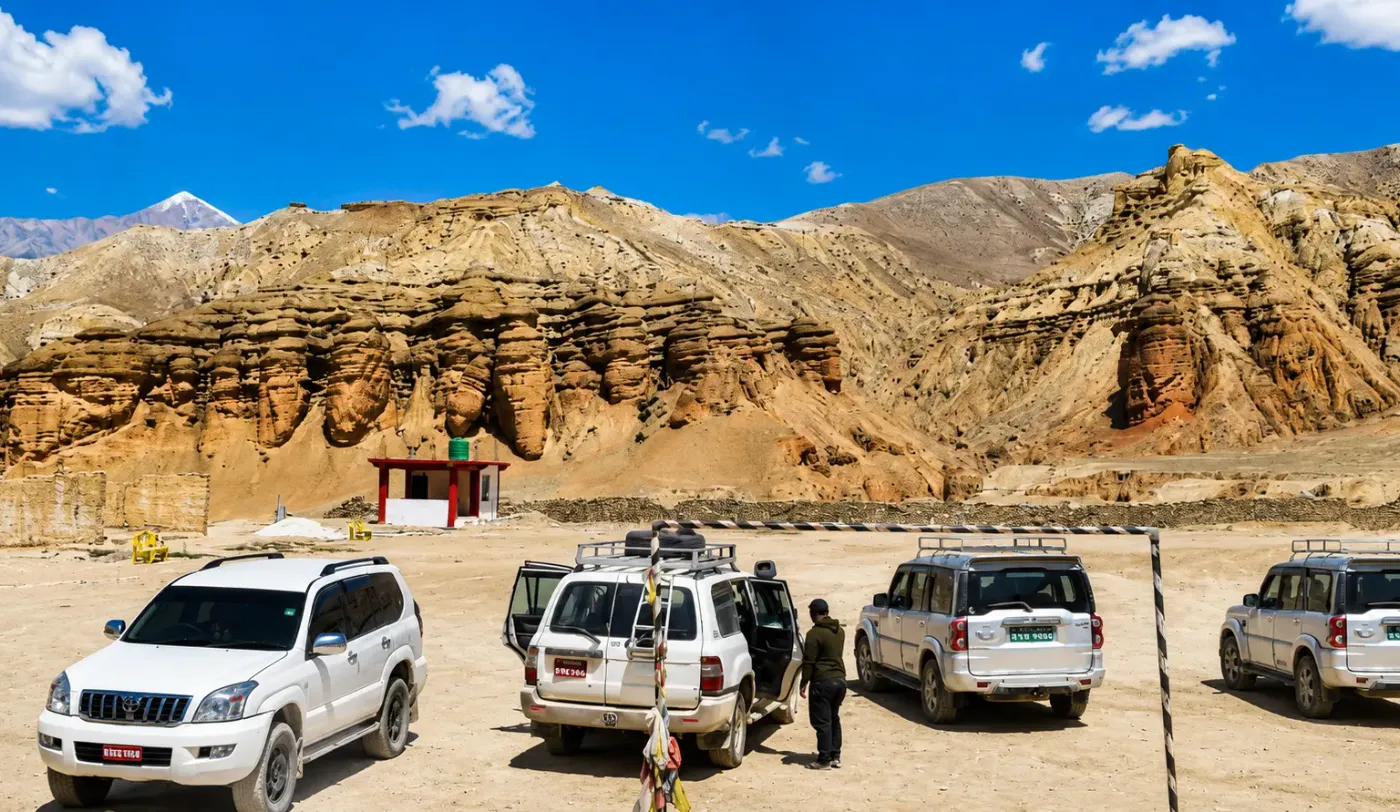
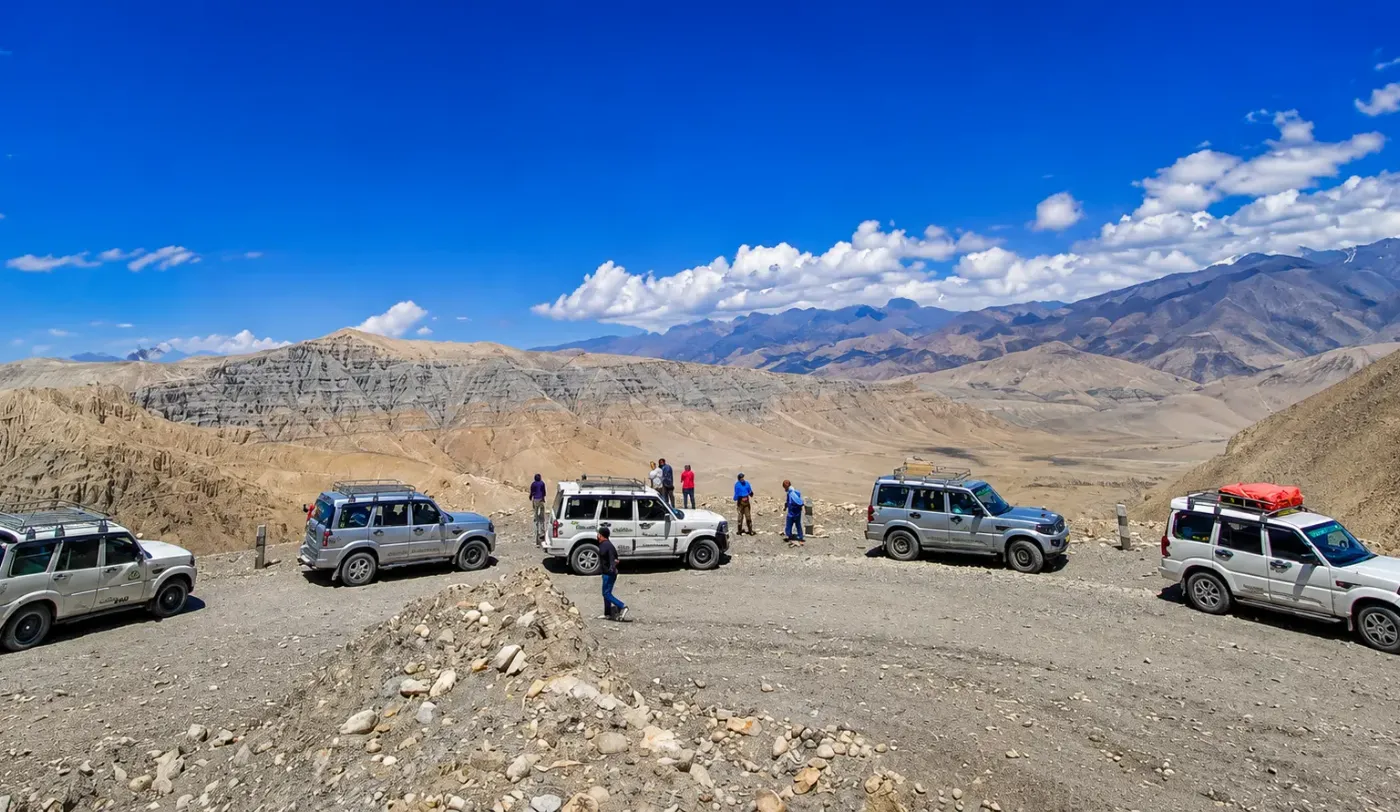
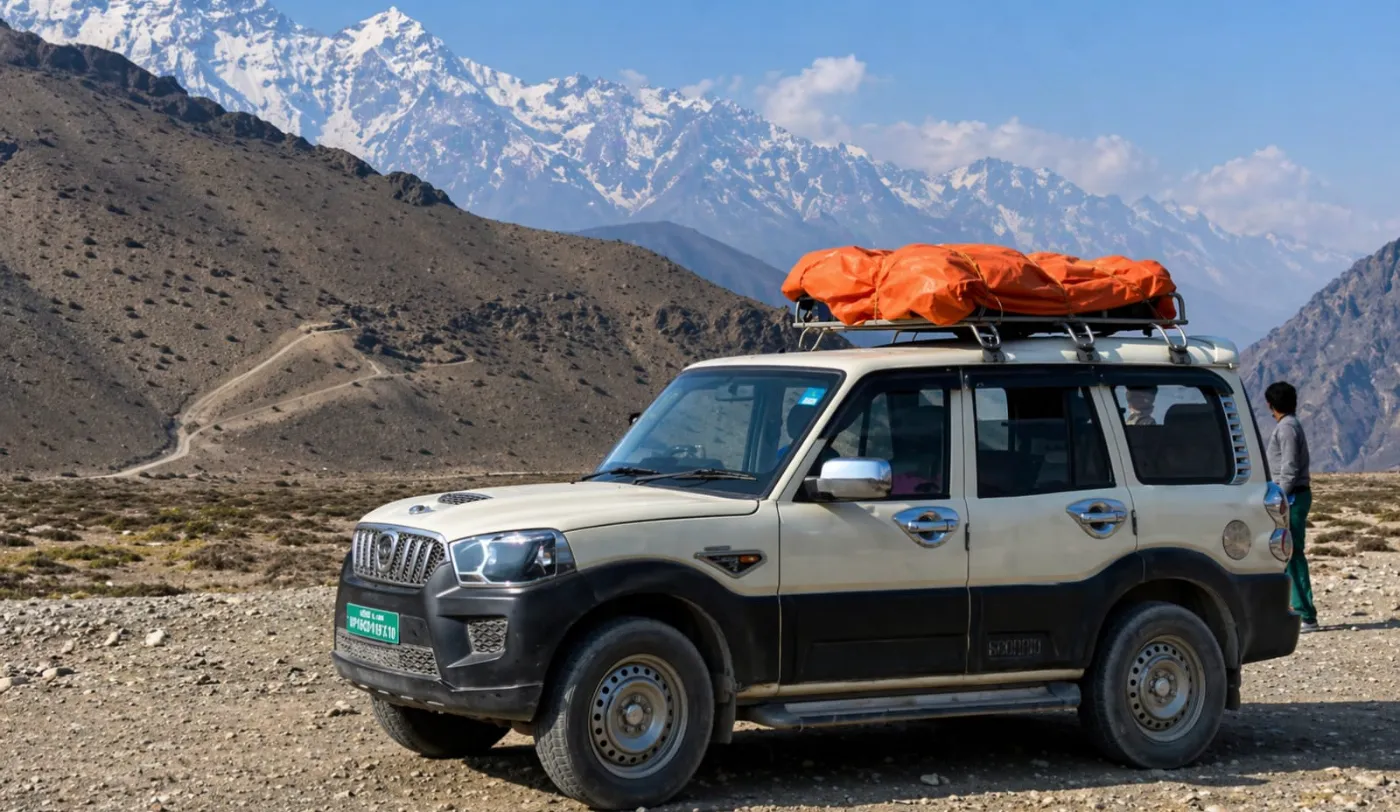
Private jeeps parked in Mustang

Introduction: Why Best Car Hire in Nepal is the Smart Way to Travel in Our Beautiful Country

Nepal is a country of dramatic contrasts—snow-capped Himalayan peaks, winding hill roads, bustling cities, and remote villages. This diversity makes travel extraordinary, but it also makes transportation a critical decision. Public transport exists, but it is often crowded, time-consuming, and unpredictable.

For travellers who value comfort, flexibility, and efficiency, hiring a car in Nepal is not just a luxury—it’s a practical solution.

Car hire services in Nepal have evolved significantly over the past decade. Today, travellers can choose from a wide range of vehicles, from compact sedans for city travel to rugged SUVs for mountainous terrain. Whether you are a tourist exploring scenic destinations, a business traveller attending meetings, or a family on vacation, car rental services offer a tailored experience that public transport cannot match.

This complete guide will walk you through everything you need to know about hiring a car in Nepal—from vehicle options and pricing to routes, booking tips, and expert recommendations.

Overview of Car Hire in Nepal

Car hire in Nepal typically comes with a professional driver. Self-drive options are extremely limited and generally not recommended because of road conditions, traffic patterns, and local driving practices.

Key Features of Car Hire in Nepal:

  • Chauffeur-driven vehicles
  • Flexible pickup and drop-off locations
  • Daily, hourly, and long-distance rental options
  • Wide range of vehicle categories
  • Availability for both city tours and multi-day trips

Who Should Hire a Car?

  • International tourists unfamiliar with local transport
  • Families and small groups
  • Business professionals
  • Travellers with tight schedules
  • Luxury and comfort seekers

Types of Cars Available for Hire in Nepal

Choosing the right vehicle is essential for a smooth travel experience. The type of car you hire should depend on your group size, route, budget, and comfort expectations.

Sedan Cars (Economy & Standard)

Sedans are ideal for city travel and smooth highways.

Examples: Toyota Etios, Hyundai Accent, Skoda Rapid

Capacity: 1–3 passengers

Best For: Airport transfers, city tours, short highway trips

Advantages:

  • Affordable
  • Fuel-efficient
  • Comfortable for paved roads

Limitations:

  • Not suitable for rough or mountainous terrain

SUV / 4WD Vehicles

SUVs are among the most popular choices in Nepal due to their versatility.

Examples: Scorpio, Toyota Land Cruiser, Nissan Patrol

Capacity: 4–7 passengers

Best For: Long-distance travel, hill roads, off-road routes

Advantages:

  • Strong suspension for rough roads
  • Higher ground clearance
  • Suitable for trekking routes and remote areas

Vans and Hiace

Perfect for medium-sized groups.

Examples: Toyota Hiace, Nissan Caravan

Capacity: 7–14 passengers

Best for: Group tours, family travel, corporate trips

Advantages:

  • Spacious interiors
  • Good luggage capacity
  • Comfortable for long journeys

Luxury Cars

For top-end travel experiences.

Examples: Toyota Prado, BMW, Mercedes-Benz

Capacity: 2–4 passengers

Best For: VIP travel, weddings, corporate use

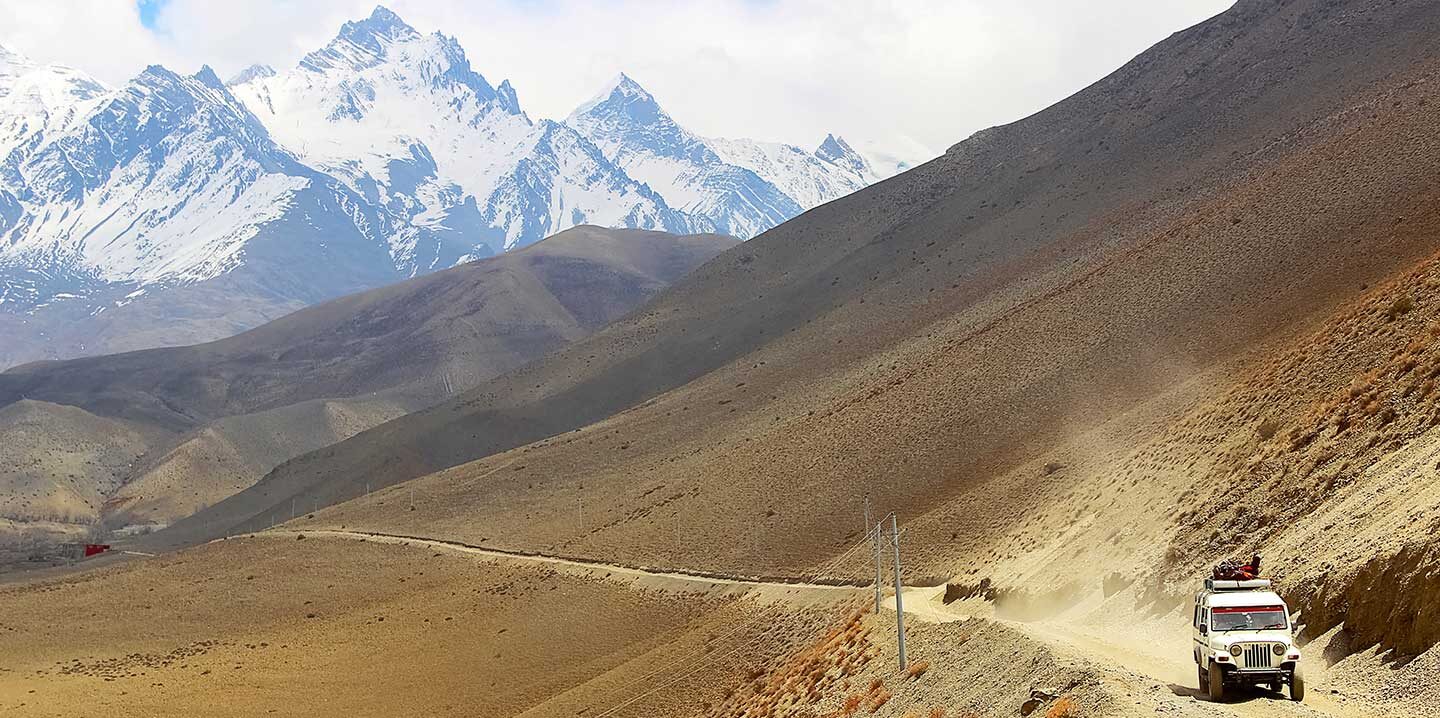
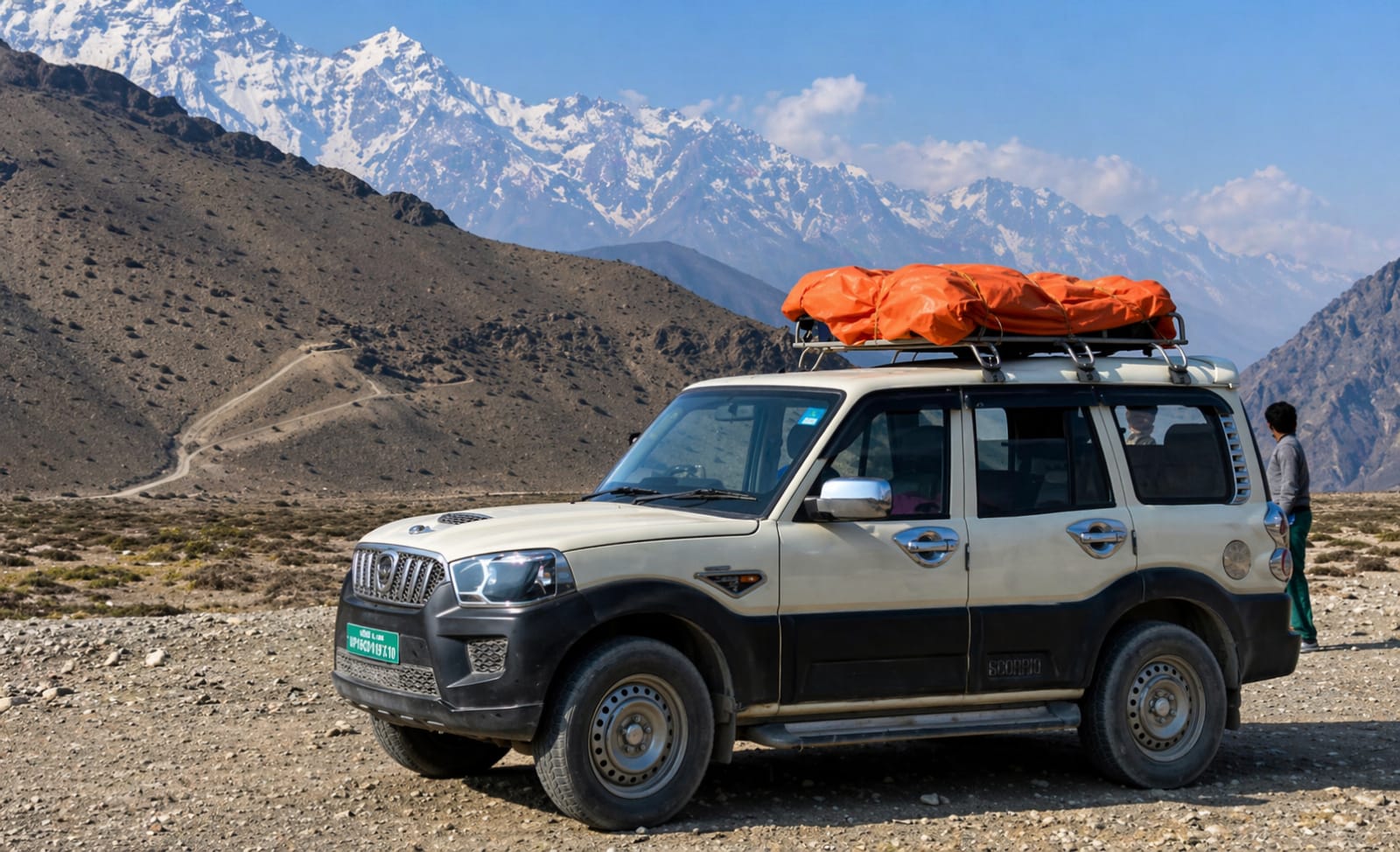
Scorpio jeeps on the road in Mustang

Car hire services are commonly used for both short and long-distance travel. Here are the most in-demand routes:

Kathmandu to Pokhara

  • Distance: ~200 km
  • Travel Time: 6–8 hours
  • Road Condition: Mixed (highway + ongoing construction)

A scenic journey along rivers, hills, and small towns. Ideal for SUVs or comfortable sedans.

Kathmandu to Chitwn

  • Distance: ~170 km
  • Travel Time: 5–7 hours
  • Best Vehicle: Sedan or SUV

Popular for jungle safaris and wildlife tourism.

Kathmandu to Lumbini

  • Distance: ~260 km
  • Travel Time: 8–10 hours
  • Best Vehicle: SUV or Hiace

A spiritual journey to the birthplace of Buddha.

Kathmandu to Salleri / Phaplu (Everest Region Access)

  • Distance: ~260–300 km
  • Travel Time: 10–14 hours
  • Best Vehicle: 4WD Jeep

Used by trekkers when Lukla flights are delayed.

Kathmandu to Manang / Mustang

  • Remote mountain routes
  • Requires strong 4WD vehicles
  • Best for adventure travellers

Cost of Car Hire in Nepal

Pricing varies depending on several factors. Unlike fixed taxi meters, most rentals are negotiated or quoted based on route and duration.

Key Pricing Factors:

  • Vehicle type
  • Distance and duration
  • Fuel inclusion
  • Road condition
  • Season (peak vs off-season)

Average Price Range (General Guide)

Vehicle Type Daily Rate (Approx)

Sedan $40 – $70

SUV/Jeep $80 – $150

Hiace $120 – $180

Luxury Car $150 – $300+

What’s Usually Included:

  • Driver salary
  • Fuel (in most packages)
  • Parking fees
  • Basic insurance

What’s Not Included:

  • Accommodation for the driver (on long trips)
  • Meals for the driver
  • Entry permits (restricted areas)

Road Conditions in Nepal: What to Expect

Understanding Nepal’s road conditions is essential before hiring a car.

Urban Areas (Kathmandu, Pokhara)

  • Busy traffic
  • Narrow streets
  • Moderate road quality

Highways

  • Mixed conditions
  • Ongoing construction in many sections
  • Occasional delays

Mountain Roads

  • Narrow and winding
  • Gravel and off-road sections
  • Landslide-prone during the monsoon

 This is why hiring an experienced driver is crucial.

Benefits of Hiring a Car in Nepal

1. Comfort and Convenience

Travel in a private vehicle eliminates the stress of crowded buses and long waits.

2. Flexible Itinerary

Stop wherever you want—viewpoints, restaurants, or photo spots.

3. Time Efficiency

Reach destinations faster compared to public transport.

4. Safety

Professional drivers understand local road conditions and risks.

5. Personalised Experience

Customise your journey according to your needs.

When Should You Hire a Car?

Ideal Situations:

  • Travelling with family or elderly members
  • Carrying heavy luggage
  • Visiting multiple destinations
  • Tight travel schedule

When Public Transport Might Work

  • Solo budget travellers
  • Short city commutes
  • Flexible schedules

Booking Process for Car Hire in Nepal

Booking a car is simple and usually follows these steps:

Step 1: Choose Your Vehicle

Select based on group size and route.

Step 2: Share Trip Details

Provide pickup location, destination, and dates.

Step 3: Get a Quote

The company will offer pricing.

Step 4: Confirm Booking

An advance payment may be required.

Step 5: Travel

The driver arrives at your location on time.

Tips for Choosing the Right Car Rental Company

Not all providers offer the same level of service. Here’s what to check:

1. Experience and Reputation

Choose companies with strong local experience.

2. Vehicle Condition

Ensure vehicles are well-maintained and clean.

3. Driver Professionalism

Experienced drivers make a huge difference.

4. Transparent Pricing

Avoid hidden charges.

5. Customer Support

24/7 assistance is a big advantage.

Car Hire vs Other Transport Options

Car Hire vs Tourist Bus

Factor Car Hire Tourist Bus

Comfort High Medium

Flexibility: ty Fuvs ll Fixed schedule

Speed Faster Slower

Privacy Private Shared

Car Hire vs Domestic Flights

Factor Car Hire Flight

Cost is lower for groups, higher

Scenic Experience: Yes Limited

Flexibility High Low

Safety Tips for Travelers

  • Always hire vehicles with drivers
  • Avoid night travel in remote areas
  • Check weather conditions (especially during the monsoon)
  • Keep emergency contacts handy
  • Confirm vehicle condition before departure

Best Time to Hire a Car in Nepal

Peak Seasons:

  • Spring (March–May)
  • Autumn (September–November)

Off-Season:

  • Monsoon (June–August)
  • Winter (December–February, for high-altitude routes)

Car Hire for Special Purposes

1. Airport Transfers

Reliable pickup and drop-off services.

2. Corporate Travel

Professional service for meetings and events.

3. Wedding Transportation

Luxury vehicles and decorated cars.

4. Trekking Transfers

Access to trailheads and remote regions.

Frequently Asked Questions (FAQs)

Is self-drive car rental available in Nepal?

Very limited. Most services are chauffeur-driven.

Can I hire a car for multiple days?

Yes, multi-day rentals are common.

Is fuel included in the price?

Usually yes, but always confirm.

Are drivers English-speaking?

Most professional drivers understand basic English.

What is the best car for mountain travel?

A 4WD SUV or Jeep is highly recommended.

Final Thoughts: Is Car Hire Worth It?

If your goal is to explore Nepal comfortably, safely, and efficiently, hiring a car is one of the best decisions you can make. It transforms your journey from a logistical challenge into a smooth travel experience.

Nepal’s terrain, road conditions, and transport limitations make private vehicle hire not just convenient—but often essential. Whether you are heading to Pokhara, Chitwan, Lumbini, or the Himalayas, the right vehicle ensures your journey is as memorable as the destination itself.

Call to Action

Ready to explore Nepal with comfort and flexibility?

Choose the right vehicle for your journey, plan your route, and book your car hire today. Whether you need a sedan for city travel or a rugged jeep for mountain adventures, the right choice will define your entire travel experience.

4WD Himalayan Jeep in Nepal

Muglin

4WD Himalayan Jeep in Nepal 2026: Hire Guide, Routes, Cost & Expert Tips

Nepal is one of the most extraordinary overland travel destinations on earth. Home to eight of the world’s fourteen 8,000-meter peaks, more than 4,000 kilometers of trekking trails, and some of Asia’s most dramatic mountain road networks, Nepal rewards those who venture into its high-altitude wilderness with experiences found nowhere else on the planet.

But Nepal’s most spectacular destinations — Upper Mustang, Manang, Rara Lake, Gosaikunda, Muktinath, Syabrubesi, Salleri, Phaplu, and the high passes of the Himalayan range — are not accessible by ordinary vehicles. The roads that lead to these places are off-road mountain tracks, river crossings, narrow cliff-edge paths, and high-altitude gravel routes that demand one thing above all else: a powerful, reliable, well-maintained 4WD jeep driven by an experienced Himalayan road driver.

At Nepal Vehicle Hiring Pvt Ltd, we operate Nepal’s most trusted fleet of 4WD Himalayan jeeps. This comprehensive 2026 guide tells you everything you need to know about hiring a 4WD jeep in Nepal — the vehicles available, the routes they cover, the costs, and exactly why a proper 4WD jeep is the only responsible choice for serious Himalayan travel.

Why a 4WD Jeep is Essential for Himalayan Travel in Nepal

Nepal’s Mountain Roads Are Unlike Any Other

The roads leading into Nepal’s Himalayan regions are among the most challenging in the world. Beyond the main highways, mountain roads rapidly transition into unpaved tracks — rocky riverbeds, eroded gravel paths, steep switchbacks, mud-covered cliff edges, and river crossings that change completely with the seasons. A standard 2WD sedan or SUV lacks the ground clearance, torque distribution, or traction to handle these conditions safely.

High Ground Clearance for Rocky and Rutted Roads

4WD jeeps used for Himalayan travel in Nepal have a minimum ground clearance of 200mm and, in many models, 220mm or more. This is essential for clearing the deep ruts, protruding rocks, and uneven surfaces characteristic of off-road mountain tracks in regions such as Mustang, Manang, Solukhumbu, and Rasuwa. A vehicle with insufficient clearance risks becoming grounded in remote areas with no recovery options.

Four-Wheel Drive Traction on Loose and Slippery Surfaces

The hallmark of a true 4WD system is the ability to distribute engine torque to all four wheels simultaneously. On loose gravel, wet mud, sandy riverbeds (particularly in the Kali Gandaki valley approaching Jomsom), snow-covered passes, and steep descents, 4WD traction is the difference between a vehicle that maintains controlled progress and one that dangerously loses grip.

For routes such as Pokhara to Jomsom, Kathmandu to Syabrubesi, and Kathmandu to Manang, 4WD is not a luxury but a requirement.

Engine Power for High-Altitude Climbs

Nepal’s highest jeep-accessible roads reach altitudes over 5,000 meters in areas such as Upper Mustang and the Thorong La approach. At these altitudes, naturally aspirated engines lose significant power due to thin air. The turbocharged diesel engines in purpose-built 4WD Himalayan jeeps are specifically designed to maintain adequate power output at altitude, ensuring reliable hill-climbing performance even on the steepest Himalayan gradients.

Passenger Safety in Remote Terrain

When you are deep in a remote Himalayan valley — three hours from the nearest town with no phone signal and no passing vehicles — the mechanical reliability of your jeep is directly connected to your personal safety. Nepal Vehicle Hiring uses only regularly serviced, well-maintained 4WD jeeps for Himalayan routes. Our vehicles carry basic tools, emergency supplies, and our drivers are trained in basic roadside maintenance for remote situations.

Driver Experience and Route Knowledge

A 4WD jeep is only as safe as the person driving it. Nepal Vehicle Hiring employs only licensed, experienced Himalayan road drivers who have traveled dozens or hundreds of times along the Kathmandu-to-Mustang, Pokhara-to-Jomsom, Kathmandu-to-Manang, and other high-altitude routes. They know where the road narrows, where the landslide zones are, and where to stop for fuel, food, and rest.

Bg highway

Nepal Vehicle Hiring 4WD Himalayan Jeep Fleet.

Nepal Vehicle Hiring Pvt Ltd maintains a fleet of the most capable and trusted 4WD vehicles available for Himalayan road travel in Nepal. Here is a detailed guide to our fleet:

1. Toyota Land Cruiser (LC70 / LC200 Series)

The Toyota Land Cruiser is the gold standard of Himalayan overland travel worldwide. In Nepal, the Land Cruiser is the most respected and most capable 4WD vehicle available. It combines legendary off-road capability with relative passenger comfort, making it the preferred choice for serious high-altitude routes such as Upper Mustang, Manang, and Rara Lake circuits.

SpecDetail
Engine4.5L V8 Turbo Diesel (LC200) / 4.2L Diesel (LC70)
Ground ClearanceUp to 225mm
4WD SystemFull-time 4WD with low-range transfer case
Seating5–7 passengers comfortably (4 recommended with luggage)
Luggage CapacityLarge boot + roof rack
Best RoutesUpper Mustang, Manang, Rara Lake, Salleri, Phaplu
Daily Hire Cost (NPR)NPR 18,000–30,000 per day (depending on route)
One-Way Route CostNPR 28,000–65,000 depending on destination

2. Toyota Hilux (Double Cab 4WD)

The Toyota Hilux is one of the most popular 4WD vehicles in Nepal’s high-altitude regions. Its combination of high ground clearance, proven 4WD reliability, spacious double-cab seating, and large load bed for luggage and equipment makes it ideal for trekking group transfers and mid-range Himalayan routes.

SpecDetail
Engine2.4L / 2.8L Turbodiesel 4-cylinder
Ground Clearance280mm (one of the highest in class)
4WD SystemPart-time 4WD with locking rear differential
Seating4–5 passengers comfortably
Luggage CapacityLarge load bed + roof rack
Best RoutesSyabrubesi, Jomsom, Salleri, Phaplu, Besisahar
Daily Hire Cost (NPR)NPR 14,000–22,000 per day
One-Way Route CostNPR 18,000–40,000 depending on destination

3. Toyota Fortuner (4WD)

The Toyota Fortuner 4WD is the ideal balance between off-road capability and passenger comfort. It is the most popular vehicle for families, pilgrim groups, and trekking parties who want a capable Himalayan jeep with a more refined interior than a work-spec Land Cruiser or Hilux.

SpecDetail
Engine2.8L Turbodiesel 4-cylinder
Ground Clearance221mm
4WD SystemPart-time 4WD with low-range
Seating7 passengers (5 recommended with luggage for long routes)
Luggage CapacityRear boot + roof rack
Best RoutesNagarkot, Dhulikhel, Syabrubesi, Jomsom, Pokhara–Jomsom
Daily Hire Cost (NPR)NPR 12,000–20,000 per day
One-Way Route CostNPR 15,000–35,000 depending on destination

4. Mahindra Scorpio / Scorpio-N (4WD)

The Mahindra Scorpio is Nepal’s most widely used 4WD jeep for Himalayan routes. It is robust, reliable, capable on off-road terrain, and more economically priced than Japanese alternatives. The Scorpio is the vehicle of choice for sharing jeeps across almost every mountain route in Nepal, from the Langtang region to the Mustang valley.

SpecDetail
Engine2.2L mHawk Turbodiesel
Ground Clearance180–200mm
4WD SystemPart-time 4WD (Scorpio-N: AWD option)
Seating7 passengers (5–6 recommended with gear)
Luggage CapacityRear boot + roof rack
Best RoutesAll major Himalayan routes – Syabrubesi, Jomsom, Salleri, Manang
Daily Hire Cost (NPR)NPR 9,000–15,000 per day
One-Way Route CostNPR 12,000–28,000 depending on destination

5. Mitsubishi Pajero / Montero (4WD)

The Mitsubishi Pajero is a legendary off-road vehicle favored by experienced overlanders and expedition teams in Nepal. With exceptional low-range 4WD capability, high ground clearance, and a smooth highway ride, the Pajero is versatile enough for both Kathmandu day tours and serious multi-day Himalayan expeditions.

SpecDetail
Engine3.2L DI-D Turbodiesel V6
Ground Clearance215mm
4WD SystemSuper-Select 4WD with center differential lock
Seating5–7 passengers
Best RoutesUpper Mustang, Manang, Rara Lake, Jomsom, Syabrubesi
Daily Hire Cost (NPR)NPR 14,000–22,000 per day

4WD Himalayan Jeep Fleet Comparison

VehicleGround ClearanceCapacityDaily Cost (NPR)Best For
Toyota Land Cruiser225mm4–5 (comfort)NPR 18,000–30,000Upper Mustang, Rara Lake, extreme routes
Toyota Hilux280mm4–5NPR 14,000–22,000Syabrubesi, Jomsom, Salleri, Phaplu
Toyota Fortuner221mm5–7NPR 12,000–20,000Jomsom, Syabrubesi, families, and pilgrim groups
Mahindra Scorpio180–200mm5–6NPR 9,000–15,000All Himalayan routes – best value
Mitsubishi Pajero215mm5–7NPR 14,000–22,000Mustang, Manang, multi-day expeditions

4WD Himalayan Jeep Hire Cost in Nepal 2026

Jeep hire costs in Nepal depend on the vehicle type, route distance, number of days, road conditions, and season. Here is a comprehensive price guide for the most popular Himalayan routes:

RouteDistance (Approx.)Vehicle TypeOne Way (NPR)Round Trip (NPR)
Kathmandu to Nagarkot32 kmScorpio/FortunerNPR 5,000–8,000NPR 8,000–14,000
Kathmandu to Dhulikhel30 kmScorpio/FortunerNPR 5,000–7,000NPR 8,000–12,000
Kathmandu to Syabrubesi122 kmScorpio/HiluxNPR 18,000–25,000NPR 30,000–42,000
Kathmandu to Besisahar175 kmScorpio/HiluxNPR 18,000–25,000NPR 30,000–42,000
Kathmandu to Salleri267 kmScorpio/HiluxNPR 25,000–35,000NPR 42,000–58,000
Kathmandu to Phaplu290 kmScorpio/HiluxNPR 28,000–38,000NPR 48,000–65,000
Pokhara to Jomsom160 kmScorpio/Land CruiserNPR 22,000–35,000NPR 38,000–58,000
Pokhara to Muktinath180 kmScorpio/Land CruiserNPR 28,000–40,000NPR 48,000–70,000
Kathmandu to Manang230 kmLand Cruiser/HiluxNPR 30,000–45,000NPR 55,000–80,000
Kathmandu to Upper Mustang (Lo Manthang)430 kmLand CruiserNPR 65,000–95,000NPR 120,000–165,000
Kathmandu to Rara Lake600+ kmLand CruiserNPR 80,000–120,000NPR 150,000–210,000
Daily City Tour (Kathmandu Valley)VariesAny 4WDNPR 9,000–18,000/day–

Note: All prices include driver, fuel, tolls, and parking. Prices are approximate and may vary by season, vehicle availability, fuel prices, and road conditions. Contact Nepal Vehicle Hiring for confirmed quotes for your specific route and dates.

Top 4WD Himalayan Jeep Routes in Nepal

1. Pokhara to Upper Mustang (Lo Manthang) – The Classic Himalayan Jeep Adventure

The Upper Mustang jeep tour is widely considered the greatest 4WD overland adventure in Nepal. Beginning in Pokhara, the route follows the Kali Gandaki gorge through Beni, Tatopani, Ghasa, Marpha, and Jomsom before crossing into the restricted zone of Upper Mustang and ending at Lo Manthang — the ancient walled capital of the former Kingdom of Mustang at 3,840 meters above sea level.

The landscape of Upper Mustang is unlike anything else in Nepal — a Tibetan plateau wilderness of eroded red cliffs, ancient cave monasteries, wind-sculpted rock formations, and medieval villages untouched by the modern world. The entire route is only accessible by a 4WD jeep. A Toyota Land Cruiser or equivalent is mandatory.

DetailInformation
Total Distance430 km (Pokhara to Lo Manthang)
Duration8 to 13 days round trip
Maximum Altitude3,840 m (Lo Manthang)
Road TypePaved to Beni, off-road gravel and rocky tracks beyond
Vehicle RequiredToyota Land Cruiser or equivalent high-clearance 4WD
Permit RequiredACAP + Upper Mustang Restricted Area Permit (USD 500/10 days)
Best SeasonSpring (March–May) and Autumn (Sept–Nov)
Jeep Cost (Approx.)NPR 120,000–165,000 round trip

4WD Himalayan Jeep in Nepal

2. Kathmandu to Manang – The Annapurna Circuit Gateway

The drive from Kathmandu to Manang via Besisahar follows the Marsyangdi River valley deep into the Annapurna Conservation Area. Manang sits at 3,519 meters and is the main acclimatization stop on the Annapurna Circuit Trek.

The road from Besisahar to Chame and onward to Manang follows a spectacular river gorge through dense forest, past hanging glaciers and waterfalls, and along cliff-edge tracks that are among the most dramatic jeep roads in all of Nepal.

DetailInformation
Total Distance230 km (Kathmandu to Manang)
Duration2 to 3 days each way
Maximum Altitude3,519 m (Manang)
Road TypePaved to Besisahar, rough off-road to Chame and Manang
Vehicle Required4WD jeep – Land Cruiser or Scorpio minimum
Permit RequiredACAP permit
Best SeasonSpring and Autumn
Jeep Cost (Approx.)NPR 30,000–45,000 one way

3. Kathmandu to Syabrubesi – Langtang Region Trailhead

The 122 km drive from Kathmandu to Syabrubesi is the gateway to the Langtang Valley Trek, Tamang Heritage Trail, and Gosaikunda Lake Trek. The route follows the Pasang Lhamu Highway through Trishuli and Dhunche before descending to the Bhote Koshi river valley at Syabrubesi. The notorious Ramche landslide zone near Dhunche makes a true 4WD vehicle essential for the final approach.

DetailInformation
Total Distance122 km
Travel Time5 to 6 hours (private 4WD)
Road ChallengesRamche landslide zone – rough, unpaved 3 km section
Vehicle Required4WD jeep with an experienced driver
Best SeasonSpring and Autumn
Jeep Cost (Approx.)NPR 18,000–25,000 one way

4WD Himalayan Jeep in Nepal

4. Kathmandu to Salleri and Phaplu – Everest Region Overland

The overland jeep route from Kathmandu to Salleri or Phaplu in the Solukhumbu District is the classic alternative to the Lukla flight for trekkers heading to Everest Base Camp. The 267-290 km route passes through Dhulikhel, Khurkot, Okhaldhunga, and Salleri before reaching Phaplu. The road becomes progressively rougher and more demanding beyond Okhaldhunga, where 4WD is essential.

DetailInformation
Distance to Salleri267 km
Distance to Phaplu290 km
Travel Time9 to 11 hours
Road ChallengesRough mountain tracks from Okhaldhunga onward
Vehicle Required4WD jeep – mandatory beyond Okhaldhunga
Best SeasonSpring and Autumn
Jeep Cost (Approx.)NPR 25,000–38,000 one way

5. Pokhara to Jomsom – Kali Gandaki Gorge Adventure

The Pokhara-to-Jomsom jeep route through the world’s deepest river gorge is one of Asia’s most dramatic overland drives. The route follows the Kali Gandaki River through Beni, Tatopani, Ghasa, Kalopani, and Marpha before reaching Jomsom at 2,720 meters.

The road from Beni onward is an off-road track that requires 4WD, high clearance, and an experienced driver. Powerful afternoon winds in the valley add a unique challenge to this route.

DetailInformation
Total Distance160 km
Travel Time6 to 8 hours
Road ChallengesOff-road track from Beni, sandy Kali Gandaki riverbed, strong afternoon winds
Vehicle Required4WD jeep – mandatory from Beni onward
Best SeasonSpring and Autumn (depart early AM always)
Jeep Cost (Approx.)NPR 22,000–35,000 one way

4WD Himalayan Jeep in Nepal

6. Rara Lake Jeep Expedition – Nepal’s Hidden Himalayan Jewel

Rara Lake, Nepal’s largest and most pristine freshwater lake, sits at an elevation of 2,990 meters in the Mugu District of far-western Nepal. The overland jeep expedition to Rara Lake from Kathmandu covers over 600 kilometers each way, passing through the Mid-Hill Highway, Surkhet, Jumla, and Gamgadhi.

The route includes some of the most remote and challenging jeep roads in the country — a true Himalayan overland expedition requiring a top-specification 4WD vehicle and a highly experienced driver.

DetailInformation
Total Distance600+ km each way from Kathmandu
Duration7 to 10 days round-trip
Maximum Altitude2,990 m (Rara Lake)
Road TypeA mix of paved Mid-Hill Highway and very rough mountain tracks
Vehicle RequiredTop-specification Land Cruiser – no compromise
Best SeasonSpring and Autumn
Jeep Cost (Approx.)NPR 150,000–210,000 round trip (multi-day expedition)

All Major 4WD Jeep Routes in Nepal – Quick Reference

DestinationFromDistanceTravel TimeMin. VehicleDifficulty
NagarkotKathmandu32 km1.5–2 hrsAny 4WD / SUVEasy
DhulikhelKathmandu30 km1.5 hrsAny 4WD / SUVEasy
SyabrubesiKathmandu122 km5–6 hrs4WD JeepModerate
BesisaharKathmandu175 km5–7 hrs4WD JeepModerate
JomsomPokhara160 km6–8 hrs4WD JeepModerate–Hard
MuktinathPokhara180 km7–9 hrs4WD JeepModerate–Hard
SalleriKathmandu267 km9–11 hrs4WD JeepHard
PhapluKathmandu290 km9–11 hrs4WD JeepHard
ManangKathmandu230 km2–3 days4WD Jeep / Land CruiserHard
Lo Manthang (Upper Mustang)Pokhara430 km8–13 daysToyota Land CruiserExtreme
Rara LakeKathmandu600+ km7–10 daysToyota Land CruiserExtreme
Gosaikunda (road to Dhunche)Kathmandu117 km4–5 hrs4WD JeepModerate

What to Look for When Hiring a 4WD Himalayan Jeep in Nepal

Verified 4WD Capability

Not all vehicles marketed as jeeps in Nepal are true 4WD. Always confirm that the vehicle has a genuine 4WD system with a low-range transfer case — not just an AWD or 2WD with cosmetic styling. Nepal Vehicle Hiring uses only verified 4WD vehicles for all Himalayan routes.

Ground Clearance

Confirm the vehicle’s ground clearance before booking. For routes such as Upper Mustang, Manang, and Rara Lake, a minimum of 200mm ground clearance is required. The Toyota Hilux (280mm) and Land Cruiser (225mm) are the best in class.

Vehicle Maintenance and Age

Ask about the vehicle’s maintenance record and age. A well-maintained 5-year-old Scorpio is far more reliable than a poorly maintained 2-year-old Fortuner. Nepal Vehicle Hiring maintains a strict vehicle servicing schedule with records available on request.

Driver Experience and Licensing

For Himalayan routes, driver experience is as important as vehicle specification. Your driver should be licensed, have made the specific route multiple times, and be familiar with the seasonal hazards — landslide zones, river crossings, weather windows, and overnight stop options. All Nepal Vehicle Hiring drivers are licensed and experienced on their routes.

What is Included in the Price

Always confirm exactly what is included in the quoted price. With Nepal Vehicle Hiring, all private 4WD jeep hires include the driver, fuel, toll charges, parking fees, and the vehicle itself. Driver accommodation on multi-day trips is also typically included.

Meals, passenger accommodation, and trekking permits are passenger expenses.

Insurance Coverage

Confirm that the vehicle carries comprehensive insurance, including third-party liability. All Nepal Vehicle Hiring vehicles are fully insured for the Himalayan routes.

4WD Himalayan Jeep in Nepal

Best Season for 4WD Himalayan Jeep Travel in Nepal

Autumn (September to November) – Best Overall

Autumn is the finest season for 4WD jeep travel in Nepal’s Himalayan regions. The monsoon has cleared, roads have been washed clean (and in many cases newly graded), skies are crystal clear, and the mountain views are at their absolute peak. October and November are the most popular months.

Roads are dry, the high passes are free of snow, and the weather is reliable.

Spring (March to May) – Excellent

Spring is the second peak season. Roads are generally dry, rhododendrons are in bloom, and the weather is stable. April is especially fine for Himalayan jeep travel.

Note that pre-monsoon haze can reduce visibility in the mountains in May. The Mustang and Manang regions are at their most colorful in spring.

Winter (December to February) – Good for Lower Routes, Challenging for High Altitude

Winter jeep travel is excellent for routes up to about 2,500 meters — including Nagarkot, Dhulikhel, Syabrubesi, Jomsom, Salleri, and Phaplu. For higher routes such as Manang and Upper Mustang, snowfall can close passes and road sections. A Land Cruiser with winter-capable tires and an experienced driver is essential.

Nepal Vehicle Hiring advises on the viability of routes in winter upon request.

The summer monsoon season brings heavy rain, frequent landslides, swollen river crossings, and extremely slippery off-road surfaces. Most high-altitude jeep routes are significantly more hazardous during the monsoon. The notable exception is the Upper Mustang and Manang regions, which lie in a rain shadow north of the main Himalayan range and receive far less rain, making monsoon jeep trips to these areas possible with appropriate precautions and an experienced driver.

Permits Required for 4WD Himalayan Jeep Routes in Nepal

PermitCostRequired ForWhere to Obtain
ACAP – Annapurna Conservation Area PermitNPR 3,000 (foreigners)Jomsom, Muktinath, Manang, Upper MustangNepal Tourism Board, Kathmandu or Pokhara
TIMS CardNPR 2,000 (foreigners)All trekking routesNepal Tourism Board
Upper Mustang Restricted Area PermitUSD 500 (10 days)Lo Manthang and Upper MustangNepal Tourism Board (min. group of 2 with guide)
Langtang National Park PermitNPR 3,000 (foreigners)Syabrubesi, GosaikundaNepal Tourism Board
DNPWC Permit (Rara)NPR 3,000 (foreigners)Rara LakeNepal Tourism Board
Local Municipality FeesVariesVarious checkpointsPaid at the checkpoint on the route

Note: All permits must be arranged in Kathmandu or Pokhara before departure. Nepal Vehicle Hiring can advise on the specific permits required for your chosen route.

4WD Himalayan Jeep in Nepal

What to Pack for a 4WD Himalayan Jeep Journey in Nepal

  • Warm layers and a down jacket – temperatures drop significantly at high altitude, particularly on Mustang, Manang, and Rara routes.
  • Windproof and waterproof outer layer – Kali Gandaki valley winds and mountain rain squalls
  • Face mask, buff scarf, or balaclava – off-road dust is severe on rocky Himalayan tracks.
  • Sunglasses (polarised) and sunscreen SPF 50+ – UV intensity at high altitude is extreme
  • Altitude sickness medication (Diamox) for routes above 3,000 meters – consult your doctor.
  • Water purification tablets or a filter bottle – clean water is limited beyond major towns
  • Emergency snacks – energy bars, nuts, dried fruit for remote sections between food stops
  • First aid kit including blister treatment, pain relief, antiseptic, and bandages
  • Cash in Nepali Rupees (small denominations) – ATMs do not exist beyond major towns
  • Power bank and extra camera batteries – charging facilities are limited at remote stops.
  • All trekking and area permits are arranged before departure from Kathmandu or Pokhara
  • Offline maps (download Maps.me or similar) – mobile coverage is absent on many mountain routes
  • Sleeping bag liner or lightweight sleeping bag for remote overnight stops in cold guesthouses

Expert Tips for 4WD Himalayan Jeep Travel in Nepal

  • Always confirm 4WD capability with a low-range transfer case before booking – not all Nepal jeep rentals are true 4WD
  • Book well in advance for autumn (October–November) and spring (March–May) – quality vehicles are booked months ahead during peak season.
  • For multi-day Himalayan routes, plan your itinerary with contingency days – mountain roads can be closed by landslides, weather, or seasonal flooding
  • Depart as early as possible on driving days – afternoon weather deteriorates on many Himalayan routes, and early starts beat dangerous conditions.
  • Never rush a Himalayan jeep driver – the roads demand full attention and a steady pace; impatience is genuinely dangerous
  • Acclimatize properly on high-altitude routes (Manang, Upper Mustang) – spend extra nights at intermediate altitudes and ascend gradually.
  • Sit in the front passenger seat or second row for the best views and fewest bumps on rough roads
  • Confirm road conditions with your driver on the morning of each travel day – a brief phone call to local contacts ahead can save hours of delay
  • Always carry more cash than you think you will need – unexpected overnight stops, extra fuel, or emergency accommodation are realities of remote Himalayan travel
  • Photograph the scenery freely but ask permission before photographing local people, especially in culturally sensitive Mustang and Manang villages.

How to Book a 4WD Himalayan Jeep with Nepal Vehicle Hiring

Booking your 4WD Himalayan jeep with Nepal Vehicle Hiring Pvt Ltd is simple:

  • Step 1: Contact us via phone, WhatsApp, or at vehiclehiringnepal.com
  • Step 2: Share your route, travel dates, number of passengers, and preferred vehicle type
  • Step 3: Receive a detailed quote including vehicle, driver, fuel, and all inclusions
  • Step 4: Confirm your booking with a deposit. We will assign your vehicle and driver
  • Step 5: Receive your driver’s contact details and vehicle information before departure
  • Step 6: Your driver picks you up from your hotel at the agreed time and takes you on your Himalayan adventure

We recommend booking at least 7 to 14 days in advance for multi-day routes and 3 to 5 days in advance for day and short-distance transfers during peak seasons.

Frequently Asked Questions (FAQ)

What is the best 4WD jeep for Himalayan travel in Nepal?

The Toyota Land Cruiser is the gold standard for extreme Himalayan routes such as Upper Mustang and Rara Lake. For most other Himalayan routes, including Jomsom, Syabrubesi, Salleri, and Manang, the Toyota Hilux, Fortuner, or Mahindra Scorpio is an excellent and more economical choice.

How much does it cost to hire a 4WD jeep in Nepal per day?

Daily 4WD jeep hire in Nepal costs between NPR 9,000 and NPR 30,000 (approximately USD 65 to USD 225) per day, depending on the vehicle type and route. One-way transfers to specific Himalayan destinations are more commonly priced by route than by the day.

Do I need a 4WD for all Himalayan routes in Nepal?

Yes, for most routes beyond the main highways. Routes such as Pokhara to Jomsom (beyond Beni), Kathmandu to Syabrubesi (Ramche section), Kathmandu to Salleri or Phaplu (beyond Okhaldhunga), and all Upper Mustang and Manang routes absolutely require a 4WD vehicle with high ground clearance. Standard 2WD vehicles should not attempt these routes.

Can I hire a self-drive 4WD jeep in Nepal?

Self-drive vehicle hire is generally unavailable to foreign tourists in Nepal due to local licensing regulations. All vehicle hire through Nepal Vehicle Hiring includes a professional driver. This is actually advantageous — local drivers know every road condition, shortcut, fuel stop, and seasonal hazard on the routes they drive.

Is a 4WD jeep necessary in winter in Nepal?

In winter (December to February), 4WD is especially important for routes above 1,500 meters where frost, ice, and occasional snow can create extremely slippery conditions. A vehicle with good cold-weather tires and an experienced winter-driving driver is essential.

Do 4WD jeep prices in Nepal include fuel?

With Nepal Vehicle Hiring, all private jeep hire prices include fuel for the quoted route. There are no hidden charges. For significantly extended itineraries or additional stops beyond the original quote, a fuel supplement may apply.

How many passengers can a 4WD Himalayan jeep accommodate?

Most 4WD jeeps accommodate 5 to 7 passengers, depending on seating specifications. For long Himalayan routes with luggage, a comfortable recommendation is 4 to 5 passengers to allow adequate space for trekking gear and personal bags.

What happens if the jeep breaks down on a remote route?

Nepal Vehicle Hiring drivers carry basic tools and supplies for roadside maintenance. For major mechanical issues, our team coordinates the dispatch of a replacement vehicle from the nearest accessible point. All vehicles carry full insurance, and our operations team is reachable by phone or satellite communicator on remote routes.

Book Your 4WD Himalayan Jeep with Nepal Vehicle Hiring.

Nepal’s greatest destinations do not come to those who wait at the roadside for a bus. They reveal themselves to those who venture into the mountains with the right vehicle, the right driver, and the right spirit of Himalayan adventure.

Whether you are heading to the ancient cave monasteries of Upper Mustang, the crystal shores of Rara Lake, the Everest region trailheads of Salleri and Phaplu, or the dramatic gorge road to Jomsom, a 4WD Himalayan jeep from Nepal Vehicle Hiring Pvt Ltd is your most essential companion.

Our fleet of Land Cruisers, Hilux, Fortuners, Scorpios, and Pajeros — each maintained to the highest standard, each driven by an experienced Himalayan road professional — is ready to take you wherever the mountains call.

Contact Nepal Vehicle Hiring Pvt Ltd today at vehiclehiringnepal.com to hire your 4WD Himalayan jeep and begin the Nepal adventure of a lifetime.

Hiace Hire in Nepal

Pokhara

Hiace Hire in Nepal – Group Travel Made Easy

Travelling in a group is one of the most rewarding ways to experience Nepal—whether you are a family on a cultural tour, a trekking team heading to the Annapurna region, a corporate group on an incentive trip, or pilgrims journeying to sacred sites. But coordinating group transport can quickly become one of the most stressful parts of the journey.

The solution is simple: hire a Toyota Hiace van. Nepal’s most popular group transport vehicle, the Toyota Hiace is the gold standard for comfortable, reliable, and cost-effective group travel across the country.

With seating for up to 14 passengers, a rooftop luggage carrier, air conditioning, and the reliability of the world’s most trusted van, a Hiace hire from Nepal Vehicle Hiring Pvt Ltd transforms group travel from a logistical challenge into a smooth, enjoyable experience.

This complete guide covers everything you need to know about hiring a Hiace in Nepal — vehicle specifications, 2026 pricing, popular routes, use cases, booking tips, and why Nepal Vehicle Hiring Pvt Ltd is the most trusted name for Hiace hire across the country.

The Toyota Hiace is a full-size van manufactured by Toyota, widely regarded as the most reliable and versatile passenger van ever built. First introduced in 1967, the Hiace has undergone decades of engineering refinement and today represents the pinnacle of comfort, durability, and value in the van category.

In Nepal, the Toyota Hiace — particularly the long-body ‘Jumbo Hiace’ variant — has become the definitive group travel vehicle. From Kathmandu’s narrow city streets to the winding highways between Kathmandu and Pokhara, from the teahouse roads of the Annapurna foothills to the pilgrimage routes of the Terai, the Hiace handles Nepal’s diverse road network with quiet authority.

Why is the Toyota Hiace Nepal’s Favourite Group Vehicle?

  • 14-seat capacity: The Jumbo Hiace comfortably seats up to 14 passengers — the sweet spot for most trekking groups, tour parties, families, and corporate teams.
  • Powerful diesel engine: The high-torque diesel engine handles Nepal’s steep highway gradients, mountain passes, and fully-loaded passenger capacity without strain.
  • Rooftop carrier: A standard rooftop luggage rack provides ample extra storage for trekking bags, duffels, camping gear, and equipment — essential for trekking group transfers.
  • Air conditioning: Both standard and Jumbo Hiace models are fitted with air conditioning — critical for comfort on Nepal’s hot Terai roads and long highway journeys.
  • Smooth ride quality: The Hiace’s independent front suspension and coil-spring rear axle deliver a noticeably smoother ride than most vans—even on Nepal’s rural highways.
  • Fuel efficiency: The diesel engine delivers excellent fuel economy for a 14-seat vehicle, keeping per-person travel costs remarkably low.
  • Proven reliability: In Nepal’s demanding road conditions, the Hiace’s legendary reliability means fewer breakdowns, fewer delays, and more predictable journey times.

Toyota Hiace Vehicle Specifications

FeatureToyota Hiace (Standard)Toyota Jumbo Hiace
Seating CapacityUp to 12 passengers + driverUp to 14 passengers + driver
Luggage SpaceRooftop carrier + rear compartmentRooftop carrier + large rear compartment
Air ConditioningYes — front & rear ventsYes — dual-zone A/C
Engine2.5L / 3.0L diesel3.0L diesel — high torque
Ground ClearanceModerate — highway travelModerate — highway & light gravel
Fuel TypeDiesel — economical long-rangeDiesel — economical long-range
Best ForGroups of 8–12Groups of 10–14

Nepal Vehicle Hiring Pvt Ltd maintains a fleet of Standard and Jumbo Toyota Hiace vans, all regularly serviced, mechanically inspected, and kept clean and well presented. All vehicles are fitted with seatbelts for all passengers, functional air conditioning, rooftop luggage carriers, and comprehensive insurance.

Who Should Hire a Hiace in Nepal?

A Hiace is the perfect transport solution for a wide range of group travel scenarios in Nepal. Here are the primary use cases where a Hiace hire from Nepal Vehicle Hiring Pvt Ltd delivers exceptional value:

Travel TypeGroup SizeWhy Hiace Works Perfectly
Family Holiday Tours8–14 family membersSpacious cabin, luggage room, air-con comfort for all ages
Trekking Group Transfers6–14 trekkers + gearRooftop carrier for duffel bags, highway & light-road capable
School & College Trips10–14 students + teachersSafe, reliable, cost-effective per-person rate
Corporate Outings8–14 employeesProfessional, punctual, air-conditioned, brand-appropriate
Wedding Processions8–14 family/guestsComfortable, dignified, door-to-door hotel service
Pilgrimages (Religious)8–14 pilgrimsComfortable long-distance travel to Muktinath, Janakpur, Lumbini
Airport Group Transfers8–14 passengersSingle vehicle for whole group — cost-effective vs multiple taxis
Filming & Media Crews8–14 crew + equipmentCargo space for equipment, reliable scheduling for shoots

Family Holiday Tours

Nepal offers extraordinary family travel experiences — from the ancient temples of Kathmandu Valley to the wildlife of Chitwan National Park, the lakeside serenity of Pokhara, and the spiritual peace of Lumbini. For families of 8 or more, a private Hiace hire is the most comfortable, flexible, and economical way to experience these destinations together.

Children can move around, luggage fits easily on the roof, and everyone travels in a single vehicle — no splitting into multiple taxis or fighting for seats on a crowded tourist bus.

Trekking Group Transfers

For trekking groups heading to Besisahar (Annapurna Circuit), Syabrubesi (Langtang Valley), Ramechhap (Manthali Airport for Lukla flights), or Nayapul (Annapurna Base Camp route), a Hiace is the most practical option. The rooftop carrier handles the heaviest duffel bags and trekking packs without compromising interior space.

All 14 passengers travel together, building team spirit from the very start of the expedition. The Hiace is ideal for the paved highway sections leading to most Nepal trekking trailheads.

School and College Trips

Educational excursions to Chitwan for wildlife studies, Lumbini for Buddhist heritage learning, Pokhara for geography fieldwork, or Kathmandu Valley heritage sites are a fundamental part of Nepal’s educational calendar. The Hiace provides a safe, supervised, and cost-effective transport solution for teachers and students — with a professional driver, door-to-door school pickup, and the capacity to keep the group together throughout the journey.

Corporate Outings and Incentive Tours

Nepal’s growing corporate sector regularly organises outings to Nagarkot for sunrise views and team-building retreats, Dhulikhel for mountain resorts, Chitwan for wildlife safaris, and Pokhara for adventure activities. A private Hiace hire provides the professional, comfortable, and punctual transport corporate groups expect—with a licensed driver in a clean, well-maintained vehicle that reflects positively on the organising company.

Wedding and Event Transport

The Toyota Hiace is widely used in Nepal for wedding processions, transporting bridal parties and guests between venues, hotels, and ceremony locations. Its spacious interior comfortably accommodates formal attire and gifts, and Nepal Vehicle Hiring Pvt Ltd offers decorated Hiace hire for special events upon request.

Religious Pilgrimages

Nepal is home to some of Asia’s most sacred pilgrimage destinations — Muktinath (Mustang), Janakpur (Maithili cultural heartland, Ram Janaki Temple), Lumbini (birthplace of Lord Buddha), Manakamana (goddess temple, Gorkha), Gosaikunda (sacred lake), and Pashupatinath (Kathmandu). Many pilgrim groups travel in large family or community parties of 10 to 14 people — making the Hiace the most economical and dignified way to complete these spiritual journeys together.

Airport Group Transfers

For international tour groups, conference attendees, or trekking expeditions arriving at Tribhuvan International Airport (TIA) in Kathmandu, a single Hiace transfer handles the entire group in one vehicle — far more cost-effective and logistically simple than multiple taxis or private cars. Nepal Vehicle Hiring Pvt Ltd offers airport pickup service, with the driver holding a name board and assisting with luggage.
Prithivi highway road png

The Toyota Hiace is best suited for Nepal’s paved and well-maintained highways. Here are the most popular Hiace hire routes from Kathmandu, with 2026 costs and travel times:

RouteDistanceTravel Time2026 Hiace CostHighlights
KTM → Pokhara200 km6–7 hoursUSD 180–220Prithvi Highway, Trishuli River, Annapurna views
KTM → Chitwan147 km5–6 hoursUSD 150–190BP Highway, subtropical forests, wildlife
KTM → Lumbini280 km7–8 hoursUSD 220–260Birthplace of Lord Buddha, sacred pilgrimage
KTM → Nagarkot32 km1.5–2 hoursUSD 80–120Himalayan sunrise viewpoint near Kathmandu
KTM → Bandipur145 km4 hoursUSD 140–170Preserved hilltop Newari town, mountain views
KTM → Dhulikhel35 km1.5 hoursUSD 70–100Himalayan hill station, cultural town
KTM → Ramechhap132 km4–5 hoursUSD 200–260Manthali Airport — Lukla flight gateway
KTM → Besisahar175 km5–6 hoursUSD 200–250Annapurna Circuit trailhead
KTM → Syabrubesi122 km6–7 hoursUSD 220–280Langtang Valley trek trailhead
KTM → Janakpur227 km6–7 hoursUSD 220–270Hindu pilgrimage city, Ram Janaki Temple

The Kathmandu-to-Pokhara route via the Prithvi Highway is Nepal’s most travelled highway and the most popular Hiace hire route in the country. The 200 km journey takes 6 to 7 hours, passing through the Trishuli River gorge, the Marsyangdi valley junction at Dumre, and the lush western hills before descending into the Pokhara Valley with its stunning Annapurna panorama.

Tour groups, trekking teams, family tours, and corporate outings regularly use this route. Nepal Vehicle Hiring Pvt Ltd operates daily Hiace services on this route year-round.

Kathmandu to Chitwan — Wildlife Safari Gateway

Chitwan National Park, Nepal’s first UNESCO World Heritage natural site and home to one-horned rhinoceros, Bengal tigers, gharial crocodiles, and hundreds of bird species, is approximately 147 km from Kathmandu. The 5 to 6 hour drive via Mugling and Narayanghat takes groups through the scenic Trishuli River valley before descending into the subtropical Terai lowlands.

A Hiace hire is ideal for wildlife tour groups and family nature holidays heading to Sauraha, Chitwan’s main tourist hub.

Kathmandu to Lumbini — Sacred Pilgrimage Route

Lumbini, the birthplace of Lord Gautam Buddha and a UNESCO World Heritage Site, lies about 280 km southwest of Kathmandu. The 7- to 8-hour journey is one of Nepal’s longest highway routes, passing through the Terai plains and the culturally rich towns of Butwal and Bhairahawa. For Buddhist pilgrimage groups, family cultural tours, and international dharma travellers, a Hiace hire provides the most comfortable and direct way to complete this sacred journey.

Kathmandu to Ramechhap (Manthali Airport) — Everest Trekker Transfer

During peak trekking seasons (March–May and October–November), flights to Lukla operate from Ramechhap’s Manthali Airport rather than Kathmandu. For trekking groups of 10 to 14 heading to Everest Base Camp, Gokyo, or the Three Passes, a Hiace hire is the most economical and organised option. The 132 km journey takes about 4 to 5 hours, with a predawn 1:00–2:00 AM departure — Nepal Vehicle Hiring Pvt Ltd specialises in these early-morning airport transfer services.

Kathmandu Valley Sightseeing — Heritage Circuit

For day tours within the Kathmandu Valley, a Hiace hire allows groups to visit all seven UNESCO World Heritage Sites — Pashupatinath Temple, Boudhanath Stupa, Swayambhunath (Monkey Temple), Kathmandu Durbar Square, Patan Durbar Square, Bhaktapur Durbar Square, and Changu Narayan Temple — in a single comfortable day, with the flexibility to adjust timing and add stops as the group wishes.

Hiace Hire Costs in Nepal — 2026 Complete Pricing Guide

Route / ServiceDuration2026 Hiace Cost (approx.)
Kathmandu Valley SightseeingFull day (8–9 hrs)USD 60- 70
Kathmandu → PokharaOne way (6–7 hrs)USD 180–220
Kathmandu → ChitwanOne way (5–6 hrs)USD 150–190
Kathmandu → LumbiniOne way (7–8 hrs)USD 220–260
Kathmandu → NagarkotHalf/full dayUSD 80–120
Kathmandu → BandipurOne way (4 hrs)USD 140–170
Kathmandu → Ramechhap (Manthali)One way (4–5 hrs)USD 200–260
Kathmandu → BesisaharOne way (5–6 hrs)USD 200–250
Kathmandu → SyabrubesiOne way (6–7 hrs)USD 220–280
Airport Transfer (TIA)Single tripUSD 50–80
Wedding / Event (Kathmandu)Per dayUSD 120–180
Multi-Day Tour PackagePer day rateUSD 140–200 / day

Notes on 2026 pricing: All costs are for full private Hiace hire (14-seat Jumbo Hiace) and include driver, fuel, tolls, and parking unless otherwise stated. Prices may vary by season — peak season (March–May and October–November) rates may be 10–15% higher. Multi-day tour packages include daily driver allowance.

Overnight charges for the driver (accommodation and meals) may apply for multi-day trips. Contact Nepal Vehicle Hiring Pvt Ltd for custom quotes for your specific itinerary.

Hiace vs Other Group Transport Options

Hiace vs Tourist Bus

Tourist buses are the most budget-friendly option for groups, but they run on fixed departure schedules, stop only at designated points, and cannot provide door-to-door hotel pickup. A Hiace hire gives your group full schedule flexibility, door-to-door service, and the ability to stop anywhere along the route at viewpoints, restaurants, or cultural sites without time pressure.

Hiace vs Multiple Private Cars

For a group of 10 or more, booking multiple private cars or taxis is both expensive and logistically complicated — different vehicles may arrive at different times, groups get separated, and coordination becomes stressful. A single Hiace hire keeps the entire group together, simplifies logistics, costs considerably less overall, and creates a more enjoyable group travel experience.

Hiace vs Coaster Bus

A coaster bus (seating 20–25 passengers) is ideal for very large groups but is oversized and more expensive for groups of 10 to 14 people. A Hiace is the perfect mid-size solution — large enough for groups of up to 14, agile enough to navigate Nepal’s narrower mountain roads, and far more economical per person for medium-sized groups.

Hiace vs Jeep (4WD)

A 4WD jeep is the better choice for off-road routes beyond Besisahar, on the Ramche landslide zone near Syabrubesi, or on any rough mountain track. The Hiace is designed for Nepal’s paved highways and well-maintained provincial roads. For routes that remain on tarmac — Kathmandu to Pokhara, Chitwan, Lumbini, Ramechhap, Bandipur — the Hiace is more comfortable, more spacious, and more economical than a jeep.

Rule of Thumb: For paved highway routes with a group of 8–14 people, choose the Hiace. For off-road mountain tracks or routes requiring 4WD, choose a jeep. Nepal Vehicle Hiring Pvt Ltd can advise you on the best vehicle for your specific route.

What is Included in a Nepal Vehicle Hiring Hiace Package?

When you hire a Hiace through Nepal Vehicle Hiring Pvt Ltd, the following is always included as standard:

  • Professional, licensed driver with extensive knowledge of Nepal’s road network
  • Fuel for the entire journey — no hidden fuel surcharges
  • Road tolls and parking fees for all standard highway routes
  • Rooftop luggage carrier with securing ropes for trekking bags and duffels
  • Air conditioning — full cabin cooling for passenger comfort
  • Comfortable reclining seats with seatbelts for all passengers
  • Door-to-door hotel pickup and drop-off in Kathmandu
  • WhatsApp contact with driver throughout the journey for communication
  • Vehicle comprehensive insurance covering all passengers

Optional add-ons available on request:

  • Return transfer booking (outward + return in a single booking)
  • Multi-day tour with overnight driver accommodation included
  • Permit and entry fee assistance for national parks and heritage sites
  • Vehicle decoration for weddings and special events
  • Audio guide / local commentary from driver on request

Road Suitability — Where Can a Hiace Travel in Nepal?

Understanding road suitability helps you choose the right vehicle for your journey. Here is a clear guide to where the Hiace performs best and where its limitations apply:

Ideal Roads for Hiace Travel

  • Prithvi Highway (Kathmandu–Pokhara–Dumre): Fully paved, well-maintained national highway — excellent Hiace territory
  • BP Koirala Highway (Kathmandu–Chitwan via Mugling): Paved highway — good for Hiace
  • Siddhartha Highway (Pokhara–Lumbini–Butwal): Paved, mostly good condition — suitable for Hiace
  • Araniko Highway (Kathmandu–Dhulikhel–Banepa): Paved highway — Hiace handles easily
  • Kathmandu Valley ring roads and sightseeing routes: All paved — ideal for Hiace
  • Kathmandu to Ramechhap (Manthali) via BP Highway: Mostly paved with some rough sections — Hiace suitable for the paved majority of this route
  • Besisahar to Manang (Annapurna Circuit off-road): Rough, rocky track — 4WD jeep essential
  • Syabrubesi road (Rasuwa landslide zone near Dhunche): Unpaved, narrow — 4WD jeep recommended
  • Upper Mustang (Jomsom to Lo Manthang): Fully off-road — 4WD jeep mandatory
  • Tsum Valley and remote Manaslu Circuit roads: Off-road — 4WD jeep only

Nepal Vehicle Hiring Pvt Ltd will always advise you honestly on whether your destination requires a jeep or Hiace, ensuring you have the right vehicle for your specific journey.

Hiace Hire for Trekking Groups — Special Considerations

Trekking groups have specific transport requirements that differ from general tourism travel. Here is how Nepal Vehicle Hiring Pvt Ltd’s Hiace service is tailored for trekking teams:

Pre-Trek Transfers (Kathmandu to Trailhead)

Most Annapurna region and Langtang region treks begin with a drive from Kathmandu to the trailhead. A Hiace hire covers these key trekking trailhead transfers on paved highways:

  1. Kathmandu to Besisahar: Annapurna Circuit, Tilicho Lake, Nar Phu Valley — USD 200–250
  2. Kathmandu to Syabrubesi: Langtang Valley, Gosaikunda, Tamang Heritage Trail — USD 220–280
  3. Kathmandu to Ramechhap (Manthali Airport): Everest region via Lukla flight — USD 200–260
  4. Kathmandu to Nayapul (via Pokhara): Annapurna Base Camp Trek start — USD 220–270
  5. Kathmandu to Arughat: Manaslu Circuit — USD 200–240

Post-Trek Pickups

After completing a trek, tired trekkers want to avoid navigating complex public transport. Nepal Vehicle Hiring Pvt Ltd offers post-trek Hiace pickups from Pokhara, Besisahar, Jomsom, and other trek endpoints back to Kathmandu, allowing the group to return together in comfort.

Luggage Transport

Trekking groups often carry more luggage than typical tourists — duffel bags, sleeping bags, trekking poles, crampons, and personal kit. The Hiace’s rooftop carrier comfortably holds 14 large trekking duffel bags, plus day packs stored inside the cabin.

Booking Your Hiace — Step by Step

Step 1 — Contact Nepal Vehicle Hiring Pvt Ltd

Reach out via WhatsApp, phone call, or email with your group size, travel dates, pickup location, destination, and any special requirements. Our team responds within minutes during business hours and typically within 2 hours at all other times.

Step 2 — Receive Your Custom Quote

We provide a clear, all-inclusive quote with no hidden fees, covering the driver, fuel, tolls, and parking for your specific route. If you are unsure whether a Hiace or a jeep is better for your route, our team will advise you honestly.

Step 3 — Confirm Your Booking

Confirm your booking by WhatsApp or email with your travel details and hotel address for pickup. We accept payment in USD cash, Nepali Rupees (NPR), or via bank transfer.

Step 4 — Meet Your Driver

Your professional, licensed driver arrives at your hotel at the agreed time — punctual, in a clean, well-maintained Hiace, ready to assist with luggage loading.

Step 5 — Enjoy Your Journey

Relax and enjoy the scenery. Your driver handles all navigation, road tolls, and vehicle logistics. You can stop at viewpoints, tea houses, or anywhere along the route simply by asking your driver.

Booking Tip: Book at least 48–72 hours in advance during peak seasons (October–November and March–May). Same-day bookings are available but availability cannot always be guaranteed for large groups.

Practical Tips for Group Hiace Travel in Nepal

  • Agree on a meeting time and pickup point the evening before departure — this avoids morning confusion within the group.
  • Load heavy duffel bags onto the rooftop carrier before passengers board — this is faster and avoids blocking the cabin aisle.
  • Assign seating before departure for groups that include elderly passengers or those prone to motion sickness — front seats are best for motion sickness sufferers.
  • Carry snacks and water for the journey — rest stops on Nepal’s highways occur every 2 to 3 hours at reliable roadside restaurants.
  • Keep passports and travel documents in day bags rather than roof luggage for easy access at police checkpoints.
  • For early morning departures (Ramechhap transfers at 1:00–2:00 AM), prepare bags the night before and set multiple alarms.
  • Confirm with Nepal Vehicle Hiring Pvt Ltd whether your quoted price includes fuel, tolls, and driver accommodation.
  • For multi-day Hiace tours, your driver will need accommodation — this is typically arranged and covered by Nepal Vehicle Hiring Pvt Ltd in the package price.
  • Tipping your driver is customary in Nepal for good service — NPR 500 to NPR 1,000 per day is a typical and appreciated amount.
  • Carry a portable power bank — long highway journeys may drain phone batteries, and in-vehicle charging points may not have enough capacity for a full group.

Why Choose Nepal Vehicle Hiring Pvt Ltd for Hiace Hire?

Nepal Vehicle Hiring Pvt Ltd is Kathmandu’s most trusted vehicle hire company, with a proven track record of reliable, professional, and affordable Hiace hire services across Nepal. Here is what sets us apart:

Our Fleet

  • Well-maintained Toyota Jumbo Hiace (14-seat) and Standard Hiace (12-seat) vans
  • All vehicles regularly serviced with documented maintenance history
  • Clean, sanitised interiors before every trip
  • Functioning air conditioning, rooftop carriers, and passenger seatbelts as standard
  • Comprehensive vehicle insurance covering all passengers

Our Drivers

  • All drivers hold valid Nepali commercial driving licenses
  • Extensive knowledge of Nepal’s national highways and regional roads
  • Professional, courteous, and respectful of passenger comfort and preferences
  • Fluent in basic English for communication with international guests
  • Experienced in early morning departures — including 1:00 AM Ramechhap airport transfers

Our Service Promise

  • Transparent all-in, all-inclusive— the price includes fuel and tolls—no hidden fees
  • 24/7 booking available via WhatsApp, phone call, or email
  • Door-to-door hotel pickup from anywhere in Kathmandu — Thamel, Boudha, Patan, or airport area
  • Confirmation within minutes of booking — real-time availability check
  • Flexible cancellation policy — contact us to discuss options for plan changes
  • Return bookings available — arrange both outward and return Hiace at the same time

Frequently Asked Questions — Hiace Hire in Nepal 2026

How many people can travel in a Toyota Hiace in Nepal?

The Toyota Jumbo Hiace comfortably seats up to 14 passengers plus the driver. The standard Hiace seats up to 12 passengers. For groups of 8 to 14 people, the Hiace is the ideal vehicle choice in Nepal.

How much does it cost to hire a Hiace in Nepal in 2026?

Hiace hire costs vary by route. For popular routes: Kathmandu to Pokhara costs approximately USD 180–220; Kathmandu to Chitwan costs approximately USD 150–190; Kathmandu Valley sightseeing (full day) costs approximately USD 60- 90. All prices include driver, fuel, and tolls. Contact Nepal Vehicle Hiring Pvt Ltd for a custom quote for your specific route.

Is a Hiace suitable for mountain roads in Nepal?

A Hiace is ideal for Nepal’s paved national and provincial highways. We don’t recommend it for off-road mountain tracks beyond Besisahar, the Ramche landslide zone, or routes in Upper Mustang. For off-road sections, you need a 4WD jeep.

Nepal Vehicle Hiring Pvt Ltd will always advise you on the right vehicle for your specific route.

Is there luggage space in a Toyota Hiace?

Yes. All Toyota Hiace vans in Nepal have a rooftop luggage carrier that can accommodate large trekking duffel bags and equipment. You can store additional luggage in the rear compartment.

For groups of 14 with large trekking bags, the rooftop carrier comfortably handles all luggage.

Can I hire a Hiace for multiple days?

Absolutely. Nepal Vehicle Hiring Pvt Ltd offers multi-day Hiace hire packages for tours, trekking transfers, and extended travel across Nepal. Multi-day packages include a daily driver allowance and may include driver accommodation.

Do I need to pay for fuel separately?

No. Nepal Vehicle Hiring Pvt Ltd’s Hiace hire pricing is all-inclusive — fuel is included in the quoted price. There are no hidden fuel surcharges. The price you are quoted is the price you pay.

Can I book a Hiace for a wedding or special event?

Yes. Nepal Vehicle Hiring Pvt Ltd provides Hiace hire for weddings, celebrations, corporate events, and special occasions. We can arrange vehicle decoration on request.

Contact us in advance to discuss your event requirements.

How do I book a Hiace with Nepal Vehicle Hiring Pvt Ltd?

Call or message us on WhatsApp with your travel dates, group size, pickup location, and destination. We respond quickly with a confirmation and all-inclusive quote. Same-day booking is also available subject to vehicle availability.

Is the Hiace air-conditioned?

Yes. All Toyota Hiace vans in the Nepal Vehicle Hiring Pvt Ltd fleet are fitted with air conditioning for passenger comfort — essential on Nepal’s hot Terai routes and long summer highway journeys.

What is the difference between a standard Hiace and a Jumbo Hiace?

The standard Toyota Hiace seats up to 12 passengers and has a slightly shorter body. The Jumbo Hiace (also called the long-body Hiace) seats up to 14 passengers and has a larger rear compartment for luggage. For most trekking groups and tour parties in Nepal, the Jumbo Hiace is the recommended option.

Conclusion

For group travel in Nepal, the Toyota Hiace is simply unbeatable. Whether you are a family on a cultural holiday, a trekking team heading to the Annapurna or Langtang region, a corporate group on an incentive tour, or pilgrims journeying to Nepal’s sacred sites, the Hiace delivers the perfect combination of space, comfort, reliability, and value.

With seating for up to 14 passengers, air conditioning, a rooftop luggage carrier, a powerful diesel engine, and the legendary Toyota reliability, the Hiace handles everything Nepal’s diverse road network can offer — from the smooth Prithvi Highway between Kathmandu and Pokhara to the winding BP Highway to Chitwan and the predawn transfers to Ramechhap Airport for Lukla flights.

Nepal Vehicle Hiring Pvt Ltd makes hiring a Hiace effortless. With transparent all-inclusive pricing, door-to-door hotel pickup, professional licensed drivers, 24/7 booking, and a well-maintained fleet of Jumbo Hiace vans, we are your most trusted group transport partner in Nepal. Group travel has never been this easy.

Book your Hiace today — Call or WhatsApp

Website: www.vehiclehiringnepal.com

Jeep Hire in Nepal: Best Vehicle for Mountain Roads

Bg highway

Jeep Hire in Nepal – Best Vehicle for Mountain Roads

Nepal is a country of extraordinary contrasts — ancient cities and pristine wilderness, smooth national highways and rugged mountain tracks that test every vehicle to its absolute limits. To truly reach Nepal’s most spectacular and remote destinations, one vehicle stands above the rest: the 4WD jeep.

From the dramatic gorge roads of the Annapurna Circuit beyond Besisahar, to the high-altitude desert tracks of Upper Mustang, to the early morning transfers to Ramechhap Airport for Lukla flights, to the sacred pilgrimage roads leading to Muktinath at 3,710 meters — Nepal’s most rewarding journeys demand a vehicle with the power, ground clearance, traction, and reliability that only a proper 4WD jeep can deliver.

This complete 2026 guide covers everything you need to know about jeep hire in Nepal — the best 4WD vehicles available, a full route cost guide, Nepal’s top off-road destinations, use cases, expert travel tips, and why Nepal Vehicle Hiring Pvt Ltd is your most trusted jeep hire partner across the country.

Why Nepal Demands a 4WD Jeep

Nepal’s geographical diversity creates road conditions unlike anywhere else in the world. The country shifts from the subtropical Terai plains at 60 meters above sea level to Himalayan passes above 5,000 meters—often within a single day’s drive. Extreme elevation changes, monsoon-related road damage, narrow cliff-face roads, river crossings, landslide zones, and thousands of kilometres of unpaved mountain tracks combine to create a transport environment that challenges even the most capable vehicles.

Nepal’s Road Reality

  • Nearly half of Nepal’s road network is unpaved — requiring vehicles with genuine off-road capability for most mountain destinations.
  • Monsoon season (June–September) causes regular landslides, road washouts, and flood damage on mountain routes.
  • Beyond Besishahar on the Annapurna Circuit, the road is entirely off-road for 75–83 km — no sedan or van can proceed safely.
  • Narrow cliff-face roads, steep gradients, river crossings, and gravel surfaces demand high ground clearance and 4WD traction.
  • High altitude above 3,500 m reduces engine performance — only high-torque diesel 4WD engines maintain power for steep mountain climbs.
  • Remote destinations like Upper Mustang, Tsum Valley, Rara Lake, and Dolpo are completely inaccessible without a properly equipped 4WD jeep.

Why 4WD Technology is Essential on Nepal’s Mountain Roads

  • 4-Wheel Drive System: Distributes engine torque to all four wheels simultaneously — maximising traction on loose gravel, mud, wet rock, and snow.
  • High Ground Clearance (180–225 mm): Lets you clear boulders, stream beds, and rocky track irregularities that would ground a standard vehicle.
  • Locking Differentials: Prevents wheel spin when traction is lost on one side — critical on Nepal’s slippery river crossings and wet cliff roads.
  • High-Torque Diesel Engine: Generates strong pulling power at low RPM for steep mountain ascents with a full passenger load.
  • Heavy-Duty Suspension: Absorbs constant off-road impacts without fully transmitting them to passengers — for comfort on rough terrain.
  • Proven Durability: 4WD jeeps are built to withstand repeated exposure to harsh terrain far from service facilities — essential for reliable remote mountain journeys.

Nepal’s 4WD Jeep Fleet — Full Vehicle Comparison

Nepal Vehicle Hiring Pvt Ltd operates Nepal’s most trusted and capable 4WD vehicles. Here is a complete comparison to help you choose the right jeep for your journey:

FeatureMahindra Scorpio 4WDToyota Hilux 4WDToyota Land CruiserToyota Prado 4WD
Seating6–7 passengers5–6 passengers6–7 passengers5–7 passengers
4WD SystemPart-time 4WDPart-time + locking diffFull-time + crawl controlFull-time 4WD (KDSS)
Ground Clearance180 mm220 mm225 mm218 mm
Engine2.2L mHawk diesel2.8L GD diesel4.5L V8 / 4.0L V63.0L D-4D diesel
Off-Road RatingGoodExcellentOutstandingExcellent
Comfort LevelGoodVery GoodTop-end / LuxuryVery Good
Daily RateUSD 100–140/dayUSD 200–300/dayUSD 300–700/dayUSD 300–800/day
Best ForBudget off-road groupsAll mountain routesRemote + luxury routesCorporate + top-end tours

Way to manthali airport bp highway

The Mahindra Scorpio has earned its place as Nepal’s most widely used tourist jeep. Its genuine 4WD capability, 7-passenger seating, reasonable ground clearance, and significantly lower hire cost than Japanese alternatives make the Scorpio the preferred choice for budget-conscious trekking groups and tour parties.

  • Engine: 2.2L mHawk turbocharged diesel — proven reliability on Nepal’s roads
  • 4WD: Part-time 4WD with high and low range — engages when needed for rough terrain
  • Ground clearance: 180 mm — handles rough tracks, loose gravel, and moderate crossings
  • Capacity: 4–5 passengers comfortably; up to 6–7 with luggage on the roof rack
  • 2026 hire rate: USD 100–150 per day, including driver and fuel
  • Best for: Annapurna Circuit jeep transfers, Langtang trekking, general mountain touring

Toyota Hilux 4WD — The Off-Road Workhorse

The Toyota Hilux is one of the world’s most celebrated off-road vehicles, known for extraordinary mechanical reliability and exceptional 220 mm ground clearance. In Nepal, the Hilux has become the benchmark for mountain-road performance — especially on the Annapurna Circuit’s off-road sections.

  • Engine: 2.8L GD-series turbocharged diesel — excellent torque for steep mountain ascents
  • 4WD: Part-time 4WD with locking rear differential — superior traction on loose and wet surfaces
  • Ground clearance: 220 mm — significantly higher than the Scorpio; handles larger obstacles
  • Capacity: 5–6 passengers comfortably, with a generous roof rack for all trekking luggage
  • 2026 hire rate: USD 200–300 per day, including driver and fuel
  • Best for: Besisahar to Manang off-road, Langtang jeep route, all challenging mountain terrain

Toyota Land Cruiser — King of Nepal’s Mountain Roads

The Toyota Land Cruiser is the undisputed king of Nepal’s high-altitude mountain roads. With maximum ground clearance (225 mm), the most sophisticated 4WD system available, a top-end interior, and Toyota’s legendary reliability, the Land Cruiser is the vehicle of choice for discerning travellers and anyone venturing into Nepal’s most remote and extreme terrain.

  • Engine: 4.5L V8 or 4.0L V6 diesel — enormous torque reserve for any gradient or altitude
  • 4WD: Full-time 4WD with active traction control, locking centre differential, and crawl control
  • Ground clearance: 225 mm — the highest in Nepal’s jeep hire fleet
  • Capacity: 6–7 passengers in a top-end leather interior with dual-zone air conditioning
  • 2026 hire rate: USD 300–700 per day including driver and fuel
  • Best for: Upper Mustang, Tsum Valley, remote extreme routes, luxury mountain touring

Toyota Land Cruiser Prado — Top-end Comfort + Off-Road

The Prado sits at the ideal intersection of luxury comfort and genuine off-road performance. Full-time 4WD, 218 mm of ground clearance, and a beautifully appointed interior make the Prado the preferred choice for corporate groups, VIP tours, and anyone who wants top-end travel without sacrificing mountain-road capability.

  • Engine: 3.0L D-4D turbocharged diesel with Kinetic Dynamic Suspension System (KDSS)
  • 4WD: Full-time 4WD — always engaged for consistent performance on mixed terrain
  • Ground clearance: 218 mm — excellent for mountain routes and lighter off-road conditions
  • Capacity: 5–7 passengers in a top-end, well-appointed cabin
  • 2026 hire rate: USD 300–800 per day, including driver and fuel
  • Best for: Corporate groups, VIP mountain tours, Muktinath pilgrimages, top-end travel

Jeep Hire Route Cost Guide — Nepal 2026

All prices below are for full private jeep hire including driver, fuel, and road tolls. Prices shown are one-way unless otherwise noted:

RouteDistanceTimeScorpio Land Cruiser / Prado
Kathmandu → Pokhara 200 km5–6 hrsUSD 160–200USD 300–700
Kathmandu → Chitwan 147 km4–5 hrsUSD 140–180USD 300–700
Kathmandu → Nagarkot 32 km1.5 hrsUSD 80–110USD 200–300
Kathmandu → Besisahar 175 km5–6 hrsUSD 180–220USD 300–500
Kathmandu → Syabrubesi 122 km5–6 hrsUSD 160–200USD 250–800
Kathmandu → Manang 250 km2 daysUSD 450–550USD 600–1100
Kathmandu → Ramechhap 132 km4–5 hrsUSD 160–200USD 300–700
Kathmandu → Lumbini280 km7–8 hrsUSD 220–300USD 400–700
Kathmandu → Muktinath 360 km9–10 hrsUSD 280–350USD 500–1000
Pokhara → Jomsom 150 km5–6 hrsUSD 200–260USD 400–700
Pokhara → Muktinath 180 km6–7 hrsUSD 220–280USD 400–700
Kathmandu → Bandipur 145 km4 hrsUSD 140–180USD 300–500
Kathmandu → Jiri 182 km5–6 hrsUSD 170–350USD 300–500

Note: Peak season (March–May and October–November) rates may be 10–15% higher. Land Cruiser Prado pricing falls between Hilux and Land Cruiser rates. Multi-day packages with overnight driver accommodation are available from Nepal Vehicle Hiring Pvt Ltd — contact us for a custom all-inclusive quote.

Nepal’s Best Off-Road Jeep Routes — Where 4WD is Mandatory

DestinationAccess From4WD Required?Challenge LevelBest Vehicle
Besisahar → ManangBesisaharMandatoryHigh — rocky gorge + cliff roadHilux / Land Cruiser
Syabrubesi (Ramche zone)DhuncheMandatoryModerate — landslide zoneScorpio / Hilux
Jomsom → MuktinathJomsomMandatoryModerate — high altitude gravelHilux / Land Cruiser
Lo Manthang (Upper Mustang)JomsomMandatoryVery High — desert, cliff, altitudeLand Cruiser only
Tsum ValleyArughatMandatoryExtreme — remote trailLand Cruiser
Rara Lake (Mugu)Nepalgunj / JumlaMandatoryExtreme — multi-day remoteLand Cruiser only
Pathibhara (Taplejung)TaplejungMandatoryHigh — steep hill roadsHilux / Scorpio
Namobuddha / DhulikhelKathmanduRecommendedEasy — light off-roadScorpio (2WD OK)
Dolpo / Shey PhoksundoDunaiMandatoryVery High — extremely remoteLand Cruiser

Besisahar to Manang — The Annapurna Circuit Off-Road

This legendary 75–83 km stretch is Nepal’s most famous mountain jeep route. The paved road ends at Besisahar, and the track transitions to a rough, narrow river-gorge road that passes through deep-cliff sections at Chamche, the army checkpoint at Jagat, a steep pine-forest ascent from Dharapani to Chame, and finally the arid Manang valley.

This route requires a 4WD jeep and an experienced driver. The Toyota Hilux or Land Cruiser is highly recommended for this section.

Syabrubesi Road — Ramche Landslide Zone

The Langtang Valley trailhead route includes the notorious Ramche landslide zone — 3 km of narrow, unpaved, rocky road that is impassable without 4WD. The route via the Pasang Lhamu Highway is mostly paved but narrows significantly after Trishuli toward Dhunche. A Scorpio or Hilux handles this route confidently year-round.

Jomsom to Muktinath — The Sacred Mountain Road

The 28 km climb from Jomsom (2,720 m) to Muktinath (3,710 m) passes through windswept desert terrain with steep switchbacks, loose gravel surfaces, and dramatic panoramas of the Annapurna massif and Dhaulagiri. This section requires a 4WD vehicle and marks the spiritual high point of the entire Annapurna region road network.

Upper Mustang — Lo Manthang Expedition

The road from Jomsom north through Kagbeni, Chele, and the ochre-canyon landscape of Upper Mustang to the ancient walled city of Lo Manthang (3,840 m) is Nepal’s most adventurous and culturally distinctive jeep journey. The landscape beyond Kagbeni resembles Tibet more than Nepal — wind-sculpted cliffs, cave dwellings, and ancient monasteries.

This route requires a Toyota Land Cruiser, a restricted area permit (USD 500 per person for 10 days), and our most experienced high-altitude drivers.

Rara Lake — Nepal’s Most Remote Jeep Journey

Rara Lake (2,990 m) in remote Mugu District is Nepal’s largest and most pristine lake — accessible only by multi-day 4WD jeep travel from Nepalgunj or Jumla on extreme off-road tracks. This is strictly Land Cruiser territory. The reward is Nepal’s most untouched wilderness, completely free of tourist crowds — one of the greatest remaining wilderness experiences in Asia.

Jeep Hire Use Cases — Who Needs a Jeep in Nepal?

Use CaseBest JeepGroup SizeWhy It Fits
Annapurna Circuit trekkingToyota Hilux / Scorpio4–6 peopleOff-road Besisahar–Manang section
Langtang / Gosaikunda trekScorpio / Hilux4–6 peopleHandles the Ramche zone comfortably
Everest region transferHilux / Land Cruiser4–6 peopleReliable early morning Ramechhap run
Upper Mustang / MuktinathLand Cruiser / Prado4–7 peopleHigh altitude desert roads
KTM Valley sightseeingScorpio / Prado4–6 peopleComfortable, flexible, no off-road needed
Corporate / VIP tourPrado / Land Cruiser3–5 peopleTop-end interior + professional image
Pilgrimage tourScorpio / Hilux4–6 pilgrimsReliable, spacious, long-distance capable
Wedding / special eventPrado / Land Cruiser4–6 guestsElegant, spacious, top-end finish
Adventure off-road tourLand Cruiser3–5 peopleMaximum clearance for any terrain

jeep hire in nepal

Trekking Groups — The Core Jeep Hire Market

Most jeep hire services in Nepal serve trekking groups transferring from Kathmandu to their trailheads. A private jeep departs from your hotel at any time, carries large trekking bags on the roof rack, reaches the trailhead faster than any public transport, and provides access to destinations completely beyond the reach of buses.

  • Kathmandu to Besisahar: Annapurna Circuit, Tilicho Lake, Nar Phu Valley
  • Kathmandu to Syabrubesi: Langtang Valley, Gosaikunda, Tamang Heritage Trail
  • Kathmandu to Ramechhap: Everest region via Lukla flight
  • Kathmandu to Arughat: Manaslu Circuit Trek
  • Pokhara to Jomsom: Annapurna Circuit / Muktinath pilgrimage
  • Kathmandu to Jiri: Lower Everest Classic Route start

Pilgrimage and Religious Tours

Nepal’s major pilgrimage destinations require long-distance or high-altitude travel — often both. A private jeep provides the reliability and comfort that pilgrim groups need for these meaningful journeys:

  • Muktinath Temple (3,710 m): Sacred Vaishnava site — requires a jeep from Jomsom
  • Gosaikunda Lake (4,380 m): Sacred glacial lake — jeep to Syabrubesi, then trek
  • Pathibhara Temple (3,794 m): Sacred goddess temple in eastern Nepal near Taplejung
  • Janakpur — Ram Janaki Temple: Long highway journey from Kathmandu
  • Lumbini — Birthplace of Lord Buddha: Full Kathmandu to Lumbini jeep hire available

Corporate and VIP Travel

For corporate delegations, government officials, film production teams, and high-profile visitors, Nepal Vehicle Hiring Pvt Ltd’s Toyota Land Cruiser and Prado fleet delivers the comfort, reliability, and professional presentation business travel demands—even on Nepal’s most challenging mountain roads.

Road Conditions by Season — Jeep Travel Guide

October to December — Post-Monsoon (Best Season)

Nepal’s best jeep travel season. Roads are dry, views are crystal clear, and the autumn colours of the Annapurna foothills make every journey visually spectacular. All routes — including Upper Mustang, Manang, and Muktinath — are in their best annual condition.

Highly recommended for all jeep hire routes.

March to May — Spring (Excellent Season)

Rhododendron forests line the mountain roads in vivid red, pink, and white blooms. Dry roads, excellent visibility, and stable weather make spring the second-best season for jeep travel. Peak booking season — reserve your jeep 3–5 days in advance.

December to February — Winter

Lower altitude routes remain fully open year-round. Routes above 3,000 m (Manang, Muktinath, Upper Mustang) may be affected by snowfall, with passes temporarily blocked. Generally passable with a Land Cruiser,r but flexible scheduling is recommended.

Fewer tourists and lower rates.

June to September — Monsoon Season

Experienced jeep operators complete most mountain routes throughout the monsoon with proper planning. The landscape is extraordinarily green. Key principles: use a well-maintained 4WD, be an experienced monsoon-road driver, check morning road reports, and build flexibility into your schedule.

Jeep. Other Nepal Transport Options

Jeep vs. Public / Tourist Bus

Public and tourist buses follow fixed schedules on paved routes only. They cannot access trailheads beyond Besisahar or any off-road destination. A private jeep provides door-to-door hotel pickup, flexible departure times, the freedom to stop anywhere, and access to all destinations, regardless of road type.

Jeep vs. Hiace Van

A Hiace is excellent for paved highway routes with groups of 8–14. However, the Hiace’s limited ground clearance and absence of 4WD mean it cannot safely navigate off-road mountain tracks. Choose a jeep whenever your route includes off-road sections.

Shared Jeep vs Private Jeep Hire

Shared jeeps operate on fixed early-morning schedules, depart only when full, charge per seat (USD 15–35), and offer no flexibility for stops. A private hire gives you the entire vehicle, hotel pickup, flexible departure times, and the freedom to create your own journey a strong preference of most international trekkers.

What is Included in Nepal Vehicle Hiring Pvt Ltd Jeep Hire?

  • Professional licensed driver experienced on Nepal’s mountain roads
  • Fuel for the entire journey — no hidden fuel surcharges
  • All road tolls and parking fees covered
  • Roof rack with securing ropes for trekking bags and duffels
  • Air conditioning — functional in all vehicles
  • 4WD engaged by driver based on terrain conditions
  • Door-to-door hotel pickup from anywhere in Kathmandu
  • WhatsApp driver contact throughout the journey
  • Comprehensive vehicle insurance for all passengers

Optional extras available on request:

  • Multi-day packages with overnight driver accommodation included
  • Return transfer booking — outward and return in a single reservation
  • Permit assistance: ACAP, TIMS, Sagarmatha NP, Langtang NP, Upper Mustang
  • Second driver for very long, multi-day, extreme mountain routes
  • Vehicle decoration for weddings and special events

Expert Tips for Jeep Travel on Nepal’s Mountain Roads

  • Book 3–5 days in advance during peak seasons (March–May and September–November) — 4WD jeeps are in very high demand.
  • Always confirm 4WD: Verify you are getting a genuine 4WD vehicle — not a 2WD Scorpio or sedan — for any mountain route.
  • Start early: Morning departures mean less traffic, better lighting for photography, and arriving before afternoon cloud build-up.
  • Carry adequate cash (NPR): ATMs disappear beyond Besisahar — withdraw enough for your full mountain journey before departing Kathmandu.
  • Pack motion sickness medication: Nepal’s mountain roads have hundreds of hairpin bends — essential for sensitive travellers
  • Wear layers: Temperature drops dramatically with altitude — carry a warm fleece even if departing from warm lowlands.
  • Secure luggage on the roof rack: Loose bags on rough mountain roads are a safety hazard and can lead to equipment loss.
  • Obtain permits before departure: Arrange ACAP, TIMS, and park permits in Kathmandu to avoid delays at checkpoints.
  • Carry drinking water: Mountain road rest stops are 2–3 hours apart — carry your own supply.
  • Build schedule flexibility: Mountain road conditions can change rapidly — leave buffer time in your itinerary.
  • Inform your driver if you feel unwell at altitude: Altitude sickness symptoms demand immediate attention — descent is the treatment.
  • Tip your driver: NPR 500–1,000 per day is customary and greatly appreciated for good service on mountain roads.

Nepal’s Most Iconic Jeep Journeys

Kathmandu to Manang — The Annapurna Circuit Drive

The 250 km jeep journey from Kathmandu to Manang is Nepal’s most celebrated mountain road trip. Transitioning from the Prithvi Highway to the dramatic off-road Marsyangdi gorge, passing through nine distinct ecosystems and gaining 3,500 meters of altitude, this two-day drive is an adventure that matches the trek itself in visual drama and physical excitement.

Pokhara to Lo Manthang — The Upper Mustang Expedition

The road from Pokhara through Beni and Jomsom, then north through the windswept desert-canyon landscape of Upper Mustang to the ancient walled city of Lo Manthang (3,840 m), is Nepal’s most adventurous and culturally unique jeep journey. Beyond Kagbeni, the landscape looks more like Tibet than Nepal — ochre cliffs, cave dwellings, ancient monasteries, and barely a tree in sight. Requires a Land Cruiser and a restricted area permit (USD 500 for 10 days).

Kathmandu to Muktinath — The Pilgrim’s Great Road

Combining the Prithvi Highway, Siddhartha Highway, and the Mustang road, this 360 km journey is one of Nepal’s great overland adventures. The final climb from Jomsom to Muktinath (3,710 m) rises through windswept high-altitude desert with Annapurna and Dhaulagiri towering on both sides — one of Nepal’s most powerful mountain experiences.

Kathmandu Valley Heritage Circuit — Day Jeep Tour

For travellers based in Kathmandu, a full-day private jeep hire covers all seven UNESCO World Heritage Sites: Pashupatinath, Boudhanath, Swayambhunath, Kathmandu Durbar Square, Patan Durbar Square, Bhaktapur Durbar Square, and Changu Naraya, plus a sunset drive to Nagarkot or Dhulikhel. A Scorpio or Prado is perfect for this flexible cultural day tour.

Muktinath

Why Choose Nepal Vehicle Hiring Pvt Ltd?

Our Fleet

  • Mahindra Scorpio 4WD: Nepal’s most popular budget mountain jeep — reliable, spacious, economical
  • Toyota Hilux 4WD: The off-road workhorse — 220 mm clearance, proven Annapurna Circuit performance
  • Toyota Land Cruiser: Nepal’s top-end mountain vehicle — maximum clearance, advanced 4WD, luxury interior
  • Toyota Prado: Top-end comfort with full-time 4WD — ideal for corporate and VIP mountain travel
  • All vehicles: Regularly serviced, mechanically inspected, clean interiors, roof rack fitted, fully insured

Our Drivers

  • Valid Nepali commercial driving licenses and extensive mountain road experience
  • Trained in 4WD engagement and terrain-appropriate mountain driving techniques
  • Altitude awareness — recognise and respond to passenger symptoms of altitude sickness.
  • Basic English communication — fluent enough to share route insights with international guests
  • Experienced in early morning departures, including 1:00–2:00 AM Ramechhap transfers

Our Service Promise

  • Transparent all-inclusive pricing: Driver, fuel, tolls, parking — the quoted price is the final price
  • 24/7 booking: WhatsApp, phone, or email — instant confirmation at any hour
  • Door-to-door hotel pickup from Thamel, Boudha, Patan, or the airport — anywhere in Kathmandu
  • Real-time road monitoring: Daily updates on mountain road and weather conditions
  • Permit assistance for ACAP, TIMS, National Park, and Upper Mustang permits
  • Full Nepal coverage: Return and onward transfers across Nepal — one company for your entire journey

Frequently Asked Questions — Jeep Hire in Nepal 2026

What is the best 4WD jeep for Nepal mountain roads?

The Toyota Hilux 4WD is the best all-round choice — excellent off-road capability, 220 mm clearance, and proven reliability on the Annapurna Circuit and Langtang routes. The Toyota Land Cruiser is the best for extreme remote routes like Upper Mustang, Tsum Valley, and Rara Lake. The Mahindra Scorpio is the best budget option for standard mountain trekking transfers.

How much does jeep hire cost in Nepal in 2026?

Daily rates range from USD 100–160 for a Scorpio, USD 140–180 for a Hilux, USD  300–500  for a Land Cruiser, and USD 300–700 for a Prado. All prices include driver and fuel. See Section 3 for full route-by-route pricing.

Is a 4WD jeep really necessary in Nepal?

For paved highway routes (Pokhara, Chitwan, Lumbini), a 4WD is comfortable but not mandatory. For any off-road route — Besisahar to Manang, the Ramche zone, Jomsom to Muktinath, or Upper Mustang — a 4WD jeep is absolutely mandatory. Attempting these in a sedan is impractical and potentially dangerous.

Can I hire a jeep without a driver in Nepal?

Self-drive hire is uncommon in Nepal because of road conditions, permit requirements at checkpoints, and legal restrictions on foreign drivers. Nepal Vehicle Hiring Pvt Ltd provides all jeeps with professional, licensed local drivers — a strong recommendation for all mountain road travel.

How many people fit in a jeep in Nepal?

A Hilux or Scorpio comfortably seats 5–6 passengers with luggage on the roof rack. Up to 7 with minimal luggage. For 8 or more on paved highway routes, consider a Hiace van.

For 8 or more on off-road mountain routes, book two jeeps.

What is the difference between a shared jeep and a private jeep hire?

A shared jeep charges per seat (USD 15–35), operates on a fixed schedule, and departs only when full. A private hire gives you the entire vehicle with hotel pickup, flexible departure, and complete itinerary freedom. Private hire is strongly recommended for international visitors.

How far in advance should I book?

During peak seasons (March–May, October–November), book 3–5 days ahead. Off-season, 24–48 hours is usually sufficient. Same-day bookings available, subject to availability.

Nepal Vehicle Hiring Pvt Ltd also organises multi-day jeep expeditions with full planning.

Can Nepal Vehicle Hiring arrange Upper Mustang jeep tours?

Yes. Nepal Vehicle Hiring Pvt Ltd organises complete Upper Mustang jeep expeditions, including Land Cruiser hire, an experienced high-altitude driver, Upper Mustang restricted area permit (USD 500 per person for 10 days), and accommodation arrangements throughout the route.

Conclusion

Nepal’s mountains are extraordinary. The gorge roads, cliff-face tracks, river crossings, high passes, and remote Himalayan valleys that define the country’s most spectacular destinations are also its greatest transport challenges. Only one vehicle category is truly built for this environment: the 4WD jeep.

Whether you choose the economical Mahindra Scorpio for an Annapurna Circuit trekking transfer, the reliable Toyota Hilux for the Langtang jeep route, the legendary Land Cruiser for Upper Mustang’s desert tracks, or the top-end Prado for a VIP mountain tour, a 4WD jeep turns Nepal’s mountain roads from obstacles into adventures.

Nepal Vehicle Hiring Pvt Ltd is Kathmandu’s most trusted jeep hire company. With a carefully maintained fleet of Scorpios, Hiluxes, Land Cruisers, and Prados 4WD vehicles, experienced altitude-aware drivers, transparent all-inclusive pricing, and 24/7 booking support, we ensure your jeep hire experience is as memorable as the destination itself.

When Nepal’s roads get rough — and the best ones always do — you will be glad you chose a 4WD jeep from Nepal Vehicle Hiring Pvt Ltd.

Book your jeep today — Call or WhatsApp: +977-9851343204

Website: www.vehiclehiringnepal.com
E-mail: [email protected]

Coaster and Tourist Bus Hire in Nepal

Private jeeps on a mountain road in Nepal

Coaster and Tourist Bus Hire in Nepal 2026: Complete Guide to Fleet, Cost & Routes

Nepal is a country built for group travel. Whether you are a family exploring the Kathmandu Valley’s UNESCO heritage sites, a corporate team heading to a Chitwan resort for a company retreat, a school group trekking to the Annapurna foothills, a pilgrimage party traveling to Muktinath, or a large international tour group making the Nepal circuit — the right vehicle makes all the difference between a smooth, enjoyable journey and a chaotic, stressful one.

For groups of 10 to 45 people, Nepal’s two most practical and popular private group transport options are the Toyota Coaster (also known as the minibus) and the full-size tourist bus. Both offer private group travel, professional drivers, air conditioning, and the flexibility of hotel-to-hotel service that public buses can never provide. The choice between them comes down to group size, route, and comfort requirements.

At Nepal Vehicle Hiring Pvt Ltd, we operate Nepal’s most reliable fleet of coaster buses and tourist buses for private hire. From short Kathmandu Valley day tours to full multi-day Nepal circuits, our vehicles are maintained to the highest safety standard and driven by experienced, licensed professionals.

This comprehensive 2026 guide covers every aspect of coaster and tourist bus hire in Nepal — the fleet, costs, routes, booking process, and expert tips to make your group transport experience smooth.

Nepal Vehicle Hiring Fleet: Coaster and Tourist Bus Options

Nepal Vehicle Hiring Pvt Ltd maintains a full range of group transport vehicles. Here is a complete overview of all available bus and coaster types:

Vehicle TypeSeatingACBest Group SizeDaily Rate (NPR)Best For
Toyota Coaster (Standard)16–20 seatsYes12–18 passengersNPR 18,000–28,000Families, small corporate groups, short tours
Toyota Coaster (Deluxe)17 seats (2+1 layout)Yes12–17 passengersNPR 22,000–32,000Top-end small groups, VIP tours
Isuzu / Nissan Coaster18–22 seatsYes15–20 passengersNPR 20,000–30,000Medium groups, city tours, and pilgrimage
Mini Bus (25–30 seats)25–30 seatsYes20–28 passengersNPR 28,000–42,000Medium tour groups, school trips
Deluxe Tourist Bus35–40 seatsYes30–38 passengersNPR 35,000–55,000Large tour groups, trekking parties
Sofa Bus (VIP)25–30 seats (2+1 sofa)Yes20–28 passengersNPR 40,000–65,000Top-end group travel, long-distance comfort
Full Tourist Bus (Standard)45–50 seatsSometimes38–48 passengersNPR 40,000–65,000Largest groups, school/corporate events
Super Deluxe / Volvo Bus35–45 seatsYes – top-end30–42 passengersNPR 55,000–85,000Long-distance luxury group travel

Note: All private hire prices include driver, fuel, and toll charges. Prices are per vehicle per day and may vary by route distance, season, and vehicle availability. Contact Nepal Vehicle Hiring for confirmed quotes.

Private jeep on the road to Manang

The Toyota Coaster is the most trusted and most widely used group transport vehicle in Nepal. Built on the Toyota B-platform, the Coaster combines the agility of a large van with the passenger capacity of a small bus, making it ideal for Nepal’s mountain roads, narrow city lanes, and heritage-site access roads where full-size buses cannot maneuver.

Why the Toyota Coaster Dominates Nepal Group Travel

  • Compact dimensions allow access to narrow roads, heritage-site parking areas, and mountain-town lanes where full buses cannot enter.
  • Toyota reliability and the widespread availability of spare parts throughout Nepal — essential for remote-area group tours
  • The comfortable 2+1 seating configuration in the deluxe variant provides significantly more personal space than the standard 2+2 bus seating.
  • Full air conditioning keeps passengers comfortable on Nepal’s warm Terai routes (Chitwan) and the urban Kathmandu tour.s
  • Agile enough for the winding roads to Nagarkot, Dhulikhel, Bandipur, and other hill destinations
  • Professional drivers with Toyota Coaster-specific mountain driving experience
  • Perfect size for the most common Nepal tour group size of 12 to 18 passengers

Toyota Coaster Specifications

SpecificationStandard CoasterDeluxe Coaster (2+1)
Seating Capacity16–20 passengers17 passengers (2+1 layout)
Air ConditioningFull A/CFull A/C
Luggage StorageOverhead racks + rear bootOverhead racks + rear boot
LegroomStandardExtended (2+1 layout)
Window TypeStandard clear glassTinted glass – some variants
Onboard PA SystemBasicYes
Vehicle Make/ModelToyota Coaster B50/B70Toyota Coaster – Deluxe variant
Daily Hire Rate (NPR)NPR 18,000–28,000NPR 22,000–32,000
Long-Route Rate (per km)NPR 60–80/kmNPR 75–100/km
Best Group Size12–18 passengers12–17 passengers

Mini Bus Hire in Nepal (25–30 Seats)

Thminibusus (-o 30 seats) bridges the gap between the Toyota Coaster and the full-size tourist bus. It is the ideal choice for medium-sized groups of 20 to 28 passengers who need more capacity than a Coaster but want the flexibility of a smaller vehicle compared to a full tourist bus. Nepal Vehicle Hiring operates Tata, Ashok Leyland, and Sutlej minibusses for private hire across all major routes in Nepal.

Mini Bus Key Details

DetailInformation
Seating Capacity25 to 30 passengers
Air ConditioningFull A/C (most models)
Luggage SpaceUnderfloor storage + overhead racks
Daily Hire RateNPR 28,000–42,000
Per Day (Long Distance)NPR 32,000–48,000 (includes driver overnight)
Best Group Size20–28 passengers
Vehicle ModelsTata LP, Ashok Leyland, Sutlej, JNMC
Best ForSchool groups, corporate teams, medium tour groups
Nepal RoutesAll major routes – Kathmandu, Pokhara, Chitwan, Lumbini

Tourist Bus Hire in Nepal (35–50 Seats)

The full-size tourist bus is Nepal’s premier large-group transport vehicle, operating on all the country’s main tourism corridors. Nepal Vehicle Hiring operates a range of tourist bus models from standard 35-seaters to full 50-passenger coaches, all equipped with air conditioning, reclining seats, and modern safety features. Private tourist bus hire ensures your group travels exclusively together, on your schedule, with hotel-to-hotel service.

Types of Tourist Buses Available

Bus TypeSeatsA/CKey FeaturesDaily Rate (NPR)Best For
Standard Tourist Bus35–40YesReclining seats, overhead storage, basic A/CNPR 35,000–55,000Large tour groups, pilgrimage groups
Deluxe Tourist Bus35–38Yes – strongPush-back seats, curtains, music systemNPR 42,000–62,000Top-end group tours, corporate travel
Sofa Bus (VIP)25–30 (2+1)Yes – top-endWide sofa seats, extra legroom, and reading lightsNPR 40,000–65,000Long-distance comfort, senior groups
Super Deluxe / Volvo35–45Top-end A/CFully reclining, USB charging, top-end finishNPR 55,000–85,000Luxury group travel, extended tours
Full Coach (50 seats)45–50Standard A/CMaximum capacity, basic comfortNPR 40,000–65,000School/college events, large parties

Sofa Bus – Nepal’s Top-end Group Travel Option

The Sofa Bus (also called VIP Bus or Super Coach) is the top-end choice for groups prioritizing comfort on long-distance routes. With a 2+1 seating configuration of wide, sofa-style reclining seats, extra legroom, and top-end air conditioning, the Sofa Bus offers a business-class style group travel experience that is dramatically more comfortable than a standard tourist bus for long journeys such as Kathmandu to Pokhara, Kathmandu to Chitwan, or the full Nepal circuit.

  • Wide sofa-style reclining seats with armrests — significantly more comfortable than standard bus seats
  • 2+1 seating layout — no middle seat, everyone has window access on at least one side
  • Extra legroom — designed for long-distance journeys without passenger fatigue
  • Top-end air conditioning with individual vents above each seat
  • Reading lights, window curtains, and USB charging ports in some models
  • Maximum capacity: 25 to 30 passengers — ideal for groups wanting private, spacious travel
  • Best for: senior travel groups, pilgrimage parties, corporate retreats, extended Nepal tour circuits

Complete Bus and Coaster Comparison: Nepal Vehicle Hiring 2026

FeatureCoaster (16–20)Mini Bus (25–30)Tourist Bus (35–40)Sofa Bus (25–30)Full Coach (50)
Capacity16–20 pax25–30 pax35–40 pax25–30 pax45–50 pax
Daily Rate (NPR)NPR 18K–32KNPR 28K–42KNPR 35K–62KNPR 40K–65KNPR 40K–65K
A/CFull A/CFull A/CFull A/CTop-end A/CStandard A/C
Seat Layout2+22+22+22+1 sofa2+2
LegroomStandardStandardStandard-GoodExcellentStandard
LuggageOverhead+bootUnderfloor+racksUnderfloor+racksUnderfloor+racksUnderfloor+racks
Narrow Road AccessExcellentGoodLimitedGoodLimited
Best Route LengthDay tours, shortShort-mediumLong distanceLong distanceMass transport
Best ForSmall groups/familySchool/corporateLarge tour groupsTop-end comfortLargest groups

Coaster and Tourist Bus Hire in Nepal

All Major Nepal Routes: Coaster and Tourist Bus Hire Costs 2026

Here is a comprehensive price guide for coaster and tourist bus hire on all major Nepal tourism routes:

RouteDistanceCoaster (NPR)Mini Bus (NPR)Tourist Bus (NPR)Sofa Bus (NPR)
Kathmandu to Pokhara200 kmNPR 22,000–32,000NPR 30,000–42,000NPR 38,000–55,000NPR 45,000–65,000
Pokhara to Kathmandu200 kmNPR 22,000–32,000NPR 30,000–42,000NPR 38,000–55,000NPR 45,000–65,000
Kathmandu to Chitwan155 kmNPR 18,000–26,000NPR 25,000–36,000NPR 32,000–48,000NPR 38,000–58,000
Pokhara to Chitwan155 kmNPR 18,000–26,000NPR 25,000–36,000NPR 32,000–48,000NPR 38,000–58,000
Kathmandu to Lumbini275 kmNPR 28,000–40,000NPR 36,000–52,000NPR 45,000–65,000NPR 52,000–75,000
Kathmandu to Pokhara to Chitwan (circuit)350+ kmNPR 45,000–65,000NPR 58,000–82,000NPR 75,000–110,000NPR 85,000–125,000
Kathmandu Valley Day Tour60–80 kmNPR 18,000–26,000NPR 24,000–34,000NPR 30,000–44,000NPR 36,000–55,000
Nagarkot / Dhulikhel Day Tour60 kmNPR 16,000–24,000NPR 22,000–32,000Not recommended*Not recommended*
Kathmandu to Muktinath (full circuit)850+ kmJeep better*Jeep better*NPR 110,000–155,000NPR 125,000–175,000
Kathmandu to Bhairahawa/Lumbini275 kmNPR 28,000–40,000NPR 36,000–52,000NPR 45,000–65,000NPR 52,000–75,000
Kathmandu to Janakpur225 kmNPR 25,000–36,000NPR 32,000–46,000NPR 40,000–58,000NPR 48,000–70,000

*Full-size tourist buses and sofa buses are not recommended for narrow mountain roads such as Nagarkot, Dhulikhel, Bandipur, or the Pokhara to Jomsom route. A Toyota Coaster or a 4WD jeep is recommended for hill destinations. For the Muktinath circuit, a coaster/bus works for the highway legs but requires a separate 4WD jeep for the Beni-to-Jomsom off-road section.

Who Should Choose Which Vehicle?

Group TypeGroup SizeRecommended VehicleReason
Family reunion / joint family10–18 paxToyota Coaster (Deluxe)Compact, access to narrow roads, 2+1 comfort
School trekking group20–30 paxMini BusCost-effective, sufficient capacity, reliable
Corporate team outing15–25 paxCoaster or Mini BusProfessional image, flexible schedule
Pilgrimage group (Muktinath/Lumbini)25–40 paxTourist Bus or Sofa BusComfort on long distances, group cohesion
International tour group30–45 paxDeluxe Tourist Bus / Sofa BusTop-end comfort, organized tour experience
College group/college trip35–50 paxFull Tourist BusMaximum capacity, cost-effective per head
Wedding party transport20–35 paxSofa Bus or Deluxe Tourist BusTop-end image, comfortable for formal dress
Sports team20–30 paxMini Bus or Tourist BusEquipment storage, group cohesion
Senior travel group15–25 paxCoaster (Deluxe) or Sofa BusComfortable seats, easy boarding/alighting
NGO / humanitarian team20–40 paxTourist Bus / Mini BusReliable, cost-effective, group logistics

Kathmandu to Pokhara by Coaster or Tourist Bus

The Kathmandu-to-Pokhara route along the Prithvi Highway is the most popular tourist bus route in Nepal. The 200 km journey takes 6 to 7 hours by private coaster or tourist bus, following the Trishuli River gorge, the Marsyangdi valley, and the spectacular approach to Pokhara with the Annapurna range visible ahead.

A private coaster or tourist bus departs from your Kathmandu hotel and delivers your group directly to your Pokhara hotel, with a lunch stop at Mugling midway.

KTM to Pokhara DetailsInformation
Distance200 km
Travel Time6 to 7 hours
Coaster Cost (One Way)NPR 22,000–32,000
Tourist Bus Cost (One Way)NPR 38,000–55,000
Sofa Bus Cost (One Way)NPR 45,000–65,000
Recommended StopMugling riverside lunch (~midway)
Scenic HighlightFirst Annapurna views on the final approach to Pokhara
Departure Time7:00 AM – 8:00 AM recommended

Kathmandu to Chitwan by Coaster or Tourist Bus

The Kathmandu-to-Chitwan transfer is the second-most popular tourist bus route in Nepal. The journey covers approximately 155 km from Kathmandu to Sauraha (the main tourist village of Chitwan National Park), taking 4 to 5 hours along the East-West Highway. A private coaster or tourist bus provides hotel-to-resort service, with a stop at Mugling or Narayanghat for refreshments.

KTM to Chitwan DetailsInformation
Distance155 km
Travel Time4 to 5 hours
Coaster Cost (One Way)NPR 18,000–26,000
Tourist Bus Cost (One Way)NPR 32,000–48,000
Sofa Bus Cost (One Way)NPR 38,000–58,000
Recommended StopNarayanghat or Mugling for lunch
ArrivalResort entrance in Sauraha, Chitwan
Best Departure Time7:30 AM – 8:30 AM

Kathmandu to Lumbini by Coaster or Tourist Bus

Lumbini — the birthplace of Lord Buddha and a UNESCO World Heritage Site — is located approximately 275 km southwest of Kathmandu. The journey by private coaster or tourist bus takes 6 to 8 hours, following the East-West Highway through the Terai lowlands.

Lumbini is a popular pilgrimage destination for Buddhist groups from Nepal, India, Southeast Asia, East Asia, and beyond. Nepal Vehicle Hiring regularly provides coaster and tourist bus hire for Buddhist pilgrimage groups visiting Lumbini.

KTM to Lumbini DetailsInformation
Distance275 km
Travel Time6 to 8 hours
Coaster Cost (One Way)NPR 28,000–40,000
Tourist Bus Cost (One Way)NPR 45,000–65,000
Sofa Bus Cost (One Way)NPR 52,000–75,000
Pilgrimage ConnectionSacred Garden of Lumbini, Maya Devi Temple, Ashoka Pillar
Often Combined WithChitwan (nearby) for wildlife + Lumbini combined circuit

Kathmandu Valley Heritage Day Tour by Coaster

The Toyota Coaster is the perfect vehicle for the Kathmandu Valley heritage day tour — visiting the seven UNESCO World Heritage Sites of the valley, including Pashupatinath Temple, Boudhanath Stupa, Swayambhunath (Monkey Temple), Patan Durbar Square, Bhaktapur Durbar Square, Changu Narayan, and Budhanilkantha Temple. The Coaster’s compact size allows access to narrow lanes near heritage sites where full buses cannot maneuver, and its full AC keeps the group comfortable between outdoor temple visits.

KTM Valley Day Tour DetailsInformation
Route Distance60–80 km (within valley)
Tour DurationFull day (8–10 hours)
Coaster CostNPR 16,000–24,000 per day
Mini Bus CostNPR 22,000–32,000 per day
IncludesDriver, fuel, parking – guide extra
UNESCO SitesPashupatinath, Boudhanath, Swayambhu, Patan, Bhaktapur, Changu Narayan, Budhanilkantha
Best VehicleToyota Coaster – best access to narrow heritage site roads
Group Size12–18 passengers

Occasions and Group Types for Coaster & Tourist Bus Hire

Tour Groups and Travel Agencies

Nepal Vehicle Hiring works closely with inbound and outbound tour operators, providing coaster and tourist bus hire on wholesale (B2B) rates. Tour operators can book our vehicles for standard circuits (Kathmandu–Pokhara–Chitwan), heritage tours, pilgrimage circuits, and customized multi-day itineraries. We maintain B2B rates for registered travel agencies and consistent booking partners.

Corporate Group Travel and Team Outings

Corporate group outings to Chitwan for team-building safaris, Nagarkot for sunrise corporate retreats, Dhulikhel for mountain-view resorts, or Pokhara for corporate lakeside programs are a popular and growing segment of Nepal’s group travel market. Nepal Vehicle Hiring provides professional, reliable, and branded coaster and bus hire for corporate groups of all sizes, with punctual departure times, uniformed drivers, and complete vehicle documentation.

School and College Trekking Trips

School and college groups making educational treks to Nagarkot, Chisapani, Shivapuri, or Kakani, or traveling to Chitwan for wildlife Education programmes, are among the most regular users of Nepal Vehicle Hiring’s mini bus and tourist bus fleet. We maintain comprehensive vehicle insurance and safety records that meet school group transport requirements, and our drivers are experienced in handling passenger groups, including minors.

Pilgrimage Groups – Muktinath, Lumbini, Pashupatinath

Nepal is one of the world’s great pilgrimage destinations. Hindu pilgrims travel from across Nepal and India to Muktinath, Pashupatinath, Janakpur, and other sacred sites. Buddhist pilgrims visit Lumbini, Boudhanath, Swayambhunath, and Kopan Monastery.

Nepal Vehicle Hiring has extensive experience providing coaster and tourist bus hire for pilgrimage groups, understanding the specific needs of pilgrims—early-morning departures, flexible stop schedules, and respectful, patient drivers.

Wedding and Event Transport

Wedding parties, anniversary celebrations, and special-event groups hire Nepal Vehicle Hiring’s coasters and tourist buses for guest transportation between venues, from hotels to event halls, and for multi-day event-related travel programs. Decorated coasters and buses can be arranged on request for wedding convoys and celebration travel.

NGO and Development Organization Transport

Nepal’s large NGO and development sector regularly requires reliable group transport for project site visits, training workshop participant transfers, and field program logistics. Nepal Vehicle Hiring provides NGO and development organizations with transport at transparent rates, with complete vehicle documentation, driver background verification, and reliable service across all districts.

What is Included in Nepal Vehicle Hiring Coaster and Tourist Bus Hire

  • Experienced, licensed professional driver with full knowledge of the hired route
  • Well-maintained, regularly serviced vehicle with a current roadworthiness certificate
  • Full vehicle insurance coverage for all passengers
  • Fuel for the agreed route (additional charges apply for significant route extensions)
  • Toll charges on all highways are covered
  • Driver accommodation for multi-day hire (driver overnight expenses not charged separately)
  • Hotel-to-hotel pickup and drop-off service on all routes
  • Flexible stop scheduling — the vehicle stops where and when your group needs
  • 24-hour Nepal Vehicle Hiring operations contact for any mid-journey support requirements

Best Season for Coaster and Tourist Bus Hire in Nepal

Autumn (September to November) – Peak Season

Autumn is the busiest and most rewarding season for group travel in Nepal. Clear skies, comfortable temperatures (cool in Kathmandu and Pokhara, warm in Chitwan), and perfect mountain views make this the ideal time for Nepal’s most popular group tour circuits. Booking of coasters and tourist buses is strongly recommended — fleet availability is limited during October and November.

Spring (March to May) – Excellent

Spring offers warm, comfortable conditions for group travel across Nepal. Rhododendrons bloom along the highway hillsides, mountain views are excellent, and the Chitwan wildlife is active and visible. March and April are particularly fine months.

Book vehicles 2 to 3 weeks ahead for spring group travel.

Winter (December to February) – Good

Winter group travel in Nepal is comfortable on all highway routes. Coasters and tourist buses operate normally year-round on paved roads. Chitwan is excellent for wildlife.

Kathmandu’s heritage sites and Pokhara’s lakeside are peaceful, and the mountain views can be spectacular in the crisp winter air.

Monsoon (June to August) – Possible with Caution

Group bus travel is possible during the monsoon on the main highways (Kathmandu–Pokhara–Chitwan). Occasional landslides near Mugling can cause delays on the Prithvi Highway. The Kathmandu Valley day tours and heritage site visits are fine year-round.

For groups visiting Chitwan during the monsoon, the wildlife is active, but the jungle is hot and leech-active. Nepal Vehicle Hiring monitors road conditions and advises groups accordingly.

Expert Tips for Coaster and Tourist Bus Group Hire in Nepal

  • Book at least 7 to 14 days in advance during autumn (Oct–Nov) and spring (Mar–May) peak seasons — our fleet books out quickly for popular routes
  • For groups of 12 to 18, the Toyota Coaster Deluxe (2+1 seating) is significantly more comfortable than a standard Coaster — ask specifically for the Deluxe variant.
  • For groups of 25 or more on long-distance routes (Pokhara, Chitwan, Lumbini), the Sofa Bus offers dramatically superior comfort vs a standard tourist bus at a modest price top-end.
  • Always confirm the departure time with Nepal Vehicle Hiring the evening before — our operations team will contact you to reconfirm
  • For full-day Kathmandu Valley heritage tours, choose a Toyota Coaster over a mini bus or tourist bus — the Coaster’s smaller size gives much better access to sites like Bhaktapur’s lanes and Changu Narayan’s approach road.
  • Seat assignments on coasters and tourist buses are at the group leader’s discretion — Nepal Vehicle Hiring drivers leave seating arrangements entirely to your group.
  • Request front or second-row seats for group members prone to motion sickness — the mountain roads to Pokhara and Chitwan are winding.
  • For pilgrim groups, inform Nepal Vehicle Hiring of any specific stop requirements (roadside temples, ghats, shrines) along the route — our drivers are experienced with pilgrimage itineraries and will accommodate reasonable stop requests.
  • For school groups, share the complete passenger list, school name, and emergency contact with Nepal Vehicle Hiring when booking — this is required for vehicle documentation and our driver briefing.
  • Nepal Vehicle Hiring provides vehicle spotting service — your group leader receives the driver’s name, vehicle registration number, and driver photo before the pickup day.

B2B and Travel Agency Partnership – Wholesale Bus Hire Rates

Nepal Vehicle Hiring Pvt Ltd is a preferred vehicle partner for inbound tour operators, trekking agencies, and hotel groups across Nepal. We offer competitive wholesale (B2B) rates for registered travel and tour companies, with the following partnership advantages:

  • Dedicated B2B account manager at Nepal Vehicle Hiring for all agency bookings
  • Priority fleet allocation during peak seasons for confirmed agency partners
  • Wholesale rates are significantly below retail pricing for regular volume bookings
  • Consolidated monthly invoicing for high-frequency booking agencies
  • Branded vehicle and driver service standards meeting international tour operator requirements
  • Full documentation (vehicle registration, insurance, driver’s license) available on request for any vehicle
  • Flexible vehicle mix arrangements — combining coasters, jeeps, and tourist buses for large incoming groups

Contact Nepal Vehicle Hiring at vehiclehiringnepal.com to discuss our B2B partnership terms and wholesale fleet hire rates for your agency.

How to Book Your Coaster or Tourist Bus with Nepal Vehicle Hiring

Booking a coaster or tourist bus from Nepal Vehicle Hiring Pvt Ltd is simple and efficient:

  • Step 1: Contact us via phone, WhatsApp, or at vehiclehiringnepal.com
  • Step 2: Share your travel date(s), route, group size (exact passenger count), pickup hotel/location, and drop-off hotel/location
  • Step 3: Specify vehicle preference – Coaster, Mini Bus, Tourist Bus, Sofa Bus, or Super Deluxe
  • Step 4: Mention any special requirements – early morning departure, specific stops, pilgrimage needs, child passengers, accessibility needs
  • Step 5: Receive your detailed quote with vehicle type, seating capacity, cost, and driver information
  • Step 6: Confirm booking with a deposit. Receive driver details, vehicle registration number, and pickup confirmation.
  • Step 7: Your driver arrives at your hotel at the confirmed time with the confirmed vehicle

We recommend booking at least 7 days in advance for peak season (October–November, March–April) and 2-3 days in advance for off-peak dates. Same-day bookings are sometimes possible for short-notice requirements — contact us to check availability.

Frequently Asked Questions (FAQ)

What is the difference between a Toyota Coaster and a Tourist Bus in Nepal?

The Toyota Coaster is a compact Japanese minibus that seats 16 to 20 passengers. It is smaller, more maneuverable, and better suited to mountain roads and access to heritage sites. A tourist bus is a full-size bus that seats 35 to 50 passengers and is better suited to large groups on major highway routes, but not suitable for narrow mountain lanes.

How much does it cost to hire a coaster bus in Nepal in 2026?

A standard Toyota Coaster costs NPR 18,000 to 28,000 per day, including driver and fuel. A deluxe coaster (2+1 seating) costs NPR 22,000 to 32,000 per day. For specific routes such as Kathmandu to Pokhara (one way), a coaster costs approximately NPR 22,000 to 32,000.

How many people can a Toyota Coaster carry?

A standard Toyota Coaster seats 16 to 20 passengers. A deluxe variant with a 2+1 seating layout seats 17 passengers and offers more personal space. For groups larger than 20, a minibus(25 to 30 seats) or a tourist bus (35 to 50 seats) is recommended.

Is a tourist bus suitable for mountain routes in Nepal?

Full-size tourist buses (35 to 50 seats) are suitable for Nepal’s major paved highways: Kathmandu to Pokhara, Kathmandu to Chitwan, and Kathmandu to Lumbini. They are NOT recommended for narrow mountain roads such as Nagarkot, Dhulikhel (winding access), Bandipur, or the Pokhara-to-Jomsom route. A Toyota Coaster or a 4WD jeep is better for accessing mountain destinations.

What is a Sofa Bus in Nepal?

A Sofa Bus (also called VIP Bus) is a tourist bus with a top-end 2+1 seating configuration of wide, sofa-style reclining seats. It seats 25 to 30 passengers with significantly more comfort and legroom than a standard tourist bus. The Sofa Bus is the top-end group transport option for long-distance routes such as Kathmandu to Pokhara or Kathmandu to Chitwan.

Can I hire a tourist bus for a single day in Kathmandu?

Yes. Nepal Vehicle Hiring provides daily hire of all vehicle types, including the Toyota Coaster and minibus, for single-day Kathmandu Valley heritage tours. Daily hire includes driver, fuel, and 8 to 10 hours of vehicle availability within the valley.

Contact us for a day tour coaster hire.

Do Nepal Vehicle Hiring buses have air conditioning?

Yes. All Nepal Vehicle Hiring coasters, mini buses, tourist buses, and sofa buses are equipped with air conditioning. The Toyota Coaster and sofa bus have the most effective A/C systems because of their smaller cabin volumes.

Full-size tourist buses on long routes maintain comfortable cabin temperatures on all major Nepal highway routes.

Can Nepal Vehicle Hiring arrange a tourist bus for a multi-day circuit?

Yes. Nepal Vehicle Hiring arranges coaster and tourist bus hire for multi-day circuits, including the popular Kathmandu–Pokhara–Chitwan circuit (3 to 4 days), the Nepal heritage circuit, and custom group tour itineraries. Multi-day hire includes driver accommodation and all fuel for the full circuit.

Is there a minimum hire period for coasters and tourist buses?

For full-day city tours and single-route transfers, there is no minimum stay requirement. For multi-day circuits, we typically quote by route and destination rather than by daily rate. Contact Nepal Vehicle Hiring to discuss the most appropriate pricing arrangement for your group’s specific itinerary.

Book Your Coaster or Tourist Bus with Nepal Vehicle Hiring

Nepal is best experienced together — with family, colleagues, fellow pilgrims, school classmates, or travel companions who share the journey and the memories. The right group vehicle makes every kilometer of that shared experience more comfortable, more organized, and more enjoyable.

Whether your group is 12 people in a deluxe Toyota Coaster discovering the Kathmandu Valley’s ancient temples, 25 pilgrims in a VIP Sofa Bus making the sacred journey to Lumbini, or 40 international travelers in a deluxe tourist bus completing the classic Pokhara–Chitwan Nepal circuit, Nepal Vehicle Hiring Pvt Ltd has the perfect vehicle, the experienced driver, and the reliable service your group deserves.

Our fleet of Toyota Coasters, minibusses, deluxe tourist buses, and sofa buses is maintained to the highest standards of Nepal road transport safety, driven by licensed professionals who understand group travel logistics, and backed by our 24-hour operations team. From a single valley day tour to a full multi-week Nepal group circuit, we deliver.

Contact Nepal Vehicle Hiring Pvt Ltd today at vehiclehiringnepal.com to book your coaster or tourist bus and give your group the Nepal travel experience they deserve.

Book your Coaster and Tourist Bus Hire in Nepal — Call or WhatsApp
Email: [email protected]
Website: www.vehiclehiringnepal.com

Chat with us