Kathmandu to Langtang Trek Vehicle Hire: The Complete Guide (2026)


Introduction: Why the Right Vehicle Makes Your Langtang Trek

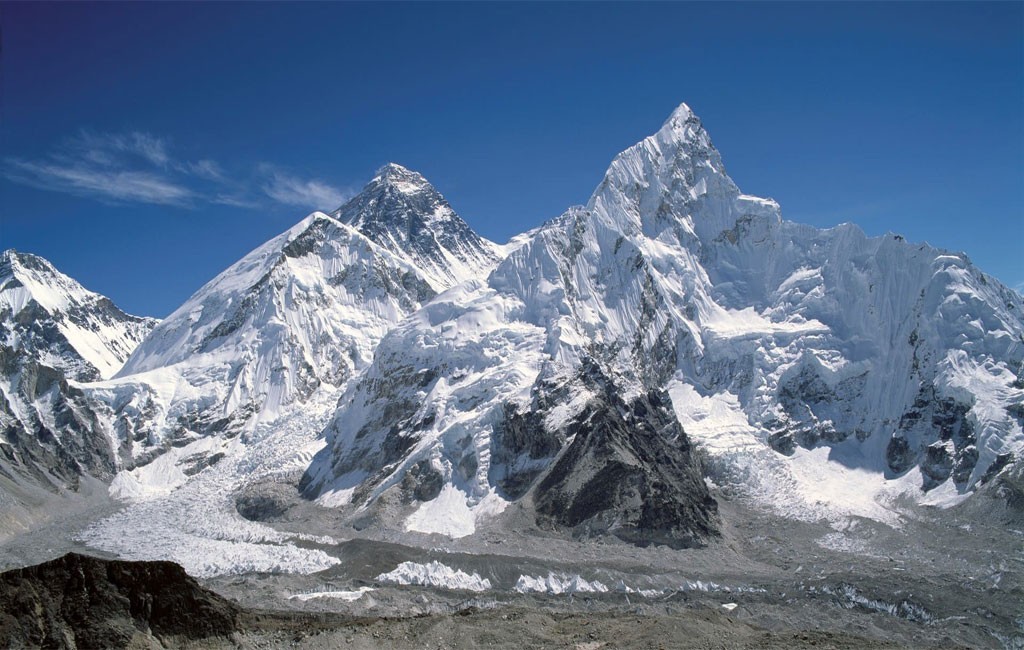
The Langtang Valley Trek is one of Nepal’s most celebrated and cherished trekking routes — a breathtaking journey into one of the Himalayas’ most spectacular and culturally rich valleys, just north of Kathmandu. Often described as a ‘valley of glaciers,’ Langtang offers extraordinary high-altitude scenery dominated by the towering Langtang Lirung (7,227 m), Ganesh Himal (7,422 m), and the Jugal Himal range, combined with a deeply authentic encounter with the Tamang people — one of Nepal’s most distinctive and welcoming Himalayan communities.

Unlike trekking routes that require flights to remote mountain airports, the Langtang Valley Trek begins with a road journey directly from Kathmandu — and that road journey is itself a significant, memorable, and important part of the overall experience. The drive from Kathmandu to Syabrubesi — the trailhead village at the gateway of Langtang National Park — covers approximately 120–122 km through a progressively dramatic sequence of landscapes: Kathmandu’s urban sprawl giving way to terraced hillside agriculture, then to the wild gorge of the Trishuli River, then to the increasingly high and remote terrain of the Rasuwa District as you climb toward the Himalayan frontier.

Getting this vehicle journey right — choosing the right vehicle type, booking with a reliable and professional provider, understanding the road conditions and the three available route options, and knowing exactly what to expect at every stage — sets the physical and psychological foundation for your entire Langtang trekking experience. A comfortable, timely, well-managed vehicle journey means you arrive at Syabrubesi rested and ready to trek. A poorly planned one — an overcrowded public bus, an inexperienced driver on mountain roads, or a last-minute scramble for shared transport — means you begin your adventure already tired and stressed.

This complete 2026 guide to the Kathmandu to Langtang trek vehicle hire covers everything you need: the full route narrative with the three road options, checkpoint distances and altitudes, road conditions by season, private jeep hire costs for all vehicle types, the permits required, the spectacular scenic highlights of the drive, the character of Syabrubesi as your trek starting point, and a clear comparison of all transport options — so you can make the best possible decision for your Langtang journey.

Nepal Vehicle Hiring Pvt. Ltd. — with its trusted 4WD fleet, experienced high-altitude mountain drivers, hotel pickup from anywhere in Kathmandu, and 24/7 WhatsApp support — is the vehicle partner of choice for trekkers heading to Langtang and throughout Nepal.


🏔️ Kathmandu to Langtang Trek Vehicle — Quick Reference (2026)
📍 Trek Trailhead: Syabrubesi Village, Rasuwa District, Bagmati Province
🏔️ Syabrubesi Altitude: 1,460–1,550 m (4,790–5,085 ft)
📏 Road Distance: Approx. 120–122 km (Kathmandu Thamel to Syabrubesi)
⏱️ Drive Time: 5–7 hours (private jeep) | 7–10 hours (public/shared bus)
🛣️ Route Options: 3 routes — Galchhi/Trishuli, Kakani Scenic, Tokha/Bidur
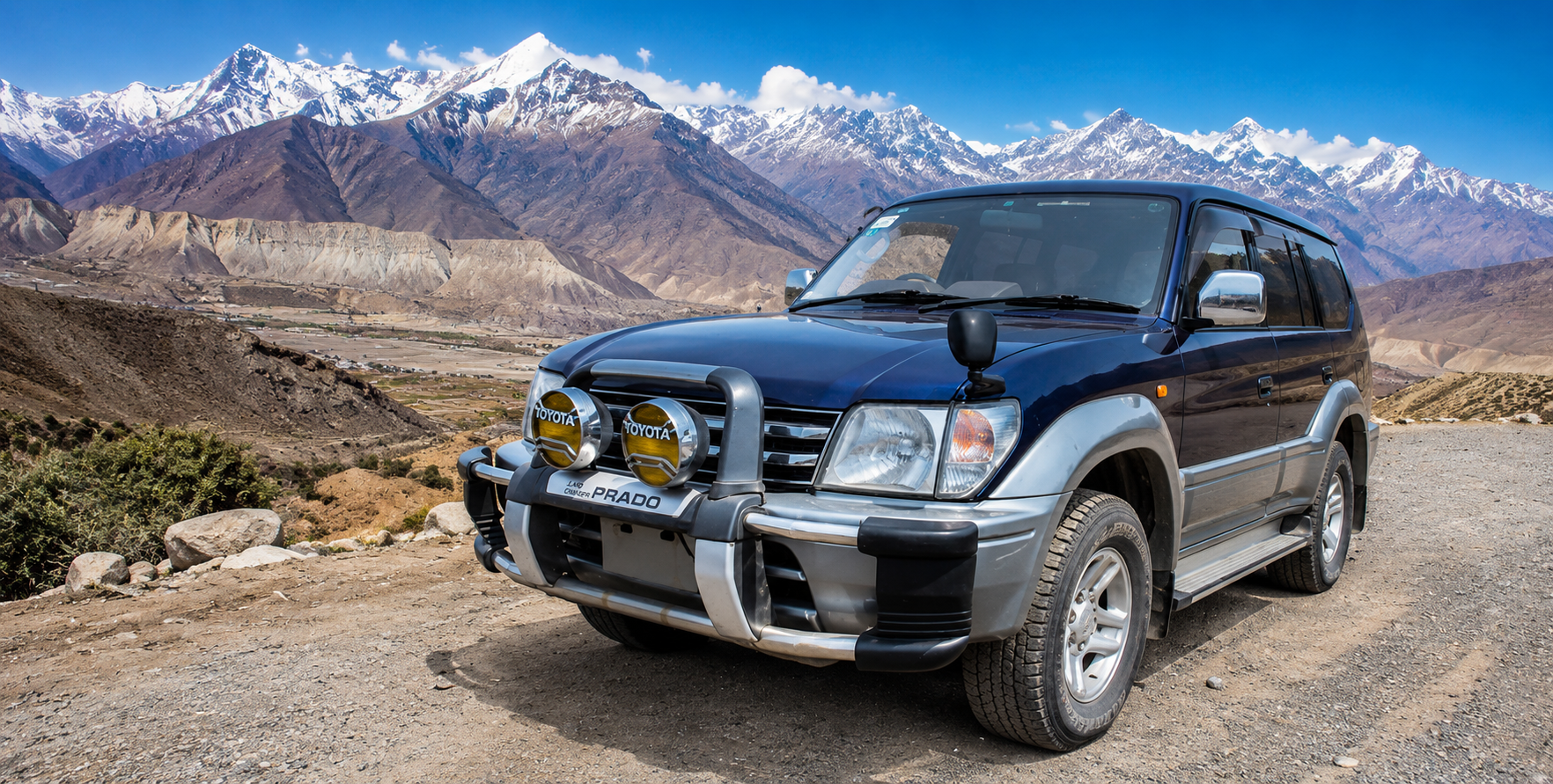
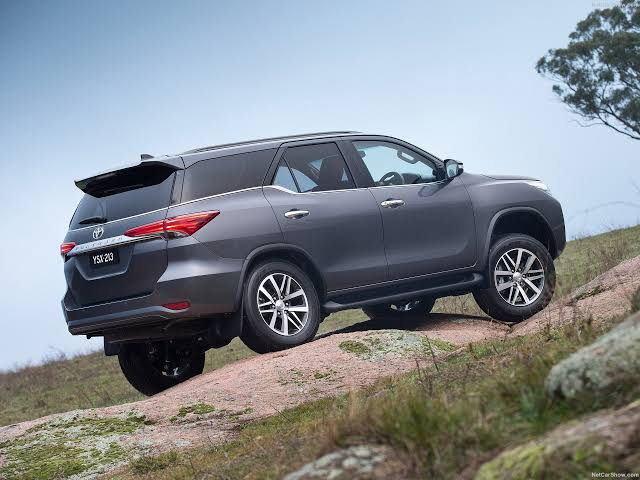
🚙 Vehicle Requirement: 4WD Jeep strongly recommended (Fortuner, Hilux, Land Cruiser)
📋 Permits: Langtang National Park Permit (NPR 3,000/person) + TIMS Card (NPR 2,000)
🗓️ Best Season: October–December and March–May
🎯 Trek Gateway To: Langtang Valley, Kyanjin Gompa, Tserko Ri, Tamang Heritage Trail, Helambu
📞 Book With: Nepal Vehicle Hiring Pvt. Ltd. | +977 9851013196


Langtang Valley: Nepal’s Closest High-Alpine Trekking Destination

Why Langtang Is Called the ‘Valley of Glaciers’

The Langtang Valley is a long, north-south glacial valley in the Rasuwa District, carved over millennia by the Langtang Khola river and its tributaries descending from the high peaks of the Nepal-Tibet border. The valley floor rises from Syabrubesi at approximately 1,460 metres to the extraordinary Kyanjin Gompa at 3,870 metres — a gain of over 2,400 vertical metres that takes trekkers through a complete spectrum of Himalayan ecological zones in just three to four days of walking.

The name ‘Valley of Glaciers’ reflects the extraordinary concentration of glacial ice in the upper reaches of the valley. The Langtang Glacier, Lirung Glacier, and Yala Glacier all descend from the peaks above 6,000 metres that ring the upper valley, creating a landscape of ice-carved drama that is unlike anything else accessible from Kathmandu within a single day’s drive. From Kyanjin Gompa, the highest point most trekkers reach, the view northward into the glacial amphitheater of Langtang Lirung and eastward toward the Tibetan Plateau is one of Nepal’s finest high-altitude panoramas.

The valley gained international attention for devastating reasons in April 2015, when the great Nepal earthquake triggered a catastrophic ice avalanche from Langtang Lirung that buried much of Langtang village and killed hundreds of residents and trekkers. The subsequent recovery and rebuilding of the Langtang Valley community has been one of Nepal’s most remarkable post-disaster stories — the Tamang people have rebuilt their villages, reopened their teahouses, and welcomed trekkers back with characteristic warmth and resilience. Trekking in Langtang today is not only a spectacular adventure but a meaningful act of support for a community that has demonstrated extraordinary strength.

Syabrubesi: Your Trek Gateway Village

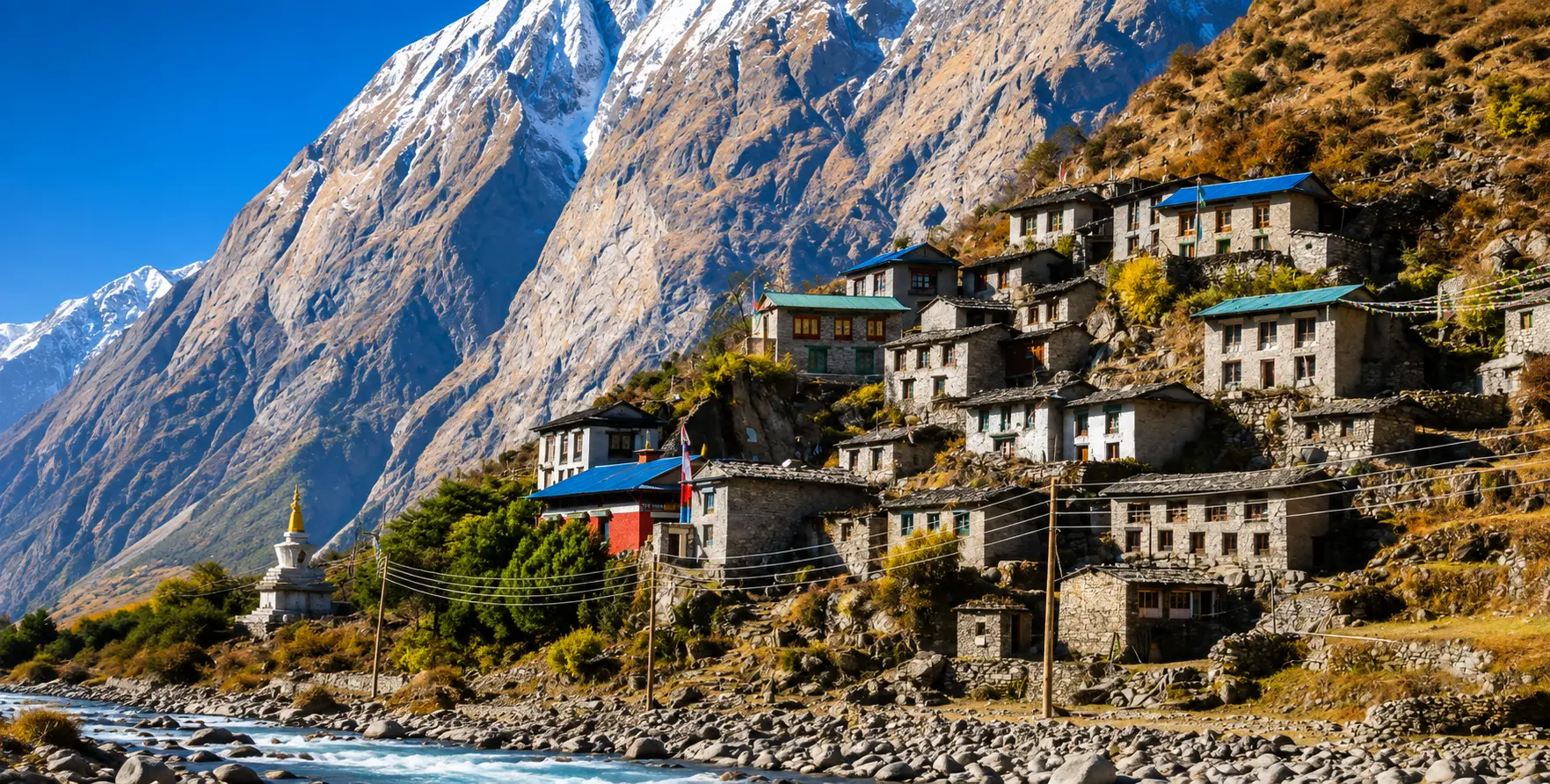
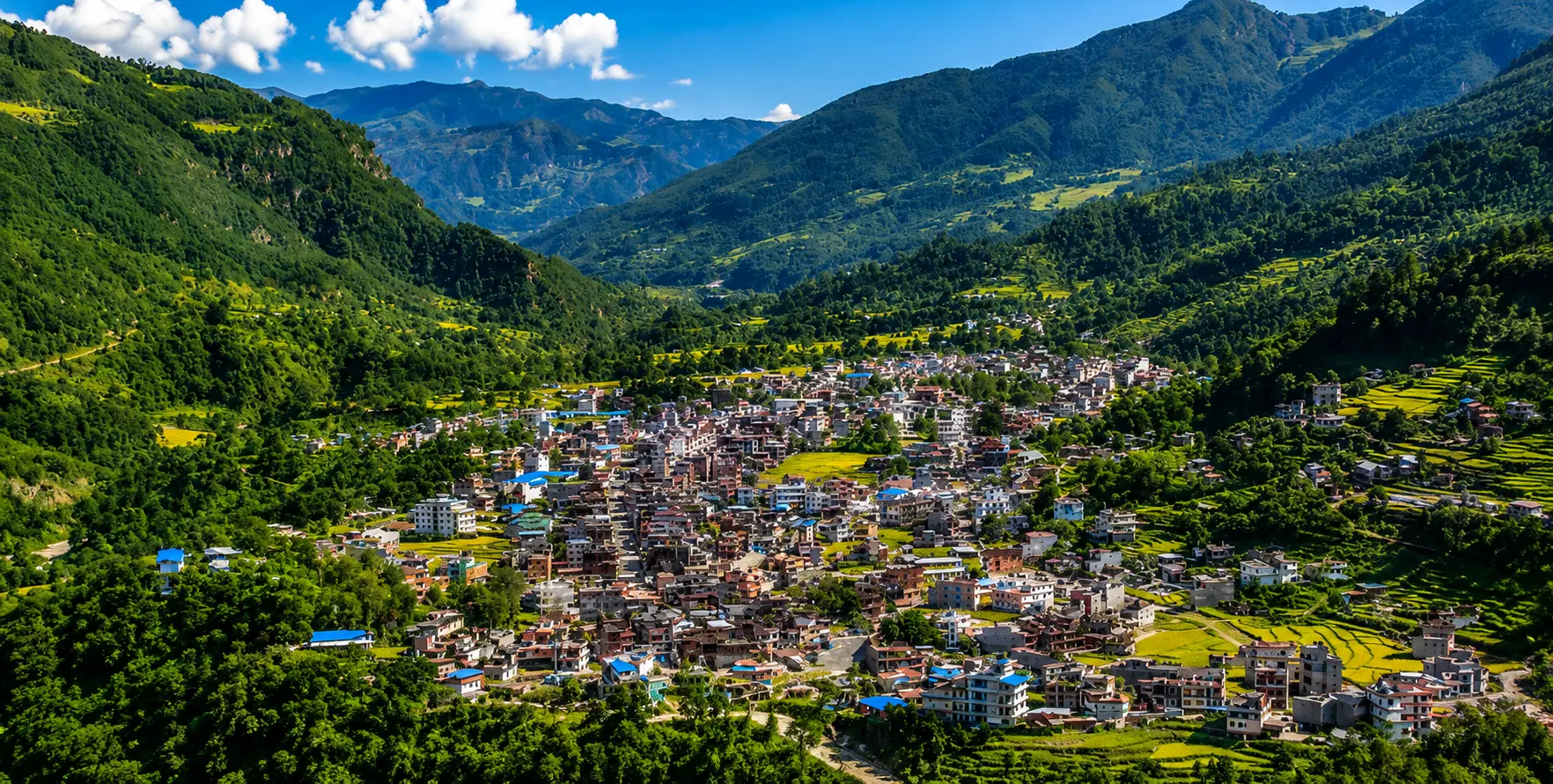
Syabrubesi is the small but lively market town at the confluence of the Langtang Khola and Bhote Koshi rivers that serves as the primary gateway for all treks in the Langtang region. Situated at approximately 1,460–1,550 metres in a dramatic river valley surrounded by forested hillsides, Syabrubesi has grown significantly since the 2015 earthquake reconstruction and now offers a good range of accommodation, restaurants, shops, and facilities for trekkers. The town has a strong Tamang cultural character — the majority of residents are Tamang people, and the architecture, food, and community life all reflect this distinct Tibetan-influenced culture.

From Syabrubesi, three distinct trekking routes fan outward: the main Langtang Valley Trek heading eastward up the Langtang Khola; the Tamang Heritage Trail heading south through traditional Tamang villages toward Gatlang, Tatopani, and Briddim; and the Helambu Trek heading south over the Lauribina La Pass toward the Helambu Valley and eventually Kathmandu. This makes Syabrubesi one of the most strategically important trek trailheads in Nepal — a single vehicle journey from Kathmandu opens access to three distinct and wonderful trekking experiences.

The Langtang Valley Trek — Overview

The classic Langtang Valley Trek itinerary runs 7 to 10 days in total, including the vehicle journey from Kathmandu. After arriving in Syabrubesi by private jeep on Day 1, trekkers follow the Langtang Khola river valley upstream through the subtropical forest villages of Bamboo and Ramche, climbing through increasingly alpine terrain to Lama Hotel (2,470 m), then Langtang Village (3,430 m, rebuilt after 2015), then Mundu and Kyanjin Gompa (3,870 m). Optional high-altitude day hikes from Kyanjin include the spectacular Kyanjin Ri (4,773 m) and the extraordinary Tserko Ri (5,033 m) — one of the finest viewpoints in the entire Langtang region. The return follows the same valley route back to Syabrubesi, where a private vehicle pickup returns trekkers to Kathmandu.


The Complete Route: Kathmandu to Syabrubesi (Three Options)

Route Overview — Three Roads to Syabrubesi

Unlike most Nepal trek trailhead drives which follow a single road, the Kathmandu to Syabrubesi journey offers three distinct route options. Each has different road quality, scenery, drive time, and suitability for different vehicle types. Understanding these three routes is essential for planning your vehicle hire effectively.


RouteDistanceDrive Time (Private Jeep)Road QualityBest For
Route 1: Galchhi/Trishuli Highway (Standard)~120–122 km5–6 hrsBest — mostly paved, smooth highwayAll travellers, first-timers, buses & jeeps
Route 2: Kakani Scenic Route~115–118 km6–7 hrsMixed — paved but often rougher, narrowerClear days, mountain view lovers, jeeps only
Route 3: Tokha/Bidur Route~118–120 km5.5–6.5 hrsGood — paved highway via TokhaAlternative to Route 1, also bus-friendly


The Galchhi/Trishuli Highway route is the most commonly used and most reliable road from Kathmandu to Syabrubesi. It follows the Prithvi Highway westward from Kathmandu to Galchhi (approximately 70 km), then turns northward onto the Pasang Lhamu Highway — the main road connecting Kathmandu to the Rasuwa District and the Nepal-Tibet border. This highway follows the spectacular Trishuli River gorge northward through Trishuli Bazaar and Betrawati before climbing steeply to Dhunche and descending to Syabrubesi.


CheckpointDistance from KathmanduAltitudeDrive Time from Ktm
Balaju / Ring Road (Kathmandu exit)5 km1,350 m15–20 min
Galchhi Junction (Prithvi Hwy turnoff)68 km800 m1.5–2.0 hrs
Trishuli Bazaar76 km870 m2.0–2.5 hrs
Betrawati88 km1,000 m2.5–3.0 hrs
Kalikasthan95 km1,200 m3.0–3.5 hrs
Ramche (Landslide Zone / NP Entry)108 km1,700 m4.0–4.5 hrs
Dhunche (District HQ / Permit Check)112 km2,030 m4.5–5.0 hrs
Thulo Bharkhu117 km1,800 m5.0–5.5 hrs
Syabrubesi (Trek Trailhead)120–122 km1,460 m5.5–6.5 hrs


Stage 1 — Kathmandu to Galchhi (68 km, ~1.5–2 hours): Leaving Kathmandu through Balaju and heading northwest, the road joins the Prithvi Highway — Nepal’s main arterial highway — and heads through the Trishuli River valley. The first hour is through the urban and semi-urban outskirts of the Kathmandu Valley before the road descends dramatically into the Trishuli gorge. At Galchhi, you leave the Prithvi Highway and turn northward onto the Pasang Lhamu Highway toward the Langtang region. This section is well-paved and the fastest part of the journey.

Stage 2 — Galchhi to Betrawati via Trishuli Bazaar (20 km, ~1 hour): The Pasang Lhamu Highway follows the west bank of the Trishuli River northward through the dramatic gorge landscape. The Trishuli River is a celebrated whitewater rafting destination and on weekends you will often see rafting groups on the turquoise water far below the road. Trishuli Bazaar is a significant town with restaurants, ATMs, and fuel stations — the last reliable ATM before Syabrubesi. Betrawati, a few kilometres further north, marks the point where the valley begins to narrow and the road starts climbing more steeply into the Rasuwa hills.

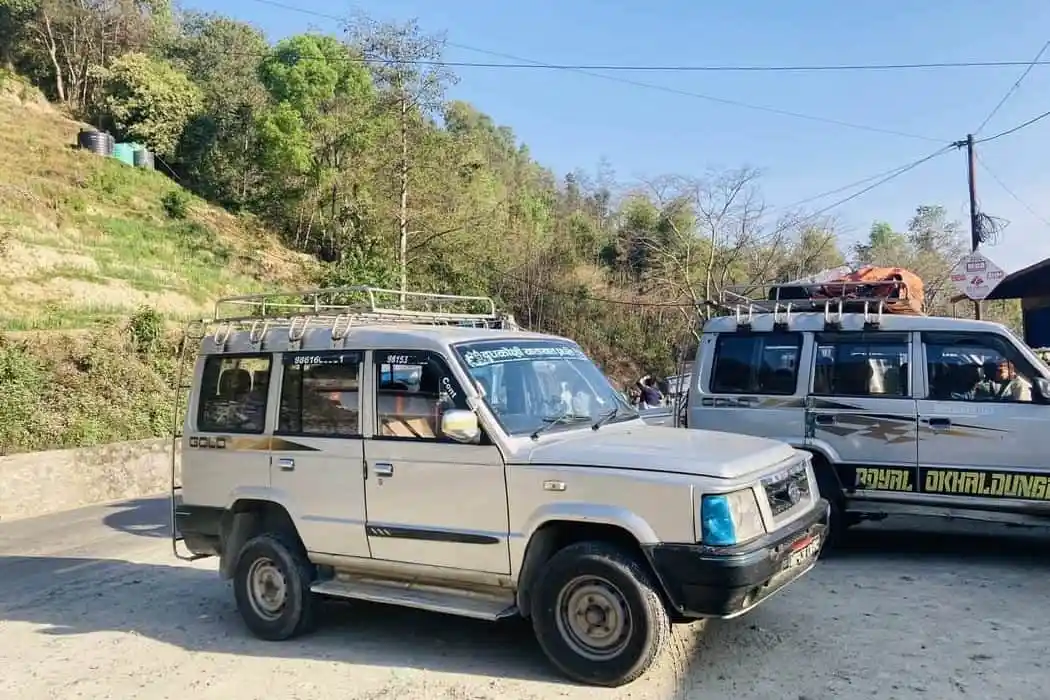
Stage 3 — Betrawati to Dhunche via Kalikasthan and Ramche (24 km, ~1.5–2 hours): This is the most dramatic and demanding section of the drive. Beyond Betrawati, the road climbs steeply through Kalikasthan — where, on clear days, the first extraordinary views of the Langtang range (Langtang Lirung at 7,227 m and Ganesh Himal at 7,422 m) appear on the northern horizon. The road then passes through the Ramche Landslide Zone — a 3 km section of unpaved or poorly maintained road that is the most technically challenging part of the entire journey, particularly after rainfall. Nepal Vehicle Hiring Pvt. Ltd.’s 4WD vehicles handle this section comfortably. Dhunche (2,030 m), the district headquarters of Rasuwa, is the Langtang National Park permit checkpoint — all trekkers must show permits here.

Stage 4 — Dhunche to Syabrubesi (10 km, ~45–60 minutes): The final stretch from Dhunche descends steeply from 2,030 metres down to Syabrubesi at 1,460 metres through a series of tight switchbacks with dramatic views of the Bhote Koshi valley and the distant Langtang peaks. The road is narrow and winding but paved. This section gives you your first clear views of the extraordinary river confluence at Syabrubesi and the forested hillsides that frame the entrance to the Langtang Valley. Arriving in Syabrubesi after this spectacular final descent feels like arriving somewhere genuinely remote and wild — the perfect psychological preparation for the trek ahead.

Route 2: Kakani Scenic Route

The Kakani route branches northward from the Kathmandu Valley via the scenic ridge village of Kakani (2,073 m) — a beautiful hilltop settlement with panoramic Himalayan views that is popular with Kathmandu day-trippers. The road climbs from Kathmandu through Nagarjun Forest Reserve to Kakani before descending to rejoin the Pasang Lhamu Highway near Trishuli Bazaar. The Kakani route offers potentially spectacular mountain views (Ganesh Himal, Langtang range, and Manaslu on a clear morning) but the road condition is often inferior to the Galchhi Highway route and the road is narrower and more winding throughout. Nepal Vehicle Hiring Pvt. Ltd. recommends this route only for jeep hire (not buses) and only in dry season with clear weather forecast. The total drive time is approximately 6–7 hours due to the slower road sections.

Route 3: Tokha / Bidur Route

The Tokha route exits Kathmandu northward through the Tokha area and descends to Bidur before joining the main Pasang Lhamu Highway near Betrawati. This is a slightly shorter route than the Galchhi highway in distance but not significantly faster due to road conditions in the Tokha area. It is used by some local buses and is suitable for jeeps and standard vehicles. Nepal Vehicle Hiring Pvt. Ltd. drivers are familiar with all three routes and will recommend the best option based on current road conditions, weather, and your vehicle type.


Road Conditions: Kathmandu to Syabrubesi (2026)

Kathmandu to Galchhi — Prithvi Highway

The Prithvi Highway section from Kathmandu to Galchhi is well-maintained, two-lane tarmac in good condition throughout the year. This section carries significant heavy vehicle traffic (trucks, buses) heading toward Pokhara and the western regions. Early morning departures (before 7:00 AM) beat the worst of the truck traffic. Road conditions on this section are excellent in dry season and generally good in monsoon, with occasional traffic delays due to minor accidents or construction works.

Galchhi to Betrawati — Pasang Lhamu Highway (Trishuli Section)

The Pasang Lhamu Highway from Galchhi to Betrawati is paved and in reasonable condition. The road follows the Trishuli River gorge and is subject to occasional landslide damage during and immediately after the monsoon season (June–September). The road is narrower than the Prithvi Highway with less room for vehicle passing, but experienced mountain drivers navigate it comfortably. This section is suitable for all vehicle types in dry season. During monsoon, 4WD vehicles are preferred.

Betrawati to Dhunche — The Mountain Climb

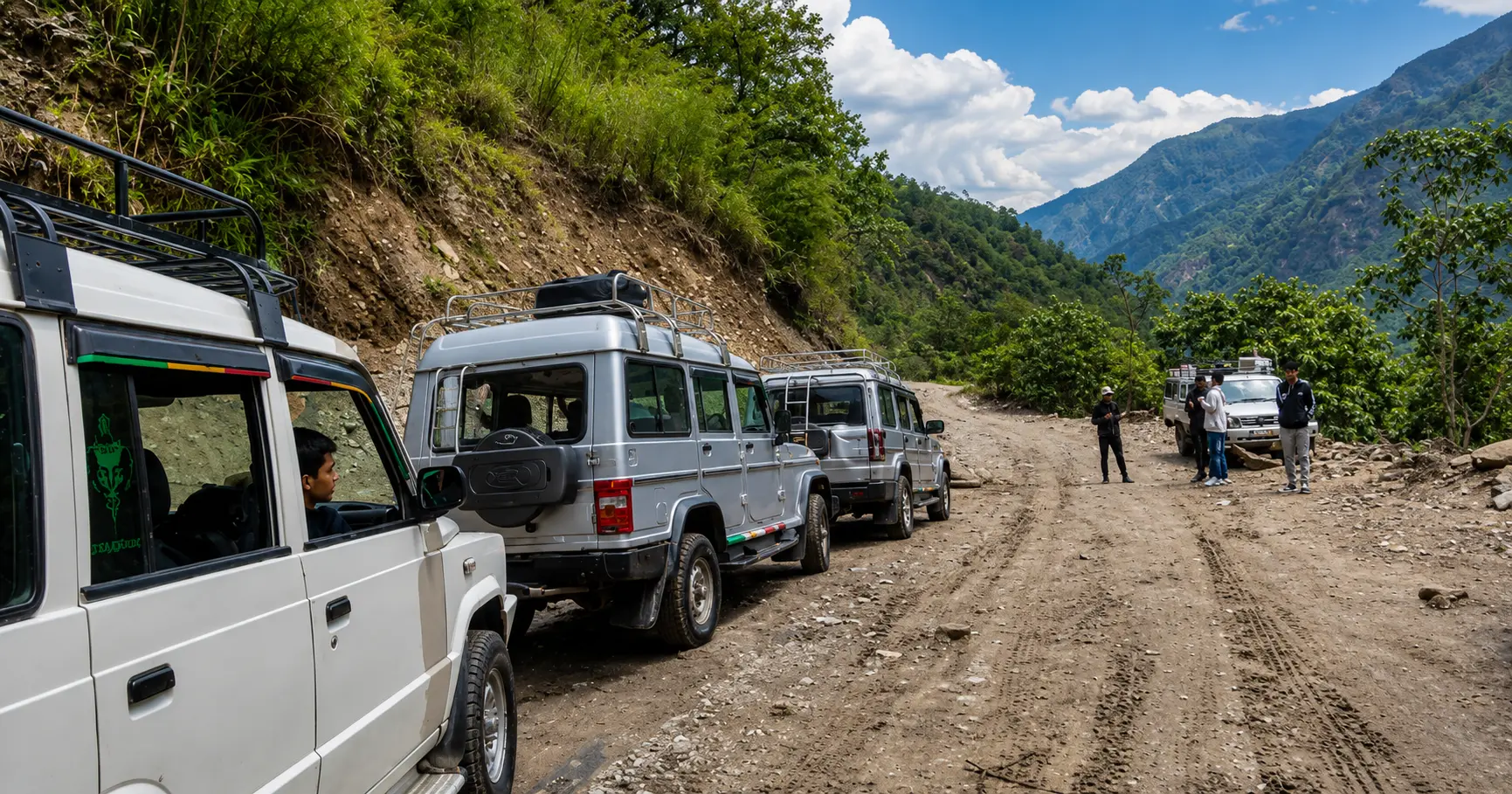
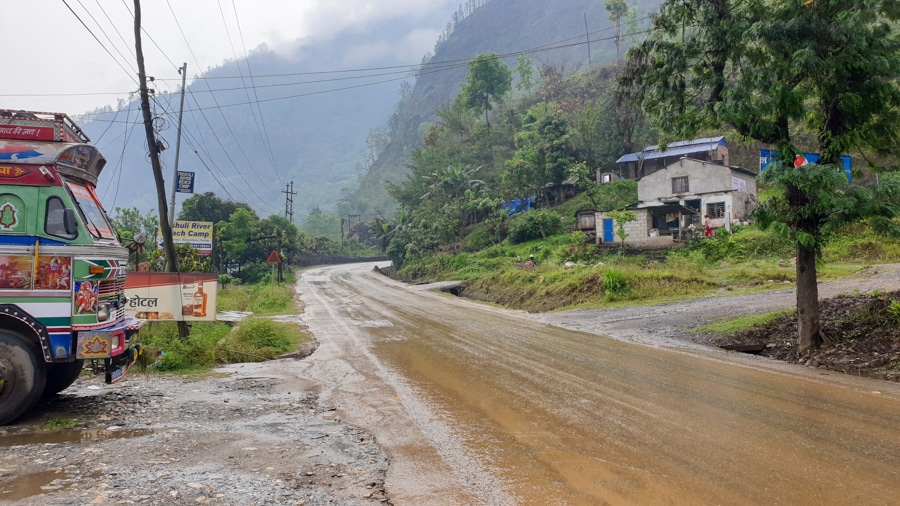
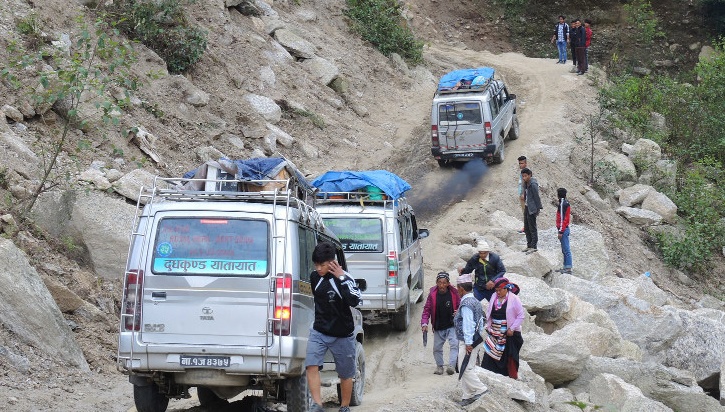
This is the most road-condition-sensitive section of the entire Kathmandu to Syabrubesi journey. The road climbs over 1,000 vertical metres from Betrawati to Dhunche through increasingly steep and winding terrain. The Ramche Landslide Zone (approximately 3 km before Dhunche) is the most consistently challenging section — unpaved or poorly maintained, narrow, and prone to post-rain surface damage. In 2026, this section is reported to be better maintained than in previous years, but it remains a bumpy, rough section where a 4WD vehicle with experienced mountain driver has a clear advantage over standard vehicles and buses.

Dhunche to Syabrubesi — Final Descent

The descent from Dhunche to Syabrubesi follows a winding, narrow paved road through multiple steep switchbacks. The road is technically demanding for drivers but manageable for all 4WD vehicles. In monsoon, this section can be affected by minor landslides from the hillsides above the road. In dry season, conditions are generally good. This section is not suitable for large buses.


Road SectionCondition (Dry Season)Condition (Monsoon)4WD Required?
Kathmandu to Galchhi (Prithvi Hwy)Excellent — paved, smoothGood — minor traffic delays possibleNo — all vehicles suitable
Galchhi to Betrawati (Pasang Lhamu Hwy)Good — paved river gorge roadFair — occasional landslide riskRecommended but not mandatory
Betrawati to Ramche (Mountain climb)Fair to Good — winding, pavedChallenging — rough surface, wetStrongly recommended
Ramche Landslide Zone (3 km)Rough — unpaved sectionsVery Challenging — muddy, unstableYES — 4WD essential
Dhunche to Syabrubesi (descent)Good — paved, steep switchbacksFair — minor landslide riskStrongly recommended


⚠️ Critical Vehicle Warning for Langtang Route
❌ Standard sedans and non-4WD cars are NOT recommended beyond Betrawati.
❌ Large tourist buses cannot access the Dhunche–Syabrubesi final descent safely.
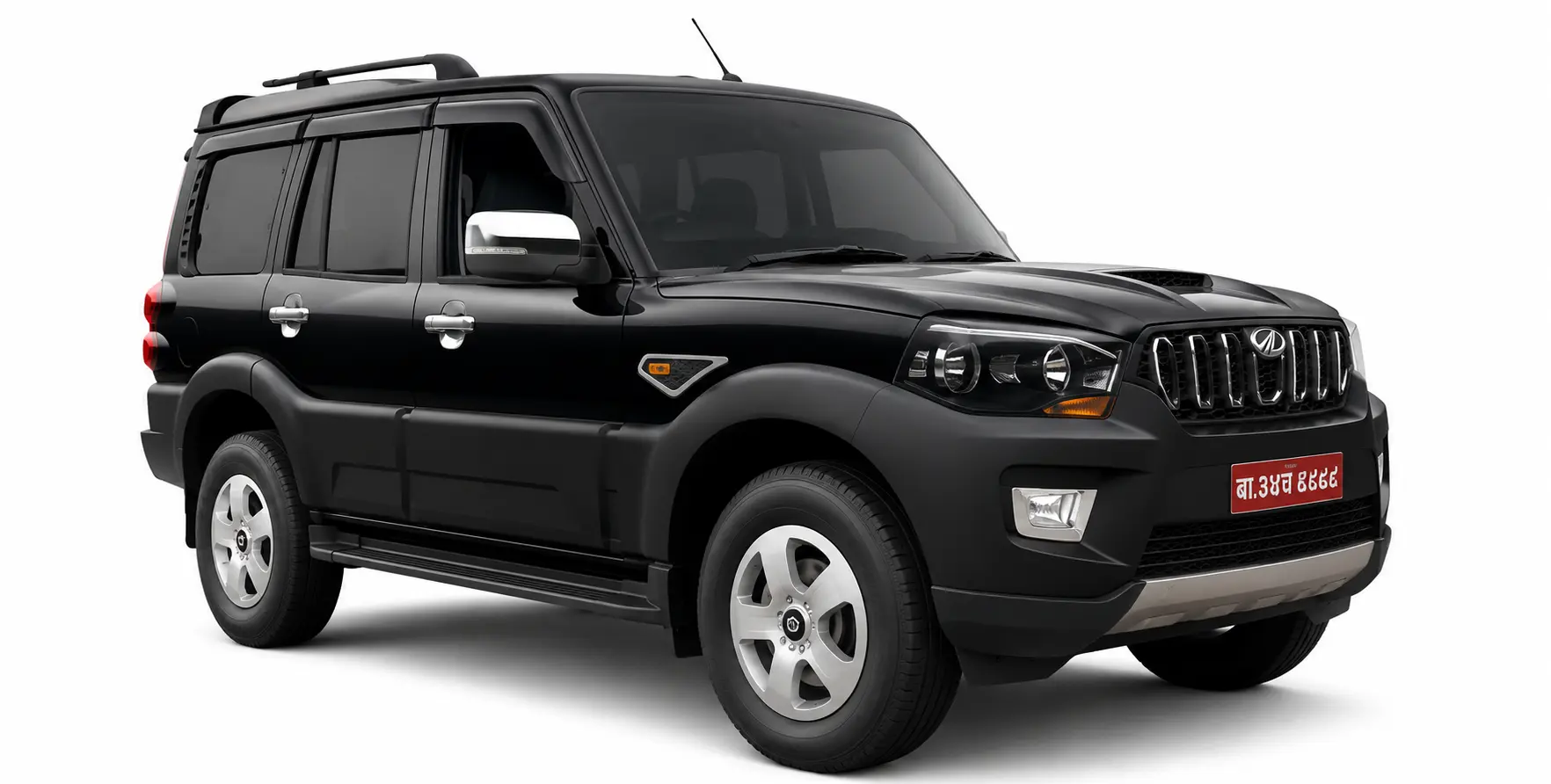
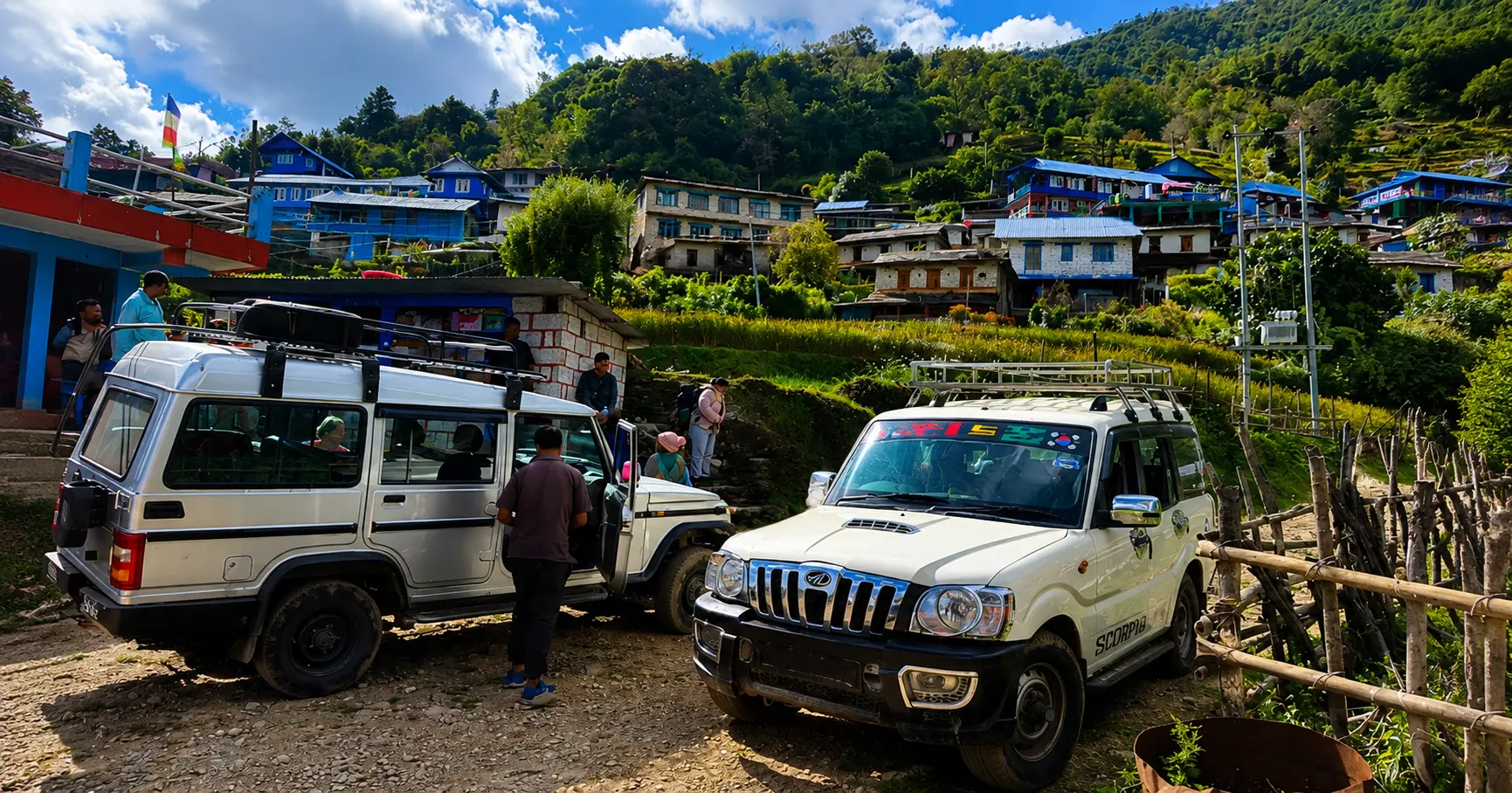
✅ 4WD Jeep (Fortuner, Hilux, Land Cruiser, Scorpio) is the IDEAL vehicle for this route.
✅ All Nepal Vehicle Hiring Pvt. Ltd. jeeps are 4WD and driven by mountain-road specialists.
✅ Private 4WD jeep is 2–3 hours faster than public bus on the Langtang route.
ℹ️ The Ramche Landslide Zone (3 km) is the most challenging section — 4WD handles it best.


Kathmandu to Syabrubesi Vehicle Hire Cost (2026)

Private Jeep Hire — One Way, Kathmandu to Syabrubesi

A private jeep hire from Kathmandu to Syabrubesi is the most popular, comfortable, and efficient way for trekking groups, families, and serious trekkers to reach the Langtang trailhead. Hotel pickup from anywhere in Kathmandu, a flexible departure time, the ability to stop at viewpoints and tea stalls en route, and door-to-trailhead delivery make private hire the clear choice for anyone valuing comfort and convenience over minimal cost.


Vehicle TypeCapacityOne-Way Cost (Kathmandu→Syabrubesi)Return Cost (Syabrubesi→Kathmandu)
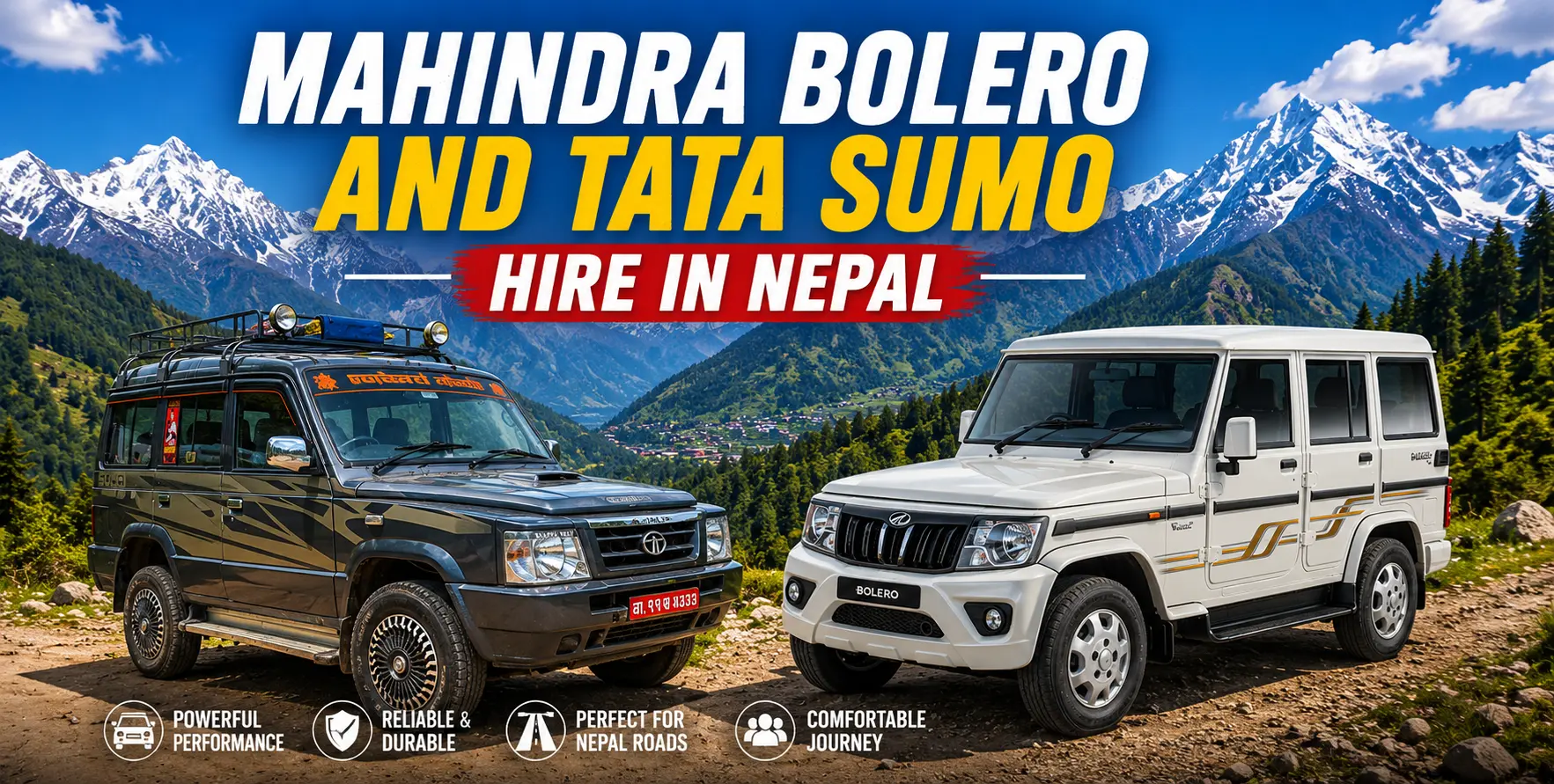
4WD Jeep (Scorpio/Bolero)1–5 passengersNPR 18,000–22,000 / USD 130–160NPR 16,000–20,000 / USD 116–145
4WD Toyota Fortuner1–6 passengersNPR 22,000–28,000 / USD 160–204NPR 20,000–25,000 / USD 145–182
4WD Toyota Hilux1–5 passengersNPR 20,000–26,000 / USD 145–189NPR 18,000–23,000 / USD 130–167
4WD Toyota Land Cruiser1–7 passengersNPR 27,000–35,000 / USD 196–254NPR 24,000–32,000 / USD 174–232
Hiace Van (to Dhunche only)7–14 passengersNPR 25,000–32,000 / USD 182–232NPR 22,000–28,000 / USD 160–204


Price Inclusions: Professional driver experienced on mountain roads, fuel for the complete journey, vehicle insurance, hotel pickup from anywhere in Kathmandu (Thamel, Lazimpat, Durbar Marg, all central areas), all road tolls and fees, and a vehicle emergency kit.

Price Exclusions: Langtang National Park permit (NPR 3,000/person), TIMS Card (NPR 2,000/person), passenger meals and accommodation, driver meals and accommodation (for multi-day bookings with vehicle waiting in Syabrubesi).

Cost Per Person by Group Size


Group SizeVehicleTotal Vehicle CostPer Person Cost
1–2 people4WD Scorpio / BoleroNPR 18,000–22,000NPR 9,000–22,000/person
3–4 people4WD FortunerNPR 22,000–26,000NPR 5,500–8,700/person
5–6 people4WD Land CruiserNPR 26,000–32,000NPR 4,300–6,400/person
7–10 peopleHiace Van (to Dhunche)NPR 26,000–32,000NPR 2,600–4,600/person


For groups of 4 or more, a private 4WD jeep from Nepal Vehicle Hiring Pvt. Ltd. becomes comparable in per-person cost to shared jeep options — while delivering the enormous advantages of hotel pickup, flexible timing, and guaranteed delivery to Syabrubesi without the uncertainty and discomfort of shared transport.

Shared Jeep and Bus Options — Budget Alternatives


Transport OptionCostDepartureJourney TimeComfortReliability
Private Jeep — Nepal Vehicle HiringNPR 18,000–35,000 (full vehicle)Flexible, hotel pickup5–7 hrs★★★★★★★★★★
Shared Jeep (Syabrubesi)NPR 1,400–1,800/person~7 AM, Machhapokhari Bus Park6–8 hrs★★★☆☆★★★☆☆
Tourist Bus (Kathmandu–Syabrubesi)NPR 800–1,200/person6–7 AM, various operators7–10 hrs★★★☆☆★★★☆☆
Local Public BusNPR 300–500/personEarly AM, Machhapokhari8–12 hrs★★☆☆☆★★☆☆☆


Vehicle Waiting Service — Syabrubesi Standby

For trekkers who want their private vehicle to remain in Syabrubesi and be available for immediate return at trek completion (without pre-arranging a separate return vehicle), Nepal Vehicle Hiring Pvt. Ltd. offers a vehicle standby service. The vehicle and driver remain in Syabrubesi for the duration of your trek, ready to depart on your schedule. This is particularly useful for trekkers with tight return flight schedules. Standby pricing is available on request — contact our team for a customized quote based on your trek duration.


Required Permits: Kathmandu to Langtang Trek (2026)

The Langtang Valley Trek enters Langtang National Park — Nepal’s fourth-largest national park, covering 1,710 square kilometres of outstanding Himalayan terrain including glaciers, alpine meadows, dense forests, and the internationally important Langtang Biosphere Reserve. All trekkers entering the park are required to carry valid permits, which are checked at the Dhunche Army Checkpoint and again at the Langtang National Park entrance.

Since April 2023, trekking in Langtang National Park also requires a licensed guide. This rule is strictly enforced at checkpoints and is non-negotiable. Nepal Vehicle Hiring Pvt. Ltd. can connect you with trusted licensed guide services as part of your trip planning.


Permit / DocumentWho Needs ItCost (2026)Where to Obtain
Langtang National Park Entry PermitAll foreign visitors entering Langtang National Park (including vehicle transit to Syabrubesi)NPR 3,000/person (approx. USD 22)Nepal Tourism Board offices, Kathmandu (Bhrikuti Mandap or Pradarshani Marg) or Trishuli Bazaar checkpoint
TIMS Card (Trekkers’ Information Management System)All foreign trekkersNPR 2,000/person individual (NPR 1,000 through registered agencies)Nepal Tourism Board offices — same locations as above
SAARC Nationals — National Park PermitIndia, Bangladesh, Pakistan, Sri Lanka, Bhutan, Maldives, AfghanistanNPR 1,500/personSame as above
SAARC Nationals — TIMSSAARC visitorsNPR 1,500/personSame as above
Nepali NationalsNepali citizensNPR 100 entry permit | No TIMS requiredSame as above
Licensed Guide (MANDATORY since 2023)Required for ALL trekkers in Langtang National Park — enforced at checkpointsUSD 25–35/day (guide fee)Book through registered trekking agencies in Kathmandu or Pokhara


Permits can be obtained at the Nepal Tourism Board office in Kathmandu (Bhrikuti Mandap, near Tundikhel — open Sunday to Friday, 10:00 AM to 5:00 PM). Carry two passport-sized photographs and your original passport for each permit application. Alternatively, permits can sometimes be obtained at the checkpoint in Dhunche, but the Dhunche checkpoint can have queues during peak season — obtaining permits in Kathmandu the day before departure is strongly recommended.

The mandatory licensed guide requirement has been fully enforced since its introduction in April 2023. Trekkers without a licensed guide are turned back at the Langtang National Park checkpoints. Nepal Vehicle Hiring Pvt. Ltd. can provide contact details for reputable licensed guide services in Kathmandu.


Scenic Highlights of the Kathmandu to Syabrubesi Drive

The Kathmandu to Syabrubesi vehicle journey is far more than a logistical transfer — it is a spectacular introduction to the landscapes and atmosphere of the Langtang region. Here are the key scenic and cultural highlights to watch for en route:

The Trishuli River Gorge (Galchhi to Betrawati)

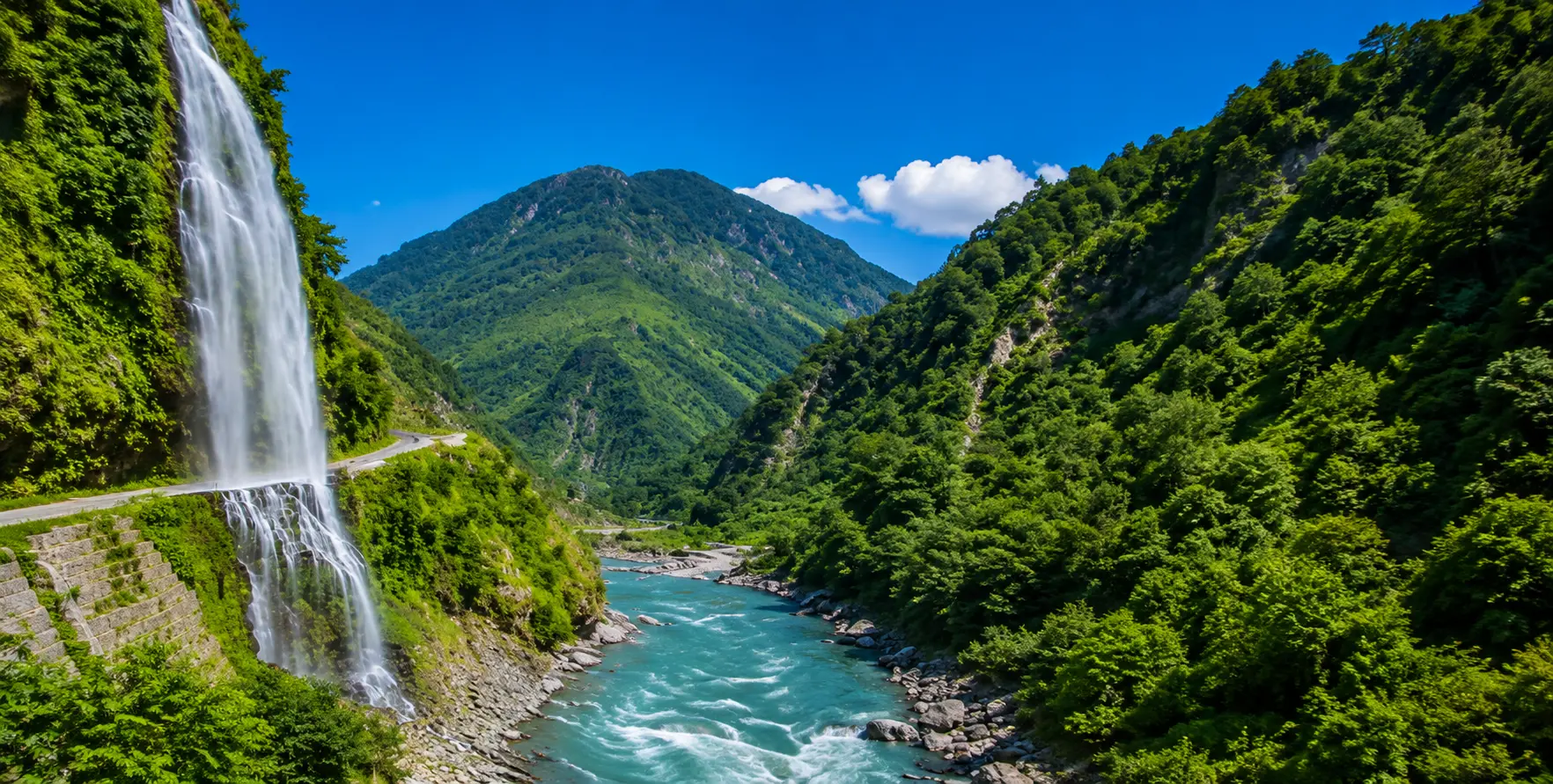
After turning northward at Galchhi, the road enters the Trishuli River gorge — one of Nepal’s most dramatic river landscapes. The Trishuli River is a major whitewater rafting destination, and its churning blue-green waters visible far below the road create a spectacular visual backdrop to the drive. The gorge walls rise steeply on both sides, draped in subtropical vegetation, and the road clings to the cliffside in places with vertiginous drops to the river below. On weekends in season, you will often see groups of rafters navigating the rapids — a vivid reminder that Nepal’s adventure tourism extends far beyond trekking.

Trishuli Bazaar — Last Major Town Before the Mountains

Trishuli Bazaar is a significant town approximately 76 km from Kathmandu and the last settlement of real size on the Kathmandu to Syabrubesi route. The town has several good restaurants, ATMs (the last reliable ones before Syabrubesi — withdraw here!), fuel stations, and basic shops. Many drivers stop here for breakfast or an early tea break. The surrounding area has historical significance as the site of the Trishuli Hydropower Project, one of Nepal’s most important early hydroelectric developments.

Kalikasthan — First Himalayan Peak Views

Just beyond the village of Kalikasthan, at approximately 1,200 metres, the valley opens and on clear mornings the first extraordinary views of the Langtang and Ganesh Himal ranges appear on the northern horizon. Ganesh Himal (7,422 m) — named after the elephant-headed Hindu deity — and Langtang Lirung (7,227 m) are often the first peaks visible, rising white and massive against the blue sky. Ask your Nepal Vehicle Hiring driver to slow down at the Kalikasthan viewpoint for photographs — it is one of the finest roadside Himalayan views accessible from Kathmandu.

The Ramche Landslide Zone — Evidence of Nepal’s Raw Power

The Ramche area, just before Dhunche, is where the road passes through an active landslide zone that has periodically blocked or damaged the Kathmandu–Syabrubesi road over the years. In 2016, a major landslide temporarily dammed the Trishuli River near this area. In 2026, the road through Ramche is better maintained than in previous years but remains the roughest section of the journey. This is where your 4WD vehicle earns its value — navigating the unpaved, potholed 3 km section with the confidence and capability that a standard car or bus simply cannot match.

Dhunche — The Mountain Town Gateway

Dhunche (2,030 m) is the district headquarters of Rasuwa District and the Langtang National Park permit checkpoint. The town sits on a broad ridge with stunning views of the surrounding forested mountains and — on clear days — distant Himalayan peaks. It has a small bazaar, several teahouses and restaurants, a fuel station (the last one before Syabrubesi), and the national park entry gate where permits are checked. Most travellers stop briefly in Dhunche for tea and a permit check. The landscape at Dhunche — pine and rhododendron forests stretching over hillsides in every direction, with mountain peaks rising above the tree line — announces unambiguously that you have arrived in the Himalayas.

Thulo Bharkhu — Valley Views Before the Final Descent

Between Dhunche and Syabrubesi, the road passes through the Thulo Bharkhu area at approximately 1,800 metres — a spectacular viewpoint above the Bhote Koshi valley. Here, looking down into the deep river valley below and north toward the Nepal-Tibet border peaks, the scale and wildness of the Langtang region becomes fully apparent for the first time. The descent from Thulo Bharkhu to Syabrubesi through multiple steep switchbacks is exhilarating in a well-driven 4WD vehicle and is the final chapter of your drive before arriving at the trailhead.


Best Time to Travel from Kathmandu to Langtang

October to December — Autumn Peak Season (BEST)

The post-monsoon autumn season is the finest time for the Kathmandu to Syabrubesi vehicle journey and the Langtang Valley Trek. October and November offer the most reliably clear mountain views — the air has been washed crystal-clean by the monsoon rains, and Langtang Lirung, Ganesh Himal, and the Jugal Himal chain stand in breathtaking clarity above the valleys. Road conditions are at their best after the monsoon damage has been repaired. Temperatures in Syabrubesi are pleasant (15–22°C by day) and cool at night. The drive through the Trishuli gorge in October is spectacular, with lush monsoon vegetation still green and the river full and dramatic. This is the most popular season for Langtang trekkers — book your vehicle well in advance.

March to May — Spring Season (EXCELLENT)

Spring is the second peak season for Langtang trekking and the Kathmandu–Syabrubesi drive. The rhododendron forests on the hillsides between Betrawati and Dhunche burst into magnificent bloom in March and April, creating a spectacular floral display visible from the road. Mountain views are generally clear in the mornings before afternoon cloud build-up. Temperatures warm up progressively through May. The Trishuli River is typically lower and calmer in spring, and the road conditions are generally good following the winter dry period.

December to February — Winter (POSSIBLE WITH PREPARATION)

Winter offers the clearest, coldest conditions on the Kathmandu to Syabrubesi route. The mountain views from Kalikasthan in December are often extraordinary — sharp and crystal-clear in the dry winter air. However, snow can fall on the road above Dhunche in January, and the Dhunche–Syabrubesi descent can become icy. Nepal Vehicle Hiring Pvt. Ltd. monitors road conditions in winter and can advise on whether chains or other precautions are needed. Syabrubesi itself rarely receives significant snow, but temperatures are cold (5–10°C by day, -5°C or colder at night). The Langtang Valley trek is possible in winter for well-prepared trekkers.

June to September — Monsoon (CHALLENGING)

The monsoon season presents the most challenging road conditions on the Kathmandu to Syabrubesi route. The Ramche Landslide Zone is most active during heavy monsoon rainfall and can periodically block the road for hours or occasionally days. Landslides also affect sections of the Trishuli gorge road between Galchhi and Betrawati. Nepal Vehicle Hiring Pvt. Ltd. maintains real-time road condition monitoring during monsoon and will advise clients honestly about current conditions before departure. If road conditions permit, a private 4WD jeep is the only reasonable vehicle choice for monsoon season travel on this route.


Why Choose Nepal Vehicle Hiring Pvt. Ltd. for Your Langtang Trek Vehicle

The Kathmandu to Syabrubesi road is one of Nepal’s most demanding and interesting vehicle journeys — a full day on mountain roads that transitions from city highway to remote Himalayan valley. It requires an experienced driver, a capable 4WD vehicle, and a company that knows the route thoroughly in all conditions. Nepal Vehicle Hiring Pvt. Ltd. has been trusted by thousands of Langtang trekkers to deliver exactly this standard of service.

🚗 Why Nepal Vehicle Hiring Is Your Best Partner for Langtang
✅ 8,000+ satisfied customers | 5.0 ⭐ TripAdvisor | 200+ verified 5-star reviews
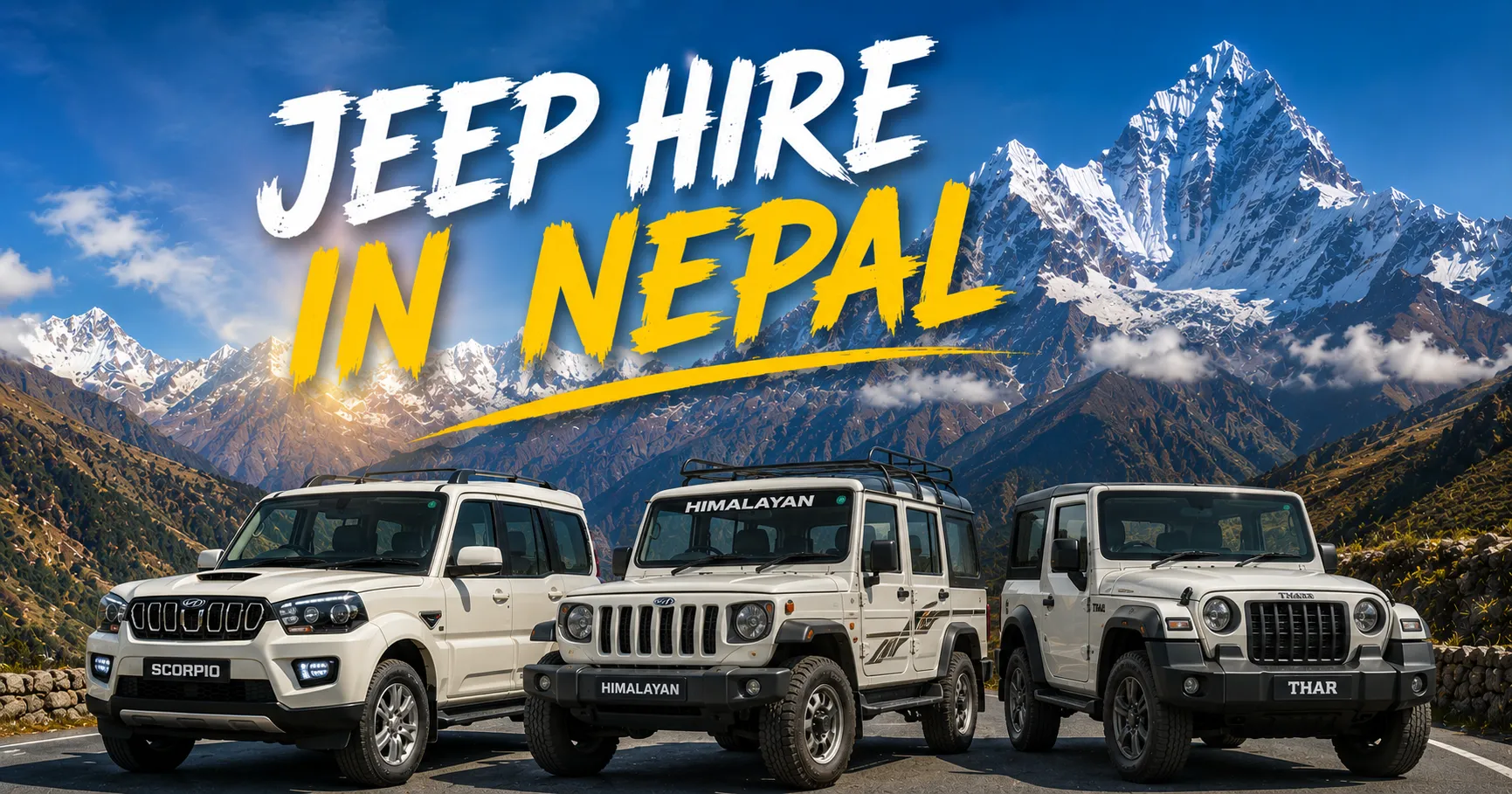
✅ All-4WD fleet — Fortuner, Hilux, Land Cruiser, Scorpio — all mountain-road ready
✅ Drivers with specific experience on Pasang Lhamu Highway & Ramche section
✅ Bilingual drivers — English, Nepali, Hindi — brief you on route highlights
✅ Hotel pickup from anywhere in Kathmandu — Thamel, Lazimpat, Durbar Marg, all areas
✅ Flexible departure — leave at 5:30 AM or 7:00 AM — your schedule, your choice
✅ Real-time road condition monitoring — especially critical for monsoon travel
✅ Return vehicle pickup from Syabrubesi on your specified date — pre-arranged and guaranteed
✅ Transparent all-inclusive pricing — fuel, driver, vehicle, tolls — no hidden charges
✅ 24/7 WhatsApp support: +977 9851013196 | Licensed & Registered | Reg. No. 219204

Our Fleet for the Kathmandu to Syabrubesi Route


VehicleCapacityWhy It’s Right for LangtangBest Group Size
4WD Toyota Fortuner1–6 paxPowerful engine handles Ramche zone, spacious cabin, excellent AC4–6 people ideal
4WD Toyota Hilux1–5 paxHigh ground clearance, proven mountain performer, good luggage3–5 people ideal
4WD Toyota Land Cruiser1–7 paxPremium comfort for long mountain drive, maximum reliability5–7 people ideal
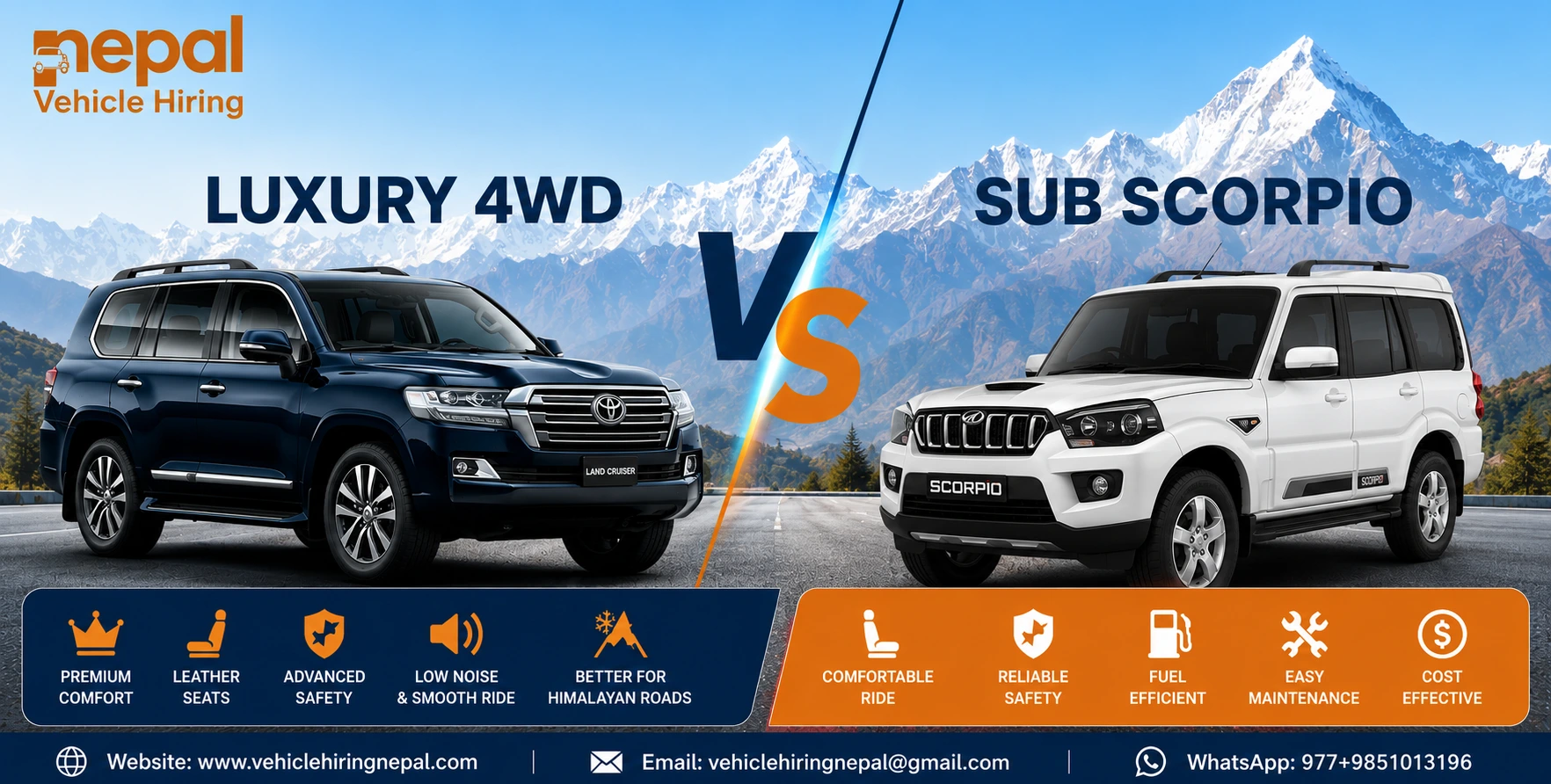
4WD Scorpio / Bolero1–5 paxCost-effective, capable 4WD, good for budget-conscious groups2–4 people ideal
Hiace Van (to Dhunche)7–14 paxFor larger groups — note: only to Dhunche, not full Syabrubesi descent7–14 people (to Dhunche)


Step-by-Step Booking Guide

  • Step 1 — Contact Nepal Vehicle Hiring via WhatsApp (+977 9851013196), phone, email ([email protected]), or website (vehiclehiringnepal.com).
  • Step 2 — Share your travel date, group size, Kathmandu hotel name/address, preferred departure time, and whether you need one-way drop-off or return pickup (or both).
  • Step 3 — Choose your vehicle from our recommendations based on group size and budget.
  • Step 4 — Receive booking confirmation with driver name, vehicle plate number, and driver WhatsApp contact.
  • Step 5 — Obtain Langtang National Park permit and TIMS card from Nepal Tourism Board office in Kathmandu the day before departure (Bhrikuti Mandap, open from 10:00 AM).
  • Step 6 — Arrange your licensed guide if you have not already done so (mandatory since April 2023).
  • Step 7 — Be ready at your hotel lobby at the agreed time — typically 5:30–6:30 AM for Kathmandu to Syabrubesi. Your driver WhatsApps when 10 minutes away.
  • Step 8 — Enjoy the spectacular drive! Your driver will suggest the best stops for views, tea, and meals en route.


Practical Tips for Your Kathmandu to Langtang Trek Vehicle Journey

A 5:30–6:30 AM departure from Kathmandu is strongly recommended for the Langtang trek vehicle journey. This early start beats the worst of Kathmandu’s morning traffic, allows you to reach Trishuli Bazaar by mid-morning for a comfortable breakfast stop, pass through the Ramche section in good daylight, arrive in Dhunche for a late lunch and permit check, and reach Syabrubesi by mid-afternoon with time to settle into your guesthouse before dark. Departures after 8:00 AM risk arriving in Syabrubesi in the dark — particularly in winter when daylight hours are shorter.

The ATM Stop at Trishuli Bazaar — Essential

There are no functioning ATMs between Trishuli Bazaar and Kathmandu on the return journey (most Dhunche ATMs are unreliable). Budget your cash carefully for the full trek: accommodation and meals (approximately NPR 1,500–2,500 per person per day), guide and porter fees (NPR 2,000–3,000/day for guide, NPR 1,500–2,000/day for porter), entrance fees at monasteries, and incidental expenses. A trekker doing a 7-day Langtang Valley Trek should carry at least NPR 30,000–40,000 per person in cash. Withdraw at the Trishuli Bazaar ATM on the way — do not rely on Dhunche or Syabrubesi machines.

Motion Sickness Preparation

The Kathmandu to Syabrubesi road involves over 1,000 turns, bends, and switchbacks — the route is justifiably famous among Nepal drivers for its twisting mountain road character, particularly the sections above Betrawati and the descent from Dhunche. If you or any member of your group is susceptible to motion sickness, take appropriate medication before departure (30–60 minutes before the journey begins). The front passenger seat gives the smoothest ride and the least motion sickness exposure. Nepal Vehicle Hiring Pvt. Ltd. drivers drive smoothly and at a pace appropriate to the conditions, but the mountain road character is inherent to this route.

What to Pack for the Vehicle Journey

  • Motion sickness medication — taken 30–60 minutes before departure if you are susceptible.
  • Langtang National Park permit and TIMS card — must be in your daypack before leaving Kathmandu.
  • Cash in Nepali Rupees — withdraw from Kathmandu; supplement at Trishuli Bazaar ATM.
  • Snacks and water for the road — approximately 1–1.5 litres of water per person for the drive.
  • Light layers and a jacket — the temperature in Syabrubesi (1,460 m) is noticeably cooler than Kathmandu, particularly on arrival in the afternoon or winter months.
  • Camera fully charged — the Trishuli gorge, Kalikasthan mountain views, and the Dhunche–Syabrubesi descent are all excellent photography opportunities.
  • A small bag of personal essentials accessible during the drive — most luggage can go in the rear storage area.

Altitude and Acclimatization at Syabrubesi

Syabrubesi at 1,460 metres is well within the altitude range where virtually all visitors feel completely comfortable with no altitude symptoms. However, the Langtang Valley Trek climbs significantly from here, reaching Kyanjin Gompa at 3,870 metres and optional day hikes to 4,700–5,000 metres. Proper acclimatization during the trek itself — taking rest days, drinking plenty of water, and ascending gradually — is essential. Most 7–10 day Langtang itineraries are appropriately paced for safe altitude gain. Your licensed guide will advise on acclimatization during the trek.


Frequently Asked Questions — Kathmandu to Langtang Trek Vehicle

Q: How long does the drive from Kathmandu to Syabrubesi take?

In a private 4WD jeep departing Kathmandu by 6:00 AM, the drive takes approximately 5.5–7 hours to Syabrubesi, including a breakfast stop at Trishuli Bazaar and the permit check at Dhunche. Public buses and shared jeeps take 7–10 hours or more due to multiple stops and slower driving pace on mountain roads. A private jeep from Nepal Vehicle Hiring Pvt. Ltd. typically saves 2–3 hours compared to public transport options.

Q: Is a 4WD vehicle really necessary for the Kathmandu to Syabrubesi drive?

Yes — a 4WD vehicle is strongly recommended and by many measures essential. The Ramche Landslide Zone (3 km before Dhunche) is unpaved and rough, and during or after rainfall becomes muddy and unstable. The Dhunche to Syabrubesi descent involves steep, tight switchbacks. A standard car will struggle and potentially fail in these sections. All Nepal Vehicle Hiring Pvt. Ltd. vehicles for this route are 4WD Jeeps (Fortuner, Hilux, Land Cruiser, or Scorpio), ensuring your journey is safe and comfortable throughout.

Q: Do I need permits to ride in a private vehicle to Syabrubesi?

Yes. Even if you are travelling to Syabrubesi by private vehicle rather than trekking in on foot, you must carry a valid Langtang National Park permit and TIMS card. The Dhunche Army Checkpoint and Langtang National Park entry gate check all passengers — trekkers and vehicle passengers alike. Obtain your permits from the Nepal Tourism Board office in Kathmandu before your departure day.

Q: Can I arrange a return vehicle pickup from Syabrubesi after my trek?

Absolutely — this is one of Nepal Vehicle Hiring Pvt. Ltd.’s most popular services for Langtang trekkers. Simply tell us your expected trek completion date and time when booking, and we will assign a vehicle for your Syabrubesi pickup on that date. Your driver will WhatsApp you the evening before to confirm timing. If your trek runs over or under schedule, contact us via WhatsApp and we will adjust the pickup accordingly.

Q: What other treks can I do from Syabrubesi?

Syabrubesi is the gateway to three major trekking routes: the Langtang Valley Trek (the most popular, 7–10 days round trip), the Tamang Heritage Trail (a spectacular cultural circuit through traditional Tamang villages, 5–8 days), and the Helambu Trek (a lower-altitude cultural trek through the Helambu Valley, 5–7 days, finishing near Kathmandu). Nepal Vehicle Hiring Pvt. Ltd. provides vehicle hire for all three route trailheads from Kathmandu, and return transport from various finishing points depending on your chosen route.

Q: How much cash should I carry for the Langtang Trek?

There are no ATMs between Trishuli Bazaar and Kathmandu on the mountain road. Withdraw sufficient NPR in Kathmandu (and top up at Trishuli Bazaar on the way). Budget approximately NPR 1,500–2,500 per person per day for teahouse accommodation and meals on the trek. A 7-day Langtang trek budget (excluding permits, guide, porter, and vehicle hire) is approximately NPR 15,000–25,000 per person. Carry an additional 20% buffer for unexpected expenses, emergency needs, or extended stays.

Q: How do I book the Kathmandu to Syabrubesi jeep with Nepal Vehicle Hiring?

Contact Nepal Vehicle Hiring Pvt. Ltd. via WhatsApp (+977 9851013196), phone, email ([email protected]), or the booking form at vehiclehiringnepal.com. Share your travel date, group size, Kathmandu hotel address, and preferred departure time. Our team responds within minutes during business hours. We recommend booking at least 3–5 days in advance during peak season (October–November and March–May) when 4WD vehicles for the Langtang route are in high demand.


Kathmandu to Syabrubesi: All Transport Options Compared


Transport OptionCostTimeComfortReliabilityDoor-to-DoorBest For
Private Jeep — Nepal Vehicle HiringNPR 18,000–35,0005–7 hrs★★★★★★★★★★✅ YesGroups, families, serious trekkers
Shared Jeep (Machhapokhari)NPR 1,400–1,800/person6–8 hrs★★★☆☆★★★☆☆❌ NoSolo/couple on moderate budget
Tourist BusNPR 800–1,200/person7–10 hrs★★★☆☆★★★☆☆❌ NoBudget groups, non-time-sensitive
Local Public BusNPR 300–500/person8–12 hrs★★☆☆☆★★☆☆☆❌ NoExtreme budget, high tolerance for discomfort
Private Car (non-4WD)NPR 12,000–18,0006–8 hrs★★★☆☆★★☆☆☆✅ PartialNOT recommended — fails at Ramche section


Conclusion: Your Langtang Adventure Starts with the Right Vehicle

The Langtang Valley Trek is one of Nepal’s greatest short Himalayan adventures — a journey into a glacial valley of extraordinary beauty, wildlife richness, and Tamang cultural depth, accessible from Kathmandu within a single day’s drive. The vehicle journey from Kathmandu to Syabrubesi — following the Trishuli River gorge northward through progressively wilder and more dramatic mountain terrain — is itself a spectacular experience that deserves to be enjoyed, not endured.

With Nepal Vehicle Hiring Pvt. Ltd., the Kathmandu to Syabrubesi drive is exactly that: an experience. A professional 4WD vehicle collecting you from your hotel before dawn. A smooth run through the morning-lit Trishuli gorge. A breakfast stop at Trishuli Bazaar as the mountains begin to appear on the northern horizon. The confident navigation of the Ramche section that would defeat a lesser vehicle. The dramatic first views of Langtang Lirung and Ganesh Himal from Kalikasthan. The descent into Syabrubesi as afternoon light fills the river valley. Your first cup of Tamang butter tea at a riverside guesthouse, knowing that tomorrow the real walking begins.

That is the Langtang experience at its best. And Nepal Vehicle Hiring Pvt. Ltd. is the vehicle partner that makes it possible.

Book your Kathmandu to Langtang trek vehicle today. Our team is available 24/7 on WhatsApp, peak season books up fast, and the mountains are waiting.


📞 Book Your Kathmandu to Langtang Trek Vehicle Today!
🌐 Website: www.vehiclehiringnepal.com
📱 Phone / WhatsApp: +977 9851013196 (24/7 — we respond fast)
✉  Email: [email protected]
📍 Office: Bhagawatisthan, Thamel, Kathmandu, Nepal
🚙 Route: Kathmandu → Galchhi → Trishuli → Betrawati → Dhunche → Syabrubesi
🚗 Fleet: 4WD Fortuner | 4WD Hilux | Land Cruiser | Scorpio | Hiace Van
⭐ 8,000+ Happy Customers | 5.0 TripAdvisor | 200+ Verified Reviews
✅ Hotel Pickup from Kathmandu | Flexible Departure | Return Pickup Available
✅ 3 Route Options: Galchhi Standard | Kakani Scenic | Tokha/Bidur
✅ Real-Time Road Condition Monitoring | Licensed & Registered | Reg. No. 219204


© 2026 Nepal Vehicle Hiring Pvt. Ltd. | Company Registration No. 219204

Bhagawatisthan, Thamel, Kathmandu, Nepal | vehiclehiringnepal.com
Kathmandu to Chitwan Transfer

Kathmandu to Chitwan Transfer 2026: Complete Guide to Car, Jeep, Bus & Van Options

Chitwan National Park — Nepal’s first and most celebrated national park, and a UNESCO World Heritage Site — is the country’s most visited wildlife destination and an essential stop on almost every Nepal itinerary. After the temples, monuments, and cultural richness of Kathmandu Valley, the transition to the lush Terai lowlands of Chitwan — with one-horned rhinoceroses grazing in the grasslands, Bengal tigers moving through the forest, wild elephants at the riverside, and over 544 bird species filling the trees — is one of the most dramatic and rewarding journeys in Asia.

The transfer from Kathmandu to Chitwan covers approximately 150 to 170 kilometres along the Prithvi Highway and the East-West Highway, taking 5 to 7 hours depending on the transport mode chosen and traffic conditions. In 2026, travellers have a wide range of transfer options available — from budget-friendly shared tourist buses to premium private cars, from spacious family jeeps to large Hiace vans for groups, and from VIP sofa coaches to full coaster buses for larger parties.

At Nepal Vehicle Hiring Pvt Ltd, we provide the complete range of Kathmandu to Chitwan transfer services — private cars, jeeps, Hiace vans, coaster buses, and tourist bus ticket booking. This comprehensive 2026 guide covers every option available, with full cost comparisons, departure details, route highlights, the optional Bandipur detour, seasonal guidance, and the expert tips that make every Kathmandu to Chitwan transfer smooth, comfortable, and genuinely enjoyable.


All Kathmandu to Chitwan Transfer Options – 2026 Quick Comparison


Transfer OptionTimeCostDepartureComfortBest For
Local / Deluxe Bus6–8 hrsNPR 500–900/personGongabu Bus Park (6 AM)LowCheapest shared option
Tourist Bus (Standard)5–7 hrsNPR 1,000–1,300/personSorhakhutte Tourist Park (7 AM)MediumBudget independent
VIP Sofa Bus (2+1)5–6 hrsNPR 1,400–2,000/personSorhakhutte Tourist Park (7 AM)HighComfort-seeking solo/couple
Night BusOvernightNPR 1,000–1,800/personGongabu / Sorhakhutte (7–10 PM)MediumSave hotel cost
Private Car (Sedan/SUV)4–5 hrsNPR 12,000–20,000 (vehicle)Hotel pickupVery HighCouple, small family
Private Jeep (4WD)4–5 hrsNPR 15,000–24,000 (vehicle)Hotel pickupVery HighGroup of 4–6
Toyota Hiace Van5–6 hrsNPR 20,000–30,000 (vehicle)Hotel pickupVery HighGroup of 7–10
Toyota Coaster5–6 hrsNPR 28,000–42,000 (vehicle)Hotel pickupHighGroup of 12–18
Tourist Bus (Private)5–7 hrsNPR 38,000–60,000 (vehicle)Hotel pickupHighGroup of 25–40


Kathmandu to Chitwan – Journey Quick Facts


DetailInformation
Road DistanceApproximately 150–170 km
Drive Time (Private Vehicle)4 to 5 hours
Drive Time (Tourist Bus)5 to 7 hours
Main RouteKathmandu → Prithvi Highway → Mugling → East-West Highway → Bharatpur → Sauraha
Key Rest StopMugling (midpoint) – Trishuli riverside lunch
Tourist Bus DepartureSorhakhutte Tourist Bus Park, Kathmandu – 7:00 AM
Arrival PointSauraha Bus Park or direct to resort (private vehicle)
Best Departure Time7:00 AM – 8:00 AM for comfortable daytime journey
Road ConditionMostly paved; ongoing upgrades near Mugling junction
Scenic HighlightTrishuli River gorge, Narayanghat river plains


Private Vehicle Transfer: Kathmandu to Chitwan 2026

Nepal Vehicle Hiring Pvt Ltd provides professional hotel-to-resort private vehicle transfer services for the Kathmandu to Chitwan route. All private vehicles include hotel pickup in Kathmandu and direct resort drop-off in Sauraha:


Private Car – Best for Couples and Small Families

A private car is the ideal choice for solo travellers, couples, and small families of up to 4 people seeking comfort, speed, and door-to-door service on the Kathmandu to Chitwan transfer.


Car TypeCapacityOne Way (NPR)One Way (USD)Round Trip (NPR)
Standard Sedan (Dzire/Etios)2–3 paxNPR 12,000–15,000USD 90–112NPR 20,000–26,000
SUV / Crossover3–4 paxNPR 14,000–18,000USD 105–135NPR 24,000–31,000
Premium SUV4 paxNPR 17,000–22,000USD 127–165NPR 29,000–38,000


The private 4WD jeep is the most popular vehicle for the Kathmandu to Chitwan transfer, especially for trekking groups returning from or heading to Chitwan. It offers more space, higher seating, and better luggage capacity than a standard car.


Jeep TypeCapacityOne Way (NPR)One Way (USD)Round Trip (NPR)
Standard Jeep (Scorpio/Bolero)4–5 paxNPR 15,000–19,000USD 112–142NPR 26,000–33,000
4WD Jeep (Hilux/Fortuner)5–6 paxNPR 18,000–24,000USD 135–180NPR 31,000–42,000
Premium 4WD (Land Cruiser)5–6 paxNPR 22,000–30,000USD 165–225NPR 38,000–52,000


Toyota Hiace Van – Best for Groups of 7 to 10

The Toyota Hiace van is the most practical and most economical private vehicle for larger family groups and small tour parties travelling from Kathmandu to Chitwan.


DetailInformation
Seating Capacity7 to 10 passengers comfortably
One Way CostNPR 20,000–30,000 (USD 150–225)
Round Trip CostNPR 34,000–52,000 (USD 255–390)
Air ConditioningFull front and rear AC
Luggage SpaceLarge rear boot + roof rack
Best ForExtended families, small tour groups, mixed groups


Coaster Bus and Tourist Bus – Large Groups

For groups of 12 or more, Nepal Vehicle Hiring offers coaster buses and full tourist buses for the Kathmandu to Chitwan transfer:


VehicleCapacityOne Way (NPR)One Way (USD)Best For
Toyota Coaster12–18 paxNPR 28,000–42,000USD 210–315Medium tour groups, corporate
Mini Bus20–25 paxNPR 35,000–50,000USD 260–375Mid-large groups
Tourist Bus (Private)25–40 paxNPR 38,000–60,000USD 285–450Large tour groups, schools


Note: All private vehicle prices include driver, fuel, and toll charges for the one-way Kathmandu to Chitwan/Sauraha journey. Contact Nepal Vehicle Hiring for confirmed quotes for your specific travel date and group size.


What Is Included in Your Nepal Vehicle Hiring Private Transfer

  • Hotel pickup from your exact accommodation anywhere in Kathmandu – Thamel, Lazimpat, Boudha, or any area
  • Air-conditioned private vehicle – well-maintained and regularly serviced
  • Professional, licensed driver experienced on the Kathmandu to Chitwan Prithvi Highway
  • Fuel, toll charges, and all driver expenses included in the quoted price
  • Freedom to stop at Mugling, Bandipur, Narayanghat, or any attraction on request
  • Direct drop-off at your resort or hotel entrance in Sauraha, Chitwan
  • Flexible departure time – leave Kathmandu when you are ready
  • 24-hour Nepal Vehicle Hiring operations contact for any in-journey support


Tourist Bus Options: Kathmandu to Chitwan 2026

Shared tourist buses are the most popular choice for independent travellers and backpackers on the Kathmandu to Chitwan route. Here is the complete guide to all bus categories:


Bus TypeSeat LayoutTicket Price (NPR)Ticket Price (USD)DepartureComfort
Local / Deluxe Bus2+2NPR 500–900USD 3.7–6.7Gongabu Bus Park, 6 AMLow–Medium
Standard Tourist Bus2+2NPR 1,000–1,300USD 7.5–9.7Sorhakhutte, 7 AMMedium
Super Deluxe Bus2+2NPR 1,200–1,600USD 9–12Sorhakhutte, 7 AMGood
VIP Sofa Bus2+1NPR 1,400–2,000USD 10.5–15Sorhakhutte, 7–8 AMHigh
Night Bus2+1 or 2+2NPR 1,000–1,800USD 7.5–13.5Gongabu/Sorhakhutte, 7–10 PMMedium


Departure point for tourist buses: Sorhakhutte Tourist Bus Park (also called New Bus Park), approximately 20 to 30 minutes by taxi from Thamel (NPR 400–600 by taxi). Arrive at least 30 minutes before the 7:00 AM departure.


Complete Transfer Comparison: Kathmandu to Chitwan 2026


FactorVIP Sofa BusPrivate CarPrivate JeepHiace VanLocal Bus
Journey Time5–6 hrs4–5 hrs4–5 hrs5–6 hrs6–8 hrs
Cost (per person est.)NPR 1,400–2,000NPR 3,000–7,300*NPR 2,500–6,000*NPR 2,000–4,300*NPR 500–900
Hotel PickupSorhakhutte Bus ParkYes – doorYes – doorYes – doorGongabu Bus Park
Drop-offSauraha Bus ParkResort entranceResort entranceResort entranceSauraha Bus Park
Departure TimeFixed 7 AMFully flexibleFully flexibleFully flexibleFixed 6 AM
Luggage SpaceUnderfloorGoodExcellentExcellentVery limited
Stop FreedomNoneFullFullFullNone
PrivacyShared 25–30 paxCompleteCompleteCompleteNo
Best ForSolo/couple budgetCouple/small familyGroups 4–6Groups 7–10Cheapest


*Per person cost based on typical group size: car per 2–3 pax, jeep per 4–5 pax, Hiace per 7–9 pax.


Kathmandu to Chitwan Route – Highlights and Stops

The Prithvi Highway from Kathmandu to Chitwan is a beautiful and varied road journey. Here are the key highlights and recommended stops along the way:


Kathmandu Valley Exit – Chandragiri Hills

As the vehicle leaves Kathmandu, the road climbs through the Chandragiri hills at the valley rim before descending steeply through the Naubise area. This transition from the dense urban bowl of Kathmandu to the open river valley below is dramatic and immediate. On clear days, the Himalayan range is visible behind as you exit the valley.

Prithvi Highway – Trishuli River Gorge

After Naubise, the Prithvi Highway follows the Trishuli River through a spectacular gorge. The road winds alongside the rushing river for approximately 60 kilometres from Naubise to Mugling, with forested hillsides above, cascading side streams, and traditional Nepali villages clinging to the slopes. This is consistently the most scenically impressive section of the entire Kathmandu to Chitwan road journey.

Mugling – The Essential Midway Stop

Mugling sits at the confluence of the Trishuli and Marsyangdi rivers, approximately 90 to 100 km from Kathmandu, and is Nepal’s most famous roadside stop. Almost every tourist bus and private vehicle stops here for 20 to 30 minutes. The riverside restaurants serve fresh fish curry (the Mugling fish curry is legendary throughout Nepal), dal bhat, and snacks. The riverside setting with the two rivers meeting below is scenic and refreshing. For families with children, Mugling is an excellent stretch-your-legs opportunity.

Bandipur – Optional UNESCO Heritage Town Detour

Bandipur is one of the most remarkable heritage destinations in Nepal — a beautifully preserved Newari hilltop trading town approximately 8 km off the Prithvi Highway between Dumre and Mugling. With its cobblestone main street, traditional Newari architecture, panoramic mountain views of the Annapurna and Manaslu ranges, and the nearby Siddha Cave (Nepal’s largest cave), Bandipur is an outstanding cultural detour that adds approximately 1 to 1.5 hours to the journey. With a private vehicle from Nepal Vehicle Hiring, this stop is entirely flexible and on request.

Narayanghat – Terai Entry

After Mugling, the route turns south on the East-West Highway and begins the final descent to the Terai lowlands. Narayanghat is the major city at the Terai entry point, situated at the confluence of the Narayani and Rapti rivers. The transition from the hilly gorge terrain to the flat, green Terai landscape is noticeable and dramatic — the temperature rises, the vegetation becomes denser and more tropical, and the character of Nepal shifts completely.

Bharatpur to Sauraha – Chitwan Approach

From Narayanghat the route continues to Bharatpur — the administrative headquarters of Chitwan District and one of Nepal’s largest cities — before the final approach road to Sauraha, the main tourist gateway to Chitwan National Park. The approach through Bharatpur to Sauraha passes through flat Terai countryside with occasional views of the Rapti River and the national park forest on the southern horizon.


Route Overview Table: Kathmandu to Sauraha


StageSectionDistanceRoadTimeNotes
1Kathmandu to Naubise~30 kmPrithvi Hwy – paved45 minValley exit, Chandragiri hills
2Naubise to Mugling~65 kmPrithvi Hwy – gorge road1.5–2 hrsTrishuli River gorge – most scenic section
3Mugling Rest Stop0 km20–30 minRiverside lunch or snacks – all vehicles stop
4Mugling to Narayanghat~35 kmEast-West Hwy45 minTerai entry, flat lowlands
5Narayanghat to Bharatpur~15 kmPaved – good20 minMajor city, East-West Highway
6Bharatpur to Sauraha~22 kmGood approach road30 minNational park edge, resort area
TOTALKathmandu to Sauraha~167 kmMostly paved4–5 hrs (private)Classic Nepal highway journey


Which Transfer Option is Right for You?


Your ProfileBest OptionReason
Solo traveller, budgetVIP Sofa Bus (NPR 1,400–2,000)Best comfort-to-cost ratio for single travellers
Couple on a tight budgetTourist Bus or Sofa BusTwo adjacent seats, affordable, morning schedule
Couple wanting comfortPrivate Car (Sedan/SUV)Door-to-door, flexible, fast, private
Family of 4Private SUV or JeepSpace for bags, flexibility, hotel pickup
Family of 5–6Private Jeep (Hilux/Fortuner)All family together, boot space, fast
Group of 7–10Toyota Hiace VanOne vehicle, hotel pickup, economical per head
Group of 12–18Toyota CoasterAll together, AC, professional driver
Large group 25+Private Tourist BusMaximum capacity, single vehicle, group cohesion
Night travellerNight Bus (NPR 1,000–1,800)Save accommodation cost, arrive early
Wants Bandipur stopAny private vehicleOnly private vehicle allows off-route detours


What Awaits You at Chitwan National Park

After the Kathmandu to Chitwan transfer, one of Nepal’s greatest wildlife experiences awaits:

Chitwan National Park – UNESCO World Heritage Site

Established in 1973, Chitwan National Park covers 952 square kilometres of subtropical lowland forest, grassland, and river systems. It is home to over 700 one-horned rhinoceroses, a significant Bengal tiger population (over 100 individuals), wild Asian elephants, gharial and mugger crocodiles, and 544 bird species. Chitwan is consistently rated as one of the finest wildlife destinations in Asia.

Jeep Safari – The Premier Chitwan Experience

The open 4WD jeep safari through the core zones of the national park at dawn and dusk is the most popular and most rewarding Chitwan activity. Trained naturalist guides know the best wildlife areas and maximise sightings of rhinoceroses, deer, crocodiles, and occasionally tigers. A half-day or full-day jeep safari is the recommended first activity for any Chitwan visit.

Jungle Walk on Foot

Walking through Chitwan’s forests on foot with an armed guide is the most intimate wildlife experience the park offers. The proximity to nature — smelling the vegetation, hearing the birds, following tracks — creates a thrilling connection with the jungle ecosystem that no vehicle-based safari can replicate.

Dugout Canoe Ride

A silent dawn canoe on the Rapti River is the finest way to observe Chitwan’s riverine wildlife — gharials and mugger crocodiles basking on the banks, river kingfishers, otters, and occasionally elephants drinking at the water’s edge. One of the most peaceful and most memorable experiences available in Chitwan.

Tharu Cultural Programme

The traditional Tharu community stick dance performed at Chitwan resorts every evening is a colourful and energetic cultural introduction to the indigenous Tharu people — the original inhabitants of the Terai lowlands whose remarkable immunity to malaria allowed them to settle this region for centuries before modern development.


Best Time for the Kathmandu to Chitwan Transfer

Autumn (October to November) – Best Season

Autumn is the finest time for the Kathmandu to Chitwan transfer and Chitwan visit. The road is in excellent post-monsoon condition, the weather is comfortable (cool in Kathmandu, warm in Chitwan), and wildlife sightings in the park are excellent after the monsoon vegetation flush. The Trishuli gorge section of the Prithvi Highway is particularly beautiful in autumn. This is peak season — book all transport in advance.

Spring (March to May) – Excellent

Spring offers warm weather, good road conditions, and active wildlife. March and April are ideal — temperatures are comfortable and the park’s wildlife is very visible. May becomes hot in the Terai. The Prithvi Highway is scenic with rhododendrons visible on the hillsides above the gorge.

Winter (December to February) – Good

Winter is excellent for Chitwan wildlife — the tall elephant grasses are burned in late January, dramatically improving visibility in the park. The road is in good condition year-round. Temperatures in Chitwan are cool and comfortable for wildlife walking. The Kathmandu to Chitwan transfer is comfortable with the right clothing layers.

Monsoon (June to August) – Possible with Caution

The Prithvi Highway can experience occasional landslides near Mugling during heavy monsoon. Chitwan’s core zone is closed June to August. The road journey is generally fine but allow extra time. Nepal Vehicle Hiring monitors conditions and advises clients accordingly.


Expert Tips for the Kathmandu to Chitwan Transfer

  • Book your VIP Sofa Bus seat at least 2 to 3 days in advance during October–November and March–April – the 25 to 30-seat buses sell out quickly
  • For private vehicles, book at least 2 to 3 days ahead in off-peak season and 5 to 7 days ahead during peak trekking and wildlife seasons
  • Depart Kathmandu between 7:00 AM and 8:00 AM to arrive in Sauraha by early afternoon with time to settle in and do an afternoon jungle activity
  • For Sorhakhutte Bus Park departures, take a taxi from Thamel at 6:00 AM to arrive at the bus park with 30 minutes to spare before the 7:00 AM bus
  • Request a Bandipur heritage town stop if you have a private vehicle – it is directly on route and is one of Nepal’s most rewarding cultural detours
  • The Mugling stop is typically 20 to 30 minutes – use it for the famous riverside fish curry or a quick lunch
  • For families with young children, a private vehicle is strongly recommended – the flexibility for toilet stops, snack breaks, and child-friendly pacing makes a significant difference
  • Confirm your Chitwan resort’s arrival procedure before departure – most resorts send a representative to Sauraha Bus Park for tourist bus arrivals
  • For private vehicle passengers, Nepal Vehicle Hiring drivers drop you directly at your resort entrance – no Sauraha bus park navigation required
  • Nepal Vehicle Hiring can book the complete Nepal transport sequence – Pokhara to Chitwan, Chitwan to Kathmandu, or Kathmandu to Chitwan to Pokhara circuit – in a single coordinated arrangement


What to Pack for the Kathmandu to Chitwan Transfer

  • Light summer clothing for Chitwan (the Terai is hot and humid)
  • Light jacket for the air-conditioned bus or vehicle cabin
  • Water bottle – stay hydrated during the 4 to 6 hour journey
  • Light snacks – biscuits, fruits, energy bars for the journey
  • Insect repellent – essential from the moment you arrive in Chitwan
  • Camera – the Trishuli River gorge and Mugling riverside are excellent photo subjects
  • Motion sickness tablets if needed – the Prithvi Highway gorge section has curves
  • Nepali cash – for the Mugling stop and resort arrival expenses
  • Chitwan resort confirmation and contact number for arrival coordination


How to Book Your Kathmandu to Chitwan Transfer with Nepal Vehicle Hiring

Booking your transfer with Nepal Vehicle Hiring Pvt Ltd is simple:

  • Step 1: Contact us via phone, WhatsApp, or at vehiclehiringnepal.com
  • Step 2: Tell us your travel date, number of passengers, hotel name in Kathmandu, and resort/hotel in Sauraha, Chitwan
  • Step 3: Choose your transfer type – private car, jeep, Hiace van, coaster, or tourist bus ticket
  • Step 4: Mention any special requirements – Bandipur stop, child seats, extra luggage, flexible timing
  • Step 5: Receive your booking confirmation with driver details, vehicle information, and exact pickup time
  • Step 6: Your driver arrives at your Kathmandu hotel at the confirmed time and takes you directly to your Chitwan resort

We recommend booking 2 to 3 days in advance for off-peak dates and 5 to 7 days ahead during October–November and March–April peak seasons.


Frequently Asked Questions (FAQ)

How far is Kathmandu from Chitwan?

The road distance from Kathmandu to Chitwan (Sauraha) is approximately 150 to 170 kilometres via the Prithvi Highway and East-West Highway.

How long does the Kathmandu to Chitwan transfer take?

By private car or jeep: 4 to 5 hours including a Mugling stop. By tourist bus: 5 to 7 hours. By local bus: 6 to 8 hours.

How much does a private car from Kathmandu to Chitwan cost in 2026?

A private sedan costs NPR 12,000 to 15,000 one way (USD 90–112). An SUV costs NPR 14,000 to 18,000. A private jeep costs NPR 15,000 to 24,000. A Toyota Hiace van costs NPR 20,000 to 30,000. All include driver and fuel.

Where does the tourist bus to Chitwan depart from in Kathmandu?

Tourist buses to Chitwan depart from Sorhakhutte Tourist Bus Park (also called New Bus Park) in Kathmandu, approximately 20 to 30 minutes by taxi from Thamel. Daily departure at 7:00 AM. Arrive at least 30 minutes early.

Can I stop at Bandipur on the way from Kathmandu to Chitwan?

Yes, with a private vehicle from Nepal Vehicle Hiring. Bandipur is approximately 8 km off the Prithvi Highway between Dumre and Mugling. A Bandipur stop adds approximately 1 to 1.5 hours to the journey and is highly recommended for first-time visitors to Nepal.

What is the best transport for a family of 5 from Kathmandu to Chitwan?

A private 4WD jeep (Toyota Fortuner or Hilux) is ideal for 5 people. Hotel pickup, resort drop-off, 4 to 5 hours travel time, full luggage space, and freedom to stop anywhere. Contact Nepal Vehicle Hiring for a confirmed quote.

Is there a direct flight from Kathmandu to Chitwan?

There is no scheduled domestic flight to Sauraha/Chitwan. Road transport by private vehicle or tourist bus is the standard transfer option. The nearest airport to Chitwan is Bharatpur Airport (used mainly by charter flights).

Can I book a return Chitwan to Kathmandu vehicle at the same time?

Yes. Nepal Vehicle Hiring provides return Chitwan to Kathmandu transfers and round-trip packages at a combined price. Book both legs together for a seamless Nepal itinerary. Contact us at vehiclehiringnepal.com.


Book Your Kathmandu to Chitwan Transfer with Nepal Vehicle Hiring

The Kathmandu to Chitwan transfer is one of Nepal’s great road journeys — a transition from the ancient temples and urban energy of the Kathmandu Valley through the spectacular Trishuli River gorge, past the charming heritage town of Bandipur, and into the warm, lush Terai lowlands where the wildlife of Chitwan National Park awaits. Every kilometre of this 150 to 170-kilometre journey offers something new, and arriving at your Chitwan resort with the afternoon available for a first jungle activity is the perfect beginning to one of Nepal’s finest wildlife experiences.

Whether you travel by the excellent-value VIP Sofa Bus, the door-to-door comfort of a private car or jeep, the group convenience of a Toyota Hiace, or the large-group logistics of a coaster or tourist bus — Nepal Vehicle Hiring Pvt Ltd has the right vehicle, the right driver, and the right service for your Kathmandu to Chitwan transfer in 2026.

Contact Nepal Vehicle Hiring Pvt Ltd today at vehiclehiringnepal.com to book your Kathmandu to Chitwan transfer and begin your Chitwan National Park adventure in complete comfort and style.


Nepal Vehicle Hiring Pvt Ltd

vehiclehiringnepal.com

Kathmandu | Pokhara | Chitwan | All Destinations Across Nepal

Kathmandu to Besisahar Hiace Transfer – Complete Guide 2026

Kathmandu to Besisahar Hiace Transfer-Hiace Hire in Nepal – Comfortable Group Transportation Service

Kathmandu to Besisahar Hiace Transfer – Complete Guide 2026

Besisahar is the official starting point of the world-famous Annapurna Circuit Trek – one of the finest and most celebrated long-distance treks in the Himalayan world. Located approximately 142 km northwest of Kathmandu at 820 m in the Marsyangdi River valley, Besisahar is where thousands of trekkers begin their journey each year, heading north through the Annapurna Conservation Area toward Manang, the Thorong La Pass, and Muktinath.

A Toyota Hiace van transfer from Kathmandu to Besisahar is the most popular and practical transport option for trekking groups of 7 to 14 people beginning the Annapurna Circuit. This complete 2026 guide covers the full route, road conditions, Hiace transfer prices, what to do in Besisahar before your trek, permits, and everything else your group needs to know before hitting the trail.


Why Choose a Hiace Van for the Journey from Kathmandu to Besisahar?

For trekking groups, the Toyota Hiace van is the best choice for the Kathmandu-to-Besisahar transfer. Here is why:

  • Perfect group size vehicle – seats 7 to 14 trekkers comfortably with all trekking packs stored in the rear and on the roof rack
  • Keeps the entire trekking group together from Kathmandu to the trailhead – no splitting across multiple taxis or buses
  • Depart from your Kathmandu hotel at any time – no fixed 7:00 AM tourist bus schedule to rush for
  • Direct hotel-to-trailhead service – your driver picks up from your Thamel or Kathmandu hotel and drops you at the Besisahar ACAP permit checkpoint
  • Full luggage space for 7 to 14 trekkers’ large backpacks, sleeping bags, and trekking gear
  • Air-conditioned throughout the 3.5 to 4.5-hour journey
  • Cost per person for a group of 10 to 12 trekkers (USD 11 to USD 17 each) is highly competitive with local bus ticket prices
  • Same driver available for return pickup from Besisahar, Dharapani, or Nayapul at the end of the circuit


Route Overview: Kathmandu to Besisahar

Distance: Approximately 142 km by road

Travel Time: 3.5 to 4.5 hours by Hiace van

Main Route: Kathmandu – Prithvi Highway – Mugling Junction – Dumre – Besisahar

Road Type: Prithvi Highway (paved, excellent) + Dumre–Besisahar road (mostly paved, some rough patches)

Best Departure: 6:00 to 7:00 AM from Kathmandu to arrive in Besisahar by 10:00 to 11:30 AM

Altitude: Kathmandu 1,400 m → Besisahar 820 m (descent through the Prithvi Highway valleys)

Vehicle Suitability: Toyota Hiace is fully suitable – no 4WD required for the Kathmandu to Besisahar road


Hiace Transfer Prices: Kathmandu to Besisahar 2026


VehicleCapacityOne-Way Price (USD)Round Trip (USD)Notes
Toyota Hiace (standard)7–12 paxUSD 120–150USD 200–250Most popular for trekking groups
Toyota Hiace (high-roof)7–14 paxUSD 130–165USD 220–270More headroom – better for taller trekkers
Toyota Coaster Bus15–22 paxUSD 160–200USD 270–340Larger trekking groups or school trips
Sedan Car1–3 paxUSD 75–95USD 130–160Solo trekker or couple – Hiace not needed
SUV / Toyota Fortuner4–5 paxUSD 95–125USD 160–210Small group of 4–5 trekkers


All prices include the driver, full fuel for the Kathmandu-to-Besisahar journey, and vehicle insurance. Round-trip pricing covers the driver waiting in Besisahar or nearby during the start of your trek and returning you (or your group) from Besisahar, Dharapani, or Nayapul at the end of the circuit. Contact Vehicle Hiring Nepal for exact 2026 pricing based on your travel date.


Detailed Road Guide: Kathmandu to Besisahar

Stage 1: Kathmandu to Mugling Junction (115 km | 2.5 hrs)

Depart your Kathmandu hotel early – 6:00 to 6:30 AM is ideal. Head west on the Prithvi Highway through Naubise and along the spectacular Trishuli River gorge through Malekhu to Mugling Junction. The Trishuli gorge section is one of the most scenic stretches of the journey, with the green river running alongside the road through forested cliffs.

Malekhu is a popular early morning tea stop with riverside tea houses and restaurants. Mugling Junction – approximately 2.5 hours from Kathmandu – is the critical turning point. At Mugling, instead of continuing west toward Pokhara, turn north onto the Dumre road heading toward Besisahar and the Annapurna region.

Mugling is an excellent breakfast or snack stop. Take 20 to 30 minutes here – it is the last busy junction town before the quieter Lamjung hill roads begin.

Stage 2: Mugling to Dumre (25 km | 40 min)

From Mugling, the road heads north along the Marsyangdi River valley. The highway is mostly paved, with some rough patches, and it climbs gradually through terraced farmland on the hillside. Dumre is a small but important junction town on the Prithvi Highway where the dedicated Besisahar road branches north. This is a good final fuel stop and the last chance to purchase any forgotten supplies before Besisahar.

Stage 3: Dumre to Besisahar (22 km | 40 min)

From Dumre, the road heads north into the Marsyangdi River valley. The surface is mostly paved with some rougher compacted gravel sections. The valley is beautiful – green terraced rice paddies and small farming villages. The Annapurna peaks begin to come into distant view to the north on clear days as you approach Besisahar. Arrival at Besisahar – the district headquarters of Lamjung District and the official gateway town to the Annapurna Circuit.


Distance and Time Summary


StageFrom – ToDistanceTimeNotes
1Kathmandu to Mugling115 km2.5 hrsPrithvi Hwy – paved, scenic gorge
2Mugling to Dumre25 km40 minSecondary road – mostly paved
3Dumre to Besisahar22 km40 minHilRoadad – paved with rough patches
TOTALKTM to Besisahar162 km3.5–4.5 hrsIncluding Mugling break
Kathmandu to Besisahar Hiace Transfer-Hiace Hire in Nepal – Comfortable Group Transportation Service
Besisahar-Nepal

About Besisahar – The Annapurna Circuit Gateway

Official Name: Besisahar, Lamjung District, Gandaki Province

Altitude: 820 m above sea level

Population: Approximately 8,000 – district headquarters and market town

Trek Start: Official starting point of the Annapurna Circuit Trek

Permit Check: ACAP (Annapurna Conservation Area Permit) and TIMS card checked here

Facilities: ATMs (last reliable ones before Manang), pharmacies, gear shops, teahouses, restaurants, medical clinic


Besisahar is a genuine Nepali market town – busy, colorful, and full of the daily life of the Lamjung district. For trekkers arriving by Hiace from Kathmandu, it is the transition point between the city world and the mountain world. The Marsyangdi River flows fast and green just below the town. The hills rise dramatically to the north, and the first Annapurna Circuit trail markers are visible from the main bazaar.

What to Do in Besisahar Before Your Trek

  • Register your ACAP permit at the official ACAP checkpoint in Besisahar – your permit must be stamped here before trekking north.h
  • Withdraw cash from the ATM – this is the last reliable ATM until Jomsom (via Manang). Budget NPR 40,000 to NPR 60,000 per person for the full circuit, which includes food, accommodation, and permits
  • Final gear check and purchases – Besisahar has small trekking shops selling forgotten items such as trekking poles, gaiters, gloves, headlamps, and batteries at reasonable prices
  • Eat a proper meal at a Besisahar restaurant before hitting the trail – dal bhat is the recommended pre-trek meal for maximum energy.
  • Confirm your porter and guide arrangements if hiring locally – Besisahar has a small but active porter and guide community. nity
  • Download offline maps to your phone if not already done – signal becomes unreliable beyond. Chame


Trekking Permits for the Annapurna Circuit 2026

All trekkers on the Annapurna Circuit require two permits. These must be obtained in Kathmandu or Pokhara before departure – they can also be purchased in Bes, Isahar, but it is more convenient to arrange in advance:


PermitCost 2026Where to GetChecked At
ACAP – Annapurna Conservation Area PermitNPR 3,000 (USD 22)Nepal Tourism Board – Kathmandu or Pokhara (or Besisahar checkpoint)Besisahar, Chame, Manang, Muktinath, Tatopani
TIMS Card – Trekkers Information Management SystemUSD 10Nepal Tourism Board / TAAN – Kathmandu or PokharaBesisahar checkpoint and multiple points along the route


Obtain your ACAP permit and TIMS card from the Nepal Tourism Board office in Kathmandu (Pradarshani Marg) or in Pokhara (Damside) before your Hiace transfer departs. The Besisahar checkpoint strictly inspects permits – trekkers without valid permits will be sent back or fined. Allow 30 to 60 minutes at the Nepal Tourism Board office.


Annapurna Circuit Trek – Overview from Besisahar

Starting the full Annapurna Circuit from Besisahar means walking the traditional route. Here is what lies ahead:

DayStageDistanceAltitudeHighlights
Day 1Besisahar – Khudi11 km820m → 790mMarsyangdi valley, waterfalls, subtropical forests
Day 2Khudi – Bahundanda11 km790m → 1,310mRice terraces, first Himalayan foothills views
Day 3Bahundanda – Chamje16 km1,310m→1,430mThe gorge narrows dramatically, with suspension bridges
Day 4Chamje – Tal10 km1,430m→1,700mEnter Manang District, a dramatic gorge
Day 5Tal – Dharapani12 km1,700m→1,860mWide valley, Tibetan culture begins, waterfalls
Day 6Dharapani – Chame15 km1,860m→2,710mApple orchards, forest, and Annapurna II appear
Day 7Chame – Pisang17 km2,710m→3,200mPaungda Danda rock face, Upper Pisang monastery
Day 8Pisang – Manang22 km3,200m→3,500mAnnapurna III, Gangapurna glacier, Braga gompa
Day 9Manang (rest day)3,500mIce Lake hike, Praken Gompa, HRA altitude briefing
Day 10Manang – Yak Kharka10 km3,500m→4,018mHigh pastures, Chulu peaks
Day 11Yak Kharka – Thorong Phedi8 km4,018m→4,450mLast teahouses before the pass
Day 12Thorong La Pass – Muktinath16 km4,450m→5,416m→3,710mThe highest point of the circuit, the sacred Muktinath temple
Day 13Muktinath – Marpha28 km3,710m→2,670mKali Gandaki gorge, Jomsom, apple orchards
Day 14Marpha – Tatopani30 km2,670m→1,190mDhaulagiri views, hot springs
Day 15Tatopani – Ghorepani18 km1,190m→2,874mSteep climb, rhododendron forests
Day 16Ghorepani – Poon Hill – Nayapul21 km2,874m→3,210m→1,070mPoon Hill sunrise, final descent to Nayapul


Total Trek Duration: 16 to 21 days for the full circuit from Besisahar to Nayapul
Total Distance: Approximately 200 to 230 km on the full circuit
Highest Point: Thorong La Pass at 5,416 m
End Point: Nayapul (near Pokhara) – vehicle back to Pokhara from the trailhead

Kathmandu to Besisahar Hiace Transfer-Hiace Hire in Nepal – Comfortable Group Transportation Service

Hiace vs Other Transport Options – Kathmandu to Besisahar

TransportCostTravel TimeGroup SizeComfortBest For
Private Hiace VanUSD 120–165 full van3.5–4.5 hrs7–14 paxExcellentTrekking groups – recommended
Private SUVUSD 95–125 full car3.5–4.5 hrs4–5 paxExcellentSmall groups of 4–5
Private SedanUSD 75–95 full car3.5–4.5 hrs1–3 paxGoodSolo trekker or couple
Local Bus (Kathmandu–Besisahar)NPR 400–600/seat5–7 hrsPer seatBasicVery budget – connections required
Tourist Bus to Pokhara + jeepUSD 10–15 + jeep5–7 hrs totalPer seatVariableBudget solo trekkers

For trekking groups of 7 or more, the private Hiace van is almost always the best choice. It keeps the group together, provides full trekking-pack storage, departs from the hotel at the group’s chosen time, and, at USD 11 to USD 17 per person for a group of 10, is cost-competitive with local buses, without the inconvenience of connections and shared seats.


Drive or Trek from Besisahar? Understanding Modern Options

In 2026, the question for Annapurna Circuit trekkers is not just how to get to Besisahar, but how much of the lower circuit to do by vehicle vs on foot. The road from Besisahar has been extended north through much of the lower circuit, and this changes the trekking decisions for many groups:

Option A: Drive to Besisahar, Trek the Full Circuit (16–20 days)

Take the Hiace from Kathmandu to Besisahar and walk the complete traditional circuit from Besisahar to Nayapul. This is the original Annapurna Circuit experience. The lower sections from Besisahar to Chame now run partly alongside the jeep road, but the trail itself remains separate in most places. For traditionalists and those who want the full circuit distance, this is still a valid and rewarding option.

Option B: Drive to Chame, Trek Upper Circuit (12–14 days)

Take the Hiace from Kathmandu to Besisahar, then continue by local jeep from Besisahar to Chame (2,710 m), and begin trekking from Chame. This skips the lower Marsyangdi gorge section that is now most heavily affected by road construction. Trekking begins at Chame in the most scenic high-altitude section of the circuit—a popular choice for time-limited trekkers. Vehicle Hiring Nepal can arrange the Besisahar-to-Chame jeep connection.

Option C: Drive to Manang, Trek from Manang (7–10 days)

The most common choice for time-limited trekkers in 2026. Take the Hiace from Kathmandu to Besisahar, continue by 4WD jeep from Besisahar all the way to Manang (3,500 m), and begin the circuit at Manang. This puts you immediately in the most dramatic, high-altitude section of the circuit – Thorong La, Muktinath, and the Kali Gandaki gorge. Vehicle Hiring Nepal offers the full Kathmandu-to-Manang multi-vehicle package.

Kathmandu to Besisahar Hiace Transfer-Hiace Hire in Nepal – Comfortable Group Transportation Service

Best Time for Kathmandu to Besisahar Hiace Transfer

October to November (Best)

The post-monsoon season is the finest time for the Annapurna Circuit and the Kathmandu-to-Besisahar transfer. Roads are dry, skies are clear, and the Annapurna range is brilliantly visible. October and November are the busiest months – book your Hiace transfer at least 1 to 2 weeks in advance, as trekking groups are numerous. The morning drive to Besisahar in October light through the Trishuli gorge is beautiful.

March to May (Excellent – Spring)

Spring is the second-best season. Rhododendron forests along the Prithvi Highway hillsides bloom in March and April. The circuit trail above 2,000 m is lined with flowering rhododendrons. Mountain views are good in the morning. Roads are dry and in good condition—less crowded than in October–November.

December to February (Good – Cold at High Altitude)

The Kathmandu-Besisahar road is fully accessible in winter. The lower circuit trail from Besisahar to Chame is walkable in winter. However, the Thorong La Pass can be snowbound in January and February – check current conditions before committing to the full circuit crossing in the winter months.

June to September (Monsoon – Caution)

The Prithvi Highway and the Dumre–Besisahar road remain accessible during the monsoon. However, the lower circuit trail from Besisahar through the Marsyangdi gorge has significant landslide and leech issues in the monsoon. Most trekking agencies do not recommend the full Annapurna Circuit during the peak monsoon season. If trekking in the monsoon, drive to Chame or Manang to start above the worst of the gorge road issues.


Accommodation in Besisahar

Besisahar has good accommodation for trekkers arriving by Hiace from Kathmandu. Here is what is available:

  • Budget teahouses: NPR 300 to NPR 600 per night – simple rooms, shared bathrooms, cold water
  • Mid-range guesthouses: NPR 600 to NPR 1,500 – cleaner rooms, some with attached bathroom, hot bucket water available
  • Better hotels: NPR 1,500 to NPR 3,000 – more comfortable rooms, hot shower, good restaurant
  • Meals available everywhere: Dal bhat, noodles, Tibetan bread, eggs, tea – the pre-trek dal bhat at a Besisahar restaurant is a deeply satisfying way to fuel up
  • Electricity is reliable in Besisahar – charge all devices fully here before the circuit.
  • Mobile signal: NTC and Ncell both work in Besisahar
  • Note: Prices increase significantly once you are on the circuit above Besisahar – enjoy Besisahar prices while you can


What to Pack for the Kathmandu to Besisahar Hiace Journey

  • All trekking permits – ACAP and TIMS card – can be obtained in Kathmandu the day before departure.
  • Sufficient Nepali Rupees – withdraw extra in Kathmandu and top up at Besisahar ATM
  • Snacks and water for the 3.5 to 4.5-hour van journey – stops are limited between Mugling and Besisahar
  • Motion sickness medication, if needed – the Dumre to Besisahar road has some winding sections
  • Camera with a charged battery – Trishuli gorge scenery from the Hiace is excellent
  • All trekking gear packed and organized in your main backpack – ready to trek on arrival
  • Warm base layers accessible in your daypack – mornings in Besisahar can be cool


Group Trekking Tips for the Hiace Transfer

  • Agree on your departure time as a group the evening before – the 6:00 AM departure window requires everyone to be ready by then.
  • Coordinate pickup points if group members are staying at different hotels in Kathmandu – inform Vehicle Hiring Nepal of all pickup addresses at the time of booking.
  • Assign one group member to serve as the logistics contact with the Vehicle Hiring Nepal driver to ensure smooth communication.
  • Load the heaviest packs into the rear luggage area first, smaller bags on top – your Hiace driver will assist with loading
  • If any group member is prone to motion sickness, reserve the front passenger seat for them.
  • Designate someone to handle the Mugling stop timing – the group should agree in advance on 20 or 30 minutes.
  • Have your ACAP and TIMS permits accessible (not buried in the main pack) for the Besisahar checkpoint.


What is Included in Your Hiace Transfer

  • Toyota Hiace van (standard or high-roof) with experienced, licensed driver
  • Full fuel cost for the complete Kathmandu to Besisahar journey
  • Vehicle insurance
  • Pickup from your hotel or guesthouse in Kathmandu (Thamel or any area)
  • Drop-off at the Besisahar ACAP checkpoint or the Besisahar main bazaar area
  • Tea stop at Malekhu and a full break at Mugling junction
  • Driver available for return pickup from Besisahar, Nayapul, or Dharapani at the end of the circuit (pre-arrange)
  • 24/7 WhatsApp support before and during the journey


Not included: ACAP permit and TIMS card fees, personal meals, teahouse accommodation, guide and porter fees, and any additional stops beyond the agreed route.

Kathmandu to Besisahar Hiace Transfer-Hiace Hire in Nepal – Comfortable Group Transportation Service

How to Book Your Kathmandu to Besisahar Hiace Transfer

  1. Contact Vehicle Hiring Nepal via WhatsApp at +977 9851013196 or visit vehiclehiringnepal.com
  2. Confirm your travel date and departure time from Kathmandu (6:00 AM recommended)
  3. Provide all pickup addresses in Kathmandu – hotel names and areas for all group members
  4. Confirm the total group size and the number of trekking packs
  5. Specify destination – Besisahar only, or continuing to Chame or Manang
  6. Request a return pickup arrangement from Nayapul or Dharapani if needed
  7. Receive booking confirmation with driver name, van details, and pickup time


WhatsApp: +977 9851013196
Email: [email protected]


Frequently Asked Questions

How long does the Hiace transfer from Kathmandu to Besisahar take?

The Hiace van transfer takes approximately 3.5 to 4.5 hours, including a tea break at Malekhu and a 20 to 30-minute break at Mugling junction. Departing Kathmandu at 6:00 AM, most groups arrive in Besisahar between 9:30 and 10:30 AM.

Is a Hiace van the right choice for a group of 6 trekkers?

Yes. A Toyota Hiace comfortably seats 6 to 12 trekkers, with ample space for all luggage. For a group of exactly 6, the Hiace provides spacious seating for everyone, and the per-person cost is USD 20-28 – very reasonable for the convenience and comfort of a private group transfer. A standard sedan or SUV would be too small for 6 trekkers with full packs.

Can I get permits at Besisahar or must I obtain them in Kathmandu?

ACAP permits and TIMS cards can technically be obtained at the Besisahar permit checkpoint on arrival. However, we strongly recommend getting both permits in Kathmandu at the Nepal Tourism Board office (Pradarshani Marg) before your Hiace departure. This avoids queuing in Besi Saharr with a fully loaded van, ensures your permits are properly processed, and means you can start trekking immediately upon arrival.

Can the same Hiace driver take us from Besisahar to Chame?

A standard Toyota Hiace van can travel from Besisahar to approximately Khudi or Bahundanda on the very early sections of the mountain track beyond Besisahar. Still, the road beyond becomes too rough and narrow for a Hiace beyond those points. For travel from Besisahar to Chame or Manang, a 4WD Toyota Land Cruiser jeep is required. Vehicle Hiring Nepal can arrange a Hiace from Kathmandu to Besisahar and a Land Cruiser jeep from Besisahar to Chame as a seamless combined booking.

What is the last ATM before the high sections of the Annapurna Circuit?

The last reliable ATMs are in Besisahar. There is a limited e-banking kiosk in Manang that is sometimes operational but unreliable. Withdraw all the Nepali Rupees you need for the full circuit in Besisahar – or better yet, in Kathmandu before departure. Budget NPR 4,000 to NPR 6,000 per person per day for teahouse food and accommodation on the circuit.

What happens at the end of the Annapurna Circuit – how do I get back to Kathmandu?

Most trekkers completing the full Annapurna Circuit end at Nayapul (near Pokhara) after descending from Poon Hill. From Nayapul, Vehicle Hiring Nepal can arrange a private vehicle back to Pokhara Lakeside (45 to 60 minutes), where you can rest, and then a separate vehicle from Pokhara to Kathmandu the following day (6 to 7 hours). Alternatively, fly from Pokhara to Kathmandu in 25 minutes. Book your return transport when arranging your outward Hiace transfer.


Final Thoughts

The Hiace van transfer from Kathmandu to Besisahar is the essential first step of one of the world’s great trekking adventures. Getting your group from Kathmandu to the Annapurna Circuit trailhead comfortably, on time, and with all gear intact sets the perfect tone for the days and weeks of trekking ahead. A pre-booked Toyota Hiace with Vehicle Hiring Nepal means no bus park stress, no early morning taxi scramble, no split groups, and no wasted time – just a smooth, direct journey from your Kathmandu hotel to the start of the Marsyangdi valley.

Vehicle Hiring Nepal has been trusted by thousands of trekking groups along the Kathmandu-to-Besisahar route. Our Hiace vans are well-maintained, our drivers are experienced on the Prithvi Highway and Dumre road, and our 24/7 WhatsApp support means you are never without help from booking to drop-off.

Book your Kathmandu-to-Besisahar Hiace transfer today. WhatsApp: +977 9851013196 | Email: [email protected]

Kathmandu to Ilam Vehicle Rental – Car, Scorpio & Hiace Guide 2026

Kathmandu to Ilam Vehicle Rental-Premium Sedan Rental Service

Kathmandu to Ilam Vehicle Rental – Car, Scorpio & Hiace Guide 2026

Ilam is Nepal’s most celebrated tea district – a lush, mist-draped highland in the eastern hills of Koshi Province where rolling tea gardens cascade down terraced slopes, cardamom plantations fill the forest floor with fragrance, and panoramic views of Kanchenjunga (8,586 m) – the world’s third highest mountain – crown the horizon on clear mornings. Ilam is one of Nepal’s finest and least crowded natural destinations, offering a genuine escape from the mountain-circuit tourist trail into the peaceful beauty of eastern Nepal.

Reaching Ilam from Kathmandu by private vehicle is a long but deeply rewarding road journey of approximately 580-610 km through the Terai plains and eastern hill roads. For this eastern Nepal route, the Mahindra Scorpio and the Toyota Hiace van are the two most popular and practical vehicle choices – powerful enough for the mountain road to Ilam bazaar, spacious enough for group travel, and comfortable for the long highway journey across the Terai. This complete 2026 guide covers the full route, vehicle options, prices, road conditions, Ilam attractions, and how to book with Vehicle Hiring Nepal.


About Ilam – Nepal’s Tea Garden Paradise

Location: Ilam District, Koshi Province, eastern Nepal

Altitude: Ilam Bazaar at 1,200 m – tea gardens between 900 m and 2,100 m

Distance from KTM: Approximately 580–610 km by road

Famous For: Nepal’s finest orthodox teas, cardamom, Kanchenjunga views, trekking

Key Attractions: Mai Pokhari sacred lake, Shree Antu sunrise hill, Kanyam tea gardens, Phikkal

Travel Time: 12 to 15 hours from Kathmandu – 2-day journey recommended

Best Season: March to May (spring – first flush tea) and October to November (autumn)


Vehicle Options: Kathmandu to Ilam

Mahindra Scorpio – Best Choice for Ilam Road

Capacity: 6 to 9 passengers (7-seat and 9-seat versions)

Engine: 2.2L mHawk turbodiesel – powerful on hill roads

Best for: Groups of 5–8, families, trekkers – ideal for the Ilam hill section

The Mahindra Scorpio is the most popular vehicle on the Kathmandu-Ilam route. Its powerful diesel engine handles the steep, winding road from the Terai plains up to Ilam Bazaar at 1,200 m with confidence. High ground clearance manages rough patches on eastern hill roads. The spacious interior comfortably seats 6 to 7 passengers with luggage. For monsoon travel, the Scorpio’s 4WD capability gives it a significant safety advantage on wet hill roads.

Toyota Hiace Van – Best for Larger Groups

Capacity: 7 to 14 passengers

Best for: Groups of 8–14 – tea garden tours, family gatherings, corporate groups

The Toyota Hiace is ideal for larger groups making the Kathmandu-to-Ilam journey. With seating for up to 14 passengers and generous roof rack space for group luggage, the Hiace keeps everyone together for the full 2-day journey. It handles the Ilam hill road competently in dry conditions. For monsoon travel, two Scorpios are preferred over a single Hiace.

Sedan Car – For Solo Travelers and Couples

Capacity: 1 to 3 passengers

Best for: Solo travelers and couples in the dry season – the Birtamod to Ilam road is manageable in dry conditions.

A sedan is suitable for the main Terai highway section. However, the hill road from Birtamod to Ilam Bazaar and excursions to Mai Pokhari and Shree Antu are better handled by the Scorpio. For groups of 4 or more or monsoon travel, the Scorpio is always preferable.

Kathmandu to Ilam Vehicle Rental-Scorpio Hire in Nepal – Comfortable SUV Rental Service

Vehicle Rental Prices: Kathmandu to Ilam 2026


VehicleCapacityOne-Way (USD)Round Trip (USD)Notes
Mahindra Scorpio6–9 paxUSD 180–230USD 300–380Best for Ilam Hill Road – recommended
Toyota Hiace Van7–14 paxUSD 200–260USD 340–430Best for groups of 8–14
Sedan Car1–3 paxUSD 140–180USD 240–300Solo/couple – dry season only
SUV / Toyota Fortuner4–5 paxUSD 170–220USD 290–360Small group – comfortable and capable
Toyota Coaster Bus15–22 paxUSD 280–360USD 460–580Large group tours to Ilam


All prices include driver, full fuel, and vehicle insurance. The 2-day journey requires an overnight stop; driver accommodation is not included. Contact Vehicle Hiring Nepal for exact 2026 pricing.

Route Overview: Kathmandu to Ilam

Total Distance: Approximately 580–610 km

Total Drive Time: 12 to 15 hours over 2 days

Day 1 Route: Kathmandu – Hetauda – East-West Highway – Itahari – Birtamod (overnight)

Day 2 Route: Birtamod – Kanyam tea gardens – Ilam Bazaar

Overnight Stop: Dharan or Birtamod – approximately 8–9 hours from Kathmandu


Stage-by-Stage Road Guide

Day 1, Stage 1: Kathmandu to Hetauda (95 km | 2.5 hrs)

Depart Kathmandu early – 5:30 to 6:00 AM. Head south through the Kathmandu Valley and descend through the Mahabharat Hills on the Tribhuvan Highway to Hetauda in the Terai. The Tribhuvan Highway is Nepal’s oldest road – winding, historic, and dramatic with views over the Terai plains from the hill crests. Hetauda is a good early morning breakfast stop.

Day 1, Stage 2: Hetauda to Itahari via East-West Highway (330 km | 5.5 hrs)

From Hetauda, join the flat East-West Highway and drive east across Nepal’s Terai agricultural heartland. This is the longest section of the journey – a continuous drive through rice paddies, mustard fields, and subtropical forest. Pass through Chitwan, Sarlahi, Mahottari, Dhanusha, and Sunsari districts. Stop for lunch at the Janakpur area or any larger Terai town. Arrive at Itahari – the busy junction of eastern Nepal. Dharan, 18 km north of Itahari, is the recommended overnight stop with better hotels and a more pleasant atmosphere.

Day 1 Overnight: Dharan or Birtamod

Dharan (Sunsari District) is the recommended overnight stop – a clean, pleasant hill-edge city with good hotels, restaurants, and the famous Budhasubba Temple, worth a brief visit. Alternatively, Birtamod in Jhapa District – 100 km east of Itahari – is closer to Ilam and a good alternative if you prefer a shorter Day 2 drive.

Day 2: Birtamod to Kanyam to Ilam Bazaar (50 km | 2.5–3 hrs)

Depart your overnight stop early – 6:30 to 7:00 AM. From Birtamod, the road heads north into the Ilam hills on the Mechi Highway. The scenery transforms dramatically from the flat Terai into a lush green hill landscape of bamboo, cardamom forest, and the first tea gardens appearing on the slopes.

Kanyam (1,050 m) is the must-stop of the entire journey – the most famous tea garden viewpoint in Nepal, where rolling green tea gardens cascade down the hillside, and the Jhapa Terai plains stretch to the horizon far below. On clear October and November mornings, Kanchenjunga (8,586 m) appears above the northeastern horizon – a breathtaking surprise. Buy fresh Ilam tea directly from garden stalls here. Continue to Phikkal ridge viewpoint and on to Ilam Bazaar at 1,200 m.


Distance and Time Summary


StageFrom – ToDistanceDrive TimeNotes
Day 1-AKathmandu → Hetauda95 km2.5 hrsTribhuvan Hwy – winding, scenic
Day 1-BHetauda → Itahari330 km5.5 hrsEast-West Hwy – fast, flat Terai
Day 1-CItahari → Birtamod80 km1.5 hrsTerai highway – paved
OVERNIGHTDharan / BirtamodHotel overnight
Day 2-ABirtamod → Kanyam35 km1.5 hrsHill road – winding, scenic tea gardens
Day 2-BKanyam → Ilam Bazaar15 km45 minSteep hill road – Scorpio ideal
TOTALKathmandu → Ilam580 km12–14 hrs2 days, including overnight


Why the Scorpio Excels on the Ilam Hill Road

  • Powerful mHawk diesel engine handles steep climbs from Terai base to Kanyam and Ilam without strain
  • High ground clearance manages rough patches, eroded edges, and surface irregularities on the hill road
  • 4WD capability (on 4WD versions) – essential safety advantage in monsoon wet conditions
  • Shorter wheelbase than Hiace – easier to navigate tight switchbacks on the Kanyam to Ilam section
  • 7 to 9 seats – perfect group size for most Ilam visitor parties without the bulk of a full Hiace on narrow roads
  • Dominant local vehicle in eastern Nepal hill roads – drivers are highly experienced on this specific route


Road Conditions: Kathmandu to Ilam


SectionRoad TypeConditionNotes
KTM → HetaudaPaved mountain roadGoodWinding but well-maintained
Hetauda → ItahariEast-West HighwayVery GoodFast flat Terai road
Itahari → BirtamodPaved flat highwayGoodStandard Terai highway
Birtamod → KanyamPaved hill roadModerateWinding climb – Scorpio ideal
Kanyam → Ilam BazaarPaved/rough hill roadModerateSteep, narrow – Scorpio best
Ilam → Mai PokhariRough hill trackDifficult4WD/Scorpio required
Ilam → Shree AntuRough hill trackDifficult4WD/Scorpio required – unpaved


Top Attractions in Ilam District

Kanyam – Tea Garden Viewpoint (Must-Stop)

Nepal’s most iconic tea garden viewpoint – rolling green tea garden rows cascade down the hillside with the Jhapa plains visible far below. In October and November, Kanchenjunga (8,586 m) appears above the northeastern horizon on clear mornings. Buy fresh first-flush Ilam tea directly from garden stalls – incomparably fresher than anything in Kathmandu shops. Your vehicle passes through Kanyam on the way to Ilam Bazaar – a stop here is mandatory.

Mai Pokhari – Sacred Alpine Lake (2,100 m)

A Ramsar-listed sacred alpine lake 22 km north of Ilam Bazaar, surrounded by an ancient rhododendron forest. Home to over 100 bird species and a red panda habitat. The spring rhododendron bloom around Mai Pokhari (March to April) is spectacular. The drive requires the Scorpio on the rough hill track—a deeply peaceful and beautiful destination.

Shree Antu Hill – Kanchenjunga Sunrise

The finest sunrise viewpoint in eastern Nepal is at an elevation of approximately 2,200 m. On clear October and November mornings, Kanchenjunga and the entire eastern Himalayan chain appear above the horizon at dawn – a panorama rivaling Sarangkot and Poon Hill in scale and drama. Requires Scorpio on a rough hill track from Ilam Bazaar.

Ilam Tea Factory Tour

The Ilam Tea Processing Factory near the bazaar accepts small groups for guided tours showing the full tea processing cycle – withering, rolling, oxidation, and drying. The smell of fresh tea in the factory is extraordinary. Tours are usually arranged informally at the factory gate.

Pashupatinagar – Border Ridge Town

A fascinating border town at 1,700 m on the Nepal-India border with a unique cross-border market character. Views from the border ridge are spectacular. The drive through the cardamom forest to reach it is scenic.


Best Time to Visit Illam

March to May (Best – First Flush Tea Season)

Spring is the finest time to visit Ilam. The first flush tea harvest (March to April) produces the most prized, delicately aromatic teas. Rhododendron forests around Mai Pokhari are in spectacular bloom. Roads are dry and in good condition, making the most celebrated time to visit the Ilam tea gardens.

October to November (Excellent – Clear Mountain Views)

Post-monsoon skies are brilliantly clear. Kanchenjunga views from Shree Antu and Kanyam are at their finest. The second flush tea harvest produces rich, full-bodied teas. Roads are fully dry and in excellent condition.

December to February (Good – Clear but Cold)

Quiet and cold in Ilam. Upper hills can have frost and occasional snow. Kanchenjunga views in winter are extraordinarily sharp. Good for independent travelers wanting Ilam without crowds.

June to September (Monsoon – Difficult)

Heavy rainfall has made the Birtamod-Ilam hill road wet and slippery. Scorpio 4WD is most valuable during the monsoon. Tea gardens are intensely green, but mountain views are obscured and not recommended unless specifically wanting the monsoon experience.

Accommodation in Ilam 2026

  • Budget Guesthouse: NPR 500 to NPR 1,200 – simple rooms, shared bathroom, local meals
  • Mid-range Hotel: NPR 1,500 to NPR 3,500 – attached bathroom, hot water, restaurant
  • Better Hotels: NPR 3,500 to NPR 6,000 – comfortable rooms, tea garden views, WiFi
  • Tea Estate Homestay: NPR 1,500 to NPR 3,000 – authentic experience with a tea farming family
  • Kanyam Teahouse: NPR 800 to NPR 2,000 – simple rooms with iconic tea garden views


Practical Tips for the Kathmandu to Ilam Journey

  • Plan a minimum of 2 days – overnight in Dharan or Birtamod. Attempting in one day (12+ hours) is exhausting.
  • Depart Kathmandu by 5:30 to 6:00 AM on Day 1 to reach Dharan before dark
  • The East-West Highway section is long – carry music, podcasts, or audiobooks for the group
  • Carry Nepali Rupees cash – ATMs in Dharan, Birtamod, and Ilam Bazaar, but not on the hill road
  • Stock up on water and snacks before leaving Birtamod – the hill road has limited, reliable stops
  • Motion sickness tablets are recommended for the Birtamod to Ilam switchback section
  • Visit Kanyam tea gardens in the morning – best light for photography and mountain views
  • Purchase fresh Ilam tea directly at Kanyam stalls – incomparably better than packaged supermarket tea


What is Included in Your Vehicle Rental

  • Mahindra Scorpio, Toyota Hiace, sedan, or SUV as selected – fully maintained and insured
  • Professional driver experienced on the Kathmandu to Ilam eastern Nepal route
  • Full fuel cost for the complete 2-day journey
  • Vehicle insurance throughout
  • Pickup from your Kathmandu hotel
  • Drop-off at your Ilam Bazaar hotel or any Ilam destination
  • Flexibility for Kanyam, Phikkal, and scenic stops on the hill road
  • Return journey from Ilam to Kathmandu on your chosen date
  • 24/7 WhatsApp support

How to Book Your Kathmandu to Ilam Vehicle

  1. Contact Vehicle Hiring Nepal via WhatsApp at +977 9851013196 or visit vehiclehiringnepal.com
  2. Choose vehicle – Scorpio for groups of 5–8, Hiace for groups of 9–14
  3. Confirm travel dates and departure time from Kathmandu (5:30–6:00 AM recommended)
  4. Provide the pickup address in Kathmandu
  5. Specify overnight stop preference – Dharan or Birtamod
  6. Mention special stops – Mai Pokhari, Shree Antu, Pashupatinagar
  7. Receive a full 2-day journey plan with the driver’s name and vehicle details


WhatsApp: +977 9851013196
Email:v[email protected]


Frequently Asked Questions

How far is Ilam from Kathmandu by road?

Ilam is approximately 580-610 km from Kathmandu. The journey is done over 2 days – Day 1 covers roughly 470 to 500 km to Dharan or Birtamod (8 to 9 hours), and Day 2 covers the remaining 90 to 115 km to Ilam via the scenic Kanyam hill road (3 to 4 hours).

The Birtamod-to-Ilam hill road has steep inclines, sharp switchbacks, and rough-surface sections that benefit from the Scorpio’s powerful diesel engine, high ground clearance, and 4WD capability. Excursions to Mai Pokhari and Shree Antu require a Scorpio or similar 4WD vehicle on rough tracks. For monsoon travel, the Scorpio’s 4WD is essential for safety.

Can I do Kathmandu to Illam in one day?

Not comfortably. The total drive is 12 to 15 hours, including the challenging Birtamod-to-Ilam hill section. Two days with an overnight in Dharan or Birtamod is the standard approach – giving everyone a proper rest and allowing a relaxed morning arrival in Ilam.

What is the best tea to buy in Ilam?

The most prized is first-flush orthodox tea (March to April) – light, aromatic, and delicately floral. The second flush (June) is fuller, with muscatel notes. Ilam green tea and silver tips (white tea) are also excellent. Purchase directly at Kanyam garden stalls or from the Ilam Tea Factory for the freshest product.

Is Ilam suitable for families with children?

Yes – the gentle tea garden walks, cultural richness, fresh mountain air, and beautiful natural setting are excellent for families. The main challenge is the long 2-day drive – plan regular stops along the East-West Highway and keep children engaged with the changing landscape through the windows.


Final Thoughts

The road from Kathmandu to Ilam is one of Nepal’s great east-west journeys – a 2-day traverse from the mountain capital across the vast Terai plains and up into the misty tea-covered hills of eastern Nepal where Kanchenjunga watches over rolling green gardens. Ilam is one of Nepal’s most rewarding and under-visited destinations – a place of quiet beauty, fragrant air, and extraordinary tea.

The Mahindra Scorpio and Toyota Hiace are the perfect vehicles for this journey – powerful on the eastern hill roads, spacious for the group and luggage, and reliable across the long Terai highway. Vehicle Hiring Nepal provides both vehicles with experienced eastern Nepal drivers who know every switchback of the Kanyam road.

Book your Kathmandu-to-Ilam vehicle rental today. WhatsApp: +977 9851013196 | E-mail: [email protected]

Kathmandu to Pokhara by All Vehicle Transfer

Kathmandu to Pokhara by All Vehicle Transfer

Kathmandu to Pokhara  All Vehicle Transfer – Complete Guide 2026

The road from Kathmandu to Pokhara is Nepal’s most traveled highway – a 200 km journey along the famous Prithvi Highway that connects the mountain capital with the lakeside city of Pokhara. Every day, thousands of travelers make this journey by a wide variety of vehicles – private sedans, SUVs, Hiace vans, Coaster buses, tourist buses, and public buses. Each vehicle type offers a different experience, price point, and level of comfort and flexibility.

Whether you are a solo backpacker on a tight budget, a family of five, a trekking group of twelve, or a corporate team of thirty, Vehicle Hiring Nepal has the perfect vehicle for your Kathmandu-to-Pokhara transfer in 2026. This complete guide covers every vehicle option available on this route – with full pricing, vehicle descriptions, comfort comparisons, and expert advice on choosing the right vehicle for your group and travel style.


Route Overview: Kathmandu to Pokhara

Distance: Approximately 200 km by road

Travel Time: 5 to 8 hours, depending on vehicle type and traffic

Main Road: Prithvi Highway – Nepal’s primary east-west arterial highway

Key Milestones: Naubise – Malekhu – Mugling Junction (midpoint/lunch stop) – Damauli – Pokhara

Best Departure: 6:00 to 7:30 AM from Kathmandu to arrive in Pokhara by early to mid-afternoon

Arrival Point: Tourist buses arrive at Lakeside (Baidam). Private vehicles deliver directly to your hotel

Scenic Highlight: Trishuli River gorge (Naubise to Mugling) and final Pokhara valley approach with Annapurna views


All Vehicle Options at a Glance

Here is a complete overview of every vehicle type available from Kathmandu to Pokhara in 2026 – from the most budget-friendly to the most comfortable:

Vehicle TypeCapacityPrice RangeTravel TimeBest For
Standard Tourist Bus (shared)Per seatUSD 10–15/person7–8 hrsSolo budget travelers, backpackers
Deluxe Tourist Bus (shared)Per seatUSD 15–20/person7–8 hrsComfort-seeking solo/couple travelers
Greenline Luxury Bus (shared)Per seatUSD 25–30/person6–7 hrsPremium comfort, includes lunch
Private Tourist Bus (full)25–40 paxUSD 220–300 full7–8 hrsLarge groups, schools, tours
Sedan Car (private)1–3 paxUSD 80–110 full car5–6 hrsCouples, small families, fast travel
SUV / Toyota Fortuner (private)4–5 paxUSD 110–145 full5–6 hrsFamilies, small groups with luggage
Toyota Hiace Van (private)7–14 paxUSD 130–170 full5–6 hrsGroups, trekkers, corporate teams
Toyota Coaster Bus (private)15–22 paxUSD 175–230 full6–7 hrsMedium groups, school trips, tours
Full-Size Bus (private)23–45 paxUSD 250–360 full6–7 hrsLarge groups, pilgrimage parties
Jeep / Land Cruiser (private)4–6 paxUSD 110–145 full5–6 hrsGroups needing onward mountain travel

All private vehicle prices are for the complete vehicle – not per person. All prices include the driver, fuel, and vehicle insurance. Tourist bus prices are per seat on a shared service. Contact Vehicle Hiring Nepal for your exact 2026 quote based on your travel date and group size.

Kathmandu to Pokhara by All Vehicle Transfer

Private Sedan Car – Kathmandu to Pokhara

Capacity: 1 to 3 passengers

Price: USD 80 to USD 110 for the full vehicle one-way

Travel Time: 5 to 6 hours

Models: Toyota Corolla, Honda City, Suzuki Ciaz, Hyundai Accent


Who is the Sedan Car Best For?

The sedan car is the ideal choice for solo travelers, couples, and small families of up to 3 people who want a private, comfortable, and fast journey without paying for a larger vehicle. For a couple splitting the cost of the sedan, the per-person price (USD 40 to USD 55 each) is only marginally higher than a deluxe tourist bus ticket – with enormous advantages in flexibility, speed, and comfort.

Sedan Car Advantages

  • Fastest option for small groups – no scheduled stops, no fixed route, depart from your hotel door
  • Air-conditioned throughout – drive in comfort regardless of outside temperature
  • Flexible departure time – leave at any hour that suits your schedule
  • Door-to-door service – hotel in Kathmandu to hotel in Pokhara Lakeside without leaving the vehicle
  • Stop anywhere you choose – riverside tea stop at Malekhu, photo stop at the Trishuli gorge, lunch at any Mugling restaurant
  • Private and quiet – perfect for couples, families with small children, and business travelers

Sedan Car Limitations

  • Limited boot space – maximum 2 to 3 standard bags plus daypacks
  • Not suitable for large trekking packs (70L+) for more than 2 passengers
  • Only suitable for 3 passengers maximum – not cost-effective for groups of 4+

Kathmandu to Pokhara by All Vehicle Transfer

SUV and Jeep – Kathmandu to Pokhara

Capacity: 4 to 6 passengers

Price: USD 110 to USD 145 for the full vehicle one-way

Travel Time: 5 to 6 hours

Models: Toyota Fortuner, Toyota Land Cruiser Prado, Toyota Land Cruiser, Mitsubishi Pajero


Who is the SUV Best For?

The SUV is the most versatile vehicle for the journey from Kathmandu to Pokhara. A family of 4 to 5, a small group of friends or colleagues, or a group of trekkers with large backpacks will all find the SUV provides the best balance of space, comfort, and cost per person on the entire route.

SUV Advantages

  • Spacious interior with genuine comfort for 4 to 5 passengers – not cramped like a sedan with 3
  • Large boot space for trekking packs, family luggage, and camera equipment
  • High seating position gives excellent road views and a commanding driving presence
  • 4WD capability on Land Cruiser models – essential if continuing onward to Mustang, Manang, or other mountain routes from Pokhara
  • All the flexibility advantages of a private car – door-to-door, depart any time, stop anywhere
  • Per-person cost for a group of 5 (USD 22 to USD 29 each) is less expensive than a deluxe tourist bus

Jeep for Onward Mountain Routes

If you are traveling from Kathmandu to Pokhara and then continuing onward to Mustang, Muktinath, Ghasa, or the Annapurna Circuit, it makes sense to book a Land Cruiser 4WD jeep for the full journey from the start. The same vehicle can take you from Kathmandu to Pokhara on Day 1, rest overnight, and continue into the Kali Gandaki valley on Day 2 without changing vehicles or drivers.

Kathmandu to Pokhara by All Vehicle Transfer

Toyota Hiace Van – Kathmandu to Pokhara

Capacity: 7 to 14 passengers

Price: USD 130 to USD 170 for the full vehicle one-way

Travel Time: 5 to 6 hours

Model: Toyota Hiace (standard and high-roof versions)


Who is the Hiace Best For?

The Toyota Hiace is Nepal’s most popular group vehicle and the top choice for trekking groups, family gatherings, corporate team travel, and tour groups between 7 and 14 people. For a group of 10 trekkers sharing a Hiace, the per-person cost (USD 13 to USD 17 each) makes it far more economical than any other private vehicle option and comparable with individual tourist bus tickets – while offering the huge advantage of keeping the whole group together in one vehicle.

Hiace Advantages

  • Best value per person for groups of 7 to 14 – often cheaper per seat than tourist bus tickets
  • Keeps the entire group together in one vehicle – no splitting across multiple taxis or buses
  • Full group luggage space for trekking packs, camera bags, and personal luggage
  • Air-conditioned throughout with individual seat recline
  • Private departure from your Kathmandu hotel at any time the group chooses
  • Driver familiar with Pokhara hotel locations – direct drop-off for all passengers
  • Flexible for Mugling lunch stop, Malekhu tea break, or any scenic stop along the route

Hiace vs Tourist Bus – Group Decision Guide

For groups of 7 or more, the Hiace van is almost always the better choice over booking individual tourist bus seats. You keep the whole group together, depart from your hotel (not the bus park), stop whenever you want, and arrive directly at your hotel in Pokhara. The price per person is often similar or less. The only exception is when group members are arriving in Kathmandu at different times and cannot coordinate a group departure, in which case individual tourist bus tickets may be more practical.

Kathmandu to Pokhara by All Vehicle Transfer

Toyota Coaster Bus – Kathmandu to Pokhara

Capacity: 15 to 22 passengers

Price: USD 175 to USD 230 for the full vehicle one-way

Travel Time: 6 to 7 hours

Model: Toyota Coaster (standard 22-seat configuration)


Who is the Coaster Best For?

The Toyota Coaster is the ideal mid-size bus for medium-large groups of 15 to 22 people. School trips, company outings, cultural tour groups, and extended family travel parties all find the Coaster perfectly sized – smaller than a full bus (making it more agile on the highway) but larger than two Hiace vans (keeping the whole group in one vehicle at a lower combined cost).

Coaster Advantages

  • Keeps groups of 15 to 22 together in a single vehicle – avoids the coordination complexity of two separate Hiace vans
  • More comfortable than a full public bus – dedicated seats, better A/C, cleaner vehicle
  • Per-person cost for a full 22-seat Coaster (USD 8 to USD 10.50 each) is competitive with tourist bus tickets
  • Comfortable reclining seats with good legroom – better than many shared tourist buses
  • Private departure time and door-to-door service
  • Suitable for luggage undercarriage or roof rack for excess baggage

Coaster for School and Cultural Groups

The Toyota Coaster is extremely popular for school excursions, cultural group tours, and religious pilgrimage parties traveling from Kathmandu to Pokhara. The enclosed, supervised environment of a single Coaster bus is far preferable for school groups than multiple separate vehicles. Vehicle Hiring Nepal has a fleet of well-maintained Coaster buses specifically for group transfers on this route.

Kathmandu to Pokhara by All Vehicle Transfer

Full-Size Private Bus – Kathmandu to Pokhara

Capacity: 23 to 45 passengers (various configurations)

Price: USD 250 to USD 360 for the full vehicle one-way

Travel Time: 6 to 7 hours

Types: Standard bus (30 seats), luxury recliner bus (35–40 seats), sleeper bus (for night journeys)


Who is the Full Bus Best For?

Private full-size bus hire is the choice for large groups of 23 or more – corporate tours, monastery groups, large school trips, extended family gatherings, and conference transport. Chartering a private bus gives all passengers the security and convenience of a private vehicle with the economics of group travel.

Full Bus Advantages

  • Most economical option for large groups – per person cost for a full 40-seat bus can be as low as USD 6 to USD 9
  • Entire large group travels together in one coordinated vehicle
  • Private charter means no strangers, no shared stops, and departure at your chosen time
  • Luggage compartment beneath the bus for excess luggage
  • Option for luxury recliner bus with wider seats, better A/C, and on-board entertainment
  • Can arrange multiple buses for very large groups – Vehicle Hiring Nepal coordinates multi-vehicle convoys

Kathmandu to Pokhara by All Vehicle Transfer

Tourist Bus (Shared) – Kathmandu to Pokhara

Price: USD 10 to USD 30 per person depending on service level

Travel Time: 7 to 8 hours (standard) / 6 to 7 hours (Greenline luxury)

Departure: 7:00 AM daily from Kantipath tourist bus park (Thamel area)

Arrival: Pokhara Lakeside (Baidam) tourist bus stop


Standard Tourist Bus – USD 10 to USD 15 per person

The standard tourist bus is a shared coach service with reclining seats and air conditioning, departing Kathmandu at 7:00 AM daily and arriving in Pokhara Lakeside by 2:00 to 3:00 PM. It is designed specifically for international travelers and is a significant step up from local Nepali public buses in terms of comfort and convenience. One scheduled lunch stop at Mugling (30 to 45 min). Luggage stored in the undercarriage hold. Suitable for solo and budget-conscious travelers seeking a reasonable travel experience at the lowest price.

Deluxe Tourist Bus – USD 15 to USD 20 per person

The deluxe tourist bus offers wider, more comfortable seats with better legroom, improved air conditioning, and sometimes additional services such as bottled water. The vehicle is typically newer and in better condition than the standard tourist bus. Recommended for travelers who want slightly more comfort than the basic tourist bus without paying Greenline prices.

Nepal  Vehicle Hiring  Luxury Bus – USD 25 to USD 30 per person

Nepal Nepal’s premier shared tourist bus service on the Kathmandu-to-Pokhara route. Premium reclining seats, superior air conditioning, complimentary sit-down lunch at Mugling (included in ticket price), drinking water, and a generally higher standard of vehicle and service. Departs at 8:00 AM. Greenline is consistently rated the most comfortable and reliable shared bus on this route and is the top recommendation for solo or couple travelers who want maximum quality on the shared bus option.

Tourist Bus vs Private Vehicle – Who Should Choose What?


FactorTourist Bus (Shared)Private Car/Van
Cost for 1 personUSD 10–30 – cheapest optionUSD 80–110 full car – more expensive
Cost for 4 personsUSD 40–120 total (4 x ticket)USD 110–145 full SUV – often comparable
Cost for 10 personsUSD 100–300 total (10 x ticket)USD 130–170 Hiace – usually cheaper
Departure timeFixed – 7:00 or 8:00 AM onlyAny time you choose
Departure locationTourist bus park (Kantipath)Your hotel door
ArrivalLakeside bus stop (walk/taxi to hotel)Your hotel door
Travel time7–8 hours5–6 hours
StopsFixed – Mugling lunch onlyAnywhere, anytime
LuggageUndercarriage hold (limited)Full boot/van space
PrivacyShared with 30–40 strangersYour group only
Best forSolo, budget, backpackers, coupleGroups, families, trekkers


Complete Price Comparison: All Vehicles 2026


VehicleCapacityTotal Cost (USD)Per Person (4 pax)Per Person (10 pax)Travel Time
Standard Tourist BusPer seatUSD 10–15/seatUSD 10–15USD 10–157–8 hrs
Deluxe Tourist BusPer seatUSD 15–20/seatUSD 15–20USD 15–207–8 hrs
Greenline BusPer seatUSD 25–30/seatUSD 25–30USD 25–306–7 hrs
Sedan Car1–3 paxUSD 80–110N/A (max 3)N/A5–6 hrs
SUV / Fortuner4–5 paxUSD 110–145USD 28–36N/A5–6 hrs
Hiace Van7–14 paxUSD 130–170USD 33–43USD 13–175–6 hrs
Coaster Bus15–22 paxUSD 175–230USD 44–58USD 18–236–7 hrs
Full-Size Bus23–45 paxUSD 250–360USD 63–90USD 25–366–7 hrs
Private Tourist Bus25–40 paxUSD 220–300USD 55–75USD 22–307–8 hrs


Key insight: For groups of 4 or more, a private SUV or Hiace van is often more economical per person than individual tourist bus tickets – while providing door-to-door service, faster travel time, and complete flexibility. The tourist bus becomes truly economical only for solo travelers and couples, where the private vehicle cost cannot be split across multiple passengers.


Kathmandu to Pokhara by All Vehicle Transfer


The Road: Kathmandu to Pokhara Stage by Stage

The Prithvi Highway from Kathmandu to Pokhara is one of Nepal’s most scenic drives. Here is a complete guide to the route regardless of which vehicle you choose:

Kathmandu to Naubise (30 km | 45 min)

Exit Kathmandu heading west through Kalanki. The road climbs over the Chandragiri foothills before descending to Naubise. Morning rush hour can slow this section – a pre-7:00 AM departure helps. Clear skies give views back over the Kathmandu Valley as you climb the first ridge.

Naubise to Malekhu (50 km | 1 hr)

The road descends into the spectacular Trishuli River gorge and runs along the riverbank through dense forest. Malekhu is a popular tea and snack stop with riverside restaurants known for fresh Trishuli River fish. The left side of the vehicle gives the best views of the river – request a left-side seat on the tourist bus if possible.

Malekhu to Mugling Junction (30 km | 45 min)

Continue along the gorge to Mugling – the busy junction town at the confluence of the Trishuli and Marsyangdi rivers. Mugling is the standard and recommended lunch stop for all vehicles – around the 2.5 to 3-hour mark from Kathmandu. Dozens of roadside restaurants serve dal bhat, noodles, momo, and tea. Budget 30 to 45 minutes here.

Mugling to Damauli (50 km | 1 hr)

From Mugling, the road turns northwest following the Marsyangdi River valley. Dumre is the junction for the Annapurna Circuit road heading north. Damauli is a pleasant hill town with views over the Seti and Madi river confluence. The Annapurna range begins to appear on the northern horizon on clear days.

Damauli to Pokhara Lakeside (40 km | 45 min)

The final approach descends gently into the Pokhara valley. On clear mornings the Annapurna range – including the iconic Machhapuchhre (Fishtail) at 6,993 m – fills the horizon ahead. Private vehicles deliver directly to your Lakeside hotel. Tourist buses drop at the Lakeside (Baidam) bus stop area.


Which Vehicle Should You Choose? – Decision Guide

Not sure which vehicle is right for your group? Use this guide:

Solo Traveler

Tourist bus (standard or Greenline) is your best option. The per-seat price is the lowest available, you meet other travelers, and the journey is perfectly comfortable for a solo rider. If you want privacy and speed, and budget is secondary, a solo sedan car booking is also available.

Couple (2 People)

A shared tourist bus offers the best value per person. However, if you value privacy, flexibility, and a faster journey, splitting a sedan car (USD 40 to USD 55 per person) is a worthwhile upgrade for a much better experience.

Family of 4 to 5

A private SUV or Toyota Fortuner is the clear recommendation. At USD 22 to USD 36 per person (split 4 to 5 ways), the cost is competitive with tourist bus tickets while offering door-to-door service, ample luggage space for family bags, car seats for children, the flexibility to stop for children’s needs, and a much faster journey. A family with young children benefits enormously from the flexibility of a private vehicle.

Trekking Group of 6 to 14The

Toyota Hiace van is the outstanding choice. It keeps the whole group together, provides full space for all trekking packs, departs from your Kathmandu hotel at the time that suits your group, and at USD 13 to USD 43 per person (depending on group size) is economical. No more herding everyone onto the 7:00 AM tourist bus or coordinating multiple separate taxis.

Large Group of 15 to 22

Toyota Coaster bus is ideal. A single Coaster keeps the full group coordinated in one vehicle, is more comfortable than squeezing into two Hiace vans, and the per-person cost is competitive with tourist bus seats. Perfect for school trips, corporate outings, and cultural group tours.

Very Large Group of 23+

Private full-size bus charter. For groups of 23 or more, a dedicated private bus is the most practical and economical solution. Vehicle Hiring Nepal can also arrange multiple vehicles in convoy for very large groups that exceed a single bus capacity.

Kathmandu to Pokhara by All Vehicle Transfer

Best Time to Travel from Kathmandu to Pokhara

October to November (Peak Season)

The finest time for the Kathmandu to Pokhara journey. Post-monsoon skies are crystal clear, the Annapurna and Manaslu ranges are brilliantly visible from the road, and conditions are ideal. Book all vehicle types – especially tourist bus seats and private vehicles – well in advance, as demand is highest during October and November. Trekking groups and pilgrimage parties fill vehicles quickly in this peak period.

December to February (Winter – Clear and Quiet)

Winter is excellent for the journey with clear skies and light traffic. Mountain views from the Pokhara valley on arrival are among the sharpest of the year. The Prithvi Highway is fully accessible. Tourist bus availability is easy. Carry a jacket as the vehicle A/C can be cold in winter mornings.

March to May (Spring – Good Season)

Spring is the second-best season with rhododendrons blooming along the hillsides above the Trishuli gorge. Good mountain views in the morning. Roads are dry and in good condition. Popular with Annapurna region trekkers heading to Pokhara for the start of their trek.

June to September (Monsoon)

The Prithvi Highway remains open during monsoon but heavy rain can slow the journey. Landslides occasionally affect sections of the gorge near Naubise and Mugling. Journey times can extend by 1 to 2 hours during severe rain. Mountain views are generally obscured by cloud. Travel is safe but less comfortable. Private vehicles offer more flexibility during the monsoon than fixed-schedule tourist buses.


Practical Tips for Every Vehicle Type

Tips for Tourist Bus Travelers

  • Book your tourist bus ticket 1 to 3 days in advance during October, November, March, and April – buses fill up in peak season
  • Request a left-side window seat when purchasing – left side gives the best Trishuli River views between Naubise and Mugling
  • Arrive at the tourist bus park on Kantipath by 6:30 AM – buses depart at 7:00 AM sharp and do not wait
  • Keep your daypack with valuables inside the bus – put only checked luggage in the undercarriage hold
  • The Mugling lunch stop is 30 to 45 minutes – use the facilities here as there is no onboard toilet
  • Dress in layers – tourist bus A/C can be very cold, especially in the morning and in winter months

Tips for Private Vehicle Travelers

  • Depart between 6:00 and 8:00 AM to arrive in Pokhara by early to mid-afternoon with time for sightseeing or activities
  • Inform your driver at booking if you want specific stops – Malekhu for tea, Mugling for lunch, Damauli for a scenic break
  • For large groups using Hiace or Coaster, confirm luggage arrangement before departure – roof rack if needed for trekking packs
  • If traveling with children, let us know at booking so we can provide an appropriate vehicle with comfortable seating
  • The left side of any private vehicle also gives the best gorge views between Naubise and Mugling – arrange seating accordingly
  • If you are motion-sick prone, sit in the front passenger seat and take medication 30 minutes before departure


Booking Your Kathmandu to Pokhara Vehicle Transfer

Vehicle Hiring Nepal makes booking simple for every vehicle type on the Kathmandu to Pokhara route:

Tourist Bus Ticket Booking

Contact us via WhatsApp or our website with your travel date, preferred bus type (standard, deluxe, or Greenline), and number of passengers. We confirm seat availability and send your ticket details. You can collect your physical ticket from our office in Thamel or receive a digital confirmation. We can arrange hotel pickup to the bus park if needed.

Private Vehicle Booking

Tell us your group size, preferred vehicle type, travel date, departure time, and pickup and drop-off addresses. We confirm your booking with driver details, vehicle type, and exact pickup time. Your driver will message you the evening before to confirm the arrangement. Payment can be made in advance or on the day of travel.

  1. Contact us via WhatsApp at +977 9851013196 or visit vehiclehiringnepal.com
  2. Provide your travel date and preferred departure time
  3. Confirm your group size and luggage requirements
  4. Choose your vehicle type – we advise if you are unsure
  5. Provide pickup address in Kathmandu and drop-off hotel in Pokhara
  6. Receive booking confirmation with driver details and vehicle information


WhatsApp: +977 9851013196

Email: [email protected]


What is Included in Your Private Vehicle Hire

  • Professional, licensed driver with experience on the Kathmandu to Pokhara route
  • Full fuel cost for the complete journey
  • Vehicle insurance
  • Direct pickup from your Kathmandu hotel or specified address
  • Direct drop-off at your Pokhara hotel or any Lakeside address
  • Flexible rest stops at Malekhu, Mugling, Damauli, or any other point on request
  • 24/7 WhatsApp support before and during the journey


Not included for private vehicles: Personal meals at stops, accommodation, and any additional detour stops beyond Pokhara. Tourist bus tickets do not include hotel pickup (unless specified) or food (except Greenline which includes lunch).


Frequently Asked Questions

What is the cheapest way to travel from Kathmandu to Pokhara?

The cheapest option is the standard tourist bus at USD 10 to USD 15 per person. For solo travelers and couples this is genuinely the most economical choice. However, for groups of 4 or more, a private Hiace or SUV often works out cheaper per person than individual tourist bus seats while offering much greater comfort and convenience.

What is the fastest way to travel from Kathmandu to Pokhara by road?

A private sedan car or SUV departing early morning (6:00 AM) with no fixed stops completes the journey in 5 to 5.5 hours – the fastest road option. Tourist buses take 7 to 8 hours due to fixed departure time, scheduled stops, and multiple passenger pickups. Flying from Kathmandu to Pokhara takes 25 minutes but requires airport check-in, transfers, and the risk of weather delays.

Is it safe to travel by tourist bus from Kathmandu to Pokhara?

Yes. Licensed tourist buses operating on the Kathmandu to Pokhara route are well-maintained, regularly inspected, and driven by experienced professional drivers. Vehicle Hiring Nepal only sells tickets for licensed, reputable tourist bus operators. The Prithvi Highway is Nepal’s main national highway and is in good general condition throughout the year.

Can I book a private bus for my school trip from Kathmandu to Pokhara?

Yes. Vehicle Hiring Nepal specializes in group vehicle bookings including school trips, corporate outings, and cultural tours. For school groups, we recommend the Toyota Coaster for groups of 15 to 22 students or a full-size bus for larger groups. All our vehicles are fully insured and our drivers are experienced with group travel requirements. Contact us with your group size and travel date for a customized quote.

Can I bring large trekking packs on the tourist bus?

Yes, but with limitations. Tourist bus luggage storage is in the undercarriage hold with limited total capacity. Very large packs (80L+) can sometimes be difficult to accommodate and may require negotiation with the bus driver for roof storage. For trekking groups with multiple large packs, a private Hiace van is strongly recommended over the tourist bus – it provides unlimited boot space for all your gear with no risk of luggage issues.

What if I miss the tourist bus departure at 7:00 AM?

If you miss the 7:00 AM tourist bus departure, you have limited options for same-day shared transport. Some operators run a second departure at 8:00 AM (Greenline and select deluxe services). Otherwise, you will need to take a taxi or hire a private vehicle. Contact Vehicle Hiring Nepal if you miss your bus – we can often arrange a private car or shared taxi within 1 to 2 hours.

Can I travel from Kathmandu to Pokhara at night?

Local overnight buses depart from the Gongabu Bus Park in Kathmandu in the evening (7:00 to 9:00 PM) and arrive in Pokhara in the early morning (3:00 to 5:00 AM). These are basic local buses without A/C and are not recommended for international travelers. Arriving in Pokhara before dawn with luggage is not ideal. The daytime journey on a tourist bus or private vehicle is significantly preferable.


Final Thoughts

The Kathmandu to Pokhara route is one of Nepal’s most iconic and most traveled road journeys – a 200 km passage through mountain foothills, river gorges, and green valleys that ends with one of the world’s most beautiful city approaches as the Annapurna range fills the horizon over Pokhara. Whether you experience it in a private sedan, a family SUV, a group Hiace van, a shared tourist bus, or a chartered private bus, the journey is memorable and the destination magnificent.

Vehicle Hiring Nepal provides every vehicle type on this route – from individual tourist bus tickets to full private bus charters. Whatever your group size, budget, and travel preference, we have the right vehicle for your Kathmandu to Pokhara transfer in 2026. Book with confidence knowing your vehicle is reliable, your driver is experienced, and your journey will be comfortable from door to door.

Book your Kathmandu to Pokhara vehicle transfer today. WhatsApp: +977 9851013196 | Website: www.vehiclehiringnepal.com | Email: [email protected]. We are available 24 hours a day, 7 days a week.

Kathmandu to Pokhara Private Jeep – Complete Guide 2026

Kathmandu to Pokhara Private Jeep

Kathmandu to Pokhara Private Jeep

When it comes to traveling from Kathmandu to Pokhara, a private jeep hire is the premium road option – combining the speed and flexibility of a private car with the power, space, and capability of a 4WD vehicle. Whether you are a group of trekkers heading to the Annapurna region with heavy gear, a family wanting maximum comfort on Nepal’s most scenic highway, or a traveler planning to continue onward to Mustang, Jomsom, or the Kali Gandaki valley from Pokhara, a private jeep from Kathmandu handles every requirement with ease.

This complete 2026 guide covers everything you need to know about hiring a private jeep from Kathmandu to Pokhara – jeep models, prices, the road route, what makes a jeep the best vehicle choice, how it compares to other options, and how to book your vehicle with Vehicle Hiring Nepal.


Why Choose a Private Jeep from Kathmandu to Pokhara?

A private jeep offers specific advantages over both the tourist bus and a standard sedan car on this route. Here is why trekkers, families, and adventure travelers consistently choose the jeep:

Power and Capacity

Toyota Land Cruisers and Prado jeeps seat 4 to 6 passengers comfortably with full luggage space in the boot. Their larger engines handle the Prithvi Highway’s gradients confidently, and their higher ground clearance provides a better ride over the occasional rough sections of road near Naubise. For trekkers with 70L backpacks, sleeping bags, trekking poles, and camera bags, the jeep boot provides enough space for all gear without compromise.

Onward Mountain Route Capability

The single biggest reason to choose a jeep over a sedan for the Kathmandu to Pokhara journey is what comes after Pokhara. If your itinerary continues to Mustang, Muktinath, the Kali Gandaki gorge, Manang, the Annapurna Circuit, Nayapul, or any other mountain destination from Pokhara, you need a 4WD capable vehicle. Hiring a Land Cruiser from Kathmandu means the same vehicle, the same experienced driver, and the same comfortable journey continues seamlessly from Pokhara into the mountains – no vehicle change, no new driver to brief.

Superior Comfort for Long Journeys

The Toyota Land Cruiser and Prado are among the most comfortable 4WD vehicles available in Nepal. High-quality reclining seats, excellent air conditioning, good sound insulation, and a smooth, high-clearance ride make the 5- to 6-hour Kathmandu-to-Pokhara journey genuinely enjoyable rather than merely tolerable. Families with children, elderly travelers, and anyone who values comfort will appreciate the difference between a Land Cruiser and a standard sedan or tourist bus.

Flexibility and Speed

A private jeep departs from your Kathmandu hotel at any time you choose – 5:30 AM for early birds or 8:00 AM for those who prefer a relaxed start. It drops you off directly at your Pokhara hotel, without a bus stop or taxi connection. And it travels the 200 km in 5 to 6 hours, one to two hours faster than the tourist bus on the same route.

jeep hire in nepal-Kathmandu to Pokhara Private Jeep

Jeep Models Available: Kathmandu to Pokhara

Vehicle Hiring Nepal provides a range of 4WD jeep models for the Kathmandu-to-Pokhara route. Here is a guide to each:

Toyota Land Cruiser – The Gold Standard

Capacity: 4 to 6 passengers with full luggage

Engine: 4.5L V8 turbodiesel – powerful and fuel-efficient on long highways

Features: Leather seats, powerful A/C, large boot, full 4WD, high ground clearance

Best for: Groups of 4 to 6, trekkers with heavy gear, multi-day mountain journeys from Pokhara

The Toyota Land Cruiser (LC70, LC78, LC79 series) is the most capable and most trusted vehicle in Nepal’s mountain transport fleet. Decades of reliability on Nepal’s roughest roads have made the Land Cruiser the go-to choice for serious mountain travel. The Kathmandu-to-Pokhara journey is smooth, powerful, and comfortable – and when the Pokhara-to-Mustang continuation begins, it is simply the best vehicle available.

Toyota Land Cruiser Prado – Premium Comfort

Capacity: 4 to 5 passengers with luggage

Engine: 2.8L turbodiesel

Features: Premium interior, climate control, leather seats, excellent highway ride quality

Best for: Couples, small families, travelers prioritizing comfort over maximum luggage capacity

The Prado is a more refined and comfortable vehicle than the workhorse Land Cruiser, with a smoother ride on paved highways, a premium interior, and a more car-like driving experience. It sacrifices some load capacity compared to the full Land Cruiser. Still, it is an excellent choice for smaller groups seeking the utmost comfort on the Kathmandu-to-Pokhara highway journey.

Toyota Fortuner – Best Value 4WD

Capacity: 5 to 6 passengers with luggage

Engine: 2.8L turbodiesel

Features: 7-seat option, good A/C, comfortable highway ride, solid 4WD

Best for: Families of 4 to 5, groups wanting 4WD capability at a slightly lower price point

The Toyota Fortuner is a popular mid-range SUV that provides genuine 4WD capability at a price point between a standard sedan and the Land Cruiser. Excellent for the Kathmandu-to-Pokhara highway journey and capable on most mountain tracks from Pokhara, though not as capable as the Land Cruiser on the most demanding routes like Soti Khola or Upper Mustang.

Mahindra Bolero / Scorpio – Budget 4WD

Capacity: 4 to 6 passengers

Features: Rugged and capable 4WD, high ground clearance, good boot space

Best for: Budget-conscious trekking groups who need 4WD onward capability

Indian-manufactured Bolero and Scorpio jeeps are widely used in Nepal’s mountain transport network. They are robust, capable, and affordable – a good option for groups where budget is the priority and maximum luxury is not the goal. Comfortable for the Pokhara highway, but their ride quality is somewhat rougher than the Toyota alternatives.

Kathmandu to Pokhara Private Jeep

Private Jeep Prices: Kathmandu to Pokhara 2026


Jeep ModelCapacityOne-Way (USD)Round Trip (USD)Best Use
Toyota Land Cruiser4–6 paxUSD 110–145USD 190–250Full group, heavy gear, mountain onward
Toyota Land Cruiser Prado4–5 paxUSD 120–155USD 200–270Comfort priority, smaller group
Toyota Fortuner / SUV5–6 paxUSD 100–135USD 170–230Best value 4WD, family or small group
Mahindra Bolero / Scorpio4–6 paxUSD 85–115USD 150–200Budget group, 4WD requirement
Sedan Car (for comparison)1–3 paxUSD 80–110USD 140–185No 4WD – Pokhara highway only


All prices include the driver, full fuel for the Kathmandu-to-Pokhara journey, and vehicle insurance. One-way pricing is for the single journey from Kathmandu to Pokhara. Round-trip pricing includes the return journey from Pokhara to Kathmandu on your chosen return date. For extended multi-day itineraries from Pokhara into Mustang or the Annapurna region, contact Vehicle Hiring Nepal for a combined package quote.


Route Overview: Kathmandu to Pokhara by Jeep

Distance: Approximately 200 km

Travel Time: 5 to 6 hours by private jeep

Main Road: Prithvi Highway – Nepal’s primary east-west arterial highway

Best Departure: 6:00 to 7:00 AM for a comfortable mid-afternoon Pokhara arrival

Recommended Stop: Mugling Junction (halfway) for lunch – 30 min

Arrival: Your Pokhara Lakeside hotel or specified address – direct door-to-door


Stage-by-Stage Road Guide: Kathmandu to Pokhara

Kathmandu to Naubise (30 km | 45 min)

Depart from your Kathmandu hotel heading west through Kalanki. The road climbs through the Chandragiri foothills – a winding but well-paved ascent with views back over the Kathmandu Valley on clear mornings. Descend to Naubise, where the gorge road begins. Morning traffic from Kathmandu can slow this first section – a 6:00 to 6:30 AM departure beats the worst of it.

Naubise to Malekhu (50 km | 1 hr)

The Prithvi Highway drops into the spectacular Trishuli River gorge and runs alongside the fast-flowing green river through dense forest and dramatic cliff scenery. This is the most beautiful section of the Kathmandu-to-Pokhara drive. Malekhu is a popular riverside stop with tea houses and restaurants famous for fresh fish from the Trishuli River. Request a left-side seat for the best river views through this section.

Malekhu to Mugling (30 km | 45 min)

Continue west through the deepening gorge to Mugling – the busy junction town at the confluence of the Trishuli and Marsyangdi rivers and the geographical midpoint of the journey. All private vehicles stop here for 20 to 45 minutes. The Mugling lunch stop is a fixed tradition on this route – dozens of roadside restaurants serve dal bhat, momo, noodles, and cold drinks. Your driver knows the best local options.

Mugling to Damauli (50 km | 1 hr)

From Mugling, the road turns northwest following the Marsyangdi River toward Pokhara. The landscape opens into a wider, greener valley. Dumre junction is the turnoff for the Annapurna Circuit road and Besisahar. Damauli is a pleasant hill town with good views of the Seti and Madi rivers. On clear days, the Annapurna massif begins to appear on the northern horizon as you approach the Pokhara valley.

Damauli to Pokhara Lakeside (40 km | 45 min)

The final approach descends through the Pokhara valley foothills. The Annapurna range – Annapurna South, Machhapuchhre (Fishtail), Annapurna I, and others – fills the entire northern horizon in brilliant detail on clear days. The Phewa Lake valley opens to the south as you enter Pokhara. Your jeep driver will deliver you directly to your hotel in Lakeside (Baidam) or wherever in Pokhara you are staying.

Kathmandu to Pokhara Private Jeep

Private Jeep vs Tourist Bus vs Sedan Car – Full Comparison


FactorPrivate Jeep (4WD)Tourist Bus (Shared)Private Sedan
Price (4 passengers)USD 28–36/personUSD 10–30/personUSD 20–28/person (split 4)
Travel time5–6 hours7–8 hours5–6 hours
DepartureAny time from the hotelFixed 7:00 AM – bus parkAny time from the hotel
ArrivalHotel door PokharaLakeside bus stopHotel door Pokhara
Luggage capacityFull boot – all packsLimited hold2–3 bags max
4WD capabilityYes – full mountain useNot applicableNo
Passengers4–6 comfortably30–40 strangers1–3 only
Onward mountain useYes – Mustang, ManangNoNo
ComfortExcellentGood (Greenline) to basicGood
FlexibilityStop anywhere anytimeFixed Mugling stop onlyStop anywhere
Best forGroups, trekkers, familiesSolo, budget travelersCouples, small families

Kathmandu to Pokhara Private Jeep

The Jeep Advantage: Kathmandu to Pokhara to Mountain Destinations

The most compelling reason to hire a jeep rather than a sedan for the Kathmandu-to-Pokhara journey is its off-road capability. A Land Cruiser hired from Kathmandu becomes the vehicle of choice for the most spectacular sections of the journey from Pokhara. Here is what becomes possible with a jeep:

Pokhara to Mustang / Muktinath

The Kali Gandaki gorge road from Beni to Jomsom and up to Muktinath is one of the most dramatic and demanding mountain roads in Nepal. Only a 4WD vehicle with high ground clearance can safely navigate this route. Hiring a Land Cruiser from Kathmandu means your vehicle is already in Pokhara and ready to continue west and north into Mustang the following morning.

Pokhara to Annapurna Circuit (Besisahar / Chame)

Groups beginning the Annapurna Circuit from Besisahar or Chame need 4WD capability beyond Besisahar on the rough Marsyangdi valley track. A Land Cruiser hired from Kathmandu can drive the Prithvi Highway to Pokhara, rest overnight, and continue north to Besisahar and up the mountain track to Chame the following day.

Pokhara to Nayapul / Ghorepani / Ghasa

For trekkers starting the Annapurna Sanctuary, Poon Hill, or Kali Gandaki treks, a jeep provides faster, more comfortable transport from Pokhara to the various trailheads than local shared transport. The same Kathmandu-to-Pokhara jeep can continue the following morning directly to Nayapul, Ghasa, or any Annapurna foothills trailhead.


Who Should Hire a Private Jeep for Kathmandu to Pokhara?

Trekking Groups of 4 to 6 with Heavy Gear

This is the jeep’s core customer on this route. A group of 4 to 6 trekkers with 60 to 80L backpacks, sleeping bags, trekking poles, and camera equipment cannot fit comfortably in a sedan and does not want to split across two vehicles. The Land Cruiser provides the space, power, and 4WD capability for onward travel from Pokhara in the mountains. At USD 28-36 per person for a group of 4, the price is competitive with quality tourist bus tickets.

Families with Children and Luggage

A family of 4 to 5 with children’s luggage, car seats, camera bags, and personal belongings will find the Land Cruiser or Fortuner provides genuinely comfortable accommodation for the full 5 to 6-hour journey. The flexibility to stop when children need a break, the privacy of a family-only vehicle, and the door-to-door service from Kathmandu hotel to Pokhara hotel make the jeep ideal for family travel.

Pilgrims and Travelers Heading to Muktinath

Pilgrims traveling from Kathmandu to Muktinath via Pokhara have no choice but to take a 4WD jeep for the Jomsom-to-Muktinath section. Hiring the jeep from Kathmandu ensures the same vehicle and trusted driver make the full journey – Kathmandu to Pokhara on Day 1, and Pokhara through the Kali Gandaki to Muktinath on Days 2 and 3.

Corporate and Group Travel

Business travelers, conference delegates, and corporate groups value the privacy, comfort, and predictability of a private jeep over shared bus options. The ability to depart at an agreed time, work or rest during the journey, and arrive directly at the destination hotel makes the jeep the professional travel choice for corporate transfers from Kathmandu to Pokhara.

Kathmandu to Pokhara Private Jeep

Best Time to Travel Kathmandu to Pokhara by Jeep

October to November – Peak Season

The finest season for this drive. Post-monsoon skies are brilliantly clear, the Trishuli gorge is vivid green after the rains, and the Annapurna range on the final approach to Pokhara is spectacularly sharp and close. The Prithvi Highway is in excellent condition. Book your jeep 2 to 4 weeks in advance during October and November,r as trekking group demand is very high.

December to February – Clear Winter

Winter offers exceptional visibility. The mountain views on the approach to Pokhara in December and January are often the sharpest of the year. Traffic is lighter than in peak season. Roads are clear and in good condition. Carry a fleece or jacket – Pokhara mornings in winter are cool, and the Trishuli gorge can be cold with the vehicle A/C running.

March to May – Spring Season

Spring is excellent. Rhododendrons bloom on the gorge hillsides in March and April. Good mountain views in the morning before the afternoon haze. Dry roads and comfortable temperatures. Very popular with Annapurna Circuit trekkers heading to Pokhara.

June to September – Monsoon

Travel is possible, but the gorge road can be slow during heavy rain. Occasional landslides affect the Naubise-Mugling section. Journey time can extend to 7-8 hours during severe rain. Mountain views on arrival at Pokhara are obscured by cloud. A private jeep is the preferred option in the monsoon over the tourist bus – offering more flexibility for delays and rerouting.


Practical Tips for Your Kathmandu to Pokhara Jeep Journey

  • Depart between 6:00 and 7:00 AM to complete the journey comfortably before the late afternoon and arrive in Pokhara with time to settle in and explore the Lakeside area.
  • Left-side seats in the jeep offer the best views of the Trishuli River between Naubise and Mugling – discuss seating with your group before departure.
  • The Mugling lunch stop is 30 to 45 minutes – use the facilities here, as there are no other major stops.
  • Carry snacks and water for the journey – the tea at Malekhu and lunch at Mugling are the main refreshment stops.
  • Motion sickness tablets are recommended for the Naubise section, which has winding switchbacks.
  • If continuing to Mustang or the Annapurna mountains from Pokhara, confirm the continuation plan with your driver and Vehicle Hiring Nepal before departing Kathmandu.
  • Take photos from the jeep window on the Trishuli gorge section – the views of the river and cliff walls are excellent from the elevated jeep position.
  • The last 30 km from Damauli to Pokhara offers the best views of the Annapurna range – have your camera ready in the early afternoon when clouds are usually still absent.


Combined Itineraries: Kathmandu to Pokhara Jeep and Beyond

Kathmandu – Pokhara – Mustang / Muktinath

Day 1: Kathmandu to Pokhara by Land Cruiser (5–6 hrs) – overnight Pokhara Lakeside. Day 2: Pokhara to Tatopani (5–6 hrs) – hot springs, overnight Tatopani. Day 3: Tatopani to Muktinath via Jomsom (4–5 hrs) – pilgrimage, overnight at Ranipauwa. Day 4 onward: Muktinath pilgrimage and return. The same Land Cruiser hired from Kathmandu handles every stage of this journey.

Kathmandu – Pokhara – Annapurna Circuit (Besisahar or Chame)

Day 1: Kathmandu to Pokhara by Land Cruiser – overnight in Pokhara. Day 2: Pokhara to Besisahar (3 hrs) and continue to Chame (further 4–5 hrs by 4WD) – overnight in Chame. Day 3: Trek begins from Chame. Return: Vehicle Hiring Nepal arranges pickup from Nayapul at the end of the circuit.

Kathmandu – Pokhara – Nayapul (Annapurna Sanctuary / Poon Hill)

Day 1: Kathmandu to Pokhara by Land Cruiser – overnight in Pokhara. Day 2 morning: Jeep continues from Pokhara to Nayapul (45 min) – trek begins. Return: pre-arranged vehicle pickup from Nayapul at the end of the trek.

Kathmandu – Chitwan – Pokhara by Jeep

For travelers wanting to combine a Chitwan safari with a visit to Pokhara in one trip: Day 1: Kathmandu to Chitwan (4 hrs). Days 2–3: Safari. Day 4: Chitwan to Pokhara (3.5 hrs). Days 5+: Pokhara and mountain activities. The same Land Cruiser handles all legs of this itinerary.

Kathmandu to Pokhara Private Jeep

What is Included in Your Private Jeep Hire

  • Toyota Land Cruiser, Prado, Fortuner, or Mahindra jeep as selected – fully maintained and insured
  • Experienced, licensed driver with full knowledge of the Kathmandu to Pokhara route
  • Full fuel cost for the Kathmandu to Pokhara journey
  • Vehicle insurance throughout the journey
  • Pickup from your hotel, guesthouse, or any address in Kathmandu
  • Drop-off at your hotel, guesthouse, or any address in Pokhara (Lakeside, Sarangkot, city center)
  • Mugling lunch stop and any requested scenic or tea stops along the route
  • 24/7 WhatsApp contact with the driver and Vehicle Hiring Nepal support team


Not included: Personal meals at stops, accommodation in Pokhara, and any continuation journeys beyond Pokhara (quoted separately).


How to Book Your Kathmandu to Pokhara Private Jeep

  1. Contact Vehicle Hiring Nepal via WhatsApp at +977 9851013196 or visit vehiclehiringnepal.com
  2. Choose your jeep model – Land Cruiser, Prado, Fortuner, or Bolero
  3. Provide your travel date and preferred departure time from Kathmandu
  4. Give your pickup address, hotel name, and area in Kathmandu
  5. Give your drop-off destination – hotel name in Pokhara
  6. Mention any continuation plans from Pokhara – Mustang, Annapurna, Nayapul
  7. Specify any special requirements – roof rack for large packs, child seats, extra luggage space
  8. Receive instant booking confirmation with driver name, jeep model, and pickup time


WhatsApp: +977 9851013196

Email: [email protected]

Website: www.vehiclehiringnepal.com


Frequently Asked Questions

What is the difference between a private jeep and a private sedan for Kathmandu to Pokhara?

Both travel the same paved Prithvi Highway and take the same 5 to 6 hours. The jeep (Land Cruiser or similar) provides significantly more luggage space, seats 4 to 6 passengers comfortably (versus 3 in a sedan), offers 4WD capability for mountain roads beyond Pokhara, sits higher for better views, and costs USD 15 to USD 35 more for the full vehicle. For groups of 4 or more, or for travelers continuing to mountain destinations from Pokhara, the jeep is always the better choice.

Is a 4WD jeep necessary for the Kathmandu-to-Pokhara road?

No – the Prithvi Highway from Kathmandu to Pokhara is a fully paved national highway suitable for any vehicle, including sedans and standard cars. A 4WD jeep is not required for the Kathmandu-to-Pokhara section itself. However, if you are continuing from Pokhara to any mountain destination – Mustang, Jomsom, Nayapul for the Kali Gandaki gorge, Besisahar for the Annapurna Circuit – a 4WD jeep becomes essential for those sections. This is why hiring a Land Cruiser from Kathmandu rather than a sedan makes excellent sense for trekkers and mountain-bound travelers.

How many passengers can a Land Cruiser carry from Kathmandu to Pokhara?

A standard Toyota Land Cruiser (LC78 or LC79 series) comfortably carries 4 to 6 passengers with full luggage in the boot. Some Land Cruiser configurations have additional seating. The Toyota Land Cruiser Prado typically seats 5 passengers comfortably. For groups of 7 or more, a Toyota Hiace van or Coaster bus is more appropriate than a single Land Cruiser.

Can I book a one-way jeep from Kathmandu to Pokhara and return by flight?

Yes. Many travelers hire a private jeep one-way from Kathmandu to Pokhara for the scenic drive, then fly back from Pokhara Airport to Kathmandu in 25 minutes at the end of their trip. Vehicle Hiring Nepal can arrange a one-way jeep transfer and also provide a Pokhara-to-airport transfer for your return flight. Contact us for the best combined pricing.

What jeep is best for continuing to Mustang from Pokhara?

The Toyota Land Cruiser (LC70 series or LC78/79) is the best vehicle for continuing from Pokhara to Mustang via the Kali Gandaki gorge. The gorge road from Beni to Jomsom is one of Nepal’s roughest and most demanding mountain roads – requiring genuine 4WD, high ground clearance, and a powerful diesel engine. The Land Cruiser excels on this route. The Prado and Fortuner are capable but less suited to the most challenging sections of the gorge. The Bolero is capable but less comfortable for the multi-day Mustang journey.

Can I stop for sightseeing along the Kathmandu-to-Pokhara route?

Yes – a private jeep gives you complete flexibility to stop wherever you wish along the route. Popular stops include the Trishuli riverside at Malekhu for tea and river fish; the Manakamana cable car at Kurintar for the famous Manakamana Temple visit (adds 1.5 to 2 hours); lunch at Mugling; scenic viewpoints above the gorge; and the Marsyangdi River valley between Dumre and Damauli. Let your driver know your preferences at the time of booking.


Final Thoughts

A private jeep from Kathmandu to Pokhara is more than just transport – it is the beginning of a Nepal adventure delivered in maximum comfort, flexibility, and style. The Toyota Land Cruiser on the Prithvi Highway is a perfect pairing – Nepal’s finest road vehicle on one of Nepal’s most scenic drives, delivering you from the mountain capital to the lakeside city with views of the Annapurna range filling the windscreen on the final approach.

For trekkers, the jeep is the obvious choice – it carries all your gear, keeps your group together, and becomes your mountain vehicle the moment you leave Pokhara for the trails. For families, it is the comfortable, flexible, child-friendly alternative to buses. For pilgrims heading to Muktinath, it is the first stage of a sacred journey that the same vehicle will complete all the way to 3,710 m.

Book your Kathmandu-to-Pokhara private jeep today with Vehicle Hiking Nepal. WhatsApp: +977 9851013196 | Website: www.vehiclehiringnepal.com | Email:[email protected]. We are available 24 hours a day, 7 days a week.

Lumbini to Kathmandu Airport Transfer

Lumbini to Kathmandu Airport Transfer

Introduction – Completing Your Sacred Journey in Comfort

Your pilgrimage to Lumbini — the birthplace of Lord Buddha and one of the most sacred sites on earth — is complete. You have stood at the Maya Devi Temple on the exact ground where Queen Maya Devi gave birth to the Prince Siddhartha Gautama in approximately 563 BCE, witnessed the ancient Ashoka Pillar erected in 249 BCE, meditated beside the sacred Puskarini Pond, walked the International Monastic Zone with its 30+ national monasteries, and perhaps stood before the World Peace Pagoda at dawn as the sun rose over the Terai plains. Now it is time to complete your journey — traveling from Lumbini to Tribhuvan International Airport (KTM) in Kathmandu for your onward flight.

Nepal Vehicle Hiring Pvt Ltd provides the most reliable, professional, and comfortable Lumbini to Kathmandu airport transfer service in 2026 — covering the full range of vehicle options from private cars and luxury Land Cruisers for individual and family travelers to VIP Sofa Buses and Tourist Buses for large pilgrimage groups, Buddhist delegations, and tour parties. Our door-to-door service picks you up from your Lumbini hotel or directly at Maya Devi Temple Gate 5. It delivers you to Tribhuvan International Airport or any hotel in Kathmandu on time, with professional care for every passenger.

The Lumbini to Kathmandu overland transfer covers approximately 280–300 km via the Mahendra Highway (Lumbini to Butwal) and the Prithvi Highway (Butwal to Kathmandu), taking 8–10 hours by private vehicle in comfortable, air-conditioned transport. This guide covers everything you need to plan your return journey from Lumbini — vehicle options, the full route with key stops, Lumbini’s sacred attractions to experience before departure, airport timing guidance, flight alternatives via Bhairahawa Airport, pilgrimage circuit connections, and a complete FAQ.

Book your transfer: Nepal Vehicle Hiring | Bus Hire Nepal | Jeep Hire Nepal | Call/WhatsApp: +977 9851013196


Lumbini to Kathmandu Airport Transfer – Complete Route Overview 2026

RouteLumbini (Maya Devi Temple / Hotel) to Kathmandu (Tribhuvan International Airport or Hotel)
Total DistanceApprox. 280–300 km via Butwal-Narayanghat-Prithvi Highway
Travel Time8–10 hours by private vehicle | 10–11 hours by tourist bus
Road TypeMahendra Highway (Lumbini–Butwal) + Prithvi Highway (Butwal–Kathmandu) – fully paved
Key Highway StopsBhairahawa, Butwal, Narayanghat/Mugling, Prithvi Highway, Kathmandu Valley
Vehicle OptionsPrivate Car / Sedan, Jeep / SUV, Toyota Land Cruiser, Hiace Van, VIP Sofa Bus, Tourist Bus
Pick-UpAny Lumbini hotel, Maya Devi Temple Gate 5 area, or any Lumbini location
Drop-OffTribhuvan International Airport (KTM), Thamel hotel, any Kathmandu destination
Flight AlternativeBhairahawa (BWA/Gautam Buddha Airport) to KTM: ~35 min | Daily Buddha Air, Yeti Airlines
Best ForPilgrims, Buddhist tour groups, international tourists, post-Lumbini KTM departure
AvailabilityDaily – 24/7 pick-up, door-to-door service
Contact+977 9851013196 | vehiclehiringnepal.com


About Lumbini – The Birthplace of the Buddha and UNESCO World Heritage Site

Before planning your departure, understanding the profound significance of where you have been deepens the meaning of the entire journey. Lumbini, located in the Rupandehi District of Lumbini Province in Nepal’s southwestern Terai plains, is one of the four most sacred sites in Buddhism — alongside Bodh Gaya (where the Buddha attained Enlightenment), Sarnath (where he gave his first teaching), and Kushinagar (where he achieved parinirvana). Declared a UNESCO World Heritage Site in 1997, Lumbini draws approximately 1.5 million pilgrims and visitors annually from across Nepal, India, Japan, South Korea, Sri Lanka, Thailand, China, Tibet, and the global Buddhist world.

The Lumbini Development Zone — a 4 km by 2.5 km sacred landscape designed by Japanese architect Kenzo Tange in 1978 — encompasses the Maya Devi Temple complex, the Ashoka Pillar, the sacred Puskarini Pond, the International Monastic Zone with over 30 national Buddhist monasteries, the World Peace Pagoda, the Lumbini Museum, the Eternal Flame, and a central canal dividing the Eastern (Theravada) and Western (Mahayana/Vajrayana) monastery zones. No other site in South Asia brings together the religious traditions of so many nations in a single sacred landscape.

Historical Authentication of Lumbini as Buddha’s Birthplace

The historical authenticity of Lumbini as the true birthplace of the historical Buddha rests on two extraordinary archaeological pillars. The first is the Ashoka Pillar (249 BCE) — a 6–7 meter sandstone column erected by the Indian Emperor Ashoka after his personal pilgrimage to Lumbini. The pillar’s Brahmi-script inscription reads:

“Here was born the Buddha, sage of the Sakyas” — making it one of the oldest written records in South Asian history and the primary documentation of Lumbini’s status. The second is a stone marker uncovered in 1996 by a joint UNESCO–Nepal government excavation, found beneath the Maya Devi Temple structure — a commemorative stone slab from the 3rd century BCE matching Emperor Ashoka’s description in his pillar inscription, fixing the precise spot of the birth within the temple with extraordinary historical precision.

The International Monastic Zone – A World in Miniature

The most visually extraordinary aspect of the Lumbini Development Zone is its International Monastic Zone — a 3 km garden extending north from the Maya Devi Temple, divided by a central canal into the Eastern Theravada Zone (on the right, monasteries from Theravada Buddhist countries: Myanmar, Sri Lanka, Thailand, Vietnam, Cambodia) and the Western Mahayana/Vajrayana Zone (on the left, from Tibetan, Chinese, Japanese, Korean, and other Mahayana traditions).

Walking through this zone is like circumambulating the entire Buddhist world in a single afternoon. Each monastery is built in its national architectural style and tradition, housing monks and nuns from their home countries, offering different prayer and meditation practices, and creating a living demonstration of Buddhism’s extraordinary geographical and cultural reach across Asia.

Architecturally distinguished monasteries in the International Zone include the Myanmar Golden Temple (gold-roofed pagoda), the Chinese Monastery (classical Qing dynasty architecture), the Japanese Peace Pagoda, the Korean Buddhist Temple, the German Monastery (reflecting the Tibetan Buddhist tradition that has taken root in Germany), the Indian Monastery, and the magnificent multi-spired Cambodian Monastery. Nepal Vehicle Hiring recommends allocating a full day to the International Monastic Zone alone — the spiritual and architectural richness rewards unhurried exploration.

Lumbini to Kathmandu Airport Transfer

Lumbini Sacred Sites – Complete Visitor Guide Before Your Transfer

Sacred Site / AttractionSignificance & Highlights
Maya Devi TempleThe spiritual heart of Lumbini. Marks the exact birthplace of Siddhartha Gautama (Lord Buddha, ~563 BCE). Marker stone inside; Ashoka Pillar outside. Sacred Garden. UNESCO World Heritage Site core zone.
Ashoka Pillar (249 BCE)Sandstone pillar erected by Emperor Ashoka after his pilgrimage in 249 BCE. Brahmi inscription: ‘Here was born the Buddha, sage of the Sakyas.’ Primary archaeological proof of Lumbini as Buddha’s birthplace.
Sacred Puskarini PondAn ancient brick-edged sacred pool where Queen Maya Devi bathed before giving birth, and baby Siddhartha received his first ritual bath—used for meditation and reflection by pilgrims worldwide.
International Monastic Zone3 km sacred garden divided into East (Theravada) and West (Mahayana/Vajrayana) zones. 30+ countries have built national monasteries – Myanmar Golden Temple, China, Japan, Thailand, Korea, Germany, India, Sri Lanka, France, Vietnam, and more.
World Peace PagodaGleaming white Japanese-built stupa symbolizing peace and harmony. Constructed by the Nipponzan Myohoji Buddhist order. Visible from across the Lumbini Development Zone. Perfect for meditation and sunrise visits.
Lumbini MuseumHouses archaeological artifacts, Buddhist scriptures, coins, terracotta figures, and historical documents from excavations across the Lumbini Development Zone.
Eternal Flame MonumentThe United Nations’ perpetual flame is a symbol of world peace. Symbolizes the undying light of the Buddha’s teachings across all nations and traditions.
Kapilavastu (Tilaurakot Ruins)27 km from Lumbini. Ancient ruins of Kapilavastu – the royal capital where Prince Siddhartha grew up. Archaeological excavations have revealed palace structures, walls, and artifacts dating from 600 to 400 BCE.


Maya Devi Temple – The Center of the Buddhist World

The Maya Devi Temple is the spiritual and geographical heart of Lumbini — the site that draws every pilgrim and visitor to the Lumbini Development Zone. The white, low-profile structure preserves and protects the Marker Stone — the precise spot identified by archaeologists and confirmed by Emperor Ashoka’s pillar inscription as the birthplace of Siddhartha Gautama. Inside the temple, successive layers of brick structures from different eras (from the 3rd century BCE to the medieval period) are visible in a remarkably sophisticated preservation design — standing inside the temple simultaneously occupies multiple centuries of Buddhist devotion.

The temple receives visitors of all faiths and nationalities. Shoes must be removed at the gate. Photography inside the inner sanctum is restricted. The experience of standing at the Marker Stone — on the ground where, 2,500+ years ago, one of the most transformative human lives in history began — is described by visitors from every background and belief system as one of the most profound moments of their travel lives.

Ashoka Pillar – 2,270 Years of Unbroken Witness

Standing in the open courtyard adjacent to the Maya Devi Temple, the Ashoka Pillar is one of South Asia’s most significant surviving monuments — a living connection to the 3rd century BCE and one of the finest examples of the Ashokan edict pillars that the great Emperor erected across his vast South Asian empire to spread Dharma (Buddhist teaching). The Brahmi-script inscription on the pillar is remarkable not only for its content (confirming Lumbini as the Buddha’s birthplace) but for its extraordinary survival — nearly 2,270 years of exposure to the Terai climate, earthquakes, floods, and the vagaries of history, yet still legible and structurally intact. An iron stabilizing rod runs through the upper section — a modern addition to preserve the pillar from the cracking that multiple centuries of Terai monsoons and temperature cycles had begun to cause.

World Peace Pagoda – Japan’s Gift to the World

The World Peace Pagoda (Shanti Stupa) in Lumbini is one of over 80 World Peace Pagodas built around the world by the Nipponzan Myohoji Buddhist order of Japan, founded by Most Venerable Nichidatsu Fujii in the post-World War II period as a global act of atonement and a symbol of the Buddhist commitment to world peace. Lumbini’s white-domed Pagoda rises above the flat Terai plains, visible across the entire Development Zone. Its grounds are maintained as a space for meditation and reflection, and the stupa’s design — incorporating Buddha images from all four directions — invites circumambulation and prayer from visitors of all Buddhist traditions.

Lumbini to Kathmandu Airport Transfer


Lumbini to Kathmandu Transfer Options – Complete Comparison

Transfer OptionJourney TimeCost LevelBest For / Notes
Private Car/Jeep (Nepal VH)8-9 hrsMid-PremiumDoor-to-door. Best flexibility, comfort, timing control. Recommended for most travelers.
Toyota Land Cruiser (Nepal VH)8-9 hrsPremiumVIP pilgrims, diplomatic, and luxury. Maximum comfort on a long journey.
VIP Sofa Bus Charter (Nepal VH)9-10 hrsMid-Premium (per group)Best per-head value for groups 20-30. Luxury comfort. Hotel pick-up.
Deluxe Tourist Bus (Nepal VH)10-11 hrsBudget-MidGroups 35-45 pax. AC. Comfortable. Fixed departures.
Bhairahawa Flight + KTM Transfer1.5-2 hrs totalHighFastest. BWA flight (35 min) + KTM taxi. Best for tight flight connections.
Public Bus (independent)10-12+ hrsBudgetCheapest. No door-to-door. Multiple bus changes are possible. Not recommended for tourists.

Lumbini to Kathmandu Airport Transfer

For solo travelers, couples, families, and small groups of up to 6 passengers, a private car or SUV/Jeep from Nepal Vehicle Hiring is the most comfortable, flexible, and time-efficient transfer option for the Lumbini–Kathmandu route. Fully air-conditioned, with door-to-door pick-up from your Lumbini hotel or the Maya Devi Temple area and direct delivery to Tribhuvan International Airport Terminal 1 or 2 (or any Kathmandu hotel), the private car transfer covers the 280–300 km in approximately 8–9 hours with a scheduled Mugling rest stop midway.

The private car’s complete flexibility in departure timing is its greatest advantage — particularly for travelers with specific flight departure times. Nepal Vehicle Hiring coordinates the Lumbini departure time based on your exact Kathmandu flight time, factoring in the 8–10 hour drive plus a safety buffer for airport check-in and security. Our operations team monitors journey progress and communicates with the driver throughout the journey to ensure on-time airport arrival, regardless of highway conditions.

Option 2 – Toyota Land Cruiser (VIP and Premium Transfer)

For VIP pilgrims, senior Buddhist clergy, diplomatic visitors, international Buddhist delegations, and premium tour groups completing a pilgrimage to Lumbini, the Toyota Land Cruiser offers the finest available private transfer experience. Its superior air suspension, deep leather seating, powerful dual-zone climate control, and whisper-quiet, vibration-free cabin transform the 8–10 hour highway journey into a genuinely comfortable and even restorative experience — arriving at Kathmandu Airport refreshed rather than exhausted after a full pilgrimage.

Many senior monks, abbots, and Buddhist teachers who visit Lumbini from Korea, Japan, Sri Lanka, and Thailand specifically request Land Cruiser transfers for their return journeys. View our Luxury Jeep Hire page.

Lumbini to Kathmandu Airport Transfer

Option 3 – VIP Sofa Bus (Best Per-Head Value for Large Groups)

For Buddhist tour groups, international monastery delegations, large pilgrimage Yatra parties, and corporate tour groups of 20–30 passengers, the Nepal Vehicle Hiring VIP Sofa Bus private charter delivers the best combination of per-head value and comfort for the Lumbini–Kathmandu transfer. The 2×1 sofa seating (21–30 passengers), full AC with air suspension, WiFi, USB charging at every seat, panoramic windows, and complimentary mineral water ensure that even the 9–10 hour journey is a genuinely restful, connected, and comfortable experience for every group member.

The VIP Sofa Bus private charter departs from your hotel in Lumbini at the agreed time. It delivers the entire group to Tribhuvan International Airport or any destination in Kathmandu in a single, cohesive vehicle — no splitting pilgrim groups across multiple vehicles, no uncertainty about departure timing, and no waiting for shared buses that depart on their own schedule. See our VIP Sofa Bus Hire page.

Option 4 – Tourist Bus (Budget Large Group Transfer)

For larger pilgrim groups of 35–52 passengers, prioritizing the most economical per-person transfer cost, Nepal Vehicle Hiring’s Deluxe and Standard Tourist Buses provide reliable, comfortable Lumbini–Kathmandu service. Deluxe buses are air-conditioned with reclining 2×2 seats; standard buses offer non-AC transport at the lowest per-passenger rate. The Deluxe Tourist Bus is particularly popular for school and college pilgrimages, community religious groups, and domestic Yatra parties traveling from Lumbini back to Kathmandu. See our Bus Hire Nepal page.

Option 5 – Bhairahawa Flight + Kathmandu Transfer (Fastest Option)

For travelers with a tight Kathmandu flight connection or very limited time, the fastest option for Lumbini to Kathmandu is: a private Nepal Vehicle Hiring jeep or car from Lumbini to Gautam Buddha International Airport (BWA) in Bhairahawa (22 km, 35 minutes), followed by a domestic flight to Tribhuvan International Airport (KTM) in Kathmandu (~35 minutes). Buddha Air, Yeti Airlines, and Shree Airlines operate multiple daily flights between Bhairahawa and Kathmandu. Total journey time (Lumbini hotel to KTM terminal): approximately 2–2.5 hours, versus 8–10 hours by road.

Nepal Vehicle Hiring provides the Lumbini-to-Bhairahawa Airport transfer as a standalone service or as part of a broader Nepal pilgrimage circuit arrangement. Important note: book your Bhairahawa flight as far in advance as possible, as these are small aircraft with limited capacity and flights can fill quickly, especially during Buddhist festivals and peak pilgrimage seasons (Buddha Jayanti in May, Losar, Vesak).

Lumbini to Kathmandu Airport Transfer


Lumbini to Kathmandu – Detailed Route Guide, Segment by Segment

Segment / CheckpointDistanceDrive TimeRoad & Key Feature
Lumbini (Maya Devi Gate 5)0 kmDeparture. Temple area pick-up or hotel. Depart 6:00–7:00 AM
Bhairahawa (Siddharthanagar)22 km30-40 minBustling Terai city. Gautam Buddha International Airport. Last ATM & pharmacy before the highway
Butwal35 km45-60 minKey junction – Mahendra Hwy meets Siddhartha/Prithvi Hwy. Fuel & supplies. Industrial city
Palpa (Tansen) – Optional80 km1.5-2 hrsAncient hilltop Newari town – optional cultural detour. 45 min off the main highway
Narayanghat Junction165 km3-4 hrsMajor Terai-Hills junction. Narayani River. Join Prithvi Highway here. Fuel and rest stop
Mugling215 km4-5 hrsTrishuli-Marsyangdi confluence. Famous fish restaurants. Main rest stop
Malakhu / Prithvi Hwy240 km5-6 hrsTrishuli gorge section. Scenic river and forest drive
Naubise / Thankot270 km7-8 hrsKathmandu Valley rim. Final hill climb. Valley panorama
Tribhuvan International Airport285-300 km8-10 hrsDESTINATION. Terminal 1 or 2. Drop-off at domestic or international departure. Thamel hotel option


Lumbini to Bhairahawa – The Gateway City (22 km | 30-40 min)

The journey from Lumbini to Kathmandu begins with a short 22 km drive to Bhairahawa (officially Siddharthanagar) — the nearest major city and the site of Gautam Buddha International Airport (IATA: BWA). Bhairahawa is a bustling, commercially active Terai city with excellent banking facilities (the last major ATM cluster before the long highway journey), pharmacies, restaurants, and transport connections. The Siddhartha Highway connecting Lumbini to Bhairahawa passes through flat, agricultural Terai landscape — rice paddies, mustard fields, and roadside villages characteristic of Nepal’s southern plains.

Nepal Vehicle Hiring strongly recommends withdrawing sufficient NPR in Bhairahawa before the long highway journey — cash is essential for rest-stop meals, and roadside ATMs beyond Narayanghat are unreliable.

Bhairahawa to Butwal – The Highway Junction (13 km | 15-20 min)

From Bhairahawa, the route continues to Butwal — an important industrial city and highway junction where the Mahendra Highway (East-West Highway), the Siddhartha Highway, and the Prithvi Highway all converge. Butwal is the last major city on the route with comprehensive fuel stations, shops, and restaurants before the route turns northeast toward the Terai plains and eventually the Prithvi Highway.

Butwal to Narayanghat – The Terai Crossing (130 km | 2.5-3 hrs)

This is the longest and in many ways most peaceful segment of the Lumbini–Kathmandu journey — a 130 km drive through the flat, fertile Terai plains of Nepal’s Lumbini and Gandaki provinces. The road passes through the Tansen (Palpa) region — home to one of Nepal’s finest Newari hill towns, visible above the plains from the highway — before descending to the Narayanghat junction at the Narayani River. Narayanghat is a key fuel stop and rest stop at the junction of the Mahendra and Prithvi Highways, with a wide range of restaurants and service facilities.

Narayanghat to Mugling – The Prithvi Highway Begins (50 km | 1 hr)

From Narayanghat, the route joins the Prithvi Highway heading northeast, and the landscape changes dramatically. The flat Terai plains give way to increasingly hilly terrain as the highway approaches the Marsyangdi River valley at Mugling. Mugling (approximately 215 km from Lumbini) is the famous highway midpoint celebrated for its freshwater fish restaurants at the Trishuli-Marsyangdi river confluence — the essential midpoint rest stop for all Prithvi Highway travelers. A 30–45-minute stop in Mugling for lunch is one of the best-loved traditions of Nepal road travel, and Nepal Vehicle Hiring’s drivers always coordinate this stop.

Mugling to Kathmandu – The Trishuli Gorge and Valley Arrival (85 km | 2-3 hrs)

From Mugling, the Prithvi Highway follows the Trishuli River gorge — one of Nepal’s most dramatic highway landscapes — for approximately 40 km, with the river roaring through white-water gorges below and forested hillsides rising steeply on both sides. The road then climbs through Naubise and Thankot — the traditional gateway towns at the rim of the Kathmandu Valley — before the dramatic descent into the valley and the approach to Tribhuvan International Airport or Kathmandu city. Traffic in the Kathmandu valley approach (particularly Balkhu, Ring Road, and the Tribhuvan Highway section) can be heavy. Nepal Vehicle Hiring’s drivers use the most efficient routes and monitor traffic conditions to ensure on-time airport delivery.


Lumbini to Kathmandu Airport Transfer

Tribhuvan International Airport (KTM) – Complete Transfer Guide

About Tribhuvan International Airport

Tribhuvan International Airport (IATA: KTM | ICAO: VNKT) is Nepal’s sole international airport, located approximately 6 km east of Kathmandu city center (Thamel) in Gauchar. The airport operates international and domestic terminals — the International Terminal (Terminal 1 or T1) for all international departures and arrivals, and the Domestic Terminal (Terminal 2 or T2) for Nepal’s domestic routes. Travelers connecting from Lumbini to an international flight must drop off at Terminal 1; those connecting to another domestic flight (e.g., onward to Pokhara or Bharatpur) use Terminal 2.

Nepal Vehicle Hiring’s drivers confirm the correct terminal with each passenger at the time of booking. Both terminals are within the same airport compound — approximately 500 m apart. Our drivers drop passengers at the correct terminal entrance with luggage assistance, and wait for confirmation of safe entry before departing.

Critical Airport Timing – Plan Your Lumbini Departure Around Your Flight

The single most important planning element for the Lumbini-to-Kathmandu Airport transfer is the departure time from Lumbini. Nepal Vehicle Hiring provides the following timing guidance for 2026:

  • For international flights from KTM: International check-in closes 60-90 minutes before departure. Immigration and security for international flights takes 45-90 minutes at peak times. Nepal Vehicle Hiring recommends arriving at KTM at least 3 hours before international departure. Working backward: if your flight is at 8:00 PM, target KTM arrival by 5:00 PM → depart Lumbini by 7:00–8:00 AM.
  • For domestic connections from KTM: Domestic check-in closes 30-45 minutes before departure. Nepal Vehicle Hiring recommends arriving at T2 at least 1.5 hours before domestic departure.
  • Allow extra time during peak seasons: During major festivals (Dashain, Tihar, Buddha Jayanti), Kathmandu Valley traffic can add 1-2 hours to the final approach. Nepal Vehicle Hiring factors this into departure time calculations.
  • Nepal Vehicle Hiring’s recommendation for most international departures: Depart Lumbini by 6:30–7:00 AM to arrive Kathmandu Airport by 4:00–5:00 PM, providing a comfortable time for any flight departing after 7:00 PM.

What Happens If There Are Highway Delays?

Nepal’s highways can experience unexpected delays due to accidents, landslides (particularly in the monsoon on the Prithvi Highway gorge section), festival traffic, and road maintenance. Nepal Vehicle Hiring’s operations team is available 24/7 throughout your transfer and maintains active communication with the driver. In the event of a significant delay, our team will: immediately inform you of the situation; assess whether the overland route can be completed in time; and, if not, arrange an emergency Bhairahawa-to-Kathmandu flight booking through our network as a backup option. This contingency planning is available to all private charter clients and is not available when using public buses.


Lumbini as Part of a Buddhist Pilgrimage Circuit – Vehicle Hire Planning

Most visitors to Lumbini are not traveling in isolation — they are completing a broader Buddhist pilgrimage circuit in Nepal or a combined cultural tour. Nepal Vehicle Hiring is the preferred transport partner for comprehensive Nepal pilgrimage circuits connecting Lumbini with Nepal’s other great spiritual sites:

Circuit StopSignificanceDistance from LumbiniNepal VH Transport
LumbiniBirthplace of BuddhaStartPick-up point
KapilavastuChildhood of Buddha27 kmJeep side trip
ChitwanWildlife + Nepal culture131 kmJeep or Bus transfer
PashupatinathHoliest Hindu-Buddhist site295 kmKTM transfer
BoudhanathMajor Tibetan Buddhist stupa295 kmKTM city transfer
SwayambhunathMonkey Temple, an ancient stupa300 kmKTM sightseeing
KTM AirportDeparture from Nepal285-300 kmKTM airport drop


The Nepal Buddhist Circuit – A Complete Itinerary Suggestion

Nepal Vehicle Hiring’s most popular multi-day Buddhist Pilgrimage Circuit combines Lumbini with Kathmandu’s sacred Buddhist sites in a comprehensive 3–5 day circuit:

  • Day 1: Arrival in Kathmandu (Tribhuvan Airport) → Hotel transfer → Visit Boudhanath Stupa (Tibetan Buddhism’s world center), Swayambhunath (Monkey Temple), Pashupatinath.
  • Day 2: Kathmandu to Lumbini by VIP Sofa Bus or private car (8-9 hours via Prithvi and Mahendra Highways). Evening arrival. Check into the Lumbini hotel.
  • Day 3: Full day in Lumbini Sacred Zone: Maya Devi Temple, Ashoka Pillar, Puskarini Pond, International Monastic Zone, World Peace Pagoda.
  • Day 4 (Optional): Side trip to Kapilavastu (Tilaurakot Ruins, ~27 km) — childhood home of Prince Siddhartha. Return to Lumbini.
  • Day 5: Lumbini to Kathmandu Airport transfer. Depart 6:30-7:00 AM—mugling fish lunch stop. Arrive KTM 4:00-5:00 PM—international departure.


Lumbini to Kathmandu Airport Transfer

Who Uses the Lumbini-to-Kathmandu Airport Transfer?

International Buddhist Pilgrims and Delegations

The largest single category of Lumbini–Kathmandu transfer clients for Nepal Vehicle Hiring is international Buddhist pilgrims and delegations — groups arriving from South Korea, Japan, Sri Lanka, Thailand, Myanmar, China, Taiwan, Vietnam, India, and Western Buddhist communities in Europe, North America, and Australia. These groups typically travel as organized religious delegations of 10–50 people, led by a senior monk or abbot, following a structured pilgrimage itinerary that ends in Lumbini before the return flight from Kathmandu.

Nepal Vehicle Hiring’s VIP Sofa Bus charter is the most requested vehicle for international Buddhist delegations — the entire group travels together in a single, dignified, comfortable bus from the Lumbini hotel to Kathmandu Airport, with prayer-time stops on request, vegetarian meal arrangements at highway restaurants, and professional care throughout.

Nepal Golden Triangle Tour Completion

Many international tourists complete the Nepal Golden Triangle (Kathmandu–Chitwan–Lumbini) as an extended circuit — adding Lumbini to the classic Kathmandu–Pokhara–Chitwan package. After the Chitwan safari and a pilgrimage or cultural visit to Lumbini, the Lumbini–Kathmandu Airport transfer is the final segment of Nepal’s most popular international tour itinerary. Nepal Vehicle Hiring coordinates the entire transport chain for this circuit — a single booking, consistent vehicle quality, and coordinated timing — making the entire Nepal Golden Triangle circuit seamless from airport arrival to final departure.

Indian Pilgrims via Sunauli Border

A significant proportion of Lumbini visitors are Indian pilgrims crossing the Nepal-India border at Sunauli (30 km from Lumbini) — particularly from Bihar, Uttar Pradesh, West Bengal, and other Indian states with large Buddhist and Hindu communities. These pilgrims frequently arrange their Lumbini stay and Kathmandu Airport transfer through Nepal Vehicle Hiring as a complete package — entering Nepal at Sunauli, visiting Lumbini, transferring to Kathmandu for darshan at Pashupatinath, Boudhanath, and Swayambhunath, and departing from Kathmandu on their return flight. Nepal Vehicle Hiring provides the complete Sunauli–Lumbini–Kathmandu vehicle chain on request.


Safety Standards – Lumbini to Kathmandu Airport Transfer

Safety FeatureNepal Vehicle Hiring Standard
Driver LicensingClass A+ commercial license (DoTM) for all bus drivers; Class A for private cars and jeeps
Vehicle InspectionFull mechanical inspection before every long-distance departure: brakes, tires, AC, lights, fuel, emergency kit
Passenger InsurancePassenger accidental medical insurance is included on all Nepal Vehicle Hiring transfers.
Flight-Timing AwarenessFor Kathmandu Airport drop-offs, the driver monitors journey progress and adjusts the route to ensure a timely arrival at the airport. 24/7 ops contact for any en-route delays.
No Night Mountain DrivingLumbini-Kathmandu route is entirely on flat Terai and highway sections – night driving safety is manageable. However, Nepal Vehicle Hiring recommends 6–7 AM departures for daytime arrival.
Two-Driver RotationOn overnight bus services (departing late evening), two licensed drivers rotate throughout the journey to prevent fatigue
Emergency Support A The24/7 Nepal Vehicle Hiring operations line is available throughout every journey. All driver journey details are registered at dispatch before departure.


Essential Travel Tips – Lumbini to Kathmandu Airport Transfer 2026

  • Plan Departure Around Your Flight Time: The 8–10 hour journey means departing Lumbini by 6:30–7:00 AM for most international evening flights (7:00–10:00 PM KTM departures). Share your exact flight details with Nepal Vehicle Hiring at the time of booking to receive a precise recommended departure time.
  • Withdraw Cash in Bhairahawa: Bhairahawa has reliable ATMs. Withdraw sufficient NPR for the entire journey — Mugling restaurant (NPR 400–700 per person), tips for the driver, and any emergency purchases.
  • Book in Advance During Buddhist Festivals: During Buddha Jayanti (May), Losar (Tibetan New Year, January-February), Vesak, and major Buddhist festival dates, Lumbini is overwhelmed with pilgrims, and vehicle availability is extremely limited. Book your transfer 2–4 weeks in advance during festival periods.
  • Confirm Terminal at Booking: Tell Nepal Vehicle Hiring whether you are departing on an international flight (Terminal 1 drop) or a domestic connection (Terminal 2 drop). Our drivers deliver to the correct terminal entrance automatically when pre-confirmed.
  • VIP Sofa Bus for Large Pilgrim Groups – Book 1 Week Ahead: During peak pilgrimage season, Nepal Vehicle Hiring’s VIP Sofa Buses are in high demand. Book the Lumbini–KTM VIP Sofa Bus at least 7–10 days before your departure.
  • Kapilavastu Side Trip – Add Half a Day: The ruins of Kapilavastu (Tilaurakot, 27 km from Lumbini) — where Prince Siddhartha spent his childhood as a royal prince — are one of Nepal’s most historically significant and least-visited Buddhist sites. If you have a day before your Lumbini–KTM transfer, a morning at Kapilavastu adds an extraordinary dimension to the pilgrimage. Nepal Vehicle Hiring arranges vehicles for Lumbini–Kapilavastu side trips.
  • Terai Heat – Stay Hydrated: The Lumbini area and Terai plains can be intensely hot (35-42°C from March to October). Nepal Vehicle Hiring’s air-conditioned vehicles maintain comfort throughout, but carry a personal water bottle for any time spent outside the vehicle. Complimentary mineral water is provided on VIP Sofa Bus services.


Lumbini to Kathmandu Airport Transfer

How to Book Your Lumbini to Kathmandu Airport Transfer

  • Step 1 – Contact Nepal Vehicle Hiring: Call or WhatsApp +977 9851013196 or visit com. Share: your Lumbini hotel name, number of passengers, international flight details (airline, flight number, departure time from KTM), preferred vehicle type, and any special requirements (wheelchair access, vegetarian stops, extra luggage).
  • Step 2 – Receive Timing Recommendation: Nepal Vehicle Hiring calculates the optimal departure time for Lumbini based on your KTM flight. We build a safety buffer into all airport transfer timings to protect against unforeseen delays.
  • Step 3 – Confirm and Receive Booking: Written booking confirmation including the driver’s name, vehicle details, pick-up time, and the operations contact number.
  • Step 4 – Day of Transfer: Driver arrives at your Lumbini hotel at the confirmed time. Luggage assistance provided. Air-conditioned vehicle ready. Journey begins.
  • Step 5 – Airport Delivery: Driver delivers your group to the correct KTM terminal entrance with luggage assistance. Confirm your safe entry before departing.


Frequently Asked Questions – Lumbini to Kathmandu Airport Transfer 2026

How far is Lumbini from Kathmandu?

The road distance from Lumbini (Maya Devi Temple area) to Kathmandu is approximately 280–300 km via Bhairahawa, Butwal, Narayanghat, and the Prithvi Highway. Travel time by private vehicle: 8–10 hours, including a stop at Mugling.

How long does the transfer from Lumbini to Kathmandu take?

By private car or jeep: 8–9 hours. By VIP Sofa Bus or Tourist Bus: 9–11 hours. By flight (Lumbini → Bhairahawa Airport → Kathmandu): approximately 2–2.5 hours total, including the Lumbini–Bhairahawa drive and airport wait time.

What is the fastest way to get from Lumbini to Kathmandu?

The fastest option is a private transfer from Lumbini to Bhairahawa Airport (BWA), plus a domestic flight to Kathmandu (KTM): approximately 2–2.5 hours total. Flights operate by Buddha Air, Yeti Airlines, and Shree Airlines — approximately 35 minutes’ flight time. However, flights from Bhairahawa can be affected by fog and weather (particularly in winter and early monsoon). They should not be used for time-critical connections without a road backup plan.

Can Nepal Vehicle Hiring pick me up directly from the Maya Devi Temple area?

Yes — Nepal Vehicle Hiring provides direct pick-up from the Maya Devi Temple Gate 5 area, any Lumbini hotel, or any location within the Lumbini Development Zone or Bhairahawa area. Our drivers are familiar with the Lumbini layout and all hotel locations.

What vehicles are available for the transfer from Lumbini to Kathmandu Airport?

Nepal Vehicle Hiring offers: Sedan / Car (1–4 pax), SUV/Jeep Scorpio (1–6 pax), Toyota Land Cruiser (1–6 pax, premium), Toyota Hiace Van (8–13 pax), VIP Sofa Bus (21–30 pax, charter), Deluxe Tourist Bus (35–45 pax), and Standard Bus (45-52 pax). All are fully maintained and air-conditioned (except standard bus). Choice depends on group size, budget, and comfort preference.

How early should I depart Lumbini for a 9:00 PM international flight from KTM?

For a 9:00 PM KTM international departure, Nepal Vehicle Hiring recommends arriving at Tribhuvan Airport by 6:00 PM (3 hours before flight). Working backward: allow 8–10 hours for the drive, including the Mugling stop. This means departing Lumbini by 8:00 AM at the latest, and 7:00 AM for maximum safety buffer. Nepal Vehicle Hiring will calculate the exact recommended departure time when you share your flight details.

Is the road from Lumbini to Kathmandu safe?

Yes — the Lumbini–Kathmandu route via Butwal, Narayanghat, and the Prithvi Highway is one of the well-maintained highways. The entire journey is on a paved road. The Prithvi Highway gorge section between Mugling and Kathmandu is a mountain highway that requires a skilled driver. Nepal Vehicle Hiring’s drivers are licensed and experienced on this specific route. All vehicles carry passenger insurance. The only significant seasonal risk is landslide on the gorge section during heavy monsoon rainfall (July–August) — Nepal Vehicle Hiring monitors road conditions before every departure.

Can I request a vegetarian-only meal stop for my pilgrim group?

Yes — Nepal Vehicle Hiring’s operations team can pre-arrange vegetarian meal stops at highway restaurants on request. Most restaurants in the Mugling and Narayanghat areas offer pure vegetarian options. Please specify vegetarian requirements when booking your group transfer, and our team will coordinate with the driver and recommended stop locations.

What about my large group’s luggage? Is there enough space?

Nepal Vehicle Hiring’s vehicles provide:

  • Private car (Sedan/SUV): 1-2 large bags per passenger in the boot. Additional bags on the roof rack if pre-arranged.
  • Jeep (Scorpio): Generous rear boot for 6 passengers’ luggage. Large trekking packs fit well.
  • Hiace Van: Rear luggage area for 8-13 passengers’ bags. Additional small bags in overhead racks.
  • VIP Sofa Bus: Underfloor luggage hold (30 kg per passenger) + overhead racks (5 kg). Total capacity is 35+ bags comfortably.

For unusually large equipment (pilgrimage offerings, large donation items, ceremonial materials), please inform Nepal Vehicle Hiring at the time of booking so we can ensure the appropriate vehicle size.

Can Nepal Vehicle Hiring arrange the complete Lumbini pilgrimage circuit, including sightseeing in Kathmandu?

Yes — Nepal Vehicle Hiring provides complete Nepal Buddhist Pilgrimage Circuit vehicle arrangements, including: Kathmandu Airport arrival transfer → Kathmandu Buddhist sites (Boudhanath, Swayambhunath, Pashupatinath) → Lumbini → Kapilavastu side trip → Lumbini → Kathmandu Airport departure—single booking, consistent vehicle quality, coordinated timing throughout. Contact us at +977 9851013196 to plan your complete circuit.

Does Nepal Vehicle Hiring provide receipts and invoices for corporate/organizational clients?

Yes — Nepal Vehicle Hiring provides formal tax invoices, booking receipts, and payment documentation for all vehicle hire services. Corporate clients, NGOs, international Buddhist organizations, and institutional clients requiring formal expense-reporting documentation are provided with full accounting support. Contact our operations team for corporate account arrangements.


Book Your Lumbini to Kathmandu Airport Transfer Today – Nepal Vehicle Hiring 2026

Your Lumbini pilgrimage has been one of the most profound experiences of your spiritual life — standing at the exact birthplace of the Buddha, breathing the same sacred air, witnessing the ancient Ashoka Pillar’s 2,270 years of unbroken witness to humanity’s greatest teachers. The journey home deserves the same quality of care.

Nepal Vehicle Hiring Pvt Ltd’s Lumbini to Kathmandu Airport transfer service delivers professional, comfortable, punctual, and door-to-door service for every passenger — from solo travelers in private cars to international Buddhist delegations of 30+ in VIP Sofa Buses. Our flight-timing coordination, 24/7 support, experienced drivers, airport terminal delivery, and complete range of vehicle options make us Nepal’s most trusted transfer partner for the Lumbini–Kathmandu route in 2026.

Every journey from the birthplace of compassion deserves a transfer partner who understands what the journey means. Book your Lumbini-to-Kathmandu Airport transfer today.

Call / WhatsApp: +977 9851013196  |  E-mail: [email protected]  |  Book Private Car or Jeep  |  Book VIP Sofa Bus or Tourist Bus


Luxury Jeep Hire in Nepal – Premium 4WD Vehicle Rental for Himalayan Adventures 2026

Luxury Jeep Hire in Nepal

Introduction Luxury Jeep Hire in Nepal – Why Luxury Matters on Nepal’s Mountain Roads

Nepal is a country of superlatives — the world’s highest mountains, the deepest gorges, the most sacred pilgrimage sites, and some of the most dramatically challenging roads on earth. When you invest in a Nepal Himalayan journey — whether a sacred Muktinath pilgrimage, an Upper Mustang expedition, an Annapurna Circuit trekking transfer, or a luxury leisure tour of Nepal’s Golden Triangle — the vehicle you travel in is not merely a means of transport. It is your safety system on cliff-edge mountain tracks, your comfort sanctuary after long hours on rough off-road terrain, your reliable lifeline in remote areas far from the nearest garage or hospital, and the foundation on which the entire quality of your Nepal travel experience is built.

Nepal Vehicle Hiring Pvt Ltd offers Nepal’s finest luxury jeep hire service — a premium fleet of Toyota Land Cruiser 300, Land Cruiser 250 Prado, Land Cruiser 200, Land Cruiser 70 Series, and Mitsubishi Pajero Sport operated by highly experienced, professional mountain drivers and supported by 24/7 customer service. Our luxury 4WD hire service covers every major route in Nepal — from the smooth highways of the Kathmandu Valley to the extreme off-road challenges of Upper Mustang, the high-altitude tracks to Muktinath at 3,760 m, and the remote wilderness routes to Rara Lake and the far western Karnali region.

This comprehensive guide covers everything travellers, tour operators, corporate clients, and adventure seekers need to know about hiring a luxury jeep in Nepal in 2026 — our premium vehicle fleet, the best luxury jeep routes across Nepal, why Land Cruiser hire is the gold standard for Himalayan travel, who benefits most from luxury 4WD hire, and a complete FAQ answering every question about premium jeep rental in Nepal.

Book your luxury jeep: Nepal Vehicle Hiring – Jeep Hire | All Vehicles | Call/WhatsApp: +977 9851013196


Nepal Vehicle Hiring Luxury Jeep hire in Nepal Fleet – Complete 2026 Guide

Nepal Vehicle Hiring’s luxury jeep fleet represents the finest 4WD vehicles currently operating on Nepal’s mountain routes. Every vehicle in our premium fleet is regularly serviced, thoroughly inspected before each journey, fully insured, and operated by experienced, licensed mountain drivers:

VehicleCapacityEngineGround ClearanceOff-Road RatingBest For
Toyota Land Cruiser 300 (LC300)1–6 pax3.3L V6 TT Diesel225 mmOutstandingVIP Himalayan expeditions, Upper Mustang, premium corporate
Toyota Land Cruiser 250 Prado1–7 pax2.8L 4-cyl Diesel215 mmExcellentMuktinath, Annapurna, Everest access, luxury family tours
Toyota Land Cruiser 200 (LC200)1–6 pax4.5L V8 Diesel225 mmOutstandingLong-distance mountain expeditions, remote route VIP travel
Toyota Land Cruiser 70 Series1–5 pax4.0L V6 / 4.2L230 mmOutstandingMost demanding off-road routes, Karnali, Dolpo, and extreme terrain
Toyota Land Cruiser Prado (LC150)1–7 pax2.8L Diesel215 mmExcellentFamilies, mid-range premium groups, all mountain routes
Mitsubishi Pajero Sport1–5 pax2.4L Diesel218 mmExcellentComfortable all-terrain travel, corporate tours, and pilgrimage

Luxury Jeep Hire in Nepal

1. Toyota Land Cruiser 300 (LC300) – The Ultimate Nepal Luxury Jeep

The Toyota Land Cruiser 300 Series (LC300) is the pinnacle of Toyota’s legendary Land Cruiser lineage and the finest production 4WD vehicle operating in Nepal in 2026. Launched globally in 2021 and now firmly established in Nepal’s premium vehicle hire market, the LC300 represents an extraordinary advance over previous Land Cruiser generations in every dimension: power, comfort, technology, and off-road capability.

At its heart sits a 3.3-liter V6 twin-turbocharged diesel engine producing 305 BHP and a massive 700 Nm of torque, mated to a 10-speed automatic transmission that delivers power with computer-controlled precision across Nepal’s wildly varied terrain. The LC300’s Multi-Terrain Select system provides five terrain-specific modes — Dirt, Sand, Mud, Deep Snow, and Rock — while the Crawl Control system automatically manages braking and throttle on ultra-steep descents, freeing the driver to focus entirely on steering through challenging sections.

The interior of the LC300 sets a standard of luxury that few vehicles in any category can match. Full leather upholstery, dual-zone climate control, a 12.3-inch panoramic touchscreen infotainment system, premium JBL sound system, panoramic moonroof, 360-degree surround-view camera, and extensive driver assistance technology combine to create a cabin that feels genuinely VIP-class regardless of whether the vehicle is traversing a Kathmandu highway or climbing a boulder-strewn track to 3,800 meters. The LC300 is Nepal Vehicle Hiring’s first choice for VIP clients, diplomatic travel, luxury tour groups, and anyone who demands absolutely nothing less than the best.

SpecificationToyota Land Cruiser 300 (LC300) – Nepal 2026
Engine3.3L V6 twin-turbo diesel | 305 BHP | 700 Nm torque
Transmission10-speed automatic | 4WD with multi-terrain select
Ground Clearance225 mm
4WD SystemLocking center differential | Multi-Terrain Select (Dirt / Sand / Mud / Deep Snow / Rock)
SuspensionKinetic Dynamic Suspension System (KDSS) | Adaptive Variable Suspension
Seating Capacity6–7 passengers (2+3+2 configuration)
Interior FeaturesLeather upholstery | Dual-zone climate control | 12.3″ touchscreen | Premium JBL audio | Panoramic sunroof
Safety SystemsToyota Safety Sense (TSS-P) | Pre-collision system | Lane departure alert | Radar cruise control | 360-degree camera
Luggage CapacityWith rear seats folded: 1,200+ liters | Full load: 390 liters behind rear row
High-Altitude PerformanceProven 5,000+ m capability. Kambachen, Thorong La, Khardung La-level terrain performance

Luxury Jeep Hire in Nepal


2. Toyota Land Cruiser 250 Prado – The Premium All-Rounder

The Toyota Land Cruiser 250 Prado (LC250) — Nepal’s newest generation of the iconic Prado lineage — combines genuine expedition-grade off-road capability with the level of interior comfort and technology that modern premium travelers expect. Launched globally in 2024 and now available in Nepal’s hire market in 2026, the LC250 Prado rides on Toyota’s new-generation TNGA-F GA-F ladder-frame platform, offering 50% improved torsional rigidity over its predecessor, translating into a significantly more refined, stable, and composed driving experience on Nepal’s mountain roads.

The LC250 Prado’s 2.8-liter diesel engine produces 204 PS and 500 Nm of torque, paired with an 8-speed automatic transmission and the LC’s signature multi-terrain 4WD system with seven off-road modes. Its 215 mm ground clearance, high-mount double-wishbone front suspension, and trailing-link rear suspension handle Nepal’s off-road mountain tracks with impressive composure. The cabin seats 7 passengers in three rows — making it the only luxury 4WD in Nepal’s hire market that can comfortably accommodate a family of 7 or a six-member trekking group plus guide in a single premium vehicle. Interior highlights include full leather seating, a 12-inch touchscreen, a digital instrument cluster, a panoramic sunroof, wireless charging, and an advanced safety suite.

3. Toyota Land Cruiser 200 (LC200) – The Proven Himalayan Workhorse

The Toyota Land Cruiser 200 Series — produced from 2007 to 2021 — is one of the most celebrated and beloved 4WD vehicles in the history of Himalayan travel. Nepal’s mountain highways, jeep tracks, and remote expedition routes have been mapped by LC200s over two decades of loyal, reliable service. The 4.5-liter V8 turbodiesel engine’s prodigious 232 BHP and 650 Nm of torque make it arguably the strongest-pulling 4WD available for Nepal’s steepest mountain climbs, and its battle-proven reliability in extreme conditions — blizzards, flood crossings, altitudes above 5,000 m — is legendary among Nepal’s professional mountain drivers.

For Nepal Vehicle Hiring’s clients, the LC200 offers outstanding performance and luxury at a slightly more accessible price point than the LC300, while delivering equivalent or superior off-road capability on Nepal’s most demanding routes. Its spacious, leather-appointed 6–7-seat interior, excellent climate control, and large luggage area make it ideal for multi-day expeditions to Upper Mustang, Muktinath, Karnali, and Dolpo,, where long-distance comfort and proven mountain performance are both non-negotiable.

Luxury Jeep Hire in Nepal

4. Toyota Land Cruiser 70 Series – The Extreme Off-Road Specialist

For Nepal’s most technically demanding and remote routes — the Karnali Highway to Rara Lake, Dolpo circuit, Humla access routes, and the most extreme off-road sections of Upper Mustang — the Toyota Land Cruiser 70 Series is the vehicle of choice for Nepal’s most experienced expedition operators. The LC70’s body-on-frame construction, enormous 230 mm ground clearance, maximum mechanical simplicity, and colossal V6 or 4.2-liter engine torque make it the only production vehicle that can reliably traverse Nepal’s most extreme backcountry terrain. The LC70 has fewer interior luxury features than the LC300 or Prado, but for pure mountain capability and remote-area reliability, nothing available for hire in Nepal surpasses it.

5. Toyota Land Cruiser Prado (LC150) – The Versatile Luxury Mid-Range

The LC150 Prado — the previous Prado generation, still widely available in Nepal’s hire market — remains one of the most popular luxury jeep choices for a broad range of journeys in Nepal. Combining genuine 4WD mountain capability with a refined, comfortable 7-seat interior, the LC150 Prado is particularly popular for Nepal Golden Triangle family tours, Muktinath pilgrimages, corporate group travel, and trekking-group transfers where the balance of comfort, capacity, and proven mountain performance meets all requirements. Available from Nepal Vehicle Hiring as part of our standard luxury jeep fleet.

6. Mitsubishi Pajero Sport – Practical Luxury at Altitude

The Mitsubishi Pajero Sport rounds out Nepal Vehicle Hiring’s luxury fleet as a practical, comfortable, and capable alternative to the Land Cruiser range for clients prioritizing cost-effectiveness without sacrificing off-road confidence. The Pajero Sport’s 2.4-liter diesel engine, 218 mm ground clearance, Super Select 4WD system, and comfortable 5-seat leather interior make it suitable for the full range of Nepal’s mountain routes, and its significantly lower hire rate than Land Cruiser models makes it particularly attractive for budget-conscious premium travelers and small corporate groups.


Luxury Jeep Hire in Nepal

Why Choose a Luxury Jeep Hire in Nepal? The Complete Case

The difference between a standard vehicle hire and a luxury 4WD jeep hire in Nepal is not merely about prestige or comfort preference. In Nepal’s mountainous environment, the choice of vehicle has direct implications for safety, reliability, physical well-being, and the overall quality of the travel experience. Here is the comprehensive case for choosing a luxury jeep:

1. Unparalleled Off-Road Safety – The Non-Negotiable Factor

Nepal’s most rewarding destinations — Muktinath (3,760 m), Kalinchowk (3,842 m), Upper Mustang, the Annapurna Circuit access, Besisahar to Dharapani — require traversing mountain tracks that test any vehicle to its mechanical limits. A Toyota Land Cruiser’s locking differentials, multi-terrain select, crawl control, and 225 mm ground clearance provide a categorically different level of safety on these routes compared to standard SUVs or conventional 4WDs. In critical moments — a snow-covered ascent, a loose-rock descent, a river crossing, a cliff-edge narrowing — the quality of your vehicle’s safety systems is the difference between incident-free travel and potential danger. For Nepal Vehicle Hiring, equipping our premium clients with the finest available vehicles is not a luxury — it is a safety obligation.

2. Physical Wellbeing Across Long Mountain Journeys

A Kathmandu-to-Muktinath journey takes a minimum of 4 driving days (return). A Kathmandu-to-Upper Mustang expedition involves 10+ days of driving. Even a single-day Pokhara-to-Muktinath transfer takes 8–10 hours in a vehicle on mountain roads. The cumulative physical effect of hours in a vehicle with poor suspension, hard seating, and inadequate climate control on rough off-road terrain is significant — arriving at a pilgrimage site or trekking base camp exhausted, sore, and dehydrated rather than rested and ready is a genuinely common outcome of standard vehicle hires on long Nepal mountain routes.

The Land Cruiser’s Kinetic Dynamic Suspension System (KDSS), adaptive dampers, deep leather seating, dual-zone climate control, and noise-insulated cabin transform the same journey into an experience of genuine comfort — arriving physically fresh, mentally alert, and emotionally prepared for the spiritual or trekking experience ahead. For elderly pilgrims, families with young children, travelers with back or joint issues, and anyone whose Nepal journey represents a once-in-a-lifetime investment, the physical difference a luxury Land Cruiser makes over a standard 4WD is not trivial — it is transformative.

3. Equipment and Luggage Security

Nepal’s mountain journeys often involve valuable and sensitive equipment: professional camera systems, drones, medical research instruments, scientific monitoring gear, diplomatic materials, and expensive trekking gear. The Land Cruiser’s encrypted boot space, secure internal luggage management, and reliable child-lock and alarm systems provide a level of equipment security that standard jeeps and vehicles cannot offer. For film crews, photographers, corporate clients, and expedition teams, this security value is significant.

4. High-Altitude Reliability – Where Standard Vehicles Fail

At altitudes above 3,000 metres — approaching Muktinath, traversing the Thorong La, or accessing Manang from the Marsyangdi valley — the thin mountain air creates significant challenges for vehicle engines. Underpowered engines lose power, overheat, and stall at altitude, trapping groups on remote mountain tracks with no recovery option. The Land Cruiser LC300’s twin-turbo V6 and LC200’s V8 turbodiesel are specifically engineered for high-altitude performance, maintaining full torque delivery at altitudes that would reduce a standard engine to gasping inadequacy. Nepal Vehicle Hiring’s luxury jeeps have proven themselves at 5,000+ meters and are regularly operated on the most altitude-challenging routes in the Himalayan region.

5. Professional Driver Expertise – The Human Safety Factor

Nepal Vehicle Hiring’s luxury jeep service pairs every premium vehicle with experienced, trained, and specifically licensed mountain drivers. Our luxury fleet drivers are not merely competent vehicle operators — they are mountain specialists with years of experience on the specific routes our clients travel. They understand road conditions, seasonal hazards, local emergency contacts, altitude-related health indicators, and the cultural and logistical knowledge to serve clients at the highest level. The driver-vehicle combination — not just the vehicle alone — is what makes Nepal Vehicle Hiring’s luxury jeep hire the safest and most professional choice in Nepal.

6. The Status Dimension – First Impressions in Nepal

For diplomatic visitors, business executives, VIP tour clients, and high-profile guests, the vehicle that meets them at Tribhuvan International Airport or their Kathmandu hotel communicates the quality and professionalism of their entire Nepal experience within seconds. A gleaming Toyota Land Cruiser 300 with a uniformed, professional driver sets the tone for a journey of excellence. Nepal Vehicle Hiring understands this dimension and provides a service that matches the professionalism, presentation, and customer care of Nepal’s finest hotels and tour operators.

Luxury Jeep Hire in Nepal


Best Luxury Jeep Hire Routes in Nepal – Complete 2026 Guide

Route / DestinationDistanceDaysTerrainRecommended Luxury Jeep
Kathmandu to Muktinath400 km5–7 daysOff-road mountainLC300 / LC200 / Prado
Kathmandu to Upper Mustang500+ km7–10 daysExtreme off-roadLC300 / LC70 Series
Kathmandu to the Everest Region300 km2–3 days driveOff-road mountainLC250 Prado / LC200
Kathmandu to Pokhara (Luxury)200 km1 dayPaved highwayLC300 / LC250 Prado / Pajero
Pokhara to Muktinath200 km2 daysOff-road mountainLC300 / LC250 Prado
Kathmandu to Karnali / Rara Lake600+ km5–8 daysExtreme off-roadLC70 / LC200
Kathmandu to Langtang / Syabrubesi120 km1 dayPaved + mountainLC250 Prado / Pajero
Chitwan National Park Safari150 km1–3 daysPaved + jungle trackLC250 Prado / Pajero Sport
Kathmandu Sightseeing / Valley TourWithin valley1 dayPaved + heritage sitesLC250 Prado / LC300 (VIP)


Kathmandu to Muktinath – The Premium Pilgrimage in a Land Cruiser

The Kathmandu-to-Muktinath luxury Land Cruiser hire is Nepal Vehicle Hiring’s most-booked premium jeep route. The 400+ km journey via Pokhara, Beni, Tatopani, Jomsom, and Kagbeni takes a minimum of 5 days return (recommended: 7 days). It covers terrain ranging from smooth Prithvi Highway to the rugged off-road Kali Gandaki valley mountain track between Beni and Muktinath.

The Land Cruiser LC300 or LC250 Prado is the definitive vehicle for this journey — its V6 turbodiesel engine climbs the steep Kagbeni–Muktinath approach at 3,760 m with effortless reserve power, and its suspension absorbs the rough valley-floor track between Ghasa and Jomsom without transmitting jarring to passengers. Its climate-controlled interior maintains passenger comfort through the dramatic temperature range from the subtropical Terai (38°C) to the alpine Mustang (0°C+).

For pilgrims — particularly elderly devotees and families traveling with children — the Land Cruiser’s easy-entry rear doors, wide comfortable seating, and smooth idle at high altitude make a physically demanding pilgrimage genuinely accessible. Nepal Vehicle Hiring has guided thousands of pilgrims to Muktinath in Land Cruisers and understands the specific needs of this most important of Nepal’s pilgrimage communities.

Kathmandu to Upper Mustang – The Forbidden Kingdom Expedition

Upper Mustang — the former Kingdom of Lo (Lo Manthang), Nepal’s Restricted Area above Kagbeni — is one of the world’s most spectacular, remote, and least-visited Himalayan destinations. The jeep track from Kagbeni to Lo Manthang (82 km) is Nepal’s most demanding highway-accessible off-road route: exposed cliffs, loose scree fields, river crossings, altitude above 3,800 m for the entire route, and the wind-scoured lunar landscape of the Trans-Himalayan rain shadow zone that receives less than 200 mm of annual rainfall. Standard 4WDs frequently break down or get stuck on this route.

Nepal Vehicle Hiring’s Toyota Land Cruiser 300 and LC200 are the only vehicles we deploy for Upper Mustang expeditions — their proven mechanical excellence and our drivers’ intimate knowledge of this route are the twin foundations of safe, successful Upper Mustang jeep tours.

Upper Mustang requires a Restricted Area Permit (USD 500 per person for the first 10 days) in addition to ACAP. Nepal Vehicle Hiring can advise on permit logistics and recommend specialist trekking agencies for combined jeep tour and trekking packages in Upper Mustang.

Kathmandu to Everest Region – Driving to the Roof of the World

The road to the Everest region has progressively extended from Kathmandu via Salleri (Phaplu) toward Lukla and beyond over the past decade, now reaching Surkhe and Paiya on the main Everest trail, significantly shortening the walking approach to Namche Bazaar. Nepal Vehicle Hiring’s luxury Land Cruiser hire covers the Kathmandu–Salleri route (230 km, 7–9 hours) on the winding Sindhuli–Okhaldhunga road — a technically demanding mountain drive that requires genuine 4WD capability and an experienced driver familiar with eastern Nepal’s roads. The LC250 Prado or LC200 is ideal for this route, comfortably managing the hilly terrain while providing the luggage space required for a full trekking kit for groups of 4–6.

Kathmandu to Karnali Region – Nepal’s Last True Wilderness

The Karnali region of far western Nepal — encompassing Rara Lake (Nepal’s largest and most pristine lake at 2,990 m), Mugu, Humla, and the Karnali Highway — represents Nepal’s most remote and least-visited wilderness. The Karnali Highway from Surkhet to Jumla is one of Nepal’s most technically challenging roads — narrow, unpaved, with steep drops and seasonal river crossings that make it impassable for any vehicle other than a heavily built 4WD like the LC70 or LC200. Nepal Vehicle Hiring offers dedicated Land Cruiser expeditions to the Karnali region for conservation teams, research groups, and a small number of intrepid adventure travelers seeking Nepal’s ultimate wilderness experience.

Nepal’s Heritage Highway – Luxury Kathmandu Valley Sightseeing

Luxury jeep hire is not exclusively for mountain expeditions. Nepal’s Kathmandu Valley is home to seven UNESCO World Heritage Sites within a 30 km radius — Pashupatinath Temple, Boudhanath Stupa, Swayambhunath Stupa, Kathmandu Durbar Square, Patan Durbar Square, Bhaktapur Durbar Square, and the Changu Narayan Temple. A private Land Cruiser Prado (LC300) heritage tour of the Kathmandu Valley is one of Nepal Vehicle Hiring’s most popular services for VIP international visitors. This driver-guided tour combines all seven sites in a single comfortable, flexible, private-vehicle experience. The Land Cruiser’s panoramic rear passenger windows, quiet cabin for discussion with the guide or companions, and comfortable seating for the day-long tour make it the finest vehicle for this iconic cultural experience in Nepal.


Who Chooses Luxury Jeep Hire in Nepal? Client Profiles

Client ProfileHow Luxury Jeep Hire Serves Them
International Luxury TouristsVIP Nepal tour circuits in Land Cruiser – no compromise on comfort on mountain routes; matches 5-star hotel standard of service throughout the journey
Hindu & Buddhist PilgrimsPremium Muktinath Yatra, Lumbini, Pashupatinath, and Janakpur pilgrimages in maximum comfort. Elderly devotees especially benefit frLC Prado’s om the superior suspensilownd easy entryC Prado.
Trekking GroupsAnnapurna Circuit, Everest, Manaslu, Langtang, and Upper Mustang access. The Land Cruiser carries full trekking equipment + 6 passengers in a single vehicle with zero compromise.
Corporate ExecutivesBusiness travel, site visits, conference transfers, incentive tours. A Land Cruiser provides the executive standard of transport that international business partners expect in Nepal.
Diplomatic & Embassy StaffKathmandu and inter-city diplomatic travel. Security-conscious, comfortable, and reliable transport with experienced, trusted drivers
Honeymooners & CouplesRomantic Nepal tours combining Kathmandu, Pokhara, Chitwan, and Muktinath in a private Land Cruiser – the most luxurious Nepal honeymoon travel experience
Film & Media CrewsRugged equipment transport, remote location access, and reliable multi-day availability for documentary, film, and photography productions in Nepal’s mountains
Adventure ExpeditionsHimalayan base camp approaches (Everest, Manaslu, Kanchenjunga), extreme off-road Nepal expeditions, remote district access for research and conservation teams


International Luxury Tourist Groups – The Nepal VIP Circuit

International tourists traveling to Nepal from Europe, North America, Australia, Japan, South Korea, and the Gulf countries increasingly expect luxury transport standards that match their accommodation. After all, they are staying in Nepal’s finest hotels — the Dwarika’s, Hyatt Regency, Shangri-La, Tiger Mountain Pokhara Lodge, or Tiger Tops — and they expect the vehicle between these landmarks to deliver an equivalent level of quality.

Nepal Vehicle Hiring’s Land Cruiser fleet exactly matches the standards of Nepal’s finest hospitality establishments — providing a consistent, premium-quality experience throughout the entire journey in Nepal. Our drivers’ professional presentation, English communication, local knowledge, and cultural sensitivity complement the luxury vehicle to create a holistic VIP experience.

Honeymooners – Nepal’s Most Romantic Journey

Nepal is one of the world’s greatest honeymoon destinations — combining Himalayan grandeur, luxury Himalayan lodges, spiritual depth, and private wilderness experiences in a single extraordinary journey. A private Toyota Land Cruiser 300 or LC250 Prado for two honeymooners — from Kathmandu to Pokhara, then to Muktinath or Chitwan — is the most romantic mode of transport Nepal can offer.  Privacy, luxury, flexibility, and the dramatic Himalayan backdrop visible through the panoramic windows create memories that last a lifetime. Nepal Vehicle Hiring’s honeymoon packages include fresh flowers and natural scenting in the vehicle cabin, chilled water and Nepali refreshments, and drivers who understand and respect the honeymoon couple’s privacy.

Corporate and Business Travel

For multinational companies, development banks, and international organizations operating in Nepal — the World Bank, ADB, UN agencies, USAID, major NGOs — the Land Cruiser has been the de facto standard vehicle for professional travel in Nepal for decades. Its combination of safety, reliability, professional appearance, and genuine off-road capability makes it the only vehicle that adequately serves the range of destinations corporate Nepal travel requires — from Kathmandu board meetings to remote district field offices, from Pokhara conference venues to Chitwan CSR project sites. Nepal Vehicle Hiring provides formal corporate rental agreements, GST-compliant invoicing, and dedicated account management for organizations that require structured corporate vehicle hire contracts.


Luxury Jeep Hire in Nepal

Luxury Land Cruiser vs Standard Jeep – Complete Comparison

FeatureLuxury Land Cruiser / PradoMahindra ScorpioStandard Car / SUV
4WD SystemFull 4WD + locking diffs + low-range4WD + low-rangeAWD or 2WD only
Ground Clearance215–230 mm180–200 mm140–170 mm
Interior ComfortLeather, premium, VIP-classStandard comfortableStandard only
High-Altitude ReliabilityOutstanding – proven 5,000+ mGood – proven Nepal mountainsPoor above 3,500 m
Extreme Weather CapabilitySnow, ice, mud, rock – all terrainSnow/mud with chainsLimited – paved only
Max Passenger ComfortExceptional – long journeysGood – 3–4 hrs comfortableStandard – city/highway only
Safety SystemsABS, VSC, multi-terrain select, crawl controlABS, basic stabilityABS, standard


When a Standard Jeep Is Sufficient

Nepal Vehicle Hiring is transparent about vehicle selection. A Mahindra Scorpio or Bolero 4WD is entirely appropriate for routes where genuine 4WD and adequate ground clearance are required, but VIP comfort, premium technology, or extreme-terrain capability are not. These include: Kalinchowk Scorpio hire, Besisahar–Dharapani trekking transfers, local Kathmandu Valley day trips, and budget-conscious Muktinath pilgrimages where the priority is reaching the sacred site rather than the travel experience itself.

The key differentiator is this: if your Nepal journey involves any of the following — multi-day journeys, extended off-road sections, altitudes above 3,000 m, maximum passenger comfort requirements, VIP presentation standards, or remote area reliability concerns — the investment in a luxury Land Cruiser hire delivers returns in safety, comfort, and reliability that far exceed its cost premium over a standard jeep hire.


Why Choose Nepal Vehicle Hiring for Luxury Jeep Hire?

Fleet Condition and Maintenance Standards

Nepal Vehicle Hiring’s luxury fleet vehicles are maintained to standards that significantly exceed Nepal’s regulatory minimums. Every luxury jeep undergoes a full mechanical inspection before each mountain expedition, covering: engine oil and filter, transmission fluid, brake systems, tire condition and pressure, 4WD system engagement test, all fluid levels, lights and indicators, battery charge, and emergency equipment completeness. For multi-day expeditions to Upper Mustang, Karnali, or the Everest region, a more comprehensive pre-trip service is performed including differential checks and full suspension inspection.

Driver Quality – The Heart of Our Service

A Land Cruiser is only as good as its driver. Nepal Vehicle Hiring’s luxury fleet drivers are:

  • Holders of Class A+ commercial vehicle licenses from Nepal’s Department of Transport Management
  • Minimum 5 years of experience on their specific assigned routes — Muktinath drivers know the Kali Gandaki valley; Everest region drivers know the Okhaldhunga road
  • English-communicative at a functional to proficient level — able to answer questions, explain stops, manage situations, and communicate with guests throughout the journey
  • Culturally knowledgeable — able to explain the significance of key temples, historical sites, and cultural practices encountered en route
  • Background-checked and referenced — especially important for multi-day remote expeditions where the driver is effectively a trusted companion
  • Trained in basic first aid and altitude awareness protocols — all luxury fleet drivers have attended Nepal Vehicle Hiring’s in-house safety training program

24/7 Support and Communication

For all multi-day luxury jeep hire bookings, Nepal Vehicle Hiring provides a dedicated trip coordinator — a single point of contact available by phone and WhatsApp throughout the journey. The coordinator monitors the group’s progress, maintains communication with the driver, anticipates logistical requirements (accommodation, meals, permits, emergency needs), and provides real-time problem-solving support from the Nepal Vehicle Hiring operations center in Kathmandu.


Toyota Land Cruiser 4WD Hire in Nepal-Luxury Jeep Hire in Nepal

Luxury Jeep Hire in Nepal – Essential Travel Tips 2026

Book in Advance – The LC300 Fills First

The Toyota Land Cruiser 300 is Nepal’s most in-demand luxury hire vehicle — available in smaller numbers than the LC150 Prado or LC200. For Muktinath, Upper Mustang, and multi-day expedition bookings during October, November, March, and April (peak seasons), Nepal Vehicle Hiring recommends booking your Land Cruiser at least 2–4 weeks in advance. For festival and festival-adjacent dates (Dashain, Tihar, Vivah Panchami), 1-month booking is recommended.

Vehicle Selection Advice – Match Your Route

Choose your vehicle based on your specific route’s demands:

  • Upper Mustang / Extreme Routes: LC300 or LC70 Series only
  • Muktinath / Kali Gandaki route: LC300, LC200, or LC250 Prado
  • Annapurna Circuit access (Besisahar-Dharapani): LC250 Prado or LC150 Prado
  • Kathmandu Valley heritage tours/highways: Any Land Cruiser or Pajero Sport
  • Corporate / VIP city-to-city: LC300 or LC250 Prado

Permits – Plan Before You Depart

Specific mountain routes require permits that must be obtained in Kathmandu or Pokhara before departure. Nepal Vehicle Hiring advises all luxury jeep hire clients to plan their permit requirements at booking:

  • ACAP + TIMS: For all Annapurna Conservation Area routes (Muktinath, Jomsom, Manang, Tatopani, Marpha). Available at NTB offices in Kathmandu and Pokhara.
  • Upper Mustang Restricted Area Permit: USD 500 per person per 10 days. Must be arranged through a registered Nepal trekking agency before departure.
  • Manaslu Conservation Area Permit: For Tsum Valley and Manaslu Circuit access routes.

Multi-Day Expedition Preparation

For multi-day luxury jeep expeditions (3+ days), Nepal Vehicle Hiring recommends:

  • Confirm all overnight accommodations in advance, especially on Upper Mustang and Karnali routes, where options are limited
  • Carry adequate cash (NPR and USD) — ATMs are unavailable beyond Jomsom and most mountain districts
  • Pack altitude sickness medication (Diamox) if your route goes above 3,000 m — consult your doctor before departure
  • Carry a sufficient supply of any prescription medications — pharmacies are extremely limited beyond Pokhara and Jomsom
  • Pack a first aid kit with blister treatment, anti-diarrhoeal, paracetamol, and rehydration sachets


How to Book Your Luxury Jeep Hire in Nepal

  • Step 1 – Browse Fleet: Review Nepal Vehicle Hiring’s luxury fleet at com/jeep.
  • Step 2 – Contact Our Luxury Fleet Team: Call or WhatsApp +977 9851013196 with: travel dates, route or destination, number of passengers, chosen vehicle (LC300, LC250 Prado, LC200, etc.), pick-up location, and any special requirements (child seats, wheelchair access, large equipment, VIP presentation).
  • Step 3 – Receive Custom Quote: Nepal Vehicle Hiring provides a personalized, transparent quote tailored to your specific route and vehicle. Multi-day expedition quotes include driver accommodation and per-diem costs.
  • Step 4 – Confirm and Deposit: Confirm your booking with an advance payment (required for luxury fleet bookings and peak-season travel). The booking confirmation includes the driver’sthe driver’s name, vehicle details, and contact information.
  • Step 5 – Your Journey: Your professionally presented driver arrives at your hotel in the immaculate Land Cruiser. Your Nepal luxury journey begins.


Frequently Asked Questions – Luxury Jeep Hire in Nepal 2026

What is the best luxury jeep to hire in Nepal?

The Toyota Land Cruiser 300 (LC300) is Nepal’s finest luxury hire jeep in 2026 — combining the strongest engine (3.3L V6 twin-turbo diesel, 700 Nm), the most advanced off-road technology (Multi-Terrain Select, Crawl Control, KDSS suspension), the most luxurious interior (full leather, 12.3″ touchscreen, panoramic moonroof), and outstanding proven high-altitude performance. For clients where budget is a secondary consideration to capability and luxury, the LC300 is without equal. The LC250 Prado is the most popular alternative for those requiring 7-seat capacity, luxury, and mountain capability.

What is the difference between the Toyota Land Cruiser 300 and Land Cruiser 250 Prado?

The key differences in the Nepal hire context are: Engine power: LC300 has a larger 3.3L V6 twin-turbo (305 BHP / 700 Nm) vs LC250 Prado’s 2.8L 4-cyl (204 PS / 500 Nm) — the LC300 delivers significantly more reserve power at altitude. Seating: The g: LC250 Prado seats 7 passengers vs. the LC300’s 6, making the Prado better for family groups. Luxury level: The LC300 has a more premium cabin. Price: Hiring an LC300 is more expensive. For most Nepal mountain routes, both vehicles are fully capable — the choice comes down to group size, budget, and the relative priority of maximum power versus maximum passenger count.

Is a Land Cruiser necessary for all routes in Nepal?

No — a Land Cruiser is specifically recommended for: routes with demanding off-road sections above 3,000 m (Muktinath, Upper Mustang, Karnali); multi-day expeditions requiring maximum reliability; VIP and premium client travel; and extreme terrain routes like Dolpo and Humla. For routes like Kalinchowk, Besisahar–Dharapani, and Kathmandu Valley sightseeing, a Mahindra Scorpio or Bolero 4WD provides adequate capability at a significantly lower hire cost. Nepal Vehicle Hiring will always provide honest advice on the right vehicle for your specific route and requirements.

How much does it cost to hire a Toyota Land Cruiser in Nepal?

Luxury Land Cruiser hire costs vary by vehicle series, route, trip duration, and season. Nepal Vehicle Hiring provides personalized quotes — contact us at +977 9851013196 or via vehiclehiringnepal.com for a custom quote. General factors that affect pricing: LC300 is priced higher than the LC250 Prado; longer routes cost more; multi-day expeditions include driver accommodation and per diem costs; peak season (Oct–Nov, Mar–May) rates are higher than in the low season.

Can I self-drive a hired Land Cruiser in Nepal?

Self-driving is strongly discouraged for foreign nationals in Nepal, and for most practical purposes, is not offered by Nepal Vehicle Hiring for mountain routes. Nepal’s mountain roads require intimate knowledge of specific route conditions, local hazard awareness, emergency contact networks, and driving skills specific to Nepal’s mountain terrain that foreign visitors cannot reasonably possess. Additionally, foreign nationals require a valid Nepal driving license (obtainable through conversion at the DoTM, with documentation requirements) and comprehensive insurance covering self-drive off-road mountain travel. All Nepal Vehicle Hiring luxury jeep hires include a professional, experienced driver as the standard service.

Do Nepal Vehicle Hiring’s luxury jeeps have GPS and emergency communication?

Yes — all Nepal Vehicle Hiring luxury fleet vehicles are equipped with GPS navigation systems, and all drivers carry charged mobile phones with SIMs from Nepal’s major operators (NTC and Ncell) for maximum coverage across Nepal’s diverse network areas. For remote expeditions to areas with limited mobile coverage (Dolpo, Humla, remote Karnali), Nepal Vehicle Hiring advises clients on satellite communication options and route-specific emergency protocols.

Are Nepal Vehicle Hiring’s Land Cruisers suitable for elderly or mobility-limited passengers?

Yes — the Toyota Land Cruiser Prado and LC300 are actually among the best vehicles in Nepal for passengers with mobility limitations. Their wide doors, running-board steps, easy-access rear seating, and low door sill height make entry and exit significantly more comfortable than in lower vehicles for elderly devotees, passengers with knee or hip issues, and those using walking aids. Nepal Vehicle Hiring’s drivers are experienced in assisting elderly pilgrims. They can adjust the pace of the journey, the frequency of rest stops, and the physical assistance they provide to suit passengers with mobility needs.

Can Nepal Vehicle Hiring provide a Land Cruiser for the Upper Mustang expedition?

Yes — Upper Mustang jeep expeditions using the Toyota Land Cruiser (LC300 or LC200) are among our specialist services. Upper Mustang requires a Restricted Area Permit (USD 500 per person per 10 days), an ACAP permit, and a registered trekking agency. Nepal Vehicle Hiring coordinates the vehicle hire component and can recommend specialist Upper Mustang trekking agencies for the complete permit and package arrangement. Our drivers are experienced specifically on the 82 km Kagbeni-to-Lo Manthang track — Nepal’s most demanding highway-accessible off-road route.

Does Nepal Vehicle Hiring provide luxury jeeps outside Kathmandu?

Yes — Nepal Vehicle Hiring offers luxury Land Cruiser hire in Kathmandu, Pokhara, Chitwan, and other major cities in Nepal. Our most popular non-Kathmandu departure is the Pokhara Airport-to-Muktinath Land Cruiser hire — one of Nepal’s most booked luxury jeep services. We also provide luxury jeep hire based in Pokhara for Annapurna region tours. Contact us at +977 9851013196 for any departure from a Nepalese city.

What is included and what is not included in the luxury jeep hire price?

Included in Nepal Vehicle Hiring’s luxury jeep hire rate: the vehicle, professional driver, fuel, vehicle insurance, and standard equipment. Not included: passenger food, accommodation, permit fees (ACAP, TIMS, Restricted Area), driver accommodation, and per-diem on multi-day trips (itemized separately in the quote), and driver gratuity. All rates are transparently quoted in writing before booking confirmation — there are no hidden charges with Nepal Vehicle Hiring.

Luxury Jeep Hire in Nepal


Book Your Luxury Jeep Hire in Nepal Today – Nepal Vehicle Hiring 2026

Nepal’s mountains, temples, and highways deserve to be experienced from the finest possible vehicle. Nepal Vehicle Hiring Pvt Ltd’s luxury Land Cruiser and premium 4WD jeep hire service delivers the safety, comfort, capability, and professionalism that Nepal’s greatest journeys require — whether you are ascending to the sacred summit of Muktinath, circumnavigating the Annapurna massif, exploring the ancient Forbidden Kingdom of Upper Mustang, completing a VIP Nepal heritage tour, or arriving at a Kathmandu boardroom in appropriate style.

Our Toyota Land Cruiser 300, LC250 Prado, LC200, LC70, and Pajero Sport fleet — maintained to the highest standards, operated by Nepal’s finest mountain drivers, and supported by our 24/7 customer service and dedicated trip coordination team — make Nepal Vehicle Hiring the unrivaled first choice for premium 4WD hire across Nepal in 2026.

The finest journey begins with the finest vehicle. Book your luxury jeep hire in Nepal today.

Call / WhatsApp: +977 9851013196  |  Website: vehiclehiringnepal.com  |  Book Land Cruiser or Prado  |  All Vehicle Options


Pokhara to Panchase Trek Vehicle Hire: The Complete Guide (2026)

Pokhara to Panchase Trek Vehicle Hire
Panchase-trek

Introduction: Pokhara to Panchase Trek Vehicle Hire and Why Your Vehicle Choice Matters

The Panchase Trek is one of Nepal’s most perfectly balanced trekking experiences — short enough to complete in 2 to 4 days, accessible enough for first-time trekkers and older visitors, close enough to Pokhara to avoid long travel days, and yet spectacularly rewarding in terms of mountain views, cultural immersion, and natural beauty. Rising to a maximum elevation of just 2,517 meters (8,258 feet), the Panchase massif in the Annapurna foothills offers what many experienced trekkers describe as among the finest panoramic views of the Annapurna, Dhaulagiri, Manaslu, and Machapuchare mountain ranges available anywhere in Nepal without requiring high-altitude acclimatization.

Despite these qualities, the Panchase Trek remains one of Nepal’s genuinely lesser-visited trekking routes — a refreshing escape from the crowded trails of the Annapurna Circuit and the Ghorepani–Poon Hill route. Trekkers who have walked the Panchase trail frequently comment on the extraordinary peace and solitude it offers: walking for hours through rhododendron and oak forests, past traditional Gurung and Brahmin villages, with sweeping Himalayan panoramas as a constant companion and rarely another trekker in sight.

But before the walking begins, you need to get there. The Panchase Trek has three main starting points accessible by vehicle from Pokhara: Kande, Bhadaure, and the Naudanda ridge. Each offers a slightly different approach to the Panchase massif and a distinct character to the trekking experience. The journey from Pokhara to these trailheads is short — ranging from 30 minutes to 1.5 hours depending on which starting point you choose — but choosing the right vehicle, understanding the road conditions, and knowing how to book efficiently will set the tone for your entire trek.

This comprehensive guide covers everything you need to know about hiring a vehicle from Pokhara for the Panchase Trek in 2026: the three starting point options with routes and distances, road conditions, vehicle hire costs and options, required permits, the best season to trek, what to expect on the Panchase Trail itself, and how Nepal Vehicle Hiring Pvt. Ltd. — with its fleet of well-maintained vehicles, professional drivers, and deep knowledge of the Pokhara region — can make your Panchase trek vehicle service seamless, reliable, and excellent value.


🏔️ Pokhara to Panchase Trek — Quick Reference (2026)
📍 Trek Destination: Panchase Peak / Panchase Bhanjyang, Kaski District, Gandaki Province
🏔️ Maximum Trek Altitude: 2,517 m (8,258 ft) — Panchase Peak Summit
📏 Vehicle Starting Points: Kande (27 km from Pokhara), Bhadaure (25 km), Naudanda (18 km)
⏱️ Drive Time from Pokhara: 30–90 minutes, depending on starting point
🛣️ Road Type: Paved Baglung Highway (Pokhara–Naudanda–Kande) | Rough track (Bhadaure approach)
🚙 Vehicle Options: Car, Jeep, Hiace — 4WD recommended for Bhadaure route
📋 Permits: ACAP (NPR 3,000/person) + TIMS Card (NPR 2,000/person) — for Annapurna Conservation Area
🗓️ Best Trek Season: October–December and March–May
🎯 Trek Duration: 2–4 days, depending on route and starting point
📞 Book Vehicle With: Nepal Vehicle Hiring Pvt. Ltd. | +977 9851013196


Panchase Trek: Nepal’s Best-Kept Secret Short Trek

What Makes Panchase Special?

The name ‘Panchase’ comes from the Nepali words for ‘five’ (panch) and ‘shelter’ or ‘shade’ (se/chha), likely referring to the five distinct ecological zones the hill passes through on its ascent from the Pokhara Valley floor to the summit ridge. The Panchase massif is a broad, forested ridgeline southwest of Pokhara that rises above the Modi Khola and Harpan Khola river valleys, forming a spectacular natural amphitheater around the southern end of the Annapurna Conservation Area.

What sets Panchase apart from better-known nearby routes like Ghorepani–Poon Hill and the Australian Camp trek is a combination of factors: its genuine off-the-beaten-path character, the extraordinary diversity of its landscapes (tropical forest giving way to temperate oak and rhododendron forest, then to open alpine meadows near the summit), the richness of its birdlife (the Panchase forest is one of the finest birdwatching sites in the Annapurna region, with over 200 species recorded), and the intimacy of its cultural encounters with the Gurung, Brahmin, and Magar villages that dot the hillside.

The trek’s physical accessibility is another major draw. At a maximum altitude of 2,517 meters — barely above the tree line and well below the altitude where mountain sickness becomes a serious concern — Panchase is genuinely suitable for trekkers of all ages and fitness levels. Children as young as 8–10 can complete the trek comfortably with appropriate pacing, and many families with older children have found it a perfect introduction to Himalayan trekking. For senior travelers who want a genuine mountain experience without the high-altitude demands of longer circuits, Panchase is an ideal choice.

Perhaps most impressively for a trek of this accessibility, the mountain views from Panchase are extraordinary. From the summit ridge and the Panchase Bhanjyang saddle, an unobstructed panorama of the central Himalayan arc unfolds from Dhaulagiri (8,167 m) in the west through the entire Annapurna range — Annapurna South (7,219 m), Annapurna I (8,091 m), Annapurna II, III, and IV — to the distinctive pyramid of Machapuchare (Fishtail, 6,993 m) and Manaslu (8,163 m) to the east.

Below, on clear days, the entire Pokhara Valley and the shining surface of Phewa Lake are visible, with the hills and subtropical forests of the lower Annapurna foothills filling the middle ground. It is a panorama that would justify a trek far more difficult than Panchase demands.

The Three Starting Points — Understanding Your Options

One of the most useful and unique features of the Panchase Trek is that it can be approached from three different vehicle access points, each offering a distinct trekking character and a different vehicle journey from Pokhara. Understanding these three options is essential for planning both your vehicle hire and your trek itinerary:

Option 1 — Kande (27 km from Pokhara, altitude 1,770 m): Kande is the highest and most commonly used vehicle drop-off point for the Panchase Trek. Situated on the Baglung–Beni Highway, Kande is a small roadside settlement at a trail junction well known as the starting point for the Australian Camp and Mardi Himal routes. For Panchase, the trail from Kande heads southward along the ridgeline toward Bhumdi and then climbs to Panchase Bhanjyang. The drive from Pokhara to Kande follows the paved Baglung Highway and takes approximately 45–60 minutes. Kande is accessible to all vehicle types. Starting from Kande gives you the advantage of already being at 1,770 meters — significantly reducing the climbing required on day one.

Option 2 — Bhadaure (25 km from Pokhara, altitude 1,100 m): Bhadaure is the traditional low-level starting point for the Panchase Trek, sitting in the valley below the Panchase ridge at approximately 1,100 meters. The drive from Pokhara to Bhadaure follows the Baglung Highway to Naudanda, then branches onto a rougher, narrower road descending into the valley — making a 4WD vehicle or jeep the recommended choice for this route.

Trekking from Bhadaure gives you a longer, more gradual approach to Panchase Bhanjyang (approximately 2 days), passing through traditional villages and increasingly diverse forest zones. This is the most culturally immersive starting point and is preferred by trekkers wanting a fuller, less rushed Panchase experience.

Option 3 — Naudanda Ridge (18 km from Pokhara, altitude 1,515 m): Naudanda is the closest vehicle access point to Panchase and is commonly used as a trek finish point rather than a starting point — many Panchase trekkers complete their route by descending to Naudanda for a vehicle pickup back to Pokhara. However, it can also serve as a starting point for an abbreviated Panchase Trek. The drive from Pokhara to Naudanda takes approximately 30–40 minutes along the Baglung Highway and is fully paved and accessible to all vehicle types. Naudanda sits on a broad ridge with spectacular views of Phewa Lake and the Annapurna range on clear mornings — making the vehicle journey itself a scenic highlight.

The Panchase Trek Route Overview

The most popular complete Panchase Trek itinerary (3 days) runs as follows: vehicle from Pokhara to Kande or Bhadaure (trailhead), Day 1 trek to Bhumdi village (1,500 m), Day 2 climb to Panchase Bhanjyang (2,450 m) and summit of Panchase Peak (2,517 m), Day 3 descent to Bhadaure or Naudanda, vehicle pickup and return to Pokhara. A shorter 2-day version begins with a boat crossing on Phewa Lake to Bhumdi and ends in Naudanda. A longer 4-day version incorporates additional cultural villages and forest sections. The vehicle component of the trek is at the beginning (drop-off) and end (pickup) — and Nepal Vehicle Hiring Pvt. Ltd. handles both seamlessly.


Pokhara to Panchase Trek Starting Points: Routes and Distances

The Pokhara-Kande vehicle journey follows the Beni–Baglung Highway westward from Pokhara Lakeside, climbing steadily through the Annapurna foothills. The road passes through several important landmarks, including the Shining Hospital junction, the Armala area, and the Naudanda Ridge, before reaching the small roadside settlement of Kande. The road is well-paved throughout, passes through spectacular hillside scenery with views of Phewa Lake and the Annapurna range, and is accessible to all vehicle types year-round.

Route PointDistance from Pokhara (Lakeside)AltitudeDrive Time
Pokhara Lakeside0 km822 mStart point
Phedi Junction6 km900 m10–15 min
Naudanda Ridge18 km1,515 m30–40 min
Kande (Trek Start)27 km1,770 m45–60 min

Pokhara to Panchase Trek Vehicle Hire

Kande is approximately 27 km from Pokhara Lakeside via the Beni–Baglung Highway. The drive takes 45–60 minutes in normal traffic conditions. The road is paved throughout and accessible to cars, jeeps, and vans. There is a small tea stop area at Kande where your driver can park and wait (if you have arranged a vehicle pickup at Naudanda for the end of your trek). There are no ATMs at Kande — carry cash from Pokhara.

Route 2: Pokhara to Bhadaure — Cultural Immersion Starting Point

The Pokhara to Bhadaure route follows the Baglung Highway to Naudanda, then branches south onto a rougher access road that descends into the Harpan Khola valley toward Bhadaure village. This section of road is narrower and less well-maintained than the main highway, with some rough, potholed sections. A 4WD vehicle or jeep is recommended for this approach, particularly in the monsoon season when the road surface can become muddy and slippery.

Route PointDistance from PokharaAltitudeDrive Time
Pokhara Lakeside0 km822 mStart point
Naudanda Ridge (Highway junction)18 km1,515 m30–40 min
Bhadaure Village (Trek Start)25 km1,100 m50–70 min


Bhadaure is a traditional Nepali village with a mix of Brahmin, Gurung, and Kami communities. There are basic teahouses and small shops in the village offering tea and simple snacks. The road from Naudanda to Bhadaure descends considerably, which means the start of the trek from Bhadaure involves more uphill climbing than from Kande — this is the most physically demanding starting point but also the most culturally authentic.

Route 3: Pokhara to Naudanda — Pickup and Drop-Off Point

Naudanda is the closest of the three vehicle access points to Pokhara and is most commonly used as a trek finish point where the vehicle pickup is arranged. However, it can serve as a starting point for a very short Panchase day trip or as the beginning of a 2-day Panchase loop via Panchase Bhanjyang and Kande.

Route PointDistance from PokharaAltitudeDrive Time
Pokhara Lakeside0 km822 mStart point
Naudanda Ridge (Drop-off / Pickup)18 km1,515 m30–40 min


Naudanda sits on a broad, open ridge with some of the finest roadside views of the Annapurna range and Phewa Lake available anywhere near Pokhara. On clear mornings (October to April), Annapurna South, Machapuchare, Hiunchuli, and Lamjung Himal are all spectacularly visible from the roadside viewpoints. Nepal Vehicle Hiring Pvt. Ltd. drivers know the best viewpoints along the Naudanda ridge and will always pause for photos if requested.

Pokhara to Panchase Trek Vehicle Hire

Road Conditions: Pokhara to Panchase Trek Starting Points

Pokhara to Naudanda / Kande — Baglung Highway

The Pokhara–Beni–Baglung Highway is one of the most important and well-maintained roads in the Gandaki Province, carrying significant local traffic between Pokhara and the western hill districts. The road from Pokhara Lakeside to Kande is paved throughout and generally in good condition year-round. The surface can become slightly rough in sections during the monsoon (June–September) due to water runoff and occasional minor damage. Still, vehicles from Nepal Vehicle Hiring Pvt. Ltd. handle this comfortably. The road is two lanes in most sections, widening at towns and narrowing through villages. Traffic is generally light to moderate except during market days and festival weekends.

Naudanda to Bhadaure — Branch Road

The branch road from Naudanda down to Bhadaure is narrower, less well-maintained, and more challenging than the main Baglung Highway. The road descends steeply in places and includes some rough, potholed sections. In the dry season (October–May), this road is manageable for 4WD vehicles and experienced drivers with careful navigation. During the monsoon (June–September), the road can become muddy, slippery, and occasionally blocked by minor landslides. Nepal Vehicle Hiring Pvt. Ltd. recommends a 4WD jeep for the Bhadaure approach year-round and strongly recommends checking road conditions in advance during the monsoon season.

Kande and Naudanda Road Conditions by Season


SeasonKande Road (Baglung Hwy)Bhadaure Branch RoadRecommended Vehicle
Oct–Dec (Autumn)Excellent — dry, clearGood — some rough patchesCar, Jeep, Van — all suitable
Jan–Feb (Winter)Good — cold but dryFair — possible morning frostJeep recommended
Mar–May (Spring)Excellent — warm, clearGood — occasional wet patchesCar, Jeep, Van — all suitable
Jun–Sep (Monsoon)Good — some surface damageChallenging — muddy, landslide risk4WD Jeep ONLY for Bhadaure


Vehicle Tip for Panchase Trek
For the Kande or Naudanda routes, standard cars, jeeps, or vans all work fine year-round.
For the Bhadaure route: a 4WD Jeep (Fortuner, Hilux, Scorpio) is strongly recommended.
Nepal Vehicle Hiring Pvt. Ltd. provides the right vehicle for whichever starting point you choose.
The Baglung Highway to Kande/Naudanda is one of the best-maintained roads near Pokhara.
Views of Annapurna from the Naudanda ridge are spectacular — ask your driver to stop!

Pokhara to Panchase Trek Vehicle Hire

Vehicle Hire Cost: Pokhara to Panchase Trek Starting Points (2026)

Private Vehicle Hire — One Way Drop-Off

A private vehicle hire from Pokhara to your chosen Panchase trek starting point (Kande, Bhadaure, or Naudanda) provides maximum flexibility: hotel pickup from anywhere in Pokhara Lake, departure at your chosen time, the option to stop for photos along the Naudanda ridge, and door-to-trailhead delivery. This is the most popular and recommended option for trekking groups, families, and any traveler who values punctuality and comfort.

Vehicle TypeCapacityKande (27 km)Bhadaure (25 km)Naudanda (18 km)
Private Car (Sedan/SUV)1–4 paxNPR 2,500–3,500NPR 2,500–3,500NPR 2,000–2,800
4WD Jeep (Scorpio/Bolero)1–5 paxNPR 3,500–5,000NPR 4,000–5,500NPR 3,000–4,000
4WD Fortuner / Hilux1–6 paxNPR 4,500–6,000NPR 5,000–6,500NPR 3,500–5,000
Hiace Van7–14 paxNPR 6,000–8,000NPR 6,500–9,000NPR 5,000–7,000
Coaster Bus15–25 paxNPR 9,000–13,000NPR 10,000–14,000NPR 8,000–12,000


Return Vehicle Pickup Service

At the end of your Panchase Trek, you will need a vehicle to return from your finishing point to Pokhara. Nepal Vehicle Hiring Pvt. Ltd. offers a scheduled vehicle pickup service from Naudanda, Kande, Bhadaure, or the Pumdikot Shiva Statue area (for trekkers finishing via the Bhumdi–Phewa Lake boat route). Arrange your pickup date and preferred time when booking, and your driver will be waiting at the agreed location.

Return Pickup PointDistance to PokharaApprox. Return Cost (Private)Notes
Naudanda Ridge18 kmNPR 2,000–3,500Most common trek finish point
Kande Junction27 kmNPR 2,500–4,500Good if finishing via the Kande–Bhumdi loop
Bhadaure Village25 kmNPR 3,000–5,0004WD required for pickup here
Pumdikot Shiva Statue12 kmNPR 1,500–2,500For boat crossing + trek route finishers


Round Trip Vehicle Package: Nepal Vehicle Hiring Pvt. Ltd. can arrange a combined round-trip package: drop-off at your chosen trailhead on Day 1 + return pickup from your finishing point on Day 2, 3, or 4. This is the most convenient option and ensures you have guaranteed, pre-arranged transport at both ends of your trek. Ask about combined round-trip pricing when booking.

Shared Vehicle vs. Private Vehicle — Which Should You Choose?

Local shared buses from Pokhara to Kande depart from Hari Chowk in Pokhara at approximately 7:00 AM and cost approximately NPR 110 per person. Shared buses also run from Pokhara Baglung Bus Park to Bhadaure at approximately 3:00 PM (NPR 80–100). These are budget options suitable for solo backpackers with flexible timing and no gear weight issues. However, for groups of 3 or more, a private vehicle hire from Nepal Vehicle Hiring Pvt. Ltd. is comparable in cost per person — while delivering hotel pickup, flexible departure, door-to-trailhead service, and the security of a guaranteed, reliable vehicle.

OptionCostDepartureComfortBest For
Shared Local Bus to KandeNPR 110/person7:00 AM fixed (Hari Chowk)★★☆☆☆Solo budget trekkers
Shared Bus to BhadaureNPR 80–100/person3:00 PM fixed (Baglung Bus Park)★★☆☆☆Solo budget, afternoon start only.
Private Car — Nepal Vehicle HiringNPR 2,500–3,500 full vehicleYour choice, hotel pickup★★★★☆Couples, solo, wanting comfort
Private Jeep — Nepal Vehicle HiringNPR 3,500–6,000 full vehicleYour choice, hotel pickup★★★★★Groups, families, gear carriers
Private Hiace — Nepal Vehicle HiringNPR 6,000–8,000 full vehicleYour choice, hotel pickup★★★★★Large trekking groups (7–14)


Permits Required for the Panchase Trek (2026)

The Panchase Trek route passes through or adjacent to the Annapurna Conservation Area (ACA), and depending on which starting point and route you choose, you may be required to carry valid ACAP and TIMS permits. Here is the current permit situation for 2026:

ACAP and TIMS — Do I Need Permits for Purchase?

The permit requirement for the Panchase Trek depends on the specific route you take. Most Panchase routes pass through villages and forest areas within the Annapurna Conservation Area, so ACAP and TIMS permits are required. If you are trekking from Kande or Bhadaure through Bhumdi to Panchase Bhanjyang, you are within the ACAP zone and must carry both permits. The permit checkpoint is typically located at Kande or Birethanti for this section of the conservation area.

PermitWho Needs ItCost 2026Where to Obtain
ACAP (Annapurna Conservation Area Permit)All foreign nationals on the Panchase TrekNPR 3,000/person (approx. USD 22)Nepal Tourism Board, Pokhara Lakeside (Damside) or Kathmandu
TIMS Card (Trekkers’ Information Management System)All foreign trekkersNPR 2,000/person individual (NPR 1,000 with agency)Nepal Tourism Board offices — same as ACAP
SAARC Nationals — ACAPIndia, Bangladesh, Pakistan, Sri Lanka, etc.NPR 1,500/personSame as above
SAARC Nationals — TIMSSame as aboveNPR 1,500/personSame as above
Nepali NationalsNepali citizensACAP: NPR 100 | No TIMS requiredSame as above
Children under 10Under 10 yearsGenerally freeNot required


Important note: Some trekkers report completing the Panchase Trek via the Bhadaure–Panchase Bhanjyang–Naudanda route without encountering permit checkpoints. However, Nepal Vehicle Hiring Pvt. Ltd. strongly recommends obtaining both permits before your trek. Not having valid permits if stopped at a checkpoint can result in fines and being turned back. The permits contribute directly to the conservation of the extraordinary Annapurna environment you will be walking through.

Permits can be obtained at the Nepal Tourism Board office in Pokhara (Damside area, near Phewa Lake). The office is open Sunday to Friday from approximately 10:00 AM to 5:00 PM. Carry two passport-sized photographs and your original passport. The process takes approximately 20–30 minutes. Obtain your permits the day before your trek to avoid a rushed morning on the day of departure.

Toyota Land Cruiser 4WD Hire in Nepal-Pokhara to Panchase Trek Vehicle Hire

Best Time to Trek Panchase and Hire Your Vehicle

October to December — Peak Autumn Season (BEST)

The autumn post-monsoon season is the absolute best time for the Panchase Trek and the Pokhara-to-Panchase vehicle journey. October and November offer the most reliably clear mountain views of the year — the air is washed clean by the monsoon, and the Annapurna, Dhaulagiri, and Manaslu ranges stand in crystalline detail against brilliant blue skies. The Naudanda Ridge drive in October is one of the finest mountain-viewpoint road journeys in Nepal. Temperatures on the Panchase trail are comfortable throughout the day (10–20°C at Panchase Bhanjyang) and brisk at night (3–8°C). The forest is still lush and green from the monsoon. October coincides with the major festivals of Dasain and Tihar, adding cultural richness to any village encounter on the trail.

March to May — Spring Season (EXCELLENT)

Spring is the second prime season for Panchase and for the Pokhara vehicle service. March and April see the rhododendron forests on the Panchase ridge burst into spectacular bloom — red, pink, and white flowers transforming the forest into a living garden. This is the most visually colorful time to trek Panchase, and the mountain views are generally excellent in the mornings before afternoon cloud build-up. The drive from Pokhara through the Naudanda ridge in spring is superb, with flowering trees lining the road and fresh mountain air. Temperatures warm progressively through May, making late-spring mornings pleasant but potentially warm on the uphill sections of the trek.

December to February — Winter (GOOD)

Winter offers the clearest, crispest mountain views of the year and very few other trekkers on the Panchase trail. The Baglung Highway to Kande and Naudanda is fully accessible in winter, and the drive through the Naudanda ridge on a clear winter morning — with the entire Annapurna range snow-dusted and glittering against a deep blue sky — is extraordinary. Temperatures at Panchase Bhanjyang (2,450 m) can drop below freezing at night in January, so warm gear is essential. But daytime temperatures during trekking are often pleasant (8–14°C), and the forest is quiet and beautiful in winter.

June to September — Monsoon (POSSIBLE BUT CHALLENGING)

The monsoon season transforms the Panchase forest into a lush, verdant, misty landscape with its own peculiar beauty — but mountain views are largely obscured by cloud cover, the trail becomes muddy and slippery, and the road to Bhadaure, in particular, can be affected by minor landslides. The Kande and Naudanda routes on the paved Baglung Highway remain generally accessible even in the monsoon. If you are determined to trek Panchase during the monsoon, Nepal Vehicle Hiring Pvt. Ltd. can provide real-time road condition updates and recommend the most appropriate vehicle for the current conditions.

Pokhara to Panchase Trek Vehicle Hire

What to Expect on the Panchase Trek

Day-by-Day Trek Experience

Day 1 — Pokhara to Kande (Vehicle) / Kande to Bhumdi (Trek): Your Nepal Vehicle Hiring vehicle collects you from your Pokhara hotel early in the morning and drives the 27 km to Kande via the Naudanda ridge. The drive takes approximately 45–60 minutes and passes through spectacular mountain scenery. At Kande, you begin trekking southward along a well-defined trail through subtropical forest, passing through the village of Ghatichhina before descending slightly to the traditional Gurung village of Bhumdi (also spelled Pumdi Bhumdi) at approximately 1,500 meters. Bhumdi is a charming village with several simple guesthouses and teahouses. Total trekking time: approximately 4–5 hours. Distance: approximately 10–12 km.

Day 2 — Bhumdi to Panchase Bhanjyang (Summit Day): This is the heart of the Panchase Trek — the climb from Bhumdi through magnificent rhododendron and oak forest to the Panchase Bhanjyang saddle (approximately 2,450 m) and the final push to the Panchase Peak summit (2,517 m). The trail climbs steeply through increasingly beautiful forest zones, with improving mountain views as altitude increases. At the summit and saddle, the full panoramic view of the Annapurna range, Dhaulagiri, Manaslu, and Machapuchare unfolds in breathtaking 180-degree grandeur.

The sacred Bhagawati Temple at Panchase Bhanjyang is an important pilgrimage site for local communities. There is also a small mythical lake at Panchase—famous for the local belief that, despite being surrounded by trees, no leaves ever fall into its waters—total trekking time: approximately 4–5 hours.

Day 3 — Panchase Bhanjyang to Bhadaure/Naudanda (Vehicle Pickup): The descent from Panchase Bhanjyang takes you through the village of Aldana and then down to Bhadaure (approximately 3 hours, 7.5 km), or northwest to Naudanda (approximately 2 hours, 6.5 km). At the end of your trip, your pre-arranged Nepal Vehicle Hiring vehicle will be waiting to return you to Pokhara. Arrival back in Pokhara Lakeside by early afternoon — leaving the rest of the day for celebrating your trek at a Lakeside restaurant with Phewa Lake views.

Key Highlights of the Panchase Trek

  • Panoramic Himalayan Views — Annapurna I, II, III, IV, South, Dhaulagiri, Manaslu, Machapuchare, and Lamjung Himal visible from Panchase summit on clear days.
  • Rhododendron Forests — The Panchase forest is one of the finest rhododendron forests in the Annapurna region, particularly spectacular in bloom season (March–April).
  • Exceptional Birdwatching — Over 200 bird species recorded on the Panchase ridge, including Himalayan Monal (Nepal’s national bird), various pheasants, sunbirds, and raptors.
  • Gurung and Brahmin Villages — Authentic encounters with local communities in Kande, Bhumdi, Bhadaure, and the villages between, each maintaining distinct cultural traditions.
  • Bhagawati Temple at Panchase Bhanjyang — An ancient sacred temple on the summit ridge that draws local pilgrims annually and adds spiritual significance to the trek.
  • The Mythical Panchase Lake — A small, forest-surrounded lake on the summit ridge, famous for the local legend that leaves never fall into its waters despite being surrounded by trees.
  • Phewa Lake Views — On clear days, the entire Pokhara Valley and the glittering surface of Phewa Lake are visible far below from the Panchase summit ridge.
  • Solitude and Tranquility — Unlike the crowded Ghorepani and Australian Camp routes, Panchase sees very few trekkers — a genuine off-the-beaten-path Himalayan experience.

Accommodation on the Panchase Trek

The Panchase Trek is a genuine teahouse trek with basic but adequate accommodation at the key overnight points. Bhumdi has several simple guesthouses, including the Dream Home Guest House (a favorite among trekkers for its cleanliness and views). Panchase Bhanjyang has the Happy Heart Hotel and a few other teahouses at the saddle, offering basic rooms and hearty meals. Bhadaure has simple local homestays. Accommodation is very affordable — typically NPR 300–600 for a basic room, with meals additional. Bedding is generally provided, but a sleeping bag liner is recommended for winter visits.


Why Choose Nepal Vehicle Hiring Pvt. Ltd. for Your Purchase of Trek Vehicle

The Pokhara-to-Panchase trek vehicle service may be a short journey — 30 to 90 minutes, depending on your chosen starting point — but getting it right sets the tone for your entire trek. A late departure because your shared bus was delayed, an unreliable taxi that couldn’t handle the Bhadaure road, or a missed pickup at Naudanda after a tiring 3-day trek — these are the logistical headaches that a professional vehicle hire service eliminates.

Nepal Vehicle Hiring Pvt. Ltd. has been providing trusted vehicle hire services throughout the Pokhara region for years, with a specific expertise in trek trailhead transportation for all the major Annapurna region routes. Our drivers know the Baglung Highway, the Naudanda ridge, the Bhadaure branch road, and the Kande junction intimately — and they know exactly where to stop for the best mountain views, which tea stalls to recommend, and how to make the journey from your Pokhara hotel to the Panchase trailhead smooth, punctual, and enjoyable.

🚗 Why Nepal Vehicle Hiring for Your Purchase Trek Vehicle Service
 8,000+ satisfied customers | 5.0  TripAdvisor | 200+ verified reviews
Hotel pickup from anywhere in Pokhara Lakeside — we come to you
Departure at your chosen time — no waiting for departure users
Drivers know the Naudanda, Kande, Bhadaure, and Pumdikot routes intimately
Fleet: Car, 4WD Jeep (Fortuner/Hilux/Scorpio), Hiace Van — all maintained
Return pickup arranged for any day — guaranteed vehicle at trail end
Transparent pricing — fuel, driver, vehicle all included, no hidden fees
24/7 WhatsApp support: +977 9851013196
Bilingual drivers — English, Nepali, Hindi
Licensed & registered | Reg. No. 219204 | Bhagawatisthan, Thamel, Kathmandu

Our Vehicle Fleet for Purchase: Trek Transport


VehicleCapacityBest ForRoute Suitability
Private Car (Sedan/SUV)1–4 paxCouples, solo trekkers, wanting comfortKande & Naudanda routes — paved road throughout
4WD Jeep (Fortuner/Hilux)1–6 paxFamilies, small groups, all starting pointsAll three starting points, including Bhadaure’s rough road
4WD Scorpio/Bolero1–5 paxBudget-conscious groups, small familiesAll starting points — most cost-effective 4WD option
Hiace Van (14 seater)7–14 paxLarge trekking groups, school groupsKande & Naudanda (paved highway) — not for Bhadaure

Pokhara to Panchase Trek Vehicle Hire

How to Book Your Purchase Trek Vehicle Service

  • Step 1 — Contact Nepal Vehicle Hiring Pvt. Ltd. via WhatsApp (+977 9851013196), phone, email ([email protected]), or website (vehiclehiringnepal.com).
  • Step 2 — Tell us your trek start date, preferred starting point (Kande / Bhadaure / Naudanda), group size, the name and address of your hotel in Pokhara, and your preferred departure time.
  • Step 3 — Tell us your expected trek finish point and pickup date (Naudanda, Kande, or Bhadaure) so we can arrange your return vehicle simultaneously.
  • Step 4 — Select your vehicle from our recommendations based on your group size and chosen starting point.
  • Receive a Receivebooi with the confirmation, including the driver’s details and WhatsApp number.
  • Step 6 — Obtain your ACAP and TIMS permits from the Nepal Tourism Board Pokhara office (Damside) before departure day.
  • Step 7 — Be ready at your hotel lobby at the agreed time. Your driver will WhatsApp when 10 minutes away.


Practical Tips: Pokhara to Panchase Trek Vehicle and Trek

Best Departure Time from Pokhara

For a Kande starting point, aim to depart Pokhara by 7:00–7:30 AM. This gets you to Kande by 8:00–9:00 AM and lets you start trekking in the cool, clear morning hours, when the best mountain views are still visible before the afternoon clouds build up. For Naudanda ridge photography, the very best light is between 6:30 and 9:00 AM on a clear day — the peaks glow gold in the early sun. An early departure makes this possible.

Naudanda Ridge — Don’t Miss the View Stop

The Naudanda ridge, at 1,515 meters, is one of the finest roadside mountain viewpoints in the Pokhara region. On a clear morning (particularly October–April), the panoramic view from Naudanda encompasses Annapurna South, Annapurna I, Annapurna II, Machapuchare, Hiunchuli, and in the west, the distinctive dark summit of Dhaulagiri. Phewa Lake glitters below in the valley. Ask your Nepal Vehicle Hiring driver to stop for 10–15 minutes at the Naudanda viewpoint — it is one of the best free mountain viewpoints in Nepal and adds nothing to your journey time.

What to Pack for the Drive and the Trek

  • ACAP and TIMS permits — must be in your daypack before leaving Pokhara.
  • Cash in Nepali Rupees — no ATMs at Kande, Bhadaure, or on the Panchase trail. Withdraw from Pokhara Lakeside before departure—budget approximately NPR 3,000 for a departing person’s meals and accommodation for 3 days.
  • Trekking shoes — the Panchase trail has muddy sections, steep ascents, and forest paths. A good grip is essential.
  • Sleeping bag or sleeping bag liner — recommended for overnight stays at Panchase Bhanjyang.
  • Warm layers — temperatures at Panchase Bhanjyang (2,450 m) can drop significantly at night, even in spring and autumn. Carry a fleece and a down jacket.
  • Rain cover for backpack and a light rain jacket — even in the dry season, afternoon showers are possible at altitude.
  • Trekking poles — very useful for the steep descent sections of the trek.
  • Camera or binoculars — the mountain views and birdlife both deserve serious optical equipment.
  • Water purification tablets or filter — water sources on the trail are available, but should be treated.

For Return Vehicle Pickup — Communication Tips

  • Ensure your Nepal Vehicle Hiring driver has your WhatsApp number and you have the driver’s number before your drop-off.
  • Confirm your pickup point and approximate pickup time on the morning of your last trek day — trail conditions can affect descent speed.
  • If your trek runs ahead of schedule and you reach Naudanda early, call/WhatsApp your driver — we can arrange to collect you earlier.
  • Naudanda has basic tea stalls and a small shop where you can wait comfortably for your pickup vehicle.

Altitude and Health on Panchase Trek

At a maximum altitude of 2,517 meters, the Panchase Trek poses minimal risk of altitude sickness for the vast majority of trekkers. Some visitors may experience mild headaches at the Panchase Bhanjyang saddle (2,450 m), particularly on the first night, but serious altitude sickness is extremely rare at these elevations. The key health considerations on Panchase are hydration (drink 2–3 liters of water per day), sun protection (UV is intense even at modest altitudes), and appropriate footwear for the terrain. The trek is well-suited to healthy individuals of all ages.


Frequently Asked Questions — Pokhara to Panchase Trek Vehicle

Do I need a permit for the Panchase Trek?

The Panchase Trek passes through the Annapurna Conservation Area, and ACAP and TIMS permits are required for all foreign nationals. These can be obtained at the Nepal Tourism Board office in Pokhara Lakeside (Damside area) before your trek. ACAP costs NPR 3,000 per person, and TIMS costs NPR 2,000 per person (individual). Some routes have checkpoints where permits are checked — always carry them.

Which starting point is best for first-time trekkers?

Kande is the best starting point for first-time trekkers. It is the highest vehicle access point (1,770 m), meaning less uphill climbing on day one. The road to Kande is fully paved and accessible to all types of vehicles. The trail from Kande to Bhumdi is well-defined and passes through a beautiful forest with good signage. For trekkers wanting a more gradual, culturally immersive introduction to the Panchase massif, Bhadaure is also excellent but requires slightly more fitness for the longer climb.

Can I do the Panchase Trek as a day trip from Pokhara?

A full Panchase Trek summit day trip from Pokhara is extremely challenging and not recommended. The round trip from Kande to Panchase Bhanjyang summit and back involves approximately 8–10 hours of trekking plus 1.5 hours of driving each way. However, a shorter day hike to Bhumdi (from Kande) and back is very achievable as a day trip — approximately 5–6 hours of comfortable walking with good mountain views. Nepal Vehicle Hiring Pvt. Ltd. can arrange drop-off at Kande for an 8:00 AM start and pickup at Kande in the late afternoon.

How do I arrange the return vehicle from Naudanda after the trek?

Arrange the return vehicle when booking your outward journey. Please tell us your expected trek finish date and approximate time, and we will assign a vehicle for your pickup in Naudanda (or Kande/Bhadaure). Confirm the pickup time by WhatsApp on the morning of your final trek day. Your driver will be at the agreed pickup point, ready and waiting. This seamless two-way service is one of Nepal Vehicle Hiring Pvt. Ltd.’s most popular offerings for Panchase trekkers.

What is the best vehicle for a group of 8–10 trekkers?

For groups of 8–10, a Hiace Van (14-seater) from Nepal Vehicle Hiring Pvt. Ltd. is the ideal choice for the Kande and Naudanda routes (both on the paved Baglung Highway). If your group is heading to Bhadaure on the rougher branch road, we recommend splitting into two 4WD jeeps. Contact our team to discuss the best vehicle configuration for your specific group size and starting point.

Is the Panchase Trek good for children?

Yes — the Panchase Trek is one of the best family trekking options in the Annapurna region. The maximum altitude of 2,517 meters eliminates the risk of serious altitude sickness. The trails are well-defined and not technically difficult. Teahouse accommodation is available at all overnight points. Children aged 8 and above who are reasonably active should complete the trek comfortably with appropriate pacing and rest stops. Nepal Vehicle Hiring Pvt. Ltd. can provide child-appropriate seating for the vehicle journey, and our drivers are experienced and patient with family groups.

How much cash should I carry for the Panchase Trek?

There are no ATMs on the Panchase Trek route or at the starting points. Withdraw sufficient Nepali Rupees from Pokhara Lakeside before your departure day. Budget approximately NPR 1,500–2,500 per person per day for teahouse accommodation and meals. Add permit costs (NPR 5,000 per person for ACAP + TIMS), guide and porter fees if using them (NPR 2,000–3,000/day for guide, NPR 1,500–2,000/day for porter), and a small buffer for incidentals. A reasonable total cash budget for a 3-day Panchase Trek is approximately NPR 15,000–20,000 per person (excluding vehicle hire, which is prepaid).


Transport Comparison: Pokhara to Panchase Trek Starting Points


OptionCostDepartureComfortReliabilityBest For
Private Car — Nepal Vehicle HiringNPR 2,500–3,500Flexible, hotel pickup★★★★☆★★★★★Couples, solo, Kande/Naudanda route
Private 4WD Jeep — Nepal Vehicle HiringNPR 3,500–6,000Flexible, hotel pickup★★★★★★★★★★All routes include Bhadaure groups of up to 6
Private Hiace — Nepal Vehicle HiringNPR 6,000–8,000Flexible, hotel pickup★★★★★★★★★★Groups 7–14, Kande/Naudanda paved routes
Local Shared Bus to KandeNPR 110/person7:00 AM fixed, Hari Chowk★★☆☆☆★★★☆☆Solo budget backpackers
Shared Bus to BhadaureNPR 80–100/person3:00 PM fixed, Baglung Bus Park★★☆☆☆★★★☆☆Solo afternoon starters only
Taxi (metered/negotiated)NPR 1,500–3,000Anytime, but no hotel pickup guarantee★★★☆☆★★★☆☆Last-minute, no prior booking


Conclusion: Start Your Purchase Trek the Right Way

The Panchase Trek is proof that Nepal’s most memorable mountain experiences do not always require weeks of walking, extreme altitude, or a large trekking budget. In just 2 to 4 days, starting from the comfort of your Pokhara hotel, this extraordinary little-known trail delivers world-class Himalayan panoramas, immersive cultural encounters with Gurung and Brahmin village communities, the meditative peace of ancient rhododendron forests, and the profound satisfaction of reaching a mountain summit under your own power — all at altitudes low enough to be fully accessible to trekkers of any age or fitness level.

The vehicle journey from Pokhara to your chosen Panchase starting point — whether Kande, Bhadaure, or Naudanda — is short but important. It sets the tone for your adventure, and the views from the Naudanda ridge on a clear morning can be among the highlights of a visit to Nepal. With Nepal Vehicle Hiring Pvt. Ltd., that vehicle journey is handled with the professionalism, punctuality, and personal attention that you deserve at the start of a memorable trek.

From your hotel pickup at dawn through the spectacular Baglung Highway drive, the knowledgeable pause at the Naudanda mountain viewpoint, the smooth delivery to your chosen trailhead, and the guaranteed pickup from your trek finish point — Nepal Vehicle Hiring Pvt. Ltd. is the reliable partner that lets you focus entirely on the extraordinary Himalayan experience ahead.

Contact us today to book your Pokhara-to-Panchase trek vehicle service for 2026. Peak season fills up fast — reach out now and secure your vehicle for the adventure that begins where the road ends.


📞 Book Your Pokhara to Panchase Trek Vehicle Today!
🌐 Website: www.vehiclehiringnepal.com
📱 Phone / WhatsApp: +977 9851013196 (24/7 Support)
✉  Email:[email protected]
📍 Office: Bhagawatisthan, Thamel, Kathmandu, Nepal
🚗 Trek Trailhead Drop-offs: Kande | Bhadaure | Naudanda | Pumdikot (all covered)
🔄 Return Pickup: Any finishing point arranged at the time of booking
🚙 Fleet: Private Car | 4WD Jeep (Fortuner/Hilux/Scorpio) | Hiace Van | Coaster
⭐ 50,000+ Happy Customers | 5.0 Star TripAdvisor | 15,000+ Reviews
✅ Hotel Pickup from Pokhara Lakeside | Transparent Pricing | Best Value Guaranteed
✅ Licensed & Registered Company | Reg. No. 219204


Pokhara to Khangsar Jeep Hire: The Complete Guide (2026-2027)

Introduction: The Journey to Khangsar Village

Tucked at an altitude of 3,734 meters above sea level in the remote Manang District of Nepal’s Gandaki Province, Khangsar is one of the most dramatically situated villages in the entire Annapurna region. Set against a breathtaking backdrop of towering Himalayan peaks — including the Annapurna range, Gangapurna, and the majestic Tilicho Peak — Khangsar is both the final point accessible by motor vehicle on the road beyond Manang, and the gateway to one of the most spectacular trekking destinations in the world: Tilicho Lake.

Tilicho Lake, at 4,919 meters, is recognized as one of the highest lakes in the world and is a sacred site of extraordinary natural beauty. The road to it ends at Khangsar. Beyond here, only legs will carry you. This makes a Pokhara-to-Khangsar jeep hire not just a transportation arrangement but the first chapter of one of Nepal’s greatest high-altitude adventures.

For trekkers planning to walk the Annapurna Circuit, visit Tilicho Lake, or explore the remote highland villages of Manang District, hiring a private 4WD jeep from Pokhara to Khangsar is by far the most practical, comfortable, and efficient mode of transportation. The route passes through some of Nepal’s most spectacular mountain terrain — deep river gorges, ancient Himalayan villages, alpine forests, and soaring peaks — and the journey itself is as memorable as the destination.

This comprehensive guide covers everything you need to know about the Pokhara to Khangsar jeep hire in 2026: the complete route with distances and highlights, road conditions, costs, required permits, best seasons to travel, vehicle options, and why Nepal Vehicle Hiring Pvt. Ltd. is the trusted choice for this challenging high-altitude journey.


⛰️ Pokhara to Khangsar — Trip Glance (2026-2027)

📍 Destination: Khangsar Village, Manang District, Gandaki Province
🏔️ Altitude: 3,734 m (12,251 ft) above sea level
📏 Total Distance: Approx. 170–185 km from Pokhara (Lakeside)
⏱️ Total Drive Time: 8–10 hours (one way, depending on road conditions)
🚙 Required Vehicle: 4WD Jeep ONLY (Hilux, Fortuner, Land Cruiser, Scorpio)
🛣️ Road Type: Paved highway (Pokhara–Besisahar), rough mountain off-road (Besisahar–Khangsar)
🗓️ Best Season: March–May and October–December
📋 Permits Needed: ACAP (Annapurna Conservation Area Permit) + TIMS Card
🎯 Gateway To: Tilicho Lake, Tilicho Base Camp, Annapurna Circuit
📞 Book With: Nepal Vehicle Hiring Pvt. Ltd. | +977 9851013196


Understanding Khangsar: Why This Village Is Your Jeep Hire Destination

What Is Khangsar?

Khangsar is a small, traditional Tibetan-influenced village located approximately 3 km west of the main Annapurna Circuit trail town of Manang. The village sits at 3,734 meters, perched dramatically on a ridge above the Marsyangdi River Valley. It is inhabited primarily by the Manangi people — a semi-nomadic, Tibetan-culture community who have lived in this high-altitude environment for centuries, trading across the Himalayas between Nepal and Tibet.

The architecture of Khangsar is distinctly Tibetan in character: flat-roofed stone houses, prayer flags snapping in the mountain wind, ancient gompas (Buddhist monasteries), and mani walls (long stone walls inscribed with Buddhist prayers). The village has a population of only a few hundred people but sees a significant number of trekkers passing through, particularly those headed to Tilicho Lake.

Khangsar holds special significance in the trekking geography of the Annapurna region: it is the last point accessible by 4WD on this route. Beyond Khangsar, toward Tilicho Base Camp and Tilicho Lake, trekking is only possible on foot. For trekkers wanting to skip the lower road sections and begin their high-altitude adventure directly, hiring a jeep to Khangsar dramatically shortens the overall trekking time while still delivering an epic Himalayan road journey.

Why Hire a Jeep Directly to Khangsar (Not Just Manang)?

  • Khangsar is 3 km beyond Manang by a rough jeep track — the very last point accessible by vehicle on this route.
  • Starting your trek from Khangsar rather than Manang saves 1–2 days of trekking and allows more time for acclimatization above 3,700 m.
  • For trekkers focused specifically on Tilicho Lake (not the full Annapurna Circuit), a Pokhara–Khangsar jeep hire represents the most direct and efficient approach.
  • The road from Manang to Khangsar is extremely rough and requires a 4WD vehicle — not all jeep hire services go this final stretch. Nepal Vehicle Hiring Pvt. Ltd. can be arranged to drive all the way to Khangsar.


The Complete Route: Pokhara to Khangsar by Jeep

Route Overview

The journey from Pokhara to Khangsar follows the famous Annapurna Circuit road northward through the Marsyangdi River Valley, gaining altitude continuously from approximately 800 meters at Pokhara (Lakeside) to 3,734 meters at Khangsar. The route passes through a dramatic series of landscape transitions — subtropical hills, deep gorges, alpine forests, and finally the stark, wind-blasted high-altitude terrain of the Manang Valley.

SegmentDistance / Altitude / Road Type
Pokhara (Lakeside) → Dumre70 km | 600 m | Paved Prithvi Highway
Dumre → Besisahar40 km | 760 m | Paved highway
Besisahar → Syange20 km | 1,100 m | Off-road begins (rocky mountain track)
Syange → Dharapani / Chame30 km | 2,710 m | Rough mountain road, river crossings
Chame → Pisang → Braga25 km | 3,300 m | High mountain terrain, dramatic cliffs
Braga → Manang5 km | 3,519 m | Rough gravel road
Manang → Khangsar3 km | 3,734 m | Very rough jeep track (4WD essential)


Total Distance: Approximately 170–185 km from Pokhara Lakeside to Khangsar, depending on the specific route taken and any detours.

Stage-by-Stage Route Description

Stage 1 — Pokhara to Besisahar (approx. 110 km, 2–2.5 hours): The journey begins on the Prithvi Highway — Nepal’s main east-west artery — heading east from Pokhara through the rolling Gandaki Valley. The road is well-paved, and the drive is relatively fast. The first major town you pass is Damauli, followed by Dumre, where you turn north toward Besisahar. Besisahar is the headquarters of Lamjung District and the traditional start point of the Annapurna Circuit trek. Here you will register your ACAP permit and TIMS card before proceeding north. Besisahar has basic restaurants and guesthouses if you need a break.

Stage 2 — Besisahar to Chame (approx. 70 km, 3–4 hours): North of Besisahar, the paved road ends and the adventure begins in earnest. The track follows the Marsyangdi River northward into a narrowing gorge of extraordinary beauty. The road becomes a rough, rocky mountain track requiring 4WD capability, passing through dramatic villages including Bhulbhule, Ngadi, Jagat, Dharapani, and Bagarchhap. The scenery is spectacular — waterfalls tumbling from vertical cliffs, deep blue river pools, terraced fields clinging to near-vertical hillsides, and occasional glimpses of snow-capped peaks above. The village of Chame, at 2,710 meters, is the district headquarters of Manang and a good stopping point for rest and acclimatization.

Stage 3 — Chame to Manang (approx. 30 km, 2–3 hours): Above Chame, the terrain transforms dramatically. The valley opens into a broader, drier, Tibetan-style landscape as you gain altitude. The road passes through Pisang (2,990 m) — where you can spot the extraordinary cliff-side monastery of Upper Pisang — and continues through Braga (3,360 m), home to one of the oldest and most important monasteries in the Annapurna region, to reach the main settlement of Manang (3,519 m). Manang is the largest town on the route, with a range of teahouses, restaurants, a bakery, and a small medical facility. Most trekkers spend 1–2 nights here for acclimatization.

Stage 4 — Manang to Khangsar (approx. 3 km, 30–45 minutes): The final stretch to Khangsar is short but demands maximum 4WD capability. The rough jeep track climbs 215 vertical meters from Manang (3,519 m) to Khangsar (3,734 m) across rocky, exposed terrain. In wet or snowy conditions, this section can be extremely challenging even for experienced drivers. Khangsar village itself is small — a cluster of traditional Manangi stone houses, a gompa, and a handful of simple teahouses catering to trekkers heading to Tilicho Lake.


Road Conditions: What to Expect on the Pokhara to Khangsar Route

Pokhara to Besisahar — Paved Highway

This first section follows Nepal’s well-maintained Prithvi Highway and the Besisahar feeder road. The tarmac is generally good and allows comfortable, relatively fast driving in a standard vehicle. However, traffic can be heavy on market days and during festival seasons, so an early morning departure (6:30–7:00 AM from Pokhara) is strongly recommended.

Besisahar to Chame — Off-Road Mountain Track

This is where the route transforms from a regular road trip into a genuine Himalayan adventure. The track is unpaved, often rocky, and narrow in places. It crosses several bridges over fast-flowing mountain tributaries and passes through sections where the road has been carved directly from cliff faces. During the monsoon (June–September), sections of the road are frequently washed out or blocked by landslides, and the journey can take significantly longer or become temporarily impassable. A 4WD vehicle with good ground clearance is essential from Besisahar onward.

Chame to Manang — High Mountain Terrain

Above Chame, the road climbs steeply through pine forests and across open ridges with increasingly dramatic mountain views. The surface is rough gravel and compacted earth, punctuated by rocky sections and occasional stream crossings. The altitude begins to have a noticeable effect on the engine performance of non-4WD vehicles, making a proper mountain 4WD Jeep with an experienced high-altitude driver non-negotiable. Road conditions deteriorate significantly after snowfall, which can occur at any time of year above 3,000 meters.

Manang to Khangsar — The Final Rough Track

The short track from Manang to Khangsar is the most technically demanding section of the entire route. It is narrow and rocky, ascending steeply across terrain that is exposed and unstable in places. In spring and autumn — the main trekking seasons — this track is passable for experienced 4WD drivers in well-maintained vehicles. In winter (December–February), snow and ice can make this section extremely hazardous. During early spring, the track may be muddy and rutted from snowmelt. Always confirm road conditions with Nepal Vehicle Hiring Pvt. Ltd. before departure.

⚠️ Critical Vehicle Warning
❌ Standard cars, sedans, and non-4WD vehicles CANNOT go beyond Besisahar.
❌ Regular taxis from Pokhara will NOT take you to Manang or Khangsar.
✅ Only 4WD Jeeps (Hilux, Fortuner, Land Cruiser, Mahindra Scorpio) are suitable.
✅ Your driver MUST have experience on mountain high-altitude roads.
✅ Nepal Vehicle Hiring Pvt. Ltd. provides experienced 4WD drivers for this exact route.


Distance, Altitude & Driving Time Summary


Route PointDistance from PokharaAltitudeDrive Time from Pokhara
Dumre70 km600 m1.5 hrs
Besisahar110 km760 m2.5 hrs
Syange130 km1,100 m3.5 hrs
Dharapani150 km1,943 m5 hrs
Chame160 km2,710 m6.5 hrs
Pisang173 km3,200 m7.5 hrs
Manang180 km3,519 m8.5 hrs
Khangsar183–185 km3,734 m9–10 hrs


Note: All timings are approximate for a one-way journey departing Pokhara by 6:30–7:00 AM. Add 1–2 hours during monsoon season (June–September) or after snowfall. Rest stops, meal breaks, and permit checks are not included in the above estimates.

Pokhara to Khangsar Jeep Hire

Pokhara to Khangsar Jeep Hire Cost (2026)

Private Jeep Hire — One Way

Hiring a private 4WD jeep from Pokhara to Khangsar is the most comfortable and flexible option for individuals, couples, small families, or groups of up to 6–7 passengers. With a private hire, you control the departure time, the pace of the journey, the lunch stop location, and how long you spend at scenic viewpoints along the route.

Vehicle OptionApprox. One-Way Cost (Pokhara to Khangsar)
4WD Jeep (Scorpio/Bolero) — up to 5 paxUSD 180–220 / NPR 24,000–30,000
4WD Hilux / Fortuner — up to 6 paxUSD 220–270 / NPR 30,000–37,000
4WD Land Cruiser — up to 7 paxUSD 270–340 / NPR 37,000–46,000
Return Trip (Khangsar to Pokhara)Same rate as one-way (or slightly less)
Round Trip (same vehicle waits)Approx. 1.5x–2x one-way price + driver accommodation


Price Inclusions: Driver service fee, fuel costs, driver insurance, vehicle maintenance and road emergency kit, and parking fees where applicable.

Price Exclusions: ACAP permit (NPR 3,000 per person), TIMS card (NPR 2,000 per person), passenger travel insurance, meals and accommodation for passengers, driver accommodation and meals (separate from vehicle cost for multi-day trips).

Shared Jeep Option (Budget Alternative)

Shared jeeps are available from Besisahar to Manang for budget travelers. These depart when full (typically 8–10 passengers) and run on less flexible schedules. The cost per person on shared jeeps from Besisahar to Manang is approximately NPR 1,500–2,500 (USD 11–18). However, shared jeeps typically go only to Manang — not to Khangsar — and departure times are unpredictable. For trekkers with a tight schedule or requiring the final leg to Khangsar, a private jeep hire from Pokhara is strongly recommended.

Cost Comparison: Worth the Investment

A private 4WD jeep hire from Pokhara to Khangsar may appear more expensive than shared transport. Still, when you factor in the full picture — comfort, safety on mountain roads, flexible departure from your hotel, the ability to stop at scenic viewpoints, guaranteed delivery to Khangsar (not just Manang), and the peace of mind of a professional driver — it represents exceptional value for a journey of this nature and distance.


Required Permits for the Pokhara to Khangsar Route

All travelers entering the Annapurna Conservation Area — which begins north of Besisahar — are required to carry valid permits. These must be obtained before departure from Pokhara or Kathmandu, or at the permit checkpoint in Besisahar. Nepal Vehicle Hiring Pvt. Ltd. can advise on permit arrangements as part of your booking.

Permit TypeDetails & Cost (2026)
ACAP (Annapurna Conservation Area Permit)Required for ALL foreign nationals entering the Annapurna Conservation Area | Cost: NPR 3,000 per person (approx. USD 22)
TIMS Card (Trekkers’ Information Management System)Required for all trekkers in the Annapurna Region | Cost: NPR 2,000 per person for individuals (NPR 1,000 through trekking agencies)
Where to ObtainNepal Tourism Board offices in Kathmandu (Pradarshani Marg), Pokhara (Lakeside), or at the checkpoint in Besisahar
SAARC NationalsACAP: NPR 1,500 | TIMS: NPR 1,500
Nepali NationalsACAP: NPR 100 | No TIMS required
Additional Manang District EntryNo separate fee currently required for Khangsar/Manang beyond ACAP+TIMS


Important: Keep your permits with you at all times. There are multiple checkpoints on the route where permits will be checked — at Besisahar, Jagat, Dharapani, Chame, and again near Manang. Driving past checkpoints without a valid permit can result in fines and being turned back.

Pokhara to Khangsar Jeep Hire

Best Time to Hire a Jeep from Pokhara to Khangsar

October to November — Peak Autumn Season (BEST)

The post-monsoon autumn season offers the clearest skies, most stable roads, and the most spectacular mountain views of the entire year. The air has been washed clean by the monsoon rains, revealing the full glory of the Annapurna and Himalayan ranges in crystal-sharp detail. Temperatures at Khangsar (3,734 m) during the day are cool and pleasant (5–15°C), dropping significantly at night (-5 to -10°C), so warm clothing is essential. This is the busiest trekking season, so book your jeep hire well in advance — availability can be limited.

March to May — Spring Season (EXCELLENT)

Spring is equally popular for Pokhara-to-Khangsar jeep hire. The rhododendron forests in the lower sections of the route (around 2,000–3,000 m) burst into brilliant red and pink bloom in March and April, creating a spectacular backdrop for the drive. Temperatures are warming up, and the mountain views are generally clear in the mornings. By May, some cloud build-up is typical in the afternoons. Road conditions are generally good, though the road from Manang to Khangsar may still have some residual winter snow.

December to February — Winter (POSSIBLE WITH CAUTION)

The winter months bring cold, dry, and often sunny conditions. The high-altitude views can be extraordinary in winter, with crisp, clear air. However, snow and ice on the road above Chame — and particularly on the Manang to Khangsar track — can make the journey hazardous or impossible in severe conditions. Nepal Vehicle Hiring Pvt. Ltd. monitors road conditions continuously and will advise clients on the current winter road status before departure.

June to September — Monsoon Season (CHALLENGING)

The monsoon season brings heavy rainfall to the entire Annapurna region, and the road north of Besisahar is frequently affected by landslides, washed-out sections, and river flooding. While some trekkers brave the monsoon for lush green scenery and empty trails, the Pokhara-to-Khangsar drive is significantly more time-consuming. It poses real logistical risks during this period. If you must travel during the monsoon, allow extra days, confirm road conditions in advance, and hire only an experienced high-altitude driver. Nepal Vehicle Hiring Pvt. Ltd. keeps up-to-date road condition reports and will be transparent about any risks before booking.


Scenic Highlights on the Pokhara to Khangsar Drive

The Pokhara to Khangsar jeep journey is not merely a transfer — it is a full-day Himalayan adventure through some of the most spectacular terrain in the world. Here are the key highlights to watch out for along the route:

Marshyangdi River Valley

The entire route north of Besisahar follows the Marsyangdi (Marsyangdi) River northward through a gorge of increasing drama and grandeur. The river churns turquoise-green between walls of grey rock and tropical vegetation, and the road — cut into the cliff face in many places — offers vertiginous views down into the gorge and across to the opposite cliff walls. The river is also used for rafting and kayaking, and you may encounter groups on the water below.

Jagat and Dharapani — Gateway Villages

The villages of Jagat (1,300 m) and Dharapani (1,943 m) are important checkpoints on the Annapurna Circuit. Dharapani marks the junction with the trail coming from the Nar-Phu Valley (a restricted trekking area) and is where the landscape begins to shift from subtropical to temperate. Stop here for tea and to stretch your legs — the local teahouses serve excellent dal bhat and apple products from the local orchards.

Chame and the Lamjung Himal Views

Chame (2,710 m) is the district headquarters of Manang and the last significant town before you enter the high-altitude Himalayan landscape. The town has a small bazaar, several restaurants, and the first clear views of the high Himalayan peaks above 5,000 meters. Just above Chame, the road passes a natural rock formation — a massive curved cliff face — that channels the valley and offers one of the most dramatic viewpoints on the entire drive.

Upper Pisang and the Annapurna Circuit Views

Above the village of Pisang (3,200 m), the valley opens dramatically into a wide, dry, high-altitude basin reminiscent of the Tibetan Plateau. The monastery of Upper Pisang, perched on a clifftop above the village, is one of the most photogenic sights on the entire route. From here, the full sweep of the Annapurna range — including Annapurna II (7,937 m), Annapurna III (7,555 m), and Gangapurna (7,455 m) — becomes visible for the first time, creating a mountain panorama of staggering grandeur.

Braga Monastery

The village of Braga (3,360 m), just 2 km short of Manang, is home to one of the most important and oldest Buddhist monasteries in the Annapurna region. Dating back approximately 500 years, Braga Gompa houses an extraordinary collection of ancient Buddhist statues, thangka paintings, and religious artifacts. A short stop here is strongly recommended.

Manang — The High-Altitude Hub

Manang (3,519 m) is the main settlement in this section of the Annapurna Circuit and a significant milestone. The town has grown substantially to serve the trekking industry and now offers a surprisingly wide range of amenities for its remote altitude — multiple teahouses and lodges, a bakery, a small hospital staffed by the Himalayan Rescue Association, and even a cinema showing trekking-themed films. Trekkers almost always spend 1–2 nights in Manang for acclimatization before proceeding higher.

Khangsar — The Final Destination

After the rough short drive from Manang, Khangsar village presents a scene of stark, primordial beauty. The village clusters around a ridge above the valley floor, with views north toward the snow-bound peaks of the Khangsar Kang (7,485 m) and east toward Manang and the Gangapurna Glacier. The small gompa at the edge of the village is worth a visit, and the local teahouses offer simple but hearty Nepali meals. Beyond the village, the trail to Tilicho Lake climbs steeply into even more dramatic high-altitude terrain.

Pokhara to Khangsar Jeep Hire
Khangsar-valley

Khangsar as Your Base: The Gateway to Tilicho Lake

Most of the time, the jeep to Khangsar is the destination, but it’s also the starting point for the iconic trek to Tilicho Lake. Here is a brief overview of what awaits beyond the end of the road:

The Trek from Khangsar to Tilicho Lake

  • Khangsar to Tilicho Base Camp (4,150 m): Approximately 6–7 hours of trekking through alpine meadows, along steep rocky trails above glacial moraines. The terrain is wild and spectacular, with views of multiple Annapurna and Thorong peaks. Basic teahouse accommodation is available at Tilicho Base Camp.
  • Tilicho Base Camp to Tilicho Lake (4,919 m): A challenging 3–4 hour ascent to one of the world’s highest lakes. The final approach crosses a high, exposed ridge prone to afternoon winds. The lake itself is staggeringly beautiful — a deep blue-black crescent of frozen and semi-frozen water set against cliffs of shattered rock and ancient glacier ice, surrounded by peaks on three sides.
  • Return from Tilicho Lake: Most trekkers return from Tilicho Lake to Khangsar the same day or the day after, then either continue on the Annapurna Circuit toward Thorong La Pass or return to Pokhara by jeep.

Tilicho Lake Side Trip as Part of Annapurna Circuit

Many Annapurna Circuit trekkers make the Tilicho Lake side trip as a 2–3 day addition to the main circuit from Manang. The jeep from Pokhara to Khangsar is the fastest way to position yourself for this side trip while saving multiple trekking days on the lower sections of the circuit.


Why Choose Nepal Vehicle Hiring Pvt. Ltd. for Pokhara to Khangsar

The Pokhara-Khangsar route is not a journey for the average vehicle hire company. The road conditions, altitudes, river crossings, and mountain track demands require specifically experienced drivers, well-maintained 4WD vehicles, and a company that knows this route thoroughly. Nepal Vehicle Hiring Pvt. Ltd. has been operating in Nepal’s vehicle hire sector for over a decade with a proven track record of safe, reliable, and professional service.

🚙 Why Nepal Vehicle Hiring Pvt. Ltd. for High-Altitude Routes
8,000+ satisfied customers | 5.0 TripAdvisor | 200+ verified reviews
Fleet includes Hilux, Fortuner, Land Cruiser — all 4WD, all maintained for mountain roads
 Drivers are experienced on mountain routes, including Manang, Mustang, Jomsom & high passes
Bilingual drivers — English, Nepali, Hindi
Hotel pickup from anywhere in Pokhara (Lakeside, Newroad, Thamel area)
Road condition monitoring — we advise clients of any hazards before departure
24/7 WhatsApp support: +977 9851013196
Transparent pricing — no hidden charges, fuel, or driver included
Licensed & registered (Company Reg. No. 219204)
 Can arrange return pickup from Khangsar or Manang — flexible scheduling

Our Fleet for the Pokhara to Khangsar Route


VehicleCapacityWhy It Works for This Route
Toyota Hilux 4WD4–5 paxExceptional ground clearance, proven mountain performer
Toyota Fortuner 4WD5–6 paxPowerful engine, comfortable for long mountain drives
Toyota Land Cruiser 4WD6–7 paxThe gold standard for extreme mountain terrain
Mahindra Scorpio 4WD5–6 paxReliable, cost-effective option for this route


How to Book Your Pokhara to Khangsar Jeep

  • Step 1 — Contact Nepal Vehicle Hiring Pvt. Ltd. via WhatsApp (+977 9851013196), phone, or Website (vehiclehiringnepal.com)
  • Step 2 — Share your travel date, group size, pickup hotel/location in Pokhara, and whether you need one-way or return service
  • Step 3 — Choose your preferred vehicle from the available fleet options
  • Step 4 — Confirm departure time (recommended: 6:00–6:30 AM for a full-day journey)
  • Step 5 — Receive booking confirmation with driver name, vehicle details, contact number, and meeting point
  • Step 6 — Obtain your ACAP and TIMS permits before or on the morning of departure (permits team can advise)
  • Step 7 — Your driver collects you at your hotel at the agreed time — your Himalayan adventure begins!

jeep hire in nepal-Pokhara to Khangsar Jeep Hire

Practical Tips for Your Pokhara to Khangsar Jeep Journey

Departure Time

Always depart Pokhara as early as possible — ideally 6:00–6:30 AM. The mountain roads narrow significantly, and the driving becomes more demanding above Besisahar. An early start ensures you reach Khangsar before dark (which typically falls around 5:30–6:00 PM in the mountains). Late afternoon arrivals in Manang or Khangsar at 3,500+ meters without daylight can be both logistically challenging and altitude-risk-inducing.

Acclimatization Warning

This is critically important. Driving directly from Pokhara (800 m) to Khangsar (3,734 m) in a single day is a significant altitude gain of nearly 3,000 meters in 10 hours. Altitude sickness (Acute Mountain Sickness / AMS) is a real risk at these elevations, particularly for travelers who have not been at altitude recently. Symptoms include headache, nausea, dizziness, and fatigue. Most trekking protocols recommend spending 1–2 nights in Manang (3,519 m) to acclimatize before continuing the trek. Consider stopping in Chame or Manang overnight before proceeding to Khangsar.

What to Pack for the Jeep Journey

  • Warm layers — temperatures drop significantly above 3,000 m, even in summer. Carry a down jacket, fleece, and thermal base layers.
  • Cash in Nepali Rupees — no ATMs beyond Besisahar. Carry sufficient cash for the full trek, including permits, accommodation, and meals.
  • Water and snacks for the road — pack enough food and water for a full day, as roadside options become limited above Chame.
  • Motion sickness tablets — the mountain road is winding and can cause discomfort, particularly on the section from Besisahar to Chame.
  • ACAP and TIMS permits — must be with you in the vehicle from Besisahar onward.
  • Altitude sickness medication — consult your doctor about Diamox (acetazolamide) before the trip.
  • Personal first aid kit — minor cuts and abrasions are common on trekking approaches.
  • Sunglasses and sunscreen — UV radiation at 3,700+ meters is intense, even on cloudy days.

Meals Along the Route

The road passes through several villages where meals are available at local teahouses. Recommended stopping points for meals: Besisahar (breakfast/permit check), Dharapani or Chame (lunch — excellent dal bhat, noodle soup, and Tibetan bread available), and arrival dinner at Manang or Khangsar teahouses.

Emergency & Safety Information

  • Himalayan Rescue Association (HRA) has a clinic in Manang staffed during peak season (Oct–Nov and Mar–May) that can assist with altitude-related emergencies.
  • Helicopter evacuation is available from Manang in genuine medical emergencies — ensure your travel insurance covers helicopter evacuation at altitude.
  • Mobile network coverage is available in most major villages (Ncell and Nepal Telecom), but becomes intermittent above Manang. Notify family/friends of your travel plan before departing Pokhara.
  • Nepal Vehicle Hiring Pvt. Ltd. maintains 24/7 WhatsApp support — your driver will also have a satellite emergency contact protocol for remote mountain driving.


Frequently Asked Questions — Pokhara to Khangsar Jeep Hire

Can a regular car or taxi go from Pokhara to Khangsar?

No. Standard cars and taxis cannot go beyond Besisahar on this route. From Besisahar onward, a 4WD vehicle is mandatory. The road becomes an unpaved mountain track with rocky terrain, river crossings, steep gradients, and extreme weather exposure that only proper 4WD vehicles with adequate ground clearance can safely navigate. Nepal Vehicle Hiring Pvt. Ltd. provides exclusively 4WD vehicles for the Manang/Khangsar route.

How long does the drive from Pokhara to Khangsar take?

Approximately 8–10 hours for the one-way journey, departing Pokhara at 6:00–6:30 AM and arriving in Khangsar in the late afternoon. This includes a lunch stop in Chame or Manang and a brief permit check in Besisahar. In the monsoon season, add 1–2 hours for potential road delays.

Can I hire a jeep from Pokhara to just Manang, not all the way to Khangsar?

Yes, absolutely. Nepal Vehicle Hiring Pvt. Ltd. offers jeep hire to Manang as well as to Khangsar. Many trekkers prefer to be dropped in Manang and walk the 3 km to Khangsar as their first acclimatization exercise. Specify your preferred drop-off point when booking.

Is it possible to arrange a return jeep pickup from Khangsar?

Yes. Nepal Vehicle Hiring Pvt. Ltd. can arrange for a vehicle to return to Khangsar (or Manang) on a specified date to pick you up after your Tilicho Lake trek. This must be arranged in advance and confirmed with a return deposit. The return vehicle will typically collect you in the morning for the drive back to Pokhara (or Kathmandu).

What permits do I need, and can Nepal Vehicle Hiring help with them?

You need an ACAP permit (NPR 3,000 per person) and a TIMS Card (NPR 2,000 per person) to enter the Annapurna Conservation Area. These can be obtained at the Nepal Tourism Board office in Pokhara Lakeside, at the Nepal Tourism Board office in Kathmandu, or at the checkpoint in Besisahar on the day of travel. Nepal Vehicle Hiring Pvt. Ltd. can advise on permit requirements and procedure as part of your booking.

What is the best vehicle option for a group of 4–5 people?

For 4–5 passengers with trekking gear, the Toyota Hilux 4WD or Toyota Fortuner 4WD is the ideal choice — both offer sufficient power for the mountain gradients, excellent ground clearance, comfortable seating, and adequate luggage space. For larger groups of 6–7, the Toyota Land Cruiser is recommended.

How far in advance should I book?

During peak trekking season (October–November and March–May), we strongly recommend booking your jeep at least 3–5 days in advance. Availability of 4WD vehicles for the Manang/Khangsar route is limited during peak season, and early booking helps ensure both vehicle availability and your preferred departure date. Contact Nepal Vehicle Hiring Pvt. Ltd. via WhatsApp at +977 9851013196 to check availability and confirm your booking.

Pokhara to Khangsar Jeep Hire

Pokhara to Khangsar: Transport Options Compared


OptionCostTimeComfortFlexibilityVerdict
Private 4WD Jeep (Nepal Vehicle Hiring)USD 180–2708–10 hrs★★★★★★★★★★Best Overall
Shared Jeep (Besisahar–Manang)USD 11–18/pax10–12 hrs+★★☆☆☆★★☆☆☆Budget Only
Public Bus to Besisahar + Shared JeepUSD 5–15 total12–14 hrs+★★☆☆☆★☆☆☆☆Not Recommended
Taxi (Pokhara only)N/ACannot go beyond BesisaharN/AN/ANot Suitable


Conclusion: Begin Your Annapurna Adventure the Right Way

The journey from Pokhara to Khangsar by private 4WD jeep is one of the great Himalayan road trips. This all-day mountain adventure takes you from the lakeside warmth of Pokhara through subtropical gorges, ancient trekking villages, pine forests, and dramatic high-altitude terrain to arrive at the threshold of the world’s most spectacular alpine lake.

Whether you are beginning the full Annapurna Circuit, heading directly to Tilicho Lake, or simply exploring the extraordinary Manang Valley, the jeep hire from Pokhara to Khangsar is the transport solution that combines efficiency, adventure, and comfort in equal measure.

Nepal Vehicle Hiring Pvt. Ltd. has been trusted by thousands of trekkers, adventurers, and travelers to navigate Nepal’s mountain roads with skill, care, and professionalism. Our 4WD fleet, experienced mountain drivers, transparent pricing, and 24/7 support make us the smart choice for your Pokhara-to-Khangsar jeep hire.

Do not leave this booking to the last minute. During peak season, quality 4WD vehicles with experienced mountain drivers are in high demand. Contact our team today, share your travel dates and group size, and let us take care of everything — so that when your wheels start rolling north out of Pokhara, the only thing on your mind is the magnificent mountain world that awaits.

Website: Your Pokhara-to-Khangsar Jeep Today!
Website: www.vehiclehiringnepal.com
 Phone / WhatsApp: +977 9851013196 (24/7)
Email:[email protected]
Office: Bhagawatisthan, Thamel, Kathmandu, Nepal

Vehicle: Toyota Hilux | Toyota Fortuner | Land Cruiser | Mahindra Scorpio (All 4WD)
50k+ Happy Customers | 5.0 Star Rating |15k+ TripAdvisor Reviews
One-Way & Return Jeep Hire | Hotel Pickup from Pokhara
Experienced High-Altitude Drivers | All-Inclusive Transparent Pricing