Plan a Trip


How to Go to Manang from Pokhara
 How to Go to Manang from Pokhara — The Complete 2026 Guide
Manang, the high-altitude valley sitting at 3,519 meters beneath the mighty Annapurna and Gangapurna massifs, is one of Nepal’s most dramatic and most rewarding mountain destinations. As the primary acclimatization hub on the classic Annapurna Circuit trek, Manang has long been familiar to experienced Himalayan walkers — but what is less widely known is that the same dramatic valley, with its ancient monasteries, glacial lakes, yak farms, and front-row Himalayan panorama, is now reachable by private 4WD jeep from Pokhara in a single long day or a comfortable two-day journey, without any requirement for multi-week trekking fitness or a long-distance trail commitment.
The route from Pokhara to Manang follows the Prithvi Highway to Besisahar before climbing into the Marsyangdi River gorge on the famous Annapurna Circuit road — initially paved and smooth, progressively rougher and more dramatic as the track climbs through Bhulbhule, Jagat, Dharapani, and Chame before delivering vehicles into the wide, high-altitude basin of Manang itself. It is a genuinely spectacular drive — one of Nepal’s finest overland journeys — and one that requires a 4WD vehicle, an experienced driver, and a sensible approach to altitude acclimatization given how rapidly the route gains elevation in its upper half.
This complete 2026 guide covers everything: the full route and its key stops, all transport options and costs, the important question of how to handle altitude safely on this journey, what to do once you reach Manang, required permits, and how Nepal Vehicle Hiring Pvt Ltd provides the private jeep transfer that makes this journey smooth, safe, and comfortable.
Why Manang from Pokhara Is an Increasingly Popular Journey
The growing popularity of Pokhara as a base for the Manang jeep journey reflects several practical advantages that the Pokhara approach has over the better-known Kathmandu start. At roughly 180 km from Pokhara versus 265 km or more from Kathmandu, the Pokhara approach is considerably shorter — reducing the total drive time by roughly 2 to 3 hours and making a single-day journey to Manang far more realistic from Pokhara than it ever is from Kathmandu, where the same itinerary almost always requires an overnight stop along the route.
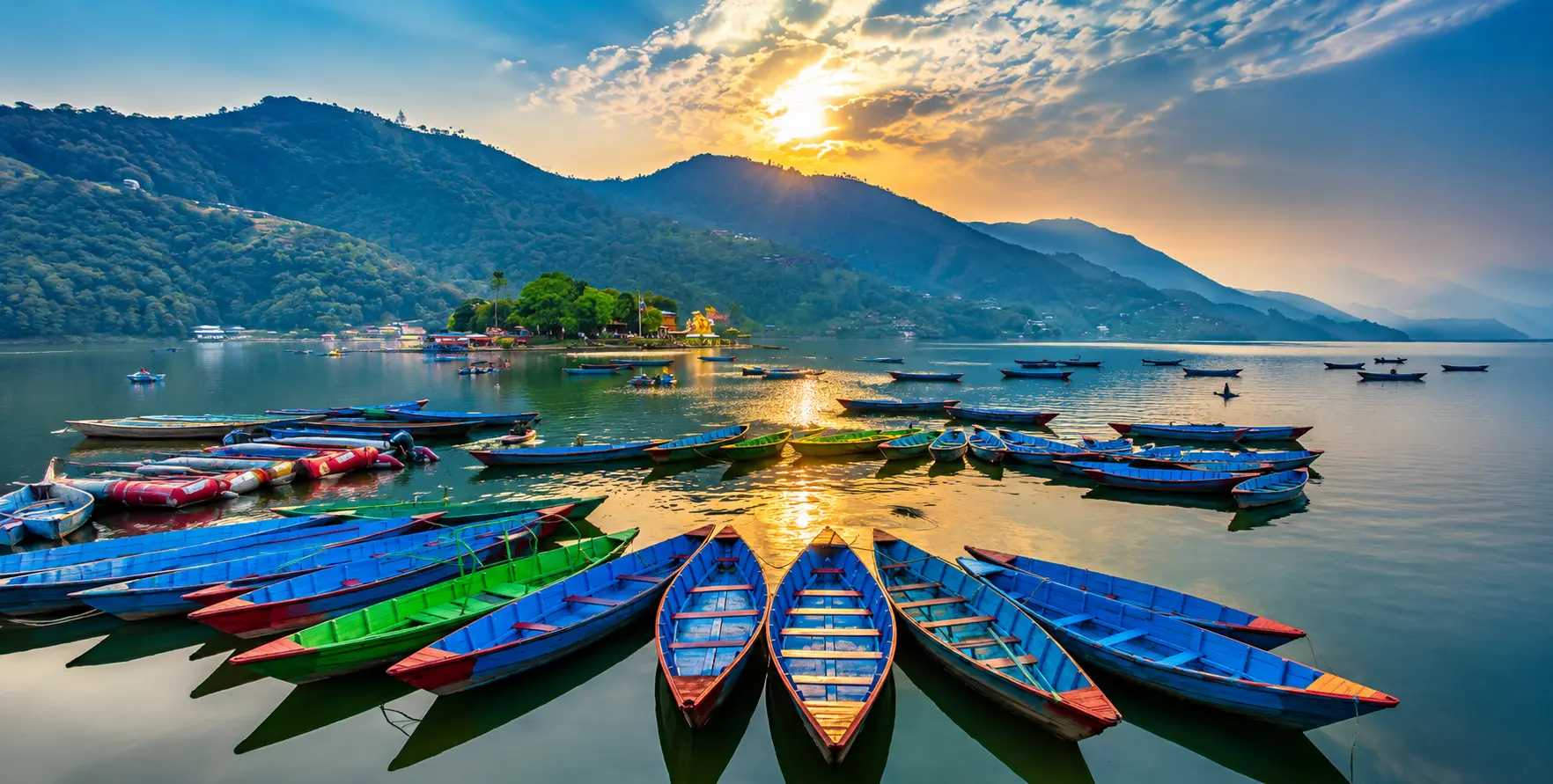
Pokhara is also, increasingly, where many Nepal visitors want to be: the city’s lakeside atmosphere, its proximity to the Annapurna foothills, and its status as the natural base for Annapurna region adventures of all kinds make it the logical starting point for a Manang jeep journey as well as for the Poon Hill, Mardi Himal, and Annapurna Base Camp trekking routes covered elsewhere in our blog series. For travelers spending several days in Pokhara, a two-day Manang excursion — driving up on Day 1, exploring Manang and the surrounding lakes and monasteries on Day 2, and returning to Pokhara on Day 3 — has become one of the most popular short adventure packages available from the lakeside city.
Key Facts at a Glance
| Route Detail | Information |
| From | Pokhara (827 m) |
| To | Manang (3,519 m) |
| Road Distance | 180 km (Pokhara to Manang via Besisahar) |
| Private Jeep Travel Time | 7 to 9 hours (often split into 2 days with overnight at Chame or Dharapani) |
| Recommended vehicle | 4WD Scorpio or Hilux — mandatory beyond Besisahar |
| Route | Pokhara – Dumre – Besisahar – Bhulbhule – Jagat – Dharapani – Chame – Pisang – Manang |
| Road Type | Paved (Pokhara to Besisahar) + Off-road mountain track (Besisahar to Manang) |
| ACAP Permit | NPR 3,000 (USD 22-25) per person — mandatory |
| TIMS Card | USD 10-20 per person — recommended |
| Best Season | October-November and March-May |
| Altitude Gain | Pokhara 827 m to Manang 3,519 m — acclimatization stop strongly recommended |
ALTITUDE ALERT: Manang sits at 3,519 meters — 2,692 meters higher than Pokhara. Driving this elevation gain in a single day, while possible, carries a genuine risk of Acute Mountain Sickness (AMS) for many travelers. Nepal Vehicle Hiring Pvt Ltd strongly recommends the 2-day approach with an overnight stop at Dharapani (1,860 m) or Chame (2,670 m) for any traveler who has not previously spent time above 3,000 m.

All Transport Options — Pokhara to Manang 2026
| Transport Option | Cost (2026) | Travel Time | Best For |
| Private Jeep (Pokhara-Manang direct) | NPR 25,000-38,000 / USD 190-285 (full vehicle) | 7-9 hrs one day OR 2 days with overnight | Groups wanting comfort + flexibility |
| Private Jeep (2-day: Pokhara-Besisahar Day 1; Besisahar-Manang Day 2) | NPR 28,000-42,000 / USD 210-315 (full vehicle, 2 days) | ~5 hrs Day 1 + ~5 hrs Day 2 | Best for acclimatization; recommended approach |
| Shared Jeep (Besisahar-Manang) | NPR 1,500-2,500 / USD 12-20 per person | 5-7 hrs (Besisahar to Manang only) | Budget travelers already at Besisahar |
| Tourist Bus (Pokhara-Besisahar) + shared jeep | NPR 400-700 bus + NPR 1,500-2,500 jeep per person | 3-4 hrs bus + 5-7 hrs jeep | Budget — slower, multiple transfers |
| Round Trip Private Package (Pokhara-Manang-Pokhara) | NPR 45,000-65,000 / USD 340-490 (full vehicle) | 2 days each way | Sightseeing groups; most popular Manang tour format |
Why Private Jeep Is the Right Choice for This Route
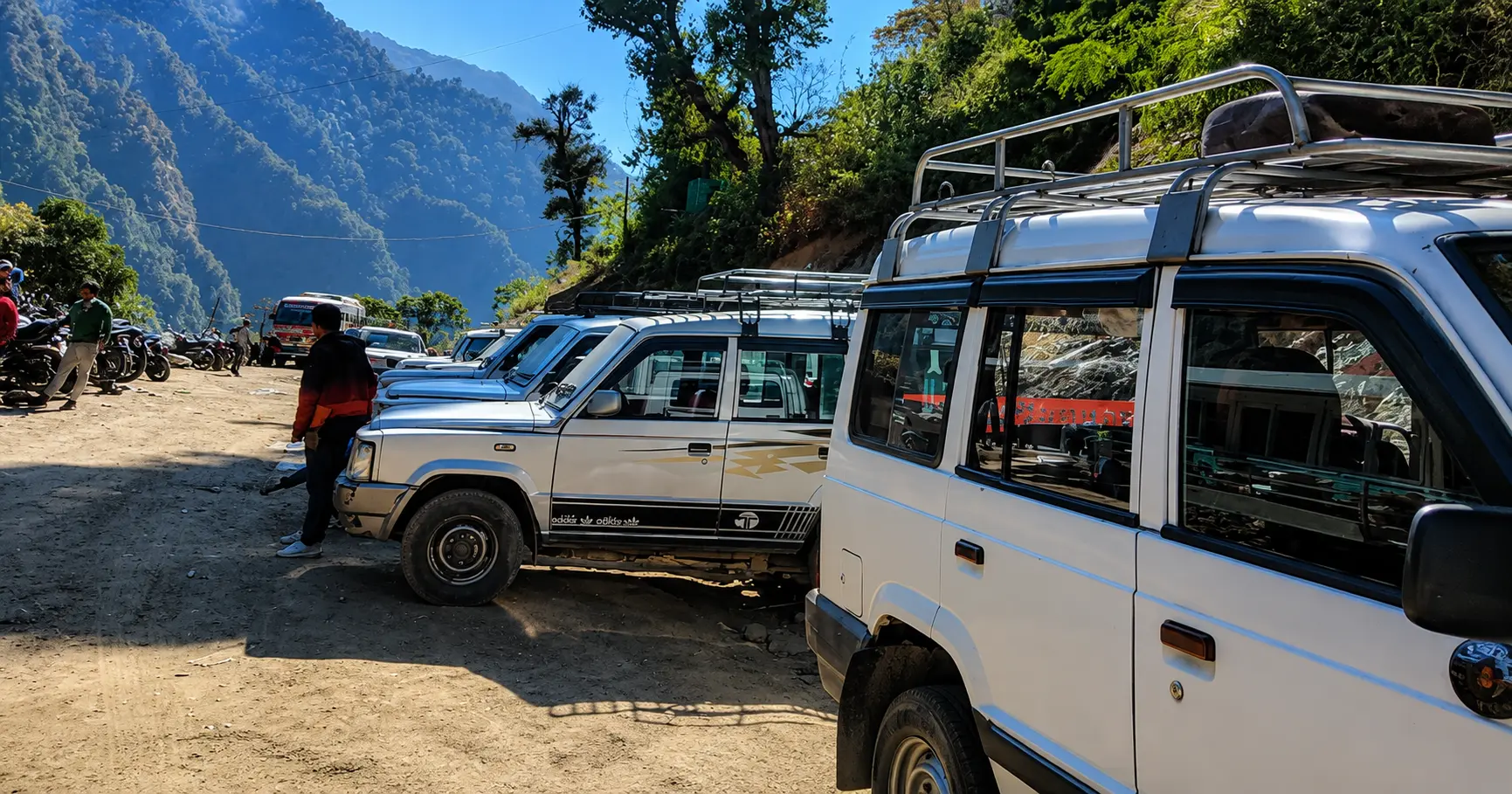
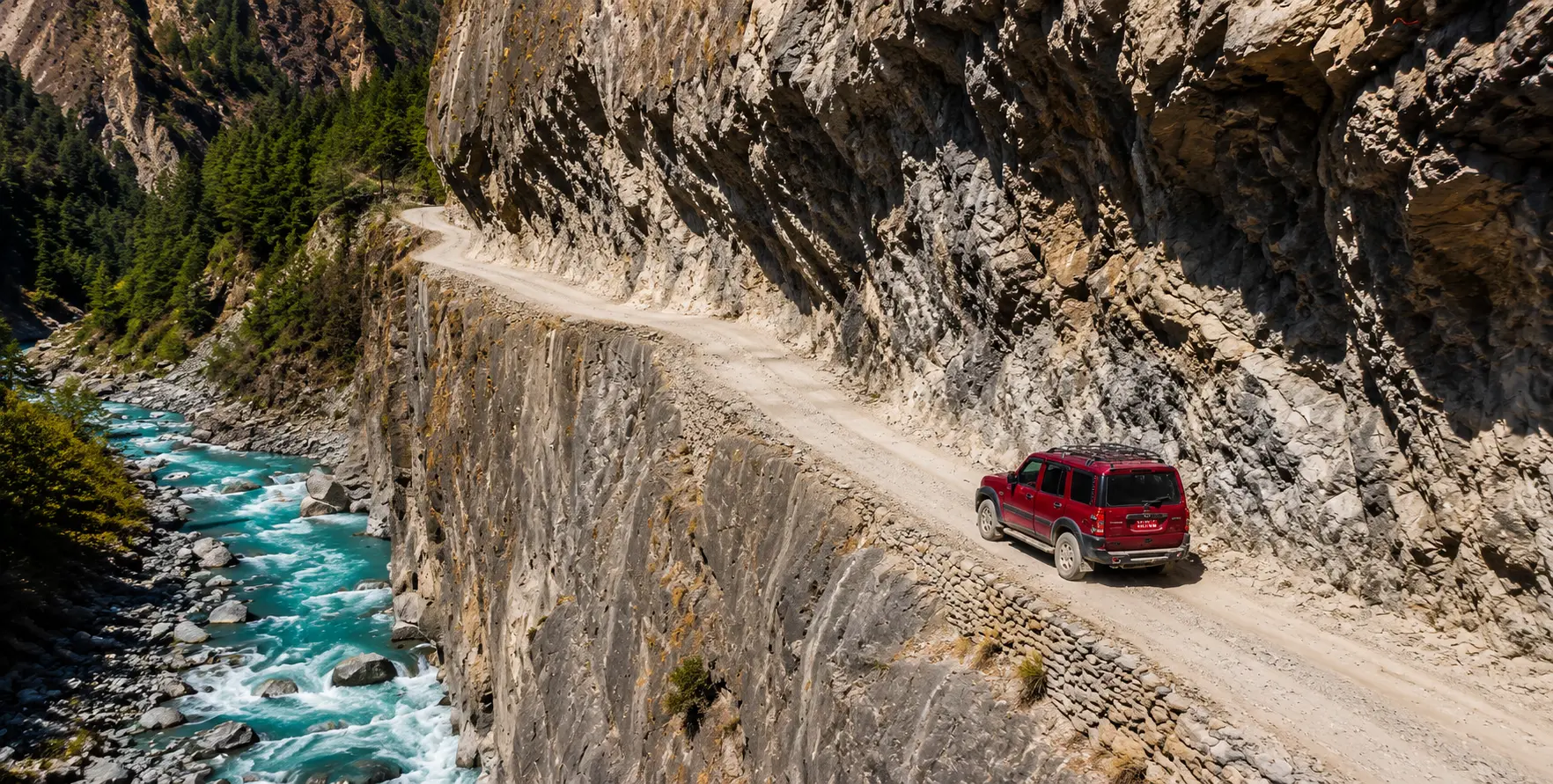
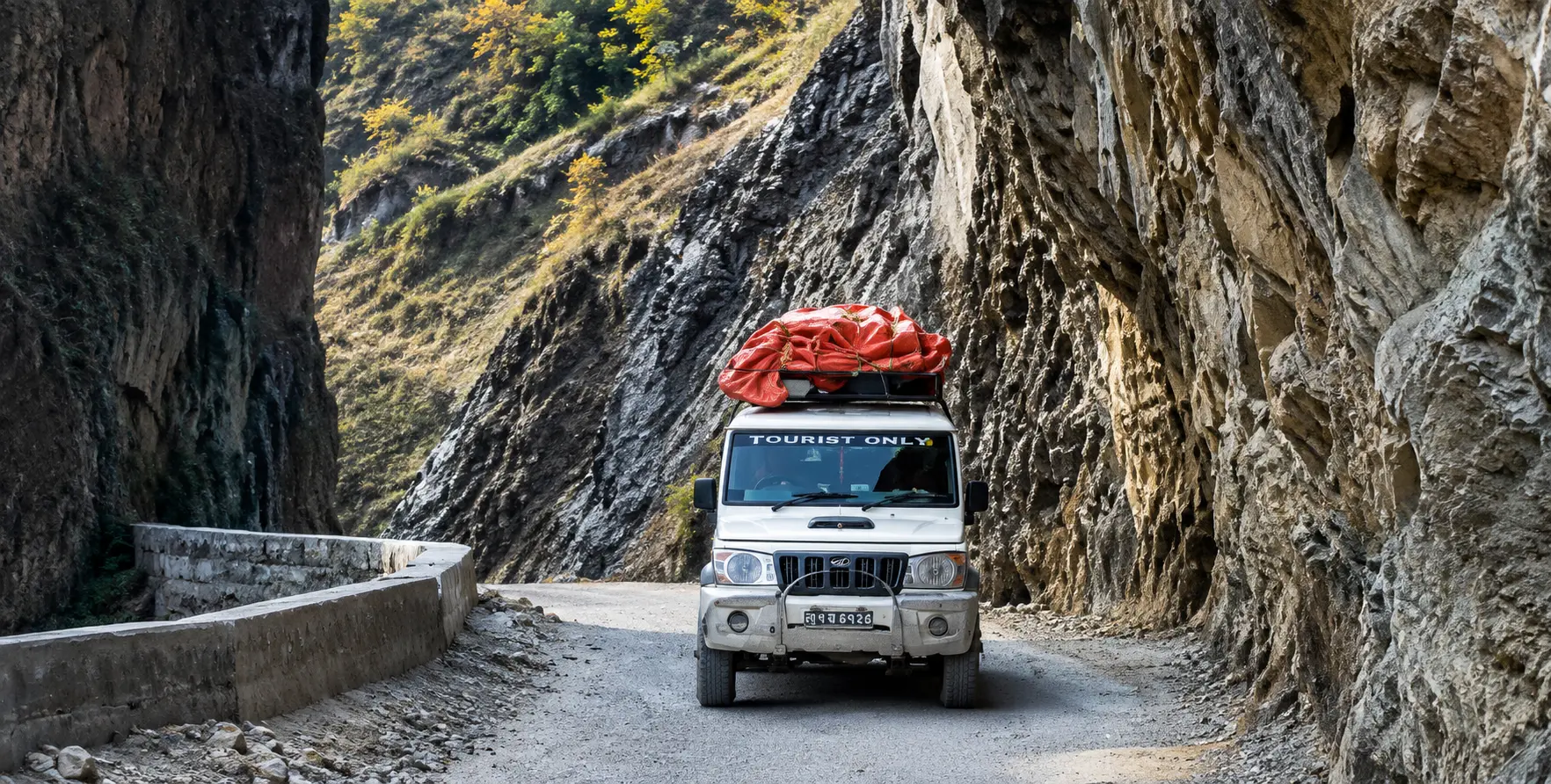
Beyond Besisahar, the Annapurna Circuit road that leads to Manang is a rough, unpaved mountain track that passes through some of Nepal’s most dramatic and least forgiving terrain. The Marsyangdi River gorge between Bhulbhule and Dharapani involves cliff-edge driving, river crossings, steep gradient sections, and the accumulated damage of seasonal weather and trekking-season traffic that makes any non-4WD vehicle genuinely unsuitable. Shared jeeps and local vehicles do operate on this route, but they typically stop at Besisahar or depart only when fully loaded — removing the schedule flexibility and direct hotel-to-hotel comfort that a private vehicle provides from Pokhara.
For a group of 4 to 6 sharing a private Scorpio or Hilux, the per-person cost of a full round-trip Pokhara-Manang-Pokhara private jeep at NPR 45,000 to 65,000 works out at approximately USD 55 to 100 per person — comparable to or cheaper than piecing together public transport across several separate legs, and dramatically more comfortable, flexible, and reliably safe on the demanding upper gorge sections.
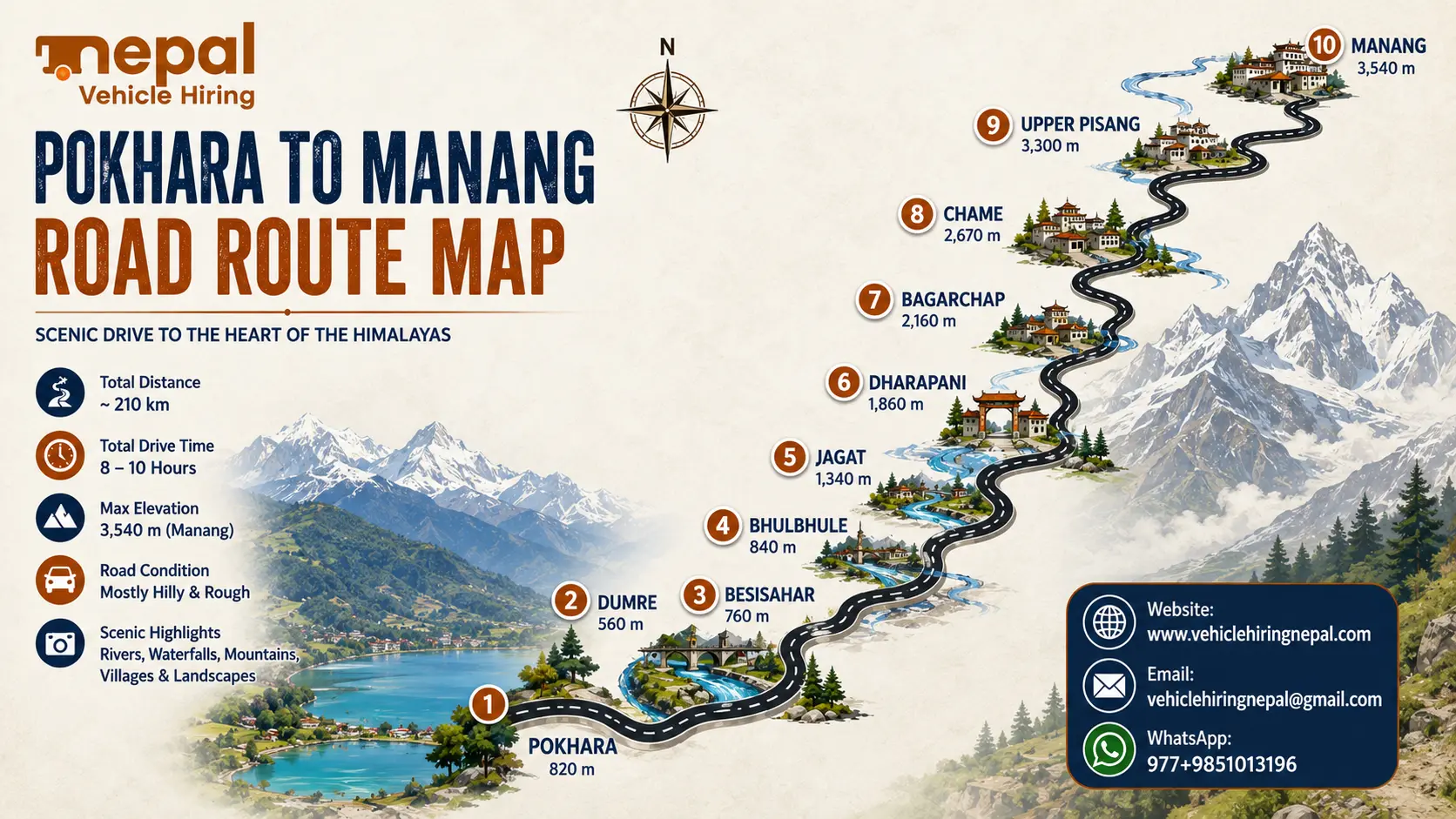
The Route — Pokhara to Manang Step by Step
| Stop | Distance from Pokhara | Altitude | Road | Notes |
| Pokhara (Lakeside) | Start | 827 m | City roads | Hotel pickup — depart 6:00-7:00 AM |
| Dumre | 97 km | 365 m | Prithvi Highway (paved) | Junction town — turn north toward Besisahar |
| Besisahar | 142 km | 760 m | Paved highway | Gateway to Annapurna Circuit; ACAP + TIMS checkpoint |
| Bhulbhule | 155 km | 840 m | Off-road begins | Last riverside flat section; waterfalls visible |
| Jagat | 175 km | 1,340 m | Rocky off-road | Manaslu Circuit permits checked here too |
| Dharapani | 195 km | 1,860 m | Rough off-road | Common overnight stop for 2-day itineraries |
| Bagarchap / Danaque | 200 km | 2,160 m | Rough off-road | Gompa visible; landscape becoming alpine |
| Chame | 215 km | 2,670 m | Rough off-road | Manang District HQ; apple orchards; another good overnight |
| Upper Pisang | 230 km | 3,300 m | Rough off-road | Choice of Upper (hill) or Lower Pisang route |
| Manang | 250-265 km | 3,519 m | Rough off-road ends | Final destination — Gangapurna Lake, Braga Gompa, Tilicho approach |
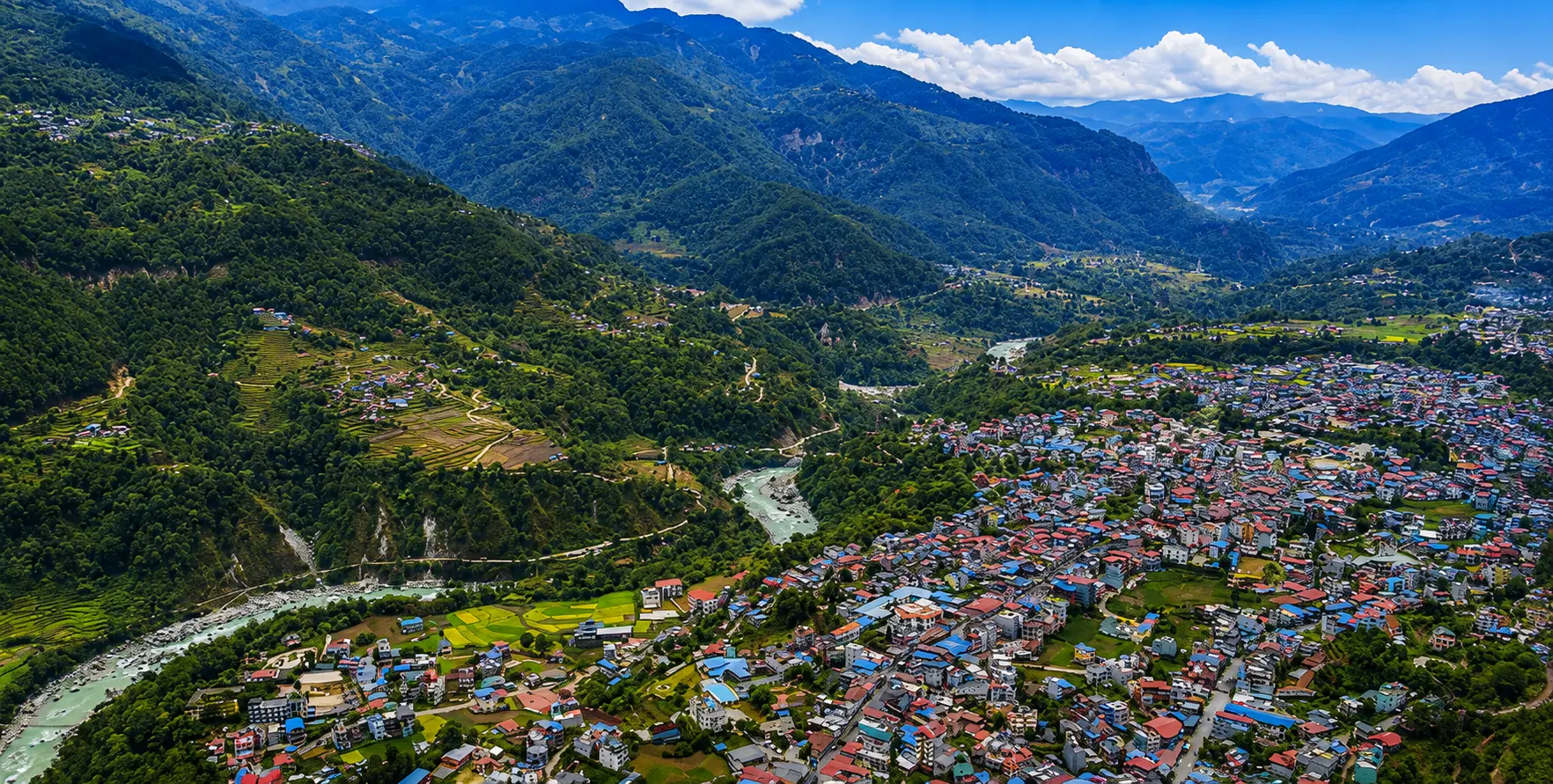
Pokhara to Besisahar — The Comfortable Paved Section
The journey begins on the Pokhara-Kathmandu Prithvi Highway, heading east through the flat Pokhara Valley before climbing gently into the Gandaki hill country toward Dumre Junction at approximately 97 km from Pokhara. Dumre is the turn-off point for Besisahar and the Annapurna Circuit road. This junction also marks the boundary between the comfortable paved highway driving and the increasingly adventurous terrain ahead. From Dumre, the road climbs north to Besisahar, reaching the Annapurna Circuit’s official gateway town at approximately 142 km from Pokhara — a journey of roughly 3 to 4 hours in comfortable highway conditions.
Besisahar is where ACAP permits and TIMS cards are checked at the conservation area entry checkpoint — one of the most important reasons why all permits must be obtained in Pokhara or Kathmandu before departure, as described in the permits section below. Besisahar also has the last reliable fuel stations, ATMs, and comprehensive meal options before Manang — a practical rest stop as well as a checkpoint.
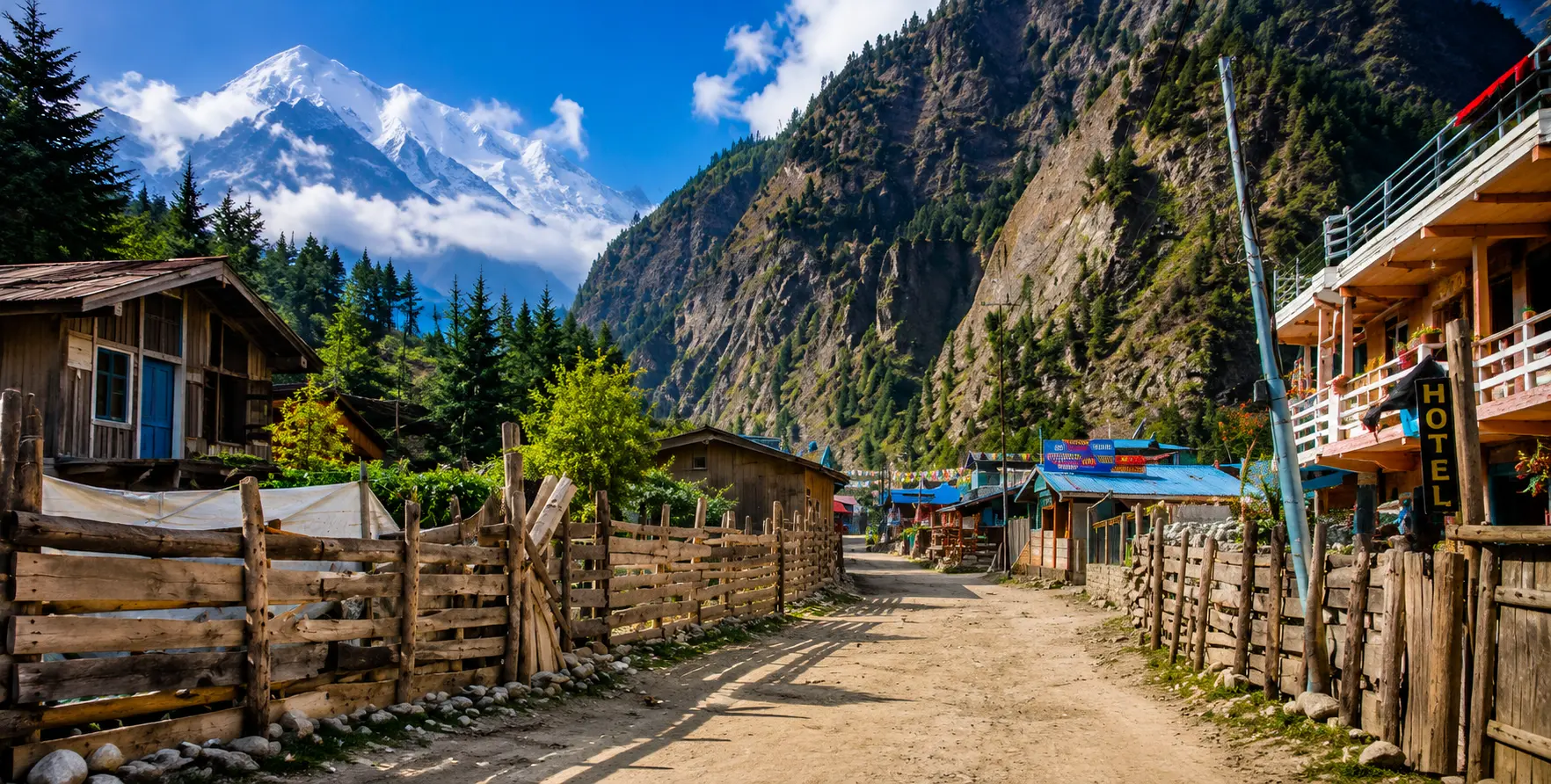
Besisahar to Dharapani — The Gorge Begins
Beyond Besisahar, the road leaves the paved highway behind and begins its transformation into the rough, cliff-edge mountain track that defines the Annapurna Circuit driving experience. The first section, climbing through Bhulbhule, Ngadi, and Jagat, follows the Marsyangdi River through increasingly dramatic gorge terrain — waterfalls visible directly beside the track, the river thundering far below, and the canyon walls rising steeply on both sides. This section is the most genuinely demanding driving of the entire Pokhara-to-Manang route: narrow passing points, exposed cliff edges, and the kind of surface deterioration that monsoon damage and ongoing trekker-jeep traffic creates even in the best dry-season conditions.
Dharapani, at 1,860 meters, marks both the end of the most demanding gorge section and the entry into the progressively more open Manang District valley. For two-day itineraries, Dharapani provides a natural overnight stop that allows meaningful acclimatization at a significantly safer intermediate altitude than pushing directly to Manang’s 3,519 meters in a single day.
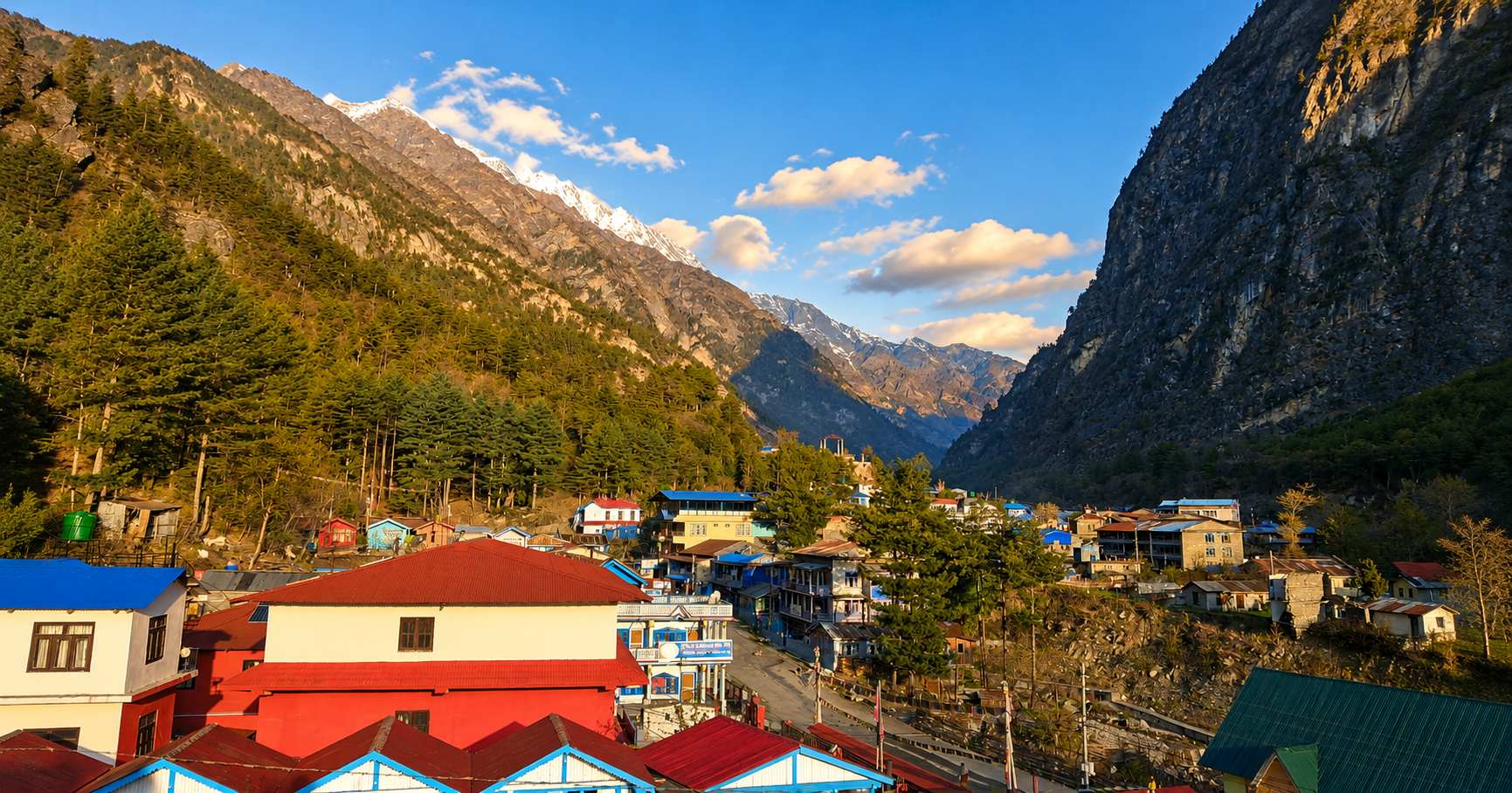
Dharapani to Chame — Entering the High Country
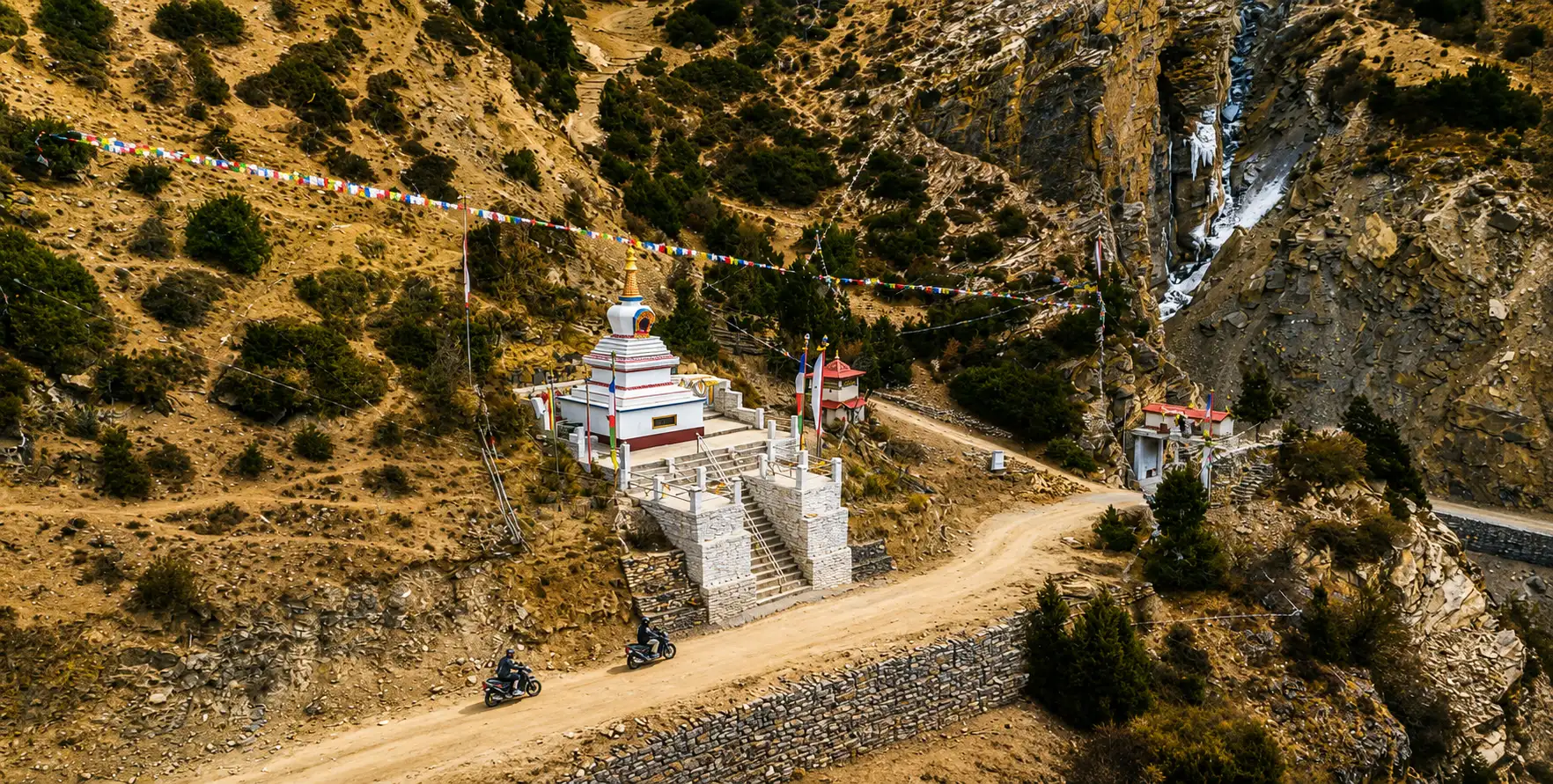
From Dharapani, the road continues through Bagarchap and Danaque, climbing steadily into increasingly alpine terrain. Buddhist monasteries become more frequent and more prominent as the route gains altitude and the Tibetan cultural influence characteristic of the upper Annapurna valley becomes visible in architecture, prayer flags, and chortens. Chame, the administrative headquarters of Manang District at 2,670 meters, is another popular overnight option for travelers wishing to add an extra acclimatization step — particularly advisable for groups including older travelers, anyone with a history of altitude sensitivity, or children.
Chame to Manang — The Annapurna Panorama Unfolds
The final section from Chame to Manang delivers what many drivers and travelers describe as the most spectacular scenery of the entire route: the valley progressively widens, the peaks of Annapurna II (7,937 m), Annapurna III (7,555 m), Annapurna IV (7,525 m), and Gangapurna (7,455 m) come into increasingly close and dramatic view, and the landscape transitions from the forest and waterfall character of the lower gorge into the wide, open, Tibetan-influenced high-altitude basin that defines Manang’s unmistakable appearance. The villages of Lower and Upper Pisang — the upper option sitting on a dramatic ridge above the main valley with its own beautiful monastery — offer a brief stop before the final run into Manang itself.
The Altitude Question — The Most Important Safety Consideration
The altitude gain from Pokhara to Manang — from 827 meters to 3,519 meters in a single driving day — is the single most important safety factor for anyone planning this journey. Acute Mountain Sickness (AMS) does not discriminate by age, fitness, or previous trekking experience, and driving to 3,519 meters in a single day, while physically possible for the vehicle, exceeds the recommended daily altitude gain of 300 to 500 meters per day for safe acclimatization above 3,000 meters.
- The Two-Day Approach: Nepal Vehicle Hiring Pvt Ltd recommends all Pokhara-to-Manang journeys be split across two days, with an overnight stop at either Dharapani (1,860 m) or Chame (2,670 m). This adds one driving day to the schedule but dramatically reduces AMS risk and makes the Manang stay itself considerably more enjoyable by ensuring travelers arrive rested and acclimatized rather than symptomatic.
- Day Hikes from Manang: Even after the recommended two-day approach, spend at least one full day at Manang altitude before any further ascent. The classic Manang acclimatization hike to Ice Lake (4,600 m) or the viewpoint above Gangapurna Lake is an excellent way to go higher by day while sleeping lower by night.
- AMS Warning Signs: Headache, nausea, loss of appetite, and fatigue on arrival in Manang are common mild symptoms. If these worsen over 12 to 24 hours rather than improving, descend immediately to Chame or Dharapani — do not push on hoping symptoms will resolve at altitude.
- Diamox: Discuss with a doctor before departure whether acetazolamide (Diamox) is appropriate for your specific health situation and itinerary. It is available at pharmacies in Kathmandu and Pokhara.
ACCLIMATIZATION RECOMMENDATION: Even for a two-day journey, Nepal Vehicle Hiring Pvt Ltd drivers are instructed to offer an optional additional rest stop at Chame on the Day 2 approach if any passenger reports headache or discomfort — building this flexibility directly into the driving schedule rather than treating it as a schedule disruption.
What to Do in Manang — Making the Most of Your Stay
| Attraction | Distance from Manang | Why Visit |
| Gangapurna Lake | 1 km walk | Glacial lake fed by Gangapurna Glacier — stunning turquoise color |
| Braga Gompa (monastery) | 3 km walk | One of the oldest monasteries in the Annapurna region; ~500 years old |
| Ice Lake (Kicho Tal) | 3-4 hrs hike | High-altitude lake at 4,600 m — one of the best day hikes from Manang |
| Tilicho Lake Base Camp approach | 4-5 hrs jeep + walk | Highest large lake in the world at 4,919 m — jeep track toward base camp |
| Manang Bakery | In village | Famous high-altitude bakery — apple pie and cinnamon rolls at 3,519 m |
| Khangsar Village | 6- 7 km | Highest village accessible by jeep; spectacular Annapurna III views |
Manang Village — Life at 3,519 Meters
Manang village itself, with its flat-roofed stone houses, prayer wheel lanes, and yak-grazing pastures, is a destination worth spending unhurried time in regardless of any specific attraction. The village has developed a surprising range of teahouses, bakeries, and even a few surprisingly well-stocked small shops serving the steady flow of Annapurna Circuit trekkers who pass through — most notably the famous Manang Bakery, whose apple pie, cinnamon rolls, and hot chocolate served at 3,519 meters have achieved a near-legendary status among Himalayan trekkers. A short walk through the village in the early morning or evening, when the high-altitude light turns the Annapurna peaks a deep orange-gold, requires no agenda beyond simply being present in a place this beautiful.
Braga Gompa — Ancient Monastery Above the Valley
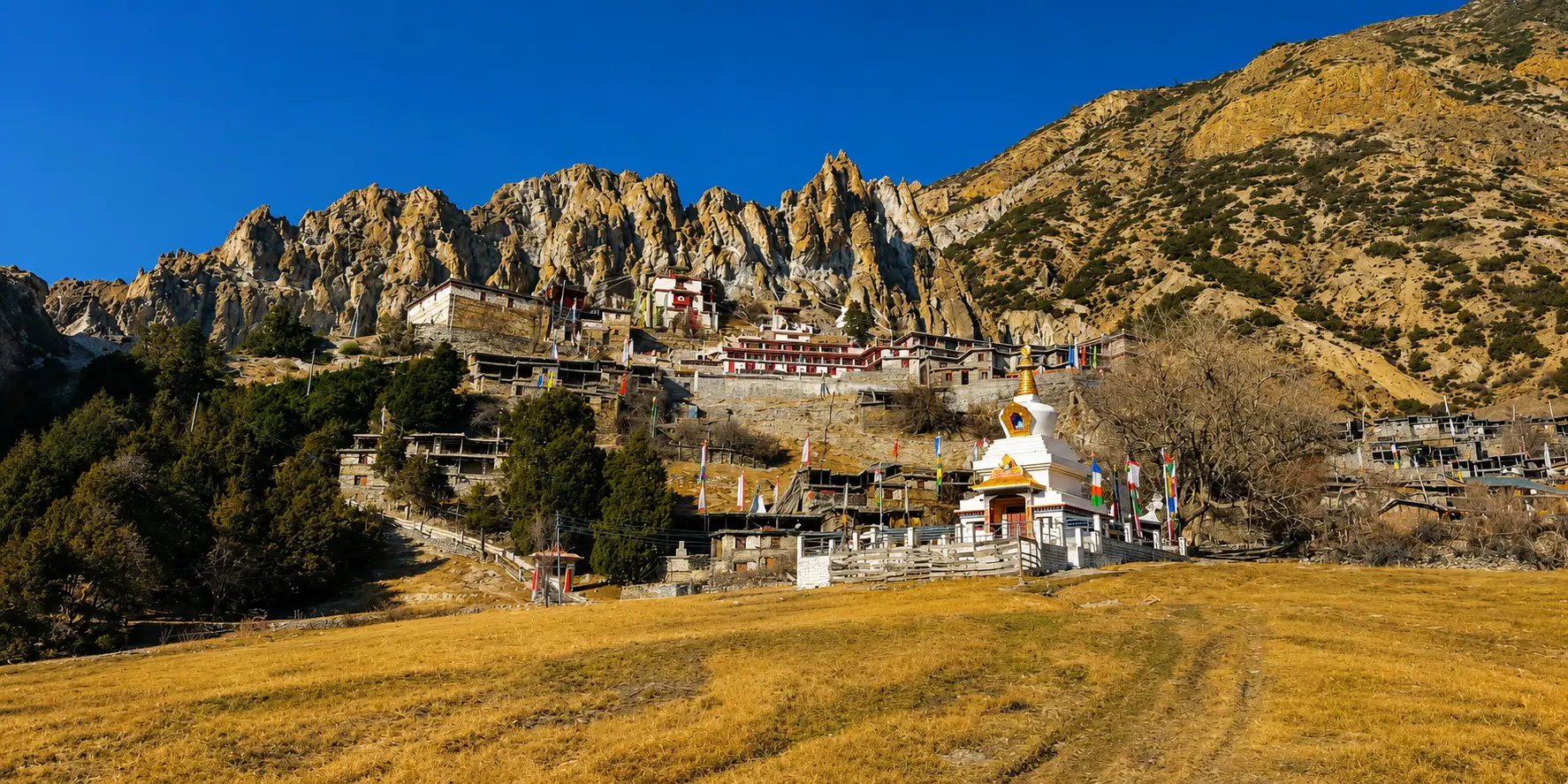
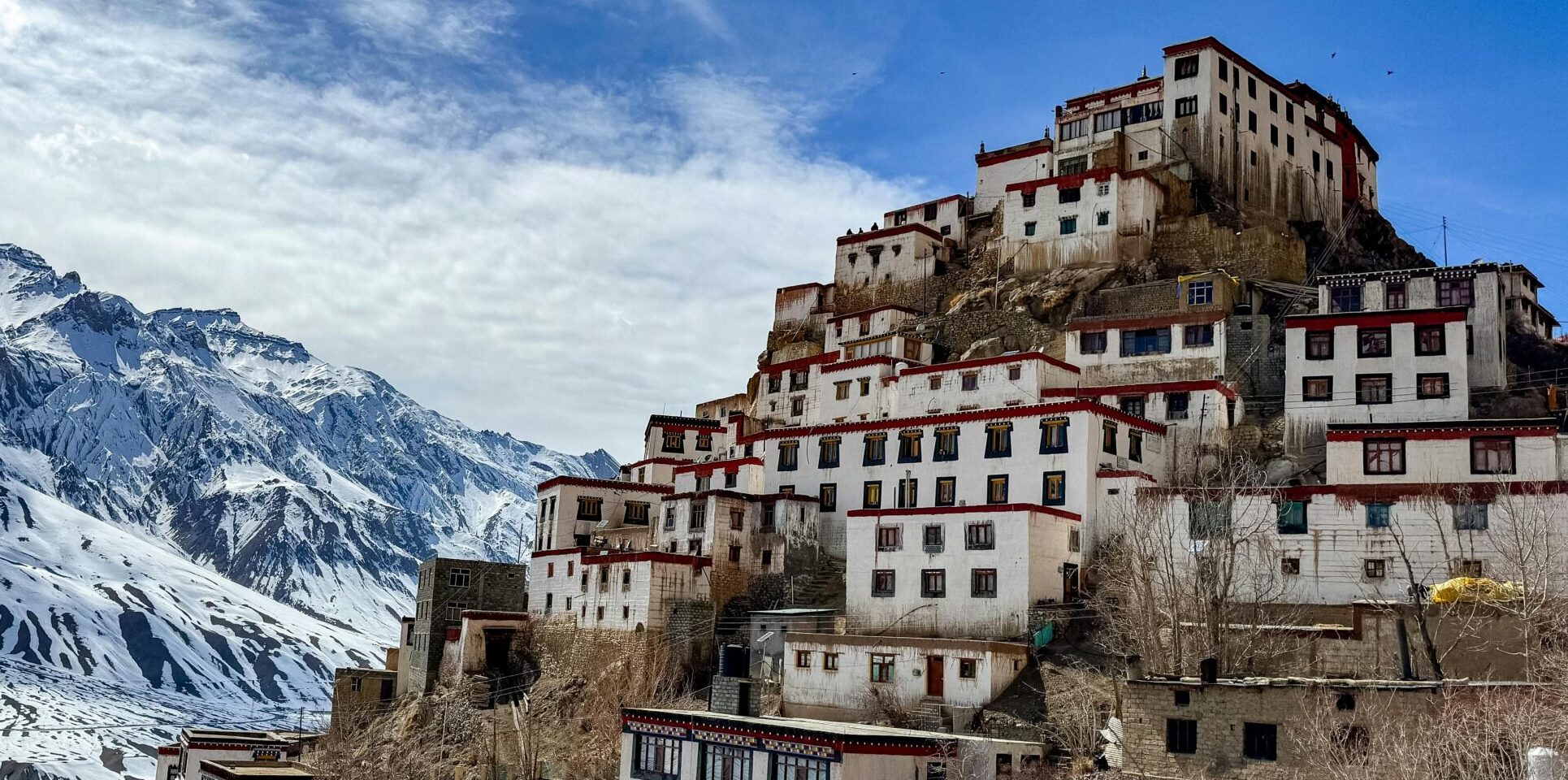
Braga Gompa, perched dramatically above the valley floor approximately 3 kilometers from Manang village, is one of the oldest and most culturally significant Buddhist monasteries in the entire Annapurna region, with foundations dated to approximately 500 years ago and an interior housing one of the most impressive collections of ancient statues, thangka paintings, and religious artifacts of any Annapurna-region monastery accessible without multi-day trekking. The short hike up to Braga from Manang village gains approximately 200 vertical meters and offers increasingly open views of the Annapurna panorama as it climbs.
Gangapurna Lake — The Glacial Mirror
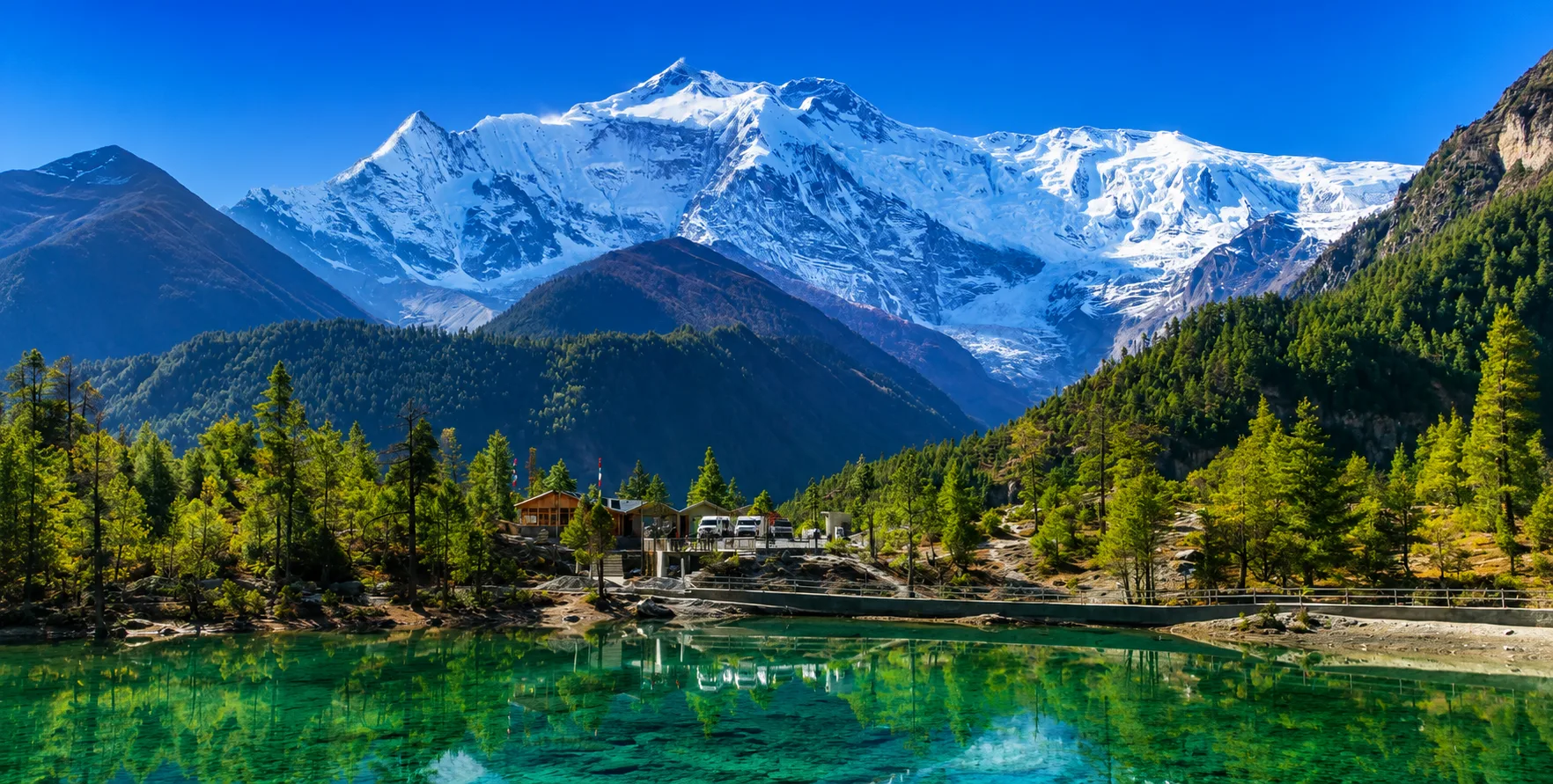
Gangapurna Lake, the brilliant turquoise glacial lake immediately below the Gangapurna Glacier on the valley’s western flank, is perhaps the single most photographed spot in the entire Manang area — and one that requires only a 20 to 30 minute walk from the village to reach. The combination of the intensely coloured glacial water, the surrounding moraine, and the close views of Gangapurna’s ice-draped summit directly above creates an alpine landscape of extraordinary visual intensity that rewards even a brief visit at any time of day.
Permits Required for the Pokhara to Manang Journey
- ACAP (Annapurna Conservation Area Permit): NPR 3,000 (approximately USD 22-25) per person — mandatory for all travelers entering the Annapurna Conservation Area beyond Besisahar. Obtain at the Nepal Tourism Board office in Pokhara Lakeside before departure.
- TIMS Card (Trekkers Information Management System): USD 10-20 per person — required for trekkers and increasingly expected even for vehicle-based sightseeing visitors to the conservation area. Obtain from the Nepal Tourism Board or TAAN office in Pokhara.
- Vehicle Registration and Insurance: Nepal Vehicle Hiring Pvt Ltd vehicles are fully registered and insured for tourist vehicle operation in the Annapurna Conservation Area — this is verified at the Besisahar checkpoint.
Do not attempt to pass the Besisahar ACAP checkpoint without valid permits — vehicles are turned back, and permits cannot be arranged at the checkpoint itself. Budget half a morning in Pokhara for permit processing on the day before your planned departure.
Season Guide — Best Time for the Pokhara to Manang Journey
October and November are the single finest months for the Pokhara-to-Manang drive: post-monsoon air clarity delivers genuinely spectacular mountain visibility, the road surface is at its most consolidated after the dry summer, and the light in Manang at this time of year — intense, high-altitude clarity with long morning shadows — creates the most dramatic photographic conditions available on this route. March to May, the spring season, brings slightly hazier conditions than autumn but adds the color of blooming rhododendrons in the lower gorge sections and the warmth of a valley returning to life after winter.
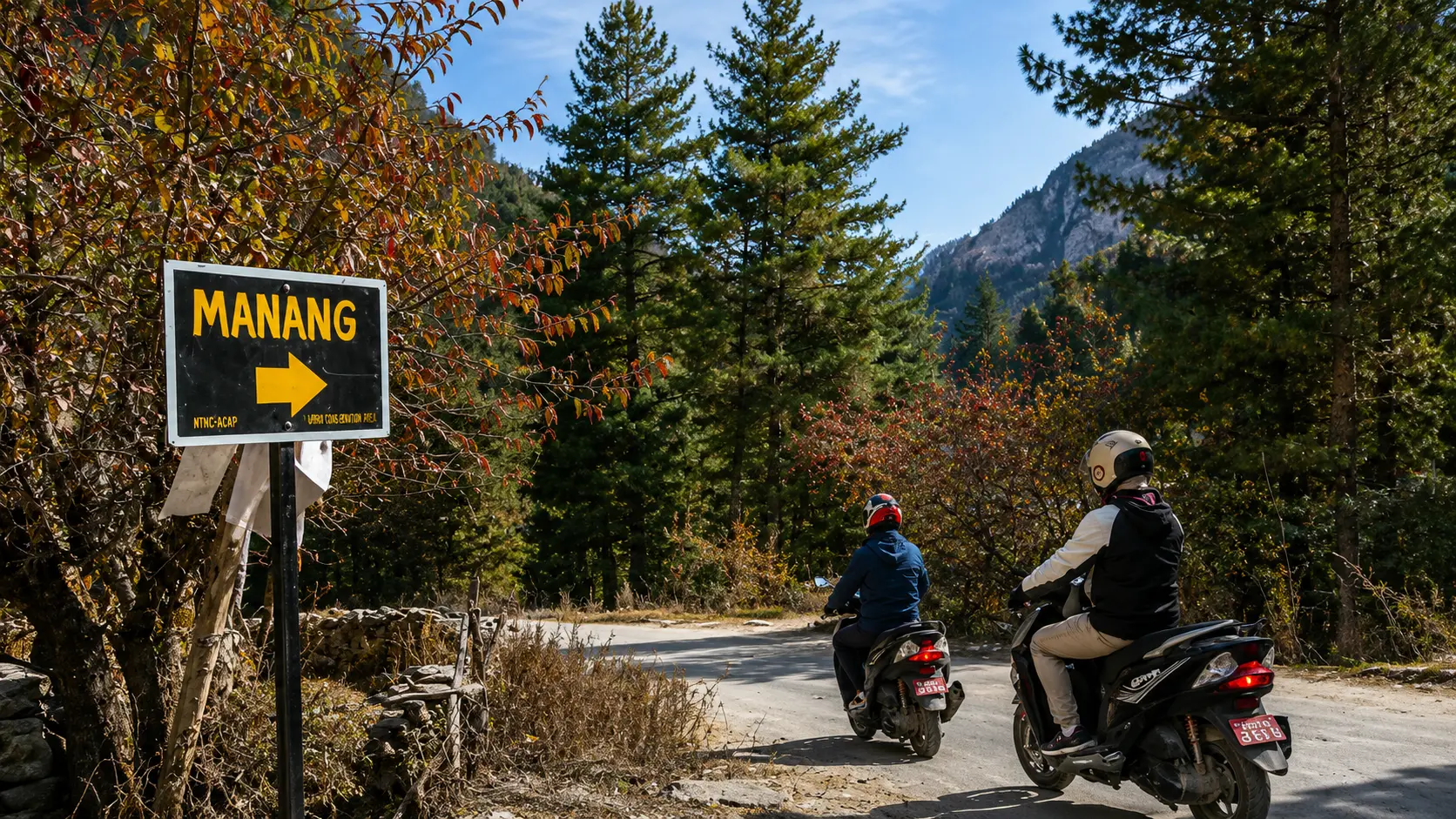
Winter from December to February is passable but cold — temperatures in Manang regularly fall below -10 to -15 Celsius overnight in the depths of winter, and certain sections of the road above Chame may carry ice or light snow patches requiring extra care. The mThe monsoon from June to September is the least recommended period for this specific route, given the landslide risk on the gorge sections between Jagat and Dharapani. However, Manang itself, lying in the rain shadow of the Annapurna massif, receives considerably less monsoon rainfall than the lower gorge approach.
Practical Tips for the Pokhara to Manang Journey
- Depart Pokhara by 6:30 to 7:00 AM for a single-day itinerary — this allows the full daylight window needed for the long drive and arrival in Manang before dark.
- For a two-day itinerary, a 7:00 to 8:00 AM departure is comfortable — Day 1 to Dharapani or Chame is 5 to 6 hours, leaving afternoon time for a gentle acclimatization walk.
- Obtain ACAP and TIMS permits in Pokhara the day before departure — the Nepal Tourism Board office in Lakeside processes both quickly.
- Carry sufficient NPR cash from Pokhara — there are no reliable ATMs beyond Besisahar. Estimate generously for accommodation, meals, entry fees at Gangapurna Lake, and any emergency expenses.
- Pack layers — the temperature difference between Pokhara (usually warm) and Manang (potentially below freezing at night) requires a complete wardrobe change during the drive.
- Carry water and snacks for the gorge section between Jagat and Dharapani — this stretch has limited reliable teahouse stops and takes 2 to 3 hours.
- Motion sickness medication is worth considering — the gorge road above Besisahar involves continuous winding, and the combination of altitude and vehicle movement can affect passengers who do not normally experience car sickness.
- Keep a camera accessible throughout the drive — the waterfall sections near Chamje, the cliff-edge gorge near Tal, and the opening Annapurna panorama above Pisang are all best captured in the moment rather than missed while digging through a bag.
Why Choose Nepal Vehicle Hiring Pvt Ltd
- Route Experience: Our drivers have extensive personal experience on the full Pokhara-to-Manang corridor, including detailed knowledge of the most challenging driving sections, the best rest stops, and the acclimatization considerations specific to this altitude gain.
- Verified 4WD Fleet: Scorpio and Hilux 4WD vehicles for all Manang transfers — the right vehicles for the rough gorge road beyond Besisahar.
- Altitude-Aware Itinerary Planning: We build acclimatization stops into every two-day Manang itinerary and carry this awareness into every driver briefing.
- Door-to-Door Pokhara Pickup: From any hotel in Pokhara Lakeside or Pokhara city — no need to find a vehicle stand or negotiate with local operators.
- Round-Trip Coordination: Book the outward Pokhara-to-Manang transfer and the return Manang-to-Pokhara leg in a single arrangement.
- Transparent All-Inclusive Pricing: Driver, fuel, and road tolls included in every quote.
- 24/7 Booking: WhatsApp +977-9851343204 — plan your Manang journey with full route and logistics support.
Frequently Asked Questions — Pokhara to Manang
How far is Pokhara from Manang, and how long does the drive take?
Pokhara to Manang is approximately 180 km by road. A private 4WD jeep takes 7 to 9 hours in a single day. However, Nepal Vehicle Hiring Pvt Ltd recommends splitting this across two days with an overnight stop at Dharapani (1,860 m) or Chame (2,670 m) for safer acclimatization.
Is a 4WD vehicle necessary for the Pokhara to Manang journey?
Yes, beyond Besisahar the road becomes a rough, unpaved mountain track through steep gorge terrain. A 4WD vehicle with adequate ground clearance — Scorpio or Hilux — is essential for this section. Standard sedans and Hiace vans cannot safely complete the full route to Manang.
What is the 2026 cost of a private jeep from Pokhara to Manang?
A private Scorpio or Hilux 4WD costs approximately NPR 25,000 to 38,000 (USD 190 to 285) for the full vehicle one way. A round-trip package (Pokhara to Manang and return) costs approximately NPR 45,000 to 65,000 (USD 340 to 490) for the full vehicle over 2 to 3 days.
Do I need permits to visit Manang from Pokhara by jeep?
Yes. An ACAP permit (NPR 3,000 / USD 22-25 per person) and a TIMS card (USD 10-20 per person) are both required. Both must be obtained from the Nepal Tourism Board office in Pokhara before departure — they cannot be arranged at the Besisahar checkpoint.
What is the risk of altitude sickness on this journey?
Manang at 3,519 meters is high enough that Acute Mountain Sickness is a genuine consideration, particularly for travelers who drive directly from Pokhara (827 m) in a single day. The two-day approach with an overnight stop at Dharapani or Chame is strongly recommended. Symptoms including headache, nausea, and fatigue that worsen rather than improve should prompt immediate descent.
What is the best time of year to visit Manang from Pokhara?
October to November offers the clearest mountain views and best road conditions. March to May is also excellent with rhododendron bloom in the lower gorge. Winter (December to February) is possible but cold. Monsoon (June to September) carries landslide risk on the gorge approach and is generally not recommended.
Conclusion
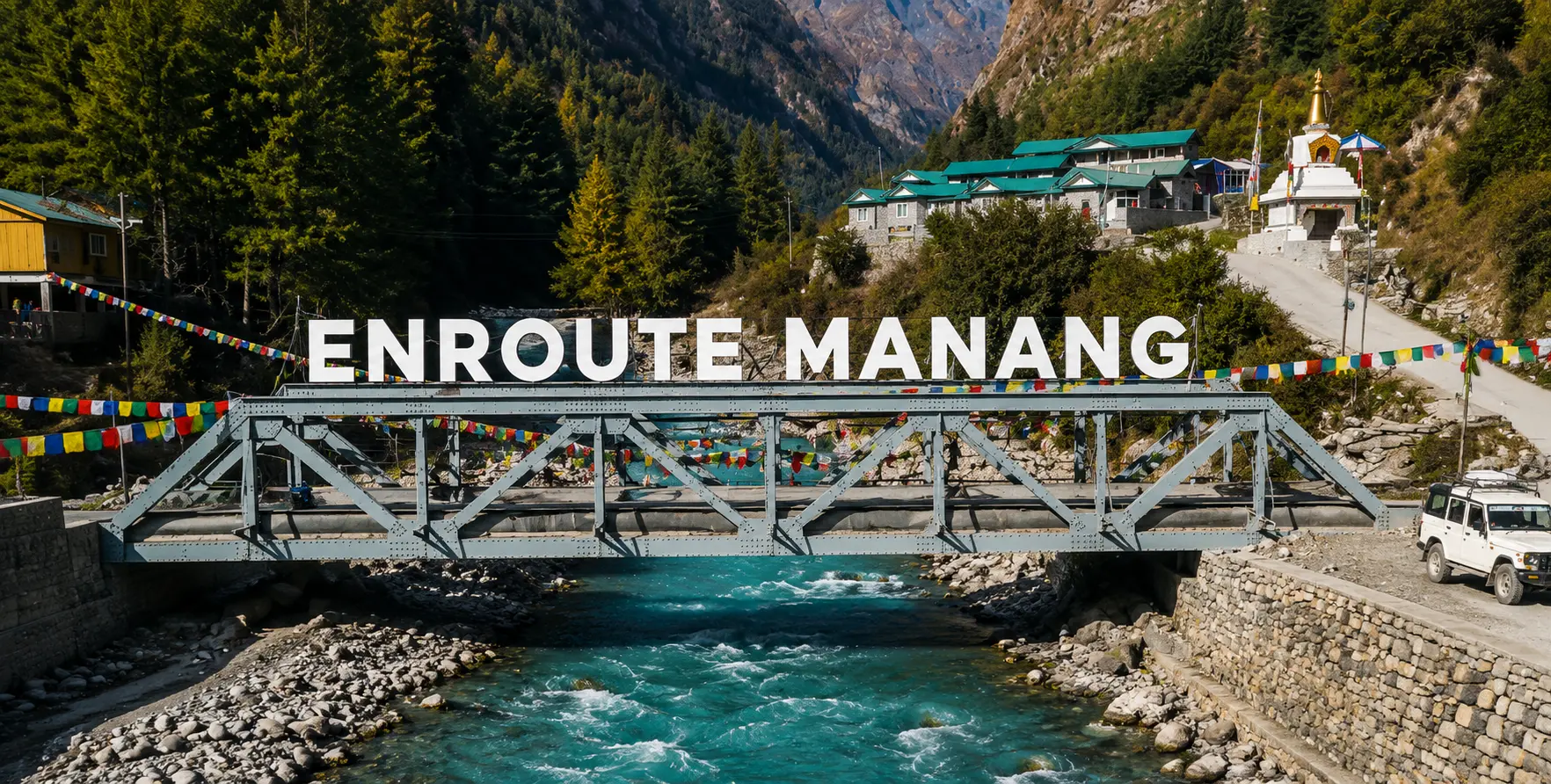
The journey from Pokhara to Manang is one of Nepal’s finest overland adventures — a 180-kilometer transformation from the lakeside warmth of the tourism city into the stark, spectacular high-altitude world of the Annapurna Conservation Area, delivered through some of the most dramatic gorge driving anywhere in the Himalaya. With the right 4WD vehicle, the right driver, a sensible acclimatization approach, and a permit obtained the day before in Pokhara, it is a journey that rewards fully and asks only that you give it the time and respect that 3,519 meters of mountain destination honestly requires.
Nepal Vehicle Hiring Pvt Ltd provides the private 4WD transfer that makes this journey comfortable, safe, and properly paced — from your Pokhara hotel door to the Gangapurna Lake shore in Manang and back again, with everything in between handled by experienced local drivers who know this road in every season and every condition.
Book your Pokhara to Manang jeep — Call or WhatsApp: +977-9851013196
E-mail: [email protected]
- How to Go to Manang from Pokhara — The Complete 2026 Guide
- Why Manang from Pokhara Is an Increasingly Popular Journey
- Key Facts at a Glance
- All Transport Options — Pokhara to Manang 2026
- The Route — Pokhara to Manang Step by Step
- The Altitude Question — The Most Important Safety Consideration
- What to Do in Manang — Making the Most of Your Stay
- Permits Required for the Pokhara to Manang Journey
- Season Guide — Best Time for the Pokhara to Manang Journey
- Practical Tips for the Pokhara to Manang Journey
- Why Choose Nepal Vehicle Hiring Pvt Ltd
- Frequently Asked Questions — Pokhara to Manang
- Conclusion

Related Blog & Articles

Besisahar to Manang Jeep
Besisahar to Chame and Upper Pisang Jeep

Kathmandu to Manang Jeep Service Guide 2026
Manang Hidden Valley
Kathmandu to Chame Vehicle Hire