Kathmandu Airport to Dhulikhel Hotel Transfer

Nepal Tour Package

Kathmandu Airport to Dhulikhel Hotel Transfer – Private Jeep Complete Guide

There is a specific kind of traveller who books Dhulikhel as their first Nepal stop rather than Kathmandu — someone who has done Thamel before, or who finds the noise and density of the city more draining than energising, or who wants their first morning in Nepal to open onto a panoramic Himalayan skyline rather than the smoky chaos of the Ring Road.

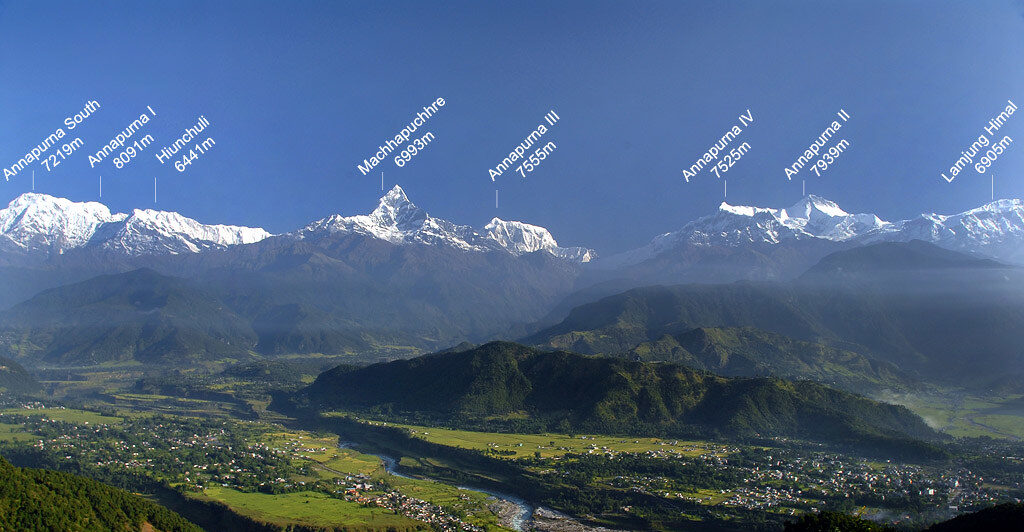
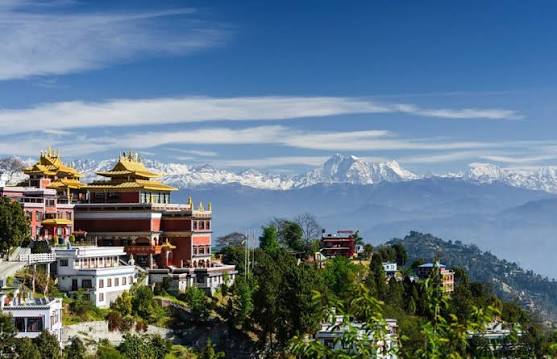
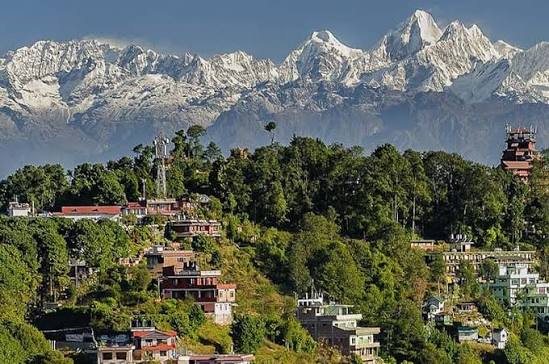
This is an excellent instinct, and Dhulikhel rewards it fully. From the ridge on which Nepal’s finest mountain-view resorts and lodges are positioned, the Himalayan panorama visible on a clear morning spans from Langtang in the west to the Khumbu peaks in the east, with Gauri Shankar (7,134 m), Melungtse, Numbur, and the eastern giants all visible against the dawn sky.

At 30 km from Kathmandu’s Tribhuvan International Airport (TIA), Dhulikhel is close enough for a completely practical first or last night — and far enough from the city to feel like a genuinely different Nepal experience from the moment of arrival.
Kathmandu Airport to Dhulikhel Hotel Transfer

The Kathmandu Airport to Dhulikhel hotel private transfer is Nepal Vehicle Hiring’s most popular single-leg short-distance private transfer service outside the city itself — a 30 km journey that takes 45 to 75 minutes depending on Kathmandu exit traffic, covers one of the most scenically satisfying short road journeys available from the airport, and connects the traveller’s arrival point directly to their hotel entrance without any taxi negotiation, shared vehicle compromise, or secondary transport arrangement.

Whether arriving at TIA from an international long-haul flight for a pre-trek Himalayan view night, or connecting from a domestic flight for a conference or resort stay at one of Dhulikhel’s landmark properties, the private transfer with Nepal Vehicle Hiring handles the complete movement — named driver at the arrivals gate, vehicle at the kerb, door delivery to the hotel — in a single professional service.

This guide covers every dimension of the Kathmandu Airport to Dhulikhel transfer: the route in detail, realistic journey times at different traffic hours, every vehicle option with honest costs, the rewarding optional stop at Bhaktapur Durbar Square that sits directly on the route,

the reverse Dhulikhel to airport transfer, how this service connects to broader Nepal itineraries involving our trekking partners, and the practical tips that make the transfer as smooth as the mountain views it delivers.

Book: vehiclehiringnepal.com | Call/ WhatsApp
Kathmandu Airport to Dhulikhel Hotel Transfer

Dhulikhel – Nepal’s Finest Himalayan View Town

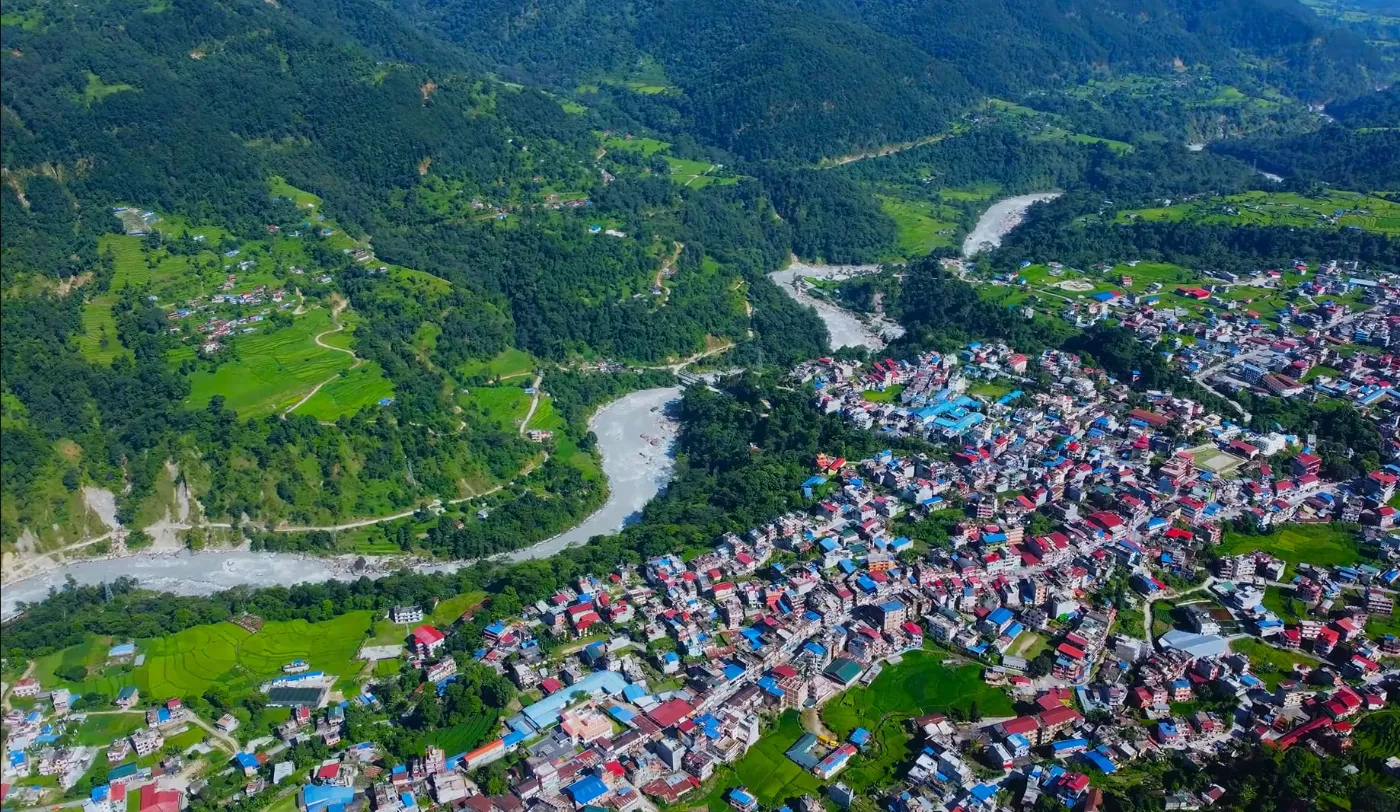
Dhulikhel (1,550 metres) sits on the southeastern rim of the Kathmandu Valley, balanced on the ridge that separates the valley from the great river valleys and Himalayan foothills of Kavrepalanchowk District.

It is a traditional Newari market town with a preserved medieval bazaar, a first-rate Himalayan viewpoint, a health resort and retreat destination, and the gateway to the BP Highway leading toward Jiri, the Solu Khumbu, and the eastern Himalaya.

Its mountain panorama—spanning about 180 degrees of the central and eastern Himalayan chain—is routinely described by visitors and travel writers as one of the most accessible and complete Himalayan views from a road-connected, resort-grade destination anywhere in Nepal.

The Dhulikhel hotel and resort scene is one of Nepal’s finest outside Kathmandu and Pokhara, built around the town’s extraordinary mountain-view location. Properties like the Dhulikhel Mountain Resort and Dwarika’s Resort Dhulikhel

both perched on the ridge with direct Himalayan exposure from every guest room and most common areas — have established the town as Nepal’s premier mountain-view wellness and luxury resort destination within easy reach of Kathmandu.

For visitors arriving at TIA who want to bypass the city entirely for their first or last night in Nepal, Dhulikhel’s proximity to the airport — 30 km, under an hour — makes it the most practical mountain escape from the arrival point of any Himalayan country.

For trekkers starting circuits from the eastern Kathmandu Valley who want to reach their trailhead without an overnight city stop, Dhulikhel’s position on the BP Highway makes it the natural departure point for routes heading east toward Jiri, Salleri, and the Everest road approach.
Kathmandu Airport to Dhulikhel Hotel Transfer

The Route – Kathmandu Airport to Dhulikhel in Detail

TIA to the Ring Road – The Airport Exit

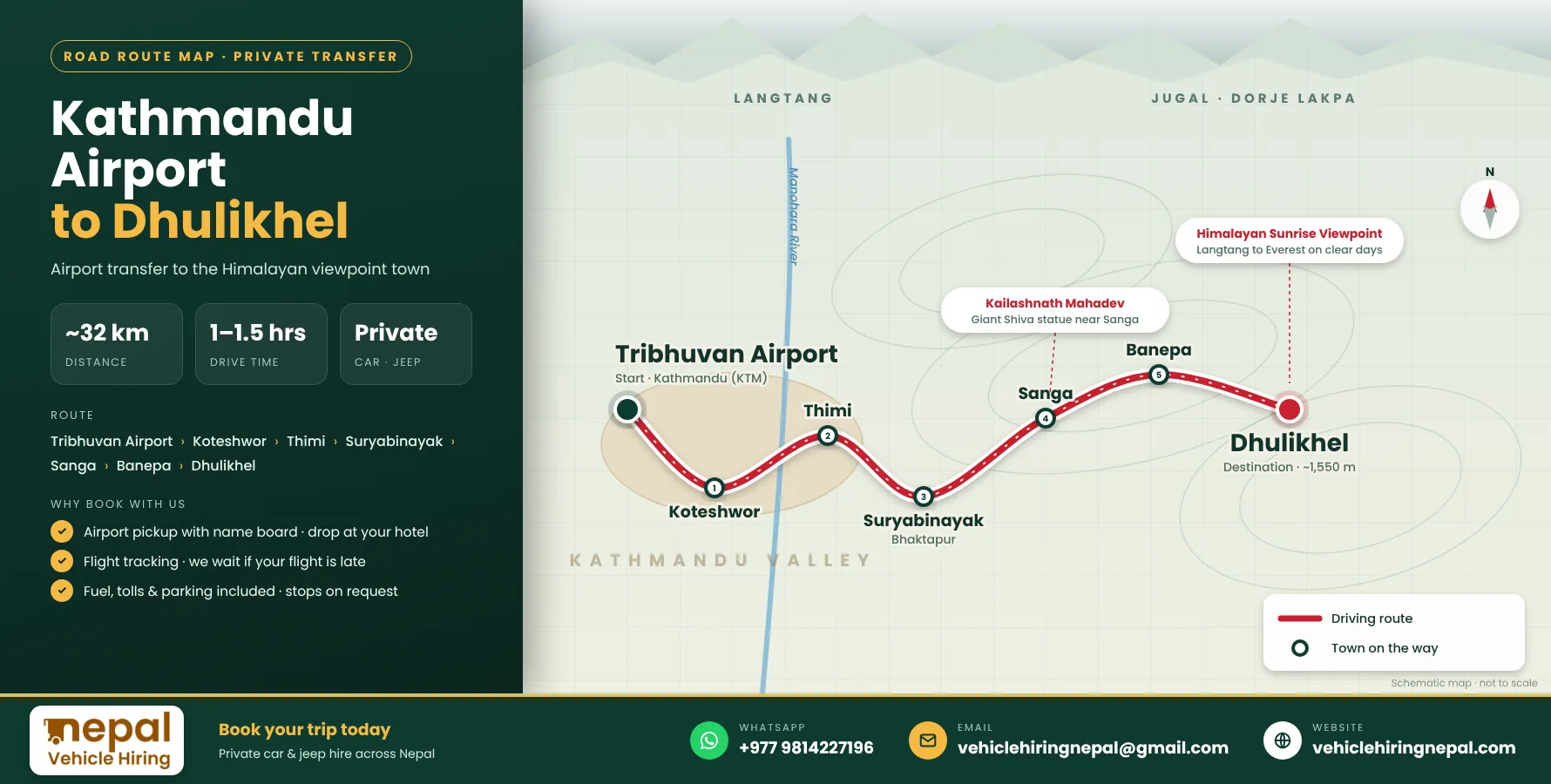
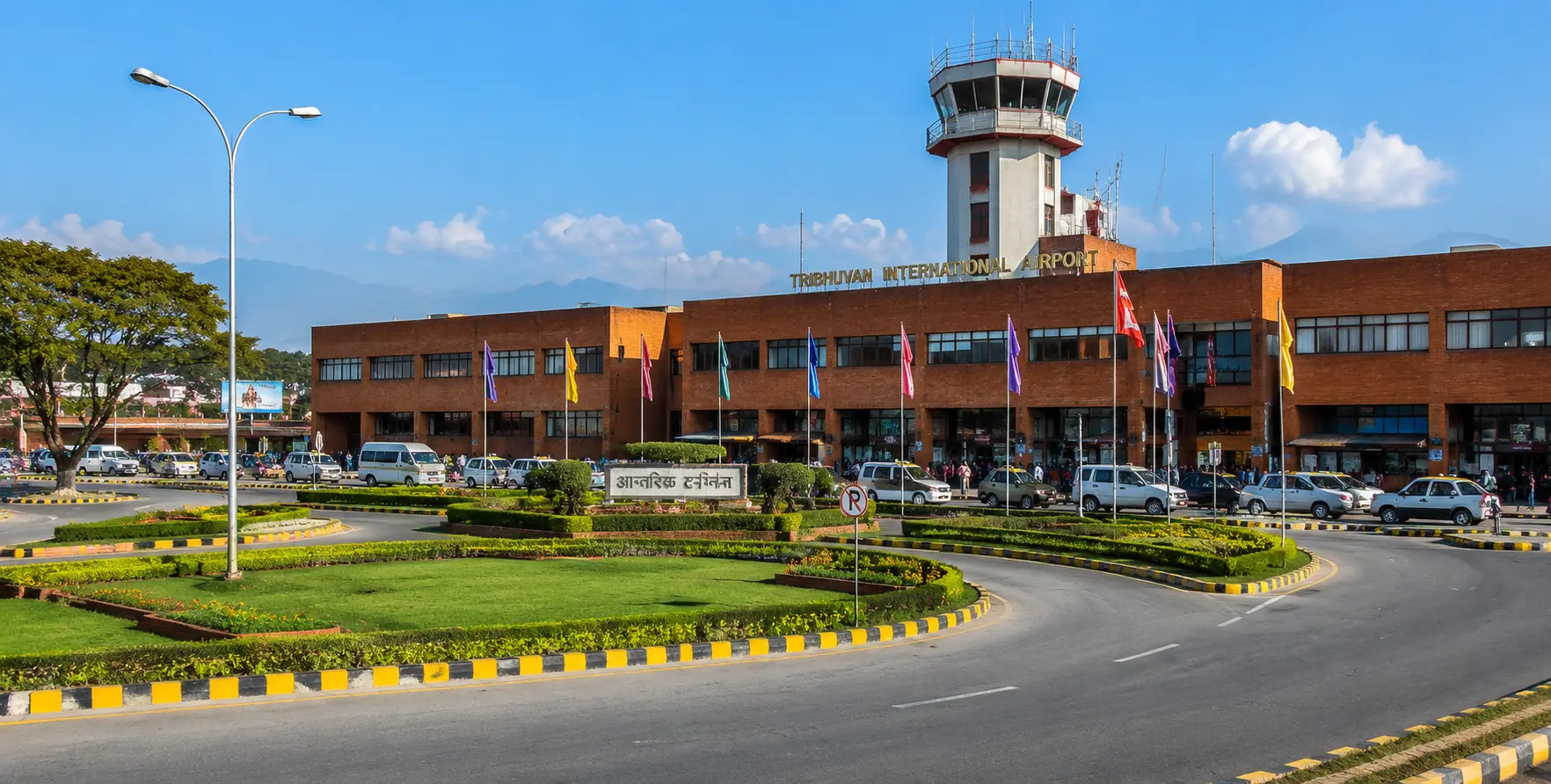
Tribhuvan International Airport (TIA) sits in Gaurighat, approximately 5 km east of Thamel and 6 km from the city centre. The airport exit onto the Ring Road is the first potential traffic bottleneck of the transfer.

The Ring Road junction at Gaushala–Chabahil is one of Kathmandu’s busiest intersections, especially during morning and evening peak hours that coincide with many international flight arrivals.

Nepal Vehicle Hiring drivers use the most efficient exit routing from the airport — via the airport access road to Tinkune junction and then eastward toward Bhaktapur and the BP Highway, rather than re-entering Kathmandu’s western ring road congestion.

This route takes the vehicle directly from TIA to the Bhaktapur corridor, avoiding city-centre delays for passengers heading to Dhulikhel rather than Thamel.
Kathmandu Airport to Dhulikhel Hotel Transfer

Ring Road to Bhaktapur – Clearing the Valley

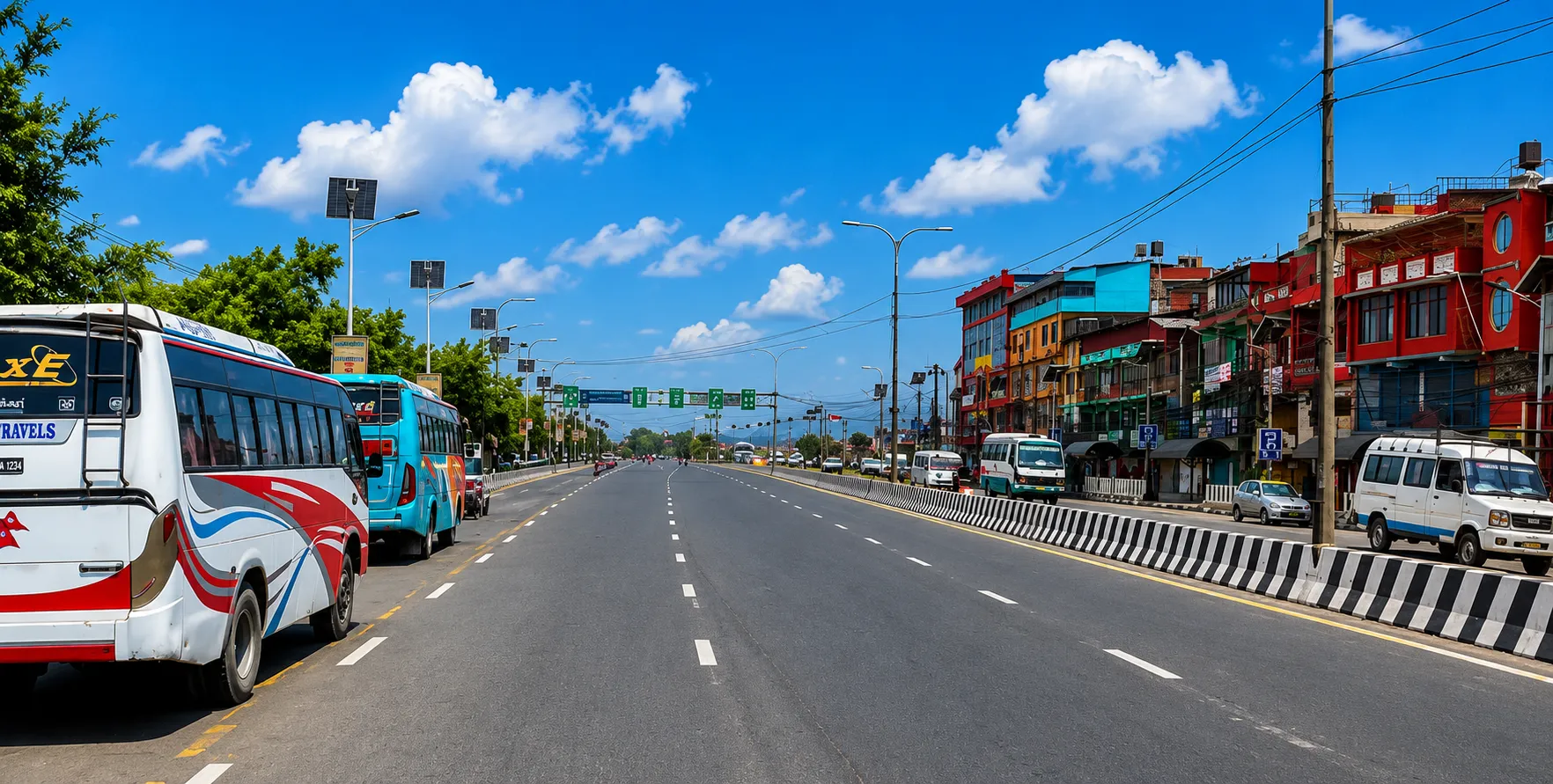
From the Tinkune junction, the vehicle heads east through Koteshwor, Balkumari, and the Bhaktapur municipality boundary — a 10 km corridor of suburban Kathmandu and eastern Bhaktapur that in peak hours (7:00–9:30 AM and 4:30–7:00 PM) can hold traffic delays of 15–30 minutes but in off-peak and night/early morning hours moves freely in under 20 minutes.

Nepal Vehicle Hiring drivers plan departure timing from TIA to avoid this corridor during peak hours where possible—for airport arrivals during peak periods, the driver waits patiently in the designated vehicle area rather than rushing through standing traffic.

The standard approach: vehicle at the TIA arrivals gate on landing notification, smooth exit once the passenger and luggage are loaded, departure timing in the driver’s control based on live traffic assessment.

As the vehicle passes through the Bhaktapur Durbar Square approach area, travellers with open schedules have the option of a brief or extended stop at Nepal’s finest preserved medieval city — described in detail in Section 4 below. For passengers arriving after a long-haul flight who want to reach the Dhulikhel hotel as efficiently as possible, the vehicle bypasses the heritage core. It continues directly via the Bhaktapur bypass to Banepa.

Bhaktapur to Banepa – The Valley Rim Climb

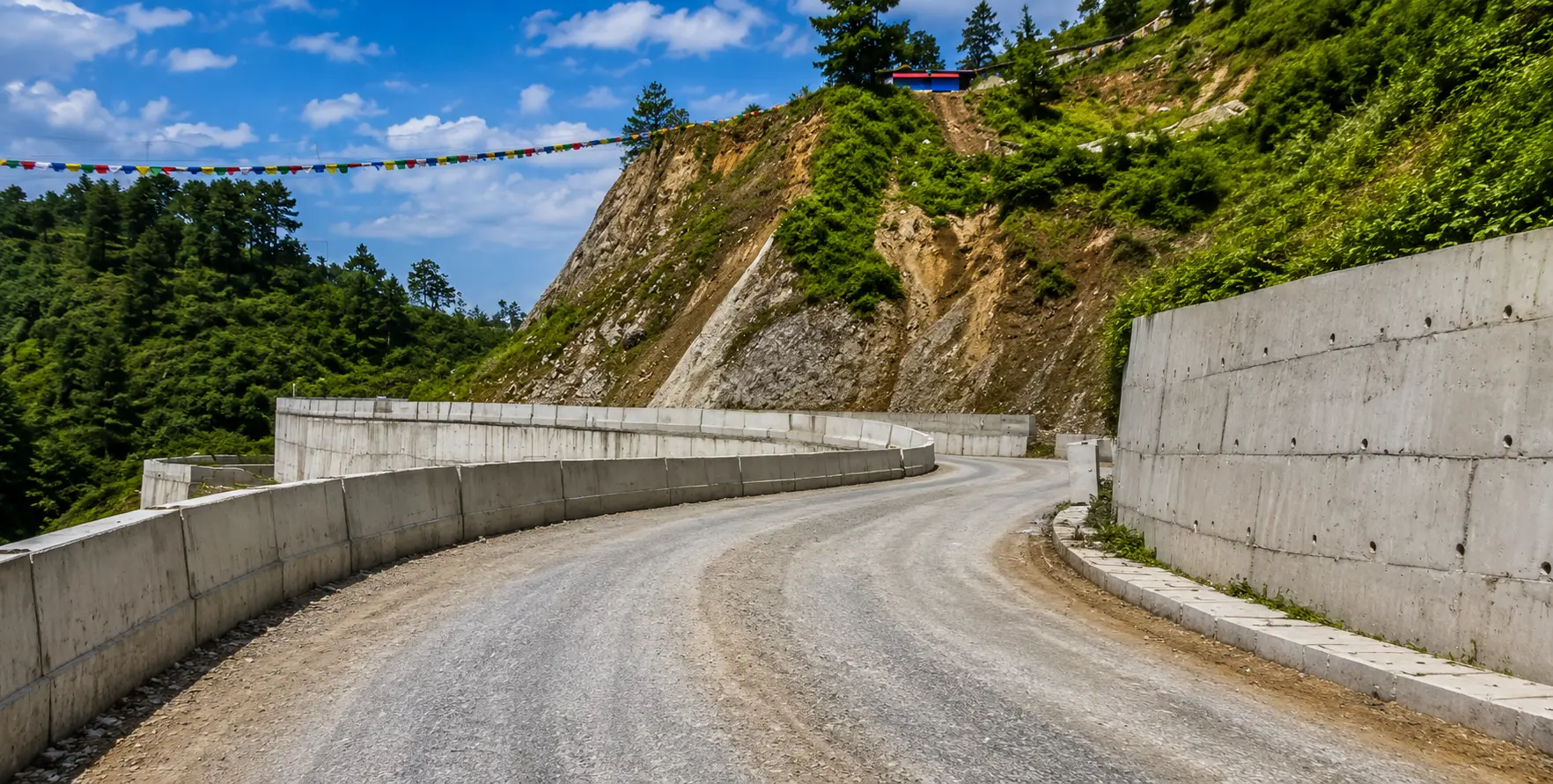
Beyond the Bhaktapur urban area, the road climbs to the Sanga hill pass—the eastern rim of the Kathmandu Valley —where the National Arjun sculpture stands at the crest of the pass, and the landscape transitions from the enclosed valley to the open eastern hill country.

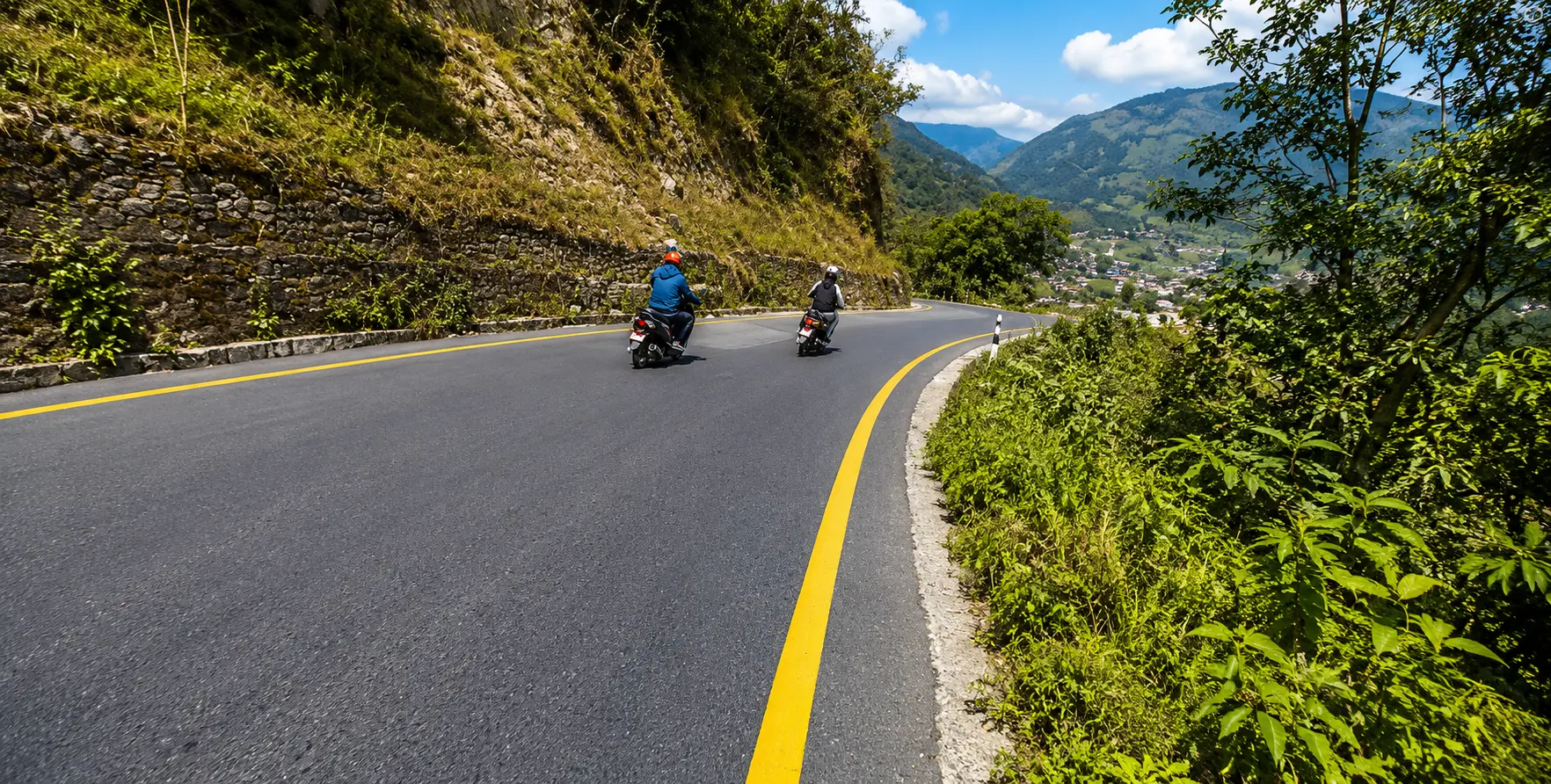
This climb provides the first direct views of the Himalayan foothills to the north and east — often the first Himalayan sight of a visitor’s Nepal trip if arriving directly from the airport — and the descent from Sanga toward Banepa offers a brief but genuinely beautiful taste of Nepal’s middle-hill landscape: forested ridgelines, terraced fields, and the valley of the Sun Koshi tributary visible below.

Banepa is the junction town where the BP Highway continues east toward Panchkhal and Jiri, while the Dhulikhel branch turns north toward the ridge.
Kathmandu Airport to Dhulikhel Hotel Transfer

Banepa to Dhulikhel – The Final Ridge Approach

From Banepa, the road climbs approximately 8 km north to Dhulikhel’s ridge position at 1,550 metres. This final section is the most rewarding driving stretch of the entire transfer — as the vehicle gains altitude and clears the lower hill ridges, the Himalayan panorama begins to open northward, with successive peaks appearing above the hill skyline as the road climbs.

On a clear day, the first full panorama visible from the upper Dhulikhel road is genuinely striking — a wall of snow peaks from Langtang to the Khumbu range that reminds even experienced Nepal travellers of why this small ridge town has been drawing visitors and retreat seekers for generations.

Nepal Vehicle Hiring’s private car or jeep completes the transfer by delivering directly to the hotel or resort entrance — whether the main gate of Dwarika’s Resort Dhulikhel on the southern ridge approach, the Dhulikhel Mountain Resort on the northern face, or any other Dhulikhel property.

Distance, Journey Time and Traffic Realities

The Kathmandu Airport to Dhulikhel distance is approximately 30 km by the standard Bhaktapur bypass route via Koteshwor and Banepa. Although this is a short distance by any road-network standard, the realistic journey time ranges from 45 minutes in ideal traffic conditions to 75–90 minutes during peak hours.

This variance is entirely a function of the Kathmandu Valley urban traffic that characterises the first 15 km of the journey — from TIA to the Bhaktapur boundary — where the Ring Road and suburban arterials can hold significant congestion during morning and evening peak periods. Once clear of the Bhaktapur urban area, the final 15 km to Dhulikhel is rapid and largely unimpeded.

The best traffic conditions for this transfer occur on: early morning (before 7:00 AM), mid-morning (9:30–11:30 AM after the peak clears), early afternoon (12:00–3:30 PM), and late evening (after 8:00 PM). The worst traffic windows are 7:30–9:30 AM and 4:30–7:00 PM — the Kathmandu morning and evening commuter peaks that affect the Ring Road and Koteshwor–Balkumari corridor.

Most international flights arriving at TIA do so in the late night or early morning hours — a window that typically places the TIA-to-Dhulikhel transfer outside the worst traffic conditions and allows a clean 45–55 minute transfer. Nepal Vehicle Hiring monitors TIA arrivals in real time and adjusts vehicle positioning and departure timing based on actual landing time and immigration clearance duration.

Swayambhunath visit during Kathmandu Pokhara Tour

The Bhaktapur Durbar Square Option – Turning Transit Into an Experience

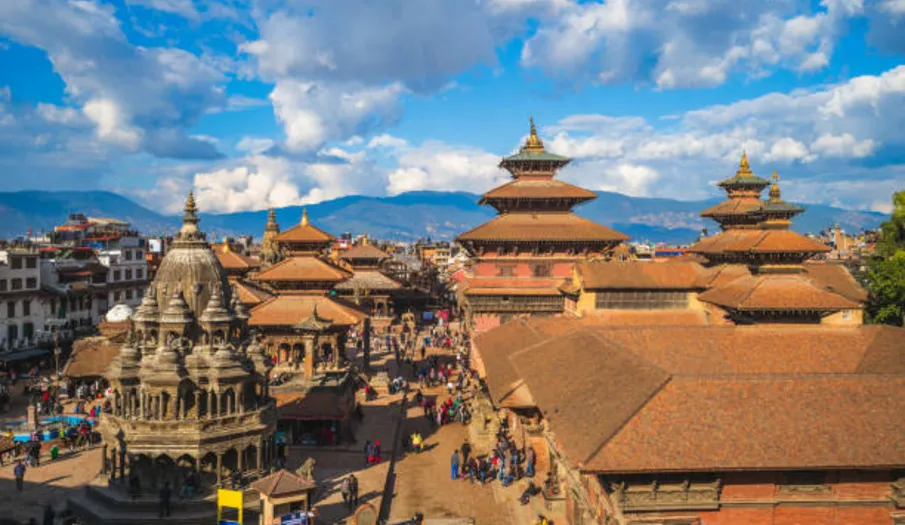
One of the most distinctive features of the Kathmandu Airport to Dhulikhel transfer route is that it passes through or immediately adjacent to Bhaktapur Durbar Square — the best-preserved of the three Kathmandu Valley royal palace squares and one of the finest examples of medieval Newari urban architecture anywhere in Asia.

Unlike the Kathmandu and Patan Durbar Squares, which sit in the dense urban heart of their respective cities, Bhaktapur’s historic core is more accessible and less congested. In many ways, it is more atmospherically intact — its 55-window palace, the towering Nyatapola pagoda (the tallest temple in Nepal), the pottery square, the peacock window, and the golden gate all present a coherent medieval urban landscape that can absorb anything from 30 minutes to half a day depending on the visitor’s interest.

For travellers arriving at TIA in the morning or early afternoon with energy left after their flight, the Bhaktapur Durbar Square stop on the airport-to-Dhulikhel transfer is one of Nepal Vehicle Hiring’s most recommended enhancements for this journey.

The vehicle detours approximately 2 km from the bypass route into the Bhaktapur parking area, the driver waits while the passenger explores (entry ticket required at the Bhaktapur gate — approximately USD 15 for foreign nationals), and the transfer continues to Dhulikhel after the visit. Adding a 1–2 hour Bhaktapur stop extends the total transfer time to approximately 2–3 hours from TIA to Dhulikhel, but delivers one of Nepal’s most extraordinary heritage experiences as the opening chapter of the trip — before even arriving at the hotel.

Bhaktapur also contains Changu Narayan Temple (approximately 6 km north of Bhaktapur’s main square) — Nepal’s oldest temple, with a 464 CE inscription and some of the most significant stone and metalwork of the Licchavi period.

For travellers particularly interested in Nepal’s Hindu and Buddhist heritage, combining Bhaktapur Durbar Square and Changu Narayan on the airport-to-Dhulikhel transfer creates a remarkably complete heritage introduction to the valley in a single journey. Nepal Vehicle Hiking’s private vehicle accommodates both stops without scheduling conflicts —the car waits at both sites and continues when the passenger is ready.

Vehicle Options and Costs

Private Car – The Standard Transfer Vehicle

For solo travellers, couples, and small groups of up to three people with standard international travel luggage, the private car (sedan or compact SUV) is Nepal Vehicle Hiring’s most economical and most booked vehicle for the TIA to Dhulikhel transfer.

Nepal Tour Package

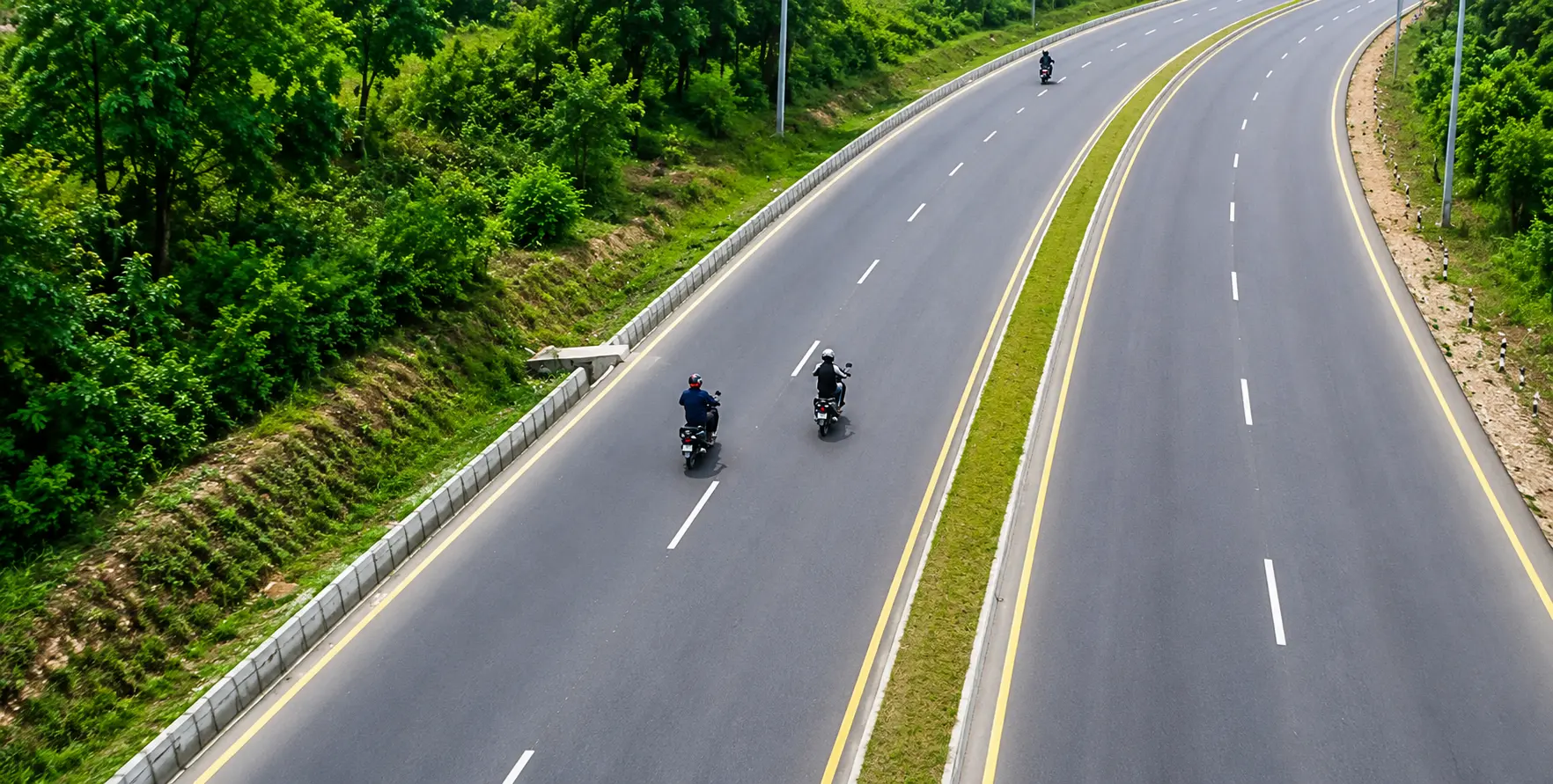
The 30 km route is entirely paved highway — 4WD is not required, and a standard car handles every section with complete comfort. The estimated cost for a private car from Kathmandu Airport to Dhulikhel is approximately NPR 2,500–8,000 (around USD 19–60), including the driver and fuel, with no additional charges on arrival.

This is significantly less than the taxi rates quoted by unregistered airport-side operators who approach arriving passengers in the TIA arrivals hall with informal, often inflated rates for the Dhulikhel journey. Nepal Vehicle Hiring’s pre-booked private car provides a named driver at the arrivals gate with a board, a confirmed rate, and direct hotel delivery—a categorically different service from arrivals-hall taxi negotiation.

Private Jeep (Mahindra Scorpio or Bolero) – For Groups and Trekking Luggage

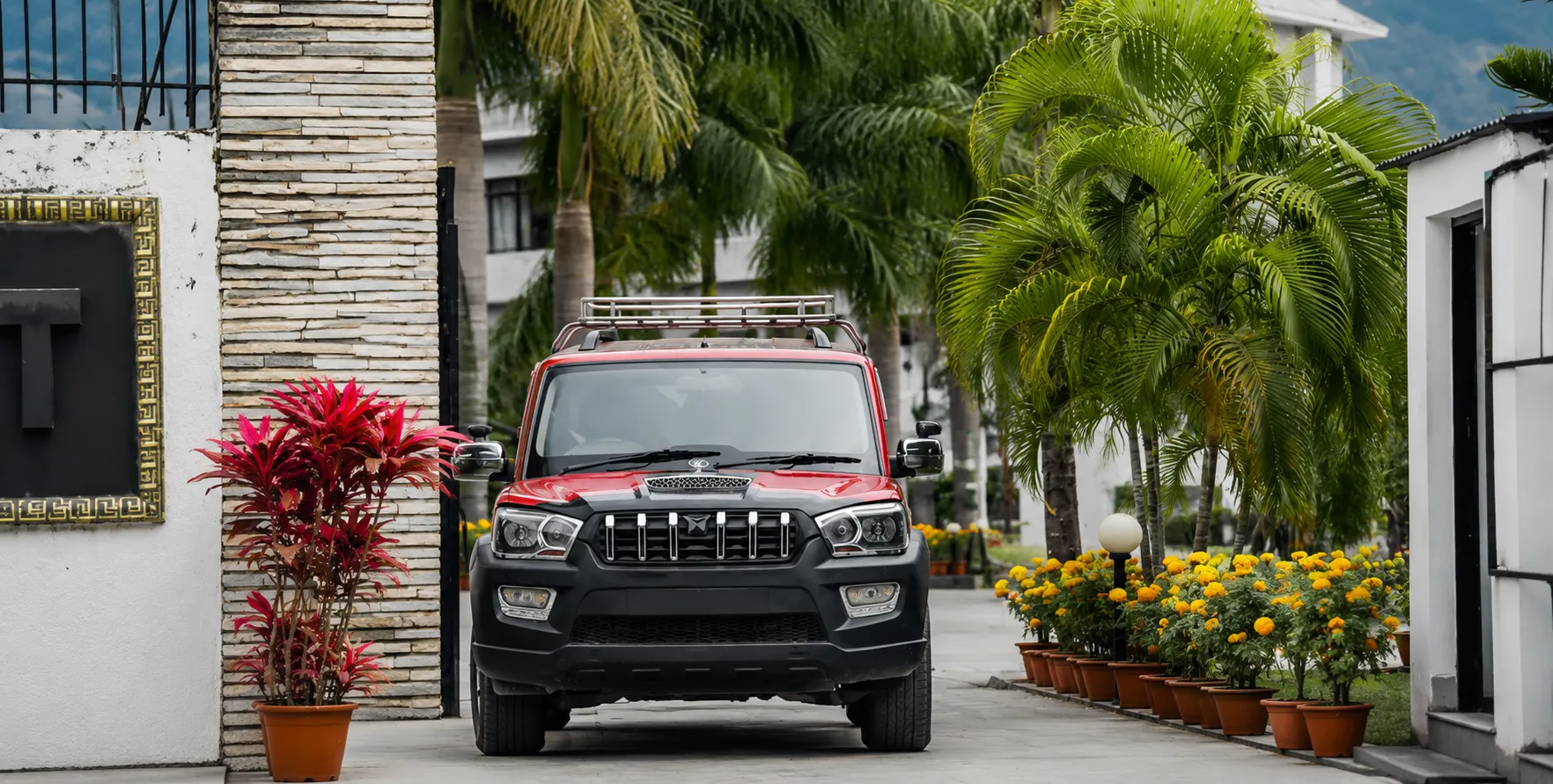
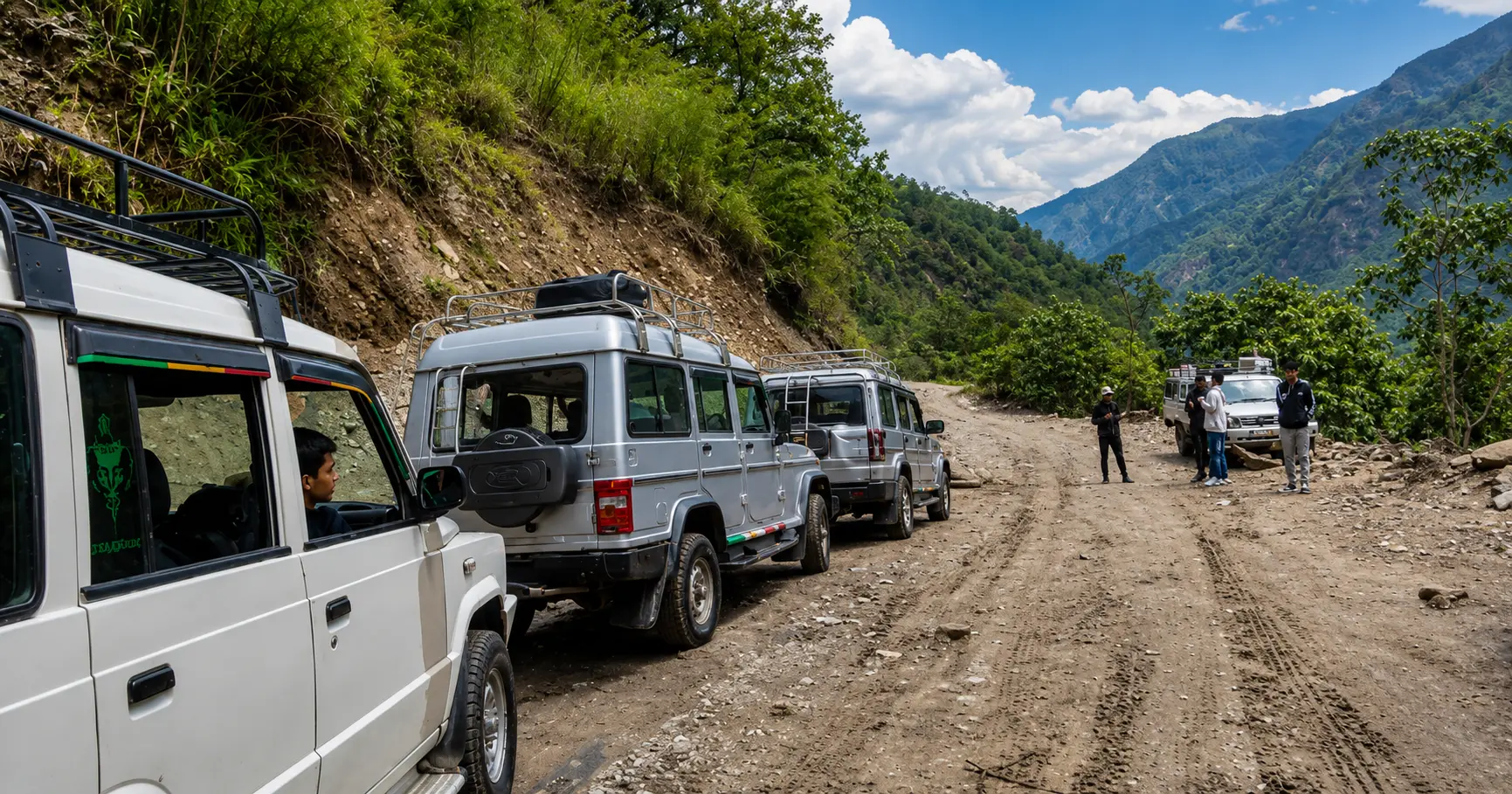
For groups of four to seven people, or smaller groups with heavy trekking luggage destined for Dhulikhel as the pre-trek overnight before heading east toward Jiri, Salleri, or Manthali, the Mahindra Scorpio or Bolero 4WD is the most appropriate vehicle — accommodating the group comfortably. At the same time,e the roof rack carries all expedition luggage without compressing passenger space.

Kathmandu Durbar Square

The estimated cost for a Mahindra Scorpio from Kathmandu Airport to Dhulikhel is approximately NPR 4,000–10,000 (around USD 30–80) for the complete vehicle, which, split across five or six passengers, is highly competitive on a per-person basis with any shared transport option while providing door-to-hotel delivery, luggage management, and timing flexibility for the Bhaktapur stop or any other en-route request.

Toyota Hiace Van – For Corporate and Resort Groups

For corporate retreat groups, resort conference parties, wedding groups, and any arrival of eight to thirteen people travelling together to a Dhulikhel resort, the Toyota Hiace van is Nepal Vehicle Hiring’s most popular group airport transfer vehicle for the Dhulikhel route.

The Hiace’s full air conditioning, generous luggage capacity with a roof rack, and professional presentation make it the natural choice for resort arrivals, where the vehicle experience is part of the guest’s first impression. Nepal’s luxury mountain resorts — including the flagship Dhulikhel properties

expect coordinated group arrivals where the vehicle matches the property’s standard. The estimated cost for a Toyota Hiace from Kathmandu Airport to Dhulikhel is approximately NPR 6,000–15,000 (around USD 45–120) for the complete vehicle.

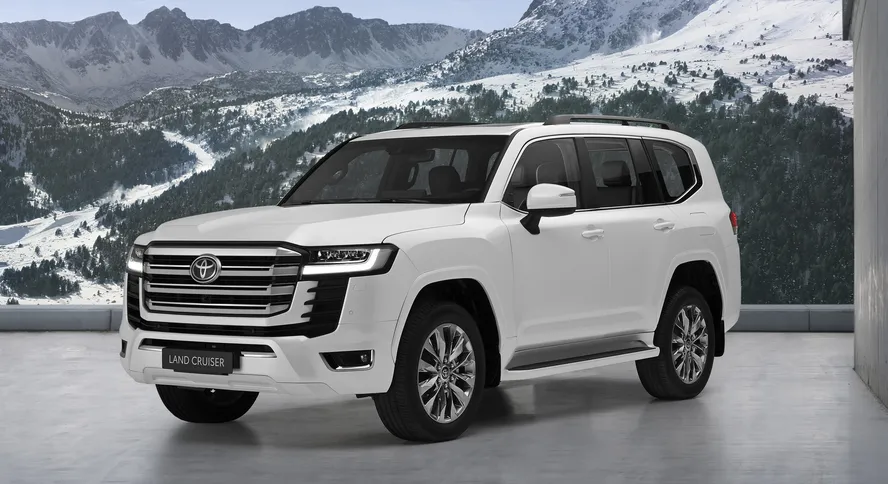
Toyota Land Cruiser – Top-end and VIP Arrivals

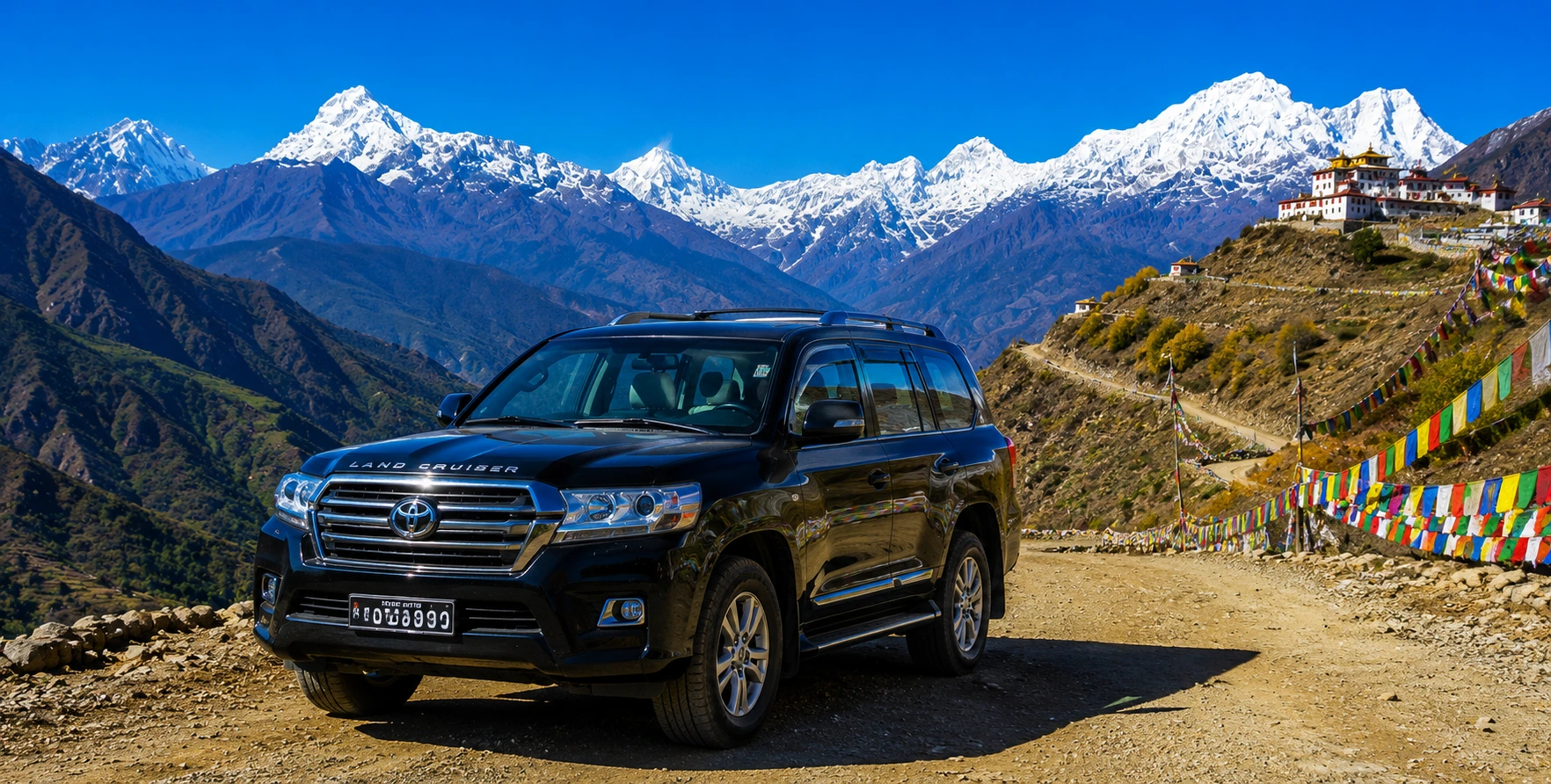
For VIP guests, senior resort visitors, corporate executive arrivals, and travellers for whom the airport pickup vehicle is the first element of a top-end Nepal experience, the Toyota Land Cruiser 4WD provides the finest private transfer experience available on the TIA to Dhulikhel route — chilled water in the cabin, top-end leather seating, climate control, immaculate presentation, and a professional uniformed driver.
Kathmandu Airport to Dhulikhel Hotel Transfer

For guests of Dwarika’s Resort Dhulikhel and equivalent top-end properties, the Land Cruiser airport pickup maintains the property’s luxury standard from the moment of arrival in Nepal.

The estimated cost for a Toyota Land Cruiser from Kathmandu Airport to Dhulikhel is approximately NPR 7,000–40,000 (around USD 200–400). For Alpine Luxury Treks clients beginning their custom Nepal Himalayan journey with a Dhulikhel arrival, the Land Cruiser is the standard airport pickup vehicle coordinated with Nepal Vehicle Hiring.

Night Arrivals – The Most Common Scenario

Most international flights arriving at TIA land between 10:00 PM and 3:00 AM, driven by departure times from major Asian and Middle Eastern hubs that feed Nepal’s international connections.

This means the Kathmandu Airport to Dhulikhel transfer is often a late-night or early-morning journey, made in the quiet hours when Kathmandu’s traffic is lightest, and the 30 km transfer takes 40–50 minutes. The Himalayan view that guests are paying for in Dhulikhel’s top-end resort positions is not immediately visible on arrival in darkness — but the

morning awakening to the panorama from a Dhulikhel resort room or terrace is, for many visitors, one of the most memorable first mornings in Nepal. Nepal Vehicle Hiring handles late-night and early-morning airport pickups as routine — our 24/7 operations line on WhatsApp monitors TIA arrivals in real time, positions the driver before the aircraft lands, and has the vehicle at the kerb when the passenger exits the arrivals hall, regardless of the hour.

Specific hotel gate instructions with the resort in advance — several Dhulikhel properties have night arrival procedures for late check-ins that differ from daytime arrival, and knowing these in advance ensures the driver can deliver directly to the right entrance without delay. Most Dhulikhel resort properties provide Nepal Vehicle Hiring with their gate GPS coordinates as part of the standard pre-arrival coordination for hotel pickup bookings.
Kathmandu Airport to Dhulikhel Hotel Transfer

The Reverse Transfer – Dhulikhel to Kathmandu Airport

The Dhulikhel to Kathmandu Airport transfer is the natural bookend to the arrival transfer and is Nepal Vehicle Hiring’s second highest-volume service on this specific route. The return transfer shares the same route in reverse — Dhulikhel Ridge to Banepa junction, descent to Bhaktapur, eastward Ring Road to Tinkune, and TIA arrivals road to the departure terminal.

The critical timing for the departure transfer differs from the arrival; international flights require a minimum 3-hour buffer before departure. Nepal Vehicle Hiring’s operations team calculates the Dhulikhel hotel departure time backwards from the flight departure time, assuming worst-case peak-hour traffic on the Bhaktapur corridor.

The standard calculation: 3.5–4 hours before international departure for the Dhulikhel hotel pickup, or 2.5–3 hours for domestic flights. We share this calculation with the client at booking confirmation and confirm it the evening before departure.

A Bhaktapur Durbar Square stop on the return Dhulikhel-to-airport journey when the departure timing allows at least a 4.5-hour hotel-to-airport window — providing approximately 1–1.5 hours at Bhaktapur with comfortable onward timing to TIA for the flight.

Dhulikhel as a Trek Staging Point – Connecting to Eastern Routes

Dhulikhel’s position at the start of the BP Highway corridor makes it more than just a resort destination — it is a natural staging point for trekkers and travellers heading east toward Jiri, Salleri, and the Everest road approach.

For trekkers whose Nepal itinerary involves an overnight acclimatisation and preparation stop before the long vehicle journey to Jiri or Manthali Airport for the Lukla flight, a Dhulikhel night offers a significantly more restful and scenically rewarding pre-trek base than a Thamel hotel — quieter, cleaner air, cooler temperatures, and the acclimatisation benefit of spending the pre-trek night at 1,550 m rather than Kathmandu’s 1,350 m.

Nepal Vehicle Hiring coordinates the complete Dhulikhel staging sequence for Everest trekkers: TIA to Dhulikhel hotel on arrival, overnight at the Dhulikhel resort, and then Dhulikhel to Jiri or Dhulikhel to Manthali Airport private jeep departure the following morning.

This increasingly popular Everest Base Camp Trek staging strategy, recommended by Trek Nepal Himalayas guide teams, combines a comfortable mountain-view rest night with a 100 m altitude pre-acclimatisation, making the Dhulikhel staging night a meaningful wellness investment rather than a mere logistical stopover.

The Dhulikhel to Manthali predawn drive is approximately 100 km and 2.5–3 hours via the BP Highway, significantly shorter than the full Kathmandu to Manthali run and allowing a later Dhulikhel departure time while still reaching Manthali in the morning flight window.
Kathmandu Airport to Dhulikhel Hotel Transfer

The Dhulikhel Sunrise Experience – Why Arrival Timing Matters

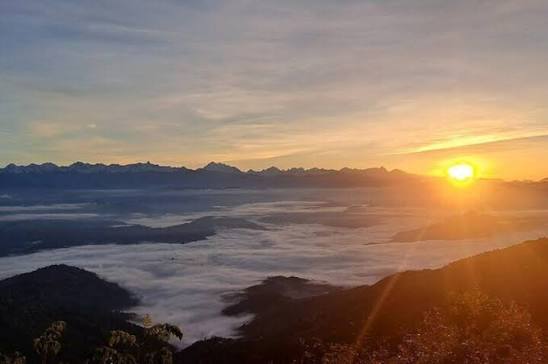
For guests whose primary reason for booking Dhulikhel is the famous sunrise Himalayan panorama, the most rewarding arrival timing is late afternoon or early evening — arriving with enough light remaining to see the peaks in afternoon clarity, watching the alpenglow on the snowfields as the sun sets behind the Kathmandu Valley rim,

then rising early the following morning for the full east-facing dawn panorama as the sun rises behind the peaks. Nepal Vehicle Hiring’s airport-to-Dhulikhel service accommodates this timing perfectly: a late afternoon TIA arrival on most connecting flight schedules from major Asian hubs produces a Dhulikhel arrival in early to mid-evening — the optimal check-in for the next morning’s sunrise experience.

Travellers arriving on night flights who check into Dhulikhel at midnight or later will find the panorama invisible until dawn — but those who set an alarm and step onto their resort terrace or the viewpoint above the town before 5:30 AM will see one of the most extraordinary natural spectacles Nepal offers: the Himalayan peaks emerging from the predawn islands of rose and gold above the valley shadow line.

A dedicated sunrise viewpoint trail from the property, a marked walking path to the best sunrise spot that takes 10–20 minutes on foot.

Connecting Dhulikhel to the Kathmandu Valley Heritage Circuit

Dhulikhel’s position on the eastern rim of the Kathmandu Valley makes it a natural addition to the Kathmandu Valley heritage circuit. A typical Kathmandu Valley heritage day combining Dhulikhel with Bhaktapur and Changu Narayan covers Bhaktapur Durbar Square and Nyatapola Pagoda (morning), Changu Narayan Temple (mid-morning), and Dhulikhel’s viewpoint and traditional bazaar (afternoon), offering the finest single-day cultural and natural experiences available from Kathmandu.

This itinerary combines Nepal’s finest medieval heritage town, the country’s oldest and most historically significant temple, and the valley’s most accessible panoramic Himalayan viewpoint in a managed, comfortable day-trip format. Nepal Vehicle Hiking provides a private car or jeep for this full-day Bhaktapur–Changu–Dhulikhel heritage circuit as a standard tour service, with the driver and vehicle available throughout the day.

For trekkers beginning the Annapurna Base Camp Trek, Ghorepani Poon Hill Trek, or any Trek Nepal Himalayas package who have an extra Kathmandu Valley day before the trekking jeep departs, the Dhulikhel day trip as part of the valley heritage circuit is a day-use of an unscheduled Kathmandu Valley free day.
Kathmandu Airport to Dhulikhel Hotel Transfer

Namobuddha – The Sacred Addition to the Dhulikhel Visit

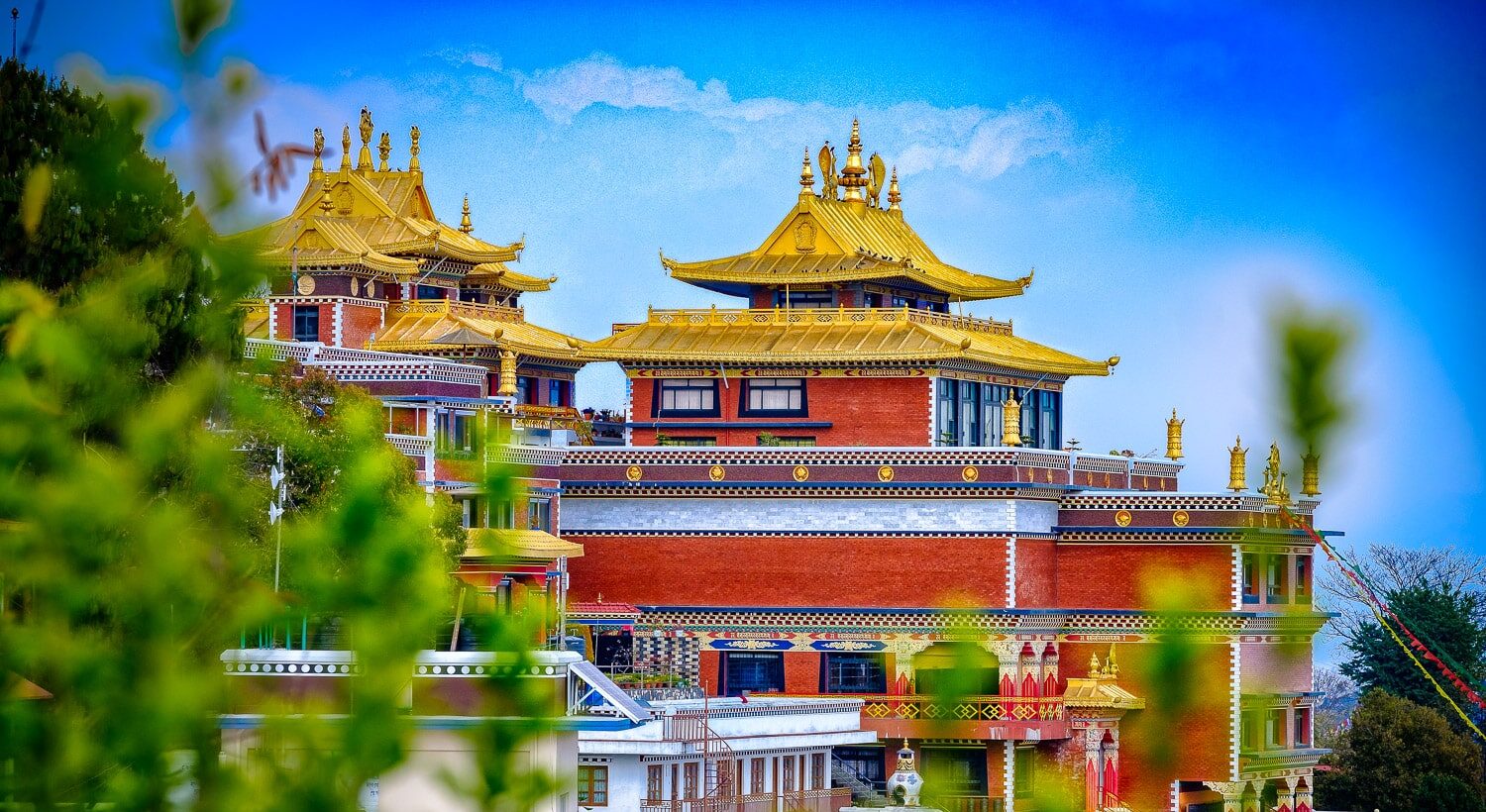
About 10 km east of Dhulikhel, on a mountain road, sits Namobuddha—one of Nepal’s most sacred Tibetan Buddhist pilgrimage sites, where a stupa complex marks the spot where the historical Buddha, in a previous life, sacrificed his body to feed a starving tigress and her cubs.

The Jataka stories of the Buddha’s previous lives are embodied in an extraordinary hillside monastery and stupa complex, with an unexpectedly moving quality for casual visitors.

Nepal Vehicle Hiring’s Namobuddha inclusion option for the Dhulikhel transfer45–60 minute sacred site stop on the road beyond Dhulikhelmeaningful cultural and spiritual arrival experience. For first-time Buddhist visitors to Nepal, a Namobuddha stop—even a brief one 

provides an immediate, profound introduction to Nepal’s living Buddhist tradition and sets the tone for a spiritually oriented Nepal visit. Alpine Luxury Treks includes Namobuddha as a standard part of its spiritual Nepal pilgrimage and luxury retreat packages, coordinating with Nepal Vehicle Hiring to arrange a vehicle for the Dhulikhel circuit throughout the day.

Practical Tips for the Kathmandu Airport to Dhulikhel Transfer

  • Pre-Book Your Transfer – Do Not Accept Arrivals Hall Taxis: TIA arrivals hall is a notoriously aggressive environment for informal taxi operators who approach arriving passengers with inflated rates and unverified credentials. Nepal Vehicle Hiring’s pre-booked private transfer: named driver with a board, confirmed rate, and direct hotel delivery — book before your flight, not after landing.
  • Nepal Vehicle Hiring tracks TIA arrivals in real time using the flight number provided at booking. If your flight is delayed, the driver knows and adjusts — you will never land to find no vehicle. The operations line (WhatsApp) is available for any real-time communication needed.
  • Bhaktapur Durbar Square on the route from TIA to Dhulikhel is one of Nepal’s finest heritage sites and sits directly on the transfer route. If you arrive with energy and daylight, a 1–1.5-hour visit to Bhaktapur turns the transfer into a memorable arrival experience.
  • 10 km beyond Dhulikhel, Namobuddha is one of Nepal’s red Buddhist sites and adds less than 90 minutes to the transfer. Request this at booking, and Nepal Vehicle Hiring confirms the timing with your resort’s check-in arrangements.
  • Book Return Airport Transfer Simultaneously: Book the Dhulikhel to TIA return transfer at the same time as the arrival transfer, with departure timing backwards from your flight schedule, and confirm both legs with driver details. Peak season vehicle availability at Dhulikhel is constrained — simultaneous booking eliminates the risk of no vehicle on departure morning.
  • Use Dhulikhel as a Trek Staging Night for Eastern Routes: Trekkers heading to Jiri, Salleri, Phaplu, or Manthali Airport. Dhulikhel overnight staging: shorter morning drive to the destination, 1,550 m pre-acclimatisation, and infinitely better rest than a Thamel hotel. Nepal Vehicle Hiring coordinates the TIA–Dhulikhel arrival and Dhulikhel–Jiri/Manthali departure as a combined booking.

Frequently Asked Questions – Kathmandu Airport to Dhulikhel Transfer

How far is Kathmandu Airport (TIA) from Dhulikhel?

Kathmandu’s Tribhuvan International Airport (TIA) is approximately 30 km from Dhulikhel via the Bhaktapur bypass and BP Highway to Banepa junction. The journey takes 45–75 minutes depending on traffic conditions — 45 minutes in off-peak and night hours, up to 75–90 minutes during morning and evening Kathmandu peak hours.

What does a private transfer from Kathmandu Airport to Dhulikhel cost?

Nepal Vehicle Hiring’s estimated costs for the TIA to Dhulikhel transfer: private car — NPR 2,500–8,000 (USD 19–60); Mahindra Scorpio jeep — NPR 4,000–10,000 (USD 30–80); Toyota Hiace van — NPR 6,000–15,000 (USD 45–120); Toyota Land Cruiser — NPR 7,000–40,000 (USD 200–400). All prices include the full transfer, driver, fuel, and door-to-hotel delivery. Contact Nepal Vehicle Hiring on WhatsApp  for a confirmed quotation.

Can I stop at Bhaktapur Durbar Square on the way to Dhulikhel?

Yes — Bhaktapur sits directly on the TIA-to-Dhulikhel route, and a stop adds no significant detour to the journey. A 1–2 hour Bhaktapur visit extends the total transfer time to approximately 2–3 hours. Entry to Bhaktapur Durbar Square costs approximately USD 15 for foreign nationals.

Request the Bhaktapur stop at booking; Nepal Vehicle Hiring will confirm the timing.

Does Nepal Vehicle Hiring provide night arrival transfers to Dhulikhel?

Yes — Nepal Vehicle Hiring’s 24/7 operations line on WhatsApp monitors flight arrivals in real time and has the vehicle at the TIA kerb when the passenger exits arrivals, regardless of the arrival hour. Night transfers to Dhulikhel benefit from minimal traffic and typically complete in 40–50 minutes.

Can I use Dhulikhel as a staging point before trekking?

Yes — Dhulikhel’s position at the start of the BP Highway makes it an excellent staging point for trekkers heading to Jiri, Salleri, Phaplu, or Manthali Airport. Nepal Vehicle Hiring coordinates the TIA–Dhulikhel arrival and Dhulikhel–trailhead departure as a combined booking. The Dhulikhel-to-Manthali run is approximately 100 km and 2.5–3 hours — significantly shorter than the full KTM-to-Manthali distance.

How far in advance should I book the Dhulikhel transfer?

24–72 hours ahead is usually sufficient outside peak season; 3–7 days ahead is recommended for Toyota Hiace and Land Cruiser. Night arrivals with pre-booked transfers have the highest on-time reliability of any Nepal Vehicle Hiring service — the driver is confirmed before your flight departs your home country.

Book Your Kathmandu Airport to Dhulikhel Transfer with Nepal Vehicle Hiring

The Kathmandu Airport to Dhulikhel private transfer: the world’s highest mountain chain fills the northern horizon, named driver pickup at TIA, door delivery to your hotel, optional Bhaktapur and Namobuddha stops, 24/7 operations support, and full pricing transparency.

For complete trekking circuits beginning or ending in Dhulikhel, Trek Nepal Himalayas offers Nepal’s finest guided trekking experiences, and Alpine Luxury Treks provides top-end Himalayan itineraries—both working with Nepal Vehicle Hiring for vehicle transfers.

Call / WhatsApp  |  vehiclehiringnepal.com  |  Book Airport to Dhulikhel Transfer  |  treknepalhimalayas.com  |  alpineluxurytreks.com
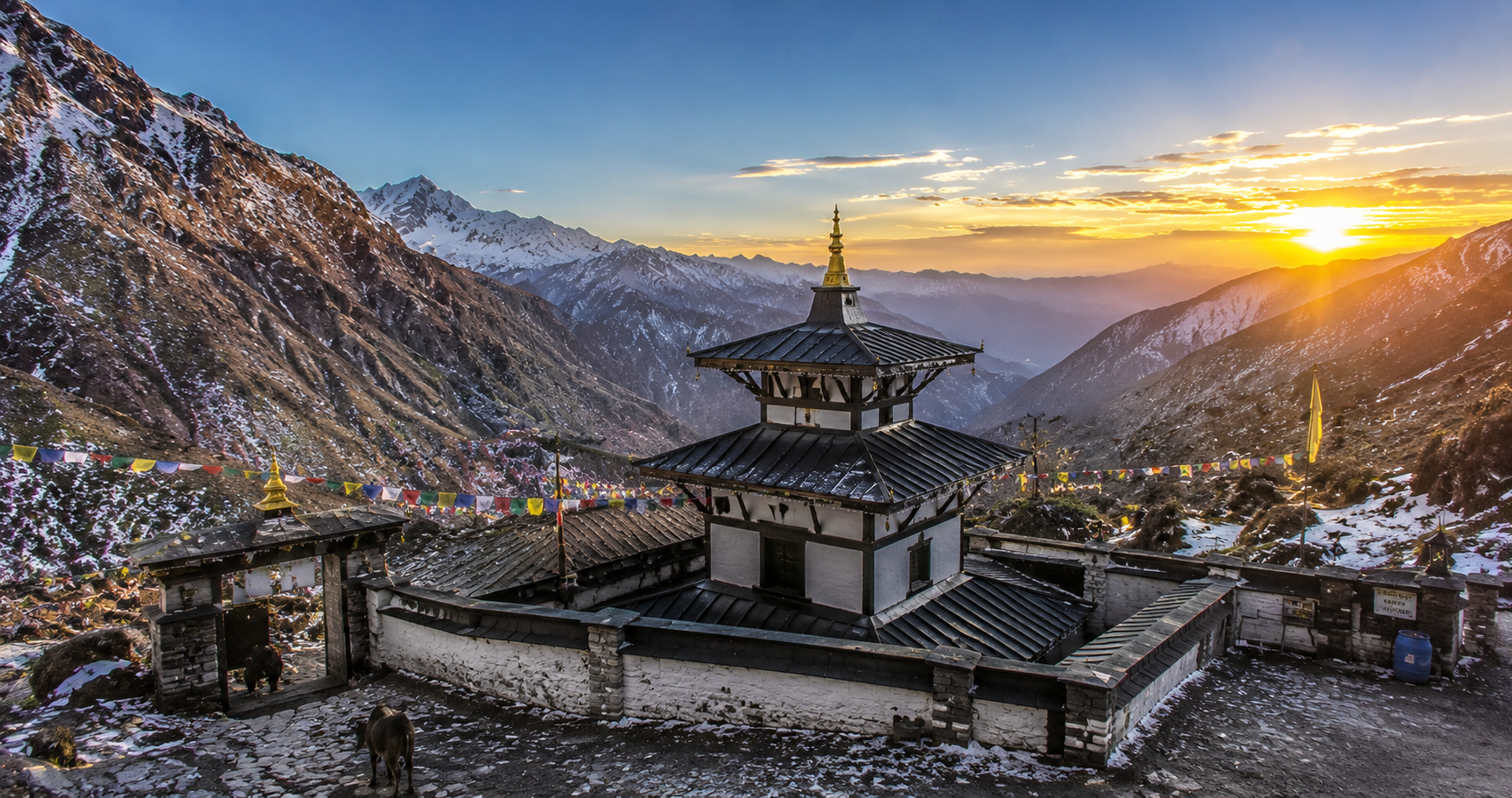
Muktinath Tour from Banbasa: Private Jeep Hire

Best Muktinath Tour from Banbasa Private Jeep Hire 2026/27/28

Muktinath Tour from Banbasa Private Jeep Hire — Complete Yatra Guide

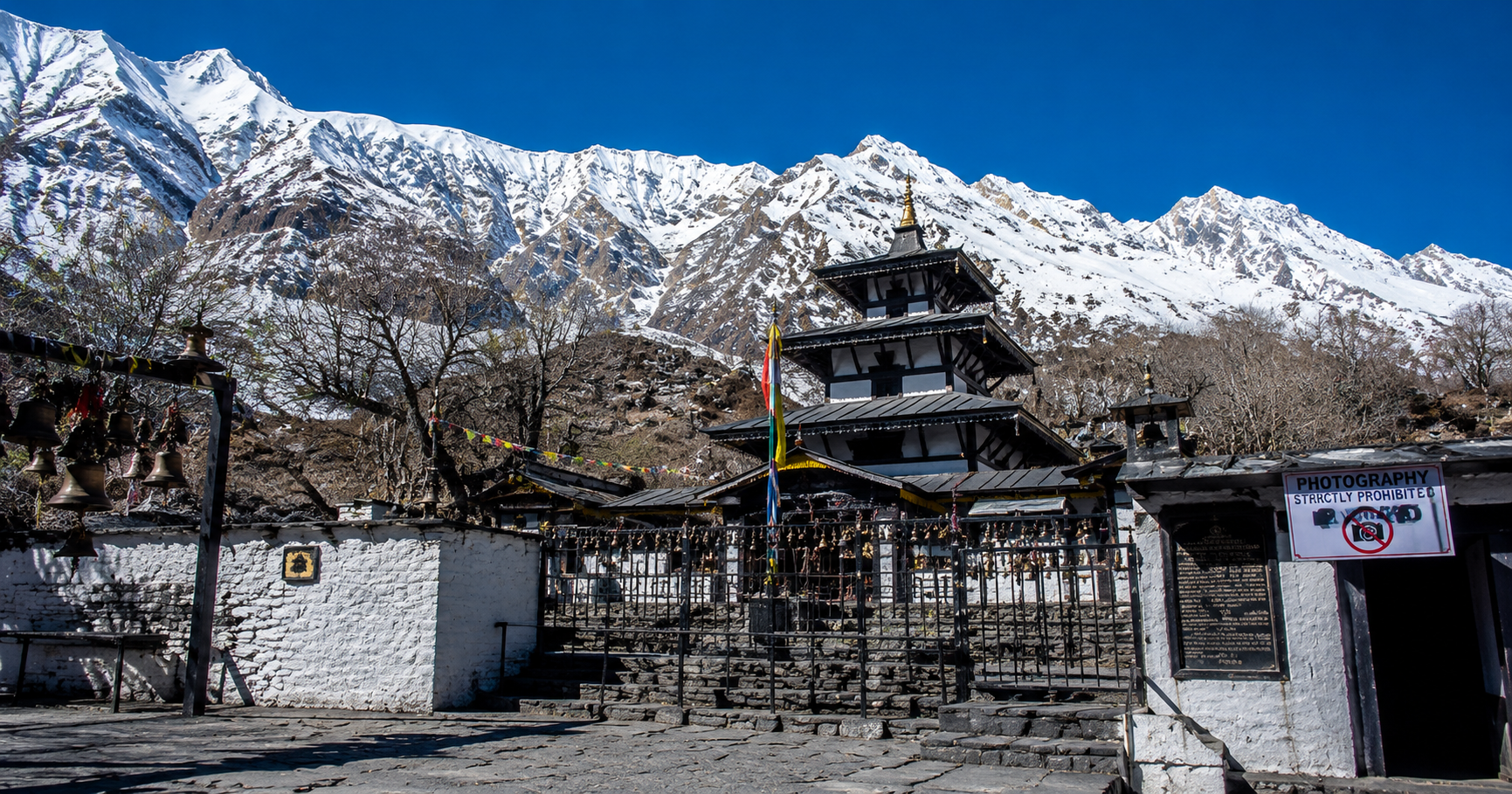
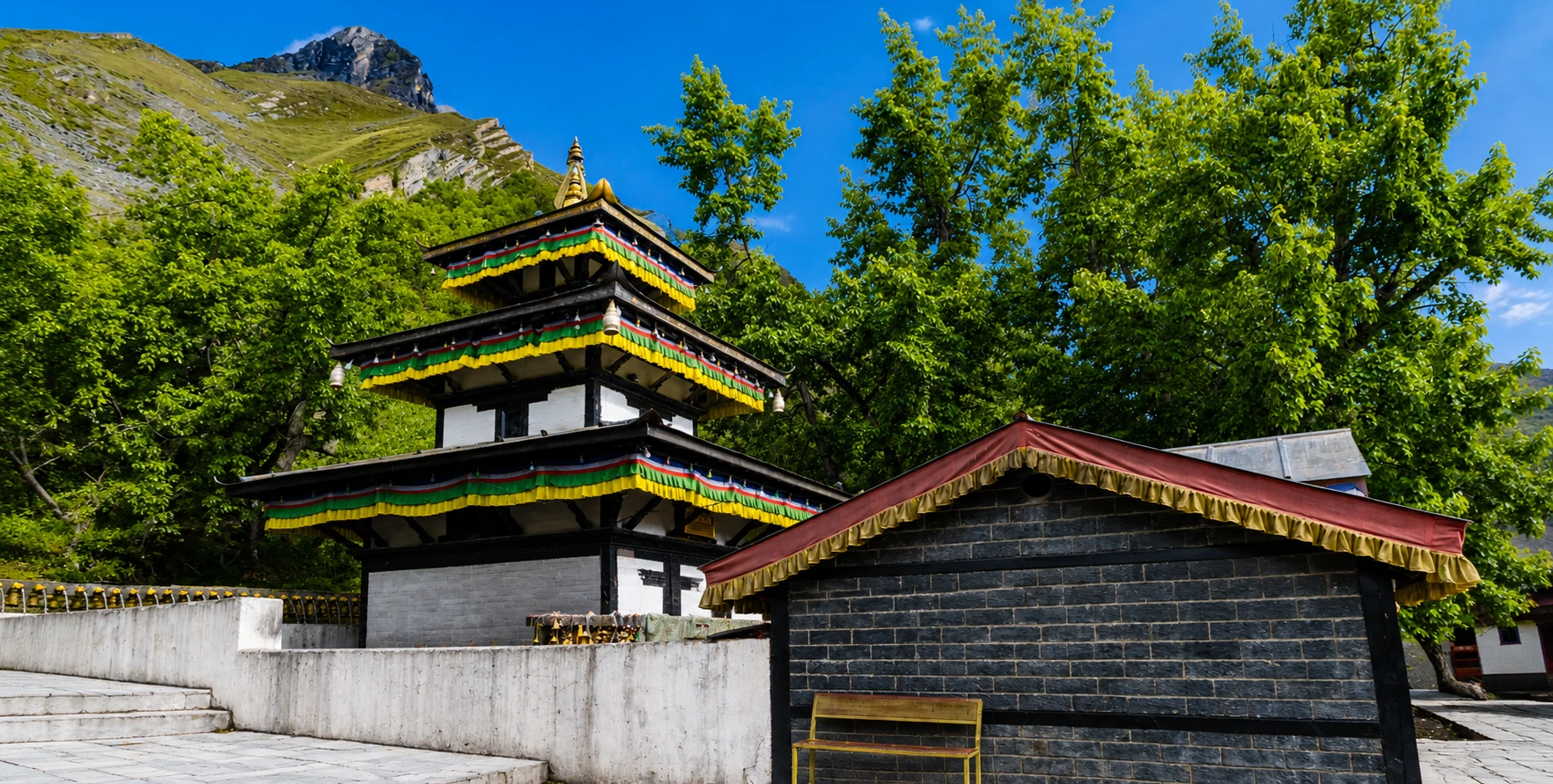
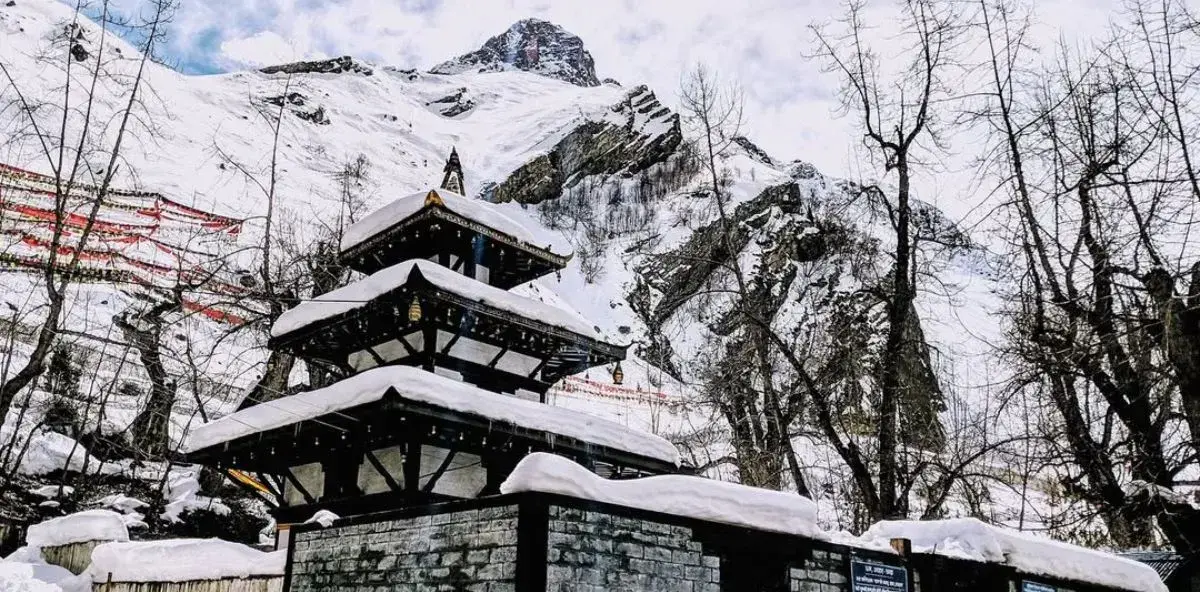
Muktinath Temple, at 3,710 metres in Nepal’s Mustang District, is one of the Himalayan world’s most sacred pilgrimage destinations—a site of extraordinary devotional significance for both Hindu and Buddhist traditions. For Vaishnava Hindus, Muktinath is one of the 108 Divya Desams (sacred abodes of Lord Vishnu) and one of Nepal’s most spiritually powerful dharmic yatra destinations.

For Buddhist pilgrims, the site — known as Chumig Gyatsa (Hundred Waters) — holds the sacred flame emerging from water and earth that Tibetan Buddhism venerates as a manifestation of five sacred elements. The combination of these two traditions’ sacred claim on Muktinath makes it Nepal’s most universally revered pilgrimage destination.

For pilgrims departing from Banbasa — the India-Nepal border crossing in Uttarakhand that connects Champawat and Udham Singh Nagar districts of India to Mahendranagar in Nepal’s Far-Western Province — the private jeep hire for the Muktinath yatra covers one of Nepal’s longest and most varied overland pilgrimage routes: the Mahendra Highway’s

Terai traverse eastward across Nepal’s southern plains, then head north from the Butwal junction to Pokhara, and take the Kali Gandaki gorge road to Jomsom and Muktinath. Nepal Vehicle Hiring Pvt Ltd coordinates complete Nepal-side vehicle hire for the Banbasa-to-Muktinath journey, from pickup at the Mahendranagar border to arrival at the Muktinath sacred site.

The Complete Route — Banbasa to Muktinath

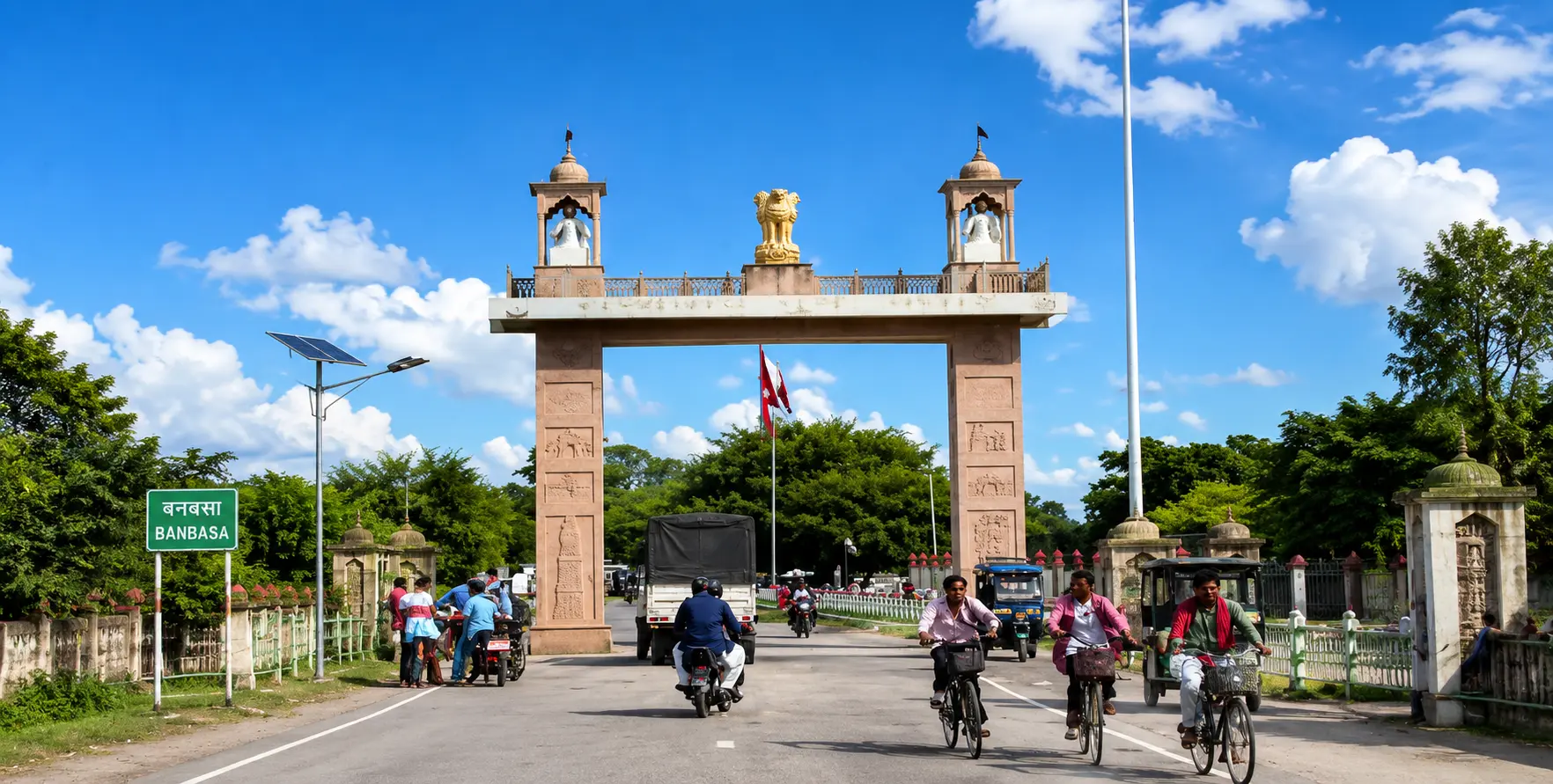
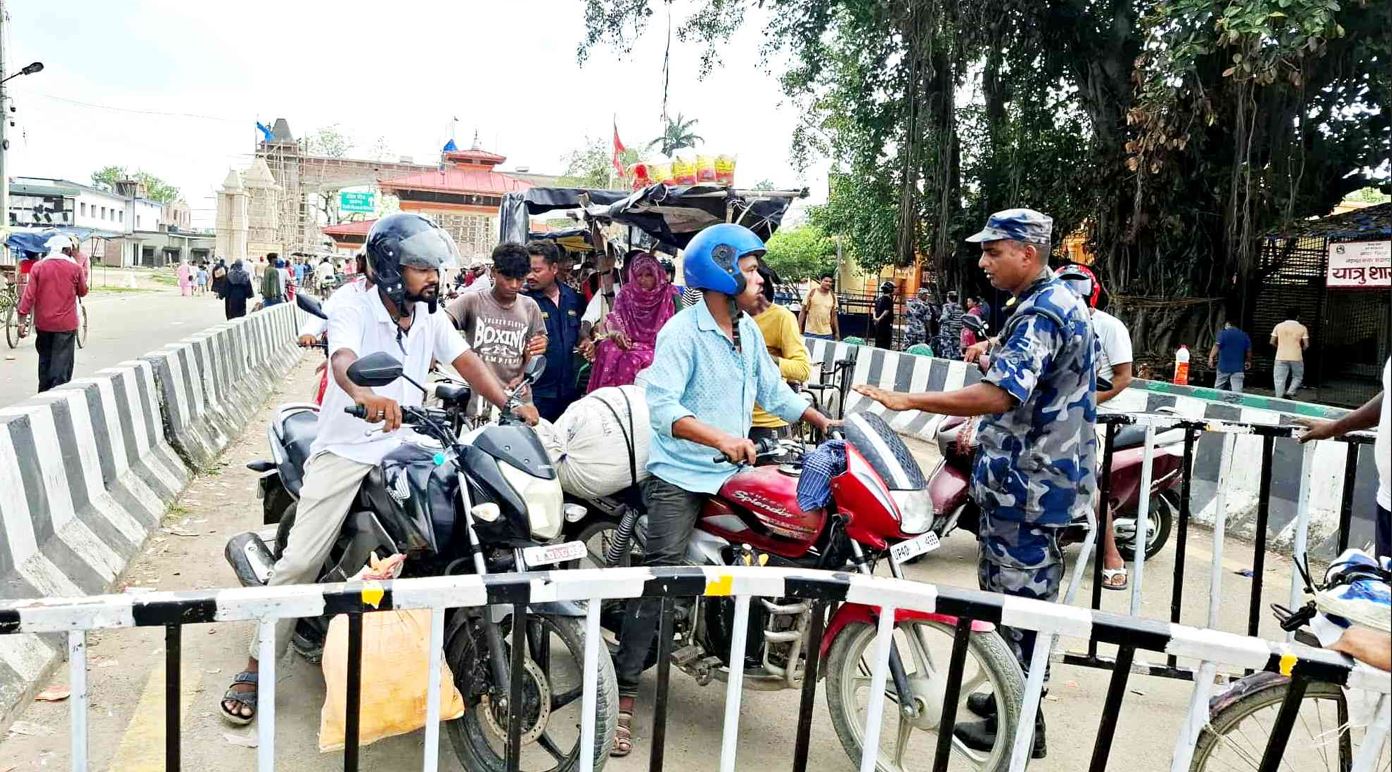
Leg 1: Banbasa border crossing to Mahendranagar, Nepal (0-5 km, 1-2 hours formalities). The Banbasa-Mahendranagar border crossing connects Uttarakhand to Nepal’s Far-Western Province (Kanchanpur District). Indian nationals cross freely with valid photo ID. Nepal Vehicle Hiring Pvt Ltd’s driver meets the group after immigration at the Nepal-side Mahendranagar border gate.

Leg 2: Mahendranagar to Butwal via Mahendra Highway (approximately 500-520 km, 8-10 hours, Day 1-2). The Mahendra East-West Highway runs eastward from Mahendranagar through Dhangadhi, Atariya, Kohalpur, Nepalgunj (optional stop), Tulsipur, and Butwal. This is Nepal’s longest single-axis highway drive — typically divided into 2 days with an overnight at Nepalgunj or Kohalpur.

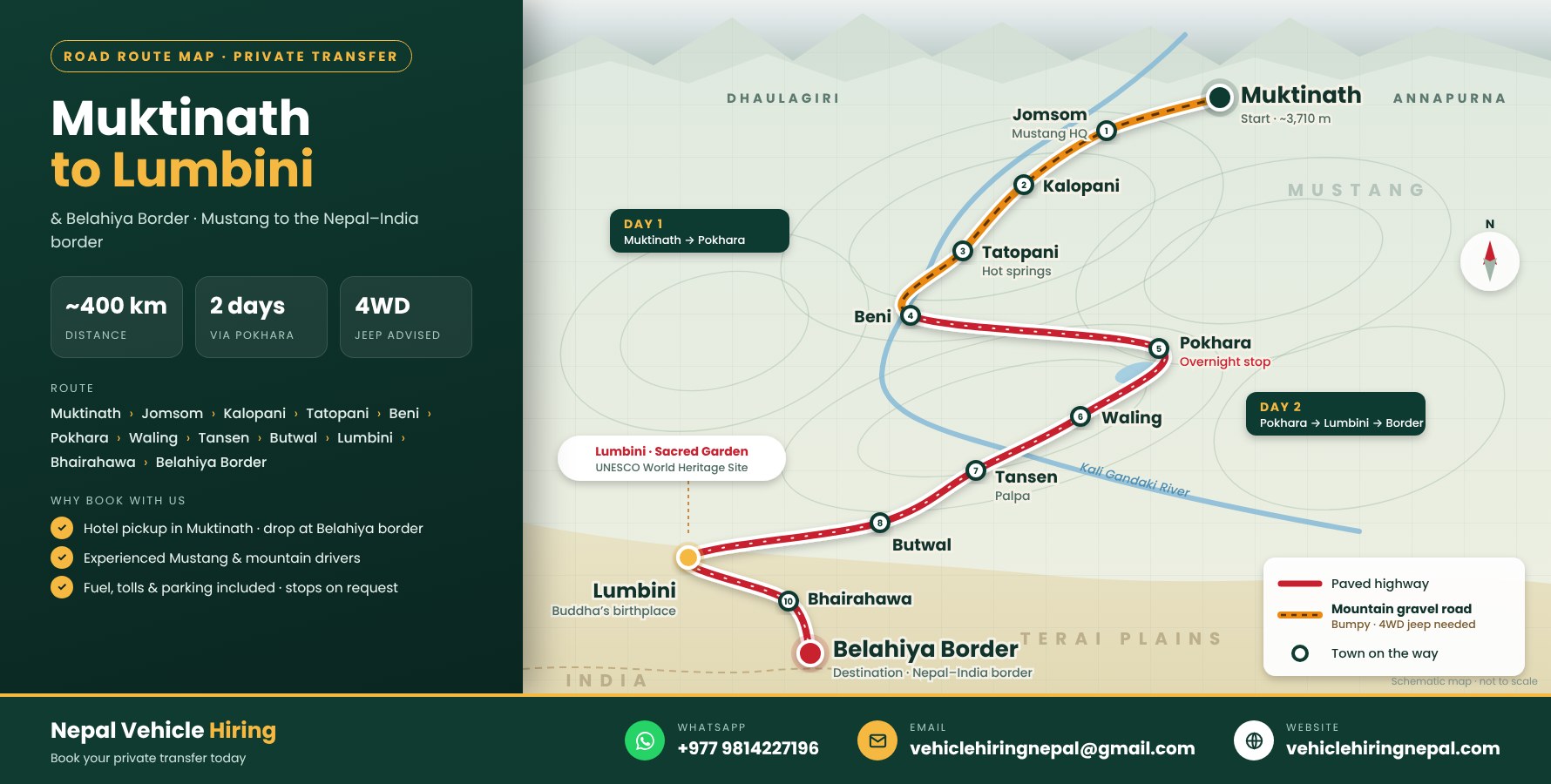
Leg 3: Butwal to Pokhara (approximately 175 km, 3.5-5 hours, Day 3 morning). From the Terai junction at Butwal, the road turns north on the Siddhartha and Prithvi Highways to Pokhara — Nepal’s mountain lake city and the operational base for the Muktinath approach.

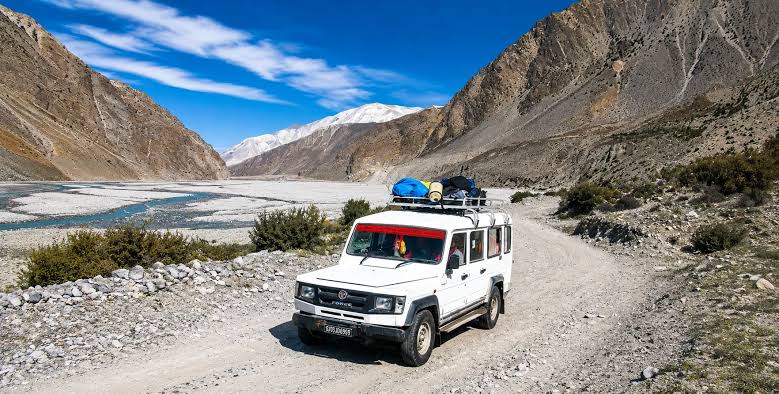
Leg 4: Pokhara to Jomsom and Muktinath via Kali Gandaki (approximately 145-160 km, 7-9 hours, Day 3 or 4). The Pokhara-to-Jomsom-Muktinath private jeep hire follows the Kali Gandaki Gorge—the world’s deepest river gorge between Dhaulagiri and Annapurna. Jomsom at 2,720 m is the road junction for the final Muktinath approach. Muktinath is at 3,710 m.

Total journey: 3-4 travel days from the Banbasa border to Muktinath. Total Nepal-side distance: approximately 670-700 km.

Best Muktinath Tour from Banbasa Private Jeep Hire 2026/27/28

Why the Banbasa Border Is the Right Crossing for Muktinath Yatra

India has several active Nepal land border crossings — Sunauli (Gorakhpur), Raxaul (Bihar), Banbasa (Uttarakhand), Rupaidiha (Bahraich), and others. For Muktinath yatra pilgrims from Uttarakhand and western UP, Banbasa is often the most logical crossing, helping yatra planners choose the most efficient route from their departure city.

The Banbasa crossing’s key advantage for Muktinath yatra groups: it enters Nepal at Mahendranagar in the far west, where it runs eastward through the entire Nepal Terai to Butwal, and then up the Kali Gandaki. Pilgrims from Funauli (Gorakhpur) approach Muktinath from the south-east, requiring the Pokhara-to-Kali Gandaki approach.

Pilgrims from Banbasa approach from the far west, traversing the complete Nepal Terai before turning north — adding 2 to 3 days of Mahendra Highway driving but experiencing Nepal’s Terai landscape at its widest and most diverse.

For devotional pilgrims who regard the journey itself as part of the yatra’s merit accumulation, the longer Banbasa route — crossing Nepal’s far-western sacred landscape, passing through Bardia National Park’s pristine sal forest, crossing the Karnali River (one of Nepal’s most sacred rivers in its own right),

approaching Muktinath through the complete Kali Gandaki gorge — is specifically preferred over the shorter Sunauli route. Nepal Vehicle Hiring Pvt Ltd serves both entry points — Sunauli border pickup and Mahendranagar border pickup — through the same professional private jeep hire service and the same all-inclusive pricing standard.

Best Muktinath Tour from Banbasa Private Jeep Hire 2026/27/28

The Karnali River — The Great Western Nepal Sacred Crossing

The Karnali River at Chisapani — crossed by the Mahendra Highway on a major bridge approximately 170 km east of Mahendranagar — is one of Nepal’s most significant rivers: the longest river originating within Nepal, rising from the sacred Mapchachungo glacier area near the Tibetan border and flowing south through the Himalayan ranges before joining the Ghaghra River in the Indian Terai plains.

The Karnali is a tributary of the Ganges and shares in the Ganga’s sacred status — making the Chisapani bridge crossing a devotional moment within the Muktinath yatra for pilgrims who observe the river crossing’s sacred significance.

The Karnali at Chisapani is a braided river of extraordinary scale in high water season — pale grey-blue in colour from glacial silt, spreading across its gravel-island channel in a width of several hundred metres th, making one of the most visually dramatic river crossings on the Mahendra Highway.

The Chisapani bridge’s length and the river’s volume below create one of the yatra’s memorable driving moments — a river crossing whose scale announces that the pilgrims are traversing Nepal’s widest and most powerful river system on the approach to the Himalayan source of the continent’s most sacred waters.

Nepal Vehicle Hiring Pvt Ltd’s Mahendra Highway jeep drivers note the Karnali crossing as a specific yatra landmark—a brief stop on the bridge walkway for the river view and a devotional moment of acknowledgement is standard practice for pilgrimage groups using our private jeep hire service on the Banbasa-to-Muktinath route. Contact our team to plan the complete yatra.

Best Muktinath Tour from Banbasa Private Jeep Hire 2026/27/28

Muktinath — The Confluence of Hindu and Buddhist Sacred Traditions

Muktinath’s singular position as a site of supreme importance in both the Hindu Vaishnava tradition and Tibetan Vajrayana Buddhism makes it unique among South Asia’s sacred destinations. No other Himalayan site holds the status of one of Vishnu’s 108 Divya Desams and a major Tibetan Buddhist sacred site

and the resulting devotional community that gathers at Muktinath is one of the most diverse of any Himalayan pilgrimage, with Hindi-speaking Indian Vaishnava pilgrims, Tibetan Buddhist practitioners, Nepali Hindu pilgrims from across the country, and international Buddhist visitors sharing the temple complex and the Mukti Dhara circuit.

The name Muktinath itself — ‘Lord of Liberation’ or ‘Lord of Moksha’ in Sanskrit — communicates the site’s Vaishnava theological significance: the place where liberation from the cycle of birth and death (moksha) is most accessible through Lord Vishnu’s grace.

For the Vaishnava pilgrim who has made the Banbasa-to-Muktinath journey with full awareness of its sacred purpose, arriving at the 108 Mukti Dhara waterspouts marks the pilgrimage’s fulfilment—the water from the sacred mountains pouring over the devotee as the living grace of the Lord of Liberation himself.

The Buddhist name Chumig Gyatsa (Hundred Waters in Tibetan) names the same sacred character from a different doctrinal perspective — the hundred sacred waters flowing from the earth at a site where the five elements (earth, water, fire, air, and space) manifest simultaneously in the sacred flame-and-spring of the Jwala Mai shrine.

For Muktinath yatra pilgrims from Banbasa arriving by private 4WD jeep hire after 3 to 4 days of Nepal road travel, this dual sacred character—the site where Vishnu and the Buddha’s tradition both claim the sacred—makes Muktinath Nepal’s single most universally significant pilgrimage destination. Book complete yatra vehicle arrangements through Nepal Vehicle Hiring Pvt Ltd on WhatsApp or on our plan trip page.

Kathmandu to Muktinath Bus

Transfer Cost — Banbasa to Muktinath Private Jeep

Mahendranagar border to Nepalgunj (Day 1 overnight, approximately 260 km): Private 4WD jeep hire: NPR 18,000-26,000 (USD 135-195) all-inclusive. Hiace van hire for larger groups: NPR 24,000-34,000.

Nepalgunj to Butwal to Pokhara (Day 2, approximately 350 km): Private 4WD jeep hire: NPR 22,000-32,000 (USD 165-240) all-inclusive.

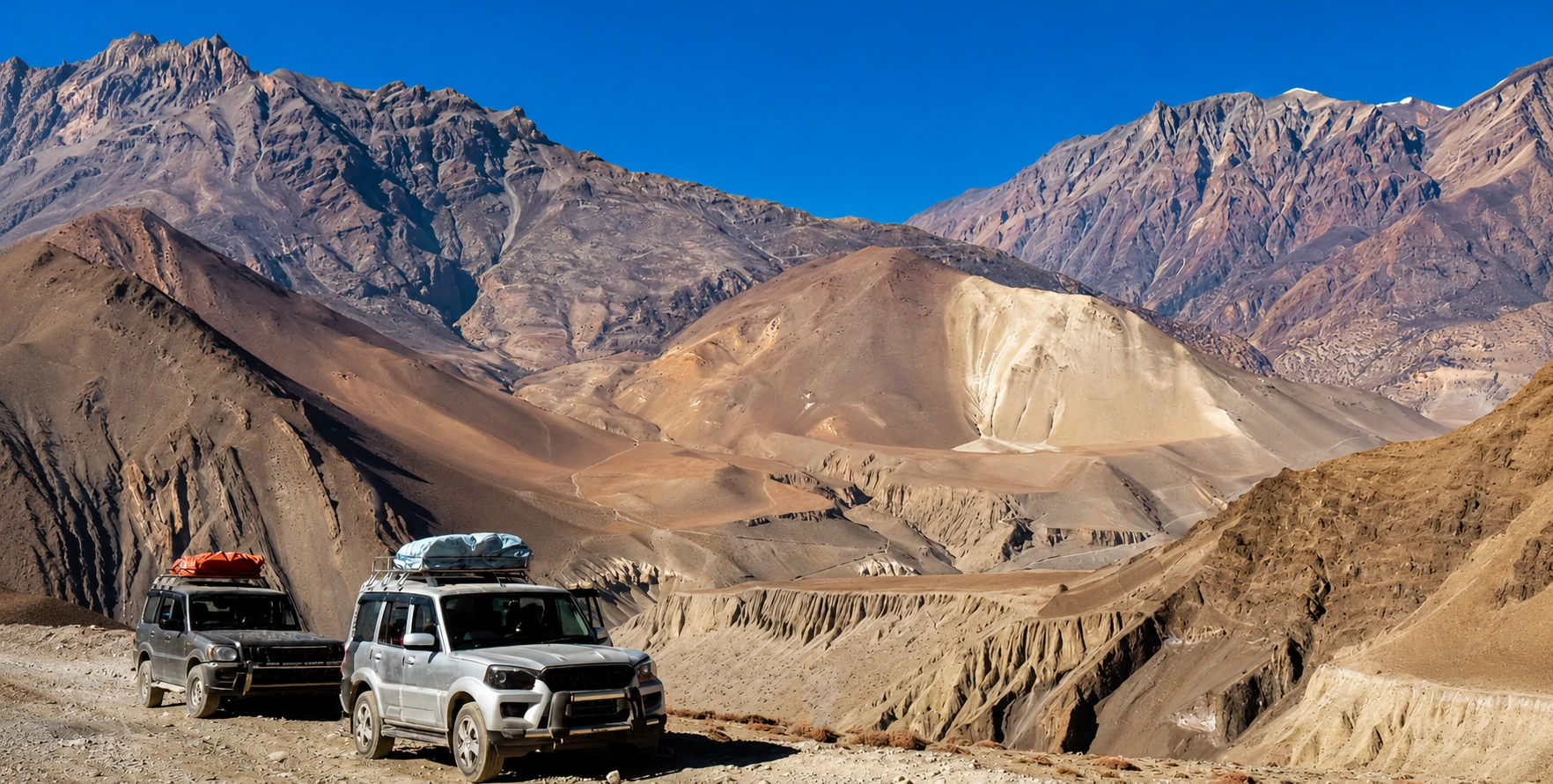
Pokhara to Jomsom and Muktinath via Kali Gandaki (Day 3 or 4, approximately 145-160 km): Private 4WD Scorpio or Hilux jeep hire: NPR 22,000-32,000 (USD 165-240) all-inclusive. 4WD is mandatory for the Kali Gandaki Gorge road.

Complete Banbasa to Muktinath (3-4 days, private 4WD jeep): NPR 62,000-90,000 (USD 465-675) for the full vehicle, all days, all-inclusive.

Return Muktinath to Banbasa or Pokhara exit: Pre-arranged at outward booking. Muktinath-to-Pokhara return, then Pokhara-to-Sunauli or Pokhara-to-Banbasa (via Mahendra Highway) coordinated through Nepal Vehicle Hiring Pvt Ltd on WhatsApp.

Best Muktinath Tour from Banbasa Private Jeep Hire 2026/27/28

The Banbasa-Mahendranagar Border Crossing

The Banbasa-Mahendranagar crossing connects Banbasa town in Uttarakhand’s Champawat District to Mahendranagar (Bhimdatta Municipality) in Nepal’s Kanchanpur District, Sudurpashchim Pradesh (Far-Western Province). Pilgrims from Uttarakhand (Nainital, Haldwani, Rudrapur, Almora), western UP (Bareilly, Moradabad, Rampur), and Delhi/NCR use this crossing to access Nepal’s western highway for the Muktinath yatra, Pashupatinath pilgrimage circuit, or a Lumbini visit.

Documents for Indian nationals: Valid Indian photo ID — passport, voter ID, or Aadhaar accepted—no visa required under the India-Nepal Open Border Treaty. Nepal immigration registration at Mahendranagar typically takes 20-45 minutes.

Nepal Vehicle Hiring Pvt Ltd Mahendranagar pickup: Our driver is confirmed by name and vehicle registration via WhatsApp the evening before. The vehicle waits at the Nepal-side Mahendranagar gate after immigration completion — direct boarding for the Muktinath yatra journey. Contact Nepal Vehicle Hiring Pvt Ltd on WhatsApp to arrange pickup at the Mahendranagar border.

Mahendranagar town: Mahendranagar is the Far-Western Province’s principal commercial city—a well-equipped Terai town with fuel stations, ATMs, hotels for overnight stays if needed, and restaurants. Groups arriving late at the border may overnight in Mahendranagar before starting the Mahendra Highway drive eastward on Day 2.

Best Muktinath Tour from Banbasa Private Jeep Hire 2026/27/28

Bardia National Park — The Wildlife Detour on the Mahendra Highway

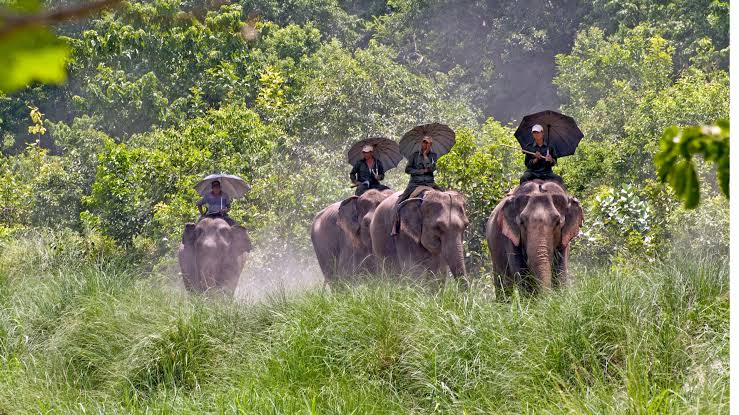
The Mahendra Highway between Kohalpur and Nepalgunj passes through the buffer zone of Bardia National Park — Nepal’s finest and least visited major wildlife sanctuary, home to tigers, one-horned rhinoceros, wild elephants, and gharial crocodiles in a sal forest wilderness of 968 square kilometres.

For Muktinath yatra pilgrims with an extra day on the outward journey, a Bardia National Park visit is one of Nepal’s finest wildlife encounters — qualitatively comparable to Chitwan but with a fraction of the visitor volume.

The private jeep hire from Nepal Vehicle Hiring Pvt Ltd covers the Bardia detour as an addition to the Nepalgunj overnight — arriving at the park gate by afternoon on Day 1, an evening game drive, and a morning safari before continuing the Muktinath journey on Day 2.

The jeep hire cost remains all-inclusive on the standard per-day rate for the additional Bardia day. Contact our team on WhatsApp to add the Bardia chapter to the Banbasa Muktinath yatra.

Trek Nepal Himalayas’ Chitwan jungle safari packages are available for pilgrims extending their Nepal circuit to the Chitwan National Park area further east on the return journey from Muktinath.

The complete yatra circuit — Banbasa border, Muktinath darshan, Pokhara lakes and Annapurna, Chitwan wildlife, Sunauli return — creates Nepal’s finest combined pilgrimage-and-wildlife overland journey from the Uttarakhand border.

Best Muktinath Tour from Banbasa Private Jeep Hire 2026/27/28

Nepalgunj — The Mid-Yatra Rest City

Nepalgunj (Banke District) is one of Nepal’s most strategically positioned Terai cities, near the Mahendra Highway and serving as the operational hub for Nepal’s far-western and mid-western regions. For the Banbasa-to-Muktinath yatra group, an overnight in Nepalgunj provides the mid-journey rest the long Mahendra Highway traverse demands.

Nepalgunj offers: international-standard hotel accommodation (several business and pilgrimage hotels have established themselves in Nepalgunj’s growing hospitality market), reliable ATMs and currency exchange, a domestic airport with daily Kathmandu connections (useful for pilgrims who need to exit or enter Nepal mid-yatra), and a specific Nepalgunj culinary tradition — the city’s diverse ethnic mix of Tharu, Bahun-Chhetri, and Muslim communities creating a restaurant culture with unusual variety by Nepal’s Terai-city standards.

The private jeep hire from Nepal Vehicle Hiking Pvt Ltd drops the yatra group at the Nepalgunj hotel of choice — our team confirms the hotel details at booking and coordinates the Day 2 vehicle from Nepalgunj. The evening in Nepalgunj allows time for the yatra group’s preparatory rituals, personal prayers and devotional preparation; pilgrims undertake these the night before the sacred journey continues toward Muktinath. Contact Nepal Vehicle Hiring Pvt Ltd on WhatsApp.

Best Muktinath Tour from Banbasa Private Jeep Hire 2026/27/28

The Kali Gandaki Gorge — Sacred Geography

The Kali Gandaki River gorge — the specific geographic channel through which the Pokhara-to-Muktinath private jeep hire passes — is one of the world’s most sacred rivers in the Hindu tradition. The Kali Gandaki is a tributary of the Ganges and shares the Ganga’s sacred status,

but carries its own sacred character through the shaligram, the sacred ammonite fossils found in the riverbed that Hindu tradition venerates as natural forms of Lord Vishnu. The shaligram stones of the Kali Gandaki are among the most sacred Vishnu worship objects—discovered in the river’s grey schist banks by pilgrims who have collected them for millennia for temple worship across the Indian subcontinent.

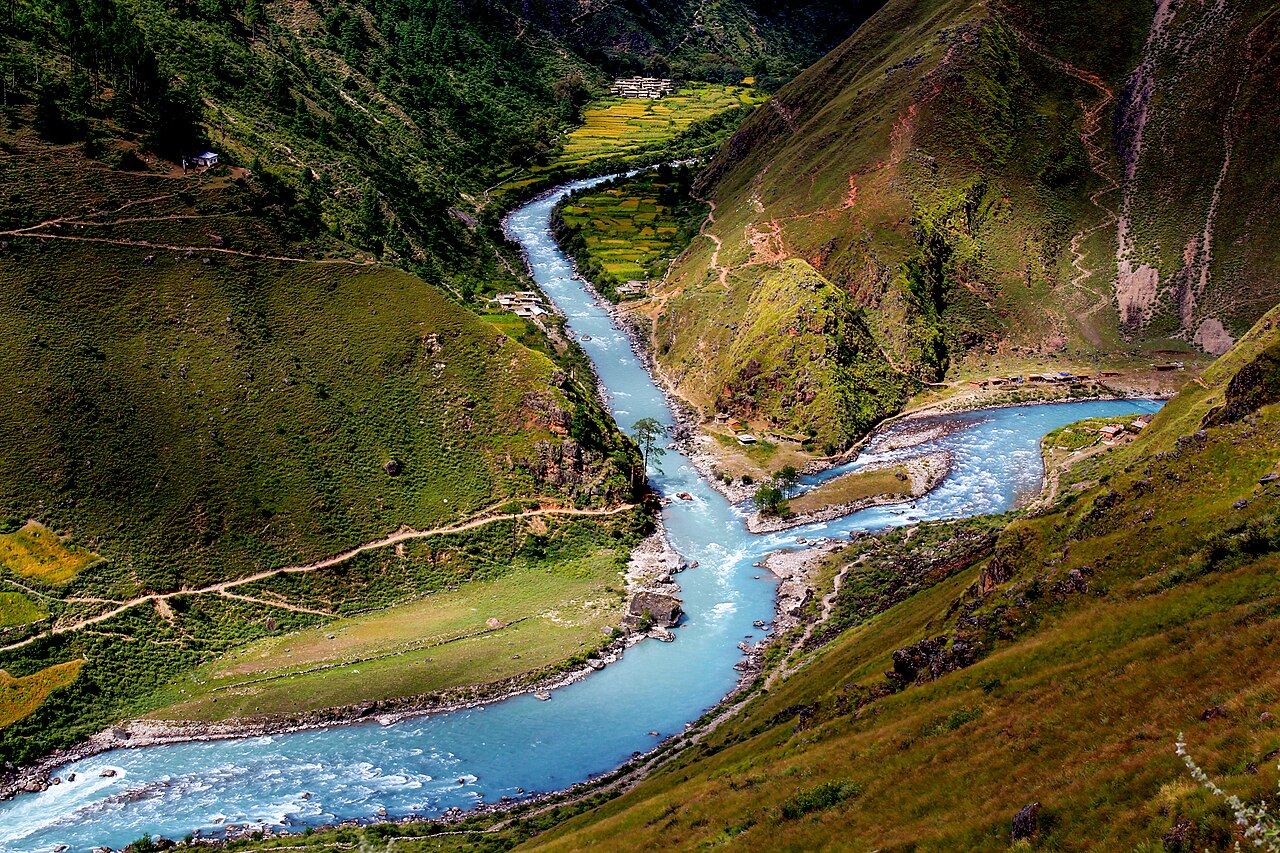
For Muktinath yatra pilgrims driving the Kali Gandaki gorge road, the river is not merely a scenic backdrop but a sacred presence that deepens the pilgrimage context progressively as the road ascends. The river’s character changes with altitude: turbulent white water in the lower gorge sections below Tatopani,

calmer but still fast-flowing in the Marpha section, and the characteristic pale-grey braided river of the high Mustang plateau above Jomsom. Nepal Vehicle Hiring Pvt Ltd’s Kali Gandaki gorge jeep drivers know the specific riverbank locations where shaligram stones are most commonly found — a stop that allows yatra pilgrims to collect a shaligram from the sacred river as a pilgrimage gift for home temple worship.

Best Muktinath Tour from Banbasa Private Jeep Hire 2026/27/28

The Marpha and Jomsom Stop — Before Muktinath

The road from Beni northward to Muktinath passes through several villages that merit brief stops on the Muktinath yatra drive — extending the Kali Gandaki day beyond simple transit to include the specific cultural and sacred encounters that make the gorge road one of Nepal’s finest overland experiences.

Tatopani (Hot Water Village). The famous natural hot springs at Tatopani — where geothermal hot water rises directly adjacent to the cold Kali Gandaki — are a traditional yatra rest stop where pilgrims bathe before continuing north to Muktinath. The hot springs’ location at the gorge’s narrowest point makes Tatopani both the physical high point of the lower gorge drive and the devotional preparation point for the upper gorge’s sacred approach.

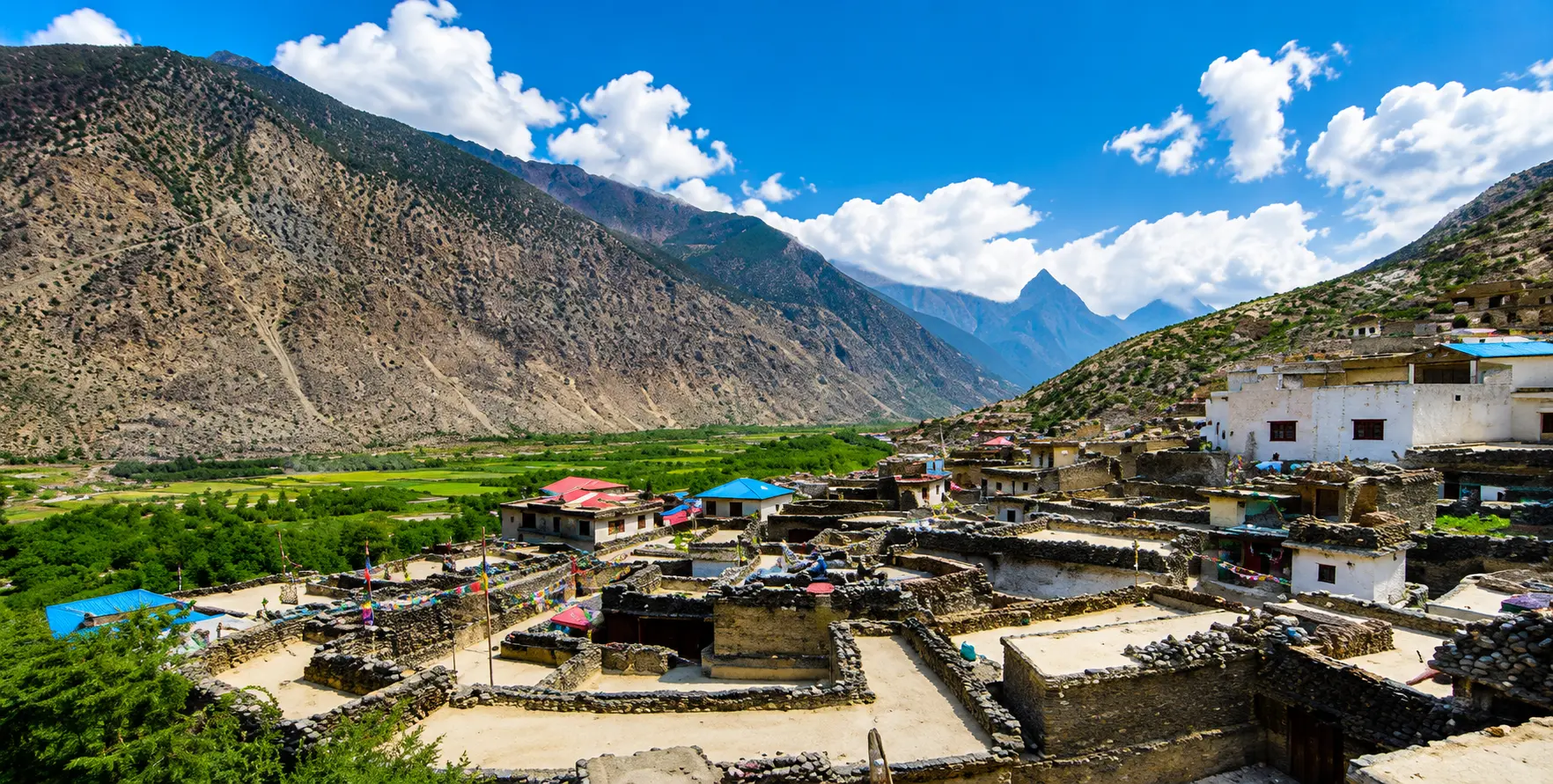
Marpha. The meticulously maintained Thakali village of Marpha — white-washed stone houses, stone-paved alleyways, and the fragrance of the apple orchards that have made Marpha famous throughout Nepal — is one of the Annapurna Circuit’s most visited villages and one of the Kali Gandaki gorge’s finest traditional settlements. A 20-minute walk through Marpha’s main lane provides the finest introduction to Thakali village culture on the entire yatra route.

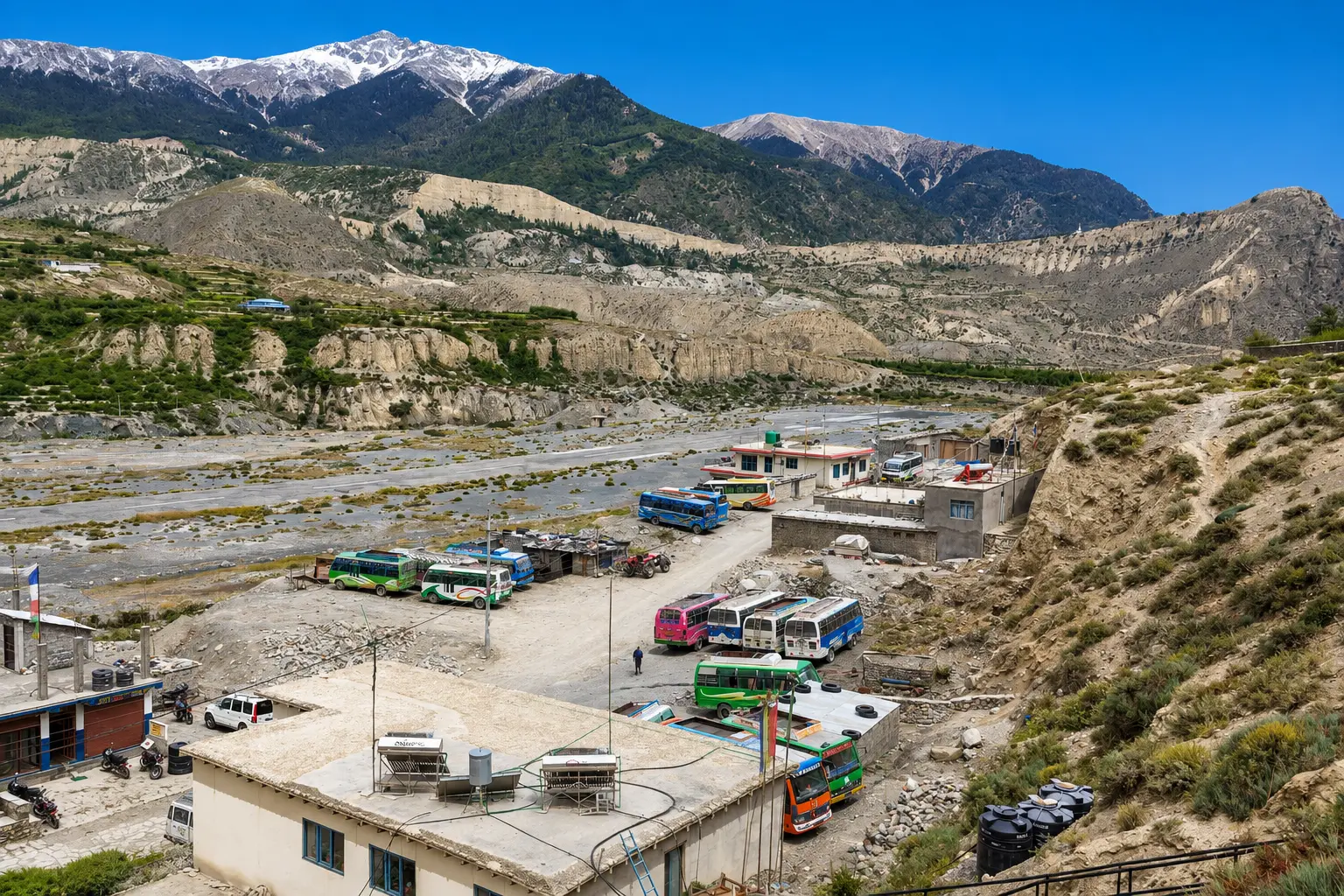
Jomsom. Jomsom at 2,720 m is the largest town in the Mustang District — the administrative and commercial centre of the high Mustang plateau. Jomsom’s airstrip connects to Pokhara by domestic flight (20 minutes), offering an alternative arrival option for yatra pilgrims who fly one way. A private jeep hire from Pokhara to Jomsom, then to Muktinath, covers the entire approach without the flight’s weather and schedule uncertainty.

Kagbeni. The ancient fortified village of Kagbeni at the Kali Gandaki-Jhong Khola confluence is the gateway to the Upper Mustang restricted area and one of the most atmospheric medieval villages in the Nepal Himalaya. The red-and-white painted gompa, the medieval fortification walls, and the view northward up the valley toward Lo Manthang create one of the gorge road’s most visually striking moments.

Best Muktinath Tour from Banbasa Private Jeep Hire 2026/27/28

Banbasa Muktinath Yatra — Who Makes This Journey

The Banbasa-to-Muktinath yatra by private jeep serves a specific pilgrimage community from India’s Uttarakhand and western UP regions—one of Nepal’s most traditional and committed pilgrim groups, whose cultural connection to the Muktinath sacred site predates the modern road network.

Uttarakhand pilgrims (Nainital, Haldwani, Almora, Pithoragarh, Rudrapur, Haridwar). The closest major pilgrimage community to the Banbasa border is Nainital, about 20 km from Banbasa, and the Uttarakhand devotional community’s connection to Vishnu sacred sites (Badrinath, Kedarnath, and the Char Dham circuit) extends to Muktinath,

the Himalayan Vishnu abode. Nepal Vehicle Hiring Pvt Ltd‘s Mahendranagar border pickup is specifically designed for Uttarakhand yatra groups who drive from Haldwani or Nainital to Banbasa and then hand over to our Nepal-side vehicle.

Western UP pilgrims (Bareilly, Rampur, Moradabad, Shahjahanpur). The western UP cities have strong Vaishnava devotional traditions and regularly organise group Muktinath yatras through the Banbasa-Mahendranagar border. Private jeep hire for groups of 4 to 9, or Hiace van hire for larger groups of 10 to 13 — both coordinated through Nepal Vehicle Hiring Pvt Ltd from the Mahendranagar border.

Delhi and NCR pilgrims via Banbasa. Delhi-based pilgrims who prefer the Banbasa border (to avoid the longer Sunauli route) drive to Banbasa via the Moradabad-Bareilly-Rampur corridor (about 320 km from Delhi) and connect to a private jeep hire on the Nepal side at Mahendranagar for the Muktinath approach.

Best Muktinath Tour from Banbasa Private Jeep Hire 2026/27/28

The Mahendranagar Town — First Nepal Stop

Mahendranagar (formerly Bhimdatta Municipality) is the Far-Western Province’s main city—a well-developed Terai town of about 60,000 residents whose commercial character reflects its role as Nepal’s far-western gateway city. Shukla Phanta National Park, Nepal’s second-largest protected area and one of its finest tiger habitats, borders Mahendranagar—a wildlife detour yatra pilgrims can add to the border overnight.

Mahendranagar provides: reliable fuel stations for the jeep’s initial Nepal tank fill before the Mahendra Highway traverse; Nepal-standard hotel accommodation for groups arriving late at the border or departing early the next morning; good dal bhat and local restaurant options; currency exchange at the border and in the town’s main bazaar; and the specific border-town character of Nepal’s far-western gateway — a more genuinely local and less tourist-oriented environment than the busier southern border crossings at Sunauli or Raxaul.

Nepal Vehicle Hiring Pvt Ltd’s private jeep hire from Mahendranagar departs toward the Muktinath yatra after the border formalities are complete — fuelled, driver confirmed, and the route plan briefed.

For groups arriving at Banbasa late in the day, the Mahendranagar overnight is included in the day 1 plan at no additional vehicle charge — the jeep is parked at the hotel and ready for the 7:00 AM Mahendra Highway departure. Our contact team on WhatsApp confirms all overnight stop arrangements as part of the complete Banbasa-to-Muktinath booking.

Muktinath Tour from Banbasa: Private Jeep Hire

The Mahendra Highway — Nepal’s Terai Spine

The Mahendra Highway (East-West Highway or B.P. Koirala Highway) is Nepal’s longest national road — a 1,027-kilometre Terai-level highway connecting Mahendranagar in the far west to Kakarbhitta in the far east. The Banbasa-to-Muktinath yatra route follows the Mahendra Highway eastward from Mahendranagar for about 500 kilometres to the Butwal junction—Nepal’s longest single-axis road section traversed by any Muktinath yatra group.

Mahendranagar to Dhangadhi (90 km, 1.5-2 hours). The first Mahendra Highway section east of the border—a flat, well-maintained Terai highway through Kanchanpur District’s agricultural landscape to Dhangadhi, the Far-Western Province’s largest city and commercial centre. Dhangadhi is a natural first stop, with good fuel stations, ATMs, and Dhangadhi Airport for groups who prefer to fly one way.

Dhangadhi to Atariya-Chisapani (80 km, 1.5 hours). The highway continues eastward through the Kailali District plains — the Karnali River’s important crossing at Chisapani (one of Nepal’s largest river crossings by volume, a significant geographical landmark on the highway). The Karnali River bridge view is one of the Mahendra Highway’s most dramatic moments — the vast pale-blue river spreading across its braided channel in the Terai’s flattest section.

Chisapani to Kohalpur-Nepalgunj (150 km, 2.5-3 hours). The highway passes through the Bardiya District — home to Bardia National Park, Nepal’s finest tiger habitat — and reaches Kohalpur and Nepalgunj in the Banke District. Nepalgunj is the Mahendra Highway’s most significant mid-point city: well-equipped with international-standard hotels, a domestic airport with Kathmandu connections, and a hub for Nepal’s far-western region, making it the standard overnight stop for Banbasa-to-Muktinath yatra groups.

Nepalgunj to Butwal (280 km, 4.5-5 hours). The longest single-day highway section — eastward from Nepalgunj through Tulsipur, the Kapilvastu District (passing through the Tilaurakot area associated with the young Siddhartha Gautama’s royal birthplace), and Butwal. Lumbini lies 22 km south of the Butwal junction, a natural addition to the yatra circuit for groups who want to visit the Buddha’s birthplace en route.

Overnight Stops — The Two-Day Mahendra Highway Division

The 500-kilometre Mahendranagar-to-Butwal Mahendra Highway section is too long for comfortable single-day driving — the standard format divides it into two travel days with an overnight at Nepalgunj.

Day 1: Mahendranagar to Nepalgunj (approximately 260 km, 5-6 hours). Depart Mahendranagar border at 7:00-8:00 AM after immigration completion. Drive east through Dhangadhi (first rest stop, 90 km), Atariya, the Karnali River crossing at Chisapani, and the Bardiya District to Nepalgunj. Arrive Nepalgunj early to mid-afternoon.

Overnight at a comfortable hotel in Nepalgunj.

Day 2: Nepalgunj to Butwal to Pokhara (approximately 450 km, 8-9 hours). Depart Nepalgunj at 6:00-7:00 AM. Drive east through Tulsipur, Kapilvastu, and Butwal (with optional Lumbini visit detour). From Butwal, turn north on the Siddhartha Highway to Pokhara.

Arrive in Pokhara by evening for an overnight before the Kali Gandaki Gorge drive.

Alternative Division (Dhangadhi overnight): Groups departing Banbasa in the afternoon can overnight at Dhangadhi (90 km from the border) and then do the full Dhangadhi-to-Butwal-to-Pokhara drive on Day 2 (approximately 540 km, a very long Day 2). Most people prefer the Nepalgunj overnight because it splits the Mahendra Highway more evenly.

TIP: Add a Lumbini visit at Butwal junction on Day 2. Lumbini is 22 km south of Butwal and adds 1.5 to 2 hours to the day — the Buddha’s birthplace is a natural yatra addition to the Muktinath pilgrimage circuit.

Best Muktinath Tour from Banbasa Private Jeep Hire 2026/27/28

Pokhara — The Muktinath Yatra Base

Pokhara at 820 metres — Nepal’s mountain lake city — serves as the essential base for the Muktinath yatra’s final approach via the Kali Gandaki gorge. An overnight in Pokhara before the gorge drive provides rest after the long Mahendra Highway traverse, acclimatisation preparation for the rapid altitude gain from Pokhara’s 820 m to Muktinath’s 3,710 m, and a logistical base for planning the return journey.

Nepal Vehicle Hiring Pvt Ltd’s Pokhara car hire service includes Pokhara Lakeside hotel arrangements and a pre-dawn departure for the Kali Gandaki drive. The Sarangkot sunrise vehicle is a popular addition to the Pokhara overnight.

The Annapurna range’s pre-dawn panorama from Sarangkot, with Dhaulagiri and Annapurna I visible, provides the first visual introduction to the mountain environment that the Muktinath yatra is approaching. Groups who add the Sarangkot sunrise depart for the Kali Gandaki gorge at 8:00 AM after returning from Sarangkot — the sunrise experience adding no significant delay to the gorge drive day.

Best Muktinath Tour from Banbasa Private Jeep Hire 2026/27/28

Pokhara to Muktinath via Kali Gandaki — The Sacred Gorge Road

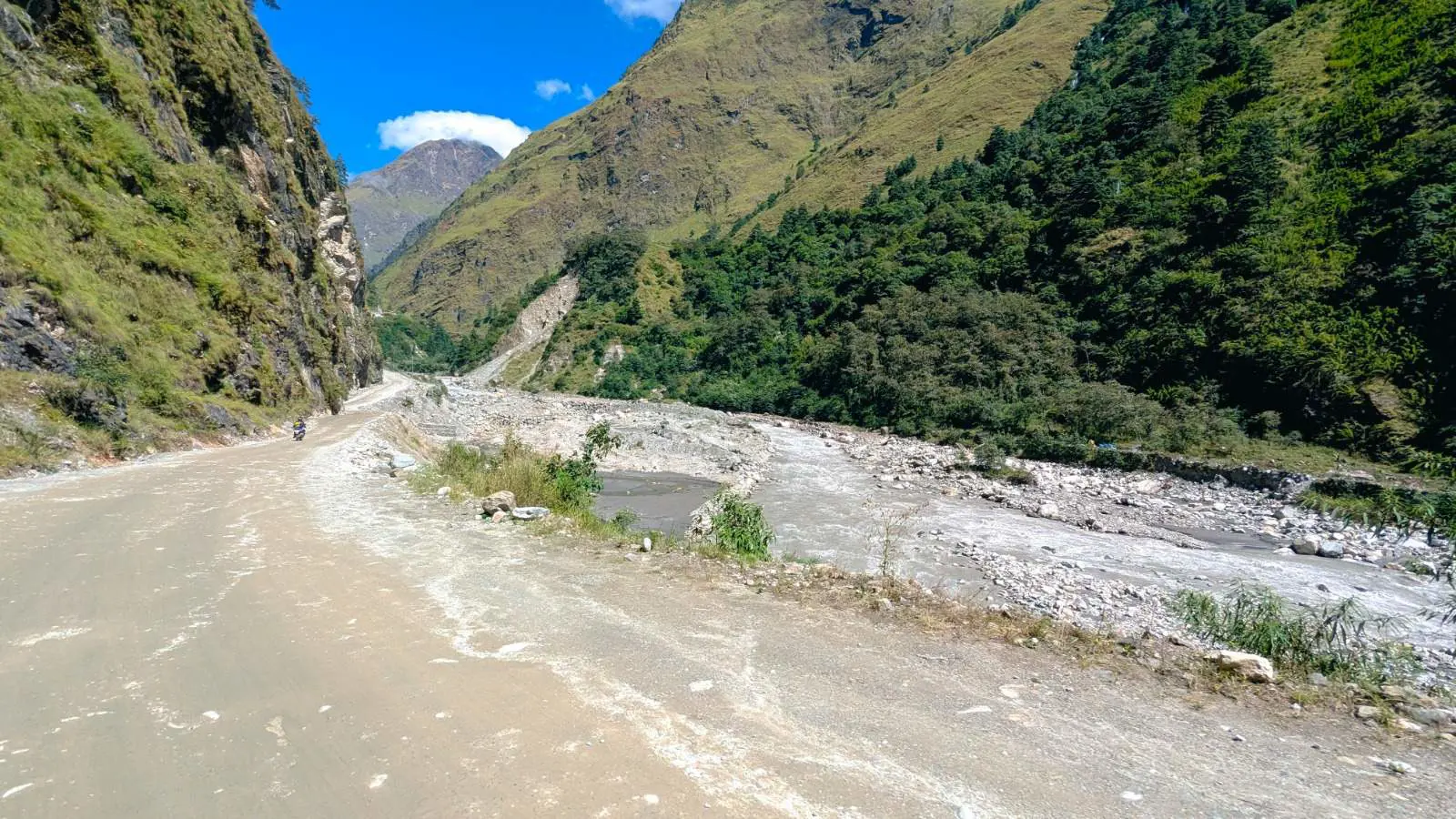
The road from Pokhara to Muktinath via the Kali Gandaki gorge is one of Nepal’s most extraordinary driving experiences and one of the world’s most dramatic sacred pilgrimage roads. This route ascends from Nepal’s mid-hill lake city through the world’s deepest river gorge between two of the Himalaya’s highest massifs to a sacred site at 3,710 metres surrounded by the finest mountain panorama in the Annapurna-Dhaulagiri region.

Pokhara to Beni (66 km, 1.5-2 hours). The road south from Pokhara Lakeside follows the Seti River valley before joining the Kali Gandaki at Beni — the last significant town before the gorge narrows. Private 4WD jeep hire for this leg is paved and straightforward.

Beni to Ghasa (55 km, 2-3 hours). The Kali Gandaki gorge narrows dramatically south of Tatopani—the section between Tatopani and Ghasa is the gorge’s most geologically dramatic stretch, where the cliff walls converge above the river, and the road hugs the gorge face. The famous Tatopani hot springs (literally ‘hot water’) are a traditional yatra rest stop where pilgrims bathe in the natural thermal springs.

Ghasa to Jomsom (45 km, 2-2.5 hours). Above Ghasa, the gorge opens into the broader Kali Gandaki valley and the landscape transitions dramatically — subtropical forest giving way to the dry trans-Himalayan rain-shadow landscape of the Mustang District. Marpha village (Nepal’s apple capital, famous for its apple brandy and the finest preserved traditional Thakali village architecture) and Tukuche (the old Thakali trading centre) are passed before the airport town of Jomsom at 2,720 m.

Jomsom to Muktinath (28 km, 1-1.5 hours). From Jomsom, the 4WD jeep hire continues northward through Kagbeni (the gateway village to the Upper Mustang restricted area) and up the increasingly dry, high-altitude landscape to Ranipauwa village at the foot of the Muktinath sacred complex. The final ascent to the temple complex is on foot from Ranipauwa (a 30 to 45-minute walk), or by horse/mule for pilgrims who need it.

Best Muktinath Tour from Banbasa Private Jeep Hire 2026/27/28

Muktinath — The Sacred Destination

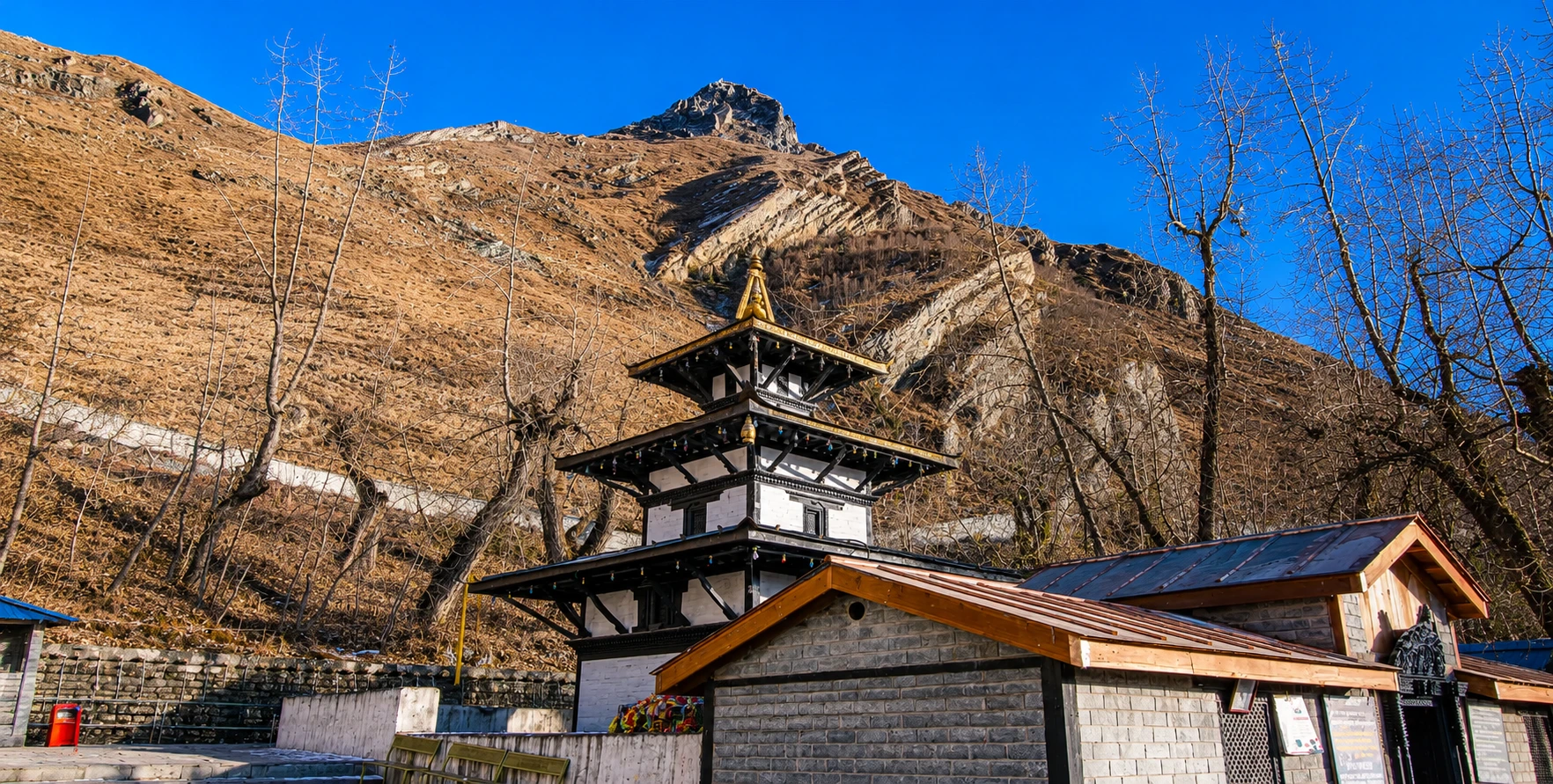
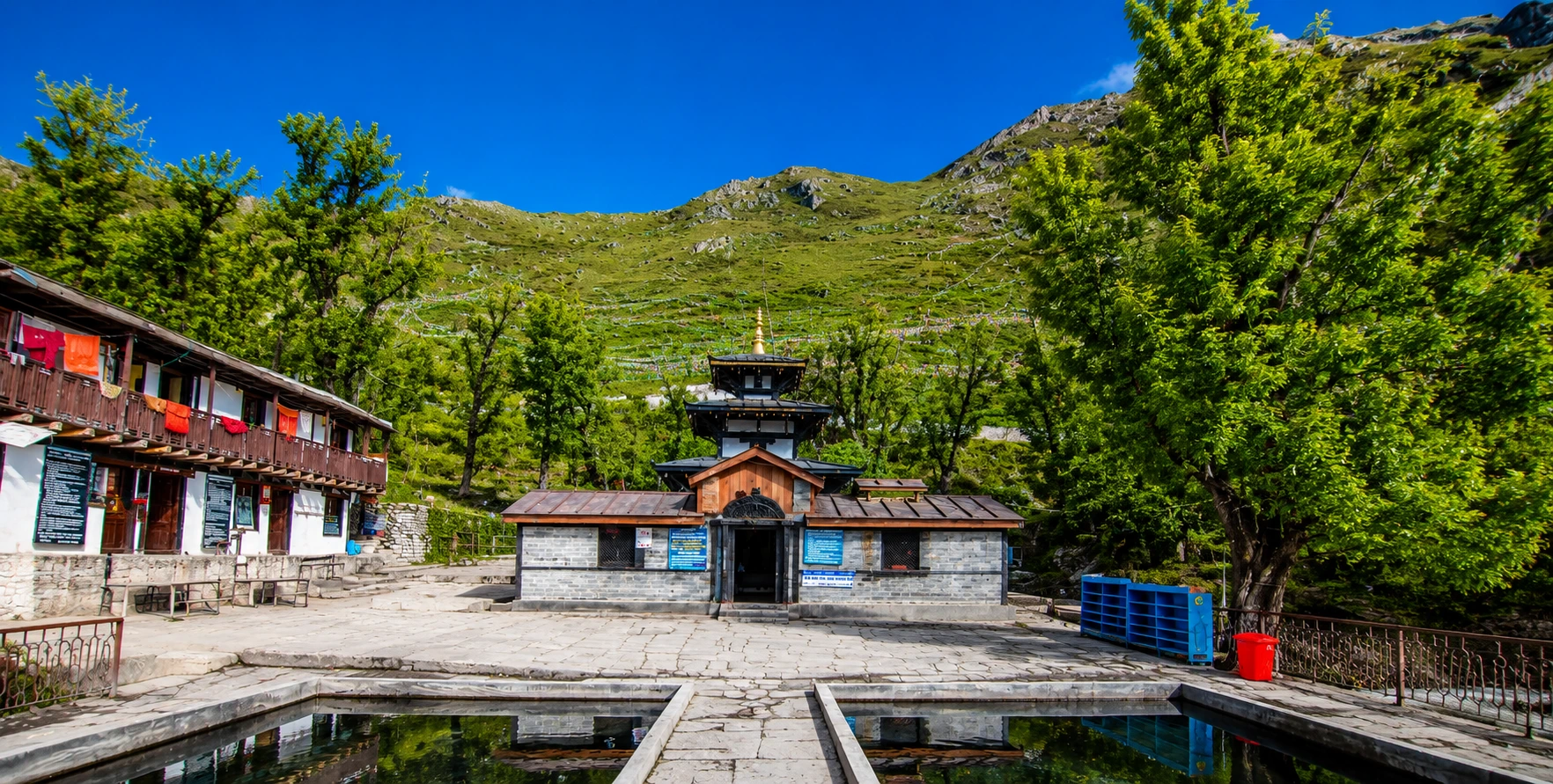
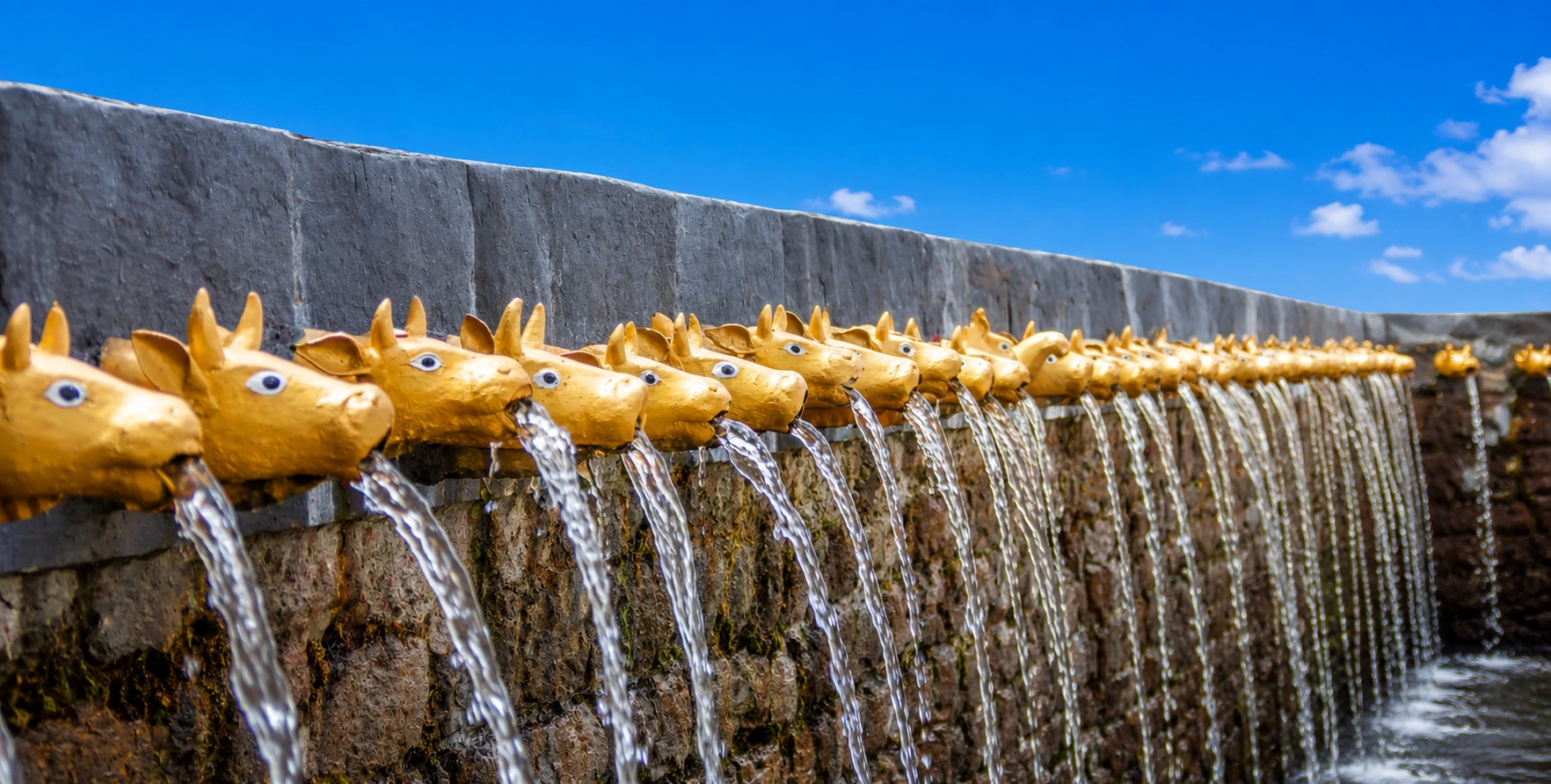
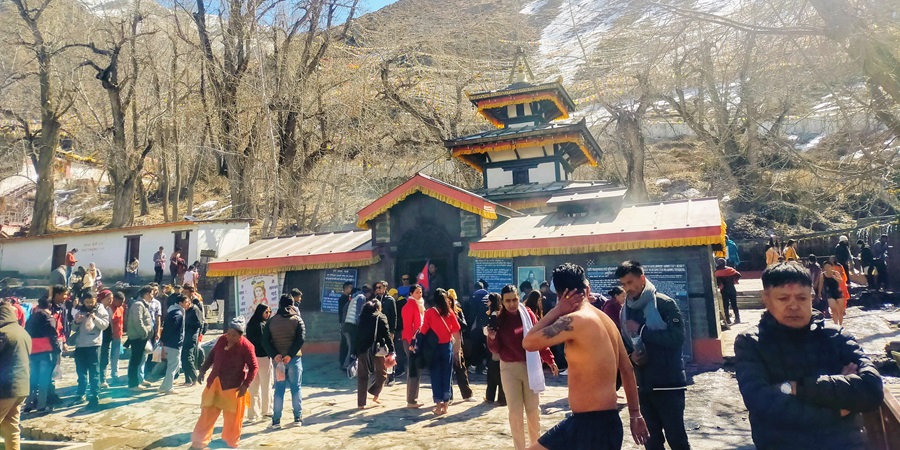
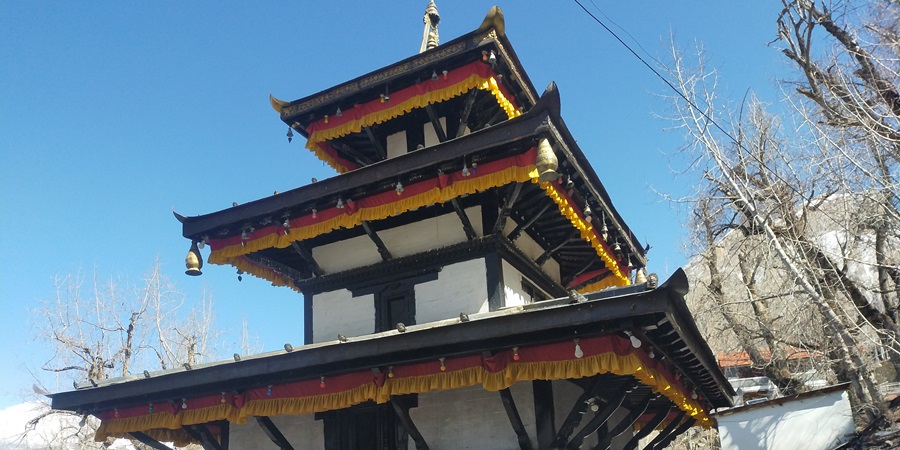
Muktinath Temple at 3,710 metres is one of Nepal’s most sacred pilgrimage destinations for both Hindu and Buddhist traditions. The temple complex includes: the main Muktinath Vishnu shrine (one of the 108 Divya Desams), the 108 waterspouts of the Mukti Dhara (the sacred water circuit where pilgrims bathe under 108 cold-water spouts flowing from the stone bull-head sculptures),

the Jwala Mai shrine where the natural flame burns from the earth alongside the sacred spring (the manifestation of fire and water together that gives Muktinath its extraordinary dual-element sacred character), and the surrounding Buddhist monastery and chorten complex of Chumig Gyatsa.

The Mukti Dhara circuit is the pilgrimage’s central devotional act: circling the temple’s 108 waterspouts and bathing under each—a cold, bracing ritual at 3,710 metres that pilgrims undertake with a devotion whose intensity matches the commitment of the journey that brought them here from the Banbasa border.

Pilgrims arrive by private jeep hire from Banbasa through the Mahendra Highway and the Kali Gandaki gorge, having committed to 4 days of travel to reach this moment—and Mukti Dhara’s 108 cold-water baptisms are the ritual culmination of that commitment.

The Jwala Mai shrine — where a natural gas seep creates a flame that burns perpetually from the earth adjacent to the sacred spring — is one of Nepal’s most theologically distinctive natural phenomena: fire emerging from water, both from earth. The Tibetan Buddhist tradition venerates this as the simultaneous manifestation of all five sacred elements. For Hindu pilgrims, it is one of Vishnu’s most miraculous manifestations.

Best Muktinath Tour from Banbasa Private Jeep Hire 2026/27/28

The Banbasa to Muktinath Yatra — Day-by-Day Itinerary

Day 1: Banbasa border to Nepalgunj (260 km, 5-6 hours driving). Cross the Banbasa-Mahendranagar border after immigration. Board a private jeep hired from Nepal Vehicle Hiring Pvt Ltd at the Nepal gate. Drive east through Dhangadhi, cross the Chisapani Karnali, and Head to Kohalpur and Nepalgunj.

Overnight in Nepalgunj.

Day 2: Nepalgunj to Pokhara (450 km, 8-9 hours). Early departure at 6:00 AM. Drive east through Tulsipur, Kapilvastu, Butwal (optional Lumbini detour 22 km south), then north via Siddhartha Highway to Pokhara. Arrive in Pokhara in the evening.

Overnight in Pokhara Lakeside.

Day 3: Pokhara to Muktinath via Kali Gandaki (145-160 km, 7-9 hours). Depart Pokhara 6:00-7:00 AM by private 4WD jeep hire. Drive via Beni, Tatopani hot springs, Ghasa, Marpha, Jomsom, Kagbeni, and Ranipauwa to Muktinath. Arrive in Muktinath in the early afternoon.

Mukti Dhara circuit and darshan. Overnight in Ranipauwa or Muktinath.

Day 4: Muktinath sacred circuit and darshan (full day). Complete the 108 Mukti Dhara waterspout circuit, visit Jwala Mai (flame and spring)), and take darshan at the and take darshan at the Muktinath Vishnu shrine. Optional: walk to the ancient Thubchen Gompa monastery above Ranipauwa. Begin return journey.

Muktinath temple

Why 4WD Is Essential for the Banbasa to Muktinath Route

The Banbasa-to-Muktinath journey includes two road sections that specifically require 4WD Scorpio or Hilux jeep hire rather than a standard 2WD sedan or van: the Kali Gandaki gorge road between Beni and Jomsom, and the Jomsom-to-Ranipauwa Muktinath approach.

The Kali Gandaki gorge road between Tatopani and Ghasa—where the road hugs the cliff face above the river with narrow width and the specific surface challenges of the gorge’s side-stream crossings—requires 4WD traction and ground clearance to protect the vehicle and passengers on the exposed sections.

The Jomsom-to-Muktinath approach road above Kagbeni adds altitude, gradient, and the trans-Himalayan landscape’s specific surface character, which the diesel 4WD Scorpio or Hilux can handle.

Nepal Vehicle Hiring Pvt Ltd uses 4WD Scorpio or Hilux jeeps exclusively for the Pokhara-to-Muktinath section of the Banbasa yatra route. The Mahendra Highway sections (Mahendranagar to Butwal) can be served by Hiace van hire for larger pilgrimage groups — the highway is paved and flat.

For the Kali Gandaki section, groups transfer to a 4WD jeep in Pokhara if they used a Hiace for the highway portion. Our team advises on the most cost-efficient vehicle combination for each group size at booking.

Altitude Awareness — Pokhara to Muktinath’s 2,890-Metre Gain

The Pokhara-to-Muktinath section of the Banbasa yatra covers a 2,890-metre altitude gain in a single driving day — from Pokhara’s 820 m to Muktinath’s 3,710 m. This rapid altitude gain is the most significant physiological consideration for pilgrims taking the Banbasa-to-Muktinath journey by vehicle, especially those arriving from the Terai plains and spending the first 2 to 3 days at near sea level.

The standard altitude awareness recommendations for the Banbasa yatra: spend the full Pokhara overnight at Pokhara’s 820 m before ascending to Muktinath; arrive at Muktinath in the afternoon rather than the morning (allowing descent back to Jomsom’s 2,720 m for overnight if altitude symptoms develop); drink 3 to 4 litres of water throughout

the Kali Gandaki drive day; carry altitude medication (Diamox if prescribed) and personal first aid; and plan the Mukti Dhara circuit for the second Muktinath morning rather than the arrival evening — rest first, sacred circuit when the body has partially adjusted.

Nepal Vehicle Hiring Pvt Ltd’s drivers on the Kali Gandaki route know the altitude profile and the specific section (above Jomsom) where altitude symptoms most commonly appear. Our drivers share altitude awareness information during the drive and support appropriate pace management—not rushing pilgrims at altitude.

Muktinath

Banbasa Muktinath Yatra — The Return Journey Options

The return journey from Muktinath to Banbasa can follow the same route (Muktinath-Jomsom-Kali Gandaki-Pokhara-Mahendra Highway-Mahendranagar border) or one of several alternative return formats that create a circuit rather than an out-and-back.

Same route return (Muktinath to Banbasa, 3-4 days). The straightforward reversal — Muktinath to Pokhara, Pokhara to Butwal, Butwal to Nepalgunj overnight, Nepalgunj to Mahendranagar border. Nepal Vehicle Hiring Pvt Ltd pre-arranges all return vehicles at the time of outward booking.

Muktinath to Pokhara, then fly to Kathmandu exit. Pilgrims who enter through Banbasa but prefer to exit through Kathmandu can fly from Pokhara to Kathmandu on the post-Muktinath return, then connect to a Kathmandu airport transfer for departure from Tribhuvan International.

Muktinath to Sunauli exit. Post-yatra pilgrims returning to Gorakhpur or eastern UP can exit through Sunauli — Pokhara to Sunauli private vehicle hire via Butwal (with optional Lumbini sacred garden visit) to the India border. The Sunauli exit is more convenient for the UP-Bihar rail network (Gorakhpur junction) than the Banbasa return for pilgrims from eastern UP.

Annapurna Circuit extension. Pilgrims with additional time can extend the Muktinath yatra with the Annapurna Circuit trek’s Thorong La crossing — descending from Muktinath over the pass to the Besisahar side and returning to Kathmandu by Besisahar private vehicle hire.

Best Muktinath Tour from Banbasa Private Jeep Hire 2026/27/28

The Upper Mustang Extension —

For pilgrims and travellers with additional days at Muktinath, the Upper Mustang Extension offers restricted-area access beyond Kagbeni, 28 km south of Muktinath; it lies along the Muktinath drive.

The ancient walled kingdom of Lo, with its capital, Lo Manthang, and the extraordinary cave complexes of Chhoser, is one of Nepal’s finest and least-visited cultural and archaeological destinations.

The Upper Mustang Restricted Area Permit (USD 500 for 10 days) and a licensed guide are required. Nepal Vehicle Hiring Pvt Ltd offers private 4WD jeep hire from Muktinath North Road to Lo Manthang, an additional 65 km of high-altitude plateau road to the ancient capital.

Muktinath Darshan — Practical Guide for the Yatra

Muktinath Temple complex is managed jointly by the Muktinath Development Committee and the Mustang District administration—a sacred site that receives pilgrims from Nepal, India, and the global Hindu and Buddhist diaspora year-round. Understanding the practical arrangements for darshan ensures you experience the yatra’s climactic moment with full devotional attention.

Temple access and timing. The Muktinath Vishnu shrine is open from sunrise to sunset. Early morning darshan (before 9:00 AM) is the finest time — the queue management is lightest before the helicopter pilgrims from Pokhara arrive from 10:00 AM onward, and the morning light on the Thorong La above the temple complex is the finest of the day.

Nepal Vehicle Hiring Pvt Ltd’s Pokhara-to-Muktinath jeep drivers depart Pokhara at 6:00-6:30 AM specifically to reach Muktinath before the helicopter-arrival surge.

The Mukti Dhara circuit (108 waterspouts). The complete 108-waterspout circuit — circumambulating the temple under each spout — takes approximately 1 to 1.5 hours depending on pace and queue. The water is cold at 3,710 m year-round; change of clothing and a towel are essential.

The circuit is the central devotional act of the Muktinath yatra and should not be rushed — plan the Muktinath day so that the Mukti Dhara circuit is the primary scheduled activity, not a secondary addition after other stops.

The Jwala Mai shrine. The natural gas flame burning alongside the sacred spring is a 5-minute walk from the main Vishnu shrine — a distinct sub-site whose specific sacred character (fire from earth, water from earth, both simultaneously) deserves its own devotional visit rather than a passing glance on the way between other sites.

Accommodation at Muktinath. Ranipauwa village below the temple complex has 8 to 10 guesthouses and teahouses serving the pilgrimage traffic — adequate accommodation at NPR 500 to 1,500 per room. Staying overnight in Muktinath offers the rare chance to visit the sacred site early in the morning, before other pilgrims arrive.

Nepal Vehicle Hiking Pvt Ltd’s Muktinath jeep hire drivers park the vehicle at Ranipauwa and wait during the full darshan, then drive down to Jomsom when the pilgrimage group is ready.

Kathmandu Pokhara Muktinath Lumbini Chitwan Tour Package

Banbasa Muktinath Yatra — Combining Pashupatinath in Kathmandu

Many pilgrims from Uttarakhand and western UP who take the Muktinath yatra through Banbasa choose to extend their Nepal sacred circuit to include Pashupatinath Temple in Kathmandu—Nepal’s most important Shiva temple and one of South Asia’s most sacred Shaivite sites. The combined Muktinath (Vishnu) and Pashupatinath (Shiva) yatra circuit covers Nepal’s two most important Hindu sacred sites in a single Nepal visit.

The Pashupatinath addition works most smoothly as a Kathmandu extension after the Muktinath darshan: completing the Kali Gandaki descent to Pokhara after Muktinath, then taking the Pokhara to Kathmandu private vehicle hire or Kathmandu to Pokhara bus service (reversed direction) to the capital,

where the Kathmandu sightseeing car hire covers Pashupatinath, Boudhanath Stupa, and Swayambhunath. The Kathmandu extension then connects to Tribhuvan International Airport for the return flight to India, or to the Kathmandu-to-Sunauli vehicle hire for the Sunauli border return to Gorakhpur.

Nepal Vehicle Hiking Pvt Ltd coordinates the complete Banbasa-Muktinath-Kathmandu-Pashupatinath-Sunauli or airport yatra circuit through a single plan trip page, with smooth operations, all Nepal legs, and professional private vehicle hire throughout.

The Pokhara to Jomsom Alternative — Domestic Flight Option

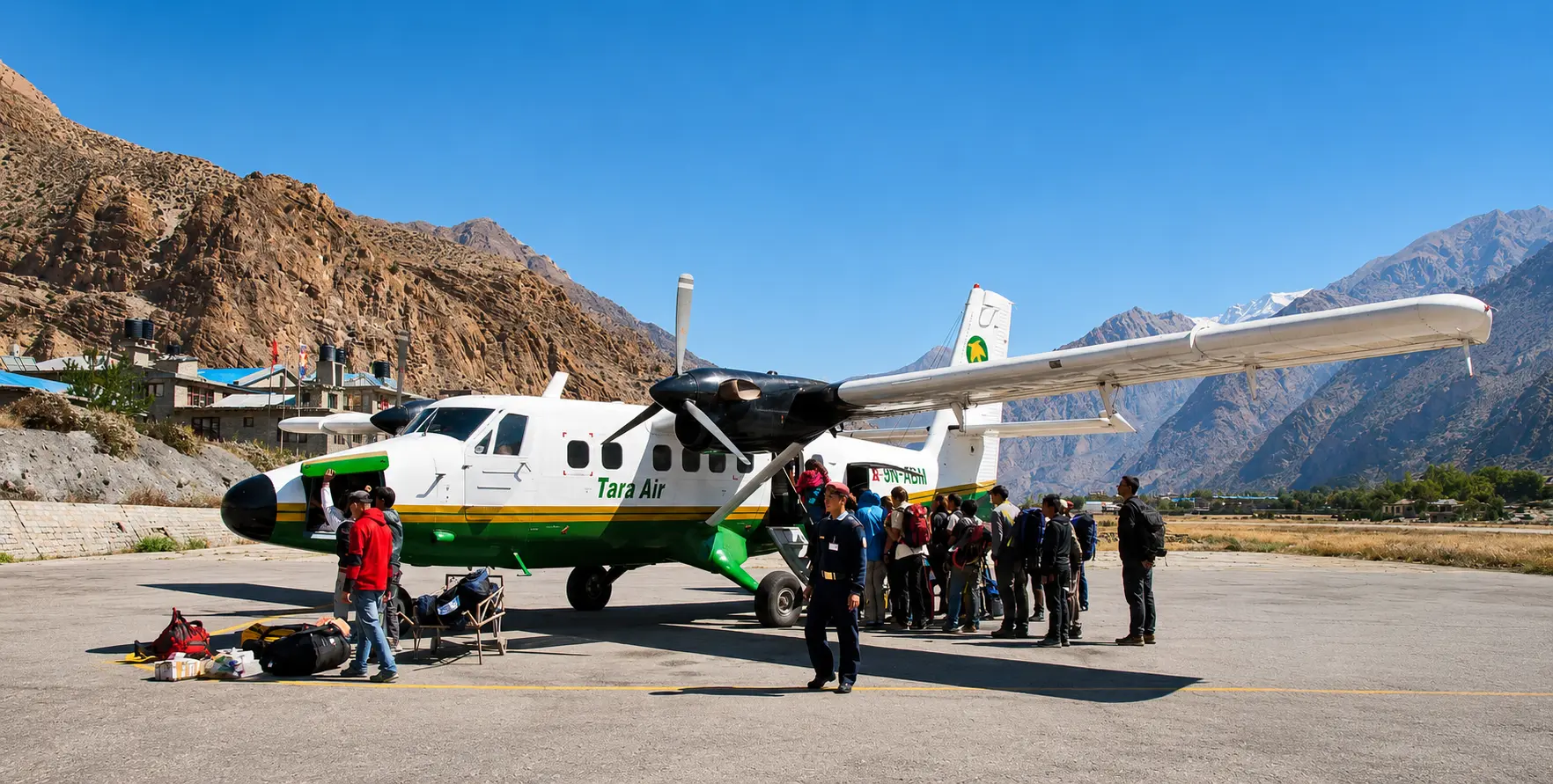
For yatra pilgrims who want to minimise the driving day to Muktinath, the Pokhara-to-Jomsom domestic flight (20 minutes by Twin Otter or similar mountain aircraft) provides an alternative to the Kali Gandaki gorge 7-9-hour jeep drive.

The domestic flight arrives at Jomsom Airport (2,720 m) and connects to a private jeep hire from Jomsom to Muktinath, the final 28-kilometre approach to Ranipauwa and the temple. The flight is subject to Jomsom’s famous afternoon wind cancellation — the airport closes after 11:00 AM due to wind, and morning flights are the only reliable departures.

Nepal Vehicle Hiring Pvt Ltd provides the Jomsom-to-Muktinath jeep hire for pilgrims who fly from Pokhara to Jomsom — coordinating the vehicle to meet the domestic flight arrival at Jomsom Airport. For the return journey from Muktinath, the same options apply: fly Jomsom to Pokhara or drive the Kali Gandaki gorge road.

Many yatra groups fly one direction and drive the other — experiencing both the aerial approach (Annapurna range from the air at flight altitude) and the gorge road approach (the river gorge, Marpha, the villages) in the same yatra. Contact Nepal Vehicle Hiring Pvt Ltd on WhatsApp for the Jomsom connection vehicle.

Why Choose Nepal Vehicle Hiring Pvt Ltd for the Banbasa Muktinath Yatra

  • Mahendranagar Nepal border pickup: Driver at the Nepal gate immediately after Banbasa-Mahendranagar immigration.
  • Complete Mahendra Highway expertise: Drivers with specific Far-Western Nepal highway knowledge — Dhangadhi, Karnali crossing, Bardia, Nepalgunj.
  • 4WD Scorpio/Hilux for Kali Gandaki: Mandatory 4WD jeep hire for gorge road and Muktinath approach.
  • Hiace van option for Mahendra Highway: Hiace van hire for large pilgrimage groups on the flat Terai section — jeep for the Kali Gandaki section.
  • Lumbini detour at Butwal: 22-km Lumbini addition coordinated at Butwal junction for the dual Hindu-Buddhist yatra circuit.
  • Return vehicle pre-arranged: All return vehicle legs confirmed at outward booking — same contact, all legs.
  • Altitude awareness support: Kali Gandaki drivers briefed on altitude profile and support appropriate pace at high sections.
  • All-inclusive pricing: Driver, fuel, tolls — no additions.
  • 24/7 on WhatsApp or plan trip page.

Frequently Asked Questions — Banbasa to Muktinath Private Jeep

Q: How many days does the Banbasa to Muktinath yatra take by private jeep?

3 to 4 travel days: Day 1 — Banbasa border to Nepalgunj. Day 2 — Nepalgunj to Pokhara. Day 3 — Pokhara to Muktinath via Kali Gandaki gorge.

Day 4 — Muktinath darshan and Mukti Dhara circuit.

Q: What is the private jeep cost from Banbasa to Muktinath?

NPR 62,000 to 90,000 (USD 465-675) for the complete 3-4 day private 4WD jeep hire, all-inclusive. Contact Nepal Vehicle Hiring Pvt Ltd on WhatsApp for a group-specific quote.

Q: Is 4WD mandatory for the Banbasa to Muktinath route?

4WD is mandatory for the Kali Gandaki gorge road and the Jomsom-to-Muktinath approach. You can hire a Hiace van for larger groups on the Mahendra Highway (Mahendranagar to Butwal).

Q: Can I visit Lumbini on the way from Banbasa to Muktinath?

Yes — Lumbini is 22 km south of the Butwal junction on Day 2. Nepal Vehicle Hiring Pvt Ltd includes the Lumbini detour as a standard yatra addition upon request at booking.

Q: Can I return from Muktinath through Sunauli instead of Banbasa?

Yes — the Pokhara to Sunauli private vehicle hire provides the Sunauli border return. Nepal Vehicle Hiring Pvt Ltd coordinates both exit options when you book outward.

The complete Banbasa-to-Muktinath private jeep yatra is Nepal’s finest far-western pilgrimage vehicle journey — a 3 to 4-day overland circuit that crosses the Karnali River, traverses Nepal’s Terai from far-west to centre, ascends through the Kali Gandaki gorge between Dhaulagiri and Annapurna, and arrives at the Lord of Liberation’s sacred abode at 3,710 metres.

Nepal Vehicle Hiring Pvt Ltd covers every Nepal-side vehicle leg: Mahendranagar border pickup; Mahendra Highway 4WD jeep hire or Hiace van hire for the Terai section; overnight vehicle at Pokhara Lakeside; Kali Gandaki gorge 4WD jeep hire; Muktinath darshan driver wait; and return vehicle pre-arranged for the post-yatra circuit.

Optional additions: Lumbini sacred garden visit at Butwal junction, Kathmandu Pashupatinath circuit, Bhaktapur heritage day, and the Upper Mustang tour from Jomsom. Contact our team on WhatsApp or our plan trip page to plan the complete yatra.

Nepal Vehicle Hiking Pvt Ltd’s private jeep hire network extends beyond the Muktinath yatra to cover all of Nepal’s major trekking and pilgrimage destinations — the Annapurna Circuit jeep approach via Besisahar, the Everest overland via Phaplu, the Annapurna Base Camp and Poon Hill via Nayapul, and the complete Nepal tour package covering all destinations from a single operator. The Banbasa-to-Muktinath yatra group can extend their Nepal visit to include Lumbini, Pokhara Sarangkot sunrise, or the Chitwan wildlife safari through the same plan trip page submission.

Conclusion

The Muktinath yatra from Banbasa by private jeep is one of Nepal’s longest and most popular pilgrimage journeys, a 3- to 4-day road circuit from the Uttarakhand border through Nepal’s Terai, mountain lake city, and the world’s deepest river gorge to the Vishnu sacred abode at 3,710 metres.

Nepal Vehicle Hiring Ltd completed a private jeep package, including an Indranagar pickup, Mahendra Highway expertise, a Hiace van option, a Scorpio jeep for the Kali Gandaki Gorge, and an Indranagar pickup—all in a single professional booking with all-inclusive pricing and a pre-arranged return vehicle.

Book your Banbasa to Muktinath private jeep yatra with Nepal Vehicle Hiring Pvt Ltd — call or WhatsApp, visit vehiclehiringnepal.com, or plan your complete yatra through our plan trip page.

Kathmandu to Dakshinkali Private Jeep

Kathmandu to Dakshinkali Private Jeep

Kathmandu to Dakshinkali Private Jeep — Temple Tour Complete Guide

Dakshinkali Temple, tucked into a forested gorge at the confluence of two sacred streams approximately 22 kilometres southwest of Kathmandu, is one of Nepal’s most powerful and most frequently visited Hindu temples — a sacred site dedicated to Goddess Kali in her most fearsome manifestation, one of the Kathmandu Valley’s Ashta Matrika (eight mother goddesses), and a destination of profound devotional significance for Hindu pilgrims from Nepal and India alike.

The temple’s dramatic gorge setting, the intensity of the religious activity on Saturday and Tuesday puja days, and the surrounding southern Kathmandu Valley’s rich cultural and natural landscape make Dakshinkali one of the most rewarding and most distinctively Nepali sacred site experiences within easy reach of the capital.

Nepal Vehicle Hiring Pvt Ltd provides private jeep hire and private car hire from any Kathmandu hotel to Dakshinkali Temple — a 45 to 60-minute journey through the southern Kathmandu Valley that can be combined with the Pharping Buddhist meditation caves, Taudaha Lake, Chobar Gorge,

Kirtipur ancient city, and the traditional Newari villages of Bungamati and Khokana into a rich full-day southern valley circuit. This complete guide covers the Dakshinkali route, the temple’s sacred character, the best times to visit, the southern valley’s companion sites, vehicle options and costs, and how to book the full Dakshinkali day tour.

Kathmandu to Dakshinkali — Distance, Route and Transfer Time

Distance: Approximately 22 kilometres from central Kathmandu (Thamel) to the Dakshinkali temple entrance. From the south Kathmandu Ring Road junction, approximately 14 kilometres.

Route: From Thamel, the road heads south through Kathmandu city centre, crosses the Ring Road at the Kalanki junction, and follows the Dakshinkali road southwest through Thankot, the Chandragiri foothills, Pharping village, and the forested gorge approach to the temple. The Dakshinkali road is paved throughout but narrows in the Pharping section — adequate for private car hire and private jeep hire but not recommended for larger vehicles.

Transfer time: 45 to 75 minutes from central Kathmandu depending on time of day. Saturday mornings (the busiest puja day) create specific traffic congestion on the Dakshinkali approach road — depart by 6:30 AM to reach the temple before the main crowd surge.

Parking: The Dakshinkali Development Trust manages a vehicle parking area above the temple — a 10 to 15-minute walk down to the temple gorge. Nepal Vehicle Hiring Pvt Ltd drivers park in the designated area and wait during the visit.

Transfer Cost — Kathmandu to Dakshinkali and Back

Private car hire (2-4 passengers, half-day round trip, 4-5 hours): NPR 3,000 to 10,000 (USD 23 to 70) all-inclusive — driver, fuel, parking, return to Kathmandu hotel—private car hire.

Private 4WD jeep hire (4-6 passengers, half-day round trip): NPR 4,000 to 20,000 (USD 30 to 130) all-inclusive—private jeep hire.

Full-day southern valley circuit (Dakshinkali + Pharping + Chobar + Kirtipur, 8 hours): NPR 7,000 to 30,000 (USD 53 to 180) depending on vehicle type: private car hire or private jeep hire.

Toyota Hiace van hire (7-13 passengers, pilgrimage group): NPR 8,000 to 25,000 (USD 60 to 165) for the half-day or full-day southern valley circuit. Hiace van hire for larger pilgrimage groups.

All prices include driver, fuel, and road tolls. Contact Nepal Vehicle Hiring Pvt Ltd on WhatsApp or our plan trip page for a confirmed quote.

The Ashta Matrika Circuit — Dakshinkali in Nepal’s Sacred Geography

The Kathmandu Valley’s sacred geography is organised around the concept of the Ashta Matrika — the eight mother goddesses positioned at the valley’s directional perimeter to form a sacred protective mandala.

This eight-site pilgrimage circuit, one of Nepal’s most distinctively Newar religious practices, is undertaken by devout Newar Buddhists and Hindu pilgrims who visit all eight Matrika temples in a single day or over several days to complete the full mandala circuit.

The eight Matrikas in the traditional Kathmandu Valley circuit are: Kankeshvari (north), Guhyeshvari (east-southeast, adjacent to Pashupatinath), Sobha Bhagawati (northeast), Jaya Bageshvari (east), Indrayani (northwest Kirtipur), Brahmayani, Mahalaxmi, and Dakshinkali (south)

The southern protector and the most famous of the eight. For pilgrims completing the full Ashta Matrika circuit, Dakshinkali is typically the most significant stop — the southern goddess and the gorge temple’s concentrated sacred atmosphere making it the circuit’s climactic destination.

Nepal Vehicle Hiring Pvt Ltd’s Kathmandu sightseeing car hire can cover the full Ashta Matrika circuit as a dedicated full-day booking—visiting all eight Matrika temples in the valley in a single private vehicle. The circuit includes the Pashupatinath area for Guhyeshvari, the northern and eastern valley for the other six sites, and Dakshinkali as the final southern culmination. Contact our team on WhatsApp to book the complete Ashta Matrika circuit vehicle.

Chobar Gorge — Where Manjushri Cut the Valley

The Chobar Gorge — 2 kilometres north of Taudaha on the return route from Dakshinkali — is one of the Kathmandu Valley’s most mythologically loaded landscapes. In the valley’s founding legend, the Bodhisattva Manjushri arrived at the valley from China, saw the sacred lotus floating on the primordial lake that filled the valley basin, and used his wisdom sword to cut the limestone ridge at Chobar — releasing the lake’s water through the gap and exposing the valley floor where Kathmandu now stands.

The gorge is the physical evidence of this mythological founding act: a narrow, geologically anomalous canyon in the valley’s limestone rim whose specific narrowness (the Bagmati River passes through a gap just 50 to 60 metres wide in the ridge) does indeed suggest that the river’s current course was established by some ancient forcing event in the valley’s geological history.

The Chobar gorge area includes: the Adinath Lokeshvara Temple above the gorge — whose facade is decorated with the pots and vessels donated by householders as offerings, creating one of Nepal’s most visually distinctive temple exteriors;

the Chobar Cave (accessible by steps from the gorge road, a small sacred cave associated with the valley’s Tantric Buddhist tradition); and the gorge viewpoint from the bridge above the narrowest section, looking down at the Bagmati River passing through the mythological gap.

The 20 to 30-minute Chobar stop on the Dakshinkali circuit return is one of the southern valley’s most mythology-rich additions—a physical encounter with the founding story of the Kathmandu Valley in the landscape where it is set. Nepal Vehicle Hiring Pvt Ltd’s private car hire includes the Chobar stop as a standard southern circuit addition — contact us on WhatsApp

Dakshinkali Temple Management and Entry — Current Arrangements

The Dakshinkali Development Committee manages the temple complex and the approach area under the Dakshinkali Development Area regulations —a management structure that has progressively improved the temple’s facilities, approach road, and visitor management over the past decades.

Entry fees: The Dakshinkali complex charges an entry fee for non-Hindu foreign visitors — the fee is payable at the main gate and covers access to the temple compound. Confirm the current fee at the gate on arrival, as the Dakshinkali Development Committee periodically revises the fee schedule. Hindu devotees from Nepal and India typically enter without fee or at a lower rate under the SAARC heritage access convention.

Queue management on Saturday: The Dakshinkali management deploys temple volunteers (sevaks) to manage queues on Saturday puja day. This system channels the large Saturday pilgrimage flow through the temple’s inner sanctum in an orderly sequence. Queues can be 45 minutes to 2 hours long on busy Saturdays; arriving early (before 7:30 AM) significantly reduces wait times.

Facilities: The Dakshinkali approach area has developed basic facilities — food stalls and restaurants in the market approach, public toilets above the parking area, and basic first aid accessible from the temple management office.

The approach market serves as the offerings procurement point—flower garlands, coconuts, sindoor, and all items required for the puja are available from vendors lining the 10- to 15-minute walk from parking to the temple.

Nepal Vehicle Hiring Pvt Ltd’s drivers are updated on current Dakshinkali management arrangements and entry fee requirements — any changes since the last visit are communicated to the group before disembarking at the parking area. Contact Nepal Vehicle Hiring Pvt Ltd on WhatsApp or our plan trip page.

The Dakshinkali Approach Road — Southern Valley Drive

In a private vehicle hire, the road from Kathmandu to Dakshinkali takes you through the southern Kathmandu Valley’s progressive transition from urban to sacred—a 22-kilometre arc that passes through an increasingly quiet and beautiful landscape as the city’s density gives way to the forested gorge the temple inhabits.

Leaving Thamel by private car or jeep hire, the first 10 kilometres pass through Kathmandu’s densely built southern suburbs—the Kalimati textile market, the commercial character of the Kalanki junction, and the Ring Road’s heavy traffic—before the Ring Road crossing marks the transition to the outer valley.

From Kalanki southward, the road’s character changes immediately: buildings are spaced wider apart, the first field terraces appear on the hillsides above the road, and within 5 kilometres the semi-rural character of the outer valley’s settlements replaces the urban density.

The Thankot area, where the Tribhuvan Highway departs westward over the valley rim, is the road’s first visual landmark — the ridge crest visible above the junction offering the first glimpse of the forested Chandragiri slopes above.

From Thankot, the road descends slightly into the Pharping corridor — the specific microvalley whose forested character, cooler temperature, and monastic institutions distinguish it from the main valley floor.

The smell of the forest (Himalayan oak, pine, and the specific resinous fragrance of Nepal’s mid-hill tree species) enters the vehicle through the window before the Pharping settlement comes into view.

This sensory transition — from the exhaust and concrete smell of Kathmandu to the forest fragrance of the Pharping corridor — is the moment that the Dakshinkali journey begins to feel like a pilgrimage rather than a city transit. Nepal Vehicle Hiring Pvt Ltd drivers on the Dakshinkali route know this transition point and manage speed so the group can experience it fully.

Dakshinkali Temple — The Goddess and Her Sacred Gorge

Dakshinkali (literally ‘Kali of the South’) is the form of Goddess Kali worshipped at the Pharping gorge site—a manifestation of the divine feminine in its most powerful and demanding aspect. The temple sits at the confluence of the Bagmati River’s upper tributary and the Tika Bhairav stream in a forested gorge whose setting—narrow, shaded, and hemmed in by the cliff walls the streams have carved—creates the sacred enclosure that Nepal’s most potent Shakti sites characteristically inhabit.

The sacred image of Dakshinkali in the temple’s inner sanctum is unusual in its iconographic programme: the goddess stands upon the prostrate form of Lord Shiva (as in classic Kali iconography), but her eight arms hold specific attributes that connect her to the Kathmandu Valley’s Tantric Shakti tradition.

This tradition identifies the valley’s eight directional mother goddesses as the spiritual guardians of the sacred landscape. Dakshinkali is the southern guardian of this octagonal sacred geography, and her temple’s power is understood to be concentrated in the precisely calibrated alignment of the gorge, the water confluence, and the goddess’s inward-facing shrine.

The Ashta Matrika connection. Dakshinkali is one of the eight Matrika (mother goddess) temples that form the sacred perimeter of the Kathmandu Valley in the Tantric geography of the Newar Buddhist and Hindu traditions. Devout Newar Buddhists and Hindu pilgrims follow a specific pilgrimage circuit visiting all eight Matrikas, and Dakshinkali —the most famous and powerful— is typically the first or last Matrika on the circuit.

Best Time to Visit Dakshinkali

Saturdays — The Principal Puja Day. Saturday is Dakshinkali’s most significant puja day—the morning of animal sacrifice and the day the temple receives the week’s largest devotional crowd.

The combination of the Goddesses and the Saturday puja timing makes Saturday the most devotionally intense Dakshinkali experience—but also the most crowded. For the most active Dakshinkali pilgrimage experience, Saturday is the right day. For a quieter cultural and sacred-site visit, choose a weekday.

Tuesday — The Secondary Puja Day. Tuesday (dedicated to the divine feminine in the Hindu devotional calendar) is the second major puja day at Dakshinkali — significantly less crowded than Saturday but still active with animal sacrifice and pilgrimage offerings. Tuesday is the recommended visiting day for pilgrims who want the full Dakshinkali sacred experience without Saturday’s considerable crowd management.

Early morning — Before 9:00 AM. Regardless of the day, early morning is the best time to visit—the temple’s first aarti (ritual fire offering) takes place at dawn, the gorge’s forest light creates a specific atmosphere that the midday sun burns away, and the pilgrimage queue is shortest before day visitor groups arrive. Nepal Vehicle Hiring Pvt Ltd’s Kathmandu-to-Dakshinkali private car hire can depart as early as 5:30 AM for dawn darshan.

Festival periods. The Navaratri festival (nine nights of the divine feminine, occurring twice a year) brings Dakshinkali to its peak of sacred intensity — the temple complex and approach road alive with devotional activity for nine continuous days.

The Navaratri Dakshinkali visit is among Nepal’s finest Hindu festival experiences; book private car hire well in advance and plan an early-morning departure.

TIP: Depart Kathmandu by 6:00-6:30 AM on Saturday to reach Dakshinkali before the main morning crowd. The approach road fills quickly after 8:00 AM on busy puja Saturdays.

The Southern Kathmandu Valley — What to See Beyond Dakshinkali

The Dakshinkali approach road passes through one of the Kathmandu Valley’s richest cultural and natural landscapes. This southwestern valley rim area contains the Pharping Buddhist meditation caves, Taudaha Lake, Chobar Gorge, and the Newari living villages of Bungamati and Khokana. A full-day private car hire or private jeep hire from Nepal Vehicle Hiring Pvt Ltd turns the Dakshinkali visit into a complete southern valley circuit.

Pharping Buddhist Meditation Caves (Asura Cave and Yangleshö Cave). Pharping village, adjacent to Dakshinkali, contains two of Nepal and Tibet’s most sacred Buddhist meditation caves—the Asura Cave (Yangleshö), where Guru Rinpoche (Padmasambhava) is said to have attained the Mahamudra realisation that allowed him to bring Vajrayana Buddhism to Tibet, and the adjacent Sheshnarayan sacred site.

The Pharping caves are among the most significant Buddhist pilgrimage sites in the Kathmandu Valley—visiting Hindu Dakshinkali and Buddhist Pharping in the same day offers one of Nepal’s finest interfaith sacred-site experiences.

Taudaha Lake. The sacred lake of Taudaha, on the Kathmandu-Dakshinkali road about 9 kilometres from the Ring Road, is associated in Newar legend with the Bodhisattva Manjushri draining the Kathmandu Valley.

This remnant water body remained after Manjushri cut the valley’s southern wall at Chobar, releasing the primordial lake that once filled the valley basin. Taudaha is Nepal’s finest urban-fringe migratory bird sanctuary — hundreds of species visit the lake during migration seasons.

Chobar Gorge and Adinath Lokeshvara Temple. The Chobar Gorge — where Manjushri’s sword cut the valley’s southern limestone ridge to release the sacred lake — is one of the Kathmandu Valley’s most geologically dramatic landmarks: a narrow canyon where the Bagmati River passes through the valley rim in a gap of remarkable narrowness relative to the river’s volume.

The Adinath Lokeshvara Temple above the gorge is decorated with thousands of household pots and vessels donated by devotees—one of Nepal’s most visually distinctive sacred-site exteriors.

Kirtipur. The ancient Newar fortress city of Kirtipur, on a twin-hilltop ridge 5 kilometres southwest of Patan, is one of the Kathmandu Valley’s finest and least-visited heritage cities,

a living Newar community whose medieval street plan, traditional architecture, and the famous Uma Maheshvara Temple complex have survived largely intact. Kirtipur lies on the return route from Dakshinkali to Kathmandu — private car hire stops here for a 45-minute walk.

Bungamati and Khokana. The twin Newari villages of Bungamati (home of the Rato Machhendranath chariot festival) and Khokana (Nepal’s mustard oil production centre, with its extraordinary Rudrayani Temple) are on the Dakshinkali return route — living villages of exceptional traditional character that tourist Kathmandu largely bypasses.

Dakshinkali Darshan — Practical Guide

Entry and access. The Dakshinkali Development Trust charges an entry fee for the temple complex — NPR 50 to 100 per person for non-Hindu visitors (the standard Kathmandu Valley temple entry arrangement). Hindu devotees enter freely. Remove footwear before entering the temple’s inner courtyard.

Keep leather items (shoes, belts, wallets) out of the innermost sacred area on Saturday and Tuesday puja days.

Photography. Photography is permitted in the temple’s outer courtyard and approach area. The inner sanctum — particularly during active puja and animal sacrifice — does not permit photography in most cases. Ask the temple management about the current photography policy at the gate before bringing a camera.

Animal sacrifice (Saturday and Tuesday). Dakshinkali is one of Nepal’s principal animal sacrifice sites— devotees offer chickens, goats, ducks, and pigeons on the main puja days.

Visitors sensitive to this aspect of Tantric Hindu ritual tradition should visit on non-puja days (weekdays other than Tuesday), when the temple atmosphere is primarily aarti offerings, flower garlands, and incense rather than animal sacrifice.

The walk down to the temple. From the parking area, the temple is 10–10 to 15-minute walk down through the forest and the pilgrimage market stalls — vendors of flower offerings, materials, sindoor, and traditional puja items line the approach.

This walk is part of the Dakshinkali experience: the market’s unique blend of the commercial and the devotional, the fragrance of marigold garlands and incense, and the sound of temple bells growing louder as the gorge narrows around the sacred site.

The Dakshinkali Road — Character and Experience

The 22-kilometre Dakshinkali Road from Kathmandu is in itself one of the southern valley’s finest driving experiences. This route transitions from the capital’s urban density through the Ring Road junction’s Terai-junction character to the forested hillside approach of the Chandragiri range’s southwestern slopes.

The road leaves central Kathmandu through the Kalimati and Kalanki areas — industrial and commercial Kathmandu at its most functional — before crossing the Ring Road and immediately beginning the quality change that characterises the Dakshinkali approach: the road narrows,

the houses thin out, and within 5 kilometres of the Ring Road the urban density has given way to the semi-rural character of the outer valley villages. The Thankot area marks the valley rim’s approach — where the Tribhuvan Highway descends into the Trishuli gorge, and the Dakshinkali road continues southward into the Chandragiri ridge’s western foothills.

Pharping village — 17 kilometres from Thamel — is the approach’s most atmospheric settlement: a traditional Newar and Tamang community whose Buddhist character (the meditation cave monasteries, the prayer flags on the hillsides above,

the robed monks and nuns from the international retreat centres) creates a specific sacred atmosphere that the private car hire delivers into without any of the public bus’s schedule management. From Pharping, the road descends 2 kilometres into the gorge where Dakshinkali’s stream confluence announces the temple’s proximity.

Dakshinkali’s Sacred History — The Tantric Tradition

The historical tradition associated with Dakshinkali Temple reaches deep into the Kathmandu Valley’s Tantric past—a religious culture the Newar civilisation developed over more than a millennium into one of the world’s most sophisticated Tantric ritual traditions. The specific form of Kali worshipped at Dakshinkali — Mahakali or Kalika in her southern aspect — is one of the five primary emanations of the divine feminine in Nepali Tantric Hinduism.

The selection of the gorge site as her abode reflects the Tantric principle that the goddess’s powerful forms inhabit liminal landscapes: forest gorges, river confluences, and the boundaries between cultivated and wild terrain.

The historical founding of the Dakshinkali sacred site is associated with the Licchavi period of the Kathmandu Valley’s history — the early classical era (approximately 5th to 9th centuries CE) when the valley’s Hindu-Buddhist Tantric synthesis was crystallising into the distinctive Newar cultural form that persists today.

The specific legend of Dakshinkali’s founding involves a Newar priest’s divine vision at the gorge site—in which the goddess sees her presence in the water confluence and directs the establishment of her temple there. Whether this founding narrative is historical or mythological, the site’s sacred character — the specific combination of the water confluence, the enclosed gorge, and the southern valley’s natural power — is a genuinely distinctive landscape whose sacred quality is perceptible even to visitors without specific Tantric knowledge.

Nepal Vehicle Hiring Pvt Ltd’s drivers on the Kathmandu to Dakshinkali private car hire route have carried thousands of pilgrims and visitors to the temple over the years and understand the site’s significance across multiple devotional traditions — Hindu Shakta, Buddhist Tantric, and the increasingly large international visitor community who come to Dakshinkali as one of Nepal’s most distinctive cultural experiences. Our Kathmandu sightseeing service includes Dakshinkali as a specific option for the southern valley circuit alongside the standard UNESCO heritage sites.

Taudaha Lake — The Serpent King’s Sacred Water

Taudaha Lake (also called Taudah), on the Kathmandu-Dakshinkali road approximately 9 kilometres south of the Ring Road, carries one of the Kathmandu Valley’s most vivid founding legends. The Newar Buddhist tradition records that when the Bodhisattva Manjushri drained the primordial lake that filled the Kathmandu Valley basin by cutting the valley’s southern wall at Chobar Gorge,

he left Taudaha as a deliberate remnant lake for the Nagaraja (serpent king) Karkotaka — who had been protecting the sacred valley and needed a water body to inhabit when the great lake drained. Taudaha is therefore the valley’s protective Nagaraja’s specific abode, and Newar Buddhists perform offerings to serpent deities (naga puja) at the lake’s edge on specific festival days.

Beyond its mythological significance, Taudaha is one of the Kathmandu Valley’s finest natural wetlands- a shallow lake with dense reed margins and water chemistry that attracts an extraordinary diversity of migratory waterbirds during migration seasons. Ruddy shelducks, pochards, shovelers, pintails, and multiple teal species winter at Taudaha in significant numbers; grey herons and various egrets are year-round residents; and the lake’s perimeter reed beds host marsh warblers, bitterns, and water rails.

For the private car hire group making the Dakshinkali day circuit, a 20 to 30-minute Taudaha stop on the Dakshinkali road (the lake is directly on the route, no detour required) adds one of Nepal’s finest compact birdwatching sites to an already culturally rich day.

Kathmandu Southern Valley — A Half-Day or Full-Day Circuit?

Planning the Kathmandu-to-Dakshinkali private vehicle hire requires deciding whether the southern valley visit is a half-day or full-day circuit. This decision determines which sites are included alongside the Dakshinkali darshan.

Half-day circuit (4-5 hours, recommended for first-time visitors with a packed Kathmandu schedule): Depart Kathmandu hotel at 6:30 AM. Reach Dakshinkali by 7:30 AM. Dakshinkali darshan (1 to 1.5 hours).

Pharping Buddhist caves (45 minutes). Taudaha Lake brief stop (20 minutes). Return to Kathmandu by 11:00 AM.

The afternoon is free for Kathmandu sightseeing by car, covering Boudhanath, Swayambhunath, or Patan—private car hire: NPR 3,000 to 10,000.

Full-day circuit (8 hours, recommended for the complete southern valley experience): Depart 6:00 AM. Dakshinkali dawn darshan. Pharping caves.

Chandragiri Cable Car from Thankot (optional, 1.5 hours). Taudaha Lake. Chobar Gorge and Adinath Temple.

Kirtipur heritage walk. Bungamati and Khokana village circuit. Return to Kathmandu by 5:00-6:00 PM.

Private car hire full day: NPR 7,000 to 25,000. This format is the definitive southern Kathmandu Valley experience — a day that comprehensively covers the area’s Hindu sacred site, Buddhist meditation heritage, legendary geological landmark, and living Newari village culture.

Nepal Vehicle Hiking Pvt Ltd manages both formats through our plan trip page. Tell us which format. Please tell us your schedule and group size, and we’ll provide the right vehicle, confirmed timing, and a knowledgeable driver to make each stop as rewarding as possible.

Newari Village Culture — Bungamati and Khokana

The twin Newari villages of Bungamati and Khokana, on the southern Kathmandu Valley floor between Patan and the Dakshinkali approach road, are two of the valley’s finest living traditional Newari villages — communities where the medieval street layout, the courtyard-centred house design, the communal water spouts (dhunge dhara), and the extraordinary temple architecture of the Newar Buddhist-Hindu synthesis have survived largely intact.

Bungamati is the permanent home of the Rato Machhendranath deity—the valley’s rain god and protector —celebrated in one of the world’s longest-running chariot festivals, which takes the deity’s chariot through Patan and Bungamati in a procession that has been conducted without interruption for centuries. Bungamati’s central courtyard, the Machhendranath Temple’s setting at the village’s heart, and the wood-carving workshops that produce the window screens and pillar decorations of traditional Newar architecture make it one of the valley’s finest cultural destinations.

Khokana is Nepal’s traditional mustard oil production village — cold-press oil mills that process the Kathmandu Valley’s mustard harvest have operated there for generations, and the smell of fresh-pressed mustard oil permeates the village’s lanes during harvest season. The Rudrayani Temple in Khokana’s central square is the village’s sacred focal point — a finely restored Newar temple whose annual festival includes a ritual ‘battle for Rudrayani’ that is one of Nepal’s most dramatic communal festival events.

Both villages are within 5 kilometres of each other and 15 to 20 kilometres from Dakshinkali on the return route—a natural afternoon addition to the southern valley circuit that the private car hire from Nepal Vehicle Hiring Pvt Ltd includes at no extra cost on the full-day circuit booking. Contact our team on WhatsApp.

Kirtipur — The Kathmandu Valley’s Ancient Fortress City

Kirtipur (City of Fame in Sanskrit) is one of the Kathmandu Valley’s most historically significant and most visually distinctive settlements — a twin-hilltop Newar city that served as a major independent kingdom in the valley’s medieval period and whose 18th-century siege by Prithvi Narayan Shah (the founder of modern Nepal) produced one of the valley’s most dramatic historical narratives. The city’s strategic position on two adjacent hilltops connected by a saddle, its circuit of medieval fortress walls, and the survival of its traditional urban structure make it one of the valley’s finest heritage destinations.

Kirtipur’s key heritage sites: the Uma Maheshvara Temple (a finely proportioned three-tiered pagoda dedicated to Shiva-Parvati, Kirtipur’s most celebrated architectural monument), the Chilancho Stupa (a significant Buddhist stupa with a fine surrounding courtyard on the city’s northern hill),

the Bagh Bhairab Temple (whose exterior is decorated with the weapons of defeated enemies — one of Nepal’s most unusual temple facades), and the traditional lane system of the city’s residential areas where carved wooden windows, stone water spouts, and the specific three-storey brick architecture of the Newar townhouse provide an intact medieval streetscape.

The 30 to 45-minute Kirtipur walk on the return from Dakshinkali to Kathmandu adds one of the valley’s finest ancient cities to the southern circuit — a heritage quality comparable to Bhaktapur but with almost none of Bhaktapur’s international tourist density. Nepal Vehicle Hiring Pvt Ltd’s private car hire drivers park at the Kirtipur base and w, if requested, walk up with the group or wait at the parking area for the group’s independent Kirtipur circuit.

Combining Dakshinkali with the Standard Kathmandu Sightseeing Circuit

Dakshinkali pairs naturally with the standard Kathmandu Valley UNESCO heritage circuit for visitors who want both the capital’s classical heritage sites and the southern valley’s sacred-site experience in the same Kathmandu days.

Day 1 — Standard Kathmandu heritage circuit: Pashupatinath Temple, Boudhanath Stupa, Swayambhunath, Patan Durbar Square — covered by Nepal Vehicle Hiring Pvt Ltd’s Kathmandu sightseeing car hire.

Day 2 — Southern valley circuit: Dakshinkali (early morning darshan), Pharping Buddhist meditation caves, Taudaha Lake, Chobar Gorge, Kirtipur, Bungamati and Khokana — covered by private car hire for the complete southern circuit.

Day 3 — Eastern valley: Bhaktapur Durbar Square heritage day tour and Nagarkot sunrise vehicle hire — completing the three-day comprehensive Kathmandu Valley circuit.

This three-day Kathmandu Valley circuit covers UNESCO heritage sites, the principal Hindu sacred sites (Pashupatinath and Dakshinkali), and the finest medieval Newar heritage (Bhaktapur and Kirtipur) in a single, efficient private-vehicle arrangement. Nepal Vehicle Hiring Pvt Ltd coordinates all three days through a single trip-page submission.

Dakshinkali for Indian Pilgrims — The Hindu Sacred Valley

For Indian Hindu pilgrims visiting Nepal, Dakshinkali is one of the most significant sacred destinations in the Kathmandu Valley — and often the most emotionally powerful. Pashupatinath provides the Shiva sacred encounter; Dakshinkali provides the Kali-Durga sacred encounter that the Shakta tradition specifically seeks in Nepal’s sacred geography.

Indian pilgrims who visit Dakshinkali as part of the broader Nepal pilgrimage circuit — Pashupatinath (Shiva), Dakshinkali (Kali), Manakamana (Bhagwati, accessible by cable car from the Prithvi Highway), Muktinath (Vishnu/Shaligram) — complete Nepal’s four principal Sanatana dharma sacred site types in a single Nepal visit. Nepal Vehicle Hiking Pvt Ltd’s Kathmandu sightseeing car hire covers Pashupatinath, Dakshinkali, and the Kathmandu Valley’s complete Hindu sacred circuit, combined with private car hire for the southern valley’s specific Dakshinkali approach.

Indian pilgrims from Gorakhpur, Varanasi, and UP who enter Nepal through the Sunauli border can reach Dakshinkali by combining the Sunauli to Kathmandu private vehicle hire with the Kathmandu to Dakshinkali private car hire on the Kathmandu day — completing the Pashupatinath and Dakshinkali darshans in a single Nepal visit day before continuing to Pokhara or Lumbini. Contact Nepal Vehicle Hiring Pvt Ltd on WhatsApp to plan the complete pilgrimage circuit.

The Chandragiri Hills — Dakshinkali’s Mountain Backdrop

Above Dakshinkali to the north and west, the Chandragiri ridge rises to 2,551 metres — the Kathmandu Valley’s southwestern rim and one of the finest Himalayan panorama viewpoints accessible from the capital. The Chandragiri Cable Car (departing from the Thankot junction on the Dakshinkali road) takes 7 minutes to reach the Chandragiri hilltop, where passengers can take in a panorama of the Kathmandu Valley and the Himalayan range from Langtang to Manaslu, Ganesh Himal, Annapurna, and Dhaulagiri on clear days.

The Chandragiri cable car makes a natural addition to the Dakshinkali day — departing Kathmandu for the cable car at 8:30 AM (after the early Dakshinkali morning darshan), spending an hour on the Chandragiri ridge, and returning to the Dakshinkali road for the southern valley circuit continuation. Nepal Vehicle Hiring Pvt Ltd’s private car hire waits at the cable car base station during the hilltop visit and resumes the southern valley circuit on the group’s return.

The combined Dakshinkali darshan + Chandragiri panorama + Pharping Buddhist caves + Chobar Gorge + Kirtipur full-day circuit is the southern Kathmandu Valley at its most comprehensive — a day that no standard Kathmandu sightseeing car hire tour covers and that only the private vehicle hire format enables.

Dakshinkali and the Pharping Buddhist Meditation Tradition

The co-location of Dakshinkali’s Hindu Kali temple and Pharping’s Buddhist Guru Rinpoche meditation caves within 2 kilometres of each other creates one of the Kathmandu Valley’s most extraordinary interfaith sacred site concentrations — a place where the two great Himalayan spiritual traditions inhabit the same forested gorge and the same sacred landscape, each drawing its devotees from different traditions but sharing the specific quality of sacred power that the gorge’s geography and water character concentrate.

The Yangleshö Cave (also called Asura Cave) in Pharping is where Guru Rinpoche is said to have spent years in meditation before attaining the Vajrayana realisation that enabled him to pacify the malevolent forces blocking the spread of Buddhism in Tibet. The cave is now surrounded by Nyingma monasteries.

including the Tso Pema Orgyen Herukar Nyingma monastery above the cave, whose resident monks maintain the meditation tradition that Guru Rinpoche established at this specific site. For Buddhist pilgrims visiting Pharping on the same day as Dakshinkali, the contrast between the thunderous intensity of the Kali temple below and the serene meditation atmosphere of the Buddhist caves above is one of the southern valley’s most remarkable experiential contrasts.

Nepal Vehicle Hiring Pvt Ltd’s southern valley private car hire includes Dakshinkali and Pharping as standard stops on the full-day southern circuit—the driver knows the specific parking areas at both sites and the walking routes connecting the gorge temple to the hillside meditation caves. Contact us on WhatsApp or our plan trip page.

Why Private Car or Jeep Is Better Than Public Transport for Dakshinkali

Public transport to Dakshinkali exists — microbuses and local buses from Ratna Park in central Kathmandu serve the Dakshinkali route with regular departures from early morning. But public transport and private-vehicle experiences differ in ways that matter significantly for both pilgrimage and tourism.

Departure flexibility: The private car hire from Nepal Vehicle Hiring Pvt Ltd departs your Kathmandu hotel at 6:00 AM for the dawn darshan. The public microbus from Ratna Park starts at varying times and does not offer hotel pickup.

Return timing: The private vehicle waits at Dakshinkali for the entire darshan, however long the queue is on Saturday morning. The public microbus returns on a fixed schedule that may not align with the darshan’s actual completion time.

Southern valley circuit: The private vehicle covers Dakshinkali, Pharping, Taudaha, Chobar, Kirtipur, Bungamati, and Khokana in a single connected day. Public transport between these dispersed southern valley sites requires multiple vehicle changes, long waits, and significant logistical effort that consumes the time available for the actual site visits.

Group comfort: A pilgrimage group of 5 to 10 people travels together, with all luggage and offering materials, in a single private car or Hiace van hire — not dispersed across multiple public transport seats.

Dakshinkali and the Navaratri Festival — The Sacred Nine Nights

Navaratri (Nine Nights), the most important Hindu festival dedicated to the divine feminine, transforms Dakshinkali Temple into one of Nepal’s most intensely devotional sacred sites for nine continuous days. The festival occurs twice per year — in spring (Chaitra, March-April) and autumn (Ashwin, September-October) — and both occasions draw enormous pilgrimage crowds to Dakshinkali as the principal Kali site in the Kathmandu Valley.

During Navaratri, the Dakshinkali Development Committee extends seven hours; temple priests conduct additional puja sessions, and the approach market operates from before dawn to late evening. The approach road to Dakshinkali during Navaratri requires specific management — Nepal Vehicle Hiring Pvt Ltd arranges pre-dawn departures (4:30 to 5:00 AM) for groups who want to reach Dakshinkali before the main Navaratri crowd surge on the principal puja days.

The Navaratri Dakshinkali visit is among Nepal’s finest Hindu festival experiences—the devotional energy, the volume of sacred activity, and the visual spectacle of thousands of pilgrims filling the gorge approach and the temple compound create an atmosphere no non-festival visit can replicate. Nepal Vehicle Hiring Pvt Ltd’s Kathmandu sightseeing car hire and private car hire cover Navaratri Dakshinkali visits with early departure and driver wait — contact our team on WhatsApp or our plan trip page well ahead of the festival for Navaratri bookings.

Extending the Southern Valley Day — Nagarkot Sunrise the Next Morning

The southern Kathmandu Valley circuit — Dakshinkali, Pharping, Chobar, Kirtipur — covers the valley’s southwest. The northeast valley — Nagarkot’s Himalayan sunrise, Bhaktapur’s medieval heritage, Changu Narayan’s ancient temple — provides the complementary eastern circuit that creates the most comprehensive Kathmandu Valley experience available in two days.

Nepal Vehicle Hiring Pvt Ltd coordinates the two-day comprehensive Kathmandu Valley circuit: Day 1 morning — Dakshinkali early morning darshan and southern valley circuit (Pharping, Chobar, Kirtipur, Bungamati). Day 1 evening — Nagarkot sunset and overnight. Day 2 pre-dawn — Nagarkot Himalayan sunrise.

Day 2 morning — Bhaktapur Durbar Square heritage day tour on the return from Nagarkot. This 2-day circuit covers Dakshinkali’s sacred southern gorge, the southern valley’s cultural landscape, the northeastern valley rim’s Himalayan panorama, and Bhaktapur’s UNESCO medieval city — the most complete Kathmandu Valley experience available within 2 days. Plan through our trip page or call WhatsApp.

Dakshinkali for Trekking Groups — Pre-Trek or Post-Trek Sacred Visit

Trekking groups who begin or end their Nepal trek in Kathmandu often include a Dakshinkali visit as a sacred counterpart to the mountain experience—either as a pre-trek blessing or a post-trek thanksgiving. In the Tantric tradition, Dakshinkali’s specific Kali energy is understood as protecting mountain travel—the goddess’s power governs the fearsome and the transformative, offering the right sacred benediction for the physical challenge ahead.

Groups heading for the Langtang Valley trek, the Helambu circuit, the Everest Base Camp trek, or the Ghorepani Poon Hill trek frequently include a Dakshinkali morning darshan on the pre-departure Kathmandu day — the private car hire to Dakshinkali and back fitting comfortably into the morning before the afternoon trekking permit arrangements and packing. Nepal Vehicle Hiking Pvt Ltd coordinates the Dakshinkali morning visit alongside the same-day Kathmandu sightseeing car hire or the airport transfer as a single smooth booking.

Why Choose Nepal Vehicle Hiring Pvt Ltd for Dakshinkali

  • Hotel pickup: Door-to-door service from any Kathmandu hotel — Thamel, Lazimpat, Kupondole, or any other area.
  • All vehicle sizes: Private car for individuals/couples, jeep hire for small groups, Hiace van hire for pilgrimage parties.
  • Driver waits during darshan: No rush, no fixed queue time — the vehicle and driver wait for the complete Dakshinkali visit.
  • Southern valley circuit: Full-day circuit covering Dakshinkali, Pharping, Taudaha, Chobar, Kirtipur, Bungamati, Khokana — driver knows all stops.
  • Combined with heritage circuit: Kathmandu sightseeing car hire and Dakshinkali day coordinated as a multi-day Kathmandu package.
  • Saturday and festival departures: Pre-dawn departures (from 5:30 AM) for Saturday puja and Navaratri festival.
  • All-inclusive pricing: Driver, fuel, parking — no additions at Dakshinkali.
  • 24/7 on WhatsApp or plan trip page.

Dakshinkali Temple is also bookable as part of Nepal Vehicle Hiring Pvt Ltd’s Nepal tour packages — our complete Nepal circuit programmes for groups who want the full Kathmandu, Pokhara, Chitwan, and Lumbini circuit with all vehicle legs pre-arranged. Alpine Luxury Treks offers a top-end Nepal heritage experience, with Nepal Vehicle Hiking Pvt Ltd providing private vehicle hire for all ground transport. Contact us on WhatsApp.

Nepal Tour Package

Frequently Asked Questions — Kathmandu to Dakshinkali Jeep

Q: How far is Dakshinkali from Kathmandu?

Approximately 22 kilometres from Thamel, Kathmandu. Transfer time: 45-75 minutes by private car or jeep hire.

Q: What is the best day to visit Dakshinkali?

Saturday is the principal puja day — most active but most crowded. Tuesday is the secondary puja day. Weekdays offer a quieter darshan.

Early morning departure (before 7:00 AM) is recommended on all days.

Q: What is the private car hire cost from Kathmandu to Dakshinkali?

NPR 3,000 to 10,000 (USD 23 to 80) for a half-day round trip including driver wait. Contact Nepal Vehicle Hiring Pvt Ltd on WhatsApp  for a confirmed quote.

Q: Can I combine Dakshinkali with Pharping Buddhist caves in the same day?

Yes — both are in the same gorge area, 2 kilometres apart. The full-day southern valley private car hire covers both as standard stops.

Q: Can Nepal Vehicle Hiring Pvt Ltd arrange a pre-dawn Dakshinkali departure?

Yes—departures from 5:30 AM for dawn darshan are available. Confirm the early departure time at booking via WhatsApp.

Swayambhunath visit during Kathmandu Pokhara Tour

Nepal Vehicle Hiring Pvt Ltd’s complete Kathmandu private car and jeep hire service connects Dakshinkali to the Kathmandu Valley’s heritage and sacred-site network. From the same booking that covers the Dakshinkali southern valley circuit, groups can add Pashupatinath and Boudhanath sightseeing,

the Bhaktapur full-day heritage tour, the Nagarkot overnight and sunrise, and onward Kathmandu-to-Pokhara private vehicle hire or Kathmandu-to-Lumbini bus service to continue the Nepal circuit.

All Kathmandu area vehicle requirements — airport transfer, sightseeing car hire, Dakshinkali temple tour, Hiace van for groups, and the coaster for large pilgrimage parties — are coordinated through a single Nepal Vehicle Hiring Pvt Ltd plan trip page submission or WhatsApp contact.

Conclusion

Dakshinkali Temple in the southwestern Kathmandu Valley is one of Nepal’s most powerful sacred sites—the Goddess Kali’s gorge temple where the Tantric tradition’s most fearsome and most liberating feminine energy resides, and where the Saturday morning puja creates a devotional intensity that Nepal’s sacred sites match.

The 22-kilometre private car or jeep hire from Kathmandu delivers the pilgrim and visitor to this extraordinary site in under an hour — and the full-day southern valley circuit that Nepal Vehicle Hiring Pvt Ltd provides alongside the Dakshinkali darshan turns the visit into the most complete southern Kathmandu Valley experience available: Dakshinkali’s Kali darshan, Pharping’s Guru Rinpoche Buddhist meditation caves.

Taudaha Lake’s sacred migratory bird sanctuary, Chobar Gorge’s geological and mythological drama, and Kirtipur’s ancient Newar fortress heritage — all in a single day in the finest private vehicle hire from Nepal Vehicle Hiring Pvt Ltd.

Book your Kathmandu to Dakshinkali private jeep or car hire with Nepal Vehicle Hiring Pvt Ltd — call or WhatsApp, visit vehiclehiringnepal.com, or plan your complete Kathmandu sacred site circuit through our plan trip page.

Kathmandu to Besisahar Private Car Price: Jeep Hire Guide

Besisahar valley

Kathmandu to Besisahar Private Car and Jeep Price — Complete Guide

Besisahar — the gateway town to the Annapurna Circuit trek and the starting point for one of the world’s most celebrated mountain trekking routes — sits approximately 175 kilometres northwest of Kathmandu at 760 metres in the Marsyangdi River valley. For every trekker starting the Annapurna Circuit from Besisahar, and for every group heading to the upper Marsyangdi, the Nar Phu Valley, or the Manang District beyond, Kathmandu-to-Besisahar private car or jeep hire is the essential first leg of a Nepal trekking adventure.

This transfer connects the capital’s airport or hotel to the mountain road end where the trail begins.

Nepal Vehicle Hiring Pvt Ltd offers Kathmandu to Besisahar private vehicle hire as one of its most-booked trekking trailhead transfers—professional 4WD jeep hire and private car hire for all group sizes, all-inclusive pricing, and route-experienced drivers who have made this journey hundreds of times. This complete guide covers: the exact Kathmandu-to-Besisahar route, all vehicle price options, what to expect on the road, the Besisahar context as a trekking gateway, and everything needed to book the right vehicle for the right price.

Kathmandu to Besisahar Private Car Price | Jeep Hire Guide 2026/27/28

Kathmandu to Besisahar — Distance, Route and Journey Time

Distance: Approximately 175 kilometres from central Kathmandu (Thamel) to Besisahar town.

Route: Kathmandu → Prithvi Highway (Highway 28) northwest → Naubise → Malekhu → Mugling (Trishuli-Marsyangdi confluence) → Dumre junction → Besisahar road (42 km from Dumre) → Besisahar.

Journey time: 5 to 7 hours by private vehicle, depending on road conditions, traffic at the Mugling stretch, and the specific road-end point within the Besisahar-Marsyangdi corridor. The Dumre-to-Besisahar section (42 km, approximately 1 to 1.5 hours) transitions from the Prithvi Highway’s national road standard to the mountain approach road character of the Marsyangdi valley lower section.

Road character: Prithvi Highway to Dumre — paved national highway, good quality. Dumre to Besisahar — paved but narrower, mountain road character, some rough sections. Beyond Besisahar northward — unpaved gorge road requiring 4WD.

For travel to Besisahar town only, a private sedan is appropriate. For travel beyond Besisahar into the gorge, you must hire a 4WD jeep.

Kathmandu to Besisahar Private Car Price | Jeep Hire Guide 2026/27/28

The Manakamana Temple Cable Car — Sacred Stop on the Route

The Manakamana Temple at 1,302 metres above the Prithvi Highway’s Kurintar junction — 10 kilometres before Mugling on the Kathmandu-to-Besisahar route — is one of Nepal’s most visited Hindu pilgrimage destinations and one of the most accessible sacred site additions to any Prithvi Highway journey.

The Manakamana Aerial Ropeway (cable car) takes you from the Kurintar valley floor to the hilltop temple in 7 minutes, turning a 3-hour uphill walk into a cable car experience that blends the sacred and the scenic in a format accessible to pilgrims of all ages and physical conditions.

Manakamana Bhagwati — a form of Parvati (Shiva’s consort) whose name means ‘Heart’s Desire Fulfiller’ — is one of Nepal’s most powerful wish-granting goddesses. The pilgrimage tradition at Manakamana centres on the belief that a sincere devotional request made in the goddess’s presence will be fulfilled — a theological promise that draws hundreds of thousands of pilgrims annually from Nepal and India.

For Annapurna Circuit trekkers making the Kathmandu to Besisahar private vehicle journey, the Manakamana cable car visit adds a powerful sacred blessing to the departure day — the pilgrimage prayer for the trek’s safety and success offered at the hilltop temple before the mountain journey begins.

Adding the Manakamana visit to the Besisahar vehicle hire day adds 2 to 3 hours (cable car queue, 7-minute ascent, temple darshan, 7-minute descent) and results in a Besisahar arrival in the late afternoon. Nepal Vehicle Hiring Pvt Ltd’s driver waits at the Kurintar cable car base station parking area throughout the temple visit — available immediately on the group’s return for the Mugling-to-Besisahar continuation. Confirm the Manakamana addition at booking.

Way to besisahar

Why Nepal Vehicle Hiring Pvt Ltd Is the Best Choice for Besisahar

Nepal Vehicle Hiring Pvt Ltd has operated Kathmandu-to-Besisahar private vehicle hire as one of its highest-volume trekking trailhead transfers, the Annapurna Circuit’s gateway approach, among the most consistently booked routes in Nepal’s private vehicle hire calendar. This volume of experience translates into specific service advantages that occasional or informal operators cannot provide.

  • Route-assigned drivers: Only drivers with specific Besisahar road experience — not highway-general drivers reassigned to the mountain approach.
  • Current road condition knowledge: Morning-of confirmation on the Dumre-to-Besisahar section’s current status before any departure.
  • All vehicle sizes for all group configurations: Private car, 4WD Scorpio jeep, Hilux, Hiace van, Coaster.
  • Optional stops managed: Mugling, Bandipur, Manakamana — all confirmed and managed within the booking.
  • Return vehicle pre-arranged: Besisahar-to-Kathmandu or Jomsom-to-Pokhara post-trek return at outward booking.
  • All-inclusive transparent pricing: Driver, fuel, tolls — confirmed in writing before departure.
  • Peak season availability: Confirmed vehicle allocation maintained through peak October-November and March-May seasons.
  • 24/7 on WhatsApp or plan trip page.

Besisahar town from above

Kathmandu to Besisahar Private Car Price — All Vehicle Types

Private sedan car (2-4 passengers, Besisahar town): NPR 10,000 to 20,000 (USD 75 to 120) all-inclusive, Kathmandu hotel to Besisahar, driver, fuel, road tolls—private car hire.

Private 4WD Scorpio jeep (4-6 passengers): NPR 13,000 to 30,000 (USD 98 to 165) all-inclusive. The Besisahar private jeep hire — most frequently booked vehicle for the Annapurna Circuit trailhead transfer. Recommended for all groups carrying trekking packs and for any onward travel beyond Besisahar into the gorge.

Private Toyota Hilux 4WD (4-8 passengers + cargo): NPR 15,000 to 40,000 (USD 113 to 300) all-inclusive. The Hilux’s larger load bed fits passengers and heavy camping or trekking equipment for private jeep hire.

Toyota Hiace van (7-13 passengers): NPR 18,000 to 35,000 (USD 135 to 250) all-inclusive. Hiace van hire for medium trekking groups. Appropriate for the Prithvi Highway and Dumre-to-Besisahar paved sections; for the gorge road beyond Besisahar, groups switch to 4WD jeeps.

Tourist coaster (14-22 passengers): NPR 25,000 to 45,000 (USD 188 to 300) all-inclusive. Hire a tourist coaster for large trekking groups to Besisahar town.

All prices include driver, fuel, and road tolls from any Kathmandu hotel to Besisahar. Contact Nepal Vehicle Hiring Pvt Ltd on WhatsApp or our plan trip page for a confirmed group-specific quote.

Kathmandu to Besisahar Private Car Price | Jeep Hire Guide 2026/27/28

The Prithvi Highway — Kathmandu to Dumre

The Kathmandu to Besisahar private vehicle journey begins on the Prithvi Highway — Nepal’s most important national road, connecting Kathmandu to Pokhara and beyond. The first 133 kilometres from Kathmandu to the Dumre junction follow this highway through some of Nepal’s most celebrated mid-hill and gorge scenery.

Kathmandu to Naubise (25 km, 30-45 minutes). The road exits Kathmandu westward via the Ring Road, climbs to Thankot, then descends steeply through the Naubise section to the valley floor, where the Prithvi Highway begins and follows the Trishuli River. The descent from Thankot to Naubise is one of the most dramatic near-Kathmandu driving sections — the valley walls closing in as the road drops to the river level.

Naubise to Malekhu (50 km, 1-1.5 hours). The road follows the Trishuli River gorge — one of Nepal’s finest highway gorge drives. The Trishuli River is visible at varying distances below the road; the gorge walls rise above on both sides, and the specific quality of Himalayan river gorge driving — contained, dramatic, and continuously visually engaging — defines this section.

Malekhu to Mugling (25 km, 30-45 minutes). The road continues through the Trishuli gorge to Mugling, where the Trishuli and Marsyangdi rivers meet. Mugling is Nepal’s most famous highway rest stop — the riverside restaurants here serve the freshwater fish curry (mahaseer and sahar fish from the Trishuli) that has made Mugling a destination in its own right.

Nepal Vehicle Hiring Pvt Ltd builds a 45-minute Mugling lunch stop into the standard Kathmandu-to-Besisahar journey timing.

Mugling to Dumre (35 km, 40-50 minutes). From Mugling, the Prithvi Highway continues northwestward toward Pokhara. The Kathmandu to Besisahar route branches at Dumre — the junction town where the Besisahar road turns northeast up the Marsyangdi valley.

Kathmandu to Besisahar Private Car Price | Jeep Hire Guide 2026/27/28

Dumre to Besisahar — The Mountain Approach Road

From Dumre junction, the Besisahar road covers 42 kilometres of increasingly mountain character — transitioning from the Prithvi Highway’s national road standard to the narrower, more demanding approach road of the lower Marsyangdi valley. This final section of the Kathmandu-to-Besisahar private-vehicle journey takes about 1 to 1.5 hours. As the road climbs toward Besisahar, it delivers the first significant views of the Annapurna range’s outer ridgelines.

The Dumre-to-Besisahar road is paved throughout its length but narrows progressively as the valley closes in — the mountain road character (tighter bends, steeper gradient, and occasional rough sections) makes the 4WD Scorpio or Hilux jeep hire preferable to a standard sedan for fully-loaded trekking groups. Buses and trucks use this road, and the passing opportunities at the narrower sections require the driver confidence that Nepal Vehicle Hiring Pvt Ltd’s route-experienced Besisahar road drivers specifically provide.

The first Himalayan views appear above the valley walls as the road approaches Besisahar—Annapurna II and Lamjung Himal visible to the northeast in clear weather—announcing the mountain environment the Annapurna Circuit trek will deliver in full over the following weeks. Besisahar town itself — a small market hub with the trekking permit offices, guesthouses, and the specific energy of a mountain gateway — is the road-end for the initial Kathmandu-to-Besisahar vehicle booking.

Why Private Car or Jeep Is Better Than Public Bus to Besisahar

Public buses from Kathmandu’s Gongabu bus park to Besisahar are cheaper per seat and look similar to private vehicle hire until you consider the key differences.

Hotel pickup vs central bus park. The private car hire from Nepal Vehicle Hiring Pvt Ltd departs from any Kathmandu hotel entrance. The public bus departs from Gongabu bus park — a 30 to 60-minute taxi journey from most Thamel hotels, with trekking luggage, before the bus itself departs.

Departure time. The private vehicle departs at the group’s confirmed time—6:00 AM — for an early Besisahar arrival that lets the first trail day start before noon. The public bus departs on a fixed schedule that may not align with the trekking programme’s ideal first-day timing.

Luggage space. The private jeep hire carries the group’s luggage in the vehicle’s cargo area—no compression between other passengers’ bags, no roof-rack competition. The public bus’s luggage arrangements are shared and crowded.

Journey duration. The private vehicle’s direct route from the hotel door to Besisahar takes 5 to 7 hours. The public bus’s multiple stops, slower pace, and Gongabu-to-hotel taxi additions make the effective door-to-Besisahar time 8 to 10 hours for most Thamel-based trekkers.

Kathmandu to Besisahar Private Car Price | Jeep Hire Guide 2026/27/28

Besisahar — The Annapurna Circuit Gateway

Besisahar (760 m) is the official starting point for the Annapurna Circuit trek — the town from which the 160 to 230-kilometre Circuit (depending on the current road-end point) begins northward into the Marsyangdi valley toward Manang and the Thorong La pass. The Circuit has grown from a simple market village into a trekking services hub with permit offices, good guesthouses, equipment shops, ATMs, and porter and pack-horse hiring offices that support the Circuit’s ongoing camping and teahouse trekking market.

The ACAP permit (Annapurna Conservation Area Permit, USD 30) and TIMS (Trekkers’ Information Management System) are available at the permit offices in Besisahar, making it the permit acquisition point for trekking groups who did not obtain them in Kathmandu. Nepal Vehicle Hiring Pvt Ltd advises all Besisahar private vehicle hire groups on permit requirements at booking—ensuring they arrive in Besisahar with the correct documentation or enough time to obtain it at the Besisahar offices before continuing north.

Beyond the standard Annapurna Circuit, Besisahar also serves as the approach gateway for the Nar Phu Valley trek (branching east from Koto village, 1 day north of Besisahar) and for trekking groups approaching Manang independently from below rather than via Jomsom. Trek Nepal Himalayas’ guided Annapurna Circuit packages and Alpine Luxury Treks’ top-end Circuit experiences both use Nepal Vehicle Hiring Pvt Ltd’s Besisahar private vehicle hire for the trailhead approach transport.

Kathmandu to Besisahar Private Car Price | Jeep Hire Guide 2026/27/28

Beyond Besisahar — The Marsyangdi Gorge Road to Manang

For trekking groups who want to extend the private vehicle hire beyond Besisahar into the Marsyangdi gorge — shortening the walking distance to Manang by replacing 2 to 5 days of lower gorge walking with an additional 3 to 6 hours of jeep driving — Nepal Vehicle Hiring Pvt Ltd’s 4WD Scorpio or Hilux jeep hire covers the gorge road northward through Ngadi, Jagat, Chamje, Tal, Dharapani, Bagarchhap, Chame, and Pisang to Manang.

The Besisahar-to-Manang gorge road section is one of Nepal’s most dramatic mountain road environments — the Marsyangdi River gorge narrowing to almost road-width at the Jagat checkpoint, the cliff sections above the river between Chamje and Tal, and the progressive altitude gain to Manang’s 3,519 metres through the changing vegetation zones of the Annapurna Conservation Area. The Besisahar to Manang private jeep hire adds NPR 14,000 to 40,000 (USD 105 to 300) to the Kathmandu-to-Besisahar transfer cost — a separate Day 2 booking from Besisahar overnight.

Nepal Vehicle Hiring Pvt Ltd coordinates the complete Kathmandu-to-Manang vehicle arrangement through a single booking.

Practical Tips — Booking the Kathmandu to Besisahar Private Vehicle

  • Book at least 3-5 days ahead in peak season (Oct-Nov, March-May): Vehicle availability tightens during peak trekking season. Nepal Vehicle Hiring Pvt Ltd recommends booking 1-2 weeks in advance during peak periods.
  • Depart Kathmandu by 6:00-7:00 AM: Early departure reaches Besisahar by 12:00-1:00 PM, allowing the first trail day to start in the afternoon.
  • Specify the exact destination within the gorge: Besisahar town, or beyond Besisahar to Bhulbhule, Ngadi, Jagat, Chame, or Manang. Each northern extension adds cost. Our team quotes the specific destination.
  • Mugling lunch stop: The Mugling fish curry stop is standard on our Besisahar private vehicle hire — 45 minutes at the riverside restaurants.
  • Confirm ACAP permit requirements: All trekkers entering the Annapurna Conservation Area need the ACAP permit — obtainable in Kathmandu or at Besisahar.
  • Pre-arrange the return vehicle: Book the post-trek return vehicle (Jomsom-to-Pokhara or Besisahar-to-Kathmandu) at outward booking.

Kathmandu to Besisahar Private Car Price | Jeep Hire Guide 2026/27/28

The Prithvi Highway’s Trishuli Gorge — One of Nepal’s Finest Drives

The Trishuli River gorge section of the Prithvi Highway between Naubise and Mugling is one of Nepal’s finest sustained highway driving experiences—75 kilometres of river-gorge road where the Trishuli’s fast-moving water is visible at varying distances below the road, and the gorge walls rise on both sides. The road traces the river’s meanders through the mountains, with the distinct character of a natural gorge highway: contained, dramatic, and continuously visually engaging.

The Trishuli is one of Nepal’s most active white-water rafting rivers, and the commercial rafting operations that use the river from Charaudi and Malekhu launch points create a visual additional layer to the gorge drive — brightly coloured rafts visible on the river below during rafting season, their paddlers navigating the rapids that the highway road passes above.

The private car hire stops at the specific Trishuli gorge viewpoint pullouts on request — the river’s turquoise colour and the gorge walls’ scale creating photographic opportunities that the moving vehicle window frames but does not fully deliver. Nepal Vehicle Hiring Pvt Ltd’s Besisahar jeep hire drivers know the 2 to 3 specific gorge pullouts where the river is most photogenic and the gorge walls most dramatic.

Kathmandu to Besisahar Private Car Price | Jeep Hire Guide 2026/27/28

The Marsyangdi River — Nepal’s Annapurna Highway

The Marsyangdi River — whose valley the Kathmandu to Besisahar private vehicle hire joins at Dumre and follows northward to Besisahar — is the hydrological spine of the Annapurna Circuit trek. The river descends from the high Manang plateau between the Annapurna and Manaslu massifs, gathering volume from the glacial meltwater of dozens of Himalayan tributaries before reaching the Trishuli confluence at Mugling.

At Besisahar, the Marsyangdi is already a significant mountain river — visible from the Dumre approach road as the valley floor meets the road, its characteristic grey-blue colour (from the glacial silt that Nepal’s most significant rivers carry) announcing the mountain world upstream.

The road from Dumre to Besisahar follows the Marsyangdi’s eastern bank for most of its 42 kilometres — the river visible at varying distances to the west, with the valley walls rising on both sides to the forested ridgelines above. The specific quality of driving in a Himalayan river valley — the enclosed feeling of the valley, the sound of the river audible from the vehicle window when the road approaches

the bank, and the progressive disappearance of the broad Terai sky as the valley walls close in — is the Besisahar private vehicle hire’s specific atmospheric gift to the trekking group: a sensory introduction to the mountain environment that the road delivers before the first trail day begins. Nepal Vehicle Hiring Pvt Ltd’s Besisahar road drivers know the specific riverside viewpoints where the Marsyangdi’s character is most dramatic and the valley’s mountain walls most photogenic.

Besisahar Town — First Night on the Annapurna Approach

Besisahar town at 760 metres is a well-developed trekking services hub whose accommodation, permit offices, equipment shops, and porter-hire facilities have evolved to serve the Annapurna Circuit’s consistent trekker traffic. For groups arriving from Kathmandu by private vehicle hire in the early afternoon, Besisahar is the ideal first-night base—time to arrange permits, pack final supplies, hire porters or a guide if needed, and start the trek the following morning with a full day ahead.

Accommodation in Besisahar: Multiple teahouses and guesthouses ranging from basic rooms with shared bathrooms (NPR 300 to 600 per room) to the better-quality guesthouses with attached bathrooms (NPR 600 to 1,200). The accommodation standard at Besisahar is appropriate for the first night of a mountain trek — clean, functional, and significantly better than the first day’s destination of Bhulbhule or Ngadi further up the valley.

Permit offices in Besisahar: The ACAP permit office and TIMS card registration are both available at Besisahar’s permit counter — groups who did not obtain permits in Kathmandu can complete the permit process here before departing northward. The specific cost: ACAP permit USD 30 per foreign national (SAARC national rate lower), TIMS card USD 10 to 20. Both are required to enter the Annapurna Conservation Area at the Jagat checkpoint.

Equipment and supplies: Besisahar’s trekking equipment shops stock basic trekking supplies — trekking poles, water purification tablets, basic medical supplies, snacks, and local warm clothing. Nothing approaching Thamel’s comprehensive market, but adequate for forgotten or inadequate items. Nepal Vehicle Hiring Pvt Ltd advises all Besisahar private vehicle hire groups to purchase any critical missing equipment in Kathmandu before departure rather than relying on Besisahar’s more limited stock.

Nepal Tour Package

Kathmandu to Besisahar — Group Size and Vehicle Planning

Selecting the right vehicle for the Kathmandu-to-Besisahar transfer means matching vehicle capacity to the group’s passenger count and luggage volume—two variables that don’t always align.

Small group (2-4 trekkers, moderate packs): Private car hire (Toyota Corolla or equivalent) — economical, comfortable for the 5 to 7-hour highway and mountain road journey, appropriate boot space for 4 standard trekking packs. If the group includes very large expedition packs, upgrade to the 4WD Scorpio jeep for extra cargo space.

Medium group (4-7 trekkers, full trekking gear): 4WD Scorpio or Hilux jeep hire — the natural choice for the 4 to 7-person trekking group with full packs. The Scorpio’s rear cargo area and roof rack accommodate the luggage volume without compression, and its 4WD capability handles both the Dumre-to-Besisahar mountain section and any gorge-road continuation beyond Besisahar.

Large group (8-14 trekkers): Toyota Hiace van hire with the option of a separate Scorpio equipment jeep for the luggage if pack volume exceeds the Hiace’s cabin-and-cargo capacity. Nepal Vehicle Hiking Pvt Ltd coordinates the Hiace-plus-Scorpio convoy as a single booking — both vehicles depart together.

Very large group (15-30 trekkers): Tourist coaster hire for passengers plus Hilux 4WD equipment vehicle for gear. Contact our team onWhatsApp to arrange multi-vehicle convoys.

The Annapurna Conservation Area — Nepal’s Most Visited Protected Area

The Annapurna Conservation Area (ACAP) — the protected area through which the Annapurna Circuit, the Annapurna Base Camp trek, and the Ghorepani Poon Hill trek all pass — is Nepal’s most visited national protected area and one of the most biodiverse conservation landscapes in the Himalayan region. The ACAP covers 7,629 square kilometres from the subtropical lowlands of the Marsyangdi valley (below 1,000 m) to the alpine zone of the Thorong La (5,416 m) — encompassing nearly every vegetation zone and climate type available in the central Himalayan range within a single contiguous protected area.

The ACAP’s management model — community-based conservation that returns permit revenue directly to local communities for infrastructure, education, and environmental management — is internationally recognised as one of the most successful models for reconciling conservation goals with the development needs of the communities that inhabit the protected area. Every Annapurna Circuit trekker who pays the ACAP permit fee directly contributes to this community-based conservation model,

a contribution that the Besisahar private vehicle hire from Kathmandu makes by dropping the trekker off at the start of the trek. Nepal Vehicle Hiring Pvt Ltd advises all groups on the ACAP permit requirement and the Jagat checkpoint verification process at booking — no trekker should arrive at Besisahar without confirmed understanding of the permit requirement.

Kathmandu to Besisahar Private Car Price | Jeep Hire Guide 2026/27/28

What to Expect at the Mugling Rest Stop

The Mugling stop on the Kathmandu to Besisahar drive is one of Nepal’s most anticipated highway rest stops — a cluster of riverside restaurants at the Trishuli-Marsyangdi confluence whose freshwater fish curry has made Mugling famous throughout Nepal’s trekking and highway travel community. Understanding what the Mugling stop involves helps you plan your day.

The fish: Mugling’s restaurants specialise in mahaseer (sahar machha) and other Trishuli River freshwater fish, fried whole or in pieces and served with standard Nepali dal bhat accompaniments. The fish is ordered fresh from the riverside market stalls and prepared to order — allow 30 to 45 minutes from order to table.

The restaurants are open-sided and riverside, and they’re best in the morning, when the day’s catch is freshest.

The timing: Nepal Vehicle Hiring Pvt Ltd’s Besisahar private vehicle hire typically arrives at Mugling 2.5 to 3 hours after a Kathmandu 6:30 AM departure — arriving at approximately 9:00 to 9:30 AM for the morning fish order. This timing hits Mugling before the midday peak and gets you to Besisahar by early afternoon.

Other options: For groups who prefer a simpler stop, the Mugling area also has chai (tea) shops, snack vendors, and convenience stores. The fish stop is the recommended choice for quality and cultural authenticity, but it is not mandatory, and we can accommodate dietary restrictions with alternative stop options. Contact our team onWhatsApp to specify any dietary requirements at booking.

Kathmandu to Besisahar vs Other Annapurna Approach Options

Trekkers planning the Annapurna Circuit have several approach options for reaching Besisahar — understanding the alternatives clarifies why the Kathmandu to Besisahar private vehicle hire is the recommended format for most groups.

Option 1: Kathmandu to Besisahar private vehicle (recommended). Hotel-door pickup, 5-7 hours, all-inclusive pricing, Mugling stop, direct arrival at Besisahar with all luggage intact. Nepal Vehicle Hiring Pvt Ltd price: NPR 13,000-30,000 for a private jeep hire. Best value for groups of 3 or more.

Option 2: Kathmandu to Besisahar public bus. Departs from Gongabu bus park on a fixed schedule. NPR 400-1800 per person. 7-9 hours including stops.

No hotel pickup. Luggage on roof rack shared with other passengers. Appropriate for solo budget travellers.

Option 3: Kathmandu to Pokhara, then Pokhara to Besisahar. Kathmandu to Pokhara private vehicle (200 km, 5-7 hours) then Pokhara-to-Besisahar (approximately 80-90 km, 2-3 hours). This routing adds significant distance and cost vs the direct Kathmandu-to-Besisahar approach. Not recommended unless the group is already in Pokhara.

Option 4: Kathmandu to Dumre by bus, local jeep Dumre to Besisahar. Possible, but it involves departing from the Gongabu bus park, a bus connection in Dumre, and the uncertainty of finding a local Dumre-to-Besisahar jeep for a full group’s luggage. Not recommended for groups of 4 or more.

Kathmandu to Besisahar Private Car Price | Jeep Hire Guide 2026/27/28

Kathmandu to Besisahar — What to See on the Way

Manakamana Cable Car (Kurintar junction, 110 km from Kathmandu). The Manakamana Cable Car at the Kurintar junction — 10 kilometres west of Mugling on the Prithvi Highway — ascends to the Manakamana Temple at 1,302 metres in 7 minutes. Manakamana Bhagwati (Goddess Manakamana) is one of Nepal’s most visited Hindu pilgrimage destinations — the cable car pilgrimage has replaced the traditional 3-hour walk for most modern pilgrims.

Adding the Manakamana cable car visit to the Kathmandu-to-Besisahar journey adds 2 to 3 hours to the day. Still, it delivers one of Nepal’s finest short cable car experiences and one of its most significant pilgrimage sites directly on the route.

Bandipur Hilltop Town (Dumre junction detour, 7 km from Dumre). The medieval Newar hilltop town of Bandipur — 7 kilometres north of Dumre junction on a steep mountain road — is one of Nepal’s finest preserved heritage towns, with a car-free main bazaar of extraordinary architectural integrity and a south-facing hilltop position that provides one of Nepal’s finest Himalayan panoramas: the Annapurna range, Machhapuchhre, Manaslu, and Himalchuli all visible from the Bandipur ridge on clear days. The private vehicle hire stops at Bandipur for 1 to 2 hours before continuing north to Besisahar, an extraordinary heritage detour on the approach to Nepal’s greatest trekking circuits.

Mugling has several roadside restaurants. The fish curry stop at Mugling is the Prithvi Highway’s most celebrated culinary landmark — freshwater mahseer fish from the Trishuli, fried and served with dal and rice at the riverside restaurants that line the road at the confluence, is Nepal’s finest roadside meal and one of the most anticipated stops on any Kathmandu-to-Besisahar journey. Allow 45 to 60 minutes — the fish is prepared fresh and takes time.

Annapurna Circuit — Why Besisahar Is the Right Start

The Annapurna Circuit trek is one of the world’s most celebrated long-distance trekking routes: a 160 to 230-kilometre circuit in the Annapurna Conservation Area that crosses the Thorong La Pass (5,416 m) and returns via the Kali Gandaki gorge. The Circuit traditionally starts on the eastern (Marsyangdi) side, where the trail follows the river northward through the Circuit’s cultural and landscape progression to Manang (3,519 m) and the high approach to the pass.

Starting the Annapurna Circuit at Besisahar provides: the complete circuit experience from the Marsyangdi valley’s subtropical lower sections through the temperate mid-altitude to the alpine upper Marsyangdi; the cultural progression through the Gurung, Tamang, and Magar communities of the lower gorge to the Tibetan-influenced Manangi villages above Chame; and the physiological benefit of starting at 760 metres rather than the current road-end’s higher altitude — providing a more gradual altitude gain profile for the first week’s acclimatisation than starting at Chame or Manang by jeep.

Trek Nepal Himalayas’ complete Annapurna Circuit guided trek starts from Besisahar, with a private jeep hire from Kathmandu via Nepal Vehicle Hiring Pvt Ltd. The Annapurna Base Camp trek and Ghorepani Poon Hill trek use the Pokhara to Nayapul transport instead — a shorter, separate Pokhara-based vehicle hire.

Return Vehicle — Besisahar to Kathmandu Post-Trek

The return vehicle from Besisahar to Kathmandu after the Annapurna Circuit completes the Circuit’s transport arrangement—the same all-inclusive private jeep or private car hire that brought the group from Kathmandu to Besisahar, now available for the return at the Circuit’s end.

For trekkers exiting the Annapurna Circuit at Besisahar (the standard eastern exit), Nepal Vehicle Hiring Pvt Ltd pre-books the Besisahar to Kathmandu return vehicle at outward booking — confirming the return date via WhatsApp during the trek when the actual exit timing becomes clear. For trekkers who cross the Thorong La and exit via Jomsom, the Jomsom-to-Pokhara private jeep hire and the Pokhara-to-Kathmandu vehicle hire form the return transport chain — also pre-arranged at outward booking.

Nepal Vehicle Hiking Pvt Ltd’s plan trip page accepts complete circuit transport bookings — inward Besisahar and outward Jomsom-Pokhara or Besisahar-Kathmandu — in a single submission.

Seasonal Considerations — Best Time to Drive Kathmandu to Besisahar

Private vehicle hire from Kathmandu to Besisahar is available year-round. Still, road conditions and the journey experience vary significantly by season—affecting both journey comfort and the trekking conditions awaiting at the Annapurna Circuit trailhead.

Autumn (October-November) — Peak Season. Post-monsoon Nepal offers the best conditions for the Besisahar private car hire: dry roads, clear skies revealing the Annapurna and Manaslu ranges above the Marsyangdi valley, and the crisp, clean air autumn’s post-monsoon clarity brings. The Mugling fish stop is at its finest in October and November — the river running clear after the monsoon silt has settled.

This is Nepal’s busiest trekking season — book the Besisahar private vehicle 1 to 2 weeks ahead.

Spring (March-May) — Second Peak. Spring’s rhododendron bloom makes the forested sections of the Dumre-to-Besisahar approach road particularly beautiful in March and April; Nepal’s national flower colours the hillsides above the valley road red, pink, and white at its peak. Road conditions are generally good in spring, with occasional pre-monsoon afternoon cloud building in May. Book the Besisahar jeep hire 1 week ahead during spring peak.

Monsoon (June-September) — Manageable but Cautious. The main sections of the Prithvi Highway from Kathmandu to Mugling are reliable year-round. The Dumre-to-Besisahar section carries higher landslide risk during heavy monsoon rainfall — Nepal Vehicle Hiring Pvt Ltd checks morning road conditions before dispatching any vehicle on the Besisahar approach during monsoon season.

When the road is confirmed clear, the monsoon drive has its own visual quality: the Marsyangdi valley in deep green, waterfalls threading the valley walls above the road, and the specific dramatic light of monsoon cloud-and-clear weather.

Winter (December-February) — Reliable and Less Crowded. The Kathmandu-to-Besisahar road remains reliable in winter — the lower altitude of this section (the road stays below 760 m throughout) means no snow or ice on the approach route itself. Winter trekking on the Annapurna Circuit requires high-altitude cold-weather preparation above Manang, but the approach road is at its most reliable and least trafficked. Private vehicle hire available year-round from WhatsApp.

Kathmandu to Besisahar Private Car Price | Jeep Hire Guide 2026/27/28

The Bandipur Detour — Nepal’s Finest Heritage Town on the Route

Bandipur, a 7-kilometre detour from Dumre junction on a steep access road above the Marsyangdi valley, is one of Nepal’s most extraordinary and under-visited heritage towns—a living medieval Newari market city on a hilltop ridge, preserved by its elevation and inaccessibility to heavy vehicles. The main Bandipur bazaar, a 400-metre pedestrianised lane of three-storey Newari townhouses with carved wooden windows, ornate courtyard temples, and the specific commercial character of a Himalayan hilltop trading post, is one of Nepal’s finest intact traditional streetscapes.

From the Bandipur ridge at 1,030 metres, the views of the Annapurna range are among the finest accessible from any Nepal road: Manaslu (8,163 m), Himalchuli, Baudha Himal, Annapurna II, Lamjung Himal, and Machhapuchhre—visible on clear days in a continuous panoramic arc. The Bandipur viewpoint above the bazaar’s northern end offers the best combined foreground (Newar rooftops and the Marsyangdi valley below) and background (the Himalayan skyline) composition accessible from any mid-Nepal heritage town.

Adding the Bandipur detour to the Kathmandu-to-Besisahar private vehicle hire adds about 1.5 to 2.5 hours (7 km up, 45 minutes in town, 7 km down) to the journey. It pushes arrival in Besisahar to mid-afternoon rather than early afternoon.

For trekking groups whose first walk day is not until the following morning, the Bandipur addition is strongly recommended — it adds one of Nepal’s finest heritage experiences to what would otherwise be a pure transit day. Nepal Vehicle Hiring Pvt Ltd’s drivers park at the Bandipur base (private vehicles cannot enter the pedestrianised main bazaar) and either wait for the group or walk up with them.

All-Inclusive Pricing — What the Besisahar Vehicle Hire Covers

Nepal Vehicle Hiring Pvt Ltd’s Kathmandu to Besisahar private vehicle hire uses all-inclusive pricing. This single confirmed price covers the full journey from hotel pickup to arrival in Besisahar, with no additions at the end of the journey. Knowing what is included prevents misunderstandings that arise when informal vehicle arrangements add fuel surcharges, toll fees, and driver meal costs at the end of the journey.

Included in the all-inclusive price: Driver for the complete Kathmandu-to-Besisahar route (5-7 hours); all fuel for the complete distance; all Nepal highway and road tolls; hotel-door pickup from any Kathmandu hotel or guesthouse; Besisahar town drop-off at the group’s specified guesthouse or trailhead; the standard Mugling rest stop (45 minutes, restaurant costs paid by the group).

Not included: Group’s own food and drinks at the Mugling stop; driver meal during the Mugling stop (typically NPR 300-500, customarily paid by the group as a courtesy); any Bandipur or Manakamana detour additional driving that significantly extends the route beyond the standard Kathmandu-to-Besisahar distance (small detours within 10 km are typically included; the Bandipur detour’s 14 km round trip may add a small supplement — confirm at booking).

Nepal Vehicle Hiking Pvt Ltd’s Besisahar private vehicle hire quote is specific and in writing — send via WhatsApp to WhatsApp or confirm through our plan trip page before the booking is accepted—no price surprises at Besisahar.

Kathmandu to Besisahar — Driver Knowledge and Route Experience

Nepal Vehicle Hiring Pvt Ltd assigns the Kathmandu to Besisahar private vehicle hire exclusively to drivers with specific route experience on the Prithvi Highway and the Dumre-to-Besisahar approach — not drivers with general Kathmandu sightseeing or highway experience, but drivers who have made this specific journey repeatedly and whose knowledge of the route’s specific challenges and specific highlights is directly useful to the trekking group.

The specific route knowledge that Nepal Vehicle Hiring Pvt Ltd’s Besisahar drivers bring: the exact Mugling riverside restaurant that serves the finest fresh-catch mahaseer (the recommendation matters — some Mugling restaurants are significantly better than others); the two specific Trishuli gorge pullouts where the gorge view is most dramatic for photography; the Bandipur approach timing (the access road closes to vehicles during certain festival periods

our drivers check before the approach); the Besisahar guesthouse cluster that most conveniently serves trekkers who will continue northward the following morning; and the current road condition status of the Dumre-to-Besisahar section’s most vulnerable section (a specific cut-and-fill section that can be affected by heavy rain). This knowledge — accumulated through dozens of Besisahar trips — is the service dimension that distinguishes Nepal Vehicle Hiring Pvt Ltd’s private vehicle hire from any informal arrangement.

Comparing Besisahar with Other Annapurna Region Trailheads

Besisahar vs Nayapul (for ABC and Poon Hill): Besisahar (175 km from Kathmandu) is the Annapurna Circuit eastern start. Nayapul (42 km from Pokhara, served by the Pokhara to Nayapul transport) is the start for the Annapurna Base Camp trek and Ghorepani Poon Hill trek.: different starting towns for different Annapurna region circuits.

Besisahar vs Soti Khola (for Manaslu Circuit): The Kathmandu to Soti Khola jeep hire (162 km, 7-10 hours) serves the Manaslu Circuit trek starting point. The Besisahar-to-Manang road and the Soti Khola-to-Manaslu road serve different northern circuits that meet at Dharapani on the Annapurna-Manaslu connector.

Besisahar vs Phaplu (for Everest): The Kathmandu to Phaplu private jeep hire (280 km, 2 days) serves the Everest overland approach. Besisahar serves the Annapurna region exclusively.

Frequently Asked Questions — Kathmandu to Besisahar Private Car Price

Q: What is the private car price from Kathmandu to Besisahar?

NPR 10,000 to 20,000 (USD 75 to 120) for a private sedan; NPR 13,000 to 30,000 for a private 4WD jeep hire. All-inclusive. Contact Nepal Vehicle Hiring Pvt Ltd on WhatsApp.

Q: How long does it take to drive from Kathmandu to Besisahar?

5 to 7 hours by private vehicle — including a Mugling rest stop. Depart Kathmandu between 6:00 and 7:00 AM for arrival in Besisahar between 12:00 and 1:00 PM.

Q: Should I book a car or a jeep for Kathmandu to Besisahar?

If you’re travelling only to Besisahar town, a private car hire is appropriate and more cost-efficient; if you’re continuing beyond Besisahar into the Marsyangdi gorge, a 4WD Scorpio jeep hire is mandatory.

Q: Is a 4WD Mugling fish curry stop included?

Yes — Nepal Vehicle Hiring Pvt Ltd builds a 45-minute Mugling riverside restaurant stop into the standard Besisahar private vehicle hire.

Q: Can I visit Bandipur on the way to Besisahar?

Yes — Bandipur is 7 km from Dumre junction on the Besisahar road. The private vehicle hire stops at Bandipur for 1-2 hours at request. Add the detour at booking.

Q: Can Nepal Vehicle Hiring Pvt Ltd pre-arrange the return vehicle from Besisahar?

Yes — the Besisahar to Kathmandu return vehicle is pre-arranged at outward booking and confirmed via WhatsApp during the trek. Same price, same standard.

The Kathmandu-to-Besisahar private car and jeep hire from Nepal Vehicle Hiring Pvt Ltd is the transport foundation on which the Annapurna Circuit trek experience begins—the hotel-door-to-trailhead service that delivers trekkers to Besisahar rested, on time, and ready for one of the world’s greatest mountain journeys.

Whether the group chooses a private sedan at NPR 10,000 to 20,000, a 4WD Scorpio jeep at NPR 13,000 to 30,000, or a Hiace van for a larger group, the service standard is the same: professional, all-inclusive, and confirmed in writing before departure. The Mugling fish curry is included. The Besisahar arrival is on time.

The return vehicle is pre-arranged. The Annapurna Circuit begins with confidence that the transport is properly handled. Book through Nepal Vehicle Hiring Pvt Ltd on WhatsApp or our plan trip page.

Conclusion

The Kathmandu to Besisahar private car and jeep transfer is the essential first journey of the Annapurna Circuit trek — a 175-kilometre, 5 to 7-hour road journey from the capital’s hotel door to the mountain town where one of the world’s greatest trekking routes begins. Nepal Vehicle Hiring Pvt Ltd provides Kathmandu to Besisahar private vehicle hire at all-inclusive, transparent pricing — private car from NPR 15,000, 4WD jeep from NPR 20,000, Hiace van from NPR 25,000 — with route-experienced drivers, a Mugling fish curry stop, optional Bandipur and Manakamana detours, and a return vehicle pre-arranged for the Circuit’s end.

Book your Kathmandu to Besisahar private car or jeep hire with Nepal Vehicle Hiring Pvt Ltd — call or WhatsApp, visit vehiclehiringnepal.com, or book through our plan trip page.

Kathmandu to Sukute Private Vehicle Hire

Nepal Tour Package

Kathmandu to Sukute Private Vehicle Hire – Car, Jeep, Hiace and Bus Complete Guide

Sukute is one of the Kathmandu Valley’s best-kept escapes — a riverside destination on the banks of the Sun Koshi River in Sindhupalchowk District, approximately 83 km east of Kathmandu via the BP Highway, where Nepal’s most popular adventure resort concentration has grown around a sandy river beach, white-water rafting access, and the extraordinary landscape of the Sun Koshi River gorge. The cluster of adventure and eco-resorts at Sukute — most famously the Sun Koshi Beach Resort and related properties — has become the single most popular weekend and day-trip escape destination for Kathmandu’s residents and visitors, offering a genuinely different Nepal experience from the heritage sites of the valley and the trekking circuits of the high Himalaya: riverine recreation, sandy beach relaxation, riverside dining, zip-lining, rock climbing, bungee jumping access, and the in-depth sound and movement of one of Nepal’s great rivers in a narrow gorge setting.

For all of these reasons, the Kathmandu to Sukute private vehicle hire is one of Nepal Vehicle Hiring’s most frequently booked short-to-medium distance transfers — serving family weekend escapes, corporate team retreats, school and college adventure groups, trekking pre- and post-trip relaxation stays, and international visitors who want a river day-trip from the capital. The journey covers 83 km on the BP Highway in 2.5 to 3.5 hours — an entirely manageable drive that includes some of Nepal’s finest eastern valley and Sun Koshi gorge scenery — and the wide range of vehicle options available through Nepal Vehicle Hiring makes this transfer accessible and cost-effective for every group size, from a solo traveller in a private car to a forty-person corporate retreat in a VIP Sofa Bus.

This guide covers the complete Kathmandu to Sukute transfer in the detail it deserves: the route, the realistic journey time, every vehicle option with honest costs, the specific advantages of each vehicle for different group types, the activities awaiting at Sukute, how the transfer connects to broader Himalayan experiences through our partner companies, and the practical tips that make the journey as good as the destination.

Book: vehiclehiringnepal.com | Call/ WhatsApp

Kathmandu to Sukute Private Vehicle Hire | Best Car, Jeep, Hiace & Bus – Nepal Vehicle Hiring

Sukute – What Makes This Destination Worth the Drive

Sukute sits at approximately 750 metres above sea level in the Sun Koshi River gorge in Sindhupalchowk District, directly on the banks of the Sun Koshi River — one of Nepal’s seven major river systems, fed by the glaciers of the Rolwaling and Solu Khumbu Himalaya and carrying the extraordinary aquamarine-green colour of glacially sourced Himalayan water. The Sun Koshi at Sukute is a Grade III–IV white-water rafting river at standard water levels, making it accessible for adventure beginners while offering a genuine challenge for experienced paddlers.

The section past the Sukute beach resort zone is well-suited to half-day and full-day trips that start upstream and end at Sukute beach, offering a full white-water experience and a comfortable finish at a resort with beach chairs, cold drinks, and river views.

Beyond rafting, Sukute’s adventure portfolio has expanded considerably as the resort cluster has grown. It now includes: zip-lining across the Sun Koshi gorge, rock climbing on the gorge walls, kayaking, canyoning in side streams, mountain biking on surrounding trails, and the world-famous Last Resort bungee jump approximately 8 km further up the same highway.

For non-adventure visitors — and Sukute draws plenty — the beach itself (sandy, clean, and properly managed at the main resort properties), riverside dining on Nepal’s finest river-view terrace restaurants, swimming in the river’s calmer sections, and simply the visual and atmospheric experience of being in a deep Himalayan river gorge with the water moving past are all genuinely compelling reasons to make the 83 km journey from Kathmandu.

Sukute’s resort accommodation has improved dramatically in recent years, with properties now offering riverside tented camps, permanent riverside bungalows, standard resort rooms, and luxury glamping options that make overnight and multi-night stays comfortable for guests accustomed to international travel standards. For Alpine Luxury Treks clients completing a Himalayan trekking circuit through Trek Nepal Himalayas and wanting a final night of riverside relaxation before departure, Sukute offers the contrast and recovery a riverside luxury camp after a high-altitude trek delivers uniquely well.

Kathmandu to Sukute Private Vehicle Hire | Best Car, Jeep, Hiace & Bus – Nepal Vehicle Hiring

The Route – Kathmandu to Sukute via the BP Highway

Kathmandu to Bhaktapur – The Valley Exit

The Kathmandu to Sukute route follows the BP Highway (Banepa–Bardibas Highway) eastward from Kathmandu — the same highway used for the Kathmandu to Manthali Airport pre-dawn transfer, the Kathmandu to Jiri route, and the Kathmandu to Dhulikhel transfer. The first 25 km from Kathmandu through Koteshwor, Balkumari, and the Bhaktapur boundary carry the Kathmandu suburban traffic characteristic of this corridor- the most efficient exit routing from Kathmandu’s eastern side, bypassing the most congested central ring road intersections by using the Tinkune–Koteshwor corridor that takes vehicles directly toward the BP Highway without re-entering the city centre.

The optional Bhaktapur Durbar Square stop sits directly on this route for groups with time to include a heritage visit — described in detail in the optional stops section below.

Banepa to Dolalghat – The Valley Transition

From Banepa junction (approximately 30 km from Kathmandu), where the Dhulikhel and Jiri roads branch northward, the Sukute route continues eastward on the BP Highway toward Panchkhal. Then it descends toward the Sun Koshi River valley at Dolalghat. This Banepa to Dolalghat section is where the landscape transforms most dramatically on the Kathmandu to Sukute journey: the enclosed Kathmandu Valley gives way to increasingly open mid-hill country, the road climbs to the Lamosangu ridge before descending steeply into the Sun Koshi gorge, and the first views of the great river below begin to appear through the gorge vegetation — aquamarine water threading between steep forested walls with the occasional sandy beach visible at river bends.

For many Kathmandu weekenders, this section of the drive is the moment the city genuinely falls away, and the journey becomes an experience in itself.

Dolalghat to Sukute – Following the Sun Koshi

At Dolalghat, the road reaches the Sun Koshi River at about 580 metres elevation and follows the riverbank closely for the rest of the way to Sukute. This final 30 km section along the river is among the most scenic riverside driving in Nepal’s accessible road network — the aquamarine Sun Koshi visible on one side, the forested gorge walls rising steeply on the other, and the series of small Tamang and Newar villages on the riverside terraces providing a continuous window into the hill communities of Sindhupalchowk District.

The road passes through the well-known adventure destination zone, home to the Last Resort bungee jump, The Farm resort, and several other adventure properties, before reaching Sukute’s main resort cluster about 83 km from Kathmandu. Nepal Vehicle Hiring delivers to the entrance of any specific Sukute resort property — Sun Koshi Beach Resort, The Farm or any other riverside property — as a standard door-to-door service element.

Distance and Journey Time – Realistic Planning

The distance from  Kathmandu to Sukute is approximately 83 km via the BP Highway route. The realistic journey time ranges from 2.5 hours in ideal off-peak conditions to 3.5 hours in peak traffic.

The primary variable is the Kathmandu urban exit corridor — the 25 km from Kathmandu to the Bhaktapur boundary that carries the city’s eastern traffic. Once clear of Bhaktapur, the road moves efficiently through Banepa, Panchkhal, and the Sun Koshi descent with minimal congestion for most of the journey.

The Dolalghat to Sukute riverside section (approximately 30 km) is the most scenic and the most traffic-free, typically taking 45–60 minutes at a comfortable pace.

Nepal Vehicle Hiring recommends the following departure windows for the Kathmandu to Sukute transfer for day-trip and overnight groups: for day trips — depart by 7:30 AM to arrive at Sukute before 10:30 AM, maximising the available time at the resort; for overnight groups — a 9:00–10:00 AM departure avoids the worst peak traffic and arrives in time for lunch and a full afternoon of activities before overnight check-in. Both timings are significantly better than the post-peak midday departure many corporate and family groups default to, which results in a late-afternoon Sukute arrival that substantially cuts available resort time.

Swayambhunath visit during Kathmandu Pokhara Tour

Vehicle Options – Every Group Size Served

Private Car – For Small Groups and Couples

For solo travellers, couples, and small groups of up to three people, the private car is Nepal Vehicle Hiring’s most economical option for the Kathmandu to Sukute transfer. The BP Highway to Sukute is entirely paved — 4WD is not required, and a standard sedan or compact SUV handles every section comfortably.

The approximate cost for a private car from Kathmandu to Sukute is NPR 3,500–5,000 (approximately USD 26–37) one way, covering vehicle, driver, and fuel. For a couple sharing a day trip or overnight excursion to Sukute, a private car offers the most personalised experience—departing exactly when they want, stopping wherever they choose, and returning on their own schedule.

Nepal Vehicle Hiring also offers a full-day car hire option for Sukute day trips where the vehicle and driver wait at the resort and return the group to Kathmandu in the evening — the most flexible solution for groups who are not staying overnight and want complete timing freedom at the destination.

Mahindra Scorpio 4WD – The Standard Group Jeep

For groups of four to seven people, the Mahindra Scorpio 4WD is Nepal Vehicle Hiring’s most booked vehicle for the Kathmandu to Sukute group transfer. Comfortable and spacious enough for seven passengers, with luggage in the boot and a roof rack for larger bags, the fully air-conditioned Scorpio is driven by a professional, route-familiar driver.

It offers the best combination of comfort, capacity, and cost efficiency for the standard Kathmandu escape group. The approximate cost for a Mahindra Scorpio from Kathmandu to Sukute is NPR 5,500–8,000 (approximately USD 41–60) one way.

For corporate team outings of five to six people, the Scorpio is the natural single-vehicle solution — everyone in one vehicle, departing together, arriving together, with a professional presentation that matches the corporate standard Nepal Vehicle Hiring maintains across the fleet. The Bolero 4WD is a comparable budget alternative for the same group size at a marginally lower hire rate.

Mahindra Bolero 4WD – Budget Group Option

The Mahindra Bolero 4WD offers the same passenger capacity and essential capability as the Scorpio at a slightly lower price, making it the preferred option for budget-conscious groups of five to seven who prioritise cost efficiency over the Scorpio’s marginally superior interior refinement. The Bolero handles the BP Highway to Sukute without difficulty — the route’s paved surface means neither the Scorpio’s nor the Bolero’s 4WD capability is required for the journey itself, though it is available if the group plans any off-road extension beyond the main resort area.

The approximate cost for a Mahindra Bolero from Kathmandu to Sukute is NPR 5,000–7,000 (approximately USD 37–52) one way.

Nepal Tour Package

Toyota Hiace Van – The Corporate and School Group Standard

For groups of eight to thirteen people — corporate team outings, family groups, school adventure trips, NGO and development sector field days — the Toyota Hiace van is Nepal Vehicle Hiring’s most popular vehicle for the Kathmandu to Sukute group transfer. With full air conditioning, generous passenger space, a roof rack for larger bags and adventure equipment, and the professional presentation of a well-maintained minibus, the Hiace handles the BP Highway to Sukute as one of its most natural routes—smooth, fast highway driving that covers the 83 km efficiently.

The approximate cost for a Toyota Hiace from Kathmandu to Sukute is NPR 7,500–11,000 (approximately USD 56–82) one way. For corporate retreats, the Hiace offers a team arrival experience where all participants travel together—building team dynamics in the vehicle rather than splitting the group across multiple smaller cars.

Coaster Minibus For Medium-Large Groups

For groups of fourteen to twenty-five people, the Coaster minibus is Nepal Vehicle Hiring’s most appropriate single-vehicle solution for the Kathmandu to Sukute run. It’s comfortable and fully air-conditioned, with generous luggage space, while remaining compact enough to navigate the Sun Koshi riverside resort access roads that full-size tourist coaches occasionally find tight.

The approximate cost for a Coaster from Kathmandu to Sukute is NPR 12,000–18,000 (approximately USD 90–135) one way. For school adventure programme groups of 20–25 students, the Coaster is the standard vehicle recommended by Nepal Vehicle Hiring — large enough for the group, professional enough for the institution, and manageable enough for the resort arrival process.

Kathmandu to Sukute Private Vehicle Hire | Best Car, Jeep, Hiace & Bus – Nepal Vehicle Hiring

VIP Sofa Bus – Top-end Large Group Transport

For large corporate retreats, top-end group tours, and event groups of twenty to forty-five people, Nepal Vehicle Hiring’s VIP Sofa Bus transforms the Kathmandu to Sukute transfer into a top-end travel experience in its own right — individual reclining sofa seats, full AC, USB charging points, WiFi, air suspension for a smooth ride, and panoramic windows corporate team retreats where the quality of every element of the experience reflects the company’s investment in its people, the VIP Sofa Bus sets the tone from the moment the team boards in Kathmandu. The approximate cost for a VIP Sofa Bus from Kathmandu to Sukute is NPR 22,000–35,000 (approximately USD 165–260) one way- a significantly superior experience to any shared transport alternative at any group size.

Tourist Bus – Large Group Budget Option

budget-conscious large groups of thirty to forty-five people — school trips, community outings, and larger NGO field days — Nepal Vehicle Hiring’s Deluxe Tourist Bus provides adequate comfort at the lowest per-head cost of any Nepal Vehicle Hiring vehicle option for this route. The approximate cost for a Tourist Bus from Kathmandu to Sukute is NPR 15,000–22,000 (approximately USD 112–165) one way, a purpose-built coach with 2×2 seating, AC, adequate luggage storage, and professional presentation — a significant improvement over public local buses, with a letter of vehicle registration and driver details for school administration records on request.

Corporate Retreats to Sukute – Nepal Vehicle Hiring’s Speciality

The corporate team retreat to Sukute is one of Nepal Vehicle Hiring’s highest-volume repeat-booking service categories. Nepal Vehicle Hiring has become the preferred operator for this specific use case.

Corporate retreat groups have specific transport requirements that differ from leisure travellers: confirmed departure times from office or hotel addresses (not flexible), professional vehicle presentation that reflects the company’s standards, driver punctuality and courtesy as part of the corporate arrival experience, capacity for laptop bags and professional equipment alongside leisure clothing, and simultaneous pickup from multiple Kathmandu locations — head office, resident representative’s house, airport for inbound colleagues. Nepal Vehicle Hiring’s corporate booking coordination service handles all of this as standard: confirmed departure times with named driver details sent to the company’s event coordinator, flexible multi-location pickup routing, professional vehicle presentation, and a 24/7 operations contact for any day-of adjustments.

For corporate retreat groups of twenty or more, a dedicated Hiace van or Coaster provides the cohesion of a single-vehicle corporate arrival at the resort. At the same time, smaller executive subgroups can travel in a separate Land Cruiser for senior leadership.

School and College Adventure Groups

Sukute’s adventure activities—particularly white-water rafting, zip-lining, rock climbing, and the combined adventure-day packages offered by the main resort operators —make it Nepal’s most popular school and college adventure destination within day-trip distance of Kathmandu. Nepal Vehicle Hiring has extensive experience coordinating transport for educational institution groups to Sukute, and understands the specific requirements these groups have: vehicle capacity that exactly matches the group count, a written transport confirmation that school administration can file, a driver who understands that school groups have chaperones and safety protocols, and departure and return timing coordinated with the resort’s activity schedule.

For school groups of 15–30 students, the Coaster minibus keeps the group together, maintains teacher oversight of all students in a single vehicle, and provides the professional presentation that school groups require. For larger school groups of 30+, the Tourist Bus or VIP Sofa Bus never splits school groups across multiple vehicles without a dedicated teacher or chaperone confirmed for each vehicle — a safety protocol that educational institutions consistently cite as one of the key reasons they return to Nepal Vehicle Hiring for Sukute school trips.

Kathmandu Durbar Square

The Bhaktapur Heritage Stop – Combining Culture and Adventure

The Bhaktapur Durbar Square sits directly on the Kathmandu to Sukute BP Highway route, approximately 12 km from Kathmandu on the eastern corridor. For groups whose Sukute trip has an educational or cultural dimension alongside the adventure activities — school trips, NGO team days with a heritage component, international visitor groups combining city culture with river adventure — a Bhaktapur heritage stop on the way to Sukute adds approximately 1.5–2 hours to the journey (including the detour into the Bhaktapur heritage zone parking area) while delivering one of Nepal’s finest UNESCO heritage experiences55-window palace, Nyatapola Pagoda, pottery square, and peacock window of Bhaktapurcomplete introduction to Nepal’s medieval Newari urban culture that enriches the overall Nepal experience beyond what a pure adventure day provides.

Nepal Vehicle Hiring coordinates the Bhaktapur stop timing with the Sukute resort’s activity schedule, confirms the revised Sukute arrival time with the resort, and adjusts adventure activities and meals accordingly.

Kathmandu to Sukute Private Vehicle Hire | Best Car, Jeep, Hiace & Bus – Nepal Vehicle Hiring

The Last Resort Bungee – The Natural Extension Beyond Sukute

For adventure groups who want to pair a Sukute resort stay with Nepal’s most famous bungee jump, The Last Resort—home of the 160-metre-drop bungee jump over the Bhote Koshi River—lies about 8 km further up the BP Highway from Sukute. This additional 8 km takes approximately 15 minutes by vehicle from the Sukute resort zone.

Nepal Vehicle Hiring offers a combined Kathmandu-to-Sukute-to-Last-Resort itinerary: a bungee-plus-rafting day, Nepal’s most popular single-day adventure from Kathmandu, with flexible inter-site transport that public buses and shared taxis cannot replicate.

Returning from Sukute – Coordinating the Return Transfer

Nepal Vehicle Hiring books the Sukute-to-Kathmandu return transfer at the same time as the outward journey, including overnight and multi-night stays, confirmed resort check-out, and the return journey.

The return journey from Sukute to Kathmandu follows the same BP Highway route in reverse. It takes 2.5–3.5 hours depending on departure timing and traffic, and returns no later than 3:00 PM from Sukute for groups whose next commitment is in Kathmandu that evening. Later departures risk evening Bhaktapur–Ring Road traffic, which can extend the return to 4 hours in the worst case.

For groups with Kathmandu hotel commitments or airport connections that evening, plan backwards from the next fixed commitment with a comfortable buffer and communicate this to the resort contact on the morning of departure.

Sukute and the Broader Nepal Adventure Circuit

Sukute’s position on the BP Highway corridor makes it a natural component of several broader Nepal adventure circuits that Nepal Vehicle Hiring and its partner companies coordinate together. The most popular circuit combinations are: a Kathmandu–Sukute–Kathmandu day trip as a standalone Kathmandu Valley escape; a Kathmandu–Dhulikhel overnight–Sukute day combining the mountain view resort night with the river adventure day; and a Kathmandu–Sukute–Jiri or Kathmandu–Sukute–Ramechhap trekking connection for trekkers who start their Everest region trek with a pre-trek Sukute adventure night before the vehicle continues east to the trailhead.

For international visitors coordinating their Nepal visit with Trek Nepal Himalayas trekking packages, Sukute works as both a pre-trek warm-up day for Everest-bound trekkers who want to arrive at the trailhead with an adventure mindset already engaged, and a post-trek recovery and celebration day for groups returning from the high Himalaya who want to mark the completion of their circuit with a river day before flying home. Nepal Vehicle Hiring coordinates Sukute transfers as intermediate stops in multi-leg trekking itineraries, confirming onward connections whether the next stop is Kathmandu airport, Chitwan, or a Lumbini pilgrimage connection.

Practical Tips for the Kathmandu to Sukute Transfer

  • A 7:30–8:00 AM departure from Kathmandu avoids the worst eastern corridor traffic and arrives at Sukute by 10:30–11:00 AM — leaving a full morning and afternoon for resort activities before the return drive.
  • Book the Return Transfer at the same time: Book outward and return transfers simultaneously, and pre-calculate the return departure time against the group’s Kathmandu commitments.
  • Specify the Exact Resort Delivery Point: The Sukute resort cluster covers several properties along the Sun Koshi riverside. Confirm your specific resort name and access instructions to avoid confusion on arrival.
  • Consider the Bhaktapur Stop for Educational Groups: Bhaktapur Durbar Square on the outward journey. Confirm with the resort that activity scheduling can accommodate a 1–2 hour later arrival before finalising the Bhaktapur stop at booking.
  • Choose VIP Sofa Bus for Corporate Events: For corporate retreats where the vehicle experience reflects the event organiser’s quality standard, the VIP Sofa Bus is a strong option.
  • Check Activity Bookings Before Vehicle Departure: Book in advance directly with the resort or activity operator; coordinate the Sukute arrival time with the activity start time.

Frequently Asked Questions – Kathmandu to Sukute Private Vehicle Hire

How far is Sukute from Kathmandu and how long does the drive take?

Sukute is approximately 83 km from Kathmandu via the BP Highway through Bhaktapur, Banepa, Panchkhal, Dolalghat, and the Sun Koshi riverside road. The journey takes 2.5–3.5 hours depending on Kathmandu exit traffic conditions. Off-peak departures before 8:00 AM or mid-morning reach the faster end of this range; peak-hour departures in Kathmandu traffic in the morning or evening extend toward 3.5 hours.

What does a private vehicle from Kathmandu to Sukute cost?

Nepal Vehicle Hiring’s estimated one-way costs: private car NPR 3,500–5,000 (USD 26–37); Mahindra Scorpio NPR 5,500–8,000 (USD 41–60); Mahindra Bolero NPR 5,000–7,000 (USD 37–52); Toyota Hiace NPR 7,500–11,000 (USD 56–82); Coaster NPR 12,000–18,000 (USD 90–135); VIP Sofa Bus NPR 22,000–35,000 (USD 165–260); Tourist Bus NPR 15,000–22,000 (USD 112–165). All prices cover vehicle, driver, and fuel. Contact Nepal Vehicle Hiring on WhatsApp for a confirmed quotation for your group size.

What vehicle does Nepal Vehicle Hiring recommend for a corporate retreat to Sukute?

For corporate groups of 8–13 people, the Toyota Hiace van is the standard recommendation. For 20–30 people, the VIP Sofa Bus provides the top-end experience. For executive subgroups of 3–5 senior leaders, a Toyota Land Cruiser alongside the Hiace fleet provides a two-tier corporate arrival.

Can Nepal Vehicle Hiring combine Sukute with the Last Resort bungee in one trip?

Yes — the Last Resort is approximately 8 km beyond Sukute on the BP Highway, about 15 minutes from the Sukute resort zone. Nepal Vehicle Hiring offers a combined transfer from Kathmandu to Last Resort and back to Sukute. Book a Last Resort bungee time slot directly with The Last Resort in advance — Nepal Vehicle Hiring coordinates the vehicle timing around the confirmed activity schedule.

Does Nepal Vehicle Hiring provide a full-day hire option for Sukute day trips?

Yes — for groups doing a Sukute day trip without an overnight stay, Nepal Vehicle Hiring offers full-day vehicle hire, wait at the resort throughout the day, and return the group to Kathmandu in the evening, giving you complete timing freedom at the resort without needing to arrange a separate return vehicle. Full-day hire rates vary by vehicle and estimated waiting time at Sukute.

How do I book a private vehicle transfer from Kathmandu to Sukute?

Contact Nepal Vehicle Hiring on WhatsApp by WhatsApp or phone, or visit vehiclehiringnepal.com. Provide: your Kathmandu hotel or office pickup address, travel date and preferred departure time, group size, vehicle preference, specific Sukute resort name, and whether you need a return transfer or full-day hire. Nepal Vehicle Hiring provides a written quotation with vehicle type, driver details, and confirmed pricing before you finalise any booking.

Book Your Kathmandu to Sukute Transfer with Nepal Vehicle Hiring

The Kathmandu to Sukute private vehicle transfer is one of Nepal’s finest short-distance escapes from the capital—2.5–3.5 hours of BP Highway driving through the eastern valley hills and the Sun Koshi gorge, delivered with the professional, door-to-door comfort Nepal Vehicle Hiring provides across its full fleet. Whether the group is a corporate team heading for a riverside retreat, a school adventure group bound for their first white-water experience, a family escaping the city for a beach weekend, or a post-trek international group celebrating their Himalayan achievement with a river day — Nepal Vehicle Hiring has the exact vehicle for the group size, the professional driver for the route, and the operational coordination for the complete outward and return transfer.

For complete Nepal itineraries that combine the Sukute adventure with Himalayan trekking, partner with Trek Nepal Himalayas for Nepal’s finest guided mountain experiences, and Alpine Luxury Treks for top-end Himalayan journey design.

Call / WhatsApp  |  vehiclehiringnepal.com  |  Book Sukute Transfer  |  treknepalhimalayas.com  |  alpineluxurytreks.com
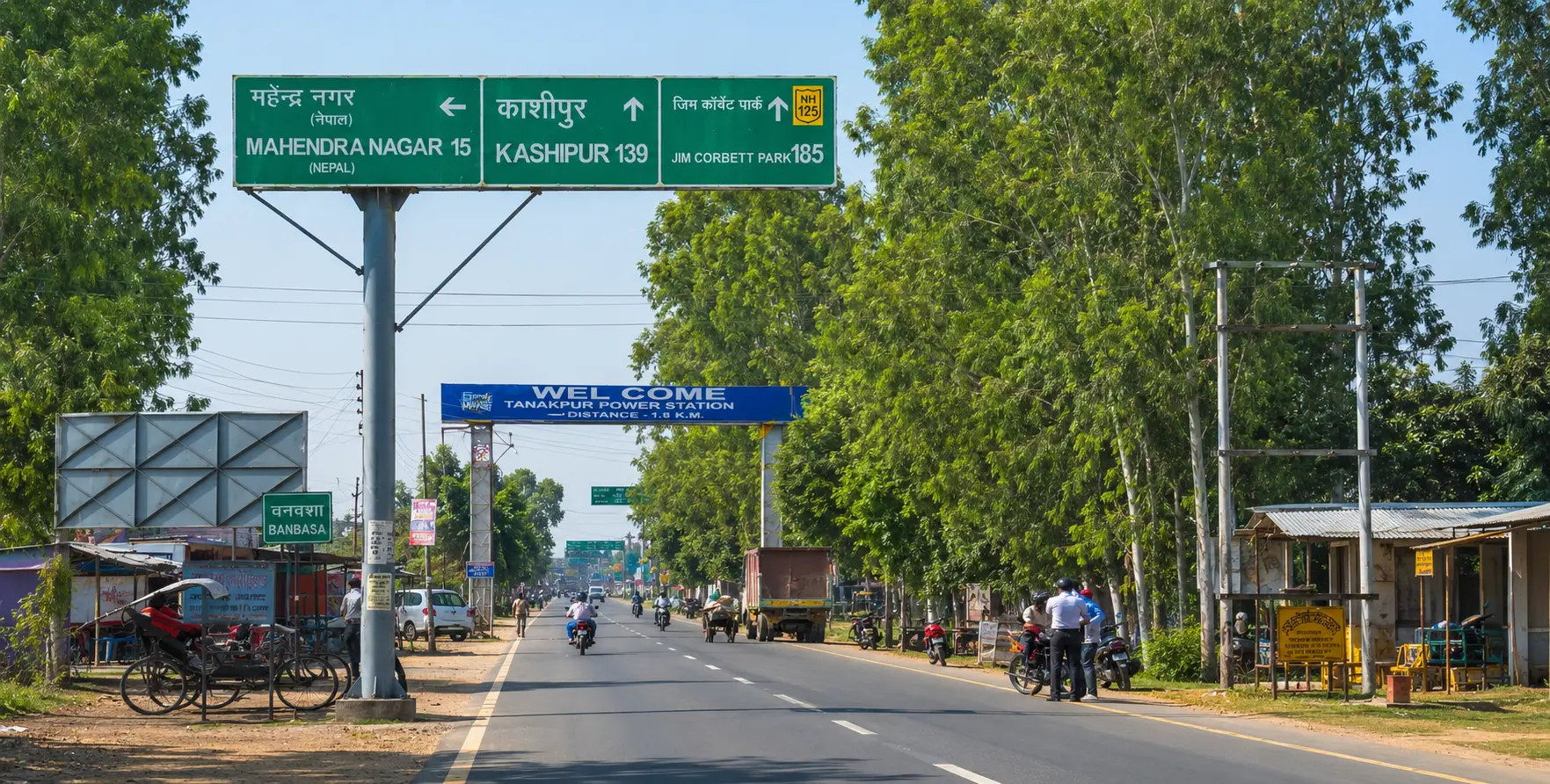
Pokhara to Jagat Private Jeep: Annapurna Circuit Hire

Dharapani trek start point of annapurna range

Pokhara to Jagat Private Jeep Hire — Annapurna Circuit Complete Guide

Jagat — a small village at approximately 1,300 metres in the narrow Marsyangdi River gorge, approximately 28 kilometres north of Besisahar — is the first significant settlement on the Annapurna Circuit trek after the ACAP (Annapurna Conservation Area) permit checkpoint at Bhulbhule. For trekkers who want to reduce the lower gorge walking distance and gain altitude more quickly on the Circuit’s opening days, the private 4WD jeep hire from Pokhara to Jagat — covering the route from Pokhara Lakeside through Dumre, Besisahar, and the lower Marsyangdi gorge road to Jagat — places the trekking group at 1,300 metres on arrival and saves approximately one to two walking days on the lower gorge section.

Nepal Vehicle Hiring Pvt Ltd offers a Pokhara-to-Jagat private 4WD jeep hire as a dedicated trekking trailhead transfer—covering the full Pokhara Lakeside hotel-to-Jagat village route in a single, professional, all-inclusive booking. This guide covers the full route from Pokhara to Jagat, private jeep costs, road conditions on the gorge section, why Jagat is the right starting point for different trekking plans, and how to book.

Pokhara to Jagat — Distance, Route and Time

Total distance: Approximately 130-140 km from Pokhara Lakeside to Jagat village.

Route: Pokhara → Prithvi Highway east → Dumre junction (65 km, 1.5-2 hours) → Besisahar road (42 km, 1-1.5 hours) → Besisahar town (760 m) → Marsyangdi gorge road northward → Bhulbhule (840 m) → Ngadi (930 m) → Jagat (1,300 m).

Journey time: 5 to 7 hours total by private 4WD jeep hire, depending on road conditions on the Besisahar-to-Jagat gorge section and any planned stops.

Road character: Pokhara to Dumre — paved Prithvi Highway, smooth and fast. Dumre to Besisahar — paved but narrower mountain road. Besisahar to Jagat — unpaved gorge road with rough sections, a narrow, river-adjacent track, and the 4WD requirement created by the gorge road’s surface and gradient.

Only a 4WD Scorpio or Hilux jeep is available for the Besisahar-to-Jagat section.

Annapurna range

Pokhara to Jagat Private Jeep Hire Cost

Private 4WD Scorpio jeep (4-6 passengers): NPR 16,000 to 40,000 (USD 120 to 250) all-inclusive from Pokhara Lakeside hotel to Jagat village, driver, fuel, road tolls.

Private Toyota Hilux 4WD (up to 8 with cargo): NPR 18,000 to 60,000 (USD 135 to 300) all-inclusive. Higher capacity for groups with camping equipment alongside passengers. Jeep hire.

Breakdown by section: Pokhara to Besisahar (107 km): approximately NPR 10,000-26,000. Besisahar to Jagat (28 km gorge road): approximately NPR 8,000-12,000. Combined Pokhara-to-Jagat: NPR 16,000-40,000 full vehicle all-inclusive.

Return jeep from Jagat: For groups who want a vehicle waiting at Jagat for an emergency return or post-trek collection, Nepal Vehicle Hiking Pvt Ltd pre-arranges the return vehicle when you book outward. Contact Nepal Vehicle Hiring Pvt Ltd on WhatsApp or our plan trip page.

Pokhara to Jagat Private Jeep | Annapurna Circuit Hire 2026/27/28

Pokhara to Dumre — The Prithvi Highway East

The first 65 kilometres of the Pokhara-to-Jagat journey follow the Prithvi Highway eastward from Pokhara Lakeside — a well-paved, fast national highway section through the Gandaki Province’s mid-hill foothills that connects Pokhara to the Marsyangdi valley junction at Dumre. Nepal Vehicle Hiring Pvt Ltd’s Pokhara car hire service covers Sarangkot sunrise vehicle hire for groups spending their final Pokhara morning at the Annapurna viewpoint before the Jagat departure—a pre-dawn Sarangkot visit followed by the 7:30 AM Jagat departure is one of the best ways to start an Annapurna Circuit trekking day.

The Prithvi Highway east of Pokhara passes through Walling, Damauli, and the Tanahu District’s agricultural landscape before the Dumre junction at approximately 65 km. The road is flat and fast — Nepal’s finest maintained highway section between Pokhara and the mountains to the east. Nepal Vehicle Hiring Pvt Ltd’s private jeep hire covers this section in 1.5 to 2 hours from Pokhara Lakeside.

Dumre to Besisahar — The Marsyangdi Valley Approach

At Dumre junction, the Prithvi Highway’s character as a broad national road gives way to the Besisahar approach road’s narrower, more mountain character. This 42-kilometre section follows the eastern bank of the Marsyangdi River northward to Besisahar at 760 metres. This section takes about 1 to 1.5 hours by private 4WD jeep and offers the first sustained Himalayan river-valley driving experience on the Pokhara-to-Jagat journey.

Pokhara to Jagat Private Jeep | Annapurna Circuit Hire 2026/27/28

The Dumre-to-Besisahar road is paved throughout but narrows as the valley closes in — the Marsyangdi visible to the west, the valley walls rising on both sides, and the first Himalayan sightlines (Annapurna II, Lamjung Himal) appearing above the ridgeline as the road approaches Besisahar. The Besisahar private vehicle hire context covers this section in detail — for groups departing from Kathmandu rather than Pokhara, the Kathmandu to Besisahar jeep hire is a separate, longer journey of 175 km.

Besisahar town (760 m) is a natural mid-journey rest stop — ACAP permits and TIMS cards are available at the Besisahar permit office for groups who did not obtain them in Pokhara or Kathmandu. Plan a 20 to 30-minute stop in Besisahar for permits, tea, and a last-supplies check before the gorge road begins.

Besisahar to Jagat — The Gorge Road

The 28-kilometre section from Besisahar north to Jagat through the lower Marsyangdi gorge is the journey’s most dramatic and technically demanding road section—a route where the 4WD jeep hire‘s specific capability is not simply preferred but required. The gorge road differs completely from the Besisahar approach road: unpaved in most sections, narrow with river-adjacent exposure, and demanding the ground clearance, traction, and low-range power of a purpose-built 4WD vehicle to navigate safely with a full trekking group load.

Besisahar to Bhulbhule (8 km, 30-45 minutes). The road exits Besisahar northward through the immediately adjacent villages. It reaches the suspension bridge crossing at Bhulbhule — the first Annapurna Circuit checkpoint village (840 m) where the trek trail and the jeep road run parallel or share sections. The Bhulbhule checkpoint issues the ACAP permit.

Bhulbhule to Ngadi (7 km, 25-40 minutes). Above Bhulbhule, the gorge narrows, and the road becomes progressively more demanding — the Marsyangdi visible directly below the road’s outer edge on the exposed cliff sections, the surface switching between rough gravel and the smoother sections where the road has been recently maintained. Ngadi village (930 m) sits at the junction where a significant side valley joins the Marsyangdi.

Ngadi to Jagat (13 km, 45-75 minutes). The most dramatic gorge section—the road between Ngadi and Jagat passes through the narrow canyon that defines the lower Marsyangdi’s geological character. The cliff walls converge above the road and the river on the most dramatic sections, the Marsyangdi’s white-water audible and visible below, and the 4WD jeep hire‘s specific mechanical confidence — ground clearance on the rocky sections, 4WD traction on the loose gravel descents, and the driver’s specific experience on this road — is the service that Nepal Vehicle Hiring Pvt Ltd specifically provides.

Jagat village (1,300 m) appears at the first widening of the gorge above the narrowest section, its teahouses and suspension bridge announcing the first major trekking stop of the Annapurna Circuit.

Pokhara to Jagat Private Jeep | Annapurna Circuit Hire 2026/27/28

Why Drive to Jagat Instead of Walking from Besisahar?

The Annapurna Circuit traditionally begins at Besisahar — and the walk from Besisahar to Jagat (approximately 2 to 3 hours, 18 km) is the circuit’s opening walking day, covering the lower gorge’s first villages and the ACAP permit checkpoint. The decision to take a private jeep from Pokhara directly to Jagat, bypassing the Besisahar-to-Jagat walk, depends on the group’s specific trekking priorities.

Drive to Jagat when: The group’s primary trekking interest is in the upper Annapurna Circuit (above Chame, the Manang plateau, and the Thorong La) and the lower gorge walking is considered a necessary transit rather than a valued experience. When trekking days are limited and every saved day in the lower gorge means more time at altitude.

When group members have physical limitations that make the lower gorge walking (which involves significant uphill in the first section) the harder part of the circuit.

Walk from Besisahar when: The group values the complete Circuit experience — every village, every cultural encounter, and every walking day of the lower gorge. The Besisahar-to-Jagat walk passes through Khudi, Bhulbhule, Bahundanda, and Ngadi—each with its own cultural character and valley views. For first-time Annapurna Circuit trekkers, walking the full route is the recommended option.

Nepal Vehicle Hiring Pvt Ltd’s Besisahar private vehicle hire covers the Besisahar drop option for groups who want to walk from Besisahar. In contrast, the Pokhara to Jagat private jeep hire covers the direct-to-Jagat option for groups who want to start walking at the gorge’s first significant village.

Group Booking Tips — Getting the Best Pokhara to Jagat Jeep

Booking a Pokhara to Jagat private jeep hire efficiently ensures your group gets the right vehicle at the right price, with all journey logistics confirmed in advance. Nepal Vehicle Hiring Pvt Ltd’s booking process is straightforward—WhatsApp or visit our plan trip page—and booking in advance with all details confirmed ensures the best outcome on departure day.

Specify the total passenger count and luggage volume accurately. The difference between 4 trekkers with day packs and 4 trekkers with full expedition packs changes the vehicle recommendation: the former may fit in a private car hire for the highway sections, the latter requires the Scorpio jeep’s cargo area. Accurate luggage information at booking ensures the right vehicle is allocated.

Confirm the exact drop point within the Besisahar-Jagat corridor. Jagat village centre (the main guesthouse cluster), the south approach to Jagat (where the gorge narrows), or the north side of Jagat (where some trekkers prefer to start walking immediately northward) — the specific drop point matters. Our team confirms the exact drop location at booking.

Confirm the departure time in relation to ACAP permit acquisition. If obtaining permits at the Pokhara ACAP office on the morning of departure, allow 45 to 60 minutes for the permit process before the vehicle departs. Nepal Vehicle Hiking Pvt Ltd advises the optimal departure time based on the permit strategy confirmed at booking.

Pokhara to Jagat Private Jeep | Annapurna Circuit Hire 2026/27/28

Jagat Village — The Annapurna Circuit’s First Gorge Stop

Jagat (1,300 m) is the first village on the Annapurna Circuit trek that feels genuinely inside the mountain world — the gorge’s specific narrowness and height at Jagat creating an enclosed valley character that is categorically different from the broad Marsyangdi valley below Besisahar. The village sits on a narrow terrace above the river, its teahouses and guesthouses arranged along a single lane between the gorge wall and the river edge.

Jagat is also the site of the first major ACAP checkpoint, which verifies permits for all vehicles and trekkers entering the conservation area’s northern gorge section. The checkpoint is positioned at the approach to Jagat’s narrow section — all vehicles must stop for permit verification before continuing. Nepal Vehicle Hiring Pvt Ltd’s drivers carry copies of the group’s ACAP permits (confirmed at booking) and manage the checkpoint process efficiently.

The Jagat teahouse accommodation standard is appropriate for the first overnight of the Annapurna Circuit — basic rooms, attached or shared bathroom depending on the guesthouse, dal bhat and a standard trekking menu available. Alpine Luxury Treks offers top-end Annapurna Circuit experiences with upgraded accommodation at every stage, including the lower gorge.

Trek Nepal Himalayas’ guided Annapurna Circuit packages cover the complete circuit with Nepal Vehicle Hiring Pvt Ltd’s jeep hire for the Pokhara or Kathmandu approach.

ACAP Permits — Essential Before Jagat

Annapurna Conservation Area Permit (ACAP): USD 30 per person for foreign nationals (lower rate for SAARC nationals). Required for all trekkers and vehicle passengers on the Annapurna Circuit. The permit is verified at the Bhulbhule and Jagat checkpoints.

Obtainable at the Nepal Tourism Board in Kathmandu, the ACAP office in Pokhara, or the Besisahar permit counter.

TIMS Card (Trekkers Information Management System): Required for all trekkers. USD 10 to 20. Obtainable from TAAN or the Tourism Board in Kathmandu or Pokhara.

NOTE: No vehicle proceeds past the Bhulbhule checkpoint without verified ACAP permits for all passengers. Nepal Vehicle Hiring Pvt Ltd confirms permit status with all groups at booking and requires confirmation of valid permits before departure from Pokhara for Jagat.

Beyond Jagat — The Upper Gorge Continues

For groups who want to extend the private jeep hire beyond Jagat into the upper Marsyangdi gorge, Nepal Vehicle Hiring Pvt Ltd’s 4WD jeep hire covers the northward road through Chamje, Tal, Dharapani, Chame, and ultimately to Manang (3,519 m). Each village further north adds driving time and cost on the gorge road, but also more altitude gain and fewer walking days between the vehicle drop and the Thorong La approach.

Jagat to Chamje (5 km, 20-30 minutes): The gorge road continues through the most dramatic narrow section above Jagat — the Marsyangdi canyon at its narrowest point between Jagat and Chamje, where the cliff walls, the river and the road share a space of remarkable geological compression.

Chamje to Tal (9 km, 30-45 minutes): The road crosses to the western bank above Chamje before ascending through the canyon walls to Tal — a flat glacial valley floor at 1,700 m that provides one of the Annapurna Circuit’s most dramatic visual surprises: the sudden opening of the gorge into an open valley surrounded by cliff walls.

Tal to Manang (80+ km, 3-5 additional hours): For groups aiming to drive all the way to Manang by jeep, the complete Pokhara-to-Manang journey becomes a 2-day operation — overnight at Besisahar or Chame, then the remaining gorge road to Manang on Day 2. Nepal Vehicle Hiring Pvt Ltd coordinates the complete Pokhara-to-Manang transport through our planned trip page.

Pokhara to Jagat Private Jeep | Annapurna Circuit Hire 2026/27/28

Pokhara to Jagat — Comparison with Kathmandu Departure

Trekkers approaching the Annapurna Circuit have two main vehicle departure options: from Pokhara (shorter, 130-140 km to Jagat) or from Kathmandu (longer, approximately 215 km to Jagat via Besisahar). The best departure city depends on where the trek group is based.

Pokhara departure (recommended for groups already in Pokhara): 130-140 km, 5-7 hours by private 4WD jeep hire. NPR 16,000-25,000 all-inclusive. The shorter distance means an earlier arrival in Jagat and more time on the first afternoon to rest and check permits before the trek morning.

Kathmandu departure (recommended for groups flying into TIA): 215 km, 6-8 hours by private vehicle from Kathmandu to Besisahar, plus the Besisahar-to-Jagat gorge section. The Kathmandu-to-Besisahar jeep hire drops you at Besisahar, and a local jeep continues to Jagat, or the group spends night 1 in Besisahar and takes the gorge road on Day 2.

Nepal Vehicle Hiring Pvt Ltd covers both departure options — Pokhara-based jeep hire and Kathmandu-based jeep hire — through a single plan trip page booking.

Connecting the Pokhara to Jagat Jeep with Pokhara Activities

Most Annapurna Circuit trekkers spend 1 to 3 days in Pokhara before the trek—enjoying Lakeside restaurants and cafes, preparing trekking equipment, and using Pokhara car hire for pre-trek activities.

Sarangkot Sunrise (pre-trek morning): The Sarangkot sunrise vehicle hire offers a stunning pre-dawn panorama of the Annapurna range on your final morning in Pokhara before departure to Jagat. Depart Lakeside at 4:00 AM, arrive at the Sarangkot viewpoint at sunrise, return to the hotel by 7:30 AM, pack, and depart for Jagat at 8:00 AM.

Pokhara Lakeside: Phewa Lake boat hire, the Peace Pagoda walk, and the World Peace Pagoda viewpoint are the standard pre-trek Pokhara activities. The Pokhara car hire covers all Lakeside and out-of-town Pokhara activities.

Pre-trek permit acquisition in Pokhara: The ACAP office and TIMS registration are available in Pokhara — obtain permits on the day before the Jagat departure to allow an efficient morning departure. Nepal Vehicle Hiring Pvt Ltd confirms permit requirement status at booking.

Pokhara to Jagat Private Jeep | Annapurna Circuit Hire 2026/27/28

The Gorge Road Character — What to Expect Between Besisahar and Jagat

The 28-kilometre gorge road between Besisahar and Jagat is one of Nepal’s most character-rich approach roads—a driving environment that switches between rough gravel track, a narrow river-adjacent section, and the occasional rough concrete reinforcement that the Nepal Department of Roads has progressively improved on the most hazardous sections. Understanding what this road actually looks and feels like helps trekking groups set accurate expectations for the final section of the Pokhara to Jagat private jeep hire.

The river is always close. The Marsyangdi River accompanies the gorge road continuously between Besisahar and Jagat — sometimes visible directly below the road’s outer edge, sometimes audible through the gorge walls above a section where the road is 20 to 30 metres above the water. The river’s sound — white water, rapids, and the specific deep rumble of a major Himalayan river pushing through a narrow gorge — is the gorge road’s constant acoustic backdrop and one of its defining atmospheric qualities.

The road narrows in the critical sections. Between Ngadi and Jagat, the gorge narrows to sections where the road barely fits a single vehicle—passing encounters with oncoming vehicles require reversing to the nearest wide point. Nepal Vehicle Hiring Pvt Ltd’s gorge road drivers know every passing point on this section and manage the approach to narrow sections with the specific experience of dozens of previous transits.

First-time visitors to the gorge road consistently say the narrowness and river exposure are more dramatic in person than any description prepares them for—an assessment Nepal Vehicle Hiring Pvt Ltd takes as confirmation that a private 4WD jeep hire with an experienced driver is the right vehicle arrangement.

The surface changes frequently. The gorge road’s surface quality varies by section and season— the dry season produces the best conditions (compact gravel, no mud). In contrast, monsoon season adds water crossings, soft sections, and occasional landslide debris that the Department of Roads clears progressively through the season. Nepal Vehicle Hiring Pvt Ltd does not dispatch gorge road vehicles during monsoon season without morning-of road-condition confirmation.

Pokhara to Jagat Private Jeep | Annapurna Circuit Hire 2026/27/28

Jagat to Chame — Continuing the Jeep Beyond Jagat

For trekking groups who want to gain even more altitude by vehicle before starting their Annapurna Circuit walk, Nepal Vehicle Hiring Pvt Ltd’s 4WD jeep hire continues north from Jagat to Chame (2,710 m) — the district headquarters of Manang District and the furthest practical one-day vehicle destination from Pokhara.

The Jagat-to-Chame extension adds approximately 2 to 3 hours of additional gorge road driving — through Chamje (where the road crosses to the western bank on a significant suspension bridge), Tal (the dramatic flat-floored glacial valley at 1,700 m), Dharapani (the Manaslu Circuit junction at 1,860 m), and Bagarchhap before the valley opens into the upper Marsyangdi and the road improves slightly on the approach to Chame. This Jagat-to-Chame section is the gorge road’s finest sequence of villages—each with its own teahouse culture and the progressive altitude gain the trekker’s body benefits from experiencing by vehicle before beginning the walk.

The Pokhara-to-Chame full-day private 4WD jeep hire (approximately 5 to 8 hours total, 170 km) is the most altitude-gaining single-day vehicle option from Pokhara for Annapurna Circuit trekkers — placing the group at 2,710 m for the first overnight, with only the Chame-to-Manang section (approximately 40 km, 2-3 hours additional driving or 2 days’ walking) remaining before the acclimatisation stop—Nepal Vehicle acclimatisation: the Pokhara-to-Chame extension at booking alongside the standard Pokhara-to-Jagat booking.

Pokhara as the Annapurna Circuit Base — The Departure City

Pokhara is Nepal’s premier mountain tourism city and the natural base for all Annapurna region trekking — the city where Annapurna Circuit trekkers prepare before the trek and recover after it, where the Annapurna Base Camp trek and Ghorepani Poon Hill trek begin via the Nayapul transport, and where the Annapurna Circuit exits at Jomsom and connects back to the city by road.

For Annapurna Circuit trekkers departing from Pokhara for Jagat, the city’s Lakeside area provides all pre-trek logistics: the ACAP permit office is in Pokhara’s tourism area; Lakeside’s outdoor equipment shops provide the final gear top-ups; the currency exchange facilities handle the last cash requirement before the gorge road ATMs become unavailable; and Lakeside’s restaurant and cafe culture provides the final comfortable meal before the trek’s teahouse format begins. Nepal Vehicle Hiring Pvt Ltd’s Pokhara car hire service covers any pre-trek Pokhara vehicle requirements — hotel transfers, permit office runs, gear shop trips — alongside the principal Jagat departure booking.

Groups arriving in Pokhara from Kathmandu by the Kathmandu to Pokhara private vehicle hire before the Annapurna Circuit trek can coordinate the Kathmandu arrival, Pokhara Lakeside overnight, and Jagat departure as a single connected transport chain through Nepal Vehicle Hiring Pvt Ltd — one operator, all legs, smooth continuity from Kathmandu airport or hotel to the Marsyangdi gorge.

Pokhara to Jagat Private Jeep | Annapurna Circuit Hire 2026/27/28

The Marsyangdi Gorge — Natural and Cultural Context

The Marsyangdi River gorge that the Pokhara to Jagat jeep hire traverses in its final section is not merely a dramatic landscape — it is a corridor of extraordinary cultural and ecological diversity that the progressive altitude gain from Besisahar’s 760 m to Jagat’s 1,300 m traverses through the subtropical and lower temperate vegetation zones of the Annapurna Conservation Area.

The communities of the lower Marsyangdi gorge between Besisahar and Jagat reflect the valley’s diverse ethnic mix: Gurung villages in the upper sections, Brahmin-Chhetri settlements in the lower middle sections, and Magar communities on the river-adjacent terraces. Each community’s terraced fields — maize and millet in the lower, where maize irrigation allows — create the specific agricultural landscape that frames the gorge road driving experience in a distinctively Nepali mid-hill character.

The private jeep hire takes the trekking group through this agricultural and cultural landscape at the pace the road allows—slower than the trekking trail’s walking pace for cultural immersion, but faster in altitude gain and distance covered. Nepal Vehicle Hiring Pvt Ltd’s drivers provide cultural context for the villages you pass — the community names, the agricultural cycles visible from the road, and the specific cultural landmarks the gorge road passes.

All-Inclusive Price — What the Pokhara to Jagat Jeep Covers

Nepal Vehicle Hiring Pvt Ltd’s Pokhara to Jagat private jeep hire uses genuine all-inclusive pricing. This single confirmed price covers the full Pokhara Lakeside hotel-to-Jagat village route with no additions at the end of the journey. The price quoted at booking is the price paid at Jagat.

Included: Driver for the complete Pokhara-to-Jagat journey; all fuel from Pokhara Lakeside to Jagat; all Nepal highway tolls (Prithvi Highway toll and Besisahar road toll); hotel-door pickup from any Pokhara Lakeside, Newroad, or Dam Side accommodation; Besisahar town stop for permits and rest (20-30 minutes); Jagat village drop at the group’s chosen guesthouse.

Not included: ACAP permit fees (USD 30 per person — paid by each trekker at the Pokhara ACAP office or Besisahar permit counter); TIMS card fee; driver meal during Besisahar stop (NPR 300-400, customarily paid by group); any significant detour beyond the standard Pokhara-to-Jagat route.

Nepal Vehicle Hiring Pvt Ltd quotes the all-inclusive price in writing via WhatsApp or through our plan trip page before the booking is confirmed.—no surprises on the gorge road.

Pokhara to Jagat Private Jeep | Annapurna Circuit Hire 2026/27/28

Seasonal Road Conditions — Pokhara to Jagat

The Pokhara to Jagat private 4WD jeep is available year-round, but road conditions on the gorge section vary significantly by season — a critical consideration for trekking groups planning the Annapurna Circuit approach.

Autumn (October-November): Peak trekking season. Finest gorge road conditions — dry, compact surface after the monsoon’s erosive effect has been cleared by maintenance. The Marsyangdi Valley is at its most visually stunning: post-monsoon green, clear skies, and the season’s first Himalayan snowfall visible on the peaks above.

Book 1-2 weeks ahead.

Spring (March-May): Second peak. The gorge road is reliable, with occasional pre-monsoon afternoon showers in May that temporarily soften the surface but rarely cause disruption. Rhododendron bloom on the higher slopes above the gorge road in March-April.

Book 1 week ahead.

Monsoon (June-September): Nepal Vehicle Hiring Pvt Ltd does not dispatch gorge road vehicles without morning-of confirmation from our driver network on current Besisahar-to-Jagat status. Landslides on the gorge road’s upper cut sections are the primary monsoon risk. When the road is confirmed clear, the monsoon gorge drive has unique visual quality — waterfalls threading the cliff walls above, the river in full monsoon flood.

Winter (December-February): Reliable gorge road conditions below 1,300 m — no snow or ice on the Besisahar-to-Jagat section. The gorge road is least trafficked and easiest to drive in winter. Nepal Vehicle Hiring Pvt Ltd provides Pokhara to Jagat jeep hire year-round — contact WhatsApp for current road status.

Pokhara to Jagat Private Jeep | Annapurna Circuit Hire 2026/27/28

The Besisahar Stop — Permits and Rest Before the Gorge

The Besisahar stop on the Pokhara to Jagat private jeep journey is not simply a rest break — it is an essential logistics checkpoint that determines whether the vehicle can proceed past the Bhulbhule ACAP checkpoint into the gorge.

ACAP permit acquisition: Groups who did not obtain the ACAP permit in Pokhara must obtain it at the Besisahar permit counter before the jeep continues northward. The Besisahar ACAP counter is the last place to obtain permits before Jagat reliably. No permit offices exist between Besisahar and Jagat on the gorge road.

Final supply check: Besisahar’s trekking supply shops provide the last reliable equipment and supply top-up before the gorge. Water, snacks, basic medical supplies, and any forgotten small trekking items can be sourced here — the Jagat guesthouses stock minimal supplies beyond food.

Fuel for gorge road: Nepal Vehicle Hiring Pvt Ltd’s drivers fill the tank at Besisahar’s fuel station before the gorge section — no fuel available between Besisahar and the villages further north on the gorge road. The full tank is standard pre-departure procedure for our Besisahar-to-Jagat jeep hire section.

Besisahar guesthouse option: Groups who arrive at Besisahar late in the day and want to begin the gorge road fresh the following morning can overnight at Besisahar and continue to Jagat on Day 2. Nepal Vehicle Hiring Pvt Ltd’s driver and vehicle overnight at Besisahar at the standard driver overnight rate (NPR 500-800) — the next morning’s gorge drive departs at 7:00 AM for the freshest road and coolest gorge temperature. Contact our team on WhatsApp to arrange an overnight in Besisahar.

Return Journey — Post-Trek Vehicle from Jagat or Beyond

The return vehicle for trekkers who began the Annapurna Circuit at Jagat depends on whether the group exits the Circuit at the Jagat side (returning south to Besisahar and Pokhara) or completes the Thorong La crossing and exits at Jomsom (returning to Pokhara via the Kali Gandaki gorge road).

Circuit exit at Besisahar (eastern exit, same side as Jagat): Nepal Vehicle Hiring Pvt Ltd pre-arranges the Besisahar to Pokhara return jeep hire at outward booking — confirmed via WhatsApp during the trek when the exit date is known. The return vehicle covers the Besisahar-to-Dumre-to-Pokhara route in 3 to 4 hours.

Circuit exit at Jomsom (western exit, post-Thorong La): The Jomsom to Pokhara private jeep hire through the Kali Gandaki gorge (145 km, 7-9 hours) is pre-arranged at outward booking for groups who plan to complete the full Circuit. One booking at Nepal Vehicle Hiring Pvt Ltd covers both the Pokhara-to-Jagat inward and the Jomsom-to-Pokhara outward vehicle legs.

For groups who begin at Jagat and walk the complete Circuit to Thorong La and beyond, the complete transport chain is: Pokhara to Jagat 4WD jeep hire → trek the Annapurna Circuit → cross Thorong La → Muktinath → Jomsom → Jomsom to Pokhara return jeep hire. Nepal Vehicle Hiking Pvt Ltd coordinates both legs through a single plan trip page submission.

Pokhara to Jagat for Different Trekker Types

The Pokhara to Jagat private jeep hire serves several distinct trekker profiles whose specific motivations for driving to Jagat rather than walking from Besisahar vary significantly.

Time-constrained trekkers — the most common profile. International visitors with fixed return flights who have 12 to 14 days for the Annapurna Circuit and whose programme requires saving the lower gorge walking days to have sufficient time at altitude. For this group, hiring a Pokhara-to-Jagat jeep is a practical time-management decision rather than a concession to physical limitation.

Physically recovering trekkers returning to the Annapurna Circuit after injury or illness, starting from a higher point than their previous attempt. The Jagat start gives a fresh beginning at an altitude the trekker already knows and respects.

Experienced Annapurna Circuit repeat visitors who have walked the lower gorge section on previous visits and specifically want to begin walking where the gorge’s most dramatic section begins. For repeat Circuit trekkers, the Besisahar-to-Jagat section holds no unvisited experience — the private jeep hire to Jagat allows them to begin walking at the point where the Circuit starts to feel genuinely new.

Luxury trekking clients on guided programmes with Alpine Luxury Treks, whose itinerary begins at Jagat to meet the programme’s pacing requirements. The Pokhara-to-Jagat 4WD jeep hire from Nepal Vehicle Hiring Pvt Ltd serves this top-end market to the same professional standard as our standard trekking transport.

Pokhara to Jagat Private Jeep | Annapurna Circuit Hire 2026/27/28

Annapurna Circuit from Jagat — The Trek Ahead

Starting the Annapurna Circuit trek from Jagat rather than Besisahar saves approximately 1 to 2 walking days on the lower gorge section, placing trekkers directly in the most dramatic part of the gorge and at an altitude (1,300 m) where acclimatisation begins without the time spent on the lower valley. From Jagat, the Annapurna Circuit continues northward through Chamje, Tal, Dharapani, Bagarchhap, Danaque, Chame (2,710 m — district headquarters, last significant facilities before the high Annapurna plateau), Lower Pisang, Upper Pisang, and ultimately Manang (3,519 m) — the Circuit’s acclimatisation centre and the starting point for the Thorong La crossing.

The Nar Phu Valley restricted-area trek, which starts from Koto village (one day north of Dharapani) for groups adding this extraordinary hidden valley to the Circuit itinerary.

Nepal Himalayas’ guided Annapurna Circuit packages include Nepal Vehicle Hiring Pvt Ltd’s Pokhara-to-Jagat jeep hire as the standard approach for groups whose programme begins walking from the gorge rather than Besisahar.

Why Jagat Is the Right Road-End for Many Annapurna Circuit Plans

Among the several vehicle drop points available on the Annapurna Circuit approach road — Besisahar (760 m), Bhulbhule (840 m), Ngadi (930 m), Jagat (1,300 m), Chamje (1,430 m), Tal (1,700 m), Dharapani (1,860 m), Chame (2,710 m), and Manang (3,519 m) — Jagat occupies a specific position that makes it the most practically balanced starting point for the majority of trekking groups who want to reduce lower gorge walking without sacrificing the gorge’s most dramatic character.

Why Jagat rather than Besisahar: Jagat at 1,300 m is 540 metres higher than Besisahar — a meaningful altitude gain that begins the acclimatisation process earlier. The acclimatisation to Jagat walking section (1 to 2 days) covers the lower acclimatisation dramatic scenery — the wide valley sections below the gorge narrowing. Starting at Jagat puts you at the point where the gorge’s drama begins to intensify.

Why Jagat rather than Chame or Manang: Chame and Manang are higher and would save more walking days, but the altitude gain by vehicle to 2,710 m (Chame) or 3,519 m (Manang) in a single day from Pokhara is rapid — potentially too rapid for altitude-sensitive trekkers arriving directly from sea-level cities. Jagat at 1,300 m is the right altitude ceiling for a single-day vehicle trip from Pokhara (820 m), giving the body time to adjust gently before the gorge road’s altitude gain continues on foot.

Nepal Vehicle Hiring Pvt Ltd’s Pokhara to Jagat private jeep hire is designed for groups who have identified Jagat as their circuit starting point—confirming road conditions, the ACAP permit requirement, and the gorge road character at booking so the group arrives in Jagat with full information and preparation. Contact our team on WhatsApp or plan through our plan trip page.

Jagat’s Position in the Annapurna Circuit Ecology

At 1,300 m, Jagat sits in the transition zone between the subtropical lower Marsyangdi valley and the warm temperate mid-gorge. This botanical and ecological transition point is perceptible to the attentive walker and visible to the attentive vehicle passenger on the approach.

Below Jagat, the valley floor and lower slopes support subtropical vegetation: banana plants, fig trees, and the dense mixed-species forest of Nepal’s sub-Himalayan zone. At and above Jagat, vegetation shifts toward temperate species—rhododendron, oak, and a progressively mixed conifer presence that intensifies on the approach to Chame.

This ecological transition makes Jagat a botanically interesting starting point for the Annapurna Circuit trek—the first walking day north from Jagat passes through the transition zone’s finest mix of subtropical and temperate species, with the specific diversity created by the two zones’ overlap in the immediate Jagat area. Birdwatchers who begin the Annapurna Circuit at Jagat have access to both the subtropical species of the lower gorge (still present at 1,300 m) and the first temperate zone species that appear above Jagat — a diversity concentration that pure highland starts from Chame miss.

Private jeep hire from Pokhara to Jagat takes birdwatchers and naturalists to this ecological crossover point. Book through Nepal Vehicle Hiring Pvt Ltd on WhatsApp or our plan trip page.

Why Choose Nepal Vehicle Hiring Pvt Ltd for Pokhara to Jagat

  • Pokhara Lakeside hotel pickup: Door-to-door from any Pokhara hotel — Lakeside, New Road, or out-of-town accommodation.
  • 4WD Scorpio or Hilux exclusively for gorge road: Besisahar-to-Jagat gorge section requires 4WD — no standard sedan options.
  • Route-experienced gorge road drivers: Drivers with specific Marsyangdi gorge experience — not highway-general drivers.
  • Sarangkot sunrise connection: Sarangkot vehicle hire on the final Pokhara morning connected to same-day Jagat departure.
  • ACAP permit advisory: Permit status confirmed at booking, Besisahar permit office stop included.
  • Beyond Jagat options: Jeep can continue to Chamje, Tal, Chame, or Manang — confirmed at booking.
  • Return vehicle: Post-trek vehicle pre-arranged — Besisahar return or Jomsom exit.
  • All-inclusive pricing: Driver, fuel, tolls — confirmed at booking.
  • 24/7 on WhatsApp6 or plan trip page.

The Prithvi Highway East of Pokhara — What to See

The 65-kilometre Prithvi Highway section from Pokhara to Dumre offers several natural and cultural points of interest that the private jeep hire makes accessible with spontaneous stops impossible on a shared bus.

The Seti River Gorge (10 km east of Pokhara). The Seti River — Pokhara’s own sacred river, which runs underground through much of the city — emerges in a spectacular gorge just east of the Lakeside area. The deep slot canyon where the turquoise Seti cuts through the white limestone is one of Nepal’s most extraordinary urban-fringe geological features, visible from the Prithvi Highway bridge and from the dedicated gorge viewpoint 1 kilometre off the highway.

Damauli (45 km from Pokhara). The Tanahu District capital of Damauli sits at the Seti-Madi river confluence—a significant confluence point in Nepal’s Gandaki river geography and a pleasant 15-minute highway stop for tea and the morning market’s local produce.

Dumre junction (65 km from Pokhara). The Dumre junction is the decision point where the Prithvi Highway continues toward Kathmandu and the Besisahar road branches northeast. A brief fuel station and snack stop at Dumre before the mountain road begins.

Nepal Vehicle Hiring Pvt Ltd’s drivers on the Pokhara to Jagat jeep hire route know the specific pullouts on the Prithvi Highway east of Pokhara where the Annapurna range panorama is most visible from the road — the Annapurna Massif’s south face appearing above the highway’s northern horizon as the road rounds specific bends. Our drivers point out these views without being asked, turning the highway drive into a gradual introduction to the mountain world the trekking group is approaching.

Connecting the Annapurna Circuit Approach with Kathmandu

Many international trekkers who fly into Kathmandu’s Tribhuvan International Airport and head to Pokhara for the Annapurna Circuit use Nepal Vehicle Hiring Pvt Ltd’s connected transport network for the complete Kathmandu-to-Pokhara-to-Jagat chain.

Kathmandu airport transfer on arrival → Kathmandu sightseeing car hire for Pashupatinath, Boudhanath, and Bhaktapur heritage tour → Kathmandu to Pokhara private vehicle hire → Pokhara Lakeside car hire with Sarangkot sunrise vehicle on the pre-trek morning → Pokhara to Jagat private 4WD jeep hire → complete Annapurna Circuit trek → Jomsom to Pokhara return jeep → Pokhara to Kathmandu return vehicle → Kathmandu airport departure transfer. One operator, all legs, professional standard throughout — coordinated through Nepal Vehicle Hiring Pvt Ltd’s plan trip page in a single submission.

Alpine Luxury Treks offers the top-end tier of the complete Kathmandu-Pokhara-Annapurna Circuit experience, using Nepal Vehicle Hiring Pvt Ltd’s private vehicle hire for every ground-transport leg. Trek Nepal Himalayas’ guided Annapurna Circuit packages similarly use Nepal Vehicle Hiring Pvt Ltd throughout. Contact our team on WhatsApp.

Frequently Asked Questions — Pokhara to Jagat Private Jeep

How long does the Pokhara to Jagat jeep journey take?

5 to 7 hours: Pokhara to Dumre (1.5-2 hours) + Dumre to Besisahar (1-1.5 hours) + Besisahar to Jagat Gorge road (1.5-2.5 hours).

What is the private jeep cost from Pokhara to Jagat?

NPR 16,000 to 40,000 (USD 120 to 250), all-inclusive, for a private 4WD Scorpio jeep. Contact Nepal Vehicle Hiring Pvt Ltd on WhatsApp  for a group-specific quote.

Is a 4WD jeep mandatory for Pokhara to Jagat?

Yes — the Besisahar-to-Jagat gorge road section requires a 4WD Scorpio or Hilux jeep. Standard sedans cannot navigate this section safely with a full passenger and luggage load.

Do I need an ACAP permit before the Pokhara-to-Jagat jeep journey?

Yes — ACAP permits are required at the Bhulbhule checkpoint before Jagat. Get them at the ACAP office in Pokhara before departure or at the Besisahar permit counter during the journey.

Can the jeep continue beyond Jagat to Chame or Manang?

Yes — Nepal Vehicle Hiring Pvt Ltd covers the gorge road beyond Jagat to Chamje, Tal, Dharapani, Chame, and Manang. Additional cost per section — confirm at booking.

The Pokhara to Jagat private jeep hire from Nepal Vehicle Hiring Pvt Ltd is more than a trailhead transfer — it is the vehicle journey that begins one of the world’s great trekking adventures at exactly the right point, at exactly the right altitude, with exactly the right vehicle on the gorge road that requires it.

Whether the group departs from the Pokhara Lakeside after the Sarangkot sunrise, midmorning from the Lakeside after ACAP permit acquisition, or at first light for the earliest possible Jagat arrival — Nepal Vehicle Hiring Pvt Ltd provides the 4WD Scorpio or Hilux jeep hire, the route-experienced gorge road driver, and the all-inclusive pricing that puts the group at 1,300 metres in the Marsyangdi gorge ready to walk north into the Annapurna Circuit’s finest mountain world. Contact Nepal Vehicle Hiring Pvt Ltd on WhatsApp or the plan trip page.

Conclusion

The Pokhara to Jagat private jeep hire puts trekkers directly at 1,300 metres in the Marsyangdi gorge’s most dramatic section — saving 1 to 2 walking days on the lower Circuit and beginning the Annapurna Circuit trek at the gorge’s first significant village. Nepal Vehicle Hiring Pvt Ltd offers private 4WD jeep transfers from Pokhara to Jagat with hotel-door pickup, all-inclusive pricing, experienced gorge-road drivers, and ACAP permit advice in one professional booking.

Book your Pokhara to Jagat private jeep with Nepal Vehicle Hiring Pvt Ltd — call or WhatsApp, visit vehiclehiringnepal.com, or plan through our trip page.

Muktinath to Lumbini-Belahiya Border: Private Jeep Guide

lubini

Muktinath to Lumbini-Belahiya Border: Private Jeep Guide

Muktinath Temple (3,710 m) — Nepal’s most sacred high-altitude Vishnu temple, where 108 water spouts flow eternally, and a flame burns above a natural spring — marks the culmination of the Muktinath Yatra for pilgrims coming from India and Nepal. After the darshan at Muktinath’s Vishnu temple and the 108-spout ritual bath, the return journey toward India for many pilgrims leads to Lumbini (birthplace of the Buddha) and then the Belahiya-Sunauli India border crossing — completing one of Nepal’s most spiritually rich pilgrim circuits: the sacred mountain at Muktinath followed by the sacred plains at Lumbini, connected by a single private jeep journey of approximately 450 to 480 kilometres over 2 to 3 days.

Nepal Vehicle Hiring Pvt. Ltd., based in Thamel, Kathmandu, provides a complete private jeep service for the Muktinath-to-Belahiya return journey—from the Muktinath temple gate, down the Kali Gandaki gorge to Pokhara, and south through the Terai to Lumbini and the Belahiya Nepal-India border. This guide covers the full route, section-by-section pricing, the sacred stop in Lumbini, the Belahiya crossing logistics, and everything pilgrims need to complete their Nepal circuit smoothly.

Muktinath to Belahiya Border: Route Overview

  • Total route: Muktinath (3,710 m) → Jomsom (2,720 m) → Tatopani (1,200 m) → Beni (830 m) → Pokhara (827 m) → Narayanghat (190 m) → Butwal (115 m) → Bhairahawa → Lumbini (optional sacred stop) → Belahiya Nepal border gate
  • Total distance: approximately 450 to 480 km
  • Recommended journey: 2 to 3 days (Day 1: Muktinath to Pokhara; Day 2: Pokhara to Lumbini; Day 3: Lumbini morning visit + Belahiya border crossing)
  • Vehicle: 4WD jeep mandatory Muktinath to Beni (Kali Gandaki gorge section); Hiace or car from Pokhara onward optional for larger groups
  • Best-price all-in jeep: approximately NPR 28,000 to 45,000 for the complete Muktinath-to-Belahiya journey by 4WD Scorpio jeep (4–7 passengers)

Private Jeep Prices: Muktinath to Belahiya Border

Nepal Vehicle Hiring’s all-inclusive pricing — vehicle, experienced driver, fuel, driver accommodation and meals for multi-day, all-road charges:

  • Muktinath to Pokhara (via Kali Gandaki, Tatopani, Beni) — 4WD Scorpio jeep: NPR 16,000–35,000
  • Muktinath to Pokhara — Toyota Land Cruiser (top-end comfort): NPR 22,000–80,000
  • Pokhara to Lumbini (via Butwal): NPR 10,000–30,000 (private car) | NPR 14,000–26,000 (Scorpio) | NPR 18,000–40,000 (Hiace group)
  • Lumbini to Belahiya border (22 km): NPR 1,500–2,500 (included in Lumbini visit vehicle or local tuk-tuk)
  • Complete Muktinath to Belahiya 2-day package (Scorpio, 4–6 pax): NPR 28,000–60,000 all-in
  • Complete Muktinath to Belahiya 2-day package (Land Cruiser, 4–5 pax): NPR 36,000–100,000 all-in
  • Muktinath to Kathmandu (alternative return, via Pokhara and Prithvi Highway): NPR 22,000–60,000

Contact Nepal Vehicle Hiring via our Plan Your Trip page or WhatsApp for confirmed pricing tailored to your group size and vehicle preference.

Muktinath to Lumbini-Belahiya Border

Day 1 — Muktinath to Pokhara (approximately 180 km, 6 to 8 hours)

Depart the Muktinath temple gate after the morning darshan and 108-spout bath — typically 8:00 to 9:00 AM. The Muktinath Yatra itinerary follows the Pokhara-to-Mustang jeep road, descending from Muktinath (3,710 m) through Jharkot and Kagbeni (2,810 m, the gateway to Upper Mustang), then south through the Kali Gandaki gorge’s dramatic landscape.

Key stops: Marpha (2,670 m) — the famous apple village, 30-minute stop for dried apples and Marpha brandy; Tatopani (1,200 m) — natural hot springs on the Kali Gandaki bank, 30- to 45-minute soak; Beni (830 m) — where the off-road mountain section ends, and the provincial road to Pokhara begins. Arrive Pokhara Lakeside by 4:00 to 6:00 PM.

Overnight in Pokhara for rest and optional Sarangkot sunrise the following morning.

Day 2 — Pokhara to Lumbini (approximately 200 km, 4 to 5 hours)

Depart Pokhara at 8:00 to 9:00 AM on the Prithvi Highway east to Mugling junction (approximately 2.5 hours), then south on the Narayanghat highway to the Terai. At Narayanghat junction, continue southwest on the Mahendra Highway through Butwal to Bhairahawa. Turn east 22 km to the Lumbini UNESCO World Heritage Site.

Arrive in Lumbini by 1:30 to 2:30 PM — time for a 2- to 3-hour Sacred Garden and monastery zone visit before the site’s late afternoon crowd builds. Overnight in Lumbini (zone hotels) or Bhairahawa (city hotels 22 km from the site, better facilities).

Day 3 — Lumbini Morning Visit + Belahiya Border Crossing

Dawn visit to the Lumbini Sacred Garden — the most peaceful window for the Maya Devi Temple and Puskarini pool (before 8:00 AM, before the day-tour groups arrive from Bhairahawa). After the morning visit, Nepal Vehicle Hiring’s vehicle drives 22 kilometres from Lumbini to Bhairahawa city, then 4 kilometres south to the Belahiya Nepal immigration post.

Nepal immigration exit stamp process (15-30 minutes for Indian nationals). Cross 200 metres to the India-side Sunauli Land Port of Entry. Nepal Vehicle Hiring’s vehicle service ends at the Belahiya Nepal gate — onward India transport from Sunauli is arranged separately.

Muktinath to Lumbini-Belahiya Border: Private Jeep Guide

Section-by-Section Road Guide: Muktinath to Belahiya

Muktinath to Jomsom (18 km, 1 to 1.5 hours — 4WD mandatory)

The descent from Muktinath (3,710 m) to Jomsom (2,720 m) on the Kali Gandaki gorge road is one of Nepal’s most dramatic early-morning drives — the vast flat-bottomed valley of the upper Kali Gandaki with its relentless upstream wind (the strongest natural wind corridor in the Himalaya) and the towering Nilgiri (7,061 m) and Dhaulagiri (8,167 m) massifs on both sides. The road is rough gravel, but the views are extraordinary.

Jomsom (2,720 m) — the Mustang District headquarters — has the last fuel station before Pokhara and the Jomsom domestic airport for pilgrims who choose to fly rather than drive to Pokhara.

Jomsom to Beni (120 km, 4 to 5 hours — 4WD mandatory to Beni)

The Kali Gandaki gorge road from Jomsom south to Beni passes through the world’s deepest gorge — the channel between Annapurna (8,091 m) and Dhaulagiri (8,167 m) that the Kali Gandaki River has cut through the Himalayan range. Key stops on this section: Marpha (2,670 m) — the most photogenic village on the Mustang approach, built in traditional flat-roofed Tibetan style with whitewashed lanes and apple orchards; Kalopani (2,530 m) — the Dhaulagiri North Face panorama viewpoint, one of the Annapurna Circuit’s finest mountain vistas; Tatopani (1,200 m) — the natural hot spring pools on the Kali Gandaki bank, a deeply restorative stop for pilgrims who have walked or ridden through the high Mustang zone.

The road from Tatopani to Beni winds through subtropical gorge landscape as the Kali Gandaki approaches its confluence with the Myagdi Khola at Beni.

Beni to Pokhara (60 km, 1.5 to 2 hours — paved highway)

From Beni (830 m), the road transitions to paved provincial highway for the 60-kilometre run to Pokhara. The landscape opens from the tight Kali Gandaki gorge to the broader Gandaki valley.

The approach to Pokhara from the west gives the finest approach view of the Annapurna range’s southern face — Machhapuchhre (Fishtail Mountain, 6,993 m), Annapurna South (7,219 m), and Hiunchuli (6,441 m) filling the northern horizon above the Pokhara valley. Nepal Vehicle Hiring drivers pause for photos at the standard Annapurna approach viewpoint on the Beni-Pokhara road.

Pokhara to Narayanghat (130 km, 2 to 2.5 hours — Prithvi Highway)

From Pokhara, the Prithvi Highway heads east through the foothills and then descends to Narayanghat via the Prithvi Highway corridor and Mugling junction. This section is a well-maintained highway — progressively widened and improved — and passes through the Trishuli River gorge section near Mugling, which is the Prithvi Highway’s most scenic stretch.

Narayanghat to Bhairahawa (137 km, 2 to 2.5 hours — Mahendra Highway)

From Narayanghat, the Mahendra Highway (East-West Highway) heads southwest through Nepal’s western Terai past Butwal to Bhairahawa—flat, fast Terai blacktop—the most comfortable operating environment for Hiaces and cars. Butwal is the standard stop for rest and fuel.

The optional Devghat sacred confluence (8 km from Narayanghat, confluence of the Trishuli and Kali Gandaki Rivers — a sacred tirtha where many Muktinath pilgrims perform the return sacred bath) is the most appropriate spiritual addition to the Muktinath return journey.

Bhairahawa to Lumbini (22 km, 25 to 30 minutes — Siddhartha Highway east)

From Bhairahawa, the Siddhartha Highway heads east 22 km to the entrance of the Lumbini UNESCO site. The road passes through the flat agricultural land of the western Terai lowlands— a stark contrast to Muktinath’s 3,710 m mountain world — and the Lumbini arrival feels extraordinary: from the world’s highest sacred Vishnu temple to the birthplace of the Buddha, connected by a single journey through Nepal.

Lumbini to Belahiya (22 km, 25 minutes — back to Bhairahawa, then south 4 km)

From Lumbini, Nepal Vehicle Hiring’s vehicle returns to Bhairahawa and continues 4 kilometres south to the Belahiya Nepal immigration post — the Nepal-side exit gate of the Sunauli-Belahiya India border crossing. The driver drops the pilgrim group at the Belahiya gate entrance, assists with luggage, and waits briefly while the group completes the Nepal exit stamp process.

Lumbini: The Essential Sacred Stop on the Muktinath Return

For pilgrims completing the Muktinath Yatra, the Lumbini sacred stop on the return journey is the most natural and meaningful addition in Nepal—the birthplace of Siddhartha Gautama (the historical Buddha), just 22 kilometres east of the Belahiya border crossing that ends the Nepal pilgrimage circuit.

Hindu pilgrims who venerate the Buddha as Vishnu’s ninth avatar of Vishnu —a belief shared by many Muktinath devotees who have just worshipped at Nepal’s most sacred Vishnu temple—find Lumbini a theologically coherent continuation of the Muktinath darshan. The same divine principle that animates the 108 water spouts of Muktinath is present at Lumbini as the human manifestation of the Preserver in his ninth avatar form.

The two sacred sites — Muktinath and Lumbini — thus form a single, coherent Vaishnava sacred circuit within Nepal.

The Lumbini visit on the return from Muktinath: the Maya Devi Temple marks the precise birth spot confirmed by Emperor Ashoka’s 249 BCE inscription; the Puskarini sacred pool where Maya Devi bathed before giving birth; the Ashoka Pillar — the oldest dated stone inscription in the Indian subcontinent; and the international monastery zone — 20 countries’ Buddhist monasteries in a single planned landscape along the central canal. A focused Lumbini visit covers the Sacred Garden and 3 to 4 monasteries in 2 to 3 hours.

Nepal Vehicle Hiring’s driver knows the Lumbini zone car park and the Sacred Garden circuit.

Alternative Return: Muktinath to Belahiya via Kathmandu

Some pilgrims returning from Muktinath to India prefer routing through Kathmandu rather than taking the direct Pokhara-to-Terai route. The Kathmandu alternative adds approximately 1 day and 200 additional kilometres. Still, it allows the Pashupatinath Aarti thanksgiving ceremony on the return — the most appropriate devotional closure for a pilgrimage that began at Pashupatinath before departure to Muktinath.

The Kathmandu-routing circuit: Muktinath → Pokhara (Day 1) → Pokhara to Kathmandu (Day 2, Kathmandu to Pokhara bus service or private vehicle reverse direction) → Kathmandu overnight (Pashupatinath evening Aarti, Kathmandu sightseeing service) → Kathmandu to Lumbini (Day 3, 300 km, 6 to 7 hours) → Lumbini to Belahiya (Day 4). This 4-day circuit adds the Kathmandu sacred dimension at the cost of 2 extra travel days.

Nepal Vehicle Hiring coordinates all vehicle legs of the Kathmandu-routing alternative as a single booking.

Muktinath to Lumbini-Belahiya Border

Jomsom to Pokhara by Flight: The Faster Alternative

For Muktinath pilgrims who prefer not to drive the full Kali Gandaki gorge road, the Jomsom domestic airport (2,720 m, 18 km from Muktinath) serves daily domestic flights to Pokhara (approximately 25 minutes). Flight operators include Tara Air and Summit Air. From Pokhara Airport, Nepal Vehicle Hiring’s car hire in Nepal or Hiace van hire meets the flight arrival for the onward Pokhara-to-Lumbini-to-Birethanti highway journey.

The Jomsom flight significantly reduces the return journey time — Muktinath to Pokhara by flight is under 2 hours versus 6 to 8 hours by jeep. However, Jomsom flights are highly weather-dependent — the Kali Gandaki valley’s famous afternoon wind (the world’s most powerful daily wind phenomenon) creates a narrow morning flight window (typically 6:00 to 10:00 AM) after which the airstrip becomes unserviceable.

Delays of 1 to 2 days are common in the monsoon and post-monsoon seasons. Nepal Vehicle Hiring recommends the private jeep from Muktinath to Pokhara for pilgrims with fixed return travel dates — the vehicle is not weather-dependent.

The Kali Gandaki Gorge: Sacred River of the Return

The Kali Gandaki River — which the private jeep follows from Muktinath through Jomsom, Marpha, Tatopani, and Beni on the return journey — is one of South Asia’s most sacred rivers and one of the world’s most geologically extraordinary water systems. For Muktinath pilgrims, the return journey along the Kali Gandaki carries a specific sacred significance.

The Kali Gandaki is revered as a sacred river in both Hindu and Buddhist traditions—its Sanskrit name, Kaligandaki, links it to the goddess Kali (a fierce form of Parvati, Shiva’s consort), and the river has served as a sacred waterway connecting the Mustang plateau to the Indian plains for millennia. The river is the source of shaligram fossil stones—sacred ammonite fossils embedded in the Kali Gandaki’s riverbed—worshipped as naturally occurring forms of Vishnu (Shaligram Narayana) and among the most sacred objects in Vaishnava devotional practice.

On the return journey, Muktinath pilgrims who collect shaligram stones from the Kali Gandaki riverbed participate in a devotional tradition that has continued for centuries.

The Kali Gandaki gorge between Annapurna and Dhaulagiri is the world’s deepest gorge by the vertical difference between the riverbed and the adjacent mountain summits — Dhaulagiri rises 7,337 metres above the Kali Gandaki’s surface at Tatopani. Driving through this gorge in Nepal Vehicle Hiring’s 4WD jeep is a geological and geographical experience that rivals any landscape on the Muktinath pilgrimage circuit — the scale of the mountains visible through the vehicle windows is unmatched anywhere else accessible by road.

The Tatopani hot springs — natural thermal springs at 1,200 m on the Kali Gandaki bank — are the return journey’s most physically restorative stop. The name Tatopani means ‘hot water’ in Nepali, and the pools have served Annapurna Circuit trekkers and Muktinath pilgrims as a recovery bath for generations.

A 30- to 45-minute soak at Tatopani, available on request from Nepal Vehicle Hiring’s Kali Gandaki jeep driver, is a standard inclusion on the return journey from Muktinath.

Kathmandu to Lumbini

Who Books the Muktinath to Belahiya Border Private Jeep

Muktinath Yatra Pilgrims from India

The primary clients for the Muktinath-to-Belahiya private jeep are Indian pilgrims who entered Nepal at Sunauli-Belahiya for the Muktinath Yatra and return to India through the same border crossing. For these pilgrims, the return journey via Lumbini adds the Buddha’s birthplace as a sacred conclusion to the Vishnu pilgrimage—connecting the subcontinent’s two great sacred traditions in a single Nepal circuit.

Nepal Vehicle Hiring’s Muktinath Yatra itinerary service coordinates this complete outward and return circuit as a single vehicle booking.

Nepal Nekhor Circuit Pilgrims

The Nepal Nekhor tour — Nepal’s complete sacred pilgrimage circuit connecting Pashupatinath, Muktinath, Lumbini, and Janakpur — routes the return leg via Lumbini as a natural circuit conclusion. Pilgrims completing the Nepal Nekhor tour at Muktinath continue to Lumbini and then Belahiya (or optionally Janakpur before the India crossing) for the border return. Nepal Vehicle Hiring coordinates all Nepal Nekhor circuit vehicle legs as a single booking from the initial Belahiya or Kathmandu arrival.

Combined Muktinath-Annapurna Circuit Trekkers

Some trekkers who complete the Annapurna Circuit descend the Kali Gandaki to Muktinath as the circuit’s spiritual culmination, then take a private jeep from Muktinath through the Kali Gandaki gorge to Pokhara—effectively using the Muktinath jeep as a post-circuit transport replacement for the Nayapul-to-Pokhara trekking exit. Nepal Vehicle Hiring’s Pokhara to Nayapul transportation service in reverse — Muktinath/Jomsom to Pokhara — is the completion vehicle for this combined circuit.

Frequently Asked Questions: Muktinath to Lumbini-Belahiya Private Jeep

How long is the drive from Muktinath to Belahiya border?

The full journey is about 450 to 480 km and takes 2 to 3 days. Day 1: Muktinath to Pokhara (6 to 8 hours); Day 2: Pokhara to Lumbini (4 to 5 hours); Day 3: Lumbini morning visit + Belahiya border crossing (2 to 3 hours). A single-day Muktinath-to-Belahiya trip is not possible or advisable.

Is 4WD needed for the entire journey?

4WD is mandatory from Muktinath to Beni (the Kali Gandaki gorge section — approximately 138 km). From Beni to Pokhara (60 km) and the entire Pokhara-to-Bhalahiya highway section, standard vehicles are adequate. Nepal Vehicle Hiring typically uses a Scorpio 4WD jeep for the full journey to avoid the hassle of changing vehicles.

Still, for larger groups, we can arrange a Hiace to meet the group at Pokhara for the highway section.

Can we do Tatopani hot springs on the way back?

Yes — the Tatopani hot spring stop is standard on all Nepal Vehicle Hiring Muktinath-return Kali Gandaki journeys. Allow 30 to 45 minutes. The springs are directly on the route at the 1,200 m section of the Kali Gandaki gorge.

The driver can also stop briefly in Marpha to buy dried apples and in Kalopani for Dhaulagiri panorama photos.

Is a Lumbini visit compulsory or optional on the return route?

The Lumbini visit is optional — Nepal Vehicle Hiring can route the return from Pokhara directly via Bhairahawa to Belahiya without stopping at Lumbini. However, as Lumbini is just 22 km east of Bhairahawa and directly on the Bhairahawa-to-border approach, it adds only 45 minutes to the journey.

Nepal Vehicle Hiring strongly recommends a Lumbini visit for any pilgrim who hasn’t visited the site before — the sacred combination of Muktinath (Vishnu at the mountain) and Lumbini (Buddha/Vishnu avatar in the plains) is one of Nepal’s finest pilgrimage circuits.

What is the best vehicle for a group of 8 pilgrims on this route?

For 8 pilgrims, the best configuration is 2 Scorpio 4WD jeeps (4 passengers each) for the Muktinath-to-Pokhara Kali Gandaki section (jeeps are mandatory), then a single Hiace van from Pokhara for the Pokhara-to-Lumbini-to-Belahiya highway section. Nepal Vehicle Hiring coordinates both vehicle types as a single booking. Total cost for a group of 8: approximately NPR 36,000 to 55,000 all-in for the complete 2-day circuit.

Does Nepal Vehicle Hiring provide vehicles for the India side of the Belahiya border?

Nepal Vehicle Hiring operates exclusively on the Nepal side of the Belahiya-Sunauli border. Our vehicles drop off at the Belahiya Nepal immigration gate. For India-side transport from Sunauli to Gorakhpur, Varanasi, or other destinations in India, we recommend local taxi and bus connections available on the Sunauli India side.

The India-side Gorakhpur connection (115 km, 2.5 to 3 hours by taxi) is the most common onward transport for returning Muktinath pilgrims.

Kathmandu to Muktinath Bus

Book Your Muktinath to Belahiya Border Jeep with Nepal Vehicle Hiring

Nepal Vehicle Hiring Pvt. Ltd., Thamel, Kathmandu — complete private jeep service from Muktinath temple gate to the Lumbini sacred stop and Belahiya India border:

Visit our Plan Your Trip page with your Muktinath departure date, group size, vehicle preference (jeep, Hiace, or combined), and India border crossing timing. Nepal Vehicle Hiring confirms the complete Muktinath-to-Belahiya vehicle plan — including Tatopani hot spring stop, Lumbini sacred visit, and Devghat sacred confluence option — within 24 hours. The sacred journey from Muktinath’s mountain temple to Lumbini’s sacred plains deserves a vehicle service as well-considered as the pilgrimage itself.

Muktinath: The Sacred Mountain Temple You Are Leaving

Every Muktinath return journey begins at the temple gate — and understanding what Muktinath represents gives the departure its proper weight. Muktinath (literally ‘Lord of Liberation’ or ‘Lord of Salvation’ — mukti meaning liberation, nath meaning lord) is the highest-altitude Vishnu temple in the world at 3,710 metres and one of the 108 Divya Desam (most sacred Vishnu temples) recognised in the Vaishnava tradition.

The 108 water spouts that line the main temple courtyard represent the 108 sacred names of Vishnu, and the ritual bath in all 108 spouts — icy cold at 3,710 m — is one of the most powerful devotional acts available to a Vishnu devotee.

The eternal flame that burns at the base of the main Muktinath spring — a natural gas seep that has burned on the water surface for centuries, creating the extraordinary phenomenon of fire and water coexisting at the same point — is considered one of the most sacred manifestations of divine power in all of Nepal’s sacred geography. The flame has not been extinguished within living memory and is tended by the Muktinath Temple priests as a continuous sacred presence.

Pilgrims leaving Muktinath after darshan and the 108-spout bath carry the temple’s blessing into the return journey. The private jeep that descends the Kali Gandaki gorge from Muktinath is not merely transport; it carries devotees whose pilgrimage is complete, whose liberation has been sought at the highest Vishnu temple, and whose journey home passes through the same sacred landscape the pilgrimage ascent revealed.

Shaligram Collection on the Kali Gandaki Return

One of the most revered devotional activities on the Muktinath return journey is collecting shaligram fossils from the Kali Gandaki River bed. Shaligrams are ammonite fossils — ancient marine cephalopod shells that were deposited in the Tethys Sea sediments of the Himalayan region approximately 65 to 140 million years ago and that are now embedded in the black limestone riverbed of the Kali Gandaki between Muktinath and Tatopani.

In the Vaishnava tradition, these fossils are worshipped as natural forms of Vishnu—the Sudarshana Chakra (discus) and other Vishnu symbols appear in the spiral patterns of the ammonite shell.

The most sacred shaligram collection site is the Kali Gandaki riverbed between Kagbeni and Tatopani — the section that Nepal Vehicle Hiring’s return jeep passes through. The driver can stop at appropriate riverside points for pilgrims who wish to search the riverbed for shaligrams.

The best collection sites are the exposed gravel and black limestone banks in the dry season (October to May), when the river level is lower, and the riverbed is more accessible. Nepal Vehicle Hiring’s Kali Gandaki drivers know the most productive collection points and will stop the vehicle when requested.

A word on shaligram collection and export: Nepal regulates the collection and export of shaligram fossils, which are classified as cultural heritage items. Pilgrims may traditionally collect a small number of shaligrams for personal devotional use, but commercial collection is illegal.

Pilgrims should carry any collected shaligrams in clearly labelled personal sacred-item bags and declare them openly at the Belahiya customs checkpoint—Nepal customs and border officials well understand the traditional pilgrim use of shaligrams.

Muktinath to Lumbini-Belahiya Border

Pokhara Overnight: The Valley Rest Between Mountain and Plains

The Pokhara overnight between the Muktinath descent and the Lumbini-bound Terai highway is more than a logistical accommodation stop — it is a natural transition pause between the extreme altitude of the Muktinath pilgrimage (3,710 m) and the flat Terai plains of the Lumbini approach (100 m). After the physical demands of the high Mustang zone, Pokhara’s 827-metre altitude and warm lakeside climate provide a genuinely restorative overnight.

Pokhara’s Phewa Lake and the Annapurna range above offer one of Nepal’s most beautiful evening views—snow peaks reflected in the lake at sunset, with the city’s gentle lakeside energy replacing Muktinath’s austere mountain character. Nepal Vehicle Hiring’s Pokhara Lakeside delivery means the pilgrim group arrives at the most pleasant and restorative part of Pokhara — the Lakeside strip with its restaurants, guesthouses, and lake-view cafes — for the overnight before the Terai highway run to Lumbini.

Optional Pokhara morning additions before the Lumbini departure: the Sarangkot sunrise tour is available for any pilgrim group wanting a final Annapurna range dawn view before descending to the Terai. Nepal Vehicle Hiking’s Sarangkot sunrise tour vehicle departs from Pokhara Lakeside at 5:00 AM and returns by 8:30 AM — still allowing a 9:00 AM Pokhara departure for the Lumbini highway run.

The Annapurna dawn from Sarangkot — Machhapuchhre, Annapurna South, and the great massif above — is one of Nepal’s finest mountain experiences and a natural companion to the Muktinath mountain pilgrimage just completed.

Devghat: The Sacred River Confluence on the Return Highway

Between Narayanghat and the Mugling junction, Nepal Vehicle Hiring’s Muktinath return jeep passes within 8 kilometres of Devgha, one of Nepal’s most sacred Hindu pilgrimage sites and an almost perfect addition to the Muktinath return circuit.

Devghat is the confluence of the Trishuli River and the Kali Gandaki River — the same Kali Gandaki that the Muktinath return jeep followed from Muktinath through Jomsom, Tatopani, and Beni on Day 1. At Devghat, the sacred river of the Muktinath descent meets the Trishuli and joins the larger Narayani system that flows to the Ganges. For Muktinath pilgrims who have bathed in the 108 spouts at Muktinath and potentially soaked in the Tatopani springs along the Kali Gandaki, a final sacred bath at the Kali Gandaki-Trishuli confluence at Devghat completes a river pilgrimage that began at the highest point of the river’s catchment.

Devghat’s character — old sadhus in riverbank meditation, small temples along the sacred ghats, the sound of the two rivers merging at the confluence — is deeply atmospheric and distinctly different from the busy pilgrim sites of Muktinath or Lumbini. The Makar Sankranti festival at Devghat draws over 100,000 pilgrims, but on ordinary days the site has a contemplative peace that rewards the brief detour from the highway.

Nepal Vehicle Hiring’s driver takes the Devghat side road (8 km from Narayanghat) on request, allowing a 30-minute riverside stop.

The Belahiya Border Crossing: Completing the Nepal Circuit

The Belahiya-Sunauli Nepal-India border crossing is the final Nepal Vehicle-Hiring service point on the Muktinath-to-Belahiya circuit—the moment the Nepal pilgrimage ends and the return to India begins. Understanding the crossing process helps pilgrims complete the Nepal circuit smoothly and without delay.

The Belahiya Nepal immigration post processes outgoing pilgrims for exit stamps. For Indian nationals, the exit is straightforward — passport surrender for an exit stamp, customs declaration for any sacred items (shaligrams, butter lamps, monastery purchases from Lumbini), and vehicle permits for any Nepal-registered vehicle (handled by the driver).

Allow 20 to 40 minutes for the complete exit process. The Nepal Vehicle Hiring driver assists with luggage to the immigration counter and stays with the vehicle on the Nepal side while passengers complete the exit stamp process.

The 200-metre walk from the Belahiya Nepal immigration exit to the Sunauli India Land Port of Entry marks the boundary between the Nepal pilgrimage and the return to India. Indian nationals enter without visa formalities on their passport or government ID.

The Sunauli-India side has local taxis and vehicles for the 115-kilometre run to Gorakhpur Junction railway station — the primary onward transit hub for returning Muktinath pilgrims bound for Delhi, Varanasi, Lucknow, or other North Indian destinations.

Muktinath

Seasonal Conditions: Muktinath to Belahiya by Private Jeep

  • Spring (March to May): excellent conditions on all sections. The Kali Gandaki gorge road is dry and stable. Snow has receded from the temple approach path to Muktinath. Lumbini is warm (28 to 35°C) but comfortable with morning visits. Peak season demand — book a vehicle 2 to 4 weeks in advance.
  • Monsoon (June to September): the Kali Gandaki gorge section is most weather-affected — the road can be closed by landslides or flooding for 1 to 3 days after heavy rain events. The Jomsom flight option (if available) provides weather-independent transit for this section. The Terai highway to Lumbini and Belahiya is generally reliable in monsoon. Nepal Vehicle Hiring monitors Kali Gandaki road conditions daily.
  • Post-Monsoon (October to November): finest overall conditions — the Kali Gandaki gorge road is freshly repaired, skies are clear, Muktinath’s high-altitude snowfields are beautiful without being dangerous, and the Lumbini sacred garden is in its finest post-monsoon verdure. Peak season — book vehicle 3 to 5 weeks in advance.
  • Winter (December to February): cold at Muktinath (night temperatures below -10°C in January) and the Kali Gandaki gorge road can be icy above 3,000 m. The Tatopani hot springs are at their most appreciated in winter — the contrast between the cold gorge air and the thermal spring water is extreme and deeply restorative. Lumbini and Belahiya are comfortable in winter (daytime temperatures of 18 to 25°C). Vehicle advance notice: 1 to 2 weeks.

Practical Tips for the Muktinath to Belahiya Return Journey

  • Depart Muktinath after morning darshan: complete the 108-spout bath and temple darshan early (6:00 to 8:00 AM), when the light is clearest and the site is least crowded. An 8:00 to 9:00 AM vehicle departure from the temple gate allows a comfortable Day 1 arrival in Pokhara before dark.
  • Confirm Tatopani hot spring stop with driver at departure: the Tatopani stop is not automatic — confirm with the Nepal Vehicle Hiring driver at Muktinath departure that you want this stop and that 30 to 45 minutes is allocated. The driver will pace the Kali Gandaki descent accordingly.
  • Lumbini visit dawn timing: the Sacred Garden is at its most peaceful before 8:00 AM — the morning kora of the Puskarini pool and the Maya Devi Temple approach in the first light, before the Bhairahawa day-tour groups arrive, is a qualitatively different experience from the afternoon visit. Overnight in Bhairahawa or Lumbini (Day 2) to access this dawn window on Day 3 before the border crossing.
  • Belahiya border timing: the Belahiya immigration post operates from approximately 7:00 AM to 7:00 PM. Cross before 6:00 PM to allow a comfortable margin. Nepal Vehicle Hiring’s return itinerary times the Lumbini departure for a 3:00 to 4:00 PM Belahiya arrival—well within operating hours with a comfortable margin.
  • Carry Indian currency for the Sunauli (India) side: Nepal Vehicle Hiring’s service ends at the Belahiya (Nepal) gate—the Sunauli-to-Gorakhpur taxis on the India side charge in INR. Carry sufficient INR for the onward India transport before crossing — limited INR-to-NPR reverse exchange is available at the border, but rates are unfavourable.
  • Preserve shaligrams safely through the border: pack any collected shaligrams in labelled sacred-item bags, preferably in soft, cloth-lined containers to protect the fossil spirals from vibration damage during the vehicle journey. Declare at Belahiya customs as personal sacred items for devotional use.

Nepal Vehicle Hiring: Completing the Muktinath Pilgrimage Circuit

The Muktinath-to-Belahiya private jeep is the final vehicle leg of one of Nepal’s most complete and meaningful pilgrimage circuits—the journey from India across the Terai, up to Muktinath’s sacred mountain temple, and back through Lumbini’s sacred plains to the India border. Nepal Vehicle Hiring coordinates every Nepal-side vehicle leg of this circuit as a single managed booking:

Outbound: Sunauli-Belahiya border pickup → Lumbini sacred stop → Kathmandu (Pashupatinath) → Pokhara → Muktinath via Kali Gandaki gorge. Inbound: Muktinath → Tatopani hot springs → Pokhara (overnight) → Devghat confluence → Lumbini (overnight, dawn visit) → Belahiya border drop.

One WhatsApp booking, one operations contact on WhatsApp, every vehicle leg confirmed before the circuit begins — so that the pilgrimage can proceed with complete transport certainty and the mental freedom to focus entirely on its sacred purpose.

Har Har Mahadev. Jai Muktinath. Nepal Vehicle Hiring is honoured to serve the complete Muktinath pilgrimage circuit from the Belahiya border gate to the 108 sacred spouts and back.

The Kali Gandaki Gorge Road: A Geological Wonder

The jeep road from Muktinath to Beni through the Kali Gandaki gorge is not simply a transport route — it is a geological journey through some of the most extraordinary rock formations on Earth. The Kali Gandaki has cut through the Himalayan uplift for millions of years, creating the world’s deepest gorge, measured by the vertical distance between the riverbed and the flanking mountain summits.

Understanding the geology adds a remarkable scientific dimension to the devotional experience of the return journey to Muktinath.

The black limestone that floors much of the upper Kali Gandaki valley between Muktinath and Tatopani was once the bed of the Tethys Sea — the ancient ocean that separated the Indian subcontinent from Asia before the Indian plate’s northward collision closed the sea and uplifted the Himalaya. This limestone, deposited in warm tropical shallows approximately 100 to 150 million years ago, contains the ammonite fossils (shaligrams) that Muktinath pilgrims collect as sacred Vishnu objects.

Looking at the black limestone cliffs above the Kali Gandaki road is looking at the floor of a vanished ocean, exposed by the same tectonic forces that created the peaks now visible above.

The scale of the Dhaulagiri-Annapurna gap — the 35-kilometre corridor between two of the world’s highest mountains through which the Kali Gandaki flows — is visible from multiple points on the gorge road. At Tatopani (1,200 m), Dhaulagiri’s summit (8,167 m) rises about 7,000 metres directly above—a vertical relief that exceeds any other mountain-to-river-level drop on Earth.

Nepal Vehicle Hiring’s drivers know the best viewpoints where this gap is most dramatic and will pause briefly at the Kalopani and Tatopani viewpoints for passengers who want to photograph the Dhaulagiri massif from directly below.

Muktinath to Lumbini-Belahiya Border

Marpha Village: The Apple Capital of the Kali Gandaki

Marpha (2,670 m) — approximately 10 kilometres south of Jomsom on the Kali Gandaki return road — is one of the most photogenic and most culturally distinctive villages on the Mustang approach circuit. Nepal Vehicle Hiring’s Kali Gandaki return jeep always pauses here for a 20- to 30-minute village walk and to buy the essential dried apple and Marpha brandy.

Marpha is a walled Tibetan-style village — the traditional architecture of flat-roofed stone houses connected by covered lanes is almost entirely intact, giving the village a medieval urban character that is rare in Nepal’s mountain settlements. The lanes are kept immaculately clean by the villagers (Marpha has a tradition of communal cleaning that dates back generations), and the whitewashed facades of the houses are painted with the red and black geometric patterns characteristic of Thakali architecture — the Thakali people who inhabit the Kali Gandaki middle zone being one of Nepal’s most distinctive and entrepreneurially successful ethnic communities.

The Marpha apple industry — established by a Japanese agricultural assistance programme in the mid-20th century and now entirely managed and owned by Marpha’s Thakali residents — produces dried apples, apple jam, apple cider, apple juice, and the famous Marpha brandy (tongba-derived apple distillate) that is one of Nepal’s most distinctive artisanal food products. Nepal Vehicle Hiring pilgrimage groups consistently rank the Marpha stop as one of the return journey’s most enjoyable moments — the combination of village exploration, photography, and warm apple brandy (served in the village’s small shops) in the mountain cold is a memorable experience before the descent continues south.

The Thakali Cuisine Belt: Eating Well on the Return Journey

The Kali Gandaki valley between Muktinath and Tatopani passes through the traditional homeland of the Thakali people—one of Nepal’s finest culinary traditions and an ethnic community whose restaurant style has influenced Nepalese cuisine throughout the country. Understanding Thakali food enriches the return journey to Muktinath.

Thakali cuisine is known throughout Nepal for its refined version of the standard dal bhat — the lentil soup and rice meal that is Nepal’s dietary staple. The Thakali version adds several distinctive elements: a richer lentil broth seasoned with timur (Szechuan pepper) and other local spices, a variety of vegetable accompaniments including the valley’s distinctive buckwheat preparations, mustard greens, and potato dishes specific to the high-altitude Mustang zone, and the warm hospitality of the Thakali inn tradition that has served traders on this ancient salt route for centuries.

You can find the best Thakali dal bhat on the return journey from Muktinath at guesthouses and restaurants in Marpha, Kalopani, and Tatopani. All three are natural stops on the Kali Gandaki Gorge road.

Nepal Vehicle Hiring’s Kali Gandaki jeep drivers know the best establishments in each village that maintain the highest Thakali cooking standards and will recommend them and stop on request. The Tatopani lunch stop — dal bhat at a riverside Thakali restaurant followed by the hot spring soak — is the return journey’s most complete restorative experience.

Pokhara: A City Worth More Than an Overnight Stop

Most Muktinath-to-Belahiya itineraries use Pokhara only as an overnight transition — the night between the mountain descent and the Terai highway run. But Pokhara deserves more than a quick stop, and pilgrims who add a full day in Pokhara discover one of Nepal’s finest and most relaxing cities.

Pokhara’s Phewa Lake — a 4.4-square-kilometre high-altitude lake immediately below the Annapurna range — defines the city’s character. Rowboat hire on the lake (NPR 500 to 800 per hour), the lakeside Barahi Temple (a small island temple accessible by rowboat), and the evening lakeside promenade are all within walking distance of Pokhara Lakeside’s hotels.

The Annapurna range reflected in the lake at dawn — Machhapuchhre’s perfect pyramid mirrored in the still water before the morning breeze ripples the surface — is one of Nepal’s most beautiful natural compositions and justifies the early rising.

For pilgrims with a full Pokhara day, Nepal Vehicle Hiring’s Sarangkot sunrise tour vehicle (departing 5:00 AM, returning by 8:30 AM) is the finest Pokhara experience available — the Annapurna and Dhaulagiri ranges at dawn from the Sarangkot ridge, 1,590 metres above the lake, with Pokhara spread below and the Himalayan panorama filling the northern horizon. The Sarangkot sunrise offers a final view of the mountain world the Muktinath pilgrimage inhabited—a fitting farewell to the high Himalaya before the descent to the Terai and the India border.

The World Peace Pagoda (Shanti Stupa) on the ridge south of Phewa Lake is another worthwhile Pokhara addition — the Japanese-built white stupa overlooking the lake and the Annapurna range combines Buddhist peace pilgrimage significance with one of Pokhara’s finest panoramic positions. For pilgrims visiting Lumbini on Day 2, the World Peace Pagoda provides a thematic bridge—from the Muktinath Hindu devotional circuit to Pokhara’s Buddhist peace symbol to Lumbini’s Buddha birthplace.

The Complete Muktinath–Lumbini–Belahiya Sacred Circuit

The Muktinath-to-Belahiya private jeep is the return leg of what is arguably Nepal’s most spiritually complete pilgrim circuit for Vaishnava devotees: Sunauli-Belahiya border entry → Lumbini (Buddha/Vishnu avatar birthplace) → Kathmandu Pashupatinath (Shiva’s sacred city) → Pokhara → Muktinath (highest Vishnu temple, 108 spouts, eternal flame) → Kali Gandaki gorge descent → Tatopani sacred bath → Pokhara → Devghat river confluence → Lumbini (return sacred visit) → Belahiya border return. This circuit combines:

  • Nepal’s most sacred Vishnu temple in the mountains: Muktinath
  • Nepal’s most sacred river crossing: the Kali Gandaki and its shaligram fossils
  • Nepal’s most sacred Shiva temple: Pashupatinath in Kathmandu (if routing via Kathmandu)
  • The birthplace of Vishnu’s ninth avatar: Lumbini
  • Nepal’s most sacred river confluence and cremation tirtha: Devghat

No other Nepal pilgrimage circuit packs this many major Vaishnava and Hindu sacred sites into a single journey. Nepal Vehicle Hiring’s vehicle service connects every point on this circuit—outbound and return—as a single coordinated booking, so you can travel with complete transport certainty from the moment you cross the India border to your return.

Contact Nepal Vehicle Hiring on  WhatsApp to start planning your complete Muktinath circuit vehicle service. Our operations team coordinates every leg of the journey, from pickup at the Belahiya border to drop-off at the Belahiya border, covering the full sacred geography the Muktinath pilgrimage circuit traverses. Jai Muktinath.

Har Har Mahadev.

Group Size and Vehicle Planning: Muktinath to Belahiya

The right vehicle combination for the Muktinath-to-Belahiya return journey depends on group size and the Kali Gandaki section’s mandatory 4WD requirement. Nepal Vehicle Hiring’s recommendations by group size:

  • 2 to 4 pilgrims: single Mahindra Scorpio 4WD for the complete Muktinath-to-Belahiya journey. All-in cost: approximately NPR 28,000 to 70,000 for the 2-day circuit. Most economical configuration for small family or couple groups.
  • 4 to 7 pilgrims: single Mahindra Scorpio or Toyota Land Cruiser for the complete journey. We recommend a Land Cruiser for groups wanting top-end comfort on the Kali Gandaki gorge section—all-in approximately NPR 35,000 to 150000.
  • 8 to 12 pilgrims: two Mahindra Scorpio jeeps for the Muktinath-to-Pokhara Kali Gandaki section, transitioning to a single Hiace van from Pokhara to Lumbini and Belahiya. Nepal Vehicle Hiring coordinates both vehicle types. All-in approximately NPR 52,000 to 150,000 for the complete circuit.
  • 12 to 20 pilgrims: three Scorpio jeeps for the Kali Gandaki section, transitioning to a Coaster bus from Pokhara. Large pilgrim groups on the Muktinath Yatra circuit regularly use this combination.: all-inclusive, approximately NPR 78,000 to 250,000.

Vehicle capacity note: the Kali Gandaki gorge road between Muktinath and Beni does not accommodate Hiace vans or larger vehicles. The Scorpio’s 4WD capability, high clearance, and narrow profile are all necessary for the gorge section. Nepal Vehicle Hiring will not deploy Hiace or Coaster on the Kali Gandaki mountain section regardless of group size preference.

What Makes Nepal Vehicle Hiring the Right Partner for This Journey

The Muktinath-to-Belahiya circuit is one of Nepal’s most logistically complex private vehicle journeys — involving a high-altitude 4WD mountain section, multiple sacred stops with specific timing requirements, an overnight in Pokhara, a 300-kilometre Terai highway run, a UNESCO sacred site visit, and a Nepal-India border crossing, all coordinated as a single 2 to 3-day managed service. Nepal Vehicle Hiring’s specific advantages for this circuit:

  • Kali Gandaki gorge expertise: our Muktinath-to-Beni jeep drivers know the Kali Gandaki road—including the Tatopani spring access point, Marpha village parking, the Kalopani Dhaulagiri viewpoint, river-crossing depths in monsoon season, and passing protocols on the gorge’s narrow sections. This is not generic Nepal driving experience; it is gorge-road expertise developed over hundreds of Muktinath circuit journeys.
  • Sacred stop coordination: Nepal Vehicle Hiring’s pilgrimage circuit drivers understand the devotional significance of the stops on this route — the 108-spout bath timing at Muktinath departure, the shaligram collection sites along the Kali Gandaki, the Tatopani restorative stop, the Devghat sacred bath option, and the Lumbini dawn visit timing. These stops aren’t ad hoc; they’re integral to the pilgrimage circuit, and our drivers treat them with the cultural understanding they deserve.
  • Single booking, complete circuit: from the Muktinath temple gate pickup to the Belahiya Nepal border drop, Nepal Vehicle Hiring manages every vehicle leg — including the Pokhara overnight hotel logistics and the Pokhara-to-Lumbini vehicle type transition — as a single managed booking. —one contact on WhatsApp, one operations team, complete circuit certainty.
  • Written confirmation before departure: Nepal Vehicle Hiring’s written booking confirmation states every vehicle leg, every driver name and phone number, every timing and pickup location, and the all-in price for the complete circuit — before the first jeep departs Muktinath. No end-of-circuit pricing surprises, no uncertainty about which vehicle covers which section.
  • Lumbini zone knowledge: Nepal Vehicle Hiring’s Lumbini delivery drivers know the development zone car park, the Sacred Garden circuit sequence, the optimal monastery zone visit for time-limited groups, and the Bhairahawa hotel options for overnight stays. We handle the Lumbini stop with the same care as every other sacred point on the circuit.

Nepal Vehicle Hiring is honoured to serve the Muktinath pilgrimage return circuit—one of Nepal’s most sacred vehicle journeys—from the world’s highest Vishnu temple to the Buddha’s birthplace, with the same devotional care pilgrims bring to every step of their Yatra. WhatsApp to book the complete Muktinath-to-Belahiya private jeep service.

Muktinath Yatra Return to Sunauli: Private Jeep Transfer

Pokhara to Sunauli Car

Introduction: The Return Journey — Muktinath to Sunauli by Private Jeep

The Muktinath Yatra — the pilgrimage to the sacred Vishnu temple at 3,710 metres in Nepal’s Mustang region, with its 108 sacred water spouts, eternal flame, and sacred pond — draws hundreds of thousands of Hindu and Buddhist pilgrims from India and Nepal every year. Many of these pilgrims enter Nepal at the Sunauli border crossing (Bhairahawa), travel north through Pokhara and the Kali Gandaki Gorge to Muktinath, complete the pilgrimage, and then return south to the same Sunauli border to cross back into India.

The return private jeep from Muktinath to Sunauli — covering the complete southbound journey from the high-altitude Mustang temple to the India-Nepal border — is the final Nepal-side vehicle stage of one of South Asia’s most beloved pilgrimage circuits.

Nepal Vehicle Hiring Pvt Ltd (vehiclehiringnepal.com) provides private jeep hire for the complete Muktinath Yatra return to Sunauli — covering every stage of the southbound journey in a single coordinated vehicle arrangement: Muktinath/Jomsom to Pokhara through the Kali Gandaki Gorge, and Pokhara southward via the Siddhartha Highway to Butwal and the Sunauli ICP border gate. Our Pokhara-to-Upper Mustang overland jeep service, 4WD jeep hire, Hiace van hire, and bus hire serve groups of all sizes, from small family pilgrim parties to large organised Yatra groups of 40 or more.

This guide covers the complete return route, stage-by-stage costs in NPR and USD, vehicle options, practical pilgrimage tips for the return journey, and the booking process for the complete Muktinath to Sunauli private vehicle transfer.

The Complete Return Route: Muktinath to Sunauli

Stage Overview

The Muktinath to Sunauli return journey covers approximately 530 to 560 kilometres across two distinct highway sections — the Kali Gandaki Gorge descent from Muktinath to Pokhara (177 to 185 km, 7 to 9 hours), and the Siddhartha Highway southward from Pokhara to Sunauli via Butwal (170 to 180 km, 4 to 5 hours). The complete one-day journey from Muktinath to Sunauli runs 11 to 14 hours — long for a single day — which is why Nepal Vehicle Hiring Pvt Ltd strongly recommends splitting it across two days with a Pokhara overnight, or sometimes a Butwal overnight if a very early Sunauli morning arrival is specifically desired.

Stage 1: Muktinath/Jomsom to Pokhara — The Kali Gandaki Descent

The first stage of the Muktinath return journey descends from the sacred plateau of Muktinath (3,710 m) or Jomsom (2,720 m) through the complete length of the Kali Gandaki Gorge — the world’s deepest river gorge, flanked by Annapurna I (8,091 m) to the east and Dhaulagiri I (8,167 m) to the west — southward to Pokhara at 800 metres. This descent of nearly 2,900 metres from Jomsom to Pokhara in a single drive delivers the most dramatic altitude change of any Nepal highway journey.

The southbound direction reveals the gorge’s layered geological and ecological character in the reverse sequence from the northbound approach: the arid Mustang high plateau giving way progressively to the subalpine conifer forests of the Ghasa area, the temperate broadleaf forests of the middle gorge, and finally the subtropical landscape of the lower Kali Gandaki as the road approaches Beni and the Pokhara direction.

Distance Muktinath to Pokhara: approximately 177 to 185 km. Drive time: 7-9 hours. The road from Jomsom/Muktinath southward to Tatopani is Category 2 to 3 — the same demanding road character that the northbound pilgrimage ascent navigated, now descending with additional brake system demands on the driver.

A Toyota Land Cruiser with an experienced Kali Gandaki Gorge driver is the only appropriate vehicle for this section. Nepal Vehicle Hiring Pvt Ltd’s Pokhara to Upper Mustang overland jeep service and Kathmandu to Muktinath jeep service both use the same Kali Gandaki corridor on the return — and our drivers who regularly complete the northbound pilgrimage are equally experienced on the southbound descent.

Stage 2: Pokhara to Sunauli via Siddhartha Highway

The second stage of the Muktinath return journey descends from Pokhara (800 m) south along the Siddhartha Highway to Butwal and Bhairahawa, with the Sunauli ICP border gate about 22 kilometres south of Bhairahawa on the India border. Distance Pokhara to Sunauli: approximately 170 to 180 km. Drive time: 4-5 hours.

The Siddhartha Highway is a sealed Category 1 to 2 national highway through Nepal’s Palpa District hill country, passing the optional Tansen heritage town detour before descending to the Terai plains at Butwal. The Butwal to Sunauli section is a flat Terai highway — fast, sealed, and straightforward.

The Siddhartha Highway’s most notable feature for Muktinath return pilgrims is its passage through Palpa District’s famous hill towns — particularly Tansen (1,371 m), the former capital of the Palpa Kingdom whose medieval Newari bazaar and traditional metalwork crafts make it one of Nepal’s most rewarding brief stops. Many Muktinath return groups include a 45-minute to 1-hour Tansen bazaar visit on the Pokhara to Sunauli stage — the ancient Newari town providing a final Nepal cultural encounter before the India border crossing.

Nepal Vehicle Hiring Pvt Ltd’s drivers on this corridor know the Tansen junction and can include the detour on request with no additional vehicle hire charge. If groups also choose to include Lumbini — the Buddha’s birthplace approximately 22 km east of Bhairahawa — as a final sacred Nepal stop before Sunauli, Nepal Vehicle Hiring Pvt Ltd coordinates this Lumbini detour as well, adding approximately 45 minutes to 1 hour to the Pokhara to Sunauli journey.

Muktinath to Sunauli Private Jeep Price

Price by Route Stage

All Nepal Vehicle Hiring Pvt Ltd rates are fully all-inclusive of vehicle, professional driver, fuel, and applicable road tolls—no additional charges at settlement.

Muktinath/Jomsom to Pokhara (Stage 1): Private jeep (4–6 passengers) — US$313 per vehicle. This is the Kali Gandaki Gorge stage requiring a genuine 4WD  — no alternative vehicle is appropriate. Per person for 5 passengers: NPR 5,600 to NPR 8,400. Nepal Vehicle Hiring Pvt Ltd’s Pokhara to Upper Mustang jeep service rate applies for this stage.

Pokhara to Sunauli (Stage 2): Private car (3–4 passengers) — US$209. 4WD jeep (4–6 passengers) — NPR 16,000 to NPR 30,000. Hiace van hire (7–14 passengers) — NPR 20,000 to NPR 35,000. Bus hire for large groups (25+) — NPR 45,000 to NPR 90,000. The Siddhartha Highway sealed road allows any vehicle type — the Land Cruiser is not mandatory for Stage 2, making the vehicle type decision at Pokhara an opportunity to match vehicle to group size and comfort preference rather than road requirement.

StageRouteDistanceBest VehicleCost (NPR)
Stage 1Muktinath/Jomsom to Pokhara177–185 kmLand Cruiser (mandatory)NPR 28,000–70,000
Stage 2 — CarPokhara to Sunauli170–180 kmPrivate car (1–4 pax)US$209
Stage 2 — JeepPokhara to Sunauli170–180 km4WD Jeep (4–6 pax)NPR 16,000–30,000
Stage 2 — HiacePokhara to Sunauli170–180 kmHiace van (7–14 pax)NPR 20,000–35,000
Stage 2 — BusPokhara to Sunauli170–180 kmBus (25+ pax)NPR 45,000–90,000
Complete (1 day)Muktinath to Sunauli direct~530 kmLand Cruiser onlyNPR 52,000–100,000
Complete (2 days)Muktinath→Pokhara + Pokhara→Sunauli~530 kmLand Cruiser + HiaceNPR 44,000–90,000 total

One Day vs Two Days: Which Return Schedule is Best?

The One-Day Direct Return (Muktinath to Sunauli)

A single-day Muktinath to Sunauli return covers approximately 530 kilometres and 11 to 14 hours of total driving — achievable in a Land Cruiser with a 5:00 to 6:00 AM Muktinath departure and a 6:00 to 8:00 PM Sunauli arrival. This schedule is technically possible but demanding, especially for elderly pilgrims and groups who completed the full 108-water-spout pilgrimage the previous day.

The advantage of the one-day direct return is clear: reach India the same day as the Muktinath pilgrimage, minimise Nepal accommodation costs, and complete the full Yatra circuit in the fewest days.

⚠ Note: Nepal Vehicle Hiring Pvt Ltd recommends the one-day direct Muktinath to Sunauli return only for physically fit groups without elderly or mobility-limited passengers, departing no later than 5:30 AM from Muktinath. Groups with elderly pilgrims, families with children, or those who want to include stops in Ansen or Lumbini should take the two-day option.

The two-day return schedule — Muktinath to Pokhara on Day 1 (7 to 9 hours), overnight in Pokhara, Pokhara to Sunauli on Day 2 (4 to 5 hours) — is Nepal Vehicle Hiring Pvt Ltd’s recommended return itinerary for most Muktinath Yatra pilgrim groups. Day 1’s Kali Gandaki descent is the more demanding driving stage —

ending the day at Pokhara rather than Sunauli allows a comfortable overnight with an optional lakeside evening, and Day 2’s Siddhartha Highway drive to Sunauli is a relaxed 4 to 5-hour journey that arrives at the border at midday or early afternoon. The two-day schedule also allows a Pokhara car hire evening for the Phewa Lake sunset, or a Sarangkot sunrise vehicle hire morning before departing for Sunauli—adding Pokhara’s finest visual experiences as a devotional finale to the Muktinath pilgrimage before crossing the India border.

Muktinath Sacred Site: The Pilgrimage Completed

Before the return journey begins, it is worth briefly summarising what pilgrims have completed at Muktinath—the sacred encounter the Sunauli return transfer carries back to India. Muktinath Temple (Mukti Kshetra), at 3,710 metres, is one of the most sacred Vaishnavite Hindu pilgrimage sites — one of the 108 Divya Desams, the sacred Vishnu shrines whose complete darshan is among Hinduism’s most meritorious pilgrimage acts.

The Muktinath Tour centres on the 108 sacred water spouts arranged in a semicircle around the main Vishnu temple: bathing under all 108 spouts, each carved in the shape of a cow head with glacially cold water flowing from the eternal mountain springs, is the central devotional act of the Muktinath pilgrimage. The eternal flame (jwala mayi) — a natural gas vent within the temple complex where fire burns continuously from the earth — and the sacred Mukti Kunda pond complete the principal pilgrimage sites within the temple complex.

For Tibetan Buddhist pilgrims, Muktinath is Chumig Gyatsa — the ‘Hundred Waters’ — a sacred site associated with Padmasambhava and one of the 24 Tantric power places of the Himalayan Buddhist tradition.

The combination of Hindu and Buddhist sacred significance at a single high-altitude site — sharing the same 108 water spouts, the same eternal flame, and the same sacred landscape — makes Muktinath one of the most remarkable examples of religious coexistence in Asia, and a pilgrimage destination whose spiritual power is felt across the full diversity of South Asian devotional traditions. The return journey to Sunauli carries pilgrims who have completed one of the most physically demanding and spiritually rewarding acts available to a devotee of either tradition.

The Kali Gandaki Return: Southbound Journey Highlights

The return southbound journey through the Kali Gandaki Gorge differs from the northbound approach in one important dimension: the landscape is revealed in reverse sequence, giving pilgrims who experienced the arid Mustang plateau as the ultimate destination now the experience of watching Nepal’s ecological zones stack below them as the vehicle descends — the arid high-altitude landscape giving way to conifer forests, then to broadleaf forests, then to the subtropical lower valley near Beni.

This descent reveals the gorge’s full geological depth in the most visually dramatic way: looking southward from Ghasa or Tatopani, the Kali Gandaki River valley drops away below the vehicle as the route descends toward the lower gorge, with the flanking peaks of Annapurna and Dhaulagiri visible in reverse perspective from the descent road.

The village of Marpha — famous for its apple orchards, traditional whitewashed stone architecture, and the local apple brandy distillery that serves trekkers and pilgrims alike — is a natural brief stop on the return southbound descent. Many Muktinath return groups pause at Marpha for a 20-to-30-minute apple brandy tasting and orchard walk before continuing through Jomsom and into the lower gorge.

Tatopani’s natural hot springs—where the Kali Gandaki River’s bank springs deliver geothermal water of approximately 38 to 40 degrees Celsius into traditional stone bathing pools—offer another optional stop on the return, providing a natural recuperative soak after the pilgrimage’s physical demands. Nepal Vehicle Hiking Pvt Ltd’s Pokhara to Upper Mustang jeep service drivers on this corridor are familiar with both Marpha and Tatopani stopping protocols and can time these stops within the overall return schedule.

Sunauli Border: The Return Crossing

The Sunauli ICP (Integrated Check Post) is the Nepal-India border crossing point where the Muktinath Yatra return jeep concludes the Nepal-side journey. For Indian nationals returning from Nepal to India: no visa is required — Indian passport holders and Voter Identity Card holders cross the Sunauli border freely in both directions.

The procedure involves a Nepal exit stamp at the Nepal Immigration Office on the Nepal side of the border gate, and the corresponding India entry check at the Indian Immigration Post on the India side. Nepal Vehicle Hiring Pvt Ltd’s drivers know the Sunauli ICP’s vehicle approach, parking, and luggage drop-off protocol — the driver positions the vehicle at the Nepal-side parking area adjacent to the Nepal Immigration Office gate, assists with luggage unloading, and confirms the India-side vehicle connection if the pilgrimage group has arranged onward India ground transport.

For third-country nationals (non-Indian international pilgrims) returning through Sunauli: a Nepal exit stamp and a valid India entry visa are required. Nepal Vehicle Hiring Pvt Ltd’s team on WhatsApp advises international pilgrims on the Sunauli ICP procedure for third-country nationals at the time of booking, including the required documentation and approximate processing time.

For groups with both Indian and third-country national passengers, Nepal Vehicle Hiring Pvt Ltd coordinates vehicle waiting time at the Nepal-side border to accommodate different immigration processing timelines for the two passport categories.

Alternative Return Routes: Muktinath to Sunauli via Kathmandu

For Muktinath Yatra pilgrims whose return itinerary includes a Kathmandu cultural visit before the Sunauli border crossing, Nepal Vehicle Hiring Pvt Ltd coordinates the alternative return route: Muktinath to Pokhara (Stage 1, Land Cruiser, same as the direct return), then Pokhara to Kathmandu (Stage 2, Kathmandu to Pokhara private vehicle in reverse, approximately 200 km, 6 to 8 hours), Kathmandu cultural days (Kathmandu sightseeing vehicles, Bhaktapur day tour vehicle, Nagarkot sunrise tour), and then Kathmandu to Sunauli by private vehicle (285 km, 7 to 9 hours).

This extended return adds 2-3 more days in Nepal. Still, it includes Pashupatinath Temple — Nepal’s holiest Shiva shrine and a natural post-Muktinath Vishnu pilgrimage complement — and the Kathmandu Valley’s UNESCO heritage circuit as a sacred and cultural finale before the India crossing.

Nepal Vehicle Hiring Pvt Ltd: Complete Muktinath and Nepal Transport Network

Nepal Vehicle Hiring Pvt Ltd provides a complete vehicle hire network for the Muktinath Yatra return journey and all Nepal pilgrimage and trekking transport needs. Our Kathmandu-to-Muktinath jeep service covers the outbound approach from Kathmandu. Our Pokhara-to-Upper Mustang overland jeep covers the Pokhara approach and return on the Upper Mustang Trek corridor.

Our Besisahar private vehicle service covers the Annapurna Circuit Trek approach from Kathmandu or Sunauli. Our Kathmandu-to-Manang jeep extends the Annapurna Circuit approach further up the Marsyangdi Valley.

Our complete trekking network: Kathmandu to Syabrubesi jeep for the Langtang Valley Trek. Kathmandu to Soti Khola jeep for the Manaslu Circuit Trek. Kathmandu to Salleri Phaplu for the Everest Base Camp Trek.

Pokhara to Ghorepani Poon Hill jeep for the Ghorepani Poon Hill Trek. Pokhara to Ghandruk jeep and Pokhara to Nayapul transport for the Annapurna Base Camp Trek. Kathmandu airport transfer.

Kathmandu sightseeing.

Bhaktapur day tour. Nagarkot sunrise tour and Nagarkot vehicle hire. Pokhara car hire.

Sarangkot sunrise vehicle. Our fleet of 4WD jeeps, private cars, Hiace vans, coasters, and buses serves groups of all sizes. Nepal tour packages and trekking transport.

Plan your Nepal journey or contact us on WhatsApp. Visit vehiclehiringnepal.com to book.

The Muktinath Yatra: Sacred Context for the Return Journey

Understanding what pilgrims have completed at Muktinath — and what the return journey carries back to India — gives the Sunauli transfer its full significance. The Muktinath Temple complex at 3,710 metres is among the most physically demanding of all major South Asian pilgrimage sites — reached by jeep from Jomsom through the high-altitude Mustang plateau, or on foot via the ancient Thorong La Pass crossing on the Annapurna Circuit.

The temple’s three sacred elements constitute the complete Muktinath pilgrimage act: the 108 sacred water spouts whose glacially cold water is bathed under in sequence by pilgrims seeking the purification that Hindu tradition holds equivalent to bathing in the 108 sacred rivers of India simultaneously; the jwala mayi eternal flame,

where fire burns continuously from a natural gas vent in the earth as a manifestation of the divine presence sustaining itself without human maintenance; and the Mukti Kunda sacred pond whose waters are believed to confer liberation (mukti) — the release from the cycle of rebirth that gives Muktinath its name.

For the devotee who has bathed under all 108 water spouts — a physical act of considerable discipline given the glacial temperature of the water at 3,710 metres altitude — the return journey to India carries a specific quality of spiritual completion and physical exhaustion that no other pilgrimage site’s return journey quite replicates. The pilgrim leaving Muktinath for the return to Sunauli has typically been at altitude for 2 to 3 days, has completed the full spout bath in extreme cold, and is now descending through Nepal’s most spectacular river gorge before crossing the India border.

Nepal Vehicle Hiring Pvt Ltd’s return vehicle serves this specific pilgrim state — the driver’s patience at the Tatopani hot springs stop, the comfortable Land Cruiser cabin on the long Kali Gandaki descent, and the all-inclusive pricing that eliminates financial negotiation from the return journey are all calibrated to the devotional completion that the Muktinath pilgrim carries. We book our Muktinath return service through the same professional process as every Nepal Vehicle Hiring Pvt Ltd service— WhatsApp, written confirmation before departure, and 24-hour support throughout the return journey.

The Kali Gandaki Gorge Return: What the Southbound Journey Reveals

The southbound descent through the Kali Gandaki Gorge from Muktinath/Jomsom to Pokhara is not merely a reversal of the northbound approach but a genuinely different experience — the landscape reveals itself in a different sequence, the light falls from a different angle in the morning descent hours, and the psychological dimension of the journey is transformed from the anticipatory northbound approach to the reflective southbound return.

Pilgrims who made the northbound journey in the excitement of approach now make the southbound journey in the satisfaction of completion. This different interior state interacts with the gorge’s extraordinary visual character in a specifically contemplative way.

The southbound journey’s most visually distinctive feature is the view down the gorge from the high sections above Ghasa and Tatopani — the Kali Gandaki River visible on the valley floor far below, the gorge walls rising to the snowfields of the Dhaulagiri massif to the west, and the road descending in hairpin curves through the successive ecological zones that the gorge compresses into its 150-kilometre length.

From the vehicle on the southbound descent, the pilgrims who have spent the previous days at 3,710 metres now look downward at Nepal’s subtropical landscape reasserting itself below the alpine zone — the rhododendron forests of the middle gorge, the terraced farmland of the Beni approach, and the increasingly human-density landscape of the highway corridor approaching Pokhara.

The village of Ghasa (2,010 m) — where waterfalls cascade directly onto the road from the cliff faces above during the monsoon season — is one of the gorge’s most dramatic visual stops on the southbound descent. The Ghasa section of the road is also one of its most technically demanding for the driver — narrow, cliff-adjacent, with the Kali Gandaki River gorge dropping away sharply to the east and the Dhaulagiri massif’s lower ridges rising steeply to the west.

Nepal Vehicle Hiking Pvt Ltd’s Kali Gandaki Gorge drivers navigate this section with the specific care it deserves, and the Land Cruiser’s 4WD capability and high-performance brake system are assets on the Ghasa descent that no alternative vehicle can match. Our experienced Pokhara-to-Upper Mustang overland jeep drivers complete this section regularly in both directions.

Pokhara Overnight: Making the Most of the Return Stopover

The recommended two-day Muktinath to Sunauli return schedule’s Pokhara overnight is not merely a rest stop but an opportunity for a genuine Pokhara experience — Nepal’s most visually beautiful city, with the Annapurna range reflected in the calm waters of Phewa Lake at dawn and the World Peace Pagoda (Shanti Stupa) on the lake’s southern ridge delivering the most serene sunset viewpoint in Nepal.

For Muktinath Yatra pilgrim groups who haven’t visited Pokhara before, an overnight in Pokhara offers a first encounter with a city many consider Nepal’s finest. Nepal Vehicle Hiring Pvt Ltd’s Pokhara car hire service covers an evening Phewa Lake circuit, and our Sarangkot sunrise vehicle hire provides the pre-dawn Annapurna range panorama from Sarangkot hill (1,592 m) — one of Nepal’s finest mountain viewpoints and a natural devotional dawn experience for pilgrims who have just descended from the Muktinath high-altitude sacred landscape.

Pokhara’s own sacred sites include the Bindabasini Temple — the ancient Durga/Bhagwati temple in the old Pokhara bazaar area whose sacred complex is one of the most important in western Nepal — and the Barahi Temple on Phewa Lake’s island, accessible by rowing boat and particularly beautiful in the morning lake mist.

Muktinath Yatra pilgrims who visit Bindabasini Temple on the Pokhara overnight evening add a Shakti sacred encounter to the Vaishnavite Muktinath pilgrimage—creating a combined Vishnu-Shakti devotional circuit within a single Nepal journey. Nepal Vehicle Hiring Pvt Ltd’s Pokhara evening vehicle hire covers the Bindabasini Temple visit, the lakeside circuit, and any other Pokhara sacred or scenic destinations the group chooses for the overnight stop.

Tansen and Lumbini: Optional Sacred Stops on the Pokhara to Sunauli Stage

The Pokhara to Sunauli stage on Day 2 of the recommended two-day return passes two significant sacred and cultural destinations in Nepal, enriching the return journey for groups with time to include them.

Tansen (1,371 m) — the former capital of the Palpa Kingdom, accessible by a 10-kilometre side road from the Siddhartha Highway — is one of Nepal’s most beautifully preserved medieval Newari towns. The 400-metre stone-paved main bazaar, the Amar Narayan Temple (considered one of the finest Newari pagoda temples outside the Kathmandu Valley), and the traditional copper-and-brass metalwork crafts practised in Tansen for centuries create a concentrated, high-quality cultural encounter.

For Muktinath Yatra pilgrims returning via the Siddhartha Highway, a 45-minute to 1-hour stop in Tansen is the most rewarding optional addition to the return journey — the medieval Newari sacred architecture of the Amar Narayan Temple provides a valley-level Hindu sacred experience that complements the Muktinath pilgrimage’s high-altitude Vishnu encounter.

Lumbini — the UNESCO World Heritage birthplace of Siddhartha Gautama (the historical Buddha), 22 kilometres east of Bhairahawa on the Sunauli approach — is the most significant optional stop on the return journey for Buddhist pilgrims and those who want to combine the Muktinath pilgrimage with an encounter at one of the world’s four holiest Buddhist sites. The Maya Devi Temple at Lumbini marks the exact birthplace site confirmed by both textual tradition and the Ashoka Pillar inscription; the surrounding monastic zone, with dozens of national and international Buddhist monastery complexes, creates one of the world’s most remarkable concentrations of Buddhist architectural heritage in a single sacred location.

Nepal Vehicle Hiring Pvt Ltd’s Lumbini stop coordination for the Pokhara-to-Lumbini-to-Sunauli vehicle booking adds about 1 to 1.5 hours to a 2-day journey, a modest time investment for one of the most spiritually significant sites on earth. Our contact team on WhatsApp confirms both the Tansen and Lumbini stop arrangements when you book the return vehicle.

Coordinating the Complete Muktinath Yatra: Outbound and Return as One Booking

Nepal Vehicle Hiring Pvt Ltd’s most comprehensive service for Muktinath Yatra groups is complete round-trip coordination—booking both the outbound Sunauli to Muktinath and the return Muktinath to Sunauli vehicle arrangements through a single WhatsApp conversation before the pilgrimage begins. This complete coordination provides: confirmed vehicles for both directions with the same all-inclusive pricing transparency; flexible return date management (WhatsApp confirmation from Jomsom as the actual return date becomes clear); driver familiarity with the group’s specific requirements (elderly passengers, optional stop preferences, luggage volume); and the peace of mind that both legs of the Yatra’s Nepal ground transport are professionally managed before the first wheel turns at the Sunauli border gate.

The outbound Sunauli to Muktinath booking begins at the Sunauli ICP — Nepal Vehicle Hiring Pvt Ltd’s driver meets the group at the Nepal-side border gate after immigration, assists with luggage, and departs for the northbound journey through Pokhara and the Kali Gandaki Gorge. The return Muktinath-to-Sunauli vehicle is pre-arranged at the outbound booking stage and confirmed from Jomsom—the group’s WhatsApp message from the Jomsom mobile network confirming the return driver’s position in Pokhara.

Our Kathmandu-to-Muktinath jeep service serves pilgrims approaching Muktinath from Kathmandu rather than Sunauli. Our Nepal tour packages include the full Muktinath Yatra vehicle circuit as a single, coordinated arrangement. Plan your complete Yatra or contact us on WhatsApp to book the full round trip today.

Visit vehiclehiringnepal.com — Om Namo Narayanaya.

Kathmandu to Muktinath Bus

Practical Tips for Muktinath Yatra Return to Sunauli Transfer Private Jeep

  • Book the complete return vehicle arrangement simultaneously — Muktinath/Jomsom to Pokhara and Pokhara to Sunauli — before the northbound pilgrimage departure from Sunauli; Nepal Vehicle Hiking Pvt Ltd holds the return arrangement with WhatsApp confirmation from Jomsom as the return date becomes clear.
  • Depart Muktinath no later than 6:30 AM for the return — the Kali Gandaki Gorge’s afternoon winds and the driving length to Pokhara both favour early morning departures; a 6:00 AM departure from Muktinath reaches Pokhara comfortably by 2:00 to 3:00 PM
  • Confirm the return vehicle at Jomsom — WhatsApp Nepal Vehicle Hiring Pvt Ltd on WhatsApp from Jomsom town’s reliable NTC network to confirm the return date, time, and driver positioning before the actual departure morning.
  • Consider a Tatopani hot springs stop on the return — a 30-to-45-minute soak in the natural geothermal pools at Tatopani, located directly on the Jomsom to Pokhara return road, is one of the Muktinath Yatra’s finest physical recuperation experiences and requires only a brief vehicle stop.
  • Include Tansen on the Pokhara to Sunauli stage — the 45-minute to 1-hour Tansen bazaar detour on the Siddhartha Highway is the most rewarding optional stop on the return’s Pokhara to Sunauli stage; confirm at booking with Nepal Vehicle Hiring Pvt.Ltd
  • Include Lumbini before Sunauli for Buddhist pilgrims — the 22 km Bhairahawa to Lumbini detour adds 45 minutes to 1 hour and delivers one of Buddhism’s four holiest sites as a sacred companion to the Muktinath pilgrimage; Nepal Vehicle Hiring Pvt Ltd coordinates this Lumbini stop within the Pokhara to Sunauli vehicle booking.
  • Carry Indian Rupees for the Sunauli crossing and onward ground transport in India— Nepal Vehicle Hiring Pvt Ltd’s all-inclusive rate covers the Nepal-side vehicle; India-side transport from the Sunauli border requires Indian currency.
  • For groups with elderly pilgrims: the two-day return (Muktinath to Pokhara Day 1, Pokhara to Sunauli Day 2) is strongly recommended over the single-day direct return; the Kali Gandaki Gorge descent is long and the combined journey of 11 to 14 hours is fatiguing for passengers of any age.

Seasonal Planning for the Muktinath Yatra Return

Spring (April–May) delivers rhododendron bloom on the Kali Gandaki’s lower gorge sections and excellent road conditions — the finest season for the southbound return visually. Book the complete outbound-and-return vehicle arrangement at least 2 weeks in advance for spring.

Monsoon (June–August) sees the highest Muktinath Yatra traffic and the most road variability on the Kali Gandaki Gorge — Nepal Vehicle Hiring Pvt Ltd monitors gorge road conditions daily during monsoon and adjusts return departure timing accordingly via WhatsApp. Autumn (September–October) offers post-monsoon road surfaces at their best with outstanding mountain clarity.

Winter (November–March) closes the upper Kali Gandaki road intermittently; confirm passability with Nepal Vehicle Hiring Pvt Ltd on WhatsApp before booking winter Muktinath returns.

Muktinath Return Safety: Our 4WD Standards

Every Land Cruiser jeep assigned to the Muktinath return Kali Gandaki descent undergoes specific pre-journey brake system, tyre, and 4WD engagement checks — the Jomsom to Tatopani sustained downhill driving places the highest brake load of any Nepal road assignment. Our Kali Gandaki drivers are required to have completed multiple prior return descents on this corridor before solo assignment — experienced knowledge of the gorge’s specific technical points is a more critical safety factor than any vehicle specification.

The river crossing points north of Tatopani, the Ghasa cliff-face narrow sections, and the high-traffic Beni approach all have driver-knowledge safety dimensions that only route experience provides. Nepal Vehicle Hiring Pvt Ltd’s Pokhara-to-Upper Mustang overland jeep drivers are the same pool assigned to Muktinath returns—the most Kali Gandaki-experienced driver pool in Nepal’s private vehicle hire market.

What to Expect at Sunauli on Return

Nepal Vehicle Hiking Pvt Ltd’s return vehicle drops the pilgrim group at the Nepal-side ICP parking area adjacent to the Nepal Immigration Office gate. Nepal exit stamp for Indian nationals: 5-15 minutes. Avoid the 10:00 AM to 2:00 PM peak queue window if flexibility allows.

The ICP money exchange counter converts residual NPR to Indian Rupees. Our drivers confirm all passengers and luggage are accounted for before departure. For India-side onward transport recommendations from Sunauli to Gorakhpur, Varanasi, or other destinations, contact our team on WhatsApp.

Our Nepal tour packages coordinate the complete Muktinath Yatra round trip. Plan your return or visit vehiclehiringnepal.com to book. Our complete network: Kathmandu to Muktinath jeep.

Pokhara to Upper Mustang jeep. Besisahar private vehicle for Annapurna Circuit Trek. Kathmandu to Syabrubesi jeep for Langtang Trek.

Kathmandu to Soti Khola for Manaslu Circuit. Kathmandu to Salleri Phaplu for Everest Base Camp Trek. Pokhara to Ghorepani Poon Hill jeep for Poon Hill Trek.

Pokhara to Nayapul for Annapurna Base Camp Trek. Pokhara to Ghandruk jeep. Kathmandu airport transfer.

Kathmandu sightseeing. Bhaktapur day tour. Nagarkot sunrise tour.

Sarangkot sunrise vehicle. Pokhara car hire. Kathmandu to Pokhara private vehicle.

Fleet of 4WD jeeps, cars, Hiace vans, coasters, buses. Trekking transport. Contact us at +WhatsApp.

Frequently Asked Questions

The Muktinath Yatra return to Sunauli concludes one of South Asia’s most beloved pilgrimage circuits — and Nepal Vehicle Hiring Pvt Ltd makes the return journey as smooth, comfortable, and professionally managed as the sacred experience at Muktinath deserves.

The 108 spout bath is complete, the eternal flame has been witnessed, and the sacred pond has been visited — the pilgrim returning through the Kali Gandaki Gorge carries a specific sense of spiritual completion that the vehicle service should honour, not disrupt. Our Land Cruiser, experienced gorge drivers, patient Tatopani and Tansen stops, and all-inclusive, transparent pricing all serve this purpose.

The FAQs below address the most practical questions about booking and completing the Muktinath Yatra return to Sunauli.

A practical note on booking: Nepal Vehicle Hiring Pvt Ltd strongly recommends booking the full Muktinath Yatra vehicle arrangement—outbound Sunauli to Muktinath and return Muktinath to Sunauli—before departing India, through a single conversation on WhatsApp. You can make the outbound booking from India before the pilgrimage departs; the return date is confirmed from Jomsom via WhatsApp during the Muktinath visit, once the group decides their actual departure morning.

This advance-booking approach guarantees return Land Cruiser availability during peak Yatra season, when multiple pilgrim groups complete their Muktinath circuit simultaneously, and last-minute vehicle availability in Jomsom is not guaranteed. Nepal Vehicle Hiring Pvt Ltd holds the return vehicle arrangement open with flexible date management — the initially estimated return date is adjustable by 1 to 3 days without additional charge in most seasons.

For groups who want to include both Lumbini and Tansen on the Pokhara to Sunauli return stage — creating a complete Nepal sacred and cultural circuit within the Muktinath Yatra’s Nepal stage — Nepal Vehicle Hiring Pvt Ltd coordinates the timing of both stops to ensure the group reaches Sunauli before the late afternoon peak border traffic, while allowing adequate time at both sites. A 7:00 AM departure from Pokhara for the Sunauli stage, with a 45-minute Tansen stop at approximately 10:00 AM, and a 1-hour Lumbini stop at approximately 1:30 PM, gets the group to Sunauli between 3:00 and 4:00 PM—avoiding the midday peak and reaching the border before the late-afternoon rush.

Nepal Vehicle Hiring Pvt Ltd has served Muktinath Yatra pilgrims from across India and Nepal for many seasons — family groups from Gujarat, UP, Maharashtra, and Bengal; organised Yatra parties from ashrams and Hindu organisations; and individual devotees travelling solo to fulfil a lifelong pilgrimage vow. In that time,e we have developed a comprehensive understanding of what Muktinath Yatra return groups need from their vehicle service: reliable Land Cruisers maintained specifically for the Kali Gandaki Gorge, drivers who understand the devotional character of the return journey and the patience required at Tatopani hot springs and Tansen temple stops, and the all-inclusive pricing that removes every financial uncertainty from a journey whose entire purpose is spiritual rather than commercial.

Nepal Vehicle Hiring Pvt Ltd is proud to serve every Muktinath Yatra return group — small or large, first-time or returning pilgrims — with this standard of professional and devotional care. Contact our team at +977WhatsApp to book your private jeep for the Muktinath-to-Sunauli return today.

One final practical note: the Muktinath to Sunauli return journey is a long, demanding drive — the Kali Gandaki descent alone takes 7 to 9 hours. Nepal Vehicle Hiring Pvt Ltd recommends a two-day return schedule, so pilgrims who have completed a physically demanding 108-spout bath at 3,710 metres altitude aren’t immediately subjected to a 12-to-14-hour drive back to India.

Rest, recuperation, and the Pokhara overnight aren’t luxuries but sensible travel planning—especially for groups that include elderly pilgrims or those with any altitude sensitivity. The two-day return, NPR 44,000 to NPR 64,000 total, is a modest additional cost for the sleep, comfort, and optional Pokhara experiences it provides.

Nepal Vehicle Hiring Pvt Ltd recommends it without reservation for virtually every Muktinath Yatra return group.

Every Muktinath Yatra return pilgrimage begins at Jomsom — and Nepal Vehicle Hiring Pvt Ltd’s Land Cruiser is waiting.

The sacred journey home from Muktinath ends when the Sunauli border gate closes behind the last pilgrim — and we’re proud to play a role in that completion.

How long does the return trip from Muktinath to Sunauli take?

Two days are recommended: Muktinath/Jomsom to Pokhara takes 7 to 9 hours (Stage 1). Pokhara to Sunauli takes 4 to 5 hours (Stage 2). The full single-day return from Muktinath to Sunauli takes 11 to 14 hours of driving and requires a very early departure between 5:00 and 6:00 AM.

Nepal Vehicle Hiring Pvt Ltd recommends the two-day schedule with an overnight in Pokhara for most pilgrim groups.

What does the Muktinath-to-Sunauli private jeep return cost?

Stage 1 (Muktinath/Jomsom to Pokhara) — jeep (4–6 passengers): US$313. Stage 2 (Pokhara to Sunauli) — private car (3–4 passengers): NPR 12,000 to NPR 18,000; Hiace van (7–14 passengers): NPR 20,000 to NPR 28,000. Complete two-day return total: NPR 44,000 to NPR 64,000 per vehicle arrangement. All Nepal Vehicle Hiring Pvt Ltd rates are fully all-inclusive.

Is a Land Cruiser mandatory for the Muktinath to Pokhara return?

Yes — the Jomsom to Tatopani section of the Kali Gandaki Gorge road is Category 2 to 3 and requires genuine 4WD. No standard car, Hiace, or standard SUV is appropriate for this road in either direction. Nepal Vehicle Hiking Pvt Ltd’s Pokhara to Upper Mustang jeep service assigns a Land Cruiser Prado for all Kali Gandaki Gorge assignments, northbound and southbound.

Can I include a Lumbini visit before the Sunauli crossing?

Yes — Lumbini (the Buddha’s birthplace) lies 22 kilometres east of Bhairahawa, directly on the Pokhara to Sunauli return route’s final section. Nepal Vehicle Hiring Pvt Ltd includes a Lumbini Sacred Garden stop in the Pokhara to Sunauli Stage 2 vehicle booking, adding about 45 minutes to 1 hour for the detour and site visit.

Many Muktinath Yatra groups entering Nepal at Sunauli include Lumbini on the outbound journey and Tansen on the return, creating a complete sacred and cultural circuit within the Yatra’s Nepal stage. Contact our team on WhatsApp to plan the complete circuit.

How do I book a private jeep from Muktinath back to Sunauli?

WhatsApp Nepal Vehicle Hiring Pvt Ltd on WhatsApp before departure from Sunauli — confirm your preferred return date, group size, and vehicle type for each stage. We confirm the vehicle arrangement in writing (vehicle type, driver name, vehicle registration, departure time, all-inclusive cost) and hold it with a WhatsApp confirmation from Jomsom as the actual return date approaches. Visit vehiclehiringnepal.com or contact us to begin the booking.

What if the return date changes during the Muktinath pilgrimage?

Nepal Vehicle Hiring Pvt Ltd arranges return vehicles for Muktinath Yatra groups flexibly—the confirmed return date is an estimate made before the pilgrimage begins, with the actual date confirmed from Jomsom via WhatsApp as the group completes the Muktinath temple visit and determines the precise return timing. Our team on WhatsApp is available 24 hours to receive return-date confirmation messages from Jomsom and adjust driver positioning accordingly.

Date flexibility of 1 to 2 days from the initially estimated return date is accommodated without additional charge in most cases.

The Muktinath Yatra is complete. The 108 water spouts, the eternal flame, the sacred pond — all have been encountered at 3,710 metres in Nepal’s Mustang valley. The Land Cruiser waits at Jomsom for the return.

Nepal Vehicle Hiring Pvt Ltd carries the pilgrimage group back through the Kali Gandaki—the world’s deepest gorge and one of the world’s most ancient pilgrimage roads—southward to Pokhara, then through the Palpa hills and the Terai plains to the Sunauli border that closes the sacred Nepal circuit. Every stage of this return offers the same professional excellence, all-inclusive pricing, and devotional respect the Muktinath pilgrimage deserves. Om Namo Narayanaya.

Conclusion: The Muktinath Yatra Is Complete — Nepal Vehicle Hiring Pvt Ltd Carries You Home

The Muktinath Yatra’s return to India through the Sunauli border marks the final stage of one of South Asia’s most beloved pilgrimage circuits: the physical descent from the sacred high-altitude Vishnu temple through the world’s deepest gorge to the India border that closes the devotional journey. Nepal Vehicle Hiring Pvt Ltd is honoured to support this final, professional descent through the Kali River gorge to the Thau-Nauliuli, completing the pilgrimage circuit.

Our 4WD jeeps, Hiace vans, and buses serve every Muktinath Yatra return group at transparent, all-inclusive rates with 24-hour support on WhatsApp. Contact Nepal Vehicle Hiring Pvt Ltd to book the complete return arrangement, or plan your complete Muktinath Yatra Nepal circuit — outbound and return — with our pilgrimage transport team.

Visit vehiclehiringnepal.com — Nepal’s most trusted Muktinath Yatra transfer service. Om Namo Narayanaya.

One-Way Jeep Rental for Nepal Treks: Complete Guide

Prithivi highway road png

One-Way Jeep Rental for Nepal Treks: Complete Guide

For trekkers heading to Nepal’s great mountain circuits, a one-way jeep rental is one of the most practical and cost-effective transport choices. This private 4WD vehicle takes a trekking group from their Kathmandu or Pokhara hotel to the trailhead, with no return vehicle to pay for. Unlike return vehicle hire (where the empty jeep must drive back, adding cost), a one-way jeep hire is priced for the single direction only, making it the most economical private vehicle option for trek approaches where the group will complete the circuit and exit at a different point, fly out from a mountain airport, or arrange separate return transport.

Nepal Vehicle Hiring Pvt. Ltd., based in Thamel, Kathmandu, provides one-way jeep rentals for all major Nepal trekking approaches, from the Annapurna Circuit’s Besisahar gateway to the Everest region’s Paiya and Surke trailheads, and from the Langtang approach at Syabrubesi to the Manaslu Circuit’s Arughat start point. Our 4WD jeep hire fleet of Mahindra Scorpio and Toyota Land Cruiser vehicles covers every trailhead on Nepal’s trekking network, with all-inclusive one-way pricing confirmed before departure.

This complete guide covers one-way jeep rental prices for Nepal’s main trekking approaches, the routes and road conditions for each trailhead, when one-way hire makes more sense than return hire, and how Nepal Vehicle Hiring’s one-way service works.

Why One-Way Jeep Rental Makes Sense for Nepal Trekking

The one-way jeep hire model is specifically suited to Nepal trekking because Nepal’s finest treks are circuits — they start at one trailhead and end at a different point:

  • Annapurna Circuit: starts at Besisahar (or Chame) and ends at Nayapul (for Pokhara) — the trekker does not return to Besisahar, making a return vehicle to Besisahar unnecessary
  • Everest Base Camp via Paiya: starts at Paiya/Surke (vehicle drop) and exits via Lukla domestic flight — a return vehicle to the Kathmandu trailhead is not needed.
  • Langtang Valley Trek: starts at Syabrubesi (vehicle drop) and returns to Syabrubesi — here, return hire may be preferred, or the trekker arranges a separate return vehicle on completion
  • Manaslu Circuit: starts at Arughat/Soti Khola (vehicle drop) and ends at Dharapani (separate vehicle pickup) — two one-way vehicles, not one return vehicle.
  • Gosaikunda Trek: starts at Dhunche (vehicle drop) and can exit at Sundarijal/Kathmandu — circuit exit different from entry point

For all circuit treks and any trek that exits via domestic flight, the one-way jeep hire is the most appropriate and most economical option. Nepal Vehicle Hiking’s one-way pricing reflects fuel, driver time, and road costs for a single direction—significantly lower than return vehicle hire for the same approach.

One-Way Jeep Rental Prices: All Major Nepal Trailheads

Annapurna Circuit Approach — Kathmandu to Besisahar

Route: Kathmandu → Dumre junction (Prithvi Highway) → Besisahar (823 m, 175 km, 4 to 5 hours)

  • Mahindra Scorpio (4–7 pax), one-way: NPR 9,000–26,000
  • Toyota Land Cruiser (4–5 pax), one-way: NPR 13,000–50,000
  • Hiace van (8–14 pax) to Besisahar highway section, one-way: NPR 12,000–30,000

See Nepal Vehicle Hiring’s dedicated Besisahar private vehicle service and Kathmandu to Besisahar bus ticket pages for full details.

Annapurna Circuit Extended — Kathmandu to Chame or Manang

Route: Kathmandu → Besisahar → Chame (2,670 m, 237 km, 8 to 10 hours, Day 2 from Besisahar) or Manang (3,519 m, 272 km, additional 3 to 4 hours beyond Chame). 4WD mandatory beyond Besisahar.

  • Kathmandu to Chame, one-way Scorpio: US$398
  • Kathmandu to Manang, one-way Scorpio: US$558

See Nepal Vehicle Hiring’s Kathmandu to Manang jeep page for full Manang approach details.

EBC / Annapurna Solu Approach — Kathmandu to Paiya or Surke

Route: Kathmandu → BP Highway → Salleri → Thamdanda → Paiya (2,730 m, ~320 km, 10 to 14 hours over 2 days) or Surke (2,290 m, 15 km beyond Paiya). 4WD beyond Salleri.

  • Kathmandu to Paiya, one-way Scorpio (2 days): NPR 26,000–45,000
  • Kathmandu to Surke, one-way Scorpio (2 days): NPR 28,000–55,000

See Nepal Vehicle Hiring’s Everest Base Camp trek transport page.

Langtang Trek — Kathmandu to Syabrubesi

Route: Kathmandu → Betrawati → Dhunche → Syabrubesi (1,462 m, 117 km, 5 to 7 hours). The road is paved to Dhunche, then rough gravel from Dhunche to Syabrubesi. 4WD recommended.

  • Kathmandu to Syabrubesi, one-way Scorpio: NPR 14,000–26,000
  • Kathmandu to Dhunche (Gosaikunda approach), one-way Scorpio: US$160

Manaslu Circuit — Kathmandu to Arughat or Soti Khola

Route: Kathmandu → Gorkha (135 km, 4 hours Prithvi Highway) → Arughat Bazaar (30 km off highway, rough road, 1.5 hours) → Soti Khola (Manaslu Circuit trailhead, 15 km further). 4WD recommended beyond Gorkha.

  • Kathmandu to Arughat, one-way Scorpio: NPR 13,000–26,000
  • Kathmandu to Soti Khola, one-way Scorpio: US$250

Mustang and Muktinath — Pokhara to Jomsom / Muktinath

Route: Pokhara → Beni → Tatopani → Jomsom (2,720 m, 180 km, 6 to 8 hours, 4WD mandatory) or Muktinath (3,710 m, 18 km beyond Jomsom, 1 more hour).

  • Pokhara to Jomsom, one-way Scorpio: US$203
  • Pokhara to Muktinath, one-way Scorpio: US$313
  • Kathmandu to Muktinath (via Pokhara, 2 days), one-way Land Cruiser: NPR 38,000–12,0000

See Nepal Vehicle Hiring’s Muktinath Yatra itinerary and Pokhara to Mustang jeep pages.

Upper Mustang — Pokhara to Kagbeni or Lo Manthang

Route: Pokhara → Beni → Jomsom → Kagbeni (2,810 m, 8 km beyond Jomsom). Beyond Kagbeni to Lo Manthang (3,840 m) requires an Upper Mustang Restricted Area Permit and ACAP. 4WD essential throughout.

  • Pokhara to Kagbeni, one-way Scorpio: NPR 16,000–40,000
  • Kathmandu to Lo Manthang (2 days), one-way Land Cruiser: NPR 50,000–1,00,000

See Nepal Vehicle Hiring’s Kathmandu to Mustang private jeep page.

Kanchenjunga Trek — Kathmandu to Taplejung

Route: Kathmandu → Biratnagar (domestic flight or 12-hour road) → Taplejung (210 km from Biratnagar, rough eastern Nepal road, 8 to 10 hours, 4WD). Most trekkers fly Kathmandu- Biratnagar, then take the road to Taplejung.

  • Biratnagar to Taplejung, one-way Scorpio: NPR 18,000–30,000

Dolpo Trek — Nepalgunj to Juphal

Route: Nepalgunj → domestic flight to Juphal Airport (Dolpo). Vehicle not required for the Dolpo approach — domestic flight is the standard access. Nepal Vehicle Hiring’s Hiace van hire serves Kathmandu-to-Nepalgunj for the domestic flight staging.

  • Kathmandu to Nepalgunj (highway), one-way Hiace: NPR 18,000–26,000

One-Way vs Return Jeep Hire: When to Choose Each

Choose One-Way When:

  • The trek is a circuit, and the exit trailhead differs from the entry trailhead (Annapurna Circuit, Manaslu Circuit, Three Passes Trek)
  • The trek exits via a domestic flight from a mountain airport (Lukla for EBC, Jomsom for Annapurna Circuit/Mustang, Juphal for Dolpo)
  • A separate post-trek vehicle is pre-arranged from the circuit exit point (Manaslu Circuit ends at Dharapani — a separate vehicle pickup is booked for the return)
  • Budget is a priority — one-way hire is 30 to 45 per cent cheaper than return hire for the same vehicle and route
  • The group does not know the exact return date (one-way avoids paying for a return vehicle that may be unused if the trek schedule shifts)

Choose Return When:

  • The trek goes to a single destination and returns the same way (Annapurna Base Camp from Nayapul out-and-back, Gosaikunda from Dhunche out-and-back)
  • The group needs the vehicle available at the trailhead for an uncertain return date (expedition base camp support vehicles)
  • The route has no alternative return transport option, and the same driver/vehicle is needed for safety continuity

4WD Routes: Where the Jeep is Non-Negotiable

Nepal Vehicle Hiking deploys 4WD jeeps (Mahindra Scorpio or Toyota Land Cruiser) for all trekking approach routes beyond the main highway network. The following sections specifically require 4WD — a standard car or Hiace van is inappropriate and potentially dangerous:

  • Besisahar to Chame / Manang (Annapurna Circuit): river crossings, loose gravel, gradient climbs — 4WD mandatory
  • Beni to Jomsom / Muktinath (Kali Gandaki gorge): cliff-cut road, narrow passages, gradient — 4WD mandatory
  • Salleri to Paiya / Surke (Solu Khumbu approach): rough mountain track, river crossings — 4WD mandatory
  • Dhunche to Syabrubesi (Langtang): rough gravel, steep sections — 4WD strongly recommended
  • Gorkha to Arughat / Soti Khola (Manaslu Circuit): rough off-road track — 4WD recommended
  • Kagbeni to Lo Manthang (Upper Mustang): high-altitude rough track, river crossings — 4WD essential, Restricted Area Permit required

Nepal Vehicle Hiring’s 4WD jeep hire fleet covers all these sections. Our drivers are specifically briefed on each route’s current conditions before deployment.

How Nepal Vehicle Hiring’s One-Way Jeep Service Works

  • WhatsApp with your departure city (Kathmandu or Pokhara hotel address), trailhead destination, trekking group size, and preferred departure date.
  • Nepal Vehicle Hiring confirms one-way jeep availability and sends an all-inclusive NPR quote within 2 to 4 hours — covering vehicle, driver, fuel, and all road charges for the one-way journey.
  • For mountain approach routes requiring overnight (Paiya/Surke, Manang, Lo Manthang): the all-in price includes driver accommodation and meals en route.
  • Written booking confirmation sent via WhatsApp/Email: vehicle type, driver name and phone, departure time, hotel pickup address, trailhead destination, and all-in price
  • The vehicle collects from the hotel door at the confirmed time. One-way delivery to the trailhead. Balance payment (if any) in NPR or USD cash at the trailhead drop.
  • If the group needs a post-trek vehicle pickup from the circuit exit (Nayapul after Annapurna Circuit, Dharapani after Manaslu, Jomsom after descent), Nepal Vehicle Hiring pre-books this return pickup at the same time as the one-way approach booking — complete Nepal trekking transport certainty in a single arrangement

Trekking Permit Reminders for One-Way Jeep Clients

  • Annapurna Conservation Area Permit (ACAP): NPR 3,000 per foreign national. Nepal Tourism Board office, Thamel, Kathmandu. Mandatory for all trekkers on the Annapurna Circuit, Muktinath, Mustang, and ABC.
  • TIMS Card: NPR 2,000 per person. Same NTB office. Mandatory for all registered Nepal trekking routes.
  • Manaslu Restricted Area Permit (MRAP): USD 100 per person per week. Requires a licensed trekking agency. Mandatory for Manaslu Circuit above Arughat.
  • Upper Mustang Restricted Area Permit: USD 500 per person per 10 days. Requires a licensed agency. Mandatory beyond Kagbeni.
  • Sagarmatha National Park Permit: NPR 3,000 per foreign national. Mandatory for all Khumbu trekkers, including EBC via Paiya/Surke.
  • Langtang National Park Permit: NPR 3,000 per foreign national. Mandatory for Langtang, Gosaikunda, and Helambu trekkers.

Nepal Vehicle Hiking recommends obtaining all required permits in Kathmandu before the one-way jeep departure. The NTB Thamel office processes ACAP and TIMS the same day. Our Kathmandu sightseeing service can coordinate the permit office visit on the Kathmandu preparation day.

Frequently Asked Questions: One-Way Jeep Nepal Treks

Is one-way jeep hire cheaper than return hire?

Yes — Nepal Vehicle Hiring’s one-way price is 30 to 45 per cent lower than the equivalent return hire for the same route. For example, the Kathmandu-to-Besisahar return hire (vehicle drives back empty) costs approximately NPR 16,000 to 22,000; the one-way is NPR 9,000 to 14,000. For all circuit treks and flight-exit treks, one-way hire is always more economical.

Can I book the trailhead pickup separately after the trek?

Yes — Nepal Vehicle Hiking pre-books the trailhead return pickup (Nayapul pickup after Annapurna Circuit, Dharapani pickup after Manaslu, Surke pickup after EBC return) as a separate one-way booking at the time of the approach one-way booking. This ensures both legs are confirmed before the trek begins with no last-minute trailhead vehicle scramble at circuit completion.

Does Nepal Vehicle Hiring do one-way drops to Ramechhap Airport?

Yes — the Kathmandu-to-Manthali (Ramechhap) one-way pre-dawn vehicle for the Lukla flight approach is one of Nepal Vehicle Hiring’s most booked trekking transport services. See the Everest Base Camp trek transport page for details on the Ramechhap service—price: approximately NPR 8,000 to 13,000 one-way for an early-morning Kathmandu-to-Manthali jeep or Hiace.

What if the trek finishes late and the pickup vehicle is waiting?

Nepal Vehicle Hiring’s post-trek pickup bookings include a 24-hour flexibility window at no additional charge—if the trekking group’s finish date shifts by 1 day due to weather or altitude, we can reschedule the pickup at no cost. For delays beyond 24 hours, a modest daily rebooking charge applies. Contact our operations team on WhatsApp from the trail to reschedule any pickup.

Are all trekking approach roads accessible year-round for jeeps?

Most trekking approach roads are accessible year-round with appropriate 4WD vehicles. The most weather-sensitive sections are: Besisahar-to-Chame/Manang (monsoon river crossings may be impassable for 1 to 3 days), Kali Gandaki gorge road (occasional monsoon landslides), and Salleri-to-Paiya/Surke (monsoon soft sections). Nepal Vehicle Hiking monitors road conditions daily and advises on the current status before any departure for a mountain approach.

Book Your One-Way Jeep with Nepal Vehicle Hiring

Visit our Plan Your Trip page and enter your trailhead, group size, trek circuit, and departure city. Nepal Vehicle Hiring confirms the one-way jeep availability, all-in price, and both approach and post-circuit pickup in a single 24-hour response. The trek begins at the trailhead — Nepal Vehicle Hiring drives you there.

The Trailhead Approach: Why the First Vehicle Matters

For trekkers who have spent months planning a Nepal trek — booking international flights, arranging trekking permits, selecting a guide and porter service, and packing and repacking their kit — the trailhead approach vehicle is often an afterthought. It shouldn’t be.

The vehicle that delivers a trekking group to the trailhead sets the physical and psychological tone for the days ahead, and a poor approach vehicle experience — a breakdown on the Prithvi Highway, a wrong drop-off point, an unexpectedly cramped vehicle that has trekkers arriving tired and uncomfortable — can undermine the first trekking day before it has begun.

Nepal Vehicle Hiring’s one-way jeep service for trekking approaches is specifically designed around the trekker’s needs at this first critical moment: a confirmed pickup from the Kathmandu or Pokhara hotel at the exact departure time (critical for the Ramechhap 3:00 AM departure or the Nagarkot-style pre-dawn approach roads), a vehicle with adequate luggage space for expedition packs, porter bags, and group equipment, and a driver who knows the specific trailhead — not just the general area — and delivers the group to the correct starting point rather than the nearest village.

On a trek where every calorie counts, the difference between being dropped at the right trailhead gate and being dropped at the wrong village 2 kilometres away is meaningful. Nepal Vehicle Hiring’s trailhead-specific driver briefing ensures the group arrives where the trail begins, not at the nearest road-end approximation.

Nepal’s Trekking Road Network: What Has Changed

Nepal’s trekking approach road network has expanded significantly over the past decade, changing what you can reach by vehicle and what remains trail-only. Understanding the current state of Nepal’s mountain road network helps trekkers make optimal decisions about where to take the jeep and where to start walking:

Annapurna Circuit Road (Besisahar to Manang)

The road from Besisahar through Chame to Upper Pisang and Humde (near Manang) is largely complete, though the surface quality varies significantly by section. Most sections are passable by 4WD in the dry season; after heavy rain, some become difficult.

The road’s completion has reduced the classic lower-circuit walking significantly — many trekkers now drive to Chame or Manang and begin the classic circuit from the upper valley. Nepal Vehicle Hiring offers one-way jeep drops in Besisahar, Chame, Upper Pisang, or Manang, depending on the trekking group’s preference and available walking time.

Solu Khumbu Road (Salleri to Surke)

The road from Kathmandu via the BP Highway to Salleri has been paved for years. Beyond Salleri, the road to Phaplu, Thamdanda, Paiya, and the December road extension to Surke (approximately 15 km below Lukla) has transformed the Everest overland approach.

The Surke road completion means vehicle drop-off within a 45-minute walk of Lukla — a dramatic change from the 5-day walk from Jiri that defined the classic EBC overland approach. Nepal Vehicle Hiring’s one-way jeep to Paiya or Surke is now the standard overland EBC approach vehicle.

Langtang Road (Betrawati to Syabrubesi)

The road from Kathmandu to Syabrubesi (Langtang valley entrance) is one of Nepal’s most scenic approach drives — through the Trishuli valley and the forested ridges of Rasuwa District. The 2015 earthquake heavily damaged the road, but it has been rebuilt and is now largely reliable. Nepal Vehicle Hiring’s one-way Scorpio jeep covers this route comfortably for trekkers to Langtang and Gosaikunda.

Manaslu Circuit Road (Gorkha to Soti Khola)

The Manaslu Circuit approach road from Gorkha, south of the Prithvi Highway, to Arughat Bazaar and then Soti Khola (the circuit’s common starting trailhead) is passable by 4WD throughout the trekking season. Nepal Vehicle Hiring’s one-way Scorpio covers Kathmandu to Soti Khola in a single day, with an early departure from Kathmandu.

Packing for the One-Way Jeep to Trailhead

The one-way jeep to the trailhead is the last chance trekkers have to access hotel facilities—a room to reorganise, a hot shower, electricity to charge devices, and the last reliable shopping opportunity before the mountain circuit begins. Nepal Vehicle Hiring’s advice for trekkers on the morning of the one-way jeep departure:

  • Reorganise your pack the night before: you may arrive at the trailhead in the afternoon (Manang approaches arrive by 5:00 to 6:00 PM on Day 2 from Kathmandu), and reorganising your pack at a mountain trailhead is difficult. Do the final pack sort the evening before departure in the hotel room.
  • Charge all devices before departure: the trekking circuit above most trailheads has limited charging infrastructure. The hotel room on the night before jeep departure is the last reliable charging point — charge everything (camera, phone, GPS, headtorch batteries, power banks) to maximum.
  • Carry snacks and water in the jeep day bag: Nepal Vehicle Hiring’s one-way mountain approach drives are 3 to 10+ hours depending on the trailhead. Carry energy bars, biscuits, and 1.5 litres of water per person in an accessible day bag rather than in the main expedition pack that goes in the jeep roof rack.
  • Wear or carry trekking boots from Kathmandu: the trailhead arrival is often directly into the first hour of walking — if trekking boots are packed in the main luggage rather than worn in the vehicle, the transition from jeep to trail is awkward. Wear trekking boots in the vehicle for mountain approach routes.
  • Confirm trail start point with driver at hotel: Nepal Vehicle Hiring’s driver knows the specific trailhead for each trek — confirm the exact drop point (the main trail junction, the permit checkpoint, or the specific teahouse where the trek begins) at the start of the journey so there is no ambiguity at arrival.

Post-Trek Return: Completing the One-Way Circuit

The one-way jeep to the trailhead is most economical when you plan the post-trek return. Nepal Vehicle Hiring’s post-trek return vehicle options for each major circuit:

Annapurna Circuit — Post-Trek from Nayapul

The standard Annapurna Circuit exit is at Nayapul (1,070 m) on the Pokhara-Beni road — 42 km from Pokhara Lakeside. Nepal Vehicle Hiring’s Pokhara-to-Nayapul service includes a pickup: the vehicle meets the trekking group at the Nayapul road junction. It drives to Pokhara Lakeside (1 to 1.5 hours) for the post-trek hotel.

This Nayapul pickup is pre-booked as a one-way return at the same time as the Kathmandu-to-Besisahar one-way approach — complete circuit transport in a single booking.

EBC Trek — Post-Trek Lukla-to-Kathmandu Flight

Most EBC trekkers who used the Paiya/Surke one-way jeep approach return from Lukla by domestic flight to Kathmandu (or via Manthali/Ramechhap). Nepal Vehicle Hiring’s Kathmandu airport transfer meets the Lukla flight arrival at TIA and delivers the group to their Thamel hotel — completing the trekking circuit with a confirmed return vehicle. For trekkers descending to Surke for the return to Kathmandu, Nepal Vehicle Hiring pre-arranges a one-way Surke-to-Kathmandu jeep before the trek begins.

Manaslu Circuit — Post-Trek from Dharapani

Manaslu Circuit trekkers who complete the Larkya La crossing emerge at Dharapani on the Annapurna Circuit road. Nepal Vehicle Hiring’s Dharapani-to-Kathmandu one-way vehicle meets the group at the Dharapani road junction — a separate one-way booking that completes the Manaslu Circuit transport pair. Some groups continue the Annapurna Circuit from Dharapani and exit at Nayapul, using Nepal Vehicle Hiring’s Nayapul pickup as the final return vehicle.

Langtang — Post-Trek from Syabrubesi

Langtang Valley trekkers who return from the Syabrubesi trailhead use Nepalcan  Vehicle Hiring’s Syabrubesi-to-Kathmandu one-way vehicle for the return (or a round-trip booking approach). Gosaikunda trekkers who cross the Laurebina La and descend to Sundarijal (Kathmandu) can arrange a post-trek vehicle from the Sundarijal trailhead directly to Thamel.

Nepal Vehicle Hiring’s Trekking Transport Network: Comprehensive Coverage

Nepal Vehicle Hiring provides one-way jeep rentals across Nepal’s trailheads. The following is a summary of all major trekking approach routes covered:

  • Annapurna region: Besisahar (Annapurna Circuit gateway), Chame (upper circuit start), Manang (high circuit start), Nayapul (ABC and Poon Hill approach), Phedi (short Poon Hill approach from Pokhara)
  • Everest/Khumbu region: Paiya and Surke (overland EBC approach via Solu), Manthali/Ramechhap (Lukla flight staging), Jiri (classic Solu approach start), Salleri and Phaplu (mid-Solu approach options)
  • Mustang and Muktinath: Jomsom (lower Mustang trek base), Kagbeni (Upper Mustang gateway), Muktinath (pilgrimage/trek terminus), Lo Manthang (Upper Mustang circuit end)
  • Langtang and Helambu: Syabrubesi (Langtang Valley entrance), Dhunche (Gosaikunda approach), Sundarijal (Helambu circuit exit, Kathmandu side)
  • Manaslu Circuit: Arughat Bazaar and Soti Khola (circuit start), Dharapani (circuit end/Annapurna junction)
  • Kanchenjunga: Taplejung (from Biratnagar), Phungling Bazaar (Taplejung district headquarters)
  • Dolpo gateway: Nepalgunj (domestic flight staging to Juphal)
  • Far western Nepal: Jumla (gateway to Rara Lake, via Nepalgunj flight), Simikot (Humla/Kailash Hilsa approach, via domestic flight)

For any Nepal trekking trailhead not listed above, contact Nepal Vehicle Hiring via WhatsApp. Our operations team has detailed knowledge of mountain approach roads—current conditions, 4WD requirements, distance and drive times, and appropriate recommendations for every trailhead on the Nepal trekking network.

Budget Planning: One-Way Jeep in the Nepal Trekking Budget

One-way jeep rental is typically one of the smaller line items in a Nepal trekking budget — but it is the item that determines whether the budget’s larger elements (international flights, accommodation, guide and porter fees, trekking permits) are accessed at all. A failed or wrong trailhead approach vehicle wastes every other budget element.

Nepal Vehicle Hiring’s transparent one-way pricing allows trekking groups to include the approach and return transport in their Nepal trip budget with certainty:

  • Budget trekker (solo, Annapurna Circuit): shared jeep to Besisahar (NPR 300 to 600 per seat on local shared vehicle) or Nepal Vehicle Hiring one-way private Scorpio (NPR 9,000 to 26,000. For groups of 4 or more, private Scorpio per-person cost is competitive with shared vehicle.
  • Standard group (6 to 8 trekkers, EBC via Paiya): Nepal Vehicle Hiring one-way Scorpio Kathmandu-to-Paiya (2 days, NPR 26,000 to 50,000 total), plus post-trek airport transfer from Lukla flight arrival (NPR 2,500 to 3,500 for Hiace group). Total vehicle budget: approximately NPR 29,000 to 70,000 for the group / NPR 3,600 to 5,000 per person (8 trekkers).
  • Top-end group (5 trekkers, Muktinath Yatra, Land Cruiser): Nepal Vehicle Hiring Land Cruiser Kathmandu-to-Muktinath one-way (2 days via Pokhara, NPR 38,000 to 60,000). Post-circuit Kali Gandaki jeep return (NPR 16,000 to 30,000). Total vehicle budget: NPR 54,000 to 100,000

These vehicle budgets represent a small fraction of the total Nepal trek cost (typically 5 to 15 per cent of the total budget, including international flights) but deliver a disproportionately important service—the start-and-finish transport that determines whether everything else works as planned. Nepal Vehicle Hiking’s one-way pricing makes this critical element transparent and confirmable before the trek begins.

The One-Way Jeep Experience: What Trekkers Actually See

For trekkers making their first Nepal approach by private jeep, the vehicle journey is a landscape experience in its own right—a progressive revelation of Nepal’s geography that sets the stage for the trek ahead. Understanding what the window shows on each major trekking approach route helps trekkers appreciate it as an integral part of the Nepal experience, not just something to endure.

Kathmandu to Besisahar — The Annapurna Circuit Approach

The one-way jeep from Kathmandu to Besisahar covers the Prithvi Highway east to Dumre junction and then the Marsyangdi Valley to Besisahar. After the familiar urban density of Kathmandu’s outer ring roads, the Prithvi Highway descent through the Trishuli gorge is the first dramatic landscape shift — the river gorge’s steep walls, the rapids visible below, and the terraced hillsides creating the characteristic Nepal mid-hills scenery.

At Dumre junction, the turn north onto the Besisahar road enters the Marsyangdi valley — flat and agricultural at first, but with the first snow peaks of the Annapurna range appearing above the valley walls as the vehicle approaches Besisahar. The mountains that fill the windscreen on the final approach to Besisahar — Ngadi Chuli (7,871 m), Himalchuli (7,893 m), and on clear days the Annapurna massif — are the group’s first sustained view of the mountains the trek will enter.

Pokhara to Jomsom — The Kali Gandaki Gorge Approach

The Pokhara-to-Jomsom one-way jeep via Beni and the Kali Gandaki gorge is one of Nepal’s finest vehicle journeys — a day-long drive that begins at Pokhara’s warm lakeside (827 m) and climbs through the world’s deepest gorge to Jomsom’s high-altitude plateau (2,720 m). From Beni northward, the Kali Gandaki gorge closes progressively around the vehicle — the river narrowing, the gorge walls steepening, the vegetation changing from subtropical forest to temperate and then to the near-treeless landscape of the rain shadow above the Himalayan barrier.

The Dhaulagiri massif appears first — its enormous south face rising directly above the gorge road — followed by the Nilgiri North Wall and eventually, above Marpha, the first views of Annapurna I’s southern ridges. Arriving at Jomsom in the early afternoon, with the valley’s famous upstream wind already building and the Mustang plateau’s arid character fully established, the trekker is introduced to the landscape not by arriving at it, but by being driven into it through its geological gateway.

Kathmandu to Salleri / Paiya — The Everest Overland Approach

The Kathmandu-to-Paiya two-day one-way jeep for EBC overland trekkers covers the BP Highway southeast from Kathmandu through Nepal’s eastern mid-hills — a less-travelled approach corridor that reveals a very different Nepal from the Prithvi Highway. The BP Highway climbs from the Kathmandu valley rim through increasingly remote hill country, passing through Sindhuli and Okhaldhunga before reaching the Solu Khumbu region at Salleri.

The landscape is characterised by steep ridges, terraced farming communities, and the gradual elevation gain that brings the snows into view as you head to the Soregion. The final mountain road section from Salleri to Paiya follows the Dudh Koshi valley upstream — the same river that flows from the Khumbu Glacier far above — providing trekkers with their first extended river valley approach toward the Everest world.

Kathmandu to Syabrubesi — The Langtang Valley Approach

The Kathmandu-Syabrubesi route runs from Kathmandu to Syabrubesi through Nepal’s Rasuwa District, on roads damaged in the 2015 earthquake but restored to reliable 4WD access. The drive north from Kathmandu through Betrawati and Dhunche follows the Trishuli River upstream through progressively wilder and more forested mid-hills terrain.

The final section from Dhunche to Syabrubesi descends into the deep Langtang Khola gorge — one of Nepal’s most dramatic valley entries, with the road clinging to the gorge walls above the rushing river and the Langtang Lirung massif (7,234 m) appearing above the valley head as Syabrubesi is approached. The border with Tibet is visible from several points on the final descent — this is Nepal’s closest trekking valley to the Tibet border, and the high ridges to the north carry the international boundary just above the Langtang National Park’s upper zone.

Group Dynamics in the One-Way Trailhead Jeep

The one-way jeep to the trailhead is often the moment when a Nepal trekking group comes fully together as a team — the shared vehicle journey replacing the fragmented individual taxi or shared bus connections that might have brought people from the airport and through Kathmandu. Nepal Vehicle Hiring’s one-way jeep carries the group as a unit: everyone in the same vehicle, same route, same time, and the same shared anticipation of what lies at the end of the drive.

Trekking leaders find the jeep journey a valuable group preparation window: route briefing, permit checks, checklist confirmation and the informal conversations that build team cohesion before the physical challenge begins can all happen in the vehicle. Nepal Vehicle Hiring’s jeeps provide this shared group space without the fragmentation of multiple taxis or the anonymity of a shared tourist bus.

For groups arriving from different international origins and meeting for the first time in Kathmandu—common on professionally organised trekking expeditions where participants have individual places—the shared one-way jeep from Kathmandu to the trailhead is often the first genuine group experience. Nepal Vehicle Hiring coordinates multi-point Kathmandu hotel pickups for groups whose members are staying at different Thamel hotels — the jeep collecting from each hotel in sequence to assemble the complete group before the highway begins.

This multi-pickup coordination is a standard feature of Nepal Vehicle Hiring’s trekking service, at no additional charge for Kathmandu-area pickups within a 15-minute driving radius.

Jeep Luggage Capacity for Nepal Trekking Groups

One of the most practical considerations for one-way trekking jeep hire is luggage capacity—a fully loaded Annapurna Circuit trekking group of 6, with expedition packs, porter bags, and group equipment, generates significant luggage volume that the vehicle must accommodate. Nepal Vehicle Hiring’s guidance on jeep luggage capacity:

  • Mahindra Scorpio (4 to 7 passengers): roof rack (standard fitment on Nepal Vehicle Hiring mountain jeeps) carries expedition packs and porter bags strapped and covered. Interior boot space handles day bags and camera equipment. For groups of more than 5 with full expedition kit, Nepal Vehicle Hiring recommends confirming the exact luggage volume when booking — very large porter bags (70L+ sacks x 6) may require 2 Scorpios.
  • Toyota Land Cruiser (4 to 5 passengers): larger roof rack and a bigger internal boot than the Scorpio — the standard choice for 4 to 5 trekkers with large expedition kit. The Land Cruiser’s interior also carries camera bags, tripods, and fragile equipment more securely on mountain roads.
  • Two Scorpios for 8 to 10 trekkers: when the group size exceeds 10, Nepal Vehicle Hiring deploys two Scorpios, providing ample luggage capacity for a standard 8- to 10-person group. The two-Scorpio configuration also provides vehicle redundancy on mountain approach roads where a single vehicle breakdown would strand the entire group.

Nepal Vehicle Hiring recommends confirming total passenger count, number of expedition packs (and approximate size), porter bags, and any specialist equipment (climbing rope, camera tripods, scientific equipment) when making the one-way jeep booking. Our operations team assesses whether a single vehicle or a two-vehicle configuration is appropriate and quotes accordingly.

Muglin

Shared vs Private One-Way Jeep for Nepal Trekking Approaches

Nepal’s trekking approach roads carry both private jeeps (Nepal Vehicle Hiring’s model) and shared local jeeps that fill and depart when full from the nearest roadhead town. Understanding the difference helps individual trekkers and small groups decide which model fits their priorities:

Shared local jeeps (from Besisahar bus park, from Beni for the Kali Gandaki, from Dhunche for Langtang): per-seat pricing (NPR 300 to 1,500 per seat depending on route), depart when full (which can mean a 1 to 3 hour wait at the departure point), drop at the road’s end or at the nearest village rather than the specific trailhead, and carry local passengers, supplies, and livestock alongside trekkers. For solo trekkers and couples on tight budgets, shared jeeps are a legitimate, common option.

Nepal Vehicle Hiring private one-way jeep: hotel-door pickup at a confirmed time, direct trailhead delivery (the specific trail junction gate, not the nearest village), vehicle for the group only (no sharing with other passengers), all-in price known before departure, and 24/7 support throughout the approach. For groups of 3 or more, the per-person cost difference between shared and private is typically NPR 1,000 to 2,500 per person — a modest top-end for the certainty, comfort, and direct delivery of the private service.

Nepal Vehicle Hiring’s recommendation: for groups of 4 or more, the private one-way jeep is consistently better value than shared seats when total cost (including the taxi from the hotel to the shared jeep departure point, and the local tuk-tuk or walk from the shared jeep drop to the actual trailhead) is accounted for. The quoted shared jeep seat price rarely reflects the true door-to-trailhead cost; the Nepal Vehicle Hiring private jeep quote is all-inclusive, with no add-ons.

Nepal’s trekking approach vehicle market includes both established operators and informal shared vehicles assembled at departure points on the morning of the approach. Nepal Vehicle Hiring’s specific advantages for the one-way trekking trailhead jeep:

  • Trailhead-specific route knowledge: our drivers are briefed on the specific trailhead for each trek — the Besisahar ACAP checkpoint, the Soti Khola bridge trailhead for the Manaslu Circuit, the Paiya road-end for the Solu Khumbu approach, the Syabrubesi bridge junction for Langtang. The group is dropped off at the trailhead and starts in the general village area.
  • All-inclusive confirmed pricing: the NPR price quoted by Nepal Vehicle Hiring covers vehicle, driver, fuel, road charges, and driver accommodation for multi-day approaches — confirmed in writing before departure. No end-of-journey price adjustment, no fuel surcharge, no mountain road top-end added at the trailhead.
  • Permit office coordination on Kathmandu day: Nepal Vehicle Hiring’s Kathmandu sightseeing service supports the permit acquisition visit (NTB Thamel office for ACAP and TIMS) on the preparation day before the one-way jeep departure — ensuring the group arrives at the trailhead with all required permits already in the document folder.
  • Post-trek vehicle pre-confirmed: Nepal Vehicle Hiking pre-books the circuit exit vehicle (Nayapul pickup, Dharapani pickup, Surke-to-Kathmandu return) at the time of the one-way approach booking — complete trekking circuit transport confirmed before the first step on the trail.
  • 24/7 WhatsApp operations: Nepal Vehicle Hiring’s operations team on WhatsApp  is reachable throughout the trekking approach and post-trek return period for any schedule change, road condition update, or pickup rescheduling required by trail conditions.

Nepal Vehicle Hiring’s one-way trekking jeep service is a standard Nepal trekking transport relationship— from the Kathmandu hotel to the trailhead gate and from the circuit exit back to the Pokhara or Kathmandu hotel. Contact us on WhatsApp or visit our trip page at vehiclehiringnepal.com to book the one-way jeep that begins your Nepal trek.

The mountains are waiting at the end of the road. Nepal Vehicle Hiring drives you to the point where the road ends and the trail begins.

What Makes a Great Nepal Trekking Approach Driver

The one-way jeep to a Nepal trailhead is only as good as the driver behind the wheel. For mountain approach roads — the Besisahar-to-Chame gorge section, the Kali Gandaki cliff-cut road above Tatopani, the Solu Khumbu track from Salleri to Paiya — driver quality is a genuine safety and comfort differentiator. Nepal Vehicle Hiring’s driver standards for trekking approach vehicles:

  • Route-specific experience: Nepal Vehicle Hiring assigns drivers based on their specific route history. A driver making their hundredth Besisahar-to-Chame run knows the current river crossing depth after a night’s rain, the specific rock that overhangs the road at the third bridge, and the passing-point protocol at the narrow Jagat section. This accumulated knowledge is not available on a driver’s first run — and informal market drivers are not always route-matched to their assignments.
  • Mountain road protocols: narrow passing sections on Nepal’s trekking approach roads require driver communication between meeting vehicles — horn signals, headlight flashing, and sometimes verbal coordination at the passing point. Nepal Vehicle Hiring’s mountain approach drivers handle these encounters with practised calm. For trekkers unfamiliar with Nepal’s mountain roads, encounters can seem alarming; a confident driver can make them a routine experience.
  • Mountain drives (Kathmandu to Paiya, for example) expose vehicles to the sustained stress that reveals latent mechanical issues. Nepal Vehicle Hiring’s pre-deployment vehicle check covers the specific stresses of each route’s profile — brake condition for long descents, 4WD system integrity for river crossings, tyre condition for sharp rock surfaces. A driver who notices an unusual brake feel or 4WD hesitation when engaging 4WD on a remote mountain approach and reports it to Vehicle Hiring’s operations team can make a difference.
  • Time awareness without rushing: trek reports often have a natural daylight deadline before dark on Day 2, arriving at Syabrubesi with time for an afternoon start on the Langtang trail, reaching Paiya at a reasonable hour after the long BP Highway run. Nepal Vehicle Hiring’s drivers manage this timing through appropriate departure times from Kathmandu rather than through speed on the mountain road. A driver who leaves Kathmandu at 5:00 AM for a Paiya Day 1 approach reaches Salleri at a comfortable midday lunch break; one who leaves at 8:00 AM is driving the rough Salleri-to-Paiya section in fading light.

Seasonal Trekking Windows and One-Way Jeep Timing

Nepal’s trekking seasons align closely with the best one-way jeep conditions for approach and descending; the seasonal overlap helps trekkers time their approach vehicle for the best combination of trail and road conditions:

Spring Trekking Season (March to May)

Spring is Nepal’s second-busiest trekking season — rhododendron forests in full bloom on the Annapurna and Langtang approaches, clear morning mountain views before the afternoon clouds build, and comfortable temperatures on the higher circuit trails. One-way jeep conditions: excellent on all approach roads.

The Besisahar-to-Chame road is dry and stable after winter; the Kali Gandaki gorge road is at its best before the pre-monsoon weather builds. Booking is recommended; capacity availability is limited.

Poon Trekking Season (October to November)

Post-monsoon is Nepal’s busiest and most celebrated trekking season — crystal-clear skies, freshly washed landscapes, and the entire Himalayan range in its finest visual state. One-way jeep conditions: excellent on all roads except where late-monsoon damage remains unrepaired.

Nepal Vehicle Hiring’s mountain-approach policy is to relay road conditions to our operations team throughout October and November; they flag any section with monsoon damage that reduces safe passage. Booking the Besisahar-to-Manang jeep 2 to 4 weeks ahead is strongly recommended; October and November are peak demand months for Nepal Vehicle Hiring’s whole fleet.

Winter Trekking (December to February)

Winter trekking is possible on Nepal’s lower-altitude circuits (Annapurna Base Camp, Ghorepani-Poon Hill, Langtang lower valley) and on the Mustang approach (which benefits from the trans-Himalayan rain shadow that keeps Upper Mustang’s roads snow-free even in winter). One-way jeep conditions: good on the Terai and Prithvi Highway; the Besisahar-to-Manang road can have icy sections above 2,500 m in January and February.

The Kali Gandaki to Jomsom remains drivable but cold. Nepal Vehicle Hiring’s winter mountain approach vehicles carry traction aids for icy sections—bookings are typically sufficient in low-season winter.

Monsoon Season (June to September)

Monsoon is Nepal’s off-peak trekking season for most circuits — heavy rainfall makes high passes risky, trail erosion creates route challenges, and the dramatic Himalayan views are cloud-obscured for most of the day. The notable exception: Mustang is rain-shadowed by the Himalayan barrier, offering conditions when the rest of Nepal is wet.

One-way jeep conditions: Kali Gandaki-to-Mustang road remains largely reliable in monsoon (protected zone); Besisahar-to-Chame/Manang carries the highest landslide risk of any season; Langtang approach (Syabrubesi road) is most weather-vulnerable in monsoon. Nepal Vehicle Hiring monitors all mountain approach roads daily in monsoon season and provides current road status before any departure.

Understanding Nepal’s Trek Trailheads: A Practical Guide

Not all Nepal trekking trailheads are equally well-defined as vehicle drop points. Some are clear administrative checkpoints with defined car parks; others are road-ends that leave trekkers at a gravel turnaround with no signage. Nepal Vehicle Hiring’s driver briefing addresses this ambiguity specifically for each trailhead:

Well-Defined Trailheads

  • Besisahar: the ACAP checkpoint and bus park at the north end of Besisahar town is the clear Annapurna Circuit entry point — permits checked, drivers well-known, trail clearly marked from the checkpoint.
  • Nayapul: the road junction bridge over the Modi Khola is the unmistakable Annapurna Circuit exit / Poon Hill start point — every vehicle driver and every trekker converges on the same bridge.
  • Syabrubesi: the suspension bridge at the village entrance is the Langtang Valley trail start — clearly marked, well-known to all Nepal Vehicle Hiring Langtang approach drivers.
  • Soti Khola: the Budhi Gandaki riverbank at Soti Khola is the standard Manaslu Circuit vehicle road-end — a small settlement with teahouses at the trailhead.

Less-Defined Trailheads

  • Paiya and Surke (Solu Khumbu approach): the road from Salleri to Paiya and Surke passes through multiple villages, and ends where construction currently stops. Nepal Vehicle Hiring’s Solu approach drivers know the current furthest drivable point on this road and deliver to the actual trailhead rather than the last named village on an outdated map.
  • Arughat Bazaar (Manaslu Circuit): the road to Arughat is clearly signed from Gorkha, but the Soti Khola extension beyond Arughat is a rough track whose condition varies seasonally. Nepal Vehicle Hiring’s Manaslu approach drivers assess current road conditions to determine whether the Soti Khola extension is passable on the day of arrival.

Digital Booking and Confirmation: How It Works

Nepal Vehicle Hiring manages one-way trekking bookings from abroad: trekkers planning their Nepal circuit months before arrival can confirm their approach and return vehicles before leaving home. The booking process from international locations:

  • WhatsApp is the primary booking channel: Nepal Vehicle Hiring’s WhatsApp line is monitored during Nepal business hours (approximately 7:00 AM to 9:00 PM Nepal time, UTC+5:45). International trekkers in European, American, or Australian time zones typically exchange booking messages across a 24-hour window — message sent at night your time, response within Nepal’s working day.
  • Written confirmation via WhatsApp or email: Nepal Vehicle Hiring sends a booking confirmation with all details stated clearly: vehicle type, pickup address, departure time, trailhead destination and all-in price in NPR. The trekking group saves this confirmation and presents it to the driver on pickup day as reference. a
  • Advance payment: For peak-season approach bookings, Nepal Vehicle Hiring may request a 30%- 50% advance payment via bank transfer or mobile payment (eSewa). This secures the specific vehicle and driver for the confirmed date. Balance in NPR or USD cash at trailhead drop.
  • Pre-trek WhatsApp reminder: Nepal Vehicle Hiring sends a departure reminder to the group leader the evening before the one-way jeep departure—confirming the driver’s name, phone, pickup time, and any last-minute road-condition updates relevant to the approach.

For trekking groups coordinating their Nepal approach and post-trek return from abroad, Nepal Vehicle Hiring’s complete one-way booking confirmation — approach vehicle confirmed, post-trek pickup confirmed, all-in price for both legs stated — provides the complete transport certainty that allows everything else in the Nepal trekking plan to proceed confidently. Contact our team at [email protected] or WhatsApp

Kanchenjunga Trek Jeep Hire from Kathmandu: Complete Transport Guide

Patan Durbar Square in the Kathmandu Valley

Introduction – Nepal’s Most Remote Trek and the Transport That Makes It Possible

Of all the great Himalayan trekking circuits in Nepal, the Kanchenjunga Conservation Area trek stands apart in a specific and irreducible way: it is Nepal’s most remote, most physically demanding, and most logistically complex major trekking destination. The third-highest mountain on Earth at 8,586 metres, Kanchenjunga sits in Nepal’s extreme northeastern corner, straddling the border with the Indian state of Sikkim and the Tibet Autonomous Region.

Reaching its base camps — both the North Base Camp (Pang Pema, 5,140 m) and the South Base Camp (Oktang, 4,730 m) — requires not just the 18–24 days of mountain trekking that the complete circuit demands, but an equally challenging transport journey from Kathmandu to reach the trekking trailhead.

The Kanchenjunga trek jeep hire is therefore not a secondary logistical detail—it is a defining component of the entire expedition, requiring the same standard of professional planning and execution as the trekking itself. The approach involves either a domestic flight from Kathmandu to Bhadrapur Airport in the eastern Terai, followed by a long jeep drive north to Taplejung, or a direct overland drive from Kathmandu to the trailhead—a journey of over 600 km taking 2–3 days.

Nepal Vehicle Hiring Pvt Ltd provides professional private jeep hire for every segment of the Kanchenjunga trekking approach — from Kathmandu hotel pickup to the Taplejung district headquarters and onward to the specific trailhead — working in direct coordination with Trek Nepal Himalayas guide teams and Alpine Luxury Treks expedition organisers.

Book: vehiclehiringnepal.com | Call/ WhatsApp

Understanding the Kanchenjunga Trek and Why Transport Is Critical

The Kanchenjunga Trek differs significantly from Nepal’s more accessible circuits like the Annapurna Circuit or Everest Base Camp Trek. It is a restricted area trek requiring a special permit, meaning a licensed guide must accompany all foreign trekkers — independent trekking is not permitted.

The circuit visits the Kanchenjunga Conservation Area — 2,035 square kilometres encompassing sub-tropical forest at the trailhead through to glacial terrain at the high-altitude base camps. The complete North and South circuit takes about 18–24 days of trekking and is considered one of Nepal’s most rewarding and demanding multi-week Himalayan journeys.

The transport dimension is critical: Taplejung District, the gateway to the Kanchenjunga Conservation Area, is located approximately 620–660 km from Kathmandu by road. No direct flight operates between Kathmandu and Taplejung.

The standard approach is a domestic flight from Kathmandu to Bhadrapur Airport in Jhapa District, eastern Terai, followed by a full-day jeep drive northward through Ilam, Phidim, and the steep hill roads to Taplejung. This Bhadrapur-to-Taplejung jeep journey is about 180–200 km and takes 7–10 hours, ascending from the flat eastern Terai through the magnificent tea-garden hill country of Ilam District to the high-ridge town of Taplejung at about 1,820 metres.

Nepal Tour Package

The Two Main Approach Routes

Option A – Bhadrapur Flight Plus Jeep (The Standard Approach)

The standard approach for organised Kanchenjunga trekking groups combines a domestic flight from Kathmandu TIA to Bhadrapur Airport (40–50 minutes, operated by Buddha Air, Yeti Airlines, and Shree Airlines) with the overland jeep from Bhadrapur to Taplejung. Nepal Vehicle Hiring’s Bhadrapur Airport pickup service positions the private jeep at the airport for the group’s arrival—meeting the party at the arrivals exit with a name board and starting the northward journey without delay.

As Nepal Vehicle Hiring advises all Kanchenjunga groups, the Bhadrapur flight should arrive by 9:00 AM at the latest for a comfortable same-day arrival in Taplejung. Later arrivals require an intermediate overnight stop at Ilam or Phidim.

Option B – Kathmandu Direct Overland

For groups preferring the complete overland approach to Kanchenjunga, a direct drive from Kathmandu to Taplejung covers approximately 620–660 km and is realistically a 2–3 day journey. Standard two-day itinerary: Day 1 — Kathmandu to Biratnagar or Birtamod via BP Highway and Mahendra Highway (approximately 540 km, 8–10 hours), with overnight in the eastern Terai; Day 2 — Biratnagar/Birtamod to Taplejung via Ilam and Phidim (180–200 km, 7–10 hours).

This full overland approach avoids reliance on flights and weather-related cancellations. Nepal Vehicle Hiking offers a full Kathmandu-to-Taplejung overland jeep service as a combined two-day booking, with overnight accommodation coordination.

The Bhadrapur to Taplejung Road – One of Nepal’s Great Driving Journeys

The Bhadrapur to Taplejung jeep route is one of Nepal’s most scenic and most demanding driving days. From the flat warmth of the eastern Terai at Bhadrapur (100 m), the road climbs through: the subtropical forests of the lower Jhapa and Ilam foothills, the extraordinary emerald-green tea gardens of Ilam District — 2,000+ hectares of commercial tea gardens covering ridge and valley slopes at 1,600 metres in a perfectly terraced botanical landscape — the transition to temperate oak and rhododendron forest above Ilam, and the final dramatic approach to Taplejung with first glimpses of the Kanchenjunga massif’s lower flanks appearing through the forest.

The road passes through Ilam (1,600 m) — the self-described tea capital of Nepal — which serves as the natural midway rest stop and lunch point on the Bhadrapur–Taplejung drive. Nepal Vehicle Hiring’s drivers always plan a 30–45 minute stop in Ilam for fuel, lunch, and a brief walk through the tea gardens.

Beyond Ilam, the road continues northward through Phidim (district headquarters of Panchthar District, 1,200 m) before the final steep mountain road approach to Taplejung.

The road quality varies significantly by section. The Terai section from Bhadrapur to the Ilam foothills is paved and smooth. The Ilam-to-Phidim section is primarily paved.

The final section from Phidim to Taplejung is the most challenging: a steep, rough mountain road with unpaved sections that require 4WD in wet conditions. Nepal Vehicle Hiring deploys the Mahindra Scorpio or Bolero 4WD exclusively for this route — no standard car or highway van is appropriate for the Phidim to Taplejung section.

Taplejung to Sekathum and the Kanchenjunga Trailheads

Taplejung (1,820 m) is the district headquarters and primary base for the Kanchenjunga Conservation Area trek. The town offers basic to moderate accommodation, trekking supply shops, a bank, and permit-checking facilities. Most organised groups spend their first night here after the drive from Bhadrapur, complete permit verification, and then proceed to the trailhead.

Beyond Taplejung, the vehicle continues on increasingly rough mountain track to the main trekking trailheads. For the Kanchenjunga South circuit approach, the vehicle typically goes as far as Sekathum (1,660 m) — the standard vehicle endpoint for the southern approach route — from which the trekking route begins on foot toward Yamphudin.

For the North circuit approach, the vehicle heads toward Khebang (approximately 1,950 m). The distance from Taplejung to Sekathum is approximately 26 km, taking 1.5–2.5 hours by 4WD on the steep mountain track.

Nepal Vehicle Hiring’s Kanchenjunga trailhead transfer covers the complete journey from Bhadrapur Airport to the specific trailhead delivery point specified by the Trek Nepal Himalayas guide team.

Permits Required for the Kanchenjunga Trek

The Kanchenjunga Conservation Area is a restricted area requiring a special permit. Requirements include a Kanchenjunga Conservation Area Permit (KCAP), a Restricted Area Permit (RAP) obtained through a registered trekking agency, and a TIMS card—all must be arranged in Kathmandu before departure.

The RAP for Kanchenjunga requires a minimum of two people travelling together and a licensed guide — independent solo trekking is not permitted. Trek Nepal Himalayas handles all permit applications for clients on its Kanchenjunga trekking packages and coordinates the paperwork in Kathmandu before transport departs.

Nepal Vehicle Hiring’s booking team confirms permit documentation is complete before confirming the Bhadrapur departure.

Kanchenjunga Trek Jeep Hire From Kathmandu

Vehicle Options and Costs for the Kanchenjunga Approach

Mahindra Scorpio 4WD – The Standard Kanchenjunga Jeep

The Mahindra Scorpio 4WD is Nepal Vehicle Hiring’s most frequently deployed vehicle for the Kanchenjunga trek approach—its switchable 4WD, high ground clearance, 7-passenger capacity, and proven reliability on the Phidim–Taplejung mountain road make it the optimal choice for groups of four to seven. The Scorpio roof rack carries all expedition equipment while passengers ride inside.

The approximate cost for a Mahindra Scorpio one-way from Bhadrapur to Taplejung is NPR 16,000–22,000 (approximately USD 120–165). The Taplejung to Sekathum or Khebang trailhead section costs an additional NPR 5,000–8,000 (approximately USD 37–60).

For the full Kathmandu to Taplejung overland two-day drive, the total Scorpio cost is approximately NPR 35,000–50,000 (USD 260–375).

Mahindra Bolero 4WD – The Budget Alternative With Parts Advantage

The Mahindra Bolero 4WD offers the same essential 4WD capability at a marginally lower hire rate, and its widespread spare-parts availability in district workshops across far eastern Nepal makes it particularly valuable on this remote route. The approximate cost for a Mahindra Bolero one-way from Bhadrapur to Taplejung is NPR 14,000–20,000 (approximately USD 105–150).

Toyota Land Cruiser – Top-end Expedition Transport

For top-end expedition groups and monsoon-season approaches that demand maximum capability, the Toyota Land Cruiser 4WD delivers a top-tier private-vehicle experience on the Kanchenjunga approach—225+ mm ground clearance, locking differentials, and a top-end interior. The approximate cost for a Toyota Land Cruiser one-way from Bhadrapur to Taplejung is NPR 25,000–35,000 (approximately USD 187–260).

For Alpine Luxury Treks clients undertaking the Kanchenjunga as a custom luxury expedition, the Land Cruiser is the standard approach vehicle.

Swayambhunath visit during Kathmandu Pokhara Tour

The Complete Multi-Stage Transport Plan

Nepal Vehicle Hiring’s complete Kanchenjunga transport plan covers every vehicle movement as a single coordinated booking. The complete plan for the standard Bhadrapur flight approach: Kathmandu hotel pickup for TIA domestic departure; Nepal Vehicle Hiring driver at Bhadrapur Airport for immediate start of the Bhadrapur to Taplejung drive; overnight in Taplejung after permit verification; vehicle continues to Sekathum or Khebang trailhead the following morning; and return vehicle pre-booked with a plus-or-minus two-day flexible window at Taplejung, guaranteeing availability after the 18–24 day trek.

This return vehicle pre-booking — made simultaneously with the approach booking — is one of Nepal Vehicle Hiring’s most important services for this remote destination where day-of vehicle arrangement carries genuine unavailability risk.

The Ilam Tea Garden Stop – Eastern Nepal’s Lesser-Known Spot

The Ilam tea garden landscape is one of the most beautiful and most unexpected visual experiences on any Nepal trekking approach drive. Ilam’s 2,000+ hectares of commercial tea gardens, covering ridge and valley slopes at 1,600 metres, create a perfectly terraced botanical landscape of deep green rows stretching across every available hillside.

Nepal Vehicle Hiring’s drivers build a 25–30 minute Ilam tea garden walk into every group’s itinerary — the group parks at the main garden access point, walks briefly through the tea rows, and returns for the continuation toward Taplejung. The Ilam tea market offers fresh Ilam tea at a fraction of international retail prices — a practical and pleasurable souvenir opportunity for tea-appreciating trekkers.

Seasonal Considerations

The Bhadrapur to Taplejung road is seasonally variable in ways that directly affect journey time and vehicle requirements. The optimal travel seasons are spring (March–May) and autumn (September–November) — mirroring the Kanchenjunga trek’s best trekking windows. During these dry-season periods, the mountain road sections are most stable and accessible.

The monsoon season (June–September) presents the most significant challenge: the Phidim to Taplejung section and trailhead access tracks are prone to monsoon landslides. Nepal Vehicle Hiring monitors daily road conditions on this route during monsoon. A monsoon-season approach should budget 2–3 extra buffer days at Taplejung for potential road-clearance delays, and we strongly recommend the Toyota Land Cruiser over the Scorpio and Bolero for monsoon-season approaches because of its superior ground clearance.

Connecting Kanchenjunga to the Complete Nepal Expedition

The Kanchenjunga Trek is typically the centrepiece of a broader Nepal expedition that begins and ends in Kathmandu. Nepal Vehicle Hiring provides transport coordination for the complete itinerary from arrival to departure — Kathmandu airport pickup, Kathmandu Valley heritage circuit, TIA to Bhadrapur airport transfer, Bhadrapur to Taplejung and Sekathum jeep, and return Taplejung to Bhadrapur.

Combined with Trek Nepal Himalayas’ Kanchenjunga packages, the complete expedition is managed as a single coordinated service. For Alpine Luxury Treks clients, the Kanchenjunga custom expedition includes Nepal Vehicle Hiring’s Land Cruiser fleet for all approach and return vehicle segments, combined with luxury lodge accommodation at each stage.

Practical Tips for Kanchenjunga Trek Jeep Hire

  • Fly to Bhadrapur, Don’t Drive From Kathmandu If Possible: The Bhadrapur flight (45 minutes) saves 1.5 days of approach travel compared to the full overland option and is the recommended approach for most expeditions.
  • Arrange Bhadrapur Arrival by 9:00 AM: Arriving in Bhadrapur before 9:00 AM lets the group reach Taplejung the same evening under normal conditions. Later arrivals require an Ilam or Phidim overnight stop.
  • Book All Stages Simultaneously: Kathmandu TIA transfer, Bhadrapur pickup, Bhadrapur–Taplejung jeep, Taplejung–Sekathum/Khebang trailhead, and return transfer should all be confirmed in a single Nepal Vehicle Hiring coordination booking before departure.
  • Book the Return Vehicle Before the Trek Starts: Taplejung vehicle availability is constrained. Nepal Vehicle Hiring holds the return booking with a plus-or-minus two-day flexibility window to accommodate normal trekking schedule variation.
  • Carry All Permits From Kathmandu: The Kanchenjunga RAP, KCAP, and TIMS must be obtained in Kathmandu. Trek Nepal Himalayas handles permit applications for the Kanchenjunga trekking package.
  • Budget Extra Days for Monsoon Approaches: Two to three buffer days at Taplejung is standard for monsoon-season expeditions where road delays are a genuine operational risk.
  • Use Land Cruiser for Monsoon and Remote Sections: Toyota Land Cruiser hire is strongly recommended over Scorpio and Bolero for the Phidim–Taplejung and trailhead approach sections in monsoon.

Kanchenjunga Trek Jeep Hire From Kathmandu

Frequently Asked Questions – Kanchenjunga Trek Jeep Hire

How do I get from Kathmandu to Taplejung for the Kanchenjunga trek?

The standard approach: domestic flight from Kathmandu TIA to Bhadrapur Airport (45 minutes) followed by a private 4WD jeep from Bhadrapur to Taplejung (180–200 km, 7–10 hours via Ilam and Phidim). Nepal Vehicle Hiring offers coordinated booking for Bhadrapur Airport pickup and the Bhadrapur- Taplejung jeep service. For groups preferring full overland travel, a two-day direct drive from Kathmandu to Taplejung (620–660 km total) is available.

How long does the drive from Bhadrapur to Taplejung take?

The Bhadrapur to Taplejung drive covers about 180–200 km and takes 7–10 hours by private 4WD jeep, including a lunch stop in Ilam and a comfort stop in Phidim. Departing Bhadrapur Airport by 9:00 AM gets you to Taplejung by evening under normal conditions. The Phidim to Taplejung section is the most demanding — rough, steep, and requiring 4WD in wet conditions.

What vehicle does Nepal Vehicle Hiring recommend for Kanchenjunga?

The Mahindra Scorpio 4WD is the standard recommendation for groups of 4–7 — genuine 4WD capability, 7-passenger capacity, and a roof rack for expedition luggage. The Toyota Land Cruiser is recommended for top-end groups and monsoon-season approaches. The Mahindra Bolero is the budget alternative, with excellent spare-parts availability for this remote route.

What permits are required for the Kanchenjunga trek?

A Kanchenjunga Restricted Area Permit (RAP), Kanchenjunga Conservation Area Permit (KCAP), and TIMS card — all must be obtained in Kathmandu before departure. A licensed guide is mandatory. Trek Nepal Himalayas handles all permit applications for clients booking the Kanchenjunga trekking packages.

Can Nepal Vehicle Hiring book both the approach and return transfers?

Yes — Nepal Vehicle Hiring books the complete Kanchenjunga transport as a single coordinated service: Kathmandu to Bhadrapur TIA transfer, Bhadrapur Airport pickup, Bhadrapur to Taplejung jeep, Taplejung to Sekathum/Khebang trailhead, and return Taplejung to Bhadrapur. The return vehicle is pre-booked with a flexible plus-or-minus two-day window to ensure availability after the trek.

Is there a direct flight from Kathmandu to Taplejung?

No regular direct flights operate between Kathmandu and Taplejung. The standard aviation approach is Kathmandu to Bhadrapur (45 minutes), then private jeep from Bhadrapur to Taplejung (7–10 hours). Nepal Vehicle Hiring’s Bhadrapur Airport pickup and onward jeep service provides a smooth connection from your flight arrival to the Taplejung road journey.

Book Your Kanchenjunga Trek Jeep Hire with Nepal Vehicle Hiring

The Kanchenjunga Trek stands at the summit of Nepal’s trekking hierarchy — the most remote, the most rewarding, and in many ways the most complete wilderness circuit the Himalaya offers. Getting there requires transport that matches the expedition’s seriousness: a professional 4WD vehicle with a route-familiar driver; a coordinated multi-stage booking covering every segment; a return vehicle pre-booked before the trek starts; permit completion confirmed before departure; and 24/7 operational support throughout.

Nepal Vehicle Hiring provides exactly this — in direct partnership with Trek Nepal Himalayas for guided trekking and Alpine Luxury Treks for top-end expeditions.

Call / WhatsApp  |  vehiclehiringnepal.com  |  Book Kanchenjunga Jeep  |  treknepalhimalayas.com  |  alpineluxurytreks.com
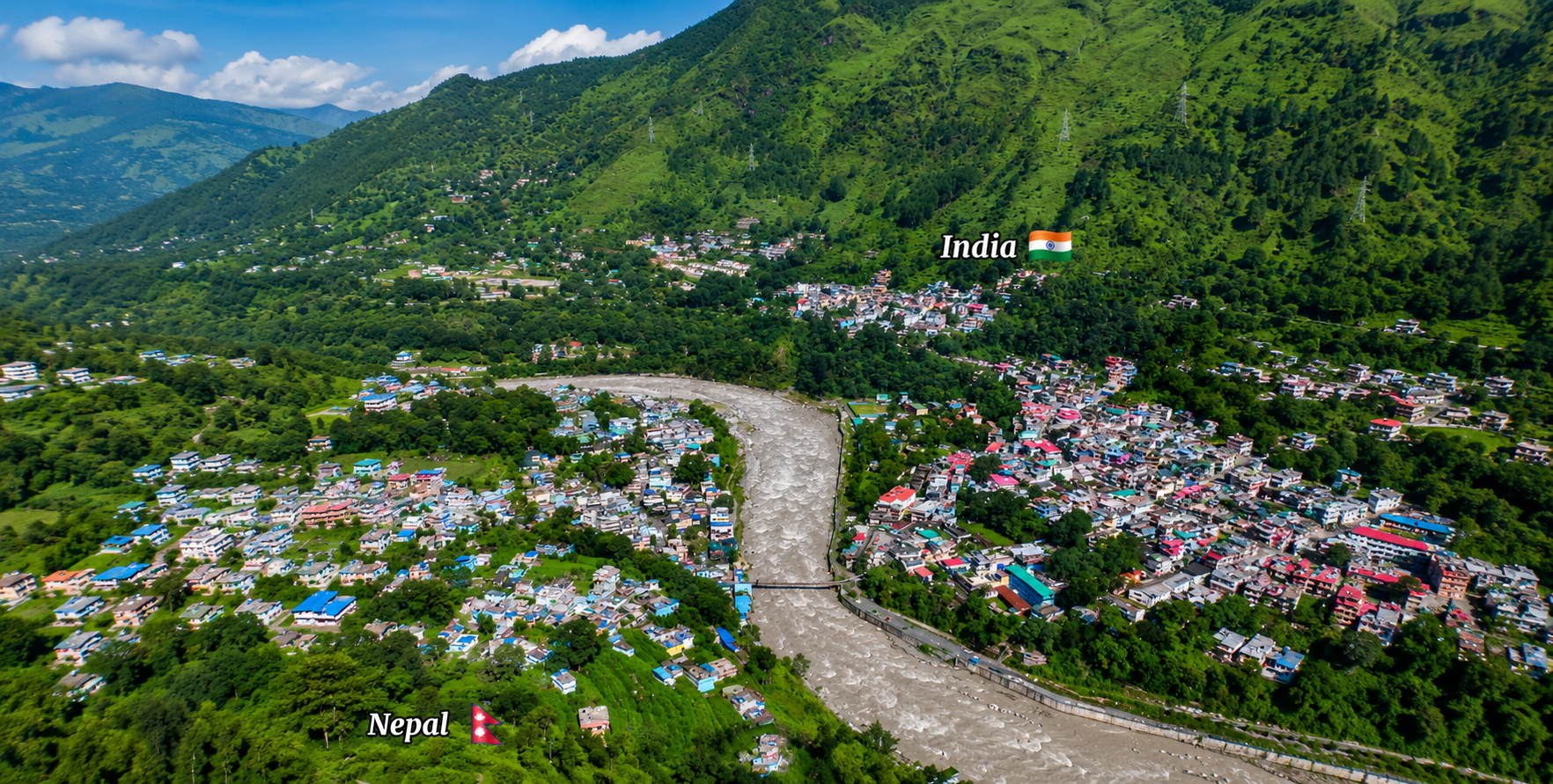
Chat with us