Lumbini to Pokhara Private Jeep: Best Price Guide

Kathmandu to Lumbini

QUICK REFERENCE:    Lumbini to Pokhara Private Jeep


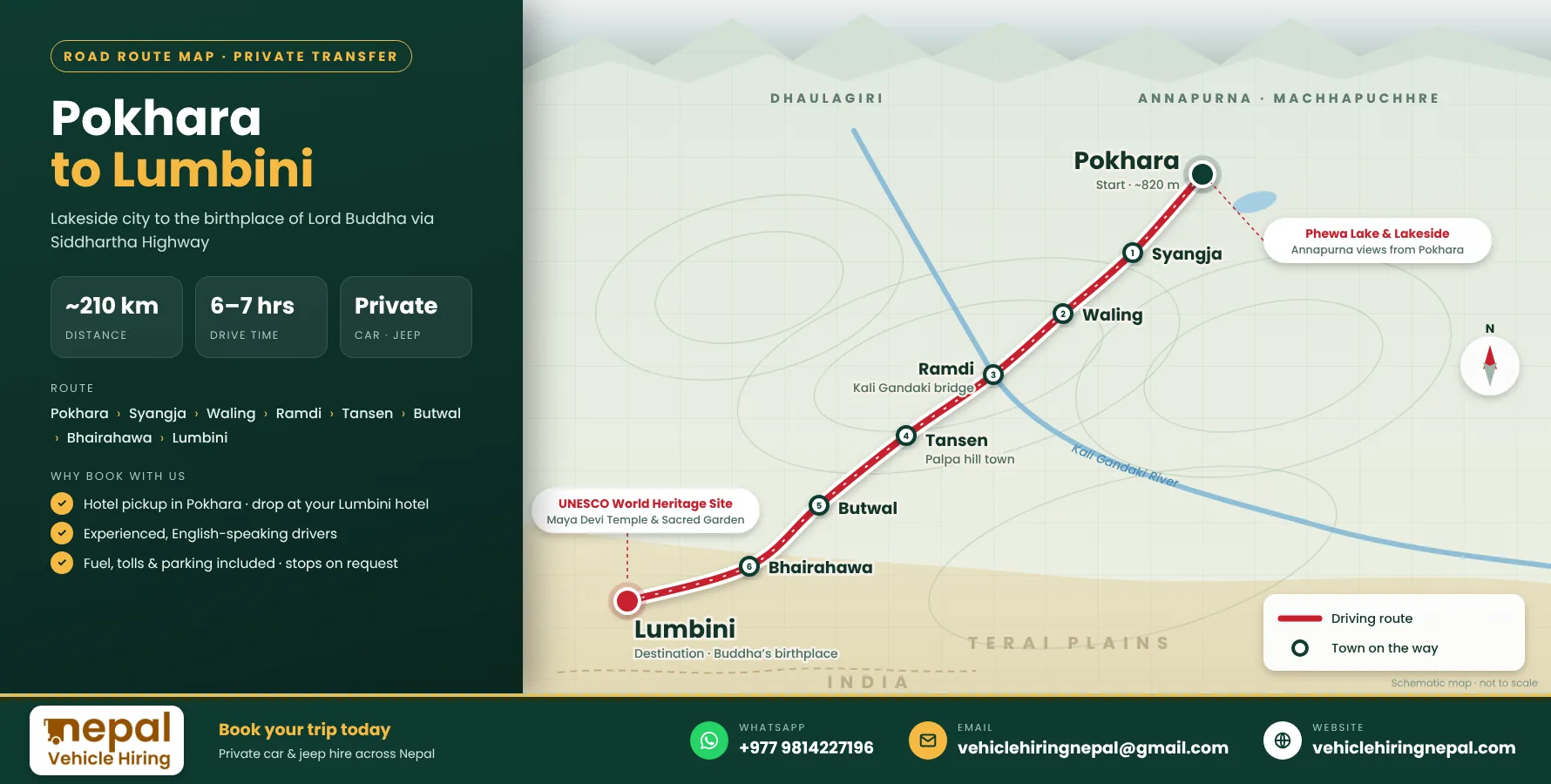
Approximate DistanceRoughly 180-200 km via the Siddhartha Highway
Typical Drive Time6 to 8 hours by private vehicle, including rest stops
Route CharacterTerai plains, then sustained winding mountain road through the hills
Recommended VehiclePrivate car or SUV for small groups; Jeep or Hiace for families and groups
Best SeasonOctober to April for the clearest mountain views on arrival
ContactWhatsApp | vehiclehiringnepal.com

Few journeys in Nepal deliver a change of scenery as complete as the road from Lumbini to Pokhara. You begin on the flat, subtropical plains of the Terai at the birthplace of the Buddha, and you finish beside a lake in the foothills of the Annapurna range, with Machapuchare rising directly above the water. A

Lumbini to Pokhara private jeep transfer is by some distance the most comfortable and flexible way to make that transition, and this guide covers everything the journey involves.

Below you will find the route in detail, realistic timing, an honest explanation of what actually determines price on this corridor, vehicle guidance, seasonal considerations, and how to slot this transfer into a wider Nepal itinerary. Nepal Vehicle Hiring has run this corridor for years, and this guide draws on that direct route experience rather than generic travel copy.

Why This Route Is Different From Nepal’s Other Terai Transfers

It is worth noting from the outset that this isn’t a flat highway journey. Travellers who have driven the

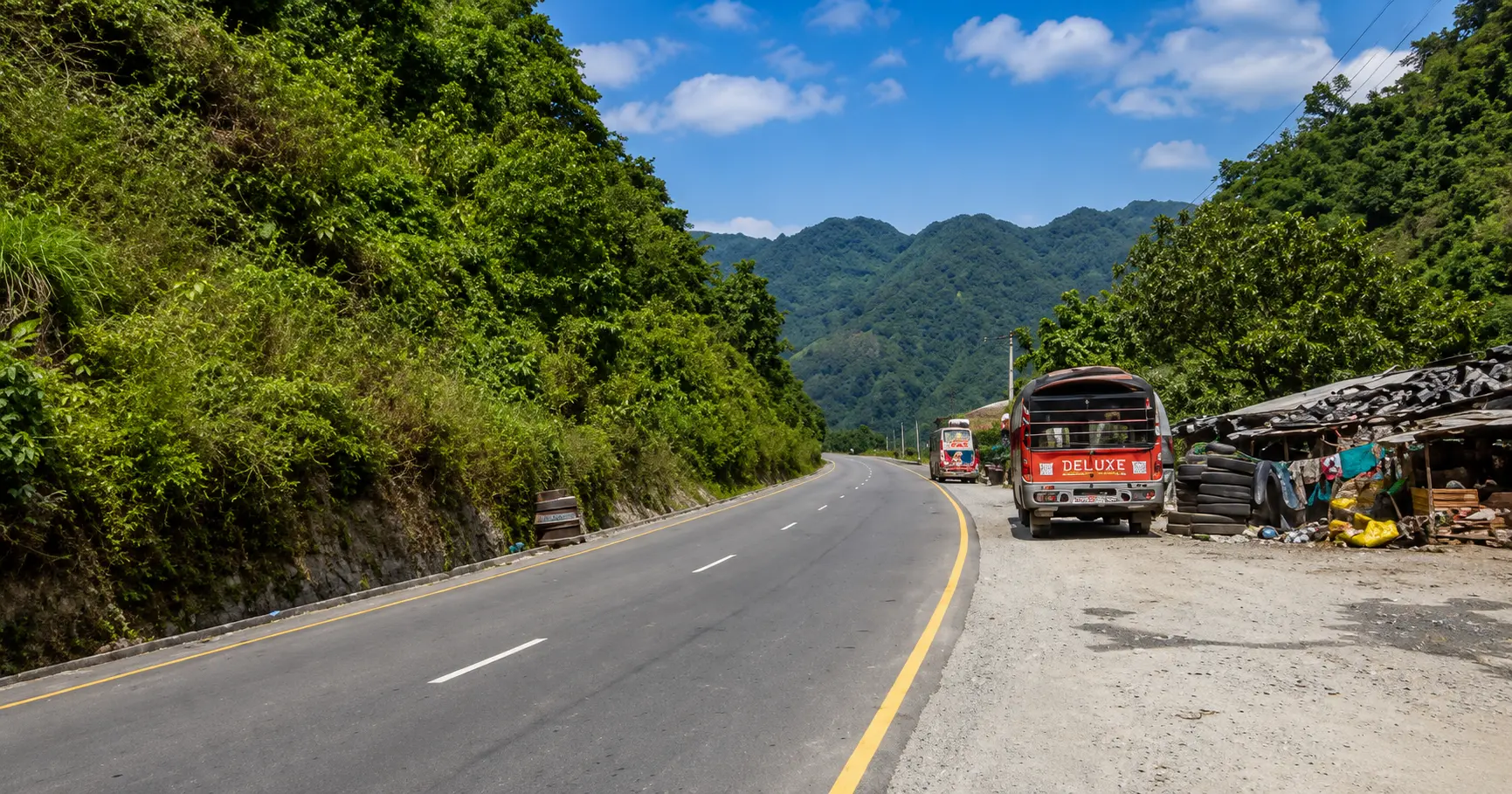
Lumbini to Chitwan corridor, covered in our companion guide, will find this route substantially different. Where that journey runs east along the Terai plains on largely level ground, the Lumbini to Pokhara route turns north at Butwal and climbs into the hills on the Siddhartha Highway, a road known throughout Nepal for its sustained curves, steep drop-offs, and genuine scenic reward.

This matters in several practical ways: the drive takes longer than the distance suggests, motion sickness becomes a real consideration for susceptible travellers, vehicle condition and driver skill matter much more, and monsoon-season landslide risk is a real factor rather than a theoretical one.
Lumbini to Pokhara Private Jeep: Best Price Guide

The Route in Detail

Lumbini to Butwal: The Terai Leg

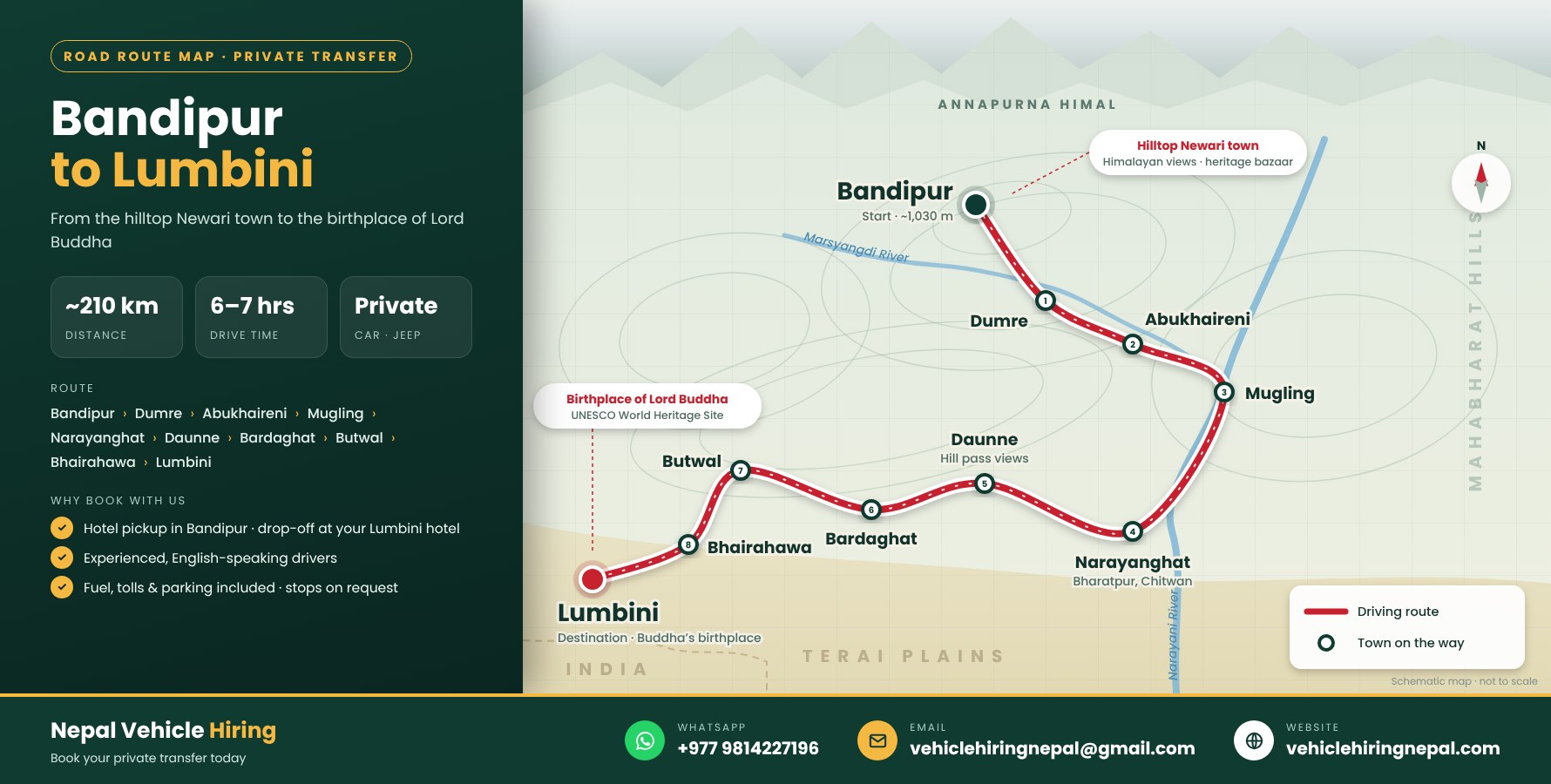
The first stage runs roughly 40 kilometres east and north from Lumbini through Bhairahawa to Butwal, taking about an hour on a flat, well-surfaced road. Butwal sits where the Terai plains meet the first hills, making it both a geographic transition and the practical junction where the Siddhartha Highway begins its climb north toward Pokhara.

Butwal is the best place to handle practical needs before the mountain section begins: fuel, cash from an ATM, snacks and water, and a proper restroom stop. Services become considerably more limited and more basic once the road starts climbing.

Butwal to Tansen: Into the Hills

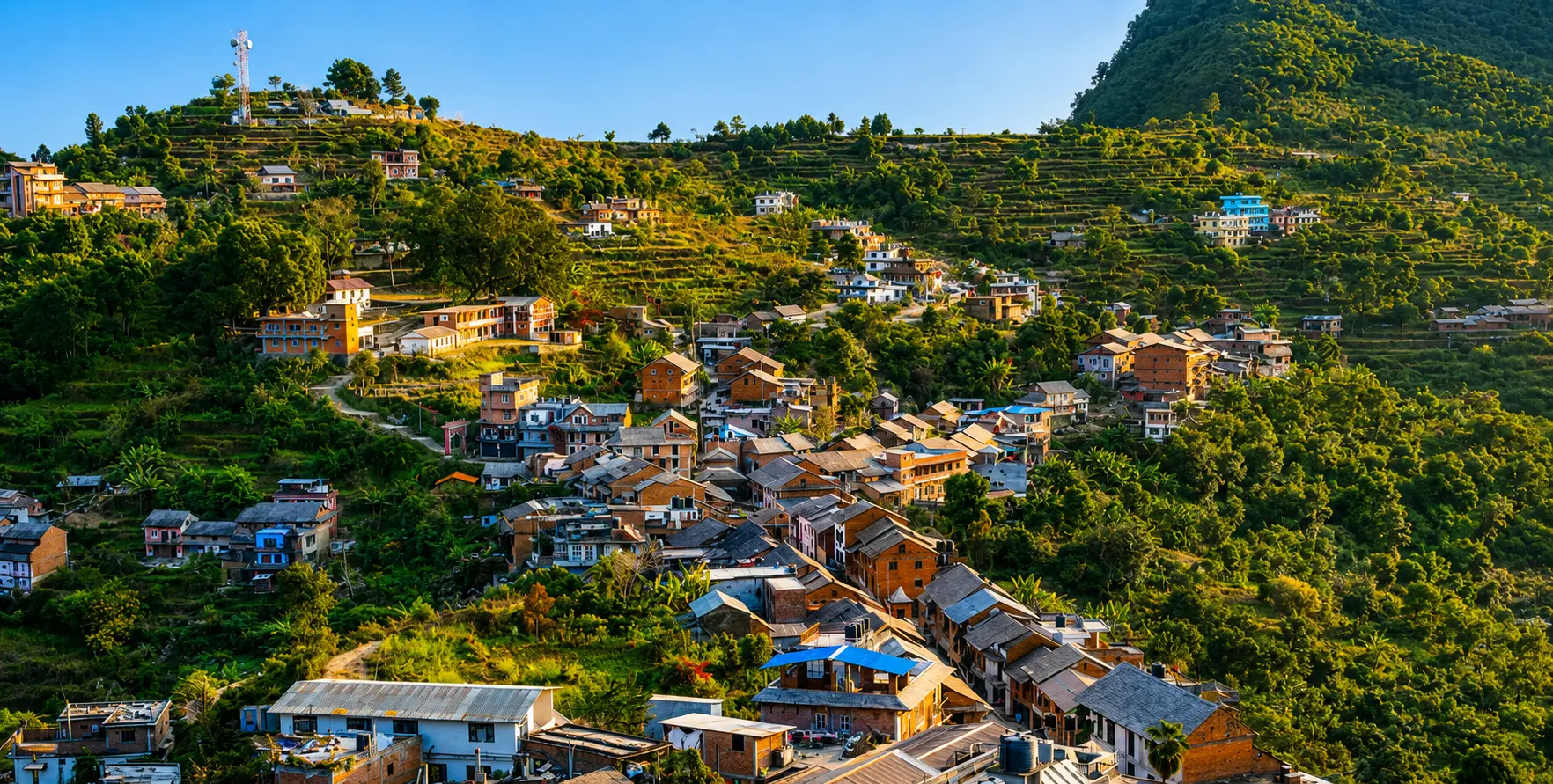
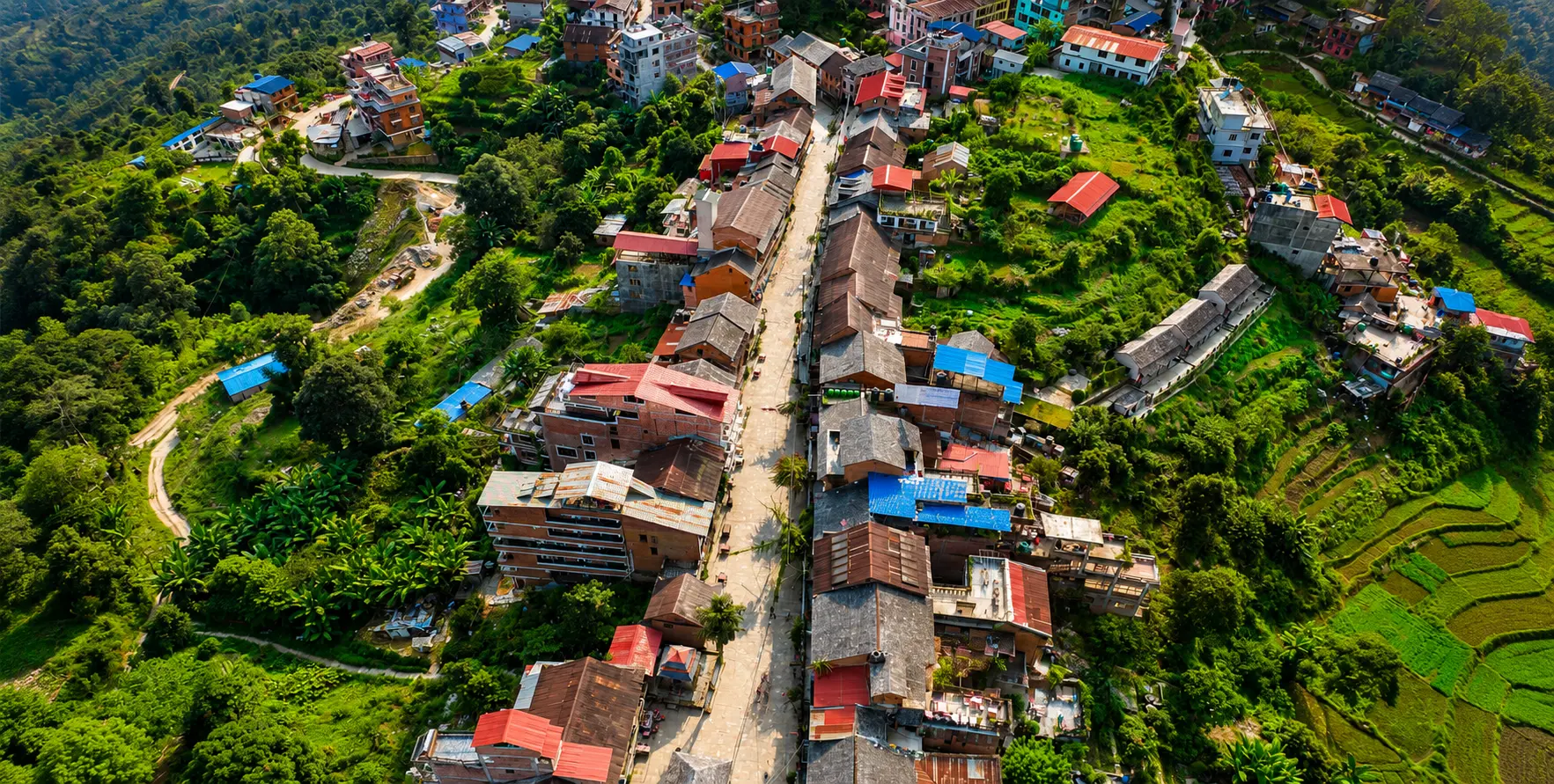
From Butwal, the Siddhartha Highway climbs steadily through forested hillsides, following the Tinau River valley before winding up toward Palpa district. This stretch offers the journey’s first genuine mountain driving, with continuous curves and rising elevation. Tansen, the hill town and Palpa’s district headquarters, sits roughly midway along the route and is the most rewarding lunch or rest stop on the entire drive.

Tansen to Waling and Syangja

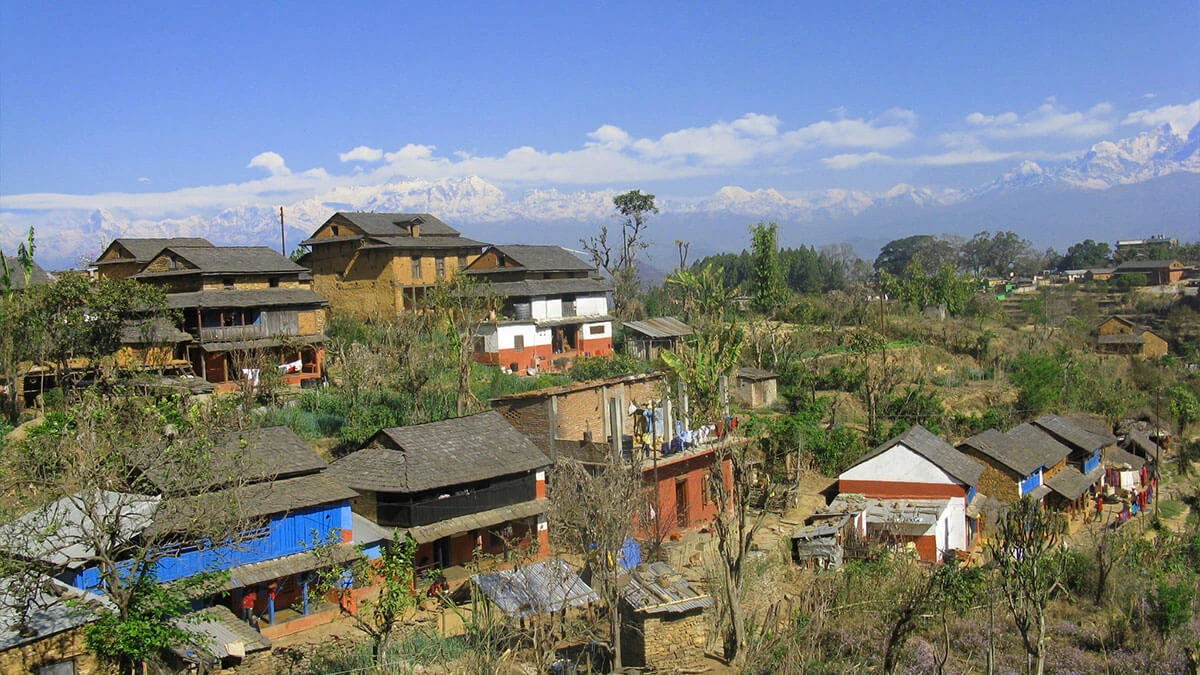
Beyond Tansen, the road continues north through Syangja district, passing Waling and a series of hill settlements, with the terrain remaining consistently winding throughout. On clear days, this section offers the first distant glimpses of the Annapurna range, a genuine highlight that builds anticipation for arrival.

The Final Approach to Pokhara

The last stretch descends toward the Pokharavalleye.On a clear morning, the reveal of Machapuchare and the Annapurna massif as you approach the city ranks among Nepal’s most memorable arrivals. Most itineraries end at a Lakeside hotel, roughly twenty to thirty minutes beyond the city’s edge, depending on the property.

Tansen: The Stop Worth Building In

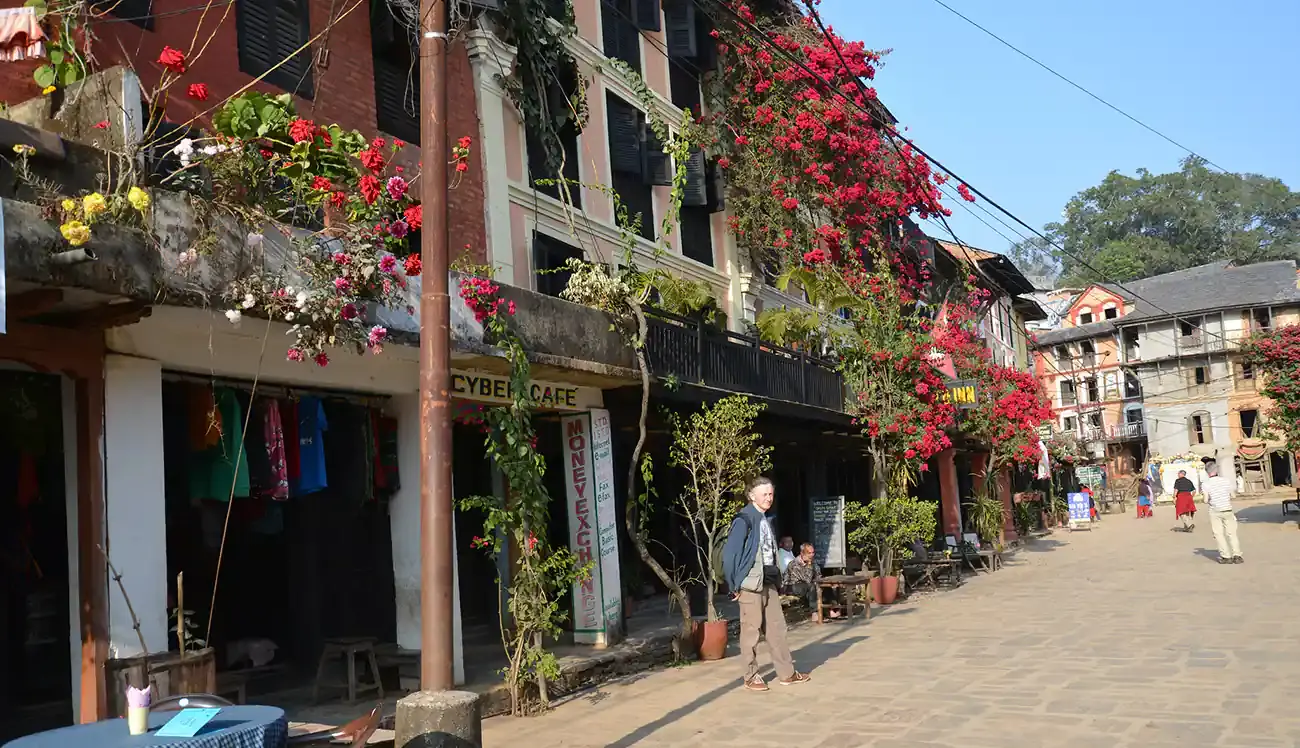
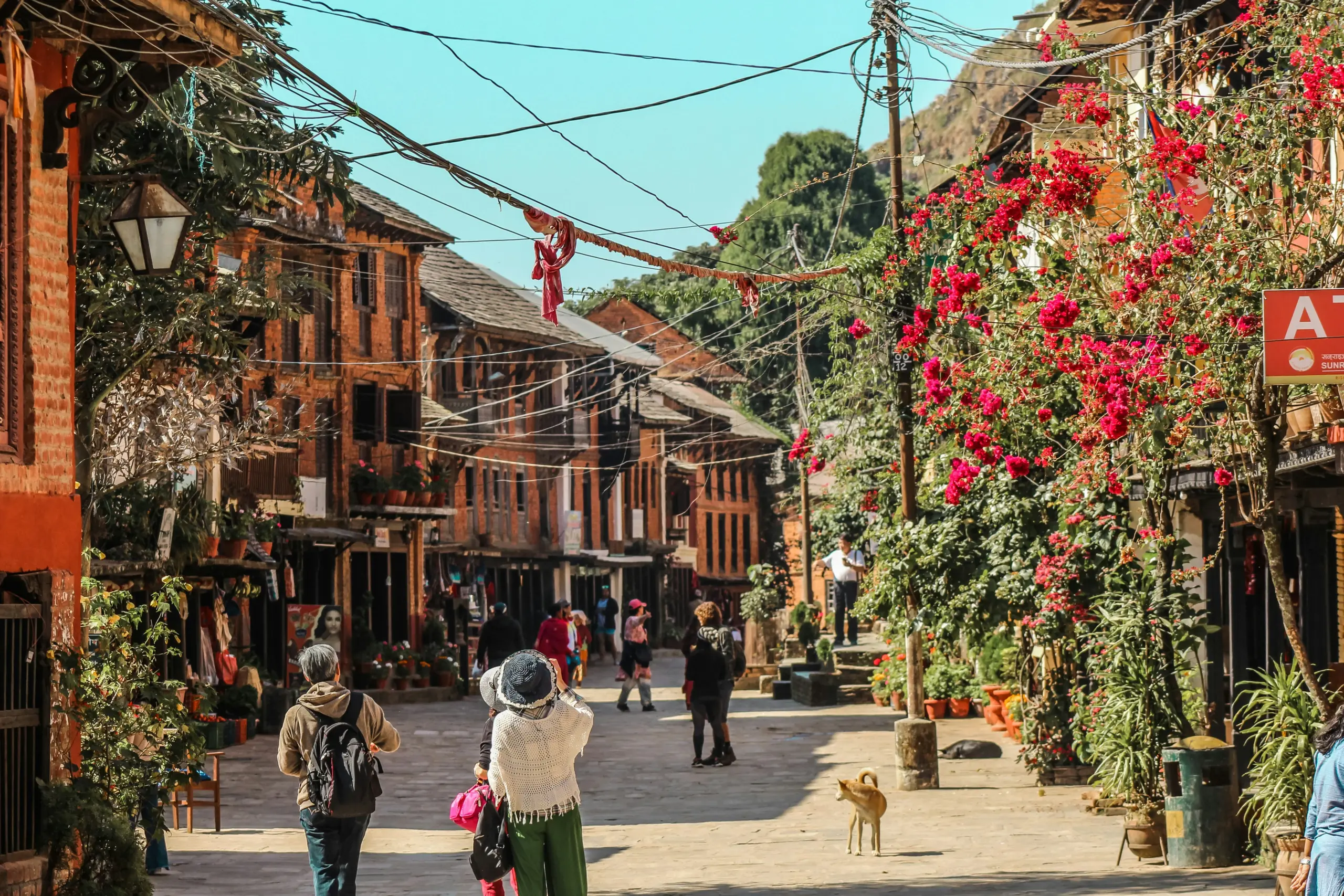
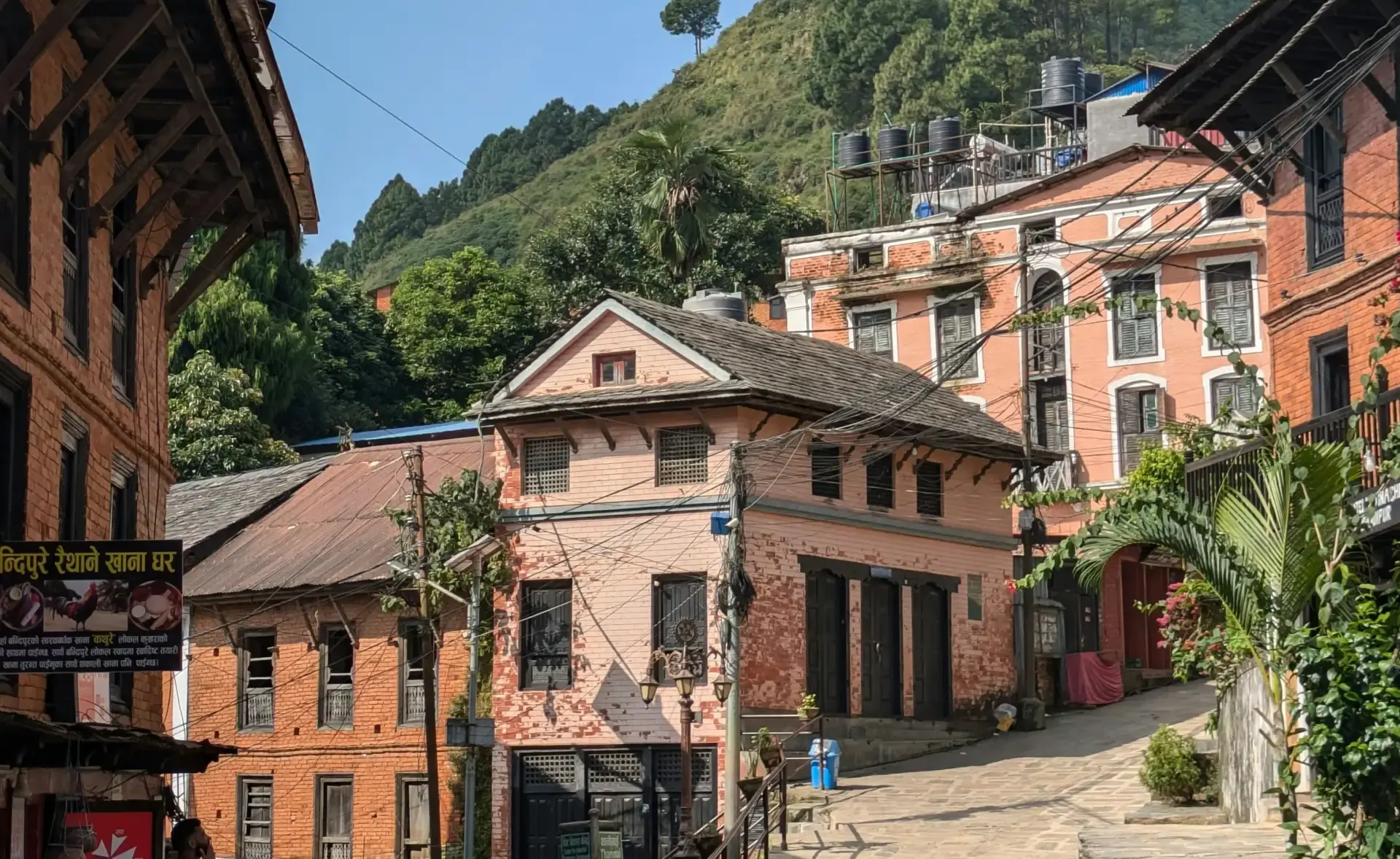
Tansen deserves more than a passing mention. This Newar hill town, sitting at around 1,350 metres, retains a genuinely well-preserved traditional character with narrow stone-paved streets, traditional Newar architecture, and a hilltop setting offering panoramic views across the surrounding Mahabharat range and, on clear days, north toward the Himalaya.

The town is known for its handwoven dhaka fabric, used in the traditional Nepali topi, and the local weaving workshops make a worthwhile short visit. Srinagar Danda, a short walk or drive above the town, offers the best viewpoint in the area and is a genuinely rewarding thirty-minute detour for travellers not pressed for time.

Many travellers treat Tansen simply as a lunch stop, which is entirely reasonable given the length of the day. Those with flexibility, however, sometimes break the journey overnight here, turning a long single-day transfer into two considerably more relaxed half-days with a genuine cultural stop in between.

Understanding Pricing: An Honest Guide

Travellers searching for the best price on this route deserve a clear explanation of what drives costs, not a headline figure that may not apply to their circumstances. Several genuine variables shape pricing on this corridor, and understanding them puts you in a much stronger position when comparing quotes.

Vehicle Class

A standard private car costs meaningfully less than a Land Cruiser, Scorpio, or larger Hiace. Unlike genuinely rough trekking routes, the Siddhartha Highway is paved throughout, so a standard car is mechanically adequate. That said, the sustained curves make a slightly larger, better-suspended vehicle noticeably more comfortable over six to eight hours, and many travellers consider the difference worth the cost.

Group Size

Cost per person falls considerably as group size rises. A single Hiace carrying eight travellers is far more economical per head than multiple cars covering the identical route.

One-Way Versus Round Trip

A one-way drop in Pokhara means the driver returns to base empty, and pricing reflects this. Travellers continuing onward from Pokhara rather than returning should expect this to be factored in.

Season and Demand

The October to April window sees peak demand across this corridor, with both tourist traffic and vehicle availability tightening. Booking ahead during these months secures both availability and better rates than last-minute arrangements.

Stops and Detours

Adding a Tansen sightseeing stop, a Srinagar Danda viewpoint detour, or an overnight break affects the driver’s schedule and total engagement time, which is reflected in pricing.

Rather than quoting a figure here that may be outdated by the time you read this, we recommend contacting our team with your group size, travel dates, and exact pickup and drop points for a current, transparent quote. Visit our

homepage or explore our

Jeep Hire in Nepal and

Hiace hire pages for the full fleet.

How to Recognise a Fair Quote on This Route

A genuinely fair quote on the Siddhartha Highway should be transparent about several specifics. It should name the exact vehicle model rather than a vague category, since the comfort difference across six to eight hours of continuous curves is substantial.

It should confirm whether fuel, driver allowance, and any tolls are included rather than added later. It should state the exact drop-off point, since Lakeside hotels vary in their approach access. It should also confirm the vehicle’s air conditioning and general mechanical condition, both of which matter on a long mountain day.

Suspiciously low quotes on this corridor sometimes indicate shared rather than private transport, an older vehicle with tired suspension that turns the winding sections genuinely unpleasant, or an operator without proper commercial insurance on a route where accident risk is meaningfully higher than on flat highway. On the Siddhartha Highway in particular, the cheapest option is frequently poor value.
Kathmandu to Lumbini Tour Package

Vehicle Options for This Route

Private Car

Adequate and economical for one to three passengers with modest luggage, though the ride quality on sustained curves is noticeably firmer than a larger vehicle.

SUV or Jeep

Generally the sweet spot for this route. The higher seating position, better suspension, and additional space make a genuine difference across a long winding day, bookable through our

Jeep Hire in Nepal service.

Hiace Van

The standard choice for groups of six to ten, offering both seating and luggage capacity. Travellers prone to motion sickness should request a front seat where possible, since rear seating in a van can amplify the sensation of curves.

Coaster and Bus

For larger tour groups and pilgrimage parties, our

Coaster and Bus hire fleet handles the full group in one vehicle.

Motion Sickness: A Genuine Consideration Here

This deserves its own section because it affects a meaningful proportion of travellers on this specific route. The Siddhartha Highway involves several hours of near-continuous curves, and passengers who are entirely comfortable on flat highway journeys frequently struggle here.

Practical measures genuinely help: sit in the front seat when possible, keep a window slightly open for airflow, avoid reading or screen use while moving, eat lightly before departure rather than heavily, and take motion sickness medication in advance rather than after symptoms begin.

Travellers who know they are susceptible should mention this when booking, so we can assign a vehicle with better ride quality, brief the driver to maintain smoother, more measured cornering, and build in more frequent short stops.

Best Time of Year for This Journey

Autumn (October to November)

The clearest skies of the year, offering the best chance of the full Annapurna reveal on approach to Pokhara, along with stable road conditions. This is peak season, so book in advance.

Winter (December to February)

Excellent visibility continues, with cool but comfortable conditions in the hills. Occasional morning fog in the Terai around Butwal can delay early departures during the coldest weeks.

Spring (March to April)

Rhododendron bloom colours the hill sections, and conditions remain generally good, though increasing haze can reduce mountain visibility toward late spring.

Monsoon (June to September)

The Siddhartha Highway is genuinely susceptible to landslide disruption during heavy monsoon rainfall, and this is the one season when schedule flexibility isn’t optional. Travel remains possible, and the hillsides are spectacularly green, but travellers should build buffer time into their plans.

Road Safety and Monsoon Considerations

The Siddhartha Highway has a reputation in Nepal for demanding driving conditions, with sustained curves, steep roadside drops, and mixed traffic, including heavy goods vehicles. This is not cause for alarm, but it is a genuine reason to choose your operator on quality rather than price alone. An experienced driver familiar with this specific corridor, in a well-maintained vehicle with reliable brakes, transforms the risk profile of the journey.

During and immediately after the monsoon, landslide activity can temporarily close sections of the highway. Our drivers monitor current conditions and will advise on realistic timing, alternative routing where available, or in rare cases a recommendation to postpone. Travellers journeying between June and September should treat a buffer day as sensible, not excessive.

Lumbini Before You Depart

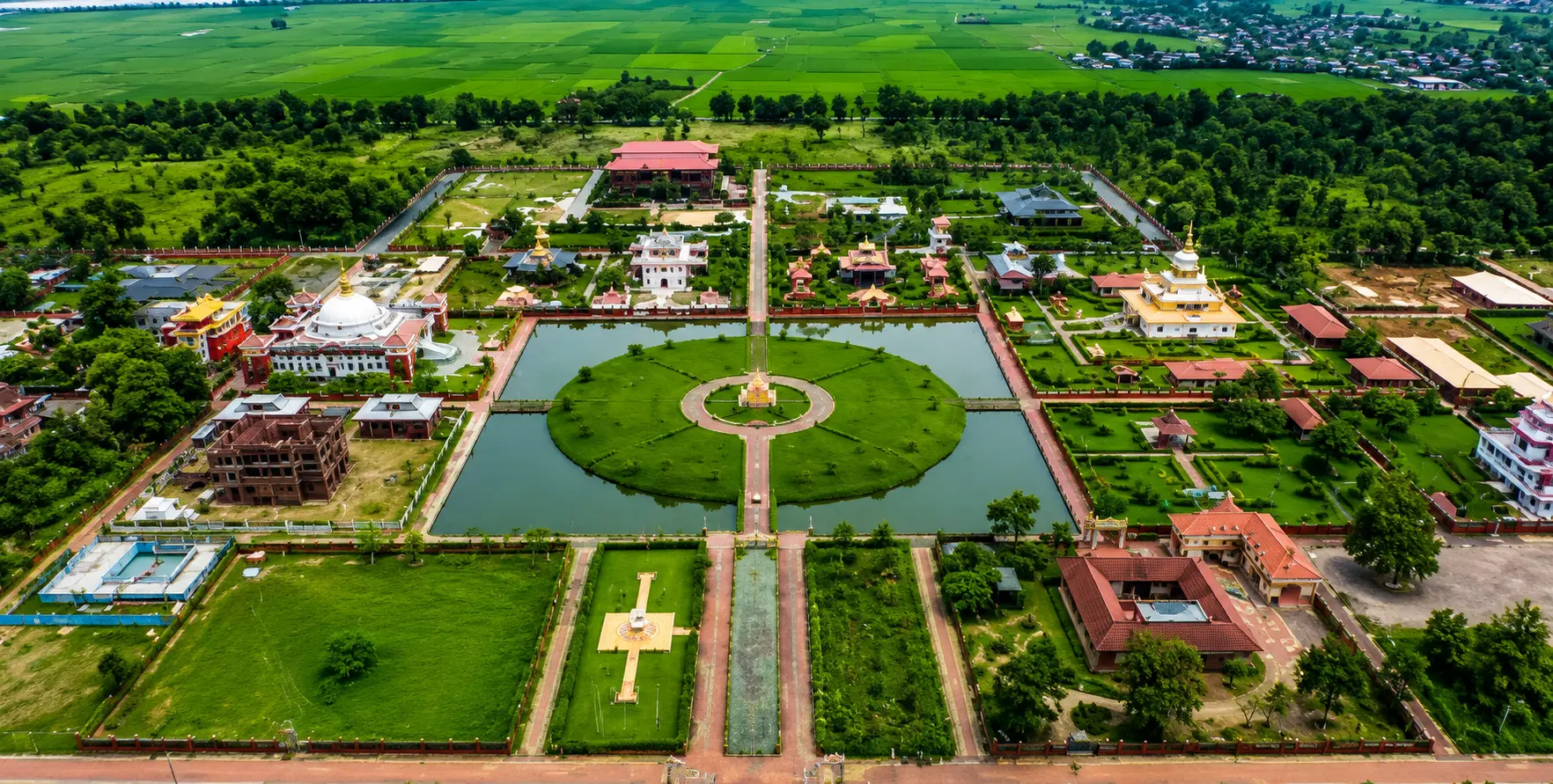
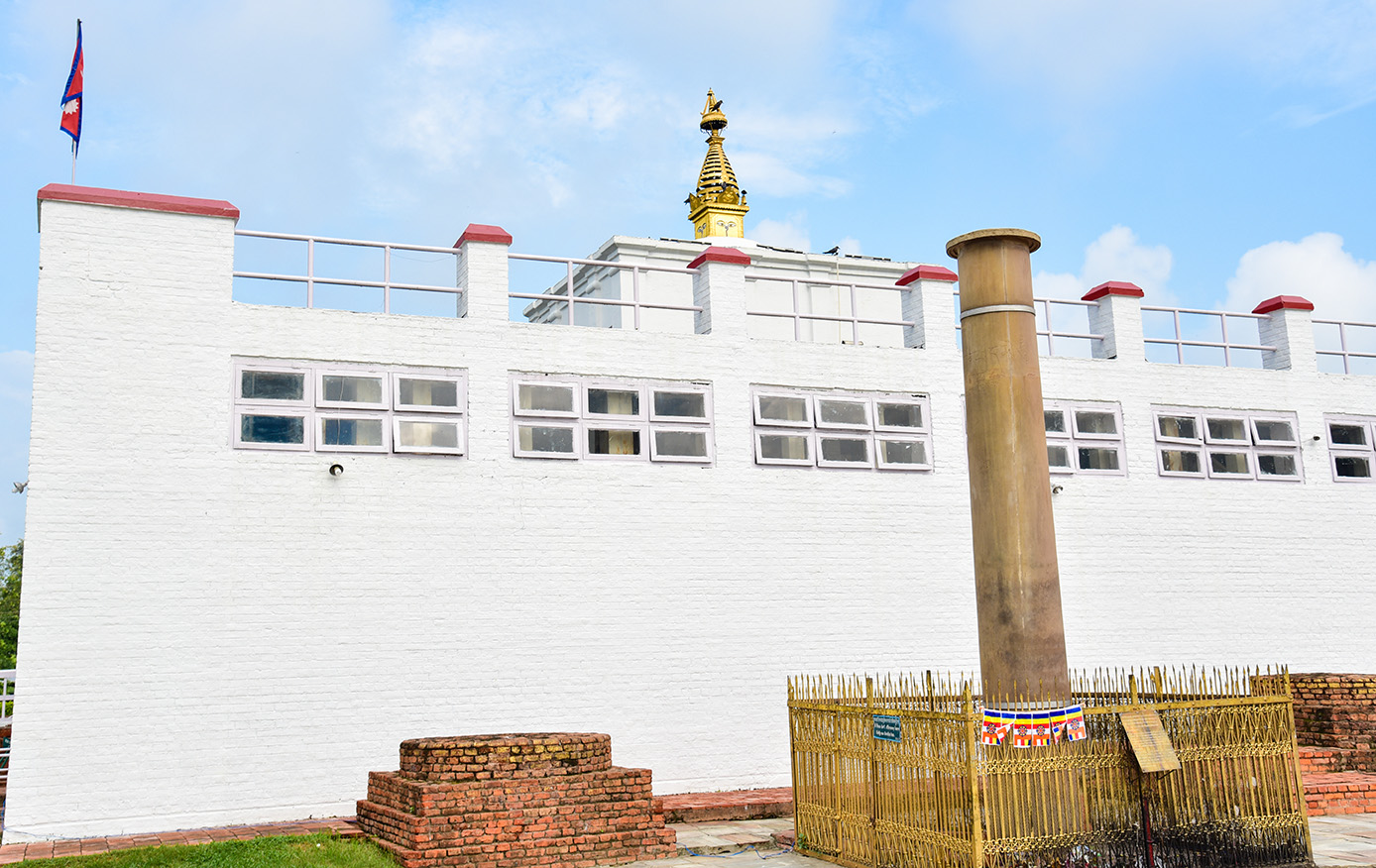
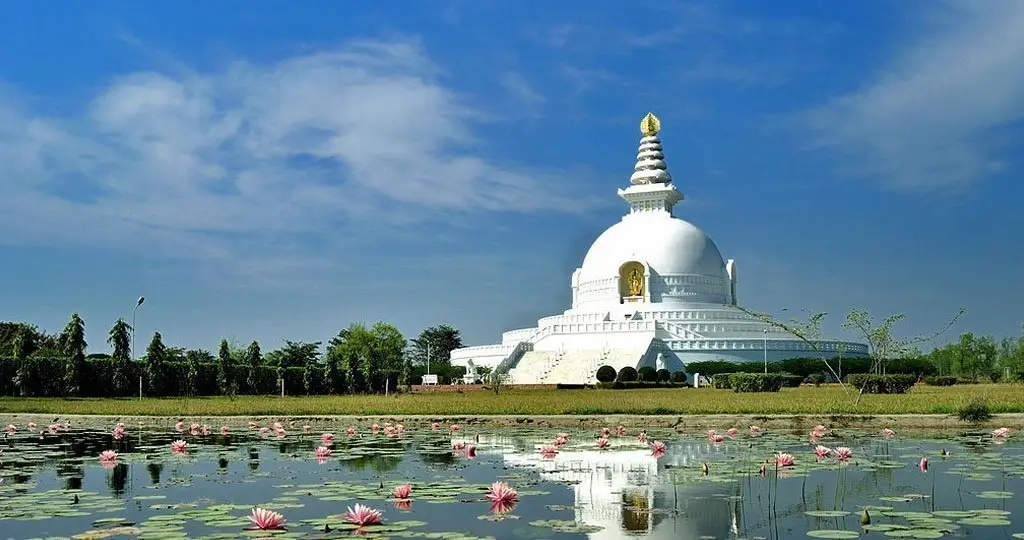
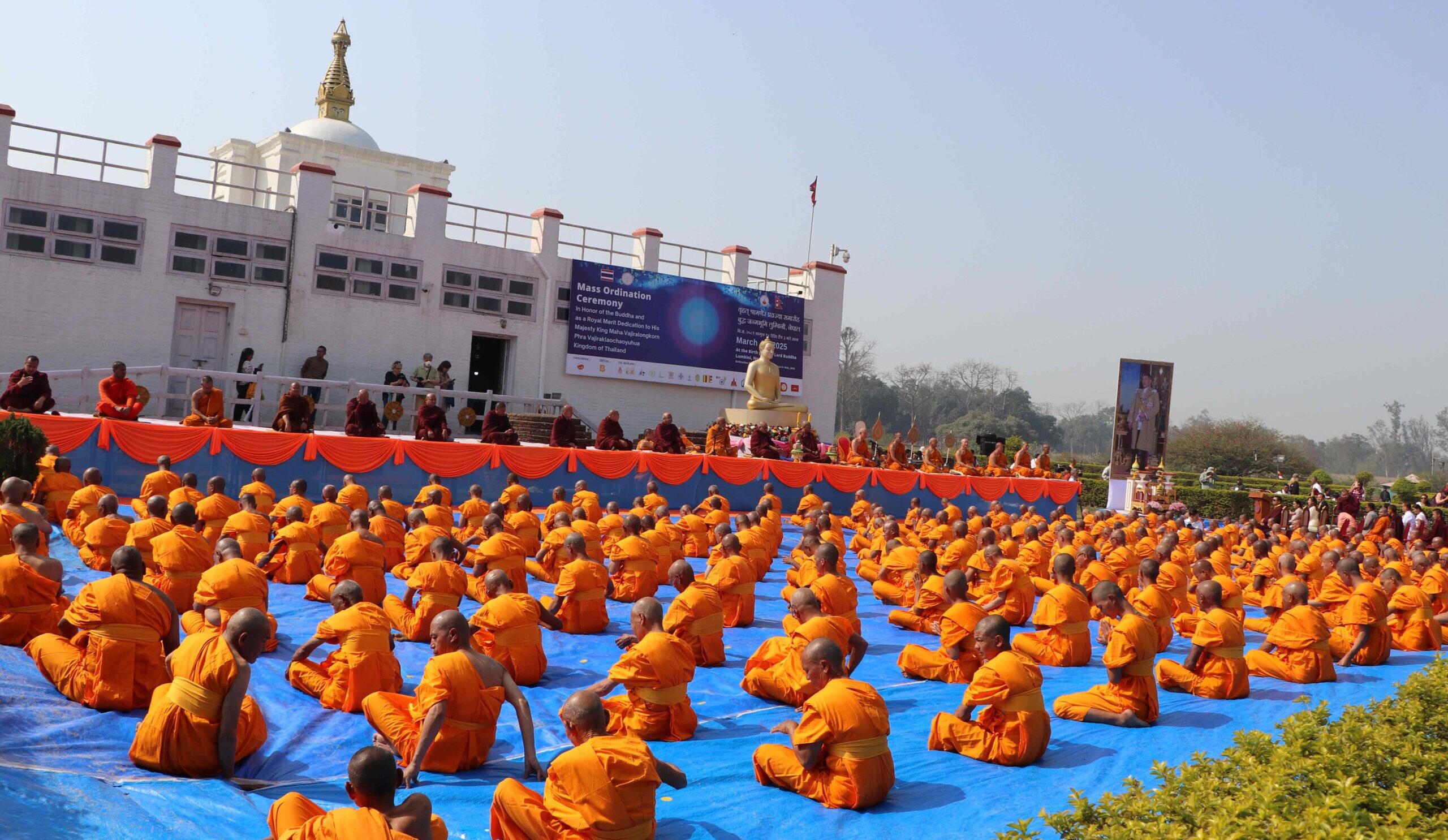
Most travellers give Lumbini at least a full day before continuing to Pokhara, and the site rewards it. The Maya Devi Temple marks the traditionally identified birthplace of Siddhartha Gautama, with the marker stone and ancient brick foundations visible within.

The nearby Ashoka Pillar, dating to 249 BCE, provides epigraphic evidence that supports the site’s identification. The surrounding monastic zone, where Buddhist nations from across the world have built monasteries in their own architectural traditions, is best explored slowly by bicycle.

Travellers arriving in Lumbini from Kathmandu can arrange that leg through our

Kathmandu to Lumbini bus and private vehicle service, making a full Kathmandu, Lumbini, Pokhara sequence a single coordinated booking.

Pokhara on Arrival: What Awaits

Pokhara holds an unusual place in Nepal’s tourism landscape, serving as both a relaxed lakeside destination and the primary gateway to the Annapurna trekking region. Phewa Lake anchors the Lakeside district, with boating, waterfront restaurants, and the Tal Barahi temple on its island. The World Peace Pagoda above the lake’s southern shore offers a classic Pokhara panorama, and the city’s caves, waterfalls, and museums fill additional days comfortably.

For travellers continuing into the mountains, Pokhara serves as the departure point for virtually every Annapurna region trek, covered in full detail in our companion guide to

trekking transport hire in Pokhara, alongside our

car hire in Pokhara and

Sarangkot sunrise tour services for travellers staying in the city itself.

A Realistic Timeline for the Day

A well-planned transfer day begins with departure from Lumbini between seven and eight in the morning. This allows the Butwal leg to finish before the day warms, gets you to Tansen around midday for a proper, unhurried lunch, and leaves a comfortable margin to reach Pokhara Lakeside in daylight in the late afternoon.

Departing later compresses everything, and arriving in Pokhara after dark removes both the scenic arrival and the convenience of settling into accommodation in daylight. Travellers wanting a final Lumbini sacred garden visit on departure morning should plan it for the very opening hour, returning to depart by eight at the latest.

Combining This Route Into a Wider Nepal Itinerary

This transfer slots into several common Nepal itinerary structures. Travellers entering overland from India via the Sunauli crossing near Bhairahawa often start in Lumbini before continuing to Pokhara and then Kathmandu. Travellers flying into Gautam Buddha International Airport at Bhairahawa follow a similar pattern with a shorter initial leg.

Others reverse the sequence entirely, arriving in Pokhara from Kathmandu via our

Kathmandu-to-Pokhara service before travelling south to Lumbini and exiting toward India. A third common structure adds Chitwan, creating a Lumbini, Chitwan, Pokhara triangle covered partly in our

Pokhara to Chitwan guide.

Why Choose Nepal Vehicle Hiring for This Corridor

Our drivers assigned to the Siddhartha Highway are familiar with this road’s curves, traffic patterns, reliable rest stops, and the current landslide-prone sections that change season to season. Our vehicles undergo inspection with particular attention to brakes, suspension, and tyres, all of which matter more on sustained mountain descent than on flat highway. We also coordinate closely with our sister companies,

Alpine Luxury Treks and

Trek Nepal Himalayas, for travellers continuing from Pokhara into the Annapurna region on treks such as the

Ghorepani Poon Hill Trek or

Annapurna Base Camp Trek.

The Siddhartha Highway: History and Engineering

Named after the Buddha’s given name and connecting his birthplace region to the Pokhara valley, the Siddhartha Highway represents a significant piece of Nepal’s mid-twentieth-century infrastructure development. Built with Indian assistance and completed in stages through the 1960s and 1970s, the road opened a direct north-south connection between the Terai plains and the hill regions of western Nepal, transforming trade and travel patterns that had previously depended on foot trails and considerably longer circuitous routes.

The engineering challenge was substantial. The route climbs from around 100 metres at Butwal to over 1,500 metres at points along the Palpa ridge before descending toward Pokhara’s valley floor at roughly 800 metres, all through geologically young and actively eroding Mahabharat range terrain. The sustained curves travellers experience today are a direct result of the gradient management this terrain demanded, and the ongoing landslide maintenance the road requires reflects the same underlying geology.

Understanding the Terrain You Cross

This journey crosses three distinct physiographic zones within a single day. The Terai, where Lumbini sits, forms part of the Gangetic plain, with alluvial soils, subtropical climate, and intensive agriculture. The Siwalik, or Churia hills, appear first after Butwal; they are Nepal’s youngest and most erosion-prone range, composed of relatively soft sedimentary rock.

Beyond them lies the Mahabharat range, higher and more geologically stable, where Tansen and most of the route’s hill sections sit.

This progression explains much of what travellers experience: the heat and humidity of the opening leg, the particularly winding and landslide-prone early climb through the Siwaliks, and the more settled, cultivated hill landscape of the Mahabharat section before the final descent into Pokhara’s valley.

Palpa District and Its Cultural Character

The hill sections of this route pass through Palpa, a district with a genuinely distinct historical identity. Palpa was an independent principality before Nepal’s unification, and Tansen served as its seat. The district retains a strong Newar cultural presence alongside Magar communities, and this mixed heritage shows in Tansen’s architecture, festivals, and craft traditions.

The Rani Mahal, sometimes called the Taj Mahal of Nepal, sits below Tansen on the banks of the Kali Gandaki River and was built in 1893 by a Nepali general in memory of his wife. Reaching it requires a substantial detour and a walk, so most single-day transfer itineraries skip it, but travellers breaking the journey overnight in Tansen sometimes include it.

Rest Stops Along the Route

Choosing good rest stops makes a real difference on this journey. Butwal offers the most comprehensive services on the route, with fuel, ATMs, pharmacies, and a range of restaurants, and it should be treated as the main practical stop before the mountain section begins. Tansen offers the best combination of food quality and scenic setting for a main meal break, and its position roughly midway makes the timing natural.

Beyond Tansen, roadside options become more basic, typically small tea shops and simple dal bhat establishments serving mostly local traffic. These are perfectly serviceable for a short break, but travellers with specific dietary requirements or a preference for more developed facilities should plan their main stops around Butwal and Tansen.

What to Bring for the Journey

  • Water and light snacks, since roadside options between main stops are limited and basic.
  • Motion sickness medication if you are susceptible, taken before departure rather than after symptoms begin.
  • A light layer, since hill sections can feel noticeably cooler than the Terai even on warm days.
  • Cash in Nepali rupees, since card acceptance is limited outside Butwal and Pokhara.
  • A camera that’s easy to carry rather than packed, given the scenic sections and potential mountain views.
  • Any medication you need during the day, since pharmacies are concentrated in Butwal and Pokhara.

Photography Along the Siddhartha Highway

This route rewards photographers considerably more than its reputation as a transfer corridor suggests. The early hill sections above Butwal offer layered ridge views through morning haze. Tansen’s traditional streetscape and the Srinagar Danda viewpoint deliver both cultural and landscape opportunities.

On clear days, the Syangja section can offer distant Annapurna views, and the final descent toward Pokhara occasionally reveals the full massif that so many travellers remember from this journey.

Travellers prioritising photography should mention this when booking, since a driver briefed to stop at better viewpoints rather than drive through can transform what’s possible. Autumn and winter mornings offer the best visibility for mountain photography on this corridor.

Birdlife and Natural Features Along the Route

The forested sections of the Siwalik and lower Mahabharat hills support a genuinely diverse bird population, and interested travellers may spot a range of species from the vehicle during slower sections. The Tinau and Kali Gandaki river systems, visible at points along the route, add further habitat variety, and the transition from subtropical Terai vegetation to temperate hill forest across the day’s elevation gain is evident to anyone watching the changing tree species alongside the road.

Travelling This Route With Children

Families should carefully weigh the route’s length and winding character when travelling with young children. Private vehicle hire offers substantial advantages over shared transport here: the ability to stop whenever needed, control over cabin temperature and airflow, space for children to be comfortable, and no fixed schedule creating pressure. Motion sickness affects children disproportionately on this corridor, and the practical measures outlined earlier apply even more strongly.

Families with genuine concerns about the journey length sometimes split it across two days with an overnight in Tansen, which most find transforms the experience considerably for younger travellers.

Travelling This Route With Elderly Passengers

Elderly travellers generally manage this route well provided the vehicle offers good ride quality, and the schedule includes regular stops. Sustained curves are more physically tiring than flat highway driving, so adding an extra rest stop beyond the standard Butwal and Tansen breaks is worthwhile.

Travellers with back or joint conditions in particular benefit from better suspension, and this is one route where paying for a more comfortable vehicle class is genuinely justified rather than simply a luxury.

Accessibility Considerations

Travellers with mobility limitations should discuss specific requirements when booking, since vehicle selection, assistance availability at rest stops, and the accessibility of the final Pokhara destination all warrant advance consideration. Nepal’s general accessibility infrastructure remains limited compared to many countries, and careful planning yields a much better outcome than assuming facilities will be available.

Comparing Private Jeep to Tourist Bus on This Route

Tourist buses operate between the Lumbini and Bhairahawa area and Pokhara, and for solo budget travellers they offer a genuinely economical option. The trade-offs on this specific corridor are more pronounced than on flatter routes, however.

Fixed departure times, no control over stop frequency across six to eight hours of winding road, shared cabin conditions where motion sickness in other passengers affects the whole vehicle, and drop-off at a central bus park rather than your Lakeside hotel all matter more here than they would on a shorter, flatter journey.

For families, groups, elderly travellers, anyone susceptible to motion sickness, or travellers who value comfort on a demanding road, private hire delivers proportionally greater benefit on this route than on almost any other Terai-origin transfer covered across our guides.

Comparing the Overland Route to Flying

Some schedules connect Bhairahawa to Pokhara by domestic flight, offering an obvious time saving over a six- to eight-hour drive. The trade-offs include limited and sometimes seasonal scheduling, weather-related cancellation risk, baggage limitations, and the complete loss of the scenic and cultural content the overland route delivers.

Travellers with very tight schedules sometimes fly, but most choose the road, and most report that the drive itself is a genuine part of the experience rather than merely transit.

Luggage Planning

Travellers on a broader Nepal circuit frequently carry substantial luggage, particularly those continuing from Pokhara into trekking. Communicating total luggage volume at booking ensures vehicle selection accounts for it, since a vehicle adequate for passenger seating may not comfortably take the accompanying bags. This matters particularly for groups that choose a Hiace for seats but need to confirm matching luggage capacity.

Connectivity Along the Corridor

Mobile coverage along the Siddhartha Highway is generally serviceable but not continuous, with reliable signal around Butwal, Tansen, Waling, and the Pokhara approach, and patchier coverage through some of the intervening forested and steep-sided sections. Travellers should not rely on continuous connectivity across the full journey. However, the gaps are brief, and this corridor remains far better served than the remote mountain routes covered elsewhere in our guides.

Currency and Payment Practicalities

Nepali rupees remain essential throughout the journey for roadside stops, tea shops, and incidental purchases. ATMs are readily available in Butwal and Pokhara, and Tansen has limited facilities, but travellers should not count on card acceptance at any point between Butwal and Pokhara. Withdrawing adequate cash in Butwal before the hill section begins is the practical approach.

Travel Insurance for This Route

Standard travel insurance covering road travel is appropriate for this journey, with no special high-altitude or adventure activity provisions required for the transfer itself. Travellers continuing from Pokhara into trekking should separately confirm their policy covers the specific altitude and activity level of their planned trek, a point covered in more detail in our Pokhara trekking transport guide.

A Sample Five-Day Lumbini and Pokhara Itinerary

A practical five-day structure begins with arrival in Lumbini, whether from the Sunauli border, Bhairahawa airport, or overland from Kathmandu, with an afternoon for orientation and rest. Day two offers a full Lumbini exploration, with the sacred garden in the cool early morning and a bicycle tour of the monastic zone in the afternoon.

Day three covers the transfer throughout this guide, departing early and arriving in Pokhara Lakeside by late afternoon. Day four allows a full Pokhara day, typically a Sarangkot sunrise excursion followed by lakeside relaxation, boating, or a visit to the World Peace Pagoda.

Day five continues either to Kathmandu, into an Annapurna trek, or for onward departure.

Travellers with additional time can comfortably extend either end, with an extra Pokhara day in particular offering scope for a Sarangkot paragliding flight, a day hike, or simply a slower pace before continuing.

Extending Into an Annapurna Trek

A substantial proportion of travellers making this transfer continue directly into an Annapurna region trek from Pokhara. Practically,  at your arrival time, rest-day planning should account for an early trekking departure, typically the following morning. Arriving in Pokhara with a full evening and a relaxed morning before a trek departure gives you a much better start than arriving late and leaving at dawn.

Our companion guide to

trekking transport hire in Pokhara covers every major trailhead reachable from the city, including Nayapul, Kande, Phedi, and the longer Jomsom corridor, and coordinating both this transfer and the onward trailhead transport through one provider simplifies the overall booking considerably.

Pilgrimage Travel Along This Corridor

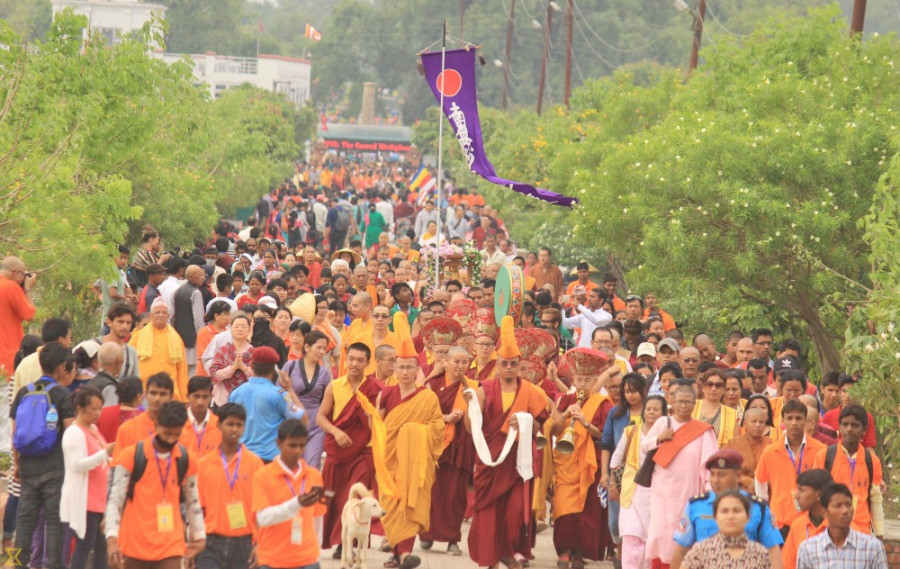
Buddhist pilgrims visiting Lumbini often travel in organised groups that require Coaster or full bus capacity, and these bookings come with their own coordination needs around ceremony timings at the sacred garden, group dietary arrangements along the route, and realistic pacing for older pilgrims over a long, winding day. Our team regularly supports this kind of group pilgrimage transport and can advise on appropriate vehicle configuration and timing.

Travellers combining Buddhist and Hindu pilgrimage within a single Nepal journey may find our companion guides to

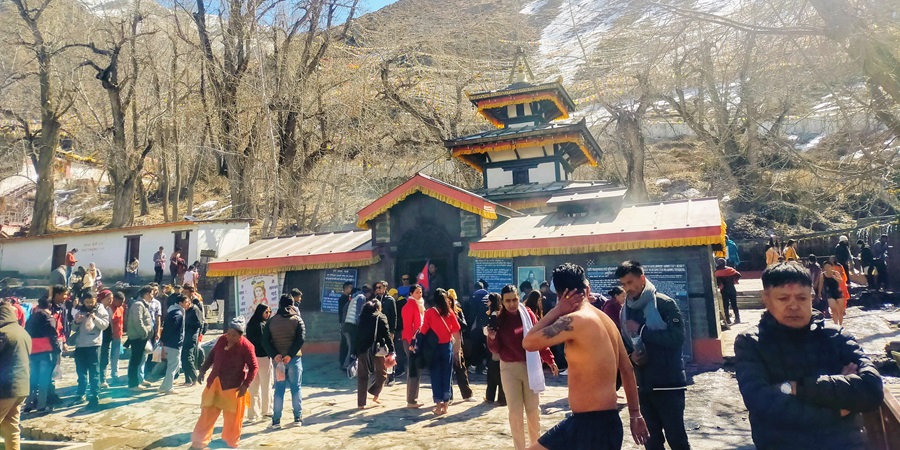
Muktinath Temple and the

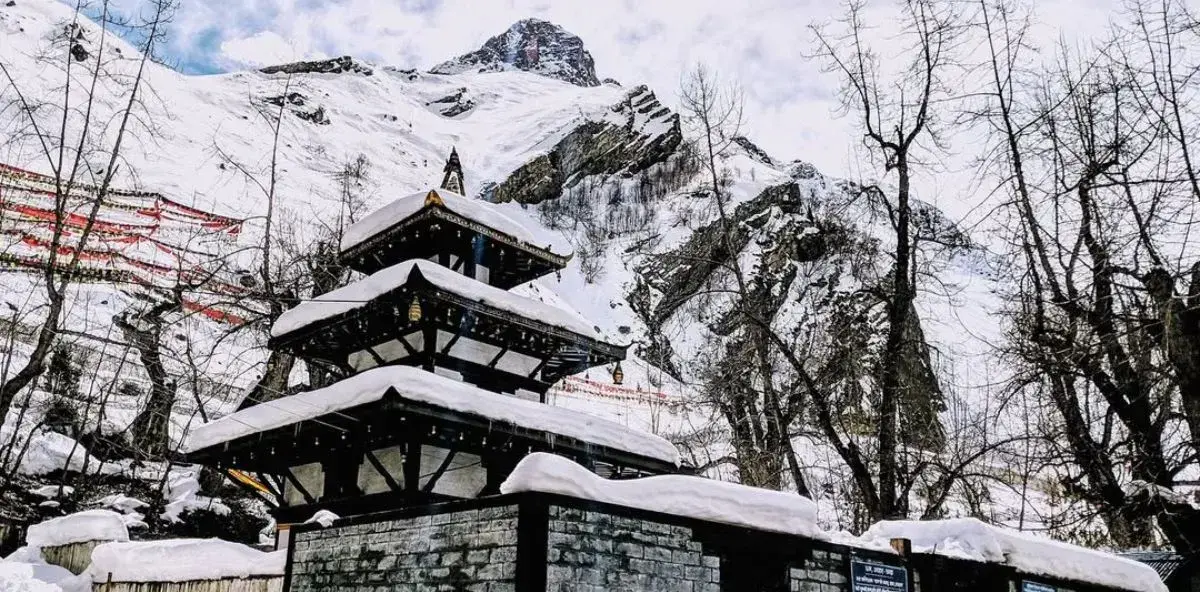
Rasuwagadhi Kerung route for Kailash Yatra useful, since Muktinath in particular is reachable onward from Pokhara and pairs naturally with a Lumbini visit for travellers interested in both traditions.

Seasonal Character of the Hill Sections

The hill sections between Butwal and Pokhara change noticeably through the year, affecting the travel experience beyond road conditions. Autumn brings the clearest air of the year, with terraced hillsides in the final stages of the rice harvest and golden fields layered across the slopes. Winter delivers crisp visibility and cool,l comfortable travel, with occasional morning fog pooling in the valleys below the road,d creating genuinely striking conditions.

Spring adds rhododendron colour through the higher forested stretches alongside the fresh green of new cultivation. At the same time,ile the monsoon transforms the entire corridor into dense, saturated green, with waterfalls appearing on hillsides that are dry the rest of the year. Each season offers something distinct, and flexible travellers may find the choice worth considering beyond pure weather reliability.

Understanding Highway Traffic Patterns

The Siddhartha Highway carries a genuine mix of traffic, including heavy goods vehicles moving between the Indian border and Nepal’s hill regions, local buses serving communities along the route, and tourist vehicles. Heavy vehicle traffic tends to be most concentrated during daytime hours, and slow-moving trucks on the steeper climbing sections can extend journey times beyond estimates during busier periods.

An early departure helps in this respect as well as for the reasons already covered, since the earlier hours generally see lighter commercial traffic on the climbing sections above Butwal. Experienced drivers familiar with the corridor understand these patterns and pace the journey accordingly.

What Previous Travellers Say About This Journey

Feedback from travellers who have made this transfer consistently emphasises several themes. The journey takes longer than the map distance suggests, and travellers who arrive expecting a four-hour drive are consistently surprised. Tansen is repeatedly mentioned as an unexpected highlight, with many travellers wishing they had allowed more time there.

The winding sections genuinely affect susceptible passengers, and those who prepared for this report a much better experience than those who did not. And the mountain reveal on approach to Pokhara, when conditions allow it, is frequently described as a genuine trip highlight rather than simply an arrival.

Choosing Your Departure Point in Lumbini

The Lumbini spans a considerable footprint, with accommodation ranging from properties immediately adjacent to the sacred garden to hotels in Bhairahawa town roughly twenty kilometres away, plus comfortable monastery guesthouses within the development zone itself and confirming your exact pickup point when booking avoids confusion on departure morning, especially since the monastic zone’s internal road network isn’t always obvious to drivers unfamiliar with a specific property.

Travellers staying in Bhairahawa rather than Lumbini proper effectively shorten the journey slightly, since Bhairahawa sits closer to Butwal and the start of the Siddhartha Highway.

Choosing Your Arrival Point in Pokhara

Pokhara also stretches across a wide area, and the practical difference between a central Lakeside hotel, a property in the quieter northern Lakeside stretch, and a hotel near Pokhara city can mean a meaningful extra drive at the end of an already long day. Providing your exact hotel name and address at booking allows accurate routing.

It avoids the frustration of arriving in the general area and then circling to find a specific property in fading light.

Arriving in Pokhara: First Evening Suggestions

Travellers arriving in Lakeside in the late afternoon often find the simplest first evening works best after a long transfer: a walk along the lake shore, an early dinner at a waterfront restaurant, and an early bedtime ahead of whatever the following days hold. Sarangkot sunrise excursions, the most popular Pokhara morning activity, require a pre-dawn departure, so travellers planning that for their first full morning benefit particularly from an early night on arrival day.

Environmental Considerations on This Corridor

The Siwalik and Mahabharat hill sections of this route pass through genuinely fragile terrain, where road construction, vehicle traffic, and ongoing erosion interact in ways visible to any attentive traveller through landslide scars, road repair work, and slope stabilisation efforts. Travellers can contribute in real ways by avoiding roads.

The route also passes through part of Nepal’s community forestry network, among the more successful programmes of its kind globally, with local user groups managing and protecting forest resources. The visible forest cover along parts of the Siddhartha Highway reflects decades of that community management rather than simply undisturbed wilderness.

Supporting Local Economies Along the Route

Stopping in Butwal and Tansen, rather than simply driving through, supports roadside economies that depend on highway traffic, from restaurants and tea shops to craft producers in Tansen whose Dhaka weaving tradition is genuinely distinctive. Travellers who treat the journey as including these stops, rather than simply as necessary pauses, contribute meaningfully to communities along a corridor that sees considerable through-traffic but comparatively little lingering visitor spending.

A Final Word on Value Versus Price

Returning to the pricing question that brings many readers to this guide, genuine value on the Siddhartha Highway comes from a combination of factors rather than the headline number alone. A vehicle with suspension and ride quality appropriate to six or more hours of sustained curves.

A driver with specific experience of this road’s demands rather than general driving experience. Transparent inclusion of fuel, driver allowance, and tolls. Direct delivery to your actual Pokhara hotel rather than a central drop point.

And proper commercial insurance on a corridor where road risk is genuinely higher than on a flat highway.

A quote satisfying all of these at a fair rate represents real value. The lowest available figure on this route often does not, and this is one corridor where we encourage travellers to weigh quality heavily rather than optimise purely on cost. Our team is glad to explain exactly what any quote includes and the reasoning behind it.

Thank You for Reading

We hope this guide gives you an honest, genuinely useful picture of what the Lumbini to Pokhara journey involves, from the Siddhartha Highway’s demanding curves and the cultural reward of Tansen to the practical factors that determine fair pricing. Whether you are a pilgrim, a trekker heading for the Annapurnas, a family on a broader Nepal circuit, or a traveller crossing overland from India, we look forward to helping arrange this leg of your journey.

Wishing You a Comfortable Journey

From the quiet of Lumbini’s sacred garden, through the stone streets of Tansen, to the first sight of Machapuchare rising above Phewa Lake, this route connects three genuinely different faces of Nepal across a single memorable day. We wish you clear skies, smooth roads, and a journey you remember for the right reasons.

Booking Timelines and What to Confirm

For travel during the October to April peak, we recommend confirming your booking at least a week ahead, and considerably earlier for larger vehicles or group bookings where fleet availability is more constrained. Outside peak season, shorter notice is generally workable, though the months still warrant earlier communication, since current road conditions genuinely affect realistic timing advice.

At booking, the details worth confirming are your exact pickup address in Lumbini or Bhairahawa, your exact hotel name and address in Pokhara, total passenger count and luggage volume, preferred departure time, any planned stops such as Tansen sightseeing, and whether any passengers have specific needs such as motion sickness sensitivity or mobility considerations. Spending ten minutes on these details at booking prevents the most common problems on the day.

What Happens If Conditions Change

Occasionally, particularly during or shortly after the monsoon, landslide activity temporarily closes a section of the Siddhartha Highway. When this occurs, our drivers and office team assess the situation and advise honestly on the options available: waiting when the delay is expected to be short, an alternative route when one exists, or, in genuinely difficult situations, a recommendation to postpone or consider the flight alternative.

We would rather give an accurate picture and let you decide than commit to a schedule we cannot reliably deliver.

Final Practical Checklist

  • Confirm vehicle model, inclusions, and exact pickup and drop-off addresses when requesting your quote.
  • Depart Lumbini by eight in the morning to arrive in Pokhara comfortably in daylight.
  • Take motion sickness precautions in advance if you are susceptible to winding roads.
  • Withdraw cash in Butwal before the hill section, since ATMs are scarce until Pokhara.
  • Build a buffer day into monsoon-season itineraries given genuine landslide risk.
  • Allow time for a proper Tansen stop rather than rushing straight through.

Why This Corridor Matters in Nepal’s Tourism Map

The Lumbini to Pokhara connection links two of Nepal’s most visited destinations while crossing a stretch of the country that comparatively few travellers explore deliberately. Palpa district, Tansen, and the wider Siddhartha Highway corridor offer genuine cultural and scenic interest, yet most visitors experience them purely in transit.

Travellers willing to slow down slightly, whether by building a longer Tansen stop into the day or by breaking the journey overnight, access a side of Nepal that sits largely outside the standard Kathmandu, Pokhara, Chitwan circuit.

Reliable private transport along this corridor plays a key role in making that middle ground accessible, since shared bus schedules effectively rule out the flexible stops that turn this route from transit into an experience.

BOOK YOUR LUMBINI TO POKHARA TRANSFER

Nepal Vehicle Hiring Pvt. Ltd.

Website: vehiclehiringnepal.com

WhatsApp / Phone:WhatsApp

Email: [email protected]

Office: Bhagawatisthan, Thamel, Kathmandu, Nepal

Frequently Asked Questions

How long does the drive from Lumbini to Pokhara take?

Six to eight hours by private vehicle, including rest stops, depending on traffic, road conditions, and how long you stop in Tansen.

Is this route dangerous?

The Siddhartha Highway demands experienced driving because of its sustained curves and roadside drop. l, Still, with a properly maintained vehicle and a driver familiar with the corridor, thousands of vehicles travel it ly safely every day.

Price depends on vehicle class, group size, one-way versus round trip, season, and any stops added. Contact us with your specifics for a current, transparent quote rather than relying on a generic figure.

Should I break the journey in Tansen overnight?

If your schedule allows, it turns one long day into two relaxed halves and adds a genuinely worthwhile cultural stop. Most travellers do it as a lunch stop instead, which is also entirely reasonable.

Will I see the Himalaya on the way?

On clear days, yes, with distant Annapurna views appearing from the Syangja section onward and the full reveal on approach to Pokhara. Autumn and winter offer the best odds.

Is this route affected by the monsoon?

Yes, meaningfully. Landslide disruption is a real possibility between June and September, so it’s strongly advised to build buffer time into your itinerary during those months.

Can I do this journey by tourist bus instead?

Yes, and it is more economical for solo travellers. The trade-offs are fixed timing, no control over stops, shared cabin conditions, and drop-off at a central point rather than your hotel.

Is this transfer suitable for elderly travellers?

Yes, with the right vehicle and a measured pace, though the sustained curves are more demanding than a flat Terai transfer. A comfortable SUV and additional rest stops make a substantial difference.

Travellers building a wider Nepal itinerary around this route may find these guides useful:

Final Thoughts

The Lumbini to Pokhara journey offers more variety than almost any comparable stretch of road in Nepal, taking travellers from subtropical plains to a Newar hill town to a Himalayan lakeside within a single day. It asks more of both vehicle and driver: a flat Terai transfer, and choosing well on those two counts makes the difference between an enjoyable scenic journey and a tiring one.
Chitwan to Lumbini Private Jeep

KTM to Chitwan

Chitwan to Lumbini Private Jeep: Best Price Guide

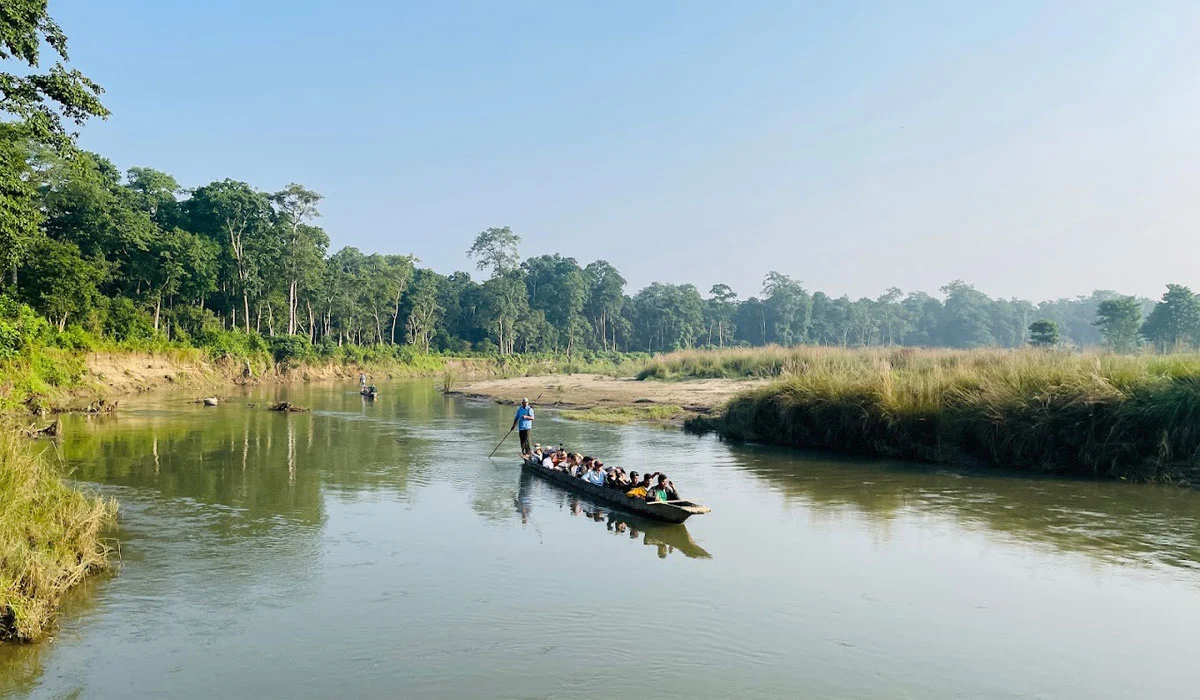
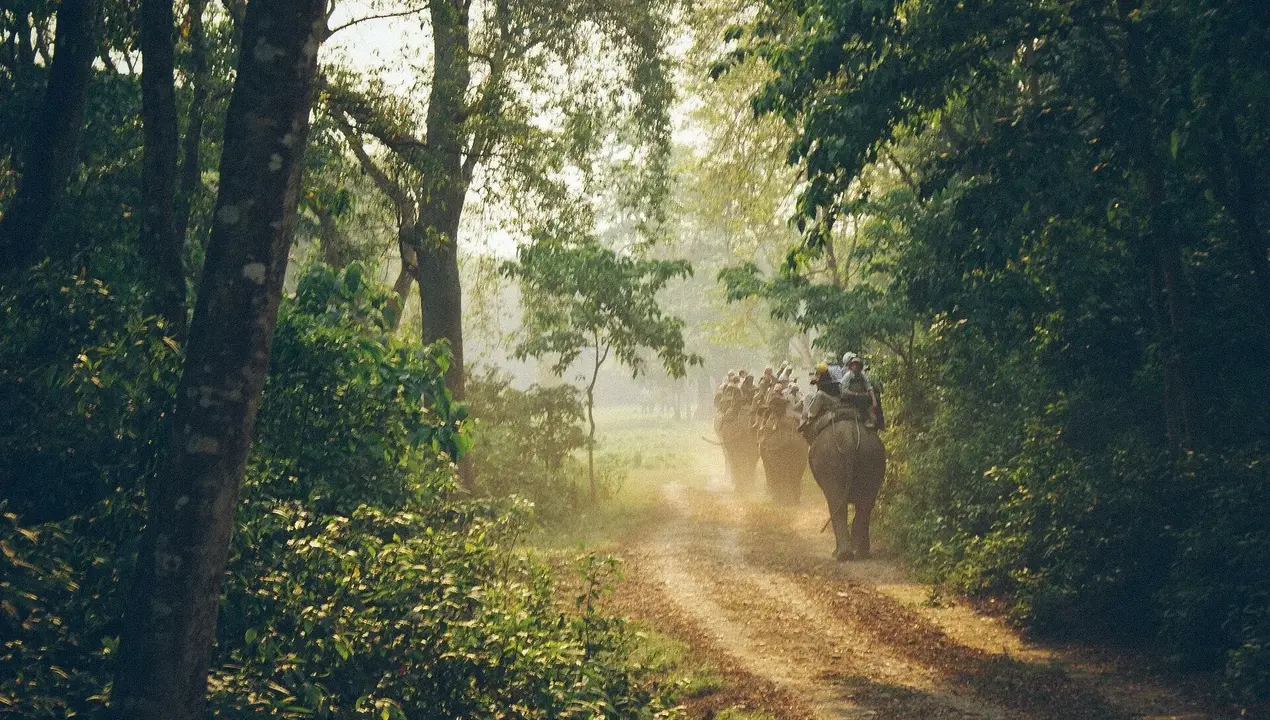
The drive from Chitwan National Park (Sauraha) to Lumbini — the birthplace of the Buddha and one of Nepal’s most sacred UNESCO World Heritage Sites — is one of Nepal’s finest and most rewarding tourist vehicle journeys: a straight Terai highway run of approximately 165 to 175 kilometres, taking 3 to 4 hours by private vehicle, connecting Nepal’s finest wildlife destination with its most important Buddhist pilgrimage site in a single comfortable day’s travel.

Most tourists who visit both Chitwan and Lumbini route through Kathmandu or Pokhara between the two — a detour that adds 2 to 3 unnecessary travel days to the Nepal circuit. The direct Chitwan-to-Lumbini private jeep connection makes this detour entirely avoidable: Sauraha to Lumbini via the Terai highway is quicker, cheaper, and more direct than any Kathmandu-routed alternative.

Nepal Vehicle Hiring Pvt. Ltd. offers this direct connection as a standard service—private car hire, Hiace van hire, and Coaster bus hire for every group size —with all-inclusive pricing and confirmed hotel-to-hotel delivery.

This complete guide covers the Chitwan-to-Lumbini route in detail: distance and drive time, the best price for private jeep hire by vehicle type and group size, what to do in Lumbini, seasonal considerations, and how to combine Chitwan and Lumbini into the most efficient Nepal circuit.

Chitwan to Lumbini: Quick Reference

Distance (Sauraha to Lumbini Sacred Garden)165 to 175 km via Narayanghat–Butwal–Bhairahawa
Drive time3 to 4 hours by private vehicle (no major stops)
Road typeFlat Terai highway (Mahendra Highway / East-West Highway) — smooth blacktop
Best vehicle for 2 paxPrivate car hire — US$110 all-in
Best vehicle for 4–6 pax4WD jeep (Scorpio) — NPR 10 to 22,000 all-in
Best vehicle for 8–14 paxHiace van — NPR 15,000 to 30,000 all-in
Best vehicle for 15–25 paxCoaster bus — NPR 25,000 to 40,000 all-in
Lumbini entry feeNPR 200 per foreign national
Recommended visit time2 to 3 hours minimum; full day for monastery zone
Booking lead time24–48 hours (off-peak); 3–5 days (Oct–Nov peak)

Private Jeep Hire Prices: Chitwan to Lumbini

All Nepal Vehicle Hiring prices are all-inclusive — vehicle, licensed driver, fuel, and all road charges—no end-of-journey additions.

VehicleCapacityAll-In Price
Private Car (Sedan/SUV)2–4 paxNPR 6000–15,000
4WD Jeep (Mahindra Scorpio)4–7 paxNPR 10,000–22,000
Toyota Land Cruiser4–5 paxNPR 25,000–40,000
Hiace Van8–14 paxNPR 20,000–30,000
Coaster Bus15–25 paxNPR 30,000–40,000

Contact Nepal Vehicle Hiring via our plan your trip page or WhatsApp for confirmed pricing. Note: Nepal Vehicle Hiring’s Sauraha driver may need to deadhead from Kathmandu or Pokhara to reach Sauraha for the pickup — for early morning departures, arrange the vehicle the day before to ensure the driver is overnight in Sauraha.

The Route: Sauraha to Lumbini via Terai Highway

The Chitwan-to-Lumbini route runs entirely on Nepal’s flat Terai highway network—one of Nepal’s most comfortable and fastest driving environments. No mountain roads, no off-road sections, no altitude changes. The route:

SectionDistanceRoadDrive TimeNotes
Sauraha to Narayanghat~30 kmProvincial road40–50 minThrough Tadi Bazaar and Bharatpur; last reliable ATMs
Narayanghat to Butwal~115 kmMahendra Highway2–2.5 hrsFlat Terai, fast highway; passes Deukhuri valley
Butwal to Bhairahawa~22 kmMahendra Highway25–30 minSiddharthanagar — last city before Lumbini
Bhairahawa to Lumbini Sacred Garden~22 kmSiddhartha Highway25–30 minRoad east from Bhairahawa; UNESCO site entrance

The Mahendra Highway between Narayanghat and Butwal is the longest and most comfortable section — wide, well-maintained blacktop through the western Terai sal forest belt. The highway passes through the scenic Deukhuri valley where the Terai plains give way briefly to a forested mid-hill corridor before returning to flat Terai near Butwal.

This section has limited stopping points, but the sal forest corridor is a genuine wildlife sightings zone — langur monkeys and occasional deer are visible from the road.

Why the Direct Chitwan–Lumbini Route Beats Going via Kathmandu

The most common Nepal tourist circuit routes Chitwan and Lumbini via Kathmandu — either because tourists don’t realise the direct Terai connection exists, or because packaged itineraries are built around the Kathmandu hub. The direct Sauraha-to-Lumbini vehicle connection is significantly better on every practical dimension:

FactorVia KathmanduDirect Terai Route
Distance~490 km (Sauraha → KTM → Lumbini)~170 km (Sauraha → Lumbini direct)
Drive time2 days minimum3–4 hours —same-day arrival
Cost (private car, 2 pax)~NPR 18,000–35,000 (two vehicle legs)US$110 (one vehicle leg)
Overnight accommodationExtra 1–2 nights in KathmanduNone required — same-day connection
FatigueTwo mountain/highway road daysOne flat, comfortable Terai drive
Schedule flexibilityFixed via Kathmandu hubDepart any time from Sauraha lodge

Lumbini: What to See and Do After the Jeep Arrival

Arriving at Lumbini by private jeep from Chitwan lets tourists explore the UNESCO site at their own pace—not on a fixed group tour schedule. The site’s key components:

Maya Devi Temple and Sacred Garden

The Maya Devi Temple marks the precise birthplace of Siddhartha Gautama (the historical Buddha, born c. 563 BCE) — confirmed by the Ashoka Pillar, inscribed in 249 BCE by Emperor Ashoka, who visited Lumbini on pilgrimage, with the inscription ‘Here the Buddha, the Sage of the Shakyas, was born.’

The stone bearing the birth marker is visible in the temple’s inner sanctum. The surrounding Sacred Garden contains the Puskarini sacred pool — where, according to Buddhist tradition, Maya Devi (the Buddha’s mother) bathed before giving birth — and ancient brick ruins of monasteries dating to the Maurya and later periods.

The International Monastery Zone

North of the Sacred Garden, along a 1.5-kilometre central canal, runs the international monastery zone — two parallel rows of national monastery compounds built by Buddhist countries from around the world. The east zone has Theravada monasteries (Myanmar, Sri Lanka, Thailand, Cambodia, Laos); the west zone has Mahayana and Vajrayana monasteries (Nepal, China, Korea, Japan, Germany, France, Vietnam, Bhutan, Tibet).

Each monastery is architecturally distinctive — the Myanmar Golden Temple, the Korean temple, the Japanese Peace Pagoda, and the Royal Thai Monastery are the most visited. A focused monastery circuit takes 1 to 1.5 hours at a relaxed pace.

World Peace Flame and Eternal Peace Flame

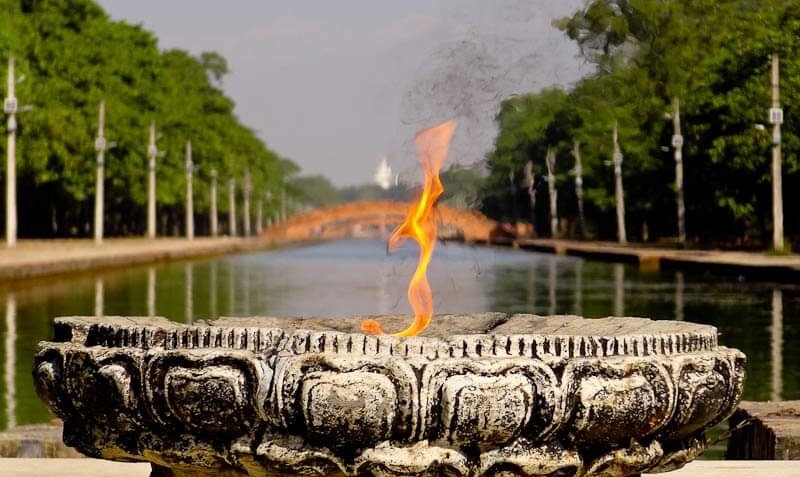
The Eternal Peace Flame in the Sacred Garden — lit from flame fragments collected from conflict zones worldwide — burns continuously as a symbol of the Buddha’s message of peace. Nepal Vehicle-Hiring drivers know the exact location and include a brief stop as part of the Sacred Garden circuit.

Who Books the Chitwan–Lumbini Private Jeep

Buddhist Pilgrims

Buddhist pilgrims — from Nepal, Sri Lanka, Myanmar, Thailand, Korea, Japan, China, and the global Buddhist diaspora — make the Chitwan-to-Lumbini connection as part of a broader Buddhist sacred circuit of India and Nepal. The Lumbini pilgrimage (the Buddha’s birthplace), combined with India’s Buddhist circuit (Bodh Gaya, Sarnath, Kushinagar), is the most important Buddhist pilgrimage journey.

Chitwan wildlife is a natural, rewarding addition for flexible pilgrim groups. Nepal Vehicle Hiring’s Hiace van hire and Coaster bus hire serve Buddhist pilgrim groups on this route.

Hindu Pilgrims

Hindu pilgrims incorporating Lumbini into their Nepal pilgrimage circuit — whether as part of the Nepal Nekhor tour sacred circuit (Pashupatinath, Muktinath, Lumbini, Janakpur) or as a Lumbini visit after Chitwan’s wildlife — find the direct Terai route far more practical than routing through Kathmandu. Many Hindu pilgrims venerate the Buddha as an avatar of Vishnu, making Lumbini a natural and theologically coherent addition to the pilgrimage.

Nepal Triangle + Lumbini Extension

Tourists doing the standard Nepal triangle (Kathmandu-Pokhara-Chitwan) who want to add Lumbini without significantly extending their itinerary can do so via the direct Chitwan-to-Lumbini connection — spending 2 nights at Chitwan for wildlife, then a half-day drive to Lumbini (arriving in the afternoon), a Lumbini morning visit, and then Bhairahawa-to-Kathmandu by bus or the Sunauli-to-Kathmandu return. This adds only 1-2 days to the standard triangle itinerary.

Kailash Yatra Return Pilgrims

Kailash Mansarovar Yatra return pilgrims coming from Kodari through Kathmandu and heading to the Sunauli border (as covered in the Kodari-to-Sunauli guide) sometimes include a Chitwan 1-night extension before the Bhairahawa border crossing. The Chitwan-to-Lumbini connection serves these pilgrims perfectly — a Chitwan wildlife overnight followed by the short Lumbini morning visit before the Sunauli India border crossing.

Sample Itineraries Combining Chitwan and Lumbini

2-Day Chitwan + Lumbini Circuit from Kathmandu

Day 1: Kathmandu → Chitwan (Nepal Vehicle Hiring: Hiace van hire or car hire in Nepal, 4 to 5 hours, Manakamana optional). Afternoon canoe on the Rapti River.

Day 2: Early morning Chitwan jeep safari (core zone, 5:30 AM). Return for breakfast. Nepal Vehicle Hiring: private jeep from Sauraha to Lumbini (3 to 4 hours; depart 10:00 AM, arrive 1:30 PM).

Lumbini Sacred Garden and monastery zone visit (2 to 3 hours). Depart Lumbiniat  4:30 PM. Nepal vehicle hire continues from Lumbini to Kathmandu via Bhairahawa and Prithvi Highway (6 to 7 hours, overnight journey or next-morning flight).

Lumbini as Part of the Nepal Nekhor Pilgrimage Circuit

The Nepal Nekhor tour sacred circuit — connecting Pashupatinath, Muktinath, Lumbini, and Janakpur — can be routed to include Chitwan before Lumbini: Kathmandu → Chitwan (2 nights) → Lumbini (1 to 2 nights) → Janakpur (1 night) → return to Kathmandu. The Chitwan-to-Lumbini private jeep connects wildlife to the sacred circuit, while the Lumbini-to-Janakpur leg continues east on the Terai highway.

Pokhara–Chitwan–Lumbini–Sunauli One-Way Circuit

For tourists ending their Nepal visit at the India border: Pokhara → Chitwan (Nepal Vehicle Hiring vehicle, 3 to 4 hours) → 1 night Chitwan → Chitwan to Lumbini direct (3 to 4 hours) → Lumbini visit → Bhairahawa → Sunauli India border crossing. This one-way circuit avoids returning to Kathmandu entirely and is the most efficient overland exit from Nepal to India for tourists who have already done the Kathmandu circuit.

Seasonal Conditions: Chitwan to Lumbini Drive

SeasonMonthsRoad ConditionsNotes
SpringMar–MayExcellent — dry, hot (30–38°C)Good wildlife at Chitwan; Lumbini busy pre-monsoon
MonsoonJun–SepGenerally fine — Terai highway rarely floodsChitwan park partially restricted; Lumbini open year-round
Post-MonsoonOct–NovBest — cool, dry, clearPeak season; best Chitwan wildlife and Lumbini conditions
WinterDec–FebGood — cool (18–25°C), comfortableExcellent visibility; Lumbini at its best — cool and clear

The Terai highway between Narayanghat and Bhairahawa is one of Nepal’s most weather-resilient roads — the flat Terai terrain means it rarely floods or closes even in heavy monsoon rain. The Chitwan-to-Lumbini drive is reliable year-round, keeping this connection open for tourists in all seasons.

Practical Tips: Chitwan to Lumbini by Private Jeep

  • Depart Sauraha after the morning safari: the 5:30 AM morning jeep safari ends by 9:00 to 9:30 AM — a 10:00 AM Sauraha departure reaches Lumbini by 1:30 to 2:00 PM, allowing a 2 to 3 hour Sacred Garden visit before the 5:00 PM closing approach.
  • Withdraw cash at Narayanghat: ATMs in Narayanghat (NIC Asia, Nepal SBI) are the most reliable on the Terai route. Lumbini has some ATMs, but reliability is variable — carry NPR for Lumbini entry, restaurant meals, and monastery donations from Narayanghat.
  • Book Lumbini accommodation in advance for overnight stays: Lumbini has a range of accommodation from budget guesthouses to the Lumbini Garden New Crystal Hotel — book in advance for October-November peak season and the Buddhist pilgrimage festivals (Vesak/Buddha Purnima in May is Lumbini’s most important festival and draws tens of thousands of pilgrims).
  • Allow time in the monastery zone: many tourists underestimate how long the monastery zone rewards exploration. The Myanmar Golden Temple, the Korean temple, and the Great Drigung Kagyud Lotus Stupa each deserve 15 to 20 minutes of your attention. Allow 1.5 to 2 hours for the monastery zone circuit.
  • The Sacred Garden closes at sunset: the Maya Devi Temple inner sanctum has restricted entry times (check current hours with your jungle lodge before departure from Sauraha). Arriving at Lumbini by 2:00 PM ensures 3+ hours of Sacred Garden visiting time before closing.
  • Consider the Lumbini Museum: the Lumbini International Research Institute and the Lumbini Museum (in the northern monastery zone area) provide excellent contextual exhibits on Buddhist history, Ashokan inscriptions, and the archaeological history of the Lumbini site — worth 45 minutes for interested visitors.

Frequently Asked Questions: Chitwan to Lumbini Private Jeep

How far is Chitwan from Lumbini?

The distance from Sauraha (Chitwan’s tourist hub) to the Lumbini Sacred Garden entrance is approximately 165 to 175 kilometres by road, taking 3 to 4 hours by private vehicle on the Terai highway.

What is the best price for a private jeep from Chitwan to Lumbini?

Nepal Vehicle Hiring’s all-inclusive prices for the Chitwan-to-Lumbini private vehicle: US$110 for a private car (2 to 4 passengers); NPR 10,000 to 20,000 for a Scorpio jeep (4 to 7 passengers); NPR 15,000 to 25,000 for a Hiace van (8 to 14 passengers). All prices include vehicle, driver, fuel, and road charges. Contact Nepal Vehicle Hiring on WhatsApp for confirmed pricing.

Is it better to go directly from Chitwan to Lumbini or via Kathmandu?

Directly. The Chitwan-to-Lumbini direct Terai highway (165 km, 3 to 4 hours) is significantly faster, cheaper, and simpler than routing via Kathmandu (490 km, 2 days, 2 extra nights’ accommodation). The direct route is the obvious practical choice for any tourist who wants to see both Chitwan and Lumbini on the same Nepal trip.

Can I visit Lumbini as a day trip from Chitwan?

Yes — a Lumbini day trip from Chitwan is practical. Depart Sauraha at 9:00 to 10:00 AM (after the morning safari), arrive in  Lumbini by 1:00 to 2:00 PM, visit the Sacred Garden and selected monasteries (2 to 3 hours), and return to Sauraha by 8:00 to 9:00 PM.

The day trip requires a round-trip vehicle — add approximately 30 to 40% to the one-way price for the return journey. Most tourists prefer an overnight stay in Lumbini for a more complete visit.

Does Nepal Vehicle Hiring provide vehicles in Sauraha (Chitwan)?

Nepal Vehicle Hiring is based in Thamel, Kathmandu. For Sauraha pickups, our driver travels to Sauraha from Kathmandu or Pokhara the previous day for morning departures. Confirm your Sauraha departure at least 24 to 48 hours in advance to allow driver positioning.

Contact us via our plan your trip page or WhatsApp

Nepal Vehicle Hiring’s all-inclusive price covers the vehicle, experienced licensed driver, fuel for the complete Chitwan-to-Lumbini journey, and all road and bridge charges. Not included: Lumbini entry fee (NPR 200 per foreign national), passenger meals and accommodation, Lumbini museum entry, and driver tip (at passenger discretion).

Book Your Chitwan to Lumbini Vehicle with Nepal Vehicle Hiring

Nepal Vehicle Hiking Pvt. Ltd., Thamel, Kathmandu — all vehicle types for the Chitwan-to-Lumbini Terai route:

Visit our Plan Your Trip page with your Sauraha departure date, group size, and Lumbini plans. We confirm the vehicle, all-in price, and driver within 24 hours. Chitwan’s wildlife and Lumbini’s sacred history are two of Nepal’s finest experiences — Nepal Vehicle Hiring connects them in a single comfortable journey.

Lumbini’s Sacred Significance: What Every Visitor Should Know

Lumbini is not simply a heritage site or a museum — it is one of the four most sacred places in Buddhism, alongside Bodh Gaya (where the Buddha attained enlightenment), Sarnath (where he delivered his first teaching), and Kushinagar (where he passed into parinirvana). Together, the four form the most important Buddhist pilgrimage circuit in the world, drawing hundreds of thousands of devotees annually from every Buddhist country.

The historical certainty of Lumbini’s identification as the Buddha’s birthplace is exceptional for ancient religious sites — the Ashoka Pillar’s 249 BCE inscription (‘Here the Blessed One was born’) is the oldest known dated stone inscription in the Indian subcontinent and provides documentary confirmation more than 300 years before most comparable sacred sites have any written record. Archaeological excavations since 1996 have uncovered a brick structure beneath the Maya Devi Temple that radiocarbon-dates to approximately the 6th century BCE — consistent with the traditional birth date of Siddhartha Gautama.

For Hindu visitors — who make up a significant proportion of Lumbini’s visitors given India and Nepal’s predominantly Hindu populations — Lumbini is the birthplace of an avatar of Vishnu. The Dashavatara tradition (ten primary avatars of Vishnu) includes the Buddha as the ninth avatar in most traditional listings, making Lumbini as much a Vaishnava sacred site as a Buddhist one. Lumbini’s mixed Hindu-Buddhist visitor community reflects this shared sacred landscape.

Tourists approaching Lumbini from Chitwan by Nepal Vehicle Hiring’s private jeep arrive at one of the best-preserved and best-managed UNESCO sacred landscapes in South Asia — a site where the historical significance is substantiated by archaeology, the sacred dimension is living and actively practised, and the physical setting (the Sacred Garden, the Ashoka Pillar, the ancient ruins, the international monastery corridor) is genuinely beautiful and deeply moving.

Butwal: The Midpoint Stop on the Chitwan–Lumbini Road

Butwal — approximately halfway between Narayanghat and Bhairahawa on the Mahendra Highway — is the standard midpoint rest stop on the Chitwan-to-Lumbini drive. With a population of about 200,000, Butwal is one of Nepal’s fastest-growing cities and a key commercial centre for the western Terai. For tourists on the Chitwan-to-Lumbini vehicle journey:

  • Rest stop: Butwal’s highway food stalls and restaurants along the main Terai bazaar road serve standard Nepali dhaba (roadside eatery) food — dal bhat, noodle soup, fried rice, and tea. Nepal Vehicle Hiring drivers use Butwal for a standard 20- to 30-minute rest and food stop, about 1.5 to 2 hours from Sauraha.
  • Fuel: Butwal has reliable petrol stations with both petrol and diesel — Nepal Vehicle Hiring drivers fuel at Butwal if needed for the Bhairahawa approach.
  • Tinau River: The Tinau River crossing at Butwal is one of the more scenic moments on the otherwise flat Terai highway — the river emerges from the Siwalik Hills immediately north of Butwal in a dramatic gorge before spreading into the plains. The Butwal riverside area offers a pleasant walk along the riverbank if you have time for a 15-minute stop.

Beyond Butwal, the highway continues through the flat Bhairahawa plains to Siddharthanagar — the city renamed in honour of Siddhartha Gautama and the urban gateway to Lumbini. The 22-kilometre Bhairahawa-to-Lumbini road east of the city follows the Siddhartha Highway into the UNESCO site.

Lumbini Development Zone: Understanding the Site’s Layout

The Lumbini Development Zone — the managed UNESCO heritage area — was designed by the Japanese architect Kenzo Tange in the 1970s as a comprehensive master plan for the site’s development. Understanding Tange’s design helps visitors navigate the zone’s layout and make the most of their time:

The zone is organised on a north-south axis approximately 4.8 kilometres long. At the southern end is the Sacred Garden — the original pilgrimage area containing the Maya Devi Temple, the Ashoka Pillar, the Puskarini pool, and the ancient monastic ruins.

North of the Sacred Garden, a central canal runs the length of the 1.5-kilometre monastery zone — the east bank with Theravada Buddhist country monasteries, the west bank with Mahayana and Vajrayana monasteries. At the zone’s northern end are the Lumbini Museum and the Lumbini International Research Institute.

A tourist bus (electric vehicle) runs along the central canal for visitors who prefer not to walk the full 1.5-kilometre length.

Most Chitwan-to-Lumbini visitors on a 2- to 3-hour visit focus on the Sacred Garden and Maya Devi Temple (45 to 60 minutes), 3 to 4 selected monasteries in the international zone (30 to 45 minutes), and a walk along the central canal (15 minutes). For visitors with 4+ hours, the full monastery zone circuit plus the museum is a deeply rewarding extended visit.

Lumbini is best explored on foot (within the Sacred Garden and the immediately accessible monastery zone) or by the electric tourist bus (for the northern sections). Nepal Vehicle Hiring’s vehicle waits at the Lumbini Development Zone car park while passengers explore the site — our driver will be at the car park and available by phone for any timing adjustments during the visit.

Bhairahawa: The Lumbini Gateway City

Bhairahawa (officially renamed Siddharthanagar) is the major city nearest to Lumbini — 22 kilometres west of the Sacred Garden and the practical base for Lumbini visitors who need hotels, restaurants, ATMs, and services not available within the development zone itself.

For Chitwan-to-Lumbini private jeep passengers, Bhairahawa serves as: the final city before Lumbini for any last cash withdrawals (NIC Asia, Nepal SBI, Everest Bank ATMs); the accommodation base for overnight Lumbini stays (several hotels including Hotel Nirvana and similar mid-range properties are well-positioned for the Lumbini morning visit); the connection point for passengers who need to fly back to Kathmandu from Gautam Buddha International Airport (BHR, domestic flights 30 minutes to KTM) or onward to India via the Sunauli-Belahiya border crossing (4 km south of Bhairahawa city centre).

Nepal Vehicle Hiring’s Sauraha-to-Lumbini vehicle passes through Bhairahawa as part of the standard route, and our driver makes any needed city stops (ATM, hotel drop, airport connection, or Sunauli border drop) as required. Passengers who want the vehicle to continue from Lumbini to the Sunauli India border or to Bhairahawa Airport can request this as part of the onward journey — confirm with Nepal Vehicle Hiring’s operations team when booking.

The Chitwan–Lumbini Journey: What the Terai Reveals

For many international tourists, the Chitwan-to-Lumbini Terai highway drive is their longest encounter with Nepal’s southern plain, he lowland ecological zone that extends from India’s Gangetic plain, constitutes about 17 per cent of Nepal’s total land area and supports over half its agriculture and a significant portion of its population.

The Terai along the Mahendra Highway between Narayanghat and Butwal passes through the Churia (Siwalik) range’s southern foothills on one side and the flat agricultural plains on the other — a landscape of rice and wheat fields, thatched village houses, sal forest patches, and the occasional river crossing. The Deukhuri valley section (roughly between Lamahi and Sunwal) is particularly scenic — a broad river valley between the outer Siwalik range and the inner Churia that creates a momentary mid-hills character in the middle of the otherwise flat Terai highway.

Birdlife along the Terai highway is rich for observant passengers — the sal forest patches adjacent to the highway corridor support painted storks, adjutant storks, Asian openbill storks, common mynas, various bee-eaters, and the Terai’s distinctive raptor community including crested serpent eagles and changeable hawk-eagles. Nepal Vehicle Hiking drivers will pause briefly at the roadside for any exceptional wildlife sighting, on request.

The overall character of the Chitwan-to-Lumbini drive — flat, comfortable, fast, through one of South Asia’s most biodiverse lowland landscapes — makes it a genuinely pleasant and interesting journey in its own right, not just a transit between two destinations. The contrast with the mountain approaches that most Nepal tourists are more familiar with is striking: this is Nepal at sea level, warm and green and richly populated, as different from Kathmandu or the Annapurna foothills as possible while still being Nepal.

From Lumbini: Where to Go Next

After the Lumbini visit, Nepal Vehicle Hiring provides onward transport in several directions depending on the tourist’s circuit:

  • Lumbini to Kathmandu (300 km, 6 to 7 hours): the most common onward route — north on the Siddhartha Highway to Butwal, then east on the Mahendra Highway to Narayanghat and north on the Prithvi Highway to Kathmandu. Nepal Vehicle Hiring’s Hiace van and car hire serve this route for groups of all sizes.
  • Lumbini to Pokhara (200 km, 4 to 5 hours): north from Bhairahawa on the Siddhartha Highway through the Palpa hills to Pokhara. A scenic alternative to the Kathmandu route for tourists doing Pokhara before flying home.
  • Lumbini to Sunauli border (22 km, 30 minutes): for India-bound tourists ending their Nepal circuit at the Sunauli-Belahiya crossing. Nepal Vehicle Hiring drops at the Belahiya Nepal immigration gate.
  • Lumbini to Janakpur (300 km, 5 to 6 hours east on the Mahendra Highway): for the Nepal Nekhor pilgrimage circuit continuing to the birthplace of Goddess Sita in the Mithila heartland.
  • Lumbini to Bhairahawa Airport (22 km, 30 minutes): for domestic flights back to Kathmandu (25 minutes) or connections via Kathmandu to international destinations.

Nepal Vehicle Hiring coordinates all onward connections from Lumbini as part of the complete Nepal circuit booking — one operator, all vehicle legs, complete circuit certainty. Contact us via WhatsApp to plan the complete Chitwan-Lumbini-onward vehicle circuit for your Nepal trip.

Lumbini and Chitwan in Nepal’s Tourism: The Under-Explored Connection

Despite the obvious logic of combining Chitwan and Lumbini in a single Nepal circuit — wildlife and spirituality, two UNESCO World Heritage Sites, flat highway connection, no backtracking — the Chitwan-Lumbini direct connection remains significantly less trafficked than it deserves. Most tour operators route tourists through Kathmandu between the two sites because their itineraries are built around the capital hub; most individual tourists follow these operator itineraries without realising the direct option exists.

Nepal Vehicle Hiring’s Chitwan-to-Lumbini private jeep service addresses this gap directly — making the direct connection as easy to book as any Kathmandu-routed alternative, at a fraction of the cost and time. The 165-kilometre Terai drive connecting Nepal’s finest wildlife park to its most sacred Buddhist pilgrimage site is one of Nepal’s best-kept logistical secrets, and Nepal Vehicle Hiring’s transparent pricing and 24/7 WhatsApp booking make it accessible to every Nepal tourist who knows to ask.

WhatsApp to book a private jeep from Chitwan to Lumbini. The drive takes 3-4 hours. Memories from both destinations will last much longer.

Chitwan and Lumbini: Two UNESCO Sites, One Day’s Drive Apart

Nepal has ten UNESCO World Heritage Sites — more per square kilometre than almost any other country on Earth. Two of these sit within a single day’s drive of each other on the western Terai: Chitwan National Park (inscribed 1984, Outstanding Universal Value for its biodiversity and wildlife conservation achievements) and Lumbini, the Birthplace of the Lord Buddha (inscribed 1997, Outstanding Universal Value as the most sacred place of one of the world’s great religions).

Combining two UNESCO World Heritage Sites in a single day in Nepal— a morning wildlife safari at Chitwan and an afternoon sacred garden at Lumbini—offers an extraordinary concentration of Nepal’s finest heritage in a single 12-hour period. Few places in the world offer this density of UNESCO-designated experiences within a 3-hour drive. The Chitwan-to-Lumbini private jeep makes this combination possible.

Nepal Vehicle Hiring’s drivers understand the UNESCO significance of both sites and typically share relevant historical and ecological context with passengers during the Terai highway journey — the drive between two extraordinary sites is itself a time for learning, for quiet reflection, or for the simple pleasure of watching Nepal’s flat southern landscape roll by as the vehicle transitions from the wildlife world to the sacred world.

Understanding Chitwan National Park Before Leaving

Most tourists who make the Chitwan-to-Lumbini jeep connection depart from Sauraha after at least one night and one morning safari at Chitwan. Understanding what Chitwan’s wildlife experience offers — and what it means in global conservation terms — gives the departure a richer sense of what you’ve just witnessed.

Chitwan National Park protects one of the last undisturbed areas of the Terai-Duar savanna and grassland ecosystem — a landscape that once extended continuously from Pakistan’s Indus plain to Bangladesh’s Brahmaputra delta before agriculture, urbanisation, and hunting reduced it to scattered fragments. Chitwan’s 952-square-kilometre core zone and 750-square-kilometre buffer zone together represent the finest remaining expression of this lowland ecosystem in Asia.

The greater one-horned rhinoceros population at Chitwan — approaching 700 individuals — represents one of wildlife conservation’s most dramatic success stories. Commercial hunting and habitat loss reduced the species to fewer than 100 animals by the early 20th century; today, Chitwan holds the largest single population of the species anywhere.

Tourists who saw rhinos during the morning jeep safari or from the riverbank witnessed animals whose survival reflects decades of conservation effort, legal protection, and community engagement that Nepal has sustained even during periods of significant political and economic challenge.

The Bengal tiger population at Chitwan — approximately 100 animals — has more than doubled since Nepal’s conservation programme began its most intensive phase in the early 2000s. Nepal is one of the few countries where tiger populations are genuinely increasing, and Chitwan is the centrepiece of this recovery.

The animal that may have been glimpsed as a pugmark in the mud, an alarm call from a deer, or — in the fortunate moments — a direct sighting in the sal forest is one of the most endangered large mammals on Earth, and its presence at Chitwan is a conservation achievement that deserves genuine recognition.

Departing Chitwan for Lumbini with this wildlife context in mind gives the journey its proper weight: leaving one of the world’s most important conservation landscapes for one of the world’s most important sacred landscapes, connected by a flat Terai highway through the fertile plains that both wildlife and human civilisation have always depended on in this part of the subcontinent.

Lumbini’s International Community: The Monastery Zone in Depth

The international monastery zone at Lumbini — which tourists crossing from Chitwan have the afternoon to explore — is one of the most remarkable architectural and cultural collections in South Asia: a living embodiment of Buddhism’s global reach, assembled in a single planned landscape in the southern Nepal plains.

East Zone: Theravada Buddhism

The east bank of the central canal hosts the Theravada Buddhist countries — the tradition dominant in Southeast Asia and Sri Lanka. The Myanmar Golden Temple (Mahabodhi Society of Myanmar) is the most visually striking in this zone — a pagoda in the distinctive Myanmar tiered-spire style, with intricate gilded exterior carving. The Sri Lanka Mahabodhi Society temple, the Cambodia-style vihara, and the Thai monastery each express their country’s distinctive Buddhist architectural language.

West Zone: Mahayana and Vajrayana Buddhism

The west bank hosts the Mahayana and Vajrayana traditions — dominant in East Asia and the Himalayan regions. The Korean monastery and its distinctive wooden pavilion architecture, the Chinese Buddhist Association temple with its classical Chinese roof forms, the German Dharmaduta Society’s European-inflected meditation centre, the Vietnamese Phap Hoa Monastery, and the Great Drigung Kagyud Lotus Stupa (Tibetan Vajrayana) each represent different expressions of the northern Buddhist traditions that stretch from Germany to Japan.

Nepal’s Own Monastery

Nepal’s contribution to the international monastery zone, the Lumbini Buddhist Viha, represents the host nation’s Newar Buddhist tradition, which has maintained continuous Buddhist practice in the Kathmandu Valley for over 1,500 years and is one of the world’s oldest surviving Buddhist communities. The Newar Buddhist tradition blends Vajrayana tantric practice with local Kathmandu Valley cultural forms in ways that distinguish it from both the Theravada and the Tibetan Vajrayana.

For tourists arriving from Chitwan with 2 to 3 hours at Lumbini, the monastery zone circuit is best approached with specific priorities: choose 3 to 5 monasteries that reflect either the Buddhist traditions you know best (for practising Buddhists) or the architectural styles you find most striking (for cultural tourists), and take time inside each to appreciate the specific expression of Buddhist practice and aesthetics that the national community has brought to this shared sacred landscape.

Vesak and Buddhist Festival Season at Lumbini

For tourists who can time their Chitwan-to-Lumbini visit to coincide with a major Buddhist festival, the itinerary becomes a living pilgrimage, gathering extraordinary scale and diversity.

The most important Lumbini festival is

Vesak — also known as Buddha Purnima, Buddha Jayanti, or Visakha Puja depending on the tradition — is celebrated on the full moon of the lunar month of Vaishakha (typically April to May). Vesak commemorates the Buddha’s birth, enlightenment, and parinirvana simultaneously and is the single most important day in the Buddhist calendar for all traditions worldwide.

At Lumbini, the Vesak celebration draws tens of thousands of pilgrims from across Nepal, India, and internationally — the Sacred Garden and the monastery zone fill with devotees from every Buddhist country, the central canal is lit with butter lamps, and the Maya Devi Temple receives a continuous stream of worshippers through the day and night.

For Chitwan-to-Lumbini private jeep passengers timing a Vesak visit: Nepal Vehicle Hiring recommends arriving at Lumbini the day before Vesak for accommodation booking (Lumbini and Bhairahawa fill on Vesak) and the full-day experience of the festival. Contact Nepal Vehicle Hiring via WhatsApp at least 3 to 4 weeks before a Vesak Lumbini visit for vehicle booking — demand is high across the entire Terai in this window.

Comparing Private Jeep vs Tourist Bus: Chitwan to Lumbini

Some tourists consider using the public tourist bus network to connect Chitwan and Lumbini rather than booking a private jeep. The following comparison helps with this decision:

  • Private jeep (Nepal Vehicle Hiring): departs your Sauraha jungle lodge gate at your chosen time (typically 9:30 to 10:00 AM after morning safari), delivers directly to Lumbini Sacred Garden entrance or Bhairahawa hotel, all-inclusive price confirmed in advance, luggage in the vehicle throughout, flexible stops at Butwal and Narayanghat as required. Journey time: 3 to 4 hours door-to-door.
  • Tourist bus (shared/public): departs from Sauraha bus stand at fixed morning times (approximately 6:30 to 7:00 AM — incompatible with morning safari), requires tuk-tuk from jungle lodge to bus stand, drops at Bhairahawa bus park (not Lumbini — requires local tuk-tuk from Bhairahawa to Lumbini, 22 km additional journey), shared with other passengers, luggage management on the bus. Per-person cost is lower (approximately NPR 400 to 600 per seat), but total time and logistics are significantly more complex.

Nepal Vehicle Hiring: Your Terai Transport Specialist

Nepal Vehicle Hiring’s Terai route services — Chitwan to Lumbini, Lumbini to Kathmandu, Lumbini to Pokhara, Chitwan to Kathmandu, and the complete western Terai circuit — are operated with the same standards as our mountain approach and Kathmandu Valley services: licensed vehicles, experienced drivers, all-inclusive pricing, written booking confirmation, and 24/7 WhatsApp operations support.

The Terai highway is one of Nepal’s easiest driving environments. Still, it rewards drivers who know the specific road conditions, the best rest stops, and the optimal timing for each section—knowledge our Terai-experienced drivers bring from hundreds of journeys on this corridor.

Nepal Vehicle Hiring’s Chitwan-to-Lumbini service is not a generic ‘Terai route vehicle’ but a carefully planned journey with attention to the ri departure times, the Lumbini visit window, and the onward connections that make the combined Chitwan-Lumbini day trip or circuit work smoothly.

Book the Chitwan-to-Lumbini private jeep via WhatsApp, email [email protected], or our plan your trip page at vehiclehiringnepal.com. Specify your Sauraha departure date, group size, Lumbini arrival preference, and onward destination after Lumbini. Nepal Vehicle Hiring confirms the vehicle, driver, all-in price, and departure time within 24 hours.

Chitwan’s rhinoceros and Lumbini’s sacred garden await — one vehicle, one comfortable day’s drive connects them both.

The Mahendra Highway: Nepal’s East-West Lifeline

The Mahendra Highway — officially known as the East-West Highway or Purba Paschim Rajmarg — is Nepal’s longest road, running about 1,027 kilometres from Mechi in the far east to Mahendranagar in the far west along Nepal’s Terai belt. The Chitwan-to-Lumbini private jeep uses the western section of this highway between Narayanghat and Butwal, covering approximately 115 kilometres of the highway’s most commercially active and tourist-frequented section.

The highway was constructed in stages from the 1960s to the 1990s, with bilateral assistance from the United States, China, and India on different sections, and represents Nepal’s most significant ground-level infrastructure investment since the Rana era. For tourists accustomed to Nepal’s more famous mountain roads — the Prithvi Highway’s gorge sections, the Solu-Khumbu off-road tracks, the Kali Gandaki approach — the Mahendra Highway’s flat, fast, straight character can feel anticlimactic.

But its flatness serves a purpose: it carries Nepal’s agricultural produce, commercial goods, and people through the country’s most productive lowland zone, and its reliability as a transport artery is a significant asset for the communities it serves.

For tourists on the Chitwan-to-Lumbini journey, the Mahendra Highway section offers a specific pleasure: watching Nepal’s Terai landscape at speed without the distraction of road-management anxiety. The windows open easily, the vehicle holds its lane comfortably, and the passing landscape — the sal forest canopy, the rural villages, the occasional flash of a river crossing, the distant Himalayan foothills on the northern horizon on clear days — can be absorbed without the white-knuckle attention that Nepal’s mountain roads demand from alert passengers.

Lumbini for Non-Buddhist Visitors: Why the Site Resonates Universally

Lumbini’s appeal extends significantly beyond the Buddhist pilgrim community. For non-Buddhist tourists — secular travellers, Hindu pilgrims, Christian or Muslim visitors, or simply curious travellers without specific religious affiliation — Lumbini offers a set of experiences that transcend any particular faith:

Historical Significance

The Buddha is one of the most historically significant human beings who ever lived — his teachings shaped the civilisations of East Asia and Southeast Asia. Over 2,500 years, the Himalayan world has influenced Western philosophy from the Hellenistic period onward and today guides the practice of approximately 500 million people.

Standing at the precise location of his birth—confirmed by archaeology and epigraphy to a degree of historical certainty that very few ancient religious sites can match—offers an encounter with history that any culturally aware visitor will find meaningful, regardless of religious affiliation.

Architectural Diversity

The international monastery zone is one of the world’s most concentrated displays of contemporary Buddhist architecture — a living comparison of how 20 Buddhist countries from Myanmar to Germany have interpreted their tradition’s sacred building conventions. For architecture enthusiasts, the monastery zone is an extraordinary open-air museum of 20th- and 21st-century religious architecture across cultures.

Landscape Peace

The Sacred Garden’s physical setting — the tree-lined central canal, the ancient mound of the Maya Devi Temple, the Ashoka Pillar rising from its stone base, the Puskarini pool reflecting the surrounding garden — has a quality of stillness and spatial dignity that is genuinely calming. Many non-religious visitors report Lumbini as one of the most peaceful places they visited in Nepa  a quality the site’s careful management, the absence of the commercial intensity found at many South Asian pilgrimage sites, and the Terai’s gentle light and atmosphere all contribute to.

Lumbini Accommodation: Overnight Options Near the Sacred Garden

For tourists arriving from Chitwan by private jeep who want to overnight at Lumbini rather than continuing to Bhairahawa, the Lumbini development zone and its immediate environs have a growing accommodation offer:

  • Lumbini Buddha Garden Hotel: within the development zone, reasonable quality, peaceful setting, popular with Buddhist pilgrim groups
  • Lumbini Garden New Crystal Hotel: mid-range, good facilities, close to Sacred Garden entrance
  • Hotel Nirvana and similar Bhairahawa hotels: 22 km from Lumbini but better services and more hotel options; suitable for groups wanting hotel quality above budget guesthouse standard
  • Monastery guesthouses: several international monasteries in the zone have basic guest facilities for Buddhist practitioners — enquire directly with specific monastery compounds

Nepal Vehicle Hiking recommends overnight in Lumbini (or Bhairahawa) rather than a day-trip-and-return to Sauraha for tourists who want a full Lumbini experience. The Sacred Garden at dawn—before the day-tour groups arrive from Bhairahawa—is one of Nepal’s most serene morning experiences, and only overnight visitors get to experience this window. Book accommodation in advance for October-November peak season and for Vesak (April-May full moon).

Packing for the Chitwan–Lumbini Day: What to Bring

The Chitwan-to-Lumbini journey shifts from the jungle microclimate of Sauraha to the open plains of Lumbini—but in the Terai, with a slightly different character. The following packing guidance covers the combined Chitwan morning safari + Lumbini afternoon visit day:

  • Light layers for temperature transition: Sauraha mornings in the 5:30 AM safari hour can be cool (15 to 20°C in October-November); the midday Terai highway and Lumbini afternoon rise to 28 to 35°C. Carry a light fleece in the vehicle cabin for early departure, then switch to lighter clothes for the Lumbini visit.
  • Sun protection: the Lumbini development zone has minimal shade in the open monastery zone corridor. Sunscreen (SPF 50), sunglasses, and a hat are important for the 2 to 3 hour Lumbini visit, particularly in the post-monsoon and spring seasons when the sun is intense.
  • Comfortable walking shoes: the Lumbini monastery zone involves 1 to 2 km of walking on paved paths. After a morning safari (often involving vehicle seating), comfortable flat walking shoes are appropriate and appreciated.
  • Camera and binoculars: the Chitwan morning safari and the Lumbini monastery zone are both visually rich environments deserving serious photography. Charge your camera fully the previous evening; clear the memory card for the day.
  • NPR cash: Lumbini entry fee (NPR 200 per foreign national), monastery donations (optional but appropriate — NPR 100 to 500 per visited monastery), lunch at Lumbini’s restaurants (NPR 400 to 800 per person), and any Lumbini souvenir or book purchases. ATMs are in Bhairahawa (22 km) — carry NPR from Narayanghat (30 minutes from Sauraha), where ATMs are reliable.
  • Water: carry at least 1.5 litres per person for the Lumbini visit. Water is available at Lumbini restaurants, but carrying your own supply for the monastery zone walk is practical.

The Terai’s Sacred Landscape: Chitwan, Lumbini, and Beyond

Chitwan and Lumbini are the best-known sacred and natural sites in Nepal’s Terai. Still, the western Terai has a much richer sacred landscape than these two UNESCO sites alone suggest. For tourists with extended Nepal schedules, the following additional Terai sacred sites are accessible from the Chitwan-to-Lumbini route:

  • Devghat (near Narayanghat): the confluence of the Trishuli and Kali Gandaki Rivers — a sacred tirtha (crossing place) where Hindu pilgrims cremate their dead, old sadhus come to live out their final years, and the annual Makar Sankranti festival draws 100,000+ pilgrims—a 115-to 220-minute detour from the Narayanghat route.
  • Palpa and Tansen: in the Palpa hills between Butwal and Pokhara, the historic Newari market town of Tansen is one of Nepal’s finest and least-visited medieval urban heritage sites — a 45-minute detour from the Butwal junction for tourists with time.
  • Kapilvastu (Tilaurakot): 27 km west of Lumbini, the archaeological site believed to be the palace of King Suddhodana — the Buddha’s father — where Siddhartha Gautama spent his childhood and young adulthood before renouncing the world. The site has a small museum and the atmospheric ruins of the ancient city, a natural extension of the Lumbini visit for interested tourists.
  • Janakpur: 300 km east of Lumbini on the Mahendra Highway, the birthplace of Goddess Sita and Nepal’s most important Mithila cultural centre. Nepal Vehicle Hiring’s Hiace van hire serves the Lumbini-to-Janakpur Terai highway connection as part of the Nepal Nekhor sacred circuit.

Nepal Vehicle Hiring’s Terai route vehicles can stop at any of these sacred and heritage sites on the Chitwan-to-Lumbini journey or as extensions of the Lumbini visit—coordinate with our operations team via WhatsApp when planning the Terai circuit.

Pokhara to Muktinath, Lumbini and Sunauli: Private Jeep Guide

Pokhara to Muktinath Lumbini Sunauli Private Jeep

Pokhara to Muktinath, Lumbini, Sunauli  Private Jeep: Complete Sacred Nepal Circuit Guide

Among the many remarkable overland journeys available in Nepal, one stands apart for its combination of sacred significance, geographic diversity, and logistical coherence: the circuit from Pokhara southward and westward through Muktinath’s pilgrimage temple at 3,710 metres, onward to Lumbini’s UNESCO-listed birthplace of the Buddha, and finally to the Sunauli border crossing connecting Nepal to India. This route — traversing the Kali Gandaki Gorge, the Terai plains, and the India-Nepal frontier — serves a specific and growing category of traveller: the Indian and Nepali pilgrim who combines Nepal’s two most sacred pilgrimage destinations (Muktinath for Hindu and Buddhist devotees, Lumbini for Buddhist pilgrims worldwide) with a Sunauli border crossing for the return home to India.

Nepal Vehicle Hiring Pvt Ltd (vehiclehiringnepal.com) provides private jeep hire for every stage of this sacred Nepal circuit — from Pokhara’s lakeside hotels to the Muktinath temple plateau, southward through the Mustang and Gandaki districts to the Terai highway, and westward to Lumbini and the Sunauli border. Our Pokhara-to-Upper Mustang overland jeep service covers the Kali Gandaki corridor to Muktinath.

Our 4WD jeep hire network connects the Muktinath plateau to the Lumbini Sacred Garden. Our private car hire service, Hiace van hire, and bus hire serve groups of all sizes, from family pilgrimage parties to large organised tour groups.

This complete guide covers every stage of the Pokhara-Muktinath-Lumbini-Sunauli circuit, with specific route descriptions, current costs in NPR and USD, practical tips, and the booking process for this sacred overland journey in Nepal.

The circuit described in this guide is not a single-day journey but a multi-day sacred itinerary — typically 3 to 5 days from Pokhara through Muktinath, Lumbini, and Sunauli — that requires coordinated vehicle hire across multiple stages. Nepal Vehicle Hiring Pvt Ltd excels at this multi-stage coordination: book the full circuit via a single conversation on WhatsApp, with all vehicles, drivers, timings, and all-inclusive pricing confirmed before departure.

Pokhara to Muktinath via Kali Gandaki — The Sacred Gorge Road

Stage 1: Pokhara to Muktinath — The Kali Gandaki Pilgrimage Road

Route Overview: Through the World’s Deepest Gorge

The Pokhara to Muktinath private jeep journey follows the Kali Gandaki Gorge — the world’s deepest river gorge, flanked by Annapurna I (8,091 m) to the east and Dhaulagiri (8,167 m) to the west — northward through Beni, Tatopani, Ghasa, Marpha, and Jomsom to the Muktinath temple complex at 3,710 metres. This is one of Nepal’s most spectacular overland drives: the gorge’s sheer scale, the progressive transition from subtropical Pokhara through temperate mountain forests to the arid high-altitude landscape of the Mustang region, and the sacred geography of the Muktinath valley all combine to make the journey itself an integral part of the pilgrimage experience rather than merely a logistical approach.

Nepal Vehicle Hiring Pvt Ltd’s Pokhara to Muktinath jeep service and Pokhara to Upper Mustang overland route both follow this extraordinary corridor.

Distance from Pokhara to Muktinath: approximately 177 to 185 kilometres. Drive time: 7 to 9 hours depending on road conditions and stops.

The road follows the Kali Gandaki River northward from Pokhara through Baglung and Beni (the major market town at the Modi Khola-Kali Gandaki confluence), continues through the gorge’s most dramatic section between Tatopani and Ghasa, passes through Marpha (famous for its apple orchards and apple brandy) and Jomsom (the Mustang District headquarters at 2,720 m) before the final 22-kilometre climb to Muktinath at 3,710 metres. The Tatopani to Jomsom section is a Category 2 to 3 road requiring genuine 4WD — a Land Cruiser Prado or equivalent is the only appropriate vehicle for this corridor.

Muktinath: The Sacred Destination

Muktinath Temple (Mukti Kshetra) at 3,710 metres is one of the most sacred pilgrimage destinations in both Hinduism and Tibetan Buddhism — the 108 sacred water spouts arranged in a semicircle around the main Vishnu temple, the eternal flame (jwala mayi) burning from a natural gas vent within the temple complex, and the sacred pond (Mukti Kunda) together create a devotional environment whose sanctity is recognised across multiple religious traditions. For Vaishnavite Hindus, Muktinath is one of the 108 Divya Desams—the sacred Vishnu shrines whose darshan is among the most meritorious pilgrimage acts in Hinduism.

For Tibetan Buddhists, Muktinath is Chumig Gyatsa — the ‘Hundred Waters’ — a sacred site associated with Padmasambhava and revered as one of the 24 Tantric power places. The Muktinath Tour draws pilgrims from across India, Nepal, and the Tibetan Buddhist world throughout the pilgrimage season.

The 108 water spouts — carved in the shape of cow heads — are the specific sacred act of the Muktinath pilgrimage: bathing under all 108 spouts in sequence is believed to cleanse the devotee of sins accumulated across multiple lifetimes. The water is glacially cold even in summer; within the tradition, pilgrims who complete the full 108-spout bath in a single visit are regarded as having performed one of the most physically demanding and spiritually meritorious acts available at any pilgrimage site in the Hindu world.

Nepal Vehicle Hiring Pvt Ltd’s drivers for the Pokhara to Muktinath route are briefed on the temple’s access protocol and parking arrangements, and they wait patiently—without time pressure—while pilgrims complete the full spout circuit at their own devotional pace.

Cost and Vehicle: Pokhara to Muktinath

Private 4WD Land Cruiser jeep (4–6 passengers): NPR 28,000 to NPR 42,000 per vehicle one way. The Land Cruiser is not just the recommended vehicle; it’s the only appropriate vehicle for the Tatopani to Muktinath section’s Category 3 road conditions.

Per person for a group of 6: NPR 4,667 to NPR 7,000. Nepal Vehicle Hiring Pvt Ltd’s Pokhara to Muktinath jeep service includes vehicle, driver, fuel, and all applicable tolls — fully all-inclusive. We recommend a 6:00 AM departure from Pokhara to arrive at Muktinath before the afternoon winds sweep the Kali Gandaki Gorge from mid-morning, making driving more demanding and the high-altitude Muktinath plateau less pleasant for outdoor temple activities.

Tip: Book the Pokhara to Muktinath jeep for a Jomsom overnight if possible — spending the night at Jomsom (2,720 m) before ascending to Muktinath (3,710 m) provides a valuable night of acclimatisation that reduces altitude sickness risk significantly for visitors ascending directly from Pokhara’s 800 metres. The single-day Pokhara-to-Muktinath jeep ride is achievable, but the altitude gain is steep for unacclimatised visitors.

Pokhara to Muktinath Lumbini Sunauli Private Jeep

Stage 2: Muktinath to Lumbini — Sacred Mountain to Sacred Plain

Route Overview

The Muktinath to Lumbini stage is the sacred circuit’s most geographically diverse single journey — descending from 3,710 metres at Muktinath through the complete Kali Gandaki Gorge, then south through the Terai plains and west along the East-West Highway to Lumbini’s sacred garden at 80 metres above sea level. This descent of over 3,600 metres in a single driving day delivers Nepal’s most dramatic single-day altitude transition, the gorge scenery experienced in reverse (the southward descent through the Kali Gandaki revealing the landscape layers in sequence from arid Mustang plateau to subtropical Terai), and the emotional transition from the Buddhist-Hindu mountain pilgrimage world of Muktinath to the specifically Buddhist sacred geography of the world’s highest concentration of international Buddhist monasteries at Lumbini.

Distance Muktinath to Lumbini: approximately 330 to 360 kilometres via the Kali Gandaki Gorge to Pokhara and then the Siddhartha Highway southward to Bhairahawa and the Lumbini turnoff. Drive time: 9 to 12 hours — a long single-day journey that many groups choose to split across two days with a Pokhara or Butwal overnight.

The route retraces the Pokhara to Muktinath road in reverse as far as Pokhara, then follows the Siddhartha Highway southward from Pokhara through Waling and Palpa to Butwal and Bhairahawa, with the Lumbini turnoff 22 kilometres south of Bhairahawa.

The Siddhartha Highway from Pokhara to Bhairahawa is one of Nepal’s most scenic national highways—a 175-kilometre route descending from Pokhara’s 800 metres through the Palpa District’s famous hill town of Tansen (1,371 m) and the Palpa Deurali viewpoint before reaching the flat Terai at Butwal and Bhairahawa. Tansen itself is a rewarding optional stop — the medieval hilltop Newari trading town with its famous Ranighat Palace ruins and traditional copper-and-bronze craft industry is one of Nepal’s most undervisited historical destinations.

Nepal Vehicle Hiring Pvt Ltd’s drivers for this stage know the Tansen turnoff and can include a 45-minute to 1-hour Tansen stop on request with no additional vehicle hire charge.

Cost and Vehicle: Muktinath to Lumbini

Private Land Cruiser jeep (4–6 passengers): NPR 35,000 to NPR 50,000 per vehicle for the complete Muktinath to Lumbini one-day drive. Split over two days with Pokhara overnight: Muktinath to Pokhara US$313 (same as the inbound journey) + Pokhara to Lumbini NPR 12,000 to NPR 18,000 separately.

Hiace van hire for groups of 8 to 14 people: Pokhara to Lumbini NPR 18,000 to NPR 26,000 (sealed Siddhartha Highway only — the Kali Gandaki Gorge Muktinath section requires a Land Cruiser for all passengers). Nepal Vehicle Hiking Pvt Ltd coordinates the vehicle transition at Pokhara when groups shift from Land Cruiser (for the gorge) to Hiace (for the Terai highway) — a smooth handover that keeps the group moving without reorganisation at the driver changeover point.

⚠ Note: The Muktinath to Lumbini direct single-day drive is long and demanding — 9 to 12 hours after the prior day’s Pokhara to Muktinath pilgrimage. Nepal Vehicle Hiring Pvt Ltd recommends the two-day option (Muktinath to Pokhara Day 1, Pokhara to Lumbini Day 2) for elderly pilgrims, families with children, and anyone who wants to fully experience both the gorge scenery on the descent and the Lumbini Sacred Garden on arrival without the fatigue of a 10-plus-hour combined drive.

Pokhara to Muktinath Lumbini Sunauli Private Jeep

Lumbini: The World’s Most Sacred Buddhist Site

Lumbini — declared a UNESCO World Heritage Site and identified as the birthplace of Siddhartha Gautama through both textual tradition and the Ashoka Pillar inscription erected by Emperor Ashoka in 249 BCE — is the most important pilgrimage destination in Buddhism and one of the most significant sacred sites of any world religion. The Maya Devi Temple, built over and adjacent to the exact location where Queen Maya Devi gave birth to the prince who would become the Buddha, stands at the centre of the Lumbini Sacred Garden — an archaeological zone whose excavations have progressively revealed the structural remains of successive Buddhist monasteries built and rebuilt at the birthplace over more than two millennia of continuous veneration.

The Lumbini Sacred Garden and its surrounding monastic zone receive pilgrims from every Buddhist tradition — Theravada monks in saffron robes from Sri Lanka and Southeast Asia, Tibetan Buddhist monks in maroon and gold from the Himalayan regions, Zen practitioners from Japan and Korea, and Ambedkarite Buddhist groups from across India — sharing the same sacred landscape with a remarkable cultural diversity that makes Lumbini one of the world’s finest encounters with the global reach of a living religious tradition. Nepal Vehicle Hiring Pvt Ltd’s drivers for the Lumbini stage are briefed on the Sacred Garden’s entrance protocol, parking areas for the principal monastic precincts, and the respectful behaviour standards expected of all visitors to the Buddhist sacred zone.

For pilgrims who arrive at Lumbini after the Muktinath circuit, the two sacred sites create a complete Nepal pilgrimage experience of extraordinary depth — the Vishnu-Buddha synthesis of Muktinath, where both Hindu and Buddhist devotees practise alongside each other at the same sacred water spouts and the same eternal flame, followed by the specifically Buddhist sacred geography of Lumbini, where the historical person whose teaching gave Buddhism its form first encountered the world as a human being. Nepal Vehicle Hiring Pvt Ltd’s pilgrimage transport philosophy treats this complete circuit as a single sacred journey — the vehicle, the driver, and the timing all calibrated to serve the devotional dimension rather than merely the logistical one.

Our Nepal tour packages incorporate the complete Pokhara-Muktinath-Lumbini-Sunauli pilgrimage circuit as a coordinated vehicle arrangement.

Stage 3: Lumbini to Sunauli Border — The Final Nepal Stage

Route: Lumbini to Sunauli ICP

The Lumbini to Sunauli border crossing covers approximately 22 to 25 kilometres—a short drive from the Lumbini Sacred Garden north to Bhairahawa city centre, then south on the Siddhartha Highway to the Sunauli Integrated Check Post (ICP) at the Nepal-India border. Drive time: 30 t- minutes.

This is the final Nepal-side stage of the complete sacred circuit—the point at which the jeep or vehicle that has carried the pilgrimage group from Pokhara through Muktinath and Lumbini reaches the India border to cross home.

The Sunauli ICP is Nepal’s most active India-Nepal overland border crossing for Indian tourists and pilgrims — a busy, well-organised crossing with dedicated immigration lanes for Nepali and Indian nationals (who cross freely without visa requirements), separate lanes for third-country nationals requiring Nepal exit stamps and Indian entry, and the full range of money exchange, customs, and luggage inspection services. Nepal Vehicle Hiring Pvt Ltd’s drivers know the Sunauli ICP’s vehicle approach and drop-off protocols — the specific parking and luggage unloading area for private vehicle passengers crossing into India, the sequence of immigration procedures at the Nepal exit hall, and the transfer point for India-side vehicles picking up the group after the border crossing.

Cost: Lumbini to Sunauli

Private car or jeep from Lumbini to Sunauli ICP: NPR 2,000 to NPR 6,000 for the 22-to-25-kilometre transfer — one of Nepal’s shortest inter-city private vehicle hire journeys. Hiace van hire for groups: NPR 3,500 to NPR 10,000. The Lumbini to Sunauli transfer completes the Nepal Vehicle Hiring Pvt Ltd portion of the sacred circuit: the vehicle that brings the group to the India border gate, concluding the Nepal overland pilgrimage that began at Pokhara’s lakeside hotels.

Nepal Vehicle Hiring Pvt Ltd’s contact team on WhatsApp coordinates this final transfer with the same professionalism as every preceding stage.

Complete Circuit Cost Summary

StageRouteDistanceVehicleCost (NPR)
Stage 1Pokhara to Jomsom/Muktinath177–185 kmPrivate jeepNPR 28,000–40,000
Stage 2aMuktinath to Pokhara (return)177–185 kmPrivate jeepNPR 28,000–40,000
Stage 2bPokhara to Lumbini via Siddhartha Hwy175–200 kmCar, Jeep or HiaceNPR 12,000–35,000
Stage 2 DirectMuktinath to Lumbini (one day)330–360 kmPrivate jeepNPR 35,000–50,000
Stage 3Lumbini to Sunauli border22–25 kmCar or JeepNPR 2,000–8,000
Full CircuitPokhara → Muktinath → Lumbini → Sunauli530–570 km total4Wd Jeep+ Hiace50,000-80,000

The Siddhartha Highway: Pokhara to Lumbini via Tansen

The Siddhartha Highway — Nepal’s most historically significant national highway, connecting the Annapurna region’s gateway city of Pokhara southward to the Indian border at Sunauli — is the road that carries the Pokhara-to-Lumbini stage of the sacred circuit. Built with Indian technical assistance in the 1960s, the Siddhartha Highway descends from Pokhara (800 m) through the Palpa District’s remarkable hill country to Butwal (150 m) and Bhairahawa before reaching the flat Terai plain.

The highway’s most celebrated feature is its passage through the ancient Newari trading town of Tansen (1,371 m) — the former capital of the Palpa Kingdom, whose traditional metalwork, silks, and Dhaka fabric weaving remain active cottage industries in the town’s remarkably preserved medieval bazaar.

Tansen’s Amar Narayan Temple — a three-tiered pagoda temple considered one of the finest examples of traditional Newari temple architecture outside the Kathmandu Valley — and the Ranighat Palace ruins on the Kali Gandaki River below Tansen (accessible by a 4-kilometre detour from the main highway) are the two most rewarding Tansen stops for groups with time. Nepal Vehicle Hiring Pvt Ltd’s Pokhara to Lumbini drivers on the Siddhartha Highway can include a Tansen stop on request — typically 45 minutes to 1.5 hours for the bazaar walk and temple visit.

The Kathmandu-to-Pokhara private vehicle service connects pilgrims arriving from Kathmandu to the Pokhara departure point for the complete sacred circuit.

Pilgrimage Groups: Planning the Complete Circuit

For Indian Pilgrim Groups

The Pokhara-Muktinath-Lumbini-Sunauli circuit is designed specifically for the Indian pilgrimage group market—the organised Yatra parties, Hindu ashram pilgrimages, and Buddhist pilgrimage groups from India who want to combine Nepal’s two most important pilgrimage destinations in a single Nepal visit before returning home through the Sunauli border. For these groups, Nepal Vehicle Hiring Pvt Ltd provides the complete Nepal-side vehicle arrangement: Land Cruiser jeeps for the Kali Gandaki Gorge section, Hiace vans or buses for the Siddhartha Highway and Terai sections, coordinated departure timing from Pokhara, patient waiting at both temple complexes, and Sunauli border drop-off with driver briefing on the ICP procedure.

For large groups of 20 or more, our coaster and bus hire serve the highway stages at the most economical per-person private-vehicle rates available in Nepal.

For International Travellers

International travellers combining the Muktinath pilgrimage with a Lumbini visit as part of a broader Nepal journey typically approach the circuit from Pokhara as a multi-day side trip from the Annapurna region base. For these travellers, Nepal Vehicle Hiring Pvt Ltd provides the Land Cruiser jeep for the Pokhara-Muktinath-Pokhara stage and a separate Siddhartha Highway vehicle for the Pokhara-Lumbini transfer if Lumbini is included.

International travellers crossing into India at Sunauli need an Indian visa; Nepal Vehicle Hiring Pvt Ltd’s drivers know the Sunauli ICP’s third-country national immigration procedures and can orient international travellers on what to expect at the crossing.

Seasonal Timing for the Circuit

The Muktinath pilgrimage season runs from approximately April through October — the months when the Kali Gandaki Gorge road to Jomsom and Muktinath is consistently passable, and the high-altitude Muktinath plateau is comfortable for outdoor temple activities. From November through March, the Muktinath plateau is cold (freezing temperatures),s at 3,710 metres. and the tops may be ice-covered; it is still visited by dedicated pilgrims but is less comfortable for elderly or unacclimatised visitors.

The Lumbini Sacred Garden is accessible year-round; the Sunauli border crossing operates 24 hours. Nepal Vehicle Hiring Pvt Ltd advises pilgrimage groups on the optimal seasonal timing for the complete circuit when they enquire about booking.

Connecting the Circuit to Nepal’s Broader Travel Network

Many travellers who complete the Pokhara-Muktinath-Lumbini-Sunauli sacred circuit arrive in Pokhara from Kathmandu — the starting point for most Nepal itineraries. Nepal Vehicle Hiring Pvt Ltd’s Kathmandu-to-Pokhara private vehicle service connects arriving international and domestic travellers to Pokhara to begin the circuit. Our Kathmandu airport transfer from Tribhuvan International starts every Nepal journey.

Our Kathmandu sightseeing vehicles, Bhaktapur day tour vehicle, and Nagarkot sunrise tour serve pre-circuit Kathmandu cultural days. Before the circuit departs, our Sarangkot sunrise vehicle and Pokhara car hire offer city sightseeing days.

For travellers extending their Nepal journey beyond the sacred circuit, our complete trekking transport network remains available: Pokhara to Ghorepani Poon Hill jeep for the Ghorepani Poon Hill Trek. Pokhara to Ghandruk jeep and Pokhara to Nayapul transport for the Annapurna Base Camp Trek.

Pokhara to Upper Mustang overland jeep for the Upper Mustang Trek. Kathmandu to Syabrubesi jeep for the Langtang Valley Trek. Kathmandu to Besisahar and Kathmandu to Manang jeep for the Annapurna Circuit Trek.

Kathmandu to Soti Khola jeep for the Manaslu Circuit Trek. Kathmandu to Salleri Phaplu for the Everest Base Camp Trek overland. Our Nagarkot vehicle hire.

Kathmandu to Muktinath jeep for pilgrims travelling directly from Kathmandu. Our trekking transport services and Nepal tour packages coordinate complete multi-stage journeys. Plan your Nepal pilgrimage circuit or contact us on WhatsApp.

Visit vehiclehiringnepal.com to book.

The Kali Gandaki Gorge: Understanding the Road That Defines This Journey

The Kali Gandaki Gorge is the geographical centrepiece of the Pokhara-to-Muktinath stage — a river gorge whose statistics alone convey its extraordinary scale: at its deepest point between Annapurna I (8,091 m) to the east and Dhaulagiri I (8,167 m) to the west, the Kali Gandaki River flows at approximately 2,500 metres below the flanking summits, making it the world’s deepest gorge by the measure of the difference between the valley floor and the adjacent peaks. The road through this gorge — descending from Pokhara through Baglung, Beni, Tatopani, and Ghasa before reaching the trans-Himalayan arid zone at Marpha and Jomsom — passes through five distinct ecological zones in a single 177-kilometre journey: subtropical broadleaf forest, temperate mixed forest, subalpine conifer forest, alpine grassland, and the hyper-arid cold desert of the Mustang rain shadow.

The gorge road’s character changes dramatically at Tatopani—the village whose name means ‘hot water’ in Nepali, referring to the natural hot springs at the Kali Gandaki riverbank that serve as a natural recuperation point for trekkers and vehicle travellers alike. North of Tatopani, the road enters the gorge’s most dramatic section: the steep-walled inner gorge where the river has cut through the Himalayan uplift zone to create the canyon whose exposed geological strata tell a 65-million-year story of the Tethys Sea’s transformation into the Himalayan mountain system.

The black ammonite fossils (shaligrams) found in the riverbed at this section are revered as natural representations of Lord Vishnu in Hindu tradition — and are carried by pilgrims from across India and Nepal as sacred objects of immense religious significance. Nepal Vehicle Hiring Pvt Ltd’s Pokhara to Upper Mustang overland jeep route passes directly through this shaligram fossil zone, and many pilgrim groups stop at the river to collect the sacred stones under the guidance of local vendors who know the most productive fossil sites.

The road quality through the gorge requires genuine driver expertise — not merely mechanical 4WD capability but the specific experiential knowledge of where the road narrows to single-lane cliff-face sections requiring careful vehicle positioning, where the river crossing points demand reduced speed and heightened attention to surface traction, and where the afternoon winds (which channel through the gorge with particular force in the Tatopani to Ghasa section) create driving conditions requiring careful steering control. Nepal Vehicle Hiring Pvt Ltd assigns only drivers with documented Kali Gandaki Gorge experience to the Pokhara-Muktinath route — drivers who have completed this corridor multiple times and know its specific demands at each section.

Muktinath to Lumbini: The Sacred Descent

The descent from Muktinath’s 3,710-metre pilgrimage plateau through the complete Kali Gandaki Gorge to the flat Terai plains and westward to Lumbini is one of Nepal’s most dramatic single-journey altitude transitions — a descent of over 3,600 metres that compresses in a single driving day what the geological forces of the Himalayan uplift took 65 million years to create. The emotional and sensory experience of this descent amplifies the circuit’s sacred character: the pilgrim who stood at the 108 water spouts at Muktinath in the thin, cold air of 3,710 metres arrives at the birthplace of the Buddha in the warm, thick air of the Terai plain 80 metres above sea level — a physical transition that mirrors the spiritual range of the two sacred sites being connected.

For groups choosing the two-day Muktinath to Lumbini option with a Pokhara overnight, Nepal Vehicle Hiring Pvt Ltd coordinates the vehicle arrangement smoothly: the Land Cruiser that carried the group from Pokhara to Muktinath returns with the same driver, the Pokhara overnight hotel (bookable through our Nepal tour packages on request), and the next day’s Pokhara to Lumbini vehicle — either the same Land Cruiser for groups who want 4WD continuity for the Siddhartha Highway, or a more spacious Hiace van hire for larger groups who want maximum highway comfort on the flat Terai section. The Pokhara overnight also allows a Pokhara car hire evening for the lakeside Phewa Lake sunset — one of Nepal’s finest travel moments and a natural contemplative pause between the Muktinath and Lumbini pilgrimage stages.

Pokhara to Muktinath Lumbini Sunauli Private Jeep

Lumbini’s Monastic Zone: What Pilgrims Encounter Beyond the Maya Devi Temple

Beyond the Maya Devi Temple at the Sacred Garden’s centre, Lumbini’s surrounding monastic zone spans several square kilometres and includes dozens of national and international Buddhist monastery complexes—each built in the architectural tradition of the founding nation’s Buddhist lineage. The Japanese Peace Pagoda (Shanti Stupa) rises 41 metres above the surrounding plains as the most visible structure in the monastic zone.

The Royal Thai Monastery, the Korean temple, the Vietnamese pagoda, the Tibetan Drigung Kagyu Monastery, the Chinese Buddhist temple, and the Myanmar Golden Temple represent the complete geographic reach of the Theravada, Mahayana, and Vajrayana Buddhist traditions — all gathered at the single location that gave their tradition its founding human being.

For pilgrimage groups arriving from Muktinath — where the Hindu-Buddhist synthesis of the Muktinath temple reflects the specific Himalayan cultural blend of the high-altitude Nepal border zone — the Lumbini monastic zone’s specifically Buddhist international character provides a complementary and expanding dimension of the sacred circuit’s complete spiritual experience. Nepal Vehicle Hiring Pvt Ltd’s drivers for the Lumbini stage know the monastic zone’s road layout and the parking locations for the principal monastery complexes — facilitating group access to the full monastic zone rather than only the Sacred Garden’s central area.

Our contact team on WhatsApp can advise on recommended Lumbini guesthouses and the optimal visiting sequence for pilgrimage groups who want to combine the Sacred Garden, the Maya Devi Temple, the Ashoka Pillar, and the principal monastic zone complexes in a single well-organised visit.

The Sunauli Border Crossing: What to Expect

The Sunauli Integrated Check Post (ICP) is one of South Asia’s busiest overland border crossings—handling thousands of crossings daily between Nepal’s Rupandehi District and India’s Uttar Pradesh. For pilgrimage groups completing the Pokhara-Muktinath-Lumbini circuit and crossing into India at Sunauli, understanding the border procedure eliminates unnecessary delay and anxiety at what should be the circuit’s smooth conclusion.

For Indian nationals crossing from Nepal to India at Sunauli: no visa is required in either direction. Indian passport holders and holders of Voter Identity Cards cross freely through the designated Indian-national immigration lane.

The process involves a Nepal exit stamp at the Nepal Immigration Office on the Nepal side (immediately north of the border gate) and an India entry procedure at the Indian Immigration Post on the India side. Nepal Vehicle Hiring Pvt Ltd’s drivers drop pilgrimage groups at the Nepal-side vehicle parking area adjacent to the Nepal Immigration Office.

At this standard drop-off point, the border walking procedure begins. Our contact team can advise on the current Sunauli ICP border procedure at the time of booking, as procedures are periodically updated.

For third-country nationals crossing at Sunauli: a Nepal exit stamp from Nepal Immigration is required, and a valid Indian visa (obtained in advance from the Indian Embassy or Consulate in the home country —on-arrival Indian visas are not available at the Sunauli land border) is mandatory for entry into India. Nepal Vehicle Hiring Pvt Ltd advises international travellers to confirm their India visa status before planning a Sunauli border crossing.

The Kathmandu to Pokhara and Pokhara to Muktinath stages of the circuit are available to all nationalities regardless of India visa status; only the final Sunauli crossing stage requires specific India entry documentation.

Nepal Vehicle Hiring Pvt Ltd’s Lumbini-to-Sunauli transfer completes the Nepal-side vehicle arrangement for the full accredited circuit. For groups who want to continue from Sunauli into India by private vehicle — to Varanasi, Ayodhya, Gorakhpur, or other Indian destinations — Nepal Vehicle Hiring Pvt Ltd can recommend trusted India-side vehicle partners at Sunauli who provide the onward India ground transport connection.

Our India-side referral network ensures that the transition from Nepal to India ground transport is as professionally managed as the Nepal Vehicle Hiring Pvt Ltd stages that precede it. Plan your complete circuit including the Sunauli border stage with our team, or visit vehiclehiringnepal.com to book.

Nepal Vehicle Hiring Pvt Ltd’s Pilgrimage Transport Philosophy

Nepal Vehicle Hiring Pvt Ltd serves pilgrimage groups with a specific understanding of what distinguishes pilgrimage transport from standard tourist vehicle hire. The vehicle that carries a devotee from Pokhara through the Kali Gandaki Gorge to Muktinath’s 108 sacred water spouts — or that brings a Buddhist pilgrim through Nepal’s green hills and flat plains to the Maya Devi Temple at Lumbini — is not merely a conveyance but a participant in the sacred journey.

Our pilgrimage transport philosophy reflects this understanding through specific operational practices: driver briefing on the devotional character of the journey and the patience required at sacred site stops; quiet, respectful cabin atmosphere during transit between sacred sites; no time pressure at the temples regardless of the nominal schedule; and the genuine cultural respect for the traditions being served that distinguishes Nepal Vehicle Hiring Pvt Ltd’s pilgrimage service from operators for whom the pilgrimage group is simply another vehicle hire booking.

Our fleet of 4WD jeeps, Hiace vans, coasters, buses, and private cars serves groups of all sizes, from small family pilgrimages to large organised Yatra parties of 40 or more. Our Nepal tour packages include the full Pokhara-Muktinath-Lumbini-Sunauli circuit with coordinated multi-day pilgrimage vehicle arrangements.

Our trekking transport services cover Nepal’s great trekking corridors for pilgrims who extend their Nepal journey with a mountain trek after the sacred circuit. Our Kathmandu airport transfer, Kathmandu sightseeing, and Kathmandu-to-Pokhara private vehicle complete our Nepal arrival-and-departure vehicle network.

Contact Nepal Vehicle Hiring Pvt Ltd on WhatsApp to book the complete sacred circuit today.

Practical Tips for the Complete Sacred Circuit

  • Book the complete circuit vehicle arrangement simultaneously — Pokhara to Muktinath, Muktinath to Lumbini, and Lumbini to Sunauli — through a single Nepal Vehicle Hiring Pvt Ltd booking before departing Pokhara; this guarantees vehicle and driver continuity across all stages
  • Depart Pokhara for Muktinath no later than 6:00 AM — the Kali Gandaki Gorge’s famous afternoon winds intensify from mid-morning, making driving conditions at the upper gorge sections more demanding, and the Muktinath temple visit less comfortable for outdoor activities in the wind.
  • Carry warm clothing for Muktinath regardless of season — at 3,710 metres, the temperature is 15 to 25 degrees Celsius colder than Pokhara; a down jacket or heavy fleece is essential for the 108 sacred water spouts, which are glacially cold even in the warmest months.
  • Allow 1.5 to 2 hours at Muktinath for a complete pilgrimage — the 108 water spout circuit, the eternal flame, and the main Vishnu darshan take at least 90 minutes for a respectful, unhurried devotional visit.
  • Plan a Lumbini overnight if possible — the Sacred Garden and surrounding monastic zone deserve more time than a single afternoon allows; an overnight at a Lumbini guesthouse or Buddha Hotel gives the morning light at the Maya Devi Temple — the finest time to visit.
  • Carry NPR cash for Nepal stages and Indian Rupees for the Sunauli crossing — Nepal Vehicle Hiring Pvt Ltd’s all-inclusive rates cover Nepal-side costs; India-side vehicle and accommodation arrangements require Indian currency that should be carried from Pokhara.
  • For large pilgrimage groups, confirm permit requirements: the Muktinath approach through the Annapurna Conservation Area requires an ACAP permit (available at Beni or Tatopani checkpoints); Nepal Vehicle Hiring Pvt Ltd advises on current permit requirements at booking.
  • WhatsApp Nepal Vehicle Hiring Pvt Ltd on WhatsApp from Jomsom to reconfirm the next-stage vehicle positioning — the Jomsom to Pokhara return and the Pokhara to Lumbini vehicle should be confirmed while the group is at Jomsom or Muktinath for a smooth transit.ion

Complete Nepal Vehicle Network from Pokhara and Kathmandu

Pokhara is the hub for both the sacred circuit and Nepal’s finest trekking routes. From Pokhara, Nepal Vehicle Hiring Pvt Ltd provides: Pokhara to Ghorepani Poon Hill jeep for the Ghorepani Poon Hill Trek. Pokhara to Ghandruk jeep and Pokhara to Nayapul transport for the Annapurna Base Camp Trek.

Pokhara to Upper Mustang overland jeep for the Upper Mustang Trek. Sarangkot sunrise vehicle hire. Pokhara car hire for lakeside city excursions.

From Kathmandu: Kathmandu to Syabrubesi jeep for the Langtang Valley Trek. Kathmandu to Besisahar vehicle and Kathmandu to Manang jeep for the Annapurna Circuit Trek. Kathmandu to Soti Khola jeep for the Manaslu Circuit Trek.

Kathmandu to Salleri Phaplu for the Everest Base Camp Trek overland. Kathmandu to Muktinath jeep for pilgrims coming directly from Kathmandu. Bhaktapur day tour vehicle.

Nagarkot sunrise tour and Nagarkot vehicle hire. Kathmandu airport transfer. Kathmandu sightseeing vehicles.

Kathmandu to Pokhara private vehicle. Our fleet of 4WD jeeps, private cars, Hiace vans, coasters, and buses serves groups of all sizes. Our Nepal tour packages and trekking transport coordinate complete multi-stage journeys.

Plan your Nepal journey or contact us on WhatsApp. Visit vehiclehiringnepal.com to book.

The Pokhara-Muktinath-Lumbini-Sunauli sacred circuit is Nepal’s finest multi-destination pilgrimage journey — combining the world’s deepest gorge, one of Hinduism and Buddhism’s most sacred high-altitude temple complexes, the birthplace of the historical Buddha, and the India border crossing that returns Indian pilgrims home. Nepal Vehicle Hiring Pvt Ltd is the only operator that coordinates every stage of this extraordinary journey, from the Pokhara hotel gate to the Sunauli border crossing—with professional Land Cruiser jeeps, experienced pilgrimage-route drivers, transparent all-inclusive pricing, and 24-hour support on WhatsApp.

Every pilgrimage deserves the right vehicle — and Nepal Vehicle Hiring Pvt Ltd provides exactly that for every stage of the sacred Nepal circuit.

Frequently Asked Questions

The Pokhara-Muktinath-Lumbini-Sunauli sacred circuit draws pilgrims from across India and Nepal — and the questions below reflect the most important practical details that groups need confirmed before departure. Nepal Vehicle Hiring Pvt Ltd’s team on WhatsApp answers these and any additional questions when you enquire about booking.

A note on vehicle continuity: many groups prefer the same driver for the complete Pokhara-Muktinath return stage — the driver who navigated the Kali Gandaki Gorge northbound in the morning becomes a familiar presence on the southbound return in the afternoon, and the accumulated route knowledge and trust built during the northbound journey benefits the southbound driving as well. Nepal Vehicle Hiking Pvt Ltd can arrange same-driver continuity for the Pokhara to Muktinath return, where the group wishes, and the same principle applies to the Muktinath to Pokhara to Lumbini two-day arrangement, where the same Land Cruiser driver completes both stages.

Please confirm your preference for same-driver continuity at the time of booking, and our team will arrange it accordingly.

A note on altitude: Muktinath at 3,710 metres is significantly higher than Pokhara at 800 metres, and the ascent by vehicle in a single day is faster than the body’s natural acclimatisation rate. Mild altitude symptoms — headache, light-headedness, mild nausea — are possible for some visitors at Muktinath, particularly in the first 30 to 60 minutes after arriving from a lower altitude.

Nepal Vehicle Hiring Pvt Ltd’s drivers are trained in basic altitude sickness awareness and can descend immediately to Jomsom at 2,720 metres if any passenger experiences significant discomfort. Standard advice: move slowly at the temple, drink water before and during the visit, and tell the driver immediately if you feel any discomfort.

The vehicle’s ability to descend quickly is the most effective altitude-management tool available on a jeep-based Muktinath visit.

Q1: How do I book a private jeep from Pokhara to Muktinath?

WhatsApp Nepal Vehicle Hiring Pvt Ltd on WhatsApp with your group size, preferred departure date, hotel pickup location in Pokhara, and any specific requirements (elderly passengers, large luggage, Jomsom overnight vs direct). We provide an all-inclusive Land Cruiser quote within hours and confirm the driver’s name and vehicle registration before departure. Visit vehiclehiringnepal.com or contact our team to begin the booking.

Q2: Is a 4WD jeep mandatory for the Pokhara to Muktinath route?

Yes — the Tatopani to Jomsom section of the Kali Gandaki Gorge road is Category 3 in multiple sections and requires genuine 4WD low-range capability and high ground clearance. No standard car, Hiace, or standard SUV is appropriate for this road.

Nepal Vehicle Hiring Pvt Ltd assigns a Toyota Land Cruiser Prado or equivalent for all Pokhara to Muktinath bookings via our Pokhara to Upper Mustang overland jeep service — no alternative vehicle is used for this corridor.

Q3: How long does the complete Pokhara-Muktinath-Lumbini-Sunauli circuit take?

Minimum 3 days, recommended 4 to 5 days. Day 1: Pokhara to Jomsom (6 to 8 hours) — overnight in Jomsom for acclimatisation. Day 2: Jomsom to Muktinath (1 hour), temple visit (1.5 to 2 hours), return to Pokhara (7 to 9 hours) — overnight in Pokhara.

Day 3: Pokhara to Lumbini via Siddhartha Highway (5 to 7 hours with Tansen stop) — overnight in Lumbini. Day 4: Lumbini Sacred Garden morning visit, then Lumbini to Sunauli border (30 to 45 minutes). This 4-day circuit is the recommended schedule for pilgrimage groups who want to honour both sacred sites without exhausting transit.

Q4: Can Nepal Vehicle Hiring Pvt Ltd coordinate the full circuit from one booking?

Yes — the complete Pokhara to Muktinath to Lumbini to Sunauli circuit is bookable through a single Nepal Vehicle Hiring Pvt Ltd WhatsApp conversation. Our team coordinates the Land Cruiser for the Kali Gandaki stages, the transition vehicle for the Siddhartha Highway stage, and the final transfer from Lumbini to Sunauli —all with confirmed drivers, vehicles, and all-inclusive pricing for each leg. Plan your complete circuit with our team or contact WhatsApp to begin.

Q5: What permits do you need for the Muktinath pilgrimage approach?

The Muktinath approach through the Kali Gandaki Gorge passes through the Annapurna Conservation Area, requiring an ACAP permit. For the Mustang District section north of Kagbeni (which includes Muktinath), a Restricted Area Permit may be required — confirm current permit requirements at the time of booking with Nepal Vehicle Hiring Pvt Lt,d as these vary by nationality and are updated periodically.

Entry to the Lumbini Sacred Garden is free for all visitors. The Sunauli border crossing is free for Indian nationals; third-country nationals require a Nepal exit stamp and an India entry visa.

Q6: What is the best season for the Pokhara-Muktinath-Lumbini-Sunauli circuit?

Spring (March to May) and autumn (September to November) are the finest seasons for the complete circuit. Spring brings rhododendron blooms in the lower Kali Gandaki approach forests and clear pre-monsoon skies on the Mustang plateau. Autumn delivers post-monsoon clarity and the year’s best mountain views from the Kali Gandaki Gorge.

The monsoon (June to August) is the least reliable season for the Kali Gandaki Gorge road, but the Lumbini and Sunauli stages remain fully operational year-round. Winter (December to February) sees cold conditions at Muktinath but remains viable for committed pilgrims.

Om Namo Narayanaya. Om Mani Padme Hum. The sacred circuit from Pokhara to Muktinath, Lumbini, and Sunauli is one of the world’s great pilgrimage journeys.

This road connects the Hindu-Buddhist mountain sacred geography of the Kali Gandaki Gorge to the foundational sacred site of world Buddhism, then to the India border, returning devotees home transformed by Nepal’s extraordinary spiritual landscape. Nepal Vehicle Hiring Pvt Ltd is proud to support every stage of this journey with professional excellence, all-inclusive transparency, and the genuine devotional respect the sacred circuit deserves.

Contact our team on WhatsApp, and let us plan your complete pilgrimage vehicle arrangement from the hotel gate to the border crossing.

The Kali Gandaki is one of the world’s most ancient pilgrimage roads — walked by generations of Hindu and Buddhist devotees long before the jeep track was cut into the gorge wall. Today, Nepal Vehicle Hiring Pvt Ltd’s Land Cruiser covers what pilgrims once walked in 7 to 9 days in 7 to 9 hours. The sacred destination at the journey’s end remains unchanged.

Conclusion: Nepal’s Sacred Circuit, Served by Nepal Vehicle Hiring Pvt Ltd

The Pokhara-Muktinath-Lumbini-Sunauli private jeep circuit is one of the most spiritually rich and geographically dramatic overland journeys available in Nepal — descending from one of the world’s highest pilgrimage temples through the deepest river gorge on earth to the birthplace of one of history’s most transformative human beings, and concluding at the India border that returns pilgrims home. Nepal Vehicle Hiring Pvt Ltd is proud to serve every stage of this sacred circuit with Land Cruiser jeeps for the Kali Gandaki Gorge, all-inclusive pricing for every leg, patient, pilgrimage-respecting drivers and 24-hour coordination on WhatsApp that keeps every stage of the journey smoothly managed from Pokthe hara hotel gate to Sunathe uli border crossing.

Contact Nepal Vehicle Hiring Pvt Ltd on WhatsApp to book the complete Pokhara-Muktinath-Lumbini-Sunauli circuit today. Plan your complete Nepal pilgrimage journey with our team. Visit vehiclehiringnepal.com — Nepal’s most trusted pilgrimage vehicle hire service, from the Kali Gandaki to the India border.

Sunauli to Lumbini Transfer: Best Private Vehicle Hire

lubini

Sunauli to Lumbini Transfer — Best Private Vehicle Hire Guide

Lumbini, the birthplace of Siddhartha Gautama — the historical Buddha — is one of the most sacred places on earth for the world’s Buddhist community and a profound pilgrimage destination for Hindu pilgrims as well. The Kathmandu-to-Lumbini journey is Nepal’s most iconic Buddhist pilgrimage route.

Still, for the millions of Indian pilgrims and international visitors who arrive in Nepal through the Sunauli border crossing, the route to Lumbini is even simpler: the sacred site is just 22 kilometres from the Sunauli-Bhairahawa border — a 30 to 45-minute private vehicle transfer that is the most direct entry to the Buddha’s birthplace from any international crossing in Nepal.

Nepal Vehicle Hiring Pvt Ltd offers the best private vehicle hire for the Sunauli border-to-Lumbini transfer—private car hire, 4WD jeep hire, and Toyota Hiace van hire for groups of all sizes —with Nepal-side border pickup immediately after immigration and a confirmed driver waiting at the Sunauli Nepal gate. This complete guide covers: the Sunauli-to-Lumbini route, transfer costs, what to see at Lumbini’s sacred sites, the international monastery zone, onward connections, and why Nepal Vehicle Hiring Pvt Ltd is the best choice for your Lumbini transfer.

Sunauli to Lumbini — Distance, Route and Transfer Time

The Sunauli border crossing at Bhairahawa (Siddharthanagar) and Lumbini are separated by about 22 kilometres of flat Terai road—one of the shortest distances between any Nepal border crossing and a UNESCO World Heritage Site in the country. The road from the Sunauli Nepal gate runs northward through Bhairahawa city before turning west on the Lumbini access road to the sacred site’s main gate.

Distance: Approximately 22 km from the Sunauli Nepal border gate to the Lumbini Development Zone main entrance.

Transfer time: 30 to 45 minutes by private car or jeep, depending on Bhairahawa city traffic and time of day. Morning hours (before 9:00 AM) and evening hours (after 5:00 PM) see the lightest traffic through the city.

Road character: Fully paved, flat Terai road — no 4WD requirement. Private car hire is entirely appropriate for this transfer. Toyota Hiace van hire is the right vehicle for larger pilgrimage groups of 7 to 13.

Nepal Vehicle Hiring Pvt Ltd pickup: Our driver waits at the Nepal-side Sunauli border gate immediately after you complete immigration. Contact Nepal Vehicle Hiring Pvt Ltd on WhatsApp to arrange border pickup.

Pokhara to Sunauli Car

Transfer Cost — Sunauli to Lumbini

Private car hire (2-4 passengers): NPR 2,500 to 6,000 (USD 15 to 45) for the Sunauli-to-Lumbini transfer, all-inclusive — driver, fuel, no additional charges. The private car hire is the most economical option for small groups and solo pilgrims.

Private 4WD jeep hire (4-6 passengers): NPR 5,00to 10,000 (USD 60 to 80) for the Sunauli-to-Lumbini transfer. Private jeep hire is appropriate when you have more luggage or a slightly larger group and need extra space.

Toyota Hiace van hire (7-13 passengers): NPR 9,000 to 15,000 (USD 80 to 100) for the Sunauli-to-Lumbini group transfer. The Hiace van hire is the best vehicle for pilgrimage groups, temple committees, and family parties of 7 or more.

Tourist coaster (14-22 passengers): NPR 12,000 to 20,000 (USD 90 to 130) for larger pilgrimage groups. Tourist coaster hire for temple groups and organised Buddhist/Hindu pilgrimage parties.

Full-day Lumbini tour vehicle (8 hours, Sunauli or Bhairahawa base): NPR10,000 to 20,000 depending on vehicle type — covering the complete Lumbini sacred garden, Maya Devi Temple, Ashoka Pillar, and international monastery zone circuit. Contact Nepal Vehicle Hiring Pvt Ltd on WhatsApp or our plan trip page for a quote.

The Sunauli Border Crossing — Entry Formalities

The Sunauli-Bhairahawa border is Nepal’s busiest land crossing for Indian pilgrim traffic—thousands of Indian devotees cross daily for Lumbini visits, Muktinath yatras, and Kathmandu heritage pilgrimages. Understanding the crossing procedure ensures the transfer to Lumbini begins without unnecessary delay.

Indian nationals: Cross at Sunauli without a visa under the India-Nepal Open Border Treaty. Nepal immigration requires a valid Indian photo ID (passport, voter ID card, or Aadhaar card) for registration. The registration process at the Nepal immigration office typically takes 20 to 45 minutes for an individual or small group.

Third-country nationals: Foreign nationals other than Indians require a Nepal visa — obtainable in advance at a Nepal embassy abroad or on arrival at Tribhuvan International Airport in Kathmandu. Visa on arrival at the Sunauli land border is available for some nationalities but not all; check current visa-on-arrival policy for your specific nationality before planning to obtain the visa at the border.

Nepal Vehicle Hiring Pvt Ltd border pickup: Our driver meets the group at the Nepal-side immigration exit, holding a confirmation card with the group leader’s name and the vehicle registration, sent by WhatsApp the evening before. From the border gate, the Sunauli to Lumbini private transfer departs directly — no waiting, no negotiation, confirmed vehicle ready.

Kathmandu to Lumbini Tour Package

Lumbini — The Sacred Site of the Buddha’s Birth

Lumbini, in Nepal’s Rupandehi District in Lumbini Province, is the documented birthplace of Siddhartha Gautama, who became Gautama Buddha—the founder of Buddhism and one of history’s most transformative spiritual figures. The sacred site preserves the Mayadevi Temple over the exact spot identified by archaeological evidence as the birthplace, the sacred pond (Puskarini) where Queen Mayadevi is said to have bathed before giving birth, and the Ashoka Pillar erected by Emperor Ashoka in 249 BCE after his famous pilgrimage to the birthplace — one of the most significant archaeological artefacts of the ancient Buddhist world.

UNESCO inscribed Lumbini as a World Heritage Site in recognition of its outstanding universal value as the birthplace of one of humanity’s most widely followed religious traditions. The Lumbini Development Zone, planned and built in the decades following the UNESCO inscription, extends the sacred garden’s immediate archaeological zone with a master-planned international monastery complex north of the sacred garden where Buddhist nations have built national temples and monasteries of extraordinary architectural variety.

The private vehicle transfer from Sunauli delivers pilgrims and visitors directly to the Lumbini Development Zone’s main gate—a 30 to 45-minute Sunauli-to-Lumbini transfer that is the most efficient way to reach the sacred site from any India entry point. Nepal Vehicle Hiring Pvt Ltd’s drivers on the Lumbini transfer know the specific vehicle entry points, parking areas, and tactical navigation of the Lumbini Development Zone, which first-time visitors often find disorienting.

What to See at Lumbini — The Complete Sacred Circuit

The Maya Devi Temple. The central structure of the Lumbini sacred garden — built over the archaeological excavation site that identified the precise location of the Buddha’s birth. The temple preserves the Nativity Sculpture (a 3rd-century-BCE carved stone relief depicting Queen Mayadevi holding a branch of the Sal tree at the moment of the birth) and the Marker Stone that delineates the exact birthplace spot.

The Maya Devi Temple is the sacred focal point of the entire Lumbini pilgrimage — the destination toward which every Buddhist visitor orients the complete Lumbini experience.

The Ashoka Pillar. Emperor Ashoka’s 249 BCE sandstone pillar, inscribed in Brahmi script identifying Lumbini as the birthplace of the Shakyamuni Buddha, stands 7.2 metres high beside the Maya Devi Temple. It is one of the oldest surviving examples of written South Asian history and the most important single artefact in the sacred garden’s archaeological context.

The Sacred Pond (Puskarini). The ancient pond adjacent to the Maya Devi Temple where Queen Mayadevi is said to have bathed before and after the birth — a sacred bathing site for pilgrims who follow the traditional circuit around the pond before entering the temple. The pond’s lotus flowers and the reflection of the sacred Sal tree grove on its surface create one of Lumbini’s most photographed landscapes.

The Eternal Flame. The eternal flame in the Lumbini sacred garden, burning continuously as a symbol of the enduring light of the Buddha’s teaching, is an important pilgrimage stop — circumambulation of the flame is part of the standard devotional circuit.

The International Monastery Zone. North of the sacred garden, the Lumbini Development Zone’s master-planned international monastery complex contains Buddhist national temples from Thailand, China, Korea, Japan, Myanmar, Germany, Sri Lanka, Vietnam, Cambodia, and dozens of other countries — an architectural world tour of Buddhist design traditions. The Thai Monastery, Chinese Temple (one of Asia’s largest Buddhist complexes outside China), Korean temple complex, Japanese Peace Pagoda (Shanti Stupa), and the Myanmar Golden Temple are among the most visited.

The international zone requires a vehicle for efficient circuit coverage — the 2 to 3-kilometre distance between monastery clusters makes walking the full zone impractical for most pilgrimage groups.

TIP: Include the international monastery zone in your Lumbini visit. Most pilgrims visit the Maya Devi Temple and sacred garden (1-2 hours) but miss the extraordinary architectural diversity of the monastery zone (another 2-3 hours). Nepal Vehicle Hiring Pvt Ltd’s full-day Lumbini tour vehicle covers both zones.

Lumbini temple

Best Vehicle for the Sunauli to Lumbini Transfer — By Group Size

Solo or couple (1-2 persons): Private car hire — the most economical and appropriately sized vehicle for 1 to 2 passengers with standard luggage. NPR 25,00 to 6,000.

Small group (3-6 persons): Private car hire (3-4 passengers) or private jeep hire (5-6 passengers with luggage). NPR 5,000 to 10,000.

Medium pilgrimage group (7-13 persons): Toyota Hiace van hire — the right vehicle for temple committee groups, family pilgrimage parties, and organised Buddhist pilgrimage programmes. NPR 9,000 to 15,000.

Large pilgrimage group (14-22 persons): Tourist coaster hire — reclining seats, air conditioning, single vehicle cohesion for the full group. NPR 12,000 to20,000.

Very large group (25-45 persons): Full tourist bus hire — the appropriate vehicle for large temple groups and organised pilgrimage parties. Contact Nepal Vehicle Hiring Pvt Ltd on WhatsApp.

The Bhairahawa City Connection — The Urban Bridge Between Sunauli and Lumbini

Between the Sunauli border gate and the Lumbini sacred site lies Bhairahawa (officially Siddharthanagar) — the district headquarters of Rupandehi District and the commercial capital of Nepal’s western Terai. The 22-kilometre Sunauli-to-Lumbini route passes through Bhairahawa’s urban centre, and understanding the city’s role in the Lumbini visit helps pilgrims and visitors plan the full border-to-sacred-site journey.

Bhairahawa serves the Lumbini pilgrimage circuit in several practical ways: the city’s banks and ATMs are the most reliable currency exchange and cash withdrawal facilities near Lumbini (the Lumbini Development Zone’s own banking infrastructure is limited); Bhairahawa’s hotels and guesthouses provide a broader range of accommodation options than Lumbini village itself, including international-standard hotels that organised Buddhist pilgrimage tours from East and Southeast Asia use as their base for the Lumbini visit; and Bhairahawa’s bazaar provides any pilgrimage supplies, offerings materials (butter lamps, incense, flower garlands, prayer flags) that visitors want to carry to the sacred garden.

Nepal Vehicle Hiring Pvt Ltd’s Sunauli-to-Lumbini private car hire passes through Bhairahawa. It can stop at the city’s main currency exchange (New Road area), major hotels for group check-in, or the bazaar’s offering supply shops before continuing to the sacred site.

This Bhairahawa stop adds 15 to 30 minutes to the transfer time but provides the practical supplies that enhance the Lumbini visit. Our drivers know the specific Bhairahawa stops pilgrimage groups most often need—the ATM most reliably stocked, the offering shops with the widest range of Buddhist devotional materials, and the hotel check-in points for groups staying in the city rather than in Lumbini village. Contact our team on WhatsApp to confirm Bhairahawa stops at booking.

Lumbini Accommodation — Staying at the Sacred Site

The Lumbini Development Zone has its own accommodation options within and adjacent to the sacred complex — from the budget guesthouses in Lumbini village to the Lumbini Garden Lodge and several mid-range hotels near the sacred garden entrance. Staying within the Lumbini zone rather than in Bhairahawa provides specific advantages for the pilgrim or heritage traveler: early morning access to the sacred garden before the day visitor crowds arrive, the experience of the sacred site’s specific atmosphere in the evening after the day visitors have departed, and the unique quality of spending the night adjacent to one of the world’s most sacred sites.

Nepal Vehicle Hiring Pvt Ltd’s Sunauli to Lumbini private transfer serves both Bhairahawa hotel drops and Lumbini zone accommodation drops — our driver knows the specific approach roads within the development zone that reach the hotels closest to the sacred garden entrance. For pilgrimage groups staying in Lumbini for multiple nights, our full-day vehicle hire offers the flexibility to visit different monastery clusters on successive days without the cost of a full-day vehicle every day — booking the vehicle for specific monastery visits in half-day blocks is a cost-efficient option for multi-day Lumbini stays.

The Japanese Peace Pagoda (Shanti Stupa), set in a peaceful forested area of the Lumbini Development Zone, is one of the finest places in the zone for quiet meditation and reflection — particularly in the early morning before the visitor flow begins. Nepal Vehicle Hiring Pvt Ltd’s drivers position the vehicle at the Peace Pagoda parking area and wait while pilgrim and meditator groups spend unhurried time at the stupa — the private vehicle hire’s specific value of waiting at the client’s pace rather than managing to a fixed schedule.

The Lumbini to Pokhara Route — Buddhist Birthplace to Himalayan Lake City

The road from Lumbini to Pokhara (approximately 190 km, 4 to 5 hours) passes through the Terai’s agricultural landscape before climbing into the Gandaki Province’s mid-hills on the approach to Nepal’s mountain lake city. This Lumbini-to-Pokhara leg is one of Nepal’s most thematically satisfying circuit connections — the journey from the Buddha’s birthplace in the subtropical plains to the Annapurna range’s reflection in Phewa Lake creates a Nepal visit that holds both the sacred and the scenic in a single arc.

Nepal Vehicle Hiring Pvt Ltd’s private car hire from Lumbini to Pokhara covers this leg with the same hotel pickup, all-inclusive pricing, and professional-driver standard as our other highway routes. From Pokhara, the Sarangkot sunrise vehicle hire offers an Annapurna dawn panorama, the Pokhara car hire covers Lakeside and Begnastal day trips, and the Pokhara-to-Nayapul transport connects trekking groups to the Annapurna Base Camp or Ghorepani Poon Hill trek trailheads.

The complete Lumbini-to-Pokhara-to-Annapurna circuit is coordinated through our plan trip page.

Lumbini’s UNESCO World Heritage Status — What It Means for Visitors

Lumbini’s UNESCO World Heritage inscription, awarded for its outstanding universal value as the birthplace of the founder of one of the world’s major religions, brings specific management structures and visitor experience considerations that Nepal Vehicle Hiring Pvt Ltd’s drivers communicate to all groups during the Sunauli-to-Lumbini transfer.

The Lumbini Development Trust (LDT) manages the sacred complex under a UNESCO-advised master plan that controls vehicle access within the development zone, manages the sacred garden’s visitor flow, and oversees the construction and maintenance of the international monastery zone. Vehicle access rules within the zone have been revised periodically — as of the most recent guidance, private vehicles may enter to drop at specific monastery parking areas but are not permitted to circulate freely throughout the zone during peak visitor hours.

Nepal Vehicle Hiking Pvt Ltd’s drivers know the current LDT vehicle access rules and navigate the zone accordingly—positioning vehicles in permitted parking areas and coordinating the walking connections between monastery clusters that the access rules require.

The UNESCO status also means that Lumbini is subject to specific archaeological protection requirements — no construction is permitted in the immediately sacred garden zone without UNESCO and LDT approval, and the archaeological excavations that continue within the sacred garden are managed to international heritage preservation standards. Visitors curious about the ongoing archaeological work can observe excavation activity in the sacred garden’s outer areas and view site interpretation signage that contextualises archaeological discoveries that have progressively refined understanding of the Buddha’s birthplace.

Contact Nepal Vehicle Hiring Pvt Ltd on WhatsApp for the Sunauli-to-Lumbini transfer.

Full-Day vs Half-Day Lumbini Tour from Sunauli

Visitors arriving at the Sunauli border and heading directly to Lumbini have a choice between a half-day Lumbini visit (2 to 4 hours at the sacred site covering the sacred garden and the closest monastery zone) and a full-day Lumbini tour (6 to 8 hours covering the complete sacred garden, both monastery zones, the Peace Pagoda, and time for quiet reflection between the main sites).

Half-day visit (2-4 hours). Covers the Maya Devi Temple, Ashoka Pillar, sacred pond, and 2 to 3 monasteries in the nearest monastery zone section. Suitable for visitors with onward travel commitments the same afternoon — Sunauli border arrival, 45-minute transfer to Lumbini, 3-hour visit, return to Sunauli or continue to Bhairahawa for overnight.

The private car hire from Sunauli waits during the visit and returns the group to the border or hotel.

Full-day visit (6-8 hours). The recommended format for a complete Lumbini experience — the sacred garden in the morning (2 hours, in the quiet before tour buses arrive), a brief rest and lunch at the Lumbini cafeteria near the sacred garden, the East Monastic Zone in the late morning (1.5 hours), the West Monastic Zone in the early afternoon (2 hours — the Chinese temple alone merits an hour), the Peace Pagoda at golden hour, and a closing circumambulation of the sacred pond as the day closes. Nepal Vehicle Hiking Pvt Ltd’s full-day Lumbini vehicle and driver provide transport between each zone section and position at each parking area for the group’s visit.

Book the full-day Lumbini tour vehicle through our plan trip page or WhatsApp.

Sunauli to Lumbini Transfer

The Lumbini Development Zone — Understanding the Layout

The Lumbini Development Zone is a master-planned sacred complex of approximately 4.8 square kilometres, organised into three concentric zones connected by a central canal and pedestrian path.

The Sacred Garden (innermost zone). The archaeological core of Lumbini — the Maya Devi Temple, Ashoka Pillar, sacred pond, and the immediate sacred grove. Entry to the Maya Devi Temple requires footwear removal and is managed by the Lumbini Development Trust. Cameras are permitted in the sacred garden but not inside the Maya Devi Temple’s inner sanctum.

The East Monastic Zone. The eastern side of the international monastery complex, containing Theravada Buddhist national temples from Sri Lanka, Myanmar, Thailand, and other Southeast Asian Buddhist traditions. The architectural style of this zone reflects the traditional South and Southeast Asian Buddhist temple forms — lower, horizontal structures with ornate facade decoration.

The West Monastic Zone. The western side of the monastery complex contains Mahayana and Vajrayana Buddhist national temples from China, Korea, Japan, Vietnam, Germany, and other northern Buddhist traditions. The western zone’s architectural highlights are the Chinese temple’s extraordinary scale (reportedly the largest Buddhist complex outside China at the time of construction), the Korean temple’s refined Joseon architectural style, and the Japanese Shanti Stupa’s simple white dome against the Terai sky.

Navigating between the sacred garden and the monastery zones requires a vehicle for efficient circuit coverage—the 2 to 3-kilometre separation between the sacred garden and the far end of the monastery zone is too far for most pilgrim groups to walk comfortably, especially in Terai summer heat. Nepal Vehicle Hiring Pvt Ltd’s full-day Lumbini tour vehicle keeps the driver and vehicle at each zone’s parking area for the duration of each visit, so the group doesn’t have to manage internal zone transport independently.

The Sunauli Gate — Your First Moment in the Buddha’s Country

The Sunauli Nepal border gate is the threshold where the journey to Lumbini becomes a Nepal journey—and, for Buddhist and Hindu pilgrims, the moment the sacred landscape of the Buddha’s birthplace begins. The border gate’s modest appearance—a painted arch across the road between the Indian Sonauli and Nepal Sunauli immigration offices—belies the significance of the crossing for the millions of pilgrims who pass through it annually, with Lumbini as their first Nepal destination.

Nepal Vehicle Hiring Pvt Ltd’s driver at the Sunauli Nepal gate is, for most groups, the first Nepal professional they encounter — the first human representative of the Nepal experience that begins the moment immigration completes. Our drivers on the Sunauli gate pickup are briefed to greet the arriving group with the warmth appropriate to a pilgrimage arrival.

This quiet, professional welcome sets the tone for the 22-kilometre journey to the sacred site. Private car hire from Sunauli, the Hiace van for pilgrimage groups, and the bus charter for large parties are all available for the Nepal gate pickup—confirmed by name and vehicle registration via WhatsApp the evening before the crossing.

Pilgrimage groups who want to mark the border crossing with a specific sacred intention — a brief prayer, a moment of anticipation, a group photograph at the Nepal gate before the Lumbini journey begins — will find that our drivers accommodate this naturally. The Sunauli to Lumbini private transfer is not a rush to the destination; it is the beginning of the pilgrimage in Nepal, and Nepal Vehicle Hiring Pvt Ltd treats it as such. Book throughWhatsApp or our plan trip page.

Lumbini Village — The Human Settlement at the Sacred Site

Around the Lumbini Development Zone’s formal boundary, Lumbini village is a small but distinctive settlement shaped by its position adjacent to one of the world’s great pilgrimage destinations. The village’s guesthouses, restaurants, and small shops cater to the overnight pilgrimage market, travellers who want to spend more than a day at the sacred site and for whom the Development Zone’s internal accommodation has reached capacity.

Lumbini village’s evening atmosphere — when the day visitors have returned to Bhairahawa and the monastery zone’s active prayer hours begin — is one of Nepal’s most distinctive sacred-site evenings: the sound of monks and nuns at evening prayer from the monastery zone’s different national traditions overlapping in the still air, the smell of butter lamps and incense from the sacred garden’s perimeter, and the specific quietude of a village that exists primarily in service of the sacred site it borders. Nepal Vehicle Hiring Pvt Ltd’s full-day Lumbini tour vehicle drops overnight groups at Lumbini village guesthouses and confirms the morning pickup time for the next day’s monastery zone visit.

For groups who combine a Lumbini overnight with the Kathmandu-to-Lumbini journey from the opposite direction, arriving from Kathmandu by private vehicle hire and departing from Lumbini through the Sunauli border back to India, Nepal Vehicle Hiring Pvt Ltd coordinates both the Kathmandu-arrival vehicle and the Lumbini-to-Sunauli departure vehicle as a single booking. The complete Kathmandu-Lumbini-Sunauli itinerary is one of Nepal’s finest short pilgrimage circuits—Boudhanath and Pashupatinath in Kathmandu, connecting to Lumbini through the sacred landscape of the Buddha’s birthplace. Plan this complete circuit through our plan trip page.

Sunauli to Lumbini — The Pilgrimage Context

The Sunauli border crossing holds special significance for Indian Buddhist and Hindu pilgrims beyond its convenience: crossing from India into Nepal at the point closest to Lumbini recreates, in a small way, the approach ancient Indian pilgrims took to the Buddha’s birthplace before the modern border existed. The journey from the Gangetic plain — from Varanasi, Bodh Gaya, Sarnath, Nalanda, and the other great Buddhist sacred sites of northern India — to Lumbini has been made by devout Buddhists for 2,500 years.

The Sunauli crossing is the contemporary equivalent of the ancient forest and trade road that connected the Indian sacred circuit to the Terai’s sacred birthplace.

For Hindu pilgrims, Lumbini carries significance within the Vaishnavite tradition—Siddhartha Gautama is considered one of the ten avatars of Lord Vishnu in the Puranic tradition, making Lumbini a Vishnu-avatar birthplace of the highest order. The large Hindu pilgrimage community that visits Lumbini alongside Buddhist pilgrims represents this tradition’s reverence for the site’s sacred significance.

Nepal Vehicle Hiring Pvt Ltd’s Sunauli to Lumbini private vehicle transfer serves both Buddhist and Hindu pilgrimage groups with the same professional care — the sacred purpose of the journey informs our service approach.

Onward Connections from Lumbini — The Nepal Pilgrimage Circuit

Lumbini’s position in Nepal’s western Terai makes it the natural first or last stop on a broader Nepal pilgrimage and tourism circuit for visitors arriving through Sunauli. From Lumbini, Nepal Vehicle Hiring Pvt Ltd’s private vehicle hire network reaches every major destination in Nepal.

Lumbini to Pokhara (190 km, 4-5 hours): Pokhara car hire from Lumbini connects the sacred birthplace to Nepal’s mountain lake city—a natural extension for pilgrims who combine the Buddha’s birthplace with the Annapurna range’s Himalayan backdrop. From Pokhara, the Pokhara-to-Kathmandu bus or private vehicle hire continues the Nepal circuit.

Lumbini to Kathmandu (300 km, 6-8 hours): The Kathmandu to Lumbini bus service (also available in the Lumbini-to-Kathmandu direction) or private car hire connects Lumbini to Nepal’s capital for the Pashupatinath Temple, Boudhanath Stupa, Swayambhunath, Kathmandu sightseeing, and Bhaktapur heritage day tour.

Lumbini to Chitwan (100 km, 2-3 hours): Pokhara to Chitwan bus service or private vehicle from Lumbini to the Chitwan National Park gateway — adding Nepal’s finest wildlife safari to the Lumbini pilgrimage circuit. Chitwan jungle safari with transport from Nepal Vehicle Hiring Pvt Ltd.

Lumbini to Sunauli return (22 km, 30-45 minutes): The return Lumbini to Sunauli private vehicle hire pre-arranged at outward booking — pre-confirmed pickup time from the Lumbini hotel or the sacred garden’s main gate.

The Maya Devi Temple Visit — Practical Guide

The Maya Devi Temple is the centrepiece of the Lumbini pilgrimage and the destination every visitor to the sacred site seeks. Understanding the practical arrangements for the temple visit ensures the experience is as devotionally and culturally complete as possible.

Entry timing. The sacred garden and Maya Devi Temple open at sunrise and close at sunset. Morning visits (6:00 to 9:00 AM) are the finest time — the light is gentle, the crowd minimal before the tour bus arrivals from Bhairahawa and Butwal, and the devotional atmosphere of early-morning pilgrimage is at its most concentrated.

Nepal Vehicle Hiring Pvt Ltd’s Sunauli to Lumbini morning transfer can depart the border as early as 5:30 AM to reach Lumbini for the sunrise opening.

Entry fees. The Lumbini Sacred Garden entry fee is NPR 200 for foreign nationals and NPR 50 for SAARC nationals, including Indian visitors. The Maya Devi Temple inner sanctum has a separate donation offering arrangement rather than a fixed entry fee. The international monastery zone has no additional entry fee beyond the sacred garden ticket.

Footwear and dress. Remove footwear before entering the Maya Devi Temple precinct and the sacred garden’s innermost zone. Modest dress is expected throughout the Lumbini Development Zone — shoulders and knees covered. The sacred garden’s sandstone pathways are walkable barefoot but padded socks are appreciated in the cooler seasons.

Photography. Photography is permitted throughout the sacred garden and monastery zone, except inside the Maya Devi Temple’s inner sanctum. The Ashoka Pillar, sacred pond, and the outer structure of the Maya Devi Temple are among Nepal’s most photographed sacred subjects.

Why Private Vehicle Hire Is the Best Sunauli to Lumbini Transfer Option

The Sunauli-to-Lumbini corridor has several transport options — local rickshaws and tempos from the border to Bhairahawa, public bus connections between Bhairahawa and Lumbini, and informal taxi negotiation at the border gate — but the private vehicle hire from Nepal Vehicle Hiring Pvt Ltd is categorically the best option for pilgrimage groups, family parties, and any visitor who values a dignified, simple arrival at one of the world’s most sacred sites.

The specific advantages over the alternatives: a rickshaw or tempo from Sunauli covers only the Bhairahawa connection— you need a second vehicle from Bhairahawa to Lumbini, creating luggage handling and negotiation at two points. A public bus from Bhairahawa to Lumbini runs on a fixed schedule, with no hotel pickup, no waiting during the visit, and no flexibility for onward connections.

An informal border taxi offers no price certainty, no driver verification, no confirmed vehicle condition, and no WhatsApp follow-up if the arrangement fails. The Nepal Vehicle Hiring Pvt Ltd private car or van hire provides: Nepal-side border pickup the moment immigration completes, direct hotel-to-hotel transfer, confirmed all-inclusive price quoted in advance, a named and verified driver, and the vehicle waiting throughout the Lumbini visit for the group’s onward requirement — whether that is a return to the Sunauli border, a Bhairahawa hotel drop, or the continuation northward toward Pokhara or Kathmandu.

For the pilgrimage group whose Lumbini visit carries deep religious significance, arrival quality matters — reaching the Maya Devi Temple after being driven directly from the border in a comfortable, confirmed vehicle by a professional driver provides the right foundation for the sacred experience that follows. Nepal Vehicle Hiring Pvt Ltd understands this — and the Sunauli to Lumbini private vehicle transfer is designed to deliver it. Book via WhatsApp or our plan trip page.

The International Monastery Zone — Asia’s Buddhist Architecture in One Location

The International Monastery Zone in the Lumbini Development Zone is one of the world’s most extraordinary concentrations of contemporary Buddhist architecture. In this planned complex, over 40 nations have built national temples and monasteries in their own distinct Buddhist architectural traditions. For visitors interested in the diversity of the Buddhist world, the monastery zone offers, in a 4-kilometre circuit, what would otherwise require journeys across a dozen Asian countries to experience.

The Thai Monastery — formally the Royal Thai Buddhist Monastery — is built in the classic Thai temple style with steeply pitched multiple-roofline structures, elaborate exterior decoration in gold and ceramic tile, and the specific orange-and-gold colour palette of Theravada Thai temple architecture. The monastery’s main Buddha image — a large seated gilded bronze in the Sukhothai posture — is one of the finest examples of Thai Buddha image craftsmanship in the Himalayan region.

The China Buddhist Association Monastery — the largest single structure in the Lumbini Development Zone and one of the largest Buddhist complexes built outside China in the modern era — combines the traditional Chinese Buddhist monastery courtyard format with a main hall of extraordinary scale. The complex includes a high pagoda tower visible from the entire western monastery zone, multiple shrine halls, and grounds that invite the extended contemplative walking that Chinese Buddhist monasteries are designed to support.

The Korean Temple — built in the refined architectural tradition of the Korean Joseon dynasty — is one of the monastery zone’s most architecturally pure structures, its proportions, colour palette (the specific Korean dancheong decorative painting of green, blue, and red on natural wood), and spatial arrangement providing one of the zone’s most serene monastery atmospheres.

The Japan Peace Pagoda (Shanti Stupa) stands on an elevated mound above the central canal — a white hemispherical stupa in the Nipponzan Myohoji tradition, with four Buddha images in the four cardinal directions. The Peace Pagoda is the monastery zone’s most universally symbolic structure—a stupa form that predates the surrounding zone’s architectural variations by two millennia.

Nepal Vehicle Hiring Pvt Ltd’s full-day Lumbini tour vehicle covers the international monastery zone circuit, with the driver positioned at each monastery’s parking area for the duration of the visit— allowing the group to spend appropriate time at each temple without the anxiety of finding transport for the next connection. Our drivers know which monasteries observe specific visiting hours, when they actively conduct prayers, and the entry protocols each national tradition maintains.

Contact Nepal Vehicle Hiring Pvt Ltd on WhatsApp to plan your complete Lumbini visit.

Why Nepal Vehicle Hiring Pvt Ltd Is the Best Choice for Sunauli to Lumbini

  • Immediate border pickup: Driver at the Nepal-side Sunauli gate with name confirmation card as soon as immigration completes — no waiting, no negotiation.
  • All vehicle sizes: Private car for solo/couple, jeep hire for small groups, Hiace van hire for pilgrimage parties, coaster hire for large groups, bus hire for the largest.
  • Full-day Lumbini tour option: Vehicle and driver available for the complete sacred garden and monastery zone circuit — waiting at each zone while the group visits at their pace.
  • International monastery zone navigation: Our drivers know the specific parking points for each monastery cluster and the walking routes between them.
  • Onward connections pre-arranged: Lumbini to Pokhara, Kathmandu, Chitwan, or any onward Nepal destination coordinated through a single booking.
  • Return Lumbini-to-Sunauli transfer: Pre-arranged at outward booking with confirmed pickup time.
  • All-inclusive pricing: Driver, fuel, tolls — no additions.
  • 24/7 on WhatsApp or plan trip page.

The Best Time to Visit Lumbini

Lumbini is accessible year-round, but the season significantly affects the visit experience.

October to March — The Finest Season. Cool, clear weather; excellent light for photographing the sacred garden and monastery architecture; and the peak pilgrimage season, when devotional energy is at its highest. The Buddha Jayanti festival (Vesak), observed on the full moon of the Nepali month of Baisakh (April-May), draws the largest pilgrimage crowd of the year—an extraordinary atmosphere, but with dense crowds.

April to June — Warm Season. It gets increasingly hot through May and June as Terai pre-monsoon temperatures rise to 35-40°C. Early morning visits are essential; avoid midday outdoor walking in the monastery zone.

July to September — Monsoon Season. Hot and humid with daily rain. The sacred garden’s Sal tree canopy provides some shelter, but open-air walking between temples in the monastery zone is uncomfortable in heavy rain. The Lumbini-to-Sunauli road remains open throughout monsoon—the Terai’s flat road network isn’t susceptible to the landslide disruptions that affect Nepal’s mountain roads.

Nepal Vehicle Hiring Pvt Ltd’s Sunauli-to-Lumbini private car hire and Hiace van transfer are available year-round — air-conditioned interiors make the summer Terai heat manageable for transfers and movements between monasteries.

Lumbini for International Buddhist Pilgrims — The Global Sacred Site

Lumbini receives pilgrims from across the Buddhist world — from Japan, South Korea, China, Thailand, Sri Lanka, Myanmar, Cambodia, Vietnam, Germany, and the global diaspora Buddhist communities of Australia, North America, and Europe. For international Buddhist pilgrims arriving via Kathmandu’s Tribhuvan International Airport, the standard approach is the Kathmandu-to-Lumbini bus service or private vehicle hire from Kathmandu —a 300-kilometre journey through Nepal’s mid-hills that arrives in Lumbini as a full-day overland pilgrimage from the capital.

For international pilgrims flying into Bhairahawa Airport (Gautam Buddha International Airport—the closest airport to Lumbini, 23 km from the sacred site), Nepal Vehicle Hiring Pvt Ltd offers a 30- to 40-minute private car or van transfer to Lumbini. Gautam Buddha International Airport offers international connections to select Asian destinations, in addition to domestic service to Kathmandu, making it the most convenient arrival point for some international Buddhist pilgrimage groups.

Contact Nepal Vehicle Hiring Pvt Ltd on WhatsApp for Bhairahawa airport transfer arrangements.

Sunauli to Lumbini Transfer

The Lumbini Pilgrimage and Nepal’s Buddhist Heritage Circuit

Lumbini is the anchor of a broader Buddhist heritage circuit in Nepal that extends from the Terai’s sacred birthplace to the Kathmandu Valley’s ancient Buddhist sites and ultimately to the Himalayan Buddhist monastery culture of the high trekking corridors. Pilgrims and heritage travellers who combine Lumbini with Kathmandu’s Boudhanath Stupa (one of the world’s largest Buddhist stupas, the heart of Nepal’s Tibetan Buddhist community), Swayambhunath (the Monkey Temple, one of Nepal’s oldest and most sacred Buddhist sites), and the Langtang Valley trek‘s Kyanjin Gompa monastery create a complete Nepal Buddhist cultural circuit from the Terai birthplace to the Himalayan monastery.

Nepal Vehicle Hiring Pvt Ltd coordinates the complete Nepal Buddhist circuit for pilgrimage groups and heritage tourists: private transfer from Sunauli to Lumbini; bus or vehicle hire from Lumbini to Kathmandu; car hire for Kathmandu heritage sightseeing at Boudhanath and Swayambhunath; and trekking transport for the Annapurna region or Everest Base Camp approach. The complete circuit is bookable through our plan trip page — one submission covering all Nepal-side vehicle legs.

Frequently Asked Questions — Sunauli to Lumbini Transfer

Q: How far is Sunauli from Lumbini?

Approximately 22 kilometres — a 30 to 45-minute private vehicle transfer.

Q: What is the best vehicle for a pilgrimage group from Sunauli to Lumbini?

Toyota Hiace van hire for groups of 7 to 13; tourist coaster hire for 14 to 22; bus charter for 25 or more.

Q: Can Nepal Vehicle Hiring Pvt Ltd arrange the Sunauli border pickup?

Yes — our driver meets the group at the Nepal-side Sunauli gate immediately after immigration. Book via WhatsApp or our plan trip page.

Q: Is the Sunauli to Lumbini road paved?

Yes — fully paved Terai road. No 4WD required. Private car hire is appropriate.

Q: Can Nepal Vehicle Hiring Pvt Ltd arrange onward transport from Lumbini to Kathmandu or Pokhara?

Yes — Lumbini to Kathmandu bus service or private vehicle hire for the onward Nepal circuit. We coordinate all legs through our plan trip page.

The Sunauli-to-Lumbini private vehicle transfer connects two countries and one sacred story—the road from the India border gate to the Maya Devi Temple that the Buddha’s birthplace has drawn pilgrims along for centuries, in one form or another. At 22 kilometres and 30 to 45 minutes, it is Nepal’s shortest major sacred site transfer.

Nepal Vehicle Hiring Pvt Ltd delivers it at the highest professional standard: private car for the solo pilgrim, Hiace van for the temple group, coaster for the large pilgrimage party, and bus charter for the largest delegation — all with Nepal-side border pickup, all-inclusive pricing, and the onward Nepal circuit connections that turn a Lumbini visit into a complete Nepal pilgrimage and travel experience. The Kathmandu to Lumbini service, the Lumbini to Pokhara vehicle hire, and the return Lumbini to Sunauli transfer are all part of the same connected Nepal Vehicle Hiring Pvt Ltd transport network — one operator, all legs, complete pilgrimage circuit. Contact us on WhatsApp or our plan trip page.

Conclusion

The Sunauli border-to-Lumbini private vehicle transfer is the simplest and most direct, spiritually immediate approach to the Buddha’s birthplace—a 22-kilometre, 30 to 45-minute journey from the India-Nepal crossing gate to the UNESCO World Heritage Sacred Garden that holds the Mayadevi Temple, the Ashoka Pillar, and the sacred pond. Nepal Vehicle Hiring Pvt Ltd offers the best private vehicle hire for this transfer—private car, jeep, Hiace van, coaster, or bus—with border pickup, all-inclusive pricing, monastery zone navigation, and onward Nepal circuit connections, all coordinated through a single professional booking.

Book your Sunauli to Lumbini private vehicle transfer with Nepal Vehicle Hiring Pvt Ltd — call or WhatsApp, visit vehiclehiringnepal.com, or plan your complete Nepal pilgrimage transport through our plan trip page.

Pokhara to Lumbini Private Vehicle

lubini

Pokhara to Lumbini Private Vehicle — Quick Reference

Distance: Pokhara to Lumbini — approximately 200-210 km via Siddhartha Highway and East-West Highway
Journey Time: 4.5 to 6 hours by private vehicle (sedan or SUV — no 4WD required)
Route: Pokhara → Waling → Palpa/Tansen → Butwal → East-West Highway → Lumbini
Vehicle: Sedan, SUV or 4WD — comfortable on paved highway, 4WD optional
Price: NPR 12,000-16,000 all-inclusive (Pokhara to Lumbini, sedan/SUV)
Lumbini: Birthplace of Siddhartha Gautama (the Buddha) — UNESCO World Heritage Site
Sacred Site: Maya Devi Temple, Sacred Garden, International Monastery Zone
Book: Nepal Vehicle Hiring Pvt. Ltd. | WhatsApp | vehiclehiringnepal.com

Introduction: Pokhara to Lumbini by Private Vehicle

The Pokhara to Lumbini private vehicle hire connects Nepal’s mountain lake city with one of Buddhism’s most sacred sites—the birthplace of Siddhartha Gautama, the historical Buddha —in the serene Terai lowland gardens of Lumbini.

The route covers about 200 to 210 km via the Siddhartha Highway through the historically significant Palpa hills—passing through Waling, Tansen (Palpa), and Butwal — before joining the East-West Highway and heading west to Lumbini.

The journey takes 4.5 to 6 hours in a comfortable private vehicle, taking travellers from Pokhara’s Annapurna backdrop to Lumbini’s sacred gardens in a single half-day transfer.

This guide covers the Pokhara to Lumbini private vehicle route in complete detail — the road character, the journey highlights, the pricing for different vehicle types, and what is included.

Nepal Vehicle Hiring Pvt. Ltd. offers all-inclusive pricing and guidance on combining the Lumbini pilgrimage with the broader Nepal circuit, including Chitwan National Park, Kathmandu, and the Pokhara Annapurna region, making Nepal one of the world’s most complete pilgrimage and adventure travel destinations.

Pokhara to Lumbini Private Vehicle Hire

The Route: Pokhara to Lumbini via Siddhartha Highway

Pokhara to Waling — The Western Hills Descent

The Pokhara to Lumbini private vehicle journey departs from Pokhara Lakeside and heads southwest on the Siddhartha Highway—Nepal’s major western mountain highway connecting Pokhara with Butwal and the Terai lowlands.

The initial section through Waling and the Syangja District descends through pleasant hill country — the western Nepal landscape of terraced rice fields, mixed forest, and the characteristic hilltop village architecture that differs subtly from the busier eastern Nepal hill country.

Near Ramdi, the Kali Gandaki River is crossed—a bridge point that offers a brief glimpse of the same river the Pokhara to Muktinath private jeep route follows northward through the famous gorge.

Tansen (Palpa) — The Historic Hill Town

Tansen — the main town of Palpa District — is the most significant cultural stop on the Pokhara to Lumbini route and deserves a 45 to 60 minute exploration on the journey if the schedule allows.

Tansen is one of Nepal’s finest traditional hill towns — a compact Newari trading centre at 1,370 m that was historically one of western Nepal’s most prosperous commercial hubs, known for its dhaka fabric (a distinctive hand-woven cotton textile in geometric patterns unique to Palpa), its metalwork (particularly the brass water pots called dhungedhara) that have been crafted here for centuries, and its beautifully preserved Newari architecture.

The Tansen Durbar — the former palace of the Sen kings of Palpa — and the surrounding temple quarter create a heritage townscape of genuine quality that is far less visited than the Kathmandu Valley heritage sites but equally rewarding for travellers interested in Nepal’s traditional urban character.

The Nepal Vehicle Hiring Pvt. Ltd. driver will accommodate a Tansen stop on the Pokhara to Lumbini private vehicle transfer—the detour into the town centre adds about 30 minutes to the journey and offers the most culturally enriching optional stop on the route. Confirm the Tansen stop request at the time of booking via WhatsApp.

Tansen to Butwal — The Hill Descent to the Terai

The descent from Tansen to Butwal on the Siddhartha Highway is one of the route’s most scenic sections—a series of switchbacks that drop from the Palpa plateau to the Terai floodplain, with views across the lowlands to the Indian border and, on clear days, to the Annapurna range.

Butwal, at the foot of the hills, is Rupandehi District’s main commercial centre and the junction where the Siddhartha Highway meets the East-West Highway (Mahendra Highway), which runs across Nepal’s entire Terai lowland.

Butwal is a busy market city with a straightforward urban character—the Nepal Vehicle Hiring Pvt. Ltd. driver navigates Butwal traffic efficiently and joins the East-West Highway westward without delay.

Butwal to Lumbini — The Terai Final Approach

From Butwal, the Pokhara to Lumbini private vehicle transfer continues west on the flat, fast East-West Highway for approximately 22 km to Bhairahawa (also called Siddharthanagar) — the main city of the Rupandehi District — and then south another 20 to 22 km to the Lumbini Sacred Garden) entrance.

The final approach to Lumbini passes through flat agricultural Terai countryside with the occasional glimpse of the Chure Hill to the north — the foothills that form the southern edge of the Himalayan system and the backdrop to the Lumbini pilgrimage landscape.

The Nepal Vehicle Hiring Pvt. Ltd. driver delivers directly to the hotel in the Lumbini hotel zone) adjacent to the Sacred Garden — door-to-hotel, all-inclusive.

Kathmandu to Lumbini
Best time to visit lumbini

Lumbini — The Sacred Garden of the Buddha’s Birth

The Historical and Archaeological Significance

Lumbini is one of the world’s most significant archaeological and religious sites — the confirmed birthplace of Siddhartha Gautama, who became the historical Buddha) after achieving enlightenment under the Bodhi tree at Bodh Gaya in India.

The site was identified in 1896 when the Ashoka pillar) — erected by the Mauryan Emperor Ashoka during his pilgrimage to Lumbini around 249 BCE — was discovered bearing an inscription confirming the site as the birthplace of the Buddha.

The Ashoka pillar remains in situ in the Sacred Garden, its inscription still legible after more than two millennia—one of the most direct connections to the historical period of the Buddha’s life at any South Asian sacred site.

The Maya Devi Temple) — built over the original nativity site where Queen Maya Devi is said to have given birth to the future Buddha while grasping the branch of a sala tree — is the spiritual focal point of the entire Lumbini Sacred Garden complex.

The temple contains the Nativity Sculpture) — a bas-relief showing Queen Maya Devi holding the sala tree branch while the infant Siddhartha stands beside her — and the sacred pond) (Puskarni) where the newborn was bathed, and his mother purified after the birth.

The Pokhara to Lumbini private vehicle transfer) from Nepal Vehicle Hiring Pvt. Ltd.) delivers pilgrims and visitors directly to this sacred heart of the Buddhist world.

The International Monastery Zone

Beyond the Sacred Garden, Lumbini’s extraordinary contemporary character is defined by the International Monastery Zone) — a planned area of approximately 25 square kilometres where Buddhist nations and organisations from across the world have constructed their own temples, monasteries, and pilgrimage facilities in the architectural traditions of their home countries.

The result is one of the world’s most remarkable concentrations of Buddhist architecture — Myanmar’s golden pagoda, Thailand’s white wat-style temple, China’s ornate Han Buddhist monastery, Korea’s Haedong Yonggungsa-inspired structure, Japan’s Peace Pagoda, Sri Lanka’s painted white stupa, and dozens of other national temples — all arranged in a planned garden setting that creates an unparalleled international Buddhist pilgrimage landscape.

Exploring the International Monastery Zone requires either walking (the distances between temples are substantial — 2 to 4 km across the zone) or a bicycle or electric vehicle hire available within the zone.

The Nepal Vehicle Hiring Pvt. Ltd. driver will drop you at the Lumbini hotel and can coordinate a pick-up from the Sacred Garden entrance at the end of the exploration day — the private vehicle serves as the transport to and from the site w. In contrast, internal exploration uses the zone’s own mobility options.

Lumbini Archaeology — The Ongoing Discovery

Lumbini continues to yield archaeological discoveries — excavations by the Lumbini Development Trust, in collaboration with international research institutions, have progressively revealed layers of occupation and pilgrimage activity dating from the Ashokan period through the Gupta and later Hindu and Buddhist periods.

The 2013 discovery of a brick structure beneath the Maya Devi Temple, predating the Ashokan period, was one of the most significant archaeological finds at any Buddhist site in decades—a tree shrine dating to approximately the 6th century BCE that provides the earliest physical evidence consistent with the traditional Buddha birth date.

The Lumbini Museum) within the Sacred Garden complex presents the most current archaeological findings and provides the historical context that transforms a visit to the pilgrimage site from a purely devotional experience into a genuinely illuminating historical encounter. We strongly recommend visiting the museum for all visitors taking the Pokhara to Lumbini private vehicle transfer.

Lumbini temple

Pokhara to Lumbini Private Vehicle Price

Standard Pricing — All-Inclusive

The Pokhara to Lumbini private vehicle hire) from Nepal Vehicle Hiring Pvt. Ltd. is priced at US$185 all-inclusive) for the full vehicle — driver, fuel, tolls, and hotel-to-hotel door service from Pokhara Lakeside to the Lumbini hotel zone.

The route does not require 4WD — the Siddhartha Highway and East-West Highway are both paved and in good condition, and a standard sedan or SUV completes the journey comfortably.

Sedan/SUV (3-4 passengers):) NPR 12,000-26,000 all-inclusive. The standard option for couples and small groups.

Toyota Fortuner 4WD (up to 5 passengers):) NPR 14,000-40,000. Recommended for groups of 5 or for those carrying substantial pilgrimage luggage — the Fortuner’s boot capacity is significantly larger than a standard sedan.

Hiace Van (up to 14 passengers):) NPR 18,000-35,000. For pilgrimage groups, the Hiace van offers the most economical per-person rate for the Pokhara-to-Lumbini pilgrimage transfer.

All prices are all-inclusive — no fuel surcharges, no toll additions, no luggage fees. Contact Nepal Vehicle Hiring Pvt. Ltd. on WhatsApp for current rates and availability.

Comparing Private Vehicle with Public Transport

The Pokhara to Lumbini public bus route is a multi-stage journey that involves a bus or shared vehicle from Pokhara to Butwal (4 to 5 hours), and then a local connection from Butwal to Bhairahawa and Lumbini (1 to 1.5 hours) — total effective journey time of 6 to 8 hours including waiting for connections.

The per-person public transport fare is NPR 600 to 900 from Pokhara to Butwal and an additional NPR 100 to 200 for the Butwal-Lumbini section.

For groups of 4 to 6 sharing a Nepal Vehicle Hiring Pvt. Ltd.) private vehicle, the per-person cost of NPR 2,000 to 4,000 includes door-to-hotel service, 1.5 to 2.5 hours of saved travel time, luggage in the boot, and the flexibility to stop at Tansen or the Ramdi bridge viewpoint—advantages the public transport alternative cannot provide.

Best Time for the Pokhara to Lumbini Journey

Year-Round Accessibility

The Pokhara to Lumbini private vehicle route) via the Siddhartha Highway is accessible year-round — the highway is paved throughout and does not face the landslide risk of the higher mountain roads.

The monsoon season) (June to September) produces some road disruption on the Siddhartha Highway’s hill sections between Waling and Tansen, but the main Pokhara to Butwal to Lumbini route remains reliable throughout the year.

The October to April dry season) delivers the most comfortable travel conditions — clear skies, firm road surfaces, and the pleasant cool of the Palpa hills in winter. For Buddhist pilgrims) the most auspicious visiting times include Buddha Purnima) (the full moon of Vaisakha month, typically May)

The largest annual pilgrimage gathering at Lumbini draws thousands of devotees from across the Buddhist world to the birthplace on the day commemorating the Buddha’s birth, enlightenment, and parinirvana.

Pokhara Weather vs Lumbini Climate

Pokhara) at 827 m and Lumbini) at approximately 100 m altitude occupy very different climate zones — the Lumbini Terai lowland is significantly hotter than Pokhara in summer (April to June temperatures regularly exceeding 35°C) and similarly cold in winter (December and January night temperatures dropping to 5 to 8°C).

Travellers planning the Pokhara to Lumbini private vehicle transfer) should pack for the Lumbini climate specifically — lighter and more breathable clothing for summer visits, warmer layers for December to January pilgrimages when the early morning Sacred Garden visit can be genuinely cold.

Combining Pokhara to Lumbini with the Nepal Grand Circuit

The Kathmandu-Pokhara-Lumbini-Chitwan Circuit

The Pokhara to Lumbini private vehicle transfer) is most naturally part of the Nepal southern circuit) — the route that combines Kathmandu) heritage sightseeing, Pokhara) and the Annapurna mountain experience, Lumbini) pilgrimage, and Chitwan National Park) wildlife safari.

A typical 10-day circuit: Kathmandu) arrival and Kathmandu sightseeing tour) Days 1 to 2, Kathmandu to Pokhara transfer) Day 3, Pokhara car hire) and Annapurna view; Day 4, Pokhara to Lumbini private vehicle) Day 5, Lumbini Sacred Garden visit; Day 6, Lumbini to Chitwan car service) Day 7, Chitwan safari; Days 8 to 9, Chitwan to Kathmandu private jeep) Day 10. All legs by Nepal Vehicle Hiring Pvt. Ltd.) — booked via WhatsApp.

Lumbini to Chitwan — The Natural Extension

The natural onward journey from Lumbini) is to Chitwan National Park) — the wildlife sanctuary that complements the sacred garden pilgrimage with Nepal’s most celebrated wildlife experience.

The Lumbini to Chitwan car service) from Nepal Vehicle Hiring Pvt. Ltd.) covers about 135 to 145 km on the East-West Highway in 3 to 4 hours—the flat Terai road connecting the birthplace of the Buddha with Chitwan’s rhinoceros and tiger habitat in a single, comfortable half-day transfer.

Lumbini and the India Border — Sunauli Connection

For pilgrims and travellers arriving in Nepal from India through the Sunauli-Belahiya border crossing) — the most commonly used overland India-Nepal border point for visitors from Varanasi, Gorakhpur, and the eastern Indian Buddhist circuit — Lumbini) is the nearest major Nepal destination.

The Sunauli border to Lumbini distance) is only 25 to 30 km — a 30 to 45 minute drive on the East-West Highway that Nepal Vehicle Hiring Pvt. Ltd. covers as part of the Sunauli to Pokhara car service) with a Lumbini detour on request.

Pilgrims who enter Nepal at Sunauli to complete the Indian Buddhist circuit — Kushinagar, Sarnath, Bodh Gaya in India, then crossing to Lumbini in Nepal — find the Nepal Vehicle Hiring Pvt. Ltd.) border-to-Lumbini service the most organised and most comfortable start to the Nepal pilgrimage leg.

Practical Information for the Pokhara to Lumbini Journey

What to Bring and Wear at Lumbini

  • Modest clothing — Lumbini is a sacred site; shoulders and knees should be covered for the Maya Devi Temple visit
  • Comfortable walking shoes — the Sacred Garden and International Monastery Zone involve significant walking distances
  • Water bottle — the Lumbini Terai is hot in warmer months; carry adequate hydration
  • Sun protection — UV intensity at the flat Terai site is significant in summer; hat and sunscreen recommended
  • Camera — the Maya Devi Temple, Ashoka Pillar, and International Monastery Zone are all highly photogenic
  • NPR cash for donations at the temple and monastery zone — many monasteries welcome small donations

Lumbini Entry and Guide Services

The Lumbini Sacred Garden) is open to all visitors and does not require an entry ticket for the general Sacred Garden areas — the Maya Devi Temple complex has a small entry fee for foreign nationals.

Licensed guides are available at the Sacred Garden entrance. They are strongly recommended for first-time visitors— a knowledgeable guide’s archaeological and historical context transforms the visual experience of the pilgrimage site into a genuine historical and spiritual encounter.

Guides are also available at the International Monastery Zone for tours of the different national temples—the Nepal Vehicle Hiring Pvt. Ltd. team can recommend licensed Lumbini guides when you book a private vehicle transfer. From Pokhara to Lumbini

Book Pokhara to Lumbini Private Vehicle — Nepal Vehicle Hiring Pvt. Ltd.
Website: www.vehiclehiringnepal.com
WhatsApp (24/7 — All Departure Times Available)
Email: vehiclehiringnepal.com
Office: Bhagawatisthan, Thamel, Kathmandu, Nepal
Sedan/SUV (3-4 pax): NPR 12,000-26,000 | Fortuner 4WD (5 pax): NPR 14,000-40,000
Hiace Van (up to 14 pax): NPR 18,000-35,000 | All-Inclusive, No Hidden Charges
Optional Tansen heritage stop | Hotel-to-hotel door service | Lumbini zone delivery
Lumbini to Chitwan | Sunauli Border to Lumbini | All Terai Connections Available
8,000+ Customers | 5.0 TripAdvisor | 200+ Verified Reviews | Reg. No. 219204
Best Price Guaranteed | Licensed & Registered | Transparent All-Inclusive Pricing

The Siddhartha Highway — History and Character

The Siddhartha Highway, connecting Pokhara with Butwal, is one of Nepal’s most historically significant road corridors—named after Siddhartha Gautama, the historical Buddha born at Lumbini, just south of Butwal, making it the road to the Buddha’s birthplace.

The highway’s route through the Palpa hills creates a genuinely scenic journey—terraced hillsides, mixed hardwood forests, the river crossing at Ramdi, and the dramatic descent from the Palpa plateau to the Terai plains at Butwal make for a road journey that rewards attentive observation.

Nepal Vehicle Hiring Pvt. Ltd. always uses the Siddhartha Highway for the Pokhara to Lumbini private vehicle transfer — contact WhatsApp to confirm routing preferences at booking.

The Siddhartha Highway’s most significant scenic feature is the Palpa-Butwal descent — a series of switchbacks descending from the 1,370 m Palpa plateau to the flat Terai floor at approximately 100 m.

On clear days, the descent road offers panoramic views of the full Terai plain stretching south to the Indian border, with the Annapurna-Dhaulagiri massif visible to the north. This composition places Lumbini in its extraordinary geographical context: the sacred birthplace at the foot of the world’s highest mountains.

The Nepal Vehicle Hiring Pvt. Ltd. driver will point out the best viewpoints along the descent road for passengers who want to photograph this unique mountain-to-Terai panorama.

Buddhist Sacred Sites Near Lumbini

Kapilavastu — Where the Young Siddhartha Grew Up

Approximately 25 km west of Lumbini at Tilaurakot lies the most plausible candidate for ancient Kapilavastu — the Shakya kingdom where Siddhartha Gautama grew up after his birth in the Lumbini garden.

The Tilaurakot archaeological site has revealed foundations of an ancient palace complex where Siddhartha lived until his departure as a wandering ascetic at 29.

The site includes the famous east and west gates through which the young Siddhartha made his ‘four encounters’ with old age, sickness, death, and a wandering monk—the encounters that led him to renounce palace life and begin his spiritual journey.

Combining a Tilaurakot visit with the Lumbini Sacred Garden creates the most complete engagement with the geography of the Buddha’s early life.

The Nepal Vehicle Hiring Pvt. Ltd. private vehicle can include a Tilaurakot extension on the Lumbini day itinerary — request this at booking via WhatsApp.

Ramagrama Stupa — The Untouched Buddha Relic

The Ramagrama Stupa — located approximately 35 km east of Lumbini near Parasi in Nawalparasi District — is considered the only original Buddha relic stupa in the world that remains unexcavated and undisturbed.

According to tradition, the Ramagrama Stupa contains a portion of the Buddha’s physical remains (relics) from the original distribution after his parinirvana — protected from excavation by the legendary defence of Nagas (serpent deities) who guard the relics.

The stupa is an earthen mound about 11 m high beside the Jharahi River—modest in appearance but extraordinary in historical and spiritual significance.

Visiting Ramagrama alongside the Lumbini Sacred Garden offers one of Nepal’s most complete Buddhist archaeological experiences. Nepal Vehicle Hiring Pvt. Ltd. can arrange the Ramagrama extension from the Lumbini base — ask the team on WhatsApp about a combined Lumbini-Ramagrama itinerary.

Lumbini Development and UNESCO Heritage Status

UNESCO World Heritage Recognition

Lumbini was inscribed as a UNESCO World Heritage Site in 1997 under criteria of authenticity and historical significance—meeting the World Heritage criteria as an outstanding universal value for its association with the life of the historical Buddha and its exceptional archaeological integrity.

The inscription has significantly increased international awareness and visitation to Lumbini, driving investment in the site’s conservation, interpretation, and visitor infrastructure.

The Lumbini Development Trust — the government body responsible for site management — has progressively implemented the Kenzo Tange master plan and now manages one of South Asia’s most professionally presented UNESCO heritage sites.

The Pokhara-to-Lumbini private vehicle transfer from Nepal Vehicle Hiring Pvt. Ltd. takes visitors to a site of genuine international heritage significance that rewards careful, unhurried exploration— and the private vehicle’s flexible timing allows precisely that.

The Peace Dham — International Meditation Centre

The Lumbini Peace Dham — the international meditation centre adjacent to the Sacred Garden — provides the infrastructure for visitors who wish to extend their Lumbini engagement from a day visit to a sustained meditation retreat.

The centre offers accommodation and meditation facilities for practitioners from any tradition seeking to deepen their practice in the Buddha’s birthplace environment.

For travellers who arrive in Lumbini with the Nepal Vehicle Hiring Pvt. Ltd. Pokhara to Lumbini private vehicle transfer and then spend multiple nights at the Peace Dham before continuing to Chitwan or Kathmandu, the Nepal Vehicle Hiring Pvt. Ltd.

You can book an onward private vehicle on the day of departure, regardless of when it occurs—the 24-hour line on WhatsApp handles same-day and next-day vehicle requests from the Lumbini area.

Pokhara to Lumbini: Practical Departure Guide

The optimal departure time for the Pokhara to Lumbini private vehicle transfer from Nepal Vehicle Hiring Pvt. Ltd. is 7:00 to 8:00 AM from Pokhara Lakeside.

This departure timing reaches Tansen by 10:00 to 10:30 AM — optimal for the Tansen market and heritage exploration in the morning calm before midday heat.

Arrive in Lumbini at 1:00 to 2:00 PM and spend the afternoon visiting the Maya Devi Temple and Sacred Garden in the cooler late-afternoon light—the best time for photography at the sacred site and the most comfortable time for walking the garden in the summer and monsoon seasons.

The Nepal Vehicle Hiring Pvt. Ltd. driver picks you up from your Pokhara hotel at the agreed time—the team’s 24-hour line on WhatsApp handles all early-morning departure arrangements.

What to Arrange in Advance

  • Book the Pokhara to Lumbini private vehicle with Nepal Vehicle Hiring Pvt. Ltd. on WhatsApp  or vehiclehiringnepal.com — at least 2-3 days before departure.
  • Specify Tansen stop preference at booking — the driver adds 30-45 minutes for Tansen exploration.
  • Book a Lumbini hotel in advance — the hotel zone fills quickly during Buddhist pilgrimage seasons and international monastery retreats.
  • Arrange an onward transfer (Lumbini to Chitwan or Lumbini to Kathmandu) in advance through Nepal Vehicle Hiring Pvt. Ltd.
  • Bring a licensed Lumbini guide from the site guide service at the Sacred Garden entrance — strongly recommended for first-time visitors.
  • Carry NPR cash for the Maya Devi Temple entry fee, monastery donation boxes, and small purchases in the International Monastery Zone.

Planning Your Lumbini Pilgrimage Visit

How Much Time to Spend at Lumbini

Most visitors on the Pokhara to Lumbini private vehicle transfer allocate one full day at Lumbini — arriving in the early afternoon after the Pokhara departure, spending the late afternoon at the Maya Devi Temple and Sacred Garden, and then dedicating the following morning to the International Monastery Zone before the onward Lumbini to Chitwan car service departure.

This two-half-day structure allows ample time for both archaeological exploration of the Sacred Garden and a substantial tour of the International Monastery Zone, without rushing either experience.

For dedicated pilgrims who want to complete the full spiritual programme—the 108 water spout circuit, dawn puja at the Maya Devi Temple, meditation in the monastery gardens, and a Kapilavastu Tilaurakot day excursion—two full days in Lumbini is the minimum.

Three nights in Lumbini allow a full sacred-site experience at an unhurried pace, including a complete circumambulation of all major international monastery temples and a peaceful sunrise at the Sacred Garden when the site is empty of day visitors.

Nepal Vehicle Hiring Pvt. Ltd. coordinates the departure transfer on the day the pilgrim is ready; the flexible booking system accommodates itinerary adjustments via WhatsApp.

Lumbini for Different Types of Visitors

For Buddhist pilgrims: The Maya Devi Temple and 108 water spouts are the primary devotional focus. Allow a full day minimum. Consider the Kapilavastu Tilaurakot extension.

Stay overnight in the monastery zone guesthouses for the full contemplative experience. Arrive by private vehicle from Pokhara via Nepal Vehicle Hiring Pvt. Ltd. for the most organised, comfortable pilgrimage experience.

For heritage tourists: The UNESCO archaeological layers — the Ashokan pillar, the Maya Devi Temple excavation, and the Nativity Sculpture — combined with the international monastery architectural tour create one of South Asia’s richest heritage days.

The Lumbini Museum provides essential historical context. The private vehicle from Pokhara allows flexible timing for thorough exploration of both the Sacred Garden and the monastery zone.

For cultural travellers: The combination of the ancient pilgrimage site with the contemporary international monastery architecture creates a uniquely layered cultural experience — the world’s Buddhist traditions represented in their own architectural voices within a single planned landscape.

Adding the Tansen heritage stop on the Siddhartha Highway adds cultural richness to the journey. Book a private vehicle from Pokhara to Lumbini with a Tansen stop via WhatsApp.

For family travellers: The Sacred Garden’s peaceful park setting, the gentle walking distances within the main complex, and the visual interest of the international monastery architecture make Lumbini genuinely accessible and engaging for children.

The flat Terai terrain makes walking easy. A private vehicle from Pokhara accommodates the family’s timing—rest stops on the journey, child seats on request, and the flexible arrival timing that private transport uniquely enables.

Pokhara vs Kathmandu — Which Base for Lumbini?

Comparing Approach Routes

Travellers with flexible Nepal itineraries can choose to approach Lumbini from Pokhara or Kathmandu. The Pokhara to Lumbini private vehicle transfer covers about 200 to 210 km and takes 4.5 to 6 hours, including the scenic Siddhartha Highway and a Tansen heritage stop.

The Kathmandu-to-Lumbini private vehicle transfer covers about 280 km and takes 6 to 7 hours, via the Prithvi Highway to Narayanghat, then the East-West Highway westward to Lumbini.

Both approaches are valid — the Pokhara route is shorter and more scenic via Tansen, while the Kathmandu route is longer but includes the dramatic Prithvi Highway Trishuli gorge section.

For itineraries that include both Pokhara and Lumbini, the Pokhara to Lumbini private vehicle is the natural progression — and Nepal Vehicle Hiring Pvt. Ltd. coordinates both approaches at the same transparent all-inclusive rates.

The Pokhara-Lumbini-Chitwan Triangle

One of Nepal’s most rewarding 5 to 7 day circuits combines Pokhara and the Annapurna mountain experience, Lumbini and the Buddhist sacred garden pilgrimage, and Chitwan National Park and the wildlife safari in a single circuit that requires no backtracking.

From Pokhara) (Day 1-2): Car hire in Pokhara for Sarangkot sunrise, Phewa Lake, and Annapurna views. Day 3: Pokhara to Lumbini private vehicle transfer via Tansen. Day 4: Lumbini Sacred Garden, Maya Devi Temple, International Monastery Zone, and Kapilavastu Tilaurakot.

Day 5: Lumbini to Chitwan car service.

Days 6-7: Chitwan jungle safari — rhinos, jeep game drive, canoe trip, jungle walk. Day 8: Chitwan to Kathmandu private jeep) for the international departure. This 8-day circuit — mountains, pilgrimage, wildlife, heritage — captures Nepal’s extraordinary experiential range in a single efficient itinerary, organised entirely through Nepal Vehicle Hiring Pvt. Ltd. via WhatsApp.

Tansen — Nepal’s Hidden Heritage Gem

Why Tansen Deserves More Than a Drive-Through

Tansen in Palpa District is one of Nepal’s most underrated heritage towns—a Newari trading settlement at 1,370 m that was once one of western Nepal’s most prosperous commercial hubs. The town’s compact layout of stone-paved lanes, traditional Newari shophouses, and the larger civic architecture of the Sen kingdom palaces and temples creates a heritage townscape of genuine quality.

Unlike the heavily touristed Kathmandu Valley sites, Tansen receives relatively few international visitors — giving it an authentic, living heritage atmosphere where daily life, craft production, and community activity coexist with the historical architecture in an unmediated way.

The Tansen bazaar is the social heart of this heritage character — a long street of traditional Newari shophouses selling dhaka fabric, metalwork, local food products, and everyday goods for the surrounding community.

Tansen’s dhaka fabric —a hand-woven cotton cloth in complex geometric patterns made on traditional frame looms—is unique to Palpa District and among Nepal’s finest regional craft traditions. The designs are intricate, and the weaving is labour-intensive; quality dhaka fabric from Tansen represents one of Nepal’s most distinctive craft purchases.

The Tansen metalwork tradition — particularly the distinctive brass water pots (dhungedhara) and various ritual objects — has supplied Nepal’s temple and household markets for centuries and continues in workshops adjacent to the bazaar.

A Tansen exploration stop on the Pokhara to Lumbini private vehicle transfer is one of the most culturally rewarding additions available on any Nepal road journey — request it at booking via WhatsApp.

Tansen Durbar and the Sen Kingdom

The Tansen Durbar — the former palace of the Sen kings of Palpa — is the most significant architectural monument in Tansen and one of the finest examples of Newari palace architecture outside the Kathmandu Valley.

The palace complex, substantially damaged in the 2006 Maoist conflict but since restored, includes the main palace building, surrounding temple structures, and the famous Baggi Dhoka (the large doorway gate decorated with fine Newari woodcarving), Tansen’s most photographed architectural element.

The Tansen Durbar area also contains the Amar Narayan Temple — a three-tiered Newari pagoda temple of considerable elegance — and the Mahadeva Temple that together create a heritage temple complex rivalling the smaller Kathmandu Valley Durbar Squares in architectural quality if not in scale.

The Nepal Vehicle Hiring Pvt. Ltd. driver parks in the town’s main parking area during the Tansen stop, letting passengers explore the Durbar and bazaar areas on foot — the compact scale of the heritage core makes walking the best way to experience Tansen’s character.

Road Conditions: Pokhara to Lumbini Year-Round

Monsoon Season Road Assessment

The Pokhara to Lumbini route via the Siddhartha Highway is generally reliable year-round — the highway is paved throughout and does not face the severe landslide risk of the higher mountain routes.

During the monsoon season (June to September), the Siddhartha Highway hill sections between Waling and Tansen can experience minor landslide disruptions — fallen rocks on the road requiring clearing or brief delays for drainage channel overflow.

These are typically measured in minutes rather than hours. The Pokhara to Lumbini private vehicle transfer from Nepal Vehicle Hiring Pvt. Ltd. monitors current road conditions before each departure, and its 24-hour support on WhatsApp provides real-time road updates and timing adjustments if any monsoon disruption is anticipated.

Winter and Fog — Terai Morning Conditions

A key road condition to note for the Pokhara to Lumbini winter journey is Terai winter fog. This dense ground fog forms over the flat Terai lowlands on winter mornings (typically December to February). It can significantly reduce visibility on the East-West Highway and the final approach road from Bhairahawa to Lumbini.

The fog typically clears by 9:00 to 10:00 AM as the morning sun heats the flat land. For winter departures from Pokhara, the recommended 7:00 to 8:00 AM departure means the vehicle reaches the Terai section at Butwal by approximately 11:00 AM — after the morning fog has cleared.

The Nepal Vehicle Hiring Pvt. Ltd. driver knows the Terai fog pattern from regular service on this route and will adjust departure timing in winter months to ensure the Terai approach is made in clear conditions.

Nepal Vehicle Hiring Pvt. Ltd. — All Routes from Pokhara

The Pokhara to Lumbini private vehicle transfer is one of three major outbound private vehicle routes from Pokhara served by Nepal Vehicle Hiring Pvt. Ltd. — alongside the Pokhara to Kathmandu private transfer on the Prithvi Highway and the Pokhara to Muktinath private jeep hire through the Kali Gandaki gorge.

Together, these three routes connect Pokhara to Nepal’s major tourism destinations— the heritage capital (Kathmandu), the sacred mountain pilgrimage (Muktinath), and the sacred birthplace pilgrimage (Lumbini)—making Pokhara the natural hub for any Nepal journey that combines mountain, heritage, and spiritual dimensions.

Car hire in Pokhara for local sightseeing—Sarangkot sunrise, Phewa Lake, World Peace Pagoda, International Mountain Museum, Bindhabasini Temple—rounds out Nepal Vehicle Hiring Pvt. Ltd.’s private vehicle service portfolio from a single trusted provider.

Contact the team on WhatsApp or vehiclehiringnepal.com for all Pokhara private vehicle services — from the first Sarangkot sunrise to the onward Lumbini pilgrimage transfer.

Lumbini Hotel Zone — Where to Stay

Accommodation Options Near the Sacred Garden

The Lumbini hotel zone—a planned accommodation area adjacent to the Sacred Garden—offers options from basic guesthouses to comfortable mid-range hotels within walking distance or a short drive of the Maya Devi Temple entrance.

The Buddha Maya Garden Hotel, Lumbini Garden Lodge, Kasara Resort, and numerous other properties serve the growing pilgrimage and tourism market. Nepal Vehicle Hiring Pvt. Ltd. delivers to any hotel in the Lumbini zone — the driver knows the local road layout and can navigate to the specific hotel address without difficulty.

For pilgrimage groups arriving from Pokhara in larger vehicles like the Hiace van, the hotel zone roads are accessible, and the van can deliver the group and their luggage directly to the hotel entrance.

For travellers who prefer accommodation outside the commercial hotel zone, guesthouses in the International Monastery Zone—operated by several national Buddhist organisations for pilgrims of their respective traditions—offer a more contemplative environment within the monastery grounds.

These range from the Thai monastery’s comfortable modern facilities to the simpler Tibetan Buddhist retreat accommodation near the Karma Sherpa Dojee Ling Monastery.

The Nepal Vehicle Hiring Pvt. Ltd. driver for the Pokhara to Lumbini private vehicle transfer can deliver to any accommodation in the Lumbini zone — specify the exact accommodation name and location when booking via WhatsApp.

Nepal Vehicle Hiring Pvt. Ltd. — Your Lumbini Transport Partner

Nepal Vehicle Hiring Pvt. Ltd. covers the complete transport network for the Lumbini pilgrimage circuit — the Kathmandu to Lumbini private vehicle) the Pokhara to Lumbini private vehicle transfer, the Lumbini to Chitwan car service, the Sunauli border to Lumbini transfer, and the Lumbini to Kathmandu private jeep) — every approach and onward connection from this most sacred of Nepal’s Buddhist sites.

The same team that provides the Kathmandu sightseeing tour, the Bhaktapur day tour, the Nagarkot sunrise tour, and the Kathmandu to Pokhara private transfer) also provides every Lumbini approach — a single trusted provider for the complete Nepal pilgrimage journey.

With 8,000+ satisfied customers, a 5.0 TripAdvisor rating from 200+ verified reviews, and Company Registration No. 219204, Nepal Vehicle Hiring Pvt. Ltd. is Nepal’s most trusted private vehicle hire service for pilgrims, tourists, and travellers of every kind. Book at vehiclehiringnepal.com or via WhatsApp.

Lumbini Sacred Garden — Visitor Tips

The Lumbini Sacred Garden is at its most peaceful in the early morning from 6:00 to 9:00 AM — before the day-visitor crowds arrive by tour bus from Bhairahawa and Pokhara.

Dawn light on the Maya Devi Temple and the Ashokan pillar creates the best photo conditions of the day, and the morning atmosphere of butter lamps, incense, and early pilgrims completing their devotional circuits at the 108 water spouts has a contemplative quality that midday crowds don’t experience.

Travellers who stay overnight in Lumbini specifically for the early-morning Sacred Garden experience make the best use of the site’s rhythms.

A private vehicle from Nepal Vehicle Hiring Pvt. Ltd. in Pokhara can be timed to arrive in Lumbini by early afternoon, allowing hotel check-in. Use the afternoon and early morning the next day for the best Sacred Garden experience before the onward Lumbini-to-Chitwan car service, or return to Pokhara or Kathmandu.

Plan the complete Nepal southern pilgrimage and wildlife circuit with Nepal Vehicle Hiring Pvt. Ltd. on WhatsApp or vehiclehiringnepal.com.

Frequently Asked Questions — Pokhara to Lumbini Private Vehicle

Q: How long is the Pokhara to Lumbini drive?

The Pokhara to Lumbini private vehicle journey) takes 4.5 to 6 hours) covering approximately 200 to 210 km via the Siddhartha Highway and East-West Highway. A stop in Tansen adds 30 to 45 minutes. Nepal Vehicle Hiring Pvt. Ltd.

recommends departing between 00 AM and arriving in Lumbini between 00 and 0000, leaving the afternoon for the Sacred Garden visit.

Q: Is 4WD needed for Pokhara to Lumbini?

No — the Pokhara to Lumbini route) via the Siddhartha Highway and East-West Highway is fully paved and suitable for standard sedans and SUVs A Toyota Fortuner 4WD is recommended for groups of 5 or for substantial luggage capacity, but is not required for the road conditions.

Q: What is the best stop between Pokhara and Lumbini?

Tansen) — the historic Newari hill town in Palpa District at approximately the midpoint of the journey — is the most rewarding optional stop.

The traditional craft shops, the Tansen Durbar palace, and the dhaka fabric market make Tansen one of Nepal’s finest small towns for cultural exploration. Request the Tansen stop when booking with Nepal Vehicle Hiring Pvt. Ltd. on WhatsApp.

Q: Can I combine Lumbini with Chitwan in the same trip?

Yes — the Lumbini to Chitwan car service) from Nepal Vehicle Hiring Pvt. Ltd. covers approximately 135 to 145 km on the East-West Highway in 3 to 4 hours. Book both the Pokhara to Lumbini) and Lumbini to Chitwan) transfers simultaneously for the complete Nepal southern circuit.

Q: How do I get from Lumbini back to Kathmandu?

From Lumbini, the most common onward routes are: Lumbini to Chitwan car) and then Chitwan to Kathmandu private jeep), or direct Lumbini to Kathmandu private vehicle) (approximately 6 to 7 hours on the East-West and Prithvi Highways). Nepal Vehicle Hiring Pvt. Ltd.) coordinates all legs.

Conclusion: From the Mountains to the Sacred Garden

The Pokhara to Lumbini private vehicle transfer) is one of Nepal’s most meaningful journeys — a transition from the dramatic mountain landscape of the Annapurna region to the serene garden setting of the world’s most sacred Buddhist site.

The Siddhartha Highway route through the Palpa hills, with an optional Tansen heritage stop, offers genuine cultural richness and scenic interest along the way.

Arriving in Lumbini—the birthplace of the Buddha, a UNESCO World Heritage Site, and one of Asia’s most important pilgrimage destinations—is a profound experience in its own right.

Book the Pokhara to Lumbini private vehicle hire) from Nepal Vehicle Hiring Pvt. Ltd. on WhatsApp or vehiclehiringnepal.com. With 8,000+ satisfied customers, a 5.0 TripAdvisor rating, and all-inclusive transparent pricing on every Nepal private vehicle route, Nepal Vehicle Hiring Pvt. Ltd. delivers the most trusted private vehicle service for the Pokhara to Lumbini) pilgrimage journey and every other Nepal transport need.

Pokhara to Lumbini to Sunauli Private Vehicle Hire Guide

lubini

Pokhara to Lumbini to Sunauli — Private Vehicle Hire Complete Guide

The Pokhara-to-Lumbini-to-Sunauli route is one of Nepal’s most purposeful single-day private vehicle itineraries. This journey connects Nepal’s finest mountain-and-lake city to the birthplace of the Buddha, then to the India-Nepal border crossing at Sunauli, in a single arc of about 195 to 215 kilometres.

For Indian visitors whose Nepal circuit began with a Kathmandu arrival and has taken them through the Annapurna region’s Pokhara base, this route is the finest way to close the Nepal visit: a morning departure from the Pokhara Lakeside, a Lumbini sacred garden afternoon, and the Sunauli border crossing in the early evening for the return to India.

Nepal Vehicle Hiring Pvt Ltd provides private vehicle hire for the Pokhara-to-Lumbini-to-Sunauli journey — one vehicle, one driver, and one all-inclusive price for the entire trip. Whether the group is 2 people in a private car, 8 people in a Toyota Hiace van, or a large pilgrimage party in a tourist coaster or bus, Nepal Vehicle Hiring Pvt Ltd covers the complete route with professional, all-inclusive service.

The Complete Route — Pokhara to Lumbini to Sunauli

Leg 1: Pokhara to Lumbini (approximately 170-194-5 hours). From any Pokhara hotel, the road heads south on the Raxmi Highway through Nara and Yanghat and the Chitwan foothills, reaching Butwal—the junction city where the highway meets the Terai flatlands.

From Butwal, the Siddhartha Highway, or Bhairahawa Road, heads west to Lumbini. Total distance: approximately 170-190 kilometres. Nepal Vehicle Hiring Pvt Ltd provides private car hire and Hiace van hire for this leg.

Leg 2: Lumbini sacred site visit (2-6 hours depending on itinerary). The vehicle and driver wait at Lumbini during the sacred garden and monastery zone visit — the full-day Lumbini tour option available. In this junction city, you can spend a full day at the site or take the 2- to 3-hour condensed visit for guests continuing west.

Leg 3:—total to Sunauli (approximately 22- 30- 45 minutes). From the Lumbini Development Zone’s main gate, the road runs east to Bhairahawa city and then south to the Sunauli Nepal border gate. Hire a private car or Hiace van for the final 22-kilometre Terai transfer to the India border.

Total distance Pokhara to Sunauli via Lumbini: approximately 195 to 215 km. Total journey time (excluding Lumbini visit): approximately 5 to 6 hours driving.

Transfer Cost — Pokhara to Lumbini to Sunauli

Private car hire (2-4 passengers, complete route): NPR 14,000 to 40,000 (USD 105 to 250) for the full Pokhara-to-Lumbini-to-Sunauli route in one vehicle, all-inclusive. Private car hire: Hire a private car waiting at Lu during the visit.

Toyota Hiace van hire (7-13 passengers, complete route): NPR 22,000 to 60,000 (USD 165 to 400) all-inclusive for the complete route. Hiace van hire for medium pilgrimage groups and family parties.

Tourist coaster hire (14-22 passengers): NPR 28,000 to7,000 (USD 210 to 450) for the complete Pokhara-to-Sunauli route via Lumbini. Tourist coaster hire.

Full tourist bus hire (25-45 passengers): NPR 35,000 to80,000 (USD 263 to 500) for large pilgrimage groups on the complete route. Full tourist bus hire.

All prices include driver, fuel, and road tolls for the complete Pokhara-to-Lumbini-to-Sunauli route. Driver waiting time at Lumbini (up to 4 hours) included. Contact Nepal Vehicle Hiring Pvt Ltd on WhatsApp or our plan trip page for a group-specific quote.

Pokhara to Lumbini Road — Character and Route

The road from Pokhara south to Lumbini follows the Prithvi Highway from Lakeside through the Gandaki Province’s mid-hill descent to the Terai—a journey that drops from Pokhara’s 820-metre altitude to the Terai’s near-sea-level flatlands at Butwal in a sustained 3- to 4-hour drive through some of Nepal’s finest mid-hill scenery.

Pokhara to Narayanghat (120 km, 2.5-3 hours). The road follows the Prithvi Highway south from Pokhara through the hill country of Gandaki Province, dropping through the Seti River gorge and mid-hill bazaar towns to Narayanghat at the Terai junction. The Narayanghat-Mugling highway section — one of Nepal’s finest riverside drives along the Narayani River — is covered in this leg.

Narayanghat to Butwal (85 km, 1.5-2 hours). From Narayanghat, the road crosses the Rapti River junction and heads southwest on the East-West Mahendra Highway through the Terai flatlands to Butwal — Nepal’s busiest western Terai highway junction.

Butwal’s position at the convergence of the north-south Siddhartha Highway (from Pokhara) and the east-west Mahendra Highway makes it the natural waypoint on every western Nepal Terai circuit.

Butwal to Lumbini (20 km, 30-45 minutes). From Butwal, the road heads briefly east before turning south toward Bhairahawa, then west on the Lumbini access road to the sacred complex. This short final section is the transition from the Terai’s commercial highway character to the quiet sanctity of the Lumbini Development Zone’s approach.

TIP: Depart Pokhara by 6:30-7:00 AM for a Lumbini arrival by 11:30 AM-12:00 PM — giving the group the finest morning light at the Maya Devi Temple before the afternoon heat builds in the Terai.

Pokhara — What to See Before Departing

For groups spending their final Pokhara morning before departing for Lumbini, Nepal Vehicle Hiring Pvt Ltd’s Pokhara car hire service offers several excellent early-morning experiences that precede the Lumbini departure without delaying the drive south.

Sarangkot Sunrise (pre-dawn to 7:00 AM). The Sarangkot sunrise vehicle from Pokhara Lakeside delivers the Annapurna range’s finest dawn panorama — Machhapuchhre, Annapurna I, Dhaulagiri — in a pre-dawn drive that returns to Lakeside by 7:30 AM. Groups who add the Sarangkot sunrise to their final Pokhara morning depart for Lumbini with the Himalayan dawn as the last Annapurna memory — a fitting close to the Pokhara chapter before the Terai pilgrimage begins.

Phewa Lake Morning Boat (6:30-8:00 AM). A one-hour dawn boat ride on Phewa Lake — the Annapurna range reflecting in the still morning water before the tourist boat traffic begins — provides a final Pokhara lake experience in the best light of the day. Pokhara car hire from the Lakeside connects the boat return to the Lakeside Lumbini departure vehicle.

Pokhara Lakeside hotel check-out and luggage management. Nepal Vehicle Hiring Pvt Ltd’s Pokhara car hire and the Lumbini-bound vehicle both depart from the hotel entrance—the vehicle carries all group luggage from Pokhara through Lumbini to the Sunauli border, with no luggage handover between vehicles.

The Butwal Junction — Western Nepal’s Transport Hub

Butwal, at the junction of the Siddhartha Highway (from Pokhara) and the Mahendra East-West Highway (connecting the Terai from Kakarbhitta to Mahendranagar), is one of Nepal’s most strategically positioned highway cities — the western Terai’s dominant commercial and transport junction through which the Pokhara-to-Lumbini-to-Sunauli route passes. Understanding Butwal’s role on the journey helps you plan the right timing for rest stops.

Butwal’s main highway strip has: multiple fuel stations (the last reliable high-volume fuel stop before Lumbini’s more limited fuel availability), ATMs of Nepal’s main commercial banks, good-quality dal bhat and set-meal restaurants catering to the highway’s continuous truck and tourism traffic, and the city’s own minor heritage attraction.

The Butwal clock tower and old bazaar area are a 20-minute walk away if the group arrives with time to spare. Nepal Vehicle Hiring Pvt Ltd’s drivers on the Pokhara-to-Lumbini private vehicle hire build a 30 to 45-minute Butwal rest stop into the standard journey timing — fuel, food, and ATM access before the final 20-kilometre drive to the Lumbini Development Zone.

Butwal also serves as the overnight base for Lumbini visitors who prefer the city’s broader accommodation range over Lumbini village’s more limited options. Groups doing the Pokhara-to-Lumbini journey in the two-day format with an overnight in Butwal have access to international-standard hotel accommodation (several hotel chains have Butwal properties),

a wide range of restaurants, and a 30-minute morning drive to Lumbini for an early sacred garden opening visit. Nepal Vehicle Hiking Pvt Ltd’s car hire and Hiace van hire cover the Butwal-hotel drop and the Butwal-to-Lumbini morning transfer as part of the complete route booking.

Lumbini Entry — The Lumbini Development Zone Approach

Approaching the Lumbini Development Zone from Bhairahawa, the sacred complex announces itself through a gradual shift in the road’s character and surroundings—the commercial Terai highway giving way to the wider, calmer approach boulevard the Lumbini Development Trust has maintained as a fitting entry to the UNESCO World Heritage Site.

The tree-lined avenue from Bhairahawa to the Lumbini main gate is Nepal’s finest ceremonial approach road—a deliberate design choice by Japanese architect Kenzo Tange, who master-planned the Lumbini Development Zone in the 1970s, to create a transitional approach that prepares visitors for the sacred space ahead.

Nepal Vehicle Hiring Pvt Ltd’s drivers enter the Lumbini zone through the main vehicle gate, drop off the group at the sacred garden pedestrian entrance, and then reposition to the designated vehicle waiting area adjacent to the garden entrance.

This parking arrangement — the vehicle immediately available after the sacred garden visit for the transition to the monastery zone — is specifically managed by our Lumbini-experienced drivers who know the zone’s current traffic management rules and the specific parking positions that minimise walking distance between the vehicle and each major site.

The full-day Lumbini tour vehicle from Nepal Vehicle Hiring Pvt Ltd manages garden-to-monastery zone repositioning throughout the day, so the group doesn’t need to coordinate their own internal transport.

The Significance of Lumbini in the Pokhara to India Return Journey

For the Indian visitor who began their Nepal circuit at Kathmandu’s Tribhuvan International Airport and has spent time in the Kathmandu Valley, on the Annapurna treks from Pokhara, and at Phewa Lake, the Lumbini chapter on the Lakeside-to-Sunauli journey provides the spiritual closure that the Nepal experience specifically merits — a visit to the Buddha’s birthplace as the final Nepal sacred encounter before the India return.

The Pokhara-to-Lumbini portion of the journey is in itself a transition narrative: departing the Himalayan mountain environment of the Annapurna range for the subtropical plains of the Terai, the vegetation changes progressively from temperate to subtropical as the road descends, the temperature rises noticeably through the Butwal section, and the flat Terai landscape opens ahead in a complete contrast to the mountain enclosure of the Pokhara valley.

This physical transition — mountain to plain, cold to warm, high to flat — mirrors the spiritual transition from the Himalayan sacred landscape (Muktinath at 3,710 m, the Annapurna Circuit’s high passes, the devotional environment of the mountain communities) to the birthplace sacred landscape of the Terai.

Nepal Vehicle Hiring Pvt Ltd’s Pokhara to Lumbini private vehicle hire carries all of this transitional significance in its straightforward journey plan — Pokhara Lakeside hotel departure, Prithvi and Siddhartha Highway south, Butwal rest stop, the Lumbini approach boulevard, the sacred garden.

The vehicle is the vessel; Nepal Vehicle Hiring Pvt Ltd provides it professionally so you can experience the journey rather than manage it. Contact WhatsApp or our plan trip page.

Vehicle Fleet Comparison for the Pokhara-Lumbini-Sunauli Route

The Pokhara-to-Lumbini-to-Sunauli route is entirely on paved national highway — the Prithvi Highway south from Pokhara, the Siddhartha or Mahendra Highway west through Butwal, and the Terai road to Lumbini and Sunauli.

No 4WD is required for this route. Vehicle choice depends on group size and comfort preference.

Toyota Corolla sedan — optimal for 2 to 4 passengers with moderate luggage. Air-conditioned, smooth highway ride, most fuel-efficient for the distance. Private car hire is the standard vehicle for solo travellers and couples on the full route.

Mahindra Scorpio or Toyota Hilux jeep — preferred by groups of 4 to 6 with full trekking luggage from the Annapurna region. The jeep’s higher seating position and additional cargo volume accommodate expedition-weight luggage more comfortably than a sedan for the 5 to 6-hour highway journey.

Toyota Hiace van — the right vehicle for groups of 7 to 13. The Hiace van hire‘s interior height allows comfortable seating for the full journey, and the rear cargo area fits a full group’s luggage without needing a roof rack on the paved highway route.

Tourist coaster — the ideal vehicle for pilgrimage groups of 14 to 22. The coaster hire‘s reclining seats and air conditioning make the Terai section’s heat manageable for large groups. Single vehicle cohesion — all group members together — is the coaster’s specific advantage over splitting a 20-person group between smaller vehicles.

All vehicle types are confirmed at booking through our plan trip page — Nepal Vehicle Hiring Pvt Ltd advises on the best vehicle for the specific group size and luggage volume at the time of booking.

Pokhara Lakeside — Departure Logistics for the Lumbini Journey

Pokhara Lakeside, the main tourist strip on the eastern shore of Phewa Lake, is the departure point for most Pokhara-based private vehicle hire bookings—including departures to Lumbini. Lakeside’s concentration of hotels (from budget guesthouses to international-standard resorts) means check-out logistics, luggage management, and vehicle pickup run smoothly when the private car hire picks up directly at the hotel entrance.

Nepal Vehicle Hiring Pvt Ltd’s Pokhara car hire service confirms the Lakeside hotel pickup the evening before—the driver’s name and vehicle registration are sent by WhatsApp so the group can recognise the vehicle and driver at the hotel entrance without uncertainty. For groups who want to combine

the Sarangkot sunrise vehicle hire for the pre-dawn Annapurna dawn panorama on the final Pokhara morning with the Lumbini departure, Nepal Vehicle Hiking Pvt Ltd coordinates the sunrise vehicle and the Lumbini departure vehicle as a single booking — same driver, or the sunrise vehicle returning to the Lakeside hotel for the Lumbini departure luggage loading at 7:30 AM.

For groups completing a Ghorepani Poon Hill trek or Annapurna Base Camp trek and returning to Pokhara before the Lumbini departure, our Nayapul-to-Pokhara return vehicle hire connects the trek exit directly to the Pokhara Lakeside hotel, where the group spends one night before the Lumbini-bound departure the following morning.

Trek exit day to Lumbini departure: a single Pokhara overnight, all vehicles coordinated. Alpine Luxury Treks‘ Annapurna clients use Nepal Vehicle Hiking Pvt Ltd transport for this complete sequence.

The Pokhara to Butwal Drive — Nepal’s Western Highway

The Pokhara-to-Butwal section of the Prithvi Highway covers some of Nepal’s finest western hill country—a descent from Gandaki Province’s temperate mid-hills through the subtropical Terai foothills to the flat western Terai that carries the Lumbini pilgrimage corridor.

The Palpa District hills on the Siddhartha Highway approach to Butwal are one of Nepal’s most undervisited heritage landscapes — the ancient hill town of Tansen (1,371 m), known for its metalwork tradition and medieval bazaar, sits just above the highway on a ridge that provides extraordinary views of the western Nepal Himalaya, including Dhaulagiri (8,167 m) and the Dhaulagiri range.

Groups with time to spare on the Pokhara-to-Lumbini drive can include a 2-hour Tansen bazaar stop — the private car hire accommodating the detour without additional booking. The Tansen metal market’s distinctive dhaka weaving and bronze water vessels are among Nepal’s finest traditional craft traditions.

The Siddhartha Highway gorge section between the Kaligandaki junction and the Terai foothills is one of western Nepal’s most scenic driving environments — a descent through subtropical forest where the road hugs the hillside above deep gorge sections before flattening into the Terai at Butwal.

Nepal Vehicle Hiring Pvt Ltd’s drivers on the Pokhara-to-Lumbini route know the best viewpoints on the Siddhartha Highway’s gorge section, offering the finest western Himalayan panorama on clear days.

Lumbini — The Sacred Destination

Lumbini, the UNESCO World Heritage birthplace of Siddhartha Gautama (the historical Buddha) in Rupandehi District, is the spiritual centrepiece of the Pokhara-to-Sunauli journey—the reason visitors choose the direct Pokhara-to-Sunauli highway route that bypasses Lumbini is that they lack the time and awareness to include this extraordinary sacred detour.

The Maya Devi Temple. The sacred structure stands over the archaeologically identified birthplace of the Buddha. It preserves the Nativity Sculpture, the Marker Stone, and the ancient sacred grove of Sal trees that Queen Mayadevi held at the moment of the birth.

The Maya Devi Temple is the culminating destination of the Lumbini visit and the specific sacred focal point toward which the pilgrimage has been oriented since the first arrival at the Nepal border.

The Ashoka Pillar. Emperor Ashoka’s 249 BCE sandstone pillar, one of the ancient world’s most significant surviving inscriptions, stands adjacent to the Maya Devi Temple and definitively confirms Lumbini’s status as the birthplace site.

The Sacred Pond (Puskarini). The ancient bathing pond where Queen Mayadevi purified herself before and after the Buddha’s birth — a still, lotus-covered sacred water body whose circumambulation is part of the traditional pilgrimage circuit.

The International Monastery Zone. North of the sacred garden, temples and monasteries from Thailand, China, Korea, Japan, Sri Lanka, Myanmar, Germany, Vietnam, and Cambodia create a world Buddhist architecture tour within the Lumbini Development Zone.

The full-day Lumbini vehicle hire from Nepal Vehicle Hiring Pvt Ltd covers both the sacred garden and the complete monastery zone circuit.

Timing the Pokhara to Lumbini to Sunauli Journey

The timing of the Pokhara-to-Lumbini-to-Sunauli journey determines whether the Lumbini visit is a rushed transit stop or a genuine sacred-site encounter. Nepal Vehicle Hiring Pvt Ltd recommends two formats depending on the group’s specific priorities.

One-day format (Pokhara to Sunauli via Lumbini, same day): Depart Pokhara at 6:30 AM. Arrive in Lumbini approximately 11:30 AM to 12:30 PM. Sacred Garden and Maya Devi Temple visit (2 to 3 hours).

Optional visit to the nearest monastery zone (1 hour).

Depart Lumbini for Sunauli at 3:00 to 4:00 PM. Arrive at the Sunauli border at 3:30 to 5:00 PM. Complete — the complete Pokhara-to-Lumbini-to-Sunauli one-day circuit covers all three destinations in approximately 11 to 12 hours from the Pokhara hotel departure.

Two-day format (Pokhara to Lumbini overnight, Lumbini to Sunauli next morning): Depart Pokhara at 7:00 AM. Arrive in Lumbini in the early afternoon. Full afternoon at the sacred garden.

Overnight at Lumbini or Bhairahawa.

Next morning — visit the complete international monastery zone (the East and West zones typically require a full morning). Depart for Sunauli at 12:00 PM. Arrive in Sunauli at 12:30 to 1:00 PM.

We strongly recommend the two-day format for groups who have not visited Lumbini before—the monastery zone’s architectural diversity and the sacred garden’s depth of experience cannot be fully appreciated in a 2- to 3-hour transit stop.

TIP: The two-day format adds one Bhairahawa/Lumbini overnight to the itinerary but converts the Lumbini visit from a rushed sacred site transit into a genuine pilgrimage experience. Nepal Vehicle Hiring Pvt Ltd can arrange the overnight vehicle parking and Day 2 departure as part of the same booking.

Why This Route Is the Best Return from Pokhara to India

For Indian visitors who entered Nepal through Kathmandu’s Tribhuvan International Airport, explored the Kathmandu Valley, trekked in the Annapurna region from Pokhara, and are returning to India, the Pokhara-to-Lumbini-to-Sunauli private vehicle hire is definitively the best return route — superior to the alternatives for five specific reasons.

It includes Lumbini. The Pokhara-to-Sunauli direct route bypasses the Buddha’s birthplace entirely. Adding the 22-kilometre Lumbini detour from the Bhairahawa junction turns a standard highway transfer into Nepal’s finest pilgrimage circuit closure.

It is direct and time-efficient. The Pokhara-to-Sunauli private vehicle hire covers the full route in a single vehicle, with no connection changes or luggage handling across multiple vehicles.

It avoids Kathmandu. Visitors who entered through Kathmandu and explored the Kathmandu Valley thoroughly do not need to return to the capital for the Sunauli exit — the Pokhara-to-Sunauli route runs south and west of Kathmandu, never requiring the capital re-entry.

It connects Pokhara’s mountain experience to Lumbini’s sacred experience. The tonal arc from the Annapurna range’s Himalayan grandeur in Pokhara to the Terai’s sacred garden in Lumbini — from mountain to plain, from Himalayan to sacred — is one of Nepal’s finest single-journey transitions.

It ends at the right border crossing. Sunauli connects to Gorakhpur — the gateway to India’s eastern UP and Bihar rail network, Varanasi, Lucknow, Allahabad, Delhi, and the country’s broader rail grid. Exiting Nepal at Sunauli puts the traveller directly into India’s most accessible border region for the onward domestic journey.

The All-Inclusive Price — What Is Covered

When Nepal Vehicle Hiring Pvt Ltd quotes a price for the Pokhara-to-Lumbini-to-Sunauli private vehicle hire, the quote is genuinely all-inclusive—a single confirmed figure covering the full route from the Pokhara hotel entrance to the Sunauli border gate, with no additions at the end of the journey.

Included: Driver for the complete route duration (typically 10 to 12 hours from Pokhara hotel departure to Sunauli border drop); all fuel for the Pokhara-to-Lumbini-to-Sunauli distance; all Nepal road tolls on the Prithvi and Mahendra Highway sections; driver waiting time at Lumbini (up to 4 hours for the sacred garden and nearest monastery zone visit); hotel-door pickup at any Pokhara Lakeside or Pokhara city accommodation; drop at the Nepal-side Sunauli immigration office entrance.

Not included: Lumbini Development Zone entry fee (NPR 200 per foreign national, less for SAARC nationals — paid directly at the gate); driver meal during the Lumbini visit stop (standard at NPR 300 to 500, payable by the group); any Tansen or other optional detour driving that extends the route significantly beyond the standard Pokhara-Lumbini-Sunauli distance.

Nepal Vehicle Hiring Pvt Ltd provides the all-inclusive quote at booking — no hidden costs, no journey-end additions, no fuel supplement for the Terai section’s distance. Contact our team on WhatsApp or our plan trip page for a confirmed all-inclusive quote for your group size and vehicle type.

Lumbini’s Monastery Zone — A Morning or Afternoon?

For the Pokhara-to-Lumbini-to-Sunauli traveller with a single Lumbini visit of 3 to 5 hours, the timing of the sacred garden versus monastery zone visit is an important practical decision.

Morning priority: sacred garden first. The Maya Devi Temple’s morning atmosphere — quiet, devotionally concentrated, the Sal tree grove in the early light — is the finest quality of the Lumbini experience and should always be the first visit priority.

Morning arrival at the sacred garden (before 10:00 AM) provides the best combination of light quality and crowd density. The monastery zone, with its outdoor architecture best appreciated in soft light, is also better visited before the midday glare.

Afternoon arrival (12:00 PM or later). Groups arriving after midday from Pokhara should visit the sacred garden first regardless of heat — the Maya Devi Temple’s inner sanctum and the sacred pond’s circumambulation are shaded and manageable even in afternoon Terai heat.

Save the outdoor monastery zone for the golden hour (4:00 to 6:00 PM), when the afternoon light illuminates the monastery facades most beautifully.

Nepal Vehicle Hiring Pvt Ltd’s full-day Lumbini tour vehicle hire covers both morning and afternoon visits, with the driver repositioning between the sacred garden and each monastery zone section throughout the day.

For the one-day Pokhara-to-Sunauli traveller with a 3-hour Lumbini stop, the sacred garden + one monastery zone cluster is the practical itinerary: Maya Devi Temple (1 hour), sacred pond circumambulation (30 minutes), nearest East or West monastery zone cluster (1 to 1.5 hours).

This 3-hour format covers Lumbini’s essential sacred experience without pushing the onward Sunauli timing past a comfortable early-evening arrival. Contact Nepal Vehicle Hiring Pvt Ltd on WhatsApp to book a vehicle for Pokhara to Sunauli — The Extended Circuit.

For visitors with 2 to 3 additional days, the Pokhara-to-Lumbini-to-Sunauli route can be extended with a Chitwan National Park chapter — creating the complete Nepal nature, mountain, and pilgrimage circuit: Pokhara Annapurna views → Chitwan wildlife safari → Lumbini sacred birthplace → Sunauli India border return.

Pokhara to Chitwan private vehicle hire (150 km, 3 to 4 hours) delivers the group to the Sauraha or Kasara gate for a 2-night Chitwan jungle safari. From Chitwan, a private vehicle hire to Lumbini (130 km, 3 hours) takes you to the sacred site. Then, the Lumbini-to-Sunauli transfer closes the circuit at the border.

Nepal Vehicle Hiring Pvt Ltd coordinates the complete 3-leg extended circuit through a single booking on our plan trip page. All legs confirmed, all vehicles pre-arranged, one contact throughout.

Choosing the Right Vehicle for the Complete Route

Solo traveller or couple (1-2 persons): Private car hire (Toyota Corolla or equivalent) — the most economical option for the complete Pokhara-to-Sunauli route via Lumbini. Air-conditioned, comfortable for the 5-6-hour driving day, and with appropriate luggage space.

Small group (3-6 persons): Private car hire for 3-4 or private 4WD jeep hire for 5-6 with luggage. The Pokhara-to-Sunauli route is entirely on paved Terai and mid-hill highway — 4WD not required, but the jeep’s extra space is valuable for travellers with trekking packs.

Medium group (7-13 persons): Toyota Hiace van hire — the right vehicle for family pilgrimage groups, friend groups, and school excursion parties on this route. Seats 10-13 with standard luggage.

Large pilgrimage group (14-22 persons): Tourist coaster hire — reclining seats, air conditioning, single vehicle for the full group from Pokhara hotel to Sunauli border gate.

Temple group or large organisation (25-45 persons): Full tourist bus hire — the appropriate vehicle for temple committee pilgrimage parties and large organised groups. Contact Nepal Vehicle Hiring Pvt Ltd on WhatsApp.

The Sunauli Border — Closing the Nepal Circuit

The Sunauli Nepal-India border at Bhairahawa/Rupandehi is the final Nepal stop on the Pokhara-to-Lumbini-to-Sunauli journey — the threshold at which the Nepal visit closes and the India return begins.

The Nepal-side immigration process at Sunauli requires each departing visitor to complete exit registration at the Nepal immigration office before crossing to the Indian Sunauli side.

For Indian nationals exiting Nepal at Sunauli: The Nepal exit process is generally streamlined — the same open border arrangement that allows entry without a visa allows exit with the same process. Nepal immigration confirms exit registration, and you cross on foot to the Indian side, where Indian immigration registers the return entry.

For third-country nationals: You need exit stamps from both Nepal immigration (at Sunauli) and Indian immigration (at Sonauli). A passport with a valid Indian visa is required for the Indian side — confirm Indian visa validity for Sunauli land crossing before this route.

Nepal Vehicle Hiring Pvt Ltd’s driver drops the group at the Nepal-side immigration office entrance, helps with luggage offloading if needed, and confirms the group’s arrival in Sunauli via WhatsApp to our operations team. Our contact team remains available on WhatsApp through the Sunauli crossing for any last-minute coordination.

The Kathmandu to Pokhara to Lumbini to Sunauli Grand Circuit

For visitors who entered Nepal through Kathmandu and want to close the complete Nepal circuit at the Sunauli border, the full Kathmandu-to-Pokhara-to-Lumbini-to-Sunauli journey is Nepal’s finest overland circuit for Indian visitors — covering the country’s cultural capital, its mountain lake city, and the Buddha’s birthplace in a single connected journey that exits at the most convenient Indian border for the onward domestic return.

Nepal Vehicle Hiring Pvt Ltd coordinates all Nepal legs of this complete circuit: Kathmandu airport transfer on arrival → Kathmandu sightseeing car hire for Boudhanath, Pashupatinath, Bhaktapur heritage day tour → Kathmandu to Pokhara private vehicle → Pokhara car hire with Sarangkot sunrise → trekking transport for Annapurna Circuit or ABC and Poon Hill → Pokhara to Lumbini private vehicle → Lumbini tour → Lumbini to Sunauli transfer. All coordinated through our plan trip page — one professional operator for the complete Nepal overland circuit.

What to See Between Pokhara and Butwal — Highway Highlights

The Pokhara-to-Butwal highway journey is not simply a transit between the mountain city and the Terai junction — it passes through a sequence of specific stops and viewpoints that the private vehicle hire approach specifically enables.

Tansen (optional detour, 1.5 hours off-route). The ancient hilltop bazaar town of Tansen in Palpa District is Nepal’s best-preserved mid-western heritage town—a medieval streetscape of Newari merchants, the famous Tansen metal market producing the dhaka textile and the Dhaka-patterned saucepan that is uniquely Tansen, and the Srinagar viewpoint above the bazaar with its Dhaulagiri-and-Annapurna dual panorama.

Groups with an overnight at Tansen between Pokhara and Lumbini add Nepal’s finest western heritage town to a circuit that already covers the country’s two most celebrated destinations.

The Siddhartha Highway gorge. Between the Kaligandaki junction and Butwal, the Siddhartha Highway descends through a dramatic gorge section whose forested hillsides and river gorge views are among the finest on any Nepal national highway.

Our drivers know the specific pullouts on this section where the gorge view and the southern Himalayan backdrop are most photogenic.

Butwal rest stop. Butwal’s junction city status makes it Nepal’s finest mid-route rest stop on the western highway network — fuel stations, clean restaurants, ATMs, and the specific roadside chai culture of a Terai highway junction where truckers, pilgrims, and tourists share the same rest area.

Who Uses the Pokhara to Lumbini to Sunauli Route

The Pokhara-to-Lumbini-to-Sunauli private vehicle hire serves a specific, growing traveller profile—Indian visitors whose Nepal circuit moves west from Kathmandu to Pokhara and return to India by land through the Sunauli border. Understanding who uses this route clarifies why it is Nepal’s most purposeful overland return on the western circuit.

Indian trekkers completing the Annapurna region. The Annapurna Circuit trek exits at Jomsom or Besisahar, and the post-trek Pokhara rest days naturally lead to the Sunauli border return for the India connection. Adding Lumbini to the return journey — 22 kilometres off the direct Pokhara-to-Sunauli highway — converts the return transfer from a transit to a pilgrimage conclusion.

Indian pilgrimage groups who combined Muktinath and Lumbini. The sacred yatra circuit of western Nepal — Muktinath Temple (3,710 m) in the Mustang via the Kali Gandaki gorge, then Lumbini’s Maya Devi Temple in the Terai

is one of Nepal’s most powerful pilgrimage combinations: the Vishnu-Shiva sacred site at high altitude and the Buddha avatar birthplace in the plains. Nepal Vehicle Hiring Pvt Ltd’s private jeep hire from Pokhara to Muktinath, followed by Pokhara-to-Lumbini-to-Sunauli vehicle hire, completes this two-sacred-site western Nepal yatra.

Holiday families returning to northern India. Families from Lucknow, Gorakhpur, Varanasi, and the broader UP region who spent their Nepal holiday in Kathmandu and Pokhara use the Pokhara-to-Lumbini-to-Sunauli route for the most culturally rich return—adding the Buddha’s birthplace to a holiday that already covered Nepal’s mountain and heritage destinations.

Budget-conscious travel groups. The Sunauli overland return is substantially cheaper than a Kathmandu domestic flight or a Pokhara-to-Kathmandu-to-Sunauli routing.

The direct Pokhara-to-Sunauli private vehicle hire via Lumbini eliminates the Kathmandu re-entry, the Kathmandu hotel nights, and the potential domestic flight costs — for groups of 4 or more, the per-person vehicle hire cost is competitive with any alternative return routing.

After Lumbini — The Final Drive to Sunauli

The 22-kilometre final drive from Lumbini to the Sunauli border — the last Nepal road segment of the Pokhara-to-Lumbini-to-Sunauli journey — passes through the Bhairahawa city centre and the border town approach in a 30 to 45-minute drive that closes the Nepal road experience at the precise point where India begins.

Bhairahawa city on the Lumbini-to-Sunauli drive provides the last opportunity for: Nepal-side ATM cash withdrawal for any remaining NPR requirements (the Sunauli border town’s exchange rates are typically less favourable than Bhairahawa city centre); shopping for any last Nepal souvenirs or trekking equipment;

the specific Bhairahawa tea and snack that marks the closing of the Nepal visit with the simple road-trip ritual of a final roadside stop before the border. Nepal Vehicle Hiring Pvt Ltd’s drivers on the Lumbini-to-Sunauli route know the specific Bhairahawa stops outbound travellers use most often.

The Sunauli Nepal border town itself — the Nepal-side settlement at the crossing — has the characteristic border town commerce of any active India-Nepal crossing: currency exchange booths (NPR-to-INR conversion at slightly variable rates), small shops selling Nepal-branded goods at border-town prices, and the specific energy of a crossing point where two countries’ commercial flows converge.

Nepal Vehicle Hiring Pvt Ltd drops the group at the Nepal immigration office entrance, assists with luggage if requested, and confirms the group’s border arrival with our operations team on WhatsApp — closing the Pokhara-to-Sunauli booking at the point where India awaits.

The Pokhara to Lumbini Route — Distance and Road Quality Detail

Specific road quality details for the Pokhara-to-Lumbini route help groups set accurate expectations for comfort and timing.

Pokhara to Narayanghat via Prithvi Highway (120 km). South from Pokhara, the Prithvi Highway is Nepal’s best-maintained national highway on this section—broad, well-paved, and consistently maintained by the Department of Roads.

The Seti River gorge section south of Pokhara (the first 30 kilometres) is the most scenic—the Seti’s white-water is visible below the road in the gorge the highway follows. The road widens on the Narayanghat approach as the Terai flatlands begin.

Narayanghat to Butwal via Mahendra Highway (85 km). The East-West Mahendra Highway from Narayanghat to Butwal is Nepal’s primary Terai highway—broad, flat, and maintained to the highest standard in Nepal’s road network.

This section is the fastest part of the entire Pokhara-to-Lumbini journey: minimal gradients, good surface quality, and the characteristic Terai driving rhythm stretches between bazaar-town traffic management.

Butwal to Bhairahawa to Lumbini (22-25 km). The final approach from Butwal through Bhairahawa to Lumbini covers Bhairahawa city traffic (10 to 20 minutes, depending on the time of day) before the tree-lined approach boulevard to the Lumbini Development Zone gate.

Morning drives avoid Bhairahawa afternoon traffic; plan evening departure for the Sunauli border crossing around Bhairahawa’s 5:00 to 7:00 PM peak hour.

Total road quality assessment: excellent throughout. The private car hire or Hiace van hire is entirely comfortable for the complete route — no 4WD, no rough sections, no mountain road exposure. This is Nepal’s western highway at its finest, with excellent maintenance.

Connecting the Complete Nepal Circuit — Entry and Exit

The Pokhara-to-Lumbini-to-Sunauli journey completes a Nepal circuit when combined with the standard overland entry route from India. The complete India-Nepal-India circuit for Gorakhpur-based visitors:

Gorakhpur → Sunauli border → Kathmandu (for heritage and permit purposes) → Pokhara (for Annapurna region trekking and mountain experiences) → back south via Pokhara to Lumbini private vehicle hire → Lumbini sacred site visit → Lumbini to Sunauli transfer → Gorakhpur return.

This is the classic Nepal overland circuit for the Gorakhpur-based visitor — entering and exiting through the same Sunauli border but covering the country’s three greatest destinations (Kathmandu Valley, Annapurna region, Lumbini) in a single connected journey.

Nepal Vehicle Hiring Pvt Ltd coordinates all vehicle legs of this complete circuit from a single booking — Sunauli arrival vehicle, Kathmandu sightseeing car hire, Kathmandu to Pokhara vehicle hire, Pokhara car hire including Sarangkot sunrise, trekking transport to Besisahar or Nayapul, and the complete Pokhara-Lumbini-Sunauli return. One plan trip submission, all legs confirmed, all vehicles pre-arranged. Visit our plan trip page or call WhatsApp.

Nepal Vehicle Hiring Pvt Ltd — Why Book the Complete Route

  • Single vehicle, complete route: Pokhara hotel door to Sunauli border gate — one private car, Hiace van, or coaster, no handover between vehicles.
  • Lumbini waiting included: Driver waits at the Lumbini sacred garden parking area for up to 4 hours — monastery zone extension available for additional wait time at agreed rate.
  • One-day and two-day formats: Same-day Pokhara-to-Sunauli via Lumbini or overnight Lumbini format — both covered.
  • Optional Tansen detour: Drivers on the Pokhara-to-Lumbini route know the Tansen approach and include it if requested at booking.
  • Extended circuit coordination: Pokhara-to-Chitwan-to-Lumbini-to-Sunauli coordinated as a single booking.
  • Sunauli drop confirmed: Driver confirms group Sunauli arrival via WhatsApp to our operations team.
  • All-inclusive pricing: Driver, fuel, tolls — no additions.
  • 24/7 on WhatsApp or plan trip page.

Frequently Asked Questions — Pokhara to Lumbini to Sunauli

Q: Can I do the Pokhara to Lumbini to Sunauli journey in one day?

Yes — with a 6:30 AM departure from Pokhara, a 2- to 3-hour visit in Lumbini, and a 3:00 PM departure from Lumbini, the group arrives in Sunauli by 3:30 to 4:00 PM. Book through Nepal Vehicle Hiring Pvt Ltd on WhatsApp.

Q: What is the total distance from Pokhara to Sunauli via Lumbini?

Approximately 195 to 215 km — Pokhara to Lumbini (170-190 km) plus Lumbini to Sunauli (22 km).

Q: What vehicle is best for a family of 5 on this route?

A private 4WD jeep hire for a family of 5 with luggage — sufficient space for all passengers and full holiday bags.

Q: Does Nepal Vehicle Hiring Pvt Ltd cover the Lumbini internal zone transport?

Yes — the driver repositions the vehicle between the sacred garden and the monastery zone parking areas throughout the Lumbini visit. Full-day Lumbini tour vehicle available.

Q: Can I add Chitwan to the Pokhara-Lumbini-Sunauli route?

Yes — Pokhara to Chitwan private vehicle hire for the Chitwan chapter, then Chitwan to Lumbini, then Lumbini to Sunauli. All pre-arranged through our plan trip page.

The Pokhara-to-Lumbini-to-Sunauli private vehicle hire is more than a return transfer — it is the closing arc of a Nepal visit that began with the Himalayan scale of Kathmandu and the Annapurna region and ends with the sacred intimacy of the world’s most significant Buddhist birthplace.

Nepal Vehicle Hiring Pvt Ltd provides this closing arc with the professional standard that the complete Nepal visit deserves: private car hire, Hiace van hire or tourist coaster hire departing the Pokhara Lakeside hotel, driving through the Gandaki Province’s mid-hill descent, resting at Butwal, arriving

the Lumbini Development Zone for the Maya Devi Temple darshan, and delivering the group to the Sunauli Nepal border gate in the same professional vehicle and with the same quality of driver that opened the Nepal visit at Kathmandu airport or the Sunauli arrival gate.

The Nepal circuit closes where it most fittingly can: at the birthplace of the Buddha, 22 kilometres from the India return. Book through WhatsApp or our plan trip page.

Conclusion

The Pokhara-to-Lumbini-to-Sunauli private vehicle hire is Nepal’s finest single-journey return route for Indian visitors — a 195 to 215-kilometre arc from the Annapurna range’s lakeside base to the Buddha’s birthplace to the India border that closes the Nepal visit with the specific combination of mountain memory, sacred experience, and efficient border crossing that no alternative routing provides.

Nepal Vehicle Hiring Pvt Ltd covers the complete route — private car, Hiace van, coaster, or bus — with one vehicle, one driver, all-inclusive pricing, and the Lumbini waiting time that converts the route from a highway transit into a pilgrimage completion.

Book your Pokhara to Lumbini to Sunauli private vehicle hire with Nepal Vehicle Hiring Pvt Ltd — call or WhatsApp, visit vehiclehiringnepal.com, or plan your complete Nepal return route through our plan trip page.

Muktinath to Lumbini-Belahiya Border: Private Jeep Guide

lubini

Muktinath to Lumbini-Belahiya Border: Private Jeep Guide

Muktinath Temple (3,710 m) — Nepal’s most sacred high-altitude Vishnu temple, where 108 water spouts flow eternally, and a flame burns above a natural spring — marks the culmination of the Muktinath Yatra for pilgrims coming from India and Nepal. After the darshan at Muktinath’s Vishnu temple and the 108-spout ritual bath, the return journey toward India for many pilgrims leads to Lumbini (birthplace of the Buddha) and then the Belahiya-Sunauli India border crossing — completing one of Nepal’s most spiritually rich pilgrim circuits: the sacred mountain at Muktinath followed by the sacred plains at Lumbini, connected by a single private jeep journey of approximately 450 to 480 kilometres over 2 to 3 days.

Nepal Vehicle Hiring Pvt. Ltd., based in Thamel, Kathmandu, provides a complete private jeep service for the Muktinath-to-Belahiya return journey—from the Muktinath temple gate, down the Kali Gandaki gorge to Pokhara, and south through the Terai to Lumbini and the Belahiya Nepal-India border. This guide covers the full route, section-by-section pricing, the sacred stop in Lumbini, the Belahiya crossing logistics, and everything pilgrims need to complete their Nepal circuit smoothly.

Muktinath to Belahiya Border: Route Overview

  • Total route: Muktinath (3,710 m) → Jomsom (2,720 m) → Tatopani (1,200 m) → Beni (830 m) → Pokhara (827 m) → Narayanghat (190 m) → Butwal (115 m) → Bhairahawa → Lumbini (optional sacred stop) → Belahiya Nepal border gate
  • Total distance: approximately 450 to 480 km
  • Recommended journey: 2 to 3 days (Day 1: Muktinath to Pokhara; Day 2: Pokhara to Lumbini; Day 3: Lumbini morning visit + Belahiya border crossing)
  • Vehicle: 4WD jeep mandatory Muktinath to Beni (Kali Gandaki gorge section); Hiace or car from Pokhara onward optional for larger groups
  • Best-price all-in jeep: approximately NPR 28,000 to 45,000 for the complete Muktinath-to-Belahiya journey by 4WD Scorpio jeep (4–7 passengers)

Private Jeep Prices: Muktinath to Belahiya Border

Nepal Vehicle Hiring’s all-inclusive pricing — vehicle, experienced driver, fuel, driver accommodation and meals for multi-day, all-road charges:

  • Muktinath to Pokhara (via Kali Gandaki, Tatopani, Beni) — 4WD Scorpio jeep: NPR 16,000–35,000
  • Muktinath to Pokhara — Toyota Land Cruiser (top-end comfort): NPR 22,000–80,000
  • Pokhara to Lumbini (via Butwal): NPR 10,000–30,000 (private car) | NPR 14,000–26,000 (Scorpio) | NPR 18,000–40,000 (Hiace group)
  • Lumbini to Belahiya border (22 km): NPR 1,500–2,500 (included in Lumbini visit vehicle or local tuk-tuk)
  • Complete Muktinath to Belahiya 2-day package (Scorpio, 4–6 pax): NPR 28,000–60,000 all-in
  • Complete Muktinath to Belahiya 2-day package (Land Cruiser, 4–5 pax): NPR 36,000–100,000 all-in
  • Muktinath to Kathmandu (alternative return, via Pokhara and Prithvi Highway): NPR 22,000–60,000

Contact Nepal Vehicle Hiring via our Plan Your Trip page or WhatsApp for confirmed pricing tailored to your group size and vehicle preference.

Muktinath to Lumbini-Belahiya Border

Day 1 — Muktinath to Pokhara (approximately 180 km, 6 to 8 hours)

Depart the Muktinath temple gate after the morning darshan and 108-spout bath — typically 8:00 to 9:00 AM. The Muktinath Yatra itinerary follows the Pokhara-to-Mustang jeep road, descending from Muktinath (3,710 m) through Jharkot and Kagbeni (2,810 m, the gateway to Upper Mustang), then south through the Kali Gandaki gorge’s dramatic landscape.

Key stops: Marpha (2,670 m) — the famous apple village, 30-minute stop for dried apples and Marpha brandy; Tatopani (1,200 m) — natural hot springs on the Kali Gandaki bank, 30- to 45-minute soak; Beni (830 m) — where the off-road mountain section ends, and the provincial road to Pokhara begins. Arrive Pokhara Lakeside by 4:00 to 6:00 PM.

Overnight in Pokhara for rest and optional Sarangkot sunrise the following morning.

Day 2 — Pokhara to Lumbini (approximately 200 km, 4 to 5 hours)

Depart Pokhara at 8:00 to 9:00 AM on the Prithvi Highway east to Mugling junction (approximately 2.5 hours), then south on the Narayanghat highway to the Terai. At Narayanghat junction, continue southwest on the Mahendra Highway through Butwal to Bhairahawa. Turn east 22 km to the Lumbini UNESCO World Heritage Site.

Arrive in Lumbini by 1:30 to 2:30 PM — time for a 2- to 3-hour Sacred Garden and monastery zone visit before the site’s late afternoon crowd builds. Overnight in Lumbini (zone hotels) or Bhairahawa (city hotels 22 km from the site, better facilities).

Day 3 — Lumbini Morning Visit + Belahiya Border Crossing

Dawn visit to the Lumbini Sacred Garden — the most peaceful window for the Maya Devi Temple and Puskarini pool (before 8:00 AM, before the day-tour groups arrive from Bhairahawa). After the morning visit, Nepal Vehicle Hiring’s vehicle drives 22 kilometres from Lumbini to Bhairahawa city, then 4 kilometres south to the Belahiya Nepal immigration post.

Nepal immigration exit stamp process (15-30 minutes for Indian nationals). Cross 200 metres to the India-side Sunauli Land Port of Entry. Nepal Vehicle Hiring’s vehicle service ends at the Belahiya Nepal gate — onward India transport from Sunauli is arranged separately.

Muktinath to Lumbini-Belahiya Border: Private Jeep Guide

Section-by-Section Road Guide: Muktinath to Belahiya

Muktinath to Jomsom (18 km, 1 to 1.5 hours — 4WD mandatory)

The descent from Muktinath (3,710 m) to Jomsom (2,720 m) on the Kali Gandaki gorge road is one of Nepal’s most dramatic early-morning drives — the vast flat-bottomed valley of the upper Kali Gandaki with its relentless upstream wind (the strongest natural wind corridor in the Himalaya) and the towering Nilgiri (7,061 m) and Dhaulagiri (8,167 m) massifs on both sides. The road is rough gravel, but the views are extraordinary.

Jomsom (2,720 m) — the Mustang District headquarters — has the last fuel station before Pokhara and the Jomsom domestic airport for pilgrims who choose to fly rather than drive to Pokhara.

Jomsom to Beni (120 km, 4 to 5 hours — 4WD mandatory to Beni)

The Kali Gandaki gorge road from Jomsom south to Beni passes through the world’s deepest gorge — the channel between Annapurna (8,091 m) and Dhaulagiri (8,167 m) that the Kali Gandaki River has cut through the Himalayan range. Key stops on this section: Marpha (2,670 m) — the most photogenic village on the Mustang approach, built in traditional flat-roofed Tibetan style with whitewashed lanes and apple orchards; Kalopani (2,530 m) — the Dhaulagiri North Face panorama viewpoint, one of the Annapurna Circuit’s finest mountain vistas; Tatopani (1,200 m) — the natural hot spring pools on the Kali Gandaki bank, a deeply restorative stop for pilgrims who have walked or ridden through the high Mustang zone.

The road from Tatopani to Beni winds through subtropical gorge landscape as the Kali Gandaki approaches its confluence with the Myagdi Khola at Beni.

Beni to Pokhara (60 km, 1.5 to 2 hours — paved highway)

From Beni (830 m), the road transitions to paved provincial highway for the 60-kilometre run to Pokhara. The landscape opens from the tight Kali Gandaki gorge to the broader Gandaki valley.

The approach to Pokhara from the west gives the finest approach view of the Annapurna range’s southern face — Machhapuchhre (Fishtail Mountain, 6,993 m), Annapurna South (7,219 m), and Hiunchuli (6,441 m) filling the northern horizon above the Pokhara valley. Nepal Vehicle Hiring drivers pause for photos at the standard Annapurna approach viewpoint on the Beni-Pokhara road.

Pokhara to Narayanghat (130 km, 2 to 2.5 hours — Prithvi Highway)

From Pokhara, the Prithvi Highway heads east through the foothills and then descends to Narayanghat via the Prithvi Highway corridor and Mugling junction. This section is a well-maintained highway — progressively widened and improved — and passes through the Trishuli River gorge section near Mugling, which is the Prithvi Highway’s most scenic stretch.

Narayanghat to Bhairahawa (137 km, 2 to 2.5 hours — Mahendra Highway)

From Narayanghat, the Mahendra Highway (East-West Highway) heads southwest through Nepal’s western Terai past Butwal to Bhairahawa—flat, fast Terai blacktop—the most comfortable operating environment for Hiaces and cars. Butwal is the standard stop for rest and fuel.

The optional Devghat sacred confluence (8 km from Narayanghat, confluence of the Trishuli and Kali Gandaki Rivers — a sacred tirtha where many Muktinath pilgrims perform the return sacred bath) is the most appropriate spiritual addition to the Muktinath return journey.

Bhairahawa to Lumbini (22 km, 25 to 30 minutes — Siddhartha Highway east)

From Bhairahawa, the Siddhartha Highway heads east 22 km to the entrance of the Lumbini UNESCO site. The road passes through the flat agricultural land of the western Terai lowlands— a stark contrast to Muktinath’s 3,710 m mountain world — and the Lumbini arrival feels extraordinary: from the world’s highest sacred Vishnu temple to the birthplace of the Buddha, connected by a single journey through Nepal.

Lumbini to Belahiya (22 km, 25 minutes — back to Bhairahawa, then south 4 km)

From Lumbini, Nepal Vehicle Hiring’s vehicle returns to Bhairahawa and continues 4 kilometres south to the Belahiya Nepal immigration post — the Nepal-side exit gate of the Sunauli-Belahiya India border crossing. The driver drops the pilgrim group at the Belahiya gate entrance, assists with luggage, and waits briefly while the group completes the Nepal exit stamp process.

Lumbini: The Essential Sacred Stop on the Muktinath Return

For pilgrims completing the Muktinath Yatra, the Lumbini sacred stop on the return journey is the most natural and meaningful addition in Nepal—the birthplace of Siddhartha Gautama (the historical Buddha), just 22 kilometres east of the Belahiya border crossing that ends the Nepal pilgrimage circuit.

Hindu pilgrims who venerate the Buddha as Vishnu’s ninth avatar of Vishnu —a belief shared by many Muktinath devotees who have just worshipped at Nepal’s most sacred Vishnu temple—find Lumbini a theologically coherent continuation of the Muktinath darshan. The same divine principle that animates the 108 water spouts of Muktinath is present at Lumbini as the human manifestation of the Preserver in his ninth avatar form.

The two sacred sites — Muktinath and Lumbini — thus form a single, coherent Vaishnava sacred circuit within Nepal.

The Lumbini visit on the return from Muktinath: the Maya Devi Temple marks the precise birth spot confirmed by Emperor Ashoka’s 249 BCE inscription; the Puskarini sacred pool where Maya Devi bathed before giving birth; the Ashoka Pillar — the oldest dated stone inscription in the Indian subcontinent; and the international monastery zone — 20 countries’ Buddhist monasteries in a single planned landscape along the central canal. A focused Lumbini visit covers the Sacred Garden and 3 to 4 monasteries in 2 to 3 hours.

Nepal Vehicle Hiring’s driver knows the Lumbini zone car park and the Sacred Garden circuit.

Alternative Return: Muktinath to Belahiya via Kathmandu

Some pilgrims returning from Muktinath to India prefer routing through Kathmandu rather than taking the direct Pokhara-to-Terai route. The Kathmandu alternative adds approximately 1 day and 200 additional kilometres. Still, it allows the Pashupatinath Aarti thanksgiving ceremony on the return — the most appropriate devotional closure for a pilgrimage that began at Pashupatinath before departure to Muktinath.

The Kathmandu-routing circuit: Muktinath → Pokhara (Day 1) → Pokhara to Kathmandu (Day 2, Kathmandu to Pokhara bus service or private vehicle reverse direction) → Kathmandu overnight (Pashupatinath evening Aarti, Kathmandu sightseeing service) → Kathmandu to Lumbini (Day 3, 300 km, 6 to 7 hours) → Lumbini to Belahiya (Day 4). This 4-day circuit adds the Kathmandu sacred dimension at the cost of 2 extra travel days.

Nepal Vehicle Hiring coordinates all vehicle legs of the Kathmandu-routing alternative as a single booking.

Muktinath to Lumbini-Belahiya Border

Jomsom to Pokhara by Flight: The Faster Alternative

For Muktinath pilgrims who prefer not to drive the full Kali Gandaki gorge road, the Jomsom domestic airport (2,720 m, 18 km from Muktinath) serves daily domestic flights to Pokhara (approximately 25 minutes). Flight operators include Tara Air and Summit Air. From Pokhara Airport, Nepal Vehicle Hiring’s car hire in Nepal or Hiace van hire meets the flight arrival for the onward Pokhara-to-Lumbini-to-Birethanti highway journey.

The Jomsom flight significantly reduces the return journey time — Muktinath to Pokhara by flight is under 2 hours versus 6 to 8 hours by jeep. However, Jomsom flights are highly weather-dependent — the Kali Gandaki valley’s famous afternoon wind (the world’s most powerful daily wind phenomenon) creates a narrow morning flight window (typically 6:00 to 10:00 AM) after which the airstrip becomes unserviceable.

Delays of 1 to 2 days are common in the monsoon and post-monsoon seasons. Nepal Vehicle Hiring recommends the private jeep from Muktinath to Pokhara for pilgrims with fixed return travel dates — the vehicle is not weather-dependent.

The Kali Gandaki Gorge: Sacred River of the Return

The Kali Gandaki River — which the private jeep follows from Muktinath through Jomsom, Marpha, Tatopani, and Beni on the return journey — is one of South Asia’s most sacred rivers and one of the world’s most geologically extraordinary water systems. For Muktinath pilgrims, the return journey along the Kali Gandaki carries a specific sacred significance.

The Kali Gandaki is revered as a sacred river in both Hindu and Buddhist traditions—its Sanskrit name, Kaligandaki, links it to the goddess Kali (a fierce form of Parvati, Shiva’s consort), and the river has served as a sacred waterway connecting the Mustang plateau to the Indian plains for millennia. The river is the source of shaligram fossil stones—sacred ammonite fossils embedded in the Kali Gandaki’s riverbed—worshipped as naturally occurring forms of Vishnu (Shaligram Narayana) and among the most sacred objects in Vaishnava devotional practice.

On the return journey, Muktinath pilgrims who collect shaligram stones from the Kali Gandaki riverbed participate in a devotional tradition that has continued for centuries.

The Kali Gandaki gorge between Annapurna and Dhaulagiri is the world’s deepest gorge by the vertical difference between the riverbed and the adjacent mountain summits — Dhaulagiri rises 7,337 metres above the Kali Gandaki’s surface at Tatopani. Driving through this gorge in Nepal Vehicle Hiring’s 4WD jeep is a geological and geographical experience that rivals any landscape on the Muktinath pilgrimage circuit — the scale of the mountains visible through the vehicle windows is unmatched anywhere else accessible by road.

The Tatopani hot springs — natural thermal springs at 1,200 m on the Kali Gandaki bank — are the return journey’s most physically restorative stop. The name Tatopani means ‘hot water’ in Nepali, and the pools have served Annapurna Circuit trekkers and Muktinath pilgrims as a recovery bath for generations.

A 30- to 45-minute soak at Tatopani, available on request from Nepal Vehicle Hiring’s Kali Gandaki jeep driver, is a standard inclusion on the return journey from Muktinath.

Kathmandu to Lumbini

Who Books the Muktinath to Belahiya Border Private Jeep

Muktinath Yatra Pilgrims from India

The primary clients for the Muktinath-to-Belahiya private jeep are Indian pilgrims who entered Nepal at Sunauli-Belahiya for the Muktinath Yatra and return to India through the same border crossing. For these pilgrims, the return journey via Lumbini adds the Buddha’s birthplace as a sacred conclusion to the Vishnu pilgrimage—connecting the subcontinent’s two great sacred traditions in a single Nepal circuit.

Nepal Vehicle Hiring’s Muktinath Yatra itinerary service coordinates this complete outward and return circuit as a single vehicle booking.

Nepal Nekhor Circuit Pilgrims

The Nepal Nekhor tour — Nepal’s complete sacred pilgrimage circuit connecting Pashupatinath, Muktinath, Lumbini, and Janakpur — routes the return leg via Lumbini as a natural circuit conclusion. Pilgrims completing the Nepal Nekhor tour at Muktinath continue to Lumbini and then Belahiya (or optionally Janakpur before the India crossing) for the border return. Nepal Vehicle Hiring coordinates all Nepal Nekhor circuit vehicle legs as a single booking from the initial Belahiya or Kathmandu arrival.

Combined Muktinath-Annapurna Circuit Trekkers

Some trekkers who complete the Annapurna Circuit descend the Kali Gandaki to Muktinath as the circuit’s spiritual culmination, then take a private jeep from Muktinath through the Kali Gandaki gorge to Pokhara—effectively using the Muktinath jeep as a post-circuit transport replacement for the Nayapul-to-Pokhara trekking exit. Nepal Vehicle Hiring’s Pokhara to Nayapul transportation service in reverse — Muktinath/Jomsom to Pokhara — is the completion vehicle for this combined circuit.

Frequently Asked Questions: Muktinath to Lumbini-Belahiya Private Jeep

How long is the drive from Muktinath to Belahiya border?

The full journey is about 450 to 480 km and takes 2 to 3 days. Day 1: Muktinath to Pokhara (6 to 8 hours); Day 2: Pokhara to Lumbini (4 to 5 hours); Day 3: Lumbini morning visit + Belahiya border crossing (2 to 3 hours). A single-day Muktinath-to-Belahiya trip is not possible or advisable.

Is 4WD needed for the entire journey?

4WD is mandatory from Muktinath to Beni (the Kali Gandaki gorge section — approximately 138 km). From Beni to Pokhara (60 km) and the entire Pokhara-to-Bhalahiya highway section, standard vehicles are adequate. Nepal Vehicle Hiring typically uses a Scorpio 4WD jeep for the full journey to avoid the hassle of changing vehicles.

Still, for larger groups, we can arrange a Hiace to meet the group at Pokhara for the highway section.

Can we do Tatopani hot springs on the way back?

Yes — the Tatopani hot spring stop is standard on all Nepal Vehicle Hiring Muktinath-return Kali Gandaki journeys. Allow 30 to 45 minutes. The springs are directly on the route at the 1,200 m section of the Kali Gandaki gorge.

The driver can also stop briefly in Marpha to buy dried apples and in Kalopani for Dhaulagiri panorama photos.

Is a Lumbini visit compulsory or optional on the return route?

The Lumbini visit is optional — Nepal Vehicle Hiring can route the return from Pokhara directly via Bhairahawa to Belahiya without stopping at Lumbini. However, as Lumbini is just 22 km east of Bhairahawa and directly on the Bhairahawa-to-border approach, it adds only 45 minutes to the journey.

Nepal Vehicle Hiring strongly recommends a Lumbini visit for any pilgrim who hasn’t visited the site before — the sacred combination of Muktinath (Vishnu at the mountain) and Lumbini (Buddha/Vishnu avatar in the plains) is one of Nepal’s finest pilgrimage circuits.

What is the best vehicle for a group of 8 pilgrims on this route?

For 8 pilgrims, the best configuration is 2 Scorpio 4WD jeeps (4 passengers each) for the Muktinath-to-Pokhara Kali Gandaki section (jeeps are mandatory), then a single Hiace van from Pokhara for the Pokhara-to-Lumbini-to-Belahiya highway section. Nepal Vehicle Hiring coordinates both vehicle types as a single booking. Total cost for a group of 8: approximately NPR 36,000 to 55,000 all-in for the complete 2-day circuit.

Does Nepal Vehicle Hiring provide vehicles for the India side of the Belahiya border?

Nepal Vehicle Hiring operates exclusively on the Nepal side of the Belahiya-Sunauli border. Our vehicles drop off at the Belahiya Nepal immigration gate. For India-side transport from Sunauli to Gorakhpur, Varanasi, or other destinations in India, we recommend local taxi and bus connections available on the Sunauli India side.

The India-side Gorakhpur connection (115 km, 2.5 to 3 hours by taxi) is the most common onward transport for returning Muktinath pilgrims.

Kathmandu to Muktinath Bus

Book Your Muktinath to Belahiya Border Jeep with Nepal Vehicle Hiring

Nepal Vehicle Hiring Pvt. Ltd., Thamel, Kathmandu — complete private jeep service from Muktinath temple gate to the Lumbini sacred stop and Belahiya India border:

Visit our Plan Your Trip page with your Muktinath departure date, group size, vehicle preference (jeep, Hiace, or combined), and India border crossing timing. Nepal Vehicle Hiring confirms the complete Muktinath-to-Belahiya vehicle plan — including Tatopani hot spring stop, Lumbini sacred visit, and Devghat sacred confluence option — within 24 hours. The sacred journey from Muktinath’s mountain temple to Lumbini’s sacred plains deserves a vehicle service as well-considered as the pilgrimage itself.

Muktinath: The Sacred Mountain Temple You Are Leaving

Every Muktinath return journey begins at the temple gate — and understanding what Muktinath represents gives the departure its proper weight. Muktinath (literally ‘Lord of Liberation’ or ‘Lord of Salvation’ — mukti meaning liberation, nath meaning lord) is the highest-altitude Vishnu temple in the world at 3,710 metres and one of the 108 Divya Desam (most sacred Vishnu temples) recognised in the Vaishnava tradition.

The 108 water spouts that line the main temple courtyard represent the 108 sacred names of Vishnu, and the ritual bath in all 108 spouts — icy cold at 3,710 m — is one of the most powerful devotional acts available to a Vishnu devotee.

The eternal flame that burns at the base of the main Muktinath spring — a natural gas seep that has burned on the water surface for centuries, creating the extraordinary phenomenon of fire and water coexisting at the same point — is considered one of the most sacred manifestations of divine power in all of Nepal’s sacred geography. The flame has not been extinguished within living memory and is tended by the Muktinath Temple priests as a continuous sacred presence.

Pilgrims leaving Muktinath after darshan and the 108-spout bath carry the temple’s blessing into the return journey. The private jeep that descends the Kali Gandaki gorge from Muktinath is not merely transport; it carries devotees whose pilgrimage is complete, whose liberation has been sought at the highest Vishnu temple, and whose journey home passes through the same sacred landscape the pilgrimage ascent revealed.

Shaligram Collection on the Kali Gandaki Return

One of the most revered devotional activities on the Muktinath return journey is collecting shaligram fossils from the Kali Gandaki River bed. Shaligrams are ammonite fossils — ancient marine cephalopod shells that were deposited in the Tethys Sea sediments of the Himalayan region approximately 65 to 140 million years ago and that are now embedded in the black limestone riverbed of the Kali Gandaki between Muktinath and Tatopani.

In the Vaishnava tradition, these fossils are worshipped as natural forms of Vishnu—the Sudarshana Chakra (discus) and other Vishnu symbols appear in the spiral patterns of the ammonite shell.

The most sacred shaligram collection site is the Kali Gandaki riverbed between Kagbeni and Tatopani — the section that Nepal Vehicle Hiring’s return jeep passes through. The driver can stop at appropriate riverside points for pilgrims who wish to search the riverbed for shaligrams.

The best collection sites are the exposed gravel and black limestone banks in the dry season (October to May), when the river level is lower, and the riverbed is more accessible. Nepal Vehicle Hiring’s Kali Gandaki drivers know the most productive collection points and will stop the vehicle when requested.

A word on shaligram collection and export: Nepal regulates the collection and export of shaligram fossils, which are classified as cultural heritage items. Pilgrims may traditionally collect a small number of shaligrams for personal devotional use, but commercial collection is illegal.

Pilgrims should carry any collected shaligrams in clearly labelled personal sacred-item bags and declare them openly at the Belahiya customs checkpoint—Nepal customs and border officials well understand the traditional pilgrim use of shaligrams.

Muktinath to Lumbini-Belahiya Border

Pokhara Overnight: The Valley Rest Between Mountain and Plains

The Pokhara overnight between the Muktinath descent and the Lumbini-bound Terai highway is more than a logistical accommodation stop — it is a natural transition pause between the extreme altitude of the Muktinath pilgrimage (3,710 m) and the flat Terai plains of the Lumbini approach (100 m). After the physical demands of the high Mustang zone, Pokhara’s 827-metre altitude and warm lakeside climate provide a genuinely restorative overnight.

Pokhara’s Phewa Lake and the Annapurna range above offer one of Nepal’s most beautiful evening views—snow peaks reflected in the lake at sunset, with the city’s gentle lakeside energy replacing Muktinath’s austere mountain character. Nepal Vehicle Hiring’s Pokhara Lakeside delivery means the pilgrim group arrives at the most pleasant and restorative part of Pokhara — the Lakeside strip with its restaurants, guesthouses, and lake-view cafes — for the overnight before the Terai highway run to Lumbini.

Optional Pokhara morning additions before the Lumbini departure: the Sarangkot sunrise tour is available for any pilgrim group wanting a final Annapurna range dawn view before descending to the Terai. Nepal Vehicle Hiking’s Sarangkot sunrise tour vehicle departs from Pokhara Lakeside at 5:00 AM and returns by 8:30 AM — still allowing a 9:00 AM Pokhara departure for the Lumbini highway run.

The Annapurna dawn from Sarangkot — Machhapuchhre, Annapurna South, and the great massif above — is one of Nepal’s finest mountain experiences and a natural companion to the Muktinath mountain pilgrimage just completed.

Devghat: The Sacred River Confluence on the Return Highway

Between Narayanghat and the Mugling junction, Nepal Vehicle Hiring’s Muktinath return jeep passes within 8 kilometres of Devgha, one of Nepal’s most sacred Hindu pilgrimage sites and an almost perfect addition to the Muktinath return circuit.

Devghat is the confluence of the Trishuli River and the Kali Gandaki River — the same Kali Gandaki that the Muktinath return jeep followed from Muktinath through Jomsom, Tatopani, and Beni on Day 1. At Devghat, the sacred river of the Muktinath descent meets the Trishuli and joins the larger Narayani system that flows to the Ganges. For Muktinath pilgrims who have bathed in the 108 spouts at Muktinath and potentially soaked in the Tatopani springs along the Kali Gandaki, a final sacred bath at the Kali Gandaki-Trishuli confluence at Devghat completes a river pilgrimage that began at the highest point of the river’s catchment.

Devghat’s character — old sadhus in riverbank meditation, small temples along the sacred ghats, the sound of the two rivers merging at the confluence — is deeply atmospheric and distinctly different from the busy pilgrim sites of Muktinath or Lumbini. The Makar Sankranti festival at Devghat draws over 100,000 pilgrims, but on ordinary days the site has a contemplative peace that rewards the brief detour from the highway.

Nepal Vehicle Hiring’s driver takes the Devghat side road (8 km from Narayanghat) on request, allowing a 30-minute riverside stop.

The Belahiya Border Crossing: Completing the Nepal Circuit

The Belahiya-Sunauli Nepal-India border crossing is the final Nepal Vehicle-Hiring service point on the Muktinath-to-Belahiya circuit—the moment the Nepal pilgrimage ends and the return to India begins. Understanding the crossing process helps pilgrims complete the Nepal circuit smoothly and without delay.

The Belahiya Nepal immigration post processes outgoing pilgrims for exit stamps. For Indian nationals, the exit is straightforward — passport surrender for an exit stamp, customs declaration for any sacred items (shaligrams, butter lamps, monastery purchases from Lumbini), and vehicle permits for any Nepal-registered vehicle (handled by the driver).

Allow 20 to 40 minutes for the complete exit process. The Nepal Vehicle Hiring driver assists with luggage to the immigration counter and stays with the vehicle on the Nepal side while passengers complete the exit stamp process.

The 200-metre walk from the Belahiya Nepal immigration exit to the Sunauli India Land Port of Entry marks the boundary between the Nepal pilgrimage and the return to India. Indian nationals enter without visa formalities on their passport or government ID.

The Sunauli-India side has local taxis and vehicles for the 115-kilometre run to Gorakhpur Junction railway station — the primary onward transit hub for returning Muktinath pilgrims bound for Delhi, Varanasi, Lucknow, or other North Indian destinations.

Muktinath

Seasonal Conditions: Muktinath to Belahiya by Private Jeep

  • Spring (March to May): excellent conditions on all sections. The Kali Gandaki gorge road is dry and stable. Snow has receded from the temple approach path to Muktinath. Lumbini is warm (28 to 35°C) but comfortable with morning visits. Peak season demand — book a vehicle 2 to 4 weeks in advance.
  • Monsoon (June to September): the Kali Gandaki gorge section is most weather-affected — the road can be closed by landslides or flooding for 1 to 3 days after heavy rain events. The Jomsom flight option (if available) provides weather-independent transit for this section. The Terai highway to Lumbini and Belahiya is generally reliable in monsoon. Nepal Vehicle Hiring monitors Kali Gandaki road conditions daily.
  • Post-Monsoon (October to November): finest overall conditions — the Kali Gandaki gorge road is freshly repaired, skies are clear, Muktinath’s high-altitude snowfields are beautiful without being dangerous, and the Lumbini sacred garden is in its finest post-monsoon verdure. Peak season — book vehicle 3 to 5 weeks in advance.
  • Winter (December to February): cold at Muktinath (night temperatures below -10°C in January) and the Kali Gandaki gorge road can be icy above 3,000 m. The Tatopani hot springs are at their most appreciated in winter — the contrast between the cold gorge air and the thermal spring water is extreme and deeply restorative. Lumbini and Belahiya are comfortable in winter (daytime temperatures of 18 to 25°C). Vehicle advance notice: 1 to 2 weeks.

Practical Tips for the Muktinath to Belahiya Return Journey

  • Depart Muktinath after morning darshan: complete the 108-spout bath and temple darshan early (6:00 to 8:00 AM), when the light is clearest and the site is least crowded. An 8:00 to 9:00 AM vehicle departure from the temple gate allows a comfortable Day 1 arrival in Pokhara before dark.
  • Confirm Tatopani hot spring stop with driver at departure: the Tatopani stop is not automatic — confirm with the Nepal Vehicle Hiring driver at Muktinath departure that you want this stop and that 30 to 45 minutes is allocated. The driver will pace the Kali Gandaki descent accordingly.
  • Lumbini visit dawn timing: the Sacred Garden is at its most peaceful before 8:00 AM — the morning kora of the Puskarini pool and the Maya Devi Temple approach in the first light, before the Bhairahawa day-tour groups arrive, is a qualitatively different experience from the afternoon visit. Overnight in Bhairahawa or Lumbini (Day 2) to access this dawn window on Day 3 before the border crossing.
  • Belahiya border timing: the Belahiya immigration post operates from approximately 7:00 AM to 7:00 PM. Cross before 6:00 PM to allow a comfortable margin. Nepal Vehicle Hiring’s return itinerary times the Lumbini departure for a 3:00 to 4:00 PM Belahiya arrival—well within operating hours with a comfortable margin.
  • Carry Indian currency for the Sunauli (India) side: Nepal Vehicle Hiring’s service ends at the Belahiya (Nepal) gate—the Sunauli-to-Gorakhpur taxis on the India side charge in INR. Carry sufficient INR for the onward India transport before crossing — limited INR-to-NPR reverse exchange is available at the border, but rates are unfavourable.
  • Preserve shaligrams safely through the border: pack any collected shaligrams in labelled sacred-item bags, preferably in soft, cloth-lined containers to protect the fossil spirals from vibration damage during the vehicle journey. Declare at Belahiya customs as personal sacred items for devotional use.

Nepal Vehicle Hiring: Completing the Muktinath Pilgrimage Circuit

The Muktinath-to-Belahiya private jeep is the final vehicle leg of one of Nepal’s most complete and meaningful pilgrimage circuits—the journey from India across the Terai, up to Muktinath’s sacred mountain temple, and back through Lumbini’s sacred plains to the India border. Nepal Vehicle Hiring coordinates every Nepal-side vehicle leg of this circuit as a single managed booking:

Outbound: Sunauli-Belahiya border pickup → Lumbini sacred stop → Kathmandu (Pashupatinath) → Pokhara → Muktinath via Kali Gandaki gorge. Inbound: Muktinath → Tatopani hot springs → Pokhara (overnight) → Devghat confluence → Lumbini (overnight, dawn visit) → Belahiya border drop.

One WhatsApp booking, one operations contact on WhatsApp, every vehicle leg confirmed before the circuit begins — so that the pilgrimage can proceed with complete transport certainty and the mental freedom to focus entirely on its sacred purpose.

Har Har Mahadev. Jai Muktinath. Nepal Vehicle Hiring is honoured to serve the complete Muktinath pilgrimage circuit from the Belahiya border gate to the 108 sacred spouts and back.

The Kali Gandaki Gorge Road: A Geological Wonder

The jeep road from Muktinath to Beni through the Kali Gandaki gorge is not simply a transport route — it is a geological journey through some of the most extraordinary rock formations on Earth. The Kali Gandaki has cut through the Himalayan uplift for millions of years, creating the world’s deepest gorge, measured by the vertical distance between the riverbed and the flanking mountain summits.

Understanding the geology adds a remarkable scientific dimension to the devotional experience of the return journey to Muktinath.

The black limestone that floors much of the upper Kali Gandaki valley between Muktinath and Tatopani was once the bed of the Tethys Sea — the ancient ocean that separated the Indian subcontinent from Asia before the Indian plate’s northward collision closed the sea and uplifted the Himalaya. This limestone, deposited in warm tropical shallows approximately 100 to 150 million years ago, contains the ammonite fossils (shaligrams) that Muktinath pilgrims collect as sacred Vishnu objects.

Looking at the black limestone cliffs above the Kali Gandaki road is looking at the floor of a vanished ocean, exposed by the same tectonic forces that created the peaks now visible above.

The scale of the Dhaulagiri-Annapurna gap — the 35-kilometre corridor between two of the world’s highest mountains through which the Kali Gandaki flows — is visible from multiple points on the gorge road. At Tatopani (1,200 m), Dhaulagiri’s summit (8,167 m) rises about 7,000 metres directly above—a vertical relief that exceeds any other mountain-to-river-level drop on Earth.

Nepal Vehicle Hiring’s drivers know the best viewpoints where this gap is most dramatic and will pause briefly at the Kalopani and Tatopani viewpoints for passengers who want to photograph the Dhaulagiri massif from directly below.

Muktinath to Lumbini-Belahiya Border

Marpha Village: The Apple Capital of the Kali Gandaki

Marpha (2,670 m) — approximately 10 kilometres south of Jomsom on the Kali Gandaki return road — is one of the most photogenic and most culturally distinctive villages on the Mustang approach circuit. Nepal Vehicle Hiring’s Kali Gandaki return jeep always pauses here for a 20- to 30-minute village walk and to buy the essential dried apple and Marpha brandy.

Marpha is a walled Tibetan-style village — the traditional architecture of flat-roofed stone houses connected by covered lanes is almost entirely intact, giving the village a medieval urban character that is rare in Nepal’s mountain settlements. The lanes are kept immaculately clean by the villagers (Marpha has a tradition of communal cleaning that dates back generations), and the whitewashed facades of the houses are painted with the red and black geometric patterns characteristic of Thakali architecture — the Thakali people who inhabit the Kali Gandaki middle zone being one of Nepal’s most distinctive and entrepreneurially successful ethnic communities.

The Marpha apple industry — established by a Japanese agricultural assistance programme in the mid-20th century and now entirely managed and owned by Marpha’s Thakali residents — produces dried apples, apple jam, apple cider, apple juice, and the famous Marpha brandy (tongba-derived apple distillate) that is one of Nepal’s most distinctive artisanal food products. Nepal Vehicle Hiring pilgrimage groups consistently rank the Marpha stop as one of the return journey’s most enjoyable moments — the combination of village exploration, photography, and warm apple brandy (served in the village’s small shops) in the mountain cold is a memorable experience before the descent continues south.

The Thakali Cuisine Belt: Eating Well on the Return Journey

The Kali Gandaki valley between Muktinath and Tatopani passes through the traditional homeland of the Thakali people—one of Nepal’s finest culinary traditions and an ethnic community whose restaurant style has influenced Nepalese cuisine throughout the country. Understanding Thakali food enriches the return journey to Muktinath.

Thakali cuisine is known throughout Nepal for its refined version of the standard dal bhat — the lentil soup and rice meal that is Nepal’s dietary staple. The Thakali version adds several distinctive elements: a richer lentil broth seasoned with timur (Szechuan pepper) and other local spices, a variety of vegetable accompaniments including the valley’s distinctive buckwheat preparations, mustard greens, and potato dishes specific to the high-altitude Mustang zone, and the warm hospitality of the Thakali inn tradition that has served traders on this ancient salt route for centuries.

You can find the best Thakali dal bhat on the return journey from Muktinath at guesthouses and restaurants in Marpha, Kalopani, and Tatopani. All three are natural stops on the Kali Gandaki Gorge road.

Nepal Vehicle Hiring’s Kali Gandaki jeep drivers know the best establishments in each village that maintain the highest Thakali cooking standards and will recommend them and stop on request. The Tatopani lunch stop — dal bhat at a riverside Thakali restaurant followed by the hot spring soak — is the return journey’s most complete restorative experience.

Pokhara: A City Worth More Than an Overnight Stop

Most Muktinath-to-Belahiya itineraries use Pokhara only as an overnight transition — the night between the mountain descent and the Terai highway run. But Pokhara deserves more than a quick stop, and pilgrims who add a full day in Pokhara discover one of Nepal’s finest and most relaxing cities.

Pokhara’s Phewa Lake — a 4.4-square-kilometre high-altitude lake immediately below the Annapurna range — defines the city’s character. Rowboat hire on the lake (NPR 500 to 800 per hour), the lakeside Barahi Temple (a small island temple accessible by rowboat), and the evening lakeside promenade are all within walking distance of Pokhara Lakeside’s hotels.

The Annapurna range reflected in the lake at dawn — Machhapuchhre’s perfect pyramid mirrored in the still water before the morning breeze ripples the surface — is one of Nepal’s most beautiful natural compositions and justifies the early rising.

For pilgrims with a full Pokhara day, Nepal Vehicle Hiring’s Sarangkot sunrise tour vehicle (departing 5:00 AM, returning by 8:30 AM) is the finest Pokhara experience available — the Annapurna and Dhaulagiri ranges at dawn from the Sarangkot ridge, 1,590 metres above the lake, with Pokhara spread below and the Himalayan panorama filling the northern horizon. The Sarangkot sunrise offers a final view of the mountain world the Muktinath pilgrimage inhabited—a fitting farewell to the high Himalaya before the descent to the Terai and the India border.

The World Peace Pagoda (Shanti Stupa) on the ridge south of Phewa Lake is another worthwhile Pokhara addition — the Japanese-built white stupa overlooking the lake and the Annapurna range combines Buddhist peace pilgrimage significance with one of Pokhara’s finest panoramic positions. For pilgrims visiting Lumbini on Day 2, the World Peace Pagoda provides a thematic bridge—from the Muktinath Hindu devotional circuit to Pokhara’s Buddhist peace symbol to Lumbini’s Buddha birthplace.

The Complete Muktinath–Lumbini–Belahiya Sacred Circuit

The Muktinath-to-Belahiya private jeep is the return leg of what is arguably Nepal’s most spiritually complete pilgrim circuit for Vaishnava devotees: Sunauli-Belahiya border entry → Lumbini (Buddha/Vishnu avatar birthplace) → Kathmandu Pashupatinath (Shiva’s sacred city) → Pokhara → Muktinath (highest Vishnu temple, 108 spouts, eternal flame) → Kali Gandaki gorge descent → Tatopani sacred bath → Pokhara → Devghat river confluence → Lumbini (return sacred visit) → Belahiya border return. This circuit combines:

  • Nepal’s most sacred Vishnu temple in the mountains: Muktinath
  • Nepal’s most sacred river crossing: the Kali Gandaki and its shaligram fossils
  • Nepal’s most sacred Shiva temple: Pashupatinath in Kathmandu (if routing via Kathmandu)
  • The birthplace of Vishnu’s ninth avatar: Lumbini
  • Nepal’s most sacred river confluence and cremation tirtha: Devghat

No other Nepal pilgrimage circuit packs this many major Vaishnava and Hindu sacred sites into a single journey. Nepal Vehicle Hiring’s vehicle service connects every point on this circuit—outbound and return—as a single coordinated booking, so you can travel with complete transport certainty from the moment you cross the India border to your return.

Contact Nepal Vehicle Hiring on  WhatsApp to start planning your complete Muktinath circuit vehicle service. Our operations team coordinates every leg of the journey, from pickup at the Belahiya border to drop-off at the Belahiya border, covering the full sacred geography the Muktinath pilgrimage circuit traverses. Jai Muktinath.

Har Har Mahadev.

Group Size and Vehicle Planning: Muktinath to Belahiya

The right vehicle combination for the Muktinath-to-Belahiya return journey depends on group size and the Kali Gandaki section’s mandatory 4WD requirement. Nepal Vehicle Hiring’s recommendations by group size:

  • 2 to 4 pilgrims: single Mahindra Scorpio 4WD for the complete Muktinath-to-Belahiya journey. All-in cost: approximately NPR 28,000 to 70,000 for the 2-day circuit. Most economical configuration for small family or couple groups.
  • 4 to 7 pilgrims: single Mahindra Scorpio or Toyota Land Cruiser for the complete journey. We recommend a Land Cruiser for groups wanting top-end comfort on the Kali Gandaki gorge section—all-in approximately NPR 35,000 to 150000.
  • 8 to 12 pilgrims: two Mahindra Scorpio jeeps for the Muktinath-to-Pokhara Kali Gandaki section, transitioning to a single Hiace van from Pokhara to Lumbini and Belahiya. Nepal Vehicle Hiring coordinates both vehicle types. All-in approximately NPR 52,000 to 150,000 for the complete circuit.
  • 12 to 20 pilgrims: three Scorpio jeeps for the Kali Gandaki section, transitioning to a Coaster bus from Pokhara. Large pilgrim groups on the Muktinath Yatra circuit regularly use this combination.: all-inclusive, approximately NPR 78,000 to 250,000.

Vehicle capacity note: the Kali Gandaki gorge road between Muktinath and Beni does not accommodate Hiace vans or larger vehicles. The Scorpio’s 4WD capability, high clearance, and narrow profile are all necessary for the gorge section. Nepal Vehicle Hiring will not deploy Hiace or Coaster on the Kali Gandaki mountain section regardless of group size preference.

What Makes Nepal Vehicle Hiring the Right Partner for This Journey

The Muktinath-to-Belahiya circuit is one of Nepal’s most logistically complex private vehicle journeys — involving a high-altitude 4WD mountain section, multiple sacred stops with specific timing requirements, an overnight in Pokhara, a 300-kilometre Terai highway run, a UNESCO sacred site visit, and a Nepal-India border crossing, all coordinated as a single 2 to 3-day managed service. Nepal Vehicle Hiring’s specific advantages for this circuit:

  • Kali Gandaki gorge expertise: our Muktinath-to-Beni jeep drivers know the Kali Gandaki road—including the Tatopani spring access point, Marpha village parking, the Kalopani Dhaulagiri viewpoint, river-crossing depths in monsoon season, and passing protocols on the gorge’s narrow sections. This is not generic Nepal driving experience; it is gorge-road expertise developed over hundreds of Muktinath circuit journeys.
  • Sacred stop coordination: Nepal Vehicle Hiring’s pilgrimage circuit drivers understand the devotional significance of the stops on this route — the 108-spout bath timing at Muktinath departure, the shaligram collection sites along the Kali Gandaki, the Tatopani restorative stop, the Devghat sacred bath option, and the Lumbini dawn visit timing. These stops aren’t ad hoc; they’re integral to the pilgrimage circuit, and our drivers treat them with the cultural understanding they deserve.
  • Single booking, complete circuit: from the Muktinath temple gate pickup to the Belahiya Nepal border drop, Nepal Vehicle Hiring manages every vehicle leg — including the Pokhara overnight hotel logistics and the Pokhara-to-Lumbini vehicle type transition — as a single managed booking. —one contact on WhatsApp, one operations team, complete circuit certainty.
  • Written confirmation before departure: Nepal Vehicle Hiring’s written booking confirmation states every vehicle leg, every driver name and phone number, every timing and pickup location, and the all-in price for the complete circuit — before the first jeep departs Muktinath. No end-of-circuit pricing surprises, no uncertainty about which vehicle covers which section.
  • Lumbini zone knowledge: Nepal Vehicle Hiring’s Lumbini delivery drivers know the development zone car park, the Sacred Garden circuit sequence, the optimal monastery zone visit for time-limited groups, and the Bhairahawa hotel options for overnight stays. We handle the Lumbini stop with the same care as every other sacred point on the circuit.

Nepal Vehicle Hiring is honoured to serve the Muktinath pilgrimage return circuit—one of Nepal’s most sacred vehicle journeys—from the world’s highest Vishnu temple to the Buddha’s birthplace, with the same devotional care pilgrims bring to every step of their Yatra. WhatsApp to book the complete Muktinath-to-Belahiya private jeep service.

Bandipur to Lumbini Private Car and Jeep

lubini

Bandipur to Lumbini Private Car and Jeep – Complete Transfer Guide

Introduction – From the Hill Town of Gods to the Birthplace of the Buddha

Some journeys in Nepal carry a weight of meaning that the road itself reinforces with every kilometre. The Bandipur to Lumbini transfer is one of these—a passage from one of Nepal’s best-preserved Newari hill towns, perched on a limestone ridge with Himalayan views stretching across the central range, to the birthplace of Siddhartha Gautama, the historical Buddha, in the flat, sacred garden of the southern Terai.

The two places could hardly be more different in character — Bandipur’s cool mountain air, cobblestone lanes, and terracotta-roofed traditional houses contrasting with Lumbini’s flat, contemplative garden landscape, its international monastery zone, and the stillness of the Maya Devi Temple compound — yet they connect naturally as consecutive chapters in a Nepal cultural and spiritual itinerary. The road between them, covering approximately 220–240 km in 5–7 hours, passes through some of Nepal’s most characteristic Terai-approach landscape and crosses the great Narayani River — one of Nepal’s most significant waterways — on its way south.

Nepal Vehicle Hiring Pvt Ltd offers a Bandipur-to-Lumbini private car and jeep transfer as a door-to-door service: pickup from any Bandipur hotel or guesthouse and delivery to any Lumbini hotel, monastery guesthouse, or pilgrimage accommodation. This guide covers the full route, realistic travel times, all vehicle options with honest costs, optional stops that make the transfer culturally richer, how the transfer fits the broader Nepal Golden Triangle circuit, and the reverse Lumbini-to-Bandipur direction for travellers moving the other way.

Book: vehiclehiringnepal.com | Call/ WhatsApp

Bandipur to Lumbini Private Car and Jeep

Bandipur – Nepal’s Most Perfectly Preserved Newari Hill Town

Bandipur sits at 1,030 metres above sea level on a limestone ridge in Tanahun District, approximately 140 km west of Kathmandu on the Prithvi Highway and then 8 km north on a winding hill road. It is one of Nepal’s most rewarding lesser-known destinations — a town that existed almost entirely outside the main tourist circuit for decades and whose very isolation has preserved its medieval Newari bazaar, traditional Himalayan-facing architecture, and car-free main street in a state of authenticity that Kathmandu’s more famous Durbar Squares can no longer replicate.

On clear mornings, Bandipur’s southern ridge viewpoint looks across the Prithvi Highway valley to the Annapurna range, with Machapuchhre’s distinctive fishtail shape and the Annapurna massif filling the northern horizon. Its Bindabasini Temple, Thani Mai Temple, Siddha Gufa limestone cave, and traditional artisan guesthouses make it a destination that rewards a night or two of genuine exploration rather than a rushed half-day stop.

Most travellers arrive at Bandipur from Kathmandu or Pokhara — it sits almost exactly at the midpoint of the Kathmandu to Pokhara Prithvi Highway route — and Bandipur to Lumbini is typically the next leg of a southward journey after exploring the hill town. For travellers on the Nepal Golden Triangle Plus circuit — Kathmandu, Pokhara, Bandipur, Lumbini, Chitwan — the Bandipur to Lumbini transfer is the link between the cultural mid-hill experience and the sacred southern Terai pilgrimage site.

Lumbini – The Sacred Garden and Why It Deserves More Than a Half-Day

Lumbini is one of the world’s most significant sacred sites—the birthplace of Siddhartha Gautama (approximately 563 BCE), confirmed by the 249 BCE Ashoka Pillar inscription and archaeological excavations at the Maya Devi Temple that revealed the precise birth site. Inscribed as a UNESCO World Heritage Site, Lumbini encompasses the Sacred Garden with Maya Devi Temple, the Ashoka Pillar, the sacred pond (Puskarini), and the International Monastic Zone where over 25 countries have built monastery buildings in their national Buddhist architectural style — creating a mandala of world Buddhist culture around the birth site that is without parallel anywhere in the world.

For travellers coming from Bandipur’s mountain landscape, Lumbini provides a profound tonal shift — from the vertical Himalayan world to the flat, contemplative Terai garden. Standing at the exact birth site of one of history’s most influential human beings, in a garden of considerable beauty and silence, is one of Nepal’s most genuinely moving travel experiences, regardless of religious background.

Nepal Vehicle Hiring recommends a minimum two-night stay in Lumbini to do the Sacred Garden, the Monastic Zone, and the nearby archaeological sites of Tilaurakot and Devdaha justice. For spiritual itineraries managed by Alpine Luxury Treks, Lumbini forms the sacred centrepiece of Nepal pilgrimage and cultural journey packages.

Bandipur to Lumbini Private Car and Jeep

The Route – Bandipur to Lumbini in Complete Detail

Bandipur to Dumre – The Hill Descent

The Bandipur to Lumbini journey begins with an 8 km descent from Bandipur’s ridge to the Dumre junction on the Prithvi Highway—a winding, steep road that requires careful driving as you head down from the hill town. At Dumre, the route joins the Prithvi Highway heading west toward Pokhara and then south.

Nepal Vehicle Hiring’s private car or jeep handles this descent efficiently, though early morning mist on the hill road in cooler months requires an experienced driver’s caution.

Dumre to Mugling – Prithvi Highway Westward

From Dumre, the route follows the Prithvi Highway westward for approximately 45 km to Mugling — the major junction town at the confluence of the Trishuli and Marsyangdi rivers. This section of the Prithvi Highway is among the most scenic segments of Nepal’s road network, following the Marsyangdi River gorge, with the turquoise river visible below through the sal forest and the Himalayan foothills rising dramatically on both sides.

Mugling itself is a busy truck stop and highway service town — a natural quick fuel and comfort stop before the route turns south.

Mugling to Narayanghat – The South Turn

At Mugling, the route turns south on the Narayanghat–Mugling Highway, descending approximately 50 km from the middle hills to the flat Terai plains at Narayanghat (Bharatpur). This descent passes through the Chitwan National Park buffer zone — the forested corridor that connects the park’s core with the surrounding landscape — and provides a genuine possibility of wildlife encounters: wild elephants, deer, and in lucky moments a distant tiger crossing visible from the vehicle window in the forest sections.

Narayanghat is the largest city in Chitwan District and a major road junction where the East-West Highway (Mahendra Highway) joins. The Narayani River bridge at Narayanghat is one of the trek’s finest viewpoints — the wide, blue-grey river with its sandbanks and fishing boats providing a spectacular natural counterpoint to the mountain scenery of the upper route.

Narayanghat to Butwal – The East-West Highway

From Narayanghat, the route joins the East-West Highway (Mahendra Highway) heading westward toward Butwal — approximately 100 km of flat Terai highway through characteristic southern Nepal landscape: paddy and wheat fields, Tharu community villages with their distinctive painted mud-walled longhouses, sal forest corridors, and the occasional river crossing on bridges above braided Himalayan tributaries. This section of the journey is the most straightforwardly efficient — the East-West Highway is Nepal’s best-maintained long-distance road and the vehicle moves at consistent highway speeds through the Terai landscape.

Butwal to Lumbini – The Final Approach

From Butwal—Nepal’s rapidly growing western commercial hub—the route heads south, then southwest, about 22 km to Bhairahwa (Siddharthanagar), the nearest major city to Lumbini, and then the final 22 km from Bhairahwa to the Lumbini Sacred Garden zone. This final approach is a flat Terai highway through the Rupandehi District countryside, with the first UNESCO heritage boundary signs and the pilgrimage infrastructure of hotels, monasteries, and development zone facilities appearing as the vehicle approaches Lumbini town.

Nepal Vehicle Hiring delivers to any specific hotel, monastery guesthouse, or resort within the Lumbini Development Zone—a complete door-to-door service that turns the final kilometres of a long transfer into a smooth, direct arrival at the correct accommodation entrance.

Distance and Realistic Travel Time

The Bandipur to Lumbini road distance is approximately 220–240 km, depending on the route and the Bandipur pickup location. The realistic journey time is 5–7 hours in normal conditions, with the variance reflecting Kathmandu-direction traffic on the Prithvi Highway sections, the Narayanghat junction management, and whether one or two comfort stops are taken en route.

Nepal Vehicle Hiring recommends a 7:30–8:00 AM departure from any Bandipur hotel for a comfortable Lumbini arrival by 2:00–3:00 PM — allowing a late afternoon visit to the Maya Devi Temple at the most atmospheric time of day, when the crowds thin and the evening light falls across the Sacred Garden’s reflecting pool.

The Prithvi Highway sections are the most time-variable element — the Dumre to Mugling and Mugling to Narayanghat sections carry significant truck and highway traffic. Nepal Vehicle Hiring’s private cars and jeeps overtake this traffic comfortably where road geometry permits, while public buses spend more time behind slow-moving trucks.

The East-West Highway from Narayanghat to Butwal is the fastest section — flat, well-maintained, and free-flowing for private vehicles. The Bandipur descent (8 km of steep hill road) is the slowest per kilometre but the shortest overall.

Vehicle Options and Costs

Private Car – For Small Groups

For solo travellers and groups of up to three people, a private car (sedan or compact SUV) handles the Bandipur to Lumbini route comfortably—the entire journey is paved highway after the Bandipur descent, with no 4WD required. The approximate one-way cost from Bandipur to Lumbini in a private car is NPR 8,000–12,000 (approximately USD 60–90), including the vehicle, driver, and fuel.

The private car door-to-door service means pickup from the specific Bandipur hotel — Nepal Vehicle Hiring’s driver navigates the 8 km hill road up to Bandipur to collect the group at their accommodation entrance — and delivery to the Lumbini hotel door, with no secondary arrangements required at either end.

Mahindra Scorpio or Bolero – For Groups of Four to Seven

For groups of four to seven people, Nepal Vehicle Hiring recommends the Mahindra Scorpio or Bolero 4WD —offering 7-passenger capacity, generous luggage space with a roof rack, and the reassurance of 4WD capability on the steep Bandipur approach road. 4WD isn’t operationally required for most of the Bandipur-to-Lumbini journey.

Still, it provides an important safety margin on the steep Bandipur hill descent in wet or misty conditions. The approximate cost for a Mahindra Scorpio one-way from Bandipur to Lumbini is NPR 12,000–18,000 (approximately USD 90–135).

Toyota Hiace Van – For Groups of Eight to Thirteen

For medium-sized groups of eight to thirteen people, the Toyota Hiace van is the most cost-effective single-vehicle option for the Bandipur to Lumbini highway sections. The Hiace handles the Prithvi Highway and East-West Highway efficiently, with a full-length roof rack for luggage and a spacious, air-conditioned cabin.

The approximate cost for a Toyota Hiace one-way from Bandipur to Lumbini is NPR 18,000–26,000 (approximately USD 135–195). For the Bandipur hotel pickup specifically, Nepal Vehicle Hiring sends the Hiace up the 8 km hill road to the accommodation — the vehicle is compact enough to navigate Bandipur’s approaches without the access difficulties that would affect a full-size tourist coach.

Toyota Land Cruiser – Top-end Transfer

For VIP travellers, senior pilgrims, and those for whom the transfer experience is part of the top-end Nepal itinerary standard, the Toyota Land Cruiser delivers the finest available private transfer on this route — top-end leather seating, climate control, smooth suspension for the long highway sections, and the Land Cruiser’s authoritative handling on the Bandipur hill descent. For Alpine Luxury Treks clients whose spiritual Nepal pilgrimage itinerary connects Bandipur’s cultural heritage with Lumbini’s sacred significance, the Land Cruiser maintains the luxury standard throughout every transfer segment.

Pokhara to Bandipur Car

Optional Stops – Enriching the Bandipur to Lumbini Journey

Chitwan National Park Buffer Zone – Wildlife from the Vehicle

The Mugling to Narayanghat highway section passes through the Chitwan National Park buffer zone — the forested corridor that forms the park’s northern boundary. Wild elephants regularly cross the highway here, especially in the early morning and late afternoon, and deer, langur monkeys, and river otters are common roadside sightings.

No detour or park permit is required for this experience — it happens naturally on the main highway. It is simply a matter of timing the Bandipur departure to ensure the vehicle passes through this section during the most active wildlife hours.

Nepal Vehicle Hiring’s drivers know this section well, slow down, and point out wildlife when sightings occur. For travellers who want to add a full Chitwan National Park wildlife safari to their itinerary, a Chitwan overnight stop between Bandipur and Lumbini is Nepal Vehicle Hiring’s most commonly recommended circuit extension — converting the direct Bandipur–Lumbini transfer into a Bandipur–Chitwan–Lumbini three-stop circuit.

Tilaurakot – The Childhood Kingdom of Prince Siddhartha

For travellers arriving in Lumbini with a genuine interest in the Buddha’s biography, Tilaurakot—located about 27 km from Lumbini’s Sacred Garden and 3 km from Taulihawa—is an essential addition to the itinerary. Tilaurakot is the archaeological site of ancient Kapilavastu, the Shakya kingdom where Siddhartha Gautama grew up as a prince before leaving at age 29 on the quest that led to his enlightenment.

Excavated ruins of the royal palace, city walls, Eastern and Western gates, and associated monastery structures provide a direct physical connection to the world in which the Buddha was born. Nepal Vehicle Hiking includes Tilaurakot as a natural same-day extension from Lumbini or as a stop on the Lumbini to Bhairahwa return leg — the vehicle adds approximately 1–1.5 hours for the Tilaurakot detour.

Devdaha – Queen Maya Devi’s Birthplace

Approximately 10 km from Bhairahwa on the road toward Butwal, Devdaha is traditionally identified as the birthplace of Queen Maya Devi, mother of the historical Buddha. The associated archaeological site and pilgrimage temple make a natural companion stop to Lumbini for serious Buddhist pilgrims who want to complete the full Shakya kingdom heritage circuit. Nepal Vehicle Hiring can include the Devdaha stop on the Butwal-to-Lumbini approach road upon request.

Narayanghat Riverside Rest

The Narayani River bridge and riverside area at Narayanghat is the natural mid-journey rest and refreshment stop — approximately the halfway point of the Bandipur to Lumbini journey. Nepal Vehicle Hiring’s drivers use a 20–30 minute Narayanghat rest stop for fuel, facilities, and a chance to view the spectacular Narayani River landscape from the bridge approach to the wide blue-grey river below, with its braided channels, sandbanks, and the forested Chitwan buffer zone on the far bank.

The Reverse Journey – Lumbini to Bandipur

The Lumbini to Bandipur private transfer follows the same route in reverse and is Nepal Vehicle Hiring’s second most booked direction on this route — typically for travellers who have completed the Lumbini pilgrimage and are heading north toward Pokhara, with Bandipur as the most rewarding overnight stop on the Prithvi Highway route. For the return journey, we recommend departing Lumbini at 7:30–8:00 AM to arrive in Bandipur around 2:00–3:00 PM, with full afternoon light on the bazaar and the mountain viewpoint.

Nepal Vehicle Hiring’s Lumbini to Bandipur service also coordinates with onward Pokhara connections — a Bandipur overnight followed by a Bandipur to Pokhara transfer the next morning (approximately 50 km, 1.5 hours via Dumre) completes a Lumbini–Bandipur–Pokhara circuit that is one of Nepal’s finest three-stop cultural travel combinations. For Trek Nepal Himalayas clients heading to Annapurna trekking packages from Pokhara after a Lumbini pilgrimage visit, this Lumbini–Bandipur–Pokhara routing is Nepal Vehicle Hiring’s most recommended itinerary combination for this group.

How Bandipur and Lumbini Fit the Nepal Golden Triangle Plus Circuit

Bandipur and Lumbini are natural components of the Nepal Golden Triangle Plus circuit—a multi-destination Nepal tour connecting Kathmandu’s UNESCO heritage, Pokhara’s lakeside mountain culture, Bandipur’s mid-hill heritage, Lumbini’s sacred garden, and Chitwan’s wildlife sanctuary in a single coherent journey. Nepal Vehicle Hiring’s complete tour transport coordination service covers Kathmandu to Pokhara, Pokhara to Bandipur, Bandipur to Lumbini, Lumbini to Chitwan, and Chitwan to Kathmandu—all coordinated private, door-to-door transfers in the right vehicle for each leg.

For international visitors completing Nepal with Trek Nepal Himalayas trekking packages, the pre-trek Bandipur night provides a cultural and altitude preparation stop before Pokhara and the trekking circuit. The post-trek Lumbini visit adds a sacred, contemplative dimension to the overall Nepal experience that many returning trekkers cite as one of the most unexpectedly moving parts of their Nepal trip.

Alpine Luxury Treks includes the Bandipur-to-Lumbini transfer in its multi-stop spiritual Nepal luxury itineraries, with Nepal Vehicle Hiking providing top-end Land Cruiser service throughout.

Kathmandu to Lumbini

Practical Tips for the Bandipur to Lumbini Transfer

Kathmandu to Lumbini Tour Package

Frequently Asked Questions – Bandipur to Lumbini Private Car and Jeep

How far is Bandipur from Lumbini and how long does the drive take?

The road distance from Bandipur to Lumbini is approximately 220–240 km via the Dumre junction, Prithvi Highway to Mugling, south to Narayanghat, East-West Highway to Butwal, and then to Lumbini. The journey takes 5–7 hours in normal conditions. Nepal Vehicle Hiring recommends departing Bandipur at 8:00 AM for a comfortable arrival in Lumbini by early to mid-afternoon.

What does a private car or jeep from Bandipur to Lumbini cost?

Nepal Vehicle Hiring’s estimated one-way costs: private car NPR 8,000–18,000 (USD 60–120) for 1–3 passengers; Mahindra Scorpio NPR 12,000–26,000 (USD 90–150) for 4–7 passengers; Toyota Hiace NPR 18,000–30,000 (USD 135–200) for 8–13 passengers. All prices include vehicle, driver, and fuel. Contact Nepal Vehicle Hiring on WhatsApp for a confirmed quotation.

Does Nepal Vehicle Hiring pick up directly from Bandipur hotels?

Yes — Nepal Vehicle Hiring’s private car and jeep service collects directly from any Bandipur hotel or guesthouse, driving the 8 km steep hill road up to the Bandipur ridge for pickup. This door-to-door service eliminates the need for the group to arrange their own descent to the Dumre highway junction. Confirm the specific hotel name and address at booking.

Can I add a Chitwan stop between Bandipur and Lumbini?

Yes — Chitwan National Park is directly on the Bandipur to Lumbini route, approximately halfway between the two destinations. Nepal Vehicle Hiring coordinates the Bandipur-to-Chitwan transfer and the Chitwan-to-Lumbini transfer as a combined two-leg booking, with an overnight Chitwan wildlife safari adding a natural dimension to a cultural and spiritual southern Nepal circuit.

Is the Bandipur to Lumbini road suitable for a standard car?

Most of the Bandipur to Lumbini route—the Prithvi Highway, the Narayanghat corridor, and the East-West Highway—is suitable for a standard car. The Bandipur descent (8 km of steep hill road) is the only section that benefits from 4WD capability, particularly in wet or misty conditions.

Nepal Vehicle Hiring recommends the Mahindra Scorpio or Bolero for groups of 4–7 for added confidence on the descent, but a private car suits 1–3 passengers with a careful, experienced driver.

How do I book a private transfer from Bandipur to Lumbini?

Contact Nepal Vehicle Hiring on WhatsApp by WhatsApp or phone, or visit vehiclehiringnepal.com. Provide your Bandipur hotel name and address, travel date and preferred departure time, group size, vehicle preference, specific Lumbini accommodation, and any optional stops requested. Nepal Vehicle Hiring provides a written quotation with driver details and confirmed pricing before any payment.

Book Your Bandipur to Lumbini Private Transfer with Nepal Vehicle Hiring

The Bandipur to Lumbini private car and jeep transfer connects two of Nepal’s most distinctive and most memorable destinations in a single journey that is itself rich in scenery — the limestone ridge descent, the Prithvi Highway gorge, the Narayani River crossing, and the flat Terai approach to the world’s most sacred Buddhist garden. Nepal Vehicle Hiring’s door-to-door private vehicle service—hotel pickup in Bandipur, optional stops en route, and delivery to the Lumbini accommodation entrance—turns what could be a long day’s transit into a satisfying chapter of your Nepal journey.

For complete Nepal circuits, connect with Trek Nepal Himalayas for guided trekking packages and Alpine Luxury Treks for top-end spiritual and Himalayan journey itineraries.

Call / WhatsApp |  vehiclehiringnepal.com  |  Book Bandipur to Lumbini Transfer  |  treknepalhimalayas.com  |  alpineluxurytreks.com

Lumbini to Bandipur Private Car Hire

Kathmandu to Bandipur Car

Lumbini to Bandipur Private Car — Quick Reference

Distance: Lumbini to Bandipur — approximately 135-145 km via Butwal and Prithvi Highway
Journey Time: 3 to 4.5 hours by private car (sedan or Scorpio)
Route: Lumbini → Bhairahawa → Butwal → Prithvi Highway → Dumre → Bandipur (1,030 m)
Vehicle: Sedan adequate for main highway; Scorpio recommended for Dumre-Bandipur ascent
Sedan Price: NPR 8,000-20,000 all-inclusive | Scorpio Price: NPR 10,000-30,000 all-inclusive
Bandipur: Nepal’s finest preserved Newari bazaar town — car-free heritage, Himalayan panorama
Journey Character: From the flat sacred Terai garden to the forested heritage hill ridge
Book: Nepal Vehicle Hiring Pvt. Ltd. | WhatsApp | vehiclehiringnepal.com

Introduction: From Sacred Garden to Heritage Ridge

The Lumbini to Bandipur private car hire is one of Nepal’s most spiritually and culturally resonant road journeys — connecting the birthplace of the Buddha in the flat sacred garden of Lumbini with the Newari heritage hill town of Bandipur on its limestone ridge at 1,030 m. The two destinations represent profoundly different dimensions of Nepal’s cultural richness: Lumbini, the sacred Buddhist and Hindu pilgrimage site of international significance, and Bandipur, the perfectly preserved Newari trading town whose architecture, temples, and Himalayan panorama offer one of the finest accessible examples of Nepal’s hill-town heritage tradition.

Together in a single day’s journey — 3 to 4.5 hours by private car via Bhairahawa and Butwal — they create one of Nepal’s most complete cultural contrasts.

This guide covers the Lumbini to Bandipur private car route in complete detail — the highway journey, the vehicle options, pricing, and the specific qualities of both destinations that make combining them in a single Nepal itinerary so rewarding. Nepal Vehicle Hiring Pvt. Ltd. provides Lumbini to Bandipur car hire with transparent, all-inclusive pricing; book via WhatsApp or vehiclehiringnepal.com.

Lumbini to Bandipur Private Car Hire

The Route: Lumbini to Bandipur via Butwal and Dumre

Lumbini to Bhairahawa — The Sacred Zone Departure

The Lumbini to Bandipur private car journey begins at the Lumbini Sacred Garden or the adjacent Lumbini Hotel Zone—the Nepal Vehicle Hiring Pvt. Ltd. driver picks you up at the hotel entrance and heads north toward Bhairahawa (Siddharthanagar). The 20 to 22 km from the Lumbini hotel zone to Bhairahawa is flat Terai road — the agricultural landscape of Rupandehi District, the roadside temples and shrines of the Lumbini area’s sacred geography, and the growing commercial activity as the road approaches Bhairahawa.

Bhairahawa is the main city of Rupandehi District — home to the Gautam Buddha International Airport, the district’s banks and ATMs, and the commercial infrastructure serving the Lumbini pilgrimage economy. The Nepal Vehicle Hiring Pvt. Ltd. driver will stop in Bhairahawa for 10 to 15 minutes on request for any practical needs before heading north to Butwal.

Bhairahawa to Butwal — The Terai to Hills Transition

From Bhairahawa, the Lumbini-to-Bandipur route continues north to Butwal (approximately 15 km) — the major city at the foot of the Siddhartha Highway, where the flat Terai ends and the hill terrain begins. Butwal is the junction where the Siddhartha Highway meets the East-West Highway—a busy commercial hub with fuel stations, banks, and the characteristic energy of a western Nepal trading centre.

The Lumbini to Bandipur private car continues north from Butwal, climbing through the Palpa hill foothills toward the Prithvi Highway junction. The route from Butwal to the Prithvi Highway can follow either the Siddhartha Highway northward to a Prithvi Highway junction or the Devchuli cut-off road, which connects more directly to the Dumre junction on the Prithvi Highway—the Nepal Vehicle Hiring Pvt. Ltd. driver uses the most efficient current routing based on road conditions.

lubini

The Prithvi Highway to Dumre Junction

The Prithvi Highway is Nepal’s most important east-west highway — connecting Kathmandu with Pokhara through the spectacular Trishuli River gorge. The Lumbini to Bandipur car hire route joins the Prithvi Highway heading east and then turns north at the Dumre junction) — the turning point for Bandipur.

Dumre) is a junction town on the Prithvi Highway where the road north to Besisahar) (Annapurna Circuit trailhead) and the road to Bandipur) both branch from the main highway. The Nepal Vehicle Hiring Pvt. Ltd. driver turns north at Dumre and begins the 12 km switchback ascent) to Bandipur — the final and most dramatic section of the Lumbini to Bandipur journey.

Dumre to Bandipur — The Switchback Climb

The Dumre to Bandipur road) climbs approximately 930 metres) over 12 km in a series of tight switchbacks through mixed forest — the Lumbini to Bandipur private car journey‘s most dramatic and most rewarding section. The temperature drops noticeably with every hundred metres of altitude gain — the cool ridge air of Bandipur at 1,030 contrasts sharply with the hot Terai climate of Lumbini at approximately 100 m.

The Marsyangdi valley) opens below as the road gains height, and on clear days the first Annapurna peaks) appear above the forested ridgeline before the road reaches Bandipur. The Scorpio 4WD from Nepal Vehicle Hiring Pvt. Ltd.) handles the switchback road with the engine torque and stability that makes the ascent comfortable — the paved but narrow road) with tight hairpin bends is most confidently navigated in a vehicle with strong low-gear power and an experienced driver who knows its specific challenging sections.

Kathmandu to Lumbini Tour Package

Vehicle Guide: Sedan vs Scorpio for Lumbini to Bandipur

When the Sedan Is Sufficient

The sedan is adequate for the Lumbini to Bandipur route) in dry conditions — the Lumbini to Butwal section is flat Terai highway, and the Butwal to Dumre section is hilly but paved. The Dumre to Bandipur switchback) is the section that requires the most from the vehicle — a standard sedan with a competent driver handles it in good weather, but the tight bends and steep gradient) are at the limit of what a sedan manages comfortably when carrying full luggage.

The Nepal Vehicle Hiring Pvt. Ltd. and price for the Lumbini to Bandipur transfer) is NPR 8,000 to 20,000all-inclusive — the most economical private vehicle option for this route.

The Mahindra Scorpio 4WD (Nepal Vehicle Hiring Pvt. Ltd.) is the recommended vehicle for the private car hire from Lumbini to Bandipur. The Scorpio’s stronger low-gear torque, higher ground clearance, and 4WD capability) make the Bandipur switchback ascent more confident — particularly for travellers with heavy pilgrimage or trekking luggage, and in wet or post-monsoon conditions when the paved switchback road may have surface moisture that reduces traction for a standard sedan. The all-inclusive Scorpio price) is NPR 10,000 to 20,000 —a modest top-end over the sedan that delivers meaningful capability and confidence advantages on the Bandipur approach road.

Toyota Fortuner — The Top-end Group Option

The Toyota Fortuner 4WD is available for the Lumbini to Bandipur car hire) for groups of 4 to 5 passengers or for those wanting the highest comfort level for the journey. The Fortuner’s spacious interior, superior ride quality, and maximum capability make it the best choice for this route. The all-inclusive price) is NPR 13,000 to 26,000 from Nepal Vehicle Hiring Pvt. Ltd.)Contact WhatsApp for current availability.

Lumbini temple

Lumbini — The Sacred Departure Point

Making the Most of the Lumbini Morning

The Lumbini to Bandipur private car transfer) works best when timed to complete the Lumbini Sacred Garden) morning visit before the midday departure. The optimal Lumbini schedule for a Bandipur-bound traveller: 6:00 to 7:00 AM—the Maya Devi Temple and the sacred pond (Puskarni) are most peaceful in the early morning, before day-visitor crowds arrive.

7:30 to 9:00 AM the Ashoka pillar and the archaeological excavation zone around the Maya Devi Temple and the archaeological excavation zone) around the Maya Devi Temple. 9:00 to 11:00 AM —a selected circuit of the International Monastery Zone) — the Myanmar Golden Pagoda, the Thai white wat, the Chinese ornate monastery, and the Japanese Peace Pagoda cover the most impressive international temples in approximately 2 hours by bicycle or electric vehicle (both available for hire within the monastery zone).

11:30 AM — epal Vehicle Hiring Pvt. Ltd.) private car departure from the Lumbini hotel for Bandipur, arriving at approximately 2:30 to 4:00 PM — ideal timing for the afternoon bazaar walk and sunset.

Kapilavastu Tilaurakot — The Optional Extension

Travellers staying more than one night in Lumbini before the Bandipur car hire departure) can add a Kapilavastu Tilaurakot visit) to the pre-departure morning — the archaeological site of ancient Kapilavastu (where Siddhartha Gautama grew up) is 25 km west of Lumbini and 30 to 40 minutes by private vehicle. The Nepal Vehicle Hiring Pvt. Ltd. can arrange the Lumbini to Tilaurakot to Bandipur) route on request — adding 1 to 1.5 hours to the total journey time and approximately NPR 1,500 to 2,500 to the vehicle price. Specify this extension at booking via WhatsApp.

Bandipur — The Heritage Destination

Why Bandipur After Lumbini Makes Perfect Sense

The pairing of Lumbini) and Bandipur in a single Nepal itinerary is one of the most thoughtfully complementary destination combinations available in Nepal. Lumbini delivers the flat sacred landscape) — the serene garden setting, the international Buddhist architecture, the ancient pilgrimage site energy, and the contemplative atmosphere of one of the world’s most important religious locations.

Bandipur delivers the elevated heritage landscape) — the dramatic hilltop position, the bustling Newari bazaar culture, the Hindu-Buddhist temple life of a living hill community, and the Himalayan panorama that the flat Lumbini Terai cannot offer. Moving from one to the other in a single day’s private car journey) creates one of Nepal’s most complete one-day cultural transitions — from Buddhism’s serene sacred garden to Nepal’s most vibrant surviving Newari trading town.
Lumbini to Bandipur Private Car Hire

Bandipur’s Newari Heritage Architecture

Bandipur is one of Nepal’s best-preserved Newari heritage towns—a car-free bazaar street lined with three- and four-storey merchant houses whose elaborately carved wooden windows, shuttered shopfronts, and stone-paved lanes represent the Newari architectural tradition at its most authentic and accessible. Unlike the Kathmandu Valley’s Durbar Squares — which require navigating through busy city traffic and commercial clutter — Bandipur’s heritage zone is a pedestrian environment) approached on foot from the parking area, immediately in-depth and immediately photogenic.

The Bindabasini Mandir) at the northern end of the bazaar, the Mahalaxmi Temple) mid-bazaar, and the Tindhara stone water taps) give the heritage walk its religious and functional texture. Above the town, the Thani Mai Temple viewpoint) provides the Himalayan panorama) — Annapurna, Manaslu, and Lamjung Himal visible on clear days in a composition of extraordinary quality.

Travellers arriving via the Lumbini to Bandipur private car hire from Nepal Vehicle Hiring Pvt. Ltd. in the early afternoon have 2 to 3 hours of perfect light for the bazaar walk and the viewpoint photography before the Bandipur sunset.

Bandipur’s Himalayan Panorama — The Evening and Sunrise View

The Bandipur sunset—seen from the Thani Mai viewpoint or from any ridge-edge position above the bazaar—is one of Nepal’s most accessible and rewarding mountain sunset experiences. The Annapurna range) to the northwest (Annapurna I at 8,091 m, Annapurna II, III, and IV, and the distinctive Machhapuchhre fishtail peak), Manaslu) (8,163 m) to the northeast, and the Lamjung Himal) and Himalchuli) all catch the last golden light while the Marsyangdi valley) below fills with evening shadow.

For travellers who arrive via the Lumbini to Bandipur car hire) with an overnight stay, the following morning’s Bandipur sunrise) from Thani Mai at 5:30 to 6:00 AM is the finest single experience that this extraordinary hilltop town offers — the snow peaks catching the first light in a sequence from gold to white while the valley remains dark and cool below. Nepal Vehicle Hiring Pvt. Ltd. can arrange the Bandipur to Pokhara car hire or Bandipur to Kathmandu private vehicle) for the morning after the ise, completing the Lumbini-Bandipur-Pokhara or Lumbini-Bandipur-Kathmandu heritage circuit.

Lumbini to Bandipur — Pricing and Booking

All-Inclusive Pricing from Nepal Vehicle Hiring Pvt. Ltd.

The Lumbini to Bandipur private car hire from Nepal Vehicle Hiring Pvt. Lt d.is fully all-inclusive: driver, fuel for the full Lumbini to Bandipur journey, all highway tolls, and door-to-Bandipur parking-area delivery. The prices are:

Sedan:) NPR 8,000 to 11,000 all-inclusive — adequate for most conditions on this route.

Scorpio 4WD (recommended):) NPR 10,000 to 13,000 all-inclusive — best vehicle for the Bandipur switchback ascent.

Toyota Fortuner 4WD:) NPR 13,000 to 17,00) all-inclusive — top-end group option.

All prices quoted at booking are the prices paid — no fuel surcharges, no toll additions, no hidden charges at destination. Contact Nepal Vehicle Hiring Pvt. Ltd. at +977WhatsApp for current rates and vehicle availability.

Booking the Lumbini to Bandipur Transfer

Booking the Lumbini to Bandipur private car hire) is straightforward — contact Nepal Vehicle Hiring Pvt. Ltd. via WhatsApp or [email protected]) with: your Lumbini hotel name and pickup address, your preferred departure time) (11:00 AM to 12:00 noon is recommended for a morning sacred garden visit and afternoon Bandipur arrival), your group size, your luggage description, and whether you want any onward transfer from Bandipur) (to Pokhara) or Kathmandu)) on the same day or the following morning. The team responds with a vehicle recommendation, an all-inclusive price, and a booking confirmation.

Lumbini to Bandipur Private Car Hire

The Lumbini-Bandipur-Pokhara Circuit — Nepal’s Finest Three-Destination Route

A Three-Day Nepal Heritage, Sacred, and Mountain Circuit

Combining Lumbini, Bandipur, and Pokhara) This three-day private car circuit offers one of Nepal’s finest short heritage journeys—the sacred Buddhist birthplace, the Newari heritage hill town, and the Annapurna mountain lake city—all connected by Nepal Vehicle Hiring Pvt. Ltd.’s private vehicle transfers. Day 1:) Lumbini Sacred Garden) — Maya Devi Temple, Ashoka Pillar, International Monastery Zone.

Day 2:) Lumbini to Bandipur private car hire) — morning sacred garden farewell, afternoon heritage bazaar exploration and Bandipur sunset from Thani Mai. Day 3 morning:) Bandipur sunrise at Thani Mai Temple.

Day 3:) Bandipur to Pokhara private car hire) (60 km, 1.5 to 2 hours via Dumre and Prithvi Highway) — arriving in Pokhara Lakeside by midday for the Sarangkot sunset and lake sightseeing. All three vehicle legs organised through Nepal Vehicle Hiring Pvt. Ltd.) via a single booking on WhatsApp

Extending to Chitwan — Four-Destination Southern Nepal

For travellers with more time in Nepal’s southern region, the Lumbini-Bandipur-Pokhara) circuit can be combined with Chitwan National Park) — either before Lumbini (Chitwan to Lumbini car service) or after Pokhara (Pokhara to Chitwan private vehicle)) The complete circuit — Chitwan) wildlife, Lumbini) sacred garden, Bandipur) heritage, Pokhara) mountain lake—covers the full range of Nepal’s southern and western experiences in a single private car circuit organised entirely through Nepal Vehicle Hiring Pvt. Ltd. on WhatsApp. The Lumbini to Chitwan car service) and the Chitwan to Kathmandu private jeep) complete the return to Kathmandu or the international departure.

Lumbini to Bandipur — Who Uses This Route

Buddhist and Hindu Pilgrims Seeking Heritage Immersion

The Lumbini to Bandipur private car hire) is a natural choice for pilgrimage travellers) who have completed the Lumbini sacred site visit and want to extend their Nepal cultural experience to include the living heritage of the Newari hilltop tradition, or Indian pilgrims completing the Buddhist circuit and moving toward Pokhara) and Kathmandu), Bndipur is an exceptional one-night detour that adds a dimension of Nepal’s living heritage culture) that the sacred garden sites — important as they are — cannot provide. The car-free bazaar, the temple life, the woodcarving tradition, and the mountain vista give the Lumbini pilgrim a Nepal encounter of genuine cultural breadth.

Nepal Heritage Circuit Travellers

International travellers doing the Nepal heritage circuit — connecting the Kathmandu Valley Durbar Squares), Bhaktapur, and the eastern Kathmandu) heritage sites with the Lumbini sacred garden) and Pokhara‘s mountain landscape — find Bandipur the perfect mid-circuit heritage stop) that bridges the gap between Lumbini’s sacred character and Pokhara’s mountain character. The Lumbini to Bandipur private car hire from Nepal Vehicle Hiring Pvt. Ltd.  takes heritage-focused travellers from one exceptional Nepal destination to another in a single, comfortable 3 to 4.5-hour journey.

Book Lumbini to Bandipur Private Car Hire — Nepal Vehicle Hiring Pvt. Ltd.

Website: www.vehiclehiringnepal.com
Phone / WhatsApp: +WhatsApp (24/7 — All Departure Times Available)
Email: [email protected]
Office: Bhagawatisthan, Thamel, Kathmandu, Nepal
Sedan: NPR 8,000-11,000 | Scorpio 4WD (recommended): NPR 10,000-26,000 all-inclusive
4WD: NPR 13,000-30,000 | All-inclusive, no hidden charges
Kapilavastu Tilaurakot extension: add NPR 1,500-2,500 for morning detour
Bandipur to Pokhara: US$100 | Bandipur to Kathmandu: US$100
Lumbini to Chitwan car service also available | Complete Nepal southern circuit covered
8,000+ Customers | 5.0 TripAdvisor | 200+ Verified Reviews | Reg. No. 219204

Frequently Asked Questions — Lumbini to Bandipur Private Car Hire

Q: How long is the Lumbini to Bandipur journey by private car?

The Lumbini to Bandipur private car journey takes 3 to 4.5 hours) covering approximately 135 to 145 km via Bhairahawa, Butwal, and Dumre. Departing Lumbini between 11:00 AM and 12:00 noon, you arrive in Bandipur between 2:00 PM and 4:30 PM for a half—day bazaar walk and a sunset.

Q: Is a Scorpio necessary, or will a sedan work?

A sedan works in dry conditions) on the Lumbini to Bandipur route, including the Bandipur switchback. The Scorpio 4WD is recommended) for its stronger engine torque on the steep ascent, higher ground clearance, and 4WD capability in wet conditions.

For travellers with heavy luggage or travelling in monsoon season, the Scorpio is the clear choice. Nepal Vehicle Hiring Pvt. Ltd. advises on the best vehicle for current road conditions at booking — contact WhatsApp.

Q: Can I add a Kapilavastu Tilaurakot visit before departing Lumbini?

Yes — the Kapilavastu Tilaurakot detour adds 1 to 1.5 hours and approximately NPR 1,500 to 2,500 to the vehicle price. Tilaurakot is 25 km west of Lumbini — the archaeological site of ancient Kapilavastu where Siddhartha Gautama grew up. Request at booking via WhatsApp.

Q: What is the best onward journey from Bandipur?

Bandipur to Pokhara) (60 km, 1.5 to 2 hours, US$100) is the most popular onward route — arriving in Pokhara by midday after the Bandipur sunrise. Bandipur to Kathmandu) (170 km, 4 to 5 hours, NPR 14,000-22,000) is also available. Book both transfers simultaneously via Nepal Vehicle Hiring Pvt. Ltd. on WhatsApp.

Q: Is there a direct bus from Lumbini to Bandipur?

No direct public bus connects Lumbini and Bandipur — travellers using public transport would need to take a local bus to Bhairahawa, then to Butwal, then to Dumre, and finally arrange local transport up the Bandipur road — a 5 to 7 hour multi-connection journey. The Nepal Vehicle Hiring Pvt. Ltd. private car hire) completes the journey in 3 to 4.5 hours, door to door, at all-inclusive pricing.

Lumbini to Bandipur Private Car Hire

Conclusion: From the Buddha’s Garden to Nepal’s Heritage Ridge

The Lumbini to Bandipur private car hire from Nepal Vehicle Hiring Pvt. Ltd.) delivers one of Nepal’s most culturally meaningful journeys — from the serene flat sacred garden where the Buddha was born to the dramatic hilltop Newari heritage town where Nepal’s merchant culture built its finest architectural legacy. The 3 to 4.54.5-hour journey by private Scorpio or sedan connects two worlds, the Buddhist sacred Terai and the Hindu-Buddhist Newari hill tradition, in a single day that shows Nepal’s cultural range more powerfully than any single destination visit can.

Book the Lumbini to Bandipur private car hire from Nepal Vehicle Hiring Pvt. Ltd. via WhatsApp or at vehiclehiringnepal.com. With 8,000+ satisfied customers, a 5.0 TripAdvisor rating, and Company Registration No. 219204, Nepal Vehicle Hiring Pvt. Ltd. is Nepal’s most trusted private vehicle hire service — for the Lumbini to Bandipur heritage journey) and every Nepal destination beyond.

October to November — Post-Monsoon Peak Season

The October to November post-monsoon period is the finest season for the Lumbini to Bandipur private car hire — road conditions on all sections of the route are at their post-monsoon best, the air clarity is extraordinary for Himalayan panorama viewing from Bandipur’s Thani Mai viewpoint, and the festival season (Dashain in October, Tihar in November) adds cultural richness to both the Lumbini sacred site visits and the Bandipur bazaar atmosphere. The Annapurna and Manaslu peaks visible from Bandipur are most vivid in October’s post-monsoon atmosphere—snow-capped summits against the deep blue sky create the mountain photographs Nepal’s finest viewpoints are famous for.

Nepal Vehicle Hiring Pvt. Ltd. recommends booking the Lumbini to Bandipur private car hire photo 5 days in advance for October and November on WhatsApp or vehiclehiringnepal.com, as demand is highest during this peak season.

March to May — Spring Pilgrimage and Heritage Season

Spring from March to May is the second-best season for Lumbini to Bandipur car hire — the Lumbini sacred garden is most beautiful in March and April, when the sal forest within the UNESCO heritage zone is in fresh leaf, and pleasant spring temperatures enhance the garden’s contemplative atmosphere. Buddha Purnima (the full moon of Vaisakha month, typically in May) is the most auspicious time to visit Lumbini — tens of thousands of Buddhist pilgrims from across Asia converge on the birthplace to commemorate the Buddha’s birth, enlightenment, and parinirvana.

The Bandipur leg in spring benefits from the rhododendron blooms on the Dumre to Bandipur approach hillsides (March and April) and the pleasant ridge temperature that makes the bazaar walk and viewpoint visit genuinely comfortable. Book the spring season Lumbini to Bandipur private car hire via WhatsApp.

Lumbini to Bandipur Private Car Hire

The Prithvi Highway — Nepal’s Finest East-West Corridor

Understanding the Lumbini to Bandipur Road Character

The Lumbini to Bandipur private car route uses three distinct road types: the flat Terai road from Lumbini to Bhairahawa (20 km, fast and easy), the Siddhartha Highway hill section from Bhairahawa to Butwal and then to the Devchuli cut-off or Palpa approach to the Prithvi Highway (approximately 60 km, paved but hilly), and then the Prithvi Highway itself to Dumre (approximately 40 km, Nepal’s finest paved highway) before the final 12 km Dumre to Bandipur switchback. The 135-145 km journey uses the best road infrastructure in Nepal’s western region—the Terai highway, the Prithvi Highway, and the Bandipur road—making it efficient and comfortable despite the significant altitude gain from Lumbini’s 100 m to Bandipur’s 1,030 m.

Nepal Vehicle Hiring Pvt. Ltd.’s drivers on this route know each section’s character — Bhairahawa traffic navigation, Butwal junction management, the Prithvi Highway’s Dumre junction turn, and the Bandipur switchback’s tight bends — from regular service across the full Lumbini to Bandipur route.

Tansen (Palpa) — Optional Heritage Stop En Route

Travellers with extra time on the Lumbini-to-Bandipur car hire can add a Tansen heritage-town stop to the journey — the historic Newari hill town in Palpa District, famous for its dhaka fabric weaving tradition and its Tansen Durbar palace complex, sits about 30 km north of Butwal on the Siddhartha Highway. A 45- to 60-minute Tansen exploration adds a second Newari heritage town to the same journey as Bandipur—two distinctly different expressions of the Newari hill-town tradition in a single day’s private-car route.

At 1,370 m, Tansen sits higher than Bandipur (1,000 m) and offers panoramic views and traditional character. The Nepal Vehicle Hiring Pvt. Ltd. driver can route the Lumbini to Bandipur journey via Tansen on the Siddhartha Highway on request — adding approximately 1 to 1.5 hours to the journey time.

Contact WhatsApp to discuss the Tansen addition to the Lumbini to Bandipur car hire itinerary.

Comparing the Lumbini to Bandipur Route with Direct Routes

Lumbini to Bandipur vs Lumbini to Pokhara Direct

Travellers heading from Lumbini toward Pokhara face a choice: the direct Lumbini to Pokhara private car hire (approximately 200 km, 4 to 5 hours via the Siddhartha Highway and Prithvi Highway), or the Lumbini to Bandipur to Pokhara two-day heritage route. The direct route is efficient and pleasant — the Siddhartha Highway through the Palpa hills is genuinely scenic.

But the Bandipur route adds one of Nepal’s finest heritage experiences as a one-night stop between the two cities, delivering significantly more cultural richness for the additional 24 hours. For travellers with a tight Nepal schedule, the direct Lumbini-to-Pokhara car hire via Nepal Vehicle Hiring Pvt. Ltd. (NPR 12,000-16,000 all-inclusive) is the efficient choice.

For travellers who want the most from their Nepal journey, the Lumbini-to-Bandipur-to-Pokhara two-vehicle, two-day route is the clear recommendation. Nepal Vehicle Hiring Pvt. Ltd. covers both routes — contact WhatsApp to discuss the option that best suits your Nepal timeline.

Nepal’s Buddhist and Newari Cultural Heritage — Understanding the Connection

The Lumbini to Bandipur private car hire journey connects two of Nepal’s most significant cultural heritage dimensions—the Buddhist sacred landscape and the Newari architectural tradition—and highlights their deep interconnection in Nepali culture. Lumbini represents Nepal’s sacred Buddhist heritage in the Terai lowlands—the flat agricultural landscape where the historical Buddha’s birth legend is set, the ancient pilgrimage tradition inaugurated by Ashoka’s 249 BCE visit, and the continuing international Buddhist devotion that brings pilgrims from across the Buddhist world to the sacred garden.

Bandipur represents the Newari merchant heritage of Nepal’s middle hills — the commercial culture that connected the Indian plains with the Tibetan plateau, the architectural tradition that produced some of Asia’s finest domestic wooden architecture, and the syncretic Hindu-Buddhist religious life of Nepal’s most distinctively Nepali urban culture. The private car journey from one to the other—from the Buddha’s birthplace to the Newari merchant town—travels through Nepal’s cultural history in a single afternoon, with the landscape shifting from the flat, sacred Terai to the forested heritage ridge, mapping the shift between two equally extraordinary dimensions of what Nepal is and has been.

Nepal Vehicle Hiring Pvt. Ltd. provides the vehicle for this cultural journey — book at vehiclehiringnepal.com or via WhatsApp.

Practical Tips for the Lumbini to Bandipur Car Hire

  • Depart Lumbini between 10:00 AM and 12:00 noon after the morning sacred garden visit — this timing reaches Bandipur by 1:30 to 4:30 PM with the afternoon for heritage exploration and the Himalayan sunset.
  • Carry NPR cash for Bandipur teahouses, honey purchases, temple donations, and any Tansen craft purchases if making the optional stop. Dress in layers — Bandipur at 1,030 m is noticeably cooler than Lumbini at 100 m, particularly in the evening; a light jacket is advisable for the Thani Mai viewpoint visit at sunset or sunrise
  • Book the onward Bandipur to Pokhara or Bandipur to Kathmandu transfer simultaneously with the Lumbini to Bandipur booking — Nepal Vehicle Hiring Pvt. Ltd. coordinates all legs through a single WhatsApp
  • Allow 2 to 3 hours at Bandipur for the full heritage walking circuit — bazaar, Bindabasini Mandir, Thani Mai viewpoint — if making a same-day visit before the onward Pokhara transfer.
  • Request the Tansen en-route stop at booking if the 45-60 minute Palpa heritage town addition is desired — this must be confirmed in advance for the driver to plan the routing correctly.

Bandipur’s Siddha Gufa — Nepal’s Largest Cave

A Natural Wonder Below the Heritage Ridge

Below the Bandipur ridge, accessible by a 45-minute walking trail from the town centre, the Siddha Gufa is Nepal’s largest cave — extending approximately 415 metres into the limestone hillside with chambers large enough to walk through upright and containing impressive stalactite and stalagmite formations built over thousands of years of mineral-rich water seeping through the limestone. The cave’s inner reaches contain the Siddha Baba shrine—a Hindu sacred site where local devotees make offerings and where the geological formations have become part of the site’s religious landscape.

Local guides are available at the Siddha Gufa entrance — the 45-minute walk from Bandipur to the cave passes through pleasant forest with additional Marsyangdi valley views, and the cave itself takes 45 to 60 minutes to explore with a guide. For travellers arriving in Lumbini, a Bandipur private car hire with an overnight stay in Bandipur makes Siddha Gufa an excellent morning activity the day after arrival—combining a 5:30 AM sunrise at Thani Mai with a 9:00 to 10:00 AM cave visit.

The Bandipur to Pokhara or Bandipur to Kathmandu private car departure by 11:00 AM creates one of Nepal’s finest single-night itinerary combinations. Nepal Vehicle Hiring Pvt. Ltd. coordinates the Bandipur to Pokhara or Bandipur to Kathmandu onward transfer simultaneously with the Lumbini to Bandipur car hire booking — contact WhatsApp6 or vehiclehiringnepal.com to arrange the complete itinerary.

Lumbini to Bandipur Private Car Hire

Bandipur’s Viewpoints — Beyond Thani Mai

Tundikhel and the Panoramic Ridge Walk

Beyond the Thani Mai Temple viewpoint, Bandipur offers a series of ridge walks that provide continuously changing perspectives on the Himalayan panorama and the Marsyangdi valley landscape below. The Tundikhel — the open parade ground at the southern end of the Bandipur ridge — is the widest viewing point, where the full sweep from Manaslu in the northeast to the Annapurna range in the northwest is visible in a single panoramic composition.

The ridge walk from Tundikhel northward along the ridgeline above the bazaar, passing through forest with occasional openings onto the valley below, takes 30 to 45 minutes and offers the most complete immersion in Bandipur’s extraordinary topography. The walk ends near the Bindabasini Mandir at the bazaar’s northern end, creating a natural circuit that combines the temple visit, the ridge walk, and bazaar exploration into a single connected route.

For travellers arriving on a Lumbini-to-Bandipur private hire with 3 to 4 hours in Bandipur, this complete heritage and landscape circuit is achievable before onward departure.

The Marsyangdi Valley — Bandipur’s Geographical Setting

Understanding Bandipur’s Extraordinary Position

Bandipur’s position on the Marsyangdi Valley rim gives the town its extraordinary character—the ridge drops steeply on the eastern and western sides, creating a narrow hilltop setting that made it a natural defensive and commercial position for the Newari merchants who settled it. The Marsyangdi River — which the Annapurna Circuit Trek follows northward from Besisahar to Manang — drains the Annapurna massif’s eastern slopes and flows through the wide valley visible below Bandipur.

On clear days, Bandipur’s viewpoints reveal the Annapurna peaks rising above the upper Marsyangdi valley.

The trekking route that enters the gorge at Besisahar (the Annapurna Circuit trailhead, just 15 km north of Dumre on the Prithvi Highway) is visible as a conceptual line connecting Bandipur’s heritage viewpoint with the high mountain world above. Travellers arriving in Bandipur via a private car hire from Lumbini for Annapurna trekking can see their destination from Bandipur’s ridge—a motivating preview of the mountain world waiting above the valley.

Nepal Vehicle Hiring Pvt. Ltd. offers Kathmandu to Besisahar or Pokhara to Besisahar 4WD jeep rentals for the Annapurna Circuit trailhead transfer, as well as Lumbini to Bandipur car hire—the complete Nepal journey from sacred Terai to heritage ridge to mountain trailhead, organised through a single trusted provider at +977WhatsApp.

Nepal Vehicle Hiring Pvt. Ltd. — The Complete Southern Nepal Transport Network

Nepal Vehicle Hiring Pvt. Ltd. covers every private vehicle connection in Nepal’s southern and western heritage and pilgrimage circuit—the network of routes that connects the India border, Buddhist sacred sites, Newari heritage towns, and the mountain cities of Pokhara and Kathmandu. The Lumbini to Bandipur private car hire is one route within this complete network: the Sunauli to Pokhara car service brings travellers from the India border toward Pokhara via the Siddhartha Highway; the Sunauli to Lumbini transfer delivers pilgrims from the border to the birthplace of the Buddha; the Lumbini to Chitwan car service connects the sacred garden with the wildlife safari

the Lumbini to Bandipur private car hire carries heritage travellers from the Buddhist pilgrimage site to the Newari hill town; the Bandipur to Pokhara car hire completes the western circuit to the mountain lake city; and the Pokhara to Kathmandu private transfer returns to the heritage capital for the international departure. Nepal Vehicle Hiring Pvt. Ltd.’s professional private vehicle fleet serves every connection in this complete southern Nepal circuit, with transparent, all-inclusive pricing, experienced drivers, and 24-hour support on WhatsApp, earning the company 8,000+ satisfied customers and a 5.0 TripAdvisor rating from 200+ verified five-star reviews.

Book any leg of the southern Nepal circuit at vehiclehiringnepal.com or via WhatsApp at +WhatsApp — Company Registration No. 219204.

Lumbini to Bandipur Private Car Hire

Lumbini Sacred Garden — What to See Before Departure

The Maya Devi Temple Complex

The Maya Devi Temple is the spiritual heart of the Lumbini Sacred Garden — the temple built over the original nativity site where Queen Maya Devi gave birth to the future Buddha while grasping the branch of a sala tree. The current temple structure encloses archaeological layers of successive temple constructions dating back to the Ashokan period, with the exposed foundation stones of the earliest shrine visible through the modern building’s glass floor panels.

The Nativity Sculpture within the temple — a bas-relief showing Queen Maya Devi and the infant Siddhartha — is one of the most important Buddhist artefacts in South Asia.

The sacred pond (Puskarni) beside the temple, where the newborn Siddhartha was bathed and his mother purified, is a serene reflecting pool surrounded by the sal trees of the sacred garden. Morning prayers at the Maya Devi Temple—attended by monks in saffron and ochre robes, local pilgrims offering flowers and incense, and international visitors from across the Buddhist world—create one of Nepal’s most moving devotional atmospheres.

The Lumbini to Bandipur private car hire departure at 11:00 to 12:00 noon allows a full morning (6:00 to 11:00 AM) for the Maya Devi Temple, the Ashoka pillar, and a circuit of the closest international monastery gardens before the Nepal Vehicle Hiring Pvt. Ltd. private car carries the visitor northward to Bandipur’s heritage ridge.

The Ashoka Pillar — Direct Link to the Ancient World

The Ashoka pillar in the Lumbini Sacred Garden is one of Nepal’s most historically significant monuments: a sandstone column erected by the Mauryan Emperor Ashoka during his pilgrimage to Lumbini around 249 BCE, bearing an inscription that confirms the site as the Buddha’s birthplace. The pillar remains in situ at the location where Ashoka planted it more than two millennia ago — a direct physical connection to the historical period of the Buddha’s life and to the earliest documented royal pilgrimage to the birthplace.

The inscription reads (in translation): ‘Here the Buddha, the Sakya sage, was born.

The statement’s simplicity and directness, combined with the pillar’s physical presence in the sacred garden landscape, create one of Nepal’s most powerful archaeological and devotional experiences. Standing at the Ashoka pillar before the Lumbini to Bandipur private car hire departure connects the traveller to the ancient pilgrimage tradition Ashoka himself initiated.

This tradition continues today with millions of Buddhist visitors from across the world. Nepal Vehicle Hiring Pvt. Ltd. recommends allowing at least 30 minutes at the Ashoka Pillar area to read the inscription and take the contemplative moment this extraordinary monument invites.

Bandipur’s Connection to Pokhara and Annapurna Trekking

Bandipur sits at the geographical and experiential crossroads between Nepal’s sacred southern lowlands and its mountain northern wilderness—making it an ideal transit point for travellers moving between Lumbini’s sacred Terai and Pokhara’s Annapurna trekking base. The Bandipur to Pokhara private car hire from Nepal Vehicle Hiring Pvt. Ltd. takes only 1.5 to 2 hours via the Dumre Prithvi Highway junction, a short connection between Nepal’s finest heritage hill town and its finest mountain city.

From Pokhara, you can access the full Annapurna region trekking experience with private car hire to Nayapul for the Ghorepani Poon Hill and Annapurna Base Camp treks; 4WD jeep hire to Jomsom for the Upper Mustang and Muktinath pilgrimages; and a Besisahar jeep rental to start the Annapurna Circuit.

Nepal Vehicle Hiring Pvt. Ltd. provides all these Pokhara-based trekking and pilgrimage transfers, the same team that provides Lumbini-to-Bandipur car hire. A traveller who begins at the Sunauli border, visits Lumbini, hires the Nepal Vehicle Hiring Pvt. Ltd. car to Bandipur, and then continues to Pokhara for the Annapurna trek has experienced Nepal’s sacred, heritage, and mountain dimensions in a single coherent itinerary — the complete Nepal journey organised through a single trusted provide.

Bandipur Accommodation Options for Overnight Stays

Bandipur’s accommodation has grown significantly as the town’s profile rises as Nepal’s most accessible heritage hill town. The Old Inn Bandipur — housed in a restored traditional Newari building near the bazaar’s southern entrance — is the town’s most characterful heritage accommodation, with rooms featuring original wooden beams, stone floors, and the authentic atmosphere of a 200-year-old merchant house.

Set slightly above the main bazaar with garden terraces and valley views, the Bandipur Village Resort offers modern comfort while retaining the heritage character suited to the town’s setting. Several smaller guesthouses on the bazaar street provide basic but comfortable accommodation for budget travellers.

The common quality of all Bandipur accommodation is the morning mountain view — every guesthouse on the ridge has a perspective toward the Annapurna range that makes the sunrise alarm worthwhile. Travellers arriving in Bandipur via a private car hire from Lumbini with Nepal Vehicle Hiring Pvt. Ltd. should book accommodation in advance, particularly for the October to November peak season, when the town’s limited bed capacity fills quickly.

Nepal Vehicle Hiring Pvt. Ltd. on WhatsApp can recommend current accommodation options in Bandipur based on the driver team’s local knowledge of the town’s guesthouse quality.

The Lumbini to Bandipur Journey — A Personal Reflection

Travellers who have made the Lumbini to Bandipur private car journey consistently describe it as one of their most memorable Nepal experiences — not because of a single spectacular moment but because of the richness of the cultural transition the journey creates. Leaving the flat, serene, internationally sacred Lumbini garden in the morning — with its monks and pilgrims, its international monastery architecture, its atmosphere of contemplative devotion — and arriving at the hilltop Newari heritage town of Bandipur in the afternoon — with its carved wooden shophouses, its busy bazaar, its Himalayan panorama, its evening temple bells — creates a contrast that crystallises Nepal’s extraordinary cultural range in a single day.

The journey itself — through the Terai commercial reality of Bhairahawa and Butwal, up the Siddhartha Highway and Prithvi Highway through the Nepal middle hills, and then up the switchback road to the cool Bandipur ridge — maps the geographical and cultural transitions of Nepal’s western region in a way that no single destination visit can achieve. Nepal Vehicle Hiring Pvt. Ltd. provides the private car for this transition—the vehicle and driver who make the journey comfortable, organised, and reliably delivered.

Book the Lumbini to Bandipur private car hire at vehiclehiringnepal.com or via WhatsApp — from the Buddha’s birthplace to Nepal’s finest heritage ridge, with Nepal’s most trusted private vehicle provider.

Nepal Vehicle Hiring Pvt. Ltd. makes the Lumbini to Bandipur private car hire as simple and professional as any of its 8,000+ completed transfers — the booking confirmed via WhatsApp, the driver at the Lumbini hotel door at the agreed departure time, the Scorpio 4WD loaded with luggage and ready for the Bhairahawa to Butwal to Dumre to Bandipur journey, and the Bandipur parking area delivery in time for the afternoon heritage walk. The company’s 5.0 TripAdvisor rating, based on 200+ verified five-star reviews, reflects consistent professional standards on every transfer, from Lumbini to Bandipur and every other Nepal private vehicle route. Book at vehiclehiringnepal.com or contact the team directly.

Lumbini to Bandipur: Car, Jeep, Scorpio and Hiace Hire

Kathmandu to Bandipur Car

Lumbini to Bandipur: Car, Jeep, Scorpio And Hiace Hire

After the sacred atmosphere of Lumbini — the Buddha’s birthplace, the Maya Devi Temple, the international monastery zone — the journey north to Bandipur connects Nepal’s most important Buddhist sacred site with its finest mid-hills heritage town. Bandipur (1,030 m), perched on a Marsyangdi valley ridge with a perfectly preserved Newari bazaar and panoramic Himalayan views, is one of Nepal’s most rewarding single overnight stops.

Nepal Vehicle Hiring Pvt. Ltd. provides private cars, Mahindra Scorpio jeeps, Toyota Hiace vans, Coaster buses, and all vehicle types for the Lumbini-to-Bandipur journey—covering about 248 kilometres via Bhairahawa, Butwal, Narayanghat, Mugling, and the Dumre junction ascent in 4.5 to 6 hours.

Lumbini to Bandipur: Distance, Route and Drive Time

  • Lumbini to Bhairahawa: 22 km, 25–30 min (Siddhartha Highway west)
  • Bhairahawa to Butwal: 22 km, 25 min
  • Butwal to Narayanghat (Mahendra Highway): 115 km, 2–2.5 hours — flat Terai plains, sal forest, Deukhuri valley scenic section
  • Narayanghat to Mugling (NH44): 33 km, 35–40 min — Nepal’s finest highway section, newly widened
  • Mugling to Dumre (Prithvi Highway east): 40 km, 40–45 min — follows Marsyangdi River valley.
  • Dumre to Bandipur ascent: 16 km, 30–40 min — winding hill road, 930 m altitude gain to ridge

Total: approximately 248 km, 4.5 to 6 hours. A 9:00 AM departure from Lumbini with a Mugling fish lunch gets you to Bandipur by 3:30-4:30 PM, with time for a golden-hour bazaar walk and an evening temple visit.

All-In Vehicle Prices: Lumbini to Bandipur

  • Private car (2–4 pax): NPR 11,000–25,000
  • Mahindra Scorpio 4WD (4–7 pax): NPR 14,000–30,000
  • Toyota Land Cruiser (4–5 pax, top-end): NPR 18,000–80,000
  • Toyota Hiace van (8–14 pax): NPR 18,000–35,000
  • Coaster bus hire (15–25 pax): NPR 24,000–45,000

All prices include vehicle, driver, fuel, and all road charges. Contact Nepal Vehicle Hiring via   WhatsApp or visit the Plan Your Trip page for confirmed pricing.

lubini

Why Combine Lumbini and Bandipur

Lumbini (100 m) is globally managed, internationally Buddhist, flat and sacred — the UNESCO heritage birthplace confirmed by Ashoka’s 249 BCE inscription and modern archaeology. Bandipur (1,030 m) is locally lived, specifically Newari, and mountain-ridged — a 18th-19th century merchant heritage town preserved by the accident of the Prithvi Highway bypassing it below.

The two sites represent Nepal’s heritage at different scales and in entirely different idioms: Lumbini is the world coming to Nepal; Bandipur is Nepal being itself.

The Lumbini-to-Bandipur vehicle connects these complementary experiences in a single afternoon—the 930-metre altitude gain from the sacred Terai plains to the mountain heritage ridge compresses Nepal’s entire ecological and cultural transition into one drive.

Lumbini to Bandipur

Route Section by Section

Lumbini to Butwal (44 km, 55 minutes)

West on the Siddhartha Highway through Bhairahawa’s commercial centre (ATM, fuel stop) to Butwal junction. Butwal’s Tinau River gorge marks the northern edge of the flat plains. Standard 20-minute rest stop at Butwal before the Terai highway run.

Butwal to Narayanghat (115 km, 2 to 2.5 hours — Mahendra Highway)

Nepal’s western Terai artery — flat, fast blacktop through sal forest and agricultural plains. The Deukhuri valley (about 60 km from Butwal) is the most scenic mid-section: a forested mid-hills corridor where the highway briefly enters the hill country—birdlife in the sal forest patches: painted storks, adjutant storks, crested serpent eagles, bee-eaters.

Narayanghat to Mugling (33 km, 35 to 40 minutes — NH44)

Nepal’s finest highway section — recently widened dual carriageway following the Narayani River north. The optional Devghat sacred confluence (8 km from Narayanghat, confluence of Trishuli and Kali Gandaki rivers, Nepal’s most sacred tirtha) adds a 30-minute sacred river bath for Hindu pilgrims — directly on the northbound route and completely appropriate for Lumbini-departing pilgrim groups.

Mugling to Dumre (40 km, 40 to 45 minutes)

East on the Prithvi Highway following the Marsyangdi River. Mugling junction’s riverside fish restaurants — freshwater Mahseer (sahar) in mustard oil, riverside tables above the Trishuli rapids, NPR 300 to 600 per person, 40 to 45 minutes — are the journey’s finest food stop and fall directly on the route. Nepal Vehicle Hiring’s drivers always offer this stop.

Dumre to Bandipur (16 km, 30 to 40 minutes — the ascent)

The winding hill road from Dumre junction (190 m) to Bandipur’s ridge (1,030 m) climbs 840 metres in 16 kilometres through terraced farms, forested sections, and mid-hills villages before emerging at the ridge with the first Himalayan views. The temperature drops noticeably on the final ascent — arriving in Bandipur from the Terai heat, the ridge cool feels restorative. Nepal Vehicle Hiring drops you at the specific Bandipur guesthouse entrance.

Lumbini to Bandipur

The Bandipur Arrival Experience

The finest arrival window in Bandipur is 4:00 to 5:30 PM — the golden-hour light on the Newari carved wooden facades, the evening puja at the Khadga Devi Temple (5:00 to 6:30 PM bells, incense, lamp lighting), and the sunset view from the Bindyabasini Temple at the western ridge end are all accessible to groups arriving in this window. Lumbini groups departing at 9:00 AM reach Bandipur by 3:30 to 4:30 PM — perfectly timed.

The Tundikhel meadow mountain sunrise the following dawn — Manaslu (8,163 m), the entire Annapurna range, and Machhapuchhre (Fishtail, 6,993 m) in alpenglow — is the confirmation that the Bandipur overnight was worth it. It’s a 10-minute walk from any bazaar guesthouse, with no jeep ride or cable car required.

Vehicle Notes: Scorpio vs Car vs Hiace for This Route

The Mahindra Scorpio is the recommended vehicle for groups of 4 to 7 on the Lumbini-to-Bandipur route. The flat Terai highway sections (Butwal to Narayanghat, 115 km) suit any vehicle equally; the Dumre-to-Bandipur 16 km ascent road rewards the Scorpio’s higher clearance and 4WD stability on narrow and occasionally rough sections.

A private car suits 2 to 3 passengers in dry conditions. Hiace vans are ideal for the Terai sections; Nepal Vehicle Hiring assesses the Dumre-to-Bandipur ascent road suitability for Hiace on current conditions — some pilgrimage groups transfer to a Scorpio at Dumre for the final ascent while the Hiace waits.

Kathmandu to Lumbini

Optional Stops on the Route

  • Devghat sacred confluence (8 km from Narayanghat, 30 min): Trishuli-Kali Gandaki river junction — Nepal’s most sacred tirtha, old sadhus in riverside meditation, small temples along the ghats. Essential addition for Hindu pilgrims departing Lumbini.
  • Mugling fish lunch (at Mugling junction, 40 to 45 min): freshwater Mahseer from the Trishuli River, riverside restaurants, one of Nepal’s finest roadside food experiences. Directly on the route — ask the driver to include it.
  • Siddha Gufa cave (4 km past Dumre on the Bandipur ascent, 1.5 hrs total): Nepal’s largest cave (430 m long, 45 m high main chamber), stalactites, local guide at entrance. Adds 1.5 hours — allow for early Lumbini departure if including.

Onward from Bandipur: Where the Circuit Continues

  • Bandipur to Pokhara: 70 km west via Dumre (2 hours) — Phewa Lake, Sarangkot sunrise, world mountain views
  • Bandipur to Kathmandu: 130 km east via Dumre and Prithvi Highway (3.5 to 4 hours)
  • Bandipur to Sunauli India border: 200 km (4 to 5 hours via Narayanghat, Butwal, Bhairahawa, Belahiya gate)
  • Bandipur to Chitwan: 145 km via Narayanghat (3 to 3.5 hours)

Nepal Vehicle Hiring coordinates all onward legs from Bandipur as part of the complete circuit booking — contact us to pre-confirm both the Lumbini-to-Bandipur vehicle and all subsequent legs as a single managed arrangement.

Lumbini to Bandipur

Lumbini-to-Bandipur Seasonal Conditions

  • Spring (March to May): excellent in all sections. Terai warm (28–36°C) — AC essential. Mountain views at Bandipur clear before pre-monsoon haze. Book 3 to 7 days in advance.
  • Monsoon (June to September): Terai highway reliable. Dumre-to-Bandipur ascent road can be slippery — Scorpio preferred over car. Bandipur lush green in monsoon. Book 1 to 3 days in advance.
  • Post-Monsoon (October to November): finest season — crystal-clear Himalayan panorama from Bandipur Tundikhel, all roads at best post-repair condition. Book 7 to 14 days in advance — peak season.
  • Winter (December to February): comfortable in all sections, outstanding mountain clarity at Bandipur. Book 24 to 48 hours in advance in low season.

Circuit Routing: Lumbini and Bandipur in the Nepal Triangle

The standard India-origin Nepal circuit incorporating Lumbini and Bandipur: Sunauli → Lumbini → (north, this route) → Bandipur overnight → Pokhara → Kathmandu → return. Nepal Vehicle Hiring coordinates all legs: Sunauli-to-Lumbini, Lumbini-to-Bandipur (this guide), Bandipur-to-Pokhara (70 km), and Pokhara-to-Kathmandu. The Nepal holiday tour and Nepal tour package pages cover the complete circuit vehicle service.

The Nepal Nekhor tour — Nepal’s complete sacred pilgrimage circuit — routes the Lumbini-to-Kathmandu return via Bandipur for clients who want the heritage overnight addition. The Besisahar private vehicle service and Kathmandu-to-Manang jeep serve trekkers who continue from Bandipur to the Annapurna Circuit at Besisahar after the overnight.

Frequently Asked Questions

How far is Lumbini from Bandipur?

Approximately 248 km, taking 4.5 to 6 hours by private vehicle. A 9:00 AM departure with a Mugling fish lunch arrives in Bandipur between 3:30 and 4:30 PM.

Which vehicle is best for this route?

The Mahindra Scorpio (4–7 passengers, NPR 14,000–30,000) is the recommended choice — best balance of comfort on the 115 km Terai highway and capability on the Dumre-to-Bandipur ascent road. Private car hire in Nepal (NPR 11,000–25,000) for 2-3 passengers. Hiace van hire (NPR 18,000–35,000) for groups of 8 to 14 — confirm ascent road suitability when booking.

Can we do a dawn visit to Lumbini, then drive to Bandipur the same day?

Yes — Lumbini Sacred Garden 5:30 AM to 8:00 AM, vehicle departure 9:00 AM, Bandipur arrival 3:30 to 4:30 PM. This is Nepal Vehicle Hiring’s recommended schedule — it captures Lumbini’s finest early-morning Sacred Garden window before the day-tour groups arrive from Bhairahawa, then makes the full Bandipur afternoon available.

Is Bandipur on the way from Lumbini to Kathmandu?

Bandipur adds approximately 70 km and 1.5 hours versus the direct Lumbini-to-Kathmandu route. Most groups treat it as a two-day addition — Lumbini Day 1 evening, Bandipur overnight Day 2, Kathmandu Day 3 morning arrival (4 hours, 130 km from Bandipur via Dumre and Prithvi Highway).

Does Nepal Vehicle Hiring pick up from inside the Lumbini zone?

Yes — Nepal Vehicle Hiring collects from the Lumbini zone hotel entrance or the Sacred Garden car park. Confirm the specific pickup address when booking. Our driver is at the hotel entrance at the confirmed departure time.

Kathmandu to Lumbini Tour Package

Book the Lumbini to Bandipur Vehicle

Visit our Plan Your Trip page with your group size, Lumbini pickup location, and Bandipur arrival time. Nepal Vehicle Hiring confirms the all-in price and driver within 24 hours. From the Maya Devi Temple to the Tundikhel mountain sunrise — one vehicle, one afternoon’s drive, two of Nepal’s finest heritage encounters.

Lumbini’s Sacred Significance: Departure Context

Every journey from Lumbini begins at one of the world’s most historically documented sacred sites. Emperor Ashoka’s personal pilgrimage inscription from 249 BCE—the oldest dated stone epigraph in the Indian subcontinent— unambiguously confirms that the Buddha was born here.

Archaeological excavations since 1996 have uncovered a brick structure beneath the Maya Devi Temple that radiocarbon-dates to approximately the 6th century BCE, consistent with the traditional dating of Siddhartha Gautama’s birth. No other ancient sacred site in the world offers this combination of imperial contemporaneous documentation and modern archaeological confirmation.

For Buddhist pilgrims, departing from Lumbini carries the merit of a northward pilgrimage —the 108-spout sacred bath at Muktinath and the Lumbini birthplace darshan together constitute the two most powerful devotional acts available in Nepal. For Hindu pilgrims who venerate the Buddha as Vishnu’s ninth avatar, a visit to Lumbini completes a sacred arc that connects the divine in its cosmic (Muktinath) and human incarnate (Lumbini) expressions.

For secular cultural travellers, leaving Lumbini with Ashoka’s pillar still visible in the rearview mirror means leaving the oldest confirmed sacred site they will likely ever visit. All of these departures deserve a worthy next destination — and Bandipur, with its mountain ridge and its living Newari heritage, is precisely that.

The Terai Highway: What the Flat Road Reveals

The 115-kilometre Mahendra Highway section between Butwal and Narayanghat — the longest flat section of the Lumbini-to-Bandipur drive — carries more interest than its flat character suggests for observant passengers.

The western Terai along the Mahendra Highway is part of the Terai Arc Landscape — a 49,000 square kilometre transboundary conservation corridor connecting Nepal’s western reserves (Bardia National Park, Shuklaphanta Wildlife Reserve) with India’s Terai reserves. The sal forest patches visible from the highway are functional wildlife habitat where tiger and rhinoceros populations move between protected areas.

For groups who have visited Chitwan’s wildlife on their Nepal circuit, the Terai along the Mahendra Highway reminds them that Chitwan’s biodiversity is part of a much larger connected landscape.

The Deukhuri valley section — a forested mid-hills corridor where the Churia (Siwalik) Hills create a scenic backdrop north of the highway — is the most pleasant 25-kilometre stretch of the flat highway run. The occasional river crossing reveals the broad, gravelly Terai river character, and birdlife along the sal forest corridor rewards patient window-watchers: painted storks in wetland margins, adjutant storks (nearly 2 metres tall, one of Nepal’s most impressive birds) stalking the paddy field edges, and crested serpent eagles circling above the forest canopy.

Lumbini to Bandipur

Bandipur’s Newari Heritage: A Cultural Primer

For visitors arriving in Bandipur from Lumbini, understanding the Newari cultural tradition that shaped the town adds real depth to the bazaar walk. The Newar community is one of the oldest civilisations indigenous to the Kathmandu Valley, and established trading outposts along Nepal’s key mid-hills trade routes from the medieval period onward.

At 1,030 m, Bandipur is one of the most strategically positioned of these outposts: above the malarial Terai but accessible from the Marsyangdi valley trade corridor leading north toward Tibet.

The carved wooden windows, doorways, and struts that line Bandipur’s bazaar are the most visible expression of Newari material culture in the mid-hills. The torana (carved arch above the doorway) signals the house’s sacred allegiance through deity imagery—typically Vishnu, Ganesh, or the protective Bhairav—surrounded by attendant figures, floral motifs, and naga (serpent) imagery.

Each merchant house has its own torana whose iconographic programme repays study. The latticed window screens (tikijhya) encode auspicious geometric patterns that double as natural ventilation systems.

The corner struts of traditional buildings carry erotic imagery that serves an apotropaic (evil-averting) function in Newari religious understanding—a tradition directly related to the corner-strut carving visible at Kathmandu’s Durbar Squares.

Bandipur’s preservation is a historical accident. When the Prithvi Highway was built in the 1970s, it followed the Marsyangdi valley floor rather than the ridge where Bandipur sits. The road that would have brought modernisation and development passed 16 kilometres below the town, leaving Bandipur’s historic fabric intact while other Nepal mid-hills towns were transformed.

The bypass that impoverished Bandipur commercially is what made it Nepal’s finest heritage town. Visitors arriving in the afternoon from Lumbini find a town that has had decades of quiet to maintain its historical character — and the result is one of Nepal’s most rewarding heritage encounters.

The Lumbini-to-Bandipur-to-Kathmandu 3-Day Programme

For visitors on a tight Nepal schedule who want to include both Lumbini and Bandipur before reaching Kathmandu, the following 3-day programme is Nepal Vehicle Hiring’s optimal recommendation:

  • Day 1 PM: Arrive in Lumbini from Kathmandu, Pokhara, or the Sunauli border. Afternoon: Maya Devi Temple and Sacred Garden (2 hours). Evening international monastery zone walk (3 to 4 selected monasteries along the central canal, 1.5 hours). Overnight in a Lumbini zone hotel or Bhairahawa.
  • Day 2 Dawn to PM: 5:30 AM Sacred Garden dawn visit — Maya Devi Temple and Puskarini pool before day-tour groups arrive from Bhairahawa. Return for hotel breakfast. Nepal: Hire a vehicle at 9:00 AM. Mugling fish lunch at Trishuli riverside (40 minutes). Arrive in Bandipur between 3:30 and 4:30 PM. Evening golden-hour bazaar walk, Khadga Devi Temple puja (5:00 to 6:30 PM), Newari dinner at bazaar restaurant. Overnight at Bandipur heritage guesthouse.
  • Day 3 Dawn to KTM: 5:30 AM Tundikhel meadow mountain sunrise (Manaslu, Annapurna range, Machhapuchhre in alpenglow, 10-minute walk from any guesthouse). Return for hotel breakfast. Nepal Vehicle Hiring: vehicle at 9:00 AM — Bandipur to Kathmandu via Dumre and Prithvi Highway, arrival in Thamel by 1:00 to 2:00 PM.

This 3-day programme delivers both Lumbini’s finest hour (the Sacred Garden at dawn) and Bandipur’s finest hour (the Himalayan sunrise from the Tundikhel) without rushing either site. Nepal Vehicle Hiring pre-confirms all three vehicle legs — Sunauli/Kathmandu-to-Lumbini, Lumbini-to-Bandipur, and Bandipur-to-Kathmandu — as a single circuit booking.

Pilgrimage Groups on the Lumbini-to-Bandipur Route

Hindu pilgrim groups completing the Nepal Muktinath or Pashupatinath circuit often route south to Lumbini as a sacred addition before crossing the Sunauli border into India. For these groups, the Lumbini-to-Bandipur vehicle is an optional heritage addition on the circuit — the Bandipur overnight giving a mountain heritage night before the Sunauli border crossing the following morning via the Bandipur-to-Sunauli route (200 km, 4 to 5 hours).

Nepal Vehicle Hiring’s Hiace van is the standard vehicle for Hindu pilgrim groups of 8 to 14 on this circuit — spacious for puja materials, sacred items from Lumbini (butter lamps, temple prasad, monastery publications), and the luggage of a group that has been travelling Nepal for 7 to 14 days. Our Hiace drivers serving pilgrim groups on this route understand the devotional character of the journey — stopping at roadside temples on request, accommodating group prayer in the vehicle, and timing the Devghat sacred confluence detour for groups wanting this additional sacred stop between Lumbini and Bandipur.

Buddhist pilgrim groups from Sri Lanka, Myanmar, Thailand, Korea, Japan, and China who have visited Lumbini as the Nepal leg of the India-Nepal Buddhist pilgrimage circuit sometimes continue to Bandipur before flying from Pokhara or Kathmandu. For these groups, Bandipur’s gompa and Tibetan-Buddhist iconography connect them to Nepal’s living Buddhist heritage, complementing the internationally managed UNESCO site of Lumbini.

Practical Tips for the Lumbini-to-Bandipur Journey

  • Withdraw NPR at Bhairahawa before Butwal: Bhairahawa has the most reliable ATMs on the route — NIC Asia, Everest Bank, Nepal SBI. After Butwal, the next reliable ATMs are in Narayanghat. Withdraw sufficient NPR for Mugling lunch, Bandipur accommodation, and any onward journey cash needs before leaving Bhairahawa.
  • Confirm Devghat stop when booking: the Devghat sacred confluence detour (8 km from Narayanghat, 30 minutes) is not automatic — confirm with Nepal Vehicle Hiring when booking if the group wants this stop. Our driver adjusts the Butwal departure time to accommodate Devghat within the overall Bandipur arrival timing.
  • Request Mugling fish stop when booking: the Mugling fish lunch is the route’s finest food experience and falls directly on the way — but confirm it when booking so the driver paces the Butwal-to-Mugling section to arrive at the right time and allows the full 40 to 45 minutes.
  • Wear layers for the Bandipur ascent: the Terai sections of the route are warm (28 to 35°C in dry season), requiring light clothing and air conditioning. The Bandipur ridge at 1,030 m can be 8 to 12 degrees cooler — have a light layer accessible in the vehicle cabin for the Dumre ascent.
  • Siddha Gufa cave: if the group wants to visit Nepal’s largest cave (4 km past Dumre on the Bandipur road, 1.5 hours total), allow a 7:30 to 8:00 AM Lumbini departure for the extended journey day with cave stop included while still reaching Bandipur by 4:00 to 5:00 PM.

Pricing Summary: Lumbini to Bandipur All Vehicles

Nepal Vehicle Hiring’s all-inclusive one-way prices:

  • Private car (sedan/SUV, 2–4 pax): NPR 11,000–25,000
  • Mahindra Scorpio 4WD (4–7 pax): NPR 14,000–30,000
  • Toyota Land Cruiser (4–5 pax, top-end): NPR 18,000–80,000
  • Toyota Hiace van (8–14 pax): NPR 18,000–35,000
  • Coaster minibus (15–25 pax): NPR 24,000–45,000

All prices: vehicle, driver, fuel, road charges. Optional stops (Devghat, Mugling fish, Siddha Gufa) at no additional vehicle charge. Passenger entry fees and food are additional.

WhatsApp or email [email protected] to book. From Lumbini’s sacred plains to Bandipur’s mountain ridge — Nepal Vehicle Hiring makes the connection smooth.

Bandipur at Dusk: The Golden Hour the Lumbini Group Arrives Into

The best window to experience Bandipur’s bazaar is late afternoon—specifically 4:00 to 6:00 PM—and groups arriving from Lumbini by mid-afternoon reach Bandipur within this window. Golden-hour light transforms the Newari carved wooden facades in a way midday flat light cannot: the directional western sun catches the three-dimensional carved screen patterns of the tikijhya windows and the relief work of the torana doorway arches, casting shadows that give the carving full visual depth.

Photographers who have documented Bandipur consistently rate the late-afternoon bazaar as one of Nepal’s most rewarding heritage photography environments.

The Khadga Devi Temple evening puja—the daily worship ceremony at Bandipur’s principal temple, dedicated to the goddess Khadga Devi, whose image is paraded on a chariot during the town’s most important annual festival—begins between 5:00 and 6:30 PM, depending on the season. The ceremony includes bells, incense, lighting outer lamps in the temple shrine, and gathering local devotees for the evening prayer.

For Lumbini pilgrims arriving in the late afternoon, the Khadga Devi evening puja naturally continues the devotional mood from the morning’s Sacred Garden visit—a transition from the globally significant Buddhist sacred to the locally intimate Hindu sacred that Bandipur’s community has maintained continuously.

The walk from the bazaar’s eastern Tundikhel meadow to the Bindyabasini Temple at the western ridge end (approximately 700 metres along the main bazaar lane, 15 minutes at a leisurely pace) takes in the full bazaar streetscape. It ends at the hilltop Durga temple, with views over the valley and mountains.

In the late afternoon, the view from Bindyabasini’s stone platform extends west across the Marsyangdi valley toward the Pokhara basin — Machhapuchhre’s pyramid visible on clear days above the western ridgelines. This westward view at sunset is specific to Bindyabasini’s position and cannot be replicated from the Tundikhel’s eastward-facing panorama.

Together, the Tundikhel (morning, Manaslu-Annapurna panorama) and the Bindyabasini (evening, Marsyangdi valley-Machhapuchhre view) form Bandipur’s complete mountain view circuit.

The Lumbini-Bandipur Heritage Juxtaposition: What Travel Teaches

The specific experience of visiting Lumbini and Bandipur in sequence — in either order — is one of Nepal’s most instructive cultural encounters precisely because of the contrast between the two sites. No amount of reading about Nepal’s heritage diversity prepares a traveller for the visceral difference between the flat Terai Sacred Garden and the mountain-ridge Newari bazaar, experienced within 24 hours of each other.

At Lumbini, heritage is international, Buddhist, and carefully managed — the UNESCO development zone with its Kenzo Tange master plan, its 20-country monastery zone, its multilingual interpretive signage, and its controlled visitor movement is a heritage landscape designed for the global Buddhist community. The Maya Devi Temple at its centre is tended by priests whose service tradition predates the UNESCO designation by centuries, but the surrounding landscape is deliberate and planned. This is heritage as an international institution.

At Bandipur, heritage is local, Newari, and organically present — the bazaar that was not designed for visitors but preserved by economic circumstance, the temples served by the community’s own priests for the community’s own devotional needs, and the architectural fabric maintained (imperfectly, with visible decay alongside preservation efforts) by residents who live inside the heritage rather than administering it from outside. This is heritage as living community.

Travelling between these two expressions of Nepal’s heritage in a single afternoon — aboard a Nepal Vehicle Hiring private car or Scorpio that covers the 248-kilometre transition in 4.5 to 6 hours — gives the traveller a compressed understanding of Nepal’s cultural range that months of reading cannot replicate. In this sense, the Lumbini-to-Bandipur vehicle journey is more than a transport connection: it is a structured encounter with the full diversity of what Nepal means as a heritage landscape.

The Marsyangdi Valley: Bandipur’s Setting Explained

Bandipur’s extraordinary mountain view is a direct consequence of its position above the Marsyangdi River valley — the same valley that the Annapurna Circuit follows upstream from Besisahar to Manang and the Thorong La. Understanding the Marsyangdi valley’s geography helps travellers appreciate why Bandipur’s ridge offers the specific mountain panorama it does.

The Marsyangdi River originates from the glaciers on the eastern approaches to the Annapurna massif. It flows south through the dramatic Marsyangdi gorge (the valley that Nepal Vehicle Hiring’s Annapurna Circuit approach vehicles drive through) before spreading into the broader valley visible from Bandipur’s ridge.

The river joins the Trishuli at Mugling junction — the same Mugling where the Lumbini-to-Bandipur vehicle stops for the fish lunch. The entire upper Marsyangdi drainage is the Annapurna Conservation Area — the world’s most visited trekking destination.

From Bandipur’s Tundikhel meadow, the view north into the Marsyangdi valley reveals the specific mountain arrangement that makes the panorama so striking: Manaslu (8,163 m) to the northeast, rising above its own valley system; the Annapurna massif filling the northern horizon in a 50-kilometre sweep of snow peaks; and Machhapuchhre (Fishtail, 6,993 m) rising above the Pokhara basin to the northwest in its unmistakable twin-summit profile. This simultaneous view of Manaslu (world’s 8th highest), Annapurna I (10th highest), and Machhapuchhre (one of Nepal’s most beautiful mountains) is available from Bandipur’s Tundikhel in a single panoramic sweep — an extraordinary mountain geography concentration that the ridge position above the Marsyangdi valley uniquely enables.

For Lumbini-to-Bandipur travellers arriving from the flat Terai plains where no mountains are visible, the Tundikhel mountain panorama at dawn the following morning is a revelation. These snow peaks were invisible, suddenly filling the entire northern horizon from a ridge that is itself only 930 metres above the highway junction below.

This sudden mountain encounter, made possible by the Bandipur ascent road that Nepal Vehicle Hiring’s vehicle navigates the previous afternoon, is one of Nepal’s finest spatial surprises.

Nepal Vehicle Hiring: The Circuit Vehicle Partner from Lumbini to Bandipur and Beyond

Nepal Vehicle Hiring’s role in the Lumbini-to-Bandipur journey is straightforward: we provide the vehicle, driver, route knowledge, and coordination that make the connection between these two heritage sites smooth. But the vehicle service extends beyond this single leg — Nepal Vehicle Hiring coordinates the complete Nepal circuit vehicle service for clients who want a single operator managing every vehicle leg from their first Nepal arrival to their last Nepal departure:

  • Airport arrival: Nepal Vehicle Hiring’s Kathmandu airport transfer meets TIA arrivals at the terminal and delivers to a Thamel hotel. The Nepal circuit begins here.
  • Kathmandu sightseeing: the Kathmandu UNESCO heritage circuit — Pashupatinath, Boudhanath, Swayambhunath, Bhaktapur — by Nepal Vehicle Hiring’s private vehicle with a sightseeing-experienced driver.
  • Lumbini approach: from Kathmandu or from the Sunauli border, Nepal Vehicle Hiring’s Hiace van or private car delivers to the Lumbini zone.
  • Lumbini to Bandipur: this journey is confirmed and coordinated as part of the complete circuit booking.
  • Bandipur onward: to Pokhara (70 km, 2 hours), Kathmandu (130 km, 4 hours), Sunauli border (200 km, 4 to 5 hours), or Chitwan (145 km, 3 to 3.5 hours) — whichever the circuit requires.
  • Airport departure: Nepal Vehicle Hiring’s TIA airport transfer completes the Nepal circuit with the same confirmed, named-driver reliability as the arrival pickup.

One contact on WhatsApp. One operations team. Every vehicle leg confirmed before the circuit begins.

Nepal Vehicle Hiring is the circuit vehicle partner for Nepal travel — from the international airport to the heritage hilltop and back again.

Siddha Gufa: Nepal’s Largest Cave on the Bandipur Approach

Four kilometres above Dumre junction on the Bandipur ascent road, a signposted track leads to Siddha Gufa — Nepal’s largest known cave system. For groups arriving from Lumbini with an early enough departure, adding the cave visit to the Bandipur approach is one of the journey’s finest enrichments.

Siddha Gufa extends about 430 metres into the limestone hillside, with a main cavern rising to 45 metres. The geological formations — stalactites and stalagmites accumulated over tens of thousands of years — create a subterranean landscape of genuine drama.

Local sadhus and yogis have used the cave as a meditation site for generations; small shrines at the entrance acknowledge this sacred dimension. For pilgrims leaving Lumbini’s sacred outdoor landscape, the cave’s enclosed, sacred darkness offers a complementary encounter with Nepal’s devotional geography.

The cave visit adds approximately 1.5 hours to the Lumbini-to-Bandipur journey. Nepal Vehicle Hiring recommends a 7:30 to 8:00 AM departure from Lumbini for groups who want the cave and still want to reach Bandipur by 4:00 to 5:00 PM. Confirm the cave stop when booking — our driver knows the access road and parking area and will factor the cave timing into the day’s schedule.

The Mugling Fish Lunch: Not to Be Skipped

The Mugling riverside fish restaurants fall directly on the Lumbini-to-Bandipur route at precisely the right time — midday, approximately 3 hours after a 9:00 AM Lumbini departure. Freshwater Mahseer (sahar) from the Trishuli River, fried in mustard oil with ginger and garlic and served at riverside tables above the rapids, is one of Nepal’s finest casual food experiences.

Cost: NPR 300 to 600 per person, including rice or bread; 40 to 45 minutes. Nepal Vehicle Hiring’s drivers know the freshest-catch establishments on the Mugling strip — ask for the stop to be included when booking.

Lumbini to Bandipur: Car, Jeep, Scorpio and Hiace Hire

Bandipur Accommodation: Staying in a Heritage House

Bandipur’s guesthouses occupy former Newari merchant mansions — the carved wooden windows visible from the bazaar are the guesthouses’ interior windows, and upper-floor terraces look directly to the Annapurna range. Accommodation ranges from simple budget rooms (NPR 600 to 1,200 per room) to developed heritage lodge properties (NPR 2,000 to 5,000 per room with private bathroom and mountain view).

Nepal Vehicle Hiring’s operations team can recommend specific Bandipur guesthouses from current driver knowledge of the town’s properties — ask when booking the vehicle.

Book the Bandipur guesthouse in advance, especially during the October-November peak season. Book via WhatsApp with the guesthouse on the morning of your Lumbini departure to secure the room for an afternoon arrival.

The Ecological Arc: Lumbini to Bandipur in Five Zones

Lumbini to Butwal (100 to 206 m): Subtropical Terai

Flattest and warmest section — rice paddies, wheat fields, sal forest patches, temperature 30 to 38°C in dry season. The Lumbini development zone’s managed Bodhi and sal tree landscape gives way to western Terai agricultural plains passing through the outer buffer zones of Nepal’s western wildlife corridors.

Butwal to Narayanghat (206 to 190 m): Western Terai Highway

The 115 km Mahendra Highway maintains flat Terai character. The Deukhuri valley (forested mid-hills corridor, approximately 60 km from Butwal) is the most ecologically interesting section — mixed sal and secondary forest with notably richer birdlife than the open plains sections. By Narayanghat, the first foothills appear on the northern horizon.

Narayanghat to Mugling: The Transition Zone

NH44 north follows the Narayani River — a mountain-origin river whose character signals the approaching mid-hills. Devghat confluence (8 km from Narayanghat) marks the meeting of the Trishuli and Kali Gandaki rivers at the Terai edge—a sacred hydrological junction and an optional stop for Hindu pilgrims.

Mugling to Dumre: Mid-Hills Valley

The Prithvi Highway east follows the Marsyangdi River into the mid-hills. The valley is used for roads and agriculture; surrounding ridgelines rise high and are forested. Chestnut, oak, and rhododendron begin on upper slopes.

Occasional snow peaks visible through the valley head on clear days.

Dumre to Bandipur (190 to 1,030 m): The Ascent

840 metres of altitude gain in 16 kilometres — from dry lower agricultural slopes through increasingly forested mid-sections to the open ridge crest where Bandipur’s town appears with the Himalayan backdrop. Temperature drops 5 to 8 degrees Celsius between Dumre and the ridge. The transition from Terai heat to ridge cool physically confirms the journey’s ecological arc.

Why This Connection Deserves More Visitors

Despite the logical appeal of combining Lumbini’s sacred plains with Bandipur’s heritage ridge, this connection remains underutilised — most tour operators route the Lumbini-to-Kathmandu journey directly via the highway. Nepal Vehicle Hiring’s Lumbini-to-Bandipur private vehicle service makes this connection as easy to book as any other Nepal circuit leg: confirmed pickup from the Lumbini zone, hotel-door Bandipur delivery, optional stops coordinated in a single booking.

For India-origin visitors on the Nepal circuit, adding Bandipur to the Lumbini-exit routing adds one overnight and one 248 km vehicle journey—and delivers one of Nepal’s finest heritage town experiences as the circuit’s final statement before the Sunauli crossing.

WhatsApp or email [email protected] to book. From the Maya Devi Temple to the Tundikhel mountain sunrise — 248 kilometres, one private vehicle, two of Nepal’s finest heritage encounters. Nepal Vehicle Hiring makes the connection.

Bandipur’s Festivals: Timing the Visit for Celebration

Bandipur has a small but vibrant festival calendar that rewards visitors who plan; the most dramatic is the annual Khadga Devi chariot festival — the procession of the town deity on a wooden chariot through the bazaar lane, accompanied by traditional Newari dhime drums and sahanai horns, priests, and the entire community in traditional dress. This procession transforms the bazaar into a living expression of the same Newari processional culture that animates Kathmandu’s major festivals.

The chariot festival timing follows the lunar calendar; contact Nepal Vehicle Hiring’s operations team for current festival dates when planning the Lumbini-to-Bandipur routing around this event.

The annual Bandipur Mahotsav heritage festival—when the bazaar fills with cultural performances, traditional food stalls, and craft demonstrations—is another calendar highlight that draws visitors from Pokhara and Kathmandu. For groups whose Nepal circuit can be timed around either event, the festival adds a living-culture experience to Bandipur’s heritage architecture, making the town even more rewarding than its physical fabric alone would suggest.

Post-monsoon (October and November) is both Nepal’s finest trekking season and Bandipur’s most atmospheric period — the crystal-clear skies of the post-monsoon window give the Tundikhel mountain panorama its greatest visual clarity, the recently-washed landscape is intensely green against the snow-white peaks, and the Bandipur tourist season’s peak energy gives the bazaar a lively character that the quieter winter months lack. India-origin visitors completing their Nepal circuit in October or November, routing from Lumbini to Bandipur to Sunauli, arrive in Bandipur during this optimal window.

Lumbini to Bandipur

The Bandipur Sunrise: Validating the Overnight

The Tundikhel mountain sunrise from Bandipur’s ridge most consistently validates the decision to overnight in Bandipur rather than route directly through to Pokhara or Kathmandu. For groups arriving from Lumbini’s flat Terai who have not yet encountered the Himalayan range at close range, the dawn panorama from the Tundikhel — Manaslu (8,163 m) and the Annapurna massif filling the northern horizon in the first alpenglow — is a revelation that no photograph or description can fully prepare.

The Tundikhel is a 10-minute walk from any Bandipur bazaar guesthouse. The optimal timing: arrive at the meadow’s eastern edge approximately 20 minutes before sunrise, when the first alpenglow touches Manaslu’s summit. Over the following 40 minutes, the light sweeps across the entire Annapurna range as the sun rises above the eastern hills.

In the dry season, the Marsyangdi valley below Bandipur’s ridge fills with morning mist, giving the mountains an island-in-cloud quality that photographers consistently find most rewarding.

For Lumbini-to-Bandipur travellers who have already experienced the Lumbini Sacred Garden in the early-morning light — the Puskarini pool at dawn, the Ashoka Pillar in the first light, the monastery zone before the day-tour crowds — the Bandipur Tundikhel dawn is the second great early-morning Nepal experience of the circuit. Two dawn heritage experiences within 24 hours: the Buddha’s birthplace at 5:30 AM one morning, and the Himalayan panorama at 5:30 AM the following morning. Nepal Vehicle Hiring’s Lumbini-to-Bandipur private vehicle connects these two dawn experiences.

Comparing Lumbini-to-Bandipur with Direct Lumbini-to-Kathmandu

The direct Lumbini-to-Kathmandu highway route (approximately 300 km, 6 to 7 hours via Narayanghat and the Prithvi Highway) is the most commonly booked Nepal circuit leg between these two destinations. The Lumbini-to-Bandipur routing is 248 km to Bandipur plus 130 km from Bandipur to Kathmandu — approximately 378 km total, split across two days with a Bandipur overnight. The following comparison helps groups decide which routing is right for their Nepal schedule:

  • Direct Lumbini to Kathmandu (single day, 300 km, 6 to 7 hours): appropriate for groups with tight schedules, groups who have already visited Bandipur on the outbound journey, or groups prioritising maximum Kathmandu time. Nepal Vehicle Hiking’s Lumbini-to-Kathmandu service covers this direct route efficiently.
  • Lumbini to Bandipur to Kathmandu (two days, 378 km total, Bandipur overnight): appropriate for groups with one additional day in their Nepal schedule, groups who have not previously visited Bandipur, and groups whose Nepal circuit emphasises heritage depth over destination count. Adds one night accommodation cost (NPR 1,000 to 5,000 depending on guesthouse) and the vehicle hire difference (approximately NPR 3,000 to 8,000 more total for the split journey versus the direct route). The added cost is modest, but the experience is significant.

Nepal Vehicle Hiring coordinates both routing options — direct Lumbini-to-Kathmandu and the Lumbini-Bandipur-Kathmandu split — with equal ease as part of the complete Nepal circuit booking. Groups who are undecided between the two routings at the time of initial booking can leave the Bandipur decision open until the Lumbini morning, confirming the vehicle by WhatsApp as the Sacred Garden dawn visit concludes.

The NVH Advantage: Local Knowledge on the Lumbini-Bandipur Route

Nepal Vehicle Hiring’s specific advantages for the Lumbini-to-Bandipur private vehicle:

  • Lumbini zone pickup: Nepal Vehicle Hiring collects from the specific hotel or guesthouse inside the Lumbini development zone or at the Sacred Garden car park — not from the Bhairahawa bus park 22 km away. The driver is at the hotel entrance at the confirmed departure time.
  • Dumre ascent expertise: the 16 km Bandipur ascent road is narrow and requires knowledge of the passing points and the current road condition. Nepal Vehicle Hiring’s Bandipur approach drivers have made this ascent many times and navigate it with appropriate speed and confidence.
  • Devghat and Mugling coordination: both optional stops fall naturally on the route. Nepal Vehicle Hiring’s drivers time the Butwal departure to accommodate both (Devghat 8 km from Narayanghat, 30 minutes; Mugling 40 to 45 minutes) within the Bandipur arrival window. No separate arrangement needed — confirm the stops when booking and the driver handles the timing.
  • Bandipur hotel delivery: Nepal Vehicle Hiring delivers to the specific guesthouse entrance in Bandipur’s bazaar approach lanes — not to the Dumre junction below where informal vehicles may leave passengers to arrange their own local transport up the hill. All Bandipur guesthouses are accessible by vehicle via the approach lanes.
  • Single circuit booking: the Lumbini-to-Bandipur vehicle and all subsequent circuit legs (Bandipur-to-Pokhara, Bandipur-to-Kathmandu, or Bandipur-to-Sunauli) are pre-confirmed as a single booking — one WhatsApp contact, no last-minute vehicle arrangement at Bandipur.

Contact Nepal Vehicle Hiring on WhatsApp or email [email protected] to book the Lumbini-to-Bandipur private vehicle and any onward Nepal circuit legs. We confirm all-in pricing and driver details within 24 hours. The journey from the Buddha’s birthplace to Nepal’s finest hilltop heritage town is one of Nepal’s great private vehicle routes — Nepal Vehicle Hiring drives it for you.

Chat with us