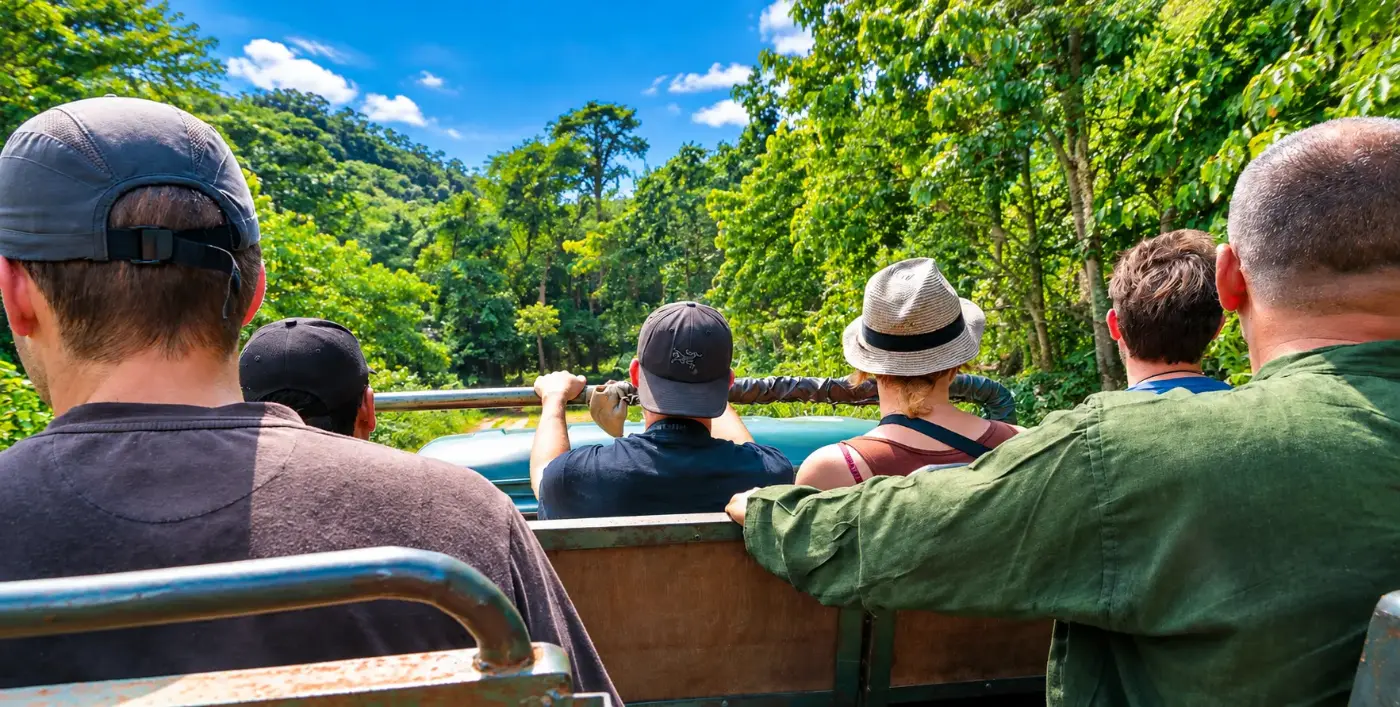
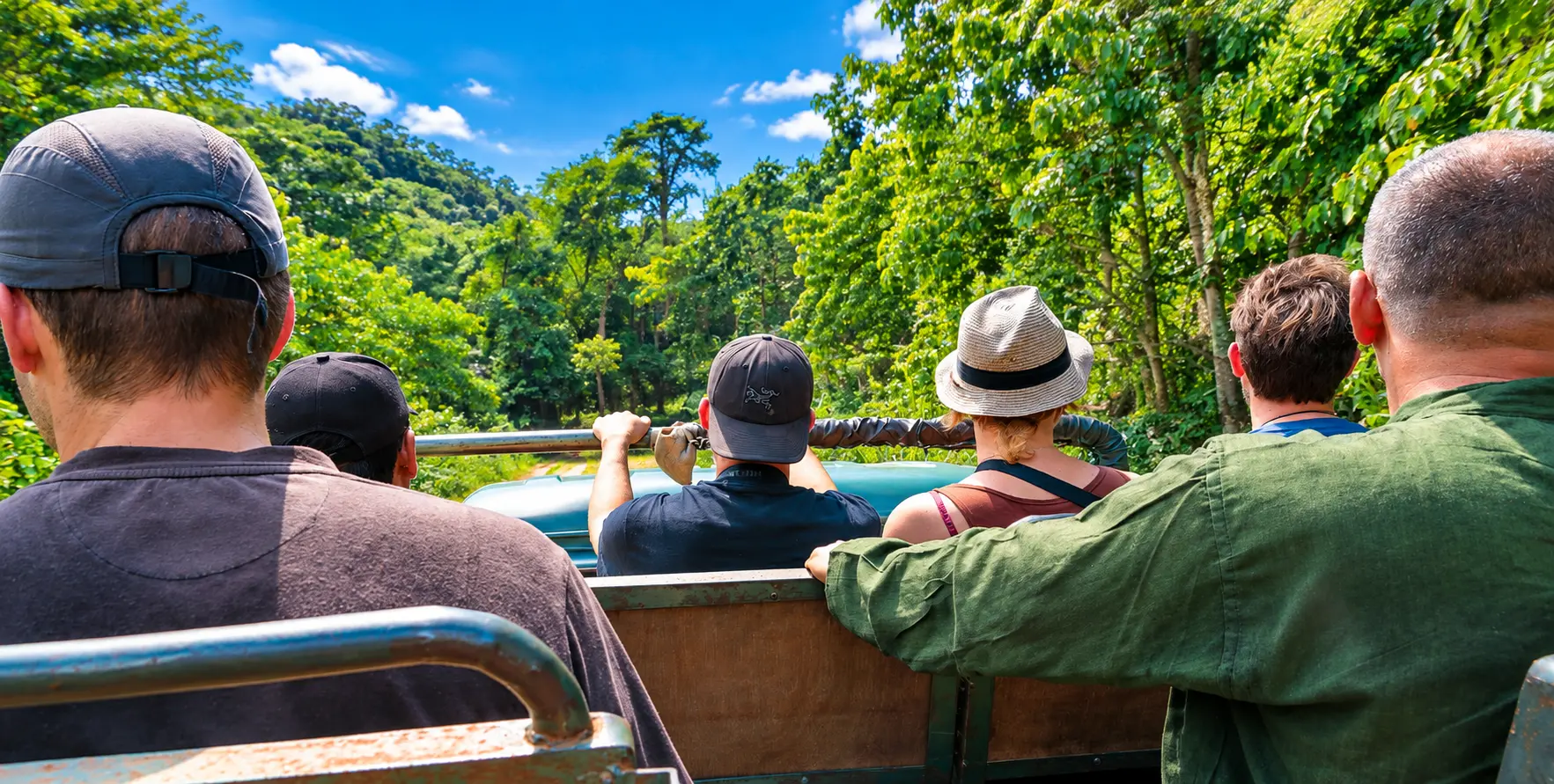
Kathmandu to Chitwan Tour Package: Complete Travel Guide

Kathmandu to Chitwan Tour Package

Kathmandu to Chitwan Tour Package: Complete Travel Guide

Nepal sits at the crossroads of two entirely different worlds — the ancient Himalayan mountain culture and the subtropical lowland wildlife ecosystem of the Terai. A Kathmandu to Chitwan tour package bridges this divide: it begins in the world’s most densely UNESCO-heritage-rich capital city and ends in one of Asia’s finest national parks, where one-horned rhinoceroses outnumber their global wild population of fewer than 3,800 individuals, and Bengal tiger numbers are genuinely growing against the global trend.

Chitwan National Park — inscribed as a UNESCO World Heritage Site in 1984 for its outstanding biodiversity and conservation achievements — covers 952 square kilometres of prime Terai habitat in the inner lowlands of southern Nepal. The park’s buffer zone adds another 750 square kilometres, and the surrounding Barandabhar Corridor Forest connects Chitwan to the broader Terai Arc Landscape that spans both Nepal and India.

For visitors arriving from Kathmandu’s stone-paved heritage squares and Buddhist stupas, the transition to Chitwan’s elephant-grass floodplains and sal forest canopy is one of the most striking landscape shifts available in a single country on a single day’s drive.

Nepal Vehicle Hiring Pvt. Ltd., based in Thamel, Kathmandu, provides the private vehicle service that makes the Kathmandu-to-Chitwan tour package work smoothly—hotel-door pickup in Thamel, the full Prithvi Highway journey with optional stops, and direct delivery to the Sauraha jungle lodge gate. This guide covers everything visitors need to plan the Kathmandu-to-Chitwan tour: the journey itself, what Chitwan offers, how to structure the visit for maximum wildlife and cultural experience, and how Nepal Vehicle Hiring connects both destinations as part of the broader Nepal circuit.
Kathmandu to Chitwan Tour Package

Kathmandu to Chitwan: The Journey Itself

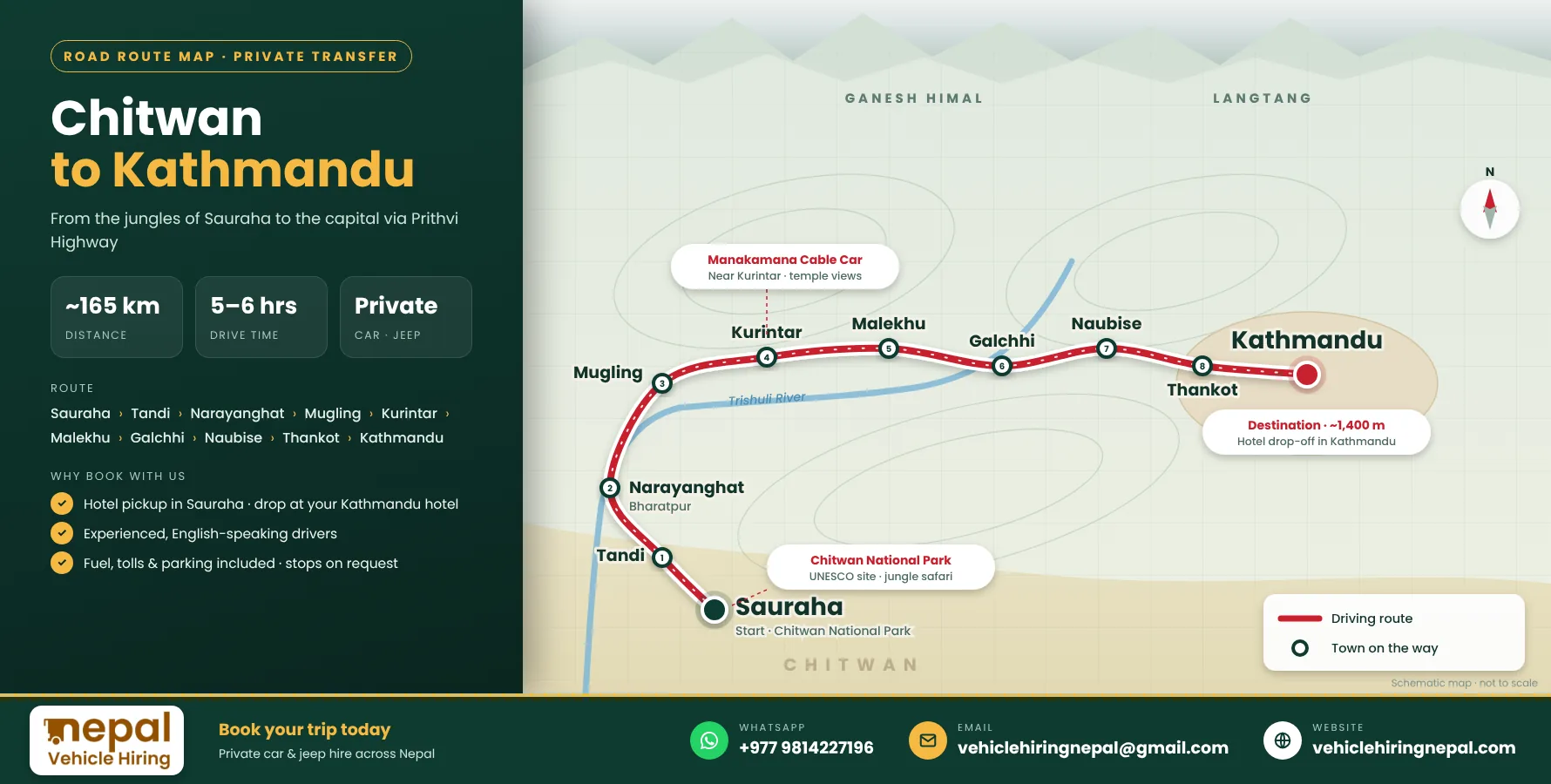
The road from Kathmandu to Chitwan’s Sauraha tourist village runs approximately 200 kilometres via the Prithvi Highway west to Mugling junction and then the NH44 south to Narayanghat, followed by a 30-kilometre approach road to the Rapti River bank at Sauraha. The journey takes 4 to 5 hours by private vehicle depending on stops — making it entirely practical as a same-day transfer that allows a Kathmandu hotel departure in the morning and a Chitwan jungle lodge check-in by midday or early afternoon.

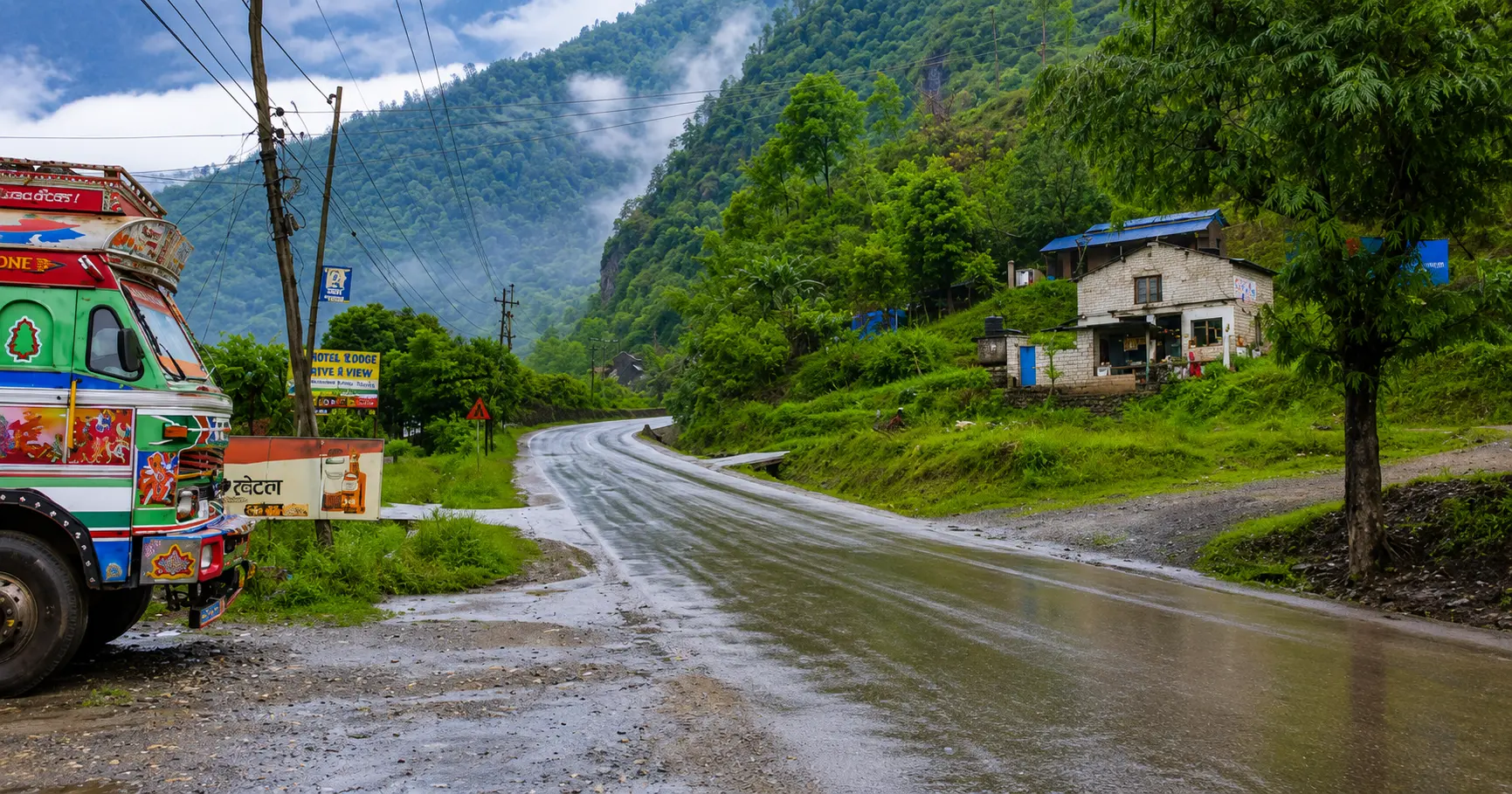
The Prithvi Highway section between Kathmandu and Mugling is the journey’s most scenic — the road descends from the Kathmandu valley rim through the Trishuli River gorge, with the river running alongside and below the highway for much of the distance. Progressive road widening has significantly improved this section, and the approach through the gorge remains one of Nepal’s most engaging highway drives.

From Mugling junction, the NH44 follows the Narayani River south through a wide valley section to Narayanghat — Nepal’s finest highway section, recently widened to dual carriageway in large portions.

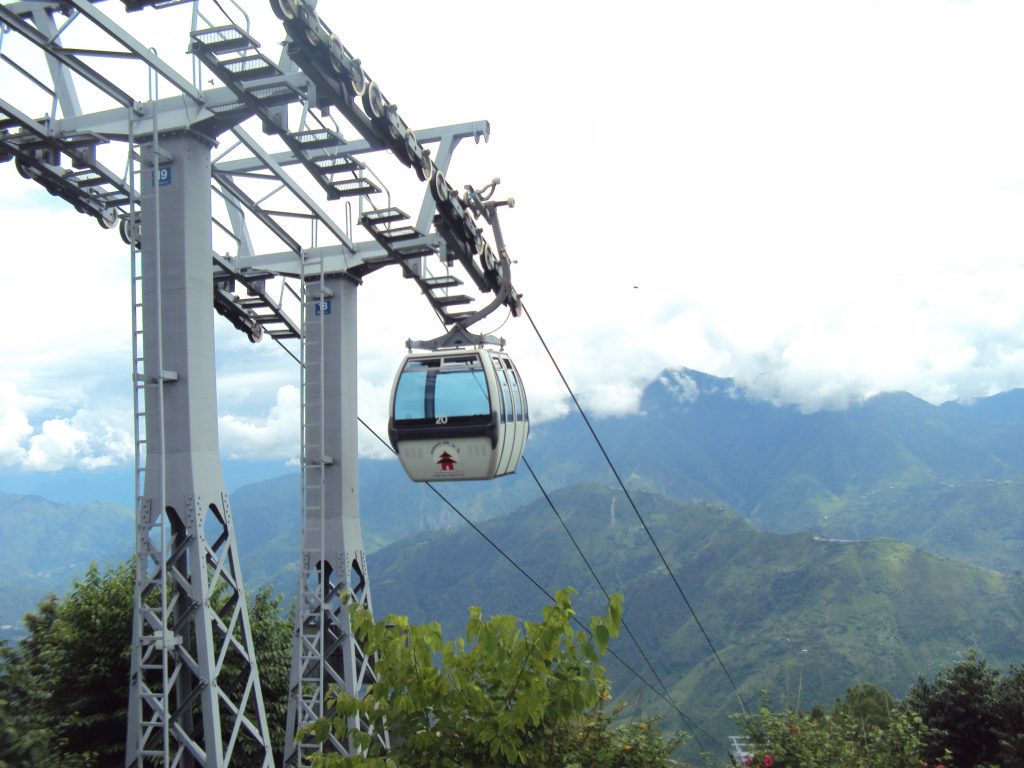
The optional Manakamana Temple cable car at Mugling junction is the most popular en-route stop — the 10-minute aerial ropeway ascent to the hilltop temple dedicated to the wish-fulfilling goddess Manakamana adds 2 to 2.5 hours but delivers a sacred mountain experience that many visitors find genuinely memorable. The Mugling fish restaurants (freshwater Mahseer from the Trishuli River, cooked simply in mustard oil) are the standard lunch stop — 40 to 45 minutes of excellent riverside eating.

Nepal Vehicle Hiring’s drivers always offer both stops on the Kathmandu-to-Chitwan journey.

What Chitwan National Park Offers: The Full Picture

The One-Horned Rhinoceros: Chitwan’s Conservation Icon

The greater one-horned rhinoceros (Rhinoceros unicornis) is Chitwan’s defining wildlife species and one of Asia’s greatest conservation success stories. Commercial hunting and habitat destruction reduced the species to fewer than 100 individuals in the Indian subcontinent by the early 20th century; today, Chitwan’s population approaches 700 animals—the largest single population of this species anywhere in the world.

This recovery — achieved through sustained anti-poaching enforcement, community engagement, habitat management, and political commitment maintained through periods of significant Nepal political upheaval — is one of wildlife conservation’s most remarkable achievements.

The rhino is primarily a grassland animal — it grazes in Chitwan’s dense elephant grass (Saccharum spontaneum and Phragmites karka, reaching 6 to 8 metres in height). It comes to the park’s rivers and wetlands to drink and wallow.

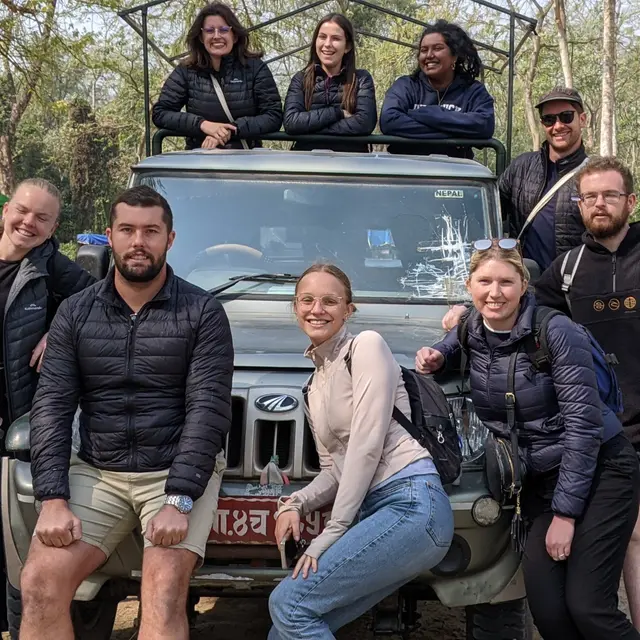
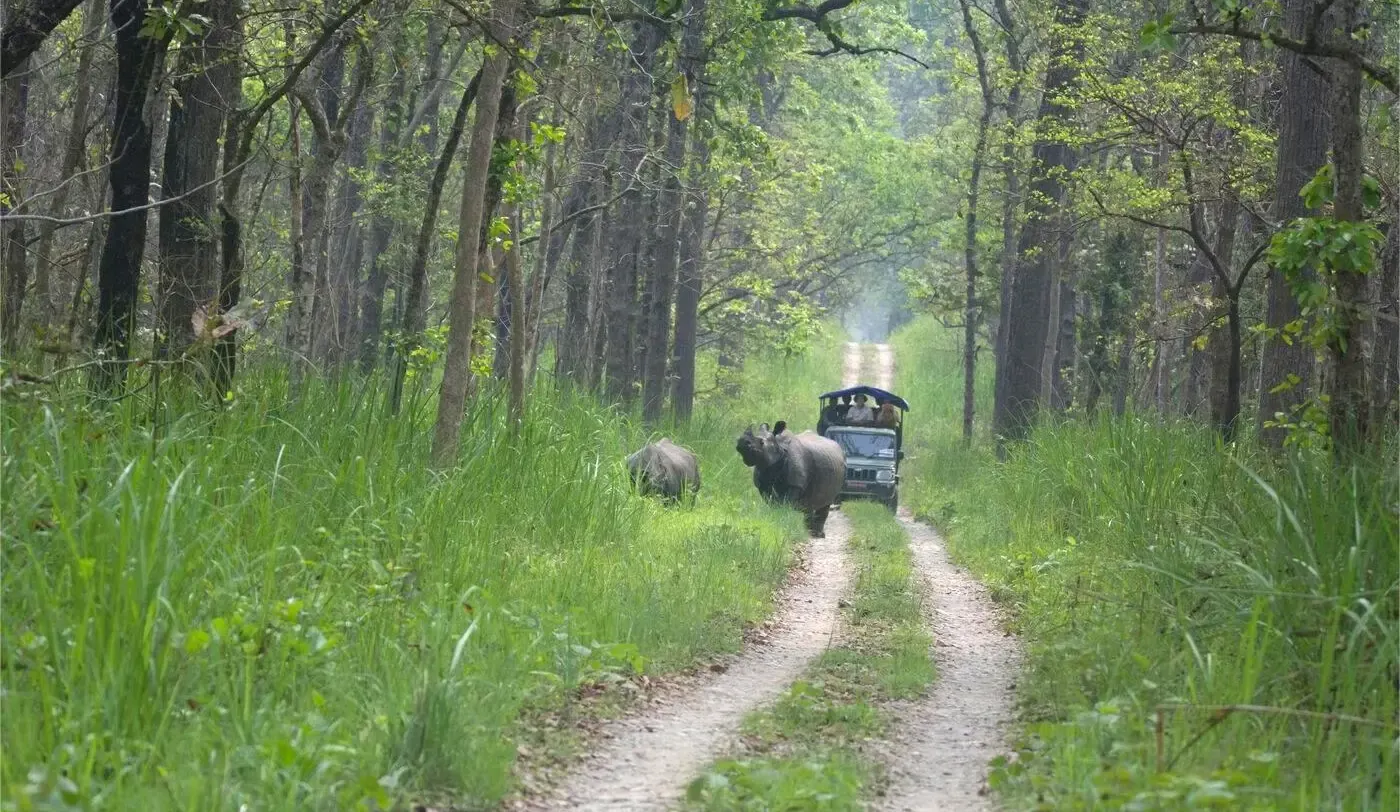
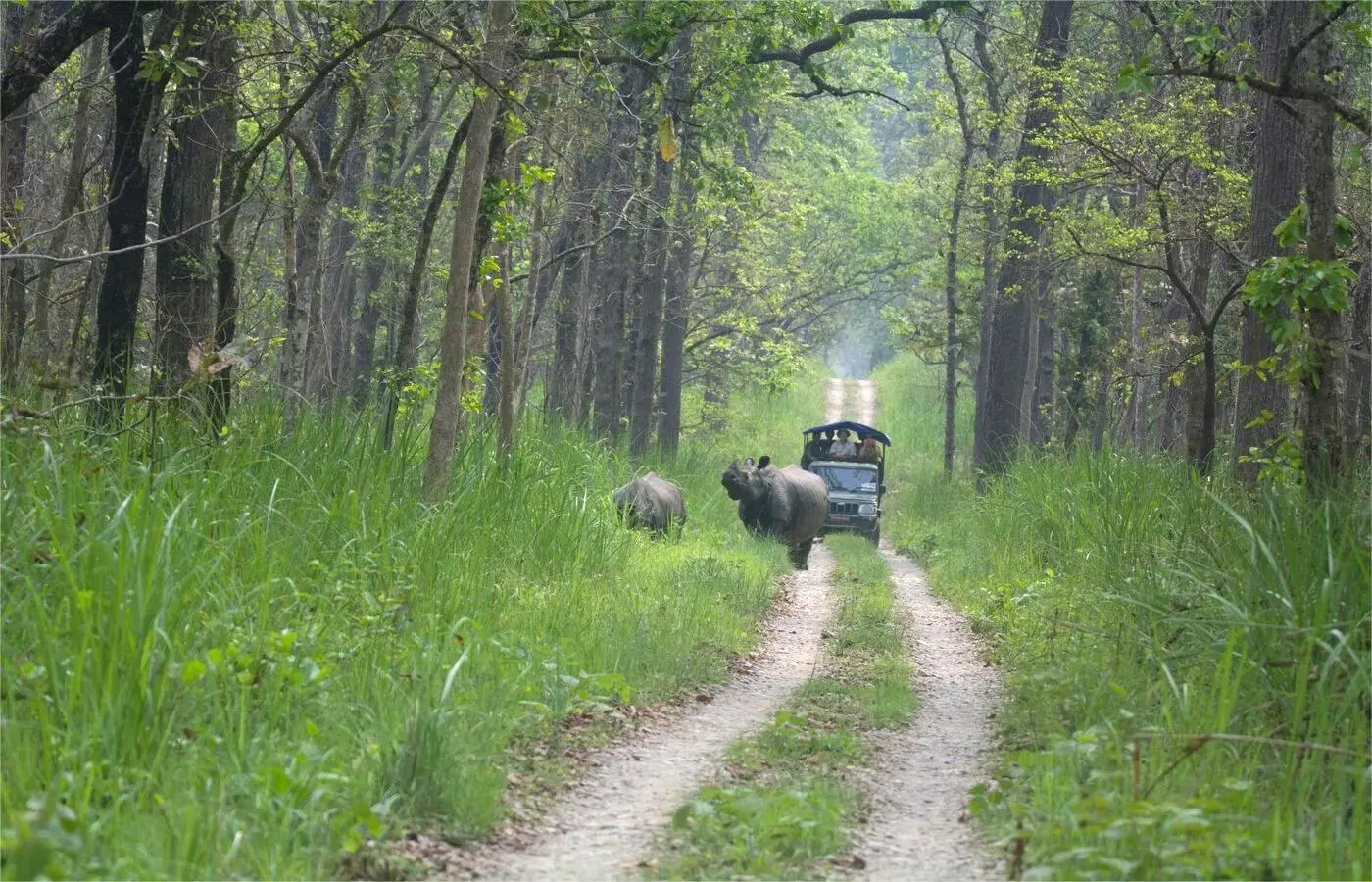
Rhino sightings are among the most reliable large-mammal wildlife encounters in Asia—Chitwan’s morning jeep safari regularly encounters 3 to 5 rhinos in the park’s grassland sections near the Rapti River. The animals are accustomed to vehicles and observers who follow the park’s approach protocol, giving close, sustained views that photograph well even for non-specialist photographers.
Jeep safari track in Chitwan National Park

The Bengal Tiger: Nepal’s Conservation Achievement

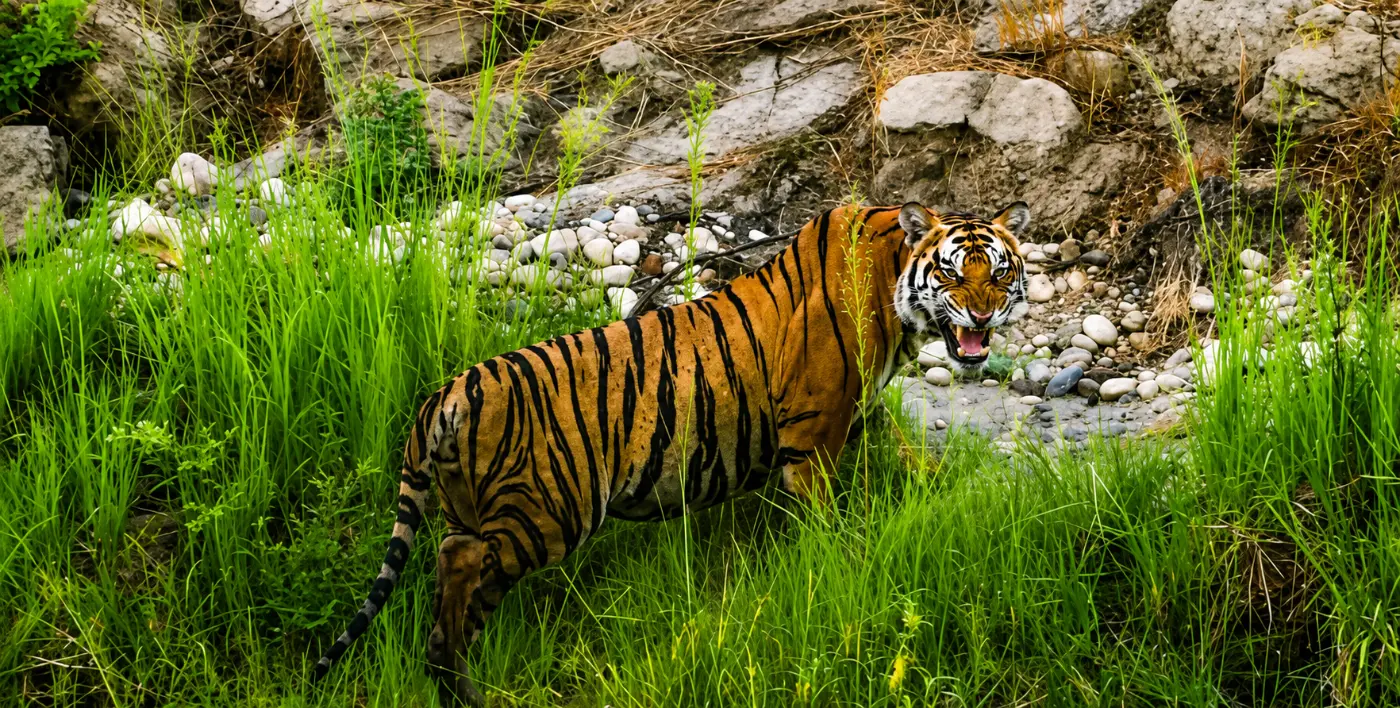
Chitwan holds about 100 Bengal tigers, a population that has more than doubled from its low point in the early 2000s and is increasing, even as tiger numbers decline in most range states worldwide. Nepal is one of the few countries where the tiger is genuinely recovering, and Chitwan’s tiger population is the centrepiece of this national achievement.

Tiger sightings are less reliable than rhino encounters — the tiger is a supremely cryptic animal that most actively avoids human observation — but the pugmarks, scratch marks on trees, and the alarm calls of spotted deer and rhesus macaques that signal a tiger’s recent presence make the awareness of the animal constant even when the animal itself is not seen.

The best tiger-sighting opportunities at Chitwan are during the late dry season (March to May), when the tall elephant grass is cut or burned as part of the annual vegetation management cycle, reducing the tiger’s cover and increasing the chance of open-area sightings at grass margins. Morning jeep safaris during this season regularly encounter tigers in open ground near the riverbanks.

The elephant grass-cutting season is one of Chitwan’s most productive wildlife periods and a key seasonal reason experienced visitors target April and May for their Chitwan visit.

The Asian Elephant: Wild and Elephant-Backed Safaris

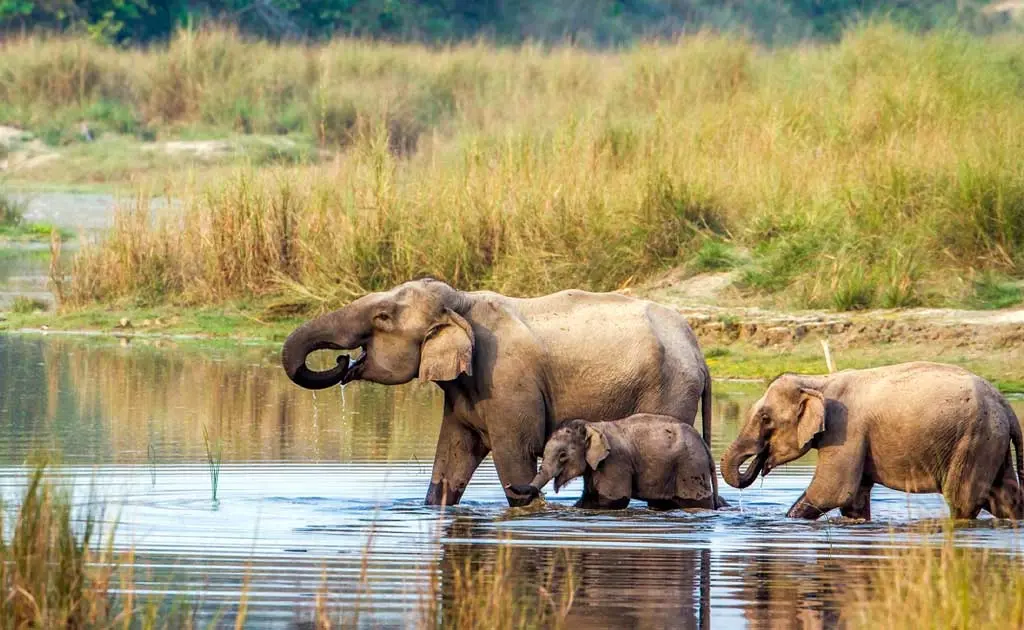
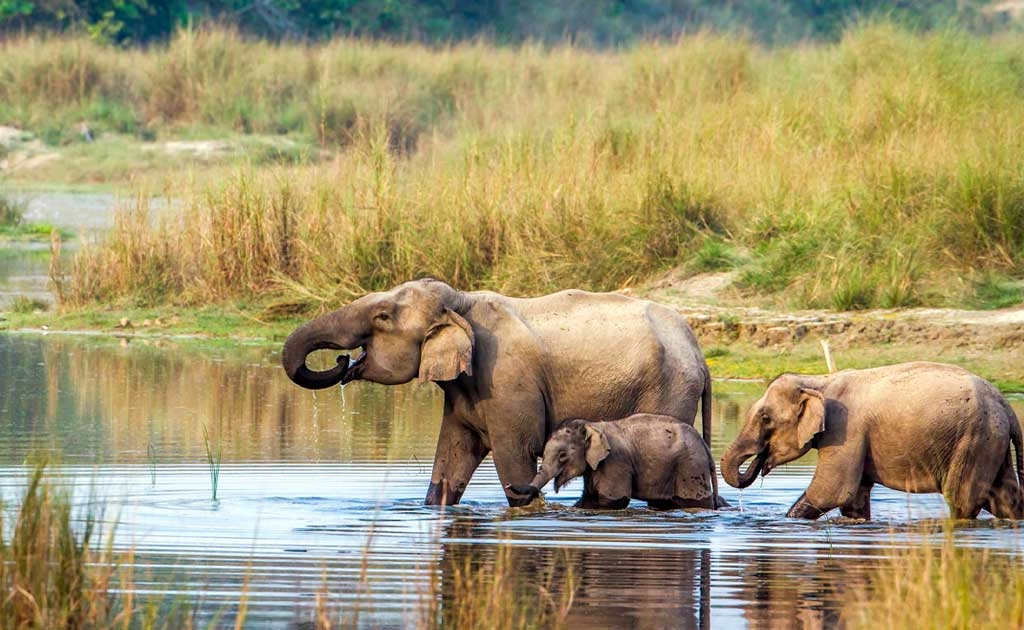
Chitwan’s wild Asian elephant population — approximately 100 to 120 individuals — moves through the park and its buffer zone in a seasonal pattern that follows the availability of food and water. Wild elephant encounters during jeep safaris are among the most dramatic wildlife experiences at Chitwan — the animals are large enough to be visible above the tall grass, and matriarch-led family groups follow their own agenda rather than the safari’s.

Bull elephants in musth (a seasonal testosterone surge) can be unpredictable and require the jeep driver to give them a wide berth — a wildlife encounter that demands real-time judgment.
Kathmandu to Chitwan Tour Package

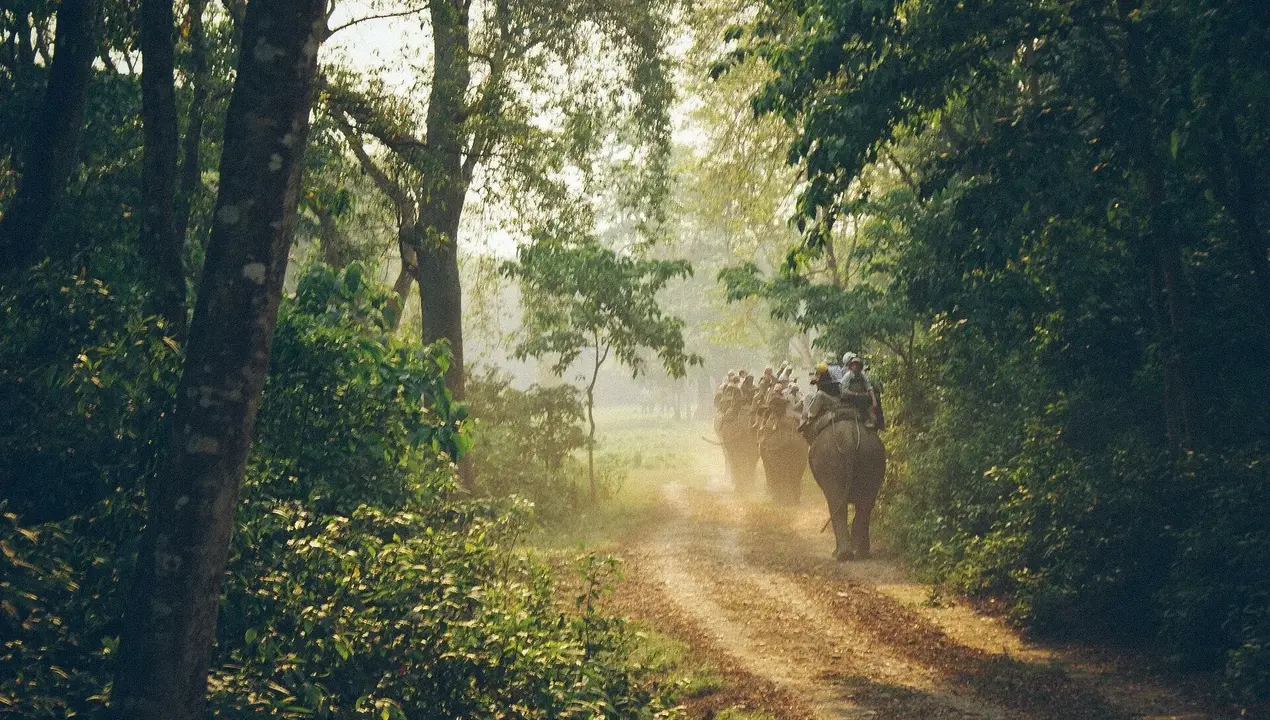
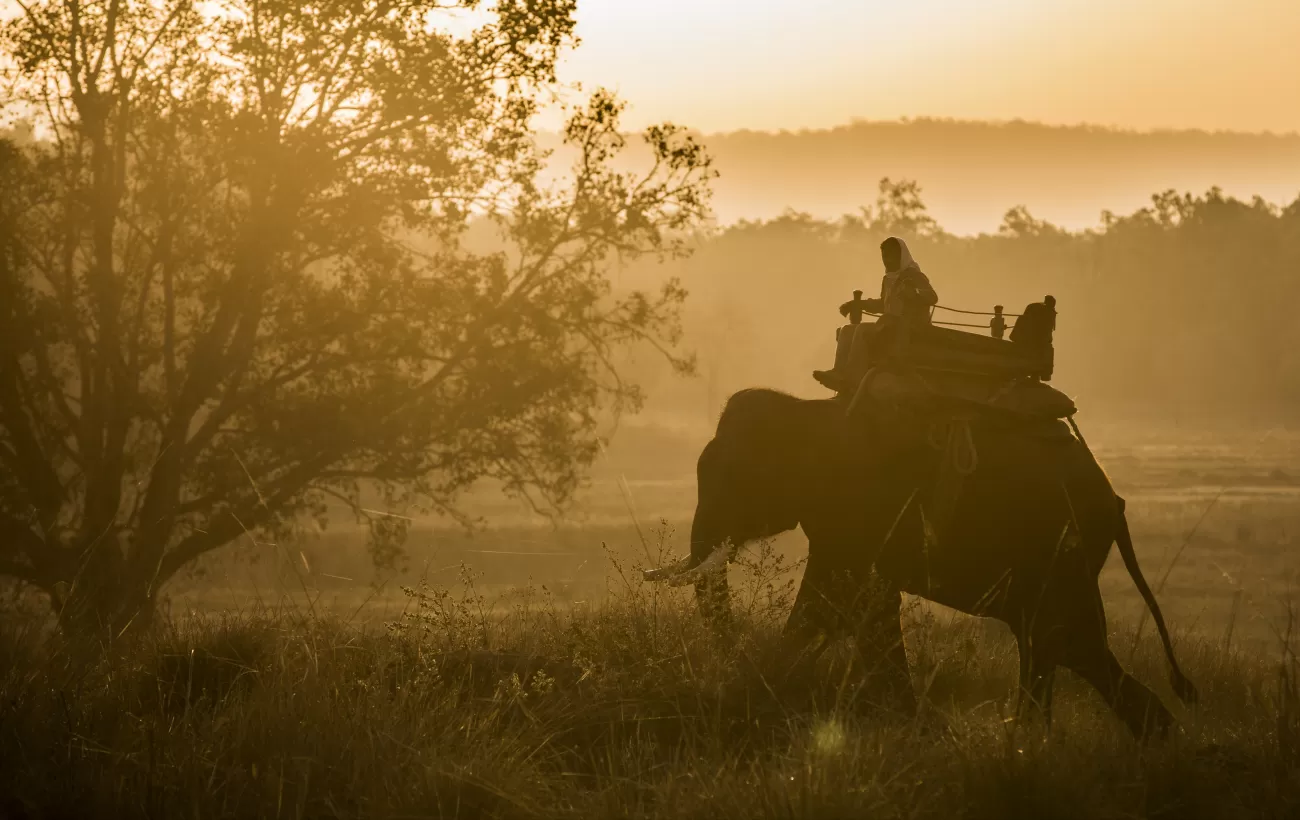
The elephant-backed safari — experienced observers seated in a wooden howdah on a domesticated working elephant’s back, moving through the tall grass on the elephant’s own terms — provides access to habitat that jeep vehicles cannot enter and an observation platform above the grass level that reveals wildlife otherwise invisible from ground level. Conservation ethics around captive elephant welfare have evolved significantly in recent years, and responsible operators use working elephants for a limited number of safaris per day with appropriate rest and feeding conditions.

Visitors who want to include an elephant-backed safari in their Chitwan programme should confirm the specific operator’s welfare standards with their Sauraha lodge.

The Gharial Crocodile: Chitwan’s Speciality

The gharial (Gavialis gangeticus) — the critically endangered, fish-eating crocodilian with its distinctive long, narrow snout — is one of Chitwan’s most important resident species and one of the rarest large reptiles on Earth. The Narayani River system within Chitwan’s boundaries supports one of the world’s most significant gharial populations, and people can see the species on canoe safaris on the Rapti River, basking on sandbanks in the early morning.

The gharial differs from the mugger crocodile (the broader-snouted species also present in Chitwan’s rivers) by its narrow snout, pale colouration, and the distinctive terminal narial boss on the adult male’s snout.

Chitwan National Park runs a successful gharial breeding and release programme, hatching eggs collected from at-risk nesting sites under controlled conditions and releasing juveniles into the Narayani system at a size where their survival probability is significantly higher than that of wild-hatched individuals. The programme has contributed meaningfully to the recovery of the species’ Chitwan population.

Visitors to the Chitwan Gharial Conservation Breeding Centre near Kasara (the park headquarters) can observe captive-bred individuals of various ages and learn about the programme’s methodology and achievements.

Bird Life: Over 600 Species

Chitwan’s bird diversity—over 600 species confirmed within the park boundaries—offers the most accessible and consistently rewarding wildlife experience at Chitwan year-round, regardless of season. The park’s habitats (riverine forest, grassland, sal forest, wetland) support a remarkably varied avifauna: the Indian roller (Nepal’s most vivid common bird), the paradise flycatcher with its white ribbon tail, the Bengal florican (critically endangered bustard found in the elephant grass), the great hornbill, the red-rumped swallow, the pied kingfisher, the white-tailed and lesser adjutant storks, and during the winter migration season a wide range of raptors and wildfowl from the north.
Kathmandu to Chitwan Tour Package

Sauraha: The Tourist Village on the Rapti River Bank

Sauraha is the primary tourist access point for Chitwan National Park — a village on the northern bank of the Rapti River, directly opposite the park’s buffer zone, that has developed over several decades into Nepal’s most organised wildlife tourism destination. At Sauraha, the Rapti River is where the first dramatic wildlife encounters often happen: rhinos wade in the river shallows at dawn, gharial and mugger crocodiles bask on the sandbanks, and painted storks stalk the shallows on the opposite park bank.

Simply sitting on a Sauraha lodge veranda above the Rapti is, on many mornings, a wildlife experience in itself.

Sauraha’s lodge strip runs along the Rapti bank for approximately 2 kilometres, with properties ranging from budget guesthouses 500 metres back from the river to upmarket jungle lodges directly on the bank with open-air terraces above the water. Nepal Vehicle Hiring delivers to specific lodge entrances — not to the Sauraha village bus park, which is 1 to 2 kilometres from most riverside accommodation.

This door-to-door delivery is especially valuable on arrival days, when luggage management on dirt tracks in the pre-monsoon heat or post-monsoon humidity is most challenging.

Chitwan Activities: Planning the Full Programme

Morning Jeep Safari

The morning jeep safari — departing from the park entry gate at the Rapti River crossing at sunrise (approximately 5:30 to 6:00 AM seasonally) and running 3 to 4 hours through the park’s grassland and sal forest zones — is Chitwan’s most productive wildlife activity and the programme centrepiece for most visitors. The 4WD safari jeep carries 6 to 8 visitors, plus a government-licensed naturalist guide who drives and comments on the wildlife encountered.

The morning safari’s productivity comes from the animals’ activity patterns: dawn and the first two hours of morning are the peak movement period for rhinos returning from overnight water sources, tigers finishing night hunts, deer at their most active, and birds at their most vocal and visible. The Tented area zone of the park (not available to vehicles) and the park’s core zones beyond the 1-kilometre buffer are where the morning jeep safari operates — deeper habitat than the casual boundary-area walk provides.
Kathmandu to Chitwan Tour Package

Canoe Safari on the Rapti River

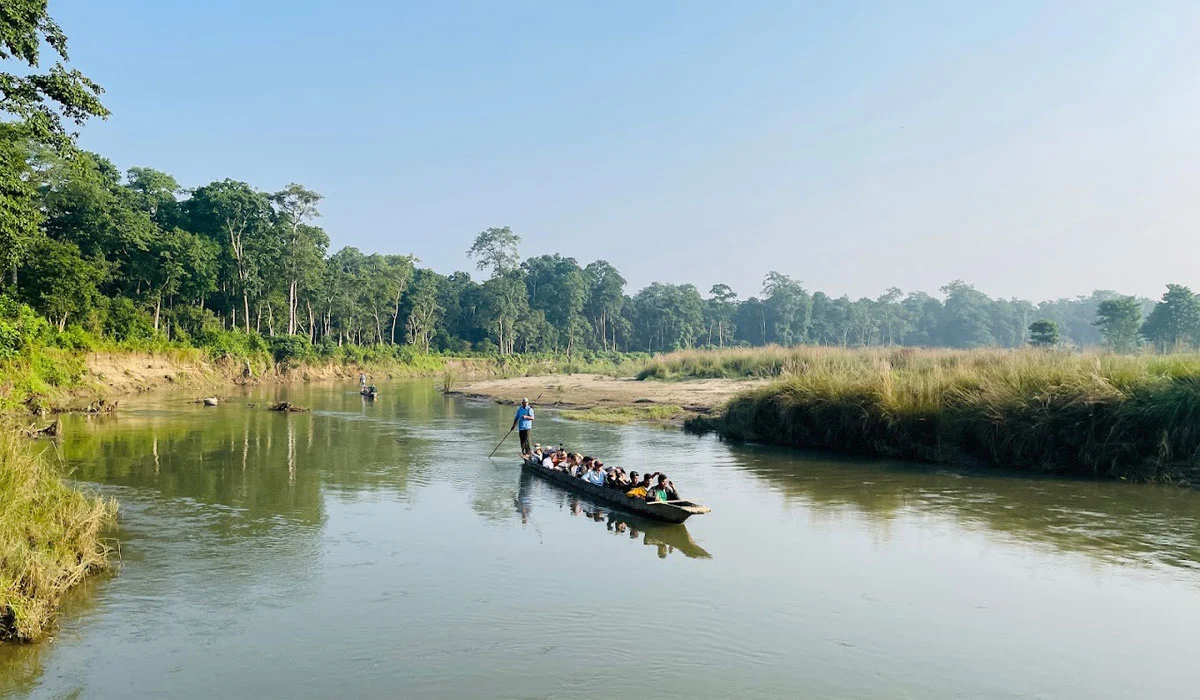
The canoe safari — a slow, silent drift in a dugout canoe along the Rapti River, steered by a pole-wielding boatman and guided by a naturalist — is one of Chitwan’s most peaceful and intimate wildlife experiences. The canoe’s silence allows close approach to riverbank wildlife that vehicle engines disturb: gharial crocodiles on their sandbanks, mugger crocodiles in the shallows, herons and egrets feeding at the water’s edge, and occasionally rhinos drinking at the riverbank.

The canoe’s low profile puts the observer at water level — the same perspective as the wildlife rather than above it — creating a fundamentally different observation experience from the elevated jeep.

Jungle Walk with Naturalist Guide

The guided jungle walk — on foot through Chitwan’s buffer zone and the park’s designated walking areas with a government-licensed naturalist guide — is the experience that most directly conveys what Chitwan’s ecosystem feels and smells like at ground level. The alert posture required by walking in genuine wildlife habitat (rhinos and sloth bears can be encountered at close range), the interpreter’s identification of pugmarks, droppings, territorial scratch marks, and feeding signs, and the in-depth sensory experience of the sal forest at dawn — these dimensions of the Chitwan experience are unavailable in a vehicle.

Tharu Cultural Programme

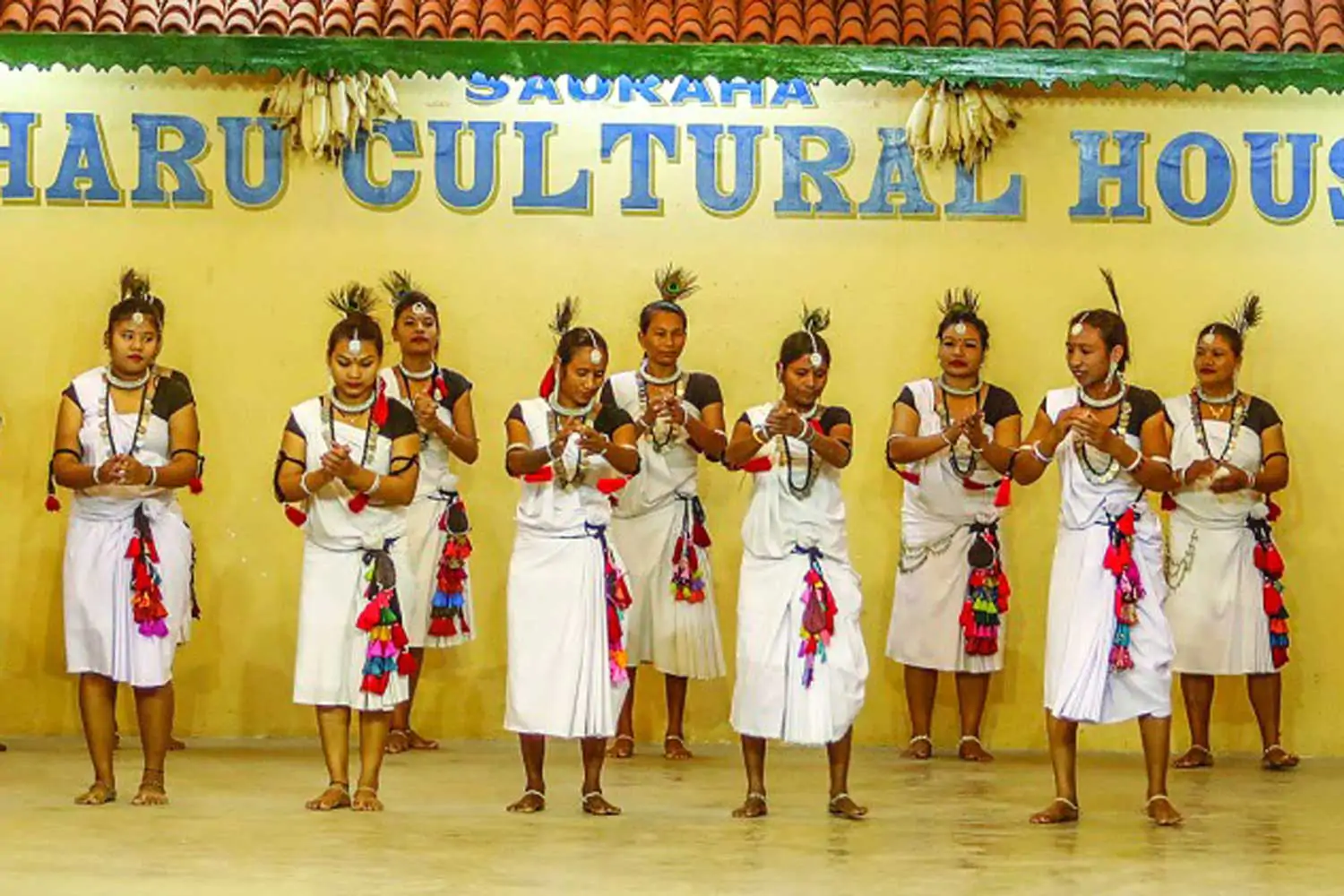
The Tharu people — the indigenous Terai community whose ancestors inhabited the malaria-endemic lowlands of the Chitwan valley for centuries before modern malaria eradication made the region accessible to the hill communities — have a distinctive material culture, performing arts tradition, and ecological knowledge that is one of Chitwan’s most underappreciated visitor experiences. The evening Tharu cultural programme offered by most Sauraha lodges — stick dance (traditionally performed by men with crossed bamboo sticks in a coordinated rhythm pattern), women’s song and dance, and the demonstration of traditional Tharu crafts — gives visitors an encounter with a living cultural tradition whose origins predate the national park that now surrounds it.
Kathmandu to Chitwan Tour Package

The Tharu cultural context is inseparable from the Chitwan ecological context: the Tharu’s traditional knowledge of the jungle — which plants are medicinal, which seasons are safe for specific activities, how to navigate the grassland without alarming the rhino, how to read the river’s flood behaviour — is an indigenous ecology that parallels and in some ways exceeds the scientific ecology of the contemporary conservation programme. Nepal Vehicle Hiring’s Chitwan approach: drivers often share Tharu cultural context during the Sauraha delivery; our drivers are accustomed to this route and enjoy introducing its human and wildlife dimensions.

Elephant Breeding Centre Visit

The government-operated Elephant Breeding Centre at Khorsor (about 3 kilometres from Sauraha) lets visitors observe elephant calves in their early developmental stages and the working relationships between the Centre’s mahouts (elephant handlers) and their charges. The Centre’s breeding programme has produced dozens of calves over its operational history, contributing to the working elephant population that supports park operations—patrol, anti-poaching, and emergency rhino management—in forest zones motor vehicles cannot access.

Private Vehicle from Kathmandu to Chitwan: Why It’s the Best Option

Public tourist buses, shared transfer services, and private vehicle hire serve the Kathmandu-to-Chitwan route. For groups of 3 or more, Nepal Vehicle Hiring’s private vehicle service consistently delivers a better travel experience for the following reasons:

  • Hotel door departure: Nepal Vehicle Hiring’s vehicle collects from the Thamel hotel entrance at the confirmed time — no walk to the Kathmandu tourist bus park, no queue management for luggage on shared vehicles
  • Safari-compatible timing: Nepal Vehicle Hiring’s departure time is set to arrive at the Sauraha lodge in time for the afternoon activity (canoe safari or jungle walk from 3:30 PM) on the arrival day — shared tourist buses may arrive too late for the first afternoon programme
  • Flexible stops: the Manakamana cable car, the Mugling fish lunch, or any other en-route stop is incorporated at the group’s choice — shared buses stop only at fixed points
  • Direct lodge delivery: Nepal Vehicle Hiring delivers to the specific jungle lodge entrance rather than to the Sauraha bus park 1 to 2 kilometres from most riverside accommodation
  • Luggage security: wildlife photography equipment, binoculars, and specialist Chitwan kit travels in the private vehicle throughout rather than in a shared bus luggage hold

Nepal Vehicle Hiring’s fleet covers all group sizes for the Kathmandu-to-Chitwan journey: private car for individuals and couples, Scorpio jeep for groups of 4 to 7, Hiace van for groups of 8 to 14, and Coaster bus for larger parties of 15 or more. The vehicle depends on the group size and the lodge’s access road — Nepal Vehicle Hiking’s operations team recommends the best vehicle once the group size and lodge are confirmed.
Kathmandu to Chitwan Tour Package
Chitwan

Kathmandu to Chitwan in the Nepal Tourist Circuit

The Kathmandu-to-Chitwan journey is most commonly the second or third leg of Nepal’s most popular tourist circuit — the Nepal tourist triangle connecting Kathmandu, Pokhara, and Chitwan. The optimal routing for this circuit that avoids backtracking: Kathmandu → Pokhara (west on Prithvi Highway) → Chitwan (Pokhara to Sauraha, 200 km, 4 hours via Mugling) → Kathmandu (Chitwan to Kathmandu, Prithvi Highway return).

Nepal Vehicle Hiring’s Nepal holiday tour and Nepal tour package services coordinate all three circuit legs as a single vehicle booking.

Chitwan also serves as a natural addition to the extended Nepal circuit that includes Lumbini — the Narayanghat junction on the Chitwan-to-Kathmandu route is just 30 kilometres from Sauraha, and the Mahendra Highway west from Narayanghat connects the Chitwan circuit directly to the western Terai and Lumbini. Visitors with 1 to 2 additional Nepal days can add the Lumbini UNESCO sacred site to the Chitwan visit without backtracking to Kathmandu first — Nepal Vehicle Hiring coordinates this Chitwan-to-Lumbini connection as part of the extended Nepal circuit.

The Kathmandu sightseeing service — covering Pashupatinath, Boudhanath, Bhaktapur, and the valley’s UNESCO sites — is the natural Day 1 or Day 2 Kathmandu activity before the Chitwan departure. Nepal Vehicle Hiring pre-books both the Kathmandu sightseeing vehicle and the Chitwan transfer vehicle as consecutive legs in the complete Nepal circuit booking.

Best Time to Visit Chitwan: Seasonal Wildlife Guide

October to February: Cool and Clear

The post-monsoon and winter period is Chitwan’s primary tourist season — cool temperatures (15 to 28°C daytime), no rainfall, clear skies, and the full range of wildlife activity visible. Tall elephant grass reaches its maximum height in October and November, creating the dramatic green-wall landscape of classic Chitwan imagery but reducing visibility into the grassland for vehicle-based safaris. November through February gives progressively improving visibility as the winter dry season develops.

March to May: Peak Wildlife Viewing

The dry season is Chitwan’s best wildlife-viewing period—the annual elephant grass-cutting and burning cycle that park management conducts from February through April significantly opens the grassland, reducing cover for both prey and predators and concentrating animals at water sources. Tiger, rhino, and deer sightings in the open areas near the Rapti and Narayani rivers peak in March, April, and May.

Temperatures rise significantly (30 to 40°C), so morning safaris are essential for wildlife activity before midday heat suppresses animal movement.

June to September: Monsoon Season

The monsoon brings heavy rainfall, floods the park’s lower zones, and significantly reduces vehicle access to the park interior: the Rapti River floods seasonally, and the wildlife retreats to higher ground within the park. Leech activity on jungle walks requires appropriate footwear and vigilance.

The landscape is extraordinarily green, and bird diversity peaks with the addition of monsoon-season breeding visitors. Most international visitors avoid Chitwan during peak monsoon, but fewer tourists mean a more private wildlife experience for those who accept the season’s constraints.
Kathmandu to Chitwan Tour Package

Accommodation at Chitwan: Lodge Options and Location

Sauraha’s accommodation spectrum runs from budget guesthouses (simple rooms in village buildings set back from the Rapti) to top-end jungle lodges (open-air platforms above the river, naturalist-led programmes, full board with Tharu and continental cuisine). The Rapti riverbank location is the top-end accommodation position — the morning wildlife sightings from the lodge veranda and the direct access to the canoe safari departure point are genuine advantages over lodges set further from the river.

The inside-the-park lodges — a small number of permitted accommodation properties within the park boundary rather than in Sauraha village — offer the finest Chitwan accommodation experience: deeper habitat access, no buffer-zone travel to reach the park interior, and the night sounds of the park (the bark of spotted deer, the distant call of a tigress, the splash of a gharial in the river) from the sleeping area. Inside-the-park lodge permits are limited; booking is essential, and the experience commands a top-end over Sauraha village accommodation.

Nepal Vehicle Hiring delivers to all Sauraha accommodation options — riverbank lodges, village lodges, and the outside-the-park access roads to inside-the-park properties. Confirm the specific lodge name and location when booking the Kathmandu-to-Chitwan vehicle — our operations team is familiar with all Sauraha lodge access roads and delivers accurately to each.

Nepal Vehicle Hiring Services for the Kathmandu-Chitwan Circuit

Kathmandu to Chitwan Tour Package

Frequently Asked Questions: Kathmandu to Chitwan Tour Package

How far is Chitwan from Kathmandu and how long does the drive take?

Chitwan’s Sauraha tourist area is approximately 200 kilometres from Kathmandu via the Prithvi Highway and NH44. The drive takes 4 to 5 hours by private vehicle, including a short rest stop, and 5 to 6 hours if you include the Manakamana cable car and a Mugling fish lunch stop. A morning departure from Kathmandu (7:00 to 8:00 AM) reaches Sauraha by midday for the afternoon safari programme.

What is the best vehicle for the Kathmandu to Chitwan journey?

For groups of 4 to 7, Nepal Vehicle Hiring’s Scorpio jeep is the recommended vehicle — comfortable on the Prithvi Highway and capable on the Sauraha approach road. For groups of 8 to 14, the Hiace van covers the journey efficiently. For 2 to 3 passengers, the private car is the most economical option.

All Nepal Vehicle Hiring vehicles deliver directly to the Sauraha jungle lodge entrance.

How many days should I spend at Chitwan?

A minimum of 2 nights and 2 full days in Chitwan covers the full activity programme—morning jeep safari (Day 1), afternoon canoe safari (Day 1), morning jungle walk (Day 2), afternoon elephant programme (Day 2), and an evening Tharu cultural show on both nights. 3 nights allow a more relaxed programme, with time for repeat safaris in different zones and a visit to the Elephant Breeding Centre.

1 night is the minimum for a meaningful Chitwan experience but allows only 2 activities.

Is the Chitwan-Lumbini combination possible from Kathmandu?

Yes — from Sauraha, the Narayanghat junction is 30 kilometres away on the highway, and the Mahendra Highway west from Narayanghat connects to Lumbini in approximately 2 to 2.5 hours. Nepal Vehicle Hiring coordinates the Chitwan-to-Lumbini direct vehicle as part of the extended Nepal circuit — avoiding the Kathmandu backtrack that most tour operators route between these two UNESCO sites. The Chitwan-to-Lumbini direct connection is one of Nepal’s most rewarding logistics shortcuts.

What should I pack for the Chitwan safari?

Neutral colours (khaki, olive, brown, tan) are recommended for wildlife activities — bright colours and white are visible to wildlife and are not permitted on jungle walks. Long sleeves and trousers protect against sun and insects in the grassland. Good closed walking shoes for the jungle walk; sandals are not appropriate.

Binoculars (8×42 or 10×42) significantly enhance bird and distant wildlife viewing. Also bring sunscreen, insect repellent (especially during the monsoon and monsoon shoulder), and a light rain jacket for morning safaris in the cooler months.

Can Nepal Vehicle Hiring handle the return Chitwan-to-Kathmandu journey?

Yes — Nepal Vehicle Hiring pre-books the return Chitwan-to-Kathmandu vehicle at the same time as the outbound Kathmandu-to-Chitwan booking. The return vehicle collects from the Sauraha lodge entrance at the confirmed departure time, includes the same optional Mugling and Manakamana stop options, and delivers to the Kathmandu Thamel hotel or TIA airport for the international departure connection.

For groups routing from Chitwan to Pokhara rather than back to Kathmandu, Nepal Vehicle Hiring’s Chitwan-to-Pokhara vehicle covers the 200-kilometre northward Prithvi Highway connection.

Chitwan’s Conservation Story: Why This National Park Matters

Chitwan National Park’s conservation achievement is extraordinary by any measure, but it is clearest against the backdrop of what was at risk. The inner Terai valleys of southern Nepal — Chitwan, Rapti, Narayani, and Deukhuri — were until the mid-20th century among the most wildlife-rich lowland habitats in Asia: thick sal forest, towering elephant grass, clean rivers fed by Himalayan snowmelt, and the full complement of South Asian megafauna including tiger, rhino, wild elephant, gaur, sloth bear, leopard, gharial, and python.

DDT spraying eradicated the malaria that had protected this habitat from human settlement, and within a decade the population of the inner Terai valleys multiplied many times as hill communities poured into the newly habitable lowlands.

By the early 1970s, Chitwan’s rhino population had fallen to about 95 animals—from an estimated 800 in 1950. Conservation organisations and international donors helped establish the Royal Chitwan National Park in 1973, and the military supported the first anti-poaching operations. The subsequent five decades of conservation management — sustained through Nepal’s political transitions, the Maoist insurgency (which paradoxically reduced tourist pressure on the park while creating security challenges for anti-poaching operations), the earthquake of 2015, and the tourism disruptions of the pandemic — have produced one of conservation biology’s finest outcomes: a wildlife population genuinely recovering toward a functional ecological density.

The international scientific and conservation community’s recognition of Chitwan’s achievement—the UNESCO World Heritage inscription, its landmark status as one of the world’s great conservation success stories—provides important context for visitors who may see Chitwan simply as a wildlife tourism destination. It is more than that: it is one of the places where humanity has most successfully renegotiated its relationship with wild nature in the modern era, and the morning jeep safari through its grasslands is an encounter with the outcome of that renegotiation.

The Prithvi Highway: Understanding the Drive to Chitwan

The Prithvi Highway — named after King Prithvi Narayan Shah, the 18th-century monarch who unified Nepal into a single kingdom — is Nepal’s primary commercial and tourist artery connecting the Kathmandu Valley to the Terai and the western mid-hills. Built with Chinese assistance and completed in the 1970s, the highway has been progressively upgraded over subsequent decades and is today Nepal’s most travelled tourist road.

The highway’s most distinctive section is the Trishuli River gorge between the Kathmandu valley rim and Mugling junction — approximately 70 kilometres where the road descends from 1,350 metres to 195 metres through a narrow river canyon with the Trishuli’s rapids visible below the road at multiple points. This section has been progressively widened — the Nagdhunga-Sisnekhola Tunnel near the Kathmandu western rim has dramatically improved the valley exit — and approximately 40 to 50 per cent of the gorge section is now dual carriageway.

The remaining single-lane sections retain the gorge road’s original character: the road cut into the cliff face, the river below, and the dramatic visual compression of the mountain landscape on either side.

For visitors on the Kathmandu-to-Chitwan transfer, the Prithvi Highway gorge is typically the first extended experience of Nepal’s mountain road character — the combination of the gorge scenery, the occasional passing encounter on narrow sections, and the progressive descent from the valley’s cool air to the warm Terai approaches creates a genuine sense of crossing between Nepal’s two primary worlds. Nepal Vehicle Hiring’s Kathmandu-to-Chitwan drivers know this highway well, including the current construction zones and the best time to stop at Manakamanp—the Mugling fish restaurant with the freshest daily catch.
Kathmandu to Chitwan Tour Package

The Manakamana Temple Cable Car: En-Route Sacred Experience

The Manakamana Bhagwati Temple — the wish-fulfilling goddess whose hilltop shrine above the Marsyangdi-Trishuli confluence has drawn Hindu pilgrims for centuries — is accessible by a 2.8-kilometre aerial cable car from the Mugling valley floor to the 1,302-metre hilltop in approximately 10 minutes each way. For Nepal visitors making the Kathmandu-to-Chitwan journey, the Manakamana cable car stop is the most rewarding en-route addition available — a sacred pilgrimage experience, a spectacular valley view, and a complete departure from the highway journey’s character, all within a 2 to 2.5-hour addition to the transfer time.

The cable car operates in morning and afternoon sessions with seasonal operating hours. Nepal Vehicle Hiring’s Kathmandu-to-Chitwan drivers time the Mugling arrival to catch the morning cable car session when requested — this requires a 7:00 AM or earlier Kathmandu departure.

The temple compound at the summit has several shrines beyond the main Manakamana temple, a viewpoint over the Marsyangdi-Trishuli confluence, and the characteristic Nepali pilgrimage atmosphere of devotees, marigold garlands, and the smell of incense and burning ghee. A round-trip visit (ascent, temple, descent) takes approximately 1.5 hours at the summit.

The cable car stop and the Mugling fish lunch together are the standard complete en-route programme for Kathmandu-to-Chitwan visitors with time. Nepal Vehicle Hiring’s driver manages the cable car timing and the Mugling restaurant stop in sequence — both fall within the Mugling junction area, and the combined addition is approximately 2.5 to 3 hours added to the base transfer time.

A 7:00 AM Kathmandu departure with both stops reaches Sauraha by 4:00 to 4:30 PM — in time for the late afternoon canoe safari.

Wildlife Photography at Chitwan: Practical Advice

Chitwan is one of Asia’s finest destinations for wildlife photography — the combination of reliable large mammal sightings, good morning light in the grassland openings, and the accessibility of the park’s riverine habitat from jeep and canoe gives photographers of all levels genuinely productive conditions. The following practical guidance helps photographers maximise the Chitwan visit:

  • Morning light: the hour after sunrise (6:00 to 8:00 AM) provides the directional golden light that gives wildlife photography its finest quality. The morning jeep safari’s timing aligns perfectly with this window — the safari departs at first light and the first 2 hours are the most productive for both wildlife activity and photographic light quality.
  • Focal length: a 300mm to 400mm lens is the practical minimum for wildlife photography at Chitwan. Rhinos allow closer approaches than tigers, and the canoe safari lets you frame riverbank species more tightly than the jeep safari. A 100-400mm zoom lens covers the widest range of Chitwan situations.
  • Vehicle stability: Chitwan’s safari jeeps vibrate from the engine, which can reduce image sharpness at longer focal lengths. A beanbag draped over the vehicle door or a window clamp mount dramatically improves stability for telephoto shots taken from the jeep.
  • Rain protection: the post-monsoon season (October-November) can still bring occasional brief rain showers, even in the dry period. A lightweight rain cover for the camera body protects against the sudden downpours that can interrupt an otherwise dry safari.
  • Patience at water sources: the park’s ponds and river bends where rhinos regularly water and wallow are productive photography stations where the naturalist driver positions the jeep and waits. This passive approach — stationary vehicle at a known wildlife water point — is often more productive than active searching through the grassland.

Chitwan and Kathmandu: Complementary Heritage Experiences

The Kathmandu-to-Chitwan tour package is most rewarding when you see both destinations as complementary expressions of Nepal’s heritage range, not just consecutive stops on a tourist itinerary. Kathmandu’s heritage is cultural and architectural — the carved wooden temples of Bhaktapur, the gilded stupa of Boudhanath, the ancient cremation ghats of Pashupatinath, the Newari merchant houses of Patan’s Durbar Square.

These heritage expressions are 500 to 1,500 years old, hand-made, and deeply embedded in the religious and civic life of the communities that inhabit them.

Chitwan’s heritage is ecological and evolutionary — the rhino’s 40-million-year lineage, the tiger’s 10,000-year presence in the subcontinent, the gharial’s 20-million-year persistence in Asian river systems, and the sal forest’s 10,000-year establishment in the Himalayan foothills. This ecological heritage is as ancient and as significant as Kathmandu’s cultural heritage, and no less endangered or dependent on human commitment to its preservation.

Visitors who arrive at Chitwan with this understanding will leave with a deeper relationship to the park’s wildlife than the simple spectacle of large animals would provide.

The Nepal circuit that includes both Kathmandu and Chitwan — and ideally also Pokhara’s mountain scenery and Lumbini’s sacred geography — is the circuit that gives visitors the most complete encounter with Nepal’s extraordinary range. Nepal is both the world’s highest mountain range and one of its finest wildlife conservation areas, both a living heir to two and a half millennia of Buddhist and Hindu sacred tradition and a contemporary democracy managing one of the world’s most complex tourism-conservation balances.

No single destination in Nepal reveals all of this; the circuit reveals it.
Kathmandu to Chitwan Tour Package

Responsible Wildlife Tourism at Chitwan: What Visitors Should Know

Chitwan National Park has benefited enormously from international wildlife tourism—the revenue from park entry fees, lodge accommodation, and activity charges supports the anti-poaching operations, habitat management, and community programmes that underpin its conservation success. Visitors to Chitwan are not merely consuming a wildlife experience; they are contributing financially to the conservation infrastructure that keeps rhinos, tigers, and gharials alive. This financial relationship is worth understanding explicitly.

The park entry fee for international visitors (payable at the park gate) goes to the government park management fund. Lodge accommodation revenue supports the lodge owners and, through employment, the Sauraha community.

The naturalist guides — government-certified, trained in wildlife identification and ecology, dependent on tourism for their professional income — are the human face of conservation at the visitor-wildlife interface. Nepal Vehicle Hiring’s Chitwan transfer vehicles are part of this economic ecosystem, bringing visitors whose spending sustains the community that lives alongside the park.

Responsible wildlife tourism at Chitwan means: following the naturalist guide’s instructions on wildlife approach distances and behaviour; not pressuring the driver to approach animals closer than the recommended safe distance; not using drones in the park (prohibited) or making loud sounds that disturb wildlife; respecting the park’s no-entry zones and designated safari routes; and choosing accommodation operators who demonstrate credible wildlife and community commitments.

The conservation outcomes at Chitwan have been achieved by the community that lives with the park — the Tharu people who tolerate elephant crop raids and tiger livestock predation in exchange for the economic benefits of park proximity, the government rangers who enforce anti-poaching in difficult terrain, and the tourism professionals who translate the park’s wildlife into visitor experiences that justify its economic existence. Respectful, informed wildlife tourism at Chitwan is a genuine act of conservation support.

The Rapti River: Chitwan’s Living Border

The Rapti River — which forms the northern boundary between Sauraha village and Chitwan National Park — is more than a geographical boundary: it is one of the park’s most productive wildlife habitats and the most accessible wildlife observation point for visitors at any time of day. The river carries glacial melt from the Annapurna range and the inner Terai catchment through the park to its confluence with the Narayani, and its seasonal flooding regime is fundamental to the grassland ecosystem that supports the park’s wildlife.

The Rapti’s sandbanks — exposed during the dry season from October through June — are basking sites for gharial and mugger crocodiles, water access points for rhinos, deer, and wild boar, and feeding grounds for the storks, herons, and kingfishers that make Chitwan’s birdlife so productive. Dawn observation from the Sauraha riverbank — before the first safari jeeps have crossed to the park — is one of Chitwan’s finest free wildlife experiences: the river mist lifting to reveal a rhino standing in the shallows on the opposite bank, a gharial emerging from the water to bask on the sand, and a flock of painted storks landing on a gravel bar 100 metres away.

The canoe safari on the Rapti is the best way to experience the river’s wildlife dimension in depth — the silence of the dugout canoe allows an approach that no motor vehicle can achieve, and the boatman’s pole-steering gives the naturalist control over pace and position relative to wildlife on the banks. Nepal Vehicle Hiring’s Kathmandu-to-Chitwan delivery specifically targets the Sauraha riverside lodge strip rather than the village hotels further from the river — for precisely the reason that the Rapti River access is among Chitwan’s most valuable wildlife experiences.

Planning the Complete Kathmandu-Pokhara-Chitwan Nepal Circuit

For visitors planning the complete Nepal tourist triangle circuit that includes Chitwan as the wildlife destination, the following routing and vehicle plan delivers the best overall Nepal experience with minimal backtracking:

  • Optimal routing: Kathmandu → Pokhara (west on Prithvi Highway, 200 km, 6 to 8 hours) → Chitwan (Pokhara to Sauraha, 200 km, 4 to 5 hours via Mugling) → Kathmandu return (Chitwan to Kathmandu, 200 km, 4 to 5 hours). This routing avoids the Kathmandu-Chitwan-Kathmandu-Pokhara double backtrack that many itineraries require.
  • Day count: Kathmandu 2 days (sightseeing, permits, Nagarkot sunrise) + Pokhara 2 to 3 days (Phewa Lake, Sarangkot, Poon Hill day trip) + Chitwan 2 to 3 days (morning safari, canoe, jungle walk, Tharu culture) = 6 to 8 days minimum for a complete Nepal triangle circuit.
  • Vehicle coordination: Nepal Vehicle Hiring’s Hiace van (for groups of 8+) or Scorpio jeep (for groups of 4 to 7) covers all three highway legs. The Kathmandu airport transfer and the Kathmandu departure airport transfer are booked as the circuit’s opening and closing legs. All pre-confirmed as a single circuit booking via WhatsApp.
  • Extended circuits: adding Lumbini between Chitwan and Kathmandu (Sauraha → Narayanghat → Lumbini → Kathmandu, 2 additional days) completes Nepal’s finest UNESCO double — Chitwan’s natural heritage and Lumbini’s sacred heritage — in a single westward exit before the Kathmandu return.

Nepal Vehicle Hiring coordinates all legs of the Nepal tourist triangle circuit as a single booking — one operations contact, all vehicles confirmed before the Nepal circuit begins, 24/7 support throughout. Contact our team at [email protected] or WhatsApp to start planning. Chitwan’s rhinos, Pokhara’s mountains, and Kathmandu’s temples are waiting—Nepal Vehicle Hiring connects every kilometre between them.

Kathmandu to Chitwan Tour Package

Chitwan Beyond the Safari: The Cultural Landscape

Most visitors to Chitwan come specifically for the wildlife — the rhino, the tiger, the gharial, the extraordinary bird diversity. But Chitwan’s cultural landscape, often overlooked amid the wildlife-focused excitement of a first visit, adds a dimension that makes the overall Chitwan experience far richer than the park alone.

The Tharu Village Experience

The Tharu villages surrounding the park boundary offer a living encounter with one of Nepal’s most distinctive and least-known indigenous cultures. The Tharu — who are believed by some anthropologists to have developed partial genetic resistance to the malaria strains that kept other communities from settling the Terai lowlands — built a sophisticated relationship with the jungle ecosystem over many generations: their traditional houses are designed for natural ventilation in the tropical heat; their agricultural calendar is calibrated to the Terai’s monsoon flooding cycle; their diet incorporates jungle products (wild roots, river fish, forest honey) that remain part of the daily food culture alongside cultivated rice and lentils.

A guided Tharu village walk — available from most Sauraha lodges with a local Tharu guide — takes visitors through working agricultural settlements where the daily life of the community is visible: women weaving traditional grass mats (modhiya) in house courtyards, men returning from field work with their tools, children playing in the lanes between the traditional mud-plastered long-house compounds. The Tharu’s traditional mud-and-thatch architecture—long, low houses with elaborately painted exterior walls featuring geometric patterns in white, red, and ochre—is one of Nepal’s most visually distinctive vernacular architectural traditions.

The Chitwan Museum and Research Centre

The Chitwan National Park Museum at Kasara (the park headquarters, approximately 10 km from Sauraha) documents the park’s natural history, the history of the conservation programme, and the ecology of the Terai Arc Landscape. The museum’s displays include the skeleton of a large male rhinoceros, mounted specimens of the park’s key species, maps of the park’s habitat zones, and historical documentation of the conservation programme.

For visitors who want to understand the ecological and institutional context of their safari experience, the museum provides the intellectual framework the naturalist guide’s field commentary builds on.

The museum visit also provides access to Kasara’s resident gharial breeding programme—small-scale compared to the government facility at Khorsor, but with viewing of recently hatched juveniles, among the most charming wildlife encounters available in the Chitwan area. The combination of museum interpretation and juvenile gharial viewing at Kasara makes it a worthwhile half-day addition to the Chitwan programme for any visitor with 3 or more nights at Sauraha.
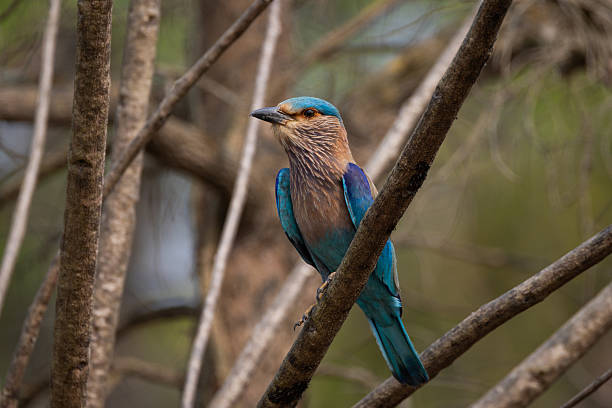
Bird Watching at Chitwan
 

Bird Watching at Chitwan: A Specialist Destination

Chitwan is recognised internationally as one of Asia’s premier birdwatching destinations—the combination of over 600 confirmed species, a variety of productive habitat types, and the year-round presence of some of Asia’s rarest birds makes it a major draw for serious birders worldwide. The following Chitwan birds are among the most sought-after by visiting birders:

  • Bengal florican (Houbaropsis bengalensis): critically endangered bustard of the tall elephant grassland, one of the rarest birds in Asia. Chitwais are among its most important breeding sites. In the species’ global population, the species is most visible during the March-June breeding season, when males perform a dramatic display flight above the grassland.
  • Lesser florican (Sypheotides indicus): another critically endangered grassland bustard, smaller than the Bengal florican, seen at Chitwan during the monsoon breeding season.
  • Giant hornbill (Buceros bicornis): the largest hornbill in Asia, with its extraordinary casque-topped bill, is a reliable Chitwan species in the riverine forest sections.
  • Slaty-legged crake (Rallina eurizonoides): a secretive marsh bird that is seen at Chitwan more reliably than at most Asian sites.
  • Hodgson’s bushchat (Saxicola insignis): a rare and localised chat species with one of its most reliable global sites in Chitwan’s grassland.

The specialist birding programme at Chitwan is best arranged with a dedicated bird-specialist naturalist guide — available through most Sauraha lodges on request. The early-morning departure (5:00 A. M. before the standard safari) and targeted use of specific habitat patches give serious birders access to Chitwan’s rare species that the standard morning jeep safari programme does not cover in sufficient depth.

The Narayani River: Chitwan’s Western Wildlife Corridor

The Narayani River — formed by the confluence of the Kali Gandaki and Trishuli rivers at Devghat, near Narayanghat — forms the western boundary of Chitwan National Park and is one of the most important river systems in the entire Terai Arc Landscape. The Narayani drains a significant portion of the central Himalayan range and is one of Nepal’s most powerful rivers in both volume and sediment load.

The Narayani’s sandbanks and deep pools support Chitwan’s most important gharial population—the species favours the large, powerful rivers of the Gangetic system for breeding, and the Narayani’s clean, fast-flowing sections provide the habitat gharials need for egg-laying and nest guarding. The Gharial Conservation Breeding Centre at Kasara maintains the captive-rearing programme that supplements the wild Narayani population, and the park’s wildlife research team monitors released gharials using radio telemetry.

The Narayani also serves as a wildlife movement corridor between Chitwan’s core protected area and the Valmiki Tiger Reserve across the Indian border—tigers, elephants, and other large mammals move seasonally between the two protected areas through the riverine forest and grassland that line the Narayani’s lower reaches. This transboundary wildlife movement is one of the key reasons the Terai Arc Landscape—the network of protected areas and wildlife corridors connecting Nepal and India’s western Terai reserves—is one of the world’s most important large-mammal conservation landscapes.

Kathmandu Before Chitwan: Making the Most of the Capital

For visitors doing the Kathmandu-to-Chitwan tour package who have 1 to 2 days in Kathmandu before the Chitwan departure, the following Kathmandu programme complements the natural world emphasis of the Chitwan visit with the cultural and sacred heritage that makes Nepal’s capital one of the world’s most extraordinary cities:

Day 1 in Kathmandu: The Sacred Circuit

The

morning at Pashupatinath Temple — Nepal’s most sacred Shiva site on the Bagmati River’s eastern bank — is the recommended first Kathmandu experience for Hindu pilgrims and for anyone seeking the spiritual intensity that Nepal’s UNESCO monuments uniquely provide. The cremation ghats visible from the public viewpoint across the river, the sadhus (wandering ascetics) at Ram Ghat, and the steady flow of devotees at the main temple entrance create an atmosphere of living religious practice that no other Kathmandu site matches in intensity.

Nepal Vehicle Hiring’s Kathmandu sightseeing vehicle includes Pashupatinath as the standard first stop on the full-day heritage circuit.

The afternoon at Boudhanath Stupa — the world’s largest stupa and the most important Tibetan Buddhist sacred site in Nepal — provides the Buddhist complement to Pashupatinath’s Shaiva intensity. The evening kora (circumambulation) around the stupa, performed by the Kathmandu Tibetan Buddhist community in a continuous stream from late afternoon until dark, is one of Nepal’s most peacefully atmospheric public sacred practices.

The prayer wheels lining the stupa’s base, the butter lamps illuminating the shrine alcoves, and mantras from the surrounding monastery rooftops create a sensory experience most visitors describe as deeply calming.
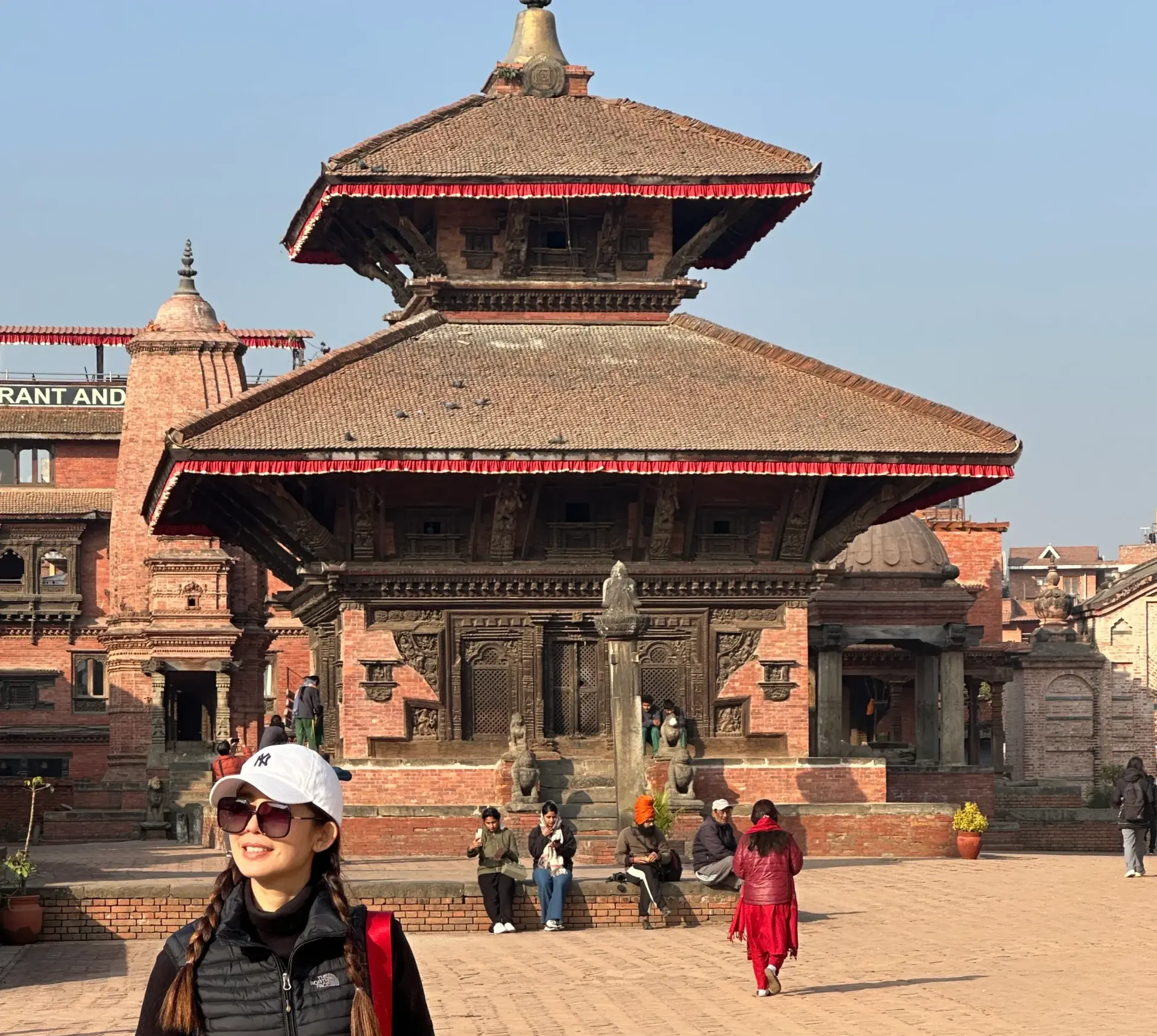
Bhaktapur Durbar Square Day Tour

Day 2 in Kathmandu: Bhaktapur and the Valley Heritage

The Bhaktapur Durbar Square day tour — 13 kilometres east of Thamel in the Nepal Vehicle Hiring vehicle — is the finest single-site Kathmandu Valley heritage experience available. Bhaktapur’s designation as a Heritage Town with a vehicle-free historic core preserves the medieval Newari character of its streets, squares, and temples to a degree that Kathmandu’s own Durbar Square — damaged by the 2015 earthquake and subject to more intense commercial pressure — cannot match.

The 55-Window Palace, the Nyatapola Temple (Nepal’s tallest pagoda temple), and the potters’ and weavers’ quarters of the old town together provide a 3 to 4 hour immersion in Newari material culture that is the finest cultural preparation available for the contrast with Chitwan’s natural world the following day.

The optional Nagarkot sunrise tour — a pre-dawn departure to the 2,175-metre valley rim viewpoint for the Himalayan panorama — provides the mountain world dimension before the Chitwan journey south. For visitors on the Kathmandu-Chitwan circuit without a Pokhara extension, Nagarkot’s Himalayan dawn offers a chance to see the snow peaks that define Nepal’s identity from an accessible vantage point before transitioning to Chitwan’s wildlife world.

Children and Families at Chitwan: What to Expect

Chitwan is one of Nepal’s most family-friendly travel destinations—the wildlife experiences are visually spectacular and immediately engaging for children of most ages; the variety of activities accommodates different energy levels and attention spans. The Tharu cultural programme has an accessible, performance-based format that children respond to enthusiastically. Some practical guidance for families visiting Chitwan:

  • Age for activities: jeep safari is appropriate for children of all ages (the vehicle’s height above ground provides good views even for small children). Canoe safari is suitable for children who are comfortable near water and can sit still for 1 to 2 hours. Jungle walk on foot requires children to be old enough to walk quietly for 2 to 3 hours and to follow guide instructions precisely — recommended for children 8 years and above. Elephant encounters at the Breeding Centre are appropriate and typically memorable for children of all ages.
  • Wildlife unpredictability: wildlife encounters in Chitwan can involve animals that behave unexpectedly. This includes rhinos that run toward the vehicle, an elephant that trumpets at close range, a monitor lizard that runs across the path during the jungle walk. The naturalist guide is trained to handle these situations, and the risk is well managed for guided activities. Educate children before the visit that the animals are wild, and that guide instructions must be followed immediately and without argument.
  • Heat and hydration: Chitwan is warm throughout most of the year (28 to 38°C in the dry season) and humid during the monsoon. Children dehydrate faster than adults in these conditions. Carry 1.5 litres of water per child for morning safari activities; rehydrate actively during the midday lodge rest period before afternoon activities.
  • Vehicle transfer comfort: the Kathmandu-to-Chitwan drive is 4 to 5 hours — long for young children without adequate entertainment and comfort. Nepal Vehicle Hiring’s Hiace van offers comfortable seating and good window views; the Manakamana cable car stop breaks up the journey with a genuinely exciting aerial ride most children find memorable. Carry car-sickness medication for children prone to motion sensitivity on winding highway sections.

Chitwan in Nepal’s Broader Conservation Context

Understanding Chitwan’s conservation significance within Nepal’s broader national park and wildlife reserve system gives visitors a more complete picture of Nepal’s remarkable commitment to wildlife protection. Nepal has allocated about 24 per cent of its total land area to protected areas—national parks, wildlife reserves, conservation areas, and hunting reserves—a proportion that exceeds most countries and reflects a sustained national policy commitment to biodiversity conservation maintained across multiple government changes.

Nepal’s protected area network extends from the subtropical lowland ecosystems of the Terai (Chitwan, Bardia, Parsa, Shuklaphanta) through the mid-hills (Langtang, Makalu-Barun, Kangchenjunga Conservation Area) to the high Himalayan zones (Sagarmatha/Everest, Annapurna Conservation Area, Manaslu Conservation Area). This altitudinal range—from 100 metres in the Terai to 8,848 metres at Everest’s summit—makes Nepal one of the world’s most biologically diverse countries per unit of land area, and its protected area network spanning this range is one of Asia’s most ambitious wildlife conservation systems.

Chitwan is the flagship of Nepal’s lowland protected area system — the park whose rhino recovery programme established the credibility and methodology that subsequent lowland conservation programmes have built on. The Lessons Learned at Chitwan (community engagement, buffer zone management, anti-poaching coordination with the military forces, and tourism revenue sharing with local communities) have been applied at Bardia, Parsa, and Shuklaphanta with varying degrees of success.

Visitors to Chitwan are visiting the prototype conservation park whose methodology has influenced lowland wildlife protection across Nepal and, through knowledge sharing, across South Asia.

Nepal Vehicle Hiring is proud to bring visitors to Chitwan—not merely as a commercial service connecting tourism destinations, but as a transport partner that understands what Chitwan represents and delivers visitors to this remarkable place with the same care and knowledge the park’s wildlife management deserves. Contact us on WhatsApp at aWhatsApp to book the Kathmandu-to-Chitwan vehicle and any other legs of your Nepal circuit.

Nepal’s wildlife heritage awaits at the end of the Prithvi Highway—Nepal Vehicle Hiring drives you there.
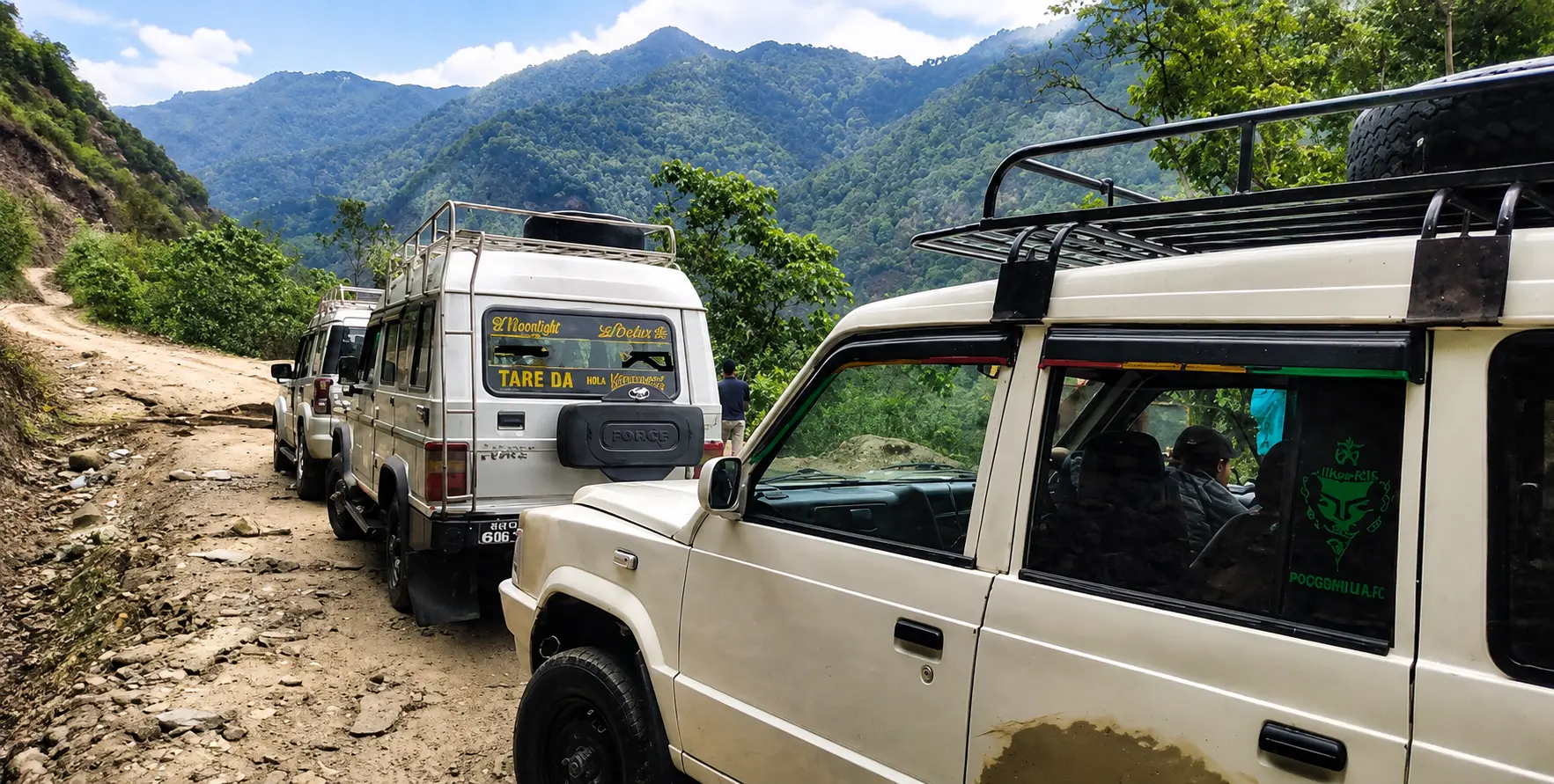
How to Book a Vehicle from Chitwan

Chitwan

How to Book a Vehicle from Chitwan: Complete Guide

Introduction: Chitwan — Nepal’s Wildlife Hub and Transport Crossroads

Chitwan National Park — Nepal’s most visited wildlife reserve and one of Asia’s finest, hosting Bengal tigers, one-horned rhinoceroses, wild elephants, gharial crocodiles, and over 544 bird species in its 952 square kilometres of Terai lowland forest and grassland — sits at the heart of Nepal’s tourist circuit, equidistant between the two cities most international visitors use as their Nepal base: Kathmandu to the northeast and Pokhara to the northwest. This position makes Chitwan not just a wildlife destination but a natural transit point — and the vehicle-booking decision for the onward journey after a Chitwan safari is one of the most common Nepal travel logistics questions.

Nepal Vehicle Hiring Pvt Ltd (vehiclehiringnepal.com) provides private car, jeep, Hiace van, coaster, and bus hire from Chitwan to every major Nepal destination — with hotel-to-hotel door service from Sauraha, Meghauli, or Bharatpur, transparent all-inclusive pricing, and the professional driver standards that transform a post-safari transfer into a smoothly managed journey continuation. Our fleet of private cars, 4WD jeeps, Hiace vans, coasters, and buses serves groups of all sizes, from solo travellers to large tour parties, and all routes, from short Chitwan-to-Bharatpur transfers to long-distance Chitwan-to-Lumbini pilgrimage journeys.

This complete guide covers the Chitwan vehicle booking process, major destinations with current costs, vehicle-type recommendations by route and group size, seasonal considerations, and practical tips to make every Chitwan departure vehicle hire confident and well managed.

Step-by-Step: How to Book a Vehicle from Chitwan

Step 1: Decide Your Destination and Departure Date

The most common vehicle hire destinations from Chitwan in 2026 are: Kathmandu (150 to 170 km, 5 to 7 hours via the Prithvi Highway and East-West Highway), Pokhara (approximately 150 km, 4 to 5 hours via Mugling), and Lumbini (150 to 160 km, 3.5 to 4 hours via the East-West Highway westward). Less common but fully served destinations include Bhairahawa/Sunauli border (for Indian visitors returning to India), Janakpur in the eastern Terai, and Butwal for onward connections to the Siddhartha Highway.

Your destination determines the vehicle type, departure timing, and all-inclusive cost — all of which Nepal Vehicle Hiring Pvt Ltd’s team clarifies at the time of booking enquiry.

Step 2: Choose Your Vehicle Type

For a group of 1 to 4 people: a private car (Toyota Corolla, Hyundai Elantra, or similar) is the most economical and perfectly adequate choice for the Chitwan to Kathmandu and Chitwan to Pokhara sealed highway routes. For a group of 4 to 6 people with full luggage, a 4WD jeep (Land Cruiser or Scorpio) offers the most comfortable and mobile option for the Chitwan departure network.

For groups of 7 to 14 people, a Hiace van hire offers comfortable individual seats and generous luggage space at the most competitive per-person rate. For groups of 20+: our coaster hire or bus hire serves institutional groups, corporate tour parties, and large pilgrimage groups departing Chitwan for Lumbini or Kathmandu.

Step 3: Contact Nepal Vehicle Hiring Pvt Ltd

WhatsApp Nepal Vehicle Hiring Pvt Ltd on WhatsApp with: your pickup location in Chitwan (Sauraha guesthouse name, Meghauli resort, or Bharatpur hotel), destination, departure date and preferred time, group size, and luggage volume. Our team responds within hours with an all-inclusive quote — vehicle type, driver name, vehicle registration, and confirmed departure time all provided in writing before departure day.

Alternatively, submit a booking request through vehiclehiringnepal.com. Most Chitwan to Kathmandu or Chitwan to Pokhara bookings can be confirmed with as little as 24 hours’ notice in off-peak season; during October and March-April peaks, booking 2 to 3 days in advance is advisable.

Step 4: Confirm All-Inclusive Pricing

Nepal Vehicle Hiring Pvt Ltd’s Chitwan departure vehicle hire rates are fully all-inclusive — the quoted price covers vehicle, professional driver, fuel, road tolls, and any applicable jungle entry fees at the Chitwan National Park perimeter checkpoints. No additional charges at settlement.

This all-inclusive confirmation is the most important financial protection in Nepal vehicle hire — always confirm what is included before accepting any quote from any Nepal vehicle operator. Base-rate operators that quote lower apparent prices often add fuel, driver bhatta, and service charges at settlement, increasing the final bill by 30 to 100 per cent above the initial quote.

Step 5: Departure Day — Hotel/Resort Pickup

Nepal Vehicle Hiring Pvt Ltd’s driver arrives at the Sauraha guesthouse gate, Meghauli resort entrance, or Bharatpur hotel at the confirmed pickup time — typically 6:30 to 8:00 AM for Kathmandu and Pokhara departures (early morning departures avoid the peak traffic hour on the East-West Highway and arrive at the destination before afternoon). The driver helps with luggage, confirms the route and any requested stops, and departs on schedule.

As Nepal Vehicle Hiring’s Chitwan transfer guide confirms, private vehicle passengers are dropped directly at the resort or hotel entrance rather than at a bus park, eliminating the navigation complexity that tourist bus arrivals at Sauraha Bus Park create for first-time Chitwan visitors.

Pokhara to Chitwan

Chitwan to Kathmandu Vehicle Hire: Complete Guide

Route, Distance, and Journey Time

The Chitwan to Kathmandu route covers about 150 to 170 kilometres, heading west from Bharatpur on the East-West Highway to the Mugling junction, then north on the Prithvi Highway through the Trishuli River gorge to Kathmandu. Current operator data confirms the journey typically takes 5 to 7 hours by private vehicle, depending on traffic on the East-West Highway between Bharatpur and Mugling and road conditions in the Prithvi Highway gorge section.  Early morning departures (6:30 to 7:00 AM) from Chitwan typically reach Kathmandu by 12:30 to 2:00 PM — comfortably within the afternoon arrival window that avoids Kathmandu’s peak evening traffic.

The route passes through Bharatpur (Chitwan’s main city, with a small but growing airport), the flat East-West Highway corridor through Narayanghat, the Mugling junction (the famous teashop town and river confluence at 450 m that serves as the lunch stop for most Chitwan to Kathmandu private vehicle journeys), and then the Prithvi Highway’s dramatic gorge section through the Trishuli and Marsyangdi river valleys before the final climb to Kathmandu at 1,400 metres. The Mugling to Kathmandu section’s gorge road offers some of Nepal’s finest highway scenery — the river gorge visible hundreds of metres below, forested ridgelines rising steeply on both sides, and the occasional glimpse of distant Himalayan peaks through the upper gorge openings.

An optional detour: the historic hillside town of Bandipur (approximately 1,030 m, 1 to 1.5 hours off the direct Mugling route) is a beautifully preserved Newari trading town accessible by a 10-kilometre side road from Dumre on the Prithvi Highway. Many Chitwan-to-Kathmandu private vehicle journeys include a Bandipur stop—the medieval stone-paved bazaar street, the Himalayan panorama from the ridge, and the collection of traditional courtyard guesthouses — making Bandipur one of Nepal’s most rewarding brief detours.

As Nepal Vehicle Hiring’s Chitwan transfer guide confirms, the Bandipur detour adds about 1.5 to 2 hours to the Chitwan-to-Kathmandu journey. Still, it delivers one of Nepal’s finest off-highway town encounters.

Costs and Vehicle Options: Chitwan to Kathmandu

Private car (1–4 passengers): NPR 12,000 to NPR 22,000 per vehicle, one way. The Chitwan-to-Kathmandu guide confirms that private car costs are approximately NPR 12,000 to NPR 22,000, consistent with Nepal Vehicle Hiring Pvt Ltd’s current rates. Maintained sedans and compact SUVs for this sealed-highway route.

Private 4WD jeep (4–6 passengers): NPR 16,000 to NPR 30,000 per vehicle. Per person for 6 passengers: NPR 2,667 to NPR 4,000. The Land Cruiser and Scorpio options from Nepal Vehicle Hiring Pvt Ltd’s 4WD jeep hire service are the most popular choice for families and small groups on the Chitwan to Kathmandu route; the jeep’s higher ground clearance and suspension quality provide a more comfortable ride on the Prithvi Highway gorge section’s variable surface quality.

Hiace van (7–14 passengers): NPR 30,000 to NPR 35,000 per vehicle. Hiace van hire is the most economical per-person private vehicle option on the Chitwan to Kathmandu route for medium groups.

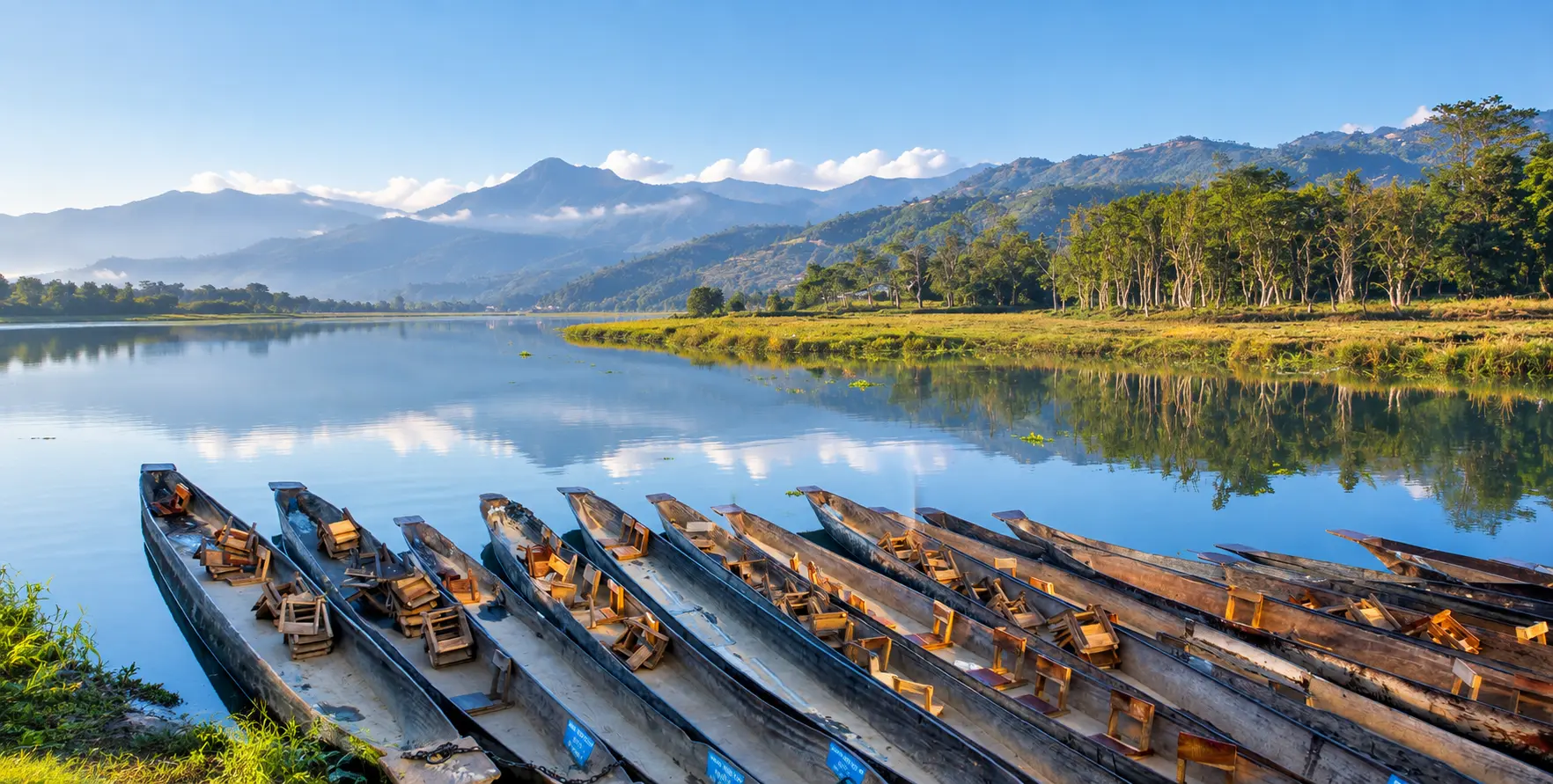
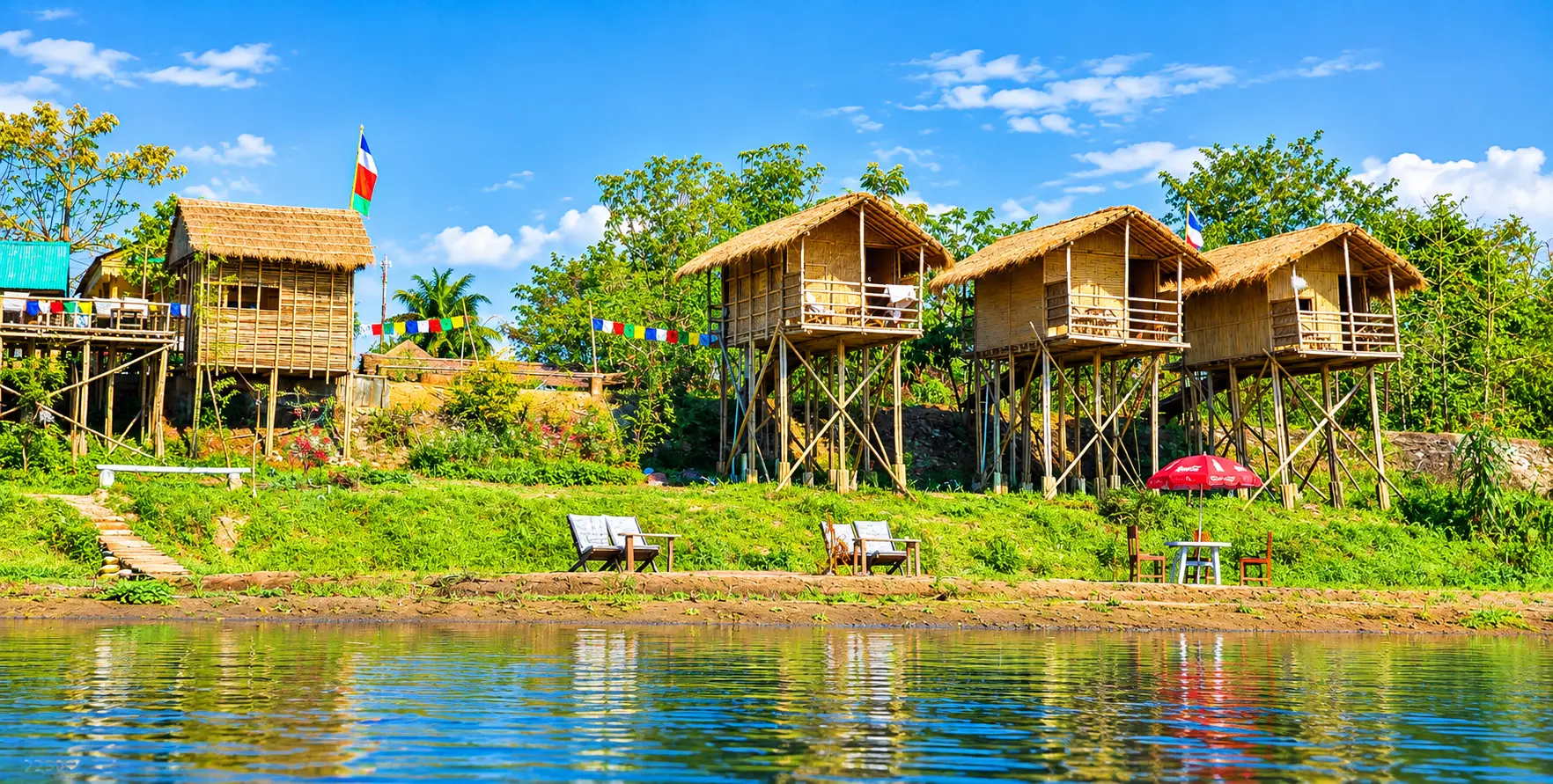
Chitwan Riverside Bamboo Huts and Reflections

Chitwan to Pokhara Vehicle Hire

Route and Journey Time

The Chitwan to Pokhara route covers approximately 148 to 160 kilometres, heading west from Bharatpur to Mugling via the East-West Highway, then briefly north on the Prithvi Highway before continuing west to Pokhara. Journey time: approximately 4 to 5 hours by private vehicle — shorter than the Chitwan to Kathmandu journey despite comparable distance because the Pokhara direction avoids the Kathmandu valley approach congestion.

The route passes through Mugling (lunch stop option), Damauli, and the Seti River valley before arriving in Pokhara’s Lakeside or Damside hotel areas.

The Chitwan to Pokhara route offers the option of a Manaslu Circuit Trek approach detour — groups heading to Pokhara who also plan to trek the Manaslu Circuit Trek can continue northward from Mugling toward Gorkha and Arughat rather than turning west to Pokhara, combining the Chitwan departure with the Manaslu trailhead approach in a single vehicle journey. Nepal Vehicle Hiring Pvt Ltd’s Kathmandu-to-Soti Khola jeep service serves this Manaslu corridor from either Kathmandu or the Mugling junction.

Private car (1–4 passengers): NPR 22,000 to NPR 26,000. 4WD jeep (4–6 passengers): NPR 26,000 to NPR 30,000. Hiace van (7–14 passengers): NPR 30,000 to NPR35,000. From Pokhara, Nepal Vehicle Hiring Pvt Ltd’s Pokhara car hire service, Sarangkot sunrise vehicle, Pokhara to Ghorepani Poon Hill jeep, Pokhara to Ghandruk jeep, Pokhara to Nayapul transport, and Pokhara to Upper Mustang overland jeep serve the complete Annapurna region trekking network. Nepal Vehicle Hiring Pvt Ltd can coordinate the full Chitwan-to-Pokhara transfer and all subsequent Pokhara departure jeep hires as a single booking.

Chitwan to Lumbini Vehicle Hire

The Sacred Journey West

Lumbini — the birthplace of Siddhartha Gautama (the historical Buddha), declared a UNESCO World Heritage Site in 1997 — lies approximately 150 to 160 kilometres west of Chitwan on the East-West Highway, making the Chitwan to Lumbini vehicle hire the most natural extension of a Nepal wildlife-and-pilgrimage itinerary. Current 2026 operator data for the Chitwan to Lumbini route confirms the journey covers 150 to 160 km and takes 3.5 to 4 hours—the flat Terai East-West Highway delivers Nepal’s fastest kilometres per hour on any major inter-city route, with a straight sealed highway through Narayanghat, Butwal, and Bhairahawa to the Lumbini turnoff.

The Lumbini Sacred Garden — the Maya Devi Temple marking the exact birthplace site, the Ashoka Pillar (erected by Emperor Ashoka in 249 BCE), and the surrounding monastic zone with its dozens of national and international Buddhist monasteries — is accessible by a further 22-kilometre side road south from Bhairahawa.

Private car (1–4 passengers): NPR 10,000 to NPR 15,000. 4WD jeep (4–6 passengers): NPR 14,000 to NPR 20,000. Hiace van (7–14 passengers): NPR 16,000 to NPR 24,000. The Chitwan-to-Lumbini route is Nepal’s most popular single-day Terai pilgrimage drive. This journey pairs the Terai’s flat agricultural landscape with growing spiritual anticipation as the vehicle approaches one of Buddhism’s four holiest sites.

Nepal Vehicle Hiking Pvt Ltd briefs drivers for the Chitwan to Lumbini route on the Lumbini Sacred Garden entrance and parking protocol, ensuring the group arrives efficiently at the Maya Devi Temple complex.

Tip: For the Chitwan to Lumbini journey, depart by 7:00 AM to arrive at the Sacred Garden by 10:30 to 11:30 AM — allowing 2 to 3 hours at the site before the afternoon heat peaks on the Terai plains. The Sacred Garden is most peaceful from 8:00 to 11:00 AM, before day-tour groups arrive from Bhairahawa and Kathmandu.

Complete Chitwan Departure Route Cost Table

RouteDistanceDrive TimeCar (USD)Jeep (USD)Hiace (USD)
Chitwan to Kathmandu150–170 km5–7 hrs100-120150–250220–300
Chitwan to Pokhara148–160 km4–5 hrs100-120150-250250-350
Chitwan to Lumbini150–160 km3.5–4 hrs90-150140-160180-220
Chitwan to Bhairahawa/Sunauli border140–155 km3–4 hrs90-150140-160180-220
Chitwan to Butwal120–130 km2.5–3.5 hrs100-150150-200200-250
Chitwan to Bharatpur city8–15 km20–40 min40-6060-8080-110

Booking Tips for Chitwan Vehicle Hire

  • Book at least 1 day in advance for standard season departures, and 2 to 3 days in advance during October, November, March, and April peaks — top-end jeeps and large Hiace vans fill quickly during Nepal’s peak tourist months
  • Confirm the exact pickup location — Sauraha has many guesthouses spread across a large area; provide the full guesthouse name and a landmark description to Nepal Vehicle Hiring Pvt Ltd so the driver finds the gate without delay
  • Depart by 7:00 AM for Kathmandu — early morning departures complete the East-West Highway section before the midday commercial traffic builds and arrive in Kathmandu before the evening rush
  • Request Mugling lunch stop — the Mugling teahouses on the Trishuli riverside are one of Nepal’s finest roadside dining experiences, with fresh fish curry from the river the standout dish; confirm the Mugling stop preference with Nepal Vehicle Hiring Pvt Ltd at booking
  • Consider the Bandipur detour for Kathmandu-bound journeys — the 1.5-to-2-hour Bandipur addition delivers one of Nepal’s most rewarding town encounters and requires no vehicle change or additional booking
  • Carry NPR cash — the East-West Highway toll booths accept cash only; Nepal Vehicle Hiring Pvt Ltd’s all-inclusive rates cover all applicable tolls with no cash request from the driver during the journey
  • Confirm your Chitwan resort’s checkout procedure before booking the vehicle pickup time — some resorts require checkout by 10:00 AM; confirm your guesthouse’s departure protocol so the vehicle pickup time aligns with the checkout window
  • For large groups (15+ people) booking coaster or bus hire from Chitwan, provide at least 3 to 5 days’ advance notice — large vehicle availability in Chitwan is more limited than in Kathmandu and requires positioning from the capital

Connecting Chitwan to Nepal’s Complete Tourism Circuit

Chitwan’s position at the heart of Nepal’s tourism triangle — equidistant from Kathmandu and Pokhara, connected westward to Lumbini and the Sunauli border, and positioned on the East-West Highway that serves the complete Terai tourism corridor — makes it a natural hub for multi-destination Nepal itinerary coordination. Nepal Vehicle Hiring Pvt Ltd’s complete vehicle network connects Chitwan to every major Nepal destination through a single coordinated booking.

The classic Nepal Golden Triangle circuit — Kathmandu, Pokhara, Chitwan — is Nepal’s most popular multi-destination tourist itinerary, typically covered over 8 to 14 days with vehicle transfers connecting all three cities. Nepal Vehicle Hiring’s own 2026 Chitwan transfer guide confirms that it can book the complete Nepal transport sequence — Pokhara to Chitwan, Chitwan to Kathmandu, or Kathmandu to Chitwan then Pokhara — in a single coordinated arrangement.

Our Kathmandu to Pokhara private vehicle service, the Pokhara to Chitwan transfer, and the Chitwan to Kathmandu return form the complete Golden Triangle vehicle network — all bookable through a single WhatsApp conversation with Nepal Vehicle Hiring Pvt Ltd on WhatsApp.

For travellers extending their Nepal journey beyond the Golden Triangle, our complete trekking transport network connects Chitwan-departing travellers to Nepal’s great trekking corridors: Kathmandu to Syabrubesi jeep for the Langtang Valley Trek. Kathmandu to Besisahar and Kathmandu to Manang jeep for the Annapurna Circuit Trek.

Kathmandu to Soti Khola jeep for the Manaslu Circuit Trek. Kathmandu to Salleri Phaplu for the Everest Base Camp Trek overland. Pokhara to Upper Mustang overland jeep for the Upper Mustang Trek.

Pokhara to Ghorepani Poon Hill jeep for the Ghorepani Poon Hill Trek. Kathmandu to Muktinath jeep for the Muktinath Tour. Our Nepal tour packages and trekking transport coordinate complete multi-destination journeys.

Plan your Nepal trip or contact us on WhatsApp. Visit vehiclehiringnepal.com to book.

In Kathmandu, our city services include airport transfers from Tribhuvan International Airport, Kathmandu sightseeing vehicles, Bhaktapur Durbar Square day tours, Nagarkot sunrise tours, and Nagarkot vehicle hire. In Pokhara, we offer Pokhara car hire, Sarangkot sunrise vehicle, Pokhara to Nayapul transport, and Pokhara to Ghandruk jeep.

Nepal Vehicle Hiring Pvt Ltd also coordinates overland approaches to the Gokyo Lake Trek, Three Passes Trek, and Kanchenjunga Base Camp Trek from Kathmandu.

Chitwan as a Destination: What Travellers Experience Before the Departure

Understanding what Chitwan National Park delivers helps explain why departure vehicle booking matters—because the emotional and physical state in which travellers leave Chitwan is specific and deserves the most comfortable, reliable vehicle for the journey ahead. Chitwan safari activities typically conclude on departure morning: a dawn jungle walk through the grasslands where one-horned rhinoceroses graze alongside spotted deer, a Rapti River dugout canoe ride past crocodile-sunning riverbanks, and a final visit to the elephant breeding centre before checkout.

Travellers who have spent 2 to 3 days in Chitwan leave with a mix of wildlife-encounter satisfaction, physical relaxation from the park’s unhurried pace, and the Nepal travel magic that comes from experiencing the country’s extraordinary biodiversity alongside its Himalayan cultural heritage.

This emotional and physical state, the post-safari glow, is best maintained by a vehicle that collects the traveller from the resort gate without logistical friction and carries them to the next Nepal destination in comfort. Nepal Vehicle Hiring Pvt Ltd’s Chitwan departure vehicle hire is specifically designed to extend the safari’s positive qualities into the transfer: the driver arrives at the resort gate with name and vehicle registration confirmed the evening before, the vehicle is clean and air-conditioned, and the departure happens at precisely the agreed time without the scramble for a shared taxi to the bus park that less organised transport arrangements require.

Our private car hire, jeep hire, and Hiace van hire services from Chitwan meet the same standards as our Kathmandu airport transfer service and Kathmandu sightseeing vehicles at the other end of the Nepal journey.

Chitwan to Kathmandu: The Prithvi Highway Journey in Detail

The Chitwan to Kathmandu journey on the Prithvi Highway is one of Nepal’s most scenically varied overland routes—covering three distinct landscape zones in a single 5-to-7-hour journey that compresses Nepal’s extraordinary geographic diversity. The first zone is the flat Terai: from Chitwan’s Sauraha or Bharatpur through Narayanghat and the East-West Highway junction, the landscape is Nepal’s tropical and subtropical lowland — rice paddies and banana groves on the flat Terai plain, the Rapti and Narayani rivers flanking the road, and the first distant view of Nepal’s Himalayan foothills appearing on the northern horizon as the vehicle approaches Mugling.

The second zone begins at Mugling (450 m), where the Trishuli and Marsyangdi rivers converge, and the Prithvi Highway turns northward into the gorge connecting the Terai to Kathmandu. The Mugling to Kathmandu section is the Prithvi Highway’s most dramatic and most visually impressive dimension: 90 kilometres of river gorge driving where the road alternates between cliff-face tunnels and open valley sections with the rushing river 50 to 100 metres below, the forested gorge walls rising steeply to forested ridgelines on both sides, and the progressive gain in altitude from 450 metres at Mugling to 1,400 metres at Kathmandu Valley’s rim, creating a landscape transformation that no other Nepal highway route delivers in such a compact and dramatic sequence.

The third zone is the Kathmandu Valley approach — the final descent from the gorge exit at Thankot into the Valley’s populated bowl, with the Valley’s ring of terrace-farmed hills, the expanding urban landscape of Kathmandu and the satellite cities of Bhaktapur and Lalitpur, and the sudden density of human settlement that signals the transition from Nepal’s extraordinary natural landscape to its most historically and culturally rich urban environment.

Nepal Vehicle Hiring Pvt Ltd’s drivers for the Chitwan to Kathmandu route know the Prithvi Highway’s optimal timing — the specific sections to traverse early before commercial truck traffic builds, the best Mugling riverside teahouse for the lunch break, and the ideal Kathmandu Valley entry timing to avoid the afternoon’s peak congestion at the Thankot checkpoint. Our Kathmandu sightseeing service, Bhaktapur day tour vehicle, and Nagarkot sunrise tour serve arriving Chitwan visitors with the same professionalism from the Kathmandu end of this journey as we provide from the Chitwan departure point.

Chitwan to Pokhara: Nepal’s Most Scenic Inter-City Drive

The Chitwan to Pokhara journey is Nepal’s most scenically continuous inter-city drive — 150 kilometres of highway that transitions from the flat Terai through the Prithvi Highway’s gorge section and into the Pokhara Valley, with the Annapurna range becoming visible above the northern ridgelines in the final hour of the journey as the vehicle descends toward Pokhara’s lakeside. The route follows the East-West Highway westward to Mugling, then the Prithvi Highway northwestward through the Marsyangdi and Seti river valleys to Pokhara.

Travellers on this route experience the same Mugling gorge scenery as the Kathmandu route for the first section, then diverge westward at Damauli toward Pokhara — the Pokhara approach offering increasingly dramatic views of the Annapurna and Machhapuchhre (Fishtail) peaks on clear mornings.

Many travellers completing the Nepal Golden Triangle circuit — Kathmandu, Pokhara, Chitwan — choose to do Chitwan last and travel directly from Chitwan to Pokhara for Annapurna region trekking or final Pokhara relaxation before returning to Kathmandu for departure. For these travellers, Nepal Vehicle Hiring Pvt Ltd can coordinate the Chitwan-to-Pokhara transfer with the subsequent Pokhara-to-Ghorepani Poon Hill jeep hire, Pokhara-to-Ghandruk jeep, or Pokhara-to-Nayapul transport for Annapurna approach treks in a single booking.

From Pokhara, the Annapurna Base Camp Trek, the Ghorepani Poon Hill Trek, and the Upper Mustang Trek via our Pokhara to Upper Mustang overland jeep all become immediately accessible — making the Chitwan to Pokhara transfer the first stage of a smoothly coordinated Annapurna adventure.

Vehicle Hire from Chitwan for Groups: Corporate, Educational, and Pilgrimage

Beyond the standard tourist circuit vehicle hire, Nepal Vehicle Hiring Pvt Ltd serves several specific group categories departing Chitwan that have particular requirements beyond the standard private vehicle booking:

Corporate and NGO groups: International organisations whose field teams visit Chitwan for project work or wildlife-related programming require vehicles that meet institutional safety and accountability standards — documented driver credentials, vehicle registration, and all-inclusive pricing confirmed in formal service agreements. Nepal Vehicle Hiring Pvt Ltd’s Hiace and Coaster van hire for NGO and corporate groups in Chitwan meets the same institutional documentation standards as our Kathmandu corporate services.

Our bus hire service for groups of 20 or more covers large corporate annual events and research institution field trips to and from Chitwan.

Pilgrimage groups departing Chitwan for Lumbini: Chitwan-to-Lumbini vehicle hire for Buddhist and Hindu pilgrimage groups requires the patience and devotional respect that Nepal Vehicle Hiring Pvt Ltd embeds in every pilgrimage-related booking. Our Lumbini-route drivers are briefed on the Sacred Garden’s entrance and parking protocol, the most significant monastic sites for international Buddhist visitors (the Mayadevi Temple, the various national monastery precincts, and the Eternal Peace Flame), and the patience required at sacred site stops where pilgrimage groups may spend significantly more time than a standard tourist itinerary allows.

Large pilgrimage groups of 40 or more using our bus hire service for the Chitwan to Lumbini journey receive convoy coordination, with our team communicating in advance with accommodation providers to confirm availability.

Educational institution groups: University field courses and international school programs visiting Chitwan for ecology, conservation, and biodiversity studies require the same vehicle standards as corporate groups, with the additional consideration of student passenger safety protocols. Nepal Vehicle Hiking Pvt Ltd’s Hiace van hire for educational institution groups includes drivers briefed on student passenger protocols, seat belt compliance reminders, and no smoking in the vehicle; patient stop-and-explain field course programs also appreciate drivers who engage with the route’s ecological and cultural features.

Contact Nepal Vehicle Hiring Pvt Ltd on WhatsApp to discuss your group’s specific requirements for Chitwan departure vehicle hire, or plan your complete Nepal tour with our team. Visit vehiclehiringnepal.com to book.

Kathmandu to Chitwan Tour Package: Complete Travel Guide

Seasonal Vehicle Hire Guide from Chitwan

Autumn (October to November) is Chitwan’s finest season — post-monsoon vegetation at its lushest, excellent wildlife visibility in the tall grasslands, and the clearest Himalayan views of the year from Chitwan’s northern margin. Vehicle hire demand from Chitwan peaks in October when the safari season and the general Nepal trekking peak coincide. Book Chitwan departure vehicles 2 to 3 days in advance during October.

Spring (March to May) is Chitwan’s second peak season—warm days, active wildlife, and the rhododendron bloom season visible on the hills above Mugling on the return to Kathmandu via the Prithvi Highway. March and April see high vehicle hire demand; book 2 days in advance for all Chitwan departure vehicle hire during these months.

Monsoon (June to August) reduces visitor numbers at Chitwan. Still, the national park remains open, and wildlife viewing can be exceptional—animals concentrate at fewer water sources as the jungle becomes denser. Rhinoceroses and elephants are frequently visible on park drives and walking safaris.

Vehicle hire from Chitwan in monsoon is readily available with short-notice booking, and rates may be marginally lower than peak season. The East-West Highway is generally reliable year-round; the Prithvi Highway gorge section occasionally sees monsoon-related disruptions that Nepal Vehicle Hiring Pvt Ltd monitors before confirming departure times.

Winter (December to February) is Chitwan’s driest and coolest season — morning mist creates atmospheric wildlife encounter conditions, and the park’s reduced vegetation makes wildlife spotting easier than in the monsoon’s dense growth. Vehicle hire is most readily available in winter,r, with the best short-notice booking prospects and the most competitive seasonal rates.

The Bandipur Detour: Making the Most of the Chitwan to Kathmandu Journey

The Bandipur detour is the single most rewarding optional addition to the Chitwan to Kathmandu vehicle journey — a 10-kilometre side road from Dumre on the Prithvi Highway that ascends to the medieval Newari trading town of Bandipur at 1,030 metres, one of Nepal’s most beautifully preserved historical settlements and an encounter with traditional Himalayan town culture that no other Nepal highway detour delivers as completely. Bandipur’s main bazaar — a 400-metre stone-paved pedestrian street flanked by 17th-to-19th-century Newari brick buildings — was spared modernisation because the Prithvi Highway was routed through the valley below rather than through the hill town in the 1970s, leaving Bandipur’s historic core intact as one of Nepal’s finest examples of a preserved Himalayan trading town.

The Bandipur stop typically takes 45 minutes to 1.5 hours, enough time for a bazaar walk, a traditional courtyard teahouse stop, and the panoramic Himalayan viewpoint at Bandipur’s northern rim,m where Annapurna IV, Annapurna II, Lamjung Himal, Manaslu, and Ganesh Himal are visible in an unobstructed east-to-west mountain panorama. Nepal Vehicle Hiring Pvt Ltd drivers for the Chitwan to Kathmandu route confirm the Bandipur detour at booking and adjust the Chitwan departure time accordingly — typically 30 minutes earlier for a Bandipur inclusion.

No additional vehicle hire charge applies; the stop adds only time, not cost.

Multi-Destination Itineraries from Chitwan

Nepal Vehicle Hiring Pvt Ltd coordinates multi-destination itineraries from Chitwan as single comprehensive bookings. The three most popular sequences: (1) Kathmandu-Chitwan-Pokhara Golden Triangle — our most frequently coordinated multi-stage arrangement, connecting the Chitwan to Pokhara transfer directly to our Pokhara to Ghorepani Poon Hill jeep or Pokhara to Nayapul transport for the Annapurna Base Camp Trek.

(2) Complete circuit Kathmandu-Pokhara-Chitwan-Kathmandu — a full Nepal week covering the country’s three principal tourism zones. (3) Chitwan-Lumbini-Pokhara Buddhist pilgrimage circuit — connecting the Buddha’s birthplace with the Annapurna gateway city via the Siddhartha Highway in a 2-day southeast-to-northwest journey. Our Nepal tour packages coordinate these complete circuits.

Plan your Nepal journey or contact us on WhatsApp to book.

All-Inclusive Pricing vs Base Rate: Why It Matters from Chitwan

Chitwan’s vehicle hire market includes operators who quote base rates that grow substantially at settlement —fuel-per-kilometre charges, driver bhatta, and service fees that routinely increase a NPR 8,000 base quote to NPR 26,000 or more for the Chitwan to Kathmandu route. Nepal Vehicle Hiring Pvt Ltd’s all-inclusive rate of US$120 for the same route covers the vehicle, driver, fuel, and tolls with zero add-ons; the booking confirmation sent via WhatsApp before departure explicitly states the final settlement amount.

This pricing transparency — the same rate at settlement as at booking — is the most important financial protection for any Chitwan departure vehicle hire and the core of Nepal Vehicle Hiring Pvt Ltd’s client trust.

The practical rule for any Chitwan vehicle hire: ask specifically whether the quoted rate includes fuel, driver daily allowance (bhatta), road tolls, and all applicable charges. Nepal Vehicle Hiring Pvt Ltd’s answer to this question is always yes — the quoted rate is the complete final amount.

Operators who cannot confirm all-inclusive pricing in writing should be approached with caution regardless of their headline rate. Nepal Vehicle Hiring Pvt Ltd provides written WhatsApp confirmation of the all-inclusive rate, vehicle type, driver name, and vehicle registration for every Chitwan departure booking.

Frequently Asked Questions: Vehicle Hire from Chitwan

After Chitwan’s wildlife encounters — dawn rhinoceros sightings on the grassland, elephant encounters at the riverside, and tiger pugmarks in the jungle dust — the vehicle that carries travellers onward to Kathmandu, Pokhara, or Lumbini is the first link in the next chapter of the Nepal adventure. Nepal Vehicle Hiring Pvt Ltd’s Chitwan departure vehicle hire is designed to make that link as smooth, comfortable, and logistically effortless as possible — hotel gate pickup, transparent all-inclusive pricing, experienced highway drivers, and the same 24-hour support on WhatsApp that accompanies every stage of our complete Nepal vehicle hire network. The wildlife is extraordinary; the transfer home deserves equally strong management.

The following frequently asked questions address the most specific and most practically important Chitwan vehicle hire questions — the answers that travellers need before confirming any Chitwan departure vehicle booking:

Nepal Vehicle Hiring Pvt Ltd has served Chitwan departure travellers across every major destination in Nepal — and the questions below reflect the most common practical queries we receive from guests preparing to leave the park. Read them before booking to ensure your Chitwan departure vehicle hire is perfectly organised.

How do I book a private vehicle from Chitwan to Kathmandu?

WhatsApp Nepal Vehicle Hiring Pvt Ltd on WhatsApp with your pickup location (Sauraha guesthouse name, Meghauli resort, or Bharatpur hotel), departure date, group size, and destination. Our team provides an all-inclusive quote within hours, confirms vehicle type and driver name, and sends written booking confirmation. Alternatively, book through vehiclehiringnepal.com.

Contact us today for an instant quote for a Chitwan departure vehicle.

How much does a private vehicle from Chitwan to Kathmandu cost?

Private car (1–4 passengers): NPR18,000 to NPR 22,000. 4WD jeep (4–6 passengers): NPR 22,000 to NPR 26,000. Hiace van (7–14 passengers): NPR 28,000 to NPR 35,000. Current market data shows private jeep costs of approximately NPR 22,000 to NPR 26,000 for the Chitwan-to-Kathmandu route. All Nepal Vehicle Hiring Pvt Ltd rates are fully all-inclusive of vehicle, driver, fuel, and tolls.

How long does the Chitwan-to-Kathmandu drive take?

5 to 7 hours by private vehicle. Current operator data confirms the private car Chitwan-to-Kathmandu journey takes 5 to 6 hours. Early morning departures (6:30 to 7:00 AM) arrive in Kathmandu between 12:30 and 2:00 PM.

The optional Bandipur detour adds 1.5 to 2 hours. Nepal Vehicle Hiking Pvt Ltd recommends including a 30-to-45-minute lunch stop in Mugling in your itinerary.

What is the best vehicle for a family of 4 from Chitwan to Pokhara?

A 4WD jeep (Land Cruiser or Scorpio) is the best choice for a family of 4 from Chitwan to Pokhara—its higher ground clearance and superior suspension provide a more comfortable ride on the Prithvi Highway’s variable sections than a sedan. At the same time, the spacious cabin accommodates family luggage without compromise. Nepal Vehicle Hiring Pvt Ltd’s 4WD jeep hire service covers the Chitwan to Pokhara route at NPR 22,000 to NPR 26,000

Can I book a Chitwan-to-Lumbini vehicle and continue to Kathmandu?

Yes — Nepal Vehicle Hiring Pvt Ltd coordinates multi-destination Chitwan departure itineraries that combine Chitwan to Lumbini pilgrimage with a Lumbini to Bhairahawa to Kathmandu onward transfer, or a Lumbini to Pokhara connection via the Siddhartha Highway. The complete Chitwan-Lumbini-Kathmandu circuit covers approximately 460 to 480 kilometres over 2 days with a Lumbini overnight.

Contact Nepal Vehicle Hiring Pvt Ltd on WhatsApp to plan and book the complete multi-destination vehicle arrangement from a single booking.

Does Nepal Vehicle Hiring Pvt Ltd pick up from Sauraha, Meghauli, and Bharatpur?

Yes — Nepal Vehicle Hiring Pvt Ltd provides hotel/resort gate pickup from all three principal Chitwan visitor areas: Sauraha (the main tourist village adjacent to the national park entrance), Meghauli (the upmarket riverside resort area served by its own small airstrip), and Bharatpur (Chitwan’s main city with the regional airport). The driver meets the group at the property entrance at the confirmed time — not at a bus park or shared taxi rank.

Provide the full property name and any landmark details when booking with Nepal Vehicle Hiring Pvt Ltd on WhatsApp. For Meghauli resorts specifically, confirm the resort’s vehicle access protocol at booking —

Some Meghauli properties require guest vehicles to use a specific river-ford approach, and the driver must be briefed in advance. Nepal Vehicle Hiring Pvt Ltd’s Chitwan-departure drivers are familiar with all three areas’ access protocols and confirm the specific pickup approach with each Chitwan property before departure day. Visit vehiclehiringnepal.com to book or contact our team for an instant quote.

What are the road conditions on the Chitwan to Kathmandu route?

The Chitwan to Kathmandu route is on Category 1 sealed national highways throughout — the East-West Highway from Bharatpur to Mugling and the Prithvi Highway from Mugling to Kathmandu. Both are generally well-maintained sealed roads appropriate for any well-maintained vehicle.

The Prithvi Highway gorge section between Mugling and Kathmandu (approximately 90 km) involves sustained winding with some rough patches on the cliff-face sections where monsoon damage repairs have been patched rather than fully resurfaced. Nepal Vehicle Hiring Pvt Ltd monitors current road condition updates before every Chitwan departure transfer.

Early morning departures (6:30 to 7:00 AM) consistently experience the best road conditions and least traffic of the day on this route.

Is it better to take a tourist bus or private vehicle from Chitwan to Kathmandu?

For solo travellers and couples on tight budgets: the tourist bus (NPR 700 to NPR 1,200 per person, 6 to 8 hours) is adequate and economical. For families, small groups of 3 or more, travellers with significant luggage, and those who value hotel-to-hotel door service and confirmed departure times: the private vehicle’s cost differential narrows dramatically as group size increases, and the quality differential — door service, no bus park navigation, faster journey, optional scenic stops — consistently justifies the private vehicle choice for groups of 3 or more.

Chitwan Vehicle Hire: Additional Practical Information

Nepal Vehicle Hiring Pvt Ltd’s Chitwan departure vehicle hire operates with several practical standards that clients consistently find important for their peace of mind:

Departure time flexibility: Nepal Vehicle Hiring Pvt Ltd accommodates early morning departures (from 5:30 AM for groups needing to reach Kathmandu by midday), standard morning departures (6:30 to 8:00 AM for most Chitwan to Kathmandu and Chitwan to Pokhara journeys), and late morning or afternoon departures for groups whose safari activities conclude at noon. Confirm your preferred departure time when booking, and Nepal Vehicle Hiking Pvt Ltd will position the driver and vehicle accordingly.

Luggage capacity: Private cars accommodate 2 to 3 standard suitcases in the boot. 4WD jeeps accommodate 3 to 4 large suitcases plus day packs. Hiace vans accommodate 8 to 10 large bags in the dedicated rear luggage area.

For groups with extensive luggage—safari photography equipment cases, large trekking packs, or medical/research equipment—notify Nepal Vehicle Hiring Pvt Ltd at booking so they can assign the appropriate vehicle with a roof rack or larger luggage capacity.

Mobile network: The Prithvi Highway gorge section between Mugling and Kathmandu has occasional mobile network gaps where NTC and Ncell signals are interrupted for 5- to 15-minute stretches in the deepest gorge sections. Nepal Vehicle Hiring Pvt Ltd’s drivers carry pre-confirmed routing instructions,s so these temporary connectivity gaps don’t affect the journey. WhatsApp communication is fully available at Mugling, Damauli, and all towns on the route.

Return booking from Kathmandu to Chitwan: Many travellers who book the Chitwan departure vehicle with Nepal Vehicle Hiring Pvt Ltd also pre-book the return Kathmandu to Chitwan transfer for a future visit or for a group member who will make the return trip separately. Our car hire in Nepal and jeep hire service both cover the Kathmandu to Chitwan direction at the same all-inclusive rates as the Chitwan departure direction.

Our Kathmandu sightseeing service, Bhaktapur day tour vehicle, Nagarkot sunrise tour, and Kathmandu airport transfer complete the Kathmandu vehicle service portfolio for Chitwan visitors spending time in the capital before or after the safari. Contact Nepal Vehicle Hiring Pvt Ltd on WhatsApp to book, or visit vehiclehiringnepal.com for all Chitwan and Nepal vehicle hire services.

Nepal is one of the world’s most extraordinary travel destinations — and Chitwan National Park is one of its most extraordinary chapters. The vehicle that carries you from Chitwan’s wildlife paradise to Kathmandu’s ancient temples, Pokhara’s mountain lake, or Lumbini’s sacred birthplace garden bridges two very different but equally remarkable Nepal experiences.

Nepal Vehicle Hiking Pvt Ltd builds that bridge with professional private vehicles, experienced highway drivers, hotel-to-hotel door service, transparent all-inclusive pricing, and 24-hour coordination on WhatsApp to keep every Chitwan departure moving smoothly from the resort gate to the destination hotel. Whether your next destination after Chitwan is Kathmandu’s UNESCO heritage circuit, Pokhara’s Annapurna panorama, Lumbini’s sacred garden, or onward to Nepal’s great trekking corridors — Nepal Vehicle Hiring Pvt Ltd is the vehicle hire partner that connects every Nepal chapter with equal professionalism and equal care.

From the one-horned rhinoceros grazing at dawn in Chitwan’s Rapti River grasslands to the ancient temples of Kathmandu’s Durbar squares, from Pokhara’s Phewa Lake reflecting the Annapurna range at sunrise to Lumbini’s sacred Maya Devi Temple where the Buddha was born — Nepal’s greatest destinations are connected by roads that Nepal Vehicle Hiring Pvt Ltd knows better than any other private vehicle operator. Book your Chitwan departure vehicle with us and arrive at your next Nepal destination on time, in comfort, and with complete confidence.

Conclusion: Book Your Chitwan Departure Vehicle with Nepal Vehicle Hiring Pvt Ltd

Chitwan National Park delivers one of Asia’s finest wildlife experiences—and the vehicle that carries you from the park’s rhino-roamed grasslands back to Kathmandu, Pokhara, or Lumbini should match the quality of the experience that precedes it. Nepal Vehicle Hiring Pvt Ltd’s private cars, 4WD jeeps, Hiace vans, coasters, and buses serve every Chitwan departure with hotel-to-hotel door service, transparent all-inclusive pricing, and 24-hour support on WhatsApp.

Contact our team to book your Chitwan departure vehicle today, or plan your complete Nepal journey including every city, safari, and mountain stage from arrival to departure. Visit vehiclehiringnepal.com — Nepal’s most trusted vehicle hire service from Chitwan and beyond.

Chitwan to Lumbini Private Jeep

KTM to Chitwan

Chitwan to Lumbini Private Jeep: Best Price Guide

The drive from Chitwan National Park (Sauraha) to Lumbini — the birthplace of the Buddha and one of Nepal’s most sacred UNESCO World Heritage Sites — is one of Nepal’s finest and most rewarding tourist vehicle journeys: a straight Terai highway run of approximately 165 to 175 kilometres, taking 3 to 4 hours by private vehicle, connecting Nepal’s finest wildlife destination with its most important Buddhist pilgrimage site in a single comfortable day’s travel.

Most tourists who visit both Chitwan and Lumbini route through Kathmandu or Pokhara between the two — a detour that adds 2 to 3 unnecessary travel days to the Nepal circuit. The direct Chitwan-to-Lumbini private jeep connection makes this detour entirely avoidable: Sauraha to Lumbini via the Terai highway is quicker, cheaper, and more direct than any Kathmandu-routed alternative.

Nepal Vehicle Hiring Pvt. Ltd. offers this direct connection as a standard service—private car hire, Hiace van hire, and Coaster bus hire for every group size —with all-inclusive pricing and confirmed hotel-to-hotel delivery.

This complete guide covers the Chitwan-to-Lumbini route in detail: distance and drive time, the best price for private jeep hire by vehicle type and group size, what to do in Lumbini, seasonal considerations, and how to combine Chitwan and Lumbini into the most efficient Nepal circuit.

Chitwan to Lumbini: Quick Reference

Distance (Sauraha to Lumbini Sacred Garden)165 to 175 km via Narayanghat–Butwal–Bhairahawa
Drive time3 to 4 hours by private vehicle (no major stops)
Road typeFlat Terai highway (Mahendra Highway / East-West Highway) — smooth blacktop
Best vehicle for 2 paxPrivate car hire — US$110 all-in
Best vehicle for 4–6 pax4WD jeep (Scorpio) — NPR 10 to 22,000 all-in
Best vehicle for 8–14 paxHiace van — NPR 15,000 to 30,000 all-in
Best vehicle for 15–25 paxCoaster bus — NPR 25,000 to 40,000 all-in
Lumbini entry feeNPR 200 per foreign national
Recommended visit time2 to 3 hours minimum; full day for monastery zone
Booking lead time24–48 hours (off-peak); 3–5 days (Oct–Nov peak)

Private Jeep Hire Prices: Chitwan to Lumbini

All Nepal Vehicle Hiring prices are all-inclusive — vehicle, licensed driver, fuel, and all road charges—no end-of-journey additions.

VehicleCapacityAll-In Price
Private Car (Sedan/SUV)2–4 paxNPR 6000–15,000
4WD Jeep (Mahindra Scorpio)4–7 paxNPR 10,000–22,000
Toyota Land Cruiser4–5 paxNPR 25,000–40,000
Hiace Van8–14 paxNPR 20,000–30,000
Coaster Bus15–25 paxNPR 30,000–40,000

Contact Nepal Vehicle Hiring via our plan your trip page or WhatsApp for confirmed pricing. Note: Nepal Vehicle Hiring’s Sauraha driver may need to deadhead from Kathmandu or Pokhara to reach Sauraha for the pickup — for early morning departures, arrange the vehicle the day before to ensure the driver is overnight in Sauraha.

The Route: Sauraha to Lumbini via Terai Highway

The Chitwan-to-Lumbini route runs entirely on Nepal’s flat Terai highway network—one of Nepal’s most comfortable and fastest driving environments. No mountain roads, no off-road sections, no altitude changes. The route:

SectionDistanceRoadDrive TimeNotes
Sauraha to Narayanghat~30 kmProvincial road40–50 minThrough Tadi Bazaar and Bharatpur; last reliable ATMs
Narayanghat to Butwal~115 kmMahendra Highway2–2.5 hrsFlat Terai, fast highway; passes Deukhuri valley
Butwal to Bhairahawa~22 kmMahendra Highway25–30 minSiddharthanagar — last city before Lumbini
Bhairahawa to Lumbini Sacred Garden~22 kmSiddhartha Highway25–30 minRoad east from Bhairahawa; UNESCO site entrance

The Mahendra Highway between Narayanghat and Butwal is the longest and most comfortable section — wide, well-maintained blacktop through the western Terai sal forest belt. The highway passes through the scenic Deukhuri valley where the Terai plains give way briefly to a forested mid-hill corridor before returning to flat Terai near Butwal.

This section has limited stopping points, but the sal forest corridor is a genuine wildlife sightings zone — langur monkeys and occasional deer are visible from the road.

Why the Direct Chitwan–Lumbini Route Beats Going via Kathmandu

The most common Nepal tourist circuit routes Chitwan and Lumbini via Kathmandu — either because tourists don’t realise the direct Terai connection exists, or because packaged itineraries are built around the Kathmandu hub. The direct Sauraha-to-Lumbini vehicle connection is significantly better on every practical dimension:

FactorVia KathmanduDirect Terai Route
Distance~490 km (Sauraha → KTM → Lumbini)~170 km (Sauraha → Lumbini direct)
Drive time2 days minimum3–4 hours —same-day arrival
Cost (private car, 2 pax)~NPR 18,000–35,000 (two vehicle legs)US$110 (one vehicle leg)
Overnight accommodationExtra 1–2 nights in KathmanduNone required — same-day connection
FatigueTwo mountain/highway road daysOne flat, comfortable Terai drive
Schedule flexibilityFixed via Kathmandu hubDepart any time from Sauraha lodge

Lumbini: What to See and Do After the Jeep Arrival

Arriving at Lumbini by private jeep from Chitwan lets tourists explore the UNESCO site at their own pace—not on a fixed group tour schedule. The site’s key components:

Maya Devi Temple and Sacred Garden

The Maya Devi Temple marks the precise birthplace of Siddhartha Gautama (the historical Buddha, born c. 563 BCE) — confirmed by the Ashoka Pillar, inscribed in 249 BCE by Emperor Ashoka, who visited Lumbini on pilgrimage, with the inscription ‘Here the Buddha, the Sage of the Shakyas, was born.’

The stone bearing the birth marker is visible in the temple’s inner sanctum. The surrounding Sacred Garden contains the Puskarini sacred pool — where, according to Buddhist tradition, Maya Devi (the Buddha’s mother) bathed before giving birth — and ancient brick ruins of monasteries dating to the Maurya and later periods.

The International Monastery Zone

North of the Sacred Garden, along a 1.5-kilometre central canal, runs the international monastery zone — two parallel rows of national monastery compounds built by Buddhist countries from around the world. The east zone has Theravada monasteries (Myanmar, Sri Lanka, Thailand, Cambodia, Laos); the west zone has Mahayana and Vajrayana monasteries (Nepal, China, Korea, Japan, Germany, France, Vietnam, Bhutan, Tibet).

Each monastery is architecturally distinctive — the Myanmar Golden Temple, the Korean temple, the Japanese Peace Pagoda, and the Royal Thai Monastery are the most visited. A focused monastery circuit takes 1 to 1.5 hours at a relaxed pace.

World Peace Flame and Eternal Peace Flame

The Eternal Peace Flame in the Sacred Garden — lit from flame fragments collected from conflict zones worldwide — burns continuously as a symbol of the Buddha’s message of peace. Nepal Vehicle-Hiring drivers know the exact location and include a brief stop as part of the Sacred Garden circuit.

Who Books the Chitwan–Lumbini Private Jeep

Buddhist Pilgrims

Buddhist pilgrims — from Nepal, Sri Lanka, Myanmar, Thailand, Korea, Japan, China, and the global Buddhist diaspora — make the Chitwan-to-Lumbini connection as part of a broader Buddhist sacred circuit of India and Nepal. The Lumbini pilgrimage (the Buddha’s birthplace), combined with India’s Buddhist circuit (Bodh Gaya, Sarnath, Kushinagar), is the most important Buddhist pilgrimage journey.

Chitwan wildlife is a natural, rewarding addition for flexible pilgrim groups. Nepal Vehicle Hiring’s Hiace van hire and Coaster bus hire serve Buddhist pilgrim groups on this route.

Hindu Pilgrims

Hindu pilgrims incorporating Lumbini into their Nepal pilgrimage circuit — whether as part of the Nepal Nekhor tour sacred circuit (Pashupatinath, Muktinath, Lumbini, Janakpur) or as a Lumbini visit after Chitwan’s wildlife — find the direct Terai route far more practical than routing through Kathmandu. Many Hindu pilgrims venerate the Buddha as an avatar of Vishnu, making Lumbini a natural and theologically coherent addition to the pilgrimage.

Nepal Triangle + Lumbini Extension

Tourists doing the standard Nepal triangle (Kathmandu-Pokhara-Chitwan) who want to add Lumbini without significantly extending their itinerary can do so via the direct Chitwan-to-Lumbini connection — spending 2 nights at Chitwan for wildlife, then a half-day drive to Lumbini (arriving in the afternoon), a Lumbini morning visit, and then Bhairahawa-to-Kathmandu by bus or the Sunauli-to-Kathmandu return. This adds only 1-2 days to the standard triangle itinerary.

Kailash Yatra Return Pilgrims

Kailash Mansarovar Yatra return pilgrims coming from Kodari through Kathmandu and heading to the Sunauli border (as covered in the Kodari-to-Sunauli guide) sometimes include a Chitwan 1-night extension before the Bhairahawa border crossing. The Chitwan-to-Lumbini connection serves these pilgrims perfectly — a Chitwan wildlife overnight followed by the short Lumbini morning visit before the Sunauli India border crossing.

Sample Itineraries Combining Chitwan and Lumbini

2-Day Chitwan + Lumbini Circuit from Kathmandu

Day 1: Kathmandu → Chitwan (Nepal Vehicle Hiring: Hiace van hire or car hire in Nepal, 4 to 5 hours, Manakamana optional). Afternoon canoe on the Rapti River.

Day 2: Early morning Chitwan jeep safari (core zone, 5:30 AM). Return for breakfast. Nepal Vehicle Hiring: private jeep from Sauraha to Lumbini (3 to 4 hours; depart 10:00 AM, arrive 1:30 PM).

Lumbini Sacred Garden and monastery zone visit (2 to 3 hours). Depart Lumbiniat  4:30 PM. Nepal vehicle hire continues from Lumbini to Kathmandu via Bhairahawa and Prithvi Highway (6 to 7 hours, overnight journey or next-morning flight).

Lumbini as Part of the Nepal Nekhor Pilgrimage Circuit

The Nepal Nekhor tour sacred circuit — connecting Pashupatinath, Muktinath, Lumbini, and Janakpur — can be routed to include Chitwan before Lumbini: Kathmandu → Chitwan (2 nights) → Lumbini (1 to 2 nights) → Janakpur (1 night) → return to Kathmandu. The Chitwan-to-Lumbini private jeep connects wildlife to the sacred circuit, while the Lumbini-to-Janakpur leg continues east on the Terai highway.

Pokhara–Chitwan–Lumbini–Sunauli One-Way Circuit

For tourists ending their Nepal visit at the India border: Pokhara → Chitwan (Nepal Vehicle Hiring vehicle, 3 to 4 hours) → 1 night Chitwan → Chitwan to Lumbini direct (3 to 4 hours) → Lumbini visit → Bhairahawa → Sunauli India border crossing. This one-way circuit avoids returning to Kathmandu entirely and is the most efficient overland exit from Nepal to India for tourists who have already done the Kathmandu circuit.

Seasonal Conditions: Chitwan to Lumbini Drive

SeasonMonthsRoad ConditionsNotes
SpringMar–MayExcellent — dry, hot (30–38°C)Good wildlife at Chitwan; Lumbini busy pre-monsoon
MonsoonJun–SepGenerally fine — Terai highway rarely floodsChitwan park partially restricted; Lumbini open year-round
Post-MonsoonOct–NovBest — cool, dry, clearPeak season; best Chitwan wildlife and Lumbini conditions
WinterDec–FebGood — cool (18–25°C), comfortableExcellent visibility; Lumbini at its best — cool and clear

The Terai highway between Narayanghat and Bhairahawa is one of Nepal’s most weather-resilient roads — the flat Terai terrain means it rarely floods or closes even in heavy monsoon rain. The Chitwan-to-Lumbini drive is reliable year-round, keeping this connection open for tourists in all seasons.

Practical Tips: Chitwan to Lumbini by Private Jeep

  • Depart Sauraha after the morning safari: the 5:30 AM morning jeep safari ends by 9:00 to 9:30 AM — a 10:00 AM Sauraha departure reaches Lumbini by 1:30 to 2:00 PM, allowing a 2 to 3 hour Sacred Garden visit before the 5:00 PM closing approach.
  • Withdraw cash at Narayanghat: ATMs in Narayanghat (NIC Asia, Nepal SBI) are the most reliable on the Terai route. Lumbini has some ATMs, but reliability is variable — carry NPR for Lumbini entry, restaurant meals, and monastery donations from Narayanghat.
  • Book Lumbini accommodation in advance for overnight stays: Lumbini has a range of accommodation from budget guesthouses to the Lumbini Garden New Crystal Hotel — book in advance for October-November peak season and the Buddhist pilgrimage festivals (Vesak/Buddha Purnima in May is Lumbini’s most important festival and draws tens of thousands of pilgrims).
  • Allow time in the monastery zone: many tourists underestimate how long the monastery zone rewards exploration. The Myanmar Golden Temple, the Korean temple, and the Great Drigung Kagyud Lotus Stupa each deserve 15 to 20 minutes of your attention. Allow 1.5 to 2 hours for the monastery zone circuit.
  • The Sacred Garden closes at sunset: the Maya Devi Temple inner sanctum has restricted entry times (check current hours with your jungle lodge before departure from Sauraha). Arriving at Lumbini by 2:00 PM ensures 3+ hours of Sacred Garden visiting time before closing.
  • Consider the Lumbini Museum: the Lumbini International Research Institute and the Lumbini Museum (in the northern monastery zone area) provide excellent contextual exhibits on Buddhist history, Ashokan inscriptions, and the archaeological history of the Lumbini site — worth 45 minutes for interested visitors.

Frequently Asked Questions: Chitwan to Lumbini Private Jeep

How far is Chitwan from Lumbini?

The distance from Sauraha (Chitwan’s tourist hub) to the Lumbini Sacred Garden entrance is approximately 165 to 175 kilometres by road, taking 3 to 4 hours by private vehicle on the Terai highway.

What is the best price for a private jeep from Chitwan to Lumbini?

Nepal Vehicle Hiring’s all-inclusive prices for the Chitwan-to-Lumbini private vehicle: US$110 for a private car (2 to 4 passengers); NPR 10,000 to 20,000 for a Scorpio jeep (4 to 7 passengers); NPR 15,000 to 25,000 for a Hiace van (8 to 14 passengers). All prices include vehicle, driver, fuel, and road charges. Contact Nepal Vehicle Hiring on WhatsApp for confirmed pricing.

Is it better to go directly from Chitwan to Lumbini or via Kathmandu?

Directly. The Chitwan-to-Lumbini direct Terai highway (165 km, 3 to 4 hours) is significantly faster, cheaper, and simpler than routing via Kathmandu (490 km, 2 days, 2 extra nights’ accommodation). The direct route is the obvious practical choice for any tourist who wants to see both Chitwan and Lumbini on the same Nepal trip.

Can I visit Lumbini as a day trip from Chitwan?

Yes — a Lumbini day trip from Chitwan is practical. Depart Sauraha at 9:00 to 10:00 AM (after the morning safari), arrive in  Lumbini by 1:00 to 2:00 PM, visit the Sacred Garden and selected monasteries (2 to 3 hours), and return to Sauraha by 8:00 to 9:00 PM.

The day trip requires a round-trip vehicle — add approximately 30 to 40% to the one-way price for the return journey. Most tourists prefer an overnight stay in Lumbini for a more complete visit.

Does Nepal Vehicle Hiring provide vehicles in Sauraha (Chitwan)?

Nepal Vehicle Hiring is based in Thamel, Kathmandu. For Sauraha pickups, our driver travels to Sauraha from Kathmandu or Pokhara the previous day for morning departures. Confirm your Sauraha departure at least 24 to 48 hours in advance to allow driver positioning.

Contact us via our plan your trip page or WhatsApp

Nepal Vehicle Hiring’s all-inclusive price covers the vehicle, experienced licensed driver, fuel for the complete Chitwan-to-Lumbini journey, and all road and bridge charges. Not included: Lumbini entry fee (NPR 200 per foreign national), passenger meals and accommodation, Lumbini museum entry, and driver tip (at passenger discretion).

Book Your Chitwan to Lumbini Vehicle with Nepal Vehicle Hiring

Nepal Vehicle Hiking Pvt. Ltd., Thamel, Kathmandu — all vehicle types for the Chitwan-to-Lumbini Terai route:

Visit our Plan Your Trip page with your Sauraha departure date, group size, and Lumbini plans. We confirm the vehicle, all-in price, and driver within 24 hours. Chitwan’s wildlife and Lumbini’s sacred history are two of Nepal’s finest experiences — Nepal Vehicle Hiring connects them in a single comfortable journey.

Lumbini’s Sacred Significance: What Every Visitor Should Know

Lumbini is not simply a heritage site or a museum — it is one of the four most sacred places in Buddhism, alongside Bodh Gaya (where the Buddha attained enlightenment), Sarnath (where he delivered his first teaching), and Kushinagar (where he passed into parinirvana). Together, the four form the most important Buddhist pilgrimage circuit in the world, drawing hundreds of thousands of devotees annually from every Buddhist country.

The historical certainty of Lumbini’s identification as the Buddha’s birthplace is exceptional for ancient religious sites — the Ashoka Pillar’s 249 BCE inscription (‘Here the Blessed One was born’) is the oldest known dated stone inscription in the Indian subcontinent and provides documentary confirmation more than 300 years before most comparable sacred sites have any written record. Archaeological excavations since 1996 have uncovered a brick structure beneath the Maya Devi Temple that radiocarbon-dates to approximately the 6th century BCE — consistent with the traditional birth date of Siddhartha Gautama.

For Hindu visitors — who make up a significant proportion of Lumbini’s visitors given India and Nepal’s predominantly Hindu populations — Lumbini is the birthplace of an avatar of Vishnu. The Dashavatara tradition (ten primary avatars of Vishnu) includes the Buddha as the ninth avatar in most traditional listings, making Lumbini as much a Vaishnava sacred site as a Buddhist one. Lumbini’s mixed Hindu-Buddhist visitor community reflects this shared sacred landscape.

Tourists approaching Lumbini from Chitwan by Nepal Vehicle Hiring’s private jeep arrive at one of the best-preserved and best-managed UNESCO sacred landscapes in South Asia — a site where the historical significance is substantiated by archaeology, the sacred dimension is living and actively practised, and the physical setting (the Sacred Garden, the Ashoka Pillar, the ancient ruins, the international monastery corridor) is genuinely beautiful and deeply moving.

Butwal: The Midpoint Stop on the Chitwan–Lumbini Road

Butwal — approximately halfway between Narayanghat and Bhairahawa on the Mahendra Highway — is the standard midpoint rest stop on the Chitwan-to-Lumbini drive. With a population of about 200,000, Butwal is one of Nepal’s fastest-growing cities and a key commercial centre for the western Terai. For tourists on the Chitwan-to-Lumbini vehicle journey:

  • Rest stop: Butwal’s highway food stalls and restaurants along the main Terai bazaar road serve standard Nepali dhaba (roadside eatery) food — dal bhat, noodle soup, fried rice, and tea. Nepal Vehicle Hiring drivers use Butwal for a standard 20- to 30-minute rest and food stop, about 1.5 to 2 hours from Sauraha.
  • Fuel: Butwal has reliable petrol stations with both petrol and diesel — Nepal Vehicle Hiring drivers fuel at Butwal if needed for the Bhairahawa approach.
  • Tinau River: The Tinau River crossing at Butwal is one of the more scenic moments on the otherwise flat Terai highway — the river emerges from the Siwalik Hills immediately north of Butwal in a dramatic gorge before spreading into the plains. The Butwal riverside area offers a pleasant walk along the riverbank if you have time for a 15-minute stop.

Beyond Butwal, the highway continues through the flat Bhairahawa plains to Siddharthanagar — the city renamed in honour of Siddhartha Gautama and the urban gateway to Lumbini. The 22-kilometre Bhairahawa-to-Lumbini road east of the city follows the Siddhartha Highway into the UNESCO site.

Lumbini Development Zone: Understanding the Site’s Layout

The Lumbini Development Zone — the managed UNESCO heritage area — was designed by the Japanese architect Kenzo Tange in the 1970s as a comprehensive master plan for the site’s development. Understanding Tange’s design helps visitors navigate the zone’s layout and make the most of their time:

The zone is organised on a north-south axis approximately 4.8 kilometres long. At the southern end is the Sacred Garden — the original pilgrimage area containing the Maya Devi Temple, the Ashoka Pillar, the Puskarini pool, and the ancient monastic ruins.

North of the Sacred Garden, a central canal runs the length of the 1.5-kilometre monastery zone — the east bank with Theravada Buddhist country monasteries, the west bank with Mahayana and Vajrayana monasteries. At the zone’s northern end are the Lumbini Museum and the Lumbini International Research Institute.

A tourist bus (electric vehicle) runs along the central canal for visitors who prefer not to walk the full 1.5-kilometre length.

Most Chitwan-to-Lumbini visitors on a 2- to 3-hour visit focus on the Sacred Garden and Maya Devi Temple (45 to 60 minutes), 3 to 4 selected monasteries in the international zone (30 to 45 minutes), and a walk along the central canal (15 minutes). For visitors with 4+ hours, the full monastery zone circuit plus the museum is a deeply rewarding extended visit.

Lumbini is best explored on foot (within the Sacred Garden and the immediately accessible monastery zone) or by the electric tourist bus (for the northern sections). Nepal Vehicle Hiring’s vehicle waits at the Lumbini Development Zone car park while passengers explore the site — our driver will be at the car park and available by phone for any timing adjustments during the visit.

Bhairahawa: The Lumbini Gateway City

Bhairahawa (officially renamed Siddharthanagar) is the major city nearest to Lumbini — 22 kilometres west of the Sacred Garden and the practical base for Lumbini visitors who need hotels, restaurants, ATMs, and services not available within the development zone itself.

For Chitwan-to-Lumbini private jeep passengers, Bhairahawa serves as: the final city before Lumbini for any last cash withdrawals (NIC Asia, Nepal SBI, Everest Bank ATMs); the accommodation base for overnight Lumbini stays (several hotels including Hotel Nirvana and similar mid-range properties are well-positioned for the Lumbini morning visit); the connection point for passengers who need to fly back to Kathmandu from Gautam Buddha International Airport (BHR, domestic flights 30 minutes to KTM) or onward to India via the Sunauli-Belahiya border crossing (4 km south of Bhairahawa city centre).

Nepal Vehicle Hiring’s Sauraha-to-Lumbini vehicle passes through Bhairahawa as part of the standard route, and our driver makes any needed city stops (ATM, hotel drop, airport connection, or Sunauli border drop) as required. Passengers who want the vehicle to continue from Lumbini to the Sunauli India border or to Bhairahawa Airport can request this as part of the onward journey — confirm with Nepal Vehicle Hiring’s operations team when booking.

The Chitwan–Lumbini Journey: What the Terai Reveals

For many international tourists, the Chitwan-to-Lumbini Terai highway drive is their longest encounter with Nepal’s southern plain, he lowland ecological zone that extends from India’s Gangetic plain, constitutes about 17 per cent of Nepal’s total land area and supports over half its agriculture and a significant portion of its population.

The Terai along the Mahendra Highway between Narayanghat and Butwal passes through the Churia (Siwalik) range’s southern foothills on one side and the flat agricultural plains on the other — a landscape of rice and wheat fields, thatched village houses, sal forest patches, and the occasional river crossing. The Deukhuri valley section (roughly between Lamahi and Sunwal) is particularly scenic — a broad river valley between the outer Siwalik range and the inner Churia that creates a momentary mid-hills character in the middle of the otherwise flat Terai highway.

Birdlife along the Terai highway is rich for observant passengers — the sal forest patches adjacent to the highway corridor support painted storks, adjutant storks, Asian openbill storks, common mynas, various bee-eaters, and the Terai’s distinctive raptor community including crested serpent eagles and changeable hawk-eagles. Nepal Vehicle Hiking drivers will pause briefly at the roadside for any exceptional wildlife sighting, on request.

The overall character of the Chitwan-to-Lumbini drive — flat, comfortable, fast, through one of South Asia’s most biodiverse lowland landscapes — makes it a genuinely pleasant and interesting journey in its own right, not just a transit between two destinations. The contrast with the mountain approaches that most Nepal tourists are more familiar with is striking: this is Nepal at sea level, warm and green and richly populated, as different from Kathmandu or the Annapurna foothills as possible while still being Nepal.

From Lumbini: Where to Go Next

After the Lumbini visit, Nepal Vehicle Hiring provides onward transport in several directions depending on the tourist’s circuit:

  • Lumbini to Kathmandu (300 km, 6 to 7 hours): the most common onward route — north on the Siddhartha Highway to Butwal, then east on the Mahendra Highway to Narayanghat and north on the Prithvi Highway to Kathmandu. Nepal Vehicle Hiring’s Hiace van and car hire serve this route for groups of all sizes.
  • Lumbini to Pokhara (200 km, 4 to 5 hours): north from Bhairahawa on the Siddhartha Highway through the Palpa hills to Pokhara. A scenic alternative to the Kathmandu route for tourists doing Pokhara before flying home.
  • Lumbini to Sunauli border (22 km, 30 minutes): for India-bound tourists ending their Nepal circuit at the Sunauli-Belahiya crossing. Nepal Vehicle Hiring drops at the Belahiya Nepal immigration gate.
  • Lumbini to Janakpur (300 km, 5 to 6 hours east on the Mahendra Highway): for the Nepal Nekhor pilgrimage circuit continuing to the birthplace of Goddess Sita in the Mithila heartland.
  • Lumbini to Bhairahawa Airport (22 km, 30 minutes): for domestic flights back to Kathmandu (25 minutes) or connections via Kathmandu to international destinations.

Nepal Vehicle Hiring coordinates all onward connections from Lumbini as part of the complete Nepal circuit booking — one operator, all vehicle legs, complete circuit certainty. Contact us via WhatsApp to plan the complete Chitwan-Lumbini-onward vehicle circuit for your Nepal trip.

Lumbini and Chitwan in Nepal’s Tourism: The Under-Explored Connection

Despite the obvious logic of combining Chitwan and Lumbini in a single Nepal circuit — wildlife and spirituality, two UNESCO World Heritage Sites, flat highway connection, no backtracking — the Chitwan-Lumbini direct connection remains significantly less trafficked than it deserves. Most tour operators route tourists through Kathmandu between the two sites because their itineraries are built around the capital hub; most individual tourists follow these operator itineraries without realising the direct option exists.

Nepal Vehicle Hiring’s Chitwan-to-Lumbini private jeep service addresses this gap directly — making the direct connection as easy to book as any Kathmandu-routed alternative, at a fraction of the cost and time. The 165-kilometre Terai drive connecting Nepal’s finest wildlife park to its most sacred Buddhist pilgrimage site is one of Nepal’s best-kept logistical secrets, and Nepal Vehicle Hiring’s transparent pricing and 24/7 WhatsApp booking make it accessible to every Nepal tourist who knows to ask.

WhatsApp to book a private jeep from Chitwan to Lumbini. The drive takes 3-4 hours. Memories from both destinations will last much longer.

Chitwan and Lumbini: Two UNESCO Sites, One Day’s Drive Apart

Nepal has ten UNESCO World Heritage Sites — more per square kilometre than almost any other country on Earth. Two of these sit within a single day’s drive of each other on the western Terai: Chitwan National Park (inscribed 1984, Outstanding Universal Value for its biodiversity and wildlife conservation achievements) and Lumbini, the Birthplace of the Lord Buddha (inscribed 1997, Outstanding Universal Value as the most sacred place of one of the world’s great religions).

Combining two UNESCO World Heritage Sites in a single day in Nepal— a morning wildlife safari at Chitwan and an afternoon sacred garden at Lumbini—offers an extraordinary concentration of Nepal’s finest heritage in a single 12-hour period. Few places in the world offer this density of UNESCO-designated experiences within a 3-hour drive. The Chitwan-to-Lumbini private jeep makes this combination possible.

Nepal Vehicle Hiring’s drivers understand the UNESCO significance of both sites and typically share relevant historical and ecological context with passengers during the Terai highway journey — the drive between two extraordinary sites is itself a time for learning, for quiet reflection, or for the simple pleasure of watching Nepal’s flat southern landscape roll by as the vehicle transitions from the wildlife world to the sacred world.

Understanding Chitwan National Park Before Leaving

Most tourists who make the Chitwan-to-Lumbini jeep connection depart from Sauraha after at least one night and one morning safari at Chitwan. Understanding what Chitwan’s wildlife experience offers — and what it means in global conservation terms — gives the departure a richer sense of what you’ve just witnessed.

Chitwan National Park protects one of the last undisturbed areas of the Terai-Duar savanna and grassland ecosystem — a landscape that once extended continuously from Pakistan’s Indus plain to Bangladesh’s Brahmaputra delta before agriculture, urbanisation, and hunting reduced it to scattered fragments. Chitwan’s 952-square-kilometre core zone and 750-square-kilometre buffer zone together represent the finest remaining expression of this lowland ecosystem in Asia.

The greater one-horned rhinoceros population at Chitwan — approaching 700 individuals — represents one of wildlife conservation’s most dramatic success stories. Commercial hunting and habitat loss reduced the species to fewer than 100 animals by the early 20th century; today, Chitwan holds the largest single population of the species anywhere.

Tourists who saw rhinos during the morning jeep safari or from the riverbank witnessed animals whose survival reflects decades of conservation effort, legal protection, and community engagement that Nepal has sustained even during periods of significant political and economic challenge.

The Bengal tiger population at Chitwan — approximately 100 animals — has more than doubled since Nepal’s conservation programme began its most intensive phase in the early 2000s. Nepal is one of the few countries where tiger populations are genuinely increasing, and Chitwan is the centrepiece of this recovery.

The animal that may have been glimpsed as a pugmark in the mud, an alarm call from a deer, or — in the fortunate moments — a direct sighting in the sal forest is one of the most endangered large mammals on Earth, and its presence at Chitwan is a conservation achievement that deserves genuine recognition.

Departing Chitwan for Lumbini with this wildlife context in mind gives the journey its proper weight: leaving one of the world’s most important conservation landscapes for one of the world’s most important sacred landscapes, connected by a flat Terai highway through the fertile plains that both wildlife and human civilisation have always depended on in this part of the subcontinent.

Lumbini’s International Community: The Monastery Zone in Depth

The international monastery zone at Lumbini — which tourists crossing from Chitwan have the afternoon to explore — is one of the most remarkable architectural and cultural collections in South Asia: a living embodiment of Buddhism’s global reach, assembled in a single planned landscape in the southern Nepal plains.

East Zone: Theravada Buddhism

The east bank of the central canal hosts the Theravada Buddhist countries — the tradition dominant in Southeast Asia and Sri Lanka. The Myanmar Golden Temple (Mahabodhi Society of Myanmar) is the most visually striking in this zone — a pagoda in the distinctive Myanmar tiered-spire style, with intricate gilded exterior carving. The Sri Lanka Mahabodhi Society temple, the Cambodia-style vihara, and the Thai monastery each express their country’s distinctive Buddhist architectural language.

West Zone: Mahayana and Vajrayana Buddhism

The west bank hosts the Mahayana and Vajrayana traditions — dominant in East Asia and the Himalayan regions. The Korean monastery and its distinctive wooden pavilion architecture, the Chinese Buddhist Association temple with its classical Chinese roof forms, the German Dharmaduta Society’s European-inflected meditation centre, the Vietnamese Phap Hoa Monastery, and the Great Drigung Kagyud Lotus Stupa (Tibetan Vajrayana) each represent different expressions of the northern Buddhist traditions that stretch from Germany to Japan.

Nepal’s Own Monastery

Nepal’s contribution to the international monastery zone, the Lumbini Buddhist Viha, represents the host nation’s Newar Buddhist tradition, which has maintained continuous Buddhist practice in the Kathmandu Valley for over 1,500 years and is one of the world’s oldest surviving Buddhist communities. The Newar Buddhist tradition blends Vajrayana tantric practice with local Kathmandu Valley cultural forms in ways that distinguish it from both the Theravada and the Tibetan Vajrayana.

For tourists arriving from Chitwan with 2 to 3 hours at Lumbini, the monastery zone circuit is best approached with specific priorities: choose 3 to 5 monasteries that reflect either the Buddhist traditions you know best (for practising Buddhists) or the architectural styles you find most striking (for cultural tourists), and take time inside each to appreciate the specific expression of Buddhist practice and aesthetics that the national community has brought to this shared sacred landscape.

Vesak and Buddhist Festival Season at Lumbini

For tourists who can time their Chitwan-to-Lumbini visit to coincide with a major Buddhist festival, the itinerary becomes a living pilgrimage, gathering extraordinary scale and diversity.

The most important Lumbini festival is

Vesak — also known as Buddha Purnima, Buddha Jayanti, or Visakha Puja depending on the tradition — is celebrated on the full moon of the lunar month of Vaishakha (typically April to May). Vesak commemorates the Buddha’s birth, enlightenment, and parinirvana simultaneously and is the single most important day in the Buddhist calendar for all traditions worldwide.

At Lumbini, the Vesak celebration draws tens of thousands of pilgrims from across Nepal, India, and internationally — the Sacred Garden and the monastery zone fill with devotees from every Buddhist country, the central canal is lit with butter lamps, and the Maya Devi Temple receives a continuous stream of worshippers through the day and night.

For Chitwan-to-Lumbini private jeep passengers timing a Vesak visit: Nepal Vehicle Hiring recommends arriving at Lumbini the day before Vesak for accommodation booking (Lumbini and Bhairahawa fill on Vesak) and the full-day experience of the festival. Contact Nepal Vehicle Hiring via WhatsApp at least 3 to 4 weeks before a Vesak Lumbini visit for vehicle booking — demand is high across the entire Terai in this window.

Comparing Private Jeep vs Tourist Bus: Chitwan to Lumbini

Some tourists consider using the public tourist bus network to connect Chitwan and Lumbini rather than booking a private jeep. The following comparison helps with this decision:

  • Private jeep (Nepal Vehicle Hiring): departs your Sauraha jungle lodge gate at your chosen time (typically 9:30 to 10:00 AM after morning safari), delivers directly to Lumbini Sacred Garden entrance or Bhairahawa hotel, all-inclusive price confirmed in advance, luggage in the vehicle throughout, flexible stops at Butwal and Narayanghat as required. Journey time: 3 to 4 hours door-to-door.
  • Tourist bus (shared/public): departs from Sauraha bus stand at fixed morning times (approximately 6:30 to 7:00 AM — incompatible with morning safari), requires tuk-tuk from jungle lodge to bus stand, drops at Bhairahawa bus park (not Lumbini — requires local tuk-tuk from Bhairahawa to Lumbini, 22 km additional journey), shared with other passengers, luggage management on the bus. Per-person cost is lower (approximately NPR 400 to 600 per seat), but total time and logistics are significantly more complex.

Nepal Vehicle Hiring: Your Terai Transport Specialist

Nepal Vehicle Hiring’s Terai route services — Chitwan to Lumbini, Lumbini to Kathmandu, Lumbini to Pokhara, Chitwan to Kathmandu, and the complete western Terai circuit — are operated with the same standards as our mountain approach and Kathmandu Valley services: licensed vehicles, experienced drivers, all-inclusive pricing, written booking confirmation, and 24/7 WhatsApp operations support.

The Terai highway is one of Nepal’s easiest driving environments. Still, it rewards drivers who know the specific road conditions, the best rest stops, and the optimal timing for each section—knowledge our Terai-experienced drivers bring from hundreds of journeys on this corridor.

Nepal Vehicle Hiring’s Chitwan-to-Lumbini service is not a generic ‘Terai route vehicle’ but a carefully planned journey with attention to the ri departure times, the Lumbini visit window, and the onward connections that make the combined Chitwan-Lumbini day trip or circuit work smoothly.

Book the Chitwan-to-Lumbini private jeep via WhatsApp, email [email protected], or our plan your trip page at vehiclehiringnepal.com. Specify your Sauraha departure date, group size, Lumbini arrival preference, and onward destination after Lumbini. Nepal Vehicle Hiring confirms the vehicle, driver, all-in price, and departure time within 24 hours.

Chitwan’s rhinoceros and Lumbini’s sacred garden await — one vehicle, one comfortable day’s drive connects them both.

The Mahendra Highway: Nepal’s East-West Lifeline

The Mahendra Highway — officially known as the East-West Highway or Purba Paschim Rajmarg — is Nepal’s longest road, running about 1,027 kilometres from Mechi in the far east to Mahendranagar in the far west along Nepal’s Terai belt. The Chitwan-to-Lumbini private jeep uses the western section of this highway between Narayanghat and Butwal, covering approximately 115 kilometres of the highway’s most commercially active and tourist-frequented section.

The highway was constructed in stages from the 1960s to the 1990s, with bilateral assistance from the United States, China, and India on different sections, and represents Nepal’s most significant ground-level infrastructure investment since the Rana era. For tourists accustomed to Nepal’s more famous mountain roads — the Prithvi Highway’s gorge sections, the Solu-Khumbu off-road tracks, the Kali Gandaki approach — the Mahendra Highway’s flat, fast, straight character can feel anticlimactic.

But its flatness serves a purpose: it carries Nepal’s agricultural produce, commercial goods, and people through the country’s most productive lowland zone, and its reliability as a transport artery is a significant asset for the communities it serves.

For tourists on the Chitwan-to-Lumbini journey, the Mahendra Highway section offers a specific pleasure: watching Nepal’s Terai landscape at speed without the distraction of road-management anxiety. The windows open easily, the vehicle holds its lane comfortably, and the passing landscape — the sal forest canopy, the rural villages, the occasional flash of a river crossing, the distant Himalayan foothills on the northern horizon on clear days — can be absorbed without the white-knuckle attention that Nepal’s mountain roads demand from alert passengers.

Lumbini for Non-Buddhist Visitors: Why the Site Resonates Universally

Lumbini’s appeal extends significantly beyond the Buddhist pilgrim community. For non-Buddhist tourists — secular travellers, Hindu pilgrims, Christian or Muslim visitors, or simply curious travellers without specific religious affiliation — Lumbini offers a set of experiences that transcend any particular faith:

Historical Significance

The Buddha is one of the most historically significant human beings who ever lived — his teachings shaped the civilisations of East Asia and Southeast Asia. Over 2,500 years, the Himalayan world has influenced Western philosophy from the Hellenistic period onward and today guides the practice of approximately 500 million people.

Standing at the precise location of his birth—confirmed by archaeology and epigraphy to a degree of historical certainty that very few ancient religious sites can match—offers an encounter with history that any culturally aware visitor will find meaningful, regardless of religious affiliation.

Architectural Diversity

The international monastery zone is one of the world’s most concentrated displays of contemporary Buddhist architecture — a living comparison of how 20 Buddhist countries from Myanmar to Germany have interpreted their tradition’s sacred building conventions. For architecture enthusiasts, the monastery zone is an extraordinary open-air museum of 20th- and 21st-century religious architecture across cultures.

Landscape Peace

The Sacred Garden’s physical setting — the tree-lined central canal, the ancient mound of the Maya Devi Temple, the Ashoka Pillar rising from its stone base, the Puskarini pool reflecting the surrounding garden — has a quality of stillness and spatial dignity that is genuinely calming. Many non-religious visitors report Lumbini as one of the most peaceful places they visited in Nepa  a quality the site’s careful management, the absence of the commercial intensity found at many South Asian pilgrimage sites, and the Terai’s gentle light and atmosphere all contribute to.

Lumbini Accommodation: Overnight Options Near the Sacred Garden

For tourists arriving from Chitwan by private jeep who want to overnight at Lumbini rather than continuing to Bhairahawa, the Lumbini development zone and its immediate environs have a growing accommodation offer:

  • Lumbini Buddha Garden Hotel: within the development zone, reasonable quality, peaceful setting, popular with Buddhist pilgrim groups
  • Lumbini Garden New Crystal Hotel: mid-range, good facilities, close to Sacred Garden entrance
  • Hotel Nirvana and similar Bhairahawa hotels: 22 km from Lumbini but better services and more hotel options; suitable for groups wanting hotel quality above budget guesthouse standard
  • Monastery guesthouses: several international monasteries in the zone have basic guest facilities for Buddhist practitioners — enquire directly with specific monastery compounds

Nepal Vehicle Hiking recommends overnight in Lumbini (or Bhairahawa) rather than a day-trip-and-return to Sauraha for tourists who want a full Lumbini experience. The Sacred Garden at dawn—before the day-tour groups arrive from Bhairahawa—is one of Nepal’s most serene morning experiences, and only overnight visitors get to experience this window. Book accommodation in advance for October-November peak season and for Vesak (April-May full moon).

Packing for the Chitwan–Lumbini Day: What to Bring

The Chitwan-to-Lumbini journey shifts from the jungle microclimate of Sauraha to the open plains of Lumbini—but in the Terai, with a slightly different character. The following packing guidance covers the combined Chitwan morning safari + Lumbini afternoon visit day:

  • Light layers for temperature transition: Sauraha mornings in the 5:30 AM safari hour can be cool (15 to 20°C in October-November); the midday Terai highway and Lumbini afternoon rise to 28 to 35°C. Carry a light fleece in the vehicle cabin for early departure, then switch to lighter clothes for the Lumbini visit.
  • Sun protection: the Lumbini development zone has minimal shade in the open monastery zone corridor. Sunscreen (SPF 50), sunglasses, and a hat are important for the 2 to 3 hour Lumbini visit, particularly in the post-monsoon and spring seasons when the sun is intense.
  • Comfortable walking shoes: the Lumbini monastery zone involves 1 to 2 km of walking on paved paths. After a morning safari (often involving vehicle seating), comfortable flat walking shoes are appropriate and appreciated.
  • Camera and binoculars: the Chitwan morning safari and the Lumbini monastery zone are both visually rich environments deserving serious photography. Charge your camera fully the previous evening; clear the memory card for the day.
  • NPR cash: Lumbini entry fee (NPR 200 per foreign national), monastery donations (optional but appropriate — NPR 100 to 500 per visited monastery), lunch at Lumbini’s restaurants (NPR 400 to 800 per person), and any Lumbini souvenir or book purchases. ATMs are in Bhairahawa (22 km) — carry NPR from Narayanghat (30 minutes from Sauraha), where ATMs are reliable.
  • Water: carry at least 1.5 litres per person for the Lumbini visit. Water is available at Lumbini restaurants, but carrying your own supply for the monastery zone walk is practical.

The Terai’s Sacred Landscape: Chitwan, Lumbini, and Beyond

Chitwan and Lumbini are the best-known sacred and natural sites in Nepal’s Terai. Still, the western Terai has a much richer sacred landscape than these two UNESCO sites alone suggest. For tourists with extended Nepal schedules, the following additional Terai sacred sites are accessible from the Chitwan-to-Lumbini route:

  • Devghat (near Narayanghat): the confluence of the Trishuli and Kali Gandaki Rivers — a sacred tirtha (crossing place) where Hindu pilgrims cremate their dead, old sadhus come to live out their final years, and the annual Makar Sankranti festival draws 100,000+ pilgrims—a 115-to 220-minute detour from the Narayanghat route.
  • Palpa and Tansen: in the Palpa hills between Butwal and Pokhara, the historic Newari market town of Tansen is one of Nepal’s finest and least-visited medieval urban heritage sites — a 45-minute detour from the Butwal junction for tourists with time.
  • Kapilvastu (Tilaurakot): 27 km west of Lumbini, the archaeological site believed to be the palace of King Suddhodana — the Buddha’s father — where Siddhartha Gautama spent his childhood and young adulthood before renouncing the world. The site has a small museum and the atmospheric ruins of the ancient city, a natural extension of the Lumbini visit for interested tourists.
  • Janakpur: 300 km east of Lumbini on the Mahendra Highway, the birthplace of Goddess Sita and Nepal’s most important Mithila cultural centre. Nepal Vehicle Hiring’s Hiace van hire serves the Lumbini-to-Janakpur Terai highway connection as part of the Nepal Nekhor sacred circuit.

Nepal Vehicle Hiring’s Terai route vehicles can stop at any of these sacred and heritage sites on the Chitwan-to-Lumbini journey or as extensions of the Lumbini visit—coordinate with our operations team via WhatsApp when planning the Terai circuit.

Chitwan to Kathmandu Private Jeep: Best Price

Chitwan

The Best Way to Travel Chitwan to Kathmandu

The Chitwan to Kathmandu private jeep journey is one of Nepal’s most frequently travelled tourist routes—connecting Chitwan National Park, Nepal’s premier wildlife destination, with Kathmandu, Nepal’s heritage capital and international gateway. The route covers approximately 155 to 165 km depending on the specific starting point within the Chitwan area, follows the Prithvi Highway through the scenic Trishuli River gorge, and takes 4 to 5 hours in a private vehicle — delivering travellers from the jungle terai to the mountain capital in a comfortable, door-to-door service that no public transport option can match.

This guide provides the most complete and honest information available for the Chitwan to Kathmandu private jeep price — the exact costs for different vehicle types, what is and is not included in the price, how to book for the best rate, the route options and their trade-offs, and why Nepal Vehicle Hiring Pvt. Ltd. consistently delivers the best combination of price, quality, and service on this route. Whether you are a solo traveller, a couple, a family, or a trekking group completing the wildlife-heritage circuit of southern and central Nepal, this guide gives you everything you need to book the Chitwan to Kathmandu private vehicle transfer with confidence.

Chitwan to Kathmandu Private Jeep — Quick Reference

Distance: Chitwan (Sauraha) to Kathmandu (Thamel) — approximately 155-165 km

Journey Time: 4 to 5 hours by private vehicle via Prithvi Highway

Best Route: Sauraha → Bharatpur → Narayanghat → Prithvi Highway → Kathmandu

Sedan/SUV Price: NPR 10,000-26,000 (all-inclusive, door-to-door)

Hiace Van (up to 14 pax): NPR 16,000-30,000 (trekking/tour groups)

Book: Nepal Vehicle Hiring Pvt. Ltd. | WhatsApp | vehiclehiringnepal.com

WhatsApp: Available 24/7 — Early Morning Departures from 5:00 AM Available

Chitwan to Kathmandu Private Jeep

The Route: Chitwan to Kathmandu via Prithvi Highway

Road Distance and Journey Profile

The standard Chitwan to Kathmandu private jeep route departs from Sauraha — the main tourist accommodation area on the northern bank of the Rapti River adjacent to Chitwan National Park — and travels north via Bharatpur) and Narayanghat to join the Prithvi Highway heading northeast toward Kathmandu. The Prithvi Highway section runs approximately 120 km from the Narayanghat junction to Kathmandu, following the Trishuli River gorge through some of Nepal’s most dramatic roadside scenery before climbing to the Kathmandu Valley rim and descending into the city.

The total distance from Sauraha to Thamel is approximately 155 to 165 km, depending on the specific route through Bharatpur and the Chitwan approach roads. In a private vehicle, the journey takes 4 to 5 hours under normal traffic conditions—significantly faster than the public bus alternative of 6 to 8 hours, including connections, waiting time, and the multiple stops public buses make along the route.

The Prithvi Highway is in excellent condition year-round as Nepal’s most important and best-maintained national highway—no 4WD is required for this route, and standard sedans and SUVs complete the journey comfortably in all seasons.

Alternative Route: Via Tribhuvan Highway (Hetauda)

An alternative Chitwan to Kathmandu route goes via Hetauda and the Tribhuvan Highway — Nepal’s original mountain road from the Terai to Kathmandu, built between 1953 and 1956 with American technical assistance. The Tribhuvan Highway is Nepal’s most historically significant road — the first overland connection between the Terai lowlands and the Kathmandu Valley) — and its switchback descent from the valley rim through Daman) and Bhimphedi to Hetauda) provides extraordinary views across the Terai and occasional Himalayan panoramas on the clearest days.

The Tribhuvan Highway route is longer (approximately 180 to 200 km) and takes slightly longer (5 to 6 hours) than the direct Prithvi Highway route. Still, it offers significantly more scenic and historical interest for travellers who haven’t experienced this road. Nepal Vehicle Hiring Pvt. Ltd. can arrange the Chitwan to Kathmandu transfer via the Tribhuvan Highway on request — the same all-inclusive transparent pricing applies.

Chitwan to Kathmandu Private Jeep

Chitwan to Kathmandu Private Jeep Price — Complete Guide

Sedan and SUV Pricing — The Standard Option

The most economical Chitwan to Kathmandu private vehicle transfer uses a sedan or standard SUV — vehicles like the Toyota Corolla, Mahindra Xylo, or similar capacity cars that comfortably carry 3 to 4 passengers with standard luggage. The all-inclusive price for this vehicle class from Nepal Vehicle Hiring Pvt. Ltd. is NPR 10,000 to 13,000 for the full vehicle, including the driver, fuel, tolls, and hotel-to-hotel door service.

This rate is the best available price for a fully professional, accountable, private vehicle service on this route — transparent, all-inclusive, and with no hidden charges at destination.

Divided among 4 passengers, the per-person cost is NPR 2,500 to 3,250 — comparable to the tourist bus fare for the same route but delivering a journey that is 2 to 3 hours faster, door-to-door, with luggage in the boot rather than on the roof, in air-conditioned comfort with stops at the passengers’ choice. For groups of 3 to 4 travelling together, private sedan transfers are extremely competitive with any shared transport alternative.

Toyota Fortuner 4WD — The Group and Luggage Option

For groups of 4 to 6 passengers, families with children and significant luggage, or trekkers travelling with full expedition kit, the Toyota Fortuner 4WD is the recommended vehicle for the Chitwan to Kathmandu transfer. The Fortuner’s spacious interior seats up to 6 passengers comfortably, and its large boot accommodates substantial luggage volumes that a standard sedan can’t handle.

The all-inclusive price for the Fortuner transfer from Nepal Vehicle Hiring Pvt. Ltd. is NPR 12,000 to 15,000—marginally more than the sedan rate, but with significantly more space and comfort. For a group of 6 sharing, the per-person cost of NPR 2,000 to 2,500 is among Nepal’s most economical private transport options.

Hiace Van and Coaster Bus — Group Tours

For larger groups — trekking groups completing the Chitwan wildlife safari before heading to Kathmandu, tour groups, family gatherings, and corporate teams — the Hiace van (14 passengers) and Coaster bus (15 to 22 passengers) provide the best value per-person rate for the Chitwan to Kathmandu journey. The Hiace van all-inclusive rate is NPR 16,000 to 30,000 — divided among 12 passengers, the per-person rate of NPR 1,300 to 1,700 is among the lowest available for any private Nepal transport.

The Coaster bus for larger groups offers similarly competitive per-person economics on this fully paved, easy-driving highway route.

What Is Included in the Nepal Vehicle Hiring Pvt. Ltd. Price

  • Professional driver — experienced on the Prithvi Highway route, English-speaking team
  • Fuel — full tank, all fuel costs to Kathmandu covered, no additional fuel charges
  • Tolls — the Prithvi Highway has several toll points; all tolls included in the quoted price
  • Hotel-to-hotel door service — pickup from the Sauraha hotel/lodge, delivery to the Kathmandu hotel
  • Luggage loading assistance — the driver assists with all baggage at pickup and delivery
  • 24-hour support — WhatsApp available throughout the journey
  • No hidden charges — the quoted price is the full price, no extras at destination

Chitwan Riverside Bamboo Huts and Reflections

Chitwan to Kathmandu Journey — What to Expect

Departure Point — Sauraha and Bharatpur

The Nepal Vehicle Hiring Pvt. Ltd. driver picks you up from your Sauraha hotel or lodge — the main tourist accommodation area that lines the northern bank of the Rapti River facing Chitwan National Park. Sauraha is compact, and all hotels and lodges are accessible by vehicle, so the hotel-to-hotel door service is real, not just on paper.

The departure time is flexible — Nepal Vehicle Hiring Pvt. Ltd. recommends a 6:00 to 7:00 AM departure from Sauraha to reach Kathmandu by late morning, before the afternoon traffic builds in the capital. For travellers whose Chitwan safari schedule requires a later morning departure, the driver can adjust — the all-inclusive booking is for the transfer, not for a fixed departure time.

Sauraha to Narayanghat — The Terai Section

The first section of the Chitwan to Kathmandu drive covers the flat Terai lowland from Sauraha to Narayanghat — the main city of Chitwan District and the junction where the route joins the Prithvi Highway. This 20 to 25 km section passes through Bharatpur) — Chitwan’s urban centre — and takes 30 to 40 minutes on flat, well-maintained Terai roads.

Narayanghat sits at the confluence of the Trishuli and Narayani rivers) — a dramatic river junction visible from the bridge that the Prithvi Highway crosses heading northeast. The Narayani River at Narayanghat is one of Nepal’s widest and most impressive rivers, and the bridge crossing provides a memorable view of the flat, wide floodplain that characterises the lower Terai river system.

Narayanghat to Mugling — The River Valley Climb

From Narayanghat, the Prithvi Highway climbs northward along the Trishuli River toward the Mugling junction — approximately 40 km of progressively more dramatic gorge scenery as the Terai flat gives way to the steepening hills of the middle mountains. The Mugling junction, at the confluence of the Marsyangdi and Trishuli rivers, marks the halfway point of the Prithvi Highway and home to the famous Mugling curd restaurants—the thick buffalo-milk yoghurt that is Nepal’s most celebrated roadside food, thick buffalo-milk yoghurt— and a traditional stop for both Nepali travellers and the Kathmandu-to-Chitwan tourist circuit.

The Nepal Vehicle Hiring Pvt. Ltd. driver typically stops at Mugling for 20 to 30 minutes—for curd, a light meal, and a rest break at the scenic riverside location.

Mugling to Kathmandu — The Gorge and Valley Entry

The Mugling to Kathmandu section of the Prithvi Highway is the most visually dramatic — the road climbs through the Trishuli River gorge where the highway was carved from near-vertical rock faces above the river, providing some of Nepal’s finest roadside scenery in a section of genuinely spectacular mountain engineering. The gorge section leads to Naubise, where the highway begins its final ascent to the Kathmandu Valley rim — a series of switchbacks and tunnel sections that deliver the traveller from the middle hills to the valley at Thankot, the western entry to Kathmandu.

From Thankot, the driver navigates through the Kathmandu urban area — the Ring Road, Balaju, and then Thamel) — delivering directly to the hotel entrance.

Chitwan to Kathmandu Private Jeep

Chitwan to Kathmandu vs Public Bus — Complete Comparison

Time Comparison

Private jeep (Nepal Vehicle Hiring Pvt. Ltd.): 4 to 5 hours, hotel to hotel, direct, one stop at Mugling by choice.

Tourist bus: 6 to 8 hours including loading, multiple passenger stops, scheduled rest stops not at the traveller’s choice, bus park arrival requiring a separate taxi to Thamel.

Local public bus: 7 to 10 hours including connections at Narayanghat, crowded conditions, roof luggage, multiple stops throughout the route.

The time differential — 2 to 5 hours saved by private jeep — represents a significant proportion of a Nepal travel day. For travellers arriving in Kathmandu with afternoon heritage sightseeing plans, the private jeep’s 4- to 5-hour journey allows a Kathmandu sightseeing tour to start at 2:00 PM after a 7:00 AM Sauraha departure; the public bus arrival at 3:00 to 4:00 PM and the additional taxi from the bus park make any meaningful afternoon sightseeing marginal.

Chitwan to Kathmandu — Booking with Nepal Vehicle Hiring Pvt. Ltd.

How to Book — Step by Step

Booking the Chitwan to Kathmandu private jeep from Nepal Vehicle Hiring Pvt. Ltd. is straightforward — send the following information to WhatsApp or to [email protected]: your Sauraha hotel name and address, your preferred departure date and time, your Kathmandu hotel name and address, and your group size and luggage description. The Nepal Vehicle Hiring Pvt. Ltd. team responds with a vehicle recommendation, all-inclusive price, and booking confirmation — typically within a few hours of the inquiry.

When to Book

For the Chitwan to Kathmandu private jeep transfer during the peak October and November season, book 3 to 7 days in advance to secure your preferred vehicle type and departure time. During less busy periods (December to March and June to September), 1 to 3 days’ advance notice is typically sufficient.

Same-day bookings are often possible for the standard sedan on this route — contact WhatsApp for current vehicle availability. For Hiace van and Coaster bus bookings for groups, a minimum of 3 to 5 days’ advance notice is recommended to ensure the correct group vehicle is available.

Payment Options

Nepal Vehicle Hiring Pvt. Ltd. accepts payment for the Chitwan to Kathmandu transfer in Nepali Rupees (NPR) cash) at the destination — the payment is made to the driver at the end of the journey, after delivery to the Kathmandu hotel. No advance deposit is required for the standard booking.

The all-inclusive price confirmed at booking is the amount paid — no additional charges are presented at delivery. For group bookings and long-distance multi-day itineraries, the team can discuss alternative payment arrangements on request via WhatsApp.

Chitwan to Kathmandu and Beyond — Extending Your Nepal Journey

Adding Kathmandu Heritage Sightseeing

The Chitwan to Kathmandu private jeep transfer is typically the second or third vehicle service that travellers book with Nepal Vehicle Hiring Pvt. Ltd. — the first being the airport pickup at Tribhuvan International Airport) and the Kathmandu to Chitwan transfer at the beginning of the Chitwan visit. After the Chitwan to Kathmandu private jeep return, the same Nepal Vehicle Hiring Pvt. Ltd. team can arrange the Kathmandu sightseeing tour) — covering Boudhanath Stupa, Pashupatinath Temple, Swayambhunath, and Patan Durbar Square) — for the following day.

The Bhaktapur Durbar Square day tour) and the Nagarkot sunrise tour) complete the classic Kathmandu Valley heritage circuit) that most Nepal tourists want after the Chitwan wildlife experience.

Connecting to Lumbini Before Chitwan

For travellers who wish to include Lumbini) — the birthplace of the Buddha — in their Nepal southern circuit before the Chitwan National Park) visit, the Lumbini to Chitwan car service) from Nepal Vehicle Hiring Pvt. Ltd.) provides the connecting transfer on the East-West Highway. The complete Lumbini-Chitwan-Kathmandu circuit) can be booked as three sequential transfers with Nepal Vehicle Hiring Pvt. Ltd.) — Kathmandu to Lumbini) or Sunauli border to Lumbini, then Lumbini to Chitwan, then Chitwan to Kathmandu private jeep) — the entire southern Nepal circuit organised through a single trusted provider at all-inclusive transparent rates.

Pokhara as an Alternative Destination

Some travellers completing the Chitwan National Park) visit choose to travel to Pokhara) rather than Kathmandu as their next destination — the Chitwan to Pokhara private vehicle transfer) takes approximately 4 to 5 hours via the Prithvi Highway to Mugling and then northwest to Pokhara, at a similar distance and time to the Chitwan to Kathmandu route. Nepal Vehicle Hiring Pvt. Ltd. provides the Chitwan to Pokhara private vehicle) at comparable all-inclusive rates — contact WhatsApp for Chitwan to Pokhara pricing.

The car hire in Pokhara) service then covers all Pokhara area sightseeing — Sarangkot sunrise, Lakeside, and the Annapurna Base Camp helicopter tour) departure.

Chitwan to Kathmandu Private Jeep

Chitwan National Park — The Wildlife Experience Before the Journey

Why Chitwan Is Nepal’s Must-Visit Wildlife Destination

Chitwan National Park) is Nepal’s most celebrated wildlife sanctuary and one of Asia’s finest wildlife tourism destinations — the 1,000 km² UNESCO World Heritage Site in Nepal’s Terai lowlands protects one of the continent’s most significant populations of one-horned rhinoceros) (over 700 individuals), Bengal tigers) (over 100 individuals), gharial and mugger crocodiles, Gangetic dolphins in the Narayani River, sloth bears, leopards, elephants, and over 600 bird species) — making it one of the highest biodiversity concentrations of any national park in South Asia.

The standard Chitwan safari experience) is 2 to 3 nights — long enough to complete the core safari activities of jeep safari) in the park (morning and afternoon game drives), canoe trip) on the Rapti River observing gharial and wildlife from the water, elephant bathing observation) at the park’s elephant breeding centre, jungle walk) with a naturalist guide, and the Tharu cultural programme) that provides an evening of traditional music and dance from the Tharu people) — the indigenous community who have inhabited the Chitwan Terai for centuries. After 2 to 3 nights of this extraordinary wildlife immersion, the Chitwan to Kathmandu private jeep transfer) returns the traveller to the capital in comfort, ready for the heritage sightseeing that completes the Nepal circuit.

Practical Tips for the Chitwan to Kathmandu Journey

Departure Timing Recommendations

  • Depart Sauraha by 6:00-7:00 AM to reach Kathmandu by 11:00 AM-12:00 noon, leaving a full afternoon for Kathmandu sightseeing.
  • Avoid departing after 10:00 AM — afternoon arrival in Kathmandu coincides with peak traffic,c making the final urban approach slow
  • The Mugling rest stop is best mid-morning (9:00-10:00 AM) when the famous curd restaurants are freshly stocked and at their best
  • For early morning departures, request a 5:30-6:00 AM hotel pickup from Nepal Vehicle Hiring Pvt. Ltd. on WhatsApp

What to Pack for the Transfer

  • Water bottle — the Prithvi Highway journey through the gorge section can be warm, particularly in spring and early summer
  • Light snack for the journey — the Mugling stop provides a full meal opportunity, but a light snack in the vehicle is useful before Mugling
  • Motion sickness medication if susceptible — the Prithvi Highway gorge section has curves that affect some passengers
  • Camera easily accessible — the Trishuli gorge section of the Prithvi Highway is genuinely photogenic, and the vehicle can slow for photography .phy
  • Warm layer for the Kathmandu arrival — the capital sits at 1,400 m and is noticeably cooler than the Chitwan Terai, particularly in winter

Children and Family Travel

The Chitwan to Kathmandu private jeep transfer) with children is most comfortable in the Toyota Fortuner 4WD — the spacious second-row seating, the large boot for pushchairs and family luggage, and the vehicle’s stable ride quality on the Prithvi Highway make the 4 to 5 hour journey manageable for families with young children. The Mugling stop is a natural break point for children — the riverside location, the curd, and the 20 to 30 minute break at the midpoint of the journey relieve the journey monotony at exactly the right time.

Nepal Vehicle Hiring Pvt. Ltd. can provide child seats on request — specify this requirement at the time of booking via WhatsApp.

Book Chitwan to Kathmandu Private Jeep — Nepal Vehicle Hiring Pvt. Ltd.
Website: www.vehiclehiringnepal.com
WhatsApp (24/7 — Early Morning Pickup from 5:00 AM)
Email: [email protected]
Office: Bhagawatisthan, Thamel, Kathmandu, Nepal
Sedan/SUV (3-4 pax): NPR 10,000-26,000 | Fortuner 4WD (5-6 pax): NPR 12,000-40,000
Hiace Van (up to 14 pax): NPR 16,000-30,000 | All-Inclusive, No Hidden Charges
Pickup from Sauraha hotel | Drop at Kathmandu hotel | Mugling curd stop included
Return from Kathmandu to Chitwan also available at the same transparent prices
8,000+ Satisfied Customers | 5.0 TripAdvisor | 200+ Verified 5-Star Reviews
Licensed & Registered | Company Reg. No. 219204 | Best Price Guaranteed

Chitwan to Kathmandu — Everything You Need to Know

The Sauraha Hotel Pickup Experience

One of the most consistently appreciated aspects of the Nepal Vehicle Hiring Pvt. Ltd. Chitwan to Kathmandu service is the hotel pickup experience in Sauraha. The driver arrives at the hotel on time, helps load all luggage into the vehicle, and waits patiently through the final checkout process.

Therefore, there is no pressure to rush the morning routine. The driver’s patience with the inevitable small delays of hotel departure is a consistent feature mentioned in Nepal Vehicle Hiring Pvt. Ltd.‘s verified customer reviews.

For families with children who need extra time at checkout, couples who want a final morning walk along the Rapti River before departure, and solo travellers completing one last bird-watching session in the hotel garden, the private vehicle waits without the meter running or driver impatience. This is the fundamental character difference between a professional private vehicle service and an informal taxi arrangement.

The Nepal Vehicle Hiring Pvt. Ltd. driver for the Chitwan to Kathmandu transfer is also available to advise on Sauraha-side practical matters — the best place to exchange remaining NPR back to USD before departure, the optimal timing for the Bharatpur supermarket stop if any supplies are needed for the journey, and the current road condition status on the Prithvi Highway based on the most recent driver network information. This local knowledge dimension — the driver as a practical information resource rather than simply a vehicle operator — is consistently valued by travellers on the Chitwan to Kathmandu private jeep route.

The Bharatpur and Narayanghat Fuel and Supply Stop

Before joining the Prithvi Highway at Narayanghat, the Chitwan to Kathmandu private jeep route passes through Bharatpur — Chitwan’s main urban centre and the location of the district’s primary shopping, fuel, and services infrastructure. The Nepal Vehicle Hiring Pvt. Ltd. driver will stop for fuel if required (this is not an additional charge — fuel is included in the all-inclusive rate) and can stop at a Bharatpur supermarket for travel supplies on request.

This brief Bharatpur stop takes 10 to 15 minutes and is the last opportunity to purchase specific items before the highway journey begins — the Mugling rest stop provides food and drink but limited retail options.

Road Safety on the Prithvi Highway — What to Know

The Prithvi Highway is Nepal’s safest and most professionally driven major road; the combination of high traffic volume, regular police presence, and the highway’s economic importance creates a driving standard significantly higher than on Nepal’s mountain routes. Nepal Vehicle Hiring Pvt. Ltd. drivers on the Prithvi Highway are professional highway drivers who know when overtaking is safe, where the road narrows for bridge crossings, and where the gorge section requires reduced speed for safety.

The Trishuli gorge section—the most scenic part of the highway—has specific sections where one-lane bridges and tight curves require careful speed management; Nepal Vehicle Hiring Pvt. Ltd. drivers’ familiarity with these sections is a genuine safety advantage over drivers who do not cover this route regularly.

For passengers who experience motion sickness on mountain roads, the Prithvi Highway is generally more manageable than Nepal’s steeper mountain routes — the curves are wider, and the gradient changes are more gradual than on the mountain trekking trailhead roads. If motion sickness is a concern, request a front seat when booking — the front passenger seat provides the clearest forward view and the most stable ride experience on curve-heavy highway sections.

Nepal Vehicle Hiring Pvt. Ltd. notes this preference in the booking and instructs the driver accordingly — contact WhatsApp to specify any seating preferences at the time of booking.

What Happens if the Road Is Blocked

The Prithvi Highway occasionally has brief disruptions — a minor landslide requiring 30 to 60 minutes of clearing, a traffic incident that backs up the gorge section, or a religious procession in the Narayanghat-Mugling section that slows highway traffic temporarily. Nepal Vehicle Hiring Pvt. Ltd. drivers respond with the calm experience of professionals who have encountered every type of Prithvi Highway disruption over years of regular service on the route.

The driver will assess whether the delay is temporary (and wait) or extended (and seek information about alternative routing or timing adjustments). 24-hour support at +9WhatsApp lets passengers in a delayed vehicle communicate with the team in real time.

It lets the team access current information on the cause and expected duration of any disruption. This organisational support — invisible during a smooth journey but genuinely valuable during any disruption — is one of the most important differences between a professional private vehicle service and an informal taxi arrangement where the passenger and driver are equally without information or support.

Chitwan to Kathmandu — Connections to Onwards Nepal Journeys

Kathmandu to Pokhara After the Chitwan Return

Many travellers returning from Chitwan to Kathmandu via private jeep subsequently travel onward to Pokhara for the Annapurna region experience. The Kathmandu to Pokhara private vehicle transfer from Nepal Vehicle Hiring Pvt. Ltd. is available the day after the Chitwan to Kathmandu jeep transfer — a natural next step for the Nepal grand circuit. Book both transfers at the same time on WhatsApp for the most organised Nepal transport schedule.

Kathmandu to Trekking Trailhead After Chitwan

For trekkers who are visiting Chitwan before their Nepal trek — a popular itinerary structure that starts with wildlife and culture before the mountain challenge — the Chitwan to Kathmandu private jeep return is followed by 1 to 2 days of Kathmandu sightseeing and permit organisation before the trekking trailhead jeep transfer — to Besisahar for the Annapurna Circuit, to Syabrubesi for the Langtang Valley Trek, or to Arughat for the Manaslu Circuit. Nepal Vehicle Hiring Pvt. Ltd. coordinates the complete sequence — Chitwan to Kathmandu private jeep, Kathmandu heritage sightseeing, and then the mountain 4WD trekking trailhead transfer — through a single booking conversation on WhatsApp.

The Departure Airport Transfer — Final Nepal Vehicle Service

The Nepal journey that began with the Tribhuvan Airport pickup concludes with the departure airport transfer. This Kathmandu hotel-to-Tribhuvan Airport private vehicle delivers the traveller to the international departure for the flight home. Booking this final transfer with Nepal Vehicle Hiring Pvt. Ltd. simultaneously with the Chitwan to Kathmandu private jeep booking completes the Nepal vehicle journey picture — every transport leg from first arrival to last departure organised through a single trusted provider.

Contact Nepal Vehicle Hiring Pvt. Ltd. on WhatsApp or vehiclehiringnepal.com for the complete Nepal private vehicle journey — from Kathmandu Airport arrival through Kathmandu heritage sightseeing, Bhaktapur day tour, Nagarkot sunrise, Pokhara transfer, Chitwan safari, and the Chitwan-to-Kathmandu private jeep return—all at Nepal’s best price for professional private vehicle service.

The Complete Chitwan Travel Circuit with Nepal Vehicle Hiring

Day-by-Day Suggested Chitwan Itinerary

For travellers combining Chitwan National Park with Kathmandu and Pokhara, a typical well-organised itinerary using Nepal Vehicle Hiring Pvt. Ltd. private vehicle services runs as follows. Days 1-2: Kathmandu arrival and sightseeing — Boudhanath, Pashupatinath, Swayambhunath, Patan, and the Bhaktapur Durbar Square day tour with Nagarkot sunrise.

Day 3: Kathmandu to Pokhara private transfer on the Prithvi Highway. Days 4-5: Pokhara sightseeing and car hire — Sarangkot sunrise, Phewa Lake, Annapurna helicopter tour. Day 6: Pokhara to Chitwan private vehicle transfer.

Days 7-9: Chitwan safari — jeep game drives, canoe trip, jungle walk, Tharu cultural evening. Day 10: Chitwan to Kathmandu private jeep transfer on the Prithvi Highway. Day 11: Kathmandu departure transfer to Tribhuvan Airport.

Nepal Vehicle Hiring Pvt. Ltd. organises every transport leg via WhatsApp.

Combining Chitwan with Lumbini — The Sacred and Natural Circuit

An extended southern Nepal circuit adds Lumbini—the birthplace of the Buddha and one of Asia’s most significant Buddhist pilgrimage sites—to the Chitwan wildlife experience, connected by the Lumbini to Chitwan car service on the East-West Highway. Travellers entering Nepal from India at the Sunauli border can use the Sunauli to Pokhara car service as their entry point, then complete the full Nepal circuit before returning to Kathmandu by private jeep from Chitwan.

Lumbini’s sacred tranquillity, Chitwan’s wildlife drama, and Kathmandu’s heritage richness combine to create a Nepal journey of extraordinary experiential breadth—entirely organised through Nepal Vehicle Hiring Pvt. Ltd. at transparent, all-inclusive pricing.

Nepal Vehicle Hiring Pvt. Ltd. — Chitwan Transport Specialist

Nepal Vehicle Hiring Pvt. Ltd. has extensive specific experience on the Chitwan transport corridor — the Kathmandu to Chitwan transfer, the Chitwan to Kathmandu private jeep) and the Lumbini to Chitwan car service) are among the company’s highest-volume routes. This volume means that the drivers covering these routes have deep familiarity with the current road conditions, the best rest stops, the optimal departure timings for different seasons, and the practical details of the Sauraha hotel pickup) that make the service genuinely smooth.

The Chitwan to Kathmandu transfer from Nepal Vehicle Hiring Pvt. Ltd.) is not a generic taxi service organised on arrival — it is a professional transport service with route-specific expertise, transparent pricing, and 24-hour support on WhatsApp that ensures every booking is confirmed, every departure is on time, and every passenger arrives at their Kathmandu) hotel comfortable, on schedule, and ready for the next chapter of their Nepal journey.

Chitwan to Kathmandu Private Jeep

Frequently Asked Questions — Chitwan to Kathmandu Private Jeep

Q: What is the best price for Chitwan to Kathmandu private jeep?

The best all-inclusive private jeep price from Chitwan to Kathmandu is NPR 26,000 for a sedan or SUV (3-4 passengers) and NPR 12,000 to 30,000 for a Toyota Fortuner 4WD (up to 6 passengers) Nepal Vehicle Hiring Pvt. Ltd.). These prices include driver, fuel, tolls, and hotel-to-hotel door service with no hidden charges.

Q: How long does it take to drive from Chitwan to Kathmandu?

The Chitwan to Kathmandu drive) takes 4 to 5 hours) by private vehicle via the Prithvi Highway — approximately 155 to 165 km from Sauraha to Thamel. The public bus takes 6 to 8 hours with stops and connections. Departing Sauraha between 6:00 and 7:00d AM, you arrive in Kathmandu between 11:00 AM and 12:000 noon.

Q: Is 4WD necessary for Chitwan to Kathmandu?

No — the Chitwan to Kathmandu route) via the Prithvi Highway is fully paved and does not require 4WD capability. A standard sedan or SUV is entirely appropriate. We recommend a Fortuner 4WD for groups of 5 to 6 passengers, as it offers extra space, comfort, and stability on the highway.

Q: Can I book a day Chitwan to Kathmandu transfer?

Yes — Nepal Vehicle Hiring Pvt. Ltd. accepts same-day bookings subject to vehicle availability. Contact WhatsApp via WhatsApp as early as possible to arrange same-day travel. For peak October and November season, 3 to 7 days’ booking) is recommended to secure the preferred vehicle type.

Q: Does Nepal Vehicle Hiring Pvt. Ltd. also do the reverse Kathmandu to Chitwan?

Yes — the Kathmandu to Chitwan private vehicle transfer) is available at the same all-inclusive transparent rates as the return journey. Many travellers book both the outward and return transfers simultaneously with Nepal Vehicle Hiring Pvt. Ltd. for the complete Chitwan wildlife circuit. Contact WhatsApp for Kathmandu to Chitwan pricing.

Conclusion: Start Your Nepal Return Journey Right

The Chitwan to Kathmandu private jeep transfer) from Nepal Vehicle Hiring Pvt. Ltd. is the best way to travel from Nepal’s finest wildlife destination to its heritage capital—comfortable, direct, door-to-hotel, and at the best available price for a fully professional private vehicle service. The Prithvi Highway) journey through the Trishuli River gorge) is genuinely scenic; the Mugling curd stop) is a highlight in its own right, and the delivery to the Thamel hotel) in time for an afternoon of Kathmandu sightseeing) makes the most of every Nepal travel day.

Book the Chitwan to Kathmandu private jeep) from Nepal Vehicle Hiring Pvt. Ltd.) on WhatsApp via WhatsApp or at vehiclehiringnepal.com. With 8,000+ satisfied customers, a 5.0 TripAdvisor rating from 200+ verified five-star reviews, and Company Registration No. 219204, Nepal Vehicle Hiring Pvt. Ltd. delivers the most trusted private vehicle hire service in Nepal — from Chitwan to Kathmandu) and every destination in between.

Chitwan to Kathmandu Private JeepThe Prithvi Highway — Nepal’s Finest Road Journey

A Highway Worth Experiencing

The Prithvi Highway between the Narayanghat junction and Kathmandu is not merely a transport corridor—it is one of Nepal’s finest scenic road experiences in its own right, and the Chitwan to Kathmandu private jeep journey offers the most comfortable way to experience it. The highway’s route through the Trishuli River gorge — where the road was cut from the gorge walls above the rushing river — offers a succession of viewpoints, river crossings, and landscape transitions that reveal Nepal’s extraordinary topographic character over 120 km of genuinely engaging road.

The Nepal Vehicle Hiring Pvt. Ltd. driver who regularly covers this route will point out the finest viewpoints and slow for photography :

The Trishuli River rapids visible below the road in the gorge section, the river beaches where local communities picnic on dry-season weekends, and the dramatic Naubise Valley, where the road begins its switchback climb to the Kathmandu Valley rim. For travellers making this journey for the first time, the Prithvi Highway is a genuine surprise — far more scenically rewarding than a simple highway transit suggests.

The Mugling junction rest stop at the halfway point deserves a few additional words — it is one of Nepal’s most characterful roadside pit stops, a cluster of riverside restaurants serving Nepali and simple Indian food alongside the famous Mugling curd. The curd is served in small earthenware pots with sugar on the side, and the experience of eating fresh, thick buffalo curd at a riverside table in the Trishuli valley — with the river rushing past, the forested hills above, and the Prithvi Highway traffic creating the ambient soundtrack of Nepal in motion —

is genuinely one of the small pleasures that make Nepal travel distinctive. Most Nepal Vehicle Hiring Pvt. Ltd. drivers are enthusiastic about the Mugling curd stop and will recommend their preferred restaurant—a small but genuinely appreciated local-knowledge benefit that comes with private vehicle service.

Seasonal Conditions on the Prithvi Highway

The Prithvi Highway is Nepal’s most reliably maintained road and remains passable year-round in all weather conditions for standard vehicles. The monsoon season from June to September brings the highest risk of minor delays—the gorge hillsides occasionally shed small landslide debris onto the road that requires clearing, and the river rises dramatically, occasionally coming close to road level at the lowest points of the gorge section.

The October to May dry season delivers the most reliable and most comfortable Prithvi Highway conditions — firm road surfaces, clear skies, and the autumn and spring light that makes the gorge landscape at its most vivid.

The Chitwan to Kathmandu private jeep transfer is available year-round through Nepal Vehicle Hiring Pvt. Ltd. — the team assesses current road conditions before each departure and communicates any timing adjustments via WhatsApp.

Kathmandu to Chitwan Tour Package: Complete Travel Guide

Chitwan Wildlife — Making the Most of Your Visit

Chitwan Safari Activities Before the Return Transfer

The Chitwan National Park safari is most rewarding over 2 to 3 nights in Sauraha—long enough to complete the core activities that make Chitwan one of Asia’s finest wildlife destinations. The morning jeep safari into the park is the primary rhino and tiger activity — the 5:30 to 6:00 AM departure catches the early morning animal movement patterns when large mammals are most active.

The afternoon jungle walk with a licensed naturalist guide delivers the ground-level forest experience — birdlife, smaller mammals, and the extraordinary atmosphere of walking through primary jungle with the knowledge that the wildlife is genuine and present.

The Rapti River canoe trip — floating silently downstream in a dugout canoe while gharials bask on the sandy banks and kingfishers flash across the water — is Chitwan’s most peaceful and most photogenic activity. The elephant breeding centre visit offers close access to Chitwan’s working elephants and their calves—a genuinely moving encounter with the world’s most intelligent land animal in a conservation context.

The Tharu cultural programme — an evening of traditional music, stick dance, and cultural storytelling from the indigenous Tharu community — provides the human context that enriches the wildlife experience and connects the modern safari to the ancient relationship between the Tharu people and the Chitwan forest. After 2 to 3 nights absorbing all of this, the Chitwan to Kathmandu private jeep departure the following morning feels like the right transition — from the jungle’s extraordinary living richness to the human richness of Kathmandu’s seven centuries of heritage architecture.

Chitwan to Kathmandu — The Complete Nepal Southern Circuit

The Chitwan to Kathmandu private jeep transfer is most commonly the final leg of the Nepal Southern Circuit. This route combines the Buddhist pilgrimage to Lumbini, the wildlife safari in Chitwan National Park, and the heritage sightseeing in Kathmandu in a single journey of extraordinary diversity. The complete circuit is organised by Nepal Vehicle Hiring Pvt. Ltd. as follows: Kathmandu airport pickup) on arrival, Kathmandu sightseeing tour) Days 1 to 2, Kathmandu to Lumbini private vehicle transfer) Day 3: Lumbini sacred garden visit; Day 4: Lumbini to Chitwan car service) Day 5: Chitwan safari.

Days 6 to 8: Chitwan to Kathmandu private jeep transfer) Day 9: International departure from Tribhuvan Airport. All transfers through one trusted provider, with transparent, all-inclusive pricing, confirmed via WhatsApp.

Understanding the Best Price for Chitwan to Kathmandu

What Makes a Price ‘Best’ — Beyond the Number

When travellers search for the best price for a Chitwan to Kathmandu private jeep, they are typically comparing quoted rates between operators — a legitimate price comparison that has a clear answer (Nepal Vehicle Hiring Pvt. Ltd.‘s NPR 10,000 to 26,000 for a sedan is among the most competitive available) but that misses the most important dimension of the value question. The true best price is not the lowest number — it is the lowest price for the specific service quality, accountability, and reliability that makes the transfer actually work the way you need it to.

An operator offering NPR 8,000 for the same route who arrives 45 minutes late, uses a poorly maintained vehicle, charges an unexpected NPR 500 luggage fee at the Kathmandu destination, and is uncontactable when the departure time changes — is not offering a better price than Nepal Vehicle Hiring Pvt. Ltd.‘s NPR 10,000 to 26,000 that includes on-time pickup, a maintained vehicle, all-inclusive pricing with no destination surprises, and 24-hour support on WhatsApp).

The total value—price, quality, reliability, accountability, and convenience—is the best measure of price. On this measure, the Nepal Vehicle Hiring Pvt. Ltd. Chitwan to Kathmandu transfer is consistently the best option on the route.

Why Nepal Vehicle Hiring Pvt. Ltd. Offers the Best Value

Nepal Vehicle Hiring Pvt. Ltd.‘s best-value position on the Chitwan to Kathmandu transfer rests on five specific advantages that are difficult for informal operators to match: transparency (the quoted price is the complete price — no additions at destination), reliability (the driver arrives at the agreed time, the vehicle is the type booked), accountability (registered company, Reg. No. 219204, with documented 8,000+ customer track record and 5.0 TripAdvisor rating), communication (24-hour WhatsApp for booking, coordination, and in-journey support), and completeness (the same company covers every Nepal transport need — from the Chitwan to Kathmandu jeep transfer to the subsequent Kathmandu sightseeing tour), Bhaktapur day tour), and departure airport transfer — through a single trusted relationship). Book at vehiclehiringnepal.com or WhatsApp.

Tourist Vehicle Rental in Chitwan

Jeep safari track in Chitwan National Park

Best Tourist Vehicle Rental in Chitwan

Chitwan National Park — Nepal’s most celebrated wildlife destination and one of Asia’s finest tiger and rhinoceros reserves — sits at the centre of Nepal’s most popular tourist triangle, connecting Kathmandu’s cultural heritage and Pokhara’s mountain lakeside beauty with the extraordinary sal forest and grassland ecosystem of the inner Terai. Nearly every Nepal tourist itinerary includes Chitwan, and choosing the right vehicle to and from the park shapes both the journey experience and the budget.

Tourist vehicle rental in Chitwan covers two distinct requirements: the inter-city highway vehicle that brings tourists from Kathmandu (200 km, 4 to 5 hours) or Pokhara (150 km, 3 to 4 hours) to the park gate area; and the local Chitwan activity transport within and around the park — the jeep safari vehicles, elephant-back rides, and local taxis that serve the wildlife activities inside the park boundary. Nepal Vehicle Hiking Pvt. Ltd. specialises in the inter-city highway vehicle component — providing private tourist vehicles for the Kathmandu-to-Chitwan and Pokhara-to-Chitwan connections as part of the Nepal tourist triangle and broader Nepal circuit.

This complete guide covers every aspect of tourist vehicle rental in Chitwan — the right vehicle for every group size and budget, the Kathmandu-to-Chitwan and Pokhara-to-Chitwan route details, the Chitwan park entrance logistics, the wildlife activities requiring vehicle access, the cost structure, and how Nepal Vehicle Hiring’s complete service connects Chitwan within the broader Nepal tour.

Chitwan Tourist Vehicle Rental: Quick Reference

VehicleCapacityKathmandu–ChitwanPokhara–ChitwanBest For
Private Car (Sedan/SUV)2–4 paxNPR 7,000–25,000NPR 6,000–25,000Couples, solo, small families
4WD Jeep (Scorpio/LC)4–7 paxNPR 11,000–26,000NPR 9,000–26,000Top-end groups, mountain-approach combo
Hiace Van8–14 paxNPR 16,000–30,000NPR 13,000–30,000Group tours, families, trekking groups
Coaster Bus15–25 paxNPR 22,000–40,000NPR 18,000–40,000Corporate, pilgrim, large family groups
Full Tourist Bus25–45 paxNPR 30,000–60,000NPR 25,000–60,000Large tour groups, schools, institutions

All prices are all-inclusive — vehicle, licensed driver, fuel, and road charges. Contact Nepal Vehicle Hiring via our Plan Your Trip page for confirmed 2026/27 pricing.

Private jeeps parked in Mustang

Why Private Tourist Vehicle is the Best Chitwan Transport Choice

Chitwan is one of Nepal’s few tourist destinations with a genuine alternative transport option: the tourist bus service that runs daily between Kathmandu and Sauraha (Chitwan’s main tourist village). For budget solo travellers, the tourist bus (approximately NPR 800 to 1,200 per seat) is a viable option. For everyone else, private tourist vehicle rental wins on every meaningful dimension:

  • Door-to-door delivery: tourist buses depart from specific Kathmandu bus parks (far from Thamel hotels) and arrive at Sauraha’s tourist bus stand (requiring a short local tuk-tuk or vehicle to individual jungle lodges). Private vehicle picks you up at your Thamel hotel door and drops you at your specific jungle lodge gate.
  • Schedule control: tourist buses depart at fixed times (typically 7:00 a.m. and 7:30 a.m.) regardless of your preferred start time. Private vehicles depart when you do — 6:00 a.m. for groups wanting an early Chitwan arrival, or 8:30 a.m. for a more relaxed start with a Manakamana stop en route.
  • En-route flexibility: the Kathmandu-to-Chitwan private vehicle can include a Manakamana Temple cable car stop (2 to 2.5 hours, the most popular en-route attraction), a Mugling fish restaurant lunch, or any other roadside attraction the group prefers.
  • Group economics: for groups of 4 or more, private vehicle per-person costs are competitive with tourist bus fares while delivering all of the above advantages. At 6 passengers in a Hiace van, per-person costs are often lower than a tourist bus seat.
  • Luggage comfort: Chitwan tourists typically carry significant luggage — jungle clothing, binoculars, camera equipment, and often trekking gear for onward travel to Pokhara. Private vehicles accommodate full-sized luggage; tourist buses charge extra for large bags and may not accommodate all gear comfortably.

Kathmandu to Chitwan Tourist Vehicle: The Route in Detail

The Kathmandu-to-Chitwan journey is approximately 200 kilometres on the Prithvi Highway and Narayanghat road, taking 4 to 5 hours by private vehicle (5 to 6 hours with the Manakamana stop). Nepal Vehicle Hiring’s vehicles depart from your Thamel hotel at the agreed time and deliver you to your specific Chitwan jungle lodge.

SectionDistanceRoadDrive TimeKey Notes
Kathmandu to Mugling110 kmPrithvi Hwy2–2.5 hrsTrishuli River gorge; Manakamana cable car at Mugling
Mugling to Narayanghat33 kmNH44 (blacktop)30–40 minFastest, widest highway section; Narayanghat is Chitwan gateway
Narayanghat to Sauraha30 kmProvincial road40–50 minFinal approach to Chitwan; road through Bharatpur city
Sauraha to jungle lodges1–10 kmLocal road5–20 minDepends on specific lodge location near park buffer zone

The Manakamana Temple Stop

The Manakamana Temple cable car at Mugling junction is the most popular en-route attraction on the Kathmandu-to-Chitwan journey. The cable car carries visitors up a dramatic 2.8-kilometre aerial ropeway (one of Asia’s longest) to the Manakamana Bhagwati Temple (1,302 m) — a major Hindu sacred site dedicated to the goddess Manakamana, believed to fulfil the wishes (mana = heart, kamana = wish) of devout visitors.

Cable car operating hours: 9:00 a.m. to 12:00 noon and 2:00 p.m. to 5:00 p.m.;; closed Tuesdays. Ticket: approximately NPR 1,200 return per person. Total stop time including cable car ride (10 minutes each way), temple visit, and a meal at the top: approximately 2 to 2.5 hours.

Nepal Vehicle Hiring includes the Manakamana stop on all Kathmandu-to-Chitwan journeys on request — our driver waits at the cable car base while guests make the ascent.

The Mugling Fish Restaurant Stop

At Mugling junction (about 3.5 hours from Kathmandu), Trishuli River riverside restaurants serve Nepal’s most famous roadside lunch—fresh Mahseer fish (sahar) caught from the Trishuli River and prepared in a simple mustard-oil and spice preparation that is one of Nepal’s finest roadside food experiences. The Mugling fish lunch is a standard stop on all Nepal Vehicle Hiring Kathmandu-to-Chitwan journeys when time allows (approximately 45 minutes for a proper lunch).

This stop works well with the Manakamana cable car visit—fish lunch after the cable car descent, before continuing to Chitwan.

Pokhara to Chitwan Tourist Vehicle

The Pokhara-to-Chitwan connection is about 150 kilometers and takes 3 to 4 hours by private vehicle—a straightforward, comfortable drive through the Terai plains and the Narayanghat junction. Most tourists make this journey as part of the Nepal Triangle circuit (Kathmandu → Pokhara → Chitwan → Kathmandu) or the reverse direction.

Nepal Vehicle Hiring’s car hire in Nepal, Hiace van hire, and Coaster bus hire all serve this route, with all-inclusive pricing that includes pickup at your Pokhara hotel.

Route: Pokhara → Prithvi Chowk (east Pokhara) → BP Highway east → Mugling junction → Narayanghat → Sauraha. The journey descends from Pokhara’s 827 m to Chitwan’s approximately 150 m — a tropical heat increase that Chitwan visitors should factor into their clothing preparation (Chitwan is significantly warmer than Pokhara, particularly in the October to April dry season when days reach 28°C to 35°C).

Chitwan National Park: What the Tourist Vehicle Connects You To

Understanding Chitwan National Park’s wildlife and activities helps tourists choose the right vehicle and stay duration.

One-Horned Rhinoceros

Chitwan National Park is home to one of the world’s most important populations of the greater one-horned rhinoceros (Rhinoceros unicornis) —approximately 700 individuals —making it one of the largest single populations of this endangered species on Earth. The rhino’s recovery from near extinction in the early 20th century (when fewer than 100 individuals survived) to its current robust population is one of Nepal’s conservation success stories.

Rhinos are most commonly seen in the grasslands near the Rapti River, in the Sauraha buffer zone, and on jeep safaris in the core park. The morning jeep safari (departing 5:30 to 6:00 a.m6:00 a.m.) offers the highest chance of seeing rhinos, as animals are active in the early morning.

Bengal Tiger

Chitwan’s tiger population—estimated at 100 individuals in the most recent survey—represents one of Nepal’s greatest conservation achievements. Tigers are far less common than rhinos (sighting a tiger in Chitwan is a genuine wildlife event, not a guarantee). Still, the park’s core zone jeep safari offers the best chance of seeing a wild tiger in Nepal.

During safaris, you often see tiger pugmarks, scrapes, and scent markings, even when the tiger remains hidden in the sal forest.

Wildlife Activities Requiring Local Transport

Within and around Chitwan National Park, tourist activities that require local transport (separate from the Nepal Vehicle Hiring inter-city vehicle) include:

  • Jeep safari in the core zone: open-top 4WD jeep operated by park-licensed safari operators from Sauraha. Price: approximately NPR 5,000 to 8,000 per person for a 3-hour morning or afternoon safari
  • Elephant-back safari: traditional elephant safari in the buffer zone grasslands — morning is the prime time for rhino sightings from elephant back. Price: approximately NPR 1,500 to 2,500 per person
  • Canoe trip on the Rapti River: dugout canoe safari along the Rapti River boundary — excellent for crocodile (mugger and gharial), river birds, and riverside wildlife sightings
  • Elephant breeding centre: the government-managed elephant facility 3 km from Sauraha where park elephants are cared for, accessible by local tuk-tuk or walking
  • Tharu cultural show: traditional Tharu dance and cultural performance at village cultural centres in the Sauraha area, accessible by local transport or a 10 to 20 minute walk from most lodges

Nepal Vehicle Hiring provides inter-city transport to Sauraha; local park activities are arranged separately through Chitwan jungle lodges, with activity packages included in their accommodation pricing. Our Nepal holiday tour and Nepal tour package services coordinate Chitwan inter-city transport alongside Kathmandu and Pokhara for a complete Nepal circuit booking.

Best tourist vehicle rental in Chitwan with private cars, Scorpio jeeps, Hiace vans and professional drivers for safari tours, sightseeing and comfortable transfers.

Sauraha: Chitwan’s Tourist Village — Vehicle Access Guide

Sauraha is the primary tourist village on the northern boundary of Chitwan National Park—a strip of jungle lodges, restaurants, activity booking offices, elephant facilities, and Tharu cultural centres that has developed organically around the park’s main tourist gateway. Understanding Sauraha’s geography helps tourists and their drivers navigate the lodge delivery logistics.

Sauraha is located approximately 30 km south of Narayanghat (the Chitwan gateway city) on the north bank of the Rapti River — the river that forms the northern boundary of Chitwan National Park’s buffer zone. The road from Narayanghat to Sauraha passes through Bharatpur (the Chitwan district capital with its own domestic airport for Kathmandu-Bharatpur flights) and then the market town of Tadi Bazaar before reaching the Sauraha tourist strip.

Within Sauraha, individual jungle lodges range from the main Sauraha road (closest to the village amenities) to the riverside lodge locations directly above the Rapti River and the park boundary (most wildlife-adjacent, best for dawn rhino sightings from the lodge terrace, but furthest from Sauraha’s restaurants and shops). Nepal Vehicle Hiring d: Drivers know the Sauraha lodge layout and will navigate to the correct gate for each lodge — confirm your specific lodge name and gate location with us at the time of booking.

Chitwan in the Nepal Tourist Triangle: The Vehicle Connection

Chitwan is most commonly visited as part of the Nepal tourist triangle — the classic circuit connecting Kathmandu (culture), Pokhara (mountain scenery), and Chitwan (wildlife). This three-destination circuit is Nepal’s most popular tourist itinerary and Nepal Vehicle Hiring’s most booked complete vehicle service. The triangle can be approached in three sequences:

  • Kathmandu → Pokhara → Chitwan → Kathmandu: the most popular clockwise circuit. Begins with Kathmandu’s cultural heritage, transitions to Pokhara’s mountain lakeside for 2 to 3 days, then connects south to Chitwan for 2 days before returning to Kathmandu for international departure.
  • Kathmandu → Chitwan → Pokhara → Kathmandu: begins with Chitwan wildlife before moving to Pokhara’s mountain scenery, ending in Kathmandu. Good for travellers who want wildlife before altitude.
  • Pokhara → Chitwan → Kathmandu: for travellers arriving in Pokhara and departing from Kathmandu. Connects Pokhara, Chitwan, and Kathmandu in a linear southeast direction.

Nepal Vehicle Hiring’s Nepal holiday tour and Nepal tour package services coordinate all three triangle vehicle sequences as a single managed booking. Every vehicle confirmed, every pickup arranged, every lodge delivery handled.

Our car hire in Nepal for small groups, Hiace van hire for medium groups, and Coaster bus hire or full bus hire for large groups cover the three-triangle tourist parties of every size. The Tharu People: Chitwan’s Indigenous Cultural Heritage

Alongside its wildlife, Chitwan is the homeland of the Tharu people—one of Nepal’s most distinctive indigenous ethnic communities—with a unique cultural heritage that predates the park’s establishment and coexists with Chitwan’s conservation mission in a complex, fascinating relationship. Understanding the Chitwan Tharu cultural dimension of the tourist vehicle journey from Kathmandu adds a layer of significance.

The Tharu are an indigenous community of the inner Terai plains — historically resistant to malaria (a genetic adaptation that protected them from the disease that kept most other ethnic groups out of the lowland forests); they lived in the Chitwan area for centuries before the government’s malaria eradication program in the 1950s opened the region to settlement from the hills. The Tharu’s traditional lifestyle—communal longhouses, rice agriculture, fishing and foraging at forest margins, and a rich tradition of dance, music, and craftsmanship—is both a living cultural heritage and a growing tourist attraction.

The Tharu Cultural Village Program in Sauraha allows tourists to visit traditional Tharu longhouses, observe traditional craft-making (particularly the intricate dhikki (rice pestle) and madhu (beer pot) pottery), and attend the Tharu cultural dance show — a performance of traditional dances including the Stick Dance (Deuda) and the Fish Dance that represent Tharu village social life. Nepal Vehicle Hiring’s Chitwan tourist vehicle service connects Kathmandu and Pokhara tourists directly to this cultural experience — the Sauraha delivery includes proximity to the Tharu cultural program venues as a standard feature.

Best Time to Visit Chitwan and Book Tourist Vehicles

SeasonMonthsChitwan ConditionsWildlife ViewingVehicle Booking Lead
SpringMar–MayHot, 30–38°C, dryGood — water scarce, animals at rivers3–4 weeks
MonsoonJun–SepHeavy rain, humidity, 30–38°CPark partially closed; wildlife concentrated1–2 weeks
Post-MonsoonOctWarm, lush, clearExcellent — lush grasslands, animals active3–5 weeks
Autumn PeakOct–Nov28–32°C days, cool nightsBest overall — peak season5–7 weeks
WinterDec–Feb18–25°C days, cold nightsExcellent visibility, active rhinos & tigers2–3 weeks
Late Winter/SpringFeb–AprWarming, dry, grass burningGood visibility when grass is burned — prime tiger viewing2–4 weeks

The October to March window is Chitwan’s finest tourist vehicle period — comfortable temperatures, operational park access, and peak wildlife visibility. The grass-burning period (February to March), when park management deliberately burns tall elephant grass to encourage new growth, dramatically increases wildlife visibility—historically the best period for tiger sightings, as animals are no longer hidden in the tall grass.

Best tourist vehicle rental in Chitwan with private cars, Scorpio jeeps, Hiace vans and professional drivers for safari tours, sightseeing and comfortable transfers.

Chitwan National Park Fees and Permits

Fee / PermitCost Who PaysWhere
CNP Entry Permit (foreign national)NPR 1,500 per dayEach visitorPark entry gate or online
CNP Entry Permit (SAARC national)NPR 750 per dayEach visitorPark entry gate
Jeep safari vehicle permitNPR 4,000–6,000 per jeepSafari operatorIncluded in safari price
Elephant safari permitNPR 800–1,200 per elephantGovernment elephant centreIncluded in elephant activity price

Nepal Vehicle Hiring’s tourist vehicles do not enter the Chitwan National Park core zone — we deliver tourists to their jungle lodge gates in the Sauraha buffer zone area. Jungle lodges and local safari operators arrange park entry permits and safari vehicle permits. Our Plan Your Trip page provides Chitwan jungle lodge recommendations and contact details, along with inter-city vehicle booking.

Frequently Asked Questions: Tourist Vehicle Rental Chitwan

How long does it take to drive from Kathmandu to Chitwan?

Approximately 4 to 5 hours by private vehicle without stops, or 6 to 7 hours with a stop at the Manakamana cable car and a Mugling fish lunch. Nepal Vehicle Hiring departs from your Thamel hotel at the agreed time — a 7:00 a.m. departure typica7:00 a.m.es Chitwan by 12:00 noon (without Manakamana) or 2:00 p.m. (with Manakamana2:00 p.m. Manakamana stop worth adding?

For most tourists, yes — the Manakamana cable car is one of Nepal’s most memorable short experiences and a significant Hindu sacred site. It adds 2 to 2.5 hours to the Kathmandu-to-Chitwan journey but delivers a genuinely distinctive experience.

The main reason to skip it: if you are arriving in Chitwan in time for an afternoon wildlife activity that requires a specific early arrival time, the Manakamana stop may conflict with your lodge’s afternoon safari schedule.

What is the best vehicle for a family of 4 visiting Chitwan?

Our private car hire in Nepal (sedan or SUV) comfortably seats a family of 4 with luggage for the Kathmandu-to-Chitwan highway. For families of 5 to 7, our 4WD jeep hire (Mahindra Scorpio) is the right vehicle — more space and a higher ride position for better views of the Trishuli gorge landscape en route. For families of 8 or more, our Hiace van hire is the most comfortable configuration.

Can Nepal Vehicle Hiring also arrange the return from Chitwan?

Yes — Nepal Vehicle Hiring pre-books the return vehicle (Chitwan-to-Kathmandu or Chitwan-to-Pokhara) as part of the original circuit booking. We confirm the return before departure from Kathmandu, so your lodge knows the pickup time and the driver is confirmed for your specific return date. No improvised arrangements at Chitwan — everything is pre-arranged.

Do your vehicles go inside Chitwan National Park?

No — Nepal Vehicle Hiring’s highway vehicles deliver tourists to their jungle lodge gates in the Sauraha buffer zone. Access to the CNP core zone requires a park-licensed open-top safari jeep operated by Sauraha-based safari operators (arranged through your jungle lodge). Our vehicles serve the inter-city approach; the jungle lodge provides the park activity vehicles.

Can I combine the Chitwan visit with Lumbini?

Yes — Lumbini (birthplace of the Buddha) is approximately 150 km west of Chitwan on the Terai highway, about 2.5 to 3 hours by private vehicle. Nepal Vehicle Hiring’s Hiace van hire or car hire in Nepal connects Chitwan and Lumbini directly as part of the Nepal circuit. Our Nepal Nekhor tour coordinates Lumbini and Chitwan as part of the complete Nepal pilgrimage and wildlife circuit.

Book Your Chitwan Tourist Vehicle with Nepal Vehicle Hiring

Nepal Vehicle Hiring Pvt. Ltd., Thamel, Kathmandu — your specialist for tourist vehicle rental from Kathmandu and Pokhara to Chitwan National Park. Hotel door pickup, all-inclusive pricing, experienced drivers, 24/7 support:

Visit our Plan Your Trip page with your group size, Chitwan dates, departure city (Kathmandu or Pokhara), and jungle lodge name. We respond within 24 hours with a confirmed vehicle, driver, all-in price, and departure time. Chitwan’s one-horned rhinos, Bengal tigers, and Tharu hospitality are waiting — Nepal Vehicle Hiring drives you there.
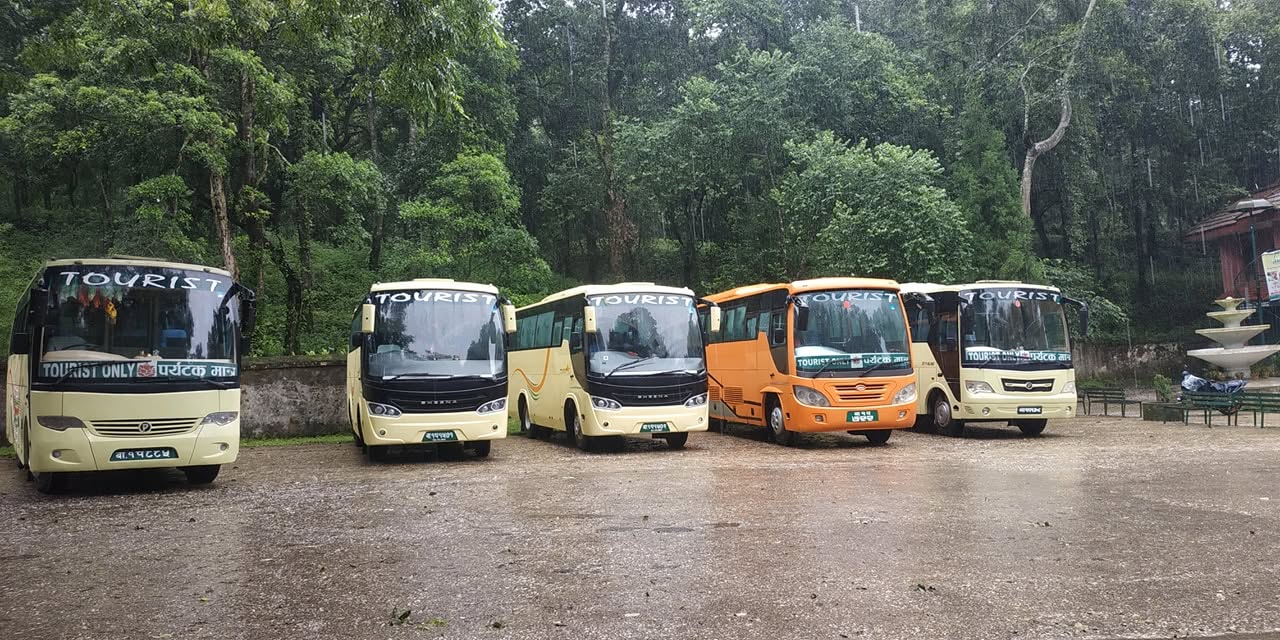
Best tourist vehicle rental in Chitwan with private cars, Scorpio jeeps, Hiace vans and professional drivers for safari tours, sightseeing and comfortable transfers.

Chitwan National Park: Conservation Story and Ecological Significance

Understanding Chitwan National Park’s conservation history and ecological significance turns a wildlife visit into a genuinely meaningful encounter with one of Asia’s greatest conservation achievements. Nepal Vehicle Hiring’s drivers often share this context with tourist clients on the Kathmandu-to-Chitwan journey — the approximately 4-hour drive provides ample time to understand what makes Chitwan so extraordinary.

Chitwan was declared a Rhinoceros Sanctuary in 1963 and a National Park in 1973, becoming Nepal’s first protected area. UNESCO inscribed the park as a World Heritage Site in 1984, recognising its outstanding value as one of the few remaining undisturbed areas of the Terai-Duar savanna and grassland ecosystem that once extended across the entire length of the Indian subcontinent’s southern flank.

Today, only scattered fragments of this ecosystem survive, and Chitwan is the finest and best-managed of them.

The park covers 952 square kilometres of core zone, surrounded by a 750-square-kilometre buffer zone that includes the Sauraha tourist area. This total protected landscape — approximately 1,700 square kilometres — is part of the larger Terai Arc Landscape, a transboundary conservation initiative connecting Chitwan with India’s Valmiki Tiger Reserve across the Gandak River border, and with other Nepal protected areas (Bardia, Shuklaphanta) in a network that allows wildlife movement across a 49,000 square kilometre connectivity corridor.

The one-horned rhinoceros population in Chitwan — approximately 700 individuals as of the most recent survey — has recovered from fewer than 100 animals in the early 20th century to a thriving population that is gradually expanding its range. Nepal has achieved zero rhinoceros poaching incidents for several years running—a conservation achievement that requires the continuous vigilance of Nepal Army soldiers and park rangers who patrol Chitwan’s borders.

Tourist vehicles that bring visitors to Chitwan,  and the park entry fees they generate, are a direct and important funding source for this protection system.

Best tourist vehicle rental in Chitwan with private cars, Scorpio jeeps, Hiace vans and professional drivers for safari tours, sightseeing and comfortable transfers.

The Rapti River: Chitwan’s Ecological and Visual Heart

The Rapti River — which forms the northern boundary of Chitwan National Park’s buffer zone and flows along the Sauraha tourist area’s southern edge — is both an ecological boundary and one of the park’s most productive wildlife observation zones. Understanding the Rapti’s role in Chitwan’s ecosystem gives tourist vehicle clients a richer appreciation of what they are approaching.

The Rapti is a Terai river—braided, shallow, and seasonally flooding—that creates a mosaic of riverside grassland, oxbow lakes, and riverine forest that the one-horned rhinoceros, Bengal tiger, mugger crocodile, gharial, and Gangetic river dolphin all depend on. The river with riverbanks near Rahas is among Nepal’s most reliable rhino-spotting zones— the animals come to drink and wallow in the morning and evening hours, and tourists stay at riverside lodges.

They can sometimes spot them from their lodges without leaving the property.

The Rapti also supports a remarkable waterbird population: grey-headed fish eagle, brown fish owl, great thick-knee, river lapwing, small pratincole, Eurasian and Asian openbill storks, Indian spot-billed pelican, and various kingfisher species are all commonly seen along the riverside in the October-to-March dry season. The canoe safari on the Rapti—one of Chitwan’s most affordable and rewarding wildlife activities—gives tourists a water-level perspective on this riverside ecology that no jeep safari can replicate.
Best tourist vehicle rental in Chitwan with private cars, Scorpio jeeps, Hiace vans and professional drivers for safari tours, sightseeing and comfortable transfers.

Chitwan Beyond Wildlife: Cultural and Historical Context

Chitwan’s history as a tourist destination predates Nepal’s tourism industry. The inner Terai (Dang and Chitwan valleys) was historically the winter hunting ground of Nepal’s Rana prime ministers—the hereditary autocrats who ruled Nepal from 1846 to 1951—who organised spectacular royal hunts (shikars) in which hundreds of elephants were deployed to drive game through the forests toward waiting hunters.

These royal shikars also hosted international guests, including King George V of Britain in 1911, making the Chitwan wildlife experience one of Nepal’s earliest internationally promoted tourist activities.

Established in 1964 in the heart of what became Chitwan National Park, the Tiger Tops Jungle Lodge was Nepal’s first tourist jungle lodge and one of the world’s pioneering ecotourism ventures. This model influenced the development of the modern African safari lodge concept.

Although Tiger Tops operated within the park boundary (a privilege that ended when the park established its current strict zoning), its success demonstrated that wildlife tourism could generate the economic incentives that sustain conservation. This economic logic underpins Chitwan’s entire conservation model today.

For tourists approaching Chitwan by private vehicle from Kathmandu, these historical layers—the Rana hunting grounds, the royal shikars, the pioneering eco-lodge—give the landscape depth beyond the immediate wildlife excitement. The sal forest visible from the Chitwan highway approach is the same forest that once echoed with shikar elephants trumpeting and the reports of the Rana rulers’ rifles.

Its current status as a UNESCO World Heritage Site—protected, recovering, and supporting one of South Asia’s most important wildlife populations—reflects a conservation journey as remarkable as any Nepal trekking route.

Best tourist vehicle rental in Chitwan with private cars, Scorpio jeeps, Hiace vans and professional drivers for safari tours, sightseeing and comfortable transfers.

Chitwan Jungle Lodge Selection Guide: What the Vehicle Delivery Means

The jungle lodge a tourist chooses in Chitwan directly affects what the Nepal Vehicle Hiring tourist vehicle delivery involves — and choosing the right lodge is one of the most important Chitwan planning decisions.

Riverside Lodges (Top-end Wildlife Position)

The riverside lodges along the Rapti River — within direct sight or sound of the national park boundary — are Chitwan’s most desirable wildlife positions. Guests at riverside lodges can watch rhinos wading in the Rapti from their breakfast terrace, hear tigers calling across the river at dawn, and observe the Rapti’s waterbird community without leaving the property.

These lodges are also farthest from Sauraha’s restaurant and shop strip — guests enjoy a quieter, more wildlife-rich environment. Nepal Vehicle Hiring drivers know the access roads to all riverside lodge gates — confirm the specific lodge address at booking time.

Sauraha Village Lodges (Budget and Mid-Range)

Lodges within and adjacent to Sauraha village offer easy walking access to the village’s restaurants, cultural show venues, elephant breeding centre, and the Sauraha informal wildlife viewing area on the riverbank. These lodges are less in-depth for wildlife than riverside options but more convenient for tourists who want flexibility in choosing evening meals and activities from Sauraha’s options. Good budget-to-mid-range accommodation is available within 5 to 10 minutes’ walk of Sauraha’s main street.

The Kasara Resort Area (Luxury)

The Kasara Resort and similar luxury properties in the western Chitwan area offer the highest-end Chitwan accommodation—private villas, infinity pools with Rapti River views, and exclusive safari arrangements with dedicated naturalists. Nepal Vehicle Hiring’s Land Cruiser private hire is the right vehicle for guests at Kasara and similar luxury properties—matching the top-end experience from highway to lodge gate.

Confirm the Kasara access road with Nepal Vehicle Hiring at booking time, as the approach from the Narayanghat highway differs from the main Sauraha road.

Practical Packing Tips for the Kathmandu-to-Chitwan Tourist Vehicle Journey

The tourist vehicle journey from Kathmandu to Chitwan is approximately 4 to 5 hours — long enough to require some preparation for comfort, and the destination’s tropical climate is very different from Kathmandu’s higher-altitude character:

  • Lightweight clothing for Chitwan: the park is hot (28°C to 38°C in most months) and humid. Carry lightweight, breathable clothing in neutral or earth-toned colours for wildlife activities — bright colours startle wildlife, and dark colours attract insects. Do not pack all your Chitwan clothing in checked luggage on top of the vehicle—carry a small day bag with your immediate Chitwan needs accessible in the vehicle cabin.
  • Insect repellent: Chitwan is a mosquito zone, particularly at dawn and dusk safari times. DEET-based repellent (per cent or higher) is strongly recommended. Pack it in your accessible day bag, not in the roof luggage.
  • Binoculars: for wildlife viewing, 8×42 or 10×42 binoculars transform the experience — rhinos in distant grassland, birds in the riparian forest, deer in the sal woodland margin are all better appreciated through quality optics. Pack binoculars in your lap bag for the vehicle journey rather than in checked luggage.
  • Sun protection: Chitwan’s flat terrain and open grasslands provide less shade than Nepal’s mountain destinations. SPF 50 sunscreen, sunglasses, and a wide-brimmed hat are essential for morning jeep safaris and canoe trips.
  • Cash in NPR: Sauraha has ATMs, but they are not always reliable. Carry adequate NPR from Kathmandu for park entry fees, safari activities, meals, cultural shows, and tips. Budget NPR 5,000 to 8,000 per person per day for the Chitwan stay.
  • Water: The vehicle can stop for water en route, but carry at least a litre per person for the journey. Chitwan’s heat requires higher hydration than Kathmandu’s cooler altitude.

Nepal’s Conservation Success: Why Chitwan Matters Globally

For international tourists visiting Chitwan, understanding Nepal’s broader conservation achievement puts the experience in context as one of the world’s most inspiring wildlife recovery stories. Nepal is one of the few countries where tiger and rhinoceros populations are increasing — a counterpoint to the global narrative of wildlife decline that is both genuinely encouraging and an argument for the economic value of wildlife tourism as a conservation funding mechanism.

Nepal’s wild tiger population has more than doubled, from about 121 individuals in 2009 to over 355 in the most recent national survey—one of the most dramatic wild tiger population recoveries in the world. Chitwan National Park accounts for the largest single share of this population.

Nepal’s conservation approach — combining strict law enforcement (zero tolerance for poaching, with significant penalties), community buffer zone programs that give local communities an economic stake in conservation, and wildlife tourism revenue that funds park management — is increasingly studied as a model for conservation in high-biodiversity, high-human-pressure landscapes globally.

The tourist vehicle that carries visitors from Chitwan plays a real role in this conservation equation. Each tourist’s park entry fee, the jungle lodge revenue that sustains local employment, and the guide and safari activity fees that circulate through the Sauraha community all contribute to the economic case for conservation that keeps Chitwan’s wildlife intact.

Nepal Vehicle Hiring’s tourist vehicle clients are not merely tourists visiting a wildlife area — they are, in a small but genuine way, participants in one of the world’s most successful conservation outcomes.

Chitwan to Other Destinations: Onward Vehicle Services from Nepal Vehicle Hiring

After Chitwan, most Nepal tourist circuits continue to one of three destinations — and Nepal Vehicle Hiring provides confirmed onward vehicles for all of them:

  • Chitwan to Kathmandu (return): 4 to 5 hours, same route as the inbound journey. Pre-booked at the time of the Kathmandu-to-Chitwan booking. Our driver returns on the confirmed date at the confirmed pickup time from your jungle lodge gate.
  • Chitwan to Pokhara: approximately 3 to 4 hours on the Narayanghat-Mugling-Pokhara highway. Our Hiace van and Coaster bus serve this route as part of the Nepal triangle circuit, with a drop-off at your hotel in Pokhara Lakeside.
  • Chitwan to Lumbini: 2.5 to 3 hours west on the Terai highway through Butwal and Bhairahawa. Our Hiace van hire and car hire connect Chitwan directly to the birthplace of the Buddha without returning to Kathmandu — ideal for pilgrims combining wildlife with the Lumbini sacred circuit.
  • Chitwan to Kathmandu via Narayanghat and Mugling with Manakamana stop: the return option adds the Manakamana cable car on the homeward journey for tourists who skipped it on arrival.

Nepal Vehicle Hiring pre-books all onward vehicles from Chitwan at the time of the original circuit booking — ensuring that your jungle lodge departure is as smooth and confirmed as your arrival. No improvised taxi negotiations in Sauraha when you are tired and ready to move on — your Nepal Vehicle Hiring driver is confirmed, on time, and ready at your gate.

Best tourist vehicle rental in Chitwan with private cars, Scorpio jeeps, Hiace vans and professional drivers for safari tours, sightseeing and comfortable transfers.

Chitwan National Park Wildlife: The Complete Species Guide

Chitwan’s wildlife richness extends well beyond the headline species of rhinoceros and tiger. Understanding the full range of wildlife the park’s sal forest, grassland, and riverine ecosystem supports helps tourists appreciate every element of the jeep safari experience—not just the iconic megafauna moments, but the hundreds of smaller sightings that make up a Chitwan wildlife day.

Mammals

One-horned rhinoceros (approximately 700 individuals) — the park’s most reliably seen large mammal, particularly in the Sauraha buffer zone grasslands and along the Rapti River. Bengal tiger (approximately 100 individuals) — present but secretive; most commonly detected by pugmarks, alarm calls of deer and langur, and occasionally in the early morning core zone safari.

Sloth bear — nocturnal but occasionally seen; omnivorous and potentially aggressive if surprised. Wild elephant — small resident population in the western Chitwan forests.

Gharial crocodile — critically endangered; the Narayani River (Chitwan’s western boundary) supports one of the world’s most important gharial populations, with the Gharial Conservation Breeding Centre at Kasara as a key recovery facility. Mugger crocodile — abundant on the Rapti River banks; readily seen on morning canoe trips.

Spotted deer (chital) — by far the most numerous large mammal, seen in herds of 20 to 200 in grassland clearings. Sambar deer — larger, more solitary, seen at forest edges in evening hours. Barking deer (muntjac) — small, shy, forest interior species.

Gaur (Indian bison) — large bovid, occasionally seen near the Sat River; common langur and rhesus macaque — primate species active in the park’s sal canopy.

Birds

Chitwan’s bird list exceeds 650 species — one of the highest counts for any protected area in Asia. Key species for visiting birders: the giant hornbill (great hornbill), pied kingfisher, common kingfisher, stork-billed kingfisher, and Himalayan pied kingfisher along the waterways; the red jungle fowl (ancestor of the domestic chicken) in the forest floor; the Bengal florican (critically endangered bustard) in the tall grasslands; the grey-headed fish eagle and Pallas’s fish eagle above the rivers; the red-wattled lapwing and river lapwing on exposed sandbars; and the osprey, greater flameback, and lineated barbet among the dozens of species that make Chitwan one of Asia’s premier birding destinations.

Nepal Vehicle Hiring’s tourist vehicle clients who are birders should ask their driver to include a Rapti River crossing and a stop at dawn to maximise Chitwan’s bird species count on the journey to Sauraha.

Reptiles

Beyond crocodiles, Chitwan’s reptile fauna includes the Indian python (found near grassland waterholes), monitor lizard (Bengal monitor — common on riverbanks), rat snake, and king cobra. The Gharial Conservation Breeding Centre at Kasara breeds critically endangered gharials for release into the Narayani River — a visit to the centre (approximately 7 km west of Sauraha) is one of Chitwan’s most educationally rewarding excursions.

Narayanghat: The Chitwan Gateway City

Narayanghat is the city through which all tourist vehicles approach Chitwan — a Terai junction city of approximately 150,000 people at the confluence of the Narayani and Trishuli Rivers, approximately 30 km north of Sauraha. Understanding Narayanghat’s role helps tourists and Nepal Vehicle Hiring drivers plan the Chitwan approach efficiently.

For tourist vehicles coming from Kathmandu on the Prithvi Highway, the Mugling junction (where the Prithvi Highway meets the Narayanghat road) is the key decision point—turn south for Narayanghat and Chitwan, or continue west for Pokhara. Narayanghat has fuel stations, ATMs (more reliable than Sauraha’s), pharmacies, and restaurants — Nepal Vehicle Hiring drivers use Narayanghat as the standard final fuel stop before the Sauraha approach.

The city is also the nearest town to Bharatpur Airport — tourists flying Kathmandu-to-Bharatpur (approximately 30 minutes) and then taking a vehicle to Sauraha can be collected at Bharatpur Airport by Nepal Vehicle Hiring for the 30 to 40 minute drive to their jungle lodge.

From Narayanghat, the road to Sauraha passes through Bharatpur city (Chitwan District headquarters) and Tadi Bazaar before reaching the Sauraha turn-off. This final section takes approximately 40 to 50 minutes. It passes through flat Terai farmland and buffer-zone communities surrounding the park.

This landscape shows the human side of Chitwan’s conservation challenge: communities live adjacent to a national park whose wildlife (particularly elephants) occasionally damages crops, and conservation’s economic benefits must be distributed broadly enough to sustain community support.

Bharatpur Airport: The Flight Alternative to Kathmandu-Chitwan Road

For tourists whose schedule or budget makes the 4 to 5 hour Kathmandu-to-Chitwan road journey impractical,

Bharatpur Airport (BHR) offers domestic flights from Kathmandu in approximately 25 minutes on Buddha Air, Yeti Airlines, or similar. Ticket cost: approximately NPR 6,000 to 10,000 per person, one way. Nepal Vehicle Hiring’s car hire, Hiace van, or Coaster bus meets flight arrivals at Bharatpur Airport.

It drives 30 to 40 minutes to Sauraha Jungle Lodges — a total Kathmandu-to-Sauraha time of about 2 hours, including airport check-in. The flight costs more per person than road travel for groups of 4 or more, but for solo travellers and couples where per-person cost matters less, the time savings are significant.

For the return journey, tourists staying at Chitwan jungle lodges can book a Nepal Vehicle Hiring Sauraha-to-Bharatpur-Airport transfer (40 minutes) for the Bharatpur-to-Kathmandu domestic flight. Contact us via WhatsApp or visit our Plan Your Trip page to book Bharatpur airport transfers as part of any Chitwan vehicle package.

Sample Chitwan Tourist Itineraries with Vehicle Plans

Day 1: Nepal Vehicle Hiring: private car/Hiace departs Kathmandu Thamel at 7:00 AM. Manakamana cable car stop (optional, 2.5 hours at Mugling). Mugling fish lunch.

Arrive Sauraha/ju7:00 a.m. and arrive by 2:00 to 3:00 p.m. Afternoon: welcome cultural walk, rhino spotting from the Rapti River bank, and an evening Tharu cultural show.

Day 2: Early morning jeep safari in CNP core zone (5:30 a.m. departure, 3 hours). Return to the lodge for breakfast. Elephant breeding centre visit.

Afternoon: d5:30a.m. trip on the Rapti River (rhinos, crocodiles, birds). Late afternoon free for lodge pool/relaxation. Next morning: Return to Kathmandu or Pokhara; vehicle departs at 7:00 AM.

Day 1: Arrive as above. Afternoon canoe trip on the Rapti River. 7:000a.m..2: Early morning jeep safari (core zone).

After breakfast: elephant breeding centre, Gharial Conservation Centre at Kasara (7 km west). Afternoon: guided nature walk in the buffer zone.

Day 3: Dawn bird walk along the Rapti (for birders: 40+ species possible in 2 hours)—Tharu village cultural program. Nepal Vehicle Hiring: return vehicle departs early afternoon.

Nepal Triangle (Kathmandu-Pokhara-Chitwan-Kathmandu), 8 Days

Day 1: Kathmandu arrival. Nepal vehicle hire; airport transfer. Valley sightseeing.

Day 2: Kathmandu to Pokhara. Manakamana stop (optional). Pokhara Lakeside.

Day 3: Sarangkot sunrise. Pokhara activities (Phewa Lake, Peace Stupa, Bindabasini Temple).

Day 4: Pokhara to Chitwan by hired Hiace van (3 to 4 hours). Afternoon: Rapti River canoe.

Day 5: Full-day Chitwan — morning jeep safari, elephant centre, nature walk, Tharu cultural show.

Day 6: Chitwan to Kathmandu by Nepal Vehicle Hiring Hiace van (4 to 5 hours, lunch of Mugling fish).

Day 7: Kathmandu Nagarkot sunrise tour + Bhaktapur day tour.

Day 8: Nepal Vehicle Hiring airport transfer. International departure.

Nepal Vehicle Hiring coordinates every vehicle across all 8 days of this circuit — one booking, one provider, one contact throughout. Book via our Nepal holiday tour service page or WhatsApp.

Why Nepal Vehicle Hiring is the Best Choice for Chitwan Tourist Transport

The Kathmandu-to-Chitwan tourist vehicle route is Nepal’s most frequently booked inter-city tourist transfer — and the quality difference between providers is significant. Nepal Vehicle Hiring’s Chitwan service stands out for specific operational reasons:

  • Route-experienced drivers: our Kathmandu-to-Chitwan drivers know the Manakamana cable car timing (avoiding the midday queue by arriving at 9:30 a.m.), the best Mugling fish restaurant (we have specific recommendations from years of client feedback) and the Narayanghat fuel stop.m.every jungle lodge access road in Sauraha. This isn’t generic Nepal highway driving knowledge—it is Kathmandu-to-Chitwan circuit knowledge built over years of operating the route.
  • All vehicle types on the same route: whether you are a solo traveller driving a private car or a 35-person corporate group needing a full tourist bus, Nepal Vehicle Hiring’s fleet covers it. No handoffs to partner operators, no quality inconsistency between vehicle types — our full fleet operates the Kathmandu-to-Chitwan route under the same service standards.
  • Return trip pre-booked at first booking: Nepal Vehicle Hiring confirms the return vehicle (Chitwan-to-Kathmandu or Chitwan-to-Pokhara) at the same time as the outbound booking. Your jungle lodge receives a confirmed pickup time from our driver, with no uncertainty about when and how you leave Chitwan.
  • Integration with the complete Nepal circuit: for tourists doing the Nepal triangle (Kathmandu-Pokhara-Chitwan or any sequence), Nepal Vehicle Hiring’s single booking covers every vehicle leg. The Pokhara-to-Chitwan vehicle and the Chitwan-to-Kathmandu return are confirmed at the same time as the initial booking—total logistics certainty from arrival to departure.
  • 24/7 WhatsApp operations: if the Prithvi Highway has a landslide causing delays, or if your Sauraha jungle lodge pickup needs to be rescheduled by an hour, Nepal Vehicle Hiring’s operations team is available on WhatsApp to manage the adjustment in real time—no phone tag, no email delays — instant WhatsApp coordination for any itinerary change.

Chitwan VIP Sofa Bus Ticket Price

KTM to Chitwan

Chitwan VIP Sofa Bus Ticket Price

If you’re planning a jungle safari after Kathmandu or Pokhara, understanding the Chitwan VIP Sofa bus ticket price before you book saves both money and a fair bit of confusion, since Nepal’s tourist buses come in several comfort tiers with genuinely different seating, amenities, and fares.

This guide breaks down what ‘VIP’ actually means on a Nepal bus ticket, how VIP Sofa Bus fares to Chitwan compare with standard and deluxe options, and what to expect on both the Kathmandu and Pokhara routes.

What Does ‘VIP’ Mean on a Nepal Bus Ticket?

Nepal’s tourist bus market generally splits into three comfort tiers. A standard or local bus uses basic 2×2 seating with minimal amenities, offering the cheapest fare but the least comfort. A deluxe tourist bus steps up with air conditioning, reclining 2×2 seats, and complimentary water.

A VIP Sofa Bus goes further still, using a 2×1 layout — two seats on one side of the aisle and a single seat on the other — giving each passenger noticeably more width, a wider aisle, and full-recline sofa-style seating, along with USB charging, WiFi on select routes, and a dedicated bus attendant.

Nepal Vehicle Hiring’s full VIP Sofa Bus hire guide covers this seating format across all our routes in detail, but this article focuses specifically on pricing and logistics for the Chitwan run.

Check the Chitwan VIP Sofa Bus Ticket Price and compare luxury bus services, routes, travel time, seating comfort, onboard facilities, and booking options for a comfortable journey to Chitwan.

Chitwan VIP Sofa Bus Ticket Price: Kathmandu to Chitwan

On the Kathmandu-Chitwan route, standard tourist bus fares typically run in the range of USD 10 to 13 per ticket, while VIP Sofa Bus fares sit noticeably higher, generally falling in the broader NPR 2,000 to 3,500 range across Nepal’s VIP routes, reflecting the wider seats, reduced passenger count per bus, and additional amenities. The exact VIP fare depends on the season, how far in advance you book, and whether you’re booking an individual seat or chartering the full vehicle privately.

The Kathmandu to Chitwan run covers approximately 150 kilometers in 4 to 5 hours via the Prithvi Highway to Mugling, then south through Narayanghat to Sauraha. For full departure times, current fares, and online booking, see our dedicated Kathmandu to Chitwan VIP Sofa Bus Ticket page, or the standard Chitwan to Kathmandu bus for the return leg.

Chitwan VIP Sofa Bus Ticket Price: Pokhara to Chitwan

The Pokhara-Chitwan route covers around 145 kilometers in 5 to 6 hours, with standard deluxe tourist bus fares around USD 10 per ticket. A VIP Sofa upgrade on this route follows the same broader pricing pattern as the Kathmandu run, trading a larger passenger count for wider individual seating. Full details on departure times and amenities are on our Pokhara to Chitwan bus page.

What’s Included in a VIP Sofa Bus Fare

  • 2×1 sofa-style reclining seats with padded armrests and adjustable headrests, giving noticeably more personal space than a standard 2×2 bus
  • Air conditioning with individual overhead vents
  • Complimentary sealed mineral water at boarding
  • USB charging at every seat, with WiFi available on select major routes
  • A dedicated bus attendant, in addition to the driver, on VIP services
  • Passenger accidental medical insurance included on the fare

Not included in the standard fare: meals at highway rest stops (typically NPR 300-700 per person, paid directly at the restaurant), porter fees, and Chitwan National Park entry fees for safari activities once you arrive.

Kathmandu To Chitwan Sofa Bus-Check the Chitwan VIP Sofa Bus Ticket Price and compare luxury bus services, routes, travel time, seating comfort, onboard facilities, and booking options for a comfortable journey to Chitwan.

VIP Sofa Bus vs Deluxe vs Standard: Which Should You Choose

Standard or local buses are the cheapest way to reach Chitwan, with basic 2×2 seating, no air conditioning, and no amenities. They work for very budget-conscious travelers comfortable with a longer, more crowded ride.

Deluxe tourist buses strike a middle ground — air-conditioned, reasonably comfortable reclining seats, and a fair price around USD 10 to 13, making this the most common choice for independent travelers heading to Sauraha.

VIP Sofa Buses cost more but deliver more comfort meaningfully on a 4 to 6 hour highway journey — wider individual seating, a dedicated attendant, and amenities that make the ride itself part of a comfortable trip rather than something to simply endure. This tier suits travelers prioritizing comfort, families with children, elderly passengers, or anyone who’d rather arrive at their jungle lodge relaxed instead of stiff from a cramped seat.

Check the Chitwan VIP Sofa Bus Ticket Price and compare luxury bus services, routes, travel time, seating comfort, onboard facilities, and booking options for a comfortable journey to Chitwan.

Private Charter: Booking the Whole VIP Sofa Bus

For groups, tour operators, or families traveling together, chartering an entire VIP Sofa Bus is priced per vehicle rather than per seat, which can work out more efficiently than booking many individual tickets — and comes with full control over departure time and hotel pick-up rather than a fixed shared schedule. This is especially useful for larger parties heading into Chitwan together for a jungle safari package.

If your group is smaller, a private jeep or Hiace may be a more efficient option than a full bus charter, or for maximum comfort on a smaller scale, see our Kathmandu to Chitwan luxury car hire page.

Best Time to Book and Seasonal Price Changes

Fares tend to rise slightly during Nepal’s peak tourist seasons — autumn (September to November) and spring (March to May) — when demand for Chitwan’s wildlife safaris is highest. Booking 3 to 7 days in advance is generally sufficient outside of major Nepali festivals, but during Dashain, Tihar, or other holiday periods, booking 1 to 2 weeks ahead is strongly advised, since VIP Sofa Bus capacity per departure is smaller than a standard bus.

Booking Tips

  • Confirm whether your fare is per seat on a shared departure or a full private charter, since pricing structures differ.
  • Ask about hotel pick-up if you’re booking a private charter — this avoids a separate trip to the bus park.
  • Carry NPR cash for highway rest-stop meals, since these aren’t included in the ticket price.
  • Book earlier during festival periods and peak trekking/safari season (Sept-Nov, Mar-May)
  • Double-check your Sauraha or Chitwan drop-off point, since some services drop at the Tourist Bus Park while others offer direct lodge pick.-up

Why Book With Nepal Vehicle Hiring Pvt Ltd

We operate both VIP Sofa Bus and standard deluxe services on the Chitwan route, with transparent per-seat and private charter pricing confirmed before you book, experienced drivers, and a dedicated attendant on all VIP services. Whether you’re joining a shared morning departure or chartering a full bus for your group, our team can walk you through the exact fare for your travel dates.

Browse our full bus and coaster fleet pages, or check the ultimate Nepal vehicle rental guide for a full comparison of transport options across the country, including our Nepal tour package options if you’d like Chitwan included in a longer itinerary.

Frequently Asked Questions

What is the price difference between a standard and VIP bus to Chitwan? Standard and deluxe tourist buses generally run USD 10 to 13, while VIP Sofa Bus fares are higher, reflecting wider individual seating and added amenities.

How long does the VIP Sofa Bus take from Kathmandu to Chitwan? Around 4 to 5 hours for the roughly 150-kilometer route via the Prithvi Highway and Mugling.

Is WiFi available on the Chitwan VIP Sofa Bus? WiFi availability varies by route; USB charging is reliably available at every seat regardless.

Can I charter a full VIP Sofa Bus for my group? Yes, private charter is available and priced per vehicle, with flexible departure time and hotel pick-up.

Are meals included in the VIP bus ticket price? No, highway rest-stop meals are paid separately, typically NPR 300-700 per person.

Planning your Chitwan jungle safari? Check current Chitwan VIP bus ticket prices and departure times, or reach out through our contact page to book your seat or charter the full bus for your group.

Kathmandu to Chitwan Transfer

Chitwan

Kathmandu to Chitwan Transfer: Complete Guide to Car, Jeep, Bus & Van Options

Chitwan National Park — Nepal’s first and most celebrated national park, and a UNESCO World Heritage Site — is the country’s most visited wildlife destination and an essential stop on almost every Nepal itinerary. After the temples, monuments, and cultural richness of Kathmandu Valley, the transition to the lush Terai lowlands of Chitwan — with one-horned rhinoceroses grazing in the grasslands, Bengal tigers moving through the forest, wild elephants at the riverside, and over 544 bird species filling the trees — is one of the most dramatic and rewarding journeys in Asia.

The transfer from Kathmandu to Chitwan covers about 150 to 170 kilometres along the Prithvi Highway and the East-West Highway, taking 5 to 7 hours depending on the mode of transport and traffic conditions. In 2026, travellers will have a wide range of transfer options available —from budget-friendly shared tourist buses to top-end private cars, from spacious family jeeps to large Hiace vans for groups, and from VIP sofa coaches to full coaster buses for larger parties.

At Nepal Vehicle Hiring Pvt Ltd, we offer a complete range of Kathmandu-to-Chitwan transfer services, including private cars, jeeps, Hiace vans, coaster buses, and tourist bus ticket booking. This comprehensive 2026 guide covers every available option, including full cost comparisons, departure details, route highlights, the optional Bandipur detour, seasonal guidance, and expert tips to ensure every Kathmandu-to-Chitwan transfer is smooth, comfortable, and genuinely enjoyable.

All Kathmandu to Chitwan Transfer Options –  Quick Comparison

Transfer OptionTimeCostDepartureComfortBest For
Local / Deluxe Bus6–8 hrsNPR 500–900/personGongabu Bus Park (6 AM)LowCheapest shared option
Tourist Bus (Standard)5–7 hrsNPR 1,000–1,300/personSorhakhutte Tourist Park (7 AM)MediumBudget independent
VIP Sofa Bus (2+1)5–6 hrsNPR 1,400–2,000/personSorhakhutte Tourist Park (7 AM)HighComfort-seeking solo/couple
Night BusOvernightNPR 1,000–1,800/personGongabu / Sorhakhutte (7–10 PM)MediumSave hotel cost
Private Car (Sedan/SUV)4–5 hrsNPR 12,000–20,000 (vehicle)Hotel pickupVery HighCouple, small family
Private Jeep (4WD)4–5 hrsNPR 15,000–24,000 (vehicle)Hotel pickupVery HighGroup of 4–6
Toyota Hiace Van5–6 hrsNPR 20,000–30,000 (vehicle)Hotel pickupVery HighGroup of 7–10
Toyota Coaster5–6 hrsNPR 28,000–42,000 (vehicle)Hotel pickupHighGroup of 12–18
Tourist Bus (Private)5–7 hrsNPR 38,000–60,000 (vehicle)Hotel pickupHighGroup of 25–40

Kathmandu to Chitwan – Journey Quick Facts

DetailInformation
Road DistanceApproximately 150–170 km
Drive Time (Private Vehicle)4 to 5 hours
Drive Time (Tourist Bus)5 to 7 hours
Main RouteKathmandu → Prithvi Highway → Mugling → East-West Highway → Bharatpur → Sauraha
Key Rest StopMugling (midpoint) – Trishuli riverside lunch
Tourist Bus DepartureSorhakhutte Tourist Bus Park, Kathmandu – 7:00 AM
Arrival PointSauraha Bus Park or direct to the resort (private vehicle)
Best Departure Time7:00 AM – 8:00 AM for a comfortable daytime journey
Road ConditionMostly paved; ongoing upgrades near Mugling junction
Scenic HighlightTrishuli River gorge, Narayanghat river plains

Private Vehicle Transfer: Kathmandu to Chitwan

Nepal Vehicle Hiring Pvt Ltd provides professional hotel-to-resort private vehicle transfer services for the Kathmandu-to-Chitwan route. All private vehicles include hotel pickup in Kathmandu and direct resort drop-off in Sauraha:

Pokhara to Chitwan

Private Car – Best for Couples and Small Families

A private car is the ideal choice for solo travellers, couples, and small families of up to 4 people seeking comfort, speed, and door-to-door service for the Kathmandu-to-Chitwan transfer.

Car TypeCapacityOne Way (NPR)One Way (USD)Round Trip (NPR)
Standard Sedan (Dzire/Etios)2–3 paxNPR 12,000–15,000USD 90–120NPR 20,000–30,000
SUV / Crossover3–4 paxNPR 14,000–18,000USD 105–150NPR 24,000–40,000
Top-end SUV4 paxNPR 17,000–22,000USD 127–200NPR 29,000–55,000

The private 4WD jeep is the most popular vehicle for the Kathmandu-to-Chitwan transfer, especially for trekking groups heading to or returning from Chitwan. It offers more space, higher seating, and better luggage capacity than a standard car.

Jeep TypeCapacityOne Way (NPR)One Way (USD)Round Trip (NPR)
Standard Jeep (Scorpio/Bolero)4–5 paxNPR 15,000–26,000USD 112–150NPR 26,000–40,000
4WD Jeep (Hilux/Fortuner)5–6 paxNPR 18,000–24,000USD 135–300NPR 31,000–55,000
Top-end 4WD (Land Cruiser)5–6 paxNPR 22,000–30,000USD 165–400NPR 38,000–90,000

Toyota Hiace Van – Best for Groups of 7 to 10

The Toyota Hiace van is the most practical and economical private vehicle for larger family groups and small tour parties travelling from Kathmandu to Chitwan.

DetailInformation
Seating Capacity7 to 10 passengers comfortably
One-Way CostNPR 20,000–30,000 (USD 150–225)
Round Trip CostNPR 34,000–52,000 (USD 255–390)
Air ConditioningFull front and rear AC
Luggage SpaceLarge rear boot + roof rack
Best ForExtended families, small tour groups, mixed groups

Chitwan Riverside Bamboo Huts and Reflections

Coaster Bus and Tourist Bus – Large Groups

For groups of 12 or more, Nepal Vehicle Hiring offers coaster buses and full tourist buses for the Kathmandu to Chitwan transfer:

VehicleCapacityOne Way (NPR)One Way (USD)Best For
Toyota Coaster12–18 paxNPR 28,000–42,000USD 210–315Medium tour groups, corporate
Mini Bus20–25 paxNPR 35,000–50,000USD 260–375Mid-large groups
Tourist Bus (Private)25–40 paxNPR 38,000–60,000USD 285–450Large tour groups, schools

Note: All private vehicle prices include driver, fuel, and toll charges for the one-way journey from Kathmandu to Chitwan/Sauraha. Contact Nepal Vehicle Hiring for confirmed quotes for your specific travel date and group size.

What Is Included in Your Nepal Vehicle Hiring Private Transfer

  • Hotel pickup from your exact accommodation anywhere in Kathmandu – Thamel, Lazimpat, Boudha, or any area
  • Air-conditioned private vehicle – well-maintained and regularly serviced
  • Professional, licensed driver experienced on the Kathmandu to Chitwan Prithvi Highway
  • Fuel, toll charges, and all driver expenses are included in the quoted price
  • Freedom to stop at Mugling, Bandipur, Narayanghat, or any attraction on request
  • Direct drop-off at your resort or hotel entrance in Sauraha, Chitwan
  • Flexible departure time – leave Kathmandu when you are ready
  • 24-hour Nepal Vehicle Hiring operations contact for any in-journey support

Tourist Bus Options: Kathmandu to Chitwan

Shared tourist buses are the most popular choice for independent travellers and backpackers on the Kathmandu-to-Chitwan route. Here is the complete guide to all bus categories:

Bus TypeSeat LayoutTicket Price (NPR)Ticket Price (USD)DepartureComfort
Local / Deluxe Bus2+2NPR 500–900USD 3.7–6.7Gongabu Bus Park, 6 AMLow–Medium
Standard Tourist Bus2+2NPR 1,000–1,300USD 7.5–9.7Sorhakhutte, 7 AMMedium
Super Deluxe Bus2+2NPR 1,200–1,600USD 9–12Sorhakhutte, 7 AMGood
VIP Sofa Bus2+1NPR 1,400–2,000USD 10.5–15Sorhakhutte, 7–8 AMHigh
Night Bus2+1 or 2+2NPR 1,000–1,800USD 7.5–13.5Gongabu/Sorhakhutte, 7–10 PMMedium

Departure point for tourist buses: Sorhakhutte Tourist Bus Park (also called New Bus Park), about 20- 30 minutes by taxi from Thamel (NPR 400–600). Arrive at least 30 minutes before the 7:00 AM departure.

Kathmandu to Chitwan Tour Package: Complete Travel Guide

Complete Transfer Comparison: Kathmandu to Chitwan

FactorVIP Sofa BusPrivate CarPrivate JeepHiace VanLocal Bus
Journey Time5–6 hrs4–5 hrs4–5 hrs5–6 hrs6–8 hrs
Cost (per person, est.)NPR 1,400–2,000NPR 3,000–7,300*NPR 2,500–6,000*NPR 2,000–4,300*NPR 500–900
Hotel PickupSorhakhutte Bus ParkYes – doorYes – doorYes – doorGongabu Bus Park
Drop-offSauraha Bus ParkResort entranceResort entranceResort entranceSauraha Bus Park
Departure TimeFixed 7 AMFully flexibleFully flexibleFully flexibleFixed 6 AM
Luggage SpaceUnderfloorGoodExcellentExcellentVery limited
Stop FreedomNoneFullFullFullNone
PrivacyShared 25–30 paxCompleteCompleteCompleteNo
Best ForSolo/couple budgetCouple/small familyGroups 4–6Groups 7–10Cheapest

* Per-person cost based on typical group size: car per 2–3 pax, Jeep per 4–5 pax, Hiace per 7–9 pax.

Kathmandu to Chitwan Route – Highlights and Stops

The Prithvi Highway from Kathmandu to Chitwan is a beautiful and varied road journey. Here are the key highlights and recommended stops along the way:

Kathmandu Valley Exit – Chandragiri Hills

As the vehicle leaves Kathmandu, the road climbs through the Chandragiri hills at the valley rim before descending steeply through the Naubise area. This transition from Kathmandu’s dense urban bowl to the open river valley below is dramatic and immediate. On clear days, you can see the Himalayan range behind you as you exit the valley.

Prithvi Highway – Trishuli River Gorge

After Naubise, the Prithvi Highway follows the Trishuli River through a spectacular gorge. The road winds alongside the rushing river for approximately 60 kilometres from Naubise to Mugling, with forested hillsides above, cascading side streams, and traditional Nepali villages clinging to the slopes. This is consistently the most scenic section of the entire Kathmandu-to-Chitwan road journey.

Mugling – The Essential Midway Stop

Mugling sits at the confluence of the Trishuli and Marsyangdi rivers, approximately 90-100 km from Kathmandu, and is Nepal’s most famous roadside stop. Almost every tourist bus and private vehicle stops here for 20 to 30 minutes. Riverside restaurants serve fresh fish curry (Mugling fish curry is legendary throughout Nepal), dal bhat, and snacks.

The riverside setting with the two rivers meeting below is scenic and refreshing. For families with children, Mugling is an excellent stretch-your-legs opportunity.

Bandipur – Optional UNESCO Heritage Town Detour

Bandipur is one of Nepal’s most remarkable heritage destinations — a beautifully preserved Newari hilltop trading town about 8 km off the Prithvi Highway between Dumre and Mugling. With its cobblestone main street, traditional Newari architecture, panoramic mountain views of the Annapurna and Manaslu ranges, and the nearby Siddha Cave (Nepal’s largest cave), Bandipur is an outstanding cultural detour that adds approximately 1 to 1.5 hours to the journey.

With a private vehicle from Nepal Vehicle Hiring, this stop is entirely flexible and on request.

Narayanghat – Terai Entry

After Mugling, the route turns south on the East-West Highway and begins the final descent to the Terai lowlands. Narayanghat is the major city at the Terai entry point, situated at the confluence of the Narayani and Rapti rivers. The transition from the hilly gorge terrain to the flat, green Terai landscape is noticeable and dramatic — the temperature rises, the vegetation becomes denser and more tropical, and Nepal’s character shifts completely.

Bharatpur to Sauraha – Chitwan Approach

From Narayanghat, the route continues to Bharatpur — the administrative headquarters of Chitwan District and one of Nepal’s largest cities — before the final approach road to Sauraha, the main tourist gateway to Chitwan National Park. The approach to Sauraha via Bharatpur passes through flat Terai countryside, with occasional views of the Rapti River and the national park forest on the southern horizon.

Route Overview Table: Kathmandu to Sauraha

StageSectionDistanceRoadTimeNotes
1Kathmandu to Naubise30 kmPrithvi Hwy – paved45 minValley exit, Chandragiri Hills
2Naubise to Mugling65 kmPrithvi Hwy – gorge road1.5–2 hrsTrishuli River gorge – most scenic section
3Mugling Rest Stop0 km–20–30 minRiverside lunch or snacks – all vehicles stop
4Mugling to Narayanghat35 kmEast-West Hwy45 minTerai entry, flat lowlands
5Narayanghat to Bharatpur15 kmPaved – good20 minMajor city, East-West Highway
6Bharatpur to Sauraha22 kmGood approach road30 minNational park edge, resort area
TOTALKathmandu to Sauraha~167 kmMostly paved4–5 hrs (private)Classic Nepal highway journey

Which Transfer Option is Right for You?

Your ProfileBest OptionReason
Solo traveller, budgetVIP Sofa Bus (NPR 1,400–2,000)Best comfort-to-cost ratio for single travellers
Couple on a tight budgetTourist Bus or Sofa BusTwo adjacent seats, affordable, morning schedule
A couple wanting comfortPrivate Car (Sedan/SUV)Door-to-door, flexible, fast, private
Family of 4Private SUV or JeepSpace for bags, flexibility, and hotel pickup
Family of 5–6Private Jeep (Hilux/Fortuner)All family together, boot space, fast
Group of 7–10Toyota Hiace VanOne vehicle, hotel pickup, economical per head
Group of 12–18Toyota CoasterAll together, AC, a professional driver
Large group 25+Private Tourist BusMaximum capacity, single vehicle, group cohesion
Night travellerNight Bus (NPR 1,000–1,800)Save accommodation costs, arrive early
Wants Bandipur stopAny private vehicleOnly private vehicles are allowed off-route detours
Chitwan
Chitwan

What Awaits You at Chitwan National Park

After the Kathmandu to Chitwan transfer, one of Nepal’s greatest wildlife experiences awaits:

Chitwan National Park – UNESCO World Heritage Site

Established in 1973, Chitwan National Park covers 952 square kilometres of subtropical lowland forest, grassland, and river systems. It is home to over 700 one-horned rhinoceroses, a significant population of Bengal tigers (over 100 individuals), wild Asian elephants, gharial and mugger crocodiles, and 544 bird species. Chitwan is consistently rated as one of the finest wildlife destinations in Asia.

Jeep Safari – The Premier Chitwan Experience

The open 4WD jeep safari through the national park’s core zones at dawn and dusk is the most popular and rewarding Chitwan activity. Trained naturalist guides know the best wildlife areas and maximise sightings of rhinoceroses, deer, crocodiles, and occasionally tigers. A half-day or full-day jeep safari is the recommended first activity for any visit to Chitwan.

Jungle Walk on Foot

Walking through Chitwan’s forests on foot with an armed guide is the most intimate wildlife experience the park offers. The proximity to nature — smelling the vegetation, hearing the birds, following tracks — creates a thrilling connection with the jungle ecosystem that no vehicle-based safari can replicate.

Dugout Canoe Ride

A silent dawn canoe on the Rapti River is the finest way to observe Chitwan’s riverine wildlife — gharials and mugger crocodiles basking on the banks, river kingfishers, otters, and occasionally elephants drinking at the water’s edge. One of the most peaceful and memorable experiences available in Chitwan.

Tharu Cultural Program

The traditional Tharu community stick dance performed at Chitwan resorts every evening is a colourful, energetic cultural introduction to the indigenous Tharu people, the original inhabitants of the Terai lowlands whose remarkable immunity to malaria allowed them to settle this region for centuries before modern development.

KTM to Chitwan

Best Time for the Kathmandu to Chitwan Transfer

Autumn (October to November) – Best Season

Autumn is the finest time for the Kathmandu-to-Chitwan transfer and a visit to Chitwan. The road is in excellent post-monsoon condition, the weather is comfortable (cool in Kathmandu, warm in Chitwan), and wildlife sightings in the park are excellent after the monsoon vegetation flush.

The Trishuli Gorge section of the Prithvi Highway is particularly beautiful in autumn. This is peak season — book all transport in advance.

Spring (March to May) – Excellent

Spring offers warm weather, good road conditions, and active wildlife. March and April are ideal — temperatures are comfortable, and the park’s wildlife is very visible. May becomes hot in the Terai.

The Prithvi Highway is scenic, with rhododendrons visible on the hillsides above the gorge.

Winter (December to February) – Good

Winter is excellent for Chitwan wildlife—the tall elephant grass is burned in late January, dramatically improving visibility in the park. The road is in good condition year-round. Temperatures in Chitwan are cool and comfortable for wildlife walking.

The Kathmandu-to-Chitwan transfer is comfortable with the right layers of clothing.

Monsoon (June to August) – Possible with Caution

The Prithvi Highway can experience occasional landslides near Mugling during the heavy monsoon season. Chitwan’s core zone is closed from June to August. The road journey is generally fine, but allow extra time.

Nepal Vehicle Hiring monitors conditions and advises clients accordingly.

Expert Tips for the Kathmandu to Chitwan Transfer

  • Book your VIP Sofa Bus seat at least 2 to 3 days in advance during October–November and March–April – the25-5 to 30-seat buses sell out quickly.
  • For private vehicles, book at least 2 to 3 days in advance during the off-peak season and 5 to 7 days in advance during peak trekking and wildlife seasons.
  • Depart Kathmandu between 7:00 AM and 8:00 AM to arrive in Sauraha by early afternoon, with time to settle in and do an afternoon jungle activity.
  • For Sorhakhutte Bus Park departures, take a taxi from Thamel at 6:00 AM to arrive at the bus park with 30 minutes to spare before the 7:00 AM bus.
  • Request a Bandipur heritage town stop if you have a private vehicle – it is directly on the route and is one of Nepal’s most rewarding cultural detours.
  • The Mugling stop is typically 20 to 30 minutes – use it for the famous riverside fish curry or a quick lunch.
  • For families with young children, a private vehicle is strongly recommended – the flexibility to make toilet stops, take snack breaks, and maintain child-friendly pacing makes a significant difference.
  • Confirm your Chitwan resort’s arrival procedure before departure – most resorts send a representative to Sauraha Bus Park for tourist bus arrivals.
  • For private vehicle passengers, Nepal Vehicle Hiring drivers drop you off directly at your resort entrance – no need to navigate the Sauraha bus park.
  • Nepal Vehicle Hiring can book the complete Nepal transport sequence – Pokhara to Chitwan, Chitwan to Kathmandu, or Kathmandu to Chitwan, then Pokhara – in a single coordinated arrangement.

What to Pack for the Kathmandu to Chitwan Transfer

  • Light summer clothing for Chitwan (the Terai is hot and humid)
  • Light jacket for the air-conditioned bus or vehicle cabin
  • Water bottle – stay hydrated during the 4- to 6-hour journey
  • Light snacks – biscuits, fruits, energy bars for the journey
  • Insect repellent – essential from the moment you arrive in Chitwan
  • Camera – the Trishuli River gorge and Mugling riverside are excellent photo subjects
  • Motion sickness tablets, if needed – the Prithvi Highway gorge section has curves
  • Nepali cash – for the Mugling stop and resort arrival expenses
  • Chitwan Resort confirmation and contact number for arrival coordination

How to Book Your Kathmandu to Chitwan Transfer with Nepal Vehicle Hiring

Booking your transfer with Nepal Vehicle Hiring Pvt Ltd is simple:

  • Step 1: Contact us via phone, WhatsApp, or at vehiclehiringnepal.com
  • Step 2: Tell us your travel date, number of passengers, hotel name in Kathmandu, and resort/hotel in Sauraha, Chitwan
  • Step 3: Choose your transfer type – private Jeep, Hiace van, coaster, or tourist bus ticket
  • Step 4: Mention any special requirements – Bandipur stop, child seats, extra luggage, flexible timing
  • Step 5: Receive your booking confirmation with driver details, vehicle information, and exact pickup time
  • Step 6: Your driver arrives at your Kathmandu hotel at the confirmed time and takes you directly to your Chitwan resort

We recommend booking 2 to 3 days in advance for off-peak dates and 5 to 7 days in advance for the October–November and March–April peak seasons.

Frequently Asked Questions (FAQ)

How far is Kathmandu from Chitwan?

The road distance from Kathmandu to Chitwan (Sauraha) is approximately 115- 70 kilometres via the Prithvi Highway and the East-West Highway.

How long does the Kathmandu-to-Chitwan transfer take?

By private car or jeep: 4-5 hours, including a stop in Mugling. By tourist bus: 5-7 hours. By local bus: 6 hours.

How much does a private car from Kathmandu to Chitwan cost in 2026?

A private sedan costs US$120 one way. An SUV costs NPR 14,000 to 22,000. A private jeep costs NPR 15,000 to 26,000. A Toyota Hiace van costs NPR 20,000 to 35,000. All include driver and fuel.

Where does the tourist bus to Chitwan depart from in Kathmandu?

Tourist buses to Chitwan depart from Sorhakhutte Tourist Bus Park (also called New Bus Park) in Kathmandu, approximately 20 to 30 minutes by taxi from Thamel, with daily departures at 7:00 AM. Arrive at least 30 minutes early.

Can I stop at Bandipur on the way from Kathmandu to Chitwan?

Yes, with a private vehicle from Nepal Vehicle Hiring. Bandipur is approximately 8 km off the Prithvi Highway between Dumre and Mugling. A stop in Bandipur adds approximately 1 to 1.5 hours to the journey and is highly recommended for first-time visitors to Nepal.

What is the best transport for a family of 5 from Kathmandu to Chitwan?

A private 4WD jeep (Toyota Fortuner or Hilux) is ideal for 5 people. It includes hotel pickup, resort drop-off, 4 to 5 hours of travel time, full luggage space, and the freedom to stop anywhere. Contact Nepal Vehicle Hiring for a confirmed quote.

Is there a direct flight from Kathmandu to Chitwan?

No scheduled domestic flight runs to Sauraha/Chitwan. Road transport by private vehicle or tourist bus is the standard transfer option. The nearest airport to Chitwan is Bharatpur Airport (used mainly by charter flights).

Can I book a return vehicle from Chitwan to Kathmandu at the same time?

Yes. Nepal Vehicle Hiring provides return transfers from Chitwan to Kathmandu and round-trip packages at a combined price. Book both legs together for a smooth Nepal itinerary.

Contact us at vehiclehiringnepal.com.

Book Your Kathmandu to Chitwan Transfer with Nepal Vehicle Hiring

The Kathmandu to Chitwan transfer is one of Nepal’s great road journeys — a transition from the ancient temples and urban energy of the Kathmandu Valley through the spectacular Trishuli River gorge, past the charming heritage town of Bandipur, and into the warm, lush Terai lowlands where the wildlife of Chitwan National Park awaits. Every kilometre of this 150- to 170-kilometre journey offers something new, and arriving at your Chitwan resort with the afternoon free for a first jungle activity is the perfect beginning to one of Nepal’s finest wildlife experiences.

Whether you travel by the excellent-value VIP Sofa Bus, the door-to-door comfort of a private Jeep, the group convenience of a Toyota Hiace, or the large-group logistics of a coaster or tourist bus — Nepal Vehicle Hiring Pvt Ltd has the right vehicle, the right driver, and the right service for your Kathmandu to Chitwan transfer.

Contact Nepal Vehicle Hiring Pvt Ltd today at vehiclehiringnepal.com to book your Kathmandu-to-Chitwan transfer and begin your Chitwan National Park adventure in complete comfort and style.

Book your Kathmandu-to-Chitwan transfer today. WhatsApp: +977 981-4227196 | Email: [email protected]

Chitwan to Birgunj Border Transport: Complete Private Vehicle Hire Guide

Chitwan to Birgunj Border Transport

Your Gateway from Chitwan to India

Whether you have just completed your Chitwan National Park wildlife safari, finished your trekking adventure in Nepal, or wrapped up a business trip across the country—if your next stop is India, the Birgunj–Raxaul border crossing is Nepal’s busiest, best-connected, and most traveller-friendly land border with India. And the most comfortable, direct way to reach it from Chitwan is by private vehicle hire with Nepal Vehicle Hiring Pvt Ltd.

Nepal Vehicle Hiring offers the most reliable, professional, and affordable Chitwan to Birgunj border transport service. Whether you are travelling solo in a private car, with family in a comfortable SUV, or with a large group in a Hiace van or tourist bus, our door-to-door service from your Chitwan resort or Sauraha hotel to the Birgunj border gate takes the stress out of your Nepal-India overland crossing.

The Chitwan to Birgunj route covers approximately 150–160 km via the Mahendra Highway — Nepal’s famous East-West Highway that traverses the flat Terai plains of southern Nepal. In a private vehicle, the journey takes a comfortable 3–4 hours, compared to 4–5 hours by public bus — and with the critical advantage of a direct, non-stop ride from your hotel lobby to the border gate, with no shared vehicles, no uncertain connections, and no last-minute scrambling at Birgunj Bus Park.

Birgunj is much more than just a border checkpoint. As Nepal’s “Commercial Capital” and “Gateway of Nepal”, Birgunj is a fascinating, vibrant Terai city handling over 56% of Nepal’s total trade with India.

Its colonial-era Clock Tower (GhantaGhar), sacred temples, bustling markets, proximity to Gadhimai Temple and Parsa National Park, and its legendary border energy make it an experience in itself — not just a transit point. With a private vehicle from Nepal Vehicle Hiring, you arrive in Birgunj refreshed, on time, and free to explore before crossing.

This comprehensive guide covers everything you need to know about Chitwan to Birgunj border transport—route details, vehicle options, border crossing procedures, onward connections from Raxaul to India, a Birgunj city guide, travel tips, and a complete FAQ.

Book your transport now: Nepal Vehicle Hiring | Jeep Hire Nepal | Hiace Van Hire | Bus Hire Nepal | Call/WhatsApp: +977 981-4227196

Chitwan to Birgunj Border Transport – Route Overview

RouteSauraha / Chitwan National Park -> Birgunj Metropolitan City
Total DistanceApprox. 150-160 km via Mahendra Highway (East-West Highway)
Travel Time3-4 hours by private vehicle | 4-5 hours by public bus
Road TypeMahendra Highway (paved, good condition); flat Terai plains
Border CrossingBirgunj (Nepal) / Raxaul (India, Bihar State)
Border HoursNepal side (Birgunj): 4:00 AM – 8:00 PM | India side (Raxaul): 5:00 AM – 11:00 PM
Vehicle OptionsCar, Jeep (Jeep, Hiace Van, Coaster, Tourist Bus
Pick-UpAny Sauraha hotel, resort, or Chitwan location
Drop-Off OptionsBirgunj city, Birgunj Bus Park, Birgunj-Raxaul Border Gate, Simara Airport
AvailabilityDaily – 24/7 booking, hotel pick-up included
Contact+977 981-4227196 | vehiclehiringnepal.com

KTM to Chitwan

Why Choose a Private Vehicle for Chitwan to Birgunj Transport?

Public buses connect Chitwan (Bharatpur) to Birgunj, but the experience contrasts sharply with a private vehicle hire. Here is a comprehensive comparison of why Nepal Vehicle Hiring’s private transport service is the choice of every discerning traveller making this border crossing:

Direct, Door-to-Door Service from Your Sauraha Resort

The biggest practical advantage of a private vehicle is the pick-up from your exact hotel or resort in Sauraha, Tandi, or anywhere in Chitwan. After your wildlife safari, the last thing you want is to figure out how to get from your jungle lodge to a public bus park in Bharatpur at 6 AM.

Our driver arrives at your hotel door at the agreed time, loads your luggage, and takes you directly to the Birgunj border gate — or to any drop-off point you specify: Birgunj Bus Park, Birgunj city hotel, the border immigration office, or Simara Airport (for domestic connections).

Significant Time Saving on the Mahendra Highway

Private vehicles cover the Chitwan–Birgunj route in 3–4 hours, compared to 4.5–5.5 hours by public bus (which makes multiple unscheduled stops along the Mahendra Highway at Hetauda, Pathlaiya, and suburban Birgunj). For travellers with a fixed flight, a bus connection from Birgunj to India, or a timed border crossing — this 1–2 hour time saving is genuinely meaningful, especially when the border closes at 8 PM on the Nepal side.

Comfort in the Terai Climate

Chitwan and the Terai plains are among Nepal’s hottest regions, with temperatures regularly exceeding 38–42°C from March to October. Our fully air-conditioned private vehicles make the 3–4 hour journey genuinely comfortable. Public buses on the Mahendra Highway are overcrowded, rarely air-conditioned, and can transform the Terai heat into a genuinely exhausting pre-border experience.

Luggage Safety and Security

Most travellers on the Chitwan–Birgunj route carry substantial luggage — safari bags, trekking equipment, souvenir purchases, business samples, or family travel bags. In a private vehicle, your luggage travels securely in the boot under your direct supervision throughout the journey. On public buses, luggage is often loaded onto rooftop racks in the rain, mixed with other passengers’ bags, and subjected to rough handling at every bus-park stop.

Border Timing Flexibility

The Nepal side of the Birgunj–Raxaul border closes at 8:00 PM. If your public bus is delayed, you miss the border entirely and must overnight in Birgunj.

With a private vehicle and a fixed departure time from Chitwan, your driver manages the timing and ensures you arrive at the border gate with sufficient time to complete immigration and customs before closing. Our drivers are experienced with the border timing requirements and factor in Birgunj city traffic on the approach.

Custom Stop Options

On a private vehicle, you control the journey. Stop for breakfast at Hetauda, lunch at Pathlaiya, or fuel at Narayanghat — all at your pace. Our drivers are happy to accommodate any reasonable stop along the Mahendra Highway.

This is particularly valued by travellers who want to photograph the Terai landscape, visit a roadside temple, or stretch their legs between Chitwan and Birgunj.

Group Economics – Better Value for 5+ Passengers

For groups of 5 or more passengers, a private jeep or Hiace van becomes genuinely cost-competitive with multiple public bus tickets — and delivers incomparably better comfort, security, directness, and flexibility. A single Hiace van (13 passengers), shared among a group, significantly reduces the per-person cost while providing the full benefits of private transport.

Chitwan

Available Vehicles – Chitwan to Birgunj Border Transport

Nepal Vehicle Hiring maintains a complete, well-maintained, air-conditioned fleet for the Chitwan–Birgunj route. Every vehicle is driven by a professional, licensed driver with experience on the Mahendra Highway:

VehicleCapacityComfortJourney TimeBest For
Sedan / Hatchback1-4 pax4 Star3-3.5 hrsSolo / Couples
SUV / Scorpio1-6 pax4 Star3-3.5 hrsFamilies / Groups
Land Cruiser 4WD1-6 pax5 Star3-3.5 hrsVIP / Top-end
Toyota Hiace Van8-13 pax4 Star3.5-4 hrsTour Groups
Coaster20-25 pax4 Star4-4.5 hrsLarge Groups
Tourist Bus30-45 pax3-4 Star4.5-5 hrsSchool / Corporate

Private Car / Sedan – Best for Solo Travellers and Couples

A private sedan or hatchback car is the most intimate and comfortable option for solo travellers, couples, and small families of up to 4. The Chitwan–Birgunj Mahendra Highway is entirely paved and flat, making a standard car perfectly suited to this route. Fully air-conditioned, clean, and driven by a professional driver, our private car hire offers the most personal, flexible border transport experience at the most competitive price for small groups.

SUV / Jeep – The All-Round Best Choice

For families of 5–6 passengers and groups with more luggage, a Mahindra Scorpio, Toyota Land Cruiser, or similar SUV is the most popular choice for the Chitwan–Birgunj route. Higher seating position, more luggage space, powerful air conditioning for the Terai heat, and the proven comfort of Nepal’s best mountain and highway 4WDs make these the most requested vehicles for this transfer. View our Jeep Hire page for the full fleet.

Toyota Land Cruiser – The VIP Border Transfer

For travellers seeking the highest level of comfort on the Chitwan–Birgunj run — business executives, diplomatic visitors, VIP safari guests, or anyone who wants the very best — the Toyota Land Cruiser 4WD is the ultimate choice. Its supremely comfortable leather interior, top-tier climate control, generous luggage space, and whisper-smooth ride on the flat Terai highway make the 3–4 hour journey genuinely comfortable.

Toyota Hiace Van – Perfect for Medium Tour Groups

Our Toyota Hiace van (8–13 passengers) is the ideal solution for medium-sized tour groups, families travelling together, and organised pilgrim parties heading to India. The Hiace provides comfortable individual seating, air conditioning, and ample luggage space in the rear for all 8–13 passengers.

Popular among tour operators, Indian pilgrim groups returning from Muktinath or Pashupatinath, and corporate travel parties. View our Hiace Van Hire page.

Coaster and Tourist Bus – Large Group Border Transport

For groups of 20 or more—school excursions, corporate tours, wedding parties, and large pilgrim groups—our Coaster (20–25 passengers) and Tourist Bus (30–45 passengers) offer the most economical and practical border transport solution. The Mahendra Highway is fully bus-accessible, and our professional drivers navigate it with confidence at any group size. View Coaster Hire Nepal and Bus Hire Nepal.

Birgunj-Chitwan to Birgunj Border Transport

Chitwan to Birgunj – Detailed Route & Key Stops

The Chitwan to Birgunj route travels entirely on the Mahendra Highway (East-West Highway / NH01) — Nepal’s most important highway, stretching the full length of the Terai from Mechi in the east to Mahakali in the west. The section from Narayanghat (Chitwan) to Birgunj passes through some of Nepal’s most productive agricultural land, with the flat, wide Terai plains framed by the distant forested Chure Hills to the North. Here is the complete route broken down by segment:

SegmentDistanceTimeKey Landmark / Note
Sauraha to Bharatpur18 km25-30 minCity gateway; Chitwan Hospital; Narayanghat junction
Bharatpur to Narayanghat5 km10 minBusy junction on Mahendra Highway; fuel & snacks
Narayanghat to Hetauda60 km1-1.5 hrsMahendra Highway east; Makwanpur district; forested Terai
Hetauda to Pathlaiya Junction22 km25-30 minIndustrial area; Pathlaiya Junction (BP Highway / Mahendra)
Pathlaiya to Birgunj35 km40-50 minFlat Terai plains; approach to Parsa District; Birgunj suburbs
Birgunj City Centre to Border Gate3 km10-15 minShankaracharya Gate; Nepal Immigration; Raxaul (India) begins

Sauraha to Bharatpur – Leaving the Jungle Behind

The journey begins at your Sauraha resort or hotel, located on the northern edge of Chitwan National Park. Your Nepal Vehicle Hiring driver picks you up at the agreed time and drives the 18 km to Bharatpur City—the fast-growing regional capital of Gandaki Province and home to Bharatpur Airport (BHR), which offers domestic flights to Kathmandu—bharatpur-Narayanghat forms the key junction where the route transitions onto the Mahendra Highway heading east.

The Narayani River, flowing south from the Himalayas through Chitwan, is crossed on a modern bridge at Narayanghat — marking the symbolic departure from the lush jungle region into the broader Terai plains.

Narayanghat to Hetauda – The Heart of the Terai

Heading east from Narayanghat, the Mahendra Highway enters a wide, flat agricultural landscape of rice paddies, mustard fields, and Terai villages. The 60 km stretch to Hetauda is the most peaceful and scenic section of the drive — the road is smooth, wide, and flanked by the dense sal forests of the Parsa Wildlife Reserve to the south.

Hetauda (450 m) is the industrial capital of Madhesh Province, known for its cement factories, industrial estates, and as the site of Nepal’s historic ropeway (cable goods transport system), which once connected the Terai to Kathmandu before highways replaced it. Hetauda is a good midpoint rest stop with restaurants and fuel stations.

Hetauda to Pathlaiya Junction – Gateway to Parsa

From Hetauda, the highway continues east to Pathlaiya. At this strategically important junction, the Tribhuvan Highway (Nepal’s oldest road, linking Birgunj to Kathmandu via the scenic Bhimphedi Pass) meets the Mahendra Highway. Pathlaiya marks the entry into Parsa District — Birgunj’s home district and one of Nepal’s most significant commercial and industrial zones.

The Birgunj Industrial Corridor begins here, with large factories, warehouses, and the infrastructure of Nepal’s busiest trade artery becoming increasingly visible as you approach the city.

Pathlaiya to Birgunj – The Commercial Capital Approaches

The final 35 km from Pathlaiya to Birgunj is through the flat, densely populated Parsa District, passing through suburban industrial areas, truck depots, and commercial zones that serve the Birgunj–Raxaul trade corridor. The approach to Birgunj city is busy with commercial traffic — heavy trucks, tankers, and freight vehicles from India and Nepal forming a constant stream between the border and Nepal’s interior.

Your driver navigates this efficiently, reaching central Birgunj via the inner ring road, avoiding the heaviest freight routes.

Birgunj City Centre to the Border Gate

The final 3 km from Birgunj city centre to the Shankaracharya Gate (Nepal–India Border) passes through the most vibrant part of the city — the bustling GhantaGhar area (Clock Tower junction), the colourful Rani Bazaar, and the lanes of small traders, money changers, and travel agents that service the enormous cross-border traffic. Your driver can drop you at any point in the city or take you directly to the immigration office entrance at the border gate — whichever suits your travel plan.

Chitwan to Birgunj Border Transport

About Birgunj – Nepal’s Commercial Capital and Gateway to India

Birgunj is no ordinary border town. As a Metropolitan City (declared 2017) and Nepal’s most important commercial centre outside Kathmandu, Birgunj offers genuine substance, fascinating contradictions, and significant historical depth. Understanding Birgunj before you arrive transforms what might seem like a transit point into a genuinely rewarding destination in its own right.

Historical Background

Birgunj’s importance dates to the late 19th-century Rana era, when the Rana Prime Ministers (who ruled Nepal for 104 years from 1846 to 1951) recognised its value as Nepal’s primary trade gateway to British India. The city was one of Nepal’s first three municipalities, established under Prime Minister Mohan Shumsher Jang Bahadur Rana.

Its strategic position on the Indian border in Bihar — connecting Nepal directly to the Gangetic Plain and India’s vast market and rail network — made it the natural hub for Nepal’s international trade for over a century. Today, the Birgunj Integrated Check Post (ICP) and Sirsiya Dry Port — Nepal’s only rail-linked inland container depot — handle most of Nepal’s containerised imports from India, making Birgunj the nation’s economic engine.

Birgunj’s Economic Importance

Few statistics capture Birgunj’s centrality to Nepal’s economy more vividly: over 56–60% of Nepal’s total trade with India passes through the Birgunj Customs Office — Nepal’s largest revenue-collecting customs point. The Sirsiya Dry Port has direct rail connectivity to India’s major ports at Kolkata and Visakhapatnam.

Nepal imports fuel, vehicles, machinery, construction materials, textiles, and consumer goods primarily through Birgunj. The city’s industrial estates house sugar mills, cement factories, pharmaceutical plants, and light manufacturing units — making it a genuinely industrious urban centre rather than merely a border bazaar.

Birgunj’s Cultural Character

Culturally, Birgunj blends Nepali Terai culture, Maithili traditions, Hindi-speaking communities, and Indian commercial influences to create a unique urban character unlike any other Nepali city. Hindi is widely spoken alongside Nepali and Maithili, making the city exceptionally accessible for Indian visitors.

The food culture blends Nepali dal bhat with North Indian cuisine—samosas, jalebis, chaat, and thalis are readily available alongside traditional Nepali dishes. The city’s mosques, Hindu temples, and Buddhist chaityas reflect this crossroads community’s multi-religious heritage.

Key Attractions in Birgunj – What to See and Do

If your Chitwan to Birgunj transport arrives with time to spare before your border crossing or onward connection, Birgunj offers a surprisingly rewarding set of attractions and experiences. Here is a complete guide to the city’s highlights:

Attraction / LandmarkDistance from City Centre & Description
Birgunj GhantaGhar (Clock Tower)City centre | Iconic 1976 colonial-era landmark; heart of Birgunj; illuminated at night; best photo stop
Shankaracharya Gate1 km | Grand border gate between Nepal & India; symbolic arch; heavy pedestrian & vehicle traffic
Ghadiarwa Pokhari1.5 km | Serene pond with Hindu shrine; morning yoga & walking culture; popular Chhath Puja site
Shri Gahawa Mai TempleCity | The original temple after which Birgunj was once called ‘Gawaha’; important local shrine
Rani Bazaar MarketCity centre | Famous market for local handicrafts, spices, textiles, and traditional Nepali cuisine
Gadhimai Temple13 km from Birgunj at Kalaiya | One of South Asia’s largest Hindu pilgrimages; Gadhimai Mela every 5 years
Parsa National Park15 km | Buffer zone of Chitwan; tiger, rhino, elephant, leopard; less crowded than Chitwan proper
Simraungadh Ruins40 km | Ancient 12th-14th century capital of the Mithila Kingdom; archaeological ruins; rare historical site
Simara Airport20 km | Nearest airport; Buddha Air daily flights to Kathmandu; convenient domestic connection

Birgunj GhantaGhar (Clock Tower) – Heart of the City

The Birgunj GhantaGhar — Clock Tower — is the city’s undisputed heart and most recognisable landmark. Established in 1976 with help from Japanese schoolchildren from Yogano, Japan (who raised funds and provided a Seiko clock face), the clock tower stands at the city’s main junction as both a practical orientation point and a symbol of civic identity.

Renovated in 2021 to restore full operation, the GhantaGhar is beautifully illuminated at night and surrounded by Birgunj’s most active market zone in Birgunj —tuk-tuks, street vendors, tea stalls, and the constant energy of a city that never really slows down. It is a superb street photography location and the best place to absorb Birgunj’s distinctly border-town atmosphere.

Shankaracharya Gate – The Symbolic Gateway Between Nepal and India

The Shankaracharya Gate is a large ceremonial arch marking the formal boundary between Nepal and India at the Birgunj–Raxaul crossing. Named after Adi Shankaracharya, the revered 8th-century Hindu philosopher and reformer, the gate is a constant scene of cross-border activity — pedestrians, vehicles, traders, pilgrims, and families crossing in both directions throughout the day.

The gate is a photo landmark of Birgunj, and approaching it in a Nepal Vehicle Hiring private car is the most comfortable and organised way to reach this busy international crossing point.

Ghadiarwa Pokhari – The Sacred Pond

Ghadiarwa Pokhari (pond) is a surprisingly serene urban oasis in the heart of bustling Birgunj—a large, tree-fringed pond with a Hindu shrine island and a popular walking circuit beloved by locals for morning exercise, yoga, and evening relaxation. The pond is especially significant during Chhath Puja—one of the most important festivals in the Terai region.

Thousands of devotees gather at dawn and dusk to worship the Sun God, standing waist-deep in the water with offerings of fruit and lit lamps. If your arrival in Birgunj coincides with Chhath Puja (October–November), witnessing this festival at Ghadiarwa Pokhari is a profoundly moving experience.

Gadhimai Temple – A Major Pilgrimage in Easy Reach

Located approximately 13 km from Birgunj in Kalaiya town, the Gadhimai Temple is one of the most significant Hindu pilgrimage sites in Nepal and South Asia. Dedicated to Goddess Gadhimai—a powerful form of the Mother Goddess—the temple hosts the Gadhimai Mela every 5 years, drawing an estimated 2–8 million pilgrims from across Nepal, India, and the global Hindu diaspora, making it potentially the largest religious gathering in the world.

Nepal Vehicle Hiring can arrange a side trip to Gadhimai Temple as part of your Chitwan–Birgunj transport on request.

Parsa National Park – A Less-Visited Wildlife Sanctuary

Immediately adjacent to Chitwan National Park and forming its eastern buffer zone, Parsa National Park (494 sq. km) protects a significant portion of Nepal’s remaining Terai wildlife. Tigers, one-horned rhinoceroses, Asian elephants, leopards, gharial crocodiles, sloth bears, and four-horned antelopes inhabit its dense sal forests and grasslands.

Far less visited than Chitwan, Parsa offers an uncrowded, authentic wildlife experience for travellers with an extra day before crossing the border. Vehicle Hiring can arrange a combined Chitwan–Parsa–Birgunj itinerary on request.

Simraungadh – The Lost Kingdom

Located approximately 40 km from Birgunj, the ruins of Simraungadh (Simrongarh) represent one of Nepal’s most historically significant and least-visited archaeological sites. Simraungadh was the capital of the Mithila Kingdom (12th–14th centuries CE) — a powerful Hindu kingdom that controlled much of the Nepal Terai and influenced art, literature, and religion across a vast region.

The brick ruins of palace complexes, temples, and fortification walls are scattered across a forested area, offering a hauntingly beautiful glimpse into a largely forgotten chapter of Himalayan history—a perfect half-day excursion for history-minded travellers with time in Birgunj.

 Birgunj Border

Birgunj–Raxaul Border Crossing – Complete Guide for Travellers

The Birgunj–Raxaul border crossing is Nepal’s busiest, most important, and most traveller-ready land border with India. It handles a massive daily volume of commercial freight, passenger vehicles, and pedestrian crossings. Understanding the crossing procedures before you arrive eliminates delays and stress:

ItemDetail
Nepal Border (Birgunj)Birgunj Immigration Office, near Shankaracharya Gate; Nepal Armed Police Force; 4:00 AM – 8:00 PM daily
India Border (Raxaul)Indian Immigration & Customs, Raxaul, East Champaran, Bihar; SSB (Sashastra Seema Bal); 5:00 AM – 11:00 PM
Indian Visa RequirementForeign nationals (except Indian citizens) require a valid Indian visa. Obtain BEFORE arriving. E-visa accepted.
Indian CitizensNo visa required for Nepal or India. Official ID (Aadhaar/Voter ID/Passport) needed. Get immigration stamp.
Nepal Visa on Arrival (non-Indian)Available at Birgunj immigration for most nationalities. USD 25/15-day | USD 40/30-day | USD 100/90-day
Indian Currency RestrictionCarrying INR notes above Rs 100 into Nepal is restricted/illegal. Change currency before entry at Birgunj banks.
Customs DeclarationDeclare goods above permitted limits (NPR 25,000 for Nepalis; USD 500 for tourists). Electronics may require declaration.
Vehicle at BorderNepal-registered vehicles cannot typically cross into India. Nepal Vehicle Hiring drops at Birgunj border gate.

Step-by-Step Border Crossing Procedure

Here is the complete step-by-step process for crossing from Nepal (Birgunj) into India (Raxaul):

  • Step 1 – Arrival at Birgunj Border Gate: Your Nepal Vehicle Hiring driver drops you at the Birgunj Immigration Office near the Shankaracharya Gate. Nepal-registered vehicles do not cross into India, so the driver assists with luggage to the immigration entrance.
  • Step 2 – Nepal Immigration Departure Stamp: Present your passport to the Nepal Department of Immigration officer at the Birgunj office. The officer reviews your Nepal entry stamp and issues a departure stamp. Indian citizens: present your Aadhaar card, Voter ID, or passport. Make sure you get an entry stamp when entering Nepal—exiting without one can result in fines and delays.
  • Step 3 – Walk Across the Border: From the Nepal immigration office, walk through the Shankaracharya Gate and across the short no-man’s-land between the two countries to the Indian immigration office in Raxaul. This short walk (200–400 metres) is usually shared with a stream of pedestrians, cyclists, and motorcycle riders crossing in both directions.
  • Step 4 – Indian Immigration Entry: Present your passport and valid Indian visa at the Indian immigration counter in Raxaul. Indian citizens: no visa required — proceed to the Indian nationals counter with your ID document. Foreign nationals with Indian e-visa: ensure your e-visa is for land border entry at Raxaul (not all Indian e-visas permit land border entry — check carefully before booking).
  • Step 5 – Indian Customs: Clear Indian customs and the baggage screening area. Declare goods above permitted limits. Personal items and standard tourist belongings are typically waved through without issue for regular travellers.
  • Step 6 – Onward Transport from Raxaul: Once through customs, you are in Raxaul, Bihar, India. Local auto-rickshaws, taxis, and buses are immediately available for onward connections to Patna, Motihari, and beyond.

Nepal Visa Information for Incoming Travellers (Raxaul to Birgunj)

For travellers arriving at Birgunj from India (Raxaul), entering Nepal by land, the following visa information applies in 2026:

  • Most foreign nationals can obtain a Nepal Visa on Arrival at the Birgunj Immigration Office. Fees: USD 25 (15 days) | USD 40 (30 days) | USD 100 (90 days). Carry passport photos and USD cash.
  • Indian nationals: No visa required for Nepal. Present a valid photo ID (Aadhaar, Voter ID, or Passport) and ensure you get an official immigration entry stamp at the Birgunj office—skip the informal crossing lane some locals use.
  • Note on Indian Currency: Carrying Indian Rupee notes in denominations above Rs 100 into Nepal is illegal. Change or spend larger Indian currency notes before entering Nepal.

Pokhara to Chitwan

Onward Transport from Raxaul to India – Complete Connections Guide

Once across the border at Raxaul, India’s extensive transport network opens up. Here are the key onward connections available from Raxaul:

Destination (India)Distance from RaxaulApprox. TimeTransport Option
Patna110 km3-4 hrsBus/taxi from Raxaul
Motihari40 km1-1.5 hrsAuto / local bus
Varanasi (Benares)285 km5-7 hrsBus or train from Patna
Lucknow430 km7-9 hrsTrain or bus from Patna
Kolkata630 km10-14 hrsTrain (overnight) or bus
Delhi1,100 km16-20 hrsOvernight train from Patna or Muzaffarpur

Raxaul to Patna – The Main Hub Connection

The 110 km journey from Raxaul to Patna is the primary onward route for most travellers crossing from Nepal into India via Birgunj. Patna (the capital of Bihar) has a major railway junction connecting to Delhi, Kolkata, Mumbai, Varanasi, Lucknow, and most of India’s major cities. Shared taxis and buses depart frequently from Raxaul bus stand for Patna (3–4 hours).

Patna Junction railway station offers the most comfortable and time-efficient onward connections to the rest of India. Book Indian railway tickets in advance on the IRCTC platform (irctc.co.in) — particularly important for overnight trains to Delhi and Kolkata.

Raxaul to Varanasi – The Pilgrim Route

Many Hindu pilgrims completing a Nepal pilgrimage circuit (Muktinath–Pashupatinath–Lumbini–Janakpur–Birgunj) continue onward to the holy city of Varanasi (Benares) — one of the world’s oldest continuously inhabited cities and the holiest site in Hinduism. The 285 km journey from Raxaul to Varanasi takes 5–7 hours by road directly, or via Patna by train (2.5–3 hours by Rajdhani or Shatabdi Express).

Nepal Vehicle Hiring can advise on the best onward connection options based on your travel dates and destinations.

Direct Cross-Border Transport Services

Several Nepal–India cross-border bus services operate directly between major Nepali cities and Indian destinations. From Birgunj Bus Park, direct buses run to Patna, Kolkata, and other destinations in Bihar and UP.

These cross-border bus services handle immigration stops (where all passengers exit for border formalities) and are significantly more convenient than managing the crossing independently. Our Nepal Vehicle Hiring driver can drop you at the Birgunj Bus Park for onward cross-border bus connections on request.

Chitwan Riverside Bamboo Huts and Reflections

Other Vehicle Hire Routes Connecting Through Chitwan & Birgunj

Nepal Vehicle Hiring covers the full network of Nepal transport routes. Many travellers combine the Chitwan–Birgunj transport with broader Nepal itineraries. Here are the most popular connecting routes:

Kathmandu to Birgunj Vehicle Hire

For travellers arriving in Kathmandu and heading directly to the Indian border, Nepal Vehicle Hiring offers direct Kathmandu to Birgunj private vehicle hire—approximately 135–150 km via the Tribhuvan Highway or Mahendra Highway (via Hetauda), taking 4–6 hours. This is especially popular for Indian nationals flying into Kathmandu and exiting Nepal by land at Birgunj. See our Jeep Hire page.

Chitwan to Kathmandu Luxury Car Hire

For travellers completing the reverse journey — returning from the Indian border through Chitwan to Kathmandu — Nepal Vehicle Hiring offers the most comfortable Chitwan to Kathmandu luxury car hire. See our dedicated blog for full details and vehicle options on this route.

Pokhara to Chitwan to Birgunj – The Nepal Circuit

For travellers completing Nepal’s famous Golden Triangle circuit (Kathmandu–Pokhara–Chitwan) before exiting at Birgunj, Nepal Vehicle Hiring can arrange the complete transport chain: Pokhara to Chitwan (5 hours), overnight Chitwan safari, then Chitwan to Birgunj border (3.5 hours) — all in well-maintained private vehicles with professional drivers. Contact us to plan the full circuit.

Birgunj to Lumbini Vehicle Hire

For Indian pilgrims entering Nepal at Birgunj–Raxaul and heading to Lumbini (birthplace of Lord Buddha), Nepal Vehicle Hiring provides direct Birgunj to Lumbini private vehicle hire (approximately 230 km, 5–6 hours via Mahendra Highway). Lumbini is Nepal’s most sacred Buddhist site and a UNESCO World Heritage Site, drawing pilgrims from across Asia. See our vehicle hire services.

Explore all our services:

What to Pack – Chitwan to Birgunj Border Travel Checklist

Being well prepared before your Chitwan to Birgunj transport ensures a smooth, stress-free border crossing and onward journey to India. Here is a comprehensive packing and documentation checklist:

Essential Documents

  • Valid Passport: With at least 6 months of validity beyond your intended stay and enough blank visa pages.
  • Nepal Entry/Exit Stamps: Make sure you receive an official Nepal entry stamp when entering the country. Exiting without a stamp can result in fines and delays.
  • Indian Visa (Foreign Nationals): A valid Indian visa (regular or e-visa). CRITICAL: Verify your e-visa permits land border entry at Raxaul — not all Indian e-visas do.
  • Indian Citizens: Valid Aadhaar Card, Voter ID, or Passport. At least one official government-issued photo ID with your current address.
  • Travel Insurance: Carry proof of comprehensive travel insurance including medical evacuation coverage.
  • Flight / Onward Transport Bookings: Copies of your Indian rail/bus tickets, onward flight booking, or hotel reservations for Indian immigration.

Money & Banking

  • Nepali Rupees: Settle all Nepal expenses before the border. Change remaining NPR to INR at Birgunj banks or forex counters before crossing.
  • Indian Rupees (below Rs 100 denominations): Carrying INR above Rs 100 into Nepal is illegal. Ensure any Indian currency you carry into Nepal on return follows this rule.
  • USD / Major Foreign Currency: Useful for Nepal Visa on Arrival (if applicable) and as a backup currency in India.
  • Debit/Credit Cards: International VISA/Mastercard cards work at major ATMs in Birgunj and at Patna/Raxaul. Inform your bank before travel.

Health, Comfort & Safety

  • Water Bottle: The Terai heat is intense — carry 1–2 litres of water for the 3–4 hour Chitwan–Birgunj drive.
  • Snacks: Fruit, nuts, or biscuits for the drive. Substantial food stops are available at Hetauda and Pathlaiya.
  • Medications: Personal prescription medications, basic pain relief, and anti-diarrhoeal tablets (especially important for the Terai heat and change in cuisine).
  • Sunscreen & Hat: The Terai sun is strong — particularly on outdoor portions of the border walk.
  • Lightweight Modest Clothing: Modest dress (covered shoulders and legs) is respectful in both Nepal and India, especially at border immigration offices and temples.
  • Phone Charger & Power Bank: Indian mobile SIM connectivity is available immediately in Raxaul. A charged device is essential for navigation, bookings, and communication.

Essential Travel Tips for Chitwan to Birgunj Border Transport

Timing – The Most Important Factor

The Nepal side of the Birgunj–Raxaul border closes at 8:00 PM. This single fact should govern your entire Chitwan departure timing.

Nepal Vehicle Hiring recommends departing Sauraha by 12:00–1:00 PM at the latest to arrive at the border by 4:00–5:00 PM — giving you ample time for border formalities (which can take 1–2 hours at peak times) and the first section of onward transport from Raxaul before nightfall. Departing earlier (9:00–10:00 AM) is ideal, as this gives you time to explore Birgunj city and the Gadhimai area before the border crossing.

Book in Advance – Especially for Festival Seasons

The Terai region experiences massive seasonal surges in cross-border traffic during Dashain, Tihar, Chhath Puja, Holi, and Diwali. During these periods, the Birgunj–Raxaul border sees extraordinary volumes — queues at immigration can stretch for hours. Nepal Vehicle Hiring recommends booking your Chitwan–Birgunj transport at least 3–5 days in advance during festival periods and departing as early as possible on the day of crossing to beat festival crowds.

Check Your Indian Visa Type Before Arriving

This is one of the most frequently overlooked details for foreign nationals crossing from Nepal to India at Raxaul: not all Indian e-visas permit land border entry. Standard Indian tourist e-visas issued online typically permit entry at designated airports and selected ports of entry — but the Raxaul land border may or may not be included depending on your nationality and the specific visa type.

Verify this on the official Indian government visa portal or contact the Indian Embassy/Consulate before booking your Chitwan–Birgunj transport. Arriving at the border with an e-visa that doesn’t permit land entry will result in denial and a return to Birgunj.

Carry Sufficient Cash in the Right Currencies

The Birgunj–Raxaul crossing area has money exchange counters and ATMs, but they can be congested during peak travel periods. Carry Nepali rupees for any Birgunj city expenses, and have Indian rupees (below Rs 100 notes for Nepal) or US dollars ready for immediate use in Raxaul. Major currency exchange services are available on both the Nepal and India sides of the border but operate on their own schedules.

Simara Airport – Domestic Flight Alternative

If you prefer to fly from Chitwan to Kathmandu rather than travel overland, Simara Airport (SIF) is located approximately 20 km north of Birgunj. It offers daily Buddha Air flights to Kathmandu (25 minutes). Nepal Vehicle Hiring can arrange a combined Chitwan-Simara Airport transfer on request—either as a standalone service or as part of the Chitwan–Birgunj route with a Simara Airport drop-off.

How to Book Your Chitwan to Birgunj Border Transport

Booking your private Chitwan to Birgunj border transport with Nepal Vehicle Hiring is quick, straightforward, and fully confirmed before your travel day:

  • Step 1 – Browse Our Fleet: Visit com and browse our vehicle options — from private cars and jeeps to Hiace vans, coasters, and tourist buses.
  • Step 2 – Contact Us: Call or WhatsApp +977 981-4227196 with: your travel date, preferred departure time from Sauraha/Chitwan, hotel or resort name for pick-up, number of passengers and luggage, preferred vehicle type, and exact drop-off point in Birgunj (city, bus park, border gate, or Simara Airport).
  • Step 3 – Receive Confirmation: We send a booking confirmation with your driver’s name, vehicle registration, and exact pick-up time at your Chitwan hotel.
  • Step 4 – On Travel Day: Your driver arrives at your resort punctually. Your driver loads your luggage, sets the air conditioning, and begins your direct Chitwan–Birgunj border transfer smoothly.
  • Step 5 – Border Drop-Off: Your driver navigates Birgunj traffic efficiently and drops you at a specified location—whether that is the immigration office at the Shankaracharya Gate, the Birgunj Bus Park, a city hotel, or Simara Airport.

Frequently Asked Questions – Chitwan to Birgunj Border Transport

How far is Chitwan from Birgunj?

The road distance from Chitwan (Sauraha) to Birgunj is approximately 150–160 km via the Mahendra Highway (East-West Highway). The exact distance varies slightly depending on your pick-up location within the broader Chitwan area.

How long does the Chitwan to Birgunj journey take by private vehicle?

A private car, jeep, or van covers the route in 3–4 hours, depending on the time of day and any stops along the Mahendra Highway. Public buses take 4–5 hours and involve multiple unscheduled stops. Departing in the morning avoids the busiest midday traffic on the highway and in the Birgunj city approach.

Is a 4WD jeep necessary for Chitwan to Birgunj?

No — the Mahendra Highway from Chitwan to Birgunj is entirely paved and flat. A standard car, sedan, or SUV handles this route perfectly well. 4WD is not required for this highway route (unlike mountain routes such as Muktinath or Kalinchowk).

A jeep or SUV is, however, more comfortable for larger groups and provides more luggage space.

Do Nepal-registered vehicles cross into India at Raxaul?

In most cases, Nepal-registered private vehicles do not enter Indian territory at Raxaul. Nepal Vehicle Hiring drops passengers at the Birgunj Immigration Office and border gate. Onward transport in India is arranged separately from the Indian side of the crossing (auto-rickshaws, Indian taxis, and buses from Raxaul bus stand).

What is the Birgunj border crossing closing time?

The Nepal immigration office at Birgunj closes at 8:00 PM daily. The Indian side (Raxaul) closes at 11:00 PM. Nepal Vehicle Hiring strongly recommends arriving at the Birgunj border by 4:00–5:00 PM at the latest to allow ample time for both Nepal and Indian immigration formalities without rushing.

Can I get an Indian visa at the Raxaul border?

Most foreign nationals cannot obtain Indian visas on arrival at the Raxaul land border. All non-Indian passport holders need a valid Indian visa obtained in advance—either a regular visa from an Indian embassy/consulate or an approved e-visa with land border entry permissions. Indian citizens do not require a visa for Nepal or India.

Always check current Indian government visa policies at the official Indian Embassy website before travel.

Can Nepal Vehicle Hiring arrange a combined Chitwan wildlife safari and Birgunj border transfer?

Yes — this is one of our most popular combined bookings. We can arrange safari accommodation, jeep safari, and border transport as a smooth package: arrive from Kathmandu or Pokhara, spend 2–3 nights on a wildlife safari in Sauraha, then transfer to the Birgunj border at the end of your Nepal stay. Contact us at +977 981-4227196 to plan your complete Nepal end-to-end itinerary.

What happens if I miss the Birgunj border closing time?

If you arrive at the Birgunj border after the Nepal immigration office closes (8:00 PM), you will need to overnight in Birgunj and cross the following morning. Birgunj has a range of hotels from budget guesthouses to mid-range options in the city centre.

Nepal Vehicle Hiring’s drivers are always aware of border timing and factor it into the departure schedule from Chitwan — but if unforeseen delays occur, our team can help you find accommodation in Birgunj on short notice.

Can I book Chitwan to Birgunj transport for a large pilgrim group?

Yes — Nepal Vehicle Hiring frequently handles large pilgrim group transfers on this route. Indian pilgrims completing Nepal Yatra circuits (visiting Pashupatinath, Muktinath, Lumbini, and Janakpur before exiting at Birgunj) are among our most regular clients.

We can accommodate groups of any size — from 5 to 50+ passengers — with the appropriate fleet of jeeps, Hiace vans, coasters, and tourist buses. Early booking (2–4 weeks for large groups) is strongly recommended during pilgrimage festival seasons.

Does Nepal Vehicle Hiring provide the service in reverse – Birgunj to Chitwan?

Yes — we provide Birgunj to Chitwan transport for travellers entering Nepal from India and heading to Chitwan National Park for a wildlife safari. Pick-up from the Birgunj border gate, Birgunj Bus Park, or any Birgunj hotel, with direct drop-off at your Sauraha resort. Contact us at +977 981-4227196 to book your arrival transfer.

Are there any additional costs beyond the vehicle hire rate?

Our Chitwan to Birgunj vehicle hire rate includes the vehicle, professional driver, fuel, and all highway tolls. Not included: personal meals and refreshments en route, Nepal border exit fees (if any apply to your nationality), and driver gratuity. We provide a full, transparent quote at the time of booking—there are no surprise charges on the day of travel.

Book Your Chitwan to Birgunj Border Transport Today

Nepal Vehicle Hiring Pvt Ltd is your most trusted, professional, and reliable partner for the Chitwan to Birgunj border transport in 2026. Whether you are a solo traveller returning to India after a Nepal adventure, a family completing the Nepal Golden Triangle, an Indian pilgrim finishing a sacred Yatra circuit, or a large tour group requiring multiple vehicles — we have the right vehicle, the right driver, and the right experience to make your Nepal exit smooth, comfortable, and completely stress-free.

Our 24/7 availability, hotel pick-up from anywhere in Sauraha and Chitwan, transparent fixed pricing, flight- and border-timing awareness, and complete fleet from private cars to tourist buses make Nepal Vehicle Hiring the first choice of travellers, tour operators, and travel agencies across Nepal for the Chitwan–Birgunj border route.

Don’t leave your Nepal exit to chance. Book your private transport today and arrive at the Birgunj border gate refreshed, on time, and ready for your Indian adventure.

Call / WhatsApp: +977 981-4227196 |E-mail: [email protected]  |  Website: vehiclehiringnepal.com  |  Book Car or Jeep  |  Book Hiace Van  |  Book Bus or Coaster

Kathmandu to Chitwan VIP Sofa Bus Ticket

KTM to Chitwan

Kathmandu to Chitwan VIP Sofa Bus Ticket: Price, Schedule & Complete Guide

Chitwan National Park — Nepal’s most celebrated wildlife sanctuary and a UNESCO World Heritage Site — is one of the country’s most visited destinations and a must-experience on any Nepal itinerary. The park’s extraordinary concentration of one-horned rhinoceroses, Bengal tigers, wild elephants, gharial crocodiles, and over 544 bird species draws visitors from across Nepal and around the world every year.

For most travellers heading from Kathmandu to Chitwan, the tourist bus is the most popular, practical, and cost-effective transport option. Within the tourist bus category, the VIP Sofa Bus has emerged as Nepal’s top-end shared transport choice—offering wide, reclining sofa-style seats, air conditioning, and a far more comfortable ride than standard buses, at a price point that remains genuinely affordable for independent travellers.

At Nepal Vehicle Hiring Pvt Ltd, we provide complete Kathmandu-to-Chitwan bus ticket booking services, including VIP Sofa Bus, Super Deluxe, and Deluxe Tourist Bus options. This comprehensive 2026 guide covers everything you need to know—ticket prices, bus types, departure points, schedules, seat comparison, how to book, and expert tips to make the Kathmandu to Chitwan bus journey smooth and enjoyable.

Kathmandu to Chitwan by Bus – Journey Quick Facts

DetailInformation
DistanceApproximately 150–160 km
Journey Time5 to 7 hours (depending on traffic and bus type)
Departure Point (Tourist Buses)Sorhakhutte / New Bus Park, Kathmandu
Arrival PointSauraha Bus Park (main gateway to Chitwan NP)
Daily Departures7:00 AM (morning) – some night bus options available
RoadPrithvi Highway + East-West Highway – mostly paved, in good condition
VIP Sofa Bus Ticket PriceNPR 1,000 – 1,800 per person (depending on operator)
Super Deluxe Bus TicketNPR 800 – 1,450 per person
Deluxe Bus TicketNPR 600 – 1200 per person
Private Vehicle AlternativeNPR 8,000–25,000 (door-to-door, Nepal Vehicle Hiring)

Bus Types: Kathmandu to Chitwan

Several categories of tourist buses operate on the Kathmandu-to-Chitwan route. Here is a complete overview from most top-end to most basic:

VIP Sofa Bus (2+1 Configuration) – Top-end Class

The VIP Sofa Bus is the most comfortable shared bus option on the Kathmandu-to-Chitwan route. The defining feature is the 2+1 seating layout — rather than the standard 2+2 bus configuration, the VIP Sofa Bus has only two seats on one side of the aisle and one seat on the other.

This means every passenger has either a window seat or an aisle seat, with no middle seat, and the seats themselves are significantly wider and more generously cushioned than those in standard tourist buses.

VIP Sofa Bus FeaturesDetails
Seating Configuration2+1 (two seats on one side, one seat on the other side)
Total Seats25 to 30 passengers per bus
Seat StyleWide reclining sofa seats with headrests
LegroomExtra legroom – significantly more than standard bus
Air ConditioningFull A/C with individual vents in top-end models
WindowLarge tinted windows with curtains
Reading LightsYes – individual reading lights above each seat
Blanket (Night Bus)Provided on night services
USB ChargingAvailable in some top-end models
Ticket PriceNPR 1,000 – 1,800 per person
Best ForComfort-conscious travellers, senior travellers, and long journeys

Super Deluxe Tourist Bus (2+2 Configuration) – Business Class

The Super Deluxe tourist bus is the next tier below the VIP Sofa Bus. It uses a standard 2+2 seating layout with push-back reclining seats, air conditioning, and curtained windows. While not as spacious as the VIP Sofa configuration, the Super Deluxe bus offers a very comfortable ride at a lower price point.

It is the most popular overall choice for the Kathmandu-to-Chitwan route.

Super Deluxe Bus FeaturesDetails
Seating Configuration2+2
Total Seats30 to 35 passengers
Seat StylePush-back reclining seats
Air ConditioningFull A/C
LegroomGood – more than local buses
Ticket PriceNPR 800 – 1,350 per person
Best ForBudget-conscious travellers wanting more than basic comfort

Deluxe Tourist Bus (2+2 Standard) – Economy Class

The Deluxe Tourist Bus is the most widely available and affordable tourist bus category on the Kathmandu-to-Chitwan route. It offers standard 2+2 seating, air conditioning (in most models), and basic reclining seats. It is a significant upgrade over local public buses and perfectly adequate for the 5- to 7-hour journey.

Deluxe Bus FeaturesDetails
Seating Configuration2+2
Total Seats35 to 40 passengers
Seat StyleBasic push-back
Air ConditioningYes – most models
Ticket PriceNPR 600 – 1200 per person
Best ForBudget travellers, backpackers, and short trips

Night Bus (Overnight Service)

Night buses from Kathmandu to Chitwan depart in the late evening (typically 8:00 PM to 10:00 PM) and arrive in Sauraha early in the morning. Night buses are available in both Sofa/Deluxe configurations and let travellers save a night’s hotel stay by sleeping on the bus. Night buses typically provide blankets on sofa buses.

Night Bus DetailsInformation
Departure Time8:00 PM – 10:00 PM from Kathmandu
Arrival Time2:00 AM – 4:00 AM at Sauraha
Bus TypeSofa Bus or Deluxe (sleeper-style)
BlanketProvided on top-end night buses
Ticket PriceNPR 1,000 – 1,800 per person
Best ForTravellers wanting to save on hotel accommodation costs
NoteEarly morning arrival at Sauraha – confirm resort entry time

Kathmandu to Chitwan Tour Package: Complete Travel Guide

Complete Bus Type Comparison: Kathmandu to Chitwan

FeatureVIP Sofa BusSuper DeluxeDeluxe BusNight Bus
Seat Layout2+12+22+22+1 or 2+2
Ticket Price (NPR)NPR 1,000–1,800NPR 800–1,450NPR 600–1200NPR 1,000–18,00
LegroomExcellentGoodStandardGood
ACTop-end A/CFull A/CFull A/CFull A/C
ReclineFull sofa reclinePush-backBasic push-backFull sofa recline
Window CurtainYesYesSometimesYes
Reading LightYesSometimesNoYes
USB ChargingSome modelsRareNoSome models
BlanketNot standardNoNoYes (night service)
Total Seats25–3030–3535–4025–35
Journey ComfortBestVery GoodGoodGood (sleeping)
Best ForComfort seekersBudget + comfortBudgetHotel cost savings

VIP Sofa Bus Ticket Prices: Kathmandu to Chitwan

Ticket prices for the Kathmandu-to-Chitwan VIP Sofa Bus vary slightly among operators. Here is the  price guide across all major bus categories:

Bus CategoryTicket Price (NPR)Ticket Price (USD Approx.)Seat ConfigNotes
Deluxe Tourist BusNPR 600–1200USD 4.5–102+2Most common, widely available
Super Deluxe BusNPR 800–14,50USD 6–152+2Good value comfort upgrade
VIP Sofa Bus (2+1)NPR 1,000–1800USD 7.5–202+1Best shared bus comfort
VIP Super Deluxe (top-end)NPR 1,250–1,900USD 9.5–202+1Top-tier sofa bus
Night Sofa BusNPR 1,000–1,800USD 7.5–202+1 or 2+2Evening departure, arrives AM
Private Car (Nepal Vehicle Hiring)NPR 8,000–18,000USD 90–11501–4 paxDoor-to-door, private
Private Jeep (Nepal Vehicle Hiring)NPR 12,000–18,000USD 100–2004–6 paxDoor-to-door, private
Toyota Hiace Van (Nepal Vehicle Hiring)NPR 18,000–25,000USD 135–2507–10 paxDoor-to-door, private

Note: All tourist bus ticket prices are per-person fares for shared seating. Private vehicle prices from Nepal Vehicle Hiring are for the full vehicle. Contact Nepal Vehicle Hiring for confirmed private vehicle quotes.

Chitwan rapti river

Departure Points, Schedule, and Bus Operators

Main Tourist Bus Departure Point – Sorhakhutte / New Bus Park

All tourist buses (Sofa Bus, Super Deluxe, and Deluxe) to Chitwan depart from the Sorhakhutte Tourist Bus Park in Kathmandu, also known as the New Bus Park or Nayabazar Bus Park. It is about a 20- 30 minute taxi ride from Thamel. Most operators have ticket counters at Sorhakhutte.

Departure DetailsInformation
Primary Departure PointSorhakhutte Tourist Bus Park, Kathmandu
Location from Thamel~20–30 minutes by taxi (NPR 400–600)
Morning Bus Departure7:00 AM (daily – most operators)
Night Bus Departure8:00 PM – 10:00 PM (select operators)
Arrival at Sauraha (Morning Bus)1:00 PM – 2:30 PM
Arrival at Sauraha (Night Bus)2:00 AM – 4:00 AM
Arrival Point (Chitwan)Sauraha Tourist Bus Park, Chitwan
Sauraha to ResortShort taxi/rickshaw/walk from Sauraha Bus Park

Some Operators Offer Pickup in Thamel

Several tourist bus operators offer complimentary pickup in the Thamel area, particularly for the VIP Sofa pickup and Super Deluxe categories. This means a bus or minivan collects passengers from their Thamel hotel and transfers them to Sorhakhutte to board the main bus. Ask your operator specifically about this service when booking.

Nepal Vehicle Hiring Note: For travellers who want door-to-door pickup anywhere in Kathmandu and drop-off at your resort entrance, Nepal Vehicle Hiring’s private vehicle service is the most convenient. Vehicles depart from your exact hotel at a time you choose and drop you at your resort entrance — no Sorhakhutte morning rush, no waiting for other passengers.

What to Expect on the Kathmandu to Chitwan Bus Journey

Departure: Sorhakhutte Bus Park (7:00 AM)

Buses typically depart at 7:00 AM sharp. Arrive at Sorhakhutte Bus Park at least 30 minutes before departure to find your seat, store your luggage, and settle in. The bus park can be busy in the morning — stay close to your bus operator’s designated boarding area.

Kathmandu to Mugling: 3 to 3.5 Hours

The first section follows the Prithvi Highway west out of Kathmandu, then south along the Trishuli River gorge to Mugling junction. This is the most scenic stretch of the journey — the road passes through the beautiful Trishuli River gorge with dramatic hillsides, cascading rivers, and traditional Nepali villages. Most buses make a 20- to 30-minute meal or tea break at Mugling, the classic midway refreshment stop.

Mugling to Narayanghat / Bharatpur: 1 to 1.5 Hours

After Mugling, the road follows the East-West Highway south through Narayanghat. The landscape flattens from the hilly gorge terrain into the broad Terai lowlands. The Narayanghat area marks the beginning of the flat Terai plains, where subtropical vegetation becomes denser and greener.

Narayanghat to Sauraha: 1 to 1.5 Hours

The final stretch from Narayanghat follows the road east to Bharatpur and then south through the Terai flatlands to Sauraha — the main tourist village and gateway to Chitwan National Park. The bus drops passengers at the Sauraha Bus Park, from where resorts are a short walk, rickshaw ride, or taxi ride away (NPR 100 to 300, depending on the resort’s distance).

Journey Stops and Timeline

Approx. TimeLocationNotes
7:00 AMSorhakhutte Bus Park, KathmanduDeparture – be at the bus park by 6:30 AM
7:00–10:30 AMTrishuli River gorge sectionScenic Prithvi Highway, no major stops
10:30–11:00 AMMugling JunctionMain rest stop – 20–30 min meal/tea break
11:00 AM–12:30 PMNarayanghat / Bharatpur approachTerai entry, flatlands begin
12:30–1:00 PMBharatpur to Sauraha final sectionChitwan District entry
1:00–2:30 PMSauraha Bus Park arrivalJourney ends – total 6–7 hours

Safari chitwan

How to Book a Kathmandu to Chitwan VIP Sofa Bus Ticket

There are several ways to book a Kathmandu to Chitwan tourist bus ticket:

Nepal Vehicle Hiring Pvt Ltd offers tourist bus bookings from Kathmandu to Chitwan, including VIP Sofa Bus, Super Deluxe, and Deluxe categories. By booking through us, you get:

  • Confirmed seats on your preferred bus type and departure date
  • Assistance in selecting the right bus category for your needs and budget
  • WhatsApp and phone booking support in English
  • Bundled option – combine a bus ticket with private vehicle hire for groups travelling together
  • Advice on departure logistics, including Thamel to Sorhakhutte taxi arrangements

Contact Nepal Vehicle Hiring at vehiclehiringnepal.com or via WhatsApp to book your VIP Sofa Bus ticket from Kathmandu to Chitwan.

Option 2: Direct Booking at Sorhakhutte Bus Park

You can purchase tickets at the Sorhakhutte Tourist Bus Park in Kathmandu. Multiple operators have counters there. You can buy tickets on the spot for most services, except during peak season (October, November, March, April), when seats sell out in advance.

Arrive early in the morning (to buy tickets, or go the previous evening to book for the next morning.

Option 3: Thamel Travel Agents and Tour Desks

Many Thamel guesthouses and travel agencies sell Kathmandu-to-Chitwan tourist bus tickets on behalf of operators. This is convenient, but they add a small booking fee (NPR 50-200) on top of the ticket price. Confirm the exact bus company, departure time, and seat class before paying.

Option 4: Online and Digital Booking

Several bus operators in Nepal now accept online bookings through their websites, and they accept digital payments via eSewa, Khalti, mobile banking, and bank transfers. This is increasingly popular for confirmed advance seat reservations. Contact Nepal Vehicle Hiring for guidance on online booking options for the VIP Sofa Bus.

VIP Sofa Bus vs Private Vehicle: Which is Right for You?

The VIP Sofa Bus is Nepal’s best-value shared-comfort transport. But how does it compare to hiring a private vehicle from Nepal Vehicle Hiring for the same journey?

FactorVIP Sofa BusPrivate Vehicle (Nepal Vehicle Hiring)
Cost Per PickupR 1,000–1,800NPR 2,000–7,000 (group of 4–6 split)
PickupSorhakhutte Bus ParkHotel door-to-door in Kathmandu
Drop-offSauraha Bus ParkResort entrance in Sauraha
Departure TimeFixed: 7:00 AMFully flexible
Journey Time6–7 hours4–5 hours (no stops)
ComfortVery Good (sofa seats)Excellent (private AC vehicle)
Luggage SpaceUnderfloor compartmentBoot + roof rack
FlexibilityNone – shared busFull stop anywhere
PrivacyShared with 25–30 paxComplete privacy
Best ForSolo, couple, budgetGroups, families, top-end

For solo travellers and couples, the VIP Sofa Bus is an outstanding value. For groups of 4 or more travellers who want hotel pickup and direct resort delivery, Nepal Vehicle Hiring’s private vehicle pickup is often the better overall choice.

Expert Tips for the Kathmandu to Chitwan VIP Sofa Bus Journey

  • Book your VIP Sofa Bus seat at least 2 to 3 days in advance during October, November, March, and April peak seasons — the 2+1 buses have only 25 to 30 seats and sell out quickly.
  • Arrive at Sorhakhutte Bus Park at least 30 minutes before the 7:00 AM departure – the morning bus park is busy, and you need time to locate your bus and boarding area.
  • For the best seat on the VIP Sofa Bus, book a single seat on the side (left or right, depending on the bus configuration) – this gives you a window to yourself with no one beside you.
  • The Mugling rest stop is typically 20 to 30 minutes – enough for a quick meal but not a leisurely lunch; bring snacks from Kathmandu for the journey.
  • Store your main luggage in the underfloor compartment, but keep a small bag with essentials (water, snacks, camera, documents) in the overhead rack or under your seat.
  • Sit on the right side (facing south) of the bus for the best Trishuli River gorge views on the pickup from Thamel to Mugling.
  • Confirm your resort’s pickup arrangement before the trip – most Chitwan resorts arrange vehicle pickup to the Sauraha Bus Park to collect guests.
  • Night bus travellers: confirm your resort’s early check-in policy before booking a night bus – arriving at 3:00 AM at a closed resort can be problematic
  • Carry motion sickness tablets if sensitive to winding roads – the Trishuli gorge section between Kathmandu and Mugling has many curves.
  • Bring a light jacket or layer even in summer – the VIP Sofa Bus A/C is powerful, and the cabin can get cold, especially during the first few hours of the morning departure.

What to Pack for the Kathmandu to Chitwan Bus Journey

  • Valid ID or passport – for any checkpoint along the route
  • Bus ticket (printed or digital screenshot on phone)
  • Water bottle – at least 1 litre; the Mugling stop is the best chance to refill
  • Light snacks – biscuits, nuts, fruits, energy bars for the 6 to 7 hour journey
  • Light jacket or fleece – VIP Sofa Bus A/C can be very cold
  • Earphones and entertainment – downloaded music, podcasts, or movies for the journey
  • Motion sickness tablets, if needed
  • Neck pillow – useful for a comfortable nap on the VIP Sofa Bus during the pickup hour ride
  • Chitwan resort confirmation and contact number – for pickup coordination at Sauraha Bus Park
  • Insect repellent in your bag for pickup from the moment you arrive in the Terai
  • Nepali cash (NPR) – for the Mugling meal stop and any expenses on arrival in Sauraha

Chitwan to Kathmandu: Return Bus Ticket

The return journey from Chitwan (Sauraha) to Kathmandu by VIP Sofa Bus follows the same route and schedule in reverse. Key details for the return:

Return Journey DetailsInformation
Departure PointSauraha Bus Park, Chitwan
Departure Time7:00 AM (daily – most tourist bus operators)
Arrival in Kathmandu1:00 PM – 2:30 PM at Sorhakhutte Bus Park
Return VIP Sofa Bus PriceNPR 1,000–1,800 per person
Return Super Deluxe PriceNPR 800–1,40 per person
Night Bus Return PickupEnding departures, available pickup, arrives in Kathmandu early AM
Resort PickupMost resorts arrange pickup from the Sauraha Bus Park – confirm pickup
Booking: Rebook pickup throughthrough Nepal Vehicle Hiring or local operators in Sauraha

Nepal Vehicle Hiring can book both outbound and return Chitwan bus tickets together, or arrange a private vehicle return transfer from Sauraha to Kathmandu for groups who prefer private transport on the way back.

Kathmandu to Chitwan VIP Sofa Bus ticket-

What Awaits You in Chitwan National Park

After the comfortable VIP Sofa Bus journey from Kathmandu, Chitwan offers some of Nepal’s finest wildlife and cultural experiences:

Jeep Safari

The jeep safari is Chitwan’s most popular activity — open 4WD jeeps with trained naturalist guides drive through the national park’s core areas at dawn and dusk, when wildlife is most active. One-horned rhinoceroses, spotted deer, gharials, and — for the fortunate — Bengal tigers are regular sightings. A half-day or full-day jeep safari should be the first activity booked for any visit to Chitwan.

Jungle Walk on Foot

Walking through the Chitwan forest on foot with an armed guide and naturalist is the most intimate and thrilling wildlife experience the park offers. Close encounters with rhinoceroses and the possibility (however slim) of a tiger sighting make this one of Nepal’s most adrenaline-charged nature experiences. Available in the morning and afternoon.

Dugout Canoe Ride

A silent, paddle-powered canoe ride on the Rapti or Narayani rivers at dawn is the best way to observe Chitwan’s riverine wildlife — gharial and mugger crocodiles basking on the banks, river birds, otters, and the lush forest reflected in the still water. A peaceful and memorable Chitwan experience for all ages.

Tharu Cultural Program

The traditional Tharu community stick dance performance, held at most Chitwan resorts in the early evening, is a wonderful cultural introduction to the indigenous Tharu people, whose ancestors have called the Terai lowlands home for centuries. The athletic, rhythmic dance is performed with traditional bamboo sticks and is a highlight of any visit to Chitwan.

Elephant Conservation Centre

The Elephant Breeding and Conservation Centre near Sauraha offers an educational and ethical wildlife encounter, allowing visitors to observe rescued elephants in a conservation setting and learn about Chitwan’s elephant management program.

Chitwan-Kathmandu to Chitwan VIP Sofa Bus ticket

Best Time to Travel from Kathmandu to Chitwan

Autumn (October to November) – Peak Season

Autumn is the finest time to visit Chitwan. Wildlife is highly active and visible after the monsoon vegetation flush; the weather is cool and comfortable, and the park is at its most photogenic. The VIP Sofa Bus is in peak demand — book your seat at least 3 to 5 days in advance.

Spring (March to May) – Excellent

Spring offers warm weather, active wildlife, and clear conditions. March and April are particularly recommended. May is warm and getting hotter in the Terai, but still excellent for wildlife.

Winter (December to February) – Good

Winter is the coolest and least humid time in Chitwan. They burn the tall elephant grass in January and February, dramatically improving visibility in the park. Rhinoceros and deer sightings are excellent.

The Terai is pleasantly cool compared to the hot summers.

Monsoon (June to August) – Limited

The Chitwan Terai is extremely hot and humid during the monsoon, with heavy rainfall. The park’s core zone is closed from June to August to protect wildlife. Some outer areas remain accessible, but you won’t get the full safari experience.

During the monsoon, the bus journey can face occasional delays near Mugling due to landslides.

Book Your Kathmandu to Chitwan Bus Ticket with Nepal Vehicle Hiring

Nepal Vehicle Hiring Pvt Ltd makes booking your Kathmandu to Chitwan VIP Sofa Bus ticket simple:

  • Step 1: Contact us via phone, WhatsApp, or at vehiclehiringnepal.com
  • Step 2: Share your travel date, number of passengers, and preferred bus class (VIP Sofa / Super Deluxe / Deluxe)
  • Step 3: Receive your booking confirmation with bus company details, departure time, and seat information
  • Step 4: We provide guidance on Thamel to Sorhakhutte taxi logistics for your departure in the morning
  • Step 5: Board your bus at Sorhakhutte at 7:00 AM and enjoy the journey to Chitwan

For groups who prefer private vehicle transfers instead of or in addition to bus tickets, Nepal Vehicle Hiring provides door-to-door private car, jeep, and Hiace van services along the same Kathmandu-to-Chitwan route. Contact us to compare both options for your group.

Frequently Asked Questions (FAQ)

How much does a VIP Sofa Bus ticket from Kathmandu to Chitwan cost?

VIP Sofa Bus tickets cost between NPR 1,000 and NPR 1,800 per person, depending on the operator and exact bus class. Super Deluxe buses cost NPR 800-1,450 per person. Deluxe buses cost NPR 600-900 per person.

Where does the Kathmandu to Chitwan tourist bus depart from?

All tourist buses depart from Sorhakhutte Tourist Bus Park (also called New Bus Park or Nayabazar Bus Park) in Kathmandu. It is about a 20 to 30-minute taxi ride from Thamel (NPR 400 to 600 by metered taxi).

What time does the Kathmandu to Chitwan bus depart?

Most tourist buses depart at 7:00 AM daily. Night buses depart between 8:00 PM and 10:00 PM. Arrive at the bus park at least 30 minutes before departure.

How long does the Kathmandu to Chitwan bus journey take?

The journey takes 5 to 7 hours by tourist bus, including a stop at Mugling. VIP Sofa buses and Super Deluxe buses are usually slightly faster (5 to 6 hours) than local buses.

What is the difference between a VIP Sofa Bus and a Super Deluxe Bus?

The VIP Sofa Bus uses a 2+1 seating configuration with wide, fully reclining sofa-style seats, more legroom, and individual reading lights. The Super Deluxe uses a standard 2+2 layout with push-back reclining seats. The VIP Sofa is more spacious and comfortable, priced at NPR 1,000 to 1,800, compared to NPR 800 to 1,450 for Super Deluxe.

Where does the bus drop me off in Chitwan?

Tourist buses arrive at the Sauraha Tourist Bus Park. Sauraha is the main tourist gateway to Chitwan National Park. Most resorts arrange pickup from the bus park — confirm this with your resort departure.

Alternatively, taxis, rickshaws, and walking are available from the bus park to nearby resorts (NPR 100-300, depending on distance).

Can I book a VIP Sofa Bus ticket from Kathmandu to Chitwan in advance?

Yes. Booking is strongly recommended, especially during the October, November, March, and April peak seasons, when the 25- to 30-seat VIP Sofa buses sell out days in advance. Contact Nepal Vehicle Hiring to book seats in advance.

Is the VIP Sofa Bus better than a private vehicle for Kathmandu to Chitwan?

The VIP Sofa Bus is an excellent option for solo travellers and couples who want comfortable shared transport at a budget-friendly price. For families of 4 or more, group travellers who want hotel pickup and resort drop-off, Nepal Vehicle Hiring’s private vehicles are more convenient, faster (4 to 5 hours), and often comparably priced when split across a group.

Book Your Kathmandu to Chitwan VIP Sofa Bus Ticket with Nepal Vehicle Hiring

The Kathmandu to Chitwan VIP Sofa Bus is Nepal’s finest value top-end shared transport — wide reclining seats, powerful air conditioning, large tinted windows, and the scenic Prithvi Highway journey through the Trishuli River gorge, all for just NPR 1,000 to 1,800 per person. For lss solo travellers, couples, and budget-conscious independent travellers, the VIP Sofa Bus is the best choice for the Kathmandu-to-Chitwan journey.

For groups, families, and travellers who want door-to-door hotel service with complete flexibility, Nepal Vehicle Hiring’s private vehicle services remain the top-end option, picking you up from your Kathmandu hotel and delivering you to your Chitwan resort entrance in 4 to 5 hours without the morning bus park rush.

Contact Nepal Vehicle Hiring Pvt Ltd today at vehiclehiringnepal.com to book your Kathmandu to Chitwan VIP Sofa Bus ticket or private vehicle transfer — and begin your Chitwan National Park adventure in the most comfortable way possible.

E-mail: [email protected]
WhatsApp:tel: +977 981-4227196

Bhairahawa Airport to Chitwan Vehicle Hire: Complete Guide

Bhairahawa airport

Bhairahawa Airport to Chitwan Vehicle Hire – Complete

Bhairahawa – officially named Siddharthanagar and home to the Gautam Buddha International Airport – is the main aviation gateway to Nepal’s western Terai. Travelers flying into Bhairahawa are typically visiting Lumbini, the birthplace of the Buddha, or using the city as a transit point for onward journeys across western and central Nepal.

One of the most popular onward journeys from Bhairahawa Airport is to Chitwan National Park – Nepal’s premier jungle safari destination and a UNESCO World Heritage Site just 120 to 130 km to the east.

This complete 2026 guide covers everything you need to know about hiring a private vehicle from Bhairahawa Airport to Chitwan – distance, travel time, vehicle options, prices, the road route, safari activities, practical tips, and how to book your transport with Vehicle Hiring Nepal.

Bhairahawa Airport – Key Facts

Official Name: Gautam Buddha International Airport (BWA)

Location: Bhairahawa (Siddharthanagar), Rupandehi District, Lumbini Province

Distance to Lumbini: 22 km west – approximately 30 minutes by vehicle

Distance to Chitwan: 120–130 km east – approximately 2 to 2.5 hours by private vehicle

Airlines: Yeti Airlines, Shree Airlines, Buddha Air (domestic from Kathmandu). Select international charter operations

Flight from KTM: Approximately 35 to 40 minutes from Kathmandu

Airport Facilities: Arrivals hall, baggage claim, currency exchange, small café, taxi desk, parking area

The Gautam Buddha International Airport opened its new modern terminal building in 2022 – a significant upgrade with improved facilities for arriving passengers. The airport serves as the primary gateway for pilgrims visiting Lumbini, the birthplace of the Buddha, and travellers exploring Nepal’s western Terai region. Its location makes it an excellent entry point for a combined Lumbini pilgrimage and Chitwan jungle safari itinerary.

Why Hire a Private Vehicle from Bhairahawa Airport to Chitwan?

Arriving at Bhairahawa Airport and heading to Chitwan National Park? A private vehicle hire is by far the most convenient, comfortable, and time-efficient option. Here is why:

  • Meet and greet service – your pre-booked driver waits at the arrivals exit with a name board, eliminating all confusion after a flight
  • Direct door-to-door transfer – from the airport arrivals exit to your chosen resort or hotel in Sauraha, Chitwan, with no vehicle changes.
  • Air-conditioned vehicle for the full journey – essential on the hot Terai plains, especially April through September
  • Full luggage space for safari bags, camera equipment, and personal belongings
  • Depart immediately on landing – no waiting for shared transport to fill up
  • Flexible timing – if your flight arrives early or late, your pre-booked driver adjusts accordingly
  • Arrive at Chitwan by midday if flying the morning Kathmandu–Bhairahawa flight – plenty of time for your first afternoon safari activity
  • The same driver is available for your return journey from Chitwan to Bhairahawa Airport when you depart

Distance and Travel Time: Bhairahawa Airport to Chitwan

Route SectionDistanceTravel TimeRoad Type
Bhairahawa Airport to Butwal20 km25 minCity and highway road – paved
Butwal to Narayangadh (East-West Hwy)90 km1.5 hrsEast-West Highway – flat, fast Terai highway
Narayangadh to Tandi Bazaar15 km20 minLocal road – paved
Tandi Bazaar to Sauraha, Chitwan8 km15 minResort access road – paved and good
Total: Airport to Sauraha133 km2–2.5 hrsAll paved – straightforward Terai route

The Bhairahawa Airport to Chitwan route follows the East-West Highway – Nepal’s main east-west arterial road across the Terai plains. The road is generally flat, well-paved, and fast. No mountain sections, no river crossings, and no rough tracks.

This is one of Nepal’s most straightforward long-distance transfers, and most private vehicles complete the journey in under 2.5 hours.

Vehicle Options & Prices: Bhairahawa Airport to Chitwan

Vehicle Hiring Nepal provides a full range of vehicles for airport transfers from Bhairahawa to Chitwan. Choose the vehicle that best suits your group size and luggage requirements:

Vehicle TypeCapacityPrice (USD)Price (NPR)Best For
Sedan Car (Toyota Corolla / Suzuki Swift)1–3 paxUSD 50–70NPR 6,800–9,500Solo travellers, couples, small families
SUV / Scorpio4–5 paxUSD 70–95NPR 9,500–13,000Families, small groups, heavy luggage
Toyota Hiace Van7–14 paxUSD 100–200NPR 13,500–25,000Tour groups, safari groups, school trips
Toyota Coaster Bus15–22 paxUSD 140–180NPR 19,000–24,500Large groups, pilgrim parties
Full-size bus23–45 paxUSD 200–280NPR 27,000–38,000Very large groups, corporate tours

All prices include the driver, full fuel cost, and vehicle insurance for the one-way transfer from Bhairahawa Airport to your Sauraha resort or hotel. Return transfers (Chitwan back to Bhairahawa Airport) are also available at the same rates. Book both directions together for a combined discount.

Prices may vary slightly by season – contact us for your exact 2026 quote.

Bhairahawa airport gautam

Detailed Road Guide: Bhairahawa Airport to Chitwan

Bhairahawa Airport to Butwal (20 km | 25 min)

From the airport, your driver heads northeast through Bhairahawa city and on to Butwal – the major Terai junction town at the base of the Siwalik Hills where the East-West Highway and the road north to Pokhara intersect. Bhairahawa and Butwal effectively form a continuous urban belt, and the road between them passes through busy commercial areas, markets, and residential neighbourhoods.

Traffic can be slow through Bhairahawa city during morning hours – your driver will navigate efficiently.

Butwal is also an important reference point. If anyone in your group needs a pharmacy, ATM, or last-minute supplies before the highway journey, Butwal is the best option on this route. Butwal also has good restaurants and hotels if you need a brief rest stop.

Butwal to Narayangadh via East-West Highway (90 km | 1.5 hrs)

From Butwal, your vehicle joins the East-West Highway and heads east across the wide Terai plains. This is the longest and most straightforward section of the journey.

The road is a broad, flat highway through the agricultural heartland of Nepal’s Terai – rice paddies extending to the horizon, mustard fields, sugarcane plantations, and patches of subtropical forest on either side. The sky is enormous over the flat plains, and on clear mornings the Himalayan foothills appear as a blue line to the north.

Significant towns on this section include Sunwal, Triveni (the confluence of three rivers – a minor sacred site), and Rampur. Your driver will maintain a good speed on this flat highway. Watch for the occasional slow truck or farm vehicle, but generally this is easy, pleasant driving.

Arrive at Narayangadh (also called Bharatpur), the large provincial capital of Gandaki Province, where the East-West Highway meets the road heading north to Kathmandu through the Trishuli Gorge.

Narayangadh to Tandi Bazaar (15 km | 20 min)

From Narayangadh, continue east on the highway through Chitwan District to Tandi Bazaar, the main market town and gateway to the Sauraha tourist area. Tandi Bazaar has shops, restaurants, and basic facilities. The turn-off for Sauraha is at the east end of Tandi Bazaar.

Tandi Bazaar to turnoff Chitwan (8 km | 15 min)

From Tandi Bazaar, the road heads south through increasingly wild, forested landscape toward the Rapti River and Sauraha village. You pass through farmland that gradually gives way to the national park’s buffer-zone forest. On the final approach to Sauraha, you may spot peacocks, deer, or other wildlife even before reaching your resort.

Your driver will take you directly to your resort gate.

Timing Your Journey: Flight Arrival to Chitwan

Timing is important for making the most of your Chitwan stay. Most domestic flights from Kathmandu to Bhairahawa depart early in the morning and arrive in Bhairahawa between 8:00 and 9:00 AM. Here is how to plan:

Flight Arrives BhairahawaVehicle Departs AirportArrives Sauraha ChitwanAfternoon Activity Possible
7:00 – 7:30 AM7:30 – 8:00 AM9:30 – 10:30 AMYes – full afternoon safari available
8:00 – 9:00 AM8:30 – 9:30 AM10:30 – 12:00 PMYes – check-in, lunch, afternoon safari
10:00 – 11:00 AM10:30 – 11:30 AM1:00 – 2:00 PMYes – afternoon jeep safari at 3:00 PM
12:00 – 1:00 PM12:30 – 1:30 PM2:30 – 3:30 PMMarginal – Tharu show possible; safari next day
2:00 PM or later2:30 PM+4:30 PM+No afternoon safari – sunset at Rapti River only

Most Kathmandu to Bhairahawa flights depart between 6:30 and 9:00 AM, meaning most travellers arrive at Bhairahawa airport between 7:15 and 9:45 AM. With a 2 to 2.5-hour drive to Chitwan, most travellers can expect to arrive in Sauraha by late morning – perfectly positioned for check-in, lunch, and a full afternoon safari activity.

What to Expect at Bhairahawa Airport Arrivals

For first-time arrivals at Bhairahawa’s Gautam Buddha International Airport, here is exactly what to expect:

Domestic Flight Arrival

  1. The aircraft parks on the apron,n and passengers walk across the tarmac to the arrivals building.
  2. Domestic baggage claim is in the arrivals hall – bags typically arrive within 10 to 15 minutes of landing
  3. Collect your luggage and exit through the main arrivals door to the forecourt
  4. Your pre.-booked Vehicle Hiring Nepal driver will be waiting at the arrivals exit with a sign bearing your name
  5. If you have NOT pre-booked, the airport taxi desk inside the terminal can arrange a vehicle to Chitwan – expect NPR 5,000 to NPR 7,500 for a car
  6. Avoid transport touts who approach outside the exit – use the official desk or a pre-booked vehicle.

International Flight Arrival

  1. Proceed through immigration – Nepal visa on arrival is available at the immigration counter (USD 30 for 15 days, USD 50 for 30 days)
  2. Collect your baggage from the international arrivals carousel
  3. Pass through customs and exit to the arrivals hall. A currency exchange counter is available in the arrivals area
  4. Your pre-booked driver will be waiting in the designated meeting area with your name board

Combining Lumbini and Chitwan – The Perfect Terai Circuit

Many travellers flying into Bhairahawa Airport are visiting both Lumbini and Chitwan on the same trip – combining Nepal’s most important Buddhist pilgrimage site with its finest jungle safari experience. This Lumbini-Chitwan combination is one of Nepal’s most popular and rewarding travel itineraries. Here is how to structure it:

Option A: Lumbini First, Then Chitwan (Most Common)

  • Arriveat  Bhairahawa Airport → vehicle west to Lumbini (30 min) → 2 nights Lumbini pilgrimage
  • Lumbini to Chitwan by private vehicle east (2 to 2.5 hrs) → 2 nights jungle safari
  • Chitwan to Kathmandu by private vehicle (4 hrs) or back to Bhairahawa Airport for flight

Option B: Chitwan First, Then Lumbini

  • Arrive Bhairahawa Airport → vehicle east to Chitwan (2 to 2.5 hrs) → 2 nights jungle safari
  • Chitwan to Lumbini by vehicle west (2 to 2.5 hrs) → 2 nights Lumbini pilgrimage
  • Lumbini to Bhairahawa Airport for return flight (30 min) or continue to Kathmandu (7 hrs)

Option C: Three-Destination Circuit – Lumbini, Chitwan, Pokhara

Vehicle Hiring Nepal can arrange all vehicle transfers for this three-destination circuit – book everything together for the best combined rates.

Bhairahawa Airport to Chitwan Vehicle Hire

Chitwan National Park – Safari Activities

Once your vehicle drops you off in Sauraha, the wildlife adventures of Chitwan National Park begin. Here is a complete overview of what awaits:

Jeep Safari

The open 4WD jeep safari is Chitwan’s finest wildlife activity. An experienced naturalist guide drives you into the core national park zones at dawn (6:00 to 9:00 AM) and late afternoon (3:00 to 6:00 PM) – the hours when wildlife is most active.

In a single morning safari, you can often see multiple one-horned rhinos, spotted deer, wild boar, various bird species, and occasionally Bengal tigers. Chitwan’s biodiversity in a single 3-hour safari is extraordinary. Most resorts include a jeep safari in their package prices.

Cost: Approximately USD 25 to USD 50 per person including national park entry fee and naturalist guide.

Rapti River Canoe Ride

A traditional dugout log canoe glides silently along the Rapti River. At the same time, your guide points out basking gharial crocodiles on the sandy banks, marsh mugger crocodiles in the shallows, river birds, and jungle deer drinking at the water’s edge.

The canoe ride pairs well with a nature walk in the riverside buffer-zone forest. A deeply peaceful and memorable wildlife encounter that offers a completely different perspective from the jeep safari.

Cost: Approximately USD 10-15 per person.

Elephant Breeding Centre

The government-run Elephant Breeding Centre near Sauraha is home to baby elephants, pregnant females, and retired working elephants. The centre lets visitors observe the elephants up close, learn about their care, and attend the daily elephant bathing session on the Rapti River, where mahouts and elephants splash together in a memorable display. The centre operates on an ethical model focused on elephant welfare and conservation.

Cost: NPR 500 entry fee per person.

Bird Watching

With over 650 recorded bird species, Chitwan is one of Asia’s finest birding destinations. Highlights include the Bengal Florican (critically endangered grassland bird), Giant Hornbill, Lesser Adjutant Stork, Sarus Crane (the world’s tallest flying bird), Striated Grassbird, and dozens of kingfisher, eagle, and owl species. Most resorts can arrange specialist birdwatching guides for early morning sessions.

Nature Walk in the Buffer Zone

An accompanied walk through the buffer zone forest with a licensed naturalist guide provides intimate jungle encounters not possible from a vehicle. The sounds, smells, and scale of the jungle on foot – with rhinos grazing nearby, spotted deer moving through dappled light, and birds calling from every direction – create a profoundly in-depth wildlife experience.

Tharu Cultural Village Visit and Stick Dance

The indigenous Tharu people have inhabited the Chitwan valley for centuries, developing a unique culture, traditional architecture, and ecological knowledge in coexistence with the forest and its wildlife. An evening Tharu stick dance performance at one of Sauraha’s cultural centres is a vivid, energetic, and authentic cultural experience. Most resorts can arrange village visits and cultural shows as part of their evening program.

Chitwan National Park – Essential Information

InformationDetails
UNESCO StatusWorld Natural Heritage Site – listed in 1984
LocationChitwan District, Bagmati Province, southern Nepal
Park Area952 sq km core zone + 750 sq km buffer zone
Altitude100 to 815 meters – subtropical lowland
Flagship SpeciesOne-horned rhino (700+), Bengal tiger, gharial crocodile, Asian elephant, leopard
Bird Species650+ recorded – one of Asia’s finest birding sites
Entry Fee (Foreign)NPR 1,500 per day (approximately USD 11) for most international visitors
Entry Fee (SAARC)NPR 1,000 per day for South Asian nationals
Best Arrival MonthOctober to March for optimal wildlife sightings
Safari HoursDawn safari 6:00–9:00 AM / Afternoon safari 3:00–6:00 PM

Bhairahawa Airport to Chitwan Vehicle Hire

Accommodation in Sauraha, Chitwan 2026

Sauraha offers excellent accommodation across all budget levels. Here is a guide to what is available near the national park:

CategoryPrice Range (USD/night)What to Expect
Budget GuesthouseUSD 8–20Basic rooms, fan or A/C, cold water, local meals – good for backpackers
Mid-range ResortUSD 40–80Comfortable A/C rooms, hot water, swimming pool, good restaurant, safari packages
Boutique Eco LodgeUSD 80–150Jungle-edge location, guided activities included, natural pool or spa, excellent cuisine
Luxury Jungle LodgeUSD 150–350+Top-end service, full board, private safari vehicle, butler service, pool

Most mid-range and luxury resorts include at least one jeep safari, canoe ride, and nature walk in their quoted package prices. Always confirm what is included in your resort package before booking to avoid paying for activities twice.

The best resorts in Sauraha are typically full during the peak season from October to November and December to February – book at least 3 to 4 weeks in advance for these months.

Best Time to Visit Chitwan from Bhairahawa

October to February (Best Season)

The dry winter season is the finest time for the Chitwan safari. Vegetation is lower and more open after the monsoon, making wildlife – particularly rhinos and tigers – much easier to spot in the grasslands and forests.

Temperatures are pleasant (20 to 28°C by day), roads between Bhairahawa and Chitwan are fully dry, and the national park is fully operational. October and November bring peak visitors – book both your vehicle and your resort well in advance for this period.

March to May (Good – Getting Hot)

Spring is a productive season for wildlife, as animals concentrate at water sources as temperatures rise. Tiger sightings become more frequent in April and May as vegetation thins.

However, temperatures on the Terai reach 38 to 42°C in peak summer – plan all safari activities for early morning and late afternoon, and rest in the heat of midday. Do the drive from Bhairahawa to Chitwan in the cooler morning hours.

June to September (Monsoon – Partial Closure)

Chitwan National Park partially closes during the peak monsoon (approximately mid-June to mid-August) due to flooding and road conditions. The park usually reopens in mid-August. The East-West Highway from Bhairahawa to Chitwan can occasionally flood in severe monsoon events, but is generally passable.

If visiting in the late monsoon (August to September), the forest is dramatically green and lush – a beautiful visual experience – but wildlife is harder to spot amid dense vegetation, and leeches are abundant on walks. Check the park’s operational status before booking.

Tips for the Bhairahawa Airport to Chitwan Journey

  • Book your vehicle in advance – especially during October to February peak season, when demand is high and reliable vehicles are quickly booked
  • Provide your flight number when booking so your driver can monitor your arrival time and wait appropriately if your flight is delayed
  • Carry Nepa.l i Rupees cash – ATMs are available in Bhairahawa city and Butwal, but may not be convenient from the airport immediately
  • Drink plenty of water during the Terai drive – the flat plains can be very hot, especially from April to September
  • Carry light breathable clothing for the Terai section and a light layer for the air conditioning in the vehicle
  • Confirm your Chitwan resort booking before departing Bhairahawa – walk-in availability is possible but not guaranteed in peak season
  • If arriving with very early morning safari plans, tell your resort on arrival so they can pre-book your 6:00 AM jeep safari for the following morning.
  • The East-West Highway has good road quality but occasional slow truck and tractor traffic – allow the full 2.5 hours without rushing.
  • Take photos of the wide Terai landscape on the journey – the scale and flatness of the Terai is a striking contrast to the mountains of Kathmandu and Pokhara.

Bhairahawa Airport to Chitwan Vehicle Hire

What to Pack for Chitwan Safari

After collecting your bags at Bhairahawa Airport, you will want to have the right things for your Chitwan safari experience. Here is a quick checklist:

Clothing for Safari

  • Neutral-coloured safari clothing – khaki, olive green, dark brown or grey. Avoid white and bright colours, which startle wildlife.
  • Long-sleeved shirts and long trousers for all jungle activities – protect against sun, insects, and leeches
  • Light waterproof jacket – jungle humidity can produce sudden showers at any time of year
  • Comfortable walking shoes with grip for nature walks
  • Wide-brimmed hat and UV sunglasses for the open jeep safari sections

Safari Essentials

  • Binoculars – transform your wildlife and birdwatching experience from the jeep
  • Camera with zoom lens – minimum 200mm zoom recommended for wildlife photography
  • Insect repellent containing DEET – essential for nature walks and evening activities
  • High-factor sunscreen (SPF 50+) – UV exposure in the open jeep is significant
  • Fully charged power bank – resort power can be limited in evening hours
  • Cash in Nepali Rupees for park entry fees, tips, and Sauraha purchases

What is Included in Your Vehicle Hire

  • Professional, licensed driver with experience on the Bhairahawa to Chitwan route
  • Full fuel cost for the complete transfer from Bhairahawa Airport to your Sauraha resort
  • Vehicle insurance for the journey
  • Meet and greet at arrivals – driver waits with your name board at the airport exit.
  • Flight tracking – driver monitors your flight status and adjusts for delays automatically
  • Direct drop-off at your resort or hotel gate in Sauraha
  • Air-conditioned, clean, well-maintained vehicle
  • Return transfer from Chitwan to Bhairahawa Airport available (book together for best rate)
  • 24/7 WhatsApp contact for any queries or changes before and during the journey

Not included: Chitwan National Park entry fees, safari activity costs, resort accommodation, personal meals, guide or porter fees, and any additional detour stops beyond the agreed route.

How to Book Your Bhairahawa Airport to Chitwan Vehicle

  1. Contact Vehicle Hiring Nepal via WhatsApp or visit vehiclehiringnepal.com
  2. Provide your flight details – airline name, flight number, and scheduled arrival time. Bhairahawa
  3. Give your group size and the number of luggage bags or safari cases
  4. Choose your vehicle type based on group size
  5. Provide your resort or hotel name and full address in Sauraha, Chitwan
  6. Specify if you need a return transfer from Chitwan to Bhairahawa Airport at the end of your stay
  7. Mention any additional stops required – Lumbini before Chitwan, or Narayangadh en route
  8. Receive instant booking confirmation with your driver’s name, vehicle type, and WhatsApp number

Frequently Asked Questions

How far is Bhairahawa Airport from Chitwan National Park?

Bhairahawa Airport is approximately 120 to 130 km from Sauraha, the main tourist gateway to Chitwan National Park. The journey takes 2 to 2.5 hours by private vehicle along the flat East-West Highway across the Terai plains.

Is there a direct taxi from Bhairahawa Airport to Chitwan?

Official taxis are available at Bhairahawa Airport and can be booked at the airport taxi desk. However, the quoted fares for the Bhairahawa-to-Chitwan distance can be significantly higher than those for a pre-booked private vehicle from Vehicle Hiring Nepal. Pre-booking guarantees a fixed price, a reliable vehicle, flight tracking, and meet-and-greet service.

The taxi desk rate for Bhairahawa to Chitwan is typically NPR 5,500 to NPR 8,000 for a standard car.

Can I combine a visit to Lumbini with a visit to Chitwan on the same trip?

Absolutely – this is one of Nepal’s most popular travel combinations, and the geography makes it very convenient. Lumbini is just 22 km west of Bhairahawa Airport, while Chitwan is near Chitwan Airport.

Arrive at Bhairahawa, go west to Lumbini for 1 to 2 nights, then drive east through Bhairahawa and on to Chitwan for 2 nights. Vehicle Hiring Nepal can arrange all transfers for this Lumbini-Chitwan circuit as a single booking.

What if my flight is delayed or cancelled?

Your Vehicle Hiring Nepal driver tracks your flight in real time. If your flight is delayed, the driver automatically adjusts their waiting time and will be at the airport when you land. If your flight is cancelled, contact us immediately via WhatsApp, and we will reschedule your vehicle transfer at no extra cost, subject to driver availability on the new date.

Is the road from Bhairahawa to Chitwan safe?

Yes. The East-West Highway from Bhairahawa to Chitwan is a well-maintained national highway across the flat Terai plains. It is one of Nepal’s safer, more straightforward long-distance roads, with no mountain sections, no river crossings, and minimal rough stretches.

Our experienced drivers cover this route regularly and know the road conditions well year-round.

Can I see any wildlife on the drive from Bhairahawa to Chitwan?

The drive itself follows the East-West Highway through agricultural land and towns – not the national park. However, as you approach the Tandi Bazaar turnoff and the final section to Sauraha passes through buffer zone forest, you may spot peacocks, spotted deer, and various bird species from the vehicle window. The main wildlife experience begins with your first jeep safari inside the park.

Do I need to book the safari separately from the vehicle transfer?

Yes. Vehicle Hiring Nepal provides transport only – we do not include safari activities in the transfer price. Your Chitwan resort will include safari activities in its package price, or you can book activities separately at the resort reception or at the Sauraha activity booking counters on arrival.

Most resorts recommend booking the following morning’s dawn safari on the evening of arrival.

Can I go from Chitwan back to Bhairahawa Airport for my return flight?

Yes. Vehicle Hiring Nepal provides return transfers from Chitwan (Sauraha) to Bhairahawa Airport. The journey takes 2 to 2.5 hours.

If your return flight is early morning (7:00 to 8:00 AM), you will need to depart Chitwan by 4:00 to 4:30 AM – we provide early morning departures for all flight times. Book your return transfer at the same time as your arrival transfer for the best combined price.

Final Thoughts

The transfer from Bhairahawa Airport to Chitwan National Park is one of Nepal’s most rewarding and productive journeys – a 2 to 2.5-hour drive across the beautiful Terai plains that ends with one of the finest wildlife destinations in all of Asia. With one-horned rhinos, Bengal tigers, gharial crocodiles, and over 650 bird species waiting in the jungle just beyond Sauraha, every hour of travel feels worthwhile.

Vehicle Hiring Nepal makes your Bhairahawa Airport to Chitwan transfer smooth, reliable, and comfortable. Our drivers are at the arrivals exit when you land, your vehicle is air-conditioned and well-maintained, and the price is agreed before you travel – no surprises, no negotiation, no stress after a flight.

Book your Bhairahawa Airport to Chitwan vehicle hire today. Contact us on WhatsApp:+977 981-4227196 or visit vehiclehiringnepal.com. We are available 24 hours a day for bookings and inquiries.

Book your Bhairahawa Airport to Chitwan Vehicle Hire  — Call or WhatsApp: +977 981-4227196
Website: www.vehiclehiringnepal.com

Chat with us