Why Dharapani is the Most Popular Starting Point of the Annapurna Circuit

Why Dharapani is the Most Popular Starting Point

The Annapurna Circuit is widely regarded as one of the greatest long-distance trekking routes in the world. Circling the entire Annapurna massif — a collection of peaks that includes Annapurna I (8,091 m), the world’s tenth-highest mountain-

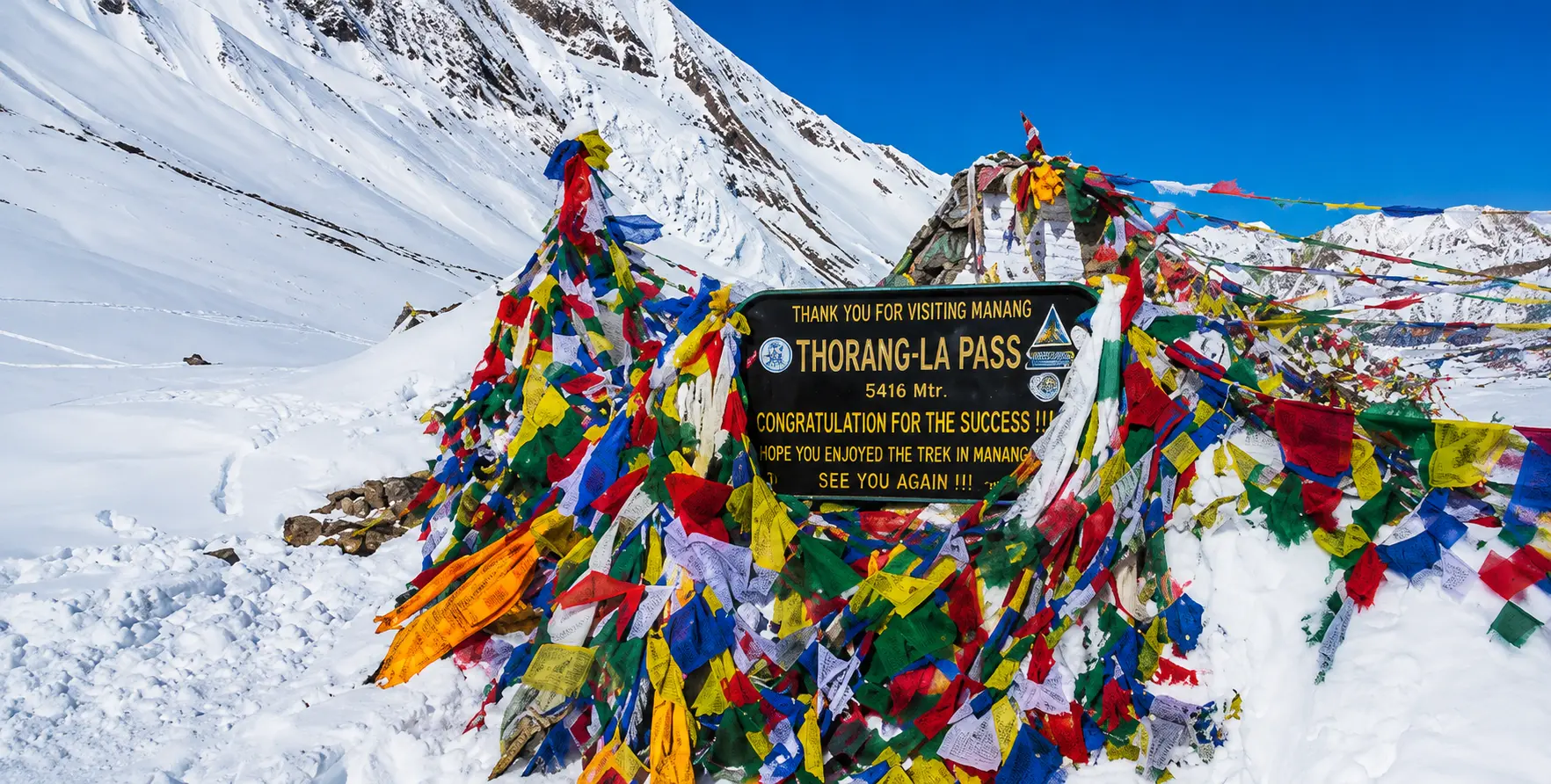
this legendary trek takes adventurers through some of the most diverse landscapes on earth: subtropical river valleys, dense rhododendron forests, high-altitude Tibetan plateaux, and some of the most dramatic mountain scenery the Himalayas have to offer. The route crosses the Thorong La Pass at 5,416 meters above sea level — one of the highest mountain passes accessible by trekkers anywhere on the planet.


For decades, trekkers have debated the best way to approach the Annapurna Circuit — which direction to walk, where to start, and how to get to the trailhead. In recent years, as road construction has extended deeper into the Marsyangdi River valley, one village has emerged as the most consistently recommended and logistically ideal starting point for the modern Annapurna Circuit trek: Dharapani.

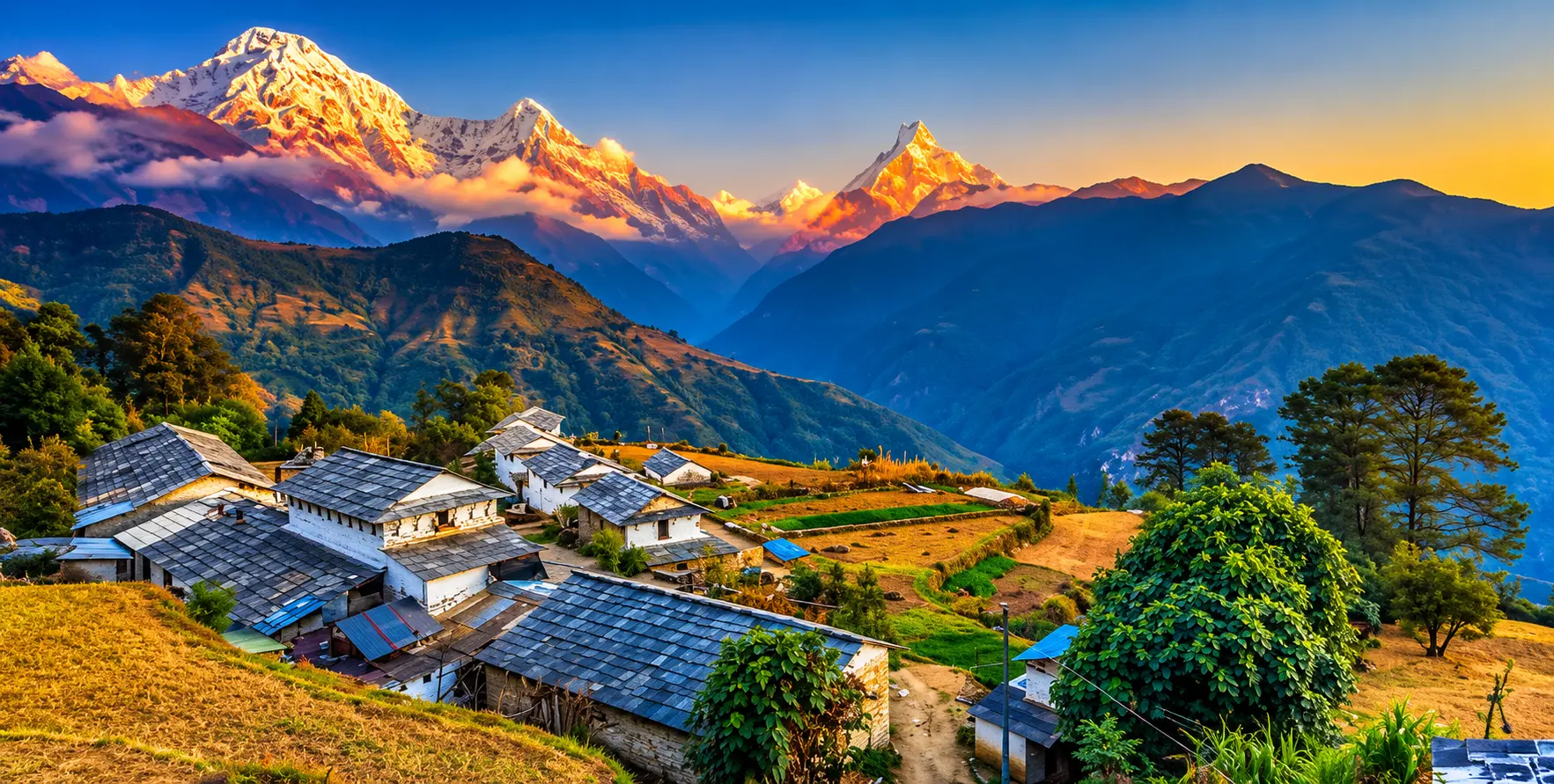
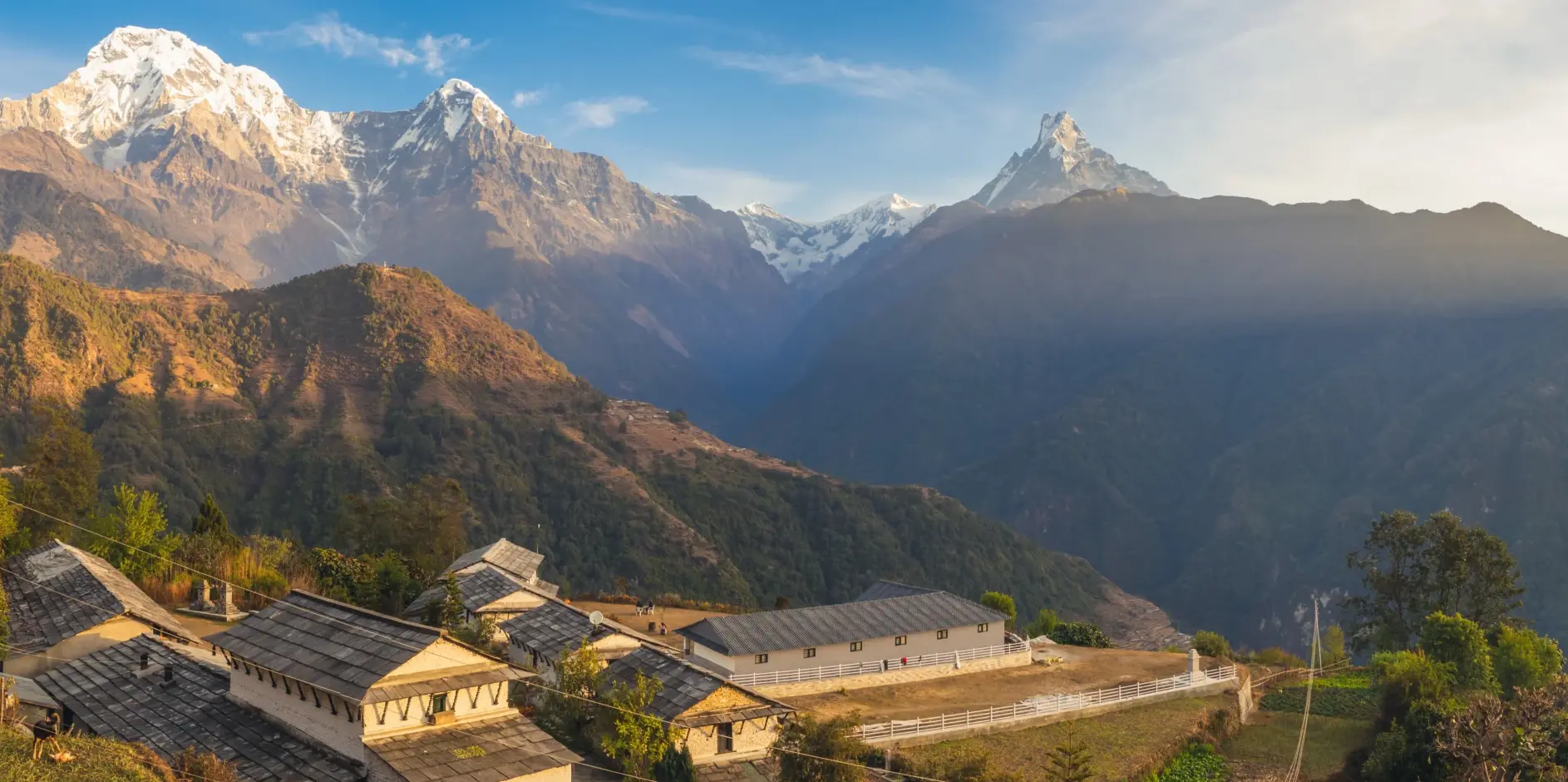
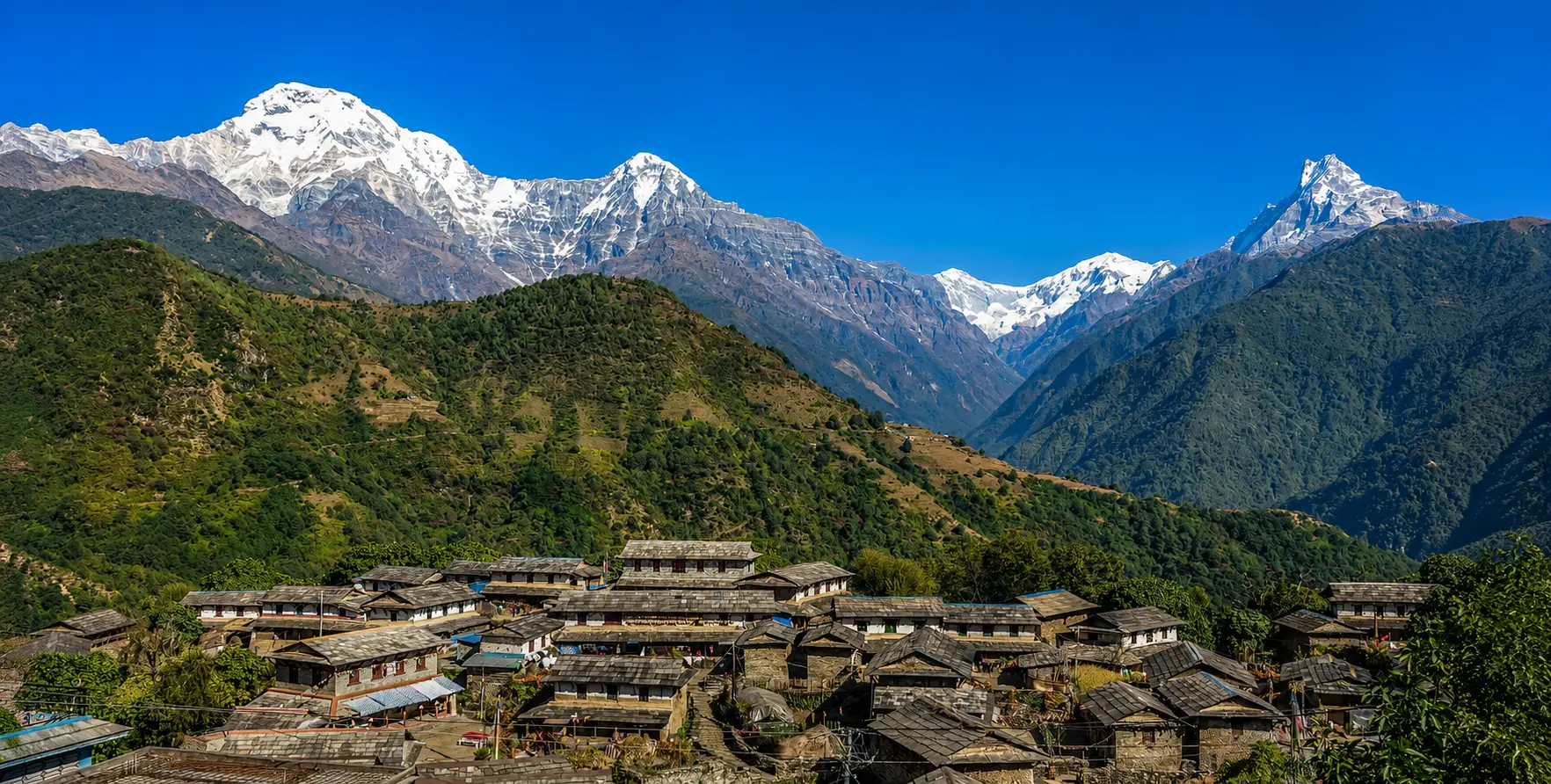
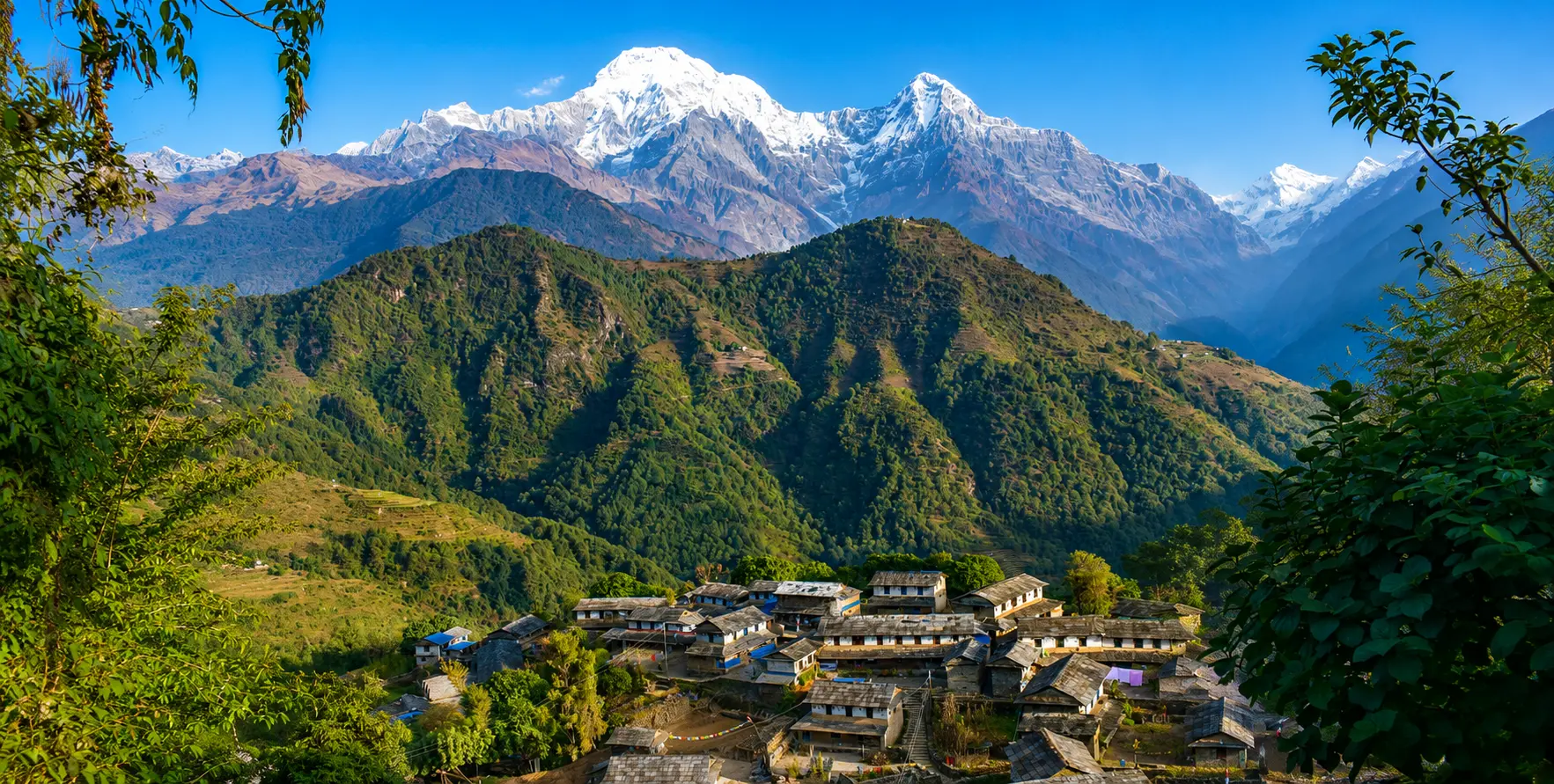
Situated at approximately 1,960 meters above sea level in the Manang District of Gandaki Province, Dharapani is the point where the motorable jeep road from Kathmandu effectively ends, and the authentic high-altitude trekking trail begins. It is a small but vital village that serves as a gateway — a transition zone between the world of vehicles and the world of mountain footpaths, yak caravans, Buddhist monasteries, and snow-capped peaks.

In this comprehensive guide, Nepal Vehicle Hiring Pvt. Ltd. — your trusted private vehicle hire partner based in Thamel, Kathmandu — explains exactly why Dharapani has become the most popular starting point of the Annapurna Circuit, how to reach it by private jeep, what to expect on the road journey, what facilities await you in the village, and everything you need to know to plan your Annapurna Circuit adventure in 2026.

Where is Dharapani? Understanding Its Strategic Location

Dharapani is a small trekking village located in the Manang District of Gandaki Province in north-central Nepal. It sits at an elevation of approximately 1,960 meters above sea level along the banks of the Marsyangdi River, which flows southward from the high glaciers of the Annapurna and Manaslu ranges.

The village lies at a critical geographical junction. To its south, the Marsyangdi valley descends steeply toward the lowlands of Besisahar and eventually the Terai plains. To its north and east, the valley narrows and climbs rapidly into the high Annapurna Conservation Area — the trail to Chame, Pisang, Manang, and ultimately the Thorong La Pass. To its west, a side valley branches off toward the remote Nar Phu Valley, one of Nepal’s most restricted and least-visited trekking destinations, requiring a special permit.

This junction position is precisely what makes Dharapani so strategically important for trekkers. It is the last point where a vehicle can realistically and comfortably bring trekkers after the grueling mountain road from Besisahar, and it is the first point where the real Annapurna Circuit trail — free from vehicles and dust — begins in earnest. The road technically continues beyond Dharapani to Chame and Manang.

Still, its quality deteriorates dramatically, and most trekking agencies, experienced guides, and seasoned Annapurna trekkers recommend starting the trek on foot from Dharapani rather than pushing the vehicle farther.

Administratively, Dharapani is part of Narphu Rural Municipality. It has a population of a few hundred people, primarily from the Gurung, Manangi, and Tibetan communities. The village has an ACAP (Annapurna Conservation Area Project) checkpoint where all trekkers must register their permits before proceeding north on the trail.


The Annapurna Circuit Trek — A Brief Overview for 2026

Before understanding why Dharapani is the ideal starting point, it is worth briefly outlining what the Annapurna Circuit involves. This iconic trek was first documented and popularised in the 1970s and 1980s and, for many years, was Nepal’s most popular trekking route. The classic circuit covers approximately 160–230 km, depending on the route variations chosen, takes between 12 and 21 days to complete, and traverses terrain ranging from tropical river valleys at 800 meters to the windswept high-altitude desert landscape of the Mustang plateau at over 4,000 meters.

The trek crosses the Thorong La Pass (5,416 m) — typically from east to west, from Manang to Muktinath — which is the physical and emotional highlight of the entire journey. After descending from Thorong La, trekkers reach the sacred Hindu and Buddhist pilgrimage site of Muktinath Temple, and then continue down through the dramatic Kali Gandaki Gorge to Jomsom, Tatopani, and eventually Nayapul near Pokhara.

The traditional starting point of the Annapurna Circuit was Besisahar (760 m), the district headquarters of Lamjung District. From Besisahar, trekkers would walk northward for 6–9 days through small villages, crossing suspension bridges and passing through forests before reaching Manang. However, road construction over the past two decades has dramatically changed the character of the lower Annapurna Circuit.

The road from Besisahar to Dharapani — and even further to Chame and Manang — is now accessible to 4WD vehicles, which means the lower sections of the trek are frequently disrupted by jeep traffic, dust, noise, and a significant loss of trail solitude.

This fundamental change to the trail infrastructure is the primary reason why the majority of modern Annapurna Circuit trekkers now prefer to begin their trek at Dharapani rather than Besisahar.
 

The Road Below Dharapani Is Now a Vehicle Track — Not a Trekking Trail

The single most important reason that Dharapani has replaced Besisahar as the preferred starting point is road construction. The road between Besisahar and Dharapani — approximately 110 km of mountain track — is now a jeep-accessible route. In this section, trekkers walking on foot share the trail with motorcycles, local jeeps, and supply vehicles serving the villages of Khudi, Bhulbhule, Ngadi, Jagat, Dharche, Tal, and Dharapani itself.


Walking alongside vehicle traffic on a dusty, unpaved mountain road is a dramatically different experience from trekking through pristine Himalayan wilderness. The dust raised by passing vehicles can be suffocating, particularly in the dry months of October–November and March–May. The noise of engines and the constant need to step aside for vehicles diminish the meditative, immersive quality that most trekkers seek on the Annapurna Circuit. By starting at Dharapani, trekkers skip this vehicle-dominated section entirely and begin immediately on the pedestrian-only trail where the real Annapurna Circuit experience begins.

Perfect Elevation to Begin the Trek

Dharapani sits at 1,960 meters above sea level — an excellent starting elevation for the Annapurna Circuit trek. This elevation is high enough that trekkers arrive with some initial altitude gain already covered by the vehicle journey, giving the body a gentle head start on acclimatization without the risk of altitude sickness that would come from starting too high. From Dharapani, the trail climbs steadily northward through Bagarchhap (2,160 m), Danaque, Chame (2,710 m), Pisang (3,200 m), and Manang (3,519 m), following a medically sound acclimatization profile.

Trekkers who begin at Besisahar (760 m) spend several days walking through lower-altitude terrain that is now largely motorable, meaning they gain altitude slowly via vehicle-accessible road sections. Trekkers who begin at Chame (2,710 m) skip the atmospheric lower villages and arrive in cooler, more challenging terrain without adequate prior acclimatization. Dharapani sits perfectly in the middle — high enough to provide a meaningful starting point, low enough to allow safe, gradual acclimatization over the days ahead.

Gateway to the Authentic Annapurna Circuit Trail

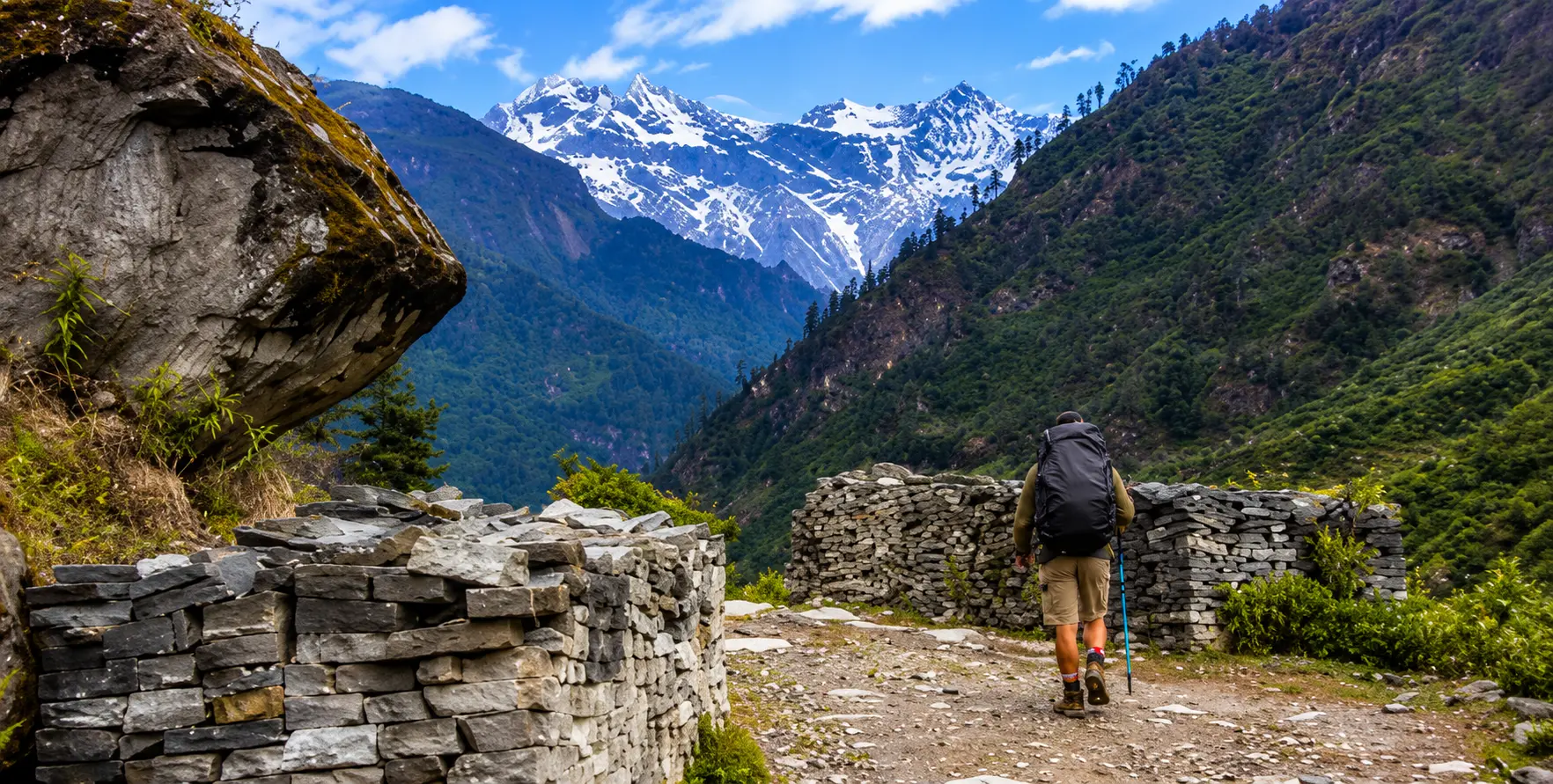
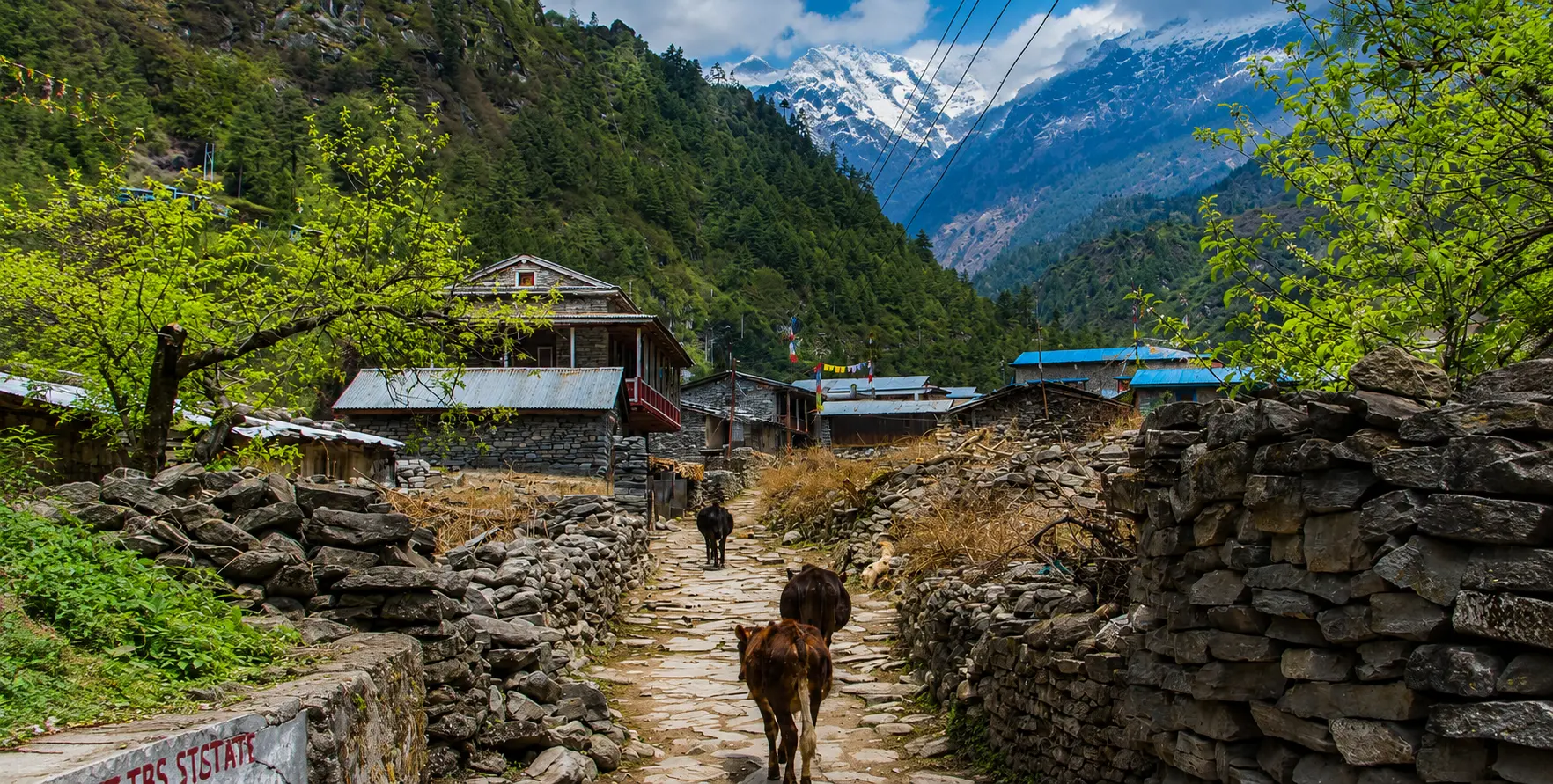
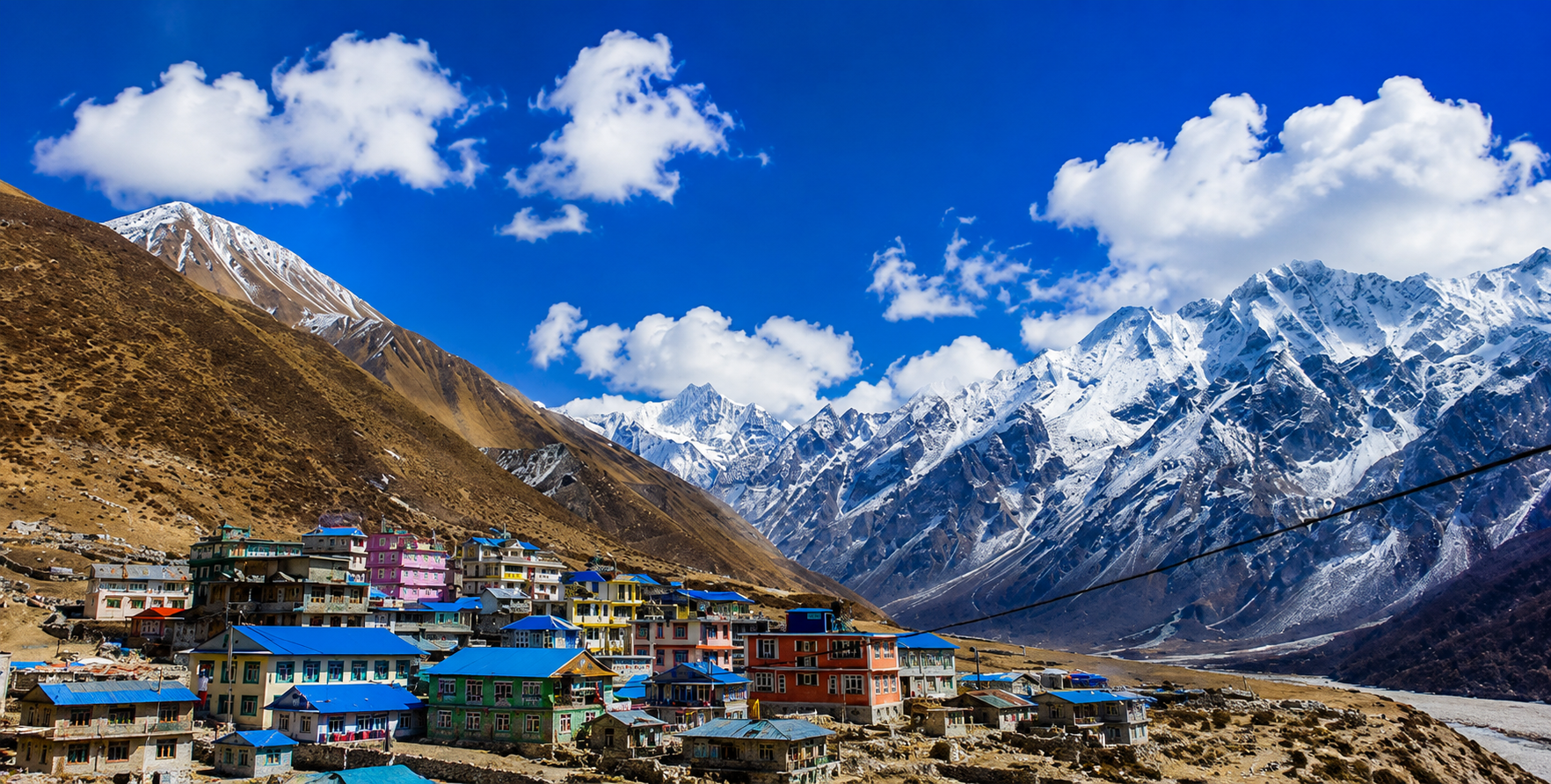
North of Dharapani, the character of the landscape changes dramatically. The wide, hot, dusty river valley narrows into a dramatic gorge. The vegetation shifts from subtropical forest to temperate pine and rhododendron. The villages become more distinctly Tibetan in character — stone houses with flat roofs, prayer flags snapping in the mountain wind, mani walls carved with Buddhist mantras, and the distant sound of monastery bells. This is the Annapurna Circuit that trekkers dream of, read about, and travel from across the world to experience.

The first village north of Dharapani on the trekking trail is Bagarchhap — a beautiful, traditional Gurung and Tibetan village at 2,160 meters with ancient stone buildings, a distinctive gompa (Buddhist monastery), and superb views of Annapurna II and Lamjung Himal. This is the quality of experience that begins as soon as trekkers set out on their Annapurna Circuit journey from Dharapani. It is authentic, remote, visually stunning, and completely free of vehicle traffic.

The Junction for the Nar Phu Valley — A Bonus for Adventurous Trekkers

Dharapani holds additional significance for adventurous trekkers because it sits directly at the junction of the main Annapurna Circuit trail and the side valley leading to the restricted Nar Phu Valley. The Nar Phu Valley is one of Nepal’s most remote and least visited trekking destinations — a hidden Tibetan-influenced enclave tucked behind the Annapurna and Kang Guru massifs. Access requires a special Nar Phu Restricted Area Permit (approximately USD 90–100 per person per week) and is limited to organized trekking groups with a licensed guide.

Trekkers who wish to combine the Nar Phu Valley side trek with the Annapurna Circuit often arrive in Dharapani first, spend a rest day to acclimatize, complete the Nar Phu circuit over 7–10 days, return to Dharapani, and then continue on the main Annapurna Circuit trail toward Chame and Manang. This combined itinerary is only logistically possible because Dharapani sits at this precise junction point — making it doubly important as a starting location for the most ambitious Annapurna region trekkers.

Saves 3–5 Days of Monotonous Road Walking

The section of trail between Besisahar and Dharapani, when walked on foot, takes approximately 3–5 days depending on the trekker’s pace and the stops made along the way. This includes the villages of Khudi, Bhulbhule, Ngadi, Bahundanda, Chamje, Tal, Dharche, and several smaller hamlets. While some of these villages are charming, the overall experience of this lower section has been significantly degraded by road construction, and most experienced trekkers and trekking agencies now agree that time and energy are better invested in the more spectacular upper sections of the circuit.

By starting from Dharapani — reached in a single day by private jeep from Kathmandu — trekkers can dedicate their full trekking time to the most beautiful and rewarding sections of the Annapurna Circuit: the pine forests of Bagarchhap and Chame, the dramatic glacial valley of Pisang, the high-altitude plateau of Manang, the challenging crossing of Thorong La, and the sacred descent to Muktinath. This is where the magic of the Annapurna Circuit truly lives, and starting from Dharapani ensures that every day of your trek is as spectacular as possible.

Logistically Practical — Private Jeep Can Reach Dharapani in One Day

From a purely logistical perspective, Dharapani is the furthest point along the Annapurna Circuit road that can be reached in a single day’s drive from Kathmandu in a private 4WD jeep. The journey covers approximately 285 km and takes 10–11 hours — a long but entirely feasible day’s travel for most trekkers. Departing Kathmandu at 5:00–6:00 AM, trekkers can typically arrive in Dharapani by 4:00–5:00 PM, with sufficient time to settle into their guesthouse, have a warm meal, and rest before beginning the trek the following morning.

Pushing the vehicle further to Chame (approximately 2 more hours on a very rough road) or Manang (another 3–4 hours beyond that) would require either a very early departure or an overnight stop at Besisahar or Dharapani — adding a day to the journey without enhancing the trekking experience. Dharapani, therefore, represents the optimal endpoint for a single-day drive from Kathmandu, making it the natural and logical starting point for the trek.

Strong Infrastructure for Trekkers

Despite being a small mountain village, Dharapani has developed a solid infrastructure specifically to serve the needs of arriving trekkers. The village has multiple tea houses and guesthouses ranging from very basic dormitory accommodation to comfortable private rooms with attached bathrooms. Local restaurants serve a wide range of food, including dal bhat, noodles, pasta, fried rice, soups, and various Tibetan dishes. There are small provision shops where trekkers can purchase last-minute supplies — energy bars, biscuits, noodles, water purification tablets, and basic trekking gear.

The ACAP permit checkpoint at Dharapani is an important administrative stop where rangers check and stamp all trekking permits. This is a legal requirement for all trekkers entering the Annapurna Conservation Area beyond Dharapani, and the checkpoint operates reliably throughout the trekking season. The presence of this official checkpoint also means that Dharapani is a recognized and well-established point in Nepal’s trekking permit system, further cementing its status as the modern official starting point for the Annapurna Circuit.

Growing Consensus Among Trekking Agencies and Experienced Guides

Perhaps the most practical endorsement of Dharapani as the ideal starting point comes from Nepal’s professional trekking industry itself. The overwhelming majority of reputable trekking agencies in Kathmandu and Pokhara now recommend Dharapani as the starting point for the Annapurna Circuit. Experienced mountain guides who have walked the circuit dozens or even hundreds of times consistently advise trekkers to begin at Dharapani rather than Besisahar, citing road conditions, dust, vehicle traffic, and the superior overall trekking experience that starts at Dharapani’s elevation.

International trekking publications, online trekking communities, and review platforms such as TripAdvisor consistently reflect this professional consensus. Trekkers returning from the Annapurna Circuit who began at Besisahar frequently report that the lower section was disappointing — hot, dusty, and vehicle-heavy — while those who began at Dharapani consistently describe a rewarding, immersive, and unforgettable experience from daDayne.

Getting to Dharapani: Kathmandu to Dharapani Route Guide

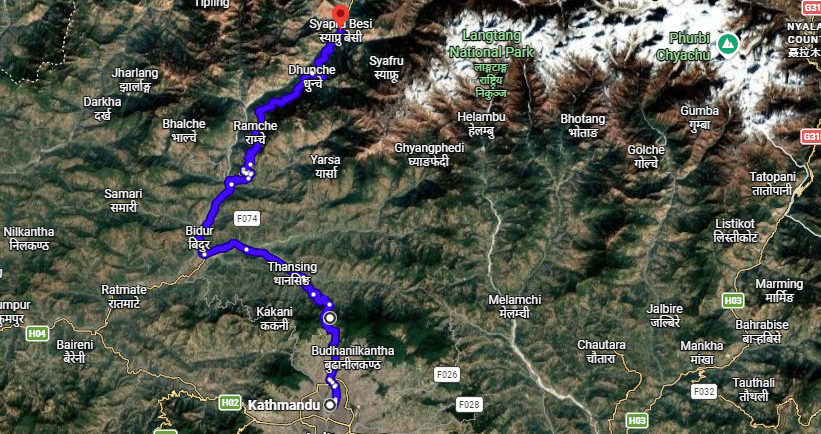
The journey from Kathmandu to Dharapani is an adventure in itself. The route passes through some of Nepal’s most diverse landscapes — from the crowded urban streets of Kathmandu to the vast flatlands of the Terai, the winding river gorges of the mid-hills, and ultimately the dramatic mountain terrain of the Marsyangdi valley. Here is a complete breakdown of the route:

Destination / StopDistance from KTMTravel TimeRoad ConditionElevation
KathmanduStartCity roads1,400 m
Prithvi Highway / Mugling110 km2.5 hrsSealed highway300 m
Dumre Junction155 km4 hrsSealed highway310 m
Besisahar175 km5 hrsSealed/improving760 m
Jagat230 km7.5 hrsRough mountain road1,300 m
Tal255 km9 hrsRough / 4WD needed1,700 m
Dharapani285 km10–11 hrs4WD jeep only1,960 m


The journey from Kathmandu to Dharapani heads westward on the Prithvi Highway, Nepal’s busiest inter-city road, which follows the Trishuli River through a series of dramatic gorges before reaching the Mugling junction at approximately 110 km. From Mugling, the route turns north onto the road toward Besisahar, passing through Dumre — the last major town with good facilities and ATMs before entering the mountains.

Beyond Besisahar, the road transitions from sealed asphalt to rough, unpaved mountain track. The quality of the road deteriorates progressively as the valley climbs and narrows. From Jagat onward, a 4WD jeep is not merely recommended — it is essential. The road crosses numerous landslide zones, fords shallow river tributaries, and navigates precipitous cliff-side sections that are completely impassable in a standard car or Hiace van. By the time you reach Tal (1,700 m) — a beautiful flat village spread across an ancient lake bed — you are in genuinely remote Himalayan terrain.

The final stretch from Tal to Dharapani climbs through a series of tight gorges to reach Dharapani village, where the valley widens slightly, and the unmistakable peaks of the Annapurna and Manaslu ranges begin to dominate the skyline. The sense of arrival at Dharapani after the long drive from Kathmandu is genuinely exhilarating — you are now deep in the Himalayas, standing at the threshold of one of the world’s greatest treks.
Why Dharapani is the Most Popular

Private Jeep Hire Prices: Kathmandu to Dharapani 2026

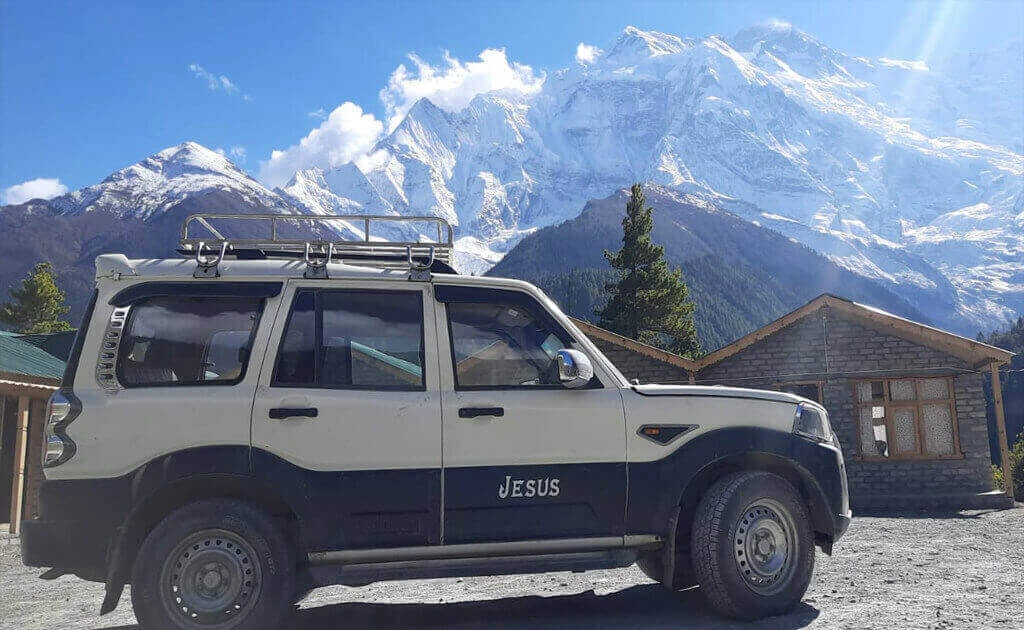
The only practical private vehicle option for the Kathmandu-to-Dharapani journey is a 4WD jeep. Standard cars, Hiace vans, and Coaster buses are not suitable for the road beyond Besisahar. Nepal Vehicle Hiring Pvt. Ltd. offers a full range of 4WD jeep hire options for the Kathmandu-to-Dharapani journey, with experienced drivers who know the Annapurna Circuit road in all seasons and under all conditions.

Vehicle TypeCapacityOne-Way (NPR)Round Trip (NPR)Notes
4WD Jeep (Standard)4–5 pax25,000–35,00045,000–60,000Most popular option
4WD Jeep (Premium)6–7 pax30,000–42,00055,000–72,000Land Cruiser / Prado
Hiace Van (to Besisahar)10–12 pax18,000–25,00032,000–44,000Besisahar only — not suitable beyond
Private Car (to Besisahar)3–4 pax12,000–18,00020,000–30,000Besisahar only — not suitable beyond
Multi-Day Jeep (2 days)4–7 pax45,000–65,00080,000–110,000Includes driver overnight


All prices above include the driver, fuel, road tolls, and parking fees. The prices shown are approximate and subject to variation based on season, fuel prices, and vehicle availability. Please note that Hiace vans and private cars can be hired as far as Besisahar at the prices shown, from where a separate local jeep transfer to Dharapani must be arranged. For the most competitive and reliable pricing for your specific travel dates, contact Nepal Vehicle Hiring Pvt. Ltd. directly for a personalized quote.

For groups of trekkers traveling together, a private jeep from Kathmandu to Dharapani is almost always more cost-effective per person than booking seats on a public jeep or tourist bus. When you factor in the additional comfort, flexibility, reliability, and the ability to stop at your own pace along the way, private jeep hire represents exceptional value for the Annapurna Circuit approach journey.


Dharapani vs. Other Annapurna Circuit Starting Points — A Comparison

To fully understand why Dharapani is the most popular choice, it is helpful to compare it directly with the other possible starting points for the Annapurna Circuit trek:

Starting PointElevationRoad AccessTrek Options
Besisahar760 mCar / Jeep / VanAC classic start — long walk out
Chame2,710 m4WD Jeep onlySkips lower AC sections
Dharapani1,960 m4WD Jeep onlyBest balance — skips the road, starts the real trek
Koto (near Dharapani)2,600 m4WD Jeep onlyNar Phu Valley entry point
Manang3,519 m4WD Jeep only (seasonal)Skips most of the trek


As the comparison table shows, Dharapani occupies the optimal middle ground among all possible Annapurna Circuit starting points. Besisahar is too low and too vehicle-impacted for most modern trekkers. Chame is too high and overlooks the atmospheric lower-mountain villages of Bagarchhap and Danaque.

Manang is so high that it denies trekkers the majority of the circuit experience. Dharapani hits the sweet spot: it is the highest practical starting point that still includes all of the most rewarding and authentic trekking sections of the Annapurna Circuit.
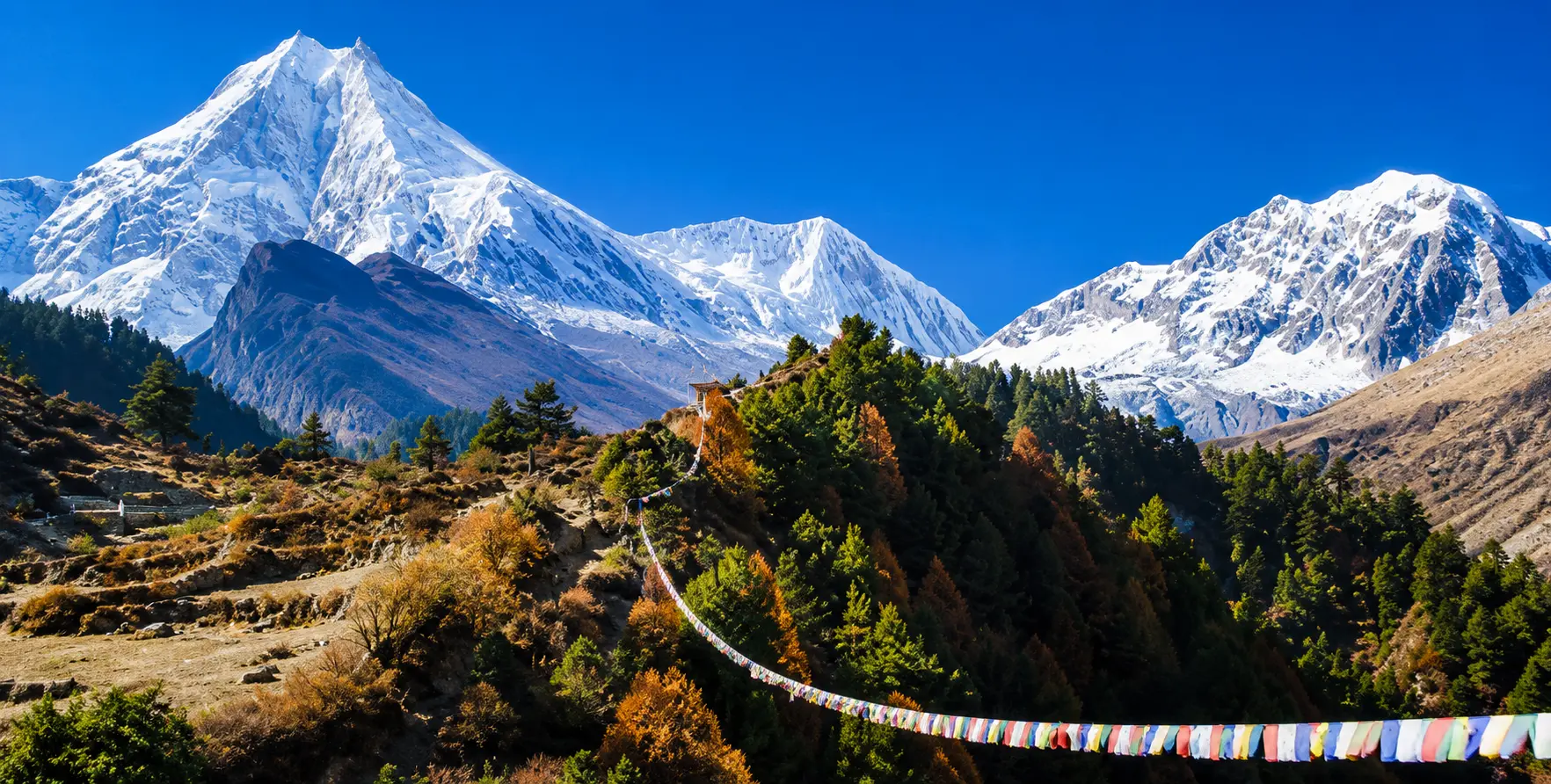
 

What to Expect on the Annapurna Circuit Trek Starting from Dharapani

Day 1: Dharapani (1,960 m) to Bagarchhap (2,160 m) — 3–4 hours

The first day of trekking from DDayapani is a gentle warm-up — a short, beautiful 3–4-hour walk that eases trekkers into the mountain environment after the long drive from Kathmandu. The trail climbs steadily northward through forest and terraced fields, crossing suspension bridges over the Marsyangdi River before arriving at Bagarchhap, one of the most picturesque villages on the entire Annapurna Circuit.

Bagarchhap has an ancient Tibetan-style monastery, stone-paved streets, and stunning views of Annapurna II (7,937 m). The short day allows trekkers to recover from the journey and begin adjusting to the altitude in a beautiful, peaceful setting.

Day 2: Bagarchhap (2,160 m) to Chame (2,710 m) — 5–6 hours

The second day’s trek takes trekkers to the mountains, passing through the villages of Danaque, Timang, and Thanchok before reaching Chame, the district headquarters of Manang District. The trail in this section passes through dense pine and rhododendron forests, with dramatic views of the Lamjung Himal and the first glimpses of the extraordinary rock wall of Paungda Danda — a curved cliff face rising over 1,500 meters above the valley floor. Chame has good facilities, including lodges, restaurants, a police checkpoint, a post office, and even a small hospital. It is an excellent acclimatization stop.

Day 3: Chame (2,710 m) to Upper Pisang (3,310 m) — 5–6 hours

The walk from Chame to Pisang is one of the most visually dramatic days on the entire Annapurna Circuit. The trail passes through an extraordinary apple orchard zone, crosses the river multiple times on suspension bridges, and eventually emerges from the forest into the wide, dry, open valley of the Manang basin.

The view that greets trekkers as they emerge from the pine forest and see Annapurna II, Annapurna IV, Gangapurna, and the soaring wall of the Annapurna massif for the first time is one of the most breathtaking moments in all of Himalayan trekking. Upper Pisang, perched on a hillside above the valley floor, offers even better views than Lower Pisang and is the recommended overnight stop.

Day 4: Pisang (3,310 m) to Manang (3,519 m) — 5–7 hours

The walk from Pisang to Manang is a full day across the wide, arid Manang valley — a landscape that feels more like Tibet than Nepal. The trail passes through the traditional villages of Ghyaru and Ngawal, perched dramatically on the ridge above the valley floor with panoramic views of Annapurna III, Gangapurna, and the Tilicho peak massif. The high-altitude Tibetan culture is strongly evident in these villages — flat-roofed stone houses, large mani walls, Buddhist stupas, and locals dressed in traditional Tibetan chuba robes.

Manang village (3,519 m) is the largest settlement in the Annapurna Conservation Area and the last major supply and accommodation point before Thorong La. A rest day in Manang for acclimatization is strongly recommended before attempting the pass.

Day 5: Acclimatization Day in Manang (3,519 m)

A rest day in Manang is not optional — it is essential for safe acclimatization before the high-altitude crossing of Thorong La at 5,416 meters. Trekkers who skip the Manang rest day significantly increase their risk of developing Acute Mountain Sickness (AMS), High Altitude Pulmonary Edema (HAPE), or High Altitude Cerebral Edema (HACE) — all of which can be life-threatening conditions.

The Himalayan Rescue Association (HRA) maintains a clinic in Manang where doctors give free lectures on the symptoms and prevention of altitude sickness each afternoon during trekking season. Attending this lecture is highly recommended for all Annapurna Circuit trekkers. On the rest day, a short acclimatization hike to the Ice Lake (4,620 m) above Manang is strongly recommended to aid the body’s adjustment to altitude.

Day 6: Manang (3,519 m) to High Camp / Thorong Phedi (4,450–4,925 m) — 4–5 hours

From Manang, the trail climbs steadily through barren, wind-scoured terrain toward Thorong La. Most trekkers now stop at either Yak Kharka (4,018 m) or Thorong Phedi base camp (4,450 m) for the penultimate night before the pass, or push all the way to High Camp (4,925 m) for the final night. High Camp is the most popular choice as it dramatically reduces the distance and time required to summit Thorong La the following morning.

Day 7: High Camp (4,925 m) to Muktinath (3,710 m) via Thorong La (5,416 m) — 7–9 hours

The crossing of Thorong La is the physical and emotional climax of the entire Annapurna Circuit trek — and one of the great high-altitude trekking achievements available to non-technical trekkers anywhere in the world. Trekkers typically depart High Camp between 4:00 and 5:00 AM to reach the summit before the afternoon winds pick up. The approximately 4-hour ascent from High Camp to the Thorong La summit cairns and prayer flags is demanding but deeply rewarding.

The views from the summit — across the Annapurna massif to the south and the Mustang plateau to the north — are incomparable.

The long descent to Muktinath (3,710 m) takes another 3–4 hours. Muktinath Temple, sacred to both Hindus and Buddhists, is an extraordinary attraction that combines physical achievement with profound spiritual significance.


Permits Required for the Annapurna Circuit Starting from Dharapani

All trekkers on the Annapurna Circuit are required to carry two official permits, which must be obtained before reaching Dharapani’s ACAP checkpoint:

  1. ACAP — Annapurna Conservation Area Permit: The primary trekking permit for the Annapurna region. The current fee is NPR 3,000 per person for SAARC nationals and NPR 4,000 (approximately USD 30) per person for all other nationalities. The ACAP permit can be obtained at the Nepal Tourism Board (NTB) office in Pradarshani Marg, Kathmandu, or at the NTB office in Pokhara. Processing is usually immediate and does not require planning.
  2. TIMS Card — Trekkers’ Information Management System: The TIMS card is a trekker registration document required for all trekking routes in Nepal outside of national parks. For the Annapurna Circuit, the current fee is NPR 2,000 per person. TIMS cards are issued by the Trekking Agencies Association of Nepal (TAAN) office in Kathmandu (Maligaon) or Pokhara, or by the NTB offices. Processing is immediate.
  3. Nar Phu Restricted Area Permit (only if visiting Nar Phu Valley): Trekkers wishing to enter the Nar Phu Valley near Dharapani require an additional restricted area permit, currently priced at approximately USD 90–100 per person per week. This permit can only be obtained through a registered trekking agency and requires a minimum group of two trekkers with a licensed guide.

Important note: Neither the ACAP permit nor the TIMS card can currently be obtained at Dharapani itself or at the Besisahar checkpoint. Trekkers must obtain both permits in Kathmandu or Pokhara before beginning their journey to the trailhead. Failure to carry both permits will result in a refusal of entry at the Dharapani checkpoint and a requirement to return to Besisahar or further to obtain them. Nepal Vehicle Hiring strongly recommends organizing all permits in Kathmandu before the departure day.


Best Time to Start the Annapurna Circuit from Dharapani

Choosing the right season for your Annapurna Circuit trek from Dharapani is critical to both the quality of the experience and the safety of the journey. The table below summarises the four seasons and their suitability for the Dharapani-start Annapurna Circuit:

SeasonMonthsRoad ConditionTrek ConditionRecommended?
AutumnSep–NovGood to Very GoodExcellent — clear skiesYes — Best Season
SpringMar–MayGoodVery Good — rhododendrons bloomYes — Excellent
WinterDec–FebPossible with careCold, snow above 3,000 mPartial — lower sections only
MonsoonJun–AugPoor — landslidesWet, leeches, poor visibilityNot Recommended


The autumn trekking season (September to November) is Nepal’s most popular and arguably finest trekking period. The monsoon rains have washed the air clean, visibility is exceptional, and the skies above the Annapurna range are typically clear and vivid blue for weeks at a time. October is consistently the most popular month for Annapurna Circuit trekkers worldwide. The trails are dry and firm, temperatures are comfortable at lower elevations and cold but manageable at high altitude. Accommodation demand is at its highest in October and November — booking of guesthouses is strongly recommended, and private vehicle hire from Kathmandu should be arranged at least 7–10 days in advance.


The spring season (March to May) offers a different but equally magnificent trekking experience. The rhododendron forests that blanket the slopes between Bagarchhap and Chame burst into extraordinary bloom in March and April, painting the hillsides in brilliant red, pink, and white. Temperatures warm progressively through the season, making long trekking days in the Manang valley particularly pleasant. The main risk in spring is increasing afternoon cloudiness as the pre-monsoon convection builds, which can reduce summit views. However, clear mornings are almost always guaranteed.


Essential Travel Tips for the Annapurna Circuit from Dharapani

  • Book your private 4WD jeep from Kathmandu to Dharapani at least 7–10 days in advance during peak season (October–November, March–April). Vehicles fill up quickly during busy trekking months.
  • Obtain your ACAP permit and TIMS card in Kathmandu or Pokhara before departure. Do not assume you can obtain them at Besisahar or Dharapani — this is not possible.
  • Carry sufficient Nepalese Rupees (NPR) cash from Kathmandu. There are ATMs in Besisahar, but none beyond. Bring enough cash for your entire trek plus a reasonable emergency reserve.
  • Depart Kathmandu by 5:00–6:00 AM to ensure arrival at Dharapani before dark. The mountain road sections beyond Besisahar are not safe to drive at night.
  • Pack warm layers, a down jacket, and a sleeping bag rated to at least -10°C for the high-altitude sections above Manang. Even in summer, temperatures at Thorong La can drop well below freezing.
  • Carry altitude sickness medication (Diamox / Acetazolamide) and discuss its use with your doctor before departure. The ascent from Dharapani to Thorong La (from 1,960 m to 5,416 m) is significant, and altitude sickness is a genuine risk if the ascent profile is not followed carefully.
  • Use a water purification method — iodine tablets, a SteriPen UV purifier, or a quality filter — to treat all water above Dharapani. Bottled water generates enormous plastic waste in the mountains, and filtered or purified water is the environmentally responsible choice.
  • Hire a licensed local guide from Dharapani or Kathmandu if you are not an experienced Himalayan trekker. A knowledgeable guide adds significantly to the safety, cultural richness, and logistical ease of the Annapurna Circuit trek.
  • Download an offline map of the Annapurna Circuit before departure (Maps.me or Gaia GPS are recommended). Mobile connectivity is unreliable above Dharapani and completely absent on many sections of the trail.
  • Respect the local culture. The villages north of Dharapani are predominantly Buddhist and Tibetan in character. Remove your shoes before entering monasteries, always walk clockwise around mani walls and stupas, and ask permission before photographing local people.
Why Dharapani is the Most Popular

Why Book Your Kathmandu-to-Dharapani Jeep with Nepal Vehicle Hiring?

The journey from Kathmandu to Dharapani is not a route to be taken lightly. The mountain road beyond Besisahar is one of the most challenging driving routes in Nepal — narrow, steep, rough, and prone to landslides during and after the monsoon. Choosing the right vehicle hire company and driver for this journey is as important as any decision you will make in your Annapurna Circuit preparation.


Nepal Vehicle Hiring Pvt. Ltd. is Kathmandu’s most trusted private vehicle hire company for trekking trailhead transfers. Based in Thamel — the heart of Kathmandu’s trekking district — we have been serving international trekkers, pilgrims, and travelers for many years with an unwavering commitment to safety, reliability, and exceptional customer service. Here is why thousands of Annapurna Circuit trekkers choose us every year:

  • Experienced mountain drivers with years of driving experience on the Annapurna Circuit road in all seasons and conditions
  • Well-maintained 4WD fleet — Land Cruiser, Prado, and other proven high-performance mountain vehicles
  • 8,000+ satisfied customers with 5-star ratings on TripAdvisor and Google
  • Flexible departure times — we can depart at 5:00 AM if needed to ensure arrival at Dharapani before dark
  • Transparent all-inclusive pricing — driver, fuel, tolls, and parking with no hidden fees
  • 24/7 customer support from our Thamel office for pre-trip planning and any on-road assistance
  • Free advice on permits, accommodation, the best time to trek, and full Annapurna Circuit logistics
  • Option for multi-day jeep hire for groups wanting a vehicle to wait at Manang or Jomsom

When you book your Kathmandu to Dharapani private jeep with Nepal Vehicle Hiring, you are not just booking a vehicle — you are beginning your Annapurna Circuit adventure with the peace of mind that your trailhead transfer is in the safest, most experienced hands in Nepal.


Frequently Asked Questions

Why is Dharapani considered the best starting point for the Annapurna Circuit?

Dharapani sits at the precise point where the road from Kathmandu ends and the real mountain trekking trail begins. The lower sections of the Annapurna Circuit between Besisahar and Dharapani have been largely converted into a motorable jeep road, which most trekkers prefer to skip. By starting at Dharapani, trekkers bypass the dusty, vehicle-dominated lower road sections and begin immediately on the traditional high-altitude trekking trail — making it the most practical and rewarding starting point for the modern Annapurna Circuit experience.

How do I get from Kathmandu to Dharapani by private vehicle?

The most comfortable and convenient way to reach Dharapani from Kathmandu is to hire a private 4WD jeep through Nepal Vehicle Hiring Pvt. Ltd. The journey covers approximately 285 km. It takes 10–11 hours, depending on road conditions. The road beyond Besisahar to Dharapani is a rough mountain track that requires a 4WD vehicle. Private jeep hire is the recommended option as it offers door-to-door service, flexible departure times, and a much more comfortable journey than public jeeps.

Is it possible to reach Dharapani by public transport?

Yes, but it is significantly more challenging. Local jeeps depart from Besisahar to Dharapani — but they are crowded, infrequent, and uncomfortable. Most serious trekkers prefer to book a private jeep from Kathmandu directly to Dharapani for a smoother, more reliable experience. Private vehicle hire also allows you to start your trek the moment you arrive, without the exhaustion of a long, cramped public transport journey.

Do I need any permits to trek the Annapurna Circuit from Dharapani?

Yes. Two permits are required to trek the Annapurna Circuit: the ACAP (Annapurna Conservation Area Permit) and the TIMS (Trekkers’ Information Management System) card. Both can be obtained in Kathmandu at the Nepal Tourism Board office in Pradarshani Marg, or in Pokhara. It is strongly recommended that you obtain your permits before traveling to Dharapani, as facilities there are limited. The Nar Phu Valley near Dharapani additionally requires a special Nar Phu Restricted Area Permit.

What is the best time of year to start the Annapurna Circuit from Dharapani?

The two best trekking seasons are autumn (September to November) and spring (March to May). Autumn offers the clearest mountain views, stable weather, and dry trail conditions. Spring is equally excellent with blooming rhododendrons and warm daytime temperatures. Winter (December to February) is possible for experienced trekkers, but the Thorong La Pass can be blocked by snow. The monsoon season (June to August) brings heavy rain, landslides, and leeches — and is not recommended for the Dharapani-to-Thorong La section.

How much does a private jeep from Kathmandu to Dharapani cost?

The cost of a private 4WD jeep from Kathmandu to Dharapani with Nepal Vehicle Hiring ranges from approximately NPR 25,000 to NPR 42,000 for a one-way journey, depending on the vehicle type and the number of passengers. Round-trip prices (for groups wanting a return vehicle) range from NPR 45,000 to NPR 72,000. All prices include the driver, fuel, tolls, and parking. Multi-day jeep hire packages are also available for groups who want the vehicle to wait in Manang or Jomsom.

Can I start the Annapurna Circuit from a different point and still reach Dharapani?

Yes. Some trekkers choose to fly into Jomsom Airport (on the western side of the Annapurna Circuit) and trek east toward Manang and Dharapani, completing the circuit in reverse. Others begin their trek from Chame or Tal. However, Dharapani remains the most popular starting point for the classic west-to-east Annapurna Circuit because it places trekkers at the perfect elevation to begin the mountain trail after the motorable road ends.

What facilities are available at Dharapani village?

Despite its remote setting, Dharapani has a good range of facilities for trekkers. The village has several tea houses and guesthouses offering basic but comfortable accommodation, a checkpoint for ACAP permit registration, small shops selling trekking supplies and snacks, and local restaurants serving dal bhat, noodles, and other Nepali and Tibetan dishes. There is no ATM in Dharapani, so trekkers must bring sufficient cash from Besisahar or Kathmandu. Mobile connectivity is limited — the Ncell network sometimes functions, but cannot be relied upon.


Conclusion — Dharapani: Where the Real Annapurna Circuit Begins

Dharapani is far more than a logistical waypoint on the road from Kathmandu to the Annapurna Conservation Area. It is the threshold — the precise and meaningful boundary between the motorized world and the timeless mountain world of the Annapurna Circuit.

It is the village where the dust and noise of the jeep road give way to the silence of the pine forest and the sound of the Marsyangdi River rushing over glacial boulders. It is where the distant white peaks that you caught glimpses of through the vehicle window suddenly become real, towering presences that will accompany you for every step of the days ahead.


The reasons for Dharapani’s popularity as a starting point are numerous and compelling: the road below it is vehicle-dominated and uninspiring for trekkers; its elevation provides a perfect acclimatisation baseline; it sits at the junction of the Nar Phu Valley for adventurous trekkers; it is reachable in a single day from Kathmandu by private 4WD jeep; and it has the infrastructure to receive and support arriving trekkers efficiently.

All of these factors together have produced a clear and well-deserved consensus in the Nepal trekking community: for the modern Annapurna Circuit, Dharapani is the place to start.

Whether you are an experienced Himalayan trekker making your fifth visit to Nepal or a first-time adventurer stepping into the Annapurna Conservation Area for the very first time, starting your Annapurna Circuit journey from Dharapani ensures that from the very first morning of your trek, you are in the mountains — real, raw, extraordinary, and unforgettable.

Nepal Vehicle Hiring Pvt. Ltd. is ready to take you there. Our professional drivers, well-maintained 4WD fleet, and deep knowledge of the Annapurna Circuit road will ensure that your journey from Kathmandu to Dharapani is safe, comfortable, and the perfect beginning to the greatest trek of your life. Contact us today to book your private jeep and take the first step toward Thorong La.

WhatsApp: +977 9851013196 | Email: [email protected]
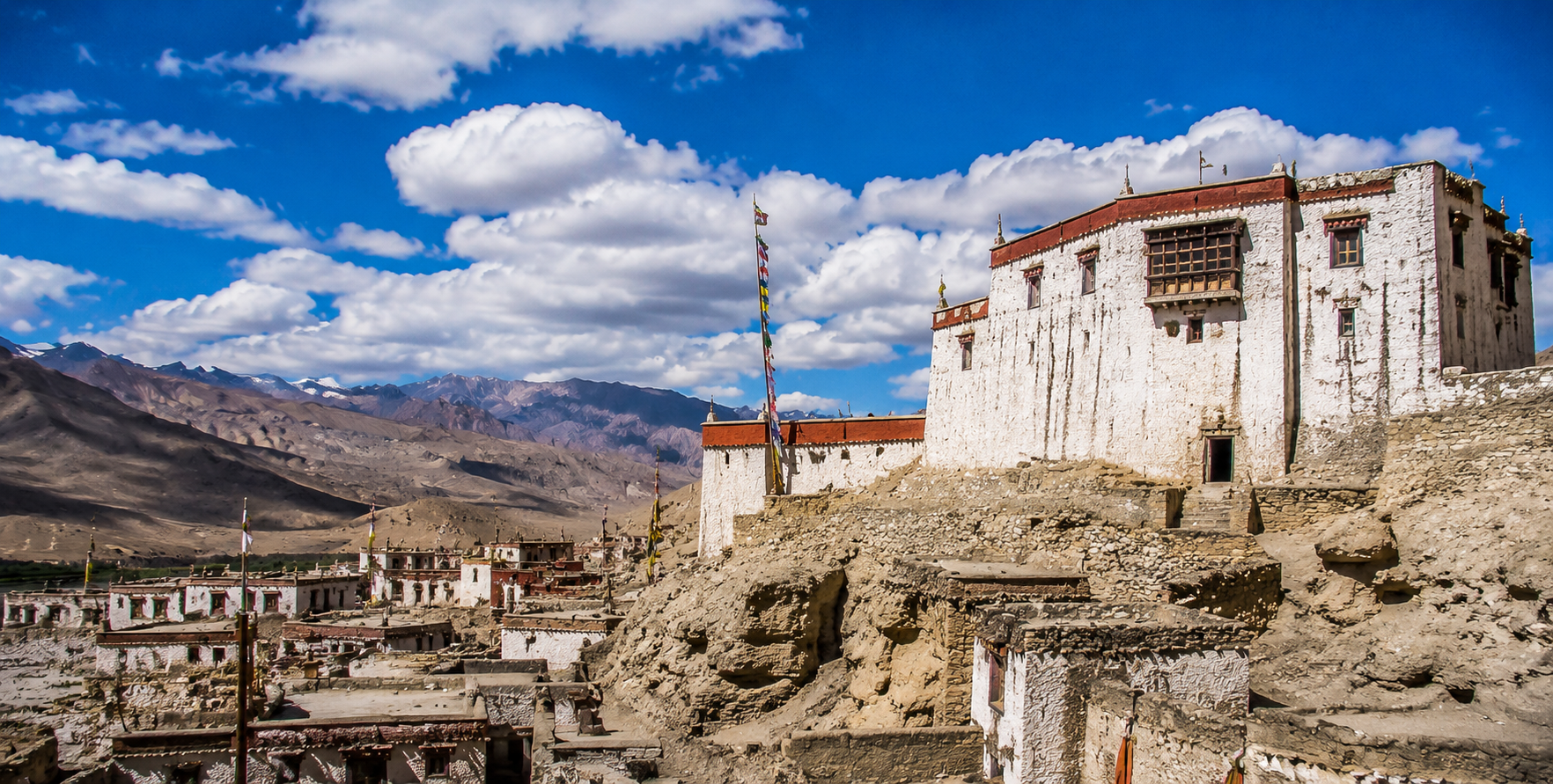
Upper Mustang 4WD Jeep – Complete Rental and Hire Guide 2026

Upper Mustang 4WD jeep

Upper Mustang 4WD Jeep – Complete Rental and Hire Guide

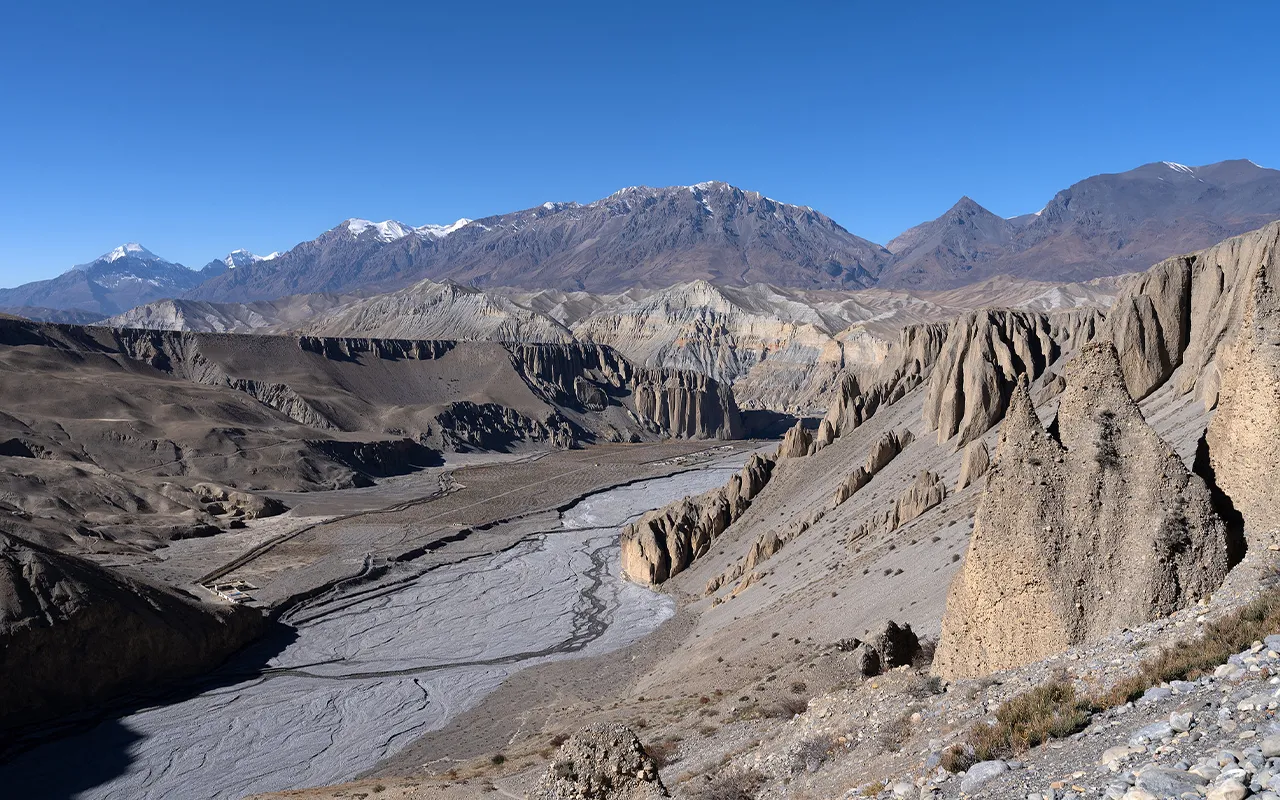
Upper Mustang is a destination that cannot be reached without a properly equipped 4WD jeep. This high-altitude desert kingdom in the rain shadow of the Annapurna and Dhaulagiri ranges is connected to the rest of Nepal by jeep tracks alone – remote, rough, and at times extreme – winding through one of the most dramatic landscapes on earth, from the deep gash of the Kali Gandaki gorge to the wind-eroded plateau surrounding the medieval walled city of Lo Manthang.

Vehicle Hiring Nepal specializes in 4WD jeep rental for Upper Mustang, providing well-maintained Toyota Land Cruisers and experienced mountain drivers for travelers heading into this restricted and extraordinary region. This complete 2026 guide covers our full jeep fleet, rental options from both Kathmandu and Pokhara, prices, the Upper Mustang permit system, road conditions, and everything you need to plan your 4WD adventure into the Forbidden Kingdom.


Why Upper Mustang Requires a 4WD Jeep – No Exceptions

Unlike many of Nepal’s mountain regions, where a capable SUV might suffice in good conditions, Upper Mustang allows no compromise on vehicle choice. Here is why:

  • No paved roads exist anywhere within Upper Mustang itself – every meter of road from Kagbeni northward is an unpaved track
  • The terrain is a high-altitude desert plateau with loose sand, rocks, and wind-eroded surfaces that shift with the weather and season.
  • Altitudes range from 2,800 m at Kagbeni to over 3,840 m at Lo Manthang, with several passes exceeding 3,800 m along the route.
  • Remoteness is extreme – between villages, there may be no other vehicles, no fuel stations, and no mobile signal for hours at a time.
  • Weather can change suddenly – wind, dust storms, and occasional snow at higher elevations all demand a vehicle with reliable traction and power.
  • The approach itself, through the Kali Gandaki gorge from Beni to Jomsom, is one of Nepal’s roughest and most technically demanding jeep tracks, even before Upper Mustang begins.


For all of these reasons, Vehicle Hiring Nepal uses only genuine 4WD Toyota Land Cruisers for Upper Mustang journeys – never a standard SUV, sedan, or 2WD vehicle of any kind.


Our Upper Mustang 4WD Jeep Fleet

Toyota Land Cruiser (Standard) – The Workhorse

Capacity: 4 to 6 passengers with full luggage

Engine: 4.5L V8 turbodiesel

Strengths: Maximum power and durability, the most trusted vehicle for Upper Mustang’s roughest sections

The standard Land Cruiser (LC78/LC79 series) is the backbone of our Upper Mustang fleet. Built for decades of reliable service on the world’s harshest roads, it is the vehicle of choice for the Kali Gandaki gorge and the remote plateau tracks north of Kagbeni. Robust, powerful, and easily serviceable even in remote areas, it remains the gold standard for travel in Upper Mustang.

Toyota Land Cruiser Prado – Premium Comfort

Capacity: 4 to 5 passengers with luggage

Engine: 2.8L turbodiesel

Strengths: More refined ride quality, premium interior, strong 4WD capability

For travelers who want the comfort of a more modern, premium interior without sacrificing genuine 4WD capability, the Land Cruiser Prado is an excellent choice for Upper Mustang. It handles the gorge and plateau tracks confidently while offering a smoother, more comfortable ride on the longer driving days.

Mahindra Bolero / Scorpio – Budget 4WD

Capacity: 4 to 6 passengers

Strengths: Rugged, affordable, widely used by local drivers throughout the region

For budget-conscious groups who still require genuine 4WD capability, the Mahindra Bolero and Scorpio provide a more affordable alternative to the Toyota Land Cruiser while remaining capable on the Upper Mustang tracks. Ride comfort is somewhat rougher than the Toyota options, but the off-road capability is reliable.


Upper Mustang Jeep Rental Prices 2026


ServiceVehicleCapacityPrice (USD)Duration
Pokhara → Lo Manthang → PokharaLand Cruiser4–6 paxUSD 850–1,100Round trip, 6–8 days
Pokhara → Lo Manthang (one-way)Land Cruiser4–6 paxUSD 500–650One-way, 3–4 days
Kathmandu → Lo Manthang → KathmanduLand Cruiser4–6 paxUSD 1,100–1,400Round trip via Pokhara, 7–9 days
Jomsom → Lo Manthang → JomsomLand Cruiser4–6 paxUSD 350–450Round-trip, if flying to Jomsom
Kagbeni → Lo Manthang (Upper section only)Local 4WD4–6 paxUSD 180–240One-way, day trip option
Lo Manthang local day toursLand Cruiser4–6 paxUSD 60–90/dayChhoser caves, Lo Gekar, Namgyal
Land Cruiser Prado (premium)Prado4–5 pax+15–20% on the aboveSame routes, premium comfort
Mahindra Bolero/Scorpio (budget)Bolero/Scorpio4–6 pax-20–25% on the aboveSame routes, budget option


All prices include the driver, full fuel, and vehicle insurance for the complete journey. Driver accommodation during multi-day stays in Upper Mustang is arranged separately. Contact Vehicle Hiring Nepal for an exact 2026 quote tailored to your specific itinerary, group size, and travel dates.

Upper Mustang 4WD jeep

The Upper Mustang Restricted Area Permit

Before booking your 4WD jeep, you must secure the mandatory Upper Mustang Restricted Area Permit. Vehicle Hiring Nepal provides jeep transport only – permits must be arranged separately through the Department of Immigration or a licensed trekking agency.

Permit DetailInformation
Permit NameUpper Mustang Restricted Area Permit (RAP)
Cost 2026USD 500 per person for the first 10 days, USD 50 per additional day
Where to ApplyDepartment of Immigration, Kathmandu (Maitighar) – not available en route
Minimum Group2 foreign nationals minimum – solo foreign travel is not permitted
Guide RequirementA licensed Nepali trekking guide must accompany all foreign visitors at all times.
Additional PermitsACAP (NPR 3,000) and a TIMS card (USD 10) are also required
CheckpointStrictly checked at Kagbeni and at multiple points within Upper Mustang


Plan to obtain your permit in Kathmandu at least 1-2 days before your jeep departure for Pokhara or Jomsom. We can advise on the permit process and recommend trusted, licensed trekking agencies, but the permit itself must be processed separately from your vehicle booking.


Jeep Routes into Upper Mustang

Route 1: Via Pokhara (Most Common)

Distance: Pokhara to Lo Manthang approximately 316 km

Duration: 3 to 4 days driving (recommended for acclimatization)

Path: Pokhara – Beni – Tatopani – Jomsom – Kagbeni – Chele – Ghami – Charang – Lo Manthang

The Pokhara route is the standard approach for most travelers, combining the spectacular Kali Gandaki gorge drive with the high plateau crossing into Upper Mustang. This route allows for gradual acclimatization with overnight stops at Tatopani, Jomsom, and within Upper Mustang itself.

Route 2: Via Kathmandu (Extended)

Distance: Kathmandu to Lo Manthang, approximately 516 km via Pokhara

Duration: 4 to 5 days driving

Path: Kathmandu – Pokhara (Day 1) – then standard Pokhara route (Days 2–4)

For travelers beginning their Nepal trip in Kathmandu, the same Land Cruiser can be hired for the full journey, with an additional day of driving from Kathmandu to Pokhara before joining the standard Upper Mustang route.

Route 3: Fly to Jomsom, Jeep from There (Fastest)

Flight: Pokhara to Jomsom by air, 25 minutes

Jeep Distance: Jomsom to Lo Manthang, approximately 82 km

Duration: 1 to 2 days driving from Jomsom

For time-limited travelers, flying from Pokhara to Jomsom and picking up the 4WD jeep there cuts 2 to 3 days off the total journey. The trade-off is less gradual acclimatization and dependency on the Jomsom flight, which is subject to the famous Kali Gandaki afternoon wind and frequent delays.


Road Conditions on the Upper Mustang Jeep Track


SectionSurfaceDifficultyNotes
Beni → TatopaniRough gravel gorge trackModerate–HardCliff-edge sections, narrow
Tatopani → JomsomVery rough gorge trackHardAfternoon wind, rockfall risk
Jomsom → KagbeniGravel Valley TrackModerateSandy, wind-exposed
Kagbeni → CheleRemote rocky trackHardFirst Upper Mustang section
Chele → GhamiHigh plateau desert trackVery HardAltitude, exposed, remote
Ghami → CharangPlateau trackHardWind erosion, loose surface
Charang → Lo ManthangFinal approach trackModerate–HardImproving the surface near the city


Every section of this route demands a genuine 4WD vehicle. There is no point along the Beni-to-Lo Manthang track where a 2WD vehicle would be a safe or sensible choice.


What Your Jeep Driver Provides on the Upper Mustang Route

  • Years of specific experience navigating the Kali Gandaki gorge and Upper Mustang plateau tracks
  • Knowledge of the critical timing windows to avoid the Kali Gandaki afternoon wind
  • Familiarity with seasonal road conditions, river crossing points, and current landslide or weather risks
  • Vehicle recovery skills for the rare situations where the jeep needs assistance crossing a difficult section
  • Local knowledge of teahouses, fuel stops, and rest points throughout the remote route
  • Coordination with your licensed guide and itinerary throughout the Upper Mustang permit zone


Customizing Your Upper Mustang Jeep Itinerary

Vehicle Hiring Nepal can tailor your Upper Mustang 4WD jeep rental to match your specific interests and time available:

  • Standard 8-day round trip from Pokhara – the most popular option, allowing full exploration of Lo Manthang and key day trips
  • Extended 10-day itinerary including the Tiji Festival (April–May) – book significantly in advance
  • Fast 6-day fly-in option via Jomsom for time-limited travelers
  • Combined itinerary continuing from Upper Mustang to the Annapurna Circuit or onward to Manang
  • Day-tour add-ons in Lo Manthang – Sky Caves of Chhoser, Lo Gekar Monastery, Namgyal Gompa, Nam La Pass
  • Photography-focused itineraries with extra time at key viewpoints for sunrise and sunset light

Upper Mustang 4WD jeep

Best Time for Upper Mustang 4WD Jeep Travel

April to May (Tiji Festival Season)

Peak season coincides with the spectacular Tiji Festival in Lo Manthang. Book your jeep well in advance – 8 to 12 weeks ahead for Tiji dates.

June to September (Mustang’s Secret Dry Season)

While the rest of Nepal experiences monsoon, Upper Mustang lies in a rain shadow and remains largely dry and accessible. A wonderful, lightly visited season for jeep travel into the region.

October to November (Excellent, Post-Monsoon Clarity)

Outstanding visibility and dry road conditions make this one of the best seasons for the Upper Mustang jeep journey, with brilliant, clear skies and the autumn light bringing out the ochre and red tones of the plateau landscape.

December to March (Cold but Accessible)

Winter travel is possible with an experienced driver, but the higher sections may have snow and ice. Not recommended for first-time Upper Mustang visitors.


What is Included in Your Jeep Hire

  • Toyota Land Cruiser, Prado, or Mahindra jeep as selected, fully maintained and insured
  • Experienced driver specifically trained on Upper Mustang and Kali Gandaki gorge routes
  • Full fuel cost for the complete journey
  • Vehicle insurance throughout
  • Pickup from your Pokhara or Kathmandu hotel
  • Drop off at your Lo Manthang accommodation
  • All standard route stops – Beni, Tatopani, Marpha, Jomsom, Kagbeni
  • Day-tour vehicle service within Lo Manthang for round-trip bookings
  • 24/7 WhatsApp support throughout your journey


Not included: Upper Mustang Restricted Area Permit (USD 500), ACAP permit, TIMS card, mandatory licensed guide fees, driver accommodation in Lo Manthang, your accommodation, and personal meals.


How to Book Your Upper Mustang 4WD Jeep

  1. Arrange your Upper Mustang Restricted Area Permit and licensed guide in Kathmandu first.
  2. Contact Vehicle Hiring Nepal via WhatsApp at +977 9851013196 or visit vehiclehiringnepal.com
  3. Choose your jeep model – Land Cruiser, Prado, or Bolero/Scorpio
  4. Confirm your route – via Pokhara, via Kathmandu, or the fly-to-Jomsom option
  5. Provide your travel dates and group size
  6. Specify any day-tour add-ons in Lo Manthang
  7. Receive booking confirmation with driver details and full itinerary


WhatsApp: +977 9851013196
Email:[email protected]

Frequently Asked Questions

Can I rent just the jeep without a guide?

Vehicle Hiring Nepal provides only the jeep and driver. However, Nepali law requires all foreign visitors to Upper Mustang to be accompanied by a licensed trekking guide at all times within the restricted area. You must arrange this guide separately through a licensed trekking agency – your jeep driver does not substitute for this legal requirement.

What is the difference between hiring from Pokhara versus Jomsom?

Hiring your jeep from Pokhara means the same vehicle and driver will take you through the full Kali Gandaki gorge experience over 3 to 4 days, with excellent gradual acclimatization. Hiring from Jomsom (after flying there) cuts the journey to 1 to 2 days but means you miss the dramatic gorge drive and have less time to acclimatize before reaching higher altitudes in Upper Mustang.

Is the Land Cruiser necessary, or can a Scorpio handle the route?

Both can technically complete the route, but the Land Cruiser offers superior power, comfort, and reliability on the most demanding sections, particularly the high plateau north of Kagbeni. The Scorpio is a capable and more affordable alternative for budget-conscious groups who are comfortable with a rougher ride.

How many days should I allow for the round trip?

A minimum of 6 days from Pokhara (flying to Jomsom and back) or 8 days from Pokhara (full road round trip) is recommended to properly experience Lo Manthang and its surrounding sites without rushing. Add 2 days if including the Tiji Festival.


Final Thoughts

A 4WD jeep is not simply the recommended way to reach Upper Mustang – it is the only way. The combination of remote, unpaved tracks, high altitude, and extreme terrain makes a properly equipped Land Cruiser an absolute necessity for safely and comfortably reaching Lo Manthang and the surrounding sacred sites of this extraordinary kingdom.

Vehicle Hiring Nepal’s fleet of Toyota Land Cruisers and experienced Upper Mustang drivers are ready to take you into one of the most remarkable corners of the Himalayan world. Book your 4WD jeep today.

WhatsApp: +977 9851013196 | Website: www.vehiclehiringnepal.com | Email: [email protected]

The Ultimate Nepal Travel Companion: Vehicle Rental – Complete Guide to Car, Jeep, Van & Bus Hire 2026

Why Your Vehicle Choice Defines Your Nepal Experience

Nepal is not a destination you pass through — it is a country you move through, physically and experientially, across an extraordinary range of landscapes, altitudes, cultures, and road conditions that change dramatically within the span of a single day’s travel. In the morning, you might be in Kathmandu at 1,350 m, threading through the medieval lanes of Bhaktapur’s Durbar Square. By afternoon, a private jeep has carried you to Kalinchowk at 3,842 m, where snow covers the rhododendron ridges and the Himalayan panorama fills every direction. By the following week, a VIP Sofa Bus will deliver you to the birthplace of the Buddha in Lumbini’s subtropical plains, 600 km and 1,000 m below your morning’s altitude.

This physical and experiential range — Nepal’s defining characteristic as a travel destination — makes choosing a vehicle not merely a logistical consideration but a fundamental determinant of your entire experience in Nepal. The wrong vehicle leaves you stranded in Besisahar while your group heads to Dharapani on the Annapurna Circuit. The wrong vehicle leaves elderly pilgrims exhausted by a 9-hour bus journey that should have been a 9-hour Land Cruiser journey. The wrong vehicle — a standard car where a 4WD Scorpio was required — leaves you looking at Muktinath on a map rather than standing at its sacred temple. In Nepal, the vehicle is not incidental to the journey. It is the journey.

This guide — Nepal Vehicle Hiring Pvt Ltd’s ultimate Nepal vehicle rental guide 2026 — is the most comprehensive resource available on private vehicle hire in Nepal. It covers every vehicle type in our fleet, every major route across the country, seasonal road conditions, permit requirements, traveler profiles, and recommended vehicles, Nepal’s unique driving environment, 10 golden rules for Nepal vehicle hire, and a complete FAQ answering every question we receive from travelers, tour operators, and corporate clients.

Whether you are planning your first Nepal visit or your tenth, whether you are coming alone or with a group of fifty, whether your destination is the nearest heritage site or the most remote corner of Upper Mustang — this guide is designed to help you choose the right vehicle and travel Nepal with complete confidence.

Plan your Nepal journey now: Nepal Vehicle Hiring | Jeep Hire | Bus Hire | Hiace Van Hire | Call/WhatsApp: +977 9851013196

ultimate Nepal vehicle rental guide

Understanding Nepal’s Road Network – The Foundation of Vehicle Hire Planning

Nepal’s Four Road Categories – What Each Means for Vehicle Choice

Nepal’s road network is one of the most geographically diverse in the world — spanning from smooth, wide Terai highways (like the Mahendra and Prithvi Highways) to precarious cliff-edge off-road mountain tracks above 4,000 meters where the road is barely wide enough for a single vehicle. Understanding these four categories is the starting point for selecting the right vehicle:

  • Category 1 – Major Paved Highways: The Prithvi Highway (Kathmandu–Pokhara), Mahendra Highway (East- West), Tribhuvan Highway (Kathmandu–Birgunj), Araniko Highway (Kathmandu–Tibet border). These well-maintained paved roads are accessible to all vehicle types, including standard cars, Hiace vans, and tourist buses. Journey times are predictable, and comfort levels are high.
  • Category 2 – Secondary Paved Roads: District roads and regional connections, such as the Pokhara–Baglung Highway, Sindhuli–Okhaldhunga road, and Bardibas–Janakpur route. Paved but often narrower, with sections of road damage, sharp bends, and moderate gradients. Accessible to most vehicles but less comfortable in standard cars on longer journeys. Hiace vans and jeeps are recommended.
  • Category 3 – Unpaved / Gravel Mountain Roads: The Beni–Muktinath Kali Gandaki valley road, sections of the Besisahar–Dharapani Annapurna road, and numerous district and rural roads across the hills. Loose gravel, ruts, river crossings, and steep gradients define these routes. A 4WD with high ground clearance is required – standard vehicles cannot operate safely here.
  • Category 4 – Extreme Off-Road Tracks: The Kagbeni–Lo Manthang (Upper Mustang) track, Karnali Highway sections, Charikot–Kuri Village (Kalinchowk), and other remote mountain tracks. Rocky, narrow, with cliff-edge drops, boulder fields, and an altitude above 3,500 m. Only the Toyota Land Cruiser 4WD and equivalent vehicles can reliably and safely navigate these routes.

ultimate Nepal vehicle rental guide-Luxury 4WD Jeep Hire in Nepal featuring three premium off-road SUVs with a Himalayan mountain background for comfortable and adventurous travel

The 4WD Question – When It Is Mandatory, When It Is Optional

The single most frequently asked question in Nepal vehicle hire is: “Do I need a 4WD vehicle?” The answer depends entirely on your route and the current road conditions. Nepal Vehicle Hiring’s clear guidance:

Nepal’s Unique Driving Environment – What Every Traveler Should Know

Nepal’s driving environment is unlike any other country in South Asia — and understanding its unique characteristics sets realistic expectations and ensures you choose the right vehicle and driver for your journey:

  • Traffic Density – Kathmandu Valley: Kathmandu city traffic is among the densest and most chaotic in South Asia — motorcycles, buses, cars, tuk-tuks, and pedestrians competing for road space with minimal lane discipline. Nepal Vehicle Hiring’s drivers are experienced urban navigators who know the most efficient routes across the city at all hours. Budget extra time for all valley road journeys, especially during morning (8–10 AM) and evening (5–8 PM) rush hours.
  • Mountain Road Hazards: Narrow roads with no barriers, cliff-edge drops, blind corners, oncoming traffic in the same lane, loose rock surfaces, and seasonal landslide debris are all normal features of Nepal’s mountain road environment. These are not reasons to avoid Nepal’s mountain routes — they are reasons to use an experienced, professional driver and the right vehicle.
  • Altitude Effects on Vehicles: Above 3,000 m, standard petrol engines lose up to 30% of their effective power output due to reduced atmospheric oxygen. Diesel engines (used in Land Cruisers and Scorpios) are significantly less affected by altitude, making them far superior choices for high-altitude routes to Muktinath, Upper Mustang, and Manang.
  • Monsoon Road Changes: Nepal’s June–September monsoon delivers extraordinarily heavy rainfall (Kathmandu receives 1,400 mm; Lumle near Pokhara receives 5,000 mm), causing frequent landslides on mountain roads and significant flooding on Terai routes. Nepal Vehicle Hiring monitors road conditions daily during the monsoon and communicates clearly with all clients about route safety and alternatives.
  • Checkpoints and Permits: Nepal has numerous police and army checkpoints on mountain routes, particularly in the Annapurna Conservation Area, Manaslu, and Restricted Area regions. All passengers must carry valid permits (ACAP, TIMS, Restricted Area Permit) and identity documents. Nepal Vehicle Hiring’s drivers are familiar with all checkpoint locations and requirements.


Nepal Vehicle Hiring’s Complete Fleet – Every Vehicle Explained

Vehicle TypeCapacityACOff-Road?Best Use Case in Nepal
Sedan / Hatchback Car1–4 paxYesNoCity tours, airport transfers, Kathmandu Valley sightseeing, and highway transfers (flat roads)
Mahindra Scorpio 4WD1–7 paxYesYes – excellentMountain treks, Muktinath, Kalinchowk, Besisahar–Dharapani, Ulleri, all off-road routes
Toyota Land Cruiser 4WD1–6 paxYesYes – outstandingVIP, Upper Mustang, Karnali, extreme routes, long-distance luxury mountain expeditions
Mahindra Bolero 4WD1–7 paxYesYes – excellentBudget mountain routes, trekking access, Kalinchowk, similar to Scorpio
Toyota Hiace Van8–13 paxYesNo – highwayGroup tours, families, pilgrimages, airport group transfers, tourist circuits
Coaster Mini Bus18–25 paxYesNo – highwayMedium groups, school excursions, moderate hill routes (not off-road)
VIP Sofa Bus (2×1)21–30 paxYesNo – highwayPremium long-distance groups, pilgrims, international tourists, KTM–Pokhara/Lumbini
Deluxe Tourist Bus (2×2)30–45 paxMostNo – highwayLarge tour groups, pilgrimages, school groups, and all major highway routes
Standard / Non-AC Bus45–52 paxNoNoBudget large groups, domestic local travel, seasonal off-peak transport

ultimate Nepal vehicle rental guide-Luxury Car Hire in Nepal – Premium Sedan Rental Service

Private Car / Sedan – Best for City and Highway Transfers

The private car or sedan — ranging from compact hatchbacks to mid-size sedans — is the ideal vehicle for solo travelers,s couples, small families of up to 4 passengers, and anyone traveling exclusively on Nepal’s paved highways and city road network. The private car’s greatest strengths are cost-effectiveness for small groups, maximum schedule flexibility, full air conditioning, and door-to-door hotel pick-up. It is the recommended vehicle for: Kathmandu Valley heritage sightseeing, airport transfers, Kathmandu–Chitwan highway runs, and all Category 1 and 2 route journeys with groups of 1–4.

Nepal Vehicle Hiring’s private car fleet is regularly maintained, fully insured, and driven by licensed professional drivers. All our private cars are air-conditioned and available 24/7. The private car is specifically not suitable for off-road mountain routes beyond Beni, Tikhedhunga, or Charikot — for those destinations, a genuine 4WD vehicle is required regardless of the driver’s confidence.

ultimate Nepal vehicle rental guide-Scorpio Hire in Nepal – Comfortable SUV Rental ServiceMahindra Scorpio 4WD – Nepal’s Most Versatile Mountain Vehicle
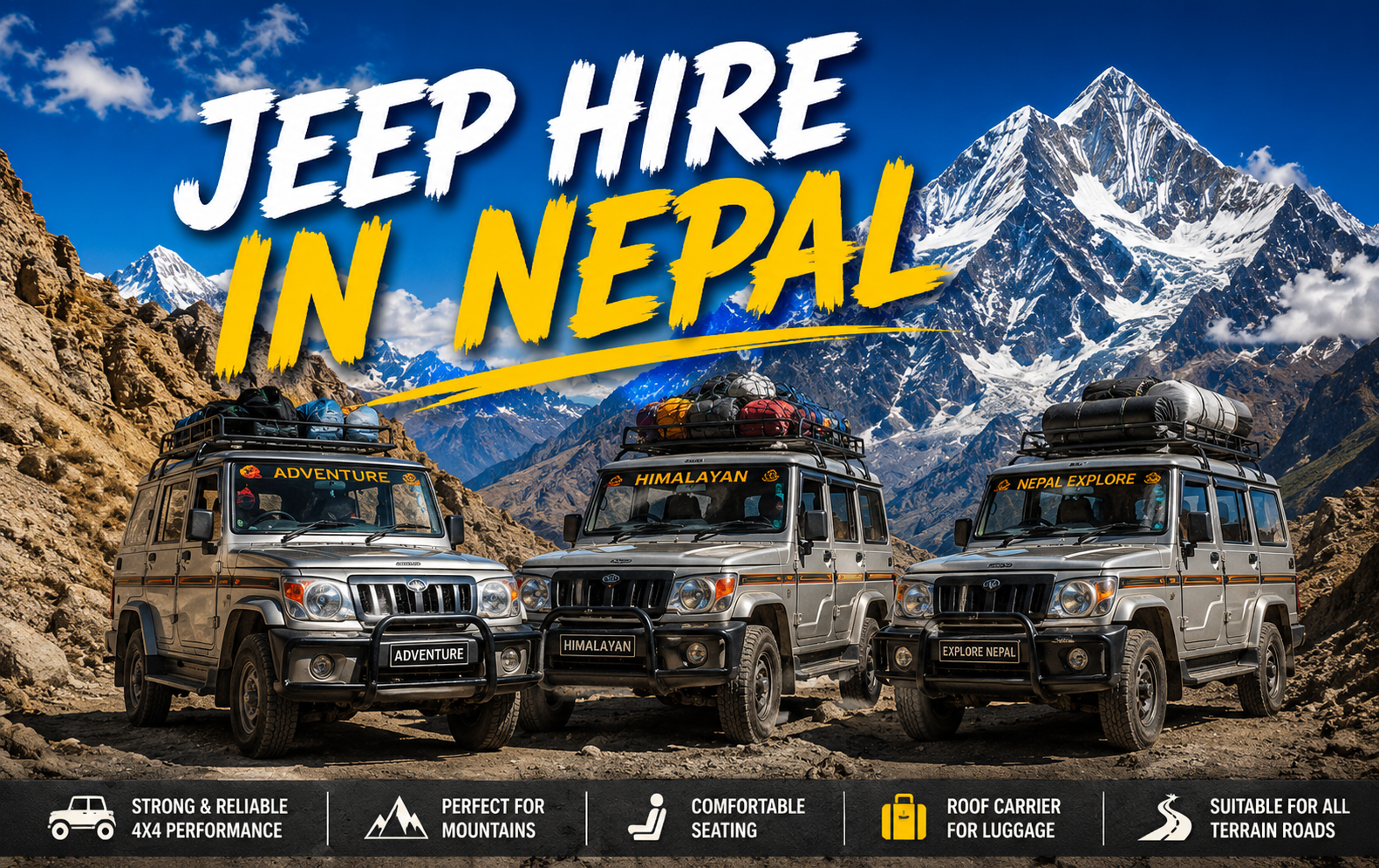
The Mahindra Scorpio 4WD is the single most widely used and trusted private vehicle for Nepal’s mountain routes, for very good reason. Its genuine switchable 4WD system (4H and 4L modes), 180–200 mm ground clearance, powerful diesel engine, 6–7-passenger capacity, and proven reliability in Nepal’s most challenging terrain make it the gold standard for off-road travel in Nepal at the most accessible price point. The Scorpio is the vehicle of choice for the Muktinath route, Kalinchowk, Besisahar–Dharapani, Pokhara–Ulleri, and dozens of other mountain routes across Nepal. Nepal Vehicle Hiring’s Scorpio fleet is one of the finest in the country — regularly serviced, inspected before each mountain journey, and equipped with snow chains for winter operation. See our Jeep Hire page.

ultimate Nepal vehicle rental guide-4wd Hire in Nepal

Toyota Land Cruiser 4WD – Nepal’s Premium Mountain Vehicle
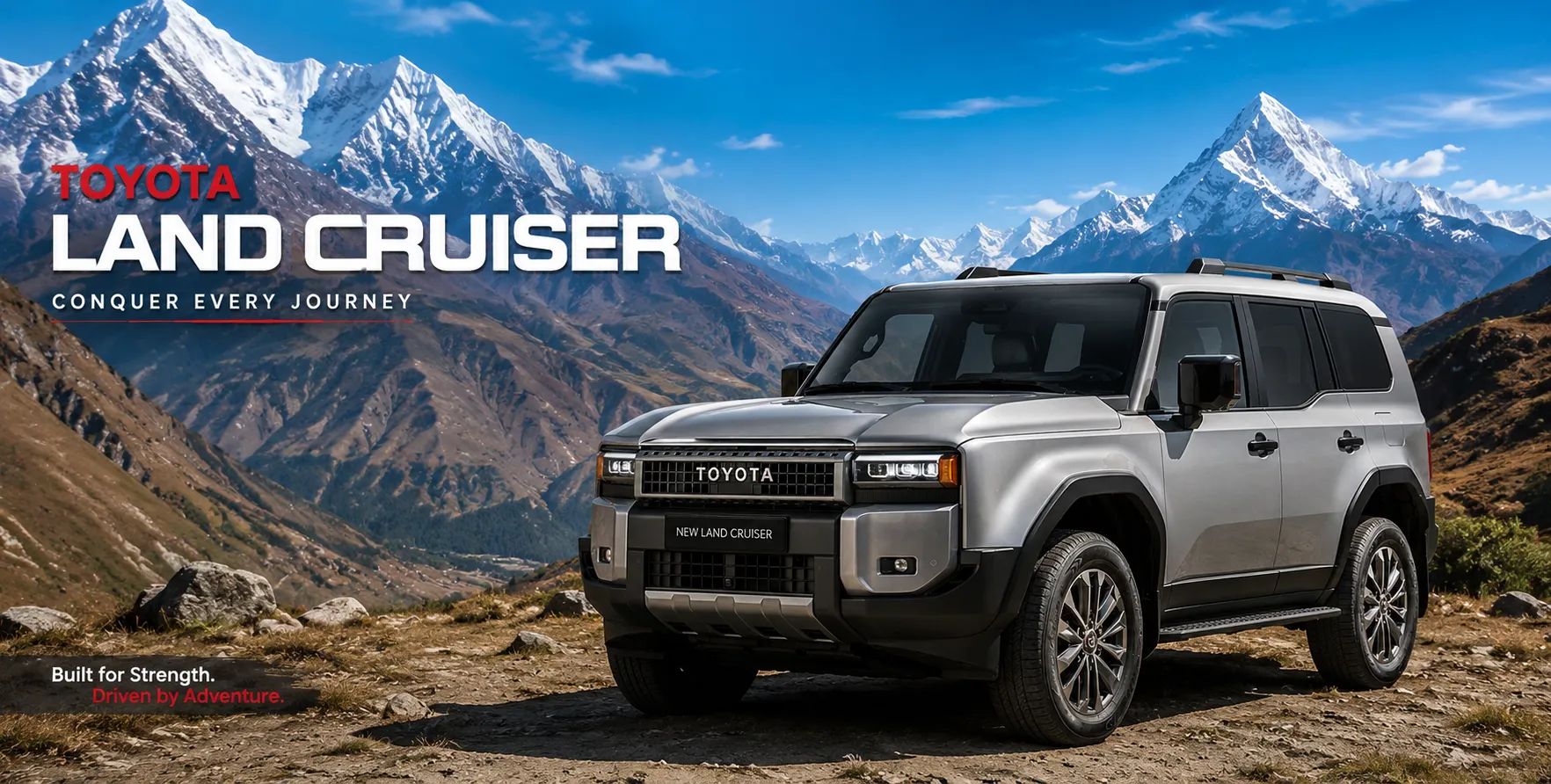
The Toyota Land Cruiser — in its 300, 200, 250 Prado, and 150 Prado variants — represents the absolute pinnacle of 4WD performance, comfort, and reliability available in Nepal’s vehicle hire market. Its 220+ mm ground clearance, locking differentials, multi-terrain select system, crawl control, air suspension, and premium leather interior deliver a categorically superior experience on Nepal’s most demanding routes — Upper Mustang, Karnali, high-altitude Muktinath approaches, and any extreme Category 4 road — and provide meaningful improvements in comfort, safety, and high-altitude performance over the Scorpio on standard mountain routes. For VIP pilgrims, international luxury tourists, corporate executives, diplomatic visitors, and honeymooners, the Land Cruiser is not a vehicle choice but a standard of travel. See our Luxury Jeep Hire page.

ultimate Nepal vehicle rental guide-Hiace Hire in Nepal – Comfortable Group Transportation Service

Toyota Hiace Van – The Group Highway Workhorse

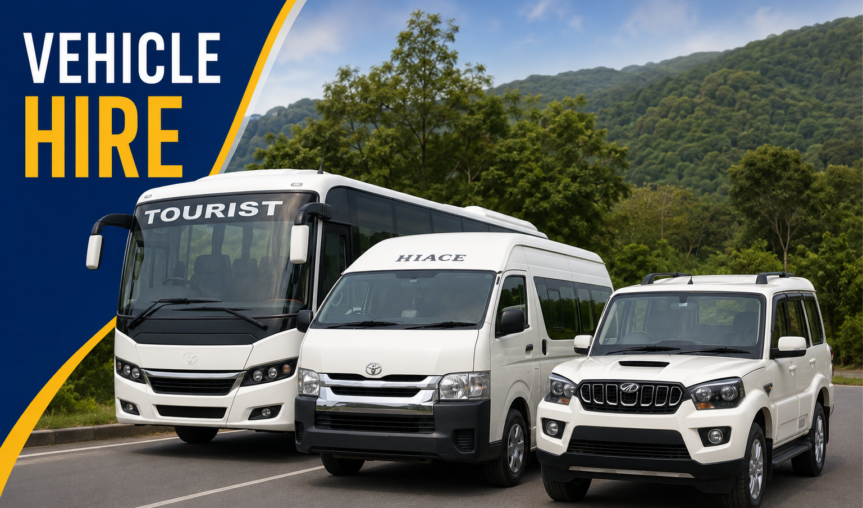
The Toyota Hiace (8–13 passengers) is Nepal’s most popular vehicle for medium-sized group highway travel — and for very good reason. Its spacious interior, comfortable seating, full air conditioning, adequate luggage space, and competitive group pricing make it the most cost-effective per-head private vehicle for groups of 8–13 on Nepal’s highway routes. Widely used for: pilgrimage groups to Lumbini, Janakpur, and Manakamana; family group circuit tours; trekking group transfers to Besisahar, Syabrubesi, and Salleri; school and college heritage tours; medium corporate group outings. The Hiace is not suitable for off-road mountain routes — when groups of 8+ need off-road capability (e.g., for Kalinchowk or Besisahar–Dharapani), two or more Scorpios or Land Cruisers are the correct solution. See our Hiace Van Hire page.

ultimate Nepal vehicle rental guide

VIP Sofa Bus – Nepal’s Finest Group Highway Travel

The VIP Sofa Bus (2×1 seating, 21–30 passengers) is Nepal’s premium group highway bus — featuring sofa-style reclining seats with wide individual space, full AC, WiFi (on major routes), USB charging at every seat, air suspension, panoramic windows, and complimentary mineral water. It is the most comfortable group bus travel experience available on Nepal’s highway network and the preferred choice of international tour operators, Buddhist pilgrimage delegations, premium corporate groups, and senior traveler parties. The VIP Sofa Bus is exclusively for highway use — not suitable for off-road or hill routes. See our VIP Sofa Bus Hire page.

Tourist Bus and Coaster – Flexible Group Options

Nepal Vehicle Hiring’s Coaster Mini Bus (18–25 passengers) and Deluxe Tourist Bus (30–45 passengers) cover the full range of medium- and large-group highway travel at competitive per-head rates. The Coaster is particularly valued by groups requiring more flexibility than a full tourist bus — its compact size allows it to navigate secondary roads and approach hill destinations (Charikot, Bandipur) that full-size buses cannot. The Deluxe Tourist Bus is the standard vehicle for school excursions, large pilgrimage groups, corporate team outings, and wedding party transport. See Coaster Hire and Bus Hire Nepal.
 

ultimate Nepal vehicle rental guide

Best Vehicle for Every Major Nepal Route – Complete 2026 Reference

Destination / RouteDistance4WD Needed?Recommended Vehicle
Kathmandu to Pokhara200 kmNoCar, Jeep, Hiace, VIP Sofa Bus, Tourist Bus
Kathmandu to Chitwan150 kmNoCar, Jeep, Hiace, VIP Sofa Bus
Kathmandu to Muktinath400 kmYES – MandatoryToyota Land Cruiser, Scorpio, Bolero
Kathmandu to Kalinchowk150 kmYES – MandatoryScorpio, Bolero, Land Cruiser
Kathmandu to Lumbini280 kmNoCar, Jeep, VIP Sofa Bus, Tourist Bus
Pokhara to Muktinath200 kmYES – MandatoryLand Cruiser, Scorpio, Bolero
Pokhara to Ulleri / Ghorepani52–70 kmYES – MandatoryScorpio, Land Cruiser, Bolero
Besisahar to Dharapani40 kmYES – MandatoryLand Cruiser, Scorpio, Bolero
Nepalgunj to Bardiya74 kmNoCar, Jeep, Hiace, Bus
Kathmandu to Bandipur143 kmRecommendedScorpio, Land Cruiser for Dumre Hill section
Upper Mustang (Lo Manthang)500 kmYES – OutstandingLand Cruiser 4WD only – no other vehicle is suitable
Chitwan to Birgunj160 kmNoCar, Jeep, Hiace, Bus
Lumbini to Kathmandu280 kmNoCar, Jeep, Hiace, VIP Sofa Bus, Tourist Bus


ultimate Nepal vehicle rental guide
Nepal Vehicle Hire by Traveler Profile – Who Needs What
Traveller ProfileBest Nepal Vehicle Hiring Solution
Solo or Couple – Standard BudgetPrivate Sedan or Car for city and highway transfers. Scorpio 4WD for mountain routes.
Family (4–6 people)Mahindra Scorpio or Toyota Land Cruiser 4WD – covers all routes, including mountains, with full comfort and luggage space.
Small Friend Group (5–7)Scorpio or Land Cruiser for mountain routes. Hiace Van for highway group travel at a reduced per-person cost.
Medium Group (8–15 pax)Toyota Hiace Van (8–13 pax) for all highway routes. Scorpio convoy for off-road mountain routes.
Large Group (20–30 pax)VIP Sofa Bus (premium) or Coaster (mid-range) for highway routes. Multiple Scorpios for mountain off-road routes.
Large Group (35–52 pax)Deluxe Tourist Bus (AC) or Standard Bus. VIP Sofa Bus is not available at this capacity – book two VIP Sofa Buses for 50–60 pax.
VIP / Corporate / DiplomaticToyota Land Cruiser 300 (LC300) private hire. Most premium comfort and capability. Professional uniformed driver.
Buddhist / Hindu Pilgrim GroupVIP Sofa Bus or Land Cruiser, depending on group size. Prayer stop flexibility, vegetarian meal coordination, and senior-passenger support.
Trekking Group (Annapurna Circuit, Everest, Langtang)Scorpio or Land Cruiser for trailhead transfers. Hiace from Kathmandu/Pokhara to Besisahar, Syabrubesi, or Salleri.


Seasonal Vehicle Hire Guide – Nepal 2026

SeasonMonthsHighway RoadsMountain Off-RoadVehicle Hire Tip
AutumnOct–NovExcellentDry and stable – bestBook 1–2 weeks ahead. Peak demand. Finest season for all routes.
SpringMar–MayGoodGood – some soft sectionsBook 5–7 days ahead. Rhododendrons bloom. Great driving conditions.
WinterDec–FebCold; some frostSnow chains are required above 2,000 mLand Cruiser or Scorpio with chains for mountains. Book early for Kalinchowk.
MonsoonJun–SepLandslide risk on Prithvi & hilly roadsMuddy; some routes closed4WD is mandatory for all mountain routes. Check conditions daily. Terai routes are safer.


Autumn (October–November) – Peak Season, Peak Demand

October and November are Nepal’s finest travel months and the most in-demand period for private vehicle hire. Post-monsoon road conditions are at their best across the country — the Prithvi Highway is clear and dry, the Kali Gandaki valley road is stable, Kalinchowk’s off-road section is in optimal condition, and every mountain route is at its most accessible. Clear skies, sharp mountain views, and the extraordinary festive atmosphere of Dashain and Tihar make this Nepal’s travel high season without rival.

Vehicle hire during the peak autumn season is characterized by very high demand and limited availability of premium vehicles — particularly Land Cruisers for Muktinath and Scorpios for Kalinchowk. Nepal Vehicle Hiring strongly recommends booking 1–2 weeks in advance for jeep hire and 3–5 days for bus hire during October and November. Festival dates (Dashain, Tihar, Chhath Puja) see particularly concentrated demand — book 2–3 weeks ahead for these dates.

Spring (March–May) – The Rhododendron Season

Spring is the second-best Nepal travel season, offering warm temperatures, good road conditions, and the spectacular rhododendron bloom along Nepal’s mid-hill routes from March through April. Mountain views are excellent through April, with some haze building in May. Spring is particularly rewarding for the Pokhara–Ghorepani jeep hire (Route 1), the Kalinchowk Scorpio hire, and the Muktinath and Annapurna Circuit jeep routes. The Haribodhini Ekadashi festival at Muktinath (usually April–May) brings significant pilgrim traffic — book Muktinath jeep hire 2+ weeks ahead during festival dates.

Winter (December–February) – Snow and Silence

Winter is Nepal’s quietest travel season — offering dramatically reduced crowds, lower accommodation prices, and, for certain routes, the most powerful experiences of the year. The Kalinchowk Scorpio hire in December and January for snowfall experiences is paradoxically the most in-demand period in Nepal’s domestic winter tourism calendar — book 2–3 weeks ahead for weekend snowfall dates. Mountain routes above 3,000 m require snow chains on 4WD vehicles from December. Highway routes (Kathmandu–Pokhara, Kathmandu–Lumbini) are fully operational year-round with no winter disruption.

Monsoon (June–September) – Navigate with Caution

The monsoon season brings Nepal’s most challenging driving conditions — particularly on mountain and hilly routes where frequent landslides, muddy off-road sections, and reduced visibility create real hazards. Nepal Vehicle Hiring maintains daily road condition monitoring during monsoon and communicates openly with all clients about route safety. Terai highway routes (Kathmandu–Lumbini, Kathmandu–Chitwan, Lumbini–Kathmandu) are generally safe year-round. Mountain routes (Muktinath, Kalinchowk, Besisahar–Dharapani) carry a genuine risk during heavy rainfall and are advisable only with experienced 4WD drivers who actively monitor conditions.


ultimate Nepal vehicle rental guide

Permits Required for Nepal Vehicle Hire Routes – Complete 2026 Reference

PermitWhere RequiredCost (Foreign)Where to Obtain
ACAPAnnapurna region (Muktinath, Ghorepani, Besisahar, Jomsom)NPR 3,000NTB Kathmandu / Pokhara / Besisahar
TIMS CardAll Annapurna / trekking regionsUSD 20NTB / TAAN offices KTM / Pokhara
Manaslu MCAPManaslu Circuit, Tsum ValleyNPR 3,000NTB Kathmandu office
Upper Mustang RAPAbove Kagbeni toward Lo ManthangUSD 500 / 10 daysRegistered trekking agency only
Gaurishankar CAKalinchowk / Kuri Village areaNPR 1,000Paid at the area entry point


Nepal Vehicle Hiring advises all clients to obtain permits in Kathmandu or Pokhara before departure — not at mountain checkpoints, where costs are higher, processing is slower, and delays can compromise your journey timing. The NTB (Nepal Tourism Board) offices in Kathmandu (Pradarshani Marg) and Pokhara (Damside) process ACAP and TIMS permits in 30 minutes on weekday mornings. Nepal Vehicle Hiring can advise on permit requirements for any route at the time of booking.


10 Golden Rules for Nepal Vehicle Hire – Nepal Vehicle Hiring’s Expert Advice

Rule 1: Always Match Vehicle to Route – Not Budget to Route

The most costly mistake in Nepal vehicle hire is choosing a vehicle based on price rather than route requirements. A standard SUV that costs NPR 3,000 less per day than a Scorpio but cannot navigate the Kalinchowk off-road section has not saved you money — it has wasted the entire journey cost plus the price of a wasted travel day. Nepal Vehicle Hiring’s booking team asks about your complete route before recommending a vehicle — not the other way around. Always confirm that your chosen vehicle is genuinely suitable for every segment of your planned journey.

Rule 2: Book Early – Especially for Mountain Jeeps in Peak Season

Nepal’s finest mountain vehicles — Land Cruisers for Upper Mustang, Scorpios for Kalinchowk, experienced drivers for the Muktinath route — are finite resources in very high demand during peak season. The difference between booking 10 days ahead and booking 1 day ahead in October can mean the difference between a Land Cruiser and… no vehicle at all. Nepal Vehicle Hiring operates on a first-confirmed, first-served basis. Book in advance. Always.

Rule 3: Depart Early – Mountain Roads Belong to the Morning

Nepal’s mountain roads are safest and most pleasant in the early morning hours before traffic builds, dust is raised by passing vehicles, and afternoon winds begin in the Kali Gandaki and other mountain valleys. Nepal Vehicle Hiring recommends departures of 6:00–7:00 AM for all mountain-route journeys and 6:30–7:30 AM for long highway routes (Kathmandu–Pokhara, Lumbini–Kathmandu). Early departure for the Muktinath section is particularly critical — the Jomsom valley afternoon winds (sometimes gale-force from midday onward) make driving later in the day genuinely hazardous.

Rule 4: Always Carry Cash – Nepal’s Mountain Areas Are Card-Free

The last reliable ATMs for most mountain routes are in Pokhara (for western Nepal routes) and Besisahar (for Annapurna Circuit routes). Beyond these cities, cash is the only payment method accepted at teahouses, guesthouses, restaurants, cable cars, and permit checkpoints. Nepal Vehicle Hiring recommends: withdraw sufficient NPR before departing on any mountain journey. For multi-day Muktinath or Upper Mustang trips, carry a minimum of NPR 15,000–20,000 per person for accommodation, food, and unforeseen expenses.

Rule 5: Obtain All Permits Before Departure

Permits obtained at mountain checkpoints cost significantly more than those obtained in advance at NTB offices in Kathmandu or Pokhara. Beyond the cost, purchasing at checkpoints is time-consuming and causes significant delays in journeys. Nepal Vehicle Hiring builds permit-check time at Nayapul (Annapurna) and Beni (Mustang routes) into our journey timing calculations — but only if permits are already in hand. Without permits obtained in advance, the delay can be 1–2 hours, and the cost can be significantly higher.

Rule 6: Trust Your Driver’s Road Assessment

Nepal Vehicle Hiring’s mountain drivers are professional specialists, not just vehicle operators. When a Nepal Vehicle Hiring driver says “today we park at Hile, not Ulleri” or “the Deurali section requires chains before we continue”, they are making a professional safety assessment based on years of experience with that specific road in those specific conditions. Pressuring drivers to proceed on roads they have assessed as unsafe is a primary cause of vehicle accidents in Nepal’s mountains. Trust the driver. Safety is not negotiable.

Rule 7: Know the Altitude – Prepare Your Body for Mountain Routes

Destinations like Muktinath (3,760 m), Kalinchowk (3,842 m), and Thorong La Pass (5,416 m) are at altitudes where acute mountain sickness (AMS) is a genuine medical risk for visitors ascending rapidly from Kathmandu (1,350 m)—common symptoms: persistent headache, nausea, fatigue, and dizziness. Nepal Vehicle Hiring recommends: never drive to 3,500+ m on your first day of arrival in Nepal; spend a night at an intermediate altitude (Jomsom at 2,743 m for Muktinath, Kuri Village at 2,300 m for Kalinchowk); drink 3–4 liters of water daily at altitude; carry Diamox if prescribed by your doctor.

Rule 8: Private Charter Beats Shared Transport for Comfort and Control

Nepal Vehicle Hiring operates an exclusively private charter model — your group hires the entire vehicle. This is not a premium service; it is the standard that every Nepali journey deserves. Shared jeeps — the public alternatives on routes like Besisahar–Dharapani or Nayapul–Ghorepani — are overcrowded, depart on unpredictable schedules, carry freight alongside passengers, and stop anywhere along the route without notice. The per-person cost difference between a shared jeep and a Nepal Vehicle Hiring private jeep, split across a group of 5–7, is often smaller than travelers expect — and the difference in comfort, safety, and flexibility is enormous.

Rule 9: Plan Around Your Flight – Not the Other Way

Nepal’s long-distance route travel times — Lumbini to Kathmandu Airport (8–10 hours), Chitwan to Kathmandu (4–5 hours), Pokhara to Kathmandu (6–8 hours) — must be planned backward from your departure flight time, not forward from your desired departure time. Nepal Vehicle Hiring’s operations team performs this flight-backward timing calculation for every airport transfer booking, providing a recommended departure time for Lumbini / Chitwan / Pokhara that ensures you arrive at the airport with a 3-hour international buffer and a 1.5-hour domestic buffer. Always share your flight details with Nepal Vehicle Hiring when booking.

Rule 10: Nepal Vehicle Hiring Is Available 24/7 – Always Communicate

Every Nepal journey has the potential for the unexpected — a highway landslide, a flight delay that disrupts the departure chain, a sudden change in weather on a mountain route, or a passenger’s medical issue. Nepal Vehicle Hiring’s 24/7 operations line (+977 9851013196) is staffed throughout all operating hours. It is available to reroute, reschedule, substitute vehicles, contact emergency services, and resolve any travel issues that arise during your Nepal journey. Communication prevents the unexpected from becoming a crisis.


Nepal Vehicle Hiring – Complete Services Overview 2026

Service CategoryNepal Vehicle Hiring Key Routes & Blog Links
Mountain Jeep RoutesMuktinath (from KTM & Pokhara), Upper Mustang, Kalinchowk, Besisahar–Dharapani, Pokhara–Ulleri, Pokhara–Ghorepani
Pilgrimage TransfersLumbini transfers, Janakpur airport, Muktinath Yatra, Manakamana, Pashupatinath sightseeing, Pokhara to Muktinath
City to City HighwayKathmandu–Pokhara, Kathmandu–Chitwan, Kathmandu–Lumbini, Kathmandu–Birgunj, Chitwan–Birgunj, Lumbini–Kathmandu
Airport TransfersLumbini to KTM Airport, Janakpur Airport Transfer, Nepalgunj to Bardiya, Pokhara Airport to Muktinath
Heritage & SightseeingKathmandu Valley (7 UNESCO sites), Bhaktapur, Nagarkot, Dhulikhel, Bandipur, Kalinchowk, Panauti–Namobuddha
Luxury & VIP ServicesLand Cruiser hire Nepal, Chitwan luxury car, Muktinath premium jeep, corporate Nepal travel, diplomatic transfers.
Bus & Large GroupVIP Sofa Bus hire Nepal, Tourist Bus hire Nepal, Coaster hire Nepal, Hiace Van hire Nepal
Trekking TransfersBesisahar–Dharapani (Annapurna), Pokhara–Ulleri (Poon Hill), Salleri (Everest), Syabrubesi (Langtang)


Why Nepal Vehicle Hiring Is Nepal’s Most Trusted Vehicle Hire Partner

Nepal Vehicle Hiring Pvt Ltd was established with one mission: to provide Nepal’s most reliable, most professional, and most customer-focused private vehicle hire service. In a market where quality standards vary enormously between operators, Nepal Vehicle Hiring has built its reputation on five non-negotiable pillars:

  • Fleet Quality: Every Nepal Vehicle Hiring vehicle is regularly serviced, mechanically inspected before every mountain departure, fully insured, and green-plated (legally registered for tourist use).
  • Driver Expertise: All drivers hold valid DoTM licenses at the appropriate category level, are route-specifically experienced, are English-communicative, and have completed Nepal Vehicle Hiring’s internal safety training program.
  • Transparency: Full pricing is disclosed in writing before booking confirmation. No hidden charges. No surprise fees on travel day. What is quoted is what is charged.
  • 24/7 Support: Nepal Vehicle Hiring’s operations team is available around the clock — not just for bookings but for real-time journey support, emergency response, and problem resolution throughout every trip.
  • Range and Coverage: From a single private car for a Kathmandu Valley heritage day tour to a convoy of Land Cruisers for an Upper Mustang expedition to a VIP Sofa Bus for a 30-person international Buddhist delegation — Nepal Vehicle Hiring covers every scale, every route, every vehicle category, every corner of Nepal.

ultimate Nepal vehicle rental guide


Explore our complete service library — each blog is a detailed guide to a specific route, vehicle type, or destination:

Frequently Asked Questions

The Mahindra Scorpio 4WD is the most widely used private vehicle for Nepal’s mountain routes — particularly popular for Muktinath, Kalinchowk, Besisahar–Dharapani, Pokhara–Ulleri, and Pokhara–Ghorepani. It offers the best balance of genuine 4WD capability, passenger comfort (6–7 seats), luggage space, and cost-effectiveness. For routes demanding maximum off-road performance and passenger luxury — Upper Mustang, Karnali, VIP pilgrimages — the Toyota Land Cruiser is the premium choice.

Is a driver included with Nepal Vehicle Hiring vehicles?

Yes — all Nepal Vehicle Hiring vehicle hires include a professional, licensed driver as standard. Nepal Vehicle Hiring does not offer self-drive for safety, legal, and practical reasons (Nepal’s mountain road conditions require route-specific local expertise that visiting drivers cannot practically possess). Our drivers are not merely vehicle operators — they are experienced Nepal travel professionals who enhance the journey with local knowledge, cultural insight, and genuine care for passenger wellbeing.

Can I hire a vehicle for multiple days / a full Nepal circuit?

Yes — multi-day, full-circuit vehicle hire is one of Nepal Vehicle Hiring’s most popular services. We arrange Kathmandu–Pokhara–Chitwan–Kathmandu circuits, Kathmandu–Muktinath–Kathmandu Yatra trips, Nepal Golden Triangle circuits, and custom multi-week itineraries with the same vehicle and driver throughout — ensuring continuity, consistency, and the deep local relationship between driver and passenger group that multi-day travel creates.

How far in advance should I book a vehicle hire in Nepal?

Standard periods: 2–5 days ahead. Peak tourist season (Oct–Nov, Mar–May): 7–14 days ahead. Festival periods (Dashain, Tihar, Vivah Panchami): 2–4 weeks ahead. Winter Kalinchowk snowfall weekends (Dec–Jan): 1–2 weeks ahead. Upper Mustang expeditions: 3–4 weeks ahead (permit + vehicle combined). For large groups (20+ passengers): always a minimum of 2 weeks, regardless of season.

What is included in the Nepal Vehicle Hiring price?

Included in all Nepal Vehicle Hiring hires are the vehicle, professional driver, fuel for the agreed route, vehicle insurance, and all vehicle running costs. Not included: trekking or conservation area permits (ACAP, TIMS, Restricted Area), passenger food and accommodation, driver accommodation on multi-day trips (quoted separately and transparently), and driver gratuity. Fully transparent pricing is provided before booking confirmation — no hidden charges.

Can Nepal Vehicle Hiring pick me up from my hotel?

Yes — hotel pick-up from any hotel, guesthouse, resort, or specified address in Kathmandu, Pokhara, Chitwan, Lumbini, and all major cities in Nepal is standard for private vehicle bookings. This is one of the key advantages of private hire over public transport — no secondary taxi to a bus park, no navigating an unfamiliar city with heavy luggage. Your driver arrives at your hotel at the agreed time.

What is the difference between a VIP Sofa Bus and a VIP Deluxe Bus?

The key difference is seating configuration. VIP Sofa Bus: 2×1 seats (one on the right, two on the left) — 21–30 passengers with exceptional personal space. VIP Deluxe Bus: 2×2 seats — 30–40 passengers with good but standard bus comfort. The Sofa Bus is superior for long-distance comfort (especially overnight travel), but the Deluxe Bus accommodates a larger group at a lower per-head cost.

How do I know which vehicle is right for my trip to Nepal?

The three key questions that determine your Nepal vehicle: (1) How many passengers? (2) Which routes will you travel — highway only or mountain off-road? (3) What iare yourcomfort and budget ppriorities? Nepal Vehicle Hiring’s booking team asks these questions and recommends the right vehicle for your specific answer combination. Use the vehicle-by-route table in this guide as a reference, or call us at +977 9851013196 for personalized advice.

Are Nepal Vehicle Hiring vehicles safe for families with children?

Yes — Nepal Vehicle Hiring’s fleet is fully insured and maintained to high safety standards. Our drivers are experienced in family group travel and adapt their driving style accordingly. For families with young children, the Toyota Land Cruiser Prado (7-seat) and Mahindra Scorpio are the most recommended family vehicles, offering easy rear-door access, spacious seating, ample boot space for family luggage, and the smoothest available ride on mountain routes. Child seat requests can be accommodated — advise us at the time of booking.

Can I book a vehicle hire in Nepal from outside Nepal?

Yes — Nepal Vehicle Hiring accepts bookings from anywhere in the world via WhatsApp (+977 9851013196), email, and the website (vehiclehiringnepal.com). International clients frequently book months in advance to secure premium vehicles for peak-season Nepal itineraries. We coordinate all booking details, confirmations, and itinerary planning remotely and provide full booking documentation via WhatsApp or email before travel.


Your Nepal Journey Starts Here – Book with Nepal Vehicle Hiring Today

Nepal is one of the most extraordinary travel destinations on earth — a country that compresses tundra and tropics, ancient kingdoms and Himalayan wilderness, sacred pilgrimage and high adventure, Buddhist monasteries and Hindu temples into a landscape barely the size of England. To do it justice, to reach its heights and its depths, to connect its ancient cities and its remote mountain valleys — you need the right vehicle, the right driver, and the right partner.

Nepal Vehicle Hiring Pvt Ltd has been the partner for thousands of travelers, pilgrims, trekkers, tour operators, and corporate clients across Nepal. Our complete fleet — from private cars to luxury Land Cruisers, from Hiace vans to VIP Sofa Buses — our professional, licensed, route-experienced drivers, and our 24/7 customer service and operations support make Nepal Vehicle Hiring Nepal’s most trusted private vehicle hire service in 2026.

Whatever your Nepal destination — and whatever your group size, budget, or travel style — Nepal Vehicle Hiring has the perfect vehicle and the perfect service for your perfect Nepal journey.

Call / WhatsApp: +977 9851013196  |  Website: vehiclehiringnepal.com  |  Book a Jeep or Car  |  Book a Bus or Van


Kathmandu to Gorkha Jeep Service: The Complete Guide (2026)

Kathmandu to Gorkha Jeep Service

Why Gorkha Should Be on Every Nepal Itinerary

Gorkha is one of the most historically and spiritually significant destinations in Nepal — and yet it remains one of the country’s best-kept secrets among international tourists. While Kathmandu, Pokhara, and Chitwan attract the lion’s share of visitor attention, the ancient hilltop city of Gorkha quietly holds the keys to Nepal’s greatest story: the unification of the nation.

It was from Gorkha — from its magnificent hilltop palace-fortress now known as Gorkha Durbar — that King Prithvi Narayan Shah launched his ambitious and ultimately successful campaign in the 18th century to unite the dozens of independent principalities of the Himalayan region into a single kingdom. The name ‘Gorkha’ itself resonates through world history, having given its name to the legendary Gurkha soldiers who have served in the British and Indian armies for over two centuries and earned a global reputation for extraordinary courage, loyalty, and fighting ability.

Beyond its royal and military heritage, Gorkha District is home to the sacred Manakamana Temple — one of Nepal’s most important Hindu pilgrimage sites, dedicated to the wish-fulfilling goddess Bhagwati. It is also the gateway to two of Nepal’s most spectacular and less-trodden trekking routes: the Manaslu Circuit Trek and the Tsum Valley Trek, both of which begin in Gorkha District and offer extraordinary Himalayan experiences in areas still largely untouched by mass tourism.

For all these reasons — historical depth, spiritual significance, natural grandeur, and trekking access — the journey from Kathmandu to Gorkha rewards every type of traveler. And the most comfortable, flexible, and efficient way to make that journey is by hiring a private jeep or vehicle from Nepal Vehicle Hiring Pvt. Ltd., your trusted transportation partner in Nepal.

This complete 2026 guide covers everything you need to know: the full route with distances and highlights, road conditions along the Prithvi Highway, the cost of private jeep hire for different vehicle types, the key attractions in Gorkha, the best time to visit, practical travel tips, and answers to the most common questions about the Kathmandu to Gorkha jeep service.


Kathmandu to Gorkha — Quick Reference (2026)

Destination: Gorkha Bazar, Gorkha District, Gandaki Province, Nepal
Altitude: Gorkha Bazar approx. 1,000 m | Gorkha Durbar approx. 1,100 m
Total Distance: Approx. 139–145 km from Kathmandu (Thamel) to Gorkha Bazar
Total Drive Time: 4–5 hours (one way, direct route via Prithvi Highway + Gorkha spur road)
Route: Kathmandu → Nagdhunga → Naubise → Malekhu → Kurintar → Anbu Khaireni → Gorkha
Vehicle: Car, Jeep, Hiace, Coaster, or Bus — road is paved and suitable for all vehicle types
Permits: No trekking permits needed for Gorkha Bazar/Durbar visit | Manaslu/Tsum require special permits
Best Season: October–December and February–May (avoid heavy monsoon July–August)
Key Attractions: Gorkha Durbar, Gorakhnath Cave, Manakamana Temple, Old Bazaar, Manaslu/Tsum trekking
Book With: Nepal Vehicle Hiring Pvt. Ltd. | +977 9851013196


Gorkha: The Birthplace of Modern Nepal

Historical Significance — Where Nepal Was Born

To understand Gorkha is to understand Nepal itself. For centuries, the Kathmandu Valley and the surrounding Himalayan region were divided into dozens of small, often warring principalities — each with its own king, culture, and ambitions. The Gorkha Kingdom, ruled by the Shah dynasty from the small but strategically positioned hilltop fortress now known as Gorkha Durbar, was one of these principalities. But it was different from the others in one crucial respect: it was ambitious.

In 1743, a young prince named Prithvi Narayan Shah ascended the throne of Gorkha at just 20 years old. From that moment, he devoted his entire life — his military genius, his diplomatic cunning, and his extraordinary personal will — to a single goal: the unification of all the Himalayan principalities into one nation. Over the next 25 years, through a combination of brilliant military strategy, careful alliance-building, and sheer determination, he succeeded. By 1769, Kathmandu, Patan, and Bhaktapur had fallen to his forces, and Prithvi Narayan Shah became the first king of unified Nepal.

The palace from which he launched this world-changing campaign — Gorkha Durbar — still stands today on its hilltop above Gorkha Bazar, in remarkable condition. It is not merely a museum piece: it is the literal birthplace of the nation of Nepal and one of the most historically charged sites in the entire subcontinent. Walking through its courtyards and temples, with the panoramic Himalayan skyline spread across the northern horizon, is an experience of rare historical power.

The name ‘Gorkha’ carries global resonance in another dimension too. When the British East India Company encountered the Gorkha warriors during the Anglo-Nepalese War (1814–1816), they were so impressed by their fighting qualities that they immediately began recruiting them into their own army. The ‘Gurkha’ soldiers — a British corruption of ‘Gorkha’ — went on to serve with extraordinary distinction in conflicts across Asia, Africa, and Europe, earning Victoria Crosses and an unparalleled reputation for courage. Today, Gurkha regiments continue to serve in the British Army, and the Gorkha connection is a source of immense pride throughout the district.

Gorkha’s Geography and Character

Gorkha District is part of Gandaki Province (Province No. 4). It covers a dramatic terrain ranging from the subtropical Terai lowlands in the south to the high Himalayan peaks — including Manaslu (8,163 m), the eighth-highest mountain in the world — in the north. The district headquarters, Gorkha Bazar, sits at approximately 1,000 meters above sea level on a broad ridgeline above the Modi Khola and Daraudi River valleys, with spectacular views northward toward the snow-capped peaks of the Manaslu, Ganesh Himal, and Himalchuli ranges.

The population of Gorkha District is diverse, comprising Brahmin, Chhetri, Gurung, Magar, Newar, and Tamang communities, each contributing to a rich cultural mosaic evident in the district’s festivals, architecture, food, and daily life. The town of Gorkha Bazar is compact and pleasant — a genuine Nepali hill town with a market area, several good hotels and restaurants, and an atmosphere that is substantially less touristic and more authentic than the heavily visited hubs of Kathmandu or Pokhara.

Gorkha as a Trekking Gateway

In addition to its historical and spiritual appeal, Gorkha is the primary gateway to two of Nepal’s finest restricted trekking routes. The Manaslu Circuit Trek — a spectacular 14–18 day circuit around the world’s eighth-highest mountain, passing through remote Buddhist villages, ancient monasteries, and the dramatic Larkya La Pass (5,106 m) — begins in Arughat and Soti Khola in Gorkha District. The Tsum Valley Trek, an even more remote and culturally extraordinary journey into a hidden Tibetan-influenced valley near the Nepal-Tibet border, also departs from Gorkha District. For trekkers planning either of these routes, a private jeep hire from Kathmandu to Gorkha and beyond is an essential component of the journey.

Kathmandu to Gorkha Jeep Service

The Complete Route: Kathmandu to Gorkha by Jeep

Route Overview

The journey from Kathmandu to Gorkha follows the famous Prithvi Highway (NH17) westward from Kathmandu to Anbu Khaireni, where a spur road branches north to Gorkha Bazar. The Prithvi Highway is one of Nepal’s most important and well-maintained road arteries, connecting Kathmandu with Pokhara and passing through spectacular Himalayan river gorge scenery along the way. The total distance from Kathmandu to Gorkha Bazar is approximately 139–145 km, making it one of the shorter major destination drives from the capital.

Route SegmentDistanceRoad TypeEst. Drive Time
Kathmandu (Thamel) → Nagdhunga Checkpoint15 kmCity roads + valley exit — paved30–45 min
Nagdhunga → Naubise Junction10 kmWinding hill descent — paved tarmac20–30 min
Naubise → Malekhu (Trishuli River)45 kmPrithvi Highway — excellent tarmac, river valley45–60 min
Malekhu → Kurintar (Manakamana Base)25 kmPrithvi Highway — paved, river gorge section25–35 min
Kurintar → Anbu Khaireni Junction15 kmPrithvi Highway — paved15–20 min
Anbu Khaireni → Gorkha Bazar24 kmGorkha spur road — paved, hilly35–50 min
TOTAL: Kathmandu → Gorkha Bazar139–145 kmPaved highway + spur road4–5 hours


Note: Drive times are estimates for normal traffic conditions. Morning traffic leaving Kathmandu (7:00–9:00 AM) and festival season congestion at Kurintar/Manakamana can add 30–60 minutes to the total journey time. An early start of 6:30–7:00 AM from Kathmandu is always recommended.

Stage-by-Stage Route Narrative

Stage 1 — Kathmandu to Nagdhunga (15 km, 30–45 min): The journey begins at your hotel in Thamel or anywhere in Kathmandu and heads westward through the city toward the Kathmandu Valley rim. The road climbs steeply to the Nagdhunga pass — the western gateway of the Kathmandu Valley at approximately 2,100 meters — before descending dramatically down the Chandragiri hillside toward Naubise. The views from the Nagdhunga area back over the Kathmandu Valley and westward toward the distant Himalayan peaks are spectacular on a clear day. Your driver will navigate the city traffic efficiently, and once past Nagdhunga, the drive opens up significantly.

Stage 2 — Naubise to Malekhu (45 km, 45–60 min): Below Nagdhunga, the road descends to Naubise Junction — where the Tribhuvan Highway (the old Kathmandu–India road) branches south — and then joins the Prithvi Highway following the Trishuli River westward. This section of the drive is one of the most scenically dramatic in Nepal. The highway clings to the cliff faces above the rushing Trishuli River, passing through tunnels, over steel bridges, and alongside vertical gorge walls draped in subtropical vegetation. The river itself is a spectacular torrent of blue-green glacial water, and on weekends you will often see groups of rafters and kayakers on the water below. The towns of Galchhi, Gajuri, and Malekhu are important stopping points along this section.

Stage 3 — Malekhu to Kurintar (25 km, 25–35 min): The road continues through the deepening Trishuli gorge, now with the river on one side and increasingly dramatic cliff faces on the other. Kurintar is the base station for the Manakamana Cable Car and is located approximately 104 km from Kathmandu. If your itinerary includes a Manakamana Temple visit — and it is highly recommended — Kurintar is where you will leave the highway, park the vehicle, and take the cable car up to the temple (approximately 10 minutes, 2.8 km). The Kurintar cable car station has a parking area where your driver will comfortably wait.

Stage 4 — Kurintar to Anbu Khaireni Junction (15 km, 15–20 min): Beyond Kurintar, the Prithvi Highway continues westward through the Marsyangdi and Modi River confluence area to Mugling — the famous junction town — and then on to Anbu Khaireni, where the Gorkha spur road branches northward off the main highway. This junction is well-marked and is approximately 115 km from Kathmandu.

Stage 5 — Anbu Khaireni to Gorkha Bazar (24 km, 35–50 min): The final stretch from Anbu Khaireni to Gorkha Bazar follows a paved but hilly and winding spur road northward, climbing from the valley floor at approximately 600 meters up to Gorkha Bazar at approximately 1,000 meters. This section passes through traditional villages, terraced agricultural land, and subtropical forest, with increasingly dramatic views northward toward the Manaslu and Ganesh Himal ranges appearing as the road gains elevation. The road is paved throughout and accessible to all vehicle types, though the climb and curves make a comfortable vehicle particularly welcome.


Kathmandu to Gorkha: Checkpoint Distance & Time Table


Key CheckpointKm from KathmanduAltitudeDrive Time from Kathmandu
Nagdhunga (Valley Exit)15 km2,100 m30–45 min
Naubise Junction25 km900 m45–60 min
Malekhu70 km540 m1.5–2.0 hrs
Kurintar (Manakamana Base)104 km480 m2.5–3.0 hrs
Mugling Junction110 km400 m2.5–3.0 hrs
Anbu Khaireni Junction115 km540 m3.0–3.5 hrs
Gorkha Bazar139–145 km1,000 m4.0–5.0 hrs
Gorkha Durbar (hilltop)~141–147 km1,100 m4.0–5.0 hrs + 45 min walk


Road Conditions: Kathmandu to Gorkha (2026)

Overall Road Quality Assessment

The Kathmandu-Gorkha route is one of Nepal’s best-maintained intercity routes. The majority of the journey follows the Prithvi Highway — a national highway of significant strategic importance that the Department of Roads regularly maintains. Unlike many Nepal mountain destinations that require 4WD vehicles and rough off-road driving, the Kathmandu to Gorkha journey is accessible to standard cars, jeeps, hiace vans, and buses, with no significant technical road challenges. This makes Gorkha one of the most comfortable and accessible destinations for all types of travelers, including families, elderly visitors, and pilgrims.

Kathmandu to Naubise — City and Valley Exit

The first section through Kathmandu city can be slow due to city traffic, particularly in the morning peak (8:00–10:00 AM) and evening peak (4:00–7:00 PM). The Nagdhunga pass area is well-maintained, and the road is good throughout. A 6:30–7:00 AM departure beats most of the city traffic and ensures you are past Nagdhunga well before congestion builds. This section is suitable for all vehicle types.

Naubise to Kurintar — Prithvi Highway Gorge Section

This is the most scenically spectacular section of the drive, and the road is generally in good condition year-round. The highway follows the Trishuli River gorge and is subject to occasional landslides during and immediately after the monsoon (June–September). The Department of Roads clears landslides relatively promptly, but monsoon-season travelers should allow extra time. During the dry season (October–May), the road is excellent, and the drive is fast and enjoyable. This section is fully suitable for cars, jeeps, vans, and buses.

Kurintar to Anbu Khaireni — Continued Highway

This short section continues along the well-maintained Prithvi Highway and is in good condition year-round. Traffic around Mugling junction can be heavy, particularly on weekends and public holidays, as Mugling is a major truck stop and transit point. Allow extra time on Friday afternoons and weekends.

Anbu Khaireni to Gorkha Bazar — Gorkha Spur Road

The 24 km spur road from Anbu Khaireni to Gorkha Bazar is paved throughout and is accessible to all vehicle types, including standard cars and tourist buses. The road climbs steadily and winds through several switchbacks on the ascent to Gorkha, but these are manageable for any competent driver. Road conditions on this section are generally good, but can deteriorate slightly during the monsoon due to water runoff and occasional minor landslides in the steeper sections. Nepal Vehicle Hiring Pvt. Ltd. monitors road conditions and will advise on any seasonal issues before your departure.

Vehicle Suitability for Kathmandu to Gorkha
Standard Car (Sedan/SUV): FULLY SUITABLE — paved road throughout
4WD Jeep (Fortuner/Hilux): IDEAL — comfortable and handles all conditions
Hiace Van (up to 14 pax): FULLY SUITABLE — excellent for larger groups
Coaster Bus (15–25 pax): SUITABLE — all roads can accommodate
Tourist Bus (30+ pax): SUITABLE — widely used on this route
Unlike on high-altitude mountain routes, a 4WD is NOT mandatory for Gorkha — but is always preferred for comfort on the spur road’s switchbacks.

Kathmandu to Gorkha Jeep Service

Kathmandu to Gorkha Jeep Service Cost (2026)

Private Vehicle Hire — One Way, Kathmandu to Gorkha

A private vehicle hire from Kathmandu to Gorkha gives you full control over your journey: hotel pickup at your chosen time, the flexibility to stop at Manakamana Temple or other roadside highlights, your own schedule throughout the day, and door-to-door delivery to your hotel or lodge in Gorkha Bazar. This is the most popular and recommended option for families, groups, pilgrims, and trekkers beginning the Manaslu or Tsum Valley routes.

Vehicle TypePassenger CapacityOne-Way Cost (Kathmandu→Gorkha)Round Trip Cost
Private Car (Sedan / SUV)1–4 passengersNPR 8,000–11,000 / USD 58–80NPR 14,000–18,000
4WD Jeep (Scorpio/Bolero)1–5 passengersNPR 10,000–14,000 / USD 73–102NPR 17,000–22,000
4WD Jeep (Fortuner/Hilux)1–6 passengersNPR 13,000–17,000 / USD 95–124NPR 21,000–28,000
Hiace Van7–14 passengersNPR 16,000–22,000 / USD 116–160NPR 26,000–36,000
Coaster Bus15–25 passengersNPR 22,000–30,000 / USD 160–218NPR 36,000–50,000
Tourist Bus (shared, per seat)Individual seatNPR 600–900 / USD 4–7 per personNPR 1,200–1,600


Included in private hire price: Driver service, fuel for full journey, vehicle insurance, hotel pickup from anywhere in Kathmandu (Thamel area and beyond), parking at Kurintar if visiting Manakamana, all tolls and road fees.

Not included: Manakamana Cable Car ticket (approx. NPR 1,650 per person return), passenger meals and accommodation, Gorkha Durbar entry fee (if applicable), driver meals and accommodation for multi-day bookings.

Per-Person Cost Breakdown by Group Size


Group SizeRecommended VehicleApprox. Total CostCost Per Person
1–2 peoplePrivate Car / Small JeepNPR 9,000–11,000NPR 4,500–11,000/person
3–4 peopleFortuner / Hilux JeepNPR 13,000–16,000NPR 3,250–5,300/person
5–6 peopleFortuner / Land CruiserNPR 15,000–18,000NPR 2,500–3,600/person
7–14 peopleHiace VanNPR 17,000–22,000NPR 1,200–3,100/person
15–25 peopleCoaster BusNPR 22,000–30,000NPR 880–2,000/person


For groups of 5 or more, a private vehicle hire from Nepal Vehicle Hiring Pvt. Ltd. is comparable in price to—or cheaper than—taking individual bus tickets, while offering vastly superior comfort, flexibility, and door-to-door service.

Gorkha as a Day Trip from Kathmandu

Given the relatively short distance and drive time (4–5 hours each way), Gorkha makes an excellent and achievable day trip from Kathmandu — particularly if combined with a Manakamana Cable Car visit at Kurintar. A typical Kathmandu day trip itinerary: depart Kathmandu by 6:30 AM, visit Manakamana Temple at Kurintar (cable car ride + darshan + return cable car, approximately 2–3 hours), arrive Gorkha Bazar for lunch, visit Gorkha Durbar (1–2 hours walk + exploration), and return to Kathmandu by 7:00–8:00 PM. This is a long but highly rewarding day that covers two of Nepal’s most significant historical and spiritual sites.

For a more relaxed experience, we recommend spending one or two nights in Gorkha to fully absorb the Durbar, the old bazaar, the Gorakhnath Cave, and the extraordinary views of the Manaslu range at sunrise. Nepal Vehicle Hiring Pvt. Ltd. can arrange your return vehicle for any date you specify.

Kathmandu to Gorkha Jeep Service

Key Attractions in Gorkha — What to See and Do

1. Gorkha Durbar — The Palace-Fortress That Built a Nation

Gorkha Durbar is the undisputed highlight of any visit to Gorkha and one of Nepal’s most significant historical monuments. Perched on a dramatic hilltop at approximately 1,100 meters — approximately 45 minutes to one hour on foot from Gorkha Bazar along a well-maintained stone-paved path with beautiful views — the Durbar complex encompasses several distinct structures of great historical and religious significance.

The Palace (Durbar) itself was constructed in the 16th century during the reign of Ram Shah and served as the royal residence of the Gorkha Shah kings for over two centuries before Prithvi Narayan Shah moved his capital to Kathmandu in 1769. The architecture is a superb example of Newari craftsmanship — intricately carved wooden windows, doors, and struts adorn the multi-storied structures, which are built from warm-red brick on a commanding stone foundation. The panoramic views from the Durbar hilltop are extraordinary. On clear days, the entire central Himalayan arc from Dhaulagiri to Langtang is visible, with Manaslu and Ganesh Himal dominating the northern skyline.

The Durbar complex also contains two important temples: the Gorkha Kalika Temple — a Tantric goddess temple that houses the tutelary deity of the Shah kings and is accessible only to Hindus — and the Gorakhnath Temple, a small but highly sacred shrine dedicated to the sage Gorakhnath, believed to be the divine guardian of the Gorkha kingdom and the source of the name ‘Gorkha’ itself. The Gorakhnath Temple marks the site of the sage’s footprint, preserved in stone, and is an important pilgrimage site for devotees.

2. Gorakhnath Cave — Sacred Sanctuary of the Guardian Sage

Immediately adjacent to the Gorkha Durbar, the Gorakhnath Cave is one of the most sacred sites in the district. According to legend, the saint and yogi Gorakhnath — a revered figure in the Nath tradition of Hindu asceticism — meditated in this cave for many years. The cave is believed to have been deliberately chosen by Prithvi Narayan Shah’s ancestors as the site for their kingdom’s fortress precisely because of its sacred association with Gorakhnath. The cave is small but richly decorated with offerings, oil lamps, and ritual objects, and the atmosphere of concentrated spirituality is palpable. Non-Hindu visitors may observe respectfully from the exterior.

3. Manakamana Temple — The Wish-Fulfilling Goddess

Although technically located at Kurintar — approximately 30–35 km south of Gorkha Bazar on the Prithvi Highway — the Manakamana Temple is the most famous attraction in Gorkha District and virtually every visitor to Gorkha combines it with a Durbar visit. The temple is dedicated to the goddess Manakamana (Bhagwati) — a manifestation of Parvati, the consort of Lord Shiva — who is believed to grant devotees’ wishes. The name ‘Manakamana’ comes from the Sanskrit words ‘mana’ (heart/desire) and ‘kamana’ (wish), meaning ‘fulfiller of heart’s desires.’

The temple sits at an altitude of 1,302 meters on a ridge above the Trishuli River. It is accessible via Nepal’s first cable car system — a 2.8 km ropeway built with Austrian engineering that takes approximately 10 minutes each way. The cable car ride itself is an extraordinary experience, offering panoramic views over the river gorge, the surrounding Gorkha hills, and northward toward the distant snowy peaks of Manaslu and the Himalayan chain. The temple complex at the top is a major pilgrimage center, drawing tens of thousands of devotees annually.

The temple is open daily from approximately 7:00 AM to 6:00 PM. Cable car tickets cost approximately NPR 1,650 per person (return) for foreign visitors. Animal sacrifice (primarily goats and chickens) is a traditional practice at the temple, and visitors should be prepared to observe this as part of the authentic pilgrimage experience.

4. Gorkha Museum — Preserving the Royal Heritage

The Gorkha Museum, located within the Gorkha Durbar complex area, houses an important collection of artifacts related to the history of the Shah dynasty and the unification of Nepal. The collection includes royal weapons, official seals, photographs, traditional musical instruments, garments, and a range of objects that illuminate the daily life and political history of the Gorkha kingdom. For visitors interested in the historical dimensions of Gorkha’s significance, the museum provides essential context that greatly enriches the Durbar experience.

5. The Old Bazaar (Gorkha Bazar) — Authentic Nepali Hill Town Life

The old market area of Gorkha Bazar is a genuinely authentic and unhurried Nepali hill town center — a pleasant contrast to the heavily touristed markets of Kathmandu and Pokhara. The main street is lined with traditional shops selling local produce, hardware, textiles, spices, and foodstuffs alongside several restaurants and teahouses serving excellent dal bhat and local specialties. The architecture of the older buildings in the bazaar area retains traditional Newari and hill-town characteristics that have been largely lost elsewhere. Spending an hour wandering the bazaar, chatting with local shopkeepers, and having tea at a teahouse is an authentic and rewarding experience in Nepal.

6. Ligligkot — Ancient Hilltop Fort with Panoramic Views

Ligligkot is an ancient hilltop fortress approximately 3–4 km from Gorkha Bazar, accessible by a pleasant hiking trail. The site is historically significant as the seat of a pre-Shah ruler of the Gorkha area, and it is famous for an ancient tradition: a running race was held at Ligligkot each year, with the winner declared the local king. Today, this tradition continues as a celebrated annual race. The hilltop offers outstanding panoramic views of the entire Gorkha District, the river valleys below, and the Himalayan peaks to the north.

7. Gateway to Manaslu Circuit & Tsum Valley Treks

For trekkers planning the Manaslu Circuit Trek or Tsum Valley Trek, Gorkha is not just a destination but the essential gateway. From Gorkha Bazar, the road continues north to Arughat (approximately 40 km further) and then to Soti Khola and Machha Khola — the starting points of the Manaslu Circuit. Nepal Vehicle Hiring Pvt. Ltd. can extend your jeep hire from Kathmandu through Gorkha to Soti Khola or Machha Khola, providing complete door-to-trailhead transportation for your trek.

Kathmandu to Gorkha Jeep Service

Best Time to Travel from Kathmandu to Gorkha

October to December — Post-Monsoon Autumn (IDEAL)

The autumn season is the prime time for the Kathmandu-to-Gorkha trip and for all travel in the Gorkha region. The monsoon rains have ended, clearing the air of haze and dust, and the mountains stand in crystal-clear definition against brilliant blue skies. The Manaslu and Ganesh Himal ranges — visible from Gorkha Durbar — are at their most spectacular during October and November. Temperatures in Gorkha Bazar are pleasantly warm during the day (18–25°C) and cool at night (8–12°C). The festival season of Dasain and Tihar (October–November) adds rich cultural color to a Gorkha visit, with traditional celebrations particularly vibrant in hill towns such as Gorkha Bazar. This is also the prime season for the Manaslu Circuit Trek.

February to May — Spring (EXCELLENT)

Spring is the second peak season for Gorkha visits. Temperatures warm up progressively from February through May, and the surrounding hills are adorned with blooming rhododendrons and wildflowers that add spectacular color to the drive and to the views from Gorkha Durbar. The mountain views are generally clear in the mornings before afternoon cloud build-up. This is also an excellent trekking season for the Manaslu Circuit and Tsum Valley routes, making spring the busiest period for trekkers passing through Gorkha.

December to January — Winter (GOOD)

The winter months bring cool, dry, and clear conditions that are excellent for mountain photography and uncrowded exploration of the Durbar. Temperatures in Gorkha Bazar can drop to 5–8°C during the day in January, with cold nights (0–5°C). The mountain views are often exceptional in winter due to the dry, clear air. Manakamana Temple is best visited in winter on weekdays, when the cable car queues are shorter, and the surrounding views are stunning in the clear winter light.

June to September — Monsoon (POSSIBLE)

The monsoon season brings heavy rainfall to Gorkha District. While the landscape becomes lush and spectacularly green, travel can be affected by landslides on the Prithvi Highway gorge section and occasional road damage on the Anbu Khaireni spur road. Manakamana Temple remains extremely busy throughout the monsoon, with local pilgrims visiting during festivals. For those traveling during the monsoon, Nepal Vehicle Hiring Pvt. Ltd. provides up-to-date road condition reports and monsoon-season driving expertise to ensure safe and efficient travel.


Why Choose Nepal Vehicle Hiring Pvt. Ltd. for Kathmandu to Gorkha

Nepal Vehicle Hiring Pvt. Ltd. is Kathmandu’s most trusted private vehicle hire company, with an unmatched track record of safe, professional, and customer-focused service. Our fleet covers every size and style of vehicle for the Kathmandu-to-Gorkha route — from compact private cars for solo travelers or couples to spacious Hiace vans and Coaster buses for pilgrim groups, family parties, or trekking teams.

Why Nepal Vehicle Hiring Is Your Best Choice for Gorkha
50,000+ satisfied customers | 5.0 TripAdvisor rating | 15,000+ verified reviews
Complete fleet: Car | Jeep | Hiace | Coaster | Tourist Bus — all well-maintained
Experienced drivers familiar with the Prithvi Highway and the Gorkha spur road
Bilingual drivers — English, Nepali, Hindi — can brief you on route history and highlights
Hotel pickup from anywhere in Kathmandu (Thamel, Lazimpat, Durbar Marg, all areas)
Flexible itinerary — Manakamana Cable Car stop, Kurintar riverside, scenic viewpoints
Transparent all-inclusive pricing — no hidden charges, fuel and driver always included
24/7 WhatsApp support: +977 9851013196
Can extend hire beyond Gorkha to Arughat, Soti Khola, and Machha Khola for the Manaslu Trek
Licensed & registered | Company Reg. No. 219204 | Bhagawatisthan, Thamel, Kathmandu

Our Vehicle Fleet for the Kathmandu to Gorkha Route


VehicleCapacityBest ForKey Features
Private Car (Sedan/SUV)1–4 paxCouples, small families, business travelersComfortable, fuel-efficient, AC, good for smooth highway
4WD Jeep (Fortuner/Hilux)1–6 paxFamilies, small groups, trekkersSpacious, AC, handles all road types, luggage capacity
4WD Land Cruiser1–7 paxLarger groups want maximum comfortPremium comfort, excellent luggage space, and powerful
Hiace Van7–14 paxPilgrim groups, trekking teams, family reunionsEconomical per person, AC, rear luggage area
Coaster Bus15–25 paxLarge pilgrim groups, tour groupsCost-effective for large groups, comfortable seating
Tourist Bus (shared)IndividualBudget solo travellersCheapest option — not private, less flexible


Special Service: Gorkha Pilgrimage Package

Nepal Vehicle Hiring Pvt. Ltd. offers a popular Gorkha Pilgrimage Package that combines the Kathmandu-to-Gorkha journey with a dedicated stop at the Manakamana Temple in Kurintar. The package includes hotel pickup in Kathmandu, a scheduled stop at Kurintar for a cable car visit to Manakamana Temple (cable car ticket purchased separately), a continuation to Gorkha Bazar, vehicle waiting time during your Gorkha Durbar visit, and a return drive to Kathmandu. This is the most efficient and comfortable way to cover both major Gorkha attractions in a single day trip. Contact our team for pricing on pilgrimage packages.

Kathmandu to Gorkha Jeep Service

How to Book Your Kathmandu to Gorkha Jeep Service

Step-by-Step Booking Process

  • Step 1 — Contact Nepal Vehicle Hiring Pvt. Ltd. via WhatsApp (+977 9851013196), phone call, email ([email protected]), or through the website contact form at vehiclehiringnepal.com.
  • Step 2 — Share your travel details: travel date, number of passengers, pickup address/hotel name in Kathmandu, preferred departure time, whether you want one-way or return service, and if you wish to include a Manakamana Cable Car stop at Kurintar.
  • Step 3 — Select your vehicle from the available fleet options based on your group size and comfort preference. Our team will recommend the best match.
  • Step 4 — Receive your booking confirmation via WhatsApp or email, including the driver’s name, vehicle plate number, driver’s contact number, and confirmed pickup time.
  • Step 5 — On the day of travel, be ready at your hotel lobby 5–10 minutes before the agreed pickup time. Your driver will WhatsApp you when they are 10 minutes away.
  • Step 6 — Relax and enjoy the journey! Your driver will handle all navigation and can advise on the best stops, meal options, and historical context along the route.
  • Step 7 — For return journeys, your driver will drop you at your Gorkha hotel and return on your specified date — or the same vehicle can take you back to Kathmandu the same day if booked as a day trip.

Booking Tips

  • Book at least 2–3 days in advance during peak season (October–November and March–May).
  • For Manaslu Circuit or Tsum Valley trekkers, book your jeep to Gorkha or beyond (Arughat/Soti Khola) as a package with your trekking permits to ensure coordinated logistics.
  • Specify your preferred departure time when booking — 6:30 AM is recommended for Kathmandu to Gorkha to ensure arrival with full daylight and time for Durbar exploration.
  • If combining Manakamana and Gorkha Durbar in one day, allow at least 2 hours for the cable car visit (including queue time on busy weekends and festival days) and at least 1.5–2 hours for the Durbar visit plus the 45-minute walk up.


Practical Travel Tips: Kathmandu to Gorkha

What to Carry

  • Cash in Nepali Rupees (NPR) — Gorkha Bazar has ATMs (Nepal Bank and NIC Asia), but carry some cash from Kathmandu as a backup.
  • Manakamana Cable Car ticket — approximately NPR 1,650 per person, return, for foreign nationals (2026 rate).
  • Comfortable walking shoes — the path from Gorkha Bazar to Gorkha Durbar is an approximately 45-minute uphill walk on stone steps and a wide path. Good footwear is essential.
  • Sunscreen and hat — the hilltop Durbar is fully exposed, and midday sun at 1,100 meters can be intense.
  • Light jacket — mornings can be cool, particularly during October–February visits.
  • Camera or phone fully charged — the mountain views from Gorkha Durbar are exceptional and warrant serious photography.
  • Water bottle — hydration is important, particularly on the uphill walk to the Durbar.

Manakamana Temple Visit — Important Notes

  • Cable car operating hours: approximately 9:00 AM – 5:30 PM (last cable car down around 5:00 PM). Do NOT arrive at Kurintar after 4:00 PM if you plan to visit — the cable car will be closing.
  • Weekends and public holidays see extremely long queues at the cable car (1–3-hour waits). Visit on a weekday if possible for significantly shorter queues.
  • Saturdays are the busiest days at Manakamana — hundreds of devotees bring animals for sacrifice. Expect large crowds and the sight of ritual animal sacrifice if you visit on a Saturday.
  • Dress conservatively for the temple visit — shoulders and knees covered for both men and women.
  • Your vehicle driver will park at Kurintar and wait. Confirm waiting time and any extra charges for extended stops when booking.

The Gorkha Durbar Walk — What to Expect

  • The walk from Gorkha Bazar to Gorkha Durbar takes approximately 45–60 minutes at a comfortable pace, with a climb of about 100 vertical meters on a well-maintained, tone-paved path lined with trees.
  • The path is not strenuous but requires reasonable fitness and comfortable footwear — flip-flops and high heels are not appropriate.
  • A vehicle road also reaches the Durbar parking area from the north side of Gorkha Bazar — VIPs and physically limited visitors use this. Ask your driver if this alternative approach is possible for your group.
  • The Gorkha Kalika Temple inside the Durbar complex is open only to Hindu worshippers. Non-Hindus may view the exterior but must not enter.
  • Remove shoes before entering any temple area within the Durbar complex.

Food and Accommodation in Gorkha

Gorkha Bazar has several good hotels and guesthouses offering comfortable rooms for overnight stays. The Gorkha Hill Resort, Gorkha Gaun Resort, and Hotel Gorkha Inn are popular options with good mountain views and reasonable rates (NPR 1,500–4,000/room depending on standard). Several restaurants in the bazaar serve excellent dal bhat, momos, noodle dishes, and local specialties. The standard of food and accommodation in Gorkha is authentic and genuine — less polished than the tourist facilities in Kathmandu or Pokhara, but warm, clean, and excellent value.


Kathmandu to Gorkha: Transport Options Compared


Transport OptionCostTimeComfortFlexibilityBest For
Private Jeep/Car — Nepal Vehicle HiringNPR 9,000–18,0004–5 hrs★★★★★★★★★★Best overall — families, groups, pilgrims, trekkers
Hiace Van (private) — Nepal Vehicle HiringNPR 17,000–22,0004–5 hrs★★★★★★★★★★Groups of 7–14, pilgrim groups, trekking teams
Tourist Bus (Kathmandu–Gorkha spur)NPR 400–600/seat5–6 hrs★★★☆☆★★☆☆☆Budget individual travellers
Local Public Bus (New Bus Park)NPR 300–450/seat5–7 hrs★★☆☆☆★☆☆☆☆Budget backpackers with time to spare
Taxi (metered/negotiated)NPR 6,000–10,0004–5 hrs★★★☆☆★★★☆☆Solo or couple, no booking needed


Frequently Asked Questions

How far is Gorkha from Kathmandu, and how long does the drive take?

Gorkha Bazar is approximately 139–145 km from Kathmandu (Thamel) by road. The drive takes approximately 4–5 hours under normal traffic conditions, following the Prithvi Highway to Anbu Khaireni, then the Gorkha spur road northward. With a 6:30–7:00 AM departure from Kathmandu, you can expect to arrive in Gorkha Bazar by 11:00 AM–12:00 noon, with plenty of time to explore.

Do I need a 4WD jeep for the Kathmandu-Gorkha route?

No — unlike many Nepal mountain destinations, the Kathmandu to Gorkha route is fully paved throughout and is accessible to standard cars, jeeps, vans, and buses. A 4WD is not mandatory. However, a jeep or SUV is more comfortable on the winding Gorkha spur road and is the recommended choice for groups who want a more comfortable and versatile vehicle. Nepal Vehicle Hiring Pvt. Ltd. offers both standard cars and 4WD jeeps for this route.

Can I combine Manakamana Temple and Gorkha Durbar in a one-day trip from Kathmandu?

Yes, this is a very popular and achievable combination. Depart Kathmandu by 6:30 AM, stop at Kurintar for the Manakamana Cable Car (allow 2–3 hours including the ride, temple darshan, and return cable car), continue to Gorkha Bazar for lunch and then Gorkha Durbar (allow 2–3 hours including the walk and exploration), and return to Kathmandu by 7:00–9:00 PM. It is a long but extremely rewarding day that covers two of Nepal’s most significant sites. Nepal Vehicle Hiring Pvt. Ltd. offers this as a specific Gorkha Day Trip package.

Is Gorkha suitable for families with children and elderly travelers?

Yes, absolutely. The Kathmandu-Gorkha road is paved, comfortable, and accessible. Gorkha Bazar is a pleasant and safe town. The Manakamana Cable Car is a very family-friendly attraction suitable for all ages. The walk to Gorkha Durbar (45–60 minutes uphill) may be too demanding for elderly visitors or very young children, but an alternative vehicle road exists. Contact Nepal Vehicle Hiring Pvt. Ltd. to discuss mobility options for group members with mobility limitations.

What should I do if I’m starting the Manaslu Circuit Trek from Gorkha?

Nepal Vehicle Hiring Pvt. Ltd. offers extended jeep hire services from Kathmandu through Gorkha to the Manaslu Trek starting points: Arughat (approx. 40 km north of Gorkha), Soti Khola (approx. 70 km from Gorkha), and Machha Khola (approx. 80 km from Gorkha). The road beyond Gorkha is rougher and requires a 4WD vehicle. We can also arrange your required Manaslu Restricted Area Permit, ACAP permit, and TIMS card as part of your booking. Contact our team for a full Manaslu trekking transportation package.

How much does the Manakamana Cable Car cost?

As of 2026, the Manakamana Cable Car costs approximately NPR 1,650 per person for the return journey for foreign nationals. SAARC nationals pay approximately NPR 870 return. Nepali nationals pay a subsidized rate. Children under a certain height ride free or at a reduced rate. Cable car operating hours are approximately 9:00 AM to 5:30 PM daily. The ride takes approximately 10 minutes each way.

How do I book the Kathmandu-to-Gorkha jeep service with Nepal Vehicle Hiring?

Booking is simple and fast. Contact Nepal Vehicle Hiring Pvt. Ltd. via WhatsApp at +977 9851013196, by phone, email at [email protected], or through the contact form at vehiclehiringnepal.com. Share your travel date, group size, pickup location in Kathmandu, and preferred departure time. Our team will respond within minutes during business hours and confirm your booking with the driver’s details. We recommend booking 2–3 days in advance during peak season.


Conclusion: Gorkha — Where Nepal’s Greatest Story Began

Gorkha is a destination unlike any other in Nepal. While most of Nepal’s famous tourist sites are defined primarily by natural scenery or Buddhist heritage, Gorkha’s) greatness is rooted in political history — in the extraordinary story of how one small kingdom on a Himalayan hilltop gave birth to an entire nation. Standing at Gorkha Durbar, looking north across the river valleys toward the snow-crowned peaks of Manaslu and the Himalayan giants, with the wind carrying the whispers of prayer flags and the sound of temple bells from below, it is impossible not to feel the weight of that story and the extraordinary human will that drove it.

Add to this the spiritual grandeur of Manakamana Temple — where thousands of devotees come to seek the blessings of the wish-fulfilling goddess — the authentic warmth of Gorkha Bazar, the dramatic scenery of the Prithvi Highway gorge drive, and the extraordinary trekking possibilities into the wild Manaslu and Tsum Valley wilderness beyond, and Gorkha emerges as one of the most multi-dimensionally rewarding destinations in Nepal.

Reaching Gorkha comfortably and efficiently is straightforward with Nepal Vehicle Hiring Pvt. Ltd. Whether you are a solo pilgrim wanting a private car for the day, a family of six needing a comfortable Fortuner for a Manakamana–Gorkha combination trip, a group of 14 trekkers requiring a Hiace Van to the Manaslu trailhead, or a large pilgrim party of 25 needing a comfortable Coaster bus, we have the right vehicle, the right driver, and the right service for your journey.

Book your Kathmandu to Gorkha jeep service with Nepal Vehicle Hiring Pvt. Ltd. today — and let us take you to where Nepal’s greatest story was written.


Book Your Kathmandu to Gorkha Jeep Service Today!

Website: www.vehiclehiringnepal.com
 Phone / WhatsApp: +977 9851013196 (Available 24/7)
✉ Email:[email protected]
Office: Bhagawatisthan, Thamel, Kathmandu, Nepal
Fleet: Car | 4WD Jeep (Fortuner/Hilux/Land Cruiser) | Hiace Van | Coaster | Tourist Bus
50,000+ Happy Customers | 5.0 TripAdvisor Rating | 15,000+ Verified Reviews
Route: Kathmandu → Kurintar (Manakamana) → Gorkha Bazar → Gorkha Durbar
Day Trip & Overnight Options | Hotel Pickup from Kathmandu | Transparent Pricing
Manaslu Trek Transport: Kathmandu → Gorkha → ArughatSoti KholaMachha Khola
Licensed & Registered | Company Reg. No. 219204 | Best Price Guaranteed


Why Choose a 4WD Jeep for Mountain Roads in Nepal?

Why Choose a 4WD Jeep-Luxury 4WD Jeep Hire in Nepal – Premium Off-Road Vehicle Rental

Why Choose a 4WD Jeep for Mountain Roads in Nepal?

Nepal’s mountain roads are unlike almost anywhere else on earth. Within a few hours of leaving a paved highway, a road can climb thousands of meters in elevation, narrow to a single rocky lane clinging to a cliff edge, cross seasonal streams with no bridge, and pass through landslide-prone gorges where the surface itself was carved by hand and bulldozer rather than engineered to international standards. On these roads, the choice of vehicle is not a matter of comfort preference – it is a matter of whether your journey is possible at all.

This guide explains exactly why a 4WD jeep – typically a Toyota Land Cruiser, Land Cruiser Prado, Mahindra Scorpio, or Bolero in the Nepali context – is the right, and often the only, choice for Nepal’s mountain routes, where 4WD is essential, and how to decide which vehicle your specific journey requires.


What Makes Nepal’s Mountain Roads So Demanding?

To understand why 4WD matters, it helps to understand exactly what these roads involve:

  • Extreme gradients – mountain roads frequently climb or descend at gradients far steeper than anything found on a standard highway, sometimes exceeding what a 2WD vehicle’s drivetrain can manage on loose surfaces
  • Unpaved and semi-paved surfaces – many mountain roads beyond the major highways are gravel, rock, or compacted earth tracks rather than asphalt
  • River and stream crossings – seasonal streams cross many mountain roads directly, with no bridge, requiring the vehicle to drive directly through moving water and uneven riverbed
  • Landslide-prone sections – the Himalayan geology is young and unstable; rockfall and landslide debris regularly affect the surface and width of mountain roads
  • Narrow, exposed cliff-edge sections – many roads are cut into the side of steep valleys with sheer drops on one side and minimal margin for error
  • High altitude and rough switchbacks – roads climbing to passes above 3,000 m involve constant tight switchback turns that demand a vehicle with a tight turning radius and strong low-speed control.
  • Seasonal extremes – monsoon rain turns dry tracks into mud; winter brings ice and occasional snow to higher sections


What a 4WD Jeep Provides That a Standard Vehicle Cannot

Power Distribution to All Four Wheels

A 2WD vehicle sends engine power to only two wheels, meaning if those two wheels lose traction on loose gravel, mud, or wet rock, the vehicle can become stuck even on a relatively gentle slope. A 4WD jeep distributes power to all four wheels, dramatically increasing traction on loose, slippery, or uneven surfaces – exactly the conditions found on most Nepali mountain roads beyond the main highways.

High Ground Clearance

Jeeps like the Toyota Land Cruiser and Mahindra Scorpio sit significantly higher off the ground than sedans or standard SUVs. This clearance is essential for navigating rutted tracks, large embedded rocks, and the uneven surfaces common on mountain roads – a sedan’s low underbody would scrape, snag, or become high-centered on obstacles a jeep clears with ease.

Low-Range Gearing

Many 4WD jeeps include a low-range gear setting that provides immense torque at low speeds – critical for crawling up steep, loose-surface inclines or carefully descending steep grades without relying solely on the brakes. This capability does not exist in standard road vehicles.

Robust Suspension and Chassis

Mountain jeeps are built with reinforced suspension systems designed to absorb the constant impact of rough, rocky surfaces over thousands of kilometers without mechanical failure – a critical safety factor on roads where a breakdown could leave passengers stranded far from any assistance.

Engine Power for Steep, Sustained Climbs

The diesel engines found in Land Cruisers, Scorpios, and similar mountain vehicles are tuned for high torque at low RPM – exactly what is needed for sustained steep climbs at altitude, where thinner air also reduces engine performance in any vehicle. A 4WD jeep’s engine is matched to the demands of mountain driving in a way a standard sedan engine is not.

Why Choose a 4WD Jeep-Luxury 4WD Jeep Hire in Nepal-Luxury 4WD Jeep rental service in Nepal with Land Cruiser, Prado and Fortuner in Himalayan mountain scenery.

Where 4WD is Essential in Nepal – Route by Route

Not every road in Nepal requires a 4WD jeep. Major highways like the Prithvi Highway (Kathmandu–Pokhara) and the East-West Highway across the Terai are fully paved and accessible by any standard vehicle. 4WD becomes essential once you leave these main arteries. Here is a guide to where 4WD is mandatory:


Route4WD Required?Why
Kathmandu – Pokhara (Prithvi Hwy)NoFully paved national highway
Kathmandu – Chitwan / Lumbini (Terai)NoFlat, paved highway throughout
Beni – Jomsom – Muktinath (Kali Gandaki)YesRough gorge track, river-edge sections, no paving
Jomsom – Kagbeni – Lo Manthang (Upper Mustang)YesRemote high-plateau track, extremely rough
Besisahar – Chame – Manang (Annapurna Circuit)YesRough mountain track, switchbacks, stream crossings
Arughat – Soti Khola (Manaslu approach)YesCliff-edge gorge track, very narrow
Pokhara – Sikles / Ghasa / GhandrukYesSteep, rocky foothill tracks
Dharan – Taplejung (Pathivara approach)YesLong winding mountain road, landslide-prone
Kathmandu – Jiri / Salleri (Everest road access)YesRough mountain road beyond Lamosangu


As a general rule, any route beyond Nepal’s two or three fully paved national highways that climbs into hill or mountain terrain should be assumed to require a 4WD vehicle unless specifically confirmed otherwise.


The Risk of Using the Wrong Vehicle

Travelers sometimes attempt to save money by booking a standard sedan or van for a route that actually requires 4WD. The consequences can include:

  • Getting stuck – a 2WD vehicle losing traction on a loose or wet incline can become completely immobilized, sometimes requiring a tow from another vehicle that may not be readily available in remote areas
  • Vehicle damage –low-ground-clearance vehicles risk damaging the underbody, exhaust system, or suspension on rocky and rutted surfaces.
  • Safety risk – loss of control on narrow, cliff-edge mountain roads is far more likely in a vehicle without adequate traction and stability.
  • Trip delays – a stuck or damaged vehicle can cause hours or even days of delay in remote mountain areas where mechanics and spare parts are scarce.
  • Stranding – in the most remote sections of Upper Mustang or the Manaslu approach, a breakdown without 4WD recovery capability can leave a group genuinely stranded.


The relatively small cost difference between hiring a sedan and a proper 4WD jeep is insignificant compared to the risk of an interrupted or unsafe journey on routes where 4WD is genuinely required.

Comparing 4WD Vehicle Options in Nepal


VehicleCapacityStrengthsBest Routes
Toyota Land Cruiser4–6 paxMost powerful and capable, best for the toughest routesUpper Mustang, Manang, Kali Gandaki gorge
Toyota Land Cruiser Prado4–5 paxPremium comfort with strong 4WD capabilityMuktinath, Mustang, for comfort-focused travelers
Toyota Fortuner5–6 paxGood value 4WD, comfortable highway rideBesisahar–Chame, foothill routes
Mahindra Scorpio6–9 paxPowerful engine, high clearance, widely used regionallyEastern Nepal hill roads, Pathivara, Ilam
Mahindra Bolero4–6 paxRugged and affordable 4WD optionBudget groups on rough but shorter routes


4WD and Altitude: A Connected Challenge

Most routes requiring 4WD in Nepal also involve significant altitude gain – the Kali Gandaki gorge climbs from 820 m at Pokhara to over 3,700 m at Muktinath; the Annapurna Circuit road climbs to 3,500 m at Manang; Upper Mustang reaches 3,840 m at Lo Manthang. This connection is not coincidental: rough, undeveloped roads and high mountain terrain go hand in hand in Nepal’s geography.

A capable 4WD jeep with a powerful engine also performs better at altitude, where thinner air reduces engine power output in any vehicle. The combination of strong torque, 4WD traction, and engine power suited to high-altitude operation makes the Land Cruiser and similar jeeps the standard choice for Nepal’s highest and most demanding mountain routes.


Seasonal Considerations for 4WD Travel

Monsoon (June to September)

4WD becomes even more critical during the monsoon, when rain transforms dry mountain tracks into mud and increases landslide risk. Experienced 4WD drivers know how to read changing road conditions and adjust their approach to wet, slippery sections that would stop a 2WD vehicle entirely.

Winter (December to February)

Higher-altitude sections of mountain roads, particularly above 3,000 m, can develop ice and occasional snow in winter. 4WD with appropriate tires provides significantly improved control on these surfaces compared to any 2WD vehicle.

Post-Monsoon and Spring (October–November, March–May)

These are the best seasons for mountain road travel, with the driest and most stable surface conditions. Even in good conditions, however, the fundamental terrain – steep gradients, rough surfaces, river crossings – still requires 4WD capability on the routes listed above.


How to Decide if You Need a 4WD Jeep

Use this simple decision framework when planning your Nepal vehicle hire:

  1. Is your entire route on a major paved highway (Prithvi Highway, East-West Highway)? If yes, a standard sedan or van is sufficient.
  2. Does your route include any unpaved mountain section, river crossing, or climb above approximately 2,500 m on a non-highway road? If yes, 4WD is required.
  3. Are you traveling during or shortly after monsoon season on any hill or mountain road? If yes, 4WD strongly reduces risk even on routes that might be passable in the dry season with a 2WD vehicle.
  4. Is your destination in a restricted or remote area (Upper Mustang, Manaslu region, far eastern hill districts)? If yes, 4WD is mandatory and often the only realistic option.
  5. Still unsure? Contact Vehicle Hiring Nepal and describe your exact route – our team will confirm whether 4WD is needed based on current road conditions.


Why Book Your 4WD Jeep with Vehicle Hiring Nepal

  • Full fleet of Toyota Land Cruisers, Prados, Fortuners, and Mahindra Scorpios maintained specifically for mountain route reliability
  • Drivers with deep experience on Nepal’s most demanding roads – Kali Gandaki gorge, Upper Mustang, Manaslu approach, Annapurna Circuit, eastern hill districts
  • Honest advice on which vehicle your specific route actually requires – we will never recommend an underpowered vehicle to save you a small amount of money at the cost of your trip’s reliability
  • Vehicles equipped and maintained for the specific demands of altitude, rough terrain, and remote operation
  • 24/7 WhatsApp support throughout your journey, with drivers who understand how to respond to changing mountain road conditions


How to Book Your 4WD Jeep

  1. Contact Vehicle Hiring Nepal via WhatsApp at +977 9851013196 or visit vehiclehiringnepal.com
  2. Describe your planned route and destination
  3. We confirm whether 4WD is required and recommend the appropriate vehicle
  4. Provide your travel dates, group size, and pickup location
  5. Receive your booking confirmation with vehicle details and driver information


WhatsApp: +977 9851013196
Email: [email protected]


Frequently Asked Questions

Can a standard serve as an SUV substitute for a true 4WD Jeep on mountain roads?

It depends on the specific SUV and route. Some SUVs offer genuine 4WD or all-wheel-drive systems with reasonable ground clearance and can handle moderate mountain roads. However, for the most demanding routes – Upper Mustang, the Kali Gandaki gorge, the Manaslu approach – a true 4WD jeep like the Toyota Land Cruiser remains the safest and most reliable choice. Always confirm the specific drivetrain and ground clearance of any SUV before relying on it for serious mountain terrain.

Is 4WD necessary even in the dry season?

Yes, on the routes identified as requiring 4WD in this guide. While dry-season conditions are more favorable, the fundamental terrain challenges – steep gradients, loose rock and gravel surfaces, narrow cliff-edge sections, and river crossings – remain regardless of season. 4WD provides essential traction and control on these surfaces even when dry.

Does 4WD guarantee a completely safe journey on Nepal’s mountain roads?

4WD significantly improves safety and reliability but does not eliminate all risk. Mountain road travel in Nepal always carries inherent risks due to landslides, weather, and the challenging terrain. An experienced, professional driver combined with a properly maintained 4WD vehicle is the best combination for minimizing risk. Still, travelers should always follow their driver’s guidance, allow flexibility in their schedule for weather delays, and carry appropriate travel insurance.

How much more does a 4WD jeep cost compared to a standard vehicle?

4WD jeeps typically cost 20 to 40 percent more than equivalent-capacity standard vehicles for the same route, reflecting the vehicle’s higher value, increased fuel consumption, and the specialized driving skill required. For routes where 4WD is genuinely necessary, this additional cost is a worthwhile investment in the safety and reliability of your journey, not an optional upgrade.


Final Thoughts

Nepal’s mountain roads are part of what makes the country’s most extraordinary destinations – Upper Mustang, the Annapurna Circuit, Muktinath, the remote eastern hills – genuinely special and relatively untouched by mass tourism. But that same ruggedness that preserves their character also demands the right vehicle to reach them safely and reliably. A 4WD jeep is not a luxury upgrade on these routes – it is the fundamental tool that makes the journey possible at all.

Vehicle Hiring Nepal maintains a full fleet of Toyota Land Cruisers, Prados, Fortuners, and Mahindra Scorpios specifically suited to Nepal’s mountain terrain, with experienced drivers who have navigated these roads for years. Whatever mountain destination you are planning to reach in 2026, talk to us first – we will make sure you have the right vehicle for the road ahead.

Book your 4WD jeep today. WhatsApp: +977 9851013196 | Website: www.vehiclehiringnepal.com | Email: [email protected]

why private vehicle hire is the smartest way to travel Nepal in 2026

Why private vehicle hire is the smartest way to travel in Nepal in 2026: The Decision That Shapes Every Other Decision

Before a single temple is visited, before a single mountain peak appears on the horizon, before a single trek begins — every traveler to Nepal makes one decision that will quietly shape the quality, safety, and success of their entire trip: how will I actually get around? It rarely receives the attention it deserves. Travelers spend weeks researching trekking routes, comparing hotels, reading about festivals and food — and then, almost as an afterthought, book whatever transport seems cheapest or most obvious. In most countries, this casual approach to transport planning is harmless. In Nepal, it is arguably the single most consequential logistical decision of the entire journey.

Nepal is not a country with a forgiving transport infrastructure. It is one of the most topographically extreme nations on Earth. This landscape climbs from the steamy Terai plains at near sea level to the summit of Mount Everest at 8,849 m within a horizontal distance of barely 150 km. Its roads are carved

through some of the planet’s youngest, most geologically unstable mountains, are routinely severed by monsoon landslides, and, according to the World Health Organization’s most recent data, carry one of the highest road fatality rates in Asia — at 28.2 deaths per 100,000 population, nearly double the Asia-Pacific regional average of 15.2. Against this backdrop, the question of which vehicle, with which driver, on which route,e stops being a matter of preference and becomes a matter of genuine consequence — for your safety, your time, your budget, and the overall quality of memories you carry home.

This in-depth guide from Nepal Vehicle Hiring Pvt Ltd makes the complete, evidence-based case for why private vehicle hire is the smartest way to travel Nepal in 2026 — examining the country’s unique geography and road safety data, a full and honest cost comparison against every alternative, the often-underestimated value of time and flexibility, the psychological and physical wellbeing dimension of comfortable travel, and practical guidance for matching the right vehicle to the right traveller.

This is not a simple sales pitch — it is a thorough, transparent analysis designed to help you make the right transport decision for your specific journey in Nepal, whichever option you ultimately choose.

Explore your options: Nepal Vehicle Hiring | Jeep Hire | Bus & Hiace Hire | Call/WhatsApp: +977 9851013196

why private vehicle hire is the smartest way to travel Nepal in 2026

Understanding Nepal’s Geography – Why ‘Normal’ Transport Rules Don’t Apply

To understand why private vehicle hire occupies such a uniquely important position in Nepal travel, it helps to understand precisely why Nepal’s roads behave so differently from roads in most of the world.

A Country Built on the World’s Youngest Mountains

The Himalaya are the youngest major mountain range on the planet — still actively rising as the Indian tectonic plate continues to collide with the Eurasian plate at roughly 4–5 cm per year. This ongoing geological Youth means Nepal’s mountain slopes are inherently unstable, steep, and prone to erosion and landslides in a way that older, more settled mountain ranges (the Alps, the Appalachians) are not. Roads cut into these slopes are cut into rock and soil that is, geologically speaking, still in the process of being formed. This reality has direct, daily consequences for anyone traveling by road in the hilly and mountainous regions.

The Monsoon Factor – Six Months of Compounding Risk

Nepal’s monsoon season (roughly June to September) delivers extraordinarily heavy, geographically concentrated rainfall — areas like Lumle near Pokhara receive over 5,000 mm of rain annually, among the highest rainfall totals anywhere in Asia. Research published in the Journal of Sustainable Development and Peace examining the Mugling–Narayanghat road corridor — one of Nepal’s most heavily used highway sections — found that rainfall is the primary trigger of landslides along this route, compounded by geological structure, rock weathering, and slope conditions.

Separate academic analysis has documented that the density of landslide events in Nepal roughly quadrupled between 2011 and 2020, with researchers linking much of this increase to lingering soil instability from the 2015 Gorkha earthquake combined with rising monsoon intensity — a sobering reminder that Nepal’s road risk profile is not static; it has been actively worsening in recent years even as the country’s tourism numbers grow.

Roads That Were Never Designed for High-Volume Tourism

Much of Nepal’s road network was constructed primarily to connect rural communities to district headquarters and basic services — not to carry the volume and diversity of tourist traffic the country now receives. The Department of Roads’ own infrastructure data show that only 17% of Nepal’s roads meet a 3-star or better international safety rating for pedestrians, and only 35% for vehicle occupants — meaning that the vast majority of the network falls below internationally recognized safety benchmarks. Combined with only 78 fatalities recorded per 1,000 km of road network — among the highest road-infrastructure fatality densities in the Asia-Pacific region— the picture is clear: Nepal’s roads are not a forgiving environment for poorly chosen, poorly maintained, or poorly driven vehicles.

A Tourism Boom Meeting Infrastructure Strain

This challenging infrastructure picture exists alongside genuinely strong tourism growth. Nepal welcomed 1,158,459 international tourists in 2025, with February 2026 arrivals exceeding pre-pandemic benchmarks for the first time. In Mustang district alone, the Beni–Jomsom road corridor recorded more than seven lakh (700,000) tourist movements in the 2025/26 season, with over 27,000 vehicles carrying nearly 130,000 visitors during the single peak month of Jestha.

Industry analysis makes it clear that this surge is placing increasing pressure on road infrastructure, safety systems, and transport management — with the sustainable development of transport networks described as essential to ensuring smooth access and long-term tourism stability. In other words, the roads are getting busier far faster than they are getting safer or wider — making the quality of your specific vehicle and driver more important than ever, not less.

The Safety Case – What the Data Actually Shows

Safety is not an abstract consideration in travel planning in Nepal — it is a documented, quantifiable, and genuinely significant factor that should directly inform your choice of transport. Here is what the most current data and official travel advisories actually say:

Nepal Road Safety Indicator2026 Data Point
Estimated annual road fatalities (WHO)Approx. 8,000 deaths per year
Fatality rate per 100,000 population28.2 – nearly double the Asia-Pacific average of 15.2
Fatalities per 1,000 km of road78 – among the highest road-infrastructure fatality densities in the region
Annual growth rate of road fatalities (2016-2021)+5.4% per year
Roads rated 3-star+ for vehicle occupant safetyOnly 35% of Nepal’s road network
Economic cost of crashes (2021)Approx. USD 3 billion – about 7% of Nepal’s GDP
Vehicle type most associated with serious tourist-affecting accidentsOverloaded, poorly maintained public/local buses – rarely registered tourist vehicles

What Official Government Travel Advisories Say

Independent of any commercial interest, multiple national governments issue explicit guidance on this exact question. The UK Foreign, Commonwealth & Development Office states plainly that “bus accidents are common in Nepal… buses are often overcrowded, poorly regulated and poorly maintained… tourist buses usually offer a higher standard of comfort and safety.” The Australian Government’s Smartraveller service advises travelers to “avoid public buses and vans. They’re overcrowded and poorly maintained.

Intercity buses often have serious accidents,” while also separately noting that accidents involving private hire cars and jeeps can occur and advising passengers to ask drivers to slow down if concerned — a reminder that vetting your specific operator matters even within the private hire category.

Long-time Nepal travel community discussion on platforms like Tripadvisor consistently reinforces this same pattern from a ground-level, experiential perspective: “Nepal unfortunately has many road accidents involving buses. These are almost always ‘regular’ buses, not ‘tourist’ buses… I cannot recall a serious accident involving a tourist bus in which passengers were injured.

This is an important distinction: the safety gap in Nepal is not simply ‘bus versus private vehicle’ — it is fundamentally about vehicle registration status, maintenance standards, driver licensing category, and operator accountability. A reputable, registered tourist vehicle — whether a private jeep, a Hiace van, or a VIP tourist bus — sits in a categorically different risk tier from an unregistered local public bus.

Why Private Vehicles Outperform on This Specific Risk Profile

Several structural factors explain why registered private vehicle hire consistently outperforms public and informal transport options on safety:

  • Maintenance accountability: A private hire company’s entire business model depends on vehicle reliability and passenger safety. Public buses, by contrast, frequently operate under thin margins that incentivize deferred maintenance and overloading.
  • Driver licensing and vetting: Reputable Nepal vehicle hire operators require Class A+ commercial licensing, route-specific experience verification, and ongoing performance monitoring — standards rarely enforced uniformly across the informal public transport sector.
  • No overloading: A private vehicle carries exactly the passengers and luggage it is rated for. Overloading — a documented major contributor to Nepal’s bus accident rate — is structurally impossible when you control the booking.
  • Daylight-only and weather-aware driving: Private operators can adjust departure timing around weather and daylight; fixed-schedule public services often cannot.
  • Single-group luggage and passenger control: No risk of unknown co-passengers, unsecured shared rooftop luggage, or unpredictable mid-route stops to pick up additional, unvetted passengers.

why private vehicle hire is the smartest way to travel Nepal in 2026

The Real Cost Comparison – Why ‘Cheaper’ Often Isn’t

The most common objection to private vehicle hire is straightforward: surely it costs more than public transport? On a pure per-ticket basis for a solo traveler, this is often true. But a genuinely honest cost comparison must account for far more than the headline fare:

FactorLocal Public BusTourist / Deluxe BusSelf-Drive RentalPrivate Vehicle Hire
Upfront CostLowestLow-ModerateModerateModerate-Higher
Per-Group Cost (4-6 pax)Adds up fast per ticketAdds up per ticketFixed + fuel + riskOften the cheapest per-head for groups
Hidden CostsTime loss, theft risk, discomfortFixed schedule constraintsFines, accident liability, fuel, navigation stressNone – fully transparent quote
Schedule ControlNone – fixed departuresLimited – fixed departuresFull – but you bear all riskFull – departs when you say
Driver Local ExpertiseVariableGoodNone – you navigateRoute-specific, vetted, experienced
Door-to-DoorNo – bus park onlyNo – fixed terminalsYes, if confident drivingYes – hotel to hotel
Insurance & LiabilityUnclearStandardYour full liabilityVehicle + passenger insurance included
Suitable for Mountain Off-RoadNoNoNot recommendedYes – purpose-built 4WD fleet

The Group Economics That Change Everything

For solo backpackers on the tightest possible budget, a local bus ticket will always be the cheapest line-item cost. But the moment a group of 4 or more travels together — which describes the overwhelming majority of Nepal visitors, whether families, friend groups, or trekking parties — the economics shift decisively. A private Mahindra Scorpio or Bolero hired for a group of 6–7 splits its total cost across every passenger, frequently landing at a per-person rate comparable to, or even below, individual tourist bus tickets — while delivering door-to-door service, full luggage security, and a private, comfortable cabin that no shared bus or shared jeep can match at any price.

The Hidden Costs Rarely Counted

A complete cost analysis must include the expenses that rarely appear in a simple fare comparison but are entirely real:

  • Lost time has economic value: A public bus journey that takes 9 hours instead of a private vehicle’s 6–7 hours represents 2–3 hours of holiday time permanently lost — time that could have been spent at a destination, resting, or pursuing an activity.
  • Secondary transport to bus parks: Public buses depart from fixed terminals, often requiring a separate taxi to reach the departure point — a cost and time burden that hotel-to-hotel private pickup eliminates.
  • Theft and loss risk: Rooftop luggage on shared buses, mixed among strangers’ bags, carries a documented risk of theft that does not exist when your private vehicle carries only your group’s belongings inside a locked, attended cabin.
  • Missed connections: A delayed public bus that causes a missed domestic flight or a missed trekking permit deadline can cost vastly more than any transport fare saved.
  • Health and recovery costs: Arriving exhausted, dehydrated, or injured from a rough, overcrowded journey can compromise the days that follow — a cost rarely tallied but very real.

Self-Drive Rental – Why It Rarely Makes Financial Sense in Nepal

For travelers considering self-drive rental as a ‘cheaper’ private alternative, the honest assessment is sobering. Nepal’s inconsistent road rule enforcement, absence of lane discipline, narrow mountain roads with blind corners and no barriers, and the sheer unfamiliarity of foreign visitors with local driving culture combine to create a meaningfully elevated personal risk and liability burden that a hired driver entirely absorbs.

Add the requirement for an International Driving Permit, the complexity of foreign driving licence conversion, and the very real financial exposure in the event of an accident (vehicle damage, third-party liability, and — in cases involving livestock such as Nepal’s protected sacred cows — direct compensation obligations to owners), and self-drive frequently ends up costing more, in both money and stress, than simply hiring a professional driver.

Time and Flexibility – The Resource You Cannot Buy Back

Every traveler has a finite, non-renewable resource that no amount of money can purchase more of: the days of their actual trip. Nepal’s unpredictable road conditions make flexibility and real-time problem-solving capabilities among the most underrated benefits of private vehicle hire.

ScenarioWhy Private Vehicle Hire Wins
Sudden landslide or road closureDriver reroutes in real time using local knowledge; operations team coordinates alternatives—a scheduled bus stops, with passengers stranded for hours.
Tight international flight connectionDeparture time is calculated backward from your exact flight; the driver monitors traffic and adjusts pace. Buses run fixed schedules regardless of your itinerary.
Sudden bandh (general strike)Registered tourist vehicles with green plates are typically exempt or can use back routes; public transport usually stops entirely.
Elderly or mobility-limited travellersDoor-to-door pickup, no crowded bus park transfers, driver assistance with luggage and boarding at every stop.
Spontaneous photo or viewpoint stop.Stop anywhere, any time, for as long as you like – impossible on a fixed-route bus.
Group traveling with valuable equipment.Luggage stays in a locked, single-group vehicle the entire journey – no rooftop strapping of strangers’ bags.
Mountain or off-road trailhead access4WD with an experienced driver is often the only way to reach the destination at all.

The Compounding Value of Door-to-Door Service

Public and tourist bus services operate from fixed terminals, not your hotel — a detail that sounds minor until you are navigating Kathmandu’s chaotic early-morning traffic with heavy luggage, searching for a departure point in an unfamiliar city, at 6 AM, possibly in the rain. A private vehicle collects you directly from your hotel lobby. It delivers you directly to your destination’s door — eliminating an entire category of logistical friction, lost time, and unnecessary stress that compounds across every leg of a multi-stop Nepal itinerary.

Real-Time Adaptability in an Unpredictable Country

Beyond landslides and weather, Nepal’s transport landscape includes periodic bandhs (general strikes) and political demonstrations that can disrupt travel with limited notice. Current 2026 travel guidance notes that registered tourist vehicles can often continue operating or use alternative routes during such disruptions, whereas standard public transport services typically halt entirely. A private vehicle hire company with an active 24/7 operations team monitoring conditions can adapt your itinerary in real time — rerouting around a closure, adjusting timing around a protest, or simply making the judgment call your fixed-schedule bus ticket cannot.

The Wellbeing Dimension – Comfort Is Not a Luxury, It Is a Safety Factor

It is tempting to frame comfort as a secondary, almost indulgent consideration next to safety and cost. In Nepal’s specific travel context, this framing is genuinely mistaken. Physical comfort and rest are directly connected to the safety and success of everything that follows a long journey — particularly given that many Nepal itineraries combine long transit days with strenuous activities such as trekking, high-altitude acclimatization, or early pilgrimage starts.

Altitude, Fatigue, and the Compounding Risk of a Rough Journey

Many of Nepal’s most rewarding destinations — Muktinath, Kalinchowk, Upper Mustang, the Annapurna and Langtang trailheads — sit at significant altitudes, where the risk of acute mountain sickness is directly worsened by dehydration, exhaustion, and poor sleep. A traveler who arrives at a high-altitude starting point after 9 cramped, jolting hours on an overcrowded public bus, unable to properly hydrate or rest,

begins their trek or pilgrimage from a meaningfully worse physical baseline than one who arrives in a private vehicle with air conditioning, proper seating, and the ability to stop for water, food, and rest exactly when needed. This is not a marginal comfort difference — it is a genuine contributor to acclimatization success and overall trip safety.

The Particular Vulnerability of Night Bus Travel

Nepal travel guidance is consistently clear on one specific point: avoid overnight public buses where possible. As one detailed transport analysis puts it: “the reality is that most passengers get very little sleep regardless of seat quality… night bus travel carries specific safety concerns… the risk of theft is higher on overnight journeys, particularly for luggage stored on the roof of the bus, and there is the documented danger of drivers falling asleep.” A private vehicle hire — with a single, vetted, accountable driver, secured luggage inside the cabin, and the flexibility to schedule rest stops — removes nearly every one of these specific, well-documented risk factors.

Traveling With Children, Elderly Family Members, or Health Considerations

For families traveling with children, groups including elderly parents or grandparents, or any traveler managing a condition, the case for private vehicle hire becomes decisive. The ability to stop immediately for a bathroom break, manage motion sickness, adjust air conditioning to a comfortable temperature, recline properly for rest, and avoid the physical jostling of an overcrowded public bus represents a fundamentally different and more humane way to experience Nepal’s long-distance road journeys.

The Driver – Nepal’s Most Underrated Safety and Cultural Asset

It is easy to focus entirely on the vehicle itself and overlook the single most important variable in the entire equation: the driver. On Nepal’s demanding road network, driver experience and route-specific knowledge are not a minor add-on — they are arguably the single largest determinant of journey safety.

Route-Specific Knowledge That Cannot Be Replicated

A professional Nepal Vehicle Hiring driver assigned to, for example, the Besisahar–Dharapani off-road section of the Annapurna Circuit, or the Charikot–Kuri Village track to Kalinchowk, typically has driven that exact route dozens or hundreds of times. This driver knows precisely which blind corners require a horn warning, which river crossings become impassable after specific rainfall thresholds,

where the road surface deteriorates seasonally, and when local conditions mean a planned route should be altered entirely. This is knowledge built over years, route by route — and it is simply unavailable to a self-driving tourist or, frequently, to a public bus driver rotating across multiple unfamiliar routes.

A Cultural Bridge, Not Just a Transport Service

Beyond pure safety, an experienced Nepal driver functions as a genuine cultural and logistical resource throughout the journey — explaining roadside landmarks, advising on the best stop for lunch, helping navigate permit checkpoints, providing real-time updates on destination conditions, and often becoming a trusted, friendly presence that significantly enriches the overall travel experience in a way no anonymous bus ticket ever could.

Access – Reaching Places Public Transport Simply Cannot

Perhaps the most practically decisive argument for private vehicle hire is the simplest: for a very large share of Nepal’s most rewarding destinations, private 4WD vehicle hire is not merely the smartest option — it is the only option. Public buses do not, and structurally cannot, serve:

  • Off-road mountain trailheads: Besisahar to Dharapani (Annapurna Circuit), Pokhara to Ulleri or Ghorepani (Poon Hill), and Charikot to Kuri Village (Kalinchowk) — all require a genuine 4WD with high ground clearance, which standard buses lack.
  • High-altitude pilgrimage routes: Muktinath via the Kali Gandaki valley, and the new Upper Mustang Korala border route, demand experienced 4WD drivers on terrain no public service touches.
  • Remote cultural and heritage circuits: The Tamang Heritage Trail gateway at Syabrubesi and dozens of similar community-tourism routes depend entirely on private vehicle access.
  • Time-sensitive multi-stop circuits: Combining Kathmandu Valley heritage sites, Chitwan wildlife safari, Lumbini pilgrimage, and a Pokhara extension within a single trip is realistically achievable only with a coordinated private-vehicle itinerary.

For travelers whose Nepal itinerary includes any of these destinations — which describe the majority of visitors pursuing the country’s signature trekking, pilgrimage, and adventure experiences — the ‘public transport versus private hire’ debate is, in practical terms, already settled before it begins.

Who Benefits Most – Matching the Right Traveler to the Right Choice

Traveller TypeWhy Private Vehicle Hire Is the Smart Choice
First-time visitor to NepalRemoves the steepest part of the learning curve – navigation, language, fare negotiation, and route safety are all handled for you
Family with children or seniorsSafety margin, comfort, and flexibility matter more than marginal savings; door-to-door service eliminates risky transfers
Trekking groups4WD access to remote trailheads is often the only way to reach the starting point at all, saving days of walking time
Business and diplomatic travellersTime efficiency, professional presentation, and itinerary control are non-negotiable.
Photographers and content creatorsFull control over timing for golden-hour light, unlimited stops, no fixed-schedule constraints
Pilgrims and spiritual travellersMulti-stop temple circuits, flexible prayer-time pacing, and respectful, patient drivers
Budget-conscious groups of 4-7Per-head cost frequently matches or beats public transport once time, safety, and convenience are weighted in

Private vehicle hire is not a one-size-fits-all prescription — a solo backpacker on an extremely tight budget traveling only between Kathmandu and Pokhara may reasonably choose a tourist bus and travel perfectly safely and happily. But for the substantial majority of Nepal’s visitors — families, groups, trekkers, pilgrims, business travelers, photographers, and anyone valuing time, safety, and genuine flexibility — the evidence consistently points in one direction.

why private vehicle hire is the smartest way to travel Nepal in 2026

How to Choose the Right Private Vehicle Hire Partner in Nepal

Given that the safety benefits of private vehicle hire depend heavily on choosing a genuinely reputable, properly registered operator, here is what to verify before booking:

  • Green tourist number plates: Nepal’s government issues distinct green plates for registered tourist vehicles — a basic but important verification point.
  • Driver licensing category: Confirm Class A+ commercial licensing for bus and large vehicle drivers, and appropriate categories for jeeps and cars.
  • Passenger and vehicle insurance: A reputable operator will confirm this in writing before travel, without hesitation.
  • Transparent, written pricing: No hidden charges, with the full quote — vehicle, driver, fuel, insurance — provided in advance.
  • Route-specific driver experience: Particularly important for off-road, high-altitude, or extreme routes such as Upper Mustang, Kalinchowk in winter, or the Annapurna Circuit access roads.
  • 24/7 operations support: A genuine emergency and re-routing contact, not just a booking phone number.

Nepal Vehicle Hiring Pvt Ltd meets every one of these standards across our complete fleet — from private cars and 4WD jeeps to Hiace vans, Coasters, and VIP Sofa Buses — supported by our complete vehicle hire services and an experienced, route-vetted driver team.

Frequently Asked Questions – Private Vehicle Hire in Nepal 2026

Is private vehicle hire really safer than public buses in Nepal?

Yes — this is consistently confirmed by official government travel advisories from the UK, Australia, and others, as well as documented road safety data. The core safety gap is not about vehicle type alone but about registration, maintenance accountability, driver licensing, and overloading practices — all areas where registered private tourist vehicles consistently and measurably outperform informal public transport.

Is private vehicle hire significantly more expensive than public transport?

For a solo traveler on the cheapest possible budget, yes, on a pure per-ticket basis. But for any group of 4 or more, the per-person cost of private hire is frequently comparable to or lower than individual public or tourist bus fares — once you also factor in the real value of saved time, eliminated secondary transport costs, luggage security, and avoided missed-connection risk, private hire is very often the more economical choice overall.

Can private vehicle hire reach Nepal’s mountain trekking trailheads?

Yes — and for many of Nepal’s most popular trailheads (Besisahar, Ulleri, Ghorepani, Syabrubesi, Kalinchowk’s Kuri Village), private 4WD vehicle hire is not just the best option; it is the only practical option, since public buses do not serve these off-road mountain access routes.

What about a self-drive rental as a cheaper private alternative?

Self-driving is generally not recommended in Nepal due to inconsistent road-rule enforcement, narrow, unmarked mountain roads, an unfamiliar local driving culture, and significant personal liability exposure in the event of an accident. Hiring a professional local driver transfers this risk and stress away from the traveler entirely and frequently proves more cost-effective once insurance, fuel, and liability are fully accounted for.

Does private vehicle hire help during landslides, strikes, or other disruptions?

Yes — this is one of its most significant practical advantages. A private operator with 24/7 operations support can reroute, reschedule, or adapt your journey in real time. In contrast, fixed-schedule public transport services typically halt entirely during such disruptions, leaving passengers stranded without support.

Is private vehicle hire worth it for a short Kathmandu–Pokhara trip only?

Even for this relatively straightforward route, private hire offers meaningful advantages: hotel-to-hotel pickup, flexible departure timing, the ability to stop at viewpoints or for photography, and a 6–8-hour journey time versus 7–9+ hours on public buses. For groups of 4 or more, the per-person cost difference versus a tourist bus is often minimal.

Conclusion – Travel Nepal the Smart Way

Nepal rewards travelers who come prepared for its unique demands — a country of extraordinary beauty built on extraordinarily young, unstable mountains, where road conditions, monsoon weather, and infrastructure capacity all combine to make transport one of the most consequential decisions of any visit.

The evidence — from official government travel advisories, independent road safety statistics, and the lived experience of millions of travelers — converges clearly: private vehicle hire delivers a meaningfully safer, more time-efficient, more flexible, more comfortable, and very often more cost-effective way to experience Nepal than public buses, informal shared transport, or self-drive rental.

Nepal Vehicle Hiring Pvt Ltd brings together a maintained, fully insured fleet spanning private cars, 4WD jeeps, Land Cruisers, Hiace vans, Coasters, and VIP Sofa Buses, professional, route-experienced drivers, transparent pricing, and 24/7 operational support — the complete package that makes private vehicle hire genuinely the smartest way to travel in Nepal in 2026.

Call / WhatsApp: +977 9851013196  |  Website: vehiclehiringnepal.com  |  Book Your Private Vehicle  |  Explore All Services

Kathmandu to Ghandruk Private Jeep: The Complete Guide (2026)

Kathmandu to Ghandruk Private Jeep hire -mountain peak with clear blue sky in the Himalayas

Kathmandu to Ghandruk Private Jeep hire-Why Ghandruk Deserves a Private Jeep from Kathmandu.

Nestled at an altitude of 2,012 meters (6,601 feet) in the foothills of the magnificent Annapurna range, Ghandruk is one of Nepal’s most beloved and best-preserved Gurung villages. With its ancient cobblestone lanes winding between centuries-old slate-roofed stone houses, its extraordinary panoramic views of Annapurna South, Machapuchare (Fishtail), Hiunchuli, and Gangapurna, and its deep, living connection to the proud Gurung cultural heritage, Ghandruk is far more than a trekking waypoint. It is a destination in its own right — a place where mountain grandeur and authentic Himalayan village life meet in perfect, unhurried harmony.

For travelers coming from Kathmandu, reaching Ghandruk requires a two-stage journey: first from Kathmandu to Pokhara (approximately 200 km), and then from Pokhara through the Annapurna foothills to Ghandruk (approximately 55–61 km). In total, the Kathmandu-Ghandruk distance by road is approximately 260–265 km, making it a full-day journey. While public buses and shared jeeps are budget options for individual travelers, hiring a private jeep from Kathmandu to Ghandruk — with a single professional driver handling the entire journey — offers an unmatched combination of comfort, flexibility, and door-to-door convenience.

This complete guide covers everything you need to know about planning and booking a Kathmandu to Ghandruk private jeep in 2026: the full route with distances and highlights, road conditions for each segment, pricing for different vehicle types, required permits, the best time to travel, what to expect in Ghandruk, and why Nepal Vehicle Hiring Pvt. Ltd. is the trusted choice for this iconic Nepal journey.

Whether you are heading to Ghandruk as a standalone cultural destination, as the starting point for the Annapurna Base Camp trek, as a first night on the Poon Hill route, or simply for a spectacular Himalayan village experience, this guide will prepare you perfectly.


Kathmandu to Ghandruk — Quick Reference (2026)

 Destination: Ghandruk Village, Kaski District, Gandaki Province
Altitude: 2,012 m (6,601 ft) above sea level
Total Distance: Approx. 260–265 km (Kathmandu to Ghandruk)
Total Drive Time: 9–12 hours (one way, including Pokhara transit)
Route: Kathmandu → Mugling → Pokhara → Nayapul → Birethanti → Syauli Bazar → Ghandruk
Vehicle: 4WD Jeep recommended (Fortuner, Hilux, Scorpio) — essential for the final 10 km
Permits: ACAP (NPR 3,000/person) + TIMS Card (NPR 2,000/person)
Best Season: October–December and March–May
Gateway To: Annapurna Base Camp, Poon Hill, Gurung Heritage Trail
Book With: Nepal Vehicle Hiring Pvt. Ltd. | +977 9851013196

Kathmandu to Ghandruk Private Jeep hire -Scenic Himalayan valley landscape

Ghandruk Village: Understanding Your Destination

A Living Cultural Treasure at the Foot of the Annapurnas

Ghandruk is not simply a village on a trekking map — it is one of the most culturally significant and visually spectacular communities in all of Nepal. Located approximately 32 km northwest of Pokhara in Kaski District, Ghandruk is the second-largest Gurung village in Nepal and the heart of Gurung cultural heritage in the Annapurna region. Its population of around 1,200 people maintains a way of life shaped by centuries of mountain living, Gurung tradition, and the unique geography of the Annapurna Conservation Area.

The village is architecturally distinctive — steep, flagstone-paved lanes connect clusters of closely built stone houses with flat slate roofs, traditional wooden windows, and gardens planted with marigolds and other mountain flowers. The surrounding landscape is a patchwork of terraced fields cultivating corn, millet, wheat, and potatoes, interspersed with patches of rhododendron and oak forest. The overall impression is of a village that has organically grown from and with its landscape over many centuries, rather than being imposed upon it.

Ghandruk’s most breathtaking attribute is its mountain panorama. From various points in the village — and especially from the lodges and viewpoints on the upper ridge — the entire southern face of the Annapurna Massif is visible in extraordinary detail. Annapurna South (7,219 m) dominates the northern skyline. The perfect pyramid of Machapuchare (Fishtail, 6,993 m) rises to the east. Hiunchuli (6,441 m) and Gangapurna (7,455 m) complete a mountain panorama that rivals anything in the Himalayan world. On clear mornings, the peaks glow in shades of pink and gold at sunrise — a sight of heartbreaking beauty.

The Gurung People: Culture, Heritage, and Hospitality

The Gurung people — or Tamu, as they call themselves — are one of Nepal’s most prominent ethnic groups, with a proud warrior heritage and a rich spiritual and artistic tradition. Gurung men have served with extraordinary distinction in the Gurkha regiments of the British and Indian armies since the early 19th century, and the Ghandruk area has produced some of the most decorated soldiers in Gurkha history. Walking through Ghandruk, you will often see elders wearing military medals or decorations, and the local Gurkha Memorial Museum commemorates this remarkable legacy.

Gurung culture is also defined by its own distinct language, music, festivals, and spiritual practices — a blend of Tibetan Buddhism, animist Bon traditions, and Hindu influences. The village gompa (monastery) at Ghandruk is the spiritual center of community life, and the annual festivals of Lhosar (Gurung New Year), Tamu Lhosar, and Rodhi celebrations bring the village to life with music, dance, and traditional dress. Visitors who time their trip with these festivals witness Ghandruk at its most vibrant and authentic.

The hospitality of the Gurung people is legendary among trekkers. Ghandruk’s teahouses and lodges are run primarily by local families who take pride in providing genuine warmth, excellent food, and personal attention to their guests. Tasting the local food — dhido (millet porridge), gundruk soup (fermented greens), and locally made raksi (grain spirit) — while sitting on a lodge terrace with a direct view of Annapurna South is one of the quintessential Nepal experiences.

Why Ghandruk Is the Perfect Short Himalayan Destination

  • Low altitude (2,012 m) means no risk of altitude sickness — suitable for all ages and fitness levels.
  • Road access now reaches the village directly, making it possible to visit without any trekking.
  • World-class mountain views of multiple 7,000 m+ peaks from the village itself.
  • Rich, authentic Gurung cultural experience — far more genuine than tourist-facing Pokhara.
  • Gateway to multiple major treks: Annapurna Base Camp, Poon Hill/Ghorepani, Mardi Himal, Gurung Heritage Trail.
  • Excellent accommodation ranging from family-run teahouses to comfortable lodge rooms.
  • Close enough for a day trip from Pokhara — or a comfortable 2–3-day Kathmandu weekend escape.
Kathmandu to Ghandruk Private Jeep hire-4WD Jeep rental in Nepal for off-road tours and mountain trekking
4WD Jeep Rental Nepal

The Complete Route: Kathmandu to Ghandruk by Private Jeep Hire

Route Overview

The journey from Kathmandu to Ghandruk follows two distinct phases: the first along Nepal’s main Prithvi Highway westward from Kathmandu to Pokhara (approximately 200 km), and the second along the Annapurna feeder roads southward from Pokhara through the foothills to Ghandruk (approximately 55–65 km). The character of these two phases is entirely different — the highway drive is fast and straightforward, while the Ghandruk approach becomes progressively more adventurous and mountain-road in nature.

Route SegmentDistanceRoad TypeEst. Drive Time
Kathmandu (Thamel) → Mugling Junction110 kmPrithvi Highway — good tarmac2.0–2.5 hrs
Mugling → Pokhara (Lakeside)90 kmPrithvi Highway — paved, scenic river valley1.5–2.0 hrs
Pokhara → Nayapul / Birethanti42 kmBeni Baglung Highway — paved, smooth1.0–1.5 hrs
Birethanti → Syauli Bazar / Kimche10 kmNarrow mountain road — paved then rough0.5–1.0 hrs
Syauli Bazar / Kimche → Ghandruk5–8 kmOff-road mountain track — 4WD essential0.5–1.0 hrs
TOTAL: Kathmandu → Ghandruk260–265 kmMixed highway and off-road9–12 hours


Note: All times are approximate for a direct journey. Add 30–60 minutes for meal stops, permit checks at Birethanti, and roadside scenic pauses. Departure from Kathmandu between 5:3 and 6:00 AM is strongly recommended to arrive in Ghandruk with daylight.

Stage-by-Stage Route Narrative

Stage 1 — Kathmandu to Mugling (110 km, approx. 2–2.5 hours): The journey begins at your hotel in Thamel or wherever you are staying in Kathmandu. Heading west through the city, you join the Prithvi Highway — Nepal’s main arterial road connecting Kathmandu to Pokhara and the western regions. The road initially climbs out of the Kathmandu Valley through the town of Thankot before descending dramatically into the Trishuli River Valley. The Prithvi Highway then follows the Trishuli River gorge westward, offering a spectacular drive through steep, forested hillsides. Mugling is the major junction town at the confluence of the Trishuli and Marsyangdi rivers — a busy roadside settlement with restaurants where many drivers stop for an early breakfast.

Stage 2 — Mugling to Pokhara (90 km, approx. 1.5–2 hours): West of Mugling, the highway leaves the Trishuli River and crosses into the Modi Khola watershed, passing through the town of Dumre and continuing through rolling countryside to Pokhara. This section passes through some of Nepal’s most productive agricultural land — wide river valleys with rice paddies, banana plantations, and traditional Brahmin and Chhetri villages. As you approach Pokhara, the first distant glimpses of the Annapurna and Dhaulagiri ranges appear on the northern horizon. The drive is comfortable on well-maintained tarmac throughout.

Stage 3 — Pokhara to Nayapul / Birethanti (42 km, approx. 1–1.5 hours): From Pokhara, the jeep heads south along the Beni–Baglung Highway, following the Modi Khola River valley upstream toward the Annapurna foothills. This is a smooth, scenic drive through rice terraces, riverside villages, and gradually ascending hills. Nayapul (approx. 1,070 m) is the traditional gateway town for the Annapurna Base Camp and Poon Hill treks, and Birethanti (approx. 1,025 m), just beyond it, is the location of the important ACAP permit checkpoint where all trekkers and jeep passengers must show their permits. If you have not yet obtained your ACAP and TIMS permits, Birethanti is the last point where you can do so.

Stage 4 — Birethanti to Syauli Bazar / Kimche (10 km, approx. 30–60 minutes): Beyond Birethanti, the character of the road changes completely. The paved Beni–Baglung Highway ends, and a narrower, rougher mountain road begins, climbing steeply up the Modi Khola valley through increasingly dramatic Annapurna foothills scenery. The villages of Hile and Syauli Bazar (also known as Kimche) mark the point where vehicles must transfer to 4WD operation. The views of Machapuchare and the Annapurna range begin to open spectacularly as you gain altitude.

Stage 5 — Kimche / Syauli Bazar to Ghandruk (5–8 km, approx. 30–60 minutes): The final section of the drive is the most dramatic and the most technically demanding. The jeep track climbs steeply from Kimche (approx. 1,640 m) to Ghandruk (approx. 2,012 m) — a gain of nearly 400 vertical meters over a rough, narrow, unpaved track. This section requires genuine 4WD capability and an experienced mountain driver. The reward is extraordinary: as the jeep crests the final ridge, Ghandruk village suddenly appears spread across the hillside, with the full wall of the Annapurna range filling the northern horizon in one of the most cinematic arrival moments in all of Nepal travel.


Road Conditions: What to Expect on Each Segment

Kathmandu to Pokhara — Prithvi Highway

The Prithvi Highway is Nepal’s most important road connection and is generally well-maintained with tarmac throughout. The road is two lanes in most sections, widening to a divided carriageway in some newer stretches. The drive follows river gorges with spectacular scenery but also experiences heavy truck and bus traffic, particularly in the morning. Landslides can occasionally affect sections of the road during and immediately after the monsoon season (June–September). During the winter and dry season (October–May), road conditions are generally excellent throughout. The stretch from Mugling onwards to Pokhara tends to be smoother and faster.

Pokhara to Birethanti — Beni Baglung Highway

This section is paved and in good condition year-round. The road narrows in places as it follows the Modi Khola River valley, and there can be traffic congestion around the market towns of Lumle and Chandrakot during busy periods. The road passes through several small towns where local buses and motorcycles share the road. This section is passable in a standard car, though your jeep driver will handle it easily.

Birethanti to Kimche — Mixed Paved and Rough Road

Beyond the Birethanti checkpoint, the road quality deteriorates. Some sections have new tarmac or concrete paving, while others revert to compacted gravel and earth. This section is narrow and requires careful driving, especially when passing oncoming traffic. In the monsoon, this section is prone to minor landslides and road damage. A standard car can manage this section carefully, but a jeep is more appropriate and comfortable.

Kimche to Ghandruk — 4WD Mountain Track

This final 5–8 km section is the most challenging of the entire Kathmandu to Ghandruk route. The track is unpaved, often rocky, and climbs steeply with tight switchbacks. In dry conditions (October–May), an experienced 4WD driver will navigate it confidently in 30–45 minutes. During the monsoon, sections of this track can become muddy, rutted, and occasionally blocked by minor landslides. In the worst monsoon conditions, the jeep may only reach Kimche, requiring passengers to walk the final 3–4 hours to Ghandruk village. Nepal Vehicle Hiring Pvt. Ltd. monitors road conditions and will advise on current access before your departure.

Important Vehicle Requirement
Standard cars and sedans are NOT suitable for the Kimche–Ghandruk section.
 Regular Pokhara taxis will not take you to Ghandruk village.
Only 4WD Jeeps (Fortuner, Hilux, Scorpio, Land Cruiser) should be used for the full route.
Nepal Vehicle Hiring Pvt. Ltd. provides exclusively 4WD vehicles for the Ghandruk route.
Our drivers have specific experience on the Birethanti–Ghandruk mountain track.


Distance, Altitude & Time Reference Table

CheckpointDistance from KathmanduAltitudeDrive Time from Kathmandu
Mugling Junction110 km300 m2.0–2.5 hrs
Dumre140 km380 m2.5–3.0 hrs
Pokhara (Lakeside)200 km820 m4.0–5.0 hrs
Nayapul242 km1,070 m5.5–6.5 hrs
Birethanti (Permit Check)245 km1,025 m5.5–6.5 hrs
Syauli Bazar / Kimche255 km1,640 m7.0–8.0 hrs
Ghandruk Village260–265 km2,012 m9–12 hrs


Note: Times are one-way estimates for departures from Kathmandu at 5:30–6:00 AM. Road conditions, traffic, meal stops, and permit checks will affect actual travel time. During peak season (Oct–Nov, Mar–May), entry to Mugling and Pokhara may be congested.

Kathmandu to Ghandruk Private Jeep hire-Mahindra Scorpio rental in Nepal for trekking and off-road travel
Scorpio Rental Mahindra Scorpio Rental Nepal

Kathmandu to Ghandruk Private Jeep Hire Cost (2026)

Private Jeep Hire — Full Route Kathmandu to Ghandruk

A private jeep hire from Kathmandu to Ghandruk is the most convenient, comfortable, and flexible way to complete this journey. Your vehicle collects you from your hotel in Kathmandu at the agreed time, handles the entire 260+ km journey, and drops you directly at your lodge or teahouse in Ghandruk: no transfers, no missed connections, no shared-vehicle discomfort.

Vehicle TypePassenger CapacityOne-Way Cost (Kathmandu–Ghandruk)Return Cost
4WD Jeep (Scorpio/Bolero)1–5 passengersUSD 230–280 / NPR 31,000–38,000USD 200–250 / NPR 27,000–34,000
4WD Toyota Fortuner1–6 passengersUSD 270–330 / NPR 37,000–45,000USD 240–290 / NPR 33,000–40,000
4WD Toyota Hilux1–5 passengersUSD 260–310 / NPR 35,000–42,000USD 230–270 / NPR 31,000–37,000
4WD Land Cruiser1–7 passengersUSD 320–390 / NPR 43,000–53,000USD 280–340 / NPR 38,000–46,000


What’s Included: Driver service and professional expertise, fuel for the full journey, vehicle insurance, hotel pickup in Kathmandu (Thamel area or any central location), and parking fees at all stops.

What’s Not Included: ACAP permit (NPR 3,000/person), TIMS card (NPR 2,000/person), passenger travel insurance, meals and accommodation for passengers, driver meals and accommodation for multi-day bookings.

Cost Per Person Breakdown (Based on Group Size)

Group SizeVehicle RecommendedTotal Vehicle CostCost Per Person (approx.)
1–2 people4WD ScorpioUSD 250USD 125–250/person
3–4 people4WD FortunerUSD 300USD 75–100/person
5–6 people4WD Land CruiserUSD 350USD 58–70/person
7+ peopleLand Cruiser or HiaceUSD 370–420USD 53–60/person


A private jeep hire becomes increasingly excellent value as the group size increases. For families or groups of 4–6, the per-person cost rivals or beats tourist bus + shared jeep combinations, while delivering vastly superior comfort, flexibility, and door-to-door service.

Kathmandu to Ghandruk via Pokhara Stopover Option

Many travelers choose to break the Kathmandu-to-Ghandruk journey with a night in Pokhara — particularly those who want to obtain their ACAP and TIMS permits in Pokhara, explore Pokhara Lakeside, or prefer a less rushed travel pace. Nepal Vehicle Hiring Pvt. Ltd. can arrange a two-day itinerary: Day 1 — Kathmandu to Pokhara by private vehicle; Day 2 — Pokhara to Ghandruk by private 4WD jeep. This is a popular option that lets you comfortably explore both Pokhara and Ghandruk. Contact our team to arrange a combined itinerary quote.


Kathmandu to Ghandruk Private Jeep hire-Traditional mountain village in Nepal with local houses and scenic views
Authentic Nepalese Village

Permits Required: Kathmandu to Ghandruk (2026)

Ghandruk lies within the Annapurna Conservation Area — Nepal’s largest protected area, covering over 7,629 square kilometers of stunning Himalayan terrain. All visitors to the Annapurna Conservation Area, including those arriving by private vehicle rather than trekking in, are required to carry valid permits. These must be obtained before reaching the permit checkpoint at Birethanti.

PermitWho Needs ItCost (2026)Where to Obtain
ACAP (Annapurna Conservation Area Permit)All foreign nationals entering the Annapurna Conservation AreaNPR 3,000 per person (approx. USD 22)Nepal Tourism Board offices in Kathmandu (Pradarshani Marg) or Pokhara (Damside/Lakeside), or at checkpoints
TIMS Card (Trekkers’ Information Management System)All foreign trekkers and visitors in the Annapurna regionNPR 2,000 per person for individuals (NPR 1,000 through registered agencies)Same as ACAP — Nepal Tourism Board offices
ACAP (SAARC Nationals)Visitors from India, Bangladesh, Pakistan, Sri Lanka, Bhutan, the Maldives, and AfghanistanNPR 1,500 per personSame as above
TIMS (SAARC Nationals)SAARC visitorsNPR 1,500 per personSame as above
Nepali NationalsNepali citizensACAP: NPR 100 | No TIMS requiredSame as above


Permit Tips: Obtain both permits on the morning before your planned departure from Kathmandu (the Nepal Tourism Board office in Pradarshani Marg opens at 10:00 AM, so arrive at 9:45 AM during peak season). Alternatively, permits can be obtained at the Pokhara office (Damside) if you are stopping in Pokhara en route. Always carry two passport-sized photographs and a photocopy of the photo page of your passport. Keep permits accessible throughout your stay in the Annapurna area — checkpoints at Birethanti and within the ACAP zone are strictly enforced.


Best Time to Hire a Private Jeep from Kathmandu to Ghandruk

October to December — Autumn (IDEAL Season)

The October to December window is widely considered the finest time to visit Ghandruk and the Annapurna region. The monsoon rains have ended, clearing the air of dust and haze, and the Himalayan peaks stand sharp and glittering against vivid blue skies. Temperatures in Ghandruk at this time are perfect for both driving and exploring the village: pleasant days (15–22°C) and cool, crisp nights (5–10°C). The post-monsoon landscape is incredibly lush and green, with wildflowers still blooming in the lower forests. October coincides with Nepal’s biggest festivals — Dasain and Tihar — which add extraordinary cultural color to any visit to Ghandruk, and December brings quiet, clear days ideal for photography.

March to May — Spring (EXCELLENT Season)

Spring is the second peak season for the Kathmandu-to-Ghandruk jeep hire, and arguably the most visually spectacular. The rhododendron forests between 2,000–3,500 m burst into brilliant red, pink, and white bloom in March and April, turning the hillsides along the Ghandruk approach into a living tapestry of color. The mountain views are generally clear in the mornings before afternoon clouds build up, and temperatures are warm and comfortable. The Gurung community celebrates Tamu Lhosar (Gurung New Year) in December, along with various spring festivals that add cultural richness to a spring visit.

December to February — Winter (GOOD for the Adventurous)

Winter offers the clearest skies of the year, with extraordinary mountain views and very few fellow travelers. The roads from Kathmandu to Pokhara and from Pokhara to Birethanti are generally fine in winter. However, the mountain track from Kimche to Ghandruk can become icy or snow-affected in severe cold, and the final few kilometers may require chains or extra caution. Temperatures in Ghandruk drop to -5 to -10°C at night in January, so warm gear is essential. For those who value solitude and prefer the village at its quietest, winter is a genuinely rewarding time to visit.

June to September — Monsoon (CHALLENGING but Possible)

The monsoon season transforms the Annapurna foothills into a landscape of extraordinary, almost tropical greenery and cascading waterfalls. However, heavy rainfall frequently damages the mountain road section between Kimche and Ghandruk, and during severe monsoon periods, landslides may block the route, or the jeep may only reach Kimche, requiring a 3–4-hour walk to the village. If you are committed to traveling during the monsoon, Nepal Vehicle Hiring Pvt. Ltd. can provide real-time road condition updates and help you plan your journey accordingly. Pricing during the monsoon is also generally lower due to reduced demand.

Kathmandu to Ghandruk Private Jeep hire-Remote Himalayan village with stone houses

What to See and Do in Ghandruk Village

A private jeep from Kathmandu delivering you directly to Ghandruk sets you up perfectly for exploring one of Nepal’s richest and most rewarding mountain villages. Here is a guide to the best experiences the village offers:

The Gurung Museum (Ghandruk Museum)

Located in the heart of the village, the Ghandruk Museum is a treasure trove of Gurung cultural artifacts, traditional dress, weapons, household implements, photographs, and historical records. It also commemorates the remarkable military service of Ghandruk’s Gurkha soldiers, with a dedicated Gurkha Memorial section displaying medals, uniforms, and personal accounts from veterans. The museum is small but expertly curated and provides essential context for everything you observe in the village.

The Village Walk — Cobblestone Lanes and Mountain Views

The single most rewarding activity in Ghandruk requires nothing more than a comfortable pair of shoes and a few hours. The village’s steep flagstone lanes wind between stone houses, past ancient gompas, terraced gardens, and community gathering points, revealing constantly changing views of the surrounding mountains. The upper part of the village, above the main lodge area, offers the most unobstructed Annapurna panoramas. Sunrise from the upper ridge — when the peaks catch the first golden light — is an experience that consistently reduces visitors to speechless wonder.

The Gompa — Ghandruk’s Tibetan Buddhist Monastery

The village gompa is the spiritual and social center of Gurung community life. The monks who reside here follow a Tibetan Buddhist tradition that incorporates elements of the Gurung animist Bon faith — a distinctive synthesis found throughout the Gurung communities of the Annapurna region. Visitors are welcome to observe prayers (respectfully, from the doorway) and to examine the spectacular thangka paintings, ritual objects, and architectural detailing of the monastery interior.

Day Hikes from Ghandruk

  • Ghandruk to Tadapani (3-4 hours, 2,610 m): A beautiful forest walk climbing through dense rhododendron forest to the viewpoint village of Tadapani, offering 360-degree Himalayan views.
  • Ghandruk to Chhomrong (4-5 hours, 2,170 m): The main route toward Annapurna Base Camp, initially descending to the Modi Khola river before climbing steeply to the large Gurung village of Chhomrong.
  • Ghandruk Viewpoint Walk (1-2 hours): A loop around the upper village to the dedicated sunrise viewpoint, the best spot for Annapurna South and Machapuchare photography.
  • Ghandruk to Birethanti (2-3 hours, descent): A pleasant downhill walk back toward the jeep pickup point, passing through forest and riverside scenery.

Trek Starting Points from Ghandruk

Ghandruk’s greatest asset for trekkers is its strategic location as a hub connecting multiple major Annapurna routes. Arriving by private jeep from Kathmandu, you can begin trekking immediately without the multi-day walk-in that the trailhead at Nayapul requires:

  • Annapurna Base Camp Trek (ABC): Ghandruk → Chhomrong → Sinuwa → Bamboo → Deurali → Machhapuchhare Base Camp → ABC (4,130 m). Approximately 4–5 days from Ghandruk.
  • Poon Hill / Ghorepani Trek: Ghandruk → Tadapani → Ghorepani → Poon Hill (3,210 m). Approximately 2–3 days from Ghandruk.
  • Mardi Himal Trek: Ghandruk → Forest Camp → High Camp → Mardi Himal Base Camp (4,500 m). Approximately 3–4 days from Ghandruk.
  • Gurung Heritage Trail: A cultural circuit visiting traditional Gurung villages,s including Ghandruk, Kimche, Landruk, and Dhampus—approximately 3–5 days.

Local Food and Dining in Ghandruk

Ghandruk’s teahouses and lodges offer a surprisingly wide range of food for such a remote village. Standard teahouse menus include dal bhat (the national dish — lentil soup, rice, and vegetable curry), noodle soup, pasta, fried rice, pancakes, porridge, and fresh apple juice. For a more authentic Gurung food experience, ask your lodge owner to prepare traditional dishes: dhido (buckwheat porridge eaten with gundruk and pickle), sel roti (ring-shaped rice-flour doughnut), and tongba (warm millet beer) are particular highlights. Many lodges also bake fresh bread and cakes — a delightful treat after a mountain day.


Why Nepal Vehicle Hiring Pvt. Ltd. Is the Right Choice for Kathmandu to Ghandruk

The Kathmandu-to-Ghandruk journey is a full-day, long-distance mountain drive that combines highway travel with challenging off-road tracks. It requires the right vehicle, an experienced and trustworthy driver, and a company with the local knowledge to handle the journey’s demands. Nepal Vehicle Hiring Pvt. Ltd. has been delivering this exact standard of service to thousands of satisfied customers for years.

Why Trust Nepal Vehicle Hiring for Kathmandu to Ghandruk
50,000+ satisfied customers | 5.0 TripAdvisor |15000+ verified 5-star reviews
 All-4WD fleet: Fortuner, Hilux, Land Cruiser, Scorpio — mountain-road ready
 Drivers experienced on the Birethanti–Ghandruk mountain track and the full Kathmandu–Pokhara highway
Bilingual drivers — English, Nepali, Hindi — can explain route highlights and cultural context
Hotel pickup in Kathmandu (Thamel) or anywhere in Kathmandu Valley
Flexible itinerary — stop at viewpoints, temples, or river cafes along the way
Real-time road condition monitoring — we advise on any monsoon or seasonal issues
Transparent all-inclusive pricing — fuel, driver, vehicle — no hidden charges
24/7 WhatsApp support: +977 9851013196
Licensed & registered company | Reg. No. 219204 | Bhagawatisthan, Thamel, Kathmandu


Our Vehicle Fleet for the Kathmandu to Ghandruk Route

VehicleCapacityRoute SuitabilityBest For
Toyota Fortuner 4WD1–6 paxExcellent — handles full highway + mountain track perfectlySmall groups, families, and comfortable group travel
Toyota Hilux 4WD1–5 paxExcellent — powerful, good load capacityCouples, trekkers with heavy gear
Toyota Land Cruiser 4WD1–7 paxOutstanding — the gold standard for mountain roadsLarger groups want maximum comfort
Mahindra Scorpio 4WD1–5 paxGood — cost-effective for budget-conscious travelersSolo/couple, budget-aware groups


How to Book Your Kathmandu to Ghandruk Private Jeep

  • Step 1 — Contact Nepal Vehicle Hiring Pvt. Ltd. via WhatsApp (+977 9851013196), phone, email [email protected], or website (vehiclehiringnepal.com).
  • Step 2 — Share your travel date, group size, pickup hotel name and address in Kathmandu, preferred departure time, and whether you need one-way or return vehicle service.
  • Step 3 — Confirm your vehicle preference (Fortuner, Hilux, or Land Cruiser is recommended for this route).
  • Step 4 — Receive your booking confirmation with the driver’s name, vehicle plate number, driver’s phone number, and pickup time.
  • Step 5 — Obtain your ACAP and TIMS permits the day before departure from the Nepal Tourism Board office at Pradarshanii Marg, Kathmandu (open from 10:00 A; go early during peak season).
  • Step 6 — Be ready in your hotel lobby at least 10 minutes before the agreed pickup time (recommended departure time from Kathmandu: 5:30–6:00 AM).
  • Step 7 — Your driver will call/WhatsApp you when they are 10 minutes from your hotel. Your Ghandruk adventure begins!
Kathmandu to Ghandruk Private Jeep hire-4WD Jeep rental in Nepal for off-road tours and mountain trekking
4WD Jeep Rental Nepal

Practical Tips for Your Kathmandu to Ghandruk Private Jeep Journey

Departure Time — Start as Early as Possible

A 5:30–6:00 AM departure from Kathmandu is ideal. This early start allows you to be past the Mugling junction before the main truck and bus traffic builds up, reach Pokhara by midday for a comfortable lunch stop, and arrive in Ghandruk with 2–3 hours of daylight to spare for settling in and exploring the village. Departures after 7:00 AM risk traffic delays around Mugling and a stressful evening arrival on the mountain track.

The Mugling Stop — Breakfast on the River

Most Kathmandu–Pokhara drivers know the best riverside restaurants at Mugling, where you can have an early breakfast of roti, eggs, and tea while watching the Trishuli River rush past. This is a standard and enjoyable stop, adding about 20–30 minutes to the journey. If your driver suggests a specific restaurant, trust their recommendation — they know the clean, reliable spots that have served Kathmandu–Pokhara travelers for years.

The Pokhara Midday Stop — Optional Lakeside Visit

If your schedule allows, a 45–60-minute stop in Pokhara at the Lakeside (Phewa Lake) is a lovely addition to the journey. You can have lunch with a view of the lake, obtain your ACAP and TIMS permits at the Pokhara Tourism Board office if you have not yet done so, and stretch your legs before the more adventurous second half of the drive. Nepal Vehicle Hiring Pvt. Ltd. can plan your itinerary to include a stop in Pokhara.

What to Pack for the Drive

  • Warm clothing — temperatures in Ghandruk can drop to 5–10°C even in the trekking season. Carry a down jacket and layers in your daypack, not buried in luggage.
  • Cash in Nepali Rupees — the last ATMs are in Pokhara. Stock up there. Ghandruk lodges do not reliably accept cards.s
  • ACAP and TIMS permit— must be physically carried (printed documents with passport-sized photos).
  • Snacks and water for the road — the Kimche to Ghandruk section is not a good time to discover you are hungry.
  • Motion sickness tablets — the Birethanti–Ghandruk mountain track involves steep switchbacks.
  • Camera or phone fully charged — the drive through the Prithvi Highway gorge and the final mountain approach to Ghandruk are extraordinarily photogenic.
  • Headlamp or torch — essential equipment for any mountain village stay.

Accommodation in Ghandruk

Ghandruk has a good range of accommodation for a village of its size. Options range from basic teahouses with shared bathrooms (NPR 300–600/room) to comfortable lodge rooms with private bathrooms, hot showers, and terrace views of Annapurna (NPR 800–2,000/room). Popular lodges include Gurung Cottage, Hotel Excellent, and Himalayan Lodge. During peak season (October–November and March–May), book accommodation in advance — the village fills up quickly. Nepal Vehicle Hiring Pvt. Ltd. can recommend specific lodges based on your budget and preferences.

Altitude and Health at Ghandruk

At 2,012 meters, Ghandruk is well within the altitude range where almost all visitors will feel perfectly comfortable. Mild headaches may affect some visitors on the first evening, particularly if they have come directly from Kathmandu at 1,400 meters in a single day. Still, serious altitude sickness at this elevation is extremely rare. Staying well hydrated, avoiding alcohol on the first night, and taking a gentle acclimatization walk rather than a strenuous hike on day one are sensible precautions.

Kathmandu to Ghandruk Private Jeep hire-Mahindra Scorpio rental in Nepal for trekking and off-road travel
Scorpio Rental Mahindra

Frequently Asked Questions — Kathmandu to Ghandruk Private Jeep

Is a private jeep from Kathmandu to Ghandruk possible in one day?

Yes, it is possible, but it requires an early start — ideally 5:30 AM from Kathmandu. The total journey of approximately 260–265 km takes 9–12 hours, depending on traffic, road conditions, and meal stops. With a 5:30 AM departure, you can expect to arrive in Ghandruk between 3:3 and 5:30 PM, giving you time to settle in before dark. An overnight stopover in Pokhara is recommended for a more relaxed experience.

Can a regular car make the drive from Kathmandu to Ghandruk?

A regular car can comfortably handle the Kathmandu-to-Pokhara highway section and the Pokhara-to-Birethanti section. However, the Kimche-Ghandruk section (the final 5–8 km) requires a 4WD vehicle with adequate ground clearance. Nepal Vehicle Hiring Pvt. Ltd. provides 4WD jeeps exclusively for the full Kathmandu-to-Ghandruk route, ensuring your vehicle can complete the journey safely.

What is included in the jeep hire price?

The jeep hire price from Nepal Vehicle Hiring Pvt. Ltd. includes driver service, fuel for the entire journey, vehicle insurance, and parking fees. It does not include ACAP and TIMS permits (NPR 3,000 + NPR 2,000 per person), passenger travel insurance, meals and accommodation for passengers, or driver meals/accommodation for overnight bookings.

Can I arrange a return jeep from Ghandruk to Kathmandu?

Absolutely. Nepal Vehicle Hiring Pvt. Ltd. can arrange a return vehicle hire from Ghandruk to Kathmandu on your preferred date. The return journey is priced similarly to the outward trip. Many trekkers book a one-way jeep to Ghandruk, complete their Annapurna Base Camp or Poon Hill trek, and then arrange return transport from Nayapul or Pokhara. Contact our team to arrange your preferred return option.

Do I need permits to travel by jeep to Ghandruk (not trekking)?

Yes. All visitors entering the Annapurna Conservation Area — whether traveling by vehicle or on foot — must carry valid ACAP and TIMS permits. The permit checkpoint at Birethanti strictly enforces this requirement and will not allow vehicles to pass without valid permits for all passengers. Obtain your permits in Kathmandu (Pradarshani Marg) or Pokhara (Damside) before your departure.

Can I visit Ghandruk as a day trip from Pokhara?

Yes — Ghandruk makes an excellent and popular day trip from Pokhara. The Pokhara to Ghandruk section is approximately 55–61 km and takes 3–4 hours each way by private jeep, leaving ample time in the village before the return drive. Nepal Vehicle Hiring Pvt. Ltd. also offers Ghandruk day trip packages from Pokhara — contact us for pricing.

How far in advance should I book?

During peak trekking seasons (October–November and March–May), book your private jeep at least 3–5 days in advance. Quality 4WD vehicles with experienced drivers on the Ghandruk route are in high demand during peak season. Off-season bookings can often be arranged with 24–48 hours’ notice. Contact Nepal Vehicle Hiring Pvt. Ltd. via WhatsApp at +977 9851013196 to check availability.


Kathmandu to Ghandruk: All Transport Options Compared

OptionTotal CostTotal TimeComfortDoor-to-DoorBest For
Private Jeep — Nepal Vehicle HiringUSD 230–3909–12 hrs★★★★★ YesBest overall — families, groups, comfort travelers
Tourist Bus (Kathmandu–Pokhara) + Shared JeepUSD 15–30/pax13–16 hrs+★★★☆☆ NoBudget solo travelers with time to spare
Flight (Kathmandu–Pokhara) + Private JeepUSD 100–180/pax4–5 hrs★★★★☆ PartialTime-pressed travelers, couples
Tourist Bus + Walking from NayapulUSD 10–20/pax2+ days trek★★☆☆☆ NoBudget trekkers wanting a full experience
Private Car (standard) — NOT recommendedUSD 150–2009–12 hrs★★★☆☆ PartialCannot complete the Kimche–Ghandruk section


Conclusion: Begin Your Annapurna Journey in Style

The Kathmandu to Ghandruk private jeep hire is one of Nepal’s great land journeys — a full-day adventure that begins in the ancient capital of the Himalayas, rolls across the lush valleys of the Gandaki Province, climbs into the rhododendron foothills of the Annapurna range, and delivers you at sunset to one of the most beautiful and culturally vibrant mountain villages on the planet.

Ghandruk rewards the traveler who arrives prepared and present. The stone lanes and Gurung hospitality, the extraordinary mountain panorama, the ancient gompa bells and prayer flags, the taste of fresh-brewed Gurung tea on a lodge terrace with Annapurna South blazing gold in the last light of the day — these are the experiences that remain long after the journey home.

Whether Ghandruk is your final destination or the starting gun for an Annapurna Base Camp, Poon Hill, or Mardi Himal trek, arriving by private jeep from Kathmandu with Nepal Vehicle Hiring Pvt. Ltd. means you arrive rested, comfortable, and ready for the mountain experience ahead. Our professional drivers, well-maintained 4WD fleet, transparent pricing, and 24/7 support take all the logistical stress out of the journey — leaving you free to watch the mountains grow on the horizon and savor the extraordinary privilege of being in Nepal.

Book early, especially in peak season. The mountains will wait — but the best jeeps won’t.

Book Your Kathmandu to Ghandruk Private Jeep Today!
Website: www.vehiclehiringnepal.com
Phone / WhatsApp: +977 9851013196 (24/7 Support)
Email:[email protected]
Office: Bhagawatisthan, Thamel, Kathmandu, Nepal
Fleet: Toyota Fortuner | Toyota Hilux | Land Cruiser | Mahindra Scorpio (All 4WD)
15,000+ Happy Customers | 5.0 Star TripAdvisor Rating | 5,000+ Verified Reviews
Full Route: Kathmandu → Pokhara Nayapul → Birethanti → Ghandruk
Hotel Pickup in Kathmandu | Experienced Mountain Drivers | Best Price Guaranteed
One-Way & Return Options | Pokhara Day Trip Packages | Custom Itineraries Available


Kathmandu to Kodari Border Transport

Kathmandu to Kodari Border Transport

Kathmandu to Kodari Border Transport

At the far northeastern edge of Nepal, where the towering walls of the Sun Koshi gorge funnel the ancient trade route between the Indian subcontinent and the Tibetan plateau, lies Kodari — Nepal’s gateway to China. Situated at 2,515 meters above sea level in the rugged hills of Sindhupalchok District, Kodari is the Nepali side of the Nepal-China international border crossing, connected to the Tibetan town of Zhangmu (Khasa) across the famous Sino-Nepal Friendship Bridge.

The 115-kilometer route from Kathmandu to Kodari follows the Araniko Highway — one of Nepal’s most historically significant roads, built in the 1960s with Chinese assistance on an ancient yak track that for centuries carried Newar merchants, Buddhist pilgrims, and Himalayan trade goods between the Kathmandu Valley and Lhasa. Today, the Araniko Highway remains Nepal’s primary overland link with China, carrying cross-border trade, pilgrims, and travelers through some of the country’s most dramatic gorge scenery.

This complete 2026 transport guide covers everything about the Kathmandu to Kodari journey: the full route and its key stops, all vehicle options and 2026 costs, the famous Tatopani hot springs, the Kodari border crossing details, road conditions and safety, the best season for travel, and why a private vehicle from Nepal Vehicle Hiring Pvt Ltd is the most reliable and comfortable way to make this extraordinary mountain border journey.


Kodari — Nepal’s Gateway to China

Kodari is a small border village in Sindhupalchok District, Bagmati Province, situated at the end of the Araniko Highway on the banks of the Bhote Koshi (Sun Koshi) River. The village occupies a dramatically narrow section of the river gorge — steep Himalayan walls rise on both sides, the river thunders through the gorge below, and the Sino-Nepal Friendship Bridge spans the border between Nepal and Tibet.

The crossing point at Kodari connects Nepal to Zhangmu (also known as Dram or Khasa in Nepali) on the Chinese side — a bustling trade town in Nyalam County, Shigatse Prefecture, Tibet Autonomous Region. From Zhangmu, China National Highway 318 continues northward toward Shigatse and ultimately Lhasa — the historic overland route that once linked Kathmandu with the Tibetan heartland.

Historical Significance of the Kodari Route

The Kodari road follows one of the most important trade routes in Asian history. For centuries before the Araniko Highway was built, Newar merchants from the Kathmandu Valley made the arduous journey on foot and by yak over the Himalayan passes to trade in Lhasa — carrying salt, grain, wool, and luxury goods in both directions. The route was so important to the Kathmandu Valley economy that the Newar trading communities of Lhasa became a permanent and culturally significant presence in Tibet for hundreds of years.

The Araniko Highway was built between 1963 and 1967 with Chinese technical and financial assistance, transforming the ancient yak track into a motorable road. It was named after Araniko, the famous 13th-century Nepali architect and artist who traveled to the Yuan Dynasty court of Kublai Khan and designed the White Pagoda (Bai Ta) in Beijing, among many other celebrated works of Nepali artistic influence in China.

  • Highway name: Araniko Highway (Nepali: अरनिको राजमार्ग) / National Highway 34
  • Built: 1963–1967 with Chinese assistance
  • Named after: Araniko — legendary 13th-century Nepali architect who worked in China
  • Length: 112.83 km (70.11 miles) from Maitighar, Kathmandu to Kodari border
  • Strategic significance: Nepal’s only overland route connecting directly with China
  • China side connection: China National Highway 318 — continuing to Lhasa and Shanghai


Key Facts at a Glance — Kathmandu to Kodari 2026


Route DetailInformation
Total Road Distance115 km (Kathmandu to Kodari border)
Kodari Altitude2,515 m (8,251 ft) above sea level
HighwayAraniko Highway (NH 34) — built by China in the 1960s
Travel Time by Private Vehicle3.5 to 5 hours, depending on road conditions
Road TypePaved — but mountainous, steep, and landslide-prone beyond Barabise
Nepal Border PointKodari / Tatopani border crossing (Sindhupalchok District)
China Side Border TownZhangmu (also called Dram or Khasa) — Tibet, China
Friendship BridgeSino-Nepal Friendship Bridge — spans the Sun Koshi River
Key Stops En RouteBhaktapur, Banepa, Dhulikhel, Panchkhal, Dolalghat, Barabise, Tatopani
4WD Required?Recommended beyond Barabise — steep, narrow mountain road
Best SeasonOctober–May (dry season) — avoid monsoon for safest travel
Border Status (2026)Open for local trade and Nepali-Chinese nationals; tourists verify current status.


Border Status Notice 2026: The Kodari/Tatopani border crossing status for international tourists can change based on Nepal-China bilateral agreements and security considerations. In 2026, the crossing is open to local cross-border trade and to Nepali and Chinese nationals. International tourists should verify the current border status with Nepal’s Department of Immigration (immigration.gov.np) or the Chinese Embassy in Kathmandu BEFORE planning any crossing. Nepal Vehicle Hiring Pvt Ltd can provide the most current information at the time of booking.


The Route — Kathmandu to Kodari Step by Step


StopDistance from KTMAltitudeRoad TypeKey Notes
Kathmandu (Maitighar)Start (1,400 m)City roadsDeparture — Thamel hotel pickup
Bhaktapur16 km1,401 mPaved highwayAncient UNESCO heritage city
Banepa30 km1,200 mPaved highwayJunction town — road continues northeast
Dhulikhel35 km1,550 mPaved highwayHimalayan panorama viewpoint — photo stop
Panchkhal50 km868 mPaved highwayDescending valley — Indrawati River views
Dolalghat65 km640 mPaved highwaySunkoshi–Indrawati confluence — scenic rest stop
Lamosangu / Jiri Junction79 km610 mPaved highwayTurn-off for Jiri (Everest lower approach)
Barabise90 km1,000 mPaved — narrows hereLast major town before Tatopani/Kodari
Tatopani107 km1,067 mMountain roadFamous hot springs — purification bathing
Kodari Border115 km2,515 mSteep mountain roadNepal–China border, Sino-Nepal Friendship Bridge

Kathmandu to Kodari Border Transport

Kathmandu to Dhulikhel (35 km, 45 minutes)

The Araniko Highway begins at Maitighar Junction in central Kathmandu and heads northeast through Bhaktapur, Banepa, and Sanga before reaching the hilltop town of Dhulikhel. This initial section is a well-maintained paved highway in excellent condition. The morning drive from Kathmandu offers progressively improving views as the city is left behind and the Himalayan foothills begin to dominate the horizon. Dhulikhel — a charming traditional town at 1,550 meters — offers one of the finest panoramic Himalayan views accessible by road near Kathmandu, including peaks from Manaslu to Ganesh Himal, and, on clear days, the distant summit of Everest itself. Nepal Vehicle Hiring Pvt Ltd drivers always pause here briefly on the outward journey for photographs.

Dhulikhel to Dolalghat (30 km, 45 minutes)

Below Dhulikhel, the Araniko Highway descends steeply through the Panchkhal valley toward the Indrawati and Sun Koshi river systems. This section offers spectacular views of the deeply incised river valleys, terraced hillsides, and the distant snow-capped ridgeline of the Himalayan range. Dolalghat, situated at the confluence of the Indrawati and Sun Koshi rivers at 640 meters, is a common brief rest stop — the river confluence here is both scenic and sacred, and many travelers step out for a few minutes to appreciate the beautiful valley panorama.

Dolalghat to Barabise (25 km, 45 minutes)

Above Dolalghat, the route continues northeast along the Sun Koshi River gorge. The road passes through Lamosangu, where a turn-off leads south toward Jiri, the traditional starting point of the Everest trekking approach before Lukla Airport was built. The road narrows progressively as it approaches Barabise (~90 km from Kathmandu), where the gorge walls begin to steepen and close in on both sides. Barabise is the last significant town before the more challenging section of the highway — with fuel stations, restaurants, and basic facilities for travelers to rest.

Barabise to Tatopani (17 km, 45 minutes)

Beyond Barabise, the Araniko Highway enters its most challenging section. The road becomes narrow, steep, and increasingly exposed — carved into the cliff face above the roaring Bhote Koshi River gorge. This section is considered one of the most hazardous road sections in Nepal due to extreme steepness, narrow road width, and a significant risk of landslides during and after monsoon rains. The scenery, however, is extraordinary — towering rock walls, cascading waterfalls, and the turbulent turquoise-green river hundreds of meters below. A 4WD vehicle with an experienced driver is strongly recommended for this section.

Tatopani (107 km from Kathmandu, 1,067 m altitude) is the most popular destination stop on the entire Kathmandu-Kodari route — home to the famous natural hot spring pools that draw visitors and pilgrims from across Nepal and India. Many day-trip travelers from Kathmandu visit Tatopani specifically for the hot springs and do not continue to the border.

Tatopani to Kodari (8 km, 30 minutes)

The final 8 km from Tatopani to the Kodari border is the steepest and narrowest section of the entire Araniko Highway. The road climbs sharply from Tatopani (1,067 m) to the Kodari border point (2,515 m) — a gain of almost 1,500 meters in just 8 km. The gradient is severe, the road is very narrow (passing two vehicles requires extreme care at some points), and the drop to the river below is daunting. This section demands a skilled, experienced mountain-road driver and a well-maintained vehicle. Nepal Vehicle Hiring Pvt Ltd assigns drivers with specific experience in this section for all Kodari bookings.

Kathmandu to Kodari Border Transport

All Transport Options — Kathmandu to Kodari 2026


Transport OptionCapacity2026 CostTravel TimeBest For
Private Sedan Car1–3 passengersNPR 8,000–12,000 / USD 60–903.5–4.5 hrsSmall groups, day trip to Tatopani
Private Jeep (4WD)4–6 passengersNPR 12,000–18,000 / USD 90–1353.5–4.5 hrsGroups, off-road reliability, border transfer
Private Hiace Van7–14 passengersNPR 16,000–22,000 / USD 120–1654–5 hrsTrade groups, large pilgrim/tour parties
Private Coaster Bus15–25 passengersNPR 20,000–30,000 / USD 150–2254.5–5.5 hrsLarge organized groups
Local Bus (Kathmandu–Barabise)Many passengersNPR 350–500 per person5–7 hrsBudget travelers — Barabise only
Shared Jeep (Sumo)7–9 passengersNPR 800–1,200 per person4–5 hrsBudget — depart from New Bus Park
Day Return Package1–6 passengersNPR 15,000–22,000 / USD 115–165Full day (round trip)Tatopani Hot Springs Day Trip


A private 4WD jeep is the most recommended vehicle for the Kathmandu-to-Kodari route. The steep, narrow road beyond Barabise and the extreme gradient of the Tatopani-to-Kodari section are best handled by a 4WD vehicle with good ground clearance and low-range capability. For groups of 4 to 6, the per-person cost of a private jeep is very competitive with shared transport while offering complete flexibility, hotel pickup, and the ability to stop at Tatopani hot springs for any length of time.

  • Vehicle: Mahindra Scorpio 4WD, Toyota Hilux 4WD
  • Capacity: 4–6 passengers with luggage
  • 2026 cost: NPR 12,000–18,000 / USD 90–135 (full vehicle, one way)
  • Round-trip day package: NPR 15,000–22,000 / USD 115–165 (return same day)
  • Includes: Driver, fuel, road tolls — all-inclusive
  • Hotel pickup: Door-to-door from your hotel in Kathmandu

Private Sedan Car — Suitable for Tatopani

A private sedan is suitable and comfortable for the Kathmandu-Tatopani section of the paved highway. For travelers whose destination is Tatopani hot springs only (not continuing to Kodari), a sedan is perfectly adequate and more economical. The Tatopani-to-Kodari steep section is manageable in a sedan with an experienced driver in dry conditions, but a 4WD is much preferred for safety and confidence.

  • 2026 cost: NPR 8,000–12,000 / USD 60–90 (Kathmandu to Tatopani/Kodari, one way)
  • Best for: Day trips to Tatopani hot springs; small groups of 1–3

Private Hiace Van — Groups of 7–14

For larger groups, a Toyota Hiace van is the most economical mode of group transport on the Kathmandu-Barabise section of the paved highway. Note that the Hiace van, while capable on the paved road to Barabise, can be challenging on the very steep and narrow Tatopani-to-Kodari section — Nepal Vehicle Hiring Pvt Ltd assesses current road conditions before confirming Hiace hire for the full Kodari route.

  • 2026 cost: NPR 16,000–22,000 / USD 120–165 (full vehicle, one way to Kodari)

Local Bus / Shared Jeep — Budget Option

Local buses from Gongabu Bus Park in Kathmandu serve Barabise and Tatopani. From Barabise or Tatopani, shared jeeps continue toward Kodari. This is the most economical option but the slowest and least comfortable, with multiple passenger stops, no hotel pickup, and significantly longer journey times.

  • Local bus fare: NPR 350–500 per person to Barabise/Tatopani
  • Shared jeep: NPR 800–1,200 per person from Kathmandu
  • Travel time: 5 to 7 hours total with stops
  • Best for: Budget solo travelers with maximum time flexibility


Tatopani Hot Springs — The Must-Stop Highlight


FeatureDetail
LocationTatopani village, Sindhupalchok District — ~107 km from Kathmandu
Name Meaning‘Tatopani’ = Hot Water in Nepali
TemperatureNatural spring water: 43–46°C (109–115°F)
Religious SignificanceHindus believe bathing here cleanses sins — many pilgrims combine it with the Kodari trip.
SettingRiverside pools on the bank of the Bhote Koshi River — beautiful gorge scenery
FacilitiesPublic and private bathing pools, changing rooms, tea shops, and  basic guesthouses
Entry FeeNPR 100–200 per person
Best Time to VisitOctober–April — avoid monsoon when river levels rise dangerously


The Tatopani hot springs are the most celebrated attraction on the entire Kathmandu-Kodari route and a destination in their own right for many visitors from Kathmandu. Situated beside the Bhote Koshi River in the dramatic gorge below the main road, the natural hot spring pools offer an extraordinary combination of therapeutic mineral water, spectacular mountain-gorge scenery, and the unique atmosphere of a place equally valued by Hindu pilgrims performing ritual purification and by tired hikers and travelers seeking physical rejuvenation.

The springs are fed by geothermally heated groundwater emerging at 43 to 46°C — warm enough for long, deeply relaxing soaks. The bathing pools — both open-air communal pools and smaller semi-private enclosures — are set directly beside the river, with the sound of rushing water and the sight of towering cliffs creating an experience unlike any spa or wellness facility. Most Kathmandu-Kodari day-trip travelers plan a 1- to 2-hour stop in Tatopani, and many wish they had planned longer.

Tatopani Day Trip: Nepal Vehicle Hiring Pvt Ltd’s most popular Kathmandu-Kodari booking is the one-day round trip specifically to Tatopani hot springs — depart Kathmandu 6:30 AM, arrive Tatopani by 10:30 AM, enjoy 2+ hours in the hot springs and lunch at a riverside restaurant, depart Tatopani by 2:00 PM, arrive Kathmandu by 6:00 PM. A perfect restorative day trip from the city.

Kathmandu to Kodari Border Transport

The Kodari Border — Nepal–China Crossing


Border DetailInformation
Nepal SideKodari / Tatopani border post — Sindhupalchok District
China SideZhangmu (Dram / Khasa) — Nyalam County, Shigatse Prefecture, Tibet
Friendship BridgeSino-Nepal Friendship Bridge — spans the Sun Koshi (Bhote Koshi) River
Border TypeNepal–China international land border crossing
Local TradeActive daily cross-border trade in Chinese goods
Tourist Status (2026)Verify current entry permissions with immigration before travel — check the latest Nepal govt notices.
Common CrossersNepal-China trade business people, Tibetan pilgrims, and overland travelers (when open)
Khasa Market (Chinese Side)Popular for electronics, clothing, and household goods at Chinese prices
Documents RequiredValid passport + China visa for crossing; Nepal ID for Nepali nationals
Nearest Nepal CustomsTatopani Customs Office — all goods are inspected here


The Sino-Nepal Friendship Bridge

The Sino-Nepal Friendship Bridge is the actual point of border crossing between Nepal and China — a modest bridge spanning the Sun Koshi (Bhote Koshi) River with Kodari on the Nepali bank and Zhangmu (Khasa) on the Chinese/Tibetan bank. The bridge was originally built as a symbol of Nepal-China friendship and the conclusion of the Araniko Highway project in the 1960s. On the Nepal side, the bridge approach is flanked by the Nepal immigration and customs posts. On the Chinese side, it leads directly into the commercial town of Zhangmu.

Zhangmu (Khasa) — The Tibetan Trade Town

Zhangmu (called Khasa in Nepali) is a bustling commercial town on the steep slopes of the Tibetan Plateau — its streets lined with shops selling Chinese electronics, textiles, household goods, and a wide range of consumer products at prices significantly lower than in Kathmandu. For Nepali shoppers and traders, the Khasa market has long been a destination for affordable Chinese goods that are unavailable or more expensive in Nepal. The town is connected to Lhasa via China National Highway 318 — the famous overland route across the Tibetan plateau.

The April 2015 earthquake caused severe damage to both Kodari and Zhangmu, temporarily closing the border. The border was subsequently reopened for local trade, and international tourist crossings resumed for a period. In 2026, the border’s status for international tourists should be verified before travel — Nepal Vehicle Hiring Pvt Ltd maintains current border status information and will advise clients accordingly.

Tibet Overland Travel — Lhasa via Kodari

Before the 2015 earthquake disruptions, the Kodari border was the starting point for one of the world’s most celebrated overland journeys — the Nepal-Tibet Friendship Highway from Kathmandu to Lhasa via Zhangmu, Shigatse, and the Tibetan plateau. The route passes through some of the world’s most extraordinary high-altitude landscapes, including Gyirong Valley, Everest North Base Camp, and the vast open spaces of the Tibetan plateau. For travelers whose purpose in reaching Kodari is onward travel to Tibet, Nepal Vehicle Hiring Pvt Ltd can provide the Kathmandu-to-Kodari border transfer as the first leg of their overland Tibet adventure.


Road Conditions — Safety Guide


SectionRoad ConditionRisk LevelNotes
Kathmandu to DhulikhelExcellent pavedLowAraniko Highway — national standard
Dhulikhel to DolalghatGood paved — descendingLow-ModerateWinding valley descent
Dolalghat to BarabisePaved — progressively narrowerModerateRiver gorge begins — traffic from trade trucks
Barabise to TatopaniNarrow mountain roadHighSteep, prone to rockfall — 4WD recommended
Tatopani to KodariVery steep, narrow roadVery HighMost challenging section — expert driving essential
Monsoon Season (Jun–Sep)ALL sectionsVery High — landslidesRoad closures are frequent — verify before travel


Landslide Risk — The Critical Safety Issue

The Araniko Highway beyond Barabise is one of Nepal’s most landslide-prone road sections. The extremely steep Himalayan hillsides on both sides of the Bhote Koshi gorge are inherently unstable — heavy rainfall triggers regular rockfalls and mudslides that can block the road for hours or days. During and immediately after monsoon season (June–September), road closures due to landslides are common on the Barabise to Kodari section. The 2015 Gorkha earthquake caused catastrophic landslide damage to this section, closing the route for months.

Nepal Vehicle Hiring Pvt Ltd monitors road conditions on the Araniko Highway daily throughout the year and will proactively advise clients if the Barabise-Kodari section is unsafe for travel on any given day. During the monsoon, we may recommend limiting the journey to Tatopani (which is generally more accessible) rather than continuing to Kodari.

Trade Truck Traffic

The Araniko Highway carries significant cross-border trade traffic — heavy trucks loaded with Chinese goods heading from Zhangmu toward Kathmandu and beyond. These trucks are slow, wide, and challenging to pass on the narrow mountain road beyond Barabise. Passing trade trucks on the cliff-edge sections of the Tatopani-Kodari road requires experienced drivers who know the road’s passing points and exercise appropriate caution. Nepal Vehicle Hiring Pvt Ltd’s drivers are familiar with the trade truck traffic patterns on this route.


Season Guide


SeasonMonthsRoad SafetyViewsRecommendation
AutumnOct–NovGood — dryClear Himalayan viewsBest season — dry roads
WinterDec–FebGood — cold, clearExcellent mountain viewsVery good — fewer visitors
SpringMar–MayGood — warmingClear to hazyGood — pleasant temperature
MonsoonJun–SepDangerous — landslidesPoor — cloudsNOT recommended — road closure risk

Monsoon Season Warning (June–September): The Barabise-Kodari section is extremely dangerous during heavy monsoon rainfall. Landslides, rockfalls, and flash flooding can close the road without warning. Nepal Vehicle Hiring Pvt Ltd does NOT recommend the Kathmandu-to-Kodari journey during the peak monsoon months. If travel during this period is essential, a 4WD vehicle with an experienced driver, real-time road-condition verification on the morning of travel, and a contingency plan to stop at Tatopani or Barabise if the road ahead is blocked are mandatory.

What to See and Do on the Kathmandu–Kodari Route

Dhulikhel — Mountain Viewpoint

Dhulikhel’s ridge position at 1,550 meters provides one of the finest accessible Himalayan panoramas near Kathmandu — a sweeping view from Ganesh Himal in the west to Numbur Himal in the east, with Gauri Shankar, Melungtse, and other prominent peaks visible on clear mornings. The traditional Newar town of Dhulikhel also has ancient stone temples, traditional courtyards, and charming lanes that make a 30-minute stop for exploration on the outward journey worthwhile.

Dolalghat — River Confluence

Dolalghat sits at the meeting point of the Sun Koshi and Indrawati rivers — a location of scenic and spiritual significance in Nepali tradition. The riverside area has a pleasant atmosphere for a brief stop, and the sound of the two rivers merging in the forested gorge is calming and beautiful. The Dolalghat suspension bridge offers a good vantage point for photography of the confluence.

Bhote Koshi River — White Water Rafting

The Bhote Koshi River — the fast-flowing river that accompanies the Araniko Highway for much of the Barabise-to-Kodari section — is one of Nepal’s finest and most intense white water rafting rivers. Several adventure sports operators run rafting day trips and multi-day expeditions on the Bhote Koshi. The combination of a Kodari road trip with a Bhote Koshi rafting experience makes for an outstanding two-day Kathmandu day-trip adventure that Nepal Vehicle Hiring Pvt Ltd can arrange as part of a combined transport package.

Tatopani Hot Springs — See Section 5

The Tatopani hot springs (described in full in Section 5 above) are the primary tourist attraction on the entire route and should not be missed. Whether as the final destination for a relaxing day trip from Kathmandu or as an intermediate stop on the way to Kodari, Tatopani’s riverside hot pools are one of Nepal’s most distinctive and therapeutic experiences.

Kodari Border Viewpoint

The Kodari border area itself — even for those not crossing into China — offers a unique experience: the dramatic end-point of the Araniko Highway at the Sino-Nepal Friendship Bridge, the sight of the Bhote Koshi gorge plunging toward the border, and the fascinating cultural atmosphere of a Nepal-China frontier town where trade and culture intersect. The bridge itself can be photographed from the Nepali side, and the border market area has local vendors and the distinctive atmosphere of a remote Himalayan crossing point.


Practical Tips for Kathmandu to Kodari Transport

  • Depart Kathmandu by 6:30–7:00 AM for a day trip — this reaches Tatopani by 10:30 AM, allowing 2+ hours at the hot springs before the return drive.
  • Book a 4WD jeep rather than a sedan for the full Kodari route — the Tatopani-to-Kodari section is steep and narrow; 4WD and an experienced driver are strongly recommended.
  • Verify border status before travel — check current Nepal-China border policies with the Department of Immigration or the Chinese Embassy in Kathmandu if planning to cross into Tibet.
  • Carry NPR cash — there are no reliable ATMs beyond Barabise. Carry adequate NPR for meals, the Tatopani entry fee, hot-spring bathing, and any purchases en route.
  • Bring swimwear and a towel for Tatopani — changing facilities are available, but a towel and swimwear make the hot spring experience significantly more comfortable.
  • Motion sickness medication is essential — the Araniko Highway has hundreds of winding curves, and the steep Tatopani-Kodari section is particularly twisting.
  • Check road conditions on the morning of travel during monsoon and post-monsoon months — Nepal Vehicle Hiring Pvt Ltd monitors the Araniko Highway daily and will advise on current conditions.
  • Bring a warm layer — Kodari at 2,515 m is significantly cooler than Kathmandu (1,400 m), especially on winter mornings and in the open gorge’s wind.
  • Allow adequate time at Tatopani — most travelers feel they had too little time at the hot springs rather than too much. Build 1.5 to 2.5 hours into the Tatopani stop.
  • Photography: The Bhote Koshi gorge from the Tatopani-Kodari road is exceptionally photogenic — keep your camera accessible in the vehicle during the final 15 km.


Why Choose Nepal Vehicle Hiring Pvt Ltd

  • Route-Specific Drivers: Our drivers have extensive personal experience on the full Araniko Highway, including the challenging Barabise-Tatopani-Kodari section. They know the trade truck passing points, the best photo stops, and every checkpoint on the route.
  • 4WD Verified: For the Kodari route, Nepal Vehicle Hiring Pvt Ltd exclusively provides 4WD Scorpions or Hiluxes — never a standard sedan or 2WD — for the steep mountain section beyond Barabise.
  • Real-Time Road Monitoring: We track Araniko Highway conditions, landslide reports, and road closures daily — particularly important during and after monsoon rainfall. You will always be informed of the current road status before departure.
  • Flexible Itinerary: Whether your destination is Tatopani hot springs only, the Kodari border, or onward to Tibet, Nepal Vehicle Hiring Pvt Ltd designs the transfer around your specific purpose and timing.
  • Day Return Packages: Our Kathmandu-Tatopani-Kodari-return day packages are our most popular Araniko Highway service — full-day private vehicle with driver, all-inclusive, returning to Kathmandu the same evening.
  • Transparent All-Inclusive Pricing: Driver, fuel, road tolls — included in every quote. No hidden charges at mountain checkpoints.
  • 24/7 Booking: WhatsApp or phone at +977-9851343204 — instant confirmation at any time.


Frequently Asked Questions — Kathmandu to Kodari 2026

How far is Kathmandu from the Kodari border?

The road distance from Kathmandu to the Kodari Nepal-China border is approximately 115 km (71 miles) via the Araniko Highway.

How long does it take to drive from Kathmandu to Kodari?

A private vehicle takes approximately 3.5 to 5 hours from Kathmandu to Kodari, depending on road conditions, traffic from trade trucks, and stops at Tatopani. The Tatopani-to-Kodari final section (8 km) is the slowest due to the steep, narrow road.

What is the 2026 cost of a private jeep from Kathmandu to Kodari?

A private 4WD jeep hire from Kathmandu to Kodari costs approximately NPR 12,000 to 18,000 (USD 90 to 135) for the full vehicle (one-way). A round-trip day return package including a stop at the Tatopani hot springs costs approximately NPR 15,000 to NPR 22,000 (USD 115 to USD 165).

Is the Nepal-China border at Kodari open to tourists in 2026?

The status of the Kodari/Tatopani border crossing for international tourists should be verified with Nepal’s Department of Immigration (immigration.gov.np) or the Chinese Embassy in Kathmandu before travel. The border is open for local cross-border trade. For international tourists crossing, the current status is subject to bilateral Nepal-China agreements and may change. Nepal Vehicle Hiring Pvt Ltd maintains current information and will advise at the time of booking.

What is Tatopani on the Kodari route?

Tatopani is a village approximately 107 km from Kathmandu on the Araniko Highway, famous for its natural geothermal hot spring pools beside the Bhote Koshi River. The springs produce water at 43–46°C and are revered for both their therapeutic properties and their religious significance in the Hindu tradition. Entry costs approximately NPR 100–200 per person. Most Kathmandu-Kodari day-trip travelers include a 1- to 2-hour soak at the hot spring in Tatopani.

Is a D vehicle necessary for the Kathmandu-Kodari route?

A 4WD vehicle is strongly recommended for the full Kathmandu-to-Kodari route — particularly the steep Tatopani-to-Kodari section (8 km with an extreme gradient). For travel only to Tatopani, a standard sedan is adequate in dry conditions. For the full route to Kodari and beyond, a 4WD with an experienced driver is the safe and recommended choice.

When is the best time to visit Kodari and Tatopani?

October to May (dry season) is the best period. Autumn (October–November) and winter (December–February) offer the clearest Himalayan views and safest road conditions. Monsoon season (June–September) is not recommended for the Barabise-Kodari section due to landslide risk.

Can I combine the Kodari trip with white water rafting?

Yes — the Bhote Koshi River alongside the Araniko Highway is one of Nepal’s finest white water rafting rivers. Nepal Vehicle Hiring Pvt Ltd can arrange a combined private vehicle transfer with Bhote Koshi rafting as a one or two-day adventure from Kathmandu.


Conclusion

The Kathmandu to Kodari journey along the Araniko Highway is one of Nepal’s most historically significant, scenically dramatic, and adventurously challenging road trips — a 115-kilometre journey from the ancient Newari city of Kathmandu to the Nepal-China border at the edge of the Tibetan plateau, through some of the country’s most spectacular gorge scenery, past the famous Tatopani hot springs, and to a frontier crossing that has connected two of Asia’s greatest civilizations for thousands of years.

Whether your goal is a relaxing day trip to the Tatopani hot springs, a visit to the dramatic Kodari border and Sino-Nepal Friendship Bridge, onward travel to Tibet via Zhangmu, or simply the pleasure of one of Nepal’s most scenic and historically rich mountain drives, Nepal Vehicle Hiring Pvt Ltd provides the most reliable, experienced, and comfortable private vehicle transport for this extraordinary Araniko Highway journey.

With 4WD vehicles matched to the road’s demands, drivers with specific Kodari route experience, real-time road condition monitoring, flexible day-return packages, and transparent all-inclusive pricing, Nepal Vehicle Hiring Pvt Ltd is your most trusted transport partner for the Kathmandu to Kodari border journey.

Book your Kathmandu to Kodari transfer — Call or WhatsApp: +977-9851013196

Website: www.vehiclehiringnepal.com   E-mail: [email protected]

Kathmandu to Langtang Trek Vehicle Hire: The Complete Guide (2026)

High-quality panoramic view of a colorful mountain village with blue-roof houses below snow-capped Himalayan peaks under a bright blue sky in Nepa

Why the Right Vehicle Makes Your Langtang Trek

The Langtang Valley Trek is one of Nepal’s most celebrated and cherished trekking routes — a breathtaking journey into one of the Himalayas’ most spectacular and culturally rich valleys, just north of Kathmandu. Often described as a ‘valley of glaciers,’ Langtang offers extraordinary high-altitude scenery dominated by the towering Langtang Lirung (7,227 m), Ganesh Himal (7,422 m), and the Jugal Himal range, combined with a deeply authentic encounter with the Tamang people — one of Nepal’s most distinctive and welcoming Himalayan communities.

Unlike trekking routes that require flights to remote mountain airports, the Langtang Valley Trek begins with a road journey directly from Kathmandu — and that road journey is itself a significant, memorable, and important part of the overall experience. The drive from Kathmandu to Syabrubesi — the trailhead village at the gateway of Langtang National Park — covers approximately 120–122 km through a progressively dramatic sequence of landscapes: Kathmandu’s urban sprawl giving way to terraced hillside agriculture, then to the wild gorge of the Trishuli River, then to the increasingly high and remote terrain of the Rasuwa District as you climb toward the Himalayan frontier.

Getting this vehicle journey right — choosing the right vehicle type, booking with a reliable, professional provider, understanding the road conditions and the three available route options, and knowing exactly what to expect at every stage — lays the physical and psychological foundation for your entire Langtang trekking experience. A comfortable, timely, well-managed journey by vehicle means you arrive in Syabrubesi rested and ready to trek. A poorly planned one — an overcrowded public bus, an inexperienced driver on mountain roads, or a last-minute scramble for shared transport — means you begin your adventure already tired and stressed.

This complete 2026 guide to the Kathmandu to Langtang trek vehicle hire covers everything you need: the full route narrative with the three road options, checkpoint distances and altitudes, road conditions by season, private jeep hire costs for all vehicle types, the permits required, the spectacular scenic highlights of the drive, the character of Syabrubesi as your trek starting point, and a clear comparison of all transport options — so you can make the best possible decision for your Langtang journey.

Nepal Vehicle Hiring Pvt. Ltd. — with its trusted 4WD fleet, experienced high-altitude mountain drivers, hotel pickup from anywhere in Kathmandu, and 24/7 WhatsApp support — is the vehicle partner of choice for trekkers heading to Langtang and throughout Nepal.


Kathmandu to Langtang Trek Vehicle — Quick Reference (2026)

Trek Trailhead: Syabrubesi Village, Rasuwa District, Bagmati Province
Syabrubesi Altitude: 1,460–1,550 m (4,790–5,085 ft)
 Road Distance: Approx. 120–122 km (Kathmandu Thamel to Syabrubesi)
Drive Time: 5–7 hours (private jeep) | 7–10 hours (public/shared bus)
Route Options: 3 routes — Galchhi/Trishuli, Kakani Scenic, Tokha/Bidur
Vehicle Requirement: 4WD Jeep strongly recommended (Fortuner, Hilux, Land Cruiser)
Permits: Langtang National Park Permit (NPR 3,000/person) + TIMS Card (NPR 2,000)
Best Season: October–December and March–May
Trek Gateway To: Langtang Valley, Kyanjin Gompa, Tserko Ri, Tamang Heritage Trail, Helambu
Book With: Nepal Vehicle Hiring Pvt. Ltd. | +977 9851013196

High-quality panoramic view of a colorful mountain village with blue-roof houses below snow-capped Himalayan peaks under a bright blue sky in Nepal


Langtang Valley: Nepal’s Closest High-Alpine Trekking Destination

Why Langtang Is Called the ‘Valley of Glaciers’

The Langtang Valley is a long north-south glacial valley in the Rasuwa District, carved over millennia by the Langtang Khola river and its tributaries that descend from the high peaks of the Nepal-Tibet border. The valley floor rises from Syabrubesi at approximately 1,460 meters to the extraordinary Kyanjin Gompa at 3,870 meters — a gain of over 2,400 vertical meters that takes trekkers through a complete spectrum of Himalayan ecological zones in just three to four days of walking.

The name ‘Valley of Glaciers’ reflects the extraordinary concentration of glacial ice in the upper reaches of the valley. The Langtang Glacier, Lirung Glacier, and Yala Glacier all descend from peaks above 6,000 meters that ring the upper valley, creating a landscape of ice-carved drama unlike anything else accessible from Kathmandu within a single day’s drive. From Kyanjin Gompa, the highest point most trekkers reach, the view northward into the glacial amphitheater of Langtang Lirung and eastward toward the Tibetan Plateau is one of Nepal’s finest high-altitude panoramas.

The valley gained international attention for devastating reasons in April 2015, when the great Nepal earthquake triggered a catastrophic ice avalanche from Langtang Lirung that buried much of Langtang village and killed hundreds of residents and trekkers. The subsequent recovery and rebuilding of the Langtang Valley community have been among Nepal’s most remarkable post-disaster stories — the Tamang people have rebuilt their villages, reopened their teahouses, and welcomed trekkers back with characteristic warmth and resilience. Trekking in Langtang today is not only a spectacular adventure but a meaningful act of support for a community that has demonstrated extraordinary strength.

Syabrubesi: Your Trek Gateway Village

Syabrubesi is a small but lively market town at the confluence of the Langtang Khola and Bhote Koshi rivers, serving as the primary gateway to all treks in the Langtang region. Situated at approximately 1,460–1,550 meters in a dramatic river valley surrounded by forested hillsides, Syabrubesi has grown significantly since the 2015 earthquake reconstruction and now offers a good range of accommodation, restaurants, shops, and facilities for trekkers. The town has a strong Tamang cultural character — the majority of residents are Tamang people, and the architecture, food, and community life all reflect this distinct Tibetan-influenced culture.

From Syabrubesi, three distinct trekking routes fan outward: the main Langtang Valley Trek heading eastward up the Langtang Khola; the Tamang Heritage Trail heading south through traditional Tamang villages toward Gatlang, Tatopani, and Briddim; and the Helambu Trek heading south over the Lauribina La Pass toward the Helambu Valley and eventually Kathmandu. This makes Syabrubesi one of the most strategically important trek trailheads in Nepal — a single-vehicle journey from Kathmandu provides access to three distinct and wonderful trekking experiences.

The Langtang Valley Trek — Overview

The classic Langtang Valley Trek itinerary lasts 7 to 10 days in total, including the drive from Kathmandu. After arriving in Syabrubesi by private jeep on Day 1, trekkers follow the Langtang Khola river valley upstream through the subtropical forest villages of Bamboo and Ramche, climbing through increasingly alpine terrain to Lama Hotel (2,470 m), then Langtang Village (3,430 m, rebuilt after 2015), then Mundu and Kyanjin Gompa (3,870 m).

Optional high-altitude day hikes from Kyanjin include the spectacular Kyanjin Ri (4,773 m) and the extraordinary Tserko Ri (5,033 m) — one of the finest viewpoints in the entire Langtang region. The return follows the same valley route back to Syabrubesi, where a private vehicle picks up trekkers and returns them to Kathmandu.


Kathmandu to Syabrubeshi jeep Route
Kathmandu to Syabrubesi Route

The Complete Route: Kathmandu to Syabrubesi (Three Options)

Route Overview — Three Roads to Syabrubesi

Unlike most Nepal trek trailhead drives, which follow a single road, the Kathmandu-to-Syabrubesi journey offers three distinct route options. Each has a different road quality, scenery, drive time, and suitability for different vehicle types. Understanding these three routes is essential for planning your vehicle hire effectively.

RouteDistanceDrive Time (Private Jeep)Road QualityBest For
Route 1: Galchhi/Trishuli Highway (Standard)120–122 km5–6 hrsBest — mostly paved, smooth highwayAll travelers, first-timers, buses & jeeps
Route 2: Kakani Scenic Route115–118 km6–7 hrsMixed — paved but often rougher, narrowerClear days, mountain view lovers, jeeps only
Route 3: Tokha/Bidur Route118–120 km5.5–6.5 hrsGood — paved highway via TokhaAlternative to Route 1, also bus-friendly


The Galchhi/Trishuli Highway route is the most commonly used and most reliable road from Kathmandu to Syabrubesi. It follows the Prithvi Highway westward from Kathmandu to Galchhi (approximately 70 km), then turns northward onto the Pasang Lhamu Highway — the main road connecting Kathmandu to the Rasuwa District and the Nepal-Tibet border. This highway follows the spectacular Trishuli River gorge northward through Trishuli Bazaar and Betrawati before climbing steeply to Dhunche and descending to Syabrubesi.

CheckpointDistance from KathmanduAltitudeDrive Time from KTM
Balaju / Ring Road (Kathmandu exit)5 km1,350 m15–20 min
Galchhi Junction (Prithvi Hwy turnoff)68 km800 m1.5–2.0 hrs
Trishuli Bazaar76 km870 m2.0–2.5 hrs
Betrawati88 km1,000 m2.5–3.0 hrs
Kalikasthan95 km1,200 m3.0–3.5 hrs
Ramche (Landslide Zone / NP Entry)108 km1,700 m4.0–4.5 hrs
Dhunche (District HQ / Permit Check)112 km2,030 m4.5–5.0 hrs
Thulo Bharkhu117 km1,800 m5.0–5.5 hrs
Syabrubesi (Trek Trailhead)120–122 km1,460 m5.5–6.5 hrs


Stage 1 — Kathmandu to Galchhi (68 km, ~1.5–2 hours): Leaving Kathmandu through Balaju and heading northwest, the road joins the Prithvi Highway — Nepal’s main arterial highway — and heads through the Trishuli River valley. The first hour is through the urban and semi-urban outskirts of the Kathmandu Valley before the road descends dramatically into the Trishuli gorge. At Galchhi, you leave the Prithvi Highway and turn northward onto the Pasang Lhamu Highway toward the Langtang region. This section is well-paved and the fastest part of the journey.

Stage 2 — Galchhi to Betrawati via Trishuli Bazaar (20 km, ~1 hour): The Pasang Lhamu Highway follows the west bank of the Trishuli River northward through the dramatic gorge landscape. The Trishuli River is a celebrated whitewater rafting destination, and on weekends, you will often see rafting groups on the turquoise water far below the road. Trishuli Bazaar is a significant town with restaurants, ATMs, and fuel stations — the last reliable ATM before Syabrubesi. Betrawati, a few kilometers further north, marks the point where the valley begins to narrow, and the road starts climbing more steeply into the Rasuwa hills.

Stage 3 — Betrawati to Dhunche via Kalikasthan and Ramche (24 km, ~1.5–2 hours): This is the most dramatic and demanding section of the drive. Beyond Betrawati, the road climbs steeply through Kalikasthan — where, on clear days, the first extraordinary views of the Langtang range (Langtang Lirung at 7,227 m and Ganesh Himal at 7,422 m) appear on the northern horizon.

The road then passes through the Ramche Landslide Zone — a 3 km section of unpaved or poorly maintained road that is the most technically challenging part of the entire journey, particularly after rainfall. Nepal Vehicle Hiring Pvt. Ltd.’s 4WD vehicles handle this section comfortably. Dhunche (2,030 m), the district headquarters of Rasuwa, is the Langtang National Park permit checkpoint — all trekkers must show permits here.

Stage 4 — Dhunche to Syabrubesi (10 km, ~45–60 minutes): The final stretch from Dhunche descends steeply from 2,030 meters down to Syabrubesi at 1,460 meters through a series of tight switchbacks with dramatic views of the Bhote Koshi valley and the distant Langtang peaks. The road is narrow and winding but paved. This section gives you your first clear views of the extraordinary river confluence at Syabrubesi and the forested hillsides that frame the entrance to the Langtang Valley. Arriving in Syabrubesi after this spectacular final descent feels like arriving somewhere genuinely remote and wild — the perfect psychological preparation for the trek ahead.

Route 2: Kakani Scenic Route

The Kakani route branches northward from the Kathmandu Valley via the scenic ridge village of Kakani (2,073 m) — a beautiful hilltop settlement with panoramic Himalayan views that is popular with Kathmandu day-trippers. The road climbs from Kathmandu through Nagarjun Forest Reserve to Kakani before descending to rejoin the Pasang Lhamu Highway near Trishuli Bazaar.

The Kakani route offers potentially spectacular mountain views (Ganesh Himal, Langtang range, and Manaslu on a clear morning). Still, the road conditions are often inferior to those on the Galchhi Highway, and the road is narrower and more winding throughout. Nepal Vehicle Hiring Pvt. Ltd. recommends this route only for jeep hire (not buses) and only in the dry season with a clear weather forecast. The total drive time is approximately 6–7 hours due to the slower road sections.

Route 3: Tokha / Bidur Route

The Tokha route exits Kathmandu northward through the Tokha area and descends to Bidur before joining the main Pasang Lhamu Highway near Betrawati. This is a slightly shorter route than the Galchhi highway in terms of distance, but not significantly faster due to road conditions in the Tokha area. It is used by some local buses and is suitable for jeeps and standard vehicles. Nepal Vehicle Hiring Pvt. Ltd. drivers are familiar with all three routes and will recommend the best option based on current road conditions, weather, and your vehicle type.

Kathmandu to Langtang Trek Vehicle Hire

Road Conditions: Kathmandu to Syabrubesi (2026)

Kathmandu to Galchhi — Prithvi Highway

The Prithvi Highway section from Kathmandu to Galchhi is a well-maintained, two-lane tarmac road in good condition year-round. This section carries significant heavy vehicle traffic (trucks, buses) heading toward Pokhara and the western regions. Early morning departures (before 7:00 AM) beat the worst of the truck traffic. Road conditions on this section are excellent in the dry season and generally good in the monsoon, with occasional traffic delays due to minor accidents or construction works.

Galchhi to Betrawati — Pasang Lhamu Highway (Trishuli Section)

The Pasang Lhamu Highway from Galchhi to Betrawati is paved and in reasonable condition. The road follows the Trishuli River gorge and is occasionally damaged by landslides during and immediately after the monsoon season (June–September). The road is narrower than the Prithvi Highway with less room for passing vehicles, but experienced mountain drivers navigate it comfortably. This section is suitable for all vehicle types in the dry season. During the monsoon, 4WD vehicles are preferred.

Betrawati to Dhunche — The Mountain Climb

This is the most road-condition-sensitive section of the entire Kathmandu-to-Syabrubesi journey. The road climbs over 1,000 vertical meters from Betrawati to Dhunche through increasingly steep and winding terrain. The Ramche Landslide Zone (approximately 3 km before Dhunche) is the most consistently challenging section — unpaved or poorly maintained, narrow, and prone to post-rain surface damage. In 2026, this section is reported to be better maintained than in previous years. Still, it remains a bumpy, rough section where a 4WD vehicle with an experienced mountain driver has a clear advantage over standard vehicles and buses.

Dhunche to Syabrubesi — Final Descent

The descent from Dhunche to Syabrubesi follows a winding, narrow paved road through multiple steep switchbacks. The road is technically demanding for drivers but manageable for all 4WD vehicles. In the monsoon, this section can be affected by minor landslides from the hillsides above the road. In the dry season, conditions are generally good. This section is not suitable for large buses.

Road SectionCondition (Dry Season)Condition (Monsoon)4WD Required?
Kathmandu to Galchhi (Prithvi Hwy)Excellent — paved, smoothGood — minor traffic delays possibleNo — all vehicles are suitable
Galchhi to Betrawati (Pasang Lhamu Hwy)Good — paved River Gorge RoadFair — occasional landslide riskRecommended but not mandatory
Betrawati to Ramche (Mountain climb)Fair to Good — winding, pavedChallenging — rough surface, wetStrongly recommended
Ramche Landslide Zone (3 km)Rough — unpaved sectionsVery Challenging — muddy, unstableYES — 4WD essential
Dhunche to Syabrubesi (descent)Good — paved, steep switchbacksFair — minor landslide riskStrongly recommended


Critical Vehicle Warning for Langtang Route
Standard sedans and non-4WD cars are NOT recommended beyond Betrawati.
Large tourist buses cannot safely access the final descent to Dhunche–Syabrubesi.
4WD Jeep (Fortuner, Hilux, Land Cruiser, Scorpio) is the IDEAL vehicle for this route.
All Nepal Vehicle Hiring Pvt. Ltd. jeeps are 4WD and driven by mountain-road specialists.
A private 4WD jeep is 2–3 hours faster than a public bus on the Langtang route.
The Ramche Landslide Zone (3 km) is the most challenging section — 4WD handles it best.

Kathmandu to Langtang Trek Vehicle Hire

Kathmandu to Syabrubesi Vehicle Hire Cost (2026)

Private Jeep Hire — One Way, Kathmandu to Syabrubesi

A private jeep hire from Kathmandu to Syabrubesi is the most popular, comfortable, and efficient way for trekking groups, families, and serious trekkers to reach the Langtang trailhead. Hotel pickup from anywhere in Kathmandu, a flexible departure time, the ability to stop at viewpoints and tea stalls en route, and door-to-trailhead delivery make private hire the clear choice for anyone valuing comfort and convenience over minimal cost.

Vehicle TypeCapacityOne-Way Cost (Kathmandu→Syabrubesi)Return Cost (Syabrubesi→Kathmandu)
4WD Jeep (Scorpio/Bolero)1–5 passengersNPR 18,000–22,000 / USD 130–160NPR 16,000–20,000 / USD 116–145
4WD Toyota Fortuner1–6 passengersNPR 22,000–28,000 / USD 160–204NPR 20,000–25,000 / USD 145–182
4WD Toyota Hilux1–5 passengersNPR 20,000–26,000 / USD 145–189NPR 18,000–23,000 / USD 130–167
4WD Toyota Land Cruiser1–7 passengersNPR 27,000–35,000 / USD 196–254NPR 24,000–32,000 / USD 174–232
Hiace Van (to Dhunche only)7–14 passengersNPR 25,000–32,000 / USD 182–232NPR 22,000–28,000 / USD 160–204


Price Inclusions: Professional driver experienced on mountain roads, fuel for the complete journey, vehicle insurance, hotel pickup from anywhere in Kathmandu (Thamel, Lazimpat, Durbar Marg, all central areas), all road tolls and fees, and a vehicle emergency kit.

Price Exclusions: Langtang National Park permit (NPR 3,000/person), TIMS Card (NPR 2,000/person), passenger meals and accommodation, driver meals and accommodation (for multi-day bookings with vehicle waiting in Syabrubesi).

Cost Per Person by Group Size


Group SizeVehicleTotal Vehicle CostPer Person Cost
1–2 people4WD Scorpio / BoleroNPR 18,000–22,000NPR 9,000–22,000/person
3–4 people4WD FortunerNPR 22,000–26,000NPR 5,500–8,700/person
5–6 people4WD Land CruiserNPR 26,000–32,000NPR 4,300–6,400/person
7–10 peopleHiace Van (to Dhunche)NPR 26,000–32,000NPR 2,600–4,600/person


For groups of 4 or more, a private 4WD jeep from Nepal Vehicle Hiring Pvt. Ltd. becomes comparable in per-person cost to shared jeep options — while delivering the enormous advantages of hotel pickup, flexible timing, and guaranteed delivery to Syabrubesi without the uncertainty and discomfort of shared transport.

Kathmandu to Langtang Trek Vehicle Hire

Shared Jeep and Bus Options — Budget Alternatives

Transport OptionCostDepartureJourney TimeComfortReliability
Private Jeep — Nepal Vehicle HiringNPR 18,000–35,000 (full vehicle)Flexible, hotel pickup5–7 hrs★★★★★★★★★★
Shared Jeep (Syabrubesi)NPR 1,400–1,800/person7 AM, Machhapokhari Bus Park6–8 hrs★★★☆☆★★★☆☆
Tourist Bus (Kathmandu–Syabrubesi)NPR 800–1,200/person6–7 AM, various operators7–10 hrs★★★☆☆★★★☆☆
Local Public BusNPR 300–500/personEarly AM, Machhapokhari8–12 hrs★★☆☆☆★★☆☆☆


Vehicle Waiting Service — Syabrubesi Standby

For trekkers who want their private vehicle to remain in Syabrubesi and be available for immediate return at trek completion (without pre-arranging a separate return vehicle), Nepal Vehicle Hiring Pvt. Ltd. offers a vehicle standby service. The vehicle and driver remain in Syabrubesi for the duration of your trek, ready to depart on your schedule. This is particularly useful for trekkers with tight return flight schedules. Standby pricing is available on request — contact our team for a customized quote based on your trek duration.


Required Permits: Kathmandu to Langtang Trek (2026)

The Langtang Valley Trek enters Langtang National Park — Nepal’s fourth-largest national park, covering 1,710 square kilometers of outstanding Himalayan terrain, including glaciers, alpine meadows, dense forests, and the internationally important Langtang Biosphere Reserve. All trekkers entering the park are required to carry valid permits, which are checked at the Dhunche Army Checkpoint and again at the Langtang National Park entrance.

Since April 2023, trekking in Langtang National Park also requires a licensed guide. This rule is strictly enforced at checkpoints and is non-negotiable. Nepal Vehicle Hiring Pvt. Ltd. can connect you with trusted licensed guide services as part of your trip planning.


Permit / DocumentWho Needs ItCost (2026)Where to Obtain
Langtang National Park Entry PermitAll foreign visitors entering Langtang National Park (including vehicle transit to Syabrubesi)NPR 3,000/person (approx. USD 22)Nepal Tourism Board offices, Kathmandu (Bhrikuti Mandap or Pradarshani Marg) or Trishuli Bazaar checkpoint
TIMS Card (Trekkers’ Information Management System)All foreign trekkersNPR 2,000/person individual (NPR 1,000 through registered agencies)Nepal Tourism Board offices — same locations as above
SAARC Nationals — National Park PermitIndia, Bangladesh, Pakistan, Sri Lanka, Bhutan, Maldives, AfghanistanNPR 1,500/personSame as above
SAARC Nationals — TIMSSAARC visitorsNPR 1,500/personSame as above
Nepali NationalsNepali citizensNPR 100 entry permit | No TIMS requiredSame as above
Licensed Guide (MANDATORY since 2023)Required for ALL trekkers in Langtang National Park — enforced at checkpointsUSD 25–35/day (guide fee)Book through registered trekking agencies in Kathmandu or Pokhara


Permits can be obtained at the Nepal Tourism Board office in Kathmandu (Bhrikuti Mandap, near Tundikhel — open Sunday to Friday, 10:00 AM to 5:00 PM). Carry two passport-sized photographs and your original passport for each permit application. Alternatively, permits can sometimes be obtained at the Dhunche checkpoint, but queues are common during peak season — obtaining permits in Kathmandu the day before departure is strongly recommended.

The mandatory requirement for a licensed guide has been fully enforced since its introduction in April 2023. Trekkers without a licensed guide are turned back at the Langtang National Park checkpoints. Nepal Vehicle Hiring Pvt. Ltd. can provide contact details for reputable licensed guide services in Kathmandu.


Scenic Highlights of the Kathmandu to Syabrubesi Drive

The Kathmandu-to-Syabrubesi vehicle journey is far more than a logistical transfer — it is a spectacular introduction to the landscapes and atmosphere of the Langtang region. Here are the key scenic and cultural highlights to watch for en route:

The Trishuli River Gorge (Galchhi to Betrawati)

After turning northward at Galchhi, the road enters the Trishuli River gorge — one of Nepal’s most dramatic river landscapes. The Trishuli River is a major whitewater rafting destination, and its churning blue-green waters visible far below the road create a spectacular visual backdrop to the drive. The gorge walls rise steeply on both sides, draped in subtropical vegetation, and the road clings to the cliffside in places with vertiginous drops to the river below. On weekends in season, you will often see groups of rafters navigating the rapids — a vivid reminder that Nepal’s adventure tourism extends far beyond trekking.

Trishuli Bazaar — Last Major Town Before the Mountains

Trishuli Bazaar is a significant town approximately 76 km from Kathmandu and the last sizable settlement on the Kathmandu-Syabrubesi route. The town has several good restaurants, ATMs (the last reliable ones before Syabrubesi — withdraw here!), fuel stations, and basic shops. Many drivers stop here for breakfast or an early tea break. The surrounding area has historical significance as the site of the Trishuli Hydropower Project, one of Nepal’s most important early hydroelectric developments.

Kalikasthan — First Himalayan Peak Views

Just beyond the village of Kalikasthan, at approximately 1,200 meters, the valley opens. On clear mornings, the first extraordinary views of the Langtang and Ganesh Himal ranges appear on the northern horizon. Ganesh Himal (7,422 m) — named after the elephant-headed Hindu deity — and Langtang Lirung (7,227 m) are often the first peaks visible, rising white and massive against the blue sky. Ask your Nepal Vehicle Hiring driver to slow down at the Kalikasthan viewpoint for photographs — it is one of the finest roadside Himalayan views accessible from Kathmandu.

The Ramche Landslide Zone — Evidence of Nepal’s Raw Power

The Ramche area, just before Dhunche, is where the road passes through an active landslide zone that has periodically blocked or damaged the Kathmandu–Syabrubesi road over the years. In 2016, a major landslide temporarily dammed the Trishuli River near this area. In 2026, the road through Ramche is better maintained than in previous years but remains the roughest section of the journey. This is where your 4WD vehicle earns its value — navigating the unpaved, potholed 3 km section with the confidence and capability that a standard car or bus cannot match.

Dhunche — The Mountain Town Gateway

Dhunche (2,030 m) is the district headquarters of Rasuwa District and the Langtang National Park permit checkpoint. The town sits on a broad ridge with stunning views of the surrounding forested mountains and — on clear days — distant Himalayan peaks. It has a small bazaar, several teahouses and restaurants, a fuel station (the last one before Syabrubesi), and the national park entry gate where permits are checked. Most travelers stop briefly in Dhunche for tea and a permit check. The landscape at Dhunche — pine and rhododendron forests stretching over hillsides in every direction, with mountain peaks rising above the tree line — announces unambiguously that you have arrived in the Himalayas.

Thulo Bharkhu — Valley Views Before the Final Descent

Between Dhunche and Syabrubesi, the road passes through the Thulo Bharkhu area at approximately 1,800 meters — a spectacular viewpoint above the Bhote Koshi valley. Here, looking down into the deep river valley below and north toward the Nepal-Tibet border peaks, the scale and wildness of the Langtang region become fully apparent for the first time. The descent from Thulo Bharkhu to Syabrubesi, with its numerous steep switchbacks, is exhilarating in a well-driven 4WD vehicle and marks the final chapter of your drive before reaching the trailhead.

Ultra-clear panoramic view of snow-covered Himalayan mountains with rocky foreground, brown hills, and soft clouds under a bright blue sky in Nepal.

Best Time to Travel from Kathmandu to Langtang

October to December — Autumn Peak Season (BEST)

The post-monsoon autumn season is the finest time for the Kathmandu-to-Syabrubesi drive and the Langtang Valley Trek. October and November offer the most reliably clear mountain views — the air has been washed crystal-clean by the monsoon rains, and Langtang Lirung, Ganesh Himal, and the Jugal Himal chain stand in breathtaking clarity above the valleys. Road conditions are at their best after the monsoon damage has been repaired.

Temperatures in Syabrubesi are pleasant (15–22°C by day) and cool at night. The drive through the Trishuli gorge in October is spectacular, with lush monsoon vegetation still green and the river full and dramatic. This is the most popular season for Langtang trekkers — book your vehicle well in advance.

March to May — Spring Season (EXCELLENT)

Spring is the second peak season for Langtang trekking and the Kathmandu–Syabrubesi drive. The rhododendron forests on the hillsides between Betrawati and Dhunche burst into magnificent bloom in March and April, creating a spectacular floral display visible from the road. Mountain views are generally clear in the mornings before afternoon cloud build-up. Temperatures warm up progressively through May. The Trishuli River is typically lower and calmer in spring, and the road conditions are generally good following the winter dry period.

December to February — Winter (POSSIBLE WITH PREPARATION)

Winter offers the clearest, coldest conditions on the Kathmandu-to-Syabrubesi route. The mountain views from Kalikasthan in December are often extraordinary — sharp and crystal-clear in the dry winter air. However, snow can fall on the road above Dhunche in January, and the descent from Dhunche to Syabrubesi can become icy. Nepal Vehicle Hiring Pvt. Ltd. monitors road conditions in winter and can advise on whether chains or other precautions are needed. Syabrubesi itself rarely receives significant snow, but temperatures are cold (5–10°C by day, -5°C or colder at night). The Langtang Valley trek is possible in winter for well-prepared trekkers.

June to September — Monsoon (CHALLENGING)

The monsoon season brings the most challenging road conditions on the Kathmandu-Syabrubesi route. The Ramche Landslide Zone is most active during heavy monsoon rainfall and can block the road for hours or even days. Landslides also affect sections of the Trishuli Gorge Road between Galchhi and Betrawati. Nepal Vehicle Hiring Pvt. Ltd. maintains real-time road condition monitoring during the monsoon and will advise clients honestly about current conditions before departure. If road conditions permit, a private 4WD jeep is the only reasonable vehicle choice for monsoon season travel on this route.


Why Choose Nepal Vehicle Hiring Pvt. Ltd. for Your Langtang Trek Vehicle

The Kathmandu to Syabrubesi road is one of Nepal’s most demanding and interesting vehicle journeys — a full day on mountain roads that transitions from city highway to remote Himalayan valley. It requires an experienced driver, a capable 4WD vehicle, and a company that knows the route thoroughly in all conditions. Thousands of Langtang trekkers have trusted Nepal Vehicle Hiring Pvt. Ltd. to deliver exactly this standard of service.

Why Nepal Vehicle Hiring Is Your Best Partner for Langtang
50,000+ satisfied customers | 5.0  TripAdvisor | 15,000+ verified 5-star reviews
All-4WD fleet — Fortuner, Hilux, Land Cruiser, Scorpio — all mountain-road ready
Drivers with specific experience on the Pasang Lhamu Highway & Ramche section
Bilingual drivers — English, Nepali, Hindi — will brief you on route highlights
Hotel pickup from anywhere in Kathmandu — Thamel, Lazimpat, Durbar Marg, all areas
Flexible departure — leave at 5:30 AM or 7:00 AM — your schedule, your choice
Real-time road condition monitoring — especially critical for monsoon travel
Return vehicle pickup from Syabrubesi on your specified date — pre-arranged and guaranteed
Transparent all-inclusive pricing — fuel, driver, vehicle, tolls — no hidden charges
24/7 WhatsApp support: +977 9851013196 | Licensed & Registered | Reg. No. 219204

Our Fleet for the Kathmandu to Syabrubesi Route


VehicleCapacityWhy It’s Right for LangtangBest Group Size
4WD Toyota Fortuner1–6 paxPowerful engine handles Ramche zone, spacious cabin, excellent AC4–6 people ideal
4WD Toyota Hilux1–5 paxHigh ground clearance, proven mountain performer, good luggage3–5 people ideal
4WD Toyota Land Cruiser1–7 paxPremium comfort for long mountain drives, maximum reliability5–7 people ideal
4WD Scorpio / Bolero1–5 paxCost-effective, capable 4WD, good for budget-conscious groups2–4 people ideal
Hiace Van (to Dhunche)7–14 paxFor larger groups — note: only to Dhunche, not full Syabrubesi descent7–14 people (to Dhunche)


Step-by-Step Booking Guide

  • Step 1 — Contact Nepal Vehicle Hiring via WhatsApp (+977 9851013196), phone, email ([email protected]), or Website (vehiclehiringnepal.com).
  • Step 2 — Share your travel date, group size, Kathmandu hotel name/address, preferred departure time, and whether you need one-way drop-off or return pickup (or both).
  • Step 3 — Choose your vehicle from our recommendations based on group size and budget.
  • Step 4 — Receive the booking confirmation with the driver’s name, vehicle plate number, and driver’s WhatsApp contact.
  • Step 5 — Obtain the Langtang National Park permit and TIMS card from the Nepal Tourism Board office in Kathmandu, the day before departure (at Bhrikuti Mandap, open from 10:00 AM).
  • Step 6 — Arrange your licensed guide if you have not already done so (mandatory since April 2023).
  • Step 7 — Be ready in your hotel lobby at the agreed time — typically 5:30–6:30 AM for the Kathmandu-Syabrubesi trip. Your driver WhatsApps when 10 minutes away.
  • Step 8 — Enjoy the spectacular drive! Your driver will suggest the best stops for views, tea, and meals en route.


Practical Tips for Your Kathmandu to Langtang Trek Vehicle Journey

A 5:30–6:30 AM departure from Kathmandu is strongly recommended for the Langtang trek vehicle journey. This early start beats the worst of Kathmandu’s morning traffic, allows you to reach Trishuli Bazaar by mid-morning for a comfortable breakfast stop, pass through the Ramche section in good daylight, arrive in Dhunche for a late lunch and permit check, and reach Syabrubesi by mid-afternoon with time to settle into your guesthouse before dark. Departures after 8:00 AM risk arriving in Syabrubesi in the dark — particularly in winter when daylight hours are shorter.

The ATM Stop at Trishuli Bazaar — Essential

No ATMs are operating between Trishuli Bazaar and Kathmandu on the return journey (most ATMs in Dhunche are unreliable). Budget your cash carefully for the full trek: accommodation and meals (approximately NPR 1,500–2,500 per person per day), guide and porter fees (NPR 2,000–3,000/day for a guide, NPR 1,500–2,000/day for a porter), entrance fees at monasteries, and incidental expenses. A trekker doing a 7-day Langtang Valley Trek should carry at least NPR 30,000–40,000 per person in cash. Withdraw at the Trishuli Bazaar ATM on the way — do not rely on Dhunche or Syabrubesi machines.

Motion Sickness Preparation

The Kathmandu to Syabrubesi road involves over 1,000 turns, bends, and switchbacks — the route is justifiably famous among Nepalese drivers for its twisting mountain road character, particularly the sections above Betrawati and the descent from Dhunche. If you or any member of your group is susceptible to motion sickness, take appropriate medication before departure (30–60 minutes before the journey begins). The front passenger seat offers the smoothest ride and the least exposure to motion sickness. Nepal Vehicle Hiring Pvt. Ltd. drivers drive smoothly and at a pace appropriate to the conditions, but the mountain road character is inherent to this route.

What to Pack for the Vehicle Journey

  • Motion sickness medication — taken 30–60 minutes before departure if you are susceptible.
  • Langtang National Park permit and TIMS card — must be in your daypack before leaving Kathmandu.
  • Cash in Nepali Rupees — withdraw from Kathmandu; supplement at Trishuli Bazaar ATM.
  • Snacks and water for the road — approximately 1–1.5 liters of water per person for the drive.
  • Light layers and a jacket — the temperature in Syabrubesi (1,460 m) is noticeably cooler than in Kathmandu, particularly on arrival in the afternoon or in the winter months.
  • Camera fully charged — the Trishuli Gorge, Kalikasthan mountain views, and the Dhunche–Syabrubesi descent are all excellent photography opportunities.
  • A small bag of personal essentials is accessible during the drive — most luggage can go in the rear storage area.

Altitude and Acclimatization at Syabrubesi

Syabrubesi, at 1,460 meters, is well within the altitude range where virtually all visitors feel completely comfortable, with no altitude symptoms. However, the Langtang Valley Trek climbs significantly from here, reaching Kyanjin Gompa at 3,870 meters, with optional day hikes to 4,700–5,000 meters. Proper acclimatization during the trek itself — taking rest days, drinking plenty of water, and ascending gradually — is essential. Most 7–10-day Langtang itineraries are appropriately paced for safe altitude gain. Your licensed guide will advise on acclimatization during the trek.


Frequently Asked Questions

How long does the drive from Kathmandu to Syabrubesi take?

In a private 4WD jeep departing from Kathmandu by 6:00 AM, the drive to Syabrubesi takes approximately 5.5–7 hours, including a breakfast stop in Trishuli Bazaar and a permit check in Dhunche. Public buses and shared jeeps take 7–10 hours or more due to multiple stops and a slower driving pace on mountain roads. A private jeep from Nepal Vehicle Hiring Pvt. Ltd. typically saves 2–3 hours compared to public transport options.

 Is a 4WD vehicle really necessary for the drive from Kathmandu to Syabrubesi?

Yes — a 4WD vehicle is strongly recommended and, by many measures, essential. The Ramche Landslide Zone (3 km before Dhunche) is unpaved and rough, and during or after rainfall, it becomes muddy and unstable. The descent from Dhunche to Syabrubesi involves steep, tight switchbacks. A standard car will struggle and potentially fail in these sections. All Nepal Vehicle Hiring Pvt. Ltd. vehicles for this route are 4WD Jeeps (Fortuner, Hilux, Land Cruiser, or Scorpio), ensuring your journey is safe and comfortable throughout.

Do I need permits to ride in a private vehicle to Syabrubesi?

Yes. Even if you are traveling to Syabrubesi by private vehicle rather than trekking on foot, you must carry a valid Langtang National Park permit and TIMS card. The Dhunche Army Checkpoint and Langtang National Park entry gate check all passengers — trekkers and vehicle passengers alike. Obtain your permits from the Nepal Tourism Board office in Kathmandu before your departure day.

Can I arrange a return vehicle pickup from Syabrubesi after my trek?

Absolutely — this is one of Nepal Vehicle Hiring Pvt. Ltd.’s most popular services for Langtang trekkers. Please tell us your expected trek completion date and time when booking, and we will assign a vehicle for your Syabrubesi pickup on that date. Your driver will WhatsApp you the evening before to confirm timing. If your trek runs over or under schedule, contact us via WhatsApp, and we will adjust the pickup accordingly.

What other treks can I do from Syabrubesi?

Syabrubesi is the gateway to three major trekking routes: the Langtang Valley Trek (the most popular, 7–10 days round trip), the Tamang Heritage Trail (a spectacular cultural circuit through traditional Tamang villages, 5–8 days), and the Helambu Trek (a lower-altitude cultural trek through the Helambu Valley, 5–7 days, finishing near Kathmandu). Nepal Vehicle Hiring Pvt. Ltd. provides vehicle hire for all three route trailheads from Kathmandu and return transport from various finishing points, depending on your chosen route.

How much cash should I carry for the Langtang Trek?

There are no ATMs between Trishuli Bazaar and Kathmandu on the mountain road. Withdraw sufficient NPR in Kathmandu (and top up at Trishuli Bazaar on the way). Budget approximately NPR 1,500–2,500 per person per day for teahouse accommodation and meals on the trek. A 7-day Langtang trek budget (excluding permits, guide, porter, and vehicle hire) is approximately NPR 15,000–25,000 per person. Carry an additional 20% buffer for unexpected expenses, emergency needs, or extended stays.

How do I book a Kathmandu-to-Syabrubesi jeep with Nepal Vehicle Hiring?

Contact Nepal Vehicle Hiring Pvt. Ltd. via WhatsApp (+977 9851013196), phone, email ([email protected]), or the booking form at vehiclehiringnepal.com. Share your travel date, group size, Kathmandu hotel address, and preferred departure time. Our team responds within minutes during business hours. We recommend booking 3–5 days in advance during peak season (October–November and March–May), when 4WD vehicles for the Langtang route are in high demand.


Kathmandu to Syabrubesi: All Transport Options Compared


Transport OptionCostTimeComfortReliabilityDoor-to-DoorBest For
Private Jeep — Nepal Vehicle HiringNPR 18,000–35,0005–7 hrs★★★★★★★★★★ YesGroups, families, and serious trekkers
Shared Jeep (Machhapokhari)NPR 1,400–1,800/person6–8 hrs★★★☆☆★★★☆☆ NoSolo/couple on moderate budget
Tourist BusNPR 800–1,200/person7–10 hrs★★★☆☆★★★☆☆ NoBudget groups, non-time-sensitive
Local Public BusNPR 300–500/person8–12 hrs★★☆☆☆★★☆☆☆ NoExtreme budget, high tolerance for discomfort
Private Car (non-4WD)NPR 12,000–18,0006–8 hrs★★★☆☆★★☆☆☆ PartialNOT recommended — fails at Ramche section

Conclusion: Your Langtang Adventure Starts with the Right Vehicle

The Langtang Valley Trek is one of Nepal’s greatest short Himalayan adventures — a journey into a glacial valley of extraordinary beauty, rich wildlife, and Tamang cultural depth, accessible from Kathmandu in a single day’s drive. The vehicle journey from Kathmandu to Syabrubesi — following the Trishuli River gorge northward through progressively wilder and more dramatic mountain terrain — is itself a spectacular experience that deserves to be enjoyed, not endured.

With Nepal Vehicle Hiring Pvt. Ltd., the Kathmandu-to-Syabrubesi drive is exactly that: an experience. A professional 4WD vehicle will collect you from your hotel before dawn. A smooth run through the morning-lit Trishuli gorge. A breakfast stop at Trishuli Bazaar as the mountains begin to appear on the northern horizon. The confident navigation of the Ramche section would defeat a lesser vehicle. The dramatic first views of Langtang Lirung and Ganesh Himal from Kalikasthan. The descent into Syabrubesi as afternoon light fills the river valley. Your first cup of Tamang butter tea at a riverside guesthouse, knowing that tomorrow the real walking begins.

That is the Langtang experience at its best. And Nepal Vehicle Hiring Pvt. Ltd. is the vehicle partner that makes it possible.

Book your Kathmandu-to-Langtang trek vehicle today. Our team is available 24/7 on WhatsApp; peak season books up fast, and the mountains are waiting.

Book Your Kathmandu-to-Langtang Trek Vehicle Today!

 Website: www.vehiclehiringnepal.com
 Phone / WhatsApp: +977 9851013196 (24/7 — we respond fast)
Email: [email protected]
 Office: Bhagawatisthan, Thamel, Kathmandu, Nepal
Route: Kathmandu → Galchhi → Trishuli → Betrawati → Dhunche → Syabrubesi
Fleet: 4WD Fortuner | 4WD Hilux | Land Cruiser | Scorpio | Hiace Van
50,000+ Happy Customers | 5.0 TripAdvisor | 15,000+ Verified Reviews
Hotel Pickup from Kathmandu | Flexible Departure | Return Pickup Available
3 Route Options: Galchhi Standard | Kakani Scenic | Tokha/Bidur
Real-Time Road Condition Monitoring | Licensed & Registered | Reg. No. 219204


Kathmandu to Chitwan Transfer

Kathmandu to Chitwan Transfer

Kathmandu to Chitwan Transfer 2026: Complete Guide to Car, Jeep, Bus & Van Options

Chitwan National Park — Nepal’s first and most celebrated national park, and a UNESCO World Heritage Site — is the country’s most visited wildlife destination and an essential stop on almost every Nepal itinerary. After the temples, monuments, and cultural richness of Kathmandu Valley, the transition to the lush Terai lowlands of Chitwan — with one-horned rhinoceroses grazing in the grasslands, Bengal tigers moving through the forest, wild elephants at the riverside, and over 544 bird species filling the trees — is one of the most dramatic and rewarding journeys in Asia.

The transfer from Kathmandu to Chitwan covers approximately 150 to 170 kilometers along the Prithvi Highway and the East-West Highway, taking 5 to 7 hours, depending on the chosen mode of transport and traffic conditions. In 2026, travelers will have a wide range of transfer options available — from budget-friendly shared tourist buses to premium private cars, from spacious family jeeps to large Hiace vans for groups, and from VIP sofa coaches to full coaster buses for larger parties.

At Nepal Vehicle Hiring Pvt Ltd, we provide the complete range of Kathmandu-to-Chitwan transfer services — private cars, jeeps, Hiace vans, coaster buses, and tourist bus ticket booking. This comprehensive 2026 guide covers every available option, including full cost comparisons, departure details, route highlights, the optional Bandipur detour, seasonal guidance, and expert tips to ensure every Kathmandu-to-Chitwan transfer is smooth, comfortable, and genuinely enjoyable.


All Kathmandu to Chitwan Transfer Options – 2026 Quick Comparison


Transfer OptionTimeCostDepartureComfortBest For
Local / Deluxe Bus6–8 hrsNPR 500–900/personGongabu Bus Park (6 AM)LowCheapest shared option
Tourist Bus (Standard)5–7 hrsNPR 1,000–1,300/personSorhakhutte Tourist Park (7 AM)MediumBudget independent
VIP Sofa Bus (2+1)5–6 hrsNPR 1,400–2,000/personSorhakhutte Tourist Park (7 AM)HighComfort-seeking solo/couple
Night BusOvernightNPR 1,000–1,800/personGongabu / Sorhakhutte (7–10 PM)MediumSave hotel cost
Private Car (Sedan/SUV)4–5 hrsNPR 12,000–20,000 (vehicle)Hotel pickupVery HighCouple, small family
Private Jeep (4WD)4–5 hrsNPR 15,000–24,000 (vehicle)Hotel pickupVery HighGroup of 4–6
Toyota Hiace Van5–6 hrsNPR 20,000–30,000 (vehicle)Hotel pickupVery HighGroup of 7–10
Toyota Coaster5–6 hrsNPR 28,000–42,000 (vehicle)Hotel pickupHighGroup of 12–18
Tourist Bus (Private)5–7 hrsNPR 38,000–60,000 (vehicle)Hotel pickupHighGroup of 25–40


Kathmandu to Chitwan – Journey Quick Facts


DetailInformation
Road DistanceApproximately 150–170 km
Drive Time (Private Vehicle)4 to 5 hours
Drive Time (Tourist Bus)5 to 7 hours
Main RouteKathmandu → Prithvi Highway → Mugling → East-West Highway → Bharatpur → Sauraha
Key Rest StopMugling (midpoint) – Trishuli riverside lunch
Tourist Bus DepartureSorhakhutte Tourist Bus Park, Kathmandu – 7:00 AM
Arrival PointSauraha Bus Park or direct to the resort (private vehicle)
Best Departure Time7:00 AM – 8:00 AM for a comfortable daytime journey
Road ConditionMostly paved; ongoing upgrades near Mugling junction
Scenic HighlightTrishuli River gorge, Narayanghat river plains


Private Vehicle Transfer: Kathmandu to Chitwan 2026

Nepal Vehicle Hiring Pvt Ltd provides professional hotel-to-resort private vehicle transfer services for the Kathmandu-to-Chitwan route. All private vehicles include hotel pickup in Kathmandu and direct resort drop-off in Sauraha:

Private Car – Best for Couples and Small Families

A private car is the ideal choice for solo travelers, couples, and small families of up to 4 people seeking comfort, speed, and door-to-door service for the Kathmandu-to-Chitwan transfer.

Car TypeCapacityOne Way (NPR)One Way (USD)Round Trip (NPR)
Standard Sedan (Dzire/Etios)2–3 paxNPR 12,000–15,000USD 90–112NPR 20,000–26,000
SUV / Crossover3–4 paxNPR 14,000–18,000USD 105–135NPR 24,000–31,000
Premium SUV4 paxNPR 17,000–22,000USD 127–165NPR 29,000–38,000


The private 4WD jeep is the most popular vehicle for the Kathmandu-to-Chitwan transfer, especially for trekking groups returning from or heading to Chitwan. It offers more space, higher seating, and better luggage capacity than a standard car.

Jeep TypeCapacityOne Way (NPR)One Way (USD)Round Trip (NPR)
Standard Jeep (Scorpio/Bolero)4–5 paxNPR 15,000–19,000USD 112–142NPR 26,000–33,000
4WD Jeep (Hilux/Fortuner)5–6 paxNPR 18,000–24,000USD 135–180NPR 31,000–42,000
Premium 4WD (Land Cruiser)5–6 paxNPR 22,000–30,000USD 165–225NPR 38,000–52,000


Toyota Hiace Van – Best for Groups of 7 to 10

The Toyota Hiace van is the most practical and economical private vehicle for larger family groups and small tour parties traveling from Kathmandu to Chitwan.


DetailInformation
Seating Capacity7 to 10 passengers comfortably
One-Way CostNPR 20,000–30,000 (USD 150–225)
Round Trip CostNPR 34,000–52,000 (USD 255–390)
Air ConditioningFull front and rear AC
Luggage SpaceLarge rear boot + roof rack
Best ForExtended families, small tour groups, mixed groups

Coaster Bus and Tourist Bus – Large Groups

For groups of 12 or more, Nepal Vehicle Hiring offers coaster buses and full tourist buses for the Kathmandu to Chitwan transfer:


VehicleCapacityOne Way (NPR)One Way (USD)Best For
Toyota Coaster12–18 paxNPR 28,000–42,000USD 210–315Medium tour groups, corporate
Mini Bus20–25 paxNPR 35,000–50,000USD 260–375Mid-large groups
Tourist Bus (Private)25–40 paxNPR 38,000–60,000USD 285–450Large tour groups, schools


Note: All private vehicle prices include driver, fuel, and toll charges for the one-way journey from Kathmandu to Chitwan/Sauraha. Contact Nepal Vehicle Hiring for confirmed quotes for your specific travel date and group size.


What Is Included in Your Nepal Vehicle Hiring Private Transfer

  • Hotel pickup from your exact accommodation anywhere in Kathmandu – Thamel, Lazimpat, Boudha, or any area
  • Air-conditioned private vehicle – well-maintained and regularly serviced
  • Professional, licensed driver experienced on the Kathmandu to Chitwan Prithvi Highway
  • Fuel, toll charges, and all driver expenses are included in the quoted price
  • Freedom to stop at Mugling, Bandipur, Narayanghat, or any attraction on request
  • Direct drop-off at your resort or hotel entrance in Sauraha, Chitwan
  • Flexible departure time – leave Kathmandu when you are ready
  • 24-hour Nepal Vehicle Hiring operations contact for any in-journey support


Tourist Bus Options: Kathmandu to Chitwan 2026

Shared tourist buses are the most popular choice for independent travelers and backpackers on the Kathmandu-to-Chitwan route. Here is the complete guide to all bus categories:

Bus TypeSeat LayoutTicket Price (NPR)Ticket Price (USD)DepartureComfort
Local / Deluxe Bus2+2NPR 500–900USD 3.7–6.7Gongabu Bus Park, 6 AMLow–Medium
Standard Tourist Bus2+2NPR 1,000–1,300USD 7.5–9.7Sorhakhutte, 7 AMMedium
Super Deluxe Bus2+2NPR 1,200–1,600USD 9–12Sorhakhutte, 7 AMGood
VIP Sofa Bus2+1NPR 1,400–2,000USD 10.5–15Sorhakhutte, 7–8 AMHigh
Night Bus2+1 or 2+2NPR 1,000–1,800USD 7.5–13.5Gongabu/Sorhakhutte, 7–10 PMMedium

Departure point for tourist buses: Sorhakhutte Tourist Bus Park (also called New Bus Park), approximately 20- 30 minutes by taxi from Thamel (NPR 400–600). Arrive at least 30 minutes before the 7:00 AM departure.


Vehicle Hire in Nepal – Luxury Car, Sedan, Scorpio, 4WD Jeep, Hiace, Coaster Bus, Tourist Bus and Premium Transportation Service

Complete Transfer Comparison: Kathmandu to Chitwan 


FactorVIP Sofa BusPrivate CarPrivate JeepHiace VanLocal Bus
Journey Time5–6 hrs4–5 hrs4–5 hrs5–6 hrs6–8 hrs
Cost (per person est.)NPR 1,400–2,000NPR 3,000–7,300*NPR 2,500–6,000*NPR 2,000–4,300*NPR 500–900
Hotel PickupSorhakhutte Bus ParkYes – doorYes – doorYes – doorGongabu Bus Park
Drop-offSauraha Bus ParkResort entranceResort entranceResort entranceSauraha Bus Park
Departure TimeFixed 7 AMFully flexibleFully flexibleFully flexibleFixed 6 AM
Luggage SpaceUnderfloorGoodExcellentExcellentVery limited
Stop FreedomNoneFullFullFullNone
PrivacyShared 25–30 paxCompleteCompleteCompleteNo
Best ForSolo/couple budgetCouple/small familyGroups 4–6Groups 7–10Cheapest

* Per-person cost based on typical group size: car per 2–3 pax, Jeep per 4–5 pax, Hiace per 7–9 pax.


Kathmandu to Chitwan Route – Highlights and Stops

The Prithvi Highway from Kathmandu to Chitwan is a beautiful and varied road journey. Here are the key highlights and recommended stops along the way:


Kathmandu Valley Exit – Chandragiri Hills

As the vehicle leaves Kathmandu, the road climbs through the Chandragiri hills at the valley rim before descending steeply through the Naubise area. This transition from the dense urban bowl of Kathmandu to the open river valley below is dramatic and immediate. On clear days, the Himalayan range is visible behind you as you exit the valley.

Prithvi Highway – Trishuli River Gorge

After Naubise, the Prithvi Highway follows the Trishuli River through a spectacular gorge. The road winds alongside the rushing river for approximately 60 kilometers from Naubise to Mugling, with forested hillsides above, cascading side streams, and traditional Nepali villages clinging to the slopes. This is consistently the most scenic section of the entire Kathmandu-to-Chitwan road journey.

Mugling – The Essential Midway Stop

Mugling sits at the confluence of the Trishuli and Marsyangdi rivers, approximately 90-100 km from Kathmandu, and is Nepal’s most famous roadside stop. Almost every tourist bus and private vehicle stops here for 20 to 30 minutes. The riverside restaurants serve fresh fish curry (the Mugling fish curry is legendary throughout Nepal), dal bhat, and snacks. The riverside setting with the two rivers meeting below is scenic and refreshing. For families with children, Mugling is an excellent stretch-your-legs opportunity.

Bandipur – Optional UNESCO Heritage Town Detour

Bandipur is one of the most remarkable heritage destinations in Nepal — a beautifully preserved Newari hilltop trading town approximately 8 km off the Prithvi Highway between Dumre and Mugling. With its cobblestone main street, traditional Newari architecture, panoramic mountain views of the Annapurna and Manaslu ranges, and the nearby Siddha Cave (Nepal’s largest cave), Bandipur is an outstanding cultural detour that adds approximately 1 to 1.5 hours to the journey. With a private vehicle from Nepal Vehicle Hiring, this stop is entirely flexible and on request.

Narayanghat – Terai Entry

After Mugling, the route turns south on the East-West Highway and begins the final descent to the Terai lowlands. Narayanghat is the major city at the Terai entry point, situated at the confluence of the Narayani and Rapti rivers. The transition from the hilly gorge terrain to the flat, green Terai landscape is noticeable and dramatic — the temperature rises, the vegetation becomes denser and more tropical, and Nepal’s character shifts completely.

Bharatpur to Sauraha – Chitwan Approach

From Narayanghat, the route continues to Bharatpur — the administrative headquarters of Chitwan District and one of Nepal’s largest cities — before the final approach road to Sauraha, the main tourist gateway to Chitwan National Park. The approach to Sauraha via Bharatpur passes through flat Terai countryside, with occasional views of the Rapti River and the national park forest on the southern horizon.


Route Overview Table: Kathmandu to Sauraha


StageSectionDistanceRoadTimeNotes
1Kathmandu to Naubise30 kmPrithvi Hwy – paved45 minValley exit, Chandragiri Hills
2Naubise to Mugling65 kmPrithvi Hwy – gorge road1.5–2 hrsTrishuli River gorge – most scenic section
3Mugling Rest Stop0 km20–30 minRiverside lunch or snacks – all vehicles stop
4Mugling to Narayanghat35 kmEast-West Hwy45 minTerai entry, flat lowlands
5Narayanghat to Bharatpur15 kmPaved – good20 minMajor city, East-West Highway
6Bharatpur to Sauraha22 kmGood approach road30 minNational park edge, resort area
TOTALKathmandu to Sauraha~167 kmMostly paved4–5 hrs (private)Classic Nepal highway journey


Which Transfer Option is Right for You?


Your ProfileBest OptionReason
Solo traveller, budgetVIP Sofa Bus (NPR 1,400–2,000)Best comfort-to-cost ratio for single travelers
Couple on a tight budgetTourist Bus or Sofa BusTwo adjacent seats, affordable, morning schedule
A couple wanting comfortPrivate Car (Sedan/SUV)Door-to-door, flexible, fast, private
Family of 4Private SUV or JeepSpace for bags, flexibility, and hotel pickup
Family of 5–6Private Jeep (Hilux/Fortuner)All family together, boot space, fast
Group of 7–10Toyota Hiace VanOne vehicle, hotel pickup, economical per head
Group of 12–18Toyota CoasterAltogether, AC, a professional driver
Large group 25+Private Tourist BusMaximum capacity, single vehicle, group cohesion
Night travellerNight Bus (NPR 1,000–1,800)Save accommodation costs, arrive early
Wants Bandipur stopAny private vehicleOnly private vehicles are allowed off-route detours
Chitwan
Chitwan

What Awaits You at Chitwan National Park

After the Kathmandu to Chitwan transfer, one of Nepal’s greatest wildlife experiences awaits:

Chitwan National Park – UNESCO World Heritage Site

Established in 1973, Chitwan National Park covers 952 square kilometers of subtropical lowland forest, grassland, and river systems. It is home to over 700 one-horned rhinoceroses, a significant population of Bengal tigers (over 100 individuals), wild Asian elephants, gharial and mugger crocodiles, and 544 bird species. Chitwan is consistently rated as one of the finest wildlife destinations in Asia.

Jeep Safari – The Premier Chitwan Experience

The open 4WD jeep safari through the core zones of the national park at dawn and dusk is the most popular and most rewarding Chitwan activity. Trained naturalist guides know the best wildlife areas and maximize sightings of rhinoceroses, deer, crocodiles, and occasionally tigers. A half-day or full-day jeep safari is the recommended first activity for any visit to Chitwan.

Jungle Walk on Foot

Walking through Chitwan’s forests on foot with an armed guide is the most intimate wildlife experience the park offers. The proximity to nature — smelling the vegetation, hearing the birds, following tracks — creates a thrilling connection with the jungle ecosystem that no vehicle-based safari can replicate.

Dugout Canoe Ride

A silent dawn canoe on the Rapti River is the finest way to observe Chitwan’s riverine wildlife — gharials and mugger crocodiles basking on the banks, river kingfishers, otters, and occasionally elephants drinking at the water’s edge. One of the most peaceful and memorable experiences available in Chitwan.

Tharu Cultural Program

The traditional Tharu community stick dance performed at Chitwan resorts every evening is a colorful and energetic cultural introduction to the indigenous Tharu people — the original inhabitants of the Terai lowlands whose remarkable immunity to malaria allowed them to settle this region for centuries before modern development.

KTM to Chitwan

Best Time for the Kathmandu to Chitwan Transfer

Autumn (October to November) – Best Season

Autumn is the finest time for the Kathmandu-to-Chitwan transfer and a visit to Chitwan. The road is in excellent post-monsoon condition, the weather is comfortable (cool in Kathmandu, warm in Chitwan), and wildlife sightings in the park are excellent after the monsoon vegetation flush. The Trishuli Gorge section of the Prithvi Highway is particularly beautiful in autumn. This is peak season — book all transport in advance.

Spring (March to May) – Excellent

Spring offers warm weather, good road conditions, and active wildlife. March and April are ideal — temperatures are comfortable, and the park’s wildlife is very visible. May becomes hot in the Terai. The Prithvi Highway is scenic, with rhododendrons visible on the hillsides above the gorge.

Winter (December to February) – Good

Winter is excellent for Chitwan wildlife — the tall elephant grasses are burned in late January, dramatically improving visibility in the park. The road is in good condition year-round. Temperatures in Chitwan are cool and comfortable for wildlife walking. The Kathmandu-to-Chitwan transfer is comfortable with the right layers of clothing.

Monsoon (June to August) – Possible with Caution

The Prithvi Highway can experience occasional landslides near Mugling during the heavy monsoon season. Chitwan’s core zone is closed from June to August. The road journey is generally fine, but allow extra time. Nepal Vehicle Hiring monitors conditions and advises clients accordingly.


Expert Tips for the Kathmandu to Chitwan Transfer

  • Book your VIP Sofa Bus seat at least 2 to 3 days in advance during October–November and March–April – the25-5 to 30-seat buses sell out quickly.
  • For private vehicles, book at least 2 to 3 days in advance during the off-peak season and 5 to 7 days in advance during peak trekking and wildlife seasons.
  • Depart Kathmandu between 7:00 AM and 8:00 AM to arrive in Sauraha by early afternoon, with time to settle in and do an afternoon jungle activity.
  • For Sorhakhutte Bus Park departures, take a taxi from Thamel at 6:00 AM to arrive at the bus park with 30 minutes to spare before the 7:00 AM bus.
  • Request a Bandipur heritage town stop if you have a private vehicle – it is directly on the route and is one of Nepal’s most rewarding cultural detours.
  • The Mugling stop is typically 20 to 30 minutes – use it for the famous riverside fish curry or a quick lunch.
  • For families with young children, a private vehicle is strongly recommended – the flexibility to make toilet stops, take snack breaks, and maintain child-friendly pacing makes a significant difference.
  • Confirm your Chitwan resort’s arrival procedure before departure – most resorts send a representative to Sauraha Bus Park for tourist bus arrivals.
  • For private vehicle passengers, Nepal Vehicle Hiring drivers drop you off directly at your resort entrance – no need to navigate the Sauraha bus park.
  • Nepal Vehicle Hiring can book the complete Nepal transport sequence – Pokhara to Chitwan, Chitwan to Kathmandu, or Kathmandu to Chitwan, then Pokhara – in a single coordinated arrangement.


What to Pack for the Kathmandu to Chitwan Transfer

  • Light summer clothing for Chitwan (the Terai is hot and humid)
  • Light jacket for the air-conditioned bus or vehicle cabin
  • Water bottle – stay hydrated during the 4- to 6-hour journey
  • Light snacks – biscuits, fruits, energy bars for the journey
  • Insect repellent – essential from the moment you arrive in Chitwan
  • Camera – the Trishuli River gorge and Mugling riverside are excellent photo subjects
  • Motion sickness tablets, if needed – the Prithvi Highway gorge section has curves
  • Nepali cash – for the Mugling stop and resort arrival expenses
  • Chitwan Resort confirmation and contact number for arrival coordination


How to Book Your Kathmandu to Chitwan Transfer with Nepal Vehicle Hiring

Booking your transfer with Nepal Vehicle Hiring Pvt Ltd is simple:

  • Step 1: Contact us via phone, WhatsApp, or at vehiclehiringnepal.com
  • Step 2: Tell us your travel date, number of passengers, hotel name in Kathmandu, and resort/hotel in Sauraha, Chitwan
  • Step 3: Choose your transfer type – private Jeep, Hiace van, coaster, or tourist bus ticket
  • Step 4: Mention any special requirements – Bandipur stop, child seats, extra luggage, flexible timing
  • Step 5: Receive your booking confirmation with driver details, vehicle information, and exact pickup time
  • Step 6: Your driver arrives at your Kathmandu hotel at the confirmed time and takes you directly to your Chitwan resort

We recommend booking 2 to 3 days in advance for off-peak dates and 5 to 7 days in advance for the October–November and March–April peak seasons.


Frequently Asked Questions (FAQ)

How far is Kathmandu from Chitwan?

The road distance from Kathmandu to Chitwan (Sauraha) is approximately 150-170 kilometers via the Prithvi Highway and the East-West Highway.

How long does the Kathmandu-to-Chitwan transfer take?

By private car or jeep: 4-5 hours, including a stop in Mugling. By tourist bus: 5-7 hours. By local bus: 6 to 8 hours.

How much does a private car from Kathmandu to Chitwan cost in 2026?

A private sedan costs NPR 12,000- 15,000 one way (USD 90–112). An SUV costs NPR 14,000 to 18,000. A private jeep costs NPR 15,000 to 24,000. A Toyota Hiace van costs NPR 20,000 to 30,000. All include driver and fuel.

Where does the tourist bus to Chitwan depart from in Kathmandu?

Tourist buses to Chitwan depart from Sorhakhutte Tourist Bus Park (also called New Bus Park) in Kathmandu, approximately 20 to 30 minutes by taxi from Thamel, with daily departures at 7:00 AM. Arrive at least 30 minutes early.

Can I stop at Bandipur on the way from Kathmandu to Chitwan?

Yes, with a private vehicle from Nepal Vehicle Hiring. Bandipur is approximately 8 km off the Prithvi Highway between Dumre and Mugling. A stop in Bandipur adds approximately 1 to 1.5 hours to the journey and is highly recommended for first-time visitors to Nepal.

What is the best transport for a family of 5 from Kathmandu to Chitwan?

A private 4WD jeep (Toyota Fortuner or Hilux) is ideal for 5 people. Hotel pickup, resort drop-off, 4 to 5 hours travel time, full luggage space, and freedom to stop anywhere. Contact Nepal Vehicle Hiring for a confirmed quote.

Is there a direct flight from Kathmandu to Chitwan?

There is no scheduled domestic flight to Sauraha/Chitwan. Road transport by private vehicle or tourist bus is the standard transfer option. The nearest airport to Chitwan is Bharatpur Airport (used mainly by charter flights).

Can I book a return vehicle from Chitwan to Kathmandu at the same time?

Yes. Nepal Vehicle Hiring provides return transfers from Chitwan to Kathmandu and round-trip packages at a combined price. Book both legs together for a seamless Nepal itinerary. Contact us at vehiclehiringnepal.com.


Book Your Kathmandu to Chitwan Transfer with Nepal Vehicle Hiring

The Kathmandu to Chitwan transfer is one of Nepal’s great road journeys — a transition from the ancient temples and urban energy of the Kathmandu Valley through the spectacular Trishuli River gorge, past the charming heritage town of Bandipur, and into the warm, lush Terai lowlands where the wildlife of Chitwan National Park awaits. Every kilometer of this 150- to 170-kilometer journey offers something new, and arriving at your Chitwan resort with the afternoon free for a first jungle activity is the perfect beginning to one of Nepal’s finest wildlife experiences.

Whether you travel by the excellent-value VIP Sofa Bus, the door-to-door comfort of a private Jeep, the group convenience of a Toyota Hiace, or the large-group logistics of a coaster or tourist bus — Nepal Vehicle Hiring Pvt Ltd has the right vehicle, the right driver, and the right service for your Kathmandu to Chitwan transfer in 2026.

Contact Nepal Vehicle Hiring Pvt Ltd today at vehiclehiringnepal.com to book your Kathmandu-to-Chitwan transfer and begin your Chitwan National Park adventure in complete comfort and style.

Book your Kathmandu-to-Chitwan transfer today. WhatsApp: +977 9851013196 | Email: [email protected]