Kailash Yatra Tour from Gorakhpur

Kailash Yatra Tour from Gorakhpur : Complete Best Price Guide

Kailash Yatra Tour from Gorakhpur: Complete Vehicle Guide

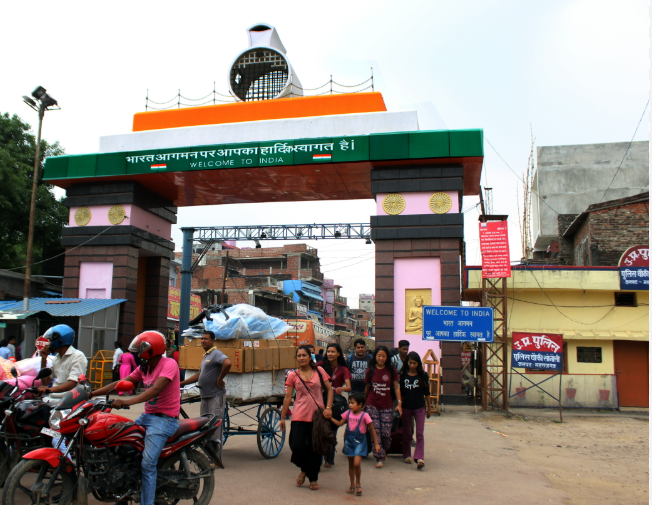
Gorakhpur — the major city of eastern Uttar Pradesh and one of North India’s most strategically located railway junctions — is the natural departure point for thousands of Kailash Mansarovar Yatra pilgrims every year. Just 115 kilometres from the Sunauli-Belahiya Nepal border crossing, Gorakhpur is the last major Indian city before the Nepal frontier on the classic overland Kailash Yatra route, making it the staging point for bus connections, private vehicle arrangements, and final India-side preparation before the Nepal pilgrimage circuit begins.

The Kailash Mansarovar Yatra from Gorakhpur follows a well-established overland circuit: Gorakhpur → Sunauli border → Bhairahawa → Lumbini (optional sacred stop) → Kathmandu (Pashupatinath, permits, preparation) → Kodari border → Tibet → Kailash parikrama → Mansarovar bathing → return via Kodari → Kathmandu → Sunauli → Gorakhpur. Nepal Vehicle Hiring Pvt. Ltd., based in Thamel, Kathmandu, provides Nepal-side vehicle service for every leg of this circuit—from the Sunauli border pickup that begins the Nepal portion to the Sunauli border drop that completes it.

This complete guide covers the Kailash Yatra from Gorakhpur — the India-Nepal border logistics, the Nepal vehicle options for each circuit leg, the Kathmandu sacred preparation, the route to the Tibet border at Kodari, the Lumbini sacred stop, and everything a Gorakhpur-based pilgrim needs to plan the Nepal-side vehicle hire for the most sacred pilgrimage in Hinduism.

Gorakhpur to Sunauli: Crossing Into Nepal

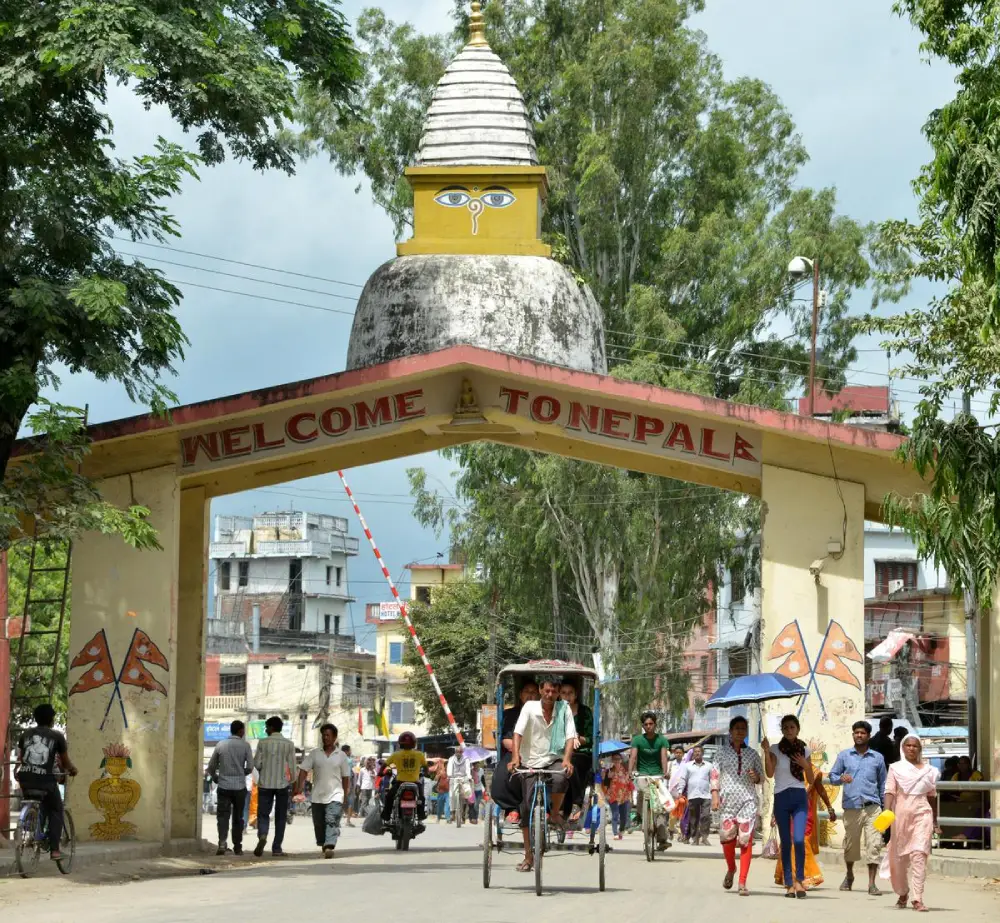
The Gorakhpur-to-Sunauli journey is the final India-side leg before the Nepal circuit begins. Gorakhpur to Sunauli covers about 115 kilometres on NH27 (the Gorakhpur-Nautanwa highway) and takes 2.5 to 3 hours by vehicle. Most pilgrims depart Gorakhpur by 5:00 to 6:00 AM to reach Sunauli before the morning rush and complete Nepal border entry formalities before 10:00 AM — allowing a comfortable drive to Bhairahawa, Lumbini, and Kathmandu.
Kailash Yatra Tour from Gorakhpur : Complete Best Price Guide

Transport from Gorakhpur to Sunauli:

  • Private taxi or vehicle from Gorakhpur city: approximately INR 2,000 to 3,500 per vehicle (shared) or INR 3,000 to 5,000 for private booking. Nepal Vehicle Hiring does not operate vehicles in India but can advise on the Gorakhpur-Sunauli connection through our partner network.
  • Gorakhpur-Nautanwa (Sunauli) local bus: regular services from Gorakhpur Bus Stand (Kachehri Bus Stand or ISBT), journey time 2.5 to 3.5 hours, fare approximately INR 80 to 150 per person. Take a last-mile tuk-tuk from Nautanwa to the Sunauli border gate.
  • Direct Delhi-Sunauli or Varanasi-Sunauli overnight bus: several operators run overnight AC coaches from Delhi and Varanasi that arrive at Sunauli in the morning — a common option for pilgrims not based in Gorakhpur who wish to avoid an extra Gorakhpur overnight.

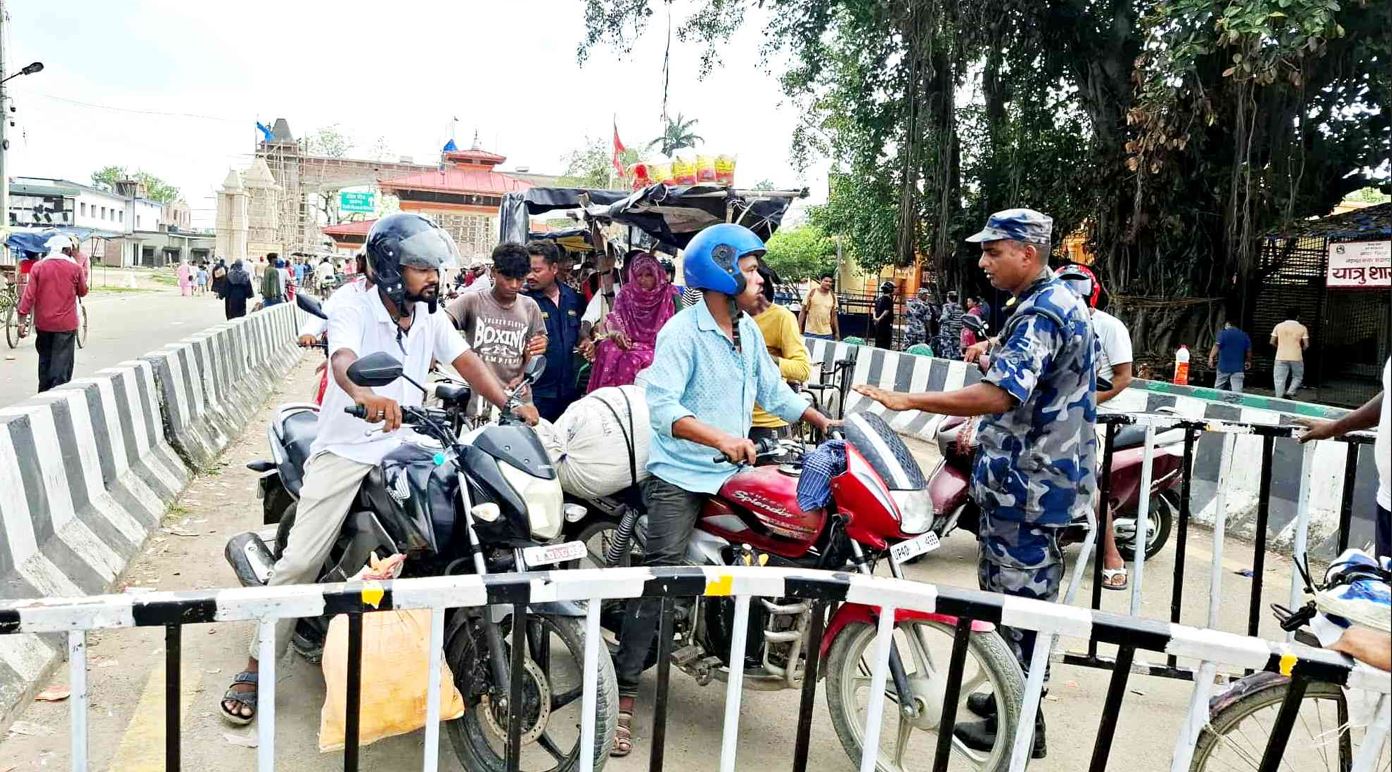
At the Sunauli-Belahiya Nepal border gate, Indian nationals cross freely (no visa required). Nepal immigration issues a standard tourist visa (NPR 1,000 for 15 days, NPR 1,500 for 30 days) — or no visa if the pilgrim is using a government of India bilateral Kailash Yatra quota that includes Nepal transit arrangements.

Nepal Vehicle Hiring collects from the Belahiya Nepal-side immigration exit point — our driver waits at the gate with the pilgrim group’s name sign for the pre-arranged pickup.

The Nepal Kailash Yatra Circuit from Sunauli: Complete Route

DaySegmentDistanceDrive TimeVehicleKey Activity
1Sunauli → Lumbini22 km30–40 minCar/Hiace/CoasterSacred birthplace of Buddha; Maya Devi Temple
1Lumbini → Kathmandu300 km6–7 hrsCar/Hiace/CoasterArrive in the evening; check in to Thamel
2Kathmandu — Sacred day——Sightseeing vehiclePashupatinath Aarti; permits; Boudhanath
3Kathmandu → Kodari115 km3–4 hrs4WD jeepTibet border; Araniko Hwy; Bhotekoshi gorge
4–10Tibet circuitKailash & Mansarovar—Tibet operator vehicleKailash parikrama; Mansarovar bathing
11Kodari → Kathmandu115 km3–4 hrs4WD jeepReturn; Pashupatinath thanksgiving Aarti
12Kathmandu → Lumbini (opt.)300 km6–7 hrsCar/Hiace/CoasterOptional final sacred stop at Lumbini
12/13Lumbini → Sunauli → Gorakhpur22 km + 115 km30 min + 2.5 hrsNepal vehicle to Sunauli; India vehicleNepal border exit; India return

Lumbini: The First Sacred Stop from Sunauli

For Kailash Yatra pilgrims entering Nepal at Sunauli, the Lumbini sacred stop is the most natural and most rewarding first Nepal experience — the birthplace of the Buddha, Nepal’s most famous UNESCO World Heritage Site, is just 22 kilometres east of Bhairahawa (4 km north of Sunauli) and directly on the route toward Kathmandu. Starting the Kailash Yatra with a visit to Lumbini aligns with the pilgrimage’s spiritual dimension—the journey to Shiva’s mountain home at Kailash is enriched by honouring the Buddha’s birthplace, which Hindus revere as an avatar of Vishnu.

Nepal Vehicle Hiring’s Hiace van hire or car hire in Nepal picks up pilgrims at the Sunauli-Belahiya gate and drives them 22 kilometres to the entrance of Lumbini’s Sacred Garden. A focused Lumbini visit covering the Maya Devi Temple, the Ashoka Pillar, the Puskarini sacred pool, and selected international monastery compounds requires 2 to 3 hours.

After Lumbini, the vehicle continues north on the Siddhartha Highway, then east on the Prithvi Highway corridor toward Kathmandu, arriving in the evening for check-in at the Kathmandu Thamel hotel.
Kailash Yatra Tour from Gorakhpur : Complete Best Price Guide

Kathmandu: The Sacred Preparation Day

The Kathmandu day—typically Day 2 of the Gorakhpur-origin Kailash Yatra—is the pilgrimage’s most important preparation day. For Kailash Yatra pilgrims, Kathmandu serves four essential functions: Pashupatinath darshan, permit collection and verification, physical rest and acclimatisation preparation, and shopping for high-altitude equipment (if not brought from India).

Pashupatinath Temple: The Sacred Departure Blessing

For Shiva devotees on the Kailash pilgrimage, the Pashupatinath evening Aarti (5:00 to 6:30 PM) serves as a sacred departure blessing that begins the Yatra’s devotional arc. Pashupatinath — where Shiva is worshipped as Pashupati, the Lord of Animals and protector of Nepal’s people — is Nepal’s most important Shiva temple and one of the world’s most sacred.

The evening fire ceremony on the Bagmati River ghats, performed by Bhat Brahmin priests in the same form for over a millennium, is one of South Asia’s most powerful sacred ceremonies. For Kailash-bound pilgrims, the Pashupatinath Aarti before departure and on return creates the sacred brackets around the mountain journey.

Nepal Vehicle Hiring’s Kathmandu sightseeing service covers the full Kathmandu sacred day — Boudhanath Stupa morning kora, Swayambhunath darshan, Pashupatinath Aarti in the evening — in a single managed vehicle day from your Thamel hotel.

Tibet Permits: What Must Be Arranged in Kathmandu

The Tibet Tourism Bureau permit (TTB permit) and Chinese Group Visa for the Kailash circuit must be arranged before reaching Kodari — you cannot obtain them at the border. A licensed Chinese Tibet tour operator arranges these permits, which typically require 4 to 8 weeks of lead time.

Pilgrims arriving in Kathmandu should have all Tibet permits already in hand — the Kathmandu day is for verification and any final documentation, not for initial permit application. Nepal Vehicle Hiring partners with established Tibet operators and can provide referrals — contact us via our plan your trip page.

Thamel Shopping for High-Altitude Equipment

Thamel’s extensive trekking equipment market is one of the best-stocked in Asia — gear shops selling cold-weather clothing, sleeping bags, trekking poles, sun protection, altitude medication (Diamox), and all other equipment needed for the Kailash circuit’s high-altitude demands are concentrated within a few streets of the Thamel hotel district. Pilgrims who didn’t bring adequate cold-weather gear from Gorakhpur can source everything they need in Thamel on the Kathmandu day. Your Nepal Vehicle HSiddhartha Highway
Kathmandu to Kodari: The Tibet Border Approach

The Kathmandu-to-Kodari drive covers approximately 115 kilometres on the Araniko Highway (H04) — Nepal’s primary eastern Tibet approach road — taking 3 to 4 hours depending on road conditions. The highway heads east from Kathmandu through Bhaktapur and Dhulikhel before descending through the Bhotekoshi River gorge — one of Nepal’s most dramatic road sections — to the Nepal-Tibet border at Kodari (1,873 m).

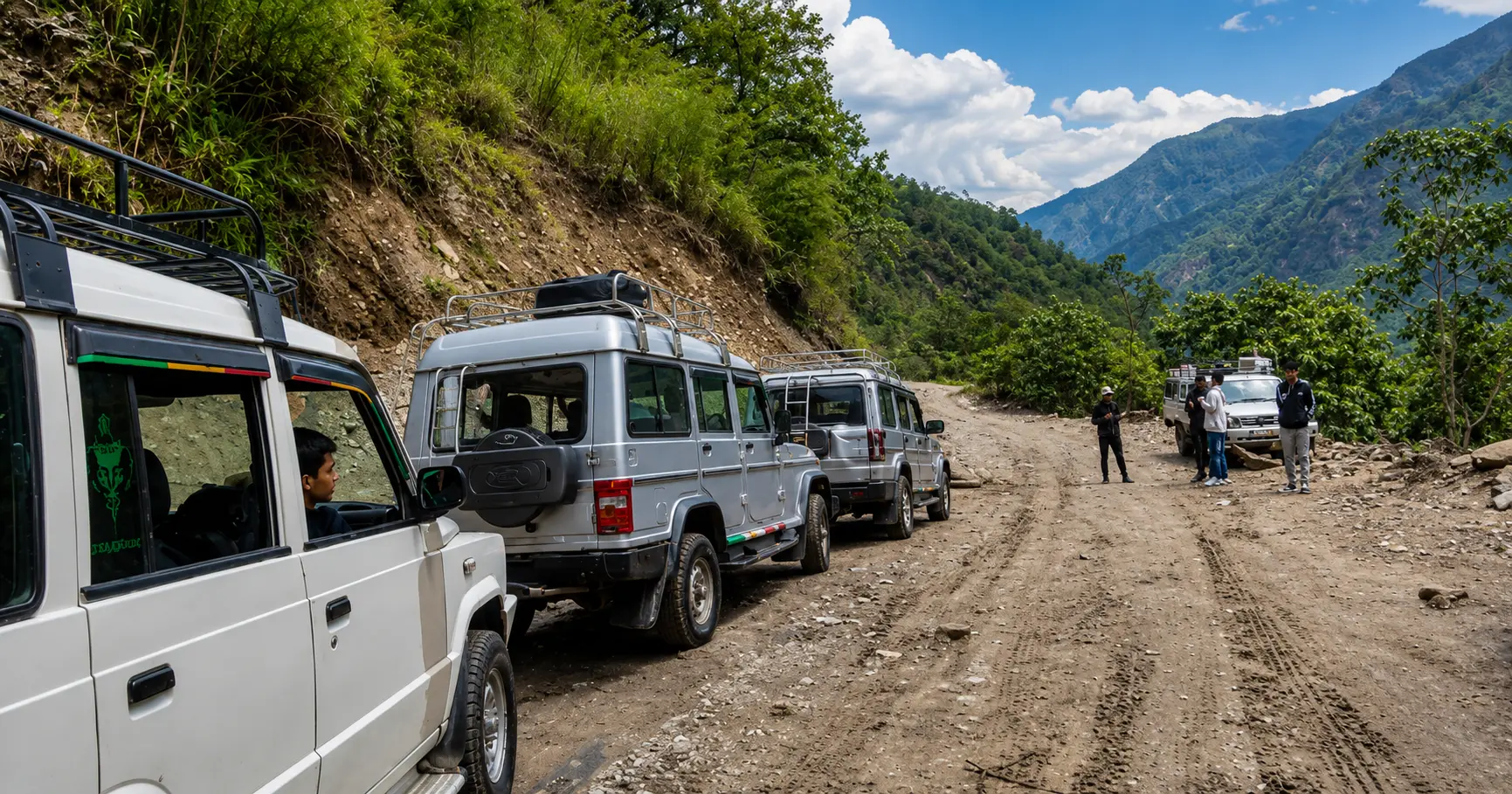
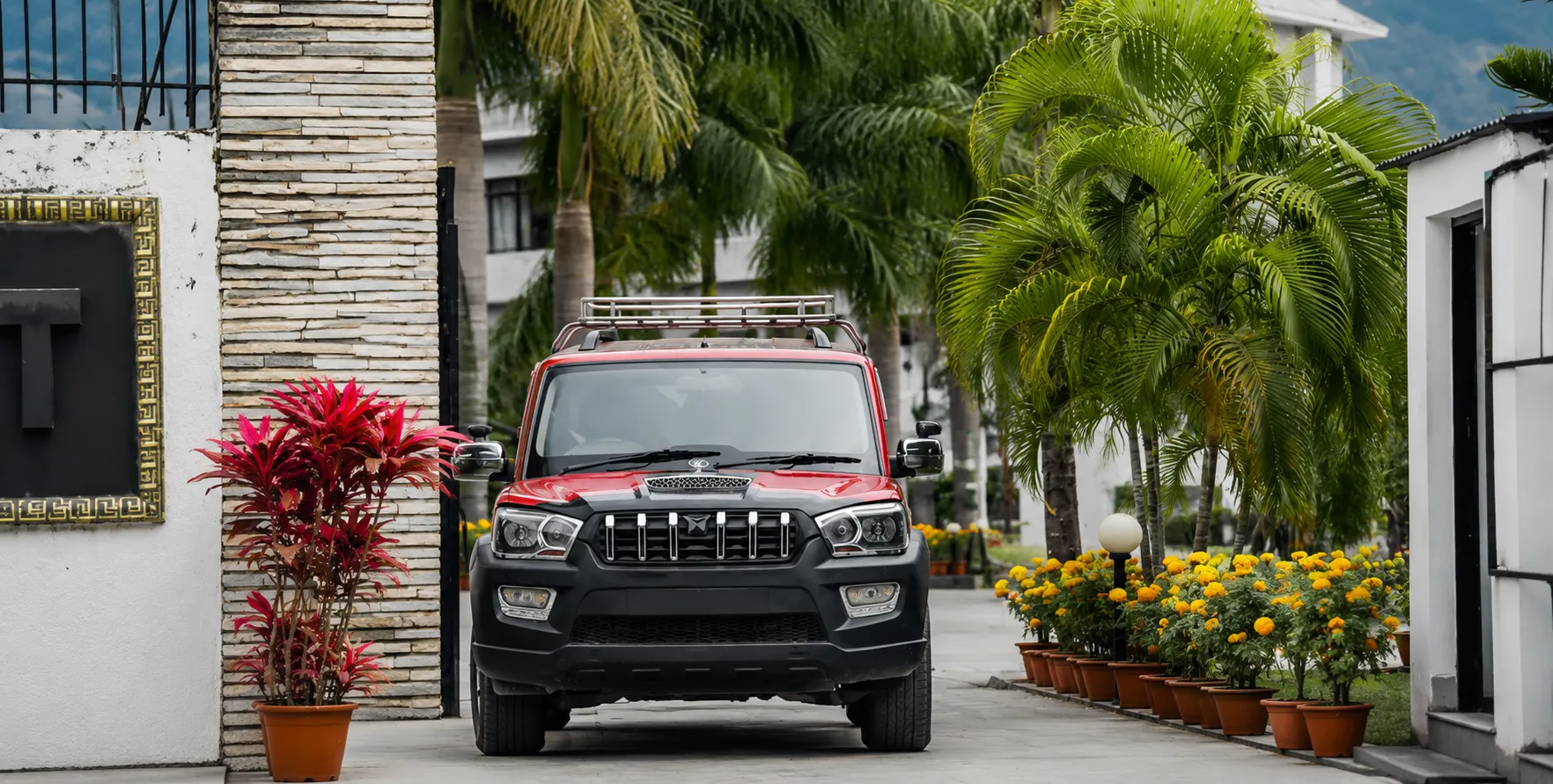
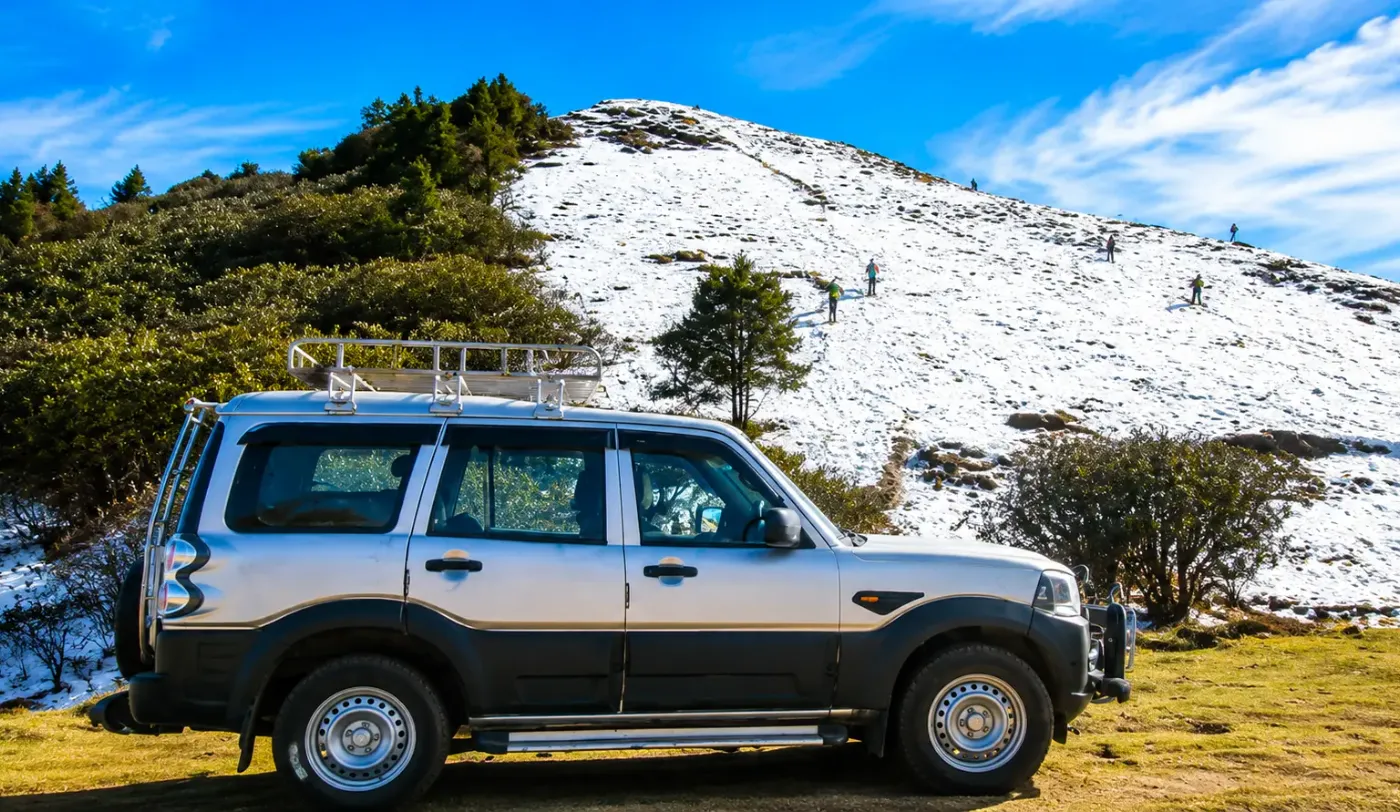
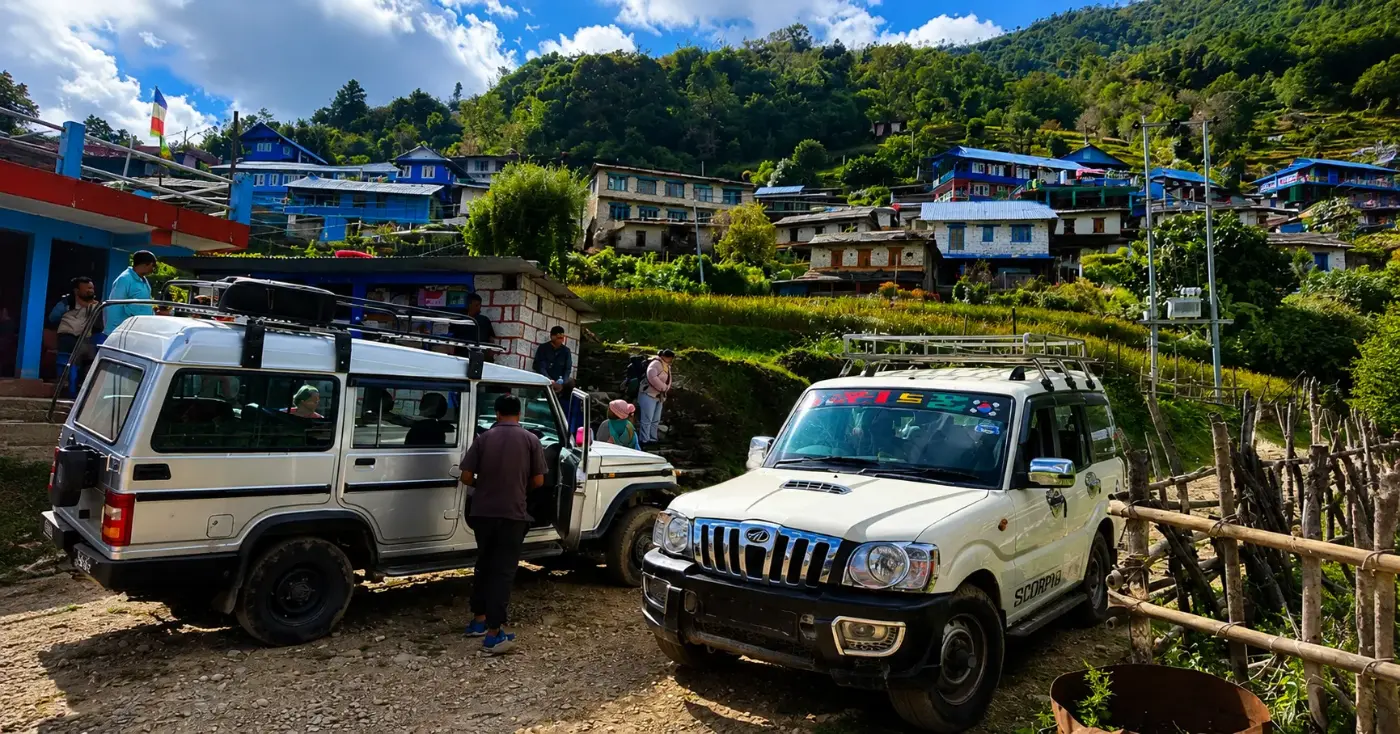
Nepal Vehicle Hiring recommends a 4WD jeep hire (Mahindra Scorpio or Toyota Land Cruiser) for the Kathmandu-to-Kodari section. The Araniko Highway is paved throughout, but the gorge section has narrow passages and occasional unstable sections (particularly after monsoon), so an experienced driver and a capable vehicle help. Our drivers are specifically experienced on this route and monitor Araniko Highway conditions daily.

Key stops on the Kathmandu-to-Kodari drive:

  • Bhaktapur (13 km from Kathmandu): Nepal’s finest medieval city, with the Nyatapola Temple and 55-Window Palace. For pilgrim groups with time for a 45-minute heritage stop, Bhaktapur Durbar Square makes an outstanding cultural addition to the journey toward Tibet.
  • Dhulikhel (30 km from Kathmandu, 1,550 m): the eastern valley rim town with panoramic Himalayan views. On clear days, Dhulikhel’s mountain panorama includes Numbur, Dorje Lakpa, Langtang Lirung, and the border range; pilgrims will cross into Tibet. Nepal Vehicle-Hiring drivers pause at the Dhulikhel viewpoint for photos.
  • Tatopani hot springs (85 km from Kathmandu): natural thermal springs on the Bhotekoshi River bank in the lower gorge—a standard rest stop for Kodari-bound pilgrim vehicles; 30—minute stop option.
  • Kodari border (115 km from Kathmandu): Nepal immigration exit formalities. The Nepal vehicle-hiring driver assists with luggage and waits while pilgrims complete the Nepal exit stamp. The Tibet operator’s vehicle takes over on the Chinese side.

Optional Extension: Muktinath Sacred Visit Before Kailash

For Gorakhpur-origin Kailash Yatra pilgrims who want to include the Muktinath Temple (3,710 m) — Nepal’s most sacred mountain Vishnu temple with its 108 water spouts and eternal flame — in the pre-Kailash Nepal circuit, Nepal Vehicle Hiring’s Muktinath Yatra itinerary service adds 3 to 4 days to the Nepal circuit before the Kodari crossing.

The Muktinath extension from the Sunauli-entry circuit: after entering Nepal at Sunauli and visiting Lumbini and Kathmandu, the vehicle route continues to Pokhara (6 to 7 hours from Kathmandu), then north via the Pokhara to Mustang jeep through the Kali Gandaki gorge to Jomsom (2,720 m, overnight) and Muktinath (3,710 m) for the full temple darshan (108 water spouts ritual bath, eternal flame, Vishnu temple). After Muktinath, the vehicle returns to Pokhara, then to Kathmandu, from where the Kodari approach continues.

This extended circuit — Sunauli → Lumbini → Kathmandu → Pokhara → Muktinath → Kathmandu → Kodari → Tibet → return — is one of Nepal’s finest comprehensive pilgrim circuits and is coordinated by Nepal Vehicle Hiring’s Nepal Nekhor tour service.
Muglin

Pashupatinath and Kathmandu: The Sacred Pilgrimage Gateway

For Gorakhpur-origin Kailash pilgrims — who arrive in Nepal from one of North India’s most important sacred cities (Gorakhpur is home to the Gorakhnath Temple, the primary seat of the Nath sampradaya founded by Gorakhnath and revered across eastern UP and Bihar) — the Kathmandu sacred day has specific resonance. The Nath tradition has deep historical ties to Shaivism and the Kailash pilgrimage, and Gorakhpur pilgrims approaching the Kailash Yatra via Pashupatinath make a sacred journey that links the Gorakhnath tradition in India to the Pashupati tradition in Nepal and the Shiva mountain tradition at Kailash in Tibet.

Nepal Vehicle Hiring’s Kathmandu sightseeing service for Gorakhpur Kailash Yatra groups includes: the Pashupatinath Temple morning visit (9:00 to 11:00 AM) for the main temple darshan and Bagmati River ghats exploration; Boudhanath Stupa visit; optional Bhaktapur Durbar Square afternoon visit; and the essential Pashupatinath evening Aarti (5:00 to 6:30 PM) — the fire ceremony that Gorakhpur pilgrims consistently describe as the most powerful sacred experience of the entire Nepal leg of the Kailash journey.

Permits for Gorakhpur-Origin Kailash Yatra Pilgrims

PermitCost 2026Arrange AtLead Time
Nepal tourist visaNPR 1,000 (15 days) / NPR 1,500 (30 days)Sunauli border (on arrival) or Nepal Embassy, IndiaSame day at border
Tibet Tourism Bureau (TTB) permitIncluded in Tibet packageLicensed Chinese Tibet operator4–8 weeks before
Chinese Group VisaAgency feeTibet operator via Chinese consulate4–8 weeks before
Kailash Restricted Area PermitIncluded in Tibet packageTibet operatorSame as TTB
ACAP (if Muktinath extension)NPR 3,000 per foreignerNepal Tourism Board Kathmandu1–2 days Kathmandu

Best Season for Kailash Yatra from Gorakhpur

SeasonMonthsNepal RoadsTibet/KailashRecommend?
SpringApr–JunGood to excellentBest — stable, clear viewsHighly recommended
MonsoonJul–SepNepal mountain roads variableTibet rain-shadow — workablePossible with caution
Post-MonsoonOct–NovGood, repairedExcellent clarity, cold nightsRecommended
WinterDec–MarNepal open; high passes coldKailash parikrama difficult — snowNot recommended

The June Kailash Yatra window is historically the most popular for Gorakhpur-origin pilgrims — aligning with the Guru Purnima festival (full moon of Ashadha, typically June-July) when the Kailash parikrama carries maximum merit in the Hindu calendar. June weather is warming, but Tibet’s weather is stable, and Gorakhpur’s pilgrim season peaks in this window.

Nepal Vehicle Hiring’s Kailash Yatra vehicle bookings from Gorakhpur-side pilgrims are highest in May and June — book 6 to 8 weeks in advance for the June Guru Purnima window.

Frequently Asked Questions: Kailash Yatra from Gorakhpur

How long is the Nepal portion of the Gorakhpur Kailash Yatra?

The standard Nepal circuit for a Gorakhpur-origin Kailash Yatra (Sunauli-in, Kodari-out for Tibet, Kodari-in, Sunauli-out) covers approximately 3 to 5 Nepal days depending on stops: Day 1 (Sunauli → Lumbini → Kathmandu), Day 2 (Kathmandu sacred day + permits), Day 3 (Kathmandu → Kodari border). Return: Day 1 (Kodari → Kathmandu + Pashupatinath Aarti), Day 2 (Kathmandu → Sunauli with optional Lumbini stop). Total Nepal days: 5 to 6.

Does Nepal Vehicle Hiring pick up at the Sunauli/Belahiya border gate?

Yes — Nepal Vehicle Hiring’s driver meets confirmed pilgrim groups at the Belahiya immigration exit (Nepal side) with a sign bearing the group’s name. Our driver monitors Sunauli border-crossing times and adjusts pickup if immigration queues run longer than expected. Confirm your planned Sunauli crossing time with our operations team on WhatsApp at least 24 hours before crossing the border.

What vehicle is best for a group of 10 pilgrims from Gorakhpur?

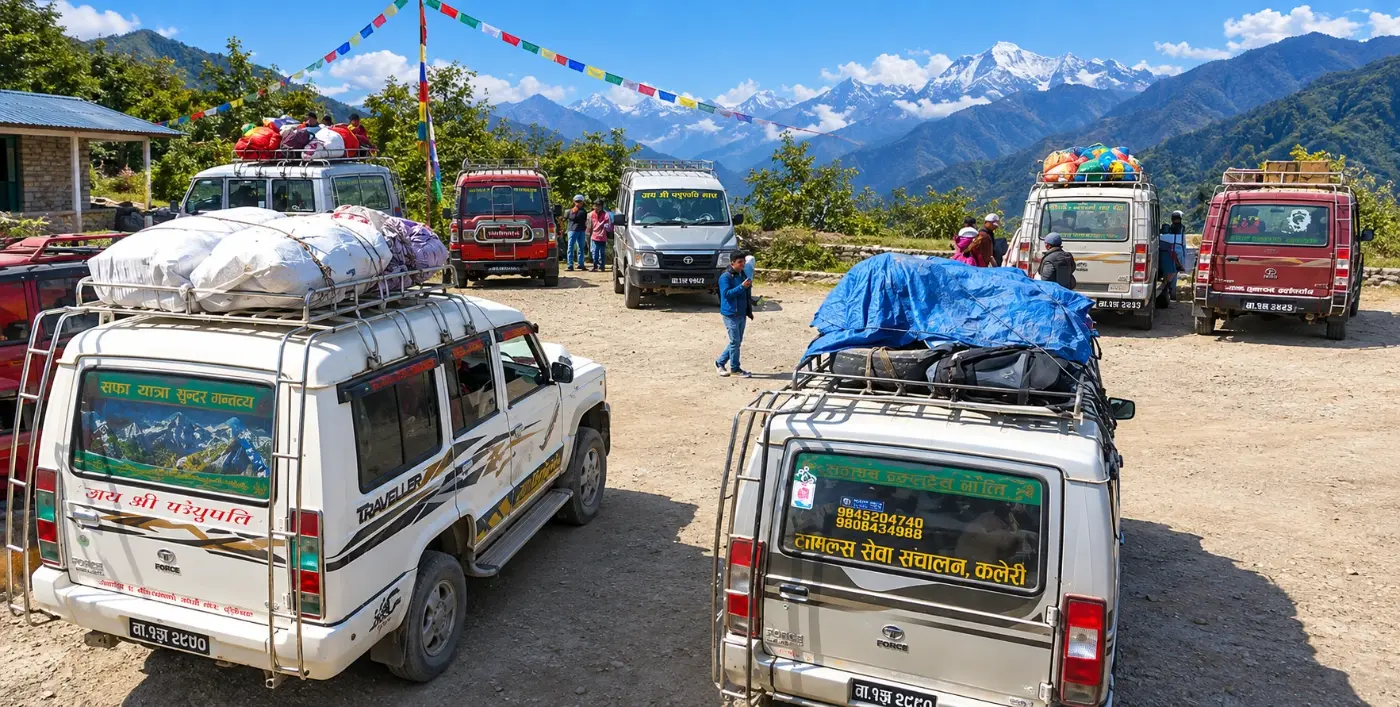
For a group of 10, we recommend our Hiace van hire; it is the standard recommendation —comfortable, economical per person, and available for all Nepal highway legs, including the Sunauli-Lumbini-Kathmandu highway and the Kathmandu-Sunauli return. For the Kathmandu-to-Kodari mountain leg, a group of 10 is split between 2 Hiace or 2 Scorpio jeeps (the Kodari road’s mountain character makes the Hiace less suitable beyond Dhulikhel — we advise splitting into smaller 4WD vehicles for this leg).

Nepal Vehicle Hiring coordinates both vehicle types as a single managed booking.

Can we combine Muktinath with the Kailash Yatra from Gorakhpur?

Yes — Nepal Vehicle Hiring’s Nepal Nekhor tour service coordinates the Sunauli → Lumbini → Kathmandu → Pokhara → Muktinath → Kathmandu → Kodari → Tibet → return circuit as a complete Nepal vehicle package. The Muktinath extension adds 3 to 4 Nepal days and approximately NPR 25,000 to 38,000 in additional vehicle hire. The combined Kailash-Muktinath pilgrimage from Gorakhpur is one of Nepal’s finest comprehensive sacred circuits.

Does the Gorakhpur-to-Kailash route face disruption from the 2026 Rasuwagadhi flood?

The Gorakhpur-origin Kailash Yatra that crosses Tibet via Kodari (Zhangmu) is NOT affected by the August 2026 Rasuwagadhi flood. Kodari is a separate Nepal-Tibet border crossing in Sindhupalchok District (east of Kathmandu), completely different from the Rasuwagadhi-Kerung corridor in Rasuwa District (north of Kathmandu). As of September 2026, Nepal Vehicle Hiring confirms the Araniko Highway and Kodari border are operational and unaffected by the Rasuwa flood event.

How do we return from Kailash to Gorakhpur?

After completing the Tibet circuit, pilgrims re-enter Nepal at Kodari and drive to Kathmandu (Day 1, Pashupatinath Aarti), then Kathmandu to Sunauli (Day 2, optional Lumbini). Nepal Vehicle Hiring has pre-booked the return vehicle from Kodari to Sunauli as part of the original circuit booking.

At Sunauli, pilgrims cross into India and arrange Sunauli-to-Gorakhpur transport (local taxis, buses, or pre-arranged private vehicles). Nepal Vehicle Hiring can advise on Sunauli-Gorakhpur connections on the Indian side.

Book Your Gorakhpur Kailash Yatra Nepal Vehicle with Nepal Vehicle Hiring

Nepal Vehicle Hiring Pvt. Ltd., Thamel, Kathmandu — Nepal-side vehicle specialist for Gorakhpur-origin Kailash Yatra pilgrims. From the Sunauli-Belahiya border pickup to the Kodari Tibet border approach and the Sunauli return drop:

Visit our Plan Your Trip page with your Gorakhpur pilgrimage dates, group size, Sunauli crossing date, and Tibet operator details. We respond within 24 hours with a complete Nepal-side vehicle plan and all-in pricing for the entire Gorakhpur-origin Kailash Yatra Nepal circuit. Om Namah Shivaya — from Gorakhpur’s sacred ground to Kailash’s sacred summit, Nepal Vehicle Hiring connects the journey.

Gorakhpur: The Gateway City for Kailash Yatra Pilgrims

Gorakhpur’s significance for the Kailash Mansarovar Yatra extends beyond its convenient location near the Nepal border. Understanding the city’s sacred and logistical context helps Kailash pilgrims plan both their India-side preparations and their entry into Nepal.

Gorakhpur is the headquarters of the Nath sampradaya—the yogic and Shaivite tradition founded by the saint Gorakhnath (after whom the city is named)—which has been one of North India’s most influential religious movements for nearly a millennium. The Gorakhnath Temple (also known as Gorakshanath Mandir) is the primary seat of the current Nath Peethadheeshwar and one of eastern UP’s most important pilgrimage centres, drawing hundreds of thousands of devotees annually.

The Nath tradition’s deep connection to Shaivism—its iconography, practices, and reverence for Himalayan sacred geography—gives Gorakhpur a natural spiritual affinity for the Kailash pilgrimage. Pilgrims departing from Gorakhpur for Kailash often begin the Yatra with a visit to the Gorakhnath Temple as their first devotional act.

Gorakhpur Junction railway station is one of India’s largest and most strategically located rail junctions — the convergence point for trains from Delhi, Varanasi, Lucknow, Allahabad, and dozens of smaller UP and Bihar cities. The Gorakhpur-to-Sunauli bus and taxi connection from the station and ISBT makes Gorakhpur the natural staging point for pilgrims arriving by train from across North India.

The rail connectivity means that the ‘Gorakhpur Kailash Yatra’ circuit serves not just Gorakhpur residents but the entire North Indian pilgrimage market whose members converge on Gorakhpur as the Nepal border staging point.

The Kailash Circuit from Gorakhpur: Sacred Geography

For Gorakhpur-origin pilgrims, the Kailash Yatra circuit passes through some of the Indian subcontinent’s most significant sacred geography. Understanding the full sacred landscape the journey traverses—from Gorakhpur’s Gorakhnath tradition through Nepal’s Pashupatinath and Lumbini to Tibet’s Kailash and Mansarovar—gives the pilgrimage its fullest spiritual context.

Gorakhpur: The Nath Tradition’s Heart

The Gorakhnath Temple in Gorakhpur embodies the Nath sampradaya’s synthesis of yoga, Shaivism, and devotional practice. The temple complex—a major ashram that runs educational institutions, a medical centre, and religious programmes alongside the main temple—is the spiritual home of a tradition that considers the Himalayan peaks (and Kailash specifically) the abode of the Nath Siddhas.

These perfected masters achieved liberation through yogic practice. Leaving Gorakhpur for Kailash is, in Nath tradition, travelling toward the sacred homeland of the masters.

Sunauli-Bhairahawa: The Open Frontier

The Sunauli-Belahiya crossing is more than a political border—it is the threshold between the Indian plains and the Himalayan world, rising from Sunauli’s 100-metre altitude to Kailash’s 6,638-metre sacred summit over the 8,800-kilometre Nepal-and-Tibet circuit ahead. The flat Terai at Sunauli, and the distant view of the Himalayan foothills from the border town’s northern outskirts on clear days, offer the first visual hint of the mountain world that awaits.

Lumbini: The Buddha’s Birthplace

For the Kailash pilgrimage circuit, Lumbini marks the meeting point of Hinduism’s Kailash devotion and Buddhism’s sacred geography. Hindus who revere the Buddha as an avatar of Vishnu find Lumbini a natural, theologically coherent stop; visiting Lumbini completes the subcontinent’s sacred geography by including the birthplace of the one whose teachings shaped the entire Buddhist world in which the Kailash-Mansarovar region sits.

Kathmandu: The Himalayan Sacred City

Kathmandu’s sacred character — the density of Hindu and Buddhist temples, the living Newari Buddhist heritage, the Bagmati River’s sacred quality, and Pashupatinath’s supreme Shaiva status — makes it the most naturally appropriate preparation space for the Kailash journey. The city has been a pilgrimage destination for millennia, and Kailash pilgrims who spend even a single Night in Kathmandu absorb a sacred atmosphere built over centuries of devotional practice.

Kailash and Mansarovar: The Destination

Mount Kailash (6,638 m) and Lake Mansarovar (4,590 m) require no introduction for pilgrims who have already decided to make this journey. The 52-kilometre parikrama around Kailash, crossing the Drolma La (5,630 m), and the pre-dawn bathing in Mansarovar’s icy waters are the experiential core of the Yatra. Nepal Vehicle Hiring’s Nepal-side circuit supports the journey to and from this core—ensuring transport supports, rather than detracts from, the pilgrimage’s devotional focus.

Practical Planning Guide: Kailash Yatra from Gorakhpur

For Gorakhpur-origin pilgrims planning the 2026/27 Kailash Yatra, the following practical planning sequence covers the key preparation steps:

  • 6 to 8 months before: book a Tibet tour operator and begin the TTB permit/Chinese Group Visa process. This has the longest lead time and must be started first. Nepal Vehicle Hiring can refer you to Tibet operators.
  • 3 to 4 months before: confirm Nepal vehicle booking with Nepal Vehicle Hiring via WhatsApp. Specify group size, Sunauli entry date, circuit (with/without Muktinath extension), Kodari crossing date, and Sunauli return date.
  • 2 to 3 months before: book Gorakhpur-to-Sunauli transport (private vehicle, taxi, or bus). Book a Kathmandu hotel for the 2-day Nepal preparation stop.
  • 1 month before: confirm you received all Tibet permits from the Tibet operator. Verify Nepal vehicle booking with Nepal Vehicle Hiring. Book Gorakhpur Junction return trains if returning by rail.
  • 1 week before: WhatsApp Nepal Vehicle Hiring with the confirmed Sunauli border-crossing date and estimated crossing time. You will receive confirmation of the driver’s name and vehicle details.
  • At Sunauli: contact Nepal Vehicle Hiring WhatsApp when approaching Nepal immigration. Our driver will be at the Belahiya exit with a sign with your group name.

Gorakhpur to Kailash: 2026 Route Update

An important clarification for 2026 Gorakhpur-origin Kailash pilgrims:

August 2026 Rasuwagadhi-Kerung flood closure does NOT affect the Gorakhpur-Sunauli-Kodari Kailash Yatra route.

The closed corridor is the Rasuwagadhi-Kerung route (via Syabrubesi in Rasuwa District, north of Kathmandu), which serves a different Tibet-Nepal crossing used by Kailash pilgrims from Kathmandu who previously entered Tibet via this western route. The Gorakhpur-origin circuit uses Kodari (Zhangmu border) in Sindhupalchok District — a completely separate border crossing on the eastern side of the Kathmandu Valley.

The Araniko Highway to Kodari is open and unaffected by the Rasuwa flood.

Nepal Vehicle Hiring confirms that the Kodari-Zhangmu border crossing and the Araniko Highway are fully operational as of September 2026. Gorakhpur-origin Kailash Yatra pilgrims using the Sunauli-Lumbini-Kathmandu-Kodari route can proceed with normal planning. Pilgrims who previously arranged the Rasuwagadhi-Kerung route and need to switch to the Kodari approach can use Nepal Vehicle Hiring’s vehicle service for both; contact us via WhatsApp for revised routing advice.
Kailash Yatra Tour from Gorakhpur : Complete Best Price Guide

The Nepal Sacred Circuit for Gorakhpur Pilgrims: What Not to Miss

Gorakhpur-origin Kailash Yatra pilgrims who plan even a minimal Nepal stop often return saying Nepal’s own sacred circuit deserves more time than pilgrimage logistics typically allow. Nepal Vehicle Hiring’s experience with this pilgrim group consistently highlights the following as the experiences most valued by Gorakhpur-origin pilgrims on the Nepal transit:

  • Pashupatinath evening Aarti: universally described as the most moving single ceremony of the Nepal transit — the fire offering on the Bagmati River at Nepal’s supreme Shiva temple, performed by hereditary priests in the same form as for centuries past. No Gorakhpur-origin Kailash pilgrim should bypass the Pashupatinath Aarti.
  • Lumbini Maya Devi Temple: the Buddha’s birthplace, marked by the 249 BCE Ashoka Pillar—a site of extraordinary historical and spiritual significance that Gorakhpur-origin pilgrims (who share the cultural landscape of the Buddha’s birthplace through their Uttar Pradesh connection) find particularly resonant.
  • Boudhanath Stupa kora: the early-morning circumambulation with Kathmandu’s Tibetan Buddhist community connects the India-origin pilgrim to the living Buddhist practice that surrounds the Kailash-Mansarovar region in Tibet.
  • Dhulikhel mountain panorama on the Araniko Highway: the first full Himalayan view before the descent toward Tibet — the range of peaks visible from Dhulikhel, including the border mountains that the Kodari crossing penetrates — is the first visual announcement of the Himalayan world ahead.

Nepal Vehicle Hiring’s vehicle service for Gorakhpur-origin Kailash pilgrims is designed to include all of these experiences naturally within the circuit’s timing — not as add-ons that extend the journey, but as integral stops that make the Nepal transit a pilgrimage in its own right rather than merely a transit corridor.

Understanding the Sunauli Crossing: What Gorakhpur Pilgrims Experience

For Gorakhpur-origin pilgrims making their first Nepal border crossing at Sunauli, knowing what to expect makes the transition smooth and unhurried. The Sunauli-Belahiya crossing is one of Nepal’s busiest border points, and its procedures are well established for Indian pilgrims.

The Sunauli crossing has two sides: India’s Bureau of Immigration manages the Sunauli Land Port of Entry (LPE), and Nepal Immigration manages the Belahiya Immigration Office. For Indian nationals crossing for tourism or pilgrimage, the process is: exit India at Sunauli (passport surrender for exit stamp at the Indian immigration post) → walk approximately 200 metres to the Nepal immigration office at Belahiya → Nepal entry stamp and visa issuance (for nationals requiring a visa; Indian nationals receive free entry with a passport, which is the standard for Indian citizens under the bilateral Nepal-India Open Border arrangement).

The Belahiya Nepal immigration office issues tourist visas on the spot for most foreign nationals. Indian citizens can enter Nepal visa-free with a valid Indian passport or government-issued photo ID (voter card, Aadhaar card, PAN card, or driving licence are all accepted for Indian nationals at the Nepal border).

Nepal entry processing time: 10 to 30 minutes, depending on the queue. Peak crossing times (8:00 to 10:00 AM and 2:00 to 4:00 PM) have longer queues; mid-morning or early afternoon crossings are smoother.

After completing Nepal immigration, pilgrims exit the Belahiya post into Nepal territory, where the Nepal Vehicle Hiring driver meets the group. Our driver, identified by the group name sign, assists with luggage and leads the group to the vehicle for the onward Journey in Nepal.

The transition from the border gate to the vehicle typically takes 5 to 10 minutes. Nepal Vehicle Hiring’s operations team is available on WhatsApp to coordinate in real time if the crossing takes longer than expected due to queue conditions.

Cost Overview: Complete Nepal Vehicle Budget for Gorakhpur Kailash Yatra

The following is a realistic Nepal-side vehicle hire budget for a group of 10 pilgrims from Gorakhpur making the standard Kailash Yatra circuit (Sunauli in, Kodari to Tibet, Kodari return, Sunauli exit) with Lumbini and Kathmandu stops:

  • Sunauli to Lumbini (22 km, Hiace van): NPR 3,000 to 15,000 per vehicle (10 pax)
  • Lumbini to Kathmandu (300 km, Hiace van): NPR 18,000 to 40,000 per vehicle
  • Kathmandu sightseeing day (Hiace van, full day): NPR 12,000 to 18,000 per vehicle
  • Kathmandu to Kodari (115 km, 2 x Scorpio jeeps for 10 pax): NPR 22,000 to 30,000 total  per person
  • Kodari to Kathmandu return (115 km, 2 x Scorpio jeeps): NPR 22,000 to 30,000 total
  • Kathmandu to Sunauli (315 km with Lumbini, Hiace van): NPR 20,000 to 28,000 per vehicle

The Gorakhnath-Pashupatinath Connection: A Pilgrim’s Theological Reflection

For pilgrims departing from Gorakhpur’s Gorakhnath Temple toward Nepal’s Pashupatinath and then Tibet’s Kailash, a theologically coherent thread connects these three sacred points, giving the Gorakhpur-origin Kailash Yatra a spiritual character distinct from Kailash pilgrimages departing from other Indian cities.

The Nath tradition — founded by Gorakhnath and rooted in the Siddha yoga lineage — venerates Shiva in his form as Adinath (the Primordial Lord) and as Mahayogi (the Supreme Yogi). In Nath cosmology, Shiva meditates eternally on Kailash, surrounded by his ganas (attendants), while Parvati (his consort) waits on the lower slopes.

The Nath siddhas are understood to practice in the cave monasteries and Himalayan passes of the same mountain complex. For a Gorakhpur pilgrim in the Nath tradition, the Kailash parikrama is literally walking around the meditation seat of their tradition’s supreme deity.

Pashupatinath in Kathmandu sits in direct theological relationship to the Gorakhpur tradition—Pashupati (Lord of Animals) is a name for Shiva that predates even Shaiva Siddhanta by centuries, appearing in the Rigveda and the Atharvaveda as one of Shiva’s primary forms. Tradition attributes the Pashupatinath Temple’s original foundation to the Licchavi period (approximately 400 to 750 CE), placing it in the same early medieval period when the Nath tradition’s roots were developing across the Indian subcontinent.

The Gorakhpur pilgrim who visits Pashupatinath before and after Kailash is honouring the same deity in his mountain home (Kailash) and his city temple (Pashupatinath) within a single pilgrimage circuit.

Nepal Vehicle Hiring’s role in carrying Gorakhpur pilgrims between these sacred points—from the Sunauli border gate where Nepal begins to the Kodari border where Tibet begins and back—serves a pilgrimage whose theological depth and historical significance far exceed the individual journey we facilitate. We are, in every way, part of a sacred tradition of Nepal-Tibet passage that has continued for centuries before motor vehicles existed and will continue long after.

Group Pilgrimage Planning: Organising a Gorakhpur Kailash Yatra Group

Many Gorakhpur-origin Kailash Yatra pilgrims travel in organised groups — family groups, temple congregation groups, neighbourhood associations, or professionally arranged pilgrimage tours assembled by local travel agents. Nepal Vehicle Hiring has extensive experience serving organised pilgrim groups, and the following guidance is specifically aimed at group organisers:

Group Size and Vehicle Matching

For the Nepal highway legs (Sunauli-Lumbini-Kathmandu and Kathmandu-Sunauli return), a single Hiace van (8 to 14 passengers)efficiently and economically handles groups up to 1y. For groups of 15 to 25, our Coaster bus hire is the right vehicle.

For the Kathmandu-to-Kodari mountain section, groups must split into smaller 4WD vehicles (Scorpio or Land Cruiser), as the Araniko Highway’s mountain sections and the Kodari border area do not comfortably accommodate large vans or buses. A group of 10 typically splits into 2 Scorpio jeeps for the Kodari leg.

Pre-Departure Group Briefing

Nepal Vehicle Hiring provides a WhatsApp group briefing for organised pilgrim groups before departure from India, confirming vehicle allocations, pickup timing at Sunauli, driver contacts, the Kathmandu hotel address, and the sequence of Nepal circuit stops. Delivered the evening before the Sunauli crossing, this briefing ensures every pilgrim has key contact information and knows what to expect at each Nepal border and vehicle transition point.

Luggage Management for Large Groups

Large pilgrim groups carrying substantial luggage — including sacred materials, puja items, personal kits for the Tibet high-altitude circuit, and group supplies — require advance vehicle-loading planning. Nepal Vehicle Hiring’s operations team coordinates vehicle loading at Sunauli and at each circuit stop to ensure luggage is correctly distributed across vehicles.

That sacred items (Mansarovar water, puja materials) are in the cabin rather than roof storage. Nothing is left behind at any transition point. This luggage coordination service is included at no additional charge in the Nepal Vehicle Hiring group booking.

Nepal Vehicle Hiring’s Partnership with Tibet Operators

The Kailash Yatra Nepal circuit requires coordination between two distinct operator types: the Nepal-side vehicle and logistics provider (Nepal Vehicle Hiring) and the Tibet-side tour operator (a China-licensed Tibet tour operator who arranges the TTB permits, Chinese Group Visa, Tibet vehicles, Kailash accommodation, and parikrama guide). Nepal Vehicle Hiring has established referral partnerships with several reputable Tibet operators who serve the Gorakhpur-origin Kailash Yatra market.

For Gorakhpur-origin pilgrim groups who have not yet identified a Tibet operator, Nepal Vehicle Hiring can provide Tibet operator referrals as part of the Nepal-side vehicle booking process. Our Tibet operator partners know the Kodari-Zhangmu border crossing’s specific procedures for the Nepal-origin Kailash Yatra, coordinate with our drivers on Tibet-side vehicle arrival timing, and have established permit processing experience for Indian national pilgrim groups.

The Nepal Vehicle Hiring + Tibet operator combination provides the complete Kailash Yatra operational coverage from the Sunauli border to the Kailash parikrama and back. The Nepal-side vehicle is the first and last element of the circuit — the legs that begin and end the sacred journey on Nepalese soil — and our coordination with the Tibet operator ensures a smooth handoff at Kodari in both directions.

To receive Tibet operator referrals alongside the Nepal vehicle booking, mention this requirement when contacting Nepal Vehicle Hiring via WhatsApp or via our plan your trip page. We will match Gorakhpur-origin pilgrim groups with the Tibet operator best suited to their group size, budget, and preferred Kodari crossing date.

Gorakhpur Kailash Yatra: Frequently Asked Practical Questions

Can we get Nepalese rupees at Sunauli?

Yes — currency exchange is available at the Belahiya border area (Nepal side) and in Bhairahawa town (4 km north of Sunauli). You can exchange Indian rupees for Nepali rupees at both locations.

Exchange rates at border currency exchange counters are typically slightly less favourable than in Kathmandu or at authorised exchange houses in Bhairahawa’s main market. Nepal Vehicle Hiring recommends exchanging a moderate amount at the border (enough for the Lumbini entry fee and incidentals for the Sunauli-to-Kathmandu journey) and exchanging the bulk of the Nepalese rupee requirement in Kathmandu’s Thamel, where rates are generally better, and service is more professional.

Do we need Indian rupees or Nepalese rupees for Lumbini?

Lumbini entry fees and most commercial transactions within the Lumbini UNESCO site are denominated in Nepalese rupees (NPR). The Lumbini entry fee for foreign nationals is NPR 200 per person (2026 rate). Lumbini guesthouses and restaurants sometimes accept Indian rupees at a rough exchange rate, but not at the official entry gates.

Nepal Vehicle Hiring recommends having NPR in hand before the Lumbini stop — either exchanged at Sunauli or withdrawn from Bhairahawa’s ATMs.

How do we handle the Kathmandu permit check for Tibet?

The Tibet permits (TTB, Chinese Group Visa, Kailash Restricted Area Permit) are verified by the Tibet operator’s Kathmandu representative — typically a meeting in the Thamel area on the Kathmandu preparation day. Nepal Vehicle Hiring’s driver can facilitate this permit meeting by driving the group to the Tibet operator’s Kathmandu office as part of the Kathmandu sightseeing day schedule. Please confirm the Tibet operator’s Kathmandu office address and appointment time before departing from Gorakhpur.

What time should we cross at Sunauli to arrive in Kathmandu the same day?

For a same-day Sunauli-to-Kathmandu journey with a Lumbini stop, cross the Sunauli border by 8:00 to 9:00 AM. This timing allows: a Lumbini visit (9:30 to 11:30 AM, 2 hours), departure from Lumbini by 11:45 AM, and Kathmandu arrival by 6:00 to 7:00 PM — in time for an evening meal and a comfortable rest before the Kathmandu sacred day.

Crossing later than 9:30 AM significantly compresses time in Lumbini or pushes Kathmandu arrival past 8:00 PM.

Is Gorakhpur Airport an option for faster arrival at Sunauli?

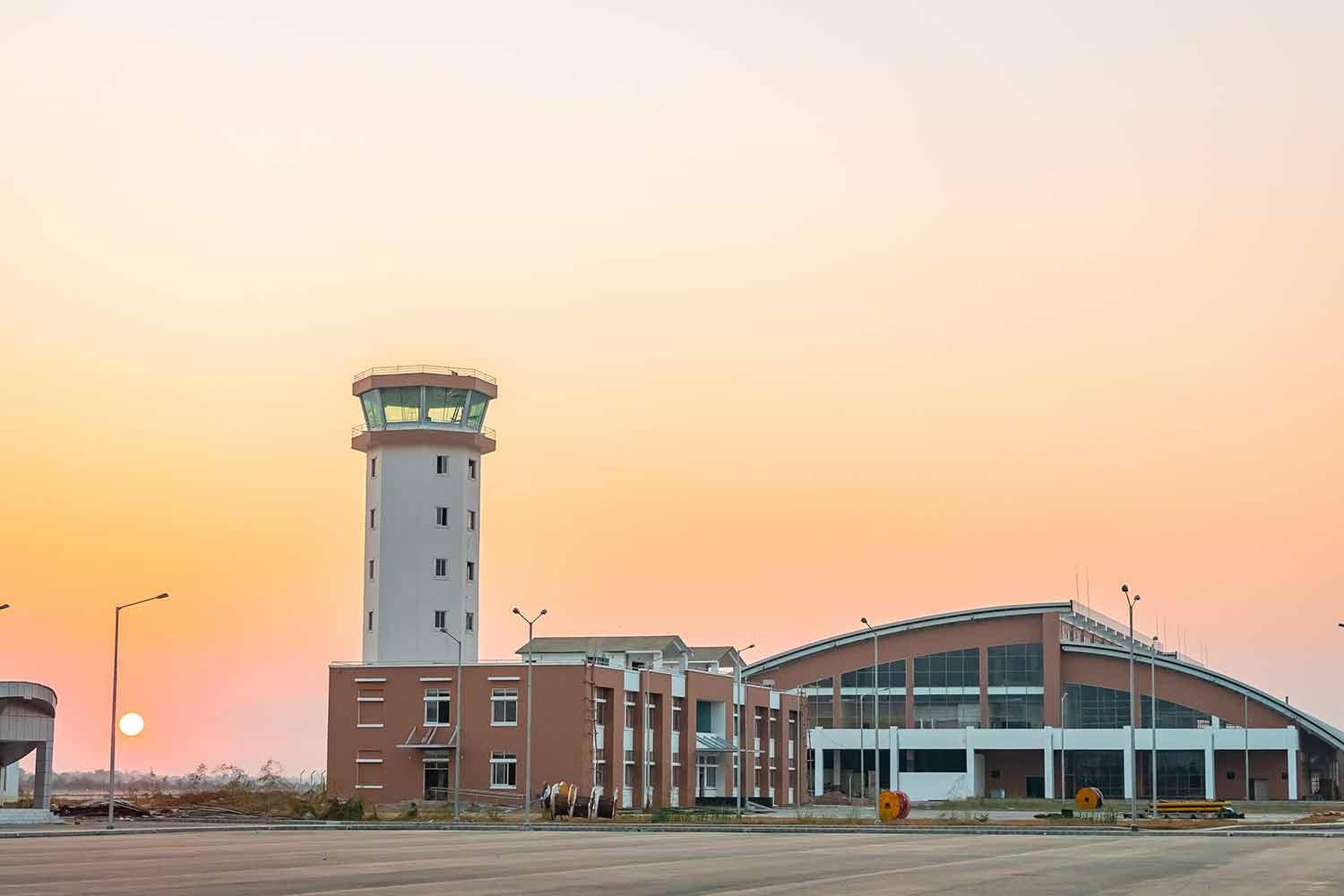
Gorakhpur Airport (GOP) is served by IndiGo, Air India, and SpiceJet with connections from Delhi, Lucknow, Varanasi, and Mumbai. Flying to Gorakhpur and then taking ground transport to Sunauli (115 km, 2.5 to 3 hours by taxi) is a much faster India-side option for pilgrims from Delhi or Mumbai than the train journey.

The flight from Delhi to Gorakhpur takes about 1.5 hours, compared with 8 to 14 hours on the fastest trains. For pilgrims prioritising faster arrival in Nepal, the Gorakhpur flight option is worth considering alongside the train.

What to Carry from Gorakhpur for the Nepal-Tibet Circuit

Packing correctly from Gorakhpur for the full Kailash Yatra circuit requires attention to both the Nepal Terai/Kathmandu environment and Tibet’s high-altitude extremes. The most common packing failures Gorakhpur pilgrims report are insufficient cold-weather gear for the Kailash circuit (Tibet nights can reach minus 20°C) and excessive luggage that slows the Sunauli immigration process and strains vehicle capacity. The following packing guidance applies specifically to the Gorakhpur-origin circuit:

  • Cold-weather layers (buy in Thamel if needed): down jacket, thermal base layers, warm hat, gloves, and waterproof outer shell for the Kailash parikrama. If you don’t bring anything from Gorakhpur, Thamel equipment shops have everything you need—and the Kathmandu prep day is your chance to fill gaps. Budget NPR 8,000 to 15,000 for any Thamel cold-weather gear purchase.
  • Sun protection for the Tibetan Plateau: the Tibetan Plateau’s high altitude, low humidity, and low-latitude sun combine to create intense UV exposure, even on cold days. SPF 50+ sunscreen, UV-blocking sunglasses, and a wide-brimmed hat are essential—bring from Gorakhpur, as quality sun protection is more reliable from established Indian medical stores than from Lumbini or Sunauli shops.
  • Altitude medication: Diamox (acetazolamide) is the standard prophylactic medication for Acute Mountain Sickness. Obtain a prescription from your doctor before leaving Gorakhpur. Diamox is available at most pharmacies in India and is significantly more reliable than what is available at Nepal-Tibet border-area pharmacies.
  • Puja materials from home: many Gorakhpur pilgrims carry puja materials blessed at the Gorakhnath Temple — gangajal (Ganges water), flowers, incense, and other items for the Kailash offerings. These travel well in sealed containers and are welcomed through Nepal customs without documentation issues. Air travellers should carry them in cabin luggage rather than checked luggage.
  • Cash: carry Indian rupees for the Gorakhpur-Sunauli portion, Nepalese rupees (obtained at the border or Bhairahawa) for the Nepal circuit, and check with your Tibet operator about Chinese yuan requirements for the Tibet circuit. Nepal Vehicle Hiring’s all-in pricing in NPR eliminates vehicle-cost cash uncertainty on the Nepal side.
  • Identity documents: Indian nationals need a valid passport for the China/Tibet visa. Also carry a government photo ID (Aadhaar, voter card, or PAN card) for domestic identification in Nepal and India. Keep all documents in a waterproof document folder accessible in the vehicle cabin — not in the roof-loaded main luggage.

Kailash Yatra from Gorakhpur: A Sacred Summary

The Kailash Mansarovar Yatra from Gorakhpur is one of the most naturally composed pilgrimage circuits in Hindu sacred geography — departing from the Nath sampradaya’s heartland, crossing into Nepal through the Open Border at Sunauli, visiting the Buddha’s birthplace at Lumbini, receiving Shiva’s blessing at Pashupatinath in Kathmandu, entering Tibet at the Kodari-Zhangmu border, and finally arriving at the mountain home of Shiva himself. The return circuit retraces this path in reverse, closing the sacred circle at Gorakhnath Temple in Gorakhpur.

Nepal Vehicle Hiring provides Nepal-side vehicle transport that connects each of these sacred points on Nepalese soil. From the Sunauli pickup that begins the Nepal leg to the Sunauli drop that ends it, our vehicles carry Gorakhpur pilgrims through a sacred landscape that has drawn devotees northward toward the Himalaya for centuries. We serve this pilgrimage with the understanding of its significance and the professionalism that it deserves.

Contact Nepal Vehicle Hiring on WhatsApp,[email protected], or vehiclehiringnepal.com to plan your Kailash Yatra from Gorakhpur with Nepal vehicle hire. Har Har Mahadev. Jai Bhole Nath.

The path to Kailash begins at Sunauli — Nepal Vehicle Hiring will be there when you cross.
Kailash Return: Kodari to Sunauli Border Drop – Private Jeep Guide

Mount Kailash Tour

Kailash Return: Kodari to Sunauli Border Drop — Private Jeep Guide

After completing Hinduism’s most sacred pilgrimage — the Kailash Mansarovar Yatra — returning pilgrims face a final logistics challenge: getting from the Nepal-Tibet border back to India efficiently and comfortably after weeks of high-altitude travel. For pilgrims who entered Nepal via the Kodari–Zhangmu border crossing in Sindhupalchok District and wish to exit Nepal at the Sunauli–Bhairahawa border crossing (the primary Nepal-India road crossing for pilgrims coming from Kathmandu toward India), the Kodari-to-Sunauli private jeep transfer is a direct, comfortable, and efficient return option.

This route covers approximately 450 to 480 kilometres of Nepal road — from the Araniko Highway border descent at Kodari, west through Kathmandu (with optional sacred site visits), and south on the Prithvi Highway and Terai Highway to the Sunauli-Bhairahawa crossing into India. Total drive time without significant stops: 9 to 12 hours.

Most pilgrim groups spread this over 2 days — overnight in Kathmandu for a Pashupatinath Aarti visit, then the highway run to Sunauli the following morning, with an optional Lumbini sacred stop (22 km east of Bhairahawa) before the border crossing.

Nepal Vehicle Hiring Pvt. Ltd., based in Thamel, Kathmandu, provides dedicated private jeep hire and group vehicle services for the Kailash Yatra return journey from Kodari to Sunauli — coordinating the complete Nepal-side return transport from the Tibet border crossing to the India border gate as a single managed booking. This guide covers the full route, section-by-section road conditions, vehicle options, costs, sacred stop options, and the practical logistics Kailash return pilgrims need.

The Kodari to Sunauli Route: Complete Overview

SectionDistanceRoadDrive TimeNotes
Kodari to Kathmandu115 kmAraniko Hwy (Hwy H04)3–4 hrsMountain descent; Bhotekoshi Gorge; Sun Koshi valley
Kathmandu (overnight stay)———Pashupatinath Aarti, Boudhanath kora, rest
Kathmandu to Mugling110 kmPrithvi Highway2–2.5 hrsThrough Trishuli gorge; fuel stop at Mugling
Mugling to Narayanghat33 kmNH4430–40 minBest section of Nepal highway; wide blacktop
Narayanghat to Butwal115 kmTerai Highway2–2.5 hrsFlat Terai; Lumbini junction at Bhairahawa
Bhairahawa to Sunauli border4 kmBhairahawa city road10–15 minSunauli-Belahiya India border gate

Total Nepal road distance from Kodari to Sunauli: approximately 377-395 kilometres. Recommended journey: 2 days — Day 1: Kodari to Kathmandu (overnight), Day 2: Kathmandu to Sunauli. A single-day direct drive is possible but takes about 9 to 12 hours and can be exhausting after the physical demands of the Kailash circuit.

Gautam,Buddhai,Airport,In,Bhairahawa,,Nepal.,The,International,Terminal,Is

Why Private Jeep is the Best Choice for Kailash Return

Returning Kailash Yatra pilgrims have several transport options for the return journey to Nepal. Still, the private jeep hire stands out for specific reasons that matter particularly at the end of a demanding pilgrimage:

  • Post-pilgrimage physical state: pilgrims returning from Kailash have completed a 52-kilometre circumambulation at 5,000+ meters, multiple weeks of high-altitude travel, and substantial physical exertion. They need a comfortable, private vehicle with sufficient luggage space for pilgrimage materials, shaligram collections, and personal gear — not a crowded shared bus.
  • Flexible sacred stops: the return journey through Nepal offers significant sacred pilgrimage opportunities — Pashupatinath in Kathmandu, Lumbini (birthplace of the Buddha) near Bhairahawa, and potentially Janakpur (birthplace of Goddess Sita) on the eastern Terai. A private jeep accommodates these stops on the pilgrim group’s schedule, not a fixed bus timetable.
  • Group privacy: many Kailash Yatra pilgrim groups are families or devotional communities that want to maintain the pilgrimage’s spiritual atmosphere on the return journey—performing puja, singing devotional songs, and keeping the Yatra’s contemplative character. A private vehicle creates this space; a public bus does not.
  • Door-to-border delivery: Nepal Vehicle Hiring collects from the Kodari border exit point and delivers to the Sunauli-Belahiya gate — no intermediate vehicle changes, no luggage transfers at Kathmandu’s bus parks, no coordination between multiple transport legs.
  • Confirmed pricing: all-inclusive private jeep hire eliminates the end-of-journey pricing uncertainty that informal transport arrangements often create at India border crossings where passengers are most vulnerable to price pressure.

Kailash Return Kodari to Sunauli Border Drop

Road Guide: Kodari to Sunauli Section by Section

Kodari Border Exit to Kathmandu (115 km, 3–4 hours)

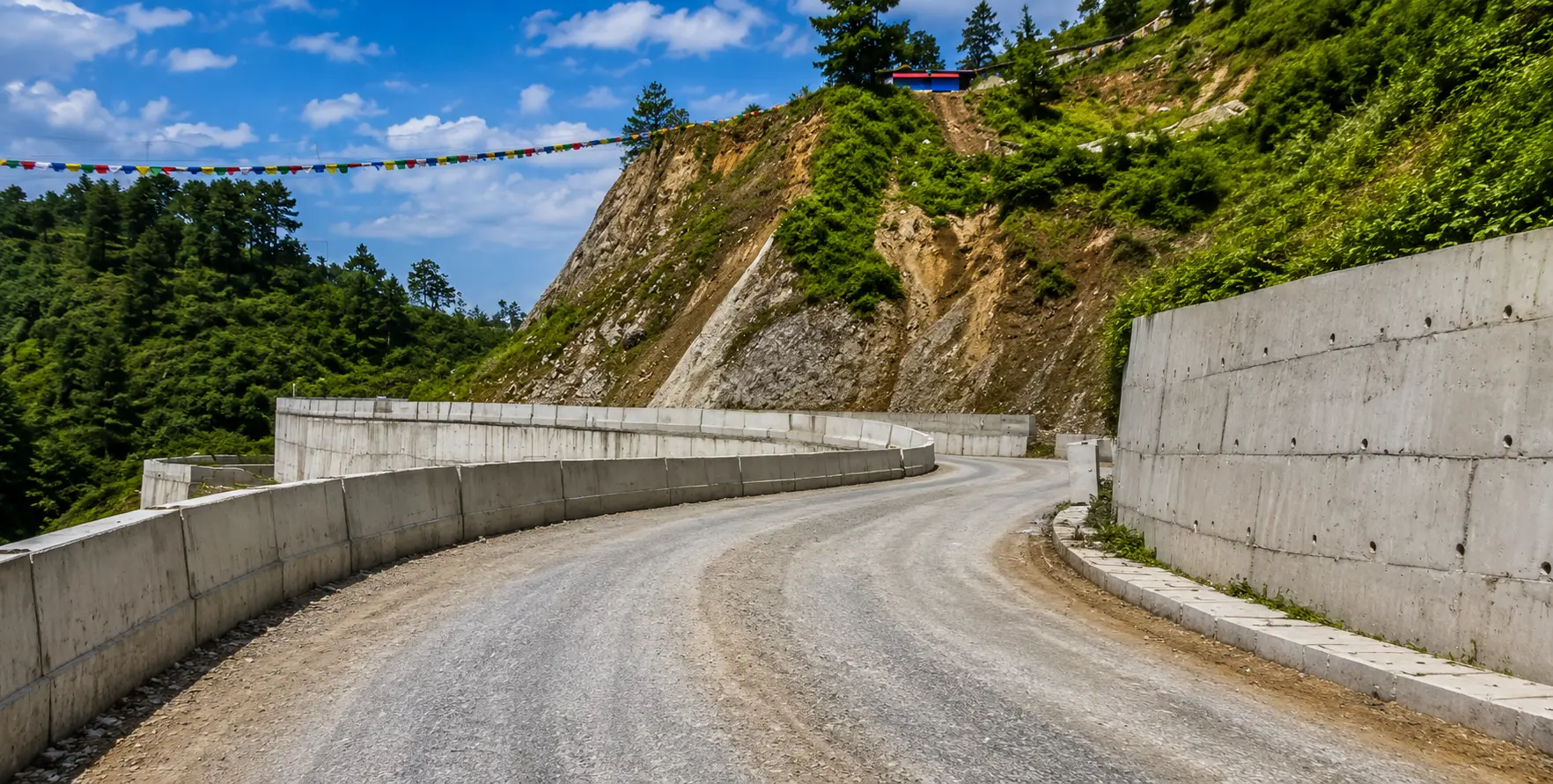
The descent from Kodari (1,873 m) to Kathmandu (1,350 m) follows the Araniko Highway (H04) through the Bhotekoshi River gorge — one of Nepal’s most dramatic highway sections. The road descends from the Nepal-Tibet border through the narrow canyon of the Bhotekoshi before reaching the Sun Koshi confluence at Tatopani (not the same Tatopani as on the Kali Gandaki — this Tatopani also has natural hot springs, a common stopping point for pilgrims crossing this border).

The gorge is susceptible to landslides during monsoon and post-earthquake instability (the 2015 earthquake severely damaged this road, and reconstruction is ongoing). Nepal Vehicle Hiring monitors the Araniko Highway daily for pilgrims returning from the Kodari route.

The Araniko Highway runs from the border to Kathmandu, passing through Barabise (930 m), the first significant Nepali settlement after crossing, then continuing through the Sun Koshi valley toward Dhulikhel (1,550 m)—the hilltop town on the eastern rim of the Kathmandu Valley with spectacular mountain views toward the Himalayan range. Nepal Vehicle-Hiring drivers use Barabise as the standard first rest stop (about 30 km from Kodari) and Dhulikhel as a photo stop before the final descent into the Kathmandu Valley.

Kathmandu Overnight: Sacred Preparation and Rest

Most Kailash return pilgrim groups overnight in Kathmandu on the first night, combining rest from the Tibet journey with a Pashupatinath Temple visit that serves as the sacred homecoming ceremony for returning Kailash pilgrims. Pashupatinath — one of the world’s most important Shiva temples and Nepal’s most sacred Hindu sites — naturally complements the Kailash journey: just as the pilgrimage began with Pashupatinath’s blessings (for many pilgrim groups) before departure toward the mountain, it ends with Pashupatinath’s Aarti on return.

Nepal Vehicle Hiring’s Kathmandu sightseeing service on the Kathmandu overnight day covers: the Pashupatinath evening Aarti (5:00 to 6:30 p.m.) — the fire ceremony on the Bagmati River ghats that is Kathmandu’s most powerful sacred event; Boudhanath Stupa morning kora — for Buddhist members of the pilgrim group, or for any pilgrim wishing to add the Buddhist sacred dimension to the Kailash return; and any other Kathmandu valley pilgrimage sites that the group wishes to include. Our Kathmandu airport transfer service covers the airport drop for pilgrims who choose to fly Kathmandu-to-India rather than continue overland to Sunauli.

Kathmandu to Mugling via Prithvi Highway (110 km, 2–2.5 hours)

The Kathmandu-to-Sunauli leg departs from the Kathmandu hotel and heads west on the Prithvi Highway — Nepal’s main east-west tourist artery — through the Trishuli River gorge. The road has been progressively widened in recent years ( about 40 to 50 per cent of the widening will be complete), making this section increasingly comfortable.

The Mugling junction (110 km from Kathmandu) is the standard fuel and rest stop — approximately 2 to 2.5 hours from Kathmandu. The famous Mugling riverside fish restaurants serve freshwater Mahseer fish, a Nepali highway tradition; Nepal Vehicle Hiring drivers usually allow 45 minutes at Mugling for lunch when timing permits.

Mugling to Narayanghat (33 km, 30–40 minutes)

The 33-kilometre Narayanghat-Mugling highway section (NH44) is one of Nepal’s best-maintained roads — wide, smooth blacktop built to higher standards than the standard Prithvi Highway. The road follows the Narayani River south toward the Terai, passes the Narayanghat Suspension Bridge, and enters the Chitwan District gateway city.

Narayanghat has reliable ATMs, pharmacies, and larger shops — Nepal vehicle-hiring drivers stop briefly here for any cash or supplies needed before the final Terai run to Sunauli.

Narayanghat to Bhairahawa via Terai Highway (115 km, 2–2.5 hours)

From Narayanghat, the road transitions to the Mahendra Highway (East-West Highway) — Nepal’s primary Terai artery running along the base of the Siwalik Hills. The road heads southwest through Butwal to Bhairahawa (also called Siddharthanagar) — the city immediately north of the Sunauli-Belahiya border gate.

This Terai section is predominantly flat, with well-maintained blacktop, good sightlines, and reliable speeds. The key junction en route is the Lumbini turn-off at Bhairahawa — 22 kilometres east of the city centre — where the road to the birthplace of the Buddha branches from the main highway.

Bhairahawa to Sunauli Border Gate (4 km, 10–15 minutes)

From Bhairahawa’s city centre, the road south to the Sunauli-Belahiya Nepal-India border gate is a 4-kilometre drive through the border town’s commercial strip to the Belahiya customs and immigration post on the Nepal side. Nepal Vehicle Hiring’s private jeep drops pilgrim groups at the Belahiya gate — the final Nepal vehicle point before the pedestrian border crossing into Sunauli on the Indian side.

Our driver waits while the group completes all Nepal exit formalities and escorts them to the gate.

Lumbini: The Sacred Stop on the Kailash Return Route

The Lumbini sacred stop is the most spiritually significant addition on the Kodari-to-Sunauli return route—the birthplace of Siddhartha Gautama (who became the Buddha and founded one of the world’s great religions) is just 22 kilometres east of Bhairahawa, directly on the route to the Sunauli border. For Buddhist members of Kailash Yatra pilgrim groups, and for any Hindu pilgrim who venerates the Buddha as an avatar of Vishnu, Lumbini is a natural and deeply rewarding final pilgrimage stop before leaving Nepal.

The Lumbini UNESCO World Heritage Site encompasses the Maya Devi Temple (marking the precise birthplace, confirmed by the 249 BCE Ashoka Pillar inscription), the Sacred Garden, the Puskarini sacred pool, and the extraordinary international monastery zone — two parallel corridors of national monastery compounds from every Buddhist country in the world (Japan, Korea, China, Myanmar, Sri Lanka, Thailand, Germany, Vietnam) that line the 1.5-kilometre central canal north of the Sacred Garden. A focused Lumbini visit covering the Maya Devi Temple, Ashoka Pillar, and selected monasteries requires 2 to 3 hours — fitting naturally into a Bhairahawa lunch stop before the final 4-kilometre drive to Sunauli.

Nepal Vehicle Hiring builds the Lumbini stop into the Day 2 Kathmandu-to-Sunauli itinerary on request — our drivers know Lumbini’s parking, the Sacred Garden entry sequence, and the most efficient circuit for a 2-hour stop. The Lumbini entry fee is NPR 200 per foreign national (2026).

Including Lumbini adds approximately 3 to 3.5 hours to the Day 2 journey — plan a 7:00 a.m. Kathmandu departure for a Lumbini visit and Sunauli crossing by 5:00 p.m.

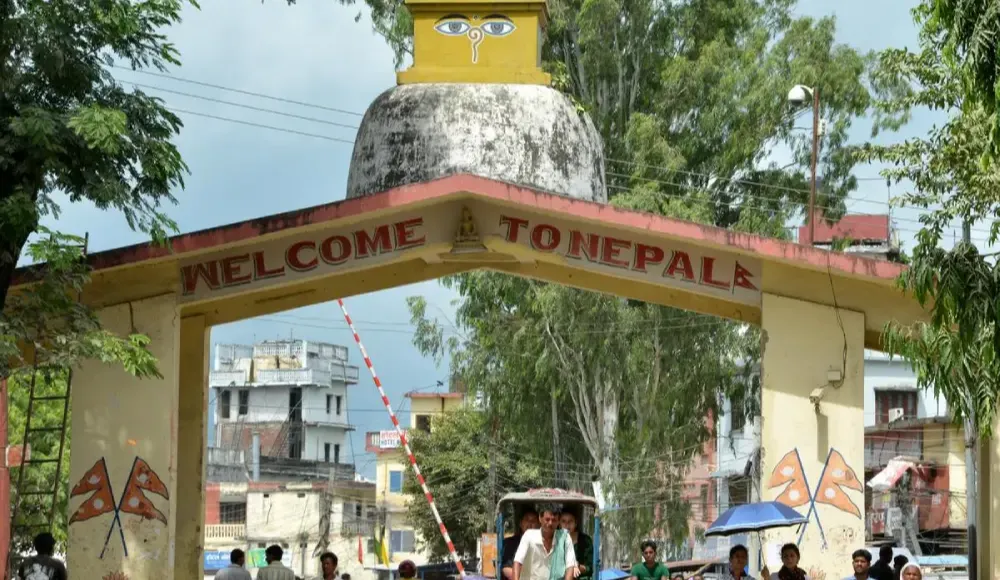
Welcome gate at the Sunauli border

Vehicle Options for the Kailash Return: Kodari to Sunauli

VehicleCapacityAll-In Price (full route)Per person (5 pax)Best For
Mahindra Scorpio (4WD)5–7 pax + luggageNPR 28,000–50,000NPR 5,600–7,600Small pilgrim groups, families
Toyota Land Cruiser (4WD)4–5 pax + luggageNPR 38,000–80,000NPR 7,600–10,400Top-end comfort, couples/small groups
Hiace Van8–14 pax + luggageNPR 30,000–60,000NPR 3,000–4,200 (10 pax)Group pilgrim parties
Coaster Bus15–25 pax + luggageNPR 42,000–80,000NPR 2,100–3,000 (20 pax)Large pilgrim groups

All prices are all-inclusive — vehicle, experienced driver, fuel, driver accommodation and meals for the overnight Kathmandu stop, and all road charges. Lumbini stop adds approximately NPR 800 to 1,200 per vehicle for the additional km and driver time. Contact Nepal Vehicle Hiring via our Plan Your Trip page for confirmed pricing.

Nepal Vehicle Hiring recommends the 2-day approach for all Kailash return pilgrims — both for the physical rest benefit and for the Kathmandu sacred stop opportunity:

  • Day 1 — Kodari to Kathmandu:
  • Nepal vehicle-hiring jeep collects at the Kodari border exit point — confirm pickup time based on the Tibet-side immigration clearance estimate. Drive Araniko Highway west through Bhotekoshi gorge, Barabise rest stop (30 min), Sun Koshi valley, Dhulikhel panorama photography stop. Arrive in Kathmandu approximately 3 to 4 hours after the Kodari exit. Check in to a Thamel hotel. Afternoon: Rest and recover from the Tibet journey.
  • Evening: Nepal Vehicle Hiring; sightseeing vehicle for Pashupatinath Temple — arrive at 4:30 p.m. for the pre-Aarti atmosphere, stay through the 5:00 p.m. Aarti ceremony, and enjoy the post-Aarti ghat walks. Return to Thamel at 7:00 p.m.: dinner and rest.
  • Day 2 — Kathmandu to Sunauli:
  • Depart Kathmandu Thamel at 7:00 a.m. by Nepal Vehicle Hiring jeep/Hiace/Coaster depending on group size. Prithvi Highway west through Trishuli Gorge. Mugling fuel stop and Mahseer fish lunch (45 min). Narayanghat brief stop. Terai Highway southwest. Arrive in Bhairahawa at approximately 3:30 p.m. Lumbini sacred stop (optional, 2 to 3 hours), returning to Bhairahawa at approximately 5:00 p.m. Sunauli border gate drop-off at approximately 5:15 p.m. Nepal immigration exit and India entry at Sunauli/Belahiya.

Alternative Sacred Stops on the Kailash Return Route

Janakpur (Mithila) — Birthplace of Goddess Sita

For pilgrim groups whose India-return route allows a Janakpur visit — and whose pilgrimage specifically includes the Sita Janaki sacred dimension alongside the Kailash Shiva focus — Janakpur (Dhanusha District), located approximately 225 km east of Narayanghat on the eastern Terai highway, is one of Nepal’s most important Hindu pilgrimage sites. The Janaki Mandir : a large Indo-Mughal palace-style temple built in 1911, it marks the birthplace of Sita, Rama’s consort, worshipped as an ideal of feminine virtue in the Vaishnava tradition, and is the most important pilgrimage destination for Sita devotees in Nepal.

For pilgrim groups returning from Kailash who want to combine the Shiva pilgrimage (Kailash) with the Sita pilgrimage (Janakpur), a Janakpur diversion adds 450 km and 2 days to the Terai return journey. Nepal Vehicle Hiring’s Hiace van hire and car hire in Nepal can accommodate this Janakpur extension — contact us via the plan your trip page for a customised Kodari-to-Janakpur-to-Sunauli vehicle plan.

Chitwan National Park — Wildlife Extension

The Narayanghat junction on the Kodari-to-Sunauli return route passes within 30 km of Chitwan National Park (Sauraha) — Nepal’s premier wildlife destination and UNESCO World Heritage Site. For Kailash Yatra groups with 1 to 2 additional days of schedule flexibility in Nepal, a Chitwan wildlife extension (one-horned rhinoceros, Bengal tiger, gharial crocodile, elephant, and 650+ bird species) is one of Nepal’s finest single additions to the pilgrimage return.

Nepal Vehicle Hiring’s car hire in Nepal or Hiace van hire can route via Sauraha from Narayanghat, adding a 2-day Chitwan jungle stay before continuing southwest to Bhairahawa and Sunauli.

Pashupatinath — The Essential Kathmandu Sacred Stop

As described above, the Pashupatinath evening Aarti on the Kathmandu overnight is the most important sacred stop in Nepal on the Kailash return journey. For Shiva devotees, Pashupatinath — where Shiva is enshrined as Pashupati, the Lord of Animals — is the perfect sacred counterpoint to the Kailash journey: the pilgrimage to Shiva’s mountain home is honoured by a visit to Shiva’s most sacred temple in Nepal on the return.

Nepal Vehicle Hiring’s Kathmandu sightseeing service coordinates the Pashupatinath Aarti visit as part of the Kathmandu overnight stop.

Border Formalities: Kodari Exit and Sunauli Entry

Kodari (Nepal Side) — Exit Formalities

At Kodari (also called Tatopani on the Nepal side of this border — distinct from the Tatopani hot spring village on the Kali Gandaki route), pilgrims complete Nepal immigration exit formalities at the Kodari Customs and Immigration checkpoint. This involves: passport surrender for an exit stamp, Nepal customs declaration clearance (particularly for shaligram fossils and other materials collected in Tibet; Nepal has specific regulations on shaligram export that pilgrims should clarify with their Tibet operator before crossing), and vehicle permit clearance for the Nepal-side vehicle.

Nepal Vehicle Hiring’s driver handles vehicle permit formalities while passengers complete personal immigration. Allow 30 to 60 minutes for the complete Kodari exit process.

Sunauli-Belahiya (Nepal Side) — Nepal Exit

At Sunauli’s Belahiya immigration post, pilgrims complete the Nepal exit stamp process to enter India. This is typically smooth for Indian nationals returning from a Nepal pilgrimage—Nepal’s immigration officers are accustomed to the Kailash Yatra pilgrim return flow.

Nepal Vehicle Hiring’s driver drops passengers at the Belahiya gate and assists with luggage to the immigration counter. Allow 15 to 30 minutes for Nepal-side Sunauli exit formalities.

Sunauli (India Side) — India Entry

Indian immigration at the Sunauli Land Port of Entry handles India-side entry at Sunauli (Uttar Pradesh). Indian nationals returning from Nepal require standard passport processing.

After Indian immigration, pilgrims connect to India-side onward transport—typically pre-arranged local vehicles, buses, or taxis to Gorakhpur (approximately 115 km east of Sunauli by road, 2.5 to 3 hours) — for national rail and bus connections to their home destinations. Nepal Vehicle Hiring does not operate vehicles on the India side of the Sunauli border, but our team can advise on India-side transport connections through our partner network.

Kailash Return Kodari to Sunauli Border Drop

Practical Tips for the Kailash Return: Kodari to Sunauli

  • Confirm Kodari pickup timing from Tibet operator: the Nepal-side vehicle pickup at Kodari depends on the Tibet-side immigration clearance time, which the Tibet operator can estimate based on the planned border crossing schedule. Nepal Vehicle Hiring needs a confirmed (or estimated) Kodari crossing time at least 24 hours before the pickup day to position the driver correctly.
  • Carry NPR cash from Tibet for Nepal expenses: the Kodari area and Araniko Highway have limited ATM access. You can pay Nepal Vehicle Hiring’s all-in price in Kathmandu (preferred) or at Sunauli, but pilgrims may want NPR for incidentals on the return journey. The last reliable ATMs before Kodari are in Kathmandu—carry NPR 5,000 to 10,000 per person for return-journey expenses.
  • Declare shaligram and Tibet materials: Nepal and India both regulate the export of shaligram fossils and certain other materials from Tibet. Consult your Tibet operator before crossing at Kodari and carry clear documentation of any shaligram collected in Tibet.
  • Book a Kathmandu hotel before crossing Kodari: Nepal Vehicle Hiring can recommend Thamel hotels and coordinate the hotel booking with the vehicle for the Kathmandu overnight. Confirming the hotel before crossing Kodari ensures a smooth arrival in Kathmandu, without a hotel search after a long Araniko Highway drive.
  • Lumbini timing: for the Lumbini stop, the Maya Devi Temple and Sacred Garden are open from sunrise to sunset. The most contemplative visiting window (before afternoon tour groups) is morning — if the Sunauli crossing timing allows, consider visiting Lumbini on the morning of Day 2 before the Bhairahawa lunch, rather than as an afternoon stop.
  • Sunauli-Gorakhpur connection: Nepal Vehicle Hiring’s operations team can advise on Gorakhpur train connections and bus timings from Sunauli for pilgrims needing to continue within India the same evening as the Nepal border crossing.

Nepal Vehicle Hiring: Complete Kailash Return Service

Nepal Vehicle Hiring provides the complete vehicle service for the Kailash return from Kodari to Sunauli:

Visit our Plan Your Trip page with your Kodari crossing date, group size, Sunauli destination, and any sacred stop preferences (Kathmandu Pashupatinath, Lumbini, Janakpur, Chitwan). We respond within 24 hours with a complete vehicle plan and all-in pricing for the full Kailash return journey. Om Namah Shivaya — Nepal Vehicle Hiring completes the sacred circuit that began with Kailash.

Frequently Asked Questions: Kailash Return Kodari to Sunauli

How long is the drive from Kodari to Sunauli?

The total driving distance is approximately 377 to 395 kilometres, taking 9 to 12 hours of driving (without major stops). Nepal Vehicle Hiring recommends 2 days — Kodari to Kathmandu (Day 1, overnight), Kathmandu to Sunauli (Day 2) — for pilgrim comfort and the Kathmandu sacred stop opportunity.

Can we visit Lumbini on the way to Sunauli?

Yes — Lumbini is 22 km east of Bhairahawa, directly on the Sunauli approach route. Nepal Vehicle Hiring can add the Lumbini stop to the Day 2 itinerary upon request. Allow 2 to 3 hours for the visit; plan a 7:00 a.m. Kathmandu departure for a Lumbini visit and Sunauli border crossing by 5:00-6:00 p.m.

What vehicle is appropriate for the Araniko Highway from Kodari?

The Araniko Highway is paved and accessible for all vehicle types, but the gorge sections and occasional landslide-affected areas benefit from a higher-clearance vehicle. Nepal Vehicle Hiking recommends our 4WD jeep hire or Hiace van hire for the Kodari-to-Kathmandu section. Our drivers are experienced with the Araniko Highway’s current conditions.

What are the shaligram export rules at Kodari?

Nepal and India both have specific regulations on shaligram fossil export — the sacred Vishnu stones collected from the Kali Gandaki River (not from Tibet, but sometimes confused with Tibet-side stone collections). Consult your Tibet operator about the specific materials regulations at the Kodari-Zhangmu crossing. Nepal Vehicle Hiring’s drivers know the general checkpoint protocols but cannot provide legal advice on customs declarations — this must be clarified with your Tibet operator before crossing.

Can Nepal Vehicle Hiring arrange India-side transport from Sunauli?

Nepal Vehicle Hiring operates exclusively on the Nepal side of the Sunauli-Belahiya border. Our vehicles deliver to the Belahiya gate. For India-side transport (Sunauli-to-Gorakhpur and onward), we can provide guidance and partner referrals — ask our operations team via WhatsApp for current India-side transport options from Sunauli.

What if our Kodari crossing date changes due to conditions in Tibet?

Tibet border crossings are subject to Chinese and Nepali governmental conditions that can change with limited notice. Nepal Vehicle Hiking’s Kailash return vehicle bookings include flexible rescheduling for date changes caused by border conditions—contact our operations team via WhatsApp with the revised crossing date, and we will adjust the vehicle schedule accordingly—no penalty charge for border-condition-related date changes.

Kailash Return Kodari to Sunauli Border Drop

The Araniko Highway: Nepal’s Eastern Tibet Corridor

The Araniko Highway connecting Kathmandu to the Kodari-Zhangmu border crossing is one of Nepal’s most historically significant roads — built with Chinese assistance in the 1960s as part of the early Nepal-China bilateral relationship, it was the first motorable connection between the two countries and remains Nepal’s most important China-border road link in the eastern Himalayan zone.

The highway’s name honours Arniko (also spelt Araniko)—the 13th-century Nepali architect who led a mission to China under Kublai Khan and designed some of the most important Buddhist monuments in Beijing and the surrounding region, including the famous White Pagoda in Miaoying Temple. The name reflects the deep historical and cultural exchange between Nepal and China along this corridor, predating the modern road by centuries.

The Araniko Highway descends from the Nepal-Tibet border at Kodari (1,873 m) through the Bhotekoshi River canyon — one of Nepal’s most geologically active gorge systems, where the Indian tectonic plate’s northward movement against the Eurasian plate creates extreme landscape dynamism. The gorge walls rise hundreds of meters on both sides of the narrow road, the river tumbles through class IV and V rapids below, and the geology of active tectonic collision is visible in the tilted, faulted, and folded rock faces that characterise every kilometre of the drive.

For geologically minded passengers, this 60-kilometre gorge section is one of the world’s most accessible demonstrations of active Himalayan geology.

The 2015 earthquake severely damaged the Araniko Highway — multiple sections were blocked by landslides and the road surface was extensively damaged. Reconstruction has been ongoing since 2015, with support from both Nepal and China, and in 2026 the highway is in significantly better condition than in the immediate post-earthquake period.

However, the gorge’s geological instability means the road remains somewhat vulnerable to new landslides, particularly during heavy monsoon rain. Nepal Vehicle Hiring monitors the Araniko Highway daily during the monsoon season and will advise on current road status before any Kodari-based vehicle departure.

The Sunauli-Belahiya Border: Nepal’s Busiest India Crossing

The Sunauli-Belahiya crossing is one of Nepal’s two busiest Nepal-India border gates — the other being the Raxaul-Birgunj crossing in the east. Sunauli serves pilgrims, tourists, and commercial traffic between India’s Uttar Pradesh (and, via Gorakhpur, the entire Indian heartland rail network) and Nepal’s western and central regions. Understanding the Sunauli crossing helps pilgrims returning to Kailash plan their border timing optimally.

Nepal Immigration manages the Nepal side of the border at the Belahiya Immigration Office. The office typically operates from 7:00 a.m. to 7:00 p.m. Nepal Standard Time — plan to arrive at the Nepal immigration post before 6:00 p.m. to allow time for exit stamp processing.

Indian immigration at Sunauli (Uttar Pradesh) typically operates similar hours. The crossing itself — from Nepal immigration exit stamp to India immigration entry stamp — normally takes 30 to 90 minutes depending on queue length and time of day.

Peak crossing times at Sunauli are: morning (8:00 to 10:00 a.m., when overnight bus passengers cross simultaneously) and afternoon (2:00 to 4:00 p.m., when day crossings peak). The quietest window for a smooth crossing is typically mid-morning (10:30 a.m. to noon) or early afternoon (12:30 to 1:30 p.m.).

Nepal Vehicle Hiring’s Kodari-to-Sunauli itinerary is timed to arrive at Belahiya in the mid-afternoon window (3:00 to 4:30 p.m.) — after the peak queue but well before the 7:00 p.m. office closing time.

Currency exchange is available at the Sunauli border — Indian rupees for Nepali rupees and vice versa. Border rates are typically less favourable than in Kathmandu or at authorised exchange houses in Bhairahawa.

Pilgrims with remaining NPR should exchange in Bhairahawa’s main market (approximately 4 km from the border) rather than at the border crossing itself. Upon request, a Nepal Vehicle Hiring driver can stop at a Bhairahawa exchange house on the route to Sunauli.

Kailash Return Kodari to Sunauli Border Drop

Gorakhpur: The India Gateway After Sunauli

For Kailash return pilgrims crossing at Sunauli and continuing into India, Gorakhpur is the first major Indian transportation hub — about 115 kilometers east of Sunauli on NH27, a 2.5 to 3-hour drive. Gorakhpur’s significance for returning Kailash pilgrims:

Gorakhpur Junction railway station is one of India’s busiest and most strategically positioned rail junctions — with direct train connections to Varanasi, Lucknow, Delhi, Allahabad, and dozens of other major destinations across North India. For pilgrims returning to the Indian heartland, Gorakhpur is the primary rail gateway after crossing the Nepal border.

Ideally, book trains from Gorakhpur before crossing into Nepal, as demand on the Gorakhpur-Delhi and Gorakhpur-Varanasi routes is consistently high.

Gorakhpur also has a domestic airport (Gorakhpur Airport, GRX) with connections to Delhi, Lucknow, and other major cities—offering a fast onward travel option for pilgrims who need to reach distant Indian destinations without the train journey. Flight frequency at Gorakhpur has increased significantly in recent years as domestic aviation capacity has improved.

Nepal Vehicle Hiring does not operate vehicles on the India side of the Sunauli border. Still, our operations team can provide current timing information on the Sunauli-Gorakhpur road connection and advise pilgrims who contact us before the Nepal border crossing on the Gorakhpur rail booking process. This India-side connectivity guidance is a supplementary service that helps our Kailash return pilgrims plan their end-to-end journey.

What Kailash Return Pilgrims Carry: Managing the Sacred Items

Kailash Yatra pilgrims returning through Nepal typically carry a range of sacred items collected during the Tibet journey — items that require careful management at the Nepal and India border crossings. Understanding the typical sacred item portfolio helps Nepal Vehicle Hiring provide appropriate vehicle space and driver awareness:

  • Mansarovar water: sacred water from Lake Mansarovar is one of the most prized items Kailash pilgrims carry home—typically stored in sealed copper or brass kalash containers and treated with extreme care as a gift of the highest spiritual value. Nepal Vehicle Hiking’s drivers handle Mansarovar water containers with appropriate care and place them in the vehicle cabin rather than in roof luggage, where vibration could damage the containers.
  • Kailash soil and stones: pilgrims often carry small amounts of soil and stones from the Kailash kora circuit (not from the mountain itself, which is considered too sacred to remove material from) as sacred keepsakes.
  • Butter lamps and monastic items: pilgrims who visited monasteries in Tibet may carry small butter lamp cups, prayer flags, mani stones, and other monastic items received as blessings from lamas.
  • Shaligram fossils: traders in Tibet sometimes sell sacred ammonite stones from the Kali Gandaki River (which passes close to the Kailash region); these require specific documentation at the Nepal border, as shaligram export is regulated. Nepal Vehicle Hiking strongly recommends clarifying shaligram documentation with the Tibet operator before crossing Kodari.
  • Thangka paintings: Tibetan Buddhist thangka paintings acquired in Tibet or Kathmandu are common pilgrim purchases. These require appropriate tube or flat packaging for vehicle transport and may require art export documentation at customs.

Nepal Vehicle Hiring’s vehicles for the Kailash return service have sufficient cabin space to carry sacred items securely and respectfully—not mixed with general luggage in the roof carrier. Our drivers are briefed on the significance of Mansarovar water and other sacred items and handle them accordingly.

Kathmandu: The Sacred Midpoint of the Kailash Return

The Kathmandu overnight on the Kailash return journey is more than a logistics stop — it is the sacred midpoint of the homecoming that connects the mountain pilgrimage to the temple tradition. For Shiva devotees, the sequence of Pashupatinath (pre-departure blessing) → Kailash (the pilgrimage itself) → Pashupatinath (return thanksgiving) has a completeness that the direct overland return to India does not provide.

Nepal Vehicle Hiring’s Kathmandu overnight service is built around this sacred completeness—ensuring pilgrims who want the Pashupatinath Aarti thanksgiving have the vehicle, timing, and attention this ceremony deserves.

The Pashupatinath evening Aarti at 5:00 p.m. is organised by the temple’s Bhat Brahmin priests—a fire ceremony (deep daan) in which lit lamps are offered to the Bagmati River and the Shiva linga in the main temple, accompanied by the sounds of conch shells, bells, and Sanskrit mantras. For a returning Kailash pilgrim who has just come from Mount Kailash — Shiva’s cosmic home — and is visiting Pashupatinath — Shiva’s most sacred temple in Nepal — the Aarti carries a spiritual intensity that feels genuinely different from an ordinary tourist visit.

The priests who perform the ceremony are aware of the Kailash Yatra return context and often acknowledge returning pilgrims specifically.

In addition to Pashupatinath, the Kathmandu overnight allows pilgrims to visit Boudhanath Stupa. For Buddhist members of many Kailash Yatra groups, the morning kora at Boudhanath (6:30 to 9:00 a.m., with the Tibetan Buddhist community performing the circumambulation) complements this Hindu sacred space.

Nepal Vehicle Hiring’s Kathmandu sightseeing service covers both sites — Boudhanath in the morning, Pashupatinath in the evening — as a complete Kathmandu sacred day for Kailash return pilgrims.

Kailash Return Kodari to Sunauli Border Drop

The Complete Kailash Yatra Nepal Circuit: Entry and Return Options

The Kodari-to-Sunauli return is one of several Nepal-side Kailash Yatra circuit configurations. Understanding the full range of Nepal entry and exit options for the Kailash Yatra helps pilgrim groups plan the complete circuit:

Entry: Sunauli → Kathmandu → Kodari → Tibet (Classic Circuit)

The classic Nepal Kailash Yatra circuit enters Nepal at Sunauli from India (Gorakhpur side), visits Kathmandu and Pashupatinath, drives the Araniko Highway to Kodari for the Tibet crossing, completes the Kailash circuit in Tibet, and returns through Kodari to Kathmandu (Pashupatinath Aarti) before exiting Nepal at Sunauli. This is the circuit that the Kodari-to-Sunauli return serves.

Nepal Vehicle Hiring covers both legs: outbound Sunauli to Kodari via Kathmandu, and return Kodari to Sunauli via Kathmandu.

Entry: Sunauli → Kathmandu → Lumbini → Muktinath → Kodari → Tibet (Extended Nepal Circuit)

The extended Nepal sacred circuit adds Lumbini (Buddha’s birthplace) and Muktinath (a sacred Vishnu temple at 3,710 m in Mustang) to the Kathmandu stop before the Kodari crossing. This extended circuit takes 7 to 10 additional days in Nepal.

Still, it is one of Nepal’s most complete sacred circuits—connecting Lumbini (Buddha’s birthplace), Muktinath (Nepal’s most sacred mountain Vishnu temple), Pashupatinath (Nepal’s most sacred Shiva temple), and Kailash (Shiva’s cosmic mountain home) into a single pilgrimage. Nepal Vehicle Hiring’s Nepal Nekhor tour service coordinates the vehicle for the full Nepal circuit up to the Kodari crossing, with the Kailash return vehicle completing the circuit at Sunauli.

Return: Kodari → Kathmandu → Fly to India (Air Return Option)

For pilgrims who prefer to return to India by air rather than overland through Sunauli, Nepal Vehicle Hiking provides the Kodari-to-Kathmandu vehicle with airport drop-off at Tribhuvan International Airport for the Kathmandu-to-Delhi, Kathmandu-to-Mumbai, or other India-destination international flights. This air return option is significantly faster (flight time: 2 to 4 hours vs a 2-day road journey) but more expensive per person.

Our Kathmandu airport transfer service covers the TIA domestic and international terminal drop for Kailash return pilgrims choosing the air return.

The Terai Highway: Nepal’s Southern Corridor

The Narayanghat-to-Sunauli section of the Kailash return journey travels through the Terai — Nepal’s low-altitude southern strip of subtropical plains that borders India. Understanding the Terai landscape and its highway character helps pilgrims appreciate this final leg of Nepal’s return journey.

The Mahendra Highway (East-West Highway) through the western Terai is predominantly flat, well-maintained blacktop that runs through sal forest, farmland, and small market towns. The road passes through the major Terai cities of Butwal and Bhairahawa before reaching the Sunauli border.

The Terai’s subtropical character — significantly hotter than Kathmandu, with dense green vegetation and a very different sensory atmosphere from the high-altitude Himalayan world of the Kailash circuit — marks the geographical and atmospheric transition back to the Indian plains.

For many Kailash return pilgrims, the Terai drive is the first encounter with a landscape that genuinely resembles India — the flat horizon, the large sal and sissoo trees lining the road, the agricultural villages with their thatched-roof houses, and the warm humid air replacing the cold, dry mountain atmosphere of the previous weeks. This landscape transition is itself a meaningful element of the return journey — the gradual re-entry into the lowland world after the extraordinary elevation of the Kailash circuit.

The western Terai between Narayanghat and Bhairahawa passes through the edges of several protected forest areas — Royal Suklaphanta Wildlife Reserve (further west) and the Chitwan buffer zone forests (near Narayanghat) — giving the highway drive occasional sightings of deer, monkeys, and birds that remind travellers they are passing through one of South Asia’s most biodiversity-rich lowland landscapes. Nepal Vehicle Hiring drivers pause briefly for any notable wildlife sighting on the Terai highway when requested.

Bhairahawa (Siddharthanagar): The Last Nepal City

Bhairahawa — officially renamed Siddharthanagar in 2000 to honour its proximity to Lumbini, the birthplace of the Buddha (Siddhartha Gautama) — is the final significant Nepalese city before the Sunauli border crossing and deserves more attention than the typical rapid transit it receives in most Nepal travel itineraries.

The city has developed significantly in recent years, driven by its position as the gateway to Lumbini’s growing international pilgrimage and tourism economy. The opening of Gautam Buddha International Airport (Bhairahawa’s airport, now operating international flights to India, China, and Southeast Asian destinations since 2022) has further increased the city’s connectivity and commercial significance.

For Kailash return pilgrims, Bhairahawa offers reliable ATMs (NIC Asia, Nepal SBI, Everest Bank) for final NPR exchange; money exchange houses at more favourable rates than the Sunauli border; pharmacies and shops for last-minute purchases; and several decent restaurants for a final Nepal meal before crossing into India.

Nepal Vehicle Hiring’s Kathmandu-to-Sunauli driver knows Bhairahawa’s commercial streets and can stop at the right ATM, exchange house, or restaurant as needed before the 4-kilometre final drive to the Sunauli border gate. The city’s compact layout makes a 330-to-445-minute stop in Bhairahawa practical without significantly extending the total Kathmandu-to-Sunauli journey time.

Nepal’s Nepal–India Border Relations: Context for the Sunauli Crossing

The Sunauli-Belahiya crossing operates under the Nepal-India Treaty of Peace and Friendship (1950) and subsequent Open-Border arrangements that allow Nepali and Indian citizens to cross the Nepal-India border freely, without visa requirements. This freedom of movement — unique in South Asia — makes the Nepal-India border crossing at Sunauli significantly simpler for Nepali and Indian nationals than international border crossings elsewhere in the world.

For Indian nationals returning from the Kailash Mansarovar Yatra via Sunauli, the process is: Nepal exit stamp at Belahiya (free, immediate), walk across the border (approximately 200 meters), India entry at Sunauli Immigration. No visa or advance registration is required for the Sunauli crossing (unlike some other Nepal-India border crossings that have had specific requirements during certain periods).

The main document check: passport with a valid Nepal entry stamp, Chinese Group Visa for Tibet (already expired post-trip, but kept for record), and any customs declarations for materials carried from Tibet.

For non-Indian, non-Nepali nationals in mixed Kailash Yatra groups (e.g., Indian-origin overseas citizens, NRI passport holders, or non-South Asian nationals who joined the Kailash group), Sunauli crossing procedures may differ. Some visa categories have specific requirements at land border crossings.

Non-Indian nationals should verify their eligibility for the Sunauli crossing before the Nepal leg of their Kailash Yatra. Nepal Vehicle Hiring’s operations team can provide general guidance but recommends verifying specific visa eligibility through the relevant Indian embassy or consulate.

Completing the Sacred Circle: The Meaning of the Return Journey

In Hindu tradition, the Kailash Mansarovar Yatra is a complete sacred circuit—not just the arrival at Kailash and the parikrama around it, but the full journey from home to the mountain and back again. The return journey through Nepal — the Araniko Highway descending from the Tibet border, the Kathmandu overnight with Pashupatinath’s blessing, the Terai highway south through Lumbini’s sacred landscape, and the final border crossing back into India — is not a denouement after the main event. It is the second arc of the sacred circle.

Pilgrims who rush through the Nepal return—taking the first available transport directly from Kodari to the nearest India border without a Kathmandu stop or Lumbini visit—miss what Nepal’s sacred geography offers the returning pilgrim. The Pashupatinath Aarti on the return evening is the thanksgiving ceremony that closes the Yatra’s devotional arc.

The Lumbini stop adds the Buddha’s presence to a pilgrimage that is fundamentally a Hindu journey, opening it into a broader encounter with the subcontinent’s sacred heritage. The Terai forests and the Indian horizon approaching over the Bhairahawa plains visually confirm that the circle is closing.

Nepal Vehicle Hiring’s Kodari-to-Sunauli return service is designed around this understanding. Our 2-day itinerary with Kathmandu overnight and optional Lumbini stop is not a convenience offering — it is a service built around the sacred structure of the Kailash return journey.

The vehicle is the physical carrier; pilgrims have made the journey it carries for centuries. We take that responsibility seriously, and we are honoured to be part of the sacred circuit that completes at Sunauli’s border gate.

Om Namah Shivaya. Nepal Vehicle Hiring completes the journey. WhatsApp | [email protected] | vehiclehiringnepal.com

Hilsa Border to Gorakhpur Airport Drop Vehicle

Hilsa Border to Gorakhpur Airport Drop Vehicle

Hilsa Border to Gorakhpur Airport Drop Vehicle — Complete Guide for Kailash Yatra Return

Every Year, tens of thousands of Indian pilgrims complete the sacred Kailash Mansarovar parikrama via the Hilsa-Purang route — crossing the Nepal-Tibet border at Hilsa in Humla District, returning by helicopter to Simikot, flying to Nepalgunj, and then requiring ground transport to reach Gorakhpur, Lucknow, Varanasi, and other major cities of Uttar Pradesh and Bihar. Among these, the Gorakhpur connection — specifically the vehicle drop from the Nepal side of the India-Nepal border to Gorakhpur Airport — is one of the most frequently requested and least comprehensively documented logistics arrangements in the entire Kailash yatra return chain.

Gorakhpur Airport (IATA: GOP) is one of the most convenient Indian gateways for Kailash Mansarovar pilgrims from Uttar Pradesh, Bihar, and the surrounding states — serving flights to Delhi, Mumbai, Bengaluru, and other major Indian hubs, and positioned approximately 3.5 to 4.5 hours by road from the Nepal-India border crossing at Sonauli (Sunauli) or approximately 4 to 5 hours from the Rupaidia border near Nepalgunj. This guide covers the complete return logistics chain from the Hilsa border crossing to Gorakhpur Airport: the helicopter, the domestic flight, the Nepal-side vehicle hire, the border crossing, and the India-side road to Gorakhpur — with 2026 prices, pre-arrangement advice, and how Nepal Vehicle Hiring Pvt Ltd provides the verified Nepal-side vehicle service that gets Kailash pilgrims to the India border efficiently and professionally.

The Complete Route — Hilsa Border to Gorakhpur Airport

The return from Hilsa to Gorakhpur Airport follows a specific four-segment chain that every Indian Kailash pilgrim on this route completes in the same sequence. Understanding each segment’s character, duration, and potential delay point is the foundation of realistic logistics planning.

Segment 1: Hilsa to Simikot by Helicopter (25 minutes). After completing Nepal re-entry formalities at the Hilsa checkpoint, pilgrims board the helicopter for the 25-minute flight to Simikot Airport at 2,910 meters. The Hilsa-to-Simikot helicopter (operated by Simrik Air, Dynasty Aviation, and others) carries 4 to 5 passengers per flight and depends entirely on the weather.

Morning flights have the highest success rate. Weather delays of one to two days at Hilsa are common — all logistics downstream of this segment must be planned with buffer days.

Segment 2: Simikot to Nepalgunj by Domestic Flight (45 minutes). From Simikot Airport, scheduled domestic flights by Tara Air and Buddha Air cover the 45-minute route to Nepalgunj Airport (152 meters). Simikot flights are similarly weather-dependent — morning departures have the highest completion rate.

An overnight in Simikot may be required when afternoon cloud prevents departure. Nepalgunj is the hub connecting the mountain aviation segment to Nepal’s main ground and domestic network.

Segment 3: Nepalgunj to India Border by Nepal Vehicle (2-6 hours). From Nepalgunj, Nepal Vehicle Hiring Pvt Ltd provides private vehicle hire to the India border — either to the Rupaidia crossing (approximately 12 km from Nepalgunj city, 30 to 45 minutes) for the Bahraich-Gorakhpur road, or to the Sonauli/Sunauli crossing (approximately 160 km from Nepalgunj, 4 to 5 hours), which provides the more direct road approach to Gorakhpur. The choice between these two border crossings is the critical logistics decision for the Gorakhpur-bound return, and Section 4 of this guide covers both options in full.

Segment 4: India Border to Gorakhpur Airport (2.5-5 hours depending on border used). From the India border, India-side transport operators manage the road to Gorakhpur Airport via Rupaidia/Bahraich: approximately 150 kilometres, 4 to 5 hours. Via Sonauli/Sunauli: approximately 110 to 120 kilometres, 3 to 3.5 hours. Gorakhpur Airport is about 5 kilometres from Gorakhpur city centre and well signposted on the major city approach roads.

Why Gorakhpur Is the Right Hub for Eastern UP and Bihar Pilgrims

Gorakhpur holds a key position in the geography of the Indian Kailash Mansarovar pilgrimage, making it an important hub for return logistics. Gorakhpur, Uttar Pradesh, is about 10 to 12 hours by overnight train from Lucknow, 12 to 14 hours from Varanasi, and is connected by direct domestic flights to Delhi, Mumbai, Bengaluru, Hyderabad, and other major Indian cities.

Its position about 90 kilometres south of the Nepal border at Sonauli makes it a natural collection point for pilgrims from eastern UP and Bihar who may have departed for Nepal via Gorakhpur itself or the Sonauli border crossing.

Gorakhpur Airport (Mahayogi Gorakhnath Airport, IATA: GOP) has undergone significant infrastructure expansion in recent years, upgrading its terminal and extending its runway to accommodate larger jet aircraft alongside the ATR-72 and similar regional aircraft that previously dominated its schedule. In 2026, the airport serves direct flights on IndiGo, SpiceJet, Air India, and other domestic carriers to Delhi (approximately 1.5 hours), Mumbai (approximately 2.5 hours), and other major destinations.

For Kailash yatra pilgrims who have completed the parikrama and need to return to a major Indian city for an international connection, Gorakhpur Airport offers a reliable, efficient gateway that eliminates the need to travel overland all the way to Delhi or Lucknow.

The pilgrimage community’s relationship with Gorakhpur goes beyond logistics: the city is home to the Gorakhnath Temple—one of the most important Shaivite religious centres in northern India —dedicated to Guru Gorakhnath, whose lineage connects directly to the Kailash-Shaivism tradition. Many returning Kailash yatra pilgrims choose Gorakhpur specifically for this post-yatra darshan opportunity — the Gorakhnath Temple is the natural spiritual continuation of the Kailash sacred experience, and the temple’s proximity to the airport makes pre-departure darshan entirely feasible for pilgrims with sufficient time.

Hilsa Border to Gorakhpur Airport Drop Vehicle

The Nepalgunj Hub — The Decision Point for Gorakhpur-Bound Return

Nepalgunj is the critical junction where the returning Kailash pilgrim’s logistics chain branches toward Gorakhpur rather than toward Kathmandu. On arrival at Nepalgunj from the Simikot domestic flight, the pilgrim has three primary onward options:

Option A — Domestic flight Nepalgunj to Kathmandu, then international. The standard option for pilgrims with Kathmandu-based international flight connections. Nepal Vehicle Hiring Pvt Ltd’s Kathmandu airport transfer service picks you up at Kathmandu Airport after your Nepalgunj flight arrives.

Option B — Rupaidia border crossing, drive to Gorakhpur (shorter Nepal leg). From Nepalgunj, this is the fastest way to reach the India border — a short 12 km drive to the Rupaidia checkpoint (approximately 30 to 45 minutes by private vehicle from Nepal Vehicle Hiring Pvt Ltd). On the India side, the road from Rupaidia through Bahraich District to Gorakhpur is about 150 km and takes 4 to 5 hours.

Option C — Sonauli/Sunauli border crossing, drive to Gorakhpur (more direct India road). This option requires a longer Nepal-side drive—about 160 km from Nepalgunj to Sunauli along the Mahendra Highway (4 to 5 hours by private vehicle)—but provides the shorter, more direct India-side road to Gorakhpur (about 110 to 120 km, 3 to 3.5 hours from Sunauli). Total journey time from Nepalgunj to Gorakhpur via Sonauli: approximately 8 to 9 hours.

Nepal Vehicle Hiking Pvt Ltd’s Hiace van hire or private jeep hire covers the Nepal-side Nepalgunj-to-Sonauli leg.

The Border Crossing Options — Rupaidia vs Sonauli — The Two Nepal-India Border Crossing Points. The Rupaidia border (also called Rupaidiha on the India side) is the nearest Nepal-India crossing to Nepalgunj—just 12 kilometres northwest of Nepalgunj city. The India-side town is Rupaidiha in Bahraich District, Uttar Pradesh. The road from Rupaidiha to Gorakhpur via Bahraich city is about 150 kilometres and takes 4 to 5 hours, depending on traffic through Bahraich’s busy market district. This is the fastest option from Nepalgunj into India, but the longer India-side road to Gorakhpur means the total Nepalgunj-to-Gorakhpur journey takes about 5 to 6 hours.

Hilsa Border to Gorakhpur Airport Drop Vehicle

The Sonauli/Sunauli border is the more famous and heavily used Nepal-India crossing for Kailash yatra pilgrims from central and western UP — located at Bhairahawa/Siddharthanagar in Nepal and Sonauli in Uttar Pradesh, about 160 kilometres east of Nepalgunj along the Mahendra Highway. The India-side road from Sonauli to Gorakhpur via Naugarh is about 110 to 120 kilometres—significantly shorter than the Rupaidia approach.

For pilgrims with time for the 4- to 5-hour Nepal-side drive from Nepalgunj to Sonauli, this border offers the fastest total journey to Gorakhpur.

Which crossing for Gorakhpur-bound pilgrims? The pure time calculation favours Rupaidia for the Nepal-side and Sonauli for the India-side — but the two are in opposite directions from each other, and Nepalgunj lies roughly between them. For pilgrims prioritising the shortest India-side vehicle exposure, Rupaidiha (30-45 min from Nepalgunj) is clearly faster.

For pilgrims who want the shortest total road journey from Nepalgunj to Gorakhpur, Sonauli’s shorter India-side road may make the total journey faster despite the longer Nepal-side drive. Nepal Vehicle Hiring Pvt Ltd advises on current road conditions and border crossing queue status when confirming the Nepalgunj-to-border private jeep hire.

Nepal Vehicle Hiring Pvt Ltd’s Nepal-Side Service — Nepalgunj to Border

Nepal Vehicle Hiring Pvt Ltd’s jurisdiction for the Hilsa-to-Gorakhpur logistics chain covers the Nepal-side ground transport legs — specifically the Nepalgunj hotel coordination and the private vehicle from Nepalgunj to the India border. India-side operators manage the road from the border to Gorakhpur, and the respective aviation operators manage the helicopter and domestic flight legs.

Nepalgunj to Rupaidia Border (12 km, 30-45 minutes): Hire a private car or jeep from any Nepalgunj hotel to the Rupaidia border checkpoint. Price: approximately NPR 2,000 to 4,000 (USD 15 to 30) for the full vehicle, all-inclusive. For groups of 5 to 10+, our Hiace van hire can take the whole group and baggage to the border in a single vehicle.

Nepalgunj to Sonauli Border (160 km, 4-5 hours on Mahendra Highway): Private 4WD jeep hire or Hiace van hire on the Mahendra Highway westward to Bhairahawa/Sunauli. The Mahendra Highway is flat, paved, and manageable for standard vehicles—no 4WD required on this section —so a private sedan or Hiace is appropriate for the full group.

Price for private jeep or car: approximately NPR 14,000 to 30,000 (USD 105 to 180) one way. Hiace for groups: approximately NPR 18,000 to 40,000 (USD 135 to 250).

Nepalgunj Hotel Coordination: Nepal Vehicle Hiking Pvt Ltd pre-arranges Nepalgunj hotel accommodation for the overnight between the Simikot flight and the border connection — an essential element of the return chain given the Simikot weather delay probability. We confirm the hotel booking and border vehicle hire as a single arrangement through our plan trip page, or you can contact our team on WhatsApp.

Hilsa Border to Gorakhpur Airport Drop Vehicle

The Kailash Yatra Outward Journey via Gorakhpur — The Return Logic

Most Indian Kailash yatra pilgrims who return via Gorakhpur Airport also began their yatra from Gorakhpur or its surrounding region — making the return to Gorakhpur a natural closing of the full pilgrimage circle. The standard outward journey from Gorakhpur for the Hilsa-route Kailash yatra follows: Gorakhpur → overland to Sonauli or Rupaidia border → cross into Nepal → Nepalgunj → domestic flight → Simikot → helicopter → Hilsa → cross into Tibet → Taklakot → Mansarovar → Kailash parikrama. Return: same reverse sequence.

This return logic means that the Gorakhpur-based pilgrim group’s operator typically arranges India-side transport for the Gorakhpur-to-border outward journey and the border-to-Gorakhpur return journey. Nepal-side logistics are coordinated separately—either through the registered Nepal operator or, for vehicle hire specifically, through Nepal Vehicle Hiring Pvt Ltd as the specialist Nepal ground transport provider.

Many registered Kailash yatra operators from Lucknow, Gorakhpur, Varanasi, and Delhi coordinate Nepal-side ground transport through Nepal Vehicle Hiring Pvt Ltd via our operator partnership program—ensuring the Nepal vehicle hire meets the same professional standard as the India-side logistics the group’s home-city operator provides.

Lucknow vs Gorakhpur — The Two Major UP Return Options

For Kailash yatra pilgrims returning from Nepal to Uttar Pradesh via the Nepalgunj hub, the two most common India destination options are Gorakhpur and Lucknow—and understanding each route helps operators and individual pilgrims choose the right connection.

Nepalgunj to Gorakhpur via Rupaidia. Total: approximately 162 km. Nepal side: 12 km to Rupaidia border (30 min by private vehicle). India side: 150 km from Rupaidiha to Gorakhpur via Bahraich (4-5 hours). Total door-to-door from Nepalgunj: approximately 5 to 6 hours.

This is the faster option for pilgrims specifically bound for Gorakhpur.

Nepalgunj to Lucknow via Rupaidia. Total: approximately 355 km. Nepal side: 12 km to Rupaidia (30 min). India side: 340 km from Rupaidiha to Lucknow via Bahraich and Barabanki (6-7 hours). Total from Nepalgunj: approximately 7 to 8 hours.

Lucknow Airport offers more frequent international connections than Gorakhpur and is the preferred hub for pilgrims departing internationally.

Nepalgunj to Gorakhpur via Sonauli. Total: approximately 270 km. Nepal side: 160 km Nepalgunj to Sonauli (4-5 hours by private jeep). India side: 110 km Sonauli to Gorakhpur (3-3.5 hours). Total: approximately 8-9 hours.

Slower than the Rupaidia route for Gorakhpur-bound groups, but it serves pilgrims who prefer the better India-side road quality at the Sonauli crossing.

Nepalgunj to Varanasi via Rupaidia. Total: approximately 490 km door-to-door. Varanasi — one of Hinduism’s most sacred cities — is a natural post-Kailash destination for Shaivite pilgrims: the Vishwanath Temple and Kashi’s sacred geography provide the Benares experience that completes the Kailash-Shiva pilgrimage circuit for many devotees.

Mount Kailash Tour

Group Sizes and Vehicle Options for the Nepal-India Border Transfer

Kailash Mansarovar yatra groups range from 4 to 20 pilgrims — and the right vehicle type for the Nepalgunj-to-border leg depends on group size, baggage volume, and comfort requirements.

Small groups (2-4 pilgrims): Private car hire (sedan) or private jeep for the Nepalgunj-to-Rupaiya short hop. For the longer Nepalgunj-to-Sonauli, a private jeep provides the comfort and cargo space for full yatra luggage.

Medium groups (5-10 pilgrims): Toyota Hiace van hire — carries the full group and all yatra baggage in a single vehicle, preserving the cohesion pilgrims value when returning from a shared sacred journey.

Large groups (11-25 pilgrims): Tourist coaster hire (14 to 22 passengers) or full tourist bus hire for large pilgrimage parties. Nepal Vehicle Hiring Pvt Ltd’s fleet covers all these sizes; contact our team on WhatsApp.

Price Guide — Nepal-Side Vehicle Hire for Gorakhpur-Bound Return

Nepalgunj to Rupaidia border (12 km, short hop): NPR 2,000 to 4,000 (USD 15 to 30) by private car or jeep. NPR 4,000 to 10,000 (USD 30 to 80) by Hiace van for groups.

Nepalgunj to Sonauli border (160 km, Mahendra Highway): NPR 14,000 to 30,000 (USD 105 to 180) by private jeep or car. NPR 18,000 to 40,000 (USD 135 to 250) by Hiace van. NPR 22,000 to 50,000 (USD 165 to 300) by tourist coaster.

Nepalgunj airport/hotel pickup: Included in all private vehicle hire from Nepal Vehicle Hiring Pvt Ltd — the vehicle is positioned at the Nepalgunj hotel for the confirmed departure time, not at the airport separately.

Overnight at a Nepalgunj hotel: Standard double room: NPR 2,000 to 5,000 (USD 15 to 37) per person per night at Nepalgunj’s mid-range hotels. Nepal Vehicle Hiring Pvt Ltd pre-books through partner hotels — confirm the hotel booking alongside the border vehicle hire via our plan trip page.

The Gorakhpur Airport Connection — What Pilgrims Need to Know

Gorakhpur Airport (Mahayogi Gorakhnath Airport, IATA: GOP) is situated approximately 5 kilometres from Gorakhpur city centre on the Gorakhpur-Lucknow road. The airport’s terminal expansion, completed in 2023, has significantly improved handling capacity—the new international-standard terminal accommodates domestic and limited international operations, with modern check-in, security, and airside facilities.

In 2026, Gorakhpur Airport serves direct domestic routes to Delhi (IndiGo, SpiceJet, Air India — approximately 1.5 hours), Mumbai (approximately 2.5 hours), Bengaluru, Hyderabad, Ahmedabad, and other major Indian hubs.

For Kailash yatra pilgrims arriving at Gorakhpur Airport via the Nepal-side logistics chain, the key practical consideration is a 2.5- to 3-hour buffer from the India border crossing to the airport for the road transfer and check-in. Book flights with Gorakhpur arrival in mind—Gorakhpur-Delhi flights operate multiple times daily; Gorakhpur-Mumbai typically operate 2 to 3 times daily; other routes have more limited frequency.

Book the Gorakhpur domestic departure well in advance, and pre-arrange Nepalgunj return logistics around a confirmed Gorakhpur flight time. And the Gorakhnath Temple option — for pilgrims who can accommodate a 1 to 2-hour pre-flight temple visit, the Gorakhnath Temple (approximately 8 km from the airport, 20 minutes) offers the natural Kailash-Shiva sacred-site continuation that makes Gorakhpur a particularly meaningful final Nepal-India chapter of the yatra.

Lumbini Extension — The Sacred Addition on the Nepal Side

For Kailash yatra pilgrims returning through Nepalgunj who have one additional day and the spiritual inclination to visit Nepal’s second great sacred site, Lumbini — the birthplace of Lord Buddha — is accessible from Nepalgunj via the Mahendra Highway eastward and the Lumbini connecting road, approximately 165 to 180 kilometres from Nepalgunj (approximately 4 to 5 hours by private vehicle). Lumbini’s Mayadevi Temple, the sacred Puskarini pond, the Ashoka Pillar, and the international monastery zone together create one of the world’s most important Buddhist sacred sites — and for pilgrims adding Lumbini to their return before crossing to India via Sonauli/Sunauli (which lies approximately 22 km from Lumbini), the extension is both geographically efficient and spiritually coherent.

Nepal Vehicle Hiring Pvt Ltd’s private vehicle hire from Nepalgunj to Lumbini and the onward Lumbini-to-Sonauli transfer cover this Lumbini extension as a coordinated arrangement—the group visits Lumbini, then continues to Sonauli for the India crossing and the Gorakhpur road. The Kathmandu extension — Lumbini to Kathmandu for additional pre-departure Nepal sightseeing — is also available through our Kathmandu sightseeing car hire and Bhaktapur heritage day tour. Plan the complete return extension through our Nepal tour package page.

August  Kerung Closure — Why This Guide Is Essential Reading

The August 26, 2026 glacial lake outburst flood destroyed the Rasuwagadhi-Kerung border crossing, funnelling all Kailash Mansarovar yatra return traffic onto the single Hilsa-Simikot-Nepalgunj corridor. Before August 2026, pilgrims returning via the Kerung route reached Kathmandu directly and had relatively straightforward logistics for the India connection via Kathmandu’s well-served international airport.

After August 2026, the Nepal-India ground transport chain via the Hilsa-Nepalgunj corridor becomes the primary return route for all Indian Kailash yatra pilgrims—making Nepalgunj-to-Gorakhpur and Nepalgunj-to-Lucknow vehicle logistics questions that were previously specialist knowledge now central to every Indian operator’s planning.

The specific change this creates for India-based operators: groups that previously arranged a Kathmandu domestic or international flight departure now need to understand and arrange the Nepalgunj-to-border vehicle logistics as an active planning component rather than a default Kathmandu connection. Nepal Vehicle Hiring Pvt Ltd meets this need—you can pre-arrange our private vehicle hire, Hiace van hire, and bus hire for the Nepalgunj-to-Rupaiya and Nepalgunj-to-Sonauli legs through our plan trip page or by contacting our team on WhatsApp well before the yatra departure.

Hilsa Border to Gorakhpur Airport Drop Vehicle

The Mahendra Highway — Nepal’s Terai Corridor

The Mahendra Highway connects Nepalgunj to the Sonauli border and continues eastward across Nepal’s Terai, making it one of the country’s most important national roads. This flat, well-paved highway runs about 1,028 kilometres along the Terai, from Mechi in the east to Mahakali in the west.

For Kailash yatra pilgrims taking the Nepalgunj-to-Sonauli leg by private vehicle from Nepal Vehicle Hiring Pvt Ltd, the Mahendra Highway provides a comfortable and reliable 16160-kilometre stretch through the Terai’s characteristic landscape: flat agricultural land, periodic small bazaar towns, and the distinctly different atmosphere of Nepal’s lowland region after the dramatic mountain terrain of the yatra above.

The Mahendra Highway between Nepalgunj and Bhairahawa (Sonauli) passes through Kohalpur, Ghorahi (Dang District), Tulsipur, Butwal, and the approach to Bhairahawa. The road is fully paved and well maintained, carrying a mix of heavy truck traffic serving Nepal-India trade, local inter-city buses, and private vehicles.

The 55-hour private-vehicle journey reflects the distance and occasional traffic delays through major towns. Nepal Vehicle Hiring Pvt Ltd’s Mahendra Highway vehicle hire includes experienced drivers who know the specific traffic patterns of the Butwal and Bhairahawa approaches.

For pilgrims visiting the sacred site of Lumbini, the Mahendra Highway passes within 3 kilometres of the Lumbini Development Zone at the Bhairahawa junction, making it the natural approach road to the Lumbini extension before continuing to Sonauli. You can book our Lumbini vehicle hire and Nepal tour packages covering the Nepalgunj-Lumbini-Sonauli circuit through our planned trip page.

The Kailash Yatra Operator Partnership — How India-Based Operators Work with Nepal Vehicle Hiring Pvt Ltd

The Kailash Mansarovar yatra for Indian pilgrims is typically organised by India-based operators — companies in Lucknow, Gorakhpur, Delhi, Ahmedabad, Chennai, and other cities that coordinate the complete yatra circuit: India-side transport to Nepal, Nepal aviation (Nepalgunj-Simikot flight and Simikot-Hilsa helicopter), Tibet-side transport (provided by Chinese-licensed ground handlers), and the return Nepal logistics. For Nepal ground transport specifically—the private vehicle hire from Nepalgunj to the India border—India-based operators routinely work with Nepal Vehicle Hiring Pvt Ltd as their verified Nepal ground transport partner.

The operator partnership arrangement works as follows: the India-based yatra operator contacts Nepal Vehicle Hiring Pvt Ltd on WhatsApp or through our plan trip page with the group’s yatra dates, size, and return logistics requirements. Nepal Vehicle Hiring Pvt Ltd quotes Nepal-side vehicle hire from pickup at the Nepalgunj hotel to the confirmed India border crossing.

The quote is all-inclusive — driver, fuel, road tolls, and hotel coordination — and is confirmed in writing before any payment. On the return day, our driver arrives at the Nepalgunj hotel at the confirmed time with the confirmed vehicle and coordinates any adjustments for Simikot weather delays via WhatsApp with the group leader throughout the Hilsa-Simikot-Nepalgunj transit.

This operator partnership model eliminates the India-based operator’s need to find Nepal ground transport separately on each yatra—Nepal Vehicle Hiring Pvt Ltd becomes the consistent Nepal ground transport partner across multiple yatra seasons, providing the reliability and professional standard India-based operators need for their clients. The operator partnership is available for all Kailash yatra return formats: Nepalgunj to Rupaidia, Nepalgunj to Sonauli, Nepalgunj to Kathmandu by private vehicle, or the Kathmandu airport transfer for groups taking the domestic flight to Kathmandu. Contact our team on WhatsApp to establish an operator account.

Post-Yatra Nepal Additions — Extending the Sacred Journey

Not all Kailash yatra pilgrims return to India immediately via the Nepalgunj border crossing. Many — particularly those on their first Nepal visit — choose to extend the Nepal portion of the return journey with Kathmandu-based sacred site visits and heritage experiences that complete the Nepal chapter of the pilgrimage.

Kathmandu Sacred Circuit. For pilgrims taking the Nepalgunj domestic flight to Kathmandu rather than driving to the India border, Nepal Vehicle Hiring Pvt Ltd’s complete Kathmandu service covers: Kathmandu airport transfer from the domestic terminal; Kathmandu sightseeing car hire for Pashupatinath Temple (one of the world’s most important Shiva shrines, natural post-Kailash darshan), Boudhanath Stupa, Swayambhunath, and Patan Durbar Square; Bhaktapur heritage day tour; and the Nagarkot sunrise transfer for the Himalayan dawn panorama that includes the Kailash-Manaslu range on clear mornings.

Pokhara Extension. Nepal’s mountain lake city, accessible from Kathmandu by our private vehicle hire or the Kathmandu to Pokhara bus, offers the Annapurna range backdrop and Phewa Lake tranquillity that many post-yatra pilgrims find ideal for recovery and transition. Our Pokhara car hire covers all Pokhara-based excursions, including Sarangkot sunrise vehicle.

Chitwan Wildlife Extension. Our Pokhara-to-Chitwan bus offers a Chitwan jungle safari with rhinos and elephants, a natural complement to the sacred mountain circuit—a complete Nepal visit that includes the Himalayan sacred landscape, the heritage culture of Kathmandu, the mountain lakes of Pokhara, and the wildlife of the Terai plains. Plan the complete post-yatra Nepal extension through our plan trip page.

Year of the Horse — The Gorakhpur Return at Peak Demand

2026’s Year of the Horse status in the Tibetan astrological calendar has driven Kailash yatra demand — particularly from India, where the pilgrimage carries the highest religious significance — to extraordinary levels. Operators from Gorakhpur, Lucknow, Varanasi, and the surrounding Uttar Pradesh and Bihar region report near-capacity bookings for the spring and autumn 2026 seasons, with many pilgrim groups booking 6 to 12 months in advance.

This demand concentration creates specific logistics pressures on the Gorakhpur-bound return chain that 2026 pilgrims and operators must actively manage.

The primary pressure point is Simikot-to-Nepalgunj domestic flight capacity: with more pilgrims completing the parikrama and returning via Hilsa-Simikot than Simikot Airport and domestic airlines can reliably process in a single day’s flying window, flight queues at Simikot will be longer in 2026 than in typical years. Groups not on pre-booked seat blocks—i.e., groups whose operator does not hold IATA-certified direct seat blocks with the airlines—will face longer wait times at Simikot for seat allocation.

This makes the operator’s airline relationship (specifically their ability to hold group seat blocks) one of the most practically important factors in 2026 Kailash yatra return logistics.

For the Nepal ground transport leg that Nepal Vehicle Hiking Pvt Ltd provides—the Nepalgunj hotel and the Nepalgunj-to-Gorakhpur vehicle—Year of the Horse demand means booking at least 6 to 8 weeks in advance for the Nepalgunj vehicle and hotel. A Gorakhpur-bound pilgrim group that arrives at Nepalgunj without a pre-arranged vehicle on a high-demand return day may face long waits for available vehicles, adding hours to an already weather-uncertain return.

Contact our team on WhatsApp or our plan trip page to confirm Nepal-side return logistics well before yatra departure.

Pre-Arrangement Checklist — Hilsa to Gorakhpur Logistics

  • Pre-book Hilsa helicopter: Through a registered Kailash yatra operator before yatra departure. With all traffic on the single Hilsa route, same-day arrangements at Hilsa are unreliable.
  • Build 2 buffer days: one at Hilsa for helicopter weather delays; one at Simikot for domestic flight delays.
  • Pre-book Nepalgunj hotel: Nepal Vehicle Hiring Pvt Ltd coordinates Nepalgunj accommodation alongside the border vehicle hire.
  • Choose border crossing before departure: Rupaidia for quickest Nepal-side crossing; Sonauli for shorter India-side road to Gorakhpur. Contact our team for current border status advice.
  • Pre-book Nepal-side vehicle: Nepal Vehicle Hiring Pvt Ltd on WhatsApp or via the plan trip page—hotel pickup from Nepalgunj, all-inclusive pricing.
  • Coordinate India-side vehicle: Pre-book India-side transport (Rupaiya to Gorakhpur; Soneuli to Gorakhpur) through your home-city operator or local transport provider.
  • Book a Gorakhpur Airport domestic flight: Multiple daily options to Delhi (1.5 hrs), Mumbai (2.5 hrs). Book with a 4- to 5-day buffer from the planned Hilsa crossing to accommodate weather delays.
  • Confirm Gorakhnath Temple visit if desired: 20 minutes from Gorakhpur Airport. Allow 1 to 1.5 hours for darshan before international flight.

Varanasi and Prayagraj — The Sacred River Cities on the Return Path

For Kailash yatra pilgrims returning through Gorakhpur, the sacred cities of Varanasi (Kashi) and Prayagraj (Allahabad) are within practical day-trip or overnight-extension distance — and for Shaivite pilgrims, the Kailash-to-Varanasi circuit represents one of Hinduism’s most spiritually complete pilgrimage journeys. Lord Shiva’s cosmic presence—manifest as the formless lingam of Mount Kailash in the Himalayas and as the Vishwanath Jyotirlinga in Varanasi—is central to both sacred sites, making the return from Kailash via Varanasi a natural and deeply coherent devotional continuation.

From Gorakhpur, the road to Varanasi covers about 150 kilometres, with the drive taking 3 hours; Kailash yatra operators include an overnight in Varanasi as the natural final chapter of the return — post-parikrama Vishwanath Temple darshan and Ganga aarti at the ghats providing the sacred culmination the yatra tradition recognises as the more recognised form of the Kailash Shiva pilgrimage return. Prayagraj’s Triveni Sangam — the confluence of the Ganga, Yamuna, and the mythical Saraswati — is another 100 kilometres from Varanasi and serves as an alternative or additional sacred site for pilgrims with the time.

While Nepal Vehicle Hiring Pvt Ltd’s jurisdiction covers the Nepal-side legs of the Kailash yatra logistics, our team works with partner India-side operators to coordinate the complete circuit — from the Gorakhpur- or Varanasi-based yatra operator’s Nepal vehicle requirements to the Nepal tour package extensions available through our network. For India-based operators planning Kailash yatra circuits with Varanasi or Prayagraj inclusions, our plan trip page provides the Nepal-side quote that completes the full circuit logistics.

Nepal-India Border Crossing Formalities — What Pilgrims Need

The Nepal-India border crossing—whether at Rupaidia or Sonauli/Sunauli—is one of the world’s busiest bilateral land crossings, processing thousands of people daily under the Nepal-India Open Border arrangement, which allows citizens of both countries to cross freely without visas. For Indian pilgrims returning from the Kailash yatra, the crossing is straightforward but requires the correct documentation.

Indian passport holders: Cross freely at both Rupaidia and Sunauli without a visa requirement. Indian nationals do not need a Nepal visa at any stage — the Open Border treaty applies. The primary document required is a valid Indian government-issued photo ID (passport or voter ID card) for registration at the immigration checkpoint.

Third-country nationals: Foreign nationals (non-Indian, non-Nepali) require their passport with a valid Nepal visa (obtained on arrival at major Nepal entry points) and must formally exit Nepal at the immigration checkpoint. Immigration for third-country nationals takes slightly longer than the streamlined Indian national crossing, so allow extra time at the border.

Pilgrimage documentation: The Tibet Group Travel Permit, Humla Restricted Area Permit, and other yatra documentation are Chinese, and Nepali travel permits are not specifically required at the Nepal-India border — but pilgrims should carry their full permit set in case of inquiry. Nepal immigration exit stamps are recorded in passports.

Currency: Indian rupees are widely accepted in the Nepalgunj area and at both border crossings — NPR can be exchanged for INR at money changers on both sides of the border. Nepal Vehicle Hiring Pvt Ltd recommends exchanging any remaining NPR before crossing—INR-denominated services in the India-side border towns are standard for all onward costs. Our team can advise on money exchange points in Timin and Nepalgunj.

Seasonal Considerations for the Gorakhpur Return

Hilsa-to-Gorakhpur return logistics depend on two distinct seasonal weather patterns: Nepal’s mountain aviation weather along the Hilsa-Simikot-Nepalgunj chain, and India’s monsoon pattern at the Gorakhpur end.

Spring season (April-June) — Primary Kailash season. The outbound Kailash yatra departs Nepal in May and June for the Tibet-side spring season. Returns occur in June through early July. Spring weather across the Himalayan aviation chain is generally stable through May, but becomes more variable in June as the pre-monsoon develops.

The Gorakhpur end in May is hot (35-42°C in the Terai and Gorakhpur plains) but manageable. Nepal Vehicle Hiring Pvt Ltd‘s private air-conditioned vehicle hire makes the Nepalgunj-to-border drive comfortable even in peak heat.

Autumn season (September-October) — Second Kailash window. The autumn Kailash yatra (September-October) uses the post-monsoon weather window. Returns occur in October and November. Autumn weather in the Himalayan aviation chain is the most stable of the year — post-monsoon cloud clearance delivers the best flight success rates at Simikot.

The Gorakhpur return in October-November is the most comfortable period — cooler temperatures, clear skies.

Monsoon season (July-August). The monsoon at Simikot and Nepalgunj creates the most challenging period for the Hilsa-Simikot-Nepalgunj chain — higher cloud cover, more frequent flight cancellations, and occasional Mahendra Highway disruptions from flooding. Most Kailash yatra operators avoid scheduling returns through this window.

Nepal Vehicle Hiking Pvt Ltd monitors road conditions on the Mahendra Highway and Nepalgunj corridor throughout monsoon for any group requiring monsoon returns, contacting clients on WhatsApp with current status before departure.

The Rupaidia Crossing in Detail — Nepal’s Closest Border to Gorakhpur

The Rupaidia border crossing — officially the Rupaidiha-Nautanwa border between Nepal’s Rupaidia checkpoint (Banke District) and India’s Rupaidiha checkpoint (Bahraich District, Uttar Pradesh) — is the least documented of the major Nepal-India land crossings but one of the most significant for Nepalgunj-based logistics. Located about 12 kilometres northwest of Nepalgunj city on the Mahendra Highway, the crossing supports substantial cross-border movement of traders, commuters, and pilgrims between the Nepalgunj region and Uttar Pradesh’s Bahraich-Gorakhpur-Lucknow corridor.

The India-side border town of Rupaidiha is small and functional — basic accommodation, money changers, and taxi/jeep services that connect to Bahraich city (approximately 35 km east). From Bahraich, National Highway 730 and connecting roads lead to Gorakhpur via Gonda — a total India-side road journey of approximately 150 kilometres.

This route passes through Bahraich’s busy market streets (the primary source of traffic delays) and the more open highway sections beyond Gonda. Because traffic is a major factor, the 4 to 5-hour journey time is a reliable estimate for groups traveling in standard private vehicles.

Nepal Vehicle Hiring Pvt Ltd’s Nepalgunj-to-Rupaidia vehicle hire is typically completed in a private car or private jeep for small groups, and a Hiace van for larger pilgrimage parties — with the vehicle dropping the group at the Nepal side of the Rupaidia checkpoint and the India-side transport (Rupaidiha taxi/jeep to Bahraich and beyond) arranged by the India-based yatra operator or independently by the group. Nepal Vehicle Hiking Pvt Ltd provides India-side transport coordination through our partner network on request—contact our team on WhatsApp or our plan trip page for operator partnership inquiries.

Why Choose Nepal Vehicle Hiring Pvt Ltd for Nepal-Side Return Logistics

  • Nepalgunj coordination expertise: Our team knows Nepalgunj’s hotel landscape, border queue patterns, and Mahendra Highway road conditions for the Sonauli approach.
  • Full vehicle range for all group sizes: Private car, 4WD jeep, Hiace van, coaster, bus — every pilgrimage group size covered.
  • Hotel pickup from any Nepalgunj hotel: All private vehicle hire includes hotel door pickup — no bus park navigation with full yatra luggage.
  • Border status monitoring: Our team monitors Rupaidia and Sonauli crossing conditions and provides current advice at booking.
  • All-inclusive transparent pricing: Driver, fuel, tolls included. No additions at the border.
  • Lumbini and Kathmandu extensions: Lumbini private vehicle, Kathmandu sightseeing, and airport transfer are all available as return extensions.
  • 24/7 on WhatsApp or plan trip page.

Frequently Asked Questions — Hilsa Border to Gorakhpur Airport

Is there a direct vehicle from Hilsa border to Gorakhpur Airport?

No — there is no road from Hilsa into Nepal. The return from Hilsa requires a helicopter to Simikot (25 min), a domestic flight to Nepalgunj (45 min), then a private vehicle from Nepalgunj to the India border, and an India-side road to Gorakhpur.

Which Nepal-India border crossing is faster for Gorakhpur?

Rupaidia (12 km from Nepalgunj, 30-45 min) offers the shortest Nepal-side drive but a longer India-side road (150 km to Gorakhpur, 4-5 hrs). Sonauli (160 km from Nepalgunj, 4-5 hrs Nepal drive) gives a shorter India-side road (110 km, 3-3.5 hrs). For most Gorakhpur-bound groups, Rupaidia is the faster overall route.

How much does a Nepalgunj-to-Sonauli border vehicle hire cost?

NPR 14,000 to 30,000 (USD 105 to 180) for a full private jeep or car. NPR 18,000 to 40,000 (USD 135 to 250) for a Hiace van. Contact Nepal Vehicle Hiring Pvt Ltd on WhatsApp for a group-specific quote.

How far is Nepalgunj from Gorakhpur Airport?

Via Rupaidia border: approximately 162 km total (12 km Nepal + 150 km India), 5-6 hours. Via Sonauli: approximately 270 km total (160 km Nepal + 110 km India), 8-9 hours.

Can I add a Lumbini visit on the way from Nepalgunj to Sonauli?

Yes — Lumbini is on the Mahendra Highway corridor between Nepalgunj and Sonauli, approximately 165 km from Nepalgunj. Nepal Vehicle Hiring Pvt Ltd coordinates a Lumbini extension and onward drop in Sonauli as a single arrangement.

The Complete Nepal Experience for Indian Kailash Pilgrims

For most Indian Kailash Mansarovar pilgrims, the Nepal leg of the yatra is primarily a transit corridor—the Nepalgunj-Simikot-Hilsa chain that connects India to Tibet is the operational purpose, and Nepal itself is the passage rather than the destination. This underestimates what Nepal offers the devoted pilgrim who adds even one or two extra days to the Nepal segment of the yatra circuit.

Nepal’s sacred geography — Pashupatinath, Lumbini, Muktinath, Gosaikunda, Boudhanath — is among the most concentrated and profound in the Hindu and Buddhist world, and Nepal Vehicle Hiring Pvt Ltd connects you to any of these sites efficiently from Kathmandu, Pokhara, or Nepalgunj.

The Pashupatinath Temple in Kathmandu — one of the most important Shiva shrines in the entire Hindu world, where Shiva is worshipped as Pashupati (Lord of Animals) in a form directly connected to the Himalayan Shiva tradition that encompasses Kailash — is the natural post-Kailash sacred site for Shaivite pilgrims, adding a Kathmandu overnight to their return. Our Kathmandu airport transfer from your domestic flight arrival and Kathmandu sightseeing car hire for the Pashupatinath and heritage circuit cover this extension in full.

The Bhaktapur heritage day also offers some of the world’s finest medieval Newar architecture, alongside the Pashupatinath pilgrimage. The Lumbini pilgrimage bus or private vehicle hire covers the Buddha birthplace visit for Buddhist pilgrims, completing the Nepal sacred geography circuit before returning to India via Sonauli and Gorakhpur Airport.

Plan the complete post-Kailash Nepal extension through our plan trip page or call WhatsApp.

The mountain has been circumambulated. The sacred lake has been seen. We returned the Tibet permits at the border.

What remains is the return journey — helicopter, flight, vehicle, border, road, airport — each segment a step back from the extraordinary to ordinary life. Nepal Vehicle Hiring Pvt Ltd makes the Nepal ground transport legs of this return as smooth and professionally managed as the devotional journey itself deserves.

Our private jeep hire, Hiace van hire, and car hire in Nepal for the Nepalgunj-to-Rupandehi and Nepalgunj-to-Sonauli legs complete the yatra’s Nepal chapter to the professional standard the pilgrimage deserves. Contact our team on WhatsApp to pre-arrange the Nepal-side return well before your yatra departs.

Conclusion

The return from the Hilsa border to Gorakhpur Airport is a multi-segment logistics chain — helicopter, domestic flight, Nepal-side vehicle to the India border, and India-side road to Gorakhpur — that demands the same professional pre-arrangement as the outward Kailash yatra journey. Nepal Vehicle Hiring Pvt Ltd provides the Nepal ground-transport leg with professional, all-inclusive private vehicle hire from Nepalgunj to the Rupaidia or Sonauli border—the critical link between Nepal’s domestic aviation network and India’s road corridor to Gorakhpur Airport.

Book your Nepal-side Kailash yatra return vehicle with Nepal Vehicle Hiring Pvt Ltd — call or WhatsApp, visit vehiclehiringnepal.com, or plan the complete return through our plan trip page.

Sunauli Border to Hilsa Border Private Jeep: Kailash Yatra

Sunauli Border to Hilsa Border Private Jeep: Complete Kailash Yatra Nepal Transit Guide

Welcome gate at the Sunauli border

The Complete Nepal Ground Transit for the Kailash Mansarovar Yatra

For Indian pilgrims and international devotees who approach the Kailash Mansarovar Yatra by entering Nepal at the Sunauli border crossing (Bhairahawa, Rupandehi District) — the most frequently used overland India-Nepal border point for the Kailash Yatra’s road-based approach — the complete Nepal ground transit journey from Sunauli to the Hilsa border (either directly via the Kerung/Rasuwagadhi corridor or via the Nepalgunj-Simikot helicopter corridor) is the central logistical challenge of the entire Yatra preparation. This Nepal transit covers a vast arc of Nepal’s geography—from the flat, tropical Terai at Sunauli through the Himalayan foothills to Kathmandu, then either northward to the Kerung border at 1,800 meters or westward to Nepalgunj for the Simikot flight corridor that ultimately reaches the Hilsa border at 3,640 meters.

Nepal Vehicle Hiring Pvt Ltd (vehiclehiringnepal.com) provides private jeep hire, private car hire, Hiace van hire, and full bus hire for the complete Sunauli-to-Hilsa Nepal transit journey — covering every vehicle stage of the Kailash Yatra Nepal ground transit with professional, experienced drivers, all-inclusive transparent pricing, and the coordinated multi-leg booking capability that transforms a logistically complex multi-day Nepal transit into a smoothly managed, single-operator transport arrangement. Our 4WD jeep hire service, Hiace van hire, bus hire, and private car hire cover every group size from small family pilgrim groups to large or organized groups of 30 or more pilgrims.

This complete guide covers the two main Nepal transit routes from Sunauli to the Tibet border, the specific vehicle requirements for each stage, accurate 2026/27 costs in NPR, INR, and USD, the pilgrimage season calendar, and the broader Nepal pilgrimage vehicle network that supports the Kailash Yatra transit.

Understanding the geography of the Sunauli to Hilsa transit — and specifically the two distinct routes available — is the essential first step in vehicle hire planning for this journey. Route 1 (the Kerung Overland Route) takes the pilgrim from Sunauli northward through Butwal, Kathmandu, and the Pasang Lhamu Highway to the Kerung/Rasuwagadhi border at 1,800 meters — the most popular and most cost-effective overland option.

Route 2 (the Simikot-Hilsa Helicopter Route) takes the pilgrim from Sunauli to Bhairahawa Airport or onward to Kathmandu, then to Nepalgunj by flight or vehicle, then by domestic flight to Simikot and helicopter to the Hilsa border — the fastest and most comfortable, but most expensive, option.

Sunauli Border to Hilsa Border Private Jeep

The Two Routes: Sunauli to Tibet Border via Nepal

Route 1: Sunauli to Kerung Border (Rasuwagadhi) — The Overland Option

The Sunauli to Kerung (Rasuwagadhi/Gyirong) overland route is the most popular and most cost-effective Nepal transit for the Kailash Yatra. Current 2026 Kailash Yatra operators confirm the overland route via Kerung costs USD 2,500 to USD 3,200 per person for the complete Yatra package, with the Nepal transit vehicle component being the ground jeep transfer from Sunauli through Kathmandu to the Kerung border, a distance of approximately 530 kilometers covered over 2 days.

The route follows the Siddhartha Highway from Sunauli northward through Butwal and Palpa District to Pokhara (optional overnight stop), then the Prithvi Highway from Pokhara to Kathmandu, and finally the Pasang Lhamu Highway from Kathmandu to the Rasuwagadhi-Kerung border crossing on the Nepal-Tibet frontier.

Stage 1: Sunauli border to Kathmandu (approximately 340 km, 7 to 9 hours): The Siddhartha Highway northward from Sunauli through Butwal, the Palpa District hill section, and the Prithvi Highway to Kathmandu is a long but well-established route. The road passes through the scenic Palpa District hill terrain before descending to Pokhara and then following the Prithvi Highway gorge section through the Trishuli and Marsyangdi river valleys.

Many Kailash Yatra pilgrim groups overnight in Butwal or Pokhara during this first stage, dividing the Sunauli-to-Kathmandu journey into two more comfortable days, with temple visits in Pokhara and the Muktinath region for groups with flexible schedules

Stage 2: Kathmandu to Kerung border (approximately 140 km, 7 to 8 hours via Syabrubesi and Rasuwagadhi): Current 2026 operator itineraries confirm the Kathmandu to Rasuwagadhi drive at approximately 140 k,m taking 7 to 8 hours, following the Pasang Lhamu Highway northward through the Trishuli River corridor, Dhunche, and Syabrubesi to the Rasuwagadhi border crossing. Nepal Vehicle Hiring Pvt Ltd’s established Kathmandu-to-Syabrubesi jeep transfer service covers this exact corridor.

The same route serves both Langtang Valley Trek trekkers and Kailash Yatra pilgrims heading for the Kerung border crossing. The Ramche Landslide Zone on this highway and the Dhunche-to-Syabrubesi descent require a proper 4WD vehicle and an experienced Pasang Lhamu Highway driver.

Sunauli Border to Hilsa Border Private Jeep

Route 2: Sunauli to Hilsa Border via Nepalgunj-Simikot Helicopter

The Sunauli to Hilsa corridor via Nepalgunj and Simikot is the more expensive, faster, and more comfortable option for the Nepal side of the Kailash Yatra transit. Current 2026 helicopter Yatra packages cost USD 4,300 to USD 4,800 per person for the complete circuit, reflecting the multiple aviation stages (Kathmandu to Nepalgunj domestic flight, Nepalgunj to Simikot domestic flight, Simikot to Hilsa helicopter) that eliminate overland driving from Kathmandu to the Tibet border.

The Nepal Vehicle Hiring Pvt Ltd ground vehicle contribution to this route is the Sunauli border to Bhairahawa/Nepalgunj vehicle transfer — carrying pilgrims from the India border crossing to either the Bhairahawa domestic airport or the Nepalgunj overnight hotel — and any Kathmandu transit ground transfers for groups who transit Kathmandu before the Nepalgunj flight.

For groups using the Simikot-Hilsa helicopter corridor, the ground vehicle stages are: (1) Sunauli border to Bhairahawa Airport (10 km, 20 minutes) or to Nepalgunj by road (210 km, 3.5 to 4 hours on the East-West Highway) for groups who travel directly to Nepalgunj rather than flying from Bhairahawa; (2) any Kathmandu transit ground transfer if the group routes through Kathmandu; and (3) the Nepalgunj airport transfer to hotel and hotel to airport described in Nepal Vehicle Hiring Pvt Ltd’s dedicated Nepalgunj Kailash Yatra ground transfer service. Nepal Vehicle Hiring Pvt Ltd coordinates all ground vehicle stages of the Simikot-Hilsa corridor with the same professional service that characterizes our complete pilgrimage transport network.

Stage-by-Stage Vehicle Hire: Sunauli to Hilsa

Stage 1: Sunauli Border to Butwal or Bhairahawa (5–25 km)

The Sunauli-Bhairahawa border crossing is the busiest overland India-Nepal crossing point in western Nepal — the Integrated Check Post (ICP) Bhairahawa serving thousands of daily crossers, with a busy bus terminus, money exchange facilities, and local transport immediately available at the border. For Kailash Yatra pilgrim groups, Nepal Vehicle Hiring Pvt Ltd provides private vehicle pickup directly from the Sunauli ICP border gate — the driver meets the group on the Nepal side of the immigration hall with a vehicle sign, assists with luggage after immigration and customs, and departs immediately for the first stage of the Kathmandu or Nepalgunj transit.

The Sunauli border to Bhairahawa city center is about 5 km, taking 10 to 15 minutes by private car or jeep. The Sunauli border to Butwal junction is approximately 25 km, taking 30 to 40 minutes.

Sunauli Border to Hilsa Border Private Jeep

Stage 2: Sunauli/Bhairahawa to Kathmandu (340 km, 7–9 hours)

The Sunauli to Kathmandu drive via the Siddhartha Highway and Prithvi Highway is the longest single vehicle stage of the complete Kailash Yatra Nepal transit. The route passes through Butwal, Palpa District hill terrain, the junction toward Pokhara, and the Prithvi Highway gorge through Mugling to Kathmandu.

Nepal Vehicle Hiring Pvt Ltd’s private jeep hire service (4–6 passengers): NPR 30,000 to NPR 42,000 per vehicle one way (approximately USD 225 to USD 315). Hiace van hire (8–12 passengers): NPR 38,000 to NPR 52,000. Bus hire for larger groups (25+ passengers): NPR 55,000 to NPR 80,000. All rates include the vehicle, driver, fuel, and tolls.

The Sunauli to Kathmandu drive is best split across two days with an overnight at Pokhara (approximately 5 to 6 hours from Sunauli) — allowing pilgrim groups to rest at Nepal’s second city, visit the Bindabasini Temple in Pokhara’s old market district, and see the Annapurna range from Pokhara before continuing to Kathmandu the following morning. Nepal Vehicle Hiring Pvt Ltd provides the Sunauli to Pokhara (Day 1) and Pokhara to Kathmandu (Day 2) as a smoothly coordinated two-day transfer, with a Pokhara hotel arranged through our network at the group’s preferred accommodation level.

Stage 3: Kathmandu (Pilgrimage Preparation Days)

Most Kailash Yatra pilgrim groups spend 2 to 3 days in Kathmandu for pilgrimage preparation—temple circuit visits, permit processing, rest, and final acclimatization before the Tibet high-altitude crossing. Nepal Vehicle Hiring Pvt Ltd provides Kathmandu sightseeing vehicles for the sacred Kathmandu temple circuit: Pashupatinath Temple (Nepal’s holiest Shiva shrine and a natural Kailash Yatra pre-departure blessing site), Boudhanath Stupa, Swayambhunath, Budhanilkantha (the sacred Vishnu temple at Kathmandu’s northern rim), and Guhyeshwari Temple adjacent to Pashupatinath.

Our Kathmandu airport transfer service serves groups arriving in Kathmandu by domestic flight from Bhairahawa or Nepalgunj. Our Bhaktapur day tour vehicle provides the medieval Newar sacred heritage circuit for culturally inclined pilgrim groups who want to immerse in Nepal’s complete Hindu-Buddhist heritage before the Tibet crossing.

Stage 4: Kathmandu to Kerung Border (140 km, 7–8 hours)

For Route 1 (Kerung Overland) Kailash Yatra groups, the Kathmandu to Kerung border drive is the final Nepal-side vehicle stage before crossing into Tibet. Nepal Vehicle Hiring Pvt Ltd’s Kathmandu to Syabrubesi jeep transfer service covers this route — the Pasang Lhamu Highway northward through Dhunche and Syabrubesi to the Rasuwagadhi border post is the same road that the Langtang Valley Trek and Gosaikunda Lake Trek approaches follow for most of their length before diverging to their respective trekking destinations.

The Kathmandu to Kerung border private jeep hire costs NPR 25,000 to NPR 35,000 per vehicle (approximately USD 188 to USD 263). Hiace van hire for this stage: NPR 32,000 to NPR 45,000. Bus hire for large groups: NPR 55,000 to NPR 75,000.

⚠ Note: The Rasuwagadhi/Kerung border crossing requires all Kailash Yatra pilgrim groups to hold valid Tibet Travel Permits (TTPs) and China Group Visa documentation issued by the Tibet Tourism Bureau. The Nepal-side Kailash Yatra operator arranges these documents, and you must confirm them before the vehicle departs Kathmandu. Nepal Vehicle Hiking Pvt Ltd drivers are familiar with the Rasuwagadhi immigration procedures and can advise groups on the specific vehicle waiting and crossing protocols at this border.

Complete Cost Guide: Sunauli to Hilsa Nepal Transit

StageRouteDistanceVehicleCost (NPR)Cost (USD)
Stage 1Sunauli border to Bhairahawa5 kmCar or JeepNPR 1,500–3,000USD 11–23
Stage 2aSunauli/Bhairahawa to Pokhara (Day 1)165 kmJeep or HiaceNPR 18,000–28,000USD 135–210
Stage 2bPokhara to Kathmandu (Day 2)200 kmJeep or HiaceNPR 15,000–24,000USD 113–180
Stage 2 DirectSunauli to Kathmandu (non-stop)340 kmJeep or HiaceNPR 30,000–42,000USD 225–315
Stage 3Kathmandu sightseeing (2–3 days)50–80 km/dayCar or JeepNPR 7,000–12,000/dayUSD 53–90/day
Stage 4aKathmandu to Kerung/Rasuwagadhi (Route 1)140 km4WD JeepNPR 25,000–35,000USD 188–263
Stage 4bKathmandu to Nepalgunj by road (Route 2)530 kmCar, Jeep or BusNPR 38,000–60,000USD 285–450
Stage 4cNepalgunj airport transfer (Route 2)10 kmCar or HiaceNPR 2,000–5,000USD 15–38

Private jeeps parked in Mustang

Vehicle Selection for the Kailash Yatra Nepal Transit

4WD Jeep — Essential for Mountain Stages

The 4WD jeep — Toyota Land Cruiser Prado, Land Cruiser VX, or Mahindra Scorpio — is the required vehicle for two specific stages of the Kailash Yatra Nepal transit: the Sunauli to Kathmandu leg (which includes the Palpa District hill section of the Siddhartha Highway), and particularly the Kathmandu to Kerung border (which includes the Pasang Lhamu Highway’s demanding Dhunche to Syabrubesi descent and the Ramche Landslide Zone). Nepal Vehicle Hiring Pvt Ltd’s 4WD jeep hire service assigns Land Cruiser and Scorpio options for these stages—vehicles whose mountain-road capability and spacious interiors provide both the mechanical confidence and pilgrimage comfort the Kailash Yatra’s sacred character demands.

Hiace Van — The Group Pilgrimage Vehicle

For Kailash Yatra pilgrim groups of 8 to 14 people — the most common group size for organized Indian Yatra parties — a Hiace van hire provides the most cost-effective and most practically appropriate vehicle for the East-West Highway sections (Sunauli to Bhairahawa, Bhairahawa to Nepalgunj for Route 2 groups) and the main Siddhartha-Prithvi Highway sections (Sunauli to Kathmandu). The Hiace’s 12-to-14-seat capacity keeps the entire pilgrim group together in a single vehicle, maintaining group cohesion, shared prayers, and a collective devotional atmosphere throughout the journey.

Nepal Vehicle Hiring Pvt Ltd’s Hiace hire for pilgrimage groups includes drivers accustomed to the specific demands of pilgrim travel—patient at temple stops, respectful of religious practices observed in the vehicle during the journey, and experienced with the Kailash Yatra corridor’s road requirements.

Bus Hire — For Large Yatra Groups

Large Kailash Yatra groups of 25 or more pilgrims — organized by Indian ashrams, Hindu organizations, or tour operators who run group departures — typically use our bus hire service for the Sunauli to Kathmandu main highway section, with a switch to multiple 4WD jeeps for the Kathmandu to Kerung border stage where the Pasang Lhamu Highway’s narrower sections make bus operation less appropriate. Nepal Vehicle Hiring Pvt Ltd coordinates the complete multi-vehicle arrangement for large-group Yatra transits—bus from Sunauli to Kathmandu, multiple jeeps from Kathmandu to Kerung—with convoy management and driver briefing to ensure the group’s cohesion throughout the transition between vehicle types.

The Kailash Yatra Pilgrimage: Sacred Context

The Kailash Mansarovar Yatra is one of the most profound pilgrimage journeys available to a human being on this earth — a circuit around Mount Kailash (6,638 m), the world’s most sacred mountain in the traditions of Hinduism, Tibetan Buddhism, Jainism, and the pre-Buddhist Bon religion of Tibet. In Hindu tradition, Kailash is the abode of Lord Shiva; in Buddhist tradition, it is the domain of Demchok, the deity of highest tantric realization.

Lake Mansarovar at 4,590 meters — the highest freshwater lake in the world — is simultaneously Lord Brahma’s divine creation and one of the most sacred bathing sites in all of Hinduism. The 52-kilometer Kailash Parikrama (circumambulation), crossing the 5,630-meter Dolma La Pass over 3 days, is the Yatra’s culminating devotional act — believed to cleanse the karma of a complete lifetime, and 108 circuits to guarantee liberation from the cycle of rebirth.

For Indian pilgrims entering Nepal at Sunauli, the Nepal transit is not merely a logistical passage but an integral part of the sacred journey—the movement from the familiar world of India through Nepal’s sacred geography toward the Tibetan high plateau and the mountain at the center of the universe. Nepal’s pilgrimage sites along the route—Pashupatinath Temple in Kathmandu, the Bindabasini Temple in Pokhara, and the Muktinath Temple at 3,710 meters in the Mustang region for groups with time to include this additional pilgrimage extension—add devotional depth to what might otherwise be purely logistical transit.

Nepal Vehicle Hiring Pvt Ltd’s pilgrimage transport philosophy treats every Kailash Yatra vehicle as a sacred vehicle and every driver as a pilgrimage support professional — patient, respectful, and fully committed to the group’s safe and comfortable transit through Nepal’s extraordinary landscape toward the world’s holiest mountain.

The Kailash Yatra Season and Booking Calendar

The Kailash Mansarovar Yatra operates within a specific annual season determined by Tibet border conditions, monsoon patterns on the Tibetan plateau, and China’s Tibet Tourism Bureau permit allocation schedule. For Nepal Vehicle Hiring Pvt Ltd’s Sunauli to Hilsa Nepal transit vehicle hire, the booking calendar aligns with the Yatra season’s departure peaks.

The Kailash Yatra season runs from approximately May through September. May and June see the season’s earliest departures, with groups crossing the Kerung border during the pre-monsoon window when Tibet plateau conditions are generally clear.

July and August see the highest volume of Kailash Yatra transits through Nepal — the peak Yatra months when multiple pilgrim groups transit Sunauli every week, and when Nepal Vehicle Hiring Pvt Ltd’s Kailash Yatra vehicle capacity is most heavily committed. September is widely regarded as the finest Kailash season month — post-monsoon clarity on the Tibet plateau, stable weather on both the Nepal transit roads and the Tibetan highland, and the finest mountain visibility of the year for the Kailash Parikrama.

For Nepal Vehicle Hiring Pvt Ltd vehicle bookings, May, June, and September require booking at least 2 to 3 weeks in advance for standard vehicle types and 4 to 6 weeks for large groups requiring bus or multiple jeep convoy arrangements. July and August are the busiest transit months — advance booking of 3 to 4 weeks is strongly recommended for any Kailash Yatra group transit during these peak pilgrimage weeks.

Outside the standard Kailash season (October through April), vehicle availability is more flexible. Still, pilgrim groups must confirm with their Tibet-side operator that border crossing and Yatra access are available during their planned dates.

Practical Tips for the Sunauli to Hilsa Nepal Transit

  • Book the complete Nepal transit vehicle arrangement through a single operator — Nepal Vehicle Hiring Pvt Ltd coordinates all stages from Sunauli border pickup through Kathmandu pilgrimage days to Kerung border delivery or Nepalgunj airport transfer, eliminating the need to negotiate separate vehicle arrangements for each stage.
  • Carry Indian Rupees and NPR cash at the Sunauli border — the ICP Bhairahawa has money exchange facilities,s but queues can be long during peak Yatra season; having enough NPR for the first day’s vehicle and hotel costs eliminates exchange-queue stress immediately after crossing.
  • Nepal Tourist Visa at Sunauli — Indian passport holders do not require a visa to enter Nepal; other nationalities must obtain a Nepal Tourist Visa at the ICP Bhairahawa on arrival (currently USD 30 for 15 days, USD 50 for 30 days). Allow 30 to 45 minutes for visa and immigration processing before the vehicle .departs
  • Confirm Tibet permits before Kathmandu departure — the Tibet Travel Permit (TTP) and Kailash Area Permit must be confirmed and physically held by the group or operator before the vehicle departs Kathmandu for the Kerung border. Nepal Vehicle Hiring Pvt Ltd drivers will confirm permit documentation status at the Kathmandu departure briefing.
  • Pokhara overnight is recommended for groups crossing Sunauli with elderly pilgrims — the Sunauli to Kathmandu non-stop drive (7 to 9 hours) is demanding for elderly devotees after the India-to-Nepal border crossing. An overnight in Pokhara divides the journey into two comfortable 4-to-5-hour stages, with a temple visit and an overnight rest in Nepal’s most pleasant city.
  • WhatsApp coordination throughout — Nepal Vehicle Hiring Pvt Ltd’s WhatsApp is available 24 hours for real-time coordination at every stage of the Nepal transit; save this number before the Indiap departs India.
  • Vehicle space calculation — ensure the booked vehicle accommodates all pilgrims plus their luggage comfortably; Kailash Yatra groups typically carry substantial luggage,e including cold-weather gear, puja materials, and personal supplies for the Tibet crossing
  • Plan the Kathmandu temple circuit before departure for the border — Pashupatinath puja is most meaningful on the morning of the Kerung departure day, timed for the early morning Shiva puja hours before the vehicle departs for the 7-to-8-hour Kerung drive.

Nepal Vehicle Hiring Pvt Ltd: The Kailash Yatra’s Complete Nepal Transport Partner

Nepal Vehicle Hiring Pvt Ltd provides the most comprehensive and professionally managed pilgrimage vehicle network for the Kailash Mansarovar Yatra Nepal travel — covering every stage from Sunauli border arrival through Kathmandu pilgrimage days to Kerung border departure or Nepalgunj flight connection. Our fleet of 4WD jeeps, Hiace vans, coasters, buses, and private cars serves Kailash Yatra groups of every size, from 2-person family pilgrimages to 40-person organized Yatra parties.

Our Kathmandu airport transfer serves groups arriving in Kathmandu by domestic flight. Our Kathmandu sightseeing vehicles cover the sacred temple circuit. Our Kathmandu to Syabrubesi jeep service delivers groups to the Kerung border.

Our Kathmandu to Muktinath jeep service serves groups who include the Muktinath Tour as a Nepal pilgrimage extension before or after the Kailash circuit.

For groups who want to combine the Kailash Yatra with Nepal trekking extensions, our complete trekking transport network covers: Kathmandu to Besisahar vehicle for the Annapurna Circuit Trek; Pokhara to Nayapul transport for the Annapurna Base Camp Trek; Pokhara to Ghorepani Poon Hill jeep for the Ghorepani Poon Hill Trek; Pokhara to Upper Mustang overland jeep for the Upper Mustang Trek; Kathmandu to Soti Khola jeep for the Manaslu Circuit Trek; and Kathmandu to Salleri Phaplu for the Everest Base Camp Trek overland. Our Nagarkot sunrise tour, Bhaktapur day tour, Nagarkot vehicle hire, and Kathmandu to Pokhara private vehicle serve every additional Nepal travel need.

Our Nepal tour packages and trekking services coordinate complete multi-destination journeys. Plan your Kailash Yatra Nepal transit or contact us on WhatsApp. Visit vehiclehiringnepal.com to book.

The Kailash Parikrama: What Pilgrims Are Journeying Toward

The Kailash Mansarovar Yatra’s central act—the 52-kilometer Kailash Parikrama—is one of the most demanding and spiritually transformative journeys available to a human being. Completed entirely on foot over 3 days at altitudes ranging from 4,60 meters at Darchen to 5,63 meters at the Dolma La Pass, the Parikrama crosses terrain of raw, glaciated grandeur that tests physical reserves while delivering spiritual encounters of extraordinary intensity.

Understanding what the Parikrama involves helps Sunauli-approaching pilgrims prepare the physical and spiritual dimensions of the journey during the Nepal transit stage rather than discovering them unprepared on the Tibetan plateau.

Day 1 of the Parikrama follows the Lha Chu valley northward along Kailash’s western face — the mountain’s dramatic black-rock west face visible across the valley floor as the trail gains altitude toward Dirapuk Guesthouse at 4,860 meters. The overnight at Dirapuk places pilgrims directly beneath the north face — Kailash’s most recognizable and sacred aspect — with the distinctive snow-filled central couloir rising above the guesthouse roofline in a view that virtually every Kailash pilgrim describes as the most emotionally powerful moment of their life journey.

Day 2 begins before dawn with the ascent to the Dolma La Pass at 5,630 meters — a steep 770-meter climb in cold, oxygen-depleted conditions that demand the physical preparation built over months of training and the acclimatization gained during the Nepal transit and the days at Darchen and Mansarovar. The Dolma Rock at the pass summit — draped in prayer flags and representing the 21 forms of Tara — is where pilgrims make offerings and experience what most describe as the most intense spiritual moment of their lives.

The descent to Zutrulpuk and Darchen completes the Parikrama on Day 3.

The quality of the Nepal transit vehicle — the comfort and reliability of the jeep or Hiace van that carries pilgrims from Sunauli through Kathmandu to the Kerung border — directly influences the physical condition in which they arrive at Darchen for the Parikrama. A well-rested pilgrim, transported comfortably in a Nepal Vehicle Hiring Pvt Ltd private Land Cruiser with adequate overnight stops and Kathmandu temple-circuit preparation days, arrives at Darchen ready for the Dolma La in meaningfully better physical and spiritual condition than one who has been exhausted by logistical stress, uncomfortable shared transport, and inadequate rest during the Nepal transit.

This is why Nepal Vehicle Hiring Pvt Ltd considers our Kailash Yatra Nepal transit vehicle service not merely logistical support but a genuine contribution to the Parikrama’s successful completion.

Nepal Sacred Sites on the Sunauli to Kerung Transit Route

The Sunauli to Kerung Nepal transit route passes through or near some of Nepal’s most significant Hindu and Buddhist sacred sites—an extraordinary feature of this pilgrimage corridor that distinguishes it from more purely logistical transit routes. Nepal Vehicle Hiring Pvt Ltd’s Kailash Yatra transit vehicles can be routed to incorporate these sacred site visits within the transit schedule for groups whose Yatra operator has built devotional time into the Nepal transit days.

Lumbini — the birthplace of Siddhartha Gautama, the historical Buddha — lies about 2 kilometers east of the Sunauli border crossing, making it the first major sacred site pilgrims encounter when entering Nepal at Sunauli. A 45-minute vehicle detour from the Sunauli border to Lumbini’s sacred garden complex — the Maya Devi Temple marking the exact birthplace site, the Ashoka Pillar erected by Emperor Ashoka in 249 BCE, and the surrounding monastic zone with its national and international Buddhist monasteries — provides one of the world’s most significant Buddhist pilgrimage encounters as the literal first sacred experience on Nepal soil.

Nepal Vehicle Hiring Pvt Ltd’s Sunauli to Kathmandu transit vehicles can include a Lumbini stop on request, adding 1.5 to 2 hours to the first transit day but delivering a profound pre-Kailash Buddhist pilgrimage encounter.

Manakamana Temple — the famous hilltop temple of the wish-fulfilling goddess Manakamana accessible by cable car from the Prithvi Highway near Gorkha — sits directly on the Sunauli to Kathmandu transit route and is visited by a significant proportion of Hindu pilgrims transiting this corridor. The cable car ascent to 1,302 meters takes 10 minutes.

It delivers pilgrims to the hilltop temple complex, with views of Ganesh Himal and Manaslu to the north—a genuinely moving first Himalayan mountain view for pilgrims approaching Kailash from the south. Nepal Vehicle Hiking Pvt Ltd’s Prithvi Highway transit vehicles pause at the Manakamana cable car base on request, allowing a 1.5- to 2-hour temple visit within the Sunauli to Kathmandu driving day.

Pashupatinath Temple in Kathmandu — Nepal’s holiest Shiva temple and one of the most important Shaivite temples in the world — is the essential pre-Kailash pilgrimage stop for all Kailash Yatra participants who transit Kathmandu. The Pashupatinath puja, conducted on the Bagmati River’s sacred ghats under the supervision of the Bhat Brahmin priests who serve the main temple, is the definitive devotional preparation for the Kailash Yatra — a direct encounter with Lord Shiva’s presence in Nepal that precedes the even more direct encounter at his Himalayan abode on the Tibetan plateau.

Nepal Vehicle Hiring Pvt Ltd’s Kathmandu sightseeing service schedules the Pashupatinath visit for early-morning Shiva puja hours (5:00 to 8:00 a.m.), when the devotional atmosphere is most intense, and the Bhat Brahmin priests conduct the principal daily rituals. The Bhaktapur Durbar Square day tour, Nagarkot sunrise vehicle, and Boudhanath Stupa visit via our Kathmandu sightseeing service complete the Kathmandu sacred circuit for groups with 2 to 3 Nepal preparation days.

Sunauli Border to Hilsa Border Private Jeep

The Return Journey: Kerung to Kathmandu to Sunauli

The Kailash Yatra return transit follows the same Nepal corridor in reverse — from the Kerung border back to Kathmandu, and then southward through the Siddhartha Highway to the Sunauli border and India. Nepal Vehicle Hiring Pvt Ltd provides the same transparent, all-inclusive return transit vehicle arrangement and professional service as the outbound transit.

The Kerung to Kathmandu return drive covers approximately 140 km. It takes 7 to 8 hours—the same Pasang Lhamu Highway section in reverse —with Nepal Vehicle Hiring Pvt Ltd 4WD jeep or Hiace van hire at NPR 25,000 to NPR 45,000 per vehicle, depending on vehicle type.

Most Kailash Yatra pilgrim groups returning to Sunauli from the Kerung border prefer to overnight in Kathmandu for 1 to 2 nights on the return — allowing post-Kailash devotional visits to Pashupatinath (thanksgiving puja after the successful Parikrama), shopping for religious items and Nepal handicrafts, and the rest that the complete Kailash circuit’s physical demands make deeply welcome. Nepal Vehicle Hiring Pvt Ltd’s Kathmandu to Sunauli return vehicle covers the 340-kilometre Prithvi Highway and Siddhartha Highway section in a single long driving day (7 to 9 hours) or a comfortable two-day journey with one night in Pokhara.

The Kathmandu to Sunauli return private jeep costs NPR 30,000 to NPR 42,000 per vehicle — the same all-inclusive pricing as the outbound section.

Pre-booking the complete round-trip Nepal transit vehicle — outbound Sunauli to Kerung and return Kerung to Sunauli — as a single Nepal Vehicle Hiring Pvt Ltd arrangement before the group departs India provides the most cost-effective pricing, the most coordinated driver and vehicle arrangement, and the greatest peace of mind for the complete Yatra’s Nepal transit logistics. Our Nepal tour packages can include the complete Sunauli-Kathmandu-Kerung-Kathmandu-Sunauli round-trip transit as a single booking, coordinated with the group’s Kailash Yatra operator’s Tibet-side schedule.

Contact Nepal Vehicle Hiring Pvt Ltd on WhatsApp to discuss the complete round-trip Nepal transit vehicle arrangement for your Kailash Yatra group.

Comparing the Two Tibet Border Routes from Sunauli: Kerung vs Hilsa

Sunauli-approaching Kailash Yatra pilgrims have a fundamental route choice that determines the vehicle hire structure for the complete Nepal transit: the Kerung Overland Route (Route 1) or the Nepalgunj-Simikot-Hilsa Helicopter Route (Route 2). Current 2026 Kailash Yatra cost comparisons confirm the overland Kerung route at USD 2,500 to USD 3,200 per person for the complete Yatra, while the helicopter Hilsa route costs USD 4,300 to USD 4,800 per person — a difference of approximately USD 1,500 to USD 1,800 per person driven primarily by the aviation costs of the Kathmandu-Nepalgunj and Nepalgunj-Simikot flights plus the Simikot-Hilsa helicopter.

The Kerung Overland Route (Route 1) is the most popular choice for most Sunauli-approaching Kailash pilgrims—the road transit from Sunauli through Kathmandu to the Kerung border provides the most gradual altitude gain, the most cultural immersion in Nepal’s sacred landscape, and the most economical Nepal transit vehicle costs. The complete Route 1 Nepal transit vehicle hire (Sunauli to Kerung border) runs NPR 55,000 to NPR 77,000 per vehicle for a 4WD jeep carrying 4 to 6 pilgrims — approximately USD 15 to USD 25 per person per transit day for a group of 6 sharing the vehicle across the 3-to-4-day Nepal transit.

The Nepalgunj-Simikot-Hilsa Helicopter Route (Route 2) is preferred by elderly pilgrims, pilgrims with limited time, and groups whose physical condition makes the extended overland transit challenging. The Nepal ground vehicle component of Route 2 is smaller — covering only the Sunauli to Kathmandu transit, the Kathmandu city days, and the Kathmandu to Nepalgunj ground journey or Bhairahawa flight connection — with the aviation stages from Nepalgunj northward eliminating the long overland Kerung approach road from the vehicle hire calculation.

Nepal Vehicle Hiring Pvt Ltd serves both routes with equal professionalism and coordinates with the group’s Yatra operator to align vehicle scheduling with the Nepalgunj flight dates.

Nepal Vehicle Hiring Pvt Ltd: The Complete Kailash Yatra and Nepal Transport Network

Nepal Vehicle Hiring Pvt Ltd’s Kailash Yatra Sunauli-to-Hilsa transit service sits within Nepal’s most comprehensive private vehicle hire network — covering not just the Kailash Yatra corridor but every Nepal trekking, pilgrimage, sightseeing, and inter-city transport need that surrounds and extends the sacred journey. For Kailash Yatra pilgrims who combine their Yatra with additional Nepal sacred site visits or trekking adventures, our complete service portfolio covers every requirement from a single professional operator.

Pre-Kailash Yatra Nepal pilgrimage extensions: Our Kathmandu to Muktinath private jeep for the Muktinath Tour at 3,710 meters (2 to 3 days from Kathmandu via Pokhara and the Kali Gandaki). Our Pokhara to Upper Mustang overland jeep for the Upper Mustang Trek to Lo Manthang (3 to 4 days from Pokhara).

Our Kathmandu to Syabrubesi jeep for the Gosaikunda Lake pilgrimage on the Langtang Valley Trek approach. Our Pokhara car hire for the Bindabasini Temple circuit and Pokhara sacred site visits. Our Kathmandu airport transfer for groups arriving by flight from India to Tribhuvan International Airport.

Post-Kailash Nepal trekking extensions: Our Kathmandu to Besisahar vehicle and Kathmandu to Manang jeep for the Annapurna Circuit Trek. Our Pokhara to Nayapul transport and Pokhara to Ghandruk jeep for the Annapurna Base Camp Trek. Our Pokhara to Ghorepani Poon Hill jeep for the Ghorepani Poon Hill Trek.

Our Kathmandu to Soti Khola jeep for the Manaslu Circuit Trek. Our Kathmandu to Salleri Phaplu service for the Everest Base Camp Trek overland approach. Our Sarangkot sunrise tour vehicle and Nagarkot sunrise tour for Himalayan panorama farewell views before returning to India.

We also offer Kathmandu to Pokhara private vehicle hire and Nagarkot vehicle hire for Kathmandu Valley cultural days. Our fleet of private cars, 4WD jeeps, Hiace vans, coasters, and buses serves groups of every size, from solo travelers to 40-person Yatra parties.

Our Nepal tour packages coordinate complete multi-destination Kailash Yatra and Nepal pilgrimage-plus-trekking combinations as a single booking. Our trekking transport services cover all major trekking approach corridors. Plan your complete Kailash Yatra Nepal journey or contact Nepal Vehicle Hiring Pvt Ltd on WhatsApp to book your Sunauli to Hilsa transit vehicle today.

Visit vehiclehiringnepal.com — Nepal’s most complete Kailash Yatra ground transport partner.

Frequently Asked Questions

The Sunauli border to Hilsa border Nepal transit is one of the most logistically complex sacred journeys in the world — a multi-day overland arc through Nepal’s extraordinary geography that requires professional vehicle coordination, experienced drivers, and the kind of all-inclusive transparent pricing that eliminates financial uncertainty from a journey whose spiritual purpose demands full mental concentration rather than logistical anxiety. The following FAQs address the most frequently asked questions about the Nepal transit vehicle arrangement.

Nepal Vehicle Hiring Pvt Ltd has served Kailash Yatra pilgrim groups for many seasons—from small family pilgrimage parties of 4 to 6 to large organized Yatra groups of 30 or more devotees from India’s spiritual traditions. In that time, we have developed a comprehensive understanding of what the Kailash Yatra Nepal transit requires from a vehicle service provider: patience at sacred site stops, flexibility when Tibet-side delays shift the Nepal departure date, comfort for elderly pilgrims whose devotion has brought them to this extraordinary journey despite physical limitations, and the spiritual respect that every Kailash Yatra vehicle and driver must embody to serve the sacred journey adequately.

Contact our team on WhatsApp to discuss your group’s specific Sunauli to Hilsa transit requirements—we are ready to support your Kailash Yatra Nepal transit with the professionalism and devotion Lord Shiva’s most sacred pilgrimage deserves. Om Namah Shivaya.

Beyond the vehicle itself, Kailash Yatra Nepal transit demands a transport partner who understands the sacred dimensions of the journey. Nepal Vehicle Hiring Pvt Ltd’s Kailash Yatra transit vehicles carry pilgrims who have often waited years — sometimes decades — for the opportunity to stand before Lord Shiva’s mountain abode.

The vehicle that carries them from the Sunauli border through Nepal’s sacred landscape toward the Tibet frontier participates in one of humanity’s most ancient and powerful devotional traditions. We take this responsibility with the seriousness and the reverence it deserves.

Our drivers for Kailash Yatra transit routes are briefed on the pilgrim group’s specific devotional practices, scheduled rest stops, and preferred puja timing at Pashupatinath and other temples along the route. We maintain the vehicle cabin in a clean, quiet, respectful condition throughout the journey.

Our 24-hour availability on WhatsApp ensures reliable communication support at every stage of the Nepal transit —from the Sunauli border pickup to the Kerung or Nepalgunj connection that begins the Tibet crossing. Nepal Vehicle Hiring Pvt Ltd is proud to serve the Kailash Mansarovar Yatra’s Nepal transit with the full commitment of our professional team and our complete vehicle fleet.

What is the best vehicle for the Kailash Yatra Nepal transit from Sunauli?

For groups of 4 to 6: private 4WD Land Cruiser jeep for the complete Sunauli to Kerung transit. For groups of 8 to 14: hire a Hiace van for the Sunauli to Kathmandu highway sections, then jeeps for the Kathmandu to Kerung mountain road. For groups of 25+: bus hire for the highway stages, plus multiple jeeps for the final approach to the Kerung border.

How long does the Sunauli to Kathmandu drive take?

The Sunauli to Kathmandu drive covers about 340 kilometers via the Siddhartha Highway through Butwal and Palpa District, then the Prithvi Highway to Kathmandu, taking 7 to 9 hours non-stop by private vehicle. Nepal Vehicle Hiring Pvt Ltd recommends splitting this into two days, with an overnight in Pokhara, for groups with elderly pilgrims or those who want to include a Pokhara temple visit in the Nepal transit.

How much does the Sunauli to Kerung Nepal transit vehicle cost?

Complete Sunauli to Kerung Nepal transit (Sunauli to Kathmandu plus Kathmandu to Kerung): Private 4WD jeep — NPR 55,000 to NPR 77,000 total for the complete two-stage transit (approximately USD 413 to USD 578). Hiace van — NPR 70,000 to NPR 97,000 total. All rates are fully inclusive.

Contact Nepal Vehicle Hiring Pvt Ltd on WhatsApp for quotes for your specific group size.

Do Indian nationals need a visa to enter Nepal at Sunauli?

No — Indian passport holders do not require a visa to enter Nepal and can cross the Sunauli-Bhairahawa ICP freely. Other nationalities require a Nepal Tourist Visa obtainable on arrival at the ICP (USD 30 for 15 days, USD 50 for 30 days). Nepal Vehicle Hiring Pvt Ltd’s border pickup drivers are familiar with the Sunauli ICP procedures and can assist groups with orientation at the border crossing.

Can I include a Muktinath pilgrimage during the Kailash Yatra Nepal transit?

Yes — groups with schedule flexibility can include the Muktinath Tour at 3,710 meters in the Mustang region as a Nepal pilgrimage extension during the Sunauli to Kathmandu transit. Our Kathmandu to Muktinath private jeep service provides this extension, adding 2 to 3 days to the Nepal transit but delivering a profound additional pilgrimage encounter at the sacred Vishnu temple on the route between Kailash’s physical approach and the Kathmandu preparation stage.

What sacred sites in Nepal can I visit during the Kailash Yatra transit?

Key sacred sites on the Sunauli-Kerung Kailash Yatra Nepal transit route: Lumbini (Buddha’s birthplace, 22 km from Sunauli — 1.5-hour detour); Manakamana Temple (cable car from Prithvi Highway, on the Kathmandu approach); Pashupatinath Temple, Kathmandu (Lord Shiva shrine, essential pre-Kailash puja); Boudhanath Stupa (Tibetan Buddhist kora); Budhanilkantha (sacred Vishnu temple at Kathmandu’s north rim). Nepal Vehicle Hiring Pvt Ltd’s Kathmandu sightseeing service covers all Kathmandu temple visits.

Our tour packages include Lumbini and Manakamanin multi-day Yatra transit itineraries, upon request.

What permits are needed for the Kailash Yatra from Nepal?

For the Tibet side: Tibet Travel Permit (TTP), Aliens’ Travel Permit (ATP), Military Area Permit for Ngari Prefecture, and China Group Visa — all arranged through the Nepal-side Kailash Yatra operator before departure from Kathmandu. For the Nepal side: a standard Nepal Tourist Visa (not required for Indian nationals), and no specific Kailash Yatra Nepal transit permit is required.

Nepal Vehicle Hiring Pvt Ltd works with registered Kailash Yatra operators to coordinate vehicle timing with permit processing schedules.

Nepal Vehicle Hiring Pvt Ltd’s complete Kailash Yatra Sunauli-to-Hilsa transit coverage — from the Sunauli ICP border gate through Nepal’s sacred landscape to the Tibet frontier — is available to every pilgrim group at transparent all-inclusive rates, 24/7 support, and the spiritual respect that the world’s holiest pilgrimage deserves.

The Sunauli to Hilsa Nepal transit for the Kailash Mansarovar Yatra is the most sacred overland journey that Nepal’s road network serves — a passage through the country’s extraordinary geographic and spiritual landscape that every Kailash Yatra pilgrim will remember for a lifetime.

Conclusion: Nepal’s Most Sacred Transit — Served by Nepal Vehicle Hiring Pvt Ltd

The Sunauli border to Hilsa border Nepal transit for the Kailash Mansarovar Yatra is one of the most extraordinary overland pilgrimages in the world — a journey from the India border through Nepal’s sacred geography toward the world’s holiest mountain, conducted with the physical preparation, spiritual intention, and logistical precision that the Kailash Parikrama’s demands require. Nepal Vehicle Hiring Pvt Ltd is honored to serve this journey with the professional, all-inclusive, multi-stage vehicle coordination that the pilgrimage deserves.

Our 4WD jeeps, Hiace vans, and buses cover every stage of the Nepal transit — from the first vehicle pickup at the Sunauli ICP gate through the Kathmandu sacred circuit to the final border crossing at Kerung, or the Nepalgunj airport transfer that begins the helicopter corridor to Hilsa.

Contact Nepal Vehicle Hiring Pvt Ltd on WhatsApp to book your complete Sunauli to Hilsa Kailash Yatra Nepal transit vehicle arrangement. Plan your complete Kailash Yatra Nepal journey with our pilgrimage transport team. Visit vehiclehiringnepal.com — Nepal’s most professionally managed Kailash Yatra transit vehicle service.

Om Namah Shivaya. Om Mani Padme Hum.

Kailash Yatra Return Hilsa Border Jeep Pickup

Airport pickup

Kailash Yatra Return Hilsa Border Jeep Pickup — Private Jeep Pickup and Complete Logistics Guide

The completion of the Kailash Mansarovar parikrama is one of the most profound moments in any pilgrim’s devotional life — the three-day circumambulation of Mount Kailash (6,638 m) at the world’s most sacred mountain, the crossing of the Dolma La Pass at 5,630 meters, and the sight of the sacred lake Mansarovar from the descent that marks the completion of the circuit. What follows immediately after this sacred completion is, by contrast, one of the most logistically demanding segments of the entire yatra: the return journey from Tibet through the Nepal-China border at Hilsa, the helicopter transfer to Simikot, the domestic flight to Nepalgunj, and the final leg back to Kathmandu — a multi-modal return chain that, when pre-arranged through Nepal Vehicle Hiring Pvt Ltd and partner operators, flows with the smoothness and professional management that the yatra’s sacred completion deserves.

Since the catastrophic

destruction of the Rasuwagadhi-Kerung border by the glacial lake outburst flood, the Hilsa-Purang crossing is Nepal’s only available overland gateway between Nepal and Tibet — making the logistics of Kailash Yatra return via Hilsa not just one option but the single route available. This guide covers the complete return logistics: the Tibet-side approach to the Hilsa border, the Nepal border crossing procedure, the helicopter pickup from Hilsa to Simikot, the Simikot-to-Nepalgunj domestic flight, and the Nepalgunj-to-Kathmandu private jeep hire or vehicle options — with 2026 prices, pre-arrangement advice, weather delay planning, and how Nepal Vehicle Hiring Pvt Ltd coordinates the Nepal-side ground transport legs of the full return circuit.

The Kailash Yatra Return Route — The Complete Chain

The Kailash Mansarovar Yatra return via Hilsa follows a fixed chain of transport segments that every pilgrim on this route completes in the same sequence—each segment handed off to the next in a logistics chain that, when professionally coordinated, flows with the efficiency and reliability the yatra’s physical demands make essential.

Tibet Side: Parikrama completion to Hilsa border. After completing the 52-kilometre Kailash parikrama circuit through Dirapuk and Zuthulpuk, pilgrims descend to Darchen. From Darchen, a 4545-kilometre drive (approximately 1.5 to 2 hours) returns to Taklakot/Purang—the Tibetan town where the Tibet Group Travel Permit entry was originally processed.

After a final overnight in Taklakot, the journey to the Nepal border continues: another 45 kilometres of road from Taklakot through increasingly dramatic gorge terrain descends toward the Nepal-China border at the Hilsa/Gyirong border area. This entire Tibet-side section — from Darchen to the border — is managed by the Chinese-licensed ground handler coordinated through the registered Kailash yatra operator.

The Tibet-side logistics team provides private jeep or tourist bus transport throughout.

Nepal Border: The Hilsa Crossing. At the Nepal-Tibet border, pilgrims complete exit formalities from Tibet (Chinese immigration) and cross the border on foot — a short walk from the Chinese checkpoint to the Nepal checkpoint. The Hilsa-side Nepal customs and immigration office processes Nepal re-entry for all returning pilgrims.

This border crossing is among the world’s highest and most remote international crossings — a simple, functional process that takes about 30 to 60 minutes for a group, depending on queue length. The Hilsa helipad, where the return helicopter waits, is immediately adjacent to the Nepal customs office.

Hilsa to Simikot: The Helicopter Pickup. Connecting Hilsa to Simikot or anywhere else in Nepal accessible by vehicle — the Hilsa crossing sits about 3,640 meters in a mountain valley, and access from the Nepal side is entirely by helicopter or on foot. The Hilsa-to-Simikot helicopter takes about 25 minutes and carries 4 to 5 passengers per flight in an Airbus H125 or similar mountain helicopter.

Pre-arranged helicopter pickup at Hilsa is essential for a smooth return—the helipad is small and weather-dependent. It serves a growing volume of pilgrims as the Hilsa crossing becomes Nepal’s primary gateway to Tibet.

Simikot to Nepalgunj: The Domestic Flight. Simikot Airport (2,910 m) connects to Nepalgunj by scheduled domestic flight — the same 40 to 50-minute flight used on the outward journey. Confirm the return flight in advance; it is subject to the same weather-related cancellations as all mountain aviation in Nepal. Simikot overnight stays are often required when weather prevents completing the Hilsa-to-Simikot-to-Nepalgunj route in a single day.

Nepalgunj to Kathmandu: Flight or Private Jeep. Nepalgunj is the hub where the return logistics chain connects to the main Nepal domestic and ground transport network. From Nepalgunj, pilgrims return to Kathmandu by a 55- to 65-minute domestic flight (approximately NPR 9,000 to 15,000 per person) or by private jeep hire from Nepal Vehicle Hiring Pvt Ltd—a 10- to 12-hour overland journey via the Mahendra Highway eastward and the Prithvi Highway approach to Kathmandu.

This Nepalgunj-to-Kathmandu private vehicle transfer is the specific ‘private jeep pickup’ that this guide addresses in full detail from Section 4 onward.

Kailash Yatra Return Hilsa Border Jeep Pickup

Why This Makes This Guide More Important Than Ever

The glacial lake outburst flood that destroyed the Rasuwagadhi-Kerung border crossing has permanently changed the logistics landscape for the Kailash Mansarovar yatra for the foreseeable future. Before August 2026, pilgrims had two primary Nepal-Tibet overland routes: the Rasuwagadhi-Kerung crossing (the larger, more developed, and more convenient route for most pilgrim groups) and the Hilsa-Purang crossing (the remote western alternative).

After 2026, the Hilsa-Purang crossing will be Nepal’s sole overland gateway to Tibet; therefore, Kailash Mansarovar pilgrims returning to Nepal from Tibet in 2026, and until the Rasuwagadhi border is fully reconstructed, will use the Hilsa crossing.

This concentration of all Kailash yatra return traffic onto a single route with limited capacity — helicopter seats, Simikot Airport handling capacity, domestic flight slots — creates genuine logistical pressure that makes professional pre-arrangement of every return leg more important than in previous years. The days when a pilgrim could improvise return logistics after completing the parikrama are, for now, definitively over.

Every return helicopter seat from Hilsa, every Simikot-to-Nepalgunj flight, and every Nepalgunj-to-Kathmandu connection should be pre-arranged through the registered agency and transport partners before the yatra departs Kathmandu — not scrambled for on the return side at Hilsa.

Nepal Vehicle Hiking Pvt Ltd monitors this situation continuously and coordinates Nepal-side return logistics—specifically the Nepalgunj-to-Kathmandu private vehicle hire and the Kathmandu hotel and airport transfer that complete the return journey—for all Kailash yatra groups whose operators coordinate with our team on WhatsApp.

The Hilsa Helipad and the Helicopter Pickup — Critical Logistics

The Hilsa helipad on Nepal’s side of the Nepal-China border is one of the most operationally critical and physically constrained helicopter landing points in Nepal’s domestic aviation network. Situated at approximately 3,640 meters above sea level in a narrow valley below the Nepal-Tibet border checkpoint, the helipad is small — accommodating a single helicopter at a time — and entirely dependent on visual flight conditions for both approach and departure.

The combination of altitude, valley constriction, and frequent afternoon cloud build-up in the Humla Karnali valley makes the Hilsa helipad one of the most weather-sensitive helipads in Nepal’s mountain aviation network.

The practical consequences of this weather sensitivity for Kailash yatra return logistics are significant: a group that completes immigration formalities and reaches the Hilsa helipad may find the helicopter either on time, delayed by weather at Simikot (the departure point), delayed by weather at Hilsa itself, or unable to fly at all on that day — requiring an overnight stay at the basic Hilsa guesthouses and a helicopter attempt the following morning. This scenario is common enough that every experienced Kailash yatra operator builds in at least a one-day Hilsa weather buffer in their return itinerary.

The helicopter companies operating the Hilsa-Simikot corridor — Simrik Air, Dynasty Aviation, and others — operate on a weather-dependent flight basis with no guarantee of same-day completion. Alpine Luxury Treks coordinates Hilsa helicopter logistics as part of its top-end Kailash yatra packages, ensuring the helicopter is confirmed on both the outward and return Hilsa- Simikot segments as part of an integrated booking rather than a day-of improvisation.

IMPORTANT: Pre-arrange the Hilsa helicopter BEFORE departing Kathmandu. With all Kailash return traffic concentrated on the Hilsa route following the Kerung closure, do not assume same-day helicopter availability at Hilsa. Contact Nepal Vehicle Hiring Pvt Ltd on WhatsApp to coordinate helicopters through verified Simikot-Hilsa operators.

Nepalgunj to Simikot transport with a mountain aircraft and 4WD vehicle for travel to remote Humla

Simikot — The Gateway That Demands Buffer Days

At 2,910 meters in Humla District, Simikot Airport is the critical junction between the Hilsa helicopter return and the Nepalgunj domestic flight network. Its operational limitations—short runway, visual approach only, surrounded by mountain terrain—make it one of Nepal’s most frequently weather-delayed airports, and the Simikot-to-Nepalgunj flight one of the most reliably disrupted domestic segments in Nepal’s aviation network.

Simikot’s disruption pattern follows the valley’s weather system: morning flights in the window before cloud build-up have the highest success rate, while afternoon and evening departures face significantly higher cancellation rates. This means that a pilgrim group that returns from Hilsa to Simikot on time (morning helicopter, clear conditions) can typically catch the Simikot-to-Nepalgunj flight on the same day.

A group delayed at Hilsa by weather and arriving at Simikot in the afternoon will typically spend at least one additional night at Simikot’s basic guesthouses before the Nepalgunj flight is possible the following morning.

The standard Kailash yatra return itinerary builds a minimum of two buffer days into the Hilsa-Simikot-Nepalgunj chain — one at Hilsa for potential helicopter weather delay, and one at Simikot for potential flight weather delay. These aren’t pessimistic additions; they’re standard operating practice across all experienced Kailash yatra operators.

Pilgrims who book outbound international flights from Kathmandu without this return buffer risk missing their international connections when—not if—weather delays the return chain.

Kailash Yatra Return Hilsa Border Jeep Pickup

Nepalgunj — The Hub Where Ground Transport Begins

Nepalgunj is the Kailash yatra return chain’s transhipment point, shifting the remote mountain aviation segment (helicopter and mountain flights) to the accessible ground and mainstream domestic aviation network of Nepal’s lowland hub city. For pilgrims who arrive in Nepal via Kathmandu at the yatra’s start and depart through Kathmandu at the end, Nepalgunj is the transit hub—typically requiring one overnight before the Kathmandu connection the following morning.

Nepalgunj logistics at the return stage: Nepal Vehicle Hiring Pvt Ltd pre-arranges the Nepalgunj hotel for the overnight stay and the Nepalgunj-to-Kathmandu transport for the following day, either the Nepalgunj domestic flight to Kathmandu (1 hour) or the private jeep overland transfer for groups preferring road to flight. The Nepalgunj overnight also provides a buffer for any Simikot weather delays.

If the Simikot-to-Nepalgunj flight is a day later than planned, the Nepalgunj-to-Kathmandu connection can flex by the corresponding day without disrupting the final departure arrangements.

For Indian pilgrim groups who entered Nepal at the Sunauli border and are returning to India by road, the Nepalgunj junction is where the route diverges: the Sunauli-bound group departs Nepalgunj westward on the Mahendra Highway toward the border (approximately 5 to 6 hours by private vehicle), while the Kathmandu-bound group either flies or takes the private jeep eastward along the Mahendra Highway. Nepal Vehicle Hiking Pvt Ltd coordinates both directions from the Nepalgunj junction through our contact team.

Nepalgunj to Kathmandu — Private Jeep vs Domestic Flight

The Nepalgunj-to-Kathmandu connection is the specific ‘private jeep pickup’ leg many Kailash yatra return groups enquire about—a choice between the 55- to 65-minute domestic flight and the 10- to 12-hour private jeep overland transfer along the Mahendra Highway and Prithvi Highway to Kathmandu.

Domestic Flight — Nepalgunj to Kathmandu. The domestic flight from Nepalgunj Airport to Tribhuvan International Airport in Kathmandu is operated by Buddha Air, Yeti Airlines, Shree Airlines, and others—a 55 to 65-minute flight costing approximately NPR 9,000 to 15,000 (USD 68 to 113) per person. This is the fastest and most common return option for pilgrims whose international departure from Kathmandu allows for the morning flight connection.

Private Jeep — Nepalgunj to Kathmandu. The private jeep overland transfer from Nepalgunj to Kathmandu covers about 520 kilometres via the Mahendra Highway, east through Kohalpur and Butwal to Narayanghat, then north on the Prithvi Highway to Kathmandu. Total journey time: 10 to 12 hours, typically split across 2 days with an overnight stop at Butwal or Hetauda.

The 2026 price for the full private Nepalgunj to Kathmandu jeep hire is approximately NPR 30,000 to 45,000 (USD 225 to 338) for the complete vehicle over 2 days, all-inclusive.

When the overland jeep is the better choice: For groups of 5 to 6 people where the per-person jeep cost is competitive with multiple flight tickets. For pilgrims who specifically want the Nepal overland experience as the final chapter of the yatra — the Terai plains, the mid-hills approach to Kathmandu, and the arrival into the valley by road rather than by air.

For groups with luggage above the airline’s allowance (domestic flights impose strict weight limits). And for groups whose Kathmandu arrival timing is flexible enough to accommodate the 2-day road journey without affecting international departure connections.

When the domestic flight is the better choice: For most individual and small group pilgrims whose primary priority is reaching Kathmandu efficiently. For elderly or physically fatigued pilgrims for whom a 10-12 hour road journey after the yatra is an added physical burden rather than a welcome experience. And for groups with tight international departure connections from Kathmandu who cannot accommodate the road journey’s variable timing.

The Complete Kailash Yatra Return Itinerary — Day by Day

Parikrama Completion Day. Zuthulpuk Monastery (after third parikrama day) → 6 km trek to vehicle pickup point at Chongdo → Drive to Darchen → Overnight Darchen.

Taklakot Return Day. Darchen → 45 km drive to Taklakot/Purang → Final Tibet overnight, final prayers, purchase of sacred items.

Hilsa Border Day. Taklakot → 45 km drive to Hilsa border crossing → Tibet exit immigration → Walk across the border → Nepal entry immigration → Hilsa helipad → 25-minute helicopter to Simikot → Simikot overnight. (If weather delays the helicopter — overnight at Hilsa guesthouse with a next-morning attempt.)

Simikot to Nepalgunj Day. Simikot early morning → 40- to 50-minute domestic flight → Nepalgunj → Hotel check-in → Rest, recovery, and ATM/shopping. (If Simikot weather delay — additional Simikot overnight.)

Nepalgunj to Kathmandu Day. Option A: Morning domestic flight Nepalgunj → Kathmandu (1 hour) → Kathmandu hotel transfer by Nepal Vehicle Hiring Pvt Ltd private car. Option B: Private jeep from Nepalgunj to Kathmandu (Day 1: Nepalgunj to Butwal 5-6 hours; Day 2: Butwal to Kathmandu 6-7 hours).

Post-Yatra Kathmandu Day. Recovery day at a Kathmandu hotel. Optional Kathmandu sightseeing: car hire for Pashupatinath post-yatra prayers; Bhaktapur day tour, complementing the Tibet sacred experience with Nepal heritage.

International Departure. Kathmandu airport transfer: private vehicle from Nepal Vehicle Hiring Pvt Ltd from your hotel door to Tribhuvan International Airport.

Luggage Management on the Kailash Return — The 10 kg Helicopter Limit

The most frequently overlooked and most frequently mismanaged logistical element of the Kailash yatra return via Hilsa is the baggage weight limit imposed on the Hilsa-to-Simikot helicopter and the Simikot-to-Nepalgunj domestic flight. The helicopter allows a maximum of 10 kilograms per person, including cabin and hold baggage—a limit that many pilgrims who depart with comfortable international airline luggage allowances find genuinely constraining when they arrive at Hilsa with accumulated Tibet souvenirs, prayer flags, sacred stones, and any items purchased in Kathmandu or Nepalgunj before the yatra.

The practical consequence of the 10 kg limit: any baggage exceeding this limit at Hilsa must be paid for at the operator’s discretion (excess baggage charges on mountain flights are high), sent separately by alternative means, or abandoned. The discipline of packing to the 10 kg limit for the entire Kailash yatra — from Kathmandu outward through the helicopter and flight segments — is the most important single logistics discipline of the pilgrimage.

Nepal Vehicle Hiring Pvt Ltd‘s coordination of the Nepalgunj-to-Kathmandu private jeep hire can accommodate whatever bags and purchased items the group has accumulated—the jeep has significantly more cargo space than the helicopter or domestic flight—so the Nepalgunj connection is where excess baggage can finally be properly loaded. But the Hilsa-to-Simikot-to-Nepalgunj segment must be managed within the 10 kg limit.

Pre-Arranging the Hilsa Return vs Improvising — The Risk Comparison

The key logistics question for Kailash yatra return planning is whether to pre-arrange the full return chain (helicopter at Hilsa, Simikot overnight accommodation, Simikot-to-Nepalgunj flight, Nepalgunj hotel, Nepalgunj-to-Kathmandu connection) before the yatra departs Kathmandu, or manage each segment at the return point.

In normal years, with both the Rasuwagadhi-Kerung and Hilsa routes available, improvising at each stage was sometimes possible—helicopter, flight, and hotel capacity on the Hilsa route were sufficient; same-day arrangements occasionally worked for small groups. With all Kailash return traffic concentrated on the single Hilsa route following the Kerung closure, same-day arrangements at Hilsa are not realistic.

Helicopter slots, Simikot guesthouse capacity, and Simikot-to-Nepalgunj flight seats are all in high demand, so pre-arranging is not just recommended; it’s logistically necessary.

Nepal Vehicle Hiking Pvt Ltd provides Nepal-side return coordination—Nepalgunj hotel booking, Nepalgunj-to-Kathmandu private jeep hire or flight connection, and the Kathmandu post-yatra hotel transfer—as pre-arranged bookings confirmed before the yatra departs. Our coordination with Hilsa helicopter operators and Simikot domestic flight schedulers through our contact team provides integrated return logistics that eliminates post-parikrama improvisation stress.

Year of the Horse  — The Highest Demand Kailash Year

2026 is the Year of the Horse in the Tibetan Buddhist calendar—a twelve-year astrological cycle in which a Kailash parikrama carries twelve times the spiritual merit of an ordinary year, and a complete circuit equals 108 ordinary parikramas in accumulated devotional benefit. This cycle has driven 2026 Kailash yatra demand to near-capacity levels far above the typical annual pattern, with operators across South, Southeast, and East Asia filling their 2026 group allocations months before the season begins.

The Year of the Horse demand surge, combined with the August 2026 Kerung closure, has created an unprecedented concentration of Kailash return traffic on the Hilsa-Simikot-Nepalgunj-Kathmandu return corridor. Groups that might have been spread across two routes—some via Kerung, some via Hilsa—are now all on the single Hilsa route, with helicopter and flight capacity designed for about 60 to 70 per cent of current demand.

This capacity pressure makes the pre-arranged return logistics element—helicopter at Hilsa, guesthouse at Simikot, domestic flight, and the Nepalgunj-to-Kathmandu jeep or flight—more critical than at any previous point in the Hilsa route’s operational history.

Indian Pilgrim Groups — The Sunauli and Lucknow Return Options

A significant proportion of Kailash Mansarovar pilgrims using the Hilsa-Nepalgunj corridor enter Nepal via the Sunauli border crossing from Uttar Pradesh and return to India via the same route—creating a specific logistics variant where Nepalgunj becomes the departure point toward India rather than toward Kathmandu.

For Indian pilgrim groups returning via Sunauli: from Nepalgunj, private vehicle hire or Hiace van hire follows the Mahendra Highway westward through Butwal to Bhairahawa and the Sunauli border crossing—approximately 5 to 6 hours and 290 kilometres from Nepalgunj. Nepal Vehicle Hiring Pvt Ltd provides private jeep hire for the Nepalgunj-to-Sunauli section for Indian pilgrim groups, with hotel pickup from any Nepalgunj hotel and border drop at the Sunauli checkpoint where the group’s Indian-side transport resumes.

For Indian groups returning via Lucknow by road directly from Nepalgunj: the most direct India-bound exit from Nepalgunj crosses the Rupaiya border (about 12 km from Nepalgunj city) into Bahraich District, Uttar Pradesh. Nepal Vehicle Hiking Pvt Ltd’s Nepal-side vehicle hire covers the short Nepalgunj-to-Rupaiya border drop—about 30 to 45 minutes—after which the operator’s India-side coordinator arranges Indian-side transport (Lucknow-bound bus or private vehicle).

Contact our team on WhatsApp to coordinate transport for the Indian pilgrim group from Nepalgunj to the border.

Kailash Yatra Return Hilsa Border Jeep Pickup

The Hilsa Guesthouse Stay — What to Expect

The Hilsa guesthouses on the Nepal side of the border serve a very specific, captive clientele — Kailash yatra pilgrims waiting for helicopter clearance and the occasional border trader or government official. Their standard is commensurately basic: small rooms with thin mattresses and blankets, shared toilets, and a kitchen producing simple dal bhat and tea.

At 3,640 meters, temperatures drop significantly after sunset—typically to 5 to 10 degrees Celsius in summer and below 0 in winter and shoulder seasons—making warm sleeping gear the most important provision for any pilgrim who finds themselves spending an unplanned night at Hilsa.

The psychological aspect of the Hilsa overnight deserves acknowledgement: arriving at the Nepal border having just completed one of the world’s great sacred journeys, physically depleted by the parikrama and the altitude, and then discovering that the helicopter cannot fly today creates a specific kind of frustration that experienced pilgrims manage better than first-timers. Registered Kailash yatra operators who coordinate with Nepal Vehicle Hiring Pvt Ltd brief their groups on the high probability of Hilsa overnight stays before the yatra begins, framing it as part of the journey rather than a logistical failure.

The helicopter will fly when it is safe. The return will happen when the mountain weather permits. This acceptance, already cultivated through days of dependence on weather and altitude on the parikrama itself, is the pilgrim’s most useful preparation for the Hilsa wait.

For groups pre-arranged through Nepal Vehicle Hiring Pvt Ltd and partner helicopter operators, the Hilsa overnight triggers an automatic update to the Nepalgunj hotel booking — extending by one day to accommodate the delay — and to the Nepalgunj to Kathmandu private jeep hire schedule. Our team manages these automatic adjustments without requiring the pilgrim to make any additional arrangements from Hilsa — the entire return logistics chain flexes around the weather delay without the pilgrim needing to rebook anything independently.

The Kailash Parikrama in Context — What Pilgrims Carry Home

The Kailash Mansarovar parikrama is not simply a 52-kilometre mountain circuit. It is a three-day transformative journey—the slow circumambulation of the world’s most sacred mountain, at altitudes between 4,300 and 5,630 meters, through a landscape of elemental scale and spiritual intensity that leaves few who complete it unchanged.

The Dolma La Pass crossing at 5,630 meters is the symbolic and physical peak of the circuit: a high mountain pass adorned with prayer flags and sacred stones, reached after the long pre-dawn ascent from Dirapuk, where the physical difficulty and the spiritual significance meet in a moment that pilgrims consistently describe as one of the most powerful of their lives.

What pilgrims carry home from Kailash — beyond the tangible Shaligram stones, sacred water from Mansarovar, and prayer flags from the Dolma La — is a lived physical memory of the mountain that photographs and accounts cannot fully convey: the cold of the pre-dawn departure from Dirapuk in darkness, the weight of altitude on legs that have already been walking for two days, the sight of Kailash’s south face appearing above the valley rim as the pass approach begins, and the descent into the valley below Zuthulpuk with the circuit complete. The return journey through Hilsa and back to Kathmandu—by helicopter, by domestic flight, and by private jeep from Nepalgunj—is the final chapter of this journey, and it deserves the same professional logistics management as the approach.

Nepal Vehicle Hiking Pvt Ltd provides that management for the Nepal ground transport legs, coordinated through our plan trip page and available on WhatsApp.

Call WhatsApp: Alternative Sacred Sites Pilgrims — When Kailash Is Deferred

For pilgrims who planned their 2026 Kailash Mansarovar yatra via the Rasuwagadhi-Kerung route and whose plans were cancelled by the August 2026 flood before departure, Nepal’s sacred geography and surrounding region offer alternatives of genuine significance for those who choose to redirect their pilgrimage rather than wait for the Kerung route to reopen.

Muktinath (3,710 m, Mustang District) — the 106th Divya Desam of Vaishnavite tradition, where the Jwala Mai eternal flame burns in the same complex as the 108 Mukti Dhara sacred water spouts — is one of Hinduism’s most important pilgrimage sites and the most significant alternative to Kailash for Shaivite and Vaishnava pilgrims. Nepal Vehicle Hiring Pvt Ltd’s Muktinath Yatra vehicle packages cover the complete circuit from Sunauli or private.

Our private jeep hire to Jomsom through the Kali Gandaki Gorge and Pokhara car hire for the approach city provide complete Muktinath Yatra transport.

Pashupatinath Temple, Kathmandu — one of the world’s most important Shiva shrines, on the banks of the sacred Bagmati River — offers an alternative or supplementary sacred site for pilgrims combining a Kathmandu-based visit with the Muktinath circuit. Our Kathmandu sightseeing car hire includes a visit to Pashupatinath alongside Boudhanath Stupa for Buddhist pilgrims, as well as the full Kathmandu heritage circuit.

Gosaikunda Lake (4,380 m, Rasuwa District) — the sacred glacial lake that is the destination of Nepal’s largest annual Janai Purnima pilgrimage — is accessible by helicopter charter from Kathmandu when the road access via Dhunche remains open. Our Kathmandu-to-Dhunche jeep hire covers the road approach when conditions allow.

The Lumbini pilgrimage bus and private vehicle hire complete the Buddhist sacred-site circuit for pilgrims who include the Buddha’s birthplace in their Nepal sacred-geography visit.

Planning the Kailash Yatra via Hilsa — Getting Ahead

For pilgrims whose Kailash yatra was cancelled either because they were on the Kerung route and the flood destroyed that corridor, or because the Hilsa route’s capacity constraints prevented their season departure, planning via the Hilsa route should begin now. The Hilsa-Purang crossing will remain Nepal’s primary Tibet gateway through at least the first, and demand for Kailash yatra on this single route will continue until the Kerung border reconstruction is substantially complete.

2027 planning priorities for the Hilsa route: Book a Kailash yatra package at least 6 months ahead—Chinese Tibet Group Travel Permits and Nepal Restricted Area Permits for Humla require booking through registered agencies, and demand from pilgrims during the 2027 Year of the Rabbit will be high. Confirm helicopter slots at Hilsa simultaneously with the Tibet-side bookings — helicopter capacity on the Simikot-Hilsa route is the constraint that limits total Kailash yatra capacity via this route.

Pre-arrange Nepal-side return logistics — Nepal Vehicle Hiring Pvt Ltd accepts bookings for Nepalgunj to Kathmandu private jeep hire, along with all post-yatra Kathmandu arrangements, through our plan trip page — submit your 2027 yatra dates and logistics requirements as early as possible for confirmed reservations.

Post-Yatra Kathmandu — Completing the Spiritual Circuit

Many Kailash Mansarovar pilgrims plan a post-yatra Kathmandu extension to honour the sacred energy of the parikrama in Nepal’s extraordinary spiritual landscape. The post-yatra days in Kathmandu — rested, spiritually charged, and returned from one of the world’s most demanding sacred journeys — provide the ideal context for visits to Kathmandu’s own great sacred sites.

Pashupatinath Temple — one of the most important Shiva temples in the Hindu world, on the Bagmati River in Kathmandu — is the natural post-yatra pilgrimage site for Shaivite pilgrims returning from the Kailash-Shiva sacred circuit. Our Kathmandu sightseeing car hire includes visits to Pashupatinath, Boudhanath Stupa, Swayambhunath, and the Patan heritage zone.

Boudhanath Stupa — the world’s largest Tibetan Buddhist stupa, rebuilt to gleaming perfection since the 2015 earthquake — is the natural post-yatra site for Buddhist pilgrims returning from the Kailash parikrama. Our Kathmandu heritage sightseeing service includes visits to Boudhanath, Kopan Monastery, and the Tibetan Buddhist heritage of northern Kathmandu.

Our Bhaktapur heritage day tour and Nagarkot sunrise transfer, with the Himalayan dawn panorama that includes the ranges the yatra has just returned from, provide the final Nepal experiences that give the Kailash yatra journey its cultural and spiritual fullness. The Kathmandu airport transfer for international departure from Nepal Vehicle Hiring Pvt Ltd closes the circuit professionally—from the hotel door to Tribhuvan International in a confirmed private vehicle with the uniformed driver who has supported the yatra’s Nepal logistics throughout.

Kailash Yatra Return Planning Checklist

  • Pre-arrange Hilsa helicopter BEFORE departure: Through your registered Kailash yatra operator and their Nepal helicopter partner. With all 2026 yatra return traffic on the Hilsa route, same-day helicopter arrangements are unreliable.
  • Build a minimum of a 2-day weather buffer: one day at Hilsa for helicopter delays; one day at Simikot for domestic flight delays. These are standard, not pessimistic.
  • Pack to 10 kg for the helicopter segment: The Hilsa-Simikot helicopter limit is 10 kg per person. Excess baggage charges are high. Purchase Kathmandu souvenirs on arrival, not before departure.
  • Pre-book Nepalgunj hotel: Nepalgunj accommodation fills quickly during peak yatra season. Our team coordinates hotel booking alongside the Nepalgunj-to-Kathmandu jeep hire.
  • Pre-arrange Nepalgunj-to-Kathmandu connection: Nepal Vehicle Hiring Pvt Ltd pre-books the private jeep hire or domestic flight for the Nepalgunj connection. WhatsApp.
  • Book international departure with buffer: Do not book any international flight from Kathmandu within 3 days of the planned Hilsa crossing—4 to 5 days is the safe minimum buffer for return-chain weather uncertainty.
  • Arrange post-yatra Kathmandu sightseeing in advance: You can pre-book Kathmandu sightseeing car hire and a Bhaktapur heritage tour alongside your return logistics through our plan trip page.

The Tibet-Side Return — Parikrama to Hilsa in Detail

The Tibet-side return journey from the completed Kailash parikrama to the Hilsa border is a 2-day road journey managed entirely by the Chinese-licensed ground handler — but understanding its character helps pilgrims arrive at Hilsa in the right physical and psychological state for the Nepal-side logistics that follow.

After completing the third day of the parikrama at Zuthulpuk monastery (approximately 4,760 m), pilgrims descend about 6 kilometres to the Chongdo vehicle pickup point. This relatively easy descent is nonetheless meaningful after three days at altitude with full physical exertion.

The vehicle from Chongdo drives to Darchen (4,300 m) for the final Tibet overnight — a chance to rest, hydrate, and buy any final Tibet-side sacred items or souvenirs before re-entering Nepal. From Darchen, the vehicle drives 5 kilometres north the following morning on the paved Tibet road to Taklakot/Purang (3,900 m) for a brief stop, then another 45 kilometres to the Hilsa border.

The road from Taklakot to Hilsa descends steadily from the Tibetan plateau into the Humla Karnali valley gorge — the same river system that feeds the Nepal-side approach from Simikot — and the visual transition from the open plateau above to the enclosed gorge below is one of the journey’s most striking geographic experiences.

At the border, exit formalities from Tibet—passport inspection, Tibet Group Travel Permit verification, and the individual immigration clearance the Chinese system requires—typically take a group of 10 to 15 pilgrims 30 to 60 minutes. The Nepal entry re-stamp follows immediately.

The walk between checkpoints at Hilsa is short but memorable: crossing from Chinese administration into Nepal at 3,640 meters above sea level after completing the world’s most sacred pilgrimage circuit is a moment virtually every Kailash yatra pilgrim describes as profoundly significant. The helicopter helipad, where the return to Nepal’s transport network begins, is visible immediately on the Nepal side.

The Simikot Acclimatisation Advantage on Return

One often-overlooked benefit of the Hilsa-Simikot return route is the natural altitude step-down an overnight in Simikot provides. Pilgrims returning from the Kailash parikrama have spent 3 to 5 days above 4,000 meters and have crossed the Dolma La at 5,630 meters.

The direct return to Kathmandu at 1,400 meters by flight from Nepalgunj would be a rapid altitude descent of over 2,500 meters — theoretically fine medically (altitude illness is a condition of ascent, not descent) but practically somewhat disorienting for bodies that have been operating at high altitude for days.

The Simikot overnight at 2,910 meters provides a useful intermediate altitude step-down — one night at a point that is lower than the yatra’s operating altitude but higher than the Nepalgunj and Kathmandu destinations below. Many pilgrims report that this Simikot overnight, even when weather-delayed and initially frustrating, feels retrospectively like the right pace of return — the mountain landscape of Humla still present, the sounds of the Himalayan environment still audible, and the body’s transition from mountain to plains managed at a slightly gentler gradient than a direct helicopter-to-flight-to-Kathmandu chain would allow.

Simikot’s basic guesthouses and limited restaurant options suit the returning pilgrim’s need for simple, nourishing food and early sleep rather than a stimulating social environment. Dal bhat, hot tea, and the sound of the Humla Karnali far below provide the right environment for the transition from the sacred intensity of the yatra to the ordinary competence of the Nepal logistics that follow.

Nepal Vehicle Hiring Pvt Ltd pre-arranges Simikot accommodation, along with the Nepalgunj jeep hire and all other return legs, through our plan trip page. Contact us on WhatsApp.

The Nepal Trekking Alternative — Return via the Humla Karnali

For physically fit, time-rich pilgrims who want to walk the return from Hilsa to Simikot—experiencing the Humla Karnali valley’s extraordinary traditional communities on foot rather than from helicopter altitude—the trekking return is one of Nepal’s finest and least-travelled valley routes. The 4 to 6-day walk from Hilsa to Simikot descends the Humla Karnali River through the same sequence of traditional Tibetan Buddhist villages the outward trek climbed: Yari, Tumkot, Waltse, Kermi, Yalbang, Muchu, Dharapori, and the approach to Simikot through increasing mid-hill forest.

The trekking return adds 4 to 6 days to the overall yatra timeline — requiring a corresponding adjustment to the Nepalgunj and Kathmandu connections that Nepal Vehicle Hiring Pvt Ltd pre-arranges. For groups planning the trekking return, we confirm our Nepalgunj-to-Kathmandu private jeep hire and Kathmandu post-yatra logistics on the extended timeline—typically 6 to 8 days from Hilsa crossing to Kathmandu arrival, rather than the helicopter format’s 2 to 4 days.

The Humla Restricted Area Permit (RAP) issued for the outward trek covers the return journey through the same valley — no additional permit is required for the return walk. Alpine Luxury Treks provides guided trekking return options for top-end Kailash yatra groups who want the full walking experience alongside the helicopter format that most pilgrims use.

The combination of the helicopter outward (Simikot-to-Hilsa for the Tibet entry) and the trekking return (Hilsa-to-Simikot for the Nepal descent) is available for groups with the time and fitness to walk the return. This combination provides the best of both formats: the time-efficient helicopter for the outward crossing (when acclimatisation and yatra pace management matter most) and the culturally rich walking return (when the completed parikrama provides the energy and openness for genuine community encounters).

Our contact team coordinates the Nepal logistics for all return format options.

Nepal Vehicle Hiring Pvt Ltd — Your Nepal-Side Return Logistics Partner

Nepal Vehicle Hiring Pvt Ltd handles the Nepal ground transport segment of the Kailash yatra return chain. These legs begin when the helicopter lands at Simikot and continue through Nepalgunj to your post-yatra experience in Kathmandu.

Frequently Asked Questions — Kailash Yatra Return via Hilsa

Is there a road from Hilsa back to Nepal’s main road network?

No. You can reach Hilsa only by helicopter from Simikot or on foot (4-6 days trekking down the Humla Karnali valley). The ‘private jeep pickup’ is the Nepalgunj-to-Kathmandu overland vehicle — not a jeep from Hilsa itself.

How long does the return from Hilsa to Kathmandu take?

In perfect weather: Hilsa helicopter 25 min → Simikot overnight → Simikot flight 45 min → Nepalgunj overnight → Nepalgunj flight 60 min → Kathmandu. Total: 2 days. With weather delays, 3-5 days is common.

Build a 4-5 day buffer between the planned Hilsa crossing and any international departure.

What is the baggage limit on the Hilsa-Simikot helicopter?

10 kilograms per person, including all baggage. Excess charges are high. Pack for your yatra to stay within this limit from departure.

How much does a private jeep from Nepalgunj to Kathmandu cost?

NPR 30,000 to 50,000 (USD 225 to 400) for a full private jeep hire over 2 days for 4-6 passengers, all-inclusive. Contact Nepal Vehicle Hiring Pvt Ltd on WhatsApp.

Why is Hilsa the only Kailash return route in 2026?

The August 26, 2026 glacial lake outburst flood destroyed the Rasuwagadhi-Kerung border crossing. The Hilsa-Purang crossing is now Nepal’s sole overland Tibet gateway until the Kerung border is reconstructed — estimated for spring at the earliest.

How do I pre-arrange the Nepal-side return logistics?

Contact Nepal Vehicle Hiring Pvt Ltd on WhatsApp or through our plan trip page before departing Kathmandu. We coordinate your Nepalgunj hotel, Nepalgunj-to-Kathmandu vehicle, and all post-yatra transport in Kathmandu.

Complete Nepal Transport for Kailash Yatra — Full Network

Nepal Vehicle Hiring Pvt Ltd covers every ground transport leg of the Kailash Mansarovar yatra Nepal circuit — from international arrival to the sacred site approach to the post-parikrama return.

Outward journey support: Kathmandu airport VIP transfer on arrival; Kathmandu sightseeing car hire for pre-yatra heritage days; Bhaktapur day tour; Nagarkot sunrise vehicle; Kathmandu to Nepalgunj private jeep or Hiace for groups choosing overland over flight; Kathmandu airport transfer for the Nepalgunj domestic flight.

Return journey support: Nepalgunj hotel coordination for weather buffer; Nepalgunj to Kathmandu private jeep hire over 2 days via Mahendra Highway and Prithvi Highway; Nepalgunj to Sunauli border jeep for Indian groups returning to India; Kathmandu airport transfer from Nepalgunj flight arrival; post-yatra Pashupatinath sightseeing car hire; Kathmandu to Lumbini pilgrimage bus for groups adding the Buddhist sacred site circuit; Pokhara car hire for the Annapurna extension; and international departure airport transfer.

Plan the complete Kailash yatra Nepal transport through our plan trip page or WhatsApp. Our Nepal tour packages also cover post-yatra Nepal extensions—Chitwan jungle safari via Pokhara by bus —and all major Nepal trekking transport services.

Conclusion

The Kailash Mansarovar Yatra return via the Hilsa border is the only overland route from Tibet to Nepal—and the logistics chain from Hilsa to Kathmandu deserves the same professional attention as the journey to the sacred mountain itself. The helicopter from Hilsa to Simikot, the domestic flight to Nepalgunj, and the private jeep pickup from Nepalgunj to Kathmandu are the final three legs of a sacred journey that began in Kathmandu and returns through the world’s highest international border — and they must be pre-arranged, buffer-padded for weather, and professionally coordinated to complete the yatra with the dignity and smoothness its sacred nature deserves.

Nepal Vehicle Hiring Pvt Ltd provides round-trip transport coordination for the full journey, from arrival in Nepalgunj to departure from Kathmandu International Airport, for the Kailash Mansarovar Yatra.

Contact transport partner Nepal Vehicle Hiring Pvt Ltd for Kailash Yatra return logistics — call or WhatsApp, visit vehiclehiringnepal.com, or plan your complete yatra return transport through our plan trip page.

Kailash Yatra via Hilsa Border: Best Vehicle Hire Guide

Scorpio jeeps on the road in Mustang

Kailash Yatra via Hilsa Border: Best Vehicle Hire Guide

2026 UPDATE: The Rasuwagadhi–Kerung overland route is CLOSED (August 26, 2026 flood). The Hilsa border route via Simikot is the primary operational alternative for the Kailash Yatra from Nepal. Nepal Vehicle Hiring provides all Kathmandu-side vehicle logistics for the Hilsa approach. WhatsApp

The Hilsa border crossing in Nepal’s far western Humla District — where the Karnali River gorge meets the Nepal-Tibet boundary at 3,640 meters — has become the most important vehicle approach route for the Kailash Mansarovar Yatra from Nepal. With the Rasuwagadhi-Kerung corridor destroyed by the August 2026 flash flood, the Simikot-to-Hilsa road (transformed by the July 2025 inauguration of the Kharpunath Bridge into a fully motorable route) is now the primary operational overland gateway to Tibet for Kailash-bound pilgrims.

Reaching the Hilsa border requires a sequence of transport stages, each with its own vehicle type and logistical requirements. From Kathmandu, pilgrims fly to Nepalgunj, then to Simikot, where a 4WD drives the 150-kilometre Humla road to Hilsa over 2 to 3 days.

This guide covers every vehicle-hire decision in the Hilsa approach chain—from the Kathmandu airport transfer to the Simikot-to-Hilsa mountain track—with specific vehicle recommendations, costs, road conditions, and practical logistics for each segment.

Nepal Vehicle Hiring Pvt. Ltd., based in Thamel, Kathmandu, provides Kathmandu-side vehicle logistics for the Hilsa border approach—airport transfers, pre-departure sacred site visits, and the optional Kathmandu-to-Nepalgunj road option. For the Simikot-to-Hilsa mountain road section, we coordinate with licensed Humla District transport operators through our partner network. This complete guide gives Kailash Yatra pilgrims travelling via Hilsa every vehicle-hire detail they need.

The Hilsa Route: Complete Transport Sequence

The complete Hilsa-approach Kailash Yatra from Kathmandu involves five distinct transport stages:

StageSegmentDistanceModeDurationVehicle TypeCost (per person)
1Kathmandu to Nepalgunj535 km / 90 min by airDomestic flight1 hr (air) or 12–14 hrs (road)Car/Hiace (road) or flightNPR 12,000–18,000 (air)
2Nepalgunj to Simikot~250 km by airDomestic flight (Twin Otter)45 minFlight onlyNPR 15,000–22,000
3Simikot to Hilsa border~150 km road4WD jeep (Humla road)2–3 days4WD — mandatoryNPR 25,000–50,000/vehicle
4Hilsa to Purang (Tibet)~30 km Tibet sideTibet operator vehicle1–1.5 hrsTibet-licensed vehicleIncluded in Tibet package
5Return: all stages reverseSame as aboveSame as aboveSame as aboveSame as aboveNepal return vehicle pre-arranged

Stage 1: Kathmandu to Nepalgunj — Vehicle or Flight?

The first leg of the Hilsa-approach Kailash Yatra brings pilgrims from Kathmandu to Nepalgunj (Banke District, 93 m) — the western Nepal hub city from which all Simikot-bound flights depart. Two transport options exist:

The Kathmandu-to-Nepalgunj domestic flight (approximately 1 hour on Buddha Air, Yeti Airlines, or similar) is the standard approach for Kailash Yatra pilgrims. Cost: approximately NPR 12,000 to 18,000 per person, one way.

Nepal Vehicle Hiring provides a Kathmandu airport transfer from your Thamel hotel to Tribhuvan International Airport’s domestic terminal for the Nepalgunj flight—a 20 to 30 minute drive. Key logistics: confirm the domestic departure terminal (domestic and international terminals at TIA are separate), allow 2 hours before departure for domestic check-in, and pre-book the Nepal Vehicle Hiring airport transfer at least 24 hours in advance.

Option B: Kathmandu to Nepalgunj by Road (Groups Preferring Road)

The road distance from Kathmandu to Nepalgunj is approximately 535 kilometres via the Prithvi Highway and Narayanghat-Butwal-Nepalgunj route, taking 12 to 14 hours by private vehicle. This long but manageable single-day drive suits pilgrim groups who prefer road travel over domestic flights, or very large groups for whom airfare becomes prohibitive.

Nepal Vehicle Hiring’s Hiace van hire (8 to 14 passengers) and car hire in Nepal (2 to 4 passengers) cover this highway section. The route passes through Mugling, Narayanghat, Butwal, and Bhairahawa, with an optional stop at the sacred site of Lumbini (22 km east of Bhairahawa) for pilgrim groups combining the Lumbini pilgrimage with the Kailash Yatra.

For most pilgrim groups, the domestic flight is the more practical choice — saving 12+ hours of road time that can be used for Kathmandu sacred preparation and rest before the demanding Hilsa mountain road section. The road option suits groups of 10 or more, where per-person flight savings justify the longer journey time.

Scorpio jeep beside a snow-covered hillside

Kathmandu Sacred Preparation: The Vehicle Services You Need

Most Hilsa-approach Kailash Yatra itineraries include 1 to 2 days in Kathmandu before the Nepalgunj flight. Nepal Vehicle Hiring provides the complete vehicle service for this Kathmandu preparation period:

  • Kathmandu airport transfer — international arrival from your home country to your Thamel hotel
  • Kathmandu sightseeing service — the essential Pashupatinath evening Aarti (the sacred consecration ceremony for the Kailash Yatra departure), Boudhanath kora, and Swayambhunath darshan in a single guided vehicle day
  • Bhaktapur Durbar Square day tour — for groups spending 2 days in Kathmandu who want a cultural heritage extension alongside the sacred circuit
  • Nagarkot sunrise tour via Kathmandu to Nagarkot vehicle — the Himalayan panorama from Nagarkot ridge, including the first sightline toward the Tibet border range that the pilgrimage will cross, is a powerful visual and spiritual preparation for the Kailash journey.
  • Airport transfer to TIA domestic terminal — the critical final Kathmandu vehicle service: confirmed pickup from Thamel at the correct time for the Nepalgunj domestic flight check-in

Stage 2: Nepalgunj to Simikot — The Mountain Flight

The Nepalgunj-to-Simikot domestic flight is the most weather-dependent element of the Hilsa approach. Simikot Airport (2,962 m) is a short grass airstrip on a mountain ridge in Humla District — one of Nepal’s more demanding mountain airports, served exclusively by small aircraft (Twin Otter or similar) that require visual flight conditions.

In peak Kailash Yatra season (July to September), the standard morning weather window for Simikot flights is 6:00 to 10:00 a.m., after which afternoon cloud and wind typically close the airstrip.

Flight operators on the Nepalgunj-Simikot sector include Tara Air, Summit Air, and Sita Air. Cost: approximately NPR 15,000 to 22,000 per person one way. Flights frequently fill during peak Kailash Yatra season — book 4 to 6 weeks in advance for July to September departures.

Weather cancellations are common; allow 1 to 2 buffer days in Nepalgunj in your itinerary for flight delays.

Nepal Vehicle Hiring does not operate vehicles on the Nepalgunj-Simikot flight sector (it is domestic air, not road). Still, our operations team coordinates with Nepalgunj-based ground handlers for local city transport in Nepalgunj and tracks flight status to advise on timing for the Kathmandu-to-Nepalgunj leg.

IMPORTANT: The Nepalgunj-to-Simikot flight is the most common point of delay in the Hilsa approach. Always build 1 to 2 buffer days in Nepalgunj into the itinerary. Nepal Vehicle Hiring monitors flight status and will advise on Kathmandu departure timing adjustments if Simikot weather causes Nepalgunj delays.

Stage 3: Simikot to Hilsa — The Mountain Road (Most Critical Vehicle Decision)

The Simikot-to-Hilsa road is the most important and most demanding vehicle decision in the entire Hilsa Kailash Yatra approach. Since the inauguration of the Kharpunath Bridge on July 7, 2025, this 150-kilometre mountain road through Humla District is fully motorable by 4WD vehicles—a historic transformation from the previous helicopter-or-trek requirement. But ‘motorable’ means 4WD only; an experienced mountain driver is essential, and conditions vary significantly by season.

Road Sections: Simikot to Hilsa

SectionDistanceAltitude RangeDrive TimeRoad Character
Simikot to Kermi35 km2,962–2,600 m2–3 hrsRough mountain track, several river crossings
Kermi to Yalbang30 km2,600–2,900 m2–3 hrsImproving road, spectacular Karnali gorge views
Yalbang to Muchu35 km2,900–3,200 m3–4 hrsHigher terrain, occasional steep sections
Muchu to Hilsa (via Kharpunath Bridge)50 km3,200–3,640 m4–5 hrsNew road section enabled by the 2025 bridge, dramatic

Why 4WD is Non-Negotiable on the Simikot–Hilsa Road

The Humla road from Simikot to Hilsa was built through some of Nepal’s most challenging mountain terrain—deep gorges and high ridges of the Karnali River system between 2,600 and 3,640 meters. Even with the Kharpunath Bridge completing the road, this is fundamentally a mountain construction track rather than a finished highway. Key vehicle requirements:

  • 4WD traction: multiple sections have loose gravel, exposed rock, and gradient climbs that require all-wheel-drive engagement
  • High ground clearance: the road surface has uneven sections, drainage channels, and rock outcrops that would damage standard passenger vehicles
  • River crossing capability: several stream crossings without permanent bridges require vehicles with adequate clearance and 4WD
  • Experienced Humla driver: the road passes through remote terrain where driver knowledge of local conditions, turnouts, and emergency protocols is genuinely safety-critical — not a place for a driver making their first trip
  • Overnight staging: the 15150-kilometre road is spread across 2 to 3 driving days (overnight at Muchu and/or Yalbang) — the vehicle and driver serve the full multi-day mountain section

The Simikot-to-Hilsa road section is served by locally based Humla District 4WD vehicles—typically Mahindra Bolero or Tata Sumo models maintained for this specific mountain road. These are not the same Mahindra Scorpio or Toyota Land Cruiser fleet that Nepal Vehicle Hiring operates from Kathmandu—they are Humla-registered, locally operated vehicles whose drivers know this specific road intimately.

Bringing a Kathmandu-based jeep to Simikot for the Hilsa road section is impractical (the Kathmandu jeep cannot reach Simikot by road—only by air cargo, which is cost-prohibitive) and unnecessary given the established Humla local fleet.

Nepal Vehicle Hiring coordinates with licensed Humla transport operators to arrange a Simikot-to-Hilsa 4WD vehicle for our Kailash Yatra clients—ensuring the vehicle is properly maintained, the driver is route-experienced, and the booking is confirmed before the pilgrim group departs Kathmandu. This coordination is one of the most valuable logistics services we provide for the Hilsa approach: arranging reliable Simikot-to-Hilsa vehicles from Kathmandu requires established relationships with Humla operators that individual pilgrim groups cannot easily replicate.

Cost: Simikot to Hilsa Vehicle Hire

VehicleCapacityPrice (per vehicle, 2- 3 days)Notes
Mahindra Bolero / Tata Sumo5–6 passengers + luggageNPR 25,000–50,000Includes driver, fuel, and return costs
Mahindra Scorpio (if available in Simikot)6–7 passengers + luggageNPR 30,000–60,000More comfort, slightly higher cost
Per person (group of 5)—NPR 5,000–7,600 per personAll-inclusive: vehicle, driver, fuel
Per person (group of 4)—NPR 6,250–9,500 per personSlightly higher per person than a group of 5

Seasonal Road Conditions: Simikot to Hilsa

SeasonMonthsRoad ConditionKailash Yatra SuitabilityAdvance Booking
Pre-monsoonApr–MayGood — dry, stableExcellent. Clear mountain views4–6 weeks
Peak pilgrim seasonJun–SepVariable — some rain but Humla rain shadowPeak season — most pilgrims, higher demand6–8 weeks ahead
Post-monsoonOct–NovBest — freshly repaired, stableExcellent conditions, fewer pilgrims3–4 weeks
WinterDec–MarDifficult — snow above 3,000 mNot recommended; Kailash parikrama closedN/A

The Humla District’s rain-shadow character — sheltered from the full monsoon by the Himalayan range to the south — means the Simikot-to-Hilsa road receives significantly less monsoon rainfall than the Nepal middle hills. This makes the route more reliable during the June-to-September pilgrimage peak than equivalent mountain roads in wetter parts of Nepal.

However, occasional cloudbursts and stream flooding can temporarily close sections of the road for 1 to 6 hours—always build buffer time into the itinerary.

Kailash Yatra via Hilsa Border Vehicle Hire in Nepal

Permits for the Kailash Yatra via Hilsa Border

PermitCostWhere to GetWhen to Arrange
Humla Restricted Area Permit (Nepal)USD 90 per person per weekLicensed Nepal trekking agency4–8 weeks before departure
Tibet Tourism Bureau (TTB) permitIncluded in Tibet packageChina-licensed Tibet operator6–8 weeks before departure
Chinese Group VisaAgency fee variesTibet operator via Chinese consulate6–8 weeks before departure
Kailash Restricted Area Permit (Tibet)Included in Tibet packageTibet operatorSame as TTB — arranged together
Nepal domestic flight permitsIncluded in flight ticketAirline at bookingAt time of flight booking

The Humla Restricted Area Permit is a Nepal-side permit required for all foreign nationals entering Humla District above Simikot. At USD 90 per person per week, it is the most significant Nepal-side permit cost for the Hilsa route. A licensed Nepal trekking agency must arrange it — not independently.

Nepal Vehicle Hiring coordinates Humla RAP processing through our partner agencies as part of the complete Hilsa Kailash Yatra logistics service. Contact us through our Plan Your Trip page.

Practical Logistics Checklist: Kailash Yatra via Hilsa

  • Book Nepal Vehicle Hiring: Kathmandu airport transfer (international arrival) — at least 48 hours in advance
  • Book Kathmandu sightseeing service for Pashupatinath, Boudhanath, Swayambhunath — the sacred departure circuit before the Nepalgunj flight
  • Book Kathmandu-to-Nepalgunj domestic flight — 4 to 6 weeks in advance for peak season (July to September)
  • Arrange Humla Restricted Area Permit through Nepal trekking agency — 4 to 8 weeks before departure.
  • Book Nepalgunj-to-Simikot domestic flight — same lead time as Kathmandu-Nepalgunj; confirm same-day or next-morning connection
  • Arrange Simikot-to-Hilsa 4WD vehicle through Nepal Vehicle Hiring partner network — coordinate from Kathmandu before departure; do not attempt to arrange on arrival at Simikot.
  • Arrange all Tibet-side permits (TTB, Chinese Group Visa, Kailash RAP) through a licensed China Tibet operator — 6 to 8 weeks minimum lead time.
  • Build 1 to 2 buffer days in Nepalgunj for Simikot flight weather delays
  • Carry sufficient NPR cash from Kathmandu — no reliable ATMs between Nepalgunj and Hilsa
  • Confirm Nepal Vehicle Hiring return vehicle at Hilsa from Kathmandu before departure — the return logistics must be pre-arranged, not improvised on return from Tibet

Nepal Vehicle Hiring Services for the Hilsa Kailash Yatra

Frequently Asked Questions: Hilsa Border Kailash Yatra Vehicle Hire

Can I bring a Kathmandu-based jeep all the way to Hilsa?

No — Kathmandu-based vehicles cannot reach Simikot by road (there is no road from Kathmandu to Simikot; the approach is by domestic flight only). The Simikot-to-Hilsa section requires locally-based Humla District 4WD vehicles (Mahindra Bolero, Tata Sumo). Nepal Vehicle Hiring coordinates these through our Humla partner network — arranged from Kathmandu before your departure.

Can you trek from Simikot to Hilsa instead of driving?

Yes — the traditional route from Simikot to Hilsa is a 5 to 7 day trek over the Nara La Pass (4,620 m), the standard approach before the Kharpunath Bridge road opened. For fit trekkers with adequate time, the trek is a magnificent Himalayan experience through remote Humla villages. For pilgrims prioritising time efficiency, the shorter route (2 to 3 days) is the practical choice.

How do I arrange the Simikot-to-Hilsa vehicle?

Nepal Vehicle Hiring coordinates the Simikot-to-Hilsa vehicle booking through our Humla District transport partner network. Contact us via WhatsApp or use our Plan Your Trip page with your Simikot arrival date and group size. We confirm the vehicle, driver, and cost from Kathmandu before you depart — eliminating the uncertainty of trying to find transport on arrival at Simikot.

What is the Kharpunath Bridge and when did it open?

The Kharpunath Bridge is the key infrastructure that made the Simikot-to-Hilsa road fully motorable. Nepal’s Prime Minister KP Sharma Oli inaugurated it, completing the road connection that previously required a helicopter or a 5- to 7-day trek to cross. The bridge spans the Karnali River gorge in the upper Humla section.

It is rated for vehicle traffic — opening the entire Nepalgunj-to-Hilsa route to 4WD vehicles for the first time.

How much cash should I carry for the Hilsa route?

Carry sufficient NPR cash from Kathmandu for the entire Simikot-to-Hilsa-to-return journey — there are no ATMs between Nepalgunj and Hilsa. Typical cash requirements for the Nepal-side of the Hilsa route: accommodation at Simikot and en-route guesthouses (NPR 500 to 1,500 per person per night), meals (NPR 400 to 800 per meal), vehicle fuel contributions if applicable, emergency expenses, and tips for driver and local support.

Budget approximately NPR 30,000 to 50,000 per person in cash for the Nepal-side Hilsa route.

Does Nepal Vehicle Hiring arrange the Tibet-side logistics?

Nepal Vehicle Hiring is a Nepal-side ground transport specialist — we do not operate vehicles in Tibet. For Tibet-side logistics (TTB permits, Chinese Group Visa, Kailash Restricted Area Permit, Tibet vehicle hire, Kailash parikrama guide, Manasarovar and Darchen accommodation), we provide referrals to licensed China Tibet operators who are our established partners. Contact us through our Plan Your Trip page, and we will connect you with the appropriate Tibet operator for the Hilsa approach.

Book Your Hilsa Kailash Yatra Vehicle with Nepal Vehicle Hiring

Nepal Vehicle Hiring Pvt. Ltd., Thamel, Kathmandu — your specialist for Nepal-side vehicle logistics on the Hilsa-approach Kailash Yatra. One WhatsApp, one operations team, all Nepal-side transport coordinated:

Visit our Plan Your Trip page with your pilgrimage dates, group size, Kathmandu hotel, and preferred Kathmandu-to-Nepalgunj option (air or road). We respond within 24 hours with a complete Nepal-side vehicle logistics plan, confirmation of your Simikot-to-Hilsa vehicle, and referrals to partner Tibet operators. The path to Kailash now runs through Hilsa — Nepal Vehicle Hiring will help you travel it.

Nepalgunj to Simikot transport with a mountain aircraft and 4WD vehicle for travel to remote Humla-Kailash Yatra via Hilsa Border Vehicle Hire in Nepal

The Humla Road: What the Journey Looks and Feels Like

For pilgrims approaching the Hilsa route for the first time, understanding what the Simikot-to-Hilsa road journey actually looks and feels like helps set realistic expectations and prepares them for one of Nepal’s most remote and most beautiful mountain road experiences.

Simikot (2,962 m) is a small ridge-top town—the administrative headquarters of Humla District —with a population of about 2,000 people, a small market, a few guesthouses, and an airstrip that serves as the district’s only reliable connection to the outside world. The town has a distinctive far-western Nepal character: the architecture shifts from the brick and tile construction of the middle hills to the stone-built, flat-roofed houses of the Karnali highland zone; the population is predominantly Hindu with a significant Tibetan Buddhist presence reflecting the district’s proximity to Tibet; and the landscape is drier, more open, and more elemental than the forested mid-hills of eastern Nepal.

From Simikot, the road descends toward the Humla Karnali River — one of the Karnali’s headwater tributaries — and then follows the river valley upstream through a series of small Humla villages. The valley’s character is extraordinary: steep canyon walls rise 1,000 to 2,000 meters above the river on both sides, the river itself a powerful glacial turquoise in the dry season, and the occasional monastery or mani wall punctuating the trail above the road.

Juniper forests at higher elevations give way to blue pine, then alpine scrub, as the road climbs toward Hilsa.

The villages along the route — Kermi, Yalbang, Muchu, Khyinga, and others — are genuinely remote settlements that receive almost no visitors outside the Kailash Yatra season. The Humla communities maintain their traditional agricultural and herding livelihoods with minimal external economic input.

For pilgrims who have travelled through Nepal’s more tourist-developed areas, the Humla villages offer a genuinely different encounter—one where the pilgrim group is a notable arrival rather than a routine sight, and where local hospitality carries the warmth of communities unaccustomed to treating visitors as a commercial category.

The approach to Hilsa (3,640 m) in the final section of the road is particularly dramatic — the valley narrows, the road climbs steeply toward the border ridge, and on clear days the Tibetan plateau begins to become visible to the north beyond the border pass. The Hilsa crossing point, where the Nepal border post sits directly adjacent to the Chinese border infrastructure, is a small but emotionally charged moment — the physical threshold between the Nepal approach and the Tibet destination that the entire Kailash pilgrimage has been building toward.

Altitude Considerations on the Simikot–Hilsa Road

The Simikot-to-Hilsa road crosses significant altitude in a relatively compressed vehicle journey — rising from Simikot at 2,962 m to Hilsa at 3,640 m over 2 to 3 days of driving. While this altitude gain is less extreme than, for example, the single-day jeep drive from Pokhara (827 m) to Muktinath (3,710 m), it still requires altitude awareness for pilgrim groups ascending from low-altitude starting points.

Most Kailash Yatra pilgrims arrive at Simikot from Nepalgunj (93 m) in a single morning flight — a rapid gain of nearly 3,000 meters in under an hour. The first afternoon in Simikot is typically the most altitude-sensitive period: passengers arriving from near sea level often experience headache, mild breathlessness, and loss of appetite.

Nepal Vehicle Hiring recommends spending the first Simikot afternoon resting rather than starting the road journey; drinking enough water (dehydration accelerates AMS symptoms); avoiding alcohol on the first evening; and carefully assessing group health before the vehicle departs the following morning.

The overnight stops on the Simikot-to-Hilsa road—Yalbang (approximately 2,900 m) and Muchu (approximately 3,200 m)—provide a natural acclimatisation staircase before reaching Hilsa at 3,640 m. This gradual ascent profile is actually better for altitude adaptation than many more direct approaches to similar altitudes, and the2-2 to3-day driving schedule serves an acclimatisation function.

The Tibet-side continuation to Purang (3,900 m), Mansarovar (4,590 m), and Darchen (4,560 m) adds further altitude, which the Simikot-to-Hilsa staging helps the body prepare for.

Humla District: Cultural and Natural Context

Humla District is one of Nepal’s most isolated and least-visited administrative districts — a place where the modern infrastructure that defines life in Kathmandu or even in the Khumbu has barely arrived. Understanding its cultural and natural character enriches the vehicle journey from Simikot to Hilsa from a transit into a genuine cultural encounter.

The district’s population is about 000 people — it is predominantly inhabited by ethnic groups in the lower trans-Himalayan communities (collectively, locally) at higher elevations near the Tibet border. The Hilsa border area specifically has a majority Tibetan Buddhist population — the Lama communities of Khyinga and other upper Humla villages maintain a religious culture almost indistinguishable from the Tibetan side of the border, including the same architectural style (flat-roofed stone houses with painted facades), the same prayer flag traditions, and the same Tibetan Buddhist monastery compounds that define the Kailash circuit itself.

Humla’s natural environment is exceptional. The Karnali River system — which begins near Kailash and flows south through Humla and then through the Terai to join the Ganges — is one of Nepal’s last relatively undammed river systems, supporting extraordinary biodiversity in the canyon ecosystems.

Snow leopard populations exist in the upper Humla valleys, and the blue sheep (bharal) that snow leopards prey on are frequently visible from the road in the higher sections above Muchu. Griffon vultures, lammergeier (bearded vultures), and the danphe (Himalayan monal) are common sightings on the open ridge sections.

For wildlife-aware pilgrims, the Simikot-to-Hilsa road journey offers genuine observation opportunities alongside its spiritual and logistical purpose.

Comparing Simikot–Hilsa with the Former Kerung Route: Key Differences

For pilgrims who previously made the Kailash Yatra via the Rasuwagadhi-Kerung route and are now planning the Hilsa alternative, understanding the key experiential and logistical differences helps calibrate expectations for the 2026 journey.

Journey Time and Stages

The Kerung route was road-based from Kathmandu to the Tibet border: about 175 km of Nepal road from Kathmandu to Syabrubesi, then a relatively short approach to the Rasuwagadhi crossing. The Hilsa route replaces this road section with two domestic flights (Kathmandu-Nepalgunj and Nepalgunj-Simikot) and then a 2 to 3 day 4WD road journey from Simikot to Hilsa.

Total elapsed time from Kathmandu to the Nepal-Tibet border is similar—about 3 to 4 days—but the journey’s character is very different: domestic flights rather than highway driving, and mountain track rather than provincial road.

Cost Comparison

The Hilsa route costs more than the former Kerung route — primarily due to the domestic flight costs (Kathmandu-Nepalgunj-Simikot return, approximately NPR 55,000 to 80,000 per person in flights alone) that replace the vehicle driving. The Humla Restricted Area Permit (USD 90 per person per week) is an additional Nepal-side cost that the Kerung route did not require.

Overall, most operators quote the Hilsa route at 40 to 60 per cent above the former Kerung package cost.

Tibet-Side Distance to Kailash

From Hilsa, the Tibet-side journey to Kailash via Purang is about 130 km to Darchen—a shorter Tibet-side road distance than from Kerung (where the Tibet route to Kailash was about 1,200 to 1,400 km via Lhasa and Shigatse). The Hilsa approach offers a shorter, more direct Tibet-side road to Kailash than the Kerung route, a significant practical advantage.

The total journey time from the Nepal-Tibet border to Kailash is approximately 2 to 3 days via Hilsa, compared to 5 to 7 days via Kerung.

Environmental Character

The Kerung route passes through the temperate-to-alpine Rasuwa District landscape — forested hills, rhododendron zones, the Langtang mountain backdrop. The Hilsa route passes through Humla’s arid canyon and high-plateau landscape — drier, more elemental, more Tibetan in character.

Many pilgrims who have completed both routes describe the Hilsa approach as feeling more connected to the Tibetan sacred world from the Nepal side — the landscape transitions more gradually to the plateau environment that Kailash inhabits.

Indian Pilgrims via Hilsa: Entry from Sunauli Border

For Indian pilgrim groups using the Hilsa route who enter Nepal at the Sunauli-Bhairahawa border crossing (the most common entry point for Indian visitors), Nepal Vehicle Hiring provides transport from the Bhairahawa border area to Kathmandu’s domestic airport for the Nepalgunj flight. This Bhairahawa-to-Kathmandu service—about 280 km on the Terai highway and then the Prithvi Highway, taking 5 to 6 hours—connects Indian pilgrims entering Nepal at Sunauli directly to the Kathmandu domestic terminal for the Nepalgunj departure.

Nepal Vehicle Hiring’s vehicle services for Indian pilgrim groups entering at Sunauli: Hiace van hire (8 to 14 passengers) and Coaster bus hire (15 to 25 passengers) cover the Bhairahawa-to-Kathmandu highway leg. Our Nepal Nekhor tour service can coordinate an optional stop at a Lumbini sacred site (22 km from Bhairahawa) on the Bhairahawa-to-Kathmandu route, allowing Indian pilgrims to combine the Lumbini pilgrimage with the Kailash Yatra in a single Nepal circuit without additional backtracking.

Nepalgunj: Practical Staging Guide for Hilsa-Bound Pilgrims

Nepalgunj is a city most Kailash pilgrims pass through as quickly as possible — spending one overnight before the Simikot flight. But understanding the city’s practical geography helps make the Nepalgunj staging as smooth as possible.

Nepalgunj’s Bheri Airport is located approximately 6 kilometres north of the city centre. The domestic check-in for Simikot flights typically opens at 6:00 a.m. for the first morning departures. Hotels near the airport include the Hotel City Inn, Hotel Batika, and several other mid-range options that serve the transit market—Nepal Vehicle Hiring’s partner agents in Nepalgunj can recommend and book appropriate accommodation once the Kathmandu-side transport is confirmed.

The critical Nepalgunj logistics for Hilsa-bound pilgrims: confirm the Simikot flight booking and departure time before arriving in Nepalgunj (the flight may be the following morning if the Kathmandu-Nepalgunj connection lands in the afternoon); allow 2 hours before departure for Bheri Airport check-in for the Simikot flight; carry all permits (Humla RAP, Tibet TTB permit, Chinese Group Visa) in accessible day-bag document holders — the Nepalgunj and Simikot checkpoints verify these before allowing the onward flight. Nepal Vehicle Hiring’s operations team tracks Simikot flight status from Kathmandu and will advise on any known delays or scheduling changes before the Nepalgunj leg begins.

Accommodation Along the Simikot–Hilsa Road

Accommodation on the Simikot-to-Hilsa road is basic but functional — the teahouses and guesthouses along the Humla route cater specifically to the Kailash Yatra pilgrimage market and to the occasional trekking groups that use this corridor. Understanding what to expect at each overnight stop helps pilgrims pack and prepare appropriately.

Simikot (2,962 m)

Simikot has the best accommodation on the Nepal side of the Hilsa route — several established guesthouses with private rooms, attached or shared bathrooms, and restaurants serving dal bhat, noodle soups, and trekker staples. The Hotel Karnali and similar local hotels are the standard options. Cost: approximately NPR 600 to 1,500 per room per night.

Simikot also has the last reliable solar charging facility and the last point where satellite phone or mobile signal (NCELL or NTC) may be available, depending on coverage. Carry fully charged power banks from Kathmandu.

Yalbang (approximately 2,900 m)

Yalbang is a small village with basic teahouse accommodation — simple rooms, shared facilities, and dal bhat meals. Cost: approximately NPR 300 to 700 per room. The village sits in a relatively wide section of the Karnali valley with good views of the surrounding ridges.

Yalbang is the standard first overnight stop on the Simikot-to-Hilsa vehicle journey, about 65 km from Simikot on day 1.

Muchu (approximately 3,200 m)

Muchu is a slightly larger settlement than Yalbang, with a few teahouse options and the last significant village before the final approach to Hilsa. Basic rooms and dal bhat meals; costs are similar to Yalbang—the second overnight stop for most vehicle groups. Above Muchu, the road and landscape become progressively more austere and Tibetan as the altitude rises toward Hilsa.

Hilsa (3,640 m)

Hilsa is a small border settlement with minimal civilian accommodation, mostly simple lodge facilities serving border-crossing traffic. Some Kailash Yatra groups stay overnight in Hilsa before crossing; others prefer to cross immediately into Tibet and stay overnight in Purang on the Tibet side, where accommodation quality is better. Nepal Vehicle Hiking coordinates the Hilsa-night vs immediate-crossing decision with the Tibet operator during pre-departure planning.

The Karnali River: Companion of the Hilsa Road

The Humla Karnali River — the uppermost tributary of the great Karnali system that flows south through Nepal to join the Ganges — accompanies the Simikot-to-Hilsa road for much of its length, and understanding this river gives the vehicle journey its geographic and spiritual context.

The Karnali originates near the Kailash-Mansarovar region in Tibet—the same sacred landscape Kailash pilgrims travel toward. Both Hindu and Buddhist traditions consider the river holy, as one of the four great rivers said to originate from the Kailash area (the others being the Indus, Sutlej, and Brahmaputra).

For pilgrims familiar with this mythology, the moments when the vehicle road descends to the Humla Karnali riverbank, and the turquoise glacial water is visible directly beside the road carry symbolic weight: this is the river that begins at Kailash and flows south toward India. In contrast, the pilgrims travel north toward its source.

In the Humla section, the Kosi is a powerful, fast-flowing river carrying significant glacial sediment load. In monsoon season, it runs high and turbid with grey glacial melt — a reminder of the scale of the water system that originates in the Tibetan highlands above.

In the dry season (October to May), the river runs lower and clearer, its turquoise-green colour visible in the calm sections between rapids. Several river crossings on the Simikot-to-Hilsa road ford side streams that feed the Karnali; the vehicle’s 4WD capability is especially useful at these crossings in post-monsoon conditions, when stream levels remain elevated.

Physical Preparation for the Hilsa-Route Kailash Yatra

The Hilsa-route Kailash Yatra places specific physical demands on pilgrims that differ somewhat from the former Kerung route experience. Understanding these demands helps pilgrims prepare their bodies appropriately in the months before departure.

The vehicle journey from Simikot to Hilsa — 2 to 3 days of 4WD mountain road driving — is not physically demanding in the way that trekking is. Still, the combination of altitude, rough roads, vehicle vibration, and sustained sitting on a mountain-track journey can cause genuine physical fatigue.

Pilgrims with back problems, joint pain, or limited tolerance for rough road vibration should prepare with specific attention to these factors: core strengthening exercises in the weeks before departure, a quality travel cushion for the vehicle seat, and liberal use of the regular stops that Nepal Vehicle Hiring’s coordinated driver will include on the Humla road.

The Kailash parikrama (52-kilometre circumambulation, crossing Drolma La at 5,630 m) is the most physically demanding element of the entire Yatra — regardless of the Nepal approach route. Pilgrims who are not physically capable of the full parikrama on foot can hire horses for portions of the circuit at Darchen, or can do a partial kora to the Drolma La and back rather than the full circuit.

The Tibet operator coordinates horse hire and physical support services at Darchen — discuss requirements with the Tibet operator before departure from Nepal.

Recommended physical preparation for the Hilsa-route Kailash Yatra: 3 to 4 months of progressive cardio fitness training (walking, cycling, swimming) before departure; altitude pre-acclimatisation if possible (pre-acclimatisation nights at Nagarkot, 2,175 m, before the Simikot flight significantly help); Diamox (acetazolamide) consultation with a doctor before departure — this altitude medication reduces AMS risk and is commonly used by Kailash Yatra pilgrims; adequate hydration throughout the Humla approach; and specific attention to joint health given the rough-road vehicle journey.

Summary: Why the Hilsa Route Now Defines the Nepal Kailash Yatra

The convergence of two events — the July 2025 Kharpunath Bridge inauguration making Simikot-to-Hilsa fully motorable, and the August 2026 flood closing the Rasuwagadhi-Kerung route for the second consecutive year — has effectively established the Hilsa border as Nepal’s principal gateway to the Kailash Mansarovar Yatra for the foreseeable future.

The Hilsa route has genuine advantages over the Kerung route that will retain pilgrims even after Kerung reopens: it is independent of the Bhote Koshi GLOF flood risk that has destroyed the Kerung crossing twice in two years; it provides a shorter Tibet-side road distance from the border to Kailash (130 km vs 1,200+ km via Lhasa); and it passes through Humla — one of Nepal’s most extraordinary and most rarely visited landscapes — giving the Nepal-side approach a cultural and natural richness that the Kerung highway approach could not match.

Nepal Vehicle Hiring is positioned to serve every Nepal-side vehicle logistics need for the Hilsa route — from the Kathmandu airport transfer that begins the pilgrimage to the Simikot-to-Hilsa 4WD coordination that is the route’s most operationally complex element. Our established Humla transport partnerships, our Kathmandu-based operations team, and our 24/7 WhatsApp availability make us the most reliable single point of contact for Kailash Yatra pilgrims navigating the Hilsa approach in 2026/27. Om Namah Shivaya — the path to Kailash is open.

What to Pack for the Simikot–Hilsa Vehicle Journey

Packing correctly for the Simikot-to-Hilsa vehicle journey is different from packing for a standard Nepal highway trip. The combination of altitude (2,962 m to 3,640 m), remoteness (no resupply opportunities between Simikot and Hilsa), rough road vibration, and multi-day vehicle staging requires specific preparation:

  • Warm layers accessible in day bag: temperatures drop sharply after sunset at these altitudes — bring a fleece and windproof jacket accessible in your vehicle day bag, not packed in the roof luggage. At Hilsa (3,640 m), nights can reach near-freezing even in summer.
  • High-energy snacks: the vehicle journey covers remote sections where no food is available for several hours at a stretch. Carry dry biscuits, nuts, energy bars, and glucose tablets in your day bag for the driving sections between villages.
  • Water and purification: carry at least 2 litres of water per person per driving day. Carry iodine tablets or a SteriPen to purify stream water if needed en route. Bottled water is not available beyond Simikot.
  • Altitude medication: carry Diamox (acetazolamide) as prescribed by your doctor before departure. For many pilgrims, taking Diamox prophylactically from Simikot significantly reduces AMS symptoms during the altitude gain to Hilsa and the Tibet-side continuation to Mansarovar.
  • Sleeping bag: even if guesthouses provide blankets, a lightweight sleeping bag liner (or a -5°C sleeping bag for winter travel) provides insurance against inadequate bedding at remote overnight stops.
  • Document folder: keep all permits (Humla RAP, TTB, Chinese Group Visa, passport) in a waterproof document folder in your day bag — not in the roof luggage that is loaded/unloaded at overnight stops. Checkpoints on the Humla road and at the Hilsa border require immediate access to all documents.
  • Cash in NPR: as noted earlier, no ATMs exist between Nepalgunj and Hilsa. Carry NPR 30,000 to 50,000 per person minimum for the Nepal-side Humla road expenses.
  • Dry bags or waterproof covers: if travelling in or near the monsoon season, waterproof covers for main luggage protect against road dust (which settles on everything on the dry-season Humla track) and occasional rain showers.

Kailash Yatra via Hilsa Border Vehicle Hire in Nepal

The Hilsa Crossing: What Happens at the Nepal-Tibet Border

The Hilsa border crossing is a small but significant administrative checkpoint where Nepal ends and China begins, and where Tibet-side logistics take over from Nepal-side preparations. Understanding the crossing process helps pilgrims move through it efficiently.

The Nepal side of the Hilsa crossing has a small immigration post staffed by Nepal Police and immigration officers who process outgoing visitors. Pilgrims present their passports, Chinese Group Visa, TTB permit, and Humla RAP for verification and exit stamping.

This process typically takes 30 to 90 minutes for a group of 5 to 10 pilgrims. Nepal Vehicle Hiring’s coordinated Humla driver will accompany the group to the crossing point and remain on the Nepal side while the Tibet operator’s vehicle handles the China-side reception.

The Chinese border officials at the Hupilun County border post manage the China side of the Hupilun crossing. Officials verify the TTB permit, Chinese Group Visa, and Kailash Restricted Area Permit here. China-side formalities have historically been thorough and can take 1 to 2 hours for a group—patience is required.

Once cleared, the Tibet operator’s vehicle (arranged on the China side) collects the group for the 30-kilometre drive to Purang/Taklakot.

Important: The Nepal-Tibet border at Hilsa operates during specific hours—typically 9:00 a.m. to 5:00 p.m. Tibet Standard Time (Nepal Standard Time plus 2 hours and 15 minutes). Pilgrims arriving at Hilsa in the late afternoon should plan to stay overnight on the Nepal side and cross the following morning rather than attempting a late-day crossing, which may be refused.

Nepal Vehicle Hiring’s Humla driver knows the crossing hours and will pace the final Muchu-to-Hilsa driving day to arrive at Hilsa at an appropriate time for same-day or next-morning crossing.

Return Journey: Getting Back from Hilsa to Kathmandu

The return journey from Hilsa back to Kathmandu after the Kailash Yatra is the mirror image of the outbound journey — Hilsa to Simikot by 4WD vehicle (2 to 3 days), Simikot to Nepalgunj by domestic flight, Nepalgunj to Kathmandu by domestic flight or road — but requires the same advance coordination as the outbound journey, not improvised arrangements on return.

Nepal Vehicle Hiring pre-books the return Simikot-to-Hilsa vehicle (for the road portion). It monitors domestic flight schedules for the Simikot-Nepalgunj and Nepalgunj-Kathmandu sectors before the outbound departure from Kathmandu. The return vehicle is confirmed on the Hilsa (Nepal) side on a pre-arranged date based on the Tibet operator’s itinerary.

When the Tibet-side Kailash circuit ends and the group returns to Hilsa, the Nepal Vehicle Hiring-coordinated driver and vehicle will be waiting.

One important planning consideration: the return domestic flights from Simikot to Nepalgunj are just as weather-dependent as the outbound flights. Build the same 1 to 2 buffer days in Simikot for the return journey as were built into the outbound Nepalgunj staging.

Pilgrims with fixed international departure dates from Kathmandu should ensure they have at least 3 to 4 days of buffer between the planned Simikot-Nepalgunj return flight and their international departure — Simikot weather delays of 1 to 2 days are common enough that insufficient buffer can cause missed international flights.

Nepal Vehicle Hiring’s Hilsa Route Logistics: Our Commitment

Nepal Vehicle Hiring has been building the operational network for the Hilsa approach Kailash Yatra service since the Kharpunath Bridge inauguration in July 2025 opened the route to vehicle access. In the 14 months since that inauguration, we have developed and established partnerships with licensed Humla District 4WD operators who are route-familiar on the Simikot-to-Hilsa road; operational protocols for permit coordination through our Kathmandu partner agencies; Tibet operator referral relationships for the China-side component; and a Nepalgunj-based ground handling partnership for city transport and flight monitoring.

The  Kerung closure has significantly increased demand for the Hilsa approach service  — with pilgrims who had planned the Kerung route being redirected to Hilsa at short notice. Nepal Vehicle Hiring’s operations team is managing this redirection demand while maintaining the service quality standards our Kailash Yatra clients expect.

For the remainder of the year, we will continue to expand our Hilsa route operational capacity to meet what is clearly becoming the dominant Nepal-side Kailash approach.

Every Kailash pilgrim who contacts Nepal Vehicle Hiring for the Hilsa route receives: a complete Nepal-side logistics plan from our operations team within 24 hours of inquiry; a confirmed Simikot-to-Hilsa vehicle arrangement through our Humla partners before departure from Kathmandu; a Tibet operator referral matched to the pilgrim group’s profile and budget; and 24/7 support on WhatsApp throughout the Nepal-side journey. This is what ‘best vehicle hire for the Hilsa Kailash Yatra’ means — not just the right vehicle, but the full logistics support that makes the sacred journey as smooth as Nepal Vehicle Hiring can make it.

Nepalgunj Airport to Hilsa Border Jeep Hire

Nepalgunj Airport to Hilsa Border Jeep Hire: Complete Kailash Yatra Guide

Book Nepalgunj Airport to Hilsa Border Jeep Hire for the Humla and Kailash Mansarovar route. Arrange suitable 4WD transportation for the Nepalgunj, Simikot, and Hilsa sections with experienced drivers and flexible travel plans.

Nepalgunj — The Gateway to the Kailash Mansarovar Yatra via the Hilsa Corridor

Of the four principal routes available for the Kailash Mansarovar Yatra  — the Lipulekh Pass route from Uttarakhand, the Nathu La route from Sikkim, the Kerung-Kathmandu overland route, and the Nepalgunj-Simikot-Hilsa helicopter-and-flight corridor — the Nepalgunj corridor has emerged as the most popular and most time-efficient option for Indian pilgrims and international Kailash devotees who want to combine accessibility, comfort, and the dramatic high-altitude approach that the remote Humla District’s Simikot-Hilsa segment provides. Nepalgunj, a flat Terai city in Banke District, Lumbini Province, at an elevation of only 152 meters above sea level, serves as the corridor’s essential aviation hub.

At this transit point, pilgrims arriving from Kathmandu, Delhi, Lucknow, or other major cities board small aircraft that carry them north to Simikot (2,910 m) in Humla District, from where a helicopter completes the final 51-kilometre aerial segment to the Hilsa border at 3,640 meters on the Nepal-Tibet frontier.

Nepal Vehicle Hiring Pvt Ltd (vehiclehiringnepal.com) provides private jeep hire and vehicle transfer services for Kailash Yatra pilgrims and Simikot corridor travellers at the Nepalgunj stage of this journey — covering the Nepalgunj airport arrival transfer to hotels, the airport-to-airport or hotel-to-airport vehicle service for pilgrims overnight in Nepalgunj before or after the Simikot flight, and the broader Nepalgunj city vehicle hire for pilgrimage groups that require ground transport within this Terai hub city. Our airport transfer service, private jeep hire, private car hire, and Hiace van hire serve Kailash Yatra pilgrimage groups of every size at Nepalgunj, providing the professional, reliable, and spiritually respectful ground transport service that the sacred journey between airport arrival and Simikot flight departure deserves.

This complete guide covers every dimension of the Nepalgunj jeep hire for Kailash-bound pilgrims — the Simikot-Hilsa route, the Nepalgunj transfer logistics, costs in NPR and USD, the pilgrimage calendar, and the broader Nepal vehicle network that supports Kailash Yatra pilgrims before and after the Nepalgunj transit.

Understanding what vehicle hire at Nepalgunj includes, and what it does not, is essential for accurate planning, given that Simikot and Hilsa are accessible only by flight and helicopter, with no road alternatives. This guide clarifies the scope of the Nepalgunj ground transport component within the complete Kailash Yatra logistics chain.

It explains why Nepal Vehicle Hiring Pvt Ltd’s professional pilgrimage transport service is the best choice for every group transiting through Nepalgunj on the Simikot-Hilsa corridor.

Book Nepalgunj Airport to Hilsa Border Jeep Hire for the Humla and Kailash Mansarovar route. Arrange suitable 4WD transportation for the Nepalgunj, Simikot, and Hilsa sections with experienced drivers and flexible travel plans.

The Kailash Mansarovar Yatra via Nepalgunj-Simikot-Hilsa: Route Overview

Why the Nepalgunj-Simikot-Hilsa Corridor?

The Kailash Mansarovar Yatra via the Nepalgunj-Simikot-Hilsa corridor has become the preferred route for a growing category of Kailash pilgrims—those who prioritise time efficiency, manageable altitude gain within a compressed schedule, and access to the Hilsa border crossing, which connects to Tibet’s Purang County and the Mansarovar-Kailash circuit beyond. The corridor’s key advantage over the overland routes is its dramatic compression of journey time: what the overland Kathmandu-Kerung-Tibet route accomplishes in 14 to 18 days, the Nepalgunj-Simikot-Hilsa corridor achieves in 9 to 11 days for the complete Kailash circuit, making it the dominant choice for working professionals, elderly pilgrims whose health limits extended physical effort, and overseas Nepali and Indian diaspora devotees whose annual leave constraints make the overland timelines impractical.

The complete Nepalgunj corridor Kailash Yatra sequence is: Kathmandu or Delhi to Nepalgunj by domestic or international flight → Nepalgunj overnight stay → Nepalgunj to Simikot by domestic flight (45 minutes, USD 150 to USD 250 per person) → Simikot overnight stay → Simikot to Hilsa by helicopter (25 minutes) → Hilsa immigration and border crossing → Tibet jeep to Purang (Taklakot) → Purang to Lake Mansarovar → Mansarovar to Mount Kailash → Kailash Parikrama (circumambulation, 52 km, 3 days) → return via Hilsa helicopter and Simikot flight to Nepalgunj → Nepalgunj to home destination. Current 2026 package costs for this complete circuit run USD 3,700 to USD 6,000 per person depending on group size, comfort level, and operator.

The Critical Role of Nepalgunj as Transit Hub

Nepalgunj’s importance to the Simikot-Hilsa corridor is structural rather than optional — there is no alternative to transiting through Nepalgunj for this route. The Nepalgunj-Simikot flight is the only commercial air service to Simikot, and all pilgrims using the Simikot-Hilsa corridor must overnight in Nepalgunj (minimum one night, often two due to weather-related flight delays on the notoriously weather-sensitive Nepalgunj-Simikot sector) before and after the Simikot-Hilsa segment.

This mandatory Nepalgunj transit creates the ground transfer requirement that Nepal Vehicle Hiring Pvt Ltd serves: the airport-to-hotel transfer on arrival, the hotel-to-airport transfer for the Simikot flight departure (typically an early morning departure requiring the vehicle at 5:00 to 6:00 a.m.), and the return airport-to-hotel transfer when the group returns from Simikot after completing the Kailash Yatra.

The quality of this Nepalgunj ground transfer matters more than its brevity might suggest. A pilgrimage group arriving at Nepalgunj Airport from Kathmandu or Delhi after a tiring journey, with the demanding Simikot flight and the high-altitude Kailash circuit ahead of them, benefits enormously from a private vehicle that collects them from the airport immediately, carries their luggage efficiently, and delivers them to the Nepalgunj hotel in the shortest time with the minimum logistical friction.

The Nepalgunj overnight is not merely a transit pause. It is also the final preparation stage for the most demanding and spiritually significant journey of many pilgrims’ lives, and the vehicle that serves this stage should reflect the sacred significance of what lies ahead.

Simikot and Hilsa: Beyond the Road’s Reach

Simikot (2,910 m), the Humla District headquarters in far-western Nepal’s remote Himalayan interior, and Hilsa (3,640 m), the Nepal-Tibet border settlement at the Hilsa-Purang crossing, are both inaccessible by road from Nepalgunj. No road connects Nepalgunj to either Simikot or Hilsa, and none is under construction that would change this in the timeframe.

This is why the Nepalgunj vehicle hire component of the Kailash Yatra corridor is limited to Nepalgunj city ground transfers—airport to hotel, hotel to airport, and any Nepalgunj city transfers needed during the overnight stay—with the Simikot and Hilsa segments served exclusively by domestic flight and helicopter, respectively.

⚠ Note: There is no road from Nepalgunj to Simikot or Hilsa. All transport beyond Nepalgunj in the Kailash Yatra Simikot corridor is by flight (Nepalgunj to Simikot, 45 minutes) and helicopter (Simikot to Hilsa, 25 minutes). Nepal Vehicle Hiring Pvt Ltd’s jeep hire service covers the Nepalgunj ground transfer segment only — airport, hotel, and city transfers within Nepalgunj and its immediate surroundings.

Nepalgunj Jamunaha Border

Nepalgunj Ground Transfer: The Vehicle Hire Scope in Detail

Airport Arrival Transfer: Nepalgunj Airport to Hotel

Nepalgunj Airport (IATA: KEP) is a domestic airport located approximately 8 to 10 kilometres from Nepalgunj city centre and the principal hotels used by Kailash Yatra pilgrimage groups. The airport-to-hotel ground transfer is the first vehicle service that Nepal Vehicle Hiring Pvt Ltd provides for Kailash-bound pilgrims — meeting the group at the Nepalgunj Airport arrivals area with a pre-arranged private car, 4WD jeep, or Hiace van depending on group size, and delivering them with luggage to the confirmed Nepalgunj hotel in 20 to 30 minutes.

This short transfer costs NPR 1,500 to NPR 3,000 depending on vehicle type and group size — a modest but consequential service whose quality sets the tone for the complete pilgrimage journey.

Pre-Dawn Hotel to Airport Transfer: For Simikot Flight

The Nepalgunj to Simikot domestic flight departs early in the morning — typically between 6:00 and 8:00 a.m. — because the mountain weather conditions at Simikot Airport are most favourable in the early morning hours before thermal convection and cloud development begin. This early departure means pilgrims need hotel pickup between 5:00 and 6:00 a.m. for the airport transfer pre-dawn vehicle service, which requires a driver and vehicle to be confirmed and ready before the pilgrimage day begins.

Nepal Vehicle Hiring Pvt Ltd’s pre-dawn pickup service for Kailash Yatra pilgrims meets this early-morning need—the driver arrives 10 minutes before the confirmed pickup time, helps with luggage, and takes the group to the Nepalgunj Airport domestic departure terminal with enough time to check in before boarding the Simikot flight.

The pre-dawn hotel-to-airport transfer costs NPR 1,500 to NPR 3,000 for a private car or SUV (3 to 4 passengers) and NPR 3,000 to NPR 5,000 for a Hiace van (8 to 12 passengers). All rates include the vehicle, driver, and applicable charges, with no additional costs at settlement.

Nepal Vehicle Hiring Pvt Ltd will confirm the driver’s name, vehicle registration, and direct WhatsApp contact to the pilgrimage group the evening before departure, ensuring all parties have complete information before the pre-dawn call time.

Return Transfer: Simikot Flight Arrival back at Nepalgunj

The return from the Kailash Yatra circuit arrives at Nepalgunj Airport from Simikot at a time that depends on the day’s flight schedule and any weather-related delays on the Simikot sector — typically mid-morning to early afternoon on the planned return day, but with the possibility of same-day or next-day delays that the Simikot flight’s notorious weather sensitivity creates. Nepal Vehicle Hiring Pvt Ltd coordinates return transfer vehicles with real-time flexibility—the driver waits at Nepalgunj Airport for the returning group’s confirmed arrival, and the pilgrimage operator communicates via WhatsApp once it receives the Simikot flight’s departure confirmation.

The return transfer from Nepalgunj Airport to the city hotel, and the transfer to the onward flight or bus departure, completes Vehicle Hiring Pvt Ltd’s Kailash Yatra ground transport service.

Nepalgunj City Vehicle Hire During the Overnight Stay

Many Kailash Yatra pilgrim groups arriving in Nepalgunj for an overnight or two-night stay before the Simikot flight want to make the most of their time in Nepalgunj for devotional visits, rest, and preparation. Nepalgunj’s most significant religious site is the Bageshwari Temple—a revered Shakti temple dedicated to Goddess Bageshwari on the banks of the Seti River, one of western Nepal’s most important Hindu temples and a natural devotional stop for Kailash-bound pilgrims seeking divine blessings before continuing north.

Nepal Vehicle Hiring Pvt Ltd’s private car hire service offers Nepalgunj city sightseeing and temple visits for pilgrim groups during the Nepalgunj overnight—a 2-to-3-hour service covering the Bageshwari Temple, the Tribheni Ghat on the river, and any other local destinations the group wishes to include in their pre-Kailash devotional preparation.

Private jeeps on a mountain road in Nepal

Complete Cost Guide: Nepalgunj Vehicle Hire

The following costs represent Nepal Vehicle Hiring Pvt Ltd’s rates for ground vehicle hire at the Nepalgunj stage of the Kailash Yatra journey. All rates include the vehicle, professional driver, fuel, and applicable charges, with no hidden additions.

Nepalgunj Airport to hotel (private car/SUV, 1–4 passengers): NPR 1,500 to NPR 2,500 (approximately USD 11 to USD 19). Short 20- 30-minute city transfer. Best for individuals and small pilgrim groups.

Nepalgunj Airport to hotel (Hiace van, 8–12 passengers): NPR 3,000 to NPR 5,000 (approximately USD 23 to USD 38). Most economical per-person rate for medium pilgrim groups — NPR 417 to NPR 625 per person for 8 passengers. Nepal Vehicle Hiring Pvt Ltd’s Hiace hire in Nepalgunj is the standard choice for organised Kailash Yatra operators with groups of more than 6 passengers.

Pre-dawn hotel to airport transfer (private car): NPR 1,500 to NPR 2,500. Pre-dawn hotel to airport (Hiace): NPR 3,000 to NPR 5,000. A pre-dawn departure supplement of NPR 500 applies to departures before 5:00 a.m. Nepal Vehicle Hiring Pvt Ltd’s jeep hire service (4WD, 4–6 passengers): NPR 2,500 to NPR 4,000 for airport transfer — top-end option for pilgrim VIPs or groups requiring maximum comfort for the pre-dawn airport run.

Nepalgunj city sightseeing/temple circuit (3–4 hours): NPR 3,000 to NPR 8,000 for private car; NPR 5,000 to NPR 10,000 for Hiace van. Covers Bageshwari Temple, Tribheni Ghat, and any additional Nepalgunj devotional or practical stops required by the pilgrimage group.

Full-day Nepalgunj city vehicle hire (8–10 hours): NPR 6,000 to NPR 10,000 for a private car; NPR 10,000 to NPR 16,000 for a Hiace van. Best for groups with a full Nepalgunj day between flights—covering temple visits, shopping for pilgrimage supplies, rest stops, and all airport transfers in a single all-inclusive daily booking.

Tip: Book all Nepalgunj ground transfers simultaneously with the Kailash Yatra helicopter and flight arrangements — at least 2 to 3 weeks before the planned Nepalgunj arrival for peak season visits (May to September) and 1 week in advance for off-peak season. Nepal Vehicle Hiring Pvt Ltd coordinates with Kailash Yatra tour operators to align ground transfer timing with the confirmed flight and helicopter schedule.

Book Nepalgunj Airport to Hilsa Border Jeep Hire for the Humla and Kailash Mansarovar route. Arrange suitable 4WD transportation for the Nepalgunj, Simikot, and Hilsa sections with experienced drivers and flexible travel plans.

The Kailash Mansarovar Yatra: Sacred Context and Pilgrimage Significance

Mount Kailash and Lake Mansarovar: The World’s Holiest Sacred Geography

Mount Kailash (6,638 m) and Lake Mansarovar (4,590 m) in Tibet’s Ngari Prefecture represent the most sacred geographic complex in the spiritual geography of four of the world’s major religious traditions — Hinduism, Tibetan Buddhism, Jainism, and the Bon religion that preceded Buddhism in Tibet. In Hindu cosmology, Mount Kailash is the earthly abode of Lord Shiva—the mountain at the centre of the universe where the god of destruction and transformation meditates in eternal samadhi, with the sacred Ganges, Indus, Brahmaputra, and Sutlej rivers flowing from its four faces.

Lake Mansarovar, whose name combines the Sanskrit words for ‘great’ (manas) and ‘lake’ (sarovar), is the world’s highest freshwater lake and is believed to have been created by Lord Brahma in his mind before manifesting on earth. This divine conception makes its waters uniquely sacred for ritual bathing.

For Tibetan Buddhists, Mount Kailash is Kangrinpoche — ‘Precious Snow Mountain’ — the dwelling of Demchok, the principal deity of the Chakrasamvara tantric cycle, whose eternal meditation on the peak radiates the enlightened wisdom that the Buddhist practitioner seeks to realise through their own practice. The circumambulation of Kailash — the Parikrama or Kora, a 52-kilometre circuit of the mountain crossing the 5,630-meter Dolma La Pass — is one of the most physically demanding and spiritually powerful pilgrimage acts available in any of the four traditions, with a single Kailash Parikrama believed to cleanse the sins of a lifetime and a series of 108 parikramas believed to guarantee liberation from the cycle of rebirth.

The combination of the journey’s physical demands and its extraordinary spiritual efficacy is what makes the Kailash Mansarovar Yatra one of the most intensely transformative pilgrimage experiences available to a human being on this earth — and what makes the logistical quality of every stage of the journey, from the Nepalgunj airport transfer to the Hilsa border crossing, worth taking seriously.

The Simikot Corridor: Remote but Rewarding

The Simikot-Hilsa corridor’s appeal as a Kailash approach route comes specifically from its remote character — the flight from Nepalgunj over the Karnali River gorge and the successive ranges of western Nepal to the remote Humla District airstrip at Simikot provides an aerial preview of the Himalayan world that the ground-level overland routes approach more gradually. Simikot itself — the administrative headquarters of Humla District, one of Nepal’s most culturally and geographically remote districts — is a Tibetan-influenced village at 2,910 meters where the distinct cultural character of far-western Nepal’s high-altitude Buddhist communities is immediately apparent in the architecture, dress, and daily rhythms of the settlement.

An overnight stay in Simikot gives pilgrims their first genuine acclimatisation time above 2,500 meters — important preparation for the 3,640-meter Hilsa border and the even higher altitudes of the Tibetan Plateau beyond.

The helicopter from Simikot to Hilsa (25 minutes) carries pilgrims above some of the most dramatic terrain in the Nepal Himalaya — the Karnali River gorge visible far below, the permanent snowfields of the Humla Himalayan range flanking the flight path, and the Tibetan Plateau becoming visible through the northern passes as the helicopter approaches the Hilsa border. For many Kailash pilgrims, this aerial experience makes the yatra’s extraordinary geographic scale viscerally real: the transition from the green mid-altitude forests of western Nepal to the brown plateau of western Tibet accomplished in 25 minutes that no overland route can replicate.

Nepal Vehicle Hiring Pvt Ltd’s ground transfer service at Nepalgunj ensures pilgrims arrive rested, on time, and without the logistical anxiety that unconfirmed transport arrangements create at the start of a sacred and demanding journey.

The Kailash Yatra Season: Pilgrimage Calendar

The Kailash Mansarovar Yatra via the Nepalgunj-Simikot-Hilsa corridor operates within a specific annual season determined by Tibet border-crossing conditions, Simikot flight weather patterns, and the Chinese government’s permit allocation schedule for the Tibet Autonomous Region. Understanding the season helps pilgrims plan their Nepalgunj vehicle hire with appropriate booking notice.

The Kailash Yatra season typically runs from May through September—the same general window as Nepal’s spring and monsoon trekking periods —though the Kailash circuit’s high altitude means the Tibet plateau’s weather patterns differ from Nepal’s monsoon. May and June are the most popular early-season months, with clear skies and moderate temperatures on the Kailash circuit before the monsoon arrives in Tibet later in summer.

July and August see monsoon conditions affecting parts of the approach but are nevertheless viable Kailash months for well-prepared pilgrim groups. September is the finest month of the season — post-monsoon clarity on the Kailash circuit creating the most spectacular mountain views of the year and the Simikot flight weather at its most consistently reliable.

For Nepalgunj vehicle hire bookings: the peak Kailash season months of May, June, and September see the highest group concentrations arriving and departing through Nepalgunj Airport, and vehicle hire should be booked at least 2 to 3 weeks in advance. July and August see somewhat lower demand for Nepalgunj vehicle services, even as the season continues.

Nepal Vehicle Hiring Pvt Ltd handles multiple Kailash Yatra pilgrim group transfers through Nepalgunj throughout the May to September season and maintains dedicated vehicle capacity for this specific pilgrimage corridor.

Practical Tips for the Nepalgunj Stage of the Kailash Yatra

  • Book Nepalgunj airport transfers at least 2 weeks before arrival during peak season (May, June, September) — multiple Kailash Yatra groups transit Nepalgunj simultaneously during peak periods,s and vehicle availability is not unlimited
  • Confirm the pickup time with Nepal Vehicle Hiring Pvt Ltd the evening before. Simikot flights have specific departure windows, and the hotel-to-airport transfer must be timed precisely for the flight’s check-in deadline .ine
  • Provide the exact group size to Nepal Vehicle Hiring Pvt Ltd at booking — the difference between 6 and 8 passengers determines whether a private car or Hiace van is the appropriate vehicle, and last-minute vehicle-type changes on a pre-dawn departure morning are stressful.
  • Use the Nepalgunj overnight constructively — visit the Bageshwari Temple for a pre-Kailash blessing, purchase any final pilgrimage supplies (ghee, camphor, sacred thread) from Nepalgunj’s market, and rest as much as possible before the Simikot flight.
  • Carry NPR cash at Nepalgunj — the city has ATMs, but queues can be long during peak pilgrimage season; having adequate cash for the ground transfer payment and any local purchases eliminates ATM-queue stress on a tight pre-departure .morning
  • Nepal Vehicle Hiring Pvt Ltd WhatsApp is the primary coordination channel — save the number before leaving Kathmandu and use it to confirm arrival time and vehicle details as the Nepalgunj arrival date approaches.
  • For groups with elderly pilgrims, book the most comfortable available vehicle—the Land Cruiser Prado’s spacious cabin and air conditioning make the Nepalgunj airport transfer more comfortable for pilgrims whose age and health require maximum ground-transport comfort before the demanding high-altitude days ahead.
  • Confirm return transfer arrangements before departing Nepalgunj for Simikot—Nepal Vehicle Hiking Pvt Ltd holds the return vehicle arrangement open until the confirmed Simikot return date, and a WhatsApp notification from the returning group triggers return pickup preparation.

Nepalgunj: Beyond the Kailash Yatra Transit

Nepalgunj, while primarily known as the gateway to the Simikot corridor in Nepal’s trekking and pilgrimage transport network, is also a city of considerable character and practical importance in Nepal’s western Terai. As the largest city in mid-western Nepal and the principal commercial hub of the Karnali Province hinterland, Nepalgunj has a lively, multicultural character that reflects its position at the interface between Nepal’s Terai lowlands, the mid-western hill districts, and the high-altitude Humla and Jumla districts to the north.

The city’s Muslim-Hindu cultural blend—Nepalgunj has a significant Muslim population whose mosques, markets, and cultural practices shape its distinctive cosmopolitan Terai character—creates a more diverse and interesting urban environment than its transit-hub reputation might suggest.

For Nepal Vehicle Hiring Pvt Ltd, Nepalgunj is one of several important provincial hubs in our complete Nepal vehicle hire network. Our private vehicle services from Nepalgunj cover not just the Kailash Yatra airport transfers but also inter-city travel between Nepalgunj and Kathmandu (approximately 5 kilometres by road, taking 10 to 12 hours on the East-West Highway), connections to the Bardia National Park to the east (approximately 70 kilometres from Nepalgunj, 1.5 to 2 hours drive), and the regional road network serving Banke and Bardiya districts.

Our bus hire and coaster hire services serve larger pilgrimage and institutional groups transiting Nepalgunj on programs that use the city as a western Nepal hub.

The Broader Kailash Yatra Nepal Vehicle Network: Kathmandu to Nepalgunj

For Kailash Yatra pilgrims who travel overland between Kathmandu and Nepalgunj rather than fly — a 530-kilometre road journey of 10 to 12 hours on the Prithvi Highway and East-West Highway combination — Nepal Vehicle Hiring Pvt Ltd provides a complete Kathmandu-to-Nepalgunj private vehicle service. A private car hire for 3 to 4 pilgrims covers this overland route at about NPR 18,000 to NPR 25,000 per vehicle; a Hiace van hire for groups of 8 to 12 at about NPR 28,000 to NPR 38,000; and a coaster or bus hire for larger groups.

The East-West Highway section from Butwal or Bhairahawa westward to Kohalpur (the Nepalgunj junction) is a Category 1 flat Terai highway with comfortable driving conditions for any well-maintained vehicle, making this overland route a viable alternative to domestic flights for pilgrimage groups whose budget or timing favours the ground option.

For the Kathmandu Kailash Yatra preparation days that precede the Nepalgunj departure, Nepal Vehicle Hiking Pvt Ltd’s complete Kathmandu service network covers the airport transfer from Tribhuvan International, the Kathmandu sightseeing temple circuit for pre-Kailash devotional visits to Pashupatinath and Boudhanath, the Bhaktapur Durbar Square day tour for Hindu-Buddhist cultural immersion before the Tibet crossing, and the Nagarkot sunrise tour for a Himalayan panorama that includes Mount Kailash’s general direction on the horizon. For pilgrims returning via the Kerung-Kathmandu overland route after the Tibet circuit, our Kathmandu-to-Syabrubesi jeep transfer corridor and adjacent Kerung border vehicle services provide return ground transport.

Our Kathmandu-to-Muktinath jeep service supports the Muktinath Tour—the sacred Mustang pilgrimage site at 3,710 meters —which many Kailash Yatra pilgrims include as a pre- or post-Kailash devotional extension of their Nepal journey.

Nepal Vehicle Hiring Pvt Ltd: Complete Nepal Pilgrimage and Trekking Transport Network

Nepal Vehicle Hiring Pvt Ltd’s Nepalgunj airport transfer and Kailash Yatra ground transport service is part of Nepal’s most comprehensive pilgrimage and trekking vehicle network. Our fleet of private cars, 4WD jeeps, Hiace vans, coasters, and buses meets every transport need, from the Terai’s flat highway corridors to the highest mountain approach roads.

Our Kathmandu airport transfer starts every journey in Nepal. Our Kathmandu-to-Syabrubesi jeep serves the Langtang Valley Trek. Our Kathmandu to Soti Khola jeep serves the Manaslu Circuit Trek.

Our Kathmandu to Besisahar vehicle and Kathmandu to Manang jeep serve the Annapurna Circuit Trek. Our Kathmandu to Salleri Phaplu serves the Everest Base Camp Trek overland.

Our Pokhara network covers Pokhara to Nayapul transport for the Annapurna Base Camp Trek, Pokhara to Ghandruk jeep, Pokhara to Ghorepani Poon Hill jeep for the Ghorepani Poon Hill Trek, and Pokhara to Upper Mustang overland jeep for the Upper Mustang Trek. Our Sarangkot sunrise tour vehicle, Nagarkot sunrise tour, Nagarkot vehicle hire, Bhaktapur day tour, Kathmandu sightseeing vehicles, and Kathmandu to Pokhara private vehicle complete the Kathmandu and Pokhara sightseeing and city transfer network.

Our Nepal tour packages and trekking transport services coordinate complete multi-stage journeys. Plan your complete Nepal pilgrimage trip or contact us on WhatsApp. Visit vehiclehiringnepal.com to book.

Book Nepalgunj Airport to Hilsa Border Jeep Hire for the Humla and Kailash Mansarovar route. Arrange suitable 4WD transportation for the Nepalgunj, Simikot, and Hilsa sections with experienced drivers and flexible travel plans.

The Kailash Parikrama: Understanding What Pilgrims Are Journeying Toward

The Kailash Parikrama—the 52-kilometre circumambulation of Mount Kailash, the central act of the Kailash Mansarovar Yatra—is one of the most extraordinary human journeys on earth. Conducted entirely on foot over 3 days at altitudes ranging from 4,600 meters at the starting point of Darchen to 5,630 meters at the Dolma La Pass, the Parikrama crosses terrain that ranges from the broad floodplain of the Barkha plain south of Kailash to the high-altitude glacier and moraine environment of the Lha Chu valley on the mountain’s western flank.

The Dolma La Pass—the physical and spiritual summit of the Parikrama—is one of Asia’s highest regularly used pedestrian passes, and crossing it in cold, windy, high-altitude conditions tests physical and spiritual reserves at once.

Day 1 of the Parikrama follows the Lha Chu valley northward along Kailash’s western face — the mountain’s dramatic black-rock west face visible across the valley in a sequence of views that becomes progressively more extraordinary as the trail gains altitude. The overnight at Dirapuk Guesthouse (4,860 m) at the base of the north face is the Yatra’s most emotionally charged moment: the north face of Kailash, with its snow-covered central couloir, is the mountain’s most recognisable and spiritually resonant aspect, and spending the night in its shadow is an experience most pilgrims describe as the most powerful of the whole journey.

Day 2 begins before dawn with the Dolma La ascent — a steep 770-meter climb to the pass at 5,630 meters, undertaken in cold, oxygen-depleted conditions that demand the physical reserves built over the preceding days of altitude acclimatisation. A large, prayer-flag-draped rock marks the pass- the Dolma Rock- representing the 21 forms of the Tara bodhisattva, where pilgrims make offerings, circumambulate the rock, and experience what many describe as the most intense moment of their spiritual lives.

The descent to Zutrulpuk Guesthouse, then to Darchen, completes Day 3 of the Parikrama and formally concludes the Kailash circuit.

Understanding the Parikrama’s physical demands contextualises why the logistical quality of every pre-Parikrama stage — including the Nepalgunj airport ground transfer — matters so much. A pilgrim who arrives at Darchen poorly rested, logistically stressed, or physically depleted by avoidable transport discomforts is less prepared for the 5,630-meter Dolma La crossing than one who has been carried comfortably through each stage of the approach.

Nepal Vehicle Hiring Pvt Ltd’s professional, pre-arranged, all-inclusive ground transfer at Nepalgunj is a small but genuinely consequential contribution to the Parikrama’s successful completion — the comfortable night of rest before the Simikot flight that begins the final approach to Kailash depends on the quality of the Nepalgunj overnight, which in turn depends on the smooth, stress-free airport transfer that Nepal Vehicle Hiring Pvt Ltd provides. Contact our team on WhatsApp to begin your Kailash Yatra logistics with the right ground transfer.

Comparing the Four Kailash Mansarovar Yatra Routes: Where Nepalgunj Fits

The Kailash Mansarovar Yatra offers four principal routes for pilgrims in 2026 and 2027, each with specific logistics, costs, time requirements, and physical demands. Understanding where the Nepalgunj-Simikot-Hilsa corridor sits in this comparative framework helps pilgrims choose the route that best matches their circumstances.

The Lipulekh Pass Route from Uttarakhand, India (Government of India MEA quota route): The traditional overland route for Indian pilgrims, crossing the Lipulekh Pass (5,334 m) from the Kumaon Himalayan foothills into Tibet. This route involves 2 to 3 weeks of physically demanding high-altitude walking and jeep travel through challenging terrain, with MEA quota allocation limiting access to a specific number of Indian citizens per year.

This route is not available to non-Indian nationals. The Nepalgunj-Simikot-Hilsa corridor is the principal alternative for Indian pilgrims who do not receive MEA quota allocation and for all non-Indian international pilgrims.

The Nathu La Sikkim Route: An overland route through the Nathu La Pass from Sikkim, India into Tibet — a jeep-based approach without the high-altitude walking demands of the Lipulekh route, but equally restricted to Indian citizens and also subject to specific MEA quota allocation. Not available to international pilgrims.

The Kerung-Kathmandu Overland Route: The principal route for international pilgrims and Nepal-based Indian diaspora pilgrims — overland from Kathmandu through the Kerung border crossing to Tibet, with jeep travel across the Tibetan plateau to Mansarovar and Kailash. This route is the most economical option for the full Kailash circuit, at approximately USD 2,000 to USD 3,500 per person, but requires 14 to 18 days in total.

Nepal Vehicle Hiring Pvt Ltd serves this corridor through our Kathmandu-to-Syabrubesi jeep transfer for the Kerung border approach section.

The Nepalgunj-Simikot-Hilsa Helicopter Corridor: The fastest, most convenient, and most expensive option — completing the complete Nepal-side Kailash approach in 3 to 4 days from Kathmandu arrival to Hilsa border crossing, versus 3 to 4 days overland to Kerung. The helicopter corridor’s specific advantage for elderly pilgrims, time-constrained professionals, and physically limited devotees is the elimination of the extended road travel that the overland routes involve — the 45-minute Nepalgunj-Simikot flight and 25-minute Simikot-Hilsa helicopter compressing what would otherwise be days of demanding high-altitude approach into under 2 hours of aerial travel.

Nepal Vehicle Hiring Pvt Ltd serves the Nepalgunj ground transfer stage of this corridor with the dedicated airport transfer service described in this guide. For the Kerung border alternative, our Kathmandu-to-Syabrubesi jeep service covers the Langtang corridor approach, and our broader Nepal tour packages coordinate complete Kerung-route Kailash Yatra vehicle arrangements, including Kathmandu hotel pickup, the Kerung border jeep, and all intermediate transfers.

Post-Kailash Nepal Extensions: Vehicle Hire After the Yatra

Many Kailash Mansarovar Yatra pilgrims extend their Nepal journey after completing the sacred circuit, using the spiritual high of the Kailash experience as a foundation for further devotional and exploratory travel across Nepal’s extraordinary landscape. Nepal Vehicle Hiring Pvt Ltd provides a complete vehicle-hire network for these post-Kailash extensions.

The most natural post-Kailash extension for Hindu pilgrims is the Muktinath Tour—the Vishnu temple at 3,710 meters in the Mustang region, where Hindus and Buddhists both make the pilgrimage. Our Kathmandu-to-Muktianath private jeep service offers this route via Pokhara and the Kali Gandaki Gorge.

The Upper Mustang Trek through the ancient walled city of Lo Manthang is a natural post-Kailash extension for adventurous pilgrims with additional days. Our Pokhara-to-Upper Mustang overland jeep follows the same Kali Gandaki Gorge route as Muktinath.

For post-Kailash Kathmandu cultural days, our Kathmandu sightseeing vehicles cover Pashupatinath Temple—where Kailash returnees often perform thanksgiving pujas at Nepal’s holiest Shiva shrine after completing the sacred circuit—alongside Boudhanath Stupa, Swayambhunath, and Patan Durbar Square. Our Nagarkot sunrise tour vehicle offers the Himalayan panorama farewell many Kailash returnees seek before international departure — seeing the Nepal Himalayan range from the valley rim after walking around the world’s holiest mountain is a geographic and spiritual synthesis that Nagarkot’s pre-dawn panorama delivers with rare beauty.

Our Kathmandu airport transfer service provides the final departure transfer from your hotel to Tribhuvan International, completing your Nepal journey with the same professional door-to-door service that began on arrival. For trekking extensions, our Kathmandu to Salleri Phaplu serves the Everest Base Camp Trek and Gokyo Lake Trek overland, our Kathmandu to Besisahar vehicle serves the Annapurna Circuit Trek, and our Pokhara to Nayapul transport serves the Annapurna Base Camp Trek for pilgrims extending their Nepal adventure beyond the Kailash circuit into the country’s great trekking landscapes.

Nepalgunj as Nepal’s Western Pilgrimage Hub: Beyond the Kailash Yatra

Nepalgunj’s importance as a pilgrimage transit hub extends beyond the Kailash Mansarovar Yatra to the broader pilgrimage network of western Nepal—a region whose sacred sites, remote monasteries, and high-altitude devotional landscapes draw a diverse range of Hindu, Buddhist, and interfaith pilgrims throughout the year. This broader pilgrimage geography contextualises the Nepalgunj vehicle hire service within a purpose wider than any single Yatra.

The most significant sacred site accessible from Nepalgunj as a Terai base is the Bardia National Park temple circuit — the Babai River valley’s ancient Hindu shrines and the national park’s buffer zone gompas that serve the local Tharu Buddhist-Hindu syncretic tradition. Nepalgunj is the standard base for Bardia National Park wildlife safari visitors who combine their safari with pilgrimage visits to the region’s sacred sites — a combination that Nepal Vehicle Hiking Pvt Ltd serves with private vehicle hire covering the Nepalgunj to Bardia National Park headquarters (approximately 70 km, 1.5 to 2 hours) and any intra-Bardia vehicle requirements.

The Bardia combination offers a compelling 3-to-5-day Nepalgunj-based western Nepal extension for Kailash Yatra pilgrims whose schedules allow a post-Yatra wildlife and sacred-landscape extension before returning to Kathmandu.

Jumla, the administrative headquarters of Karnali Province at 2,370 meters, is another significant destination accessible from Nepalgunj by domestic flight — a remote Himalayan town that serves as the base for the Rara Lake trek to Nepal’s largest lake at 2,990 meters, one of Nepal’s most beautiful and least visited natural destinations. While Nepal Vehicle Hiring Pvt Ltd’s jeep hire service does not extend to Jumla (no road connection from Nepalgunj), our Nepalgunj airport transfer service supports all travellers transiting Nepalgunj for domestic flights to Jumla, Dolpa, and other remote western Nepal airstrips, as well as the Simikot flight that forms the Kailash Yatra approach.

Our Kathmandu to Pokhara private vehicle service connects Kathmandu to Pokhara for travellers combining western Nepal with the Annapurna region. In contrast, our Pokhara car hire service covers local and regional transfers for those who include the lake city in their western Nepal pilgrimage itinerary.

For the most comprehensive western Nepal pilgrimage planning—combining Kailash Yatra Nepalgunj transit, Muktinath pilgrimage, Upper Mustang exploration, and Pokhara cultural days—our Nepal tour packages coordinate a complete multi-destination vehicle arrangement in a single professional booking. Plan your complete western Nepal and Kailash pilgrimage journey with our expert team, or contact Nepal Vehicle Hiking Pvt Ltd on WhatsApp to book your Nepalgunj Kailash Yatra ground transfer today.

The sacred journey to Mount Kailash begins and ends with the right ground transfer — and Nepal Vehicle Hiring Pvt Ltd is committed to making every stage of that transfer as professional, as comfortable, and as spiritually respectful as the extraordinary destination it serves. Om Namah Shivaya. Om Mani Padme Hum.

Frequently Asked Questions

The Kailash Mansarovar Yatra is not merely a journey to a mountain—it is a journey to the centre of the universe as understood by four of the world’s great spiritual traditions. Every stage of this journey deserves the highest quality logistical support, and Nepal Vehicle Hiring Pvt Ltd is committed to providing exactly that during the Nepalgunj ground transfer stage.

Our pilgrimage transport philosophy — patient, respectful, professionally managed, and transparently priced — reflects the sacred character of the journey we support.

Whether your Kailash Yatra group numbers 2 or 22, whether you arrive from Kathmandu, Delhi, or Singapore, whether you depart Nepalgunj at 5:5:00 a.m.or the Simikot flight, or spend two full days in the city awaiting weather-cleared departure — Nepal Vehicle Hiring Pvt Ltd has the vehicle, the driver, and the WhatsApp coordination capability to support every variation of the Nepalgunj transit with consistent professional service. Our Nepalgunj operations are coordinated from our Kathmandu headquarters on WhatsApp — a single point of contact for complete Nepal pilgrimage vehicle arrangements, from airport arrival to final departure.

Nepalgunj sits at a unique intersection in Nepal’s sacred geography—the flat Terai city from which the most dramatic vertical ascent in the Kailash Yatra corridor begins. From 152 meters above sea level at Nepalgunj Airport, a 45-minute flight carries pilgrims to Simikot at 2,910 meters, and a 25-minute helicopter lifts them to the 3,640-meter Hilsa border.

This 3,488-meter altitude gain in under 90 minutes of flight time is the most compressed vertical transition of any Himalayan approach in Nepal — and the Nepalgunj ground transfer quality directly influences how well pilgrims are rested and prepared for this dramatic ascent.

Is there a road from Nepalgunj to Simikot or Hilsa?

No — there is no road connecting Nepalgunj with Simikot or Hilsa. You can reach Simikot only by domestic flight from Nepalgunj (45 minutes), and you can reach Hilsa from Simikot only by helicopter (25 minutes). Nepal Vehicle Hiring Pvt Ltd’s jeep hire service covers Nepalgunj city ground transfers (airport to hotel, hotel to airport) only—not the Simikot or Hilsa segments, which are aviation-only.

What vehicle hire does Nepal Vehicle Hiring Pvt Ltd provide for Kailash Yatra groups at Nepalgunj?

We provide: (1) Nepalgunj Airport to hotel transfer on arrival by private car or Hiace van (NPR 1,500 to NPR 5,000). (2) Pre-dawn hotel-to-Nepalgunj Airport transfer for the Simikot flight (NPR 1,500 to NPR 5,000). (3) Return airport-to-hotel transfer after the Simikot return flight.

(4) Nepalgunj city sightseeing and temple visit in a vehicle. (5) Kathmandu to Nepalgunj overland private vehicle for groups driving rather than flying.

How much does the Nepalgunj airport transfer cost in 2026?

Private car or SUV (1–4 passengers): NPR 1,500 to NPR 2,500 per transfer. Hiace van (8–12 passengers): NPR 3,000 to NPR 5,000 per transfer. 4WD jeep (4–6 passengers): NPR 2,500 to NPR 4,000 per transfer.

All rates are fully inclusive. Pre-dawn supplement (before 5:00 a.m.): NPR 500. Contact us on WhatsApp to book.

When is the best time for the Kailash Mansarovar Yatra via the Nepalgunj-Simikot-Hilsa corridor?

The Kailash Yatra season runs May through September. September is the finest month — post-monsoon clarity on the Kailash circuit, most reliable Simikot flight weather, and the finest mountain views of the year. May and June are also excellent early-season options.

July and August are viable but monsoon-affected. Book Nepalgunj vehicle transfers 2 to 3 weeks in advance for May, June, and September.

Can I combine the Kailash Yatra with a Muktinath pilgrimage in Nepal?

Yes — many Kailash Yatra pilgrims combine the Simikot-Hilsa circuit with a Muktinath Tour at the sacred Muktinath temple (3,710 m) in Mustang as a pre- or post-Kailash Nepal pilgrimage extension. Nepal Vehicle Hiring Pvt Ltd’s Kathmandu-to-Muktinath private jeep service covers this pilgrimage route. Plan your combined Kailash-Muktinath pilgrimage trip with our team.

How do I book Nepal Vehicle Hiring Pvt Ltd’s Nepalgunj transfer services?

Contact our team via WhatsApp or through vehiclehiringnepal.com with: group size, Nepalgunj arrival date, arrival flight details, hotel name, and Simikot flight departure date. We provide an all-inclusive quote and confirm with the driver’s name and vehicle details. Contact us today to book.

Conclusion: Begin Your Kailash Yatra with the Right Ground Transfer

The Kailash Mansarovar Yatra via the Nepalgunj-Simikot-Hilsa corridor is one of the most extraordinary spiritual journeys available to a human being — a pilgrimage to the holiest mountain and lake in four of the world’s great religious traditions, conducted at altitude and in terrain that demands physical preparation, spiritual commitment, and logistical precision at every stage. Nepal Vehicle Hiring Pvt Ltd supports this sacred journey at the Nepalgunj ground transfer stage — the comparatively modest airport-to-hotel and hotel-to-airport service that still matters enormously for the pilgrimage group’s confidence, rest, and readiness for the demanding days ahead.

Our private cars, jeeps, and Hiace vans are ready for every Kailash Yatra group transiting Nepalgunj —with transparent, all-inclusive pricing, pre-dawn pickup capability, and the respectful, professional service a sacred pilgrimage deserves. Contact Nepal Vehicle Hiring Pvt Ltd on WhatsApp to book your Nepalgunj airport transfer today.

Plan your complete Kailash Yatra vehicle arrangement, including Kathmandu-to-Nepalgunj overland travel and all Kathmandu transfers. Visit vehiclehiringnepal.com — Om Namah Shivaya.

Kailash Mansarovar Yatra After the 2026 Flood: Alternative Routes and Best Vehicle Hire

Prithivi highway road png

Kailash Mansarovar Yatra After the 2026 Flood: Alternative Routes and Best Vehicle Hire

STATUS UPDATE — September 2026: The Rasuwagadhi–Kerung overland route to Kailash is CLOSED due to the August 26, 2026 flash flood. The 2026 Kailash Mansarovar Yatra season via the Kerung route is effectively finished. Three alternative routes remain operational. Nepal Vehicle Hiring’s vehicle services for all three alternatives are fully available. WhatsApp

The Kailash Mansarovar Yatra — the holiest pilgrimage in Hinduism, circumambulating Mount Kailash (6,638 m) and bathing at Lake Mansarovar (4,590 m) in western Tibet — has been irreversibly disrupted for the 2026 season from the Nepal overland side. The August 26, 20266 flash flood in Rasuwa District destroyed the bridge and road infrastructure of the Rasuwagadhi–Kerung corridor — Nepal’s primary overland gateway to Tibet and to Kailash — for the second consecutive year.

The Trekking Agents Association of Nepal (TAAN) has confirmed that the Rasuwagadhi/Kerung route is completely affected and closed. The Nepal-China border at Rasuwagadhi will not reopen for civilian pilgrimage traffic for several weeks to months at minimum.

For the hundreds of thousands of pilgrims who make the Kailash Mansarovar Yatra annually — many having saved and planned for years for this most sacred of journeys — the 2026 Kerung closure is devastating news. But it is not the end of the Kailash Yatra from Nepal.

Three alternative routes remain fully operational: the Simikot–Hilsa western Nepal route (now significantly improved with the July 2025 Kharpunath Bridge inauguration making full motor vehicle access possible); the Kathmandu–Lhasa air route (Tibet Air, Air China, and Himalaya Airlines connecting Kathmandu to Lhasa with onward overland to Kailash); and the Kodari/Tatopani route via the Nepal-China border at Kodari in eastern Nepal.

Nepal Vehicle Hiring Pvt. Ltd., based in Thamel, Kathmandu, provides the ground vehicle hire for all three Kailash Yatra alternative routes from the Nepal side — from the Kathmandu airport transfer that begins every pilgrimage to the Nepal-side vehicle service to each alternative border crossing. This complete 2026 guide covers every alternative route option, the vehicle hire required for each, the costs, the additional logistics, and exactly how Nepal Vehicle Hiring supports Kailash Yatra pilgrims in the post-flood 2026 season.

Why the Kerung Route is Closed in 2026: The Full Picture

Understanding what the August 26, 2026 flood destroyed helps pilgrims see why the Kerung route closure is not a temporary inconvenience but a genuine season-ending event for the overland Nepal Kailash approach.

At approximately 9:00 a.m. AM on August 26, 2026, a massive flash flood — believed to originate from a glacial lake outburst on the Tibetan plateau — descended the Bhote Koshi River into Rasuwa District. The flood destroyed:

  • The motorable bridge at the Rasuwagadhi Nepal-China border crossing (the same bridge that had only been functional since January 1, 20266, itself a replacement for the bridge destroyed in the July 2025 flood)
  • Multiple bridges along the 42-kilometer Betrawati-to-Rasuwagadhi road, including at least 6 concrete bridges that carried the main pilgrimage vehicle traffic
  • The Rasuwagadhi customs office, immigration facilities, and police post at the border crossing
  • Significant sections of the road surface between Betrawati and Rasuwagadhi — the Department of Roads reported the entire lower 42-kilometer section damaged at multiple points.
  • The additional 16-kilometer road section from Syabrubesi toward Rasuwagadhi — completely impassable

Even with China deploying approximately 100 technicians and heavy equipment to rebuild the crossing — an extraordinarily rapid response by any infrastructure standard — rebuilding a vehicle-capable Nepal-China bridge at Rasuwagadhi is a project measured in months, not weeks. Based on the 2025 precedent (July 2025 flood, January 2026 reopening — a 6-month restoration), the 2026 Kerung crossing is unlikely to reopen before early 2027.

TAAN’s official position confirms the route is closed for the remainder of the 2026 pilgrimage season.

The Three Alternative Routes to Kailash Mansarovar in 2026

RouteStatusAccess MethodNepal Vehicle Hire RequiredApprox Cost Top-end vs Kerung
Simikot–Hilsa (Western Nepal)FULLY OPENKathmandu–Nepalgunj–Simikot by air, then road to HilsaKathmandu city vehicle + Nepalgunj local transport+40–60% (domestic flights)
Kathmandu–Lhasa by AirFULLY OPENDirect flight Kathmandu to Lhasa, then overland TibetAirport transfer + Kathmandu pre-departure services+30–50% (international airfare)
Kodari/Tatopani Route (East Nepal)OPEN but checkKathmandu east to Kodari border, then Tibet overlandPrivate jeep hire Kathmandu to Kodari (115 km)+10–20% (longer Tibet-side road)

Kailash Mansarovar Yatra After the 2026 Flood: Explore alternative routes such as Simikot–Hilsa and Kathmandu–Lhasa, along with Nepal-side 4WD jeep and private vehicle options for changing pilgrimage itineraries.

Alternative Route 1: Simikot–Hilsa — The Western Nepal Corridor

The Simikot–Hilsa route through Humla District in Nepal’s far west is the most established and most recommended alternative to the Kerung route in 2026. This route was historically inaccessible to standard vehicles — requiring trekking or helicopter connections between Simikot and the Hilsa border crossing — but was permanently transformed on July 7, 2025, when Prime Minister KP Sharma Oli inaugurated the Kharpunath Bridge, completing the first full overland road connection between Nepalgunj and Hilsa at 3,640 meters without any helicopter requirement. This road development, coinciding perfectly with the Kerung route’s repeated flood closures, makes the Simikot–Hilsa corridor the practical standard alternative for 2026.

The Simikot–Hilsa Route Sequence

The complete Simikot–Hilsa Kailash route from Kathmandu involves:

  • Kathmandu to Nepalgunj: flight (approximately 1 hour, NPR 12,000 to 18,000) or a 12- to 14-hour road journey. Nepal Vehicle Hiring’s car hire in Nepal or Hiace van hire covers the Kathmandu-to-Nepalgunj road option for pilgrims preferring to avoid domestic air travel.
  • Nepalgunj to Simikot: domestic flight (approximately 45 minutes on Twin Otter aircraft, NPR 15,000 to 22,000). No road alternative currently. Multiple daily flights during peak season.
  • Simikot to Hilsa (3,640 m): road journey approximately 150 kilometers (2 to 3 days driving on mountain road via Kharpunath Bridge). Since the July 2025 bridge opening, this section is accessible by 4WD vehicle — a transformative change from the previous helicopter-or-trek requirement.
  • Hilsa border crossing to Purang/Taklakot (Tibet): cross into Tibet at Hilsa. From Purang (approximately 30 km from Hilsa), overland drive continues to Manasarovar and Darchen (Kailash base). China-licensed Tibet operators handle this section.
  • Tibet section: Purang to Darchen (Kailash) to Manasarovar: approximately 130 km from Purang to Darchen at 4,560 m. Full Kailash parikrama (52 km circumambulation), Manasarovar ritual bathing.

Total route from Kathmandu to Kailash via Simikot–Hilsa: approximately 450+ km on the Nepal side, 130 km on the Tibet side. Total duration (Nepal to Kailash and return): 11- 14 days.

Nepal Vehicle Hiring Services for the Simikot–Hilsa Route

Nepal Vehicle Hiring’s vehicle services for the Simikot–Hilsa Kailash Yatra:

The Simikot–Hilsa route does not require the extensive private vehicle hire that the Kerung overland route required (Kathmandu to Syabrubesi to Kerung) because domestic flights replace the Nepal road section. Nepal Vehicle Hiring’s primary role in the Simikot–Hilsa configuration is Kathmandu-side logistics—airport transfers, pre-departure sacred site visits, and any Kathmandu-to-Nepalgunj road sections for groups choosing road over air.

Alternative Route 2: Kathmandu–Lhasa by Air

The Kathmandu-to-Lhasa air route is the fastest alternative to the Kerung overland closure — a direct flight from Tribhuvan International Airport to Lhasa Gonggar Airport (approximately 1.5 to 2 hours) that gets pilgrims to Tibet without any Nepal road travel. From Lhasa (3,650 m), the Kailash Yatra continues overland by Tibet-licensed vehicle through Shigatse, Saga, Manasarovar, and Darchen — a journey of approximately 2,000 kilometers and 5 to 6 days of driving across the Tibetan plateau.

Airlines operating the Kathmandu–Lhasa route include Tibet Airlines, Air China, and Himalaya Airlines. Flight frequency varies by season — in peak pilgrimage season (May to September), flights operate daily or several times weekly. The Tibet Tourism Bureau permit (TTB permit, Chinese group visa) is required for all foreign nationals entering Tibet; arrange it through a licensed Chinese Tibet tour operator before departing Kathmandu, as you must present it at Lhasa airport immigration.

Nepal Vehicle Hiring Services for the Lhasa Air Route

For the Kathmandu–Lhasa air route, Nepal Vehicle Hiring provides:

The Kathmandu–Lhasa air route requires the least Nepal-side vehicle hire of the three alternatives — primarily airport transfers and cultural visit vehicles during the Kathmandu preparation days. Nepal Vehicle Hiring’s role is correspondingly smaller in this configuration.

Still, the Kathmandu preparation experience remains important: the Pashupatinath evening Aarti, the Boudhanath sunrise kora, and the Swayambhunath hilltop darshan are the sacred preparation activities that Hindu and Buddhist pilgrims traditionally complete at the start of any Kailash Yatra, and our Kathmandu sightseeing service covers all of them.

Bg highway

Alternative Route 3: Kodari/Tatopani Route (Eastern Nepal)

The Kodari–Zhangmu/Tatopani border crossing in Sindhupalchok District—approximately 115 kilometers northeast of Kathmandu on the Araniko Highway—is Nepal’s eastern Nepal-China border crossing and the most direct road route to Tibet from Kathmandu for the eastern approach. The Kodari crossing connects to the Tibetan town of Zhangmu (also known as Dram), from where the overland route continues to Nyalam, Shigatse, Saga, Manasarovar, and Kailash.

TAAN has confirmed that the Kodari/Tatopani route remains operational as an alternative to the Kerung closure.

Important note: the Kodari route’s Tibet-side road is longer than the Kerung route to reach Kailash — approximately 1,800 to 2,000 km from Kodari to Kailash via the Nyalam-Shigatse-Saga route, compared to approximately 1,500 km from Kerung. This adds 1 to 2 days of driving on the Tibet side.

The Nepal-side road from Kathmandu to Kodari (115 km on the Araniko Highway) takes about 0.5 to 3.5 hours by private vehicle—significantly shorter than the former Kerung approach (which required 175+ km to Syabrubesi). The Kodari route suits pilgrims who want an overland Nepal-China crossing rather than flying into Tibet or taking the western Simikot approach.

Nepal Vehicle Hiring Services for the Kodari Route

For the Kodari overland alternative, Nepal Vehicle Hiring provides the critical Nepal-side vehicle service:

  • Private jeep hire — Kathmandu (Thamel) to Kodari border (115 km, approximately 2.5 to 3.5 hours on the Araniko Highway). Our Mahindra Scorpio and Toyota Land Cruiser are well-suited to this highway-and-mountain-road combination.
  • Car hire in Nepal — for smaller pilgrim groups (2 to 4 people) using the Kodari approach
  • Hiace van hire — for medium pilgrim groups (8 to 14 people) on the Kathmandu-to-Kodari highway
  • Kathmandu airport transfer — arrival logistics before the Kodari departure
  • Kathmandu sightseeing service — pre-departure Pashupatinath and valley sacred circuit

The Araniko Highway from Kathmandu to Kodari passes through Dhulikhel (30 km) — a hilltop town with excellent Himalayan views, including the first sightline toward the Tibet-Nepal border range — and then descends through the Bhotekoshi gorge to the border town at Kodari. The gorge section of the Araniko Highway is itself susceptible to monsoon landslides (the 2015 earthquake damaged this road significantly), and Nepal Vehicle Hiring monitors current Araniko Highway conditions before any Kodari-bound departure. Contact us for a current road status assessment via WhatsApp.

Kailash Yatra Routes: Complete Comparison

FactorKerung RouteSimikot–HilsaLhasa by AirKodari/TatopaniBest For
2026 StatusCLOSED (flood)FULLY OPENFULLY OPENOPEN — check—
Nepal road vehicle hireKathmandu to Syabrubesi (175 km)Airport transfers onlyAirport transfers onlyKathmandu to Kodari (115 km)—
Nepal road distance175+ kmNepalgunj–Simikot (450 km road)Nil (fly Kathmandu→Lhasa)115 km—
Time from Kathmandu to Kailash8–10 days overland11–14 days9–11 days (incl. flight)10–13 days—
Cost top-end vs KerungBaseline (now closed)+40–60%+30–50%+10–20%—
Best forN/A — closedPilgrims wanting Nepal ground approach; groups with flexibilityTime-pressed pilgrims; those preferring air travelOverland pilgrims wanting Nepal-China road crossing—

Best Vehicle Hire for Each Kailash Yatra Alternative Route

For the Simikot–Hilsa Route: Kathmandu Logistics Focus

The Simikot–Hilsa alternative uses domestic flights rather than road for the Nepal corridor, so Nepal Vehicle Hiring’s role focuses on Kathmandu-side logistics:

  • Small groups (2 to 4 pilgrims): private car hire in Nepal for all Kathmandu transfers, airport runs, and sacred site visits
  • Medium groups (5 to 7): 4WD jeep hire — comfortable for the Kathmandu-Nepalgunj road option if preferred over flying
  • Larger groups (8 to 14): Hiace van hire — for Kathmandu city logistics and the optional Kathmandu-to-Nepalgunj road leg
  • Large pilgrim parties (15 to 25): Coaster bus hire — for group city transport and pre-departure sacred circuit visits

For the Lhasa Air Route: Minimal Nepal Vehicle Hire

The Lhasa air route requires only airport transfers and vehicles for Kathmandu cultural visits. Car hire in Nepal for individuals, Hiace van hire for groups. Our Kathmandu sightseeing service handles the cultural preparation efficiently.

For the Kodari Route: Private Jeep Required

The Kodari overland route requires private jeep hire for the Kathmandu-to-Kodari section. Our Mahindra Scorpio seats 5 to 7 pilgrims with luggage for the 115 km Araniko Highway drive — approximately NPR 8,000 to 12,000 per vehicle all-inclusive.

The Land Cruiser is the top-end option for groups of 4 to 5 requiring maximum comfort on the mountain road approach to Kodari. For groups of 8 to 14, our Hiace van hire covers the Araniko Highway section, with 4WD jeeps for any required mountain sections.

Permits for the 2026 Kailash Yatra Alternative Routes

PermitSimikot–HilsaLhasa Air RouteKodari Route
Tibet Tourism Bureau (TTB) permitRequired — via China Tibet operatorRequired — via China Tibet operatorRequired — via China Tibet operator
Chinese Group VisaRequiredRequiredRequired
Kailash Restricted Area PermitRequired — via China Tibet operatorRequired — via China Tibet operatorRequired — via China Tibet operator
Nepal domestic flight permitsRequired for Nepalgunj and Simikot flightsNot requiredNot required
Humla restricted area permit (Nepal)Required for Simikot entryNot requiredNot required

All Tibet-side permits (TTB, Chinese Group Visa, Kailash Restricted Area) must be arranged through a licensed Chinese Tibet tour operator — they cannot be obtained independently. Nepal Vehicle Hiring partners with established Tibet operators and can provide referrals as part of the complete Kailash Yatra support service. Contact us through our Plan Your Trip page.

Cost Implications of the Alternative Routes vs Kerung

The 2026 Kerung route closure has cost implications for Kailash pilgrims that are important to understand and budget for:

Simikot–Hilsa Cost Top-end

The Simikot–Hilsa route adds the cost of 2 to 3 domestic flights per person (Kathmandu–Nepalgunj, Nepalgunj–Simikot, and the reverse on return) that did not exist on the Kerung overland route. At approximately NPR 12,000 to 22,000 per sector, the additional flight cost per person is approximately NPR 60,000 to 100,000 (USD 430 to 720) for the round-trip domestic flight additions.

The overland Nepal road vehicle hire is reduced (no long Kathmandu-to-Syabrubesi jeep hire), partially offsetting this cost. Overall, most operators quote the Simikot–Hilsa route at 40 to 60 percent above the former Kerung overland package cost.

Lhasa Air Route Cost Top-end

The Kathmandu–Lhasa international flight (return) costs approximately USD 400 to 700 per person depending on operator and booking timing. The Tibet-side itinerary from Lhasa to Kailash and return adds significantly more driving distance and days compared to the Kerung approach (Kerung was already much closer to Kailash than Lhasa). Most operators quote the Lhasa air route at 30 to 50 percent above the former Kerung package cost.

Kodari Route Cost Top-end

The Kodari route is the most economical alternative — the Nepal-side vehicle hire (Kathmandu to Kodari, 115 km) is shorter and cheaper than the former Kerung approach (Kathmandu to Syabrubesi, 175 km). The Tibet-side adds 1 to 2 days of additional driving (Kodari/Zhangmu to Kailash is longer than Kerung to Kailash), which adds accommodation and driver costs on the Tibet side.

Most operators quote the Kodari route at 10 to 20 percent above the former Kerung package cost — the most cost-effective alternative for budget-conscious pilgrims who specifically want an overland Nepal-China crossing.

Sacred Preparation in Kathmandu: Making the Most of the Alternative Route

One silver lining of the Kerung closure for 2026 Kailash pilgrims is that the alternative routes—particularly the Simikot–Hilsa and Lhasa air routes—typically build in 2 to 3 days in Kathmandu at the start of the pilgrimage, which the tight Kerung overland schedule often did not allow. Nepal Vehicle Hiring recommends using these Kathmandu days for the sacred preparation circuit that most Kailash pilgrims intend but often rush through:

  • Pashupatinath Temple evening Aarti (Kathmandu sightseeing service): the most sacred Shiva temple in Nepal, whose evening fire ceremony on the Bagmati River ghats is among the most powerful sacred ceremonies in Asia. For Shiva devotees beginning a Kailash pilgrimage — Kailash being Shiva’s eternal abode — the Pashupatinath Aarti is the consecrated departure point of the entire Yatra
  • Boudhanath Stupa kora (Kathmandu sightseeing service): for Buddhist pilgrims, the circumambulation of Boudhanath — one of the most important Buddhist pilgrimage sites in the world — in the company of the Tibetan Buddhist community that has made this stupa the heart of Himalayan Buddhism in Nepal, is a profound preparation for the Kailash-Mansarovar circuit
  • Swayambhunath hilltop darshan (Kathmandu sightseeing service): the ancient hilltop stupa that is revered by both Hindu and Buddhist devotees, offering both a sacred visit and a panoramic view of the Kathmandu Valley’s sacred geography
  • Nagarkot sunrise and Himalayan panorama (Nagarkot sunrise tour via Kathmandu to Nagarkot vehicle): the pre-dawn drive to the Nagarkot ridge for the full Himalayan panorama at first light — including the distant Tibet border range that the Kailash Yatra will penetrate — is a powerful visual and spiritual preparation for the mountain journey ahead

Nepal Vehicle Hiring’s Kathmandu sightseeing service covers the full Pashupatinath, Boudhanath, and Swayambhunath circuit in a single well-paced day. Our Kathmandu to Nagarkot sunrise tour delivers the mountain panorama preparation. Combined with our Bhaktapur Durbar Square day tour for the Newari Buddhist heritage dimension, Nepal Vehicle Hiring’s Kathmandu preparation service gives the 2026 Kailash Yatra its proper sacred foundation before the alternative route departure.

Kailash Mansarovar Yatra After the 2026 Flood: Explore alternative routes such as Simikot–Hilsa and Kathmandu–Lhasa, along with Nepal-side 4WD jeep and private vehicle options for changing pilgrimage itineraries.

Combining the Kailash Yatra with Nepal’s Sacred Circuit

For many Kailash pilgrims, the Yatra is part of a broader Nepal sacred circuit that includes Pashupatinath in Kathmandu, Muktinath in the Mustang District, and Lumbini in the Terai. The 2026 Kerung closure, while disruptive to the Kailash approach specifically, does not affect any of Nepal’s domestic sacred sites.

Nepal Vehicle Hiring’s Nepal Nekhor tour service coordinates the complete Nepal sacred circuit — and the alternative Kailash routes described in this guide slot naturally into the Nekhor circuit alongside Muktinath and Lumbini:

For pilgrims planning the Simikot–Hilsa approach: Nepal Vehicle Hiring coordinates the Kathmandu sacred preparation circuit (Pashupatinath, Boudhanath), then the airport transfer to Nepalgunj, then post-Kailash return transport for the Muktinath Yatra itinerary via Pokhara and the Pokhara to Mustang jeep, and finally the Hiace van hire for the Lumbini pilgrimage.

For pilgrims using the Lhasa air route: the Kathmandu preparation (Pashupatinath Aarti via Kathmandu sightseeing service) before the Lhasa flight, and then on return — the Muktinath Yatra jeep hire from Pokhara and Lumbini via Hiace van hire. Nepal Vehicle Hiring’s Nepal tour packages and Nepal holiday tours incorporate the Kailash alternative route logistics within the complete Nepal circuit.

Practical Advice for 2026 Kailash Yatra Pilgrims

  • Do not attempt the Kerung route: the Rasuwagadhi–Kerung border is closed. Do not travel to Syabrubesi or toward Rasuwagadhi expecting to cross — the border infrastructure is destroyed, and the roads are unsafe.
  • Choose and book an alternative route immediately: the 2026 Kailash Yatra season is in its final weeks (the overland season typically closes in September/October as weather deteriorates). You have very little time to rebook via an alternative route for 2026.
  • 2027 Kerung planning: even if the Kerung crossing is rebuilt by early 2027, pilgrims planning the 2027 Kailash Yatra via Kerung should build a contingency plan (alternative route booked in principle) into their package before committing to Kerung as the sole option. Two consecutive years of Kerung closure is a pattern, not a coincidence.
  • Tibet permits lead time: Tibet Tourism Bureau permits for alternative routes (Simikot–Hilsa or Lhasa air) require 4 to 8 weeks lead time through a licensed Chinese Tibet operator. Start the permit process immediately if you’re considering 2026 alternative-route travel.
  • Travel insurance: verify that your travel insurance covers the route change and any additional costs incurred due to the Kerung closure. Operators should offer route-change rebooking with minimal or zero change fees, given the force-majeure nature of the flood closure.
  • Contact Nepal Vehicle Hiking for Nepal-side logistics: WhatsApp. We can advise on the best vehicle hire option for your specific alternative route and coordinate with our partner Tibet operators for the Tibet-side connections.

Frequently Asked Questions: Kailash Yatra Alternative Routes 2026

Is there any chance the Kerung route reopens in time for 2026?

Based on expert assessments from Nepal’s trekking industry, government sources, and the 2025 precedent (6-month closure after a similar flood), the Kerung route is very unlikely to reopen before early 2027. TAAN’s official position and multiple Nepal trekking operators have confirmed the route is closed for the 2026 season. Pilgrims planning a 2026 Kailash Yatra should arrange an alternative route without waiting for news of Kerung reopening.

Which alternative route is best for an elderly or mobility-limited pilgrim?

The Kathmandu–Lhasa air route is the most accessible for elderly and mobility-limited pilgrims — it eliminates all Nepal road driving and replaces it with a comfortable 1.5 to 2-hour flight. The Simikot–Hilsa route involves multiple domestic flight sectors (also comfortable), but the Simikot-to-Hilsa road section is a rough mountain track.

The Kodari route involves 115 km of road driving in Nepal. For pilgrims with specific mobility needs, the Lhasa air route is the most controlled and comfortable Nepal-side approach.

Can Nepal Vehicle Hiring arrange the complete Kailash Yatra alternative route package?

Nepal Vehicle Hiring provides the Nepal-side vehicle logistics for all three alternative routes. For the Tibet-side arrangements (TTB permits, Chinese Group Visa, Tibet operator, Kailash parikrama, Manasarovar accommodation), we work with partner Tibet operators who provide referrals. Contact us through our Plan Your Trip page with your pilgrim group size, preferred alternative route, and timeline for a complete Nepal-side logistics quote.

What is the Kharpunath Bridge and why does it matter for the Simikot route?

The Kharpunath Bridge — inaugurated by Nepal’s Prime Minister on July 7, 2025 — completes the road connection between Nepalgunj and Hilsa at the Nepal-Tibet border in Humla District. Before this bridge, the Simikot-to-Hilsa section required helicopter or trekking access. The new bridge makes the entire Nepalgunj-to-Hilsa route accessible by 4WD vehicle, transforming the Simikot–Hilsa corridor from an expensive helicopter-dependent route into a viable vehicle-accessible alternative to Kerung.

How much more will the Kailash Yatra cost via an alternative route?

The Kodari route adds approximately 10 to 20 percent to the former Kerung package cost. The Lhasa air route adds 30 to 50 percent. The Simikot–Hilsa route adds 40- 60 percent.

These additional costs mainly reflect the domestic flight sectors on the Simikot route and the extra Tibet-side driving distance on the Kodari and Lhasa routes.

Book Your Kailash Yatra Alternative Route Vehicle with Nepal Vehicle Hiring

Nepal Vehicle Hiring Pvt. Ltd., Thamel, Kathmandu — your Nepal-side ground transport specialist for all three Kailash Yatra alternative routes in 2026. Our services for Kailash Yatra pilgrims:

Visit our Plan Your Trip page with your pilgrim group size, preferred alternative route (Simikot–Hilsa, Lhasa air, or Kodari), and 2026 timeline. We respond within 24 hours with a complete Nepal-side vehicle logistics plan and referrals to partner Tibet operators. The road to Kailash is blocked at Kerung—but not everywhere.

Nepal Vehicle Hiring will help you find the open path to Lord Shiva’s mountain.

The Simikot–Hilsa Route: A Deeper Look at Nepal’s Far Western Corridor

For most Kailash pilgrims from Nepal and India, the Simikot–Hilsa route is an unfamiliar alternative — a corridor through Nepal’s far western Humla District that few outside the adventure trekking community had reason to know about before the Kerung closure made it the primary alternative. Understanding this route in greater depth helps pilgrims who are now considering it for the first time.

Humla District — where Simikot is located — is Nepal’s most remote district by road distance from Kathmandu. Before the Khaphuandh Bridge was inaugurated in July 2025, Humla was accessible only by domestic flight to Simikot airport.

The journey from Simikot to the Tibet border at Hilsa required either a 5- to 7-day trek over the Nara La Pass (4,620 m) or a helicopter flight — both expensive and physically demanding options that effectively limited the Simikot–Hilsa Kailash route to hardy trekkers and very well-funded pilgrims. The bridge changes this completely.

The new road allows vehicles to carry pilgrims from Simikot to Hilsa in 2 to 3 days of driving, making the route accessible to the same pilgrim demographic that previously used the Kerung overland corridor.

The Simikot area itself is genuinely beautiful and culturally rich. The Humla Karnali River valley — one of Nepal’s great western rivers, joining the Karnali system that feeds the Ganges — is lined with ancient Tibetan Buddhist villages, apple orchards, and juniper forests.

The Limi Valley, accessible on a side trek from the main Simikot route, contains ancient cave monasteries and villages with an extraordinarily intact Tibetan cultural character. For pilgrims with an extra 2 to 3 days of schedule flexibility, a brief exploration of the Humla Valley adds a dimension of Nepal’s cultural landscape that the Kerung approach, which races through Rasuwa District to reach the border, could never provide.

The domestic flight from Kathmandu to Nepalgunj (approximately 1 hour) and then Nepalgunj to Simikot (approximately 45 minutes) is weather-dependent — both sectors use small aircraft (Twin Otter or similar) on mountain airstrips that may have daily weather windows. In peak Kailash Yatra season (July to September), daily morning flights typically operate on both sectors, with afternoon weather closing the airstrips.

Nepal Vehicle Hiring coordinates with domestic airlines for current flight availability on the Simikot approach sectors and advises on the best day-of-week departure timing to maximize flight reliability.

The Tibet Plateau Journey: What Happens After the Nepal Border

Once pilgrims cross from Nepal into Tibet—whether at Hilsa, Kodari/Zhangmu, or Lhasa airport—the journey continues under the management of a China-licensed Tibet tour operator. Nepal Vehicle Hiring does not operate vehicles in Tibet, but understanding what the Tibet-side journey involves helps pilgrims appreciate the complete Kailash Yatra in context.

From Hilsa (Tibet border, 3,640 m), the route drives north to Purang/Taklakot (3,900 m, approximately 30 km) — the first Tibetan town, where Chinese immigration formalities are completed, and Tibet permits are verified. From Purang, the route continues to Lake Mansarovar (4,590 m) — one of the world’s highest freshwater lakes, considered by Hindu tradition to have been created by Brahma and to exist simultaneously in the minds of the gods and in physical form.

The ritual bathing at Mansarovar — traditionally performed at dawn in the icy waters — is one of the most sacred acts available to a Hindu devotee. Buddhist pilgrims circumambulate the lake’s 90-kilometer shore.

From Mansarovar, the route continues to Darchen (4,560 m) — the base town at the foot of Kailash from which the sacred kora (circumambulation) begins. The 52-kilometer kora circuit around Mount Kailash crosses the Drolma La Pass (5,630 m) — the highest point of the standard Kailash parikrama — and takes 2 to 3 days for most pilgrims, with the option of a horse for portions of the circuit for those who need physical support.

Millions of pilgrims complete the kora annually, and Hindu tradition considers it to wash away a lifetime of sins in a single completion.

The return journey from Kailash to the Nepal border follows the same route in reverse, with the Nepal-side vehicle arranged by Nepal Vehicle Hiring waiting at the border crossing for the group’s return.

Understanding the Kailash Permit System for Alternative Routes

The permit system for the Kailash Mansarovar Yatra is one of the most complex in South Asian travel — involving both Nepal-side and China-side documentation that must be arranged in a specific sequence through licensed operators. The 2026 alternative routes do not change the fundamental permit requirements, but they affect the logistics of obtaining and processing permits.

Tibet Tourism Bureau (TTB) Permit

The Tibet Tourism Bureau permit is the master document allowing entry into the Tibet Autonomous Region. Foreign nationals cannot obtain it independently —it must be arranged through a licensed Chinese Tibet tour operator on behalf of a pilgrim group.

The TTB permit specifies the route, the dates, the border crossing point, and the Tibet operator’s details. For alternative route bookings, the TTB permit must specify Hilsa (for the Simikot approach), Zhangmu/Kodari (for the Kodari approach), or Lhasa Airport (for the air approach) as the entry point. Lead time for TTB permits is typically 4-8 weeks.

Chinese Group Visa

Foreign nationals entering Tibet require a Chinese Group Visa — individual tourist visas are not accepted for Tibet entry. The Chinese Group Visa is arranged through the Tibet operator alongside the TTB permit and typically covers the duration of the Tibet itinerary.

Indian nationals require a special China visa arrangement that differs from other nationalities — the Kailash Mansarovar pilgrimage for Indian nationals is managed through a government bilateral framework (the Indian government organizes annual quota groups, but private-operator arrangements are also possible for those outside the government quota system).

Humla Restricted Area Permit (for Simikot–Hilsa route)

The Simikot–Hilsa route requires a Nepal Restricted Area Permit for Humla District — obtainable through a licensed Nepal trekking agency (not independently) at the Nepal Tourism Board in Kathmandu. The Humla RAP costs USD 90 per person per week. This Nepal-side permit is in addition to the Tibet-side TTB and Chinese Group Visa.

Nepal Vehicle Hiking coordinates RAP processing through our partner agencies as part of the complete Simikot route logistics service.

Nepalgunj: The Western Nepal Gateway

For pilgrims using the Simikot–Hilsa route, Nepalgunj becomes an important overnight staging city—the last major Nepal city before the Simikot domestic flight and the hub through which all Humla District travel passes. Understanding Nepalgunj’s role in the alternative Kailash route logistics helps pilgrims plan their staging appropriately.

Nepalgunj (93 m above sea level, approximately 530 km west of Kathmandu) is a city of about 0,000 people in Banke District—a mid-size western Nepal commercial center with a significant Muslim community, a busy market, and an airport that serves as the western Nepal domestic aviation hub. Hotel quality in Nepalgunj ranges from basic to comfortable mid-range — for the overnight staging before the Simikot flight, several established hotels near the airport provide adequate accommodation.

Nepal Vehicle Hiring does not operate vehicles in Nepalgunj, but we coordinate with local transport providers for ground logistics in the city through our partner network.

The Nepalgunj-to-Simikot domestic flight sector is a genuinely spectacular mountain flight — the route crosses from the Terai plains northward into the Karnali Zone hills and then the high mountain country of Humla, with Himalayan peaks including Api (7,132 m) and Saipal (7,031 m) visible on clear days. For many pilgrims who have not previously flown in small mountain aircraft, this flight is itself an experience of genuine excitement and beauty.

Kailash Yatra Planning: Advice for Next Season

For pilgrims who cannot complete the 2026 Kailash Yatra due to the Kerung closure—either because no alternative route is available in their time window or because the alternative route cost is beyond their current budget—planning for the 2027 season offers an opportunity to approach the pilgrimage with better preparation and contingency planning.

For 2027 Kailash Yatra planning from Nepal, Nepal Vehicle Hiring recommends:

  • Do not book the 2027 Kailash Yatra exclusively on the Kerung route. The 2025 and 2026 consecutive Kerung closures establish a pattern of risk that makes sole reliance on Kerung inadvisable. Book with an operator who explicitly addresses the ng flood risk in their terms and conditions, provides a confirmed alternative-routing contingency plan, and has a clear cancellation and rebooking policy for weather-related border closures.
  • Consider the Simikot–Hilsa route as a first choice rather than a fallback. The new Kharpunath Bridge has made this route genuinely viable as the primary approach — and its independence from the Bhote Koshi flood corridor means it is far less vulnerable to the GLOF events that have repeatedly closed Kerung. The additional cost (40 to 60 percent over Kerung) reflects the domestic flights, but the route-reliability advantage may be worth the top-end for pilgrims with fixed pilgrimage dates.
  • Book international flights with full flexibility for date changes. Given the Kailash Yatra’s dependence on weather and border conditions, flexible international airfares—even if more expensive than fixed-date tickets—provide essential insurance if Nepal-China border conditions force a departure date change.
  • Contact Nepal Vehicle Hiring 4 to 6 months before the planned pilgrimage to confirm Nepal-side vehicle logistics. Our operations team will have the most current road-condition intelligence for all three Nepal-to-Tibet corridor options and can advise on the best vehicle hire for the chosen route.

Nepal Vehicle Hiring will continue to update our Kailash Yatra ground transport services as the Nepal road and border situation evolves through 2026 and into 2027. For the most current information, WhatsApp is the fastest channel — our operations team responds to Kailash Yatra enquiries within hours during business hours and within 24 hours at all other times.

The Sacred Significance of Mount Kailash: Why Pilgrims Keep Coming

For readers who are not yet familiar with why Mount Kailash generates such profound devotion among hundreds of thousands of pilgrims annually — and why the closure of the Kerung route is experienced as a genuine spiritual loss rather than merely a travel inconvenience — understanding the mountain’s sacred significance provides essential context.

Mount Kailash (Tibetan: Gang Rinpoche, ‘Precious Snow Mountain’; Sanskrit: Kailasa) is not the world’s highest mountain, nor even among the 100 highest. At 6,638 meters, dozens of Himalayan peaks surpass it.

But Kailash has never been climbed — not because it is technically beyond human capability, but because climbing it is considered so deeply sacrilegious by the traditions that venerate it that no serious mountaineer has ever attempted a summit bid. The mountain is worshipped, not conquered.

In Hindu cosmology, Kailash is the physical abode of Lord Shiva, the seat from which he meditates eternally, flanked by Parvati, his consort, and Nandi, his bull, with the Ganga flowing from his matted hair. The Hindu scriptures describe Kailash as Mount Meru — the cosmic axis connecting Earth and the heavens — and as the dwelling place from which Shiva sustains, dissolves, and recreates the universe.

For a Shiva devotee, circumambulating Kailash is physically approaching the home of their supreme deity — an act of devotional intimacy that no temple visit, however sacred, can replicate.

In Tibetan Buddhist cosmology, Kailash is the mandala of the deity Chakrasamvara — a wrathful emanation of Buddha associated with supreme bliss and the transcendence of ego. The mountain is one of 24 sacred Tantric power places (pithas) in the Himalayan Buddhist world, and the kora is considered one of the most meritorious acts in the entire Buddhist practice vocabulary. Completing the kora 108 times is considered equivalent to full enlightenment.

For Jains, the mountain is Ashtapada — where Rishabhadeva, the first Tirthankara (ford-crosser, one who has crossed the sea of rebirth), achieved liberation. For the ancient Bon tradition of Tibet, Kailash is the seat of all spiritual power and the center of the universe.

Four of Asia’s greatest rivers originate from the Kailash-Mansarovar region: the Indus, the Sutlej, the Brahmaputra, and the Karnali (a Ganges tributary) — a hydrological fact that has reinforced the mountain’s mythological status as a cosmic source point.

This is why the Kailash Mansarovar Yatra is not simply a scenic trek or a cultural tourism experience — for its pilgrims, it is the most sacred journey of their lives, often planned and saved for over decades, and completed in a spirit of total devotional commitment. Affected pilgrims experience the closing of the Kerung route by the 2026 flood not as a travel disruption but as a postponement of the most important spiritual act they had planned for years.

Nepal Vehicle Hiring’s team understands this weight, and our communication with affected Kailash Yatra clients reflects it — we treat the rebooking of a Kailash Yatra as the serious matter of spiritual significance that it is.

Nepal’s Role in the Kailash Yatra: The Gateway Nation

Nepal’s position as the primary overland gateway to the Kailash Mansarovar region is not accidental — it reflects both geography and a centuries-old tradition of pilgrimage transit that has been central to Nepal’s relationship with its northern neighbor and with the global Hindu and Buddhist communities.

The Himalayan range that forms Nepal’s northern border with Tibet is the physical barrier between the Indian subcontinent and the Tibetan plateau, and the passes and river valleys that cross it have been used by pilgrims, traders, and travelers for millennia. The Kali Gandaki gorge (which Nepal Vehicle Hiring serves with its Muktinath Yatra jeep service) was the primary salt-and-grain trade route between Tibet and the Indian plains.

The Bhote Koshi valley (the Rasuwagadhi-Kerung corridor) was a major Tibet-India trading corridor. The Humla Karnali (the Simikot-Hilsa route) was the most westerly of these trans-Himalayan corridors, traditionally used by traders from the Humla and Jumla regions of western Nepal who exchanged grain for Tibetan salt, wool, and livestock.

In the modern era, all of these historical trade corridors have become pilgrimage routes — the Kali Gandaki now serves the Muktinath Yatra, the Bhote Koshi served the Kerung-route Kailash Yatra until its 2026 closure, and the Humla Karnali now serves the Simikot-Hilsa Kailash route, which the 2025 Kharpunath Bridge has newly opened to motor vehicles. The pilgrims who walk or drive these corridors today follow, in purpose if not always in route, the same paths traders and pilgrims have used for centuries to cross the Himalayan barrier between the sacred worlds of India and Tibet.

Nepal Vehicle Hiring’s ground transport services for the Kailash Yatra are thus part of a continuum of Himalayan corridor service that extends back far before motorized vehicles existed. Our jeeps and Hiace vans carry twenty-first-century pilgrims along routes that their ancestors made on foot, on horseback, and in animal caravans — and we try to serve these routes with the same understanding of their significance that those earlier travelers carried.

How the 2026 Flood Changes Nepal’s Kailash Tourism Landscape

The 2026 Kerung closure has implications for Nepal’s Kailash Yatra tourism industry that extend beyond the immediate disruption to the 2026 season. Understanding these broader implications helps operators, pilgrims, and the Nepal tourism sector adapt appropriately.

Nepal’s Kailash Yatra sector had been growing steadily in the years before the 2025 and 2026 floods, with the Kerung route established as the dominant approach. The Nepal trekking and tourism industry had built significant infrastructure and capacity around the Kerung route — specialist operators, guide training, vehicle preparation, and the supporting economy of Rasuwa District’s guesthouses and service businesses.

Two consecutive Kerung closures in 2025 and 2026 represent an existential disruption for this sector’s Rasuwa-dependent components.

The net beneficiary of the Kerung disruption is the Simikot-Hilsa alternative — which was already growing before the floods and is now positioned to become the dominant Nepal Kailash approach route, particularly after the 2025 Kharpunath Bridge infrastructure improvement. Nepal’s western Humla District — which had previously seen minimal tourism despite its extraordinary landscape — is suddenly the center of the Nepal Kailash approach industry.

Guesthouses in Simikot, guide services in Humla, and the domestic aviation sector serving Nepalgunj-Simikot are all benefiting from the Kerung closure in ways that will likely persist even when Kerung reopens, as pilgrims who used the Simikot route in 2026 and found it rewarding may prefer it in subsequent years.

Nepal Vehicle Hiring’s transport services are route-agnostic — we serve whichever corridor carries pilgrims, and we have the fleet and operational capability to support the Kathmandu-side logistics of all three alternative routes described in this guide. As the Kailash Yatra industry reconfigures around the new reality of Kerung vulnerability, Nepal Vehicle Hiring will continue to provide the ground-transport backbone every Nepal-side approach requires.

Indian Pilgrims: The Most Affected Community

The largest single group affected by the 2026 Kerung closure is Indian pilgrims — by far the most numerous nationality making the Kailash Mansarovar Yatra annually. For Indian pilgrims who independently arranged Nepal-overland Kailash Yatra packages through private Nepal operators (outside the government quota system using the Lipu Lekh or Nathu La routes), the 2026 Kerung closure requires immediate rerouting via the Simikot-Hilsa, Lhasa air, or Kodari alternatives.

Nepal Vehicle Hiring’s transport services connect at the Nepal border entry point for Indian pilgrim groups. Our Hiace van hire and Coaster bus hire serve Indian pilgrim groups arriving at the Sunauli-Bhairahawa border — covering the Bhairahawa-to-Kathmandu highway leg and all Kathmandu-side logistics before domestic flights to Nepalgunj and Simikot begin.

Our Nepal Nekhor tour service connects the Kailash alternative route logistics with the broader Nepal sacred circuit that most Indian pilgrims include alongside Kailash — Pashupatinath, Muktinath, and Lumbini. Contact us via WhatsApp for Indian pilgrim group Kailash alternative routing coordination.

Sample 14-Day Kailash Yatra Itinerary via Simikot–Hilsa

Day 1: Arrive in Kathmandu. Nepal Vehicle Hiring: airport transfer from TIA to Thamel hotel.

Day 2: Kathmandu sacred preparation — Nepal Vehicle Hiring Kathmandu sightseeing service covers Pashupatinath evening Aarti (the consecrated departure ceremony for the Kailash Yatra), Boudhanath kora, and Swayambhunath darshan.

Day 3: Nepal Vehicle Hiring airport transfer to TIA for early morning Nepalgunj flight (approximately6:00 a.m.M). Flight Kathmandu to Nepalgunj (1 hour). Overnight in Nepalgunj.

Day 4: Early morning Nepalgunj to Simikot domestic flight (45 minutes, 2,962 m). Road journey northward on the new Humla road begins.

Day 5: Continue road journey through Humla District toward Hilsa. Overnight in Tumkot or an en route village.

Day 6: Complete road journey to Hilsa (3,640 m). Nepal-Tibet border crossing. Tibet operator takes over logistics.

Overnight Purang/Taklakot.

Day 7: Drive Purang to Lake Mansarovar (4,590 m). Ritual bathing at dawn. Circumambulation of the sacred lake.

Overnight at Mansarovar camp.

Day 8: Drive to Darchen (4,560 m). Begin Kailash parikrama — Day 1: Darchen to Diraphuk (5,090 m), 18 km, 8 to 9 hours.

Day 9: Kailash parikrama Day 2 — Diraphuk to Zutulphuk via Drolma La Pass (5,630 m), 22 km, 9 to 10 hours. Most sacred section.

Day 10: Kailash parikrama Day 3 — Zutulphuk to Darchen, 12 km, 4 hours. Kailash parikrama complete.

Day 11: Rest day at Darchen. Second Mansarovar bathing option.

Day 12: Drive from Purang to Hilsa. Cross into Nepal. Nepal vehicle hiring; return vehicle meets group at  Hilsa (Nepal side).

Begin return road journey through Humla.

Day 13: Return road journey through Humla. Overnight en route. Simikot to Nepalgunj domestic flight.

Overnight Nepalgunj.

Day 14: Fly from Nepalgunj to Kathmandu. Nepal Vehicle Hiring airport transfer from TIA to Thamel. Optional: Muktinath Yatra extension or Lumbini pilgrimage continuation.

Nepal Vehicle Hiring provides confirmed transport on Days 1, 2, 3, 12, 13, and 14 — the Nepal-side logistics that bookend the Tibet experience. Contact us through our Plan Your Trip page (vehiclehiringnepal.com/plan-trip/) to book complete Nepal-side vehicle coordination for this itinerary.

A Word on Faith: What the Alternative Routes Mean for Pilgrims

For pilgrims most deeply affected by the 2026 Kerung closure — those who had booked, paid deposits, obtained leave from work, and spiritually prepared for the Kailash Yatra this season — the disruption is more than logistical. The Kailash pilgrimage occupies a unique place in Hindu religious life: it is not simply a trip that can be rescheduled without consequence, but a vow (sankalpa) that many pilgrims have made in a sacred ceremony, with specific dates and intentions attached.

The concept of sankalpa — the sacred intention — is central to Hindu pilgrimage practice. When external forces disrupt the journey— a natural disaster, a border closure—traditional teachers advise that the sankalpa remains valid and meritorious even if the physical route must change or the timing be postponed.

The flood does not erase the devotional intention. The kora around Kailash is the same walk whether the pilgrim arrived at Darchen via Kerung, Hilsa, Lhasa, or Kodari. The sacred is not diminished by the route that leads to it.

Nepal Vehicle Hiring’s team understands this dimension of the Kailash Yatra experience. We do not describe the alternative routes as substitutes or compromises—we describe them as the path the 2026 journey now takes, altered by forces beyond human control but no less sacred in their destination.

Our operations team is available on WhatsApp at+9777 WhatsApp to support every aspect of Nepal-side logistics for Kailash Yatra pilgrims navigating the 2026 alternative routes—with the same care and cultural understanding the sacred journey deserves.

Nepalgunj to Simikot Transport

Nepalgunj to Simikot transport with a mountain aircraft and 4WD vehicle for travel to remote Humla

Nepalgunj to Simikot Transport

Simikot, the remote headquarters of Humla District in Nepal’s far-western Karnali Province, sits about 2,910 meters up in a mountain valley, so far from any road network that it has never been—and may never be—accessible by vehicle from the rest of Nepal’s highway system. This radical remoteness, which makes Humla District one of Nepal’s most isolated and least-visited regions, is also the source of its most extraordinary quality: Simikot is the gateway to the Hilsa border crossing with Tibet, the starting point of one of the Kailash Mansarovar Yatra’s most spiritual approaches, and the access point for the Limi Valley trek, one of Nepal’s finest and least commercialised high Himalayan valley experiences.

Since the catastrophic destruction of the Rasuwagadhi-Kerung border in the  GLOF disaster, the Simikot-Hilsa route has become the only available overland Nepal-Tibet crossing, making the Nepalgunj-to-Simikot transport corridor more strategically important for Kailash pilgrims and Tibet-bound travellers than at any previous point in its history.

The transport from Nepalgunj to Simikot is a domestic flight—there is no road, bus, or overland vehicle option between these two points. The flight, operated by Tara Air, Buddha Air, and other CAAN-licensed domestic carriers, covers approximately 285 kilometres in 40 to 50 minutes on a route that crosses some of Nepal’s most dramatic mountain terrain, climbing from Nepalgunj’s Terai lowlands at 152 meters to Simikot Airport’s mountain runway at 2,910 meters in less than an hour of flying time.

Understanding the full logistics chain — how to reach Nepalgunj from Kathmandu, how the Nepalgunj-Simikot flight works, what happens in Simikot, and how the corridor connects to the Kailash yatra and Humla trekking — is the essential planning foundation for any traveller approaching this remote corner of Nepal. This complete guide covers every leg of the journey and the role that Nepal Vehicle Hiring Pvt Ltd plays in supporting the road transport legs that connect travellers to the Nepalgunj flight departure.

Why Simikot Matters More Than Ever

Before the destruction of the Rasuwagadhi-Kerung border, the Simikot-Hilsa route was one of two primary Nepal-Tibet overland crossings — a remote, adventure-oriented alternative to the more convenient Rasuwagadhi route for Kailash Mansarovar pilgrims. After August 26, 2026, the Simikot-Hilsa route is the only Nepal-Tibet land crossing for Kailash yatra pilgrims, Humla-Tibet border traders, and anyone seeking overland entry into Tibet’s western region from Nepal.

This corridor’s strategic significance has increased enormously. Demand for Nepalgunj-Simikot flights, Simikot accommodation, and all the logistics associated with what was previously a niche route has risen accordingly.

This surge in demand creates specific planning implications for travellers: Nepalgunj-Simikot domestic flight seats, which are limited by the small Twin Otter aircraft capacity (approximately 18 to 20 seats per flight) and the single-runway Simikot Airport’s weather-dependent operational status, were already fully booked for most of the remainder of the pilgrimage season within days of the Kerung closure. For planning, competition for seats on this route will be significantly higher than in previous years.

Anyone planning a Kailash Mansarovar yatra via the Nepalgunj-Simikot-Hilsa route should start booking months earlier than in previous years—and confirm with their registered agency that flight bookings are secured before committing to any other pilgrimage logistics. Nepal Vehicle Hiring Pvt Ltd coordinates the full Kathmandu-to-Nepalgunj transport leg for all clients booking the Simikot approach, and our contact team advises on current flight availability status when bookings are made.

Nepalgunj — The Hub City for Far Western Nepal

Nepalgunj (official name: Nepalgunj Sub-Metropolitan City) is the largest city in Nepal’s Lumbini Province and the main commercial and transport hub for the entire Far Western Nepal region. Situated at approximately 152 metres above sea level in the Terai lowlands of Banke District, approximately 5 kilometres from the Indian border at Jamunaha, Nepalgunj combines the functions of a major regional market centre, a government administrative hub, a transit point for passengers and goods moving to and from India, and — for this guide — the primary domestic flight gateway to Nepal’s far-western Karnali and Sudurpashchim provinces, including Humla District and Simikot.

Nepalgunj Airport (also known as Bhairahawa Airport in some older references, though officially Nepalgunj Airport) handles domestic routes connecting the city to Kathmandu, Jumla, Simikot, Dolpo, and several other remote western Nepal destinations that have no road access. As the hub for domestic aviation in far-western Nepal, the airport is the unavoidable transit point for any Simikot journey.

All scheduled Nepalgunj-to-Simikot flights operate from this airport, and all Kathmandu-based travelers heading to Simikot must either fly or drive to Nepalgunj before connecting onward.

The city has the character of a prosperous provincial trading centre: a functioning commercial district with banks, ATMs, fuel stations, hotels across all budget categories, and restaurants serving both Nepali and Indian cuisine. For Kailash Mansarovar pilgrims travelling from India, Nepalgunj is also a natural entry point via the Jamunaha-Nepalgunj border crossing—making it the starting point of the Kailash yatra for those arriving from India by road rather than flying to Kathmandu.

Nepal Vehicle Hiring Pvt Ltd provides Kathmandu to Nepalgunj private vehicle hire for the road leg from the capital—see Section 4 for full details.

The Nepalgunj to Simikot Flight — How It Works

Tara Air and Buddha Air primarily operate the Nepalgunj to Simikot domestic flight, with occasional services from Sita Air and other CAAN-licensed operators. This route uses Twin Otter DHC-6s or similar short-takeoff-and-landing mountain aircraft designed for high-altitude, short-runway Himalayan airstrips—the same class used on the famous Lukla flight for Everest trekkers and the Jomsom flight for Annapurna-Muktinath visitors.

Flight Duration and Distance. The Nepalgunj to Simikot flight covers approximately 285 kilometres in 40 to 50 minutes. The route crosses the mid-hills of Nepal’s Karnali and Sudurpashchim regions, climbing from the Terai at 152 meters to the Simikot highland valley at 2,910 meters.

On clear days — which are required for all mountain flights on this route — the Himalayas of the Karnali and Humla regions are visible from the aircraft window in a spectacular aerial panorama.

Flight Schedule and Frequency. In normal seasons, Tara Air and Buddha Air operate one to three flights per day on the Nepalgunj-Simikot route, depending on season and demand. Flights depart early morning—typically between 6:00 and 10:00 a.m.—to take advantage of calm mountain air before afternoon thermal turbulence and cloud build-up make mountain flying unsafe.

The specific schedule changes seasonally and with demand: in peak Kailash pilgrimage season (April-June and September-October), additional frequencies are added; in the winter months of December to February, services are reduced to one or two flights per week due to lower demand and more frequent weather cancellations.

Ticket Price. The one-way ticket price for the Nepalgunj to Simikot domestic flight is approximately NPR 8,000 to NPR 12,000 (USD 60 to 90) per person for foreign nationals and approximately NPR 5,000 to NPR 8,000 for Nepali nationals. Prices vary by airline and booking lead time.

For Kailash Mansarovar yatra packages, the Nepalgunj-Simikot return airfare is typically included in the operator’s all-in package price — which ranges from USD 2,999 to USD 5,499 depending on group size, standard, and whether helicopter transfer from Simikot to Hilsa is included.

Weather Cancellations. Mountain flying on the Nepalgunj-Simikot route is more frequently subject to weather cancellations than Nepal’s main domestic routes. Simikot Airport’s mountain location means that cloud cover, precipitation, or poor visibility at either end can ground flights without warning.

Travellers planning tight pilgrimage or trekking schedules must allow at least 1 to 2 additional buffer days at both Nepalgunj (for outbound cancellations) and Simikot (for return cancellations) beyond their core itinerary. This weather buffer is not optional — it is the standard operating assumption of every experienced Kailash yatra operator and Humla trek organiser.

IMPORTANT: Book Nepalgunj-Simikot flights through your registered trekking or Kailash yatra agency — not directly with airlines for Kailash pilgrimage packages. Agencies block-book seats months in advance during pilgrimage season. Individual direct bookings may find no seats available in peak season.

Getting to Nepalgunj — The Kathmandu Connection

For travellers beginning their Simikot journey from Kathmandu, the Nepalgunj connection is made by one of two routes: a domestic flight from Tribhuvan International Airport to Nepalgunj Airport (approximately 1 hour), or a private vehicle overland transfer from Kathmandu to Nepalgunj along the Prithvi and Mahendra Highways (approximately 500 to 520 kilometres, 10 to 12 hours).

Domestic flight from Kathmandu to Nepalgunj. The Kathmandu-Nepalgunj domestic route is served by multiple airlines, including Buddha Air, Yeti Airlines, Shree Airlines, and others. The flight takes approximately 55 to 65 minutes and costs approximately NPR 9,000 to 15,000 (USD 68 to 113) one way.

For Kailash yatra packages, the Kathmandu-Nepalgunj airfare is typically included in the operator’s all-in package. Nepal Vehicle Hiring Pvt Ltd provides Kathmandu airport transfers for the domestic terminal connection—our private car hire picks up from any Kathmandu hotel and delivers to the domestic terminal in time for the Nepalgunj flight.

Private Vehicle Overland — Kathmandu to Nepalgunj. The overland alternative follows the Prithvi Highway westward from Kathmandu to Narayanghat. The East-West Mahendra Highway runs westward through Butwal and Kohalpur to Nepalgunj — a total distance of approximately 500 to 520 kilometres typically split across two days with an overnight stop at Butwal or Bharatpur.

Nepal Vehicle Hiring Pvt Ltd provides private jeep hire and Hiace van hire for the Kathmandu-to-Nepalgunj overland journey. The two-day road journey adds time but eliminates domestic flight costs and offers an interesting window into Nepal’s Terai geography.

For groups of 4 to 6 people, the overland private jeep hire costs (approximately NPR 25,000 to 40,000 / USD 188 to 300 for the full vehicle over two days) compare favourably with 4 to 6 individual domestic flight tickets.

Via Lumbini — The Pilgrim’s Route. Many Kailash Mansarovar pilgrims departing from Kathmandu stop in Lumbini, the UNESCO World Heritage Site birthplace of Lord Buddha. The Kathmandu-to-Nepalgunj overland journey, passing through Lumbini, runs along the Mahendra Highway corridor. Our Kathmandu-to-Lumbini bus or private vehicle covers the Lumbini connection.

From Lumbini, Nepalgunj is approximately 130 kilometres further west along the Mahendra Highway — a 2.5 to 3-hour drive.

Simikot Airport — One of Nepal’s Most Remote Runways

Simikot Airport (IATA: IMK) sits at 2,910 metres above sea level on a narrow mountain bench above the Humla Karnali River valley, with the runway carved from terrain that makes the airport’s visual drama immediately apparent on approach: mountain walls close in on both sides of the runway, the valley floor is far below, and the landing approach from the south requires the aircraft to descend steeply between ridgelines before touching down on the compact 880-metre runway. The airport’s physical setting is not merely dramatic — it is a key operational constraint that defines how the entire Simikot transport corridor works.

The runway length limits aircraft size (only Twin Otter and similarly small STOL aircraft), the surrounding terrain limits approach visibility, and the altitude creates genuine performance challenges for small propeller aircraft operating in air that provides about 30 per cent less oxygen for engine combustion than at sea level.

The Simikot Airport’s infrastructure reflects its remote location and limited traffic volume: a small terminal building, basic waiting facilities, and a fuel point for the Twin Otter aircraft. There is no instrument landing system — all approaches are visual and depend on pilot judgment and clear sightlines to the runway.

The airport was upgraded in 2018 to improve safety margins. Still, it remains a challenging operational environment that all airlines serving this route treat with specific pilot qualification and weather-minimum requirements.

All Nepalgunj-Simikot flights are categorically weather-dependent, and both pilots and passengers experience the mountain flight character of this route more directly than on any of Nepal’s more heavily serviced domestic routes.

The altitude of Simikot Airport itself is the first altitude management consideration for Kailash pilgrims and Humla trekkers: landing directly at 2,910 meters from Nepalgunj’s 152 meters represents the most rapid altitude gain of any standard Nepal domestic flight, and mild altitude symptoms (headache, fatigue, loss of appetite) are common for the first several hours after landing. Spending at least one full night in Simikot before attempting any onward walking or helicopter transfer to higher elevations — and two nights for older pilgrims or those with a history of altitude sensitivity — is the standard medical advice from all experienced Kailash yatra operators.

From Simikot to Hilsa — Two Ways to Cross the Border

From Simikot at 2,910 meters, the Nepal-Tibet border crossing at Hilsa/Yari (approximately 3,640 meters) is reached by one of two approaches—a helicopter transfer or a multi-day trek—each with its own logistics, cost, and experiential character.

Option 1 — Helicopter Simikot to Hilsa (25- 30 minutes). The helicopter transfer from Simikot to Hilsa is the standard choice for Kailash Mansarovar pilgrimage groups, especially those on the 11-day compressed itinerary, the most popular format for Indian and Nepali pilgrims. The helicopter covers the 60 to 70-kilometre distance between Simikot and the Hilsa border in about 25 to 30 minutes, eliminating 4 to 6 days of trekking through the Humla Karnali valley.

The per-person helicopter cost (shared among 4 to 5 passengers per helicopter) is approximately USD 300 to 500 return. However, for Kailash yatra package clients, this is typically included in the all-in price. Simrik Air and other Nepal-licensed helicopter operators serve this specific Simikot-Hilsa corridor.

Option 2 — Trekking Simikot to Hilsa via Nara La (4-6 days). The trekking route from Simikot to Hilsa follows the Humla Karnali River northward through a sequence of traditional Tibetan-influenced villages — Dharapori, Muchu, Yalbang, Kermi, Waltse, Tumkot, and Yari — before crossing the Nara La Pass at 4,548 meters and descending to Hilsa on the Nepal-Tibet border. This 4- to 6-day route is one of Nepal’s most remote and culturally rich trekking experiences — passing through villages that have maintained their Tibetan Buddhist traditions, agricultural practices, and architectural character in near-complete isolation from the trekking-tourism economy that has transformed more accessible mountain communities.

The Humla Karnali River, which the trail follows for much of its length, is one of Nepal’s most beautiful and least-visited river systems — a wide, clear mountain river descending through forested gorges and open pasture land in a landscape of extraordinary remote beauty.

For Kailash pilgrims with sufficient time and physical capability, the trekking approach to Hilsa is the more profound and more complete spiritual journey — walking through living Humla communities, entering Tibet at 3,640 meters after a genuine mountain approach, and arriving at Hilsa with the physical memory of the landscape between Simikot and the border as a personal, embodied experience rather than a 25-minute helicopter view. Alpine Luxury Treks offers top-end guided Kailash yatra packages via the Simikot trekking route, with upgraded accommodation and a private guide.

Standard packages range from USD 4,299 to USD 5,499 per person, depending on group size and comfort level, and include all flights, trek guiding, permits, and accommodation.

The Kailash Mansarovar Yatra — The Simikot-Hilsa Pilgrimage Route

The Kailash Mansarovar Yatra via the Nepalgunj-Simikot-Hilsa corridor is one of the world’s great pilgrimage journeys. This multi-day spiritual and physical odyssey begins in the tropical lowlands of the Indian subcontinent.

It ends with the circumambulation of Mount Kailash (6,638 meters) in western Tibet, a mountain sacred to Hinduism, Tibetan Buddhism, Jainism, and the ancient Bon tradition. The full itinerary via helicopter typically runs 11 to 13 days from Kathmandu; the trekking format to Hilsa adds 4 to 6 days, for a 15 to 19-day total.

The standard helicopter Kailash yatra itinerary proceeds as follows: Kathmandu (1 night, permit and briefing) → Nepalgunj (1 night, flight from Kathmandu) → Simikot (1 night, acclimatization) → Hilsa by helicopter → Taklakot/Purang (1 night, Chinese entry formalities) → Mansarovar Lake (1-2 nights, lakeside rituals including ritual bath and prayer) → Yamdwar/Darchen (1 night, parikrama preparation) → Kailash Parikrama Day 1: Darchen to Dirapuk (4,900 m) → Kailash Parikrama Day 2: Dolma La Pass (5,630 m) crossing → Parikrama Day 3: completion and return to Darchen → Hilsa return → Simikot by helicopter → Nepalgunj → Kathmandu. The 2026 standard package cost for this route is approximately USD 3,299 to 3,499 per person depending on group size, and USD 4,499 to 4,999 for the luxury tier.

The trekking Kailash yatra itinerary extends the above by replacing the Simikot-Hilsa helicopter with the 4 to 6 day Nara La trek, adding the extraordinary Humla Karnali valley walk through the traditional villages described in Section 6 above. This is the format most aligned with the traditional understanding of pilgrimage as a journey — physical difficulty encountered and overcome as part of the devotional act of reaching the sacred site — and it is the format that most appeals to pilgrims who have the time, physical fitness, and philosophical orientation to treat the approach as integral to the yatra rather than merely logistical.

Simikot and Humla — Beyond the Kailash Route

While the Kailash Mansarovar yatra drives most Nepalgunj-Simikot transport demand, Simikot and the Humla region offer several extraordinary trekking destinations beyond the Kailash approach that reward dedicated exploration.

The Limi Valley Trek. The Limi Valley, branching northeast from the main Humla trail near Tumkot village, is one of Nepal’s most remote and most culturally intact Tibetan Buddhist communities — three villages (Halji, Jang, and Til) that have maintained their language, religious practice, and traditional agricultural economy in near-complete isolation from outside influence. The Limi Valley trek typically takes 12 to 18 days from Simikot and requires the Humla Restricted Area Permit in addition to standard trekking documentation.

The valley’s monastery, Halji Gompa, is one of the most significant ancient Tibetan Buddhist monasteries in all of Nepal’s western region, with a history dating to the twelfth century and religious objects of extraordinary age and importance. For experienced trekkers seeking the most undisturbed traditional Himalayan community experience in Nepal, the Limi Valley offers something no other accessible destination can match.

Upper Humla and the Chhala Trek. The upper Humla district, including the village cluster of Chhala (also spelt Chala) accessible from the main Humla trail, provides a window into the agricultural and pastoral traditions of a Tibetan-influenced community that supplements subsistence farming with trans-Himalayan trade — a centuries-old exchange of Nepali grain for Tibetan salt that, while diminished from its historical peak, persists in modified form today. Trekking through the upper Humla communities above Simikot offers a genuine encounter with a living mountain culture that the tourism economies of the Annapurna and Langtang corridors have largely displaced.

Api Nampa Conservation Area. The Api Nampa Conservation Area in far western Nepal’s Darchula District, accessible from Sudurpashchim province from the south, is Nepal’s newest and most remote protected area—encompassing the Api Himal and Nampa Himal groups, whose summits exceed 7,000 meters and whose lower slopes contain extraordinarily pristine forest and alpine habitats. Although this area lies in a different corridor from the Simikot-Humla axis, its proximity and the general adventure-travel appeal of far western Nepal make it a natural companion destination for travellers spending extended time in the region.

Permits Required for Simikot and Humla

The Humla District trek and the Kailash Mansarovar approach via Hilsa require specific permits beyond the standard Nepal trekking documentation. Understanding the permit requirements before departure is essential, as you can’t obtain any permits in Humla—you must arrange them all in Kathmandu before the Nepalgunj flight.

Humla Restricted Area Permit (HRAP). Humla District is classified as a Restricted Area under Nepal’s Protected Areas system. Foreign nationals trekking in Humla require the Humla Restricted Area Permit, which costs USD 90 per person for the first week and USD 15 per day thereafter.

This permit requires a minimum of 2 people per group and a licensed guide. The Department of Immigration in Kathmandu issues it, and you cannot obtain it in Humla, Simikot, or Nepalgunj.

Tibet Group Travel Permit and Chinese Group Visa. Entry to Tibet for the Kailash Mansarovar portion of the journey requires the Tibet Tourism Bureau (TTB) Group Travel Permit and a Chinese Group Visa. Individual travel to Tibet is not permitted — all Tibet visitors must travel in an organised group with a Chinese-approved guide.

The Nepal-registered Kailash yatra operator arranges these permits in coordination with its Chinese counterpart, and individual travellers cannot apply for them independently. Permit processing typically takes 2 to 4 weeks and must begin well before the planned departure date.

Kailash Parikrama Special Permit. A separate Inner Kailash Zone permit is required for the actual Mount Kailash circumambulation (parikrama). This is included in all standard Kailash yatra package arrangements and is issued by Chinese authorities at Taklakot/Purang on arrival in Tibet.

Nepal Vehicle Hiring Pvt Ltd’s contact team advises on current permit requirements and processing timelines for all Kailash and Humla bookings when clients arrange their Kathmandu to Nepalgunj transport. Our plan trip page accepts inquiries for complete journey coordination.

Season Guide — When to Travel Nepalgunj-Simikot

Spring (March to June) — Peak Kailash Season. Spring is the primary Kailash Mansarovar pilgrimage season — the combination of post-winter stable weather, manageable temperatures for the Kailash parikrama at 5,630 meters (Dolma La Pass), and the specific Year of the Horse auspiciousness drove spring demand to extraordinary levels. For now, spring remains the peak season and will see higher demand than before the Kerung closure, given the permanent redirection of Kailash traffic.

Book Nepalgunj-Simikot flights at least 3 to 4 months in advance for any spring travel.

September to October — Autumn Pilgrimage Season. The second peak window for the Kailash yatra coincides with Nepal’s broader autumn trekking season. Post-monsoon stability and clarity make the parikrama and the Humla Valley trek equally rewarding in autumn. Flight availability is less constrained than in spring.

Still, you’ll need to book, particularly in October, when demand from the Annapurna Circuit trek, Everest Base Camp trek, and other Nepal trekking corridors competes for domestic flight seats.

July to August — Monsoon Limitations. The monsoon season brings heavy rainfall to Nepal’s southern and central districts, but Humla, like Upper Mustang, benefits from significant rain shadow protection — the Humla Karnali valley receives considerably less monsoon rainfall than southern Nepal. However, flight cancellation rates at Simikot Airport increase significantly in July and August because cloud cover affects visual approach requirements, making the monsoon months logistically challenging even when ground conditions in Humla are manageable.

November to February — Cold Season. The Dolma La Pass crossing at 5,630 meters becomes genuinely dangerous in deep winter when snow accumulation and temperature extremes make the three-day Kailash parikrama a high-risk undertaking. Most Kailash yatra operators close the Hilsa route from December to February. Well-equipped, experienced cold-weather trekking groups can still do the Humla Valley trek below Simikot in winter, but Nepalgunj-Simikot flight frequency drops significantly.

The Humla Karnali River — The Valley’s Defining Feature

The Humla Karnali River — the uppermost named tributary of Nepal’s Karnali River system, which eventually becomes one of the major tributaries of the Ganga — flows south from its source near the Nara La pass area through the Humla District to Simikot and beyond. The river defines the character of the Simikot and Humla region in every dimension: it carves the valley in which Simikot sits, provides the water for the irrigation systems of the Humla villages, determines the alignment of the trekking routes that follow it northward toward Hilsa, and creates the physical geography through which the Kailash pilgrimage approaches have been walked for centuries by Tibetan-influenced communities whose trade and pilgrimage circuits have long connected the Humla valleys with the Tibetan plateau above.

The river’s upper sections, above Simikot toward the Nara La Pass area, pass through terrain of extraordinary visual drama — deep gorges where the river compresses between vertical cliff walls, open alpine valleys where the river braids across gravel flats with the permanent snow of the Humla Himal visible above, and the final approach to Hilsa where the river cuts through the Nepal-Tibet border in a gorge whose scale makes the international boundary feel like a human abstraction imposed on a natural system that recognises no such divisions. For trekkers choosing the walking approach from Simikot to Hilsa rather than the helicopter, the Humla Karnali River corridor defines the route’s physical experience — a days-long engagement with one of Nepal’s finest and least-visited river valleys.

Nepalgunj City — Preparing for the Simikot Flight

Travellers arriving in Nepalgunj for the Simikot connection typically spend one night in the city before the early morning flight — and the overnight stop in Nepalgunj deserves more attention than it usually receives in Kailash yatra planning documents. Nepalgunj is a genuinely interesting city whose character reflects its position as the gateway between the Terai plains, the mid-western hills, and the remote far-western districts beyond: a commercial centre whose market streets display goods from across Nepal and from across the border with India, a city whose ethnic and linguistic diversity mirrors the far-western region’s mix of Tharu, Awadhi, Nepali, and Muslim communities, and a transport hub whose bus park and airport terminal have the organised bustle of a place that takes its gateway role seriously.

The practical preparation priorities for Nepalgunj are: ATM withdrawal (the last reliable ATM before Simikot — carry sufficient NPR and USD for the full Humla-Tibet leg); hotel check-in and flight confirmation with the operator (Nepalgunj serves as the final logistics coordination point where flight seats, helicopter bookings, and guide arrangements are confirmed); and an early night in preparation for a 5:30 to 6:00 a.m. airport departure for the Simikot flight. Nepalgunj’s hotels range from basic guesthouses near the bus park to more comfortable business hotels near the airport — the airport-adjacent area is strongly recommended for Simikot-bound travellers to minimise the morning transfer time.

For Indian pilgrims entering Nepal at the Jamunaha-Nepalgunj border crossing rather than through Kathmandu, Nepalgunj is the first Nepal city — and all the permit and logistics coordination that Kathmandu-based travellers complete in the capital must instead be completed in Nepalgunj. You can’t obtain the Humla Restricted Area Permit in Nepalgunj—it is issued only by the Department of Immigration in Kathmandu—so Indian pilgrims entering at Nepalgunj must arrange all permits before crossing the Nepal border.

Nepal Vehicle Hiring Pvt Ltd advises on the full permit sequence when clients contact our team for Kailash yatra transport arrangements.

Explore Nepalgunj to Simikot Transport options for travel to Humla, including scheduled flights, private vehicle transfers where road access is available, and onward transport for trekking and pilgrimage journeys.

The Hilsa Border — Nepal’s Highest and Most Remote Tibet Crossing

Hilsa (also called Yari), at approximately 3,640 meters on the Nepal-Tibet border in the upper Humla Karnali valley, is Nepal’s highest and most remote international border crossing — a collection of basic stone structures and a customs checkpoint that, in the absence of any road access from Nepal, exists in a state of functional simplicity that the more developed Rasuwagadhi crossing had left far behind. The contrast between Hilsa and the modern Gyirong Port complex destroyed by the August flood is stark: Hilsa has no port complex, no large-vehicle parking, and no container processing facility because no roads bring large vehicles or containers to this altitude from Nepal’s side.

On the Tibetan side of the Hilsa border, the Chinese customs facility at Purang (Taklakot) is more developed and road-accessible via the Trans-Himalayan Highway system China built across the plateau. From Purang, the Tibetan overland road system connects to Mansarovar Lake (approximately 100 km), Darchen (the Kailash parikrama base camp, approximately 115 km), and eventually to Lhasa (approximately 1,400 km).

The Kailash Mansarovar yatra package’s ground transport in Tibet typically uses Chinese tourist buses or Land Cruisers for the Purang-to-Kailash section, coordinated by the Chinese-licensed ground handling company that Nepal’s registered yatra operators work with.

The Hilsa crossing’s specific logistical requirement — that all Nepal-side arrivals at Hilsa (whether by helicopter from Simikot or on foot from the Nara La) must cross immediately on the day of arrival or wait for the next available crossing slot — means that the helicopter transfer timing from Simikot is coordinated with the Chinese border processing schedule. Delays at Simikot from weather-grounded helicopters cascade into Hilsa crossing delays and compress the Tibet itinerary.

This is why Kailash yatra operators build weather buffer days into the Nepalgunj and Simikot segments of the itinerary—the flexibility buffer days at the Nepal end protect the Tibet-side itinerary from compression when delays occur.

Humla District — The Human Geography of Nepal’s Most Remote District

Humla District, which Simikot administers as the district headquarters, is one of Nepal’s most remote, most sparsely populated, and most food-insecure districts — a region whose combination of extreme altitude (most settlements between 3,000 and 4,000 metres), limited agricultural land (the Humla Karnali valley floor is narrow and the growing season short), geographic isolation (no road access), and limited economic development has created persistent food shortage that is addressed through aerial food aid distribution, with food airlifted to Simikot by Nepal Army helicopters and distributed to outlying villages by porter. The Humla Karnali valley’s communities — estimated at approximately 55,000 to 60,000 people across the district — sustain themselves through a combination of subsistence agriculture (primarily buckwheat, barley, and potato at lower elevations), pastoralism, trans-Himalayan trade with Tibet, and increasingly, income from the Kailash yatra pilgrimage economy that flows through the district during the annual pilgrimage season.

The Kailash yatra’s economic contribution to Humla is significant and concentrated in the pilgrimage months: local porters hired to carry Kailash yatra luggage between Simikot and Hilsa, local guesthouses providing accommodation in the village stops along the trek route, and local food suppliers contributing to the meals that yatra groups consume during the walk provide income that, while modest by Kathmandu standards, is critically important to household economies that have very limited alternative income sources. The shift from Rasuwagadhi to Simikot as the primary Nepal-Tibet crossing for Kailash pilgrims after the disaster will meaningfully increase the Humla community’s share of the pilgrimage economy—a silver lining to the disaster that Nepal’s far-western communities and regional planners are beginning to recognise. Nepal Vehicle Hiring Pvt Ltd is committed to ensuring our Kathmandu-to-Nepalgunj transport and broader Nepal trekking transport network supports the full supply chain that reaches these communities, through operator relationships that prioritise local hiring and local economic participation at every stage of the journey.

Practical Tips — Nepalgunj to Simikot Transport

  • Book Nepalgunj-Simikot flights through your agency: Direct individual booking may find no seats in peak season. Registered Kailash yatra and Humla trek agencies block-book seats months ahead. Do not leave flight booking until you arrive in Nepalgunj.
  • Allow 2 buffer days at both ends: Weather cancellations on the Nepalgunj-Simikot route are more frequent than on main Nepal domestic routes. Build at least 1-2 extra days into your schedule at both Nepalgunj and Simikot for potential weather delays.
  • Acclimatise at Simikot before ascending: Do not proceed to Hilsa (3,640 m) by helicopter on the day of your Simikot arrival. Spend at least one night — ideally two — at Simikot (2,910 m) before ascending further.
  • Obtain all permits in Kathmandu: You cannot arrange the Humla Restricted Area Permit, Tibet Group Travel Permit, and Chinese Group Visa beyond Kathmandu. Allow 2 to 4 weeks for permit processing.
  • Book Kathmandu-Nepalgunj transport: Contact Nepal Vehicle Hiring Pvt Ltd at +977 981-4227196 for private vehicle hire from Kathmandu to Nepalgunj, or for a Kathmandu airport transfer for the domestic flight connection.
  • Carry NPR cash: Simikot has very limited ATM infrastructure — virtually no functioning ATM beyond Nepalgunj. Carry sufficient NPR and USD cash for the full duration of the Humla and Tibet leg.
  • Travel insurance: Must specifically cover helicopter evacuation at altitudes above 3,000 m and emergency medical care in both Nepal and Tibet (China). Standard travel policies often exclude Himalayan evacuation—verify coverage before departure.
  • Pack for extreme cold: Even in spring and autumn, temperatures at Dolma La Pass (5,630 m) can be below -15 Celsius with wind chill. The Kailash parikrama requires expedition-level cold-weather gear year-round.

Combining Simikot with Other Nepal Destinations

For travellers incorporating the Simikot-Hilsa-Kailash journey into a broader Nepal visit, the logical Kathmandu-based additions before and after the far western Nepal flight corridor are the same as for any Nepal pilgrimage and trekking itinerary: Kathmandu sightseeing covering Pashupatinath (one of the most important Shiva shrines in the world — a sacred encounter before the Kailash Shiva pilgrimage), Boudhanath (Tibet-influenced Buddhist stupa), and Swayambhunath; the Bhaktapur heritage day tour; and the Nagarkot sunrise transfer. Nepal Vehicle Hiring Pvt Ltd covers these with its Kathmandu car hire service from any hotel.

Lumbini — the birthplace of Lord Buddha — is a particularly meaningful addition for pilgrims whose journey to Kailash carries both Hindu and Buddhist devotional significance, as it lies on the Kathmandu-to-Nepalgunj road corridor and can be included as a Lumbini overnight before continuing to Nepalgunj for the Simikot flight. Our Kathmandu-to-Lumbini bus or private vehicle hire covers this connection.

After Kailash, a Chitwan National Park jungle safari via our Pokhara-to-Chitwan bus complements the high Himalayan pilgrimage experience with lowland nature.

For Nepal trekking combinations independent of the Kailash route, all of Nepal’s major treks remain fully available: the Annapurna Circuit via our Besisahar private vehicle, the Everest Base Camp trek via our Salleri Phaplu jeep, the Manaslu Circuit via our Soti Khola jeep hire, and the Upper Mustang trek via Jomsom — all coordinated through our plan trip page.

Nepalgunj to Simikot transport with a mountain aircraft and 4WD vehicle for travel to remote Humla

Why Choose Nepal Vehicle Hiring Pvt Ltd for Your Simikot Journey

Nepal Vehicle Hiring Pvt Ltd’s role in the Nepalgunj-Simikot transport chain is specifically the road legs that connect Kathmandu to the Nepalgunj flight: Kathmandu airport transfer to the domestic terminal for the Nepalgunj flight; the Kathmandu to Nepalgunj private vehicle overland for groups choosing the road approach; and any Kathmandu-based sightseeing car hire or heritage tours for pre- or post-Kailash Kathmandu days.

  • Hotel pickup anywhere in Kathmandu: All Kathmandu airport transfers and Nepalgunj overland bookings include hotel pickup from any Kathmandu address.
  • Full vehicle range: Private jeep, Hiace van, tourist coaster, and bus for every group size.
  • Permit advisory: Our team advises on Humla Restricted Area Permit and Tibet permit requirements at the time of booking.
  • Lumbini integration: Kathmandu-Lumbini-Nepalgunj overland routing available for pilgrims who want to visit the Buddha’s birthplace before departing for Kailash.
  • 24/7 booking: WhatsApp +977 981-4227196 or the plan trip page.

Frequently Asked Questions — Nepalgunj to Simikot

Is there a road from Nepalgunj to Simikot?

No. There is no road to Simikot. The only connection is by domestic flight. The Nepalgunj to Simikot flight takes approximately 40 to 50 minutes.

What is the flight price from Nepalgunj to Simikot?

Approximately NPR 8,000 to 12,000 (USD 60 to 90) per person, one way, for foreign nationals. For Kailash yatra package clients, the fare is typically included in the operator’s all-in package price.

How do I get from Kathmandu to Nepalgunj?

By domestic flight (55 to 65 minutes) or by private vehicle overland (500-520 km, 10-12 hours over 2 days). Nepal Vehicle Hiring Pvt Ltd provides both Kathmandu airport transfers and Kathmandu-to-Nepalgunj private jeep hire.

Why is Simikot more important for Kailash travel afterwards?

The flood destroyed the Rasuwagadhi-Kerung border crossing — Nepal’s primary overland gateway to Tibet. The Simikot-Hilsa route is now the only available overland Nepal-Tibet crossing for Kailash Mansarovar pilgrims.

How do I get from Simikot to the Nepal-Tibet border at Hilsa?

Either by helicopter (25 to 30 minutes) or by trekking the Nara La Pass route (4 to 6 days, passing through traditional Humla villages). Most Kailash yatra packages include the helicopter option.

What permits do you need for the Humla and Kailash Mansarovar yatra?

You need a Humla Restricted Area Permit (USD 90 per week), Tibet Group Travel Permit, and Chinese Group Visa. Arrange everything in Kathmandu before the Nepalgunj flight; you can’t get any of it later. Contact Nepal Vehicle Hiring Pvt Ltd for permit advisory when arranging transport.

Nepal’s Complete Trekking and Touring Network

While the Nepalgunj-Simikot corridor serves the Kailash Mansarovar and Humla trekking markets, Nepal Vehicle Hiring Pvt Ltd provides private vehicle hire across Nepal’s complete transport network. Every major trekking region and tourist destination is fully accessible through our services.

Everest Region: Kathmandu to Salleri Phaplu jeep for the overland Everest approach. Everest Base Camp trek and luxury EBC lodge trek from Trek Nepal Himalayas. Kathmandu airport transfer for the Lukla flight connection.

Annapurna Region: Private vehicle from Besisahar for the Annapurna Circuit trek. Pokhara to Nayapul transfer for the Annapurna Base Camp trek and Ghorepani Poon Hill trek. Car hire in Pokhara and Sarangkot sunrise vehicle.

Manaslu and Remote Western Nepal: Kathmandu to Soti Khola jeep for the Manaslu Circuit trek. Manaslu trek transport. Nar Phu Valley trek support via Besisahar approach.

Upper Mustang and Muktinath: Upper Mustang trek fully available. Alpine Luxury Treks provides top-end Mustang experiences coordinated with our jeep hire.

Kathmandu Heritage: Kathmandu sightseeing car hire, Bhaktapur day tour, Nagarkot sunrise, and car hire for all city transfers.

Wildlife and Pilgrimage: Chitwan jungle safari via our Pokhara to Chitwan bus. Kathmandu to Lumbini bus for a visit to the Buddha’s birthplace. Hiace van hire, coaster hire, and bus hire for larger groups on all Nepal highway corridors.

Plan through our trip page or call +977 981-4227196.

Conclusion

The Nepalgunj to Simikot flight corridor has become, in the aftermath of the August 2026 Kerung border disaster, one of Nepal’s most strategically important domestic air routes — the only functional gateway to Tibet for Kailash Mansarovar pilgrims approaching from Nepal by land, and the access point for the Limi Valley trek and Upper Humla’s extraordinary traditional communities. The planning reality is that flight availability on this route is more constrained than before, permit processing must begin earlier, and the full logistics chain from Kathmandu to Nepalgunj to Simikot to Hilsa to Kailash demands both an experienced registered operator and meticulous pre-trip preparation.

Nepal Vehicle Hiring Pvt Ltd supports the Kathmandu-to-Nepalgunj road and transfer legs of this journey — connecting every pilgrim and trekker to the flight that begins the most remote and most sacred mountain approach available from Nepal.

Book your Kathmandu to Nepalgunj private vehicle or Kathmandu airport transfer for the Nepalgunj flight with Nepal Vehicle Hiring Pvt Ltd — call or WhatsApp +977 981-4227196, visit vehiclehiringnepal.com, or plan your complete Kailash yatra transport through our plan trip page — and discover why the Simikot-Hilsa Kailash route is now Nepal’s most important Himalayan pilgrimage corridor, served by the full Nepal Vehicle Hiring Pvt Ltd transport network.

Kerung to Sunauli Border Transfer After Kailash Yatra

Book a reliable Kerung to Sunauli Border transfer after Kailash Yatra with private cars, 4WD jeeps, Scorpio SUVs, Hiace vans, or buses. Enjoy flexible pickup, comfortable travel, and experienced drivers for your return journey across Nepal.

Kerung to Sunauli Border Transfer After Kailash Yatra

The return journey from Kailash Mansarovar has a unique quality that belongs only to it. This quality distinguishes it from every other return journey a person makes in their lifetime.

Those who have completed the 52-kilometre parikrama around Mount Kailash at altitudes approaching 5,700 metres at the Dolma La Pass, who have bathed in the icy sacred waters of Lake Mansarovar at 4,590 metres as the first light of dawn illuminates the snow peaks reflected in the lake’s impossible blue surface, who have prostrated themselves before the world’s most holy mountain as four of humanity’s greatest religious traditions agree it to be — these pilgrims return across the Kerung border into Nepal carrying something different from what they brought across in the outbound direction. The weight of the journey is different.

The quality of attention is different— the vehicle that carries them from the Rasuwagadhi border crossing southward through Nepal’s mountains. The journey from the Terai plains to the Sunauli border, and then back to India, is part of this experience, not separate from it.

Nepal Vehicle Hiring Pvt Ltd (vehiclehiringnepal.com) provides the complete return vehicle transfer service for Kailash Yatra pilgrims crossing back into Nepal at Rasuwagadhi from the Kerung/Kyirong side — covering the full southward journey from the Nepal border checkpoint through Syabrubesi, Dhunche, and the Pasang Lhamu Highway corridor to Kathmandu, and continuing the next day from Kathmandu southward through Narayangarhhat and the East-West Highway to Bhairahawa and the Sunauli border crossing. Our private jeeps,  Hiace vans, coasters, and buses serve Kailash Yatra return pilgrims of every group size, with vehicles and drivers specifically briefed for this return pilgrimage corridor and its particular character — the physical exhaustion of completing one of the world’s most demanding pilgrimages, the emotional intensity of the return from a sacred experience of extraordinary depth, and the simple practical need for a comfortable, reliable vehicle that arrives at the Rasuwagadhi checkpoint on time and carries the group safely and smoothly back to the Indian border.

This complete guide covers every dimension of the Kerung to Sunauli return vehicle transfer — the route in full detail, the vehicle options and costs for every group size, the typical return itinerary timeline that most Kailash Yatra operators build into their packages, the extended Nepal stay options that many returning pilgrims choose for thanksgiving visits to Kathmandu’s sacred sites, the practical considerations specific to the return journey’s character, and the complete Nepal vehicle hire network that Nepal Vehicle Hiring Pvt Ltd provides beyond the pilgrimage corridor for pilgrims who wish to extend their Nepal experience in either direction.

Mount Kailash Tour

The Return Route: Kerung to Sunauli in Full Detail

Overview of the Complete Return Journey

The return journey from Kerung (Kyirong) to Sunauli follows the same geographic corridor as the outbound journey in reverse, but with a significantly different experiential character. As described by multiple current Kailash Yatra operators including Alpine Eco Trek, the return from the Kailash region typically involves a drive from Darchen through Saga back to Kerung on the Tibet side, taking 8 to 9 hours, followed by the border crossing at Rasuwagadhi the following morning and a return drive to Kathmandu via Syabrubesi.

Su-Yatra’s detailed itinerary confirms that the Kerung-to-Kathmandu return drive is a 7-hour journey covering 172 kilometres from the border, with the road narrow and winding in the beginning section through the Rasuwa District gorge before easing on the Pasang Lhamu Highway’s lower sections toward Kathmandu.

The complete Kerung to Sunauli vehicle transfer within Nepal involves two principal driving stages separated by at least one nig t in Kathmandu. Stage 1 covers the border crossing at Rasuwagadhi, the drive from Rasuwagadhi through Syabrubesi and the Pasang Lhamu Highway corridor to Kathmandu — approximately 180 to 200 kilometres, taking 6 to 8 hours.

Stage 2, the following day or after a multi-night Kathmandu thanksgiving stay, covers the Kathmandu-to-Sunauli southward journey via the Prithvi Highway to Narayangarh, then the East-West Highway through Butwal to Bhairahawa and the border—approximately 280 to 300 kilometres, taking 6 to 8 hours. The combined two-stage Nepal transit from Kerung to Sunauli therefore typically takes 2 to 4 days, depending on how many nights the group elects to spend in Kathmandu for post-pilgrimage thanksgiving and rest.

Stage 1: Rasuwagadhi Border to Kathmandu

Crossing back into Nepal at Rasuwagadhi after completing the Tibet side of the Kailash Yatra, pilgrims are met by the Nepal-side vehicle arranged by their tour operator — which may be the same vehicle provided by Nepal Vehicle Hiring Pvt Ltd that brought them northward on the outbound journey, or a replacement vehicle for the return leg if the original vehicle returned to Kathmandu during the group’s Tibet transit. Nepal Vehicle Hiring Pvt Ltd coordinates this pickup arrangement before the return border-crossing date, with the driver or convoy positioned at the Rasuwagadhi checkpoint at the expected crossing time.

For pilgrims whose Tibet-side schedule has been affected by weather, altitude health concerns, or other schedule changes, we keep pickup arrangements flexible and confirm via WhatsApp from the border once we know the group’s exact crossing time.

The drive from Rasuwagadhi to Syabrubesi covers about 23 kilometres on the rough road along the Bhote Koshi gorge—the same road traversed on the outbound journey, now in the downward direction. Most groups make a brief stop at Syabrubesi for lunch and a moment’s rest before continuing the longer drive southward on the Pasang Lhamu Highway toward Kathmandu.

The Syabrubesi-to-Kathmandu section covers about 130 kilometres and takes 5 to 6 hours, passing through Dhunche, Trishuli Bazaar, and the increasingly urban landscape of the Kathmandu approach via Nuwakot and the Ring Road entry. Most groups arrive in Kathmandu in the late afternoon or early evening after crossing the border in the morning and lunching at Syabrubesi — a timing that allows a comfortable hotel check-in and a first evening’s rest in Kathmandu before the thanksgiving pilgrimage activities of the following days begin.

Nepal Vehicle Hiring Pvt Ltd provides 4WD jeep hire for the Rasuwagadhi to Kathmandu return stage at approximately NPR 18,000 to NPR 25,000 for the full vehicle — the same rate structure as the outbound Kathmandu to Syabrubesi transfer, reflecting the identical road and distance involved. For larger groups using Hiace van hire, the return stage costs NPR 22,00  to NPR 30,000. All return-stage vehicles are confirmed with hotel drop addresses in Kathmandu at the time of booking, and drivers are briefed on each group’s specific hotel or accommodation arrangement.

Stage 2: Kathmandu to Sunauli

The second major stage of the Kerung to Sunauli return journey — Kathmandu southward to the Sunauli India border — follows the same route as the outbound Sunauli-to-Kathmandu journey in reverse, covering approximately 280 to 300 kilometres via the Prithvi Highway and the Siddhartha Highway corridor through Pokhara, or via Narayan arh and Butwal. According to Rome2R’s route data, the driving time for this stage is approximately 6 to 8 hours under normal road conditions, making an early morning Kathmandu departure (typically 5:00 to 6:00 AM) the standard timing that delivers the group to the Sunauli border crossing by early afternoon — sufficient time to complete Nepal exit immigration, cross into India, and continue to the first Indian overnight destination before dark.

For the return Kathmandu to Sunauli stage, Nepal Vehicle Hiring Pvt Ltd provides the same range of vehicle options as the outbound direction — private car or SUV for small groups at NPR 18,000 to NPR 28,000, private jeep for medium groups at NPR 25,000 to NPR 35,000, Hiace van for larger parties at NPR 30,000 to NPR 45,000, and coaster or bus for very large groups at the rates appropriate to vehicle size. The route selection — Siddhartha Highway direct through Pokhara versus the longer but sometimes better-maintained route via Narayangarh — is discussed at booking based on current road condition information and any specific group requirements for stops along the way.

Welcome gate at the Sunauli border

The Thanksgiving Stay: Kathmandu After Kailash

The days in Kathmandu after returning from Kailash Mansarovar carry a different but equally profound spiritual significance from the pre-pilgrimage Kathmandu preparation days. While the outbound Kathmandu stay was marked by anticipation, preparation, and building devotional momentum for the sacred journey ahead, the return stay is marked by gratitude, reflection, and the rituals of thanksgiving that completing a great pilgrimage traditionally demands.

Most Kailash Yatra itineraries — from Namaste Nepal Trekking’s standard package to Mount Kailash overland programs — build 1 to 2 nights of Kathmandu time into the return schedule specifically for thanksgiving ceremonies and rest before the final southward journey to Sunauli. Nepal Vehicle Hiring Pvt Ltd provides private Kathmandu sightseeing for these post-Kailash days, tailored to returning pilgrims’ devotional priorities.

The central thanksgiving activity for Hindu Kailash returnees in Kathmandu is a return visit to Pashupatinath Temple—returning to the same sacred Shiva temple where many groups began their devotional Kathmandu preparation on the outbound journey, now to offer the thanksgiving puja that completes the pilgrimage cycle in Nepal. The quality of this return Pashupatinath visit is distinctly different from the outbound one: where the outbound visit carried the energy of departure and petition — seeking Shiva’s blessing for the journey ahead — the return visit carries the fullness of completion, the gratitude of those who have stood before Kailash and returned safely, and the solemn joy of a vow fulfilled that most pilgrims describe as the most emotionally intense religious experience of their entire Kailash journey.

Beyond Pashupatinath, Nagarjuna Travels’ return itinerary confirms that returning Kailash pilgrims spend their final Kathmandu days in free time for shopping (Thamel’s extensive range of religious artefacts, prayer beads, thangka paintings, and ritual items makes it the finest place in Nepal for post-pilgrimage shopping), for any remaining temple visits that the outbound schedule did not accommodate, and for the personal reflection and journaling that many pilgrims specifically prioritise after completing an experience of this depth. Nepal Vehicle Hirin  Pvt Ltd’s Kathmandu city vehicle service accommodates these diverse post-Kailash Kathmandu activities with flexibility — our drivers for thanksgiving itineraries are briefed on the devotional character of the group’s requirements and maintain the patience and respect appropriate for passengers in a state of post-pilgrimage spiritual intensity.

The return visit to Pashupatinath after completing Kailash Yatra is considered the most auspicious final act of the complete pilgrimage, completing the sacred circle that began with the Shiva puja at departure and ending with thanksgiving at one of Shiva’s most powerful earthly abodes.

Vehicle Options for the Kerung to Sunauli Return

Private Jeep — The Return Standard

The private 4WD jeep remains the most appropriate and most commonly used vehicle for the Kerung to Sunauli return journey’s most demanding sections — particularly the Rasuwagadhi to Syabrubesi gorge road and the Syabrubesi to Kathmandu Pasang Lhamu Ghway approach. For groups of up to 7 passengers, the Land Cruiser Prado or equivalent provides the interior comfort that physically tired pilgrims returning from one of the world’s most demanding high-altitude pilgrimages genuinely need — the suspension quality to manage the rough road sections without jarring fatigue, the climate control to manage the temperature transition from Kathmandu’s warm evenings to the cool Syabrubesi valley, and the luggage capacity to accommodate the religious artefacts and sacred items that most Kailash pilgrims acquire during their journey.

Nepal Vehicle Hirin  Pvt Ltd’s return jeep service costs approximately NPR 18,000 to NPR 25,000 for the Rasuwagadhi to Kathmandu stage and NPR 25,000 to NPR 35,000 for the Kathmandu to Sunauli stage — approximately USD 130 to USD 300 per vehicle per stage.

Hiace Van — The Group Return Choice

For larger Kailash Yatra groups of 8 to 14 pilgrims, which make up most organised Yatra parties, Hiace van hire offers the most practical and cost-effective return vehicle. Monterosa Nepal’s Kailash overland tour description specifically mentions using a private tourist coach for the Kerung-to-Kathmandu return drive.

For groups this size, the Hiace’s capacity, comfort, and luggage space are clearly appropriate. Hiace van hire for the return Rasuwagadhi-to-Kathmandu stage costs NPR 22,000 to NPR 40,000, and for the Kathmandu-to-Sunauli stage NPR 30,00  to NPR 45,000. Per-person cost for a group of 12 on the complete return (both stages combined) runs approximately NPR 4,333 to NPR 6,250 — a very modest per-person contribution to the overall Kailash Yatra budget.

Coaster and Bus — Large Pilgrimage Groups

For the largest Kailash Yatra groups — organised parties of 20 to 40 pilgrims travelling together as a single group — Nepal Vehicle Hiring Pvt Ltd provides coaster hire (20 to 22 passengers) and bus hire (30 to 40 passengers) for the complete return journey from Rasuwagadhi border to Sunauli. Kailash Journeys’ overland package description confirms that, on the Nepal side, a private tourist bus typically handles large-group Kailash Yatra transport for the full Kathmandu-to-border and border-to-Kathmandu legs, which is exactly what Nepal Vehicle Hiring Pvt Ltd provides for a group of this scale.

Bus hire for the complete two-stage return journey (Rasuwagadhi to Kathmandu and Kathmandu to Sunauli) for a group of 30 runs approximately NPR 100,000 to NPR 140,000 for both stages combined — per-person cost of approximately NPR 3,333 to NPR 4,667, the most economical per-person private vehicle rate of any option available on this corridor.

Book a reliable Kerung to Sunauli Border transfer after Kailash Yatra with private cars, 4WD jeeps, Scorpio SUVs, Hiace vans, or buses. Enjoy flexible pickup, comfortable travel, and experienced drivers for your return journey across Nepal.

Complete Return Journey Cost Guide

The following cost breakdown covers all stages of the return vehicle transfer from Kerung to Sunauli. All Nepal Vehicle Hiring Pvt Ltd rates are fully inclusive of vehicle, driver, fuel, and applicable tolls.

Rasuwa Gandaki border to Syabrubesi: Private jeep (5–7 passengers): NPR 5,000 to NPR 8,000 (approximately US  38 to USD 60). This short but technically demanding gorge section is typically included in the Syabrubesi-to-Kathmandu leg booking.

Syabrubesi to Kathmandu (or Rasuwagadhi to Kathmandu combined): Private 4WD jeep (5–7 passengers): NPR 18,00  to NPR 25,000. Hiace van (8–14 passengers: NPR 22,00  to NPR 30,000. Coaster: NPR 35,00  to NPR 48,000. Bus: NPR 50,00  to NPR 70,000. Journey time: 6–8 hours.

Kathmandu sightseeing during Thanksgiving stay (1–2 days): Private car or jeep for full-day temple circuit (Pashupatinath, Boudhanath, Swayambhunath): NPR 5,000 to NPR 10,000 per day or per vehicle. Hiace van for groups: NPR 8,000 to NPR 12,000 per day.

Kathmandu to Sunauli return: Private car/SUV (3–4 passengers): NPR20,00  to NPR 28,000. Private jeep (5–7 passengers): NPR 25,00  to NPR 35,000. Hiace van (8–14 passengers): NPR 30,00  to NPR 45,000. Coaster (20–22): NPR 40,00  to NPR 58,000. Bus hire (30–40): NPR 55,00  to NPR 80,000. Journey time: 6–8 hours.

Complete return package for a group of 12 (Hiace van, both stages plus Kathmandu sightseeing day): NPR 60,000 to NPR 87,000 total (approximately USD 450 to USD 655) — per-person cost of approximately NPR 5,000 to NPR 7,250 (USD 38 to USD 54) for the complete Nepal-side return vehicle arrangement including Kathmandu sightseeing.

Tip: Book the return vehicle arrangement simultaneously with the outbound booking — before the group departs Kathmandu for Syabrubesi at the sta t of the Yatra. Confirming the return arrangement in advance eliminates logistical uncertainty at the end of the pilgrimage, when the group crosses back at Rasuwagadhi and immediately needs reliable transport south.

Typical Return Itinerary Timeline

The following timeline represents the standard return journey structure used by most Kailash Yatra operators for the Nepal transit on the return from Tibet, consistent with the detailed return itinerary described by Alpine Luxury Treks and confirmed by multiple other current Kailash Yatra package providers.

Return Day 1: Kerung Border Crossing and Syabrubesi

After completing Chinese/Tibetan exit immigration formalities at Kerung and walking across the Friendship Bridge, the group completes Nepal entry immigration at Rasuwagadhi. The Nepal-side vehicle arranged by Nepal Vehicle Hiring Pvt Ltd waits at the Nepal customs exit; departure from Rasuwagadhi is approximately 10:00 to 11:00 AM after immigration processing.

Drive through the gorge section to Syabrubesi (approximately 1 hour) for lunch at a local restaurant. Continue the Pasang Lhamu Highway southward through Dhunche and Trishuli Bazaar to Kathmandu, arriving at approximately:00 to 7:00 PM.

Hotel check-in and farewell dinner with the group — most operators organise a celebratory dinner on this first night back in Kathmandu to mark the successful completion of the pilgrimage.

Return Days 2 to 3: Kathmandu Thanksgiving

Most Kailash Yatra packages build 1 to 2 thanksgiving days into the Kathmandu return stay. Day 1 in Kathmandu is typically dedicated to Pashupatinath Temple for the thanksgiving puja—arriving early in the morning when the temple atmosphere is most devotionally intense, and priests are available for private ritual arrangements.

Pavitra Kailash Yatra’s return itinerary confirms a structured program for the Kathmandu return days that covers Pashupatinath, Boudhanath circumambulation, and free time for shopping in Thamel. Nepal Vehicle Hiring Pvt Ltd’s Kathmandu sightseeing vehicles cover these Thanksgiving Day circuits with the same professional, patient service that characterised the outbound Kathmandu preparation days.

Some groups also extend their Kathmandu return stay to include a Bhaktapur day tour for the medieval Newar temple complex, or a Nagarkot sunrise tour for a final Himalayan dawn panorama before the southward journey to India.

Return Day 4 (or 3): Kathmandu to Sunauli

Early morning departure from Kathmandu — typically 5:00 to 6:00 AM — for the southward journey to Sunauli. The vehicle follows the Prithvi Highway from Kathmandu toward Narayangarh, then continues via Butwal to Bhairahawa and the Sunauli border crossing.

Arrival at Sunauli typically falls between 12:00 noon and 3:00 PM, allowing sufficient time for Nepal exit immigration and India border-crossing procedures before continuing to the first Indian overnight destination by evening. The Kathmandu-to-Sunauli return vehicle provided by Nepal Vehicle Hiring Pvt Ltd picks up from the group’s Kathmandu hotel, with the driver arriving 10 minutes before the confirmed departure time as standard.

Book a reliable Kerung to Sunauli Border transfer after Kailash Yatra with private cars, 4WD jeeps, Scorpio SUVs, Hiace vans, or buses. Enjoy flexible pickup, comfortable travel, and experienced drivers for your return journey across Nepal.

Extending the Nepal Return: Optional Destinations for Kailash Pilgrims

A significant and growing proportion of Kailash Yatra pilgrims choose to extend their Nepal stay beyond the standard Kathmandu thanksgiving days to visit additional sacred or scenic destinations that Nepal’s extraordinary geography makes accessible within the time of a pilgrimage journey. Nepal Vehicle Hiring Pvt Ltd specifically supports these extensions with the same professionalism and transparency that characterises all our Kailash Yatra corridor services.

Muktinath — The Sacred Extension

Muktinath Temple at 3,710 meters in the Mustang region is one of Nepal’s most sacred Hindu and Buddhist pilgrimage sites — home to the miraculous natural flame that burns above a water spring, the 108 sacred Muktidhara water spouts, and the presence of the Saligram stones (sacred ammonite fossils associated with Lord Vishnu) that the Gandaki River carries from the nearby fossil beds. For devotion-inspired Shaivite pilgrims who want to extend their Nepal pilgrimage to include a Vaishnavite sacred site of comparable importance, Muktinath offers exactly that—a pilgrimage within a pilgrimage that many Kailash returnees describe as the perfect complement to the Kailash experience.

Nepal Vehicle Hiring Pvt Ltd’s Kathmandu-to-Muktinath jeep service offers a 2-to-3-day private journey from Kathmandu through Pokhara and the Kali Gandaki corridor to the Muktinath temple gate.

Pokhara — Lakeside Rest After the Pilgrimage

For Kailash returnees who want a period of rest and natural beauty before the final southward journey to Sunauli, Pokhara’s lakeside setting beneath the Annapurna range offers the most restorative Nepal experience available — the profound stillness of Phewa Lake’s reflection of Machhapuchhre (Fishtail Peak) creating an atmosphere of natural meditation that complements the intense spiritual experience of the Kailash journey beautifully. Nepal Vehicle Hiking Pvt Ltd’s Kathmandu-to-Pokhara private vehicle service offers a 6-to-8-hour scenic drive along the Prithvi Highway, and our Pokhara car hire covers city transfers and day excursions.

The Sarangkot sunrise tour from Pokhara, with the Annapurna range visible in morning gold above the lake, provides one of Nepal’s most beautiful natural experiences as a post-Kailash meditation in mountain beauty.

Lumbini — The Birthplace of the Buddha

Lumbini, in Rupandehi District just 22 kilometres north of the Sunauli border, is the birthplace of Siddhartha Gautama — the historical Buddha — and one of the world’s most significant Buddhist pilgrimage sites. Conveniently positioned almost directly on the Kathmandu to Sunauli return route, Lumbini allows Kailash Yatra groups with even a half day of flexibility to stop at one of Buddhism’s four holiest sites on their return to India — completing, in the most geographically elegant way possible, a pilgrimage that already touched Buddhist sacred geography at Kailash.

Nepal Vehicle Hiring Pvt Ltd can add a 2- to 4-hour Lumbini stop to the return Kathmandu-to-Sunauli vehicle booking on request, routing through Bhairahawa and a short 22-kilometre detour to the sacred garden before continuing to the Sunauli border.

Practical Guidance for the Return Journey

  • Confirm the return vehicle pickup at Rasuwagadhi with Nepal Vehicle Hiring Pvt Ltd before departing Kathmandu for Syabrubesi on the outbound leg — the driver should have confirmed contact details for communication from the Tibetan side when the exact return border crossing date becomes known.
  • WhatsApp is the most reliable way to coordinate with Nepal Vehicle Hiring Pvt Ltd from the Tibet side—confirm the driver’s WhatsApp number before the outbound border crossing and use it to share the exact return date once confirmed in Tibet.
  • Allow 2 to 3 hours at the Rasuwagadhi border crossing for Nepal entry immigration on return — the crossing processes both Nepal citizens and foreign nationals and can have queues, particularly during busy pilgrimage season months.
  • The Nepal entry at Rasuwagadhi requires no special documentation beyond the same passport or ID used for the outbound Nepal-India-Nepal transit. Still, all group members should have their documents readily accessible rather than packed in checked luggage at the bottom of bags.
  • Plan for physical tiredness on the return leg — pilgrims completing the 52-kilometre Kailash parikrama at high altitude often arrive at the Nepal border in a state of significant physical fatigue. A comfortable vehicle with adequate legroom and smooth driving isn’t a luxury on this return leg; it’s essential for well-being. rent
  • Inform Nepal Vehicle Hiring Pvt Ltd if any group member has experienced altitude sickness or other health issues during the Tibet portion of the Yatra — this allows the driver to be briefed on any special requirements or the need for monitoring during the Nepal return drive.
  • Carry NPR cash from before the outbound Tibet crossing — on the return, the first Nepal-side ATM is at Dhunche, but having sufficient cash for meals, tips, and any contingencies from the Rasuwagadhi border is advisable.
  • Book the Lumbini extension or any other Nepal return stop in advance — do not attempt to arrange additional vehicle detours spontaneously at the Sunauli departure time, when the driver’s schedule may not accommodate unplanned extensions.

Book a reliable Kerung to Sunauli Border transfer after Kailash Yatra with private cars, 4WD jeeps, Scorpio SUVs, Hiace vans, or buses. Enjoy flexible pickup, comfortable travel, and experienced drivers for your return journey across Nepal.

Seasonal Considerations for the Kerung to Sunauli Return

The return journey from Kerung to Sunauli faces the same seasonal road conditions as the outbound journey, with the same monsoon-season landslide risk on the Pasang Lhamu Highway and the Siddhartha/Prithvi Highway corridors. The most important seasonal consideration for the return journey is the timing of Nepal exit at Sunauli relative to the Indian monsoon’s impact on onward transportation in Uttar Pradesh and Bihar—the states through which most Indian pilgrims travel to their home destinations.

During July, August, and early September, the East-West Highway approach to Sunauli from the west can experience disruption from the Indian side’s monsoon flooding in the Bihar plains, creating occasional complications for the final stages of the return journey that are outside Nepal Vehicle Hiring Pvt Ltd’s direct control but that the complete tour operator should brief pilgrims on before departure.

October, which is the finest month for the Nepal approach stages of the Kailash Yatra, is equally the finest month for the return stages — post-monsoon road stability, clear skies over the Pasang Lhamu Highway with the finest mountain views of the year visible from the road’s higher sections, and the cool, pleasant temperatures of Nepal’s autumn making the long vehicle days comfortable rather than fatiguing. October Dashain festival timing can occasionally create additional traffic on the Kathmandu to Sunauli return highway section as Nepalis travel home for the festival from the capital — a factor worth noting in departure timing for groups with firm Sunauli crossing schedules.

Nepal Vehicle Hiring Pvt Ltd: Supporting Every Stage of the Sacred Journey

Nepal Vehicle Hiring Pvt Ltd’s involvement in the Kailash Yatra pilgrimage isn’t limited to the Kerung-to-Sunauli return corridor—we support complete Nepal-side vehicle logistics for the entire pilgrimage, from the first Sunauli border pickup on the outbound leg through the full Kathmandu-to-Kerung transfer chain, and back through the Kerung-to-Sunauli return. This complete pilgrimage vehicle management capability makes us the natural single transport partner for Kailash Yatra operators who want consistent, accountable vehicle service across every stage of the Nepal transit rather than managing multiple separate operators for different legs.

Beyond the Kailash Yatra corridor, our complete Nepal vehicle network supports pilgrims and travellers who extend their Nepal experience in any direction. Our Kathmandu airport transfer serves pilgrims flying into or out of Nepal or the Yatra. Kathmandu sightseeing by private vehicle covers Pashupatinath, Boudhanath, and the temple circuit on both outbound and return days.

Kathmandu to Syabrubesi jeep transfer is the outbound Kerung approach stage. Kathmandu to Muktinath jeep extends the pilgrimage to Nepal’s own high-altitude sacred sites. Kathmandu to Pokhara private vehicle opens the Annapurna region for post-Kailash trekking.

Pokhara to Upper Mustang overland jeep connects to the ancient Tibetan-heritage kingdom of Lo Manthang for those extending their Tibetan cultural journey within Nepal. Kathmandu to Besisahar vehicle and Kathmandu to Manang jeep serve Annapurna Circuit trekkers.

And our Everest Base Camp Trek approach coordination adds the world’s most famous trekking destination to any extended Nepal pilgrimage itinerary.

Our complete fleet of private cars, 4WD jeeps, Hiace vans, coasters, and buses serves groups of all sizes to consistent professional standards. Our Nepal tour packages combine the Kailash Yatra transit with Muktinath, Pokhara, Lumbini, and other sacred and scenic extensions in coordinated multi-stage arrangements.

Plan your complete Kailash Yatra Nepal journey — outbound and return — with our team, or contact us directly on WhatsApp or through vehiclehiringnepal.com to discuss your group’s specific vehicle requirements.

Kathmandu Thanksgiving in Detail: Sacred Sites for Returning Pilgrims

The 1 to 2 Thanksgiving days most Kailash Yatra groups spend in Kathmandu after returning from Tibet deserve the same planning attention as the pre-pilgrimage Kathmandu preparation days. Nepal Vehicle Hiring Pvt Ltd’s Kathmandu sightseeing service for returning Kailash pilgrims is designed around the devotional priorities of groups who have completed the world’s most sacred mountain pilgrimage and return to Nepal’s capital in a state of profound spiritual openness and gratitude. For most Hindu Kailash returnees,

Pashupatinath Temple on the Bagmati River banks is the single most important Kathmandu thanksgiving destination—the closing of a sacred arc that began here on the outbound preparation days with prayers of departure and now reaches its completion with prayers of thanksgiving nd fulfilment. The quality of a returnee’s Pashupatinath experience is markedly different from the tourist visit: where first-time visitors typically spend their time at the famous burning ghats photographing the funeral pyres and the sadhus on the opposite bank, returning Kailash pilgrims enter the inner sanctuary areas accessible to Hindus, perform elaborate puja with flowers, bilva leaves, and sacred ash, and sit in the temple precincts in a state of meditative absorption that the physically and spiritually exhausted body craves after weeks of intense pilgrimage.

Nepal Vehicle Hiring Pvt Ltd’s drivers for Pashupatinath visits are experienced in the temple’s parking and vehicle management requirements, which differ from standard tourist-site logistics and require prior knowledge of access routes and timing protocols to avoid the temple’s worst congestion periods.

Book a reliable Kerung to Sunauli Border transfer after Kailash Yatra with private cars, 4WD jeeps, Scorpio SUVs, Hiace vans, or buses. Enjoy flexible pickup, comfortable travel, and experienced drivers for your return journey across Nepal.

Boudhanath Stupa, which many Kailash pilgrims visit on the morning after Pashupatinath thanksgiving, provides a different but equally profound closing experience for those whose Kailash journey was motivated by Buddhist devotion. Walking the ko, the circumambulation path around Boudhanath’s great dome, after completing the 52-kilometre Kailash parikrama creates an extraordinary experiential connection between the world’s most sacred Buddhist mountain and this greatest Tibetan Buddhist stupa in the Kathmandu Valley.

The monastery com unity around Boudhanath includes many Tibetan refugee monks whose cultural roots are identical to the communities the pilgrims encountered in Kerung and across the Tibetan plateau, and the morning prayers that drift from the ring of monasteries around the stupa plinth as the circumambulation crowd of devotees moves clockwise in the early light carry the same liturgical content as the butter-lamp ceremonies of the Kailash region itself., for returning Kailash pilgrims, Boudhanath on the morning of thanksgiving is not a tourist attraction but a living continuation of the sacred experience, a descent from the roof of the world that lands softly in the most Tibetan of Nepal’s urban sacred spaces before the final southward journey begins. Our Kathmandu vehicle service picks up from any Kathmandu hotel for Boudhanath morning visits, with 6:00 to 7:00 AM departures timed to arrive at the stupa for the best morning circumambulation atmosphere.

Swayambhunath, the self-arisen stupa on the hilltop above Kathmandu’s western edge, offers returning Kailash pilgrims a final Kathmandu viewpoint that combines deep sacred significance with one of the finest panoramic views of the Kathmandu Valley from any accessible vantage point. The climb up Swayambhunath’s 365 steps — manageable for most Kailash returnees despite the physical weariness of the pilgrimage, and experienced by many as a gentle last act of devotional effort before the return journey home — delivers the pilgrim to a hilltop where the prayer flags and the painted all-seeing eyes of the great stupa’s harmika look out over a valley surrounded by hills, with the Himalayan range visible on clear mornings above the northern rim.

Coming here after Kailash — after the enormous, austere, silent Himalayan landscape of Tibet — the green, warm, populated intimacy of the Kathmandu Valley visible from Swayambhunath seems almost impossibly domestic and human, a gentle reminder that the world of ordinary life awaits and is itself sacred in its own lower-altitude, more complicated way.

The Bhaktapur Durbar Square day tour provides returning Kailash groups with the finest Newar architectural heritage experience available anywhere in Nepal — the 55-window palace, the Nyatapola temple, and the extraordinary density of Shiva, Ganesh, and Bhairava shrines packed into the medieval city’s central square, creating a concentrated sacred environment that many Kailash returnees find provides a profound last immersion in Nepal’s own Hindu religious tradition before the return to India. Bhaktapur’s Shiva and Bhairava connections resonate particularly with Kailash pilgrims, given their recent experience at Kailash itself, and the town’s relatively quiet, non-tourist-dense character in the early morning makes it an excellent final Kathmandu-day activity for a group seeking a contemplative rather than a crowded final Nepal heritage experience.

For those wanting a Himalayan dawn view on their final Kathmandu morning, the Nagarkot sunrise tour provides the full Nepal Himalayan panorama — from Dhaulagiri in the west through the complete arc of Nepal’s high peaks to Kanchenjunga in the east — as a visually stunning final farewell to the mountain world that the pilgrimage has just emerged from.

Book a reliable Kerung to Sunauli Border transfer after Kailash Yatra with private cars, 4WD jeeps, Scorpio SUVs, Hiace vans, or buses. Enjoy flexible pickup, comfortable travel, and experienced drivers for your return journey across Nepal.

More Nepal Adventures: Connecting the Return to Other Great Journeys

The return from Kailash through Nepal naturally connects to many of the country’s other great pilgrimages, trekking routes, and cultural destinations — and Nepal Vehicle Hiring Pvt Ltd’s complete vehicle hire network makes these connections logistically straightforward for groups with extra time and a desire for more Nepal.

For trekkers returning from Kailash who want to add a Himalayan trek to their Nepal transit, Kathmandu offers access to several first-rate trailheads within easy reach by vehicle. The Langtang Valley, Nepal’s closest Himalayan glacier trek to Kathmandu, is accessible via our Kathmandu to Syabrubesi jeep transfer — ironically the same Pasang Lhamu Highway corridor that the Kailash Yatra approach uses to reach Rasuwagadhi, meaning Langtang trekking and Kailash Yatra share their Nepal approach road for much of their length.

A week in the Langtang Valley after completing Kailash is a natural continuation of the mountain experience in a distinctly different but equally beautiful Himalayan context.

For the Annapurna region, our Kathmandu-to-Pokhara vehicle opens Nepal’s most celebrated trekking corridor. From Pokhara, the Pokhara to Nayapul jeep serves Ghorepani Poon Hill and Annapurna Base Camp, the Pokhara to Ghandruk jeep opens the Annapurna foothills cultural circuit, and the Pokhara to Ghorepani direct jeep drive delivers Nepal’s most celebrated sunrise viewpoint in a single-vehicle day.

For the ultimate Nepal mountain road adventure, our Pokhara to Upper Mustang overland jeep connects returning Kailash pilgrims to the ancient walled city of Lo Manthang through the same Kali Gandaki Gorge that flows from the Tibetan plateau — continuing the Tibetan cultural landscape the Kailash experience opened.

For the Everest region, our Everest Base Camp Trek approach coordination manages the Kathmandu to Ramechhap airport transfer for peak-season Lukla flights, or the Kathmandu to Salleri-Phaplu overland service for the road approach to the Khumbu gateway. Our Kathmandu-to-Sarisahar vehicle and Kathmandu-to-Manang jeep serve the Annapurna Circuit, while our Kathmandu-to-Soti Khola jeep opens the Manaslu Circuit.

Our complete trekking transfer network covers every trailhead in Nepal with route-appropriate vehicles and experienced drivers.

For those who want to complete their Nepal experience with the country’s finest cultural heritage, our Kathmandu airport transfer service coordinates departure flights from Tribhuvan International Airport. At the same time, our Nepal tour packages combine Kailash Yatra transit with multi-destination Nepal itineraries covering Kathmandu, Pokhara, Chitwan, Lumbini, and trekking destinations, all coordinated around your complete Nepal return journey with our team — whether it ends at Sunauli, at Kathmandu airport, or continues for another week of Himalayan adventure.

Contact Nepal Veh cle Hiring Pvt Ltd on WhatsApp or through vehiclehiringnepal.com — our team is ready to serve your group’s every Nepal vehicle need from Kerung to Sunauli and beyond. Our fleet of private cars, 4WD jeeps, Hiace vans, coasters, and buses is ready for groups of any size, any destination, and any stage of the sacred return journey home.

How long does the return journey from Kerung to Kathmandu take?

The return from the Rasuwagadhi border to Kathmandu takes about 6 to 8 hours by private vehicle, covering 172 to 200 kilometres. Su-Yatra confirms the Kerung to Kathmandu return as a 7-hour, 172 km drive, with the road narrow and winding in the initial gorge section before becoming more straightforward toward Kathmandu.

How long does the complete Kerung to Sunauli return take?

The complete Kerung to Sunauli return journey spans 2 to 4 days within Nepal: Day 1 — border crossing at Rasuwagadhi and drive to Kathmandu (6–8 hours). Days 2–3 — Kathmandu: visits to Pashupatinath, Boudhanath, and free time. Day 3 or 4 — Kathmandu to Sunauli departure (6–8 hours).

Most Kailash Yatra operators build 2 Kathmandu Thanksgiving nights into the return schedule.

What vehicle does Nepal Vehicle Hiring Pvt Ltd recommend for the return journey?

For groups of 5–7, a Land Cruiser Prado or equivalent private jeep offers the best mix of comfort and mountain-road capability. For groups of 8–1, a Hiace van is the most cost-effective option; for larger groups of 20+, a coaster or bus is the best single-vehicle option.

Can we stop at Lumbini on the way back to Sunauli?

Yes — Lumbini is just 22 kilometres from the Sunauli border and can be incorporated as a 2-to-4-hour stop on the Kathmandu journey.  From Kathmandu to Sunauli, Nepal Vehicle Hiring Pvt Ltd can arrange a Lumbini stop upon request af booking, routing the vehicle through the Lumbini sacred garden before continuing to the Sunauli crossing. This extension adds minimal time and cost to the return vehicle booking.

Can we visit Muktinath or Pokhara on the return before going to Sunauli?

Yes — Nepal Vehicle Hiring Pvt Ltd supports return pilgrimage extensions to Muktinath (via the Kathmandu to Muktinath jeep service) and to Pokhara (via the Kathmandu to Pokhara private vehicle) as coordinated additions to the standard Kerung-to-Sunauli return transfer. Both extensions are popular with Kailash returnees who want to complete their Nepal pilgrimage experience. Contact us to discuss the combined arrangement.

Conclusion: The Journey Home — Completing the Sacred Circle

The Kerung-to-Sunauli return transfer is, in the most profound sense, the completion of a sacred circle. This vehicle carries Kailash pilgrims southward from the Nepal-Tibet border through Nepal’s mountains.

The Terai plains nd the India border carry them not back to where they started, but to a place they have never quite been before: the world as it appears to those who have stood at its centre. Every Kailash Yat operator who has worked on this route for many years speaks of the particular quality of returning pilgrims — the quiet that has replaced the excited chatter of the outbound journey, the occasional tear that marks the memory of the parikrama’s culminating moments, the sense of completion that radiates from a group of ordinary people who have done something extraordinary together.

Nepal Vehicle Hiring Pvt Ltd is honoured to serve these returning pilgrims as their vehicle partner for their transit home from Nepal. Our private jeeps,  Hiace vans, coasters, and buses carry Kailash returnees with the care, comfort, and professional reliability that their sacred journey deserves.

Contact our team today to arrange complete return vehicle transfers for your Kailash Yatra group, plan extended Nepal return itineraries including Muktinath, Pokhara, or Lumbini extensions, or visit vehiclehiringnepal.com to explore our full Nepal pilgrimage and trekking vehicle-hire network. Har Har Mahadev.

The Kailash Yatra return journey through Nepal is not an afterthought to the pilgrimage — it is its final chapter. Like every final chapter of a great story, it deserves the same care and attention as everything that came before.

The vehicle that carries returning pilgrims from Rasuwagadhi’s border checkpoint southward through Nepal’s extraordinary landscape — through the Rasuwa District gorge, the Trishuli River corridor, the warm lowlands of the Terai, and finally to the Sunauli border and the crossing back to India — is part of the sacred narrative.

Nepal Vehicle Hiring Pvt Ltd understands this, and our team treats every Kailash Yatra vehicle booking — outbound or return — with the reverence and professionalism that participation in one of the world’s most important pilgrimage journeys deserves.

From the first pickup at Sunauli to the last drop at Sunauli on the return, and from the quiet thanksgiving morning at Pashupatinath to the final farewells at the Nepal border, our vehicles and our people are with you for every kilometre of the sacred Nepal transit. Om Namah Shivaya. Har Har Mahadev.

May your Kailash Yatra be blessed, your return be safe, and your next Nepal journey begin soon. Every returning pilgrim who steps back across the Sunauli border carries with them not just the memory of Kailash but the warmth of Nepal’s roads, its people, and its sacred spaces — and Nepal Vehicle Hiring Pvt Ltd is proud to have been the vehicle that made that return journey as smooth, as comfortable, and as dignified as the extraordinary experience it completes deserves.

For the complete range of Nepal vehicle hire services supporting pilgrimage, trekking, and cultural travel, explore our Nepal tour packages, our trekking transfer services, our Kathmandu sightseeing vehicles, our Kathmandu airport transfer service, our Bhaktapur day tour vehicle, our Nagarkot sunrise tour, our Nagarkot vehicle hire, our Pokhara car hire service, our Sarangkot sunrise tour vehicle, and every other private car, jeep, Hiace van, coaster, and bus hire service that Nepal Vehicle Hiring Pvt Ltd provides across the country’s most important roads and most sacred corridors. Plan your trip or contact us — we are ready.

Chat with us