Langtang Gosaikunda Trek Alternative Route Vehicle Hire

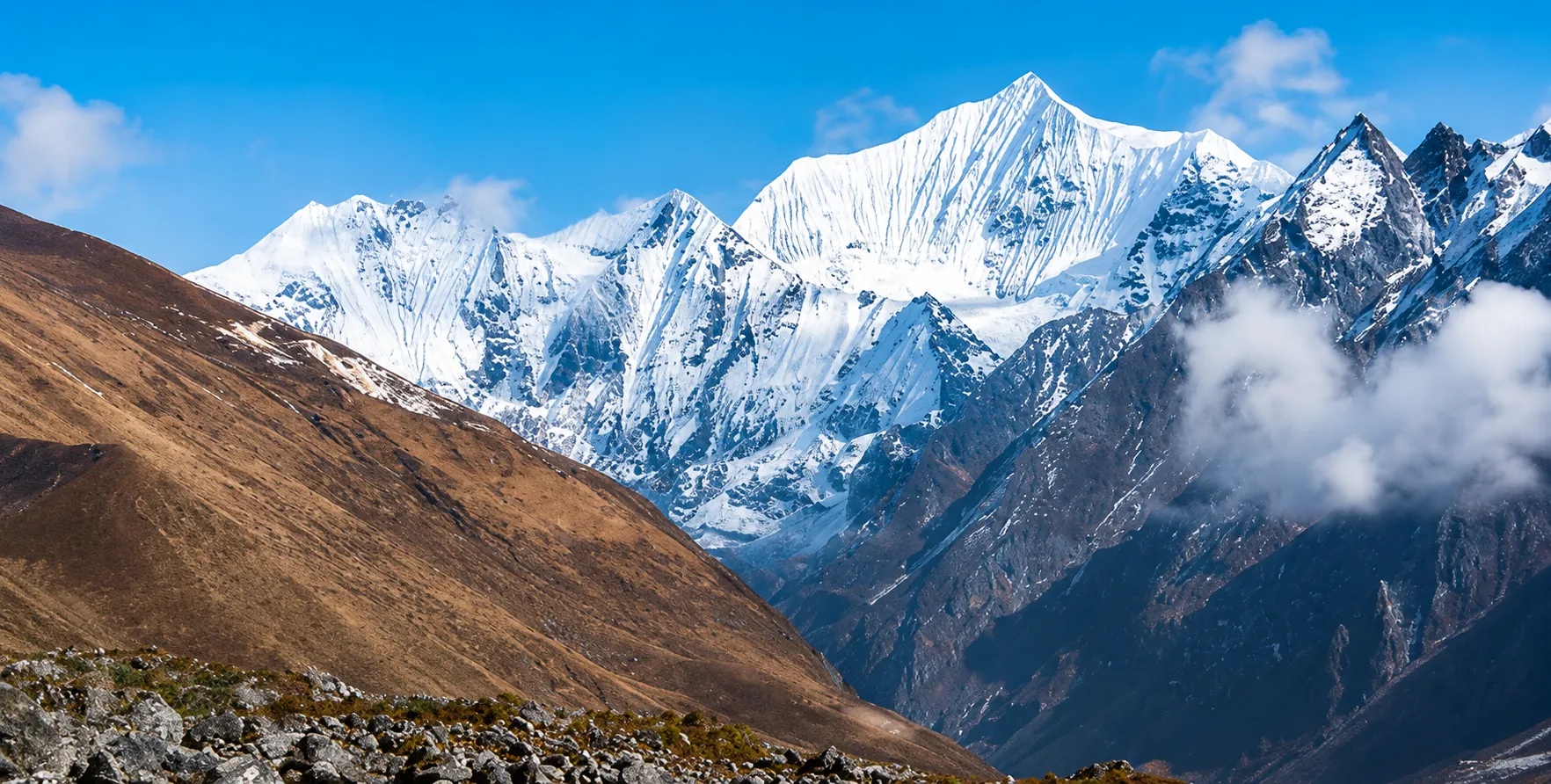
Book Langtang Gosaikunda Trek Alternative Route Vehicle Hire with a private 4WD jeep or Scorpio for convenient access to Langtang and Gosaikunda trekking areas. Choose flexible pickup and drop-off options based on the selected trekking route and current road conditions.

Langtang & Gosaikunda Trek Alternative Route Vehicle Hire: Complete  Guide

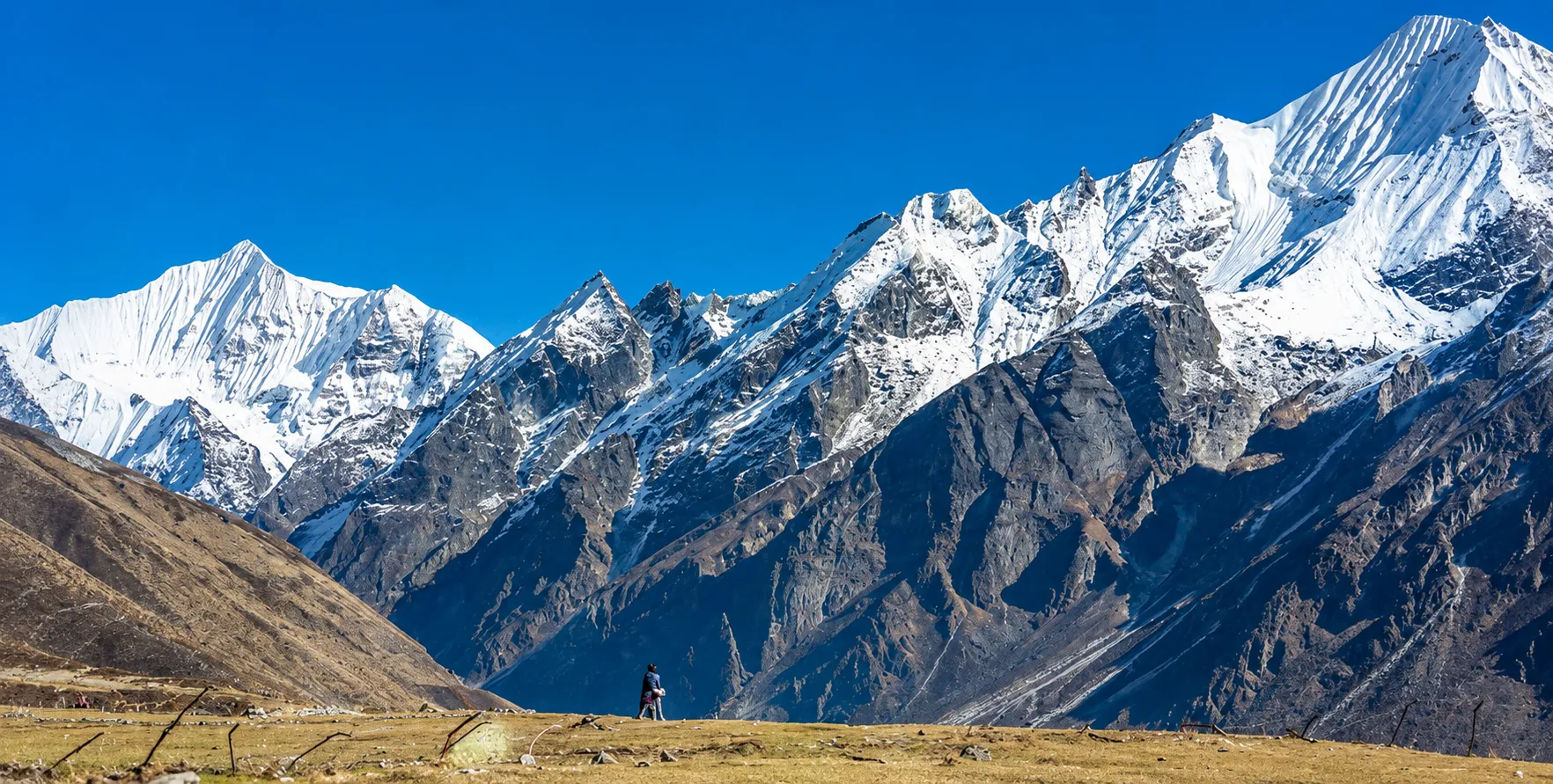
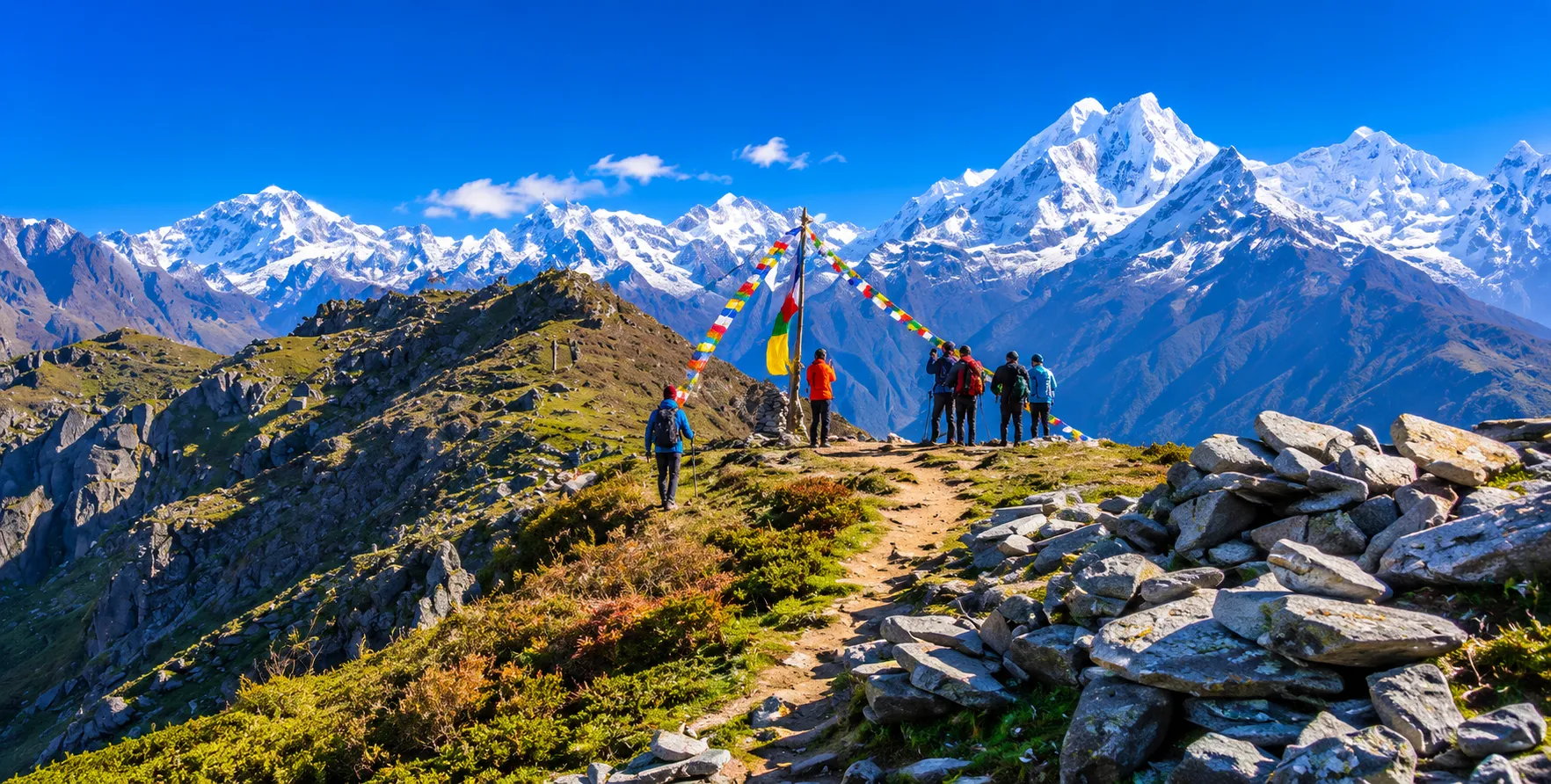
The Langtang region — home to the Langtang Valley Trek, the Gosaikunda Lake Trek, the Tamang Heritage Trail, and the Helambu Circuit — is Nepal’s most accessible major Himalayan trekking area: entirely within a day’s drive from Kathmandu, served by multiple route options for both approach and exit, and offering a diversity of trekking circuits that can be combined in dozens of different ways to match available time, fitness, and interests. This very flexibility is what makes vehicle hire planning for the Langtang and Gosaikunda region more complex — and more important — than for Nepal’s other major trekking corridors.

Unlike the Everest region (where virtually everyone approaches via the Lukla flight) or the Annapurna Circuit (where Besisahar is the standard approach and Pokhara or Nayapul the standard exit), the Langtang-Gosaikunda region offers genuinely different approach and exit points that require different vehicle hire arrangements, depending on the route combination the trekker chooses. A trekker beginning at Syabrubesi for the Langtang Valley Trek and exiting at Dhunche needs a specific vehicle arrangement.

A trekker beginning at Dhunche for the Gosaikunda Lake Trek and exiting via the Helambu trail through Sundarijal needs a completely different arrangement. A trekker completing the full Langtang-Gosaikunda-Helambu circuit from Syabrubesi to Melamchi needs yet another.

Nepal Vehicle Hiring Pvt Ltd (vehiclehiringnepal.com) provides private jeep, private car, and Hiace van hire for every approach and exit combination the Langtang-Gosaikunda-Helambu trekking network generates. This complete guide covers them all.

This guide is structured around the alternative route perspective: rather than describing a single standard Kathmandu-to-Syabrubesi-and-back vehicle arrangement, it covers all the meaningful entry and exit point combinations — Syabrubesi, Dhunche, Thulo Syabru, Sundarijal, Melamchi Pul Bazaar — with specific vehicle hire options, costs, road character, and practical booking advice for each. Whether you are planning a classic Langtang Valley out-and-back from Syabrubesi, a Gosaikunda approach from Dhunche, a Lauribina Pass crossing to Helambu with an exit at Sundarijal, or the full 14-to-16-day Langtang-Gosaikunda-Helambu circuit from Syabrubesi to Melamchi, this guide gives you the full vehicle-hire picture.

The Langtang-Gosaikunda-Helambu Region: Trekking Routes Overview

The Key Entry and Exit Points

The Langtang-Gosaikunda-Helambu trekking network has four principal vehicle access points — four places where the road meets the trail and where a private vehicle can drop off or pick up trekkers. Understanding these four points and their relationships underpins all alternative route vehicle-hire planning in this region.

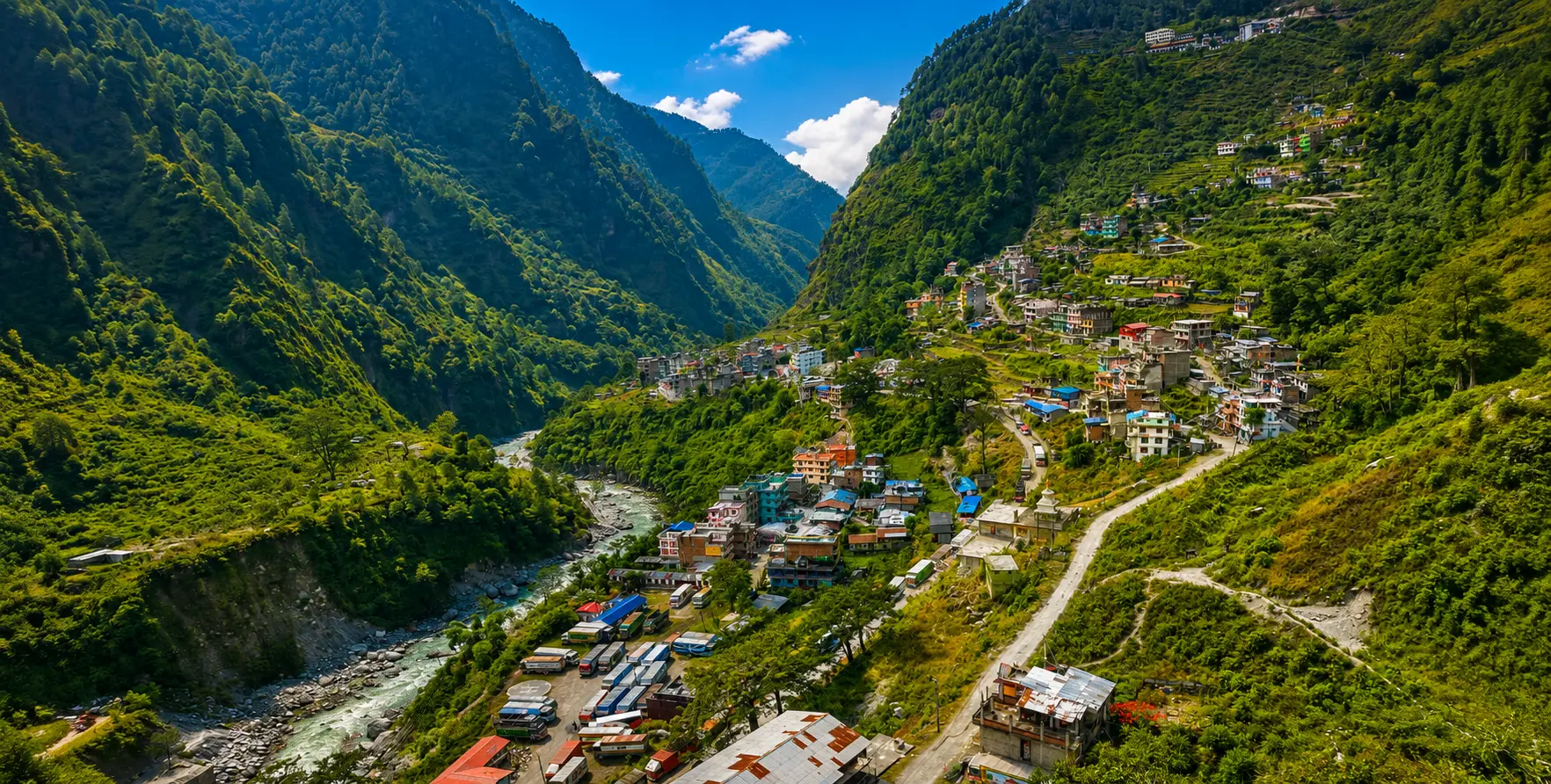
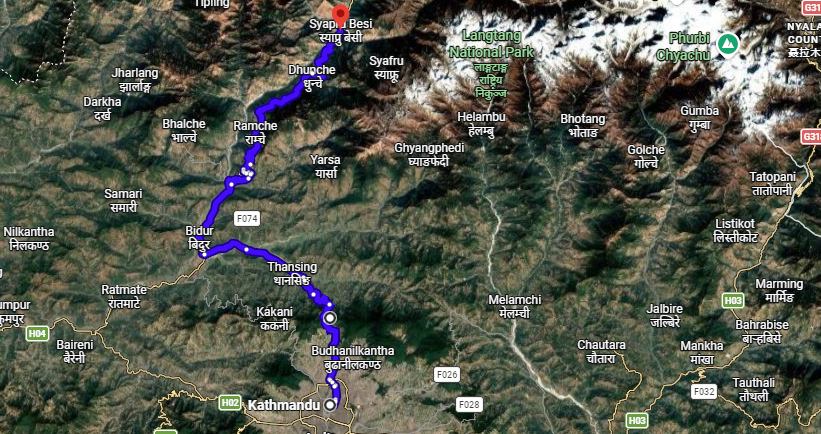
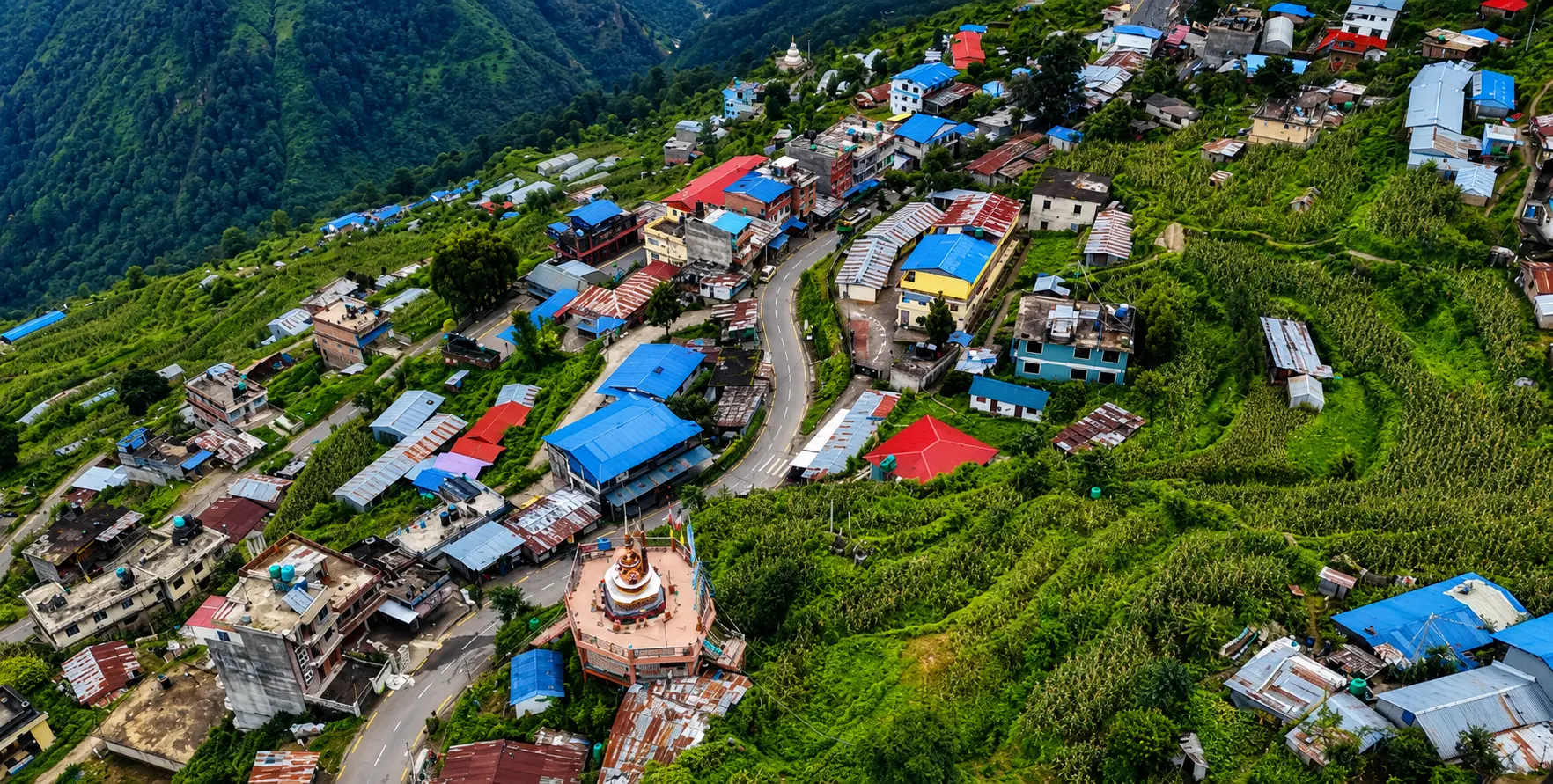
Syabrubesi (1,550 m): The primary trailhead for the Langtang Valley Trek and the Tamang Heritage Trail, and one of the two main starting points for the Gosaikunda Lake Trek. Located approximately 122 kilometres north of Kathmandu in the Rasuwa District, at the confluence of the Bhote Koshi and Langtang Khola rivers.

You can reach it in 5 to 9 hours by private vehicle via the Pasang Lhamu Highway through Trishuli and Dhunche.

Dhunche (1,980 m): The Rasuwa District headquarters and the alternative starting point for the Gosaikunda Trek via the Sing Gompa and Lauribina route. Located approximately 100 kilometres north of Kathmandu and 15 kilometres south of Syabrubesi on the same Pasang Lhamu Highway — the road actually passes through Dhunche before descending to Syabrubesi.

Many Gosaikunda-focused trekkers start at Dhunche rather than Syabrubesi, as it saves an extra day of walking and lets them start the ascent toward Gosaikunda immediately from a higher base altitude.

Sundarijal (1,460 m): The exit point for trekkers completing the Helambu circuit or the Langtang-Gosaikunda-Helambu full traverse. Located approximately 25 kilometres northeast of Kathmandu city centre — a short 1-to-1.5-hour drive from Thamel. The easiest and quickest return to Kathmandu from any Langtang region exit point, making the Sundarijal exit the most convenient option for trekkers whose itinerary crosses the Lauribina Pass from Gosaikunda into the Helambu region.

Melamchi Pul Bazaar (870 m): The lower-altitude exit point for trekkers descending from Helambu through Melamchi Gaon and Tarkeghyang to the Melamchi River valley road. Located about 45 to 60 kilometres east of Kathmandu, the Melamchi exit connects via a 3-to-4-hour drive on roads of variable quality back to Kathmandu—longer than the Sundarijal exit but serving trekkers whose itinerary descends through the lower Helambu villages rather than cutting directly to the Kathmandu Valley rim.

The Major Trek Combinations and Their Vehicle Needs

The Langtang Valley Trek out-and-back from Syabrubesi (8 to 12 days): both approach and return vehicle from/to Syabrubesi — same vehicle hire twice (or one vehicle arranged for the outbound and a separate return pickup on the confirmed return date).

The Gosaikunda Lake Trek from Dhunche, return to Dhunche (5 to 7 days): approach vehicle from Kathmandu to Dhunche; return pickup from Dhunche to Kathmandu—most economical round-trip, as Dhunche is 15 km shorter than Syabrubesi.

Langtang Valley plus Gosaikunda via Lauribina (12 to 15 days): approach vehicle from Kathmandu to Syabrubesi; return pickup from Dhunche (descending from Gosaikunda back to Dhunche road) or exit via Sundarijal after Helambu traverse. Open-jaw vehicle arrangement — different vehicle for approach and exit.

Full Langtang-Gosaikunda-Helambu circuit from Syabrubesi to Sundarijal or Melamchi (14 to 18 days): approach vehicle from Kathmandu to Syabrubesi; return vehicle from Sundarijal or Melamchi to Kathmandu. Classic open-jaw arrangement. Nepal Vehicle Hiring Pvt Ltd coordinates both legs as a single booking.

Route 1: Kathmandu to Syabrubesi — The Primary Langtang Approach

Route Overview and Road Conditions

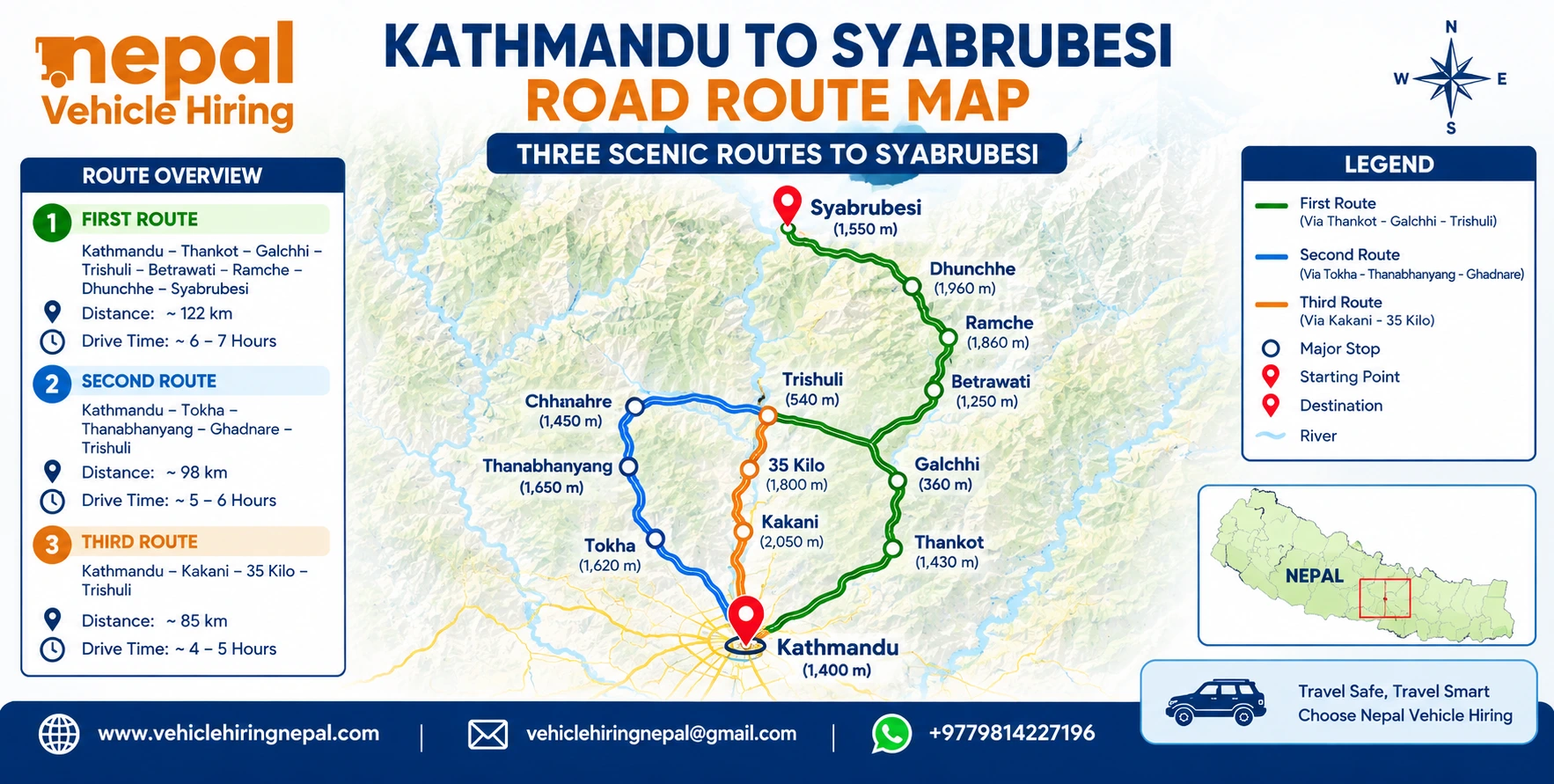
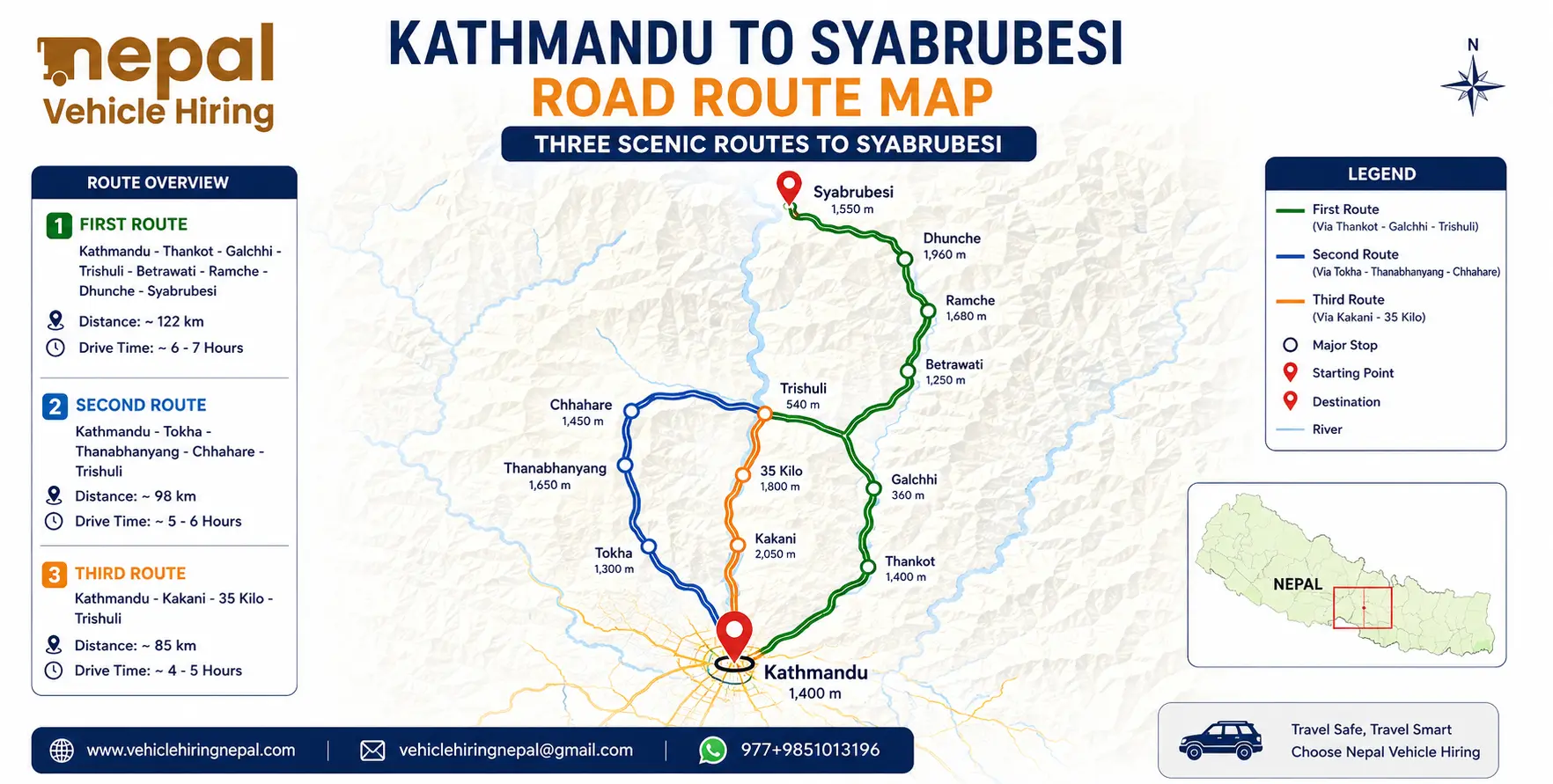
The Kathmandu to Syabrubesi route via the Pasang Lhamu Highway is the most frequently used vehicle hire corridor in the Langtang region—the standard approach for both the Langtang Valley Trek and the combined Langtang-Gosaikunda itinerary, which begins in the Langtang Valley before ascending to the sacred lake. The route follows the Pasang Lhamu Highway northward from Kathmandu through Tokha, Trishuli Bazaar, Betrawati, and Dhunche, then descends the final 15 kilometres to Syabrubesi at 1,550 meters.

The total road distance is approximately 122 to 146 kilometres, depending on routing, and takes 5 to 9 hours depending on road conditions and vehicle type.

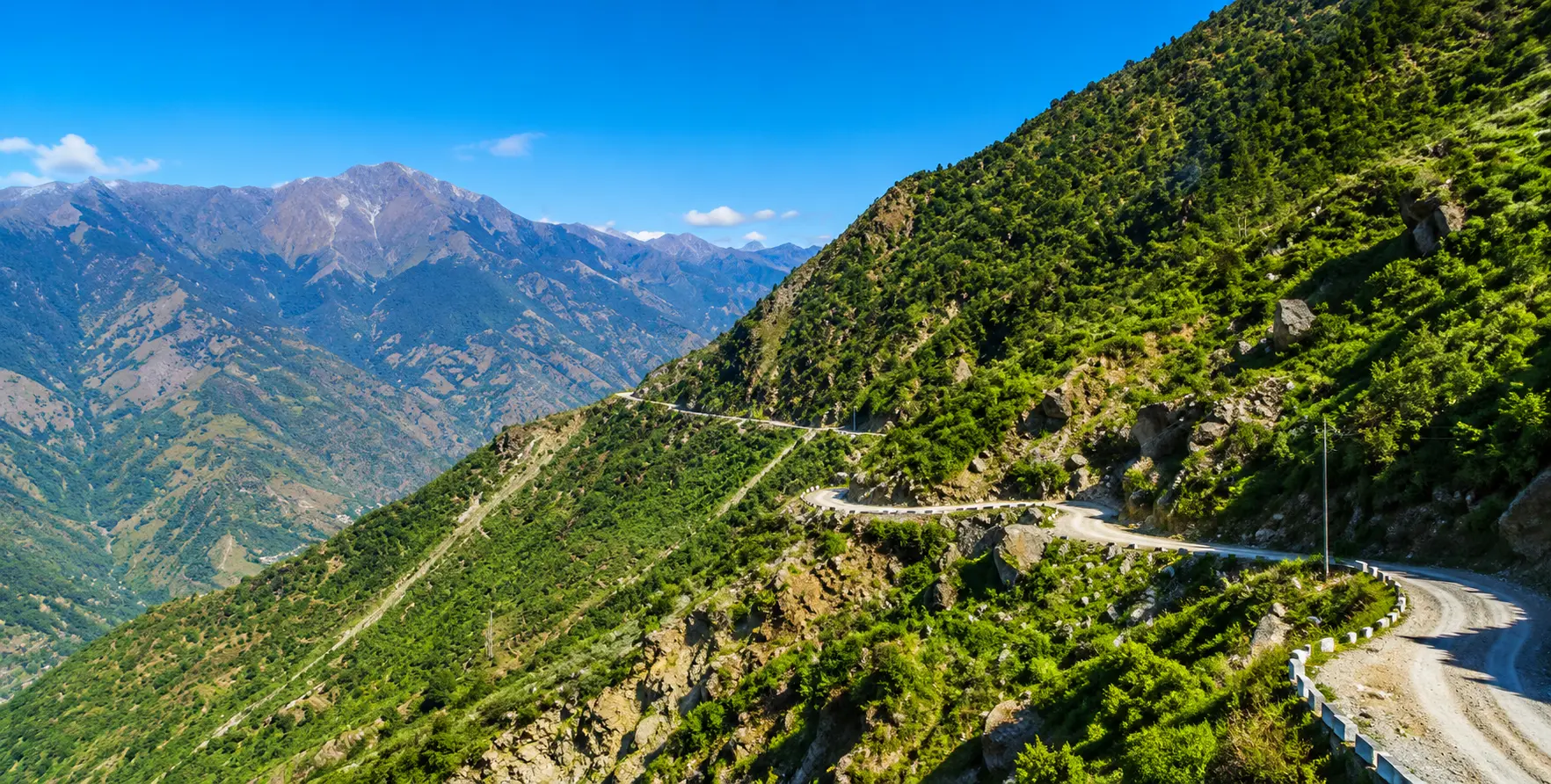
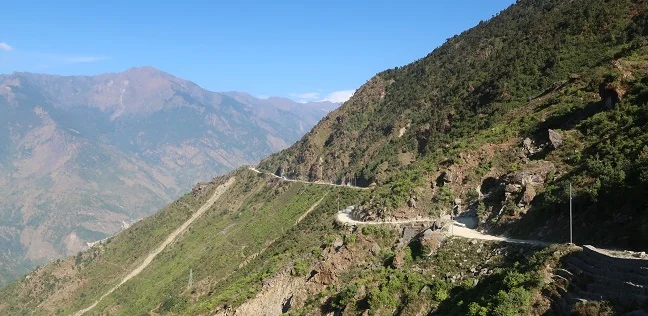
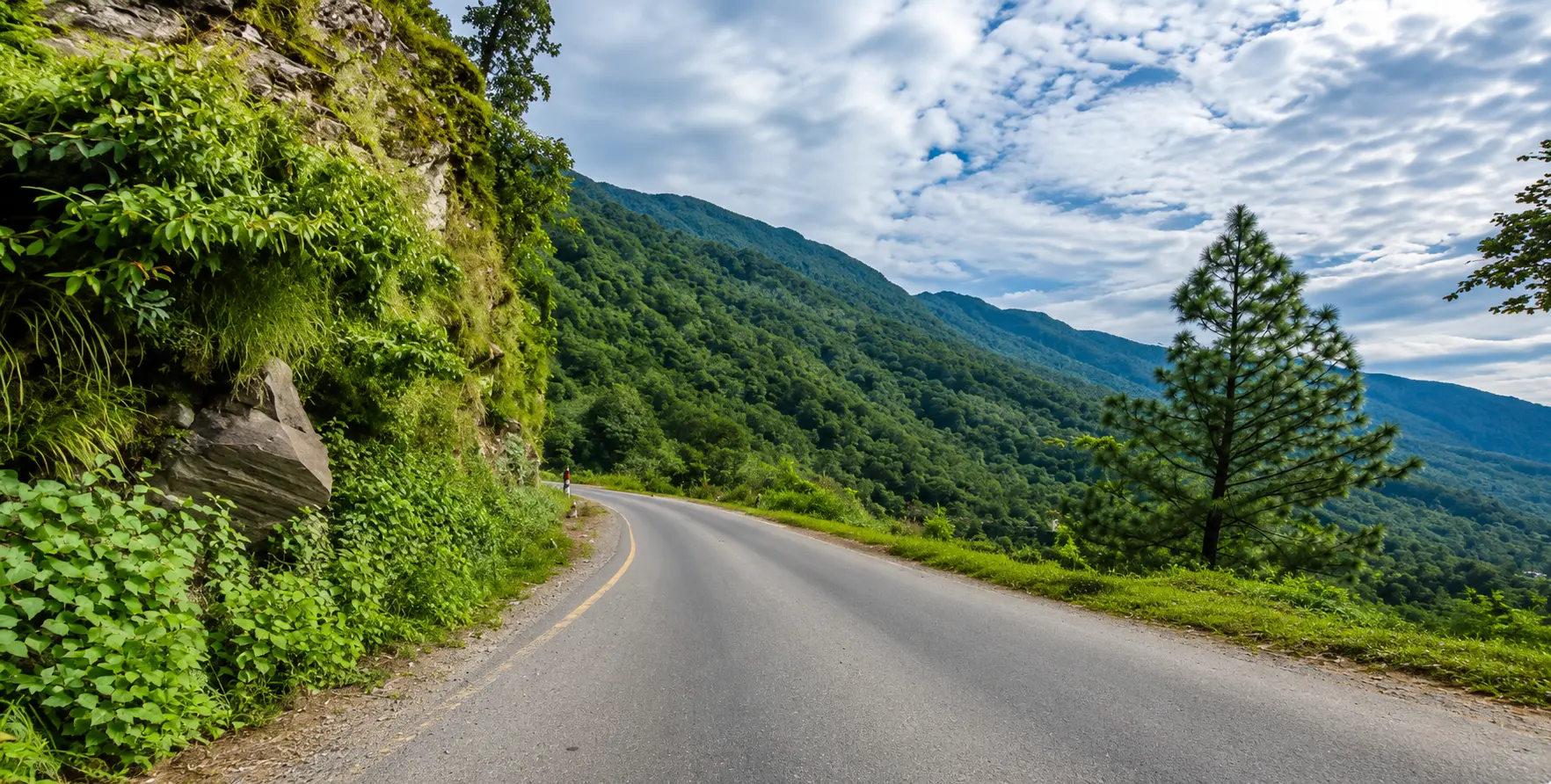
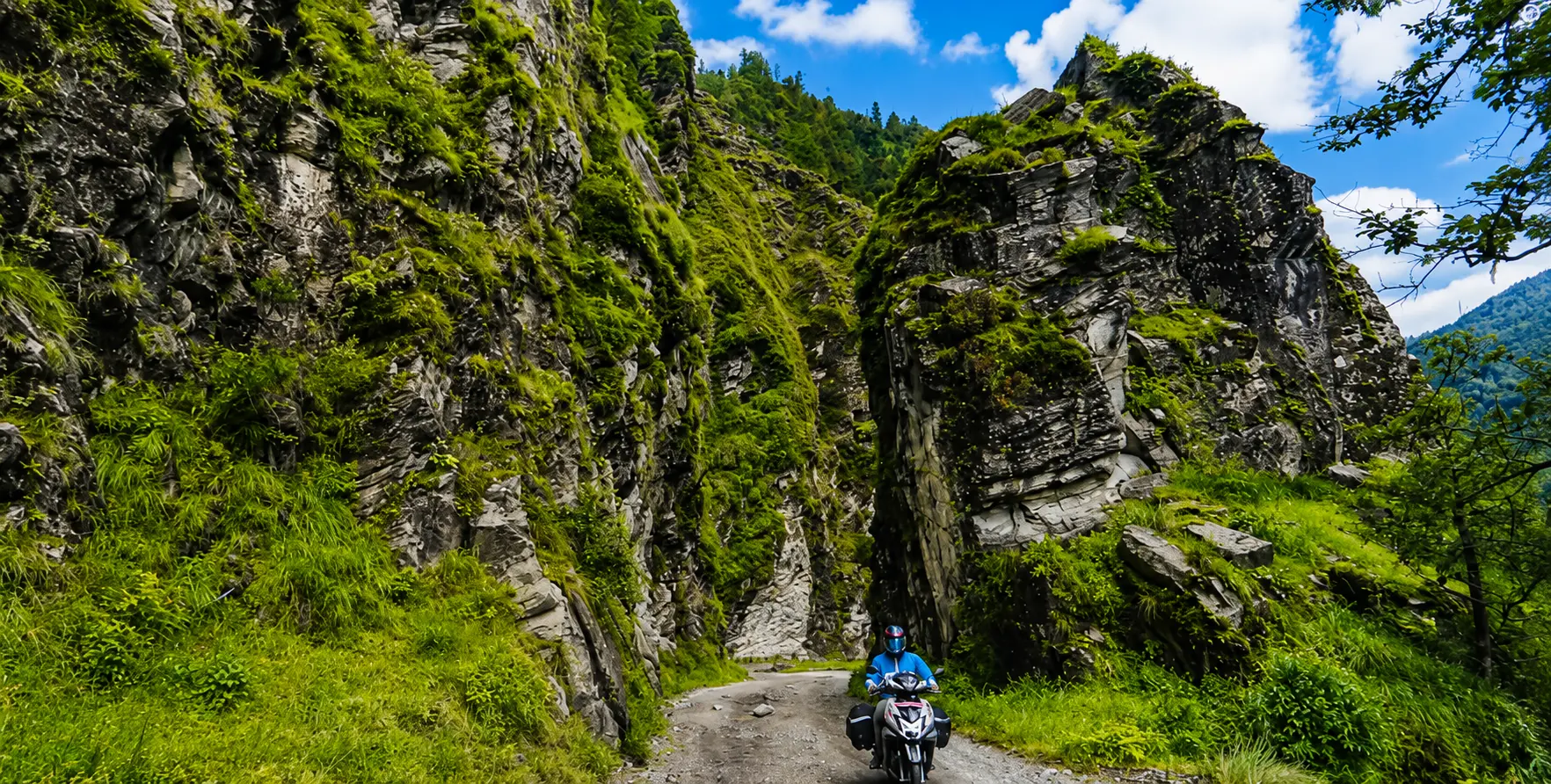
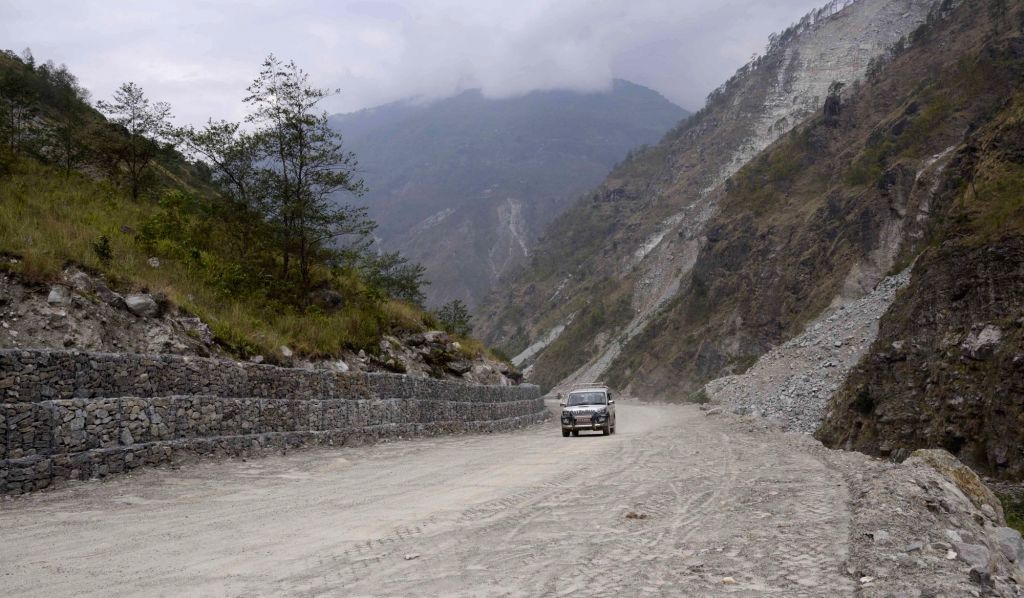
The road has two distinct sections: the sealed Kathmandu to Dhunche section (approximately 100 km), which is in generally good condition and navigable by any well-maintained vehicle; and the Dhunche to Syabrubesi final descent (15 km), which is narrower, less consistently maintained, and involves the infamous Ramche Landslide Zone — a 3-kilometre unpaved stretch before Dhunche that is bumpy and potentially muddy after rain. As Nepal Vehicle Hiring Pvt Ltd’s 2026 Syabrubesi jeep comparison guide confirms, 4WD jeeps clearly outperform buses on this section, and private jeeps also use an alternate route via Kakani and Galchhi that is often faster and avoids the worst congestion on the main Pasang Lhamu Highway.

Vehicle Options and Costs: Kathmandu to Syabrubesi 2026/27

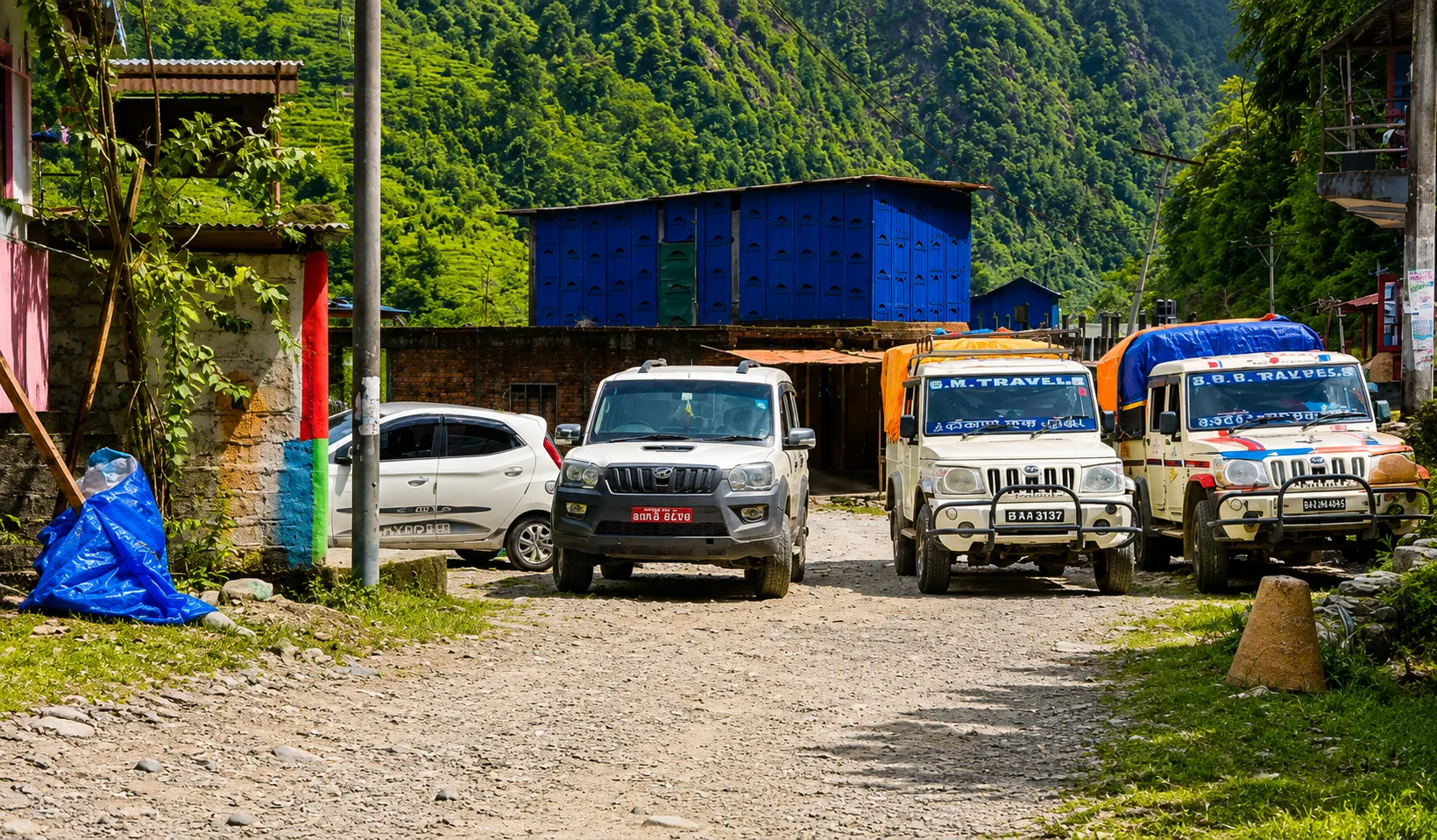
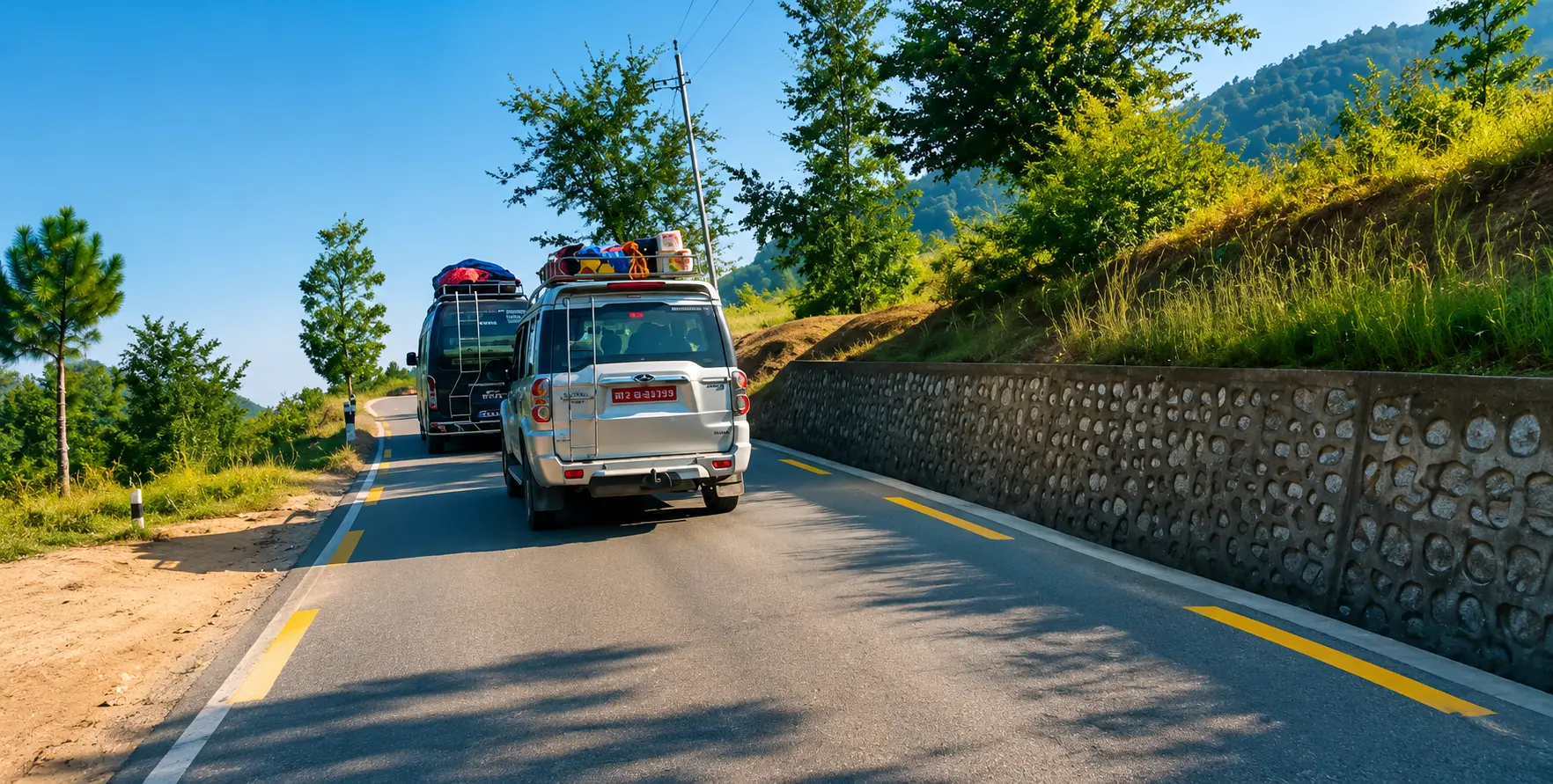
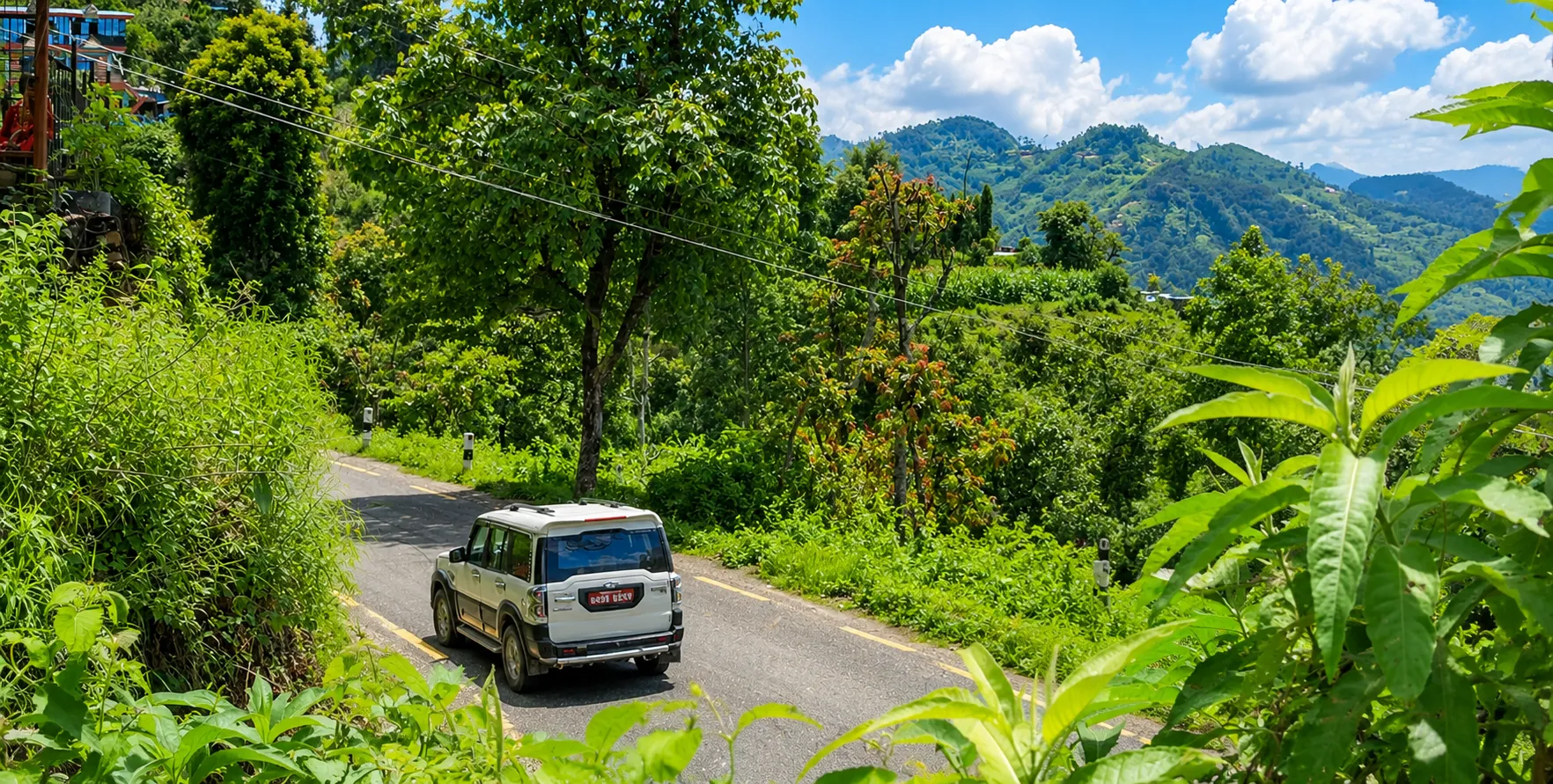
Private 4WD jeep (Toyota Land Cruiser / Mahindra Scorpio), 4–6 passengers: NPR 20,000 to NPR 28,000 per vehicle one way (approximately USD 150 to USD 210). This is the most recommended vehicle for the complete Kathmandu to Syabrubesi route — current 2026 market data confirms USD 160 to USD 200 per vehicle for this service.

Nepal Vehicle Hiring Pvt Ltd’s Kathmandu to Syabrubesi jeep transfer service provides Land Cruiser and Scorpio options with drivers specifically experienced on the Pasang Lhamu Highway and the Dhunche-Syabrubesi descent. Per-person cost for 6 passengers: NPR 3,333 to NPR 4,667.

Private car/top-end SUV (Toyota Fortuner, 3–4 passengers): NPR 15,000 to NPR 22,000 per vehicle. Handles the sealed Kathmandu to Dhunche section comfortably but may struggle on the Ramche Landslide Zone section; is recommended for dry-season travel only, with a driver experienced on this specific section. Nepal Vehicle Hiring Pvt Ltd offers private car hire for this route in good road conditions.

Hiace van (8–12 passengers): NPR 25,000 to NPR 32,000 per vehicle. Appropriate for the sealed Kathmandu to Dhunche section; the Dhunche to Syabrubesi descent in variable conditions may require additional care. Nepal Vehicle Hiring Pvt Ltd’s Hiace van hire service serves larger Langtang groups on this corridor with per-person rates among the most economical available for private transport on this route.

Public bus comparison: Daily deluxe buses depart from Machhapokhari (near Gorkha) Bus Park from 6:30 to 8:00, costing about NPR 500 per person and taking 7 to 10 hours. The 2026 ‘local bus’ on this route has been largely replaced by deluxe versions with 2×2 seating and slightly better suspension, though still without air conditioning.

Shared jeeps are available at approximately USD 15 to USD 20 per person but depart only when full.

Tip: For 4 or more passengers, the private jeep’s per-person cost (NPR 4,000 to NPR 5,000 per person for 5 passengers) approaches or beats the shared jeep rate while delivering hotel pickup, departure time flexibility, and the Land Cruiser’s comfort advantage on the demanding final Dhunche-Syabrubesi descent section.
Book Langtang Gosaikunda Trek Alternative Route Vehicle Hire with a private 4WD jeep or Scorpio for convenient access to Langtang and Gosaikunda trekking areas. Choose flexible pickup and drop-off options based on the selected trekking route and current road conditions.

Route 2: Kathmandu to Dhunche — The Gosaikunda Direct Approach

Why Start at Dhunche for Gosaikunda

Dhunche at 1,980 meters is the best vehicle drop-off point for trekkers whose primary destination is Gosaikunda Lake rather than the Langtang Valley. The standard Gosaikunda trekking route from Dhunche follows the ridge trail through Sing Gompa (Chandanbari) at 3,250 meters and Lauribina at 3,920 meters to the sacred lake at 4,380 meters.

This 3-to-4-day ascent gains 2,400 meters from the Dhunche road head. Starting at Dhunche rather than Syabrubesi saves 15 kilometres of road descent and the corresponding 15-kilometre ascent back, making it the more efficient starting point for pure Gosaikunda itineraries.

Dhunche is also the exit point for trekkers who approach Gosaikunda from the Syabrubesi side (ascending via the Langtang Valley and crossing the Lauribina La) and then descend back to Dhunche on the standard trail rather than continuing into Helambu. This Syabrubesi-in / Dhunche-out combination is one of the most commonly booked open-jaw vehicle arrangements for the Langtang-Gosaikunda combination trek — Nepal Vehicle Hiring Pvt Ltd coordinates both the outbound Syabrubesi approach and the Dhunche return pickup as a single booking.

Costs and Vehicle Options: Kathmandu to Dhunche

Private 4WD jeep to Dhunche: NPR 16,000 to NPR 24,000 per vehicle (approximately USD 120 to USD 180) — slightly less than the full Syabrubesi rate as Dhunche is 15 kilometres shorter. Nepal Vehicle Hiring Pvt Ltd’s Kathmandu-to-Syabrubesi jeep service covers Dhunche as an alternative destination on the same route at the corresponding adjusted rate.

Dhunche to Kathmandu return pickup: NPR 16,000 to NPR 24,000 per vehicle for a private 4WD jeep. The return from Dhunche is a 4-to-6-hour drive, depending on road conditions—shorter and marginally less demanding than the full Syabrubesi return, as it avoids the final descent section.

Pre-booking the Dhunche return vehicle at the same time as the outbound Syabrubesi approach is strongly recommended—Nepal Vehicle Hiring Pvt Ltd’s WhatsApp coordination from the trail (confirmable from Dhunche town’s reliable NTC mobile coverage) ensures the return driver is positioned before the trekker descends from the trail.

Route 3: Sundarijal to Kathmandu — The Helambu Exit

Why Exit via Sundarijal

Sundarijal is the quickest and easiest vehicle exit from the Langtang-Gosaikunda-Helambu trekking network back to Kathmandu—a 1-to-1.5-hour drive from the Kathmandu Valley’s northeastern rim —making it by far the fastest return from any Langtang region exit point. Trekkers who complete the Gosaikunda Lake circuit and continue over the Lauribina La (4,610 m) into the Helambu region descend through Ghopte (3,430 m), Melamchi Ghyang (2,530 m), Chisapani (2,215 m), and reach Sundarijal in 3 to 4 additional days beyond Gosaikunda.

The Gosaikunda Lake Trek guide from Travel Himalaya Nepal confirms that the Helambu route descends through Tharepati, Ghopte, and Melamchi Ghyang before reaching Sundarijal at the northern rim of the Kathmandu Valley, where taxis back to Thamel are immediately available.

For the complete Langtang-Gosaikunda-Helambu circuit — beginning at Syabrubesi, traversing the Langtang Valley to Kyanjin Gompa, crossing to Gosaikunda via the Lauribina La, and descending through Helambu to Sundarijal — the Sundarijal exit creates the most convenient and most economical return vehicle arrangement of any Langtang circuit option. Nepal Vehicle Hiring Pvt Ltd provides private car, jeep, or taxi pickup from Sundarijal at any confirmed time — coordinated via WhatsApp notification from the trail as trekkers descend from Chisapani toward the valley rim.

Costs and Vehicles: Sundarijal to Kathmandu

Private car or sedan from Sundarijal to any Kathmandu hotel: NPR 2,500 to NPR 4,000 (approximately USD 19 to USD 30) — the shortest and most economical vehicle return from the Langtang region exit point. Nepal Vehicle Hiring Pvt Ltd’s private car hire service provides this Sundarijal pickup at transparent, all-inclusive rates.

Private jeep from Sundarijal: NPR 4,000 to NPR 6,000 for groups needing larger vehicle capacity. Hiace van for groups of 8 or more: NPR 8,000 to NPR 12,000. The short distance (25 km from Sundarijal to central Kathmandu) makes Sundarijal the most cost-effective exit from any Langtang region endpoint.

For trekkers who want a Dhulikhel or Nagarkot viewpoint stop on the return from Sundarijal — seeing the Himalayan range that the trek has just traversed from the valley rim on the way back — Nepal Vehicle Hiring Pvt Ltd drivers know the optimal ridge road detours from the Sundarijal approach that deliver this panoramic bookend within the same return vehicle journey.

⚠ Note: Trekkers exiting at Sundarijal pass through the Shivapuri-Nagarjun National Park, which requires a separate entry permit (NPR 1,000 for foreigners) in addition to the Langtang National Park permit. Obtain this at the Shivapuri-Nagarjun park checkpoint near Sundarijal on the final descent.

Route 4: Melamchi Pul Bazaar to Kathmandu — The Extended Helambu Exit

The Melamchi Route Character

Melamchi Pul Bazaar (870 m) on the Melamchi River is the alternative Helambu exit for trekkers whose itinerary descends through the lower Helambu villages of Tarkeghyang (2,740 m), Shermathang (2,620 m), and Melamchi Gaon (2,530 m) rather than taking the higher trail toward Chisapani and Sundarijal. The Langtang Gosaikunda Helambu trek guide confirms that the trek typically ends at Melamchi Bazaar or Sundarijal, from where trekkers return to Kathmandu.

The Melamchi exit adds cultural richness — the lower Helambu villages of Tarkeghyang and Shermathang are among the Hyolmo community’s best-preserved traditional settlements — but it results in a longer, more variable vehicle return than the Sundarijal option.

Costs and Vehicles: Melamchi to Kathmandu

Private 4WD jeep from Melamchi Pul Bazaar to Kathmandu: NPR 12,000 to NPR 18,000 per vehicle (3 to 4 hours drive). The road from Melamchi toward Kathmandu follows the Melamchi River valley southward to the Araniko Highway junction and then westward to Banepa and Kathmandu — a Category 1 to Category 2 road of variable quality that rewards a jeep’s ground clearance on some sections.

Nepal Vehicle Hiring Pvt Ltd’s private jeep hire service provides Melamchi pickup at confirmed times pre-arranged via WhatsApp from the trail.

Private car from Melamchi: NPR 8,000 to NPR 14,000 in good road conditions. Hiace van hire for groups of 8 or more: NPR 16,000 to NPR 22,000. The Melamchi return is longer and more expensive than the Sundarijal return. Still, it serves trekkers who prefer the cultural richness of the lower Helambu villages over the quicker ridge-top exit via Chisapani.
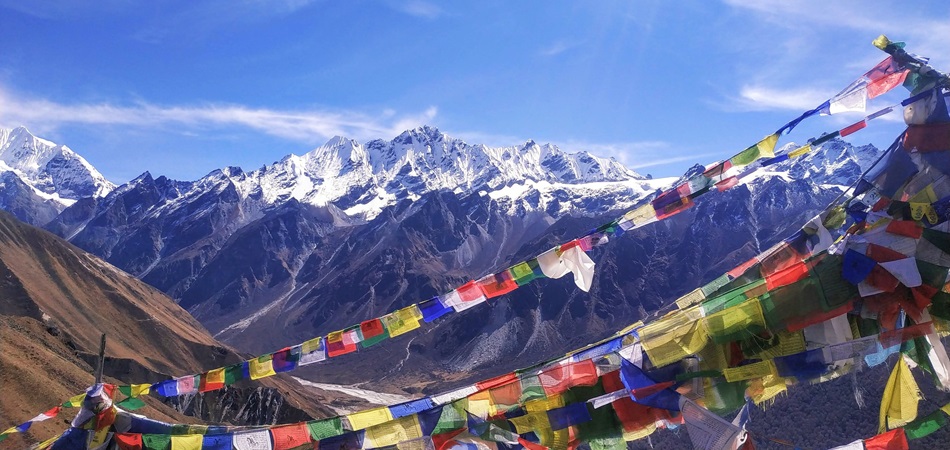
Book Langtang Gosaikunda Trek Alternative Route Vehicle Hire with a private 4WD jeep or Scorpio for convenient access to Langtang and Gosaikunda trekking areas. Choose flexible pickup and drop-off options based on the selected trekking route and current road conditions.

Alternative Starting Point: Sundarijal to Gosaikunda via Chisapani

A lesser-known but increasingly popular alternative approach to Gosaikunda begins not at Syabrubesi or Dhunche but at Sundarijal on the Kathmandu Valley’s northeastern rim—starting the Gosaikunda Lake Trek within 25 kilometres of Thamel and ascending through Chisapani, Gul Bhanjyang, Tharepati, and Lauribina to the sacred lake. This Sundarijal-to-Gosaikunda approach takes 5 to 6 days to reach the lake, compared to 3 to 4 days from Dhunche, but starts at a lower altitude and makes the Helambu region’s cultural and landscape diversity an integral part of the approach rather than a post-Gosaikunda extension.

The vehicle hire for the Sundarijal approach is the simplest of any Langtang-Gosaikunda access option: a short private car or taxi from any Kathmandu hotel to Sundarijal at NPR 2,500 to NPR 4,000 — a 1-to-1.5-hour city drive rather than a 5-to-9-hour mountain highway journey. For the return, trekkers who complete the Gosaikunda circuit and retrace to Sundarijal need only the same short Sundarijal-to-Kathmandu return transfer at the corresponding cost.

Trekkers who complete the Sundarijal approach, cross Lauribina to Gosaikunda, and then descend to Dhunche or Syabrubesi by the northern route need a Dhunche or Syabrubesi return vehicle — the open-jaw reverse of the standard Syabrubesi-in / Sundarijal-out arrangement.

Route Summary Table: All Vehicle Hire Options at a Glance

RouteDistanceDrive TimeBest Vehicle2026/27 Cost (NPR)
Kathmandu to Syabrubesi122–146 km5–9 hours4WD JeepNPR 20,000–28,000
Kathmandu to Dhunche100 km4–6 hours4WD Jeep or CarNPR 16,000–24,000
Dhunche to Kathmandu100 km4–6 hours4WD Jeep or CarNPR 16,000–24,000
Syabrubesi to Kathmandu122–146 km5–9 hours4WD JeepNPR 20,000–28,000
Sundarijal to Kathmandu25 km1–1.5 hoursCar or TaxiNPR 2,500–4,000
Melamchi Pul Bazaar to Kathmandu45–60 km3–4 hoursJeep or CarNPR 12,000–18,000
Kathmandu to Sundarijal (approach)25 km1–1.5 hoursCar or TaxiNPR 2,500–4,000

The Ramche Landslide Zone: What Every Trekker Should Know

The Ramche Landslide Zone — a 3-kilometre unpaved section of the Pasang Lhamu Highway between Ramche village and Dhunche — is the most discussed road-condition feature on the Kathmandu to Syabrubesi/Dhunche approach corridor, and understanding it helps trekkers make informed vehicle-hire choices. Nepal Vehicle Hiring Pvt Ltd’s  Syabrubesi guide confirms that every vehicle on the Kathmandu to Syabrubesi route must pass through the Ramche Landslide Zone regardless of routing — it is unavoidable on the Pasang Lhamu Highway.

Thee road through this zone is better maintained than in previous years but remains unpaved and bumpy, with 4WD jeeps having a clear advantage over buses in wet or post-monsoon conditions. The zone typically takes 30 to 45 minutes of slow, rough driving in a 4WD jeep.

It is considerably less comfortable in a bus or shared vehicle with suspension less suited to the unpaved surface.

The practical vehicle-hire implication: the Ramche Landslide Zone is the strongest argument for choosing a 4WD jeep over a bus or shared jeep for the Kathmandu to Syabrubesi or Kathmandu to Dhunche journey. The jeep’s higher ground clearance, superior suspension, and 4WD capability make this section noticeably more comfortable and reliable than alternatives—and during or immediately after heavy monsoon rainfall, the surface can deteriorate enough that a 4WD jeep is not merely preferable but genuinely necessary for consistent passage.
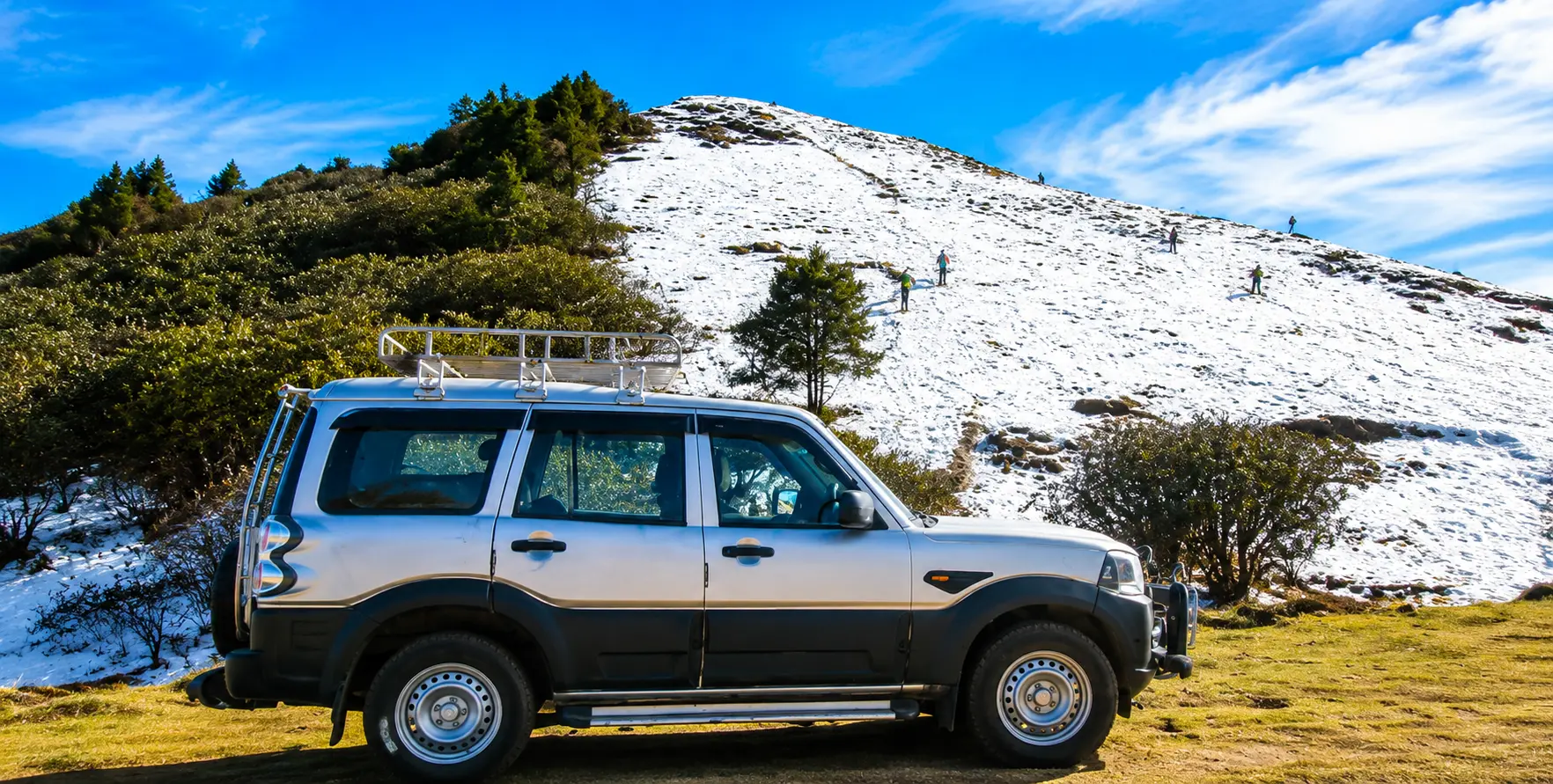
Book Langtang Gosaikunda Trek Alternative Route Vehicle Hire with a private 4WD jeep or Scorpio for convenient access to Langtang and Gosaikunda trekking areas. Choose flexible pickup and drop-off options based on the selected trekking route and current road conditions.

Seasonal Vehicle Hire Guide for Langtang-Gosaikunda Routes

Autumn from September through November is the best trekking and vehicle-hire season for the Langtang-Gosaikunda region—post-monsoon road surfaces at their annual best, mountain views at maximum clarity, and the Ramche Landslide Zone in its most stable condition of the year. October is the peak month for vehicle demand — book Syabrubesi and Dhunche private jeep transfers 1 to 2 weeks in advance during this period.

Spring from March through May brings the rhododendron bloom season on Langtang National Park’s forested approach ridges—the Kathmandu to Syabrubesi drive’s forested sections turn spectacular in March and April as red, white, and pink rhododendron flowers line the roadside. Road conditions are generally good in spring, and the Gosaikunda Lake Trek in April and May offers the finest combination of high-altitude snow scenery and warm mid-altitude approach forests.

Monsoon from June through August brings the highest risk of road disruption on the Pasang Lhamu Highway, with the Ramche Landslide Zone’s condition most variable after sustained heavy rainfall. Nepal Vehicle Hiring Pvt Ltd monitors road conditions daily during monsoon season and advises clients on departure timing adjustments when specific sections are affected.

The famous Janai Purnima pilgrimage to Gosaikunda falls within the monsoon window—helicopter access becomes the primary pilgrimage option during the festival. In contrast, road access remains available for hardy trekking pilgrims who choose the traditional walking approach.

Winter from December through February is cold but generally road-safe on the main Pasang Lhamu Highway, with the Gosaikunda Lake itself frozen and the higher Lauribina La pass potentially snow-affected. Vehicle hire for winter Langtang Valley trekking (lower altitude than Gosaikunda) continues through the winter months as the valley’s main section is accessible year-round.

Practical Tips for Alternative Route Vehicle Hire

  • Book both legs simultaneously — if your itinerary is open-jaw (Syabrubesi in, Sundarijal or Melamchi out), book both the outbound and return vehicles in one Nepal Vehicle Hiring Pvt Ltd booking before the trek begins.
  • Confirm the exact pickup point—Syabrubesi town, the Dhunche bus park, the Sundarijal trailhead, or Melamchi Pul Bazaar’s market area—and the driver must know the specific meeting point in advance.
  • WhatsApp the return date confirmation from the first town with reliable connectivity on the descent — Dhunche, Melamchi Gaon, or Chisapani all have adequate NTC signal for trail communication.
  • For monsoon season travel, depart Kathmandu by 6:00 a.m. at the latest — early morning departures beat the worst of the afternoon rainfall that affects road conditions on the Ramche and Dhunche-Syabrubesi sections.
  • Carry dust protection — a buff or face mask is essential for the Ramche Landslide Zone’s unpaved section, which generates significant dust in dry conditions and mud in wet conditions.
  • Motion sickness preparation — the Pasang Lhamu Highway’s 1,000-plus turns are frequently cited as among Nepal’s most challenging for susceptible passengers; carry appropriate medication.
  • For Sundarijal exit trekkers: arrange a return pickup for 11:00 a.m. or later — the final trail stage from Chisapani to Sundarijal takes about 3 to 4 hours, and a departure from Chisapani gets trekkers to Sundarijal by midday, leaving enough time for vehicle pickup and avoiding the day’s heat.
  • Confirm all-inclusive vehicle pricing at booking — Nepal Vehicle Hiring Pvt Ltd’s rates cover vehicle, driver, fuel, and tolls with no hidden additions at settlement.
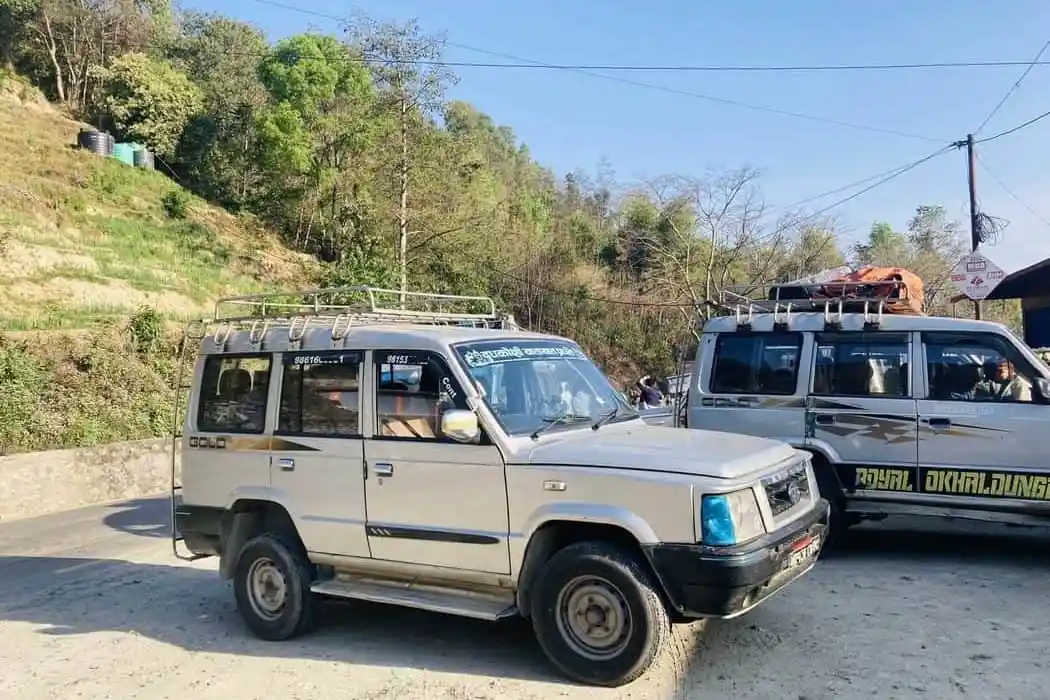
Book Langtang Gosaikunda Trek Alternative Route Vehicle Hire with a private 4WD jeep or Scorpio for convenient access to Langtang and Gosaikunda trekking areas. Choose flexible pickup and drop-off options based on the selected trekking route and current road conditions.

Nepal Vehicle Hiring Pvt Ltd: Complete Langtang Region Transport Network

Nepal Vehicle Hiring Pvt Ltd provides the most comprehensive private vehicle hire network for the Langtang-Gosaikunda-Helambu trekking region — covering every approach and exit combination from a single, professionally managed fleet of 4WD jeeps, private cars, Hiace vans, coasters, and buses. Our Kathmandu to Syabrubesi jeep transfer service is the most established private vehicle service on this corridor, with drivers who complete this route multiple times per week and know the Ramche Landslide Zone’s current condition better than any single-journey driver can.

Beyond the Langtang corridor, our complete trekking transport network covers every region of Nepal: Kathmandu to Besisahar and Kathmandu to Manang jeep for the Annapurna Circuit Trek. Kathmandu to Soti Khola jeep for the Manaslu Circuit Trek. Kathmandu to Salleri Phaplu for the Everest Base Camp Trek overland.

Kathmandu to Muktinath jeep for the Muktinath Tour. Pokhara to Nayapul transport and Pokhara to Ghandruk jeep for the Annapurna Base Camp Trek. Pokhara to Ghorepani Poon Hill jeep for the Ghorepani Poon Hill Trek.

Pokhara to Upper Mustang overland jeep for the Upper Mustang Trek. Kathmandu airport transfer, Kathmandu sightseeing, Nagarkot sunrise tour, Bhaktapur day tour, Sarangkot sunrise vehicle, Pokhara car hire, and Kathmandu to Pokhara private vehicle. Our Nepal tour packages and trekking transport services coordinate complete multi-stage journeys.

Plan your trip or contact us at +977 981-4227196 (WhatsApp). Visit vehiclehiringnepal.com to book.

The Langtang Valley Trek in Detail: What Vehicle Trekkers Are Heading Toward

Understanding the full Langtang Valley Trek experience helps trekkers appreciate why the vehicle hire arrangement that begins the journey matters so much. The quality of the approach vehicle sets the energy level for the first day’s trekking; arriving at Syabrubesi rested and comfortable in a Land Cruiser is far better than arriving tired and dusty after a 9-hour bus journey.

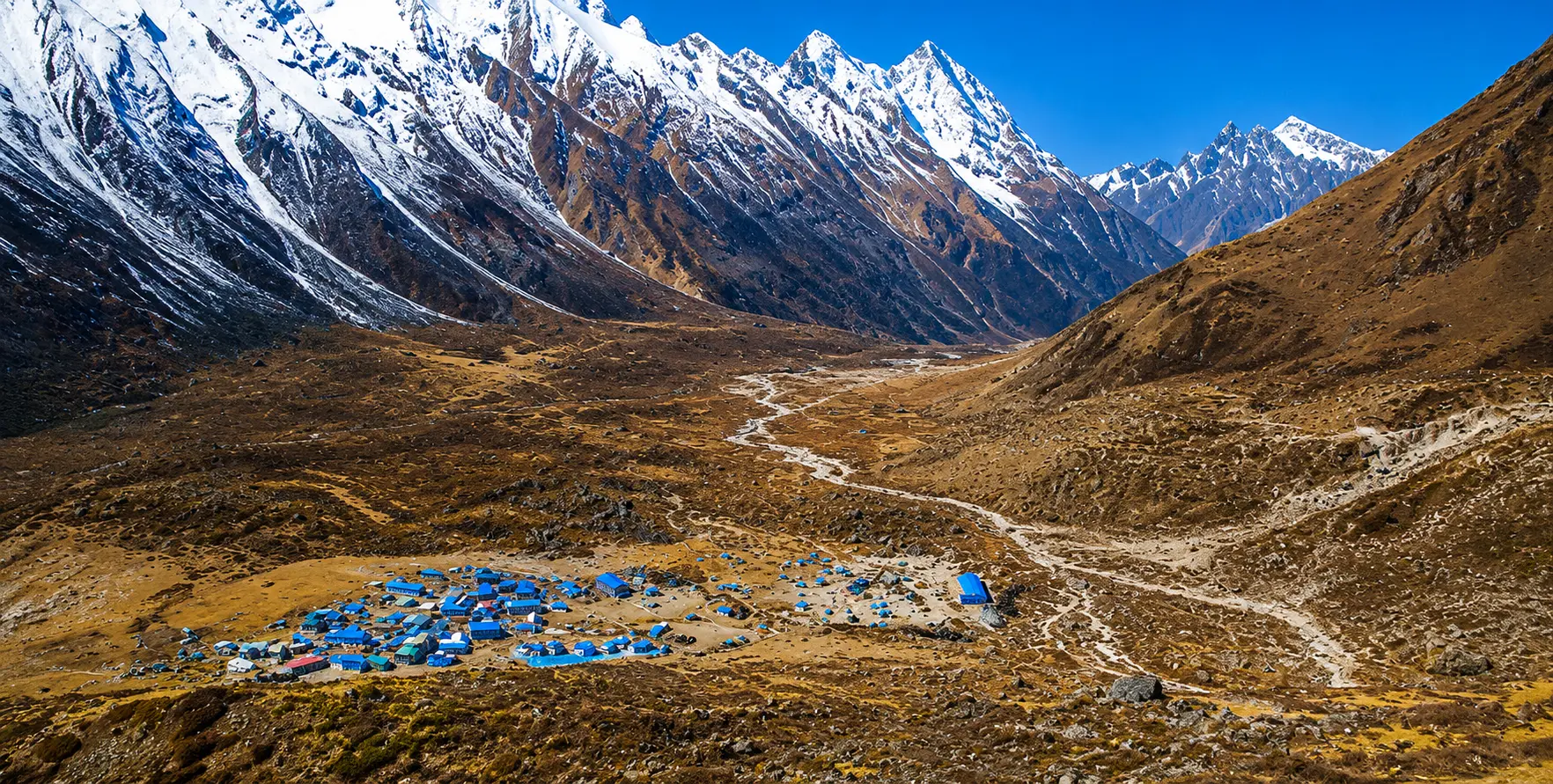
The Langtang Valley Trek from Syabrubesi takes 7 to 12 days for the standard circuit, ascending the Langtang Khola valley through bamboo and rhododendron forest to the high-alpine landscape of Langtang Village (3,307 m) and the extraordinary glacier valley of Kyanjin Gompa (3,870 m).

From Kyanjin Gompa, the trek’s two most spectacular optional extensions reward trekkers with investment in additional altitude: Kyanjin Ri (4,773 m) for a 360-degree panorama of the Langtang Himal including the dramatic Langtang Lirung at 7,227 m; and Tserko Ri (4,984 m) for one of the finest mountain viewpoints accessible on a non-technical day hike anywhere in the Nepal Himalaya — the complete arc of the Langtang range, the Tibetan plateau visible to the north, and the Gosaikunda massif to the south all visible simultaneously on clear mornings. The return to Syabrubesi from Kyanjin Gompa takes 3 to 4 days of descent, with an alternative descent via Thulo Syabru connecting to the Gosaikunda approach trail for trekkers combining both destinations.

The Langtang Valley’s cultural dimension adds a depth that the purely physical mountain experience does not fully capture. The valley’s Tamang and Tibetan communities—some of the most culturally intact high-altitude Buddhist communities in Nepal outside restricted-zone areas—have rebuilt their settlements after the catastrophic 2015 earthquake with remarkable speed and determination.

Langtang Village, almost destroyed by the earthquake-triggered avalanche, has been rebuilt with international support and is now a viable trekking stop, with a rebuilt monastery and traditional guesthouses that welcome visitors in an atmosphere that honours the tragedy of 2015 and the community’s determined recovery. The Langtang Valley Trek in 2026 and 2027 combines Himalayan mountain grandeur with the unique human quality of a community that has faced and survived catastrophe.

This dimension makes the Langtang experience meaningfully different from, and in some ways more moving than, the more famous Nepal trekking circuits whose communities haven’t shared this history.
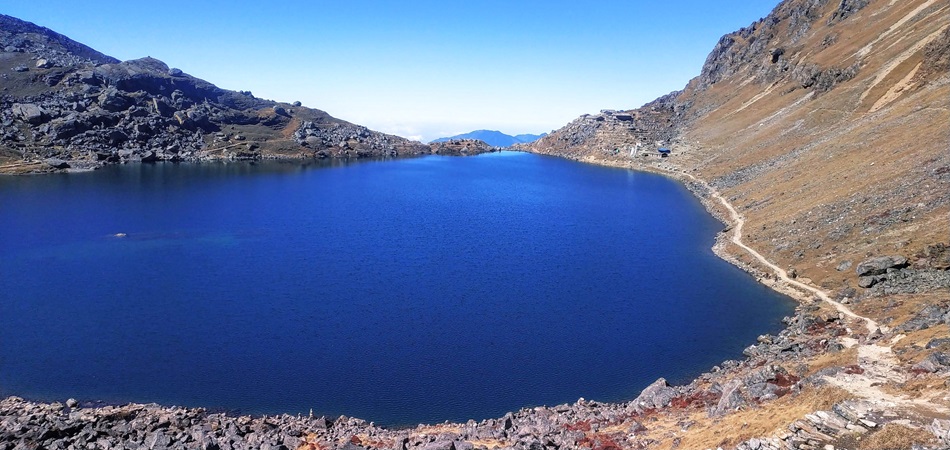
Book Langtang Gosaikunda Trek Alternative Route Vehicle Hire with a private 4WD jeep or Scorpio for convenient access to Langtang and Gosaikunda trekking areas. Choose flexible pickup and drop-off options based on the selected trekking route and current road conditions.

The Gosaikunda Lake Trek: Sacred Route in Full Detail

The Gosaikunda Lake Trek from Dhunche follows one of Nepal’s finest ridge-top trekking routes, ascending the Lauribina ridge through Langtang National Park’s high-altitude shrubbery and tundra to a cluster of sacred lakes at 4,380 meters, with mountain views expanding as the trail gains altitude. Day 1 from Dhunche reaches Sing Gompa (Chandanbari) at 3,250 meters through dense rhododendron and oak forest —a5-to-6-hour walk that gains 1,270 meters and ends at a small community famous for its traditional cheese factory t, which produces yak-milk cheese for the Kathmandu market.

Sing Gompa cheese is worth buying for the high-altitude days ahead, and the settlement’s all-monastery feel suggests an early encounter with the devotional character that intensifies as the trail approaches the sacred lake.

Day 2 from Sing Gompa climbs steeply through the transition zone between forest and high-alpine tundra to Lauribina (3,920 m) — a simple teahouse stop on the exposed ridgeline where the first views of the Gosaikunda massif’s glaciated peaks appear above the terrain ahead, and the Langtang Himal becomes visible to the north in its full extent. The camping ground at Lauribina Yak is a popular overnight stop for trekkers who want to reach Gosaikunda the next morning with fresh legs rather than arriving at the lake late on Day 2. Day 3 from Lauribina reaches Gosaikunda Lake (4,380 m) in 2 to 3 hours — the approach through a lunar landscape of rock, permanent snow patches, and glacial meltwater streams creating a progressive sensory preparation for the sacred lake’s turquoise waters that open suddenly below the final ridgeline.

The sacred lake’s immediate surroundings — the principal Shiva shrine at the eastern shore, the smaller associated lakes of Saraswatikunda and Bhairavkunda visible from the main lake’s rim, and the permanent snowfields reflecting in the water on still mornings — create an encounter with the Himalayan sacred geography that few other destinations in Nepal can replicate.

From Gosaikunda, trekkers have three onward options that generate different vehicle hire requirements: (1) retrace to Dhunche (2 to 3 days, return vehicle from Dhunche); (2) cross the Lauribina La (4,610 m) into Helambu and exit at Sundarijal (3 to 4 additional days, vehicle from Sundarijal); or (3) continue the complete Langtang-Gosaikunda-Helambu circuit to Melamchi Pul Bazaar (4 to 5 additional days, vehicle from Melamchi). Nepal Vehicle Hiking Pvt Ltd coordinates the return or exit vehicle for all three options — the key is communicating the chosen option at the time of the outbound booking so the return vehicle arrangement is prepared before the trek begins rather than improvised from the trail.

The Helambu Region: Nepal’s Most Accessible Himalayan Cultural Landscape

The Helambu region — the high country immediately north of the Kathmandu Valley in the Sindhupalchok and Kavrepalanchok districts — is Nepal’s most conveniently accessible Himalayan cultural trekking destination: close enough to Kathmandu to be reached by 1 to 2 hours of vehicle travel from the city, yet sufficiently elevated and remote to deliver authentic Hyolmo Buddhist cultural encounters and Himalayan landscape quality that justify the trekking investment. The Helambu circuit’s main cultural attractions are the Hyolmo communities—a Tibetan-origin Buddhist people whose traditional architecture, painted monasteries, and high-altitude agricultural practices have survived with considerable cultural integrity in the villages of Tarkeghyang (2,740 m), Shermathang (2,620 m), and Melamchi Gaon (2,530 m).

For trekkers who complete the full Langtang-Gosaikunda-Helambu traverse and descend through these lower Helambu villages to Melamchi Pul Bazaar, the cultural dimension of the final days creates a compelling reason to choose Melamchi over Sundarijal as the exit point — the ridge-top Sundarijal route is faster. Still, it skips the finest Helambu cultural encounters available in the lower-valley settlements.

Nepal Vehicle Hiring Pvt Ltd’s private jeep hire from Melamchi Pul Bazaar to Kathmandu serves trekkers choosing this culturally richer exit with a 3-to-4-hour return drive at NPR 12,000 to NPR 18,000 — the additional cost and time relative to the Sundarijal option are modest compared to the cultural richness of the lower Helambu villages that the Melamchi exit includes. Our Nepal tour packages include the complete Langtang-Gosaikunda-Helambu circuit as one of Nepal’s finest multi-region trekking programs, with coordinated vehicle hire for every stage, from the initial Kathmandu-to-Syabrubesi outbound transfer through the final Melamchi or Sundarijal return.

Combining Langtang-Gosaikunda with Nepal’s Other Great Treks

The Langtang-Gosaikunda region’s proximity to Kathmandu makes it an ideal starting or ending point for extended Nepal trekking adventures that combine this region with one or more of Nepal’s other great circuits. A common combination for trekkers with 3 to 4 weeks in Nepal is Langtang-Gosaikunda followed by the Annapurna Base Camp Trek or the Ghorepani Poon Hill Trek — completing the Langtang circuit at Sundarijal, returning to Kathmandu by private car, spending 2 days in Kathmandu for rest and cultural sightseeing, and then taking our Kathmandu-to-Pokhara private vehicle for the second trekking phase from Pokhara.

Nepal Vehicle Hiring Pvt Ltd coordinates the complete inter-city vehicle arrangement — including the Kathmandu sightseeing day between trekking phases — as a single unified booking.

For trekkers combining Langtang with the Manaslu Circuit Trek — both being northern Nepal circuits accessible from Kathmandu by road — Nepal Vehicle Hiring Pvt Ltd provides the Kathmandu to Syabrubesi jeep for the Langtang approach and the Kathmandu to Soti Khola jeep service for the subsequent Manaslu approach, with a Kathmandu rest period between the two circuits coordinated by our airport transfer and city sightseeing vehicles. We can add the Three Passes Trek and Gokyo Lake Trek in the Khumbu region as a third circuit for the most ambitious multi-region Nepal trekking programs, served by our Kathmandu-to-Salleri Phaplu overland service or the Ramechhap Airport jeep transfer for the Lukla flight approach.

Our plan-your-trip service coordinates the full multi-trek vehicle arrangement from a single booking.

Vehicle Hire Safety and Driver Standards on the Pasang Lhamu Highway

The Pasang Lhamu Highway to Syabrubesi and Dhunche is one of Nepal’s most scenically rewarding but also most technically demanding mountain approach roads — and the driver’s specific experience on this corridor is as important as the vehicle’s mechanical capability in determining the quality and safety of the journey. Nepal Vehicle Hiring Pvt Ltd assigns drivers to the Syabrubesi and Dhunche approaches exclusively from among those who have completed these routes multiple times — drivers who know the current condition of the Ramche Landslide Zone, who know which sections are most affected by rain in the morning versus the afternoon, and who know the specific passing places and priority protocols on the narrow sections of the Dhunche to Syabrubesi descent that require reverse manoeuvring for oncoming traffic.

Vehicle preparation for this specific corridor includes pre-journey checks of tyre condition and pressure (the rough sections demand adequate tread depth), brake performance (the descent to Syabrubesi involves sustained downhill driving where brake reliability is safety-critical), and 4WD system engagement (ensuring that the vehicle’s 4WD is immediately functional when the Ramche section or the Dhunche descent demands it). Every Nepal Vehicle Hiring Pvt Ltd jeep hired for the Syabrubesi approach undergoes these pre-journey checks.

This standard separates professional operators from casual hire arrangements whose vehicles may not meet the Pasang Lhamu Highway’s specific demands.

For trekkers travelling in the monsoon season or immediately after heavy rainfall, Nepal Vehicle Hiring Pvt Ltd additionally contacts local road condition sources before confirming the departure time — road authority contacts and local operators with same-day information about the Ramche section’s current condition allow us to adjust departure timing (earlier departures before afternoon rainfall peaks) or recommend a one-day delay when specific conditions make the journey inadvisable. This road-condition intelligence capability, built on years of operating on this corridor, gives Nepal Vehicle Hiring Pvt Ltd clients a practical safety advantage over trekkers who arrange transport through operators without established Pasang Lhamu Highway contacts.

Langtang National Park Permits and Vehicle Hire Coordination

The Langtang Valley Trek and the Gosaikunda Lake Trek both require entry into Langtang National Park, which demands a Langtang National Park Entry Permit (NPR 3,000 for foreign nationals, NPR 1,500 for SAARC nationals) obtainable from the Nepal Tourism Board in Kathmandu before departure. All foreign trekkers also need a TIMS card (Trekkers’ Information Management System).

Both permits are available from the Nepal Tourism Board office at Bhrikutimandap in central Kathmandu — allow 1 to 2 hours for complete permit processing.

Nepal Vehicle Hiking Pvt Ltd coordinates permit processing timing with vehicle departure scheduling—many Langtang-bound trekking groups obtain their permits the afternoon before the planned vehicle departure and depart the following morning at 6:00 7:00 a.m., or when road conditions are best. Our contact team can advise on the Nepal Tourism Board’s current operating hours and any changes to permit requirements when you confirm your vehicle booking.

For trekkers exiting via Sundarijal through the Shivapuri-Nagarjun National Park, a separate park entry permit (NPR 1,000 for foreigners) is required and is obtainable at the Shivapuri-Nagarjun checkpoint at the Sundarijal trailhead on the descent — Nepal Vehicle Hiring Pvt Ltd drivers for the Sundarijal pickup are familiar with this checkpoint and can advise on timing.

For groups combining the Langtang-Gosaikunda trek with a Kathmandu cultural day before or after, Nepal Vehicle Hiring Pvt Ltd’s complete city service network covers Kathmandu sightseeing by private vehicle, the Nagarkot sunrise tour for the Himalayan panorama including the Langtang and Gosaikunda massifs on the northern horizon, the Bhaktapur Durbar Square day tour for medieval Newar heritage immersion, and the Nagarkot vehicle hire for the valley-rim viewpoint at any time of day. Our Kathmandu airport transfer service connects arriving trekkers directly from Tribhuvan International to their hotel, beginning every Langtang-Gosaikunda adventure on the right door-to-door note.

Contact Nepal Vehicle Hiring Pvt Ltd at +977 981-4227196 (WhatsApp/Viber) to coordinate the complete Langtang-Gosaikunda alternative route vehicle hire — outbound and return, open-jaw or round-trip, private jeep or group Hiace — all with transparent all-inclusive pricing and experienced Pasang Lhamu Highway drivers. Visit vehiclehiringnepal.com to book.

Frequently Asked Questions

The Langtang-Gosaikunda-Helambu trekking region offers Nepal’s finest combination of accessibility and Himalayan wilderness—close enough to Kathmandu to reach by vehicle in a single day, yet remote and scenically spectacular enough to deliver the complete mountain adventure trekkers come to Nepal for. The alternative route vehicle hire options covered in this guide — Syabrubesi, Dhunche, Sundarijal, and Melamchi — give every trekker the transport flexibility their itinerary requires, coordinated by Nepal Vehicle Hiring Pvt Ltd’s experienced team through a single WhatsApp contact at +977 981-4227196. Every Langtang trail leads somewhere extraordinary — and the right private vehicle gets you there and brings you home.

Nepal Vehicle Hiring Pvt Ltd’s transparent, all-inclusive pricing, route-experienced drivers, and WhatsApp coordination make us the most reliable choice for Langtang-Gosaikunda alternative route vehicle hire. Book both legs before your trek begins and focus entirely on the mountains.

What is the best vehicle for Kathmandu to Syabrubesi in 2026?

A private 4WD jeep—Toyota Land Cruiser or Mahindra Scorpio—is the clear recommendation for the full Kathmandu to Syabrubesi route. The Ramche Landslide Zone’s unpaved section and the Dhunche-Syabrubesi descent both reward 4WD capability and high ground clearance. Nepal Vehicle Hiring Pvt Ltd’s Kathmandu-to-Syabrubesi jeep transfer costs NPR 20,000 to NPR 28,000 per vehicle (USD 150 to USD 210), all-inclusive.

Can I start the Gosaikunda Trek from Dhunche instead of Syabrubesi?

Yes — Dhunche is the ideal starting point for the Gosaikunda Lake Trek without the Langtang Valley extension. The Kathmandu to Dhunche vehicle hire costs US$160 per vehicle, slightly less than the full Syabrubesi rate. Nepal Vehicle Hiring Pvt Ltd’s Kathmandu-to-Syabrubesi jeep service covers Dhunche as an alternative destination at the adjusted shorter-distance rate.

How do I get from Sundarijal back to Kathmandu after the Helambu trek?

Sundarijal is only 25 kilometres from central Kathmandu — a 1-to-1.5-hour drive. A private car hire from Sundarijal to any Kathmandu hotel costs NPR 2,500 to NPR 4,000. Nepal Vehicle Hiking Pvt Ltd provides pre-arranged Sundarijal pickup—book it with the outbound Syabrubesi transfer, and WhatsApp the return date confirmation from Chisapani on the descent.

How long does the drive from Kathmandu to Syabrubesi take?

5 to 9 hours depending on vehicle type, road conditions, and season. Private jeeps via the alternate Kakani-Galchhi route typically take 5 to 7 hours; buses take 7 to 10 hours. As Nepal Vehicle Hiring Pvt Ltd’s route guide confirms, the private jeep also benefits from a faster alternate route that buses cannot use — a meaningful time saving on what is already one of Nepal’s longer standard trekking approach drives.

What is the best exit route from the Langtang-Gosaikunda-Helambu circuit?

Sundarijal is the quickest and cheapest exit — 25 km from Kathmandu, 1 to 1.5 hours drive, NPR 2,500 to NPR 4,000 private car. Melamchi Pul Bazaar is the alternative for trekkers descending through lower Helambu villages — 45 to 60 km from Kathmandu, 3 to 4 hours, NPR 12,000 to NPR 18,000 private jeep.

Nepal Vehicle Hiring Pvt Ltd offers both options with pre-arranged pickup. The Langtang Valley Trek guide recommends Sundarijal for time efficiency and Melamchi for cultural completeness.

Can I combine the Langtang Valley Trek and Gosaikunda in one trip?

Yes — the combined Langtang Valley and Gosaikunda Trek takes 12 to 15 days, beginning at Syabrubesi and ascending the Langtang Valley to Kyanjin Gompa before crossing back via Thulo Syabru to the Gosaikunda approach. Nepal Vehicle Hiring Pvt Ltd coordinates the Syabrubesi outbound transfer and the Dhunche or Sundarijal return in a single booking — contact us at +977 981-4227196 to arrange the complete open-jaw vehicle arrangement.

Conclusion: The Right Vehicle for Every Langtang Route

The Langtang-Gosaikunda-Helambu trekking network’s greatest strength—its multiple access and exit points—also creates genuine vehicle-hire planning complexity, which Nepal Vehicle Hiking Pvt Ltd resolves with transparent, route-specific private vehicle services for every combination. Whether your trek begins at Syabrubesi and ends at Sundarijal, begins at Dhunche and returns to Dhunche, or begins at Sundarijal and exits at Melamchi — the right 4WD jeep, private car, or Hiace van is available from Nepal Vehicle Hiring Pvt Ltd with transparent, all-inclusive pricing, experienced route drivers, and the WhatsApp coordination that keeps your return vehicle confirmed throughout your trek.

Contact our team at +977 981-4227196 or visit vehiclehiringnepal.com to book your Langtang-Gosaikunda alternative route vehicle hire today. Plan your complete Langtang trekking journey — from the first jeep to the last valley view.
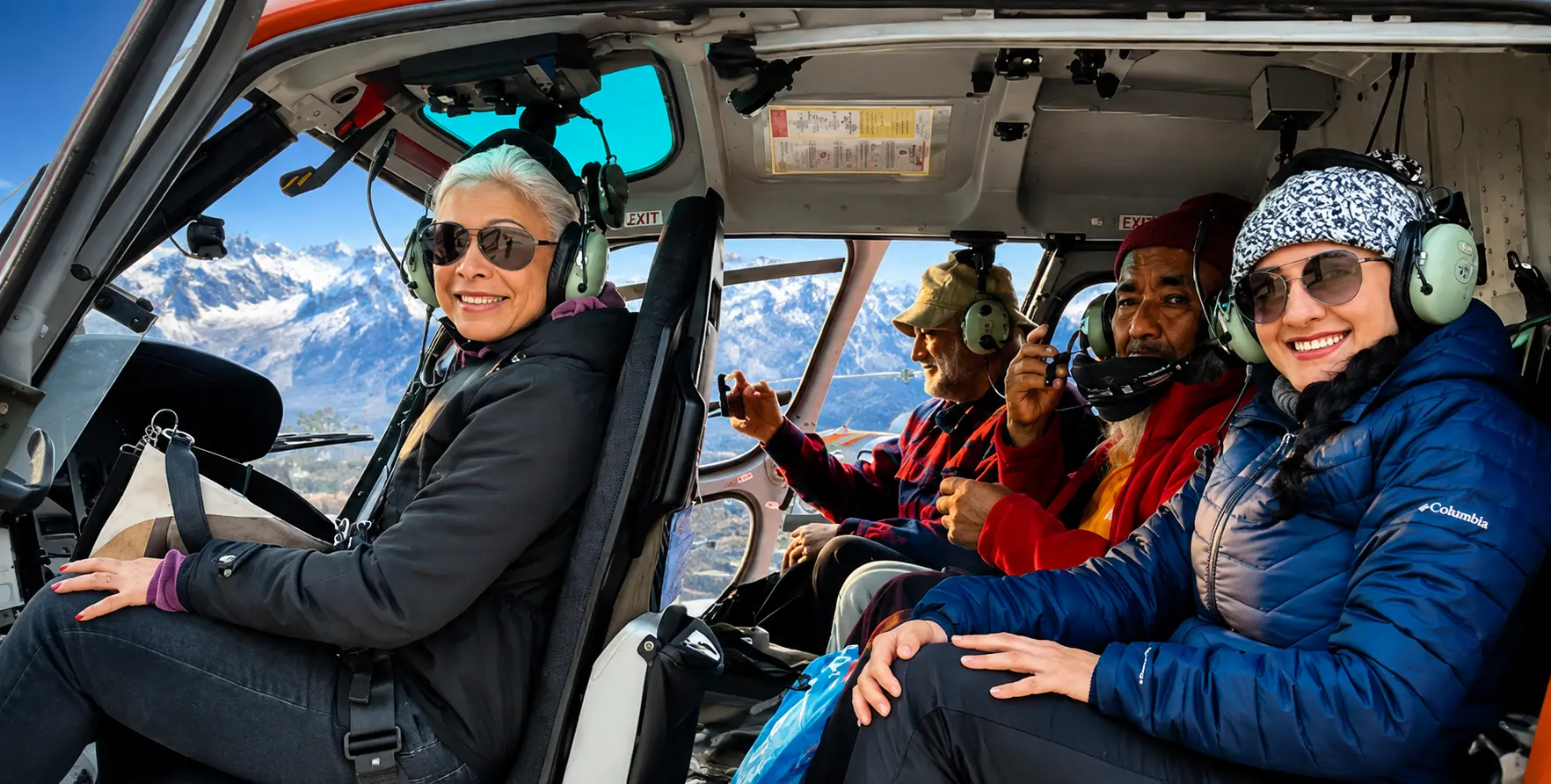
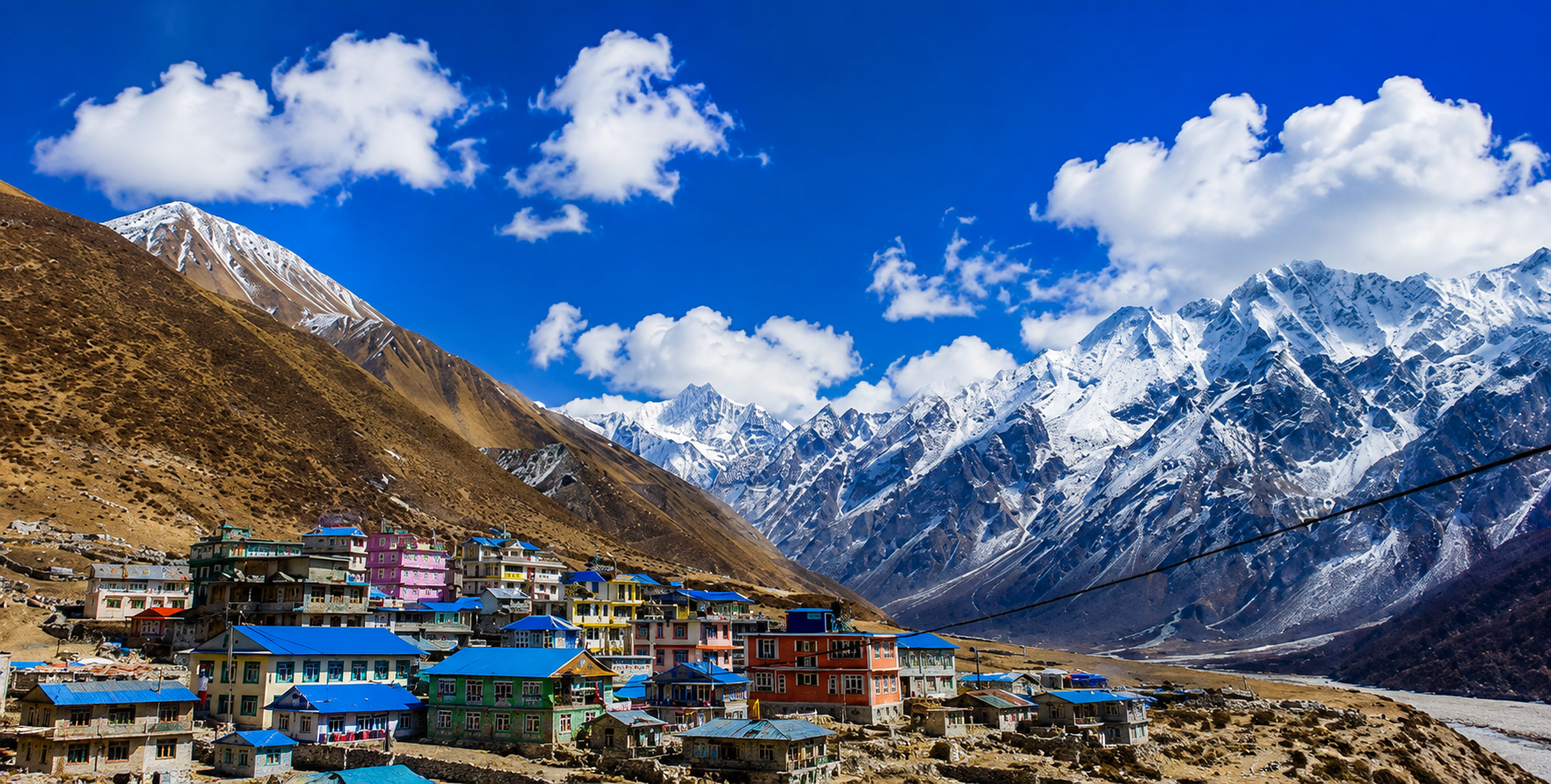
Langtang Valley and Gosaikunda Lake Helicopter Tour

Experience the Langtang Valley and Gosaikunda Lake Helicopter Tour for spectacular views of Langtang Himal, Gosaikunda Lake, glaciers, and surrounding Himalayan peaks in a single day.

Langtang Valley and Gosaikunda Lake Helicopter Tour — Complete Guide

Nepal’s Most Sacred Helicopter Tour

Among Nepal’s helicopter tours — and there are extraordinary options across the Everest, Annapurna, and Mustang regions — the Langtang Valley and Gosaikunda Lake helicopter tour stands out at the intersection of natural grandeur, spiritual significance, and logistical accessibility. In a single half-day aerial journey departing from Kathmandu‘s Tribhuvan International Airport, travellers reach two of Nepal’s most compelling destinations — the sacred alpine lake of Gosaikunda at 4,380 metres, one of the holiest sites in both Hindu and Buddhist traditions, and the Kyanjin Gompa area of Langtang Valley at 3,830 metres, the cultural heart of the Langtang National Park trekking region — without a single day of trekking required.

Gosaikunda Lake sits in Nepal’s Rasuwa District, north of Kathmandu in Langtang National Park — an alpine freshwater lake complex comprising over 108 individual water bodies at altitudes between 4,000 and 4,380 meters.

The main Gosaikunda lake, at 4,380 meters, is venerated by Hindus as the site where Lord Shiva struck his trident into the mountainside to create water after drinking poison during the cosmic churning of the ocean, producing the lake whose icy meltwater feeds the Trishuli River that flows southward through the Kathmandu hinterland.

The lake remains frozen from October to June in most years, and its extraordinary blue-white surface, ringed by the Langtang and Ganesh Himal ranges, is one of the finest aerial landscape compositions on any Nepal helicopter route.

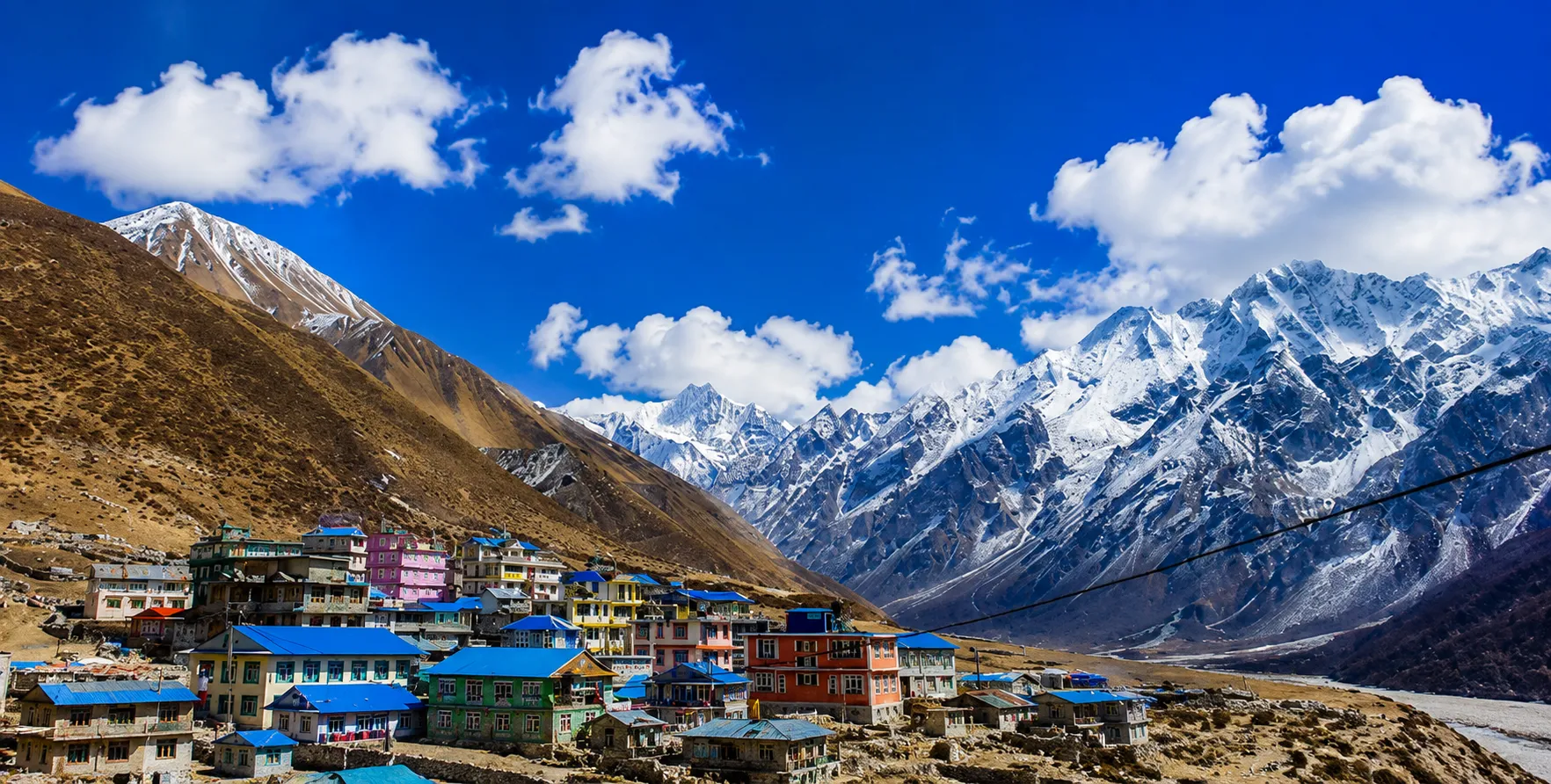
The Langtang Valley helicopter tour component—the Kyanjin Gompa landing at 3,830 meters—brings travellers into the cultural heartland of Langtang National Park, Nepal’s third most popular trekking destination after the Annapurna and Everest regions. The Kyanjin Gompa monastery, the surrounding yak cheese factory, the Langtang Lirung glacier directly above the valley, and the panoramic views of the Ganesh Himal, Yala Peak at 5,500 m, and Naya Kanga at 5,844 m create an environment of extraordinary mountain richness accessible — in the helicopter tour context — without the five- to six-day trek from Syabrubesi that the standard Langtang Valley trekking approach requires.

For travellers with limited time in Nepal, the helicopter tour delivers the Langtang Valley experience in a single morning, something no other transport option can replicate. However, for those who want the full Langtang trekking experience, Nepal Vehicle Hiring Pvt. Ltd. offers the most reliable Kathmandu-to-Syabrubesi jeep hire. This ground transport begins the classic Langtang Valley Trek.

Langtang Gosaikunda Helicopter Tour — Quick Reference

Flight: Kathmandu (Tribhuvan Airport) to Gosaikunda Lake and Kyanjin Gompa (Langtang Valley)

Total Duration: 1.5 to 2 hours (airtime) + exploration time at each landing point

Gosaikunda Lake Altitude: 4,380 m (14,370 ft) | Kyanjin Gompa: 3,830 m (12,566 ft)

Mountains Visible: Langtang Lirung, Ganesh Himal, Yala Peak, Naya Kanga, Gaurishankar

Cost: USD 900-1,100 per person (group of 4) | USD 1,300 per person (group of 2) | USD 2,500 solo

Best Season: Oct-Nov and Mar-May | Jul-Aug also possible (clear morning windows)

Ground Transport: Nepal Vehicle Hiring Pvt. Ltd. | Kathmandu-Syabrubesi | +977 981-4227196

Ground Transfer: Kathmandu to Syabrubesi NPR 14,000-25,000 | 4WD Jeep | vehiclehiringnepal.com

Langtang valley trek

Understanding the Langtang Gosaikunda Helicopter Tour Route

Takeoff: Tribhuvan International Airport, Kathmandu

The Langtang Gosaikunda helicopter tour departs from Tribhuvan International Airport in Kathmandu — the same airport that serves international flights to Nepal. Most operators depart early, between 6:30 and 8:00 a.m., taking advantage of stable atmospheric conditions in the high Himalayas before afternoon thermal activity can create turbulence and cloud build-up by midday.

The standard Nepal Vehicle Hiring Pvt. Ltd. hotel pickup service for helicopter tour clients — available via WhatsApp at +977 981-4227196 — gets travellers to the airport departure point comfortably before the scheduled departure time, eliminating the stress of early-morning airport navigation in Kathmandu.

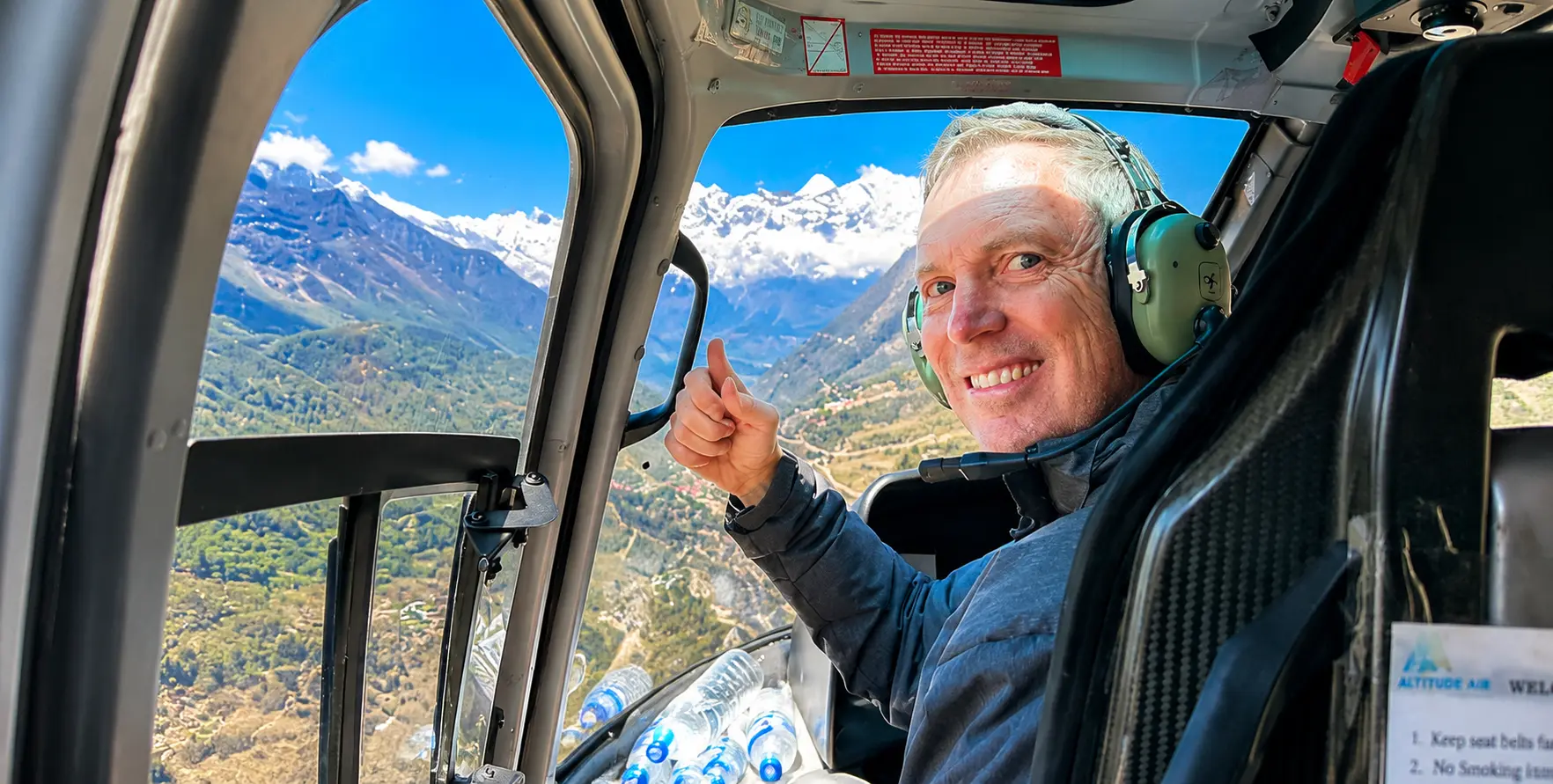
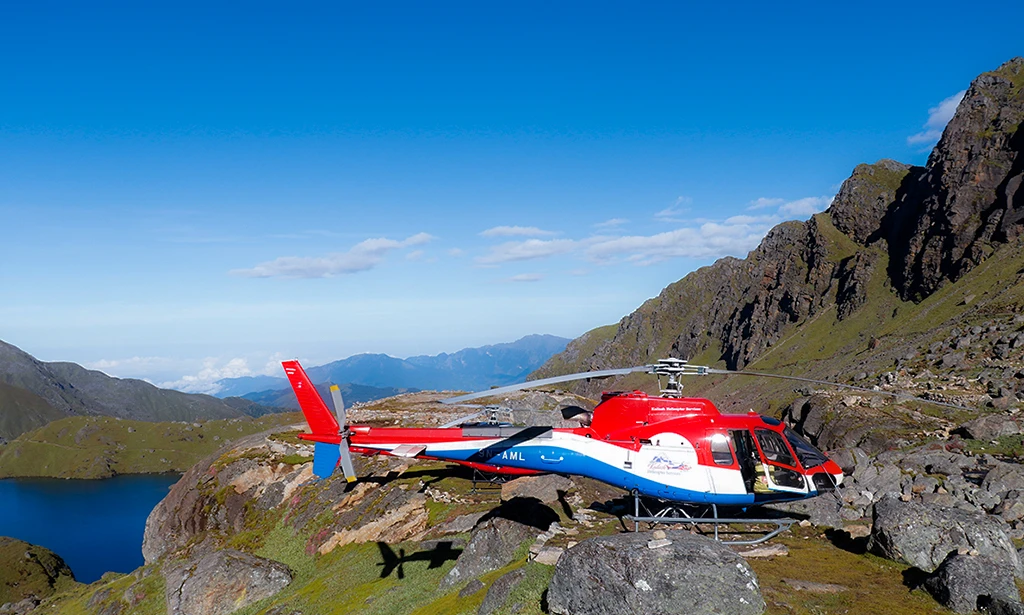
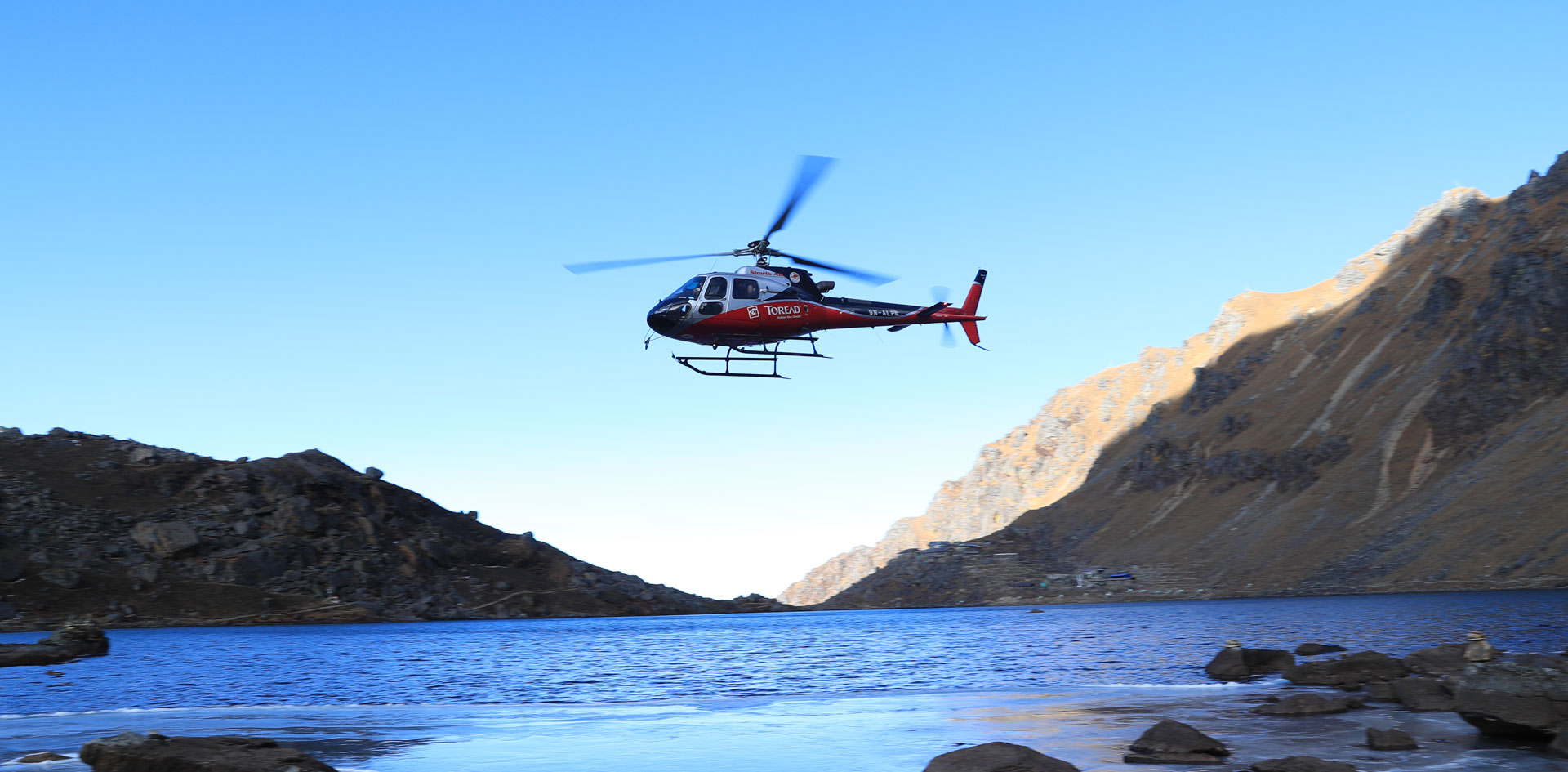
The helicopter used for the Langtang Gosaikunda tour is typically a Bell 407 or Airbus AS350 B3 — high-altitude-capable turbine helicopters certificated for the Himalayan operating environment and regularly maintained to Civil Aviation Authority of Nepal standards. These aircraft seat four to five passengers plus the pilot and provide panoramic visibility through large cabin windows, essential for the photography and sightseeing that is the tour’s primary purpose.

Most operators offer private charters for individuals and couples, as well as shared group departures—prices vary significantly between solo charters and group bookings of four to five people.

The Aerial Approach to the Langtang Region

The helicopter flight from Kathmandu to the Langtang region takes about 15 to 20 minutes—making it one of the quickest transitions from a major Asian city to a high-altitude Himalayan environment anywhere in the world. The initial approach from the airport crosses the Kathmandu Valley rim, offering aerial views of the valley’s dense urban fabric, its remarkable ring of ancient temple sites, and the first panoramic views of the Himalayan range forming the capital’s northern horizon.

As the helicopter climbs northward, the Shivapuri National Park forest cover below gives way progressively to the steeper terrain of the Rasuwa District foothills, and the dramatic Trishuli River gorge becomes visible below — the same valley that the Kathmandu to Syabrubesi road follows northward to the Langtang Valley trekking trailhead.

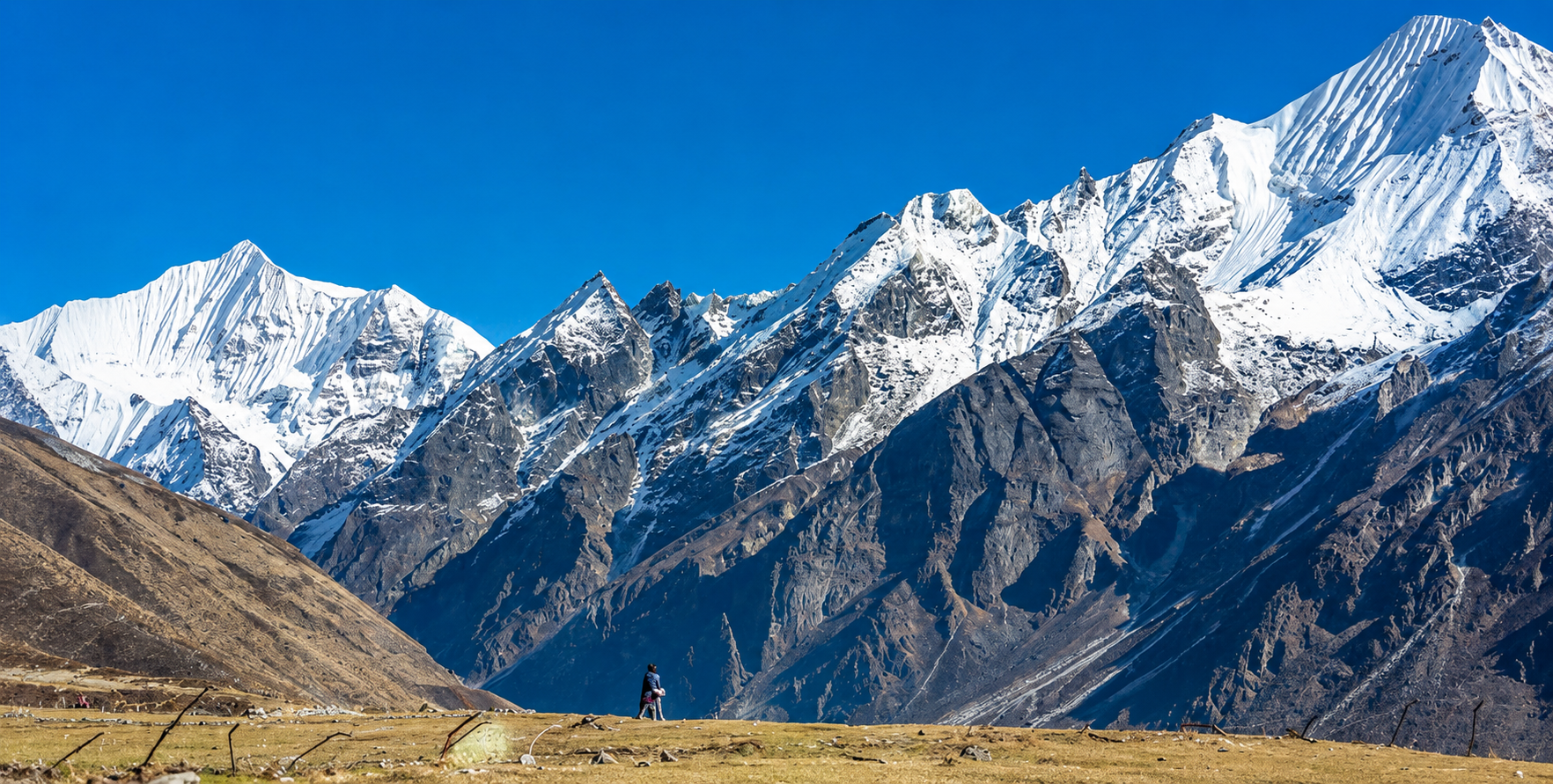
As the helicopter gains altitude approaching the Langtang National Park boundary, the dramatic transition from the subtropical foothills to the alpine landscape begins — the mixed forest belt gives way to rhododendron and juniper at mid-altitude, then to open alpine terrain and snow-covered ridges above 3,500 meters. The Langtang Lirung at 7,227 m — the highest peak in the Langtang massif — becomes visible to the northeast as a massive wall of ice and rock that dominates the skyline above the valley, its scale becoming increasingly apparent as the helicopter approaches the landing sites.

The Ganesh Himal range to the west, the Jugal Himal to the east, and the Tibet Autonomous Region plateau in the far north together create a 360-degree Himalayan panorama that the helicopter’s altitude and speed let travellers absorb in its extraordinary entirety.

Landing 1: Gosaikunda Lake (4,380 m)

The first landing on the Langtang Gosaikunda helicopter tour is typically at the Gosaikunda Lake shoreline at 4,380 meters—the sacred alpine lake and spiritual centrepiece of the tour. The helicopter touches down on a flat area near the lake edge.

Passengers typically have 20 to 40 minutes at the lake to walk the shoreline, photograph the extraordinary composition of the frozen or semi-frozen lake surface, the Langtang and Ganesh Himal backdrop, and the small Gosaikunda Shrine on the lake’s southern bank that serves as the primary devotional site for Hindu pilgrims. Gosaikunda is significant — 4,380 meters is enough to produce noticeable breathlessness in visitors unacclimatized to altitude.

The brief time at the lake means acute mountain sickness is not a serious risk. Still, travellers should move slowly and avoid strenuous activity during the visit.

The Gosaikunda Lake complex includes several other sacred water bodies in the immediate vicinity— Bhairavkunda, Saraswatikunda, and Suryakunda, among them—each with its own mythological significance in the Hindu and Buddhist traditions that have venerated this high-altitude lake complex for centuries. The lake surface freezes from about October to June in most years, creating the spectacular blue-white landscape that characterises the winter and spring helicopter tour experience.

In July and August, the lake surface is typically open water—a deep turquoise colour created by the reflection of the sky and dissolved minerals from the surrounding glacial terrain—offering a different but equally extraordinary visual experience. The Janai Purnima festival, typically held in July or August at the full moon, draws thousands of Hindu pilgrims to Gosaikunda on foot — those who reach the lake on the helicopter tour outside the festival period experience the extraordinary site in relative solitude.

Landing 2: Kyanjin Gompa, Langtang Valley (3,830 m)

The second landing of the Langtang Gosaikunda helicopter tour is at Kyanjin Gompa in the upper Langtang Valley at approximately 3,830 meters — the cultural and logistical hub of the Langtang trekking circuit and the highest permanently settled point in the valley accessible to international visitors. The Kyanjin Gompa monastery — a small but actively maintained Tibetan Buddhist monastery with a resident monastic community — sits at the valley floor below the extraordinary Langtang Lirung glacier wall that descends almost to the valley floor from the 7,227 m summit above.

From the monastery courtyard, perhaps two kilometres away, the glacier’s crevassed blue-white face creates the most dramatic single mountain composition in the entire Langtang trekking region.

The Kyanjin yak cheese factory — producing a distinctive high-altitude cheese from the milk of the yaks that graze the valley’s alpine meadows — is a cultural and gastronomic landmark of the Langtang Valley that helicopter tour visitors can visit during the landing stop. A short walk from the helicopter landing area brings visitors to the Kyanjin Ri viewpoint base — the approach to the 4,773 m viewpoint above the monastery, which offers the finest panoramic view in the entire valley.

While the full Kyanjin Ri ascent takes 2 to 3 hours on foot and isn’t practical during a helicopter tour landing stop, the valley-floor views from the monastery area are enough to convey the extraordinary scale and character of the Langtang mountain environment. The time at Kyanjin Gompa on the helicopter tour is typically 30 to 60 minutes — enough for breakfast at one of the teahouses, a walk to the monastery, and photography of the glacier and surrounding peaks before the return flight to Kathmandu.

Experience the Langtang Valley and Gosaikunda Lake Helicopter Tour for spectacular views of Langtang Himal, Gosaikunda Lake, glaciers, and surrounding Himalayan peaks in a single day.

Gosaikunda Lake — Sacred Significance and Natural Character

The Hindu and Buddhist Mythological Heritage

Gosaikunda Lake holds a position in Nepal’s Himalayan sacred landscape without parallel — a site simultaneously venerated in Hindu and Buddhist traditions that together form the spiritual bedrock of Nepali culture. Hindu mythology links Gosaikunda to the cosmic churning of the ocean (Samudra Manthan) described in the Puranas—the event in which the poison Halahala emerged from the ocean and threatened to destroy all creation until Lord Shiva consumed it to protect the world.

The poison burned Shiva’s throat, and seeking relief, he struck his trident (Trishul) into the mountainside above the Trishuli River valley, creating the lake of Gosaikunda from the water that gushed forth. The name itself reflects this mythology — Gosaikunda translates approximately as ‘the lake of the lord’ in Nepali, and the lake is regarded as the abode of Shiva and his consort Gauri.

The Buddhist tradition associates Gosaikunda with the Naga serpent deities believed to inhabit the lake’s depths and with the broader sacred geography of the Langtang National Park — an area that Tibetan Buddhist texts identify as a beyul, or hidden valley of special spiritual significance, described in the revelatory writings of Guru Rinpoche (Padmasambhava) as a place of refuge and spiritual intensification. The Kyanjin Gompa monastery in the valley below maintains the region’s Buddhist sacred presence through a continuous monastic community.

For pilgrims of both traditions, the helicopter tour to Gosaikunda represents a significant religious undertaking — the ability to reach the sacred lake without the demanding multi-day trek is particularly valued by elderly pilgrims, those with limited mobility, and devotees for whom the pilgrimage itself is the primary purpose rather than the trekking experience.

The Lake’s Natural Character — Altitude, Glaciology, and Ecology

From a natural science perspective, Gosaikunda is classified as an alpine freshwater oligotrophic lake- a cold, nutrient-poor, high-clarity water body characteristic of glacially scoured, high-altitude environments. The lake covers about 13.8 hectares and sits within a glacial cirque carved by Pleistocene glaciation, fed by meltwater from the surrounding snowfields and the Gosaikunda Glacier above.

The Trishuli River — one of Nepal’s most significant rivers, draining the entire western Langtang National Park watershed and eventually joining the Narayani/Gandaki River system — has its effective headwaters in the Gosaikunda meltwater system. The lake freezes to a depth that allows safe walking across the surface in the deepest winter months.

The ice surface’s colour—ranging from opaque white to translucent blue-green depending on ice thickness, snow cover, and light angle—creates the extraordinary visual character that makes it so photographically compelling from both the helicopter and the lakeside.

Experience the Langtang Valley and Gosaikunda Lake Helicopter Tour for spectacular views of Langtang Himal, Gosaikunda Lake, glaciers, and surrounding Himalayan peaks in a single day.

Langtang Valley — Geography, Culture and Trek Overview

Langtang National Park — established in 1976 as Nepal’s first Himalayan national park — covers 1,710 square kilometres of extraordinary alpine landscape in Rasuwa and Nuwakot districts north of Kathmandu, sharing a long border with the Tibet Autonomous Region to the north. The park’s terrain spans the full altitudinal range from subtropical forest at 800 meters to permanent glaciers and high Himalayan peaks above 7,000 meters — a compressed vertical landscape that supports extraordinary biodiversity, including the red panda, snow leopard, Himalayan tahr, Ghoral, and hundreds of bird species.

The Langtang Valley Trek is Nepal’s third most popular trek after the Annapurna Circuit and the Everest Base Camp Trek, offering an extraordinary combination of mountain scenery, Tibetan cultural heritage, and relative accessibility from Kathmandu that makes it the favourite Nepal trek for many repeat visitors.

The 2015 Gorkha earthquake and its associated avalanche devastated the Langtang Valley—Langtang village itself was largely destroyed by an earthquake-triggered ice avalanche from the slopes above, and the community lost a significant portion of its population in a few terrible minutes. The village has been rebuilt, and the trekking infrastructure has been reconstructed.

Still, the rebuilt Langtang village differs from the pre-earthquake settlement, and the disaster’s trauma remains in the community’s memory. The Langtang Valley’s extraordinary natural environment — the Langtang Lirung glacier wall, the Kyanjin Ri panorama, the open valley floor — survived the earthquake without fundamental alteration, and the valley’s trekking and helicopter tour experience is as compelling in 2026 as it was before.

The Langtang Valley Trek — The Ground Transport Alternative

For travellers who want the full Langtang Valley experience rather than the helicopter overview, the classic Langtang Valley Trek begins at Syabrubesi — the roadhead town on the Bhote Koshi River accessible by the Kathmandu to Syabrubesi jeep hire from Nepal Vehicle Hiring Pvt. Ltd. in approximately 7 to 8 hours. From Syabrubesi at 1,470 m, the trek ascends through the gorge of the Langtang Khola to Lama Hotel (2,380 m), then to Ghoda Tabela (3,000 m), Langtang Village (3,430 m), and finally Kyanjin Gompa (3,830 m) — a 5 to 6 day return journey that is considered one of the finest tea-house trek itineraries available from Kathmandu.

The Kathmandu-to-Syabrubesi private jeep from Nepal Vehicle Hiring Pvt. Ltd. is the most comfortable and efficient option—hotel pickup in Kathmandu, a 4WD vehicle for the mountain road, and direct delivery to the Syabrubesi trailhead.

Langtang valley trek

Helicopter Tour Costs and Pricing Structure

Group Pricing — Per Person Rates

The Langtang Gosaikunda helicopter tour is priced per person, with significant discounts for larger groups. Based on verified 2026 pricing from established Nepal helicopter tour operators, the standard rates are approximately USD 2,500 for a solo private charter, USD 1,300 per person for a group of two, USD 1,100 per person for a group of three, and USD 900 per person for a group of four sharing the same helicopter.

These rates are typically all-inclusive — covering the helicopter charter, airport handling fees, Langtang National Park entry permit (NPR 3,000 for foreign nationals), landing fees at Gosaikunda and Kyanjin Gompa, and the operator’s guide or crew member who accompanies the flight. Some operators include a breakfast at Kyanjin Gompa in the rate; others charge this separately.

Pricing varies significantly between operators in Nepal — the cheapest available Gosaikunda helicopter tour rates are considerably below the figures above, while top-end luxury operators charge substantially more. Key factors that justify higher pricing include the aircraft’s quality and maintenance standards, the operator’s Civil Aviation Authority of Nepal certification status, the pilot’s experience (Gosaikunda and Langtang Valley approaches require precise low-altitude navigation in variable mountain weather), and the included ground support.

Travellers should verify that their operator holds current CAAN certification and that the specific helicopter assigned to their flight has a current airworthiness certificate. Don’t cut corners to save USD 100 or 200 on an aviation safety decision.

Nepali Citizen Pricing

For Nepali citizens, the Gosaikunda helicopter tour is significantly cheaper than the international visitor rates—most operators offer group-joining departures specifically for Nepali citizens at rates well below foreign visitor charter rates.

These group departures, typically scheduled on specific days of the week (many operators run Monday and Saturday departures for the Nepali citizen market), let individual bookings combine with other Nepali travellers to fill the helicopter at a shared rate.

The Janai Purnima festival season in July and August sees particularly high demand from Nepali citizens for helicopter access to Gosaikunda, with many operators offering special festival rates to accommodate the large number of pilgrims seeking the aerial approach to the sacred lake during this most auspicious visiting period.

What Is and Is Not Included

A standard Langtang Gosaikunda helicopter tour package in 2026 typically includes a helicopter charter (airport to Gosaikunda to Kyanjin Gompa and return), a Langtang National Park entry permit, one crew member or guide, basic insurance coverage, and airport pickup from the hotel.

Items typically NOT included: travel insurance (travellers must arrange their own policy covering emergency helicopter evacuation from altitude — this is legally required for trekking permits in Nepal and strongly recommended for helicopter tour passengers as well), meals at Kyanjin Gompa, personal porters or photography guides, and the ground transport from the hotel to the airport.

Nepal Vehicle Hiring Pvt. Ltd. provides airport transfers for helicopter tour clients—a private vehicle from the Kathmandu hotel to Tribhuvan Airport for early-morning departures and a return pickup after the tour ends—coordinated via WhatsApp at +977 981-4227196.

Experience the Langtang Valley and Gosaikunda Lake Helicopter Tour for spectacular views of Langtang Himal, Gosaikunda Lake, glaciers, and surrounding Himalayan peaks in a single day.

Best Season for the Langtang Gosaikunda Helicopter Tour

Autumn — October and November (Peak Season)

Autumn, from October through November, is the best overall time for the Langtang Gosaikunda helicopter tour—the post-monsoon atmosphere of extraordinary clarity makes October Nepal’s best photography month and equally advantageous for aerial views. The Langtang Lirung, Ganesh Himal, and Jugal Himal ranges are at their most visible and vivid in October; the Gosaikunda Lake ice begins to form (creating the extraordinary blue-white surface that is the most photogenic lake state), and flight conditions are at their most stable and clear.

November extends the autumn quality with fewer tourists but progressively colder temperatures at the high landing sites — Gosaikunda at 4,380 m in November requires warm clothing even for the brief time outside the helicopter.

Spring — March to May

Spring from March through May is the second-best period for the helicopter tour — the weather is broadly stable, visibility is excellent in the mornings, and the rhododendron forests of the Langtang foothills visible from the helicopter are in spectacular bloom in March and April. In spring, Gosaikunda Lake is typically still frozen or semi-frozen, offering a photographic contrast between the ice surface and the warming alpine landscape.

May brings increasingly unstable afternoon weather as pre-monsoon atmospheric instability builds—for May helicopter tours, early morning departures (6:30 to 7:00 a.m.) are essential to complete the flight before afternoon cloud develops.

Summer Monsoon — July and August

The monsoon season (June to September) is generally not recommended for helicopter tours because of the cloud, rain, and reduced visibility that characterise Nepal’s monsoon weather. However, July and August often have clear morning windows—from dawn to about 9:00 a.m.—when conditions are clear before the day’s moisture builds into cloud.

For the Janai Purnima festival period—when the Gosaikunda pilgrimage is at its peak—July and August helicopter tours are in high demand, and operators schedule early-morning departures to take advantage of the clear morning windows. Travellers booking monsoon-season helicopter tours should keep dates flexible and confirm departure conditions on the morning of the scheduled flight.

Winter — December to February

Winter helicopter tours to Gosaikunda (December to February) are possible but require careful weather assessment and appropriate cold-weather preparation for the brief time outside the helicopter at 4,380 m. Winter Gosaikunda is the most dramatically frozen — the lake ice is at its deepest and most photogenic — and the winter air clarity can be exceptional on the clear days between the occasional snowfall events that characterise the Langtang region in winter.

The snow leopard habitat of Langtang Park’s higher elevations is at its most accessible in winter when the animals descend in search of prey, and wildlife-focused travellers who combine the Gosaikunda helicopter tour with winter wildlife observation in the Langtang foothills accessible by the Kathmandu to Syabrubesi jeep hire have the opportunity for one of Nepal’s finest combined nature experiences.

The Gosaikunda Trek Alternative — Walking to the Sacred Lake

The Gosaikunda Trek Route from Syabrubesi

For travellers with more time who want the full experience of walking to Gosaikunda Lake, the overland approach combines a Kathmandu-to-Syabrubesi private jeep hire from Nepal Vehicle Hiring Pvt. Ltd.

with a 5 to 7 day trek through the Langtang National Park that reaches both Kyanjin Gompa in the Langtang Valley and Gosaikunda Lake via the Lauribina La Pass at 4,610 m. The Syabrubesi jeep transfer is the essential starting point — the Kathmandu to Syabrubesi road covers approximately 120 km in 7 to 8 hours by 4WD jeep from Nepal Vehicle Hiring Pvt. Ltd. — a mountain road journey through the Trishuli Valley that is itself a rewarding experience and the appropriate preparation for the mountain landscape that awaits.

The Kathmandu to Syabrubesi jeep hire from Nepal Vehicle Hiring Pvt. Ltd. is all-inclusive—hotel pickup in Kathmandu, a 4WD vehicle, an experienced driver, and direct delivery to the Syabrubesi trailhead for NPR 14,000 to 18,000.

Book via WhatsApp at +977 981-4227196, and combine it with the return pickup from Syabrubesi after the trek for a complete Langtang Valley trekking transport package from a single provider. Many trekkers who have done the Langtang Valley Trek return specifically for the helicopter tour to see the same landscape from an aerial perspective—and many helicopter tour visitors, inspired by the brief Kyanjin Gompa landing, later plan a return trip to walk the full Syabrubesi to Kyanjin Gompa route.

Experience the Langtang Valley and Gosaikunda Lake Helicopter Tour for spectacular views of Langtang Himal, Gosaikunda Lake, glaciers, and surrounding Himalayan peaks in a single day.

Practical Planning Guide for the Helicopter Tour

How to Book the Langtang Gosaikunda Helicopter Tour

You can book the Langtang Gosaikunda helicopter tour through numerous licensed operators in Kathmandu, from large, established companies like Simrik Air, Kailash Helicopter Services, Fishtail Air, and Manang Air to smaller boutique agencies. Most operators accept bookings via email or WhatsApp, and they recommend booking at least 2 to 3 days in advance—especially during peak October and April seasons, when demand constrains helicopter capacity.

For the Janai Purnima festival period in July or August, book 1 to 2 weeks in advance, as this is the highest-demand period for the Gosaikunda helicopter route.

When booking, confirm the following specifics with the operator: the exact helicopter model and its CAAN airworthiness certificate number, the specific landing locations (both Gosaikunda and Kyanjin Gompa should be included in the standard tour), the time allocation at each landing site, whether Langtang National Park permits are included in the quoted price, the weather cancellation policy (refund or reschedule), and the morning departure time. Nepal Vehicle Hiring Pvt. Ltd. can refer clients to trusted helicopter tour operators when booking ground transport services, providing a valuable local-knowledge connection for visitors planning their helicopter tour alongside the ground-transport components of their Nepal itinerary.

What to Wear and Bring

  • Warm jacket — Gosaikunda at 4,380 m is cold even in summer; a down jacket is recommended for October through May
  • Gloves and hat — the high-altitude cold is significant even for the brief time outside the helicopter
  • Sunscreen SPF 50+ — UV radiation at 4,380 m is intense regardless of temperature.
  • Sunglasses with UV protection — essential at Gosaikunda’s altitude and the brilliant ice/snow reflection
  • Camera: bring extra batteries, as cold temperatures drain them quickly at Gosaikunda’s altitude.
  • Motion sickness medication — some passengers experience discomfort in the helicopter’s mountain turbulence, particularly in afternoon conditions
  • Water — stay hydrated before and during the flight; the high altitude combined with the helicopter’s low-humidity cabin air requires active hydration.
  • Travel insurance documentation — carry proof of emergency evacuation insurance coverage

Health Considerations at High Altitude

The brief nature of the Gosaikunda helicopter tour means altitude sickness risk is genuinely lower than for trekking visitors who ascend to 4,380 m over multiple days — the body has minimal time to respond to altitude during a 20 to 40 minute landing. The rapid return to Kathmandu at 1,400 m eliminates any sustained altitude exposure.

However, visitors with known heart conditions, severe respiratory conditions, or uncontrolled high blood pressure should consult their physician before booking any high-altitude helicopter tour. Mild breathlessness, a light headache, and an increased heart rate during the Gosaikunda landing stop are normal physiological responses to the 4,380 m altitude.

They will resolve within minutes of returning to a lower altitude. Severe symptoms — confusion, loss of coordination, severe headache — are rare given the brief high-altitude exposure but should be communicated to the pilot immediately if experienced.

Combining the Helicopter Tour with the Kathmandu Sightseeing Circuit

Travellers visiting Nepal for a short trip — 5 to 7 days — can combine the Langtang Gosaikunda helicopter tour with the full Kathmandu sightseeing circuit to create an extraordinary Nepal experience in a compact itinerary. The helicopter tour takes only half a day, leaving the rest of the day for Kathmandu heritage sightseeing.

The Kathmandu sightseeing tour from Nepal Vehicle Hiring Pvt. Ltd., covering Boudhanath Stupa, Pashupatinath Temple, Swayambhunath, and Patan Durbar Square, connects the aerial Gosaikunda and Langtang experience with the ground-level heritage richness of the Kathmandu Valley. The Bhaktapur Durbar Square day tour and the Nagarkot sunrise tour — the pre-dawn departure from Kathmandu for the Himalayan panorama from the valley’s eastern rim — complete the recommended ground-level Kathmandu experience that frames and enriches the aerial Langtang and Gosaikunda perspectives.

For travellers combining the helicopter tour with the Langtang Valley Trek — seeing Kyanjin Gompa and Gosaikunda first from the air and then on foot — the Kathmandu to Syabrubesi private jeep transfer from Nepal Vehicle Hiring Pvt. Ltd. can be booked simultaneously with the hotel pickup for the helicopter departure, creating a smoothly coordinated Nepal itinerary through a single trusted provider.

Experience the Langtang Valley and Gosaikunda Lake Helicopter Tour for spectacular views of Langtang Himal, Gosaikunda Lake, glaciers, and surrounding Himalayan peaks in a single day.

Kyanjin Gompa — The Cultural Heart of Langtang Valley

History and Significance of Kyanjin Gompa Monastery

Kyanjin Gompa is the most important Tibetan Buddhist monastery in the Langtang National Park and the cultural anchor of the Langtang Valley’s permanent community. The monastery — whose name translates approximately as ‘dwelling of the dharma’ in Tibetan — has a history of continuous Buddhist practice in this remote high-altitude valley that extends back several centuries, maintained by a resident monastic community that has served as the religious and cultural centre for the surrounding Tamang and Tibetan-heritage communities of the Langtang region.

The monastery’s prayer hall contains a remarkable collection of Buddhist iconography—thangka paintings depicting the major figures of the Tibetan Buddhist pantheon, butter-lamp offerings maintained throughout the day, and the deep, resonant sound of monastic chanting that carries across the valley floor in the still early morning air.

The Kyanjin Gompa village surrounding the monastery is a compact settlement of about 50 to 60 stone buildings—teahouses, private homes, the yak cheese factory, and the associated structures of a self-sufficient high-altitude community that has adapted over generations to the extreme conditions of life above 3,800 meters. The community’s economy relies on yak herding and cheese production, trekking teahouse service for the Langtang Valley trekking circuit’s growing visitor numbers, and — increasingly — revenue from helicopter tour visitors who land at the village for a brief stop.

The Langtang Gosaikunda helicopter tour landing at Kyanjin Gompa has created a new, growing stream of visitors for this remote community, bringing revenue and cultural exchange without requiring the full infrastructure investment of mass tourism.

Kyanjin Ri — The Panoramic Viewpoint Above the Village

Rising directly above Kyanjin Gompa to the north is Kyanjin Ri — the classic viewpoint hill at 4,773 meters, and the most popular day hike from the village for trekkers spending one or more nights at Kyanjin Gompa.

The Kyanjin Ri panorama is consistently ranked among the finest in the entire Langtang National Park — a 360-degree sweep of Himalayan peaks that includes Langtang Lirung at 7,227 m looming directly to the north, Yala Peak at 5,500 m to the east, Naya Kanga at 5,844 m to the south, and, on the clearest October and April days,s the distant profiles of Manaslu at 8,163 m and Ganesh Himal to the southwest.

For helicopter tour visitors who land at Kyanjin Gompa, the base of the Kyanjin Ri trail is within walking distance of the landing area, and the first 20 to 30 minutes of the ascent — gaining perhaps 100 to 150 vertical meters — delivers a significant improvement in panoramic perspective over the valley floor views available at the landing site.

You can see the Langtang Lirung glacier from Kyanjin Gompa village without any hiking — the glacier’s terminal ice face descends to within a kilometre or two of the valley floor, and its crevassed blue-white surface, set against the brilliant Himalayan sky, is the single most dramatic visual element of the entire Langtang Valley landscape.

For photographers specifically, the dawn light on the Langtang Lirung glacier face — when the first sunlight catches the ice high on the peak before the valley floor is illuminated — creates a photographic condition of extraordinary quality that helicopter tour visitors who arrive in the early morning can experience at the landing site before the day’s light changes. Nepal Vehicle Hiring Pvt. Ltd. consistently recommends the Kathmandu to Syabrubesi jeep hire for trekkers who want to spend multiple days at Kyanjin Gompa to capture the full range of lighting conditions on the Langtang Lirung face.

The Yak Cheese Factory — A Unique Cultural Experience

The Kyanjin Gompa yak cheese factory — established with Swiss development assistance in the 1950s as part of an agricultural development initiative in the Langtang Valley — produces a distinctive high-altitude cheese from the milk of the community’s yak herds, and it has become one of the most famous artisanal food products accessible on any Nepal trekking route. The cheese — firm, slightly salty, with a complex flavour that reflects the mineral-rich alpine grasses of the Langtang Valley’s high pastures — is available for purchase at the factory and at the village teahouses, and visiting the factory during the Langtang Gosaikunda helicopter tour landing stop provides a genuinely interesting glimpse of the traditional cheese-making process.

The yak herds whose milk supplies the factory range across the high pastures above Kyanjin Gompa during the summer months, and in early morning or late afternoon these herds are often visible on the valley floor near the village — their large, shaggy forms grazing against the backdrop of the Langtang Lirung glacier creating one of the characteristic Langtang Valley visual experiences.

The Janai Purnima Festival — Gosaikunda at Its Most Sacred

For the Langtang Gosaikunda helicopter tour traveller who can align their Nepal visit with the Janai Purnima festival, the experience of Gosaikunda Lake during this annual Hindu celebration is qualitatively different from the peaceful solitude of the lake at other times — a day of extraordinary human energy, devotional intensity, and cultural spectacle that contextualises the sacred lake’s significance in the living religious tradition of Nepal. Janai Purnima — the festival of the sacred thread, typically held on the full moon of the month of Shrawan (July or August) — is one of Nepal’s most widely observed Hindu festivals, and Gosaikunda is its most important pilgrimage destination.

Tens of thousands of pilgrims make the journey to the lake each year, most on foot via the multi-day trek from Syabrubesi or the southern approach through Dhunche and Sing Gompa. A significant and growing number of pilgrims — particularly elderly devotees, those with limited mobility, and those who have made a personal vow to reach the lake — access Gosaikunda by helicopter specifically for the festival.

The festival scene at Gosaikunda on Janai Purnima day is extraordinary — thousands of white-clad pilgrims circumambulating the lake, priests performing puja ceremonies at the lakeside shrine, the deep sound of conch shells and ritual drums carrying across the high-altitude silence, and the collective devotional energy of one of Nepal’s largest annual pilgrimages concentrated in the single sacred geography of the alpine lake basin. For helicopter tour visitors who reach Gosaikunda on this day, the scene’s cultural and spiritual richness adds a dimension to the aerial journey unmatched on any other Nepal helicopter tour.

Practically, helicopter availability is extremely limited on Janai Purnima day — every helicopter in Nepal capable of operating at this altitude is working the pilgrimage route on festival day — and you must book weeks or months in advance, with a top-end rate typically applying.

Experience the Langtang Valley and Gosaikunda Lake Helicopter Tour for spectacular views of Langtang Himal, Gosaikunda Lake, glaciers, and surrounding Himalayan peaks in a single day.

Langtang National Park — Conservation and Biodiversity

Flora and Fauna of the Langtang Region

Langtang National Park is one of Nepal’s most biodiverse protected areas — its altitudinal range from 800 metres to over 7,000 metres encompasses the full spectrum of Himalayan ecological zones, from the subtropical broadleaf forest of the lower valleys through the temperate mixed forest of rhododendron, oak, and maple that colours the mid-altitude slopes in spectacular bloom in March and April, to the sub-alpine juniper and birch forests above 3,000 metres, the alpine meadows and rocky fell-fields of the highest accessible terrain, and finally the permanent snow and ice of the high peaks that form the park’s northern boundary with Tibet. The red panda — the park’s most charismatic wildlife symbol, living in the rhododendron and bamboo forests between 2,200 and 4,000 meters — is a sought-after wildlife sighting for Langtang Valley trekkers.

The Langtang Valley trek via the Kathmandu-to-Syabrubesi jeep transfer is one of Nepal’s best trekking routes for red panda sightings in their natural forest habitat.

The snow leopard lives year-round in the park’s high-altitude terrain above 33,500 meters; it is Nepal’s most elusive large carnivore and a focus of significant conservation attention from park authorities and international wildlife organisations. Langtang National Park is one of Nepal’s designated snow leopard conservation areas, and camera-trap monitoring programs have documented a healthy resident population.

Winter helicopter tours to Gosaikunda in December and January occasionally offer aerial sightings of snow leopards in the high terrain below the flight path—an extraordinary wildlife experience that is impossible to replicate from the ground without dedicated multi-day wildlife tracking expeditions.

The Himalayan tahr, ghoral, musk deer, and numerous Himalayan pheasants, including the Danphe (Nepal bird), are regularly seen on the Langtang Valley trek and can occasionally be seen from the helicopter on the Gosaikunda tour approach.

Langtang National Park Entry Permits

All visitors to Langtang National Park — whether by helicopter or on foot — are required to hold the Langtang National Park entry permit at NPR 3,000 for foreign nationals (SAARC nationals NPR 1,000, Nepali citizens NPR 100). Trekkers can obtain the permit from the Nepal Tourism Board office in Kathmandu (Bhrikutimandap area) or at the park entry checkpoint in Syabrubesi.

For helicopter tour visitors, the permit is typically included in the tour package and arranged by the helicopter operator — confirm this explicitly at the time of booking. The TIMS card (Trekkers’ Information Management System) is also required for trekkers entering the park on foot; helicopter tour passengers are generally exempt from the TIMS requirement but should confirm current regulations with their operator before the tour.

Nepal Vehicle Hiring Pvt. Ltd. provides up-to-date permit requirements for trekkers booking the Kathmandu to Syabrubesi jeep transfer.

High-quality panoramic view of a colorful mountain village with blue-roof houses below snow-capped Himalayan peaks under a bright blue sky in Nepal

Ground Transport to Langtang — The Full Trekking Option

Why Choose the Syabrubesi Trek Over the Helicopter?

The Kathmandu to Syabrubesi private jeep hire, followed by the 5 to 7 day Langtang Valley Trek, offers a completely different experience from the helicopter tour—not better or worse in absolute terms. Still, different in character in ways travellers should understand when choosing between the options. The helicopter tour delivers the aerial perspective, the sacred Gosaikunda landing, and the Kyanjin Gompa environment in hours.

The trek delivers the same destinations through a week of gradual immersion — the changing forest character as altitude increases, the successive cultural encounters with teahouse communities from the Bhulbhule forest floor to the Kyanjin Gompa high plateau, the physical experience of the mountain environment at walking pace, and the acclimatisation and absorption that the body and mind undergo over multiple days in the Himalayan landscape.

The trek approach via the Syabrubesi jeep transfer from Nepal Vehicle Hiring Pvt. Ltd. also includes experiences that the helicopter entirely bypasses — the gorge walk through the Langtang Khola river valley below Lama Hotel, the extraordinary Langtang forest with its diverse bird life and red panda habitat, the small teahouse communities of Ghoda Tabela and Langtang Village, and the gradual build of anticipation as each day’s walking brings the Langtang Lirung glacier closer and larger until it fills the northern horizon from the Kyanjin Gompa valley floor.

Many travellers who have done both experiences report that the helicopter tour, while extraordinary in its own right, makes them appreciate more fully what the trekking approach had given them — and vice versa, that the helicopter overview provides a mapping perspective that enriches the subsequent trekking experience with a spatial understanding of the landscape that the ground-level journey alone cannot provide.

The Syabrubesi Jeep Road — What the Drive Is Like

The Kathmandu to Syabrubesi road is one of Nepal’s more scenic mountain road journeys—120 km via Bidur and the Trishuli River valley —offering continuous visual interest as the route climbs through the Rasuwa District foothills. The road passes through Betrawati, Dhunche (the Rasuwa District headquarters), and the Trishuli River gorge before reaching Syabrubesi at the confluence of the Bhote Koshi and Trishuli rivers at 1,470 m.

The Kathmandu-to-Syabrubesi jeep vs bus comparison consistently favours the private 4WD jeep from Nepal Vehicle Hiring Pvt. Ltd.

The unpaved road conditions, particularly the upper sections from Dhunche to Syabrubesi, require appropriate ground clearance and 4WD capability that public buses and shared vehicles provide less reliably than a dedicated 4WD Fortuner or Hilux. The all-inclusive rate of NPR 14,000 to 18,000 for the full Kathmandu to Syabrubesi private jeep transfer includes hotel pickup, all-inclusive driving, fuel, and direct delivery to the Syabrubesi trailhead—the most comfortable and reliable start to your Langtang Valley trekking adventure.

Nepal Vehicle Hiring Pvt. Ltd. — Your Langtang Ground Transport Partner

While Nepal Vehicle Hiring Pvt. Ltd. does not operate helicopter tours, it specialises in private 4WD jeep hire, Kathmandu sightseeing tours, and Nepal trekking trailhead transfers, playing an essential role in the Langtang tourism experience through its Kathmandu-to-Syabrubesi jeep hire service. For trekkers who want the full Langtang Valley Trek experience before or after the helicopter tour overview, the Syabrubesi private jeep transfer, all-inclusive, costs NPR 14,000 to 26,000 and offers a reliable, comfortable start to the mountain journey.

The company also provides all Kathmandu city transfers — airport pickup, hotel-to-helicopter-terminal transfers for the tour, and return airport delivery — coordinated through the 24-hour WhatsApp service at +977 981-4227196.

Book Nepal Vehicle Hiring Pvt. Ltd. for Langtang Ground Transport

Website: www.vehiclehiringnepal.com

Phone / WhatsApp: +977 981-4227196 (24/7 Support — Early Morning Available)

Email: [email protected]

Office: Bhagawatisthan, Thamel, Kathmandu, Nepal

Kathmandu to Syabrubesi (4WD Jeep): NPR 14,000-26,000 all-inclusive

Kathmandu Hotel to Airport (Helicopter Departure): NPR 600-1,200

Kathmandu Sightseeing Tour: Boudhanath, Pashupatinath, Swayambhunath, Patan

Bhaktapur Durbar Square Day Tour | Nagarkot Sunrise Tour | Pokhara Car Hire

Frequently Asked Questions — Langtang Gosaikunda Helicopter Tour

How long does the Langtang Gosaikunda helicopter tour take?

The total flight time for the Langtang Gosaikunda helicopter tour is about 1.5 to 2 hours of airtime, and the full tour, including exploration time at Gosaikunda Lake and Kyanjin Gompa, takes about 3 to 4 hours from airport departure to return. The helicopter departs Kathmandu between 6:30 and 7:00 a.m. It typically returns by 10:00 to 11:11:00 a.m., making it a half-day experience that leaves the afternoon free for Kathmandu sightseeing or other activities.

What is the altitude of Gosaikunda Lake?

Gosaikunda Lake sits at 4,380 meters (14,370 feet) above sea level in Nepal’s Rasuwa District, within Langtang National Park. It is an alpine freshwater lake that remains frozen from approximately October to June in most years. The lake is part of a complex of over 108 sacred water bodies in the Gosaikunda area.

How much does the Gosaikunda helicopter tour cost?

Based on verified 2026 operator pricing, the Gosaikunda helicopter tour costs about USD 900 per person for a group of four, USD 1,100 for a group of three, USD 1,300 for two people, and USD 2,500 for a solo charter. Most packages include the Langtang National Park permit, helicopter charter, and guide. Confirm what is included before booking.

What is the best time of year for the Gosaikunda helicopter tour?

October and November offer the best mountain clarity and stable flying conditions, followed by March and April for spring rhododendron views and reliable weather. July and August are popular for the Janai Purnima festival when Gosaikunda pilgrimage peaks — book well in advance for this period. The monsoon season has fewer reliable flying days overall, but clear morning windows remain possible.

How do I get to the Langtang Valley by road instead of helicopter?

The road approach to Langtang Valley starts at Syabrubesi—accessible by private jeep from Kathmandu via Nepal Vehicle Hiring Pvt. Ltd. for NPR 14,000 to 18,000 all-inclusive. The drive takes approximately 7 to 8 hours from Kathmandu. From Syabrubes, i the Kyanjin Gompa trek takes 5 to 6 days return.

Book via WhatsApp at +977 981-4227196.

Can I see the Langtang National Park permit at Gosaikunda by helicopter?

Yes — all helicopter tours entering the Langtang National Park airspace and landing at Gosaikunda and Kyanjin Gompa require the ACAP/Langtang National Park entry permit at NPR 3,000 for foreign nationals. Most reputable operators include this in their package price. Confirm permit inclusion when booking.

Is the Gosaikunda helicopter tour safe?

Helicopter tours in Nepal operate under the oversight of the Civil Aviation Authority of Nepal (CAAN), which certifies operators and aircraft. The Gosaikunda and Langtang routes are among Nepal’s most regularly operated helicopter tour corridors — flown by experienced Himalayan pilots with specific route knowledge. Travellers should verify their chosen operator’s CAAN certification and carry personal travel insurance with emergency helicopter evacuation coverage before boarding.

Conclusion: The Most Sacred Helicopter Journey in Nepal

The Langtang Valley and Gosaikunda Lake helicopter tour offers what may be the most spiritually resonant aerial journey available in Nepal — a half-day flight that combines the physical grandeur of the Langtang Himal, the Ganesh Himal, and the Jugal Himal ranges with the deeply sacred atmosphere of Gosaikunda Lake and the warm cultural life of Kyanjin Gompa in the Langtang Valley. For travellers with limited time in Nepal, it offers the Langtang experience in hours, not days.

For pilgrims seeking the sacred waters of Gosaikunda without the demanding multi-day trek, it offers safe, respectful aerial access to one of the world’s most revered Himalayan spiritual sites.

Whether you are planning the helicopter tour only, combining it with the ground-level Langtang Valley Trek via the Kathmandu to Syabrubesi jeep hire, or incorporating it into a broader Nepal itinerary that includes the Kathmandu sightseeing tour, Bhaktapur Durbar Square day tour, Nagarkot sunrise experience, and car hire in Pokhara — Nepal Vehicle Hiring Pvt. Ltd. provides the ground transport infrastructure that connects every element of the Nepal journey with reliability and professional quality. Contact the team at +977 981-4227196 or vehiclehiringnepal.com to plan your complete Nepal experience—from your first Kathmandu sightseeing tour to the Gosaikunda helicopter landing and beyond.

Langtang Trek Vehicle Hire: Pickup and Drop Guide

Ultra-clear panoramic view of snow-covered Himalayan mountains with rocky foreground, brown hills, and soft clouds under a bright blue sky in Nepal.

Langtang Trek Vehicle Hire — Pickup, Drop-Off and Private Jeep Transfer Guide

The Langtang Valley trek holds a specific and irreplaceable position among Nepal’s trekking routes: it is the closest major Himalayan trek to Kathmandu, the most accessible for travelers with limited time, and one of the most culturally rich and scenically rewarding journeys available in the entire country — delivering close views of Langtang Lirung at 7,227 metres, the ancient monastery and yak cheese factory of Kyanjin Gompa at 3,870 metres, and the living Tamang Buddhist culture of Rasuwa District, all within 7 to 10 days from Kathmandu door to Kathmandu door. It does not require a domestic flight.

It does not cross any pass above 5,000 meters. It begins with a single road journey from Kathmandu to the trailhead village of Syabrubesi—a journey every trekker must plan carefully, because there are no luxury coach services, no mountain flights, and no rail connections to Syabrubesi.

Every Langtang trekker travels this road, and the quality of their vehicle hire directly shapes how their trek begins.

This complete guide covers every aspect of Langtang trek vehicle hire — the full route from Kathmandu to Syabrubesi, all transport options and their current costs, road conditions and seasonal factors, the return pickup service from Syabrubesi or Dhunche at the trek’s conclusion, how the vehicle hire connects with every variant of the Langtang trekking experience, and why Nepal Vehicle Hiring Pvt Ltd is the preferred private jeep provider for Langtang-bound trekkers departing from Kathmandu. Whether you need a straightforward single-day drop to Syabrubesi for a group of four, a coordinated outward-and-return booking covering both legs of your Langtang Valley trek transfer, or a flexible multi-day arrangement accommodating an extended itinerary that combines Langtang with Gosaikunda and the Helambu circuit, this guide and our team at Nepal Vehicle Hiring have you covered.

Plan your Langtang Trek with the complete 2026/27 vehicle hire pickup and drop guide, featuring private 4WD jeeps, Scorpio SUVs, Hiace vans, updated prices, road conditions, and reliable transportation from Kathmandu to Syabrubesi

Why the Langtang Trek Is Nepal’s Most Accessible Major Himalayan Journey

At approximately 122 to 130 kilometres from the centre of Kathmandu to the trailhead at Syabrubesi, the Langtang Valley trek is physically the closest of Nepal’s five major trekking regions to the capital, requiring no flight, no multi-day overland journey, and no complex multi-leg transport chain — just a single private jeep hire or shared vehicle transfer that, in good conditions, delivers trekkers to Syabrubesi in 6 to 8 hours. This proximity is not the only thing that makes Langtang accessible.

Unlike the Everest Base Camp trek, which requires a Lukla flight now frequently departing from Ramechhap, or the Annapurna Circuit, which demands 12 to 18 days for the full loop, the Langtang Valley trek can be completed in as few as 7 days including the road journey — making it genuinely realistic for travellers with a week of holiday time who want a proper Himalayan experience, not just a viewpoint visit.

The trek’s altitude profile adds to its accessibility: the highest point on the standard route is Kyanjin Gompa at 3,870 meters, with an optional extension to the Tserko Ri viewpoint at 4,984 meters for those seeking a higher summit experience. Both altitudes are well within the range of a fit, healthy traveller with basic trekking experience and reasonable acclimatization care—no supplemental oxygen, no extreme cold-weather equipment, and no technical climbing skills required.

The trail passes through dense rhododendron and oak forests in its lower sections, traditional Tamang village communities at mid-altitude, and the wide glacial valley and high alpine pasture of the upper Langtang that, since the valley’s post-2015 rebuilding, have become one of Nepal’s most emotionally resonant trekking environments. Add the Gosaikunda sacred lake extension, the Tamang Heritage Trail circuit, or the Helambu loop to the standard route, and the Langtang trek becomes a 16-day itinerary combining three of Nepal’s most culturally rich and scenically diverse trekking corridors into a single continuous journey.

For these reasons, Langtang is consistently recommended as the ideal first major Himalayan trek for travellers based in Kathmandu—and the Kathmandu-to-Syabrubesi vehicle hire is the single transport booking that makes every version of this journey possible. Nepal Vehicle Hiring Pvt Ltd provides this service daily during trekking season, and year-round on booking.

Langtang Trek Vehicle Hire: Pickup and Drop Guide

The Route — Kathmandu to Syabrubesi in Full Detail

The Kathmandu to Syabrubesi road journey follows the Pasang Lhamu Highway — named after the first Nepali woman to summit Everest, who was born in the Rasuwa region this road serves — climbing steadily north from Kathmandu through the middle hills of Nuwakot and Rasuwa districts before descending to the Trishuli River valley and climbing again toward the Nepal-Tibet border region. The total road distance is 122 to 130 kilometres, depending on the specific route taken, and the journey takes 6 to 8 hours in a private 4WD jeep in good conditions.

Kathmandu to Kakani and Trishuli. The journey begins by leaving Kathmandu’s northern edge through Tokha and ascending toward Kakani at approximately 2,073 meters — a hill station known for its panoramic mountain views and popular with Kathmandu residents as a short day excursion. Nepal Vehicle Hiring Pvt Ltd drivers include Kakani as an optional brief photo stop for groups who want to capture the Langtang Range and Ganesh Himal panorama on a clear morning before the route descends into the Trishuli River valley below.

Trishuli Bazaar, the Nuwakot District commercial centre at about 440 meters, is the standard mid-journey breakfast and refuelling stop on this route—a bustling town with well-stocked restaurants, fuel stations, and ATMs, the last major resupply point before Syabrubesi.

Trishuli to Betrawati and Dhunche. Beyond Trishuli, the road climbs steadily north along the Trishuli River valley, passing through Betrawati and gradually gaining altitude as it enters Rasuwa District and approaches Langtang National Park. The road surface on this section is a typical Nepal hill-road mix: paved for most of its length, but progressively narrower, steeper, and more winding, with seasonal landslide damage affecting recurring problem sections, particularly after monsoon rainfall.

The notorious Ramche Landslide zone, about 3 kilometres before Dhunche, is a particularly landslide-prone stretch that Nepal Vehicle Hiring Pvt Ltd monitors through our driver network—vehicles sometimes need to clear this section quickly during unstable periods. A 4WD jeep with adequate ground clearance and an experienced driver provides meaningfully better safety margins on this section than a standard vehicle.

Dhunche, at approximately 1,970 meters, is the Rasuwa District headquarters and the alternative drop-off point for trekkers beginning the Gosaikunda route rather than the Langtang Valley trail — it has a growing range of guesthouses and teahouses, the last functioning ATM before Syabrubesi, and the Langtang National Park entry permit checkpoint where all ACAP and TIMS permits are verified.

Dhunche to Syabrubesi. The final section from Dhunche to Syabrubesi descends from the district headquarters to the valley floor where the Langtang Khola River meets the Bhote Koshi, covering approximately 10 kilometres on a narrow road that drops steeply through forested hillside terrain. Syabrubesi village itself, at approximately 1,460 to 1,550 meters depending on the specific part of the settlement, is a well-established small trekking town with a compact bazaar of teahouses, guesthouses, restaurants, trekking gear shops, money exchange services, and permit checking facilities.

Your Langtang trek vehicle hire drop-off from Nepal Vehicle Hiring Pvt Ltd ends here, and your Langtang Valley trek begins on foot.

Airport pickup

Transport Options and  Costs — Everything on the Table

Unlike the Everest Base Camp trek (which offers the Lukla flight option) or the Annapurna Base Camp trek (accessible from Pokhara by short Pokhara to Nayapul transfer), the Langtang trek has precisely two practical ground transport options: a private jeep hire or a public shared bus. There are no domestic flights to Syabrubesi, no luxury tourist coaches, and no alternative road routes offering meaningfully different options.

Understanding what each option offers and costs in 2026 matters more for Langtang-bound trekkers than for almost any other major trekking destination in Nepal.

Private Jeep — The Recommended and Most Popular Choice. A private Scorpio or Hilux 4WD jeep from Nepal Vehicle Hiring Pvt Ltd covers the complete door-to-door journey from your Kathmandu hotel to Syabrubesi with one driver, one vehicle, and no intermediate transfers. The 2026 pricing for this service ranges from approximately NPR 15,000 to NPR 26,000 (USD 113 to 200) for a one-way, full-vehicle trip, comfortably carrying 4 to 6 passengers with trekking luggage secured on the roof rack.

This all-inclusive price covers hotel pickup anywhere in Kathmandu (Thamel, Boudha, Patan, or any city hotel), the full 122 to 130 kilometre journey to Syabrubesi including the Dhunche permit checkpoint section, and driver fuel — no hidden charges. For the return journey from Syabrubesi or Dhunche to Kathmandu at the trek’s end, a coordinated return booking through Nepal Vehicle Hiring Pvt Ltd costs NPR 13,000 to NPR 26,000 (USD 98 to 200) for the full vehicle.

You can arrange it as a package with the outward booking through our plan trip page.

Shared Jeep. Shared jeep services from Kathmandu to Syabrubesi operate on a fill-and-depart basis, typically seat 7 passengers, and depart from the Machhapokhari or Gongabu areas of Kathmandu. The cost is approximately NPR 1,400 to NPR 1,800 per person one way (approximately USD 10 to 14).

Travel time is broadly similar to a private jeep — 7 to 8 hours — but without fixed departure time guarantees, hotel pickup, or control over who shares your vehicle. For solo budget trekkers comfortable with Nepali shared transport conventions, this is a perfectly workable option during daylight hours in good conditions.

Public Bus. Daily bus services from Kathmandu’s Gongabu Bus Park depart for Dhunche and Syabrubesi between 6:00 and 8:00 AM, and the standard route takes 8 to 10 hours. The 2026 bus fare is approximately NPR 1,200 to NPR 1,500 per person (USD 9 to 11).

Buses are the cheapest option but the most physically tiring: seats are smaller, winding mountain roads are less comfortable in a heavy vehicle than in a 4WD jeep, and bus schedules don’t accommodate hotel pickup or flexible departure times. For groups carrying significant trekking equipment, luggage handling on public buses is far less convenient than in a private vehicle with a roof rack and dedicated luggage space.

Group Size Scaling. For larger trekking groups—families, company teams, or school groups—Nepal Vehicle Hiring Pvt Ltd offers scaled options beyond the standard 4- to 6-person Scorpio or Hilux jeep. For groups of 7 to 13, our Toyota Hiace van handles paved sections comfortably and can be paired with a 4WD jeep for more demanding sections.

For very large groups (14 to 25 people), our tourist coaster service can go to Dhunche, with a jeep shuttle for the final Dhunche-to-Syabrubesi section. All arrangements are confirmed through our contact team when you make your booking.

Plan your Langtang Trek with the complete 2026/27 vehicle hire pickup and drop guide, featuring private 4WD jeeps, Scorpio SUVs, Hiace vans, updated prices, road conditions, and reliable transportation from Kathmandu to Syabrubesi.

Pickup Points — Where Nepal Vehicle Hiring Picks You Up in Kathmandu

One practical advantage of booking Langtang trek vehicle hire through Nepal Vehicle Hiring Pvt Ltd, rather than arranging shared transport independently, is door-to-door pickup from any location in Kathmandu. Our drivers pick up trekking groups from hotel entrances in Thamel, Boudha, Patan, Lazimpat, Durbarmarg, Baneshwor, and other Kathmandu neighbourhoods, so you don’t have to navigate to a central bus park with full trekking luggage before the long journey begins.

For travellers arriving at Tribhuvan International Airport and heading directly to the Langtang trek the same day or the following morning, our Kathmandu airport transfer service can collect you at the arrivals hall and deliver you either to your Thamel hotel for an overnight before the trek departure, or — for early-arriving flights — directly to Syabrubesi on the same day, combining the airport transfer and the Syabrubesi drop into a single continuous journey. This airport-to-trailhead option is particularly popular with experienced trekkers who have visited Kathmandu before, don’t need city sightseeing days, and want to start walking as soon as possible after landing.

Trekkers spending several days in Kathmandu before the Langtang transfer frequently combine city sightseeing with their pre-trek schedule — our Kathmandu sightseeing packages cover all UNESCO heritage zones including the Boudhanath Stupa, Pashupatinath Temple, Swayambhunath, and the Patan Durbar Square. In contrast, our dedicated Bhaktapur day tour covers the medieval city east of Kathmandu that so many visitors wish they had spent more time in.

The Nagarkot sunrise tour — available as a pre-dawn private vehicle excursion from any Kathmandu hotel — provides a spectacular Himalayan panorama including the Langtang and Ganesh Himal ranges that many trekkers specifically want to capture before they begin walking among those same peaks. Nepal Vehicle Hiring Pvt Ltd provides all of these pre-trek Kathmandu services using our car hire fleet, coordinated through a single booking team.

Plan your Langtang Trek with the complete 2026/27 vehicle hire pickup and drop guide, featuring private 4WD jeeps, Scorpio SUVs, Hiace vans, updated prices, road conditions, and reliable transportation from Kathmandu to Syabrubesi.

Drop-Off Points — Syabrubesi and Dhunche Explained

The standard drop-off point for Langtang trek vehicle hire is Syabrubesi village itself, at approximately 1,460 to 1,550 meters in Rasuwa District. Syabrubesi is the starting point for the Langtang Valley trek, which follows the Langtang Khola river valley northward through Lama Hotel, Langtang village, and Mundu to the final destination at Kyanjin Gompa.

It also serves as the starting point for the Tamang Heritage Trail, which branches off the main valley trail and explores the lower-altitude Tamang villages of Rasuwa District on a circuit many operators describe as one of Nepal’s finest cultural trekking experiences for travellers interested in Tamang Buddhist community life. Our sister company, Trek Nepal Himalayas, offers the Langtang Valley trek package, which begins and ends at Syabrubesi, making it the standard drop-off for all coordinated vehicle transfer and trekking package combinations.

Dhunche, 10 kilometres and approximately 30 minutes of driving above Syabrubesi at 1,970 meters, is the alternative drop-off point for trekkers beginning the Gosaikunda route. The sacred alpine lake of Gosaikunda at 4,380 meters — a major pilgrimage site for both Hindus and Buddhists explored in detail in our dedicated sacred peaks and spiritual trails blog — is accessed via a separate trail from Dhunche or from Thulo Syabru on the Langtang Valley approach, and trekkers combining the full Langtang Valley trek with a Gosaikunda extension typically walk the high trail connecting the two rather than returning to Syabrubesi and driving back to Dhunche.

For a Gosaikunda-only itinerary starting from Dhunche, Nepal Vehicle Hiring Pvt Ltd provides a Dhunche-specific drop that stops 10 kilometres short of Syabrubesi, saving 30 minutes of driving time and dropping trekkers directly at the Gosaikunda trailhead.

A third drop-off option, available for trekkers planning the Tamang Heritage Trail circuit clockwise, is Gatlang village—a beautiful traditional Tamang settlement at approximately 2,238 meters, reachable via a side road from the Dhunche area that our experienced drivers navigate by prior arrangement. The Tamang Heritage Trail route from Gatlang lets trekkers experience the region’s most traditional villages before descending to Syabrubesi or connecting to the main Langtang Valley Trail higher up.

Confirm the drop-off point that best matches your itinerary when booking with Nepal Vehicle Hiring Pvt Ltd.

Plan your Langtang Trek with the complete 2026/27 vehicle hire pickup and drop guide, featuring private 4WD jeeps, Scorpio SUVs, Hiace vans, updated prices, road conditions, and reliable transportation from Kathmandu to Syabrubesi.

Return Pickup — Getting Back to Kathmandu After the Trek

The return journey from Syabrubesi or Dhunche to Kathmandu is, in practical terms, the same road in reverse — but the logistics of arranging it matter considerably more than many trekkers anticipate. Shared jeeps and local buses do operate on this route back toward Kathmandu.

Still, they depart on a fill-and-go basis, making schedule planning unreliable at the end of a multi-day trek, and the available departure times don’t always align with when a trekker actually arrives back at Syabrubesi after their final walking day.

Nepal Vehicle Hiring Pvt Ltd’s Langtang trek vehicle hire service addresses this directly by including a pre-arranged return pickup as a standard part of the booking. When you arrange your outward private jeep hire to Syabrubesi, you simultaneously confirm your return pickup date and time — our driver is dispatched from Kathmandu at a pre-agreed time and arrives at Syabrubesi or Dhunche to collect your group, regardless of local transport availability on that specific day.

If your trek schedule changes and you finish a day earlier or later than planned, a single WhatsApp message to our team at +977-9851343204 adjusts the return pickup arrangement, usually within hours and without additional charges for reasonable date changes confirmed in advance.

The standard return from Syabrubesi to Kathmandu takes 6 to 7 hours by private jeep, covering the same Pasang Lhamu Highway in reverse. Many trekkers use this return journey to include a brief Dhunche or Trishuli Bazaar rest stop — a welcome break after several days of continuous trekking.

For groups continuing to Pokhara after the Langtang trek rather than returning to Kathmandu, our team can coordinate an onward Kathmandu-to-Pokhara bus connection or arrange a private vehicle transfer from Trishuli junction to Pokhara, making the Langtang-to-Pokhara connection smooth within a single coordinated transport arrangement.

Private 4WD jeep, Scorpio SUV, and Hiace van providing pickup and drop service for the Langtang Valley Trek in 2026/27

The Langtang Valley Trek — What Your Vehicle Hire Gets You Access To

Understanding what lies beyond the Syabrubesi drop-off point helps put your vehicle hire booking in context. The Langtang Valley trek from Syabrubesi to Kyanjin Gompa and back is one of Nepal’s most consistently rewarding trekking experiences, combining dramatic mountain scenery, rich Tamang Buddhist cultural immersion, and genuine Himalayan atmosphere in a route that is simultaneously accessible to a wide range of fitness levels and sufficiently varied to engage experienced trekkers who have already completed other major Nepal routes.

Syabrubesi to Lama Hotel. The first walking day from Syabrubesi climbs through dense subtropical and temperate forest along the Langtang Khola gorge, reaching Lama Hotel at approximately 2,470 meters after 5 to 7 hours of walking. The trail follows the river through a combination of forest paths, suspension bridges, and rocky cliff-edge sections that deliver the first unambiguous impression of Himalayan scale — the valley walls rising hundreds of meters on both sides, the river thundering through the gorge below, and the air temperature dropping perceptibly with each hour of ascent.

The rich forest cover on this section supports Langtang National Park’s documented red panda population, and patient, quiet walkers have reported sightings in the bamboo zones between Bamboo village and Lama Hotel.

Lama Hotel to Langtang Village. The second walking day continues the ascent through Riverside and Ghoda Tabela, crossing the 3,000-meter threshold where the dense forest begins to give way to the characteristic U-shaped glacial valley that defines the upper Langtang. The rebuilt Langtang village — devastated in the April 2015 earthquake and its associated avalanche, which claimed over 300 lives in the valley — is reached after approximately 5 to 6 hours of walking from Lama Hotel.

The village’s reconstruction, substantially complete by 2026, is one of the Himalaya’s most remarkable rebuilding stories: new stone teahouses and homes built by the same Tamang community families who survived the disaster, many of whom chose to return and rebuild specifically because their ancestral connection to this valley was stronger than the trauma of what had happened. Walking through Langtang village in 2026 is a genuinely moving experience for any trekker who knows its recent history, and the small monuments to those lost add depth to an already extraordinary landscape.

Private 4WD jeep, Scorpio SUV, and Hiace van providing pickup and drop service for the Langtang Valley Trek in 2026/27

Langtang Village to Kyanjin Gompa. The final ascent from Langtang village to Kyanjin Gompa at 3,870 meters covers 6 kilometres and 400 vertical meters through the wide, open upper valley, passing massive mani walls (always circumambulated clockwise, keeping the carved stones to your right), traditional yak grazing meadows, and the first close views of Langtang Lirung’s glaciated north face directly above. Kyanjin Gompa — both a monastic settlement and a functioning village with teahouses, a yak cheese factory, and a small medical post — is the Langtang trek’s highest and most rewarding overnight destination: the monastery here was founded centuries ago and continues to function as an active place of worship for the local Sherpa and Tamang communities.

Kyanjin Ri and Tserko Ri — The High-Point Options. Most standard itineraries include an acclimatization and exploration day at Kyanjin Gompa, during which trekkers can ascend either Kyanjin Ri at 4,773 metres (2 hours from the village, offering 360-degree views of Langtang Lirung, Changbu, Gangchenpo, Dorje Himal, and the Tibetan plateau beyond) or the more demanding Tserko Ri at 4,984 metres (4 to 6 hours round trip, requiring a packed lunch, and offering what many experienced Himalayan guides describe as one of Nepal’s finest and most complete high-altitude panoramas available without technical climbing). The Tserko Ri ascent is the single most physically challenging day of the standard Langtang Valley trek.

Still, the summit view — Langtang Lirung directly opposite, Ganesh Himal to the west, the Rolwaling Range to the east, and peaks extending far into Tibet beyond the border — makes it among Nepal’s most genuinely memorable single trekking days.

Langtang Valley Trek

Trek Extensions — Gosaikunda, Tamang Heritage Trail, and Helambu

One of the least publicized but most compelling aspects of the Langtang vehicle hire and trek combination is how naturally the Langtang Valley connects with two other major trekking routes — the Gosaikunda pilgrimage lake trail and the Helambu circuit — creating a combined itinerary of 12 to 18 days that is one of Nepal’s finest long-format trekking experiences without ever requiring a flight, an expensive restricted area permit, or any altitude above 4,984 metres.

The Gosaikunda extension leaves the main Langtang Valley trail at Thulo Syabru, climbing steeply to the high-altitude lake complex at 4,380 metres through Sing Gompa, Laurebina Yak, and the lake basin itself — a sacred site for both Hindu and Buddhist pilgrims, explored in depth in our dedicated Sacred Peaks and Spiritual Trails blog. Nepal Vehicle Hiring Pvt Ltd provides Dhunche drop-off for trekkers starting the Gosaikunda route directly, or Syabrubesi drop-off for those combining Langtang Valley and Gosaikunda in a single-loop itinerary.

Our sister company, Trek Nepal Himalayas, offers trekking packages that combine Langtang and Gosaikunda in a full 10- to 12-day circuit, with vehicle transfer provided by Nepal Vehicle Hiring Pvt Ltd on both legs.

The Tamang Heritage Trail, designed with community-based tourism principles and conservation objectives, takes a different approach from the main Langtang Valley route — looping through the predominantly Tamang villages of Gatlang, Tatopani (with natural hot springs), Thuman, Briddim, and Lama Hotel before joining the main Langtang trail. This circuit, typically completed in 5 to 7 days as a standalone experience or combined with the Langtang Valley extension, offers the most intimate immersion in Tamang culture available on any trekking route within a day’s drive of Kathmandu.

Nepal Vehicle Hiring Pvt Ltd provides the private jeep drop-off to Gatlang village for the anti-clockwise version of this circuit, with return pickup from Syabrubesi at the circuit’s end.

The Helambu circuit — accessible by continuing south from the Gosaikunda area through the Gul Bhanjyang pass — brings the combined itinerary full circle, descending through the Sherpa and Hyolmo villages of the Helambu region toward Melamchi Bazaar, from where a private vehicle or local bus back to Kathmandu completes what is, in total, one of Nepal’s finest 14- to 18-day combined trekking circuits accessible entirely by road from Kathmandu at both ends. Our sister company Trek Nepal Himalayas offers the Helambu trek as both a standalone and a combined itinerary with Langtang and Gosaikunda.

Private 4WD jeep, Scorpio SUV, and Hiace van providing pickup and drop service for the Langtang Valley Trek in 2026/27

Road Conditions and the Ramche Landslide Zone

The most discussed road condition challenge on the Kathmandu to Syabrubesi route is the Ramche Landslide Zone, a 3-kilometre stretch of the Pasang Lhamu Highway about 3 kilometres south of Dhunche, recognised as one of the most persistently landslide-prone sections on any major Nepal trekking approach road. The geology of this hillside — steep, heavily fractured rock above a narrow valley floor — creates conditions where heavy rainfall, particularly during and immediately after monsoon season, can trigger significant rock and debris falls that temporarily block or damage the road surface.

Nepal’s Department of Roads maintains an active monitoring program on this specific section, and Nepal Vehicle Hiring Pvt Ltd drivers receive real-time updates on Ramche conditions through our driver network before any scheduled Kathmandu-to-Syabrubesi departure.

For a trekker planning a Langtang transfer, the Ramche zone affects journey timing most significantly during and immediately after monsoon. During peak trekking season — October to November and March to May — Ramche is typically passable with normal caution and no extraordinary delays.

During monsoon (June to September) and in the immediate post-monsoon period (late September to early October), a pre-departure road check with our team is advisable before any confirmed departure. Nepal Vehicle Hiring Pvt Ltd does not schedule Syabrubesi transfers on days when the Ramche section has been reported closed or restricted without prior client advisory and schedule adjustment.

The broader road surface from Kathmandu to Dhunche has seen significant investment in improvement since 2020, with several previously rough and deteriorated sections resurfaced as part of the ongoing Pasang Lhamu Highway upgrade program. The Dhunche to Syabrubesi descent road — the final 10 kilometres — has historically been narrower and more irregular than the approach section, with sections requiring careful one-way traffic management at certain chokepoints.

Our 4WD jeep drivers on this route have personal, trip-specific experience on every section and manage these conditions as a standard part of the professional driver service Nepal Vehicle Hiring Pvt Ltd provides.

Permits and Documentation — What You Need Before the Drop-Off

Two permits are required for all trekkers entering the Langtang Valley and Gosaikunda regions, and both must be obtained in Kathmandu before departure — the Langtang checkpoint at Dhunche verifies both documents for every person in every vehicle, and trekkers without valid permits are turned back at this point regardless of how far they have already travelled.

The Langtang National Park Entry Permit costs NPR 3,000 (approximately USD 22 to 25) per person for foreign nationals. This permit covers entry to Langtang National Park, which encompasses the entire Langtang Valley, the Gosaikunda lake area, and the surrounding high ridge country.  You can obtain it from the Nepal Tourism Board office in Kathmandu or from registered trekking agencies. The permit is a single flat fee regardless of how many days you spend in the park, making it equally appropriate for a 5-day Langtang-only itinerary and a 15-day combined Langtang-Gosaikunda-Helambu circuit.

The TIMS Card (Trekkers’ Information Management System) costs USD 10 to 20 per person and is the Nepal Tourism Board’s trekker registration system, maintained for safety and management purposes across all major trekking regions. It is also checked at the Dhunche checkpoint.

You can obtain both the National Park permit and the TIMS card from the Nepal Tourism Board office in Thamel, Kathmandu, typically within 30 minutes. Our team can advise on current permit costs and where to obtain them when you book your Langtang trek vehicle hire.

Nepal’s 2023 trekking regulation requires a licensed guide for all trekking in the Langtang region. This requirement is separate from and in addition to the permit requirements above, and applies regardless of group size or individual experience level.

Arrange your licensed guide through a registered trekking agency in Kathmandu — our sister company Trek Nepal Himalayas provides fully guided Langtang Valley trek packages with licensed, English-speaking guides, coordinated alongside our vehicle hire service.

Plan your Langtang Trek with the complete 2026/27 vehicle hire pickup and drop guide, featuring private 4WD jeeps, Scorpio SUVs, Hiace vans, updated prices, road conditions, and reliable transportation from Kathmandu to Syabrubesi.

Altitude and Safety — What to Know for the Langtang Trek

The Langtang Valley trek reaches Kyanjin Gompa at 3,870 meters on the standard route, with the optional Tserko Ri ascent extending this to 4,984 meters. At these altitudes, Acute Mountain Sickness (AMS) is a genuine consideration.

However, the Langtang route’s gradual ascent profile—gaining altitude steadily over multiple days of walking from Syabrubesi’s 1,460 meters—provides considerably better natural acclimatisation than the instantaneous altitude gain of a Lukla flight to 2,860 meters before the Everest Base Camp trail begins. The standard 8-day Langtang itinerary, including the vehicle transfer day to Syabrubesi and the planned rest day at Kyanjin Gompa, follows acclimatisation guidelines that make this route genuinely suitable for healthy first-time Himalayan trekkers.

The vehicle transfer from Kathmandu to Syabrubesi itself — going from 1,400 meters to 1,460 meters — carries no meaningful altitude risk. However, the transition to the next day’s walk immediately after the drive means trekkers arriving in Syabrubesi after a long, tiring day on the road should prioritise rest rather than heading straight to Lama Hotel that same afternoon.

Nepal Vehicle Hiring Pvt Ltd schedules all Kathmandu-to-Syabrubesi jeep transfers with a 6:00 to 7:00 AM departure to ensure arrival in Syabrubesi by early afternoon—leaving several hours for rest, permit verification, and dinner before the trek begins the following morning.

For trekkers ascending to Tserko Ri specifically, an additional rest day at Kyanjin Gompa before the summit attempt is strongly recommended. The standard recommended daily altitude gain above 3,000 meters is 300 to 500 meters per day with a rest day every third day — and the Tserko Ri ascent of 1,100 vertical meters from Kyanjin Gompa is best undertaken after at least one full rest and acclimatisation day at the village.

Our sister company, Trek Nepal Himalayas, includes this rest day in all its standard Langtang Valley trek packages.

Book Langtang Trek vehicle hire pickup and drop for 2026/27 with private 4WD jeeps, Scorpio SUVs, Hiace vans, and cars. Get the latest prices, routes, road conditions, and travel tips

Season Guide — Best Time for Langtang Trek Vehicle Hire

The Langtang Valley trek and the vehicle transfer that begins it are available in all seasons, but the quality of both the road journey and the trekking experience above varies significantly across Nepal’s four seasonal periods.

Autumn (September to November) is the best overall season for the Langtang trek and the Kathmandu to Syabrubesi vehicle hire. Post-monsoon air clarity delivers the year’s best mountain visibility —Langtang Lirung, Gangchenpo, and the Tibetan peaks beyond the border are at their sharpest, and the stabilised road surface after the monsoon makes the Pasang Lhamu Highway as drivable as it gets.

October and early November specifically see peak demand for Langtang transfers — book your private jeep hire at least one to two weeks in advance during this window.

Spring (March to May) is the second peak trekking season and delivers its own visual rewards: the rhododendron forests below Lama Hotel bloom with spectacular intensity through March and April, turning what would otherwise be a pleasant forested section of trail into one of Nepal’s finest natural flower displays. The Langtang trek in spring also coincides with peak season for the higher-altitude Annapurna Circuit and Everest Base Camp, so travellers who want a quieter trail experience will find Langtang even more noticeably uncrowded by comparison.

Winter (December to February) is cold but viable for the Langtang trek: the road to Syabrubesi remains open throughout winter in normal years, trails are dry and clear, and the high-altitude views — particularly from Kyanjin Ri — are exceptional in the cold, crystal-clear winter atmosphere. Night temperatures at Kyanjin Gompa fall well below -10 to -15 Celsius in January, requiring proper cold-weather sleeping equipment.

Nepal Vehicle Hiring Pvt Ltd offers year-round vehicle hire, with drivers briefed on winter road conditions, including pre-dawn frost on the higher sections of the Pasang Lhamu Highway.

Monsoon (June to August) is the most challenging season for both the road and the trail. The Ramche landslide zone is at its highest-risk period, forest-section trail conditions are wet, and upper-valley views are frequently obscured by cloud.

However, Langtang is notably less affected by monsoon than the open Annapurna and Everest valleys — the north-facing glacial valley drains quickly after rain, and experienced trekkers who specifically want to experience Langtang in solitude sometimes choose monsoon deliberately. Nepal Vehicle Hiring Pvt Ltd monitors roads during monsoon and proactively advises clients on any day the Ramche zone poses unusual risk before confirmed departures.

Book Langtang Trek vehicle hire pickup and drop for 2026/27 with private 4WD jeeps, Scorpio SUVs, Hiace vans, and cars. Get the latest prices, routes, road conditions, and travel tips

Combining Langtang with Other Nepal Adventures Before and After

The Langtang trek’s road access from Kathmandu makes it easy to combine with other Nepal destinations in an efficient, coherent itinerary before or after the trek. Travellers spending 3 to 5 days in Kathmandu before their Syabrubesi transfer can enjoy the full range of Kathmandu sightseeing experiences through Nepal Vehicle Hiring Pvt Ltd,  including the Bhaktapur heritage day tour, the Nagarkot sunrise transfer, and Kathmandu Valley half-day circuits covering Pashupatinath, Boudhanath, and Swayambhunath.After Langtang, travellers most commonly head to Pokhara, Nepal’s second city and the gateway to the Annapurna region.

Our Kathmandu to Pokhara bus service offers comfortable tourist coach connections, or we can arrange a private vehicle transfer from Trishuli junction on the Langtang return route for trekkers who want to go directly from Syabrubesi to Pokhara without returning fully to Kathmandu first. From Pokhara, you can reach the Ghorepani Poon Hill trek, the Annapurna Base Camp trek, and the Annapurna Circuit via our Pokhara-to-Nayapul transfer and Besisahar private vehicle services.

In contrast, our Sarangkot sunrise vehicle offers the classic Pokhara sunrise experience. For wildlife lovers, add Chitwan before or after Pokhara; our Pokhara to Chitwan bus and coordinated Chitwan jungle safari packages cover this extension efficiently.

Travellers particularly interested in Nepal’s eastern mountain regions before or after Langtang can also combine the trek with our Panch Pokhari trek transport guide, the Kathmandu to Salleri Phaplu jeep transfer, or the Everest region overland approach via Soti Khola, creating a fuller exploration of Nepal’s diverse mountain geography within a single extended visit.

For luxury trekking extensions beyond the standard Langtang Valley trek, our sister company Alpine Luxury Treks provides top-end-grade guiding, exclusive lodge accommodation arrangements, and a fully catered mountain experience that turns a standard Langtang itinerary into a genuinely five-star Himalayan adventure. For travellers who want to extend toward the Everest region with the same quality of service, the luxury Everest Base Camp lodge trek and the Everest Base Camp with helicopter return are available through Trek Nepal Himalayas alongside the standard vehicle transfer services from Nepal Vehicle Hiring Pvt Ltd.

Resilience and Renewal langtang valley

Why Choose Nepal Vehicle Hiring Pvt Ltd for Your Langtang Transfer

Nepal Vehicle Hiring Pvt Ltd operates the Kathmandu to Syabrubesi and Dhunche private jeep hire corridor as one of our most frequently booked routes, with daily departures during trekking season and year-round bookings. Our drivers hold specific, repeated personal familiarity with the full 122 to 130 km of the Pasang Lhamu Highway — including the Ramche Landslide zone, the Dhunche permit checkpoint procedure, and the narrow final descent to Syabrubesi — that distinguishes an experienced local driver from one simply following a general navigation route for the first time.

For this route, we use 4WD Scorpio and Hilux jeeps exclusively for private bookings, providing the ground clearance and driving stability needed for Nepal’s mountain roads in all seasons. For groups requiring larger vehicles, our Hiace van, tourist coaster, and bus service extend the same professional standard to groups of any size.

Every booking includes hotel pickup from any Kathmandu location — no navigation to central bus parks, no luggage handling at crowded public transport hubs.

The pricing is transparent and all-inclusive from the point of booking: driver, fuel, and road tolls are included in the quoted price, and the amount agreed is the amount paid at the end of the journey: no hidden charges, no negotiation at the end of a long day, no surprises. To book your Langtang trek vehicle hire, contact our team on WhatsApp, visit our plan trip page to submit a written inquiry, or reach us through the contact page on our website.

We confirm bookings quickly — usually within a few hours during business hours — and provide driver contact details 24 hours before departure.

Frequently Asked Questions — Langtang Trek Vehicle Hire

How far is Kathmandu from Syabrubesi, and how long does the drive take?

Syabrubesi is approximately 122 to 130 km from Kathmandu via the Pasang Lhamu Highway. A private 4WD jeep from Nepal Vehicle Hiring Pvt Ltd takes 6 to 8 hours in good conditions and departs from your Kathmandu hotel between 6:00 and 7:00 AM.

What does a private jeep from Kathmandu to Syabrubesi cost?

A private Scorpio or Hilux 4WD from Nepal Vehicle Hiring Pvt Ltd costs approximately NPR 15,000 to NPR 22,000 (USD 113 to 165) for a one-way, full-vehicle trip, including hotel pickup, driver, and fuel. Contact us on WhatsApp or via our plan trip page for a specific quote.

Can I be dropped at Dhunche instead of Syabrubesi?

Yes—Nepal Vehicle Hiring Pvt Ltd provides Dhunche-specific drop-offs for trekkers starting the Gosaikunda route. Dhunche is approximately 10 km and 30 minutes before Syabrubesi on the same road. Confirm your preferred drop-off point at the time of booking.

Do you offer a return pickup from Syabrubesi after the trek?

Yes — our pre-arranged return pickup service from Syabrubesi or Dhunche is available as a standard part of the booking. Confirm your expected return date at the time of the outward booking; date adjustments can be made via WhatsApp if your trek schedule changes.

What permits do I need for the Langtang trek?

A Langtang National Park Entry Permit (NPR 3,000 / USD 22-25 per person) and a TIMS card (USD 10-20 per person) are both required and must be obtained in Kathmandu before departure. A licensed guide is also mandatory. Our contact team can advise on current permit requirements when you book.

Is a 4WD necessary for the Kathmandu to Syabrubesi transfer?

A 4WD is strongly recommended and is the standard vehicle type for this route. While most of the Pasang Lhamu Highway is paved, the Ramche Landslide zone and sections near Dhunche benefit significantly from 4WD stability and ground clearance. Nepal Vehicle Hiring Pvt Ltd uses 4WD Scorpio and Hilux jeeps for all Syabrubesi transfers.

When is the best time to book a Langtang trek vehicle hire?

October to November and March to May offer the best combined road and trail conditions. Book at least 1 to 2 weeks in advance during peak season. Our private jeep service is available year-round.

Can I combine the Langtang trek vehicle hire with other Nepal tours?

Yes — Nepal Vehicle Hiring Pvt Ltd provides a full range of Kathmandu-based transfers, sightseeing tours, trekking transport, and Nepal tour packages coordinated through a single booking.

Conclusion

The Langtang Valley trek is the finest combination of accessibility and Himalayan ambition available within driving distance of Kathmandu — and the vehicle hire that begins and ends this journey is the single most important logistical decision a Langtang-bound trekker makes. A well-booked private jeep from Nepal Vehicle Hiring Pvt Ltd delivers trekkers to Syabrubesi rested and on time, with their luggage secure and permits already checked—ready to begin one of Nepal’s most rewarding walks the morning after arrival.

A poorly arranged shared bus or informal transfer does the opposite, starting the trek with an avoidable deficit of time and energy.

Whether your Langtang trek is a straightforward 7-day valley-and-back, an extended 15-day Langtang-Gosaikunda-Helambu circuit, or a first introduction to the Himalaya before a future Everest Base Camp expedition or luxury Annapurna adventure, Nepal Vehicle Hiring Pvt Ltd provides the pickup, drop-off, and return vehicle hire service that starts and finishes your mountain journey properly.

Book your Langtang trek vehicle hire with Nepal Vehicle Hiring Pvt Ltd — call or WhatsApp, visit vehiclehiringnepal.com to plan your full itinerary, or reach our team directly through the contact page.

Langtang Trek Pickup and Drop Vehicle

Langtang Trek Pickup/Drop Vehicle — Quick Reference

Gateway Town: Syabrubesi (1,550 m), Rasuwa District — start of Langtang, Gosaikunda & Tamang Heritage treks
Distance: 122–130 km from Kathmandu to Syabrubesi
Drive Time: 6–7 hours by private jeep | 8–10+ hours by public bus
Best Vehicle: 4WD Jeep — Toyota Fortuner, Land Cruiser or Hilux
Private Jeep Cost: NPR 18,000–25,000 one-way (all-inclusive from Nepal Vehicle Hiring)
Return Pickup: Syabrubesi to Kathmandu pickup available — pre-book before departure
Permits: Langtang National Park Permit (NPR 3,000) + TIMS Card (NPR 2,000)
Best Season: October–November and March–May
Jeep vs Bus Guide: vehiclehiringnepal.com/jeep-vs-bus-to-syabrubesi/
Book Now: Nepal Vehicle Hiring Pvt. Ltd. | WhatsApp | vehiclehiringnepal.com

Book a Langtang Trek pickup drop vehicle with a private 4WD jeep, Scorpio, SUV, or Hiace for safe, comfortable, and convenient round-trip transportation between Kathmandu and the Langtang trekking

Of all Nepal’s major trekking regions, the Langtang Valley holds a special place in the hearts of trekkers who know it — a valley of extraordinary beauty that lies just north of the Kathmandu Valley rim in the Rasuwa District, accessible within a single day’s drive from the capital and yet offering a depth and quality of Himalayan landscape and cultural experience that rivals any trekking destination in Nepal. The Langtang Valley Trek, the Gosaikunda Lake Trek, and the Tamang Heritage Trail — all three accessing the same mountain region through the same gateway — draw trekkers year-round who find in Langtang the ideal combination of proximity to Kathmandu, genuine high-altitude Himalayan scenery, and an authentic Tamang cultural landscape that the closer heritage sites of the Kathmandu Valley cannot provide.

The gateway to all three of these trekking routes is Syabrubesi — a small but increasingly well-served mountain village at 1,550 meters in the Rasuwa District, sitting at the point where the Langtang Khola meets the Trishuli River and where the last road access ends and the Langtang National Park begins. The vehicle service that connects Kathmandu to Syabrubesi and, equally importantly, picks trekkers up from Syabrubesi at the end of their adventure is the essential transport that bookends every Langtang region trek with the quality of experience it deserves.

This in-depth guide covers every aspect of the Langtang Trek pickup vehicle service in the detail trekkers actually need. It covers the road from Kathmandu to Syabrubesi, the specific vehicle requirements for this route, the return pickup service from Syabrubesi at the trek’s end, the permits and timing considerations that affect transport organisation, and the full cost picture for 2026. Throughout, Nepal Vehicle Hiring Pvt. Ltd. provides professional private jeep service that delivers this essential transport connection—on the outbound journey from Kathmandu at the trek’s start and on the return pickup from Syabrubesi at its conclusion.

Private 4WD jeep and Scorpio providing pickup and drop vehicle service for the Langtang Valley Trek between Kathmandu and Syabrubesi

Syabrubesi — The Gateway That Defines the Langtang Experience

What Is Syabrubesi and Why Does It Matter?

Syabrubesi is a small village community in Rasuwa District, Bagmati Province, located about 1,550 meters above sea level at the confluence of the Langtang Khola and the Trishuli River in one of Nepal’s most scenic and geologically active mountain corridors. The village serves as the entry point for the Langtang National Park and the starting point for three of Nepal’s most celebrated trekking routes: the Langtang Valley Trek heading northeast into the valley of glaciers; the Gosaikunda Lake Trek climbing southwest to the sacred alpine lakes at over 4,380 metres; and the Tamang Heritage Trail looping through the traditional Tamang villages of the surrounding hills in a culturally rich circuit that has no equivalent in Nepal’s broader trekking network.

Syabrubesi’s practical importance for trekking logistics cannot be overstated. No airport is within practical distance of the Langtang region, no helicopter service operates scheduled routes, and no road access enters Langtang National Park beyond Syabrubesi itself.

Every trekker visiting the Langtang region — whether for three days or three weeks — must arrive and depart by road through Syabrubesi, making the quality and reliability of the vehicle service connecting this village to Kathmandu one of the single most practically important logistics decisions of the entire trekking trip.

Private 4WD jeep and Scorpio providing pickup and drop vehicle service for the Langtang Valley Trek between Kathmandu and Syabrubesi

The Langtang Valley Trek — Nepal’s Most Accessible Alpine Trek

The Langtang Valley Trek is widely described as the most accessible high-altitude trekking route from Kathmandu — not ‘accessible’ in the sense of being easy, but in the sense that it delivers genuinely high-altitude Himalayan environments (the Kyanjin Gompa at 3,870 metres and the optional summit of Kyanjin Ri at 4,773 metres or Tserko Ri at 5,033 metres) within a trek of seven to ten days that can be organized and executed from Kathmandu without the logistics of a domestic flight or an extended multi-week commitment. The valley itself is a place of extraordinary scenic quality — the Langtang Lirung glacier at 7,227 meters dominates the northern skyline from Kyanjin Gompa, and surrounding peaks including Gangchenpo and Dorje Lakpa frame the valley on both sides.

The Tamang and Bhotia communities that inhabit the valley’s villages maintain a cultural life of genuine authenticity and warmth that trekkers consistently cite as a highlight equal to the mountain scenery.

The Langtang region was devastated by the April 2015 earthquake, which triggered a catastrophic avalanche and rockfall that buried the village of Langtang itself and killed over 200 people. The community has rebuilt with remarkable resilience and solidarity, and the current Langtang Village — rebuilt in a slightly different position in the valley — is a thriving trekking hub with fully functional teahouse accommodation, good food, and a community whose warmth and hospitality reflect the extraordinary human strength that emerged from the tragedy.

Trekkers who visit Langtang Valley in 2026 experience a trek that is fully operational and rich with human and natural context, making it uniquely the Langtang Valley Trek — The Sacred Alpine Pilgrimage

The Gosaikunda Lake Trek offers a completely different experience from the Langtang Valley route, despite sharing the Syabrubesi gateway. Where the Langtang Valley heads northeast into a forested, glacier-hung alpine valley, the Gosaikunda route climbs steeply south from Syabrubesi through the Lauribina area to a series of sacred alpine lakes at 4,380 metres — the highest and most sacred of which, Gosaikunda itself, is one of the most important Hindu pilgrimage destinations in Nepal, associated with Lord Shiva in a legendary narrative that draws hundreds of thousands of pilgrims during the Janai Purnima festival in late July and August.

The combination of a high-altitude sacred landscape, a challenging ascent, and the lake’s extraordinary religious atmosphere during the festival makes the Gosaikunda Trek one of the most distinctive and emotionally charged experiences available from the Syabrubesi gateway.

Book a Langtang Trek pickup and drop vehicle with a private 4WD jeep, Scorpio, SUV, or Hiace for safe, comfortable, and convenient round-trip transportation between Kathmandu and the Langtang trekking trailhead.

Tamang Heritage Trail — Cultural Immersion in the Langtang Region

The Tamang Heritage Trail is perhaps the least celebrated and most underrated of the three trekking routes accessible from Syabrubesi, and for that reason, experienced Nepal trekkers most often describe it as a genuinely special discovery. The trail loops through a circuit of traditional Tamang villages in the hills surrounding the Langtang National Park boundary — communities that have maintained their Tibetan-Buddhist cultural traditions, traditional stone-and-timber architecture, handwoven textile production, and their distinct Nepal Bhasa variant through centuries of relative isolation from the cultural changes that have affected more accessible mountain communities.

Walking this circuit with a licensed guide who speaks Tamang and can facilitate genuine interaction with village communities produces a level of cultural immersion that the more crowded corridors of the Annapurna and Everest regions increasingly cannot provide.

Private 4WD jeep and Scorpio providing pickup and drop vehicle service for the Langtang Valley Trek between Kathmandu and Syabrubesi

The Road: Kathmandu to Syabrubesi — Full Route Overview

Distance, Drive Time and Route Options

The road distance from central Kathmandu to Syabrubesing ranges from 117 to 146 kilometres, depending on the route taken. This variation reflects two distinct routing options between the capital and the gateway to the Langtang region.

The most commonly cited distance, approximately 122 to 130 kilometres, reflects the direct route via the Kakani and Galchhi shortcut, used primarily by private vehicles. In comparison, the longer measurement of up to 146 kilometres reflects the alternative route through the Trishuli Bazaar area used by public buses.

For private jeep hire from Nepal Vehicle Hiring Pvt. Ltd., the typical drive time is six to seven hours under normal conditions, including one rest stop. By public bus via Gongabu Bus Park, the journey can take eight to ten or more hours, depending on departure time, bus condition, and road conditions.

As Nepal Vehicle Hiring Pvt. Ltd.’s own comprehensive jeep vs bus to Syabrubesi guide documents in detail, the private jeep route uses the Tokha-Chhahare-Dhukure shortcut from northern Kathmandu — climbing steeply to Gurje Bhanjyang at approximately 2,000 meters before descending to Galchhi and joining the main Pasang Lhamu Highway toward the Langtang region. This private-vehicle route is approximately 35 kilometres shorter than the public bus route.

It eliminates the need to exit Kathmandu via the heavily congested Ring Road southern approaches — contributing significantly to the time advantage that private jeep hire delivers over public bus travel on this specific corridor.

Private 4WD jeep and Scorpio providing pickup and drop vehicle service for the Langtang Valley Trek between Kathmandu and Syabrubesi

Stage 1: Kathmandu to Dhunche via Kakani and Galchhi (70–80 km / 3–4 hours)

Departing from your Kathmandu hotel, the private jeep route to Syabrubesi heads north through Kathmandu’s Tokha area and climbs quickly into the hill terrain north of the valley, passing through Gurje Bhanjyang at approximately 2,000 meters — a viewpoint ridge from which, on clear days, panoramic views of the Kathmandu Valley below and the Himalayan range above are simultaneously visible. This early-morning ridge crossing, often experienced in cool mist when departing at the recommended 6:00 AM or earlier, creates an immediate sense of departure from the urban world that the public bus route through the city’s southern ring road does not provide.

The road descends from Gurje Bhanjyang to Galchhi in the Trishuli River valley and joins the main Pasang Lhamu Highway (also called the Langtang Road or Rasuwa Highway), which serves as the primary route northward toward the Langtang National Park boundary. The highway climbs through a series of hill communities — Betrawati, Ramche — with progressively expanding views of the Trishuli River gorge and the surrounding hill landscape before reaching the important junction and service town of Dhunche (1,950 m) at approximately three to four hours from Kathmandu.

Dhunche is the headquarters of Rasuwa District, the last town with reliable fuel stations and a reasonable range of restaurants and shops before the final descent to Syabrubesi, and the location of the Langtang National Park entry checkpoint where trekking permits are verified. Nepal Vehicle Hiring Pvt. Ltd. drivers always recommend a brief stop at Dhunche to confirm fuel and have a meal before the final descent.

Book a Langtang Trek pickup and drop vehicle with a private 4WD jeep, Scorpio, SUV, or Hiace for safe, comfortable, and convenient round-trip transportation between Kathmandu and the Langtang trekking trailhead.

Stage 2: Dhunche to Syabrubesi (22 km / 1–1.5 hours)

From Dhunche, the road to Syabrubesi descends steeply for about 22 kilometres through a series of switchbacks and narrower sections, dropping more than 400 meters to the valley floor, where Syabrubesi sits at 1,550 meters. This descent section is among the most scenic portions of the entire Kathmandu to Syabrubesi road, with views opening progressively toward the Langtang Himalayan range as the valley below deepens and widens.

The road surface on the Dhunche-to-Syabrubesi descent alternates between reasonable paved sections and rougher stretches where monsoon damage has been repaired to varying standards. This section clearly shows why a 4WD vehicle with high ground clearance performs meaningfully better than a standard car.

The descent brings trekkers into Syabrubesi through the upper part of the village. It delivers them directly to the main teahouse and guesthouse strip along the main road — a compact cluster of accommodation, restaurants, permit checkpoints, and the trailheads for the Langtang Valley, Gosaikunda, and Tamang Heritage routes.

Nepal Vehicle Hiring Pvt. Ltd. drivers on the Kathmandu to Syabrubesi route know the village layout. They will drop trekkers at their specific guesthouse rather than a generic drop point, using the same personalised door-to-door approach that characterises the company’s service across all Nepal vehicle hire routes.

Book a Langtang Trek pickup and drop vehicle with a private 4WD jeep, Scorpio, SUV, or Hiace for safe, comfortable, and convenient round-trip transportation between Kathmandu and the Langtang trekking trailhead.Book a Langtang Trek pickup and drop vehicle with a private 4WD jeep, Scorpio, SUV, or Hiace for safe, comfortable, and convenient round-trip transportation between Kathmandu and the Langtang trekking trailhead.

Road Conditions: Honest Assessment

The Kathmandu to Syabrubesi road is clearly two-lane in 2026. The initial section from Kathmandu through Galchhi and north to Dhunche is a predominantly paved highway, maintained to a standard comfortable for any capable vehicle. The section from Dhunche to Syabrubesi — the final descent — involves more variable road surfaces and, in some sections, genuinely rough patches where the 4WD vehicle’s additional ground clearance and stability provide a meaningful advantage.

The route also passes through several landslide-prone sections — the Rasuwa District’s geology and the steepness of the hillsides above the road make periodic rockfall and seasonal landslide debris a consistent road-condition factor, particularly during and immediately after the monsoon season.

During the dry season from October through May, the Kathmandu to Syabrubesi road is reliable,e and the o-six-full six-to-seven-hour private jeep journey e is achievable with little uncertainty. During the monsoon season from June through September, landslide risk is significantly elevated, and major landslide events have historically blocked the road for periods ranging from hours to several days.

Nepal Vehicle Hiring Pvt. Ltd. maintains real-time road condition contacts on the Syabrubesi route and proactively advises clients on current conditions before confirming monsoon-season bookings. The company’s jeep vs bus to Syabrubesi guide includes seasonally updated road condition information. It offers the most comprehensive route-specific guidance from a Nepal vehicle hire provider.

Private 4WD jeep and Scorpio providing pickup and drop vehicle service for the Langtang Valley Trek between Kathmandu and Syabrubesi

Choosing the Right Pickup Vehicle for the Langtang Trek

The Kathmandu to Syabrubesi route lacks the extreme off-road character of the Machha Khola road or the Besisahar approach. Still, it is decidedly not a standard highway drive either.

The combination of the steep Dhunche-to-Syabrubesi descent section, the periodic rough patches on the Galchhi-to-Dhunche section, and the need to handle potential landslide debris, wet road surfaces in morning fog, and the generally more demanding character of mountain road driving all argue clearly for a 4WD vehicle over a standard city car or lower-specification taxi. The Toyota Fortuner—the most popular vehicle in Nepal Vehicle Hiring Pvt. Ltd.’s fleet for this route—offers the right mix of cabin comfort for the six- to seven-hour journey and four-wheel-drive capability for the mountain-road sections.

The Toyota Land Cruiser serves groups of up to seven and offers the most comfortable and capable overall experience. The Hiace van is available for groups of eight to fourteen trekkers and handles the main highway sections with ease.

However,h for the Dhunche descent it is best driven by a driver with specific Syabrubesi route experience.

The private vehicle hire comparison that Nepal Vehicle Hiring Pvt. Ltd. has published — the definitive jeep vs bus to Syabrubesi guide — documents clearly and honestly the advantages of private jeep hire over public bus travel on this route across every factor that matters to trekkers: travel time (six to seven hours vs eight to ten-plus), door-to-door delivery vs bus park to bus park, departure at your chosen time vs fixed bus schedule, comfort and luggage space, and the additional scenic dimension of the Kakani shortcut route that private vehicles use. The guide is required reading for any trekker making this journey for the first time.

Private 4WD jeep and Scorpio providing pickup and drop vehicle service for the Langtang Valley Trek between Kathmandu and Syabrubesi

Vehicle Comparison for Different Group Sizes

For solo trekkers or pairs, the Toyota Fortuner or a smaller equivalent provides the most comfortable single-day experience. It is typically the most common private jeep booking for individual travellers.

While the per-person cost of a private Fortuner hire for a solo traveller is higher than a shared jeep or bus ticket, many experienced solo trekkers specifically prefer private vehicle hire for the flexibility it provides — the ability to stop at viewpoints, to adjust the departure time slightly if gear packing runs late, and the privacy of a cabin with no strangers for this six-to-seven-hour journey. For groups of four to seven trekkers, the Fortuner or Land Cruiser lets you share costs and get a per-person rate close to, or below, the equivalent shared jeep alternatives, while still delivering the full private-hire experience: door-to-door service, a chosen departure time, and complete schedule flexibility.

For larger trekking groups of eight or more — guided group expeditions, school or university trekking programs, corporate team-building treks — the Hiace van (accommodating up to fourteen passengers) or a combination of Fortuner and Hiace vehicles provides the most practical group transport solution. Nepal Vehicle Hiring Pvt. Ltd. routinely handles multi-vehicle group bookings for Langtang region treks, with coordinated departure times, consistent driver briefings, and group-rate pricing that reflects the economy of scale in multi-vehicle bookings.

Private 4WD jeep and Scorpio providing pickup and drop vehicle service for the Langtang Valley Trek between Kathmandu and Syabrubesi

The Return Pickup — Syabrubesi to Kathmandu Vehicle Service

Why Pre-Booking the Return Pickup Matters

One of the most overlooked, yet most practical, aspects of the Langtang Trek vehicle service is the return pickup from Syabrubesi at the trek’s conclusion. Many trekkers focus entirely on the outbound transfer and arrive in Syabrubesi at the end of their trek expecting to find a jeep back to Kathmandu on arrival — only to discover that reliable private vehicle availability at Syabrubesi is significantly less certain than at any point in Kathmandu or Pokhara.

Syabrubesi’s remote location means that the vehicle supply is limited to whatever happens to be in the village at the time a trekker needs to return — and after a long final trekking day followed by a cold night in a basic Syabrubesi teahouse, spending several hours negotiating for transport or waiting for a vehicle to become available is a profoundly discouraging end to what should be a triumphant completion of the Langtang Trek.

The solution is simple and stress-free: pre-book the return Syabrubesi-to-Kathmandu pickup with Nepal Vehicle Hiring Pvt. Ltd. when you book the outbound Kathmandu-to-Syabrubesi transfer. The Nepal Vehicle Hiring Pvt. Ltd. team coordinates the return pickup timing around the trekker’s planned return date, keeping the booking flexible for weather- or pace-related date adjustments via WhatsApp, and confirming the vehicle and driver assignment the evening before the pickup day.

The return journey from Syabrubesi to Kathmandu takes approximately five to seven hours under normal conditions — slightly faster than the outbound journey because the route climbs from Syabrubesi to Dhunche rather than descending, and the afternoon traffic patterns on the Kathmandu approach are typically lighter than morning patterns.

Private 4WD jeep and Scorpio providing pickup and drop vehicle service for the Langtang Valley Trek between Kathmandu and Syabrubesi

The Syabrubesi Pickup — Logistics and Timing

For trekkers completing the Langtang Valley Trek in its standard seven- to ten-day format, the return from Kyanjin Gompa to Syabrubesi is typically completed in two days of walking (approximately four to five hours on Day 1 from Kyanjin to Lama Hotel or Riverside, and three to four hours on Day 2 from Lama Hotel to Syabrubesi). The return pickup vehicle is therefore scheduled for the afternoon or evening of the second descent day, or the morning of the following day, depending on the trekker’s planned early-morning arrival in Syabrubesi.

Nepal Vehicle Hiring Pvt. Ltd. drivers for the Syabrubesi pickup typically depart Kathmandu early in the morning to reach Syabrubesi by mid-morning or noon, allowing enough time to return to Kathmandu comfortably before dark.

For trekkers completing the longer Gosaikunda Trek (typically ten to fourteen days depending on the specific route) or the Tamang Heritage Trail (typically seven to twelve days), the return vehicle service from Syabrubesi or from the specific trail endpoint applies equally — with Nepal Vehicle Hiring Pvt. Ltd. adjusting the pickup date and timing flexibly based on WhatsApp communication with the trekker during the trek itself. The company’s 24-hour line on WhatsApp enables real-time communication about date adjustments due to weather, health, or pace changes—a critical service for trekkers whose return date from any Langtang region trek may shift by 1 to 3 days from the originally planned date.

Post-Trek Onward Travel from Syabrubesi

For trekkers who complete the Langtang Trek and want to continue to Pokhara rather than return to Kathmandu, or who want to connect to the Kathmandu sightseeing circuit before continuing their Nepal itinerary, Nepal Vehicle Hiring Pvt. Ltd. coordinates all onward transport connections as part of a comprehensive Nepal itinerary. The Bhaktapur Durbar Square day tour, the Nagarkot sunrise tour) car hire in Pokhara, and other heritage and adventure activities before or after the Langtang Trek are all available through the same provider, eliminating the need to source multiple separate transport arrangements from different providers.

Book a Langtang Trek pickup and drop vehicle with a private 4WD jeep, Scorpio, SUV, or Hiace for safe, comfortable, and convenient round-trip transportation between Kathmandu and the Langtang trekking trailhead.

Permits Required for the Langtang Region —  Complete Guide

Langtang National Park Entry Permit

All trekkers entering the Langtang National Park — which encompasses the Langtang Valley Trek, the Gosaikunda Lake Trek, and portions of the Tamang Heritage Trail — are required to hold a Langtang National Park Entry Permit. The cost is NPR 3,000 for foreign nationals and NPR 1,500 for SAARC nationals.

The permit is obtained from the Nepal Tourism Board office in Kathmandu (Bhrikutimandap) before departure, or at the park entrance checkpoint at Dhunche on the road to Syabrubesi. Nepal Vehicle Hiring Pvt. Ltd. strongly recommends obtaining the permit in Kathmandu the day before the transfer for the most reliable and time-efficient approach — the Dhunche checkpoint option exists but adds to the total journey time when the checkpoint queue is long during peak season.

TIMS Card

The TIMS Card (Trekkers Information Management System), NPR 2,000 per person for independent trekkers (or NPR 1,000 for trekkers with a registered agency), must be obtained from the Nepal Tourism Board or the Trekking Agencies Association of Nepal (TAAN) office in Kathmandu or Pokhara. As with the National Park permit, obtaining the TIMS card in Kathmandu before the Syabrubesi transfer is the most reliable approach.

Both the national park permit and TIMS card are verified at trail checkpoints and at the Dhunche checkpoint on the road approach.

Mandatory Licensed Guide — Current Status

Under Nepal’s mandatory licensed guide regulation, in force since April 2023, Langtang National Park trekking routes are designated trekking areas where a licensed guide must accompany foreign trekkers. This requirement affects all three Langtang region trekking routes — the Langtang Valley Trek, the Gosaikunda Trek, and the Tamang Heritage Trail — and is enforced at checkpoints on the trail.

Trekkers who have arranged a licensed guide through a registered agency will have the guide’s registration documentation verified at these checkpoints. Nepal Vehicle Hiring Pvt. Ltd. can connect trekkers with reliable, licensed guide services in Kathmandu when booking the Syabrubesi transfer.

Private 4WD jeep and Scorpio providing pickup and drop vehicle service for the Langtang Valley Trek between Kathmandu and Syabrubesi

Best Time for the Langtang Trek and Vehicle Transfer —  Seasonal Guide

Autumn — October to November (Peak Season)

October and November post-monsoon are the peak season for Langtang region trekking and the Kathmandu-to-Syabrubesi vehicle service that supports it — for good reason. The road is at its driest and most reliable following the monsoon season; the sky is exceptionally clear with outstanding mountain visibility from every viewpoint on the route; the vegetation of the Langtang Valley is freshly lush after the monsoon rain; and the combination of warm days and crisp nights at altitude produces ideal trekking conditions.

Private jeep hire demand from Nepal Vehicle Hiring Pvt. Ltd. is highest in October and November — booking two to three weeks in advance is recommended for this period to ensure vehicle availability.

Spring — March to May

March through May offers the second peak season for Langtang Trek vehicle service, with excellent conditions across virtually all parameters. The road from Kathmandu to Syabrubesi is dry and reliable, the pre-monsoon sky is clear in the mornings (though cloud often builds in the afternoons), and the rhododendron forests that line the mid-altitude sections of the Langtang Valley Trek approach route are in their full spring flowering glory — creating the remarkable combination of red, pink, and white rhododendron forests against snow-covered Himalayan peaks that makes spring trekking in Nepal so visually extraordinary.

Spring also brings lower guesthouse costs in Syabrubesi and along the Langtang Trail than in October.

Private 4WD jeep and Scorpio providing pickup and drop vehicle service for the Langtang Valley Trek between Kathmandu and Syabrubesi

Winter — December to February

The winter period from December through February is cold — Kyanjin Gompa experiences temperatures well below -10°C at night in January, and the trail above Lama Hotel can be snow-covered and icy in its higher sections. But for trekkers with appropriate cold-weather gear and experience, winter Langtang trekking offers compelling advantages: dramatically reduced visitor numbers, extremely clear air that provides the year’s sharpest mountain visibility, and a stillness and solitude in the valley that peak season cannot replicate.

The road from Kathmandu to Syabrubesi is generally reliable in winter—frost and ice on the Dhunche descent in the early morning are the main road-condition concerns, which experienced Nepal Vehicle Hiring Pvt. Ltd. drivers manage by adjusting departure times to let the road surface warm before the Dhunche descent.

Monsoon — June to September

The monsoon season is the most challenging period for both Langtang Trek vehicle service and the trek itself. Heavy monsoon rainfall makes the Kathmandu to Syabrubesi road most vulnerable to landslide disruption, and the Langtang Valley Trek trail is affected by leeches, wet conditions, and reduced mountain visibility during the monsoon months.

However, the Gosaikunda Lake Trek reaches its most extraordinary annual moment during monsoon—the Janai Purnima festival at the lake in late July/August draws hundreds of thousands of Hindu pilgrims for a mass bathing ritual in the sacred lake waters, one of Nepal’s most spectacular religious events. For trekkers specifically targeting this pilgrimage festival, the Syabrubesi transfer service from Nepal Vehicle Hiring Pvt. Ltd. operates during this period with the same road-condition monitoring and client communication that make monsoon-season transfers manageable.

Making the Most of Your Pre-Trek Time in Kathmandu

For trekkers arriving in Kathmandu with one or two days before the Syabrubesi transfer, Nepal Vehicle Hiring Pvt. Ltd.‘s Kathmandu sightseeing tour is the most efficient and enjoyable way to experience the capital’s extraordinary heritage sites before heading into the mountains. The Kathmandu sightseeing service covers the major sites in a single comfortable day by private vehicle: Boudhanath Stupa — the world’s largest Buddhist stupa and the most important center of Tibetan Buddhism outside Tibet; Swayambhunath — the 2,500-year-old hilltop stupa with its famous all-seeing Buddha eyes and panoramic valley views; Pashupatinath Temple — Nepal’s holiest Hindu shrine on the banks of the sacred Bagmati River; and Patan Durbar Square — the City of Fine Arts with its extraordinary concentration of medieval Newari architecture and the finest museum in Nepal.

The Bhaktapur Durbar Square day tour from Nepal Vehicle Hiring Pvt. Ltd. is a further excellent pre-trek day option — Bhaktapur, Nepal’s best-preserved medieval Newari city with its extraordinary Nyatapola Temple, 55-Window Palace, Golden Gate, and active pottery district, can be combined with a visit to the ancient hilltop temple of Changu Narayan — Nepal’s oldest temple — in a single full-day cultural circuit that is consistently rated among the finest heritage day experiences available anywhere in Nepal. And for trekkers who want their first Himalayan mountain panorama before entering the range on foot, the Nagarkot sunrise tour — departing from their Kathmandu hotel before dawn for the thirty-kilometre drive to the Nagarkot viewpoint on the valley’s eastern rim — delivers a spectacular first sight of the Himalayan range, from Dhaulagiri in the west to Kanchenjunga on the eastern horizon, before the trek itself brings them into the heart of those peaks.

Cost Guide: Langtang Trek Vehicle Pickup Service

The private jeep hire cost from Nepal Vehicle Hiring Pvt. Ltd. for the Kathmandu to Syabrubesi transfer is an all-inclusive rate covering the driver, fuel for the complete route, vehicle insurance, and hotel pickup from anywhere in Kathmandu. The Toyota Fortuner one-way transfer from Kathmandu to Syabrubesi is priced in the range of NPR 18,000 to 26,000. The return Syabrubesi-to-Kathmandu is comparable at NPR 16,000 to 30,000 (slightly lower, reflecting the uphill Syabrubesi travel time).

The Toyo on the uphill Syabrubesi-to-Dhunche section and the Land Cruiser command a top-end of approximately 25 to 35 per cent above the Fortuner rate for the same journey. For the Hiace van serving larger groups, rates are quoted on request based on specific group size and journey requirements.

The case for private jeep hire over the public bus on the Kathmandu to Syabrubesi route is addressed comprehensively in Nepal Vehicle Hiring Pvt. Ltd.’s jeep vs bus to Syabrubesi comparison guide. The public bus, departing from Gongabu Bus Park in Kathmandu, costs approximately NPR 400 to 700 per person—substantially less than a private jeep for a solo traveller.

Still, it offers a nine- to ten-plus-hour journey in shared, often crowded conditions, with no hotel pickup, a fixed departure from the bus park that requires an early taxi from your hotel, and no flexibility on stops or timing. For groups of four to six sharing a private Fortuner, the per-person private hire cost of NPR 3,000 to 5,500 is close enough to the bus fare that the private vehicle’s substantial service advantages become the dominant consideration for trekkers who value a high-quality journey from start to finish.

For those who appreciate the added dimension of the scenic Kakani shortcut route, private jeep hire from Nepal Vehicle Hiring Pvt. Ltd. is the clear choice.

Ultra-clear panoramic view of snow-covered Himalayan mountains with rocky foreground, brown hills, and soft clouds under a bright blue sky in Nepal.

Nepal Vehicle Hiring Pvt. Ltd. — Your Trusted Langtang Trek Transport Partner

Nepal Vehicle Hiring Pvt. Ltd. is a vehicle hire partner whose comprehensive jeep vs bus guide to Syabrubesi has become a definitive resource for trekkers planning the Kathmandu to Syabrubesi journey. With over 8,000 satisfied customers, a 5.0 TripAdvisor rating, and 200+ verified five-star reviews, the company delivers Langtang Trek pickup vehicle service that combines well-maintained 4WD jeeps, drivers with specific Syabrubesi route experience, transparent all-inclusive pricing, and 24-hour support on WhatsApp that keeps trekkers connected to reliable transport coordination throughout their entire Langtang Trek experience.

From the outbound Kathmandu to Syabrubesi transfer that starts the trek, through the return Syabrubesi to Kathmandu pickup that concludes it, to any Kathmandu sightseeing tours, Bhaktapur day trips, Nagarkot sunrise experiences, or car hire in Pokhara that wrap the trek, Nepal Vehicle Hiring Pvt. Ltd. covers the complete transport needs of the Langtang Trek experience through a single, trusted, consistently high-quality provider.

Book Your Langtang Trek Pickup Vehicle with Nepal Vehicle Hiring

Website: www.vehiclehiringnepal.com
WhatsApp (24/7 — Date-Flexible Return Pickups)
Email: [email protected]
Office: Bhagawatisthan, Thamel, Kathmandu, Nepal
Fleet: Toyota Fortuner | Land Cruiser | Hilux | Hiace Van
Outbound: Kathmandu (hotel pickup) → Tokha → Galchhi → Dhunche → Syabrubesi
Return Pickup: Syabrubesi → Dhunche → Galchhi → Kathmandu (hotel drop)
Full Comparison Guide: vehiclehiringnepal.com/jeep-vs-bus-to-syabrubesi/
8,000+ Happy Customers | 5.0 TripAdvisor | 200+ Verified Reviews
Licensed & Registered | Company Reg. No. 219204 | Best Price Guaranteed

Frequently Asked Questions — Langtang Trek Pickup Drop Vehicle

How long does it take to drive from Kathmandu to Syabrubesi?

The drive from Kathmandu to Syabrubesi by private jeep from Nepal Vehicle Hiring Pvt. Ltd. takes approximately six to seven hours, including one rest stop. The private jeep route uses the Tokha-Galchhi shortcut, which is about 35 kilometres shorter than the public bus route, giving private jeep hire a two- to three-hour advantage over the eight- to ten-plus-hour bus journey.

For a detailed comparison, see Nepal Vehicle Hiring Pvt. Ltd.’s comprehensive jeep vs bus guide.

Can I book the return pickup at the same time as the outbound transfer?

Yes — and Nepal Vehicle Hiring Pvt. Ltd. strongly recommends doing so. Booking both the Kathmandu to Syabrubesi transfer and the return Syabrubesi to Kathmandu pickup at the same time guarantees vehicle availability for your return, lets you adjust dates via WhatsApp at +WhatsApp if your trek pace changes, and removes the stress of finding transport in Syabrubesi at the end of an already demanding trek.

What permits do I need for the Langtang Trek?

The Langtang Trek requires a Langtang National Park Entry Permit (NPR 3,000 for foreign nationals) and a TIMS Card (NPR 2,000 individual or NPR 1,000 with an agency). Both should be obtained from the Nepal Tourism Board in Kathmandu the day before your Syabrubesi transfer. Nepal’s 2023 regulation now makes a licensed guide mandatory for trekking in the national park.

Is a 4WD vehicle necessary for the Kathmandu to Syabrubesi drive?

A 4WD vehicle is strongly recommended for the Kathmandu to Syabrubesi route, particularly the Dhunche to Syabrubesi descent, where road surface quality varies and a 4WD’s higher ground clearance and traction provide meaningful advantages. During monsoon season, when road debris and slippery surfaces are more common, a 4WD Fortuner or Land Cruiser is particularly important. Nepal Vehicle Hiring Pvt. Ltd. uses exclusively 4WD vehicles for the Syabrubesi transfer.

What is the best time to book the Langtang Trek vehicle service?

Book your Kathmandu to Syabrubesi jeep transfer with Nepal Vehicle Hiring Pvt. Ltd. at least two to three days in advance during peak season (October-November and March-May), or the day before during off-peak periods. Contact the team on WhatsApp via WhatsApp or through vehiclehiringnepal.com with your trek date, group size, hotel name, and preferred departure time.You can book the return Syabrubesi pickup at the same time, with a flexible date you confirm via WhatsApp during the trek.

Can Nepal Vehicle Hiring help with the Gosaikunda and Tamang Heritage Trail routes too?

Yes — Nepal Vehicle Hiring Pvt. Ltd. provides the Syabrubesi vehicle transfer service for all three Langtang region trekking routes — the Langtang Valley Trek, the Gosaikunda Lake Trek, and the Tamang Heritage Trail. All three routes share the same Syabrubesi gateway and the same outbound and return vehicle service. The company’s return pickup service offers flexible return dates for all three routes, with date confirmation via WhatsApp during the trek.

Conclusion: Start and Finish Your Langtang Trek with the Best in Nepal

The Langtang Trek begins and ends in the same place: Syabrubesi, where the road from Kathmandu ends and Langtang National Park begins. The quality of the vehicle service that delivers trekkers to this gateway and picks them up at the end shapes the bookends of what, for most, is one of the most memorable mountain experiences of their lives.

A cramped, delayed, late-arriving bus journey sets a poor tone for a trek that deserves better. A smooth, comfortable, on-schedule private jeep transfer from Nepal Vehicle Hiring Pvt. Ltd.—departing your Kathmandu hotel at the optimal time, arriving in Syabrubesi with energy intact, and returning you to the capital after the trek with the same reliability—is the foundation the Langtang Trek experience deserves.

Contact Nepal Vehicle Hiring Pvt. Ltd. today on WhatsApp or through vehiclehiringnepal.com to book your Langtang Trek pickup vehicle — both the outbound transfer and the return pickup. Read our detailed jeep vs bus to Syabrubesi comparison for the full picture on transport options for this route.

And then pack your boots, collect your permits, and head for the mountains. Langtang is waiting.

Langtang Trek Pickup Vehicle

Ultra-clear panoramic view of snow-covered Himalayan mountains with rocky foreground, brown hills, and soft clouds under a bright blue sky in Nepal.
Langtang

Langtang Trek Pickup Vehicle: Complete Kathmandu to Syabrubesi Transport Guide

The Langtang Valley Trek holds a special place among Nepal’s great Himalayan trekking experiences—not because it is the most famous or the most frequented, but because it is, for many travellers, the most unexpectedly magnificent. Just 60 to 70 kilometres north of Kathmandu as the crow flies, yet separated from the capital by the full verticality of Nepal’s mountain geography, 

the Langtang Valley rises from subtropical river gorges to glaciated valleys at nearly 5,000 meters, passing through Tamang Buddhist communities whose village monasteries and prayer flag-strewn ridgelines feel as authentically Himalayan as anything the more famous Everest or Annapurna corridors can offer. Nepal’s third most popular trekking destination, it’s also the one most experienced Himalayan trekkers consistently recommend to those who want real mountain depth without the commercial density that sometimes dilutes the Everest and Annapurna experience.

The first practical step in making the Langtang Valley Trek a reality is arranging the vehicle that will carry you from your Kathmandu hotel to Syabrubesi — the gateway village of the Langtang region at approximately 1,503 meters above sea level, from which all the valley’s principal trekking routes depart. This vehicle journey covers about 122 kilometres of Nepal’s mountain road network, takes 6 to 9 hours depending on road conditions and traffic, and passes through some of the finest mid-hill scenery the Pasang Lhamu Highway offers.

The quality of this transfer—the vehicle chosen, the driver’s experience on this specific road, and the departure timing—shapes not just the comfort of the journey but the energy and readiness with which every trekker steps out at Syabrubesi and takes the first steps of their Langtang adventure. Nepal Vehicle Hiring Pvt Ltd provides Langtang trek pickup and drop vehicle services for trekkers, families, and groups year-round, with a fleet and team calibrated for the demands of the Kathmandu to Syabrubesi route in all seasons.

This comprehensive guide covers every dimension of the Langtang trek pickup vehicle service that a traveller or trekking group needs to understand before booking — the route in detail, the vehicle options available and how to choose among them, accurate costs in both Nepali rupees and US dollars, the practical logistics of the journey, seasonal road condition guidance for year-round travellers, the permits required for the trek itself, and the specific advantages of a professional private pickup service over the shared and public transport alternatives available on this corridor.

Whether you are a solo trekker, a couple seeking a quiet Himalayan escape, a family with children eager for their first mountain experience, or a group of friends planning a week in the Langtang wilderness, this guide gives you the complete picture.
Private 4WD jeep and Scorpio pickup vehicle transporting trekkers from Kathmandu to Syabrubesi for the Langtang Valley Trek

About the Langtang Valley Trek: Why This Destination Deserves Your Attention

The Langtang Valley Trek is frequently described in the Nepal trekking community as the country’s best-kept secret. This destination delivers everything the most celebrated Himalayan treks offer but with a fraction of the infrastructure congestion and commercial overlay that high visitor volumes have brought to the Everest and Annapurna corridors.

The valley was established within Langtang National Park in 1976 — Nepal’s first Himalayan national park, covering 1,710 square kilometres of terrain ranging from subtropical forest at 800 meters to permanent glaciers and snowfields above 7,000 meters — and the park’s protected status has maintained the ecological integrity of the valley’s landscape in ways that less regulated trekking destinations cannot claim.

The trek’s maximum altitude depends on which viewpoints a trekker chooses to include. Kyanjin Gompa, the primary destination and the point from which most trekkers begin their return journey, sits at approximately 3,865 meters—high enough to deliver a genuine Himalayan atmosphere and require basic altitude awareness, but well within the range most healthy adults can reach without extraordinary physical preparation.

For those who want to push higher, the day hike to Kyanjin Ri at 4,773 meters delivers a 360-degree panorama of the surrounding Langtang range that experienced trekkers consistently describe as among the finest mountain viewpoints accessible to non-technical climbers anywhere in Nepal. In comparison, the more demanding ascent of Tsergo Ri at 4,984 meters rewards exceptional fitness with views across the Langtang, Manaslu, Annapurna, and Ganesh Himal ranges that justify every breath of the rt inve Langtang Valley’s cultural landscape is dominated by the Tamang people — a Tibetan Buddhist community whose villages, monasteries, and traditional agricultural practices create a cultural environment as rich and as authentic as any in Nepal’s mountain regions.

The trail passes through a succession of Tamang settlements where butter-lamp-lit gompa, mani walls carved with the Buddhist mantra Om Mani Padme Hum, and the distinctive flat-roofed stone architecture of high-altitude Buddhist communities create an atmospheric progression that deepens with every hour of walking.

At Kyanjin Gompa, the famous yak cheese factory—one of the few places in Nepal where traditional Himalayan yak cheese is commercially produced—offers a tangible, delicious link between the valley’s pastoral economy and its centuries-old Tamang tradition. Kyanjin Gompa’s monastery itself, one of the oldest religious institutions in the Langtang region, anchors a community that has rebuilt with remarkable resilience following the devastating earthquake and avalanche that destroyed much of the original Langtang village and killed nearly 300 people.

Many trekkers who visit today find that the rebuilt valley carries a particular emotional quality — the memorial chortens, the evidence of community reconstruction, and the warmth of a community that chose to return and rebuild rather than abandon their ancestral valley create an atmosphere whose depth goes well beyond what the physical landscape alone could produce. For more trekking options in Nepal, including routes across all major regions, Nepal Vehicle Hiring Pvt Ltd supports travellers from trailhead to trail.

Private 4WD jeep and Scorpio pickup vehicle transporting trekkers from Kathmandu to Syabrubesi for the Langtang Valley Trek

The Route: Kathmandu to Syabrubesi in Full Detail

Distance, Duration and Road Character

The road from Kathmandu to Syabrubesi, covered by Nepal Vehicle Hiring Pvt Ltd’s Kathmandu to Syabrubesi jeep transfer service, spans approximately 120 to 130 kilometres, depending on the specific route and current road works. The journey takes between 6 and 9 hours by private vehicle.

This range reflects genuine variation in road conditions between seasons, occasional traffic delays on Kathmandu’s suburban outskirts, and the natural variation in pace that different drivers and traffic levels on the Pasang Lhamu Highway produce on any given travel day.

The road follows a broadly northward arc from Kathmandu, climbing from the valley at 1,400 meters to the high point at Dhunche at approximately 1,982 meters, then descending again to Syabrubesi at 1,503 meters. This altitude profile means a significant portion of the journey involves mountain road driving—winding, sometimes narrow, with sections of rough surface, particularly on the Dhunche to Syabrubesi descent, that require proper vehicle capability and an experienced driver.

The Pasang Lhamu Highway, named in honour of the first Nepali woman to summit Everest in 1993, is the primary route northward from Kathmandu toward the Langtang region. It is a road of considerable scenic quality — passing through the peri-urban development of Kathmandu’s northern edge before entering the rural hill landscape of Nuwakot District, where terraced farmland, river valleys, and increasingly mountain-influenced scenery create a journey most trekkers find genuinely engaging rather than merely transitory.

The Trishuli River corridor, which the road follows for much of its middle section, delivers gorge scenery of real quality, and the town of Trishuli Bazaar — approximately 75 kilometres from Kathmandu — marks a natural midpoint where most private vehicle operators stop briefly for refreshment and a comfort break.

Beyond Trishuli Bazaar, the road climbs toward Dhunche, the district headquarters of Rasuwa District at 1,982 meters and the location of the Langtang National Park permit checkpoint where all trekkers must show their permits before continuing to Syabrubesi.

The section from Dhunche to Syabrubesi descends on a road that is narrower, less consistently maintained, and more technically demanding than the Kathmandu to Dhunche section. In this stretch, the value of a Land Cruiser’s ground clearance and an experienced driver’s route knowledge becomes immediately apparent. The descent winds through pine forest, with occasional views across the Bhote Koshi River gorge below, before arriving at Syabrubesi on the valley floor.

Key Stops and Landmarks Along the Way

Kakani, about 2 kilometres from Kathmandu at 2,073 metres, is the first major viewpoint on the Kathmandu to Syabrubesi route, offering a hilltop view across the Kathmandu Valley to the south and the Ganesh and Langtang Himalayan ranges to the north on clear mornings. Many private vehicle drivers will point out the Himalayan panorama from Kakani for first-time travellers on the route, a preview of the mountain world the trekker is heading toward that offers excellent photographic opportunities in the early morning light with a timely departure.

Trishuli Bazaar, as noted, is the standard midpoint stop for refreshment, with several roadside restaurants and teahouses serving dal bhat, noodles, and tea. Dhunche, beyond the National Park checkpoint, is the last significant town before Syabrubesi and has ATMs, a government office complex, and several guesthouses for travellers who choose to break the journey here rather than press on to Syabrubesi in a single day.

Tip: Depart Kathmandu no later than 7:00 AM for the Syabrubesi drive. An early start clears the Kathmandu Ring Road before peak morning traffic, allows a comfortable Trishuli Bazaar lunch stop, and ensures you arrive in Syabrubesi with several hours of daylight remaining—essential for checking into accommodation and preparing for the next morning’s trek start without the stress of a late arrival in an unfamiliar village.

Langtang valley trek

Vehicle Options for the Langtang Trek Pickup Service

A private 4WD jeep is the most consistently recommended vehicle for the Kathmandu to Syabrubesi transfer, and the reasons stem from this route’s specific road conditions rather than general assumptions about Nepal’s mountain driving. The section between Dhunche and Syabrubesi has enough surface variation, gradient, and occasional rough patches that a vehicle with genuine 4WD capability, good ground clearance, and mountain-road suspension calibration delivers a meaningfully better experience than a standard urban car.

The Toyota Land Cruiser and the Mahindra Scorpio are the two most commonly used vehicles for this route — the Land Cruiser for trekkers and groups who prioritise interior space alongside mountain-road capability, and the Scorpio for those for whom functional reliability and sufficient capacity at a lower hire cost are the primary considerations.

Airport pickup

The Toyota Land Cruiser Prado, when available through Nepal Vehicle Hiring Pvt Ltd for this route, delivers the finest combination of attributes for the Syabrubesi drive: a spacious seven-seat interior with quality seating and effective climate control, the Land Cruiser family’s legendary mountain road engineering, and a noise insulation standard that makes the 6-to-9-hour journey considerably less fatiguing than the rougher cabin environment of a basic working jeep. For families with children, groups with elderly members, or trekkers for whom post-journey freshness matters — those who want to walk on Day 1 rather than recover from a rough transfer — the Land Cruiser’s interior quality is not a luxury extra but a genuine contribution to the trekking experience that follows.

The Mahindra Scorpio, while less refined inside than the Land Cruiser, is a proven, capable vehicle on this road with an established track record on the Kathmandu to Syabrubesi corridor. Its 4WD system handles the rough Dhunche-Syabrubesi descent competently, its seven-seat capacity accommodates a standard trekking group with luggage, and its hire cost is somewhat below Land Cruiser rates — making it a sensible choice for budget-conscious groups willing to accept a firmer, less insulated cabin experience in exchange for meaningful cost savings.

Private Car — Suitable for the Right Route

A private car hire suits the Kathmandu to Syabrubesi route for smaller groups — two to four passengers — especially those who understand the route’s demands and have confirmed that road conditions on their travel date are good. The Trishuli Bazaar to Dhunche section of the Pasang Lhamu Highway is paved and generally in good condition, so a comfortable sedan or SUV is entirely adequate for this portion.

High-quality panoramic view of a colorful mountain village with blue-roof houses below snow-capped Himalayan peaks under a bright blue sky in Nepal

The Dhunche to Syabrubesi descent is where a private car’s lower ground clearance and road-holding may fall short of what a jeep provides—particularly in the wet season or immediately after rainfall, when the unpaved or rough-surfaced sections become significantly more demanding. Nepal Vehicle Hiring Pvt Ltd advises on whether a private car is appropriate for specific travel dates based on current road conditions, and will recommend upgrading to a 4WD jeep when conditions make it the safer, more reliable choice.

Hiace Van — Ideal for Larger Trekking Groups

For trekking groups of eight or more, a Hiace van hire offers the most cost-effective and practical group transport solution for the Kathmandu to Syabrubesi route. The Hiace’s generous passenger capacity (typically 12 to 14 seats in a standard van configuration), relatively comfortable seating for its class, and lower per-person hire cost than multiple jeeps make it the default recommendation for organised trekking parties and any group booking that prioritises cost-effectiveness alongside adequate comfort.

The Hiace handles the Pasang Lhamu Highway competently on the well-maintained sections and manages the Dhunche to Syabrubesi descent adequately in good to moderate road conditions. However, experienced operators typically recommend a proper 4WD jeep for this final section if the group is travelling immediately after heavy rainfall or during the monsoon season.

For groups of 20 or more—school expeditions, corporate team trips, or large organised trekking Epal Vehicle Hiring Pvt Ltd can coordinate multiple vehicles or provide a combination of Hiace vans and jeeps that optimises the different terrain demands of the complete route. We handle all group bookings with full coordination and documentation specifying departure times, pickup logistics, and vehicle details for every vehicle in the arrangement.

Complete Cost Guide: Langtang Trek Vehicle Pickup

The vehicle hire cost for the Kathmandu to Syabrubesi transfer is the largest single transport expense in a Langtang Trek budget, and understanding it accurately—including the true all-inclusive cost rather than base rates that increase with add-ons—is essential for proper financial planning before departure.

Private jeep hire from Kathmandu to Syabrubesi costs approximately NPR 18,000 to NPR 25,000 for the full vehicle, based on current market research across multiple Kathmandu and Syabrubesi operators. One authoritative source quotes USD 175 per jeep one-way for a private vehicle accommodating 6 to 7 passengers.

Another source cites about USD 250 for a full private jeep round trip when split among six passengers—about USD 47 per person round trip, or USD 23 to 25 per person one-way, for a group of six.

Nepal Vehicle Hiring Pvt Ltd’s pricing for the Kathmandu to Syabrubesi private jeep transfer is NPR 18,000 to NPR 25,000 for the full vehicle one-way, with the exact rate reflecting vehicle type, season, and specific booking requirements. All our rates include the vehicle, an experienced driver, fuel, and tolls—with no additional charges at settlement.

Private 4WD jeep and Scorpio pickup vehicle transporting trekkers from Kathmandu to Syabrubesi for the Langtang Valley Trek

The shared jeep option, departing from Machhapokhari in Kathmandu when the vehicle is full and typically making multiple stops along the route, costs approximately NPR 1,100 to NPR 2,000 per person (USD 8 to USD 15) for the one-way journey. The local public bus costs about NPR 800 to NPR 1,100 per person (USD 7 to USD 10) for the seven-to-eight-hour journey from Gongabu Bus Station.

For solo budget trekkers, the shared jeep and bus options provide functional transport at minimum cost. For everyone else—families, groups, those with specific timing requirements, and any trekker for whom post-journey comfort and energy matter—the private vehicle’s advantages in timing, comfort, flexibility, and luggage security make the additional cost straightforwardly worthwhile.

Return pickup from Syabrubesi to Kathmandu costs the same as the outbound journey. Nepal Vehicle Hiring Pvt Ltd strongly recommends booking the return vehicle at the same time as the outbound transfer, with a confirmed pickup date your driver will honour regardless of whether mobile connectivity from Syabrubesi allows interim communication.

This advance return booking is particularly important during peak season when vehicle availability at Syabrubesi for spontaneous last-minute bookings can be genuinely constrained, and where trekkers who assumed they could sort out return transport on arrival at the village end of their trek have found themselves waiting an extra day or more for available transport back to Kathmandu.

Tip: For a group of four trekkers, the per-person cost of a private Land Cruiser from Kathmandu to Syabrubesi (NPR 18,000–25,000 split by four = NPR 4,500–6,250 per person, or approximately USD 34–47) is only modestly above the shared jeep per-person rate of USD 8–15 — and delivers incomparably superior comfort, hotel pickup, timing flexibility, and return booking certainty. The upgrade is almost invariably worth making for any group of three or more.

Why Private Vehicle Hire Transforms the Langtang Trek Experience

The case for a private pickup vehicle over shared or public transport for the Langtang trek approach is built on practical realities that go well beyond simple comfort preference. The first and most immediately tangible advantage is hotel pickup.

Nepal Vehicle Hiring Pvt Ltd’s private transfer service collects trekkers from any hotel in Kathmandu — Thamel, Boudha, Lazimpat, or any other district — at the agreed time, eliminating the need to navigate Kathmandu’s pre-dawn streets with full trekking luggage to reach the shared jeep departure point at Machhapokhari. For trekkers on their first Nepal visit, or those carrying the full weight of an eight-to-ten-day trekking kit, this hotel-door pickup is not a minor convenience but a meaningful reduction in the logistical stress that the morning of a trek start already carries.

Timing certainty is the second major advantage. Shared jeeps from Machhapokhari depart when the vehicle is full — which may mean a 6:00 AM departure if the jeep fills quickly, or a 9:00 AM departure if passengers trickle in slowly on a quiet day.

For trekkers with a planned first-day itinerary that depends on arriving in Syabrubesi by early afternoon, this departure time uncertainty can cascade into a genuinely disrupted Day 1 schedule. A private vehicle departs when you instruct it to, consistently and predictably, allowing the trekker to plan every subsequent element of their first trekking day around a reliable arrival time.

Luggage management is the third practical advantage that consistently surprises trekkers who have previously experienced shared transport. In a shared jeep or public bus, large trekking packs may be strapped to the roof, vulnerable to rain, road dust, and the occasional bump against bridge pillars on the narrower sections of the Pasang Lhamu Highway.

In a private vehicle, all luggage travels inside the cabin or in a secured boot space under the driver’s care — arriving dry, undamaged, and exactly where the driver placed it, without the uncertainty that roof storage introduces on a route with significant mountain road sections.

The flexibility to stop freely throughout the journey is the fourth and most experiential advantage. The Pasang Lhamu Highway to Syabrubesi passes through genuinely beautiful mountain scenery.

The freedom to instruct the driver to stop at a particularly striking viewpoint, to pull over for ten minutes at the Trishuli River gorge lookout, or to make an unhurried lunch stop in Trishuli Bazaar without a bus driver’s schedule determining the duration — these freedoms transform the approach journey from a transit to be endured into a scenic drive to be enjoyed.

For trekkers who see the complete Nepal experience as beginning the moment they leave their Kathmandu hotel, not when they step onto the trail at Syabrubesi, the private vehicle’s flexibility delivers the attentive, personalised travel no shared option can match. All our vehicle hire services are built around this principle of making the whole journey — not just the destination — genuinely excellent.

Private 4WD jeep and Scorpio pickup vehicle transporting trekkers from Kathmandu to Syabrubesi for the Langtang Valley Trek

Seasonal Guide: Kathmandu to Syabrubesi Road Conditions Year-Round

Spring — March to May

Spring is one of the two finest seasons for the Kathmandu to Syabrubesi drive and the Langtang Valley Trek it precedes. The road is typically in excellent condition following the winter dry period, with any monsoon-season damage from the previous year repaired or stabilised.

Sections of the Pasang Lhamu Highway pass through rhododendron forest in full bloom from March through April, creating vivid red and pink displays through the vehicle windows that make the approach visually exceptional.

Mountain views from the higher sections of the route near Dhunche are outstanding in the clear spring air, with the Langtang Himal and Ganesh Himal ranges visible on the northern horizon as the vehicle descends toward Syabrubesi. Travel time is consistently on the shorter end in spring, with good road surfaces and manageable traffic allowing the full distance to be covered in 6 to 7 hours under normal conditions.

Autumn — September to November

Autumn is Nepal’s premier trekking season and delivers the best overall conditions across the complete Kathmandu to Syabrubesi route. Post-monsoon road surfaces are most stable, the air has a crystal clarity that maximises viewpoints along the route, and settled weather creates the most reliable journey-time estimates of any season.

October in particular is the peak month for Langtang trek traffic, and trekkers planning autumn visits should book their private pickup vehicle at least one week in advance — and ideally two weeks for specific peak October dates when vehicle demand across all of Kathmandu’s trekking routes is at its annual maximum. Nepal Vehicle Hiring Pvt Ltd maintains dedicated allocation of Syabrubesi-experienced vehicles and drivers throughout the autumn season to ensure consistent service quality during this high-demand period.

Monsoon — June to August (With Caution)

The monsoon season brings the most variable and potentially disruptive conditions for the Kathmandu to Syabrubesi drive, with landslide risk at several points on the Pasang Lhamu Highway rising significantly above other seasons. The sections near Ramche and the descent from Dhunche to Syabrubesi are the most historically landslide-prone parts of the route, and sustained heavy rainfall can block the road, significantly extend journey times, or, in extreme cases, temporarily close it entirely.

Nepal Vehicle Hiring Pvt Ltd monitors road conditions on this route throughout the monsoon period and provides clients with current status information before confirming monsoon-season departure dates. A private 4WD jeep is even more strongly recommended than in other seasons for monsoon travel, both for its superior road-holding on wet and muddy surface sections and for the flexibility it provides to wait at a blockage point or turn back if conditions deteriorate beyond safe driving parameters — flexibility that no shared or public transport service can offer in the same responsive way.

Winter — December to February

Winter conditions on the Kathmandu to Syabrubesi route are generally stable and predictable — the absence of monsoon rainfall removes the primary landslide risk, road surfaces are dry and well-defined, and traffic is at its seasonal minimum, making the journey efficient and relatively uncrowded. The primary winter-specific consideration is cold: early morning departures in December, January, and February begin in temperatures that can be genuinely cold in the vehicle until the heater reaches operating temperature, and the arrival at Syabrubesi in mid to late afternoon finds the valley in a cold that deepens rapidly as the sun drops below the surrounding ridges.

Winter trekkers in the Langtang Valley need proper cold-weather clothing from the first day on the trail, and the vehicle that carries them to Syabrubesi should have functioning heating as a non-negotiable standard—a point Nepal Vehicle Hiring Pvt Ltd verifies as part of its pre-journey vehicle preparation for all winter-season Syabrubesi bookings.

Langtang Trek Permits: What You Need Before Departure

Two permits are required to trek in the Langtang Valley, and you should obtain both in Kathmandu before departing for Syabrubesi. The Nepal Tourism Board offices in Kathmandu at Bhrikutimandap open seven days a week from 9 AM to 5 PM and issue both documents. However, you can also get the Langtang National Park entry permit at the park checkpoint in Dhunche if you don’t get permits in Kathmandu.

The definitive guide to current Langtang trek permit fees confirms the following structure for 2025/26: the Langtang National Park Entry Permit costs NPR 3,000 (approximately USD 23 to 25) per person for non-SAARC foreign nationals, NPR 1,500 for SAARC nationals (India, Bangladesh, and others), and NPR 100 for Nepali citizens. This permit covers access to all trekking routes within Langtang National Park, including the main valley route, Gosaikunda Lake trek, Tamang Heritage Trail, and Helambu circuit.

The TIMS Card (Trekkers’ Information Management System) situation for Langtang has evolved in recent years. Multiple current sources confirm that as of 2025, the TIMS card is no longer required for trekkers accessing Langtang National Park — the national park entry permit suffices as the sole government documentation required beyond the guide mandate.

However, permit requirements in Nepal are subject to periodic revision, and trekkers should confirm current TIMS requirements with the Nepal Tourism Board before departure, since temporarily suspended regulations may be reinstated with limited public notice.

The total permit cost for a Langtang Valley Trek for a non-SAARC foreign national is therefore approximately NPR 3,000 (USD 23 to 25) under the current structure — one of the most affordable permit fees for any major Nepal trekking destination, a practical advantage that adds to the Langtang route’s overall value proposition.

Guide requirements have also changed significantly. As multiple trekking authorities confirmed in their 2025 and 2026 guidance, all foreign trekkers in Nepal’s national parks—including Langtang National Park—must be accompanied by a licensed guide. The mandatory guide rule has been formally in place since April 2023 and applies to both solo and group trekkers.

The guide must be licensed through a registered trekking agency affiliated with TAAN (Trekking Agencies’ Association of Nepal). Solo trekking without a guide is no longer permitted in the Langtang Valley, and trekkers who attempt to obtain a permit without confirming a guide arrangement may be refused at the permit office.

Guide fees for Langtang typically run USD 25 to USD 35 per day, with most standard Langtang itineraries requiring a licensed guide for 7 to 10 days.

Private 4WD jeep and Scorpio pickup vehicle transporting trekkers from Kathmandu to Syabrubesi for the Langtang Valley Trek

The Langtang Trek Route: From Syabrubesi to Kyanjin Gompa

For trekkers new to the Langtang Valley route, understanding the trail’s structure before departure puts the vehicle service in context as the first stage of a complete journey rather than simply a transit to an unfamiliar starting point. The Langtang Valley trekking route follows a single valley corridor from Syabrubesi northward to Kyanjin Gompa, making navigation straightforward and eliminating the route-finding complexity that multi-branching trek networks sometimes present to independent trekkers.

The standard 7-to-10-day itinerary splits the ascent into four to five walking days and the descent into two to three, with the pace depending on how many rest or acclimatisation days you take at Kyanjin Gompa and whether you include the optional day hikes to Kyanjin Ri and Tsergo Ri.

From Syabrubesi at 1,503 meters, the trail climbs steeply through a mix of forest and agricultural terraces to Lama Hotel at approximately 2,380 meters — a sustained ascent of roughly 880 meters over six to seven hours of walking that trekkers consistently describe as the most physically demanding single stage of the complete Langtang route. The elevation gain on this first day is the steepest of the entire trek, but the altitude at the day’s end is modest enough that altitude sickness risk is low and recovery is rapid for properly fit trekkers.

Beyond Lama Hotel, the trail continues through Ghodatabela to the rebuilt Langtang Village at approximately 3,430 meters, where memorial chortens for the 2015 earthquake and avalanche victims stand alongside rebuilt teahouses and community facilities in a village that has returned to life with extraordinary determination. The final stage to Kyanjin Gompa at 3,865 meters traverses the broad, open yak pasture landscape of the upper valley, with Langtang Lirung at 7,227 meters dominating the northern skyline in a display of mountain scale that leaves most trekkers walking with their necks craned upward for the entire final approach.

At Kyanjin Gompa, the trek’s principal options are the day hikes to the valley’s higher viewpoints. Kyanjin Ri at 4,773 meters is the more frequently completed of the two, requiring three to four hours round trip from the village and delivering a 360-degree panorama across the Langtang, Dorje Lakpa (6,966 m), Yala Peak (5,520 m), and distant views toward Manaslu and the Annapurna range.

Tsergo Ri at 4,984 meters demands significantly more fitness and acclimatisation: the climb takes about seven hours and reaches close to 5,000 metres — a threshold that creates a meaningful physiological challenge for many trekkers but rewards those who complete it with one of the finest mountain viewpoints accessible to non-technical trekkers anywhere in Nepal. The famous yak cheese factory at Kyanjin Gompa produces cheese using traditional methods.

It welcomes visitors during production hours — a genuinely educational and delicious stop that connects the Langtang Valley’s pastoral heritage to its contemporary economy in a particularly satisfying way.

Beyond Langtang: Other Trekking Routes from Syabrubesi

Syabrubesi serves as the starting point not only for the main Langtang Valley Trek but also for several other important trekking routes that share the same vehicle-pickup approach and benefit from the same private jeep-hire logistics. The Gosaikunda Lake Trek departs from Syabrubesi and climbs to the sacred glacial lake at 4,380 meters, one of Nepal’s most important Hindu pilgrimage sites whose waters are believed to originate from the trident of Lord Shiva.

The Tamang Heritage Trail, an excellent cultural circuit through traditional Tamang villages in the buffer zone around Langtang National Park, offers a lower-altitude alternative to the main valley route with exceptional cultural immersion and outstanding mountain views from the surrounding ridgelines.

The combination trek that links the Langtang Valley to the Helambu region via the Lauribina Pass at 4,609 meters creates a more challenging multi-week circuit that connects two of Kathmandu’s nearest major trekking regions in a single adventurous journey. All of these routes begin with the same Kathmandu-to-Syabrubesi vehicle transfer, making Nepal Vehicle Hiring Pvt Ltd’s Syabrubesi jeep pickup service the single transport resource that unlocks the entire Langtang-Gosaikunda-Helambu trekking cluster from a single Kathmandu departure point.

Private 4WD jeep and Scorpio pickup vehicle transporting trekkers from Kathmandu to Syabrubesi for the Langtang Valley Trek

Combining Langtang with Kathmandu and Other Nepal Destinations

For international visitors whose Nepal itinerary extends beyond the Langtang Trek itself, Nepal Vehicle Hiring Pvt Ltd provides coordinated vehicle hire across all stages of a comprehensive Nepal journey. Before the trek, the Kathmandu airport transfer delivers arriving trekkers from Tribhuvan International Airport to their Kathmandu hotel in comfort.

At the same time, private vehicle sightseeing in Kathmandu lets you explore the capital’s UNESCO World Heritage sites — Pashupatinath, Boudhanath, Swayambhunath, Patan Durbar Square — efficiently before the trek begins. The Nagarkot sunrise tour and Bhaktapur day tour are both natural pre-trek additions for visitors with a day or two in Kathmandu before heading north.

After the Langtang Trek, many visitors extend their Nepal journey with a Kathmandu-to-Pokhara private vehicle transfer to explore the Annapurna region from Nepal’s lakeside second city. From Pokhara, the options are extensive: a Sarangkot sunrise tour for the Annapurna panorama, a Pokhara to Nayapul jeep for the Ghorepani Poon Hill circuit, a Pokhara to Ghandruk private jeep for the Annapurna foothills cultural circuit, or the epic Pokhara to Upper Mustang overland jeep tour through the Kali Gandaki Gorge to the ancient walled city of Lo Manthang.

Nepal Vehicle Hiring Pvt Ltd provides comprehensive Nepal tour packages that combine Langtang trekking with broader Nepal itineraries, coordinating every vehicle stage from airport arrival to final departure in a single unified arrangement.

Practical Checklist: Booking Your Langtang Trek Pickup Vehicle

A few straightforward steps consistently make the difference between a smoothly organised Langtang itinerary and one derailed by last-minute logistics that could have been resolved days earlier with simple planning. Working through this checklist before confirming your trek dates ensures that the vehicle pickup is the well-prepared, stress-free first chapter of your Langtang adventure rather than a source of morning-of anxiety.

  • Book your pickup vehicle at least five to seven days in advance during peak season (October–November and March–May) and three to five days in advance during quieter seasons. Same-day or next-day bookings are possible but carry availability risk during busy periods.
  • Confirm hotel pickup — specify your hotel name and full address at booking so the driver has precise collection details and arrives at the correct entrance.
  • Specify your preferred departure time: Nepal Vehicle Hiring Pvt Ltd recommends 6:00 to 7:00 AM for the Syabrubesi drive to make the most of daylight.
  • Book both outbound and return journeys simultaneously — confirm your expected return date from Syabrubesi so the return pickup is arranged before you begin the trek
  • Obtain all permits in Kathmandu before departure — the Langtang National Park Entry Permit (NPR 3,000) from the Nepal Tourism Board at Bhrikutimandap, available on the day with approximately two hours’ processing time.
  • Confirm all-inclusive pricing in writing — Nepal Vehicle Hiring Pvt Ltd’s rates cover vehicle, driver, fuel, and tolls with no additions at settlement.
  • Carry sufficient NPR cash for the trek — Syabrubesi has limited banking facilities and trail teahouses are cash-only. Kathmandu ATM withdrawals before departure are strongly recommended.
  • Pack motion sickness tablets if you are susceptible — the Pasang Lhamu Highway’s winding sections between Trishuli Bazaar and Dhunche can be challenging for travellers prone to nausea.

More Vehicle Hire Services for Nepal Trekkers

Nepal Vehicle Hiring Pvt Ltd covers far more than the Kathmandu to Syabrubesi corridor. Whether you are extending your Nepal adventure from Langtang to other first-rate destinations, or planning a completely different trekking journey, our fleet and experienced team support travellers across Nepal’s vehicle hire needs.

For the Annapurna region, our Kathmandu to Besisahar private vehicle service connects the capital to the Annapurna Circuit’s principal starting point. Meanwhile, the Kathmandu to Manang jeep transfer carries trekkers deeper into the Annapurna region for those who want to skip the lower road section and begin walking in the dramatic high-valley landscape.

For the Everest region’s overland approach, our Kathmandu to Salleri and Phaplu service is a reliable road alternative to the weather-dependent Lukla flight, connecting Kathmandu to the Solukhumbu District’s gateway towns across a scenic 267-kilometre journey.

For the sacred Muktinath pilgrimage and Upper Mustang adventures, our Kathmandu to Muktinath jeep service takes pilgrims and travellers to one of Nepal’s holiest Hindu and Buddhist sites at 3,710 meters. In contrast, our Pokhara to Upper Mustang overland jeep is the gateway to the ancient walled city of Lo Manthang.

For those planning the Manaslu Circuit approach, our Kathmandu to Soti Khola jeep transfer handles the rough Gorkha district roads to the Manaslu Circuit’s primary starting point. Within Pokhara, our Pokhara car hire covers all city transfers, the Pokhara to Nayapul jeep for the Poon Hill and Annapurna Base Camp approach, the Pokhara to Ghandruk jeep for the Annapurna foothills cultural circuit, and the Pokhara to Ghorepani Poon Hill jeep hire for the direct jeep-drive option to Nepal’s most celebrated sunrise viewpoint.

For larger groups, our Hiace van hire, coaster hire, and bus hire services scale from 12 to 35+ passengers without compromising on the service standards that define every Nepal Vehicle Hiring Pvt Ltd booking. For travellers beginning or ending their Nepal journey in Kathmandu, our Kathmandu airport transfer and comprehensive Kathmandu sightseeing by private vehicle complete the full circle of transport support we provide.

Visit vehiclehiringnepal.com to explore the complete service portfolio, or contact us directly with your specific Nepal transport requirements.

Frequently Asked Questions

How far is Kathmandu to Syabrubesi?

The road distance from Kathmandu to Syabrubesi is approximately 120 kilometres via the Pasang Lhamu Highway through Trishuli Bazaar and Dhunche. The journey takes 6 to 9 hours by private vehicle, depending on road conditions, traffic, and the number of rest stops made along the way.

What is the cost of a private jeep from Kathmandu to Syabrubesi?

A private jeep hire from Kathmandu to Syabrubesi costs approximately NPR 18,000 to NPR 25,000 for the full vehicle through Nepal Vehicle Hiring Pvt Ltd, accommodating 5 to 7 passengers. This includes the vehicle, driver, fuel, and tolls. The per-person cost for a group of six is about NPR 3,000 to NPR 4,200 — competitive with shared jeep rates while offering hotel pickup, reliable timing, luggage security, and flexible stops.

Do I need a guide for the Langtang Valley Trek?

Yes — as of April 2023, all foreign trekkers in Langtang National Park must be accompanied by a licensed guide registered through a TAAN-affiliated trekking agency. Solo trekking without a guide is no longer permitted. Guide fees typically run USD 25 to USD 35 per day.

What permits do I need for the Langtang Trek?

The primary permit is the Langtang National Park Entry Permit at NPR 3,000 (approximately USD 23 to 25) for non-SAARC nationals, obtainable from the Nepal Tourism Board in Kathmandu or at the park checkpoint in Dhunche. As of 2025, the TIMS card is no longer required for Langtang trekkers, though this may be subject to change — confirm current requirements before departure.

Can I arrange a return pickup from Syabrubesi after the trek?

Absolutely. Nepal Vehicle Hiring Pvt Ltd arranges return pickup from Syabrubesi to Kathmandu as a standard service, most effectively booked simultaneously with the outbound transfer. Provide your expected return date at booking, and we will confirm the return vehicle.

Contact us for a complete round-trip quotation.

What is the best time to travel from Kathmandu to Syabrubesi?

Spring (March to May) and autumn (September to November) are the best seasons, offering the best road conditions, best mountain visibility, and the most pleasant trekking weather. Autumn, specifically October, offers the clearest air and most stable conditions of the entire year.

Monsoon (June to August) is possible with a 4WD jeep and flexibility for potential road disruptions. Winter (December to February) is cold but reliable on the road.

Conclusion: Start Your Langtang Trek the Right Way

The Langtang Valley Trek begins the moment you step into the vehicle that will carry you from your Kathmandu hotel northward toward the mountains. Everything that follows — the climb through rhododendron forest to Lama Hotel, the first sight of Langtang Lirung above the rebuilt village, the morning prayers drifting from Kyanjin Gompa’s monastery, the 360-degree Himalayan panorama from Kyanjin Ri — is made better by beginning it well.

A comfortable, timely, professionally managed pickup from Nepal Vehicle Hiring Pvt Ltd sets the tone for a trek that deserves the best possible start. Our Kathmandu to Syabrubesi private jeep service is operated by drivers who know this road in every season, in vehicles maintained for its mountain-road conditions, at transparent, all-inclusive prices with no hidden additions.

Ready to start planning? Contact our team with your trek dates, group size, and preferred vehicle — or explore our complete Nepal trekking services to see what Nepal Vehicle Hiring Pvt Ltd provides across every trekking region.

You can also plan your complete trip, including all vehicle stages from the airport arrival through the Langtang pickup and back. The Langtang Valley is waiting — and so is the jeep that will take you there.

Kathmandu to Langtang Trek Vehicle Hire: The Complete Guide

High-quality panoramic view of a colorful mountain village with blue-roof houses below snow-capped Himalayan peaks under a bright blue sky in Nepa

Why the Right Vehicle Makes Your Langtang Trek

The Langtang Valley Trek is one of Nepal’s most celebrated and cherished trekking routes — a striking journey into one of the Himalayas’ most spectacular and culturally rich valleys, just north of Kathmandu. Often described as a ‘valley of glaciers,’ Langtang offers extraordinary high-altitude scenery dominated by the towering Langtang Lirung (7,227 m), Ganesh Himal (7,422 m), and the Jugal Himal range, combined with a deeply authentic encounter with the Tamang people — one of Nepal’s most distinctive and welcoming Himalayan communities.

Unlike trekking routes that require flights to remote mountain airports, the Langtang Valley Trek begins with a road journey directly from Kathmandu — and that road journey is itself a significant, memorable part of the overall experience. The drive from Kathmandu to Syabrubesi — the trailhead village at the gateway of Langtang National Park — covers approximately 120–122 km through a progressively dramatic sequence of landscapes: Kathmandu’s urban sprawl giving way to terraced hillside agriculture, then to the wild gorge of the Trishuli River, then to the increasingly high and remote terrain of the Rasuwa District as you climb toward the Himalayan frontier.

Getting this vehicle journey right — choosing the right vehicle type, booking with a reliable, professional provider, understanding the road conditions and the three available route options, and knowing exactly what to expect at every stage — lays the physical and psychological foundation for your entire Langtang trekking experience. A comfortable, timely, well-managed journey by vehicle means you arrive in Syabrubesi rested and ready to trek.

A poorly planned one — an overcrowded public bus, an inexperienced driver on mountain roads, or a last-minute scramble for shared transport — means you begin your adventure already tired and stressed.

This complete guide to the Kathmandu to Langtang trek vehicle hire covers everything you need: the full route narrative with the three road options, checkpoint distances and altitudes, road conditions by season, private jeep hire costs for all vehicle types, the permits required, the spectacular scenic highlights of the drive, the character of Syabrubesi as your trek starting point, and a clear comparison of all transport options — so you can make the best possible decision for your Langtang journey.

Nepal Vehicle Hiring Pvt. Ltd. — with its trusted 4WD fleet, experienced high-altitude mountain drivers, hotel pickup from anywhere in Kathmandu, and 24/7 WhatsApp support — is the vehicle partner of choice for trekkers heading to Langtang and throughout Nepal.

Kathmandu to Langtang Trek Vehicle — Quick Reference

Trek Trailhead: Syabrubesi Village, Rasuwa District, Bagmati Province
Syabrubesi Altitude: 1,460–1,550 m (4,790–5,085 ft)
Road Distance: Approx. 120–122 km (Kathmandu Thamel to Syabrubesi)
Drive Time: 5–7 hours (private jeep) | 7–10 hours (public/shared bus)
Route Options: 3 routes — Galchhi/Trishuli, Kakani Scenic, Tokha/Bidur
Vehicle Requirement: 4WD Jeep strongly recommended (Fortuner, Hilux, Land Cruiser)
Permits: Langtang National Park Permit (NPR 3,000/person) + TIMS Card (NPR 2,000)
Best Season: October–December and March–May
Trek Gateway To: Langtang Valley, Kyanjin Gompa, Tserko Ri, Tamang Heritage Trail, Helambu
Book With: Nepal Vehicle Hiring Pvt. Ltd. | +977 981-4227196

High-quality panoramic view of a colorful mountain village with blue-roof houses below snow-capped Himalayan peaks under a bright blue sky in Nepal

Langtang Valley: Nepal’s Closest High-Alpine Trekking Destination

Why Langtang Is Called the ‘Valley of Glaciers’

The Langtang Valley is a long north-south glacial valley in the Rasuwa District, carved over millennia by the Langtang Khola River and its tributaries, which descend from the high peaks of the Nepal-Tibet border. The valley floor rises from Syabrubesi at about 1,460 meters to the extraordinary Kyanjin Gompa at 3,870 meters—a gain of over 2,400 vertical meters that takes trekkers through a full spectrum of Himalayan ecological zones in just three to four days of walking.

The name ‘Valley of Glaciers’ reflects the extraordinary concentration of glacial ice in the valley’s upper reaches. The Langtang Glacier, Lirung Glacier, and Yala Glacier all descend from peaks above 6,000 meters that ring the upper valley, creating an ice-carved landscape unlike anything else accessible from Kathmandu in a single day’s drive.

From Kyanjin Gompa, the highest point most trekkers reach, the view northward into the glacial amphitheatre of Langtang Lirung and eastward toward the Tibetan Plateau is one of Nepal’s finest high-altitude panoramas.

The valley gained international attention for devastating reasons in April 2015, when the great Nepal earthquake triggered a catastrophic ice avalanche from Langtang Lirung that buried much of Langtang village and killed hundreds of residents and trekkers. The subsequent recovery and rebuilding of the Langtang Valley community have been among Nepal’s most remarkable post-disaster stories — the Tamang people have rebuilt their villages, reopened their teahouses, and welcomed trekkers back with characteristic warmth and resilience.

Trekking in Langtang today is not only a spectacular adventure but a meaningful act of support for a community that has demonstrated extraordinary strength.

Syabrubesi: Your Trek Gateway Village

Syabrubesi is a small but lively market town at the confluence of the Langtang Khola and Bhote Koshi rivers, serving as the primary gateway to all treks in the Langtang region. Situated at approximately 1,460–1,550 meters in a dramatic river valley surrounded by forested hillsides, Syabrubesi has grown significantly since the 2015 earthquake reconstruction and now offers a good range of accommodation, restaurants, shops, and facilities for trekkers.

The town has a strong Tamang cultural character—most residents are Tamang, and the architecture, food, and community life reflect this distinct Tibetan-influenced culture.

From Syabrubesi, three distinct trekking routes fan outward: the main Langtang Valley Trek heading eastward up the Langtang Khola; the Tamang Heritage Trail heading south through traditional Tamang villages toward Gatlang, Tatopani, and Briddim; and the Helambu Trek heading south over the Lauribina La Pass toward the Helambu Valley and eventually Kathmandu. This makes Syabrubesi one of Nepal’s most strategically important trek trailheads, as a single-vehicle journey from Kathmandu provides access to three distinct and wonderful trekking experiences.

The Langtang Valley Trek — Overview

The classic Langtang Valley Trek itinerary lasts 7 to 10 days in total, including the drive from Kathmandu. After arriving in Syabrubesi by private jeep on Day 1, trekkers follow the Langtang Khola River Valley upstream through the subtropical forest villages of Bamboo and Ramche, climbing through increasingly alpine terrain to Lama Hotel (2,470 m), then Langtang Village (3,430 m, rebuilt after 2015), then Mundu and Kyanjin Gompa (3,870 m).

Optional high-altitude day hikes from Kyanjin include the spectacular Kyanjin Ri (4,773 m) and the extraordinary Tserko Ri (5,033 m) — one of the finest viewpoints in the entire Langtang region. The return follows the same valley route back to Syabrubesi, where a private vehicle picks up trekkers and returns them to Kathmandu.

Kathmandu to Syabrubeshi jeep Route
Kathmandu to Syabrubesi Route

The Complete Route: Kathmandu to Syabrubesi (Three Options)

Route Overview — Three Roads to Syabrubesi

Unlike most Nepal trek trailhead drives, which follow a single road, the Kathmandu-to-Syabrubesi journey offers three distinct route options. Each has a different road quality, scenery, drive time, and suitability for different vehicle types. Understanding these three routes is essential for planning your vehicle hire effectively.

RouteDistanceDrive Time (Private Jeep)Road QualityBest For
Route 1: Galchhi/Trishuli Highway (Standard)120–122 km5–6 hrsBest — mostly paved, smooth highwayAll travellers, first-timers, buses & jeeps
Route 2: Kakani Scenic Route115–118 km6–7 hrsMixed — paved but often rougher, narrowerClear days, mountain view lovers, jeeps only
Route 3: Tokha/Bidur Route118–120 km5.5–6.5 hrsGood — paved highway via TokhaAlternative to Route 1, also bus-friendly

The Galchhi/Trishuli Highway route is the most commonly used and most reliable road from Kathmandu to Syabrubesi. It follows the Prithvi Highway westward from Kathmandu to Galchhi (approximately 70 km), then turns northward onto the Pasang Lhamu Highway — the main road connecting Kathmandu to the Rasuwa District and the Nepal-Tibet border.

This highway follows the spectacular Trishuli River gorge northward through Trishuli Bazaar and Betrawati before climbing steeply to Dhunche and descending to Syabrubesi.

CheckpointDistance from KathmanduAltitudeDrive Time from KTM
Balaju / Ring Road (Kathmandu exit)5 km1,350 m15–20 min
Galchhi Junction (Prithvi Hwy turnoff)68 km800 m1.5–2.0 hrs
Trishuli Bazaar76 km870 m2.0–2.5 hrs
Betrawati88 km1,000 m2.5–3.0 hrs
Kalikasthan95 km1,200 m3.0–3.5 hrs
Ramche (Landslide Zone / NP Entry)108 km1,700 m4.0–4.5 hrs
Dhunche (District HQ / Permit Check)112 km2,030 m4.5–5.0 hrs
Thulo Bharkhu117 km1,800 m5.0–5.5 hrs
Syabrubesi (Trek Trailhead)120–122 km1,460 m5.5–6.5 hrs

Stage 1 — Kathmandu to Galchhi (68 km, ~1.5–2 hours): Leaving Kathmandu through Balaju and heading northwest, the road joins the Prithvi Highway — Nepal’s main arterial highway — and heads through the Trishuli River valley. The first hour is through the urban and semi-urban outskirts of the Kathmandu Valley before the road descends dramatically into the Trishuli gorge.

At Galchhi, you leave the Prithvi Highway and turn northward onto the Pasang Lhamu Highway toward the Langtang region. This section is well-paved and the fastest part of the journey.

Stage 2 — Galchhi to Betrawati via Trishuli Bazaar (20 km, ~1 hour): The Pasang Lhamu Highway follows the west bank of the Trishuli River northward through the dramatic gorge landscape. The Trishuli River is a celebrated whitewater rafting destination, and on weekends, you will often see rafting groups on the turquoise water far below the road.

Trishuli Bazaar is a significant town with restaurants, ATMs, and fuel stations — the last reliable ATM before Syabrubesi. Betrawati, a few kilometres farther north, marks where the valley begins to narrow and the road starts climbing more steeply into the Rasuwa hills.

Stage 3 — Betrawati to Dhunche via Kalikasthan and Ramche (24 km, ~1.5–2 hours): This is the most dramatic and demanding section of the drive. Beyond Betrawati, the road climbs steeply through Kalikasthan — where, on clear days, the first extraordinary views of the Langtang range (Langtang Lirung at 7,227 m and Ganesh Himal at 7,422 m) appear on the northern horizon.

The road then passes through the Ramche Landslide Zone — a 3 km section of unpaved or poorly maintained road that is the most technically challenging part of the entire journey, particularly after rainfall. Nepal Vehicle Hiring Pvt. Ltd.’s 4WD vehicles handle this section comfortably. Dhunche (2,030 m), the district headquarters of Rasuwa, is the Langtang National Park permit checkpoint — all trekkers must show permits here.

Stage 4 — Dhunche to Syabrubesi (10 km, ~45–60 minutes): The final stretch from Dhunche descends steeply from 2,030 meters down to Syabrubesi at 1,460 meters through a series of tight switchbacks with dramatic views of the Bhote Koshi valley and the distant Langtang peaks. The road is narrow and winding but paved.

This section gives you your first clear views of the extraordinary river confluence at Syabrubesi and the forested hillsides that frame the entrance to the Langtang Valley. Arriving in Syabrubesi after this spectacular final descent feels like arriving somewhere genuinely remote and wild — the perfect psychological preparation for the trek ahead.

Route 2: Kakani Scenic Route

The Kakani route branches northward from the Kathmandu Valley via the scenic ridge village of Kakani (2,073 m) — a beautiful hilltop settlement with panoramic Himalayan views that is popular with Kathmandu day-trippers. The road climbs from Kathmandu through Nagarjun Forest Reserve to Kakani, then descends to rejoin the Pasang Lhamu Highway near Trishuli Bazaar.

The Kakani route offers potentially spectacular mountain views (Ganesh Himal, Langtang range, and Manaslu on a clear morning). Still, road conditions are often worse than on the Galchhi Highway, and the road is narrower and more winding throughout.

Nepal Vehicle Hiring Pvt. Ltd. recommends this route only for jeep hire (not buses) and only in the dry season with a clear weather forecast. The total drive time is about 6–7 hours because of slower road sections.

Route 3: Tokha / Bidur Route

The Tokha route exits Kathmandu northward through the Tokha area and descends to Bidur before joining the main Pasang Lhamu Highway near Betrawati. This route is slightly shorter than the Galchhi highway in distance, but not significantly faster because road conditions in the Tokha area can be slow.

Some local buses use it, and it suits jeeps and standard vehicles. Nepal Vehicle Hiring Pvt. Ltd. drivers know all three routes and will recommend the best option based on current road conditions, weather, and your vehicle type.

Langtang valley trek

Road Conditions: Kathmandu to Syabrubesi

Kathmandu to Galchhi — Prithvi Highway

The Prithvi Highway section from Kathmandu to Galchhi is a well-maintained, two-lane tarmac road in good condition year-round. This section carries significant heavy vehicle traffic (trucks, buses) heading toward Pokhara and the western regions. Early morning departures (before 7:00 AM) beat the worst of the truck traffic.

Road conditions on this section are excellent in the dry season and generally good in the monsoon, with occasional traffic delays due to minor accidents or construction works.

Galchhi to Betrawati — Pasang Lhamu Highway (Trishuli Section)

The Pasang Lhamu Highway from Galchhi to Betrawati is paved and in reasonable condition. The road follows the Trishuli River gorge and is occasionally damaged by landslides during and immediately after the monsoon season (June–September).

The road is narrower than the Prithvi Highway with less room for passing vehicles, but experienced mountain drivers navigate it comfortably. This section is suitable for all vehicle types in the dry season. During the monsoon, 4WD vehicles are preferred.

Betrawati to Dhunche — The Mountain Climb

This is the most road-condition-sensitive section of the entire Kathmandu-to-Syabrubesi journey. The road climbs over 1,000 vertical meters from Betrawati to Dhunche through increasingly steep and winding terrain. The Ramche Landslide Zone (approximately 3 km before Dhunche) is the most consistently challenging section — unpaved or poorly maintained, narrow, and prone to post-rain surface damage.

In 2026, this section is reported to be better maintained than in previous years. Still, it remains bumpy and rough, and a 4WD vehicle with an experienced mountain driver has a clear advantage over standard vehicles and buses.

Dhunche to Syabrubesi — Final Descent

The descent from Dhunche to Syabrubesi follows a winding, narrow paved road through multiple steep switchbacks. The road is technically demanding for drivers but manageable for all 4WD vehicles. In the monsoon, this section can be affected by minor landslides from the hillsides above the road.

In the dry season, conditions are generally good. This section is not suitable for large buses.

Road SectionCondition (Dry Season)Condition (Monsoon)4WD Required?
Kathmandu to Galchhi (Prithvi Hwy)Excellent — paved, smoothGood — minor traffic delays possibleNo — all vehicles are suitable
Galchhi to Betrawati (Pasang Lhamu Hwy)Good — paved River Gorge RoadFair — occasional landslide riskRecommended but not mandatory
Betrawati to Ramche (Mountain climb)Fair to Good — winding, pavedChallenging — rough surface, wetStrongly recommended
Ramche Landslide Zone (3 km)Rough — unpaved sectionsVery Challenging — muddy, unstableYES — 4WD essential
Dhunche to Syabrubesi (descent)Good — paved, steep switchbacksFair — minor landslide riskStrongly recommended
Critical Vehicle Warning for Langtang Route
Standard sedans and non-4WD cars are NOT recommended beyond Betrawati.
Large tourist buses cannot safely access the final descent to Dhunche–Syabrubesi.
4WD Jeep (Fortuner, Hilux, Land Cruiser, Scorpio) is the IDEAL vehicle for this route.
All Nepal Vehicle Hiring Pvt. Ltd. jeeps are 4WD and driven by mountain-road specialists.
A private 4WD jeep is 2–3 hours faster than a public bus on the Langtang route.
The Ramche Landslide Zone (3 km) is the most challenging section — 4WD handles it best.

Langtang valley trek

Kathmandu to Syabrubesi Vehicle Hire Cost

Private Jeep Hire — One Way, Kathmandu to Syabrubesi

A private jeep hire from Kathmandu to Syabrubesi is the most popular, comfortable, and efficient way for trekking groups, families, and serious trekkers to reach the Langtang trailhead. Hotel pickup from anywhere in Kathmandu, flexible departure times, stops at viewpoints and tea stalls en route, and door-to-trailhead delivery make private hire the clear choice for anyone who values comfort and convenience over minimal cost.

Vehicle TypeCapacityOne-Way Cost (Kathmandu→Syabrubesi)Return Cost (Syabrubesi→Kathmandu)
4WD Jeep (Scorpio/Bolero)1–5 passengersNPR 18,000–22,000 / USD 130–160NPR 16,000–20,000 / USD 116–145
4WD Toyota Fortuner1–6 passengersNPR 22,000–28,000 / USD 160–204NPR 20,000–25,000 / USD 145–182
4WD Toyota Hilux1–5 passengersNPR 20,000–26,000 / USD 145–189NPR 18,000–23,000 / USD 130–167
4WD Toyota Land Cruiser1–7 passengersNPR 27,000–35,000 / USD 196–254NPR 24,000–32,000 / USD 174–232
Hiace Van (to Dhunche only)7–14 passengersNPR 25,000–32,000 / USD 182–232NPR 22,000–28,000 / USD 160–204

Price Inclusions: Professional driver experienced on mountain roads, fuel for the complete journey, vehicle insurance, hotel pickup from anywhere in Kathmandu (Thamel, Lazimpat, Durbar Marg, all central areas), all road tolls and fees, and a vehicle emergency kit.

Price Exclusions: Langtang National Park permit (NPR 3,000/person), TIMS Card (NPR 2,000/person), passenger meals and accommodation, driver meals and accommodation (for multi-day bookings with vehicle waiting in Syabrubesi).

Cost Per Person by Group Size

Group SizeVehicleTotal Vehicle Cost
1–2 people4WD Scorpio / BoleroNPR 18,000–22,000
3–4 people4WD FortunerNPR 22,000–26,000
5–6 people4WD Land CruiserNPR 26,000–32,000
7–10 peopleHiace Van (to Dhunche)NPR 26,000–32,000

For groups of 4 or more, a private 4WD jeep from Nepal Vehicle Hiring Pvt. Ltd. becomes comparable in per-person cost to shared jeep options — while delivering the enormous advantages of hotel pickup, flexible timing, and guaranteed delivery to Syabrubesi without the uncertainty and discomfort of shared transport.

Langtang valley

Shared Jeep and Bus Options — Budget Alternatives

Transport OptionCostDepartureJourney Time
Private Jeep — Nepal Vehicle HiringNPR 18,000–35,000 (full vehicle)Flexible, hotel pickup5–7 hrs
Shared Jeep (Syabrubesi)NPR 1,400–1,800/person7 AM, Machhapokhari Bus Park6–8 hrs
Tourist Bus (Kathmandu–Syabrubesi)NPR 800–1,200/person6–7 AM, various operators7–10 hrs
Local Public BusNPR 300–500/personEarly AM, Machhapokhari8–12 hrs

Vehicle Waiting Service — Syabrubesi Standby

For trekkers who want their private vehicle to remain in Syabrubesi and be available for immediate return at trek completion (without pre-arranging a separate return vehicle), Nepal Vehicle Hiring Pvt. Ltd. offers a vehicle standby service. The vehicle and driver remain in Syabrubesi for the duration of your trek, ready to depart on your schedule.

This is particularly useful for trekkers with tight return flight schedules. Standby pricing is available on request — contact our team for a customised quote based on your trek duration.

Required Permits: Kathmandu to Langtang The Langtang Valley Trek enters Langtang National Park — Nepal’s fourth-largest national park, covering 1,710 square kilometres of outstanding Himalayan terrain, including glaciers, alpine meadows, dense forests, and the internationally important Langtang Biosphere Reserve. All trekkers entering the park must carry valid permits, which are checked at the Dhunche Army Checkpoint and again at the Langtang National Park entrance.

Since April 2023, trekking in Langtang National Park also requires a licensed guide. Checkpoints enforce this rule strictly, and it is non-negotiable. Nepal Vehicle Hiring Pvt. Ltd. can connect you with trusted licensed guide services as part of your trip planning.

Permit / DocumentWho Needs ItCost Where to Obtain
Langtang National Park Entry PermitAll foreign visitors entering Langtang National Park (including vehicle transit to Syabrubesi)NPR 3,000/person (approx. USD 22)Nepal Tourism Board offices, Kathmandu (Bhrikuti Mandap or Pradarshani Marg) or Trishuli Bazaar checkpoint
TIMS Card (Trekkers’ Information Management System)All foreign trekkersNPR 2,000/person individual (NPR 1,000 through registered agencies)Nepal Tourism Board offices — same locations as above
SAARC Nationals — National Park PermitIndia, Bangladesh, Pakistan, Sri Lanka, Bhutan, Maldives, AfghanistanNPR 1,500/personSame as above
SAARC Nationals — TIMSSAARC visitorsNPR 1,500/personSame as above
Nepali NationalsNepali citizensNPR 100 entry permit | No TIMS requiredSame as above
Licensed Guide (MANDATORY since 2023)Required for ALL trekkers in Langtang National Park — enforced at checkpointsUSD 25–35/day (guide fee)Book through registered trekking agencies in Kathmandu or Pokhara

Permits can be obtained at the Nepal Tourism Board office in Kathmandu (Bhrikuti Mandap, near Tundikhel — open Sunday to Friday, 10:00 AM to 5:00 PM). Carry two passport-sized photographs and your original passport for each permit application. Alternatively, permits can sometimes be obtained at the Dhunche checkpoint, but queues are common during peak season — obtaining permits in Kathmandu the day before departure is strongly recommended.

The mandatory requirement for a licensed guide has been fully enforced since its introduction in April 2023. Trekkers without a licensed guide are turned back at the Langtang National Park checkpoints. Nepal Vehicle Hiring Pvt. Ltd. can provide contact details for reputable licensed guide services in Kathmandu.

Scenic Highlights of the Kathmandu to Syabrubesi Drive

The Kathmandu-to-Syabrubesi vehicle journey is far more than a logistical transfer — it is a spectacular introduction to the landscapes and atmosphere of the Langtang region. Here are the key scenic and cultural highlights to watch for en route:

The Trishuli River Gorge (Galchhi to Betrawati)

After turning north at Galchhi, the road enters the Trishuli River gorge—one of Nepal’s most dramatic river landscapes. The Trishuli River is a major whitewater rafting destination, and its churning blue-green waters, visible far below the road, create a spectacular backdrop to the drive.

The gorge walls rise steeply on both sides, draped in subtropical vegetation, and the road clings to the cliffside in places with vertiginous drops to the river below. On weekends in season, you will often see groups of rafters navigating the rapids — a vivid reminder that Nepal’s adventure tourism extends far beyond trekking.

Trishuli Bazaar — Last Major Town Before the Mountains

Trishuli Bazaar is a significant town approximately 76 km from Kathmandu and the last sizable settlement on the Kathmandu-Syabrubesi route. The town has several good restaurants, ATMs (the last reliable ones before Syabrubesi — withdraw here!), fuel stations, and basic shops. Many drivers stop here for breakfast or an early tea break.

The surrounding area is historically significant as the site of the Trishuli Hydropower Project, one of Nepal’s earliest major hydroelectric developments.

Kalikasthan — First Himalayan Peak Views

Just beyond the village of Kalikasthan, at approximately 1,200 meters, the valley opens. On clear mornings, the first extraordinary views of the Langtang and Ganesh Himal ranges appear on the northern horizon.

Ganesh Himal (7,422 m) — named after the elephant-headed Hindu deity — and Langtang Lirung (7,227 m) are often the first peaks visible, rising white and massive against the blue sky. Ask your Nepal Vehicle Hiring driver to slow down at the Kalikasthan viewpoint for photographs — it is one of the finest roadside Himalayan views accessible from Kathmandu.

The Ramche Landslide Zone — Evidence of Nepal’s Raw Power

The Ramche area, just before Dhunche, is where the road passes through an active landslide zone that has periodically blocked or damaged the Kathmandu–Syabrubesi road over the years. In 2016, a major landslide temporarily dammed the Trishuli River near this area.

In 2026, the road through Ramche is better maintained than in previous years but remains the roughest section of the journey. This is where your 4WD vehicle earns its value — navigating the unpaved, potholed 3 km section with the confidence and capability that a standard car or bus cannot match.

Dhunche — The Mountain Town Gateway

Dhunche (2,030 m) is the district headquarters of Rasuwa District and the Langtang National Park permit checkpoint. The town sits on a broad ridge with stunning views of the surrounding forested mountains and — on clear days — distant Himalayan peaks.

It has a small bazaar, several teahouses and restaurants, a fuel station (the last one before Syabrubesi), and the national park entry gate where they check permits. Most travellers stop briefly in Dhunche for tea and a permit check.

The landscape at Dhunche — pine and rhododendron forests stretching over hillsides in every direction, with mountain peaks rising above the tree line — announces unambiguously that you have arrived in the Himalayas.

Thulo Bharkhu — Valley Views Before the Final Descent

Between Dhunche and Syabrubesi, the road passes through the Thulo Bharkhu area at approximately 1,800 meters — a spectacular viewpoint above the Bhote Koshi valley. Here, looking down into the deep river valley below and north toward the Nepal-Tibet border peaks, the scale and wildness of the Langtang region become fully apparent for the first time.

The descent from Thulo Bharkhu to Syabrubesi, with its numerous steep switchbacks, is exhilarating in a well-driven 4WD vehicle and marks the final chapter of your drive before reaching the trailhead.

Ultra-clear panoramic view of snow-covered Himalayan mountains with rocky foreground, brown hills, and soft clouds under a bright blue sky in Nepal.

Best Time to Travel from Kathmandu to Langtang

October to December — Autumn Peak Season (BEST)

The post-monsoon autumn season is the finest time for the Kathmandu-to-Syabrubesi drive and the Langtang Valley Trek. October and November offer the most reliably clear mountain views — the air has been washed crystal-clean by the monsoon rains, and Langtang Lirung, Ganesh Himal, and the Jugal Himal chain stand in striking clarity above the valleys. Road conditions are at their best after the monsoon damage has been repaired.

Temperatures in Syabrubesi are pleasant (15–22°C by day) and cool at night. The drive through the Trishuli gorge in October is spectacular, with lush monsoon vegetation still green and the river full and dramatic. This is the most popular season for Langtang trekkers — book your vehicle well in advance.

March to May — Spring Season (EXCELLENT)

Spring is the second peak season for Langtang trekking and the Kathmandu–Syabrubesi drive. The rhododendron forests on the hillsides between Betrawati and Dhunche burst into magnificent bloom in March and April, creating a spectacular floral display visible from the road. Mountain views are generally clear in the mornings before afternoon cloud build-up.

Temperatures warm up progressively through May. The Trishuli River is typically lower and calmer in spring, and the road conditions are generally good following the winter dry period.

December to February — Winter (POSSIBLE WITH PREPARATION)

Winter offers the clearest, coldest conditions on the Kathmandu-to-Syabrubesi route. The mountain views from Kalikasthan in December are often extraordinary — sharp and crystal-clear in the dry winter air. However, snow can fall on the road above Dhunche in January, and the descent from Dhunche to Syabrubesi can become icy.

Nepal Vehicle Hiring Pvt. Ltd. monitors winter road conditions and can advise whether chains or other precautions are needed. Syabrubesi itself rarely receives significant snow, but temperatures are cold (5–10°C by day, -5°C or colder at night). The Langtang Valley trek is possible in winter for well-prepared trekkers.

June to September — Monsoon (CHALLENGING)

The monsoon season brings the most challenging road conditions on the Kathmandu-Syabrubesi route. The Ramche Landslide Zone is most active during heavy monsoon rainfall and can block the road for hours or even days. Landslides also affect sections of the Trishuli Gorge Road between Galchhi and Betrawati.

Nepal Vehicle Hiring Pvt. Ltd. monitors road conditions in real time during the monsoon and will advise clients honestly about current conditions before departure. If road conditions permit, a private 4WD jeep is the only practical vehicle choice for monsoon-season travel on this route.

Why Choose Nepal Vehicle Hiring Pvt. Ltd. for Your Langtang Trek Vehicle

The Kathmandu to Syabrubesi road is one of Nepal’s most demanding and interesting vehicle journeys — a full day on mountain roads that transitions from city highway to remote Himalayan valley. It requires an experienced driver, a capable 4WD vehicle, and a company that knows the route thoroughly in all conditions. Thousands of Langtang trekkers have trusted Nepal Vehicle Hiring Pvt. Ltd. to deliver exactly this standard of service.

Why Nepal Vehicle Hiring Is Your Best Partner for Langtang
50,000+ satisfied customers | 5.0  TripAdvisor | 15,000+ verified 5-star reviews
All-4WD fleet — Fortuner, Hilux, Land Cruiser, Scorpio — all mountain-road ready
Drivers with specific experience on the Pasang Lhamu Highway & Ramche section
Bilingual drivers — English, Nepali, Hindi — will brief you on route highlights
Hotel pickup from anywhere in Kathmandu — Thamel, Lazimpat, Durbar Marg, all areas
Flexible departure — leave at 5:30 AM or 7:00 AM — your schedule, your choice
Real-time road condition monitoring — especially critical for monsoon travel
Return vehicle pickup from Syabrubesi on your specified date — pre-arranged and guaranteed
Transparent all-inclusive pricing — fuel, driver, vehicle, tolls — no hidden charges
24/7 WhatsApp support: +977 981-4227196 | Licensed & Registered | Reg. No. 219204

Our Fleet for the Kathmandu to Syabrubesi Route

VehicleCapacityWhy It’s Right for LangtangBest Group Size
4WD Toyota Fortuner1–6 paxPowerful engine handles the Tamche zone, spacious cabin, excellent AC4–6 people ideal
4WD Toyota Hilux1–5 paxHigh ground clearance, proven mountain performer, good luggage space3–5 people ideal
4WD Toyota Land Cruiser1–7 paxTop-end comfort for long mountain drives, maximum reliability5–7 people ideal
4WD Scorpio / Bolero1–5 paxCost-effective, capable 4WD, good for budget-conscious groups2–4 people ideal
Hiace Van (to Dhunche)7–14 paxFor larger groups — note: only to Dhunche, not full Syabrubesi descent7–14 people (to Dhunche)

Step-by-Step Booking Guide

  • Step 1 — Contact Nepal Vehicle Hiring via WhatsApp (+977 981-4227196), phone, email ([email protected]), or Website (vehiclehiringnepal.com).
  • Step 2 — Share your travel date, group size, Kathmandu hotel name/address, preferred departure time, and whether you need one-way drop-off or return pickup (or both).
  • Step 3 — Choose your vehicle from our recommendations based on group size and budget.
  • Step 4 — Receive the booking confirmation with the driver’s name, vehicle plate number, and driver’s WhatsApp contact.
  • Step 5 — Obtain the Langtang National Park permit and TIMS card from the Nepal Tourism Board office in Kathmandu, the day before departure (at Bhrikuti Mandap, open from 10:00 AM).
  • Step 6 — Arrange your licensed guide if you have not already done so (mandatory since April 2023).
  • Step 7 — Be ready in your hotel lobby at the agreed time — typically 5:30–6:30 AM for the Kathmandu-Syabrubesi trip. Your driver WhatsApps when 10 minutes away.
  • Step 8 — Enjoy the spectacular drive! Your driver will suggest the best stops for views, tea, and meals along the way.

Practical Tips for Your Kathmandu to Langtang Trek Vehicle Journey

A 5:30–6:30 AM departure from Kathmandu is strongly recommended for the Langtang trek vehicle journey. This early start beats the worst of Kathmandu’s morning traffic, allows you to reach Trishuli Bazaar by mid-morning for a comfortable breakfast stop, pass through the Ramche section in good daylight, arrive in Dhunche for a late lunch and permit check, and reach Syabrubesi by mid-afternoon with time to settle into your guesthouse before dark.

Departures after 8:00 AM risk arriving in Syabrubesi in the dark — particularly in winter when daylight hours are shorter.

The ATM Stop at Trishuli Bazaar — Essential

No ATMs are operating between Trishuli Bazaar and Kathmandu on the return journey (most ATMs in Dhunche are unreliable). Budget your cash carefully for the full trek: accommodation and meals (approximately NPR 1,500–2,500 per person per day), guide and porter fees (NPR 2,000–3,000/day for a guide, NPR 1,500–2,000/day for a porter), monastery entrance fees, and incidental expenses.

A trekker doing a 7-day Langtang Valley Trek should carry at least NPR 30,000–40,000 per person in cash. Withdraw at the Trishuli Bazaar ATM on the way — do not rely on Dhunche or Syabrubesi machines.

Motion Sickness Preparation

The Kathmandu to Syabrubesi road has over 1,000 turns, bends, and switchbacks — the route is justifiably famous among Nepalese drivers for its twisting mountain-road character, especially the sections above Betrawati and the descent from Dhunche. If you or any member of your group is susceptible to motion sickness, take appropriate medication before departure (30–60 minutes before the journey begins).

The front passenger seat offers the smoothest ride and the least exposure to motion sickness. Nepal Vehicle Hiring Pvt. Ltd. drivers drive smoothly and at a pace appropriate to the conditions, but the mountain road character is inherent to this route.

What to Pack for the Vehicle Journey

  • Motion sickness medication — taken 30–60 minutes before departure if you are susceptible.
  • Langtang National Park permit and TIMS card — must be in your daypack before leaving Kathmandu.
  • Cash in Nepali Rupees — withdraw from Kathmandu; supplement at Trishuli Bazaar ATM.
  • Snacks and water for the road — approximately 1–1.5 litres of water per person for the drive.
  • Light layers and a jacket — Syabrubesi (1,460 m) is noticeably cooler than Kathmandu, especially in the afternoon or in winter.
  • Camera fully charged — the Trishuli Gorge, Kalikasthan mountain views, and the Dhunche–Syabrubesi descent offer excellent photo opportunities.
  • A small bag of personal essentials is accessible during the drive — most luggage can go in the rear storage area.

Altitude and Acclimatisation at Syabrubesi

Syabrubesi, at 1,460 meters, is well within the altitude range; acclimatisation means visitors should feel comfortable, with no altitude symptoms. However, the Langtang Valley Trek climbs significantly from here, reaching Kyanjin Gompa at 3,870 meters, with optional day hikes to 4,700–5,000 meters.

Proper acclimatisation during the trek itself—taking rest days, drinking plenty of water, and acclimatising—is essential. Most 7–10-day Langtang itineraries are appropriately paced for safe altitude gain. Your licensed guide will advise on acclimatisation during the trek.

Frequently Asked Questions

How long does the drive from Kathmandu to Syabrubesibesi take?

In a private 4WD jeep departing Kathmandu at 6:00 AM, the drive to Syabrubesi takes about 5.5–7 hours, including a breakfast stop in Trishuli Bazaar and a permit check in Dhunche. Public buses and shared jeeps take 7–10 hours or more because of multiple stops and slower driving on mountain roads. A private jeep from Nepal Vehicle Hiring Pvt. Ltd. typically saves 2–3 hours compared with public transport.

Is a 4WD vehicle really necessary for the drive from Kathmandu to Syabrubesi?

Yes — a 4WD vehicle is strongly recommended and, by many measures, essential. The Ramche Landslide Zone (3 km before Dhunche) is unpaved and rough, and after rainfall it becomes muddy and unstable. The descent from Dhunche to Syabrubesi involves steep, tight switchbacks.

A standard car will struggle and potentially fail in these sections. All Nepal Vehicle Hiring Pvt. Ltd. vehicles for this route are 4WD Jeeps (Fortuner, Hilux, Land Cruiser, or Scorpio), ensuring your journey is safe and comfortable throughout.

Do I need permits to ride in a private vehicle to Syabrubesi?

Yes. Even if you are travelling to Syabrubesi by private vehicle rather than trekking on foot, you must carry a valid Langtang National Park permit and TIMS card. The Dhunche Army Checkpoint and Langtang National Park entry gate check all passengers — trekkers and vehicle passengers alike.

Obtain your permits from the Nepal Tourism Board office in Kathmandu before your departure day.

Can I arrange a return vehicle pickup from Syabrubesi after my trek?

Absolutely — this is one of Nepal Vehicle Hiring Pvt. Ltd.’s most popular services for Langtang trekkers. Please tell us your expected trek completion date and time when booking, and we will assign a vehicle for your Syabrubesi pickup on that date. Your driver will WhatsApp you the evening before to confirm timing.

If your trek runs over or under schedule, contact us via WhatsApp, and we will adjust the pickup accordingly.

What other treks can I do from Syabrubesi?

Syabrubesi is the gateway to three major trekking routes: the Langtang Valley Trek (the most popular, 7–10 days round trip), the Tamang Heritage Trail (a spectacular cultural circuit through traditional Tamang villages, 5–8 days), and the Helambu Trek (a lower-altitude cultural trek through the Helambu Valley, 5–7 days, finishing near Kathmandu). Nepal Vehicle Hiring Pvt. Ltd. provides vehicle hire for all three route trailheads from Kathmandu and return transport from various finishing points, depending on your chosen route.

How much cash should I carry for the Langtang Trek?

There are no ATMs between Trishuli Bazaar and Kathmandu on the mountain road. Withdraw sufficient NPR in Kathmandu (and top up at Trishuli Bazaar on the way). Budget approximately NPR 1,500–2,500 per person per day for teahouse accommodation and meals on the trek.

A 7-day Langtang trek budget (excluding permits, guide, porter, and vehicle hire) is approximately NPR 15,000–25,000 per person. Carry an additional 20% buffer for unexpected expenses, emergency needs, or extended stays.

How do I book a Kathmandu-to-Syabrubesi jeep with Nepal Vehicle Hiring?

Contact Nepal Vehicle Hiring Pvt. Ltd. via WhatsApp (+977 981-4227196), phone, email ([email protected]), or the booking form at vehiclehiringnepal.com. Share your travel date, group size, Kathmandu hotel address, and preferred departure time. Our team responds within minutes during business hours.

We recommend booking 3–5 days in advance during peak season (October–November and March–May), when 4WD vehicles for the Langtang route are in high demand.

Kathmandu to Syabrubesi: All Transport Options Compared

Transport OptionCostTimeComfortReliabilityDoor-to-DoorBest For
Private Jeep — Nepal Vehicle HiringNPR 18,000–35,0005–7 hrs★★★★★★★★★★ YesGroups, families, and serious trekkers
Shared Jeep (Machhapokhari)NPR 1,400–1,800/person6–8 hrs★★★☆☆★★★☆☆ NoSolo/couple on moderate budget
Tourist BusNPR 800–1,200/person7–10 hrs★★★☆☆★★★☆☆ NoBudget groups, non-time-sensitive
Local Public BusNPR 300–500/person8–12 hrs★★☆☆☆★★☆☆☆ NoExtreme budget, high tolerance for discomfort
Private Car (non-4WD)NPR 12,000–18,0006–8 hrs★★★☆☆★★☆☆☆ PartialNOT recommended — fails at Ramche section

Conclusion: Your Langtang Adventure Starts with the Right Vehicle

The Langtang Valley Trek is one of Nepal’s greatest short Himalayan adventures — a journey into a glacial valley of extraordinary beauty, rich wildlife, and Tamang cultural depth, accessible from Kathmandu in a single day’s drive. The vehicle journey from Kathmandu to Syabrubesi — following the Trishuli River gorge northward through progressively wilder,d more dramatic mountain terrain — is a spectacular experience that deserves to be enjoyed, not endured.

With Nepal Vehicle Hiring Pvt. Ltd., the Kathmandu-to-Syabrubesi drive is exactly that: an experience. A professional 4WD vehicle will collect you from your hotel before dawn. A smooth run through the morning-lit Trishuli gorge.

A breakfast stop at Trishuli Bazaar as the mountains begin to appear on the northern horizon. The confident navigation of the Ramche section would defeat a lesser vehicle. The dramatic first views of Langtang Lirung and Ganesh Himal from Kalikasthan.

The descent into Syabrubesi as afternoon light fills the river valley. Your first cup of Tamang butter tea at a riverside guesthouse, knowing the real walking begins tomorrow.

That is the Langtang experience at its best. And Nepal Vehicle Hiring Pvt. Ltd. is the vehicle partner that makes it possible.

Book your Kathmandu-to-Langtang trek vehicle today. Our team is available 24/7 on WhatsApp; peak season books up fast, and the mountains are waiting.

Book Your Kathmandu-to-Langtang Trek Vehicle Today!

Website: www.vehiclehiringnepal.com
Phone / WhatsApp: +977 981-4227196  (24/7 — we respond fast)
Email: [email protected]
Office: Bhagawatisthan, Thamel, Kathmandu, Nepal
Route: Kathmandu → Galchhi → Trishuli → Betrawati → Dhunche → Syabrubesi
Fleet: 4WD Fortuner | 4WD Hilux | Land Cruiser | Scorpio | Hiace Van
50,000+ Happy Customers | 5.0 TripAdvisor | 15,000+ Verified Reviews
Hotel Pickup from Kathmandu | Flexible Departure | Return Pickup Available
3 Route Options: Galchhi Standard | Kakani Scenic | Tokha/Bidur
Real-Time Road Condition Monitoring | Licensed & Registered | Reg. No. 219204
Chat with us