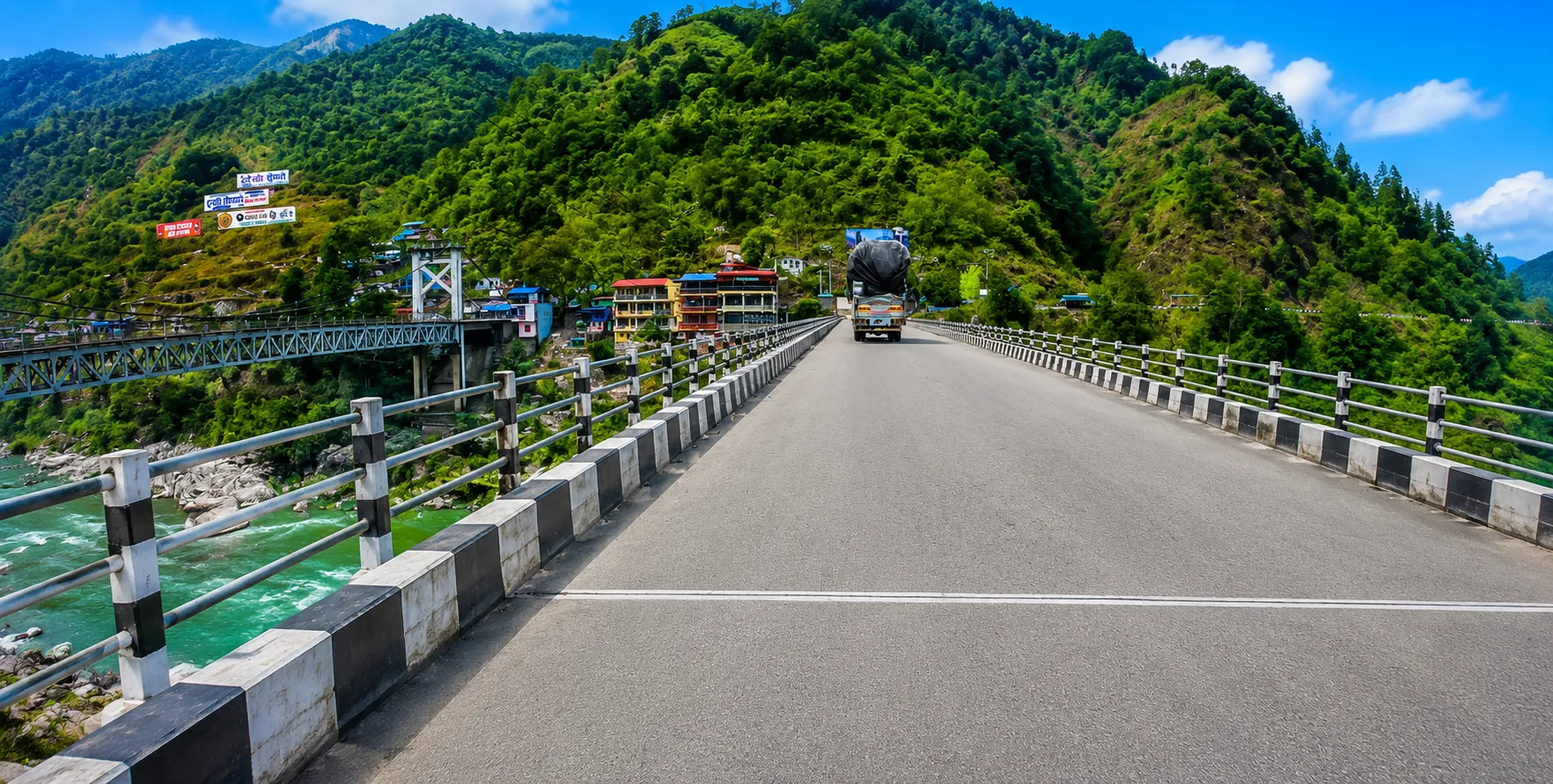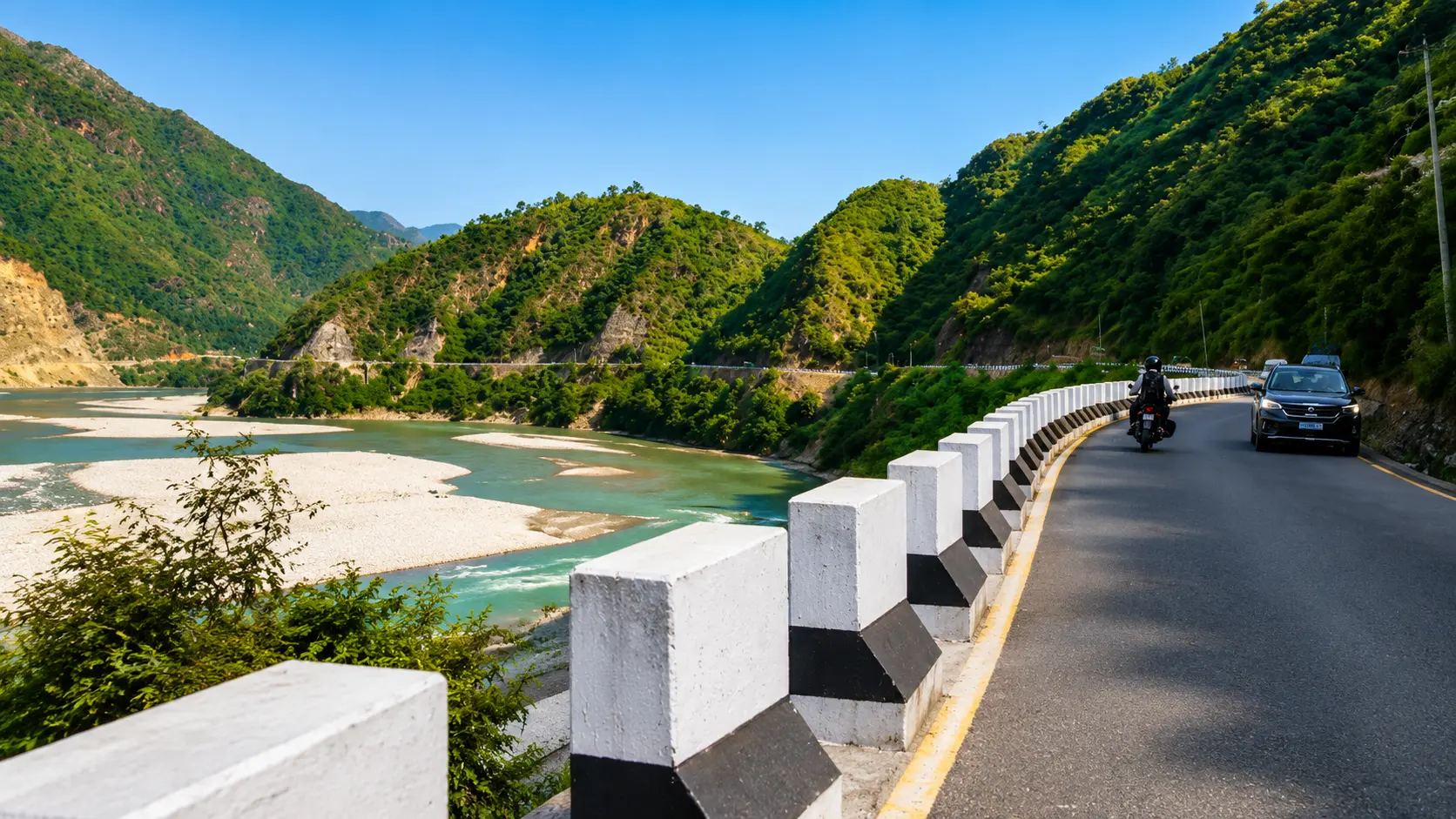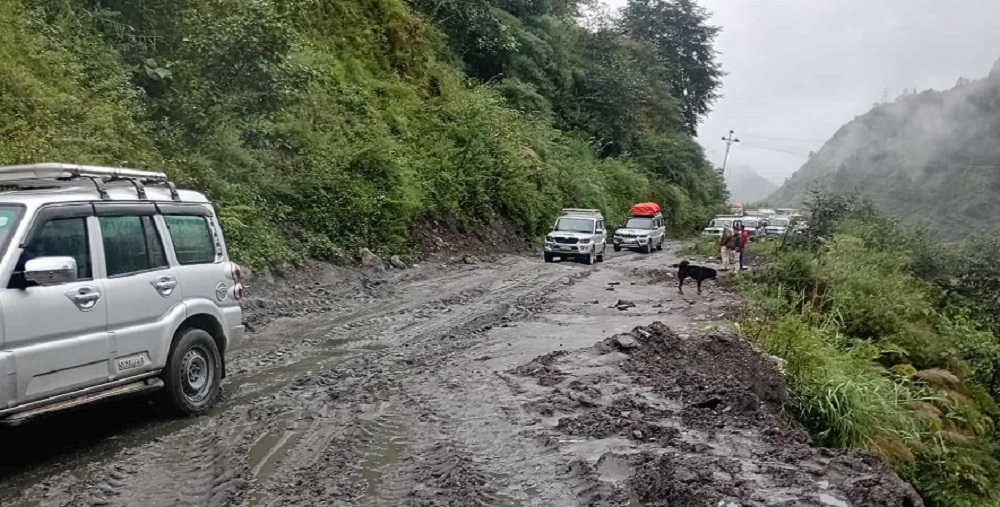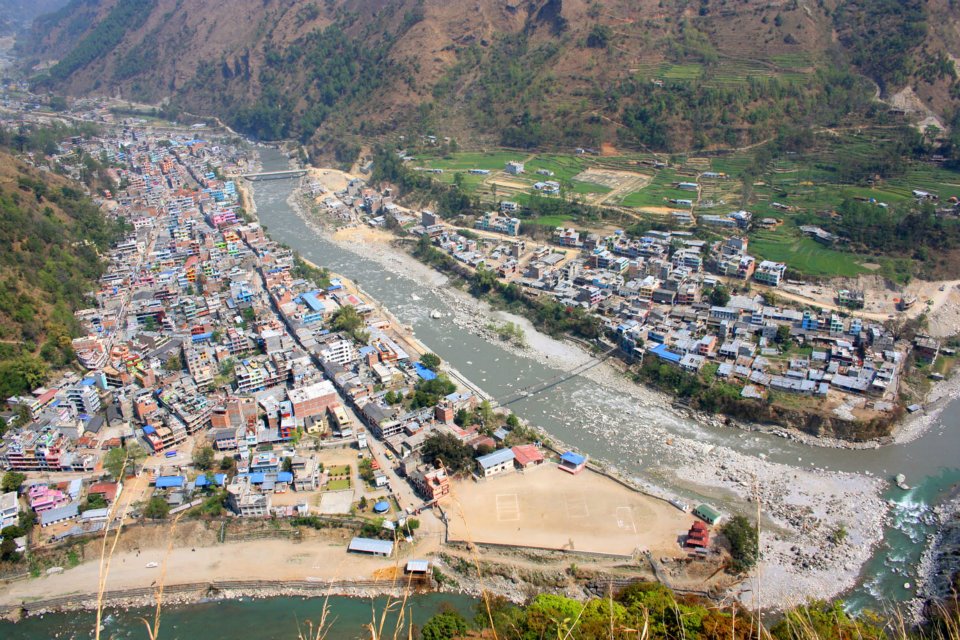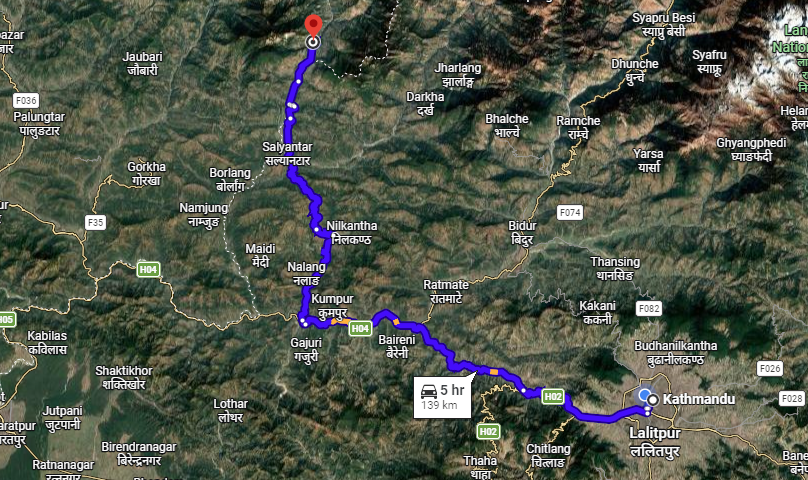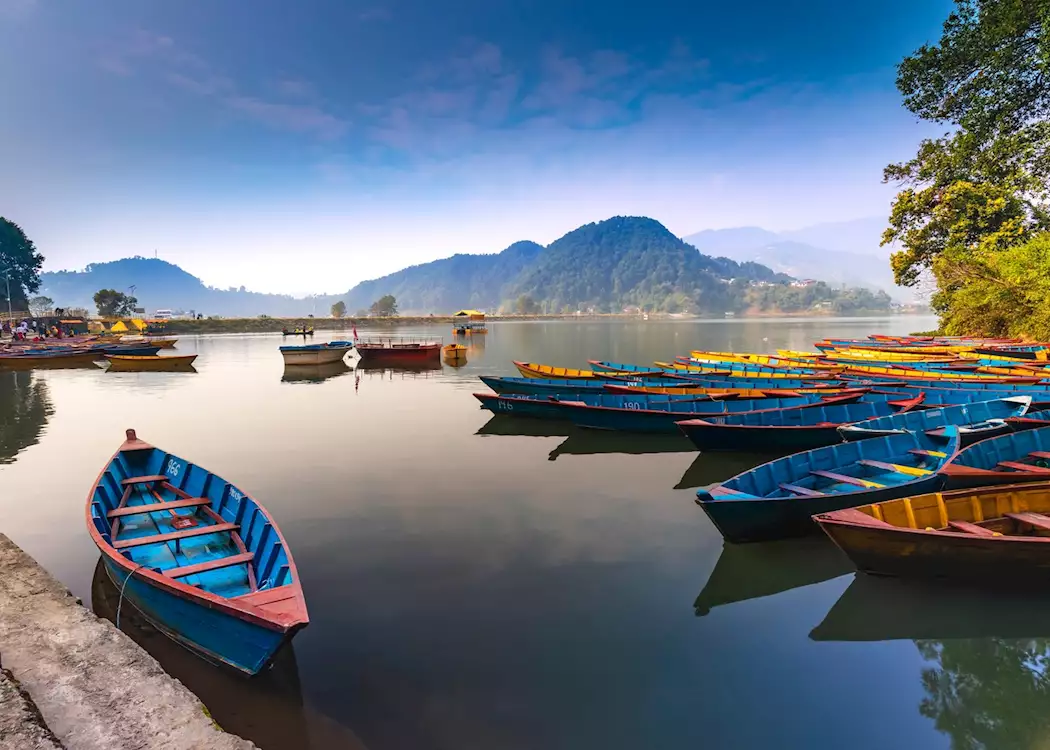
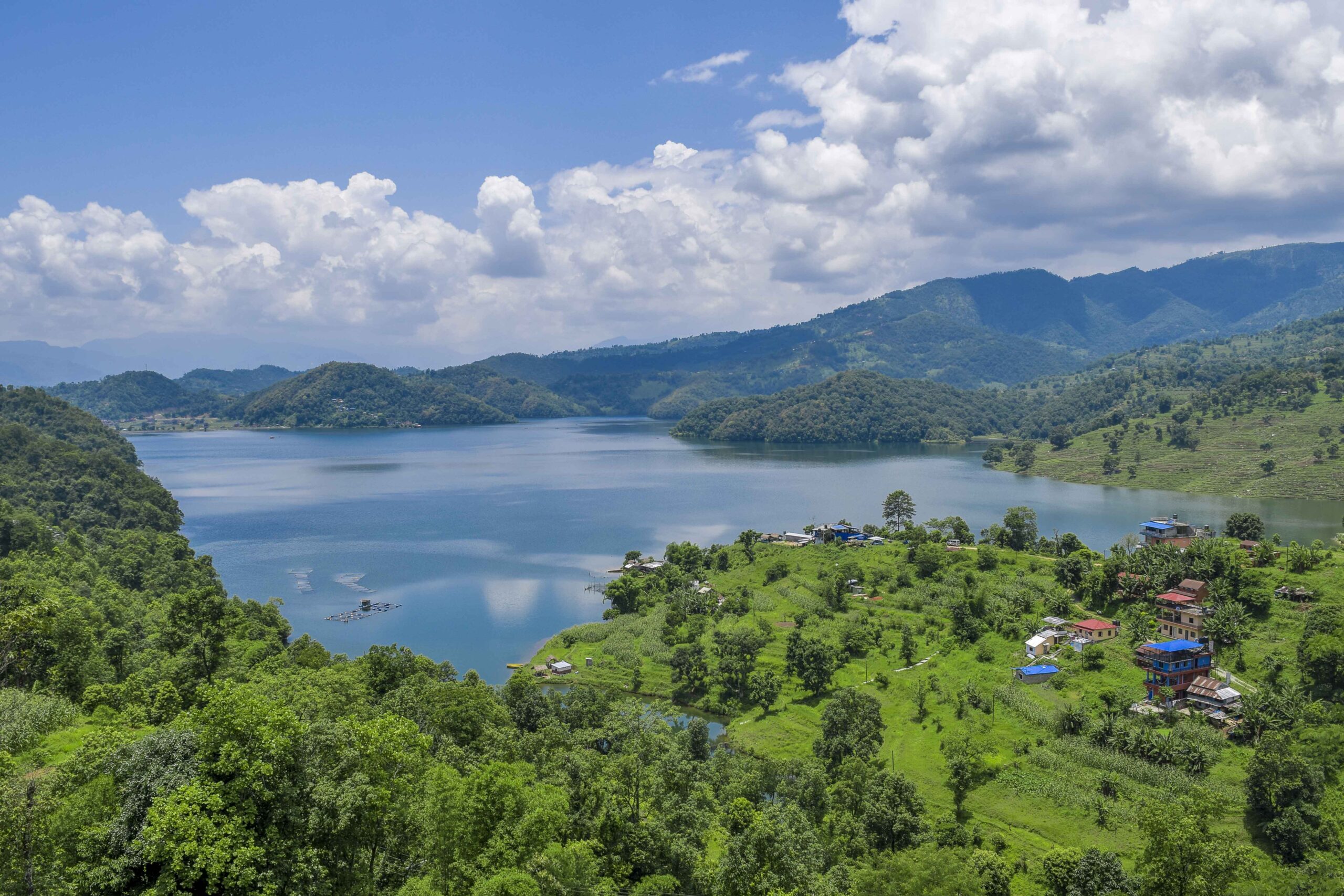
Pokhara to Lamjung Jeep Rental

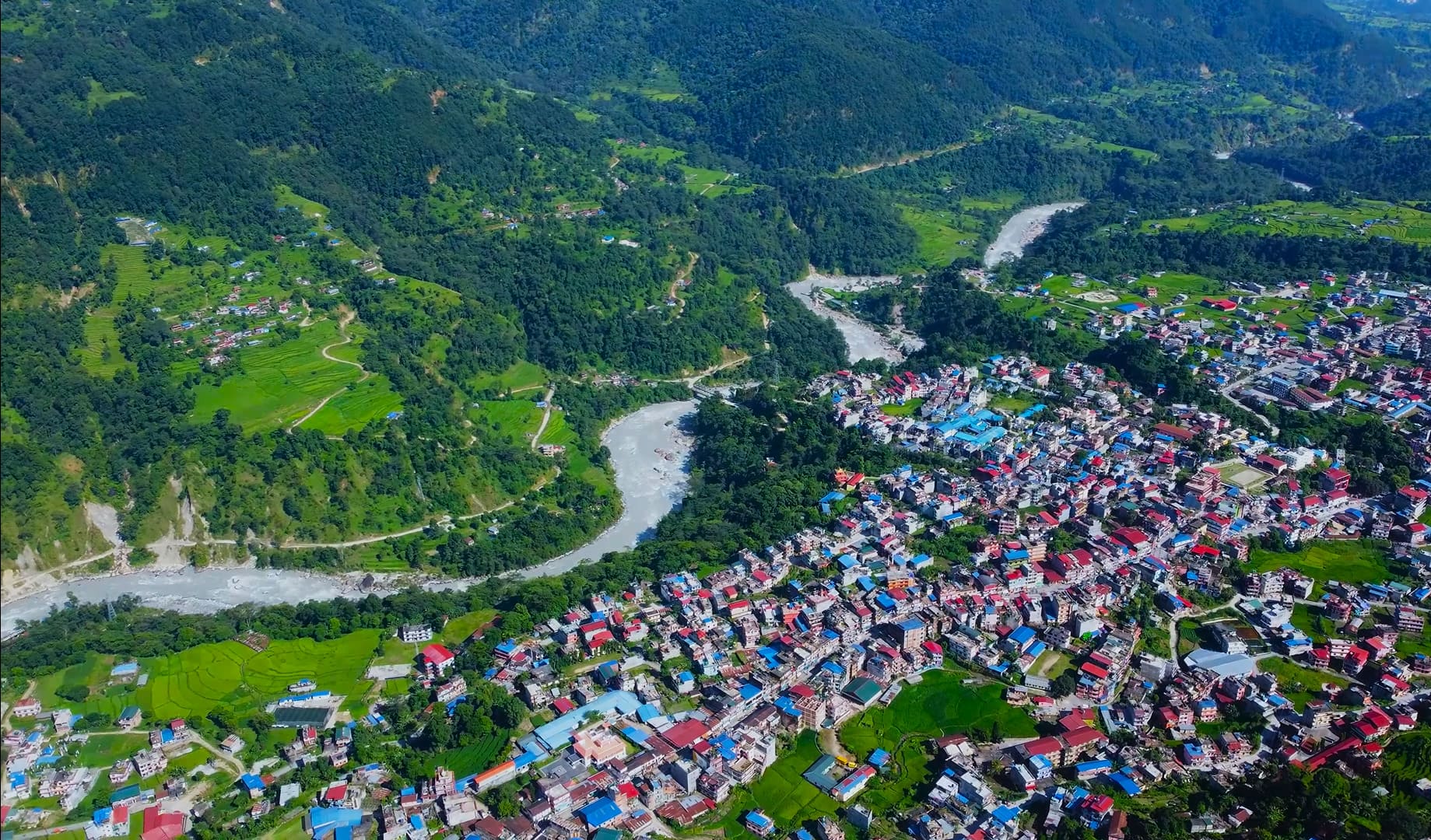
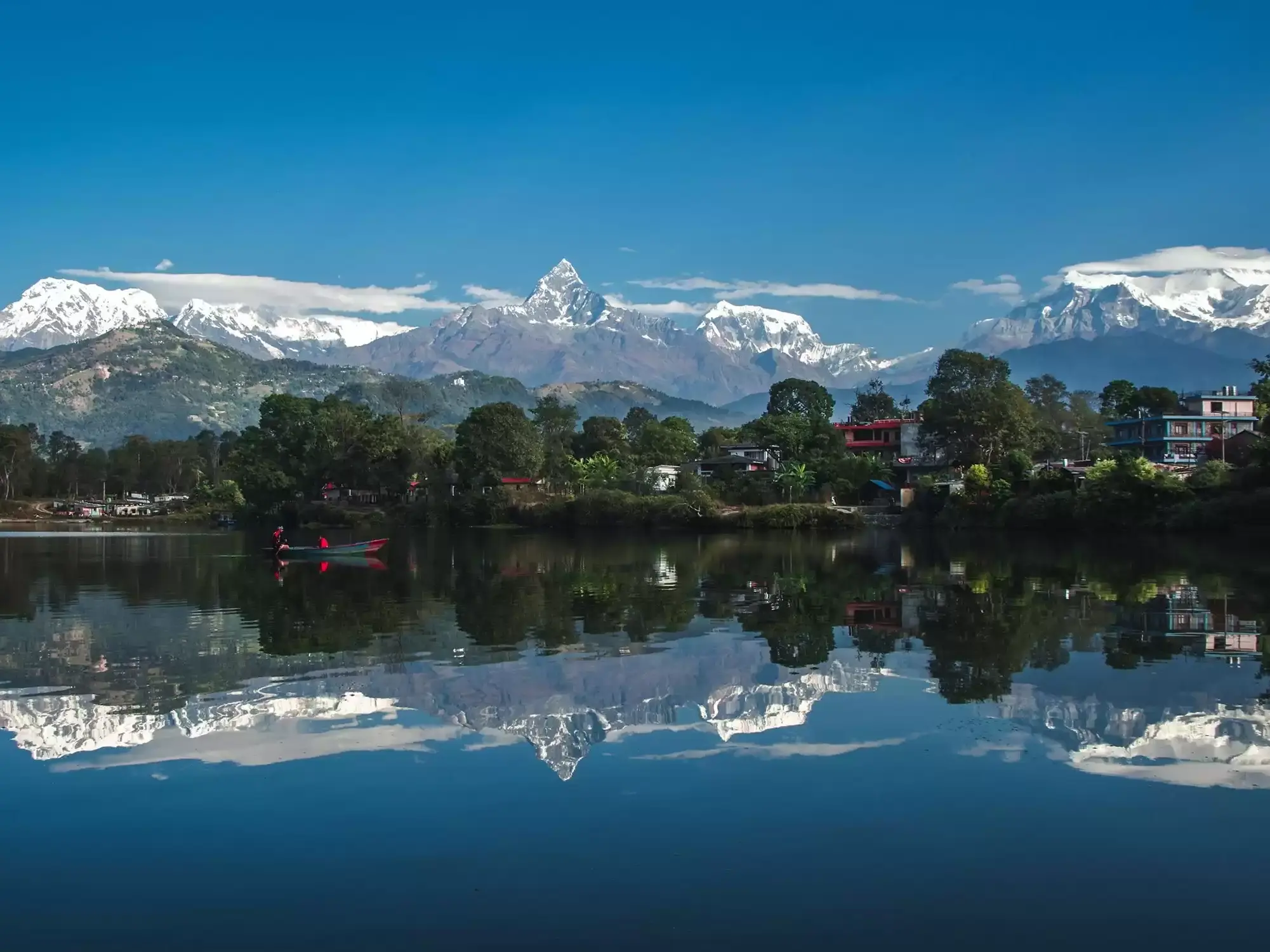
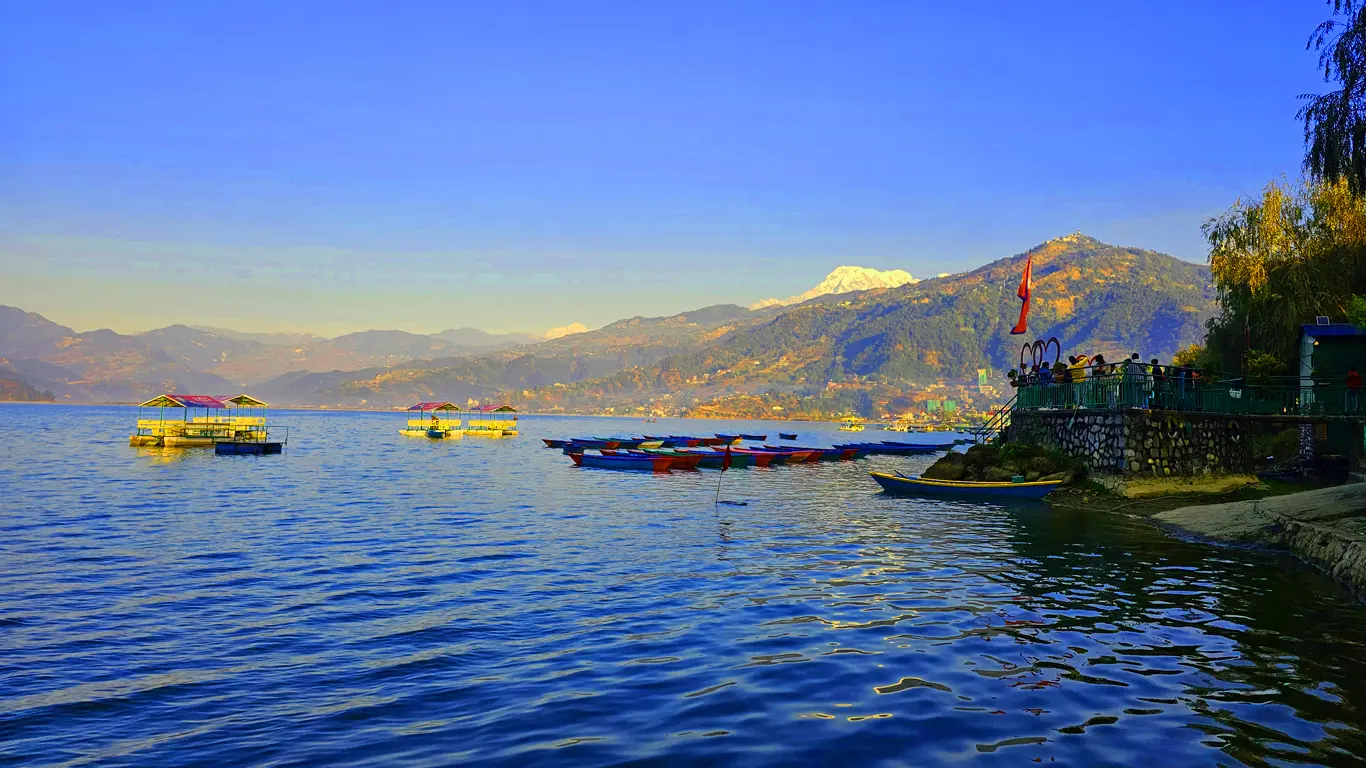
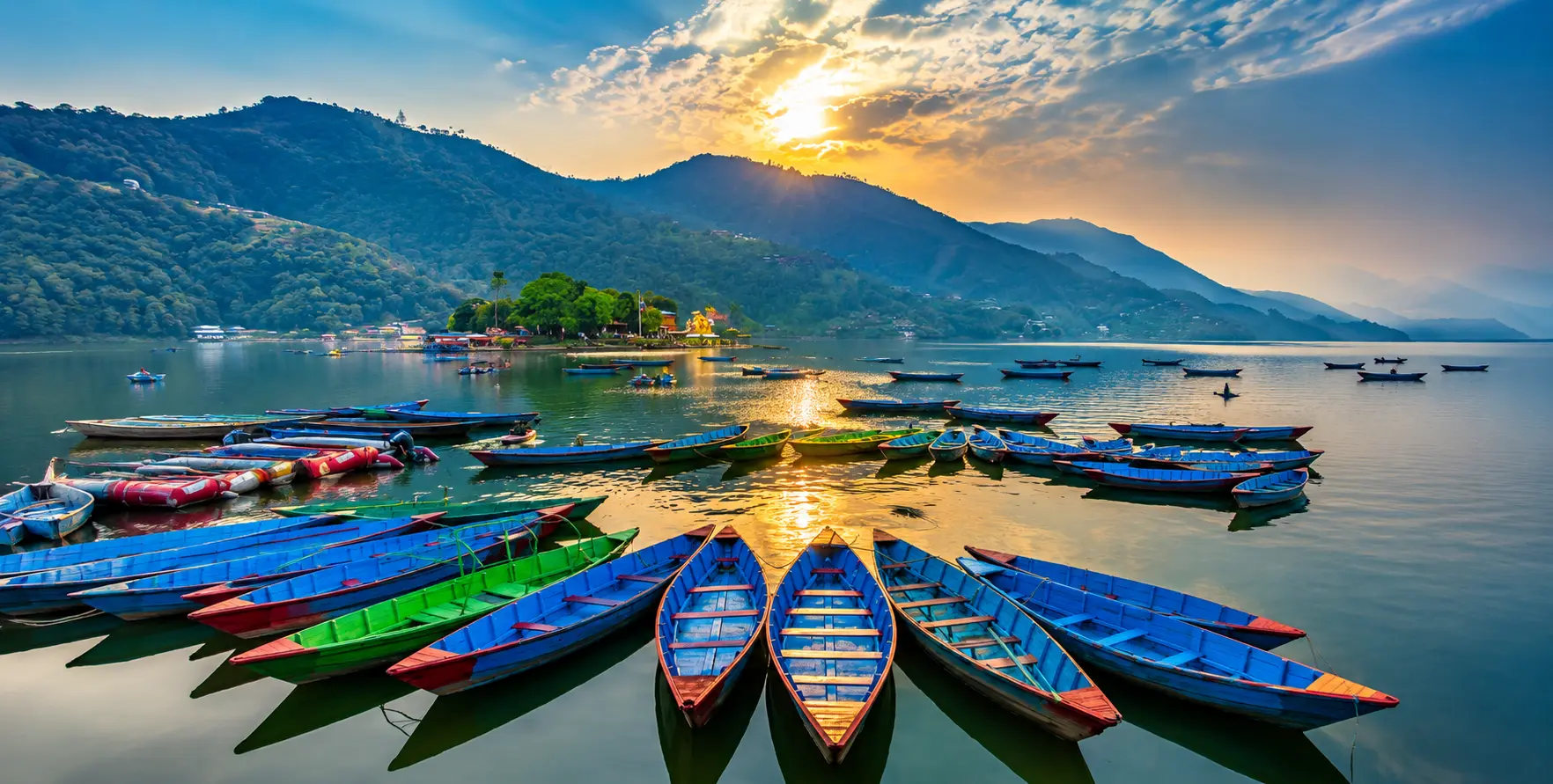
Begnas Lake Pokhara

Pokhara to Lamjung Jeep Rental: Complete Guide to Besisahar, Ghalegaun And Annapurna Circuit

Lamjung District is one of Nepal’s most richly rewarding destinations for trekkers, cultural travellers and adventure enthusiasts alike. Set in the Gandaki Province between Pokhara and the great peaks of the Annapurna and Manaslu ranges, Lamjung is home to Besisahar — the official starting point of the legendary Annapurna Circuit Trek — as well as the spectacular Ghalegaun and Ghanpokhara hilltop villages, the cultural Lamjung Durbar heritage site, the rushing Marsyangdi River gorge, and the lower reaches of some of Nepal’s finest trekking trails.

From Pokhara, the journey to Lamjung District is approximately 72 to 110 kilometres, depending on your destination, making it one of the most accessible and rewarding day and multi-day vehicle journeys from the lakeside city. Whether you are beginning the Annapurna Circuit Trek at Besisahar, visiting the hilltop homestay village of Ghalegaun, exploring the cultural Lamjung Durbar, or simply driving the magnificent Marsyangdi River valley for the views, a private jeep from Nepal Vehicle Hiring Pvt Ltd is the best way to make this journey.

This comprehensive 2026-2027guide covers everything you need — vehicle types, detailed costs, the full route, all major destinations in Lamjung District, trekking connections, permits, seasonal guidance, and expert tips for a perfect Pokhara-to-Lamjung jeep rental experience.

About Lamjung District – Nepal’s Annapurna Gateway

Lamjung District is located in Gandaki Province, directly north of Tanahun District and east of Kaski District (where Pokhara is situated). The powerful Marsyangdi River bisects the district, flowing southward from the high glaciers of the Manang Valley and carving one of Nepal’s most spectacular gorges as it descends through the Lamjung hills toward the Tarai.

The district is dominated by the towering peaks of the Annapurna Himal to its northwest and the Manaslu massif to its northeast. Lamjung Himal (6,983 m) rises directly above the district and is visible from much of the lower valley.

The district headquarters, Besisahar, sits at 760 meters at the confluence of the Marsyangdi River and the road from Dumre, and is the starting point for the Annapurna Circuit — one of the world’s most celebrated trekking routes.

Lamjung District Key FactsDetails
ProvinceGandaki Province, Nepal
District HeadquartersBesisahar (760 m)
Distance from PokharaApproximately 72–110 km (depending on destination)
Drive Time from Pokhara2 to 4 hours by private jeep
Main riverMarsyangdi River
Key Peaks VisibleLamjung Himal (6,983 m), Annapurna II (7,937 m), Manaslu (8,163 m)
Main Trekking RoutesAnnapurna Circuit, Narphu Valley Trek, Lamjung Ghalegaun Homestay Trek
Cultural HeritageLamjung Durbar (historic palace), Gurung and Ghale communities
Famous AttractionsBesisahar, Ghalegaun, Ghanpokhara, Marsyangdi River, Lamjung Durbar

Major Destinations in Lamjung District from Pokhara

Lamjung District contains several distinct destinations, each requiring a jeep transfer from Pokhara. Here is a complete overview of all main destinations:

DestinationDistance from PokharaDrive TimeAltitudeBest For
Besisahar72–80 km2 to 2.5 hours760 mAnnapurna Circuit start, permit collection, Marsyangdi River
Ghalegaun90–100 km3 to 4 hours1,950 mGhale cultural village, homestay, Annapurna–Manaslu views
Ghanpokhara95–110 km3.5 to 4 hours2,100 mHilltop viewpoint, traditional Gurung village, less-trodden
Bhulbhule95–105 km2.5 to 3 hours840 mAnnapurna Circuit alternate start, Marsyangdi riverside
Khudi90–95 km2.5 to 3 hours790 mAnnapurna Circuit access, river confluence, scenic valley
Lamjung Durbar (Sundarbazar)80–90 km2.5 to 3 hours700 mHistorical Lamjung palace ruins, cultural heritage
Chame (via Besisahar)140–160 km4 to 5 hours2,670 mDeep Annapurna Circuit access, Manang District gateway

Pokhara to Lamjung Jeep Rental – Journey Quick Facts

DetailInformation
Distance to Besisahar72–80 km from Pokhara
Distance to Ghalegaun90–100 km from Pokhara
Drive Time to Besisahar2 to 2.5 hours (private jeep)
Drive Time to Ghalegaun3 to 4 hours (rough road section)
Main RoutePokhara → Prithvi Highway → Dumre → Besisahar (then onward)
Road TypePaved Pokhara to Besisahar; rough off-road to Ghalegaun and Ghanpokhara
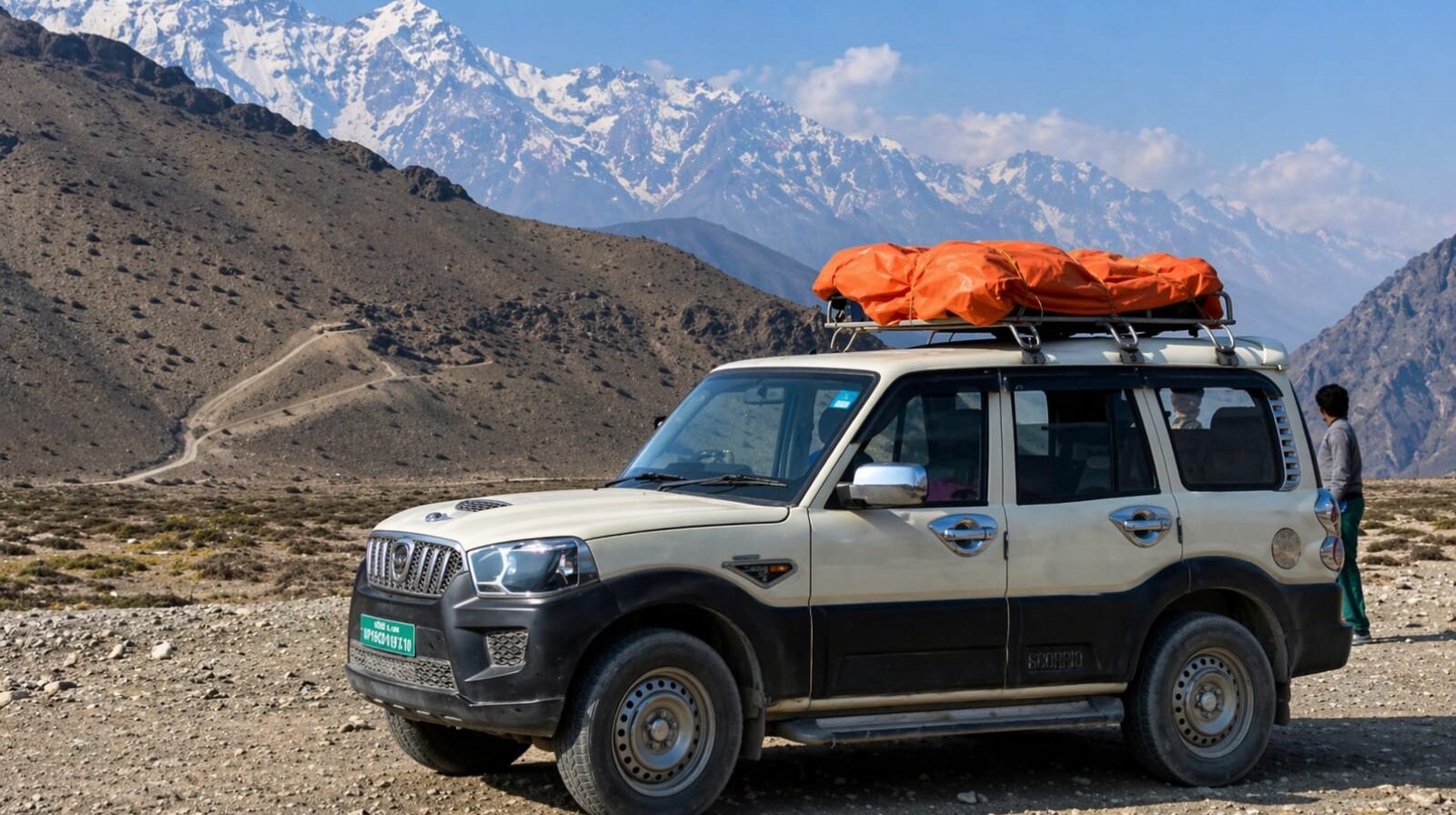
Vehicle RequiredAny vehicle to Besisahar; 4WD jeep or Scorpio for Ghalegaun and beyond
Departure Point (Sharing)Prithvi Chowk / Baglung Bus Park, Pokhara
Recommended Departure6:30 AM – 7:30 AM for Ghalegaun/Ghanpokhara; 7:00–8:00 AM for Besisahar
Key PermitACAP permit + TIMS card for Annapurna Circuit trekkers

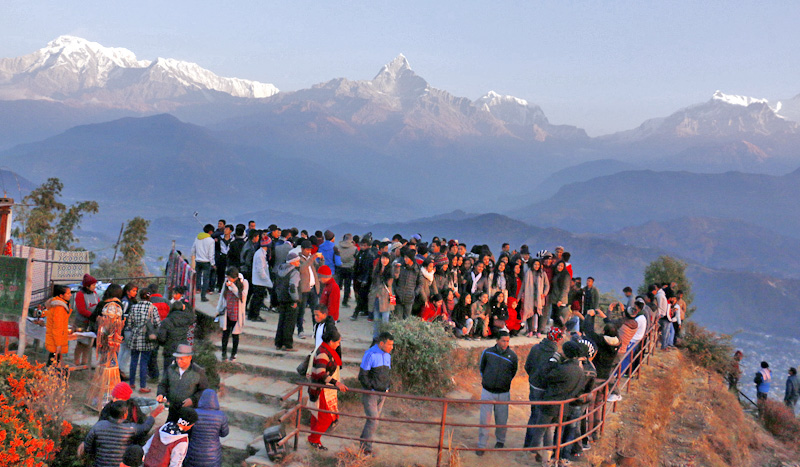
Sarangkot Pokhara

Why Hire a Private Jeep from Pokhara to Lamjung?

4WD is Essential for Ghalegaun, Ghanpokhara, and Upper Routes

While the road from Pokhara to Besisahar via Dumre is mostly well-paved and accessible by any vehicle, the roads continuing to Ghalegaun, Ghanpokhara, and the upper Marsyangdi valley beyond Besisahar are rough, steep, narrow mountain tracks that require a 4WD vehicle with high ground clearance. Nepal Vehicle Hiring provides reliable 4WD jeeps for all destinations in Lamjung.

Door-to-Door Hotel Pickup from Pokhara

Your Nepal Vehicle Hiring driver collects you directly from your hotel in Pokhara Lakeside—no need to travel to a bus station with luggage and trekking gear. For groups starting the Annapurna Circuit or travelling to Ghalegaun, this door-to-door convenience is a real advantage.

Flexibility for Sightseeing Along the Route

The Pokhara to Besisahar drive passes through beautiful landscapes, the Marsyangdi River valley, and the attractive hill town of Dumre. A private jeep from Nepal Vehicle Hiring lets you stop at viewpoints, cultural sites, and riverside teahouses at your own pace—something impossible on a public bus.

Best Option for Annapurna Circuit Trekking Groups

Groups beginning the Annapurna Circuit Trek need to carry significant luggage — personal trekking bags, porter loads, guides’ equipment, and group supplies. A private jeep offers ample space for all of this in one comfortable vehicle, with the entire group departing together at a time that suits the trek itinerary.

Return Pickup After the Trek

Nepal Vehicle Hiring arranges return vehicle transfers from Besisahar, Bhulbhule, Jomsom, or anywhere your Annapurna Circuit Trek ends. Booking the outbound Pokhara-to-Besisahar jeep and the return vehicle as a combined arrangement with us simplifies the entire trekking logistics chain.

Vehicle Options: Pokhara to Lamjung Jeep Rental

Vehicle TypeCapacityBesisahar Cost (NPR)Ghalegaun Cost (NPR)Best For
Sharing a Jeep (per person)7–8 pax totalUSD 10- 15NPR 1,200–1,800/personSolo budget travellers
Private Car (to Besisahar only)2–4 paxUSD 120- 150Not recommendedSmall groups, Besisahar only
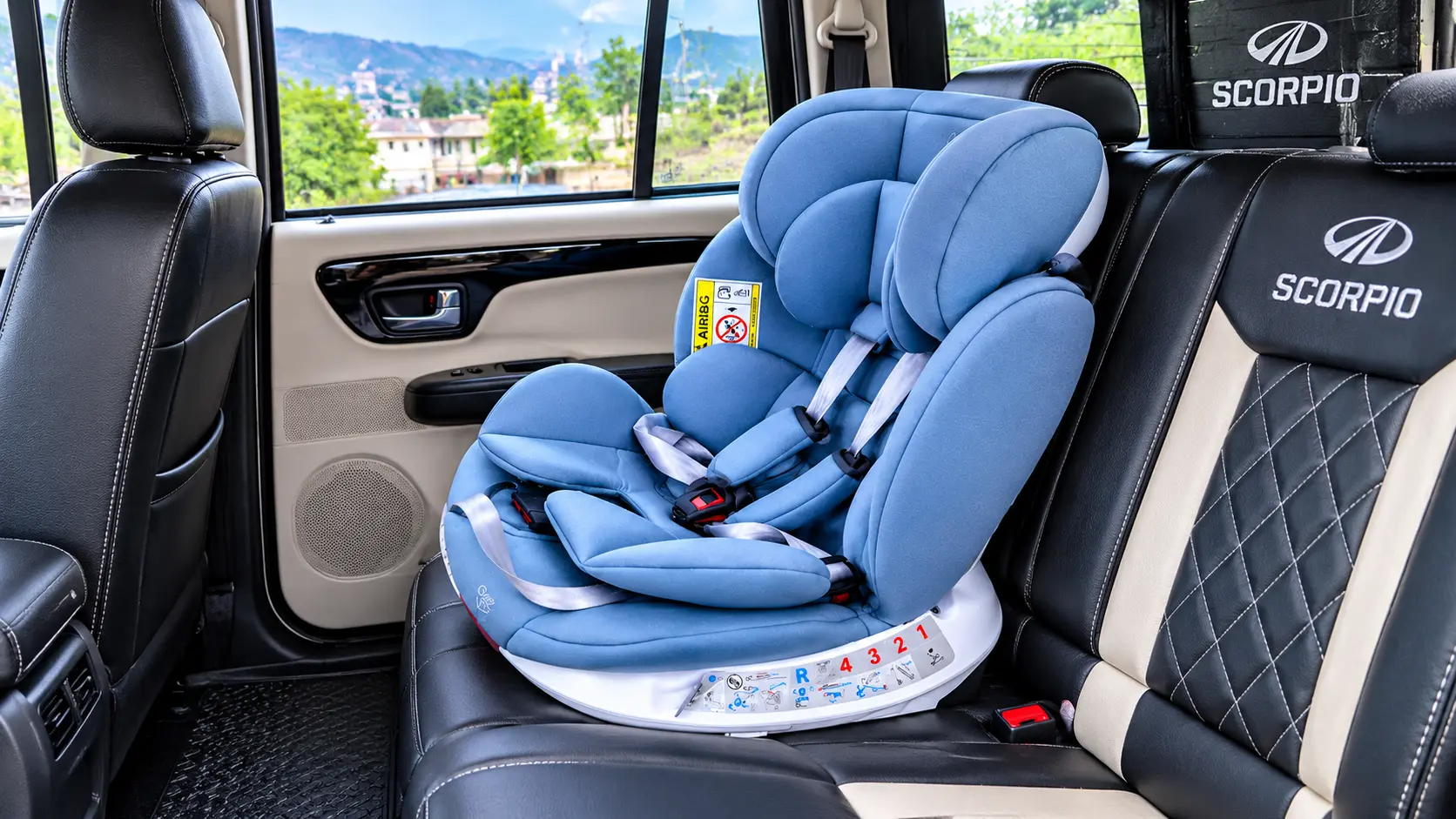
Scorpio – Standard4–5 paxUSD 150- 200USD 150-250Trekking groups, families
Private Jeep – 4-jeep5–6 paxNPR 250–400USD 160- 250Ghalegaun, Ghanpokhara, upper routes
Private Jeep – Land Cruiser5–6 paxNPR 300–600NPR 350- 650Top-end, Chame, and beyond
Toyota Hiace Van7–10 paxNPR 200–250Not suitable beyond BesisaharLarge groups to Besisahar

Note: All private vehicle prices include driver and fuel. Round-trip prices are approximately 1.7–1.9 times the one-way price. Contact Nepal Vehicle Hiring for confirmed quotes for your specific destination and date.

Pokhara to Besisahar – Annapurna Circuit Starting Point

Besisahar is the district headquarters of Lamjung District and the traditional starting point of the Annapurna Circuit Trek — one of the world’s most celebrated trekking routes. At 760 meters above sea level, at the confluence of the Khudi and Marsyangdi rivers, Besisahar is a lively bazaar town with banks, ATMs, guesthouses, restaurants, and permit collection facilities that serve thousands of trekkers each year.

Why Trekkers Go to Besisahar

  • Official starting checkpoint for the Annapurna Circuit Trek permit registration
  • Last reliable ATM and bank before the remote upper Marsyangdi valley
  • Well-stocked market for last-minute trekking supplies, snacks, and gear
  • Starting point for jeep transport further up the valley to Chame, Dharapani, or Manang
  • Cultural mix of Gurung, Ghale, and Brahmin communities in the local market

Pokhara to Besisahar Route

The drive from Pokhara to Besisahar follows the Prithvi Highway eastward to Damauli, then continues to the Dumre junction. At Dumre, the road turns north and follows the Marsyangdi River upstream for approximately 40 km to Besisahar. The road from Pokhara to Besisahar is well-paved and comfortable throughout.

DetailInformation
Distance72–80 km from Pokhara
Drive Time2 to 2.5 hours (private jeep)
Road typePaved throughout – comfortable for all vehicle types
Private Jeep Cost (One Way)USD 100- 150
Private Jeep Cost (Round Trip)USD 150-300
Sharing Jeep CostUSD 10-20
Altitude760 metres
Key FacilitiesATM, banks, guesthouses, permit office, shops, restaurants

Besisahar to Chame – Deep Annapurna Circuit Access

Many trekkers who start the Annapurna Circuit at Besisahar take a further jeep ride to Chame (2,670 m) or even Dharapani, skipping the lower-valley road sections and starting the proper trek in higher, more scenic terrain. The Besisahar-to-Chame jeep journey covers about 68 km of increasingly rough, spectacular mountain road through Jagat and Dharapani.

SegmentDistanceDrive TimeRoad TypeCost (NPR)
Besisahar to Jagat32 km1.5–2 hoursRough off-roadNPR 1,500–2,500 per jeep
Besisahar to Dharapani50 km2.5–3 hoursVery rough mountain trackNPR 3,000–5,000 per jeep
Besisahar to Chame68 km3.5–4.5 hoursRough mountain track – 4WD mandatoryNPR 5,000–8,000 per jeep

Pokhara to Lamjung Jeep Rental

Pokhara to Ghalegaun – The Famous Ghale Cultural Village

Ghalegaun is one of Nepal’s most celebrated cultural heritage villages and one of the finest homestay destinations in the entire Annapurna region. Perched on a beautiful hilltop ridge at about 1,950 meters above sea level, the village is home to the indigenous Ghale community—a Tibeto-Burman people with a unique language, culture, and traditional architecture distinct from those of the surrounding Gurung and Brahmin communities.

The village offers spectacular panoramic views of the Annapurna range, Manaslu (8,163 m), Lamjung Himal (6,983 m), and the Marsyangdi River valley far below. The village is famous for its traditional stone-paved lanes, warm community homestays, cultural dance performances, and authentic Ghale cuisine. Ghalegaun was one of Nepal’s first officially recognised community tourism destinations.

Road Conditions: Pokhara to Ghalegaun

The road from Pokhara to Ghalegaun follows the same Prithvi Highway and Dumre–Besisahar route to Khudi (about 90 km from Pokhara), then turns onto a steep, rough, winding jeep track that climbs dramatically to Ghalegaun village at 1,950 meters. This off-road section from Khudi to Ghalegaun is about 10- 15 km long and requires a 4WD jeep with an experienced driver.

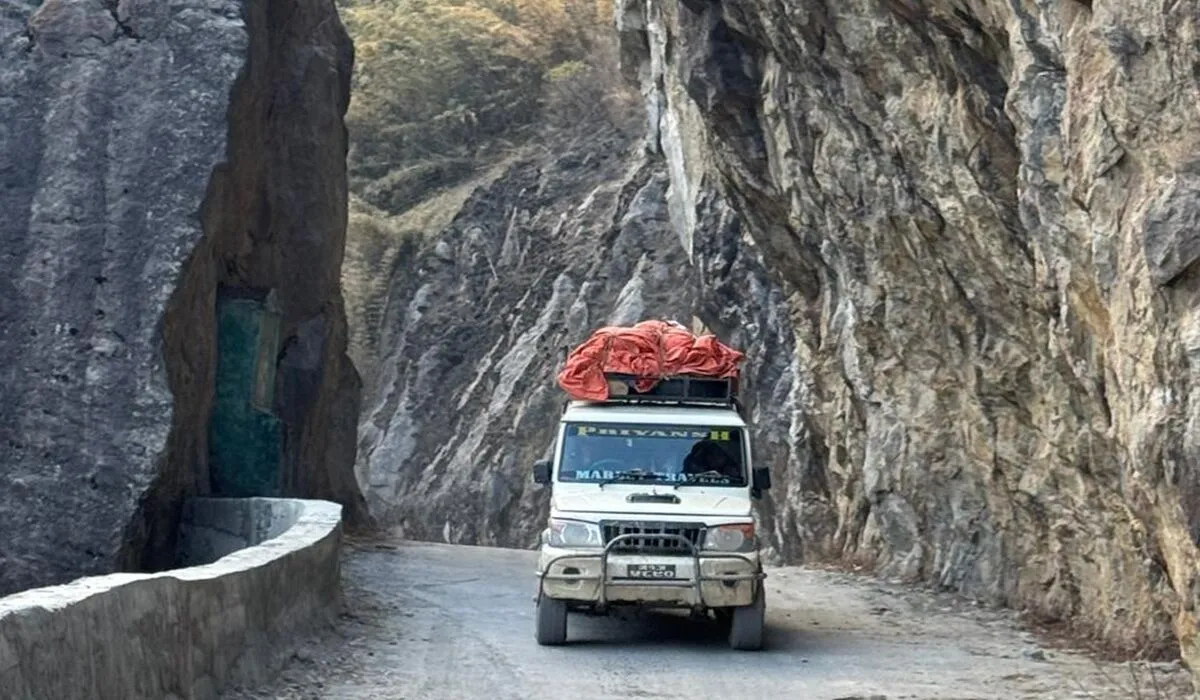
The road is narrow, steep, and unpaved in sections — impassable for standard cars and vans.

DetailInformation
Distance from Pokhara90–100 km
Drive Time3 to 4 hours
Road to KhudiPaved – comfortable for all vehicles
Road Khudi to GhalegaunRough, steep off-road track – 4WD mandatory
Altitude1,950 meters
Private Jeep Cost (One Way)USD 120- 150
Private Jeep Cost (Round Trip)USD 200- 300
Sharing Jeep CostUSD 10- 15
Best SeasonSpring (March–May), Autumn (September–November)
Famous ForGhale community homestays, Annapurna–Manaslu views, cultural dances

Why Ghalegaun is Worth the Journey

  • Panoramic views of Manaslu, Lamjung Himal, Annapurna II, and the Marsyangdi valley
  • Authentic Ghale community homestay experience — sleeping and eating with local families
  • Traditional cultural programs, including Ghale dance, music, and dress
  • Stone-paved village lanes, traditional architecture, and a genuine community atmosphere
  • Starting point for the beautiful Ghalegaun–Ghanpokhara trekking circuit
  • Much less crowded than mainstream Annapurna trekking destinations
  • One of Nepal’s finest community tourism success stories

Pokhara to Ghanpokhara – The Hidden Viewpoint Village

Ghanpokhara is a traditional Gurung village perched at approximately 2,100 meters on the ridge system above the Marsyangdi valley, just a few kilometres northeast of Ghalegaun. The village is less well-known than Ghalegaun but offers equally spectacular views and a more off-the-beaten-track cultural experience.

The name Ghanpokhara means thick/dense pond in Nepali — a reference to the many natural springs and water sources in the area. The village has a traditional Gurung community with a rich agricultural and pastoral way of life and offers homestays for visitors. The views of Manaslu, Lamjung Himal, and the Marsyangdi gorge from Ghanpokhara are outstanding.

DetailInformation
Distance from Pokhara95–110 km
Drive Time3.5 to 4.5 hours
Altitude2,100 meters
RoadRough off-road track – 4WD mandatory
Private Jeep Cost (One Way)USD 90-150
Best Combined WithGhalegaun day trip or overnight
Famous ForGurung culture, Manaslu views, off-the-beaten-track experience

Lamjung Durbar – Sundarbazar Cultural Heritage

Lamjung Durbar is a historically significant palace complex located in Sundarbazar, approximately 80-90 km from Pokhara, in the central part of Lamjung District. The durbar (palace) served as the seat of the ancient Lamjung Kingdom, one of Nepal’s independent hill kingdoms before unification under Prithvi Narayan Shah in the 18th century.

The palace complex features traditional Nepali architecture, including pagoda-roofed temples, stone carvings, and historic courtyards. It is an important cultural heritage site for the Gurung and Ghale communities of Lamjung, and a fascinating destination for travellers interested in Nepal’s pre-unification royal history.

DetailInformation
LocationSundarbazar, Lamjung District
Distance from Pokhara80–90 km
Drive Time2.5 to 3 hours
Historical SignificanceFormer seat of the Lamjung Kingdom (pre-18th century)
ArchitectureTraditional Nepali pagoda-style palace and temples
Entry FeeNominal local entry fee
Private Jeep Cost (One Way)USD 200-350
Best Combined WithGhalegaun or Besisahar on a full-day or multi-day trip

Pokhara to Lamjung Route Breakdown – Stage by Stage

Here is a complete stage-by-stage guide to the road from Pokhara to the main Lamjung destinations:

Stage 1: Pokhara to Damauli – Approx. 40 km (1 hour)

The journey from Pokhara heads east along the Prithvi Highway. The road passes through the Pokhara valley, the Seti River bridge, and climbs through the attractive midhill town of Damauli — the headquarters of Tanahun District, situated at the confluence of the Seti and Madi rivers.

Damauli is an excellent stop for tea or an early breakfast. On a clear morning, the mountain views from the highway near Damauli are already excellent, with the Annapurna range visible to the north.

Stage 2: Damauli to Dumre Junction – Approx. 25 km (30 minutes)

From Damauli, the Prithvi Highway continues northeast along the Marsyangdi valley. Dumre is the key junction town where the highway to Kathmandu continues east and the road north to Besisahar and Lamjung branches off. Dumre is a busy roadside town and a reliable stop for fuel and fuel and snacks.

Your Nepal Vehicle Hiring driver will brief you in Dumre on the road conditions ahead.

Stage 3: Dumre to Besisahar – Approx. 40 km (1 hour)

From Dumre, the road heads north, following the Marsyangdi River upstream through increasingly beautiful river-valley scenery. The road is paved throughout this section. You pass through small riverside towns and farmland, with the Marsyangdi River rushing on one side and terraced hillsides rising on the other.

The first views of the high Himalayan peaks begin to appear ahead as you approach Besisahar.

Stage 4: Besisahar to Ghalegaun via Khudi – Approx. 20–25 km (1.5 to 2 hours)

From Besisahar, the road continues north to Khudi before the Ghalegaun jeep track turns sharply uphill to the west. The Khudi to Ghalegaun section is the most challenging stretch of driving on the entire journey — steep switchbacks, narrow width, and rough surface. A skilled 4WD driver is essential.

The reward for this challenging approach is a spectacular ridgeline arrival at Ghalegaun village, with panoramic Himalayan views.
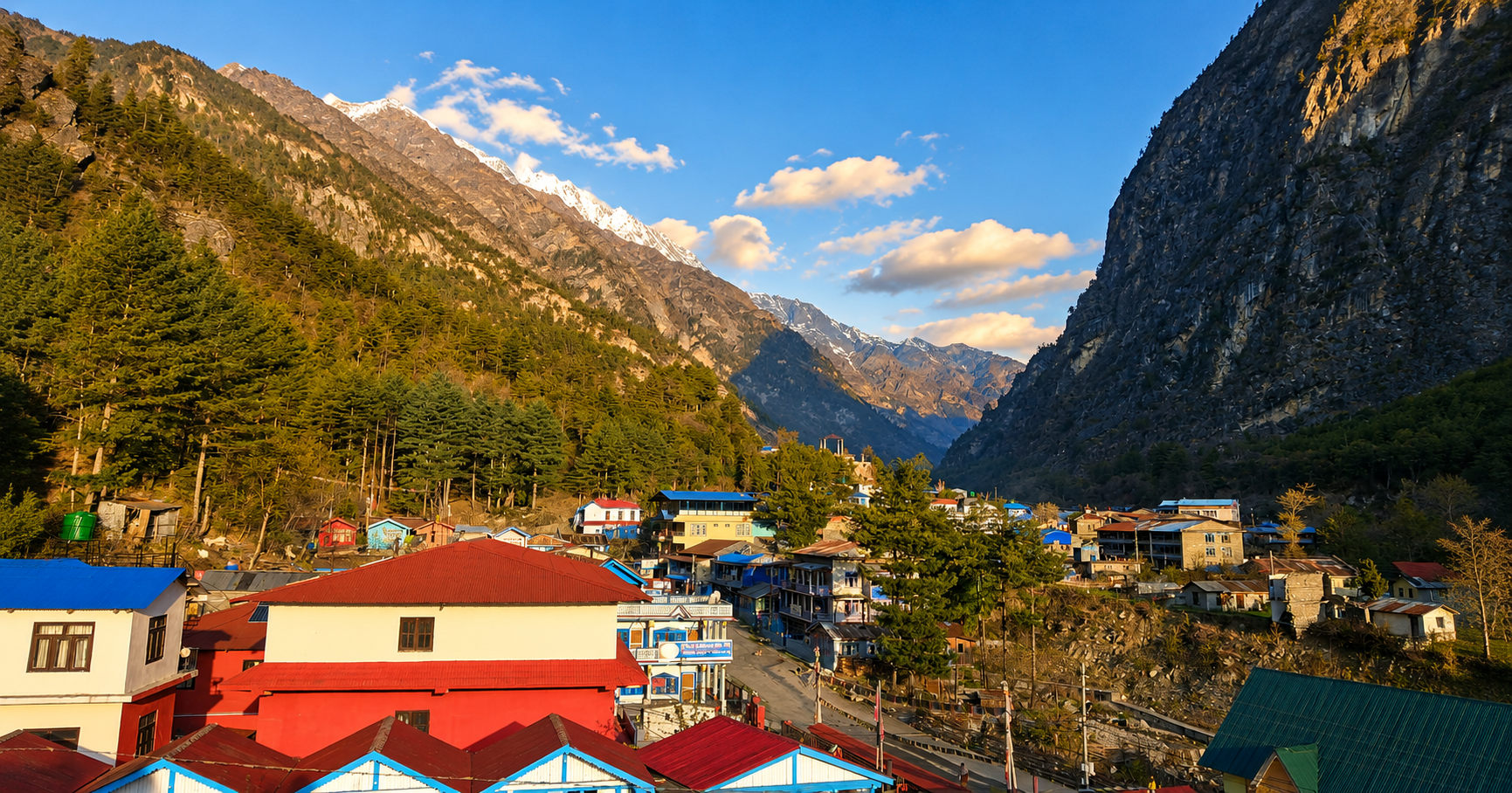
chame-Pokhara to Lamjung Jeep Rental

Route Overview Table: Pokhara to Lamjung

StageSectionDistanceRoad ConditionKey Highlights
1Pokhara to Damauli40 kmPrithvi Hwy – smoothSeti River bridge, midhill views, Damauli tea stop
2Damauli to Dumre25 kmPrithvi Hwy – smoothMarsyangdi valley entry, Dumre junction, and fuel stop
3Dumre to Besisahar40 kmPaved – good conditionMarsyangdi River views, first Himalayan peaks visible
4aBesisahar to Ghalegaun (via Khudi)20–25 kmRough off-road – 4WD mandatorySpectacular ridgeline arrival, panoramic mountain views
4bBesisahar to Chame68 kmVery rough – 4WD onlyDeep gorge, waterfalls, Annapurna Circuit trail villages

Top Attractions in Lamjung District

Marsyangdi River Valley

The Marsyangdi River is the heart and soul of Lamjung District. Originating high in the glaciers of the Manang Valley, the river rushes through a dramatic gorge flanked by steep forested hillsides, waterfalls, and traditional riverside villages.

The drive along the Marsyangdi from Dumre to Besisahar and beyond is one of the most beautiful river-valley drives in Nepal, with the river’s turquoise-green water, the distant snow peaks, and the dramatic vertical relief of the valley walls creating constantly changing scenery.

Ghalegaun Village and Homestay

Ghalegaun is widely regarded as one of Nepal’s finest community tourism destinations. Traditional Ghale stone houses with carved wooden windows, community-run homestays offering authentic local food and cultural programs, and panoramic views of the Annapurna–Manaslu range make this village a destination for a deeply authentic Himalayan community experience. An overnight homestay in Ghalegaun is one of Nepal’s most memorable experiences, and it is within easy reach of Pokhara.

Lamjung Himal Views

Lamjung Himal (6,983 m) gives the district its name and is one of the most distinctive and beautiful mountains in the Annapurna region. From Ghalegaun and Ghanpokhara on clear mornings, Lamjung Himal rises directly above the valley in a perfect snow pyramid, with the higher summits of Annapurna II (7,937 m) and Manaslu (8,163 m) visible on either side. Few viewpoints in Nepal offer such immediate and dramatic access to high Himalayan peaks.

Khudi Waterfall and Marsyangdi Confluence

Khudi village, located at the confluence of the Khudi and Marsyangdi rivers about 10 km north of Besisahar, is both a key access point for the Ghalegaun road and home to a beautiful waterfall on the Khudi Khola. The village is also the starting point for the Annapurna Circuit trekking trail, making it a popular halt for trekkers and jeep travellers alike.

Sundarbazar and Lamjung Durbar

Sundarbazar is a pleasant market town in central Lamjung that serves as the cultural and administrative centre of the district’s mid-region. The nearby Lamjung Durbar palace complex is the district’s principal historical monument and an important site for understanding Nepal’s pre-unification royal history. The mix of market-town atmosphere and ancient palace ruins makes Sundarbazar a rewarding half-day cultural stop.

Bandipur Day Trip Extension

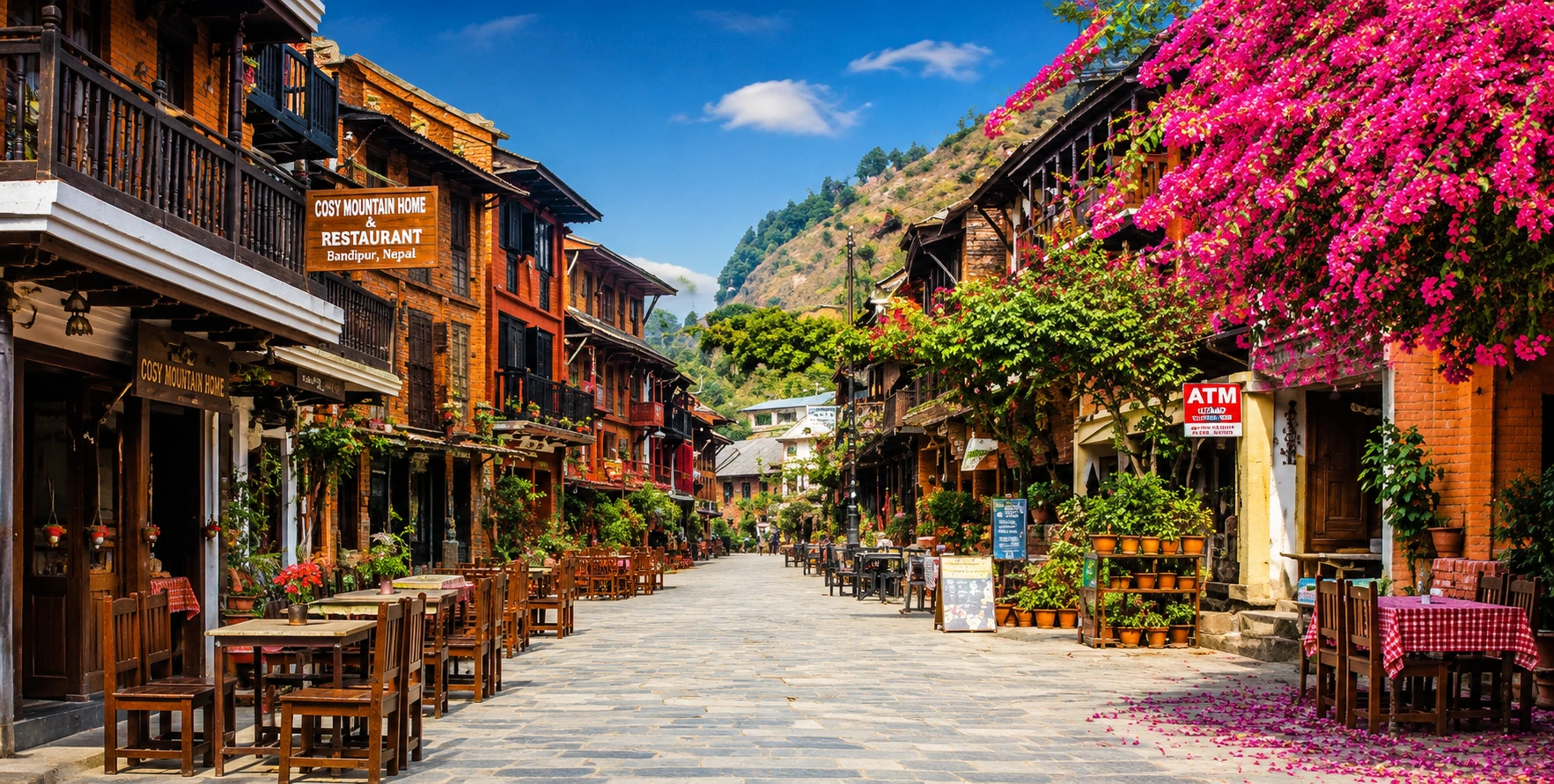
The beautiful heritage hill town of Bandipur is located just off the Prithvi Highway between Damauli and Dumre. Adding a Bandipur stop to the Pokhara-to-Lamjung jeep journey adds about 1 to 1.5 hours to the total travel time. Still, it includes one of Nepal’s finest traditional Newari towns in the day’s itinerary.

Bandipur’s cobblestone main street, panoramic mountain views, and the nearby Siddha Cave make it an outstanding addition.
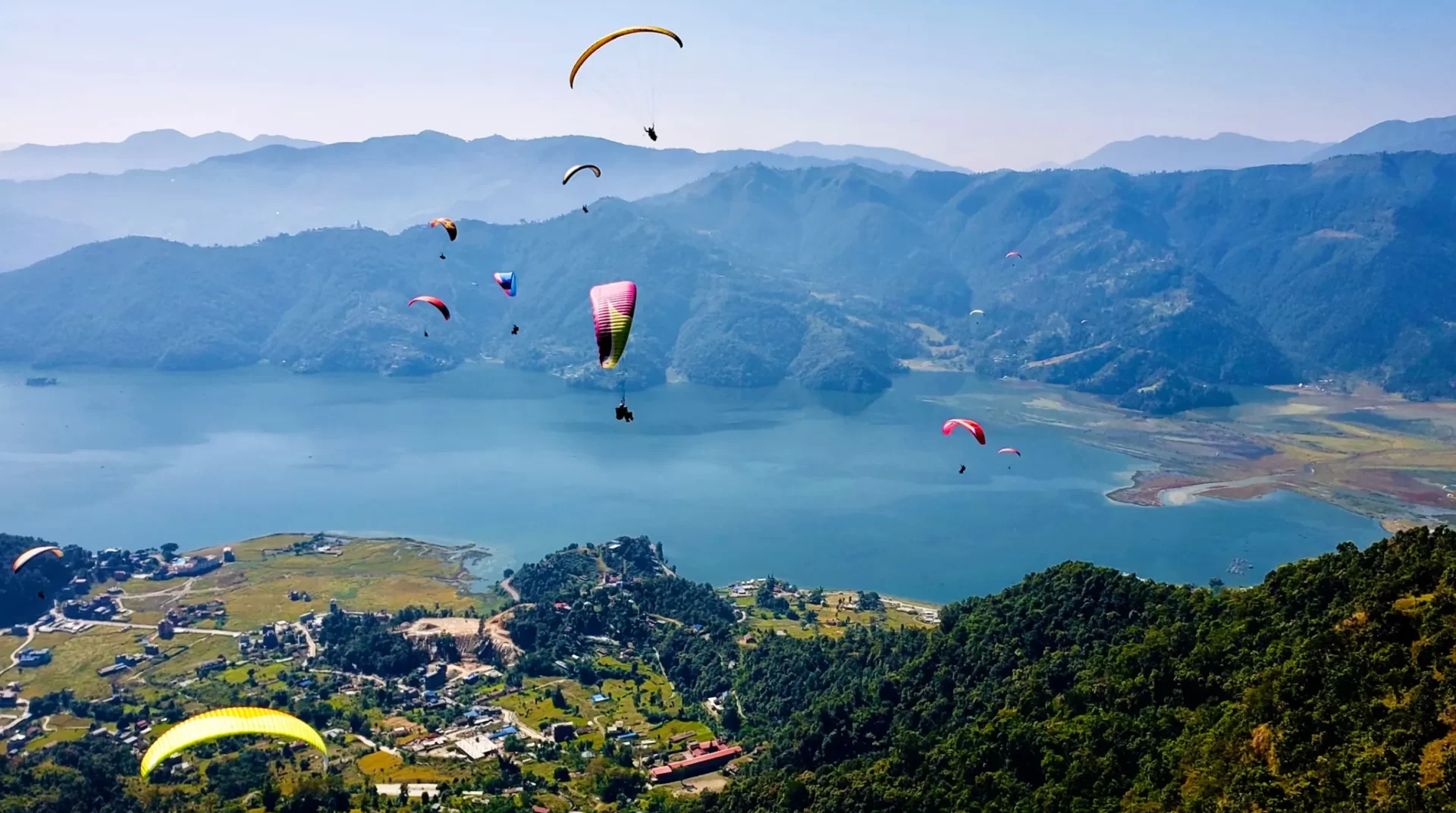
Pokhara to Sarangkot Jeep

Annapurna Circuit Trek – Jeep Transport from Pokhara to Besisahar and Beyond

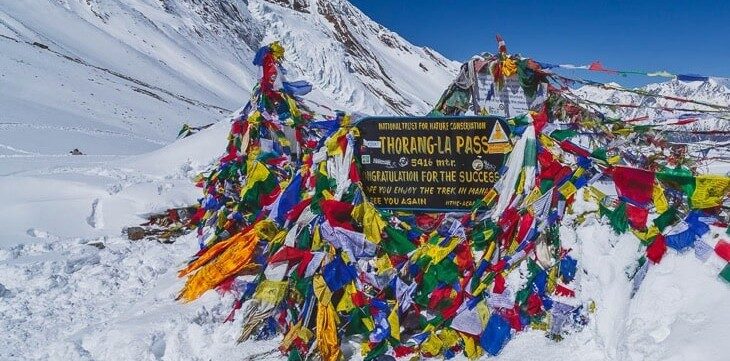
The Annapurna Circuit is one of the world’s great trekking adventures—a 160 to 230 km circuit through the Annapurna Conservation Area that crosses the legendary Thorong La Pass (5,416 m). Besisahar in Lamjung District is the circuit’s traditional starting point, and the journey from Pokhara to Besisahar is the first transport leg for trekkers starting from Pokhara.

Annapurna Circuit TransportDetails
Pokhara to Besisahar (Jeep)72–80 km, 2–2.5 hrs – starting point of the circuit
Besisahar to Bhulbhule (Jeep)10 km, 30 min – alternate lower starting point
Besisahar to Dharapani (Jeep)50 km, 2.5–3 hrs – skip lower valley section
Besisahar to Chame (Jeep)68 km, 3.5–4.5 hrs – skip 2–3 trekking days
Trek End: Jomsom to PokharaJeep back to Pokhara via Mustang/Kali Gandaki valley
Trek End: Nayapul to PokharaShort jeep/bus from Nayapul back to Pokhara
Permit RequiredACAP (NPR 3,000) + TIMS Card (NPR 2,000)
Best SeasonSpring (March–May), Autumn (September–November)

Permits Required for Lamjung District Destinations

PermitCostRequired ForWhere to Obtain
ACAP – Annapurna Conservation Area PermitNPR 3,000 (foreigners)Annapurna Circuit, Besisahar, Bhulbhule, Chame, and all the ACAP areaNepal Tourism Board, Pokhara Lakeside, or Kathmandu
TIMS CardNPR 2,000 (foreigners)All trekkers on multi-day routes in the Annapurna regionNepal Tourism Board, Pokhara Lakeside
Ghalegaun Community EntryNPR 500–1,000 (approx.)Ghalegaun and Ghanpokhara village entryPaid at the village entrance
Lamjung Durbar EntryNominal feeLamjung Durbar historical sitePaid at the site

Obtain trekking permits for the Annapurna Conservation Area (ACAP and TIMS) in Pokhara Lakeside before departure. The Nepal Tourism Board office is approximately 10 minutes from Pokhara Lakeside.
Kathmandu to Pokhara tour

Best Time for Pokhara to Lamjung Jeep Rental

Autumn (September to November) – Best Season

Autumn is the finest season for the Pokhara-Lamjung jeep journey. Post-monsoon skies are crystal clear, the roads are in excellent condition after monsoon grading, and the mountain views of Lamjung Himal, Annapurna II, and Manaslu from Ghalegaun and Ghanpokhara are outstanding. October and November are peak trekking season for the Annapurna Circuit — book your vehicle transfer well in advance.

Spring (March to May) – Excellent

Spring offers warm, comfortable travel conditions with rhododendron forests in full bloom along the Marsyangdi valley hillsides. The mountain views are excellent, and the cultural villages of Ghalegaun and Ghanpokhara are at their most vibrant. March and April are particularly recommended.

May can bring pre-monsoon haze, but it remains a rewarding month to travel.

Winter (December to February) – Good

Winter travel to Lamjung is peaceful and uncrowded. The roads to Besisahar are open year-round. The rough road to Ghalegaun may have morning frost in December and January, but it remains passable with a good 4WD jeep.

Winter mountain views from Ghalegaun are spectacular. Bring warm clothes for the overnight stay.

The monsoon season brings heavy rainfall, making the rough off-road tracks to Ghalegaun and Ghanpokhara particularly hazardous due to slippery surfaces and occasional landslides. The paved road from Pokhara to Besisahar is generally fine. Nepal Vehicle Hiring advises against the Ghalegaun and Ghanpokhara routes during the core monsoon months of July and August.

What to Pack for the Pokhara to Lamjung Jeep Journey

  • Warm layers and a fleece – Ghalegaun (1,950 m) and Ghanpokhara (2,100 m) are significantly cooler than Pokhara, especially in the evenings.
  • Rain jacket – the Marsyangdi valley can receive afternoon rain even outside the monsoon season
  • Trekking permits (ACAP + TIMS) if trekking – obtain from Nepal Tourism Board in Pokhara before departure.
  • Camera and wide-angle lens – Ghalegaun and Ghanpokhara offer spectacular panoramic mountain photography opportunities
  • Nepali cash (small denominations) – for community entry fees, homestay payments, meals, and roadside stops
  • Water bottle and light snacks – the Dumre to Besisahar section has limited roadside food options
  • Motion sickness tablets – the Khudi to Ghalegaun road involves steep, winding switchbacks.
  • Comfortable walking shoes – even if not trekking, the village lanes of Ghalegaun are best explored on foot
  • Sunscreen and sunglasses – UV intensity at 1,950 meters is significantly higher than at Pokhara
  • Offline maps (download the area in Maps.me) – mobile data coverage is limited above Besisahar

Expert Tips for Pokhara to Lamjung Jeep Rental

  • Book your private jeep at least 2 to 3 days in advance, and 5 to 7 days in advance during the October, November, March, and April peak seasons.
  • For the Ghalegaun road specifically, always request an experienced driver who has made the Khudi to Ghalegaun route before – the steep switchbacks require specific local knowledge.
  • Collect ACAP and TIMS permits from the Nepal Tourism Board in Pokhara Lakeside before departure if you are trekking – the permit office is open daily from 9:00 AM to 5:00 PM.
  • Depart from Pokhara between 7:00 AM and 7:30 AM for Ghalegaun – arriving before noon gives you a full afternoon in the village.
  • For the Annapurna Circuit transfer to Besisahar, a 7:00 AM departure from Pokhara allows you to reach Besisahar by 9:30 AM, leaving a full day for the first trekking stage.
  • If you add a Bandipur stop on the way to Lamjung, plan for a 6:30 AM departure to arrive at your final destination on time.
  • Carry sufficient Nepali cash from Pokhara – ATMs in Besisahar are limited and unreliable, and there are none beyond Besisahar on the Annapurna Circuit.
  • Ask your Nepal Vehicle Hiring driver about current road conditions to Ghalegaun on the morning of departure – conditions can change after overnight rain.
  • For multi-day Lamjung trips that combine Ghalegaun homestay and Besisahar, Nepal Vehicle Hiring can arrange a single-booking itinerary covering both destinations.

How to Book Your Pokhara to Lamjung Jeep Rental

Booking your Lamjung jeep rental with Nepal Vehicle Hiring Pvt Ltd is straightforward:

  • Step 1: Contact us via phone, WhatsApp, or at vehiclehiringnepal.com
  • Step 2: Tell us your travel date, specific destination in Lamjung (Besisahar, Ghalegaun, Ghanpokhara, Chame, or Lamjung Durbar), group size, and hotel in Pokhara
  • Step 3: Choose your vehicle – shared jeep, private jeep, HiLux Fortuner, or Land Cruiser
  • Step 4: Confirm one-way, round-trip, or multi-day arrangement as required
  • Step 5: Receive your booking confirmation with driver details, vehicle information, and pickup time
  • Step 6: Your driver picks you up from your hotel and begins your Lamjung adventure

For Annapurna Circuit trek transport packages, including return vehicle from Jomsom or Nayapul, contact us to discuss a complete combined booking.

Frequently Asked Questions (FAQ)

How far is Pokhara from Besisahar in Lamjung?

The road distance from Pokhara to Besisahar is approximately 772.- 800 metres. By private jeep,  the trip takes 2 to 2.5 hours along the Prithvi Highway and the Dumre–Besisahar road.

How long does it take to drive from Pokhara to Ghalegaun?

The drive from Pokhara to Ghalegaun takes approximately 3 to 4 hours by private 4WD jeep. The jeep track is paved and smooth up to Khudi, then becomes a steep, rough off-road track for the final 1- 5 km to Ghalegaun village.

Is a 4WD jeep necessary for the drive from Pokhara to Ghalegaun?

Yes. A 4WD jeep is required for the Khudi-to-Ghalegaun off-road section. Standard cars and vans cannot manage this route.

Nepal Vehicle Hiring offers only 4WD jeeps for transfers to Ghalegaun.

What is the cost of a private jeep from Pokhara to Besisahar in 2026?

A one-way private jeep from Pokhara to Besisahar costs approximately USD 90–120. A round trip costs USD 100- 130. All prices include driver and fuel.

What is the best starting point for the Annapurna Circuit from Pokhara?

Besisahar is the traditional and most commonly used starting point. Trekkers who want to skip the lower, less scenic Marsyangdi Valley road section often take a further jeep from Besisahar to Chame or Dharapani, reducing the circuit trekking time by 2 to 3 days.

What permits do I need for Lamjung District?

For the Annapurna Circuit and ACAP area (Besisahar and beyond), you need an ACAP permit (NPR 3,000) and a TIMS card (NPR 2,000). For cultural visits to Ghalegaun and Ghanpokhara, you pay a community entry fee of about NPR 500-1,000 at the village. Both ACAP and TIMS permits are available from the Nepal Tourism Board office in Pokhara Lakeside.

Can Nepal Vehicle Hiring arrange transport for the full Annapurna Circuit loop?

Yes. Nepal Vehicle Hiring arranges complete Annapurna Circuit transport — a private jeep from Pokhara to Besisahar or Chame at the start, and a return vehicle from Jomsom to Pokhara or from Nayapul to Pokhara at the circuit end. Contact us to discuss a complete trekking transport package for your group.

What is Ghalegaun famous for?

Ghalegaun is famous for its indigenous Ghale community homestays, spectacular panoramic views of Manaslu, Lamjung Himal, and the Annapurna range, traditional cultural programs, and authentic Ghale cuisine. It is one of Nepal’s most acclaimed community tourism destinations and is widely considered the finest homestay village in the Annapurna foothills.

Book Your Pokhara to Lamjung Jeep Rental with Nepal Vehicle Hiring

Lamjung District is one of Nepal’s great undiscovered treasures — a region of dramatic river gorges, towering Himalayan peaks, ancient cultural villages, and some of the world’s finest trekking trails, all within easy reach of Pokhara by private jeep. Whether you are beginning the Annapurna Circuit in Besisahar, experiencing Ghale community culture, marvelling at the mountain panorama from Ghanpokhara, or visiting the historic Lamjung Durbar, every destination in this remarkable district offers travellers experiences genuinely unique to Nepal.

Nepal Vehicle Hiring Pvt Ltd provides reliable, professional, competitively priced jeep rental service for the Pokhara-Lamjung route. Our 4WD fleet, experienced mountain drivers, and complete trekking transport coordination make us the preferred vehicle partner for the Annapurna region.

Contact Nepal Vehicle Hiring Pvt Ltd today at vehiclehiringnepal.com to book your Pokhara-to-Lamjung jeep rental and begin your Annapurna adventure.

WhatsApp: +977 981-4227196
Email: [email protected]
Website: www.vehiclehiringnepal.com
Pokhara to Manang: Full Transport, Route, Cost and Trek Guide

Kathmandu to Manang jeep

Pokhara to Manang Transport – Route, Cost & Trek Guide

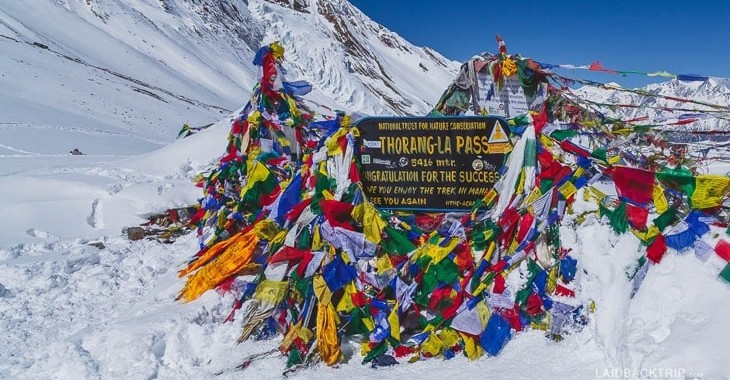
Manang is one of the most extraordinary villages in Nepal – a high-altitude Tibetan-influenced settlement at 3,500 m in the heart of the Annapurna Circuit, sitting beneath the towering walls of Annapurna III (7,555 m), Gangapurna (7,455 m), and the Gangapurna Glacier. Every trekker doing the Annapurna Circuit passes through Manang – it is the last major village before the circuit’s highest and most challenging section, and the obligatory acclimatization stop before attempting the Thorong La Pass at 5,416 m.

In 2026, reaching Manang from Pokhara by private Jeep or vehicle is increasingly popular among trekkers who want to skip the lower sections of the Annapurna Circuit (now largely alongside a jeep road) and begin trekking from the spectacular high-altitude terrain above Chame and Manang. This complete guide covers every aspect of the Pokhara-to-Manang journey – transport options, route details, road conditions, costs, the Manang experience, Annapurna Circuit trek stages, altitude safety, permits, and expert tips for 2026.

About Manang – The High-Altitude Gateway

Location: Manang Village, Manang District, Gandaki Province, Nepal

Altitude: 3,500 m above sea level

Distance from Pokhara: Approximately 175–185 km by road via Besisahar

Distance from Besisahar: Approximately 95 km north by mountain road

Travel Time from Pokhara: 8 to 12 hours total by 4WD jeep (usually done in 2 days)

Road Type: Pokhara to Besisahar – paved | Besisahar to Chame – rough mountain track | Chame to Manang – improved track with some paved sections

Vehicle Required: 4WD Jeep mandatory from Besisahar onwards – no sedan, no Hiace beyond Besisahar

Trek Position: Manang is the Day 8–10 stop on the Annapurna Circuit Trek from Besisahar, or Day 5–6 if starting from Chame by vehicle

Population: Approximately 1,500 – Gurung and Tibetan Buddhist community

Manang sits in a wide, open valley at the foot of the Gangapurna Glacier – an extraordinary landscape of raw Himalayan grandeur. The village itself is a dense cluster of flat-roofed stone houses, prayer flags, ancient gompas, and the sounds of yak bells.

Above the village, the Gangapurna Glacier descends in a dramatic cascade of blue ice and grey moraine. To the south, Annapurna III and Gangapurna rise in vertical walls of rock and ice. To the north, the high, dry plateau of the Annapurna Circuit stretches toward Thorong La.

For most Annapurna Circuit trekkers, Manang is the most beautiful and memorable overnight stop on the entire circuit.

Why Drive from Pokhara to Manang by Private Vehicle?

The traditional Annapurna Circuit trek starts in Besisahar and continues to Manang over 8 to 10 days. However, the road from Besisahar to Chame and beyond has improved significantly in recent years, and much of the lower circuit now runs alongside or on a jeep track.

Many experienced trekkers in 2026 choose to drive from Pokhara to Manang (or at least to Chame) and begin the most scenic sections of the circuit on foot. Here is why:

  • Save 6 to 8 days of walking on the lower circuit sections that now largely follow the jeep road and offer a less traditional trekking atmosphere
  • Begin trekking at Manang (3,500 m) in the most dramatically beautiful section of the entire Annapurna Circuit
  • The lower sections from Besisahar to Chame are now widely considered the least rewarding part of the circuit due to road construction and vehicle traffic alongside the trail
  • A 4WD private jeep gives full luggage space, and group travel together – no splitting the group across multiple local shared jeeps
  • Flexible departure from your Pokhara hotel – choose your own schedule and rest stop locations
  • Combine the circuit with Muktinath and Mustang by entering from Pokhara and exiting via Jomsom
  • Arrive fresher and stronger for the genuinely challenging high-altitude sections above Manang

Vehicle Options & Prices: Pokhara to Manang Transport

The Pokhara-Manang route requires a capable 4WD vehicle from Besisahar onwards. Here are the vehicle options and  prices:

VehicleCapacityOne-Way Price (USD)Round Trip (USD)Notes
Toyota Land Cruiser4–6 pax$300 – $500$700 – $1000Best vehicle for the full Pokhara–Manang road
Toyota Land Cruiser Prado4–5 pax$300 – $500$600 – $1200Superior comfort on rough mountain track
Mahindra Bolero / Scorpio4–6 pax$170 – $300$300 – $700Budget 4WD, capable on this route
Hiace Van (Pokhara–Besisahar only)7–14 pax$100–$200$170–$300Cannot proceed beyond Besisahar – Jeep required
Sedan Car (Pokhara–Besisahar only)1–3 pax$100–$150$1500–$200Paved road to Besisahar only – not beyond

All private vehicle prices include driver, full fuel, and vehicle insurance. Round-trip pricing includes the driver staying in Manang or Chame during your trek and returning you to Pokhara or Kathmandu after the circuit. For trekkers completing the full Annapurna Circuit and exiting via Jomsom to Pokhara, a one-way Pokhara-to-Manang booking is all you need.

Manang hidden valley

Two Route Options: Pokhara to Manang

Route A: Pokhara – Besisahar – Chame – Manang (Most Common)

Total Distance: 175–185 km

Total Time: 8 to 12 hours by 4WD (recommended as a 2-day journey)

Via: Pokhara – Dumre – Besisahar – Khudi – Bahundanda – Chamje – Tal – Dharapani – Chame – Pisang – Manang

This is the standard and most commonly used route. The road from Pokhara to Dumre follows the Prithvi Highway and is fast and paved. From Dumre, the road climbs north to Besisahar on a secondary road.

Beyond Besisahar, the rough mountain track begins through the Marsyangdi River valley to Chame and finally Manang.

Route B: Pokhara – Besisahar via Damauli (Alternative)

Total Distance: 165–175 km (slightly shorter)

Via: Pokhara – Baglung – Beni road junction – Damauli – Dumre – Besisahar

A slightly shorter alternative that bypasses the longer Pokhara-Prithvi Highway stretch by heading east via Damauli before joining the Besisahar road. Both routes converge at Besisahar. Your driver will choose the best option based on traffic and road conditions on your travel day.

Detailed Road Guide: Pokhara to Manang Stage by Stage

Stage 1: Pokhara to Dumre (75 km | ~1.5 hrs)

Depart your Pokhara hotel early – 5:30 to 6:00 AM is ideal for a two-day journey with an overnight in Besisahar or Chame. Head east on the Prithvi Highway through the Pokhara valley, past Damauli and Dumre.

Dumre is the junction town on the Prithvi Highway where the road branches north toward Besisahar and the Annapurna Circuit. Stock up on snacks here if needed – the highway shops are more convenient than the mountain road ahead.

Stage 2: Dumre to Besisahar (22 km | 45 min)

From Dumre, head north on the secondary road into the Marsyangdi River valley. The road climbs gently through terraced hills and farmland to Besisahar – the district headquarters of Lamjung District and the official starting point of the Annapurna Circuit. The road is mostly paved.

Besisahar has the last reliable ATMs on the circuit, a good selection of teahouses, pharmacies, and a well-stocked market. Stop here to withdraw cash, complete ACAP permit registration at the checkpoint, refuel, and have breakfast or an early lunch before the mountain road begins.

Stage 3: Besisahar to Chame (55 km | 4–6 hrs by 4WD)

This is the most challenging section of the drive. Beyond Besisahar, the paved road ends, and the rough Annapurna Circuit mountain track begins. The route follows the Marsyangdi River north through dramatically deepening gorges.

Key villages and landmarks on this section:

  • Khudi (790 m) – First village on the track, 10 km from Besisahar
  • Bahundanda (1,310 m) – Brahmin village on ridge, good views back down valley
  • Chamje (1,430 m) – Bridge crossing to the east bank, gorge narrows dramatically
  • Tal (1,700 m) – First village in Manang District, flat valley formed by an ancient landslide dam
  • Dharapani (1,860 m) – Important permit checkpoint, Manaslu Circuit junction point
  • Bagarchhap (2,160 m) – First Tibetan-style stone buildings appear
  • Chame (2,710 m) – District headquarters of Manang, hot springs, good teahouses, end of Day 2 drive

Overnight in Chame (2,710 m) is strongly recommended for acclimatization before continuing to Manang at 3,500 m. Ascending too quickly from Besisahar to Manang in a single day significantly increases the risk of altitude sickness.

Stage 4: Chame to Manang (40 km | 2–3 hrs by 4WD)

The road from Chame to Manang is more manageable than the Besisahar–Chame section, with some paved sections and generally better track surface. The scenery becomes increasingly dramatic as you enter the high-altitude Annapurna landscape. Key stops:

  • Bhratang (2,850 m) – Apple orchard settlement, dramatic Paungda Danda rock face
  • Dhukur Pokhari (3,240 m) – Small pond, open plateau, Annapurna III views begin
  • Upper Pisang (3,310 m) – Beautiful perched Tibetan village with an ancient monastery (worth a stop)
  • Ngawal (3,657 m) – Spectacular viewpoint village above the main road
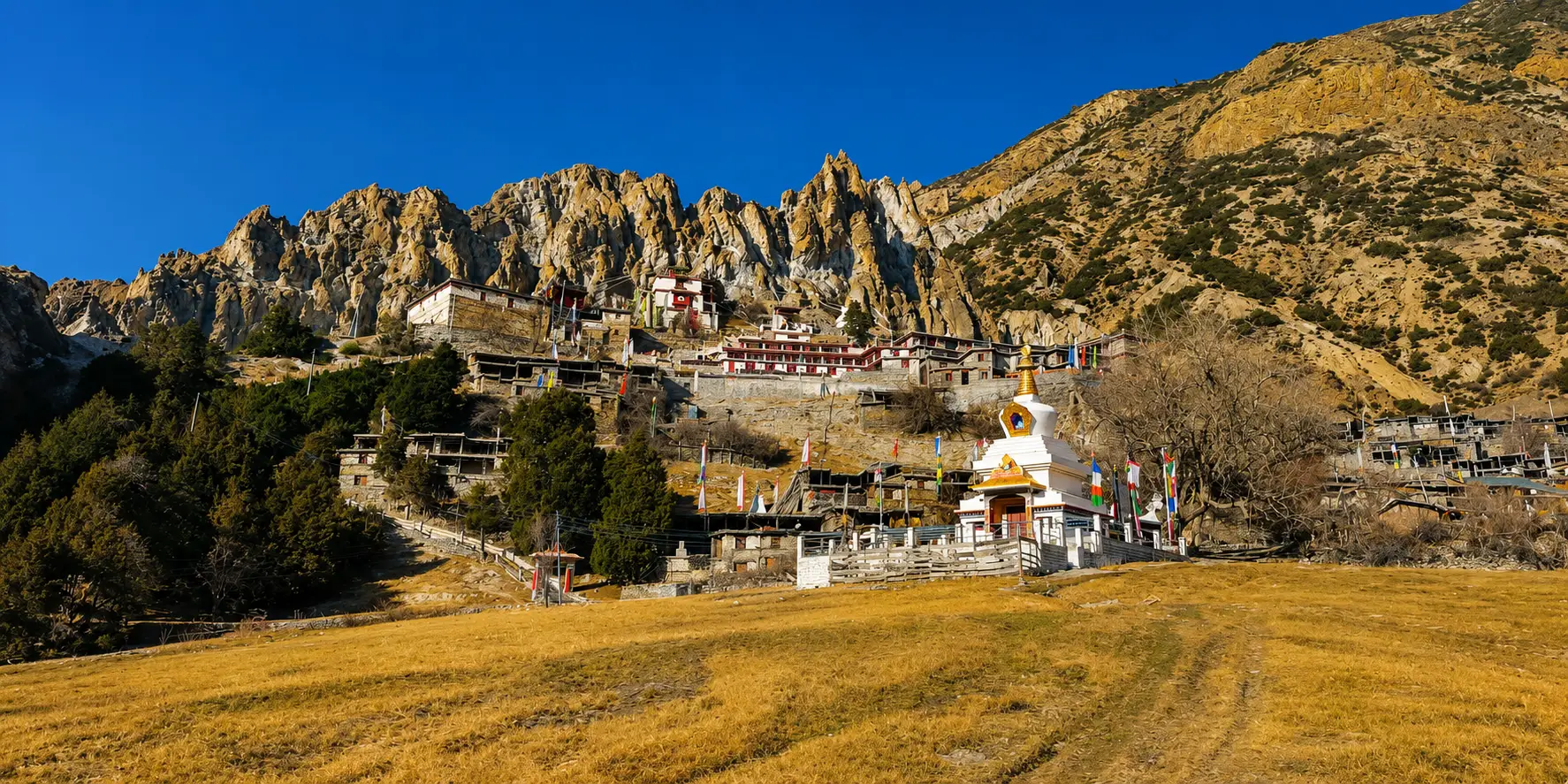
  • Braga (3,475 m) – Ancient cave monastery with some of Nepal’s finest Buddhist art
  • Manang (3,500 m) – Arrival at the circuit’s most important acclimatization village

Road Conditions: Pokhara to Manang

SectionDistanceSurfaceDifficultyBest Season
Pokhara to Dumre75 kmPrithvi Hwy – pavedEasyGood year-round
Dumre to Besisahar22 kmSecondary road – mostly pavedEasy–ModerateGood year-round
Besisahar to Bahundanda15 kmRough gravel trackModerateMuddy in monsoon
Bahundanda to Chamje10 kmRocky Mountain trackHard4WD essential, rockfall risk
Chamje to Tal8 kmVery rough, river crossingsVery HardRisk in monsoon
Tal to Dharapani12 kmRough track, improvingHardBest Oct–May
Dharapani to Chame15 kmMixed – rough to partly pavedModerate–HardReliable in the dry season
Chame to Pisang20 kmMixed track – some pavedModerateGood Oct–May
Pisang to Manang20 kmBetter track – partly pavedModerateGood Oct–May, snow risk Dec–Feb

The Besisahar-to-Chame section remains the most challenging part of the drive and requires a fully capable 4WD Land Cruiser with an experienced mountain driver. Road conditions improve significantly from Chame to Manang, where the road has received more investment. Even so, 4WD capability remains essential throughout.

Pokhara to Manang Transport

A two-day journey with an overnight stop in Chame or Besisahar is strongly recommended for safety, comfort, and gradual acclimatization. Here is the ideal schedule:

Day 1: Pokhara to Chame (145 km | 7–8 hrs driving)

  • 5:30–6:00 AM: Depart Pokhara Lakeside by private 4WD jeep
  • 7:30–8:00 AM: Reach Dumre junction on Prithvi Highway – brief tea stop
  • 9:00 AM: Arrive Besisahar – ATM withdrawal, ACAP permit registration, breakfast stop (45–60 min)
  • 10:00 AM: Depart Besisahar on the mountain track
  • 12:00–1:00 PM: Lunch stop at Tal or Dharapani teahouse
  • 3:00–4:00 PM: Arrive Chame (2,710 m) – check into teahouse, explore village
  • Evening: Visit natural hot springs near Chame, light dinner, early to bed
  • Overnight: Chame at 2,710 m – gentle acclimatization to altitude

Day 2: Chame to Manang (40 km | 2–3 hrs driving)

  • 7:00 AM: Depart Chame after breakfast
  • 8:00 AM: Stop at Upper Pisang monastery (15 min) – extraordinary views and frescoes
  • 9:00–9:30 AM: Drive through Ngawal and Braga villages – stop for photos
  • 10:00–10:30 AM: Arrive Manang (3,500 m) – check into teahouse, acclimatize
  • Afternoon: Rest, explore Manang village, visit Gangapurna Glacier viewpoint
  • Mandatory: Spend at least one full rest day in Manang before trekking upward

Permits Required: Pokhara to Manang & Annapurna Circuit

All visitors to Manang and the Annapurna Circuit require valid permits. Arrange all permits in Pokhara or Kathmandu before departure – not available in Besisahar or Chame with the same ease:

PermitCost 2026Where to ObtainValid For
ACAP – Annapurna Conservation Area PermitNPR 3,000 (USD 22)Nepal Tourism Board, Pokhara (Damside office) or KathmanduFull Annapurna Circuit from Besisahar to Manang, Thorong La, and Muktinath
TIMS Card – Trekkers ‘ Information Management SystemUSD 10Nepal Tourism Board / TAAN office, Pokhara or KathmanduRequired for all trekkers on the circuit
Note: No Restricted Area Permit neededStandard Annapurna Circuit is open – no extra restricted permit–TheUpper Mustang permit (USD 500) is only required if continuing north of Kagbeni.

Permit checkpoints are located at Besisahar, Dharapani, Chame, Manang, and Muktinath. Officials thoroughly inspect all permits at each checkpoint. Obtain your ACAP permit at the Nepal Tourism Board Damside office in Pokhara (open 9:00 AM weekdays) the day before your departure.

Manang valley
Manang valley

Manang Village – Complete Visitor Guide

The Village and Its Surroundings

Manang is a Tibetan-influenced village of flat-roofed stone houses, prayer walls, ancient stupas, and the sounds of yak bells and wind through prayer flags. The village has two main sections: the lower, newer settlement near the main trail and road, and the upper traditional village of Manang proper, with its narrow lanes and ancient architecture.

The upper village has the most atmospheric teahouses, the old gompa, and the best mountain viewpoints. Always walk up to the upper village – it is more beautiful and more authentically preserved than the lower settlement.

Gangapurna Lake

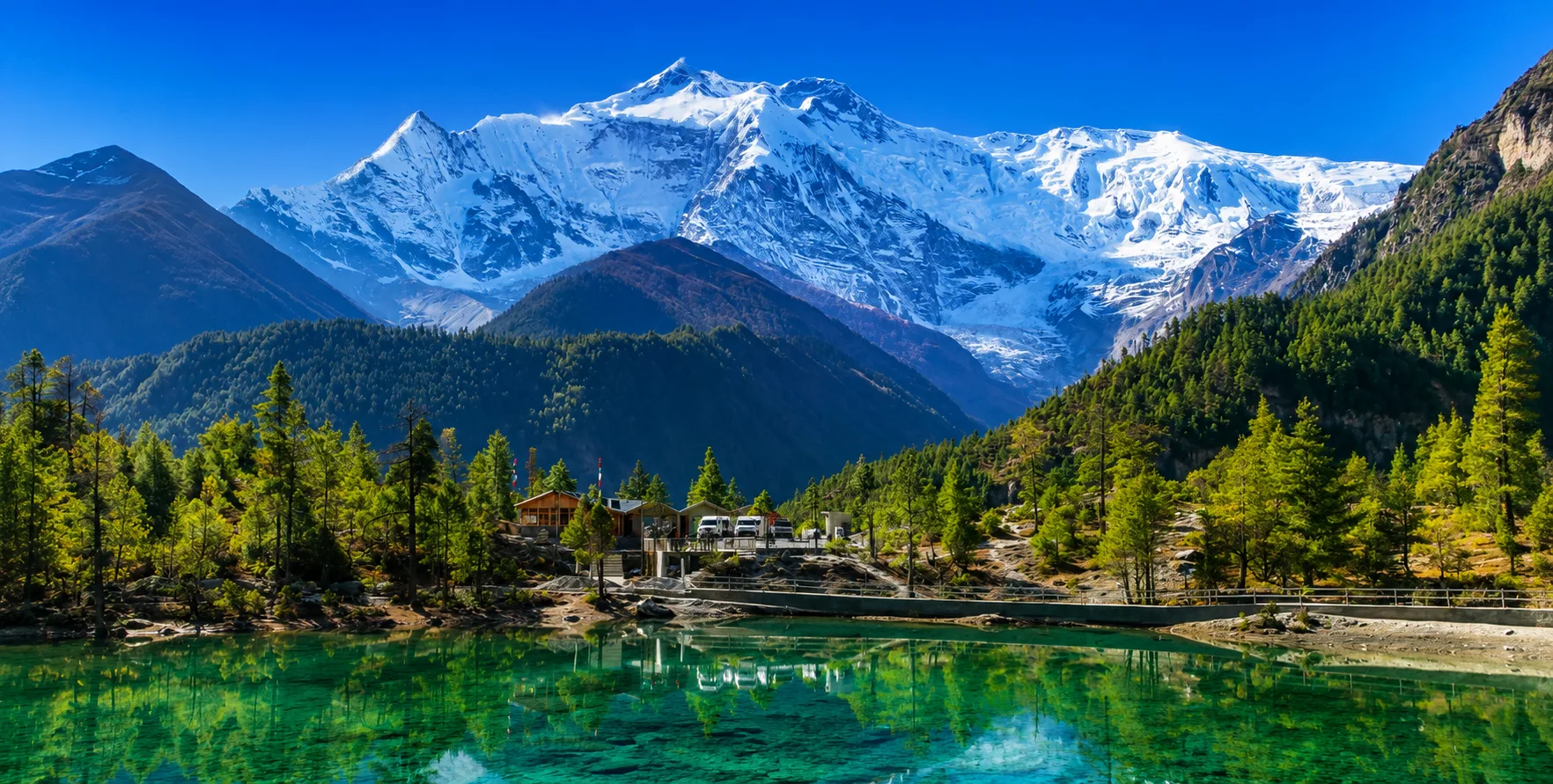
A 20-minute walk from the upper village, Gangapurna Lake sits in a glacial bowl at 3,540 m with the Gangapurna Glacier flowing directly into its ice-blue waters. The reflection of Gangapurna (7,455 m) and Annapurna III in the still morning lake is one of Nepal’s finest mountain-lake scenes.

Visit early in the morning before the wind disturbs the reflection. The walk to the lake is also an excellent acclimatization exercise.

The Gangapurna Glacier Viewpoint

A 45-minute climb above the upper village reaches a dramatic viewpoint directly facing the Gangapurna Glacier – a massive, actively calving glacier flowing from the peak of Gangapurna. The glacier’s scale is astonishing, and the sounds of ice movement and occasional calving crashes add to the experience. This is the best viewpoint easily accessible from Manang and is recommended for an acclimatisation rest day.

Ice Lake (Kicho Tal) Acclimatization Hike

The Ice Lake hike from Manang is the most popular and rewarding acclimatization day hike on the Annapurna Circuit. The trail climbs steeply from the upper village to Ice Lake at 4,600 m – a gain of over 1,000 m – and then descends back to Manang. The round trip takes 5 to 7 hours.

The panoramic view from Ice Lake of the entire Manang Valley, the Annapurna Range, and the Tilicho Massif is extraordinary. This hike is the best way to acclimatise before crossing Thorong La.

Milarepa Cave and Praken Gompa

Above the upper village, a stone staircase leads to the Praken Gompa – one of the oldest and most important Buddhist monasteries on the Annapurna Circuit, perched dramatically on a cliff face. The gompa has ancient thangka paintings, butter lamps, and Buddhist texts.

Adjacent to the gompa is a cave associated with Milarepa, the great Tibetan Buddhist yogi and poet who is said to have meditated here. The climb to the gompa takes 30 to 40 minutes from the village and offers spectacular views of the Gangapurna massif.

Manang HRA (Himalayan Rescue Association)

The Manang HRA office is a critical resource for all Annapurna Circuit trekkers. The HRA operates a clinic that can diagnose and treat altitude sickness, and provides free daily altitude and Thorong La pass briefings every afternoon (usually at 3:00 PM).

Attendance at the HRA briefing is strongly recommended for all trekkers planning to cross the Thorong La. The briefing covers weather forecasts, current pass conditions, AMS symptoms and treatment, and survival advice for the high crossing.

Annapurna Circuit Trek from Manang – Complete Stage Guide

Starting the Annapurna Circuit trek from Manang (reached by vehicle from Pokhara) puts you immediately in the circuit’s most spectacular high-altitude section. Here is the full stage guide from Manang onward:

DayStageDistanceAltitudeKey Highlights
Rest DayManang (acclimatization)–3,500mIce Lake hike, Praken Gompa, Gangapurna Lake, HRA briefing
Day 1Manang – Yak Kharka10 km3,500m → 4,018mHigh yak pastures, open plateau, Chulu peaks views
Day 2Yak Kharka – Thorong Phedi8 km4,018m → 4,450mLast teahouses before the pass, glacier views
Day 3Thorong Phedi – Thorong La – Muktinath16 km4,450m → 5,416m → 3,710mThe highest point of the circuit, the sacred Muktinath temple
Day 4Muktinath – Jomsom22 km3,710m → 2,720mKali Gandaki valley, Kagbeni, Marpha apple orchards
Day 5Jomsom – Marpha – Tatopani35 km2,720m → 1,190mDramatic Kali Gandaki descent, Dhaulagiri views, hot springs
Day 6Tatopani – Ghorepani18 km1,190m → 2,874mSteep rhododendron forest climb, Poon Hill viewpoint prep
Day 7Ghorepani – Poon Hill sunrise – Nayapul21 km2,874m → 3,210m → 1,070mPoon Hill sunrise, descend to Nayapul trailhead
EndNayapul – Pokhara by vehicle42 km1,070m → 820mPrivate jeep pickup, return to Pokhara Lakeside

Total trek duration from Manang: 7-9 days, including the mandatory rest/acclimatization day. Vehicle Hiring Nepal can arrange a jeep pickup in Nayapul at the end of your circuit – book this at the same time as your outward transport from Pokhara to Manang.
Pokhara to Manang Transport - thorang la pass

Altitude Safety: Essential Manang and Thorong La Advice

Manang at 3,500 m and the Thorong La at 5,416 m are serious altitudes that demand careful acclimatization and awareness. This section could save your life – read it carefully:

Golden Rules of Acclimatisation

  • NEVER ascend more than 500 m per day above 3,000 m – follow the ‘walk high, sleep low’ principle
  • ALWAYS spend a minimum of 2 nights in Manang before attempting the Thorong La crossing – ideally 2 to 3 nights
  • The Ice Lake acclimatization hike (climb to 4,600 m and descend to 3,500 m) is the most important preparation you can do in Manang.
  • Descend 300 to 500 m to sleep if you feel unwell at any altitude above 3,000 m – never push through worsening AMS symptoms.
  • The Thorong La crossing (5,416 m) must be started before 6:00 AM from Thorong Phedi – afternoon winds and cloud make the crossing dangerous.

Symptoms of Acute Mountain Sickness (AMS)

  • Headache (most common) – especially a throbbing headache that worsens on movement
  • Nausea and loss of appetite
  • Fatigue, weakness, and dizziness disproportionate to exertion
  • Difficulty sleeping – insomnia and disturbed breathing at altitude
  • Shortness of breath at rest – this is a serious warning sign; descend immediately

High-Altitude Emergencies – HACE and HAPE

  • HACE (High-Altitude Cerebral Oedema) – confusion, inability to walk straight, loss of coordination. DESCEND IMMEDIATELY and seek evacuation
  • HAPE (High-Altitude Pulmonary Oedema) – gurgling or wet sounds in breathing, severe shortness of breath at rest, blue lips. MEDICAL EMERGENCY – immediate descent and evacuation required
  • Helicopter rescue from Manang and Thorong Phedi is available but expensive (USD 1,500–3,000+) – travel insurance covering helicopter evacuation is essential.

Medications and Prevention

  • Diamox (acetazolamide) – 125 to 250 mg twice daily starting 24 hours before ascending above 3,000 m. Consult your doctor before travel
  • Ibuprofen – effective for altitude headache (not a substitute for descending if AMS is severe)
  • Dexamethasone – emergency treatment for HACE and HAPE, NOT for prevention. Carry only if trained in use.
  • Stay extremely well hydrated – drink 4-5 litres of water per day at altitudes above Manang.
  • Avoid alcohol completely for the first 48 hours after arriving in Manang.

Best Time to Travel from Pokhara to Manang

October to November (Peak Season – Best for Circuit)

The finest season for the Pokhara to Manang journey and the Annapurna Circuit. Post-monsoon skies are crystal clear, and views of Annapurna III, Gangapurna, Chulu, and Tilicho from Manang are spectacular. The Thorong La is clear of fresh snow and at its most reliable for crossing.

October and November are the busiest months – teahouses can be full in Manang. Book your vehicle 3-6 weeks in advance. The morning mountain views, driving into the Marsyangdi gorge in October light, are striking.

March to May (Excellent – Spring Circuit)

Spring is the second-best season for the circuit. Rhododendron forests from Besisahar to Chame bloom spectacularly in March and April. Mountain views are excellent in the mornings.

The Thorong La is usually clear from mid-March onwards. Less crowded than October–November and equally beautiful. The road from Besisahar is in good condition after the winter freeze.

December to February (Cold – Experienced Trekkers Only)

Winter is possible but serious. The road from Besisahar can have ice and snow in December and January. Manang can drop to -15 to -25°C at night.

The Thorong La may be snowbound and impassable in January and February. Several trekking deaths have occurred in winter on this pass – only very experienced cold-weather trekkers with proper winter gear should attempt the crossing. The Manang valley is peaceful and beautiful in winter, with almost no visitors.

The Besisahar-Chame road is at its most dangerous during the monsoon. Frequent landslides can close sections for days. The circuit trail above Manang is relatively dry (rain-shadow protection), but the access road is not.

If planning a circuit during the monsoon, consider flying to Pokhara and taking local transport to Besisahar only on confirmed good-road days. Do not attempt the Besisahar–Chame road in active monsoon conditions.

Manang Valley Tour Jeep Rental for Himalayan Mountain Travel in Nepal

What to Expect in Manang – Practical Information

Accommodation in Manang

TypePrice Per Night (NPR)FacilitiesBest For
Basic TeahouseNPR 300–600Simple twin/dorm, shared bathroom, cold waterBudget trekkers
Standard Teahouse LodgeNPR 600–1,500Better rooms, hot shower (extra), electricity, WiFiMost trekkers
Better TeahousesNPR 1,500–3,000Attached bathroom, solar hot water, and a good restaurantComfort-seeking trekkers
Note: Dal bhat mealNPR 500–800Unlimited refills included – best value at altitudeAll trekkers

Solar panels and micro-hydro supply electricity in Manang. Power is available for charging during daylight hours. Charge all devices during the day – power is cut or rationed in the evening.

WiFi is available at most teahouses in Manang at a small fee. Mobile signal: NTC works in Manang; Ncell is unreliable above Chame.

Food and Nutrition at Altitude

At 3,500 m, your body needs more calories than at sea level to maintain warmth and energy. Dal bhat (with unlimited refills) is the ideal meal for trekkers at altitude – high-carbohydrate, high-calorie, warm, and nutritious. Eat regularly even if appetite is reduced (a common AMS symptom).

Avoid heavy, fatty foods on the day before the Thorong La crossing. Garlic soup is a traditional altitude remedy widely available at Manang teahouses and worth trying.

ATM and Cash in Manang

Manang has an ATM (eSewa kiosk type) that is sometimes operational but unreliable. Do not count on it. Withdraw all the cash you need in Pokhara or Besisahar before beginning the circuit.

Budget NPR 3,500 to NPR 6,000 per person per day for accommodation and meals in Manang. Prices increase significantly above Besisahar and again above Manang due to the cost of supplying goods by porter or yak to high altitude.

Combine Pokhara to Manang with a Bigger Nepal Itinerary

The Pokhara to Manang journey and Annapurna Circuit trek can be smoothly combined with other Nepal destinations for a complete Nepal travel experience:

Kathmandu – Pokhara – Manang – Muktinath – Jomsom – Pokhara

The most popular complete circuit: fly or drive from Kathmandu to Pokhara, Jeep to Manang, trek the Annapurna Circuit over the Thorong La, arrive at Muktinath (a sacred pilgrimage site), descend to Jomsom, and return to Pokhara by Jeep. The complete circuit,, including trave,l, takes 12 to 16 days.

Lumbini – Chitwan – Pokhara – Manang (Nepal Triangle Circuit)

Begin with a pilgrimage to Lumbini, transfer to Chitwan for a jungle safari, continue to Pokhara for sightseeing, then take a jeep to Manang for the Annapurna Circuit. This ‘Nepal Triangle’ itinerary covers Buddhist heritage, wildlife safari, mountain scenery, and Himalayan trekking in one comprehensive Nepal journey.

What to Pack for the Pokhara to Manang Journey

For the Jeep Journey

  • Water – 2 litres per person minimum – limited stops between Besisahar and Chame
  • Snacks – energy bars, nuts, and chocolate for the 7 to 8-hour drive
  • Motion sickness tablets – essential for the very rough Besisahar to Chame gorge road
  • Light warm layer – the gorge can be cool even in warm months
  • Camera with a charged battery and a spare – the Marsyangdi gorge is spectacular
  • Offline maps (Gaia GPS or Maps.me with Annapurna Circuit downloaded)

For Manang and the Thorong La

  • Down jacket (rated to -10°C minimum) – nights in Manang are cold even in October
  • Thermal base layers (top and bottom) – essential from Chame onwards
  • Windproof and waterproof outer shell jacket and trousers
  • Warm trekking gloves and a thicker pair for the Thorong La crossing
  • Warm hat and neck gaiter – the wind on the Thorong La is severe
  • Trekking boots with ankle support – not trail runners for the Thorong La
  • Trekking poles – strongly recommended for the steep Thorong La ascent and descent
  • Headlamp with spare batteries – you start the Thorong La crossing before dawn
  • High-altitude sunscreen (SPF 60+) and UV-protection goggles or wraparound sunglasses
  • Travel insurance documents with emergency helicopter evacuation coverage confirmed
  • Diamox prescription (consult doctor), personal first aid kit
  • Cash NPR 50,000+ for the full circuit, including emergencies

What is Included in Your Pokhara to Manang Vehicle Hire

  • Private 4WD Toyota Land Cruiser or equivalent with an experienced Annapurna Circuit route driver
  • Full fuel cost for the complete Pokhara to Manang journey
  • Vehicle insurance for the entire journey duration
  • Hotel pickup from your Pokhara Lakeside hotel or guesthouse
  • Drop-off at your chosen teahouse in Manang village
  • Overnight stop arrangement in Chame (Day 1) – driver knows all Chame teahouses
  • Brief stops at Besisahar (ATM, permits, breakfast), Tal, and Upper Pisang monastery
  • Return pickup from Nayapul (end of Annapurna Circuit) or Jomsom (if exiting via Mustang)
  • 24/7 WhatsApp support during the journey and throughout your trek

Not included: ACAP permit and TIMS card (arrange in Pokhara before departure), personal meals, teahouse accommodation, guide fees, porter charges, helicopter evacuation insurance, and any additional detour stops.

Manang lake

Frequently Asked Questions

How long does it take to drive from Pokhara to Manang?

The total driving time from Pokhara to Manang is approximately 8 to 12 hours, including rest stops. We strongly recommend spreading this over 2 days – Pokhara to Chame on Day 1 (7 to 8 hours), overnight in Chame, then Chame to Manang on Day 2 (2 to 3 hours). This two-day approach provides gradual acclimatisation and significantly reduces the risk of altitude sickness when you arrive in Manang.

Can I go directly from Pokhara to Manang in one day?

Technically possible, but strongly not recommended. The drive alone takes 8 to 12 hours, including the rough mountain road, and arriving in Manang at 3,500 m the same day you leave Pokhara at 820 m is a rapid altitude gain that significantly increases the risk of AMS.

A one-day Pokhara-to-Manang push also means very long driving hours on a difficult road, and you arrive in the village exhausted. Always split into two days with an overnight in Chame.

Is the road from Besisahar to Manang open year-round?

The road is generally open from October through May in the dry season. During monsoon (June to September), sections between Besisahar and Chame are prone to landslides and can be closed for days at a time.

In winter (December to February), ice and snow can affect the upper sections near Manang, but the road usually remains passable for capable 4WD vehicles. Always confirm current road conditions with your driver before departure.

What is the difference between starting the Annapurna Circuit at Besisahar vs Manang?

Starting in Besisahar means walking the full traditional circuit – approximately 17 to 21 days in total, covering the entire Marsyangdi Valley from 820 m to 3,500 m on foot. Starting at Manang by vehicle skips the lower 10 to 12 days of the circuit (now largely alongside a jeep road) and begins the trek in the most scenic high-altitude section.

For this reason, most modern trekkers in 2026 start from Chame (by vehicle) or Manang (by vehicle). Both approaches are completely valid – it depends on your available time and what you want from the experience.

Do I need a guide for the Annapurna Circuit?

The Annapurna Circuit does not legally require a guide. However, above Manang and particularly on the Thorong La crossing (5,416 m), a licensed guide is strongly recommended for safety, navigation in poor weather, and altitude emergency response. You can arrange local guides in Besisahar, Chame, or Manang.

Vehicle Hiring Nepal can recommend licensed guide agencies in Pokhara if you need assistance with arranging a guide.

What is the Thorong La pass, and how difficult is it?

Thorong La is the highest point of the Annapurna Circuit at 5,416 m and the trek’s defining challenge. The crossing from Thorong Phedi (4,450 m) to Muktinath (3,710 m) covers about 16 km, with a 966 m ascent and a 1,706 m descent.

In good conditions and with proper acclimatization, most fit, healthy trekkers complete the crossing in 6 to 8 hours. The crossing must begin before 6:00 AM – afternoon winds make the high sections extremely dangerous. In poor weather, the pass can be impassable, and several deaths have occurred due to avalanches and storm exposure.

Can I take a local bus from Pokhara to Manang?

No direct local bus runs from Pokhara to Manang. From Pokhara, local buses run to Besisahar (3-4 hours). From Besisahar, shared local jeeps run to Chame when full (3 to 5 hours, highly unpredictable wait times).

From Chame, another shared jeep to Manang (2-3 hours). This three-vehicle connection is time-consuming, uncomfortable with trekking gear, and unreliable for departure times. A private Land Cruiser from Pokhara to Manang is far superior in every regard.

What happens if my trekking group gets altitude sickness in Manang?

The Himalayan Rescue Association (HRA) clinic in Manang can diagnose and treat mild to moderate AMS. For serious AMS, HACE, or HAPE, immediate descent (by foot or porter carry) to Chame (2,710 m) provides rapid relief.

For severe emergencies, helicopter evacuation can be arranged from Manang or Thorong Phedi – this requires travel insurance covering high-altitude helicopter rescue, which typically costs USD 1,500 to USD 3,000. Never try to push through serious altitude sickness symptoms – descend immediately.

How to Book Your Pokhara to Manang Transport

  1. Contact Vehicle Hiring Nepal via WhatsApp at +977 981-4227196 or visit vehiclehiringnepal.com
  2. Choose your vehicle – the Toyota Land Cruiser is strongly recommended for the full Manang route.
  3. Provide your travel dates and preferred departure time from Pokhara (5:30–6:00 AM recommended)
  4. Give your hotel name and pickup address in Pokhara Lakeside
  5. Confirm your group size and number of trekking packs/porter luggage
  6. Specify if you need an overnight stop arranged in Chame (highly recommended)
  7. Request a return vehicle pickup from Nayapul or Jomsom at the end of your circuit
  8. Receive full booking confirmation with driver details, vehicle type, and day-by-day journey plan

WhatsApp: +977 981-4227196
Email: [email protected]
Website: www.vehiclehiringnepal.com
Final Thoughts

The journey from Pokhara to Manang is one of the great Himalayan road adventures of 2026 – a two-day progression from the beautiful lakeside city of Pokhara through dramatic river gorges, medieval stone villages, and ancient Buddhist culture into the raw, striking high-altitude world of Manang at 3,500 m. And then, from Manang, the greatest section of the Annapurna Circuit awaits – the Thorong La, Muktinath, the Kali Gandaki gorge, and finally Poon Hill and the return to Pokhara.

Vehicle Hiring Nepal makes the Pokhara-to-Manang journey safe, comfortable, and smoothly organized. Our experienced mountain drivers, well-maintained Land Cruisers, and deep knowledge of the Annapurna Circuit access road ensure that your trekking adventure begins the right way – with a reliable vehicle, a knowledgeable driver, and the freedom to focus on the extraordinary landscape unfolding outside the window.

Book your Pokhara-to-Manang transport today and secure your return pickup from Nayapul or Jomsom at the same time. WhatsApp: +977 981-4227196 | Website: www.vehiclehiringnepal.com

Pokhara to Sikles Jeep Rental: Complete Guide

Pokhara

Pokhara to Sikles Jeep Rental – Complete Guide

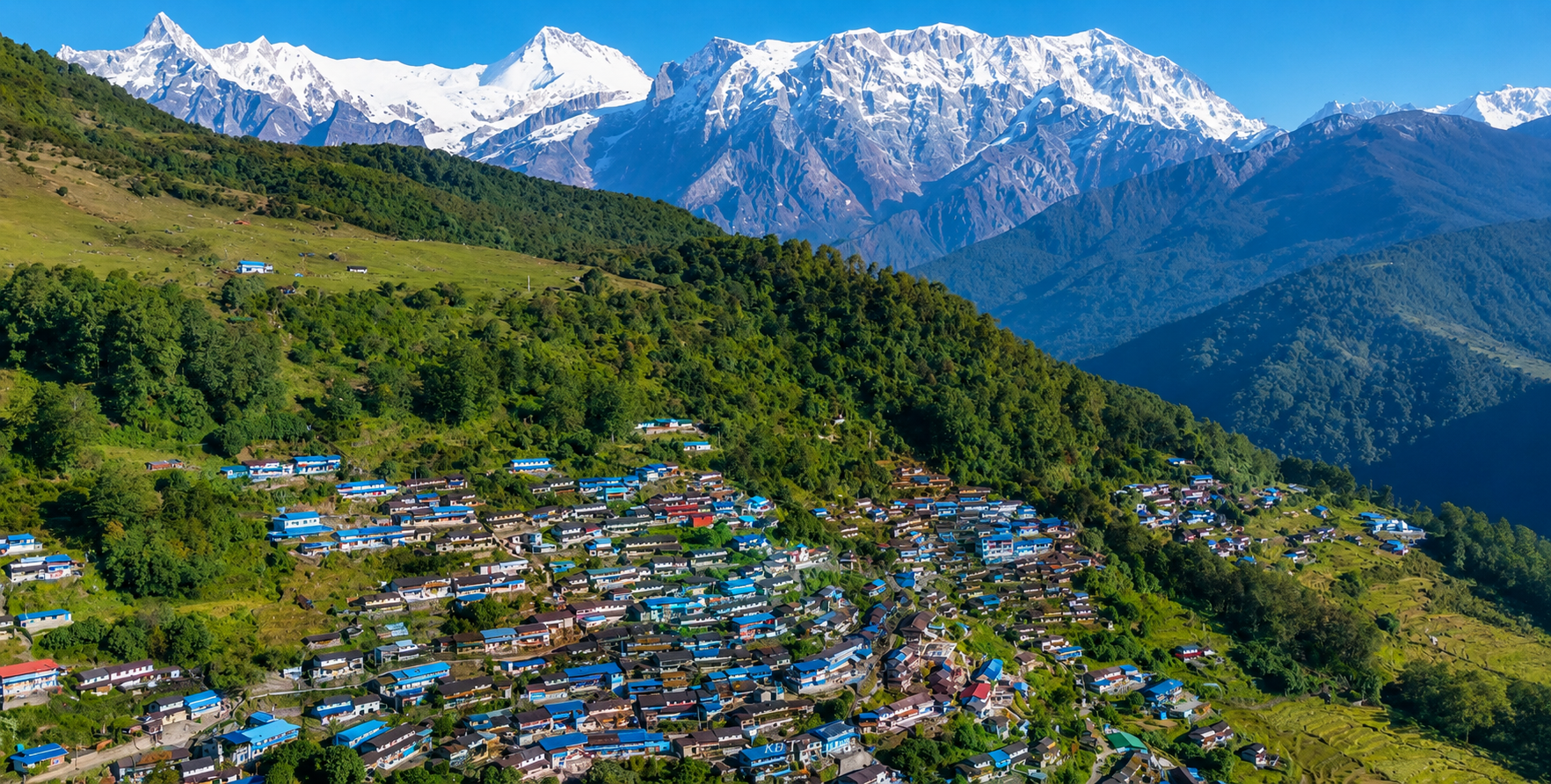
Sikles is one of Nepal’s most beautifully preserved and authentic Gurung villages – a terraced hillside settlement at 1,980 m in the Annapurna foothills, surrounded by ancient rhododendron forests, cascading waterfalls, and jaw-dropping views of Annapurna II, Annapurna IV, Lamjung Himal, and Machhapuchhre. Located approximately 42 km north of Pokhara, Sikles is one of the oldest and largest Gurung villages in the Annapurna region and increasingly one of Nepal’s finest off-the-beaten-track destinations for cultural tourism, short trekking, and Himalayan photography.

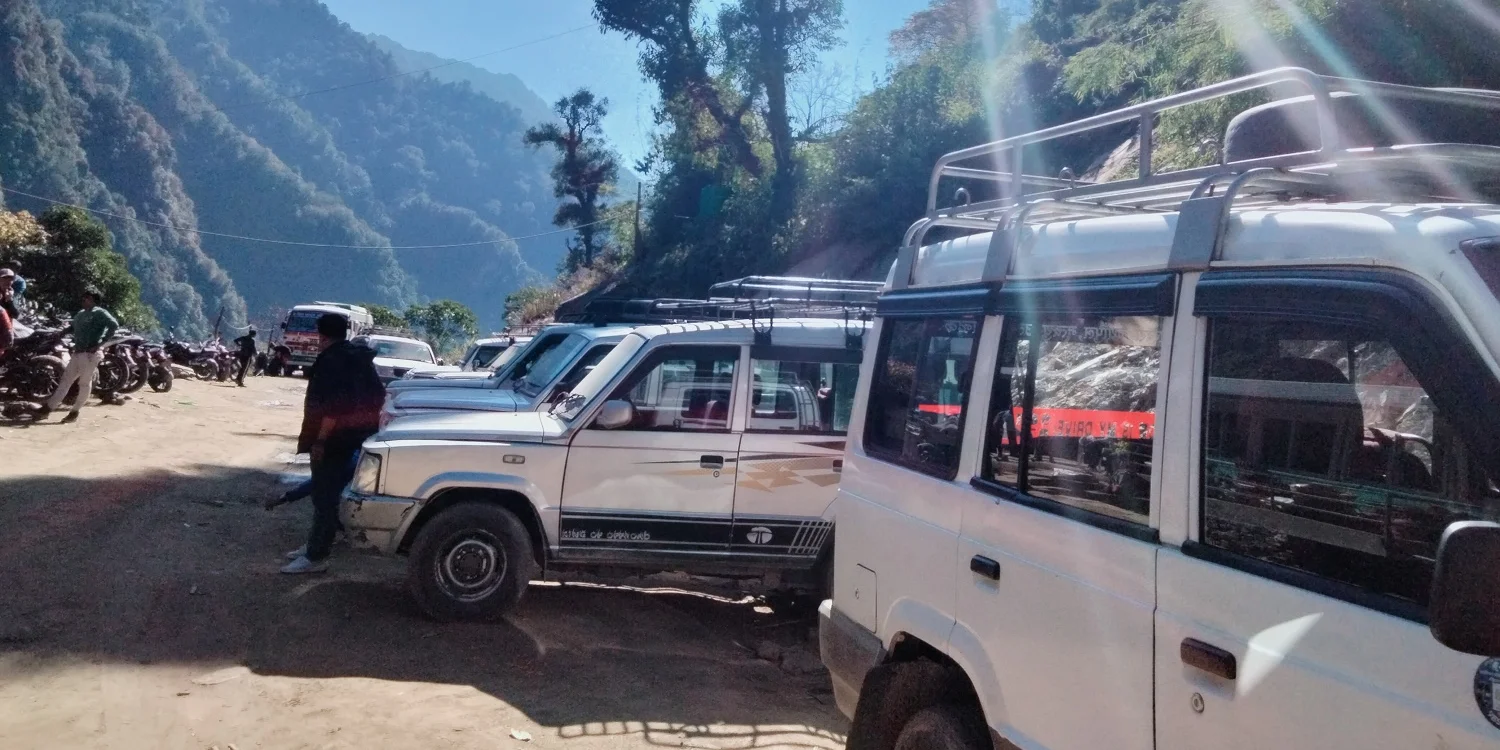
Getting from Pokhara to Sikles requires a private jeep – the road to Sikles is a rough mountain track through the Madi Valley that no standard car, taxi, or tourist bus can navigate. This complete 2026 guide covers everything you need to know about hiring a jeep from Pokhara to Sikles – route details, road conditions, prices, the Sikles experience, trekking options, and how to book your vehicle with Vehicle Hiring Nepal.

Where is Sikles, and Why Visit?

Location: Sikles, Rupa Rural Municipality, Kaski District, Gandaki Province

Altitude: 1,980 m above sea level

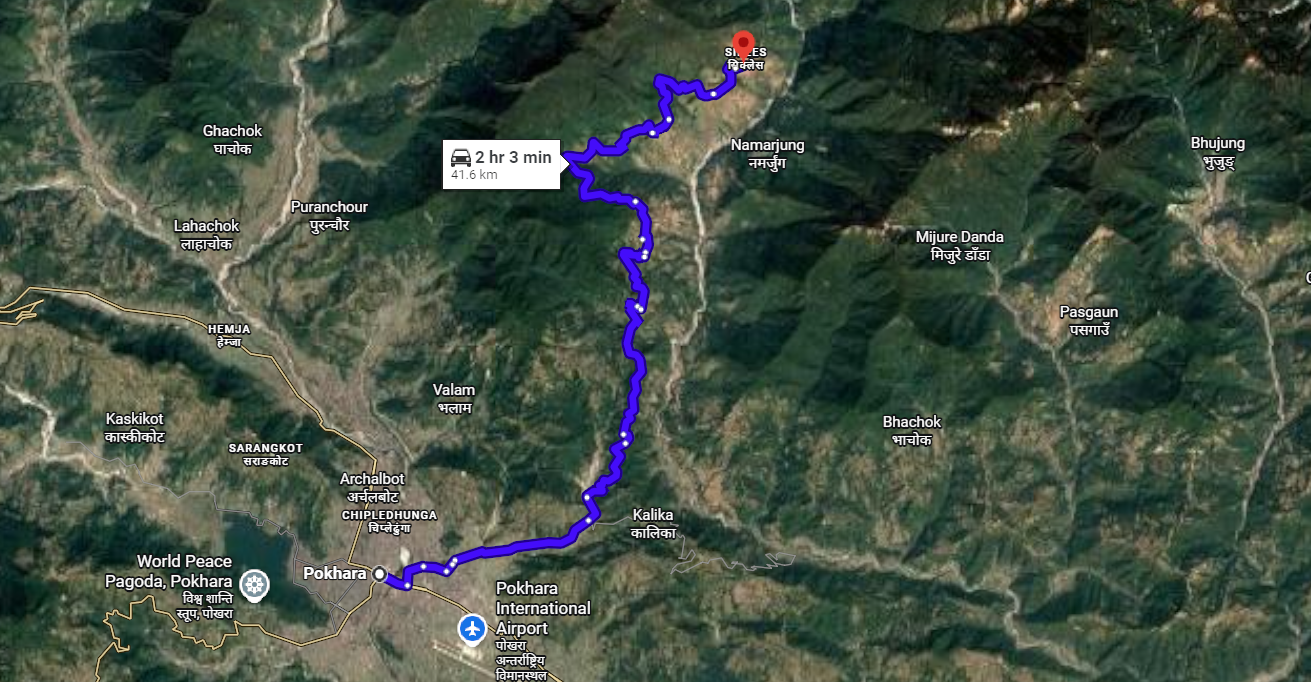
Distance from Pokhara: Approximately 42 km by road via the Madi Valley

Travel Time: 2 to 3 hours by 4WD jeep, depending on road conditions

Road Type: Paved from Pokhara to Rupa Lake area + rough mountain jeep track to Sikles

Vehicle Required: 4WD Jeep mandatory for the full route – no sedan, no standard minivan

Population: Approximately 2,000 people – one of the largest traditional Gurung villages in Nepal

Famous For: Gurung culture, traditional architecture, Annapurna panorama, honey hunting heritage, trekking base

Sikles is not a tourist village in the commercial sense – it is a real, living Gurung community with traditional stone-and-slate houses, terraced fields of millet and barley, ancient temples, and a community that has maintained its ancestral culture through centuries of relative isolation. The village gained some infrastructure and road access in recent years, but retains its authentic character far more than the heavily trekked villages of the main Annapurna Circuit.

The views from Sikles are extraordinary – the entire Annapurna range, from Annapurna II (7,937 m) in the north to Machhapuchhre (6,993 m) in the east, fills the horizon, while Rupa and Begnas lakes glitter in the valley below to the south. Sunrise from Sikles rivals Sarangkot and Poon Hill for Himalayan panorama quality – but with a fraction of the crowds.

Why a Jeep is the Only Option for Pokhara to Sikles

Many travellers arriving in Pokhara assume they can take a local bus or taxi to Sikles. This is not possible. Here is exactly why a private jeep is the only reliable transport option:

  • The road from the Madi Valley turnoff to Sikles is an unpaved mountain track with steep inclines, tight switchbacks, and rocky sections – impassable for standard cars and city taxis
  • No public bus service runs to Sikles – local shared jeeps are available but run infrequently and only when full, which can mean waiting hours in Pokhara or along the route
  • 4WD with high ground clearance is essential for the rocky and sometimes muddy upper section of the Sikles road
  • Trekkers and cultural visitors typically carry daypacks, camera equipment, and overnight bags. A private jeep gives full luggage space and door-to-door delivery
  • Private jeep departs from your Pokhara hotel at your preferred time – crucial for reaching Sikles by late morning before clouds obscure mountain views
  • The driver can wait in Sikles or nearby Ghachok during your visit and return you to Pokhara – most shared transport does not offer this flexibility
  • Group safety and convenience – your entire group stays together in one comfortable vehicle throughout

Begnas Lake Pokhara

Detailed Road Guide: Pokhara to Sikles

Stage 1: Pokhara Lakeside to Begnas Lake Junction (18 km | 30 min)

Depart your Pokhara Lakeside hotel and head east. The road passes through central Pokhara towards the eastern edge of the city and the Begnas–Rupa Lake area. The road is paved and passes through an increasingly rural landscape as Pokhara’s urban sprawl gives way to farmland and foothills.

Begnas Lake – the second largest lake in the Pokhara valley – appears on the right. This is a pleasant, easy section with good views of the Annapurna range on clear mornings.

Stage 2: Begnas Lake to Ghachok (10 km | 25 min)

From Begnas Lake, the road heads north into the Madi River valley. Ghachok is a popular Gurung village and the first major stop on the route to Sikles. The road to Ghachok is paved for most of its length and is accessible by most vehicles.

Ghachok has a few teahouses and is also a popular short day-trip destination from Pokhara. From Ghachok, the road to Sikles begins in earnest, and the journey’s character changes completely.

Stage 3: Ghachok to Dhikurpokhari (8 km | 25 min)

Beyond Ghachok, the road climbs steeply into the Annapurna foothills. The surface transitions from paved road to compacted gravel and rock – definitely 4WD territory. Terraced fields of millet, barley, and vegetables step up the hillsides on both sides.

The Madi River gorge deepens below as you gain altitude. Dhikurpokhari is a small junction village with a few teahouses – a good spot for a brief water and snack break.

Stage 4: Dhikurpokhari to Sikles (14 km | 45–60 min)

This final section is the most dramatic and challenging of the drive. The jeep track climbs through dense rhododendron and oak forest on narrow switchbacks carved into the steep hillside. In several places, the track crosses seasonal streams or skirts around erosion-damaged sections that require careful driving.

The views grow progressively more spectacular as altitude increases – Rupa and Begnas lakes appear far below in the valley, and the snow-capped peaks of Lamjung Himal and Annapurna IV begin to dominate the northern horizon.

Arrival at Sikles village (1,980 m). The jeep drops you in the upper part of the village near the entrance gate. The traditional stone-paved lanes of Sikles are only accessible on foot from here – vehicles cannot enter the village interior.

Your driver will wait near the gate area or in the lower village while you explore.

Road Conditions: Pokhara to Sikles

SectionDistanceSurfaceDifficultySeason Condition
Pokhara to Begnas Jct.18 kmFully pavedEasyGood year-round
Begnas Jct. to Ghachok10 kmMostly pavedEasy–ModerateGood year-round
Ghachok to Dhikurpokhari8 kmGravel / compacted trackModerateRough after the monsoon
Dhikurpokhari to Sikles14 kmRocky Mountain trackDifficult4WD essential – muddy in monsoon

The Dhikurpokhari to Sikles section is the most challenging and requires a capable 4WD jeep with experienced mountain driving. In the dry season (October to May), conditions are manageable with a Land Cruiser.

During monsoon (June to September), sections of this track can become extremely muddy and slippery, and occasional landslides may temporarily block the route. Always confirm current road conditions with your driver before travelling during the monsoon season.

pokhara to sikle jeep rental – Himalayan Off-Road Transportation

Sikles Village – A Complete Visitor Guide

Gurung Culture and Architecture

Sikles is one of the finest examples of a preserved Gurung village in all of Nepal. The Gurung people – renowned as the bravest of Nepal’s hill communities and historically the backbone of the Gurkha military tradition – have maintained their ancestral way of life in Sikles for centuries. The village architecture is stunning: flat-roofed traditional stone houses with carved wooden windows and doorways, interconnected by narrow stone-paved lanes that wind between terraced courtyards.

The village is organised around a traditional Gurung social structure, with upper-caste lama families historically at the top and lower castes below. This social geography is literally written into the village topography – the upper lanes have the oldest and most ornate houses with the finest mountain views. Walking from the bottom to the top of the village reveals this fascinating social and architectural history.

Mountain Views from Sikles

The panoramic mountain view from Sikles is one of the finest in the entire Annapurna region and is dramatically underappreciated compared to the famous viewpoints of Sarangkot and Poon Hill. From the upper village and the viewpoint ridge above Sikles, the following peaks are clearly visible on a clear day:

  • Annapurna II – 7,937 m (second highest in the Annapurna range) – appears almost directly above the village
  • Annapurna IV – 7,525 m – visible to the northwest
  • Lamjung Himal – 6,983 m – rising prominently to the north
  • Machhapuchhre (Fishtail) – 6,993 m – the iconic peak visible to the southeast
  • Himalchuli – 7,893 m – on the northern horizon beyond Lamjung
  • Rupa and Begnas Lakes in the valley below to the south – glittering blue in the sunshine

The best time for mountain views is early morning (6:00–9:00 AM), before clouds build. Sunset views from Sikles are equally spectacular, with alpenglow on Annapurna II and Lamjung Himal, turning the peaks deep gold and red.

The Sacred Temples of Sikles

Sikles has several important Hindu and Buddhist shrines that reflect the Gurung community’s syncretic religious tradition. The main Ganesh temple in the upper village is an important local pilgrimage site, as is the shrine to the Gurung ancestral deity. The community lama (Buddhist priest) maintains a small gompa (monastery) with traditional thangka paintings.

Visitors are welcome but should observe temple etiquette – remove shoes, dress modestly, and ask permission before photographing sacred objects.

Honey Hunting Heritage

The Sikles area has a long tradition of wild honey hunting from the massive cliff hives of Himalayan giant honey bees (Apis laboriosa). The honey hunters of Sikles use traditional rope ladders and smoke to harvest wild honey from vertical cliff faces – a practice that is thousands of years old and has been documented by National Geographic photographers.

While the traditional full honey hunt is rare today, smaller honey collections still occur in spring (April–May) and autumn (October–November). You can buy locally produced honey in Sikles village.

Rhododendron Forest and Wildlife

The forests above Sikles are magnificent temperate mountain forests dominated by enormous ancient rhododendron trees – some estimated at over 100 years old. In spring (March–April), the forest becomes a riot of red, pink, and white rhododendron blossoms, ranking among Nepal’s finest natural displays.

The forest is also home to langur monkeys, Himalayan thar, barking deer, and rich birdlife including Danphe (Himalayan Monal pheasant – Nepal’s national bird), Khalij pheasant, and various birds of prey.

pokhara to sikles jeep rentel route map

Trekking Routes from Sikles

Sikles is not only a destination – it is a trekking base and trailhead for several excellent routes through the Annapurna Conservation Area. Here are the main trekking options:

Sikles Village Loop Trek (1–2 Days)

Duration: 1 to 2 days

Difficulty: Easy to Moderate

Highlights: Village exploration, upper viewpoint ridge, rhododendron forest, Gurung cultural immersion

The most accessible trek from Sikles is a loop through the village and up to the viewpoint ridge above the settlement. From the upper village, a trail continues into the rhododendron forest, offering progressively better mountain views. Most visitors spend a full day exploring the village on foot and hiking to the viewpoint.

Overnighting in a community homestay or a simple teahouse offers a deeply authentic Gurung cultural experience.

Sikles to Ghachok Trek (1 Day)

Duration: 4 to 5 hours one way

Difficulty: Moderate

Highlights: Mountain views throughout, rhododendron and oak forest, traditional villages, Madi River valley

A popular trekking route descends from Sikles through the forest and terraced hillsides to Ghachok village, where a vehicle can meet you for the return to Pokhara. This one-way downhill trek gives a beautiful full-day mountain experience with the convenience of a jeep pickup at the lower end.

Sikles to Lwang Ghalel Trek (2–3 Days)

Duration: 2 to 3 days

Difficulty: Moderate to Strenuous

Highlights: Lamjung Himal views, remote villages, deep forest, Mardi Khola valley

A more demanding and less-trekked route heads north from Sikles through increasingly remote terrain towards Lwang Ghalel – another traditional Gurung village with stunning mountain views. This route passes through pristine forest and several uninhabited high pasture areas with unobstructed views of Lamjung Himal and Annapurna IV. A guide is strongly recommended for this route.

Sikles to Mardi Himal Base Camp (4–5 Days)

Duration: 4 to 5 days from Sikles

Difficulty: Strenuous

Max Altitude: 4,500 m at High Camp near Mardi Himal Base Camp

Highlights: Close-up Machhapuchhre and Mardi Himal views, forest ridgeline walk, high alpine terrain

An experienced trekker’s route from Sikles connects to the Mardi Himal Trek – one of Nepal’s newest and most beautiful trekking routes. The Mardi Himal Trek follows the eastern ridge of the Annapurna range with close-up views of Machhapuchhre and the rarely seen Mardi Himal (5,587 m). The route through Sikles adds a cultural village dimension to this otherwise forest-and-ridge trek.

Sikles Community Homestay – Cultural Immersion

One of the most rewarding aspects of visiting Sikles is the community homestay program, which allows visitors to sleep in a traditional Gurung household, share meals with the family, and experience Gurung daily life up close. Here is what to expect:

  • Homestay rooms are simple but clean – traditional Gurung house with a sleeping mattress on the floor or a basic wooden bed; blankets provided
  • Meals are prepared and eaten with the family – traditional Gurung food including gundruk (fermented vegetable soup), dhindo (buckwheat porridge), local vegetables, rice, and millet raksi (local spirit)
  • Evening cultural program – many homestay families offer traditional Gurung music and dance, storytelling about their military (Gurkha) heritage, and demonstrations of traditional crafts
  • Cost: Approximately NPR 1,500 to NPR 2,500 per person per night, including dinner and breakfast
  • Book through the Sikles Community Homestay Network – your Vehicle Hiring Nepal driver can help introduce you to the homestay coordinators in the village.
  • A Gurung language phrasebook or basic greetings greatly endear you to the community – Ghantig (hello) and Samu (thank you) are good starting points.

Itinerary A: Sikles Day Trip from Pokhara (1 Day)

  • 6:30 AM: Depart Pokhara Lakeside by private jeep
  • 9:00–9:30 AM: Arrive Sikles – village exploration on foot, upper viewpoint, temple visits
  • 12:00 PM: Lunch at local teahouse (dal bhat strongly recommended)
  • 2:00 PM: Rhododendron forest walk or viewpoint ridge hike
  • 3:30–4:00 PM: Return by jeep to Pokhara – arrive Lakeside by 6:00–6:30 PM

Note: A day trip is possible, but leaves limited time for the village and the viewpoint. An overnight stay is strongly recommended for the sunrise mountain views and authentic Gurung cultural experience.

Itinerary B: Sikles Overnight (2 Days)

  • Day 1, 7:00 AM: Depart Pokhara by private jeep
  • Day 1, 9:30–10:00 AM: Arrive Sikles – check into community homestay
  • Day 1 afternoon: Village exploration, rhododendron forest walk, viewpoint sunset
  • Day 1 evening: Traditional Gurung dinner with the homestay family, cultural stories
  • Day 2, 5:30 AM: Wake for sunrise over Annapurna II and Lamjung Himal
  • Day 2, 6:00–9:00 AM: Sunrise photography and viewpoint hike
  • Day 2, 10:00 AM: Breakfast with family, explore the lower village
  • Day 2, 12:00 PM: Return by private jeep to Pokhara

Itinerary C: Sikles + Ghachok + Begnas Lake (2 Days)

  • Day 1: Pokhara to Sikles by jeep – overnight homestay
  • Day 2 morning: Sunrise, village walk
  • Day 2, 9:00 AM: Trek downhill from Sikles to Ghachok (4–5 hrs)
  • Day 2, 2:00–3:00 PM: Arrive Ghachok – jeep picks up and drives to Begnas Lake
  • Day 2, 4:00 PM: Sunset at Begnas Lake shore – rowboat on the lake
  • Day 2, 6:00 PM: Return to Pokhara Lakeside

Itinerary D: Pokhara – Sikles – Mardi Himal – Pokhara (6 Days)

  • Day 1: Pokhara to Sikles by jeep – overnight homestay
  • Day 2: Sikles sunrise + trek north toward Lwang Ghalel
  • Day 3: Continue to the Mardi Himal trail junction and the High Camp approach
  • Day 4: Mardi Himal High Camp (4,500 m) – Machhapuchhre close-up views
  • Day 5: Descend to Mardi Village and Forest Camp
  • Day 6: Trek to Lwang Phedi road – private jeep returns you to Pokhara

kathmandu to salleri jeep

Best Time to Hire a Jeep from Pokhara to Sikles

March to April (Best for Rhododendrons)

Spring is the finest time to visit Sikles for the extraordinary rhododendron forest display. The forest around and above Sikles erupts in brilliant red, pink, and white from mid-March through April. The contrast of rhododendron blossoms against the snow-capped peaks of Annapurna II and Lamjung Himal is one of Nepal’s most beautiful natural scenes.

Mountain views are generally excellent in the morning before afternoon clouds develop. Road conditions are good after the dry winter season.

October to November (Best for Mountain Views)

The post-monsoon season offers the best clear mountain views from Sikles. October and November offer crystal-clear skies with the Annapurna range sharply defined against blue sky from the village viewpoint. The rhododendron forest is lush and green.

Roads are in their best post-monsoon condition. This is peak trekking season in the Annapurna region – book your jeep 2 to 3 weeks in advance.

December to February (Quiet and Clear)

Winter is peaceful and beautiful at Sikles. The village is very quiet with almost no other visitors. Mountain views are exceptional in the crisp, cold winter air.

The rhododendron forest is bare but dramatic in its winter skeleton. The road to Sikles is accessible in dry winter conditions, but early-morning frost can make the upper rocky section slippery. Temperatures in the village drop to -5 to -10°C at night – bring warm clothing for an overnight stay.

June to September (Monsoon – Difficult)

The monsoon is the most challenging time for the Pokhara-to-Sikles jeep journey. The upper mountain track from Dhikurpokhari to Sikles can become very muddy and slippery. Occasional landslides may temporarily block the route.

The rhododendron forest is lush and vibrantly green, and leeches are abundant on forest walks. Monsoon clouds almost always obscure mountain views. If visiting during the monsoon, confirm road conditions with your driver one day r before departing.

Trekking Permits for the Sikles Area 2026

Sikles is within the Annapurna Conservation Area, and all visitors who trek in the forest and highland areas above the village require valid permits:

PermitCost 2026Where to GetRequired For
ACAP – Annapurna Conservation Area PermitNPR 3,000 (~USD 22)Nepal Tourism Board, Pokhara (Damside) or KathmanduAll trekkers entering the Annapurna Conservation Area above Sikles village
TIMS Card – Trekkers ‘ Information Management SystemUSD 10Nepal Tourism Board / TAAN, PokharaRequired for all trekkers – confirm if needed for village-only visitors
Note: Village visit (no trekking)No permit required for road access to Sikles village itself–ACAP is required only when venturing into the conservation area forest

Obtain permits in Pokhara at the Nepal Tourism Board office in Damside (near the lake dam), open from 9:00 AM on weekdays. If you plan to trek above Sikles into the forest and ridgeline, obtain your ACAP permit the day before your jeep departure. For a purely cultural village visit without forest trekking, permits are generally not required.

What to Expect in Sikles – Practical Information

Food and Eating

Dal bhat is the staple and the best meal you can eat in Sikles – a community homestay or teahouse dal bhat with unlimited refills of rice, lentil soup, vegetables, and achar is both delicious and deeply energising for walking. Gundruk soup (fermented greens) is a Gurung speciality. Local honey, homemade raksi (millet spirit), and tongba (warm fermented millet beer) are traditional beverages worth trying.

Mobile Signal and WiFi

NTC has a reasonable signal in Sikles village. Ncell signal is intermittent. WiFi is not available in most homestays.

Download offline maps and any entertainment before leaving Pokhara. For many visitors, the lack of internet connectivity is one of Sikles’s greatest attractions.

Cash and ATM

There is no ATM in Sikles. Withdraw enough Nepali Rupees in Pokhara before you leave. For a 2-day visit with homestay, meals, and minor purchases, NPR 5,000 to NPR 8,000 per person is a comfortable budget.

Electricity

Sikles has electricity from a community micro-hydro system. Power is generally available in the evening but can be unreliable. Bring a fully charged power bank from Pokhara to charge your camera and phone during your stay.

Water

Drinking water in Sikles comes from natural springs above the village. The water is generally clean by local standards, but international travellers should use a water filter or purification tablets to make it safe to drink. Bottled water is not available in Sikles – carry your own or use purification.

Pokhara to Sikles Jeep Rental – Professional Car, Jeep, Hiace, Coaster Bus, Tourist Bus and Luxury Transportation Services

Pokhara Sightseeing Combined with Sikles Jeep Trip

Many travellers combine the Sikles jeep trip with Pokhara sightseeing for a full Pokhara area experience. Here are the most popular combinations:

  • Morning: Sarangkot sunrise tour (5:00 AM departure) → return to Pokhara by 8:00 AM → depart for Sikles at 9:00 AM – arriving in Sikles by noon for afternoon and overnight
  • Begnas Lake add-on: Stop at Begnas Lake on the way to or from Sikles for a peaceful 30-minute lakeside walk or rowboat experience
  • Devi’s Fall and Gupteshwor Cave: Visit these two adjacent sites (15 min from Lakeside) on the return journey from Sikles in the afternoon
  • Pokhara Museum: The Regional Museum and the International Mountain Museum are excellent rainy-day alternatives if weather prevents the Sikles jeep trip

What to Bring for the Pokhara to Sikles Jeep Trip

For the Jeep Journey

  • Water – 1.5 litres per person minimum for the jeep ride
  • Light snacks – the journey has no reliable food stops between Ghachok and Sikles
  • Warm layer or fleece – Sikles at 1,980 m is significantly cooler than Pokhara, especially in the morning
  • Windproof jacket – the viewpoint ridgeline above Sikles can be very breezy
  • Motion sickness tablets, if needed – the switchback road above Ghachok has many sharp bends

For the Sikles Visit and Trek

  • Comfortable trekking shoes or sturdy walking shoes – the village lanes are stone-paved and uneven
  • Camera with charged battery – sunrise over Annapurna II is one of Nepal’s great photography moments.
  • Binoculars – excellent for mountain viewing and bird spotting (Danphe pheasant is resident in the forest)
  • Sunscreen SPF 50+ and sunglasses – UV radiation is strong at 1,980 m
  • Insect repellent in the spring and monsoon months
  • Cash in NPR – no ATM in Sikles
  • Headlamp for an early sunrise hike to the viewpoint
  • Small daypack for village walks and viewpoint hikes
  • ACAP permit if trekking above the village (obtain in Pokhara the day before)

What is Included in Your Jeep Rental with Vehicle Hiring Nepal?

  • Private 4WD jeep (Toyota Land Cruiser or equivalent) with experienced mountain road driver
  • Full fuel cost for the Pokhara to Sikles journey (one-way or round-trip)
  • Vehicle insurance for the complete journey
  • Hotel pickup from your Pokhara Lakeside hotel or guesthouse
  • Drop-off at the Sikles village gate, and the jeep will be waiting during your visit
  • Return journey to Pokhara at your chosen time
  • Brief stop at Begnas Lake area if requested (add 20–30 min)
  • 24/7 WhatsApp contact and support throughout the journey

Not included: ACAP trekking permit, personal meals, community homestay fees, village entry donation, guide fees (if hiring a local Sikles guide), and any additional detour stops beyond the agreed route.

How to Book Your Pokhara to Sikles Jeep Rental

  1. Contact Vehicle Hiring Nepal via WhatsApp at +977 981-4227196 or visit vehiclehiringnepal.com
  2. Tell us your preferred travel date and departure time from Pokhara (7:00 AM recommended)
  3. Provide your hotel name or pickup address in Pokhara Lakeside
  4. Confirm your group size and luggage (daypacks, overnight bags, trekking gear)
  5. Specify one-way or round-trip – and if round-trip, your preferred return time from Sikles
  6. Mention any additional stops – Begnas Lake, Ghachok, Dhikurpokhari
  7. Request a homestay introduction if you need accommodation in Sikles
  8. Receive instant booking confirmation with driver name, vehicle type, and departure time

Book your Pokhara  to Sikles jeep rental vehicle — Call or WhatsApp: +977 981-4227196
Email: [email protected]
Website: www.vehiclehiringnepal.com
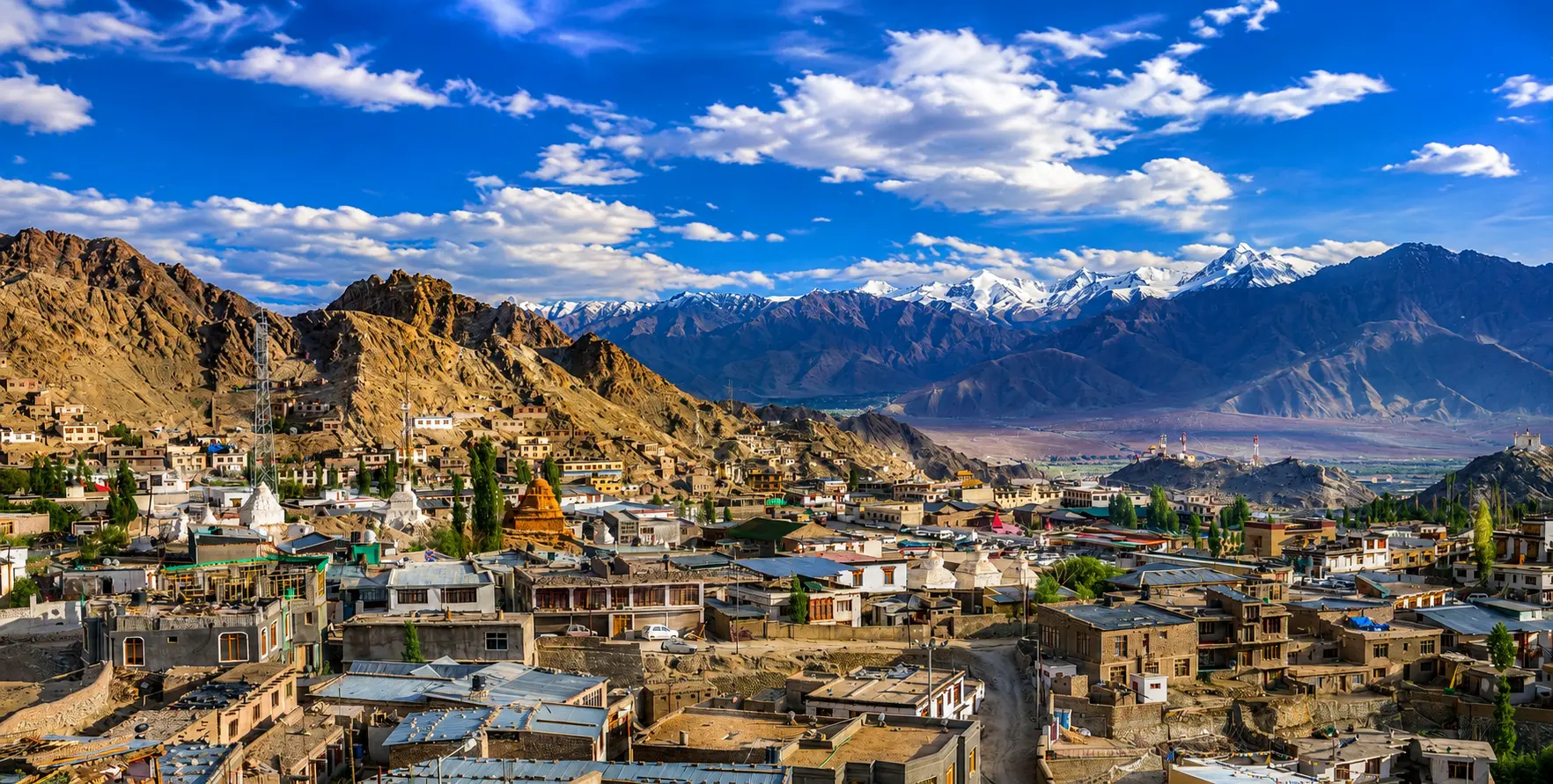
Pokhara to Sikles Jeep Rental – Himalayan Off-Road Transportation

Frequently Asked Questions

How far is Sikles from Pokhara?

Sikles is approximately 42 km from the Pokhara Lakeside area by road via the Madi Valley and Ghachok. The journey takes 2 to 3 hours by 4WD jeep, depending on road conditions and any brief stops along the way.

Can I visit Sikles by taxi or local bus from Pokhara?

No. Standard city taxis and local buses cannot reach Sikles, as the road above Ghachok is a rough mountain track that requires 4WD capability. Local shared jeeps do operate on this route, but run infrequently (only when full) and cannot guarantee departure times. A private 4WD jeep from Vehicle Hiring Nepal is the only reliable, comfortable transport option from Pokhara to Sikles.

Is Sikles suitable for families with children?

Yes – Sikles is a wonderful family destination. The jeep journey is an adventure in itself. The village is safe, with flat central areas, and the Gurung community is very welcoming to children.

The rhododendron forest walk above the village is gentle enough for older children. Younger children may find the overnight homestay experience deeply memorable. The viewpoint hike (30 to 45 minutes from the village) is manageable for most families.

What is the difference between Sikles and Ghandruk?

Both Sikles and Ghandruk are traditional Gurung villages near Pokhara with excellent mountain views. Ghandruk (1,940 m) is more developed with better tourist infrastructure, more teahouses and homestays, and lies on the main Annapurna Sanctuary and Poon Hill trekking routes.

Sikles (1,980 m) is less visited, more authentically preserved, less commercialised, and has arguably better close-up views of Annapurna II and Lamjung Himal. Sikles suits travellers seeking a more authentic, less crowded Gurung cultural experience.

Can I combine Sikles with the Mardi Himal Trek?

Yes. Sikles connects to the Mardi Himal trekking route through the forest ridge system above the village. This connection is not well-marked and requires a knowledgeable local guide.

The full Sikles to Mardi Himal trek takes 4 to 5 days and is a spectacular, off-the-beaten-track adventure that combines Gurung village culture with the high-alpine terrain of the Mardi Himal ridge. Vehicle Hiring Nepal can arrange the jeep to Sikles at the start and a pickup from the Lwang Phedi road at the end of the Mardi Himal trek.

Is a guide necessary in Sikles?

A guide is not legally required to visit Sikles village or to do the short community forest walk above the village. However, for any serious trekking into the Annapurna Conservation Area forest above Sikles or for routes towards Lwang Ghalel and the Mardi Himal trail junction, a local guide is strongly recommended.

You can arrange local guides in Sikles village on arrival (NPR 1,500 to NPR 2,500 per day). They also serve as cultural interpreters, greatly enriching the village experience.

How does Sikles compare to Sarangkot for mountain views?

Sarangkot (1,592 m) offers famous sunrise views of Annapurna South, Machhapuchhre, and Dhaulagiri across the Pokhara valley and is a 30 to 40-minute drive from Lakeside. Sikles (1,980 m) offers close-up views of Annapurna II, Annapurna IV, and Lamjung Himal at significantly greater magnification since it sits directly below these peaks rather than across the valley.

The Sikles experience is more intimate, the mountain scale more overwhelming, and the journey more adventurous. Mountain photographers and serious Himalayan enthusiasts consistently rate Sikles views as superior to Sarangkot for the northern Annapurna peaks.

Final Thoughts

Sikles is one of Nepal’s genuinely lesser-known spots – a magnificent Gurung village perched in the Annapurna foothills with mountain views that rival the most famous viewpoints in Nepal, an authentic cultural experience that the mainstream trekking trails cannot offer, and a natural environment of ancient rhododendron forest and cascading mountain streams that make the journey as rewarding as the destination.

Hiring a private jeep from Pokhara to Sikles with Vehicle Hiring Nepal is the only practical way to reach this extraordinary village, and we make the journey smooth, safe, and comfortable. Our experienced drivers know every turn of the Madi Valley mountain track, and our Land Cruisers are perfectly suited to the challenging upper sections of the road that ordinary vehicles cannot handle.

Whether you are coming for a day trip to experience the sunrise over Annapurna II, an overnight homestay with a Gurung family, or a multi-day trek through the ancient forest to Mardi Himal, Sikles delivers an experience that will stay with you long after you return to Pokhara.

Car and Jeep Hire with Baby Seats for Nepal Tours

Bg highway

Nepal Tour Baby Seat Car & Jeep Hire: The Family Travel Guide

Travelling around Nepal with a baby or young child is a wonderful adventure. Temples, lakes, jungle safaris and mountain views are all within reach, and Nepali people adore children. But one question worries almost every parent before they arrive: how do we travel safely by road with a baby? Child seats are rare in Nepal’s taxis, many local vehicles have no rear seat belts, and mountain roads can be long and winding.

This guide explains how Nepal tour baby seat car and jeep hire works with Nepal Vehicle Hiring. You’ll learn which child seat suits your child’s age and size, which vehicle in our fleet works best, how seats are installed, what to expect on popular family routes, USD price ranges, and practical tips for road trips with little ones.

We provide private cars, jeeps, Mahindra Scorpios and Toyota Hiace vans with infant, toddler and booster seats on request, all with experienced, careful drivers.

Already know your plans? Message us on WhatsApp or email [email protected] with your children’s ages and your route, or use our trip planner.

Why Baby Seats Matter in Nepal

In many countries, child seats are standard. In Nepal, it is the exception. Most taxis do not carry child seats, rear seat belts are often missing or broken in older vehicles, and parents commonly hold small children on their laps.

Enforcement of child restraint use is very limited, so safety responsibility falls on parents and the transport company they choose.

Holding a baby on your lap is unsafe during sudden stops, even at low speed. Kathmandu’s traffic involves frequent braking, and highways such as the Prithvi Highway to Pokhara include sharp bends, overtaking trucks and uneven surfaces. A correctly fitted child seat keeps your child secure, comfortable and often more relaxed, so many babies sleep through long drives.

That is why we treat baby seats as a core part of family travel, not an afterthought. When you book a private car or jeep with a child seat through us, we check, fit, and prepare the seat before your driver arrives.

NOTE: Nepal’s road rules require seat belts for front-seat occupants, and children should not ride in the front seat. Rules and enforcement can change, so we always fit child seats in the rear and follow international safety guidance as our standard.

Nepal Tour Baby Seat Car & Jeep Hire

Types of Child Seats We Provide

Child seats are designed for specific ages and sizes. Choosing the right one is the most important safety decision. Here is a simple guide based on widely followed international recommendations, such as those from the American Academy of Paediatrics.

Rear-Facing Infant Seat (Baby Seat)

For newborns and babies, a rear-facing infant seat supports the head, neck and spine in a sudden stop. International guidance recommends keeping children rear-facing for as long as possible, until they reach the maximum height or weight allowed by the seat. Infant seats are ideal for Kathmandu airport transfers, city sightseeing and shorter drives.

Convertible or Toddler Seat

Convertible seats can be used rear-facing for babies and toddlers, then turned forward-facing with a five-point harness once a child outgrows rear-facing limits. They are a good choice for toddlers and preschoolers on longer routes such as Kathmandu to Pokhara or Pokhara to Chitwan.

Forward-Facing Harness Seat

For older toddlers and young children who have outgrown rear-facing, a forward-facing seat with a five-point harness keeps them secure while giving a better view out of the window, which helps with motion sickness on winding roads.

High-Back Booster Seat

Once children outgrow a harness seat, a booster raises them so the adult seat belt fits correctly across the shoulder and hips. Children usually need a booster until the belt fits properly, often around 145 cm (4 feet 9 inches) tall, which many reach somewhere between 8 and 12 years old.

TIP: Tell us your child’s age, weight and height when you book. We will match the seat to your child, not just to their age.

Way to manthali airport bp highway

Which Vehicle Is Best With a Baby Seat?

Not every vehicle suits every child seat. The key requirement is a working rear seat belt in the right position, because most vehicles in Nepal don’t have ISOFIX anchor points. All our child seats can be installed using the vehicle seat belt.

Private Car – City Trips and Airport Transfers

A private car is ideal for couples with one child on city tours, airport transfers and highway trips on good roads. It has a smooth ride and enough space for one or two child seats in the back, plus a pram in the boot.

Mahindra Scorpio – Our Top Family Choice

The Mahindra Scorpio combines a comfortable ride with higher ground clearance, more luggage space and rear seat belts. It suits families of three to five on highways and hill roads, from the Kathmandu to Pokhara drive to Sarangkot and Nagarkot.

4WD Jeep – Mountain and Rural Roads

For rough mountain roads, such as routes to trekking villages, a 4WD jeep is the safe option. We fit child seats in rows with working belts. Families heading toward Nayapul for Ghandruk or the Besisahar area usually choose a jeep.

Baby Seat Car and Jeep Hire Prices in Nepal (USD)

Our prices are quoted in US dollars and include a private vehicle, an experienced driver, fuel, the driver’s food and accommodation, insurance, taxes and parking. Child seats are added for a small fee per seat. Final quotes depend on the season, route, and number of days.

Airport Transfers With a Baby Seat

  • Kathmandu airport to Thamel or city hotel by car: USD 30–35 plus seat
  • By Mahindra Scorpio or jeep: USD 40–45 plus seat
  • Kathmandu to Pokhara by car: USD 150–160
  • Kathmandu to Pokhara by Scorpio or jeep: USD 190–200
  • Kathmandu to Chitwan (Sauraha) by car: USD 180–190
  • Pokhara to Chitwan by car: USD 150–160
  • Kathmandu to Nagarkot by car: USD 70–80

Our rates are a little higher than the cheapest local options because we provide clean, checked child seats, vehicles with working rear seat belts, and drivers who understand families’ needs. For parents, that peace of mind is worth every dollar.

How We Install and Check Your Baby Seat

A child seat only protects your child when it is installed correctly. Here is our routine for every family booking:

  • Seat chosen for your child: based on the age, weight and height you give us
  • Cleaned and inspected: straps, buckles and shell checked for damage before every trip
  • Rear seat only: child seats are always fitted in the back, never in front of an airbag
  • Belt installation: fitted tightly using the vehicle seat belt following the seat’s instructions
  • Movement check: the seat should not move more than a little side to side at the belt path
  • Parent check on arrival: our driver shows you the fitting so you can adjust the harness for your child

TIP: Harness straps should be snug. If you can pinch a fold of strap at your child’s shoulder, tighten it a little more. Remove bulky jackets before buckling in and use a blanket over the harness instead.

Bring Your Own Seat or Rent From Us?

Bringing Your Own

Many families bring their own seat. You know its history, your child is used to it, and you know how it fits. Check that it can be installed with a lap-and-shoulder seat belt, because ISOFIX points are uncommon in Nepal.

Most airlines let you check a child seat, often at no extra charge, but check with your airline.

Renting From Us

Renting saves you carrying bulky gear through airports and on flights to Pokhara or Bharatpur. Our seats are ready in the vehicle when you arrive. We keep a selection of infant, convertible, harness and booster seats, subject to availability, so book early, especially for peak seasons.

Either way, our drivers will help install the seat and our vehicles are chosen to have working rear belts in the right positions.

Family Routes With a Baby Seat

Kathmandu Airport Arrival

After a long flight with a baby, the last thing you want is a scramble for a taxi. Our driver meets you outside arrivals at Tribhuvan International Airport with a name board, with the child seat already fitted. Book your Kathmandu airport transfer in advance and share your flight details.

Kathmandu Valley Sightseeing

Swayambhunath, Boudhanath, Pashupatinath and Patan Durbar Square are all short drives apart. A private car with driver lets you stop for feeds, naps and nappy changes whenever needed. Add a Bhaktapur Durbar Square tour for pottery square and the famous juju dhau yoghurt.

Nagarkot Sunrise

Nagarkot on the valley rim offers sunrise views over the Himalaya and is just a short drive from Kathmandu. An overnight stay works better than a pre-dawn start with little ones. Our Nagarkot sunrise trip can include a child seat.

Kathmandu to Pokhara

This is Nepal’s most popular family road trip. The highway follows the Trishuli River through hills and gorges and can take most of the day, depending on traffic and roadworks. A private car or Scorpio with a child seat lets you stop at clean roadside restaurants, take breaks and travel at your child’s pace.

See our Kathmandu to Pokhara options and the return trip.

Pokhara With Kids

Pokhara is perfect for families: boating on Phewa Lake, the World Peace Pagoda, Davis Falls, the caves and the International Mountain Museum. Hire a Pokhara car with driver for a day or take an early Sarangkot sunrise drive.

Chitwan National Park

Children love jungle walks, canoe rides and spotting rhinos and birds. The drive from Kathmandu or Pokhara to Sauraha is comfortable by private car—Book Pokhara to Chitwan transport and a Chitwan jungle safari with our sister company.

Lumbini

The birthplace of the Buddha is a peaceful, flat area easy to explore with a pram. Travel by private car, not a crowded bus, with our Lumbini transfer.

Road Trip Tips for Parents in Nepal

  • Start early: traffic is lighter, and children are fresh. Many babies sleep through morning drives.
  • Plan stops every 1.5 to 2 hours: for feeds, nappy changes and leg stretches. Our drivers know family-friendly restaurants on the main highways.
  • Carry a day bag in the car: nappies, wipes, spare clothes, snacks, water and a favourite toy.
  • Bring motion sickness help: winding roads affect some children. Keep sick bags, wipes and a change of clothes handy.
  • Use sun shades: clip-on window shades keep the sun off your baby on long drives.
  • Keep loose items secured: in a sudden stop, unsecured objects can fly around the cabin.
  • Never leave a child alone in the vehicle: even for a moment.
  • Ask the driver to slow down if needed: our drivers are happy to drive extra gently with young children.

What Makes a Family-Friendly Driver

The driver matters as much as the seat. We choose drivers for family bookings for calm, careful driving and patience. They:

  • Drive smoothly, with no hard braking or aggressive overtaking
  • Plan rest stops around your child’s routine
  • Help carry prams, bags and child seats
  • Keep the vehicle clean and smoke-free
  • Speak basic English and can help with local shops and restaurants
  • Know clean toilets and safe food stops on major routes

If you hire a vehicle for several days, the same driver usually stays with you, so your child gets to know them, which makes every drive easier.

Health and Safety for Babies in Nepal

Every family should speak to their doctor or a travel clinic before visiting Nepal. Common advice includes:

  • Use bottled, filtered or boiled water for drinking, formula and brushing teeth
  • Choose freshly cooked hot food and peel fruit
  • Ask your doctor about recommended vaccinations, including rabies, as stray dogs and monkeys are common
  • Pack a children’s first-aid kit and any regular medicines
  • Use a mask in dusty city traffic
  • Use sunscreen, hats and shade at altitude, where the sun is strong
  • Know where the nearest hospital is; Kathmandu and Pokhara have good private hospitals

If you plan to visit higher areas, ask your doctor about altitude and young children. Most family tours stay at comfortable altitudes, such as Kathmandu, Pokhara, Chitwan, Nagarkot and Sarangkot.

Packing List for a Nepal Road Trip With a Baby

  • Your own child seat (optional) or a booking for one of ours
  • Lightweight foldable pram or baby carrier for temples and narrow lanes
  • Enough nappies for the first days; brands are available in Kathmandu and Pokhara
  • Formula, bottles and a sterilising method
  • Warm layers for cool mornings and evenings
  • Sun hat, sunscreen and window shades
  • Mosquito repellent suitable for children, especially for Chitwan
  • Thermometer, rehydration salts and children’s paracetamol as advised by your doctor
  • Toys, books and downloaded shows for long drives
  • Plastic bags for dirty clothes and nappies

Trekking and Mountain Trips With Children

Families with older children often add a short trek. The Ghorepani Poon Hill trek and short village walks around Ghandruk are popular family choices, and you can reach Nayapul by private jeep. For very young children, consider a village stay or a short day hike instead of a multi-day trek.

Longer treks such as Annapurna Base Camp, the Annapurna Circuit or Langtang Valley suit older children who are used to walking. Our sister company Trek Nepal Himalayas runs family treks, and Alpine Luxury Treks offers comfortable lodge-based trips. We provide trekking transport with child seats where needed.

Sample Family Itineraries With Baby Seat Transport

Seven-Day Family Tour

Four-Day Short Break

  • Day 1: Arrival and rest
  • Day 2: Kathmandu heritage sites
  • Day 3: Bhaktapur and Nagarkot
  • Day 4: Return and airport drop

Want something different? We can adapt our Nepal tour packages for families, or you can plan your own route.

Nepal Tour Baby Seat Car & Jeep Hire

A Family Road Day: Kathmandu to Pokhara With a Toddler

What does a long road day with a little one actually look like? Here is a typical example from our family bookings.

  • Early morning: your driver arrives at your Kathmandu hotel with the convertible seat already fitted. Bags and the pram go in the boot, and the day bag goes on the back seat next to your child.
  • First hour: you leave the valley before the traffic builds. Many toddlers fall asleep on the winding descent toward the Trishuli River.
  • Breakfast stop: a riverside restaurant with a garden, where your child can run around while you have tea.
  • Mid-morning: books, songs and window-watching. Your driver points out suspension bridges, rafts on the river and roadside fruit stalls.
  • Lunch: a family-friendly stop around the halfway point, with simple dal bhat, noodles or fried rice.
  • Afternoon: often a second nap as the road climbs toward Pokhara.
  • Arrival: drop-off at your Lakeside hotel, with time for an evening walk by the lake.

Because the vehicle is private, you can shape every part of the day around your child’s routine. If you would rather split the drive, a night in Bandipur turns it into two easy half-days. Book with our Kathmandu to Pokhara service.

Keeping Kids Happy on Long Drives

  • Audio stories and music: downloaded before you leave, as mobile data can drop in the hills
  • Window games: count buses, spot cows and goats, look for prayer flags and temples
  • Small new toys: wrapped surprises handed out every hour or so work wonders
  • Sticker books and drawing pads: mess-free and quiet
  • Healthy snacks: biscuits, fruit and crackers from Kathmandu supermarkets
  • Comfort items: a familiar blanket or soft toy helps with naps in a new seat
  • Regular breaks: a 10-minute run-around every couple of hours keeps everyone calmer

Bhaktapur and Nagarkot: An Easy Family Overnight

If you have just a few days, a Bhaktapur and Nagarkot overnight is one of the easiest family trips from Kathmandu. The drive is short, so little ones spend more time exploring than sitting in the car.

Start with a morning in Bhaktapur, where the brick squares are largely car-free, and children can watch potters spin clay in Pottery Square. Try the famous creamy juju dhau yoghurt, then continue up to Nagarkot for the afternoon.

Family hotels on the ridge have gardens and terraces, and on clear mornings the Himalaya stretch across the horizon at sunrise, often visible from your room. Book our Bhaktapur tour and Nagarkot trip with a child seat in the same vehicle.

Common Child Seat Mistakes to Avoid

Even experienced parents can slip up when travelling, especially after a long flight. Watch out for these common mistakes:

  • Loose installation: the seat should not move more than a little at the belt path. Ask the driver to re-tighten it if it feels loose.
  • Loose harness: straps should be snug against the collarbone, with the chest clip at armpit level.
  • Bulky clothing: thick jackets compress in a crash and leave the harness too loose. Use a blanket on top instead.
  • Turning forward too soon: keep babies and toddlers rear-facing until they reach the seat’s rear-facing limit.
  • Moving to a booster too early: a harness gives more protection; wait until your child truly outgrows it.
  • Using an adult belt too soon: the shoulder belt should cross the middle of the shoulder and the lap belt should sit low on the hips, not across the stomach.
  • Front-seat travel: children belong in the back, away from front airbags.

Our drivers know the basics of child seat fitting, but you know your child best. Take a minute to check the fit before every drive.

Nepal Tour Baby Seat Car & Jeep Hire

Should You Fly or Drive With a Baby?

Between Kathmandu and Pokhara, families can either take a short domestic flight or drive. Both work, and the right choice depends on your child.

Flying

The flight is short and saves a long day on the road. However, you still need transfers at both ends; flights can be delayed by weather; baggage limits on small aircraft are strict; and car seats can be awkward to carry. If you fly, book a Kathmandu airport transfer and a Pokhara car with a seat at the other end.

Driving

A private road trip takes longer but gives you complete control: stop whenever your baby needs a feed, nap or change, keep all your gear with you and enjoy river and hill scenery on the way. Many families break the journey with a night in the hilltop town of Bandipur, a car-free, family-friendly heritage village just off the highway. A private car or Scorpio with a fitted child seat makes the drive comfortable.

Family Rest Stops on the Kathmandu to Pokhara Highway

Our drivers know the cleanest and most family-friendly stops on the Prithvi Highway:

  • Riverside restaurants along the Trishuli: breakfast and tea with river views
  • Kurintar area: popular lunch stops with gardens where children can stretch their legs
  • Mugling junction: a busy halfway point with plenty of food options
  • Bandipur: an optional detour or overnight stop with car-free streets and mountain views
  • Damauli area: a final stop before the climb into the Pokhara valley

Clean toilets and baby-changing facilities are limited on Nepal’s highways, so carry a portable changing mat and wipes. Your driver will tell you which stops are best.

Prams, Carriers and Getting Around on Foot

Kathmandu’s old-town lanes, temple steps, and uneven pavements are not always pram-friendly. Many families bring both a light foldable pram and a baby carrier. Use the pram in hotels, Pokhara Lakeside, Lumbini’s gardens and flat areas, and switch to the carrier for temples, Bhaktapur’s brick lanes and hill viewpoints.

With a private vehicle, the pram stays in the boot, and the driver drops you close to each site, so you never have to carry gear far. This is a big advantage over walking between sites or bargaining with taxis on the street.

Child-Friendly Places in the Kathmandu Valley

  • Swayambhunath (Monkey Temple): children love the monkeys, but keep food out of sight and hands away
  • Boudhanath Stupa: a wide, flat circuit around the stupa that is easy with a pram
  • Garden of Dreams: a calm, walled garden in Thamel for a quiet break
  • Central Zoo in Jawalakhel: a favourite with local and visiting children
  • Patan Durbar Square and museum: open squares and shaded courtyards
  • Bhaktapur: car-free squares, pottery wheels and the famous yoghurt

A full-day Kathmandu sightseeing car lets you combine a few of these at a relaxed pace, with naps in the car between stops.
Nepal Tour Baby Seat Car & Jeep Hire

Best Seasons for Family Travel in Nepal

Autumn

Clear skies, comfortable temperatures and dry roads make autumn the best time for families. It is also peak season, so book vehicles and child seats early.

Spring

Warm days and flowering rhododendrons make spring lovely, though lowlands such as Chitwan and Lumbini can get hot. Plan early starts and shady breaks.

Winter

Kathmandu and Pokhara are crisp and sunny by day but cold at night. Pack warm layers for babies. The Terai can be foggy in the mornings, which slows driving.

Monsoon

Rain is heavy; roads can be affected by landslides, and journeys take longer. Travel is still possible, especially for city stays, but allow extra time and choose a sturdy Scorpio or jeep for hill roads.

Multi-Generation Family Trips

Nepal is a wonderful destination for grandparents, parents and children travelling together. For these trips, a Toyota Hiace is usually the best choice: everyone travels together, there is room for child seats, prams and luggage, and grandparents get comfortable seats with easy access.

For bigger family reunions or wedding groups, we can combine a Hiace with a coaster bus and use cars or Scorpios for the families with babies. One coordinator manages all vehicles and timings.

If Your Child Feels Unwell on the Road

Children sometimes feel unwell on long drives. Our drivers will stop as soon as it is safe, help you find clean water or a pharmacy, and, if needed, drive you to the nearest clinic or hospital. Kathmandu and Pokhara have well-equipped private hospitals, and our office can help coordinate.

Keep your travel insurance details and your child’s medical information easy to find.

Hygiene and Care of Our Child Seats

Babies touch, chew and sleep on their seats, so hygiene matters as much as safety. Every seat we supply goes through the same simple care routine between bookings.

  • Covers are washed, and seats are  wiped down between bookings
  • Straps and buckles are checked for wear and correct function
  • Seats are stored indoors, away from dust and sun
  • Damaged seats, or seats known to have been in a crash, are removed from use.
  • Seats are fitted only when needed, so they stay clean between trips.

Taxis, Ride Apps and Private Hire: What Parents Should Know

In Kathmandu and Pokhara, you will see plenty of metered taxis, and ride-hailing apps operate in the bigger cities. They are cheap and handy for adults, but they are not designed for families with babies.

  • Taxis: usually small cars with limited boot space, no child seats and sometimes no working rear belts
  • Ride apps: car options vary widely, and you cannot request a child seat
  • Public and tourist buses: fine for adults, but child seats are hard to fit, and seat belts are often lap-only or missing
  • Private hire with a seat: a pre-booked car, Scorpio, jeep or Hiace, a fitted child seat and a known driver

For families with babies and toddlers, private hire is the safest and least stressful way to get around Nepal, especially for airport transfers and longer highway journeys.

Quick Child Seat Selector

Use this simple guide when you book. Always follow the limits printed on the seat label, as they vary by model.

  • Newborn to about 12–15 months: rear-facing infant seat or rear-facing convertible seat
  • Toddler to preschool: rear-facing convertible seat for as long as limits allow, then forward-facing harness seat
  • Preschool to early primary: forward-facing harness seat until your child reaches its maximum height or weight
  • Primary school age: high-back booster seat until the adult belt fits correctly, often around 145 cm tall
  • Older children: adult belt in the rear seat, with the lap belt low across the hips and the shoulder belt across the chest

Not sure? Share your child’s age, weight, and height when you plan your trip,  and we will recommend the right seat.

Kathmandu to Chitwan With Kids

Chitwan is one of Nepal’s most popular family destinations. The drive from Kathmandu runs down to the Terai lowlands, following river valleys to the national park gateway at Sauraha. It is a comfortable trip in a private car or Scorpio, with river views and plenty of lunch stops.

In Sauraha, children can watch elephants bathing, take a canoe ride, visit the community museum and look for rhinos from a jeep safari. Combine your road transfer with a Chitwan jungle safari package. From Chitwan, continue to Pokhara with our Chitwan to Pokhara transfer or head to Lumbini.

TIP: Chitwan is hot in spring and humid in the monsoon. Plan activities for early morning and late afternoon, and pack child-safe mosquito repellent.

Village Stays and Short Hill Trips With Children

Families who want a taste of mountain village life without a long trek have plenty of options. Ghandruk, a large Gurung village with Annapurna views, is reached by jeep from Pokhara via Nayapul, then a short walk. Sarangkot and Nagarkot give mountain sunrises close to the cities, and the Pokhara hills hold many quiet homestay villages.

For these trips, we use a 4WD jeep with a child seat for the rough final section. Our drivers go slowly and stop as needed. Older children might enjoy a short walk on the first stage of the Poon Hill trek or a day hike before returning to Pokhara.

Where to Stay With Kids

  • Kathmandu: quieter areas such as Lazimpat, Patan or the edges of Thamel are calmer than the busiest tourist lanes
  • Bhaktapur and Nagarkot: peaceful stays with fresh air and space for kids
  • Pokhara Lakeside: flat lakeside walks, gardens, boats and plenty of family-friendly cafés
  • Chitwan (Sauraha): resorts with gardens and pools, close to the jungle
  • Lumbini: quiet hotels near the sacred garden and monasteries

Please tell us where you are staying, and your driver will pick you up at the door, with the child seat already fitted.

Eating Out With Children on the Road

Nepali food is generally mild and child-friendly. Plain rice, dal (lentil soup), boiled eggs, momos (dumplings), chapati, noodles, curd and fresh fruit are easy to find. Tourist areas in Kathmandu, Pokhara and Sauraha have many cafés with Western food, pasta, pancakes and fresh juices.

  • Choose busy restaurants where food is freshly cooked
  • Ask for less spicy food, ‘kam piro’
  • Avoid raw salads and ice on the road
  • Bring snacks and baby food for long drives, as highway choices are limited
  • Carry your own bottled water

School Trips and Children’s Groups

We also arrange transport for schools, youth groups and children’s charities. For these, we assign vehicles with seat belts in every used seat wherever possible and provide booster seats for younger children on request. A Hiace works for small groups, while a coaster or bus suits larger groups, with a lead coordinator on call.

Contact us via the contact page with your group details.

Pokhara With Babies and Toddlers: A Closer Look

Pokhara is probably the most relaxing place in Nepal for young families. The lakeside promenade is flat and pram-friendly, the air is cleaner than in Kathmandu, and there is plenty of space to slow down. With a private car with a child seat, you can explore at your child’s pace:

  • Phewa Lake: a gentle rowing boat to the Tal Barahi temple island, with life jackets for children
  • World Peace Pagoda: drive most of the way, then take a short walk for views of the lake and the Annapurna range
  • Davis Falls and Gupteshwor Cave: short visits that fascinate older toddlers, though cave steps are steep
  • International Mountain Museum: spacious, indoor and good on a rainy or hot day
  • Begnas Lake: quieter than Phewa, with peaceful lakeside walks
  • Sarangkot: a sunrise drive for mountain views; an early start, but children often sleep on the way up

Plan sightseeing in the morning and keep afternoons free for naps. Your driver can bring you back to the hotel whenever needed, then collect you again later for dinner or a sunset view, all with the Sarangkot sunrise or day-hire option.

Lumbini With Young Children

Lumbini, the birthplace of the Buddha, is a calm, flat and spacious destination that suits families well. The sacred garden, the Maya Devi Temple and the international monastery zone are spread across a large area. So a private vehicle, a pram, and plenty of water make the visit much easier.

Lumbini is hot for much of the year, so start early and rest in the middle of the day. A private car with a child seat lets you move between monasteries without long walks in the sun. Book your Lumbini transfer from Kathmandu, Pokhara or Chitwan as part of a wider family tour.

Transfer or Full-Day Hire?

Families can book vehicles in two main ways.

Point-to-Point Transfer

A transfer takes you from one place to another, for example from the airport to your hotel or from Kathmandu to Pokhara. It is the simplest and most economical option when you know exactly where you are going.

Full-Day or Multi-Day Hire

With day hire, the vehicle and driver stay with you all day, and your child seat stays fitted. You can visit several sites, return to the hotel for naps and go out again later. Multi-day hire works the same way across a whole tour, with the same driver throughout.

For families, this is often the most comfortable choice because you never need to reinstall the seat or deal with new drivers.

Compare our car hire in Nepal and Nepal tour package options.

A Note on Safety Standards

Child seats greatly improve safety, but road travel always carries some risk. We reduce that risk through careful drivers, checked vehicles, correct seat fitting and sensible planning, such as avoiding night driving on mountain roads and allowing extra time in the monsoon.

Parents remain responsible for buckling children in correctly on every drive and should follow the seat manufacturer’s instructions. If anything about a seat or vehicle doesn’t feel right, tell the driver or call our office straight away. We will fix it.

Key Takeaways

  • Child seats are rare in Nepal’s taxis, so pre-book a private vehicle with a fitted seat.
  • Choose the seat for your child’s size: rear-facing infant, convertible, forward-facing harness or booster.
  • ISOFIX is uncommon, so seats are installed with the vehicle seat belt, always in the rear.
  • A Mahindra Scorpio is our top family choice, with cars for city trips, jeeps for rough roads and Hiace vans for larger families.
  • Child seats cost about USD 6–15 per seat per day, added to the vehicle price.
  • Plan early starts, regular stops, and day hire for the most relaxed family travel.

Why Families Choose Nepal Vehicle Hiring

  • Child seats for every stage: infant, convertible, harness and booster seats on request
  • Family-ready vehicles: cars, Mahindra Scorpios, jeeps and Hiace vans with working rear belts
  • Careful drivers chosen for family trips
  • Clear USD pricing with no hidden extras
  • One team for everything: airport, sightseeing, highway transfers and trekking transport
  • Fast replies on WhatsApp and email

Explore more of our services: car hire in Nepal, Pokhara car hire, bus and coaster hire for groups.

What to Tell Us When You Book

The more we know, the better we can prepare. When you send your enquiry, include:

  • Number of adults and children
  • Each child’s age, approximate weight and height
  • Whether you are bringing your own seats or need ours
  • Your route, dates and pick-up times, including flight numbers for airport pick-ups
  • Luggage: number of suitcases, a pram, travel cot or other large items
  • Any special needs, such as motion sickness, medical needs or a grandparent with limited mobility

With this information,n we choose the right vehicle, prepare the correct seats, ts and brief your driver before the trip.

Our Promise to Families

We know how much trust it takes to hand your child’s safety to a company in another country. That is why our family service is built on a few simple promises: the seat you booked will be the seat in the vehicle; it will be clean, checked and fitted in the rear; your driver will be calm, careful and patient; and our office will answer your messages quickly from arrival to departure.

If anything isn’t right, please tell us, and we will fix it as fast as we can. Many of our family guests come back for a second trip with older children, and that is the best compliment we could ask for.

How to Book a Car or Jeep With a Baby Seat

  • Step 1: Send your dates, route, number of adults and children, and each child’s age, weight and height on WhatsApp or email.
  • Step 2: We recommend the vehicle and seat type, and send a USD quote.
  • Step 3: Confirm with a small advance.
  • Step 4: We send driver details and confirm the seats before arrival.
  • Step 5: Your driver arrives with the seat fitted and checks the harness with you.

You can also use our trip planner or contact page.

Frequently Asked Questions

Can I hire a car with a baby seat in Nepal?

Yes. We provide private cars, Scorpios, jeeps and Hiace vans with infant, convertible, harness and booster seats on request. Book in advance to secure the right seat.

Do taxis in Nepal have child seats?

Generally no. Most taxis do not carry child seats, and some lack working rear seat belts. A pre-booked private car with a fitted seat is the safer choice.

How much does a baby seat cost?

Child seats usually cost about USD 10–15 per seat per day for infant and harness seats, and USD 6–10 for boosters, added to the vehicle price.

Can a child sit in the front seat?

We always fit child seats in the rear. Children should not sit in front, especially in front of an airbag.

Do your vehicles have ISOFIX?

ISOFIX is uncommon in Nepal, so we install our seats with the vehicle seat belt. If you bring your own seat, make sure it can be installed with a seat belt.

Which vehicle is best for a family with a baby?

A Mahindra Scorpio is our top family choice for highways. A car suits city trips, a jeep suits rough roads, and a Hiace suits bigger families.

Can you provide seats for more than one child?

Yes. Please share each child’s details, and we will provide the right seats and a vehicle with enough belted rear seats.

Is the Kathmandu to Pokhara drive OK with a baby?

Yes, with a child seat, frequent stops and an early start. Many families find it easier than juggling luggage on a flight.

Can I book a baby seat for a Kathmandu airport pick-up?

Yes. Share your flight number and your child’s details, and your driver will meet you in arrivals with the seat already fitted. See our airport transfer service.

Can I hire a jeep with a child seat for mountain roads?

Yes. Our 4WD jeeps can be fitted with child seats in rows with working seat belts, for routes such as Nayapul and Besisahar.

Do I need to bring my own car seat to Nepal?

It is optional. Bringing your own offers familiarity, while renting saves you from carrying bulky gear. Make sure any seat you bring can be installed with a seat belt.

How far ahead should I book a child seat?

For autumn and spring, and for multiple seats, book a few weeks ahead. In quieter seasons, a few days’ notice is usually enough.

Can you provide transport for a family with grandparents and babies?

Yes. A Toyota Hiace is ideal for multi-generation families, with space for child seats, prams and comfortable seating for grandparents.

Book Your Family Vehicle With a Baby Seat

Travelling in Nepal with a baby is easier than many parents expect when you have the right transport. With a correctly fitted child seat, a comfortable vehicle and a careful driver, you can focus on the temples, lakes, wildlife and mountains, and on the smiles your child will get everywhere you go.

WhatsApp

Email: [email protected]

Online: Plan your trip | Contact us | Nepal Vehicle Hiring

Send your route and your children’s ages today, and we’ll reply with the right vehicle, the right seats and a clear USD quote.

Whether it is a quick airport pick-up, a day exploring Kathmandu’s temples, a road trip to Pokhara’s lakes or a jungle adventure in Chitwan, your child deserves the same level of safety on Nepal’s roads as at home. A private car, Scorpio, jeep or Hiace with a properly fitted child seat and a careful driver gives you exactly that, and lets the whole family relax and enjoy the journey.

We look forward to welcoming your family to Nepal and to being part of your children’s first Himalayan adventure. Every family trip we plan starts with one simple message, so reach out whenever you are ready, and we will take care of the rest.

Pokhara to Ghorepani Vehicle Transfer

Ghorepani jeep from Pokhara Airport on the road to Poon Hill

Pokhara to Ghorepani Vehicle Transfer

Ghorepani — the mist-wrapped mountain village perched at 2,870 meters on a high ridge between the Annapurna massif and Dhaulagiri — is one of Nepal’s most visited and celebrated trekking destinations. As the overnight base for the legendary Poon Hill sunrise viewpoint (3,210 m), Ghorepani draws tens of thousands of trekkers each year who want to witness one of the world’s finest mountain panoramas: a glowing arc of Himalayan giants — Dhaulagiri (8,167 m), Annapurna I (8,091 m), Annapurna South (7,219 m), Nilgiri (7,061 m), and Machhapuchhre (Fishtail, 6,993 m) — illuminated by the rising sun.

For years, reaching Ghorepani meant a 2-day trek from Nayapul — and for many trekkers, that remains the most rewarding approach. But road development in the Annapurna foothills has transformed the transport options available from Pokhara.

Today, a 4WD jeep can reach Ulleri (1,960 m) and even Banthanti (2,250 m) via a direct approach to Ghorepani — dramatically cutting the trekking distance. An alternative western route via Beni and Tatopani allows a vehicle to reach Ghorepani village (2,870 m) directly, bypassing the trekking trail entirely.

This complete 2026 vehicle transfer guide covers all available routes from Pokhara to Ghorepani — the direct off-road approach via Ulleri and Banthanti, the longer western route via Beni and Tatopani, full 2026 costs for every option, road conditions by season, the best transport strategy for different trek durations, permits, Poon Hill planning tips, and why Nepal Vehicle Hiring Pvt Ltd is the most trusted vehicle hire partner for this route.

Ghorepani and Poon Hill — An Introduction

Ghorepani (2,870 m / 9,416 ft) is a large mountain village in Myagdi District, Gandaki Province, situated on a high ridge above the Annapurna Conservation Area. The village is the key overnight stop on the Ghorepani–Poon Hill Circuit — Nepal’s most popular short trek and one of the finest short trekking experiences in the entire Himalayan region.

The village is named after a watering place for horses (Ghode Pani — horse water) and was historically used by traders and porters crossing the ridge between the Modi Khola valley and the Kali Gandaki gorge. Today, Ghorepani has become a full-service mountain trekking hub, with dozens of guesthouses, tea houses, bakeries, and restaurants lining its main trail.

  • Altitude: 2,870 m (9,416 ft) — Poon Hill viewpoint is at 3,210 m (45 min uphill walk)
  • District: Myagdi District (south), Kaski District (north approach) — Gandaki Province
  • Trek connections: Poon Hill Circuit, Annapurna Base Camp (via Tadapani–Chhomrong), Ghandruk Loop, Khopra Danda, Mulde viewpoint
  • Mountain views: Dhaulagiri (8,167 m), Annapurna I (8,091 m), Annapurna South (7,219 m), Nilgiri (7,061 m), Machhapuchhre (6,993 m), Hiunchuli (6,441 m)
  • Facilities: 40+ guesthouses, bakeries, restaurants, teahouses, basic medical facilities, charging points
  • Best known for: Poon Hill sunrise — the most visited Himalayan sunrise viewpoint in Nepal

Can a Vehicle Actually Reach Ghorepani?

This is the most important question for every traveller planning the Pokhara-to-Ghorepani vehicle transfer, and the answer is nuanced.

Direct Eastern Approach (via Ulleri and Birethanti)

On the direct eastern approach from Pokhara via the Beni Baglung Highway and the off-road track through Birethanti and Ulleri, a 4WD jeep can reliably reach Ulleri (1,960 m) in the dry season — saving trekkers the famous 3,300 stone steps. The track continues upward toward Banthanti (2,250 m) and, in some conditions — particularly in dry winter months — experienced drivers can push further up the rough track toward Ghorepani.

However, the section above Banthanti is very steep, extremely narrow, and unreliable — road completion to Ghorepani via this eastern approach is still in progress.

Western Approach via Beni and Tatopani

A longer but more established vehicle route to Ghorepani approaches from the west via the Beni Baglung Highway to Beni. It runs south along the Kali Gandaki gorge to Tatopani, and finally climbs steeply on a rough off-road track to Ghorepani.

This route is about 115 km from Pokhara and takes 5 to 7 hours by 4WD jeep. It reaches Ghorepani village directly — bypassing the trekking trail entirely.

Poon Hill Viewpoint — Vehicle Access is NOT Possible

Poon Hill viewpoint itself — the famous sunrise point at 3,210 m above Ghorepani — is only accessible on foot. No vehicle can or should reach the Poon Hill summit. Vehicles can reach Ghorepani village, and from there, the 45-minute to 1-hour uphill hike to Poon Hill is on foot.

This short climb is a wonderful and manageable walk for virtually all fitness levels.

Poon Hill Clarification: When people say ‘jeep to Poon Hill,’ they mean reaching Ghorepani village by jeep — Poon Hill viewpoint itself is always accessed on foot (45 min–1 hr walk from Ghorepani). This final walk is the same regardless of how you arrive in Ghorepani.

Key Facts at a Glance — Pokhara to Ghorepani

Route DetailInformation
Ghorepani Altitude2,870 m (9,416 ft) above sea level
Poon Hill Altitude3,210 m (10,531 ft) — 45-min hike above Ghorepani
Pokhara to Nayapul (paved highway)42 km | 1 to 1.5 hrs | Beni Baglung Highway — any vehicle
Pokhara to Ulleri (off-road)50–52 km | 2.5 to 3.5 hrs | 4WD mandatory
Pokhara to Banthanti (off-road)54–57 km | 3 to 4 hrs | 4WD mandatory
Pokhara to Ghorepani via Beni (off-road)115 km | 5 to 7 hrs | 4WD via Tatopani alternative route
Vehicle Required4WD Jeep — mandatory beyond Nayapul/Birethanti
Trek from Ulleri to Ghorepani10 km | 3 to 4 hrs uphill walk
Trek from Banthanti to Ghorepani5 km | 1.5 to 2 hrs walk
Poon Hill Viewpoint from Ghorepani1.5 km | 45 min to 1 hr uphill — foot only, no vehicles
Best SeasonOctober–February (dry season) — roads are best in this period
Permits RequiredACAP + TIMS Card — obtainable in Pokhara

Best Strategy for Most Trekkers: Hire a private jeep from Pokhara to Ulleri or Banthanti (2.5 to 4 hours), then trek to Ghorepani on foot (1.5 to 4 hours). This combination saves the stone steps AND preserves the authentic mountain-trekking experience on the final approach to Ghorepani.

Pokhara

All Route Options — Pokhara to Ghorepani

Stop / TrailheadDist. from PokharaAltitudeRoad TypeTrek to Ghorepani
Nayapul42 km1,070 mPaved highway2 days (via Ulleri stone steps)
Birethanti44 km1,025 mPaved → rough2 days
Hile / Tikhedhunga46–48 km1,480 mOff-road 4WD1.5 days (skip most stone steps)
Ulleri50–52 km1,960 mOff-road 4WD1 day — 3 to 4 hrs walk
Banthanti54–57 km2,250 mVery rough 4WDHalf day — 1.5 to 2 hrs walk
Ghorepani (via Beni–Tatopani)115 km2,870 mOff-road 4WD (long western route)None — arrive directly

The most popular vehicle transfer approach in 2026. A private 4WD jeep from Pokhara reaches Ulleri (1,960 m) in 2.5 to 3.5 hours, bypassing the famous 3,300 stone steps from Tikhedhunga. From Ulleri, a 3- to 4-hour uphill trek through Banthanti and the rhododendron forest brings trekkers to Ghorepani (2,870 m).

This combination gives trekkers the best of both worlds — the thrill of an off-road mountain drive and the satisfaction of genuine Himalayan trekking for the final approach.

  • Jeep: Pokhara to Ulleri — 2.5 to 3.5 hours | US$160 (full vehicle)
  • Trek: Ulleri to Ghorepani — 3 to 4 hours | 10 km | 910 m altitude gain
  • Total Day 1 time: 6 to 7.5 hours (drive + trek)
  • Best for: Trekkers with 2 days, groups, families, anyone who wants to skip the stone steps but still experience mountain trekking

Route 2 — Pokhara to Banthanti by Jeep, Trek to Ghorepani (Faster)

For drivers and conditions that allow pushing above Ulleri to Banthanti (2,250 m), this option reduces the trekking section to just 1.5 to 2 hours from Banthanti to Ghorepani. This is the fastest route that still includes genuine mountain trekking. The road above Ulleri toward Banthanti is rougher and narrower than the Ulleri section — Nepal Vehicle Hiring Pvt Ltd assesses conditions on the day and pushes as far as safely possible.

  • Jeep: Pokhara to Banthanti — 3 to 4 hours | USD 120–170 (full vehicle)
  • Trek: Banthanti to Ghorepani — 1.5 to 2 hours | 5 km | 620 m altitude gain
  • Total Day 1 time: 4.5 to 6 hours (drive + trek)
  • Best for: Trekkers on express 2-day itineraries, older trekkers, anyone wanting maximum road coverage

Route 3 — Pokhara to Nayapul by Vehicle, Full Trek to Ghorepani (Traditional)

The traditional approach — vehicle only to Nayapul on the paved highway (any vehicle can reach Nayapul), then the classic 2-day trek through Tikhedhunga, up the famous 3,300 stone steps to Ulleri, and on to Ghorepani. For trekkers with 4+ days who want the complete, authentic Poon Hill experience — including the cultural villages of the lower trail — this is the recommended approach.

  • Vehicle: Pokhara to Nayapul — 1 to 1.5 hours | US$60 (private jeep) or NPR 200–300 (local bus)
  • Trek: Nayapul to Ghorepani — 2 days of walking (via Tikhedhunga, Ulleri, Banthanti, Ghorepani)
  • Best for: Trekkers with 4+ days, first-time Nepal trekkers seeking the full experience, and those wanting to experience the stone steps

Route 4 — Pokhara to Ghorepani via Beni and Tatopani (Western Road Approach)

The western approach to Ghorepani via Beni and the Kali Gandaki Valley is longer (~115 km) but reaches Ghorepani village directly by vehicle. This route suits travellers who want to reach Ghorepani without trekking, or those approaching from the Mustang or Muktinath direction. The road from Tatopani to Ghorepani is rough, steep, and narrow — a demanding off-road drive that requires a capable 4WD jeep and an experienced driver.

Route SectionDistanceRoad TypeDurationNotes
Pokhara → Beni75 kmPaved Beni Baglung Highway1.5–2 hrsSmooth highway through Baglung
Beni → Tatopani40 kmMixed paved and rough1.5–2 hrsFamous hot spring village
Tatopani → Ghorepani25 kmRough, steep off-road 4WD2–3 hrsSteep mountain track; dramatic scenery
TOTAL140 kmMixed5 to 7 hoursWestern approach to Ghorepani

The Tatopani hot springs are a famous attraction on this route — natural riverside hot pools in the deep Kali Gandaki gorge, popular with trekkers and local visitors alike. If travelling via this western route, a 30-minute soak at Tatopani is highly recommended before the steep final climb to Ghorepani.

  • Total cost via Beni-Tatopani: USD 200–280 (private jeep, full vehicle, one way)
  • Best for: Travellers combining Ghorepani with a Mustang/Muktinath trip, or those who prefer not to trek at all on the approach

Begnas Lake Pokhara

All Vehicle Hire Options —Cost Guide

Transport OptionReachesCapacity2026 CostBest For
Private Jeep — Pokhara to UlleriUlleri (1,960 m)4–7 passengersUS$160 (full vehicle)Groups; skip stone steps; 3-hr trek to Ghorepani
Private Jeep — Pokhara to BanthantiBanthanti (2,250 m)4–7 passengersUSD 120–170 (full vehicle)Even closer start; 1.5–2 hr trek to Ghorepani
Private Jeep — Pokhara to NayapulNayapul (1,070 m)4–7 passengersUS$60 (full vehicle)Traditional start; full trail experience
Private Jeep via Beni–TatopaniGhorepani (2,870 m) direct4–7 passengersUSD 200–280 (full vehicle)Fastest road approach; longer route via the west
Shared Jeep — Pokhara to UlleriUlleri (1,960 m)Per seatUSD 15–20 per personSolo/budget travellers
Local Bus — Pokhara to NayapulNayapul (1,070 m)Many passengersNPR 200–300 per personTightest budget — then walk
Private Car (Sedan)Nayapul only2–3 passengersUSD 60–90 (full vehicle)Light travellers to Nayapul only

Private Jeep — Best Option for All Routes

A private 4WD jeep is the recommended vehicle for all Pokhara-to-Ghorepani transfer routes. The 4WD capability is mandatory beyond Birethanti on the eastern approach and for the entire Beni-Tatopani western route. Nepal Vehicle Hiring Pvt Ltd provides Mahindra Scorpio 4WD and Toyota Hilux 4WD jeeps for this route — both ideal for the steep, narrow off-road sections of the Annapurna foothills.

  • Vehicle: Mahindra Scorpio 4WD, Toyota Hilux 4WD
  • Capacity: 4–6 passengers comfortably; up to 7 with luggage on the roof rack
  • Pickup: Door-to-door from your hotel in Lakeside, Pokhara
  • Includes: Driver, fuel, road tolls — all-inclusive, no hidden charges
  • Flexibility: Stop at Kande viewpoint, Birethanti, Tatopani hot springs, or anywhere along the route

Shared Jeep — Budget Solo Option

Shared jeeps to Ulleri and Nayapul depart from the Baglung Bus Park in Pokhara. In peak season (October–November and March–May), shared jeeps to Ulleri are readily available from early morning.

  • Cost to Ulleri: USD 15–20 per person (shared, from Baglung Bus Park)
  • Cost to Nayapul: USD 8–12 per person (shared)
  • Departure: Fill-and-go — typically 7:00–9:00 AM from Baglung Bus Park
  • Limitation: No hotel pickup, crowded, no stop flexibility

Local Bus to Nayapul — Budget Starting Point

Local buses run from Baglung Bus Park to Nayapul throughout the day at NPR 200–300 per person. From Nayapul, the full traditional 2-day trek to Ghorepani begins.

  • Cost: NPR 200–300 / USD 1.50–2.50 per person to Nayapul
  • Duration: 1.5 to 2 hours with stops
  • Best for: Solo budget backpackers with 4+ days for the full Poon Hill circuit

Private Sedan Car — Nayapul Only

A private sedan can comfortably reach Nayapul and Birethanti on the paved Beni Baglung Highway. Beyond Birethanti, a sedan cannot manage the off-road track to Ulleri. If your group is 1 to 3 people starting the full traditional trek from Nayapul, a sedan is a comfortable and economical option.

  • Cost: USD 60–90 from Pokhara to Nayapul (private sedan, full vehicle)
  • Suitable for: Paved highway trailhead only — Nayapul and Birethanti

Road Conditions — Pokhara to Ghorepani

Pokhara to Nayapul / Birethanti — Beni Baglung Highway

Fully paved, two-lane tarmac road in consistently good condition year-round. Accessible for all vehicle types, including sedans, Hiace vans, and buses. The highway passes through Naudanda and Kande — both offering extraordinary Annapurna Range panoramas on clear mornings.

This section is smooth and fast — approximately 1 to 1.5 hours to Nayapul.

Birethanti to Ulleri — Off-Road Section

Beyond Birethanti, the paved road gives way to a rough gravel-and-earth track that climbs steeply into the Annapurna foothills. This section requires a 4WD jeep. The road is manageable in the dry season (October to May) for an experienced driver in a Scorpio or Hilux.

In wet conditions, the track becomes muddy and more challenging — still passable in most cases but requiring greater care and experience.

Ulleri to Banthanti — Steep Section

The section above Ulleri to Banthanti is noticeably steeper and narrower than the Ulleri section. In the dry season, experienced drivers at Nepal Vehicle Hiring Pvt Ltd push up to Banthanti when conditions allow. In the monsoon season or wet conditions, vehicles stop at Ulleri.

The road above Banthanti toward Ghorepani (eastern approach) is still rough and may not be consistently passable to Ghorepani village in all conditions — our drivers assess on the day.

Beni to Tatopani to Ghorepani — Western Route

The Beni to Tatopani section follows the Kali Gandaki gorge along a road that alternates between paved and unpaved sections. The Tatopani to Ghorepani climb is the most technically demanding section — extremely steep, narrow, and rocky in places. This route requires Nepal Vehicle Hiring Pvt Ltd’s most experienced drivers and is best in the dry season from October to February.

Season Road Conditions

SeasonMonthsRoad Condition (off-road)Poon Hill ViewsRecommendation
AutumnOct – NovDry, excellentCrystal clear — best visibilityBest — book in advance
WinterDec – FebDry, dusty, coldClear skies, frost in morningsExcellent — quiet, rhododendrons bare
SpringMar – MayMostly dry, goodClear + rhododendron bloomExcellent — most colourful season
MonsoonJun – SepMuddy, landslide riskVery limited — clouds/rainNot recommended for Ghorepani by vehicle

Monsoon Warning (June–September): The off-road sections from Birethanti to Ulleri and the Tatopani to Ghorepani track are susceptible to landslides and road damage during the monsoon. Nepal Vehicle Hiring Pvt Ltd monitors road conditions daily and will advise if vehicle transfer is not possible on your planned date. Nayapul on the paved highway is always accessible year-round.

Pokhara

Treks and Activities from Ghorepani

Trek DestinationFromDurationHighlights
Poon Hill (3,210 m)Ghorepani45 min–1 hr uphillBest Himalayan sunrise panorama in Nepal
Tadapani (2,630 m)Ghorepani4–5 hrsRhododendron traverse, great mountain views
Ghandruk (1,940 m)Via Tadapani6–7 hrs from GhorepaniGurung village, Annapurna South views
Annapurna Base CampVia Tadapani + Chhomrong4–5 more daysABC Trek continuation
Mulde / DobatoVia the upper ridge from Ghorepani1–2 daysOff-beat viewpoint, Dhaulagiri
Khopra Danda RidgeVia Ghorepani2–3 daysRemote Annapurna viewpoint, high ridge

Poon Hill Sunrise — The Ultimate Goal

The pre-dawn hike from Ghorepani to Poon Hill (3,210 m) is the defining experience of the entire Ghorepani circuit. Most trekkers wake at 4:00–5:00 AM and begin the 45-minute to 1-hour uphill hike by headlamp.

Poon Hill offers a 270-degree panoramic view of the western Annapurna massif, Dhaulagiri, Nilgiri, and Machhapuchhre — all bathed in the golden light of sunrise. The viewpoint has observation platforms, chai vendors, and a small collection post.

On clear days, the panorama is genuinely one of the most beautiful sights on earth — a worthy reward for any effort made to reach it.

The morning light on these peaks shifts from deep purple to vivid pink, orange, and gold in the first 30 minutes after sunrise — photographers should arrive at the viewpoint at least 20 minutes before the sun appears over the eastern ridgeline. The clearest views are in October, November, December, and the spring months of March and April.

Ghorepani to Tadapani and Ghandruk — The Classic Loop

From Ghorepani, the most celebrated onward route crosses the ridge to Tadapani (2,630 m) via a beautiful rhododendron forest traverse—one of the most scenically rewarding trails in the entire Annapurna region, especially in spring when the forests blaze with crimson and pink rhododendron blossom. From Tadapani, the trail descends to the Gurung village of Ghandruk (1,940 m) with its cobblestone lanes and extraordinary close-up views of Annapurna South.

From Ghandruk, a jeep returns to Pokhara — creating the classic Ghorepani–Tadapani–Ghandruk loop that most experienced trekkers consider the finest 3–4 day circuit in the western Annapurna foothills.

Permits Required — Pokhara to Ghorepani

Two mandatory permits are required for trekking in the Annapurna Conservation Area, checked at the ACAP checkpoint in Birethanti:

ACAP — Annapurna Conservation Area Permit

  • Cost: NPR 3,000 per person for foreign nationals (approximately USD 22 — verify current rate)
  • SAARC nationals: NPR 200 per person
  • Where to obtain: Nepal Tourism Board, Lakeside, Pokhara (preferred), or at the Birethanti checkpoint
  • Checked at: Birethanti ACAP checkpoint and multiple points on the Ghorepani trail

TIMS Card — Trekkers’ Information Management System

  • Cost: Approximately USD 10–20 per person for foreign nationals
  • Where to obtain: Nepal Tourism Board or TAAN office, Lakeside, Pokhara

Permit Tip: Obtain both permits at the Nepal Tourism Board office in Lakeside, Pokhara, before departing for Ghorepani. The office opens at 9:00 AM — get permits on Day 1 and depart for Ghorepani on Day 2 for the smoothest experience.

TimeActivityNotes
Day 1: 7:00 AMDepart Pokhara by private jeepHotel pickup in Lakeside
Day 1: 7:30 AMKande / Naudanda viewpoint stop (10 min)Annapurna Range panorama photo stop
Day 1: 8:30 AMArrive at Birethanti — ACAP permit check10 min stop — permits inspected
Day 1: 9:30–10:30 AMArrive Ulleri (1,960 m) — begin trekStone steps bypassed by the jeep
Day 1: 12:00 PMPass through Banthanti (2,250 m) — lunchTea house lunch, 30 min
Day 1: 2:00–3:00 PMArrive Ghorepani (2,870 m)Check in, rest, explore the village
Day 1: 4:30 PMOptional: afternoon Poon Hill preview walkOr sunset views from the village
Day 2: 4:30 AMWake up — hike to Poon Hill (3,210 m)45 min uphill with headlamp
Day 2: 5:30–6:30 AMPoon Hill sunrise panoramaDhaulagiri, Annapurna I, Machhapuchhre
Day 2: 7:30 AMReturn to Ghorepani for breakfastTea house breakfast
Day 2: 8:30 AMBegin descent to Ulleri3 to 4 hrs downhill walk
Day 2: 11:30 AM–12:30 PMArrive at Ulleri — board the return jeepNepal Vehicle Hiring driver waiting
Day 2: 2:30–3:30 PMArrive back in Pokhara LakesideAfternoon free

This 2-day express itinerary is the most popular way to experience Ghorepani and Poon Hill from Pokhara in 2026. By combining a private jeep to Ulleri with the 3- 4-hour uphill trek to Ghorepani, you arrive with enough time to rest before the following morning’s pre-dawn Poon Hill hike.

Extension Option: Add a 3rd day by continuing from Ghorepani to Tadapani (4–5 hrs), descending to Ghandruk (2–3 hrs), and then taking a jeep back to Pokhara. This creates the classic Ghorepani–Tadapani–Ghandruk loop — one of the finest 3-day treks in Nepal.

Pokhara to Ghorepani Vehicle Transfer

What to Pack for the Pokhara to Ghorepani Vehicle Transfer

  • ACAP permit and TIMS card: Keep in an easily accessible pocket — checked at the Birethanti ACAP checkpoint on the jeep route
  • Warm down jacket or thick fleece: Ghorepani at 2,870 m is significantly colder than Pokhara — especially pre-dawn for the Poon Hill hike.
  • Headlamp with fresh batteries: Essential for the 4:30–5:00 AM Poon Hill pre-dawn walk
  • Trekking boots or sturdy footwear: The trail from Ulleri to Ghorepani includes steep, rough sections
  • Rain jacket / waterproof layer: The Annapurna foothills can receive afternoon showers even in the dry season
  • Sunscreen and sunglasses: High altitude UV intensity is strong — especially at Poon Hill viewpoint
  • Camera with full charge and extra battery: Poon Hill sunrise is one of Nepal’s greatest photography moments — don’t run out of battery
  • Water bottle and water purification: Tea houses provide boiled water; carry your own between stops
  • Trekking poles: Very helpful on the steep descent from Ghorepani back to Ulleri on Day 2
  • NPR cash: No ATM between Pokhara and Ghorepani — carry enough for 2 nights’ accommodation and meals (approximately NPR 5,000–8,000 per person)
  • Motion sickness medication: The Beni Baglung Highway and the off-road Ulleri track involve winding switchbacks
  • Light snacks and energy bars for the jeep journey: Rest stops are limited on the off-road section

Practical Tips for Your Pokhara to Ghorepani Vehicle Transfer

  • Book your vehicle 24–48 hours in advance during peak season (October–November and March–May) — private jeeps to Ulleri are in high demand from Pokhara.
  • Depart Pokhara by 7:00–7:30 AM to arrive at Ulleri by 10:00–11:00 AM and reach Ghorepani by 2:00–3:00 PM, with time to rest before the next morning’s early start.
  • Get both permits (ACAP and TIMS) in Pokhara the day before your transfer — the Nepal Tourism Board office in Lakeside opens at 9:00 A, and issues both permits quickly.
  • Confirm with your Nepal Vehicle Hiring Pvt Ltd driver whether the jeep will reach Ulleri or push further to Banthanti, depending on current road conditions.
  • Book your return vehicle from Ulleri or Ghandruk at the same time as your outward trip — this guarantees a vehicle will be waiting when you descend from Ghorepani.
  • Book your Ghorepani tea house accommodation in advance during peak season (October–November) — popular lodges fill up completely by early afternoon.
  • For the Poon Hill hike, go light — leave your main trekking pack at your Ghorepani tea house and carry only a day bag with water, warm layers, headlamp, and camera.
  • Ask your driver to pause at Kande viewpoint on the way out — on a clear morning, the Annapurna massif panorama from Kande is outstanding and takes only 5–10 minutes.
  • The descent from Ghorepani to Ulleri on Day 2 takes 2.5 to 3.5 hours and is less strenuous than the ascent, but requires careful footing on steep sections. Trekking poles help significantly.
  • Consider the Ghorepani–Tadapani–Ghandruk loop for a more rewarding experience than returning the same way — Nepal Vehicle Hiring Pvt Ltd can arrange jeep pickup from Ghandruk.

Return Journey — Ghorepani Back to Pokhara

The most straightforward return is to trek back down from Ghorepani to Ulleri on Day 2 after the Poon Hill sunrise hike, then board a pre-booked jeep from Nepal Vehicle Hiring Pvt Ltd at Ulleri for the drive back to Pokhara (2.5 to 3 hours). Book this return vehicle when booking the outward trip.

Most trekkers leave Ghorepani around 8:00–9:00 AM after breakfast, arrive in Ulleri around 11:00 AM–12:30 PM, and return to Pokhara by 2:30–4:00 PM.

Return via Ghandruk Loop (3-Day Option)

For trekkers extending to 3 days, the return is via Tadapani and Ghandruk — crossing the ridge from Ghorepani to Tadapani (4–5 hours) on Day 2 morning after Poon Hill, then descending to Ghandruk (2–3 hours) and taking a jeep from Ghandruk back to Pokhara (3 to 4 hours). Nepal Vehicle Hiring Pvt Ltd arranges the Ghandruk-to-Pokhara return jeep at the same time as the outward booking.

Return via the Tatopani Western Route

For those who arrived via the Beni–Tatopani western route, the return follows the same road back through Tatopani (with a hot-spring soak option) and Beni to Pokhara. This makes for a circular journey — arriving via the eastern approach (through Ulleri) and returning via the western route (through Tatopani) or vice versa — giving a complete experience of both approaches to the Ghorepani ridge.

Why Choose Nepal Vehicle Hiring Pvt Ltd for Pokhara to Ghorepani?

  • 4WD Fleet: Mahindra Scorpio 4WD and Toyota Hilux 4WD — the ideal jeeps for the steep, narrow Birethanti–Ulleri and Tatopani–Ghorepani off-road tracks.
  • Experienced Off-Road Drivers: Our drivers have extensive personal experience on both the eastern (Ulleri) and western (Beni–Tatopani) approaches to Ghorepani — including the challenging track above Ulleri toward Banthanti.
  • Hotel Pickup in Pokhara: Door-to-door service from Lakeside, Dam Side, or anywhere in Pokhara — no need to find Baglung Bus Park.
  • All-Inclusive Pricing: Driver, fuel, and road tolls all included. The price quoted is the final price.
  • Daily Road Monitoring: Our team tracks off-road conditions on both Ghorepani approaches daily—especially the Ulleri section after rain.
  • Return and Loop Bookings: Outward transfer + return pickup from Ulleri, Ghandruk, or Nayapul in one booking.
  • Flexible Stops: Stop at Kande viewpoint, Birethanti, Tatopani hot springs, or any scenic point — your driver accommodates all reasonable requests.
  • 24/7 Booking: WhatsApp, phone, or email anytime — instant confirmation.

Pokhara to Ghorepani Vehicle Transfer

Frequently Asked Questions — Pokhara to Ghorepani Vehicle Transfer

Can a vehicle reach Ghorepani directly from Pokhara?

Yes, but by two different routes. The western route via Beni and Tatopani (~115 km, 5–7 hours) can be reached directly by 4WD jeep to Ghorepani village. The eastern route via Ulleri (~50–52 km) reliably reaches Ulleri (1,960 m) and,, in some condition,s, can push to Banthanti (2,250 m) — from where Ghorepani is 1.5 to 2 hours on foot.

Can a vehicle reach Poon Hill viewpoint?

No. Poon Hill viewpoint (3,210 m) is only accessible on foot — a 45-minute to 1-hour uphill walk from Ghorepani village. No vehicle can or should attempt to drive to Poon Hill. The vehicle transfer gets you to Ghorepani; the Poon Hill hike is always on foot.

What is the cost of a private jeep from Pokhara to Ulleri?

A private 4WD jeep from Pokhara to Ulleri costs about US$160 for the full vehicle (one-way), including driver and fuel. For a group of 6 sharing, this is approximately USD 17–25 per person — excellent value.

What is the cost from Pokhara to Ghorepani via Beni and Tatopani?

The private jeep hire from Pokhara to Ghorepani via the western Beni–Tatopani route costs approximately USD 200- 2800 for the full vehicle (one-way), including driver, fuel, and road tolls.

How long does it take to get from Pokhara to Ghorepani?

Via Ulleri: 2.5 to 3.5 hours by jeep to Ulleri, then 3 to 4 hours trekking to Ghorepani — total 6 to 7.5 hours. Via Beni-Tatopani: 5 to 7 hours total by jeep, direct to Ghorepani. Via traditional Nayapul: 1 to 1.5 hours by vehicle plus 2 days of trekking.

Is a 4WD jeep necessary for the Pokhara-Ghorepani route?

A 4WD jeep is mandatory for all off-road sections beyond Birethanti — including the Ulleri track and the entire Tatopani to Ghorepani section. The Pokhara-Nayapul highway section can be driven in any vehicle. Nepal Vehicle Hiring Pvt Ltd exclusively provides 4WD jeeps for all off-road sections on this route.

What permits are needed for Ghorepani?

ACAP (Annapurna Conservation Area Permit — approximately NPR 3,000 / USD 22 per person) and TIMS Card (approximately USD 10–20 per person). Both are checked at the Birethanti ACAP checkpoint on the jeep route. Obtain both at the Nepal Tourism Board office in Lakeside, Pokhara, before departure.

When is the best time for the Pokhara-to-Ghorepani vehicle transfer?

October to February is the best period — dry roads, clear skies, and the most reliable Poon Hill sunrise views. Autumn (October–November) and spring (March–May) are peak trekking seasons with the most vibrant landscapes. The monsoon (June–September) is not recommended for off-road transfers — the track above Birethanti is prone to landslides.

Can I book a return vehicle from Ulleri or Ghandruk?

Yes. Nepal Vehicle Hiring Pvt Ltd arranges return jeep transfers from Ulleri, Ghandruk, or Nayapul to Pokhara. We strongly recommend booking the return at the same time as the outward trip to guarantee vehicle availability during peak season.

Conclusion

The Pokhara-to-Ghorepani vehicle transfer has transformed access to one of Nepal’s most iconic mountain destinations. Whether you choose the direct eastern approach via Ulleri — saving the legendary 3,300 stone steps and arriving at Ghorepani with energy to spare — or the dramatic western route via Beni and the Kali Gandaki gorge through Tatopani, a private 4WD jeep from Nepal Vehicle Hiring Pvt Ltd transforms what was once a 2-day approach into a single adventurous day of combined driving and trekking.

Ghorepani and Poon Hill deliver one of Nepal’s most transcendent experiences — a pre-dawn climb to a 3,210-meter viewpoint to witness the sunrise that ignites the Annapurna massif and Dhaulagiri in golden Himalayan light. The Nepal Vehicle Hiring Pvt Ltd Pokhara-to-Ghorepani jeep service is designed to get you there efficiently, comfortably, and reliably.

With experienced off-road drivers, well-maintained 4WD jeeps, door-to-door hotel pickup in Pokhara, transparent all-inclusive pricing, real-time road monitoring, and 24/7 booking support, Nepal Vehicle Hiring Pvt Ltd is your trusted vehicle transfer partner for the journey to Ghorepani—and the Poon Hill sunrise that awaits.

Book your Pokhara to Ghorepani jeep today — Call or WhatsApp: +977 981-4227196
Email: [email protected]

Kathmandu to Sundarijal Trek Transfer

Kathmandu to Sundarijal Trek Transfer: Complete Vehicle Guide

Patan Durbar Square in the Kathmandu Valley

Sundarijal — whose very name translates to “beautiful water” in Nepali — is one of the most accessible and beloved trekking gateways in the entire Kathmandu Valley. Located on the northeastern edge of Kathmandu, just 17 to 26 kilometres from the city centre, Sundarijal is the starting point for some of Nepal’s finest short treks, including the immensely popular Chisapani–Nagarkot Trek, the Gosaikunda Lake Trek, the Helambu Circuit, and the Langtang–Gosaikunda–Sundarijal Loop.

The village sits on the boundary of Shivapuri Nagarjun National Park, one of Nepal’s most biodiverse protected areas. It serves as the principal eastern trailhead for the vast forest and mountain landscape that stretches northward from the valley rim. The famous Sundarijal waterfall, the Shivapuri ridgeline trail, and the ancient Tamang villages of Mulkharka and Chisapani are all within reach of trekkers who start their journey here.

For every trekker who chooses Sundarijal as their starting point, the first step is the transfer from Kathmandu to the trailhead. At Nepal Vehicle Hiring Pvt Ltd, we provide professional, reliable, and affordable trek transfer services for this route. This 2026 guide covers everything you need to know: vehicle options, costs, the route, treks departing from Sundarijal, and how the Sundarijal trek transfer stays smooth from the first kilometre.

About Sundarijal – Nepal’s Most Accessible Trek Gateway

Sundarijal is a small village and recreational area on the northeastern outskirts of Kathmandu city, situated at an altitude of approximately 1,350 meters above sea level. It sits at the edge of Shivapuri Nagarjun National Park. This 159-square-kilometre protected area encompasses the Shivapuri ridge (2,732 m), the Nagarjun Forest Reserve, and some of the most biodiverse temperate forests in the Kathmandu Valley.

The area is famous for its natural waterfall, the Sundarijal water reservoir (one of Kathmandu’s main water supply sources), excellent birdwatching, and its position as the entry point for several multi-day treks into the hills north of Kathmandu. At the National Park boundary checkpoint at Sundarijal, all trekkers must present their permits before entering the forest.

Sundarijal Key FactsDetails
Distance from KathmanduApproximately 17–26 km (by road via Jorpati)
Drive Time (Private Vehicle)30 to 50 minutes
AltitudeApproximately 1,350 meters (4,430 feet)
DistrictKathmandu District, Bagmati Province
National ParkShivapuri Nagarjun National Park
Name MeaningBeautiful Water (Sundari = beautiful, Jal = water)
Famous ForWaterfall, reservoir, trek gateway, birdwatching, Shivapuri hiking
Main TreksChisapani–Nagarkot, Gosaikunda, Helambu, Langtang Loop, Shivapuri Day Hike
Trailhead Entry FeeNPR 500–1,000 (Shivapuri National Park entry fee)

Why Choose a Private Vehicle Transfer to Sundarijal?

Direct Hotel Pickup – No Bus Station Hassle

Public microbuses to Sundarijal depart from Ratnapark or Jorpati in Kathmandu. For trekkers with large backpacks, trekking poles, and all their gear, navigating crowded public microbuses across Kathmandu city in the early morning is stressful and inconvenient.

A private vehicle from Nepal Vehicle Hiring picks you up directly from your hotel in Thamel or anywhere in Kathmandu. It takes you directly to the Sundarijal trailhead — effortlessly and on your schedule.

Ideal for Groups and Trekking Teams

Most trekkers heading to Sundarijal travel in groups — a trekking party of 4 to 10 people with a guide and porter. A private jeep or Hiace van carries the entire group together, with all luggage and equipment, in a single comfortable vehicle. This is far more practical and cost-effective than splitting the group across multiple taxis or cramming everyone onto a public microbus.

Flexible Departure Time

Trekkers often have important pre-departure tasks on the morning of the trek — collecting the last permit, a final breakfast, and a porter briefing. A private vehicle from Nepal Vehicle Hiring departs at the time that suits you, not according to a public bus schedule. Many trekkers prefer a 7:00 AM or 7:30 AM departure to reach Sundarijal by 8:00 or 8:30 AM and start the day with a full day ahead.

Return Transfer from Sundarijal or Other Endpoints

Many Sundarijal-connected treks end at a different point — Nagarkot, Dhulikhel, Melamchi, or Dhunche. Nepal Vehicle Hiring arranges return transfers from all these endpoints to match your trek itinerary. Booking both the outbound Sundarijal transfer and the return vehicle in a single arrangement with us simplifies your entire trekking logistics.

Short Distance but Big Convenience Difference

While Sundarijal is only 17 to 26 km from Kathmandu, arriving at the trailhead refreshed, unhurried, and with all your gear organised can significantly enhance the start of a multi-day trek rather than arriving listless after a crowded, confusing public transport journey. The investment in a private vehicle is small relative to the total cost of a Himalayan trek, and the comfort and efficiency gain is substantial.

Nepal Tour Package

Kathmandu to Sundarijal Trek Transfer – Journey Facts

DetailInformation
Road DistanceApproximately 17–26 km (via Jorpati–Sundarijal route)
Drive Time (Private Car/Jeep)30 to 50 minutes
Drive Time (Taxi/Microbus)40 to 60 minutes (with traffic)
RouteKathmandu → Boudhanath → Jorpati → Gokarna → Sundarijal
Road ConditionPaved throughout; some sections are rough near the Sundarijal gate
Departure Point (Public)Ratnapark or Jorpati Microbus Stand
Departure Point (Private)Hotel pickup anywhere in Kathmandu
Recommended Departure Time6:30 AM – 8:00 AM for the full first trekking day
Trailhead EntryShivapuri National Park checkpoint, Sundarijal gate
Permit RequiredShivapuri National Park entry permit (+ TIMS for multi-day treks)

Vehicle Options: Kathmandu to Sundarijal Trek Transfer

Nepal Vehicle Hiring Pvt Ltd offers the following private vehicle options for the Kathmandu to Sundarijal trek transfer:

Vehicle TypeCapacityOne-Way Cost (NPR)Round Trip (NPR)Best For
Taxi (Local)1–3 passengersNPR 800–1,500NPR 1,500–2,500Solo or couple, budget option
Private Car (Sedan/SUV)2–4 passengersNPR 1,500–3,000NPR 2,500–5,000Small groups, comfortable
Private JJeep(4WD)4–6 passengersNPR 3,000–5,000NPR 5,000–8,500Trekking groups with gear
Toyota Hiace Van7–12 passengersNPR 6,000–10,000NPR 10,000–16,000Large trekking groups/teams
Coaster Bus15–20 passengersNPR 14,000–20,000NPR 22,000–32,000School/corporate trekking groups
Sharing Microbus (per seat)OpenNPR 50–100/personN/ABudget solo travellers only

Note: All private vehicle prices include driver and fuel. Prices may vary slightly by season and demand. Contact Nepal Vehicle Hiring for confirmed quotes.

Swayambhunath visit during Kathmandu Pokhara Tour

Private Car Transfer: Kathmandu to Sundarijal

A private car is the ideal choice for solo trekkers, couples, and small groups of up to 4 people. Because the Kathmandu-to-Sundarijal road is fully paved and well-maintained, a standard private car handles the route with ease and comfort.

What Is Included in Your Private Car Transfer

  • Hotel pickup anywhere in Kathmandu – Thamel, Boudhanath, Lazimpat, or any guesthouse
  • Air-conditioned private sedan or SUV
  • Experienced driver familiar with the Kathmandu to Sundarijal route and the trailhead drop-off
  • Fuel and all applicable charges included
  • Drop-off directly at the Sundarijal National Park gate/trailhead
  • Waiting service or return pickup available on request

Private Car Cost Table – Kathmandu to Sundarijal 2026

Car TypeOne Way (NPR)One Way (USD)Round Trip (NPR)Capacity
Standard Sedan (Dzire/Etios)NPR 1,500–2,500USD 11–19NPR 2,500–4,0002–3 pax
SUV / CrossoverNPR 2,500–3,000USD 19–22NPR 4,000–5,0003–4 pax
Top-end SUVNPR 3,000–4,000USD 22–30NPR 5,000–7,0004 pax

Private Jeep Transfer: Kathmandu to Sundarijal

A private 4WD jeep is the most popular choice for trekking groups heading to Sundarijal. It offers more interior space for passengers and gear, a higher seating position, and more boot capacity for full trekking backpacks. For groups of 4 to 6 trekkers, a private jeep offers excellent value and comfort.

Why Trekking Groups Prefer a Jeep

  • Ample interior space for 4 to 6 trekkers with large backpacks, trekking poles, and day packs
  • A high roof lets you load trekking poles and awkward gear comfortably.
  • More boot and roof rack space for porters’ loads and group equipment
  • Professional 4WD driver experienced with Sundarijal trek group transfers
  • When split across a group of 4 to 6 people, the per-person cost is very affordable

Nepal Tour Package

Private Jeep Cost Table – Kathmandu to Sundarijal

Jeep TypeOne Way (NPR)One Way (USD)
Standard Jeep (Scorpio/Bolero)NPR 3,000–4,500USD 22–40
4WD Jeep (Hilux/Fortuner)NPR 4,000–5,500USD 30–50
Top-end 4WD (Land Cruiser)NPR 5,000–7,000USD 37–80

Toyota Hiace Van Transfer: Kathmandu to Sundarijal

For larger trekking teams, guided group expeditions, school trekking programs, and corporate team-building treks to Shivapuri or the Chisapani–Nagarkot route, the Toyota Hiace van is the most practical single-vehicle solution. It seats 7 to 12 passengers comfortably, including full trekking gear, and is the preferred vehicle for Nepal’s trekking agencies organising group treks from the Sundarijal trailhead.

DetailInformation
Seating Capacity7 to 12 passengers comfortably
Luggage SpaceLarge rear storage + roof rack for trekking bags
Air ConditioningFull front and rear AC
One-Way CostNPR 6,000–10,000 (USD 45–75)
Round Trip CostNPR 10,000–16,000 (USD 75–120)
Best ForTrekking groups, guided tours, school programs, corporate treks
PickupHotel anywhere in Kathmandu – door-to-door service

Kathmandu to Sundarijal Route Breakdown

The route from Kathmandu to Sundarijal is straightforward, fully paved, and passes through some of the most interesting parts of the northeastern Kathmandu Valley. Here is a stage-by-stage guide:

Stage 1: Kathmandu City Centre to Boudhanath – Approx. 8 km (15 minutes)

The journey heads northeast from Kathmandu’s tourist district of Thamel, along the busy Ring Road, toward Boudhanath Stupa, one of the world’s great Buddhist monuments and a UNESCO World Heritage Site. Even in the early morning, passing the great white dome of Boudha on the way to the trailhead is a meaningful and visually stunning experience that sets a spiritual tone for the trek ahead.

Stage 2: Boudhanath to Jorpati – Approx. 3 km (10 minutes)

From Boudhanath, the road continues northeast to Jorpati, a busy local junction that serves as the main intersection for vehicles heading to Sundarijal, Sankhu, and Gokarna. Your Nepal Vehicle Hiring driver will navigate this junction with ease. For trekkers taking public transport, Jorpati is where you change from the Boudha microbus to the Sundarijal-bound local bus.

Stage 3: Jorpati to Gokarna – Approx. 5 km (10 minutes)

Continuing northeast from Jorpati, the road passes through the Gokarna Forest area — a beautiful patch of forested land surrounding the Gokarna Mahadev Temple, one of the most important Shiva temples in the Kathmandu Valley. The forest road section here is peaceful and lined with tall trees, giving the first hint of the forested landscape that will dominate the trek ahead.

Stage 4: Gokarna to Sundarijal Trailhead – Approx. 7 km (10 to 15 minutes)

The final section from Gokarna climbs steadily northeast through residential areas and agricultural land toward the Sundarijal village and the National Park entrance gate. The road narrows slightly as it approaches the trailhead and the gradient increases. Your driver drops you off directly at the Sundarijal checkpoint — the official start of the trek into Shivapuri Nagarjun National Park.

Route Overview: Kathmandu to Sundarijal Route Map

Kathmandu to Sundarijal Trek Transfer

Treks That Start from Sundarijal Trailhead

Sundarijal is the starting point or a key stop for several of Nepal’s most rewarding short and medium treks. Here is a comprehensive overview of all trekking routes accessible from Sundarijal:

Chisapani–Nagarkot Trek (2 to 4 Days)

The Chisapani–Nagarkot Trek is the most popular multi-day trek starting from Sundarijal. Starting at the Sundarijal National Park gate, the trail climbs steeply through dense Shivapuri forest to Mulkharka, then on to Chisapani (2,215 m), a ridge-top village with spectacular panoramic views of the Langtang and Annapurna Himalayan ranges. From Chisapani, the route continues east to Nagarkot via Chisapani, Kutumsang, and the Shivapuri–Palanchok ridgeline.

Trek DetailInformation
Duration2 to 4 days
DifficultyEasy to Moderate
Start PointSundarijal trailhead
End PointNagarkot (vehicle return to Kathmandu)
Maximum Altitude2,215 m (Chisapani)
HighlightsShivapuri forest, Chisapani views, Tamang villages, Nagarkot sunrise
Required PermitsShivapuri NP entry permit, TIMS card
Return VehicleNepal Vehicle Hiring Nagarkot to Kathmandu transfer

Sundarijal to Gosaikunda Lake Trek (5 to 7 Days)

The Gosaikunda Lake Trek via Sundarijal is one of Nepal’s most beautiful and spiritually significant treks. Starting from Sundarijal, the trail climbs through Mulkharka, Chisapani, and Kutumsang before reaching Tharepati (3,490 m), then crossing the spectacular Lauribina Pass (4,610 m) to reach the sacred Gosaikunda Lake (4,380 m). The lake is one of Nepal’s holiest sites for Hindu pilgrims and a place of extraordinary natural beauty, surrounded by permanent snowfields.

Trek DetailInformation
Duration5 to 7 days (one way via Sundarijal start)
DifficultyModerate to Challenging
Start PointSundarijal
End PointDhunche or Syabrubesi (vehicle return to Kathmandu)
Maximum Altitude4,610 m (Lauribina Pass)
HighlightsGosaikunda sacred lake, Lauribina Pass, alpine meadows, Langtang views
Required PermitsShivapuri NP entry, Langtang NP entry, TIMS card
Return VehicleNepal Vehicle Hiring Dhunche/Syabrubesi to Kathmandu transfer

Helambu Circuit Trek (5 to 7 Days)

The Helambu Circuit begins at Sundarijal and traverses the culturally rich Helambu region northeast of Kathmandu, through traditional Hyolmo (Sherpa) villages including Melamchigaon, Tarke Gyang, and Sermathang. The circuit is renowned for its Buddhist culture, ancient gompas, apple orchards, and excellent mountain views of the Langtang and Jugal ranges. The trek ends at Melamchi Bazaar, from where a vehicle transfer returns you to Kathmandu.

Trek DetailInformation
Duration5 to 7 days
DifficultyModerate
Start PointSundarijal
End PointMelamchi Bazaar (vehicle return to Kathmandu)
Maximum Altitude3,600 m (Tharepati)
HighlightsHyolmo Sherpa villages, Buddhist gompas, apple orchards, mountain views
Required PermitsShivapuri NP entry, TIMS card
Return VehicleNepal Vehicle Hiring Melamchi to Kathmandu transfer

Langtang–Gosaikunda–Helambu–Sundarijal Loop Trek (10 to 14 Days)

The grand Langtang–Gosaikunda–Helambu Loop is one of Nepal’s classic long-distance treks, and Sundarijal is the finishing point of this circuit. Trekkers begin in Syabrubesi (jeep transfer from Kathmandu), trek through the Langtang Valley to Gosaikunda, cross the Lauribina Pass, descend through the Helambu region, and finish at Sundarijal. Nepal Vehicle Hiring arranges the outbound Kathmandu-to-Syabrubesi jeep transfer at the start and the return Sundarijal-to-Kathmandu vehicle transfer at the end in a single coordinated booking.

Trek DetailInformation
Duration10 to 14 days
DifficultyModerate to Challenging
Start PointSyabrubesi (outbound jeep transfer from Kathmandu)
End PointSundarijal (return car/jeep to Kathmandu)
Maximum Altitude4,610 m (Lauribina Pass)
HighlightsLangtang Valley, Gosaikunda Lake, Helambu villages, complete circuit
Required PermitsLangtang NP entry, Shivapuri NP entry, TIMS card

Kathmandu to Sundarijal Trek Transfer

Shivapuri Peak Day Hike (1 Day)

Sundarijal is also the most common starting point for the popular day hike to Shivapuri Peak. The trail climbs through the Shivapuri National Park forest to Shivapuri Peak at 2,732 meters, offering outstanding 360-degree views of the Langtang, Ganesh Himal, and Annapurna ranges, as well as the entire Kathmandu Valley below.

This is one of the finest day hikes available from Kathmandu, easily completed with a morning vehicle transfer to Sundarijal and a return car in the afternoon.

Hike DetailInformation
Duration1 day (6 to 8 hours hiking)
DifficultyModerate
Start / EndSundarijal (round trip or end at Budhanilkantha)
Maximum Altitude2,732 m (Shivapuri Peak)
HighlightsPanoramic Himalayan views, Shivapuri NP forest, Nagi Gompa
PermitsShivapuri NP entry permit (NPR 500–1,000)
VehicleOne-way transfer to Sundarijal + return from Budhanilkantha

All Treks from Sundarijal – Quick Reference

TrekDurationDifficultyEnd PointReturn Vehicle
Chisapani–Nagarkot Trek2–4 daysEasy–ModerateNagarkotNagarkot → Kathmandu
Gosaikunda Lake Trek5–7 daysModerate–HardDhunche or SyabrubesiDhunche → Kathmandu
Helambu Circuit Trek5–7 daysModerateMelamchi BazaarMelamchi → Kathmandu
Langtang–Gosaikunda Loop10–14 daysModerate–HardSundarijalSundarijal → Kathmandu
Shivapuri Peak Day Hike1 dayModerateSundarijal/BudhanilkanthaCar to Kathmandu
Mulkharka Village HikeHalf dayEasySundarijalSame-day return
Namo Buddha–Sundarijal Circuit6–8 daysModerateSundarijalSundarijal → Kathmandu

Permits Required for Sundarijal and Shivapuri National Park

All visitors entering Shivapuri Nagarjun National Park through the Sundarijal gate,  for a day hike or a multi-day trek, must pay the National Park entry fee at the checkpoint. Trekkers on multi-day routes also require TIMS cards and any relevant protected-area permits for the regions they pass through.

PermitCostRequired ForWhere to Get
Shivapuri Nagarjun NP EntryNPR 500 (Nepali citizens: NPR 100)All visitors entering the park at the Sundarijal gatePaid at the Sundarijal checkpoint
TIMS CardNPR 2,000 (foreigners)All trekkers on multi-day routesNepal Tourism Board, Thamel, Kathmandu
Langtang NP PermitNPR 3,000 (foreigners)Gosaikunda and Langtang Loop treksNepal Tourism Board, Kathmandu
ACAP PermitNPR 3,000 (foreigners)Not required for Sundarijal routesN/A for Sundarijal treks

Note: Permit fees are subject to change. Always carry original permit documents. Nepal Vehicle Hiring can advise on the specific permits required for your chosen trek on request.

Attractions Along the Kathmandu to Sundarijal Route

Boudhanath Stupa

One of the world’s largest Buddhist stupas and a UNESCO World Heritage Site, Boudhanath lies directly along the Kathmandu-Sundarijal route. The great white dome, encircled by monasteries and prayer flags, with the all-seeing eyes of Buddha gazing out from the tower, is one of Nepal’s most iconic and moving sights. Even a brief early morning stop at Boudha on the way to the trailhead is a deeply memorable experience.

Gokarna Mahadev Temple

The Gokarna Mahadev Temple is one of the most sacred Shiva temples in the Kathmandu Valley, set within the beautiful Gokarna Forest on the road to Sundarijal. The temple complex dates back to the Licchavi period and is especially important for Nepali Hindus. The forested setting alongside the Bagmati River is peaceful and beautiful.

A brief stop here adds cultural depth to the trek transfer journey.

Sundarijal Waterfall

The Sundarijal waterfall is the village’s namesake attraction — a beautiful cascade fed by streams descending from the Shivapuri ridge. The waterfall is a short walk from the road near the village centre and a popular destination for Kathmandu day trippers, picnickers, and families. For trekkers passing through, it is a lovely final glimpse of civilisation before entering the national park forest.

Shivapuri National Park Boundary Gate

The National Park entrance gate at Sundarijal is where every trek into this extraordinary forest and mountain landscape officially begins. National Park wardens staff the gate, check permits, and register trekkers. The gate marks the transition from the urban Kathmandu Valley to the pristine forest of the Shivapuri ridge—a transition that happens within 40 kilometres of one of South Asia’s largest cities, making it genuinely remarkable.

Best Time for Kathmandu to Sundarijal Trek Transfer

Autumn (September to November) – Best Season

Autumn is the finest season for trekking from Sundarijal. Post-monsoon skies are crystal clear, the forest is lush and green after the summer rains, and the mountain panoramas from Chisapani and the Shivapuri ridge are outstanding. October and November are peak months for all Sundarijal-connected treks.

Book your vehicle transfer in advance.

Spring (March to May) – Excellent

Spring offers warm, comfortable trekking conditions. The rhododendron forests within Shivapuri National Park are in full bloom in March and April, filling the trail with colour. Mountain views are generally excellent—a superb time for all Sundarijal treks.

Winter (December to February) – Good

Winter trekking from Sundarijal is peaceful and uncrowded. The road transfer is short and easy year-round. Higher points on the Chisapani and Gosaikunda routes can be cold, with possible snow above 3,000 meters.

Warm gear is essential. Mountain views can be exceptional in winter clarity.

Monsoon (June to August) – Possible with Caution

The Sundarijal to Chisapani trail passes through a lush, green, and bird-rich forest during the monsoon. Leeches are active above Mulkharka in the monsoon months. The Gosaikunda and higher routes involve exposed ridgelines where monsoon visibility can be poor.

The road transfer itself is always fine year-round — only trekking conditions above Chisapani are affected.

What to Pack for the Kathmandu to Sundarijal Trek Transfer

  • National Park entry permit (obtained in advance or at the gate for Shivapuri) and TIMS card for multi-day treks
  • Full trekking backpack packed the night before – ready to go at hotel pickup time.
  • Daypack accessible in the vehicle with water bottle, snacks, camera, and documents
  • Warm layers and a rain jacket – Shivapuri forest is cooler and wetter than Kathmandu city
  • Trekking boots (worn on the day of departure for easy transition from vehicle to trail)
  • Trekking poles: pack them so you can retrieve them without unpacking the whole bag.
  • Nepali cash for National Park permit payment (if not prepaid), porter wages, and teahouse stops
  • Sunscreen and sunglasses – UV intensity increases above the valley rim
  • Insect repellent – leech repellent sock spray is useful for the monsoon and post-monsoon season
  • Emergency contact numbers, including Nepal Vehicle Hiring driver number for return pickup coordination

Expert Tips for the Kathmandu to Sundarijal Trek Transfer

  • Book your private vehicle transfer at least 24 to 48 hours in advance – same-day bookings are sometimes possible for short Sundarijal transfers, but availability cannot be guaranteed.
  • Depart from Kathmandu between 6:30 AM and 7:30 AM to reach Sundarijal by 7:30–8:30 AM, leaving a full day for the first trekking stage.
  • Ask your driver to make a brief stop at Boudhanath if you have not yet visited the stupa – it is directly on the route and takes only 10 to 15 minutes.
  • For the Gosaikunda or Helambu treks, book your return vehicle transfer from Dhunche or Melamchi with Nepal Vehicle Hiring before you leave Kathmandu – coordination is much easier before the trek begins.
  • Carry all required permits when you get into the vehicle – the Sundarijal checkpoint is strict, and returning to Kathmandu for a forgotten permit wastes half a day of trekking.
  • For the Langtang–Gosaikunda Loop, Nepal Vehicle Hiring can arrange both the Kathmandu-Syabrubesi outbound jeep and the Sundarijal-Kathmandu return vehicle in a single combined booking.
  • If your trekking group includes porters, ensure the vehicle you book has enough luggage space for both trekking bags and porter loads – a Hiace van is recommended for groups with 2 or more porters.
  • The Shivapuri National Park gate staff are very particular about permits – have both the NP permit and TIMS card ready before the vehicle arrives at the gate.

How to Book Your Kathmandu to Sundarijal Trek Transfer

Booking your trek transfer vehicle with Nepal Vehicle Hiring Pvt Ltd is simple:

  • Step 1: Contact us via phone, WhatsApp, or at vehiclehiringnepal.com
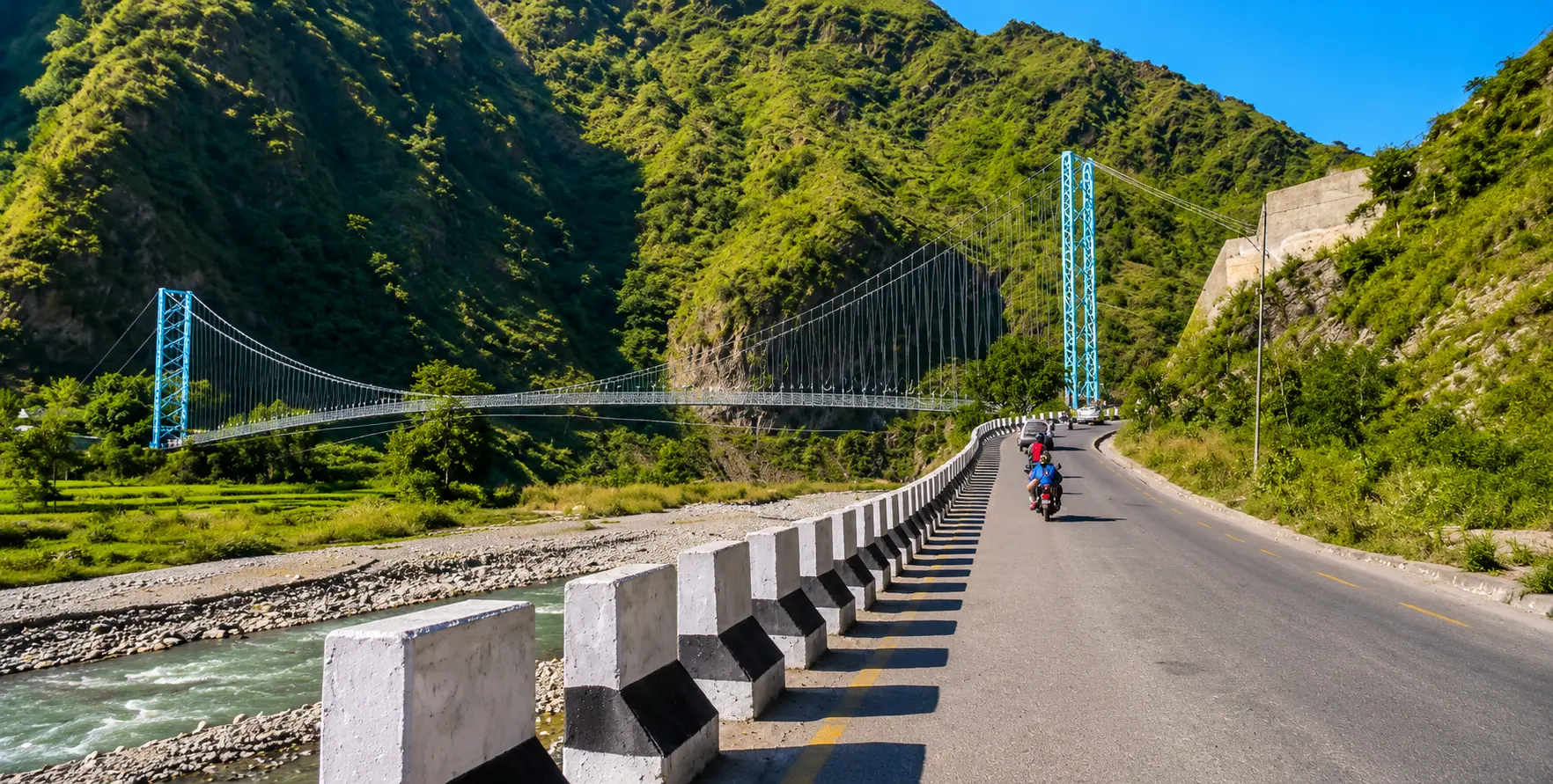
  • Step 2: Share your trek date, departure hotel in Kathmandu, group size (trekkers + porters + guide), and which trek you are starting
  • Step 3: Choose your vehicle – private car, jeep, or Hiace Jeep
  • Step 4: Also, please mention your return transfer needs – we coordinate the return vehicle from Nagarkot, Dhunche, Melamchi, or anywhere your trek ends
  • Step 5: Receive your booking confirmation with driver details, vehicle information, and pickup time
  • Step 6: Your driver arrives at your hotel at the agreed time – load up and begin your Sundarijal adventure

We recommend booking 24 to 48 hours in advance for weekday departures and 3 to 5 days ahead during peak trekking season (October, November, March, April).

Frequently Asked Questions (FAQ)

How far is Kathmandu from Sundarijal?

The road distance from central Kathmandu to the Sundarijal trailhead is approximately 1- 26 kilometres via the Jorpati–Gokarna road. The drive takes 30 to 50 minutes by private vehicle.

How much does a private car transfer from Kathmandu to Sundarijal cost?

A private car from Kathmandu to Sundarijal costs approximately NPR 1,500- 4,000 (USD 11–30) one way, depending on the car type. A private jeep costs NPR 3,000- 7,000 (USD 22–52). All prices include driver and fuel.

Can I take a public bus from Kathmandu to Sundarijal?

Yes. Public microbuses run from Ratnapark to Jorpati for NPR 30–50, and from Jorpati to Sundarijal for NPR 50–100. However, for trekkers with full backpacks and gear, public transport is highly inconvenient. A private vehicle transfer is strongly recommended.

Which treks start from Sundarijal?

The main treks starting from Sundarijal are: the Chisapani–Nagarkot Trek (2 to 4 days), the Gosaikunda Lake Trek (5 to 7 days), the Helambu Circuit (5 to 7 days), the Langtang–Gosaikunda–Sundarijal Loop (10 to 14 days), and the Shivapuri Peak Day Hike (1 day).

Do I need a permit to enter Shivapuri National Park at Sundarijal?

Yes. All visitors entering Shivapuri Nagarjun National Park at the Sundarijal gate must pay an entry fee of NPR 500 for foreign visitors (NPR 100 for Nepali citizens). The gate checkpoint collects the fee.

Multi-day trekkers additionally need a TIMS card and relevant park permits for connected areas.

Can Nepal Vehicle Hiring arrange both the Sundarijal transfer and the return vehicle from Nagarkot or Dhunche?

Yes. Nepal Vehicle Hiring coordinates complete trekking transport packages — outbound transfers to Sundarijal and return transfers from any trek endpoint, including Nagarkot, Dhunche, Syabrubesi, and Melamchi. We coordinate timing with your trek guide to ensure your return vehicle is waiting when you arrive.

How many people can a private jeep carry for the Sundarijal trek transfer?

A standard 4WD jeep comfortably carries 4 to 6 passengers with full trekking bags. For larger groups with porters and a guide, a Toyota Hiace van (7 to 12 passengers) is the most practical choice.

Is the road to Sundarijal accessible year-round?

Yes. The Kathmandu-to-Sundarijal road is paved throughout and accessible year-round to all vehicle types. It is not affected by seasonal road closures or monsoon landslides as it lies within the Kathmandu Valley.

The trek itself may be affected by weather above the valley rim, but the vehicle transfer is always straightforward.

Book Your Kathmandu to Sundarijal Trek Transfer with Nepal Vehicle Hiring

The trek from Sundarijal is one of the most rewarding ways to step out of Kathmandu’s urban energy and into the forested hills, ancient villages, and Himalayan panoramas of the Shivapuri and Helambu region. Whether you are setting out on a two-day Chisapani sunrise hike, a seven-day Gosaikunda pilgrimage trek, or the full Langtang–Gosaikunda loop, the adventure begins the moment your Nepal Vehicle Hiring vehicle leaves your hotel.

Our professional drivers, reliable private vehicles, and complete trekking transport coordination — including return pickups from all trek endpoints — make Nepal Vehicle Hiring Pvt Ltd the preferred transfer partner for trekkers throughout Nepal.

Contact Nepal Vehicle Hiring Pvt Ltd today at vehiclehiringnepal.com to book your Kathmandu-to-Sundarijal transfer and begin your Himalayan adventure.
WhatsApp: +977 981-4227196
Email: [email protected]

Kathmandu to Dolakha Vehicle Rental: Car, Jeep, Van, Hiace and Bus Hire

Kathmandu to Dolakha Vehicle Rental  – Car, Jeep, Van, Hiace & Bus Hire

Patan Durbar Square in the Kathmandu Valley

Introduction

Are you planning a trip from Kathmandu to Dolakha in 2026-27 and looking for a reliable, comfortable, and affordable vehicle rental? Nepal Vehicle Hiring Pvt Ltd provides the best private vehicle hire service from Kathmandu to Dolakha, covering cars, jeeps, Hiace vans, coasters, and tourist buses.

Dolakha is one of Nepal’s most spiritually significant and scenically rewarding districts. Home to the revered Dolakha Bhimsen Temple in Charikot, the magnificent Kalinchowk Bhagwati Temple (3,842 m), and the historic Jiri bazaar — Dolakha draws pilgrims, trekkers, and adventure travellers from across Nepal and the world.

Whether you are a devotee visiting Bhimsen Baba, a trekker heading to Kalinchowk, or a family on a weekend escape from Kathmandu, hiring a private vehicle is the most comfortable and time-efficient way to travel to Dolakha.

Explore our full fleet: Nepal Vehicle Hiring – Jeep | Hiace Van Hire | Bus Hire Nepal

Kathmandu to Dolakha Vehicle Rental – Route Overview

RouteKathmandu → Dolakha (Charikot / Bhimeshwar)
DistanceApprox. 170–182 km by road
Travel TimeApprox. 4–5 hrs (private vehicle) | 6–7 hrs (public bus)
Road TypeAraniko Highway + hilly mountain roads
Vehicle OptionsCar, Jeep (4WD), Hiace Van, Coaster, Bus
Best ForPilgrims, trekkers, families, tourist groups
AvailabilityDaily – 24/7 booking available
ContactWhatsApp | vehiclehiringnepal.com
Why Hire a Private Vehicle from Kathmandu to Dolakha?

While public buses run from Gongabu New Bus Park or Koteshwor in Kathmandu to Charikot (Dolakha), a private vehicle rental offers undeniable advantages in 2026:

  • Comfort & Space: Travel in a clean, private vehicle without overcrowding or fixed stops.
  • Faster Journey: A private car or jeep covers the 170–182 km in 4–5 hours vs 6–7+ hours by local bus.
  • Door-to-Door Pick-Up: Your driver picks you up from your hotel in Kathmandu and drops you off anywhere in Dolakha/Charikot.
  • Flexible Sightseeing: Stop at Dhulikhel, Dolalghat, Sunkoshi River viewpoints, or roadside dhabas as you wish.
  • 4WD for Kalinchowk: Jeep hire is essential for the Charikot to Kuri Village off-road section (15 km) leading to Kalinchowk.
  • Group & Family Travel: From a 4-seat car to a 45-seat tourist bus — we have the right vehicle for every group size.
  • Safe & Professional Drivers: All our drivers are licensed, experienced, and familiar with the Araniko Highway and Dolakha’s mountain roads.

Nepal Tour Package

Available Vehicles for Kathmandu to Dolakha Hire

Nepal Vehicle Hiring offers a complete range of vehicles to match every budget and group size. Here is a full comparison of available options:

Vehicle TypeCapacityBest ForRoad Suitability
Car (Sedan/SUV)1–4 paxSolo / CouplesPaved roads
Jeep (4WD Scorpio/Sumo)1–6 paxTrekkers / KalinchowkAll terrain
Toyota Land Cruiser1–6 paxTop-end GroupsAll terrain
Hiace Van8–13 paxFamilies / GroupsPaved + moderate
Coaster20–25 paxLarge groupsPaved roads
Tourist Bus30–45 paxSchools / ToursHighway only

1. Car Hire – Kathmandu to Dolakha

A comfortable sedan or SUV is ideal for solo travellers and small families (up to 4 passengers). The Kathmandu–Charikot highway is paved and manageable for standard cars. However, if you plan to go beyond Charikot to Kuri Village or Kalinchowk, a 4WD jeep is strongly recommended for the off-road section.

2. Jeep Hire (4WD) – Kathmandu to Dolakha

The Mahindra Scorpio, Sumo, Bolero, and Toyota Land Cruiser are the most popular choices for trips from Kathmandu to Dolakha — especially for trekkers heading to Kalinchowk. A 4WD jeep comfortably seats 6 passengers and handles the rugged Charikot–Kuri Village mountain road with ease. Visit our Jeep Hire page for details.

3. Hiace Van Hire – Kathmandu to Dolakha

A Toyota Hiace van (8–13 passengers) is perfect for medium-sized groups, school excursions, and pilgrimage parties. Hiace vans offer superior comfort on paved roads and are widely used for day trips to Charikot and visits to the Dolakha Bhimsen Temple. Check our Hiace Van Hire service for availability.

4. Coaster & Tourist Bus – Kathmandu to Dolakha

For groups of 20 or more, our Coaster (20–25 passengers) and Tourist Bus (30–45 passengers) offer the most economical per-head cost for the Kathmandu-Dolakha journey. Ideal for corporate tours, religious yatras, and school trips. Explore our Bus Hire Nepal and Coaster Hire Nepal pages.

Swayambhunath visit during Kathmandu Pokhara Tour

Kathmandu to Dolakha Route Details 2026-2027

The drive from Kathmandu to Dolakha (Charikot) follows the Araniko Highway (BP Highway) eastward through some of Nepal’s most stunning landscapes.

Key Points Along the Kathmandu–Dolakha Route

  • Kathmandu (Koteshwor / Kalanki) → Departure point. Start your journey east via Ring Road.
  • Dhulikhel (30 km) → Hilltop viewpoint with stunning Himalayan panoramas. Optional short stop.
  • Dolalghat (57 km) → Confluence of the Sunkoshi and Indrawati rivers. Popular picnic and rafting destination.
  • Khadichaur / Mude (79–90 km) → Midway rest stop with roadside restaurants and tea houses.
  • Jiri Junction (approx. 185 km) → Historic starting point of the original Everest Base Camp trekking route.
  • Charikot / Bhimeshwar (182 km) → District headquarters of Dolakha. Home to the famous Dolakha Bhimsen Temple and gateway to Kalinchowk.

Top Attractions in Dolakha Worth Visiting

Dolakha is a treasure trove of natural beauty, religious heritage, and adventure. Here are the must-visit places your vehicle hire will take you to:

1. Dolakha Bhimsen Temple (Charikot)

One of Nepal’s most sacred Hindu temples, Dolakha Bhimsen Temple sits in the heart of Charikot Bazaar. Dedicated to Lord Bhimsen (one of the Pandavas from the Mahabharata), the temple houses a unique triangular stone statue believed to represent three divine incarnations.

According to tradition, sweat appearing on the idol’s forehead is considered a warning of impending national disaster. The temple draws thousands of devotees year-round, especially during Hindu festivals.

2. Kalinchowk Bhagwati Temple (3,842 m)

Situated at 3,842 meters above sea level in the Gaurishankar Conservation Area, the Kalinchowk Bhagwati Temple is one of the most popular short-trek and pilgrimage destinations near Kathmandu. The temple is devoted to Goddess Bhagwati (Kali) and offers 360-degree panoramic views of the Gaurishankar, Langtang, Ganesh Himal, Jugal Himal, and even the Everest range on clear days.

A cable car service (NPR 600 per person) connects Kuri Village to the temple. In winter, the area receives snow and offers skiing opportunities.

3. Charikot Bazaar

Charikot, the administrative headquarters of Dolakha District, is a vibrant Newari market town at about 1,554 m. It serves as the base camp for Kalinchowk treks and features local restaurants, guesthouses, and cultural heritage. The town’s old Newari architecture, traditional crafts, and local markets make it worth exploring.

4. Kuri Village

Located 15 km from Charikot on an off-road mountain track (requiring a 4WD jeep), Kuri Village (2,300 m) is the base for Kalinchowk treks. A traditional mountain settlement surrounded by rhododendron forests and Himalayan views, Kuri Village offers cosy lodges and a peaceful escape from city life.

5. Jiri – Gateway to Everest Trekking

Located approximately 72 km from Charikot, Jiri was the original starting point for the Everest Base Camp trek before flights to Lukla became common. Today, it is a peaceful hill town with trekking routes, waterfalls, and scenic mountain views. You can extend your Kathmandu–Dolakha vehicle hire to include a visit to Jiri.

Best Time to Travel from Kathmandu to Dolakha

  • Spring (March – May): Ideal for trekking and Kalinchowk visits. Rhododendron forests bloom along the trails. Clear mountain views.
  • Autumn (September – November): Peak season with stable weather, crystal-clear skies, and the best Himalayan views. Festivals like Dashain and Tihar bring thousands of pilgrims to the Dolakha Bhimsen Temple.
  • Winter (December – February): Kalinchowk receives heavy snowfall, attracting visitors for snow play and skiing. Road conditions can be challenging — a 4WD jeep is essential.
  • Monsoon (June – August): Roads may be affected by landslides and heavy rain, especially on mountain sections. Travel is possible but requires caution.

How to Book Your Kathmandu to Dolakha Vehicle Rental

  • Step 1: Browse our vehicle options at com.
  • Step 2: Call or WhatsApp us at +977 981-4227196 with your travel date, group size, and preferred vehicle type.
  • Step 3: Receive a confirmed quote with your driver’s details and pick-up time.
  • Step 4: Your driver arrives at your Kathmandu hotel and transfers you directly to Dolakha in comfort.
  • Step 5: Enjoy a smooth, door-to-door journey with stops along the route at your choice.

Travel Tips for Kathmandu to Dolakha Journey

  • Depart Early: Leave Kathmandu by 6–7 AM to avoid valley traffic and arrive in Charikot by mid-morning for a full day of sightseeing.
  • Book in Advance: During Dashain, Tihar, and winter (Dec–Jan) peak periods, vehicles fill up quickly. Book at least 2–3 days ahead.
  • 4WD for Kalinchowk: If your trip includes Kuri Village or Kalinchowk, always hire a 4WD Jeep — standard cars cannot manage the off-road mountain section.
  • Carry Cash: ATMs are limited in Dolakha/Charikot. Carry sufficient Nepali rupees from Kathmandu.
  • Warm Clothing: Temperatures drop significantly at Kalinchowk (3,842 m), even in spring and autumn. Pack an extra jacket.
  • Permits: Entry to the Gaurishankar Conservation Area (for Kalinchowk) requires a conservation area permit fee, paid locally at the entry point.

Nepal Tour Package

Other Vehicle Rental Services by Nepal Vehicle Hiring

We provide vehicle hire across all major routes in Nepal. Explore our other popular services:

Frequently Asked Questions (FAQs) – Kathmandu to Dolakha Vehicle Rental

How far is Kathmandu from Dolakha (Charikot)?

The road distance from Kathmandu to Dolakha (Charikot) is approximately 170–182 km via the Araniko Highway.

How long does the journey take from Kathmandu to Dolakha by private vehicle?

A private car or jeep takes approximately 4–5 hours. A public bus takes 6–7 hours, depending on road conditions and traffic.

What type of vehicle is best for the trip from Kathmandu to Dolakha?

For Charikot and Dolakha Bhimsen Temple visits, a car, jeep, or hiace van works well. For trips to Kuri Village and Kalinchowk, a 4WD Jeep (Scorpio or Land Cruiser) is essential as the road beyond Charikot is off-road and steep.

Can I hire a vehicle for a one-day Kathmandu-to-Dolakha round trip?

Yes, a one-day round trip is possible — covering Charikot Bazaar and Dolakha Bhimsen Temple. However, for Kalinchowk, an overnight stay in Kuri Village or Charikot is strongly recommended for a fuller experience.

Is Dolakha safe to visit?

Yes, Dolakha is safe to visit. The district has fully recovered from the 2015 earthquake, and infrastructure has been improved. Roads to Charikot are in good condition, and the Kalinchowk cable car resumed full operation in 2018.

How much does a Kathmandu-to-Dolakha vehicle rental cost?

Costs vary by vehicle type, number of passengers, and trip duration. Contact Nepal Vehicle Hiring at +977 981-4227196 or visit vehiclehiringnepal.com for a personalised quote.
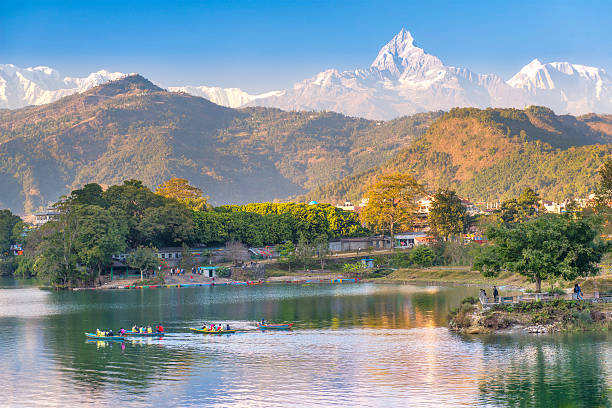
Can I visit Jiri from Dolakha on the same trip?

Yes! Jiri is approximately 72 km from Charikot (about 4 hours). You can extend your vehicle hire to include Jiri for a 2–3 day Dolakha–Jiri tour.

Our drivers are familiar with this extended route.

Book Your Kathmandu to Dolakha Vehicle Rental Today

Nepal Vehicle Hiring Pvt Ltd is your most trusted vehicle rental partner for the Kathmandu–Dolakha route in 2026. From comfortable cars for solo travellers to large tourist buses for groups, we have the perfect vehicle for every journey.

With professional drivers, well-maintained fleets, 24/7 customer support, and competitive pricing, we keep every kilometre of your Dolakha journey in safe hands.

WhatsApp: +977 981-4227196
Email: [email protected]

Nepalgunj to Bardiya Vehicle Service

Nepalgunj to Bardiya Vehicle Service – Private Car, Jeep & Van Hire for Bardiya National Park

Nepalgunj Jamunaha Border

Planning a wildlife safari to Bardiya National Park and need a reliable, comfortable vehicle service from Nepalgunj? Nepal Vehicle Hiring Pvt Ltd offers the best private vehicle transfer service from Nepalgunj to Bardiya, covering cars, jeeps, Hiace vans, coasters, and tourist buses.

Bardiya National Park — also spelt Bardia — is Nepal’s largest and most undisturbed national park in the Terai region, covering 968 sq. km. in the far western lowlands. A true wilderness sanctuary, Bardiya is famed for exceptional sightings of the Royal Bengal Tiger, one-horned rhinoceros, Asian elephants, Gangetic dolphins, and over 400 bird species.

Unlike the more visited Chitwan, Bardiya offers a raw, crowd-free jungle experience for those who seek an authentic wildlife adventure.

After flying into Nepalgunj Airport (KEP) — the nearest airport to Bardiya — hiring a private vehicle is the fastest, most comfortable, and most convenient way to reach the park’s headquarters at Thakurdwara (74–90 km, approx. 2.5–3 hours).

Book your transfer now: Nepal Vehicle Hiring – Jeep | Hiace Van Hire | Vehicle Hiring Nepal

Nepalgunj to Bardiya Vehicle Service – Route Overview

RouteNepalgunj Airport / City → Thakurdwara (Bardiya National Park)
DistanceApprox. 74–90 km by road
Travel TimeApprox. 2 – 3 hours (private vehicle)
Road TypePaved highway + rural Terai roads
Vehicle OptionsCar, Jeep (4WD), Hiace Van, Coaster, Bus
Best ForWildlife tourists, safari groups, families, and pilgrims
AvailabilityDaily – Airport & hotel pick-up available 24/7
Contact+977 981-4227196 | vehiclehiringnepal.com
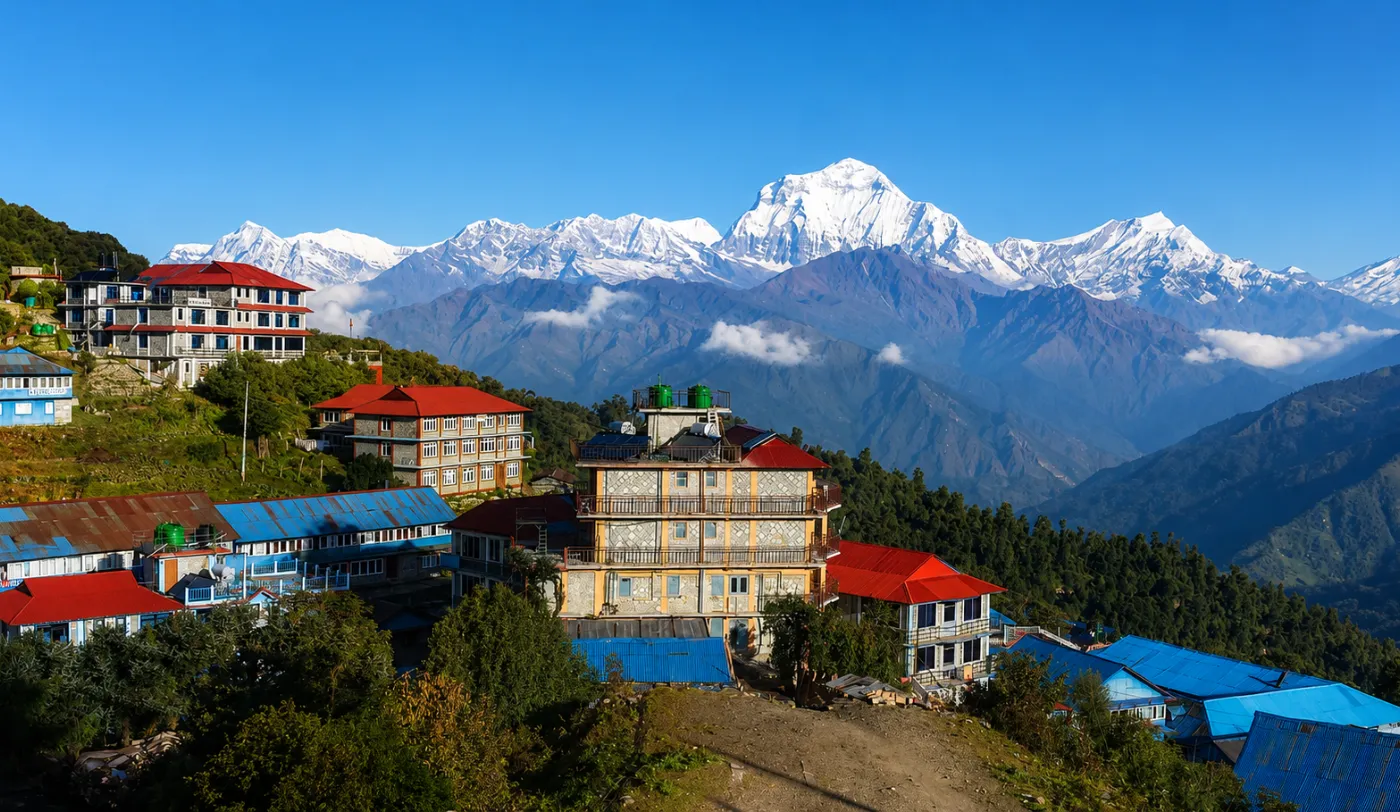
Why Choose a Private Vehicle Service from Nepalgunj to Bardiya?

While local buses run from Nepalgunj to Ambassa (the nearest town to Bardiya), a private vehicle service offers decisive advantages for safari travellers:

  • Direct Airport Pick-Up: Your driver meets you at Nepalgunj Airport arrivals and transfers you directly to your Bardiya lodge or resort—no waiting for public buses.
  • Comfort in the Terai Heat: The western Terai can be extremely hot. A private, air-conditioned vehicle makes the 2.5–3 hour journey far more comfortable than a crowded local bus.
  • No Transfers or Connections: Public transport typically requires a bus to Ambassa, followed by a tuk-tuk to Thakurdwara. A private vehicle takes you door-to-door in one ride.
  • Flexible Timing: Flights to Nepalgunj are subject to delays. Our drivers wait for your arrival, regardless of flight timing, at no extra charge.
  • Luggage & Equipment Friendly: Safari photographers, birdwatchers, and trekkers often carry substantial gear. A private vehicle accommodates your luggage comfortably.
  • Safe for Families & Groups: Our professional, licensed drivers are experienced with the Nepalgunj–Thakurdwara route and ensure a safe, stress-free journey.
  • Round-Trip Available: We also offer round-trip vehicle service from Bardiya to Nepalgunj Airport for your return flight to Kathmandu or Pokhara.

Private Scorpio jeep with luggage on the roof

Available Vehicles for Nepalgunj to Bardiya National Park Service

Nepal Vehicle Hiring offers a complete range of vehicles for groups of all sizes and budgets. See below for our full fleet options:

VehicleCapacityBest ForRoad Suitability
Car / SUV1–4 paxSolo / CouplesPaved roads
Jeep (Scorpio/Sumo)1–6 paxSafari Groups / TrekkersAll terrain
Land Cruiser 4WD1–6 paxTop-end TravelAll terrain
Hiace Van8–13 paxFamilies / Tour GroupsPaved + moderate
Coaster20–25 paxLarge GroupsPaved roads
Tourist Bus30–45 paxSchool / Corporate ToursHighway only

The Mahindra Scorpio, Bolero, Sumo, and Toyota Land Cruiser are the most popular vehicles for the Nepalgunj–Bardiya route and for jeep safaris within the national park. 4WD jeeps handle the rural Terai roads and any rough patches near the park with ease. Capacity: 1–6 passengers.

See our Jeep Hire page for full details.

Hiace Van – Best for Medium Groups

A Toyota Hiace (8–13 passengers) is ideal for medium-sized safari groups, family trips, and Tharu cultural tour groups. Comfortable, spacious, and reliable on paved Terai highways. View our Hiace Van Hire service.

Coaster & Tourist Bus – Large Groups

For group tours of 20 or more, our Coaster (20–25 passengers) and Tourist Bus (30–45 passengers) provide economical per-head fares. Ideal for school groups, corporate wildlife tours, and large family reunions. Check our Bus Hire Nepal and Coaster Hire pages.

Nepalgunj to Bardiya National Park – Route & Key Stops

The journey from Nepalgunj to Bardiya National Park (Thakurdwara) covers approximately 74–90 km through the flat western Terai plains of Lumbini Province.

  • Nepalgunj Airport (KEP) / City Centre: Your departure point. Our driver will meet you at arrivals or at your hotel.
  • Kohalpur Junction (~25 km): Main highway town on the Mahendra Highway (East-West Highway). A common stop for restaurants and fuel.
  • Ambassa (65–75 km): The nearest large settlement to Bardiya. Public buses terminate here; private vehicles continue directly to the park.
  • Thakurdwara Village (74–90 km): The headquarters of Bardiya National Park and home to most safari lodges, eco-resorts, and the famous Thakur Baba Temple—your final destination.

About Bardiya National Park – Nepal’s Premier Wildlife Destination

Established as a national park in 1988, Bardiya National Park spans 968 sq. km. across the Bardiya District of Lumbini Province. About 70% of the park is covered by dense Sal forest, while the remaining 30% comprises grasslands, savannah, and riverine forest along the Karnali and Babai rivers.

Bardiya is widely regarded as Nepal’s best destination for tiger sightings, with over 125 Royal Bengal tigers roaming freely. Unlike Chitwan, which draws far more tourists, Bardiya remains uncrowded, pristine, and genuinely wild—offering the most authentic jungle safari experience in Nepal.

Bardiya Wildlife Highlights

Wildlife CategorySpecies Found in Bardiya
Big CatsRoyal Bengal Tiger (125+ in park)
Large MammalsOne-Horned Rhinoceros, Asian Elephant, Swamp Deer, Blackbuck
Aquatic LifeGangetic Dolphin, Gharial Crocodile, Marsh Mugger
Birds230–400+ species incl. Bengal Florican, Sarus Crane, Kingfisher
FloraSal Forest (70%), Grasslands, Riverine & Riparian Forest

badiya national park tiger

Top Activities in Bardiya National Park

Once your vehicle service brings you to Thakurdwara, the following activities await:

  • Jeep Safari: Ride through the jungle in an open-top 4WD jeep. Early morning and late afternoon are the best times for spotting tigers and rhinos. Full-day safaris include stops at watchtowers and waterholes.
  • Walking Safari: Guided jungle walks take you deep into the Sal forest and along the banks of the Karnali River. The most in-depth way to experience Bardiya — encounter fresh tiger paw prints, spot grazing rhinos, and hear the jungle come alive.
  • Canoeing on the Karnali River: Glide silently along the Karnali River in a dugout canoe—spotting mugger crocodiles, gharials, water birds, and the rare Gangetic dolphin surfacing on calm stretches.
  • River Rafting: The Karnali River offers Class III–V rapids for white-water rafting enthusiasts. A thrilling adventure through dense jungle gorges.
  • Birdwatching: With 400+ bird species, Bardiya is a birder’s paradise. Spot the Bengal florican, sarus crane, crested serpent eagle, hornbills, and rare kingfishers during morning jungle walks.
  • Tharu Cultural Village Visit: Experience the unique culture of the indigenous Tharu people — watch traditional Lathi Nach (stick dance), taste local Tharu cuisine, and explore mud-walled village homes.
  • Elephant Safari: Ride through the tall elephant grass atop a trained elephant — an extraordinary way to approach rhinos and other large mammals.
  • Thakur Baba Temple Visit: A significant pilgrimage site in Thakurdwara dedicated to Lord Vishnu. A major annual festival draws devotees from across western Nepal on Manghesangranti day.

Best Time to Visit Bardiya National Park

  • Autumn (September – November): Ideal weather with warm days and cool nights. Shorter grass after the monsoon makes wildlife spotting easier. Festivals bring cultural colour to Tharu villages.
  • Spring (March – May): Hot but excellent for tiger sightings as animals congregate at visible waterholes. Great for birdwatching as migratory species pass through.
  • Winter (November – February): Cool and dry — excellent for comfortable jungle walks and wildlife viewing. Best for birdwatching as many migratory birds arrive.
  • Monsoon (June – August): Lush green landscapes, but roads can flood, and trails become muddy. The park may partially close. Not recommended for first-time visitors.

Reaching Nepalgunj – Gateway to Bardiya

Nepalgunj is the closest airport and major city to Bardiya National Park. Here is how to reach Nepalgunj from major Nepali cities before booking your Nepalgunj–Bardiya vehicle service:

  • From Kathmandu: Daily flights by Buddha Air, Yeti Airlines, and others. Flight time: 50 minutes. From Nepalgunj Airport, Nepal Vehicle Hiring will transfer you directly to Bardiya in 2.5–3 hours.
  • From Pokhara: Regular domestic flights to Nepalgunj are available. Alternatively, by road (~450 km, approx. 12–14 hours by bus).
  • From Lumbini: 200 km by road. We can arrange a Lumbini–Nepalgunj–Bardiya combined transfer on request.
  • From India (Rupaidiha Border): Direct road access from the Rupaidiha/Nautanwa border crossing. Our jeep service can arrange cross-border onward transfers to Bardiya.

We cover all major vehicle hire routes across Nepal. Explore our other services:

Travel Tips for Your Nepalgunj to Bardiya Journey

  • Book Your Vehicle in Advance: During peak safari season (Oct–Nov, Mar–May), private jeeps are in high demand. Book at least 2–3 days ahead to guarantee availability.
  • Coordinate with Your Flight: Domestic flights to Nepalgunj can be delayed due to weather. Share your flight number with Nepal Vehicle Hiring; your driver can monitor arrival times.
  • Carry Cash: ATM facilities are limited around Thakurdwara. Withdraw sufficient Nepali rupees in Nepalgunj city before departing.
  • Pack for the Heat: Western Terai temperatures can exceed 40°C in summer. Carry plenty of water, light cotton clothing, sunscreen, and a hat.
  • National Park Entry Fee: Park entry for foreigners is NPR 1,000 per day; SAARC nationals NPR 500; Nepalis NPR 50. Pay this separately at the park entrance in Thakurdwara.
  • Respect Wildlife: Maintain silence during safaris. Do not feed animals. Follow all instructions from your park guide.
  • Return Transfer: Book your Bardiya-to-Nepalgunj return vehicle at the same time as your arrival transfer to avoid last-minute hassles.

Frequently Asked Questions (FAQs) – Nepalgunj to Bardiya Vehicle Service

How far is Nepalgunj from Bardiya National Park?

The road distance from Nepalgunj to Bardiya National Park (Thakurdwara) is approximately 74–90 km, depending on your specific route and destination lodge.

How long does it take to drive from Nepalgunj to Bardiya?

A private vehicle takes approximately 2.5 to 3 hours to complete the journey. Local buses can take 3 to 3.5 hours and require an additional tuk-tuk connection from Ambassa to Thakurdwara.

Do I need a 4WD jeep for the trip from Nepalgunj to Bardiya?

The main highway from Nepalgunj to Ambassa is a paved road, accessible by standard cars. However, for driving within Bardiya National Park on safari, you need a 4WD open-top jeep, which your safari lodge arranges separately.

Can Nepal Vehicle Hiring pick me up directly from Nepalgunj Airport?

Yes! We offer direct airport pick-up from Nepalgunj Airport (KEP) to Thakurdwara or any Bardiya lodge/resort. Share your flight details, and we will have your driver ready at arrivals.

What is the best vehicle for a family trip to Bardiya?

For families of 4–7, a Mahindra Scorpio  4WD Jeep offers the best balance of comfort and capability. For larger family groups of 8–13, a Hiace van is the most comfortable option.

Do you offer a combined Nepalgunj city tour + Bardiya transfer?

Yes. Upon request, we can include a brief Nepalgunj city tour (Tribhuvannagar market, local temples, and the Nepalgunj border area) before proceeding to Bardiya. Contact us at +977 981-4227196 to customise your itinerary.

Can I book a round-trip vehicle from Nepalgunj to Bardiya?

Absolutely. We offer both one-way and round-trip vehicle service between Nepalgunj and Bardiya. Our drivers are also available for multi-day hire, remaining in Bardiya during your safari stay and returning you to Nepalgunj on your preferred date.

Book Your Nepalgunj to Bardiya Vehicle Service Today

Nepal Vehicle Hiring Pvt Ltd is your most trusted transfer partner for the Nepalgunj–Bardiya National Park route. Whether you are a solo wildlife photographer, a family on a dream safari holiday, or a large tour group, we have the perfect vehicle and the most professional drivers to get you there safely and on time.

With 24/7 availability, direct airport pick-up, well-maintained vehicles, and competitive pricing, your Bardiya adventure starts the moment you land in Nepalgunj.

Call / WhatsApp: +977 981-4227196   vehiclehiringnepal.com  |   Book Jeep Hire  |   Book Van / Bus Hire
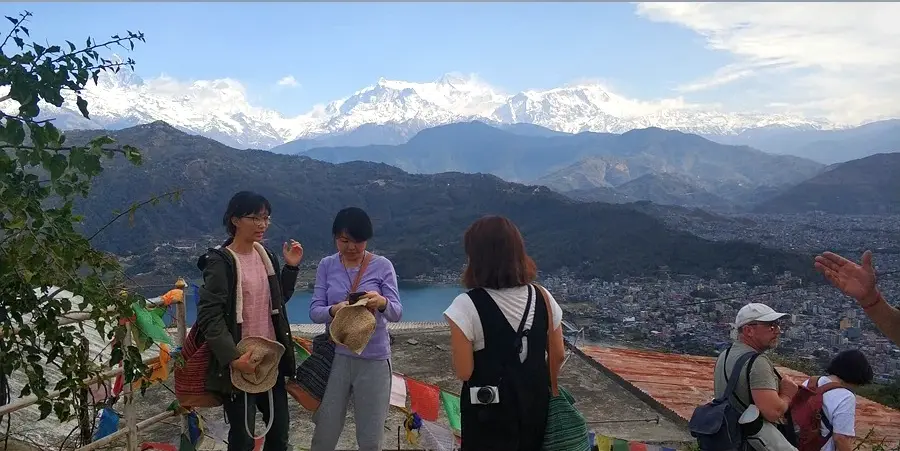
Pokhara to Beni Jeep Hire

Pokhara to Beni Jeep Hire – Private Jeep Service for Myagdi District

Beni Bazaar

Are you planning a trip from Pokhara to Beni and looking for a reliable, comfortable jeep hire service? Nepal Vehicle Hiring Pvt Ltd offers the best private jeep rental from Pokhara to Beni — the headquarters of Myagdi District.

Whether you are a trekker heading to Poon Hill, a pilgrim on the way to Muktinath, or a traveller exploring the scenic Myagdi region, our private jeep service ensures you travel in comfort and safety.

Beni is the gateway to some of Nepal’s most spectacular destinations: Jomsom, Muktinath, Upper Mustang, Tatopani, and Dhaulagiri trekking routes. Hiring a private jeep from Pokhara to Beni is the most flexible, comfortable, and time-efficient way to start your journey.

Ready to book? Contact us at Nepal Vehicle Hiring or explore our jeep hire services for full details and pricing.

Pokhara to Beni Jeep Hire – Quick Route Overview

RoutePokhara → Beni (Myagdi District)
DistanceApprox. 85 km
Travel TimeApprox. 2.5 – 3 hours
Road TypeMostly blacktop / paved highway
Vehicle Type4WD Jeep (Scorpio, Sumo)
Best ForTrekkers, pilgrims, tourists, groups
AvailabilityDaily – 24/7 booking available

Why Choose a Private Jeep from Pokhara to Beni?

When travelling from Pokhara to Beni, you have several transport options, including public buses and shared jeeps. However, a private jeep hire offers clear advantages:

  • Comfort & Privacy: Travel with your group in a clean, well-maintained 4WD jeep without overcrowding.
  • Flexible Stops: Stop at scenic viewpoints, Nau Danda (Nine Hills), or roadside tea shops at your own pace.
  • Door-to-Door Service: Pick-up from your hotel in Pokhara and drop-off anywhere in Beni.
  • Safety & Reliability: Our experienced, professional drivers know every turn of the Pokhara–Beni route.
  • Time Saving: A private jeep takes approximately 2.5–3 hours, much faster than a public bus (3.5+ hours).
  • Ideal for Groups: A single jeep can comfortably seat up to 6–7 passengers, making it cost-effective for families and trekking groups.

Pokhara

Pokhara to Beni Route Details

The drive from Pokhara to Beni covers about 85 km on a mostly paved blacktop road, making it one of the more comfortable intercity routes in Nepal’s Gandaki Province.

Key Highlights Along the Route

  • Nau Danda (Nine Hills): A scenic viewpoint offering panoramic views of the Annapurna and Dhaulagiri mountain ranges.
  • Kali Gandaki Valley: The road follows Nepal’s famous Kali Gandaki River valley, one of the world’s deepest gorges.
  • Small Villages & Local Markets: Pass through traditional Gurung and Magar villages with vibrant local cultures.
  • Beni Bazaar: Arrive at Beni, the bustling market town at the confluence of the Myagdi and Kali Gandaki rivers.

Vehicles Available for Pokhara to Beni Jeep Hire

At Nepal Vehicle Hiring, we offer a range of 4WD jeeps suitable for the Pokhara–Beni route. Visit our vehicle rental page for the full fleet. Our available vehicles include:

  • Mahindra Scorpio – Nepal’s most popular and trusted jeep for mountain roads. Comfortable for up to 6 passengers.
  • Mahindra Bolero / Sumo – Reliable and budget-friendly option for groups of 6–7 passengers.
  • Toyota Land Cruiser (4WD) – Top-end option for maximum comfort and off-road capability, ideal for extended trips beyond Beni.
  • Mitsubishi Pajero – SUV-class comfort for those seeking a top-end travel experience.

All our vehicles are well-maintained, regularly serviced, sanitised, and equipped with experienced, licensed drivers.

Who Should Hire a Jeep from Pokhara to Beni?

Our Pokhara to Beni jeep hire service is ideal for:

  • Trekkers heading to Poon Hill, Ghorepani, Annapurna Circuit, or Dhaulagiri Base Camp.
  • Pilgrims & Devotees travelling onward to Muktinath Temple or Jomsom via Tatopani and Ghasa.
  • Adventure Seekers planning a jeep tour to Upper Mustang via Beni–Jomsom road.
  • Families & Tourist Groups looking for comfortable and private transportation.
  • Corporate & Business Travellers who require reliable, on-time transfers.

Extend Your Journey Beyond Beni

Beni is not just a destination — it is a major transit hub. After reaching Beni, you can continue your journey further into the Himalayas. Nepal Vehicle Hiring also provides jeep services for the following onward routes:

  • Beni to Tatopani (Hot Springs) – 21 km, approx. 1 hour
  • Beni to Jomsom – 79 km, approx. 5 hours of off-road mountain driving
  • Beni to Muktinath – via Jomsom, full-day jeep journey
  • Beni to Upper Mustang (Lo Manthang) – multi-day jeep tour

Check our Kathmandu to Soti Khola jeep service and Kathmandu to Salleri Phaplu jeep service for more off-road jeep routes across Nepal.

Begnas Lake Pokhara

How to Book Your Pokhara to Beni Jeep Hire

Booking a private jeep hire from Pokhara to Beni with Nepal Vehicle Hiring is quick and easy:

  • Step 1: Visit com/jeep and browse our jeep fleet.
  • Step 2: Contact us via phone or WhatsApp at +977 981-4227196 to confirm availability and pricing.
  • Step 3: Provide your pick-up location in Pokhara, travel date, and number of passengers.
  • Step 4: Receive confirmation with driver details and departure time.
  • Step 5: Your driver arrives at your hotel and takes you directly to Beni in comfort.

Travel Tips for Pokhara to Beni Jeep Journey

  • Best Season: October to May is ideal. Avoid heavy monsoon months (June–August) when landslides can disrupt the road.
  • Start Early: Depart by 7–8 AM from Pokhara to arrive in Beni by mid-morning, leaving ample time for onward travel.
  • Pack Light: Carry only essentials for the jeep ride; send heavy luggage ahead if continuing to trek.
  • Carry Permits: If continuing beyond Beni toward Mustang or Muktinath, ensure you have ACAP (Annapurna Conservation Area Permit) and TIMS card.
  • Snacks & Water: Stock up in Pokhara, though roadside stops are available along the route.

Nepal Vehicle Hiring offers a wide range of transport solutions across Nepal. Explore our other services:

Frequently Asked Questions (FAQs)

How far is Pokhara from Beni?

The distance from Pokhara to Beni is approximately 85 km by road, mostly on a paved blacktop highway.

How long does it take to travel from Pokhara to Beni by jeep?

A private jeep from Pokhara to Beni takes approximately 2.5 to 3 hours, depending on road conditions and stops.

What type of jeep is best for Pokhara to Beni?

The Mahindra Scorpio is the most popular choice. For extra comfort or onward travel beyond Beni on rough roads, we recommend the Toyota Land Cruiser 4WD.

Can I hire a jeep from Pokhara to Beni for a one-way trip?

Yes, Nepal Vehicle Hiring offers both one-way and round-trip jeep hire from Pokhara to Beni. Contact us for current pricing.

Is Beni the starting point for Mustang jeep tours?

Yes. Beni is the main gateway for jeep tours continuing to Tatopani, Ghasa, Jomsom, Muktinath, and Upper Mustang. From Beni, the road becomes off-road and requires a 4WD vehicle.

Do you offer jeep hire from Kathmandu to Beni?

Yes, we can arrange jeep hire from Kathmandu to Beni, directly or via Pokhara. Visit our vehicle rental page or call +977 981-4227196 to arrange it.

Pokhara

Book Your Pokhara to Beni Jeep Hire Today

Nepal Vehicle Hiring Pvt Ltd is your trusted partner for all vehicle hire needs across Nepal. Our Pokhara to Beni jeep hire service is designed to make your journey smooth, safe, and memorable — whether you are a solo traveller, family, or trekking group.

With professional drivers, well-maintained vehicles, 24/7 support, and competitive pricing, we ensure every kilometre of your Nepal journey is comfortable.

Call / WhatsApp: +977 981-4227196
Email: [email protected]
Book Now: Jeep Hire Nepal

Kathmandu to Arughat Transport

Larkya La Pass: Manaslu Circuit Trek

Kathmandu to Arughat Transport – Manaslu Circuit Trek Guide

Arughat Bazaar is the last major market town before the road enters the remote Budhi Gandaki River valley – the gateway corridor to the spectacular Manaslu Circuit Trek. Located about 142 km northwest of Kathmandu, Arughat sits at 550 m in the Gorkha District and marks where the paved highway ends and the rugged mountain track to Soti Khola, Jagat, and the Manaslu restricted area begins.

For trekkers heading to the Manaslu Circuit, Arughat is a critical transport milestone – the last town with an ATM, a fuel station, a proper market, and comfortable guesthouse accommodation before the real wilderness begins.

This complete 2026 guide covers all transport options from Kathmandu to Arughat (private jeep, car, and bus) with detailed road information, vehicle prices, trekking permits and practical tips.com website.

About Arughat – Why It Matters for Manaslu Trek

Full Name: Arughat Bazaar, Gorkha District, Gandaki Province

Altitude: 550 m above sea level

Distance from Kathmandu: Approximately 142 km by road

Travel Time: 4.5 to 6 hours from Kathmandu by private vehicle

Road Type: Prithvi Highway + secondary hill road (mostly paved to Arughat)

Trek Connection: Arughat is the last major town before the Manaslu Circuit restricted area. Soti Khola (official trek start) is 25–30 km north of Arughat by a rough jeep track

Key Facilities: ATM (last reliable one), fuel station, pharmacies, teahouses, local market, basic guesthouses

Vehicle Requirement: Sedan cars can reach Arughat. 4WD Jeep required for Soti Khola beyond Arughat

Arughat serves as the essential base camp town for Manaslu Circuit trekkers. Most trekking groups stop here overnight or for a few hours before either continuing to Soti Khola by jeep or beginning to trek. The weekly market (haat bazaar) draws villagers from the surrounding hills and adds vivid, authentic local colour to the town.

The Budhi Gandaki River – which the entire Manaslu Circuit follows – begins its accessible journey just north of Arughat.

Why Book Private Transport from Kathmandu to Arughat?

Private transport from Kathmandu to Arughat is the most practical and comfortable option for trekkers starting the Manaslu Circuit. Here is why:

  • Direct hotel pickup from Kathmandu – no walking to bus stations with a heavy trekking pack in morning darkness
  • Flexible departure time – depart at 5:00 AM to arrive in Arughat in the late morning, with time to explore the market, eat, and rest before continuing.
  • Full luggage space for trekking backpacks, sleeping bags, porters’ loads, and group equipment
  • No vehicle changes or connections – one continuous journey in the same comfortable vehicle
  • Option to continue beyond Arughat to Soti Khola in the same jeep if booked in advance
  • Experienced driver familiar with the Mugling–Arughat road and the Budhi Gandaki valley access route
  • Group travels together – no risk of trekking team members being split between different local buses.
  • Faster than local buses – a private vehicle saves 1 to 2 hours compared to the local bus connection via Gorkha.

Patan Durbar Square in the Kathmandu Valley

Vehicle Options & Prices: Kathmandu to Arughat

Vehicle Hiring Nepal offers a range of vehicles for the Kathmandu-Arughat route. Unlike the Soti Khola extension beyond Arughat, the road to Arughat itself is accessible by most vehicle types:

VehicleCapacityOne-Way Price (USD)Round Trip (USD)Notes
Private car1–3 pax$80 – $105$140 – $200Can reach Arughat – not beyond
Scorpio / SUV4–5 pax$100 – $200$170 – $400Good for Arughat + short Soti sections
4WD Jeep4–6 pax$130 – $250$215 – $450Best for Arughat AND Soti Khola
Toyota Hiace Van7–14 pax$200 – $250$200 – $450Groups to Arughat – NOT beyond

Important: For trekkers planning to continue from Arughat to Soti Khola by vehicle, only a Toyota Land Cruiser or equivalent 4WD is suitable. The road from Arughat to Soti Khola is a rough mountain track requiring high ground clearance and 4WD capability. Book a Land Cruiser from Kathmandu if your plan includes vehicle access to Soti Khola.

Kathmandu-to-Arughat transport

Detailed Road Guide: Kathmandu to Arughat

The Kathmandu to Arughat journey follows the Prithvi Highway before branching north into the Gorkha hills. Here is a complete stage-by-stage breakdown:

Stage 1: Kathmandu to Mugling (115 km | 2.5 hrs)

Depart Kathmandu early – 5:00 to 5:30 AM is recommended for a same-day arrival in Arughat with time to spare. Follow the Prithvi Highway west through Naubise and along the spectacular Trishuli River gorge. The road runs alongside the fast-flowing green river through Malekhu – a popular riverside rest stop with tea houses and fresh fish – before reaching Mugling Junction in approximately 2.5 hours from Kathmandu.

Mugling is a key decision point. For Pokhara-bound traffic, the road continues west. For Arughat and the Manaslu Circuit, turn north at Mugling onto the secondary road towards Gorkha and the Budhi Gandaki valley.

Take a brief tea and snack break at Mugling before continuing – it is the last busy junction town on the route.

Stage 2: Mugling to Gorkha Junction (25 km | 40 min)

From Mugling, head north through increasingly rural hill terrain. The road climbs gently through terraced paddy fields and mixed forest. Gorkha Junction (not Gorkha town itself, which lies 20 km east on a branch road) is the turn-off where the road continues north towards Arughat.

Gorkha town – the historic birthplace of the Shah dynasty and former kingdom that unified Nepal – is worth a side visit if time allows, though it adds 1.5 to 2 hours to your journey.

Stage 3: Gorkha Junction to Khairenitar (20 km | 35 min)

Continue north through the Daraudi River valley. The road passes through Khairenitar – a small town with a few restaurants and tea shops and the site of a well-known agricultural research station. The road remains paved with some rough patches through this section.

On clear days, views of the surrounding Gorkha hills and the first glimpses of snow-capped peaks to the north begin to appear.

Stage 4: Khairenitar to Arughat Bazaar (22 km | 40 min)

The final section descends to Arughat Bazaar on the east bank of the Budhi Gandaki River. This final stretch mixes paved and gravel sections. You pass through Tarkughat – a riverside village – before crossing the Budhi Gandaki and arriving in the main market area of Arughat.

Total journey time from Kathmandu: approximately 4.5 to 6 hours, including the Mugling tea stop.

Arughat to Soti Khola – The Next Stage

For most Manaslu Circuit trekkers, Arughat is not the final destination but a critical stopping point before continuing to Soti Khola – the official first teahouse stop on the Manaslu Circuit. Here is how the Arughat to Soti Khola section works:

Distance: 25–30 km north of Arughat

Travel Time: 2.5 to 3.5 hours by 4WD jeep from Arughat

Road Type: Very rough mountain track – rocky, narrow, cliff-edge sections above the Budhi Gandaki

Vehicle: 4WD Land Cruiser only – no sedan, no Hiace

Options: Continue in the same Kathmandu jeep (if a Land Cruiser is booked) OR hire a local jeep from Arughat Bazaar

Local jeeps are available for hire from Arughat Bazaar to Soti Khola. These are usually shared jeeps departing when full (typically 4 to 8 passengers) at NPR 600 to NPR 900 per seat.

A private local jeep from Arughat to Soti Khola costs approximately USD 50-70. If you have already booked a Land Cruiser from Kathmandu, the same vehicle can continue directly to Soti Khola – the most convenient and cost-effective option for most groups.

Road Conditions: Kathmandu to Arughat

SectionDistanceSurfaceDifficultySeason Notes
Kathmandu – Naubise30 kmPaved – goodEasyStandard highway driving
Naubise – Mugling85 kmPaved – Trishuli GorgeEasyScenic, riverside highway
Mugling – Gorkha Jct.25 kmPaved hill roadEasy–ModClimbing, some curves
Gorkha Jct. – Khairenitar20 kmPaved / gravel mixModerateRural road, some potholes
Khairenitar – Arughat22 kmMixed paved / gravelModerateNarrower village roads
Arughat – Soti Khola28 kmVery rough mountain trackVery Hard4WD only, cliff edges

Local Bus Option: Kathmandu to Arughat

For solo budget trekkers, local bus connections from Kathmandu to Arughat are available. Here is what to know:

Route: Kathmandu (Gongabu Bus Park) → Gorkha → Arughat (with vehicle change at Gorkha or Khairenitar)

Total Time: 6 to 8 hours with connections

Cost: NPR 400–600 Kathmandu to Gorkha + NPR 200–350 Gorkha to Arughat (local jeep)

Frequency: Morning departures only – first bus around 7:00 AM

Luggage: Large trekking packs stored on the roof or in the overcrowded aisle

Drop-off: Arughat main road – no door-to-door service

The local bus is significantly slower and less comfortable than a private vehicle, requires a vehicle change at Gorkha or Khairenitar, and is not recommended for groups with heavy trekking gear. For most trekkers, the cost difference between a local bus and a private vehicle split among 4 to 6 group members is small enough that private transport wins on every other measure.

Nepal Tour Package

Permits Required for the Manaslu Circuit

All trekkers visiting the Manaslu Circuit must carry the following permits. Arrange all permits in Kathmandu before departure – none are available in Arughat or beyond:

PermitCost 2026Where to GetNotes
Manaslu Restricted Area Permit (RAP)USD 100/week (Sep–Nov) | USD 75/week (other months)Dept. of Immigration, Kathmandu (Maitighar)Mandatory for all trekkers beyond Jagat
MCAP – Manaslu Conservation Area PermitNPR 3,000 (~USD 22)Nepal Tourism Board, KathmanduRequired from the Arughat area onwards
TIMS Card – Trekkers ‘ Information Management SystemUSD 10Nepal Tourism Board / TAANRequired for all trekkers
Licensed Guide – MandatoryUSD 25–40/dayLicensed trekking agencyMinimum 2 trekkers + guide required by law

The Manaslu Restricted Area Permit is checked at the checkpoint in Jagat (beyond Soti Khola). All three permits are checked again at Deng, Ghap, and Samagaon checkpoints further north. Trekkers without all three permits will be turned back at Jagat and fined.

Arrange everything in Kathmandu the day before your vehicle departs.

Manaslu Circuit Trek – Overview

Starting from Soti Khola (reached via Arughat), the Manaslu Circuit is widely regarded as one of the finest and most dramatic trekking circuits in the entire Himalaya. Here is a complete overview:

Trek Duration: 14 to 18 days for the full circuit

Max Altitude: Larkya La Pass at 5,106 m

Trek Distance: Approximately 177 km total

Difficulty: Strenuous – for fit, experienced trekkers

Best Season: October–November and March–May

End Point: Besisahar (Annapurna Circuit road) or Dharapani – vehicle back to Pokhara or Kathmandu

YouTube video

DayStageAltitudeDistanceHighlights
Day 1Soti Khola – Machha Khola700m → 869m14 kmRiver gorge, waterfalls, suspension bridges
Day 2Machha Khola – Jagat869m → 1,340m22 kmKali Khola valley, terraced villages
Day 3Jagat – Deng1,340m→1,860m19 kmNarrow gorge, first restricted checkpoint
Day 4Deng – Namrung1,860m→2,630m18 kmDramatic gorge narrows, Tibetan culture begins
Day 5Namrung – Samagaon2,630m→3,530m18 kmManaslu North views, Tibetan villages
Day 6Samagaon (acclimatisation)3,530m–Manaslu Base Camp day hike or Birendra Lake
Day 7Samagaon – Samdo3,530m→3,875m10 kmOpen valley, yak pastures, Tibet border views
Day 8Samdo – Dharamsala3,875m→4,460m10 kmHigh camp below Larkya La
Day 9Larkya La – Bimthang4,460m→5,106m→3,590m20 kmHighest point – stunning 360° Himalayan panorama
Day 10Bimthang – Dharapani3,590m→1,860m22 kmDescent to the Annapurna Circuit junction

Swayambhunath visit during Kathmandu Pokhara Tour

End of Trek: Return Transport from Dharapani to Kathmandu

The Manaslu Circuit ends at Dharapani – a village on the Annapurna Circuit road in Manang District. From Dharapani, trekkers have two main transport options to return to Kathmandu or Pokhara:

From Dharapani, hire a local jeep south to Besisahar (approximately 2-3 hours on the Annapurna Circuit road). From Besisahar, a private vehicle can take you back to Kathmandu in 3.5 to 4 hours via Dumre and the Prithvi Highway.

Vehicle Hiring Nepal can pre-arrange a return vehicle from Besisahar to Kathmandu at the end of your Manaslu Circuit – book this at the same time as your outward Kathmandu to Arughat transport for a smooth round trip.

Option B: Dharapani to Pokhara

Alternatively, continue the local jeep south from Besisahar to Pokhara (approximately 4 to 5 hours total from Dharapani). This is a popular option for trekkers who want to spend a few recovery days in Pokhara after the Manaslu Circuit before flying or driving back to Kathmandu.

Combine Manaslu Circuit with Other Nepal Destinations

The Manaslu Circuit is often combined with other destinations in Nepal for a complete Nepal travel experience. Here are the most popular combinations:

Manaslu Circuit + Annapurna Circuit

The Manaslu Circuit connects directly to the Annapurna Circuit at Dharapani. Many experienced trekkers combine both circuits in a single extended trip of 30 to 35 days – starting the Annapurna Circuit from Besisahar, walking to Manang, crossing the Thorong La to Muktinath, returning east to Dharapani, then beginning the Manaslu Circuit from Dharapani northward and completing it back at Soti Khola.

Vehicle Hiring Nepal can arrange transport for both the start and end of this mega circuit.

Manaslu Circuit + Chitwan Safari

A Chitwan jungle safari is a perfect post-trek addition after the high-altitude Manaslu Circuit. After completing the circuit at Dharapani, return to Kathmandu by private vehicle, rest for a day, then travel south to Chitwan for a 2-night wildlife safari before flying home. The contrast between the Himalayan mountain wilderness and subtropical jungle wildlife is extraordinary.

Manaslu Circuit + Kathmandu Sightseeing

Most trekkers spend 2 to 3 days in Kathmandu before and after the Manaslu Circuit for acclimatisation, permit processing, and exploring the UNESCO heritage sites of the Kathmandu Valley. Vehicle Hiring Nepal offers Kathmandu Valley sightseeing tours covering Pashupatinath, Boudhanath, Swayambhunath, and Patan Durbar Square – ideal for trekkers with pre- or post-trek time in the capital.

Best Time to Travel from Kathmandu to Arughat

October to November (Peak Season – Best)

The finest time for the Kathmandu to Arughat journey and the Manaslu Circuit. Post-monsoon roads are dry and in their best condition. Skies are clear, and the views of Manaslu (8,163 m) from the valley are extraordinary.

The Manaslu Circuit is at its most popular during this period – book vehicles and permits 4 to 6 weeks in advance, as trekking groups fill the restricted-area permit quota.

March to May (Excellent – Spring)

Spring is the second-best season. Rhododendron forests below 3,000 m are in full bloom in March and April. The road from Kathmandu to Arughat is in good condition.

The Manaslu Circuit is significantly less crowded in spring than in October–November, making for a more intimate trekking experience. The Larkya La Pass is generally clear from mid-March.

December to February (Possible – Cold)

Winter travel to Arughat is straightforward – the road is fully accessible. However, the Manaslu Circuit becomes much more challenging in winter. The Larkya La Pass (5,106 m) can be snowbound in January and February.

High camps above 4,000 m are extremely cold (-15 to -25°C at night). Only experienced cold-weather trekkers attempt the full Manaslu Circuit in winter.

June to September (Monsoon – Caution)

The road from Kathmandu to Arughat remains passable during the monsoon,n but landslides can block the track from Arughat to Soti Khola during the active monsoon. The Manaslu Circuit trail has significant landslide and leech issues below 3,000 m in the monsoon. Many trekking agencies do not operate the circuit from June to mid-September.

If you plan to trek in the monsoon, check current trail and road conditions with local sources.

Kathmandu-to-Arughat transport

What to Do in Arughat Bazaar

Arughat is not just a transit point – it is a fascinating, authentic Nepali market town worth exploring before beginning the Manaslu Circuit:

  • ATM withdrawal – the Nepal Bank ATM in Arughat is the last reliable cash point before Samagaon (6-7 days’ trek away). Withdraw sufficient Nepali Rupees for your entire Manaslu Circuit before leaving Arughat – budget NPR 3,000 to NPR 5,000 per person per day for teahouse accommodation and meals.
  • Weekly haat bazaar – if your arrival coincides with the weekly market day, explore the local bazaar where villagers from surrounding hills bring fresh produce, local crafts, and livestock for trade. A vivid and authentic rural Nepal experience
  • Fuel and vehicle check – if continuing to Soti Khola by jeep, fuel up in Arughat. This is the last fuel station before the mountain track.
  • Arughat Gorkha Museum – a small local museum with exhibits on the history of the Gorkha kingdom and the cultural heritage of the Budhi Gandaki valley
  • Budhi Gandaki riverside walk – the river runs directly through Arughat, and a short walk along the riverside gives you your first feel of the wild, green river that will accompany you for the next 14 days of the circuit
  • Stock up on trekking supplies – Arughat has shops selling chocolate bars, biscuits, instant noodles, batteries, and other essentials at significantly lower prices than on the trail.

Accommodation in Arughat

Arughat has a range of simple but adequate guesthouses for trekkers overnighting before beginning the Manaslu Circuit:

  • Basic teahouse rooms: NPR 300 to NPR 600 per person – simple twin rooms with shared bathroom
  • Better guesthouses: NPR 600 to NPR 1,200 per person – cleaner rooms, some with attached bathroom and hot water (bucket)
  • Meals available at all teahouses: dal bhat, noodle soup, fried rice, eggs, chapati, Nepali tea
  • Electricity available in Arughat via grid connection – charge all devices fully here before the trek
  • Mobile signal: NTC and Ncell both work in Arughat – the last reliable signal before the upper valley

What to Pack for the Kathmandu to Arughat Journey

  • All trekking permits (Manaslu RAP, MCAP, TIMS card) – checked at Jagat beyond Soti Khola
  • Nepali Rupees cash – withdraw extra in Kathmandu before departure; top up at the Arughat ATM
  • Snacks and 2 litres of water per person – stops are limited between Mugling and Arughat.
  • Motion sickness tablets – the road from Mugling to Arughat has many winding sections.
  • Light layers – mornings on the drive can be cool in the Trishuli gorge section
  • Offline maps downloaded (Maps.me or Gaia GPS with Manaslu Circuit layer)
  • Trekking guide and porter contact confirmed and ready to meet you in Arughat or Soti Khola
  • Camera and phone fully charged – Trishuli Gorge scenery is beautiful from Mugling onwards

What is Included in Your Vehicle Hire with Vehicle Hiring Nepal?

  • Private vehicle (sedan, SUV, or Land Cruiser 4WD) with an experienced driver
  • Full fuel cost for the Kathmandu to Arughat journey
  • Vehicle insurance for the duration of the journey
  • Pickup from your hotel or guesthouse in Kathmandu
  • Drop-off at Arughat Bazaar main market area or your guesthouse
  • Rest and refreshment stops at Mugling Junction and the Gorkha Junction area
  • Option to continue in the same Land Cruiser from Arughat to Soti Khola (if a 4WD jeep is booked)
  • Pre-arranged return vehicle from Besisahar or Dharapani at the end of your Manaslu Circuit
  • 24/7 WhatsApp support throughout the journey and during your Manaslu trek

Not included: Trekking permits (Manaslu RAP, MCAP, TIMS), licensed guide fees, porter charges, personal meals, teahouse accommodation, and any detour stops beyond the agreed route.

How to Book Your Kathmandu to Arughat Transport

  1. Contact Vehicle Hiring Nepal via WhatsApp at  +977 981-4227196 or visit vehiclehiringnepal.com
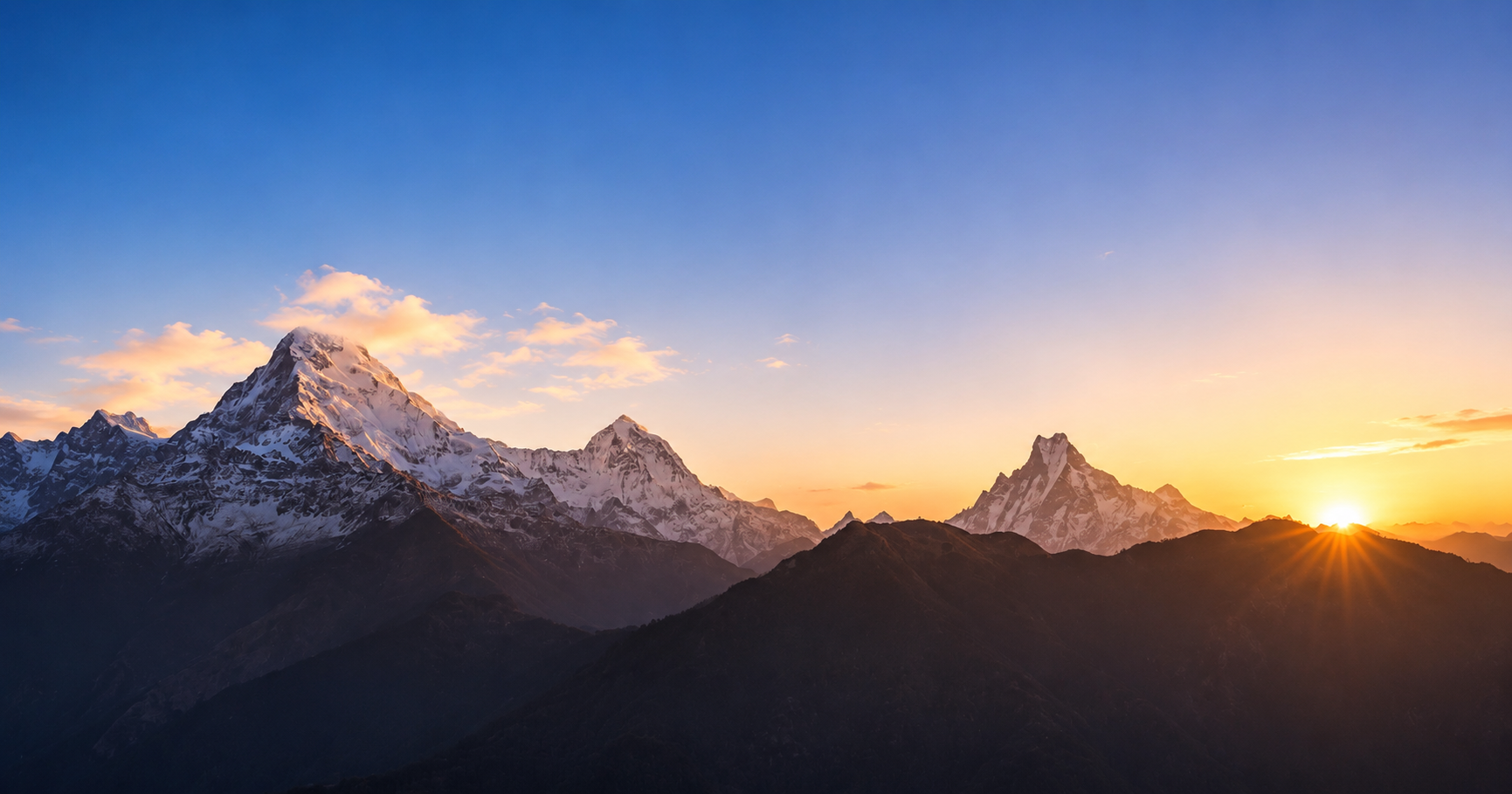
  2. Choose your vehicle type – sedan for Arughat only; 4wd jeep if continuing to Soti Khola.
  3. Provide your travel date and preferred departure time (5:00–5:30 AM recommended)
  4. Give your pickup address or hotel name in Kathmandu
  5. Confirm your destination – Arughat only, or Arughat + Soti Khola
  6. Specify group size, number of trekking packs, and any porter luggage
  7. Request a pre-arranged return vehicle from Besisahar or Dharapani if needed
  8. Receive booking confirmation with driver name, contact number, and vehicle details

WhatsApp: +977 981-4227196

Email:[email protected]

Frequently Asked Questions

How long does it take to drive from Kathmandu to Arughat?

The drive from Kathmandu to Arughat takes approximately 4.5 to 6 hours by private vehicle, including a brief stop at Mugling. Departing at 5:30 AM puts you in Arughat between 10:00 and 11:30 AM.

Can a regular car reach Arughat from Kathmandu?

Yes. A regular sedan or standard car can reach Arughat Bazaar from Kathmandu on the mostly paved road via Mugling and Khairenitar. However, beyond Arughat to Soti Khola, only a 4WD Toyota Land Cruiser or equivalent is suitable.

If your plan includes vehicle transport to Soti Khola, book a Land Cruiser from Kathmandu from the start.

Is there a direct bus from Kathmandu to Arughat?

No direct tourist bus runs from Kathmandu to Arughat. Local buses depart from Gongabu Bus Park in Kathmandu to Gorkha, with a vehicle change in Gorkha or Khairenitar for the final section to Arughat. The total journey by local bus takes 6 to 8 hours, including connections, and is not recommended for trekkers with heavy gear.

Do I need a guide for the Manaslu Circuit?

Yes. The Nepalese government requires a licensed trekking guide to accompany all trekkers on the Manaslu Circuit. The restricted area permit also requires a minimum of two trekkers.

Solo trekking without a guide is not permitted on the Manaslu Circuit. You can arrange a licensed guide through a Kathmandu-based trekking agency, and they will typically meet your group in Kathmandu or at Soti Khola.

What is the ATM situation on the Manaslu Circuit?

The last reliable ATM is in Arughat Bazaar. Beyond Arughat, there are no ATMs until Samagaon, where a limited e-banking kiosk is sometimes operational but unreliable. Withdraw all the cash you will need for the entire circuit in Arughat or, even better, in Kathmandu before departure.

Budget NPR 3,000 to NPR 5,000 per person per day for all circuit expenses.

Can I combine the Manaslu Circuit with the Annapurna Circuit?

Yes. The Manaslu Circuit connects to the Annapurna Circuit at Dharapani. Many experienced trekkers do a combined circuit – finishing the Manaslu at Dharapani and immediately beginning the Annapurna Circuit to the south or north, depending on the direction.

This extended circuit takes 30 to 35 days total. Vehicle Hiring Nepal can arrange transport to the start of your combined circuit and return from the finish.

Nepal Tour Package

Final Thoughts

The road from Kathmandu to Arughat is the beginning of one of Nepal’s greatest trekking adventures – a journey that starts in the busy Himalayan capital and ends in the remote, high-altitude wilderness of the Budhi Gandaki valley, with the great Manaslu massif (8,163 m) rising above the horizon ahead. Getting to Arughat comfortably, on time, and with all permits and gear in order sets the foundation for a successful Manaslu Circuit trek.

Vehicle Hiring Nepal provides reliable, experienced transport for the Kathmandu-Arughat route. Our drivers know every junction and village along this road; our vehicles are well-maintained and suited to the terrain, and our 24/7 WhatsApp support means you are never alone on this remote approach journey.

Book your Kathmandu-to-Arughat transport today. WhatsApp: +977 981-4227196 | E-mail: vehiclehiringnepal@gmail.com
Chat with us