Sunauli to Manang Private Jeep Hire: Annapurna Tour Guide

Sunauli to Manang Private Jeep Hire

Sunauli to Manang Private Jeep Hire — Annapurna Circuit Tour Complete Guide

Manang village at 3,519 metres in the Annapurna Conservation Area is one of Nepal’s most spectacular high-altitude destinations — the celebrated acclimatisation stop on the Annapurna Circuit trek where trekkers rest before crossing the Thorong La Pass (5,416 m), and a destination of extraordinary mountain grandeur with the Annapurna III north face, Gangapurna, and the Chulu peaks surrounding the village’s stone houses and ancient monastery. For Indian travellers and trekkers departing from the Sunauli border crossing, a private jeep hire from Sunauli to Manang is one of Nepal’s most dramatic overland road experiences.

This 2-day journey climbs from the Nepal Terai at the border to the high Annapurna plateau at 3,519 metres.

Nepal Vehicle Hiring Pvt Ltd offers private 4WD jeep hire for the full Sunauli-to-Manang journey from the Nepal border gate through the Prithvi Highway, the Besisahar gorge road, and the dramatic Marsyangdi River corridor, all the way to Manang’s stone-paved lanes at the foot of the Annapurna massif. This complete guide covers the route leg by leg, transfer costs, road conditions, required permits, and how to book the full overland journey.
Sunauli to Manang Private Jeep Hire

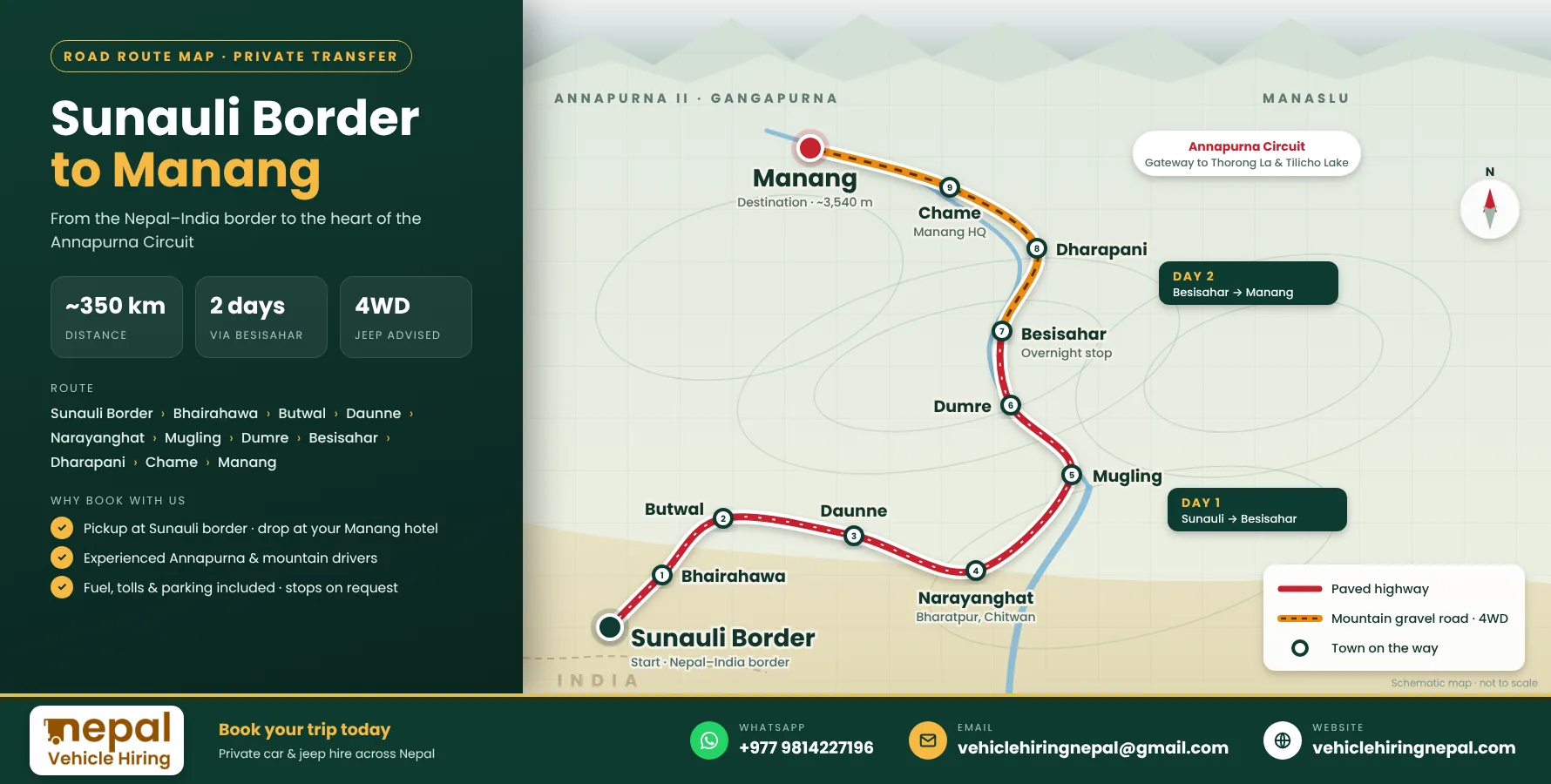
The Complete Route — Sunauli to Manang

Leg 1: Sunauli border crossing (30-90 minutes). Indian nationals cross at Sunauli/Bhairahawa without a visa under the India-Nepal Open Border Treaty. A valid Indian photo ID is required. Nepal Vehicle Hiring Pvt Ltd’s driver meets the group at the Nepal gate immediately after immigration.

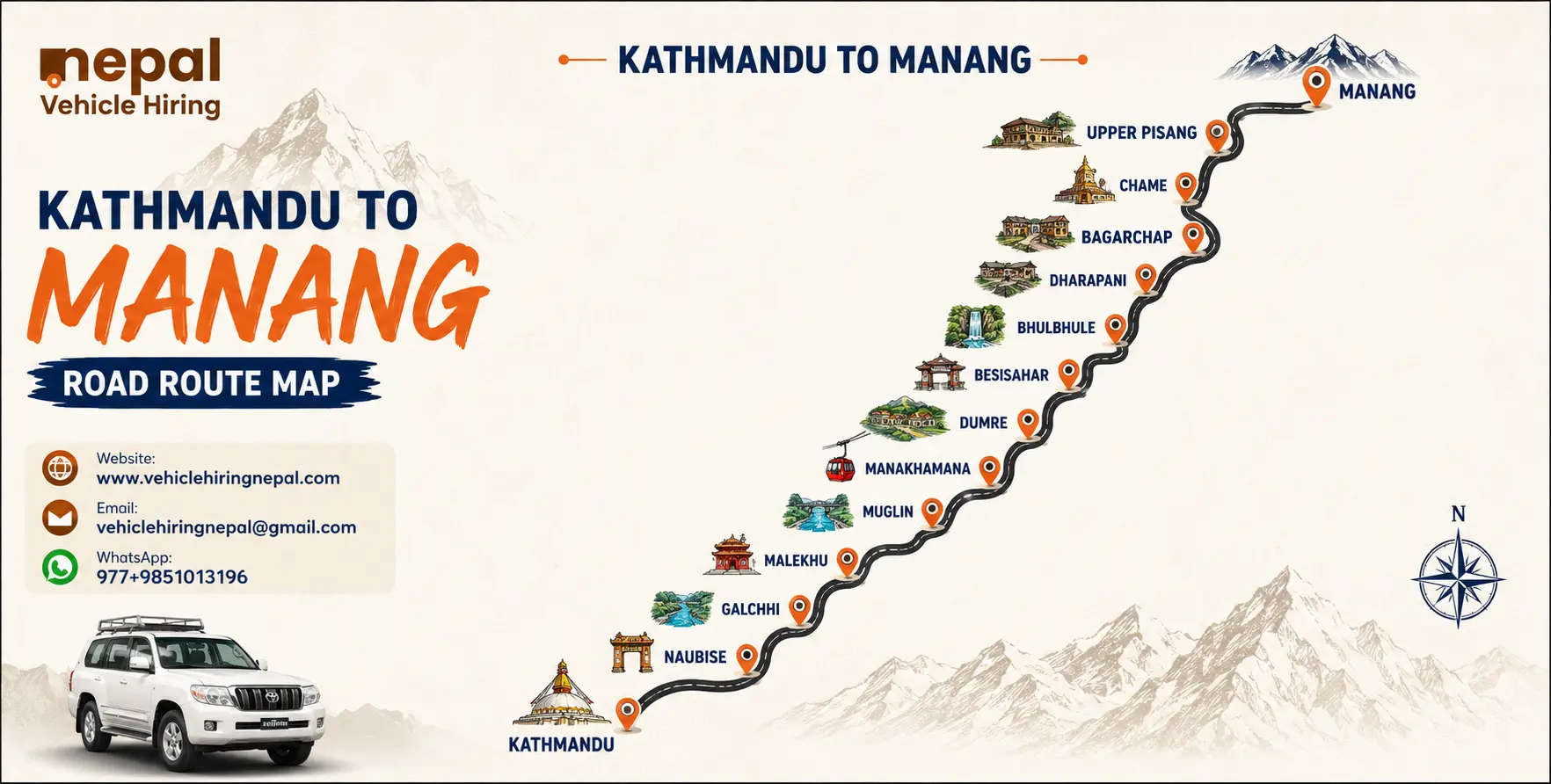
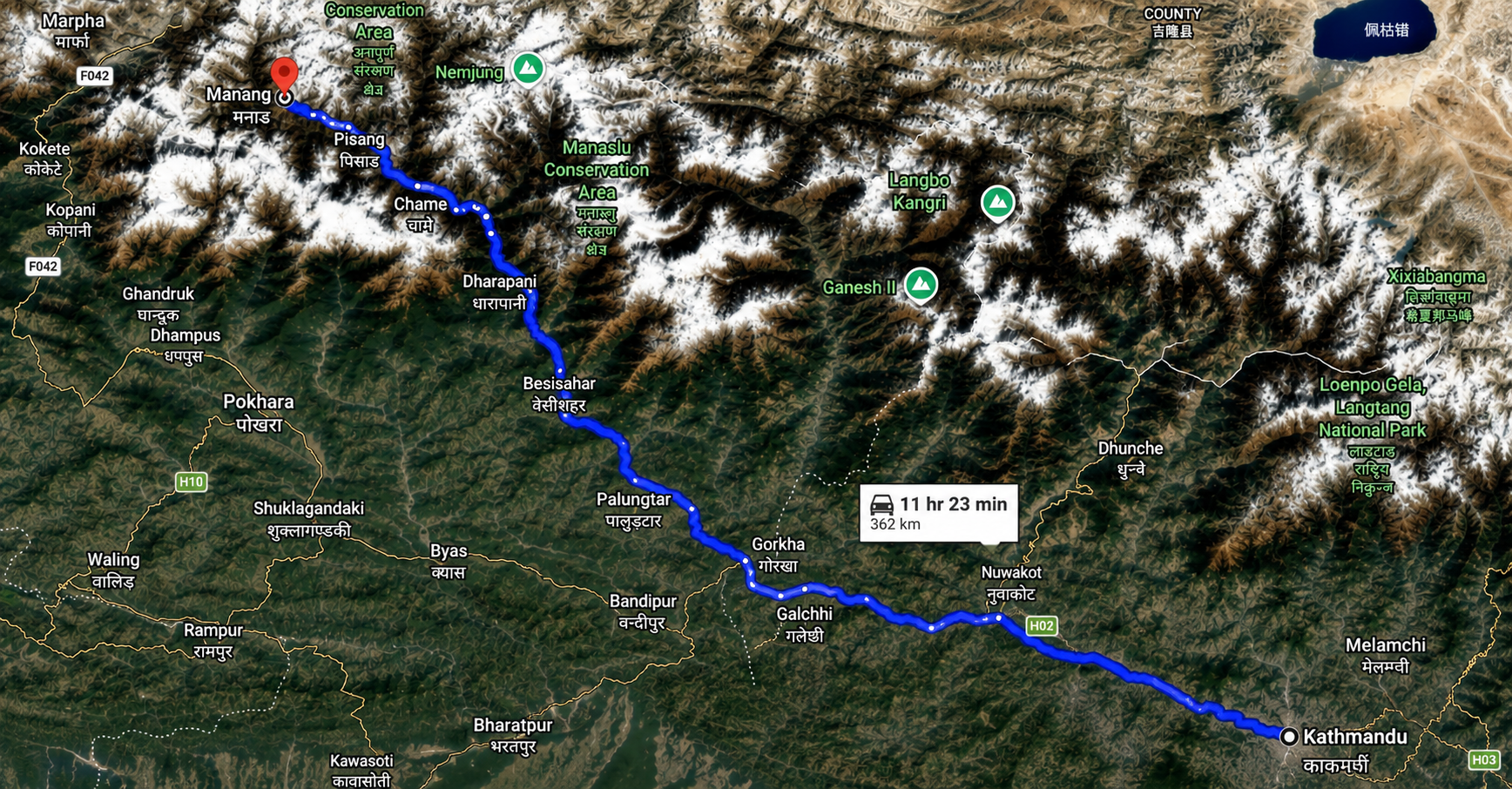
Leg 2: Sunauli to Besisahar (approximately 230 km, 5-7 hours, Day 1). From the Sunauli border, the road follows the Mahendra Highway eastward briefly before joining the Prithvi Highway at Butwal and heading north through Narayanghat, Mugling, and the Trishuli gorge section to the Dumre junction. From Dumre, the road branches northeast toward Besisahar — the start of the Annapurna Circuit gorge road.

Nepal Vehicle Hiring Pvt Ltd provides private car or 4WD jeep hire for this leg.

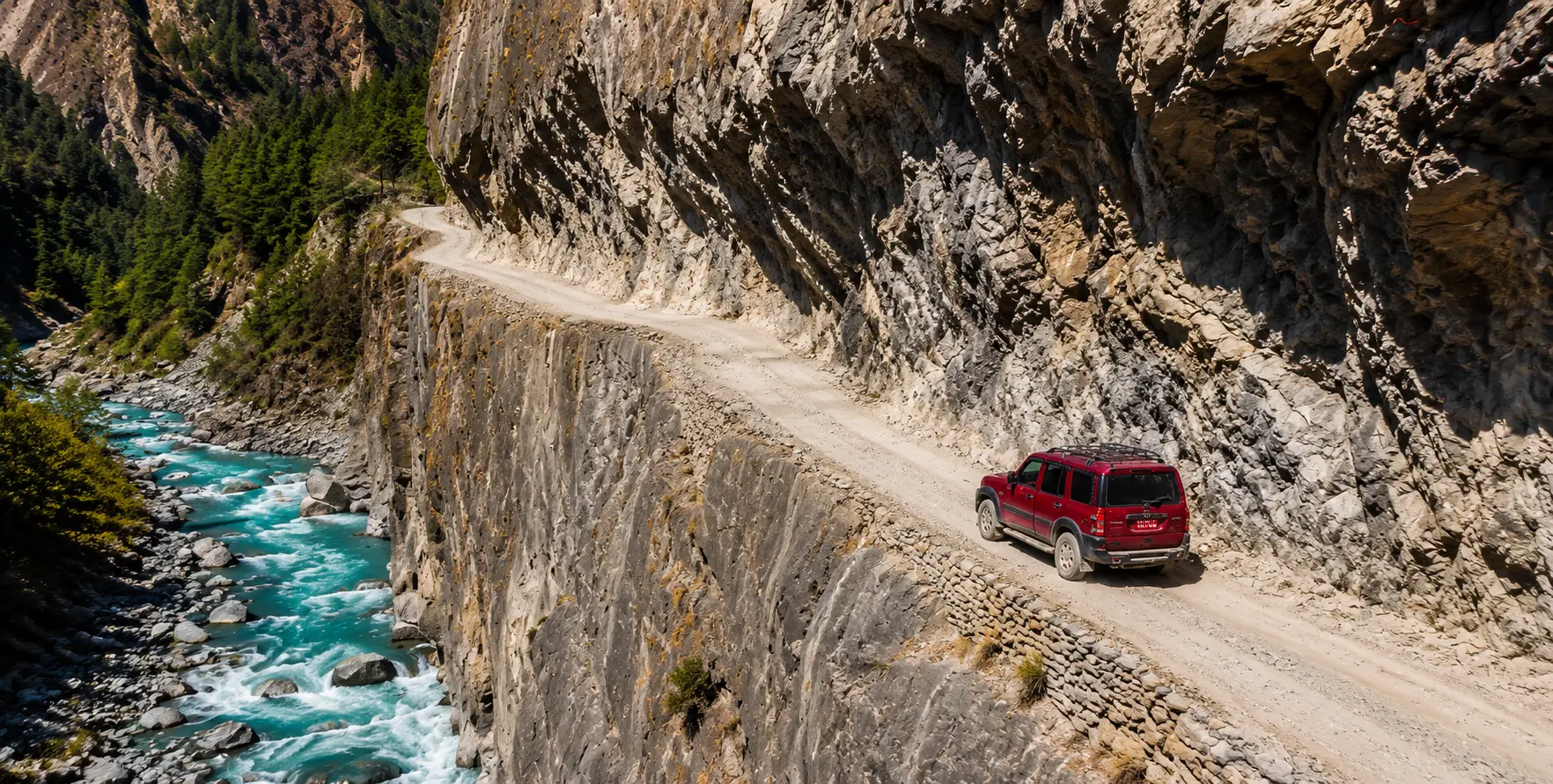
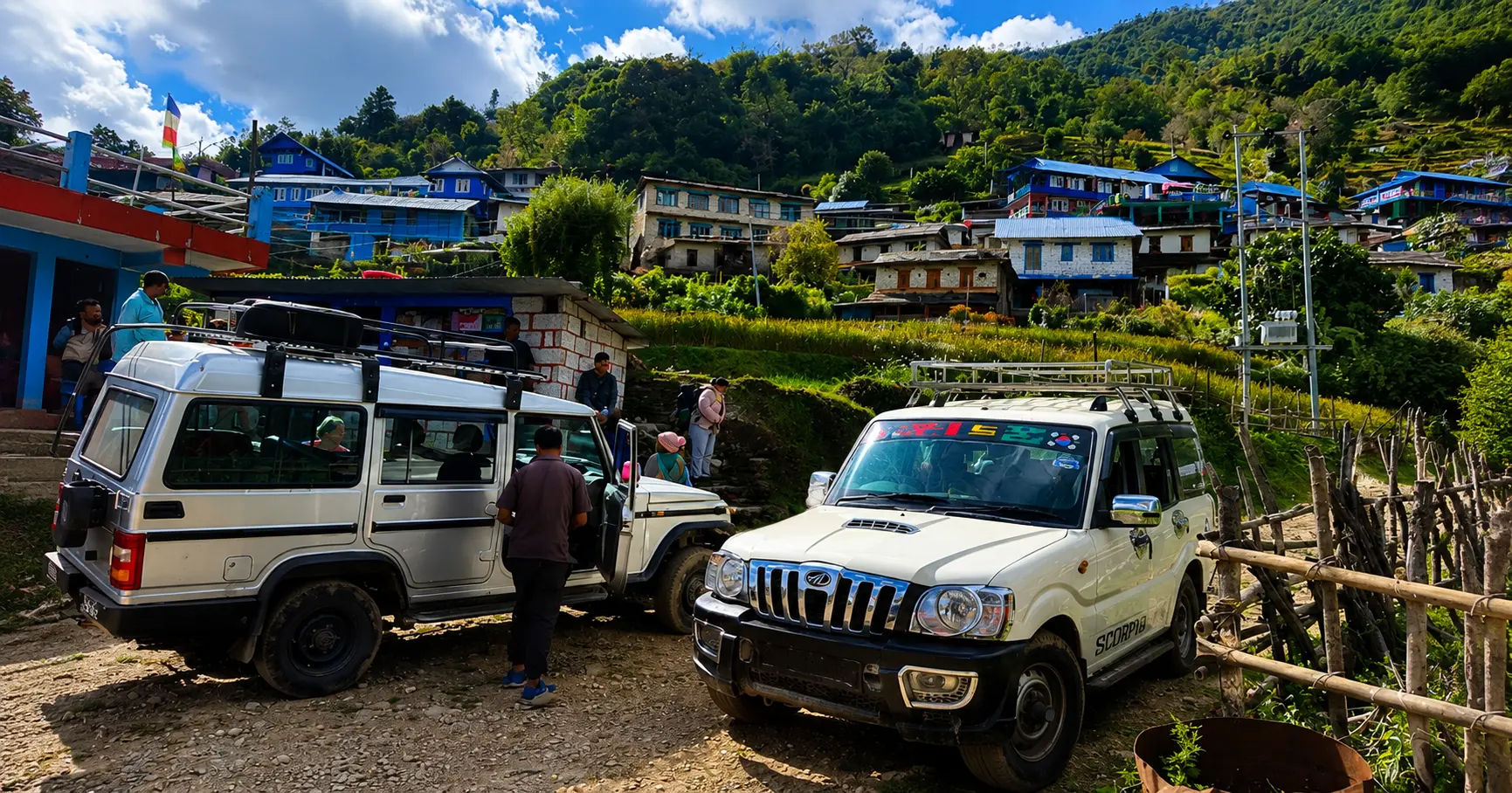
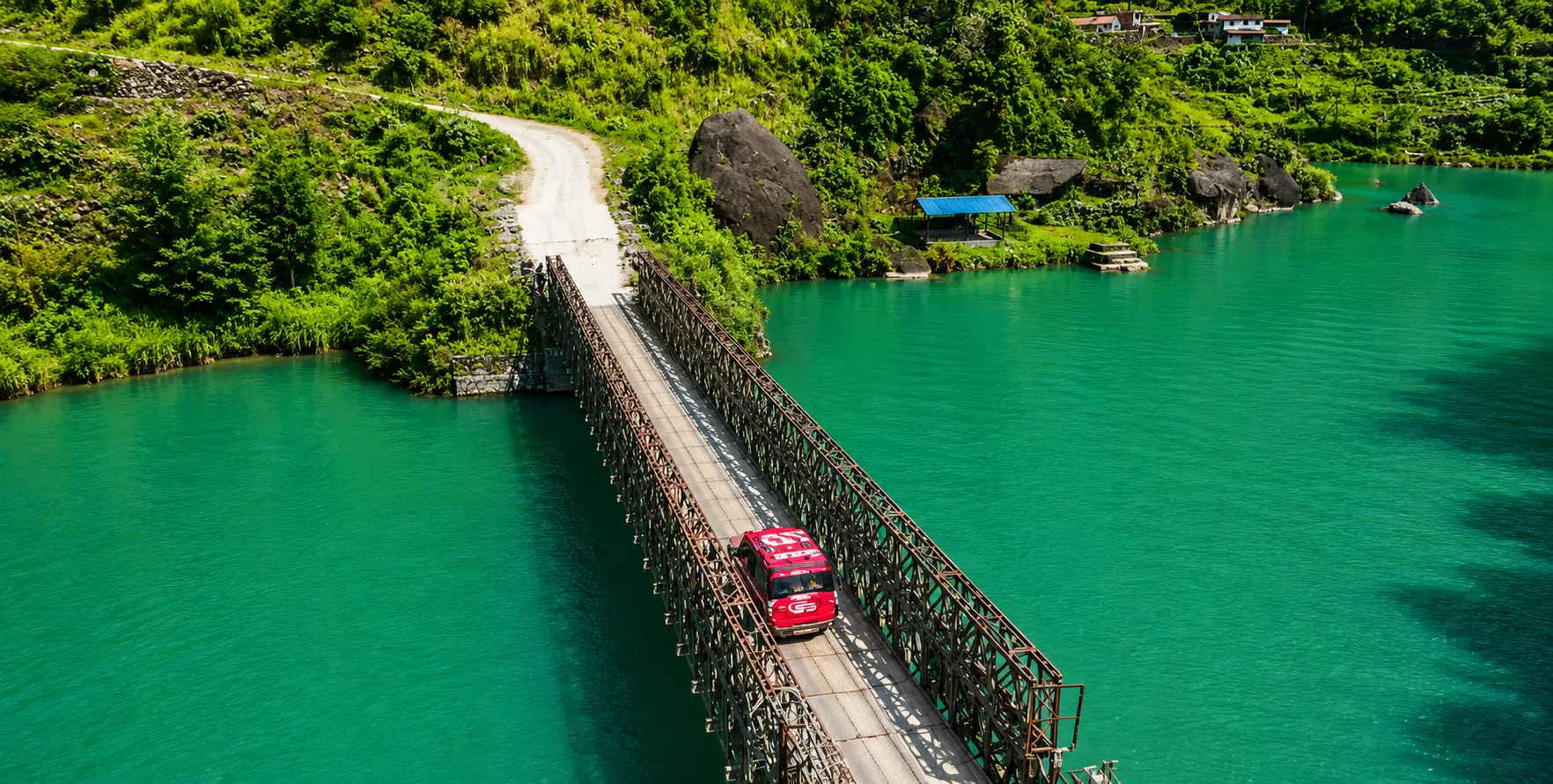
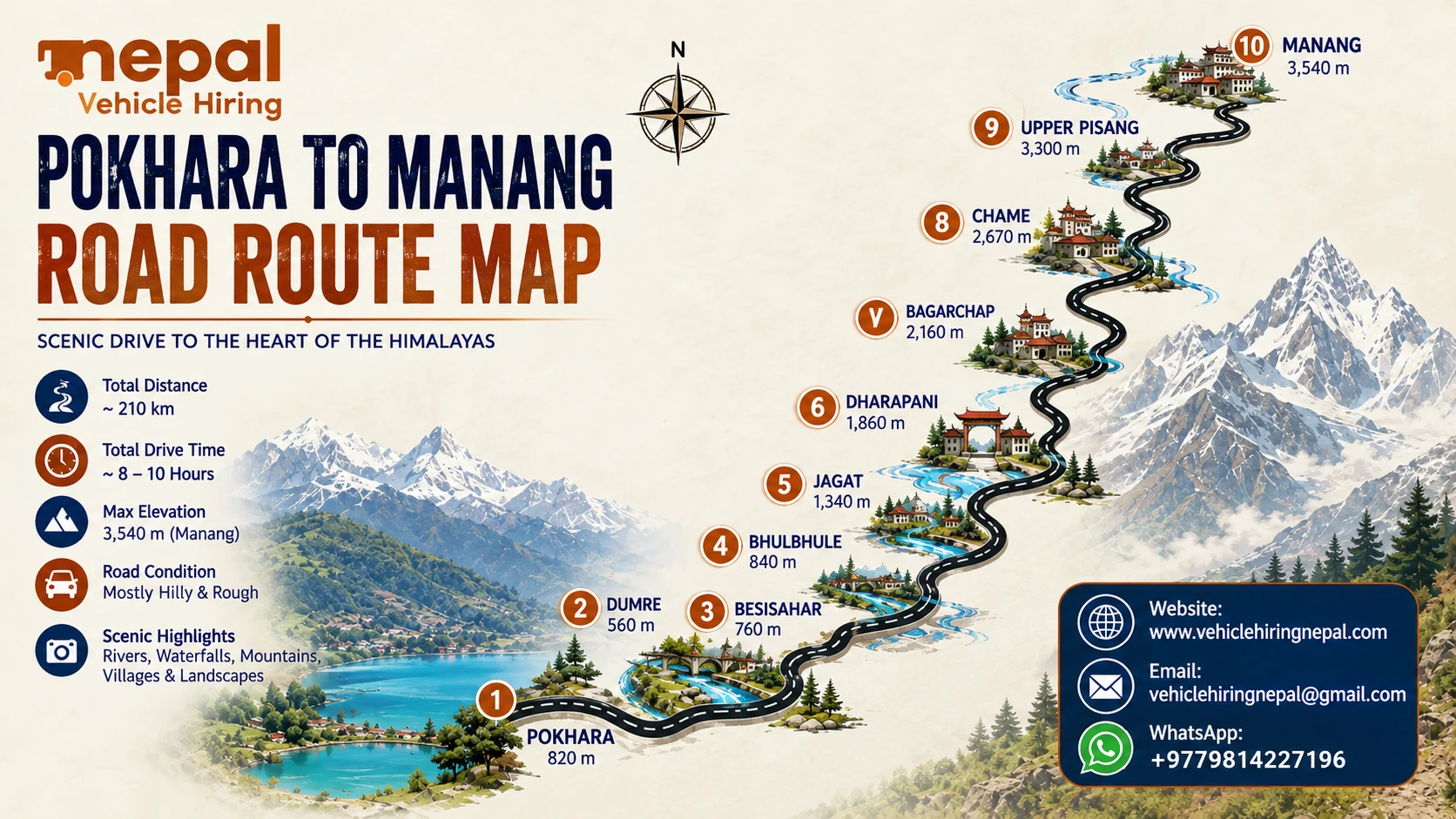
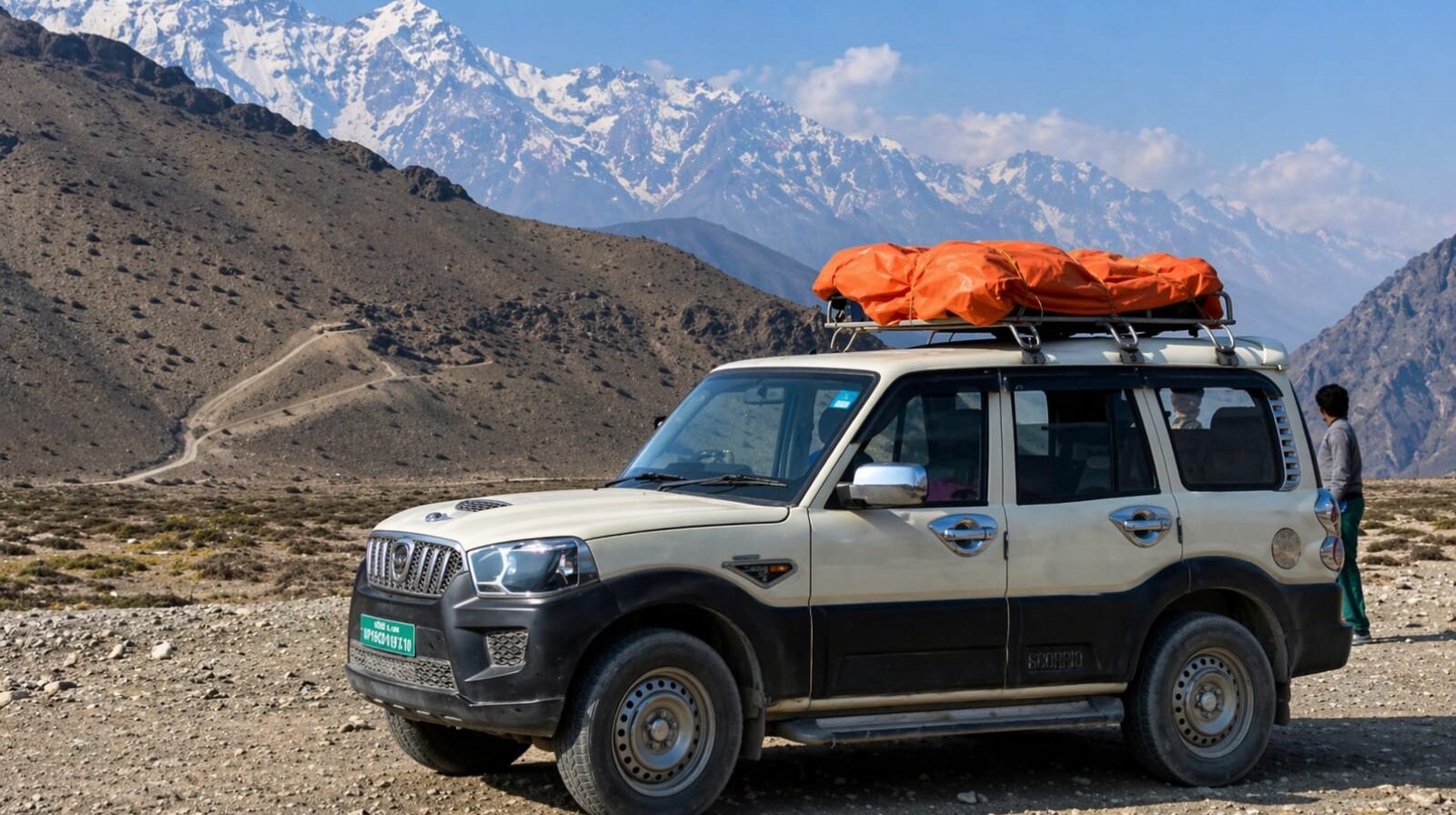
Leg 3: Besisahar to Manang (approximately 130-150 km, 5-8 hours, Day 2). The Besisahar to Manang 4WD jeep hire follows the Marsyangdi River gorge road northward through Ngadi, Jagat, Chamje, Tal, Dharapani, Chame, and Pisang to Manang at 3,519 metres. This is one of Nepal’s most dramatic mountain road sections — a 4WD Scorpio or Hilux jeep-only route with rough unpaved sections, river gorge exposure, and sustained altitude gain from Besisahar’s 760 metres to Manang’s 3,519 metres.

Total: 2 travel days. Total Nepal-side distance from Sunauli: approximately 370-400 km.

The Sunauli to Manang Journey — Why Private Jeep is the Right Choice

A combination can theoretically make the Sunauli-to-Manang overland journey of public buses, shared jeeps, and local transport — but the specific combination of distance, road character, altitude gain, and schedule requirements makes the private 4WD jeep hire from Nepal Vehicle Hiring Pvt Ltd not merely more comfortable but functionally superior for trekking groups with expedition luggage.

Public transport from Sunauli to Besisahar requires: a local bus or shared jeep from the border to Butwal, another connection to Narayanghat or Mugling, a third vehicle to Dumre, and finally the Besisahar shared jeep from the Dumre junction. Each connection involves waiting, handling luggage at a crowded junction, and the uncertainty of timing that turns a 6- to 8-hour private-vehicle journey into a 10- to 14-hour ordeal with luggage.

The Besisahar-to-Manang gorge road section has limited shared jeep frequency, and vehicles are typically overcrowded with local passengers and their goods; the expedition luggage of a trekking group creates friction from bags in aisles, competition for roof-rack space, and the stress of ensuring all equipment arrives at the destination.

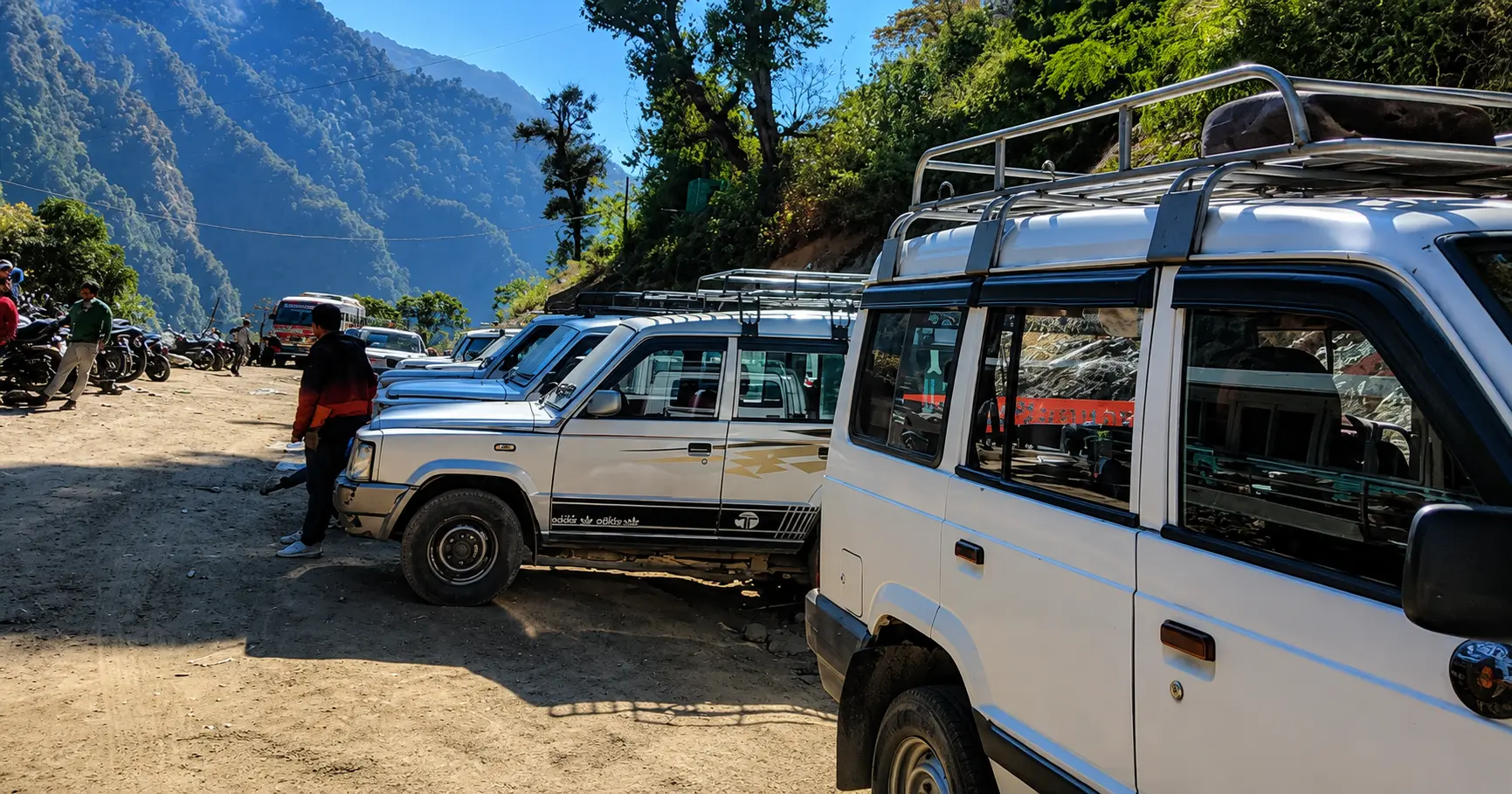
The private 4WD jeep hire eliminates all of this: hotel-door pickup from Sunauli guesthouse or the order gate, a continuous journey to Besisahar with only planned rest stops, and the vehicle’s interior available for the group’s exclusive use throughout the Day 1 journey. On Day 2, the Besisahar to Manang 4WD jeep departs at the group’s chosen time, stops at Jagat for the ACAP permit check without the shared vehicle’s schedule pressure, allows photography stops at the gorge’s finest viewpoints, and arrives at Manang when the journey is complete rather than when the last seat on the shared transport was filled.

For a trekking group beginning a major Annapurna Circuit expedition, arriving at Manang rested rather than exhausted by transport logistics is not a luxury — it is the appropriate foundation for the demanding days ahead. Book through our plan trip page or WhatsApp.

Transfer Cost — Sunauli to Manang

Sunauli to Besisahar (Day 1, approximately 230 km): Private 4WD jeep hire: NPR 16,000-35000 (USD 120-235) all-inclusive. Private car hire (for groups of 2-4 on the Sunauli-to-Dumre highway section): NPR 12,000-18,000. The highway from Sunauli to Dumre is paved and manageable by sedan; the Dumre-to-Besisahar section has mountain road character and benefits from 4WD.

Besisahar to Manang (Day 2, approximately 130-150 km): Private 4WD Scorpio or Hilux jeep exclusively: NPR 18,000-35,000 (USD 135-250) all-inclusive. The rough Marsyangdi gorge road makes this leg the highest per-km cost of the journey.

Combined Sunauli to Manang (2 days, full vehicle): NPR 34,000-75,000 (USD 255-450) for the complete 2-day private jeep hire. All-inclusive — driver, fuel, road tolls, overnight driver accommodation.

Return jeep: Manang to Sunauli or Manang to Pokhara (post-trek): Pre-arranged at outward booking. Manang-to-Jomsom (for Mustang circuit) or Manang-to-Besisahar-to-Pokhara return both available. Contact Nepal Vehicle Hiring Pvt Ltd on WhatsApp.
Sunauli to Manang Private Jeep Hire

The Prithvi Highway — Sunauli to Dumre

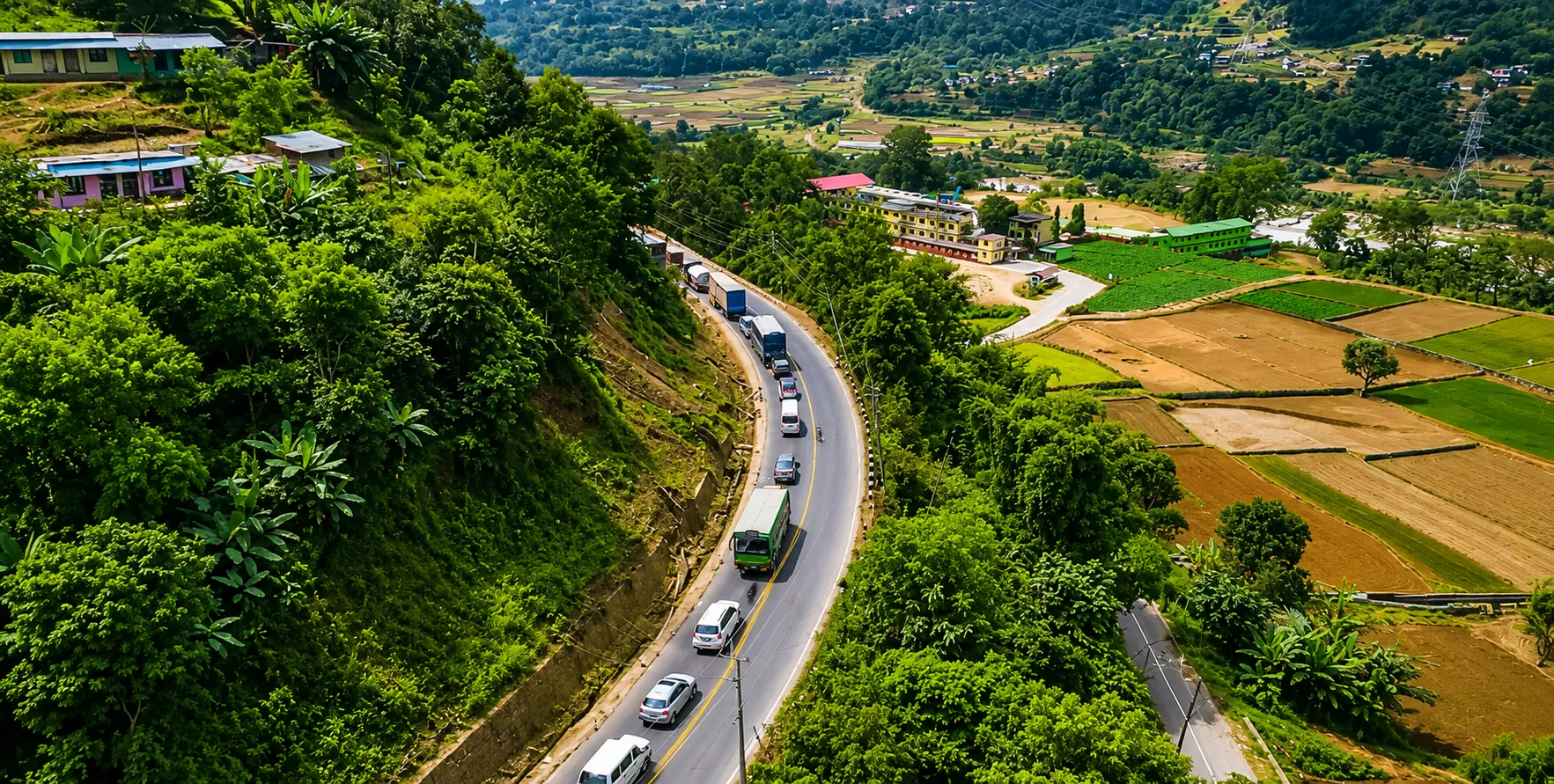
The first major Nepal highway section of the Sunauli-to-Manang journey follows the Prithvi Highway — Nepal’s finest national road — from the Terai plains through the mid-hills to the Dumre junction where the Besisahar branch road begins. This section covers approximately 185 to 200 kilometres and passes through Nepal’s most famous highway landmarks.

Butwal (20 km from Sunauli). The first significant Nepal town after the border — a Terai highway junction city where the Mahendra Highway meets the Prithvi Highway heading north. Butwal’s bazaar is the last major urban stop before the road enters the mid-hills. Fuel stations and basic provisions are available.

Narayanghat (100 km from Sunauli). The Chitwan District commercial hub at the Prithvi Highway’s northward turn — the junction point for the Chitwan National Park side-trip that Indian wildlife enthusiasts sometimes add to the Sunauli-to-Manang journey. Narayanghat is a well-equipped city with good restaurants and fuel.

Mugling (150 km from Sunauli). The famous riverside restaurant stop at the Trishuli-Marsyangdi confluence is Nepal’s most celebrated roadside dining spot for freshwater fish curry, which has made Mugling a destination in its own right. Nepal Vehicle Hiring Pvt Ltd’s drivers build a 4-5 to 60-minute Mugling lunch stop into the Day 1 journey timing on the Sunauli-to-Besisahar route.

Dumre junction (185-200 km from Sunauli). The point where the Prithvi Highway continues west toward Pokhara and the Besisahar branch road turns northeast — the Annapurna Circuit’s highway approach. From Dumre, the road to Besisahar (42 km) climbs through increasingly mountainous terrain and offers the first views of the Annapurna range’s outer ridgelines.
Sunauli to Manang Private Jeep Hire
Stay updated on Annapurna Circuit road conditions with the latest route information, road status, travel time, and private 4WD jeep hire options for Besisahar, Chame, Manang, and Muktinath.

The Marsyangdi Gorge Road — Besisahar to Manang

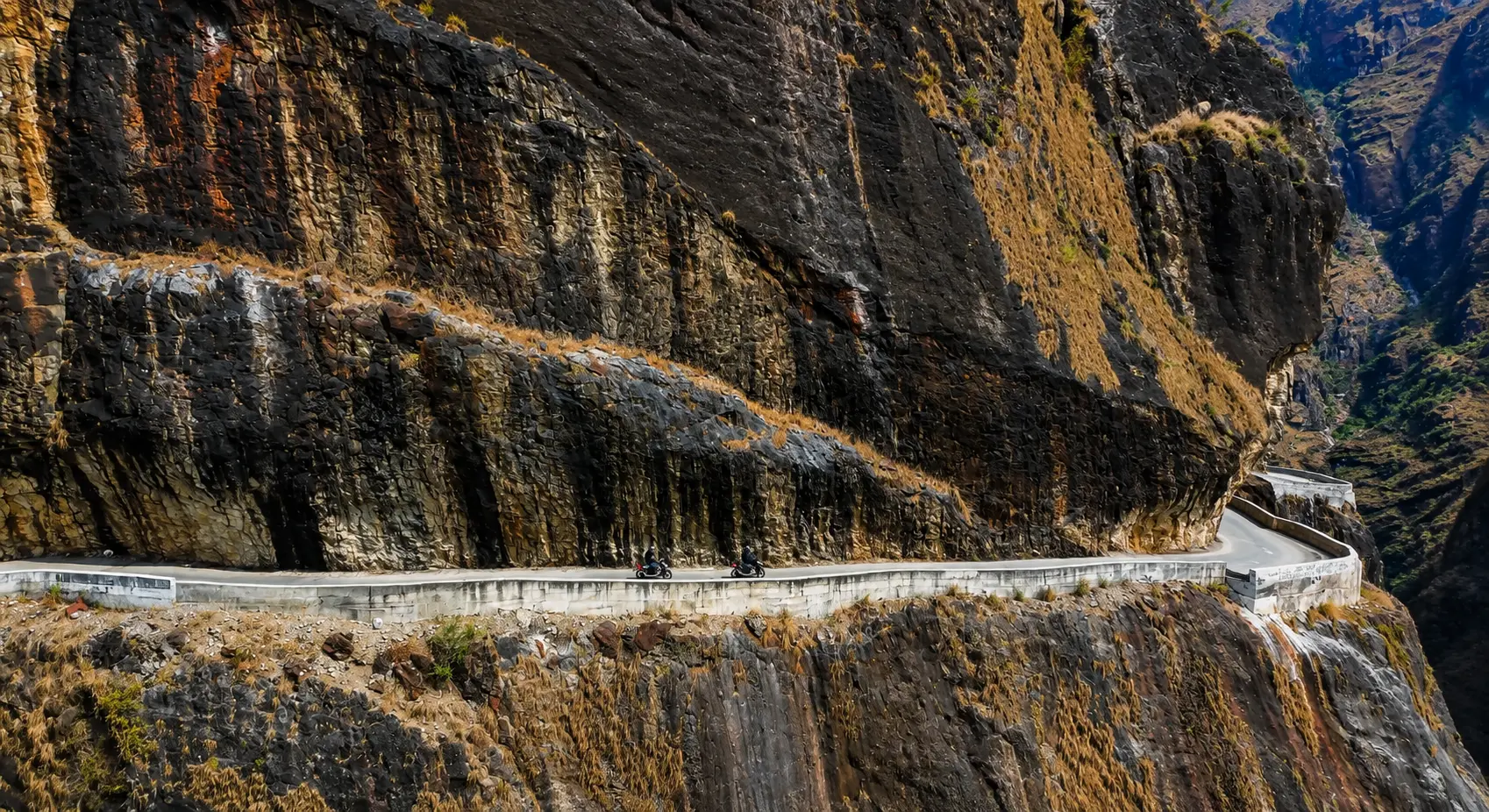
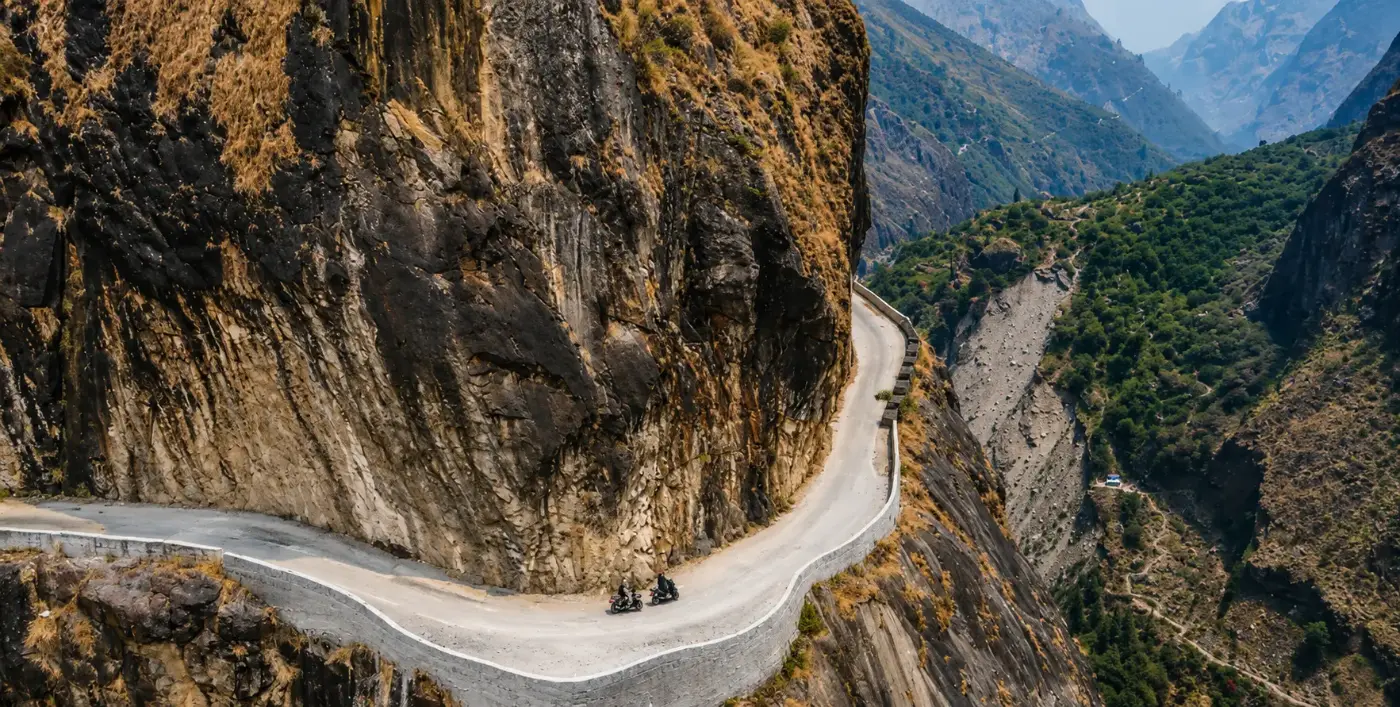
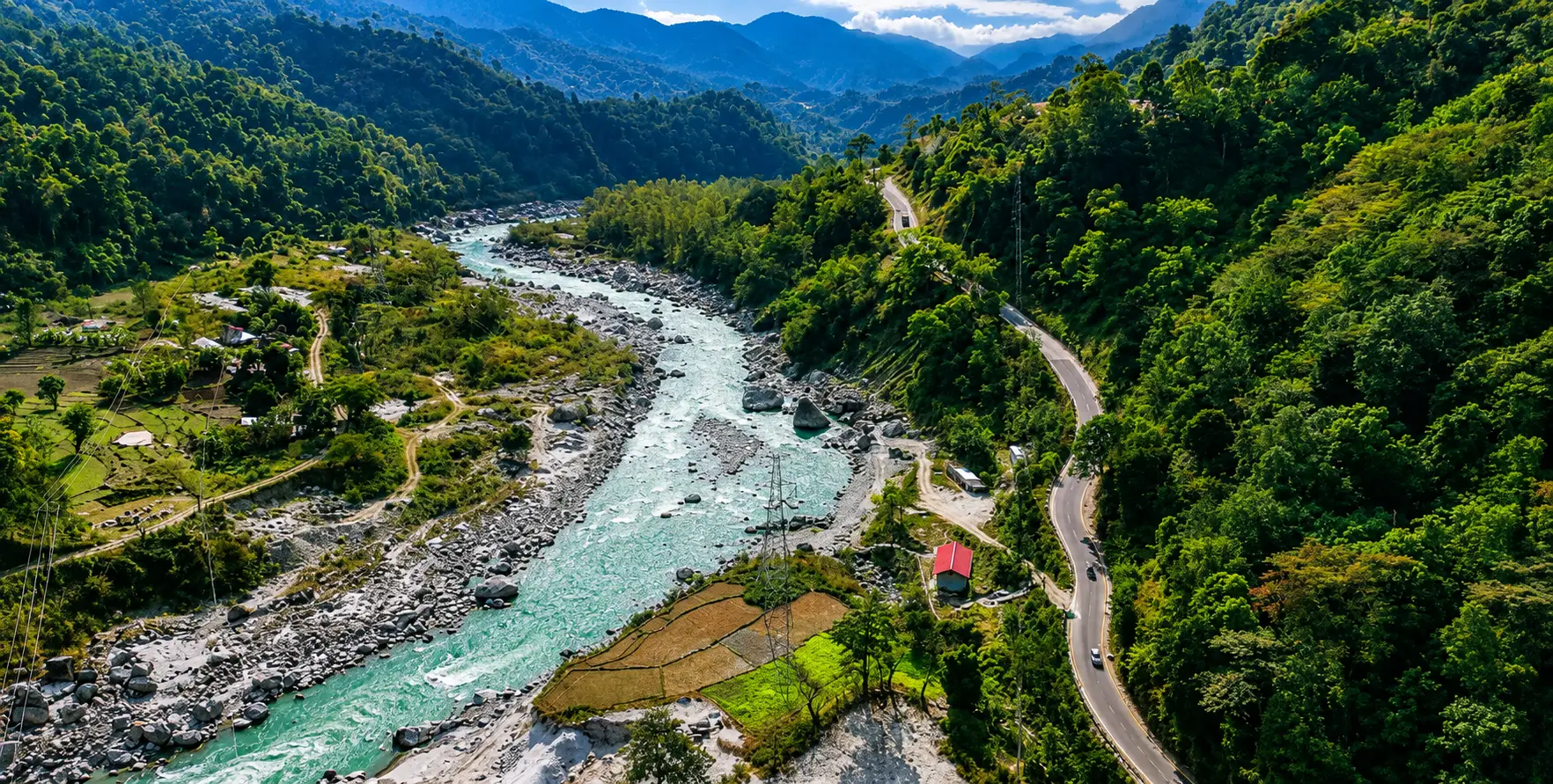
The Besisahar to Manang 4WD jeep road along the Marsyangdi River gorge is one of Nepal’s most dramatic mountain road experiences — a sustained 5 to 8-hour drive through one of the Himalaya’s most extraordinary gorge environments, ascending from 760 metres at Besisahar to 3,519 metres at Manang through a sequence of landscapes that changes character completely every 30 kilometres of altitude gain.

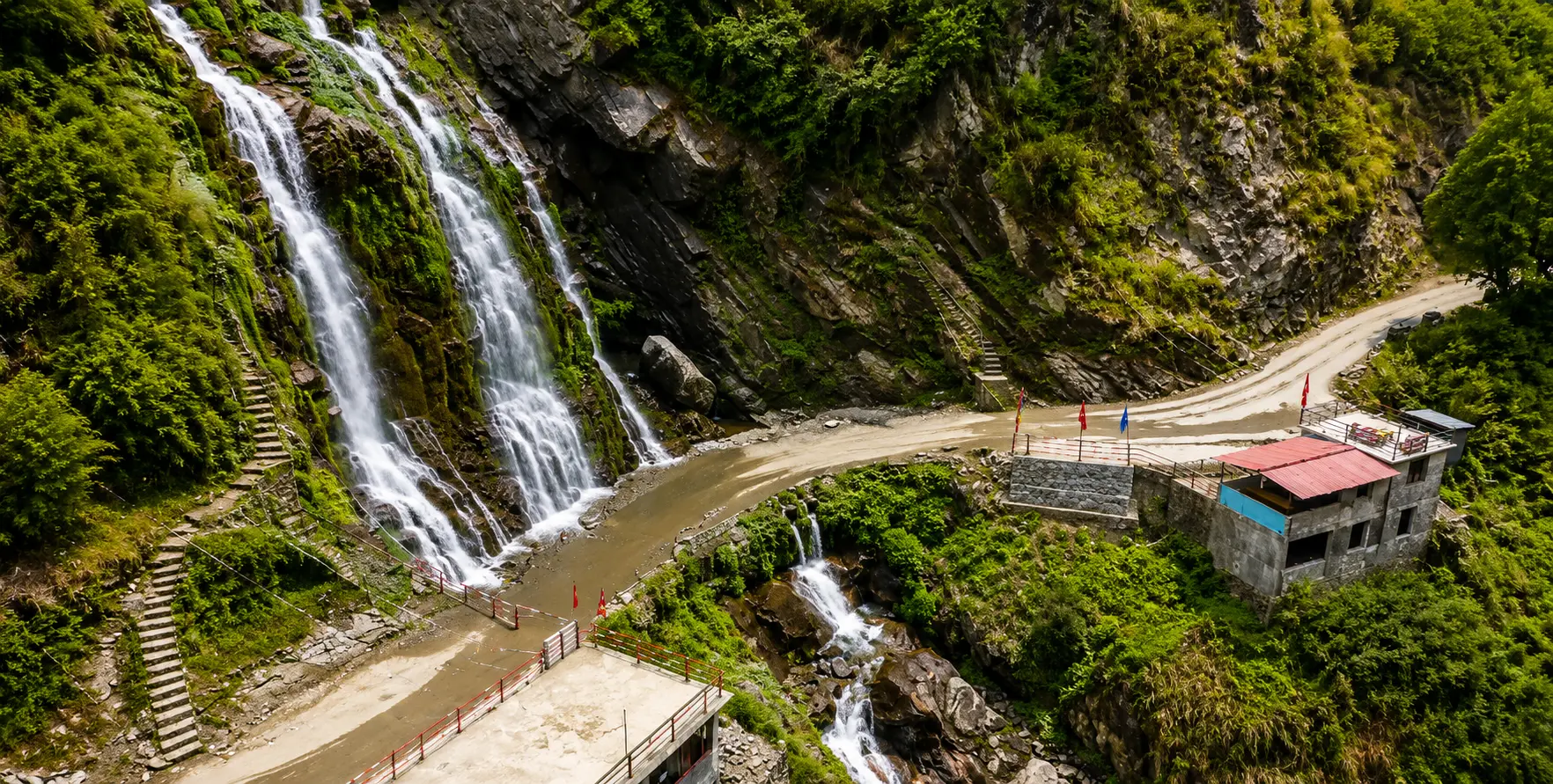
Besisahar to Jagat (48 km, 2-3 hours). The lower gorge section from Besisahar north through Ngadi, Bahundanda, and Syange to Jagat follows the Marsyangdi River closely — the river visible in the gorge below the road, with the first significant waterfalls appearing on the opposite gorge wall above Syange. The road surface alternates between rough paved sections and unpaved river-adjacent track.

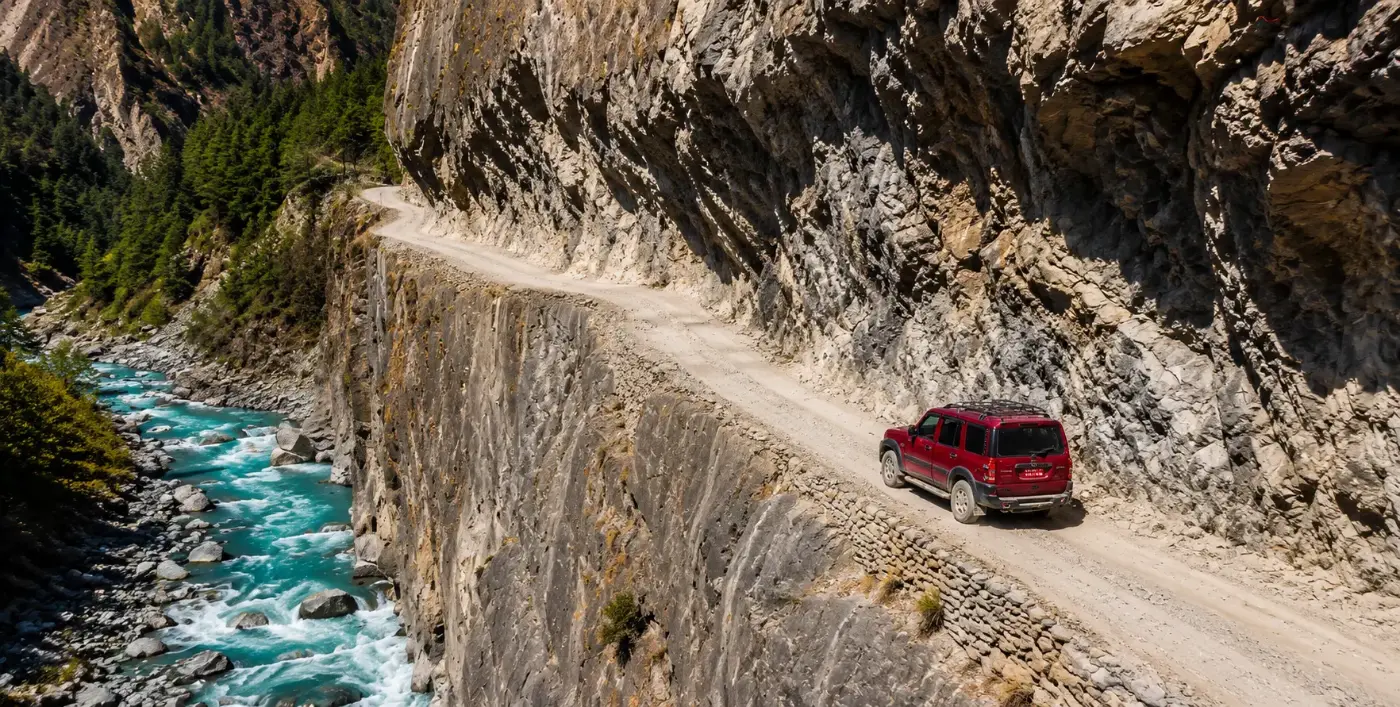
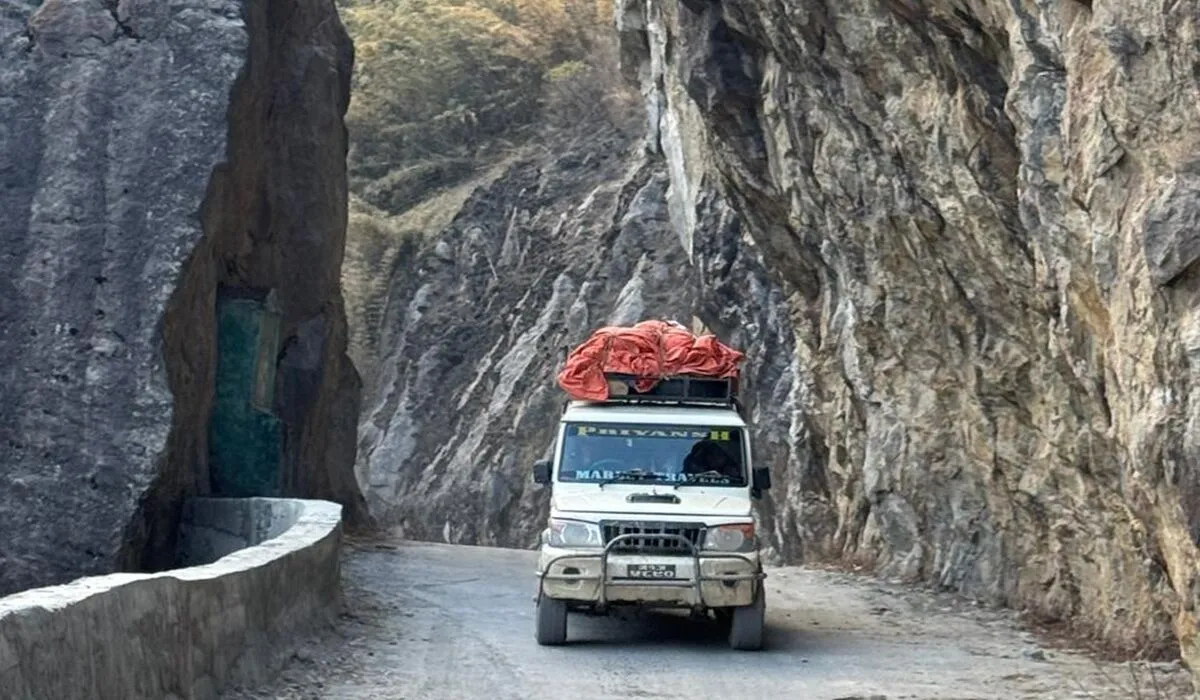
The 4WD jeep navigates the narrow cliff sections with a specific driving technique and confidence that sedans can’t match.

Jagat to Tal (20 km, 1-1.5 hours). The Jagat checkpoint (where ACAP permits and TIMS cards are verified for all trekkers) sits at the entrance to the most dramatic gorge section — the narrow canyon between Jagat and Chamje where the road cuts into the cliff face above the river. The village of Tal, at 1,700 metres in a flat glacial valley floor surrounded by massive cliff walls, is one of the Annapurna Circuit’s most visually extraordinary rest stops.

Tal to Dharapani (25 km, 1.5-2 hours). The road climbs from Tal’s flat valley through the Timang area to Dharapani at 1,860 metres — the junction point where the Manaslu Circuit trail meets the Annapurna Circuit route. Dharapani marks the transition from the lower gorge’s subtropical character to the drier, more open upper Marsyangdi valley.

Dharapani to Chame (18 km, 1-1.5 hours). Chame (2,710 m) is the district headquarters of Manang District — a small town with accommodation, a bank, and the last significant population centre before Manang. The road from Dharapani to Chame passes through the Marsyangdi valley’s most dramatic mountain view — Annapurna II (7,937 m) and Lamjung Himal visible above the north wall.

Chame to Manang via Pisang (42 km, 1.5-2.5 hours). The final section from Chame to Manang passes through the Annapurna Conservation Area’s finest upper valley landscape — the extraordinary Paungda Danda rock face above Chame, the Pisang village at 3,300 m with its high and low route options, the broadening of the Marsyangdi valley into the upper plateau, and the first full sight of the Annapurna III-Gangapurna-Tilicho wall that surrounds Manang. Arriving in Manang after this sustained mountain road journey is one of the most rewarding vehicle arrivals in Nepal.
Sunauli to Manang Private Jeep Hire

Why 4WD Is Mandatory for the Besisahar-Manang Section

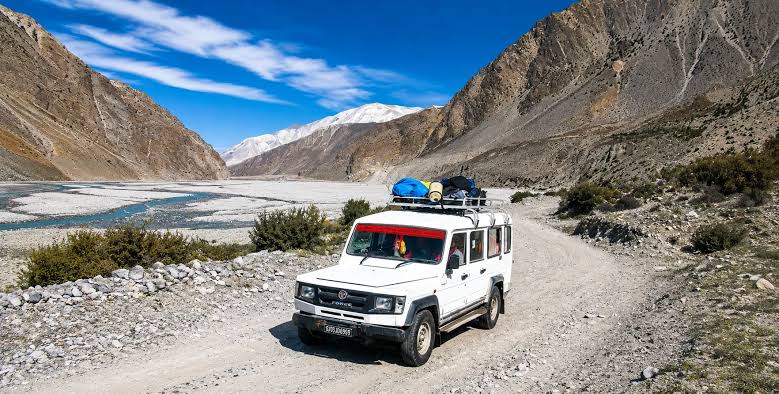
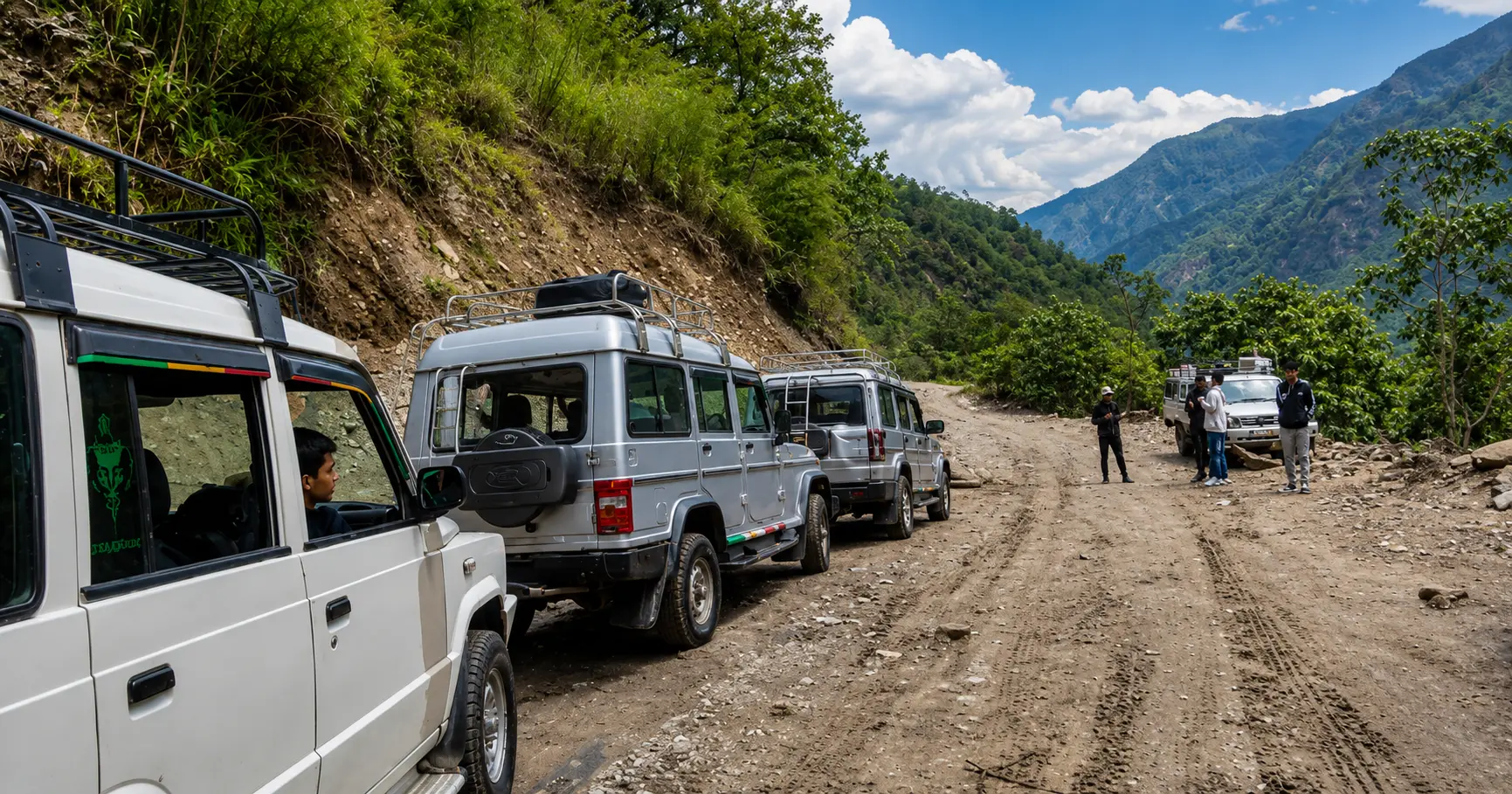
The road from Besisahar to Manang is among Nepal’s most technically demanding vehicle routes: a mix of unpaved track, narrow cliff sections, river-side gravel road and sustained steep gradients that makes a 4WD Scorpio or Hilux jeep hire not merely preferable, but the only appropriate vehicle choice for a loaded passenger group.

Specifically: the road sections between Syange and Jagat where the gorge narrows to almost road-width and the track surface is loose gravel above a significant drop; the Bagarchhap-to-Dharapani section where the road crosses several side streams whose wet crossing surfaces require 4WD traction; the altitude gain from Besisahar’s 760 m to Manang’s 3,519 m — a 2,759-metre altitude gain in 130 km that creates the sustained uphill gradient requiring low-range power for a fully-loaded vehicle; and the river crossings on the approach to Chame where the road surface is water-affected and 4WD engagement prevents wheel spin on the wet gravel. Nepal Vehicle Hiring Pvt Ltd uses 4WD jeeps exclusively on the Besisahar-to-Manang route and does not permit sedan vehicles on this section.

Permits Required — Sunauli to Manang

ACAP Permit (Annapurna Conservation Area Permit). Required for all travelers entering the Annapurna Conservation Area. Fee: USD 30 per person for foreign nationals, NPR 200 for SAARC nationals. Obtainable at the Nepal Tourism Board in Kathmandu, the ACAP office in Besisahar, or the ACAP counter in Pokhara.

The permit is checked at the Jagat checkpoint — the vehicle cannot proceed beyond Jagat without ACAP permits for all passengers.

TIMS Card (Trekkers Information Management System). Required for all trekkers. Fee: USD 10-20. Obtainable at the Tourism Board or TAAN in Kathmandu.

For Indian nationals: Indian nationals receive SAARC-rate ACAP permits. All permits can be obtained at the ACAP office in Besisahar on Day 2 morning before the gorge road continues — making the Besisahar overnight a natural permit acquisition stop if permits were not obtained in Kathmandu.

NOTE: ACAP permits must be obtained before the jeep passes the Jagat checkpoint. The checkpoint verifies permits for every vehicle passenger. Groups without valid permits are turned back at Jagat.
Sunauli to Manang Private Jeep Hire

Manang — The High Altitude Destination

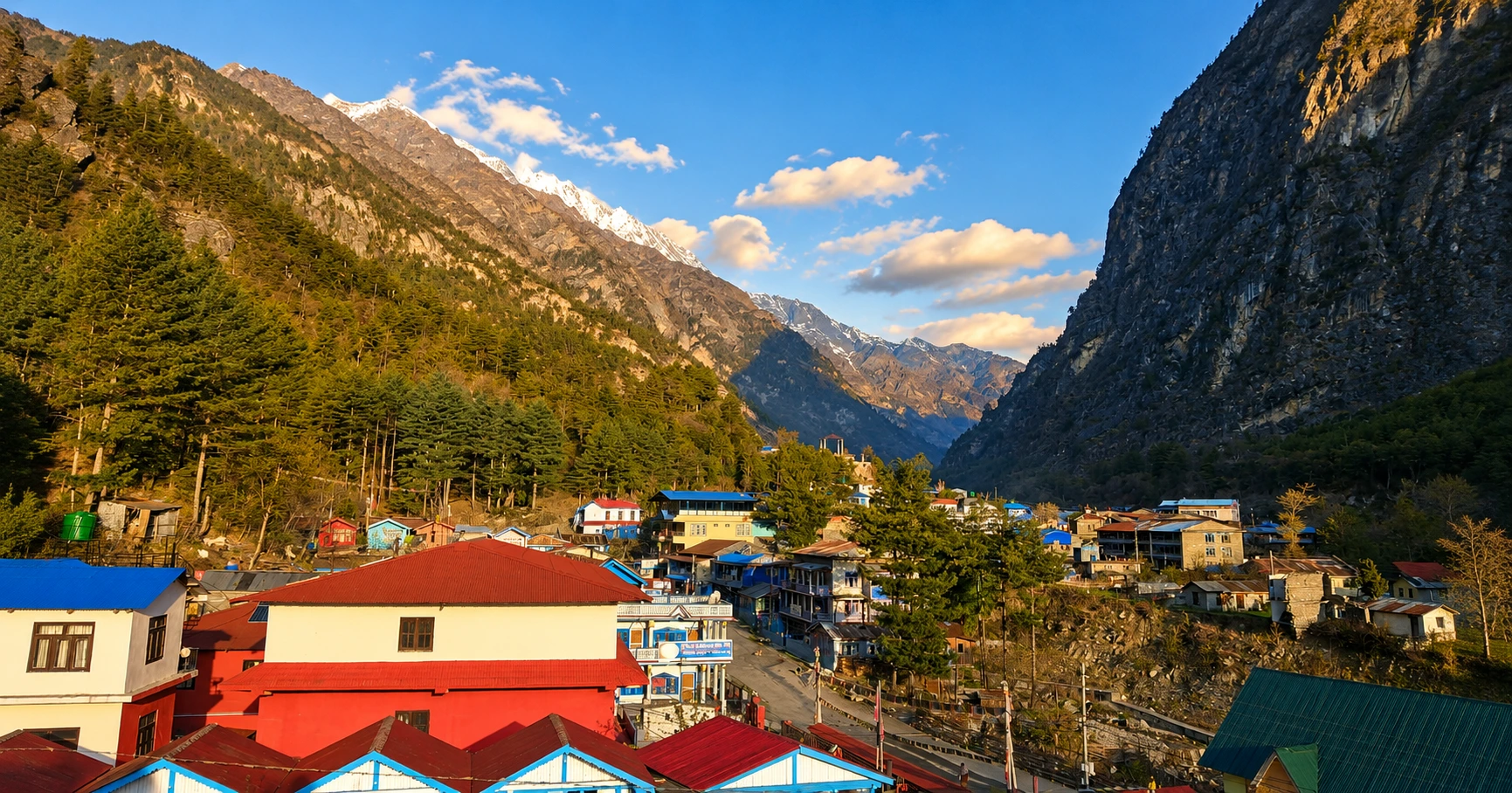
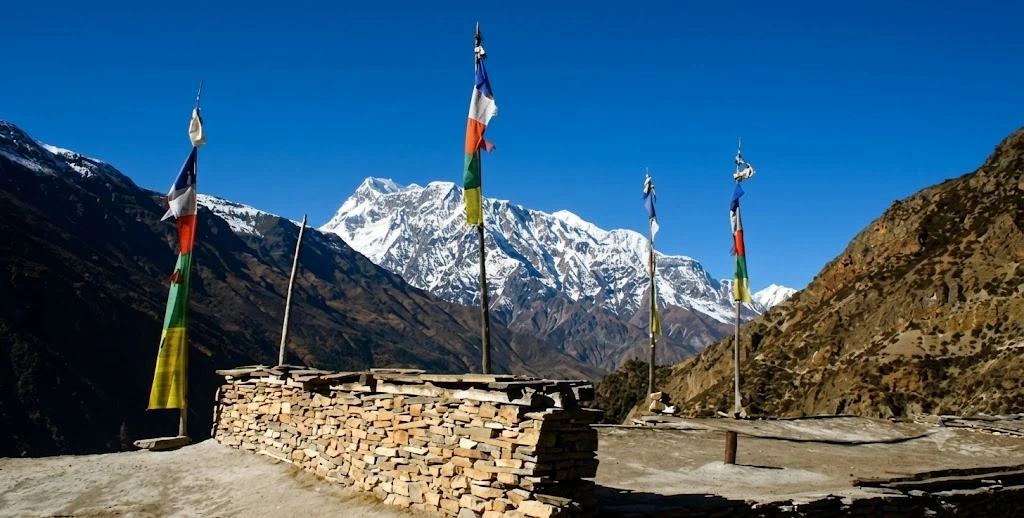
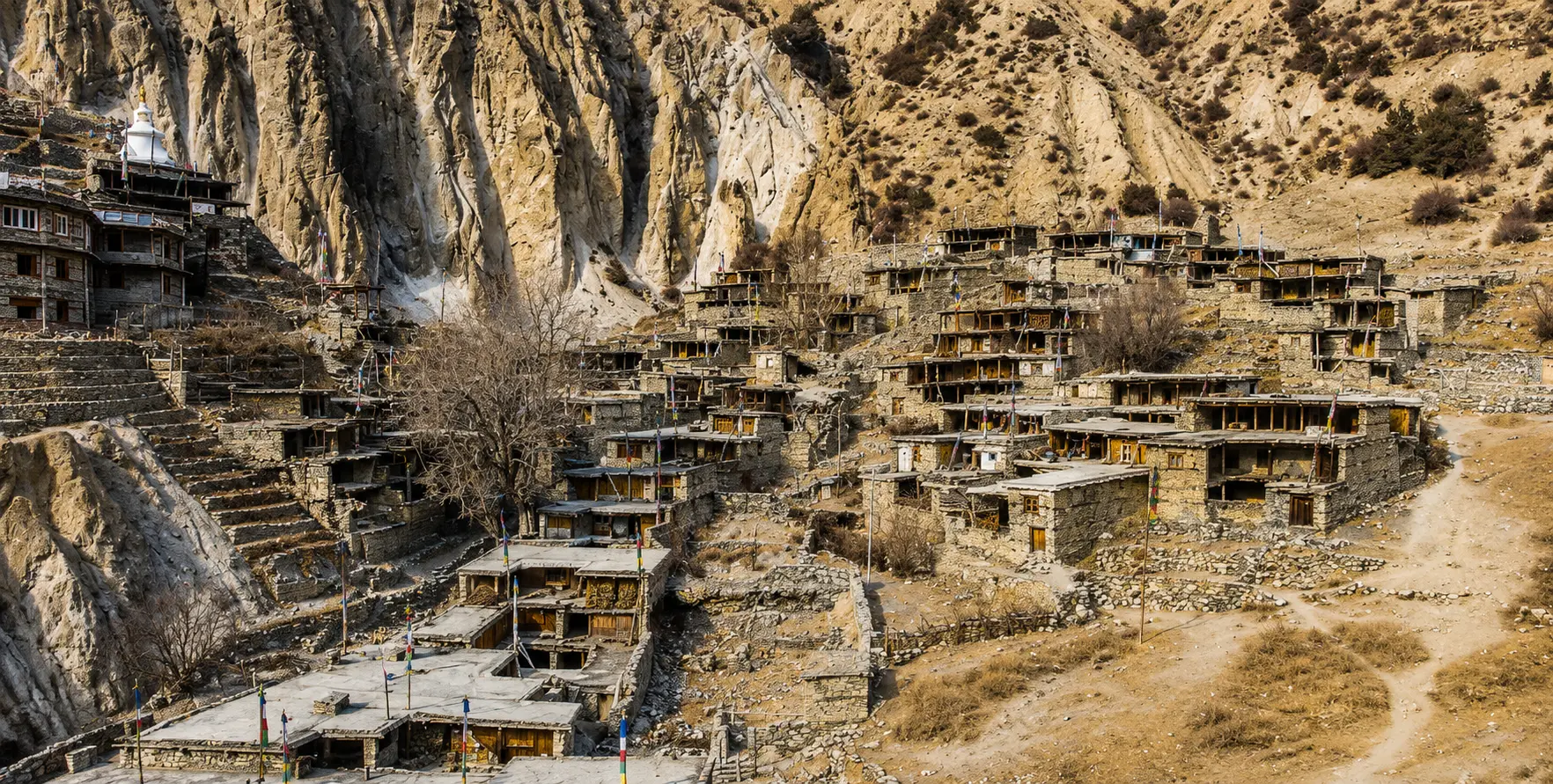
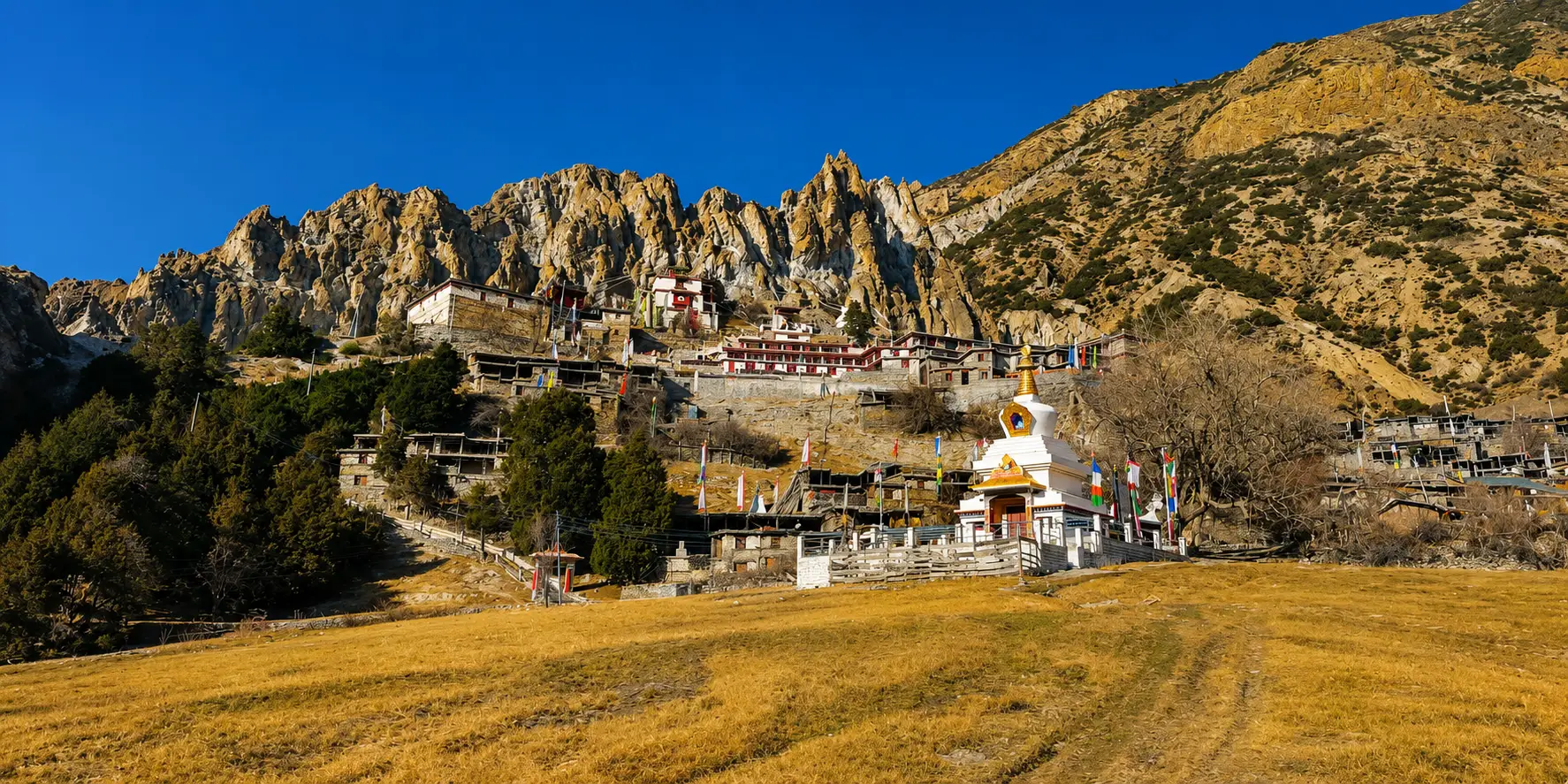
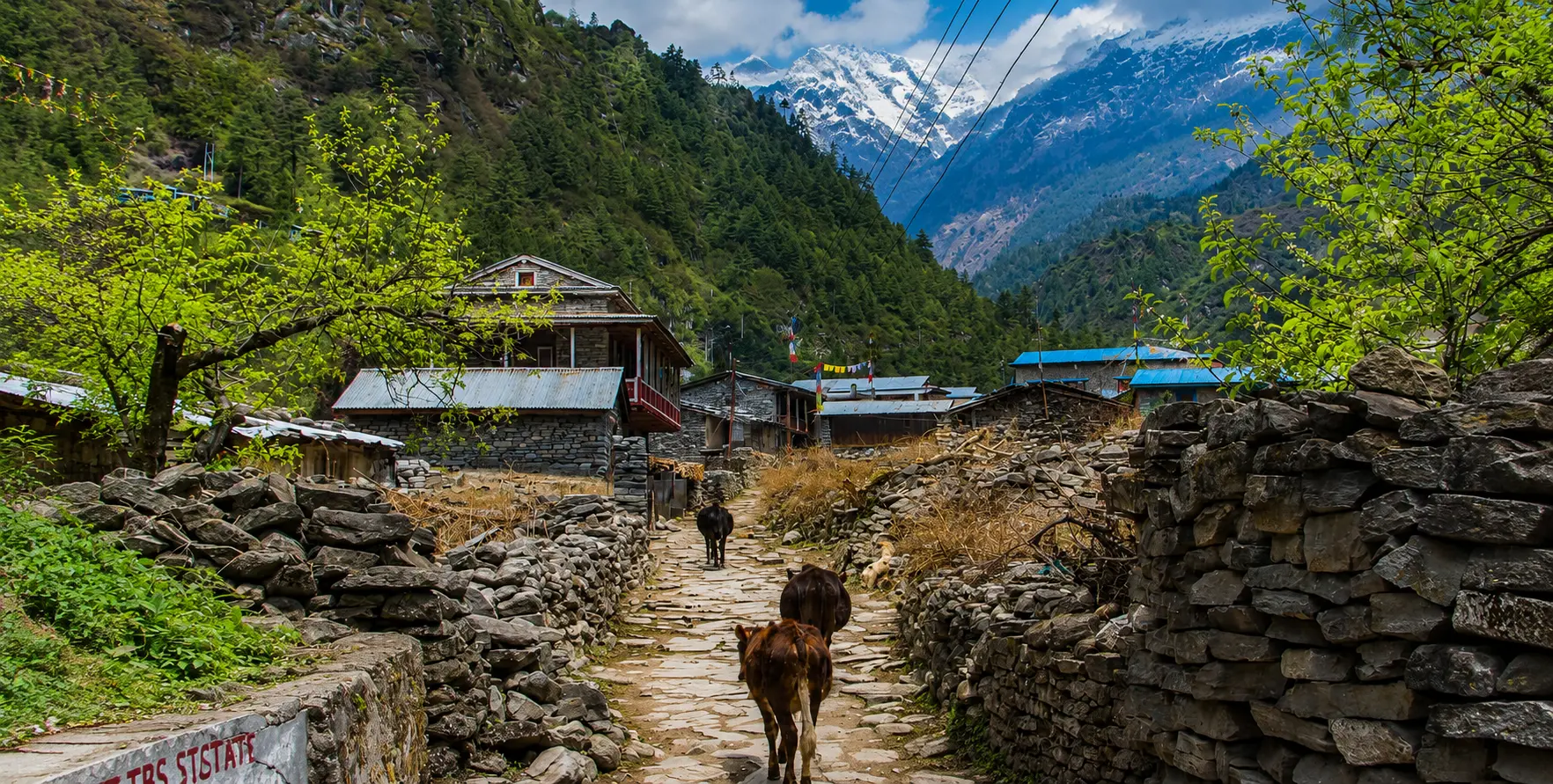
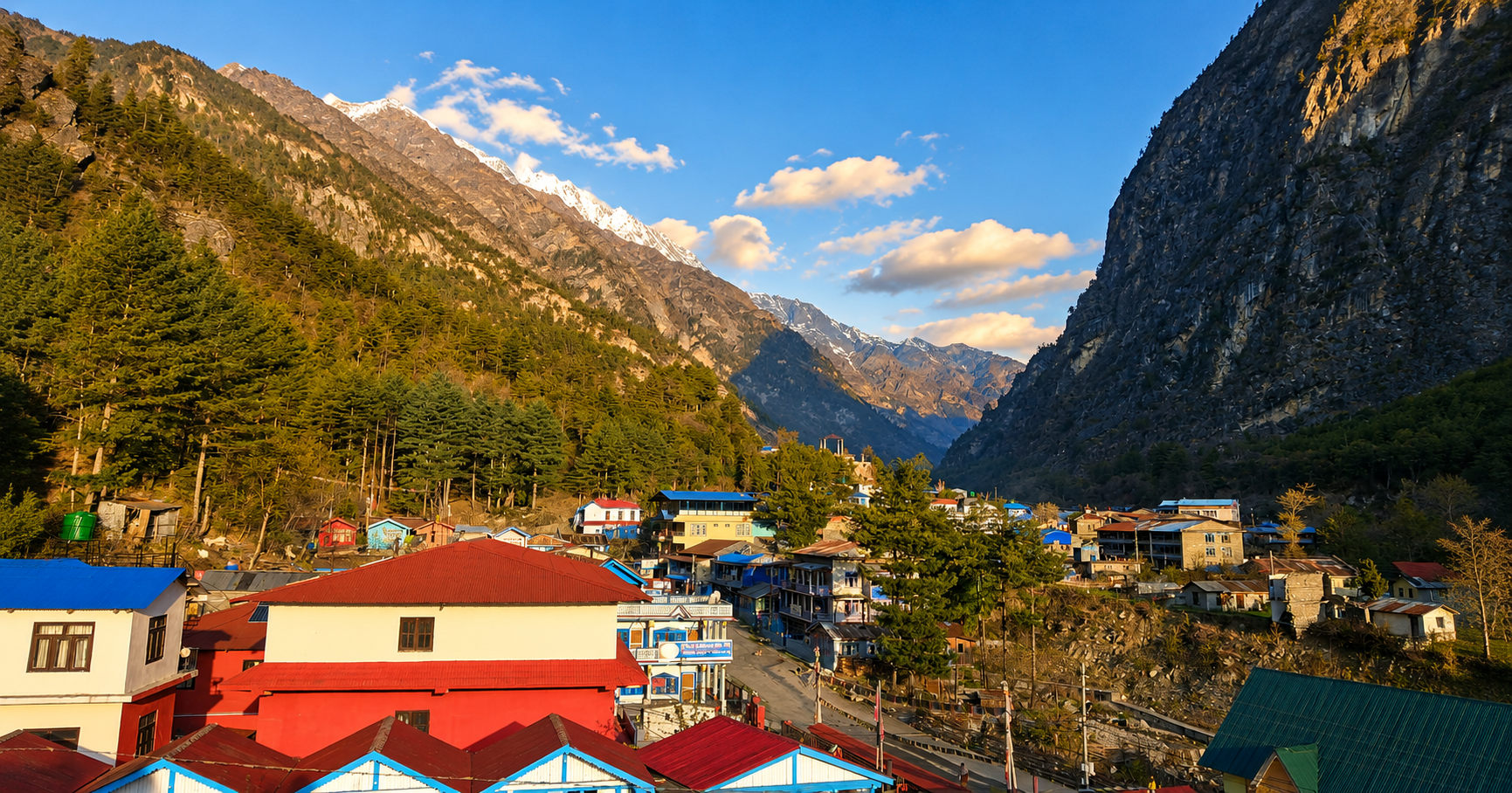
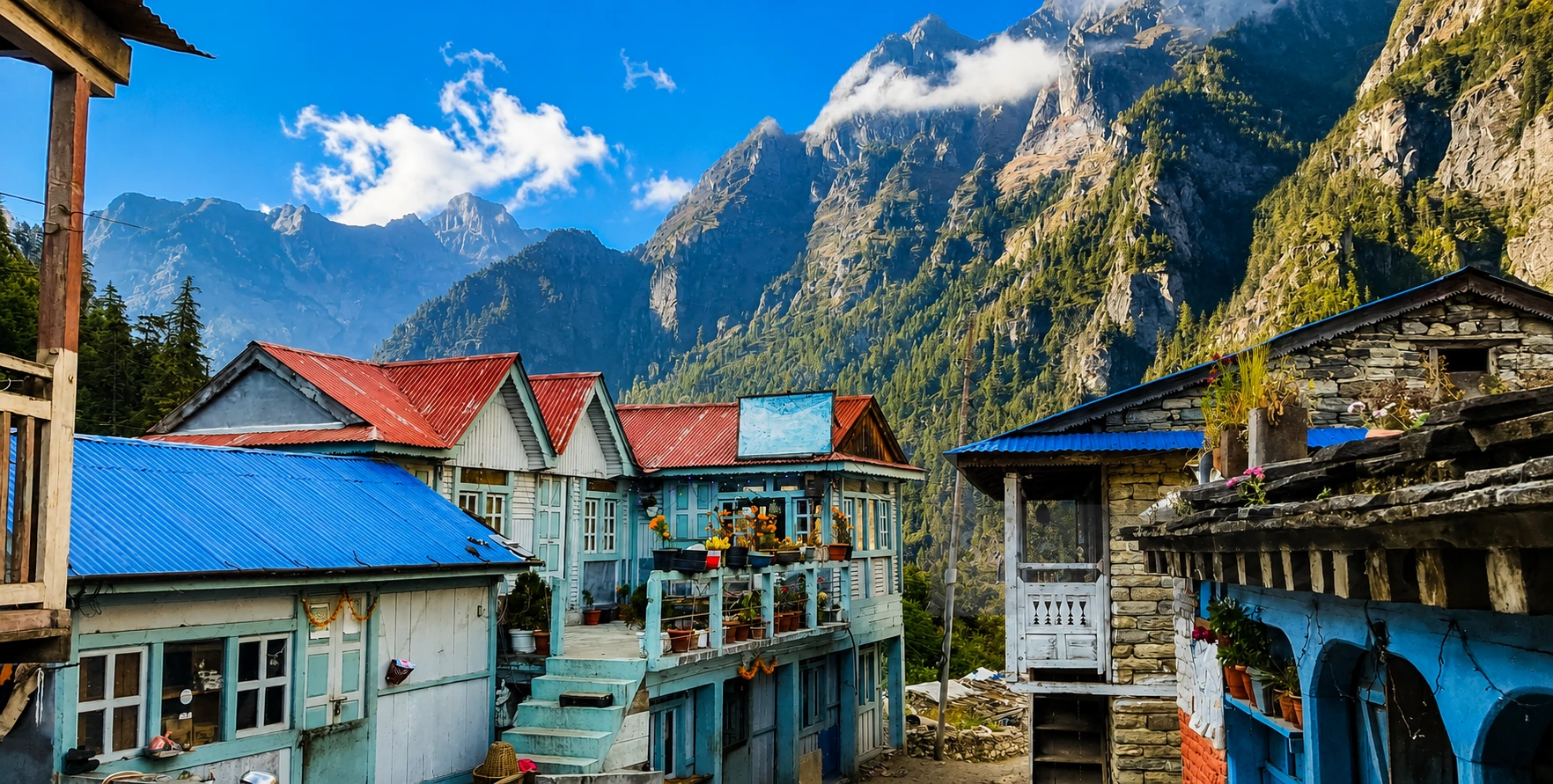
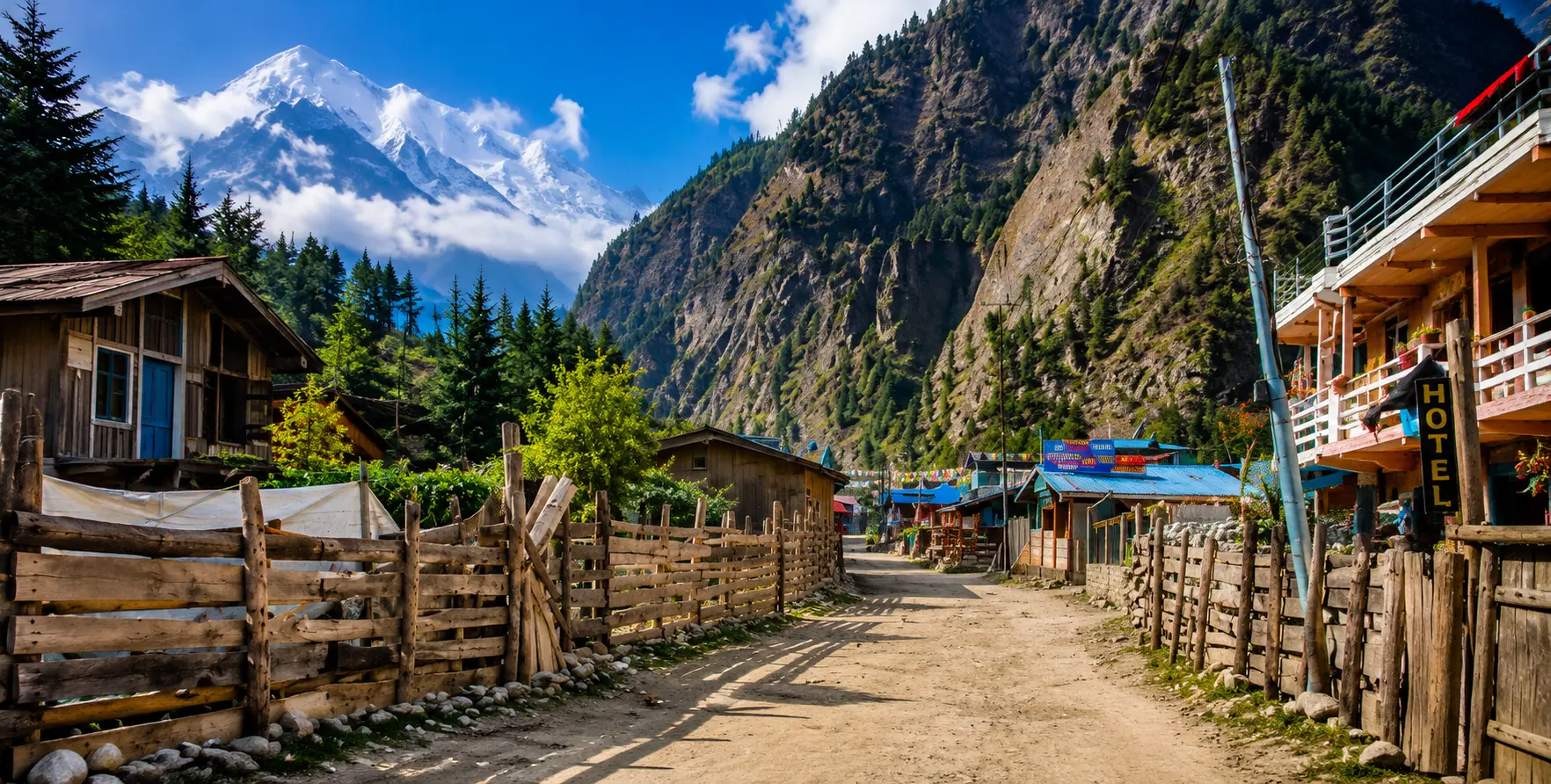
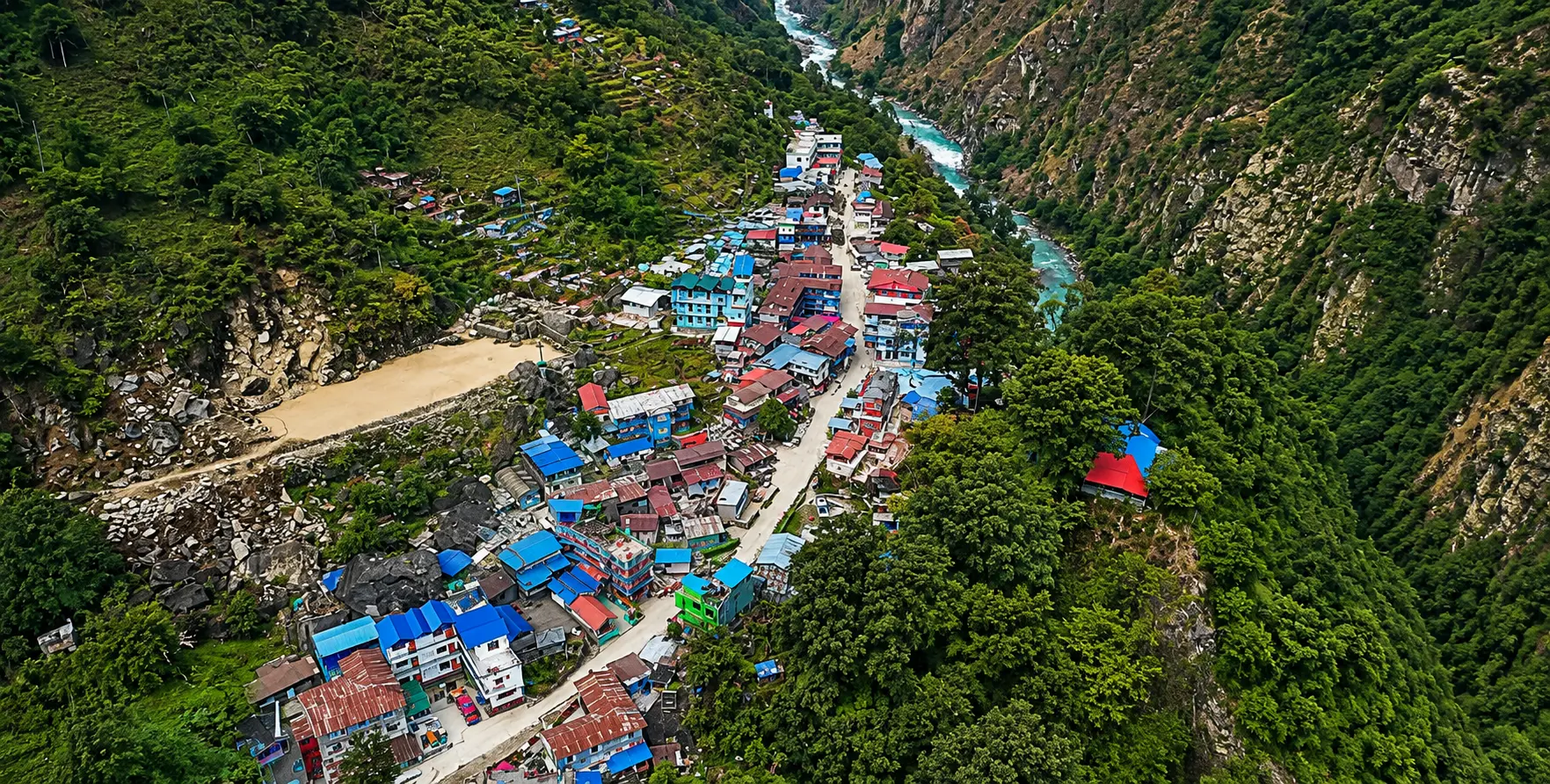
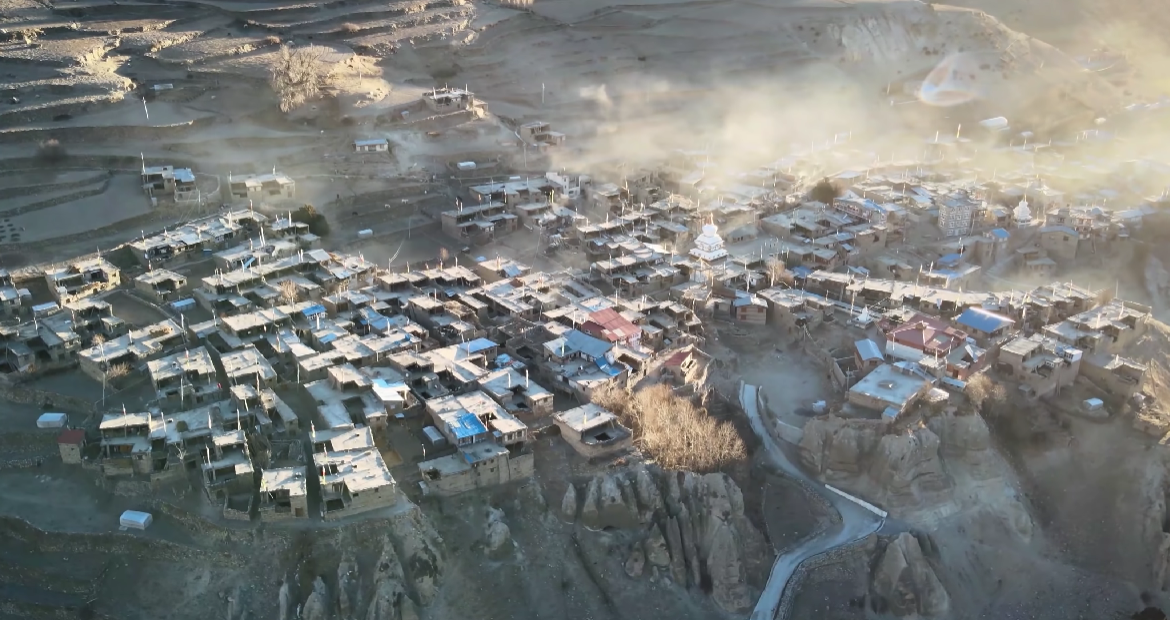
Manang village at 3,519 metres is one of the highest permanently inhabited villages on the Annapurna Circuit trek — a stone-built Tibetan-influenced community of the Nyeshang people (a distinct Manang ethnic group with a unique history of long-distance trading that once extended across Asia) set in the upper Marsyangdi plateau surrounded by some of the most spectacular peaks in the Annapurna range. The village’s traditional architecture — flat-roofed stone houses, prayer walls, and the Barge Gompa monastery on the hill above — is one of Nepal’s finest examples of high-altitude Buddhist settlement design.

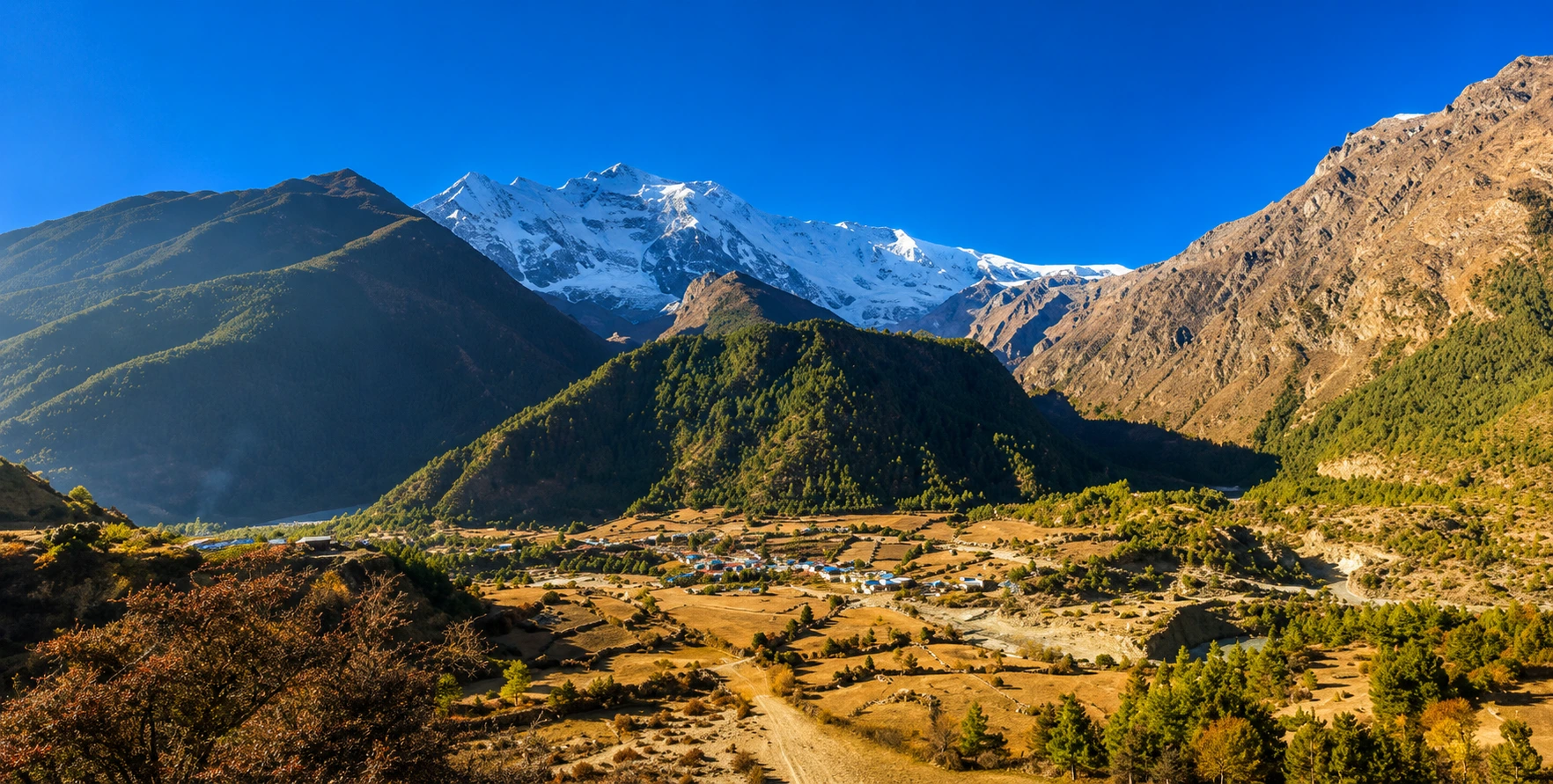
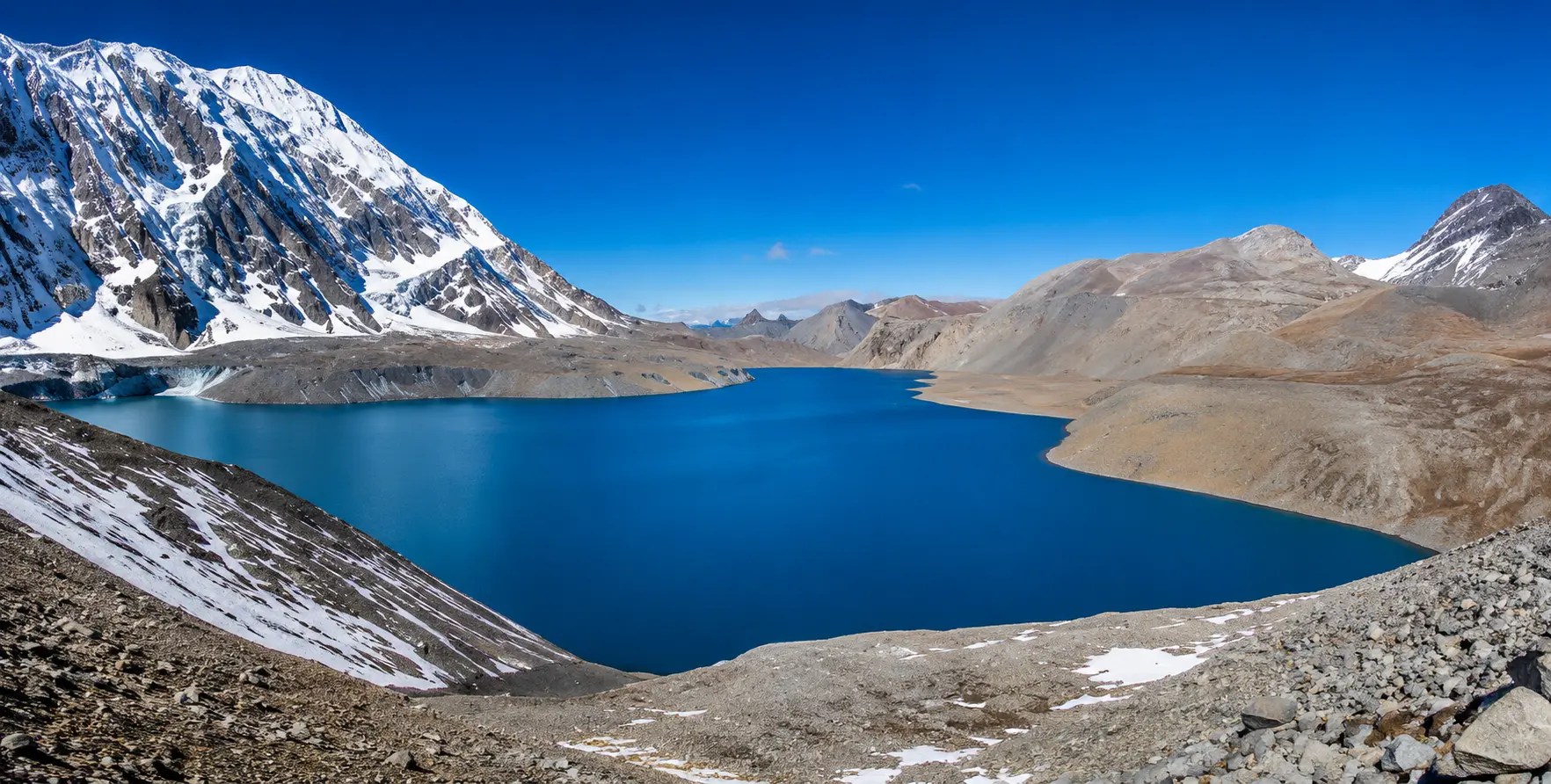
The surrounding landscape from Manang offers: direct views of Gangapurna (7,455 m) and its hanging glacier above the village; the Annapurna III north face (7,555 m) rising above the valley’s southern wall; the Tilicho Lake approach to the northwest (Nepal’s highest lake at 4,949 m, accessible as a 2-day side trip from Manang); and the Thorong La Pass (5,416 m) visible on the northeastern skyline — the goal that all Annapurna Circuit trekkers are resting to prepare for. Most trekkers use the Annapurna Circuit trek’s Manang acclimatisation day for the Gangapurna Glacier Lake walk, the Ice Dome viewpoint, and the Himalayan Rescue Association lecture on altitude sickness prevention.

Why Indian Trekkers Choose Sunauli as the Nepal Entry Point

Sunauli/Bhairahawa in Rupandehi District is not only the most convenient India-Nepal border crossing for Gorakhpur-based travellers — it is the natural entry point for the entire northern Indian trekking community whose Annapurna Circuit ambitions draw them to Nepal. The border crossing’s specific geographic position — directly south of Pokhara and the Annapurna region on the Prithvi Highway axis — makes Sunauli the most logically routed entry point for any traveller whose Nepal destination is anywhere in the Annapurna Conservation Area, from Nayapul for the Poon Hill trek to Besisahar for the Circuit to Manang for the high-altitude acclimatisation destination.

Beyond Gorakhpur, the Indian cities whose travelers most naturally route through Sunauli for the Annapurna approach include: Lucknow (overnight train to Gorakhpur, then taxi to Sunauli — total 5 to 6 hours from Lucknow), Varanasi (overnight train or car, 3 to 4 hours), Allahabad/Prayagraj (overnight train, 5 hours), Kanpur (train connection, 6 hours), and the broader eastern UP and Bihar cities whose connectivity to Gorakhpur Railway Junction makes Sunauli the standard Nepal overland gateway for the region’s trekking community. Nepal Vehicle Hiring Pvt Ltd’s Nepal-side border pickup at Sunauli connects all of these origin cities to the private jeep hire to Manang through a single, smooth arrangement that begins at the Nepal immigration gate and ends at Manang’s 3,519-metre altitude.

The Sunauli border also serves as the gateway for the Lumbini pilgrimage — Lumbini, the birthplace of Lord Buddha, is just 22 kilometres from the Sunauli border — making it natural for Indian Buddhist pilgrims combining a Lumbini visit with the Annapurna Circuit trek to cross at Sunauli, visit Lumbini as the first Nepal stop, and then continue northward toward Besisahar and Manang. Nepal Vehicle Hiring Pvt Ltd coordinates the Sunauli-to-Lumbini-to-Besisahar route as a single booking on our plan trip page.

Sunauli to Manang Tour Packages — Combining Vehicle and Trek

For Indian trekking groups planning the full Annapurna Circuit trek as a Nepal tour package, the Sunauli-to-Manang private jeep hire is the ground-transport foundation of a complete tour that combines vehicle hire, trekking, and the full Annapurna region circuit.

A complete Sunauli-based Annapurna Circuit tour: Sunauli border → private jeep to Besisahar (Day 1) → Besisahar to Manang (Day 2) → Manang acclimatisation days (2 nights minimum) → Thorong La crossing to Muktinath → Kali Gandaki descent to Jomsom → Jomsom to Pokhara private jeep hire → Pokhara Lakeside days with Sarangkot sunrise vehicle → Pokhara to Chitwan bus for optional Chitwan jungle safari → Sunauli return. This 18- to 24-day complete Nepal circuit enters and exits through Sunauli and covers the Annapurna Circuit, Pokhara, and Chitwan in a single overland tour.

Trek Nepal Himalayas provides the guided trekking component for Annapurna Circuit tour packages,s and Alpine Luxury Treks provides the top-end Circuit experience. Nepal Vehicle Hiring Pvt Ltd coordinates all Nepal-side vehicle legs through our plan trip page.

The Trishuli Gorge — Nepal’s Most Famous Highway Drive

The Trishuli River gorge section of the Prithvi Highway — between Mugling and Naubise on the approach to Kathmandu, or between Narayanghat and Mugling on the Sunauli-to-Dumre route — is Nepal’s most famous sustained highway driving experience. For Sunauli-to-Manantravalli, taking the Prithvi Highway north toward the Dumre junction, the Trishuli River offers the journey’s most dramatic mid-section.

At Mugling, the Trishuli River is at its most powerful; the confluence of the Trishuli and Marsyangdi rivers create the turbulence that white-water rafting operations use for multi-day Trishuli Rivertrips.s The road follows the Trishuli’s bank closely between Mugling and Narayanghat, with the river visible at varying distances below the road — sometimes 5 metres away at road level, sometimes 50 metres below on exposed cliff sections. This proximity to a fast-flowing Himalayan river for 60 to 70 kilometres of continuous highway driving is one of Nepal’s most memorable standard-route driving experiences, and Nepal Vehicle Hiring Pvt Ltd’s private jeep drivers on the Sunauli-to-Besisahar route know the specific river sections where the road-and-water relationship is most dramatic and most photogenic.

Sunauli to Manang — Day by Day Itinerary

Day 1: Sunauli border to Besisahar. Cross the Nepal-India border at Sunauli, complete immigration, and board the Nepal Vehicle Hiring Pvt Ltd jeep at the Nepal gate. Drive north via Butwal, Narayanghat (fuel and breakfast stop), Mugling (fish curry lunch stop), Dumre junction, and the Besisahar approach. Arrive in Besisahar in the late afternoon.

Overnight at Besisahar — basic to mid-range accommodation. Total: approximately 230 km, 6-8 hours driving.

Day 2: Besisahar to Manang. Depart Besisahar at 7:00-8:00 AM. The 4WD Scorpio or Hilux jeep follows the Marsyangdi gorge road through Ngadi, Syange, Jagat (ACAP permit check), Chamje, Tal, Dharapani, Bagarchhap, Chame, Lower Pisang, and Upper Pisang to Manang. Arrive in Manang mid to late afternoon at 3,519 metres.

Total Day 2: approximately 130-150 km, 5-8 hours. Overnight in Manang for acclimatisation.

TIP: Spend at least 2 nights in Manang to acclimatise before attempting Thorong La. The Himalayan Rescue Association in Manang offers free altitude sickness prevention lectures — attend before the Thorong La crossing day.

The Mugling to Dumre Section — Gateway to the Annapurna

The Mugling-to-Dumre section of the Prithvi Highway is the stretch that shifts the Sunauli-to-Manang journey from standard Nepal highway driving to the Annapurna approach—a 35-kilometre highway section between two of Nepal’s most important road junctions that carries the full weight of the Marsyangdi valley’s northward pull.

Mugling, at the confluence of the Trishuli and Marsyangdi rivers, marks the point where the Annapurna Circuit’s hydrological story begins: the Marsyangdi River flows southward from the Manang plateau to join the Trishuli, the same river whose gorge the Besisahar jeep road follows northward to Manang. Standing at Mugling’s famous riverside restaurants — the roadside fish curry stops that have made this junction Nepal’s most celebrated highway dining location — and looking northward up the Marsyangdi valley, the Annapurna range’s outer ridgelines are occasionally visible on clear mornings before the day’s cloud builds.

From Mugling, the Prithvi Highway continues 35 kilometres eastward to Dumre — the road passing through the flatter Tanahu District floor before the Dumre junction marks the branch northward toward Besisahar. At Dumre, the journey changes decisively: the broad Prithvi Highway gives way to the narrower Besisahar approach road, the landscape begins to close in as the valley walls rise, and the first foothills of the Annapurna range appear directly ahead.

Nepal Vehicle Hiring Pvt Ltd’s private jeep drivers on the Sunauli-to-Manang route note this Dumre transition as the moment when the trekking energy in the vehicle changes — the group collectively leaning forward as the mountain road ahead begins to deliver what the journey promised.

Altitude Awareness — From Sunauli to Manang’s 3,519 Metres

The Sunauli-to-Manang jeep journey covers one of the most significant rapid altitude gains in Nepal’s vehicle hire network: from the Sunauli border’s Terai elevation (approximately 95 metres above sea level) to Manang’s 3,519 metres in 2 travel days. This altitude gain—3,424 metres in 48 hours—is faster than the recommended acclimatisation schedule for altitude-sensitive individuals, and the specific vehicle route means trekkers arrive at Manang’s high altitude after spending only one night at Besisahar’s 760 metres.

Nepal Vehicle Hiring Pvt Ltd specifically advises all Sunauli-to-Manang groups on this altitude profile at booking. The recommended approach for altitude-sensitive groups: overnight at Besisahar (760 m, Day 1), optional overnight at Chame (2,710 m, Day 2 morning stop) before the final drive to Manang (3,519 m, Day 2 or Day 3 arrival).

Our Besisahar-to-Manang jeep drivers can stop at Chame for an overnight if the group prefers the slower altitude gain — no additional vehicle booking required, just confirmation at the Besisahar departure morning.

The Himalayan Rescue Association clinic in Manang provides free altitude sickness consultations and pre-Thorong La briefings for all trekkers stopping at Manang. Nepal Vehicle Hiring Pvt Ltd recommends at minimum 2 nights at Manang before the Thorong La crossing attempt — the altitude gain on crossing day (from Manang at 3,519 m to the pass at 5,416 m) is extreme, and the success rate is substantially higher for trekkers who have fully acclimatised at Manang rather than arriving and crossing immediately.

Our drivers communicate this to all groups during the Day 2 jeep journey.

The Annapurna Circuit Jeep Option — All the Way to Thorong Phedi

For trekkers who want to maximise vehicle access and minimise walking distance on the lower Annapurna Circuit, a private jeep hire from Besisahar can continue beyond Manang to Thorong Phedi at 4,450 metres—the final tea house before the Thorong La High Camp —accessible by jeep on the road that now extends above Manang. Nepal Vehicle Hiring Pvt Ltd’s 4WD jeep hire covers this extended approach when road conditions allow — the Manang-to-Thorong Phedi section is the highest motorable road in the Annapurna Conservation Area and requires both favourable road conditions and an appropriately capable vehicle.

The Thorong Phedi extension adds approximately 1 to 2 hours to the Day 2 drive beyond Manang and delivers trekkers to 4,450 metres by vehicle — replacing one walking day on the pre-pass approach. Groups using this extended jeep hire arrive at Thorong Phedi with the full day available for High Camp acclimatisation before the crossing.

Nepal Vehicle Hiking Pvt Ltd confirms Thorong Phedi road conditions at booking and on the morning of the Day 2 departure — the extension proceeds only when current conditions are confirmed safe. Contact our team on WhatsApp to confirm Thorong Phedi road status.

Sunauli to Manang for Muktinath Yatra Pilgrims

The Sunauli-to-Manang jeep route serves not only trekkers on the Annapurna Circuit but also Hindu and Buddhist pilgrims whose yatra destination is Muktinath Temple at 3,710 metres — one of Nepal’s most sacred pilgrimage sites combining Hindu Vaishnava and Buddhist traditions. The Muktinath yatra private jeep hire from Sunauli can take two approach routes: the Sunauli-to-Besisahar-to-Manang route (continuing over the Thorong La road toward Muktinath on the Mustang side) or the Sunauli-to-Pokhara-to-Jomsom route (approaching Muktinath from the Kali Gandaki gorge south).

For Indian pilgrimage groups from Gorakhpur, Varanasi, and the broader northern Indian Hindu pilgrimage belt, the Sunauli-to-Manang approach to Muktinath via the Marsyangdi gorge and Thorong La is the northern approach — a route of considerable physical commitment that the most devoted yatra pilgrims specifically prefer as the more arduous and therefore more meritorious approach to the sacred site. Nepal Vehicle Hiring Pvt Ltd serves these pilgrimage groups with the same professional 4WD jeep-hire standard as our trekking group  understanding that the sacred purpose of the Muktinath yatra adds a dimension to the transport service that our drivers approach with appropriate respect.

What to Carry for the Sunauli to Manang Vehicle Journey

The 2-day Sunauli-to-Manang vehicle journey passes through four climate zones — from the Terai’s subtropical heat at the border to the alpine cold of Manang’s 3,519 metres — and the transition between these zones happens faster by vehicle than the body’s thermal adaptation can follow. Practical packing for the vehicle journey itself (separate from the trek equipment) ensures comfort throughout.

Accessible in the vehicle cabin: A fleece or light down jacket for the rapid temperature drop at altitude (Manang can be below 10°C even on a clear afternoon); sunscreen (the UV intensity at 3,500 m is significantly higher than at Terai elevation — several hours in the vehicle at altitude without protection causes visible sunburn through the window); water (2 litres per person for Day 2 above Besisahar — the gorge road’s river water is not safely drinkable without purification); light snacks for the gorge road section between Jagat and Chame where no restaurants are reliably open; and altitude sickness medication (Diamox) if prescribed by a physician, carried in hand luggage rather than checked luggage for immediate accessibility.

Keep on your person at the Jagat checkpoint: ACAP permit and TIMS card — the Jagat checkpoint officer checks every passenger’s permits, and any group member without valid documentation is turned back. Nepal Vehicle Hiring Pvt Ltd reminds all Sunauli-to-Manang groups of the permit requirement at booking and sends a WhatsApp reminder on the morning of departure from Besisahar.

The Pisang to Manang Section — The Upper Valley’s Finest Drive

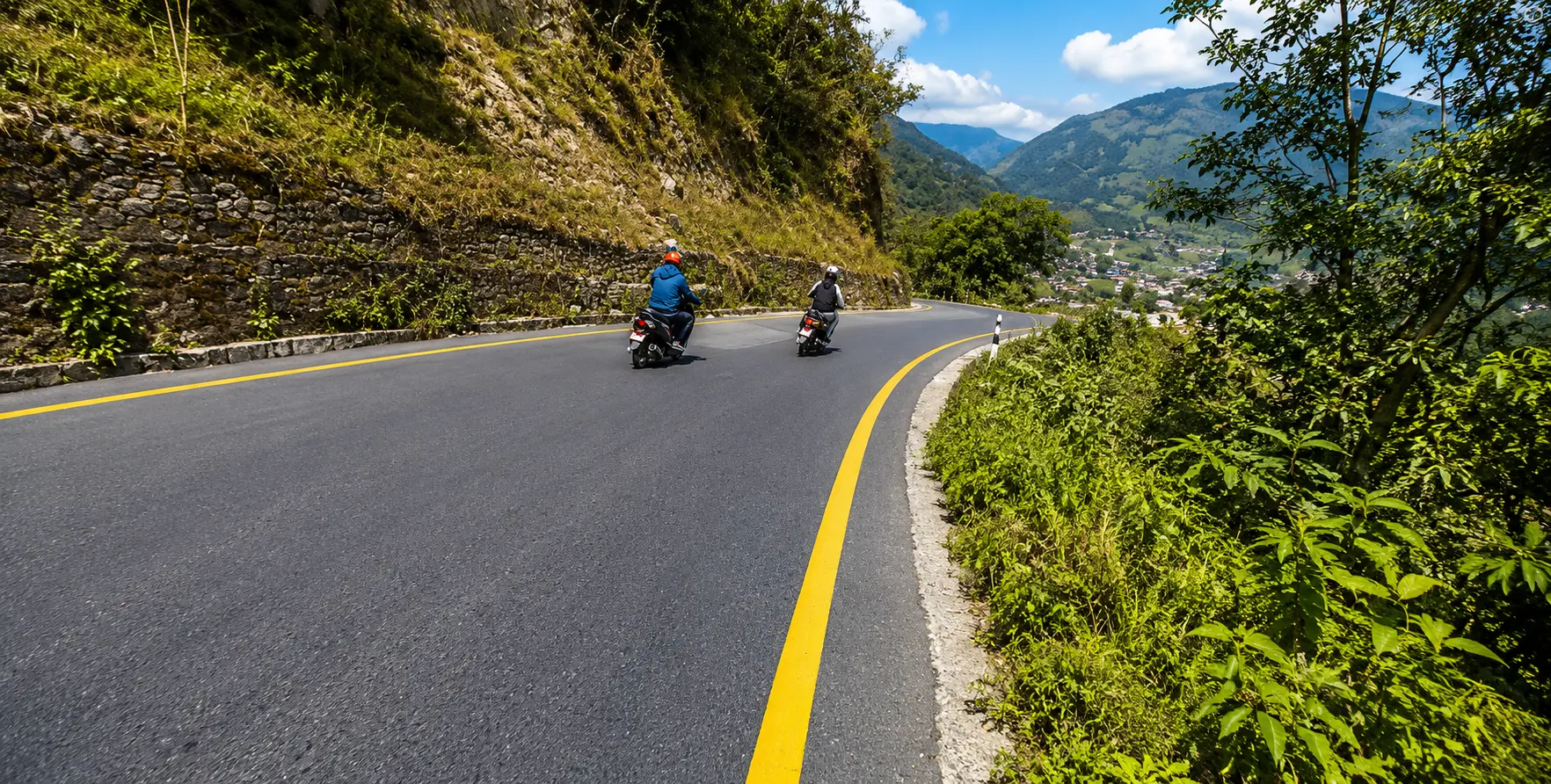
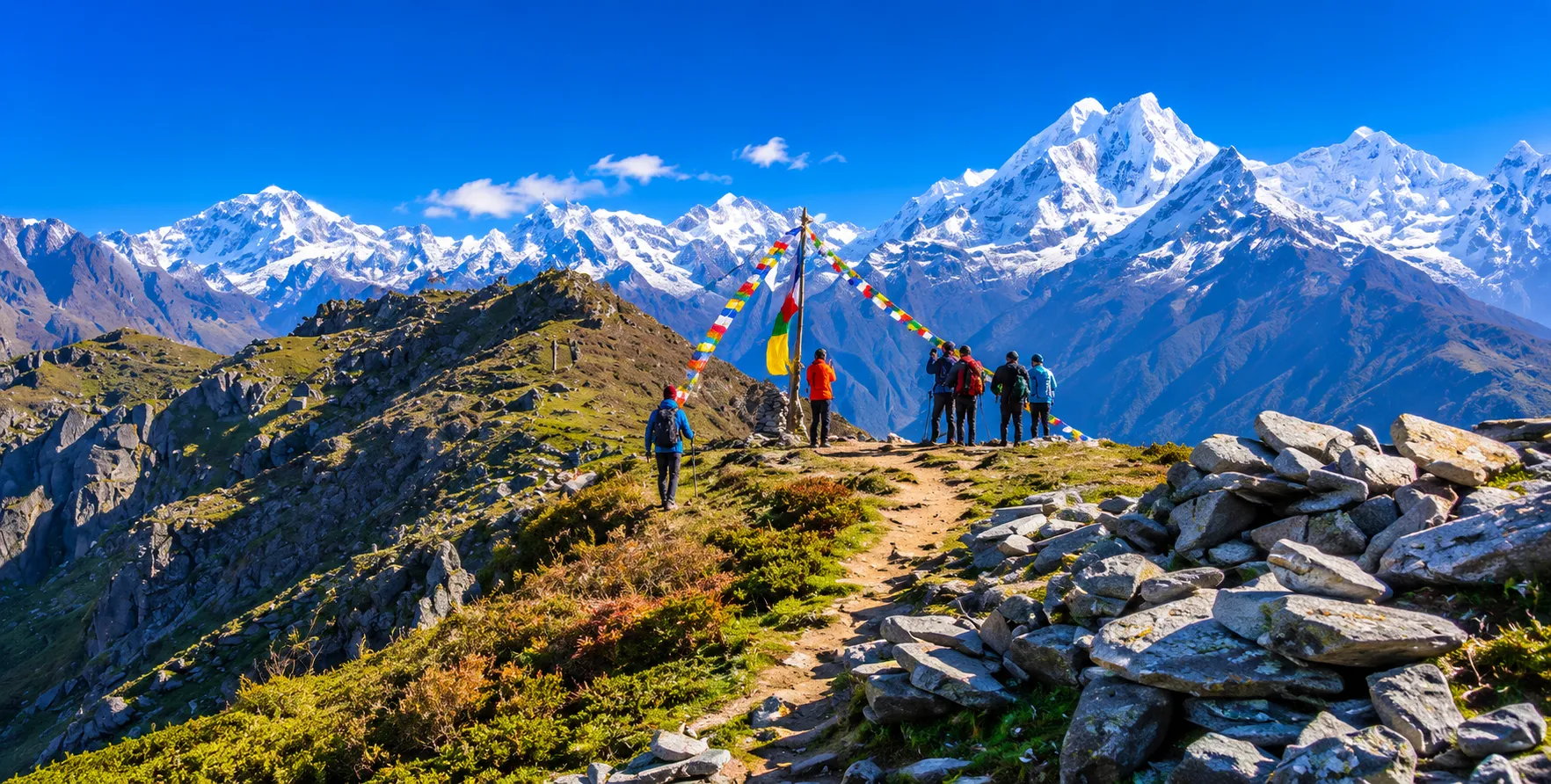
The final section of the Besisahar-to-Manang jeep journey, from Pisang at 3,300 metres to Manang at 3,519 metres, is the most visually extraordinary stretch of the entire Sunauli-to-Manang overland journey. As the 4WD jeep hire crests the last significant rise above Upper Pisang and the Manang valley opens ahead, the full scale of the upper Annapurna plateau reveals itself in a single panoramic moment: the Annapurna III north face (7,555 m) directly across the valley, Gangapurna (7,455 m) with its hanging glacier above Manang village, the Annapurna IV (7,525 m) and Annapurna II (7,937 m) ridge line above the valley’s eastern wall, and the unmistakable notch of the Thorong La Pass on the northeastern skyline.

For first-time trekkers, the Pisang-to-Manang final drive section is the highest mountain stretch, with a period of silence as the scale and proximity of the world’s highest peaks replace conversation. Nepal Vehicle Hiring Pvt Ltd’s Besisahar-to-Manang drivers know this section intimately — the specific pullout above Upper Pisang where the first Manang valley panorama appears most fully, the track fork where Lower and Upper Pisang diverge and the high route provides the finest mountain view angle, and the descent into Manang village where the oldest monastery section appears on the hilltop above.

These are the moments when Nepal Vehicle Hiring Pvt Ltd’s route-experienced drivers turn it into a guided experience.
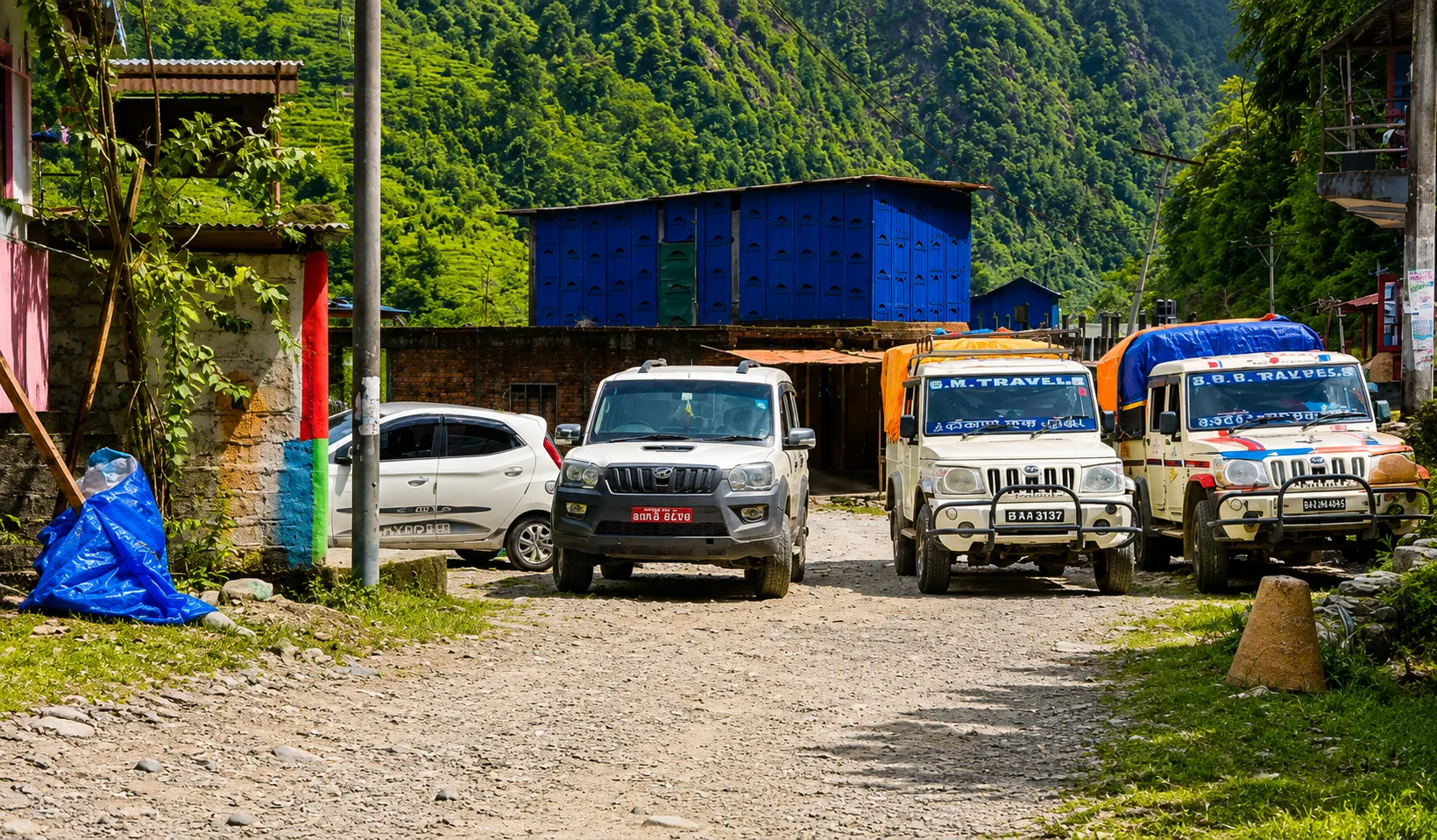
Sunauli to Manang Private Jeep Hire

The Annapurna Circuit — What Awaits After the Jeep

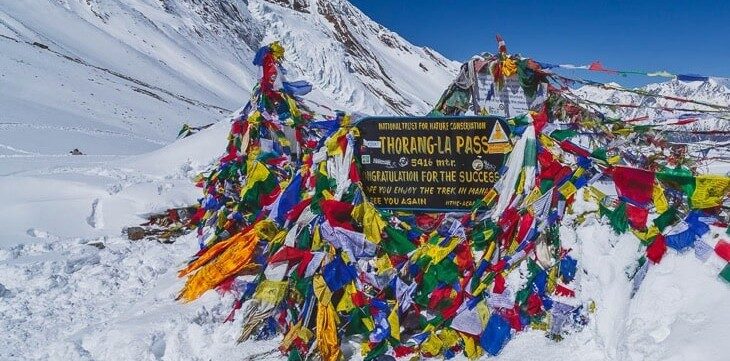
The Annapurna Circuit trek from Manang onward is one of the world’s finest high-altitude trekking experiences — the route that has defined Nepal trekking for the post-1977 generation of international mountain walkers. From Manang, the circuit continues north to Thorong Phedi (4,450 m) and High Camp (4,850 m) before the summit crossing of the Thorong La Pass (5,416 m) — Nepal’s highest road-accessible trekking pass — and the long descent to Muktinath’s sacred site at 3,710 m.

From Muktinath, the route continues down the Kali Gandaki gorge — the world’s deepest river gorge by vertical measurement — through Kagbeni, Jomsom, Marpha, Tukuche, Ghasa, and Tatopani to the lower Annapurna approach roads. The Annapurna Circuit’s Jomsom exit by private jeep to Pokhara, or the Beni-Pokhara route, offers an alternative finish to walking the full circuit.

Trek Nepal Himalayas’ guided Annapurna Circuit packages and Alpine Luxury Treks‘ top-end Circuit experience both use Nepal Vehicle Hiring Pvt Ltd transport for the Sunauli-to-Besisahar and Besisahar-to-Manang approach legs.

Sunauli to Manang — The Direct Circuit vs Via Kathmandu

Indian trekkers planning the Sunauli-to-Manang journey have a route choice: the direct route via Dumre and Besisahar (avoiding Kathmandu entirely) or the Kathmandu transit route (Sunauli to Kathmandu, overnight, then Kathmandu to Besisahar to Manang).

Direct route (Sunauli → Dumre → Besisahar → Manang, 2 days): The fastest option — reaches Manang in 2 travel days from the border. Best for trekkers whose primary goal is the Annapurna Circuit and who do not need Kathmandu for permit acquisition (ACAP permits can be obtained at Besisahar). Sunauli to Besisahar by private 4WD jeep hire, overnight in Besisahar, then Besisahar to Manang Day 2.

Via Kathmandu (Sunauli → Kathmandu, overnight → Kathmandu to Besisahar → Manang, 3 days): Allows permit acquisition at the Nepal Tourism Board in Kathmandu, gear purchase at Thamel, and the Kathmandu heritage sightseeing car hire for a Bhaktapur heritage day or Kathmandu temple visits. Adds one day but provides the Kathmandu cultural and logistics stop that most first-time Nepal visitors find valuable.

Nepal Vehicle Hiring Pvt Ltd offers both route options on our plan trip page—we advise which format best fits the group’s itinerary and availability.

Side Trips from Manang — The Upper Annapurna Plateau

Manang’s 2-night acclimatisation stop enables several extraordinary side trips in the upper Marsyangdi Valley that Annapurna Circuit trekkers who pass through without stopping miss entirely.

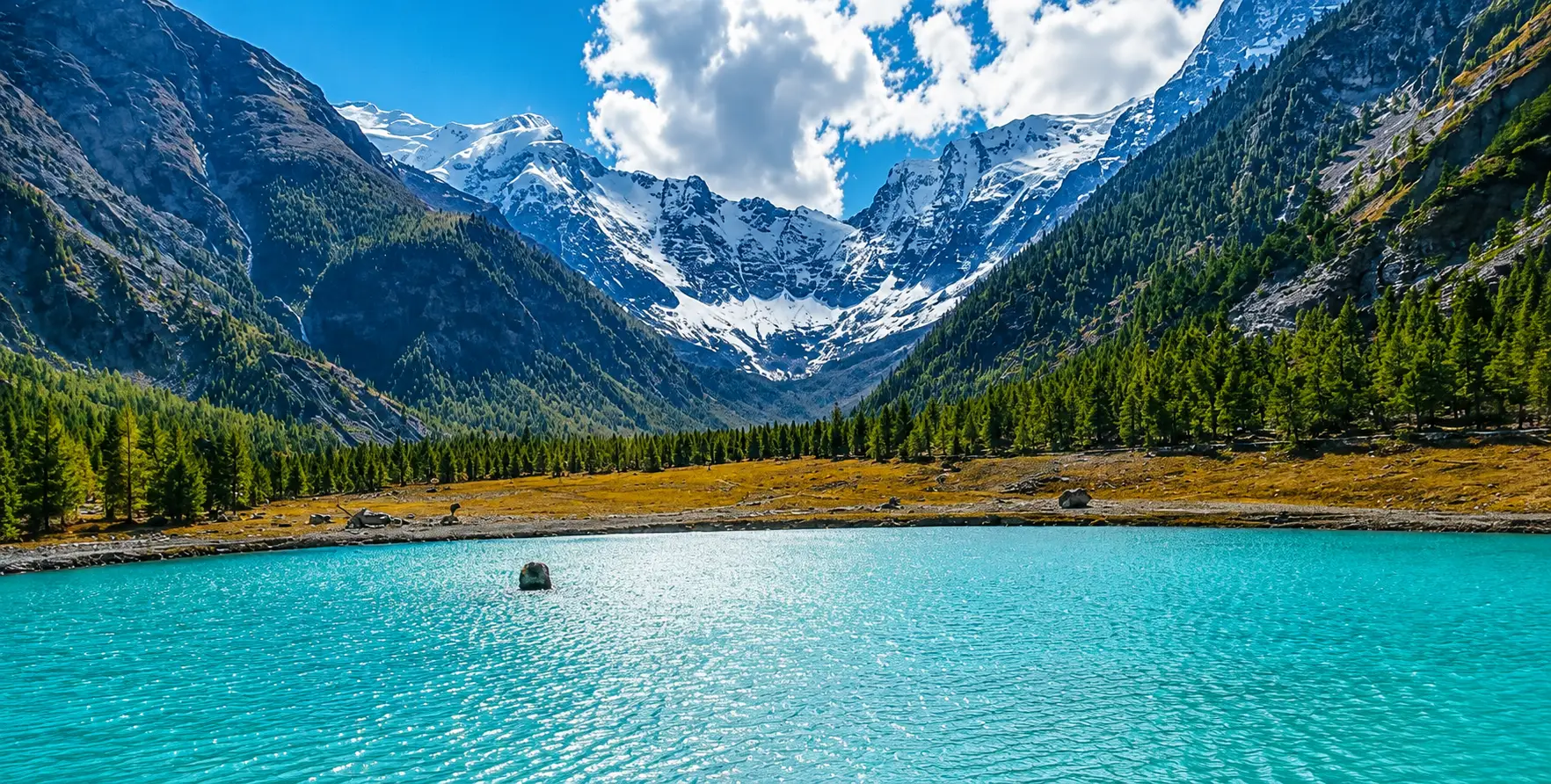
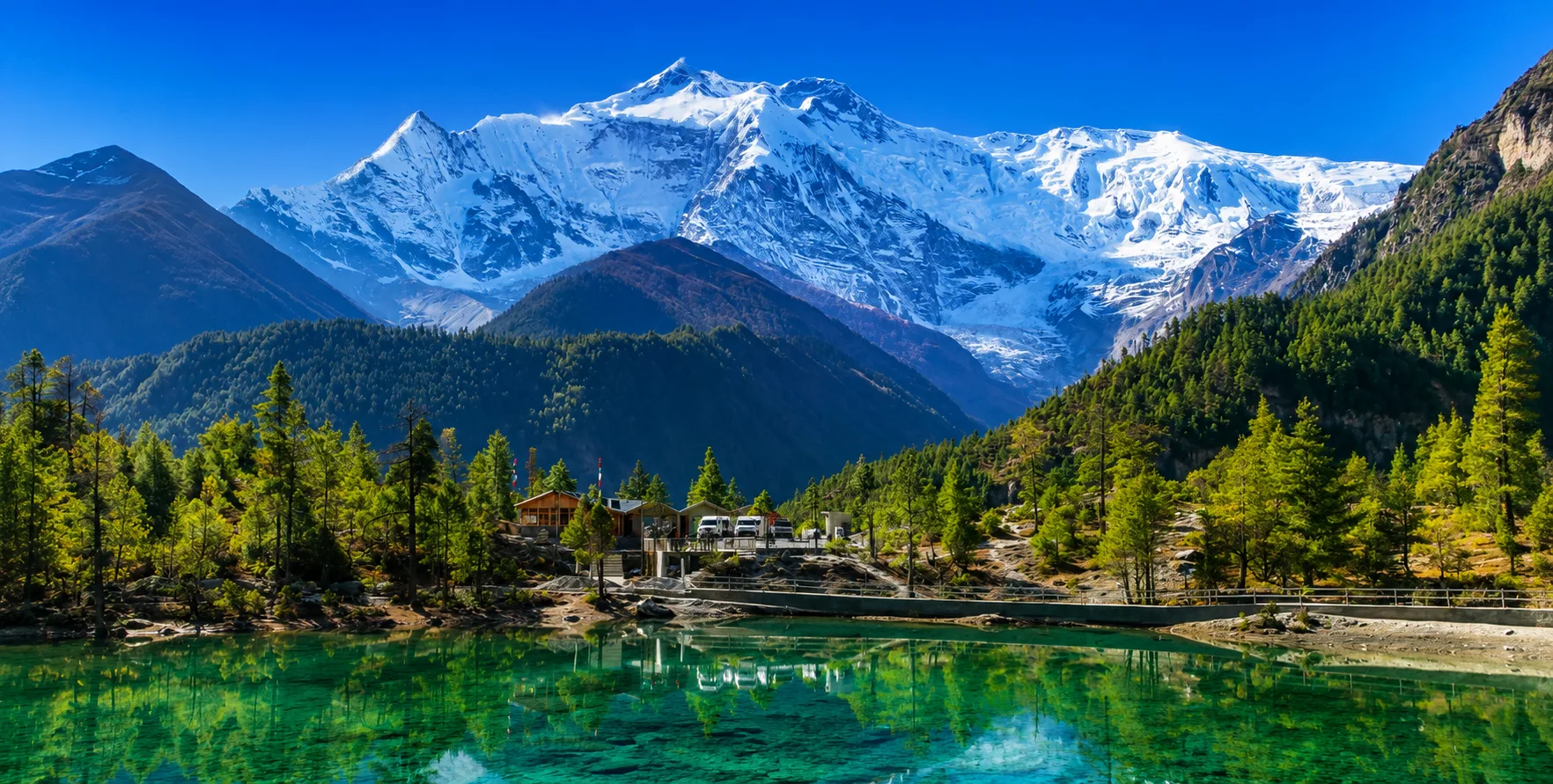
Gangapurna Glacier Lake (1 hour from Manang, 3,540 m). The lake at the terminus of the Gangapurna Glacier — a 45-minute walk from Manang’s upper lanes — provides direct glacier front views and the extraordinary turquoise colour of glacial meltwater in a high-altitude lake setting, one of Nepal’s finest half-hour walks, accessible without additional trekking preparation.

Ice Dome Viewpoint (2-3 hours from Manang, 4,000 m). The acclimatisation walk to the Ice Dome viewpoint above Manang is the standard altitude-gain walk recommended by the Himalayan Rescue Association—500 metres of altitude gain on a clear trail to a viewpoint that surveys the complete Manang plateau and the surrounding Annapurna III, Gangapurna, and Chulu peak panorama.

Tilicho Lake (2 days from Manang, 4,949 m). Nepal’s highest lake, at 4,949 metres on the northwestern shoulder of the Annapurna massif, is accessible as a 2-day side trip from Manang — the finest high-altitude lake experience in the Annapurna Conservation Area. The trail from Manang to Tilicho Base Camp and the lake is physically demanding and requires proper acclimatisation before attempting.

Nar Phu Valley (from Koto, 1 day south of Manang). The Nar Phu hidden valley trek branches from Koto village (about 1 day south of Manang on the Annapurna Circuit) into one of Nepal’s most remote restricted-area valleys—a Restricted Area Permit is required.

Accommodation Along the Sunauli to Manang Route

Sunauli border town. Basic guesthouses on the Nepal side for groups arriving late at the border and needing an overnight before the drive to Besisahar. Adequate but functional only.

Besisahar (Day 1 overnight). Besisahar’s guesthouse network serves the Annapurna Circuit’s approach traffic — mid-range accommodation with clean rooms and good dal bhat at NPR 500-1,500 per room. ACAP permit office also in Besisahar for groups who did not obtain permits in Kathmandu.

Chame (Day 2 optional overnight). If the Besisahar-to-Manang Day 2 drive seems too long, Chame at 2,710 m provides an excellent mid-route overnight — splitting the gorge road into two comfortable days and allowing a slower altitude gain to Manang’s 3,519 m.

Manang (2+ nights for acclimatisation). Manang’s teahouse and guesthouse network is well developed for the Annapurna Circuit’s acclimatisation stop—the best-equipped accommodation and dining on the entire Circuit above Besisahar. Multiple options from basic rooms to the relative comfort of Manang’s newer guesthouses. Alpine Luxury Treks provides top-end Manang accommodation for luxury Circuit clients.

The Return Journey — Manang Exit Options

Trekkers who arrived at Manang by private jeep from Sunauli have several return vehicle options depending on whether they completed the Thorong La crossing or chose to return the way they came.

Manang return to Besisahar (same route return). For groups who did not cross the Thorong La, Nepal Vehicle Hiring Pvt Ltd pre-arranges the Manang-to-Besisahar return jeep and the Besisahar-to-Sunauli or Besisahar-to-Kathmandu connection.

Jomsom to Pokhara exit (post-Thorong La). Trekkers who cross the Thorong La and descend to Muktinath and Jomsom can take the Jomsom-to-Pokhara private jeep down the Kali Gandaki gorge — one of Nepal’s finest mountain road experiences — and then the Pokhara-to-Sunauli vehicle hire for the India border return. This Manang-entry / Jomsom-exit format creates a one-way circuit that covers the full Annapurna Circuit without backtracking.

Jomsom to Kathmandu exit. Post-Thorong La, trekkers returning to Kathmandu can take a Jomsom-to-Pokhara jeep hire, followed by a Pokhara-to-Kathmandu bus or vehicle hire.

All return options are pre-arranged at outward booking through our plan trip page — one booking, complete circuit, all legs confirmed.

The Marsyangdi River — Nepal’s Most Dramatic Gorge Road

The Marsyangdi River gorge between Besisahar and Dharapani is one of Nepal’s most geologically dramatic river environments — a canyon of extraordinary depth where the river has carved through returning uplift over millions of years, giving the Jomsom-to-Pokhara route a specific character that makes the Besisahar to Manang jeep road simultaneously one of Nepal’s most beautiful and most demanding vehicle routes. The word Marsyangdi roughly translates to ‘ turbulent river’ in Gurung.

This name captures the river’s character through the gorge: fast-moving, turquoise-white from glacial silt, and audible from the vehicle window even above the engine noise on the rougher road sections.

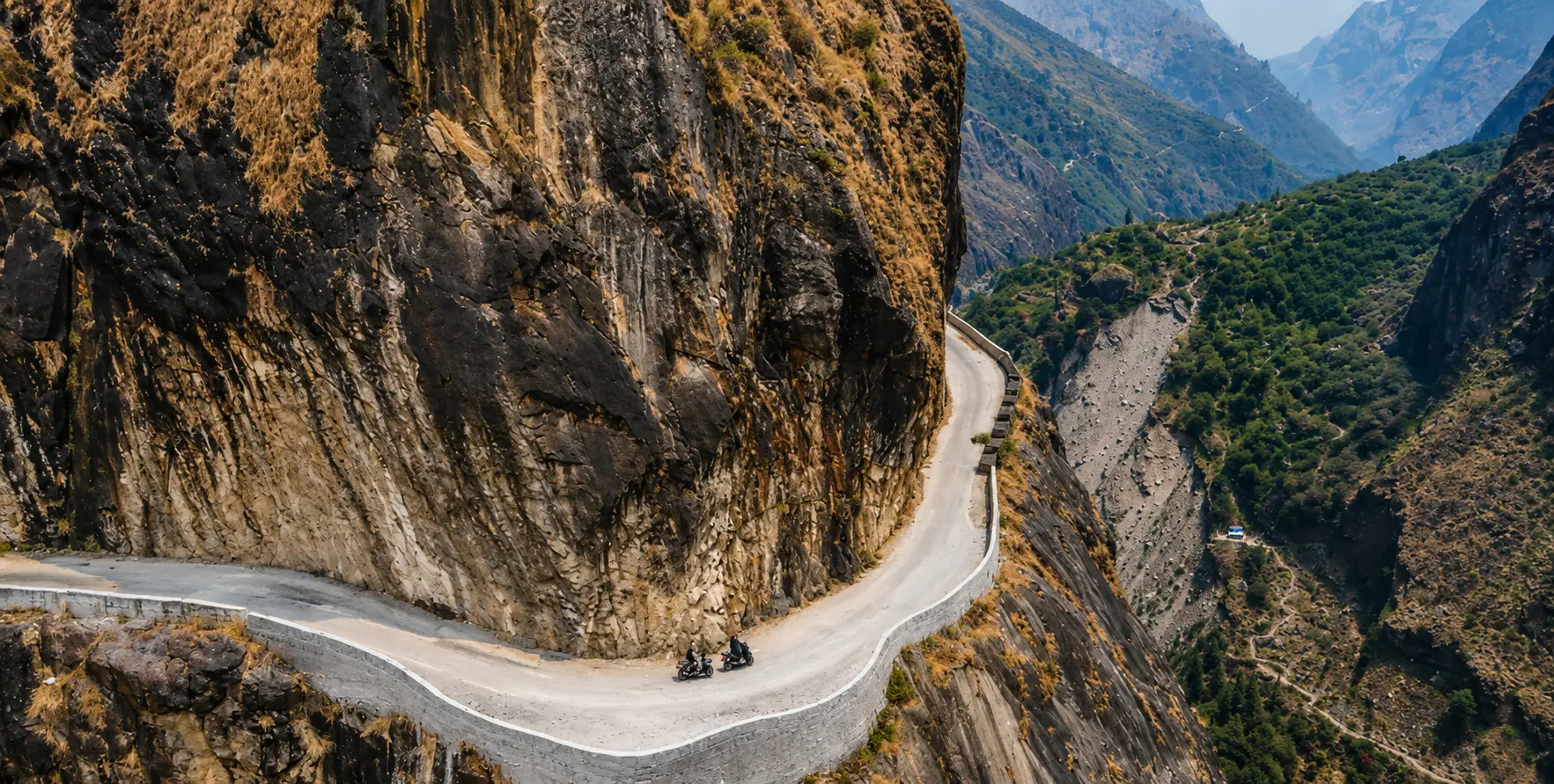
The gorge’s physical character creates the road’s challenges: the narrow canyon walls leave minimal road width in several sections between Ngadi and Jagat, requiring our 4WD jeep drivers to manage passing encounters with oncoming vehicles at the few wide points that experienced gorge-road drivers know by feel rather than by marker. The road’s exposure to the gorge — sections where the cliff drops vertically to the river below the road’s outer edge — is the visual element that most affects first-time travelers on this route: the combination of the river’s scale, the gorge walls’ height, and the road’s narrow margin between the cliff and the sky creates a sustained mountain driving experience that Nepal’s highway routes cannot replicate.

This is why the Marsyangdi gorge jeep hire is not just transport to Manang — it is one of Nepal’s defining vehicle journey experiences.

Nepal Vehicle Hiking Pvt Ltd’s Besisahar to Manang drivers have specific gorge-road experience measured in dozens of round trips — the accumulated knowledge of which sections require reduced speed, which cliff-edge moments are genuinely hazardous versus simply dramatic, and which river crossings require careful wheel placement. This experience is the safety margin the gorge road demands, and Nepal Vehicle Hiring Pvt Ltd delivers it through our driver assignment policy. Contact us on WhatsApp or our plan trip page.

The Nar Phu Valley — A Restricted Area Extension from the Manang Approach

For trekking groups specifically seeking Nepal’s most remote and least-visited restricted areas, the Nar Phu Valley — a hidden side valley branching east from the Annapurna Circuit at Koto village (one day south of Manang) — is accessible from the same Sunauli-to-Manang jeep hire approach road. The Nar Phu Valley trek enters a restricted area of extraordinary cultural and natural richness — ancient Tibetan-influenced villages at 4,000 metres, the Phu Valley’s glacial landscapes, and a trekking corridor that sees a fraction of the Annapurna Circuit’s visitor volume.

Groups who want to combine the Nar Phu Valley exploration with the Annapurna Circuit trek use the Besisahar to Manang jeep hire to reach the Koto junction, branch into the Nar Phu Valley for the restricted area trek, and return to the main Annapurna Circuit trail at Koto to continue northward toward Manang and the Thorong La. The Nar Phu Restricted Area Permit (USD 75 per week) and a licensed guide are mandatory.

Nepal Vehicle Hiring Pvt Ltd’s jeep hire service to the Koto junction covers this Nar Phu approach as a natural extension of the Besisahar-to-Manang route. Contact our team to arrange the circuit.

Why Choose Nepal Vehicle Hiring Pvt Ltd for Sunauli to Manang

  • Nepal border pickup: Driver confirmed by name and registration at the Sunauli Nepal gate.
  • Sunauli to Besisahar: Private 4WD jeep hire, all-inclusive, with a Mugling fish curry stop.
  • Besisahar–Manang 4WD jeep: Scorpio or Hilux exclusively — gorge road requires 4WD.
  • Permit advisory: ACAP permit requirement confirmed at booking. Besisahar ACAP office details provided.
  • Altitude awareness: Drivers briefed on acclimatisation stop timing in Besisahar and Chame to ensure healthy arrival at Manang.
  • Circuit exit coordination: Return vehicle pre-arranged for Manang, Jomsom, or any Circuit exit point.
  • Kathmandu detour option: Kathmandu sightseeing car hire and Bhaktapur heritage tour for groups transiting via the capital.
  • All-inclusive transparent pricing: Driver, fuel, road tolls — no additions.
  • 24/7 on WhatsApp or plan trip page.

15. Frequently Asked Questions — Sunauli to Manang Jeep Hire

Q: How many days does it take to travel from Sunauli to Manang by private jeep?

2 travel days: Day 1 — Sunauli border to Besisahar (approximately 230 km, 6-8 hours) with overnight at Besisahar. Day 2 — Besisahar to Manang (130-150 km, 5-8 hours) by 4WD jeep hire.

Q: What is the total jeep hire cost from Sunauli to Manang?

NPR 34,000 to 52,000 (USD 255-450) for the full 2-day private 4WD jeep hire, all-inclusive. Contact Nepal Vehicle Hiring Pvt Ltd on WhatsApp for a group-specific quote.

Q: Is 4WD mandatory for Besisahar to Manang?

Yes — the Marsyangdi gorge road’s unpaved sections, river crossings, and altitude gain make 4WD Scorpio or Hilux jeep hire mandatory for a passenger group. Sedans are not appropriate for this route.

Q: Can Indian nationals get the ACAP permit at the border?

No — ACAP permits are available at the Nepal Tourism Board in Kathmandu, the ACAP office in Besisahar, or the ACAP counter in Pokhara. Indian nationals pay SAARC rates.

Q: Can the return vehicle be arranged from Jomsom after crossing Thorong La?

Yes — Nepal Vehicle Hiring Pvt Ltd pre-arranges the Jomsom-to-Pokhara private jeep hire at the time of outward booking. Contact us on WhatsApp.

Conclusion

The private jeep hire from Sunauli to Manang is one of Nepal’s most extraordinary overland journeys—a 2-day ascent from the India border through Nepal’s highway country and into the high Himalayan plateau of the Annapurna Conservation Area, arriving at 3,519 metres surrounded by some of the world’s finest mountain scenery. Nepal Vehicle Hiring Pvt Ltd provides a complete Sunauli-to-Manang jeep hire—border pickup, highway transfer, and the 4WD Besisahar-to-Manang gorge road journey—with all-inclusive pricing, ACAP permit advice, and a return vehicle pre-arranged for any Annapurna Circuit exit point.

Book your Sunauli to Manang private jeep hire with Nepal Vehicle Hiring Pvt Ltd — call or WhatsApp, visit vehiclehiringnepal.com, or plan your complete Annapurna Circuit transport through our plan trip page.
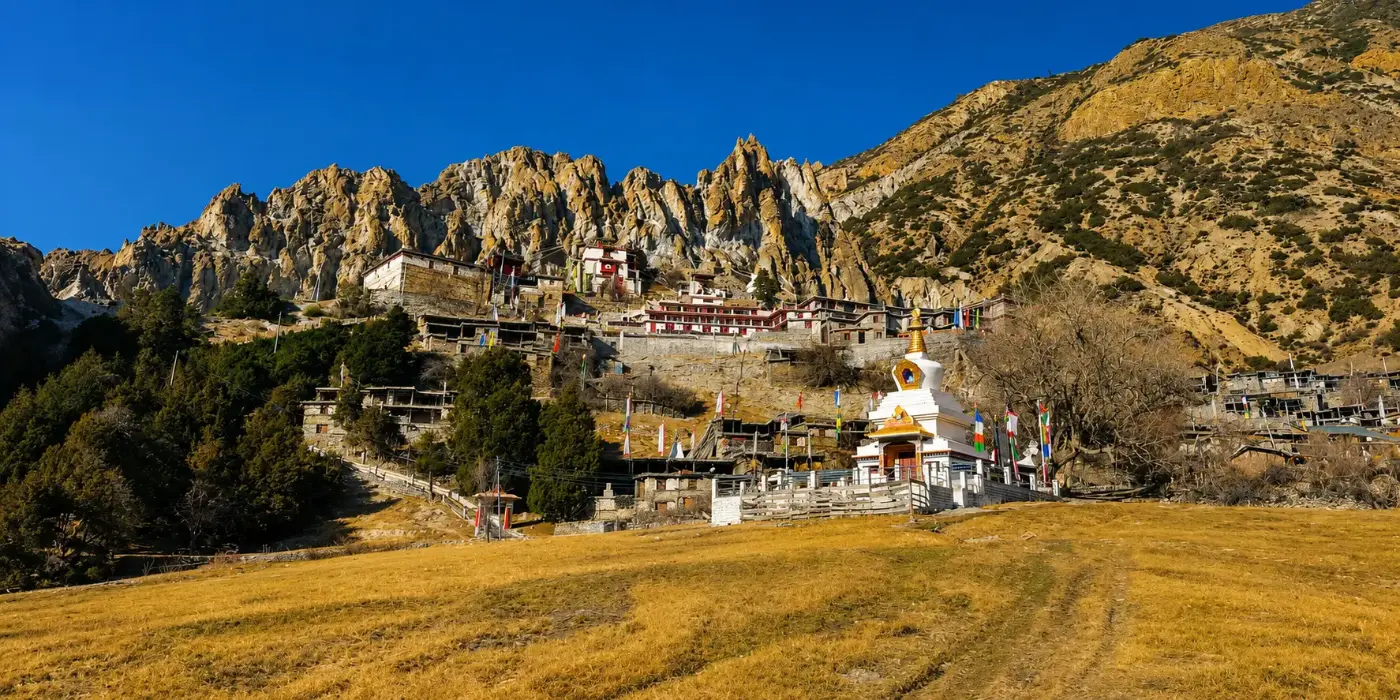
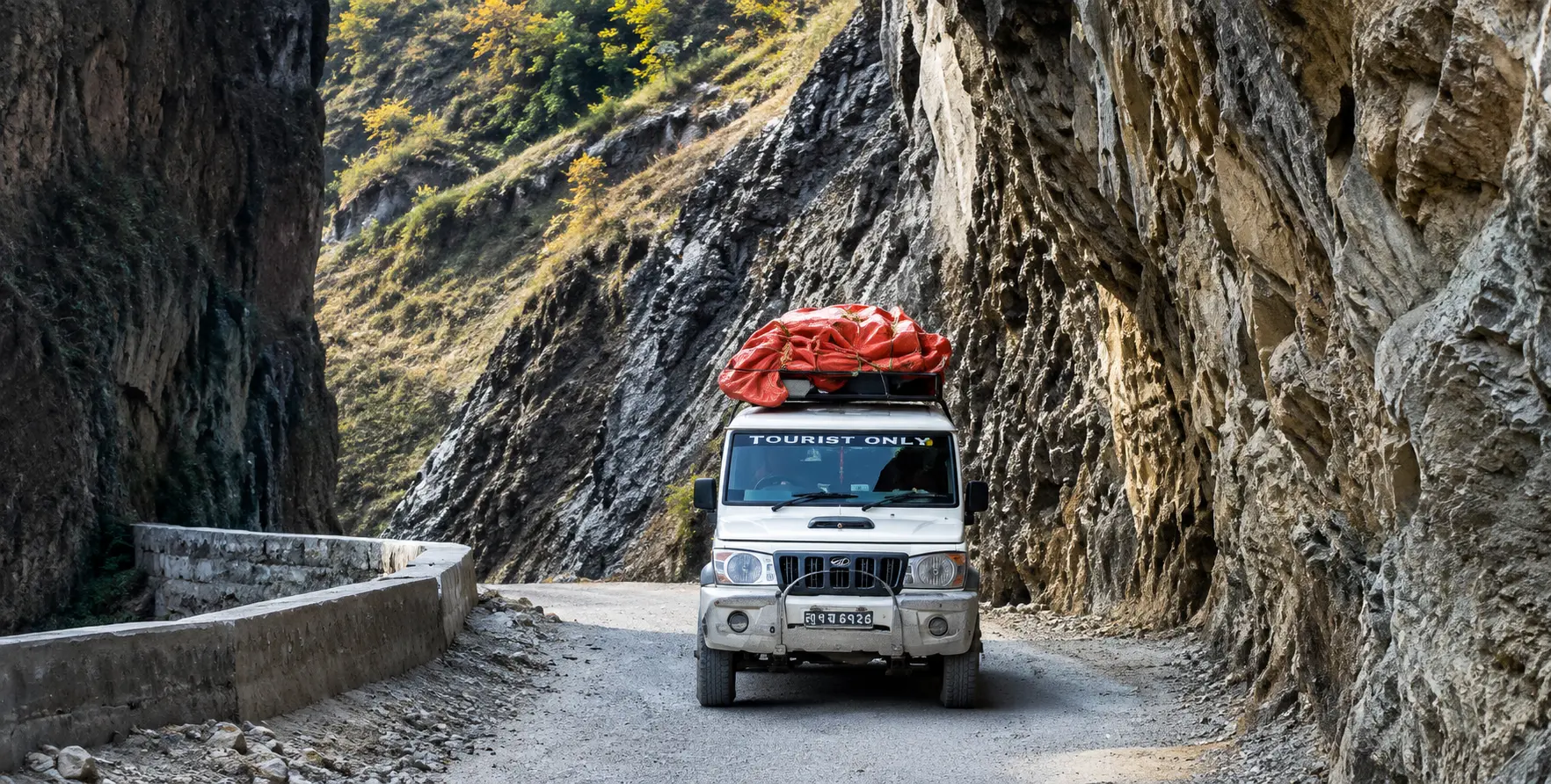
Manang Valley Tour Jeep Rental

Manang Valley Tour Jeep Rental for Himalayan Mountain Travel in Nepal

Driving to Manang — Nepal’s Most Rewarding Road Journey

The Manang Valley at 3,519 meters in Nepal’s Gandaki Province — the famous acclimatization stop on the Annapurna Circuit Trek and an extraordinary destination in its own right — has become significantly more accessible thanks to the progressive extension of the road up the Marsyangdi River valley from Besisahar through Chame, Pisang, and now reaching Manang village itself. What was once accessible only on foot—a 7- to 9-day walk—can now be reached by a full-day private 4WD jeep rental from Kathmandu, opening the Manang Valley experience to travellers who want to visit without trekking the full Annapurna Circuit.

This guide covers every dimension of the Manang Valley tour jeep rental — the road from Kathmandu to Manang in full stage-by-stage detail, the vehicle requirements for each road section, the complete 2026 cost structure, what to see and do in Manang during a vehicle-accessed tour, and why Nepal Vehicle Hiring Pvt. Ltd.‘s private 4WD jeep rental service is the most reliable option for this extraordinary road journey. Whether you are planning a day trip from Besisahar, a multi-day vehicle-accessed Manang tour, or using the road to fast-track your position on the Annapurna Circuit Trek, this guide provides everything you need.

Manang Valley  Tour Jeep Rental — Quick Reference

Destination: Manang Village (3,519 m), Manang District, Gandaki Province

Kathmandu to Besisahar: 170 km | Drive: 5-6 hours (Annapurna Circuit gateway)

Kathmandu to Chame: 225 km | Drive: 7-8 hours (upper valley start)

Kathmandu to Manang: 270-290 km | Drive: 9-11 hours (full road access)

Vehicle: 4WD ESSENTIAL — Private Jeep, Sumo or Scorpio

Cost Kathmandu-Besisahar: NPR 18,000- 26,000 | To Chame: NPR 24,000- 40,000

Full Kathmandu-Manang: NPR 32,000-60,000 (all-inclusive 4WD)

Permits: ACAP (NPR 3,000) + Licensed Guide (mandatory )

Nepal Vehicle Hiring Pvt. Ltd. | +977 981-4227196 | vehiclehiringnepal.com

Explore the beautiful Manang Valley by comfortable 4WD jeep with scenic Himalayan mountain views and rugged mountain roads.

The Road to Manang —  Status and Route Overview

How Far Does the Road Go?

In 2026, the road up the Marsyangdi Valley runs from Besisahar (760 m) through Bhulbhule, Jagat, Dharapani, Chame (2,670 m), and Upper Pisang (3,300 m). It continues to the village itself at 9 m. By 2026, reaching Manang by private 4WD jeep from Kathmandu in a single long day is genuinely possible — approximately 270 to 290 km and 9 to 11 hours of driving on the combined highway and mountain road sections.

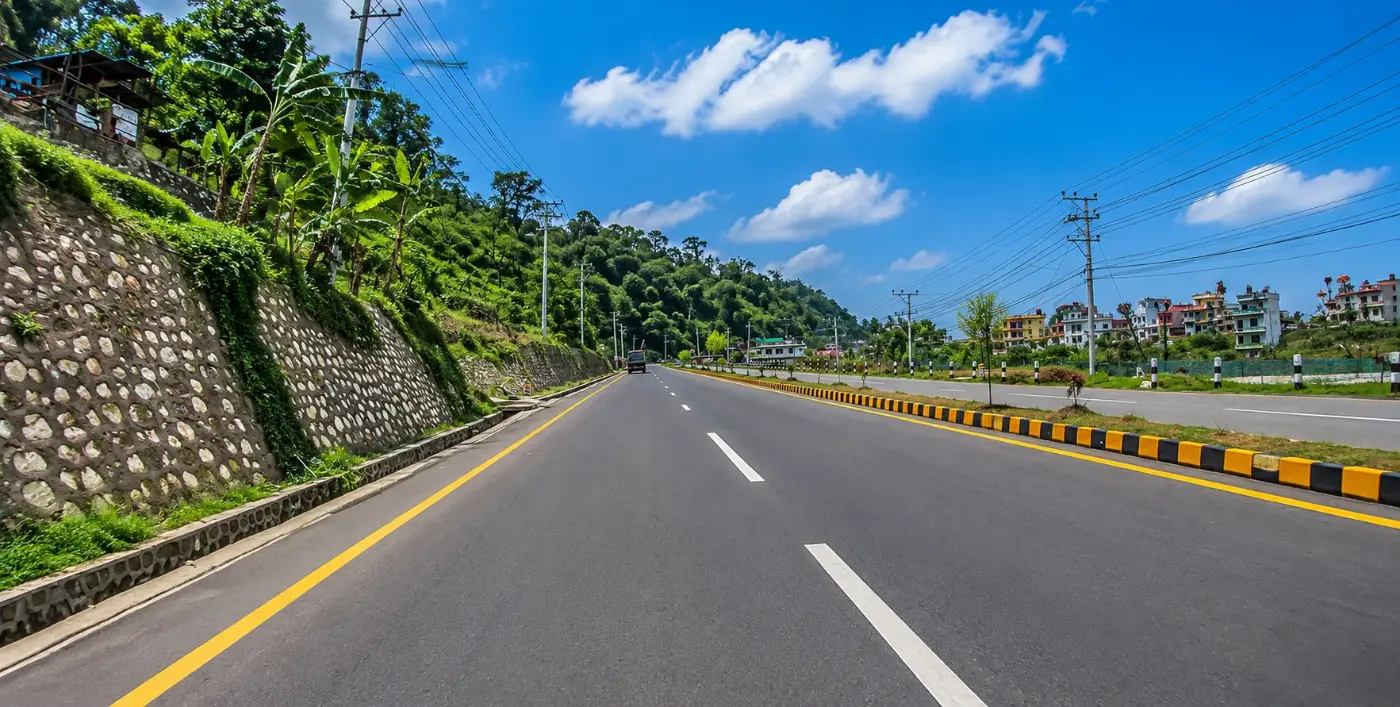
The road quality changes dramatically between sections. The Kathmandu-to-Besisahar section via the Prithvi Highway is mostly paved and manageable. The Besisahar to Chame section gets progressively rougher, with mixed paved and unpaved surfaces.

The Chame to Manang section is the most demanding— a rough mountain track that requires genuine 4WD capability and high ground clearance. Nepal Vehicle Hiring Pvt. Ltd. uses 4WD jeeps, Sumos, and Scorpios for Manang tour rentals—vehicles whose capability and comfort make the full Kathmandu to Manang road journey manageable.

Stage-by-Stage Route: Kathmandu to Manang

Stage 1: Kathmandu to Besisahar (170 km / 5-6 hours)

The journey from Kathmandu to Besisahar follows the Prithvi Highway westward for 80 km to the Abu Khaireni junction, then branches north along the Marsyangdi Highway for the remaining 90 km to Besisahar. This first stage is the most comfortable section: the Prithvi Highway is paved and well maintained.

Nepal Vehicle Hiring Pvt. Ltd. recommends leaving Kathmandu between 5:30 and 6:00 a.m. for the full Kathmandu to Manang road journey. This early start lets you complete all stages in a single day.

Besisahar at 760 m is the traditional starting point for the Annapurna Circuit Trek — a small but functional town with fuel stations, restaurants, guesthouses, and the ACAP permit checkpoint. Manang tour jeep rental clients typically stop in Besisahar to rest and refuel before continuing into the upper valley.

Explore the beautiful Manang Valley by comfortable 4WD jeep with scenic Himalayan mountain views and rugged mountain roads.

Stage 2: Besisahar to Chame (55 km / 2-3 hours)

From Besisahar, the road enters the Marsyangdi Valley gorge — the section where the river begins its dramatic descent from the high Himalaya. The 55 km from Besisahar to Chame at 2,670 m passes through Bhulbhule, Ngadi, Jagat, Chamje, Tal, Dharapani, and Bagarchhap — the classic lower Annapurna Circuit villages.

The road surface alternates between paved and unpaved, with multiple narrow sections carved from the gorge wall. The Marsyangdi River crossings on this section require slow and careful navigation. Nepal Vehicle Hiring Pvt. Ltd. drivers with specific Manang route experience handle these crossing points confidently.

Chame at 2,670 m is the Manang District headquarters — a more substantial settlement with better restaurants and guesthouses than the lower valley villages. Many Manang tour jeep rental itineraries use Chame as an overnight stop on a two-day trip, allowing a more relaxed pace and a restful night before the final push to Manang.

Stage 3: Chame to Pisang (23 km / 1.5-2 hours)

From Chame, the road climbs through pine and rhododendron forests, passing the famous Paungda Danda rock face — a sweeping curve of natural rock over 1,500 m high — before reaching the two Pisang villages at 3,200 to 3,300 m. Lower Pisang on the valley floor and Upper Pisang on the hillside above offer distinctly different character.

Upper Pisang’s position, with Pisang Peak rising dramatically above at 6,091 m and the Pisang Monastery providing a cultural anchor, makes it one of the best photography spots on the lower Manang approach. The road from Chame to Pisang is genuinely 4WD terrain in places, and the Fortuner or Hilux’s high clearance provides meaningful advantages.

Manang Valley Tour Jeep Rental for Himalayan Mountain Travel in Nepal

Stage 4: Pisang to Manang (14 km / 1-1.5 hours)

The final 14 km from Pisang to Manang village traverses the open upper Marsyangdi plateau — the landscape transition from the forested gorge to the semi-arid, high-altitude valley that defines the classic Manang character. Humde, at 3,330 m, and its small airstrip offer the first open views of Annapurna II at 7,937 m, and the valley progressively widens as the vehicle climbs toward Manang, creating a panoramic mountain arrival that is one of the most rewarding final approaches to a Nepal destination accessible by vehicle.

The road on this section is a rough mountain track — often simply the trail surface compacted by vehicle use — and requires the full capability of a 4WD jeep. The Nepal Vehicle Hiring Pvt. Ltd. team assigns its most experienced Annapurna route drivers for the full Kathmandu to Manang jeep rental — the long driving day and demanding upper road sections require a driver with specific route familiarity and mountain-road confidence.

Vehicle Options for the Manang Tour Jeep Rental

4Wd Jeep — The Standard Manang Tour Vehicle

The 4WD Jeep is the most commonly booked vehicle for the Manang Valley tour jeep rental—combining genuine 4WD capability with comfortable cabin space to handle every stage of the Kathmandu to Manang road. The Fortuner’s 279 mm ground clearance, 2.8-litre diesel engine, and part-time 4WD with low-range provide the technical capability needed for the rough Chame to Manang track sections.

At the same time, its seven-seat interior makes the 9 to 11 hour drive genuinely comfortable for up to six passengers. Nepal Vehicle Hiring Pvt. Ltd.‘s Fortuner fleet for the Manang route is maintained specifically for upper-valley demands.

Toyota Hilux 4WD — For Demanding Upper Road Conditions

For the most demanding sections of the Manang approach — particularly the Chame to Pisang and Pisang to Manang rough track sections — the Toyota Hilux 4WD with its 310 mm ground clearance provides the maximum clearance in the Nepal Vehicle Hiring Pvt. Ltd. fleet. For Manang tours that extend beyond the main village to Gangapurna Lake, the Ice Lake approach, or Thorong Phedi, the Hilux’s extra clearance provides real advantages.

Groups with heavy trekking gear or mountaineering equipment particularly benefit from the Hilux’s large load bed.

Mahindra Scorpio — Top-end for Groups

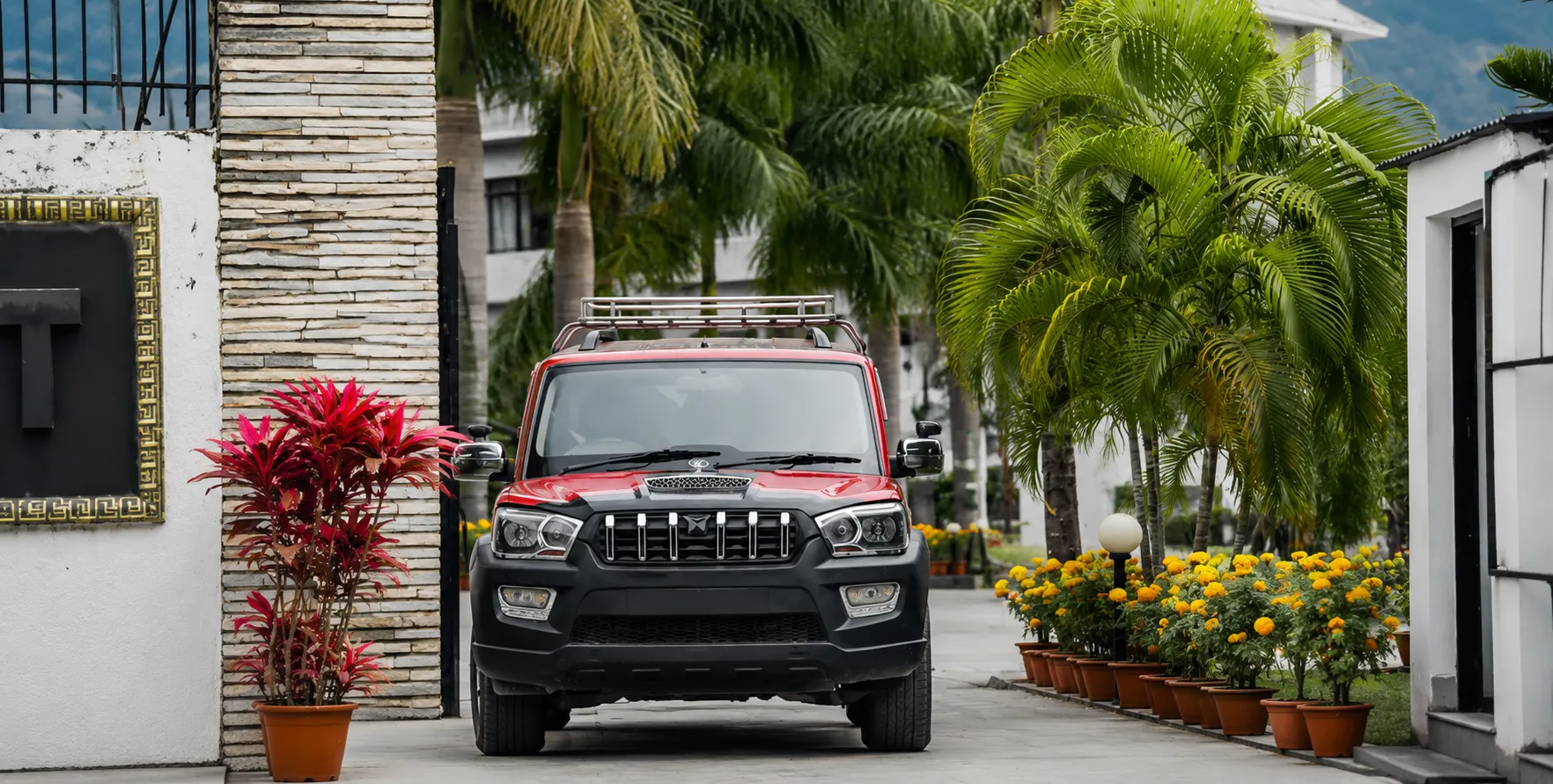
For groups of six to seven that need maximum cabin space and the most powerful drivetrain for sustained mountain road grades, the Mahindra Scorpio is the top-end Manang tour option. The Mahindra Scorpio engine provides significantly better high-altitude performance than the Fortuner’s four-cylinder on the long climbs above 3,000 m. For mountaineering expeditions using the Manang road to reach base camp areas, we specifically recommend the Mahindra Scorpio.

Kathmandu to Manang jeep

Manang Valley Tour Options — What to Do When You Get There

Day Tour to Manang — Vehicle-Accessible Highlights

For travellers, a day tour to Manang Village by jeep rental from Besisahar or as part of a two-day overnight tour from Kathmandu, the primary vehicle-accessible highlights include the Gangapurna Lake — the extraordinary turquoise glacial lake 20 minutes’ walk from the village — and Manang Village itself with its traditional flat-roofed Manangi architecture, the central monastery, and the spectacular mountain backdrop of Annapurna II and Gangapurna. The approach road passes through Chame, Pisang, and Humd, each offering its own photographic and cultural interest.

A practical day tour departs Besisahar at 7:00 a.m. It arrives in Manang around 10:00 a.m., allowing 2 to 3 hours in the village and at Gangapurna Lake before departing for the return journey by 1:00 p.m. and arriving back in Besisahar in the late afternoon. For travellers who arrived in Besisahar the previous day via the Kathmandu-to-Besisahar private jeep transfer from Nepal Vehicle Hiring Pvt. Ltd., this day tour delivers a complete Manang experience within a two-day Nepal itinerary.

For the most complete Manang Valley tour jeep rental experience, we strongly recommend an overnight stay in Manang village. The day tour, while logistically possible, compresses the Manang experience into a few hours that do not allow the valley’s most rewarding aspects — the evening light on the Annapurna faces, the extraordinary star-filled high-altitude sky, the dawn mountain panorama, and the acclimatisation to Gangapurna Lake or Ghyaru village — to be fully experienced.
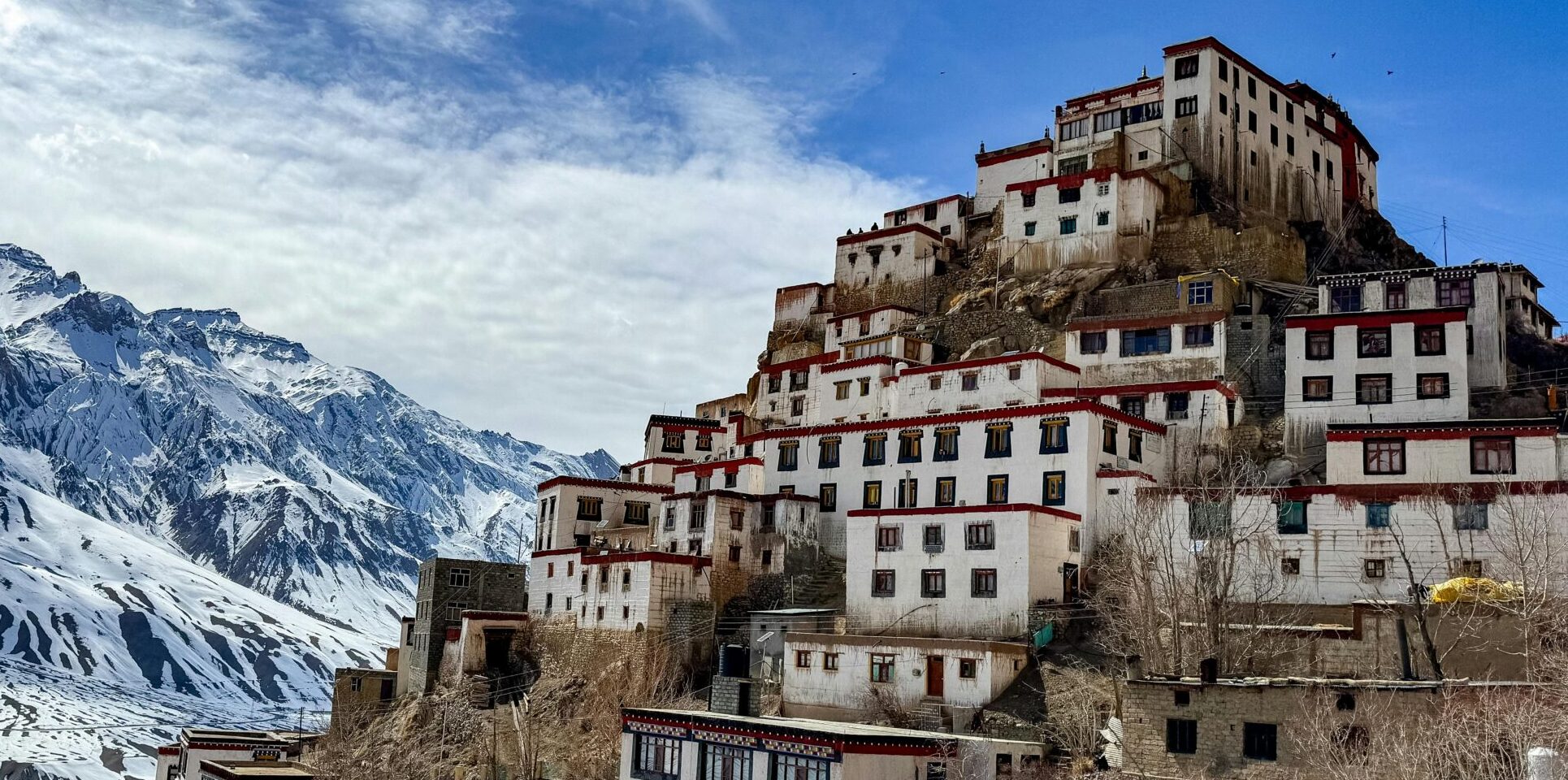
An overnight in Manang, arriving in the afternoon by 4WD jeep from Kathmandu and spending one full day in the valley before returning, offers the best balance of time efficiency and experiential depth. Nepal Vehicle Hiring Pvt. Ltd. coordinates the return pickup with date-flexible booking via WhatsApp.

Manang as a Trek Starting Point

One of the most popular uses of the Manang tour jeep rental  is as a means of fast-tracking to the upper section of the Annapurna Circuit Trek — using the private 4WD jeep from Kathmandu to Chame or Manang to bypass the lower valley road-affected sections and begin trekking from the point where the mountain landscape becomes most dramatic. This approach is increasingly preferred by experienced Annapurna Circuit trekkers who have done the lower valley walk previously and want to focus their trekking days on the upper sections — Manang to Thorong Phedi, the Thorong La Pass crossing at 5,416 m, and the descent to Muktinath.

The private Chame or Manang jeep transfer from Nepal Vehicle Hiring Pvt. Ltd. handles this efficiently—hotel pickup in Kathmandu and delivery to the specific location where the client wants to start.

Explore the beautiful Manang Valley by comfortable 4WD jeep with scenic Himalayan mountain views and rugged mountain roads.

Cost Guide: Manang Tour Jeep Rental

All rates from Nepal Vehicle Hiring Pvt. Ltd. are all-inclusive — driver, fuel for the complete journey, vehicle insurance, and hotel pickup from anywhere in Kathmandu with delivery to the chosen Manang area destination.

Kathmandu to Besisahar (Private Jeep): NPR 18,000-26+,000. The traditional Annapurna Circuit starting point — 170 km, 5 to 6 hours. This jeep transfer is used for day tours to Chame and Manang.

Kathmandu to Chame (4WD jeep): US$398. The most popular Manang tour starting point — 225 km, 7 to 8 hours. Chame at 2,670 m is the optimal overnight stop for the two-day Manang tour itinerary.

Kathmandu to Pisang ( 4WD Jeep): NPR 28,000-50,000. Approximately 248 km, 8 to 9 hours. Upper Pisang at 3,300 m offers extraordinary panoramic views of the Annapurna range and Pisang Peak — a popular overnight option.

Kathmandu to Manang Village ( 4WD Jeep): US$558. The full road journey — 270 to 290 km, 9 to 11 hours. Recommended for two-day itineraries to allow arrival in the late afternoon with full next-day exploration time.

Return Pickup (Manang/Chame to Kathmandu): NPR 28,000- 60,000. Equivalent return rate, date-flexible via WhatsApp at +977 981-4227196. Pre-booking the return simultaneously with the outbound transfer guarantees vehicle availability.

Explore the beautiful Manang Valley by comfortable 4WD jeep with scenic Himalayan mountain views and rugged mountain roads.

Key Attractions of the Manang Valley Tour

Gangapurna Lake — The Turquoise Glacial Jewel

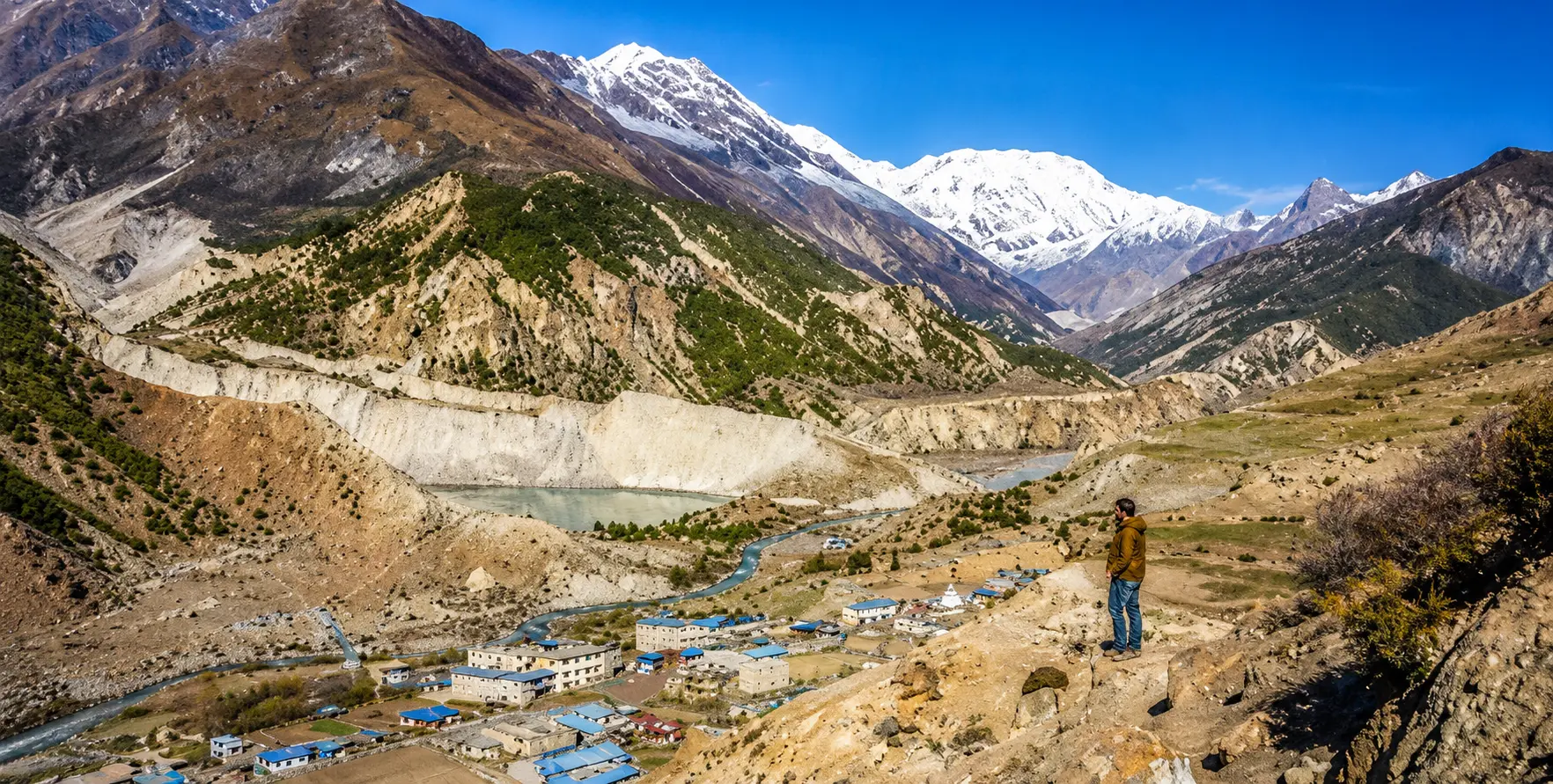
Gangapurna Lake sits at the base of the Gangapurna Glacier, about a 20-minute walk from Manang village, and its extraordinary turquoise colour comes from suspended glacial minerals. The composition possibilities — glacial lake foreground, Gangapurna peak and glacier behind, with Annapurna III visible above — are among the finest at any easily accessible location in Nepal.

The lake is the most popular destination for visitors spending an acclimatization day in Manang. For visitors arriving by vehicle, it is the most rewarding short walk from the road-accessible part of the valley.

The walk to Gangapurna Lake from the main Manang village takes about 20 to 30 minutes on a clear trail that gains about 150 meters above the village. The lake is accessible year-round whenever Manang itself is accessible — autumn and spring provide the clearest mountain backdrop. At the same time, summer shows the most vivid turquoise water colour as glacial melt peaks.
Manang Valley Tour Jeep Rental for Himalayan Mountain Travel in Nepal

Ice Lake — The Acclimatisation Hike Classic

Ice Lake, at 4,600 meters above Manang village, is the highest commonly visited point accessible from the village and the most popular acclimatisation hike for Annapurna Circuit trekkers on their mandatory rest day. The three- to four-hour ascent through Ghyaru village offers one of the finest high-altitude panoramas you can reach on foot in the Annapurna region.

On clear days, Annapurna II, III, IV, Gangapurna, and the entire northern skyline are visible at once. For vehicle tour visitors who want to extend their Manang experience beyond road-accessible attractions, a licensed-guide Ice Lake hike offers an extraordinary high-altitude experience from the jeep-accessible base in Manang village.
Braga Monastery — Ancient History Above the Valley

Braga Monastery — perched on the cliff face above the ancient village of Braga, approximately one hour west of Manang — is one of the oldest and most significant monasteries in the Annapurna Conservation Area, estimated to be over 500 years old. Its collection of ancient Buddhist statues and thangka paintings spans centuries of continuous practice.

The cliff-top position provides extraordinary views down the valley toward Pisang and east toward the Annapurna massif. Open year-round to respectful visitors.

The Mountain Panorama — Manang’s Ultimate Attraction

The mountain panorama from Manang Village is one of the finest available from any permanently inhabited settlement in Nepal — a 270-degree sweep of Himalayan peaks that includes Annapurna II at 7,937 m directly to the south, Gangapurna at 7,455 m and its glacier dominating the northern valley wall, Annapurna III at 7,555 m to the southwest, and the entire Chulu massif to the east. This panorama is visible from the village itself without any walking; it is the backdrop to daily life in Manang and the main reason the Manang Valley tour jeep rental delivers such an extraordinary return on the road time investment from Kathmandu.

Pre-Trek Kathmandu Activities for Manang Tour Visitors

Trekkers and vehicle-tour visitors spending time in Kathmandu before the Manang journey can make the most of their pre-trip days with Nepal Vehicle Hiring Pvt. Ltd.‘s full range of capital sightseeing services. The Kathmandu sightseeing tour covering Boudhanath Stupa, Pashupatinath Temple, Swayambhunath, and Patan Durbar Square is available as a single-day private vehicle tour.

The Bhaktapur Durbar Square day tour and the Nagarkot sunrise tour complete the recommended pre-Manang Kathmandu experience. All of these activities are booked through the same Nepal Vehicle Hiring Pvt. Ltd. team at +977 981-4227196 that handles the Manang jeep rental — a single booking relationship covering the entire Nepal journey.

Manang Valley Tour Jeep Rental for Himalayan Mountain Travel in Nepal

Seasonal Guide: Best Time for the Manang Tour Jeep Rental

Autumn — October and November (Best Overall)

Autumn, from October through November, is the best overall time for the Manang Valley tour jeep rental. Post-monsoon skies are extraordinarily clear — the Annapurna II face, the Gangapurna glacier, and the surrounding peaks are at their most vivid and most photographically powerful.

The road conditions on the Besisahar to Manang approach are at their best after monsoon damage repair, and the dry-season surface provides consistent conditions for 4WD jeep travel. Daytime temperatures at Manang reach 10 to 15 degrees C — cool but comfortable.

Book the Kathmandu to Manang jeep rental at least two weeks in advance for October.

Spring — March to May

Spring provides the second-best window for the Manang tour jeep rental. The weather is broadly stable through April, temperatures warm progressively, and the rhododendron forests of the lower Marsyangdi Valley below Chame bloom spectacularly in March and April. The Thorong La Pass is reliably passable from mid-March onward for trekkers planning to cross.

Road conditions on the Annapurna approach roads are generally good in spring — the dry-season surface intact and not yet affected by monsoon water damage. Nepal Vehicle Hiring Pvt. Ltd. recommends booking the Manang jeep rental at least one week in advance during the spring peak.

Monsoon and Winter

The monsoon season from June to September creates the most challenging conditions for the Besisahar to Manang road. However, the Manang area itself receives relatively little monsoon rain because of the Annapurna rain shadow.

The winter season from December to February brings extreme cold to Manang at night—-15 to -25 degrees C—and significantly limits the experience for visitors without cold-weather expedition equipment. The Kathmandu to Besisahar jeep transfer from Nepal Vehicle Hiring Pvt. Ltd. is available year-round; contact WhatsApp for current road condition information before booking in monsoon or winter.

Permits Required for Manang Valley Tour 2026

The Annapurna Conservation Area Permit (ACAP) costs NPR 3,000 for foreign nationals and is required for all visitors entering the Manang area by any means—walking or private jeep rental. You can obtain the ACAP from the Nepal Tourism Board in Kathmandu or Pokhara before departure, or at the Besisahar checkpoint.

Nepal’s 2026 trekking regulations require a licensed guide in the Manang area — a licensed guide for activities on trails above the road must accompany all foreign visitors. Nepal Vehicle Hiring Pvt. Ltd. can connect clients with registered guide agencies at booking.

Combining the Manang Tour with the Annapurna Circuit Exit

The Thorong La Pass — From Vehicle to Trek

For travellers using the Manang tour jeep rental as a starting point for the upper Annapurna Circuit Trek, rather than a pure vehicle tour, the transition from road to trail at Manang marks the start of one of Nepal’s most celebrated trekking experiences. The classic route from Manang to Thorong La Pass at 5,416 m and down to Muktinath at 3,800 m is a two- to three-day high-altitude walk that requires proper acclimatisation in Manang, appropriate cold-weather gear, and a licensed guide.

Most trekkers spend two nights in Manang to acclimatise before ascending to Thorong High Camp or Thorong Phedi at 4,460 m for the pre-dawn start of the pass-crossing day. The Kathmandu-to-Manang jeep rental from Nepal Vehicle Hiring Pvt. Ltd. takes trekkers to the Manang starting point for this upper-circuit section, and the company coordinates the return Pokhara car hire or Muktinath-to-Pokhara jeep hire service that completes the circuit from the other side of Thorong La.

The Thorong La crossing is reliably possible from mid-March through mid-November in most years, with October and April providing the most stable conditions. Trekkers who have used the Manang jeep rental to arrive at Manang should allow a minimum of two acclimatisation nights before attempting the pass — arriving at Manang on Day 1, resting and acclimatising on Day 2 with the Gangapurna Lake or Ghyaru hike, and then ascending to Thorong Phedi on Day 3 for the Day 4 pass crossing.

This pacing respects the high-altitude physiology that the 5,416 m Thorong La demands and produces significantly better crossing outcomes than trekkers who rush the acclimatisation phase.

Manang Valley Tour Jeep Rental for Himalayan Mountain Travel in Nepal

Muktinath and Pokhara — Completing the Circuit by Vehicle

Trekkers who complete the Thorong La crossing and descend to Muktinath can continue the Annapurna Circuit Trek on foot southward through Jomsom and Tatopani, or take a private vehicle from Muktinath to Pokhara with Nepal Vehicle Hiring Pvt. Ltd. for the return to Pokhara by road. The Muktinath-to-Pokhara jeep hire covers about 165 km via the Kali Gandaki Gorge road. It takes about 4 to 5 hours—a dramatically scenic drive that parallels the classic trekking descent route through one of the world’s deepest gorges.

This vehicle option allows the complete circuit — arriving in Manang by jeep from Kathmandu, trekking the upper section over the Thorong La, and returning by vehicle from Muktinath to Pokhara — in a total of approximately 7 to 10 days from Kathmandu, making the Annapurna Upper Circuit accessible within a Nepal trip of 2 weeks.

Pokhara to Kathmandu — The Final Connection

From Pokhara, return to Kathmandu by private vehicle from Nepal Vehicle Hiring Pvt. Ltd., completing the circuit—200 km along the Prithvi Highway in 5 to 7 hours. Travellers with time in Pokhara before returning can use the car hire in Pokhara service for Lakeside sightseeing, Sarangkot sunrise, World Peace Pagoda, and the International Mountain Museum—all available through the same Nepal Vehicle Hiring Pvt. Ltd. team.

The complete transport chain from Kathmandu sightseeing tours and Bhaktapur Durbar Square day trips through the Kathmandu to Manang jeep rental, Thorong La trek, Muktinath vehicle return, Pokhara stay, and Pokhara to Kathmandu private transfer — coordinated through a single trusted provider at +977 981-4227196 — is the most efficient and stress-free way to experience Nepal’s greatest mountain circuit.

Manang Valley in Nepal’s Adventure Tourism Context

The Manang Valley sits at the intersection of Nepal’s most celebrated and most rapidly developing adventure tourism trends — the move from pure trekking to mixed vehicle-and-trekking itineraries that the improving road infrastructure is enabling, the growing interest in acclimatisation destinations for mountaineers attempting Nepal’s high peaks, and the increasing demand from cultural tourists for authentic Himalayan community experiences accessible without the full physical commitment of extended trekking. The Manang tour jeep rental from Nepal Vehicle Hiring Pvt. Ltd. sits at the centre of this trend—providing the vehicle infrastructure that lets Kathmandu serve all three visitor categories with a single day of comfortable driving.

The Annapurna Conservation Area’s extraordinary biodiversity — snow leopards on the upper ridges, Himalayan thar and blue sheep at mid-altitude, pheasants and eagles throughout — is visible from the road approach and adds another dimension to the Manang valley experience for naturalist travellers. The Manang District is recognised as one of Nepal’s prime snow leopard habitats, and winter Manang (December to February) specifically attracts wildlife photographers and naturalists who accept the harsh conditions for the chance to see the snow leopard, the most sought-after wildlife experience in South Asia.

The Nepal Vehicle Hiring Pvt. Ltd. Kathmandu to Manang 4WD jeep service supports winter wildlife expeditions with the same professional reliability it offers spring trekkers and autumn adventure tourists.

Manang Valley Tour Jeep Rental for Himalayan Mountain Travel in Nepal

Nepal Vehicle Hiring Pvt. Ltd. — Manang Tour Jeep Rental Specialist

Nepal Vehicle Hiring Pvt. Ltd. offers Kathmandu to Manang private 4WD jeep rentals as part of its comprehensive Annapurna region transport network. The same network covers Kathmandu to Besisahar trailhead transfers, Pokhara car hire, Pokhara to Muktinath jeep hire, and a full range of Nepal private vehicle hire services.

With 8,000+ satisfied customers, a 5.0 TripAdvisor rating, and 200+ verified five-star reviews, the company delivers the same professional standard its clients across Nepal’s full trekking network have experienced.

Book Your Manang Tour Jeep Rental with Nepal Vehicle Hiring

WhatsApp: +977 981-4227196 (24/7 — Early Morning Departures Available)
Email: [email protected]
Office: Bhagawatisthan, Thamel, Kathmandu, Nepal
Kathmandu to Besisahar:4WD Jeep | NPR 18,000-26,000
Kathmandu to Chame: 4WD Jeep | NPR 24,000-40,000
Kathmandu to Manang: 4WD Jeep | NPR 32,000-60,000
Return Pickup: Date-flexible via WhatsApp — pre-book with outbound

Manang Valley Tour Jeep Rental for Himalayan Mountain Travel in Nepal

The Marsyangdi Valley Road — A Cultural Journey Through Villages

Bhulbhule and Ngadi — Gateway Villages

The first villages encountered beyond Besisahar on the Manang jeep rental route are Bhulbhule and Ngadi — traditional Gurung communities in the subtropical lower Marsyangdi Valley whose terraced rice fields, banana groves, and vibrant market life represent the lowland Nepal that the high-mountain-focused Annapurna Circuit trekking industry tends to rush through. From the vehicle window, the transition from the subtropical vegetation of Bhulbhule (at approximately 840 m) to the progressively more temperate valley above Ngadi offers a visible botanical gradient that mirrors the dramatic temperature and altitude changes the full day’s drive to Manang will encompass.

Nepal Vehicle Hiring Pvt. Ltd. drivers on the Kathmandu-to-Manang jeep rental route know the best roadside viewpoints in this section. They can point out the first distant glimpses of the Annapurna range as the valley opens northward above Ngadi.

Jagat at 1,300 m is the last Gurung village before the valley’s cultural character shifts northward toward Manang District Manangi culture—a transition marked by increasingly Tibetan-influenced architecture, the first mani walls and prayer flags, and a shift in agriculture from lowland rice to mid-altitude barley and potato cultivation. The ACAP checkpoint at Jagat verifies trekking permits for those who didn’t obtain them in Besisahar, and Nepal Vehicle Hiring Pvt. Ltd. drivers assist with the checkpoint process as part of the standard Manaslu Circuit tour jeep rental service.

Manang Valley Tour Jeep Rental for Himalayan Mountain Travel in Nepal

Dharapani and Bagarchhap — The Upper Forest Zone

Dharapani at 1,860 m marks the junction where the Manaslu Circuit Trek route branches north into the Dudh Pokhari Valley toward the Larkya La Pass. In contrast, the Annapurna Circuit route and the Manang jeep road continue northwest into the upper Marsyangdi.

The village is an important junction settlement with a good selection of teahouses and restaurants — many Manang tour jeep rental itineraries make Dharapani a first rest stop on the northward journey, especially for those who left Kathmandu early and need a mid-morning break and meal before the more demanding upper road sections.

Bagarchhap at 2,160 m is the first settlement with distinctly Manangi architectural character—flat-roofed stone houses and covered lane networks that protect residents from the increasingly fierce winds that characterize the upper Marsyangdi Valley as altitude increases. The Bagarchhap Monastery is a simple but actively used religious building that represents the beginning of the Buddhist cultural landscape that culminates in Manang’s extraordinary monastery and religious site network.

For Manang tour jeep rental travellers, passing through Bagarchhap marks the moment the journey begins to feel genuinely Himalayan rather than simply mountain—the combination of the architectural character, the religious markers, and the increasingly raw valley landscape above creates the distinctive atmosphere of the Manang District approach.

Chame — The Essential Overnight Option

Chame at 2,670 m — the Manang District headquarters — represents the ideal overnight stop for travellers doing the Kathmandu to Manang jeep rental as a two-day journey. The town has a dozen well-established guesthouses and lodges, several good restaurants serving Nepali and Chinese-influenced cuisine, ATMs, pharmacies with basic high-altitude medications, including Diamox for altitude sickness prevention, and hot showers after the long drive from Kathmandu.

The famous Chame hot springs — a natural thermal pool a short walk from the main settlement — are one of the finest rest stops on the entire Annapurna Circuit and a particularly rewarding reward for the long driving day. Nepal Vehicle Hiring Pvt. Ltd. coordinates Chame accommodation recommendations for clients doing the two-day Manang tour — contact the team at +977 981-4227196 for specific guesthouse suggestions based on current availability and quality.

The acclimatization benefit of spending the night in Chame before continuing to Manang the following morning is practically significant—the 85850-meter elevation gain between Chame and Manang village is a meaningful physiological step for visitors coming directly from Kathmandu at 1,400 m. A night in Chame before reaching Manang’s 3,519 m altitude substantially reduces the risk of altitude headache and other acclimatization symptoms that can interfere with the Manang experience.

The Nepal Vehicle Hiring Pvt. Ltd. team consistently recommends the two-day Chame overnight option for Manang Valley jeep rental bookings—the additional day cost is negligible compared to the improved arrival experience in Manang.

Upper and Lower Pisang — The Photography Highlight

The two Pisang villages at 3,200 to 3,300 m offer the finest photography opportunity on the entire Kathmandu to Manang jeep rental route — Lower Pisang on the valley floor with the road passing through its centre, and Upper Pisang on the hillside above, accessible by a short detour that adds approximately 30 minutes to the journey. The classic Upper Pisang composition — the ancient monastery on the hillside above the village, the Pisang Peak at 6,091 m rising dramatically above, and the broad Marsyangdi Valley spreading below — has been photographed by every serious Nepal mountain photographer and is consistently rated as one of the finest accessible compositions in the entire Annapurna region.

For Manang tour jeep rental clients, the Nepal Vehicle Hiring Pvt. Ltd. driver will typically stop at Upper Pisang and allow time for photos before continuing to Manang. This brief detour is included in the standard journey timing and requires no additional arrangement.

Manang hidden valley

Manang Valley Trekking — What to Do on Day 2 of the Overnight Tour

The Acclimatisation Manang — Making the Most of It

For vehicle tour visitors spending a full day in Manang before the return journey — the recommended overnight tour structure — the acclimatisation day represents the heart of the entire Manang experience and should be planned deliberately. Experienced guides recommend a standard acclimatisation day structure that follows the climb high, sleep low principle: walk to a significantly higher elevation than the overnight sleep elevation, then return to sleep at Manang altitude.

The three most popular destinations for Manang Valley vehicle tour visitors are Gangapurna Lake at approximately 3,700 m (suitable for all fitness levels, 20 to 30 minutes from the village), Ghyaru village at 3,730 m with extraordinary panoramic views of the full Annapurna massif (1 to 1.5 hours from Manang, suitable for fit walkers), and Ice Lake at 4,600 m (3 to 4 hours, for fit and experienced high-altitude walkers only). The licensed guide arranged through a registered agency—mandatory for trail activities at Manang under the 2026 regulation—is an essential companion for all three options.

The Himalayan Rescue Association (HRA) clinic in Manang runs a daily altitude sickness awareness lecture at 3:00 p.m., which is strongly recommended for all Manang visitors, regardless of prior high-altitude experience. The lecture covers AMS (Acute Mountain Sickness) recognition, appropriate responses (including medication), and a decision-making framework for when to descend- information that is practically valuable for Manang tour jeep rental visitors who may not have had prior high-altitude education.

The HRA clinic also provides basic health assessments for visitors experiencing altitude-related symptoms and can advise on whether it is safe to spend an additional night at Manang altitude or whether descent is medically indicated.

The Evening Light on the Annapurnas — Manang’s Secret Reward

For Manang tour jeep rental visitors who arrive in the afternoon and spend the evening in the village before the following day’s activities, the evening light on the Annapurna faces is one of the most quietly extraordinary rewards of the overnight Manang tour experience — and one that day visitors who arrive and depart on the same day entirely miss. The late-afternoon alpenglow—the warm orange and pink light that falls on the Annapurna II and III faces as the sun descends toward the Dhaulagiri watershed to the west—creates exceptional photographic conditions that experienced Himalayan photographers plan their arrival timing to capture.

The light typically begins around 4:00 to 5:00 p.m., depending on the season, and transforms the mountain faces from daytime grey-white to warm gold, amber, and deep rose tones that last about 30 minutes before fading. The Nepal Vehicle Hiring Pvt. Ltd. team recommends arriving in Manang by 3:00 p.m. at the latest to allow a comfortable rest before this evening alpenglow experience—one of the best reasons to choose the overnight Manang tour over the day trip option.

Manang Valley Tour Jeep Rental for Himalayan Mountain Travel in Nepal

Group Economics: Sharing the Manang Tour Jeep Rental

Per-Person Cost Analysis for Different Group Sizes

One of the most important, and most underestimated, aspects of Nepal vehicle hire costs is group economics: how a vehicle rate that looks expensive for a solo traveller becomes excellent value when shared among three, four, five, or six travellers. Nepal Vehicle Hiring Pvt. Ltd.’s pricing structure charges for the vehicle rather than the passenger—whether one or six people ride in a Fortuner, the vehicle rate is the same.

This means the Manang tour jeep rental economics change dramatically with group size.

For the Kathmandu to Manang Fortuner jeep rental at NPR 35,000 (mid-range estimate): a solo traveller pays NPR 35,000; a couple pays NPR 17,500 each; a group of four pays NPR 8,750 each; a group of six pays NPR 5,833 each. At NPR 5,833 per person, the private Manang tour jeep rental for a group of six uses shared local vehicles.

It delivers the full private-vehicle advantages — hotel pickup in Kathmandu, a chosen departure time, stops at chosen viewpoints, and door delivery to the Manang guesthouse. For trekking groups already travelling together, a group Manang jeep rental is the obvious first choice.

For solo travellers who want the benefits of a private jeep rental to Manang but are constrained by cost, Nepal Vehicle Hiring Pvt. Ltd. can sometimes connect travellers with compatible routes and timing who want to share vehicle costs. Solo travellers staying in Thamel guesthouses often meet other solo travellers heading to Manang and the Annapurna Circuit at the same time.

Coordinating a shared Manang jeep rental through Nepal Vehicle Hiring Pvt. Ltd. can produce per-person costs that rival local transport alternatives while delivering the full private-vehicle service quality. Contact the team on WhatsApp to enquire about vehicle-sharing options for your specific dates.

Comparing Manang Jeep Rental with Public Transport

The public transport alternative to the Manang tour private jeep rental involves a combination of services: a public bus from Kathmandu to Besisahar (approximately 6 to 7 hours on the Besisahar bus from Gongabu Bus Park, NPR 400 to 600), followed by a shared local jeep or road vehicle from Besisahar toward Chame and the upper valley (approximately NPR 800 to 1,500 per person per section, journey time variable). The total cost for the public transport approach from Kathmandu to Manang is approximately NPR 2,000 to 3,000 per person — significantly less than the private jeep rental for a solo traveller, but requiring 10 to 14 hours of total transit time with multiple vehicle changes, no hotel pickup, fixed schedules, crowded shared vehicles, and significant uncertainty about availability and timing on the upper valley road sections.

For groups of four or more, the economics shift substantially in favour of the private Manang tour jeep rental. A group of four sharing a Kathmandu to Manang Fortuner jeep rental at NPR 35,000 pays approximately NPR 8,750 per person — three to four times the public transport cost, but with hotel pickup in Kathmandu, a single comfortable air-conditioned vehicle for the entire journey, the freedom to stop at viewpoints, and arrival in Manang with energy intact rather than exhausted from the public transport chain.

The quality of the Manang arrival experience — and the quality of the full day that follows in the valley — is meaningfully better for travellers who arrive in a private jeep from Nepal Vehicle Hiring Pvt. Ltd. than for those who navigate the public transport alternative.

Manang Valley Tour Jeep Rental for Himalayan Mountain Travel in Nepal

Manang Valley Tour in Context — Connecting with Nepal’s Broader Itinerary

Manang Tour as Part of the Pokhara and Annapurna Circuit

The Manang Valley tour jeep rental fits naturally into a broader Nepal itinerary that combines Kathmandu sightseeing with Pokhara and the Annapurna region. A popular seven- to ten day Nepal itinerary runs: Kathmandu (2 nights of heritage sightseeing via Nepal Vehicle Hiring Pvt. Ltd. — Bhaktapur day tour, Nagarkot sunrise, Kathmandu sightseeing circuit) — private jeep to Besisahar or Chame — Manang overnight tour — return by jeep to Pokhara via the Besisahar to Pokhara road — Pokhara leisure days with car hire in Pokhara for Sarangkot, Phewa Lake, and Lakeside exploration — return to Kathmandu by the Pokhara to Kathmandu private vehicle hire.

Thial Vehicle Hiring Pvt. Ltd. coordinates this complete itinerary as a single booking package—contact the team at +977 981-4227196 with your full itinerary for a comprehensive package quotation.

For trekkers using the Manang tour jeep rental to reach the full Annapurna Circuit Trek—starting their walk from Manang or Chame after the jeep ride and completing the circuit at Besisahar or Nayapul on the other side of Thorong La—the exit can also be coordinated with Nepal Vehicle Hiring Pvt. Ltd.. You can pre-book the return Besisahar to Kathmandu jeep rental or the Nayapul to Pokhara jeep hire at the same time as the outbound Manang transfer, with date confirmation via WhatsApp during the trek.

This creates a smooth transport chain from the Kathmandu hotel pickup at the start of the journey through the Annapurna Circuit completion transport at the end — all through a single trusted provider.

Combining Manang with the Mustang and Muktinath Circuit

Experienced Annapurna region travellers increasingly combine a Manang Valley jeep rental with an onward journey to Muktinath and the Mustang region in a single extended vehicle-and-trekking itinerary. The route from Manang across the Thorong La Pass at 5,416 m descends to Muktinath at 3,800 m — one of Nepal’s most sacred pilgrimage sites for both Hinduism and Buddhism — from where the Muktinath to Pokhara jeep service (via Jomsom and the spectacular Kali Gandaki gorge) returns travellers to Pokhara for the onward Nepal journey.

This complete Kathmandu to Manang by jeep, Manang to Muktinath by trek, Muktinath to Pokhara by jeep itinerary combines the best vehicle-accessible approach with a focused high-altitude trekking experience and a spectacular mountain-road return—coordinated entirely through Nepal Vehicle Hiring Pvt. Ltd. for maximum efficiency and minimal logistical complexity. Contact +977 981-4227196 for a quotation for this extended circuit package.

Frequently Asked Questions — Manang Tour Jeep Rental

Can I drive all the way to Manang from Kathmandu in one day?

Yes — in 2026, the road from Kathmandu to Manang (approximately 270 to 290 km) can be covered in a single long day (9 to 11 hours) by a private 4WD jeep from Nepal Vehicle Hiring Pvt. Ltd.. A 5:30 to 6:06:00 a.m. departure from Kathmandu gets you to Manang by late afternoon.

A two-day itinerary with an overnight in Chame at 2,670 m is more comfortable and allows acclimatisation before reaching Manang’s higher altitude.

What type of vehicle is needed for the Manang road?

A 4WD vehicle is essential for the full Kathmandu-to-Manang road journey. The sections from Chame to Pisang and Pisang to Manang involve rough mountain tracks that a standard car can’t reliably handle. Nepal Vehicle Hiring Pvt. Ltd. offers WD Jeep, Scorpio, and 4WD Sumo for all Manang tour jeep rentals.

How much does the Kathmandu to Manang jeep rental cost?

The Kathmandu to Manang private 4WD jeep rental from Nepal Vehicle Hiring Pvt. Ltd. costs US$558 all-inclusive. The Kathmandu to Chame jeep rental — the most popular two-day Manang tour option — costs NPR 24,000 to 32,000. All rates include hotel pickup in Kathmandu and drop-off in the specified village.

Do I need a permit for the Manang Valley jeep tour?

Yes—the ACAP permit (NPR 3,000 for foreign nationals) is required for all visitors to the Manang area, whether they arrive on foot or by vehicle. Obtain it in Kathmandu before departure or at the Besisahar checkpoint. The mandatory licensed guide regulation also applies to trail activities above the road.

What can you do in Manang on a vehicle-accessed tour?

The main vehicle-accessible attractions of one Manang Valley tour are: Manang Village itself with its traditional architecture and monastery, Gangapurna Lake (a 20-minute walk to an extraordinary turquoise glacial lake), the approach to Braga Monastery (a 45-minute walk), and the valley views en route through Chame, Pisang and Humde. With a licensed guide, the acclimatisation hike to Ice Lake at 4,600 m offers an outstanding high-altitude experience from the vehicle-accessed base.

Is the Manang road safe year-round?

The road is safest and most reliable from October through November and March through May. The monsoon season (June to September) makes conditions more challenging on the unpaved sections, particularly from Besisahar to Chame and from Chame to Manang. Winter (December to February) brings road icing at high sections and extreme cold at Manang.

Nepal Vehicle Hiring Pvt. Ltd. monitors current road conditions and advises on timing adjustments — contact +977 981-4227196 for the latest status before booking.

Conclusion: Manang Is Now Within Vehicle Reach

The Manang Valley tour jeep rental represents one of the most significant new dimensions of Nepal vehicle tourism in 2026—a destination previously accessible only by multi-day trekking is now reachable in a single day’s drive in a capable 4WD jeep from Nepal Vehicle Hiring Pvt. Ltd.. The extraordinary Annapurna II face, Gangapurna glacier, the turquoise Gangapurna Lake, and the warm cultural life of the Manangi community are now within day-trip or overnight-tour reach from Kathmandu — delivered by a private 4WD jeep service that Nepal Vehicle Hiring Pvt. Ltd. provides with transparent pricing and the professional reliability that 8,000+ satisfied clients depend on.

Contact Nepal Vehicle Hiring Pvt. Ltd. at +977 981-4227196 or vehiclehiringnepal.com to book your Manang Valley tour jeep rental. Combine it with a Kathmandu sightseeing tour, a Bhaktapur day trip, or a Nariseni experience to complete your journey.

Manang — with its mountains, its glacier, its ancient monastery, and its extraordinary place in the Himalayan world — is waiting. And in 2026, the road goes there.

Chame to Manang Road Guide

Kathmandu to Manang jeep

Chame to Manang Road Guide: The Ultimate Drive Through the Annapurna Circuit

The road from Chame to Manang is one of Nepal’s most dramatic high-altitude drives. Carved through the Marsyangdi River valley deep inside the Manang District of Gandaki Province, this 30-kilometre corridor takes you from a pine-forested alpine village at 2,670 metres to one of the world’s highest permanently inhabited valleys at 3,540 metres — and every kilometre of the way assaults the senses. Sheer rock walls, thousands of metres high, crowd the valley.

The Marsyangdi River roars through gorges below the road. Ancient villages cling to ridgelines that seem impossibly steep. And the Annapurna massif — Annapurna II, III, and IV, plus Gangapurna and Lamjung Himal — announces itself in steadily more commanding fashion as you ascend.

This route is the beating heart of the Annapurna Circuit, one of the most celebrated trekking journeys on Earth. For decades, the only way to travel this corridor was on foot, which is why the circuit became legendary — every meter of altitude was earned by walking.

Today, a motorable road reaches Manang and beyond, so you can drive the route in a 4WD jeep and see the same landscapes in a fraction of the time.

Whether you are a trekker using a jeep to shorten the lower circuit and start your walk from Chame or Pisang, a traveller on a private vehicle tour of the Annapurna region, or a driver building your knowledge of this extraordinary mountain road, this guide is your comprehensive companion for the Chame to Manang route.

Nepal Vehicle Hiring Pvt. Ltd., based in Thamel, Kathmandu, offers dedicated 4WD jeep hire in Nepal for this route, driven by experienced mountain-road drivers who know every bend between Besisahar and Manang. This guide covers the full road, key villages and landmarks, trekking trail options, permits, altitude advice, seasonal conditions, and how to book your transport. Let’s begin.

Chame to Manang Road Guide

Understanding the Chame to Manang Road: Geography and Context

Before diving into the kilometre-by-kilometre detail, it helps to understand the broader geography that shapes this road. The route follows the Marsyangdi River valley, a major river system that originates in the glaciers of the Annapurna range and drains southward to eventually join the Trishuli River.

The valley runs roughly south-to-north in its upper reaches, which means the road also runs predominantly north — climbing steadily as it goes deeper into the Annapurna massif.

Chame (2,670 m) is the administrative headquarters of Manang District and the point where the road transitions from the more accessible lower valley into true high-altitude mountain terrain. South of Chame, you are still in the buffer zone between subtropical hills and alpine environment.

North of Chame, the road enters the rain shadow of the Annapurna and Dhaulagiri ranges—one of the most geographically distinctive zones in the Himalayas—where rainfall drops dramatically, the landscape becomes increasingly arid and Tibetan in character, and the surrounding peaks begin to feel genuinely enormous rather than merely impressive.

The total driving distance from Chame to Manang is approximately 30 kilometres, taking 2 to 3 hours in good conditions. However, conditions on this road are rarely described as ‘good’ in the conventional sense — the track is unpaved, subject to washouts, narrow in places, crossed by streams, and shared with trekkers, yaks, and local supply jeeps.

The drive demands a 4WD vehicle with high ground clearance and a driver experienced in mountain road conditions. Regular cars and two-wheel-drive vehicles are completely unsuitable beyond Besisahar, and from Chame onward the road becomes even more demanding.

For context on the full overland approach: most travellers reach Chame after a drive from Kathmandu of approximately 238 kilometres total, with the first 173 kilometres on the paved Prithvi Highway to Besisahar taking 5 to 7 hours, and the remaining 65 kilometres of rough mountain road from Besisahar to Chame adding another 4 to 5 hours.

If you are coming from Pokhara, the distance to Chame is approximately 106 kilometres and takes around 3.5 hours. Our dedicated Kathmandu to Manang jeep service covers the entire route from the capital, and our Besisahar private vehicle service handles the gateway leg for those joining from different start points.

Chame to Manang Road Guide

Chame (2,670 m): Where the High Himalayas Begin

Chame is the first major village on the Annapurna Circuit that feels genuinely Himalayan. Below it, the valleys are lush, the villages predominantly Hindu and Gurung, and the road is lined with rice terraces and tea gardens. Chame belongs to a different world.

The village sits on the northern bank of the Marsyangdi River, surrounded by pine forests, with Annapurna II rising to the northeast like a white wall and Lamjung Himal visible on clear mornings to the south. The air is cooler, drier, and thinner than anything below — and this is where acclimatisation becomes a serious consideration for anyone heading higher.

As the district headquarters of Manang District, Chame has more facilities than most villages at this altitude. Chame has proper lodges with attached bathrooms, a government bank (one of the last banking facilities before Manang), an ACAP permit checkpoint, basic medical facilities, and enough teahouses and restaurants to satisfy every trekker’s appetite.

Most lodges offer Wi-Fi, though reliability decreases with altitude. Mobile signal is present but can be patchy depending on your network provider.

Key Attractions in and Around Chame

One of Chame’s most talked-about but least-mapped attractions is its natural hot spring, located about 20 minutes downhill from the village centre. It is not signposted on most trail maps — ask at your teahouse for directions.

Soaking tired legs in the thermal waters while looking up at the surrounding peaks makes the descent feel well worth it. A small donation or entry fee may be charged.

Chame’s monastery is small but active, with spinning prayer wheels and faded murals that speak to the Tibetan Buddhist culture that becomes increasingly dominant as you climb higher into the Annapurna watershed. The Manangi people — the local ethnic group of the Manang District — are culturally Tibetan but ethnically distinct, with their own language and customs.

Historically, they were traders who crossed the Himalayas to barter wool and goods, and even today they retain government-granted trading privileges that allow them to do business across international borders.

Behind the village, apple orchards on terraced slopes produce fruit used for local apple brandy and dried apple products sold in teahouses along the circuit. The views of Annapurna II from the ridge above Chame are already extraordinary. This 77,937-metre peak dominates the northeastern skyline and will be your companion for much of the journey to Manang.

Leaving Chame: The Road Divides

As you leave Chame heading north, both the road and the trekking trail begin an approach to one of the most dramatic natural features on the entire circuit. The valley narrows, the walls close in, and the forest thickens.

After about 5 km (1.5 to 2 hours of walking, or about 30 minutes of driving), you reach the Bhratang area and first encounter Paungda Danda. This curved rock wall rises 1,500 meters directly above the river in an almost perfectly vertical sweep. It is one of the most jaw-dropping geological features in the Himalayas, and approaching it by road or on foot produces the same effect: a sudden, silent awareness of how enormous these mountains truly are.

The road through this section is particularly narrow and exposed, carved into the cliff base. High-clearance 4WD is not just recommended here — it is essential. Our jeep hire service uses well-maintained Mahindra Scorpio and Toyota Land Cruiser vehicles, driven by experienced drivers who navigate this stretch daily during the trekking seasons.

Chame to Manang Road Guide

Chame to Pisang (14 km): Pine Forests, Rock Faces, and the First Mountain Panorama

The 14-kilometre journey from Chame to Pisang takes about 5 to 6 hours of walking or 45 minutes to 1 hour by car. This section contains some of the finest scenery on the entire Chame-to-Manang road, and the transition in landscape is nothing short of extraordinary — you begin in dense pine and rhododendron forest and emerge into a wide alpine valley with the full sweep of the Annapurna range filling the northern skyline.

From Chame, the road and trail follow the Marsyangdi River northward through the forest. The first major crossing point is the Swargadwari suspension bridge over the Marsyangdi, a wide cable bridge that sways gently but holds firm.

From the bridge, looking south toward Chame, the lower valley already looks distant and small beneath the surrounding peaks. Looking north, the valley opens, and the white mass of Annapurna II fills the horizon in a way that is hard to describe without superlatives.

Beyond the bridge, the road climbs steadily through a landscape that becomes increasingly dramatic. Ancient mani walls — long rows of stones carved with Buddhist prayers — line the trail, each stone placed over centuries by pilgrims and locals offering devotion to the mountains and seeking protection on high-altitude journeys.

Chortens (Buddhist stupas) mark the ridgelines. Prayer flags snap in the mountain wind. The cultural shift from the Hindu valley culture below to the Tibetan Buddhist highland culture above is complete by the time you reach Pisang.

Bhratang and the Apple Orchards

About 4 km north of Chame, the small settlement of Bhratang sits in a wide section of the valley surrounded by apple orchards that produce some of the finest fruit in the Annapurna region. The apple brandy and dried apples sold at teahouses along the circuit often come from Bhratang’s orchards, and stopping here during the autumn harvest (September to October) lets you buy fresh apples directly from farmers.

Bhratang itself is a quiet, atmospheric settlement — a handful of stone houses, prayer wheels at the village entrance, and the constant sound of the river below.

Chame to Manang Road Guide

Lower Pisang (3,200 m) and Upper Pisang (3,310 m)

Pisang marks the end of the first section of the Chame-Manang road and the beginning of a critical choice that shapes the next stage of the journey. The village has two parts: Lower Pisang at 3,200 meters sits on the valley floor close to the road, with the most teahouses and the easiest access for jeep passengers.

Upper Pisang at 3,310 meters sits dramatically on a ridge 100 meters above — a Tibetan-style village of stone and whitewash with one of the oldest monasteries in the Manang region and some of the finest views on the entire Annapurna Circuit.

If you are driving from Chame to Manang and have time to stop, Upper Pisang is worth the short climb. The monastery here is a quiet stone witness to more than thirteen centuries of prayer, and the views from the ridge at sunset — with Annapurna II and Annapurna IV directly across the valley and the Marsyangdi far below — are widely regarded as among the finest on the entire Annapurna Circuit.

Many experienced trekkers say the Upper Pisang sunset is the most photogenic moment of the circuit, and the road doesn’t offer this view; you have to climb for it.

The Two Routes from Pisang to Manang: Upper vs Lower Trail

This is where the Chame-to-Manang corridor becomes most interesting from a route-planning perspective, because from Pisang onward the road and the best trekking trail diverge significantly. The jeep road follows the lower valley through Humde (where the small airstrip for Manang is located) and Braga before reaching Manang.

The upper trekking trail climbs the ridge through Ghyaru and Ngawal, then descends to Braga. This route is universally regarded as the finest stretch of walking on the entire Annapurna Circuit.

The Upper Route: Ghyaru (3,730 m) and Ngawal (3,657 m)

The upper trail from Upper Pisang to Manang via Ghyaru and Ngawal covers about 20 kilometres and takes 6 to 7 hours to walk. It is not accessible by vehicle — this is a foot route only, climbing high above the valley on a ridge that places you level with the faces of Annapurna II, III, and IV across the gorge.

By almost universal agreement among experienced circuit trekkers, walking this ridge is the best single day of the entire trek.

From Upper Pisang, the trail rises steeply for about 4 to 5 kilometres to Ghyaru at 3,730 metres, taking about 3 hours. The climb is the hardest part of the day — rocky, steep, and demanding in the thinning air. But the moment you reach the Ghyaru ridge, the effort is instantly justified.

You stand at eye level with Annapurna II and Lamjung Himal across the valley, with the entire Marsyangdi watershed below and the high desert plateau of Manang stretching to the north. It is one of the great landscape moments of Himalayan trekking.

From Ghyaru, the trail continues along the ridge to Ngawal at 3,657 meters, a further 5 to 6 kilometres taking about 3 hours. Ngawal is a classic high-altitude Manangi village — stone houses, ancient gompas, yaks grazing on the plateau above the village, and prayer flags strung between houses that snap and flutter in the constant mountain wind.

From Ngawal, the trail descends through a forested section to Braga, and then follows the valley floor into Manang.

For trekkers arriving by jeep from Kathmandu or Pokhara, one popular strategy is to drive all the way to Pisang and then walk the upper route to Manang. This saves 2 to 3 days of trekking in the lower valley (which is now largely road-walking anyway) while preserving the best trekking section.

Nepal Vehicle Hiring can drop you at Lower Pisang or Chame and meet you again at Jomsom, Pokhara, or wherever your onward journey requires — ask when booking your Kathmandu to Manang jeep.

The Lower Route: Humde and Braga

The lower road from Pisang to Manang runs through the valley floor, passing the Humde airstrip. This small landing strip serves as Manang’s emergency access point and occasionally receives flights from Pokhara, though service is extremely weather-dependent and unreliable. Most trekkers pass Humde without stopping, but if you are travelling with Nepal Vehicle Hiring and want to explore the area, the airstrip viewpoint offers a wide, unobstructed view across the Manang Valley, ideal for early-morning photography.

From Humde, the road continues to Braga (3,475 m), a settlement just a 45-minute walk (or 10-minute drive) south of Manang. Braga is famous for its monastery — Braga Gompa (Braka Gompa) — built dramatically into the cliff face above the village and estimated to be about 500 to 600 years old.

It is the most important gompa in the Manang Valley, housing precious clay statues, ancient thangka paintings, and religious manuscripts that date back centuries. The gompa is open to visitors from 8 a.m. to 11 a.m. and 2 p.m. to 5 p.m., with a small entry donation expected—most trekkers who arrive via the lower route stop here before walking the final 30 minutes into Manang.

Braga Monastery is also the starting point for one of the most popular acclimatisation day hikes from Manang—the climb to Ice Lake (4,620 m). This frozen glacial lake offers extraordinary views of Chulu East (6,584 m) and Annapurna III (7,555 m). If you are planning to spend a rest day in Manang, the Ice Lake hike is one of the best options for productive altitude acclimatisation.

Chame to Manang Road Guide

Manang (3,540 m): The High Desert Capital of the Circuit

Arriving in Manang for the first time stays with most circuit travellers for a long time. The village sits in a broad glacial valley at 3,540 meters, surrounded by staggering Himalayan peaks. The massive ice wall of Gangapurna (7,455 m) rises directly above town to the northwest.

Annapurna III (7,555 m) anchors the eastern skyline. Tilicho Peak (7,134 m) stands to the west. On a clear morning, the entire skyline glows orange before the valley floor warms up — a sunrise panorama that requires no effort beyond stepping outside your teahouse door.

The landscape here is emphatically not what most people imagine when they think of Nepal: no lush forests, no terraced rice fields, no tropical birds. Manang is a high-altitude desert—a rain-shadow plateau where annual precipitation is low, the soil is thin, and vegetation is sparse grasses, scrub juniper, and tough wildflowers.

The architecture is Tibetan: flat-roofed stone houses, whitewashed chortens, painted prayer stones, and monastery walls that look as if they have been here forever, because in many cases they have.

Facilities and Amenities in Manang

Manang is the best-equipped village on the Annapurna Circuit between Besisahar and Jomsom, and it needs to be — it serves as the critical acclimatisation stop before Thorong La Pass (5,416 m), and it receives thousands of trekkers each year. The village has 20 to 25 lodges, from basic shared-room teahouses to surprisingly comfortable guesthouses with attached bathrooms and hot showers.

Most lodges have dining rooms that double as social hubs where trekkers from different countries trade route information over bowls of dal bhat or cups of lemon tea.

Volunteer doctors staff a Himalayan Rescue Association (HRA) medical clinic in Manang during the main trekking seasons (April to May and September to November). The clinic offers free altitude talks every afternoon — a one-hour presentation on recognising and responding to altitude sickness that is highly recommended for anyone planning to cross Thorong La.

Medical consultations cost approximately USD 30 to 50. The HRA clinic’s presence is one of the main reasons Manang is a designated acclimatisation stop: the medical support here is better than anywhere else between Besisahar and Muktinath.

There are no ATMs in Manang. The nearest reliable ATM is in Chame, but even that machine is frequently out of service or out of cash. Besisahar has the last genuinely reliable banking facilities on the entire circuit.

Carry enough Nepali rupees from Kathmandu or Pokhara to cover your entire time in the mountains — food, accommodation, park permits, any emergency expenses, and tips for guides and porters. Credit and debit cards are not accepted anywhere on the circuit above Besisahar.

Bakeries in Manang are a genuine surprise and a genuine pleasure. Several village bakeries offer apple pie, cinnamon rolls, espresso coffee, and chocolate cake —a remarkable range of options at 3,540 meters for trekkers who have been eating dal bhat for days.

Local specialities include yak cheese (strong and excellent), chang (fermented barley beer) (consumed moderately at altitude), and butter tea made with yak butter, drunk throughout the day for warmth and calories.

Chame to Manang Road Guide

Altitude and Acclimatisation on the Chame to Manang: The climb from Chame (2,670 m) to Manang (3,540 m) is about 870 metres; however, this sounds manageable—and it is, if you take it at the right pace. The problem is that most travellers arriving in Manang by jeep from Kathmandu ascend from 1,400 meters (Kathmandu) to 3,540 meters in a single long driving day. That ascent can trigger Acute Mountain Sickness (AMS) even in physically fit individuals.

AMS is not a weakness, and it is not predictable. Fitness level has little correlation with susceptibility — marathon runners have been evacuated from Manang while sedentary tourists have crossed Thorong La without difficulty. The key variables are ascent speed and an individual’s acclimatisation response, neither of which you can know in advance.

The standard advice — ‘climb high, sleep low’ — is worth taking seriously if you drift to Manang in one push, plan to spend at least two nights there and take a proper acclimatisation day before proceeding to Thorong Phedi.

Symptoms of Altitude Sickness to Watch For

The most common early symptoms of AMS are headache (particularly behind the eyes or at the back of the skull), nausea, loss of appetite, dizziness, and disturbed sleep. These symptoms typically appear within 6 to 12 hours of arriving at a new high altitude and often improve with rest, hydration, and time.

Do not push higher if you have these symptoms — wait until they resolve completely. More serious symptoms of High Altitude Cerebral Oedema (HACE) or High Altitude Pulmonary Oedema (HAPE) include persistent vomiting, inability to walk in a straight line, confusion, and a productive cough with pink or frothy mucus. These require immediate descent and medical attention.

The HRA clinic in Manang offers free altitude lectures every afternoon during trekking season. Attending this talk is one of the best decisions you can make before heading to Thorong La. The HRA doctor covers symptoms, prevention, treatment, and emergency response in detail, and field questions from the audience.

Acclimatisation Hikes from Manang

Rather than resting completely on an acclimatisation day, light upward activity at altitude has been shown to improve acclimatisation more effectively than passive rest. The best options from Manang are the hike to Ice Lake (4,620 m) (4 to 5 hours return, starting from Braga), the climb to Praken Gompa viewpoint (3,900 m) above Manang village (2 to 3 hours return), and the short walk to Gangapurna Lake at the foot of the glacier (30 to 45 minutes return from the village).

All of these hikes take you to higher elevations than Manang itself before returning for the night—exactly the acclimatisation profile altitude medicine recommends.

The Milarepa Cave (4,200 m), located above Braga, is another popular destination. According to Tibetan Buddhist tradition, the legendary yogi and saint Milarepa meditated in this cave, and it remains a pilgrimage site for Buddhist devotees and an interesting cultural stop for secular trekkers. The path is steep but well-defined, with excellent views across the Manang Valley.

Chame to Manang Road Guide

Road Conditions on the Chame to Manang Route: What to Expect

The road between Chame and Manang is entirely unpaved and classified as an off-road mountain track. The surface varies considerably over its 330-kilometre length, shifting between compacted gravel, loose rock, river-crossing sections, and raw Earth that turns muddy after rain. Any vehicle attempting this road needs at least 1200 mm of clearance and 4WD capability—preferably with good suspension and an experienced mountain driver who can read road conditions in real time.

Section by Section: Road Quality from Chame to Manang

The Chame to Bhratang section (approximately 5 km) follows the valley floor along the river and is moderately difficult; it is narrow, passes through dense pine forest, and the Paungda Danda cliff section reduces the road to a single lane carved into the rock face. Passing is impossible in most sections; oncoming traffic requires one vehicle to reverse to a widening point.

During the trekking seasons, this section sees regular traffic — supply jeeps, trekking group vehicles, and the occasional motorcycle — so patience is essential.

The Bhratang to Pisang section (approximately 9 km) opens into wider valley terrain and is generally better quality — still unpaved but with fewer extreme narrows. The road here runs through apple orchards and small settlements with regular widening areas for passing.

This is also where the first big mountain views open up, and drivers should be alert for people wanting to stop for photos. The Humde to Humde section (approximately 8 km) follows the valley floor and is generally the smoothest section of the Chame-Manang road — wide, relatively flat, and with good sight lines.

The Humde airstrip sits in a broad flat section of the valley and is visible from the road.

The Humde to Braga and Manang section (approximately 8 km) remains a good-quality valley road until the final approach into Braga and Manang, where stream crossings and rocky sections add difficulty. During the main trekking seasons, the final approach into Manang is muddy and loose.

Chame to Manang Road Guide

Seasonal Road Conditions

The best time to drive the Chame-Manang road is during the spring trekking season (March to May) and the autumn trekking season (September to November). In spring, the road is typically dry and compacted from the winter freeze-thaw cycle, and the clear skies offer optimal mountain views. In autumn, post-monsoon clarity produces the finest photographic light of the year, and the road is usually assessed and repaired after monsoon damage.

The monsoon season (June to August) is the most challenging period on this road. Rainfall in Chame and Pisang — though less than in the lower valleys due to the partial rain shadow — can trigger landslides, wash out stream crossings, and turn exposed sections of road to mud.

Driving is still possible during monsoon but takes significantly more time and requires flexibility and confidence in your driver’s judgment. Nepal Vehicle Hiring advises calling ahead during monsoon to confirm road status before committing to the drive.

Winter (December to February) brings a different set of challenges: snow and ice from Chame upwards can make the road dangerously slippery, and heavy snowfall can sometimes block the road to Manang entirely. The valley can drop to minus 25 degrees Celsius in midwinter, and most teahouses close.

Permits Required for the Chame to Manang Route

Unlike Upper Mustang, the Chame to Manang corridor does not require a restricted area permit. The Manang District is accessible to all travellers; you only need standard Annapurna Conservation Area permits, which are far simpler and less expensive to obtain.

Annapurna Conservation Area Permit (ACAP)

The ACAP is mandatory for all foreign nationals entering the Annapurna Conservation Area, which encompasses the entire Chame to Manang route. As of 2025, the fee is NPR 3,000 (approximately USD 22–25) per person for foreign nationals; ARC nationals pay NPR 1,000, and citizens are exempt.

The ACAP is a one-time fee valid for the duration of your visit — you pay it once regardless of how many days you spend in the conservation area. You can obtain it at the Nepal Tourism Board office in Kathmandu (Bhrikutimandap), at the Besisahar ACAP office, or through a registered Nepal travel agency.

Permit authorities check it at checkpoints along the route, including Besisahar, Dharapani, Chame, and Manang, so carry it at all times.

TIMS Card

The TIMS (Trekkers’ Information Management System) card requirement for the Annapurna Circuit was revised in April 2023 and is no longer mandatory for trekkers who have a TIMS card. However, rules can change, and it is always worth confirming the current requirement with your agency before departure. If you are combining the Annapurna Circuit with other trekking regions, a TIMS card may be required for those sections.

Licensed Guide Requirement

Under recent Nepal government regulations, a licensed guide is required on most high-altitude trekking routes in Nepal, including the Annapurna Circuit above Manang. For the driving section from Chame to Manang, no guide is strictly required — your vehicle driver is sufficient for road travel.

However, if you plan to trek any section of the route, particularly beyond Manang toward Thorong La, a licensed guide is legally required. Nepal Vehicle Hiring works with partner licensed guide services to arrange complete guided packages for trekking clients who need this support.

When you book transport through Nepal Vehicle Hiring Pvt. Ltd., our team can advise on current permit requirements and, if needed, arrange permit processing in Kathmandu before you depart. This helps prevent checkpoint delays and keeps your journey running smoothly.

Chame to Manang Road Guide

The Full Route from Kathmandu to Manang: Planning Your Journey

Most international travellers on the Annapurna Circuit start in Kathmandu. The full overland route to Manang involves several distinct legs, each with its own road character and travel experience.

Leg 1: Kathmandu to Besisahar (178 km, 6–7 hours)

The journey begins on the Prithvi Highway, Nepal’s main artery connecting Kathmandu to Pokhara. From Kathmandu, you drive west toward Mugling (approximately 110 km), then turn north at Dumre toward Besisahar.

The road is well-maintained blacktop all the way to Besisahar, and the drive is generally comfortable if occasionally slow due to traffic in and around Kathmandu and the Mugling junction. The landscape shifts from the Kathmandu valley’s urban sprawl to river gorges, terraced hillsides, and Himalayan foothills as you push north from Dumre.

Besisahar (760 m) is the gateway town for the Annapurna Circuit — the last reliable place for ATMs, banking, fuel, vehicle servicing, and substantial food shopping before the mountain road begins. You can also get the ACAP permit here if you haven’t already arranged it in Kathmandu. Nepal Vehicle Hiring’s Besisahar private vehicle service and Kathmandu-to-Besisahar bus service cover this leg for different budgets and group sizes.

Leg 2: Besisahar to Chame (65 km, 4–5 hours)

Beyond Besisahar, the road transforms completely. The blacktop ends, the valley narrows, and the off-road adventure begins in earnest. This 65-kilometre section passes through Syange, Jagat, Dharapani, Timang, Koto, and Karte before arriving in Chame — a sequence of increasingly Himalayan villages, each more dramatic than the last.

The road climbs steadily alongside the Marsyangdi River, with waterfalls cascading across the track in places, narrow cliff sections requiring careful navigation, and river crossings that test any vehicle’s ground clearance.

This section requires a 4WD vehicle with an experienced driver. Our 4WD hire in Nepal fleet is specifically maintained for these conditions. Notable stops along this leg include the dramatic gorge at Jagat and the Manang District entry checkpoint at Dharapani, where the cultural shift from lower valley to Tibetan highland begins.

Leg 3: Chame to Manang (30 km, 2–3 hours driving)

This is the heart of the guide—the 30 kilometres described in detail above. With an early departure from Chame, you can reach Manang by mid-afternoon, including stops at Bhratang, Pisang, and Braga, leaving time to explore Manang village before evening.

Approaching from Pokhara

Many travellers prefer starting from Pokhara rather than Kathmandu, especially if they have already visited the capital. Pokhara to Besisahar is approximately 105 kilometres and takes 3 to 4 hours on the Prithvi Highway. From Pokhara, the drive to Chame is about 106 kilometres and takes around 3.5 hours.

Our Hiace van and car hire services in Nepal cover the Pokhara-Besisahar leg efficiently, with the jeep taking over for the mountain section.

For groups arriving in Pokhara who want to enjoy the city before heading into the mountains, we can also arrange a Sarangkot sunrise tour to start the Annapurna experience with a sunrise panorama over the entire Annapurna range, followed by departure toward Besisahar later that morning.

Chame to Manang Road Guide

Trekking vs Driving from Chame to Manang: The Smart Compromise

One of the most debated questions among Annapurna Circuit trekkers today is how much of the route to walk versus drive. The road now reaches all the way to Manang, so walking every step of the circuit is no longer the only option. This has provoked strong opinions on both sides — and both approaches have genuine merit, so the best choice depends entirely on your priorities.

The lower sections of the Annapurna Circuit — from Besisahar through Bhulbhule, Jagat, Dharapani, and Chame — have been substantially impacted by road construction. Today, walking these sections means sharing roads with trucks and motorcycles for long stretches. Long treks still exist through these sections.

Still, they cross the road repeatedly, and the atmosphere differs greatly from what circuit veterans describe from the pre-road era. Many experienced trekking guides now recommend taking a jeep from Besisahar or Dharapani to Chame (or even Pisang) and starting the walk there—preserving the finest trekking sections while avoiding the least rewarding ones.

The upper route from Pisang to Manang via Ghyaru and Ngawal remains entirely road-free and represents the absolute best walking on the entire circuit. Anyone who drives from Chame to Manang directly without walking this ridge is missing something genuinely exceptional.

Our recommendation, shared by most experienced circuit guides, is to drive to Pisang with Nepal Vehicle Hiring, walk the upper route to Manang over two days (stopping in Ngawal), and then resume driving or trekking as your schedule permits for the section beyond Manang toward Thorong La.

For trekking transport services that match this approach — jeep to Pisang, vehicle meet at Manang or Jomsom — Nepal Vehicle Hiring offers flexible arrangements designed around your itinerary. Discuss your specific plans on our Plan Your Trip page, and we will propose the transport arrangement that best fits your schedule and goals.

Chame to Manang Road Guide

Beyond Manang: What Comes Next on the Annapurna Circuit

Manang is not the end of the road or the trail — it is the gateway to the most demanding and most spectacular section of the Annapurna Circuit. From Manang, the standard trekking route continues north through Yak Kharka (4,018 m) and Thorong Phedi (4,450 m) before the crossing of Thorong La Pass (5,416 m) — the highest point of the entire circuit and one of the most celebrated high-altitude pass crossings in the world.

The pass crossing day is typically 15 kilometres of walking,g taking 7 to 8 hours, with the ascent from Thorong Phedi to the pass summit covering approximately 1,000 meters of elevation gain on steep, exposed terrain. The descent from the pass to Muktinath (3,710 m) is significant, around 1,600 meters downhill, and can be hard on the knees after the punishing ascent.

The reward is access to Muktinath, a sacred pilgrimage site for Hindus and Buddhist alike. The circuit then continues through the Kali Gandaki Valley, via Jomsom, Marpha, and Tatopani, ultimately reaching Pokhara.

For travellers who want the circuit’s highlights without the full multi-week trek, our Kathmandu to Mustang private jeep offers a single overland journey that connects the Annapurna approach with Mustang, taking you through Manang, over the high passes and into Upper Mustang’s extraordinary landscape. Our Muktinathatra itinerary also includes the Muktinath Temple, one of the world’s most sacred sites.

For those continuing south from Jomsom toward Pokhara, our Pokhara to Nayapul transportation service handles the final leg back to the city, and our Kathmandu to Pokhara bus or private vehicle options connect Pokhara onward to the capital when your circuit is complete.

Chame to Manang Road Guide

Combining the Chame to Manang Drive with a Broader Nepal Journey

The Annapurna Circuit road through Chame and Manang is best experienced as part of a broader Nepal journey that takes in the country’s extraordinary diversity. Before or after your mountain road adventure, the Kathmandu Valley offers a concentration of history, culture, and architecture that rewards at least two to three days of exploration.

Our Kathmandu sightseeing service covers Pashupatinath, Boudhanath, Swayambhunath, and the Kathmandu Durbar Square in a single well-paced day. For first-time arrivals at Tribhuvan International Airport, our Kathmandu airport transfer service ensures a smooth start. The Bhaktapur Durbar Square day tour and Nagarkot sunrise tour (accessible via our Kathmandu to Nagarkot vehicle service) round out the valley experience with a dawn panorama of the central Himalayan range.

For a fully planned Nepal holiday that combines the Annapurna Circuit drive with the Kathmandu Valley, Pokhara, and other highlights, explore our Nepal holiday tour packages and Nepal tour package options. If you are considering a larger group journey — family, corporate, pilgrimage — our Coaster bus hire and full bus service can handle the low-altitude legs, with jeeps taking over above Besisahar.

Practical Tips for the Chame to Manang Road Journey

Start Early

Whatever your vehicle and whatever the season, leave Chame as early as possible — ideally by 7 a.m. Mountain roads in Nepal can get windy in the afternoon, and on the higher sections of the Chame-Manang route, afternoon clouds can reduce visibility and worsen road conditions. An early start also gets you there by early afternoon, with time to settle in, explore, and start acclimatising.

Carry Cash

There are no ATMs between Chame and Manang. Carry enough Nepali rupees for accommodation (if not already arranged),  any emergency expenses, and tips. NPR 10,000 to 15,000 per person is a reasonable amount for a 2- to 3-day stay in the Manang area, though your spending will vary based on accommodation choices and dining preferences.

Pack for Cold

At Manang’s elevation of 33,540 meters, temperatures drop sharply after sunset even in the warmest months. In April and May, overnight temperatures in Manang typically range from 0 to 8 degrees Celsius. In September and October, expect night temperatures of minus 2 to minus 10 degrees Celsius.

In winter, the cold is extreme. Wear or carry thermal base layers, a mid-layer fleece, a down jacket, a warm hat and gloves, and wool socks. Your accommodation will have blankets, but adding a sleeping bag liner adds significant warmth at minimal weight.

Stay Hydrated

Altitude dehydration is a real and underappreciated risk. The dry air of the Manang rain-shadow plateau accelerates moisture loss through breathing, and the cold masks thirst signals. Drink at least 3 to 4 litres of water per day while at altitude — more if you are active.

All teahouses offer boiled water for a small charge, and it’s far more sustainable than buying single-use plastic bottles. Water purification tablets are a lightweight backup option.

Respect the Road

The road through the Annapurna Circuit corridor is shared with trekkers, residents, livestock (including yaks, sheep, and goats), and supply vehicles. Yield to trekkers at all times, slow down through villages, and give yak herds as wide a berth as possible — yaks can be unpredictable, and their horns can easily damage vehicles. Never sound the horn aggressively around animals or people on mountain roads; a polite tap is sufficient.

Frequently Asked Questions

Can I drive from Chame to Manang in a regular car?

No. The road from Chame to Manang is an unpaved mountain track with stream crossings, loose rock sections, and narrow cliff passages. A 4WD vehicle with high ground clearance is the minimum requirement. Sedans, hatchbacks, and standard cars should not attempt this road beyond Besisahar.

How long does the drive from Chame to Manang take?

In good conditions during the main trekking seasons, the drive takes 2 to 3 hours. During monsoon or after heavy rain, when streams run high and road surfaces are soft, the journey can take 4 to 5 hours or longer. Always allow extra time on mountain roads.

Is there mobile signal on the route from Chame to Manang?

Mobile signal is present in Chame and Manang, and sporadically along the route. Nepal Telecom generally has better coverage than private operators in these areas. Above Manang, signal becomes unreliable.

Download offline maps (Maps.me or Gaia GPS) before leaving Chame.

What permits do I need to drive to Manang?

Foreign nationals need the Annapurna Conservation Area Permit (ACAP), which costs NPR 3,000 per person. No restricted area permit is required for Manang — that applies only to areas above Kagbeni in Upper Mustang. Your vehicle driver’s license is sufficient; no additional driving permit is required beyond standard Nepali vehicle registration.

Can I take a public bus or shared jeep from Besisahar to Manang?

Yes, shared jeeps operate from Besisahar to various points including Chame, Pisang, and occasionally Manang. These vehicles depart when full (usually 7 to 9 passengers) and have no fixed schedule. They are cheaper than private hire but offer no flexibility in stops, departure times, or route.

During peak season, shared jeeps can be crowded, and luggage space is limited. A private vehicle from Nepal Vehicle Hiring offers significantly more comfort, flexibility, and reliability.

Can I combine the Annapurna Circuit with the Everest region?

Nepal’s geography makes combining Everest and the Annapurna Circuit in a single trip quite demanding, as they are on opposite sides of the country. However, with good logistics, it is achievable in three weeks. Our Everest Base Camp trek transport handles the eastern approach, and our Annapurna and Manang services handle the western circuit.

Contact us through the Plan Your Trip page to design a combined itinerary.

How to Book Your Chame to Manang Transport with Nepal Vehicle Hiring

Nepal Vehicle Hiring Pvt. Ltd. specialises in vehicle hire across Nepal’s mountain road corridors, including the full Annapurna Circuit approach from Kathmandu or Pokhara to Besisahar, Chame, and Manang. Here is how to get started:

  • Visit vehiclehiringnepal.com to browse the fleet and service options most relevant to your journey.
  • Submit your trip details — dates, group size, starting point, and desired route — through our website or Plan Your Trip. Our  Trip team will respond within 24 hours with vehicle options, pricing, and itinerary advice specific to your requirements.
  • Confirm your booking, and we will arrange your driver, vehicle, and any required coordination before your departure date.

Contact us directly:

  • WhatsApp / Call: +977 981-4227196
  • Email: [email protected]
  • Website: www.vehiclehiringnepal.com

Our team is based in Thamel, Kathmandu, available seven days a week, and experienced in organising transport for trekkers, families, pilgrims, and independent travellers. The road from Chame to Manang awaits—let us take you there safely and in comfort.

Manang to Kathmandu Private Jeep Hire Guide

Book a Manang to Kathmandu Private Jeep Hire with a reliable 4WD vehicle or Scorpio SUV. Explore route details, road conditions, travel time, pickup options, and comfortable transport after the Annapurna Circuit Trek.

Manang to Kathmandu Private Jeep Hire Guide: Complete Route, Cost & Booking Guide

After weeks in the high Annapurna, most trekkers want a fast, comfortable ride back to the capital. That’s why Manang to Kathmandu private jeep hire has become the preferred way to finish an Annapurna Circuit trek, a Nar Phu Valley expedition, or a Tilicho Lake side trip.

Instead of retracing days of walking or squeezing into a crowded local bus, you step straight from the mountains into a private 4×4 and get door-to-door to your Kathmandu hotel or the airport.

This guide breaks down everything you need to know about the journey — distance, road conditions, timing, cost, permits, and how it compares to other transport options — so you can plan the final leg of your Himalayan trip with confidence.

Book a Manang to Kathmandu Private Jeep Hire with a reliable 4WD vehicle or Scorpio SUV. Explore route details, road conditions, travel time, pickup options, and comfortable transport after the Annapurna Circuit Trek.

Why Choose a Private Jeep From Manang to Kathmandu

Manang sits at roughly 3,540 meters deep in the Marsyangdi Valley, and the route back to Kathmandu is long, high-altitude, and only partially paved. A private jeep solves three problems at once:

  • Comfort after a long trek. Your legs have already done the work; you don’t have to walk back down to Besisahar over several more days.
  • You choose the departure time, decide where to stop for photos, meals, or monastery visits, and aren’t tied to a fixed public bus schedule.
  • Safety on a demanding road. The stretch between Manang and Besisahar includes gravel switchbacks, river crossings, and narrow cliff-edge sections that experienced local drivers navigate far more safely than self-drivers or shared-vehicle drivers.

At Nepal Vehicle Hiring Pvt Ltd, our dedicated Manang to Kathmandu jeep service is built specifically for this overland transfer, using rugged, well-maintained 4×4 vehicles suited to Annapurna’s mountain tracks.

Kathmandu to Manang jeep

Route Overview: Manang – Chame – Besisahar – Dumre – Kathmandu

The overland journey covers approximately 230–265 kilometres, though the exact figure depends on the final drop point in Kathmandu and seasonal road diversions. It runs through four distinct stages, each with a different road character.

Manang to Chame (Roughly 2–3 Hours)

The first stretch follows the upper Marsyandi Valley on a gravel 4×4 track, passing pine forests, waterfalls, and mani walls. This section offers some of the best mountain panoramas of the entire drive, with Annapurna II, Annapurna IV, and Lamjung Himal visible for long stretches. It’s also the roughest section, so a genuine high-clearance jeep — not a standard sedan — is essential here.

Chame to Besisahar (Roughly 4–5 Hours)

From Chame, the road descends through a series of hairpin bends hugging steep valley walls, dropping in elevation as the landscape shifts from alpine terrain to greener mid-hill villages. Expect occasional landslide-prone patches, particularly just after monsoon season, and short stops as the road narrows near cliff edges. This is broadly the same stretch covered in our guide to the Besisahar to Chame and Upper Pisang jeep route, just travelled in reverse.

Besisahar to Dumre to Kathmandu (Roughly 6–7 Hours)

Once you reach Besisahar — the traditional gateway of the Annapurna Circuit — the road turns to smooth blacktop for the remainder of the trip. The jeep joins the Prithvi Highway near Dumre. It follows the Trishuli and Marsyangdi rivers most of the way back into the Kathmandu Valley, passing Mugling and Malekhu, both popular roadside stops for fresh fish and tea.

Book a Manang to Kathmandu Private Jeep Hire with a reliable 4WD vehicle or Scorpio SUV. Explore route details, road conditions, travel time, pickup options, and comfortable transport after the Annapurna Circuit Trek.

How Long Does the Trip Take?

Door to door, the full Manang to Kathmandu private jeep transfer takes around 12–14 hours of total driving time.  Many travellers split the journey over two days, overnighting in Besisahar or Bhulbhule to avoid the exhausting stretch and enjoy the ride in daylight rather than driving mountain roads after dark. If you’re on a tight schedule, our drivers can also complete the route in one long day, departing Manang before sunrise.

Cost of a Private Jeep From Manang to Kathmandu

A private jeep on this route typically costs around US$558 per vehicle (one-way) and comfortably fits up to 6 passengers, plus backpacks and trekking gear. Because the price is per jeep rather than per person, the cost per traveller drops significantly for groups of four to six, often coming out cheaper than four or five individual seats on a shared jeep once time, comfort, and door-to-door convenience are factored in.

For larger groups finishing a trek together, we also offer a Hiace van for parties of seven or more.

Rates can vary slightly based on season, fuel prices, and specific drop-off location in Kathmandu (Thamel, the airport, or elsewhere in the valley), so it’s worth confirming current pricing directly when booking.

Book a Manang to Kathmandu Private Jeep Hire with a reliable 4WD vehicle or Scorpio SUV. Explore route details, road conditions, travel time, pickup options, and comfortable transport after the Annapurna Circuit Trek.

Best Time of Year for This Route

  • Autumn (September–November): The most popular and reliable window, with clear skies, stable roads, and minimal landslide risk.
  • Spring (March–May): Good visibility and blooming rhododendrons, though afternoon winds can pick up in the upper valley.
  • Winter (December–February): Snow and ice are common near Manang and Chame; only experienced 4×4 drivers with the right vehicle and tyres should attempt this stretch, which is another reason a professionally operated 4WD jeep matters more here than a standard car.
  • Monsoon (June–August): The Besisahar-to-Chame section becomes prone to landslides and slippery surfaces. Travel is still possible but requires flexibility around delays.

Permits and Documents You’ll Need

Since the route runs through the Annapurna Conservation Area, make sure you’re carrying:

  • ACAP (Annapurna Conservation Area Permit): Approximately NPR 3,000 (about USD 25) per person.
  • TIMS Card: Roughly NPR 1,000–2,000 depending on category.
  • Passport and any trekking permits already issued during your Annapurna Circuit trek.

If you obtained these at the start of your trek in Kathmandu or Pokhara, you likely already have everything you need for the exit journey — don’t leave the originals behind at a teahouse. For background on how this protected area works and why these permits exist, our Annapurna Conservation Area guide covers the region’s conservation model in detail.

Book a Manang to Kathmandu Private Jeep Hire with a reliable 4WD vehicle or Scorpio SUV. Explore route details, road conditions, travel time, pickup options, and comfortable transport after the Annapurna Circuit Trek.

What to Pack for the Ride

  • Warm, layered clothing — temperatures swing sharply between Manang’s alpine air and the lowland heat near Kathmandu
  • Snacks and drinking water, since options thin out between Chame and Besisahar
  • Cash in Nepali rupees — ATMs are unreliable or nonexistent for much of the route
  • Motion sickness tablets if you’re sensitive to winding mountain roads
  • A power bank, sunglasses, and a light dust mask for the gravel sections

Private Jeep vs Shared Jeep vs Local Bus

Travellers finishing the Annapurna Circuit in Manang generally have three transport choices. A private jeep offers a fixed departure time, direct door-to-door service, and the comfort of travelling only with your own group, ideal after weeks of trekking.

Shared jeeps depart from Besisahar once full; they’re cheaper per seat but come with unpredictable wait times, cramped seating, and no guarantee of comfort on the rough upper sections. Local buses are the most budget-friendly option but only run from Besisahar onward, meaning you’d still need separate transport for the Manang-to-Besisahar leg, plus longer overall travel time and more stops.

For a broader comparison of options across Nepal’s road network, our ultimate Nepal vehicle rental guide explains how car, jeep, van, and bus hire differ across routes.

Manang hidden valley

Alternative: Flying Out via Hongde Airport

If time is extremely limited, a short domestic flight from Hongde (near Manang) to Pokhara is occasionally available, followed by road transport from Pokhara to Kathmandu. However, this route depends on the weather, seat availability is limited, and flights are frequently cancelled or delayed due to mountain winds—making the overland jeep a more dependable choice for travellers who need certainty in their return schedule, especially those with international flights to catch.

Exploring More of the Annapurna Region En Route

Because the Manang-to-Kathmandu drive passes through some of the Annapurna Circuit’s most storied villages, many travellers break the journey with short stops or side trips. Dharapani, often cited as the most popular starting point of the Annapurna Circuit, lies just off the main route, while those with extra time sometimes combine this transfer with a visit to Sikles or explore transport options from Pokhara to Manang if approaching from the other direction on a future trip.

If your itinerary allows a detour toward Mustang instead, our guide to 4WD jeep hire in Upper Mustang covers that equally dramatic alternative route.

Manang Valley Tour Jeep Rental for Himalayan Mountain Travel in Nepal

Why Book Your Jeep With Nepal Vehicle Hiring Pvt Ltd

We operate well-maintained 4×4 jeeps with drivers who know the Manang–Besisahar–Kathmandu road personally — not just the highway sections, but the tricky gravel switchbacks above Chame where inexperienced drivers struggle most. Every booking includes:

  • Transparent, upfront pricing with no hidden charges
  • Experienced high-altitude drivers familiar with seasonal road conditions
  • Flexible departure times, including early-morning starts
  • Door-to-door drop-off anywhere in the Kathmandu Valley, including the international airport
  • 24/7 customer support before and during your journey

Whether you’re finishing the full Annapurna Circuit, returning from Tilicho Lake, or wrapping up a Nar Phu Valley trek, you can compare our full range of vehicles on the Jeep page or reach out directly through our contact page to lock in your preferred date.

Frequently Asked Questions

How far is Manang from Kathmandu by road? The driving distance is about 230–265 kilometres, depending on the exact route and final drop-off point in Kathmandu.

Can a normal car make this journey? No. The Manang-to-Besisahar section requires a genuine 4×4 with high ground clearance; a standard car or sedan cannot safely handle this terrain.

Is it better to split the drive over two days? Many travelers prefer this, overnighting around Besisahar to avoid a single 12–14 hour drive and to enjoy the scenery in daylight. However, you can also do it in one day with an early departure.

Do I need any special permits for the drive itself? The ACAP and TIMS card you obtained for trekking cover the route, since it runs through the Annapurna Conservation Area.

Ready to book your private jeep hire from Manang to Kathmandu? Contact Nepal Vehicle Hiring for current rates, availability, and a driver who knows this route inside out.

Kathmandu to Manang Road Guide

Kathmandu to Manang jeep

Kathmandu to Manang Road Guide  – Route, Distance, Jeep Prices And  Vehicle Guide

Manang — the high-altitude district headquarters at 3,519 to 3,540 meters that serves as the essential acclimatisation stop before the Annapurna Circuit crosses Thorong La Pass — has become one of Nepal’s most accessible high-mountain destinations thanks to the progressive extension of a jeep road up the Marsyangdi valley from Besisahar. What once required 4 to 6 days of continuous trekking from the roadhead can now be covered by vehicle in a single long, demanding day — or more comfortably, over two days with an overnight stop.

Understanding exactly what this road involves, however, is essential before committing to it: the drive from Besisahar to Manang is consistently described by experienced operators and trekkers alike as rough, narrow, bumpy, and genuinely adventurous in its own right, not a shortcut to be taken lightly.

This complete 2026 guide, brought to you by Vehicle Hiring Nepal, covers the full Kathmandu to Manang road journey in detail — distances, the Kathmandu to Besisahar paved highway section, the demanding Besisahar to Chame and Chame to Manang mountain sections, realistic travel times,  jeep prices, vehicle recommendations, road conditions by season, and how to plan your journey. For travellers who want guided trekking support once you reach the trailhead, our sister trekking company, Trek Nepal Himalayas, provides licensed guides and full Annapurna Circuit trekking packages that pair naturally with our vehicle transport.

Private 4WD jeep driving on the Kathmandu to Manang road through Besisahar, Chame, and the Annapurna mountain landscape

Manang — Overview and Why the Road Matters

Manang Village Altitude: 3,519–3,540 m

District: Manang District, Gandaki Province

Significance: The primary acclimatisation stop on the Annapurna Circuit before the Thorong La Pass crossing (5,416 m); base for Tilicho Lake and Ice Lake side treks

Total Road Distance from Kathmandu: Approximately 230–250 km

Total Road Distance from Pokhara: Approximately 180 km

Before the jeep road existed, reaching Manang required trekkers to walk the full traditional Annapurna Circuit route from Besisahar through Bhulbhule, Bahundanda, Chamje, Tal, and Dharapani—a 3- to 4-day trek on foot before even beginning the ascent toward Manang itself. The progressive construction of the jeep road up the Marsyangdi valley over roughly the past two decades has fundamentally changed this, offering travellers with limited time the option of driving directly to Chame or even Manang and beginning their trekking experience in the higher, more dramatic sections of the circuit — while those who prefer the traditional full walking experience can still do so.

If you are still deciding between the classic Besisahar start and a jeep-assisted approach, our colleagues at Trek Nepal Himalayas can recommend guided itineraries that match your fitness level and budget. Meanwhile, Vehicle Hiring Nepal handles all ground transport.

Private 4WD jeep driving on the Kathmandu to Manang road through Besisahar, Chame, and the Annapurna mountain landscape

Route Overview: Kathmandu to Manang

Stage 1 — Kathmandu to Besisahar: Approximately 175–185 km, 6–8 hours by tourist bus or private jeep, via the Prithvi Highway and the Marsyangdi Valley road from Dumre

Stage 2 — Besisahar to Chame: Approximately 63–66 km, 4–6 hours by 4WD jeep, rough mountain road

Stage 3 — Chame to Manang: Approximately 20–25 km, 3–4 hours by 4WD jeep, via Humde and Braga

Total Kathmandu to Manang: Approximately 230–250 km, 14–18 hours of total driving — always done over 2 days minimum

Maximum Altitude on Route: Manang itself at 3,519–3,540 m — no high passes crossed by vehicle

Stage 1: Kathmandu to Besisahar (175–185 km | 6–8 hours)

The first stage of the journey follows the same route described in our dedicated Kathmandu to Besisahar Hiace guide — the Prithvi Highway west from Kathmandu through Naubise, Malekhu, and Mugling, before turning north at Dumre to follow the Marsyangdi River valley road to Besisahar. This entire section is paved, though the Dumre to Besisahar segment is narrow and winding as the road climbs into the Lamjung hills through rural farmland and villages.

For general background on this highway’s current condition, see our Kathmandu to Pokhara road condition guide, since both routes share the same Prithvi Highway corridor as far as Dumre.

Follow the Kathmandu to Manang Road Guide for the latest information on the route, distance, travel time, road conditions, and private 4WD jeep hire to Manang and the Annapurna Circuit Trek.

Besisahar (760 m), the district headquarters of Lamjung District, is the official starting point of the Annapurna Circuit and where travellers transfer from their Kathmandu vehicle to a dedicated 4WD jeep for the mountain sections ahead. Besisahar has hotels, restaurants, an ACAP permit checkpoint, ATMs, and shops — the last point with reliably good facilities before the rough mountain road begins.

Stage 2: Besisahar to Chame (63–66 km | 4–6 hours)

This section defines the character of the entire Kathmandu to Manang journey. Experienced drivers and trekking operators consistently describe the road from Besisahar to Chame as rough, narrow, and partially unpaved—not a comfortable drive, with the final stretch often slow, especially in wet or unstable conditions.

Built gradually over roughly two decades, this 63 km mountain road connects the roadhead town of Besisahar (760 m) with Chame, the district headquarters of Manang at 2,670–2,710 m, following the dramatic Marsyangdi River valley through gorges, past traditional villages, and alongside cliffs.

Before this road existed, every trekker walked the entire distance from Besisahar, taking 3 to 4 days to reach Chame through villages including Bhulbhule, Bahundanda, Chamje, Tal, and Dharapani. The road now offers genuine flexibility — travellers can drive the full distance to save time, walk sections while using vehicles for others, or still choose to walk the complete traditional route on foot.

Follow the Kathmandu to Manang Road Guide for the latest information on the route, distance, travel time, road conditions, and private 4WD jeep hire to Manang and the Annapurna Circuit Trek.

Key villages passed en route: Bhulbhule, Ngadi, Jagat, Tal, Dharapani, Bagarchhap, Timang — each a potential jeep stop or trek-starting point depending on itinerary preference

Road Surface: Rough gravel and rock with sections of compacted earth; landslide-prone in monsoon; narrow with limited passing places

4WD Requirement: Essential — this section is not suitable for any 2WD vehicle at any time of year. See our detailed explainer on 

For the broader technical reasoning behind this requirement, see our dedicated guide Why Choose a 4WD Jeep for Mountain Roads in Nepal and our overview of Nepal mountain road transport, both of which reference this exact Besisahar–Chame–Manang corridor as a textbook case for mandatory 4WD.

Stage 3: Chame to Manang (20–25 km | 3–4 hours)

From Chame (2,670–2,710 m), the road continues up the valley via Humde and Braga to Manang village (3,519–3,540 m). This final section, though shorter than the Besisahar to Chame stage, still takes 3 to 4 hours because of the continued rough surface and steadily increasing altitude.

From Chame onward, the forest thins, the air becomes cooler and drier, and the high-mountain environment asserts itself more clearly — trekkers and vehicle passengers alike notice the shift from the forested lower valley into the more open, arid high-altitude terrain characteristic of the Manang valley.

Follow the Kathmandu to Manang Road Guide for the latest information on the route, distance, travel time, road conditions, and private 4WD jeep hire to Manang and the Annapurna Circuit Trek.

Humde, roughly midway between Chame and Manang, has a small STOL airstrip used occasionally for emergency evacuations and limited chartered flights. Braga, just before Manang, is renowned for its dramatic cliff-side monastery — one of the most striking Buddhist monastic sites on the entire Annapurna Circuit — well worth a brief stop if your schedule allows.

Complete Distance and Time Table

StageFrom – ToDistanceDrive TimeRoad Type
1Kathmandu → Dumre150 km4–5 hrsPaved — Prithvi Highway
2Dumre → Besisahar25–35 km1–2 hrsPaved but narrow, winding hill road
3Besisahar → Bhulbhule/Ngadi10 km30–45 minImproved gravel — moderate
4Ngadi → Jagat → Tal25 km1.5–2 hrsRough gorge track — 4WD required
5Tal → Dharapani → Bagarchhap15 km1–1.5 hrsRough mountain track
6Bagarchhap → Chame13 km1–1.5 hrsRough track, steep sections
7Chame → Humde → Braga15 km2–2.5 hrsRough high-altitude track
8Braga → Manang5–10 km1 hrRough track — final approach
TOTALKathmandu → Manang230–250 km14–18 hrs (2 days)Paved + rough mountain track

Follow the Kathmandu to Manang Road Guide for the latest information on the route, distance, travel time, road conditions, and private 4WD jeep hire to Manang and the Annapurna Circuit Trek.

Jeep and Vehicle Prices: Kathmandu to Manang

Route / ServiceVehiclePrice (USD)Duration
Kathmandu → BesisaharHiace/SUVUSD 120–1706–8 hrs
Besisahar → Chame4WD Jeep/ScorpioUSD 150–2104–6 hrs
Chame → Manang4WD Jeep/ScorpioUSD 70–1003–4 hrs
Besisahar → Manang (direct, full)Land Cruiser 4WDUSD 200–2907–10 hrs
Kathmandu → Manang (combined, 2 days)Land Cruiser 4WDUSD 350–4602 days
Pokhara → Besisahar → ManangLand Cruiser 4WDUSD 280–3801.5–2 days
Return: Manang → Besisahar → KathmanduLand Cruiser 4WDUSD 350–4602 days

All prices include the driver, fuel, and vehicle insurance. Shared local jeeps also operate on the Besisahar to Chame and Chame to Manang sections without fixed schedules or booking — departing when full — but a private vehicle booking through Vehicle Hiring Nepal guarantees your departure time, vehicle condition, and driver quality, which is particularly valuable given the demanding nature of this specific road.

If you also need a companion vehicle continuing from Pokhara to Jomsom or Muktinath after your Annapurna Circuit trek, we can arrange the full multi-leg booking in one call.

Follow the Kathmandu to Manang Road Guide for the latest information on the route, distance, travel time, road conditions, and private 4WD jeep hire to Manang and the Annapurna Circuit Trek.

Best Vehicle for the Kathmandu to Manang Journey

A 4WD vehicle is not optional beyond Besisahar—every experienced operator on this route emphasises this, given the road’s rough, narrow, landslide-prone character.

Toyota Land Cruiser: The best and most capable vehicle for the full journey, particularly for the Besisahar to Chame and Chame to Manang sections. Recommended for groups wanting maximum comfort and reliability on this demanding road.

Mahindra Scorpio: A popular and more budget-friendly 4WD alternative widely used by local operators on this specific route — powerful, capable, and appropriately sized for groups of 6 to 9.

Toyota Hiace: Suitable only for the Kathmandu to Besisahar paved section. Not suitable beyond Besisahar due to the rough terrain.

Standard Sedan or 2WD SUV: Not suitable beyond Besisahar under any circumstances.

Follow the Kathmandu to Manang Road Guide for the latest information on the route, distance, travel time, road conditions, and private 4WD jeep hire to Manang and the Annapurna Circuit Trek.

Should You Drive All the Way, or Drive Partially and Trek?

The jeep road has created several distinct itinerary strategies for reaching Manang, each with different trade-offs:

Option A: Drive the Full Distance to Manang

Maximises time efficiency — reaching Manang in 2 days from Kathmandu rather than the 6 to 8 days required on foot from Besisahar. Best for travellers with limited vacation time who specifically want to focus their trekking days on the higher, more dramatic sections of the circuit (Manang to Thorong La to Muktinath) and side treks like Tilicho Lake or Ice Lake.

Option B: Drive to Chame, Trek from There

A popular middle option — driving the roughest and most time-consuming lower section (Besisahar to Chame) while preserving several days of trekking through the beautiful upper Marsyangdi valley from Chame to Manang, including Pisang’s cultural sites and monastery.

Option C: Drive to Jagat or Dharapani, Trek the Rest

For travellers wanting more trekking days while still saving the longest lower section, drive to Jagat or Dharapani and walk from there through Bagarchhap, Chame, Pisang, and on to Manang to preserve much of the traditional trekking experience.

Option D: Walk the Complete Traditional Route

For purists and those with sufficient time, walking the complete traditional route from Besisahar remains entirely possible and offers the fullest immersion in the valley’s villages and gradual altitude transition. Our sister company Trek Nepal Himalayas offers fully guided packages for any of these four strategies, with licensed guides who can advise on acclimatisation pacing regardless of which combination of driving and walking you choose.

Private 4WD jeep driving on the Kathmandu to Manang road through Besisahar, Chame, and the Annapurna mountain landscape

Road Conditions by Season

October to November — Best Season

Post-monsoon conditions offer the most stable road surface of the year, with landslide damage repaired and the route in its best annual condition. This is also peak Annapurna Circuit season — book your jeep 2 to 4 weeks in advance.

March to May — Good Spring Season

Generally good conditions with occasional early monsoon rain by late May. Rhododendron forests bloom spectacularly in the lower valley sections around Bahundanda and Chamje.

June to September — Monsoon, Caution Required

The Besisahar to Chame section is the most landslide-prone of the entire route during monsoon, with occasional temporary blockages. Travel is possible with an experienced 4WD driver but requires flexibility and buffer time.

December to February — Cold but Passable

The road remains passable through winter, though Manang and the upper sections experience genuine cold. Snow can occasionally affect the highest sections near Manang itself.

What Awaits in Manang

  • Acclimatisation base for the Thorong La Pass (5,416 m) crossing — most itineraries include a mandatory rest day here.
  • Base for the Ice Lake day hike and the Tilicho Lake side trek — one of the highest lakes in the world
  • Braga Monastery — a dramatic cliff-side Buddhist monastery just before Manang, among the finest on the circuit
  • Himalayan Rescue Association post — providing altitude sickness briefings and medical support during peak season
  • A well-developed teahouse and lodge infrastructure — Manang has some of the best facilities of any village on the Annapurna Circuit given its role as a key acclimatisation stop.

Continuing Beyond Manang — Thorong La and Muktinath

Most travellers who reach Manang are continuing over the Thorong La Pass (5,416 m) to Muktinath and the Kali Gandaki valley — completing the classic Annapurna Circuit. For the return vehicle journey from that side, see our dedicated guides on Muktinath jeep hire and Muktinath to Pokhara and Kathmandu return jeep.

For travellers wanting a licensed guide for the pass crossing itself, Trek Nepal Himalayas offers experienced Annapurna Circuit guiding teams familiar with the acclimatisation requirements around Manang and the pass.

Private 4WD jeep driving on the Kathmandu to Manang road through Besisahar, Chame, and the Annapurna mountain landscape

Manang Valley in Depth — Villages, Culture, and Side Treks

This section pairs well with our broader look at Nepal mountain road transport and the specific vehicle guidance in Why choose a 4WD jeep for mountain roads, both of which use the Manang road as a reference example.

The upper Marsyangdi valley between Chame and Manang, now reachable by the jeep road described in this guide, passes through some of the most culturally rich high-altitude villages on the entire Annapurna Circuit. Knowing what each stop offers helps you decide how much of this section to drive versus walk, and it pairs well with the itinerary-planning support available from Trek Nepal Himalayas.

Pisang (3,200 m): Split into Upper and Lower Pisang, with Upper Pisang retaining more traditional Tibetan-influenced architecture and a small but atmospheric monastery. Many trekkers who drove from Besisahar to Chame choose to walk the Chame-to-Pisang-to-Manang section specifically to experience this village on foot.

Humde (3,280 m): A small settlement with Manang’s original STOL airstrip, occasionally used for emergency evacuation flights—a useful landmark roughly midway between Chame and Manang on the jeep road.

Braga / Bragagaun (3,475 m): Home to the remarkable Braga Monastery (also spelt Braka), one of the oldest and most dramatically situated Buddhist monasteries in the Manang region, built into the cliff face above the village. Worth a stop even if you’re driving the full route rather than walking it.

Manang Village (3,519–3,540 m): The valley’s main settlement and district headquarters, with the widest range of teahouses, bakeries, and services on this section of the circuit, reflecting its role as the mandatory acclimatisation stop before Thorong La.

Side treks from Manang greatly extend the region’s appeal. The Ice Lake day hike (approximately 4,600 m) offers a demanding but rewarding acclimatisation hike with spectacular views of Annapurna and Gangapurna. The Tilicho Lake trek, a 3- to 4-day round trip from Manang, reaches one of the world’s highest lakes at about 4,919 m and has become one of the most sought-after side trips on the Annapurna Circuit.

Private 4WD jeep driving on the Kathmandu to Manang road through Besisahar, Chame, and the Annapurna mountain landscape

Combining the Manang Road Journey with a Wider Nepal Circuit

For travellers whose Nepal itinerary extends well beyond the Annapurna Circuit, Vehicle Hiring Nepal’s full route network can be combined with your Manang journey into a single coordinated booking. Popular combinations include:

Lumbini and the Terai plus Annapurna: Many travellers begin in the Terai with a pilgrimage to Lumbini before heading north to the mountains. See our guides to Gautam Buddha Airport to Lumbini, Bhairahawa Airport to Chitwan, and Lumbini to Chitwan vehicle hire for the lowland legs of a combined circuit before continuing to Pokhara and Besisahar for the Annapurna Circuit and Manang.

Chitwan Safari plus Annapurna Circuit: See Chitwan to Pokhara vehicle hire for the connecting leg between a jungle safari and your Besisahar-Manang jeep journey.

Manang plus Mustang and Muktinath: Having crossed Thorong La from Manang, many trekkers continue their vehicle journey from Muktinath back through Pokhara — see Muktinath jeep hire, Muktinath to Pokhara and Kathmandu return jeep, and for those extending further into Upper Mustang, Pokhara to Lo Manthang jeep and Upper Mustang 4WD jeep.

Manaslu and Dhaulagiri Extensions: Serious trekkers sometimes combine the Annapurna Circuit with a Manaslu or Dhaulagiri circuit in the same trip — see Kathmandu to Arughat, Kathmandu to Manaslu trek transport, and Dhaulagiri trek transport for these onward mountain circuits, all of which Trek Nepal Himalayas can guide alongside Vehicle Hiring Nepal’s transport.

Permits Required for the Annapurna Circuit via Manang

ACAP (Annapurna Conservation Area Permit): NPR 3,000 for foreign nationals, obtained at the Nepal Tourism Board office in Kathmandu or Pokhara, or at the Besisahar checkpoint itself

TIMS Card (Trekkers Information Management System): USD 10 per person, obtained alongside the ACAP permit

Both permits are checked at the Besisahar entry checkpoint and at subsequent points along the route,e including Chame and Manang itself. Arrange these before departing Kathmandu or Pokhara wherever possible — our drivers can advise on the fastest permit office to visit, and Trek Nepal Himalayas can process permits on your behalf as part of a guided package.

Private 4WD jeep driving on the Kathmandu to Manang road through Besisahar, Chame, and the Annapurna mountain landscape

Weather, Altitude, and Safety Preparation for the Manang Road

  • AMS (Acute Mountain Sickness) risk begins to be relevant from Chame onward given the altitude gain to Manang at 3,519–3,540 m — even vehicle passengers who have not exerted themselves physically can experience mild symptoms and should acclimatise with a rest day at Manang before continuing higher toward Thorong La
  • Carry warm layers regardless of season — the temperature differential between Besisahar (760 m, often 25–30°C) and Manang (3,519 m, frequently below 10°C even in daytime) is substantial. It arrives quickly because vehicle ascent is faster than gradual trekking.ng
  • Motion sickness medication is recommended specifically for the Besisahar to Chame section, given its sustained winding, bumpy character.
  • Comprehensive travel insurance covering high-altitude evacuation is strongly recommended for anyone continuing beyond Manang toward Thorong La. Pass
  • The Himalayan Rescue Association post in Manang provides daily altitude sickness briefings during peak trekking season. It is an excellent resource regardless of whether you drove or walked to reach the village.e

Practical Tips for the Kathmandu to Manang Drive

  • Always plan 2 days minimum for the full journey — attempting Kathmandu to Manang in a single day means 14 to 18 hours of driving, which is both exhausting and unsafe on this specific road.
  • Book your 4WD vehicle in advance, especially in October–November peak season — demand for Land Cruisers and Scorpios on this route is high.
  • Carry motion sickness medication — the Besisahar to Chame section has sustained winding, bumpy sections.s
  • Dress in layers — temperature differences between Besisahar (760 m) and Manang (3,519 m) are substantial.
  • Confirm your ACAP permit and TIMS card are arranged before departing Besisahar — checkpoints along the route verify these.e
  • If you prioritise comfort over cost, choose the Land Cruiser over the Scorpio for this rough route.
  • Consider the Option B or C itinerary strategies in Section 9 if you want to balance time efficiency with trekking experience.e

Follow the Kathmandu to Manang Road Guide for the latest information on the route, distance, travel time, road conditions, and private 4WD jeep hire to Manang and the Annapurna Circuit Trek.

How to Book Your Kathmandu to Manang Vehicle

  1. Contact Vehicle Hiring Nepal via WhatsApp or visit vehiclehiringnepal.com
  2. Confirm your travel dates and group size.
  3. Choose your strategy — full drive to Manang, drive to Chame and trek, or drive to Besisahar only
  4. Select your vehicle — Land Cruiser recommended, Scorpio as a budget alternative.e
  5. If you need a licensed trekking guide for the Annapurna Circuit itself, ask us for an introduction to Trek Nepal Himalayas
  6. Receive booking confirmation with driver details and journey plan.

WhatsApp

Email: [email protected]

Website: www.vehiclehiringnepal.com

Sister trekking company: www.treknepalhimalayas.com

Follow the Kathmandu to Manang Road Guide for the latest information on the route, distance, travel time, road conditions, and private 4WD jeep hire to Manang and the Annapurna Circuit Trek.

Quick Reference Directory — All Vehicle Hiring Nepal Route Guides

For travellers planning a Manang trip as part of a wider Nepal journey, here is a consolidated directory of every route guide published by Vehicle Hiring Nepal:

Kathmandu to Pokhara all vehicle transfer — every vehicle option on Nepal’s busiest tourist corridor

Kathmandu to Pokhara private jeep — for prioritising 4WD continuity into the mountains

Kathmandu to Pokhara road condition — current highway condition and best vehicle recommendations

Kathmandu to Besisahar Hiace — the Annapurna Circuit trailhead transfer

Pokhara to Sikles jeep — a nearby Annapurna foothill destination

Pokhara to Manang — the direct Pokhara-side approach to this same guide’s destination

Pokhara to Ghasa jeep and Pokhara to Jomsom vehicle — the Kali Gandaki gorge route toward Mustang

Muktinath jeep hire — the high-altitude pilgrimage counterpart reached after crossing Thorong La from Manang

Muktinath to Pokhara and Kathmandu return jeep — the return journey after completing the circuit

Pokhara to Lo Manthang jeep and Upper Mustang 4WD jeep — for extending into the restricted Mustang kingdom

Kathmandu to Arughat and Kathmandu to Manaslu trek transport — for the neighbouring Manaslu Circuit

Dhaulagiri trek transport — for Nepal’s seventh-highest peak circuit, reachable from the same Pokhara/Beni corridor

Kathmandu to Chisapani — a shorter central Nepal trekking transfer

Nepal mountain road transport and why choose a 4WD jeep for mountain roads — essential background reading on Nepal’s jeep-track road network, both referencing the Besisahar-Chame-Manang corridor directly

Pokhara to Everest region transport, Kathmandu to Salleri and Phaplu, and Kathmandu to Ramechhap Manthali — for travellers continuing to the Everest region after Annapurna

Kathmandu to Lumbini vehicle, Gautam Buddha Airport to Lumbini, Bhairahawa Airport pickup vehicle, Bhairahawa Airport to Chitwan, and Lumbini to Chitwan vehicle — the Terai and Lumbini pilgrimage circuit

Chitwan to Pokhara and Kathmandu to Chitwan — wildlife safari connections

Kathmandu to Janakpur — the eastern Terai’s great pilgrimage city

Nepal pilgrimage vehicle hire guide — our comprehensive guide to all of Nepal’s sacred sites by vehicle

Kathmandu to Ilam vehicle rental, Kathmandu to Pathivara transport, and Eastern Nepal tour vehicle rental — the eastern hills and tea gardens

Nepal to all border vehicle hire and Eastern border vehicle hire service — for onward international travel

Nuwakot historical and spiritual guide and Pokhara historical and spiritual places — Nepal’s deeper historical landscape

Explore Nepal’s culture and nature with easy transport — our broadest overview guide tying every region together

Whatever combination of these routes your Nepal itinerary requires, Vehicle Hiring Nepal can coordinate the full journey as a single, continuous booking — and for the guided trekking portion of any of these circuits, our sister company Trek Nepal Himalayas is ready to help with licensed guides and full logistical support.

Follow the Kathmandu to Manang Road Guide for the latest information on the route, distance, travel time, road conditions, and private 4WD jeep hire to Manang and the Annapurna Circuit Trek.

Trek Nepal Himalayas — Your Guided Trekking Partner for the Annapurna Circuit

Trek Nepal Himalayas is Vehicle Hiring Nepal’s sister trekking company, offering licensed guides and fully organised trekking packages across Nepal’s major circuits, including the Annapurna Circuit via Manang, Everest Base Camp, Upper Mustang, Manaslu, Langtang, and more. While Vehicle Hiring Nepal handles every leg of your ground transport—from Kathmandu to Besisahar, up the demanding Besisahar-Chame-Manang road, and back again after your trek—Trek Nepal Himalayas provides the guide, porter, permit processing, and daily trekking logistics once you leave the vehicle behind and start walking.

  • Licensed guides with specific experience on the Annapurna Circuit and Thorong La Pass crossing
  • Permit processing support for ACAP and TIMS, coordinated with your Vehicle Hiring Nepal transport schedule
  • Porter arrangements for trekkers who prefer not to carry a full pack over the pass
  • Acclimatisation guidance specific to the Manang rest-day requirement and the approach to Thorong La
  • Combined itinerary planning for trekkers wanting to add Tilicho Lake, Ice Lake, or an onward Mustang extension

Visit www.treknepalhimalayas.com directly, or ask your Vehicle Hiring Nepal booking contact for an introduction — we coordinate closely with our sister company to ensure your vehicle and your guide arrive on the same schedule.

Follow the Kathmandu to Manang Road Guide for the latest information on the route, distance, travel time, road conditions, and private 4WD jeep hire to Manang and the Annapurna Circuit Trek.

Seasonal Trekking Partner Recommendations by Route

Depending on which onward route you choose from Manang, Trek Nepal Himalayas and Vehicle Hiring Nepal recommend the following combined transport-and-guide pairings:

Classic Annapurna Circuit (Manang → Thorong La → Muktinath): Vehicle to Besisahar and Manang as covered in this guide, guided pass crossing with Trek Nepal Himalayas, then vehicle pickup at Muktinath via our Muktinath jeep hire service for the return to Pokhara or Kathmandu.

Annapurna Circuit plus Tilicho Lake Extension: An extra 3 to 4 days from Manang, guided by Trek Nepal Himalayas, before rejoining the standard Thorong La route — no additional vehicle booking required beyond your original Manang transport.

Annapurna Circuit plus Upper Mustang: After Muktinath, continue with our Pokhara to Lo Manthang jeep service or Upper Mustang 4WD jeep hire for the restricted-area extension into Lo Manthang, guided by Trek Nepal Himalayas’ licensed Upper Mustang team.

Annapurna Circuit plus Poon Hill: A popular add-on for trekkers who exit the circuit at Muktinath and travel down the Kali Gandaki via Pokhara to Ghas, then take a short Poon Hill trek near Pokhara, guided by Trek Nepal Himalayas.

Manang hidden valley

Why Book Ground Transport and Trekking Guides Together

Coordinating your Vehicle Hiring Nepal transport booking with your Trek Nepal Himalayas guide booking offers real practical advantages: a single point of contact for schedule changes, a driver and guide who communicate directly about pickup timing at Besisahar, Chame, or Manang, and consistent contingency planning if weather or road conditions (see our notes on monsoon risk on the Besisahar to Chame section in Section 4 above) affect your itinerary. Travellers who book both services together consistently report smoother transitions between the driving and trekking phases of their Annapurna Circuit adventure than those who arrange each independently through different operators.

This coordinated approach applies equally to our other combined routes—whether you are heading to Everest via Salleri and Phaplu, the Manaslu Circuit, or the Dhaulagiri Circuit —and the same Vehicle Hiring Nepal plus Trek Nepal Himalayas partnership model applies throughout Nepal’s major trekking regions.

Frequently Asked Questions

How long does it take to drive from Kathmandu to Manang?

The total journey takes 14 to 18 hours of driving, covering approximately 230 to 250 km, and should always be split over 2 days minimum — Kathmandu to Besisahar or partway up the valley on Day 1, then continuing to Chame and Manang on Day 2.

Is 4WD really necessary for the Besisahar to Manang road?

Yes, without exception. The road beyond Besisahar is rough, narrow, landslide-prone, and includes steep, unpaved sections that no 2WD vehicle can safely manage. A Toyota Land Cruiser or Mahindra Scorpio is the standard and required vehicle choice — see our full explanation in Why Choose a 4WD Jeep for Mountain Roads in Nepal.

Can I drive all the way to Manang, or do I need to walk part of the way?

You can drive the entire distance from Kathmandu to Manang by 4WD jeep. Many trekkers instead drive to Chame or an intermediate point and walk the rest, keeping some of the traditional trekking experience while saving time on the valley’s lowest, least dramatic section. Trek Nepal Himalayas can help design the right balance of driving and trekking for your fitness level and schedule.

What does a jeep from Besisahar to Manang cost?

A private 4WD jeep from Besisahar to Manang costs approximately USD 200 to 290 for the full vehicle in 2026, covering the Besisahar to Chame and Chame to Manang sections combined. Shared local jeeps are available at a lower per-seat cost but run on a non-fixed schedule.

Does Vehicle Hiring Nepal also serve the Pokhara side of this route directly?

Yes — many travellers prefer starting from Pokhara rather than Kathmandu for the Besisahar and Manang journey. See our dedicated Pokhara to Manang guide for that specific routing, which shares the same Besisahar-Chame-Manang mountain section covered in detail throughout this guide, and pairs equally well with Trek Nepal Himalayas‘ guided Annapurna Circuit packages departing from Pokhara.

Is the road dangerous?

The road carries genuine risk factors typical of Nepal’s mountain jeep tracks — narrow width, cliff-edge sections, and landslide exposure, particularly in monsoon. With an experienced driver, a well-maintained 4WD vehicle, and sensible seasonal timing, thousands of trekkers and jeep passengers travel the road safely each year.

Can Vehicle Hiring Nepal arrange my full Nepal circuit, not just the Manang road?

Yes. We coordinate multi-leg bookings across our entire route network — from Kathmandu to Pokhara and Besisahar through to Muktinath, Upper Mustang, Lumbini, Chitwan, and beyond. Please share your full itinerary when booking, and we will arrange each leg with the same vehicle and driver wherever practical.

Can I get a guide for the Annapurna Circuit through Vehicle Hiring Nepal?

Vehicle Hiring Nepal provides transport only. For a licensed guide, porter, and full trekking logistics for the Annapurna Circuit via Manang, contact our sister company, Trek Nepal Himalayas, which can coordinate its guiding schedule directly with our vehicle bookings for a smooth combined trip.

What should I see on the way if I choose to drive rather than walk the lower valley?

Even if you drive the full distance, consider brief stops at Bahundanda for its terraced hillside views, Tal for its waterfall and wide valley floor, Dharapani for its Tibetan-influenced architecture, and Braga for its cliff-side monastery just before Manang. Our driver can build in short stops at any of these points — request them at booking.

For deeper cultural and historical context on Nepal’s rural mountain heritage more broadly, see our guides to Nuwakot’s historical and spiritual sites and Pokhara’s historical and spiritual places, which cover similar themes of tradition meeting modern road access elsewhere in Nepal.

For related reading, see our guides on Kathmandu to Pokhara private jeep and Kathmandu to Chisapani for other central Nepal jeep routes with similar terrain characteristics.

Final Thoughts

The road from Kathmandu to Manang has transformed access to one of Nepal’s most spectacular high-altitude regions. Still, by every honest account, it remains a genuinely rough and adventurous drive rather than a simple shortcut. Understanding the road’s real character—the 4WD requirement, realistic travel times, and seasonal variations—is the foundation of a safe, well-planned journey to this remarkable acclimatisation village beneath the Annapurna massif.

Vehicle Hiring Nepal provides experienced 4WD drivers and well-maintained Land Cruisers and Scorpios for the full Kathmandu-to-Manang journey, whatever combination of driving and trekking your itinerary requires. For the trekking and guiding side of your Annapurna Circuit adventure, our sister company Trek Nepal Himalayas is ready to help. Book your vehicle today.

WhatsApp | Website: www.vehiclehiringnepal.com | Email: [email protected]

How to Go to Manang from Pokhara

How to Go to Manang from PokharaHow to Go to Manang from Pokhara — The Complete  Guide

Manang, a high-altitude valley at 3,519 meters beneath the mighty Annapurna and Gangapurna massifs, is one of Nepal’s most dramatic and rewarding mountain destinations. As the primary acclimatisation hub on the classic Annapurna Circuit trek, Manang has long been familiar to experienced Himalayan walkers — but what is less widely known is that the same dramatic valley, with its ancient monasteries, glacial lakes, yak farms, and front-row Himalayan panorama, is now reachable by private 4WD jeep from Pokhara in a single long day or a comfortable two-day journey, without any requirement for multi-week trekking fitness or a long-distance trail commitment.

The route from Pokhara to Manang follows the Prithvi Highway to Besisahar before climbing into the Marsyangdi River gorge on the famous Annapurna Circuit road — initially paved and smooth, progressively rougher and more dramatic as the track climbs through Bhulbhule, Jagat, Dharapani, and Chame before delivering vehicles into the wide, high-altitude basin of Manang itself. It is a genuinely spectacular drive — one of Nepal’s finest overland journeys — and one that requires a 4WD vehicle, an experienced driver, and a sensible approach to altitude acclimatisation given how rapidly the route gains elevation in its upper half.

This complete 2026 guide covers everything: the full route and its key stops, all transport options and costs, the important question of how to handle altitude safely on this journey, what to do once you reach Manang, required permits, and how Nepal Vehicle Hiring Pvt Ltd provides the private jeep transfer that makes this journey smooth, safe, and comfortable.

Pokhara’s growing popularity as a base for the Manang jeep journey reflects several practical advantages over the better-known Kathmandu start. At roughly 180 km from Pokhara versus 265 km or more from Kathmandu, the Pokhara approach is considerably shorter — reducing the total drive time by roughly 2 to 3 hours and making a single-day journey to Manang far more realistic from Pokhara than it ever is from Kathmandu, where the same itinerary almost always requires an overnight stop along the route.

How to Go to Manang from Pokhara

Pokhara is also, increasingly, where many Nepal visitors want to be: the city’s lakeside atmosphere, its proximity to the Annapurna foothills, and its status as the natural base for Annapurna region adventures of all kinds make it the logical starting point for a Manang jeep journey as well as for the Poon Hill, Mardi Himal, and Annapurna Base Camp trekking routes covered elsewhere in our blog series. For travellers spending several days in Pokhara, a two-day Manang excursion arriving on Day 1, exploring Manang and the surrounding lakes and monasteries on Day 2, and returning to Pokhara on Day has become one of the most popular short adventure packages available from the lakeside city.

Key Facts at a Glance

Route DetailInformation
FromPokhara (827 m)
ToManang (3,519 m)
Road Distance180 km (Pokhara to Manang via Besisahar)
Private Jeep Travel Time7 to 9 hours (often split into 2 days with overnight at Chame or Dharapani)
Recommended vehicle4WD Scorpio or Hilux — mandatory beyond Besisahar
RoutePokhara – Dumre – Besisahar – Bhulbhule – Jagat – Dharapani – Chame – Pisang – Manang
Road TypePaved (Pokhara to Besisahar) + Off-road mountain track (Besisahar to Manang)
ACAP PermitNPR 3,000 (USD 22-25) per person — mandatory
TIMS CardUSD 10-20 per person — recommended
Best SeasonOctober-November and March-May
Altitude GainPokhara 827 m to Manang 3,519 m — acclimatisation strongly recommended

ALTITUDE ALERT: Manang sits at 3,519 meters — 2,692 meters higher than Pokhara. Driving this elevation gain in a single day is possible, but it carries a genuine risk of Acute Mountain Sickness (AMS) for many travellers. Nepal Vehicle Hiring Pvt Ltd strongly recommends a 2-day approach with an overnight stop in Dharapani (1,860 m) or Chame (2,670 m) for travellers who haven’t previously spent time above 3,000 m.

Kathmandu to Manang jeep

All Transport Options — Pokhara to Manang

Transport OptionCost Travel TimeBest For
Private Jeep (Pokhara-Manang direct)NPR 25,000-45,000 / USD 190-300 (full vehicle)7-9 hrs one day OR 2 days with overnightGroups wanting comfort + flexibility
Private Jeep (2-day: Pokhara-Besisahar Day 1; Besisahar-Manang Day 2)NPR 28,000-42,000 / USD 210-315 (full vehicle, 2 days)~5 hrs Day 1 + ~5 hrs Day 2Best for acclimatisation; recommended approach
Shared Jeep (Besisahar-Manang)NPR 1,500-2,500 / USD 12-20 per person5-7 hrs (Besisahar to Manang only)Budget travelers already at Besisahar
Tourist Bus (Pokhara-Besisahar) + shared jeepNPR 400-700 bus + NPR 1,500-2,500 jeep per person3-4 hrs bus + 5-7 hrs jeepBudget — slower, multiple transfers
Round Trip Private Package (Pokhara-Manang-Pokhara)NPR 45,000-80,000 / USD 340-700 (full vehicle)2 days each waySightseeing groups; most popular Manang tour format

How to Go to Manang from Pokhara

Why Private Jeep Is the Right Choice for This Route

Beyond Besisahar, the Annapurna Circuit road to Manang is a rough, unpaved mountain track that cuts through some of Nepal’s most dramatic and least forgiving terrain. The Marsyangdi River gorge between Bhulbhule and Dharapani involves cliff-edge driving, river crossings, steep gradients, and accumulated damage from seasonal weather and trekking-season traffic, making any non-4WD vehicle genuinely unsuitable. Shared jeeps and local vehicles do operate on this route.

Still, they typically stop at Besisahar or depart only when fully loaded—removing the schedule flexibility and direct hotel-to-hotel comfort a private vehicle from Pokhara provides.

For a group of 4 to 6 sharing a private Scorpio or Hilux, the per-person cost of a full round-trip Pokhara-Manang-Pokhara private jeep at NPR 45,000 to 65,000 works out at approximately USD 55 to 100 per person — comparable to or cheaper than piecing together public transport across several separate legs, and dramatically more comfortable, flexible, and reliably safe on the demanding upper gorge sections.

How to Go to Manang from Pokhara

The Route — Pokhara to Manang Step by Step

StopDistance from PokharaAltitudeRoadNotes
Pokhara (Lakeside)Start827 mCity roadsHotel pickup — depart 6:00-7:00 AM
Dumre97 km365 mPrithvi Highway (paved)Junction town — turn north toward Besisahar
Besisahar142 km760 mPaved highwayGateway to Annapurna Circuit; ACAP + TIMS checkpoint
Bhulbhule155 km840 mOff-road beginsLast riverside flat section; waterfalls visible
Jagat175 km1,340 mRocky off-roadManaslu Circuit permits checked here too
Dharapani195 km1,860 mRough off-roadCommon overnight stop for 2-day itineraries
Bagarchap / Danaque200 km2,160 mRough off-roadGompa visible; landscape becoming alpine
Chame215 km2,670 mRough off-roadManang District HQ; apple orchards; another good overnight
Upper Pisang230 km3,300 mRough off-roadChoice of Upper (hill) or Lower Pisang route
Manang250-265 km3,519 mRough off-road endsFinal destination — Gangapurna Lake, Braga Gompa, Tilicho approach

How to Go to Manang from Pokhara

Pokhara to Besisahar — The Comfortable Paved Section

The journey begins on the Pokhara-Kathmandu Prithvi Highway, heading east through the flat Pokhara Valley before climbing gently into the Gandaki hill country toward Dumre Junction at approximately 97 km from Pokhara. Dumre is the turn-off point for Besisahar and the Annapurna Circuit road.

This junction also marks the boundary between the comfortable paved highway driving and the increasingly adventurous terrain ahead. From Dumre, the road climbs north to Besisahar, reaching the Annapurna Circuit’s official gateway town at approximately 142 km from Pokhara — a journey of roughly 3 to 4 hours in comfortable highway conditions.

Besisahar is where ACAP permits and TIMS cards are checked at the conservation area entry checkpoint — one of the most important reasons why all permits must be obtained in Pokhara or Kathmandu before departure, as described in the permits section below. Besisahar also has the last reliable fuel stations, ATMs, and comprehensive meal options before Manang — a practical rest stop as well as a checkpoint.

How to Go to Manang from Pokhara

Besisahar to Dharapani — The Gorge Begins

Beyond Besisahar, the road leaves the paved highway behind and becomes the rough, cliff-edge mountain track that defines the Annapurna Circuit driving experience. The first section, climbing through Bhulbhule, Ngadi, and Jagat, follows the Marsyangdi River through increasingly dramatic gorge terrain — waterfalls visible directly beside the track, the river thundering far below, and the canyon walls rising steeply on both sides.

This section is the most genuinely demanding driving on the entire Pokhara-to-Manang route: narrow passing points, exposed cliff edges, and the kind of surface deterioration monsoon damage and ongoing trekker-jeep traffic create, even in the best dry-season conditions.

At 1,860 meters, Dharapani marks both the end of the most demanding gorge section and the entry into the progressively more open Manang District valley. For two-day itineraries, Dharapani offers a natural overnight stop that allows meaningful acclimatisation at a much safer intermediate altitude than pushing directly to Manang’s 3,519 meters in a single day.

How to Go to Manang from Pokhara

Dharapani to Chame — Entering the High Country

From Dharapani, the road continues through Bagarchap and Danaque, climbing steadily into increasingly alpine terrain. Buddhist monasteries become more frequent and prominent as the route gains altitude, and Tibetan cultural influence becomes visible in architecture, prayer flags, and chortens.

Chame, the administrative headquarters of Manang District at 2,670 meters, is another popular overnight option for travellers who want an extra acclimatisation step—particularly advisable for groups including older travellers, anyone with a history of altitude sensitivity, or children.

Chame to Manang — The Annapurna Panorama Unfolds

The final section from Chame to Manang delivers what many drivers and travelers describe as the most spectacular scenery of the entire route: the valley progressively widens, the peaks of Annapurna II (7,937 m), Annapurna III (7,555 m), Annapurna IV (7,525 m), and Gangapurna (7,455 m) come into increasingly close and dramatic view, and the landscape transitions from the forest and waterfall character of the lower gorge into the wide, open, Tibetan-influenced high-altitude basin that defines Manang’s unmistakable appearance. The villages of Lower and Upper Pisang — the upper option sitting on a dramatic ridge above the main valley with its own beautiful monastery — offer a brief stop before the final run into Manang itself.

How to Go to Manang from Pokhara

The Altitude Question — The Most Important Safety Consideration

The altitude gain from Pokhara to Manang, from 827 meters to 3,519 meters in a single driving day, is the most important safety factor for anyone planning this journey. Acute Mountain Sickness (AMS) does not discriminate by age, fitness, or previous trekking experience, and driving to 3,519 meters in a single day, while physically possible for the vehicle, exceeds the recommended daily altitude gain of 300 to 500 meters per day for safe acclimatisation to 3,000 meters.

  • The Two-Day Approach: Nepal Vehicle Hiring Pvt Ltd recommends all Pokhara-to-Manang journeys be split across two days, with an overnight stop at either Dharapani (1,860 m) or Chame (2,670 m). This adds one driving day to the schedule but dramatically reduces AMS risk and makes the Manang stay considerably more enjoyable by ensuring travellers arrive rested and acclimatised rather than symptomatic.
  • Day Hikes from Manang: Even after the recommended two-day approach, spend at least one full day at Manang altitude before any further ascent. The classic Manang acclimatisation hike to Ice Lake (4,600 m) or the viewpoint above Gangapurna Lake is an excellent way to gain altitude during the day while sleeping lower at night.
  • AMS Warning Signs: Headache, nausea, loss of appetite, and fatigue on arrival in Manang are common mild symptoms. If these worsen over 12 to 24 hours rather than improving, descend immediately to Chame or Dharapani — do not push on hoping symptoms will resolve at altitude.
  • Diamox: Discuss with a doctor before departure whether acetazolamide (Diamox) is appropriate for your specific health situation and itinerary. It is available at pharmacies in Kathmandu and Pokhara.

ACCLIMATIZATION RECOMMENDATION: Even for a two-day journey, Nepal Vehicle Hiring Pvt Ltd drivers are instructed to offer an optional additional rest stop at Chame on the Day 2 approach if any passenger reports headache or discomfort — building this flexibility directly into the driving schedule rather than treating it as a schedule disruption.

How to Go to Manang from Pokhara

What to Do in Manang — Making the Most of Your Stay

AttractionDistance from ManangWhy Visit
Gangapurna Lake1 km walkGlacial lake fed by Gangapurna Glacier — stunning turquoise colour
Braga Gompa (monastery)3 km walkOne of the oldest monasteries in the Annapurna region; ~500 years old
Ice Lake (Kicho Tal)3-4 hrs hikeHigh-altitude lake at 4,600 m — one of the best day hikes from Manang
Tilicho Lake Base Camp approach4-5 hrs jeep + walkHighest large lake in the world at 4,919 m — jeep track toward base camp
Manang BakeryIn villageFamous high-altitude bakery — apple pie and cinnamon rolls at 3,519 m
Khangsar Village6- 7 kmHighest village accessible by jeep; spectacular Annapurna III views

Manang Village — Life at 3,519 Meters

Manang village itself, with its flat-roofed stone houses, prayer-wheel lanes, and yak-grazing pastures, is a destination worth spending unhurried time in, regardless of any specific attraction. The village has developed a surprising range of teahouses, bakeries, and even a few surprisingly well-stocked small shops serving the steady flow of Annapurna Circuit trekkers who pass through — most notably the famous Manang Bakery, whose apple pie, cinnamon rolls, and hot chocolate served at 3,519 meters have achieved a near-legendary status among Himalayan trekkers.

A short walk through the village in the early morning or evening, when the high-altitude light turns the Annapurna peaks a deep orange-gold, requires no agenda beyond simply being present in a place this beautiful.

Manang valley
Manang valley

Braga Gompa — Ancient Monastery Above the Valley

Braga Gompa, perched dramatically above the valley floor approximately 3 kilometres from Manang village, is one of the oldest and most culturally significant Buddhist monasteries in the entire Annapurna region, with foundations dated to approximately 500 years ago and an interior housing one of the most impressive collections of ancient statues, thangka paintings, and religious artefacts of any Annapurna-region monastery accessible without multi-day trekking. The short hike up to Braga from Manang village gains about 200 vertical meters and offers increasingly open views of the Annapurna panorama as you climb.

Gangapurna Lake — The Glacial Mirror

Gangapurna Lake, the brilliant turquoise glacial lake immediately below the Gangapurna Glacier on the valley’s western flank, is perhaps the most photographed spot in the entire Manang area—and it takes only a 20 to 30 minute walk from the village to reach. The combination of the intensely coloured glacial water, the surrounding moraine, and the close views of Gangapurna’s ice-draped summit directly above creates an alpine landscape of extraordinary visual intensity that rewards even a brief visit at any time of day.

How to Go to Manang from Pokhara

Permits Required for the Pokhara to Manang Journey

  • ACAP (Annapurna Conservation Area Permit): NPR 3,000 (approximately USD 22-25) per person — mandatory for all travellers entering the Annapurna Conservation Area beyond Besisahar. Obtain at the Nepal Tourism Board office in Pokhara Lakeside before departure.
  • TIMS Card (Trekkers Information Management System): USD 10-20 per person — required for trekkers and increasingly expected even for vehicle-based sightseeing visitors to the conservation area. Obtain from the Nepal Tourism Board or TAAN office in Pokhara.
  • Vehicle Registration and Insurance: Nepal Vehicle Hiring Pvt Ltd vehicles are fully registered and insured for tourist vehicle operation in the Annapurna Conservation Area — this is verified at the Besisahar checkpoint.

Do not attempt to pass the Besisahar ACAP checkpoint without valid permits — vehicles are turned back, and permits cannot be arranged at the checkpoint itself. Budget half a morning in Pokhara to process permits the day before your planned departure.

Season Guide — Best Time for the Pokhara to Manang Journey

October and November are the single finest months for the Pokhara-to-Manang drive: post-monsoon air clarity delivers genuinely spectacular mountain visibility, the road surface is at its most consolidated after the dry summer, and the light in Manang at this time of year — intense, high-altitude clarity with long morning shadows — creates the most dramatic photographic conditions available on this route. March to May, the spring season, brings slightly hazier conditions than autumn but adds the colour of blooming rhododendrons in the lower gorge sections and the warmth of a valley returning to life after winter.

How to Go to Manang from Pokhara

Winter from December to February is passable but cold — temperatures in Manang regularly fall below -10 to -15 Celsius overnight in the depths of winter, and certain sections of the road above Chame may carry ice or light snow patches requiring extra care. The monsoon from June to September is the least recommended period for this specific route, given the landslide risk on the gorge sections between Jagat and Dharapani.

However, Manang itself, lying in the rain shadow of the Annapurna massif, receives considerably less monsoon rainfall than the lower gorge approach.

Practical Tips for the Pokhara to Manang Journey

  • Depart Pokhara by 6:30 to 7:00 AM for a single-day itinerary — this allows the full daylight window needed for the long drive and arrival in Manang before dark.
  • For a two-day itinerary, a 7:00 to 8:00 AM departure is comfortable — Day 1 to Dharapani or Chame is 5 to 6 hours, leaving afternoon time for a gentle acclimatisation walk.
  • Obtain ACAP and TIMS permits in Pokhara the day before departure — the Nepal Tourism Board office in Lakeside processes both quickly.
  • Carry sufficient NPR cash from Pokhara — there are no reliable ATMs beyond Besisahar. Estimate generously for accommodation, meals, entry fees at Gangapurna Lake, and any emergency expenses.
  • Pack layers — the temperature difference between Pokhara (usually warm) and Manang (potentially below freezing at night) requires a complete wardrobe change during the drive.
  • Carry water and snacks for the gorge section between Jagat and Dharapani — this stretch has limited reliable teahouse stops and takes 2 to 3 hours.
  • Motion sickness medication is worth considering — the gorge road above Besisahar winds continuously, and the combination of altitude and vehicle movement can affect passengers who don’t normally get carsick.
  • Keep a camera accessible throughout the drive — the waterfall sections near Chamje, the cliff-edge gorge near Tal, and the opening Annapurna panorama above Pisang are all best captured in the moment rather than missed while digging through a bag.

How to Go to Manang from Pokhara

Why Choose Nepal Vehicle Hiring Pvt Ltd

  • Route Experience: Our drivers have extensive personal experience on the full Pokhara-to-Manang corridor, including detailed knowledge of the most challenging driving sections, the best rest stops, and the acclimatisation considerations specific to this altitude gain.
  • Verified 4WD Fleet: Scorpio and Hilux 4WD vehicles for all Manang transfers — the right vehicles for the rough gorge road beyond Besisahar.
  • Altitude-Aware Itinerary Planning: We build acclimatisation stops into every two-day Manang itinerary and carry this awareness into every driver briefing.
  • Door-to-Door Pokhara Pickup: From any hotel in Pokhara Lakeside or Pokhara city — no need to find a vehicle stand or negotiate with local operators.
  • Round-Trip Coordination: Book the outward Pokhara-to-Manang transfer and the return Manang-to-Pokhara leg in a single arrangement.
  • Transparent All-Inclusive Pricing: Driver, fuel, and road tolls included in every quote.
  • 24/7 Booking: WhatsApp — plan your Manang journey with full route and logistics support.

Frequently Asked Questions — Pokhara to Manang

How far is Pokhara from Manang, and how long does the drive take?

Pokhara to Manang is approximately 180 km by road. A private 4WD jeep takes 7 to 9 hours in a single day. However, Nepal Vehicle Hiring Pvt Ltd recommends splitting it over two days, with an overnight stop in Dharapani (1,860 m) or Chame (2,670 m), for safer acclimatisation.

Is a 4WD vehicle necessary for the Pokhara to Manang journey?

Yes, beyond Besisahar the road becomes a rough, unpaved mountain track through steep gorge terrain. A 4WD vehicle with adequate ground clearance — Scorpio or Hilux — is essential for this section. Standard sedans and Hiace vans cannot safely complete the full route to Manang.

What does a private jeep from Pokhara to Manang cost?

A private Scorpio or Hilux 4WD costs approximately NPR 25,000 to 50,000 (USD 190 to 300) for the full vehicle one way. A round-trip package (Pokhara to Manang and return) costs approximately NPR 45,000 to 80,000 (USD 340 to 700) for the full vehicle over 2 to 3 days.

Do I need permits to visit Manang from Pokhara by jeep?

Yes. An ACAP permit (NPR 3,000 / USD 22-25 per person) and a TIMS card (USD 10-20 per person) are both required. Both must be obtained from the Nepal Tourism Board office in Pokhara before departure — they cannot be arranged at the Besisahar checkpoint.

What is the risk of altitude sickness on this journey?

Manang at 3,519 meters is high enough that Acute Mountain Sickness is a real concern, especially for travellers who drive directly from Pokhara (827 m) in a single day. The two-day approach with an overnight stop at Dharapani or Chame is strongly recommended. If symptoms like headache, nausea, and fatigue worsen instead of improving, descend immediately.

What is the best time of year to visit Manang from Pokhara?

October to November offers the clearest mountain views and best road conditions. March to May is also excellent with rhododendron bloom in the lower gorge. Winter (December to February) is possible but cold.

Monsoon (June to September) carries landslide risk on the gorge approach and is generally not recommended.

Manang hidden valley

Conclusion

The journey from Pokhara to Manang is one of Nepal’s finest overland adventures — a 180-kilometre transformation from the lakeside warmth of the tourism city into the stark, spectacular high-altitude world of the Annapurna Conservation Area, delivered through some of the most dramatic gorge driving anywhere in the Himalaya. With the right 4WD vehicle, the right driver, a sensible acclimatisation approach, and a permit obtained the day before in Pokhara, it is a journey that rewards fully and asks only that you give it the time and respect that 3,519 meters of mountain destination honestly requires.

Nepal Vehicle Hiring Pvt Ltd provides a private 4WD transfer that makes this journey comfortable, safe, and well-paced—from your Pokhara hotel door to the Gangapurna Lake shore in Manang and back again, with everything in between handled by experienced local drivers who know this road in every season and condition.

Book your Pokhara to Manang jeep — Call or WhatsApp

E-mail: [email protected]

Manang Hidden Valley

Manang Hidden Valley: Historical & Spiritual Significance

Manang Hidden Valley: Historical and Spiritual Significance

There are places in the world where the past does not simply recede into history but continues to breathe, visible in the architecture of the stones, audible in the cadence of a monk’s morning chant, palpable in the quality of the light falling across a landscape that human beings have inhabited for so long that the land itself seems to carry their accumulated presence. Manang Valley is one of these places.

Tucked behind the great wall of the Annapurna massif, hidden from the monsoon rains and from much of the modern world’s attention by the same geography that has defined its character for centuries, Manang is at once one of Nepal’s most visited trekking destinations and one of its least understood — a place that most travellers pass through in two acclimatisation days while preparing for the Thorong La crossing, and that comparatively few take the time to know genuinely.

This essay attempts to give Manang Valley the attention its history and spiritual significance deserve. It draws on the accumulated understanding of Himalayan scholars, the oral traditions of the Manangi people themselves, the physical evidence of ancient monasteries and trade routes, and the broader context of Tibetan Buddhist civilisation in the high Himalayas to offer a portrait of a valley that has been a crossroads of commerce, faith, and cultural exchange for at least a thousand years.

Understanding Manang’s history does not merely enrich the experience of passing through it; it fundamentally transforms what a traveller sees when they look at its stone houses, its wind-worn chortens, its ancient monastery clinging to a hillside, and the faces of the people who have made this extraordinary, forbidding landscape their home across countless generations.

Manang District sits at the coordinates of approximately 28.67 degrees north, 84.02 degrees east, in the Gandaki Province of north-central Nepal, covering an area of 2,246 square kilometres and constituting Nepal’s least densely populated district, with 5,658 residents recorded in the 2021 national census — a density of just three persons per square kilometre.

The district’s geography spans elevations ranging from roughly 3,000 meters in the lower valley sections to over 8,000 meters in the surrounding peaks, including Annapurna I at 8,091 meters, Annapurna II at 7,937 meters, Gangapurna at 7,455 meters, and Pisang Peak at 6,091 meters. The valley of Manang town itself sits at approximately 3,519 meters above sea level, in the broad Marsyangdi River valley behind the Annapurna range, looking northward toward the Tibetan plateau and westward toward the great wall of the Thorong La.

It is this geography that has made Manang what it is — a fact worth stating explicitly from the outset because the valley’s history, culture, spiritual character, and the lives of its people are all ultimately expressions of what it means to inhabit this particular landscape at this particular altitude in the heart of the greatest mountain range on Earth. Everything that follows in this essay is, at some level, an elaboration of that foundational geographic reality.

Geography as Destiny: How the Mountains Made the People

The single most important geographic fact about Manang is its position in the rain shadow of the Annapurna massif. The Annapurna range is so tall and so broad — rising to over 8,000 metres across a ridge line that runs roughly east to west, presenting an almost unbroken wall to the moisture-laden monsoon winds that blow northward from the Bay of Bengal each summer — that by the time these winds encounter the northern slopes of the range, the vast majority of their moisture has already been released on the southern faces.

The result is a landscape that receives dramatically less rainfall than the surrounding Nepali hills: Manang Valley receives approximately 200 to 400 millimetres of annual precipitation, compared to 1,500 to 3,000 millimetres in the subtropical hills south of the range. This is not simply a climatic fact — it is the foundational condition that has shaped every aspect of Manang’s human geography.

To visitors arriving from Nepal’s lush middle hills, Manang’s arid, rain-shadow landscape looks like a different world. The browns and ochres of bare rock and scree replace the greens of terraced rice paddy and subtropical forest.

The vegetation is sparse, alpine, and wind-sculpted — juniper and wild rose at the lower elevations, alpine grasses and sedges higher up, and above 4,500 meters, the barren rock and snow of the high Himalayan environment that knows no seasonal softening.

Manang Hidden Valley: Historical & Spiritual Significance

The Marsyangdi River flows through the valley in a channel of startling clarity, fed not by monsoon runoff but by glacial melt from the peaks above, carrying the cold, mineral-rich waters that have supported the high-altitude agriculture — principally buckwheat and barley, the two grains that can be cultivated above 3,000 meters — on which Manang’s population has depended for its subsistence across many centuries.

This landscape demanded, and produced, a particular kind of human being. The Manangi people — known formally as the Nyishangte, a term derived from ‘Nyishang,’ the traditional name for the upper Marsyangdi valley — are among the most physically and culturally adapted highland communities in all of South Asia.

Centuries of life at extreme altitude have produced physiological adaptations: a remarkable tolerance for hypoxic conditions, robust cardiovascular systems, and an efficient metabolism calibrated for the high-calorie diet that cold-weather, high-altitude existence demands.

These biological adaptations are matched by equally deep cultural adaptations — traditional knowledge systems for reading weather and avalanche risk, architectural practices that produce buildings capable of surviving decades of extreme cold, wind, and snow loading, and social structures that have historically balanced the needs of a small, isolated community through the careful management of shared resources and collective decision-making.

The landscape also shaped the economic logic that defined Manang for centuries. The valley could not produce enough food to sustain its population through agriculture alone, and the resources available in the high pastures — yaks, wool, and the dairy products that sustained life through the long winters — needed to be exchanged for the grain, rice, spices, and manufactured goods that the valley could not produce.

This necessity drove the Manangi people northward, over the high passes to Tibet, and southward, down through the Marsyangdi gorge to the middle hills and ultimately to the Terai plains and beyond. Trade was not simply an economic activity for the Manangi; it was a survival strategy, a cultural identity, and the mechanism through which this isolated community maintained its connections to the wider world. Understanding this trade heritage is the key to understanding Manang’s history.

The Nyishangte: Traders of the Himalayan Passes

The origins of permanent human settlement in Manang Valley extend back further than written records can firmly establish. Archaeological evidence from neighbouring high-altitude valleys in the Himalayan arc suggests that nomadic pastoralists may have seasonally inhabited these elevations for several millennia, following yak herds to high-summer pastures and retreating southward before winter.

Historians generally place the transition from seasonal pastoralism to permanent settlement in Manang in the first millennium CE, coinciding with the broader southward expansion of Tibetan cultural and political influence across the Himalayan range.

The formal historical record of Manang as a distinctive political and cultural entity becomes clearer in the context of the great trans-Himalayan trade networks that developed during the Licchavi period of Nepali history (approximately the 4th to 9th centuries CE) and expanded dramatically during Tibetan imperial expansion. The Kali Gandaki and Marsyangdi corridors that run north-south through the Himalayan range were among the most important trade arteries in all of Asia during these centuries, carrying salt from the vast salt lakes of the Tibetan plateau southward to the salt-starved communities of Nepal’s hills and plains, and returning northward with grain, rice, spices, cotton textiles, and the other products of the warmer, more agriculturally productive south that Tibet could not produce for itself.

Manang Valley, positioned at a critical node on the Marsyangdi branch of this network, became an important staging post and control point on this trade.

The Manangi people’s extraordinary trading prowess and willingness to travel enormous distances—far beyond Nepal’s borders and into the markets of Tibet, India, and eventually Southeast Asia—are among the most remarkable aspects of their cultural history. In the 1700s, relatives of the Raja of neighbouring Mustang briefly ruled Manang, reflecting its strategic position in the region’s shifting power dynamics.

The valley was formally incorporated into Nepal during the Gorkha unification campaigns led by Prithvi Narayan Shah in the 1760s, marking the end of its semi-autonomous status — but the Gorkha kings, recognising the commercial importance of maintaining Manangi loyalty along the northern border, granted the Nyishangte special trade privileges, including tax exemptions that formalised what had already been a de facto trading freedom for generations.

These royal trade privileges gave the Nyishangte extraordinary advantages in Nepal’s commercial landscape, and the community exploited them brilliantly. By the 19th century, Manangi traders had established commercial networks stretching from Lhasa in the north to Calcutta in the south, and from Burma in the east to Southeast Asia’s port cities in the west.

The image of the Manangi merchant — travelling light, moving quickly, trading in everything from gems and medicinal herbs to textiles and manufactured goods, always returning home to the valley with enough wealth to sustain the community through another Himalayan winter — became one of the defining archetypes of Nepal’s commercial culture. Stories of Manangi trading acumen and the distances their merchants were willing to travel entered Nepali folklore as evidence of what determination and commercial intelligence could accomplish even from the most isolated and unpromising of starting points.

Manang’s trade heritage remains visible today not just in historical accounts but in the valley’s physical fabric. The quality and scale of the traditional stone houses in Manang village and the surrounding settlements—particularly in Braga, a short walk from the main village—speak to a community with access to more resources than subsistence agriculture alone could have provided.

The monasteries’ collections of thangkas (scroll paintings), ancient manuscripts, and ritual objects from Tibet, India, and beyond reflect the movements of a trading community with connections across the Himalayan world.

And the Manangi people’s reputation for hospitality to travellers—one that now shows in the quality of Manang’s teahouse infrastructure—has roots in a deeply embedded cultural practice of welcoming those who passed through their valley, whether as trade partners, pilgrims, or guests.

Manang Hidden Valley: Historical & Spiritual Significance

The Arrival and Deepening of Tibetan Buddhist civilisation in the spiritual landscape of Manang Valley is inseparable from the history of Tibetan Buddhism’s southward expansion across the Himalayan range. This process began in earnest in the 7th and 8th centuries CE and has continued to shape the valley’s religious life in unbroken succession to the present day. Buddhism arrived in the Manang region not simply as a set of doctrines and practices imported from outside, but as the living religious culture of a community already deeply connected to Tibet through trade, language, and kinship — a community for whom the adoption of Tibetan Buddhist practice was less a conversion than a recognition of the religious framework most naturally consonant with their existing worldview.

The founding of the first permanent monasteries in Manang Valley is traditionally dated to the medieval period, with several of the valley’s most ancient religious institutions tracing their origins to the 14th and 15th centuries — the same period that saw the great flowering of Tibetan Buddhist monastery foundation across the high Himalaya, driven by the religious patronage of powerful regional kingdoms and the missionary zeal of the great Tibetan Buddhist teachers of the era. The Sakya, Nyingma, and Kagyu schools of Tibetan Buddhism all established presences in the Manang region during this period, and the valley’s layered religious character —with different monasteries maintaining different lineage traditions and ritual emphases—reflects this history of multiple simultaneous streams of Buddhist transmission.

The most visible and historically significant of Manang’s monastery foundations is Braga Gompa, locally known as Bhraka Monastery, which sits on a hillside above the small settlement of Braga, approximately fifteen minutes’ walk from the main Manang village. Researchers and religious authorities consistently describe Braga Gompa as one of the oldest and most important Buddhist monasteries in the Annapurna region, with its foundation traditionally dated to about 600 years ago—placing its establishment in the late 14th or early 15th century.

What makes Braga Gompa particularly remarkable is not simply its age but the quality and completeness of its surviving religious heritage. The monastery houses an extraordinary collection of ancient statues, thangka paintings, and religious manuscripts that have survived in remarkable condition, protected by the valley’s extreme dryness and the continuity of monastic care that has sustained the institution for six centuries.

Walking through Braga Gompa carries the visitor across centuries in a few meters. The central hall contains statues of a quality and antiquity rarely encountered outside major museum collections, their gilded surfaces and intricate detailing reflecting the finest standards of medieval Tibetan Buddhist sacred art.

The walls are lined with thangka paintings — the elaborate scroll paintings on silk that serve simultaneously as devotional objects, teaching aids, and artistic expressions of Buddhist cosmological understanding — depicting the great saints and bodhisattvas of the Tibetan tradition in iconographic programs that tell the complete story of the Buddhist path from ordinary consciousness to full Enlightenment. Ancient manuscripts in Tibetan script, some several centuries old, line the shelves of the monastery’s library, preserving texts that represent important transmissions of Buddhist teaching and might otherwise have been lost.

The religious life of Braga Gompa continues today, maintained by a community of monks who observe the daily rituals of prayer, meditation, and ceremonial observances that have characterised the monastery’s practice throughout its history. The morning prayers at Braga—beginning before dawn, with the deep resonance of horns and drums mingling with monastic chant in the cold mountain air—create an atmosphere of concentrated spiritual practice that most visitors find profoundly affecting, regardless of their religious background or prior familiarity with Buddhist practice.

Something in the combination of the ancient setting, the continuous living tradition, and the physical stillness of the high-altitude dawn makes Braga Gompa at morning prayer one of the most genuinely moving encounters available anywhere along the Annapurna Circuit.

Beyond Braga, the spiritual landscape of Manang Valley is richly studded with the physical markers of Tibetan Buddhist civilisation. Mani walls ong stone barriers of flat stones individually carved with Buddhist mantras, most commonly the foundational mantra Om Mani Padme Hum, line the trails between villages, their accumulated weight of individual devotional effort representing centuries of laypeople’s spiritual practice materialised in stone.

Chortens (stupas) of various sizes and periods mark village approaches, pass-tops, and sites of particular spiritual significance.

Their whitewashed forms are visible from considerable distances against the valley’s brown and ochre landscape. Prayer flags in the five traditional colours—each colour associated with one of the five elements and carried on the wind as continuous offerings of prayer for the benefit of all sentient beings—are strung between rooftops and across passes.

Over the spans of suspension bridges throughout the valley, their faded, wind-torn appearance speaks eloquently of the continuous passage of time and weather that characterises high-altitude Himalayan life.

Milarepa and the Sanctification of the High Passes

Of all the spiritual presences associated with the Manang Valley and its surrounding landscape, none carries greater weight in the living religious imagination of the Himalayan Buddhist world than Jetsun Milarepa — the great 11th-century Tibetan saint, poet, and meditator whose life story represents one of the most dramatic narratives of spiritual transformation in the entire Buddhist tradition. Milarepa, born in 1052 CE in western Tibet, began his spiritual life as a practitioner of black magic who used his powers to avenge his family’s mistreatment at the hands of relatives, causing the deaths of multiple people in the process.

The profound guilt he experienced following these acts drove him to seek a teacher who could help him purify the negative karma he had accumulated, leading him ultimately to the great Kagyu master Marpa the Translator, under whose harsh and demanding tutelage he underwent years of spiritual trial before receiving the full transmission of Kagyu Buddhist teachings.

Manang Hidden Valley: Historical & Spiritual Significance
Milarepa and the Sanctification

Milarepa spent decades devoted to solitary meditation in caves throughout the high Himalaya, eventually attaining what the Tibetan Buddhist tradition describes as full Enlightenment within a single lifetime feat considered exceptional even within a tradition that regards Enlightenment as the universal goal of human existence. The caves where Milarepa meditated became immediately and permanently sacred in the eyes of his followers, and the tradition of marking, protecting, and visiting these meditation sites has continued unbroken for nine centuries since his death.

The Milarepa Cave near Manang — a natural rock cavity on the hillside above the valley — carries this sanctifying association with one of the most revered figures in the entire Himalayan Buddhist world. Local tradition describes the cave as a place where Milarepa rested and meditated during his journeys through the high passes, and attributes physical impressions in the cave’s rock interior to the imprint of his meditation postures—an attribution consistent with similar traditions at numerous Milarepa cave sites throughout Nepal and Tibet.

Whether or not one accepts the literal historical accuracy of these attributions, the deeper significance of the Milarepa Cave association is the way it connects Manang Valley to the broadest currents of Himalayan Buddhist spirituality: the tradition of the wandering meditator who sanctifies the high mountain landscape through the quality of contemplative practice brought to bear upon it, and who leaves behind not just physical impressions in rock but a living presence of spiritual energy that subsequent practitioners can access and draw upon.

The idea that the meditation of great teachers has sanctified the landscape of the high Himalaya — that the mountains, lakes, caves, and passes carry a spiritual charge accumulated across generations of contemplative practice — is fundamental to the religious sensibility that animates life in Manang Valley. This is not merely a metaphorical claim but a living dimension of the Manangi people’s relationship to their environment, shaping which sites are regarded as spiritually potent, which directions are considered auspicious for particular activities, which passes are approached with particular ritual care, and how the rhythms of natural phenomena are interpreted within a cosmological framework that sees the natural and the sacred as fundamentally inseparable categories.

Praken Gompa and the Living Tradition of Blessing

Perched on the hillside above Manang at approximately 3,940 meters, Praken Gompa (also written as Pragken Gompa) is one of the most practically significant religious institutions in the valley for the trekking community that now passes through Manang in large numbers each season. The monastery is home to an elderly monk who has maintained the practice of blessing trekkers before they attempt the challenging climb toward Thorong La Pass.

This tradition has become one of the most celebrated and emotionally resonant encounters available on the entire Annapurna Circuit route.

Praken Gompa-Manang Hidden Valley: Historical & Spiritual Significance

The blessing offered at Praken Gompa is not a tourist performance or a cultural display staged for visiting trekkers; it is an authentic expression of the Buddhist practice of dedicating merit and generating protective intention for those undertaking a potentially dangerous journey. The monk’s blessing is accompanied by prayers from the Tibetan Buddhist liturgical tradition, by the tying of a blessing cord around the recipient’s wrist, and by the particular quality of personal attention and genuine spiritual intention that a practitioner with decades of experience brings to the act.

Many trekkers who have received the blessing at Praken Gompa describe the encounter as one of the most unexpectedly moving moments of their entire Annapurna Circuit experience — a brief but genuine encounter with a living tradition of Himalayan Buddhist kindness that reaches across the considerable cultural and linguistic distance between an isolated mountain monk and a visitor from the urban centres of the modern world.

The tradition of seeking a blessing before a dangerous mountain crossing reflects deep roots in the religious culture of all Himalayan communities. The high passes of the Himalaya have long been understood not simply as geographic challenges but as thresholds between worlds—places where thin air and extreme conditions bring people into closer proximity with the non-human dimensions of existence that Tibetan Buddhist cosmology describes in elaborate detail.

Approaching such a threshold with the appropriate spiritual preparation, including the protection of a monk’s prayers and the merit generated by an act of devotional humility, is not superstition but a rational response to the genuine precariousness of high-pass travel in an environment where the weather can change within hours and where the consequences of a wrong turn or a sudden storm can be fatal. The blessing of Praken Gompa has kept this understanding alive in the consciousness of the tens of thousands of trekkers who have sought it over the years since the Annapurna Circuit became a major international trekking route.

Yartung: The Great Festival of the Valley

Of all the cultural events that animate life in Manang Valley across the annual calendar, none is more spectacular or more deeply rooted in the community’s historical identity than the Yartung Festival, held each year in August or early September according to the Tibetan lunar calendar. Yartung is primarily associated with horse racing — the sight of riders galloping across the broad Manang valley floor beneath a backdrop of snow peaks, with prayer flags streaming in the mountain wind and the entire community gathered on the hillsides to watch and celebrate, is one of the most dramatic cultural spectacles available anywhere in Nepal — but to understand Yartung only as a horse race is to miss the deeper layers of meaning it carries.

In Tibetan Buddhist cultural tradition, the horse is not merely a domestic animal but a sacred symbol of spiritual power, speed, and the capacity to carry prayers and aspirations into the higher realms. The Lung-ta, or Wind Horse, is one of the central symbols of Tibetan Buddhist iconography, depicted on prayer flags as the creature that carries the jewel of perfect wisdom across the space between the ordinary and the sacred — and the horses of Yartung, racing across the Manang valley floor, carry echoes of this symbolic resonance.

The festival is simultaneously a celebration of the community’s pastoral heritage, a religious observance in honour of the protective deities of the valley and the high passes, a community gathering that reinforces social bonds across a population otherwise scattered across the landscape in small settlement clusters, and an assertion of cultural vitality in the face of the considerable challenges that modernity poses to the traditional way of life.

Yartung Festival-Manang Hidden Valley: Historical & Spiritual Significance
Yartung-Festival

Yartung also involves traditional songs, communal feasts, the wearing of elaborate traditional dress, and the performance of masked dances at the valley’s monasteries that mirror the more famous Mani Rimdu celebrations of the Everest region and the Tiji Festival of Lo Manthang in their function as community-wide expressions of the Buddhist cosmological narrative and its application to the specific geography and history of the local community. The August-September timing of Yartung coincides with the end of the short growing season and the beginning of the harvest period, linking the festival to the agricultural cycle that has governed life in the valley for centuries and connecting the celebration’s religious and social dimensions to the material realities of high-altitude subsistence.

Losar, the Tibetan New Year celebrated in February or March on the lunar calendar, is the other major religious festival in Manang’s community calendar. During Losar, butter lamps are lit in every home and monastery, fresh prayer flags are hung across the valley in a ritual renewal of the protective spiritual framework they represent, and the community gathers at the monasteries for masked dances and blessings that mark the transition from the old year to the new.

The timing of Losar at the darkest, coldest point of the Himalayan year — when the community has been isolated for months by winter snow and the passes are closed — gives the festival a particular emotional intensity: the light of the butter lamps is not merely symbolic but genuinely precious in the deepest mountain winter, and the communal gathering of Losar breaks a long period of isolation that even the most resilient Himalayan community finds challenging in its accumulation.

Tilicho Lake: Sacred Waters at the Edge of the Possible

No account of Manang Valley’s spiritual significance would be complete without addressing Tilicho Lake, the extraordinary glacial body of water that lies at approximately 4,919 meters above sea level on a high shelf above the valley’s western approach, and that holds a specific place in the Hindu religious imagination as a site of exceptional sacred power. Tilicho Lake is widely described as the highest lake of significant size in the world, a distinction that in itself carries the kind of superlative quality that Himalayan sacred geography tends to associate with proximity to the divine — the higher the elevation, the closer to the celestial realms, the more concentrated the spiritual potency of the place.

In Hindu tradition, Tilicho Lake is associated with the Ramayana: the lake is believed to be the site where Lord Ram’s devotee, Hanuman, collected the medicinal herb Sanjivani to revive the fallen Lakshmana during the great battle of Lanka. This association connects Tilicho to one of the most widely known and emotionally resonant narratives in South Asian religious culture.

It has made the lake a pilgrimage site for Hindu devotees, alongside its role as a destination for Tibetan Buddhist practitioners and secular trekkers.

Tilicho lake -Manang Hidden Valley: Historical & Spiritual Significance

The fact that a single natural feature can carry this kind of multi-tradition sacred significance — revered by both Hindu and Buddhist practitioners for different but equally deep reasons — is characteristic of the Himalayan religious landscape more broadly, where the boundaries between traditions have historically been more permeable than the doctrinal categories of each tradition might suggest.

The journey from Manang village to Tilicho Lake takes about three to four days round trip and involves a significant high-altitude crossing that tests even well-acclimatised trekkers. The approach passes through increasingly stark alpine terrain above the tree line and ultimately traverses a snowfield below the lake before reaching the lakeshore.

The view from the Tilicho shore — the vast expanse of high-altitude water reflecting the surrounding peaks, the absolute stillness of the air at this elevation, the sense of having reached an extremity of the habitable world — consistently gives visitors an experience they struggle to describe in ordinary language.

The combination of physical effort, extreme altitude, extraordinary beauty, and the accumulated spiritual associations of the site creates something that many visitors describe as a moment of genuine transcendence, a disruption of ordinary consciousness that produces insight or feeling unavailable at lower elevations and lower levels of physical and emotional intensity.

The Living Landscape: Glaciers, Sacred Waters and Himalayan Ecology

The spiritual significance of Manang Valley is not confined to its monasteries, its festivals, or the mythological associations of specific sites. It extends, in the Tibetan Buddhist understanding that animates the religious life of the Manangi community, to the landscape itself — to the glaciers that feed the valley’s rivers, the peaks that define its horizons, and the ecology of the high alpine zone that connects the human community to a web of non-human life stretching from the golden eagle circling above Gangapurna Peak to the snow leopard whose pug marks occasionally appear in the fresh snow above the last settlement and whose presence in the landscape is regarded not simply as a wildlife sighting but as an encounter with a being of exceptional spiritual significance in the Tibetan Buddhist cosmological framework.

annapurna range -Manang Hidden Valley: Historical & Spiritual Significance

Gangapurna Peak at 7,455 meters and its associated glacier form the most dramatically visible feature of Manang’s immediate mountain setting, the glacier’s lower reaches ending in the distinctive turquoise glacial lake that lies just a short walk from the main village and that has become one of the most photographed natural features in the entire Annapurna region. The word ‘Gangapurna’ itself carries significant meaning — ‘Ganga’ refers to the sacred river of Hinduism, and ‘purna’ means complete or full — connecting the peak to the broader sacred geography of South Asian water mythology and the deep cultural significance of river sources and glacier-fed springs in the religious traditions of the region.

The glacial lakes of the Manang area — Gangapurna Lake, Ice Lake (Kicho Tal) at 4,600 metres, and ultimately Tilicho Lake — are all understood within the local religious cosmology as sacred water bodies, connected to the naga (serpent deity) tradition of Tibetan and Hindu religious geography that regards bodies of water as the domain of powerful non-human beings whose wellbeing is directly connected to the health of the surrounding landscape and community. Ritual offerings to the nagas of these lakes are part of Manang’s traditional religious practice, maintained alongside the more visible Tibetan Buddhist practices of the monastery system, within a layered religious ecology that has adapted ancient pre-Buddhist traditions of landscape veneration into the broader framework of Himalayan Buddhist practice.

The retreat of Gangapurna Glacier, clearly documented in satellite imagery and the living memory of longtime Manang residents over recent decades, is experienced by the Manangi community not merely as a climatic observation but as a deeply troubling spiritual and ecological portent. The glaciers are understood as the sources of the valley’s water, the foundations of its agricultural possibility, and the physical embodiment of the sacred relationship between the high mountain landscape and the human community that has made its home within it.

Their retreat is watched with an anxiety that combines practical concern for the valley’s water future with a more diffuse but deeply felt spiritual unease — a sense that something essential in the relationship between the human community and its mountain environment is being disrupted in ways whose full consequences are not yet visible but whose significance is unmistakable.

Stone, Wood, and Wind: The Architecture of Himalayan Faith

The built environment of Manang Valley is itself a form of spiritual expression, encoding in its materials, its proportions, and its spatial organisation the values and cosmological understandings of a community shaped by centuries of Tibetan Buddhist practice and high-altitude necessity. The traditional stone houses of Manang and Braga—flat-roofed, massively walled, built from the local schist and granite that glaciers have scoured from the surrounding peaks and deposited on the valley floor—are among the finest examples of vernacular high-altitude domestic architecture anywhere in the Himalayan arc.

Their walls, often a meter or more thick, provide the thermal mass needed to maintain habitable temperatures through the extreme winters. At the same time, their flat roofs serve as drying platforms for the barley and buckwheat harvest that sustains the community through months when the passes are closed, and the valley is sealed into winter isolation.

The spatial relationship between domestic architecture and religious architecture in Manang reflects the Tibetan Buddhist understanding of the sacred as something that interpenetrates ordinary life rather than existing apart from it. Monasteries are built into the hillsides above the village, looking down over the settlement, visually and symbolically placing the religious institution in a position of protective oversight over the community below.

Prayer walls run alongside the paths between buildings and between settlements, so that the act of walking the ordinary routes of daily life — from house to field, from village to pasture — is simultaneously an act of devotional practice, the walker’s movement past the carved mantras generating merit for both the walker and for all beings.

The artistic heritage preserved within Manang’s monasteries and visible in the carved and painted surfaces of even modest domestic and religious structures speaks to a community with deep roots in the high tradition of Tibetan Buddhist art. The thangka paintings of Braga Gompa, the carved mani stones of the valley’s prayer walls, and the decorative elements of the older domestic buildings reflect a visual culture of considerable sophistication — one that served not merely aesthetic but deeply functional purposes, using the language of sacred iconography to make the abstract truths of Buddhist teaching concrete and accessible to a largely non-literate rural community for whom image and symbol carried the weight that text carried in more literate traditions.

Manang in the Modern World: Continuity, Change and Cultural Resilience

The Manang that the contemporary trekker encounters is a community in active negotiation with modernity — not a museum piece frozen in an idealised past but a living society confronting the same pressures of economic change, cultural contact, and environmental uncertainty that characterise communities across the developing world, while simultaneously drawing on the deep reserves of cultural resilience and adaptive intelligence that have sustained the Manangi people through centuries of challenge far more absolute than anything the present moment imposes.

The arrival of the Annapurna Circuit as an international trekking route in the 1970s and the broader opening of Nepal to foreign tourism transformed Manang’s economy in ways that are still unfolding. Tourism has become the primary income source for most Manang households, with over fifty lodges operating in the upper Manang valley area and the daily flow of international trekkers through the village during peak season generating economic activity on a scale that the traditional combination of agriculture and trans-Himalayan trade could never have produced.

Daily foreign tourist arrivals exceeded 270 as of November 2025, indicating continued growth in the 2025/26 fiscal year, and the valley’s infrastructure — its teahouses, communications networks, and medical facilities anchored by the Himalayan Rescue Association clinic, which educates trekkers about altitude sickness — reflects this economic transformation.

Manang Hidden Valley: Historical & Spiritual Significance

The cultural consequences of this economic change are more complex to assess. On one hand, tourism income has allowed many Manangi families to remain in the valley rather than migrate permanently to Kathmandu or Pokhara as economic necessity might otherwise have demanded, keeping the community alive in its home landscape even as the traditional economic base of herding and highland agriculture has declined.

International visitors’ interest in Manang’s monasteries, festivals, and cultural practices has created economic incentives for their preservation and, in some cases, supported the restoration of religious heritage that might otherwise have deteriorated without maintenance funding.

On the other hand, the homogenising pressures of global tourism culture — the standardisation of menus, the adoption of international guesthouse norms, the gradual displacement of the local Loba dialect by Nepali as the primary language of inter-community communication — create real risks of cultural dilution over time. The Manangi community’s characteristic historical response to external cultural pressure has been a sophisticated balancing act: adopting what is useful from outside while maintaining the core elements of identity — language, religious practice, festival tradition, community governance — that define the community to itself.

This adaptive capacity has served the Manangi well across centuries of changing external circumstances, and there is good reason to believe it will continue to do so. Still, the speed and reach of contemporary cultural globalisation represent a challenge of a different order of magnitude from anything the community has navigated before.

Reaching Manang: The Vehicle Hire Journey from Kathmandu or Pokhara

Understanding the historical and spiritual significance of Manang Valley deepens the experience of reaching it by every available means. Still, the practical reality of the journey deserves careful attention for travellers planning their visit.

Manang is accessible either by the traditional trekking route along the Annapurna Circuit — a journey of approximately 7 to 10 days on foot from Besisahar — or by a combination of vehicle transport and walking that has become increasingly common as the jeep road through much of the lower Annapurna Circuit has been developed and extended in recent years.

The most common vehicle-assisted approach to Manang in 2025 begins with a private vehicle transfer from Kathmandu or Pokhara to Besisahar, the gateway town of the Annapurna Circuit, nd then continues by 4WD jeep from Besisahar through Chame and onward to Manang. The distance from Kathmandu to Besisahar is approximately 175- 178 kilometres and typically takes 6-8 hours by private vehicle.

In comparison, the distance from Pokhara to Besisahar is approximately 106 kilometres and takes 3 to 4 hours. From Besisahar, the rough mountain road to Chame covers a further 65 to 70 kilometres and requires a dedicated 4WD jeep and an experienced driver, taking 4 to 6 hours.

The road continues from Chame to Manang for those who prefer to reach the valley by vehicle rather than on foot.

Manang Hidden Valley: Historical & Spiritual Significance

Nepal Vehicle Hiring Pvt Ltd (vehiclehiringnepal.com) provides private vehicle hire for every stage of the approach to Manang Valley, with vehicles matched to the specific road conditions of each segment — a comfortable SUV or private car for the Kathmandu-Besisahar or Pokhara-Besisahar highway legs, upgrading to a properly equipped Toyota Land Cruiser or equivalent 4WD jeep for the Besisahar-to-Chame and Chame-to-Manang mountain road segments where the terrain genuinely demands this capability.

Our drivers for the upper Annapurna Circuit approach are experienced on these roads, with the route knowledge and technical driving skills required to handle the demanding conditions of the Besisahar-Chame track. All our Manang approach transfers include the vehicle, an experienced driver, fuel, and applicable tolls, with transparent pricing in both Nepali rupees and US dollars.

For trekkers who are visiting Manang specifically for its historical and spiritual dimensions — rather than simply as an acclimatisation stop on the way to Thorong La — we recommend building additional time into any Manang itinerary, both for the valley’s own exploration and for the side trips to Braga Gompa, Praken Gompa, Gangapurna Lake, and ultimately Tilicho Lake that reveal the full depth of what this extraordinary high-altitude valley has to offer. The jeep road gives access to the valley; what the valley reveals to those who take time to look and listen is something that no road, however well-maintained, can deliver by itself.

Conclusion: What Manang Teaches

Manang Valley teaches, above all, the extraordinary human capacity for meaningful existence in apparently impossible circumstances. A community of fewer than six thousand people, living in one of the harshest, most isolated, and most demanding high-altitude environments on Earth, has sustained for centuries a civilisation of genuine richness artistically, spiritually, commercially, and socially.

The monasteries of Braga and Praken Gompa are not merely old buildings but living institutions of spiritual practice. The festivals of Yartung and Losar are not folk customs but profound expressions of a cosmological understanding that has guided human beings through centuries of Himalayan challenge.

The mani walls and prayer flags that line every path in the valley are not decorations but the material expression of the understanding that daily life and spiritual practice are not separate categories but rather dimensions of a single, integrated reality.

The Milarepa Cave sanctifies the landscape with the presence of one of the Himalayan Buddhist world’s greatest spiritual figures. Tilicho Lake connects the valley to the sacred geography of both Hindu and Buddhist traditions. The glaciers and the alpine ecology of the surrounding peaks are understood not as scenery but as participants in a web of relationships that includes the human community and demands its respectful attention.

The trans-Himalayan trade heritage of the Nyishangte people speaks to the extraordinary reach of human ingenuity and determination in the face of geographic isolation. And the valley’s ongoing negotiation with modernity, undertaken with the same adaptive intelligence that has sustained the Manangi community across centuries of change, offers a quietly inspiring example of cultural resilience rooted in something deep enough to withstand the pressures the contemporary world applies to communities everywhere.

For travellers who arrive in Manang not simply as acclimatisation stoppers but as genuine visitors to a place of exceptional historical and spiritual significance, the valley offers what the best travel always offers: an encounter with a way of understanding and inhabiting the world that is fundamentally different from the one you brought with you, and that leaves you — if you are paying attention — with questions and perceptions that continue to work on you long after the journey is complete. Manang is not hidden in the sense of being difficult to find; it is on the map and on the trekking circuit, visited by tens of thousands of travellers each year.

It is hidden in the deeper sense: hidden within the ordinary appearance of things, waiting for the kind of attention that sees not just the stone houses and the prayer flags but the centuries of human meaning those surfaces contain.

Book Your Manang Valley Jeep Transfer Today  

Email:[email protected]
WhatsApp: +977 981-4227196

Kathmandu / Pokhara → Besisahar  | Besisahar → Chame |  Chame → Manang

 Private Cars, SUVs & 4WD Jeeps |  Experienced Drivers  |   NPR & USD Pricing  |  24/7 Support

Besisahar to Manang Jeep

Kathmandu to Manang jeep

Besisahar to Manang Jeep — Complete  Guide

The 75 to 83 kilometres of off-road mountain track between Besisahar and Manang is one of Nepal’s most thrilling, beautiful, and demanding jeep drives. From the moment the paved road ends at Besisahar (760 m) and the 4WD jeep begins its climb into the Marsyangdi River gorge, every kilometre brings a new and more dramatic Himalayan landscape — roaring waterfalls, towering cliff walls, ancient Gurung and Tamang villages, dense rhododendron forests, and finally the wide, arid, Tibetan-flavoured valley of Manang (3,519 m) with its extraordinary mountain panorama.

For Annapurna Circuit trekkers, the Besisahar to Manang jeep journey serves a critical purpose: it saves 5 to 7 days of walking on the lower sections of the circuit while delivering trekkers directly to the acclimatisation hub at Manang — fully rested and ready for the high-altitude challenges of Thorong La Pass (5,416 m) and the upper circuit ahead. For adventurous travellers and road trip enthusiasts, it’s the world’s best off-road driving experience.

This complete guide covers every aspect of the Besisahar to Manang jeep journey: the route in full detail, segment-by-segment road conditions, 2026 costs for both shared and private jeep hire, vehicle recommendations, altitude acclimatisation advice, permits, and why Nepal Vehicle Hiring Pvt Ltd is the most trusted jeep hire provider for this demanding off-road route.

Route Overview — Key Facts

Route DetailInformation
Total Off-Road Distance75–83 km (Besisahar to Manang — entirely off-road)
Manang Altitude3,519 m (11,545 ft) above sea level
Besisahar Altitude760 m (2,493 ft) above sea level
Total Altitude Gain2,759 m — from 760 m to 3,519 m
Travel Time (Dry Season)8 to 12 hours — often done over 2 days
Travel Time (Monsoon)10–14+ hours — road conditions variable
Road Type100% off-road throughout — paved road ends at Besisahar
4WD Required?MANDATORY — no sedan, car, or Hiace can safely complete this route
Best VehiclesToyota Land Cruiser, Toyota Hilux 4WD, Mahindra Scorpio 4WD, Bolero 4WD
Shared Jeep CostNPR 4,500–5,500 / USD 35–45 per person (Besisahar to Manang)
Private Jeep CostNPR 25,000–40,000 / USD 200–330 (full vehicle, Besisahar to Manang)
Best SeasonOctober–December and March–May (dry season)
Permits RequiredACAP + TIMS card — inspected at Jagat Army checkpoint

4WD IS NOT OPTIONAL: The Besisahar to Manang road is 100% off-road. No paved sections exist beyond Besisahar. Sedans, standard SUVs, and Hiace vans CANNOT safely complete this route. A high-clearance 4WD vehicle with an experienced driver is mandatory for the entire journey from Besisahar to Manang.

Why Take a Jeep from Besisahar to Manang?

Save 5 to 7 Trekking Days

The Annapurna Circuit from Besisahar to Manang on foot takes 5 to 7 days of walking through the Marsyangdi River valley. While this is a beautiful, culturally rich trekking section, many time-limited trekkers prefer to cover it by jeep—saving nearly a week that can be spent on the more spectacular high-altitude sections of the circuit above Manang, or on side trips to Tilicho Lake and Ice Lake.

Ideal for Trekkers with 10 Days or Fewer

International visitors with tight vacation schedules of 10 to 14 days cannot afford to spend 5 to 7 of those days walking the lower Annapurna Circuit. A jeep from Besisahar to Manang compresses this section to 1 to 2 days, preserving most of the available trekking time for the genuinely spectacular terrain above Manang — the high alpine pastures, glacial valleys, and, finally, the extraordinary crossing of Thorong La Pass.

An Off-Road Adventure in Its Own Right

For many travellers, the Besisahar-to-Manang jeep drive is not a shortcut—it is the main event. The route passes through some of Nepal’s most dramatic gorge country: cliff-face roads carved into mountainsides hundreds of meters above the Marsyangdi River, enormous waterfalls cascading across the road, suspension bridges, ancient villages unchanged for centuries, and progressively more dramatic Himalayan scenery as altitude increases. Every hour of the drive brings a remarkable change in the landscape.

Gradual Acclimatisation Over Two Days

Split over two days with an overnight stop at Chame (2,670 m), the Besisahar-to-Manang jeep journey offers better acclimatisation than the direct single-day trek from Besisahar. Sleeping at Chame before ascending to Manang (3,519 m) on Day 2 is the standard acclimatisation protocol recommended for jeep travellers — and Nepal Vehicle Hiring Pvt Ltd builds this into all Manang jeep itineraries.

The Route — Segment by Segment

SegmentDistanceDurationAltitudeRoad CharacterDifficulty
Besisahar → Syange20 km2.5–3 hrs760 m → 1,100 mBumpy, narrow, rocky trackChallenging
Syange → Jagat12 km1.5 hrs1,100 m → 1,300 mNarrow gorge, cliff edgesVery Challenging
Jagat → Chamche3 km30–45 min1,300 m → 1,430 mHuge cliff walls, waterfallsChallenging
Chamche → Dharapani8 km1 hr1,430 m → 1,860 mValley opening, off-road mixModerate
Dharapani → Chame16 km3–3.5 hrs1,860 m → 2,670 mSteep ascent, pine forestsVery Challenging
Chame → Pisang7 km1 hr2,670 m → 3,200 mApple orchards, valley roadModerate
Pisang → Manang18 km1.5–2 hrs3,200 m → 3,519 mWide Manang valley, arid roadEasy-Moderate

Besisahar

Segment 1 — Besisahar to Syange (20 km, 2.5–3 hours)

The off-road adventure begins immediately at Besisahar. As the Jeep leaves the last paved street and climbs the rocky track above the Marsyangdi River, the character of the journey changes. The road is narrow, rough, and bumpy — the driver engages 4WD, and the vehicle begins the slow, deliberate progress that characterises the entire Besisahar-Manang journey.

This first section passes through Ngadi and Bulbule — two small villages where the first suspension bridges cross the Marsyangdi. The river gorge begins to deepen and narrow, and the first glimpses of the high peaks above become visible.

By Syange (1,100 m), the gorge has become truly dramatic — waterfalls tumble from cliff faces on both sides and the river far below roars through its rocky channel. The road here is often barely wider than a Jeep itself, with sheer drops to the river on one side and cliff walls on the other.

Segment 2 — Syange to Jagat (12 km, 1.5 hours)

Between Syange and Jagat, the gorge deepens further, and the road becomes progressively more challenging. This section involves some of the narrowest and most technically demanding driving on the entire route — cliff-face roads with loose rock surfaces, multiple stream crossings, and occasional landslide debris that requires careful navigation. The views are extraordinary: massive rock walls hundreds of meters high, multiple waterfalls, and the constant, turbulent presence of the Marsyangdi River below.

Jagat (1,300 m) is the location of the ACAP army checkpoint — all passengers must present their Annapurna Conservation Area Permit (ACAP) and TIMS card here. The checkpoint officers are thorough; always have your permits accessible. Jagat has basic tea houses and a small bazaar — a common rest stop after the demanding Syange-Jagat section.

Segment 3 — Jagat to Chamche (3 km, 30–45 minutes)

The short but visually extraordinary stretch from Jagat to Chamche is arguably the most spectacular 3 kilometres of the entire route. The road passes beneath enormous cliff walls — in some places, 200 to 300 meters of sheer rock tower directly above the vehicle. Multiple large waterfalls cascade across or near the road.

The Chamche area is named for the waterfalls (‘chamche’ means ‘waterfall’ in Nepali), and the concentration of falling water here — particularly impressive during and after the monsoon — makes this one of the most photographed sections of the Annapurna Circuit road.

Segment 4 — Chamche to Dharapani (8 km, 1 hour)

Above Chamche, the gorge gradually widens, and the road quality improves slightly. The valley opens as the route passes through Tal (1,675 m) — a large flat settlement in an ancient glacial lake bed — and continues to Dharapani (1,860 m).

Dharapani is an important junction village where the Annapurna Circuit trail meets the road from Tsum Valley and the Manaslu Circuit. The widening valley and warming landscape around Dharapani feel like a relief after the dramatic gorge sections below.

chame village

Segment 5 — Dharapani to Chame 16 km, 3–3.5 hours) — Hardest Section

The climb from Dharapani to Chame is the most physically demanding section of the route for both vehicle and driver. The road gains approximately 800 meters of altitude in 16 km — a steep, sustained ascent through dense rhododendron and pine forest on a narrow, rocky track that requires constant low-range 4WD engagement. In wet conditions, this section becomes extremely challenging — steep, slippery, and prone to minor landslides.

The reward for the long climb is Chame (2,670 m) — the headquarters of Manang District and the largest settlement between Besisahar and Manang. Chame has natural hot springs, apple orchards beginning to appear, several well-equipped guesthouses, restaurants, a telecommunications office, vehicle repair facilities, and the first genuine mountain views of the journey — Annapurna (7,937 m) appearing above the forest ridgeline to the northeast. Most two-day jeep itineraries overnight in Chame.

Overnight in Chame: Nepal Vehicle Hiring Pvt Ltd strongly recommends an overnight stop in Chame. Sleeping at 2,670 m before continuing to Manang (3,519 m) provides critical acclimatisation and avoids the significant AMS risk of driving directly from Besisahar to Manang in a single day.

Segment 6 — Chame to Pisang (7 km, 1 hour)

Above Chame, the terrain transforms dramatically. The forest gives way to open alpine terrain, and the Manang valley begins to reveal itself. Apple orchards line the road — Chame and the surrounding area are famous for high-altitude apple production, and the apple brandy and cider produced here are among the finest in Nepal.

Pisang (3,200 m) offers a spectacular viewpoint with Annapurna II (7,937 m) dramatically visible, and the Upper Pisang Monastery perched on a ridge above the lower village.

Segment 7 — Pisang to Manang (18 km, 1.5–2 hours)

The final section from Pisang to Manang passes through the wide, increasingly arid Manang valley — a landscape that feels more Tibetan than Nepali. The valley floor is broad and flat between towering 7,000-meter walls on all sides.

The road quality on this section is relatively better than the gorge sections below — still off-road but less technically demanding. Braga village, just before Manang, has the famous Braga Gompa — one of the oldest Buddhist monasteries in the Annapurna region with extraordinary frescoes and a massive collection of clay statues.

Manang (3,519 m) appears around the final bend — a cluster of traditional white-washed stone houses beneath the immense south faces of Annapurna III and Gangapurna.

Key Stops Along the Route

StopAltitudeDistance from BesisaharKey Features & Notes
Besisahar760 mStartLast ATM, fuel, permits, paved road ends here
Ngadi / Bulbule840 m15 kmFirst suspension bridges, Marsyangdi views, off-road starts
Syange1,100 m20 kmDeep gorge entry, towering cliffs, waterfalls begin
Jagat1,300 m32 kmArmy checkpoint — ACAP + TIMS inspected here
Chamche1,430 m35 kmMost dramatic cliff section — huge walls, multiple waterfalls
Dharapani1,860 m43 kmManaslu Circuit junction, wider valley, guesthouses
Bagarchap2,160 m47 kmTraditional stone village, first Tibetan-influenced culture
Chame2,670 m59 kmManang District HQ, hot springs, apple orchards — OVERNIGHT
Pisang3,200 m66 kmUpper + Lower Pisang, monastery, Annapurna II views
Braga3,360 m78 kmAncient cave monastery — 500-year-old Braga Gompa
Manang3,519 m83 kmAcclimatisation hub, Gangapurna Lake, HRA clinic

Besisahar

Shared Jeep — Budget Option

Shared jeeps operate from Besisahar throughout the morning (typically 6:00–9:00 AM) and are the most affordable motorised option. They operate on a fill-and-depart basis —a jeep departs when all seats are taken, typically with 7 to 9 passengers sharing the vehicle.

  • Cost: NPR 4,500–5,500 / USD 35–45 per person (Besisahar to Manang, one way)
  • Departure: From Besisahar jeep stand — morning departures (6:00–9:00 AM typically)
  • Capacity: 7–9 passengers; jeep — cramped with full trekking gear
  • Limitation: No hotel pickup, no flexibility in stops, departs only when full
  • Best for: Solo trekkers or pairs on a budget willing to share with other passengers

A private jeep gives your group complete control over departure time, rest stops, and pace. With Nepal Vehicle Hiring Pvt Ltd’s private jeep hire, you get hotel or guesthouse pickup in Besisahar, freedom to stop at every waterfall, viewpoint, and village, and a driver who prioritises your comfort and safety throughout the journey.

  • Cost: NJourney00–40,000 / USD 190–300 (Besisahar to Manang, full vehicle, one way)
  • Booking: Through Nepal Vehicle Hiring Pvt Ltd — book in Kathmandu or online in advance
  • Departure: Flexible — depart from Besisahar at your preferred time
  • Capacity: 4–6 passengers comfortably with luggage on roof rack
  • Includes: Driver, fuel, all tolls — all-inclusive pricing

Group Value: For 6 trekkers sharing a private jeep at NPR 35,000 (USD 265), the per-person cost is approximately USD 44 — comparable to the shared jeep but with the comfort of a private vehicle, hotel pickup, flexible stops, and a professional driver from Nepal Vehicle Hiring Pvt Ltd.

pokhara to kathmandu seorpio

Vehicle Comparison — Which Jeep for Besisahar to Manang?

Vehicle4WD SystemGround ClearanceCapacityBest For Cost (Besisahar–Manang)
Mahindra ScorpioPart-time 4WD180 mm6–7 passengersBudget groups — standard routeNPR 25,000–40,000 / USD 185–230
Mahindra BoleroPart-time 4WD185 mm7–9 passengersLarger groups, popular Jeep jeepNPR 22,000–35,000 / USD 165–210
Toyota Hilux 4WDPart-time + diff lock220 mm5–6 passengersBest off-road performance, safestNPR 30,000–50,000 / USD 230–350
Toyota Land CruiserFull-time 4WD + crawl225 mm6–7 passengersTop-end comfort + max capabilityNPR 40,000–70,000 / USD 300–410

Nepal Vehicle Hiring Pvt Ltd recommends the Toyota Hilux 4WD or the Toyota Land Cruiser for the Besisahar-Manang route. The Hilux provides the best combination of ground clearance (220 mm), off-road capability, reliability, and passenger comfort for this demanding mountain road. The Land Cruiser is the top-end option — maximum clearance, the most advanced 4WD system, and superior interior comfort for the long journey.

Besisahar to Manang Jeep

Road Journeys — Season Guide

SeasonMonthsRoad ConditionDifficulty LevelRecommendation
Autumn (Best)Oct – NovDry, stableHigh but manageableBest season — dry roads, clear views
WinterDec – FebDry but coldHigh — frost risk above ChameGood — cold nights; possible snow near Manang
Spring (Good)Mar – MayMostly dryHigh but manageableExcellent — warming up, rhododendrons
MonsoonJun – SepMuddy, riskyVery High — landslidesCaution — verify daily; 4WD critical

Autumn — October to November (Best Season)

The best season for the Besisahar-to-Manang jeep. Post-monsoon roads are dry and at their most stable. The air is crystal-clear — mountain views from the upper sections (Chame to Manang) are spectacular.

The waterfalls in the gorge sections are still active but not dangerous. October and November are peak trekking months — shared jeeps are readily available, and the Besisahar to Manang route is busy with Annapurna Circuit trekkers.

Winter — December to February

Dry conditions and clear skies make winter a surprisingly good season for the Besisahar-to-Manang jeep. Jeep sections are dry and manageable. Above Chame and toward Manang, frost and occasional light snowfall are possible — the Toyota Hilux and Land Cruiser handle this without difficulty.

Chame and Manang are cold but well served by guesthouses during the trekking season. Fewer trekkers mean more availability and potentially lower prices.

Spring — March to May

Spring is excellent — warming temperatures, rhododendron forests in bloom on the Dharapani to Chame section, and generally dry road conditions. March and April see heavy Annapurna Circuit trekking traffic — book private jeeps well in advance. The Chamche waterfall sections are particularly beautiful in spring when snowmelt swells the falls.

Monsoon — June to September

Monsoon Warning: The Besisahar to Manang off-road track is prone to landslides, mudslides, and surface damage during heavy monsoon rainfall — particularly the gorge sections between Syange and Dharapani. Road closures after major rainfall events can delay journeys by hours or days. A Toyota Land Cruiser or Hilux is mandatory during the monsoon. Nepal Vehicle Hiring Pvt Ltd monitors road conditions daily and will advise on the current status before departure. Always have a contingency plan during the monsoon.

Permits Required

ACAP — Annapurna Conservation Area Permit

  • Cost: NPR 3,000 per person for foreign nationals (approximately USD 22)
  • SAARC nationals: NPR 200 per person
  • Where to obtain: Nepal Tourism Board office in Kathmandu or Besisahar
  • Inspected at: Jagat Army checkpoint — mandatory; cannot proceed without a valid ACAP

TIMS Card — Trekkers’ Information Management System

  • Cost: Approximately USD 10–20 per person for foreign nationals
  • Where to obtain: Nepal Tourism Board or TAAN office, Thamel, Kathmandu

Get both permits in Kathmandu before departure — saves time at Besisahar and avoids any risk at the Jagat checkpoint. Nepal Vehicle Hiring Pvt Ltd can assist with permit information and directions to the Nepal Tourism Board office.

DayRouteDrive TimeOvernightNotes
Day 1Kathmandu → Besisahar5–6 hrs (paved)Besisahar (760 m)Early 5:30 AM departure from KTM; last ATM here
Day 2Besisahar → Chame7–8 hrs (off-road)Chame (2,670 m)8 hrs through gorge, cliff sections, pine forests
Day 3Chame → Manang3–4 hrs (off-road)Manang (3,519 m)Apple orchards, the  Pisang monastery, and a wide valley
Day 4Manang — rest day—Manang (3,519 m)Acclimatisation — Gangapurna Lake, Braga Gompa
Day 5Begin Annapurna CircuitTrek startsYak Kharka / LedarToward Thorong La Pass (5,416 m)

The 3-day approach (Day 1: Kathmandu to Besisahar; Day 2: Besisahar to Chame; Day 3: Chame to Manang) is the safest and most comfortable itinerary for the Kathmandu-to-Manang jeep journey. Overnight in Chame provides critical altitude acclimatisation before the final ascent to Manang at 3,519 m.

Do NOT drive from Besisahar to Manang in a single day — the combination of 8 to 12 hours of rough driving and a 2,759-meter altitude gain is both physically exhausting and a significant AMS risk. Always split the journey with a journey to Chame (2,670 m).

Manang valley-Besisahar to Manang jeep
Manang valley

Altitude Acclimatisation— Essential Advice

Manang at 3,519 m is well into the high-altitude zone where Acute Mountain Sickness (AMS) is a genuine risk. Arriving by jeep rather than trekking up means your body has had less time to adjust to the altitude. Here is essential acclimatisation advice for jeep travellers to Manang:

  • MANDATORY: Sleep at Chame (2,670 m) on Day 2 before ascending to Manang (3,519 m) on Day 3
  • Drink 3–4 litres of water per day throughout the jeep journey — dehydration worsens AMS
  • Take a rest day in Manang on Day 4 before any further ascent — Gangapurna Lake (3,700 m) or Braga Gompa is an ideal acclimatisation walk.
  • AMS symptoms to watch for: Headache, nausea, fatigue, dizziness, loss of appetite
  • Golden rule: If AMS symptoms worsen — DESCEND IMMEDIATELY
  • Discuss Diamox (Acetazolamide) with your doctor before travel — particularly recommended for those arriving from sea-level cities
  • Visit the HRA (Himalayan Rescue Association) clinic in Manang for free altitude briefings — open daily during trekking season

What to Bring for the Besisahar to Manang Jeep Journey

  • ACAP permit and TIMS card: Easily accessible — inspected at Jagat checkpoint
  • Cash (NPR): Besisahar is the last ATM. Carry enough for Chame and Manang accommodation, meals, and contingencies — minimum NPR 15,000–20,000 per person.
  • Travel pillow or cushion: 8 to 12 hours of rough off-road driving — a neck pillow dramatically improves comfort
  • Warm layers: Temperature drops dramatically from Besisahar (warm) to Chame (cool, 2,670 m) to Manang (cold, 3,519 m). Carry a fleece and a down jacket in the cabin — not in the roof rack luggage
  • Dust buff or mask: The dry sections above Dharapani generate considerable dust — essential for comfort
  • Water bottle (2 litres): Carry water for the journey — rest stops are spaced 2 to 3 hours apart
  • Motion sickness medication: The winding gorge road below Dharapani involves hundreds of turns — essential for sensitive travellers
  • Camera accessible: Keep camera in day bag, not roof luggage — the Chamche waterfall section and Chame-Pisang mountain views are among Nepal’s finest photography subjects
  • Snacks and energy food: Carry provisions for the full day; while tea houses exist in villages, stops are not guaranteed
  • First aid kit: Basic medical supplies including blister treatment, painkillers, and altitude medication

Practical Tips for Besisahar to Manang Jeep

  • Book your private jeep with Nepal Vehicle Hiring Pvt Ltd in Kathmandu before reaching Besisahar — private jeeps in Besisahar during peak season (October–November) are in very high demand and may not be available on the same day.
  • Depart Besisahar by 6:30–7:00 AM on Day 2 — the long Dharapani to Chame ascent must be completed before late afternoon light fades.
  • Take fuel in Besisahar — it is the last reliable fuel point before Manang. Nepal Vehicle Hiring Pvt Ltd ensures all vehicles are fully fueled before departure.
  • At the Jagat checkpoint: Have all permits (ACAP and TIMS) immediately accessible — the army checkpoint can take 20 to 30 minutes at busy times. Passengers without permits will not be allowed through.
  • Chamche waterfall section: Ask your driver to pause for 5 to 10 minutes — this is the most photographed section of the entire route and the experience is worth the brief stop.
  • Chame hot springs: If overnighting at Chame, the natural hot spring baths (a short walk from the main guesthouse area) provide extraordinary relief after a day of rough-road travel.
  • Keep luggage on the roof rack secure and locked — while security on this remote road is generally excellent, valuables should always be kept in your day bag inside the vehicle.
  • Inform your trekking agency or hotel of your planned arrival date in Manang — guesthouses fill quickly during peak season, and booking is strongly recommended.
  • For the return journey: Nepal Vehicle Hiring Pvt Ltd arranges return jeep hire from Manang to Besisahar and Kathmandu — book at the same time as the outward journey.
Manang valley-Besisahar to Manang jeep
Manang Journey

Why Choose Nepal Vehicle Hiring Pvt Ltd

  • Off-Road Route Expertise: Our drivers have extensive personal experience on the Besisahar to Manang route — including the most challenging gorge sections, the steep ascent from Dharapani to Chame, and the high-valley road from Chame to Manang. Every challenging section is familiar territory.
  • Best Vehicles for the Route: Toyota Hilux 4WD and Toyota Land Cruiser — the two most capable and reliable vehicles for the Besisahar to Manang off-road. We never send an underpowered vehicle on this demanding mountain track.
  • Altitude-Safe Itinerary: We always recommend and arrange an overnight stop in Chame — the essential acclimatisation measure for jeep travellers to Manang. We never propose a single-day Besisahar-to-Manang itinerary.
  • All-Inclusive Pricing: Driver, fuel, and road tolls are included in the quoted price — no hidden charges at mountain checkpoints or fuel stops.
  • Kathmandu to Manang Full Package: We coordinate the complete Kathmandu-to-Besisahar highway leg AND the Besisahar-to-Manang off-road section as a single booking — one driver, one price, full route coverage.
  • Real-Time Road Monitoring: Our team tracks road conditions on the Marsyangdi valley route daily — monsoon landslide updates, road closures, and construction delays are communicated proactively before departure.
  • Return Journey Arranged. A Manang-to-Besisahar return jeep at the same time as the outward journey — the vehicle is arranged in Manang when your trek or acclimatisation period is complete.
  • 24/7 Booking: WhatsApp, phone, or email — instant confirmation at any time.

Frequently Asked Questions — Besisahar to Manang Jeep

How far is Besisahar from Manang by road?

The off-road distance from Besisahar to Manang is approximately 75- 83 km. This entire section is an unpaved off-road track — the paved highway ends at Besisahar.

How long does the Besisahar-to-Manang jeep journey take?

In dry-season conditions, the journey takes 8 hours by car. Due to the altitude gain and road conditions, the journey is strongly recommended to be split across two days with an overnight stop at Chame (2,670 m) — Day 1: Besisahar to Chame (7–8 hrs), Day 2: Chame to Manang (2.5–3 hrs).

Is a 4WD jeep really necessary for the drive from Besisahar to Manang?

Yes — absolutely mandatory. The entire Besisahar-to-Manang route is off-road, with rocky, narrow tracks, steep ascents, cliff-edge sections, stream crossings, and high-altitude terrain. Sedans, standard cars, and Hiace vans cannot safely complete this route.

A 4WD vehicle with high ground clearance and an experienced off-road driver is essential.

Which is the best vehicle for the trip from Besisahar to Manang?

The Toyota Hilux 4WD is the best overall choice — with 220 mm of ground clearance, proven off-road reliability, and excellent performance on the steep Dharapani-to-Chame section. The Toyota Land Cruiser is the top-end option for groups wanting maximum capability and interior comfort. The Mahindra Scorpio and Bolero are the budget options — capable but less refined than the Japanese 4WDs.

Do I need to stay overnight at Chame?

Yes — strongly recommended. Besisahar to Manang in a single day (an 8–12-hour drive + 2,759 m of altitude gain) is both exhausting and poses a significant AMS risk. Sleeping at Chame (2,670 m) before ascending to Manang (3,519 m) is the standard safe approach followed by Nepal Vehicle Hiring Pvt Ltd and all responsible operators.

What permits do I need for a Besisahar-to-Manang jeep?

ACAP (Annapurna Conservation Area Permit — NPR 3,000 / ~USD 22 per person) and TIMS Card (USD 10–20 per person). Both are inspected at the Jagat Army checkpoint (approximately 32 km from Besisahar). Obtain both in Kathmandu before departure for the smoothest passage through the checkpoint.

Can I take the Besisahar-Manang jeep during the monsoon season?

Yes, but with significant caution. The gorge sections (Syange to Dharapani) are particularly susceptible to landslides and road damage during the heavy monsoon season. Always verify road conditions with Nepal Vehicle Hiring Pvt Ltd on the morning of travel.

A Land Cruiser or Hilux is essential during the monsoon. Journey times can be significantly longer than in the dry season.

Conclusion

The Besisahar to Manang jeep journey is one of the most extraordinary off-road driving experiences in all of Nepal — 75 to 83 kilometres of raw Himalayan adventure through roaring river gorges, enormous waterfall-draped cliff walls, ancient Gurung villages, dense rhododendron forests, and the wide, arid, mountain-ringed valley of Manang. It challenges both vehicle and driver and rewards them with scenery few roads on earth can match.

For Annapurna Circuit trekkers, it is a practical masterpiece — compressing 5 to 7 days of lower-circuit walking into 2 days of jeep travel, delivering trekkers to Manang rested and acclimatised for the extraordinary high-altitude terrain ahead. For adventure travellers, it is a destination in its own right — an off-road trip of the highest order.

Nepal Vehicle Hiring Pvt Ltd is your most trusted partner for jeep rentals from Besisahar to Manang. With specialist 4WD vehicles, experienced off-road drivers, altitude-safe itinerary design including the essential Chame overnight stop, real-time road monitoring, and the ability to book the complete Kathmandu to Manang journey as a single, smooth package, we ensure your arrival at Manang is exactly as it should be: safe, successful, and ready for the mountains ahead.

Book your Besisahar to Manang jeep — Call or WhatsApp: +977 981-4227196

Gmail: [email protected]

Pokhara to Manang: Full Transport, Route, Cost and Trek Guide

Kathmandu to Manang jeep

Pokhara to Manang Transport – Route, Cost & Trek Guide

Manang is one of the most extraordinary villages in Nepal – a high-altitude Tibetan-influenced settlement at 3,500 m in the heart of the Annapurna Circuit, sitting beneath the towering walls of Annapurna III (7,555 m), Gangapurna (7,455 m), and the Gangapurna Glacier. Every trekker doing the Annapurna Circuit passes through Manang – it is the last major village before the circuit’s highest and most challenging section, and the obligatory acclimatization stop before attempting the Thorong La Pass at 5,416 m.

In 2026, reaching Manang from Pokhara by private Jeep or vehicle is increasingly popular among trekkers who want to skip the lower sections of the Annapurna Circuit (now largely alongside a jeep road) and begin trekking from the spectacular high-altitude terrain above Chame and Manang. This complete guide covers every aspect of the Pokhara-to-Manang journey – transport options, route details, road conditions, costs, the Manang experience, Annapurna Circuit trek stages, altitude safety, permits, and expert tips for 2026.

About Manang – The High-Altitude Gateway

Location: Manang Village, Manang District, Gandaki Province, Nepal

Altitude: 3,500 m above sea level

Distance from Pokhara: Approximately 175–185 km by road via Besisahar

Distance from Besisahar: Approximately 95 km north by mountain road

Travel Time from Pokhara: 8 to 12 hours total by 4WD jeep (usually done in 2 days)

Road Type: Pokhara to Besisahar – paved | Besisahar to Chame – rough mountain track | Chame to Manang – improved track with some paved sections

Vehicle Required: 4WD Jeep mandatory from Besisahar onwards – no sedan, no Hiace beyond Besisahar

Trek Position: Manang is the Day 8–10 stop on the Annapurna Circuit Trek from Besisahar, or Day 5–6 if starting from Chame by vehicle

Population: Approximately 1,500 – Gurung and Tibetan Buddhist community

Manang sits in a wide, open valley at the foot of the Gangapurna Glacier – an extraordinary landscape of raw Himalayan grandeur. The village itself is a dense cluster of flat-roofed stone houses, prayer flags, ancient gompas, and the sounds of yak bells.

Above the village, the Gangapurna Glacier descends in a dramatic cascade of blue ice and grey moraine. To the south, Annapurna III and Gangapurna rise in vertical walls of rock and ice. To the north, the high, dry plateau of the Annapurna Circuit stretches toward Thorong La.

For most Annapurna Circuit trekkers, Manang is the most beautiful and memorable overnight stop on the entire circuit.

Why Drive from Pokhara to Manang by Private Vehicle?

The traditional Annapurna Circuit trek starts in Besisahar and continues to Manang over 8 to 10 days. However, the road from Besisahar to Chame and beyond has improved significantly in recent years, and much of the lower circuit now runs alongside or on a jeep track.

Many experienced trekkers in 2026 choose to drive from Pokhara to Manang (or at least to Chame) and begin the most scenic sections of the circuit on foot. Here is why:

  • Save 6 to 8 days of walking on the lower circuit sections that now largely follow the jeep road and offer a less traditional trekking atmosphere
  • Begin trekking at Manang (3,500 m) in the most dramatically beautiful section of the entire Annapurna Circuit
  • The lower sections from Besisahar to Chame are now widely considered the least rewarding part of the circuit due to road construction and vehicle traffic alongside the trail
  • A 4WD private jeep gives full luggage space, and group travel together – no splitting the group across multiple local shared jeeps
  • Flexible departure from your Pokhara hotel – choose your own schedule and rest stop locations
  • Combine the circuit with Muktinath and Mustang by entering from Pokhara and exiting via Jomsom
  • Arrive fresher and stronger for the genuinely challenging high-altitude sections above Manang

Vehicle Options & Prices: Pokhara to Manang Transport

The Pokhara-Manang route requires a capable 4WD vehicle from Besisahar onwards. Here are the vehicle options and  prices:

VehicleCapacityOne-Way Price (USD)Round Trip (USD)Notes
Toyota Land Cruiser4–6 pax$300 – $500$700 – $1000Best vehicle for the full Pokhara–Manang road
Toyota Land Cruiser Prado4–5 pax$300 – $500$600 – $1200Superior comfort on rough mountain track
Mahindra Bolero / Scorpio4–6 pax$170 – $300$300 – $700Budget 4WD, capable on this route
Hiace Van (Pokhara–Besisahar only)7–14 pax$100–$200$170–$300Cannot proceed beyond Besisahar – Jeep required
Sedan Car (Pokhara–Besisahar only)1–3 pax$100–$150$1500–$200Paved road to Besisahar only – not beyond

All private vehicle prices include driver, full fuel, and vehicle insurance. Round-trip pricing includes the driver staying in Manang or Chame during your trek and returning you to Pokhara or Kathmandu after the circuit. For trekkers completing the full Annapurna Circuit and exiting via Jomsom to Pokhara, a one-way Pokhara-to-Manang booking is all you need.

Manang hidden valley

Two Route Options: Pokhara to Manang

Route A: Pokhara – Besisahar – Chame – Manang (Most Common)

Total Distance: 175–185 km

Total Time: 8 to 12 hours by 4WD (recommended as a 2-day journey)

Via: Pokhara – Dumre – Besisahar – Khudi – Bahundanda – Chamje – Tal – Dharapani – Chame – Pisang – Manang

This is the standard and most commonly used route. The road from Pokhara to Dumre follows the Prithvi Highway and is fast and paved. From Dumre, the road climbs north to Besisahar on a secondary road.

Beyond Besisahar, the rough mountain track begins through the Marsyangdi River valley to Chame and finally Manang.

Route B: Pokhara – Besisahar via Damauli (Alternative)

Total Distance: 165–175 km (slightly shorter)

Via: Pokhara – Baglung – Beni road junction – Damauli – Dumre – Besisahar

A slightly shorter alternative that bypasses the longer Pokhara-Prithvi Highway stretch by heading east via Damauli before joining the Besisahar road. Both routes converge at Besisahar. Your driver will choose the best option based on traffic and road conditions on your travel day.

Detailed Road Guide: Pokhara to Manang Stage by Stage

Stage 1: Pokhara to Dumre (75 km | ~1.5 hrs)

Depart your Pokhara hotel early – 5:30 to 6:00 AM is ideal for a two-day journey with an overnight in Besisahar or Chame. Head east on the Prithvi Highway through the Pokhara valley, past Damauli and Dumre.

Dumre is the junction town on the Prithvi Highway where the road branches north toward Besisahar and the Annapurna Circuit. Stock up on snacks here if needed – the highway shops are more convenient than the mountain road ahead.

Stage 2: Dumre to Besisahar (22 km | 45 min)

From Dumre, head north on the secondary road into the Marsyangdi River valley. The road climbs gently through terraced hills and farmland to Besisahar – the district headquarters of Lamjung District and the official starting point of the Annapurna Circuit. The road is mostly paved.

Besisahar has the last reliable ATMs on the circuit, a good selection of teahouses, pharmacies, and a well-stocked market. Stop here to withdraw cash, complete ACAP permit registration at the checkpoint, refuel, and have breakfast or an early lunch before the mountain road begins.

Stage 3: Besisahar to Chame (55 km | 4–6 hrs by 4WD)

This is the most challenging section of the drive. Beyond Besisahar, the paved road ends, and the rough Annapurna Circuit mountain track begins. The route follows the Marsyangdi River north through dramatically deepening gorges.

Key villages and landmarks on this section:

  • Khudi (790 m) – First village on the track, 10 km from Besisahar
  • Bahundanda (1,310 m) – Brahmin village on ridge, good views back down valley
  • Chamje (1,430 m) – Bridge crossing to the east bank, gorge narrows dramatically
  • Tal (1,700 m) – First village in Manang District, flat valley formed by an ancient landslide dam
  • Dharapani (1,860 m) – Important permit checkpoint, Manaslu Circuit junction point
  • Bagarchhap (2,160 m) – First Tibetan-style stone buildings appear
  • Chame (2,710 m) – District headquarters of Manang, hot springs, good teahouses, end of Day 2 drive

Overnight in Chame (2,710 m) is strongly recommended for acclimatization before continuing to Manang at 3,500 m. Ascending too quickly from Besisahar to Manang in a single day significantly increases the risk of altitude sickness.

Stage 4: Chame to Manang (40 km | 2–3 hrs by 4WD)

The road from Chame to Manang is more manageable than the Besisahar–Chame section, with some paved sections and generally better track surface. The scenery becomes increasingly dramatic as you enter the high-altitude Annapurna landscape. Key stops:

  • Bhratang (2,850 m) – Apple orchard settlement, dramatic Paungda Danda rock face
  • Dhukur Pokhari (3,240 m) – Small pond, open plateau, Annapurna III views begin
  • Upper Pisang (3,310 m) – Beautiful perched Tibetan village with an ancient monastery (worth a stop)
  • Ngawal (3,657 m) – Spectacular viewpoint village above the main road
  • Braga (3,475 m) – Ancient cave monastery with some of Nepal’s finest Buddhist art
  • Manang (3,500 m) – Arrival at the circuit’s most important acclimatization village

Road Conditions: Pokhara to Manang

SectionDistanceSurfaceDifficultyBest Season
Pokhara to Dumre75 kmPrithvi Hwy – pavedEasyGood year-round
Dumre to Besisahar22 kmSecondary road – mostly pavedEasy–ModerateGood year-round
Besisahar to Bahundanda15 kmRough gravel trackModerateMuddy in monsoon
Bahundanda to Chamje10 kmRocky Mountain trackHard4WD essential, rockfall risk
Chamje to Tal8 kmVery rough, river crossingsVery HardRisk in monsoon
Tal to Dharapani12 kmRough track, improvingHardBest Oct–May
Dharapani to Chame15 kmMixed – rough to partly pavedModerate–HardReliable in the dry season
Chame to Pisang20 kmMixed track – some pavedModerateGood Oct–May
Pisang to Manang20 kmBetter track – partly pavedModerateGood Oct–May, snow risk Dec–Feb

The Besisahar-to-Chame section remains the most challenging part of the drive and requires a fully capable 4WD Land Cruiser with an experienced mountain driver. Road conditions improve significantly from Chame to Manang, where the road has received more investment. Even so, 4WD capability remains essential throughout.

Pokhara to Manang Transport

A two-day journey with an overnight stop in Chame or Besisahar is strongly recommended for safety, comfort, and gradual acclimatization. Here is the ideal schedule:

Day 1: Pokhara to Chame (145 km | 7–8 hrs driving)

  • 5:30–6:00 AM: Depart Pokhara Lakeside by private 4WD jeep
  • 7:30–8:00 AM: Reach Dumre junction on Prithvi Highway – brief tea stop
  • 9:00 AM: Arrive Besisahar – ATM withdrawal, ACAP permit registration, breakfast stop (45–60 min)
  • 10:00 AM: Depart Besisahar on the mountain track
  • 12:00–1:00 PM: Lunch stop at Tal or Dharapani teahouse
  • 3:00–4:00 PM: Arrive Chame (2,710 m) – check into teahouse, explore village
  • Evening: Visit natural hot springs near Chame, light dinner, early to bed
  • Overnight: Chame at 2,710 m – gentle acclimatization to altitude

Day 2: Chame to Manang (40 km | 2–3 hrs driving)

  • 7:00 AM: Depart Chame after breakfast
  • 8:00 AM: Stop at Upper Pisang monastery (15 min) – extraordinary views and frescoes
  • 9:00–9:30 AM: Drive through Ngawal and Braga villages – stop for photos
  • 10:00–10:30 AM: Arrive Manang (3,500 m) – check into teahouse, acclimatize
  • Afternoon: Rest, explore Manang village, visit Gangapurna Glacier viewpoint
  • Mandatory: Spend at least one full rest day in Manang before trekking upward

Permits Required: Pokhara to Manang & Annapurna Circuit

All visitors to Manang and the Annapurna Circuit require valid permits. Arrange all permits in Pokhara or Kathmandu before departure – not available in Besisahar or Chame with the same ease:

PermitCost 2026Where to ObtainValid For
ACAP – Annapurna Conservation Area PermitNPR 3,000 (USD 22)Nepal Tourism Board, Pokhara (Damside office) or KathmanduFull Annapurna Circuit from Besisahar to Manang, Thorong La, and Muktinath
TIMS Card – Trekkers ‘ Information Management SystemUSD 10Nepal Tourism Board / TAAN office, Pokhara or KathmanduRequired for all trekkers on the circuit
Note: No Restricted Area Permit neededStandard Annapurna Circuit is open – no extra restricted permit–TheUpper Mustang permit (USD 500) is only required if continuing north of Kagbeni.

Permit checkpoints are located at Besisahar, Dharapani, Chame, Manang, and Muktinath. Officials thoroughly inspect all permits at each checkpoint. Obtain your ACAP permit at the Nepal Tourism Board Damside office in Pokhara (open 9:00 AM weekdays) the day before your departure.

Manang valley
Manang valley

Manang Village – Complete Visitor Guide

The Village and Its Surroundings

Manang is a Tibetan-influenced village of flat-roofed stone houses, prayer walls, ancient stupas, and the sounds of yak bells and wind through prayer flags. The village has two main sections: the lower, newer settlement near the main trail and road, and the upper traditional village of Manang proper, with its narrow lanes and ancient architecture.

The upper village has the most atmospheric teahouses, the old gompa, and the best mountain viewpoints. Always walk up to the upper village – it is more beautiful and more authentically preserved than the lower settlement.

Gangapurna Lake

A 20-minute walk from the upper village, Gangapurna Lake sits in a glacial bowl at 3,540 m with the Gangapurna Glacier flowing directly into its ice-blue waters. The reflection of Gangapurna (7,455 m) and Annapurna III in the still morning lake is one of Nepal’s finest mountain-lake scenes.

Visit early in the morning before the wind disturbs the reflection. The walk to the lake is also an excellent acclimatization exercise.

The Gangapurna Glacier Viewpoint

A 45-minute climb above the upper village reaches a dramatic viewpoint directly facing the Gangapurna Glacier – a massive, actively calving glacier flowing from the peak of Gangapurna. The glacier’s scale is astonishing, and the sounds of ice movement and occasional calving crashes add to the experience. This is the best viewpoint easily accessible from Manang and is recommended for an acclimatisation rest day.

Ice Lake (Kicho Tal) Acclimatization Hike

The Ice Lake hike from Manang is the most popular and rewarding acclimatization day hike on the Annapurna Circuit. The trail climbs steeply from the upper village to Ice Lake at 4,600 m – a gain of over 1,000 m – and then descends back to Manang. The round trip takes 5 to 7 hours.

The panoramic view from Ice Lake of the entire Manang Valley, the Annapurna Range, and the Tilicho Massif is extraordinary. This hike is the best way to acclimatise before crossing Thorong La.

Milarepa Cave and Praken Gompa

Above the upper village, a stone staircase leads to the Praken Gompa – one of the oldest and most important Buddhist monasteries on the Annapurna Circuit, perched dramatically on a cliff face. The gompa has ancient thangka paintings, butter lamps, and Buddhist texts.

Adjacent to the gompa is a cave associated with Milarepa, the great Tibetan Buddhist yogi and poet who is said to have meditated here. The climb to the gompa takes 30 to 40 minutes from the village and offers spectacular views of the Gangapurna massif.

Manang HRA (Himalayan Rescue Association)

The Manang HRA office is a critical resource for all Annapurna Circuit trekkers. The HRA operates a clinic that can diagnose and treat altitude sickness, and provides free daily altitude and Thorong La pass briefings every afternoon (usually at 3:00 PM).

Attendance at the HRA briefing is strongly recommended for all trekkers planning to cross the Thorong La. The briefing covers weather forecasts, current pass conditions, AMS symptoms and treatment, and survival advice for the high crossing.

Annapurna Circuit Trek from Manang – Complete Stage Guide

Starting the Annapurna Circuit trek from Manang (reached by vehicle from Pokhara) puts you immediately in the circuit’s most spectacular high-altitude section. Here is the full stage guide from Manang onward:

DayStageDistanceAltitudeKey Highlights
Rest DayManang (acclimatization)–3,500mIce Lake hike, Praken Gompa, Gangapurna Lake, HRA briefing
Day 1Manang – Yak Kharka10 km3,500m → 4,018mHigh yak pastures, open plateau, Chulu peaks views
Day 2Yak Kharka – Thorong Phedi8 km4,018m → 4,450mLast teahouses before the pass, glacier views
Day 3Thorong Phedi – Thorong La – Muktinath16 km4,450m → 5,416m → 3,710mThe highest point of the circuit, the sacred Muktinath temple
Day 4Muktinath – Jomsom22 km3,710m → 2,720mKali Gandaki valley, Kagbeni, Marpha apple orchards
Day 5Jomsom – Marpha – Tatopani35 km2,720m → 1,190mDramatic Kali Gandaki descent, Dhaulagiri views, hot springs
Day 6Tatopani – Ghorepani18 km1,190m → 2,874mSteep rhododendron forest climb, Poon Hill viewpoint prep
Day 7Ghorepani – Poon Hill sunrise – Nayapul21 km2,874m → 3,210m → 1,070mPoon Hill sunrise, descend to Nayapul trailhead
EndNayapul – Pokhara by vehicle42 km1,070m → 820mPrivate jeep pickup, return to Pokhara Lakeside

Total trek duration from Manang: 7-9 days, including the mandatory rest/acclimatization day. Vehicle Hiring Nepal can arrange a jeep pickup in Nayapul at the end of your circuit – book this at the same time as your outward transport from Pokhara to Manang.
Pokhara to Manang Transport - thorang la pass

Altitude Safety: Essential Manang and Thorong La Advice

Manang at 3,500 m and the Thorong La at 5,416 m are serious altitudes that demand careful acclimatization and awareness. This section could save your life – read it carefully:

Golden Rules of Acclimatisation

  • NEVER ascend more than 500 m per day above 3,000 m – follow the ‘walk high, sleep low’ principle
  • ALWAYS spend a minimum of 2 nights in Manang before attempting the Thorong La crossing – ideally 2 to 3 nights
  • The Ice Lake acclimatization hike (climb to 4,600 m and descend to 3,500 m) is the most important preparation you can do in Manang.
  • Descend 300 to 500 m to sleep if you feel unwell at any altitude above 3,000 m – never push through worsening AMS symptoms.
  • The Thorong La crossing (5,416 m) must be started before 6:00 AM from Thorong Phedi – afternoon winds and cloud make the crossing dangerous.

Symptoms of Acute Mountain Sickness (AMS)

  • Headache (most common) – especially a throbbing headache that worsens on movement
  • Nausea and loss of appetite
  • Fatigue, weakness, and dizziness disproportionate to exertion
  • Difficulty sleeping – insomnia and disturbed breathing at altitude
  • Shortness of breath at rest – this is a serious warning sign; descend immediately

High-Altitude Emergencies – HACE and HAPE

  • HACE (High-Altitude Cerebral Oedema) – confusion, inability to walk straight, loss of coordination. DESCEND IMMEDIATELY and seek evacuation
  • HAPE (High-Altitude Pulmonary Oedema) – gurgling or wet sounds in breathing, severe shortness of breath at rest, blue lips. MEDICAL EMERGENCY – immediate descent and evacuation required
  • Helicopter rescue from Manang and Thorong Phedi is available but expensive (USD 1,500–3,000+) – travel insurance covering helicopter evacuation is essential.

Medications and Prevention

  • Diamox (acetazolamide) – 125 to 250 mg twice daily starting 24 hours before ascending above 3,000 m. Consult your doctor before travel
  • Ibuprofen – effective for altitude headache (not a substitute for descending if AMS is severe)
  • Dexamethasone – emergency treatment for HACE and HAPE, NOT for prevention. Carry only if trained in use.
  • Stay extremely well hydrated – drink 4-5 litres of water per day at altitudes above Manang.
  • Avoid alcohol completely for the first 48 hours after arriving in Manang.

Best Time to Travel from Pokhara to Manang

October to November (Peak Season – Best for Circuit)

The finest season for the Pokhara to Manang journey and the Annapurna Circuit. Post-monsoon skies are crystal clear, and views of Annapurna III, Gangapurna, Chulu, and Tilicho from Manang are spectacular. The Thorong La is clear of fresh snow and at its most reliable for crossing.

October and November are the busiest months – teahouses can be full in Manang. Book your vehicle 3-6 weeks in advance. The morning mountain views, driving into the Marsyangdi gorge in October light, are striking.

March to May (Excellent – Spring Circuit)

Spring is the second-best season for the circuit. Rhododendron forests from Besisahar to Chame bloom spectacularly in March and April. Mountain views are excellent in the mornings.

The Thorong La is usually clear from mid-March onwards. Less crowded than October–November and equally beautiful. The road from Besisahar is in good condition after the winter freeze.

December to February (Cold – Experienced Trekkers Only)

Winter is possible but serious. The road from Besisahar can have ice and snow in December and January. Manang can drop to -15 to -25°C at night.

The Thorong La may be snowbound and impassable in January and February. Several trekking deaths have occurred in winter on this pass – only very experienced cold-weather trekkers with proper winter gear should attempt the crossing. The Manang valley is peaceful and beautiful in winter, with almost no visitors.

The Besisahar-Chame road is at its most dangerous during the monsoon. Frequent landslides can close sections for days. The circuit trail above Manang is relatively dry (rain-shadow protection), but the access road is not.

If planning a circuit during the monsoon, consider flying to Pokhara and taking local transport to Besisahar only on confirmed good-road days. Do not attempt the Besisahar–Chame road in active monsoon conditions.

Manang Valley Tour Jeep Rental for Himalayan Mountain Travel in Nepal

What to Expect in Manang – Practical Information

Accommodation in Manang

TypePrice Per Night (NPR)FacilitiesBest For
Basic TeahouseNPR 300–600Simple twin/dorm, shared bathroom, cold waterBudget trekkers
Standard Teahouse LodgeNPR 600–1,500Better rooms, hot shower (extra), electricity, WiFiMost trekkers
Better TeahousesNPR 1,500–3,000Attached bathroom, solar hot water, and a good restaurantComfort-seeking trekkers
Note: Dal bhat mealNPR 500–800Unlimited refills included – best value at altitudeAll trekkers

Solar panels and micro-hydro supply electricity in Manang. Power is available for charging during daylight hours. Charge all devices during the day – power is cut or rationed in the evening.

WiFi is available at most teahouses in Manang at a small fee. Mobile signal: NTC works in Manang; Ncell is unreliable above Chame.

Food and Nutrition at Altitude

At 3,500 m, your body needs more calories than at sea level to maintain warmth and energy. Dal bhat (with unlimited refills) is the ideal meal for trekkers at altitude – high-carbohydrate, high-calorie, warm, and nutritious. Eat regularly even if appetite is reduced (a common AMS symptom).

Avoid heavy, fatty foods on the day before the Thorong La crossing. Garlic soup is a traditional altitude remedy widely available at Manang teahouses and worth trying.

ATM and Cash in Manang

Manang has an ATM (eSewa kiosk type) that is sometimes operational but unreliable. Do not count on it. Withdraw all the cash you need in Pokhara or Besisahar before beginning the circuit.

Budget NPR 3,500 to NPR 6,000 per person per day for accommodation and meals in Manang. Prices increase significantly above Besisahar and again above Manang due to the cost of supplying goods by porter or yak to high altitude.

Combine Pokhara to Manang with a Bigger Nepal Itinerary

The Pokhara to Manang journey and Annapurna Circuit trek can be smoothly combined with other Nepal destinations for a complete Nepal travel experience:

Kathmandu – Pokhara – Manang – Muktinath – Jomsom – Pokhara

The most popular complete circuit: fly or drive from Kathmandu to Pokhara, Jeep to Manang, trek the Annapurna Circuit over the Thorong La, arrive at Muktinath (a sacred pilgrimage site), descend to Jomsom, and return to Pokhara by Jeep. The complete circuit,, including trave,l, takes 12 to 16 days.

Lumbini – Chitwan – Pokhara – Manang (Nepal Triangle Circuit)

Begin with a pilgrimage to Lumbini, transfer to Chitwan for a jungle safari, continue to Pokhara for sightseeing, then take a jeep to Manang for the Annapurna Circuit. This ‘Nepal Triangle’ itinerary covers Buddhist heritage, wildlife safari, mountain scenery, and Himalayan trekking in one comprehensive Nepal journey.

What to Pack for the Pokhara to Manang Journey

For the Jeep Journey

  • Water – 2 litres per person minimum – limited stops between Besisahar and Chame
  • Snacks – energy bars, nuts, and chocolate for the 7 to 8-hour drive
  • Motion sickness tablets – essential for the very rough Besisahar to Chame gorge road
  • Light warm layer – the gorge can be cool even in warm months
  • Camera with a charged battery and a spare – the Marsyangdi gorge is spectacular
  • Offline maps (Gaia GPS or Maps.me with Annapurna Circuit downloaded)

For Manang and the Thorong La

  • Down jacket (rated to -10°C minimum) – nights in Manang are cold even in October
  • Thermal base layers (top and bottom) – essential from Chame onwards
  • Windproof and waterproof outer shell jacket and trousers
  • Warm trekking gloves and a thicker pair for the Thorong La crossing
  • Warm hat and neck gaiter – the wind on the Thorong La is severe
  • Trekking boots with ankle support – not trail runners for the Thorong La
  • Trekking poles – strongly recommended for the steep Thorong La ascent and descent
  • Headlamp with spare batteries – you start the Thorong La crossing before dawn
  • High-altitude sunscreen (SPF 60+) and UV-protection goggles or wraparound sunglasses
  • Travel insurance documents with emergency helicopter evacuation coverage confirmed
  • Diamox prescription (consult doctor), personal first aid kit
  • Cash NPR 50,000+ for the full circuit, including emergencies

What is Included in Your Pokhara to Manang Vehicle Hire

  • Private 4WD Toyota Land Cruiser or equivalent with an experienced Annapurna Circuit route driver
  • Full fuel cost for the complete Pokhara to Manang journey
  • Vehicle insurance for the entire journey duration
  • Hotel pickup from your Pokhara Lakeside hotel or guesthouse
  • Drop-off at your chosen teahouse in Manang village
  • Overnight stop arrangement in Chame (Day 1) – driver knows all Chame teahouses
  • Brief stops at Besisahar (ATM, permits, breakfast), Tal, and Upper Pisang monastery
  • Return pickup from Nayapul (end of Annapurna Circuit) or Jomsom (if exiting via Mustang)
  • 24/7 WhatsApp support during the journey and throughout your trek

Not included: ACAP permit and TIMS card (arrange in Pokhara before departure), personal meals, teahouse accommodation, guide fees, porter charges, helicopter evacuation insurance, and any additional detour stops.

Manang lake

Frequently Asked Questions

How long does it take to drive from Pokhara to Manang?

The total driving time from Pokhara to Manang is approximately 8 to 12 hours, including rest stops. We strongly recommend spreading this over 2 days – Pokhara to Chame on Day 1 (7 to 8 hours), overnight in Chame, then Chame to Manang on Day 2 (2 to 3 hours). This two-day approach provides gradual acclimatisation and significantly reduces the risk of altitude sickness when you arrive in Manang.

Can I go directly from Pokhara to Manang in one day?

Technically possible, but strongly not recommended. The drive alone takes 8 to 12 hours, including the rough mountain road, and arriving in Manang at 3,500 m the same day you leave Pokhara at 820 m is a rapid altitude gain that significantly increases the risk of AMS.

A one-day Pokhara-to-Manang push also means very long driving hours on a difficult road, and you arrive in the village exhausted. Always split into two days with an overnight in Chame.

Is the road from Besisahar to Manang open year-round?

The road is generally open from October through May in the dry season. During monsoon (June to September), sections between Besisahar and Chame are prone to landslides and can be closed for days at a time.

In winter (December to February), ice and snow can affect the upper sections near Manang, but the road usually remains passable for capable 4WD vehicles. Always confirm current road conditions with your driver before departure.

What is the difference between starting the Annapurna Circuit at Besisahar vs Manang?

Starting in Besisahar means walking the full traditional circuit – approximately 17 to 21 days in total, covering the entire Marsyangdi Valley from 820 m to 3,500 m on foot. Starting at Manang by vehicle skips the lower 10 to 12 days of the circuit (now largely alongside a jeep road) and begins the trek in the most scenic high-altitude section.

For this reason, most modern trekkers in 2026 start from Chame (by vehicle) or Manang (by vehicle). Both approaches are completely valid – it depends on your available time and what you want from the experience.

Do I need a guide for the Annapurna Circuit?

The Annapurna Circuit does not legally require a guide. However, above Manang and particularly on the Thorong La crossing (5,416 m), a licensed guide is strongly recommended for safety, navigation in poor weather, and altitude emergency response. You can arrange local guides in Besisahar, Chame, or Manang.

Vehicle Hiring Nepal can recommend licensed guide agencies in Pokhara if you need assistance with arranging a guide.

What is the Thorong La pass, and how difficult is it?

Thorong La is the highest point of the Annapurna Circuit at 5,416 m and the trek’s defining challenge. The crossing from Thorong Phedi (4,450 m) to Muktinath (3,710 m) covers about 16 km, with a 966 m ascent and a 1,706 m descent.

In good conditions and with proper acclimatization, most fit, healthy trekkers complete the crossing in 6 to 8 hours. The crossing must begin before 6:00 AM – afternoon winds make the high sections extremely dangerous. In poor weather, the pass can be impassable, and several deaths have occurred due to avalanches and storm exposure.

Can I take a local bus from Pokhara to Manang?

No direct local bus runs from Pokhara to Manang. From Pokhara, local buses run to Besisahar (3-4 hours). From Besisahar, shared local jeeps run to Chame when full (3 to 5 hours, highly unpredictable wait times).

From Chame, another shared jeep to Manang (2-3 hours). This three-vehicle connection is time-consuming, uncomfortable with trekking gear, and unreliable for departure times. A private Land Cruiser from Pokhara to Manang is far superior in every regard.

What happens if my trekking group gets altitude sickness in Manang?

The Himalayan Rescue Association (HRA) clinic in Manang can diagnose and treat mild to moderate AMS. For serious AMS, HACE, or HAPE, immediate descent (by foot or porter carry) to Chame (2,710 m) provides rapid relief.

For severe emergencies, helicopter evacuation can be arranged from Manang or Thorong Phedi – this requires travel insurance covering high-altitude helicopter rescue, which typically costs USD 1,500 to USD 3,000. Never try to push through serious altitude sickness symptoms – descend immediately.

How to Book Your Pokhara to Manang Transport

  1. Contact Vehicle Hiring Nepal via WhatsApp at +977 981-4227196 or visit vehiclehiringnepal.com
  2. Choose your vehicle – the Toyota Land Cruiser is strongly recommended for the full Manang route.
  3. Provide your travel dates and preferred departure time from Pokhara (5:30–6:00 AM recommended)
  4. Give your hotel name and pickup address in Pokhara Lakeside
  5. Confirm your group size and number of trekking packs/porter luggage
  6. Specify if you need an overnight stop arranged in Chame (highly recommended)
  7. Request a return vehicle pickup from Nayapul or Jomsom at the end of your circuit
  8. Receive full booking confirmation with driver details, vehicle type, and day-by-day journey plan

WhatsApp: +977 981-4227196
Email: [email protected]
Website: www.vehiclehiringnepal.com

Final Thoughts

The journey from Pokhara to Manang is one of the great Himalayan road adventures of 2026 – a two-day progression from the beautiful lakeside city of Pokhara through dramatic river gorges, medieval stone villages, and ancient Buddhist culture into the raw, striking high-altitude world of Manang at 3,500 m. And then, from Manang, the greatest section of the Annapurna Circuit awaits – the Thorong La, Muktinath, the Kali Gandaki gorge, and finally Poon Hill and the return to Pokhara.

Vehicle Hiring Nepal makes the Pokhara-to-Manang journey safe, comfortable, and smoothly organized. Our experienced mountain drivers, well-maintained Land Cruisers, and deep knowledge of the Annapurna Circuit access road ensure that your trekking adventure begins the right way – with a reliable vehicle, a knowledgeable driver, and the freedom to focus on the extraordinary landscape unfolding outside the window.

Book your Pokhara-to-Manang transport today and secure your return pickup from Nayapul or Jomsom at the same time. WhatsApp: +977 981-4227196 | Website: www.vehiclehiringnepal.com

Kathmandu to Manang Jeep Service Guide

Kathmandu to Manang jeep

Kathmandu to Manang Jeep Service Guide

Manang, a renowned high-altitude village situated at 3,519 meters in the Annapurna region, is recognised as one of Nepal’s most scenic and culturally significant destinations. For trekkers planning to explore the Annapurna Circuit, Tilicho Lake, or the Nar Phu Valley, reaching Manang marks the essential starting point of the Himalayan journey.

In 2026, more trekkers choose to hire a private jeep from Kathmandu to Manang, saving 3 to 5 trekking days on the lower Annapurna Circuit, reducing physical strain, and arriving at this acclimatisation hub rested and ready for high-altitude adventure.

This 2026 jeep service guide covers distance, segment-by-segment road conditions, costs, route stops, permits, altitude safety tips, recommended itinerary, and why Nepal Vehicle Hiring Pvt Ltd is the most trusted provider for this challenging high-altitude journey.

Manang — A Destination Overview

Manang (3,519 m / 11,545 ft) serves as the district headquarters of Manang District in Gandaki Province, Nepal. Peaks over 7,000 meters surround it, including Annapurna II, Annapurna III, Gangapurna, and Tilicho Peak, making it one of the most strikingly located villages in the Himalayas.

Manang is the main acclimatisation stop on the Annapurna Circuit, with most trekkers spending at least one rest day before crossing Thorong La Pass (5,416 m). Despite its remote setting, Manang offers guesthouses, bakeries, restaurants, a seasonal ATM, a medical post, and the Himalayan Rescue Association (HRA) altitude clinic.

  • Altitude: 3,519 m (11,545 ft)
  • People: Nyeshang (Manangba) — Tibetan-origin community with unique culture and traditions
  • Key Treks: Annapurna Circuit, Thorong La Pass (5,416 m), Tilicho Lake, Nar Phu Valley, Ice Lake
  • Notable Sites: Gangapurna Lake, Braga Gompa (500-year-old monastery), Praken Gompa, Milarepa Cave, Ice Lake (4,600 m)
  • Facilities: Guesthouses, bakeries, restaurants, HRA medical post, seasonal ATM, charging points

Kathmandu to Manang — Key Facts

DetailInformation
Total Distance250 km (Kathmandu to Manang)
Manang Altitude3,519 m (11,545 ft) above sea level
KTM to Besisahar175 km | 5–6 hrs | Paved highway (Prithvi Highway)
Besisahar to Manang75–83 km | 8–12 hrs | Rough off-road — 4WD mandatory
Total Journey Time10–14 hours — strongly recommended over 2 days
Vehicle Required4WD Jeep (Toyota Land Cruiser / Hilux / Scorpio) — mandatory beyond Besisahar
Best SeasonMarch–May (Spring) and September–November (Autumn)
Permits RequiredACAP (Annapurna Conservation Area Permit) + TIMS Card

Manang hidden valley

Why Choose a Jeep from Kathmandu to Manang?

Save 3 to 5 Trekking Days

The lower Annapurna Circuit from Besisahar to Manang covers about 75–83 km of off-road terrain. Walking takes 5 to 7 days. By jeep, the same distance takes 8 to 12 hours, giving you extra days to explore Manang, visit Tilicho Lake, or hike to Ice Lake.

Ideal for Time-Limited Trekkers

Many international visitors have 10 to 14-day itineraries. Driving to Manang lets you focus on the spectacular high-altitude sections above Manang: the Thorong La crossing, Muktinath, and the dramatic Kali Gandaki valley, where the experience is most rewarding.

Off-Road Adventure in Its Own Right

The Kathmandu-to-Manang jeep journey traverses dramatic river gorges, cliff walls, waterfalls, suspension bridges, apple orchards, and arid valleys. For many travellers, this drive is a highlight of their Nepal visit.

Comfort, Luggage Space, and Flexibility

A private jeep offers ample rooftop luggage space for large duffel bags, camera equipment, and extra gear. You can stop for photos at every viewpoint, take breaks at tea houses, and adjust your pace to suit the group, none of which is possible on a public bus.

The Complete Route: Kathmandu to Manang

Kathmandu to Besisahar (Paved, 175 km, 5–6 hours)

The route follows the Prithvi Highway west through Naubise, Malekhu, and Mugling, then turns north at Dumre toward Besisahar. This section is fully paved and generally in good condition. The Trishuli River runs alongside the highway for much of the journey, offering views of white-water rapids and terraced green hillsides.

  • Kathmandu → Naubise: 42 km, 1 hour — first mountain foothills, winding descent
  • Naubise → Mugling: 80 km, 1.5 hours — Trishuli River gorge, classic Nepal highway scenery.
  • Mugling → Dumre: 30 km, 45 minutes — junction town; turn north here for the Annapurna region
  • Dumre → Besisahar: 23 km, 45 minutes — narrower provincial road, paved

Besisahar (760 m) is the last major town before the road turns off-road. Withdraw cash, get permits if needed, fuel up, and eat before continuing.

Besisahar to Manang (Off-Road, 75–83 km, 8–12 hours)

Beyond Besisahar, the paved road ends, and the real Himalayan adventure begins. The route follows the Marsyangdi River valley north, gaining over 2,700 meters of altitude through Nepal’s most dramatic gorges, cliff roads, and alpine terrain.

  • Besisahar → Ngadi / Bulbule: 15 km / 1.5–2 hrs — rocky track begins, suspension bridges
  • Bulbule → Syange: 5 km / 1 hr — narrow gorge, waterfalls, cliff-face driving
  • Syange → Jagat: 12 km / 1.5 hrs — ACAP checkpoint, village bazaar
  • Jagat → Chamche: 3 km / 30 min — enormous cliff walls, massive waterfalls
  • Chamche → Dharapani: 8 km / 1 hr — Manaslu Circuit junction, valley opens up
  • Dharapani → Chame: 16 km / 3.5 hrs — steep ascent, pine forests, Annapurna II emerges
  • Chame → Pisang: 7 km / 1 hr — apple orchards, monastery, panoramic peaks
  • Pisang → Manang: 18 km / 1.5–2 hrs — wide arid valley, yak pastures, dramatic skyline

Kathmandu to Manang Jeep Service Guide

Key Stops Along the Route

StopAltitudeDistance  Road TypeHighlights
Besisahar760 m175 kmPaved highwayLast ATM, permits, fuel, supplies
Ngadi / Bulbule840 m190 kmPaved → roughOff-road begins, Marsyangdi River views
Syange1,100 m200 kmRough Gorge RoadNarrow cliffs, waterfalls, suspension bridges
Jagat1,300 m210 kmRough off-roadArmy checkpoint — ACAP permit inspected
Chamche1,430 m215 kmCliff-face roadTowering walls, spectacular waterfalls
Dharapani1,860 m225 kmOff-road mixedManaslu Circuit junction, valley widens
Chame2,670 m238 kmSteep off-roadDistrict HQ, hot springs, apple orchards, guesthouses
Pisang3,200 m244 kmValley roadMonastery, Annapurna II panorama
Manang3,519 m250 kmValley roadTrek hub, Gangapurna Lake, Braga Gompa, HRA clinic

Besisahar (760 m) — The Last Town Before the Off-Road

Besisahar is the headquarters of Lamjung District and the official trailhead of the Annapurna Circuit. It offers ATMs, a hospital, fuel stations, trekking gear shops, and restaurants. This is the final stop for preparation before the road becomes rough and services are limited.

Syange (1,100 m) — Into the Gorge

Syange marks entry into the deep Marsyangdi gorge. The road clings to cliff faces high above the roaring river, with waterfalls tumbling from above. This is one of the most visually thrilling sections of the entire drive.

Jagat (1,300 m) — Army Checkpoint

All vehicles and passengers must present an ACAP permit and a TIMS card at the Jagat checkpoint. The area offers basic tea houses, a small bazaar, and the last reliable mobile coverage before entering more remote areas.

Chamche (1,430 m) — Cliff Road Spectacle

At Chamche, towering cliff walls flank the road, with several large waterfalls visible from the jeep. This is one of the most photographed sections of the Annapurna Circuit drive.

Chame (2,670 m) — Overnight Stop

Chame is the administrative headquarters of Manang District and the largest settlement between Besisahar and Manang. It has natural hot springs, apple orchards, guesthouses, restaurants, and vehicle repair facilities. Most two-day jeep journeys use Chame as the overnight stop.

Views of Annapurna II (7,937 m) from Chame are magnificent.

Manang (3,519 m) — Your Destination

Manang village is the cultural and logistical centre of the upper Marsyangdi valley. Its traditional stone houses, prayer wheels, and views of Annapurna III create a distinctly Himalayan atmosphere. Key attractions include Gangapurna Lake, Braga Gompa monastery, and the Ice Lake day hike to 4,600 m.

Road Conditions — Section by Section

Kathmandu to Besisahar — Prithvi Highway

Fully paved national highway in good condition. Manageable for all vehicle types year-round. Road improvements are ongoing, with some sections widened in recent years.

Besisahar to Jagat — Gorge Road

Rocky, narrow off-road track through the Marsyangdi gorge. Technically demanding, cut into cliff faces in places with sheer drops to the river below. 4WD is essential.

Driver skill is critical. Best in the dry season; take extra caution in the monsoon.

Jagat to Chame — Steep Ascent

Alternating rocky track and steep climbs. The road surface varies from a rough boulder track to occasional smoother stretches. Large boulders and monsoon washouts can create obstacles.

The 16 km Dharapani to Chame climb gains ~800 m in altitude — the longest continuous ascent on the route.

Chame to Manang — Valley Road

Above Chame, the terrain widens and becomes more arid. The 30 km Chame to Manang road (via Pisang) is still off-road but comparatively easier — bumpy but manageable for any well-maintained 4WD.

SeasonMonthsRoad ConditionsRecommendation
Spring (Peak)March – MayDry, stableBest — warm, clear skies, rhododendron bloom
MonsoonJune – AugustRisky, landslides are possibleCaution — 4WD essential, verify daily
Autumn (Peak)Sept – NovemberExcellent, dryBest — crystal-clear mountain views
WinterDecember – FebruarySnow risk above ChameCold — possible blockage, plan with flexibility

Manang lake

Jeep Cost Guide — All Route Segments

All prices below are for full private vehicle hire (Toyota Hilux or equivalent 4WD jeep) including driver, fuel, and standard road tolls, unless noted otherwise:

Route SegmentVehicleCost (approx.)
Kathmandu → BesisaharPrivate JeepUSD 180-220 (full vehicle)
Kathmandu → ChamePrivate JeepUSD250- 4000 (full vehicle)
Kathmandu → Manang (direct)Private JeepUSD 350–600 (full vehicle)
Kathmandu → Manang (2-day)Private JeepUSD 500–600 (Full vehicle)
Besisahar → DharapaniPrivate JeepUSD 140–160 (full vehicle)
Besisahar → ChamePrivate JeepUSD 200–220 (full vehicle)
Besisahar → ManangPrivate JeepUSD 330–380 (full vehicle)
Besisahar → ManangShared Jeep seatUSD 25–35 per person

Notes: Peak season (March–May and October–November) prices may be 10–15% higher. Toyota Land Cruiser hire costs approximately 15–20% more than standard Hilux/Scorpio. Two-day packages from Nepal Vehicle Hiring Pvt Ltd include overnight accommodation at Chame within the package price.

Due to the total distance and challenging off-road sections, we strongly recommend splitting the Kathmandu to Manang jeep journey across two days:

Day 1 — Kathmandu to Chame (Overnight)

  • Depart Kathmandu: 5:30–6:00 AM — hotel pickup in Thamel
  • Drive: Prithvi Highway → Dumre → Besisahar (175 km, 5–6 hrs)
  • Stop at Besisahar: ATM withdrawal, permit check, fuel top-up, breakfast or lunch
  • Continue off-road: Besisahar → Syange → Jagat → Chamche → Dharapani → Chame
  • Arrive Chame: 5:00–7:00 PM (~65 km off-road from Besisahar, 4–5 hrs)
  • Overnight at Chame (2,670 m): Guesthouse, hot springs, Annapurna II evening views

Day 2 — Chame to Manang (Arrival Day)

  • Depart Chame: 7:30–8:00 AM after breakfast
  • Drive: Chame → Upper Pisang (optional monastery stop) → Lower Pisang → Manang
  • Off-road distance: 30 km, 2–3 hours
  • Arrive Manang: 10:00–11:00 AM
  • Afternoon: Acclimatisation walk to Gangapurna Lake or Braga Gompa
  • Evening: Rest, attend HRA altitude briefing, plan next day’s activities

Arriving by mid-morning gives you the full afternoon for an acclimatisation hike — the most important preparation before attempting Thorong La Pass (5,416 m).

Altitude Acclimatisation—Essential Safety Information

Manang sits at 3,519 meters. Arriving by jeep means your body has less time to adjust gradually than if you hiked up. Here is critical acclimatisation guidance for jeep travellers:

SAFETY: Do NOT drive to Manang and immediately attempt the Thorong La Pass (5,416 m). A minimum of 1–2 rest days at Manang is mandatory for safe acclimatisation.

  • Drink 3–4 litres of water per day — dehydration accelerates altitude sickness (AMS) symptoms.
  • Avoid alcohol for the first 48 hours at Manang altitude
  • Take a half-day acclimatisation hike on your rest day — Gangapurna Lake (3,700 m) or Ice Lake (4,600 m)
  • Know AMS symptoms: headache, nausea, dizziness, fatigue, loss of appetite. Descend immediately if symptoms worsen.
  • Visit the HRA (Himalayan Rescue Association) clinic in Manang — free altitude sickness talks for all trekkers.
  • Diamox (Acetazolamide) can assist with acclimatisation — consult your doctor before travel.

Nepal Vehicle Hiring Pvt Ltd drivers are trained to recognize altitude symptoms and will pace rest stops during the Day 2 climb from Chame (2,670 m) to Manang (3,519 m) to support gradual adjustment.

Permits Required — Kathmandu to Manang

ACAP — Annapurna Conservation Area Permit

  • Cost: USD 30 per person (foreign nationals) — verify current rate before travel.
  • Where: Nepal Tourism Board office, Bhrikuti Mandap, Kathmandu, OR at Besisahar
  • SAARC nationals: Approximately NPR 200 (discounted rate)
  • Checked at the Jagat Army checkpoint and multiple points on the Annapurna Circuit trail

TIMS Card — Trekkers’ Information Management System

  • Cost: Approximately USD 10–20 per person (foreign nationals)
  • Where: Nepal Tourism Board or TAAN office in Thamel, Kathmandu

Obtain both permits in Kathmandu before departure to save time at Besisahar and ensure smooth passage through all checkpoints.

Essential Travel Tips — Kathmandu to Manang by Jeep

  • Book 3–5 days in advance — private jeeps to Manang are in very high demand during peak season (March–May, September–November).
  • Depart by 5:30–6:00 AM from Kathmandu to reach Chame before dark on Day 1.
  • Withdraw enough NPR in Kathmandu — Manang’s seasonal ATM is unreliable. Carry cash for 10–12 days of trekking expenses.
  • Obtain ACAP and TIMS permits in Kathmandu — avoid queues at Besisahar.
  • Pack a day bag: water, snacks, motion sickness medication, a warm layer, a dust mask, sunscreen, and a camera.
  • Do not rush to Manang in a single day — the 2-day itinerary with an overnight stay in Chame is strongly recommended.
  • Wear layers: temperature drops dramatically from Besisahar (warm) to Chame (cool) to Manang (cold). Carry a fleece or down jacket.
  • Confirm whether meals and overnight stay are included in your quoted package price.
  • Carry printed copies of the permit — originals can be damaged on mountain roads.
  • Inform Nepal Vehicle Hiring Pvt Ltd of your full trekking plan — we can arrange onward transport from Manang to Muktinath or Jomsom after you cross Thorong La.

Onward Options from Manang

  • Trek to Thorong La Pass (5,416 m) and Muktinath: The classic Annapurna Circuit continuation — 2 to 3 days trekking to complete the world-famous high pass.
  • Jeep from Muktinath to Jomsom or Pokhara: After the Thorong La crossing, hire a jeep from Muktinath to Jomsom (1 hour) or Pokhara (6–7 hours).
  • Tilicho Lake Side Trip (2–3 days): One of the world’s highest lakes (4,919 m) — a spectacular detour from Manang before the Thorong La attempt.
  • Ice Lake Day Hike (4–6 hours): Kicho Tal at 4,600 m — ideal acclimatisation hike with panoramic Himalayan views.
  • Return Transfer by Jeep: Nepal Vehicle Hiring Pvt Ltd can arrange return transfers from Manang back to Besisahar and Kathmandu if your plans change.

Why Choose Nepal Vehicle Hiring Pvt Ltd?

  • Specialist High-Altitude Fleet: Toyota Land Cruiser, Toyota Hilux, Mahindra Scorpio — all regularly serviced specifically for off-road mountain travel.
  • Expert Drivers: Licensed, locally trained, extensively experienced on the Annapurna Circuit road — including the gorge sections, cliff roads, and steep Chame ascent.
  • Altitude-Aware Scheduling: Drivers briefed on altitude sickness recognition — rest stops adjusted to support your body’s gradual adjustment.
  • Door-to-Door Hotel Pickup: From Thamel, Boudha, Patan, or the Kathmandu airport area.
  • All-Inclusive Pricing: Includes driver, fuel, road tolls, and vehicle maintenance. Overnight accommodation packages at Chame are available.
  • Permit Assistance: We help arrange ACAP and TIMS permits before you depart from Kathmandu.
  • Real-Time Road Monitoring: Daily updates on Annapurna Circuit road and weather conditions — you are always informed before departure.
  • 24/7 Booking: WhatsApp, phone, email — instant confirmation at any time.
  • Full Annapurna Transport: We also arrange onward jeep transfers from Manang to Jomsom, Muktinath, and Pokhara, as well as return transfers to Kathmandu.

Frequently Asked Questions

How far is Kathmandu from Manang by road?

Approximately 250 km total. The first 175 km (Kathmandu to Besisahar) is a paved highway; the remaining 75–83 km (Besisahar to Manang) is a rough off-road mountain track.

How long does the jeep journey take?

Total driving time is 10 to 14 hours, almost always split across two days. Day 1: Kathmandu to Chame (8–9 hours). Day 2: Chame to Manang (2–3 hours).

What is the cost of a private jeep from Kathmandu to Manang?

A private jeep hire (full vehicle, one way) costs approximately USD 450 to USD 550, including driver, fuel, and road tolls. A two-day stay at Chame costs approximately USD 500 to 600.

Can I go by bus from Kathmandu to Manang?

No. Public buses only reach Besisahar. Beyond Besisahar, the road is entirely off-road and accessible only by a 4WD jeep—either shared or private hire.

What permits are needed?

An ACAP (Annapurna Conservation Area Permit — approximately USD 30) and a TIMS Card (approximately USD 10–20). You can get both at the Nepal Tourism Board office in Kathmandu or in Besisahar.

Should I drive or trek from Besisahar?

If you have 14+ days, walking from Besisahar gives the full Annapurna Circuit experience. If you have 10 days or fewer, driving to Manang saves 3–5 trekking days and lets you focus on the spectacular high-altitude sections above Manang. Many experienced trekkers drive the lower section and trek up from Manang.

Is there an ATM in Manang?

There is a seasonal ATM in Manang (Nepal Investment Bank), but it is frequently out of service. Always withdraw enough NPR in Kathmandu or Besisahar to cover your full trekking budget.

What vehicle is best for this route?

Toyota Land Cruiser is the gold standard for high-altitude Himalayan roads. Toyota Hilux and Mahindra Scorpio 4WD are also excellent options. Nepal Vehicle Hiring Pvt Ltd maintains all these vehicle types, specifically serviced for the Annapurna Circuit’s off-road conditions.
Manang monastreay kingdom

Conclusion

The Kathmandu-to-Manang jeep journey is one of Nepal’s most extraordinary off-road experiences — a 250 km odyssey from the bustling capital city to the serene, high-altitude world of the Annapurna Himalaya. Through the Trishuli River valley, the deep Marsyangdi gorge, cliff-face roads, cascading waterfalls, apple orchards, and arid Tibetan-style valleys, every kilometre brings you closer to some of the most dramatic mountain scenery on earth.

In 2026, hiring a private jeep from Kathmandu to Manang is the preferred choice for time-conscious trekkers, older adventurers, and anyone who wants to begin their Annapurna Circuit experience at altitude—fully rested, fully prepared, and ready for the extraordinary terrain ahead.

Nepal Vehicle Hiring Pvt Ltd is your most trusted partner for the Kathmandu-to-Manang jeep service. With our specialist high-altitude fleet, expert local drivers, altitude-aware scheduling, permit assistance, and 24/7 booking support, we ensure your Manang transfer is the strongest possible start to your Annapurna adventure.

Book your jeep today. Call or  WhatsApp
Website: www.vehiclehiringnepal.com Email:[email protected]

Chat with us