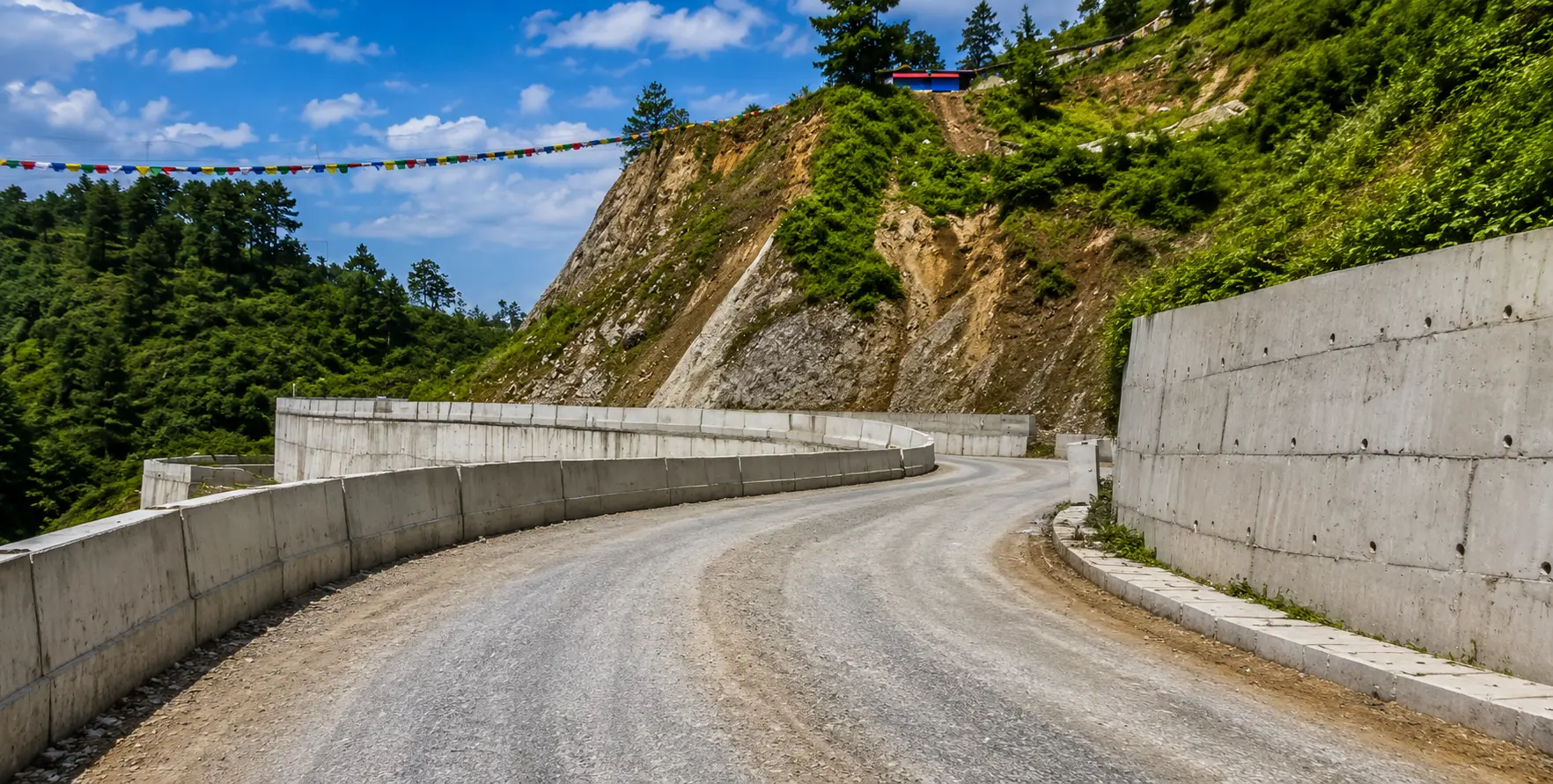
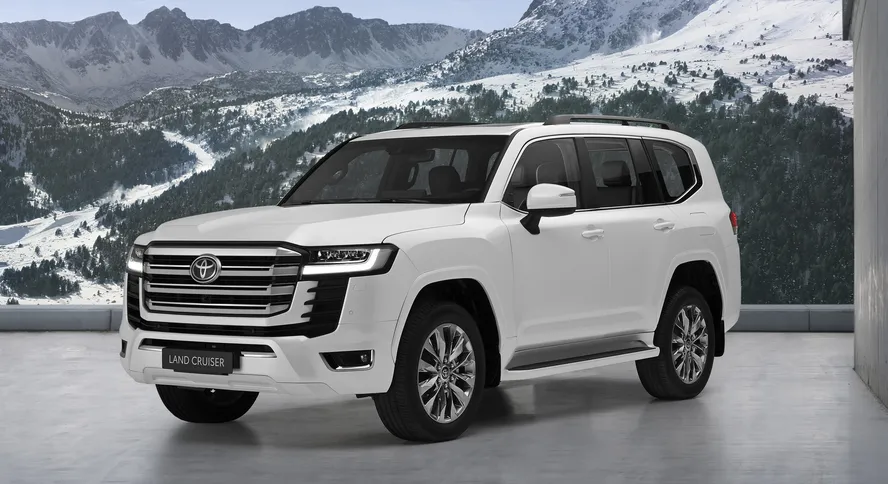
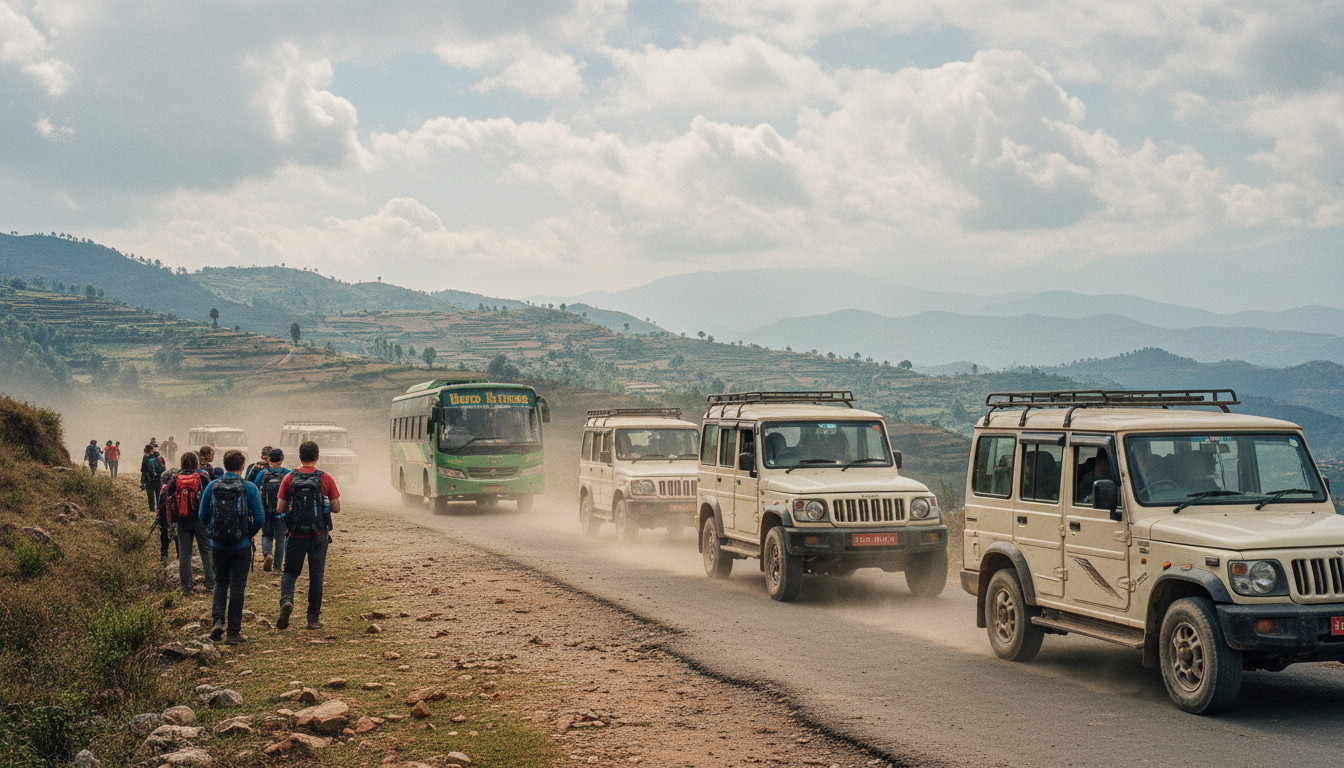
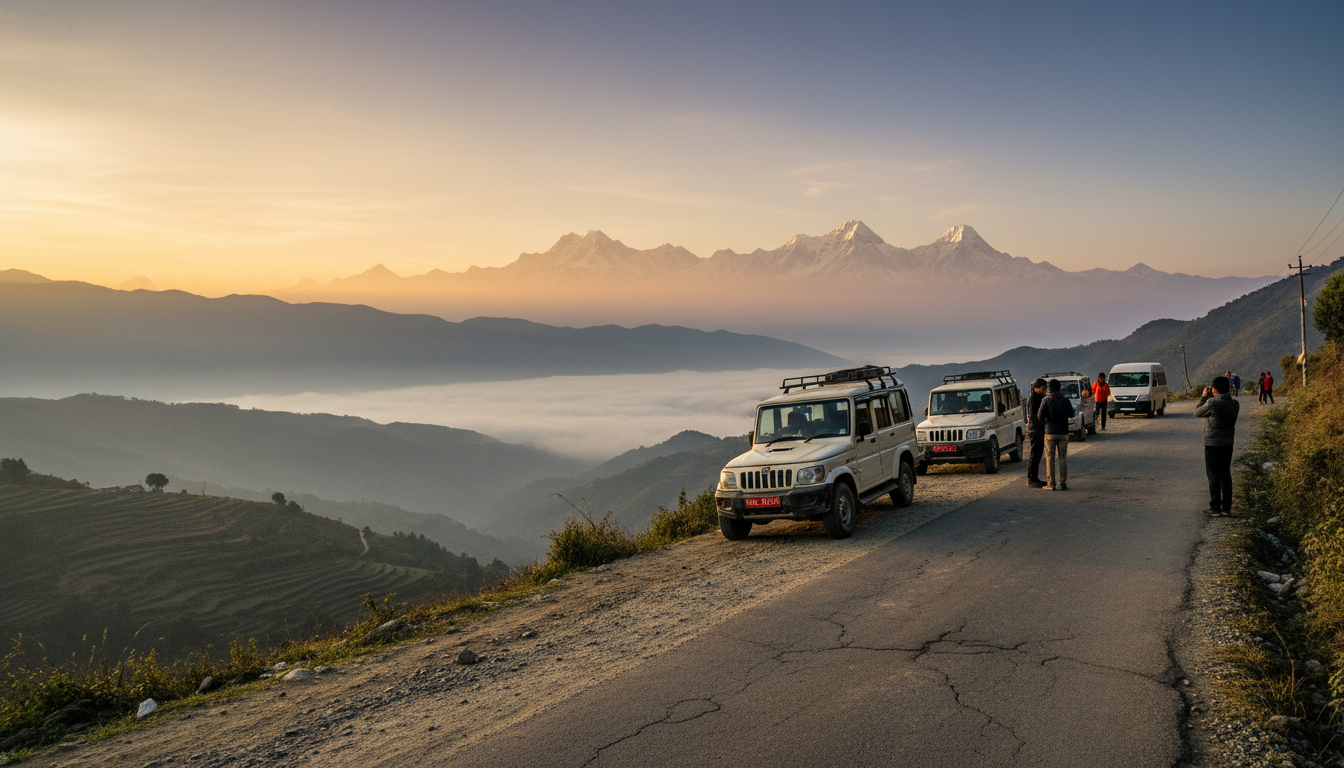
When it comes to travelling from Kathmandu to Pokhara, a private jeep hire is the top-end road option – combining the speed and flexibility of a private car with the power, space, and capability of a 4WD vehicle. Whether you are a group of trekkers heading to the Annapurna region with heavy gear, a family wanting maximum comfort on Nepal’s most scenic highway, or a traveller planning to continue onward to Mustang, Jomsom, or the Kali Gandaki valley from Pokhara, a private jeep from Kathmandu meets every requirement with ease.
This complete guide covers everything you need to know about hiring a private jeep from Kathmandu to Pokhara – jeep models, prices, the road route, what makes a jeep the best vehicle choice, how it compares to other options, and how to book your vehicle with Vehicle Hiring Nepal.
Why Choose a Private Jeep from Kathmandu to Pokhara?
A private jeep offers specific advantages over both the tourist bus and a standard sedan car on this route. Here is why trekkers, families, and adventure travellers consistently choose the jeep:
Power and Capacity
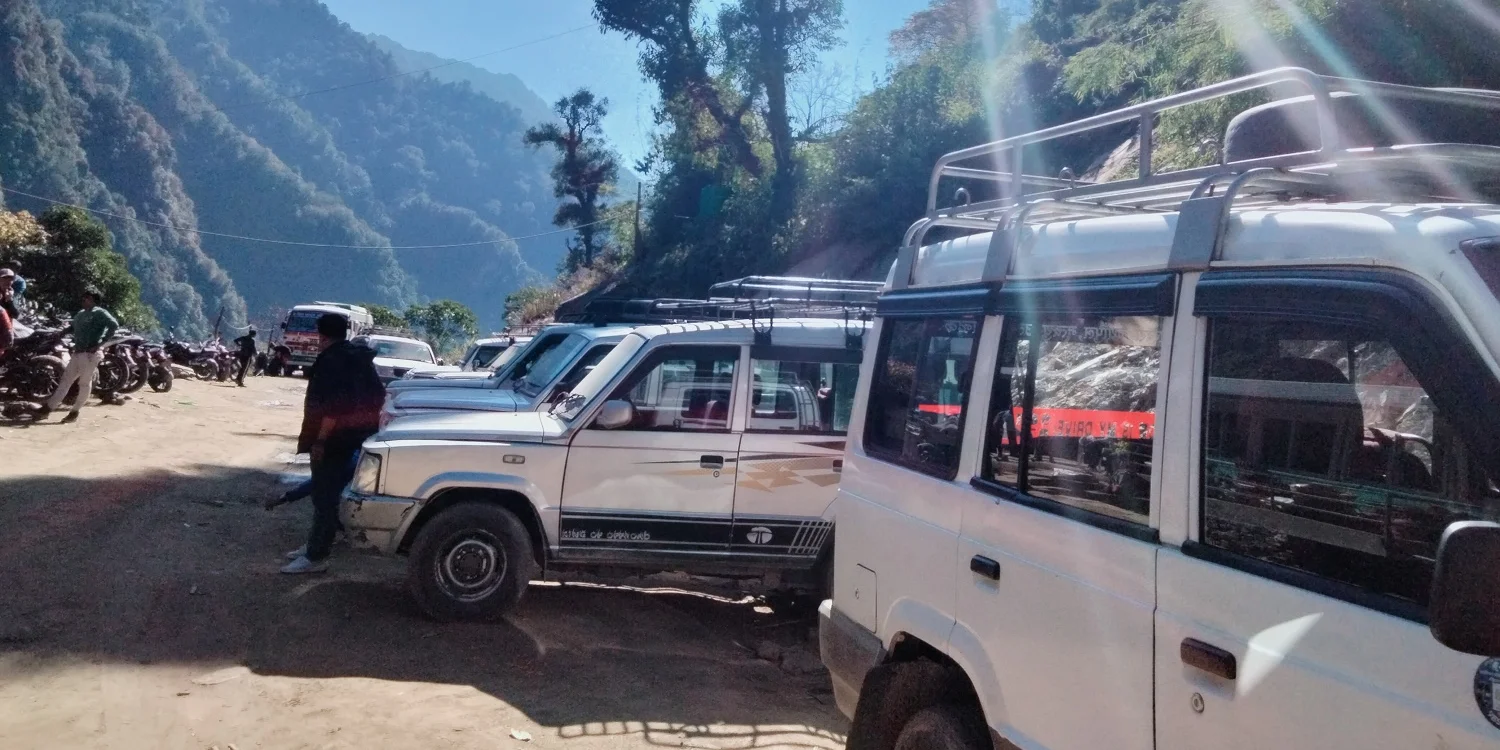
Toyota Land Cruisers and Prado jeeps seat 4 to 6 passengers comfortably with full luggage space in the boot. Their larger engines handle the Prithvi Highway’s gradients confidently, and their higher ground clearance provides a better ride over the occasional rough sections of road near Naubise. For trekkers with 70L backpacks, sleeping bags, trekking poles, and camera bags, the jeep boot provides enough space for all gear without compromise.
Onward Mountain Route Capability
The single biggest reason to choose a jeep over a sedan for the Kathmandu-to-Pokhara journey is what comes after Pokhara. If your itinerary continues to Mustang, Muktinath, the Kali Gandaki gorge, Manang, the Annapurna Circuit, Nayapul, or any other mountain destination from Pokhara, you need a 4WD-capable vehicle.
Hiring a Land Cruiser from Kathmandu means the same vehicle, the same experienced driver, and the same comfortable journey continues smoothly from Pokhara into the mountains – no vehicle change, no new driver to brief.
Superior Comfort for Long Journeys
The Toyota Land Cruiser and Prado are among the most comfortable 4WD vehicles available in Nepal. High-quality reclining seats, excellent air conditioning, good sound insulation, and a smooth, high-clearance ride make the 5- to 6-hour Kathmandu-to-Pokhara journey genuinely enjoyable, not merely tolerable. Families with children, elderly travellers, and anyone who values comfort will appreciate the difference between a Land Cruiser and a standard sedan or tourist bus.
Flexibility and Speed
A private jeep departs from your Kathmandu hotel at any time you choose – 5:30 AM for early birds or 8:00 AM for those who prefer a relaxed start. It drops you off directly at your Pokhara hotel, without a bus stop or taxi connection. It covers the 200 km in 5 to 6 hours, 1 to 2 hours faster than the tourist bus on the same route.
Jeep Models Available: Kathmandu to Pokhara
Vehicle Hiring Nepal provides a range of 4WD jeep models for the Kathmandu-to-Pokhara route. Here is a guide to each:
Toyota Land Cruiser – The Gold Standard
Capacity: 4 to 6 passengers with full luggage
Engine: 4.5L V8 turbodiesel – powerful and fuel-efficient on long highways
Features: Leather seats, powerful A/C, large boot, full 4WD, high ground clearance
Best for: Groups of 4 to 6, trekkers with heavy gear, multi-day mountain journeys from Pokhara
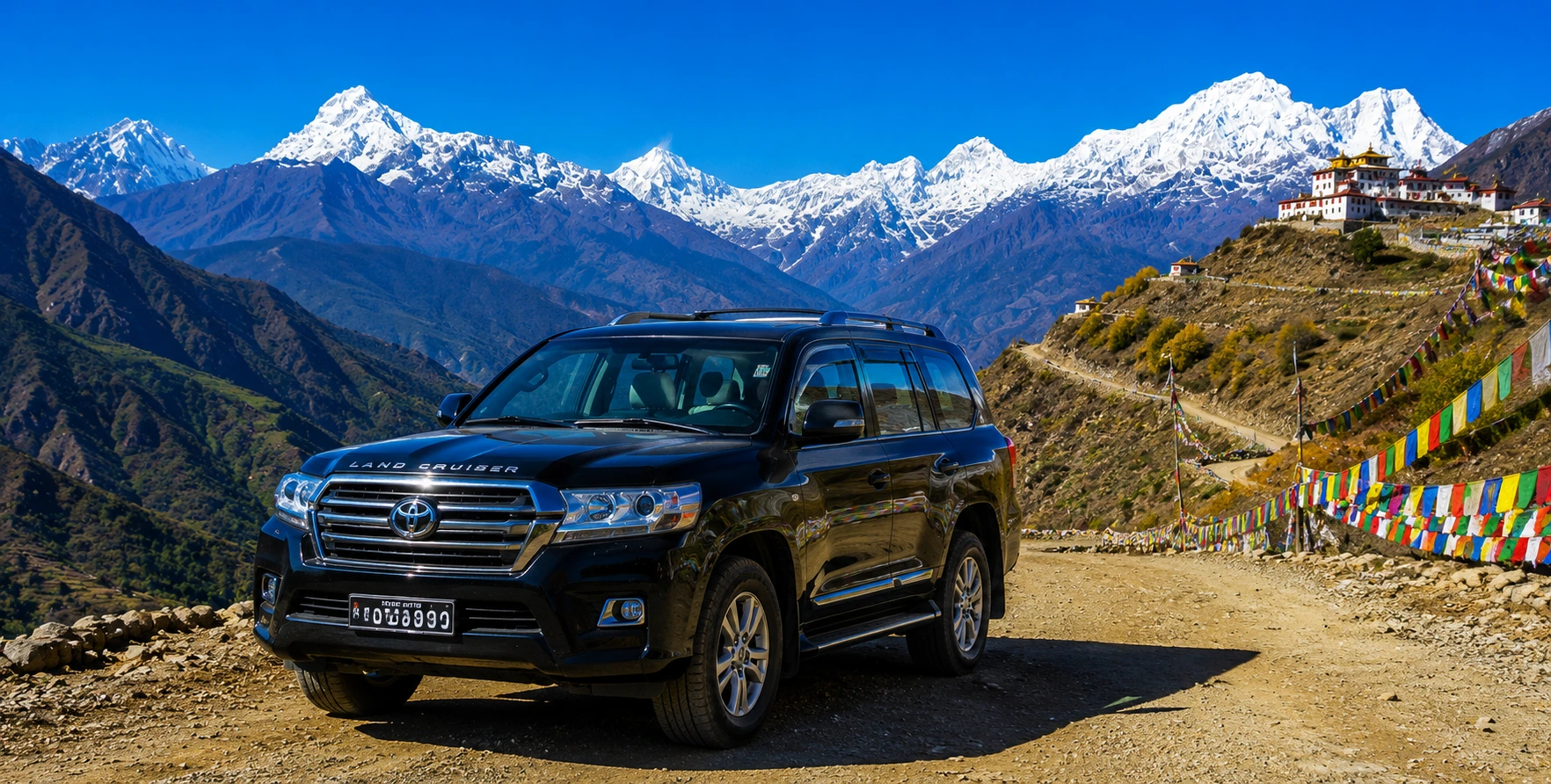
The Toyota Land Cruiser (LC70, LC78, LC79 series) is the most capable and most trusted vehicle in Nepal’s mountain transport fleet. Decades of reliability on Nepal’s roughest roads have made the Land Cruiser the go-to choice for serious mountain travel. The Kathmandu-to-Pokhara journey is smooth, powerful, and comfortable – and when the Pokhara-to-Mustang continuation begins, it is simply the best vehicle available.
Best for: Couples, small families, travellers prioritising comfort over maximum luggage capacity
The Prado is a more refined and comfortable vehicle than the workhorse Land Cruiser, with a smoother ride on paved highways, a top-end interior, and a more car-like driving experience. It sacrifices some load capacity compared to the full Land Cruiser. Still, it is an excellent choice for smaller groups seeking the utmost comfort on the Kathmandu-to-Pokhara highway journey.
Toyota Fortuner – Best Value 4WD
Capacity: 5 to 6 passengers with luggage
Engine: 2.8L turbodiesel
Features: 7-seat option, good A/C, comfortable highway ride, solid 4WD
Best for: Families of 4 to 5, groups wanting 4WD capability at a slightly lower price point
The Toyota Fortuner is a popular mid-range SUV that provides genuine 4WD capability at a price point between a standard sedan and the Land Cruiser. Excellent for the Kathmandu-to-Pokhara highway journey and capable on most mountain tracks from Pokhara, though not as capable as the Land Cruiser on the most demanding routes like Soti Khola or Upper Mustang.
Mahindra Bolero / Scorpio – Budget 4WD
Capacity: 4 to 6 passengers
Features: Rugged and capable 4WD, high ground clearance, good boot space
Best for: Budget-conscious trekking groups who need 4WD onward capability
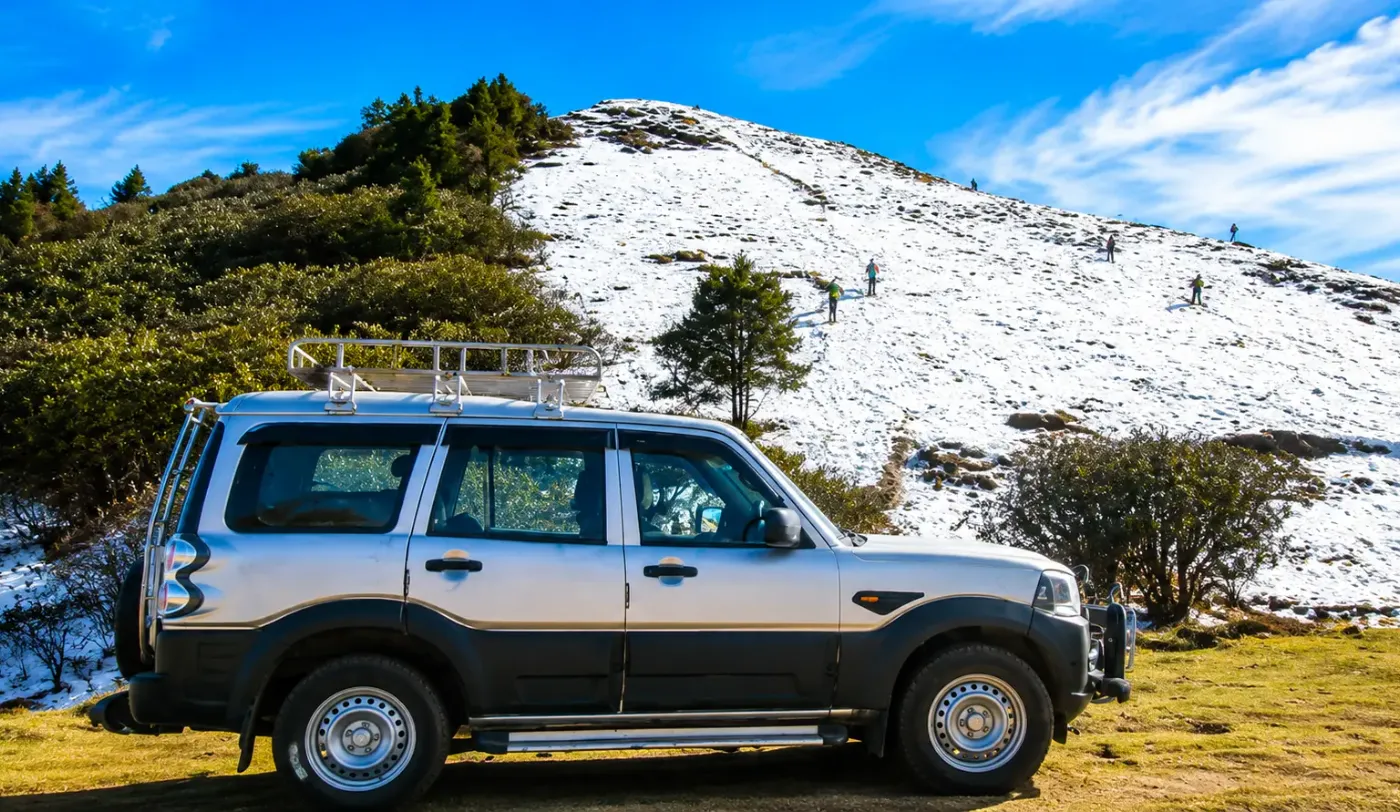
Indian-manufactured Bolero and Scorpio jeeps are widely used in Nepal’s mountain transport network. They are robust, capable, and affordable – a good option for groups where budget is the priority and maximum luxury is not the goal. They’re comfortable on the Pokhara highway, but the ride quality is rougher than Toyota alternatives.
Private Jeep Prices: Kathmandu to Pokhara 2026
Jeep Model
Capacity
One-Way (USD)
Round Trip (USD)
Best Use
Toyota Land Cruiser
4–6 pax
USD 300–600
USD 800–1200
Full group, heavy gear, mountain onward
Toyota Land Cruiser Prado
4–5 pax
USD 300–500
USD 700–1200
Comfort priority, smaller group
Toyota Fortuner / SUV
5–6 pax
USD 300–400
USD 700–900
Best value 4WD, family, or small group
Mahindra Bolero / Scorpio
4–6 pax
USD 120- 200
USD 200–450
Budget group, 4WD requirement
Sedan Car (for comparison)
1–3 pax
USD 100–150
USD 200–350
No 4WD – Pokhara highway only
All prices include the driver, full fuel for the Kathmandu-to-Pokhara journey, and vehicle insurance. One-way pricing is for the single journey from Kathmandu to Pokhara. Round-trip pricing includes the return journey from Pokhara to Kathmandu on your chosen return date.
For extended multi-day itineraries from Pokhara into Mustang or the Annapurna region, contact Vehicle Hiring Nepal for a combined package quote.
Route Overview: Kathmandu to Pokhara by Jeep
Distance: Approximately 200 km
Travel Time: 5 to 6 hours by private jeep
Main Road: Prithvi Highway – Nepal’s primary east-west arterial highway
Best Departure: 6:00 to 7:00 AM for a comfortable mid-afternoon Pokhara arrival
Recommended Stop: Mugling Junction (halfway) for lunch – 30 min
Arrival: Your Pokhara Lakeside hotel or specified address – direct door-to-door
Stage-by-Stage Road Guide: Kathmandu to Pokhara
Kathmandu to Naubise (30 km | 45 min)
Depart from your Kathmandu hotel and head west through Kalanki. The road climbs through the Chandragiri foothills – a winding but well-paved ascent with views back over the Kathmandu Valley on clear mornings. Descend to Naubise, where the gorge road begins.
Morning traffic from Kathmandu can slow this first section – a 6:00 to 6:30 AM departure beats the worst of it.
Naubise to Malekhu (50 km | 1 hr)
The Prithvi Highway drops into the spectacular Trishuli River gorge and runs alongside the fast-flowing green river through dense forest and dramatic cliff scenery. This is the most beautiful section of the Kathmandu-to-Pokhara drive. Malekhu is a popular riverside stop with tea houses and restaurants famous for fresh fish from the Trishuli River.
Request a left-side seat for the best river views through this section.
Malekhu to Mugling (30 km | 45 min)
Continue west through the deepening gorge to Mugling – the busy junction town at the confluence of the Trishuli and Marsyangdi rivers and the geographical midpoint of the journey. All private vehicles stop here for 20 to 45 minutes.
The Mugling lunch stop is a fixed tradition on this route – dozens of roadside restaurants serve dal bhat, momo, noodles, and cold drinks. Your driver knows the best local options.
Mugling to Damauli (50 km | 1 hr)
From Mugling, the road turns northwest, following the Marsyangdi River toward Pokhara. The landscape opens into a wider, greener valley. Dumre Junction is the turnoff for the Annapurna Circuit road and Besisahar.
Damauli is a pleasant hill town with good views of the Seti and Madi rivers. On clear days, the Annapurna massif appears on the northern horizon as you approach the Pokhara valley.
Damauli to Pokhara Lakeside (40 km | 45 min)
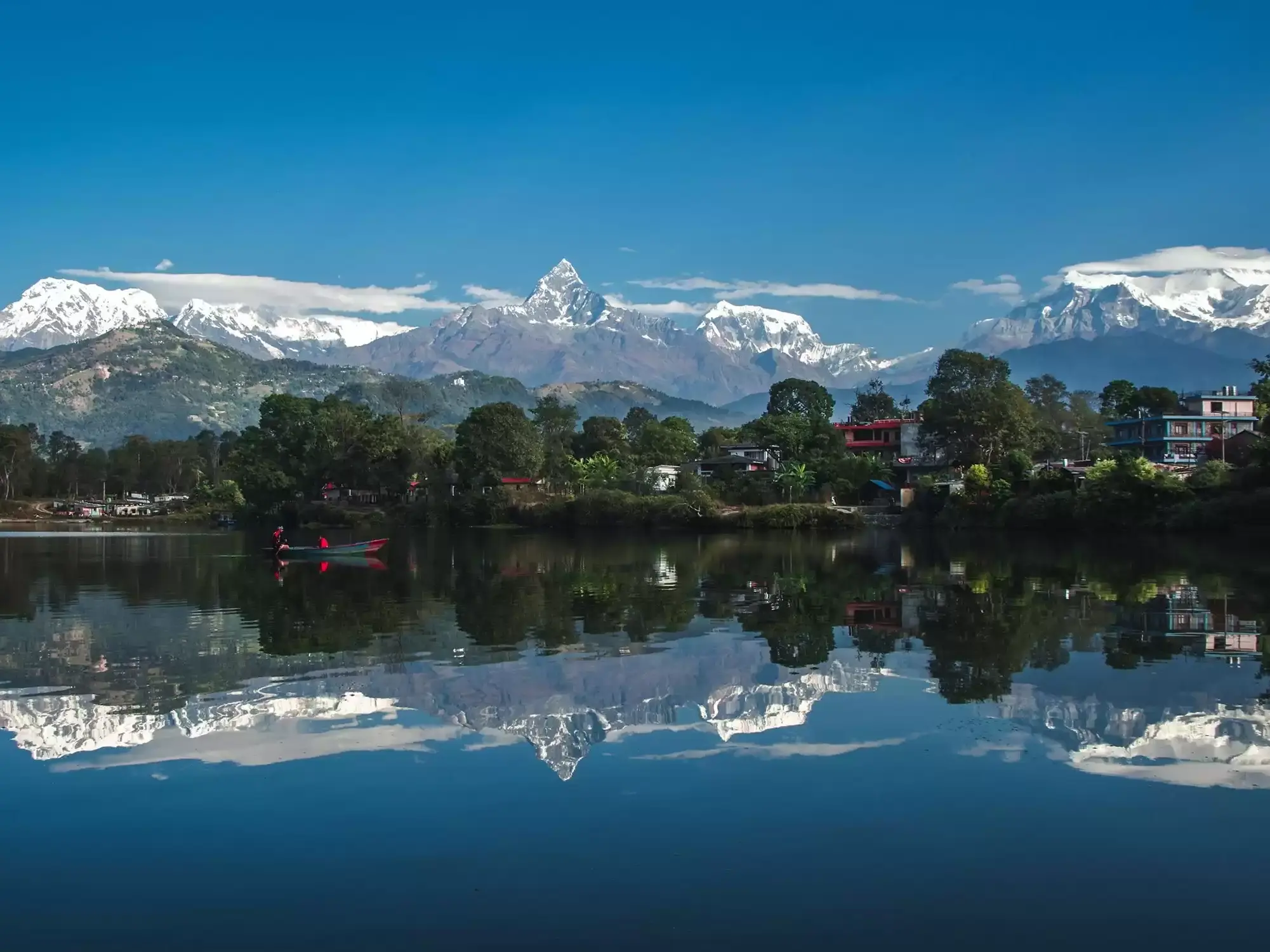
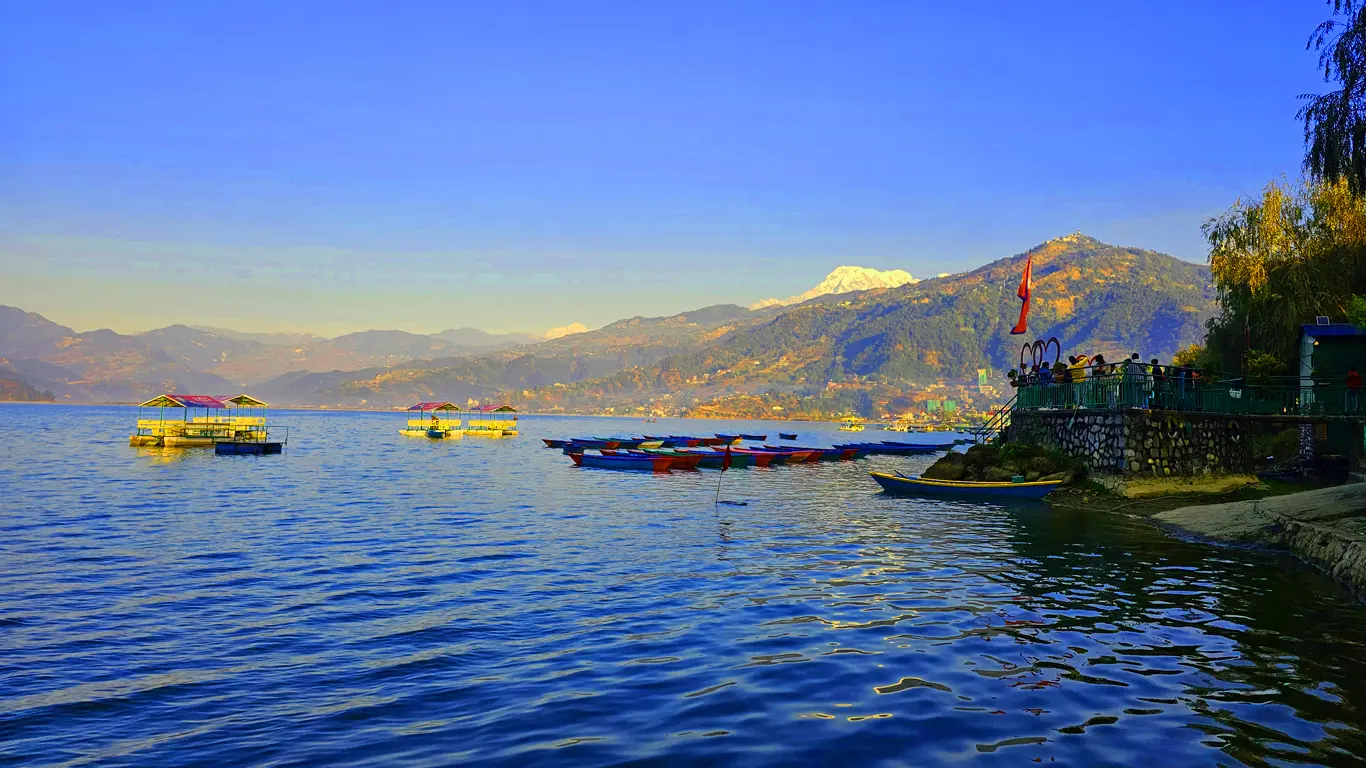
The final approach descends through the Pokhara valley foothills. The Annapurna range – Annapurna South, Machhapuchhre (Fishtail), Annapurna I, and others – fills the entire northern horizon in brilliant detail on clear days. The Phewa Lake valley opens to the south as you enter Pokhara.
Your jeep driver will take you directly to your hotel in Lakeside (Baidam) or wherever you are staying in Pokhara.
The Jeep Advantage: Kathmandu to Pokhara to Mountain Destinations
The most compelling reason to hire a jeep rather than a sedan for the Kathmandu-to-Pokhara journey is its off-road capability. A Land Cruiser hired from Kathmandu becomes the vehicle of choice for the most spectacular sections of the journey from Pokhara. Here is what becomes possible with a jeep:
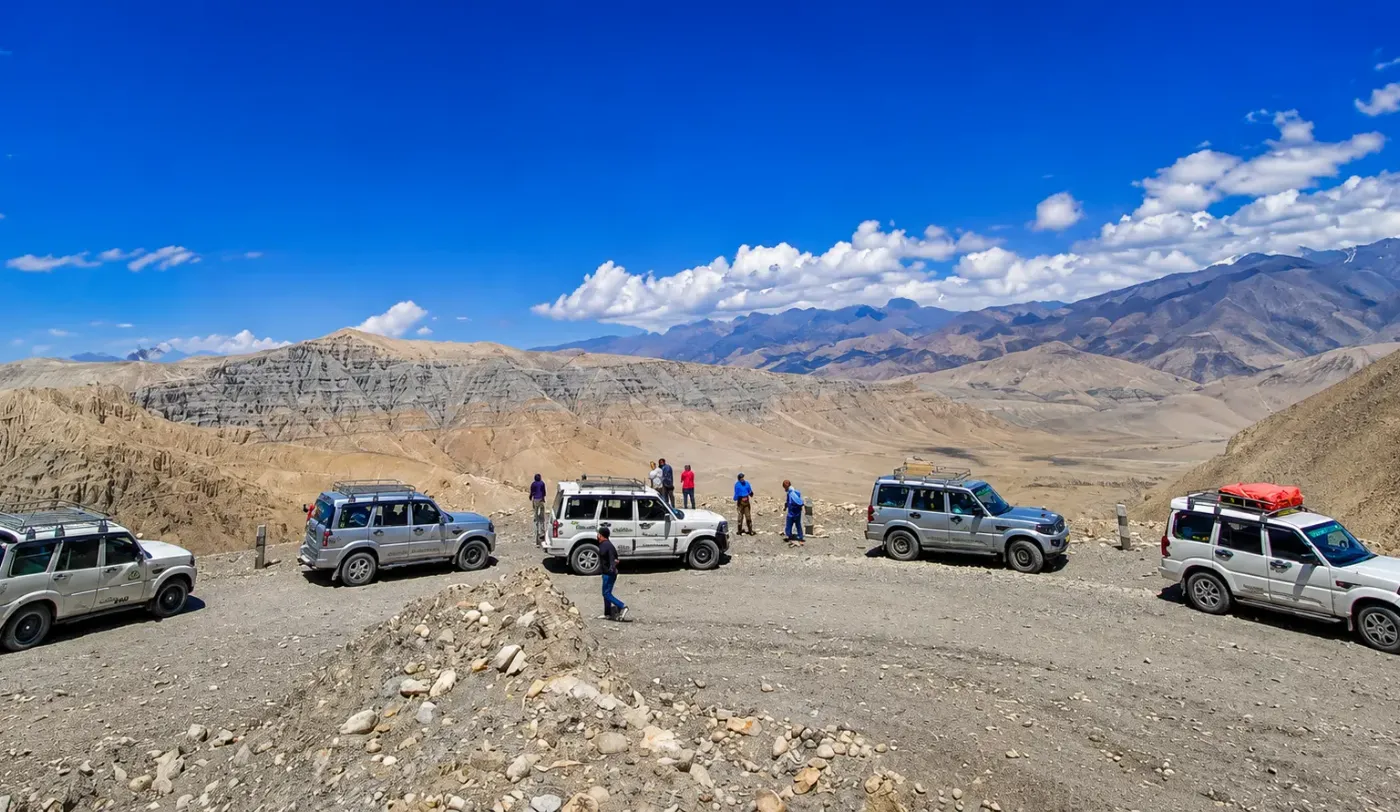
The Kali Gandaki gorge road from Beni to Jomsom and up to Muktinath is one of Nepal’s most dramatic and demanding mountain roads. Only a 4WD vehicle with high ground clearance can safely navigate this route. Hiring a Land Cruiser from Kathmandu means your vehicle is already in Pokhara and ready to continue west and north into Mustang the following morning.
Groups beginning the Annapurna Circuit from Besisahar or Chame need 4WD capability beyond Besisahar on the rough Marsyangdi valley track. A Land Cruiser hired from Kathmandu can drive the Prithvi Highway to Pokhara, rest overnight, and continue north to Besisahar and up the mountain track to Chame the following day.
For trekkers starting the Annapurna Sanctuary, Poon Hill, or Kali Gandaki treks, a jeep provides faster, more comfortable transport from Pokhara to the various trailheads than local shared transport. The same Kathmandu-to-Pokhara jeep can continue the following morning directly to Nayapul, Ghasa, or any Annapurna foothills trailhead.
Who Should Hire a Private Jeep from Kathmandu to Pokhara?
Trekking Groups of 4 to 6 with Heavy Gear
This is the jeep’s core customer on this route. A group of 4 to 6 trekkers with 60 to 80L backpacks, sleeping bags, trekking poles, and camera equipment cannot fit comfortably in a sedan and does not want to split across two vehicles.
The Land Cruiser provides the space, power, and 4WD capability for onward travel from Pokhara in the mountains. At USD 28-36 per person for a group of 4, the price is competitive with quality tourist bus tickets.
Families with Children and Luggage
A family of 4 to 5 with children’s luggage, car seats, camera bags, and personal belongings will find the Land Cruiser or Fortuner genuinely comfortable for the full 5 to 6-hour journey. The flexibility to stop when children need a break, the privacy of a family-only vehicle, and the door-to-door service from a Kathmandu hotel to a Pokhara hotel make the jeep ideal for family travel.
Pilgrims and Travellers Heading to Muktinath
Pilgrims travelling from Kathmandu to Muktinath via Pokhara have no choice but to take a 4WD jeep for the Jomsom-to-Muktinath section. Hiring the jeep from Kathmandu ensures the same vehicle and trusted driver make the full journey – Kathmandu to Pokhara on Day 1, and Pokhara through the Kali Gandaki to Muktinath on Days 2 and 3.
Corporate and Group Travel
Business travellers, conference delegates, and corporate groups value the privacy, comfort, and predictability of a private jeep over shared bus options. The ability to depart at an agreed time, work or rest during the journey, and arrive directly at the destination hotel makes the jeep the professional travel choice for corporate transfers from Kathmandu to Pokhara.
Best Time to Travel from Kathmandu to Pokhara by Jeep
October to November – Peak Season
The finest season for this drive. Post-monsoon skies are brilliantly clear, the Trishuli gorge is vivid green after the rains, and the Annapurna range on the final approach to Pokhara is spectacularly sharp and close. The Prithvi Highway is in excellent condition.
Book your jeep 2 to 4 weeks in advance during October and November,r as trekking group demand is very high.
December to February – Clear Winter
Winter offers exceptional visibility. The mountain views on the approach to Pokhara in December and January are often the sharpest of the year. Traffic is lighter than in peak season.
Roads are clear and in good condition. Carry a fleece or jacket – Pokhara mornings in winter are cool, and the Trishuli gorge can be cold with the vehicle A/C running.
March to May – Spring Season
Spring is excellent. Rhododendrons bloom on the gorge hillsides in March and April. Good mountain views in the morning before the afternoon haze.
Dry roads and comfortable temperatures. Very popular with Annapurna Circuit trekkers heading to Pokhara.
June to September – Monsoon
Travel is possible, but the gorge road can be slow during heavy rain. Occasional landslides affect the Naubise-Mugling section. Journey time can extend to 7- 8 hours during severe rain. rain.
Clouds obscure mountain views; clouds arrive at Pokhara. A private jeep is often preferred over the tourist bus in the monsoon, offering more flexibility for delays and rerouting.
Practical Tips for Your Kathmandu to Pokhara Jeep Journey
Depart between 6:00 and 7:00 AM to complete the journey comfortably before the late afternoon and arrive in Pokhara with time to settle in and explore the Lakeside area.
Left-side seats in the jeep offer the best views of the Trishuli River between Naubise and Mugling – discuss seating with your group before departure.
The Mugling lunch stop is 30 to 45 minutes – use the facilities here, as there are no other major stops.
Carry snacks and water for the journey – the tea at Malekhu and lunch at Mugling are the main refreshment stops.
Motion sickness tablets are recommended for the Naubise section, which has winding switchbacks.
If continuing to Mustang or the Annapurna mountains from Pokhara, confirm the continuation plan with your driver and Vehicle Hiring Nepal before departing Kathmandu.
Take photos from the jeep window on the Trishuli Gorge section – the views of the river and cliff walls are excellent from the elevated jeep position.
The last 30 km from Damauli to Pokhara offers the best views of the Annapurna range – have your camera ready in the early afternoon when clouds are usually still absent.
Combined Itineraries: Kathmandu to Pokhara Jeep and Beyond
Day 1: Kathmandu to Pokhara by Land Cruiser (5–6 hrs) – overnight at Pokhara Lakeside. Day 2: Pokhara to Tatopani (5–6 hrs) – hot springs, overnight in Tatopani. Day 3: Tatopani to Muktinath via Jomsom (4–5 hrs) – pilgrimage, overnight at Ranipauwa.
Day 4 onward: Muktinath pilgrimage and return. The same Land Cruiser hired from Kathmandu handles every stage of this journey.
Day 1: Kathmandu to Pokhara by Land Cruiser – overnight in Pokhara. Day 2: Pokhara to Besisahar (3 hrs) and continue to Chame (further 4–5 hrs by 4WD) – overnight in Chame. Day 3: Trek begins from Chame.
Return: Vehicle Hiring Nepal arranges pickup from Nayapul at the end of the circuit.
Day 1: Kathmandu to Pokhara by Land Cruiser – overnight in Pokhara. Day 2 morning: Jeep continues from Pokhara to Nayapul (45 min) – trek begins. Return: pre-arranged vehicle pickup from Nayapul at the end of the trek.
For travellers wanting to combine a Chitwan safari with a visit to Pokhara in one trip: Day 1: Kathmandu to Chitwan (4 hrs). Days 2–3: Safari. Day 4: Chitwan to Pokhara (3.5 hrs).
Days 5+: Pokhara and mountain activities. The same Land Cruiser handles all legs of this itinerary.
What is Included in Your Private Jeep Hire
Toyota Land Cruiser, Prado, Fortuner, or Mahindra jeep as selected – fully maintained and insured
Experienced, licensed driver with full knowledge of the Kathmandu to Pokhara route
Full fuel cost for the Kathmandu to Pokhara journey
Vehicle insurance throughout the journey
Pickup from your hotel, guesthouse, or any address in Kathmandu
Drop-off at your hotel, guesthouse, or any address in Pokhara (Lakeside, Sarangkot, city centre)
Mugling lunch stop and any requested scenic or tea stops along the route
24/7 WhatsApp contact with the driver and the Vehicle Hiring Nepal support team
Not included: Personal meals at stops, accommodation in Pokhara, and any continuation journeys beyond Pokhara (quoted separately).
How to Book Your Kathmandu to Pokhara Private Jeep
Contact Vehicle Hiring Nepal via WhatsApp at +977 981-4227196 or visit vehiclehiringnepal.com
Choose your jeep model – Land Cruiser, Prado, Fortuner, 4WD Jeep, Scorpio
Provide your travel date and preferred departure time from Kathmandu
Give your pickup address, hotel name, and area in Kathmandu
Give your drop-off destination – hotel name in Pokhara
Mention any continuation plans from Pokhara – Mustang, Annapurna, Nayapul
Specify any special requirements – roof rack for large packs, child seats, extra luggage space
Receive instant booking confirmation with driver name, jeep model, and pickup time
Frequently Asked Questions
What is the difference between a private jeep and a private sedan from Kathmandu to Pokhara?
Both travel the same paved Prithvi Highway and take the same 5 to 6 hours. The jeep (Land Cruiser or similar) provides significantly more luggage space, seats 4 to 6 passengers comfortably (versus 3 in a sedan), offers 4WD capability for mountain roads beyond Pokhara, sits higher for better views, and costs USD 15 to USD 35 more per vehicle.
For groups of 4 or more, or for travellers continuing to mountain destinations from Pokhara, the jeep is always the better choice.
Is a 4WD jeep necessary for the Kathmandu-to-Pokhara road?
No – the Prithvi Highway from Kathmandu to Pokhara is a fully paved national highway suitable for any vehicle, including sedans and standard cars. You don’t need a 4WD jeep for the Kathmandu-to-Pokhara section itself.
However, if you are continuing from Pokhara to any mountain destination – Mustang, Jomsom, Nayapul for the Kali Gandaki gorge, Besisahar for the Annapurna Circuit – a 4WD jeep becomes essential for those sections. That is why hiring a Land Cruiser from Kathmandu, rather than a sedan, makes excellent sense for trekkers and mountain-bound travellers.
How many passengers can a Land Cruiser carry from Kathmandu to Pokhara?
A standard Toyota Land Cruiser (LC78 or LC79 series) comfortably carries 4 to 6 passengers with full luggage in the boot. Some Land Cruiser configurations have additional seating. The Toyota Land Cruiser Prado typically seats 5 passengers comfortably.
For groups of 7 or more, a Toyota Hiace van or Coaster bus is more appropriate than a single Land Cruiser.
Can I book a one-way jeep from Kathmandu to Pokhara and return by flight?
Yes. Many travellers hire a private jeep one-way from Kathmandu to Pokhara for the scenic drive, then fly back from Pokhara Airport to Kathmandu in 25 minutes at the end of their trip. Vehicle Hiring Nepal can arrange a one-way jeep transfer and also provide a Pokhara-to-airport transfer for your return flight.
Contact us for the best combined pricing.
What jeep is best for continuing to Mustang from Pokhara?
The Toyota Land Cruiser (LC70 series or LC78/79) is the best vehicle for continuing from Pokhara to Mustang via the Kali Gandaki gorge. The gorge road from Beni to Jomsom is one of Nepal’s roughest and most demanding mountain roads – requiring genuine 4WD, high ground clearance, and a powerful diesel engine.
The Land Cruiser excels on this route. The Prado and Fortuner are capable but less suited to the gorge’s most challenging sections. The Bolero is capable but less comfortable for the multi-day Mustang journey.
Can I stop for sightseeing along the Kathmandu-to-Pokhara route?
Yes – a private jeep gives you complete flexibility to stop wherever you wish along the route. Popular stops include the Trishuli riverside at Malekhu for tea and river fish; the Manakamana cable car at Kurintar for the famous Manakamana Temple visit (adds 1.5 to 2 hours); lunch at Mugling; scenic viewpoints above the gorge; and the Marsyangdi River valley between Dumre and Damauli. Let your driver know your preferences when you book.
Final Thoughts
A private jeep from Kathmandu to Pokhara is more than transport – it is the start of a Nepal adventure delivered with maximum comfort, flexibility, and style. The Toyota Land Cruiser on the Prithvi Highway is a perfect pairing – Nepal’s finest road vehicle on one of Nepal’s most scenic drives, delivering you from the mountain capital to the lakeside city with views of the Annapurna range filling the windscreen on the final approach.
For trekkers, the jeep is the obvious choice – it carries all your gear, keeps your group together, and becomes your mountain vehicle the moment you leave Pokhara for the trails. For families, it is the comfortable, flexible, child-friendly alternative to buses. For pilgrims heading to Muktinath, it is the first stage of a sacred journey that the same vehicle will complete all the way to 3,710 m.
Book your Kathmandu-to-Pokhara private jeep with Vehicle Hiking Nepal today. WhatsApp: +977 981-4227196 | Website: www.vehiclehiringnepal.com | Email:[email protected]. We are available 24 hours a day, 7 days a week.
Tucked at an altitude of 3,734 meters above sea level in the remote Manang District of Nepal’s Gandaki Province, Khangsar is one of the most dramatically situated villages in the entire Annapurna region. Set against a striking backdrop of towering Himalayan peaks — including the Annapurna range, Gangapurna, and the majestic Tilicho Peak — Khangsar is both the final point accessible by motor vehicle on the road beyond Manang and the gateway to one of the world’s most spectacular trekking destinations: Tilicho Lake.
Tilicho Lake, at 4,919 meters, is recognised as one of the world’s highest lakes and a sacred site of extraordinary natural beauty. The road to it ends at Khangsar. Beyond here, only legs will carry you.
This makes a Pokhara-to-Khangsar jeep hire not just transportation, but the first chapter of one of Nepal’s greatest high-altitude adventures.
For trekkers planning to walk the Annapurna Circuit, visit Tilicho Lake, or explore the remote highland villages of Manang District, hiring a private 4WD jeep from Pokhara to Khangsar is by far the most practical, comfortable, and efficient mode of transportation. The route passes through some of Nepal’s most spectacular mountain terrain — deep river gorges, ancient Himalayan villages, alpine forests, and soaring peaks — and the journey itself is as memorable as the destination.
This comprehensive guide covers everything you need to know about the Pokhara to Khangsar jeep hire: the full route with distances and highlights, road conditions, costs, required permits, best travel seasons, vehicle options, and why Nepal Vehicle Hiring Pvt. Ltd. is the trusted choice for this challenging high-altitude journey.
Pokhara to Khangsar — Trip Glance
Destination: Khangsar Village, Manang District, Gandaki Province
Altitude: 3,734 m (12,251 ft) above sea level
Total Distance: Approx. 170–185 km from Pokhara (Lakeside)
Total Drive Time: 8–10 hours (one way, depending on road conditions)
Required Vehicle: 4WD Jeep ONLY (Hilux, Fortuner, Land Cruiser, Scorpio)
Permits Needed: ACAP (Annapurna Conservation Area Permit) + TIMS Card
Gateway To: Tilicho Lake, Tilicho Base Camp, Annapurna Circuit
Book With: Nepal Vehicle Hiring Pvt. Ltd. |+977 981-4227196
Understanding Khangsar: Why This Village Is Your Jeep Hire Destination
What Is Khangsar?
Khangsar is a small, traditional Tibetan-influenced village located approximately 3 km west of the main Annapurna Circuit trail town of Manang. The village sits at 3,734 meters, perched dramatically on a ridge above the Marsyangdi River Valley. It is inhabited primarily by the Manangi people—a semi-nomadic, Tibetan-culture community that has lived in this high-altitude environment for centuries, trading across the Himalayas between Nepal and Tibet.
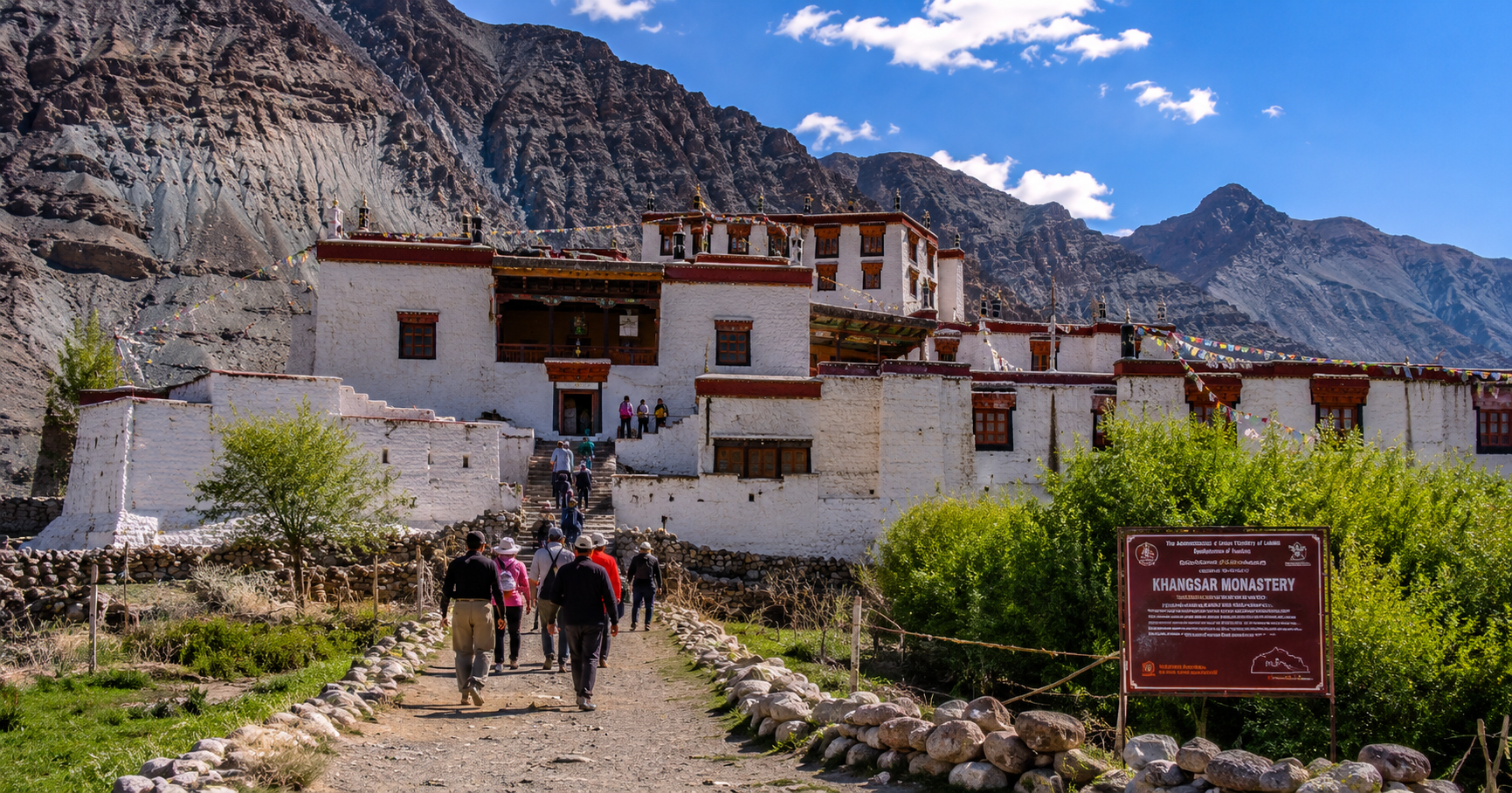
Khangsar’s architecture is distinctly Tibetan: flat-roofed stone houses, prayer flags snapping in the mountain wind, ancient gompas (Buddhist monasteries), and mani walls (long stone walls inscribed with Buddhist prayers). The village has a population of only a few hundred people but sees many trekkers passing through, particularly those headed to Tilicho Lake.
Khangsar holds special significance in the trekking geography of the Annapurna region: it is the last point accessible by 4WD on this route. Beyond Khangsar, toward Tilicho Base Camp and Tilicho Lake, trekking is only possible on foot. For trekkers who want to skip the lower road sections and start their high-altitude adventure directly, hiring a jeep to Khangsar dramatically shortens the overall trek while still delivering an epic Himalayan road journey.
Why Hire a Jeep Directly to Khangsar (Not Just Manang)?
Khangsar is 3 km beyond Manang by a rough jeep track — the very last point accessible by vehicle on this route.
Starting your trek from Khangsar rather than Manang saves 1–2 days of trekking and gives you more time to acclimatise above 3,700 m.
For trekkers focused specifically on Tilicho Lake (not the full Annapurna Circuit), a Pokhara–Khangsar jeep hire represents the most direct and efficient approach.
The road from Manang to Khangsar is extremely rough and requires a 4WD vehicle — not all jeep hire services go this final stretch. Nepal Vehicle Hiring Pvt. Ltd. can drive you all the way to Khangsar.
The Complete Route: Pokhara to Khangsar by Jeep
Route Overview
The journey from Pokhara to Khangsar follows the famous Annapurna Circuit road northward through the Marsyangdi River Valley, gaining altitude continuously from approximately 800 meters at Pokhara (Lakeside) to 3,734 meters at Khangsar. The route passes through a dramatic series of landscape transitions — subtropical hills, deep gorges, alpine forests, and finally the stark, wind-blasted high-altitude terrain of the Manang Valley.
Segment
Distance / Altitude / Road Type
Pokhara (Lakeside) → Dumre
70 km | 600 m | Paved Prithvi Highway
Dumre → Besisahar
40 km | 760 m | Paved highway
Besisahar → Syange
20 km | 1,100 m | Off-road begins (rocky mountain track)
Syange → Dharapani / Chame
30 km | 2,710 m | Rough mountain road, river crossings
Chame → Pisang → Braga
25 km | 3,300 m | High mountain terrain, dramatic cliffs
Braga → Manang
5 km | 3,519 m | Rough gravel road
Manang → Khangsar
3 km | 3,734 m | Very rough jeep track (4WD essential)
Total Distance: Approximately 170–185 km from Pokhara Lakeside to Khangsar, depending on the specific route taken and any detours.
Stage-by-Stage Route Description
Stage 1 — Pokhara to Besisahar (approx. 110 km, 2–2.5 hours): The journey begins on the Prithvi Highway — Nepal’s main east-west artery — heading east from Pokhara through the rolling Gandaki Valley. The road is well-paved, and the drive is relatively fast.
The first major town you pass is Damauli, followed by Dumre, where you turn north toward Besisahar. Besisahar is the headquarters of Lamjung District and the traditional starting point of the Annapurna Circuit trek. Here, you will register for your ACAP permit and TIMS card before heading north.
Besisahar has basic restaurants and guesthouses if you need a break.
Stage 2 — Besisahar to Chame (approx. 70 km, 3–4 hours): North of Besisahar, the paved road ends and the adventure begins in earnest. The track follows the Marsyangdi River northward into a narrowing gorge of extraordinary beauty.
The road becomes a rough, rocky mountain track requiring 4WD capability, passing through dramatic villages including Bhulbhule, Ngadi, Jagat, Dharapani, and Bagarchhap. The scenery is spectacular — waterfalls tumbling from vertical cliffs, deep blue river pools, terraced fields clinging to near-vertical hillsides, and occasional glimpses of snow-capped peaks above.
The village of Chame, at 2,710 meters, is the district headquarters of Manang and a good place to rest and acclimatise.
Stage 3 — Chame to Manang (approx. 30 km, 2–3 hours): Above Chame, the terrain transforms dramatically. The valley opens into a broader, drier, Tibetan-style landscape as you gain altitude.
The road passes through Pisang (2,990 m) — where you can spot the extraordinary cliff-side monastery of Upper Pisang — and continues through Braga (3,360 m), home to one of the oldest and most important monasteries in the Annapurna region, to reach the main settlement of Manang (3,519 m). Manang is the largest town on the route, with teahouses, restaurants, a bakery, and a small medical facility. Most trekkers spend 1–2 nights here for acclimatisation.
Stage 4 — Manang to Khangsar (approx. 3 km, 30–45 minutes): The final stretch to Khangsar is short but demands maximum 4WD capability. The rough jeep track climbs 215 vertical meters from Manang (3,519 m) to Khangsar (3,734 m) across rocky, exposed terrain.
In wet or snowy conditions, this section can be extremely challenging even for experienced drivers. Khangsar village is small — a cluster of traditional Manangi stone houses, a gompa, and a handful of simple teahouses for trekkers heading to Tilicho Lake.
Road Conditions: What to Expect on the Pokhara to Khangsar Route
This first section follows Nepal’s well-maintained Prithvi Highway and the Besisahar feeder road. The tarmac is generally good and allows comfortable, relatively fast driving in a standard vehicle. However, traffic can be heavy on market days and during festival seasons, so an early morning departure (6:30–7:00 AM from Pokhara) is strongly recommended.
This is where the route transforms from a regular road trip into a genuine Himalayan adventure. The track is unpaved, often rocky, and narrow in places. It crosses several bridges over fast-flowing mountain tributaries and passes through sections where the road is carved directly into cliff faces.
During the monsoon (June–September), sections of the road are frequently washed out or blocked by landslides, and the journey can take significantly longer or become temporarily impassable. A 4WD vehicle with good ground clearance is essential from Besisahar onward.
Above Chame, the road climbs steeply through pine forests and across open ridges with increasingly dramatic mountain views. The surface is rough gravel and compacted earth, punctuated by rocky sections and occasional stream crossings.
The altitude begins to noticeably affect the engine performance of non-4WD vehicles, making a proper mountain 4WD Jeep and an experienced high-altitude driver non-negotiable. Road conditions deteriorate significantly after snowfall, which can occur at any time of year above 3,000 meters.
The short track from Manang to Khangsar is the most technically demanding section of the entire route. It is narrow and rocky, ascending steeply across terrain that is exposed and unstable in places. In spring and autumn — the main trekking seasons — this track is passable for experienced 4WD drivers in well-maintained vehicles.
In winter (December–February), snow and ice can make this section extremely hazardous. During early spring, the track may be muddy and rutted from snowmelt. Always confirm road conditions with Nepal Vehicle Hiring Pvt. Ltd. before departure.
Critical Vehicle Warning
Standard cars, sedans, and non-4WD vehicles CANNOT go beyond Besisahar.
Regular taxis from Pokhara will NOT take you to Manang or Khangsar.
Only 4WD Jeeps (Hilux, Fortuner, Land Cruiser, Mahindra Scorpio) are suitable.
Your driver MUST have experience on mountain high-altitude roads.
Nepal Vehicle Hiring Pvt. Ltd. provides experienced 4WD drivers for this exact route.
Distance, Altitude & Driving Time Summary
Route Point
Distance from Pokhara
Altitude
Drive Time from Pokhara
Dumre
70 km
600 m
1.5 hrs
Besisahar
110 km
760 m
2.5 hrs
Syange
130 km
1,100 m
3.5 hrs
Dharapani
150 km
1,943 m
5 hrs
Chame
160 km
2,710 m
6.5 hrs
Pisang
173 km
3,200 m
7.5 hrs
Manang
180 km
3,519 m
8.5 hrs
Khangsar
183–185 km
3,734 m
9–10 hrs
Note: All times are approximate for a one-way journey departing from Pokhara between 6:30–7:00 AM. Add 1–2 hours during monsoon season (June–September) or after snowfall. The above estimates do not include rest stops, meal breaks, or permit checks.
Pokhara to Khangsar Jeep Hire Cost
Private Jeep Hire — One Way
Hiring a private 4WD jeep from Pokhara to Khangsar is the most comfortable and flexible option for individuals, couples, small families, or groups of up to 6–7 passengers. With a private hire, you control the departure time, the pace of the journey, the lunch stop location, and how long you spend at scenic viewpoints along the route.
Price Inclusions: Driver service fee, fuel costs, driver insurance, vehicle maintenance and road emergency kit, and parking fees where applicable.
Price Exclusions: ACAP permit (NPR 3,000 per person), TIMS card (NPR 2,000 per person), passenger travel insurance, meals and accommodation for passengers, driver accommodation and meals (separate from vehicle cost for multi-day trips).
Shared Jeep Option (Budget Alternative)
Shared jeeps run from Besisahar to Manang for budget travellers. These depart when full (typically 8–10 passengers) and run on less flexible schedules. Shared jeeps from Besisahar to Manang cost about NPR 1,500–2,500 per person (USD 11–18).
However, shared jeeps typically go only to Manang — not to Khangsar — and departure times are unpredictable. For trekkers with a tight schedule or requiring the final leg to Khangsar, a private jeep hire from Pokhara is strongly recommended.
Cost Comparison: Worth the Investment
A private 4WD jeep hire from Pokhara to Khangsar may appear more expensive than shared transport. Still, when you factor in the full picture — comfort, safety on mountain roads, flexible departure from your hotel, the ability to stop at scenic viewpoints, guaranteed delivery to Khangsar (not just Manang), and the peace of mind of a professional driver — it represents exceptional value for a journey of this nature and distance.
Required Permits for the Pokhara to Khangsar Route
All travellers entering the Annapurna Conservation Area, which begins north of Besisahar, must carry valid permits. Obtain these before departing Pokhara or Kathmandu, or at the permit checkpoint in Besisahar. Nepal Vehicle Hiring Pvt. Ltd. can advise on permit arrangements as part of your booking.
Permit Type
Details & Cost (2026)
ACAP (Annapurna Conservation Area Permit)
Required for ALL foreign nationals entering the Annapurna Conservation Area | Cost: NPR 3,000 per person (approx. USD 22)
TIMS Card (Trekkers’ Information Management System)
Required for all trekkers in the Annapurna Region | Cost: NPR 2,000 per person for individuals (NPR 1,000 through trekking agencies)
Where to Obtain
Nepal Tourism Board offices in Kathmandu (Pradarshani Marg), Pokhara (Lakeside), or at the checkpoint in Besisahar
SAARC Nationals
ACAP: NPR 1,500 | TIMS: NPR 1,500
Nepali Nationals
ACAP: NPR 100 | No TIMS required
Additional Manang District Entry
No separate fee is currently required for Khangsar/Manang beyond ACAP+TIMS
Important: Keep your permits with you at all times. Multiple checkpoints along the route will check permits —at Besisahar, Jagat, Dharapani, Chame, and again near Manang. Driving past checkpoints without a valid permit can result in fines and being turned back.
Best Time to Hire a Jeep from Pokhara to Khangsar
October to November — Peak Autumn Season (BEST)
The post-monsoon autumn season offers the clearest skies, the most stable roads, and the most spectacular mountain views of the entire year. Monsoon rains wash the air clean, revealing the full glory of the Annapurna and Himalayan ranges in crystal-sharp detail.
Daytime temperatures at Khangsar (3,734 m) are cool and pleasant (5–15°C), but they drop significantly at night (-5 to -10°C), so warm clothing is essential. This is the busiest trekking season, so book your jeep hire well in advance — availability can be limited.
March to May — Spring Season (EXCELLENT)
Spring is equally popular for Pokhara-to-Khangsar jeep hire. The rhododendron forests in the lower sections of the route (around 2,000–3,000 m) burst into brilliant red and pink bloom in March and April, creating a spectacular backdrop for the drive. Temperatures are warming up, and the mountain views are generally clear in the mornings.
By May, afternoon cloud build-up is typical. Road conditions are generally good, though the road from Manang to Khangsar may still have some residual winter snow.
December to February — Winter (POSSIBLE WITH CAUTION)
The winter months bring cold, dry, and often sunny conditions. The high-altitude views can be extraordinary in winter, with crisp, clear air. However, snow and ice on the road above Chame — and particularly on the Manang to Khangsar track — can make the journey hazardous or impossible in severe conditions.
Nepal Vehicle Hiring Pvt. Ltd. monitors road conditions continuously and will advise clients on the current winter road status before departure.
June to September — Monsoon Season (CHALLENGING)
The monsoon season brings heavy rainfall to the entire Annapurna region, and the road north of Besisahar is frequently affected by landslides, washed-out sections, and river flooding. While some trekkers brave the monsoon for lush green scenery and empty trails, the Pokhara-to-Khangsar drive takes significantly longer. It poses real logistical risks during this period.
If you must travel during the monsoon, allow extra days, confirm road conditions in advance, and hire only an experienced high-altitude driver. Nepal Vehicle Hiring Pvt. Ltd. keeps up-to-date road condition reports and will be transparent about any risks before booking.
Scenic Highlights on the Pokhara to Khangsar Drive
The Pokhara to Khangsar jeep journey is not merely a transfer — it is a full-day Himalayan adventure through some of the most spectacular terrain in the world. Here are the key highlights to watch out for along the route:
Marsyangdi River Valley
The entire route north of Besisahar follows the Marsyangdi River northward through a gorge of increasing drama and grandeur. The river churns turquoise-green between walls of grey rock and tropical vegetation, and the road — cut into the cliff face in many places — offers vertiginous views down into the gorge and across to the opposite cliff walls.
The river is also used for rafting and kayaking, and you may encounter groups on the water below.
Jagat and Dharapani — Gateway Villages
Tagat (1,300 m) and Dharapani (1,943 m) are key checkpoints on the Annapurna Circuit. Dharapani marks the junction with the trail coming from the Nar-Phu Valley (a restricted trekking area) and is where the landscape begins to shift from subtropical to temperate. Stop here for tea and to stretch your legs—the local teahouses serve excellent dal bhat and apple products from local orchards.
Chame and the Lamjung Himal Views
Chame (2,710 m) is Manang’s district headquarters and the last significant town before you enter the high-altitude Himalayan landscape. The town has a small bazaar, several restaurants, and the first clear views of the high Himalayan peaks above 5,000 meters. Just above Chame, the road passes a natural rock formation — a massive curved cliff face — that channels the valley and offers one of the most dramatic viewpoints on the entire drive.
Upper Pisang and the Annapurna Circuit Views
Above the village of Pisang (3,200 m), the valley opens dramatically into a wide, dry, high-altitude basin reminiscent of the Tibetan Plateau. The monastery of Upper Pisang, perched on a clifftop above the village, is one of the most photogenic sights on the entire route.
From here, the full sweep of the Annapurna range — including Annapurna II (7,937 m), Annapurna III (7,555 m), and Gangapurna (7,455 m) — becomes visible for the first time, creating a mountain panorama of staggering grandeur.
Braga Monastery
The village of Braga (3,360 m), just 2 km short of Manang, is home to one of the most important and oldest Buddhist monasteries in the Annapurna region. Dating back approximately 500 years, Braga Gompa houses an extraordinary collection of ancient Buddhist statues, thangka paintings, and religious artefacts. A short stop here is strongly recommended.
Manang — The High-Altitude Hub
Manang (3,519 m) is the main settlement in this section of the Annapurna Circuit and a significant milestone. The town has grown substantially to serve the trekking industry and now offers a surprisingly wide range of amenities for its remote altitude — multiple teahouses and lodges, a bakery, a small hospital staffed by the Himalayan Rescue Association, and even a cinema showing trekking-themed films.
Trekkers almost always spend 1–2 nights in Manang to acclimatise before heading higher.
Khangsar — The Final Destination
After the rough short drive from Manang, Khangsar village presents a scene of stark, primordial beauty. The village clusters around a ridge above the valley floor, with views north toward the snow-bound peaks of the Khangsar Kang (7,485 m) and east toward Manang and the Gangapurna Glacier.
The small gompa at the edge of the village is worth a visit, and the local teahouses offer simple but hearty Nepali meals. Beyond the village, the trail to Tilicho Lake climbs steeply into even more dramatic high-altitude terrain.
Khangsar-valley
Khangsar as Your Base: The Gateway to Tilicho Lake
Most of the time, the jeep to Khangsar is the destination, but it’s also the starting point for the iconic trek to Tilicho Lake. Here is a brief overview of what awaits beyond the end of the road:
The Trek from Khangsar to Tilicho Lake
Khangsar to Tilicho Base Camp (4,150 m): Approximately 6–7 hours of trekking through alpine meadows, along steep rocky trails above glacial moraines. The terrain is wild and spectacular, with views of multiple Annapurna and Thorong peaks. Basic teahouse accommodation is available at Tilicho Base Camp.
Tilicho Base Camp to Tilicho Lake (4,919 m): A challenging 3–4-hour ascent to one of the world’s highest lakes. The final approach crosses a high, exposed ridge prone to afternoon winds. The lake itself is staggeringly beautiful — a deep blue-black crescent of frozen and semi-frozen water set against cliffs of shattered rock and ancient glacier ice, surrounded by peaks on three sides.
Return from Tilicho Lake: Most trekkers return from Tilicho Lake to Khangsar the same day or the day after, then either continue on the Annapurna Circuit toward Thorong La Pass or return to Pokhara by jeep.
Tilicho Lake Side Trip as Part of Annapurna Circuit
Many Annapurna Circuit trekkers add the Tilicho Lake side trip as a 2–3-day extension from Manang. The jeep from Pokhara to Khangsar is the fastest way to position yourself for this side trip while saving multiple trekking days on the lower sections of the circuit.
Why Choose Nepal Vehicle Hiring Pvt. Ltd. for Pokhara to Khangsar
The Pokhara-Khangsar route is not a journey for the average vehicle hire company. The road conditions, altitudes, river crossings, and mountain track demands require specifically experienced drivers, well-maintained 4WD vehicles, and a company that knows this route thoroughly. Nepal Vehicle Hiring Pvt. Ltd. has operated in Nepal’s vehicle hire sector for over a decade, with a proven track record of safe, reliable, professional service.
Why Nepal Vehicle Hiring Pvt. Ltd. for High-Altitude Routes
Powerful engine, comfortable for long mountain drives
Toyota Land Cruiser 4WD
6–7 pax
The gold standard for extreme mountain terrain
Mahindra Scorpio 4WD
5–6 pax
Reliable, cost-effective option for this route
How to Book Your Pokhara to Khangsar Jeep
Step 1 — Contact Nepal Vehicle Hiring Pvt. Ltd. via WhatsApp +977 981-4227196, phone, or Website (vehiclehiringnepal.com)
Step 2 — Share your travel date, group size, pickup hotel/location in Pokhara, and whether you need one-way or return service
Step 3 — Choose your preferred vehicle from the available fleet options
Step 4 — Confirm departure time (recommended: 6:00–6:30 AM for a full-day journey)
Step 5 — Receive booking confirmation with driver name, vehicle details, contact number, and meeting point
Step 6 — Obtain your ACAP and TIMS permits before or on the morning of departure (permits team can advise)
Step 7 — Your driver collects you at your hotel at the agreed time — your Himalayan adventure begins!
Practical Tips for Your Pokhara to Khangsar Jeep Journey
Departure Time
Always depart Pokhara as early as possible — ideally 6:00–6:30 AM. The mountain roads narrow significantly, and the driving becomes more demanding above Besisahar. An early start ensures you reach Khangsar before dark (typically around 5:30–6:00 PM in the mountains).
Late afternoon arrivals in Manang or Khangsar at 3,500+ meters without daylight can be logistically challenging and increase altitude risk.
Acclimatization Warning
This is critically important. Driving directly from Pokhara (800 m) to Khangsar (3,734 m) in a single day is a significant altitude gain of nearly 3,000 meters in 10 hours. Altitude sickness (Acute Mountain Sickness / AMS) is a real risk at these elevations, particularly for travellers who have not been at altitude recently.
Symptoms include headache, nausea, dizziness, and fatigue. Most trekking protocols recommend spending 1–2 nights in Manang (3,519 m) to acclimatise before continuing. Consider stopping in Chame or Manang overnight before proceeding to Khangsar.
What to Pack for the Jeep Journey
Warm layers — temperatures drop significantly above 3,000 m, even in summer. Carry a down jacket, fleece, and thermal base layers.
Cash in Nepali Rupees — no ATMs beyond Besisahar. Carry sufficient cash for the full trek, including permits, accommodation, and meals.
Water and snacks for the road — pack enough food and water for a full day, as roadside options become limited above Chame.
Motion sickness tablets — the mountain road is winding and can cause discomfort, particularly on the section from Besisahar to Chame.
ACAP and TIMS permits in the vehicle from Besisahar onward.
Altitude sickness medication — consult your doctor about Diamox (acetazolamide) before the trip.
Personal first-aid kit — minor cuts and abrasions are common on trekking approaches.
Sunglasses and sunscreen — UV radiation at 3,700+ meters is intense, even on cloudy days.
Meals Along the Route
The road passes through several villages where meals are available at local teahouses. Recommended stopping points for meals: Besisahar (breakfast/permit check), Dharapani or Chame (lunch — excellent dal bhat, noodle soup, and Tibetan bread available), and arrival dinner at Manang or Khangsar teahouses.
Emergency & Safety Information
Himalayan Rescue Association (HRA) has a clinic in Manang staffed during peak season (Oct–Nov and Mar–May) that can assist with altitude-related emergencies.
Helicopter evacuation is available from Manang in genuine medical emergencies — ensure your travel insurance covers helicopter evacuation at altitude.
Mobile network coverage is available in most major villages (Ncell and Nepal Telecom), but it becomes intermittent above Manang. Notify family/friends of your travel plans before departing from Pokhara.
Nepal Vehicle Hiring Pvt. Ltd. maintains 24/7 support — your driver will also have a satellite emergency contact protocol for remote mountain driving.
Frequently Asked Questions — Pokhara to Khangsar Jeep Hire
Can a regular car or taxi go from Pokhara to Khangsar?
No. Standard cars and taxis cannot go beyond Besisahar on this route. From Besisahar onward, a 4WD vehicle is mandatory. The road becomes an unpaved mountain track with rocky terrain, river crossings, steep gradients, and extreme weather exposure that only proper 4WD vehicles with adequate ground clearance can safely navigate.
Nepal Vehicle Hiring Pvt. Ltd. provides exclusively 4WD vehicles for the Manang/Khangsar route.
How long does the drive from Pokhara to Khangsar take?
Approximately 8–10 hours one way, departing Pokhara at 6:00–6:30 AM and arriving in Khangsar in the late afternoon. This includes a lunch stop in Chame or Manang and a brief permit check in Besisahar. In the monsoon season, add 1–2 hours for potential road delays.
Can I hire a jeep from Pokhara to just Manang, not all the way to Khangsar?
Yes, absolutely. Nepal Vehicle Hiring Pvt. Ltd. offers jeep hire to Manang and Khangsar. Many trekkers prefer to be dropped in Manang and walk the 3 km to Khangsar as their first acclimatisation exercise.
Specify your preferred drop-off point when booking.
Can you arrange a return jeep pickup from Khangsar?
Yes. Nepal Vehicle Hiring Pvt. Ltd. can arrange for a vehicle to return to Khangsar (or Manang) on a specified date to pick you up after your Tilicho Lake trek. You must arrange this in advance and confirm it with a return deposit.
The return vehicle will typically collect you in the morning for the drive back to Pokhara (or Kathmandu).
What permits do I need, and can Nepal Vehicle Hiring help with them?
You need an ACAP permit (NPR 3,000 per person) and a TIMS Card (NPR 2,000 per person) to enter the Annapurna Conservation Area. You can obtain these at the Nepal Tourism Board office in Pokhara Lakeside, the Nepal Tourism Board office in Kathmandu, or the checkpoint in Besisahar on the day of travel. Nepal Vehicle Hiring Pvt. Ltd. can advise on permit requirements and procedures as part of your booking.
What is the best vehicle option for a group of 4–5 people?
For 4–5 passengers with trekking gear, the Toyota Hilux 4WD or Toyota Fortuner 4WD is the ideal choice—both offer sufficient power for mountain gradients, excellent ground clearance, comfortable seating, and adequate luggage space. For groups of 6–7, we recommend a Toyota Land Cruiser i
How far in advance should I book?
During peak trekking season (October–November and March–May), we strongly recommend booking your jeep at least 3–5 days in advance. 4WD availability for the Manang/Khangsar route is limited during peak season, and booking early helps ensure both vehicle availability and your preferred departure date. Contact Nepal Vehicle Hiring Pvt. Ltd. via WhatsApp to check availability and confirm your booking.
Pokhara to Khangsar: Transport Options Compared
Option
Cost
Time
Comfort
Flexibility
Verdict
Private 4WD Jeep (Nepal Vehicle Hiring)
USD 180–300
8–10 hrs
★★★★★
★★★★★
Best Overall
Shared Jeep (Besisahar–Manang)
USD 11–18/pax
10–12 hrs+
★★☆☆☆
★★☆☆☆
Budget Only
Public Bus to Besisahar + Shared Jeep
USD 5–15 total
12–14 hrs+
★★☆☆☆
★☆☆☆☆
Not Recommended
Taxi (Pokhara only)
N/A
Cannot go beyond Besisahar
N/A
N/A
Not Suitable
Conclusion: Begin Your Annapurna Adventure the Right Way
The journey from Pokhara to Khangsar by private 4WD jeep is one of the great Himalayan road trips. This all-day mountain adventure takes you from the lakeside warmth of Pokhara through subtropical gorges, ancient trekking villages, pine forests, and dramatic high-altitude terrain, arriving at the threshold of the world’s most spectacular alpine lake.
Whether you are starting the full Annapurna Circuit, heading directly to Tilicho Lake, or exploring the extraordinary Manang Valley, jeep hire from Pokhara to Khangsar combines efficiency, adventure, and comfort in equal measure.
Nepal Vehicle Hiring Pvt. Ltd. has earned the trust of thousands of trekkers, adventurers, and travellers to navigate Nepal’s mountain roads with skill, care, and professionalism. Our 4WD fleet, experienced mountain drivers, transparent pricing, and 24/7 support make us the smart choice for your Pokhara-to-Khangsar jeep hire.
Do not leave this booking to the last minute. During peak season, quality 4WD vehicles with experienced mountain drivers are in high demand. Contact our team today, share your travel dates and group size, and let us take care of everything—so when your wheels start rolling north out of Pokhara, the only thing on your mind is the magnificent mountain world that awaits.
Pokhara to Kathmandu Transport: Complete Guide to All Options, Costs & Tips
Pokhara and Kathmandu are Nepal’s two most important cities — one the adventure and trekking capital beside the Annapurna Himalaya, the other the country’s historical, cultural, and political heart. The 200-kilometre road between them is one of Nepal’s most travelled routes, following the scenic Prithvi Highway through the Trishuli and Marsyangdi river valleys, and hundreds of thousands of travellers take it every year.
In 2026, transport options from Pokhara to Kathmandu range from budget-friendly shared tourist buses to top-end VIP sofa coaches; from private cars for small groups to large Hiace vans for families; and from night buses that let you sleep through the journey to 25-minute domestic flights for those who prioritise speed over comfort. Each option has a distinct price point, comfort level, departure schedule, and travel experience.
At Nepal Vehicle Hiring Pvt Ltd, we offer vehicle services (cars, jeeps, Hiace vans, and buses) for the Pokhara-to-Kathmandu route, along with ticket booking assistance for all tourist bus categories. This comprehensive 2026 guide covers every transport option available, with full cost comparisons, departure details, route highlights, pros and cons, and expert tips to make the Pokhara to Kathmandu journey as comfortable and smooth as possible.
All Pokhara to Kathmandu Transport Options – Quick Comparison
Tourist buses are the most popular choice for independent travellers on the Pokhara-to-Kathmandu journey. Several categories are available at the Pokhara Lakeside Tourist Bus Park:
The standard tourist bus operates a fixed daily morning departure from Pokhara Lakeside Bus Park at approximately 7:00 AM. Standard 2+2 seating with air conditioning (in most models), push-back reclining seats, and a window curtain. The most common choice for budget travellers
Standard Bus Details
Information
Departure Point
Pokhara Lakeside Tourist Bus Park
Departure Time
7:00 AM daily
Arrival (Kathmandu)
Thamel area or Kantipath – approximately 1:30 PM to 3:00 PM
Ticket Price
NPR 1,000–1,300 per person
Seating
2+2 push-back reclining
AC
Yes
Capacity
35–40 passengers
Best For
Budget travellers, backpackers
VIP Sofa Bus (2+1 Layout) – Most Popular Top-end Option
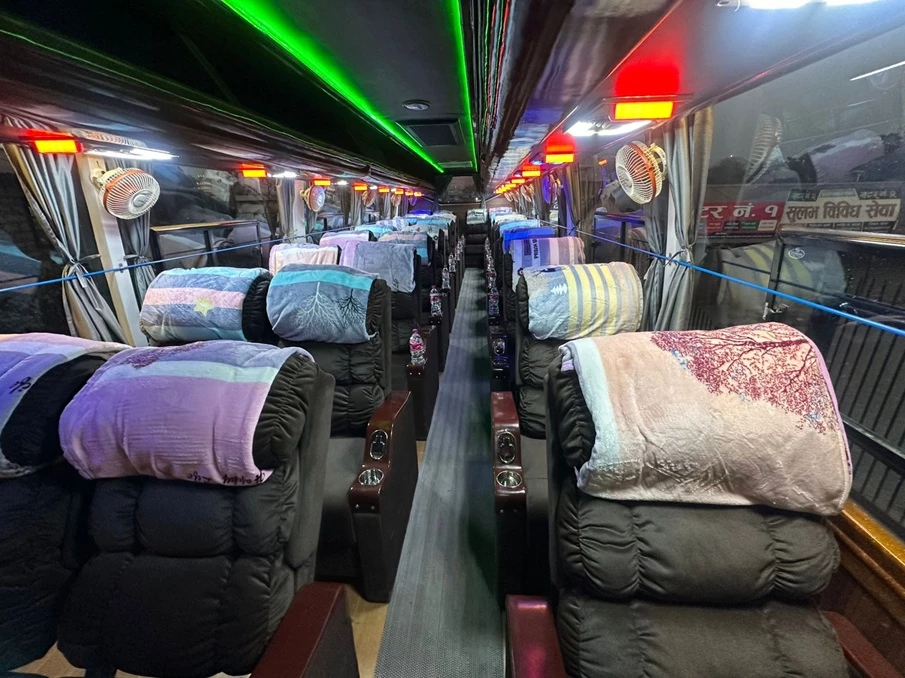
The VIP Sofa Bus is the most popular choice for travellers seeking genuine comfort on the Pokhara-to-Kathmandu route. The 2+1 seating layout means every passenger has either a window or an aisle seat with no middle seat, and the sofa-style reclining seats are significantly wider and more cushioned than standard bus seats.
VIP Sofa Bus Details
Information
Departure Point
Pokhara Lakeside Tourist Bus Park
Departure Time
7:00 AM – 8:30 AM (varies by operator)
Arrival (Kathmandu)
Approximately 1:00 PM – 2:30 PM
Ticket Price
NPR 1,400–2,000 per person
Seating
2+1 wide sofa-style recliners
AC
Top-end full AC
Total Seats
25–30 passengers
Reading Light
Yes – individual
USB Charging
Some models
Best For
Solo travellers, couples, and comfort seekers
Night Bus / Night Sofa Bus
For travellers who want to make the most of their time in Pokhara and arrive in Kathmandu ready to start the day, the night bus is an efficient option. Night sofa buses depart Pokhara Lakeside between 7:00 PM and 10:00 PM and arrive in Kathmandu’s Thamel area in the early morning (3:00 AM to 5:00 AM). Top-end sofa buses.
Nig provide blankets. Bus Details
Information
Departure Point
Pokhara Lakeside Tourist Bus Park
Departure Time
7:00 PM – 10:00 PM
Arrival (Kathmandu)
3:00 AM – 5:00 AM
Ticket Price
NPR 1,500–2,500 per person
Blanket
Provided on top-end night sofa buses
Seating
2+1 sofa (top-end) or 2+2 (standard)
Best For
Travellers looking to save on hotel accommodation costs
Note
Confirm hotel check-in time for early arrival in Kathmandu
Tourist Bus Type Comparison: Pokhara to Kathmandu 2026
Feature
Deluxe Bus
Tourist Bus
VIP Sofa Bus
Night Sofa Bus
Seat Layout
2+2
2+2
2+1
2+1 or 2+2
Ticket Price
NPR 700–1,200
NPR 1,000–1,500
NPR 1,400–2,000
NPR 1,500–2,500
Legroom
Standard
Standard–Good
Excellent
Good–Excellent
AC
Yes
Yes
Top-end
Top-end
Recline
Basic
Push-back
Full sofa
Full sofa
Reading Light
No
Sometimes
Yes
Yes
Blanket
No
No
No
Yes
Arrival Time
PM
PM
PM
Early AM
Hotel Savings
No
No
No
Yes (saves 1 night)
Best Comfort Rank
4th
3rd
1st
2nd
Private Vehicle Options: Pokhara to Kathmandu
Nepal Vehicle Hiring Pvt. Ltd. provides professional private vehicle services along the Pokhara-Kathmandu route. All private vehicles include hotel-to-hotel service, flexible departure time, and freedom to stop anywhere along the route.
Vehicle
Capacity
One Way (NPR)
One Way (USD)
Round Trip (NPR)
Best For
Private Car (Sedan)
2–3 pax
NPR 14,000–18,000
USD 105–135
NPR 24,000–30,000
Couples, solo with bags
Private SUV/Crossover
3–4 pax
NPR 16,000–22,000
USD 120–165
NPR 28,000–38,000
Small family
Private Jeep (Scorpio)
4–5 pax
NPR 18,000–24,000
USD 135–180
NPR 30,000–42,000
Groups, trekkers
Private Jeep (Hilux/Fortuner)
5–6 pax
NPR 22,000–30,000
USD 165–225
NPR 38,000–52,000
Top-end groups
Private Land Cruiser
5–6 pax
NPR 28,000–38,000
USD 210–285
NPR 48,000–65,000
Luxury private travel
Toyota Hiace Van
7–10 pax
NPR 25,000–38,000
USD 185–285
NPR 42,000–65,000
Large families, groups
Toyota Coaster
12–17 pax
NPR 32,000–45,000
USD 240–335
NPR 55,000–75,000
Small tour groups
Tourist Bus (Private)
25–45 pax
NPR 45,000–70,000
USD 335–520
NPR 75,000–120,000
Large tour groups
Note: All private vehicle prices include driver, fuel, and toll charges for the one-way journey from Pokhara to Kathmandu. Prices may vary by season and vehicle availability. Contact Nepal Vehicle Hiring for confirmed quotes.
What Is Included in Your Private Vehicle from Nepal Vehicle Hiring
Hotel pickup from your exact accommodation anywhere in Pokhara Lakeside or Pokhara city
Air-conditioned private vehicle — well-maintained and regularly serviced
Professional, licensed driver experienced on the Pokhara to Kathmandu Prithvi Highway
Fuel, toll charges, and driver expenses are included in the quoted price
Freedom to stop at Mugling, Bandipur, Damauli, or any attraction along the route on request
Drop-off at your exact hotel or accommodation address in Kathmandu
Flexible departure time — leave when you are ready, not according to a bus schedule
Pokhara to Kathmandu by Domestic Flight
For travellers who prioritise speed, the 25- to 30-minute domestic flight from Pokhara International Airport to Tribhuvan International Airport in Kathmandu is the fastest option. The new Pokhara International Airport (opened in 2023) operates multiple daily flights on this route with several airlines.
Flight Details
Information
Departure Airport
Pokhara International Airport (PKR)
Arrival Airport
Tribhuvan International Airport, Kathmandu (KTM)
Flight Duration
25 to 30 minutes
Price Range
USD 109–150 one way (foreigners); NPR 6,000–8,000 (Nepali citizens)
Airlines Operating
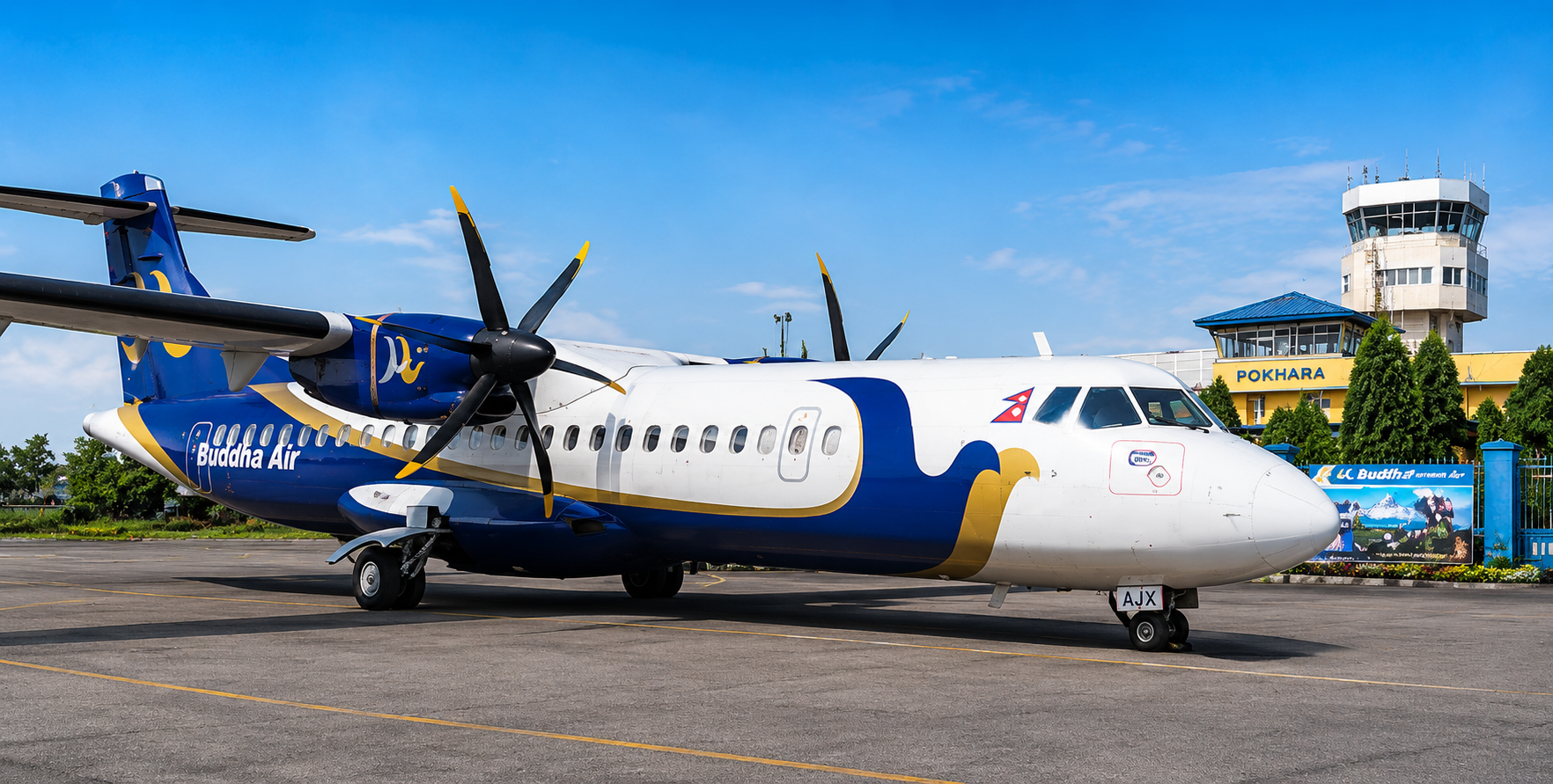
Buddha Air, Yeti Airlines, Shree Airlines, others
Baggage Allowance
15–20 kg checked (varies by airline)
Frequency
Multiple daily flights (early morning departures are most common)
Airport to Thamel
5 km – approximately 20–30 minutes by taxi
Best For
Business travelers, time-sensitive travelers, and those with flight phobias are not applicable.
Drawback
No road scenery, expensive for groups, and airport check-in time is required. Domestic flight prices in Nepal are significantly higher for foreign passport holders than for Nepali citizens. Prices are subject to change. Always book flights directly with airlines or through reputable agents.
Complete Transport Comparison: Pokhara to Kathmandu
Factor
VIP Sofa Bus
Private Car
Private Jeep
Hiace Van
Flight
Journey Time
6–7 hours
5–6 hours
5–6 hours
6–7 hours
25–30 min
Cost Per Person
NPR 1,400–2,000
NPR 3,500–9,000*
NPR 3,000–6,000*
NPR 2,500–5,400*
USD 109–150
Hotel Pickup
Lakeside Bus Park
Yes – door
Yes – door
Yes – door
Airport only
Hotel Drop-off
Thamel area
Yes – door
Yes – door
Yes – door
Airport only
Departure Time
Fixed 7 AM
Flexible
Flexible
Flexible
Fixed schedule
Luggage
Underfloor compartment
Boot + rack
Excellent + rack
Excellent + rack
15–20 kg checked
Stop Freedom
None
Full
Full
Full
None
Privacy
Shared 25–30 pax
Complete
Complete
Complete
Shared flight
Best For
Solo/couple budget
Couple/small family
Groups 4–6
Groups 7–10
Max speed
Per-person cost is calculated by dividing the vehicle price by the typical group size. Private car per person for 2–3 pax, jeep for 4–5 pax, Hiace for 7–9 pax.
Which Transport Option is Right for You?
Your Profile
Best Option
Reason
Solo traveller on a budget
VIP Sofa Bus
Best comfort per rupee for single travellers
le on a budget
VIP Sofa Bus
Two adjacent seats or a 2+1 layout for each window
Small family (2+2 children)
Private Car or Jeep
Door-to-door, flexible, space for bags, no rushing
Group of 4–6
Private Jeep
Best value per person, hotel pickup, fast
Group of 7–10
Toyota Hiace
All travel together, AC, hotel pickup, economical
Large group (12–45)
Coaster or Tourist Bus
Single vehicle, group cohesion, cost-effective
Time-critical traveller
Domestic Flight
25 min vs 6 hrs – unbeatable when time matters
Night traveller/hotel saver
Night Sofa Bus
Save one night’s accommodation cost
Senior or mobility-limited
Private Car or Hiace
Comfortable boarding, no time pressure, direct
Wants Bandipur stop
Private Vehicle
Only private vehicles are allowed to make off-route stops on request
Pokhara to Kathmandu Route Highlights
The Prithvi Highway from Pokhara to Kathmandu is one of Nepal’s most scenic road journeys. Here are the key highlights along the way:
Pokhara Exit – Seti River Gorge
Shortly after leaving Pokhara, the road crosses the Seti River — a river famous for its remarkably white water caused by glacial flour in suspension. The Seti flows through a deep underground gorge directly beneath parts of Pokhara city. The bridge crossing offers a brief but dramatic view of the gorge.
Damauli – Tanahun District Headquarters
Damauli sits at the confluence of the Seti and Madi rivers, approximately 40 km from Pokhara. It is the first major town on the route and an excellent place to rest, with a riverside setting; the hill town rising above the confluence is attractive, and the local teahouses serve excellent Nepali food.
Bandipur – Optional Heritage Town Detour
The UNESCO candidate heritage hill town of Bandipur lies off the main Prithvi Highway between Damauli and Dumre. This beautifully preserved Newari trading town, with its cobblestone main street, traditional architecture, and panoramic mountain views, is one of Nepal’s finest cultural stops. Adding Bandipur extends the journey by approximately 1 to 1.5 hours, but it is highly recommended for travellers in a private vehicle.
Mugling – The Classic Midway Stop
Mugling sits at the confluence of the Trishuli and Marsyangdi rivers, approximately 105 km from Pokhara and roughly the midpoint of the journey. It is Nepal’s most famous roadside stop — the teahouses and restaurants lining the riverbank serve fresh fish curry, dal bhat, and snacks.
Almost every tourist bus and private vehicle stops here for 20 to 30 minutes. The riverside setting is scenic, and the food is genuinely good.
Prithvi Highway – Trishuli River Gorge
The section of the Prithvi Highway between Mugling and Kathmandu follows the Trishuli River upstream through a dramatic gorge. The road winds alongside the rushing river with forested hillsides above and the occasional Nepali village clinging to the slopes. This is consistently the most photographed section of the entire drive.
Naubise – Final Valley Descent to Kathmandu
From Naubise, the road begins the final descent through the Chandragiri hills into the Kathmandu Valley. The transition from the river gorge terrain to the bowl of the valley is dramatic — the great density of Kathmandu city suddenly appears below as the road descends the final approach. On clear days, you can see the valley and the distant Himalayas from this final ridge section.
Departure Points and Schedules: Pokhara to Kathmandu
Pokhara Lakeside Tourist Bus Park
The Pokhara Lakeside Tourist Bus Park (near Hallan Chowk, Lakeside) is the main departure point for all tourist-class shared buses heading to Kathmandu. The bus park is approximately a 10-minute walk from the central Pokhara Lakeside area, or a short taxi ride (NPR 100 -00).
Bus Type
Departure Time
Ticket Price
Arrival KTM
Standard Tourist Bus
7:00 AM
NPR 1,000–1,300
1:30–2:30 PM
VIP Sofa Bus
7:00–8:30 AM
NPR 1,400–2,000
1:00–2:30 PM
Super Deluxe
7:00–8:00 AM
NPR 1,200–1,600
1:15–2:30 PM
Night Sofa Bus
7:00–10:00 PM
NPR 1,500–2,500
3:00–5:00 AM
Private Vehicle Pickup (Nepal Vehicle Hiring)
Nepal Vehicle Hiring offers private vehicle pickup directly from your hotel or guesthouse in Pokhara at any time you specify—no need to travel to a bus station. We recommend a 7:00 AM to 8:00 AM departure for comfortable daytime travel, arriving in Kathmandu between 1:00 PM and 2:00 PM.
Best Time for Pokhara to Kathmandu Travel
Autumn (October to November) – Best Season
Autumn offers the finest road conditions, clearest skies, and most comfortable temperatures for a drive on the Prithvi Highway. The mountain views on the Pokhara departure section and the lush post-monsoon greenery throughout the route make this the finest time of year for the journey. Tourist buses and private vehicles are in peak demand — book in advance.
Spring (March to May) – Excellent
Spring is warm, and the road is in good condition. The Marsyangdi and Trishuli valley sections are particularly beautiful with rhododendrons visible on the hillsides. Mountain views from the Pokhara end of the route are excellent in March and April.
May sees some pre-monsoon haze developing.
Winter (December to February) – Good
Winter travel on the Prithvi Highway is comfortable year-round. Temperatures are cool — bring a light jacket for the journey. Fewer tourists mean less traffic and sometimes better seat availability on tourist buses.
Mountain views near Pokhara can be exceptional in clear winter air.
Monsoon (June to August) – Possible with Caution
The Prithvi Highway near Mugling can experience occasional landslides during the monsoon. Travel is possible, but allow extra time for potential delays. Nepal Vehicle Hiring monitors road conditions and advises clients before departure during the monsoon season.
What to Pack for the Pokhara to Kathmandu Journey
Light jacket or fleece – tourist bus AC can be cold, and mountain sections are cooler than Pokhara
Water bottle – stay hydrated; Mugling stop is the best refill opportunity
Light snacks – biscuits, fruits, nuts for the 6+ hour bus journey
Motion sickness tablets – the Trishuli Gorge section has winding roads
Camera or phone charged – Marsyangdi valley and Trishuli gorge views are excellent
Nepali cash – for the Mugling stop and any incidental expenses
Headphones and entertainment for bus travellers – downloaded content for the 6–7-hour journey
Travel documents – passport/ID for any checkpoint along the highway
Expert Tips for the Pokhara to Kathmandu Journey
For VIP Sofa Bus, book at least 2 to 3 days in advance during October–November and March–April peak seasons – the 25- to 30-seat buses sell out quickly.
Arrive at the Lakeside Tourist Bus Park at least 30 minutes before the 7:00 AM departure to find your bus, load luggage, and settle in.
For private vehicles, request a Bandipur heritage town stop – it is a remarkable detour that adds only 1 to 1.5 hours and is one of Nepal’s finest cultural experiences.
For tourist bus travellers, choose the RIGHT side of the bus (when facing Kathmandu) for the best views of the Trishuli River gorge on the Mugling-to-Kathmandu section.
The Mugling rest stop is typically 20 to 30 minutes in; tourist buses stop here, and it’s the best opportunity for a meal on the journey.
Night bus travellers should confirm the hotel’s early morning check-in policy before booking – arriving at 4:00 AM at a hotel that opens at 8:00 AM is problematic.
Private vehicle from Nepal Vehicle Hiring includes flexible departure – if you want to leave at 9:00 AM rather than 7:00 AM to have a full Pokhara morning, that is entirely your choice.
For flight travellers, arrive at Pokhara International Airport at least 1.5 hours before departure – domestic security takes longer than expected.
Book the complete Nepal transport sequence with Nepal Vehicle Hiring – Chitwan to Pokhara, Pokhara to Kathmandu, and airport transfers – in a single coordinated arrangement.
How to Book Pokhara to Kathmandu Transport with Nepal Vehicle Hiring
Nepal Vehicle Hiring Pvt Ltd provides both private vehicle hire and tourist bus ticket booking for the Pokhara to Kathmandu route:
Step 1: Contact us via phone, WhatsApp, or at vehiclehiringnepal.com
Step 2: Tell us your travel date, number of passengers, hotel in Pokhara, and destination hotel in Kathmandu
Step 3: Choose your transport type – VIP Sofa Bus ticket, Super Deluxe bus, or private vehicle (car, jeep, Hiace, coaster)
Step 4: Receive your booking confirmation with vehicle details, departure time, and driver information
Step 5: For private vehicles – your driver arrives at your Pokhara hotel at the confirmed time
Step 6: For the tourist bus, we provide guidance on reaching the Lakeside Bus Park and confirming your seat
We recommend booking 2 to 3 days in advance for off-peak travel, and 5 to 7 days in advance during October–November and March–April.
Frequently Asked Questions (FAQ)
How far is Pokhara from Kathmandu?
The road distance from Pokhara to Kathmandu is approximately 200 kilometres along the highway.
How long does the Pokhara to Kathmandu journey take?
By private car or jeep: 5-6 hours. By tourist bus: 6-8 hours. By domestic flight: 25 to 30 minutes.
How much does the Pokhara-to-Kathmandu VIP Sofa Bus ticket cost?
VIP Sofa Bus (2+1 seating) costs NPR 1,400 to 2,000 per person. A standard tourist bus costs NPR 1,000 to 1,500 per person. A night bus costs NPR 1,500 to 2,500 per person.
How much does a private car from Pokhara to Kathmandu cost in 2026?
A private sedan costs US$120 one way. A private jeep costs NPR 18,000 to 24,000. A Toyota Hiace van costs NPR 25,000 to 38,000. All prices include driver and fuel.
Where does the tourist bus depart from in Pokhara?
Tourist buses depart from the Pokhara Lakeside Tourist Bus Park (near Hallan Chowk in the Lakeside area). It is approximately a 10-minute walk from central Lakeside or a short taxi ride. All major tourist bus operators have counters at this bus park.
Can I hire a private vehicle from Pokhara to Kathmandu with hotel pickup?
Yes. Nepal Vehicle Hiring provides hotel-to-hotel private vehicle service – pickup from your hotel in Pokhara and drop-off at your hotel in Kathmandu. Contact us at vehiclehiringnepal.com to book.
Is there a direct flight from Pokhara to Kathmandu?
Yes. Multiple airlines operate direct flights from Pokhara International Airport (PKR) to Tribhuvan International Airport in Kathmandu (KTM). The flight takes 25 to 30 minutes.
Current prices are approximately USD 1109-1109-150 one-way for foreign passport holders.
What is the best transport from Pokhara to Kathmandu for a group of 6 people?
A private jeep (Toyota Fortuner or Hilux) is the ideal option for 6 people. It includes hotel pickup and drop-off in Kathmandu, 5 to 6 hours of travel time, full luggage space, and the flexibility to stop at Bandipur or Mugling. Contact Nepal Vehicle Hiring for a quote.
Can I stop at Bandipur on the way from Pokhara to Kathmandu?
Yes, with a private vehicle from Nepal Vehicle Hiring. Bandipur is a magnificent Newari heritage hill town located approximately 8 km off the Prithvi Highway between Damauli and Dumre. A Bandipur stop adds approximately 1 to 1.5 hours to the journey.
Public tourist buses cannot make this detour.
Book Your Pokhara to Kathmandu Transport with Nepal Vehicle Hiring
The Pokhara to Kathmandu journey is one of Nepal’s great road experiences — the Marsyangdi and Trishuli river gorges, the bustling roadside life of Mugling, the optional heritage town of Bandipur, and the spectacular final descent into the Kathmandu Valley all make the 200-kilometre drive a genuinely engaging travel experience rather than merely functional transport.
Whether you choose the outstanding value of a VIP Sofa Bus, the door-to-door comfort of a private car or jeep, the group convenience of a Toyota Hiace, or the speed of a domestic flight, Nepal Vehicle Hiring Pvt Ltd has the right service for your Pokhara to Kathmandu journey. Thousands of travellers in Nepal choose our tourist bus ticket booking, private vehicle hire, and group transport services every year.
Contact Nepal Vehicle Hiring Pvt Ltd today at vehiclehiringnepal.com to book your Pokhara-to-Kathmandu transport and continue your Nepal adventure with complete confidence.
Nepal’s Most Beloved Weekend Pilgrimage Destination
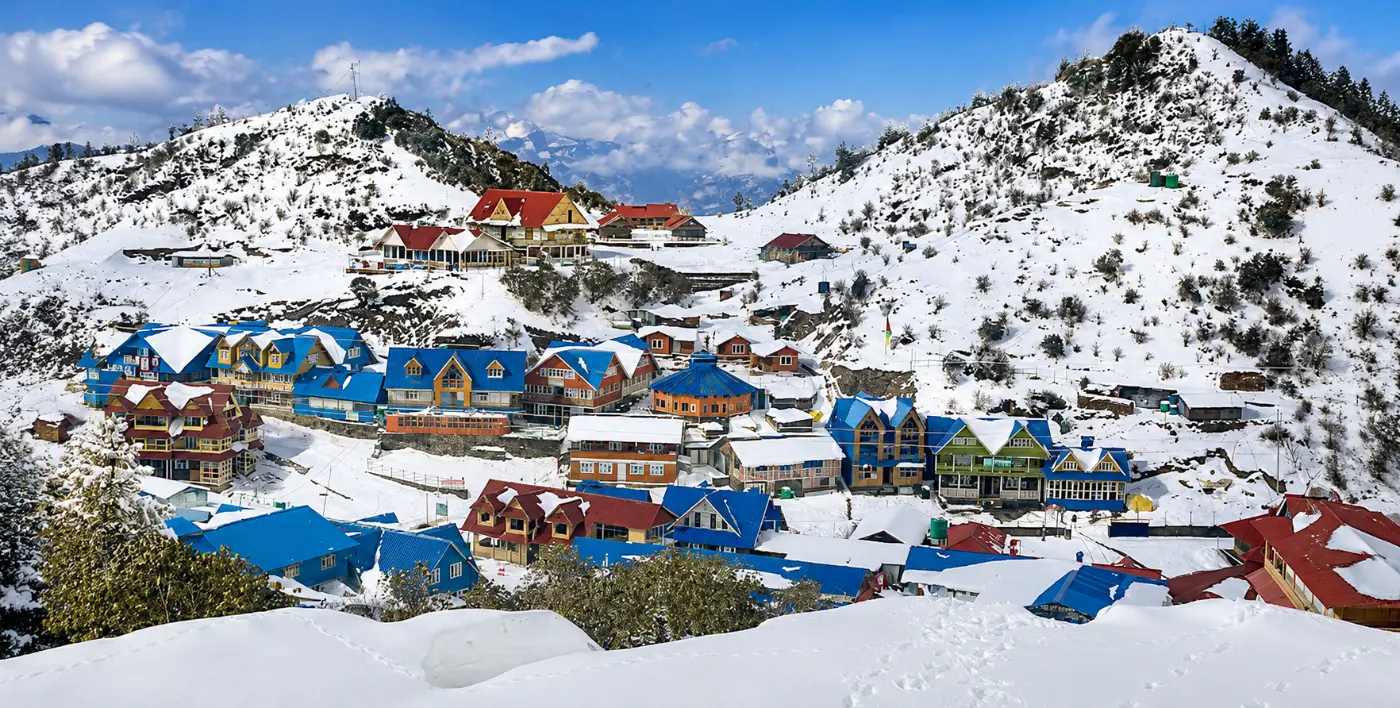
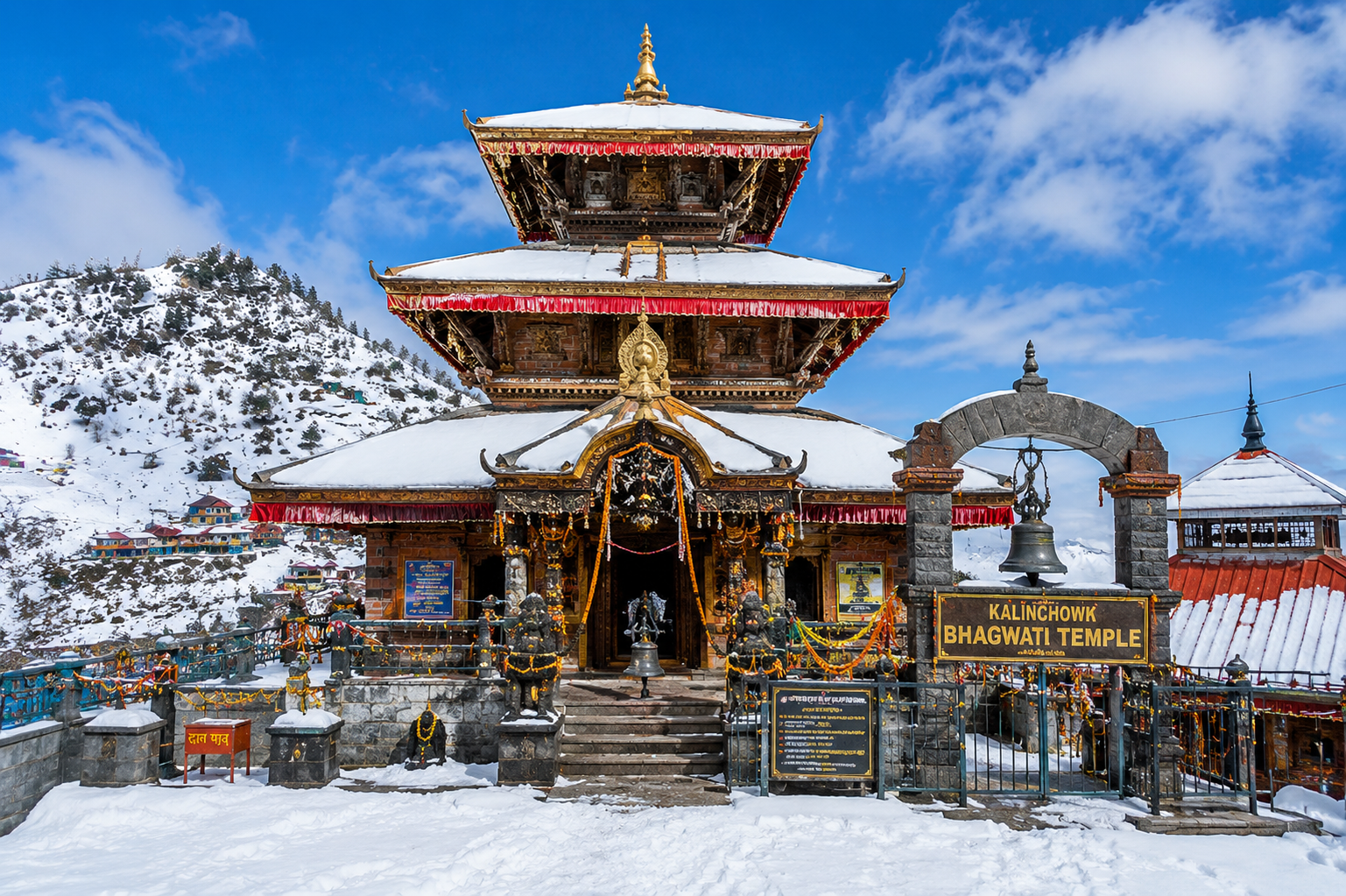
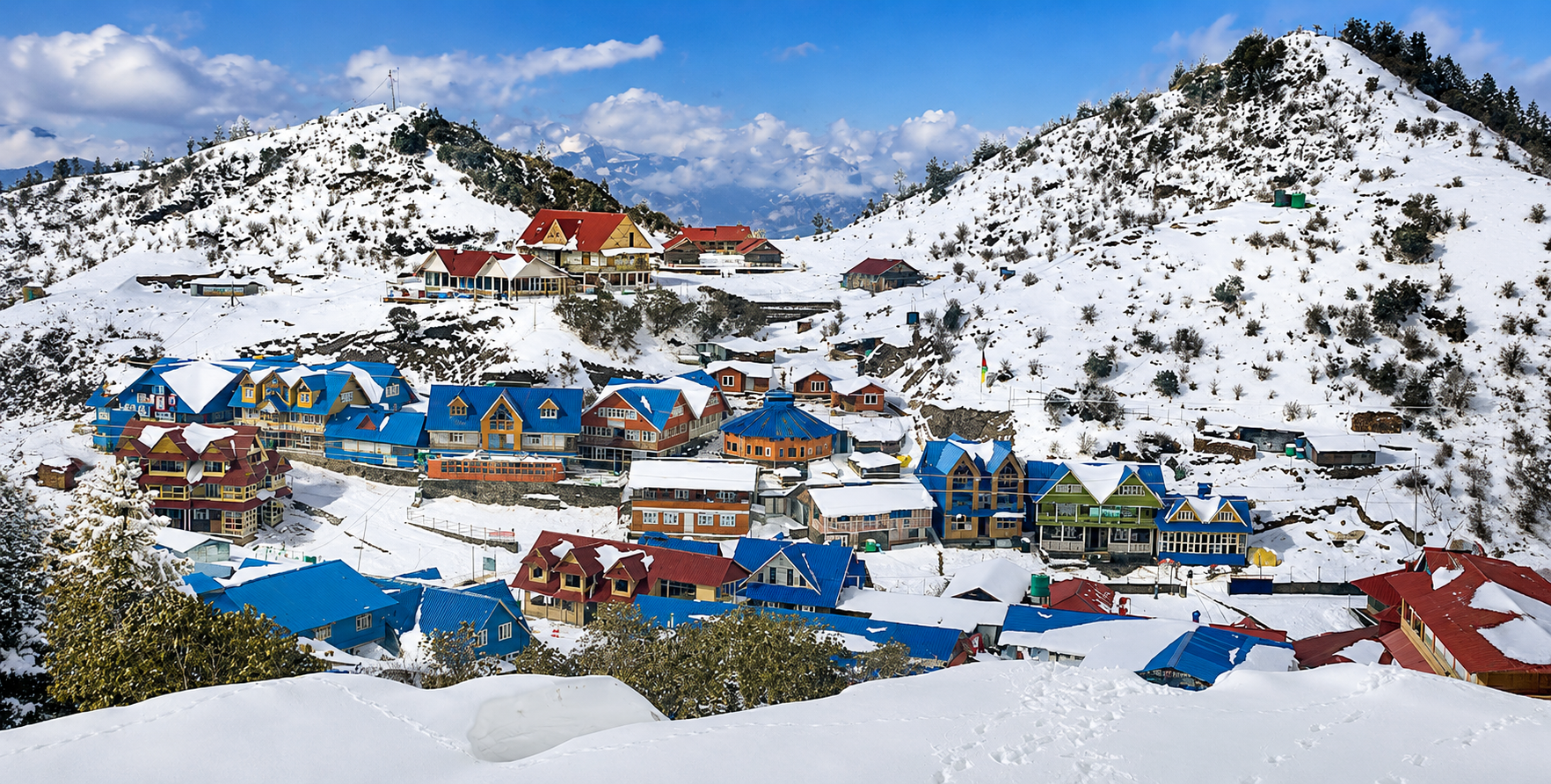
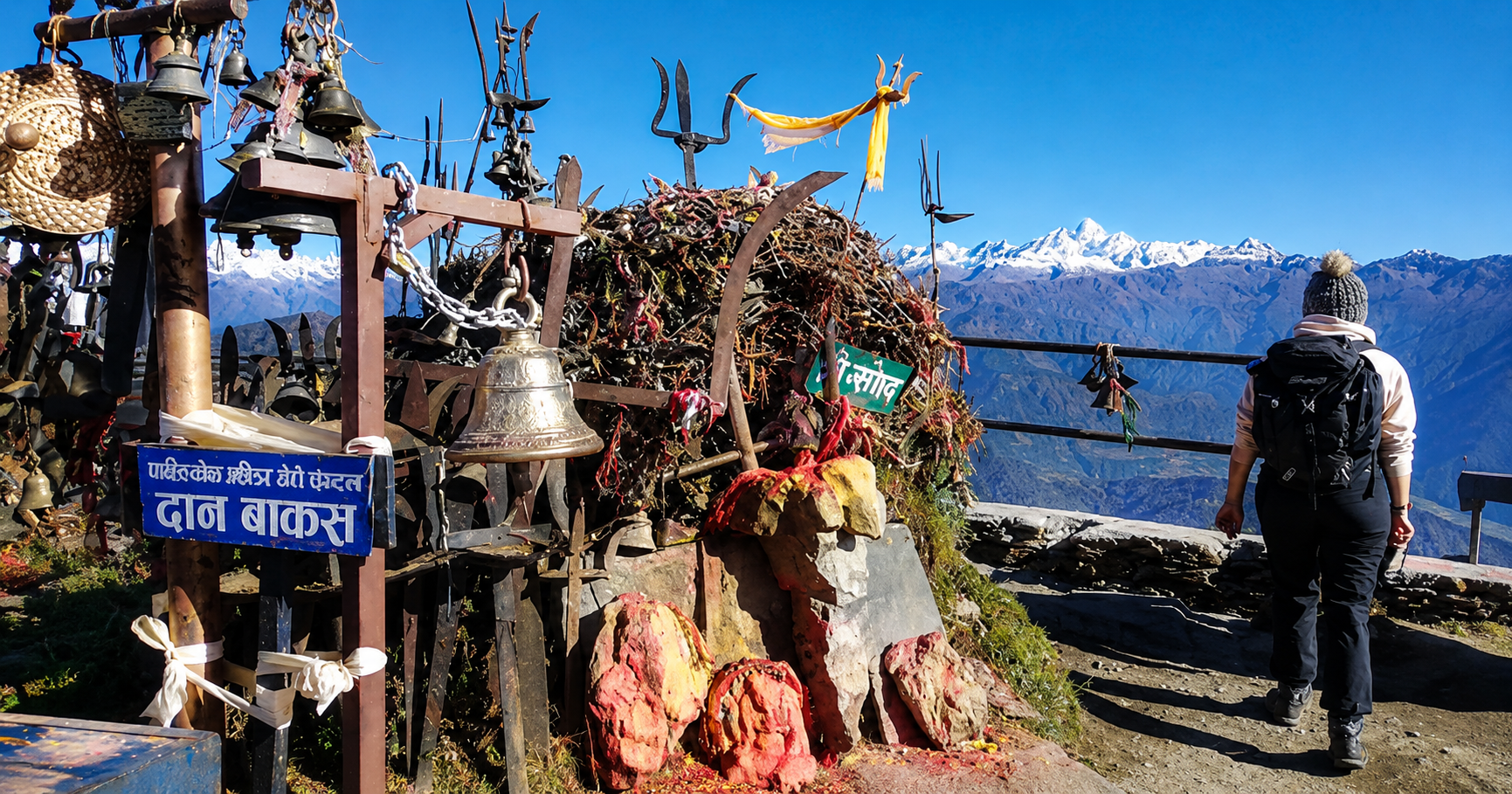
Set at a commanding 3,842 meters above sea level on a rocky mountain ridge in the Dolakha District of Bagmati Province, the Kalinchowk Bhagwati Temple is one of Nepal’s most beloved, most accessible, and most spiritually powerful pilgrimage destinations. For residents of Kathmandu — only 150 km to the northeast — Kalinchowk offers the perfect mix of high-altitude adventure, sacred Hindu pilgrimage, striking Himalayan panoramas, and winter snowfall, all within reach for a weekend trip.
Nepal Vehicle Hiring Pvt Ltd offers the finest Kalinchok Scorpio and jeep hire service — your most reliable, comfortable, and expert private 4WD vehicle service for the journey to Kalinchowk.
The Kalinchowk experience is, in essence, a journey of three extraordinary acts: First, the 5–6-hour scenic drive from Kathmandu along the Araniko Highway through medieval Bhaktapur, across the Sunkoshi River gorge at Dolalghat, and through the Newari mountain town of Charikot. Second, the steep, striking 15–18 km off-road ascent from Charikot to Kuri Village — a 4WD Scorpio or Land Cruiser adventure through pine and rhododendron forest to the isolated mountain village at 2,300 m.
And third, the pre-dawn hike or cable car ascent to the temple summit — arriving as the first golden light of sunrise transforms the snow-covered peaks of Gaurishankar, Everest, Langtang, Jugal Himal, and Ganesh Himal into a landscape of transcendent, burning beauty.
The central reason a Mahindra Scorpio OR, 4WD is essential for this journey — and why it has become Nepal’s most iconic domestic road-trip vehicle pairing — is the Charikot-to-Kuri Village off-road section. This 15–18 km mountain track is steep, narrow, rocky, and in the winter months covered in snow and ice.
No standard car, van, or microbus can navigate it. The Scorpio’s genuine 4WD system, powerful diesel engine, 180–200 mm ground clearance, and proven mountain reliability make it the vehicle of choice for 95% of Kalinchowk visitors — and Nepal Vehicle Hiring operates a fully maintained, professionally driven fleet dedicated to this route.
Kalinchok Scorpio & Jeep Hire – Complete Route Overview
Full Route
Kathmandu -> Banepa -> Dolalghat -> Charikot -> Kuri Village -> Kalinchowk Temple
Total Distance
Approx. 150 km (Kathmandu to Kalinchowk)
Kathmandu to Charikot
132 km via Araniko Highway | 5–6 hours on paved road
Charikot to Kuri Village
15–18 km steep off-road mountain track | 1.5–2 hours
Kuri to Temple
2 km hike (45–60 min) OR cable car (NPR 500 two-way, 10 min)
Altitude
Charikot: 1,554 m | Kuri Village: 2,300 m | Kalinchowk Temple: 3,842 m
Temperature Range
Summer: up to 29°C | Winter nights: as low as –10°C to –15°C
Best Vehicle
Mahindra Scorpio 4WD (most popular) | Toyota Land Cruiser (top-end)
Recommended Stay
1 Night 2 Days (most popular) | 2 Night 3 Days (for winter snow experience)
Best Seasons
Winter (Dec–Feb) for snow | Autumn (Oct–Nov) for Himalayan views | Spring (Mar–May) for rhododendrons
Availability
Daily – 24/7 hotel pick-up from Kathmandu
Contact
+977 981-4227196 | vehiclehiringnepal.com
Kalinchok Bhagawati Temple
About Kalinchowk Bhagwati Temple – History, Significance & Spiritual Importance
The Sacred Geography of Kalinchowk
Kalinchowk Bhagwati Temple sits on a rocky summit ridge within the Gaurishankar Conservation Area (GCA) — a 2,179 sq. km protected zone declared by the Government of Nepal in 2010 to safeguard one of the most ecologically and culturally significant landscapes in the Himalayan region. The Gaurishankar Conservation Area is named for the majestic Gaurishankar peak (7,134 m) visible from the temple summit — a twin-peaked mountain considered sacred by both Hindu and Buddhist traditions as the earthly embodiment of Shiva and Parvati united.
Within the conservation area, the Sunkoshi (Sun Koshi) and Tamakoshi (Tama Kosi) rivers originate — two of Nepal’s major river systems flowing southward through Dolakha and Sindhupalchok districts to join the Koshi system and eventually the Ganges in India.
The temple’s elevation of 3,842 meters (12,605 feet) places it firmly in sub-alpine terrain — above the treeline in winter when deep snow covers the ridge and the surrounding rhododendron and pine forests are white-laden and ice-crystal quiet. In spring and autumn, the ridge is carpeted in flowering rhododendron species (Rhododendron arboreum, R. campanulatum) — Nepal’s national flower — alongside juniper, dwarf bamboo, and alpine grasses.
The Himalayan Monal (Danphe), Nepal’s vibrantly coloured national bird, is frequently sighted in the forest between Kuri Village and the temple trail.
Historical and Religious Background
The Kalinchowk Bhagwati Temple is dedicated to Goddess Bhagwati — one of the most powerful and widely revered manifestations of the divine feminine in Hinduism, representing the supreme Mother Goddess in her aspect as protector, destroyer of evil, and granter of boons. Bhagwati (also known as Durga, Shakti, or Kali in her various forms) is the central deity of the Shakta tradition. This Hindu theological stream regards the Goddess as the ultimate reality and the source of all creation.
The temple is considered one of the Shakti Peethas — sacred sites of the Goddess — within Nepal’s broader network of Shakti pilgrimage sites. Historical and local accounts suggest the site has been a place of worship for many centuries, with the present temple structure established in the 19th century to serve the growing pilgrim community.
The temple became formally incorporated into the Gaurishankar Conservation Area in 2010, ensuring its environmental and cultural heritage is protected for future generations.
The Kalinchowk Bhagwati is particularly famous throughout eastern Nepal for one central spiritual belief: that the Goddess at Kalinchowk fulfils the sincere prayers and desires of devotees who make the difficult pilgrimage to her mountain shrine. This belief — rooted in centuries of devotional tradition and countless personal testimonies — drives tens of thousands of pilgrims to the temple every year, with the largest gatherings during Dashain (October), Navaratri (spring and autumn), Maghe Sankranti (January), and Teej (September).
The temple’s remoteness and the physical effort required to reach it are themselves considered part of the tapasya (spiritual austerity) that purifies the devotee and makes the prayer more powerful.
Architectural Features of the Temple
The Kalinchowk Bhagwati Temple is a relatively modest stone structure, as befits a high-altitude mountain shrine that must withstand severe winter conditions. Its architecture reflects the traditional Himalayan hill temple style — a compact, sturdy stone building with a corrugated metal roof (replacing the original stone slate), wooden door frames carved with traditional motifs, prayer flags fluttering from the roof and surrounding poles, and a simple forecourt for devotees to make offerings.
The main sanctum houses the idol of Goddess Bhagwati, a lack stone image adorned with red cloth, gold jewellery, and fresh flower garlands replenished by the temple priests. The surrounding forecourt has smaller shrines to associated deities — Ganesh (for obstacle removal), Navagraha (the nine planetary deities), and subsidiary forms of the Goddess.
Bells of various sizes hang from the entrance gate, rung by devotees as they enter to announce their presence to the Goddess and to ward off negative energies from the sacred precinct.
The 360-degree panoramic view from the temple forecourt is arguably the most extraordinary feature of the Kalinchowk site — a gift of geography that amplifies the spiritual experience with a reminder of the sublime scale of the Himalayan world. On the clearest days (typically October, November, March, and the occasional February morning after a strong cold front), the visible peaks include: Gaurishankar (7,134 m), Mt Everest (8,849 m) — visible as a distant dark pyramid on the northeast horizon, Langtang Lirung (7,234 m), Dorje Lakpa (6,966 m), Ganesh Himal (7,422 m), Jugal Himal (6,935 m), Shishapangma (8,027 m, Tibet), Langtang II, and the broad sweep of the Kathmandu Valley spread below to the southwest.
Why Is the Mahindra Scorpio the Most Popular Vehicle for Kalinchowk?
Among all vehicles used for the Kathmandu–Kalinchowk journey, the Mahindra Scorpio 4WD has become virtually synonymous with the route — to the point where locals, travel agents, and pilgrims across Nepal refer to a Kalinchowk trip simply as “going by Scorpio.” This association is neither accidental nor merely traditional — it is the product of the Scorpio’s remarkable suitability for the specific challenges of the Charikot–Kuri Village off-road section:
Genuine 4-Wheel Drive with Low-Range Transfer Case
The Mahindra Scorpio’s switchable 4WD system — providing both 4H (high-range 4WD) and 4L (low-range 4WD) — is the fundamental technical requirement for the Charikot–Kuri Village mountain track. Low-range 4WD delivers maximum torque multiplication for steep uphill sections with minimal forward speed — essential for crawling over boulders and rock steps on the upper sections of the off-road track.
High-range 4WD provides additional traction on the moderately rough lower sections. Standard SUVs with AWD (all-wheel drive) systems are NOT equivalent to true 4WD — they lack the low-range transfer case that the Kuri Village ascent demands in winter and on wet rock.
Ground Clearance – The Critical Number
The Scorpio’s 180–200 mm of ground clearance is the minimum required for safe passage on the Charikot–Kuri road. The track has numerous exposed rock ledges, embedded boulders, deep ruts, and sudden drop-offs where a vehicle with lower clearance would ground out or lose traction.
By comparison, a standard sedan has 130–150 mm of clearance (dangerously insufficient), and a standard city SUV (crossover) has 160–170 mm of clearance (marginal at best). The Scorpio’s engineering is calibrated for this case—its approach and departure angles let it climb over and descend from obstacles that would stop lower-slung vehicles.
Seven-Passenger Capacity – Maximum Group Value
A key economic advantage of the Scorpio for Kalinchowk groups is its comfortable 6–7 passenger capacity. For a group of 7 friends or family members, the total private Scorpio hire cost is shared across all 7 seats, making the per-person cost comparable to or even cheaper than multiple shared jeep tickets — while delivering the incomparably superior experience of a private vehicle with full control over timing, stops, and comfort.
Nepal Vehicle Hiring’s Scorpios can accommodate 7 adults with day bags; for overnight trips with more luggage, we recommend a maximum of 6 passengers to keep luggage comfortable.
Proven Reliability in Extreme Cold
In December and January, the Kuri Village track can be snow-covered, ice-patched, and sub-zero. The Scorpio’s diesel engine delivers reliable cold-start performance at these temperatures, unlike petrol engines that can struggle in extreme cold.
With snow chains fitted, the Scorpio has proven year after year that it can complete the full Charikot–Kuri round trip safely even in heavy snowfall conditions — though our drivers monitor conditions carefully and will make the professional call to park at Deurali if the final section becomes unsafe.
Cost-Effectiveness for Private Groups
Compared to the Toyota Land Cruiser (the top-end alternative), the Mahindra Scorpio offers similar off-road capability at a more accessible price point — making private Kalinchok jeep hire genuinely affordable for groups of 5–7. Nepal Vehicle Hiring’s Scorpio hire rate is among the most competitive in Kathmandu for this route. See our Jeep Hire page for current pricing.
Complete Vehicle Guide – Kalinchok Scorpio and Jeep Hire 2026
Vehicle
Capacity
Off-Road Rating
Winter Snow Capability
Best For
Mahindra Scorpio 4WD
6–7 pax
Excellent
With snow chains
Families / Friend groups
Toyota Land Cruiser 4WD
1–6 pax
Outstanding
Best in class
VIP / Top-end pilgrims
Mahindra Bolero 4WD
6–7 pax
Excellent
With snow chains
Budget groups
Hiace Van (to Charikot)
8–13 pax
Highway only
Not suitable beyond Charikot
Large groups (Charikot base)
MMinibus/ Coaster
20–30 pax
Highway only
Not suitable for off-road
Large group highway transfer
Toyota Land Cruiser 4WD – The Kalinchowk Top-end Experience
For pilgrim families, VIP guests, and those who want the absolute pinnacle of comfort, reliability, and off-road safety on the Kalinchowk route, theToyota Land Cruiser 4WD stands alone. Its outstanding 220 mm ground clearance, locking front and rear differentials, superior suspension with adjustable ride height, and vast torque reserve make the Charikot–Kuri Village section feel almost effortless compared to lesser vehicles.
The Land Cruiser’s leather-appointed cabin, powerful dual-zone climate control, and noise suppression mean passengers arrive at Kuri Village in remarkable comfort after the bumpy mountain track, which is especially important for elderly devotees, children, and anyone with joint or back sensitivities.
The Mahindra Scorpio is the undisputed workhorse of the Kalinchowk route and the most widely trusted private vehicle for this journey throughout Nepal. It is the vehicle our drivers know best on this specific road, the vehicle our fleet is most thoroughly trained for, and the vehicle that delivers the best balance of capability, comfort, and value for the typical Kalinchowk group of 4–7 passengers.
Nepal Vehicle Hiring’s Scorpios are maintained to a higher standard than the local rental market — clean interiors, regular service intervals, pre-trip mechanical inspection, and snow chains available from November through February.
Mahindra Bolero 4WD – The Budget 4WD Option
The Mahindra Bolero 4WD shares the Scorpio’s 4WD drivetrain architecture and provides genuine off-road capability for the Kalinchowk route at a slightly reduced price point. The Bolero’s interior is more utilitarian than the Scorpio’s, but it carries 6–7 passengers with comparable mechanical safety on off-road tracks. Recommended for pilgrim groups and budget-conscious families who prioritise cost savings over cabin refinement.
Hiace Van and Mini Bus – For Groups to Charikot Only
For large groups of 8–30 passengers, Nepal Vehicle Hiring provides Toyota Hiace van (8–13 pax) and Mini Bus / Coaster (20–30 pax) transfers from Kathmandu to Charikot on the paved Araniko Highway. From Charikot, the group is transferred to separate local Scorpios for the off-road section to Kuri Village (local shared Scorpios are available from Charikot).
This two-vehicle system is the practical solution for large groups — see our Hiace Van Hire and Coaster Hire pages.
Kathmandu to Kalinchowk – Detailed Route & Segment Guide
The Kathmandu–Kalinchowk road journey offers progressively intensifying scenery — from the cultural richness of the Kathmandu Valley to the dramatic river gorges of the middle hills, and finally to the extraordinary off-road mountain ascent to Kuri Village. Here is the complete route, segment by segment:
Segment / Checkpoint
Distance
Travel Time
Road Condition & Key Feature
Kathmandu to Bhaktapur
15 km
30–40 min
Paved Araniko Highway; UNESCO World Heritage City
Bhaktapur to Banepa
12 km
20–25 min
Paved highway; Sanga Giant Shiva Statue en route
Banepa to Dolalghat
30 km
40–50 min
Paved hilly road; Sunkoshi River confluence; scenic gorge
Hilly paved road; Dolakha district entry; Bhimsen Temple
Charikot to Kuri Village
15–18 km
1.5–2 hrs
STRICT OFF-ROAD: steep, rocky, narrow – 4WD with high clearance MANDATORY
Kuri Village to Temple
2 km
45–60 min hike / 10 min cable car
Hike through rhododendron forest OR cable car (NPR 500 two-way)
Kathmandu to Bhaktapur – Cultural Gateway (15 km | 30–40 min)
The journey departs from your Kathmandu hotel and heads east on the Araniko Highway—Nepal’s famous road to China —following the ancient trade route between the Kathmandu Valley and Tibet. The first major landmark is the historic Bhaktapur (Bhadgaon) — a UNESCO World Heritage City and the most perfectly preserved medieval Newari kingdom-city in the world.
Bhaktapur’s extraordinary Durbar Square, Nyatapola Temple (five-story pagoda), Taumadhi Tole, and the 55-Window Palace are among Nepal’s greatest cultural treasures.
While a full Bhaktapur visit is a separate half-day experience, the drive through the city’s outer ring offers glimpses of its distinctive brick-and-timber architecture, the traditional pottery market at Kumale Tole, and the towering Nyatapola pagoda visible above the rooflines. Your Kalinchowk Scorpio driver can arrange a short Bhoto stop on request.
Banepa to Dolalghat – The Sunkoshi River Gorge (42 km | 60–75 min)
Beyond Banepa — a busy market town 27 km from Kathmandu — the Araniko Highway begins its descent toward the Sunkoshi River at Dolalghat. The Sanga area on this section is home to the spectacular Kailashnath Mahadev Statue — at 43 meters, one of the tallest Shiva statues in the world — visible in its entirety from the highway and a magnificent roadside spectacle.
Dolalghat (57 km from Kathmandu) sits at the confluence of the Sunkoshi and Indrawati rivers — a scenic gorge location popular for picnics, river swimming, and rafting. The suspension bridges over the Sunkoshi at Dolalghat are frequently photographed, and the riverside tea houses are a classic first stop for Kalinchowk groups.
Mude Rest Stop – The Halfway Point (90 km from KTM)
Approximately 90 km from Kathmandu, the Mude rest stop has become a beloved institution on the Kalinchowk Scorpio journey. A cluster of roadside restaurants and tea houses perched on a hillside with sweeping valley views, Mude is the natural halfway lunch or breakfast stop for groups departing Kathmandu early.
The views from Mude — particularly in clear autumn weather — often include the first glimpse of the high Himalayan peaks to the north, which can really raise excitement levels in the jeep as Kalinchowk draws closer. Mude’s dal bhat, thukpa, and fresh chai are excellent value, and the restaurant owners have decades of experience serving Kalinchowk-bound pilgrims and tourists.
Charikot (Bhimeshwar) – The District Capital at 1,554 m
Charikot is the headquarters of Dolakha District — a characterful mountain town built around the ancient Dolakha Bhimsen Temple. At 1,554 m, Charikot’s climate is already noticeably cooler than Kathmandu’s, and the surrounding hills and valleys strongly hint at the dramatic landscapes ahead.
The Dolakha Bhimsen Temple is one of Nepal’s most sacred and mysterious religious sites — an ancient pagoda housing a unique triangular black stone idol of Lord Bhimsen, believed by devotees to represent three divine manifestations simultaneously.
The legendary “sweating idol” phenomenon — where the idol’s surface reportedly becomes moist before major national events — has been documented and discussed by scholars and devotees for centuries, adding an extraordinary mystical dimension to Charikot’s religious heritage. Most Kalinchowk groups visit the Bhimsen Temple on the return journey on Day 2, bookending the day with spiritual significance at both the mountain summit (Kalinchowk Bhagwati) and the valley shrine (Dolakha Bhimsen).
Charikot to Kuri Village – The Essential 4WD Section (15–18 km | 1.5–2 hrs)
The moment your Nepal Vehicle Hiring Scorpio or Land Cruiser leaves the paved Araniko Highway at Charikot and heads northeast onto the mountain track toward Kuri Village, the journey’s character transforms completely. The road immediately narrows to a single-vehicle width, the surface becomes compacted gravel and exposed rock, and the ascent steepens dramatically.
Dense pine and rhododendron forest closes in on both sides of the track, interrupted by occasional valley viewpoints where the full sweep of the surrounding mountain landscape becomes visible — Dolakha’s ridge systems extending in every direction, with the high peaks of the Gaurishankar massif growing progressively closer and more magnificent as altitude is gained.
The Deurali checkpoint — about 15 km from Charikot — is the final major waypoint before Kuri Village, and in winter, the point where snow chains are fitted to the Scorpio’s tyres if snow covers the upper section of the track. Beyond Deurali, the track climbs through its final steep, rocky 3 km section to Kuri Village (2,300 m).
The arrival at Kuri Village, after 6–7 hours of driving from Kathmandu, is always a moment of genuine relief, excitement, and awe — the village’s cluster of mountain lodges, prayer flags, and the towering snow-covered ridge of Kalinchowk above creating an atmosphere of achieved pilgrimage that begins the moment you step out of the jeep.
Kuri Village – Your Mountain Base Camp at 2,300 m
Kuri Village is a small but perfectly equipped mountain settlement that has evolved over the past decade into one of Nepal’s most popular weekend escape destinations for Kathmandu residents. There are 15–20 lodges and guesthouses, ranging from simple dormitory teahouses to surprisingly comfortable private-room lodges with attached bathrooms, electric heaters or bukhari (wood-burning stoves), dining halls, and outdoor fire pit/campfire facilities — the essential Kuri Village evening experience.
On winter weekends, the campfire courtyard of every Kuri lodge becomes the social heart of the village — groups singing, roasting corn and sweet potatoes, making snowmen, sledging on improvised slides, and sharing hot raksi (local spirit) and butter tea under a sky of extraordinary star density at this altitude away from light pollution.
In December and January, Kuri Village often has 50–100 cm of snowfall—the entire village transforms into a white landscape of extraordinary photogenic beauty. Snow-laden rhododendron branches arch over the village paths, the rooftops are buried under heavy snow caps, and the surrounding forest is a silent, crystal wonderland.
For most Kathmandu residents who have never experienced significant snowfall, Kuri Village in January offers Nepal’s closest and most accessible snow experience —no special trekking permits, no altitude sickness risk, and no extended holiday—just a Scorpio and two days.
Kalinchowk Bhagwati Temple – Complete Darshan and Visitor Guide
How to Reach the Temple from Kuri Village
From Kuri Village, the Kalinchowk Bhagwati Temple is accessible by two routes:
The Hike (2 km | 45–60 minutes): A well-worn stone-stepped and earthen trail climbs steeply from Kuri Village through the upper edge of the rhododendron and juniper forest before emerging onto the open rocky ridge leading to the temple. The hike gains approximately 1,500 m from Kuri to the temple summit. In clear autumn and spring weather, the trail is a magnificent experience in its own right — a gradual unfolding of the Himalayan panorama as altitude is gained, with Gaurishankar appearing first over the ridge and the full panorama expanding as the final approach to the temple opens up. In winter, the hike requires crampons or good-grip boots and is not recommended after heavy recent snowfall unless you have experienced local guides.
The Cable Car (NPR 500 two-way | ~10 minutes): Inaugurated in 2018, the Kalinchowk Cable Car has made the temple genuinely accessible to elderly devotees, families with young children, and pilgrims of all physical abilities. The cable car runs from the Kuri Village base station to a point approximately 10–15 minutes’ walk below the temple. The cable car cabin holds approximately 6 passengers per run and operates from approximately 7:00 AM to 5:00 PM daily (check locally for 2026 operating hours, as winter weather can temporarily suspend service). From the cable car’s upper station, a 10–15 minute walking path leads to the temple forecourt.
Kalinchowk Bhagwati Temple
The Sunrise Darshan – The Greatest Kalinchowk Experience
Without question, the pre-dawn sunrise hike or the early cable car to Kalinchowk Temple is the defining experience of any visit to Kalinchowk. Departing Kuri Village at 4:30–5:00 AM (with headlamps), pilgrims and trekkers ascend in the dark to reach the temple forecourt as dawn approaches.
The sunrise spectacle at Kalinchowk is extraordinary — the Himalayan peaks first catching the alpenglow (sunrise reddening) before the valley is lit, the snow surfaces burning gold and crimson. At the same time, the sky transitions from deep blue to lavender to orange.
Gaurishankar’s double summit glows like twin torches in the first light, and on clear days, Everest’s distant dark pyramid is visible to the northeast.
After darshan and sunrise, devotees perform puja (ritual worship) at the temple—offering flowers, incense, oil lamps, and prayers to Goddess Bhagwati, and receiving prasad (blessed food offerings) distributed by the temple priests. The priests perform morning aarti (lamp ceremony) at dawn, and the sight of the butter lamps flickering in the mountain wind against the backdrop of snow peaks is one of the most moving religious experiences available in the Nepal hills.
Temple Etiquette and Visiting Guidelines
Remove footwear before entering the main temple sanctum.
Modest dress is required — shoulders and legs covered for both men and women.
Photography is generally permitted in the forecourt and approach; ask the priest before photographing inside the sanctum.
Walk clockwise around the temple and any chorten (Buddhist stupa) structures on the ridge.
Carry out all waste — the temple conservation area has strict littering prohibitions enforced by local volunteers and NTNC rangers.
Animal sacrifice is practised at the temple during major festivals (Dashain, Navaratri) — prepare children and sensitive visitors if visiting then.
Full Guide to Kalinchowk Attractions – Complete Visitor Table
Rhododendron bloom; warm days; good mountain clarity
Good – some muddy sections
Excellent for nature & pilgrims
Summer
Jun–Sep
Green & lush; cloudy; limited mountain views
Road usable; light landslide risk
Quiet season; manageable
Winter (December–February) – The Snow Season – Nepal’s Most Popular
The winter months — particularly December and January — are by far the most popular season for the Kalinchowk Scorpio hire from Kathmandu. The reason is simple and irresistible: Kuri Village and the Kalinchowk ridge receive heavy, reliable snowfall during these months, transforming the mountain into what countless visitors describe as “Nepal’s Switzerland” or “our own snow paradise”.
For most residents of subtropical Kathmandu—who have never experienced significant snow—a weekend at Kuri Village in January is a unique, exhilarating, and deeply memorable experience.
During peak winter weekends (especially after significant snowfall), demand for Kalinchowk Scorpio hire vastly exceeds supply. Nepal Vehicle Hiring urges all winter visitors to book their Scorpio at least 1–2 weeks in advance — and preferably 2–3 weeks for specific January weekends immediately following snowfall reports. The most experienced and sought-after drivers on this route are booked weeks in advance during the winter peak season.
Autumn (October–November) – Best for Himalayan Views
October and November deliver the clearest, most spectacular Himalayan panoramas from Kalinchowk — the post-monsoon atmosphere is razor-sharp, the peaks are free of cloud, and visibility can extend to Everest, Shishapangma (Tibet), and multiple 7,000+ m peaks. The off-road Charikot–Kuri track is in its best dry-season condition, and the rhododendron forests are displaying their deepest autumn foliage.
The Dashain festival season (usually in October) brings the largest annual pilgrimage to the temple — an extraordinary occasion of collective devotion that transforms the atmosphere around Kuri Village and the Kalinchowk summit. Book at least 5–7 days in advance for October during the Dashain and Navaratri periods.
Spring (March–May) – Rhododendrons and Warm Trekking
Spring brings spectacular rhododendron blooms to the forests between Charikot and Kuri Village — Nepal’s national flower in vivid red, pink, and white — transforming the off-road ascent into a floral tunnel of extraordinary beauty. March and April are warm by day (comfortable for driving and hiking) with good mountain clarity on clear mornings.
The spring Chaitra Dashain and Navaratri festivals (usually in March–April) bring significant numbers of pilgrims to Kalinchowk. The Kuri–Temple hike is most pleasant in April—warm, colourful, and with reliable morning views before afternoon clouds build.
Summer / Monsoon (June–September) – The Quiet Green Season
Summer is the quietest season at Kalinchowk and the most challenging for the Charikot–Kuri off-road track. Heavy monsoon rainfall creates muddy, slippery conditions on the unpaved Kuri section, and landslides are a low risk on steeper sections of the road. Mountain views from the temple are largely obscured by cloud during monsoon months.
However, the lush green landscape along the lower Araniko Highway is exceptionally beautiful in the rain, meaning lower accommodation prices and a peaceful Kuri Village atmosphere. Nepal Vehicle Hiring’s drivers assess road conditions carefully before each summer departure and advise clients on safety and suitability.
Recommended Kalinchowk Itineraries – 1 Night 2 Days and 2 Night 3 Days
Option
Duration
Best For
1 Night 2 Days
Day 1: KTM → Kuri | Day 2: Temple → KTM
Most popular. Temple darshan + sunrise viewpoint + Dolakha Bhimsen Temple on return
2 Nights 3 Days
Day 1: KTM → Kuri | Day 2: Temple + Kuri explore | Day 3: Temple → KTM
Best for winter snow experience. Two mornings at Kuri; snow play on Day 2; darshan on Day 2 or Day 3 at sunrise
Day Trip (Summer only)
Depart 4:30–5 AM; return by 10 PM
Only possible May–September. Very long and tiring. Not recommended. 1N2D is far superior.
1 Night 2 Days – The Classic Kalinchowk Scorpio Itinerary
This is the most popular Kalinchowk itinerary for Kathmandu visitors and the format used by the vast majority of Nepal Vehicle Hiring clients:
Day 1 – Morning: Depart Kathmandu hotel by 6:30–7:00 AM in the private Scorpio. Drive Araniko Highway: Bhaktapur, Banepa, Sanga Shiva stop (photo), Dolalghat Sunkoshi River viewpoint, Mude rest stop (breakfast or snack).
Day 1 – Midday: Arrive at Charikot (12:00–1:00 PM) for lunch. Optional visit to Dolakha Bhimsen Temple in Charikot Bazaar (30 min). Continue the off-road Scorpio climb to Kuri Village, arriving by 3:00–4:00 PM. Check into the lodge.
Day 1 – Afternoon/Evening: Explore Kuri Village and surroundings. Snow play and photography in winter. Sunset views from the village ridge. Campfire dinner at the lodge with hot Thakali/Nepali food.
Day 2 – Pre-Dawn: Wake at 4:30–5:00 AM. Hike or take the first cable car to Kalinchowk Bhagwati Temple. Watch sunrise over the Himalayas. Perform darshan and puja. Receive prasad from the temple priest.
Day 2 – Morning: Descend to Kuri Village for breakfast (9:00–10:00 AM). Check out of the lodge. Board the Scorpio for the return.
Day 2 – Return: Take the Scorpio down the off-road track to Charikot. Visit Dolakha Bhimsen Temple for darshan (if not done on Day 1). Lunch at Charikot. Drive back along the Araniko Highway to Kathmandu, arriving by 6:00–7:00 PM.
2 Night 3 Days – The Full Winter Snow Experience
For winter visitors who want to maximise the Kuri Village snow experience, night photography, and two separate temple visits, the 2 Night 3 Days itinerary is the ideal choice:
Day 1: Kathmandu to Kuri Village (same as 1N2D Day 1). Arrive afternoon. Snow activities. Campfire dinner.
Day 2: Pre-dawn sunrise hike to Kalinchowk Temple (main darshan). Return to Kuri for breakfast. Full day of snow play, photography, forest walks, and exploration around Kuri Village. Second campfire dinner. Night sky photography (Kuri’s 2,300 m altitude gives superb Milky Way visibility on clear nights away from city lights).
Day 3: Optional second sunrise temple hike OR relaxed morning. After breakfast, depart from Kuri by Scorpio. Charikot: Dolakha Bhimsen Temple darshan. Lunch. Return to Kathmandu by evening.
Light trekking shirt, fleece jacket, windproof outer layer, light trekking trousers, comfortable hiking shoes, thin gloves, sun hat
Footwear
Waterproof ankle-support hiking boots mandatory (not trainers) for Kuri–Temple hike in all seasons. In winter: boots with a good grip for icy/snowy trails
Documents & Money
National ID or Passport (for lodge check-in), cash in Nepali rupees (Charikot last ATM), cable car fee (NPR 500), lodge payment (NPR 800–1,500/night)
Health & Safety
Personal medications, basic first aid, lip balm & sunscreen (high UV at altitude), altitude sickness tablets if prone, water purification tablets
Photography Gear
Camera with fully charged batteries (cold drains batteries fast in winter), extra batteries, lens cloth, wide-angle lens for panorama
Miscellaneous
Headlamp with spare batteries (for pre-dawn hike to temple), water bottle (keep close to body in winter to prevent freezing), energy snacks, power bank
Winter Kalinchowk Special Guide – Snow, Chains, and Cold Weather Tips
Winter (December–February) is Kalinchowk’s peak season for snow lovers, but it requires specific preparation, vehicle equipment, and realistic expectations. Here is a complete winter-specific guide from Nepal Vehicle Hiring:
Winter Factor
What to Know / What to Do
Snow Chains
MANDATORY from December to February. Nepal Vehicle Hiring fits snow chains at Deurali (15 km before Kuri) if snow is present. Included in winter hire rate.
Deurali to Kuri (snow)
If heavy snow blocks the final stretch (Deurali to Kuri), the driver parks at Deurali; passengers continue by local shared transport or on foot. The driver and vehicle wait at Deurali.
Temperature at Kuri
Night: –10°C to –15°C in Jan–Feb. Pack a heavy down jacket, thermal layers, gloves, a hat, and waterproof boots. No exception.
Temperature at Temple
–15°C to –20°C on clear winter mornings at Kalinchowk summit (3,842 m). Sunrise hike requires full cold-weather gear.
Road Check Before Booking
Nepal Vehicle Hiring monitors road conditions daily in winter. We advise clients on the current snow depth and whether Kuri Village is drivable or requires Deurali Park.
Weekend Booking
Winter weekends (Fri–Sun) after snowfall are Nepal’s most popular Kalinchowk dates. Book 1–2 WEEKS in advance. Last-minute winter bookings are almost impossible.
Cable Car in Winter
The cable car operates year-round but may suspend service during heavy snowfall or extreme wind. Always have the hike as a backup plan in winter.
What to Expect at Kuri Village in Peak Winter
When Kuri Village is under significant snowfall — typically 50–100+ cm in January and February after major snowfall events — the experience is genuinely extraordinary. The entire village is blanketed in deep, powdery white, the pine trees bent under snow loads, the surrounding hills an unbroken white canvas with the Gaurishankar massif gleaming above. Activities available in winter Kuri Village include:
Snow play and snowball fights across the village’s open areas
Improvised sledging using plastic sheets and laundry tubs (local providers rent equipment)
Snow trekking and photography along forest trails
Snowman building and snow sculpture contests
Night sky photography — extraordinary clarity in winter at altitude
Campfire evenings with traditional Nepali mountain food, hot butter tea, raksi, and music
Sunrise at Kalinchowk Temple with snow-covered peaks — the defining Kalinchowk experience
How to Book Your Kalinchok Scorpio or Jeep Hire with Nepal Vehicle Hiring
Step 2 – Contact Us: Call or WhatsApp +977 981-4227196 with: travel date, group size (up to 7 for Scorpio / up to 6 for Land Cruiser), your Kathmandu hotel pick-up address, chosen itinerary (1N2D or 2N3D), and whether you need snow chains (December–February automatically included in winter hire).
Step 3 – Confirm Kuri Lodge: Nepal Vehicle Hiring can assist with Kuri Village lodge recommendations and bookings. In winter peak season, book your Kuri lodge simultaneously with the Scorpio — lodges fill as fast as jeeps on snowfall weekend dates.
Step 4 – Receive Confirmation: Your booking confirmation includes the driver’s name, vehicle registration, and pick-up time.
Step 5 – Day of Travel: Driver arrives at your Kathmandu hotel at the agreed time. Scorpio is fully prepared, inspected, and ready. The vehicle carries snow chains for the entire winter season. Your Kalinchowk adventure begins.
Related Vehicle Hire Services – Nepal Vehicle Hiring
Frequently Asked Questions – Kalinchok Scorpio & Jeep Hire
How far is Kalinchowk from Kathmandu?
The total distance from Kathmandu to Kalinchowk (Kuri Village) is approximately 150 km — 132 km on the paved Araniko Highway to Charikot, plus 15–18 km of off-road mountain track to Kuri Village. The total journey takes 6–8 hours one way, including the off-road section and a mid-trip rest stop.
Is a Scorpio or 4WD jeep truly mandatory for Kalinchowk?
Yes — unconditionally mandatory from Charikot to Kuri Village. The 15–18 km off-road mountain track has steep gradients, rocky surfaces, narrow ledge sections, and, in winter, heavy snow and ice that make it impassable for standard cars, SUVs without 4WD, vans, and microbuses.
Only genuine 4WD vehicles with high ground clearance — primarily the Mahindra Scorpio, Bolero, and Toyota Land Cruiser — can navigate this section year-round. Nepal Vehicle Hiring does not offer non-4WD vehicles for the Charikot–Kuri section under any circumstances.
What is the cable car cost at Kalinchowk?
The Kalinchowk Cable Car costs approximately NPR 500 for a two-way ticket in 2026 (prices may vary slightly—confirm locally on arrival in Kuri Village). The cable car runs from approximately 7:00 AM to 5:00 PM daily, subject to weather and technical operation. In heavy snowfall or high wind, the cable car may temporarily suspend service.
Nepal Vehicle Hiring recommends having a hike as a backup plan, especially for winter visits.
How cold does it get at Kuri Village and Kalinchowk in winter?
In December and January, temperatures at Kuri Village (2,300 m) can drop to –10°C to –15°C overnight. At the Kalinchowk Temple summit (3,842 m), pre-dawn temperatures during the sunrise hike can drop to –15°C to –20°C on clear nights, with wind chill. Kuri lodges provide blankets and electric heaters or wood-burning stoves, but winter visitors must bring a heavy down jacket, thermal underlayers, and warm gloves.
When should I book for the winter snowfall experience?
For the most popular December–January winter-snowfall weekends, Nepal Vehicle Hiring strongly recommends booking at least 1–2 weeks in advance, and 2–3 weeks in advance for specific high-demand dates (particularly immediately after snowfall news spreads on social media). Winter weekends at Kalinchowk are the most in-demand vehicle hire dates in Nepal’s domestic tourism calendar — last-minute bookings on snowfall weekends are rarely available.
Can I do a day trip to Kalinchowk from Kathmandu?
A same-day return is theoretically possible in summer (May–September) with a 4:30–5:00 AM departure from Kathmandu, arriving at Kuri by 11:00 AM and returning to Kathmandu by 10:00 PM. However, this 17–18-hour day is extremely exhausting and leaves minimal time for temple darshan and the Kuri Village experience.
Nepal Vehicle Hiring strongly recommends the 1 Night 2 Days itinerary for all seasons — it delivers a vastly superior experience for a very reasonable added cost of one night’s lodge accommodation (NPR 800–1,500).
What is included in Nepal Vehicle Hiring’s Scorpio hire rate?
Our Kalinchowk Scorpio hire rate includes the vehicle, a professional mountain driver, fuel for the full round trip, snow chains (fitted at Deurali in the winter months), and all vehicle running costs. Not included: cable car entry fee (NPR 500), Kuri Village lodge accommodation, meals en route and in Kuri, Dolakha Bhimsen Temple entrance (if applicable), and driver gratuity. We provide a fully transparent quote before confirmation.
Can Nepal Vehicle Hiring arrange the Kuri Village lodge along with the Scorpio hire?
Yes — Nepal Vehicle Hiring can recommend and help book Kuri Village lodges alongside your Scorpio hire. In winter peak season, we strongly encourage booking both the vehicle and lodge in the same transaction, as popular Kuri lodges fill as quickly as jeeps on high-demand snowfall weekends. Contact us on WhatsApp, and our team will coordinate both bookings for you.
How many passengers can fit in a Scorpio for the Kalinchowk trip?
The Mahindra Scorpio officially seats 7 passengers. For a 1-night trip with day bags only, 7 passengers are comfortable. For a 2-night trip with larger overnight luggage, Nepal Vehicle Hiring recommends a maximum of 6 passengers to ensure adequate luggage space and comfortable seating throughout the 6–8-hour journey.
For groups of 8 or more, we arrange two Scorpios.
Can I combine a visit to Kalinchowk with a visit to the Dolakha Bhimsen Temple?
Yes — and this is our most recommended itinerary combination. Dolakha Bhimsen Temple is located in Charikot Bazaar — directly on the Kalinchowk route — and adds only 30–45 minutes to the journey.
Most groups visit the Bhimsen Temple either on the way to Kuri Village (Day 1) or on the return to Kathmandu (Day 2). The spiritual double — Kalinchowk Bhagwati (mountain summit) and Dolakha Bhimsen (valley shrine) — makes the Kalinchowk Scorpio tour one of the most complete pilgrimage experiences in eastern Nepal.
What is Deurali, and why is it significant in winter?
Deurali is a small settlement approximately 15 km from Charikot on the Kuri Village track — the last point before the road climbs into the heaviest snow zone in winter. It serves as the snow-chain fitting stop for Nepal Vehicle Hiring’s Scorpios — our driver assesses the snow depth and fits chains here if the final 3 require them.
During extreme snowfall when the Deurali–Kuri section is completely buried, Deurali becomes the vehicle parking point, and passengers continue to Kuri Village on foot (30–40 minutes through snow), by local snowcat (if available), or by shared local tractor. The Nepal Vehicle Hiring driver remains at Deurali and assists passengers on return.
Book Your Kalinchok Scorpio or Jeep Hire Today – Nepal Vehicle Hiring
Nepal Vehicle Hiring Pvt Ltd is Kathmandu’s most trusted, most experienced, and most professionally equipped Scorpio and jeep hire service for Kalinchowk in 2026. Whether you are a Hindu devotee seeking the blessings of Kalinchowk Bhagwati Mata, a Kathmandu family wanting your children’s first snowfall experience at Kuri Village, a photographer chasing the golden Gaurishankar sunrise, a group of friends escaping the city for a campfire mountain weekend, or a nature lover seeking the rhododendron-covered trails of the Gaurishankar Conservation Area — Nepal Vehicle Hiring’s Scorpios, Land Cruisers, and expert mountain drivers are ready to take you there.
With 24/7 booking availability, hotel pick-up from anywhere in Kathmandu, snow chains for winter travel, the best-maintained 4WD fleet on the Kalinchowk route, experienced, professional mountain drivers, and transparent, competitive pricing, Nepal Vehicle Hiring is the first choice for thousands of Kalinchowk visitors every year. Book early — especially for winter weekends. Availability is strictly limited during the peak snowfall season.
The Kathmandu to Pokhara journey is one of Nepal’s most-travelled tourist routes in Nepal —and for good reason. The 200 km drive along the Prithvi Highway connects Nepal’s capital with its adventure capital, passing through the stunning Trishuli River gorge, the mid-hills landscape of Naubise, and the sprawling green valleys of the western hills before arriving in Pokhara’s legendary lakeside district, with its panoramic Annapurna views.
For independent travellers and budget trekkers, the tourist bus is the most popular way to make this journey — and in 2026, the VIP Sofa Bus has emerged as the clear favourite among international visitors. Offering wide, deeply reclining sofa-style seats in a 2×1 configuration (one seat on one side of the aisle, two on the other), air conditioning, mineral water, USB charging, and a significantly more comfortable ride than the standard tourist bus — all at a fare that remains very affordable — the VIP Sofa Bus represents outstanding value on Nepal’s popular highway route.
This complete 2026 guide covers everything about the Kathmandu to Pokhara VIP sofa tourist bus ticket: all bus types and their differences, exact 2026 fares for Nepali and foreign nationals, departure points and times, the route and stops, major bus companies, booking methods, tips for avoiding scams, a comparison with private jeep hire, and the complete information you need to book the right bus for your Pokhara journey.
Route Overview — Kathmandu to Pokhara by Bus
Route Detail
Information
Route
Kathmandu to Pokhara via Prithvi Highway
Road Distance
200 km (124 miles)
Advertised Travel Time
7 to 8 hours
Realistic Travel Time
8 to 10 hours (including stops, traffic, and road conditions)
Morning Departure (Day Bus)
7:00 AM from Sorhakhutte Tourist Bus Park, Thamel area
Morning Departure (Coaster/VIP)
9:00 AM from Sorhakhutte
Night Bus Departure
7:00 PM from Jorpati / Sorhakhutte
Arrival in Pokhara
Typically 3:00–5:00 PM (morning bus) or 2:00–4:00 AM (night bus)
Departure Point in Kathmandu
Tourist Bus Park, Sorhakhutte (near Thamel / Balaju)
Arrival Point in Pokhara
Tourist Bus Park, Lakeside, Pokhara
Meals Included
Mineral water (all buses); breakfast + lunch (Super VIP/top-end only)
WARNING: Realistic Travel Time: Bus companies advertise 7 hours for the Kathmandu-Pokhara journey, but the realistic 2026 travel time is 8 to 10 hours due to ongoing Prithvi Highway road construction, Kathmandu morning traffic, and the standard 45-minute Mugling rest stop. Plan accordingly — do not book tight afternoon connections on arrival in Pokhara.
Bus Types — Complete Guide to All Options
Bus Type
Seats
Seating Config
2026 Fare (Nepali)
2026 Fare (Foreign)
Best For
Regular Tourist / Deluxe Bus
35–45 seats
2×2 standard
NPR 1,000–1,200
USD 12–15
Budget travelers
Super Deluxe Bus
30–35 seats
2×2 wider
NPR 1,200–1,400
USD 14–17
Mid-range budget
VIP Sofa Bus
25–30 seats
2×1 sofa
NPR 1,600–1,800
USD 17–20
Comfortable, value-for-money
Super VIP / Top-end Sofa Bus
21–25 seats
2×1 luxury sofa
NPR 2,000–2,500
USD 20–27
Top-end comfort
Greenline / Luxury Coach
30–35 seats
2×2 luxury recliner
N/A
USD 25–35
Full service — meals included
Night VIP Sofa Bus
25–30 seats
2×1 sofa + blanket
NPR 1,600–1,800
USD 17–20
Budget overnight
Regular Tourist Bus / Deluxe Bus
The standard tourist bus (sometimes called the deluxe bus) is a full-size 35- to 45-seat coach with 2×2 seating — two seats on each side of the central aisle. These are the most affordable options and have been the backbone of the Kathmandu-Pokhara tourist bus market for decades.
Seats are padded but relatively narrow by modern standards. Air conditioning varies — some buses are air-conditioned, some are not. Mineral water is not always included.
The regular tourist bus is a reasonable option for budget travellers who prioritise price above comfort.
Super Deluxe Bus
The super deluxe bus is a newer-generation vehicle with wider 2×2 seating and generally better on-board facilities than the standard deluxe. Seats are described as sofa seats, wider than standard but still in a 2×2 configuration. Air conditioning is standard.
Mineral water is typically included. The super deluxe sits between basic and VIP — good value for travellers who want an upgrade from standard seating without paying full VIP sofa prices.
VIP Sofa Bus — The Most Popular Choice for International Travellers
The VIP Sofa Bus category has transformed the Kathmandu-Pokhara tourist bus market since 2022. The defining characteristic of the VIP Sofa Bus is its 2×1 seating configuration—one wide sofa seat on the left side of the aisle and two on the right —for a total of 25 to 30 seats. This layout gives every passenger significantly more lateral space than a 2×2 bus, and the wide, deeply reclining sofa seats provide genuine comfort on what is otherwise a demanding 8- 10-hour mountain highway journey.
Seats: 25–30 per bus (compared to 35–45 on regular buses)
Configuration: 2×1 — one seat left, two seats right of the central aisle
Seat style: Wide reclining sofa seats with individual armrests
Air conditioning: Full cabin — front and rear vents
Legroom: Generous — the 2×1 layout means the aisle seat is not cramped
Mineral water: 1 bottle per person included
USB charging: Available on most buses
2026 Fare: NPR 1,600–1,800 per person (Nepali) / USD 17–20 (foreign nationals)
TIP: Best Value Pick: For most international travelers, the VIP Sofa Bus (USD 17–20) offers the ideal balance of comfort and cost. The seating upgrade over a standard tourist bus (USD 12–15) is significant, and the price difference is modest — typically only USD 5–8 per person. For an 8 to 10 hour journey, the VIP Sofa seat is worth every additional rupee.
Super VIP / Top-end Sofa Bus
The Super VIP or Top-end Sofa Bus is the top tier of the shared bus market — offering the largest individual seats, maximum legroom, the smoothest ride, and top-end on-board service. Some Super VIP operators include breakfast at a highway restaurant and a lunch stop with the ticket price. With only 21 to 25 seats per bus, these vehicles provide a noticeably less crowded atmosphere.
Seats: 21–25 per bus — significantly less crowded
Configuration: 2×1 extra-wide luxury sofa
Features: Maximum legroom, reclining seats, full A/C, blanket (night), water, sometimes breakfast + lunch
Best for: Travellers who want the closest shared-bus experience to private vehicle comfort
Greenline Luxury Coach — Top-end Full Service
Greenline is Nepal’s best-known top-end tourist bus operator and the original luxury option on the Kathmandu-Pokhara route. Greenline offers a full-service experience with breakfast at a highway restaurant and lunch included in the ticket price — the only shared bus service to do so consistently. The coaches are well-maintained, air-conditioned, and operated by professional staff.
Seats: 30–35 (2×2 luxury recliner seats)
2026 Fare: USD 25–35 per person (foreign nationals) — includes breakfast and lunch
Departure: 7:00 AM from Sorhakhutte / Greenline office
Best for travellers who want a fully managed, top-end bus experience with meals included
Booking: Available online at the Greenline website or through Thamel travel agents
Night Bus — The Overnight Option
Night buses depart from Jorpati (northeast Kathmandu) at approximately 7:00 PM and arrive in Pokhara around 2:00 to 4:00 AM. Night buses are available in both VIP Sofa and regular configurations. They include blankets for passengers.
Departure: 7:00 PM from Jorpati (some routes from Sorhakhutte)
Arrival in Pokhara: ~2:00–4:00 AM
2026 Fare: NPR 1,600–1,800 (Nepali) / USD 17–20 (foreign nationals) — same as day VIP
Advantage: Save the night’s accommodation; arrive early and gain a full Pokhara day
Disadvantage: Road is bumpy — most travellers find sleeping difficult; dark, scenic route missed
Best for: Budget-conscious travellers willing to trade sleep quality for accommodation cost savings
VIP Sofa Bus vs Regular Tourist Bus — Feature Comparison
Feature
Regular Tourist Bus
VIP Sofa Bus
Super VIP / Top-end
Seat Width
Narrow standard
Wide sofa — significantly more comfortable
Extra-wide luxury sofa
Seat Recline
Minimal
Full recline
Full deep recline
Legroom
Limited
Generous — 2×1 layout gives full aisle space
Maximum legroom
Air Conditioning
Sometimes
Yes — full cabin A/C
Yes — climate-controlled
Mineral Water
Not always
Yes — 1 bottle included
Yes — included
USB Charging
No
Most buses — yes
Yes
Blanket (Night)
No
Yes
Yes — top-end quality
Meals Included
No
No (stops at restaurants)
Some — breakfast + lunch included
Number of Seats
35–45
25–30
21–25
2026 Foreign Fare
USD 12–15
USD 17–20
USD 20–35
The comparison above makes clear why the VIP Sofa Bus has become the default choice for international travellers on the Kathmandu-Pokhara route. The seat quality difference alone — wide, reclining vs narrow standard — is substantial on an 8- to 10-hour journey, and the top-end is only USD 5 to USD 8 per person.
For anyone who values their physical comfort over 8+ hours of highway driving, the VIP Sofa Bus is the clear choice.
Fares — Complete Price Guide
Bus fares on the Kathmandu-Pokhara route vary depending on the bus type, the booking source, and whether you are a Nepali citizen or a foreign national. Here is the comprehensive 2026 fare guide:
For Foreign Nationals (Recommended Reference Fares)
Regular Tourist / Deluxe Bus: USD 12–15 per person
Super Deluxe Bus: USD 14–17 per person
VIP Sofa Bus: USD 17–20 per person — MOST POPULAR for international travellers
Super VIP / Top-end Sofa Bus: USD 20–27 per person
Greenline Luxury Coach: USD 25–35 per person (breakfast + lunch included)
Night VIP Sofa Bus: USD 17–20 per person
For Nepali Citizens (NPR Fares)
Regular / Deluxe Bus: NPR 1,000–1,200 per person
Super Deluxe Bus: NPR 1,200–1,400 per person
VIP Sofa Bus: NPR 1,600–1,800 per person
Super VIP / Top-end Sofa Bus: NPR 2,000–2,500 per person
WARNING: Overcharging Warning: Some hotels and Thamel travel agents charge NPR 2,500 or more (USD 20+) for standard VIP Sofa Bus tickets that should cost NPR 1,600–1,800 (USD 17–20). This is a well-known tourist area markup. To get the fair price, book directly at the Sorhakhutte counter, contact bus companies directly by phone or WhatsApp, or book through Nepal Vehicle Hiring Pvt Ltd who provide transparent, no-markup ticket pricing.
TIP: Fair Price Check: The standard VIP Sofa Bus ticket for foreign nationals should cost USD 17 to USD 20 in 2026-2027. If a hotel or agent quotes you USD 25 or more for a VIP Sofa Bus (not Greenline), you are likely being overcharged. Ask specifically which bus company and what the fare includes before paying.
Departure Points — Where to Catch the Bus in Kathmandu
Departure Point
Area
Bus Types Available
Timing
Sorhakhutte Bus Park
Near Thamel / Balaju
All VIP sofa, tourist, deluxe buses
7:00 AM (main departure)
Sorhakhutte
Near Thamel
Coaster VIP buses
9:00 AM
Jorpati
Northeast Kathmandu
Night buses + some VIP services
7:00 PM night departure
Gongabu Bus Park
New Bus Park (2 km N of Thamel)
Local and some tourist buses
Various morning times
En-route pickup points
Balaju, Swayambhunath, Kalanki
Buses stop at multiple points
After Sorhakhutte’s departure
Sorhakhutte (Tourist Bus Park) — The Main Departure Hub
Sorhakhutte Tourist Bus Park, located just outside Thamel near Balaju (approximately a 10–15 minute walk or 5-minute taxi from Lakeside Thamel), is the central departure hub for all tourist buses and VIP Sofa Buses on the Kathmandu-Pokhara route. Major tourist bus companies line up their vehicles here from around 6:00 AM onward, and most foreign travellers board the bus here.
Getting to Sorhakhutte from Thamel: A taxi from the heart of Thamel to Sorhakhutte costs approximately NPR 200 to NPR 350 (USD 1.50–2.50). Allow 15 to 20 minutes for the journey, and arrive at Sorhakhutte at least 15 to 20 minutes before your 7:00 AM departure to locate your specific bus, load luggage on the roof rack, and take your seat.
Jorpati — Night Bus and Some VIP Services
Jorpati, located in northeast Kathmandu (Boudha area), is the primary departure point for night buses and some VIP services. The night bus route passes through Boudha, Chhabahil, Sukedhara, Maharajgunj, Basundhara, Samakhusi, Gongabu, Balaju, Swayambhunath, and Kalanki before joining the Prithvi Highway. Travellers staying near Boudha or Jorpati can board here; those in Thamel can board at one of the en-route stops (typically Basundhara or the Gongabu area).
En-Route Boarding Points
All morning buses from Sorhakhutte pick up additional passengers at several points along the route out of Kathmandu — Balaju, Swayambhunath, and Kalanki are the main boarding stops. If your hotel is on this route (western Kathmandu), you may be picked up without travelling to Sorhakhutte. Ask your bus company when booking whether en-route pickup is possible from your location.
The Journey — Route Stops from Kathmandu to Pokhara
Stop on the Route
Distance from KTM
Approx. Time
What Happens
Sorhakhutte (Thamel)
Start
7:00 AM
Departure — luggage loaded on the roof
Balaju / Kalanki
5–10 km
7:15–7:45 AM
The bus collects additional passengers
Naubise
42 km
8:30–9:00 AM
Exit Kathmandu Valley — foothills views begin
Malekhu / Benighat
82 km
10:00–10:30 AM
Trishuli River views — some buses stop here
Mugling (Lunch)
110 km
11:30 AM–12:30 PM
Main 30–45 min rest stop — food, toilet
Dumre Junction
140 km
1:30–2:00 PM
Annapurna Circuit jeep turnoff point
Pokhara (Lakeside)
200 km
3:00–5:00 PM
Final destination — Pokhara Lakeside
Kathmandu — Early Morning Chaos and Calm
The 7:00 AM departure from Sorhakhutte is a lively, slightly chaotic affair — dozens of buses loading simultaneously, tour group leaders calling names, porters hoisting duffel bags onto roof racks, and tea sellers with thermos flasks threading through the crowd. By 7:15 AM, most buses are moving, clearing Kathmandu’s inner suburbs before the city’s morning traffic builds.
The first hour through Kalanki and Naubise offers views of the first Himalayan foothills rising above the valley rim.
Naubise — Exit from Kathmandu Valley
At approximately 42 km, Naubise marks the point where the Prithvi Highway descends from the Kathmandu Valley into the river-gorge country below. Road quality here has improved significantly in recent years, but ongoing construction creates rough sections and occasional delays. Below Naubise, the highway follows the beautiful Trishuli River westward, one of Nepal’s premier white-water rafting rivers, through a deep gorge of dramatic scenery.
Mugling — The Essential Rest Stop
Mugling, at approximately 110 km from Kathmandu (roughly halfway), is the standard lunch and rest stop for all Kathmandu-Pokhara buses. Most buses stop here for 30 to 45 minutes — enough time for a proper Nepali lunch (dal bhat, curries, noodles), toilet facilities, and a brief walk to stretch your legs after 3 to 4 hours of highway driving.
The Mugling area is famous for fresh river fish and the quality dal bhat served at many highway restaurants. Not all tickets include the meal — budget NPR 3300- 6000 (USD 2–4.50) for lunch at Mugling.
Dumre to Pokhara — Final Approach
Above Mugling, the highway continues westward through Dumre Junction (where the road north to Besisahar and the Annapurna Circuit branches off). After Dumre, the road climbs through the beautiful western hill country before descending into the broad Pokhara Valley.
The first views of Machhapuchhre (Fishtail, 6,993 m) typically appear approximately 30 km before Pokhara — the distinctive double-summit pyramid rising above the horizon on clear days is one of the most anticipated sights of the entire journey.
Arrival at Pokhara Tourist Bus Park
Buses terminate at the Pokhara Tourist Bus Paed in the Lakeside area, within walking distance of most Pokhara tourist hotels, guesthouses, and restaurants. Many hotels and guesthouses send representatives to the bus park to help guests identify their accommodation. Taxis waiting outside the bus park charge NPR 200–400 (USD 1.50–3) to most Lakeside hotels — agree on the fare before boarding.
Major Bus Companies — 2026 & 2027 Guide
Bus Company / Service
Type
Fare (Foreign)
Departure
Notable Features
Greenline Buses
Luxury coach
USD 25–35
7:00 AM
Breakfast + lunch included, top-end service
Namaste Nepal / Various
VIP Sofa Bus
USD 17–20
7:00 AM
Most popular tourist bus category
Hike On Treks / Travels
VIP + Super VIP
USD 20–27
7:00 AM & 7:00 PM
Online booking, night bus available
Nepal Vehicle Rental
Top-end Sofa
USD 17–25
7:00 AM & 9:00 AM
2×1 sofa, 25–30 seats
Local Tourist Operators
Deluxe / Super
USD 12–17
7:00 AM
Budget — 2×2 seating
Night Bus VIP Sofa
VIP Sofa (Night)
USD 17–20
7:00 PM
Overnight — blanket included, save hotel cost
Note: Bus company names on the Kathmandu-Pokhara route change frequently — operators rebrand, merge, or change names year to year. What remains consistent is the bus type (VIP Sofa, Super Deluxe, etc.) and the departure time (7:00 AM from Sorhakhutte for day buses). When booking, focus on confirming the bus type and seat configuration rather than the company name.
How to Book Your VIP Sofa Bus Ticket
Booking Method
Convenience
Price
Best For
Nepal Vehicle Hiring (WhatsApp)
Easy — instant reply
Fair, no commission
Bundled with jeep tours and transfers
Directly at the Sorhakhutte counter
In person only
Lowest — no commission
Walk-up same day if available
Hotel booking desk
Convenient — arranged
Higher (NPR 500+ markup)
Convenience — book from the hotel
Online (bus website)
Easy — booking
Fair
Planning — confirm the company exists
Thamel travel agents
Easy
Higher — commission
Popular with independent travellers
Step-by-Step Booking Guide
Booking a VIP Sofa Bus ticket from Kathmandu to Pokhara is straightforward if you know the process:
Step 1 — Decide your travel date and time (morning 7:00 AM, day bus, or 7:00 PM, night bus)
Step 2 — Choose your bus type: VIP Sofa (USD 17–20), Super VIP (USD 20–27), or Greenline (USD 25–35)
Step 3 — Book via WhatsApp to Nepal Vehicle Hiring Pvt Ltd, directly at the Sorhakhutte counter, or through a reputable Thamel travel agent
Step 4 — Pay and receive your ticket — keep it safely accessible for boarding
Step 5 — Morning of travel: Set an alarm for 6:00 AM; get to Sorhakhutte Bus Park by 6:40–6:45 AM
Step 6 — Find your company’s vehicle in the bus park (your ticket shows the company name); hand luggage to the roof rack handler
Step 7 — Board, find your seat number, and enjoy the scenic Prithvi Highway journey
TIP: Booking Timing: During peak season (October–November and March–May), VIP Sofa buses fill up quickly — particularly for the 7:00 AM departure. Book at least 1 to 2 days in advance to secure your preferred seat. The window and front seats sell out fastest.
Best Time to Take the Kathmandu to Pokhara Bus
October to November (Peak Season)
The most popular time for the Kathmandu-to-Pokhara bus journey is October to November. The skies are clear, Himalayan views from the Pokhara valley are striking, and the road is in excellent condition after the monsoon. Book your bus ticket at least 2–3 days in advance, as buses fill quickly during this peak trekking season.
December to February (Quiet and Clear)
Winter is a beautiful time for the road journey to Pokhara. Traffic is lighter, views of the Annapurna range from the Pokhara valley are among the clearest of the year, and bus tickets are easy to get without booking. Carry a warm jacket as the bus A/C can feel very cold in winter.
March to May (Spring Season)
Spring is excellent for the Pokhara journey with rhododendrons in bloom along the hillsides. The weather is warm and generally dry. Mountain views are good in the morning, sometimes hazy by afternoon—a popular season for Annapurna trekkers heading through Pokhara.
June to September (Monsoon)
The Prithvi Highway remains open during the monsoon, but heavy rain can slow the journey. Landslides occasionally block sections of the road, particularly between Naubise and Mugling. Journey times can extend to 9–10 hours during severe rain.
MCloud often obscures mountain views. Buses run daily, but delays are common. Choose a private vehicle for more flexibility when travelling during the monsoon.
Seat Selection — Getting the Best Seat on the VIP Sofa Bus
Best Seats on a 2×1 VIP Sofa Bus
Front seats (rows 1–3): Best panoramic views through the windshield, ideal for photography; however, motion-sickness sufferers may find the front too visually active.
Left-side window seats: Views of the Trishuli River gorge on the outward journey — particularly scenic between Naubise and Mugling.
Right-side window seats: Views of the Himalayan foothills on the approach to Pokhara — Machhapuchhre appears on the right side as you near Pokhara.
Solo seat (single seat on the left side in a 2×1 configuration): Maximum personal space — ideal for solo travellers who want a guaranteed seat and no neighbour
Avoid: The very rear seats (rows 6–8 from the back) — most road bumps are felt at the back; less comfortable over long distances.
WARNING: Motion Sickness: The Prithvi Highway between Kathmandu and Pokhara has several winding, hilly sections — particularly the Naubise descent and the road between Mugling and Dumre. If you are susceptible to motion sickness, take medication before boarding, choose a front window seat, keep your eyes on the road horizon, and avoid reading or using your phone during winding sections.
VIP Sofa Bus vs Private Jeep — Which Should You Choose?
Factor
VIP Sofa Tourist Bus
Private Jeep (Nepal Vehicle Hiring)
Cost (2 passengers)
USD 34–40 total
USD 130–160 total
Cost (6 passengers)
USD 102–120 total
USD 160–200 total
Cost per person (6 pax)
USD 17–20 per person
USD 27–33 per person
Departure time
Fixed — 7:00 AM
Fully flexible — any time
Hotel pickup
No — must reach Sorhakhutte
Yes — door-to-door
Private space
Shared with 25–30 others
Your group only
Stops
Fixed — Mugling + highway stops
Stop anywhere, anytime
Luggage control
Roof rack — shared space
Full roof rack — your bags only
Travel time
8–10 hours
5–6 hours (faster, direct route)
Bandipur / side trip en route
Not possible
Yes — any detour possible
Best for
Solo/pairs on budget
Groups wanting speed + flexibility
When to Choose the VIP Sofa Bus
Travelling solo or as a pair: the bus’s per-person cost advantage is greatest for 1 to 2 travellers
On a tight budget — USD 17–20 per person is an unbeatable value for the level of comfort provided.
No specific schedule requirement — happy to depart at 7:00 AM and arrive whenever the bus arrives.
Enjoying the local experience and sharing the journey with other travellers from around the world.
No add-on stops required —travelling straight from Kathmandu to Pokhara without side trips.
When to Choose a Private Jeep from Nepal Vehicle Hiring Pvt LtdTravelling
g in a group of 4 or more, the cost per person is comparable to a group at large.
Wanting hotel pickup in Thamel — no early morning taxi to Sorhakhutte required.
Flexible departure time — depart at 6:00 AM, 8:00 AM, or any time that suits your schedule.
Planning stops along the way — Manakamana Cable Car, Bandipur heritage town, or riverside rafting viewpoints.
Carrying significant luggage — full roof rack for your group only, no scrambling for roof space.
Connecting to the onward trailhead — a private jeep can continue from Pokhara directly to Kande, Nayapul, Ghandruk, or Ulleri without changing vehicles.
TIP: Combined Option: Many group travelers use the VIP Sofa Bus for the Kathmandu-Pokhara leg (to save money) and then book a private jeep from Nepal Vehicle Hiring Pvt Ltd for the Pokhara-to-trailhead section (where flexibility and off-road capability matter more). Nepal Vehicle Hiring Pvt Ltd can coordinate your Pokhara trailhead jeep to meet you at the Pokhara Tourist Bus Park on arrival.
What to Do When You Arrive in Pokhara
Tourist buses drop passengers at the Lakeside (Baidam) bus stop area in Pokhara – the heart of the tourist district. Here is what to do on arrival:
Most hotels are within 5–15 minutes walking distance of the Lakeside drop point
Taxis are available at the drop point for around NPR 200–400 to most Lakeside hotels
Exchange money at Lakeside exchange counters or withdraw from ATMs on the main Lakeside road
If arriving in the afternoon on a clear day, take a short walk to the Phewa Lake shore for sunset views of Machhapuchhre and Annapurna
If you are trekking, your trekking agency or guide will meet you at your hotel – confirm meeting time in advance.
Pokhara’s Sarangkot viewpoint is best visited the morning after arrival – pre-arrange a taxi or vehicle for a 5:00 AM departure.
Avoiding Common Tourist Bus Scams and Problems
Overpricing by hotels: Always compare the hotel-quoted bus ticket price with the standard fare (USD 17–20 for VIP Sofa) if the hotel quotes USD 25+ for a VIP Sofa Bus, book directly or contact Nepal Vehicle Hiring Pvt Ltd.
Seat substitution: Some operators sell ‘VIP’ tickets but put passengers on standard buses at departure. Always inspect the bus and confirm the seating configuration (2×1 sofa seats) before handing over any luggage.
Company name changes: Bus companies rebrand frequently. Focus on the bus type and seat confirmation, not the company name, when booking.
Luggage safety: Keep a padlock on your checked luggage (roof rack bags). While theft is rare, large duffel bags on open roof racks are vulnerable at rest stops.
Valuables in day bag: Never put passport, camera, laptop, or cash in the roof rack luggage. Keep all valuables in your small day bag under your seat inside the bus.
Rest stop purchases: Highway restaurants in Mugling are at standard tourist prices. Budget NPR 400–700 (USD 3–5) for a proper lunch. Cheaper local options are available if you look slightly off the main tourist strip.
Arrival location touts: When you arrive at the Pokhara Tourist Bus Park, you will likely be met by aggressive hotel touts and taxi drivers. Stay calm, secure your bags from the roof-rack handlers first, and walk slightly outside the immediate crowd to negotiate a fair, fixed-rate taxi (NPR 200–400) directly to your Lakeside hotel.
Alternative: Bus to Pokhara + Private Jeep Onward
Many smart travellers use a combination approach for Nepal travel – taking the comfortable tourist bus from Kathmandu to Pokhara to save money, then hiring a private jeep from Pokhara for the more adventurous mountain routes onward. This is a popular option for:
Trekkers heading to Jomsom, Muktinath, and Mustang – tourist bus to Pokhara, then private jeep from Pokhara
Annapurna Circuit trekkers – bus to Pokhara, then jeep to Besisahar or Jagat trailhead
Groups where some members want the bus experience, and others prefer vehicle flexibility
Budget travellers who want to save on the Kathmandu–Pokhara leg and spend on the Pokhara–Mustang adventure
Vehicle Hiring Nepal can smoothly arrange both legs – a bus ticket from Kathmandu to Pokhara, and a private jeep from Pokhara to your mountain destination. Contact us for a combined package quote.
Frequently Asked Questions
What time does the VIP Sofa tourist bus leave Kathmandu for Pokhara?
The standard tourist bus departs daily at 7:00 AM from the Sorakhute tourist bus park near Thamel, Kathmandu. Luxury soft buses and some deluxe services depart at 8:00 AM. There are no afternoon tourist bus departures – only night local buses, which are not recommended for tourists.
How long does the bus take from Kathmandu to Pokhara?
The standard tourist bus takes 7 to 8 hours, including the Mugling lunch stop of approximately 30–45 minutes. Express and Greenline buses can complete the journey in 6 to 7 hours. Journey time varies depending on road conditions and traffic.
Where does the tourist bus drop off in Pokhara?
Tourist buses arrive in Pokhara’s Lakeside (Baidam) area, the main tourist district. This is directly beside Phewa Lake with hotels, restaurants, and trekking agencies all within easy walking distance.
Is the tourist bus safe?
Yes. Licensed tourist buses operating on the Kathmandu-to-Pokhara route are well-maintained, regularly inspected, and driven by experienced professional drivers. The Prithvi Highway is Nepal’s national highway and is in good general condition.
Vehicle Hiring Nepal only sells tickets for reputable, licensed tourist bus operators.
Can I book a bus ticket on the same day of travel?
Yes, in most cases, you can purchase a ticket on the morning of travel at the bus park (arrive by 6:30 AM). However, during peak season (October–November and March–May), buses can sell out. We strongly recommend booking at least 1–2 days in advance through Vehicle Hiring Nepal to guarantee your seat.
Is food included in the bus ticket?
Food is NOT included in standard or deluxe tourist bus tickets – you pay for your own lunch at Mugling. Food IS included in the Super VIP luxury bus ticket at USD 30. The Mugling lunch stop has many restaurants with a wide range of food options.
What is the difference between a VIP Sofa tourist bus ticket and a local bus?
Tourist buses are air-conditioned coaches with reclining seats that depart from the Thamel area and drop off at Lakeside Pokhara, designed specifically for international travellers. Local public buses depart from Gongabu Bus Park (far from Thamel), are significantly more crowded and less comfortable, lack A/C, and drop off at Prithvi Chowk bus station in Pokhara, which requires a further taxi ride to Lakeside.
Tourist buses cost more but are worth the extra amount for the comfort and convenience.
Can I take a night bus from Kathmandu to Pokhara?
Local night buses are available, departing around 7:00–9:00 PM and arriving in Pokhara early in the morning, around 3:00–5:00 AM. These are basic local buses without A/C that arrive at Prithvi Chowk in the dark, which isn’t ideal for international travellers unfamiliar with Pokhara. We do not recommend night buses for tourists – the daytime tourist bus journey is far superior.
What if I want to travel with a large group?
For groups of 15 or more, we strongly recommend a private Hiace van or Coaster bus rather than multiple individual bus tickets. A private vehicle is often cost-competitive for large groups, offers door-to-door service, complete departure flexibility, and keeps your entire group together. Contact Vehicle Hiring Nepal for group vehicle quotes.
Book Your Kathmandu to Pokhara VIP Sofa Tourist Bus Ticket with Nepal Vehicle Hiring
The Kathmandu to Pokhara VIP Sofa Bus is Nepal’s best-value top-end shared transport, with ideal reclining seats, powerful air conditioning, large tinted windows, and the scenic Prithvi Highway journey through the Trishuli River gorge for just NPR 12,000-20,000 per person. For solo travellers, couples, and budget-conscious independent travellers, the VIP Sofa Bus is the clear best choice for the Kathmandu-to-Pokhara journey.
For groups, families, and travellers who want door-to-door hotel service with complete flexibility, Nepal Vehicle Hiring’s private vehicle services remain the top-end option — picking you up from your Kathmandu hotel and delivering you to your Pokhara resort entrance in 4 to 5 hours without the morning bus park rush.
Contact Nepal Vehicle Hiring Pvt Ltd today at vehiclehiringnepal.com to book your Kathmandu to Pokhara VIP Sofa Bus ticket or private vehicle transfer — and begin your Annapurna range adventure in the most comfortable way possible.
Kathmandu to Chitwan VIP Sofa Bus Ticket: Price, Schedule & Complete Guide
Chitwan National Park — Nepal’s most celebrated wildlife sanctuary and a UNESCO World Heritage Site — is one of the country’s most visited destinations and a must-experience on any Nepal itinerary. The park’s extraordinary concentration of one-horned rhinoceroses, Bengal tigers, wild elephants, gharial crocodiles, and over 544 bird species draws visitors from across Nepal and around the world every year.
For most travellers heading from Kathmandu to Chitwan, the tourist bus is the most popular, practical, and cost-effective transport option. Within the tourist bus category, the VIP Sofa Bus has emerged as Nepal’s top-end shared transport choice—offering wide, reclining sofa-style seats, air conditioning, and a far more comfortable ride than standard buses, at a price point that remains genuinely affordable for independent travellers.
At Nepal Vehicle Hiring Pvt Ltd, we provide complete Kathmandu-to-Chitwan bus ticket booking services, including VIP Sofa Bus, Super Deluxe, and Deluxe Tourist Bus options. This comprehensive 2026 guide covers everything you need to know—ticket prices, bus types, departure points, schedules, seat comparison, how to book, and expert tips to make the Kathmandu to Chitwan bus journey smooth and enjoyable.
Kathmandu to Chitwan by Bus – Journey Quick Facts
Detail
Information
Distance
Approximately 150–160 km
Journey Time
5 to 7 hours (depending on traffic and bus type)
Departure Point (Tourist Buses)
Sorhakhutte / New Bus Park, Kathmandu
Arrival Point
Sauraha Bus Park (main gateway to Chitwan NP)
Daily Departures
7:00 AM (morning) – some night bus options available
Road
Prithvi Highway + East-West Highway – mostly paved, in good condition
VIP Sofa Bus Ticket Price
NPR 1,000 – 1,800 per person (depending on operator)
Several categories of tourist buses operate on the Kathmandu-to-Chitwan route. Here is a complete overview from most top-end to most basic:
VIP Sofa Bus (2+1 Configuration) – Top-end Class
The VIP Sofa Bus is the most comfortable shared bus option on the Kathmandu-to-Chitwan route. The defining feature is the 2+1 seating layout — rather than the standard 2+2 bus configuration, the VIP Sofa Bus has only two seats on one side of the aisle and one seat on the other.
This means every passenger has either a window seat or an aisle seat, with no middle seat, and the seats themselves are significantly wider and more generously cushioned than those in standard tourist buses.
VIP Sofa Bus Features
Details
Seating Configuration
2+1 (two seats on one side, one seat on the other side)
Total Seats
25 to 30 passengers per bus
Seat Style
Wide reclining sofa seats with headrests
Legroom
Extra legroom – significantly more than standard bus
Air Conditioning
Full A/C with individual vents in top-end models
Window
Large tinted windows with curtains
Reading Lights
Yes – individual reading lights above each seat
Blanket (Night Bus)
Provided on night services
USB Charging
Available in some top-end models
Ticket Price
NPR 1,000 – 1,800 per person
Best For
Comfort-conscious travellers, senior travellers, and long journeys
Super Deluxe Tourist Bus (2+2 Configuration) – Business Class
The Super Deluxe tourist bus is the next tier below the VIP Sofa Bus. It uses a standard 2+2 seating layout with push-back reclining seats, air conditioning, and curtained windows. While not as spacious as the VIP Sofa configuration, the Super Deluxe bus offers a very comfortable ride at a lower price point.
It is the most popular overall choice for the Kathmandu-to-Chitwan route.
Super Deluxe Bus Features
Details
Seating Configuration
2+2
Total Seats
30 to 35 passengers
Seat Style
Push-back reclining seats
Air Conditioning
Full A/C
Legroom
Good – more than local buses
Ticket Price
NPR 800 – 1,350 per person
Best For
Budget-conscious travellers wanting more than basic comfort
Deluxe Tourist Bus (2+2 Standard) – Economy Class
The Deluxe Tourist Bus is the most widely available and affordable tourist bus category on the Kathmandu-to-Chitwan route. It offers standard 2+2 seating, air conditioning (in most models), and basic reclining seats. It is a significant upgrade over local public buses and perfectly adequate for the 5- to 7-hour journey.
Deluxe Bus Features
Details
Seating Configuration
2+2
Total Seats
35 to 40 passengers
Seat Style
Basic push-back
Air Conditioning
Yes – most models
Ticket Price
NPR 600 – 1200 per person
Best For
Budget travellers, backpackers, and short trips
Night Bus (Overnight Service)
Night buses from Kathmandu to Chitwan depart in the late evening (typically 8:00 PM to 10:00 PM) and arrive in Sauraha early in the morning. Night buses are available in both Sofa/Deluxe configurations and let travellers save a night’s hotel stay by sleeping on the bus. Night buses typically provide blankets on sofa buses.
Night Bus Details
Information
Departure Time
8:00 PM – 10:00 PM from Kathmandu
Arrival Time
2:00 AM – 4:00 AM at Sauraha
Bus Type
Sofa Bus or Deluxe (sleeper-style)
Blanket
Provided on top-end night buses
Ticket Price
NPR 1,000 – 1,800 per person
Best For
Travellers wanting to save on hotel accommodation costs
Note
Early morning arrival at Sauraha – confirm resort entry time
Complete Bus Type Comparison: Kathmandu to Chitwan
Feature
VIP Sofa Bus
Super Deluxe
Deluxe Bus
Night Bus
Seat Layout
2+1
2+2
2+2
2+1 or 2+2
Ticket Price (NPR)
NPR 1,000–1,800
NPR 800–1,450
NPR 600–1200
NPR 1,000–18,00
Legroom
Excellent
Good
Standard
Good
AC
Top-end A/C
Full A/C
Full A/C
Full A/C
Recline
Full sofa recline
Push-back
Basic push-back
Full sofa recline
Window Curtain
Yes
Yes
Sometimes
Yes
Reading Light
Yes
Sometimes
No
Yes
USB Charging
Some models
Rare
No
Some models
Blanket
Not standard
No
No
Yes (night service)
Total Seats
25–30
30–35
35–40
25–35
Journey Comfort
Best
Very Good
Good
Good (sleeping)
Best For
Comfort seekers
Budget + comfort
Budget
Hotel cost savings
VIP Sofa Bus Ticket Prices: Kathmandu to Chitwan
Ticket prices for the Kathmandu-to-Chitwan VIP Sofa Bus vary slightly among operators. Here is the price guide across all major bus categories:
Note: All tourist bus ticket prices are per-person fares for shared seating. Private vehicle prices from Nepal Vehicle Hiring are for the full vehicle. Contact Nepal Vehicle Hiring for confirmed private vehicle quotes.
Departure Points, Schedule, and Bus Operators
Main Tourist Bus Departure Point – Sorhakhutte / New Bus Park
All tourist buses (Sofa Bus, Super Deluxe, and Deluxe) to Chitwan depart from the Sorhakhutte Tourist Bus Park in Kathmandu, also known as the New Bus Park or Nayabazar Bus Park. It is about a 20- 30 minute taxi ride from Thamel. Most operators have ticket counters at Sorhakhutte.
Departure Details
Information
Primary Departure Point
Sorhakhutte Tourist Bus Park, Kathmandu
Location from Thamel
~20–30 minutes by taxi (NPR 400–600)
Morning Bus Departure
7:00 AM (daily – most operators)
Night Bus Departure
8:00 PM – 10:00 PM (select operators)
Arrival at Sauraha (Morning Bus)
1:00 PM – 2:30 PM
Arrival at Sauraha (Night Bus)
2:00 AM – 4:00 AM
Arrival Point (Chitwan)
Sauraha Tourist Bus Park, Chitwan
Sauraha to Resort
Short taxi/rickshaw/walk from Sauraha Bus Park
Some Operators Offer Pickup in Thamel
Several tourist bus operators offer complimentary pickup in the Thamel area, particularly for the VIP Sofa pickup and Super Deluxe categories. This means a bus or minivan collects passengers from their Thamel hotel and transfers them to Sorhakhutte to board the main bus. Ask your operator specifically about this service when booking.
Nepal Vehicle Hiring Note: For travellers who want door-to-door pickup anywhere in Kathmandu and drop-off at your resort entrance, Nepal Vehicle Hiring’s private vehicle service is the most convenient. Vehicles depart from your exact hotel at a time you choose and drop you at your resort entrance — no Sorhakhutte morning rush, no waiting for other passengers.
What to Expect on the Kathmandu to Chitwan Bus Journey
Departure: Sorhakhutte Bus Park (7:00 AM)
Buses typically depart at 7:00 AM sharp. Arrive at Sorhakhutte Bus Park at least 30 minutes before departure to find your seat, store your luggage, and settle in. The bus park can be busy in the morning — stay close to your bus operator’s designated boarding area.
Kathmandu to Mugling: 3 to 3.5 Hours
The first section follows the Prithvi Highway west out of Kathmandu, then south along the Trishuli River gorge to Mugling junction. This is the most scenic stretch of the journey — the road passes through the beautiful Trishuli River gorge with dramatic hillsides, cascading rivers, and traditional Nepali villages. Most buses make a 20- to 30-minute meal or tea break at Mugling, the classic midway refreshment stop.
Mugling to Narayanghat / Bharatpur: 1 to 1.5 Hours
After Mugling, the road follows the East-West Highway south through Narayanghat. The landscape flattens from the hilly gorge terrain into the broad Terai lowlands. The Narayanghat area marks the beginning of the flat Terai plains, where subtropical vegetation becomes denser and greener.
Narayanghat to Sauraha: 1 to 1.5 Hours
The final stretch from Narayanghat follows the road east to Bharatpur and then south through the Terai flatlands to Sauraha — the main tourist village and gateway to Chitwan National Park. The bus drops passengers at the Sauraha Bus Park, from where resorts are a short walk, rickshaw ride, or taxi ride away (NPR 100 to 300, depending on the resort’s distance).
Journey Stops and Timeline
Approx. Time
Location
Notes
7:00 AM
Sorhakhutte Bus Park, Kathmandu
Departure – be at the bus park by 6:30 AM
7:00–10:30 AM
Trishuli River gorge section
Scenic Prithvi Highway, no major stops
10:30–11:00 AM
Mugling Junction
Main rest stop – 20–30 min meal/tea break
11:00 AM–12:30 PM
Narayanghat / Bharatpur approach
Terai entry, flatlands begin
12:30–1:00 PM
Bharatpur to Sauraha final section
Chitwan District entry
1:00–2:30 PM
Sauraha Bus Park arrival
Journey ends – total 6–7 hours
How to Book a Kathmandu to Chitwan VIP Sofa Bus Ticket
There are several ways to book a Kathmandu to Chitwan tourist bus ticket:
Option 1: Book via Nepal Vehicle Hiring (Recommended)
Nepal Vehicle Hiring Pvt Ltd offers tourist bus bookings from Kathmandu to Chitwan, including VIP Sofa Bus, Super Deluxe, and Deluxe categories. By booking through us, you get:
Confirmed seats on your preferred bus type and departure date
Assistance in selecting the right bus category for your needs and budget
WhatsApp and phone booking support in English
Bundled option – combine a bus ticket with private vehicle hire for groups travelling together
Advice on departure logistics, including Thamel to Sorhakhutte taxi arrangements
Contact Nepal Vehicle Hiring at vehiclehiringnepal.com or via WhatsApp to book your VIP Sofa Bus ticket from Kathmandu to Chitwan.
Option 2: Direct Booking at Sorhakhutte Bus Park
You can purchase tickets at the Sorhakhutte Tourist Bus Park in Kathmandu. Multiple operators have counters there. You can buy tickets on the spot for most services, except during peak season (October, November, March, April), when seats sell out in advance.
Arrive early in the morning (to buy tickets, or go the previous evening to book for the next morning.
Option 3: Thamel Travel Agents and Tour Desks
Many Thamel guesthouses and travel agencies sell Kathmandu-to-Chitwan tourist bus tickets on behalf of operators. This is convenient, but they add a small booking fee (NPR 50-200) on top of the ticket price. Confirm the exact bus company, departure time, and seat class before paying.
Option 4: Online and Digital Booking
Several bus operators in Nepal now accept online bookings through their websites, and they accept digital payments via eSewa, Khalti, mobile banking, and bank transfers. This is increasingly popular for confirmed advance seat reservations. Contact Nepal Vehicle Hiring for guidance on online booking options for the VIP Sofa Bus.
VIP Sofa Bus vs Private Vehicle: Which is Right for You?
The VIP Sofa Bus is Nepal’s best-value shared-comfort transport. But how does it compare to hiring a private vehicle from Nepal Vehicle Hiring for the same journey?
Factor
VIP Sofa Bus
Private Vehicle (Nepal Vehicle Hiring)
Cost Per Pickup
R 1,000–1,800
NPR 2,000–7,000 (group of 4–6 split)
Pickup
Sorhakhutte Bus Park
Hotel door-to-door in Kathmandu
Drop-off
Sauraha Bus Park
Resort entrance in Sauraha
Departure Time
Fixed: 7:00 AM
Fully flexible
Journey Time
6–7 hours
4–5 hours (no stops)
Comfort
Very Good (sofa seats)
Excellent (private AC vehicle)
Luggage Space
Underfloor compartment
Boot + roof rack
Flexibility
None – shared bus
Full stop anywhere
Privacy
Shared with 25–30 pax
Complete privacy
Best For
Solo, couple, budget
Groups, families, top-end
For solo travellers and couples, the VIP Sofa Bus is an outstanding value. For groups of 4 or more travellers who want hotel pickup and direct resort delivery, Nepal Vehicle Hiring’s private vehicle pickup is often the better overall choice.
Expert Tips for the Kathmandu to Chitwan VIP Sofa Bus Journey
Book your VIP Sofa Bus seat at least 2 to 3 days in advance during October, November, March, and April peak seasons — the 2+1 buses have only 25 to 30 seats and sell out quickly.
Arrive at Sorhakhutte Bus Park at least 30 minutes before the 7:00 AM departure – the morning bus park is busy, and you need time to locate your bus and boarding area.
For the best seat on the VIP Sofa Bus, book a single seat on the side (left or right, depending on the bus configuration) – this gives you a window to yourself with no one beside you.
The Mugling rest stop is typically 20 to 30 minutes – enough for a quick meal but not a leisurely lunch; bring snacks from Kathmandu for the journey.
Store your main luggage in the underfloor compartment, but keep a small bag with essentials (water, snacks, camera, documents) in the overhead rack or under your seat.
Sit on the right side (facing south) of the bus for the best Trishuli River gorge views on the pickup from Thamel to Mugling.
Confirm your resort’s pickup arrangement before the trip – most Chitwan resorts arrange vehicle pickup to the Sauraha Bus Park to collect guests.
Night bus travellers: confirm your resort’s early check-in policy before booking a night bus – arriving at 3:00 AM at a closed resort can be problematic
Carry motion sickness tablets if sensitive to winding roads – the Trishuli gorge section between Kathmandu and Mugling has many curves.
Bring a light jacket or layer even in summer – the VIP Sofa Bus A/C is powerful, and the cabin can get cold, especially during the first few hours of the morning departure.
What to Pack for the Kathmandu to Chitwan Bus Journey
Valid ID or passport – for any checkpoint along the route
Bus ticket (printed or digital screenshot on phone)
Water bottle – at least 1 litre; the Mugling stop is the best chance to refill
Light snacks – biscuits, nuts, fruits, energy bars for the 6 to 7 hour journey
Light jacket or fleece – VIP Sofa Bus A/C can be very cold
Earphones and entertainment – downloaded music, podcasts, or movies for the journey
Motion sickness tablets, if needed
Neck pillow – useful for a comfortable nap on the VIP Sofa Bus during the pickup hour ride
Chitwan resort confirmation and contact number – for pickup coordination at Sauraha Bus Park
Insect repellent in your bag for pickup from the moment you arrive in the Terai
Nepali cash (NPR) – for the Mugling meal stop and any expenses on arrival in Sauraha
Ending departures, available pickup, arrives in Kathmandu early AM
Resort Pickup
Most resorts arrange pickup from the Sauraha Bus Park – confirm pickup
Booking: Rebook pickup through
through Nepal Vehicle Hiring or local operators in Sauraha
Nepal Vehicle Hiring can book both outbound and return Chitwan bus tickets together, or arrange a private vehicle return transfer from Sauraha to Kathmandu for groups who prefer private transport on the way back.
What Awaits You in Chitwan National Park
After the comfortable VIP Sofa Bus journey from Kathmandu, Chitwan offers some of Nepal’s finest wildlife and cultural experiences:
Jeep Safari
The jeep safari is Chitwan’s most popular activity — open 4WD jeeps with trained naturalist guides drive through the national park’s core areas at dawn and dusk, when wildlife is most active. One-horned rhinoceroses, spotted deer, gharials, and — for the fortunate — Bengal tigers are regular sightings. A half-day or full-day jeep safari should be the first activity booked for any visit to Chitwan.
Jungle Walk on Foot
Walking through the Chitwan forest on foot with an armed guide and naturalist is the most intimate and thrilling wildlife experience the park offers. Close encounters with rhinoceroses and the possibility (however slim) of a tiger sighting make this one of Nepal’s most adrenaline-charged nature experiences. Available in the morning and afternoon.
Dugout Canoe Ride
A silent, paddle-powered canoe ride on the Rapti or Narayani rivers at dawn is the best way to observe Chitwan’s riverine wildlife — gharial and mugger crocodiles basking on the banks, river birds, otters, and the lush forest reflected in the still water. A peaceful and memorable Chitwan experience for all ages.
Tharu Cultural Program
The traditional Tharu community stick dance performance, held at most Chitwan resorts in the early evening, is a wonderful cultural introduction to the indigenous Tharu people, whose ancestors have called the Terai lowlands home for centuries. The athletic, rhythmic dance is performed with traditional bamboo sticks and is a highlight of any visit to Chitwan.
Elephant Conservation Centre
The Elephant Breeding and Conservation Centre near Sauraha offers an educational and ethical wildlife encounter, allowing visitors to observe rescued elephants in a conservation setting and learn about Chitwan’s elephant management program.
Best Time to Travel from Kathmandu to Chitwan
Autumn (October to November) – Peak Season
Autumn is the finest time to visit Chitwan. Wildlife is highly active and visible after the monsoon vegetation flush; the weather is cool and comfortable, and the park is at its most photogenic. The VIP Sofa Bus is in peak demand — book your seat at least 3 to 5 days in advance.
Spring (March to May) – Excellent
Spring offers warm weather, active wildlife, and clear conditions. March and April are particularly recommended. May is warm and getting hotter in the Terai, but still excellent for wildlife.
Winter (December to February) – Good
Winter is the coolest and least humid time in Chitwan. They burn the tall elephant grass in January and February, dramatically improving visibility in the park. Rhinoceros and deer sightings are excellent.
The Terai is pleasantly cool compared to the hot summers.
Monsoon (June to August) – Limited
The Chitwan Terai is extremely hot and humid during the monsoon, with heavy rainfall. The park’s core zone is closed from June to August to protect wildlife. Some outer areas remain accessible, but you won’t get the full safari experience.
During the monsoon, the bus journey can face occasional delays near Mugling due to landslides.
Book Your Kathmandu to Chitwan Bus Ticket with Nepal Vehicle Hiring
Nepal Vehicle Hiring Pvt Ltd makes booking your Kathmandu to Chitwan VIP Sofa Bus ticket simple:
Step 1: Contact us via phone, WhatsApp, or at vehiclehiringnepal.com
Step 2: Share your travel date, number of passengers, and preferred bus class (VIP Sofa / Super Deluxe / Deluxe)
Step 3: Receive your booking confirmation with bus company details, departure time, and seat information
Step 4: We provide guidance on Thamel to Sorhakhutte taxi logistics for your departure in the morning
Step 5: Board your bus at Sorhakhutte at 7:00 AM and enjoy the journey to Chitwan
For groups who prefer private vehicle transfers instead of or in addition to bus tickets, Nepal Vehicle Hiring provides door-to-door private car, jeep, and Hiace van services along the same Kathmandu-to-Chitwan route. Contact us to compare both options for your group.
Frequently Asked Questions (FAQ)
How much does a VIP Sofa Bus ticket from Kathmandu to Chitwan cost?
VIP Sofa Bus tickets cost between NPR 1,000 and NPR 1,800 per person, depending on the operator and exact bus class. Super Deluxe buses cost NPR 800-1,450 per person. Deluxe buses cost NPR 600-900 per person.
Where does the Kathmandu to Chitwan tourist bus depart from?
All tourist buses depart from Sorhakhutte Tourist Bus Park (also called New Bus Park or Nayabazar Bus Park) in Kathmandu. It is about a 20 to 30-minute taxi ride from Thamel (NPR 400 to 600 by metered taxi).
What time does the Kathmandu to Chitwan bus depart?
Most tourist buses depart at 7:00 AM daily. Night buses depart between 8:00 PM and 10:00 PM. Arrive at the bus park at least 30 minutes before departure.
How long does the Kathmandu to Chitwan bus journey take?
The journey takes 5 to 7 hours by tourist bus, including a stop at Mugling. VIP Sofa buses and Super Deluxe buses are usually slightly faster (5 to 6 hours) than local buses.
What is the difference between a VIP Sofa Bus and a Super Deluxe Bus?
The VIP Sofa Bus uses a 2+1 seating configuration with wide, fully reclining sofa-style seats, more legroom, and individual reading lights. The Super Deluxe uses a standard 2+2 layout with push-back reclining seats. The VIP Sofa is more spacious and comfortable, priced at NPR 1,000 to 1,800, compared to NPR 800 to 1,450 for Super Deluxe.
Where does the bus drop me off in Chitwan?
Tourist buses arrive at the Sauraha Tourist Bus Park. Sauraha is the main tourist gateway to Chitwan National Park. Most resorts arrange pickup from the bus park — confirm this with your resort departure.
Alternatively, taxis, rickshaws, and walking are available from the bus park to nearby resorts (NPR 100-300, depending on distance).
Can I book a VIP Sofa Bus ticket from Kathmandu to Chitwan in advance?
Yes. Booking is strongly recommended, especially during the October, November, March, and April peak seasons, when the 25- to 30-seat VIP Sofa buses sell out days in advance. Contact Nepal Vehicle Hiring to book seats in advance.
Is the VIP Sofa Bus better than a private vehicle for Kathmandu to Chitwan?
The VIP Sofa Bus is an excellent option for solo travellers and couples who want comfortable shared transport at a budget-friendly price. For families of 4 or more, group travellers who want hotel pickup and resort drop-off, Nepal Vehicle Hiring’s private vehicles are more convenient, faster (4 to 5 hours), and often comparably priced when split across a group.
Book Your Kathmandu to Chitwan VIP Sofa Bus Ticket with Nepal Vehicle Hiring
The Kathmandu to Chitwan VIP Sofa Bus is Nepal’s finest value top-end shared transport — wide reclining seats, powerful air conditioning, large tinted windows, and the scenic Prithvi Highway journey through the Trishuli River gorge, all for just NPR 1,000 to 1,800 per person. For lss solo travellers, couples, and budget-conscious independent travellers, the VIP Sofa Bus is the best choice for the Kathmandu-to-Chitwan journey.
For groups, families, and travellers who want door-to-door hotel service with complete flexibility, Nepal Vehicle Hiring’s private vehicle services remain the top-end option, picking you up from your Kathmandu hotel and delivering you to your Chitwan resort entrance in 4 to 5 hours without the morning bus park rush.
Kathmandu to Bandipur Vehicle Hire – Private Car, Jeep & Van Rental for the Queen of Hills
Looking for a reliable, comfortable, and affordable vehicle hire from Kathmandu to Bandipur? Nepal Vehicle Hiring Pvt Ltd provides the best private vehicle rental service for this stunning route — covering approximately 143–150 km via the Prithvi Highway in 4 to 6 hours, with direct door-to-door service from your Kathmandu hotel to the hilltop heart of Bandipur.
Often called the “Queen of Hills”, Bandipur is one of Nepal’s most beautifully preserved Newari towns, perched at 1,030–1,317 m above sea level on a mountain ridge in Tanahun District. Nepal’s only traffic-free Newari bazaar outside the Kathmandu Valley, Bandipur enchants visitors with its 18th-century brick-and-timber architecture, panoramic Himalayan sunrise views, sacred temples, and the vast Siddha Cave—one of South Asia’s largest limestone caverns.
Whether you are a heritage traveller, a couple seeking a romantic Himalayan hideaway, a family on a Nepal road trip, or a trekker travelling between Kathmandu and Pokhara, hiring a private vehicle from Kathmandu to Bandipur is the most comfortable and flexible way to get there.
Kathmandu to Bandipur Vehicle Hire – Route Overview
Route
Kathmandu to Bandipur (Tanahun District, Gandaki Province)
Distance
Approx. 143-150 km via Prithvi Highway
Travel Time
4-6 hours by private vehicle
Road Type
Prithvi Highway (paved) + Dumre-Bandipur hill road (8 km uphill)
Altitude
Bandipur: 1,030-1,317 m above sea level
Vehicle Options
Car, Jeep (4WD), Hi-Jeep Van, Coaster, Tourist Bus
Best For
Couples, families, heritage travellers, Pokhara stopover groups
Availability
Daily – 24/7 booking, hotel pick-up included
Contact
+977 981-4227196| vehiclehiringnepal.com
Why Hire a Private Vehicle from Kathmandu to Bandipur?
Public buses from Kathmandu travel to Dumre on the Prithvi Highway, from where a shared jeep or local bus covers the steep 8 km uphill road to Bandipur. While this works, a private vehicle hire delivers a far superior journey from start to finish:
Door-to-Door Service: Your driver picks you up at your Thamel, Lazimpat, or Durbar Marg hotel and delivers you directly to Bandipur Bazaar — no bus parks, no shared jeeps, no uphill connections.
4WD for the Uphill Road: The final 8 km from Dumre junction to Bandipur climbs steeply on a narrow hill road. Our jeeps and SUVs handle this section with ease, while standard sedans can manage in good conditions.
Flexible Stops: Pause at Mugling for fresh fish, the Trishuli River viewpoint, or Dumre bazaar along the Prithvi Highway at your own pace — impossible on a fixed public bus.
Comfort on a Long Drive: The 4–6-hour journey is long, especially with children or senior travellers. A private, air-conditioned vehicle makes the drive genuinely enjoyable rather than tiring.
Ideal Pokhara Stopover: Bandipur sits almost exactly midway between Kathmandu and Pokhara. Our vehicle hire easily accommodates a Kathmandu-Bandipur-Pokhara route — spend 1-2 nights in Bandipur before continuing to Pokhara with the same driver.
Group & Family Travel: From a compact sedan (4 passengers) to a Hiace van (13 passengers) and coaster (25 passengers), we have the right vehicle for every group size and budget.
Available Vehicles for Kathmandu to Bandipur Hire
Choose from our full fleet, all well-maintained, air-conditioned, and staffed by professional drivers experienced on the Prithvi Highway and Dumre-Bandipur hill road:
Vehicle
Capacity
Best For
Uphill to Bandipur
Sedan / Hatchback
1-4 pax
Solo / Couples
Manageable
SUV / Jeep (Scorpio)
1-6 pax
Families / Trekkers
Excellent
Toyota Land Cruiser
1-6 pax
Top-end Groups
Excellent
Hiace Van
8-13 pax
Tour Groups
Good on the main road
Coaster
20-25 pax
Large Groups
Highway only
Jeep Hire – Best Choice for Bandipur
For the Kathmandu-Bandipur route, a Mahindra Scorpio, Bolero, or Toyota Land Cruiser 4WD jeep is the most popular and recommended vehicle. A jeep easily handles the steep, winding Dumre-Bandipur hill road, which comfortably seats 5-6 passengers with luggage. See our Jeep Hire page for the full fleet.
Hiace Van – Ideal for Groups
Our Toyota Hiace (8-13 passengers) is perfect for family groups, school excursions, and cultural tour parties. Hiace vans are comfortable on the Prithvi Highway; for the Dumre-Bandipur hill road, we can arrange a separate local jeep transfer for the final 8 km if needed. View Hiace Van Hire.
Coaster & Bus – Large Group Transfers
For groups of 20 or more, our Coaster (20- 25 passengers) provides comfortable highway transfers from Kathmandu to Dumre. A local jeep fleet then connects from Dumre to Bandipur for the uphill section. See our Coaster Hire and Bus Hire Nepal pages.
Top Attractions in Bandipur – What to See and Do
Bandipur is compact but rich in sights and experiences. Here is a complete overview of what your vehicle hire trip to Bandipur can include:
Attraction
Highlights
Bandipur Old Bazaar
Traffic-free 18th-century Newari market street with carved wooden facades, brick buildings, cafes, and guesthouses
Thani Mai Temple
Hilltop shrine on Gurungche Hill (30-45 min hike); Nepal’s finest 360-degree Himalayan sunrise viewpoint
Siddha Gufa (Cave)
One of Nepal’s largest limestone caves (437 m deep, 50 m high), Shiva Linga, Ganesh formation, 15 km from town
Bindhyabasini Temple
Historic pagoda-style Hindu temple dedicated to Goddess Bindhyabasini; intricate mythic carvings on walls
Tundikhel Viewpoint
Former Gurkha parade ground; wide-open panorama of Annapurna, Dhaulagiri, Manaslu, and Machhapuchchhre
Raniban Forest
Cedar and rhododendron grove with peaceful walking trails and picnic spots just outside the bazaar
Silk Farm
Traditional silkworm demonstration farm; observe the full silk production process from mulberry cultivation to weaving
Thani Mai Temple – The Finest Sunrise Viewpoint in Nepal
A steep 30-45 minute uphill hike from Bandipur Bazaar leads to the Thani Mai Temple on Gurungche Hill. On a clear morning, this hilltop delivers what many travellers describe as one of Nepal’s most memorable panoramas: a 360-degree sweep of Himalayan giants, including Annapurna, Dhaulagiri, Machhapuchchhre (Fishtail), Manaslu, Langtang, and Ganesh Himal, rising above a valley floor blanketed in morning mist. The sunrise view is truly exceptional.
Siddha Gufa – One of Nepal’s Largest Caves
Located about 15 km from Bandipur Bazaar, Siddha Gufa is one of the most impressive caves in South Asia — stretching 437 meters deep and rising 50 meters high in places. Sacred to Hindus and Buddhists alike, the cave shelters a Shiva Linga, a Ganesh formation, and a natural underground pool.
You can reach it on foot via a scenic hike through terraced farmland and forest (3-4 hours) or by jeep and a short walk. Your Nepal Vehicle Hiring driver can drop you at the trailhead on request.
Bandipur Old Bazaar – A Living Newari Heritage Site
The pedestrianised Bandipur Bazaar is the heart and soul of the town — a beautifully preserved 18th-century Newari market street lined with traditional brick buildings, intricately carved wooden balconies, latticed windows, cosy guesthouses, and artisan cafes. Bandipur was once a vital stop on the historic India-Tibet trade route, and its merchant families built the grand homes and temples that survive magnificently today.
Walking the bazaar slowly at golden hour — the Himalayan peaks framed between rooftops — is one of Nepal’s great travel pleasures.
Best Time to Visit Bandipur
Autumn (Oct-Nov): The finest season. Crystal-clear skies reveal the full Himalayan panorama. Ideal for the Thani Mai sunrise hike. Festivals bring Bandipur to life.
Spring (Mar-May): Warm and pleasant with good mountain visibility. Rhododendrons bloom along forest trails. Excellent for hiking to Siddha Cave.
Winter (Dec-Feb): Cool, crisp mornings with spectacular clarity. The Himalayan views from Tundikhel and Thani Mai are sharpest in winter. Pack warm layers.
Monsoon (Jun-Sep): Roads remain passable, but clouds largely hide mountain views. The lush green scenery is beautiful, though the Dumre-Bandipur hill road may be slippery.
Scenic Stops on the Kathmandu to Bandipur Drive
The Prithvi Highway from Kathmandu to Dumre (for Bandipur) is one of Nepal’s finest scenic drives. Key stops your driver can arrange:
Mugling (approx. 100 km): Famous roadside fish restaurants at the Trishuli-Marsyangdi river confluence. A must-stop for fresh grilled trout — a beloved Prithvi Highway tradition.
Trishuli River: The highway follows the Trishuli gorge for much of the route, offering dramatic river and forest scenery.
Dumre Junction (approx. 143 km): The turning point off the Prithvi Highway for the 8 km uphill climb to Bandipur. Your driver knows the road well.
Bandipur Viewpoints: The road approaching Bandipur offers increasingly spectacular views of the surrounding hills, valleys, and Himalayan backdrop.
Bandipur as a Kathmandu-Pokhara Stopover
One of the most popular ways to use a Kathmandu-to-Bandipur vehicle hire is as part of a Kathmandu-Bandipur-Pokhara overland journey. Bandipur sits perfectly at the midpoint of this classic Nepal route — just 80 km from Pokhara (approximately 2.5-3 hours).
After 1-2 nights soaking up Newari heritage, Himalayan sunrises, and Siddha Cave adventure in Bandipur, your Nepal Vehicle Hiring driver can continue to Pokhara. This makes Bandipur one of Nepal’s finest overnight stops between the two most-visited cities.
Step 2: Call or WhatsApp +977 981-4227196 with your travel date, group size, preferred vehicle, and any stops or extensions (e.g., Pokhara, Siddha Cave).
Step 3: Receive your confirmed booking with driver details and hotel pick-up time.
Step 4: Your driver arrives at your Kathmandu hotel and takes you directly to Bandipur Bazaar in comfort and style.
Related Vehicle Hire Services – Nepal Vehicle Hiring
Travel Tips for Your Kathmandu to Bandipur Journey
Depart Early: Leave Kathmandu by 6:30-7:00 AM to arrive in Bandipur by early afternoon, with time for an evening stroll through the bazaar and a full sunrise hike the next morning.
Stay 2 Nights: One night allows a quick visit; two nights let you experience both the Thani Mai sunrise and a day trip to Siddha Cave. Three days are ideal for fully exploring Bandipur.
Wear Comfortable Shoes: The Bandipur bazaar is cobblestoned, and hikes to Thani Mai and Siddha Cave involve steep sections. Good walking shoes are essential.
Carry Cash: ATM facilities are very limited in Bandipur. Withdraw sufficient Nepali rupees in Kathmandu or at Mugling before arriving.
Pack Layers: Bandipur mornings (especially October-February) can be cool to cold at 1,300 m. A warm jacket is essential for the Thani Mai sunrise hike.
Siddha Cave Entry Fee: The only paid attraction in Bandipur is Siddha Gufa at NPR 150 per person. All other viewpoints and temples are free to enter.
Frequently Asked Questions – Kathmandu to Bandipur Vehicle Hire
How far is Kathmandu from Bandipur?
The road distance from Kathmandu to Bandipur is approximately 143-150 km via the Prithvi Highway, plus an 8 km uphill road from Dumre junction to Bandipur Bazaar.
How long does the Kathmandu-to-Bandipur drive take?
A private vehicle takes approximately 4-6 hours,s depending on Kathmandu traffic, road conditions, and any stops along the Prithvi Highway.
Is a 4WD jeep necessary for the trip from Kathmandu to Bandipur?
A standard sedan can manage the Prithvi Highway to Dumre. However, the final 8 km uphill road from Dumre to Bandipur is narrow and steep, and a 4WD jeep or SUV is strongly recommended for comfort, safety, and reliability, especially in wet weather or when travelling with luggage.
Can I use the Kathmandu-to-Bandipur vehicle hire for a stopover in Pokhara?
Absolutely — this is one of our most popular extended routes. Your driver can take you from Kathmandu to Bandipur (day 1), wait or return while you explore (1-2 nights), then continue onward to Pokhara (approx. 80 km, 2.5-3 hours from Bandipur). Contact us to customise this full Kathmandu-Bandipur-Pokhara itinerary.
Is Bandipur a good destination for families with children?
Yes — Bandipur is excellent for families. The traffic-free bazaar is safe and walkable, the Thani Mai viewpoint hike suits older children, and the Siddha Cave is a genuinely thrilling natural attraction. The Silk Farm and Raniban forest offer additional child-friendly activities.
What is special about Bandipur compared to other hill towns?
Bandipur is Nepal’s only traffic-free preserved Newari town outside the Kathmandu Valley. Unlike Nagarkot (a viewpoint resort) or Dhulikhel (closer to Kathmandu), Bandipur is a living, breathing heritage town with authentic community life, ancient temples, a functioning bazaar, and some of Nepal’s finest panoramic Himalayan views—all in a remarkably uncrowded, peaceful setting.
Book Your Kathmandu to Bandipur Vehicle Hire Today
Nepal Vehicle Hiring Pvt Ltd is your trusted partner for the Kathmandu-Bandipur route. Whether you want a simple one-day car hire, an overnight package with Pokhara extension, or a group van hire for a cultural heritage tour, our professional drivers and well-maintained fleet make every kilometer of your Bandipur journey a pleasure.
With 24/7 availability, hotel pick-up, a full fleet from sedans to buses, and competitive pricing, we are Nepal’s top choice for private vehicle hire to the Queen of Hills.
Kathmandu to Dhulikhel Car Hire – Private Car Rental for a Perfect Day Trip
Looking for reliable, affordable car hire from Kathmandu to Dhulikhel? Nepal Vehicle Hiring Pvt Ltd offers the best private car rental service for this popular scenic route — just 32 km east of Kathmandu via the Araniko Highway.
Dhulikhel is a charming hill town in Kavrepalanchok District, sitting at 1,550 meters above sea level. Renowned for panoramic Himalayan sunrise views, ancient Newari architecture, and proximity to the sacred Namobuddha Monastery and the historic town of Panauti, Dhulikhel is one of the most popular and rewarding day trips from Kathmandu—for locals and international tourists alike.
Whether you plan a sunrise drive, a full-day Dhulikhel–Namobuddha–Panauti tour, or a weekend getaway, hiring a private car from Kathmandu ensures you travel in comfort, on your own schedule, with door-to-door pick-up from your hotel.
Day trips, sunrise views, Namobuddha, Panauti, couples, families
Availability
Daily – 24/7 booking, hotel pick-up included
Contact
+977 981-4227196 | vehiclehiringnepal.com
Why Hire a Private Car from Kathmandu to Dhulikhel?
Public buses depart from Ratna Park and Koteshwor in Kathmandu and reach Dhulikhel in roughly 1 hour 45 minutes to 2 hours. However, a private car hire delivers a far superior experience:
Faster Journey: A private car covers the 32 km in just 1–1.5 hours, significantly quicker than public buses (1 hr 49 min+).
Hotel Pick-Up & Drop-Off: Your driver collects you from your Thamel, Lazimpat, or Durbar Marg hotel and drops you back — no navigating bus parks or sharing rides.
Sunrise Timing: For the famous Dhulikhel sunrise, departure from Kathmandu must be by 5–5:30 AM. Only a pre-booked private car ensures reliability.
Flexible Stops: Stop at Bhaktapur, Banepa, Sanga (Giant Shiva Statue), or scenic viewpoints along the Araniko Highway at your own pace.
Comfort & Privacy: Ideal for couples on a romantic getaway, families with children, elderly travellers, or groups carrying camera equipment and hiking gear.
Round-Trip Available: Book a full-day car hire and explore Dhulikhel, Namobuddha, and Panaut, then returning then return comfortably to Kathmandu in the evening.
Top Attractions to Visit on Your Dhulikhel Car Hire Trip
Attraction
Highlights
Dhulikhel Sunrise Viewpoint
360° Himalayan panorama: Langtang, Dorje Lakpa, Ganesh Himal, Gaurishankar, Everest on clear days
Namobuddha Monastery
Sacred Buddhist pilgrimage site at 1,750 m with Thrangu Tashi Yangtse Monastery, 12 km from Dhulikhel
Panauti Ancient Town
One of Nepal’s oldest Newari towns, Indreshwar Mahadev Temple, 40+ temples, and the Durbar Square complex
Kali Temple
Hilltop Hindu temple with sweeping valley and Himalayan views, ideal at sunrise and sunset
Old Town Dhulikhel
Traditional Newari architecture, Shiva & Ganesh temples, local bazaar, medieval courtyards
Dhulikhel–Namobuddha Hike
10 km trail through forests, terraced fields, and Newari villages; approx. 4 hours one-way
1. Dhulikhel Sunrise Viewpoint: Most visitors hire a car in Dhulikhel for the striking Himalayan sunrise. From the ridge viewpoints above the town, on a clear morning, you can see a magnificent sweep of snow-capped peaks — Langtang Lirung, Dorje Lakpa, Ganesh Himal, and Gaurishankar — and, on the clearest days, a distant glimpse of Mount Everest to the east. The golden light painting the peaks at dawn is one of the most awe-inspiring sights near Kathmandu.
2. Namobuddha Monastery
Located 12 km south of Dhulikhel at an elevation of 1,750 m, Namobuddha is one of the holiest Buddhist pilgrimage sites in Nepal and the Himalayan world. The hilltop is home to the magnificent Thrangu Tashi Yangtse Monastery — a Karma Kagyu tradition Tibetan Buddhist monastery that doubles as a school for novice monks.
According to legend, this is the sacred spot where the Bodhisattva Prince Mahasattva, in a past life, gave his own flesh to save a starving tigress and her cubs — the ultimate act of compassion. The monastery offers 360-degree views of Himalayan peaks and verdant valleys.
3. Panauti Ancient Newari Town
Just 32 km from Kathmandu, Panauti is one of Nepal’s oldest and best-preserved Newari towns, sitting at the confluence of the Roshi and Punyamati rivers at 1,340 m. The town is home to over 40 temples and shrines, including the magnificent 15th-century Indreshwar Mahadev Temple, Bhadrakali Temple, Panauti Durbar Square, and the Panauti Museum.
Its brick-paved lanes, traditional courtyard architecture, and colourful festivals make it a living heritage site that rewards leisurely exploration.
4. Old Town Dhulikhel & Temples
Dhulikhel’s Old Town is a beautifully preserved Newari settlement with cobbled lanes, traditional timber-framed houses, and ancient courtyards. Key temples to visit include the Kali Temple, Shiva Temple, Ganesh Temple, Chandeshwori Temple, and Bhagwati Shiva Temple. The Kali Temple hilltop is a particularly fine viewpoint for both sunrise and sunset over the valley.
5. Dhulikhel to Namobuddha Hiking Trail
For travellers combining a car hire with hiking, the Dhulikhel–Namobuddha–Panauti trail is one of the finest day hikes near Kathmandu. The trail covers approximately 10–12 km through forests, terraced rice fields, orange farms, and traditional Newari villages, reaching the Namobuddha hilltop in about 4 hours. After visiting the monastery, trekkers descend to Panauti (2.5 hours), where the private car awaits to return to Kathmandu.
Kathmandu to Dhulikhel – Scenic Stops Along the Araniko Highway
The drive from Kathmandu to Dhulikhel via the Araniko Highway passes through some of Kathmandu Valley’s most scenic and historically rich areas. Your driver can stop at these key points on request:
Sanga (Giant Shiva Statue): Located on the Araniko Highway en route to Dhulikhel, the enormous Kailashnath Mahadev statue — one of the tallest Shiva statues in the world — is a striking roadside landmark and photo stop.
Bhaktapur (optional): The medieval Newari city of Bhaktapur is just 15 km from Kathmandu and a UNESCO World Heritage Site. Ask your driver to include a stop in Bhaktapur for a richer cultural day trip.
Banepa: A bustling market town 27 km from Kathmandu at the junction of the Araniko and BP Highways. A common tea-and-snack stop before reaching Dhulikhel.
Dhulikhel Hilltop Viewpoints: Multiple roadside viewpoints on the approach to Dhulikhel offer excellent Himalayan panoramas — your driver knows the best spots.
Our Car Hire Fleet for Kathmandu to Dhulikhel
Nepal Vehicle Hiring provides well-maintained, comfortable vehicles for the Kathmandu–Dhulikhel route. Choose from our fleet based on your group size and preference:
Sedan / Hatchback Car: Ideal for 1–4 passengers for a comfortable private day trip to Dhulikhel.
SUV / Jeep (Scorpio, Bolero): Perfect for 4–6 passengers, couples, or those wanting a higher-clearance, more comfortable ride. Great if extending the trip to off-road areas. See our Jeep Hire page.
Hiace Van (8–13 passengers): Ideal for family groups, school day trips, and medium-sized tour parties. View Hiace Van Hire.
Coaster / Mini Bus (20–25 passengers): Best for large groups, corporate excursions, and college trips. See our Coaster Hire
All vehicles include a professional, licensed driver. Air conditioning is standard. Fuel and parking are included in your hire rate.
Best Time to Visit Dhulikhel
Autumn (Oct – Nov): The best season. Crystal-clear skies deliver the sharpest Himalayan views. Ideal for sunrise trips and Namobuddha hikes.
Spring (Mar – May): Warm and pleasant with good visibility. Rhododendrons bloom along the hiking trails to Namobuddha.
Winter (Dec – Feb): Cold mornings but excellent mountain clarity. Sunrise from Dhulikhel in winter is spectacular on a clear day.
Monsoon (Jun – Sep): Lush green scenery, but mountain views are largely obscured by clouds. Road conditions on the Araniko Highway remain good.
Step 2: Call / WhatsApp +977 981-4227196 with your travel date, pick-up time, hotel location, and any stops you’d like (Namobuddha, Panauti, Bhaktapur, etc.).
Step 3: Receive a confirmed booking with driver details and exact pick-up time.
Step 4: Your driver arrives at your hotel on time and takes you to Dhulikhel — and back — on your schedule.
Related Vehicle Hire Services – Nepal Vehicle Hiring
Sunrise Timing: Depart Kathmandu by 5:00–5:30 AM to reach Dhulikhel viewpoints before sunrise (typically around 6:00–6:30 AM).
Best Months: October, November, March, and April offer the clearest mountain views. Avoid the monsoon (June–September) for sunrise trips.
Combine Destinations: A full-day car hire allows you to cover Dhulikhel + Namobuddha + Panauti in a single comfortable day — roughly 7–8 hours total.
Carry Layers: Dhulikhel mornings are cool (especially October–February). A light jacket or fleece is essential for the sunrise viewpoint.
Camera & Binoculars: Bring a good camera and binoculars for the Himalayan panorama. Early morning light is the most spectacular.
Frequently Asked Questions (FAQs) – Kathmandu to Dhulikhel Car Hire
How far is Kathmandu from Dhulikhel?
The road distance from Kathmandu to Dhulikhel is approximately 32 km via the Araniko Highway. By private car, it takes 1 to 1.5 hours, depending on traffic.
Can I hire a car from Kathmandu to Dhulikhel for a sunrise trip?
Yes — a sunrise trip is one of the most popular reasons to hire a private car to Dhulikhel. Your driver will depart from your Kathmandu hotel between 5:00 and 5:30 AM to reach the viewpoints before first light. Book in advance to guarantee your vehicle for an early departure.
Is Dhulikhel a good day trip from Kathmandu?
Absolutely. Dhulikhel is one of the top day-trip destinations from Kathmandu, offering stunning Himalayan views, rich Newari culture, excellent hiking trails to Namobuddha, and the historic town of Panauti — all within a 32 km drive.
Can I combine Dhulikhel, Namobuddha, and Panauti into a single car hire trip?
Yes. This is one of our most popular full-day itineraries. Drive to Dhulikhel (1 hr), then hike or drive to Namobuddha Monastery (30 min drive / 4 hr hike), then visit the ancient town of Panauti (30 min drive from Namobuddha) before returning to Kathmandu in the evening.
Total day: 7–9 hours.
Does Nepal Vehicle Hiring include a driver with the car hire?
Yes. All our car hires include a professional, licensed, experienced driver familiar with the Araniko Highway, Dhulikhel viewpoints, and nearby attractions. The driver also serves as a helpful local guide during your trip.
What is included in the car hire price?
Our Kathmandu-to-Dhulikhel car hire includes driver, fuel, vehicle, and parking fees. Entrance fees (e.g., Namobuddha trail permit, Panauti heritage entry) and meals are not included and are paid separately.
Book Your Kathmandu to Dhulikhel Car Hire Today
Whether it is a solo sunrise escape, a romantic day trip for two, or a family outing combining Himalayan views with cultural heritage, Nepal Vehicle Hiring Pvt Ltd makes your car hire in Dhulikhel smooth and memorable.
Our professional drivers, modern fleet, 24/7 availability, and competitive pricing ensure you spend your time enjoying Dhulikhel — not worrying about transport.
Chitwan to Kathmandu Luxury Car Rental – Private Transfers from Chitwan National Park
Your Chitwan safari is over – the tiger sightings, rhino encounters, and jungle walks are fresh in your memory. Now it is time to travel back to Kathmandu in the style and comfort you deserve. Nepal Vehicle Hiring Pvt Ltd offers the best luxury car rental service from Chitwan to Kathmandu – a smooth, private, door-to-door transfer covering approximately 150- 175 km via the scenic Prithvi Highway in 4 to 6 hours.
Whether you are a couple returning from a luxury jungle resort in Sauraha, a family completing the Nepal Golden Triangle tour (Kathmandu-Chitwan-Pokhara), or a corporate traveller on a tight schedule, our private luxury cars, SUVs, and Toyota Land Cruisers provide an unmatched level of comfort, reliability, and professionalism for your return journey.
Our drivers are experienced on the Prithvi Highway, English-speaking, and dedicated to ensuring your post-safari journey is as enjoyable as the wildlife experience itself.
Why Choose a Luxury Private Car from Chitwan to Kathmandu?
Tourist buses cover the Chitwan-Kathmandu route, but a luxury private car rental delivers a completely superior experience in every way:
Resort Pick-Up: Your driver collects you directly from your Sauraha resort or hotel – no walking to bus parks in the Terai heat.
Air-Conditioned Comfort: Chitwan’s subtropical climate is intensely hot. Our luxury AC vehicles keep the interior cool and comfortable throughout the full 4-6 hour journey.
Direct, Non-Stop Transfer: Travel straight from your Chitwan resort to your Kathmandu hotel, Thamel guesthouse, or Tribhuvan International Airport – one vehicle, zero connections, zero waiting.
Top-end Fleet: Choose from luxury sedans, SUVs, and Toyota Land Cruiser 4WD vehicles – the finest private cars available on the Nepal highway network.
Professional, Vetted Drivers: All our drivers are licensed, highly experienced on the Prithvi Highway, and fully vetted for guest safety and professionalism.
Flexible Scenic Stops: Pause at the famous Mugling fish restaurants, the Trishuli River viewpoint, or the Manakamana Cable Car station at your own pace – no fixed bus timetable.
Flight-Time Reliability: Especially critical for guests with onward flights from Kathmandu. Our drivers monitor timing and select the optimal route to ensure you reach the airport safely and on schedule.
Luxury Vehicle Options – Chitwan to Kathmandu
Nepal Vehicle Hiring offers a top-end, well-maintained fleet for luxury transfers between Chitwan and Kathmandu. Select the vehicle that matches your group size and comfort preference:
For guests seeking the very best on the Chitwan-Kathmandu route, the Toyota Land Cruiser 4WD is unrivalled. Spacious leather seating, superior suspension that smooths out highway undulations, powerful climate control, and an immaculate professional driver combine to deliver a true VIP private transfer experience.
The Land Cruiser is the preferred choice for honeymooners, VIP guests, and business executives. Explore our Jeep and Land Cruiser hire options.
Our luxury sedans and SUVs offer an excellent balance of style, comfort, and value for couples and families with up to 5 passengers. Fully air-conditioned, regularly serviced, and driven by professional chauffeurs, these are the most popular choice for post-safari returns to Kathmandu.
Travelling as a group? Our Toyota Hiace (8-13 passengers) and Coaster (20-25 passengers) offer the most comfortable large-group transfers on this route, with reclining seats, air conditioning, ample luggage space, and experienced highway drivers. View Hiace Van Hire and Coaster Hire.
Chitwan to Kathmandu – Scenic Route Highlights
The return drive from Chitwan to Kathmandu via the Prithvi Highway takes you through some of Nepal’s most beautiful landscapes. These are the key highlights your driver can stop at on request:
Stop / Landmark
Distance from Chitwan & Highlights
Narayanghat
30 km | Busy junction town; fuel stop and snack break on the Narayani River
Mugling Bazaar
100 km | Famous for fresh fish restaurants by the Trishuli River; popular breakfast/lunch stop
Trishuli River Gorge
100-130 km | Dramatic river gorge with white-water rafting views along the Prithvi Highway
Manakamana Cable Car
130 km | Optional stop: cable car to the hilltop Manakamana Devi Temple (1.5-2 hrs)
Naubise & Thankot
145-160 km | Gateway to Kathmandu Valley; winding hill ascent with spectacular valley views
Mugling – The Prithvi Highway’s Famous Fish Stop
At the confluence of the Trishuli and Marsyangdi rivers, roughly halfway along the route, Mugling Bazaar is legendary among Nepali road travellers for its freshwater fish restaurants. Stopping for a plate of freshly grilled Asla (snow trout) with mustard and cumin is a beloved Prithvi Highway tradition. Your driver will happily arrange this classic mid-journey meal break.
Trishuli River Gorge – Nepal’s Scenic Highway Jewel
For much of the Prithvi Highway between Mugling and Naubise, the road runs alongside the dramatic Trishuli River gorge – offering passengers sweeping views of white-water rapids, forested hillsides, and traditional riverside villages. On clear days, Himalayan peaks shimmer above the valley ridgelines in an extraordinary setting of natural beauty.
Manakamana Cable Car – Optional Pilgrimage Stop
Above the Trishuli gorge, the Manakamana Temple cable car rises 1,300 m to a hilltop temple dedicated to the wish-fulfilling Goddess Bhagwati. One of Nepal’s most-visited pilgrimage sites, it can be incorporated as a 1.5-2-hour optional stop on your luxury car hire itinerary. Please request this when booking.
Who Is This Luxury Car Hire Perfect For?
Post-Safari Travellers: After 2-3 days of Chitwan jungle safari, a private luxury car is the ideal way to unwind on the return journey to Kathmandu.
Honeymooners and Couples: A private, air-conditioned luxury car with a professional driver offers a romantic, intimate return from Chitwan’s jungle lodges.
Nepal Golden Triangle Tourists: Completing Kathmandu-Chitwan-Pokhara? Our luxury car hire connects all three destinations with smooth, comfortable private transfers.
Business and Corporate Travellers: For executives on incentive tours or corporate wildlife retreats, our top-end vehicles and punctual drivers ensure a smooth, professional transfer.
Airport Connections: For guests with onward flights from Tribhuvan International Airport, our reliable luxury transfer with time monitoring ensures you never miss a flight.
Senior Travellers and Families: The safety, door-to-door comfort, and convenience of a luxury private car far surpass those of tourist buses for elderly guests and families with young children.
Travel Tips for Your Chitwan to Kathmandu Journey
Depart Early: Leave Sauraha between 7:00 and 8:00 AM to avoid the Kathmandu Valley evening traffic and enjoy the Prithvi Highway in beautiful morning light.
For Airport Transfers: Allow at least 5-6 hours from Sauraha to Tribhuvan Airport. Book your departure at least 6+ hours before your flight, accounting for potential Kathmandu approach traffic.
Book 24 Hours Ahead: While last-minute bookings are accepted, reserving your luxury vehicle at least one day in advance guarantees your preferred class – especially for Land Cruiser 4WD availability.
Pack the Night Before: Have all luggage ready the night before for a smooth, relaxed early-morning departure from your Chitwan resort.
Warm Layers for Kathmandu: Chitwan’s warm Terai climate contrasts with Kathmandu’s cooler temperatures, especially from October to February. Pack a jacket for arrival in the valley.
How to Book Your Chitwan to Kathmandu Luxury Car Rental
Step 1: Visit com and browse our luxury vehicle options.
Step 2: Call or WhatsApp +977 981-4227196 with your travel date, chosen vehicle, passenger count, Sauraha resort name, and Kathmandu drop-off destination.
Step 3: Receive your booking confirmation with the driver’s name and exact resort arrival time.
Step 4: Your driver arrives at your Chitwan resort, assists with luggage, and transfers you to Kathmandu in luxury and comfort.
Related Vehicle Hire Services – Nepal Vehicle Hiring
Frequently Asked Questions – Chitwan to Kathmandu Luxury Car Rental
How far is Chitwan from Kathmandu by road?
The road distance from Chitwan (Sauraha) to Kathmandu is approximately 150-175 km via the Prithvi Highway, depending on your exact pick-up point in Chitwan and your destination in Kathmandu.
How long does the drive from Chitwan to Kathmandu take?
A private luxury car takes approximately 4-6 hours, depending on traffic (particularly when approaching the Kathmandu Valley) and any scenic stops along the route. Tourist buses typically take 6-7 hours.
What is the most comfortable vehicle available for this route?
The Toyota Land Cruiser 4WD is our top-end vehicle for the Chitwan-Kathmandu route, offering spacious leather seating, top-tier air conditioning, and superior ride quality on the winding Prithvi Highway.
Can I be picked up directly from my resort in Sauraha?
Yes, absolutely. Our drivers can pick you up directly from your resort or hotel anywhere in Sauraha or the Chitwan area. You don’t need to travel to a bus park or shared taxi stand.
Can I stop at Manakamana Temple during the journey?
Yes. We can include a stop at the Manakamana Cable Car and Temple on request, adding about 1.5-2 hours to your journey. Please inform us at the time of booking so we can schedule your departure from Chitwan accordingly.
What is included in the luxury car hire price?
Our hire rate includes the vehicle, professional driver, fuel, and parking charges. Personal expenses, meals, entrance or cable car fees, and driver gratuities are not included. We provide a fully transparent quote before confirmation.
Book Your Chitwan to Kathmandu Luxury Car Rental Today
End your Chitwan National Park experience exactly as it deserves – in a luxury private car, with a professional driver, cool air conditioning, and the spectacular Prithvi Highway scenery rolling past your window. Nepal Vehicle Hiring Pvt Ltd makes your return from Chitwan to Kathmandu as memorable as the safari itself.
With 24/7 availability, direct resort pick-up, a top-end fleet of luxury vehicles, and years of trusted service across Nepal, we are the first choice for post-safari luxury transfers.
Kathmandu to Lumbini Vehicle – Complete Hiring Guide
Lumbini – the birthplace of Lord Siddhartha Gautama, the founder of Buddhism – is one of the most spiritually significant destinations on earth and a UNESCO World Heritage Site visited by millions of pilgrims and travellers from across the globe every year. Located in the southwestern Terai plains of Nepal, approximately 280 to 300 km from Kathmandu, Lumbini is best reached by hiring a private vehicle – giving you comfort, flexibility, and door-to-door service on this long but deeply meaningful journey.
Whether you are travelling as a Hindu or Buddhist pilgrim, a family explorer, a heritage traveller, or part of a large tour group, Vehicle Hiring Nepal has the right vehicle for your 2026 journey from Kathmandu to Lumbini. This complete guide covers every vehicle option, the full road route, pricing, travel tips, what to see in Lumbini, and how to book.
Route Overview: Kathmandu to Lumbini
Distance: Approximately 280–300 km by road
Travel Time: 6 to 8 hours by private vehicle, including rest stops
Best Departure: 6:00 to 7:00 AM from Kathmandu to arrive in Lumbini by early afternoon
Altitude Change: From Kathmandu at 1,400 m descending to Lumbini at just 100 m – subtropical Terai lowlands
The Kathmandu to Lumbini road journey is one of Nepal’s most diverse and interesting long-distance drives – beginning in the mountain valley of Kathmandu, descending through the dramatic Trishuli River gorge on the Prithvi Highway, crossing the subtropical Terai plains on the East-West Highway, and finally arriving at the peaceful, flat sacred zone of Lumbini. No section of the journey is dull.
Vehicle Options for Kathmandu to Lumbini
Vehicle Hiring Nepal provides a full range of vehicles for the Kathmandu-to-Lumbini route – from comfortable sedans for solo travellers and couples to large buses for monastery groups and pilgrimage parties. Here is a complete overview:
Sedan Car – Best for Small Groups
A Toyota Corolla, Suzuki Swift, or similar sedan is the ideal vehicle for 1 to 3 passengers making the Kathmandu-to-Lumbini journey. Comfortable, air-conditioned, and economical on fuel for the long Terai highway section. Perfect for couples, solo pilgrims, and small families without excess luggage.
SUV / Jeep – Best for Families and Small Groups
A Toyota Fortuner, Land Cruiser Prado, or similar SUV offers more space, higher ground clearance, and a more comfortable ride for 4 to 6 passengers. The higher seating position provides better views of the passing landscape, and the vehicle handles the full highway route with ease. Ideal for families with children, small trekking groups, and business travellers who need extra luggage space.
Toyota Hiace Van – Best for Groups of 7 to 14
The Toyota Hiace is the most popular vehicle for medium-sized pilgrim groups, school tours, and cultural travel from Kathmandu to Lumbini. With seating for up to 14 passengers, the Hiace offers good interior space, air conditioning, and ample luggage storage. The van rides smoothly on the flat Terai highway section and handles the mountain road from Kathmandu comfortably.
Coaster Bus – Best for 15 to 22 Passengers
The Toyota Coaster is a mid-sized bus well suited to larger pilgrim groups, community tours, and organised religious travel parties. With 20 to 22 comfortable seats, A/C, and ample luggage space, the Coaster handles the full Kathmandu-to-Lumbini route efficiently. Buddhist and Hindu pilgrimage organisations widely use it for this sacred journey.
Full-Size Bus – Best for Large Groups
For larger groups of 25 to 45 passengers – monastery delegations, school groups, corporate tours, and large pilgrimage parties – Vehicle Hiring Nepal provides full-size buses with reclining seats, air conditioning, and full luggage holds. The full-size bus is the most economical per-person option for large groups on the long Kathmandu-to-Lumbini route.
Vehicle Hire Prices: Kathmandu to Lumbini
Vehicle Type
Capacity
One-Way Price (USD)
Round Trip (USD)
Best For
Sedan Car
1–3 pax
$100 – $200
$200 – $400
Solo travellers, couples
SUV / Jeep
4–6 pax
$150 – $250
$250– $550
Families, small groups
Toyota Hiace Van
7–14 pax
$ 200- $ 300
$300 – $600
Pilgrim groups, tours
Coaster Bus
15–22 pax
$300 – $400
$400 – $800
Large pilgrim groups
Full-Size Bus
23–45 pax
$400– $600
$600 – $1200
Monasteries, school tours
All prices include the driver, full fuel cost, and vehicle insurance for the one-way journey from Kathmandu to Lumbini. Round-trip pricing covers the driver staying in Lumbini or Bhairahawa during your visit and returning you to Kathmandu on your chosen departure date. Contact Vehicle Hiring Nepal for an exact 2026 quote based on your travel dates and group size.
Detailed Road Guide: Kathmandu to Lumbini Stage by Stage
The Kathmandu-to-Lumbini journey traverses three distinct road types and landscapes. Here is the complete stage-by-stage breakdown of what to expect:
Stage 1: Kathmandu to Naubise (30 km | 45 min)
Depart your Kathmandu hotel early – 6:00 to 7:00 AM is ideal to avoid peak Kathmandu traffic and complete the hot Terai section in the cooler morning. Exit Kathmandu through Kalanki in the west and climb the Chandragiri foothills before descending to Naubise. This section has winding switchbacks with views back over the Kathmandu Valley.
The road is fully paved and in good condition.
Stage 2: Naubise to Mugling (85 km | 1.5 hrs)
This is the most scenic section of the Kathmandu-to-Lumbini journey. The Prithvi Highway follows the dramatic Trishuli River gorge through forested hills and spectacular cliff scenery. The river runs green and fast below the road – a famous white-water rafting destination.
Pass through Malekhu, a popular roadside stop known for fresh river fish restaurants and riverside tea shops. Arrive at Mugling – a busy junction town at the confluence of the Trishuli and Marsyangdi rivers – for a recommended tea or snack break.
Stage 3: Mugling to Narayangadh (36 km | 45 min)
From Mugling, the road turns south on the Narayangadh Highway, rapidly descending from the mountain gorge into the subtropical Terai plains. The landscape transforms completely – rice paddies and farmland replace forested gorge walls, the air becomes warmer and more humid, and the Himalayan peaks disappear behind you.
Arrive in Narayangadh (Bharatpur), the provincial capital of Gandaki Province and a large, bustling Terai city. This is the ideal midpoint stop for lunch or refreshments.
Stage 4: Narayangadh to Butwal (90 km | 1.5 hrs)
Join the East-West Highway heading west across the vast, flat Terai agricultural plains. This is the longest and most straightforward section of the journey – a wide, fast highway through rice fields, mustard plantations, sugarcane, and subtropical forest patches. Towns of Sunwal, Triveni, and Rampur mark the way.
Butwal is a significant junction city where the Terai highway meets the road heading north into the Palpa hills.
Stage 5: Butwal to Bhairahawa (25 km | 30 min)
From Butwal, head south toward Bhairahawa (officially Siddharthanagar) – the nearest major city to Lumbini. The road is wide and fast. Bhairahawa is the commercial hub of the western Terai with good hotels, restaurants, ATMs, banks, and the newly upgraded Gautam Buddha International Airport.
If any members of your group are flying in or out, Vehicle Hiring Nepal can arrange airport transfers in Bhairahawa.
Stage 6: Bhairahawa to Lumbini (22 km | 30 min)
The final stage from Bhairahawa heads west on a well-paved road through flat agricultural land. As you approach Lumbini, the landscape becomes notably quieter and more peaceful – the sacred zone exerts its own gentle atmosphere even before you arrive. The road leads directly to the main gate of the Lumbini Development Zone.
Your driver will take you to your hotel, monastery guest house, or the sacred garden entrance, whichever you have chosen as your base of accommodation.
Distance and Time: Key Milestones
Stop
Distance from Kathmandu
Approx. Time from KTM
Why Stop
Naubise
30 km
45 min
Last Kathmandu Valley view; winding road begins
Malekhu
80 km
1.5 hrs
Trishuli riverside – tea and fresh fish stop
Mugling Junction
115 km
2.5 hrs
Midpoint snack/tea – junction for Pokhara vs Lumbini road
Narayangadh
151 km
3.5 hrs
Best lunch stop – last large city before the Terai highway
Butwal
241 km
5 hrs
Tea break – Terai gateway, junction town
Bhairahawa
266 km
5.5 hrs
ATM, fuel, airport transfers, and final city stop
Lumbini
288 km
6–8 hrs
Final destination – Sacred Garden, temples, monasteries
Why Hire a Private Vehicle from Kathmandu to Lumbini?
Many travellers ask whether public transport is an option for the Kathmandu to Lumbini journey. While local buses exist, private vehicle hire is superior in almost every way for this long-distance pilgrimage route:
Door-to-door service – your vehicle picks you up from your Kathmandu hotel and drops you at your chosen accommodation in Lumbini with no vehicle changes, no waiting at bus stations, and no carrying of heavy bags across crowded terminals
Depart at your chosen time – a 6:00 AM departure from Kathmandu means arriving in Lumbini by 1:00–2:00 PM, giving you a full afternoon to visit the Sacred Garden and begin your pilgrimage. Public transport cannot match this timing.
Air-conditioned comfort across the hot Terai plains – essential in spring and summer when Terai temperatures reach 38–42°C
Full luggage space for pilgrimage offerings, personal bags, camera equipment, and group supplies
Flexibility to stop at meaningful points – the Devghat sacred confluence, Manakamana Temple, or riverside meal breaks at Malekhu – all on your own schedule.
Privacy for pilgrims and families throughout the journey – no strangers, no overcrowding
Significant time saving – private vehicle in 6 to 7 hours vs public transport in 9 to 12 hours with multiple connections
Same driver available for the return journey, any side trips to Tilaurakot or Devghat, and any emergency assistance
Best Time to Travel from Kathmandu to Lumbini
October to February (Best Season)
The dry winter months are the best time for the Kathmandu-to-Lumbini journey. Roads are dry and in excellent condition, temperatures in the Terai are pleasant and cool (15 to 25°C), and the sky over the Lumbini Sacred Garden is clear and blue.
This is also the peak season for international pilgrimage, with large groups arriving from Sri Lanka, Thailand, Myanmar, Japan, South Korea, China, and India. October–November has particularly beautiful light, and the Lumbini gardens are lush after the monsoon. Book vehicles and accommodation well in advance for this period.
March to May (Good – Getting Hot)
Spring is a good time for the journey. Roads are dry and clear. However, temperatures in the Terai rise rapidly in April and May – Lumbini can reach 40–42°C during peak summer.
Depart Kathmandu by 6:00 AM to complete the Terai section in the cooler morning hours. Visit the Sacred Garden early morning (6:00–9:00 AM) and rest during the midday heat. Spring has lighter pilgrimage crowds than the October–November peak.
June to September (Monsoon – Possible with Caution)
The monsoon months bring heavy rain to the Terai, although the Prithvi Highway mountain section is generally passable. The East-West Highway can occasionally flood during severe storms. The Lumbini Sacred Garden is lush and green in the monsoon, but the humidity is intense, and many international pilgrim groups avoid this season.
Travel is possible but not comfortable on the Terai section. Confirm road conditions before departure during the active monsoon.
Top Destinations to Visit in Lumbini
Once your vehicle delivers you to Lumbini, here is a complete guide to the sacred sites and attractions awaiting you:
Maya Devi Temple – The Birthplace
The most sacred site in the entire Lumbini complex is the exact spot where Queen Maya Devi gave birth to Prince Siddhartha Gautama in 623 BCE. The ancient temple surrounds the Marker Stone that pinpoints the precise birthplace.
Adjacent is the sacred Puskarini Pond, where Queen Maya Devi bathed before giving birth and where the newborn prince was first bathed. The Ashoka Pillar, erected by Emperor Ashoka in 249 BCE, stands beside the temple and is one of Nepal’s oldest historical monuments. Entry is free for all.
Remove shoes before entering the sacred area.
The 108 Sacred Water Spouts of Lumbini (Muktinath connection)
The Sacred Garden surrounding the Maya Devi Temple contains the peaceful Puskarini Pond and ancient brick ruins dating to the 3rd century BCE. The atmosphere of the Sacred Garden is one of profound quiet and spiritual power – early morning visits before the crowds arrive are recommended.
The Monastic Zone – East and West
The Lumbini Development Zone contains over 40 monasteries built by Buddhist nations worldwide in two separate zones. The East Zone contains Theravada monasteries representing Sri Lanka, Myanmar, Thailand, Cambodia, Vietnam, and Bangladesh. The West Zone contains Mahayana monasteries representing China, Japan, South Korea, Germany, France, and other Mahayana Buddhist countries.
Each monastery is architecturally unique to its home country’s Buddhist tradition – a remarkable journey through the diversity of global Buddhism. The Chinese and Royal Thai monasteries are particularly stunning.
Lumbini Museum
The Lumbini Museum near the main entrance houses important archaeological finds from the site, including terracotta figurines, ancient coins, architectural remains, and exhibits tracing the 2,600-year history of Lumbini’s significance as a pilgrimage destination. The museum provides essential historical context for understanding the Sacred Garden.
Eternal Peace Flame
The World Peace Flame monument near the Maya Devi Temple burns perpetually as a symbol of universal peace and the spreading light of the Buddha’s teachings. The flame was ignited from the sacred Muktinath eternal flame in Mustang – connecting Nepal’s two most sacred sites in a single unbroken flame.
Kapilavastu / Tilaurakot (27 km from Lumbini)
The ancient city of Tilaurakot – believed to be Kapilavastu, the royal capital where Prince Siddhartha grew up – lies 27 km west of Lumbini. The archaeological site contains remains of palace walls, city gates, and a meditation garden. This is where the young prince lived in luxury for 29 years before his Great Renunciation.
For pilgrims visiting Lumbini, a visit to Tilaurakot is a meaningful extension of the pilgrimage. Your Vehicle Hiring Nepal driver can take you there and back as a half-day excursion.
Accommodation in Lumbini
Lumbini offers a wide range of accommodation from very simple to surprisingly comfortable. Here is what is available:
Type
Price Per Night (USD)
Notes
Best For
Budget Guesthouse
USD 8–20
Simple rooms near the Sauraha village area
Backpackers, budget pilgrims
Mid-Range Hotel
USD 25–60
Good rooms, A/C, hot water, restaurant
Most travellers, families
Monastery Guest House
USD 10–30
Simple rooms inside monastery compounds
Pilgrims, Buddhist practitioners
Lumbini Garden New Hotel
USD 60–120
Best hotel in Lumbini, pool, garden
Comfort seekers, tour groups
Bhairahawa Hotels
USD 30–80
City hotels 22 km away – wider choice
Groups, business travellers
Many Buddhist pilgrimage groups choose to stay in monastery guesthouses within the Lumbini Development Zone for an in-depth spiritual experience. Booking in advance is essential during the October–February peak season. Your Vehicle Hiring Nepal driver knows the best accommodation options and can offer recommendations.
Optional Stops and Extensions Along the Route
One of the great advantages of private vehicle hire for the Kathmandu-to-Lumbini journey is the flexibility to make meaningful stops along the way. Here are the most popular:
Manakamana Temple (Near Mugling – on the route)
The sacred Manakamana Goddess Temple sits on a hilltop above the Trishuli River gorge and is directly accessible from the Prithvi Highway via cable car from Kurintar (approximately 10 km before Mugling). The cable car ride takes 10 minutes each way, and the temple visit adds 1.5 to 2 hours to your journey.
Manakamana is one of Nepal’s most important Hindu temples and a deeply meaningful stop for pilgrims travelling from Kathmandu to Lumbini. Inform Vehicle Hiring Nepal at the time of booking if you wish to include this stop.
Devghat Sacred Confluence (Near Narayangadh)
Devghat lies approximately 10 km north of Narayangadh at the confluence of the Kali Gandaki, Trishuli, and Narayani rivers. It is one of Nepal’s holiest Hindu pilgrimage sites – traditionally believed to be a place where death leads directly to moksha (liberation).
Devghat’s sacred bathing ghats, cremation sites, and ashrams create an atmospheric, spiritually significant stop for Hindu pilgrims. The detour adds approximately 30 to 45 minutes.
Chitwan National Park (En Route – 25 km Detour)
For travellers who want to combine the Lumbini pilgrimage with a wildlife experience, Chitwan National Park is just 25 km east of Narayangadh – easily accessible as a 2- to 3-night extension to the Kathmandu-to-Lumbini journey. Vehicle Hiring Nepal can arrange a Kathmandu-to-Chitwan-to-Lumbini multi-day itinerary.
Tilaurakot from Lumbini (27 km – Half Day)
Tilaurakot – the probable site of Prince Siddhartha’s childhood palace – is a short drive from Lumbini and the most meaningful day excursion from the sacred site. Your Vehicle Hiring Nepal driver will take you there and back. Allow 3 to 4 hours for the round trip, including the site visit.
Lumbini Pilgrimage Practical Tips
Arrive in Lumbini with modest, respectful clothing – cover shoulders and knees in all sacred areas.
Remove shoes before entering the Maya Devi Temple complex and all monastery buildings.
Visit the Maya Devi Temple and Sacred Garden at dawn (6:00–7:00 AM) for a spiritual experience.
Hire a bicycle or an electric rickshaw within the Lumbini Development Zone – the monastic area is 3 km long, and walking in the Terai heat is tiring.
Carry drinking water – the Terai heat is intense, especially from April to September.
The Lumbini Development Zone entry fee is NPR 500 for foreign nationals
Mobile ATMs and exchange counters are available near the main gate – withdraw cash in Bhairahawa for better rates and reliability
Photography is permitted in the garden and monastery exteriors – always ask permission inside monastery halls
The evening light at Lumbini (5:00–6:30 PM) is particularly beautiful – the golden hour transforms the Sacred Garden into a place of extraordinary serenity
Plan a minimum of 2 nights in Lumbini to visit the Sacred Garden, the monastic zones, and Tilaurakot comfortably
Private Vehicle vs Public Bus – Kathmandu to Lumbini
Feature
Private Vehicle (Vehicle Hiring Nepal)
Public / Local Bus
Departure
Any time from your hotel
Fixed – morning only from bus parks
Journey Time
6–7 hours direct
9–12 hours with connections
Comfort
Air-conditioned, private, spacious
Crowded, variable A/C
Luggage
Unlimited boot space
Roof rack or crowded aisle
Door to door
Yes – hotel to hotel
No – bus station to bus station
Rest Stops
Anywhere, anytime
Fixed scheduled stops only
Detour Stops
Manakamana and Devghat are available
No detours possible
Cost (4 pax)
USD 33/person (sharing sedan)
USD 10–15/person
Reliability
Confirmed booking, tracked
Variable delays are common
For pilgrimage groups of 4 or more, a private vehicle is cost-competitive with tourist bus tickets while offering dramatically superior comfort, time-saving, and the ability to stop at sacred sites along the route. For solo or budget travellers, the public bus is economical but significantly slower and less comfortable.
Day 1: Depart Kathmandu at 6:00 AM by private vehicle. Arrivein Lumbini by 1:00–2:00 PM. Afternoon: Maya Devi Temple and Sacred Garden. Evening: monastery walk.
Day 2: Dawn visit to Sacred Garden (6:00 AM). Full day exploring the East and West Monastic Zones. Afternoon: Tilaurakot excursion (3 hrs). Evening: sunset at the Sacred Garden.
Day 3: Final morning prayers at the Sacred Garden. Depart Lumbini by 9:00 AM. Arrive in Kathmandu by 4:00–5:00 PM.
Day 1: Kathmandu to Chitwan (4 hrs). Afternoon jeep safari.
Day 2: Full Chitwan safari day – dawn jeep safari, canoe ride, Tharu cultural show.
Day 3: Chitwan to Lumbini (2.5 hrs). Afternoon: Sacred Garden.
Day 4: Full Lumbini pilgrimage – Monastic Zone and Tilaurakot.
Day 5: Lumbini to Pokhara (4 hrs) – Lakeside sightseeing.
Day 6: Pokhara to Kathmandu (6–7 hrs by vehicle or 25 min flight).
Itinerary D: Lumbini Pilgrimage Circuit – 8 Days
Day 1: Kathmandu to Lumbini by private vehicle.
Day 2: Full Lumbini Sacred Garden, Maya Devi Temple, Monastic Zone.
Day 3: Tilaurakot and Devghat morning – afternoon free at Lumbini.
Day 4: Lumbini to Chitwan (2.5 hrs) – afternoon safari.
Day 5: Full Chitwan jungle day.
Day 6: Chitwan to Pokhara (3.5 hrs) – Phewa Lake and Lakeside.
Day 7: Pokhara – Sarangkot sunrise and sightseeing.
Day 8: Pokhara to Kathmandu (6–7 hrs by vehicle or 25 min flight).
What to Pack for the Kathmandu to Lumbini Journey
Light, breathable cotton or linen clothing for the hot Terai – avoid synthetics that trap heat
Modest clothing for the pilgrimage: long trousers or a skirt; shoulders covered, and all sacred areas covered.
Comfortable sandals or slip-on shoes – you remove footwear frequently at all temples and monasteries.
Wide-brimmed hat and UV-protection sunglasses – Terai sun is intense
High-factor sunscreen (SPF 50+) – apply before leaving the vehicle at each stop
Water bottle – carry at least litres per person for the Terai section
Light snacks for the vehicle journey – the route has good stops at Malekhu and Narayangadh
Nepali Rupees cash – Bhairahawa ATMs are reliable; Lumbini’s are less so
Camera with a charged battery – the Lumbini Sacred Garden and monasteries are extraordinarily photogenic
Small offerings for the temple – flowers, incense, fruit, and a ghee lamp are available in Lumbini village
Personal medications and a basic first aid kit for the long journey
What is Included in Your Vehicle Hire
Professional, licensed driver with full experience of the Kathmandu to Lumbini route
Full fuel cost for the complete one-way journey
Vehicle insurance for the entire journey duration
Pickup from your hotel, guesthouse, or specified address in Kathmandu
Drop-off at your accommodation, the Lumbini Development Zone main gate, or any specified Lumbini address
Rest stops at Malekhu, Mugling, and Narayangadh at your convenience
Driver available for Tilaurakot excursion and local Lumbini transfers during your stay
24/7 WhatsApp contact for booking changes, support, and communication during the journey
Not included: Lumbini Development Zone entry fee (NPR 500), monastery donations and offerings, personal meals, accommodation, guide fees, cable car fees at Manakamana (if visiting), and additional detour destinations beyond the agreed route.
Frequently Asked Questions
How long does it take to drive from Kathmandu to Lumbini?
By private vehicle, the journey takes approximately 6 to 8 hours, including rest stops at Malekhu, Mugling, and Narayangadh. Departing from Kathmandu at 6:00 to 7:00 AM typically means arriving in Lumbini between 1:00 and 3:00 PM. Road conditions and traffic can slightly affect the timing.
What is the best vehicle for a family of 5 travelling to Lumbini?
A Toyota Fortuner SUV or Toyota Land Cruiser Prado is the ideal vehicle for a family of 5 with standard luggage. Both vehicles provide comfortable seating for 5 passengers, good air conditioning, and ample boot space. For a family of 6 or more, the Toyota Hiace van offers more interior space and remains very comfortable on long highway journeys.
Is there a direct tourist bus from Kathmandu to Lumbini?
No dedicated tourist bus service runs directly from Kathmandu to Lumbini, like the Kathmandu-to-Pokhara tourist bus. Local buses are available but require connections in Narayangadh or Butwal, and the total journey takes 10 to 14 hours. For most travellers, especially pilgrims and families, hiring a private vehicle is far superior in time, comfort, and convenience.
Can I visit Tilaurakot on the same day as arriving in Lumbini?
Yes, if you arrive in Lumbini by midday. Tilaurakot is 27 km from Lumbini, and the round trip, including the visit, takes about 3 to 4 hours.
Arriving in Lumbini between 12:00 and 1:00 PM leaves enough time to visit Tilaurakot in the afternoon, then return to Lumbini for the evening atmosphere in the Sacred Garden. Inform your Vehicle Hiring Nepal driver in advance, and they will plan the Tilaurakot timing efficiently.
Can I book a one-way vehicle to Lumbini and return by bus or flight?
Yes. Bhairahawa (Gautam Buddha International Airport) serves Lumbini with domestic flights from Kathmandu operated by Yeti Airlines, Shree Airlines, and Buddha Air, with a flight time of approximately 35 minutes. You can hire a private vehicle one-way from Kathmandu to Lumbini and fly back from Bhairahawa to Kathmandu.
Vehicle Hiring Nepal can arrange airport transfers between Lumbini and Bhairahawa Airport for this combination.
What is the Lumbini Development Zone entry fee for foreigners in 2026?
The entry fee for the Lumbini Development Zone is NPR 500 per person for foreign nationals (approximately USD 4). Nepali citizens pay NPR 100. Children under 10 years enter free. You pay the fee at the main gate, and it’s valid for the full day.
This is separate from any fees charged by individual monasteries (most are free to enter with a small donation box).
How to Book Your Kathmandu to Lumbini Vehicle
Contact Vehicle Hiring Nepal via WhatsApp at +977 981-4227196 or visit vehiclehiringnepal.com
Tell us your travel date and preferred departure time from Kathmandu
Provide your pickup address or hotel name in Kathmandu
Provide your drop-off destination in Lumbini – hotel name, monastery guest house, or Development Zone gate
Confirm your group size and the number of bags or luggage pieces
The journey from Kathmandu to Lumbini by private vehicle is one of Nepal’s most meaningful and memorable road experiences – a 6 to 8-hour passage from the mountain capital through dramatic river gorges and the vast agricultural Terai plains to the flat, sacred land where the Buddha was born over 2,600 years ago. Each kilometre brings you closer to one of humanity’s most important sacred sites.
Vehicle Hiring Nepal has helped thousands of pilgrims, families, and travellers make this journey comfortably and safely. Whether you are travelling alone, with family, or as part of a large pilgrimage group, we have the right vehicle, driver, and service to make your journey from Kathmandu to Lumbini as smooth and meaningful as the destination deserves.
Book your Kathmandu-to-Lumbini vehicle today. Contact us on WhatsApp at +977 981-4227196, visit vehiclehiringnepal.com, or email [email protected]. We are available 24 hours a day, 7 days a week.