Mustang Full Guide: Upper and Lower Mustang Vehicle Hire

Mustang

Mustang Full Guide: Upper & Lower Mustang — Jeep Tour, Trek & Vehicle Hire

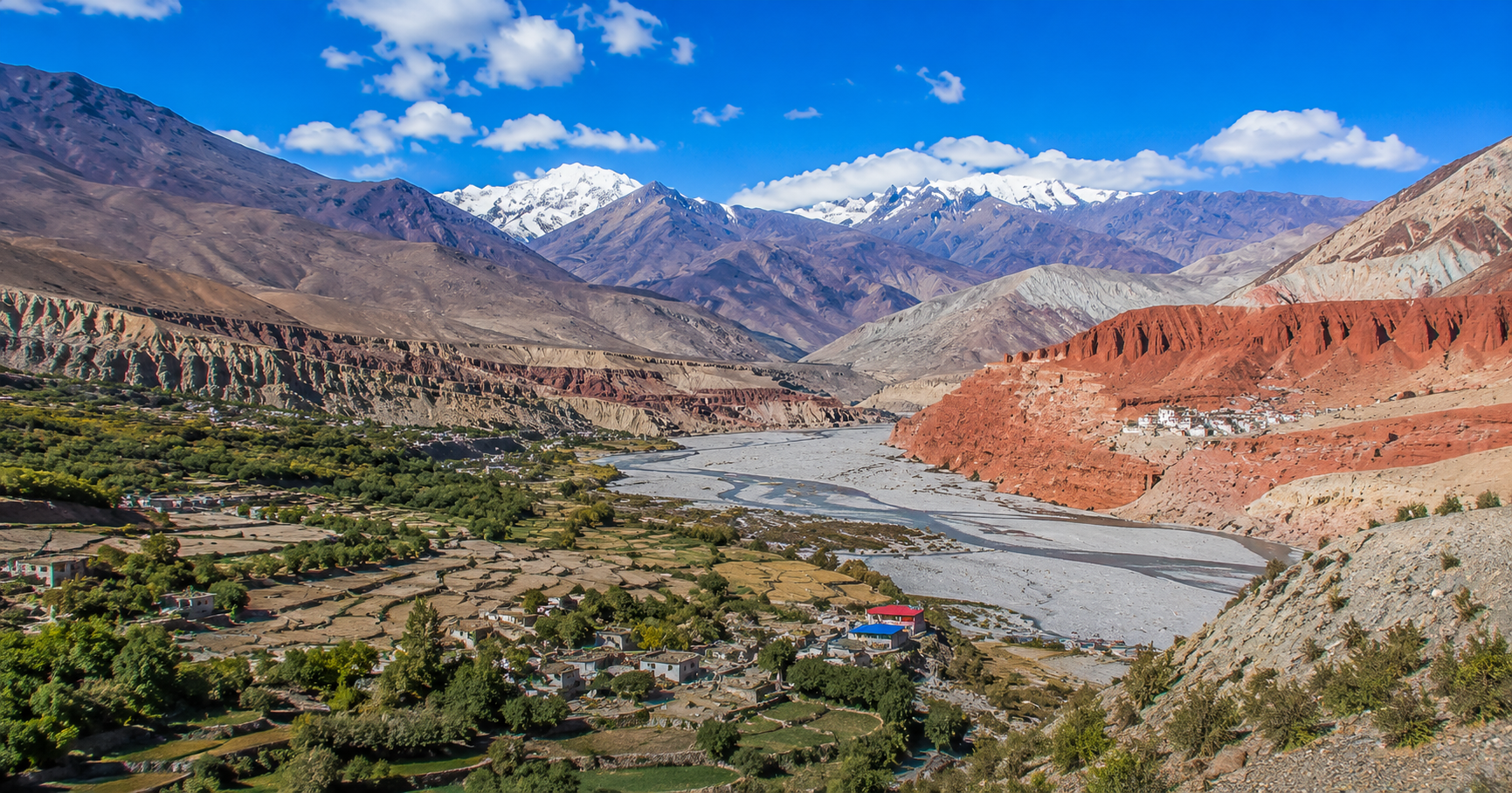
The name Mustang conjures one of the most evocative landscapes in all of Nepal — a high-altitude world where wind-carved canyons of ochre and rust-red rock drop to the turquoise-blue waters of the Kali Gandaki River, where medieval walled cities perch on desert plateaus, where ancient Buddhist monasteries hold centuries of sacred art in near-perfect preservation, and where the skyline is defined by some of the most dramatic peaks on Earth: Dhaulagiri at 8,167 metres to the west, Annapurna at 8,091 metres to the east, and the striking Nilgiri massif looming directly above the valley floor.

Mustang is one of the most remarkable places you can reach by vehicle anywhere on the planet — and for travellers willing to commit to the journey, it delivers cultural and natural richness that stays with visitors for the rest of their lives.

Many first-time travellers do not realise that ‘Mustang’ encompasses two distinct geographic and administrative zones, each with its own character, permit requirements, key destinations, and optimal vehicle hire arrangements. Lower Mustang — also known as Southern Mustang or simply the Kali Gandaki Valley — covers the region from the Kali Gandaki gorge’s lower reaches at Beni through the dramatic river canyon to the ancient gateway town of Kagbeni, encompassing

the famous villages of Tatopani, Ghasa, Kalopani, Tukuche, Marpha, Jomsom, and Muktinath. Lower Mustang requires only the standard Annapurna Conservation Area Permit (ACAP) and is open to all visitors, with no special restrictions or group-size requirements. It is Nepal’s most dramatic highway drive destination, a journey that most visitors describe as extraordinary even before the formal trekking begins.

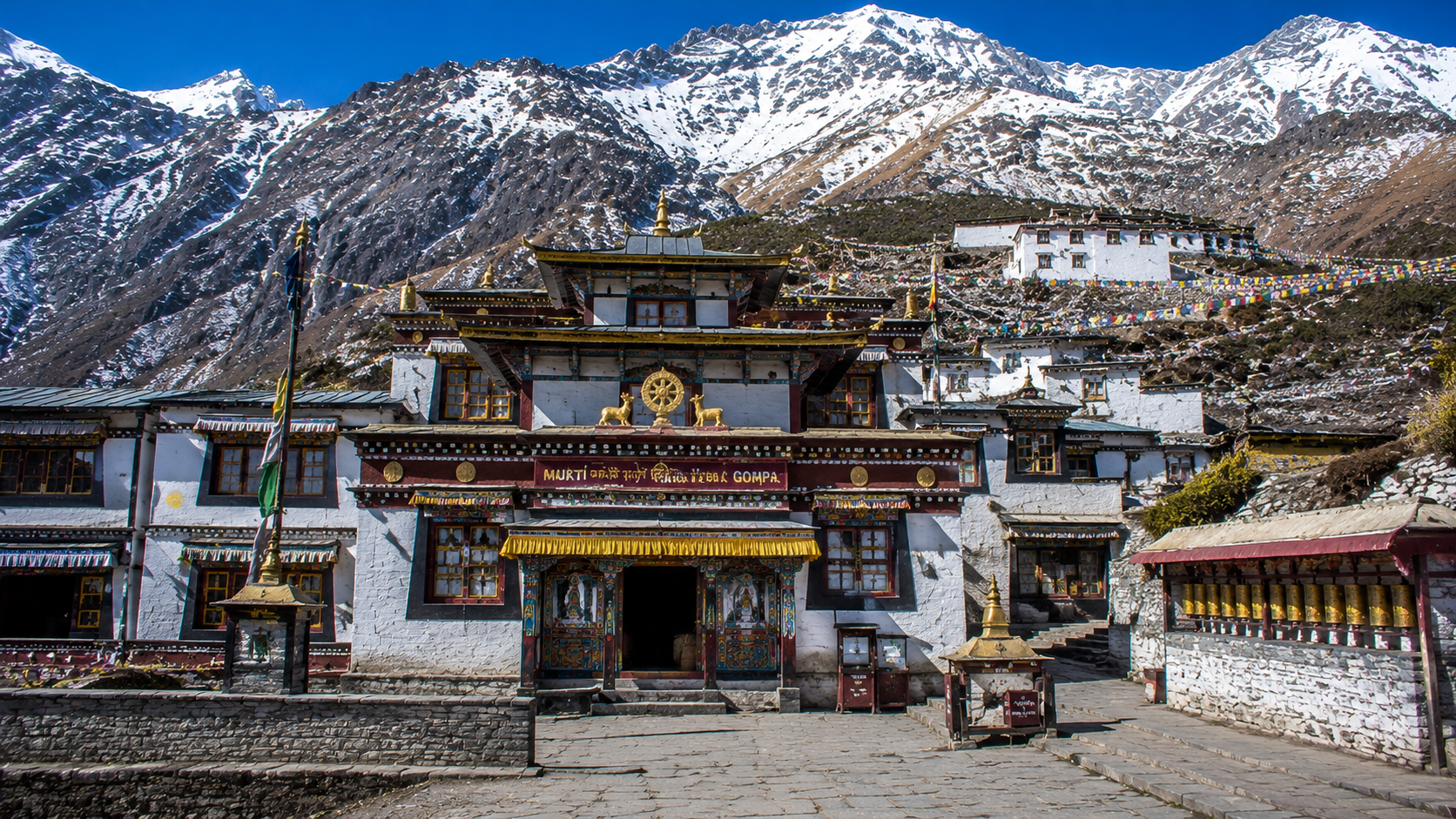
Upper Mustang — formerly the independent Kingdom of Lo — begins at the police and ACAP checkpoint just north of Kagbeni and extends northward to the ancient walled capital of Lo Manthang and beyond toward the Nepal-Tibet border near the Korala Pass. Upper Mustang is an officially restricted area, closed to foreign visitors until 1992 and still controlled.

Entry requires a special Restricted Area Permit (RAP) costing USD 500 per person for the first ten days (with USD 50 per day thereafter under the new daily extension rule), a minimum group of two foreign nationals, and a licensed guide at all times. This additional layer of control has kept Upper Mustang genuinely less visited than the main Annapurna corridors, preserving a cultural and landscape character that feels  — authentically off the beaten path.

This complete guide to Guideom Nepal Vehicle Hiring Pvt Ltd (vehiclehiringnepal.com) covers both regions in full detail, drawing on thorough 2 research into accommodation costs, permit fees, jeep distances, driving times, road conditions, and cultural content. Every distance, cost, and timing figure reflects current information from multiple verified sources.

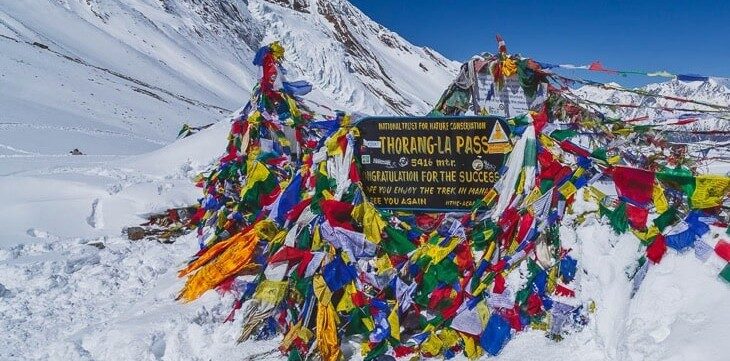
Whether you are planning a 3-day Lower Mustang overland escape, a 10-day Upper Mustang jeep tour, a classic 14-day trek over the Thorong La Pass, or a combined circuit that covers both regions in one journey, this guide gives you everything you need to plan your Mustang adventure with total confidence.

Understanding Mustang: Geography, History, and Culture

Geographic Setting

Mustang District sits in the Gandaki Province of north-central Nepal, immediately north of the Annapurna Conservation Area and sandwiched between two of the world’s eight-thousanders. The district is bisected from north to south by the Kali Gandaki River, which flows through what is widely described as the world’s deepest gorge — a designation based on the vertical drop from the summits of Annapurna and Dhaulagiri on either side to the river between them, a difference of nearly 6,000 meters.

The Kali Gandaki Gorge is the primary geographic feature that has shaped both Mustang’s landscape and human history, serving for millennia as the most practical high-altitude trade corridor between the Tibetan plateau to the north and the Indo-Gangetic plains to the south.

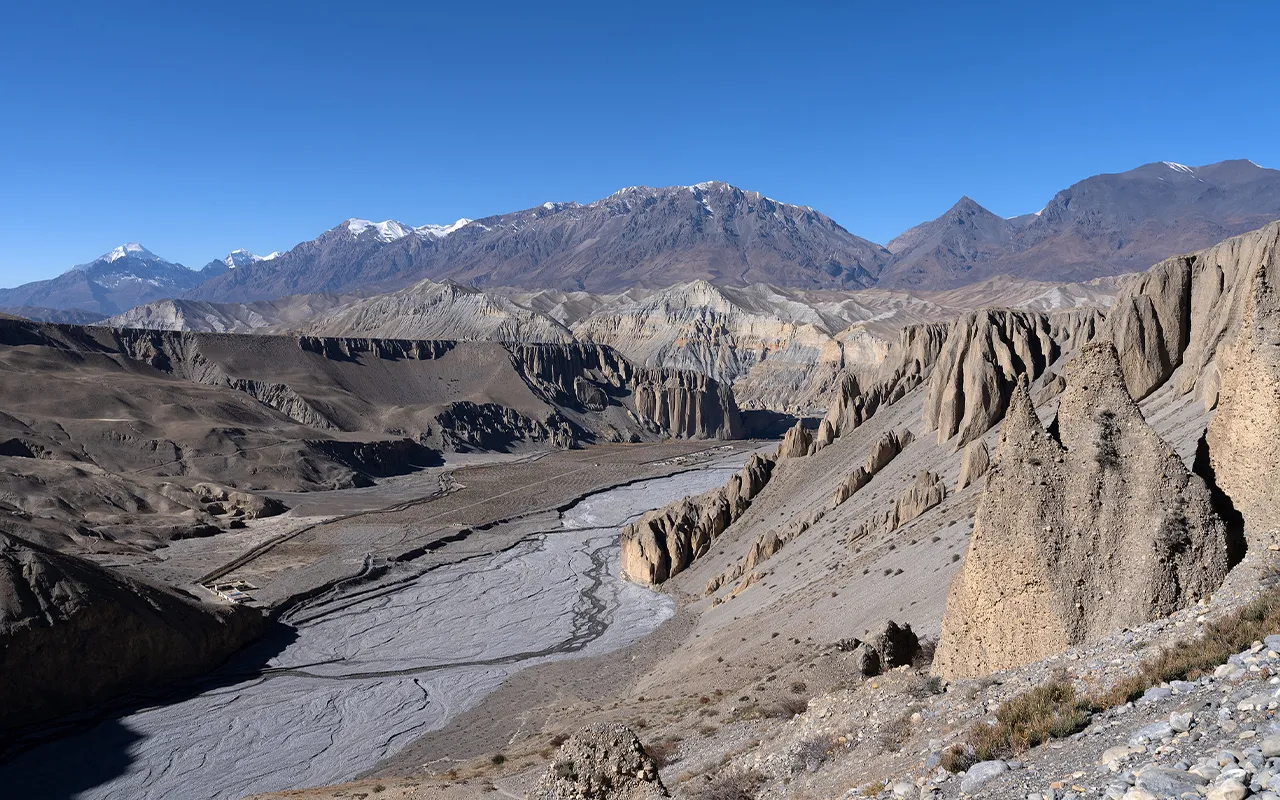
Upper Mustang, north of Kagbeni, sits in the pronounced rain shadow cast by the Annapurna and Dhaulagiri massifs, receiving minimal monsoon rainfall and developing a landscape strikingly reminiscent of the Tibetan Plateau, which it geographically and culturally resembles. The contrast between the lush, green terraced hillsides on the approach from Beni and the stark, wind-sculpted desert of the upper valley is one of the most dramatic landscape transitions in Nepal, occurring over just a few hours of driving as the valley narrows and climbs beyond Marpha and Jomsom.

The Kingdom of Lo: A History

Upper Mustang’s historical identity is inseparable from the Kingdom of Lo. This independent Tibetan-culture kingdom controlled this valley from the 14th century through its formal integration into the Kingdom of Nepal in 1795. It maintained cultural and administrative autonomy for decades thereafter.

Founded by the Loba chieftain Ame Pal around 1380 CE, the Kingdom of Lo established its capital at Lo Manthang — still the principal settlement of Upper Mustang today — and built the elaborate palace, monastery, and city wall complex that defines the walled city’s extraordinary appearance.

The kingdom’s wealth came mainly from controlling the trans-Himalayan trade route and collecting customs duties on the salt and grain caravans that passed through Lo Manthang on the route between Tibet and India.

The formal abolition of Nepal’s monarchy in 2008 technically ended Lo Manthang’s royal lineage. Still, the current Loba king — Jigme Dorje Palbar Bista — remains respected by the Loba community as a traditional cultural authority and spiritual figure.

Upper Mustang’s population numbers about 6,000, all of whom follow Tibetan Buddhism, speak the Tibetan-derived Loba language as their primary tongue, and maintain traditions of dress, ceremony, and agricultural practice that connect them far more closely to the Tibetan plateau than to Nepal’s more familiar hill cultures.
Tiji festival Upper mustang-Mustang Full Guide: Upper & Lower Mustang Vehicle Hire
Tiji Festival, Upper Mustang

The Tiji Festival: Mustang’s Most Spectacular Event

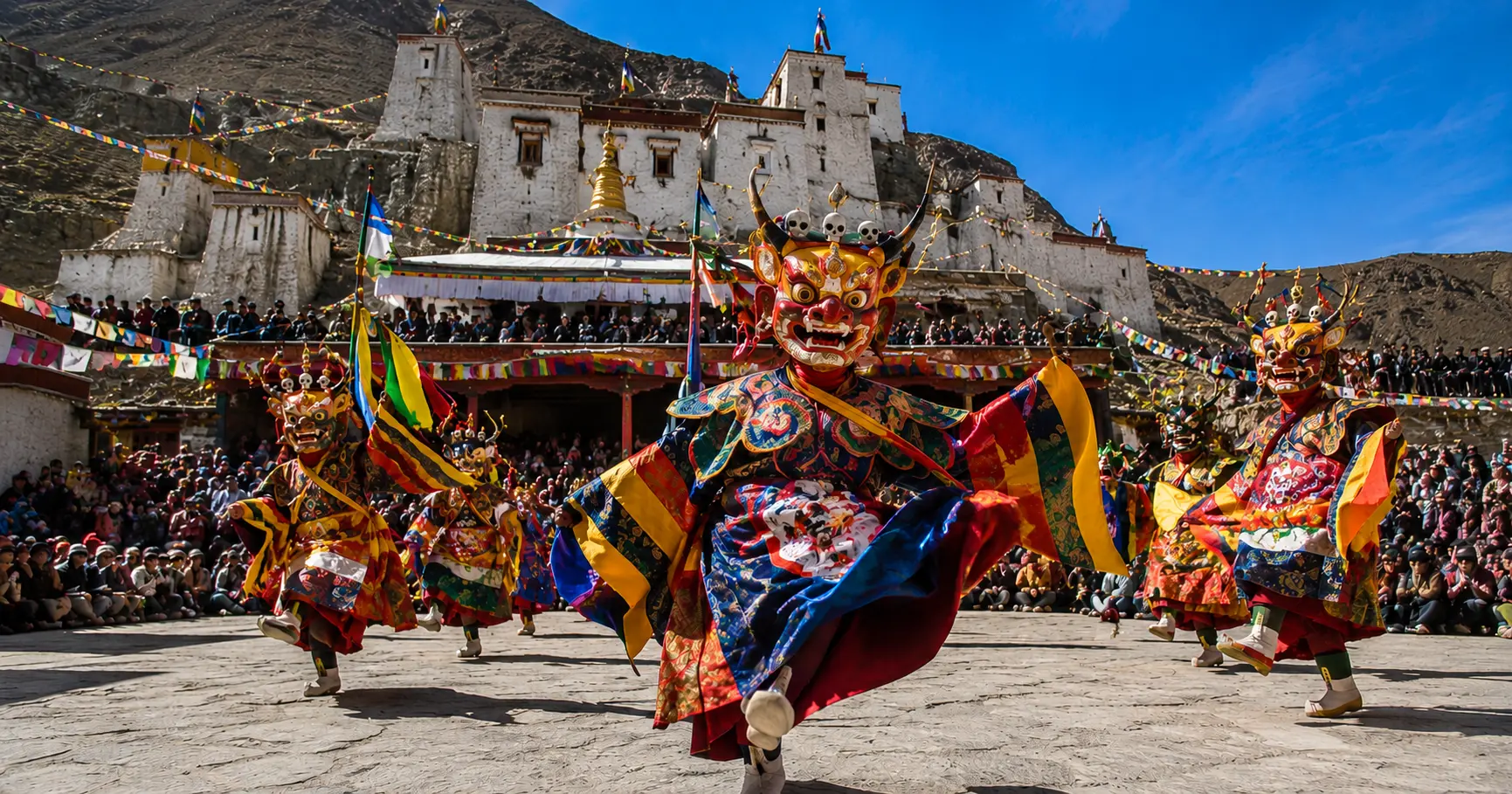
No cultural event in all of Nepal’s calendar quite matches the Tiji Festival of Lo Manthang for sheer visual and spiritual impact. Held annually in Lo Manthang over three days in May according to the Tibetan lunar calendar — the 2026 dates fall on May 13-15 — the Tiji Festival enacts a mythological narrative of the triumph of Jono over the demon who threatened to destroy the world by creating drought and flooding.

The festival involves three days of elaborate masked dance performances by monks from Lo Manthang’s principal monasteries, wearing costumes and masks of extraordinary craftsmanship, who perform before the entire assembled community in the courtyard of the ancient city. For travellers who time their Upper Mustang visit to coincide with Tiji, the experience transcends ordinary cultural tourism and becomes a more genuine spiritual witness.

Lower Mustang: Key Destinations, Road Guide & Vehicle Hire

Lower Mustang — the section of Mustang District south of Kagbeni, roughly corresponding to the Kali Gandaki corridor from Beni to the Upper Mustang checkpoint — is one of Nepal’s most dramatic and diverse overland destinations, offering a concentration of natural and cultural highlights within a relatively compact driving distance that makes it ideal for travellers with limited time who still want a genuinely extraordinary Himalayan experience.

The Drive: Pokhara to Jomsom via Kali Gandaki Gorge

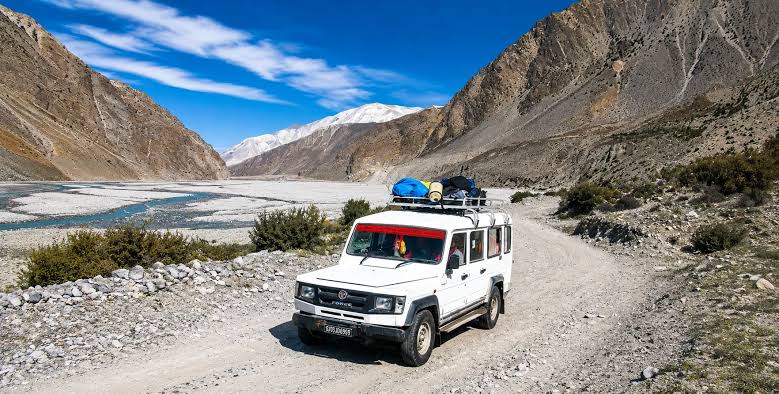
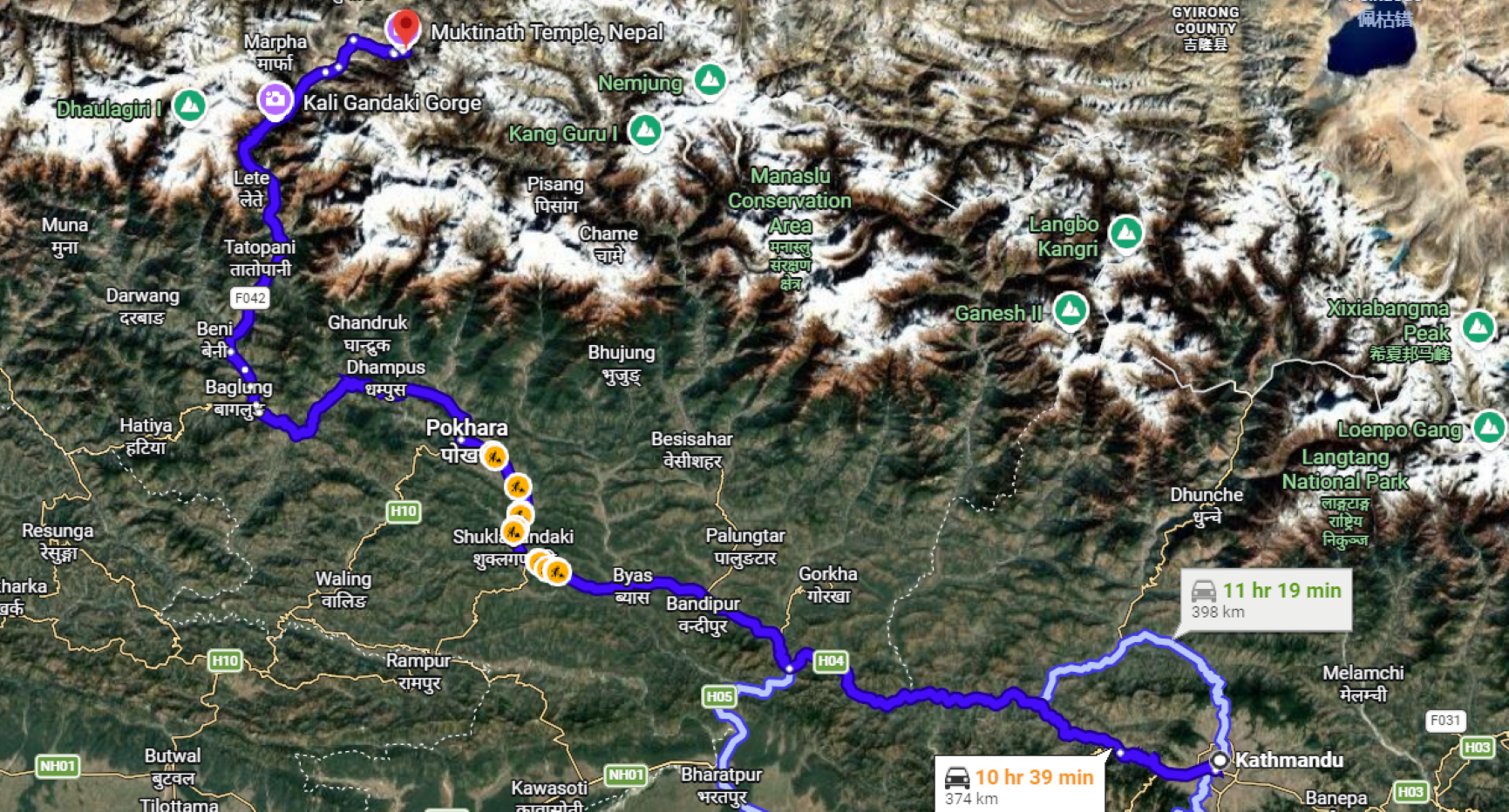
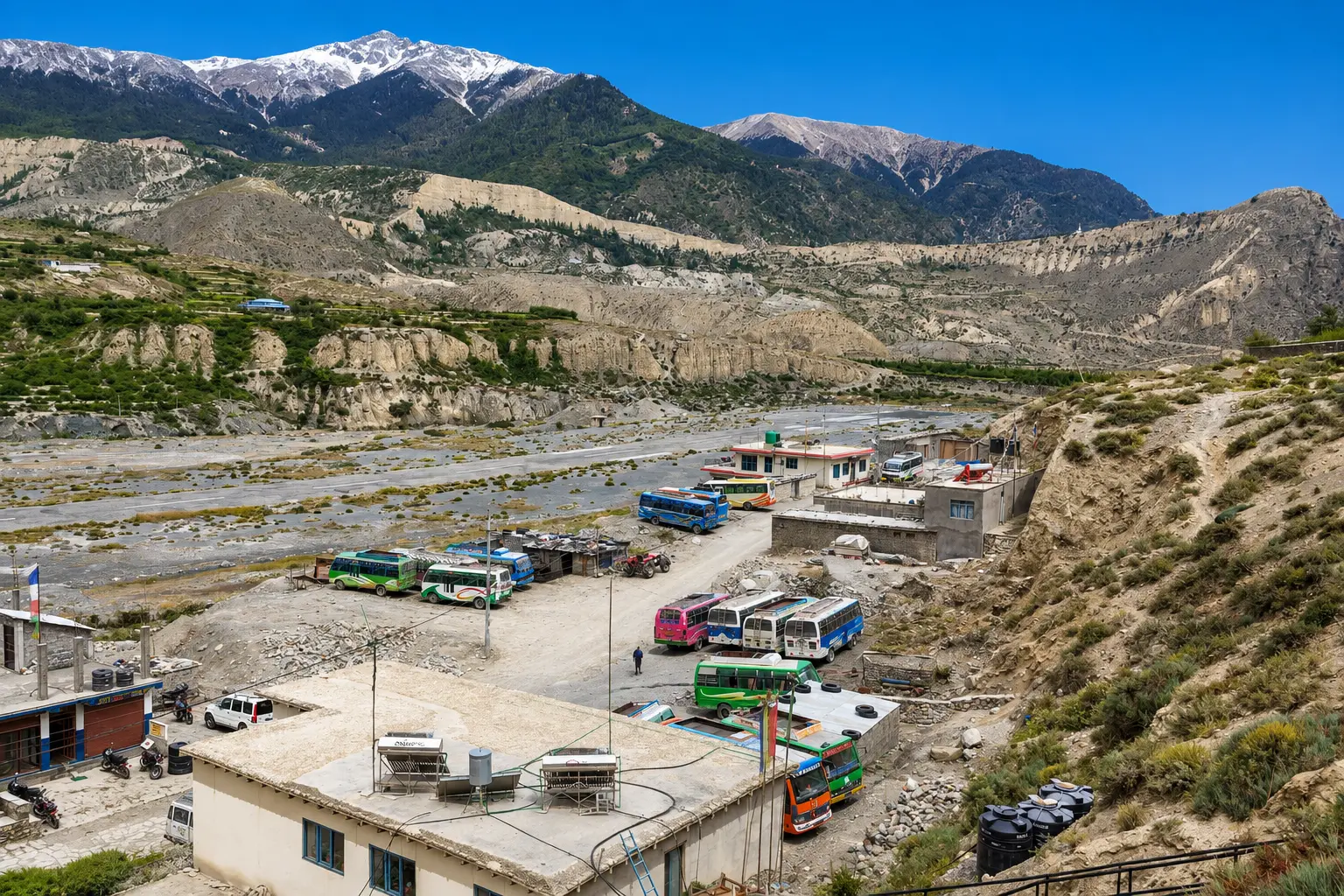
The overland journey from Pokhara to Jomsom — the administrative centre of Mustang District and the main hub for Lower Mustang tourism — covers approximately 143 to 197 kilometres, depending on the specific route, and takes between 7 and 11 hours by private 4WD jeep. The route follows the Bhupi Sherchan Highway from Pokhara through Beni (109 km, approximately 3 hours on smooth concrete road), then transitions to rough off-road driving through Tatopani, Ghasa, Kalopani, Tukuche, and Marpha before reaching Jomsom.

The off-road Beni to Jomsom section covers about 60 kilometres and takes 4 to 5 hours, making the road conditions the dominant factor in the journey’s demands.

This drive through the Kali Gandaki Gorge is one of Nepal’s great overland journeys, combining geological drama — the vertical canyon walls tower hundreds of meters above the road on both sides in the most confined sections — with cultural richness, from the ancient hot springs at Tatopani to the wind-carved rock formations of the upper gorge and the apple orchards of Marpha. The road runs alongside a river famous for its saligram fossils—ancient ammonite stones that Hindu tradition associates with Lord Vishnu and that lie scattered throughout the riverbed in numbers that astonish first-time visitors.

Key Villages and Destinations in Lower Mustang

Tatopani — Natural Hot Springs and Gorge Drama (1,190 m)

Tatopani — whose name literally means ‘hot water’ in Nepali — is one of the most popular rest stops along the Kali Gandaki corridor, famous for its natural sulfur hot springs that draw trekkers and vehicle travellers for a restorative soak after hours of mountain road travel. The springs sit directly beside the river, and the contrast between the hot mineral water and the cold, rushing Kali Gandaki alongside creates an atmospheric bathing experience unlike anything available in more conventional tourist destinations.

The village suffered significant damage in the 2015 earthquake but has been substantially rebuilt, and its cluster of lodges, teahouses, and hot spring facilities now serves the steady stream of overland travellers and trekkers passing through on the Annapurna Circuit.

Marpha — The Apple Capital of Nepal (2,667 m)

Marpha is arguably the most charming village in all of Lower Mustang, a beautifully preserved Thakali settlement of whitewashed stone houses connected by narrow, flagstone-paved lanes so narrow that vehicles cannot pass and only pedestrians and pack animals move through. Marpha is famous throughout Nepal for its apple orchards — the valley’s microclimate and altitude create ideal conditions for apple cultivation — and the local apple products, including fresh apples, apple brandy (a locally distilled spirit with a cult following among trekkers), apple pie, apple juice, and dried apple rings ar, are among the most distinctive culinary specialities anywhere on the Nepal trekking circuit.

A short walk through Marpha village’s covered lanes, plus a visit to the ancient Sakya monastery and the local distillery, is an essential stop on any Lower Mustang vehicle tour.
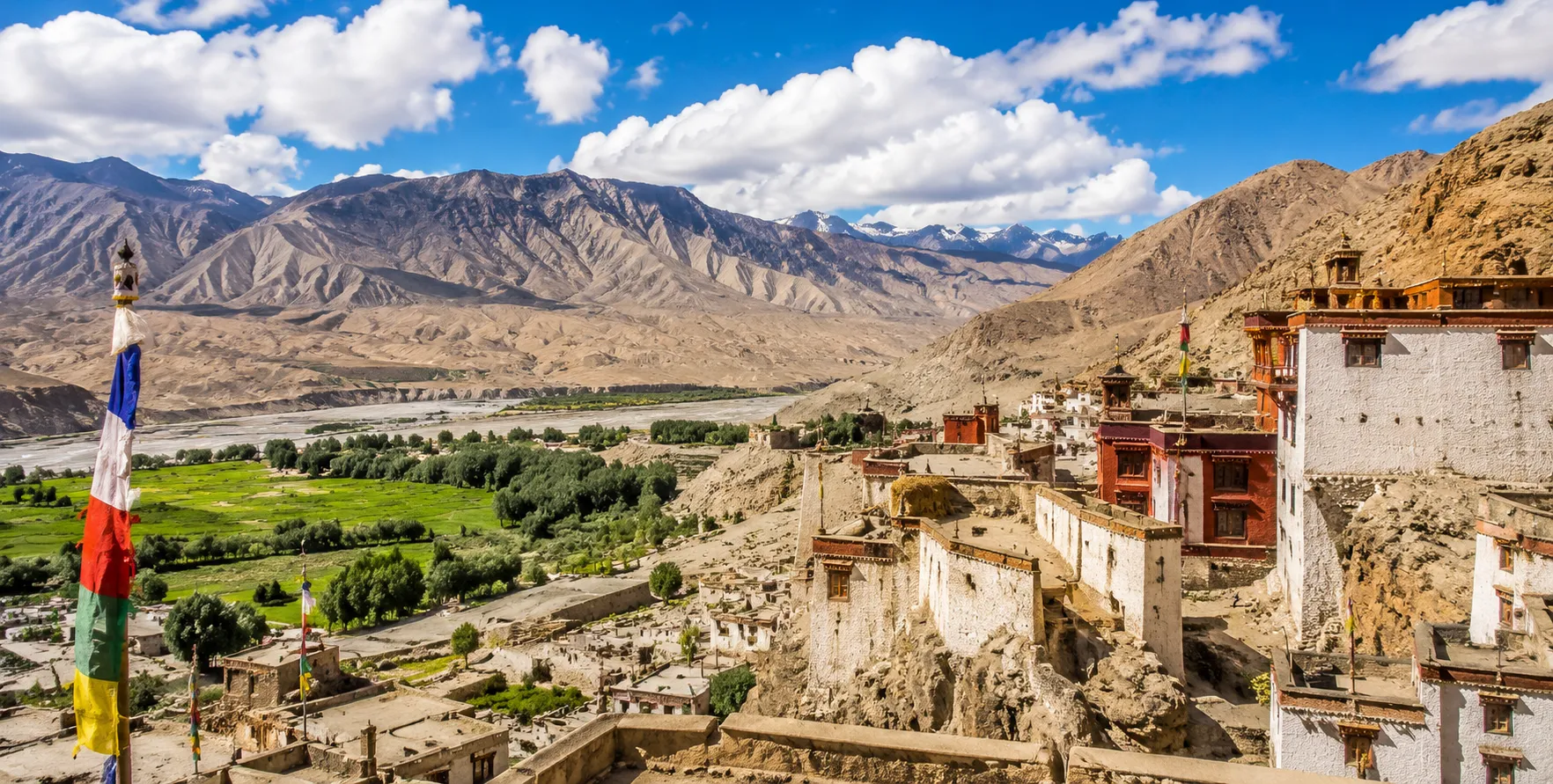
kagbeni-Mustang Full Guide: Upper & Lower Mustang Vehicle Hire

Jomsom — The Hub of Mustang (2,720 m)

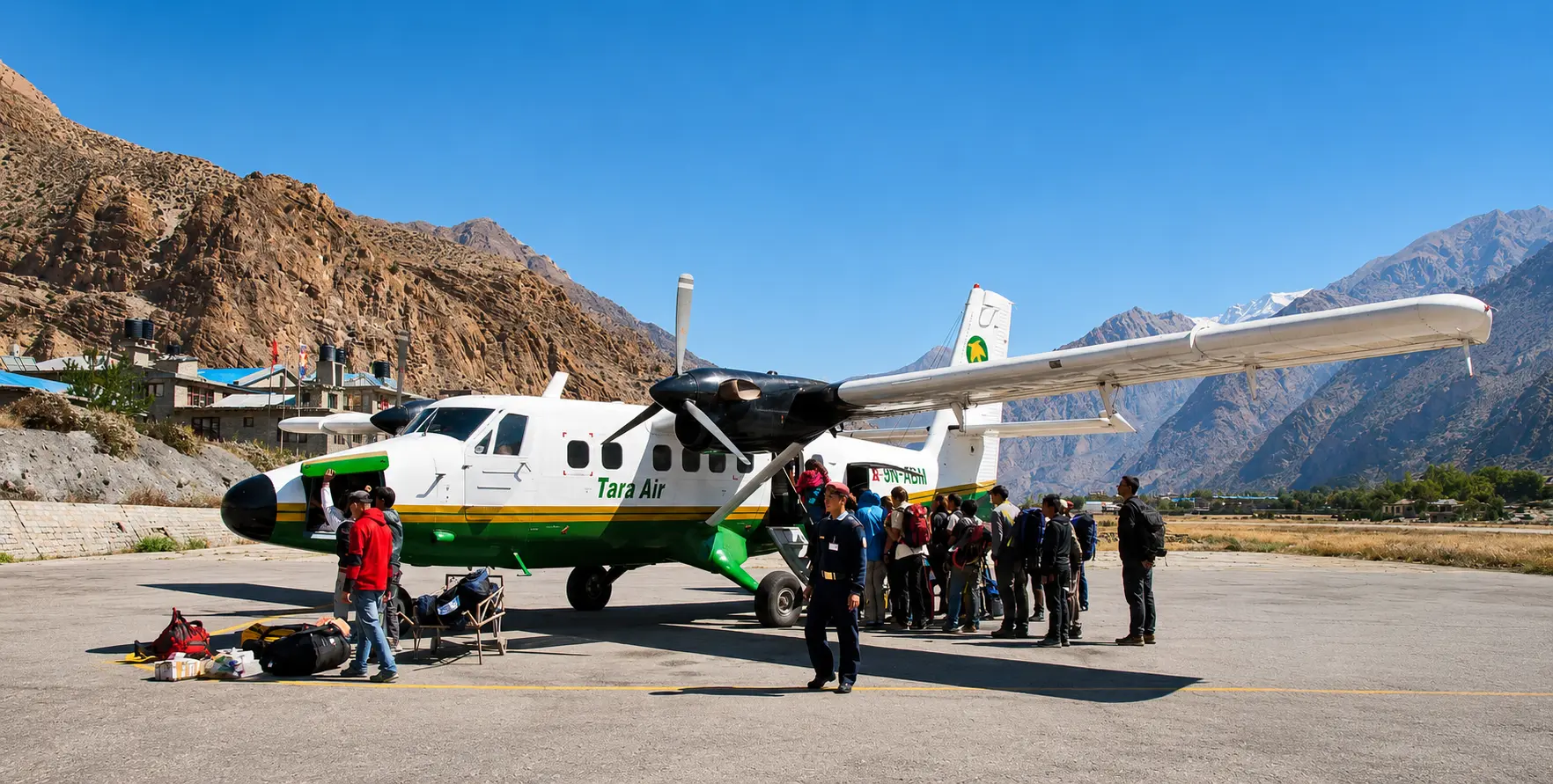
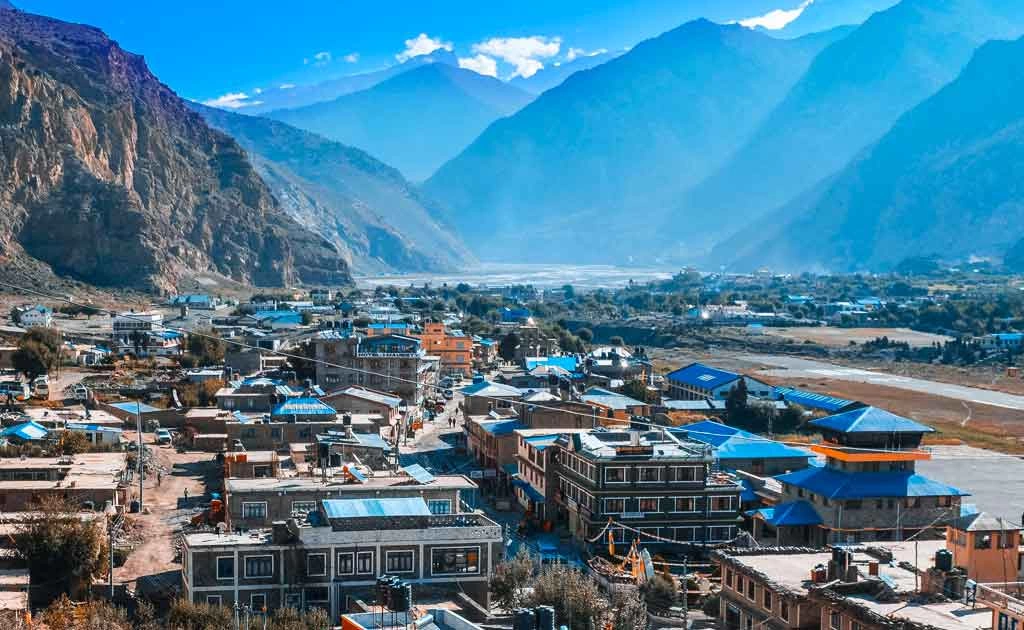
Jomsom is the administrative capital of Mustang district, a busy and surprisingly well-equipped small town strung along the banks of the Kali Gandaki River at an elevation of 2,720 meters. The town has a domestic airport — serviced by Tara Air and other carriers with regular flights from Pokhara (a spectacular 20-to-25-minute flight that costs USD 120 to USD 140 per person one-way, though subject to frequent weather delays) — alongside a Nepal Bank branch with an ATM, several comfortable hotels and teahouses, restaurants, shops, and the full complement of trekking support services.

Jomsom functions as the principal base and staging point for both Lower Mustang day trips and the onward approach to Upper Mustang, and most multi-day Mustang itineraries include at least one overnight here.

Just 5 kilometres from Jomsom, the freshwater Dhumba Lake, at 2,830 metres near Thini Village, offers a peaceful detour with striking mountain reflections on calm mornings. At the same time, the ancient Bon-tradition monastery in Lupra village — one of Nepal’s last surviving Bon communities, where just 14 families maintain a 12th-century monastery through a hereditary priesthood system — offers a genuinely rare encounter with Nepal’s pre-Buddhist religious tradition on any trekking circuit.

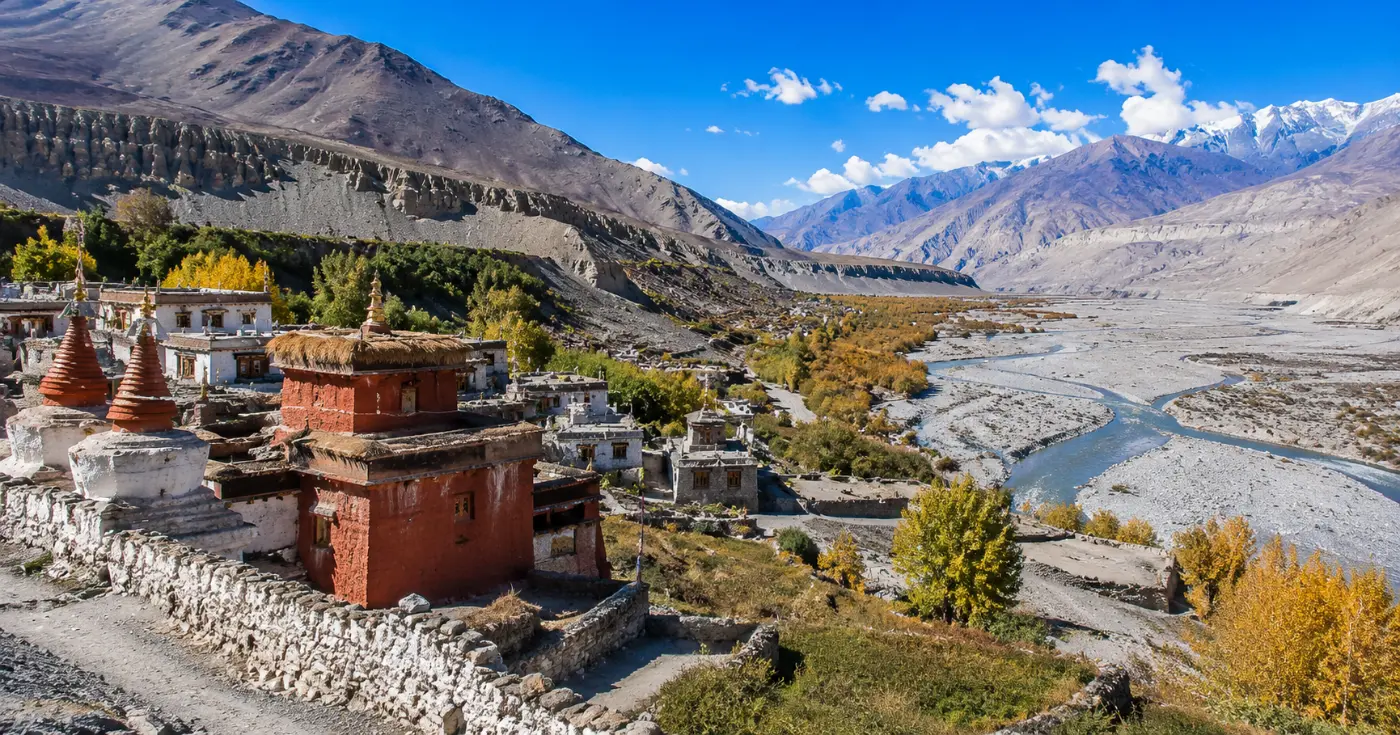
Kagbeni — Gateway to the Hidden Kingdom (2,804 m)

Kagbeni is one of the most atmospheric villages in the entire Kali Gandaki corridor — a medieval Tibetan-influenced settlement of narrow alleyways, ancient mud-brick houses, prayer wheels, and chortens, dominated by a hilltop monastery visible from a considerable distance as the vehicle approaches from Jomsom along the flat riverbed track. The village sits at the confluence of the Kali Gandaki and Kag Khola rivers and has historically served as the gateway settlement controlling access to Upper Mustang, a role maintained today by the police checkpoint just north of the village, where all visitors must present their permits before continuing into the restricted zone.

Kagbeni rewards a leisurely exploration on foot — the monastery contains frescoes and statues of genuine antiquity, the village’s covered lanes create a maze-like atmosphere distinct from any other settlement in Nepal, and the views from the terrace above the village toward the Upper Mustang plateau to the north and the Annapurna peaks to the south are outstanding. Many vehicle tour operators include a one- to two-hour stop in Kagbeni specifically for this exploration, separate from any time spent at the checkpoint processing permits.

Muktinath — The Sacred Shrine at 3,710 Meters

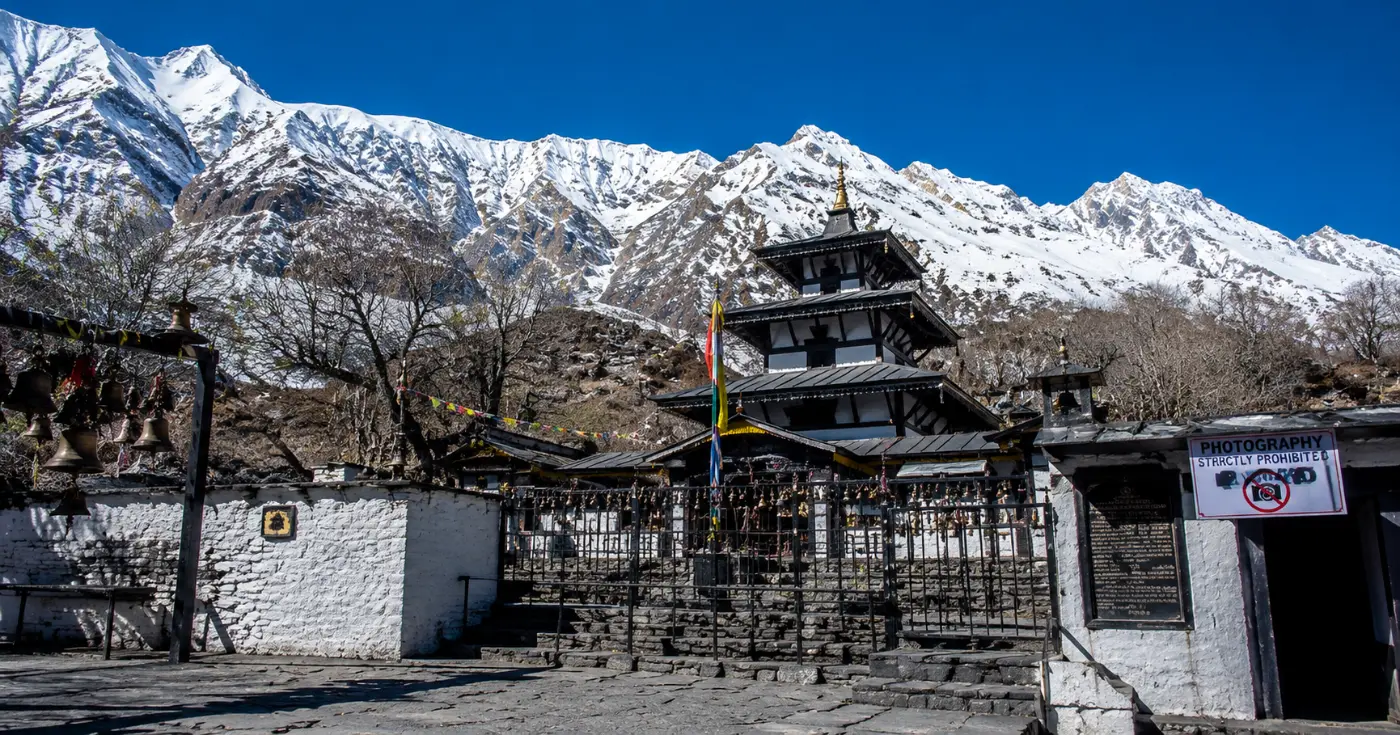
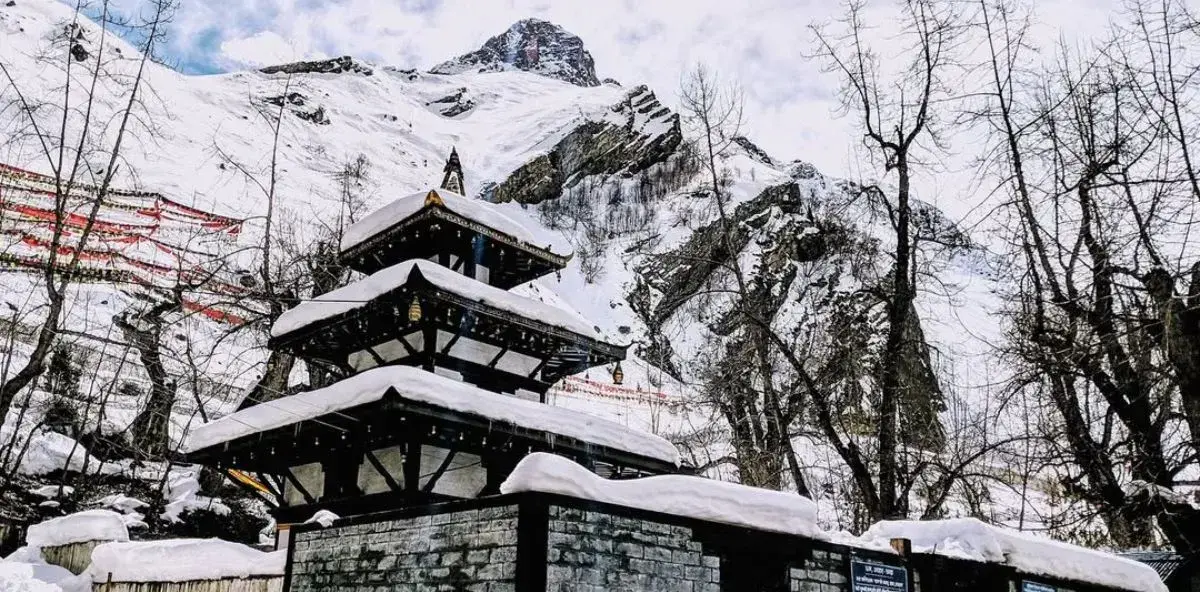
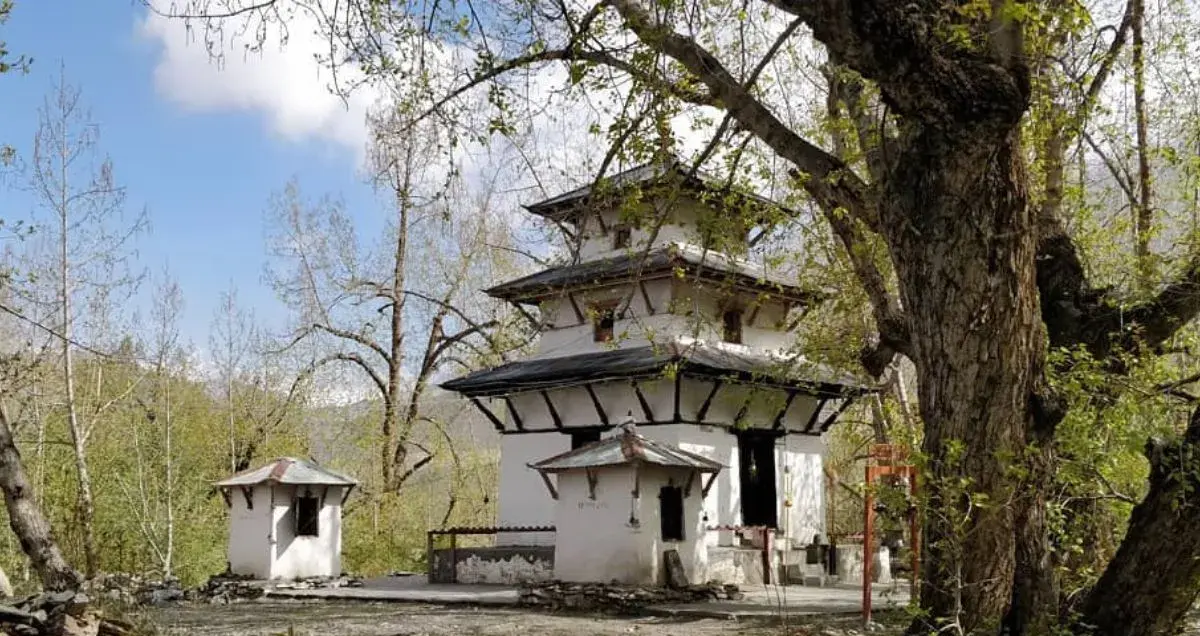
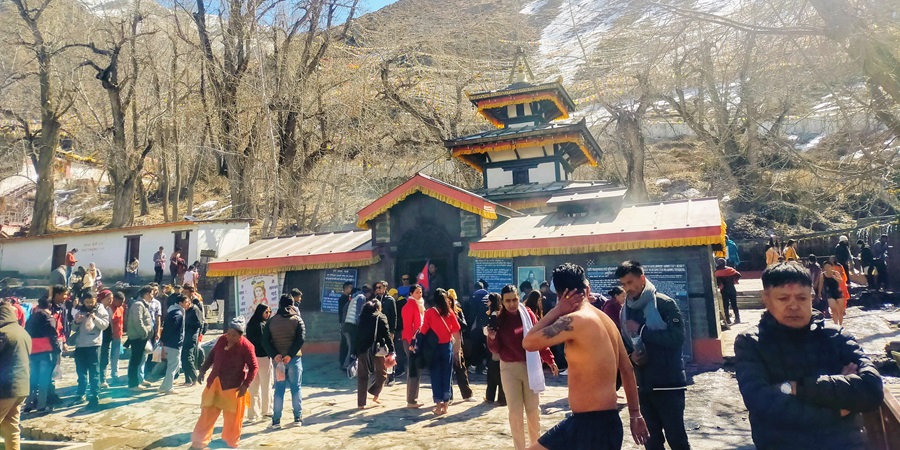
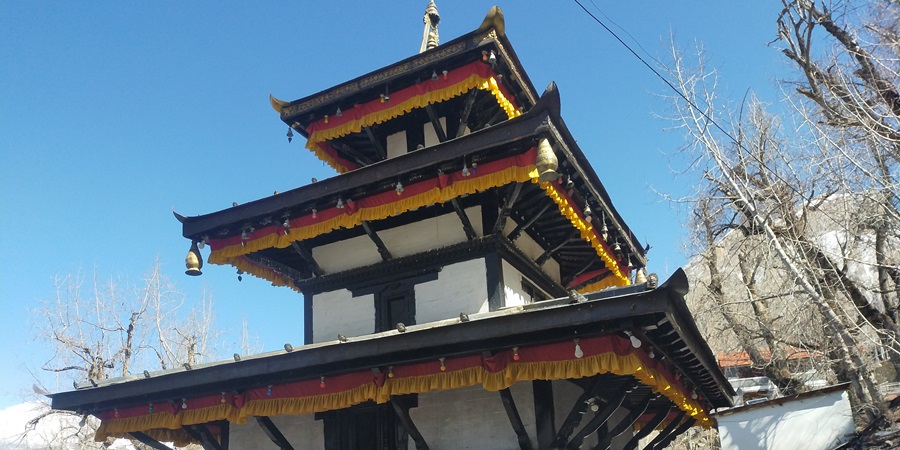
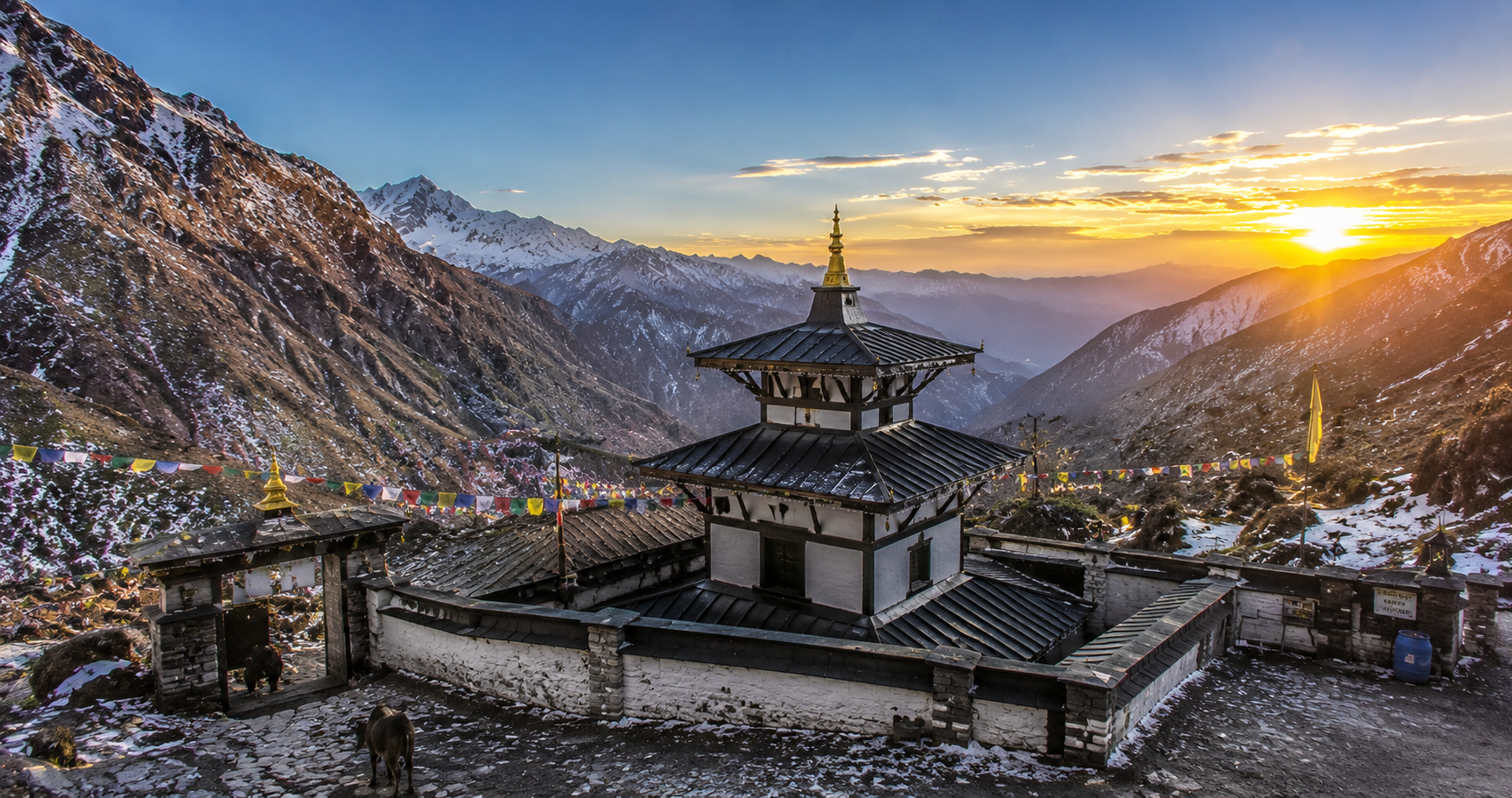
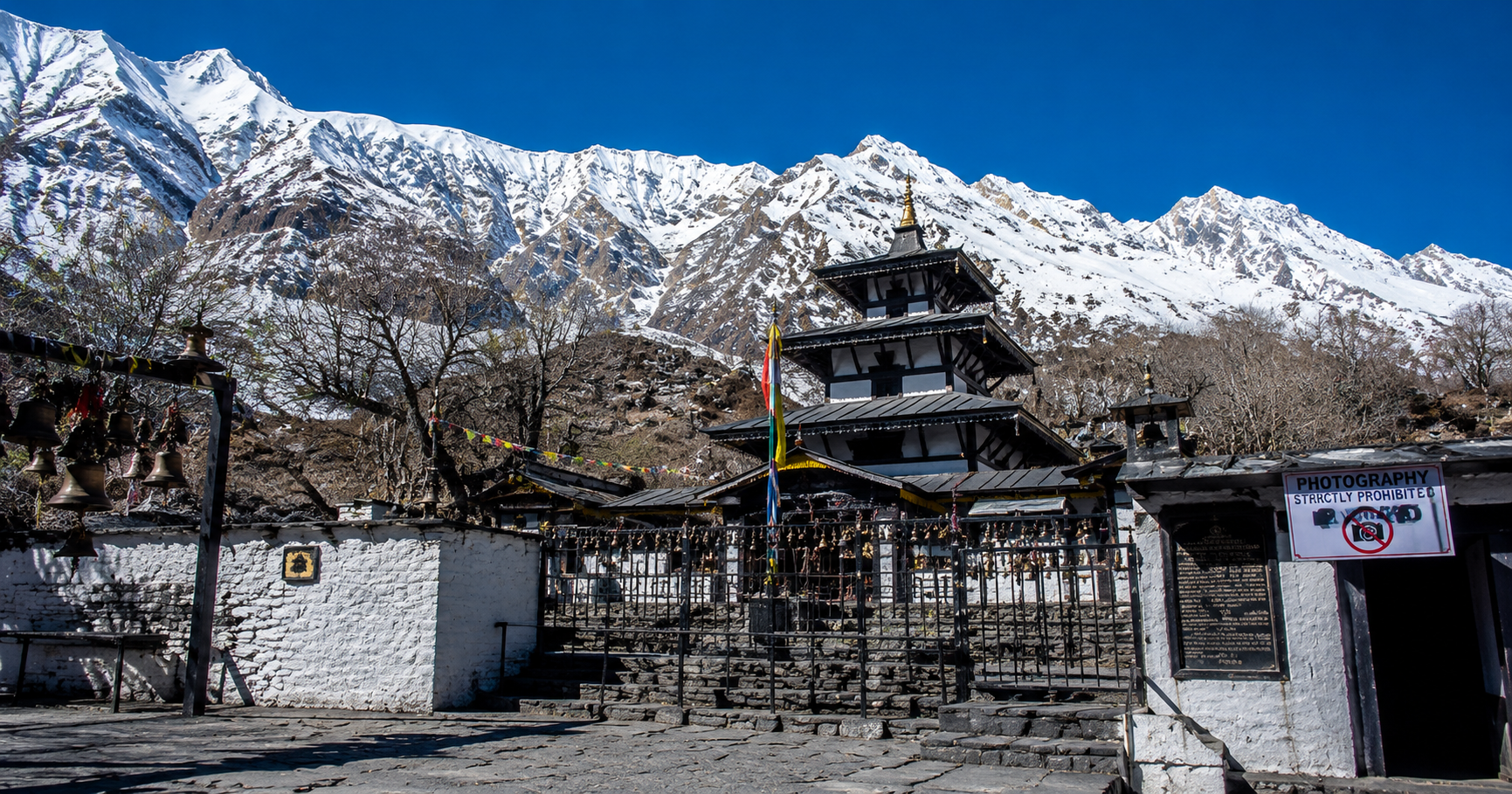
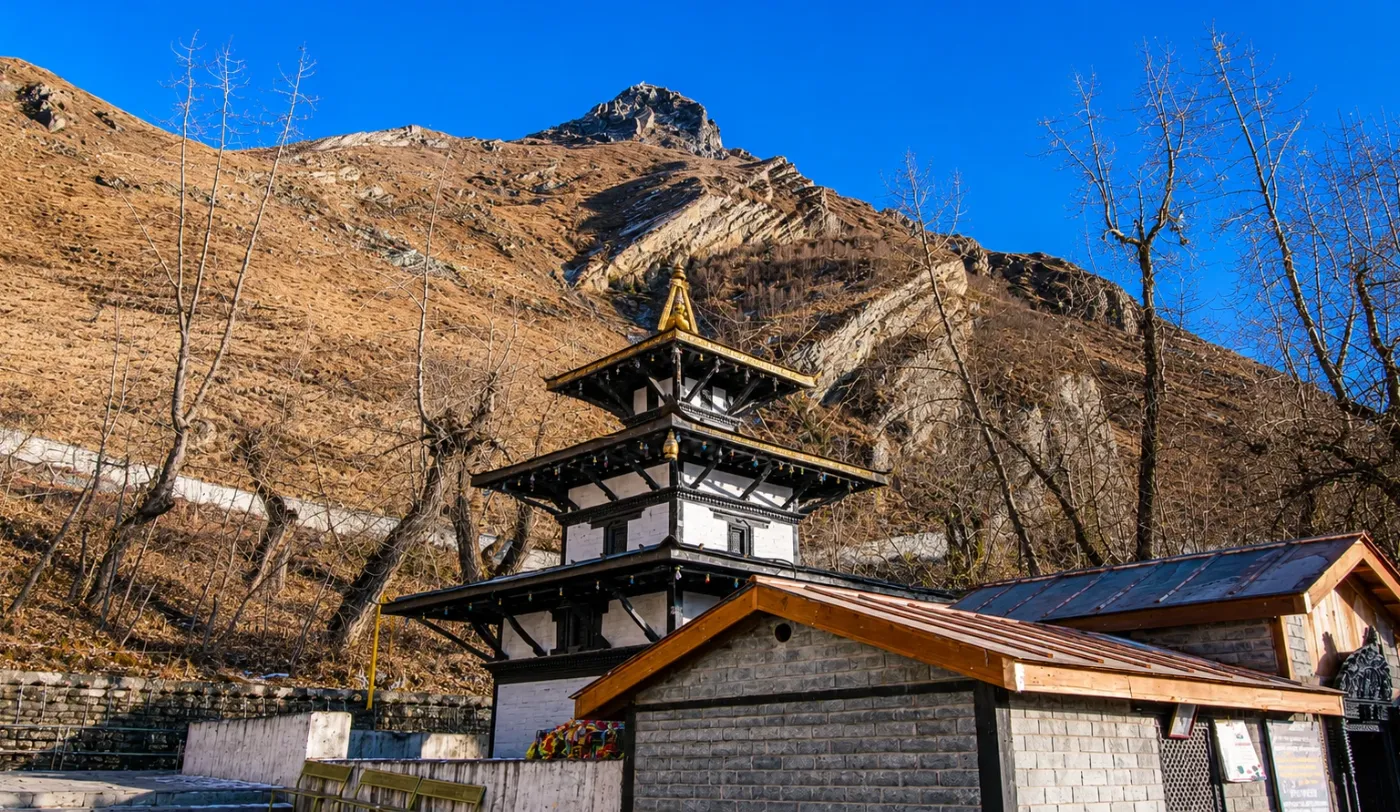
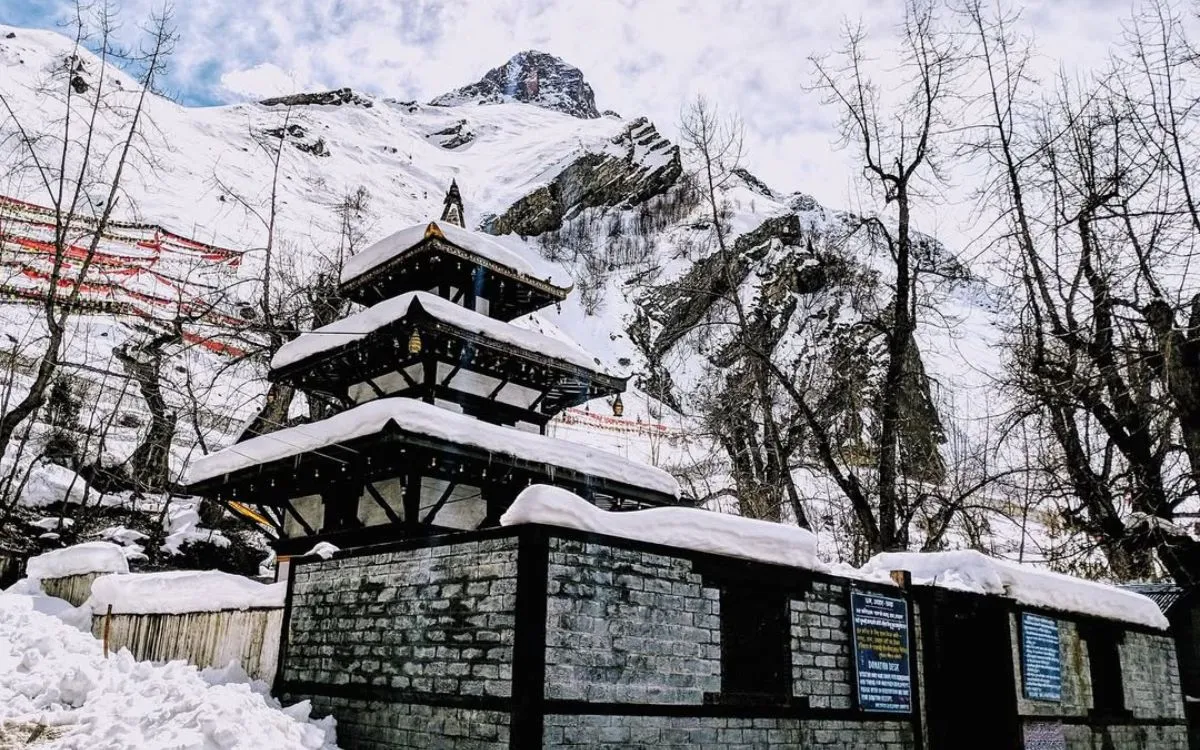
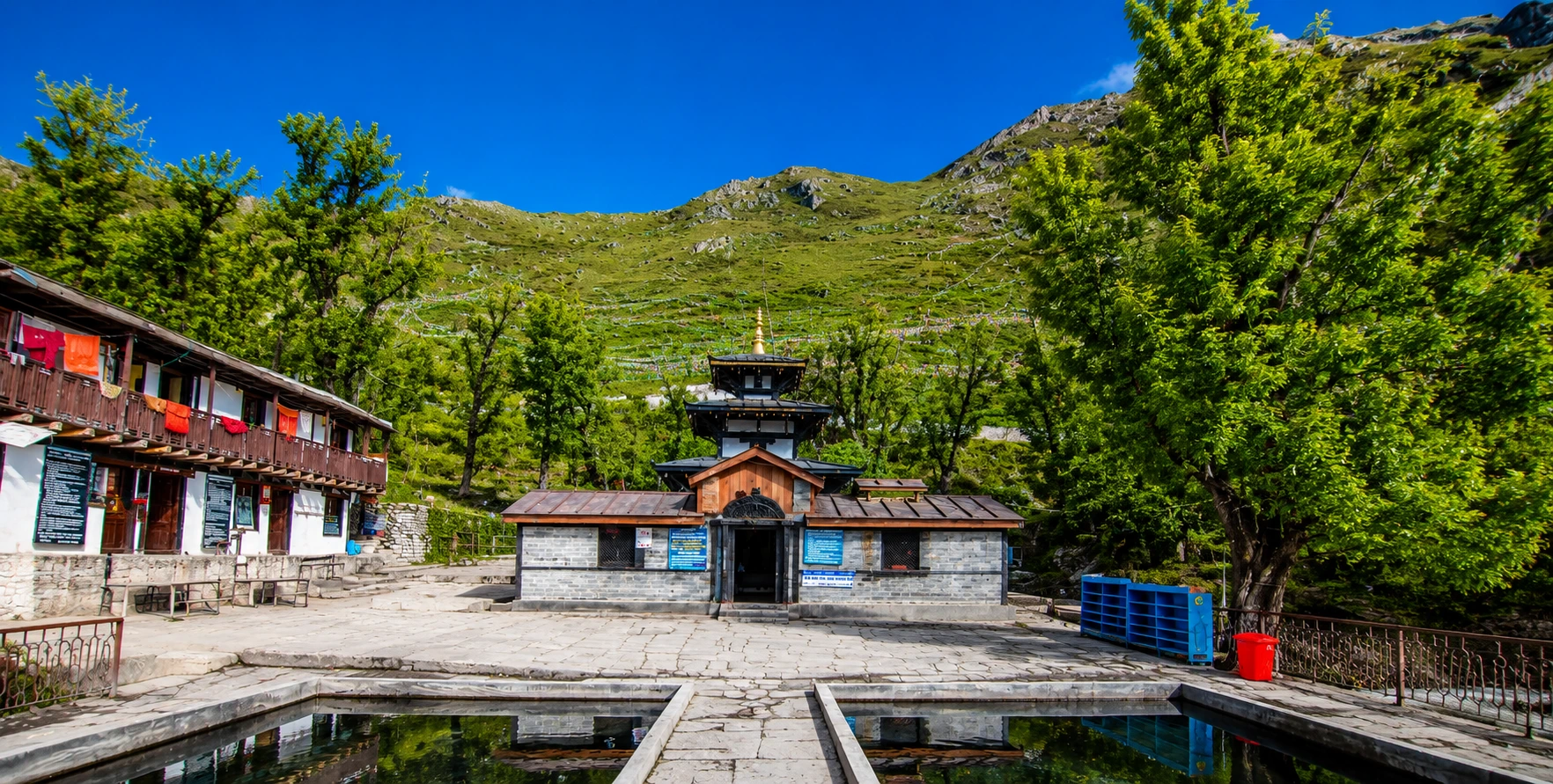
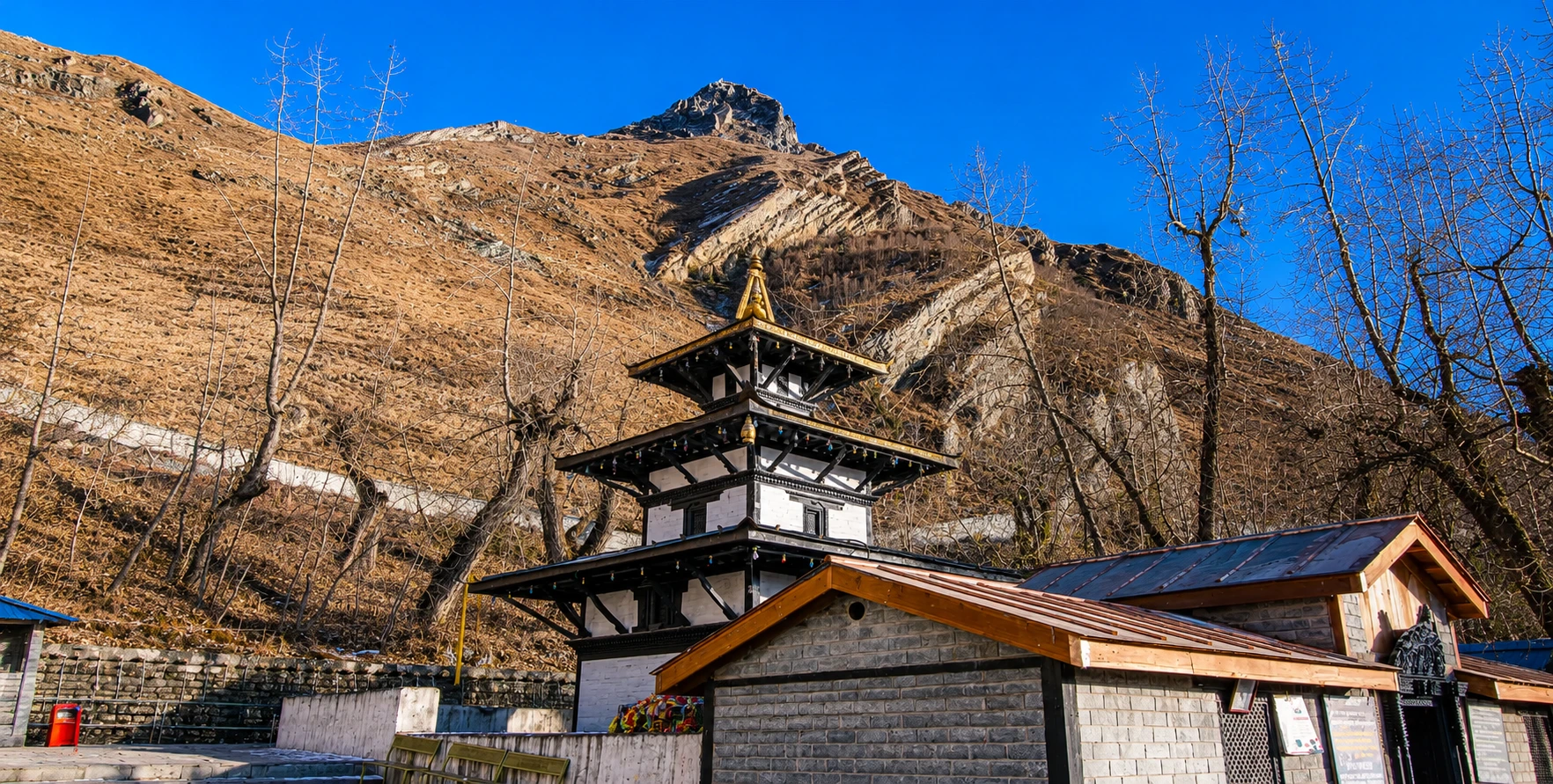
Muktinath Temple complex, situated at 3,710 meters at the foot of the Thorong La Pass, is the most sacred destination in the entire Mustang region for millions of Hindu and Buddhist pilgrims who visit Nepal annually. As one of the 108 Divya Desams (holy Vishnu shrines) in the Hindu tradition and as the site of the natural miracle of an eternal flame burning above a spring of water — considered one of the most auspicious natural phenomena in Himalayan religious geography — Muktinath draws pilgrims from across India, Nepal, and the broader Hindu and Buddhist world.

The temple complex includes the main Vishnu shrine, the 108 sacred water spouts (Muktidhara) where devotees take ritual baths in icy mountain water, the Jwala Devi temple, where a natural gas flame burns perpetually, and an adjoining Buddhist monastery maintained by Tibetan Buddhist monks.

The drive from Jomsom to Muktinath covers approximately 19 kilometres of relatively smooth, paved road (the final stage from Kagbeni northward is largely paved and takes about 45 minutes to 1 hour by jeep), making Muktinath one of the most accessible high-altitude pilgrimage destinations in Nepal. Private jeep hire from Jomsom to Muktinath costs NPR 3,000 to NPR 4,500 for the full vehicle — an extremely reasonable rate for access to one of Nepal’s holiest sites.

Mustang Full Guide: Upper & Lower Mustang Vehicle Hire)

Lower Mustang Key Sites: Quick Reference

Village/SiteAltitudeDistance from PokharaKey AttractionNo Permit Needed
Tatopani1,190 m85 kmNatural hot springs, gorge sceneryYes
Marpha2,667 m130 kmApple orchards, Thakali culture, distilleryYes (ACAP only)
Jomsom2,720 m143 kmDistrict HQ, ATM, airport, Dhumba Lake, Bon monasteryYes (ACAP only)
Kagbeni2,804 m155 kmMedieval village, gateway to Upper MustangYes (ACAP only)
Muktinath3,710 m197 kmSacred Hindu/Buddhist temple, 108 spouts, eternal flameYes (ACAP only)

Upper Mustang: The Forbidden Kingdom in Detail

Beyond the Kagbeni checkpoint, where the restricted area permit is verified and stamped, the landscape and experience of Mustang transform into something markedly different from anything in Lower Mustang — or indeed anywhere else in Nepal. The desert plateau stretches northward with an austere grandeur that feels fundamentally Tibetan rather than Nepali; the villages become increasingly remote and traditional, and the sense of entering a place that the modern world has touched only lightly intensifies with every kilometre gained toward Lo Manthang.

Chele, Syangboche and the Approach Plateau (3,055–3,930 m)

The first two major villages north of Kagbeni in the Upper Mustang restricted zone are Chele (approximately 3,055 m, reached 30 km north of Kagbeni by a rough 4WD track taking 2 to 3 hours) and Syangboche (3,800 m, a further 30 km north and 2 to 3 more hours of rough driving).

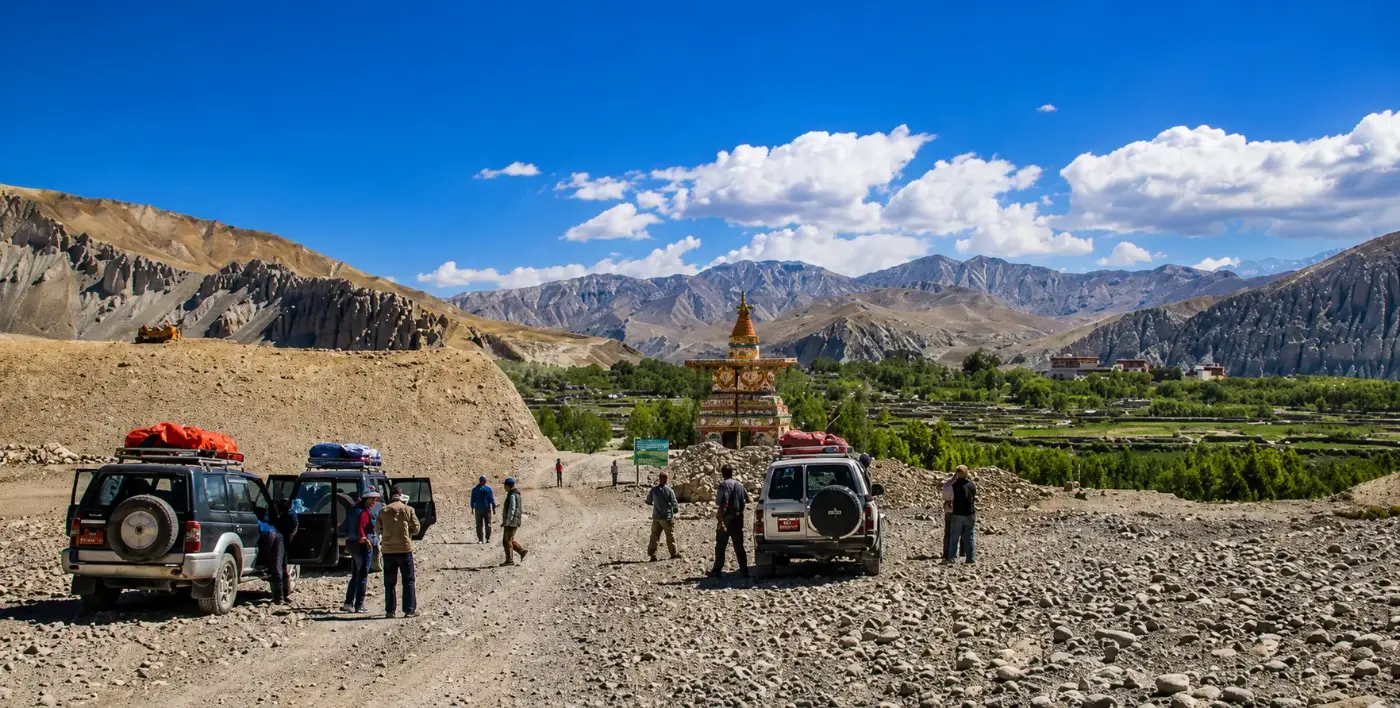
The road between Kagbeni and Chele involves the most technically demanding driving of the entire Mustang route — steep switchbacks above the Kali Gandaki gorge, narrow cliff-side tracks carved into the rock face, and the kind of loose-surface gradient that demands both low-range gearing and experienced driver judgment. Beyond Chele, the road climbs to the plateau proper at Syangboche, crossing Syangboche Pass at about 3,800 meters and offering panoramic views of the Mustang landscape in all directions.

Along this section, the sky caves carved into the ochre cliff faces appear with increasing frequency—the remarkable ancient cave complexes that archaeologists believe served as habitation, burial, meditation retreat, and storage sites for Mustang’s prehistoric and early-medieval inhabitants. The Chhoser sky caves, accessible via a short detour off the main route approximately 20 kilometres north of Lo Manthang, are the most extensively documented and most dramatically photogenic of these cave complexes, with thousands of individual chambers cut into cliff faces at heights that would have required sophisticated rope-and-ladder systems for access.

Ghami and Tsarang: Villages of the High Plateau (3,520–3,560 m)

Ghami (also spelt Ghiling or Geling in some itineraries) is a significant village on the Upper Mustang plateau, at approximately 3,520 meters, offering excellent views of the surrounding desert landscape and the distant peaks of Tibet to the north. The village has a monastery and several well-preserved traditional houses. It serves as a standard overnight stop on both trekking and jeep tour itineraries between Syangboche and Lo Manthang.

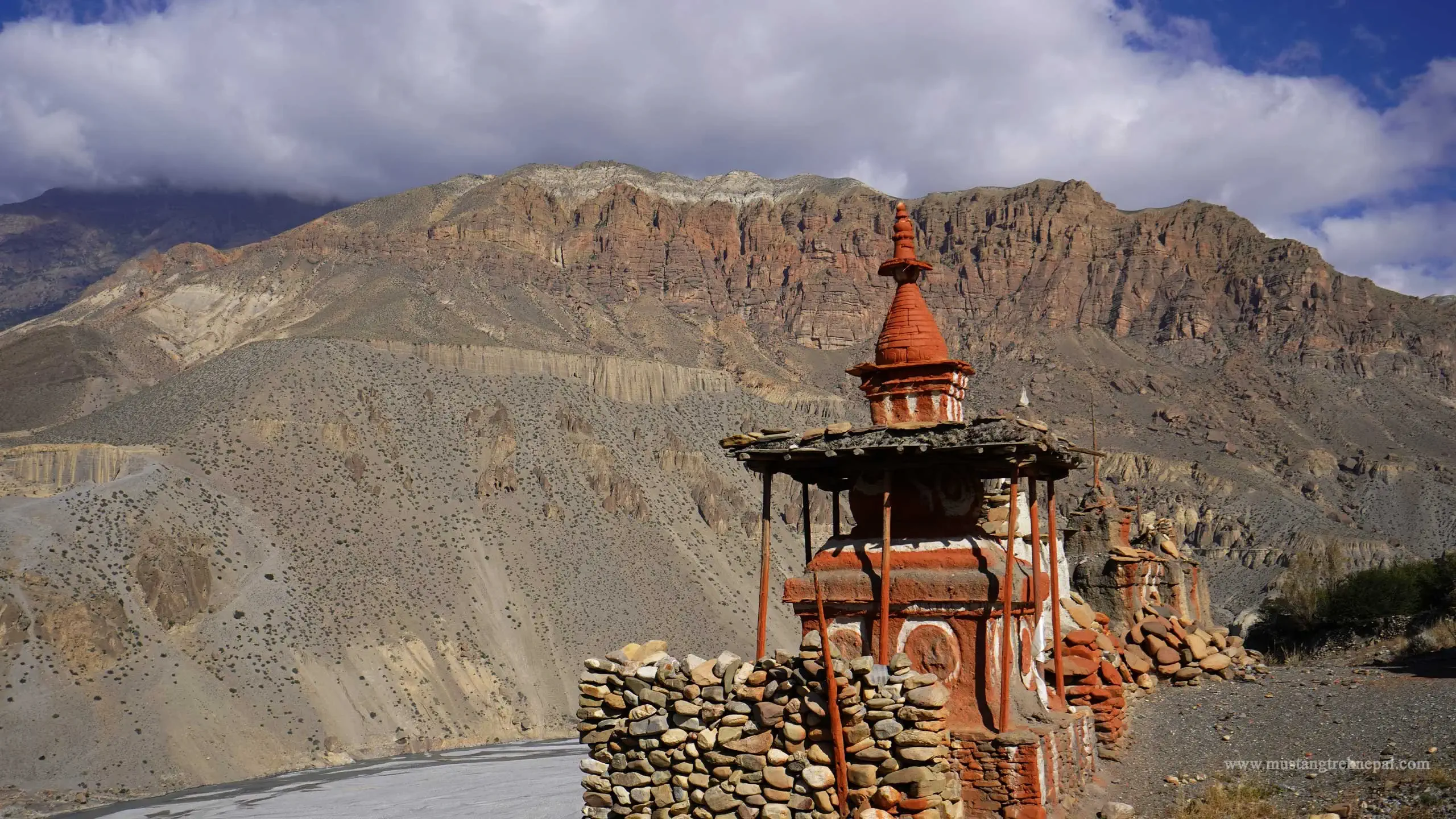
The area around Ghami is notable for its collection of ancient mani walls — long stone barriers inscribed with Buddhist mantras — that stretch for hundreds of meters along the route, creating one of the most distinctive visual elements of the Upper Mustang plateau.

Tsarang (also written as Charang), at approximately 3,560 meters, is another significant cultural stop between Ghami and Lo Manthang, with a hilltop dzong (fortress) and a large monastery containing significant 14th-century murals and statuary.

The fort at Tsarang, though largely ruined, commands dramatic views across the plateau and provides context for the Kingdom of Lo’s military history during its period of greatest political independence. Tsarang is also notable for its traditional Loba houses with flat roofs and painted walls, which distinguish Upper Mustang’s domestic architecture from Lower Mustang’s stone houses.

Lo Manthang: The Walled Capital (3,840 m)

Lo Manthang is the destination toward which every Mustang itinerary ultimately points — an ancient walled city that has stood since the 14th century and that continues to function as the cultural, spiritual, and administrative heart of the Loba community. Approaching Lo Manthang by vehicle across the plateau, the city materialises with startling suddenness from the desert landscape — the white-painted perimeter walls, approximately 150 meters along the long axis, rising abruptly from the ochre Earth, with the monastery rooftops visible above.
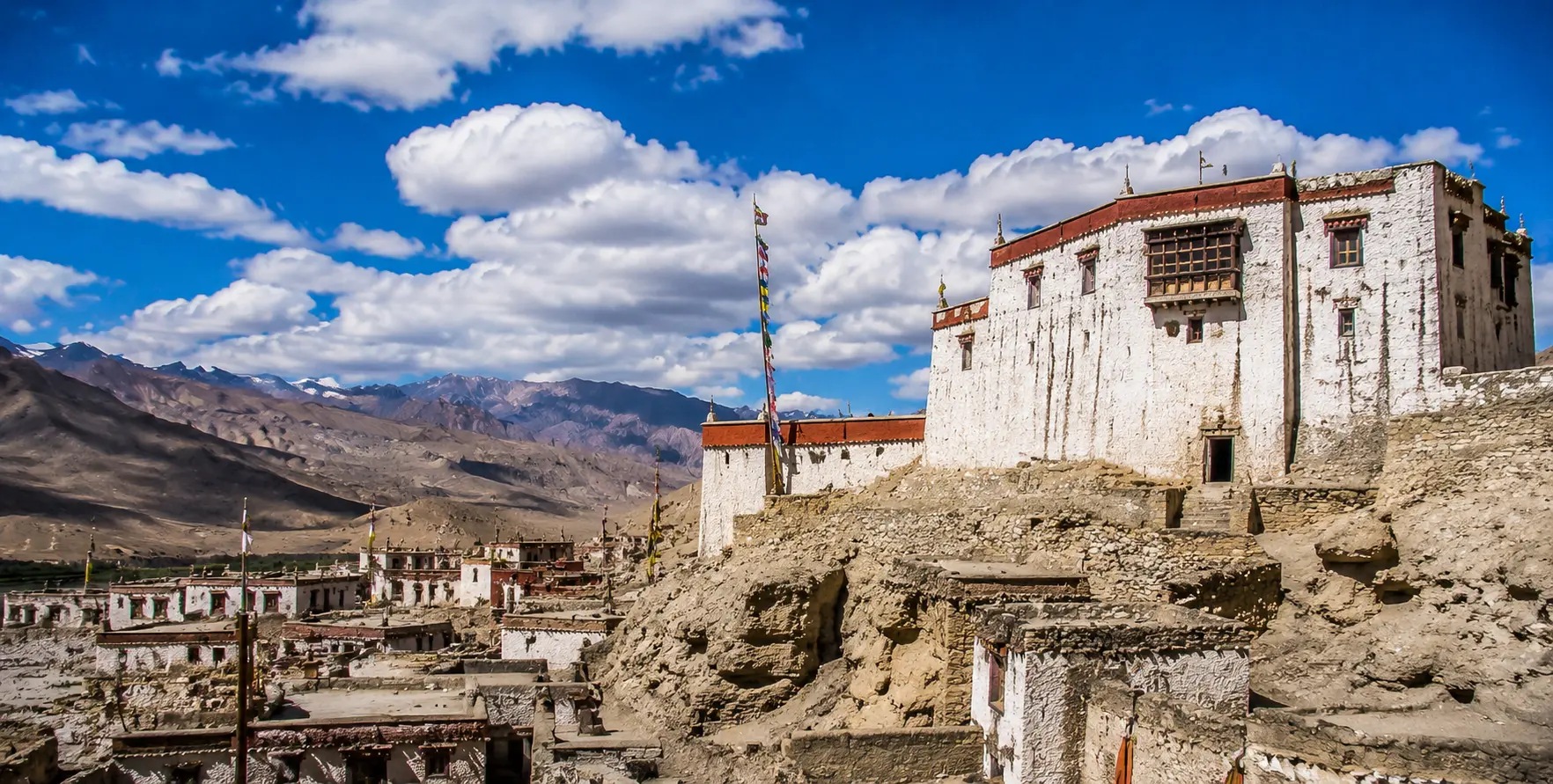
Lo-Manthang-Mustang Full Guide: Upper & Lower Mustang Vehicle Hire

Within the walls, Lo Manthang rewards careful, unhurried exploration. The three principal monasteries — Thubchen Gompa, Jampa Gompa (Champa Lhakhang), and Chode Gompa — contain some of the finest surviving examples of 14th- and 15th-century Tibetan Buddhist mural painting and sculptural art anywhere in the world, preserved in extraordinary condition by the region’s extreme dryness and its long closure to the outside world.

The Royal Palace, a four-story mud-brick structure that served as the residence of the Kingdom of Lo’s hereditary rulers, stands at the centre of the city and can be visited with appropriate permissions, offering a glimpse into the domestic and ceremonial life of a medieval Himalayan royal family.

The streets of Lo Manthang are narrow and labyrinthine, connecting the monasteries, palace, residential compounds, and community spaces of a living urban settlement that has maintained its traditional character despite the growing number of visitors it receives each year. The morning atmosphere — monks processing to prayer, elderly Loba residents completing their daily kora (circumambulation) of the city’s perimeter, the smell of butter lamps drifting from open monastery doors — offers one of the most authentically medieval urban experiences in Asia.

Beyond Lo Manthang: Luri Gompa and the Korala Pass Area

For travellers with extra time and an appetite for deeper exploration, two destinations north of Lo Manthang extend the Upper Mustang adventure into territory even fewer visitors reach. Luri Gompa, located approximately aa4-hour drive from Lo Manthang at an altitude of 4,950 meters, is one of the oldest monasteries in the Mustang region, featuring remarkable cave-monastery architecture and some of the finest ancient Buddhist art in the Upper Mustang system.

Most Upper Mustang jeep tour itineraries of 10 days or more include a day excursion to Luri Gompa.

The Korala Pass area, approximately 20 kilometres north of Lo Manthang and accessible by a rough 4WD track, brings vehicles to the Nepal-Tibet border — a sealed checkpoint that is not open to international crossing but that provides one of the most dramatic frontier viewpoints in all of Nepal, looking north across the Tibetan plateau toward the distant interior.

The drive from Lo Manthang to Korala passes through Tingkhar village and the Chhoser sky cave complex, making the excursion one of the most rewarding full-day activities in the entire Upper Mustang program.

Upper Mustang Jeep Route: Stage by Stage

StageRouteDistanceDrive TimeAltitudeRoad Type
1Pokhara → Jomsom143 km7–9 hrs820–2,720 mPaved + rough off-road
2Jomsom → Kagbeni18 km45 min2,720–2,804 mMainly paved
3Kagbeni → Chele / Syangboche60 km4–5 hrs2,804–3,930 m4WD off-road track
4Syangboche → Ghami → Tsarang45 km3–4 hrs3,520–3,560 mRough plateau track
5Tsarang → Lo Manthang15 km1–1.5 hrs3,840 mPlateau track
6 (Optional)Lo Manthang → Luri Gompa45 km4 hrs3,950 mVery rough track
7 (Optional)Lo Manthang → Korala area20 km1.5–2 hrs4,200–4,660 mRough 4WD track
TOTAL (Pokhara to Lo Manthang)280 km2–3 full driving daysUp to 3,840 mMixed

Permits for Mustang: Complete  Guide

The permit structure for Mustang is one of the most important practical elements to understand before planning any trip to the region, since costs and requirements differ significantly between Lower and Upper Mustang and have changed in recent years.

Lower Mustang Permits (South of Kagbeni)

Travel through Lower Mustang — the entire Kali Gandaki corridor from Beni through Tatopani, Marpha, Jomsom, Kagbeni, and Muktinath — requires only the Annapurna Conservation Area Permit (ACAP).

This costs NPR 3,000 (approximately USD 22-25) for non-SAARC nationals and NPR 200 for SAARC nationals (India, Bangladesh, Sri Lanka, Pakistan, Bhutan, Maldives). No restricted-area permit, guide requirement, or minimum group size applies to travel in Lower Mustang. The TIMS card (NPR 2,000 for non-SAARC) is additionally required for trekkers, but may be waived for those travelling by flight both in and out via Jomsom.

Note: A lower Mustang ACAP entry fee of approximately USD 25 applies to all visitors to the conservation area, including vehicle tour travellers who are not trekking. Confirm the current exact rate with your operator or the Nepal Tourism Board before departure.
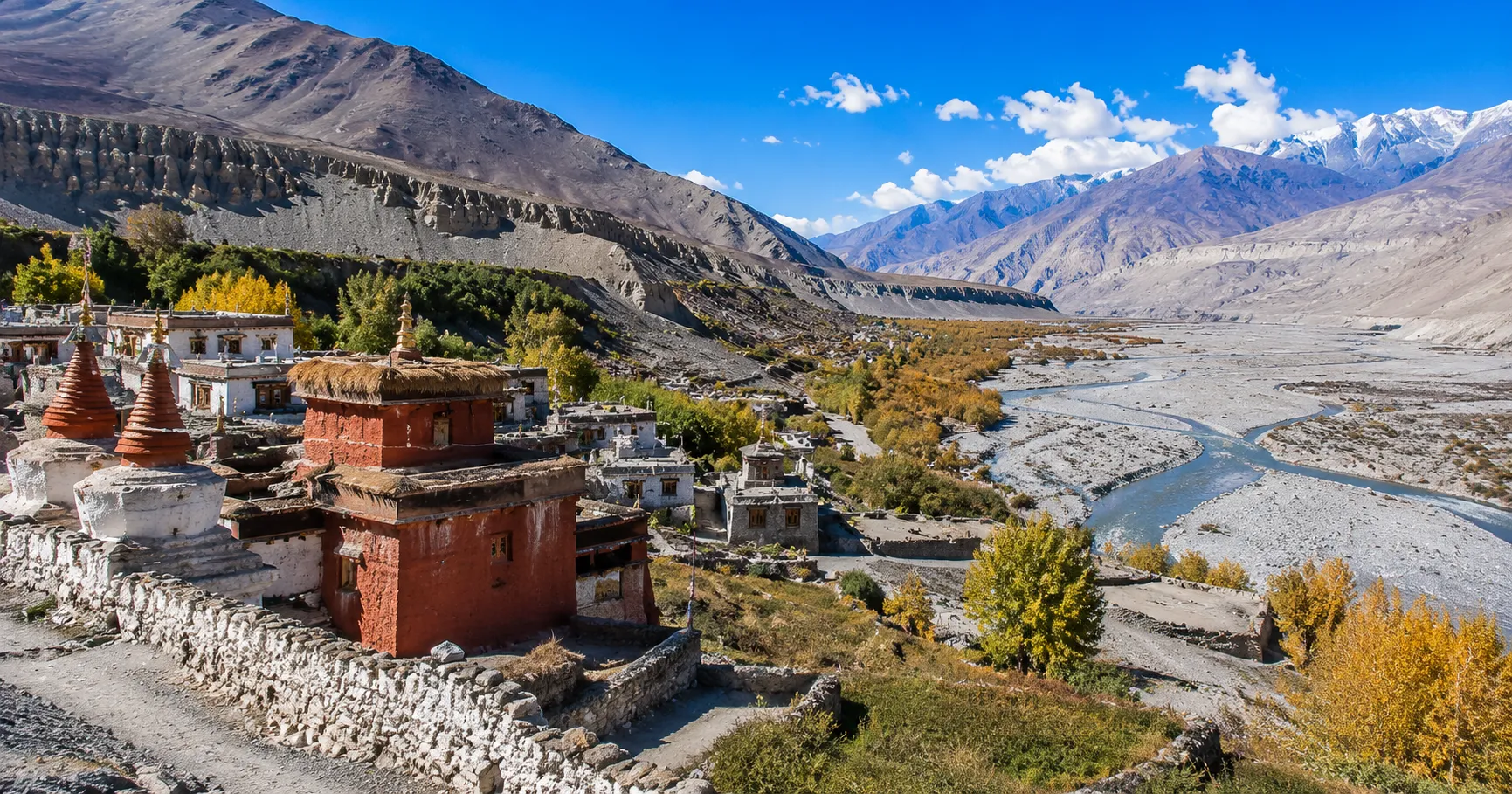
Kagbeni-Mustang Full Guide: Upper & Lower Mustang Vehicle Hire

Upper Mustang Permits (North of Kagbeni)

Entering the restricted zone north of Kagbeni requires a Restricted Area Permit (RAP) in addition to the ACAP. Nepal’s Department of Immigration manages the RAP, which can only be arranged through a government-registered trekking agency — individual travellers cannot obtain it directly. The key requirements and costs as of 2025/26 are:

PermitCostDurationWho IssuesGroup Requirement
Restricted Area Permit (RAP)USD 500 per personFirst 10 days inside restricted zoneDepartment of Immigration (via agency)Minimum 2 foreign nationals + licensed guide
P extensionUSD 50 per person per dayEach additional day beyond 10SameSame
ACAP (Annapurna Conservation Area)NPR 3,000 non-SAARC / NPR 200 SAARCFull duration of tripNepal Tourism BoardNone
TIMS CardNPR 2,000 non-SAARC / NPR 1,000 SAARCFull duration of tripNepal Tourism Board / TAANNone
Licensed Guide (mandatory)Arranged through an agencyFull Upper Mustang durationTAAN-registeredMust be licensed

Complete Vehicle Hire Costs: Pokhara to Mustang

The following cost tables consolidate vehicle hire rates for both Lower and Upper Mustang journeys, based on current market research. All Nepal Vehicle Hiring Pvt Ltd’s rates are fully inclusive of the vehicle, an experienced driver, fuel, and tolls.

Route / ServiceVehicleCost (NPR)Cost (USD)DurationNotes
Pokhara → Jomsom (one-way overland)4WD JeepNPR 28,000–38,000$210–$2857–9 hrsKali Gandaki Gorge route
Pokhara → Jomsom (return)4WD JeepNPR 48,000–65,000$360–$488Multi-dayRound trip with waiting
Jomsom → Muktinath (private hire)Private JeepNPR 3,000–4,500$22–$341–1.5 hrsFull vehicle hire
Jomsom → Kagbeni (private hire)Private JeepNPR 1,500–3,000$11–$2230–45 minGateway to Upper Mustang
Pokhara → Lo Manthang (full overland)Land CruiserNPR 45,000–65,000$338–$4882–3 daysOne way, full Upper Mustang
Pokhara ⇔ Lo Manthang (round trip)Land CruiserNPR 80,000–120,000$600–$9008–12 daysFull Upper Mustang jeep tour
Lo Manthang day hire (excursions)4WD JeepNPR 12,000–18,000$90–$135Full dayKorala, Luri Gompa, Chhoser
Kathmandu → Pokhara (for Mustang approach)SUV / Toyota FortunerNPR 17,000–22,000$128–$1656–8 hrsIf flying Pokhara→Jomsom
Pokhara → Jomsom by flight (note only)Domestic flightUSD 120–140 one-way$120–$14020–25 minNot a jeep, but a common alternative

Tip: For the complete Upper Mustang round trip from Pokhara, booking a Toyota Land Cruiser VX or Prado (rather than a standard jeep) adds approximately NPR 20,000 to NPR 30,000 to the total vehicle hire cost but transforms the quality of the multi-day driving experience significantly — a worthwhile investment given that driving may account for 6 to 9 hours on some itinerary days.
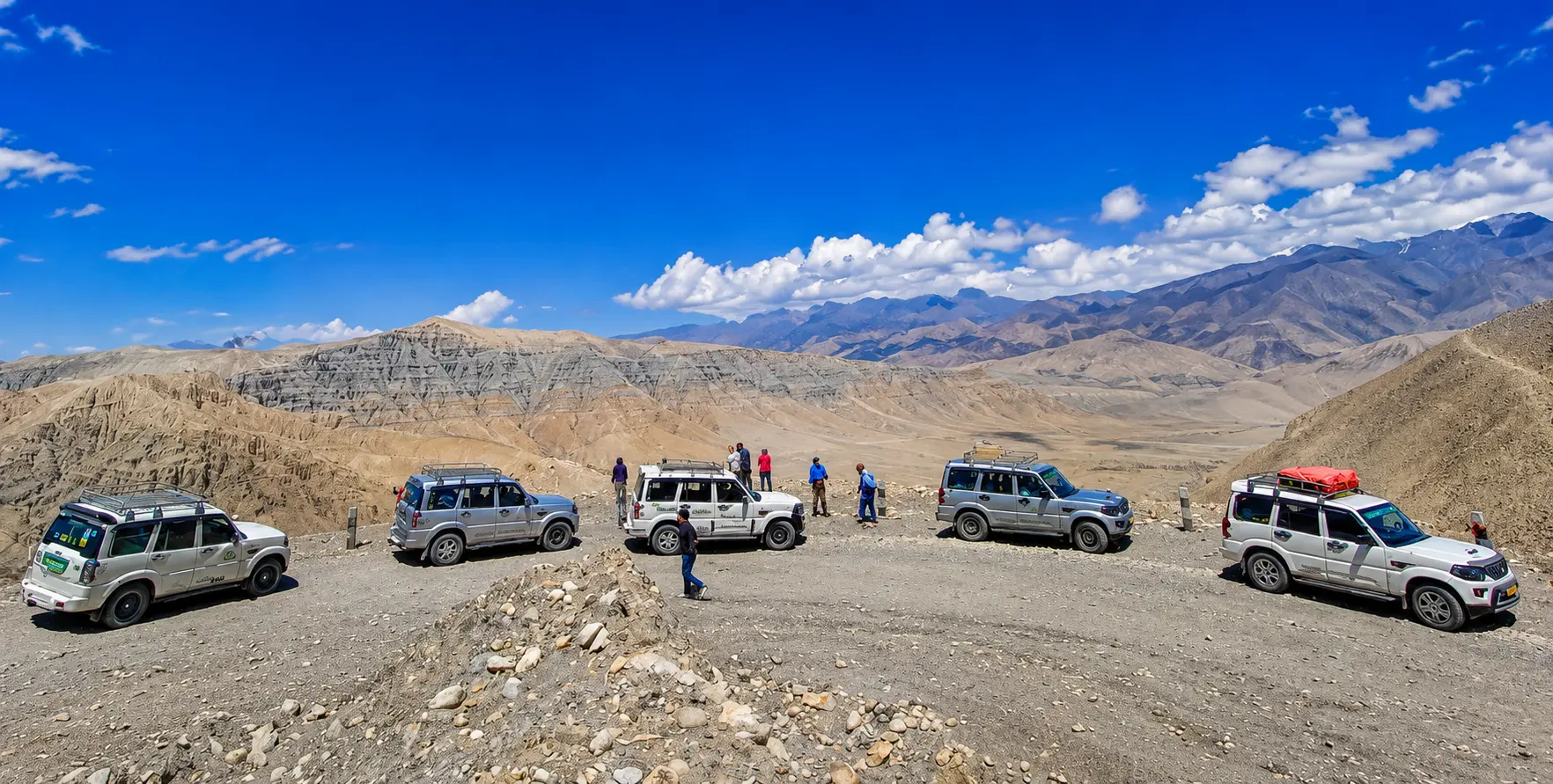
Mustang Full Guide: Upper & Lower Mustang Vehicle Hire-Luxury 4WD Jeep Hire in Nepal features three premium off-road SUVs with a Himalayan mountain background for comfortable and adventurous travel.

Getting to Mustang: All Transport Options Compared

The overland jeep journey from Pokhara through the Kali Gandaki Gorge is the most in-depth and experientially complete way to approach Mustang, combining the dramatic scenery of the world’s deepest gorge with stops at Tatopani, Marpha, and Jomsom before reaching the Upper Mustang gateway at Kagbeni.

This approach is strongly preferred by experienced Nepal travellers specifically because the gorge journey is itself a major highlight — one that the flight from Pokhara to Jomsom completely bypasses. A private 4WD jeep from Pokhara to Jomsom costs US$203 one-way, takes 7 to 9 hours, and accommodates up to 6 passengers plus luggage.

Flight: Pokhara to Jomsom

The domestic flight from Pokhara to Jomsom operates on a tight weather window—flights run only from about 7:00 AM to 11:00 AM each day, as afternoon winds in the Kali Gandaki Gorge make flying impossible. The one-way cost of USD 120-140 per person makes this considerably more expensive per passenger than a shared jeep.

However, it saves approximately 7 hours of driving and offers spectacular aerial views of Dhaulagiri and Annapurna that the road approach cannot match. Flights are notoriously susceptible to weather-related cancellations, and travellers relying on the Jomsom flight for a time-sensitive connection should always build in at least one backup day into their itinerary. Many seasoned Mustang travellers prefer to fly one way and drive the other, combining aerial views with the gorge experience.

Kathmandu to Pokhara: Setting Up the Mustang Approach

For travellers starting in Kathmandu, the first step is reaching Pokhara — either by domestic flight (30-40 minutes, approximately USD 80-100 per person) or by private vehicle along the Prithvi Highway (200 km, approximately 6-8 hours, NPR 17,000-22,000 for a private car or SUV).

Nepal Vehicle Hiring Pvt Ltd provides comfortable private vehicle transfers for this first leg as part of a coordinated Mustang tour package, allowing travellers to combine the Kathmandu-Pokhara scenic drive with an early arrival in Pokhara and position themselves for a next-morning departure toward Mustang.

Best Season for Upper and Lower Mustang

Mustang’s seasonal calendar differs meaningfully from most of Nepal’s other trekking and travel destinations, mainly because Upper Mustang’s rain-shadow location gives it access windows that don’t exist in rain-exposed destinations in Nepal.

SeasonMonthsLower MustangUpper MustangRoad ConditionsRecommended?
SpringMar–MayExcellent — clear, warm daysExcellent — Tiji Festival in MayGood, dryHighly recommended
MonsoonJun–AugDifficult — road disruptionsUNIQUE advantage — rain shadow, dryPoor (lower), Good (upper)Upper only
AutumnSep–NovExcellent — best conditionsExcellent — clear skiesExcellentBest overall
WinterDec–FebCold but passable (lower reaches)Difficult — snow, closed passesVariable — snow above 3000mLower only

The unique monsoon advantage of Upper Mustang deserves emphasis: while June through August is Nepal’s least favourite season for virtually every other region due to rain, leeches, and poor visibility, Upper Mustang sits in the rain shadow of the Annapurna and Dhaulagiri ranges and receives minimal monsoon precipitation.

This makes it the only major Nepal trekking/jeep tour destination where June, July, and August represent a genuinely viable and even enjoyable travel window — indeed som, some experienced travellers specifically choose this period for the emptier trails, lower accommodation rates, and the dramatic quality of the monsoon clouds building over the surrounding peaks while the Upper Mustang plateau remains dry and clear.
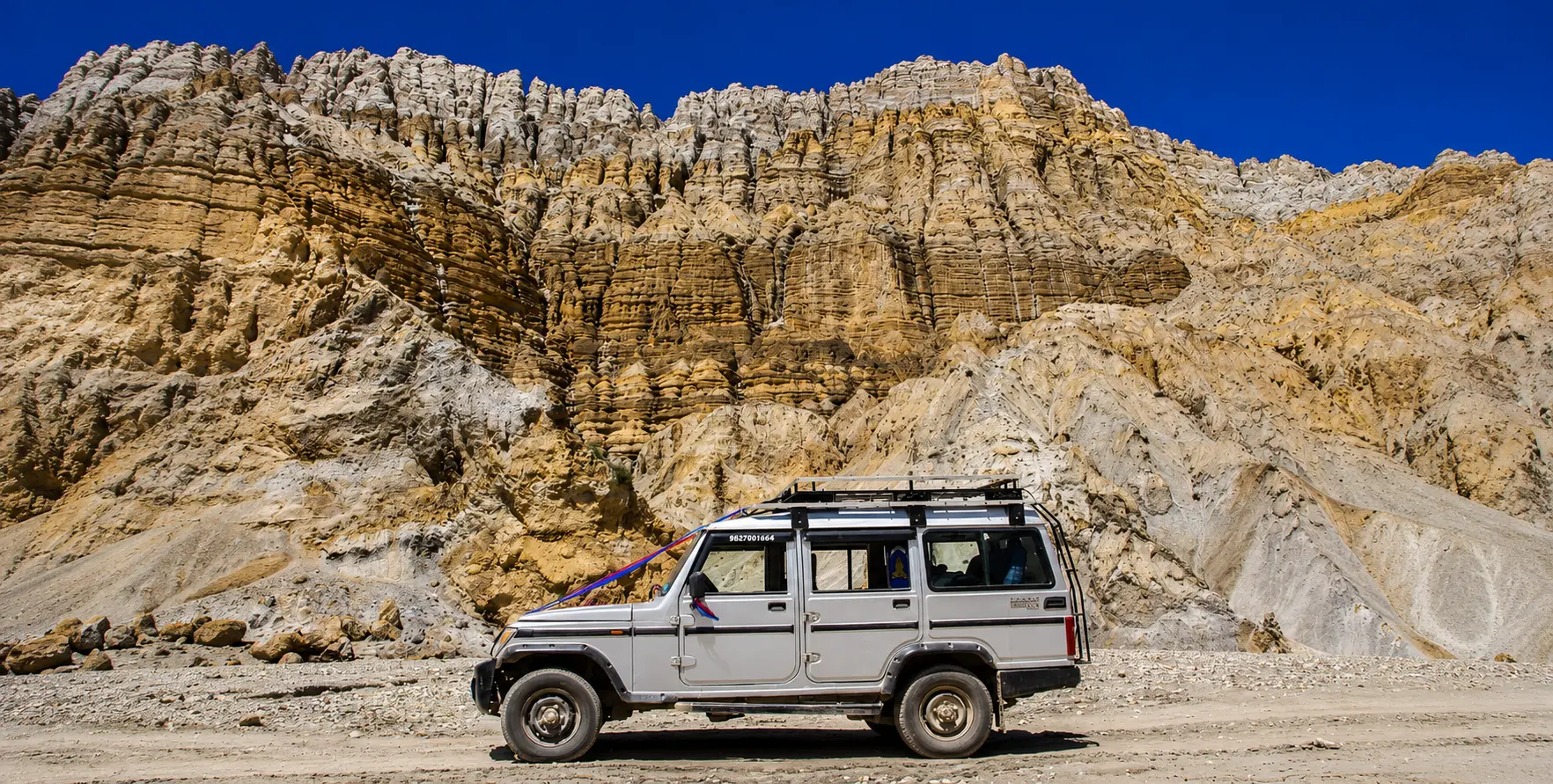
Mustang Full Guide: Upper & Lower Mustang Vehicle Hire-Luxury 4WD Jeep Hire in Nepal features three premium off-road SUVs with a Himalayan mountain background for comfortable and adventurous travel.

Practical Tips for Mustang Travel

  • Book permits well in advance for Upper Mustang — the RAP application requires passport copies, photos, a detailed itinerary, and a guarantee letter from a registered agency, and takes 2 to 3 working days to process.
  • Withdraw sufficient NPR cash in Pokhara before departure — Jomsom has ATMs, but they are sometimes unreliable; carry enough for all expected expenses, including accommodation, meals, and local jeeps.
  • Depart Pokhara by 6:00–7:00 AM for the overland drive to Jomsom to ensure a comfortable mid-afternoon arrival in Jomsom or Kagbeni with daylight for settling in.
  • The strong afternoon winds in the Kali Gandaki Gorge — typically starting from around noon and reaching considerable strength by 2:00–3:00 PM — affect both driving comfort and aircraft operations; schedule demanding sections of the drive or any walking for morning .hours
  • Carry warm layers at all times — temperatures at Lo Manthang (3,840 m) can drop sharply even in summer. The journey from Lo Manthang to the Korala Pass area reaches 4,660 m, where conditions can be genuinely cold. Mobile connectivity: NTC and Ncell coverage is available in Jomsom, Kagbeni, and Muktinath,th but becomes sporadic further north into Upper Mustang; download offline maps and key information before departing Jomsom.
  • Photography: Upper Mustang’s extraordinary landscape rewards early morning and late afternoon light — the high-altitude colours are most vivid before the afternoon wind and dust haze build
  • Altitude: Lo Manthang at 3,840 m is high enough to cause altitude sickness in some visitors; anyone arriving quickly from Pokhara (820 m) should plan a rest day and stay hydrated
  • Book accommodation in Lo Manthang in advance during peak season (October–November and the Tiji Festival period in May) — accommodation is limited and fills quickly

Suggested Itineraries: Lower and Upper Mustang

Option A: 3-Day Lower Mustang Overland Escape (From Pokhara)

Day 1: Early departure from Pokhara by private 4WD jeep; drive through Beni, Tatopani (hot springs stop), Ghasa, and Kalopani; explore Marpha village; reach Jomsom by late afternoon. Day 2: Jomsom area exploration (Dhumba Lake, Lupra Bon monastery), afternoon drive to Kagbeni for village exploration and overnight.

Day 3: Morning drive from Kagbeni to Muktinath (45 min), temple visit and ritual bath, return to Jomsom, drive back toward Pokhara (overnight at Tatopani or continue to Pokhara). Total vehicle hire is approximately NPR 35,000 to NPR 55,000 for the complete private jeep arrangement.

Option B: 8-Day Upper Mustang Jeep Tour (From Pokhara)

Day 1: Pokhara to Jomsom overland (7-9 hrs). Day 2: Jomsom to Kagbeni (permit check), continue to Chele (4-5 hrs). Day 3: Chele to Lo Manthang via Syangboche, Ghami, Tsarang (6-8 hrs).

Day 4: Lo Manthang exploration — Thubchen, Jampa, Chode monasteries, palace. Day 5: Korala Pass / Chhoser cave excursion by jeep (full day). Day 6: Lo Manthang to Jomsom (return south, 6-8 hrs).

Day 7: Jomsom to Pokhara (7-9 hrs). Day 8: Rest/buffer day or extend in Pokhara. Total RAP permit cost: USD 500 per person (5 days inside restricted zone at current daily rate structure).

Total vehicle hire: NPR 80,000 to NPR 110,000 for a complete private jeep.

Option C: 14-Day Classic Upper Mustang Trek + Jeep Return

This itinerary combines the classic Annapurna Circuit approach — flying or driving to Jomsom, then trekking north through Kagbeni and the full Upper Mustang restricted zone to Lo Manthang over 6-7 days of walking — with a return by private jeep from Lo Manthang back to Jomsom and then Pokhara, saving 4-5 days of return walking while still completing the northward journey on foot at the trek’s natural pace. Vehicle hire for the return leg from Lo Manthang to Pokhara: NPR 40,000 to NPR 55,000.
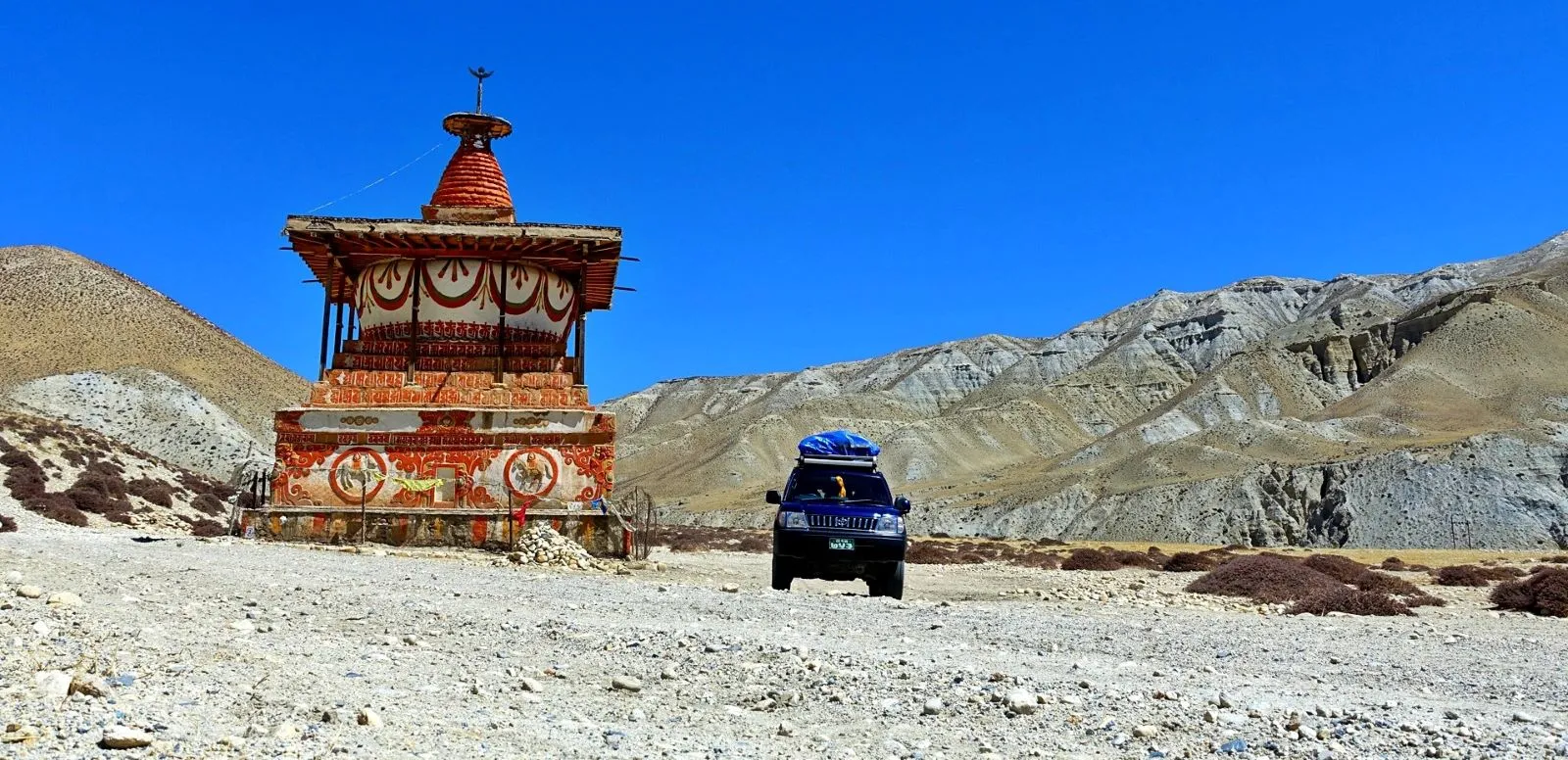
Mustang Full Guide: Upper & Lower Mustang Vehicle Hire-Luxury 4WD Jeep Hire in Nepal features three premium off-road SUVs with a Himalayan mountain background for comfortable and adventurous travel.

Frequently Asked Questions

What is the difference between Upper and Lower Mustang?

Lower Mustang covers the Kali Gandaki corridor from Beni through Tatopani, Marpha, Jomsom, Kagbeni, and Muktinath. It requires only the ACAP permit and is open to all visitors without group restrictions.

Upper Mustang begins north of the Kagbeni checkpoint, covers Lo Manthang and beyond, and requires a Restricted Area Permit (RAP) of USD 500 per person for 10 days (USD 50/day extension), a mandatory licensed guide, and a minimum of 2 foreign nationals travelling together.

How much does the Upper Mustang permit cost?

The Upper Mustang Restricted Area Permit costs USD 500 per person for the first 10 days inside the restricted zone, with USD 50 per person per day for any additional days beyond 10.  Individual-day permits can be issued without a mandatory 10-day minimum, making shorter tours more cost-effective. You also need the ACAP (NPR 3,000, non-SAARC) and the TIMS card (NPR 2,000, non-SAARC).

Total permit costs for a 7-day Upper Mustang tour: approximately USD 520–540 per person.

How long does the drive from Pokhara to Lo Manthang take?

The overland drive from Pokhara to Lo Manthang covers approximately 280 kilometres. It typically takes 2 to 3 full driving days, with overnight stops at Jomsom (Day 1) and Ghami or Chele (Day 2) before reaching Lo Manthang on Day 3. A single-day drive for the entire distance is not practical given the road conditions and distance involved.

Can I visit Upper Mustang without a guide?

No. A licensed guide is mandatory for all foreign visitors to Upper Mustang. Independent travel in the restricted zone is not permitted. Your guides must be registered with TAAN (Trekking Agencies’ Association of Nepal) and hold a current license.

The guide requirement applies equally to jeep tour travellers and trekkers.

Is a 4WD jeep necessary for the entire Mustang route?

A 4WD vehicle is essential from Beni onward on the overland approach, and absolutely required for all driving north of Kagbeni into Upper Mustang. The road from Beni to Jomsom is approximately half off-road with rough, bumpy surfaces.

Beyond Kagbeni, the track to Lo Manthang is entirely off-road and requires a proper 4WD, high ground clearance, and an experienced mountain driver. Do not use standard cars or vans north of Beni.

When is the Tiji Festival in 2026?

The 2026 Tiji Festival in Lo Manthang falls on May 13–15, according to the Tibetan lunar calendar. This is the most spectacular cultural event in Upper Mustang and one of the finest cultural experiences available anywhere in Nepal. Vehicle hire and accommodation in Lo Manthang fill quickly for the Tiji Festival period — booking 6 to 8 weeks in advance is strongly recommended.

What vehicle does Nepal Vehicle Hiring Pvt Ltd recommend for Upper Mustang?

For the complete Pokhara-to-Lo Manthang overland journey, Nepal Vehicle Hiring Pvt Ltd recommends a Toyota Land Cruiser (VX or Prado series) as the optimal combination of interior comfort and genuine off-road capability for this demanding multi-day route. For Lower Mustang only (Pokhara to Jomsom/Muktinath), a Toyota Fortuner or equivalent is appropriate and offers good value.

All vehicles are provided with experienced mountain drivers familiar with the specific demands of the Kali Gandaki corridor and the Upper Mustang track.

Conclusion: Your Mustang Adventure Starts Here

Mustang is, without exaggeration, one of the most extraordinary travel destinations anywhere on Earth — a region where an ancient kingdom’s medieval capital still stands intact, where a landscape of desert canyons and wind-sculpted rock formations frames the world’s highest peaks, where the Kali Gandaki River cuts the world’s deepest gorge between walls of ochre and stone, and where a living Tibetan Buddhist culture maintains traditions that centuries of isolation have kept almost perfectly preserved.

Lower Mustang is accessible to every traveller with an ACAP permit and a reliable 4WD vehicle; Upper Mustang rewards those willing to invest in additional permits, offering a journey that consistently delivers one of the most profound experiences a Nepali destination can offer

Nepal Vehicle Hiring Pvt Ltd provides private 4WD vehicle hire for every stage of Lower and Upper Mustang travel—from the first overland kilometre out of Pokhara to the final frontier excursion to the Korala Pass area north of Lo Manthang. Our vehicles are maintained for the demands of the Kali Gandaki corridor and the Upper Mustang track; our drivers are experienced on these roads in every season, and our transparent, all-inclusive pricing in both NPR and USD ensures you know exactly what your Mustang adventure costs before you confirm a booking.

Whether you are planning a compact 3-day Lower Mustang overland escape, a full 10-day Upper Mustang jeep tour to Lo Manthang and beyond, or a combined itinerary that takes in the hot springs of Tatopani, the apple orchards of Marpha, the sacred ghats of Muktinath, the medieval streets of Lo Manthang, and the frontier drama of the Korala Pass all within a single well-organised journey, Nepal Vehicle Hiring Pvt Ltd has the right vehicle, the right driver, and the right experience to make your Mustang adventure everything it deserves to be.

Book Your Mustang Vehicle Hire Today  

WhatsApp: +977 981-4227196
E-mail:[email protected]

Lower Mustang (Jomsom, Muktinath)  |  Upper Mustang (Lo Manthang, Korala)  |  4WD Jeep & Land Cruiser
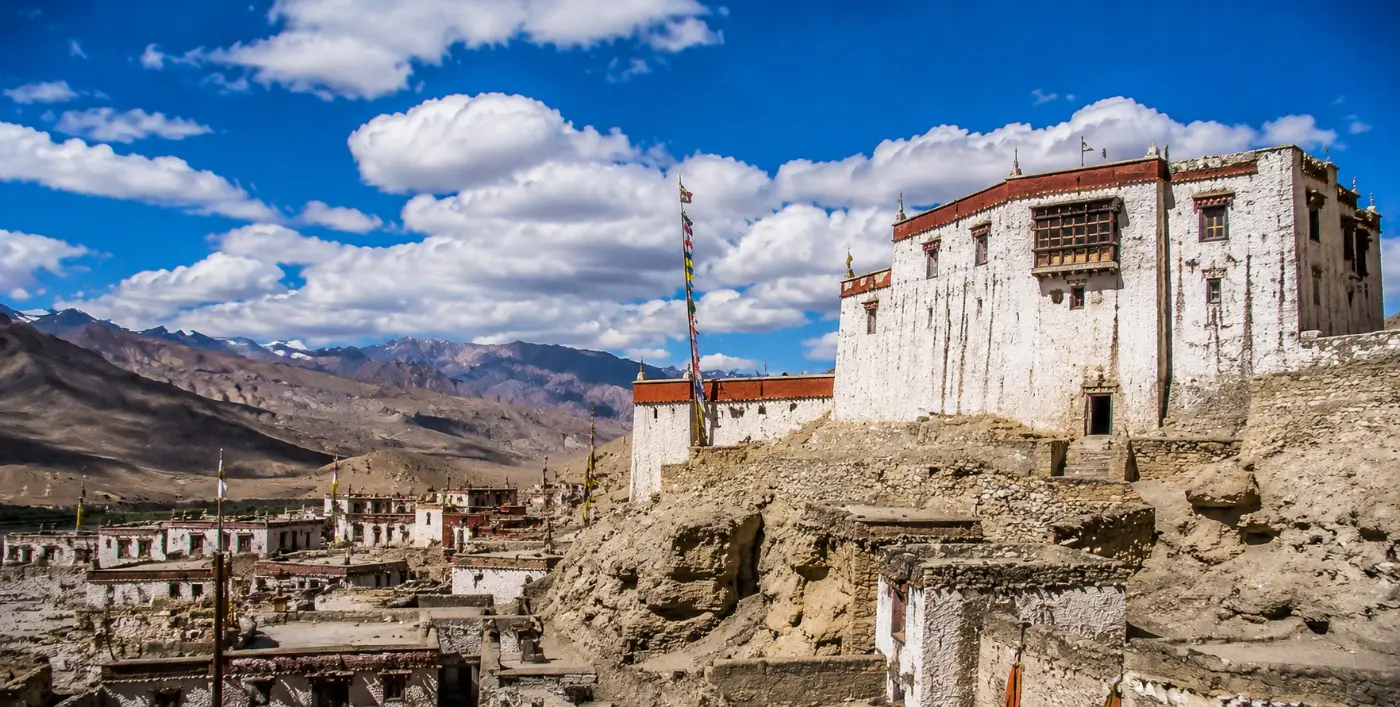
Upper Mustang 4WD Jeep: Complete Rental and Hire Guide

Upper Mustang 4WD Jeep: Complete Rental and Hire Guide

Upper Mustang 4WD Jeep – Complete Rental and Hire Guide

Upper Mustang is a destination you can’t reach without a properly equipped 4WD jeep. This high-altitude desert kingdom in the rain shadow of the Annapurna and Dhaulagiri ranges is connected to the rest of Nepal by jeep tracks alone – remote, rough, and at times extreme – winding through one of the most dramatic landscapes on earth, from the deep gash of the Kali Gandaki gorge to the wind-eroded plateau surrounding the medieval walled city of Lo Manthang.

Vehicle Hiring Nepal specialises in 4WD jeep rental for Upper Mustang, providing well-maintained Toyota Land Cruisers and experienced mountain drivers for travellers heading into this restricted and extraordinary region. This complete 2026 guide covers our full jeep fleet, rental options from both Kathmandu and Pokhara, prices, the Upper Mustang permit system, road conditions, and everything you need to plan your 4WD adventure into the Forbidden Kingdom.

Why Upper Mustang Requires a 4WD Jeep – No Exceptions

Unlike many of Nepal’s mountain regions, where a capable SUV might suffice in good conditions, Upper Mustang allows no compromise on vehicle choice. Here is why:

  • No paved roads exist anywhere within Upper Mustang itself – every meter of road from Kagbeni northward is an unpaved track
  • The terrain is a high-altitude desert plateau with loose sand, rocks, and wind-eroded surfaces that shift with the weather and season.
  • Altitudes range from 2,800 m at Kagbeni to over 3,840 m at Lo Manthang, with several passes exceeding 3,800 m along the route.
  • Remoteness is extreme – between villages, there may be no other vehicles, no fuel stations, and no mobile signal for hours at a time.
  • Weather can change suddenly – wind, dust storms, and occasional snow at higher elevations all demand a vehicle with reliable traction and power.
  • The approach itself, through the Kali Gandaki gorge from Beni to Jomsom, is one of Nepal’s roughest and most technically demanding jeep tracks, even before Upper Mustang begins.

For all of these reasons, Vehicle Hiring Nepal uses only genuine 4WD Toyota Land Cruisers for Upper Mustang journeys – never a standard SUV, sedan, or 2WD vehicle of any kind.

Our Upper Mustang 4WD Jeep Fleet

Toyota Land Cruiser (Standard) – The Workhorse
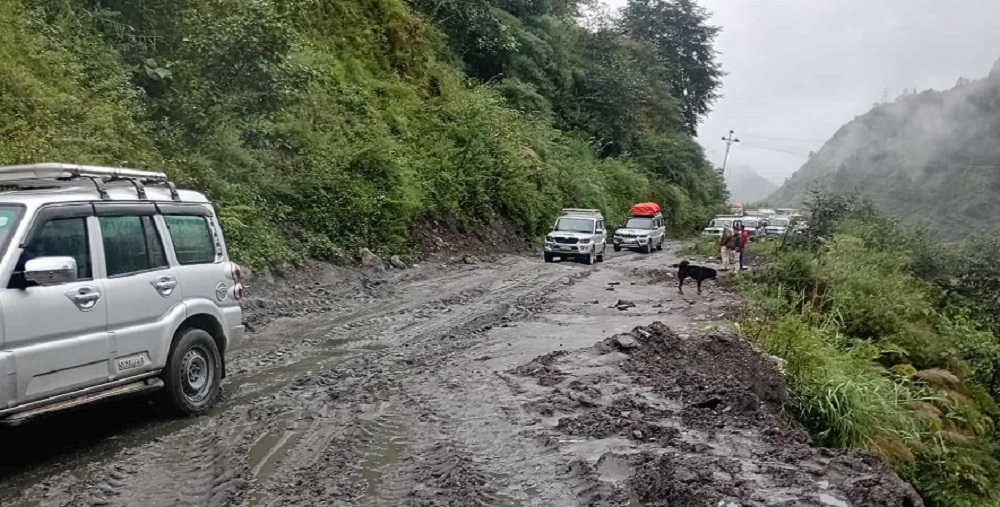
Capacity: 4 to 6 passengers with full luggage

Engine: 4.5L V8 turbodiesel

Strengths: Maximum power and durability; the most trusted vehicle for Upper Mustang’s roughest sections

The standard Land Cruiser (LC78/LC79 series) is the backbone of our Upper Mustang fleet. Built for decades of reliable service on the world’s harshest roads, it is the vehicle of choice for the Kali Gandaki gorge and the remote plateau tracks north of Kagbeni. Robust, powerful, and easily serviceable even in remote areas, it remains the gold standard for travel in Upper Mustang.
Toyota Land Cruiser Prado – Top-end Comfort
Capacity: 4 to 5 passengers with luggage

Engine: 2.8L turbodiesel

Strengths: More refined ride quality, top-end interior, strong 4WD capability

For travellers who want the comfort of a more modern, top-end interior without sacrificing genuine 4WD capability, the Land Cruiser Prado is an excellent choice for Upper Mustang. It handles the gorge and plateau tracks confidently while offering a smoother, more comfortable ride on the longer driving days.
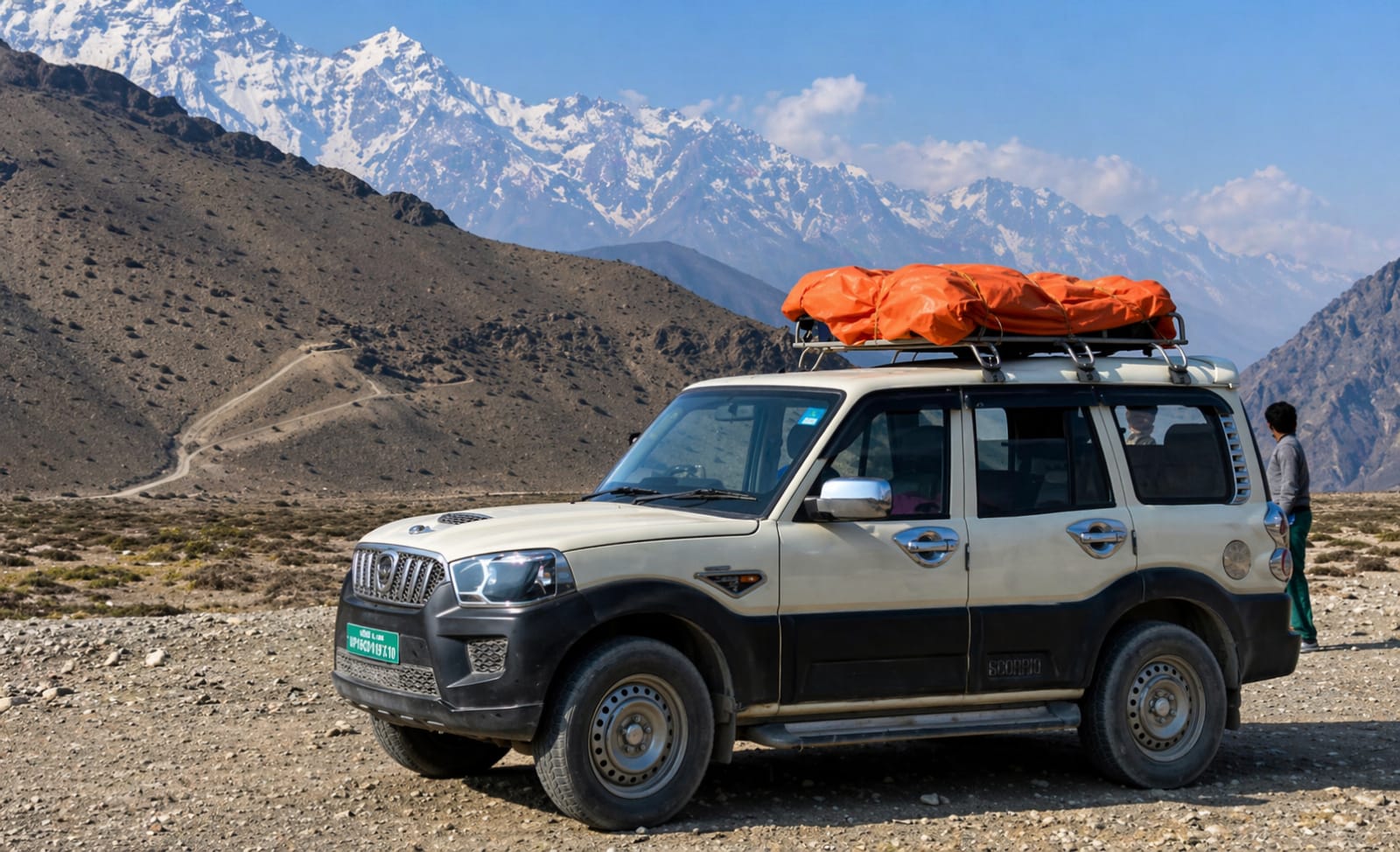
Mahindra Bolero / Scorpio – Budget 4WD

Capacity: 4 to 6 passengers

Strengths: Rugged, affordable, widely used by local drivers throughout the region

For budget-conscious groups who still need genuine 4WD capability, the Mahindra Bolero and Scorpio offer a more affordable alternative to the Toyota Land Cruiser while remaining capable on Upper Mustang tracks. Ride comfort is somewhat rougher than the Toyota options, but the off-road capability is reliable.
Upper Mustang Jeep Rental Prices

ServiceVehicleCapacityPrice (USD)Duration
Pokhara → Lo Manthang → PokharaLand Cruiser4–6 paxUSD 850–1,100Round trip, 6–8 days
Pokhara → Lo Manthang (one-way)Land Cruiser4–6 paxUSD 500–650One-way, 3–4 days
Kathmandu → Lo Manthang → KathmanduLand Cruiser4–6 paxUSD 1,100–1,400Round trip via Pokhara, 7–9 days
Jomsom → Lo Manthang → JomsomLand Cruiser4–6 paxUSD 350–450Round-trip, if flying to Jomsom
Kagbeni → Lo Manthang (Upper section only)Local 4WD4–6 paxUSD 180–240One-way, day trip option
Lo Manthang local day toursLand Cruiser4–6 paxUSD 60–90/dayChhoser caves, Lo Gekar, Namgyal
Land Cruiser Prado (top-end)Prado4–5 pax+15–20% on the aboveSame routes, top-end comfort
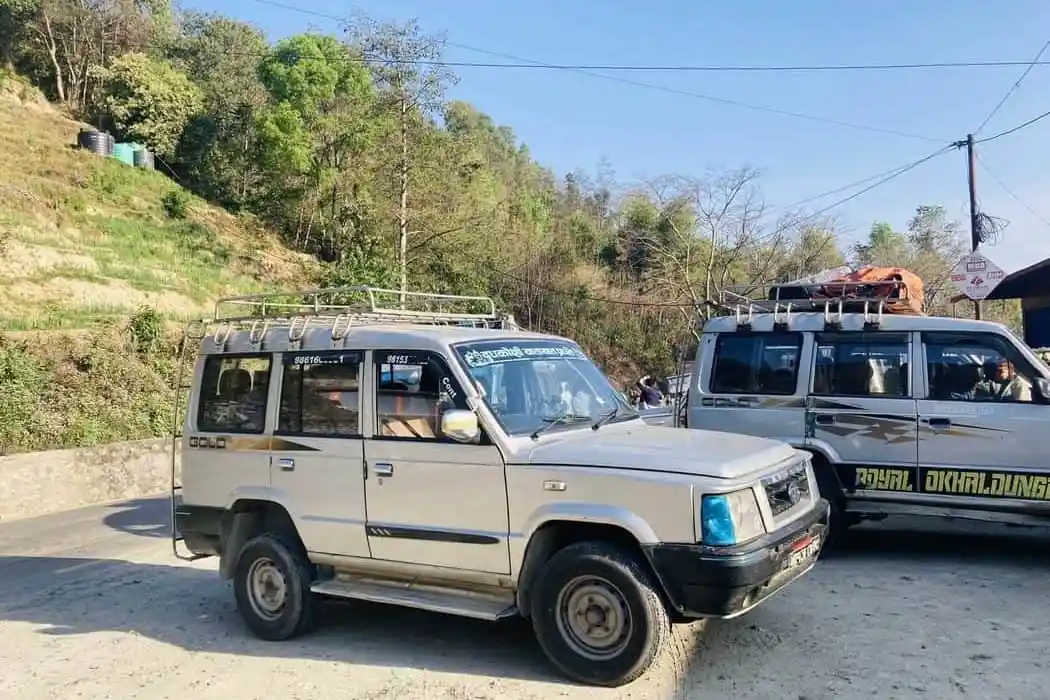
Mahindra Bolero/Scorpio (budget)Bolero/Scorpio4–6 pax-20–25% on the aboveSame routes, budget option

All prices include the driver, full fuel, and vehicle insurance for the complete journey. Driver accommodation during multi-day stays in Upper Mustang is arranged separately. Contact Vehicle Hiring Nepal for an exact 2026 quote tailored to your specific itinerary, group size, and travel dates.

Upper Mustang 4WD jeep

The Upper Mustang Restricted Area Permit

Before booking your 4WD jeep, you must secure the mandatory Upper Mustang Restricted Area Permit. Vehicle Hiring Nepal provides jeep transport only – permits must be arranged separately through the Department of Immigration or a licensed trekking agency.

Permit DetailInformation
Permit NameUpper Mustang Restricted Area Permit (RAP)
Cost 2026USD 500 per person for the first 10 days, USD 50 per additional day
Where to ApplyDepartment of Immigration, Kathmandu (Maitighar) – not available en route
Minimum Group2 foreign nationals minimum – solo foreign travel is not permitted
Guide RequirementA licensed Nepali trekking guide must accompany all foreign visitors at all times.
Additional PermitsACAP (NPR 3,000) and a TIMS card (USD 10) are also required
CheckpointStrictly checked at Kagbeni and at multiple points within Upper Mustang

Plan to obtain your permit in Kathmandu at least 1-2 days before your jeep departure for Pokhara or Jomsom. We can advise on the permit process and recommend trusted, licensed trekking agencies, but you must process the permit separately from your vehicle booking.

Jeep Routes into Upper Mustang

Route 1: Via Pokhara (Most Common)

Distance: Pokhara to Lo Manthang approximately 316 km

Duration: 3 to 4 days driving (recommended for acclimatisation)

Path: Pokhara – Beni – Tatopani – Jomsom – Kagbeni – Chele – Ghami – Charang – Lo Manthang

The Pokhara route is the standard approach for most travellers, combining the spectacular Kali Gandaki Gorge drive with the high-plateau crossing into Upper Mustang. This route allows for gradual acclimatisation with overnight stops at Tatopani, Jomsom, and within Upper Mustang itself.

Route 2: Via Kathmandu (Extended)

Distance: Kathmandu to Lo Manthang, approximately 516 km via Pokhara

Duration: 4 to 5 days driving

Path: Kathmandu – Pokhara (Day 1) – then standard Pokhara route (Days 2–4)

For travellers beginning their Nepal trip in Kathmandu, you can hire the same Land Cruiser for the full journey, with an additional day of driving from Kathmandu to Pokhara before joining the standard Upper Mustang route.

Route 3: Fly to Jomsom, Jeep from There (Fastest)

Flight: Pokhara to Jomsom by air, 25 minutes

Jeep Distance: Jomsom to Lo Manthang, approximately 82 km

Duration: 1 to 2 days driving from Jomsom

For time-limited travellers, flying from Pokhara to Jomsom and picking up the 4WD jeep there cuts 2 to 3 days off the total journey. The trade-off is less gradual acclimatisation and dependency on the Jomsom flight, which is subject to the famous Kali Gandaki afternoon wind and frequent delays.

Road Conditions on the Upper Mustang Jeep Track

SectionSurfaceDifficultyNotes
Beni → TatopaniRough gravel gorge trackModerate–HardCliff-edge sections, narrow
Tatopani → JomsomVery rough gorge trackHardAfternoon wind, rockfall risk
Jomsom → KagbeniGravel Valley TrackModerateSandy, wind-exposed
Kagbeni → CheleRemote rocky trackHardFirst Upper Mustang section
Chele → GhamiHigh plateau desert trackVery HardAltitude, exposed, remote
Ghami → CharangPlateau trackHardWind erosion, loose surface
Charang → Lo ManthangFinal approach trackModerate–HardImproving the surface near the city

Every section of this route demands a genuine 4WD vehicle. No point along the Beni-to-Lo Manthang track is a safe or sensible place for a 2WD vehicle.

What Your Jeep Driver Provides on the Upper Mustang Route

  • Years of specific experience navigating the Kali Gandaki gorge and Upper Mustang plateau tracks
  • Knowledge of the critical timing windows to avoid the Kali Gandaki afternoon wind
  • Familiarity with seasonal road conditions, river crossing points, and current landslide or weather risks
  • Vehicle recovery skills for the rare situations where the jeep needs assistance crossing a difficult section
  • Local knowledge of teahouses, fuel stops, and rest points throughout the remote route
  • Coordination with your licensed guide and itinerary throughout the Upper Mustang permit zone

Customising Your Upper Mustang Jeep Itinerary

Vehicle Hiring Nepal can tailor your Upper Mustang 4WD jeep rental to match your specific interests and time available:

  • Standard 8-day round trip from Pokhara – the most popular option, allowing full exploration of Lo Manthang and key day trips
  • Extended 10-day itinerary including the Tiji Festival (April–May) – book significantly in advance
  • Fast 6-day fly-in option via Jomsom for time-limited travellers
  • Combined itinerary continuing from Upper Mustang to the Annapurna Circuit or onward to Manang
  • Day-tour add-ons in Lo Manthang – Sky Caves of Chhoser, Lo Gekar Monastery, Namgyal Gompa, Nam La Pass
  • Photography-focused itineraries with extra time at key viewpoints for sunrise and sunset light

Mustang

Best Time for Upper Mustang 4WD Jeep Travel

April to May (Tiji Festival Season)

Peak season coincides with the spectacular Tiji Festival in Lo Manthang. Book your jeep well in advance – 8 to 12 weeks ahead for Tiji dates.

June to September (Mustang’s Secret Dry Season)

While the rest of Nepal experiences monsoon, Upper Mustang lies in a rain shadow and remains largely dry and accessible. A wonderful, lightly visited season for jeep travel into the region.

October to November (Excellent, Post-Monsoon Clarity)

Outstanding visibility and dry road conditions make this one of the best seasons for the Upper Mustang jeep journey, with brilliant, clear skies and the autumn light bringing out the ochre and red tones of the plateau landscape.

December to March (Cold but Accessible)

Winter travel is possible with an experienced driver, but the higher sections may have snow and ice. Not recommended for first-time Upper Mustang visitors.

What is Included in Your Jeep Hire

  • Toyota Land Cruiser, Prado, or Mahindra jeep as selected, fully maintained and insured
  • Experienced driver specifically trained on Upper Mustang and Kali Gandaki gorge routes
  • Full fuel cost for the complete journey
  • Vehicle insurance throughout
  • Pickup from your Pokhara or Kathmandu hotel
  • Drop-off at your Lo Manthang accommodation
  • All standard route stops – Beni, Tatopani, Marpha, Jomsom, Kagbeni
  • Day-tour vehicle service within Lo Manthang for round-trip bookings
  • 24/7 WhatsApp support throughout your journey

Not included: Upper Mustang Restricted Area Permit (USD 500), ACAP permit, TIMS card, mandatory licensed guide fees, driver accommodation in Lo Manthang, your accommodation, and personal meals.

How to Book Your Upper Mustang 4WD Jeep

  1. First, arrange your Upper Mustang Restricted Area Permit and licensed guide in Kathmandu.
  2. Contact Vehicle Hiring Nepal via WhatsApp at +977 981-4227196 or visit vehiclehiringnepal.com
  3. Choose your jeep model – Land Cruiser, Prado, or Bolero/Scorpio
  4. Confirm your route – via Pokhara, via Kathmandu, or the fly-to-Jomsom option
  5. Provide your travel dates and group size
  6. Specify any day-tour add-ons in Lo Manthang
  7. Receive booking confirmation with driver details and full itinerary

WhatsApp: +977 981-4227196
Email:[email protected]

Frequently Asked Questions

Can I rent just the jeep without a guide?

Vehicle Hiring Nepal provides only the jeep and driver. However, Nepali law requires all foreign visitors to Upper Mustang to be accompanied by a licensed trekking guide at all times within the restricted area. You must arrange this guide separately through a licensed trekking agency – your jeep driver does not substitute for this legal requirement.

What is the difference between hiring from Pokhara versus Jomsom?

Hiring your jeep from Pokhara means the same vehicle and driver will take you through the full Kali Gandaki gorge experience over 3 to 4 days, with excellent gradual acclimatisation. Hiring from Jomsom (after flying there) cuts the journey to 1 to 2 days, but you miss the dramatic gorge drive and have less time to acclimatise before reaching higher altitudes in Upper Mustang.

Is the Land Cruiser necessary, or can a Scorpio handle the route?

Both can technically complete the route, but the Land Cruiser offers superior power, comfort, and reliability on the most demanding sections, particularly the high plateau north of Kagbeni. The Scorpio is a capable, more affordable alternative for budget-conscious groups comfortable with a rougher ride.

How many days should I allow for the round trip?

A minimum of 6 days from Pokhara (flying to Jomsom and back) or 8 days from Pokhara (full road round trip) is recommended to properly experience Lo Manthang and its surrounding sites without rushing. Add 2 days if including the Tiji Festival.

Final Thoughts

A 4WD jeep is not simply the recommended way to reach Upper Mustang – it is the only way. The combination of remote, unpaved tracks, high altitude, and extreme terrain makes a properly equipped Land Cruiser an absolute necessity for safely and comfortably reaching Lo Manthang and the surrounding sacred sites of this extraordinary kingdom.

Vehicle Hiring Nepal’s fleet of Toyota Land Cruisers and experienced Upper Mustang drivers are ready to take you into one of the most remarkable corners of the Himalayan world. Book your 4WD jeep today.

WhatsApp: +977 981-4227196 | Website: www.vehiclehiringnepal.com | Email: [email protected]

Muktinath to Pokhara and Kathmandu by Jeep: Complete Return Guide

Muktinath-Muktinath to Pokhara and Kathmandu by Jeep

Muktinath to Pokhara and Kathmandu by Jeep – Complete Return Guide

After completing your pilgrimage at the sacred temple complex of Muktinath or finishing the Annapurna Circuit trek, the return journey from Muktinath to Pokhara or Kathmandu is a major logistical step. You have two main options – fly from Jomsom Airport or hire a private jeep to take you back through the magnificent Kali Gandaki gorge.

For most travellers, the private jeep is the preferred choice – it is more reliable than the weather-dependent Jomsom flights, it allows you to enjoy the striking return scenery at your own pace, and it gives you the flexibility to stop at Tatopani’s famous hot springs, the medieval village of Marpha, and the dramatic gorge viewpoints along the way.

This complete 2026 guide covers everything you need to know about hiring a jeep from Muktinath back to Pokhara or Kathmandu – routes, distances, travel times, prices, road conditions, the famous Kali Gandaki wind, key stops along the way, and how to book your vehicle with Vehicle Hiring Nepal.

Your Two Return Options: Jeep vs Flight

From Muktinath and Jomsom, travellers have two main ways to return to the south. Here is a complete comparison:

FactorPrivate Jeep (Muktinath/Jomsom → Pokhara)Flight (Jomsom → Pokhara)
Journey time6–8 hrs (Jomsom to Pokhara)25 minutes
CostUS$313 full jeep (split 4–6 pax)USD 130–250 per person
Weather reliabilityReliable – rarely cancelledFrequently delayed/canceled (afternoon wind)
Departure timeFlexible – depart when you chooseEarly morning only (before 10–11 AM wind)
SceneryFull Kali Gandaki gorge experienceAerial views only – weather permitting
Tatopani hot springsYes – stop en routeNot possible
LuggageUnlimited – full jeep bootLimited – weight restrictions apply
Group travelFull group togetherMay need multiple flights
Kathmandu accessJeep continues to KTM after PokharaFlight to Pokhara, then separate KTM transport
Cancellation riskVery lowHigh – Jomsom flights are cancelled regularly

Our recommendation: For groups of 3 or more, the private jeep is often comparable in total cost to individual flight tickets and far more reliable. The Jomsom to Pokhara flight is one of Nepal’s most frequently delayed domestic routes because of the famous afternoon Kali Gandaki wind.

If your schedule is flexible, the jeep is the better choice. If you’re short on time and can fly during the reliable morning window, the flight is an option.

Muktinath to Pokhara by Jeep – Route Overview

Starting Point: Ranipauwa / Muktinath (3,710 m) or Jomsom (2,720 m)

End Point: Pokhara Lakeside (820 m)

Total Distance: Approximately 230–250 km from Muktinath to Pokhara

Total Travel Time: 7 to 9 hours from Muktinath (including stops)

From Jomsom: Approximately 190–210 km | 5.5 to 7 hours to Pokhara

Main Road: Muktinath – Kagbeni – Jomsom – Marpha – Ghasa – Tatopani – Beni – Baglung – Pokhara

Road Type: Jeep track (Muktinath to Jomsom) + Kali Gandaki gorge rough road (Jomsom to Beni) + paved highway (Beni to Pokhara)

Critical Timing: MUST depart Muktinath/Jomsom before 9:00 AM to avoid the afternoon Kali Gandaki wind

Muktinath to Kathmandu by Jeep – Route Overview

Starting Point: Ranipauwa / Muktinath (3,710 m)

End Point: Kathmandu (1,400 m)

Total Distance: Approximately 430–450 km

Total Travel Time: 2 to 3 days (recommended) – Muktinath to Pokhara Day 1, Pokhara to Kathmandu Day 2

One-Day Option: Possible but exhausting – 13 to 16 hours of driving – not recommended

Main Route: Muktinath – Jomsom – Beni – Pokhara (overnight) – Prithvi Highway – Kathmandu

The Muktinath-to-Kathmandu journey is almost always recommended as a 2-day trip with an overnight stop in Pokhara. The single-day option involves 13 to 16 hours of continuous driving through some of Nepal’s roughest mountain roads and is extremely tiring. Pokhara is a beautiful city worth at least one night and a morning’s exploration before continuing to Kathmandu.

Pokhara to Muktinath via Kali Gandaki — The Sacred Gorge Road

Jeep Prices: Muktinath Return Journeys

RouteVehicleCapacityPrice (USD)Notes
Muktinath → PokharaLand Cruiser 4WD4–6 paxUSD 200–400Full vehicle one-way, driver + fuel
Muktinath → PokharaLand Cruiser Prado4–5 paxUSD 220–500Top-end comfort on rough sections
Muktinath → PokharaMahindra Bolero4–6 paxUSD 170–250Budget 4WD option
Jomsom → PokharaLand Cruiser 4WD4–6 paxUSD 170–400Starting from Jomsom (not Muktinath)
Muktinath → KathmanduLand Cruiser 4WD4–6 paxUSD 380–800Full 2-day journey KTM via Pokhara
Muktinath → KathmanduLand Cruiser 4WD4–6 paxUSD 280–8001 day (not recommended – very long)
Pokhara → Kathmandu (add-on)Sedan / SUV1–5 paxUSD 90–160Second leg after an overnight in Pokhara

All private vehicle prices are for the full vehicle and include the driver and fuel. For a group of 4 to 6 trekkers or pilgrims sharing a Land Cruiser, the per-person cost of the Muktinath to Pokhara jeep works out to approximately USD 33 to USD 65 per person – making it cost-competitive with individual flight tickets while offering significantly more reliability and flexibility.

The Critical Kali Gandaki Afternoon Wind – What You Must Know

Before planning your departure time from Muktinath, you must understand the Kali Gandaki wind. This is the single most important practical consideration for the return jeep journey.

Every day, from about 11:00 AM to 12:00 PM, a powerful thermal wind surges up the Kali Gandaki valley from south to north at 60 to 100 km/h or more. This wind is caused by the massive temperature differential between the hot Terai plains to the south and the cold Himalayan plateau to the north, creating one of the world’s most powerful daily thermal wind systems.

Why the Afternoon Wind Matters for Your Jeep Journey

  • The wind makes driving on the exposed sections of the Kali Gandaki gorge road extremely dangerous and uncomfortable from midday onwards.
  • Visibility drops sharply as the wind picks up thick clouds of dust and sand from the dry valley floor.
  • The wind is bitterly cold even in warm months – temperatures can feel 10 to 15°C colder in strong wind than in still air.
  • The same wind grounds all aircraft at Jomsom Airport daily – another reason flight reliability on this route is poor
  • Sections of the jeep road between Kagbeni and Tatopani are particularly exposed to the wind.

The Golden Rule: Depart Before 9:00 AM

To comfortably complete the exposed Kali Gandaki gorge section before the worst of the wind arrives, depart from Muktinath or Ranipauwa by 7:00 to 8:00 AM at the latest. Departing at 6:30 to 7:00 AM is ideal.

This gives you a full 3 to 4 hours of calm morning driving through the gorge before the wind builds. Travellers who depart late in the morning or after midday face the wind at its worst on the route’s most exposed section

Kathmandu to Muktinath Bus

Stage-by-Stage Road Guide: Muktinath to Pokhara

Stage 1: Muktinath / Ranipauwa to Jomsom (22 km | 1.5 hrs)

The return journey begins with a descent from Muktinath (3,710 m) to Jomsom (2,720 m) via the switchback jeep track. The road passes through Kagbeni – the medieval walled village at the confluence of the Kali Gandaki and Kak rivers.

Kagbeni is worth a brief 20 to 30-minute stop if you have not already visited – the Kag Chode monastery, the ancient stone lanes, and the sweeping Upper Mustang views are extraordinary. From Kagbeni, the track follows the Kali Gandaki south to Jomsom.

Jomsom is Mustang’s district headquarters and a relatively modern town with a small airport, banks, shops, restaurants, and a hospital. It is the main service centre for the upper valley. If you need to refuel, have breakfast, or make any final purchases before the long drive through the gorge, do so in Jomsom.

Stage 2: Jomsom to Marpha (8 km | 20 min)

Just south of Jomsom lies the village of Marpha – widely considered the most beautiful village in the entire Mustang region and one of the finest traditional villages in Nepal. Marpha is famous for its apple orchards, traditional Tibetan-influenced architecture of whitewashed flat-roofed houses and narrow cobbled lanes, and its locally produced apple products – brandy (apple raksi), apple pie, apple cider, and fresh apple juice.

A 20- to 30-minute stop in Marpha is warmly recommended. Walk the main cobbled lane from north to south, pass the ancient Samtenling monastery above the village, and pick up apple brandy or juice for the rest of the journey. The large apple orchard above Marpha turns brilliant gold in autumn – one of the most beautiful sights in all of Mustang.

Stage 3: Marpha to Kalopani (20 km | 40 min)

South of Marpha, the valley widens briefly before the road enters the famous section where the Kali Gandaki gorge reaches its most spectacular dimensions. At Kalopani village (2,530 m), the full panoramic view of Dhaulagiri (8,167 m) and Nilgiri (7,061 m) opens magnificently – two of the world’s highest mountains towering vertically above either side of the valley at what feels like impossibly close range.

Stop here for photos if you didn’t stop on the way up.

Stage 4: Kalopani to Ghasa (10 km | 30 min)

Below Kalopani, the gorge narrows, and the landscape transforms from the arid Mustang plateau into dense subtropical forest. Ghasa (2,010 m) is a beautiful Thakali village surrounded by oak and rhododendron forest – the transition zone between the dry upper valley and the lush lower gorge. The air becomes noticeably warmer and more humid.

The Kali Gandaki River is now loud and powerful below the road.

Stage 5: Ghasa to Tatopani (25 km | 1 hr)

This section passes through the most dramatic section of the Kali Gandaki gorge – narrow cliff walls, cascading waterfalls, including the spectacular Rupse Chhahara falls (visible from the road between Dana and Ghasa), and the river thundering below. Arrive in Tatopani (1,190 m), a riverside village famous for its natural hot springs.

Tatopani hot springs are the most celebrated rest stop along the entire Muktinath-to-Pokhara route. After the days at high altitude and the long morning drive, a 30 to 60-minute soak in the thermal pools beside the Kali Gandaki River is deeply restorative.

The springs are in a developed public bathing area with changing facilities; the entry fee is approximately NPR 200 per person. Tatopani also has the best restaurants on this section of the route – excellent dal bhat, fresh fish from the Kali Gandaki, and cold drinks.

Stage 6: Tatopani to Beni (45 km | 1.5 hrs)

From Tatopani, the rough gorge track continues south through increasingly lower, warmer terrain. Pass through the villages of Kopchepani and Baisari before the gorge opens and the road reaches Beni (830 m) – the busy district headquarters of Myagdi District and the southern terminus of the Kali Gandaki jeep road.

At Beni, the rough mountain track ends and the paved highway begins. The dramatic gorge experience is complete.

Stage 7: Beni to Pokhara (62 km | 1.5 hrs)

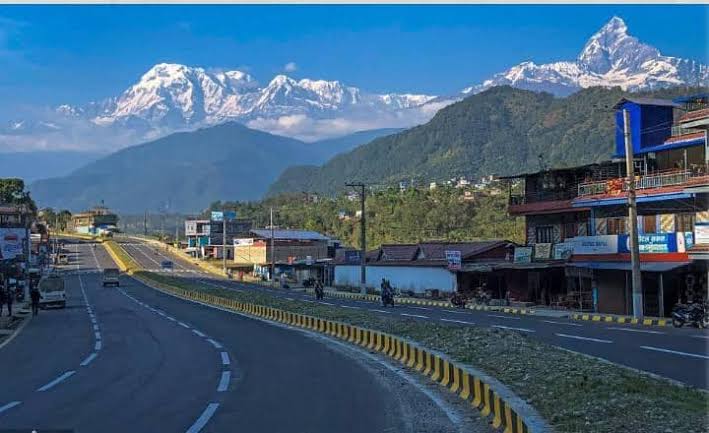
From Beni, the road heads east on the fully paved Baglung Highway through the Modi Khola river valley, past Baglung town and the rolling foothills of the Annapurna region. The road is wide, well-paved, and relatively fast. As you approach the Pokhara valley from the west, the Annapurna range and Machhapuchhre (Fishtail) appear ahead.

Arrive in Pokhara Lakeside – your driver will take you directly to your hotel.

Key Distances and Timing: Muktinath to Pokhara

StageFrom – ToDistanceDriving TimeAltitude Drop
1Muktinath → Kagbeni18 km45 min3,710m → 2,810m
2Kagbeni → Jomsom4 km15 min2,810m → 2,720m
3Jomsom → Marpha8 km20 min2,720m → 2,670m
4Marpha → Kalopani20 km40 min2,670m → 2,530m
5Kalopani → Ghasa10 km30 min2,530m → 2,010m
6Ghasa → Tatopani25 km1 hr2,010m → 1,190m
7Tatopani → Beni45 km1.5 hrs1,190m → 830m
8Beni → Pokhara62 km1.5 hrs830m → 820m
TOTALMuktinath → Pokhara192 km7.5–9 hrs3,710m → 820m

The total descent from Muktinath to Pokhara is approximately 2,890 meters – one of the most dramatic altitude drops on any single-day road journey in Nepal. You travel from the high-altitude Himalayan desert at 3,710 m to the subtropical Pokhara valley at 820 m in a single day.

Muktinath

Stage-by-Stage Guide: Pokhara to Kathmandu (Day 2)

After an overnight in Pokhara, most travellers continue to Kathmandu by vehicle the following day. Here is the Day 2 guide:

Distance: Approximately 200 km from Pokhara Lakeside to central Kathmandu

Travel Time: 6 to 7 hours, including the Mugling lunch stop

Best Departure: 7:00 to 8:00 AM from Pokhara to arrive in Kathmandu before evening traffic

Main Road: Pokhara – Prithvi Highway – Mugling – TTrishuli Gorge– Naubise – Kathmandu

Pokhara to Mugling (120 km | 2.5 hrs)

Head east from Pokhara on the Prithvi Highway through the Pokhara foothills, past Damauli and Dumre junction, and along the spectacular Marsyangdi River valley to Mugling junction. Mugling is the standard midpoint lunch stop on the Pokhara to Kathmandu route – numerous restaurants line the highway here serving dal bhat, noodles, and Nepali food. Take 30 to 45 minutes at Mugling.

Mugling to Naubise via Trishuli Gorge (85 km | 1.5 hrs)

From Mugling, the Prithvi Highway follows the beautiful Trishuli River east through a dramatic forested gorge. The river runs green and fast below the road – one of Nepal’s most scenic highway sections. Pass through Malekhu, a riverside town popular for its fresh river-fish restaurants and a good tea-stop option.

The road climbs out of the gorge into the Chandragiri hills, approaching Naubise.

Naubise to Kathmandu (30 km | 45 min – 1.5 hrs traffic dependent)

The final section from Naubise climbs over the Chandragiri foothills and descends into the Kathmandu Valley via Kalanki. This section varies enormously depending on traffic – 45 minutes in clear conditions or up to 1.5 hours in peak-hour Kathmandu traffic.

A 7:00 AM Pokhara departure means arriving at Naubise around 11:00 to 11:30 AM – usually before the worst of the Kathmandu afternoon traffic builds. Your driver will take you directly to your Thamel hotel or any other Kathmandu address.

  • 5:30–6:00 AM: Complete final morning prayers at Muktinath temple. Collect bags from the teahouse
  • 6:30 AM: Depart Ranipauwa by private jeep – critical early departure to beat the wind
  • 7:15 AM: Brief stop at Kagbeni – monastery visit, Shaligram stone search if desired
  • 8:00 AM: Reach Jomsom – breakfast stop 20–30 min
  • 8:30 AM: Continue south – Marpha apple orchards stop 20 min
  • 9:30 AM: Kalopani – photograph Dhaulagiri panorama
  • 10:30–11:00 AM: Ghasa – the wind begins – push south through the gorge
  • 12:00–1:00 PM: Arrive Tatopani – hot spring soak 45–60 min, lunch
  • 2:30 PM: Depart Tatopani south through the lower gorge to Beni
  • 4:00 PM: Beni – paved road begins, faster progress
  • 5:30–6:00 PM: Arrive Pokhara Lakeside – check in to hotel
  • Evening: Celebrate completing the Muktinath pilgrimage/trek on Lakeside
  • Day 1: Muktinath to Pokhara as per Plan A above
  • Day 1 evening/night: Pokhara Lakeside – rest, dinner, optional Lakeside walk
  • Day 2, 7:00 AM: Depart Pokhara for Kathmandu via Prithvi Highway
  • Day 2, 9:30 AM: Mugling lunch stop
  • Day 2, 12:30 PM: Through the Trishuli gorge section – Malekhu tea stop optional
  • Day 2, 2:00–3:00 PM: Naubise – final climb into Kathmandu Valley
  • Day 2, 3:00–4:30 PM: Arrive Kathmandu Thamel (traffic dependent)

Plan C: Overnight in Tatopani, Then Pokhara (3 Days Relaxed)

  • Day 1: Muktinath to Tatopani – arrive in the afternoon, soak in hot springs, overnight in Tatopani
  • Day 2: Tatopani to Pokhara via Beni – arrive midday, full afternoon Pokhara sightseeing
  • Day 3: Pokhara to Kathmandu or fly from Pokhara to Kathmandu

This relaxed 3-day plan is ideal for pilgrims and trekkers who want to fully savour the descent and recover from the high-altitude experience before jumping back into city life.

Muktinath temple

Jomsom to Pokhara by Flight – When It Makes Sense

While the private jeep is the recommended option for most travellers, the Jomsom to Pokhara flight does make sense in certain situations: travellers with very limited time who cannot afford a full day of driving.Solo travellers where splitting jeep costs is not possible, and the flight is cost-competitive. Travellers with injuries, illness, or physical difficulty that make a long, rough jeep ride difficult

  • Emergency return situations when speed is essential

Important Jomsom Flight Facts for 2026

Airlines: Tara Air and Summit Air (small turboprop aircraft)

Flight Duration: 25 minutes to Pokhara

Ticket Price: Approximately USD 130 to USD 160 per person

Departure: Early morning only – all flights depart between 6:00 and 10:30 AM

Cancellation Rate: Very high – Jomsom is one of Nepal’s most disrupted airports due to the afternoon wind and mountain weather

Luggage Limit: 15 kg per person (strict) – excess luggage charges apply

Booking: Booking strongly recommended – seats sell out during peak season

The most important thing to know about Jomsom flights: if you are booked on a morning Jomsom-to-Pokhara flight and it is cancelled due to weather (which happens very frequently), you will need a backup plan. Vehicle Hiring Nepal can arrange a same-day or next-day jeep hire from Jomsom if your flight is cancelled. Always save our WhatsApp number:WhatsApp.

Road Conditions: Muktinath to Pokhara

SectionSurfaceDifficulty4WD Required?Season Notes
Muktinath → KagbeniRocky switchback jeep trackHardYesAltitude, rocky, icy in winter
Kagbeni → JomsomGravel valley trackModerateYesSandy, wind-exposed
Jomsom → MarphaMixed trackModerateYesGood in the dry season
Marpha → GhasaRough Kali Gandaki gorge roadVery HardYesNarrow, rocky, cliff-edge drops
Ghasa → TatopaniRough Gorge RoadHardYesWaterfalls, narrow, rockfall risk
Tatopani → BeniImproving the gravel trackModerate–HardYesLower gorge, better surface
Beni → PokharaFully paved highwayEasyNoGood condition year-round

The section from Jomsom to Beni – particularly the gorge sections from Marpha through Ghasa and Tatopani – is the most challenging driving on the entire Muktinath to Pokhara route. A Toyota Land Cruiser or equivalent 4WD is the only appropriate vehicle for this entire journey. The Beni-to-Pokhara section of the paved highway is straightforward for any vehicle.

Key Stops on the Muktinath to Pokhara Return Journey

Kagbeni – Medieval Gateway Village (20–30 min stop)

The atmospheric medieval village of Kagbeni, at the confluence of the Kali Gandaki and Kak rivers, is one of the most historically interesting villages in Mustang. The ancient Kag Chode Thupten Samphel Ling monastery dates to the 15th century and contains important Buddhist art.

The narrow stone lanes, traditional flat-roofed houses, mani walls, and the view north into the restricted Upper Mustang all make Kagbeni a deeply rewarding brief stop. Many pilgrims collect Shaligram fossils from the Kali Gandaki riverbed near Kagbeni.

Marpha – Apple Village (20–30 min stop)

Marpha is the most beautiful village in the Mustang valley – a compact, pristine settlement of whitewashed stone houses with carved wooden windows, the cobbled main lane shaded by overhanging eaves, and the Samtenling Gompa perched on the hill above. Marpha is famous throughout Nepal for its apples – the orchards above the village were established with assistance from Swiss development cooperation in the 1960s.

Locally distilled apple brandy (known as Marpha raksi or apple raksi) is a regional speciality. Pick up a bottle for the journey south – it is excellent.

Kalopani – The Dhaulagiri Viewpoint (15 min stop)

Kalopani sits in the section of the Kali Gandaki where the gorge opens briefly, and the full scale of Dhaulagiri (8,167 m) and Nilgiri (7,061 m) becomes visible from the valley floor. The vertical distance from the riverbed to the summit of Dhaulagiri above Kalopani is over 5,600 m – one of the most dramatic mountain wall perspectives in the world. Stop here for photographs, even if you paused on the way up.

Tatopani – Hot Springs (45–90 min stop)

Tatopani’s natural hot springs are a must-stop on the return journey. The hot springs pool sits directly beside the Kali Gandaki River, fed by naturally hot geothermal water at approximately 40-45°C. After days at high altitude, the physical and psychological relief of immersing oneself in warm water, surrounded by gorge scenery, is extraordinary.

Most trekkers and pilgrims rate the Tatopani hot spring soak as a highlight of the entire Muktinath journey—entry fee: approximately NPR 150 to NPR 200. Towels and swimwear required.

Beni – Last Mountain Town (15 min fuel and refresh stop)

Beni marks the end of the rough mountain road and the beginning of the paved highway south. The town sits at the confluence of the Kali Gandaki and Myagdi rivers and is a good, brief stop for fuel, a cold drink, and a comfort break before the easier paved section to Pokhara.

Pokhara – Making the Most of Your Stopover

If doing the recommended 2-day Muktinath-to-Kathmandu journey, your overnight stop in Pokhara is not just a transit point – it is an opportunity to enjoy one of Nepal’s finest cities after your high-altitude pilgrimage or trek. Here is what to do in Pokhara on your overnight stopover:

Phewa Lake at Sunset

After arriving in Pokhara in the late afternoon, a walk along the shores of Phewa Lake at sunset is one of the city’s most restorative experiences. The reflection of Machhapuchhre and the Annapurna range in the still lake water at sunset – the mountains turning pink and gold against the darkening sky – is one of Nepal’s most beautiful scenes and a magnificent contrast to the stark Mustang desert you have just left.

Lakeside Dining

Lakeside Pokhara has some of Nepal’s finest restaurants, cafes, and bakeries. After days of teahouse food at altitude, a good Lakeside restaurant meal – whether Nepali, Indian, Italian, or Mexican – is deeply appreciated. The Lakeside strip has options for every budget and appetite.

Sarangkot Sunrise (Optional)

If you have time for a 5:00 AM start, the Sarangkot viewpoint above Pokhara offers a spectacular sunrise over the Annapurna range – a beautiful way to begin your Day 2 drive to Kathmandu. A taxi from Lakeside to Sarangkot takes 30-40 minutes. Return by 8:00 AM, have breakfast, then depart for Kathmandu.

Muktinath to Pokhara and Kathmandu by Jeep

Alternative Return Route: Via Lo Manthang and Jomsom (Upper Mustang)

For travellers who have visited Upper Mustang (Lo Manthang, Chhoser, Lo Gekar), the return journey to Pokhara follows the same route along the Kali Gandaki southward from Jomsom. The Upper Mustang Restricted Area Permit is required only for the zone north of Kagbeni – once you cross back through Kagbeni heading south, you are in standard Lower Mustang, and the normal route to Pokhara applies.

Vehicle Hiring Nepal can arrange combined Upper Mustang and return transport packages.

Tips for the Muktinath to Pokhara and Kathmandu Jeep Journey

  • Always depart Muktinath no later than 7:00 AM – this is the single most important piece of advice for this journey.
  • Book your return jeep at least 1 to 2 days before your planned departure while still at Muktinath or Jomsom – WhatsApp Vehicle Hiring Nepal at +977 981-4227196
  • Carry snacks and water for the full morning drive – the first reliable meal stop is Jomsom (30 min) or Marpha (1 hr from Muktinath)
  • Carry warm layers for the early morning departure from Muktinath – at 3,710 m, the pre-dawn air is very cold even in summer.
  • Motion sickness tablets are recommended for the gorge sections – the Marpha-Tatopani road has many sharp bends.
  • Bring a camera with a charged battery – the gorge scenery and mountain views on the descent are extraordinary.
  • If you want to bathe at Tatopani hot springs, carry a change of clothes and a towel in an accessible bag – not buried deep in your main pack
  • The Beni-to-Pokhara road is fast and paved – relax and enjoy the changing landscape as you descend into the Pokhara valley.
  • If you plan to fly Pokhara to Kathmandu on Day 2 instead of driving, confirm your Pokhara arrival time with your airline and book the flight before departing Muktinath

What is Included in Your Return Vehicle Hire

  • Private 4WD jeep (Toyota Land Cruiser or equivalent) with experienced Kali Gandaki and Mustang route driver
  • Full fuel cost for the complete Muktinath/Jomsom to Pokhara journey
  • Vehicle insurance for the full journey
  • Pickup from your teahouse or hotel in Ranipauwa (Muktinath) at your confirmed departure time
  • Drop-off at your chosen hotel or address in Pokhara Lakeside
  • Stops at Kagbeni, Jomsom, Marpha, Kalopani, Tatopani, and Beni at your discretion
  • Option to continue from Pokhara to Kathmandu on the same booking (Day 2 continuation)
  • 24/7 support before and during the journey

Not included: Tatopani hot spring entry fee (NPR 150–200), personal meals, accommodation in Pokhara (if overnight), and any additional detour stops beyond the agreed route.

How to Book Your Muktinath Return Jeep

  1. Contact Vehicle Hiring Nepal via WhatsApp or visit vehiclehiringnepal.com
  2. Confirm your planned departure date from Muktinath and your group size
  3. Specify your starting point – Ranipauwa (Muktinath) or Jomsom
  4. Specify your destination – Pokhara only, or Pokhara overnight and Kathmandu Day 2
  5. Confirm your departure time – we strongly recommend 6:30 to 7:00 AM
  6. Provide your teahouse or hotel name in Ranipauwa for pickup
  7. Book at least 24 to 48 hours before departure – message us from your Muktinath teahouse via WhatsApp
  8. Receive confirmation with your driver’s name and WhatsApp contact number

WhatsApp: +977 981-4227196
Email: [email protected]
Website: www.vehiclehiringnepal.com

Frequently Asked Questions

How long does the jeep ride from Muktinath to Pokhara take?

The journey from Muktinath (Ranipauwa) to Pokhara Lakeside takes approximately 7 to 9 hours by private jeep, including a breakfast stop in Jomsom, a brief stop in Marpha, and a recommended soak at the Tatopani hot springs. Departing from Muktinath at 6:30 AM, most travellers arrive in Pokhara between 2:00 and 4:00 PM.

Can I do Muktinath to Kathmandu in a single day by jeep?

Technically possible but not recommended. The total distance from Muktinath to Kathmandu via Pokhara is approximately 430 to 450 km, requiring 13 to 16 hours of continuous driving, including rough mountain sections. Very few drivers and travellers are willing to do this in one day.

The two-day option with an overnight in Pokhara is far superior in comfort, safety, and enjoyment.

What happens if the road is blocked by a landslide between Tatopani and Beni?

The Kali Gandaki gorge road between Tatopani and Beni is the most landslide-prone section of the entire route, particularly in and after the monsoon. Our drivers monitor road conditions before departure and maintain contact with local road crews.

In the event of a blockage, the driver will assess the situation – waiting for clearance (minor slides are often cleared within a few hours), or advising an overnight stay in Tatopani until the road reopens. We will keep you informed in real time via WhatsApp.

Is it possible to share a jeep from Jomsom to Pokhara with other travellers?

Local shared jeep services run from Jomsom to Beni when they fill up – typically 6 to 8 passengers. From Beni, local buses and shared vehicles continue to Pokhara. This option costs approximately NPR 1,500 to 2,000 per seat from Jomsom to Beni, and NPR 400 to 600 per seat from Beni to Pokhara.

The disadvantage is unpredictable departure times (shared jeeps wait until full), no flexibility for stops, and basic comfort. For most travellers, especially those who have just completed a pilgrimage or trek, the comfort and reliability of a private vehicle is worth the additional cost.

Can I fly from Pokhara to Kathmandu instead of driving on Day 2?

Yes. The Pokhara-to-Kathmandu domestic flight takes 25 minutes and runs multiple times daily with Yeti Airlines, Buddha Air, and other carriers. The ticket price is approximately USD 80-110 per person.

If you fly from Pokhara, Vehicle Hiring Nepal can arrange a transfer from your Lakeside hotel in Pokhara to Pokhara Airport on the morning of your departure flight.

What should I do if my Jomsom flight is cancelled?

If your Jomsom-to-Pokhara flight is cancelled due to weather – which happens very frequently – contact Vehicle Hiring Nepal immediately via WhatsApp. We can typically arrange a private jeep from Jomsom to Pokhara with a few hours’ notice, subject to driver availability. That is why we always recommend saving our contact in your phone before you arrive in Mustang.

Final Thoughts

The return journey from Muktinath to Pokhara and Kathmandu by private jeep is the final chapter of one of Nepal’s most extraordinary travel experiences. Descending from the sacred high-altitude plateau of Muktinath through the world’s deepest gorge, past soaring Himalayan peaks, through dense rhododendron forest, and into the warm riverside town of Tatopani for a hot spring soak – it is a journey that perfectly complements the spiritual intensity of the Muktinath pilgrimage with the raw, magnificent beauty of the Kali Gandaki valley.

Vehicle Hiring Nepal provides the most reliable and experienced jeep service on the Muktinath-to-Pokhara-and-Kathmandu return route. Our drivers know every bend of the Kali Gandaki road, every timing consideration around the afternoon wind, and every stop worth making on the way down. Book your return jeep with us before you head up to Muktinath, so your return journey is arranged and worry-free from the start.

Book your return jeep from Muktinath to Pokhara or Kathmandu today. WhatsApp: +977 981-4227196 | Website: www.vehiclehiringnepal.com

Altitude and Health: Essential Muktinath Advice

Muktinath altitude sickness

Muktinath altitude sickness: Essential Muktinath Advice

Muktinath — the sacred Vishnu temple perched at 3,710 meters (12,172 feet) in the high-altitude desert landscape of the upper Mustang valley — draws hundreds of thousands of pilgrims and trekkers from Nepal, India, and across the world each year. For most visitors, the journey to Muktinath represents a deeply meaningful spiritual experience: reaching one of the most sacred sites in Hindu and Buddhist tradition, at the foot of the Thorong La Pass in the shadow of the Annapurna and Dhaulagiri massifs.

But at 3,710 meters, Muktinath sits well into the altitude zone where Acute Mountain Sickness (AMS) becomes a real health risk—one that affects fit athletes and sedentary pilgrims alike, regardless of age, experience, or physical condition. Every year, visitors to Muktinath experience altitude-related illness ranging from uncomfortable headaches to serious medical emergencies requiring helicopter evacuation.

This essential altitude and health guide covers everything you need to know to reach Muktinath safely and comfortably: understanding altitude and its effects on the body, recognising AMS symptoms, the best acclimatisation strategies, medications, special considerations for elderly pilgrims and other vulnerable groups, emergency contacts, and how Nepal Vehicle Hiring Pvt Ltd’s transport services can support safe and gradual ascent to this sacred high-altitude destination.

Muktinath Altitude — Understanding the Numbers

Muktinath Temple (formerly known as Muktikshetra) sits at approximately 3,710 meters (12,172 feet) above sea level in Mustang District, Gandaki Province, Nepal. The temple complex is situated on a high plateau above the Kali Gandaki gorge — the world’s deepest gorge — and is accessible by jeep road from Jomsom (2,720 m) or on foot via multiple trekking routes.

How Altitude Affects the Body

As altitude increases, atmospheric pressure decreases, and with it the partial pressure of oxygen in each breath. At 3,710 meters, the air contains approximately 60% of the oxygen available at sea level. While this reduction is not immediately dangerous for most people, it means every breath delivers significantly less oxygen to the bloodstream—and the body must work harder to supply its organs and muscles with adequate oxygen.

The body’s primary adaptation response to altitude is hyperventilation — breathing faster and deeper to compensate for reduced oxygen per breath. This is normal and healthy. However, when the body’s adaptation cannot keep pace with the rate of altitude gain, Acute Mountain Sickness (AMS) develops.

  • Sea level (0 m): 100% oxygen availability — baseline reference
  • Pokhara (827 m): 91% of sea-level oxygen — no significant effect
  • Jomsom (2,720 m): 73% of sea-level oxygen — mild effects begin for some
  • Muktinath (3,710 m): 61% of sea-level oxygen — AMS risk begins
  • Thorong La Pass (5,416 m): ~50% of sea-level oxygen — serious AMS risk

Key Fact: Fitness does NOT protect against altitude sickness. Extremely fit athletes can get AMS just as easily as sedentary individuals. Altitude sickness depends mainly on your rate of ascent and your individual physiological response to reduced oxygen, not on your physical fitness.

Altitude Zones on the Muktinath Route

Altitude ZoneRangeAMS RiskKey Locations on Muktinath Route
Low AltitudeBelow 1,500 mNonePokhara (827 m), Beni (830 m), Tatopani (1,190 m)
Moderate Altitude1,500–2,500 mLowGhasa (2,010 m), Marpha (2,670 m)
High Altitude2,500–3,500 mModerate — AMS possibleJomsom (2,720 m), Kagbeni (2,810 m)
Very High Altitude3,500–5,500 mHigh — AMS likely without acclimatisationMuktinath (3,710 m), Thorong La (5,416 m)
Extreme AltitudeAbove 5,500 mSevere — HACE/HAPE riskAbove Thorong La Pass

The key insight from this table is the dramatic altitude jump involved in many common Muktinath approach routes. Flying from Kathmandu (1,400 m) to Jomsom (2,720 m) and then driving to Muktinath (3,710 m) on the same day represents a gain of approximately 2,310 meters in under 24 hours — a rate of ascent that is highly likely to cause AMS in a significant proportion of visitors.

Understanding Acute Mountain Sickness (AMS)

Acute Mountain Sickness (AMS) is the body’s response to insufficient oxygen at altitude. It is not a sign of weakness or poor fitness—it is a physiological reaction that can affect anyone who ascends too quickly to altitudes above approximately 2,500 meters. At Muktinath’s altitude of 3,710 meters, AMS is a genuine and significant risk for visitors who ascend too rapidly.

AMS Symptoms — Recognising the Warning Signs

AMS StageSymptomsAction Required
Mild AMSHeadache, fatigue, loss of appetite, mild nausea, difficulty sleepingRest at current altitude — do NOT ascend further until symptoms resolve
Moderate AMSSevere headache not relieved by ibuprofen, vomiting, extreme fatigue, dizziness, and loss of coordination. of coordinationDESCEND immediately 300–500 m — do not wait overnight
Severe AMS / HACEConfusion, inability to walk straight, extreme fatigue, loss of consciousnessEMERGENCY — Descend immediately, administer oxygen, seek evacuation
HAPE (Pulmonary)Persistent dry cough, breathlessness at rest, pink/frothy sputum, crackling in the chestLIFE-THREATENING EMERGENCY — Evacuate immediately, administer oxygen

THE GOLDEN RULE OF ALTITUDE: If symptoms are getting WORSE with higher elevation — DESCEND IMMEDIATELY. Do not ‘wait it out.’ Do not ‘push through.’ Descending by even 300–500 meters is often sufficient to resolve mild-to-moderate AMS within hours. Delaying descent when symptoms are worsening is the primary cause of altitude-related deaths.

The Lake Louise Score — AMS Self-Assessment

The Lake Louise Score is a widely used self-assessment tool for AMS severity. At altitude, ask yourself these questions and rate each from 0 (none) to 3 (severe):

  • Headache: 0 = none, 1 = mild, 2 = moderate, 3 = severe and incapacitating
  • Gastrointestinal (nausea/vomiting): 0 = none, 1 = poor appetite/nausea, 2 = moderate nausea/vomiting, 3 = severe
  • Fatigue/weakness: 0 = none, 1 = mild, 2 = moderate, 3 = severe/incapacitating
  • Dizziness/lightheadedness: 0 = none, 1 = mild, 2 = moderate, 3 = severe/incapacitating
  • Difficulty sleeping: 0 = slept as well as usual, 1 = did not sleep as well as usual, 2 = woke many times, 3 = could not sleep at all

A total score of 3 or more in someone who has recently ascended to altitude, with headache as one of the symptoms, indicates AMS. A score of 6 or more indicates moderate-to-severe AMS that requires immediate action.

How to Approach Muktinath Safely — Acclimatisation Strategies

Approach RouteStarting AltitudeMuktinath AltitudeAltitude GainAcclimatization QualityAMS Risk
Fly Kathmandu → Jomsom, walk to Muktinath1,400 m (KTM)3,710 m2,310 m in 1 dayPoor — too fastHIGH
Drive KTM → Pokhara → Jomsom by jeep, walk to Muktinath827 m (Pokhara)3,710 m2,883 m in 1–2 daysPoor — too fastHIGH
Trek Jomsom to Muktinath after 1 night in Jomsom2,720 m (Jomsom)3,710 m990 mModerate — short acclimatisationMODERATE
Trek Pokhara → Tatopani → Jomsom → Muktinath (3–4 days)827 m3,710 m2,883 m over 3–4 daysGood — gradualLOW–MODERATE
Full Annapurna Circuit from Besisahar (10+ days)760 m3,710 m2,950 m over 10+ daysExcellent — fully graduatedLOW

Muktinath altitude sickness

The ‘Climb High, Sleep Low’ Principle

The single most effective acclimatisation strategy is the ‘climb high, sleep low’ principle: ascend higher during the day for activity, but always return to a lower altitude to sleep. This is because the body acclimatises primarily during sleep. By sleeping at a lower altitude than the day’s highest point, you give your body more time to adjust at a more manageable oxygen level.

For Muktinath visitors, this might mean spending the day visiting the Muktinath temple at 3,710 m and then descending to Jomsom (2,720 m) to sleep, reducing sleeping altitude by nearly 1,000 meters. This is one of the most commonly recommended strategies for first-time Muktinath pilgrims.

The 300–500 Meter Rule

Above 3,000 meters, the standard altitude medicine guideline is to increase sleeping altitude by no more than 300- 500 meters per day. With Jomsom at 2,720 m and Muktinath at 3,710 m (a gain of 990 meters), the conservative approach is to spend a minimum of 2 nights in the Jomsom area before sleeping at Muktinath altitude — or to ascend to Muktinath during the day and return to Jomsom to sleep on the first night.

  • Day 1: Arrive in Pokhara (827 m) or Jomsom (2,720 m) — rest, hydrate, light activity only
  • Day 2 (if arriving in Pokhara): Drive or fly to Jomsom (2,720 m) — rest, walk at Jomsom level, sleep at Jomsom.
  • Day 3: Depart Jomsom for Muktinath (3,710 m) — arrive mid-morning, visit the  temple, rest, explore slowly
  • Option A: Sleep at Muktinath (3,710 m) — only after 1 night at Jomsom for acclimatisation
  • Option B (Safer for sensitive individuals): Return to Jomsom (2,720 m) to sleep on the first night — visit Muktinath again on Day 4 if desired
  • Day 4 (if applicable): Return journey to Pokhara or Kathmandu

Nepal Vehicle Hiring Pvt Ltd strongly recommends the 2-day approach: Pokhara to Jomsom on Day 1, Jomsom to Muktinath on Day 2. This simple strategy dramatically reduces AMS risk compared to a single-day drive from Pokhara to Muktinath.

Prevention — How to Avoid Altitude Sickness at Muktinath

Prevention StrategyEffectivenessHow to Apply at Muktinath
Gradual ascent (max 300–500 m / day above 3,000 m)Very HighDo not fly directly to Jomsom and go to Muktinath the same day
Hydration (3–4 liters/day)HighDrink consistently throughout the journey — do not wait until thirsty
Avoid alcohol above 2,500 mHighSkip alcohol in Jomsom and Muktinath — dehydrates and worsens AMS
Rest day acclimatisationVery HighSpend 1 night in Jomsom (2,720 m) before ascending to Muktinath (3,710 m)
Light physical activity on ascent daysModerateWalk slowly — ‘climb high, sleep low’ principle
Diamox (Acetazolamide) medicationHigh (preventive)125–250 mg twice daily starting 24 hrs before ascent — consult doctor
Avoid sedatives and sleeping pillsHighThese suppress breathing at altitude — avoid entirely above 3,000 m
Eat regular mealsModerateMaintain nutrition even if appetite is reduced — carbohydrates are best
Acclimatisation walk on rest dayHighWalk 200–300 m above sleeping altitude during rest day

Hydration — The Most Accessible Prevention Tool

Dehydration dramatically worsens altitude sickness symptoms. At altitude, the body loses water faster through increased breathing and drier air. Most people visiting Muktinath significantly underestimate how much water they need.

The guideline is 3 to 4 litres per day at altitude—roughly double what most people drink at sea level. Drink consistently throughout the day, not in large quantities all at once. Electrolyte supplements can help maintain sodium and potassium balance lost through increased urination.

Diet at Altitude

High-carbohydrate foods convert more efficiently to energy at altitude than fats or proteins, because carbohydrate metabolism requires less oxygen per calorie. Traditional Nepali high-carbohydrate foods—dal bhat (lentils and rice), tsampa (roasted barley flour), bread, and potatoes—are well suited for eating at altitude.

Avoid large, heavy meals at altitude as they divert blood circulation to the digestive system. Eat smaller, more frequent meals. Even if appetite is reduced (a common AMS symptom), maintain regular caloric intake.

What to Avoid at Altitude

  • Alcohol: Dehydrates, suppresses breathing during sleep, and worsens AMS symptoms — avoid above 2,500 m and especially at Muktinath and Jomsom
  • Sleeping pills and sedatives: Suppress the respiratory drive that maintains oxygenation during sleep — avoid entirely at altitude
  • Smoking: Reduces oxygen-carrying capacity of blood — significantly worsens altitude tolerance
  • Over-exertion: Heavy exercise at altitude increases oxygen demand beyond what acclimatised individuals can supply — walk slowly, rest frequently
  • Ignoring early symptoms: The most dangerous AMS mistake is dismissing early symptoms as ‘just tiredness’ and continuing to ascend.

Muktinath altitude sickness

Medications for Altitude — Complete Guide

MedicationPurposeDosage (typical)Notes
Diamox (Acetazolamide)Prevention and treatment of AMS125–250 mg twice dailyStart 24 hrs before ascent; consult doctor first; avoid if sulfa allergy
Ibuprofen (400–600 mg)AMS headache reliefEvery 6–8 hours as neededDo NOT mask symptoms to push higher — treat and rest
Paracetamol / PanadolMild headache relief500–1,000 mg every 4–6 hoursGentler alternative to ibuprofen for headache
Dexamethasone (4 mg)Emergency treatment of severe AMS/HACE4 mg every 6 hours (emergency only)NOT for prevention; emergency use only; requires medical guidance
Nifedipine (30 mg)Emergency treatment of HAPE30 mg slow-release (emergency only)For high-altitude pulmonary oedema only; requires medical guidance
Ondansetron / Anti-nauseaNausea and vomiting from AMSAs directed on the packagingHelps manage nausea while descending

Diamox (Acetazolamide) — The Most Important AMS Medication

Diamox (Acetazolamide) is the only medication with strong scientific evidence for both preventing and treating AMS. It works by stimulating faster breathing (by acidifying the blood), thereby increasing blood oxygen levels and accelerating the body’s natural acclimatisation process. It is available by prescription in most countries and over the counter at pharmacies in Kathmandu and Pokhara.

  • Standard preventive dose: 125 mg twice daily (morning and evening), starting 24 hours before significant altitude gain
  • Treatment dose for AMS: 250 mg twice daily
  • Side effects: Increased urination (expected and harmless), tingling in hands and feet (common and harmless), carbonated drinks taste flat
  • Contraindications: Sulfa allergy (Diamox is a sulfa drug — do NOT take if allergic to sulfa), kidney disease, pregnancy
  • Where to obtain in Nepal: Kathmandu pharmacies (Thamel area), Pokhara pharmacies, Jomsom health post

Diamox is a prescription medication in many countries. Consult your doctor or a travel medicine clinic before your Muktinath trip to see whether Diamox is appropriate for you, get the right dosage for your situation, and screen for contraindications. The CIWEC Clinic in Kathmandu offers altitude medicine consultations.

Ibuprofen for AMS Headache

Ibuprofen (400–600 mg) relieves AMS headaches, and clinical evidence supports it as a useful adjunct. However, it is critical to understand that taking ibuprofen to relieve an AMS headache does NOT mean you can continue ascending—it only manages the symptom while your body acclimatises.

If headache returns after the medication wears off, or if other AMS symptoms are present, the correct action is to rest at the current altitude or descend, not take another dose and push higher.

Special Health Considerations for Muktinath Visitors

GroupSpecial ConsiderationsRecommendations
Children (under 12)Higher AMS risk; may not communicate symptoms clearlyExtra caution; slow ascent; descend at first symptom; paediatrician consult pre-trip
Elderly pilgrims (60+)Pre-existing cardiac or respiratory conditions increase riskMedical clearance before trip; travel with a companion; keep itinerary flexible
Pregnant womenAltitude affects fetal oxygen supply; limited medication optionsMedical advice strongly recommended — many doctors advise against above 2,500 m
Heart condition historyReduced cardiac efficiency at altitude accelerates AMSCardiologist clearance is mandatory before high-altitude travel
Previous AMS historyPast AMS significantly increases future riskUse Diamox preventively (with doctor); ascend more slowly; be extra vigilant.
Visiting from India (sea level)Particularly susceptible to sudden altitude gain from near sea levelVery gradual ascent essential; Diamox strongly recommended; do NOT fly to Jomsom same-day as Muktinath
Asthma and respiratory conditionsCold, dry Muktinath air can trigger attacksCarry a reliever inhaler; inform travel companions; monitor breathing closely.

Advice for Elderly Pilgrims

Muktinath is one of Nepal’s most important Hindu pilgrimage destinations and draws large numbers of elderly devotees—particularly from India—who may not have prior experience with high-altitude travel. Elderly visitors with pre-existing cardiac or respiratory conditions face a higher risk of serious altitude illness. Key recommendations for elderly pilgrims include:

  • Obtain medical clearance from your cardiologist or physician before travelling to Muktinath, specifically at an altitude of 3,710 m.
  • Always travel with a younger family member or companion who can recognise AMS symptoms and assist in an emergency descent.
  • Plan a minimum 2-day approach: Pokhara or Jomsom on Day 1, Muktinath on Day 2 — never fly from sea level (India) directly to Jomsom and proceed to Muktinath the same day.
  • Discuss Diamox with your doctor well before travel — many elderly pilgrims benefit significantly from preventive Diamox.
  • Keep the visit to Muktinath as low-activity as possible — avoid rushing between temple sections, sit and rest frequently.
  • Know the emergency descent route: A jeep ride from Muktinath to Jomsom takes approximately 1.5 to 2 hours — helicopter evacuation to Pokhara is available from the Jomsom airstrip.

Advice for Indian Pilgrims Visiting from Sea-Level Cities

A very large proportion of Muktinath pilgrims travel from sea-level or near-sea-level cities in India — Mumbai, Chennai, Kolkata, Hyderabad, and many others. These pilgrims are at particularly high risk of AMS because the altitude difference between their home city and Muktinath (3,710 m) is nearly the maximum that can be safely managed.

For this group, the most common dangerous mistake is flying from India to Kathmandu, continuing to Pokhara, and then immediately driving or flying to Jomsom and proceeding to Muktinath — all within 24 to 36 hours. This approach regularly results in AMS emergencies.

The recommended approach for Indian pilgrims arriving from sea level:

  • Day 1: Arrive in Kathmandu (1,400 m) — rest, light sightseeing only, do NOT proceed to Pokhara the same day
  • Day 2: Kathmandu to Pokhara (827 m) — rest, acclimatise at Pokhara level
  • Day 3: Pokhara to Jomsom (2,720 m) by jeep or flight — rest in Jomsom, short walk only
  • Day 4: Jomsom to Muktinath (3,710 m) — visit temple, worship, consider returning to Jomsom for the first night
  • Day 5: If sleeping in Muktinath on Day 4 was comfortable, spend the day there. Begin descent.

For pilgrims from Indian sea-level cities: Do NOT attempt to reach Muktinath within 48 hours of leaving India. The altitude difference is too large for safe rapid ascent. Nepal Vehicle Hiring Pvt Ltd advises all Indian pilgrims to discuss this itinerary with their doctor and plan a minimum of 3 to 4 days to reach Muktinath from sea level.

Kathmandu to Muktinath Bus

How Transport Choices Affect Altitude Safety

One of the most important yet underappreciated aspects of Muktinath altitude safety is that transport choices directly determine acclimatisation quality. The vehicle or flight you choose to reach Muktinath fundamentally affects how quickly your body gains altitude — and therefore how high your AMS risk is.

Vehicle ApproachCommon Altitude EndpointsAMS RiskNepal Vehicle Hiring Service
Pokhara → Jomsom by jeep (1 day)Jomsom: 2,720 mModerate — sleep at Jomsom firstKathmandu/Pokhara to Jomsom jeep hire
Pokhara → Muktinath by jeep (1 day)Muktinath: 3,710 mHIGH — too fast for acclimatisation2-day recommended: Jomsom overnight first
Jomsom → Muktinath by jeep (next day)Muktinath: 3,710 mLower — after Jomsom acclimatisationJomsom to Muktinath short jeep service
Kathmandu → Pokhara → Jomsom (2 days)Jomsom: 2,720 m (Day 2)Low–Moderate — gradual approachMulti-day jeep package with overnight

Why Nepal Vehicle Hiring Pvt Ltd Recommends a 2-Day Approach

Nepal Vehicle Hiring Pvt Ltd’s standard recommendation for all clients travelling from Pokhara or Kathmandu to Muktinath is the 2-day approach: Day 1, drive from Pokhara to Jomsom, overnight in Jomsom at 2,720 m; Day 2, drive from Jomsom to Muktinath (3,710 m). This approach adds one day of vehicle hire but dramatically reduces AMS risk and helps ensure pilgrims arrive at Nepal’s most sacred high-altitude temple in good health, rather than suffering from altitude illness.

  • Day 1: Pokhara (827 m) → Jomsom (2,720 m) — altitude gain of 1,893 m (manageable in one day for most people)
  • Night 1: Sleep in Jomsom at 2,720 m — body begins acclimatising
  • Day 2: Jomsom (2,720 m) → Muktinath (3,710 m) — altitude gain of 990 m (safe with one night of Jomsom acclimatisation)

Nepal Vehicle Hiring Pvt Ltd provides private jeep hire for both legs of this route — Pokhara to Jomsom and Jomsom to Muktinath — with experienced drivers familiar with both the Kali Gandaki highway and the Jomsom-Muktinath road.

The Danger of Same-Day Muktinath Visits

The increasing availability of direct jeep services from Pokhara to Muktinath in a single day has, unfortunately, also increased the number of AMS cases at Muktinath. A single-day drive from Pokhara (827 m) to Muktinath (3,710 m) is a gain of 2,883 meters — well above the recommended safe altitude gain for any single day.

While some physically robust individuals complete this without problems, a significant proportion of visitors — particularly the elderly, children, those from sea-level origins, and anyone with underlying health conditions — experience AMS symptoms at Muktinath after a same-day drive.

Nepal Vehicle Hiring Pvt Ltd’s Health Pledge: We always inform clients about the altitude risks of same-day Pokhara-to-Muktinath transfers and recommend the 2-day approach. We can arrange flexible itineraries that include an overnight stay in Jomsom at no extra service charge — only the additional accommodation cost.

Emergency Contacts and Medical Resources

Emergency ResourceLocationContact / Notes
Muktinath Health PostMuktinath villageBasic medical care; limited resources; helps coordinate evacuation.
Jomsom Hospital / Health PostJomsom (2,720 m)Nearest hospital to Muktinath, better equipped; 2 hours’ descent
Pokhara Airport HospitalsPokhara (827 m)Full hospital facilities, Western Regional Hospital, and private hospitals
Helicopter EvacuationArranged from Jomsom or MuktinathAvailable year-round (weather permitting); costs USD 3,000–5,000+ without insurance.
Travel Insurance Emergency LineYour insurance providerCall your insurer’s 24-hr emergency line — essential for helicopter evacuation authorisation.
CIWEC Clinic KathmanduKathmandu (for pre-trip advice)Leading altitude medicine clinic in Nepal — pre-trip consultation available
Muktinath Darshan TrustTemple complex officeCan assist pilgrims in emergencies and coordinate with the local health post

Muktinath altitude sickness

Travel Insurance — The Essential Muktinath Purchase

Travel insurance covering high-altitude helicopter evacuation is not optional for Muktinath visitors — it is essential. Helicopter evacuation from Muktinath or Jomsom to Pokhara costs between USD 3,000 and USD 5,000 or more, depending on conditions. Without insurance, this cost falls entirely on the patient’s family at an extremely stressful moment.

Nepal has limited provision for uninsured emergency medical care.

When purchasing travel insurance for a Muktinath trip, verify that the policy explicitly covers:

  • Helicopter evacuation from altitude (specify 3,710 m / 12,172 ft minimum)
  • Emergency medical treatment in Nepal
  • Medical repatriation to your home country if necessary
  • Pre-existing conditions, if applicable — some policies exclude altitude-related illness if pre-existing cardiac or respiratory conditions are present.

Major travel insurers with strong coverage in Nepal include World Nomads, AXA Travel Insurance, and Allianz Travel. Indian pilgrims should note that many standard travel insurance policies from Indian providers do not cover helicopter evacuation above 3,000 m — check this specifically before purchasing.

Recognising and Responding to AMS at Muktinath

If You or a Travel Companion Develops AMS Symptoms

  • STOP ascending — do not proceed to higher altitude while symptoms are present
  • REST at current altitude — mild AMS often resolves with 12 to 24 hours of rest at the same altitude
  • HYDRATE — drink 3 to 4 litres of water or oral rehydration solution
  • Take ibuprofen (400–600 mg) for headache — note: this treats the symptom, not the cause
  • If already taking Diamox, continue the dose; if not started, consider starting now
  • Monitor closely — reassess every 2 hours. If symptoms improve, continue resting at the same altitude. If symptoms worsen, descend immediately.
  • DESCEND if: headache is not relieved by ibuprofen, vomiting begins, balance is affected, confusion develops, or any HAPE symptoms appear

The Descent Protocol

The most important thing to know about AMS treatment is this: descent is the only reliable cure. Every other treatment — Diamox, oxygen, rest, ibuprofen — is a supportive measure to manage symptoms or buy time. Descent is the definitive treatment.

  • Even 300 to 500 meters of descent often provides rapid, dramatic relief from AMS symptoms.
  • Muktinath (3,710 m) to Kagbeni (2,810 m): ~900 m descent — approximately 1 hour by jeep
  • Muktinath (3,710 m) to Jomsom (2,720 m): ~990 m descent — approximately 1.5 to 2 hours by jeep
  • Jomsom to Pokhara (827 m): Full evacuation — available by vehicle (6–7 hours), flight (25 min), or helicopter (20 min)

Never leave an AMS patient alone. Never let a person with moderate or severe AMS sleep at high altitude, hoping to ‘feel better in the morning.’ Descend immediately when moderate AMS is identified. Nepal Vehicle Hiring Pvt Ltd drivers are briefed on AMS symptoms and emergency descent procedures — they will assist immediately if a client shows concerning symptoms.

What to Pack — Health Essentials for Muktinath

  • Diamox (Acetazolamide) tablets — prescribed and discussed with your doctor in advance
  • Ibuprofen (400 mg tablets) — for AMS headache management
  • Oral rehydration salts (ORS) sachets — for maintaining electrolyte balance
  • Anti-nausea medication (ondansetron or promethazine) — for AMS-related nausea
  • Paracetamol / Panadol — gentle headache relief alternative to ibuprofen
  • Pulse oximeter (optional but recommended) — a clip-on device measuring blood oxygen (SpO2) and pulse rate; below 80% SpO2 at altitude is concerning
  • Warm clothing, including a down jacket, thermal base layers, a hat, and gloves — Muktinath is cold year-round, especially at night and early morning
  • High-SPF sunscreen (50+) and UV-protective sunglasses — high-altitude UV intensity is severe
  • Lip balm with SPF — lips crack severely in the dry, cold, high-altitude air
  • Water bottle (1–2 litres) and water purification tablets — drink consistently throughout the day
  • Snacks and energy food — high-carbohydrate snacks for the jeep journey and temple visit
  • Personal prescription medications — carry in hand luggage, NOT in vehicle luggage
  • Copy of travel insurance policy with emergency number — accessible at all times

Muktinath Altitude Health — Seasonal Considerations

October to December (Post-Monsoon / Autumn)

This is the best season to visit Muktinath, with clear weather and good road conditions. The air is dry, the skies are clear, and the views of Dhaulagiri, Annapurna, and Nilgiri are spectacular from the temple.

However, October and November are peak pilgrimage seasons, and the higher altitude gain rates among many visitors during this busy period mean AMS cases are more common than in quieter months. Take your time regardless of crowd pressure.

January to February (Winter)

Muktinath is accessible by jeep year-round in normal years, though nights at the temple in January and February can be extremely cold — temperatures can drop to -15°C or below. Cold temperatures don’t directly increase AMS risk, but they do increase the body’s overall physiological stress at altitude. Dress in heavy warm layers and ensure your accommodation has functioning heating.

March to May (Spring)

Spring is the second peak season, with rhododendron forests in bloom on the lower approach routes and generally good visibility. March and April see large numbers of pilgrims from India visiting for Ram Navami and other Ram festivals — acclimatisation advice is especially important given the a-level visitors arriving during this period.

June to September (Monsoon)

The Muktinath area falls in the rain shadow of the Annapurna range and actually receives relatively little monsoon rainfall compared to the wetter regions of Nepal. Trekking and driving to Muktinath is possible during the monsoon with reasonable road conditions. However, flooding and landslides can affect the approach roads through the Kali Gandaki.

Weather visibility is more variable, but the lush landscape of the lower valleys in the monsoon is beautiful. AMS risk is the same year-round — altitude does not change with the seasons.

Muktinath altitude sickness

Nepal Vehicle Hiring Pvt Ltd — Safe Altitude Transport

Nepal Vehicle Hiring Pvt Ltd is not just a vehicle hire company — we are partners in ensuring your Muktinath journey is safe, comfortable, and altitude-aware. Here is how our services directly support your altitude health:

  • 2-Day Itinerary Recommendation: We always recommend and offer 2-day Pokhara-to-Muktinath itineraries with an overnight stop in Jomsom—the single most effective altitude safety strategy for jeep travellers
  • Altitude-Briefed Drivers: All Nepal Vehicle Hiring Pvt Ltd drivers serving the Jomsom-Muktinath corridor are briefed on AMS symptoms and know the emergency descent route and evacuation procedures.
  • Flexible Scheduling: We build our Muktinath jeep itineraries with altitude-conscious pacing — adequate rest stops, early morning departures from Jomsom to arrive at Muktinath with maximum daylight, and no rushed schedules.
  • Emergency Response: If a client develops AMS symptoms at Muktinath, our driver will assist with an immediate descent to Jomsom and contact our Pokhara office to coordinate further emergency assistance, including liaison with travel insurance.
  • Vehicle for Descent: Having your own private jeep at Muktinath means emergency descent is available immediately — you do not need to wait for shared transport or taxis, as you would with public buses.
  • Pre-Trip Health Advice: When clients book Muktinath transfers with Nepal Vehicle Hiring Pvt Ltd, we provide this altitude health information and recommend consulting a doctor for a Diamox prescription before the journey.
  • Pokhara–Jomsom–Muktinath Full Package: We provide complete vehicle hire for the entire route from Pokhara to Jomsom (Day 1) and from Jomsom to Muktinath (Day 2), plus return transfers — one booking covers your entire safe ascent and descent.

Frequently Asked Questions — Altitude Health at Muktinath

Is Muktinath safe to visit without acclimatisation?

Muktinath at 3,710 m is safe for most healthy adults if you acclimatise gradually—specifically by spending at least one night in Jomsom (2,720 m) before ascending to Muktinath. Visiting Muktinath without acclimatisation—particularly after flying from sea level and driving directly there the same day—carries a high risk of AMS and is not recommended.

Can older adults visit Muktinath safely?

Yes, many elderly pilgrims visit Muktinath safely every year. Key requirements include medical clearance from a doctor before travel, 2-day gradual travel with a companion, Diamox under a doctor’s guidance, and flexible plans that allow descent if symptoms appear. Nepal Vehicle Hiring Pvt Ltd provides comfortable private jeep hire specifically suited to elderly pilgrim groups.

Should I take Diamox for Muktinath?

Diamox is strongly recommended for: first-time high-altitude visitors, elderly pilgrims, visitors from sea-level cities in India, anyone with a history of AMS, and anyone who cannot do a gradual acclimatisation approach. Consult your doctor before travel for a prescription and guidance on proper dosage. Diamox is widely available at pharmacies in Kathmandu and Pokhara.

What is the altitude of Muktinath?

Muktinath Temple sits at about 3,710 meters (12,172 feet) above sea level. This is well into the high-altitude zone where AMS becomes a significant risk without proper acclimatisation.

How do I get from Muktinath to a hospital in an emergency?

The nearest health post is at Muktinath village itself — basic facilities only. The nearest hospital with better facilities is in Jomsom (2,720 m), approximately 1.5 to 2 hours by jeep from Muktinath. Pokhara (827 m) has full hospital facilities, about 6 to 7 hours by jeep from Jomsom or 25 minutes by flight.

Helicopter evacuation from Jomsom or Muktinath to Pokhara takes approximately 20 minutes and requires travel insurance or upfront payment of USD 3,000–5,000.

What blood oxygen level should I be concerned about at Muktinath?

At 3,710 m, blood oxygen saturation (SpO2) of 80–85% is typical and generally not concerning for healthy acclimatised individuals. SpO2 below 75–80% combined with AMS symptoms warrants serious attention. SpO2 below 70% at altitude is concerning regardless of symptoms.

A pulse oximeter (small clip-on device available at most pharmacies in Kathmandu and Pokhara) is a useful tool for self-monitoring at altitude.

Is Muktinath accessible year-round?

Yes. Muktinath is accessible by jeep year-round in normal conditions. The Jomsom to Muktinath road is open year-round, with occasional temporary closures following heavy snowfall in January and February.

The Pokhara-Jomsom road via the Kali Gandaki is also generally open year-round. Nepal Vehicle Hiring Pvt Ltd monitors road conditions on this route year-round.

What’s the difference between AMS, HACE, and HAPE?

AMS (Acute Mountain Sickness) is the common, manageable form — headache, nausea, fatigue. HACE (High Altitude Cerebral Oedema) occurs when AMS progresses to brain swelling, characterised by loss of coordination, confusion, and deteriorating consciousness.

HAPE (High Altitude Pulmonary Oedema) is fluid accumulation in the lungs, characterised by breathlessness at rest, dry cough, and pink frothy sputum. Both HACE and HAPE are life-threatening emergencies requiring immediate descent and evacuation.

Conclusion

Muktinath is one of Nepal’s most sacred and most rewarding destinations. Here, Hindu and Buddhist devotion converge at 3,710 meters in one of the most dramatic high-altitude landscapes on earth. Reaching it safely is entirely possible for the vast majority of visitors, provided they respect the fundamental principle of altitude travel: go slowly, acclimatise properly, listen to their body, and never hesitate to descend.

The golden rule of altitude medicine — ‘if in doubt, go down’ — applies at Muktinath just as firmly as it does on Everest. The sacred temple will welcome you with equal grace whether you arrive after one day from Jomsom or two. But arriving healthy, clear-headed, and with the energy to engage in the spiritual experience fully is infinitely better than arriving with AMS.

Nepal Vehicle Hiring Pvt Ltd is committed to safe, altitude-aware transport to Muktinath. Our recommended 2-day Pokhara-to-Jomsom-to-Muktinath itinerary, altitude-briefed drivers, flexible scheduling, and emergency response readiness make us the safest and most responsible transport partner for your Muktinath pilgrimage. We look forward to taking you there safely.

Book your Muktinath jeep today — Call or WhatsApp: +977 981-4227196
Email: [email protected]
Website: www.vehiclehiringnepal.com

Pokhara Airport to Muktinath Jeep Rental: Private 4WD Hire

Pokhara to Muktinath via Kali Gandaki — The Sacred Gorge Road

Pokhara Airport to Muktinath Jeep Rental – Private 4WD Hire for the Ultimate Pilgrimage Journey

Just landed at Pokhara Airport and ready to begin your sacred journey to Muktinath Temple? Nepal Vehicle Hiring Pvt Ltd offers a reliable, comfortable, and experienced private 4WD jeep rental service from Pokhara Airport to Muktinath—picking you up directly at arrivals and dropping you off at one of the world’s most sacred pilgrimage destinations in the Himalayas.

The journey from Pokhara to Muktinath covers approximately 180–200 km via the Pokhara-Baglung Highway, Kali Gandaki valley, and the iconic Mustang road — passing through the world’s deepest gorge, the steaming Tatopani hot springs, the legendary apple orchards of Marpha, the windswept frontier town of Jomsom, and the medieval walled village of Kagbeni before climbing steeply to the sacred site of Muktinath Temple (3,710–3,800 m) — home of the 108 Muktidhara water spouts and the eternal Jwala Mai flame.

Whether you are a Hindu pilgrim seeking moksha (liberation) through Muktinath darshan, a Buddhist devotee visiting the sacred Chumig Gyatsa valley, a trekker completing the Annapurna Circuit, or a first-time Nepal tourist — a private 4WD jeep from Pokhara Airport is the most direct, flexible, and comfortable way to begin your Muktinath journey.

Book now: Nepal Vehicle Hiring – Jeep | All Vehicles | Call/WhatsApp:  +977 981-4227196

Pokhara Airport to Muktinath Jeep Rental – Route Overview

Start PointPokhara International Airport (PHH) or Pokhara Domestic Airport (PKR)
End PointRanipauwa / Muktinath Temple (3,710-3,800 m)
Full RoutePokhara -> Beni -> Tatopani -> Ghasa -> Marpha -> Jomsom -> Kagbeni -> Muktinath
DistanceApprox. 180-200 km
Travel Time8-10 hours (one day) | 2 days recommended with Jomsom overnight
Road TypePaved to Beni; off-road / gravel from Beni to Muktinath
Vehicle4WD Jeep ONLY (Toyota Land Cruiser, Mahindra Scorpio, Bolero)
Max Altitude3,710- 3,800 m at Muktinath Temple
Permits RequiredACAP (NPR 3,000) + TIMS Card (USD 20)
AvailabilityDaily – airport pick-up, 24/7 booking
Contact+977 981-4227196 | vehiclehiringnepal.com

About Pokhara Airport – Your Departure Point

Pokhara has two airports serving visitors in 2026:

  • Pokhara International Airport (IATA: PHH | ICAO: VNPR): Nepal’s third international airport, opened in January 2023, is located at Chhinedanda, approximately 3 km from the old domestic terminal. Handles most major domestic routes, including flights from Kathmandu, Bharatpur, and Bhairahawa, as well as some international charters.
  • Pokhara Domestic Airport (IATA: PKR | ICAO: VNPK): The original Pokhara airport, still operating domestic flights to Jomsom (Mustang) — notably the 20-minute flight to Jomsom that allows some pilgrims to fly rather than drive the full route to Muktinath.

Nepal Vehicle Hiring provides direct airport pick-up from both Pokhara airports. Your driver will be waiting at arrivals with a name board, help with luggage, and depart for Muktinath immediately, or to your lakeside hotel first if you prefer an overnight in Pokhara before the mountain journey.

Why Choose a Private 4WD Jeep from Pokhara Airport to Muktinath?

Public shared jeeps and local buses do run from Pokhara to Jomsom and Muktinath, but a private 4WD jeep rental from Nepal Vehicle Hiring transforms the entire journey:

  • Direct Airport Pick-Up: Your jeep will be waiting at Pokhara Airport when you land—no waiting, no negotiating, no searching for shared transport with heavy pilgrimage bags.
  • Non-Stop Door-to-Door: Travel directly from the airport terminal to Muktinath Temple — or to your Jomsom hotel for an overnight before the final ascent: no connections, no bus transfers, no waiting at Beni for a shared vehicle.
  • Mandatory 4WD Beyond Beni: The road beyond Beni is off-road, narrow, and steep — 4WD is not optional; it is essential. All Nepal Vehicle Hiring jeeps are genuine 4WD vehicles inspected and prepared for the Mustang mountain route.
  • Flexible Scenic Stops: Stop at Tatopani hot springs, Marpha apple shops, Jomsom Eco Museum, and Kagbeni Monastery at your own pace — impossible on a public bus with fixed stops and schedules.
  • Experienced Mountain Drivers: Our drivers have made the Pokhara–Muktinath journey many times. They know every turn of the Kali Gandaki Valley, where to stop for safety, and how to handle altitude and road conditions in all weather.
  • Depart on Your Schedule: Public jeeps from Pokhara depart early morning (5–6 AM) and cannot be rescheduled for late arrivals. A private jeep departs whenever you are ready — essential for pilgrims landing in the afternoon or with late flights.
  • Return Service Available: We offer a return jeep rental from Muktinath to Pokhara Airport for a smooth end-to-end pilgrimage journey. View our Muktinath-to-Pokhara jeep service.

Kathmandu to Muktinath Bus

Best 4WD Jeeps for the Pokhara to Muktinath Route

All vehicles for the Pokhara–Muktinath route must be genuine 4WD (four-wheel drive) jeeps. Nepal Vehicle Hiring operates the following vehicles specifically equipped and approved for the Mustang mountain route:

VehicleCapacityComfort LevelBest For
Toyota Land Cruiser 4WD1-6 pax5 StarVIP / Top-end pilgrims
Mahindra Scorpio 4WD1-6 pax4 StarGroups / Budget pilgrims
Mahindra Bolero 4WD1-6 pax4 StarBudget groups / Families
Mahindra Thar / Bolero Camper1-4 pax4 StarSmall top-end groups

Toyota Land Cruiser – The Gold Standard for Muktinath

For the Pokhara–Muktinath journey, the Toyota Land Cruiser 4WD Muktinath-to-Pokhara is a respected mountain vehicle. Its powerful diesel engine handles the steep Kagbeni–Muktinath ascent with ease; its superior suspension system absorbs the off-road sections between Beni and Jomsom with far greater comfort than standard jeeps; and its insulated interior keeps passengers warm as the altitude climbs toward 3,800 m.

Capacity: 1–6 passengers. View our Jeep Hire page.

Mahindra Scorpio & Bolero – Reliable Mountain Workhorses

The Mahindra Scorpio and Bolero 4WD are the most popular and widely used jeeps on the Pokhara–Muktinath route. Reliable, proven, and cost-effective for groups of up to 6 passengers, these vehicles handle the Kali Gandaki valley road with confidence. An excellent choice for pilgrim groups and budget-conscious travellers who still require the safety and reliability of a genuine 4WD mountain vehicle.

Pokhara Airport to Muktinath – Detailed Route & Segments

The Pokhara–Muktinath jeep route is one of the most dramatic road journeys in all of Nepal — each segment bringing increasingly spectacular mountain scenery and cultural richness:

SegmentDistanceDrive TimeRoad Condition & Highlights
Pokhara to Beni77 km2.5-3 hrsPaved Pokhara-Baglung Highway; Gandaki River, green hills
Beni to Tatopani55 km2-3 hrsOff-road begins; Kali Gandaki gorge entry; waterfalls
Tatopani to Ghasa26 km1-1.5 hrsDeep gorge driving, dramatic waterfalls, and Thakali villages
Ghasa to Marpha27 km1-1.5 hrsKalopani Dhaulagiri views: apple orchards of Marpha
Marpha to Jomsom7 km20-30 minKali Gandaki valley floor; strong afternoon winds
Jomsom to Kagbeni8 km20-30 minFlat river valley; ancient walled village checkpoint
Kagbeni to Muktinath14 km45-60 minSteep off-road mountain track; arid Mustang landscape; 3,800 m arrival

The Kali Gandaki Gorge – World’s Deepest River Gorge

Between the villages of Dana and Ghasa, the Kali Gandaki River cuts the deepest gorge on earth, flanked by Dhaulagiri (8,167 m) to the west and Annapurna I (8,091 m) to the east. The vertical height difference between the riverbed and the surrounding peaks exceeds 5,500 meters — greater than any gorge on the planet.

Driving through this gorge in your private 4WD jeep is a jaw-dropping experience of geological and natural grandeur that no photograph can fully capture.

Tatopani – Hot Springs Midway

Tatopani (“Hot Water” in Nepali) is perhaps the most welcome stop on the entire Pokhara–Muktinath journey. Natural geothermal hot spring pools sit right beside the roaring Kali Gandaki River, offering deeply restorative bathing after hours of jeep travel on mountain roads.

The springs are especially popular for pilgrims returning from Muktinath, as the warm waters soothe muscles tired from the high-altitude temple visit and steep descent. Your driver will stop here on request.

Marpha – The Apple Village of the Himalayas

At 2,670 m, the beautifully whitewashed Thakali village of Marpha is one of the Mustang road’s great surprises. Apple orchards surround the village, and every shop sells apple cider, apple brandy, apple jam, and apple pie — one of the Himalayan region’s most unexpected and delightful culinary traditions.

The village’s medieval cobbled lanes, sheltered from the wind, house traditional Thakali homes, a monastery, and a butter-lamp-lit temple. Budget 30 minutes to walk the lane, visit the gompa, and stock up on apple products.

Jomsom – Overnight Acclimatisation Stop

At 2,743 m, Jomsom is the headquarters of Mustang District and the main overnight stop for travellers bound for Muktinath. Staying overnight at Jomsom is strongly recommended before ascending to Muktinath (3,800 m) — a 1,057 m altitude gain that should not be rushed.

The extra overnight lets your body acclimatise, significantly reduces the risk of altitude sickness, and means you can depart for Muktinath in the morning before the punishing afternoon gale in the Kali Gandaki valley begins. Nepal Vehicle Hiring drivers are happy to wait in Jomsom overnight at the standard driver accommodation rate.

Kagbeni – The Medieval Gateway

The ancient Kagbeni (2,800 m) is one of the most visually striking settlements in Nepal — a medieval Tibetan-style fortified village at the confluence of two rivers, with red-mud walls, winding lanes, and the magnificent Kag Chode Thupten Samphel Ling Monastery creating an atmosphere of extraordinary antiquity. Kagbeni is also the permit checkpoint and gateway to Upper Mustang—the ancient Forbidden Kingdom that requires a Restricted Area Permit.

From Kagbeni, the final 14 km of the jeep drive climbs steeply along a rough mountain track to Muktinath.

muktinath-Pokhara Airport to Muktinath Jeep Rental

Permits Required – Pokhara to Muktinath Jeep Rental

All visitors to Muktinath must carry valid permits. Nepal Vehicle Hiring advises obtaining these in Pokhara (NTB Damside Office) before departure — permits obtained at mountain checkpoints cost significantly more and cause delays:

  • ACAP (Annapurna Conservation Area Permit): NPR 3,000 for foreign nationals | NPR 200 for Nepali nationals. Required for all visitors to the Annapurna Conservation Area, including Muktinath, Jomsom, Tatopani, and Marpha.
  • TIMS Card (Trekkers Information Management System): USD 20 (approximately NPR 2,700) for foreign trekkers. Required for all foreign visitors entering the Annapurna region on foot or by jeep.
  • Upper Mustang Restricted Area Permit: NOT required for Muktinath; required only for travellers continuing north from Kagbeni toward Lo Manthang (Lo-Manthang) and Upper Mustang.

Nepal Vehicle Hiring can advise on permit acquisition in Pokhara. Our drivers carry copies of the permit checkpoints along the route and can guide you through the process smoothly.

Best Time for Pokhara to Muktinath Jeep Rental

  • Autumn (Oct-Nov): The finest season. Clear skies, sharp Himalayan views, stable roads after the monsoon. Peak pilgrimage season — book your jeep 1-2 weeks in advance.
  • Spring (Mar-May): Warm days, excellent mountain clarity, rhododendrons blooming along the lower Kali Gandaki valley. Haribodhini Ekadashi festival brings large numbers of pilgrims to Muktinath in spring.
  • Winter (Dec-Feb): The Kagbeni–Muktinath road can be snow-covered from December. A Land Cruiser with snow chains is essential. Spectacular winter silence and snow-draped peaks — a powerful but challenging pilgrimage season.
  • Monsoon (Jun-Sep): Heavy rain causes landslides on the Beni–Tatopani road section. Road closures are possible. Not recommended for first-time visitors. The Mustang region itself (beyond Beni) receives less rain due to the Annapurna rain shadow.

One-Day vs Two-Day Pokhara to Muktinath Jeep Journey

A one-day Pokhara–Muktinath–Pokhara return is possible in summer (May–September), when days are longest, but it requires departing Pokhara by 4:30–5:00 AM and involves 18- 20 hours of continuous driving with minimal time for temple darshan. This is physically and mentally exhausting, and for pilgrims and altitude-sensitive travellers, the rapid ascent to 3,800 m without acclimatisation significantly increases the risk of altitude sickness.

Nepal Vehicle Hiring does not recommend a one-day round trip for most travellers.

The two-day Pokhara–Muktinath itinerary is universally preferred. Day 1: Pokhara Airport pick-up, drive to Jomsom (arriving by afternoon), rest and acclimatise overnight. Day 2: Early departure from Jomsom to Muktinath for full temple darshan, return to Pokhara by evening.

This pacing allows for complete ritual bathing under the 108 water spouts, a thorough visit to the Buddhist monastery and the Jwala Mai temple, a relaxed stop in Kagbeni, and safe altitude management. Nepal Vehicle Hiring strongly recommends the 2-day itinerary for all pilgrims and tourists.

How to Book Your Pokhara Airport to Muktinath Jeep Rental

  • Step 1: Visit com/jeep and browse the 4WD jeep fleet.
  • Step 2: Call or WhatsApp +977 981-4227196 with your flight details (airline, flight number, arrival time at Pokhara), number of passengers, preferred vehicle, and chosen itinerary (1-day or 2-day).
  • Step 3: Receive your confirmed booking with driver name, vehicle registration, and pick-up procedure at Pokhara Airport.
  • Step 4: Your driver meets you at the Pokhara Airport arrivals area with a nameplate. Luggage loaded, permits checked, departure for Muktinath begins.

Essential Travel Tips – Pokhara Airport to Muktinath by Jeep

  • Book in Peak Season Early: October–November and March–May are extremely busy. The best 4WD jeeps and experienced drivers book out weeks in advance. Reserve your vehicle at least 7-14 days before travel.
  • Depart by 7 AM: Leave Pokhara (or Jomsom for the final day) by 7 AM. In the afternoon, the Kali Gandaki valley winds make driving progressively more difficult.
  • Carry All Permits Before Departure: Obtain ACAP and TIMS permits at the NTB office in Pokhara before your jeep departs. Permits at mountain checkpoints cost considerably more.
  • Warm Clothing for Muktinath: Even in May, temperatures at Muktinath (3,800 m) can be near 0°C at night. Pack a down jacket, fleece, gloves, and a hat, even if Pokhara is warm.
  • Carry Cash in Full: Pokhara is the last city with reliable ATMs. Draw sufficient Nepali rupees for permits, accommodation, meals, and all expenses from Beni to Muktinath.
  • Dry Change of Clothes for Water Spouts: If bathing under all 108 Muktidhara spouts, keep a warm, dry change of clothing accessible in your day bag — the water is near-freezing at altitude and changing quickly is medically important.

Muktinath

Frequently Asked Questions – Pokhara Airport to Muktinath Jeep Rental

How far is Pokhara Airport from Muktinath?

The road distance from Pokhara Airport to Muktinath is approximately 180–200 km via Beni, Tatopani, Ghasa, Marpha, Jomsom, and Kagbeni.

How long does the jeep drive from Pokhara to Muktinath take?

In a single long day, the drive takes 8–10 hours of actual driving time, not including stops. Most travellers spread the journey over two days, with an overnight stay in Jomsom— strongly recommended for acclimatisation and comfort.

Is a 4WD jeep truly necessary for this route?

Yes — 4WD is mandatory from Beni to Muktinath. The off-road mountain section involves steep climbs, loose gravel, narrow tracks, stream crossings, and rock-strewn surfaces that standard sedans and vans cannot navigate safely. Nepal Vehicle Hiring uses exclusively genuine 4WD vehicles for this route.

Can I be picked up from Pokhara Airport even if my flight is delayed?

Yes. Nepal Vehicle Hiring monitors your flight status, and our driver adjusts the pick-up time accordingly. There is no extra charge for flight delays — your driver waits until you land and are ready to depart.

Can I fly Pokhara to Jomsom instead of driving?

Yes. The Tara Air Pokhara–Jomsom flight takes 20 minutes from Pokhara domestic airport (PKR). From Jomsom Airport, Nepal Vehicle Hiring arranges a jeep rental for the final 22 km to Muktinath (1.5–2 hours).

However, this flight is highly weather-dependent (often cancelled) and misses the extraordinary Kali Gandaki Gorge driving experience. Many pilgrims prefer to fly one way and drive the other to get the best of both worlds.

Do you offer a combined Pokhara–Muktinath–Pokhara round-trip package?

Yes. Nepal Vehicle Hiring provides one-way, round-trip, and multi-day jeep rental packages for the Pokhara–Muktinath route. We can also arrange extended tours, including Upper Mustang (Lo Manthang), with the appropriate Restricted Area Permit.

Contact us at +977 981-4227196 for a personalised quote.

What should I pack for the jeep journey from Pokhara to Muktinath?

Key items: warm jacket & fleece (essential at Muktinath altitude), dry change of clothes (for 108 water spout bathing), sunscreen & sunglasses (intense UV at altitude), personal medications including altitude sickness tablets if prescribed, cash in Nepali rupees, water bottle, light snacks, and all valid permits (ACAP + TIMS).

Book Your Pokhara Airport to Muktinath Jeep Rental Today

Nepal Vehicle Hiring Pvt Ltd is Pokhara’s most trusted private 4WD jeep rental service for the Muktinath route. From the moment you step off your flight at Pokhara Airport to the sacred moment you stand before the 108 Muktidhara water spouts and the eternal Jwala Mai flame, every kilometre of your Muktinath pilgrimage is in experienced, professional hands.

With airport meet-and-greet service, genuine 4WD vehicles, expert mountain drivers, flexible 1-day and 2-day itineraries, 24/7 booking availability, and competitive pricing, Nepal Vehicle Hiring is the first choice of pilgrims, trekkers, and tourists for the Pokhara–Muktinath journey.

Call / WhatsApp:  +977 981-4227196 |  Website: vehiclehiringnepal.com  |  Book Your 4WD Jeep Now

Muktinath, Chitwan and Pokhara Circuit Vehicle Hire

Pokhara to Muktinath via Kali Gandaki — The Sacred Gorge Road

Complete Muktinath, Chitwan & Pokhara Circuit Vehicle Hire

Nepal’s three greatest destinations — Muktinath, Chitwan, and Pokhara — form the perfect triangle of a complete Nepal experience. Each offers something entirely different and irreplaceable: Muktinath, one of the most sacred pilgrimage sites in the Himalayan world, set amid the dramatic high-altitude desert landscape of the Mustang valley.

Chitwan National Park, Nepal’s most celebrated wildlife sanctuary and a UNESCO World Heritage Site, teems with one-horned rhinoceroses, Bengal tigers, and hundreds of bird species in the Terai lowlands. Pokhara, the jewel of Nepal’s lake cities, is where the Annapurna range soars directly above the mirrored surface of Phewa Lake in one of the most striking natural settings on the planet.

Travelling the complete Muktinath–Chitwan–Pokhara circuit by private vehicle is Nepal’s finest road journey- a comprehensive overland adventure that connects the Himalayas, the wildlife plains, and the lakeside paradise of the middle hills in a single memorable loop. At Nepal Vehicle Hiring Pvt Ltd, we design and operate complete circuit vehicle hire packages tailored to every group size, travel style, and budget.

This guide is the most complete resource for planning your Muktinath, Chitwan, and Pokhara circuit—covering every segment of the route, all vehicle options, full costs, the best itineraries, major attractions, seasonal guidance, and expert booking tips.

The Complete Circuit – Overview at a Glance

You can start the Muktinath–Chitwan–Pokhara circuit from Kathmandu (most common), Pokhara, or Chitwan, depending on your arrival airport and itinerary preferences. The most popular circuit route starting from Kathmandu follows this sequence:

Circuit SegmentRouteDistanceDrive TimeOvernight
Leg 1Kathmandu to Pokhara200 km6–7 hoursPokhara (1–2 nights)
Leg 2Pokhara to Jomsom160 km7–9 hoursJomsom (1 night)
Leg 3Jomsom to Muktinath (day trip/stay)22 km1–1.5 hoursMuktinath/Kagbeni (1–2 nights)
Leg 4Muktinath/Jomsom to Pokhara (return)180 km8–10 hoursPokhara (1 night)
Leg 5Pokhara to Chitwan155 km4–5 hoursChitwan (2–3 nights)
Leg 6Chitwan to Kathmandu155 km4–5 hoursKathmandu (final night)
Total CircuitKathmandu → Pokhara → Muktinath → Pokhara → Chitwan → Kathmandu850 km38–42 hours driving9–12 days total

Note: Distances and drive times are approximate. The Pokhara-to-Jomsom section is significantly longer and more demanding than any other leg because it follows an off-road route through the Kali Gandaki Valley. All times assume a private vehicle without major delays.

Circuit Quick Facts

DetailInformation
Total Circuit DistanceApproximately 850–900 km
Total Driving Days6 to 8 driving days (spread over 9 to 14 days total)
Minimum Trip Duration9 days (compressed)
Recommended Trip Duration12 to 14 days (comfortable)
Starting PointKathmandu (most common) or Pokhara
Highest PointMuktinath Temple – 3,802 meters above sea level
Lowest PointChitwan National Park – ~215 meters above sea level
Best SeasonSpring (March–May) and Autumn (September–November)
Permits RequiredACAP permit for Muktinath/Jomsom region
Key Pilgrimage SiteMuktinath Temple (Hindu and Buddhist)
Key Wildlife SiteChitwan National Park (UNESCO World Heritage)
Key Scenic CityPokhara Lakeside – Annapurna reflection in Phewa Lake

Vehicle Options for the Complete Circuit

Nepal Vehicle Hiring Pvt Ltd offers a complete range of vehicles for the Muktinath–Chitwan–Pokhara circuit. The right vehicle depends on your group size, comfort requirements, and which legs of the circuit you prioritise:

VehicleCapacityFull Circuit Cost (NPR)Full Circuit Cost (USD)Best For
Private Car2–4 paxNPR 85,000–120,000USD 630–895Small family, couple, small group
Private Jeep4–5 paxNPR 110,000–155,000USD 820–1,155Groups, families, best overall
Private Scorpio5–6 paxNPR 135,000–185,000USD 1,005–1,380Best for Jomsom road, comfort+capability
Private Jeep – Land Cruiser5–6 paxNPR 165,000–220,000USD 2000–3000Top-end comfort, Jomsom-Muktinath expertise
Toyota Hiace Van7–10 paxNPR 160,000–220,000USD 1,190–1,640Large family/group for Pokhara & Chitwan legs
Mixed: Car + Jeep (Jomsom leg only)VariableCustomCustomBudget-flexible arrangement

Note: Full-circuit prices include driver, fuel, and all toll charges for the entire circuit. The Pokhara-to-Jomsom/Muktinath leg requires a 4WD jeep beyond Beni. If you use a car or Hiace van for other legs, you must arrange a separate jeep for the Jomsom leg. Nepal Vehicle Hiring can arrange this smoothly. Contact us for a confirmed quote.

Chitwan

Why Choose a Private Vehicle for the Complete Circuit?

Smooth Door-to-Door Service

A private circuit vehicle from Nepal Vehicle Hiring picks you up from your Kathmandu hotel on Day 1 and returns you to the same hotel at the end of the circuit. Between these two points, your vehicle is available whenever you need it — no bus stations, no ticket queues, no schedule conflicts, and no separated luggage.

The Jomsom Road Demands a Proper 4WD

The most challenging and most spectacular leg of the circuit is the Pokhara-to-Jomsom drive through the Kali Gandaki gorge. Beyond Beni, the road is rough, off-road, and subject to powerful afternoon valley winds. This section requires a 4WD vehicle.

Nepal Vehicle Hiring provides purpose-built mountain jeeps with experienced Jomsom-route drivers for this critical leg.

Flexibility for Pilgrims and Families

The Muktinath circuit is one of Nepal’s most popular pilgrimage journeys. Hindu pilgrims of all ages — including older people and those with mobility challenges — rely on private vehicle hire for the comfort, safety, and stop-on-demand flexibility that no public transport can offer. Nepal Vehicle Hiring has extensive experience arranging vehicles for the pilgrimage circuit.

All-Inclusive Circuit Management

Nepal Vehicle Hiring manages every segment of the circuit from a single booking. You don’t need to arrange separate vehicles for Kathmandu to Pokhara, Pokhara to Jomsom, Jomsom to Muktinath, Pokhara to Chitwan, and Chitwan to Kathmandu—we coordinate the entire sequence with the right vehicle for each leg, a single point of contact, and a single consolidated booking.

Complete Circuit – Segment by Segment Guide

Leg 1: Kathmandu to Pokhara – 200 km | 6 to 7 Hours

The circuit begins in Kathmandu with the classic drive to Pokhara along the Prithvi Highway. This well-paved, comfortable journey follows the Trishuli River gorge and the Marsyangdi Valley through beautiful midhill scenery. The recommended departure time from Kathmandu is 7:00 AM, arriving in Pokhara Lakeside by early afternoon.

Key stops: Mugling (midway lunch by the Trishuli River), optional Bandipur heritage town detour, and the spectacular first panoramic views of the Annapurna range on the final approach to Pokhara.

Leg 1 DetailsInformation
Distance~200 km
Drive Time6 to 7 hours
Road TypePrithvi Highway – mostly paved, good condition
DepartureHotel pickup in Kathmandu
ArrivalHotel in Pokhara Lakeside
Recommended StopMugling lunch (~midway point)
Vehicle RequiredAny private vehicle
Segment Cost (NPR) – CarNPR 12,000–18,000
Segment Cost (NPR) – JeepNPR 16,000–24,000
Segment Cost (NPR) – HiaceNPR 22,000–32,000

Leg 2: Pokhara to Jomsom – 160 km | 7 to 9 Hours

This is the most dramatic and most demanding leg of the entire circuit. The road from Pokhara heads west to Beni (paved highway), then turns north into the Kali Gandaki gorge — the deepest river gorge in the world, flanked on either side by the Annapurna and Dhaulagiri massifs.

From Beni onward, the road becomes a rough off-road track that winds through Tatopani (natural hot springs), Ghasa, Kalopani, Marpha (apple village), and finally reaches Jomsom at 2,720 meters.

CRITICAL ADVISORY: All vehicles must depart Pokhara by 6:30 AM at the absolute latest. Powerful afternoon winds sweep through the Kali Gandaki valley from midday onward, creating dangerous driving conditions and large dust clouds. Early departure is non-negotiable on this leg.

Leg 2 DetailsInformation
Distance160 km
Drive Time7 to 9 hours
Road TypePaved to Beni (70 km); rough off-road Beni to Jomsom (~90 km)
Must Depart By6:00–6:30 AM from Pokhara – no exceptions
Vehicle Required4WD Jeep MANDATORY from Beni onward
Key StopsTatopani hot springs (optional soak), Marpha apple village
Jomsom Altitude2,720 metres
Segment Cost (NPR) – Standard JeepUDS 150-250
Segment Cost (NPR) – Hilux/FortunerUSD 350-450
Segment Cost (NPR) – Land CruiserUSD 550-600

Pokhara to Chitwan

Leg 3: Jomsom to Muktinath via Kagbeni – 22 km | 1 to 1.5 Hours

From Jomsom, the jeep continues north along the Kali Gandaki riverbed, through the ancient walled village of Kagbeni, to reach Muktinath at 3,802 meters. This short but spectacular drive crosses the wide sandy Kali Gandaki riverbed, climbs through Kagbeni’s medieval lanes, and ascends the hillside to Muktinath village and the sacred temple complex.

Muktinath Temple is one of the most sacred sites in the Himalayan world for Hindus and Buddhists alike. The 108 sacred water spouts, the eternal flame, and the Jwala Devi shrine within the Vishnu Mandir attract hundreds of thousands of pilgrims from Nepal, India, and beyond every year. The temple sits at 3,802 meters, with Thorong La Pass and the Annapurna-Dhaulagiri divide as a backdrop—one of Nepal’s most spiritually and visually powerful settings.

Leg 3 DetailsInformation
Distance22 km (Jomsom to Muktinath via Kagbeni)
Drive Time1 to 1.5 hours
Road TypeRough riverbed track and switchback road – 4WD essential
KagbeniMedieval walled village – UNESCO candidate – 30 min stop recommended
Muktinath Altitude3,802 metres
Temple Entry FeeNPR 200 (foreigners)
Key Attractions108 sacred water spouts, Eternal Flame, Jwala Devi shrine, gompa
Permits RequiredACAP permit (obtained in Pokhara or Kathmandu)
Segment Cost (from Jomsom, NPR)NPR 4,000–7,000 (from Jomsom to Muktinath, one way)
Recommended Stay1 night at Muktinath or Kagbeni guesthouse

Leg 4: Muktinath/Jomsom to Pokhara (Return) – 180 km | 8 to 10 Hours

The return journey from Muktinath to Pokhara follows the same route through the Kali Gandaki gorge in reverse. Again, the morning departure is negotiable — your jeep must leave Jomsom by 6:00 AM to complete the Beni section before the afternoon winds strengthen. The return trip through Marpha, Tatopani, and Beni to Pokhara takes a full day but offers the same spectacular gorge scenery from a different perspective.

Many pilgrims choose to stop for a soak at the Tatopani hot springs on the return journey as a reward after the high-altitude Muktinath darshan. Allow 1 to 2 hours for a proper hot spring stop.

Leg 4 DetailsInformation
Distance180 km (Muktinath/Jomsom to Pokhara)
Drive Time8 to 10 hours
Must Depart By6:00 AM from Jomsom – mandatory for wind avoidance
Optional StopTatopani hot springs (1–2 hours) – recommended
Road TypeSame as Leg 2 in reverse – 4WD required from Jomsom to Beni
ArrivalPokhara Lakeside Hotel
Overnight1 night in Pokhara before the Chitwan leg
Segment Cost (NPR)Same as Leg 2 – included in circuit package

Leg 5: Pokhara to Chitwan – 155 km | 4 to 5 Hours

After the mountain intensity of the Muktinath circuit, the drive from Pokhara to Chitwan is a relaxing and scenic transition from the cool mountain air back to the warm, lush Terai lowlands. The route follows the Prithvi Highway east to Mugling, then the East-West Highway to Bharatpur, and finally the short approach road to Sauraha—the main tourist village of Chitwan National Park.

The drive offers beautiful river-valley scenery along the Marsyangdi and Trishuli rivers, a pleasant lunch stop in Mugling, and the transition from the hill country to the expansive, flat Terai landscape as you approach Chitwan.

Leg 5 DetailsInformation
Distance155 km
Drive Time4 to 5 hours
Road TypePaved highway throughout – good condition
DepartureHotel in Pokhara Lakeside
ArrivalResort/hotel in Sauraha, Chitwan
Recommended StopMugling lunch stop (midway, by the Trishuli River)
Vehicle RequiredAny private vehicle – paved road throughout
Recommended Stay2 to 3 nights in Chitwan for a full safari experience
Segment Cost (NPR) – CarUDS 100-150
Segment Cost (NPR) – JeepUSD 140- 200
Segment Cost (NPR) – HiaceUSD 170-250

Leg 6: Chitwan to Kathmandu – 155 km | 4 to 5 Hours

The final leg of the circuit returns from the wildlife-rich lowlands of Chitwan to Kathmandu, closing the loop. The route reverses the Kathmandu-to-Chitwan direction — from Bharatpur along the East-West Highway to Narayanghat, then through Mugling and up the Prithvi Highway to Kathmandu. After the dramatic landscapes and experiences of the full circuit, this final drive through familiar Nepali countryside brings the journey to a reflective, satisfying close.

Leg 6 DetailsInformation
Distance155 km
Drive Time4 to 5 hours
Road TypePaved highway throughout
DepartureResort/hotel in Chitwan
ArrivalHotel in Kathmandu
Recommended StopNarayanghat or Mugling for lunch or snacks
Segment Cost (NPR) – CarUDS 100-150
Segment Cost (NPR) – JeepUSD 140- 200
Segment Cost (NPR) – HiaceUSD 170- 250

Muktinath & Chitwan & Pokhara Circuit Vehicle Hire

Complete Circuit Cost Guide

Here is a comprehensive breakdown of vehicle hire costs for every leg of the Muktinath–Chitwan–Pokhara circuit:

LegRouteCar (NPR)Jeep (NPR)Hiace Van (NPR)
Leg 1Kathmandu to PokharaUSD 120- 150USD 140-200USD 170- 250
Leg 2Pokhara to JomsomNot suitable*US$203Not suitable*
Leg 3Jomsom to Muktinath (return)Not suitable*USD 60-100Not suitable*
Leg 4Jomsom/Muktinath to PokharaNot suitable*US$313Not suitable*
Leg 5Pokhara to ChitwanUS$120USD 140-200USD 200-250
Leg 6Chitwan to KathmanduUS$120USD 140-200USD 200-250

Standard cars and Toyota Hiace vans are NOT suitable for Legs 2, 3, and 4 (Pokhara to Jomsom to Muktinath and return) because of the rough off-road Kali Gandaki Valley track beyond Beni. A 4WD jeep is mandatory for these legs. Nepal Vehicle Hiring arranges the vehicle transition smoothly.

Suggested Circuit Itineraries

Option A: 9-Day Compact Circuit (Minimum Time)

DayRoute / ActivityNight
Day 1Arrive in Kathmandu – preparation, permit collectionKathmandu
Day 2Drive Kathmandu to Pokhara (6–7 hrs)Pokhara
Day 3Drive Pokhara to Jomsom via Kali Gandaki (7–9 hrs)Jomsom
Day 4Drive Jomsom to Muktinath via Kagbeni – temple darshanMuktinath
Day 5Drive Muktinath to Pokhara (8–10 hrs) via Tatopani hot springsPokhara
Day 6Pokhara sightseeing – Phewa Lake, Sarangkot, LakesidePokhara
Day 7Drive Pokhara to Chitwan (4–5 hrs) – afternoon safariChitwan
Day 8Full day Chitwan safari – jungle walk, canoe, elephant activitiesChitwan
Day 9Drive Chitwan to Kathmandu (4–5 hrs) – departure or final nightKathmandu
DayRoute / ActivityNight
Day 1Arrive Kathmandu – Kathmandu Valley sightseeingKathmandu
Day 2Kathmandu to Pokhara (6–7 hrs) – Lakeside arrivalPokhara
Day 3Pokhara sightseeing – Phewa Lake, World Peace Pagoda, paraglidingPokhara
Day 4Pokhara to Jomsom via Kali Gandaki Gorge (7–9 hrs)Jomsom
Day 5Jomsom to Muktinath via Kagbeni – full darshan at Muktinath TempleMuktinath
Day 6Muktinath exploration – 108 spouts, Jwala Devi, local village walkMuktinath/Kagbeni
Day 7Drive Muktinath back to Jomsom – Tatopani hot springs – PokharaPokhara
Day 8Pokhara rest / Sarangkot sunrise / Annapurna viewsPokhara
Day 9Drive Pokhara to Chitwan (4–5 hrs) – afternoon jungle walkChitwan
Day 10Full Chitwan safari day – jeep safari, elephant ride, canoe tripChitwan
Day 11Morning birdwatching + drive Chitwan to Kathmandu (4–5 hrs)Kathmandu
Day 12Kathmandu sightseeing/shopping – departureKathmandu/Departure

Option C: 14-Day Extended Circuit (Full Experience)

DayRoute / ActivityNight
Day 1Arrive Kathmandu – welcome briefingKathmandu
Day 2Kathmandu Valley sightseeing – Pashupatinath, Boudhanath, SwayambhuKathmandu
Day 3Drive Kathmandu to Pokhara (6–7 hrs) – Bandipur optional stopPokhara
Day 4Pokhara full day – Phewa Lake, World Peace Pagoda, Sarangkot sunrisePokhara
Day 5Drive Pokhara to Jomsom (7–9 hrs) – Tatopani hot spring stopJomsom
Day 6Jomsom exploration – drive to Kagbeni – Muktinath check-inMuktinath
Day 7Full Muktinath darshan – 108 spouts, Jwala Devi, evening pujaMuktinath
Day 8Muktinath to Lo Manthang (optional Upper Mustang extension) or Kagbeni explorationKagbeni/Muktinath
Day 9Return from Muktinath to Jomsom – drive to Marpha – apple brandy tasting – Pokhara.Pokhara
Day 10Pokhara leisure – paragliding, boating, International Mountain MuseumPokhara
Day 11Drive Pokhara to Chitwan (4–5 hrs) – resort check-in + Tharu danceChitwan
Day 12Full Chitwan day – jeep safari morning, elephant interaction, canoe eveningChitwan
Day 13Morning birdwatching walk + Tharu village visit – drive to KathmanduKathmandu
Day 14Kathmandu – departure preparation, shopping, final cultural sightsKathmandu/Departure

Muktinath-Muktinath & Chitwan & Pokhara Circuit Vehicle Hire

Muktinath – Sacred Himalayan Pilgrimage Destination

Muktinath Temple (also known as Mukti Kshetra or Chumig Gyatsa in Tibetan) is one of the 108 Divya Desams—the holiest Vishnu temples in the Hindu world—and one of the 24 most sacred Tantric sites in Tibetan Buddhism. Situated at 3,802 meters in the Mustang valley with the Thorong La Pass looming above and the Kali Gandaki gorge descending below, the temple’s setting is among the most spiritually charged on earth.

Muktinath Temple Highlights

  • 108 sacred water spouts arranged in a semicircle — bathing in all 108 is believed to bring liberation (mukti)
  • The Jwala Devi shrine, containing an eternal flame fed by natural gas — burning alongside water, is believed to be unique in the world
  • The Vishnu Mandir (main temple), containing the Muktinath Shaligram statue, is one of the most sacred forms of Lord Vishnu
  • The Thini Gompa and other Buddhist monasteries within the temple complex — reflecting Muktinath’s equal sacredness in Tibetan Buddhism
  • Stunning views of the Annapurna–Dhaulagiri divide and the Thorong La Pass from the temple precincts
  • The village of Ranipauwa (the settlement below the temple) with traditional Thakali guesthouses and pilgrim teahouses

Kagbeni – Medieval Walled Village

Kagbeni, located north of Jomsom and 7 km south of Muktinath, is one of Nepal’s most visually striking medieval settlements. Kagbeni is the checkpoint for entry into the Upper Mustang restricted area and is worth a 30- to 60-minute stop for exploration on the Muktinath circuit.

Jomsom Highlights

Jomsom is the district headquarters of Mustang District and the major service town of the Kali Gandaki valley. The town has a small airport serving flights to Pokhara, a lively bazaar with Thakali restaurants, guesthouses, shops, and the interesting Eco Museum. Jomsom serves as the overnight base for the Muktinath circuit and is a fascinating Himalayan town to explore in the early morning before the afternoon winds arrive.

chitwan-Muktinath & Chitwan & Pokhara Circuit Vehicle Hire

Chitwan National Park – Nepal’s Greatest Wildlife Sanctuary

Chitwan National Park is Nepal’s most celebrated conservation success story and one of South Asia’s premier wildlife destinations. Covering 952 square kilometres of subtropical lowland forest, grassland, and river systems in the Terai lowlands, Chitwan is home to one of the world’s largest populations of the endangered one-horned rhinoceros, a significant Bengal tiger population, wild elephants, gharial and marsh mugger crocodiles, and an extraordinary diversity of birds, including the Bengal Florican and Giant Hornbill.

Top Chitwan Safari Activities

  • Jeep safari – the most popular Chitwan experience, covering large areas of the park in purpose-built open safari vehicles with naturalist guides
  • Jungle walk on foot – walk deep into the forest on guided nature trails; the most intimate and most thrilling wildlife experience.
  • Dugout canoe ride – silent paddle along the Rapti or Narayani rivers for crocodile watching, birdwatching, and river wildlife
  • Elephant interaction centre – observe rescued elephants and learn about Chitwan’s elephant conservation program.
  • Tharu cultural program – traditional Tharu stick dance and cultural performance in the evenings at most resorts
  • Birdwatching – 544 bird species recorded; dawn walks with specialist birdwatching guides are outstanding
  • Village walk in Sauraha – explore the local Tharu village adjacent to the national park for cultural immersion.

Sauraha is the main tourist village adjacent to Chitwan National Park and offers accommodation ranging from basic guesthouses to luxury eco-resorts with private pools and full safari services. Nepal Vehicle Hiring drops you at your resort entrance and arranges resort-to-vehicle pickup for departure. We work with resorts across all price ranges.

Pokhara – Nepal’s Lakeside Paradise

Pokhara is Nepal’s second city and its undisputed capital of adventure and leisure. Situated at 820 meters beside the serene Phewa Lake, with the great peaks of the Annapurna range rising directly above the lake’s northern horizon, Pokhara offers a combination of natural beauty, outdoor adventure, cultural depth, and relaxed lakeside atmosphere that makes it one of Asia’s most beloved travel destinations.

Top Pokhara Experiences

  • Phewa Lake – take a boat across to Tal Barahi Temple Island, or sit at a lakeside café and watch the Annapurna reflection in the water.
  • Sarangkot sunrise – the 5:00 AM drive to Sarangkot ridge for the most spectacular Himalayan sunrise view near Pokhara
  • Paragliding – first-rate tandem paragliding from Sarangkot over Phewa Lake with the Annapurna range as a backdrop
  • World Peace Pagoda – the gleaming white Japanese peace pagoda on the southern ridge above Phewa Lake, reached by boat and trail
  • International Mountain Museum – one of the world’s finest mountain museums, covering Himalayan exploration history and culture
  • Davis Falls and Gupteshwor Cave – the dramatic underground waterfall that vanishes into a cave system below the city
  • Pokhara Lakeside – the lakeside promenade of shops, restaurants, trekking agencies, and cafés

Permits Required for the Complete Circuit

PermitCost (NPR)Required ForWhere to Obtain
ACAP – Annapurna Conservation Area PermitNPR 3,000 (foreigners)Jomsom, Kagbeni, Muktinath, and all the ACAP areasNepal Tourism Board, Pokhara Lakeside
TIMS CardNPR 2,000 (foreigners)Trekkers only – not required for vehicle tourists to Jomsom/MuktinathNepal Tourism Board, Kathmandu or Pokhara
Muktinath Temple EntryNPR 200 (foreigners)Temple entryPaid at the temple gate
Kagbeni CheckpointMinor feeEntering Kagbeni from JomsomPaid at the checkpoint
Chitwan NP EntryNPR 1,500 (foreigners)/dayAll visitors to Chitwan National ParkPaid at the NP headquarters or resort
Kathmandu Heritage SitesNPR 1,000–1,500 (foreigners)Pashupatinath, Boudhanath, Swayambhu, Patan, BhaktapurPaid at individual sites

Note: The ACAP permit is the most important permit to collect before beginning the Muktinath circuit leg. You can get it at the Nepal Tourism Board office in Pokhara Lakeside. TIMS cards are only required for trekkers – vehicle tourists visiting Muktinath without trekking do not need a TIMS card.

Pokhara-Sacred Sites of Muktinath

Best Time for the Muktinath–Chitwan–Pokhara Circuit

Autumn (September to November) – Best Overall Season

Autumn is the finest season for the complete circuit. Post-monsoon skies are crystal clear throughout Nepal — the Annapurna range from Pokhara, the Kali Gandaki peaks from Jomsom, and the Himalayan backdrop at Muktinath are all at their most spectacular. Chitwan’s wildlife is active and visible after the monsoon rains.

Roads on all circuit legs are in their best condition. October and early November are the peak months. Book your circuit vehicle package well in advance.

Spring (March to May) – Excellent

Spring is an outstanding season for all three destinations. Rhododendrons bloom along the Kali Gandaki hillsides and the edges of the lower Chitwan forests. Mountain views from Pokhara and Jomsom are generally excellent.

The weather in Chitwan is warm. March and April are particularly fine. May can bring pre-monsoon haze, but it remains a rewarding travel month for the circuit.

Winter (December to February) – Good with Preparation

Winter is the circuit’s quietest season. Roads on all legs are open year-round. Jomsom and Muktinath are cold in winter — night temperatures at Muktinath can fall well below -10°C in January.

The winds in the Kali Gandaki gorge are powerful year-round. Chitwan is pleasant in winter — cool and comfortable for wildlife walks. Bring warm clothes for the Muktinath leg.

Mountain views can be exceptional in winter clarity.

The Pokhara-to-Jomsom road via Beni is not significantly affected by the monsoon (the Mustang valley is in a rain shadow). Still, it can occasionally experience landslides in the lower Beni section. The main concern is visibility for mountain views — the lower Kali Gandaki valley can be cloudy during the monsoon.

Chitwan is hot, humid, and leech-active during the monsoon. We don’t recommend the circuit during the core monsoon months.

Circuit Tips for Families, Pilgrims, and Senior Travellers

For Pilgrim Groups

  • The Muktinath darshan is the spiritual heart of the circuit — allow at least 2 hours at the temple for the complete ritual experience of the 108 spouts and the internal shrines.
  • Arrange hotel accommodations near the Muktinath temple for early-morning puja participation.
  • Nepal Vehicle Hiring has extensive experience arranging for pilgrim groups — we understand the pace, stopover requirements, and spiritual priorities of the Muktinath circuit.
  • Elderly pilgrims should confirm their vehicle’s comfort level for the rough Jomsom road—a Land Cruiser is recommended for maximum ride comfort.
  • Horse hire is available at Muktinath village for those unable to walk the 200m from the jeep parking to the temple entrance.

For Families with Children

  • Children under 12 are exempt from ACAP permit fees — carry birth certificates for verification.
  • Chitwan is the most child-friendly leg of the circuit — children universally love safari vehicles, elephant interaction, and canoe rides.
  • The Jomsom road is bumpy and long — bring entertainment for children and plan sufficient stops.
  • Pack warm layers specifically for children for the Jomsom/Muktinath nights — the temperature at 3,800 meters is dramatically colder than Kathmandu.
  • Phewa Lake boat rides in Pokhara are a wonderful family activity for all ages.

For Senior Travellers

  • A Land Cruiser provides the smoothest and most comfortable ride on the rough Kali Gandaki road — strongly recommended for senior travellers. Travellers: Acclimatisation at Muktinath (3,802 m) — spend one night at Jomsom (2,720 m) before ascending to allow gradual adjustment.
  • The 200-meter walk from the jeep parking to the Muktinath temple involves steps — notify Nepal Vehicle Hiring if you need a horse porter or porter assistant.
  • Chitwan’s walking safaris can be replaced by a jeep safari for those with mobility concerns — discuss with your guide and resort in advance.

Complete Packing List for the Circuit

  • ACAP permit (obtained in Pokhara) – mandatory for Jomsom/Muktinath leg
  • Warm down jacket and thermal layers for Jomsom/Muktinath (temperature down to -10°C in winter)
  • Light summer clothing for Chitwan (hot and humid)
  • Rain jacket – useful for Chitwan jungle walks and Pokhara weather
  • Comfortable walking shoes for Pokhara, Muktinath temple, and Chitwan walks
  • Trekking/safari boots for Chitwan jungle walks – closed-toe essential
  • Sunscreen SPF 50+ and sunglasses – UV is intense at Muktinath altitude
  • Camera and extra batteries – outstanding photography opportunities at all three destinations
  • Motion sickness tablets – the Kali Gandaki road from Beni to Jomsom is winding and bumpy
  • Nepali cash (sufficient for the full circuit) – ATMs unreliable in Jomsom; Muktinath has none
  • Water bottle and purification tablets – safe water not always guaranteed at remote stops
  • Small daypack – separate from main luggage, keep essentials accessible in vehicle
  • Altitude medicine (Diamox) for Muktinath leg – consult a doctor before departure
  • Insect repellent – essential for Chitwan evening wildlife activities

Kathmandu to Muktinath Bus

How to Book the Complete Circuit Vehicle Package

Nepal Vehicle Hiring Pvt Ltd manages the complete Muktinath–Chitwan–Pokhara circuit as a single coordinated booking. Here is how to book:

  • Step 1: Contact us at vehiclehiringnepal.com or via WhatsApp with your preferred circuit dates and group size
  • Step 2: Tell us your chosen itinerary duration (9-day, 12-day, or 14-day) and any specific requirements
  • Step 3: Receive a full circuit quote with per-leg vehicle details, driver assignments, and inclusive pricing
  • Step 4: Confirm your booking with a deposit. Nepal Vehicle Hiring assigns your driver team for the full circuit
  • Step 5: Receive a comprehensive pre-departure briefing with permit guidance, packing advice, and circuit tips
  • Step 6: Your driver arrives at your Kathmandu hotel on Day 1, and the circuit adventure begins

We recommend booking the complete circuit package at least 2 weeks in advance, and 4 to 6 weeks in advance during the October–November and March–April peak seasons.

Frequently Asked Questions (FAQ)

How many days does the complete Muktinath, Chitwan, and Pokhara circuit take?

The minimum is 9 days (compressed), the recommended duration is 12 days (comfortable), and the full extended experience takes 14 days. Nepal Vehicle Hiring can design a circuit itinerary tailored to your available time.

What is the total cost of a private vehicle for the complete circuit?

A complete circuit vehicle package costs approximately NPR 85,000 to 220,000 (USD 630 to 1,640) depending on vehicle type and group size. This includes driver, fuel, and tolls for all six legs. A standard 4WD jeep package for 4 to 5 people costs approximately NPR 110,000 to 155,000 (USD 820 to 1,155).

Is a 4WD jeep necessary for the full circuit?

A 4WD jeep is mandatory for the Pokhara-Jomsom-Muktinath legs (Legs 2, 3, and 4). The road beyond Beni is a rough off-road track that standard cars and vans cannot navigate safely. For the other legs (Kathmandu–Pokhara, Pokhara–Chitwan, Chitwan–Kathmandu), a standard car or Hiace van is perfectly adequate.

Nepal Vehicle Hiring coordinates the right vehicle for each leg.

What permits do I need for the Muktinath circuit?

The primary permit required is the ACAP (Annapurna Conservation Area Permit), which costs NPR 3,000 for foreign visitors. This covers the Jomsom, Kagbeni, and Muktinath areas. Obtain it from the Nepal Tourism Board office at Pokhara Lakeside before departing for Jomsom.

Additionally, entry to Chitwan National Park costs NPR 1,500 per day per foreign visitor.

Can we include Upper Mustang (Lo Manthang) in the circuit?

Yes. We can add an Upper Mustang extension from Kagbeni to Lo Manthang, typically adding 3 to 4 days to the itinerary. This requires a separate Upper Mustang Restricted Area Permit costing USD 500 per person for 10 days.

Nepal Vehicle Hiring arranges the Land Cruiser for this extension. Contact us to design the expanded circuit.

What are the best wildlife activities to do in Chitwan?

The jeep safari (morning) and jungle walk on foot (morning or afternoon) are the two most recommended activities for wildlife spotting. A dugout canoe ride on the Rapti River provides excellent crocodile and bird sightings. The elephant interaction centre and evening Tharu cultural dance performance complete a comprehensive Chitwan experience.

Can Nepal Vehicle Hiring arrange the full circuit, including hotels?

Nepal Vehicle specialises in vehicle hire and transfer services. For hotel bookings in Pokhara, Jomsom, Muktinath, and Chitwan, we work with trusted partner accommodation providers and can make recommendations for every budget. Contact us to discuss a full travel arrangement package.

What is the best starting point for the circuit — Kathmandu or Pokhara?

Starting from Kathmandu is most common for international arrivals, as most flights land at Tribhuvan International Airport. Starting from Pokhara is a good option for those flying from Kathmandu to Pokhara and wanting to begin the Muktinath leg immediately. Nepal Vehicle Hiring can design the circuit starting from either city.

Book Your Complete Muktinath, Chitwan & Pokhara Circuit with Nepal Vehicle Hiring

The Muktinath–Chitwan–Pokhara circuit is Nepal’s most comprehensive and most rewarding road journey — a complete Nepal experience that takes you from the high Himalayan desert of the Mustang valley, through the wildlife-rich Terai lowlands of Chitwan, and into the lakeside paradise of Pokhara, all connected by the finest scenic roads in the country.

Each destination on the circuit offers something irreplaceable: the spiritual power of Muktinath’s 108 sacred spouts. The heart-stopping stillness of watching a wild rhinoceros emerge from the Chitwan grassland. The evening light warming the Annapurna snowfields pink and gold above the still mirror of Phewa Lake.

These are the moments that make Nepal one of the world’s great travel destinations — and this circuit delivers them all in a single memorable journey.

WhatsApp: +977 981-4227196
Email: [email protected]
Website: www.vehiclehiringnepal.com

Muktinath Tour from Kathmandu: Complete Travel Guide

Muktinath Tour from Kathmandu – Complete Travel Guide

Muktinath Tour from Kathmandu-Muktinath

Introduction – Why Visit Muktinath from Kathmandu?

Few journeys in the world combine the depth of spiritual significance with the raw, striking grandeur of natural beauty quite like the Muktinath tour from Kathmandu. Set in the Mustang District of Gandaki Province at a staggering altitude of 3,710–3,800 meters above sea level, the Muktinath Temple stands as one of the holiest pilgrimage destinations on earth — revered equally by Hindu and Buddhist devotees across Nepal, India, Tibet, and the world.

For Hindus, Muktinath is Mukti Kshetra — literally the “place of salvation” — and one of the 108 sacred Divya Desams of Lord Vishnu. Pilgrims believe a pilgrimage to Muktinath cleanses the soul of all sins accumulated across lifetimes and grants moksha, liberation from the endless cycle of rebirth.

For Tibetan Buddhists, this valley is Chumig Gyatsa — the “Hundred Waters” — a sacred site blessed by Guru Rinpoche (Padmasambhava) himself, associated with Avalokiteshvara, the Bodhisattva of Compassion.

From Kathmandu, the journey to Muktinath covers approximately 400–410 km by road — a multi-day overland adventure through some of Nepal’s most dramatically varied landscapes: the lush Prithvi Highway valley, the thundering Kali Gandaki gorge (the world’s deepest gorge), the apple orchards of Marpha, the windswept bazaar of Jomsom, and the ancient walled village of Kagbeni — gateway to the Forbidden Kingdom of Upper Mustang.

Nepal Vehicle Hiring Pvt Ltd provides the most reliable, comfortable, and experienced 4WD jeep hire service from Kathmandu to Muktinath. This complete guide covers everything you need to plan your perfect Muktinath tour — route, itinerary, permits, vehicle selection, key stops, temple rituals, altitude preparation, and practical travel tips.

Book your journey: Nepal Vehicle Hiring – Jeep | All vehicles | Call/ WhatsApp

Muktinath Tour from Kathmandu – Route at a Glance

Full RouteKathmandu -> Pokhara -> Beni -> Tatopani -> Ghasa -> Marpha -> Jomsom -> Kagbeni -> Muktinath
Total DistanceApprox. 400-410 km (Kathmandu to Muktinath)
Altitude GainKathmandu 1,350 m -> Muktinath 3,710-3,800 m
Recommended Vehicle4WD Jeep (Toyota Land Cruiser, Mahindra Scorpio) – mandatory beyond Beni
Minimum Days5 Days (rush) | 7 Days (recommended) | 9-10 Days (comfortable)
Permits RequiredACAP (Annapurna Conservation Area Permit) + TIMS Card
Best SeasonSpring (Mar-May) and Autumn (Sep-Nov)
ContactWhatsApp | vehiclehiringnepal.com
kathmandu to mustang
Muktinath route map

The Road from Kathmandu to Muktinath – Route Details

The Kathmandu–Muktinath overland journey follows a route that pilgrims, traders, and explorers have travelled for centuries. Today, a combination of paved highways and rugged mountain jeep tracks makes it possible to complete the journey by private vehicle. This road trip grows more spectacular with every passing kilometre.

Segment 1: Kathmandu to Pokhara (200 km | 6-7 hours)

The journey begins on the Prithvi Highway, one of Nepal’s finest scenic drives, as you head west from Kathmandu. The highway descends from the valley and follows the dramatic Trishuli River gorge for much of the journey — offering sweeping views of white-water rapids, forested hillsides, and traditional riverside villages.

The popular pit stop at Mugling (approximately 100 km) is famous throughout Nepal for its riverside fish restaurants serving freshly grilled Asla (snow trout) — an unmissable Prithvi Highway tradition. The road then rises through hilly terrain before descending into the Pokhara Valley with its incomparable views of Machhapuchchhre (Fishtail Mountain) and the Annapurna massif. Overnight in Pokhara.

Segment 2: Pokhara to Beni (73 km | 2.5-3 hours)

Departing Pokhara, the road heads east then south to Beni (830 m), the headquarters of Myagdi District and the last large town before entering the Kali Gandaki valley. The road to Beni is well-paved and relatively straightforward. Beni is the key fuel and supply stop before the mountain roads begin.

Stock up on fuel, cash, water, and snacks here — facilities become increasingly limited beyond this point.

Segment 3: Beni to Tatopani (55 km | 2-3 hours)

Beyond Beni, the road enters the Kali Gandaki valley, and the character of the journey changes dramatically. The highway narrows into a mountain road tracing the river’s edge through dense forest, past cascading waterfalls, and through traditional villages.

The road passes through Tatopani (1,190 m) — famous throughout Nepal for its natural hot spring baths. After a long day’s drive, soaking in the Tatopani hot springs is an almost obligatory pleasure.

The springs are believed to have healing properties, and on a cool mountain evening, they offer a moment of pure relaxation before the higher-altitude sections ahead.

Segment 4: Tatopani to Jomsom (80 km | 4-5 hours)

This is the most dramatic and scenically extraordinary segment of the entire Kathmandu–Muktinath journey. The road climbs through Ghasa (2,010 m), a traditional Thakali village at the entrance to the high-altitude Kali Gandaki valley.

Beyond Ghasa, the gorge widens into the world’s deepest river gorge—the Kali Gandaki cutting between the towering peaks of Dhaulagiri (8,167 m) to the west and Annapurna I (8,091 m) to the east. The views from the road are absolutely staggering.

The route passes through Marpha (2,670 m), a beautifully preserved Thakali village famed for its apple orchards, apple cider, and apple brandy. The village’s whitewashed houses, narrow cobbled lanes, and Thakali monasteries make it one of the most charming stops on the entire route.

Just beyond Marpha lies Jomsom (2,743 m), the headquarters of Mustang District, where most travellers overnight. Jomsom is a genuine high-altitude frontier town, windswept and dramatic, with the afternoon Kali Gandaki gale a daily feature of life here.

Segment 5: Jomsom to Muktinath (22 km | 1.5-2 hours)

The final segment from Jomsom to Muktinath is the most emotionally charged stretch of the journey. Leaving Jomsom by jeep, the road follows the Kali Gandaki River northward to Kagbeni (2,800 m) — an ancient, fortified Tibetan-style village standing guard at the entrance to Upper Mustang.

Kagbeni’s red-walled monastery, narrow medieval lanes, and position at the confluence of two rivers make it one of Nepal’s most atmospheric villages. Beyond Kagbeni, the road climbs steeply on a narrow off-road track through dramatic high-altitude desert terrain to the small settlement of Ranipauwa — from where the Muktinath Temple is reached on foot in 10–15 minutes, or by horse.

Below is the most popular and well-balanced 7-day Muktinath tour itinerary from Kathmandu by private 4WD jeep. This itinerary allows for a comfortable pace, proper acclimatisation, scenic stops, and ample time for temple darshan at Muktinath.

DayRoute / DestinationKey Highlights
Day 1Arrive in Kathmandu (1,350 m)Pashupatinath Temple, Guheshwori Shakti Peetha, rest & briefing
Day 2Kathmandu to Pokhara (820 m) | 200 kmPrithvi Highway, Trishuli gorge, Mugling fish stop, Phewa Lake evening
Day 3Pokhara to Tatopani (1,190 m) | 135 kmBeni, Kali Gandaki valley entry, Ghasa village, hot spring soak at Tatopani
Day 4Tatopani to Jomsom (2,743 m) | 80 kmGhasa, Kalopani, Marpha apple orchards, Jomsom bazaar
Day 5Jomsom to Muktinath (3,710 m) | 22 kmKagbeni village, Muktinath Temple darshan, 108 water spouts, Jwala Mai, Buddhist Monastery
Day 6Muktinath Return to PokharaReturn via the same scenic route, Marpha, Tatopani, overnight in Pokhara
Day 7Pokhara to KathmanduPrithvi Highway return, Kathmandu hotel drop-off, tour ends

Day 1: Kathmandu – Arrival & Spiritual Preparation (1,350 m)

Arrive in Kathmandu and transfer to your hotel. After resting and getting oriented, spend the afternoon at Pashupatinath Temple—one of the holiest Hindu temples in the world, dedicated to Lord Shiva, and a perfect spiritual start to your Muktinath pilgrimage. Devotees also visit Guheshwori Shakti Peetha (adjacent to Pashupatinath) and Budhanilkantha Temple for darshan.

Receive a briefing from your Nepal Vehicle Hiring guide and driver about the route, permits, and preparations for the journey ahead. Overnight: Kathmandu.

Day 2: Kathmandu to Pokhara (200 km | 6-7 hours | 820 m)

Depart Kathmandu at 7:00 AM by private 4WD jeep. Drive west on the Prithvi Highway, following the scenic Trishuli River gorge. Stop at Mugling for the famous freshwater fish lunch — a beloved tradition on this highway.

Continue to Pokhara, arriving by early afternoon. Check into your lakeside hotel with views of Phewa Lake and the Annapurna range. In the evening, stroll the Lakeside (Baidam) area, visit Bindhyabasini Temple, or relax by the lakeside.

Overnight: Pokhara.

Day 3: Pokhara to Tatopani via Beni (135 km | 5-6 hours | 1,190 m)

Depart Pokhara after breakfast and head to Beni, stocking up on fuel, cash, and supplies. Beyond Beni, the road enters the dramatic Kali Gandaki valley with waterfalls and deep gorges on either side. Pass through Ghasa and arrive at Tatopani in the late afternoon.

Spend the evening soaking in the famous Tatopani natural hot springs — a deeply restorative experience after a long drive through mountain roads. Overnight: Tatopani.

Day 4: Tatopani to Jomsom (80 km | 4-5 hours | 2,743 m)

This is the most spectacular driving day of the entire tour. Depart early from Tatopani and climb through the world’s deepest gorge flanked by Dhaulagiri and Annapurna. Pass through Marpha for a brief stop to sample apple products and explore the beautifully preserved Thakali village.

Arrive at Jomsom by mid-afternoon. Explore the Jomsom bazaar, visit the Eco Museum, and watch the powerful afternoon winds in the Kali Gandaki Valley — a daily spectacle that has shaped this landscape for millennia. Important: Rest and fully acclimatise at Jomsom before ascending to Muktinath the following day.

Overnight: Jomsom (2,743 m).

Day 5: Jomsom – Kagbeni – Muktinath Temple (3,710-3,800 m)

The day every pilgrim and traveller has been waiting for. Depart Jomsom early by 4WD jeep to Kagbeni (2,800 m) — spend 30 minutes exploring this extraordinary medieval Tibetan-style village and its Red Monastery (Kag Chode Thupten Samphel Ling).

Continue on the off-road mountain track, climbing steeply to Ranipauwa — the gateway village to Muktinath Temple. Walk (10–15 minutes) or ride a horse to reach the Muktinath Temple complex.

Complete darshan: receive blessings at the Muktinath Vishnu Temple, take a ritual bath under the 108 Muktidhara water spouts, witness the eternal flame at Jwala Mai Temple, and visit the Tibetan Buddhist Monastery. Return to Jomsom or continue down to Kagbeni for the overnight. Overnight: Jomsom or Kagbeni.

Day 6: Muktinath Return to Pokhara (via Marpha, Tatopani)

Begin the return journey by retracing the Kali Gandaki Valley road. Stop again in Marpha for apple shopping and in Tatopani for a final soak. Arrive in Pokhara by late evening.

Enjoy a farewell dinner at a lakeside restaurant with mountain views. Overnight: Pokhara.

Day 7: Pokhara to Kathmandu (200 km | 6-7 hours)

Final morning in Pokhara — visit Sarangkot viewpoint for a last Himalayan sunrise if desired. Depart by 8:00 AM for Kathmandu via the Prithvi Highway. Stop at Mugling for lunch.

Arrive in Kathmandu by evening. Tour ends with hotel drop-off. Your Nepal Vehicle Hiring driver assists with onward connections to the airport if required.

Kathmandu to Muktinath Bus

Key Stops on the Kathmandu to Muktinath Route

StopDistance from KTMAltitudeKey Feature
Pokhara200 km820 mPhewa Lake, Annapurna views
Beni280 km830 mMyagdi HQ, Kali Gandaki entry
Tatopani315 km1,190 mNatural hot springs resort
Ghasa335 km2,010 mThakali village, waterfalls
Marpha370 km2,670 mApple orchards, Thakali cuisine
Jomsom380 km2,743 mMustang HQ, Kali Gandaki gorge
Kagbeni390 km2,800 mGateway to Upper Mustang, old monastery
Muktinath400-410 km3,710-3,800 mSacred temple, 108 spouts, eternal flame

Pokhara – Nepal’s Tourism Capital and Tour Basecamp

Pokhara is the natural basecamp and overnight stop for any Muktinath tour from Kathmandu. Set beside the beautiful Phewa Lake at 820 m, with the Annapurna massif dominating the northern horizon, Pokhara is one of Nepal’s most beautiful cities.

Key experiences include: boating on Phewa Lake, visiting the World Peace Pagoda for panoramic views, exploring the International Mountain Museum, and witnessing the sunrise over Machapuchare from Sarangkot Hill. Pokhara is also the last major city with reliable ATMs, medical facilities, and well-stocked trekking supply stores before entering the Mustang region.

Tatopani – The Hot Springs of the Kali Gandaki

Tatopani (“Hot Water” in Nepali) at 1,190 m is one of the most celebrated stopover points on the Mustang road. The town’s natural hot spring pools, fed by geothermal activity beneath the Himalayan rock, provide extraordinary relief for tired muscles after a long jeep drive on mountain roads.

The springs sit beside the roaring Kali Gandaki River, and bathing in the warm waters, with the sound of the rapids and the sight of forested gorge walls, is a uniquely memorable experience. Tatopani is also a fine viewpoint for Dhaulagiri and Annapurna South, visible above the gorge.

Marpha – The Apple Village of Mustang

Often called the “Apple Village of Nepal”, Marpha (2,670 m) is one of the most visually striking settlements in the Kali Gandaki valley. Its whitewashed stone houses are connected by narrow covered lanes that channel the famous valley wind.

Apple orchards fill the surrounding slopes, producing Nepal’s finest apples —along with apple cider, apple brandy, apple jam, and apple pie sold in every shop. Marpha is also home to the Marpha Monastery (Drukpa Kagyu tradition) and offers spectacular views of the Dhaulagiri Icefall to the west.

Budget 30–45 minutes to walk the village lane, visit the monastery, and stock up on apple products for the journey.

Jomsom – The Windswept Capital of Mustang

Jomsom (2,743 m) is Mustang’s district headquarters and the last major settlement before the sacred sites of Kagbeni and Muktinath. The Kali Gandaki Valley narrows here, and the famous afternoon winds—sometimes reaching gale force—begin around midday each day, making morning departures essential for the final drive to Muktinath.

Jomsom’s main attractions include the Jomsom Eco Museum (showcasing Mustang’s geology, culture, and salt trade history), the airport (with daily flights to Pokhara), local teahouses serving authentic Thakali dal bhat, and sweeping views of the Nilgiri and Tilicho peaks.

Kagbeni – The Medieval Gateway to Upper Mustang

No stop on the Muktinath route is more atmospherically striking than Kagbeni (2,800 m). This ancient Tibetan-style walled village stands at the confluence of the Kali Gandaki and Jhong Khola rivers, with medieval red-mud walls, fortress ruins, and tightly packed, labyrinthine lanes that create a scene of extraordinary antiquity.

The Kag Chode Thupten Samphel Ling Monastery (Red Monastery) — one of the oldest active Buddhist monasteries in Mustang — anchors the village with its ancient frescoes, prayer halls, and community of resident monks. Kagbeni is also the permit checkpoint for Upper Mustang—the famous Restricted Area—and the starting point for a further journey to Lo Manthang, the ancient Mustang Kingdom capital.

Muktinath

Muktinath Temple – History, Significance & Complete Darshan Guide

The Sacred History of Muktinath

The name Muktinath translates from Sanskrit as “God of Salvation” or “Lord of Liberation. The temple’s ancient name in the Vaishnava tradition is Thiru Saligramam, and it houses the famous Shaligrama Shila—naturally occurring ammonite fossils found in the Kali Gandaki River —which devout Vaishnavas consider the living embodiment of Lord Vishnu.

The Muktinath Temple complex is listed as the 105th of the 108 Divya Desams — the most sacred Vishnu temples in the Hindu world, as counted in the Nalayira Divya Prabandham devotional hymns composed by the Alvars.

For Tibetan Buddhists and Bon practitioners, the valley predates even Buddhism itself. Guru Rinpoche (Padmasambhava), the great 8th-century master who brought Vajrayana Buddhism to Tibet, is said to have meditated in this valley and blessed its waters. The site is considered one of the 24 sacred Tantric power places (Pithas) in the Himalayan world.

The eternal flame, burning from a fissure in the rock fed by natural gas from underground, represents for Buddhists the union of the five elements — earth, water, fire, air, and space — and a manifestation of the Dakinis, the female enlightened beings of Vajrayana Buddhism.

The Temple Complex – What to See and Experience

The Muktinath Temple complex sits within a walled enclosure at approximately 3,800 m, approached via a stone stairway flanked by prayer flags and chortens (Buddhist stupas). The complex contains several distinct sacred spaces:

  • Muktinath Vishnu Temple (Mukti Narayana): The main temple-style temple housing the principal deity, Lord Vishnu as Mukti Narayana. A two-story structure with ornate wood carvings. The temple receives thousands of pilgrims annually. Devotees offer flowers, incense, and lamps, and receive the sacred Shaligrama darshan.
  • 108 Muktidhara Water Spouts: The 108 bull-headed stone water spouts arranged in a semi-circular formation are the most iconic feature of the complex. Each spout pours glacially cold, pure mountain water year-round. The number 108 holds profound significance in both Hinduism (108 Upanishads, 108 Divya Desams) and Buddhism (108 defilements of the mind). Bathing under all 108 is an act of extraordinary spiritual courage — the water is near-freezing even in summer. Pilgrims who complete the full bath are believed to be purified of all accumulated karma and sins across lifetimes.
  • Jwala Mai Temple (Eternal Flame): Adjacent to the main shrine, the Jwala Mai (“Flame Mother”) Temple houses the sacred eternal flame, fed by natural gas from underground. The flame burns with miraculous persistence beside a water spring — water and fire occupying the same sacred space. The Jwala Mai flame is considered the living presence of both Jwala Mai (a manifestation of Shakti) and, for Buddhists, the eternal energy of the Dakinis.
  • Tibetan Buddhist Monastery (Gompa): A Tibetan-style monastery within the complex, dedicated to Guru Rinpoche and staffed by Buddhist monks. The gompa houses ancient thangka paintings, butter lamps, and images of the Bodhisattvas—Buddhist devotees prostrate, circumambulate the chortens, and recite mantras here.
  • Shaligrama Stones: The Kali Gandaki River flowing below Muktinath is the world’s primary source of Shaligrama Shilas—black ammonite fossils naturally inscribed with spiral markings considered the direct form of Lord Vishnu. Pilgrims collect these sacred stones from the riverbed as divine blessings to bring home.

Temple Visiting Hours and Etiquette

The Muktinath Temple complex is open to all visitors and pilgrims of all faiths. Recommended visiting hours are 6:00 AM to 6:00 PM. Morning visits (before 9:00 AM) are most auspicious and less crowded.

Important etiquette:

  • Remove shoes before entering the main temple shrine.
  • Dress modestly—with shoulders and legs covered is respectful for all visitors.
  • If bathing under the 108 water spouts, bring a change of warm, dry clothing. The water is near-freezing, and rapid changes are essential to prevent cold exposure at altitude.
  • Photography is generally permitted in the outer complex, but check before photographing inside the main shrine.
  • Walk clockwise (Temple Dakshina) around the temple and chortens — this is the universal Himalayan pilgrimage convention.

Muktinath temple

Best Vehicles for Kathmandu to Muktinath Tour

The Kathmandu–Muktinath route divides clearly into two sections with very different road requirements:

  • Kathmandu to Pokhara: Well-paved Prithvi Highway. Standard cars and vans are comfortable.
  • Pokhara to Muktinath (via Beni): Paved to Beni, then increasingly rough, narrow, and off-road from Beni onwards. A 4WD jeep is essential and mandatory beyond Beni for the Tatopani, Jomsom, and Muktinath sections.
VehicleCapacityRoute SuitabilityBest For
Toyota Land Cruiser 4WD1-6 paxEntire route incl. Beni-MuktinathTop-end / VIP pilgrims
Mahindra Scorpio 4WD1-6 paxEntire route incl. off-roadGroups/budget pilgrims
Mahindra Bolero1-6 paxEntire route incl. off-roadBudget groups
Toyota Hiace Van8-13 paxKTM-Pokhara only (highway)

Why the Toyota Land Cruiser is the Gold Standard

For the Muktinath route, the Toyota Land Cruiser 4WD is second to none. Its powerful engine handles steep mountain climbs with ease, its superior suspension absorbs rough off-road sections comfortably, and its spacious, well-insulated interior keeps passengers warm and comfortable at high altitudes.

The Land Cruiser’s reliability on remote mountain roads — far from any workshop — is legendary, and Nepal’s experienced mountain drivers universally prefer it for Mustang routes. View our Jeep Hire page for current availability.

Why a 4WD Jeep is Non-Negotiable Beyond Beni

The road from Beni to Muktinath passes through some of Nepal’s most technically demanding terrain: narrow cliffside tracks above deep gorges, multiple river crossings, steep ascents at altitude, and sections that require serious ground clearance. Standard sedans, vans, and Hiace microbuses cannot safely or reliably navigate these sections.

All Nepal Vehicle Hiring jeeps used for Muktinath tours are inspected before departure, and our drivers are experienced mountain specialists who have made this journey many times.

Permits Required for the Muktinath Tour

All visitors to the Muktinath Temple must obtain the required permits before entering the Annapurna Conservation Area. You can get permits in Kathmandu (NTB office) or Pokhara (NTB Damside office) — obtaining them in either location is strongly recommended, as buying them at checkpoints along the route is more expensive and time-consuming.

PermitRequired ForCost (Foreign)Where to Get
ACAPAll visitors to the Annapurna Conservation AreaNPR 3,000NTB Kathmandu or Pokhara
TIMS CardAll trekkers (foreign)USD 20 (NPR 2,700)NTB or TAAN offices
Upper Mustang RAPBeyond Kagbeni toward Lo Manthang onlyUSD 500 / 10 daysRegistered trekking agency only

Important: The Upper Mustang Restricted Area Permit is NOT required for visits to Muktinath. Muktinath, Jomsom, Kagbeni, and the Lower Mustang area are within the standard ACAP zone. Only travellers continuing north from Kagbeni toward Lo Manthang (Upper Mustang) require the Restricted Area Permit.

Muktinath temple

Altitude Acclimatisation – Essential Guide for Muktinath

At 3,710–3,800 m above sea level, Muktinath sits well within the altitude zone where Acute Mountain Sickness (AMS) is a genuine concern. The dramatic elevation gain from Kathmandu (1,350 m) to Muktinath over just 4–5 days means every visitor must treat acclimatisation seriously, regardless of age or physical fitness.

Symptoms of Altitude Sickness (AMS) to Watch For

  • Persistent headache — the most common early symptom
  • Nausea and loss of appetite
  • Dizziness and light-headedness
  • Fatigue and weakness disproportionate to effort
  • Sleep disturbances and insomnia
  • In severe cases (High Altitude Cerebral or Pulmonary Oedema): confusion, loss of coordination, inability to walk straight, severe breathlessness at rest — DESCEND IMMEDIATELY and seek medical help.

Golden Rules for Altitude Safety on the Muktinath Tour

  • Ascend Gradually: Follow the “climb high, sleep low” principle. The 7-day itinerary is specifically designed for gradual acclimatisation at Tatopani and Jomsom before reaching Muktinath.
  • Rest Day at Jomsom: Spend a full night at Jomsom (2,743 m) before ascending to Muktinath (3,800 m). This single overnight stop is the most important acclimatisation step on the entire tour.
  • Stay Hydrated: Drink 3–4 litres of water per day. Dehydration dramatically worsens altitude sickness. Avoid alcohol, which accelerates dehydration at altitude.
  • Avoid Overexertion: On arrival days at higher altitudes, rest and relax. Do not attempt vigorous hiking or exertion until fully acclimatised.
  • Diamox (Acetazolamide): Consult your doctor about Diamox, a prescription medication that speeds acclimatisation. If prescribed, start 1-2 days before ascending above 2,500 m.
  • Descend if Symptoms Worsen: If any AMS symptoms appear and worsen over 12 hours despite rest and medication, descend immediately. There is no shame in prioritising safety over completing the pilgrimage. The mountain will wait.

Best Time to Visit Muktinath from Kathmandu

Autumn (September – November) – The Peak Season

Autumn is widely considered the best time for a Muktinath tour. Skies are crystal clear after the monsoon, mountain views are at their most spectacular, temperatures are pleasant during the day (though cold at night at altitude), and the Kali Gandaki road is generally in its best post-monsoon condition.

October and November coincide with Nepal’s great Hindu festivals — Dashain and Tihar — which transform the pilgrimage experience with extraordinary festive energy, especially at Muktinath and Pashupatinath. Most recommended season for first-time visitors.

Spring (March – May) – Second Best Season

Spring is the second peak season, offering stable, warm daytime temperatures and increasingly clear mountain views as the season progresses. Rhododendron forests along the Kali Gandaki valley burst into vivid red and pink bloom in March and April.

The spring Muktinath Haribodhini Ekadashi festival (usually in April or May) draws vast numbers of Hindu pilgrims and is an extraordinary occasion to witness devotion at the temple. Water flow in the 108 Muktidhara spouts is at its most vigorous in spring as snowmelt fills the underground springs.

Winter (December – February)

Winter visits are possible but challenging. Snow can block the Jomsom–Muktinath road from December onwards, and temperatures at Muktinath can drop to -20°C at night. However, for experienced, well-equipped pilgrims, a winter Muktinath darshan carries profound spiritual significance—the silence, the snow-covered peaks, and the relative solitude create a uniquely powerful experience.

A Toyota Land Cruiser with snow chains is essential for winter visits. Consult Nepal Vehicle Hiring for road condition updates before booking.

The monsoon season brings heavy rainfall, frequent landslides on the Prithvi Highway and the Kali Gandaki Valley road, and significantly more dangerous driving conditions on the mountain sections beyond Beni. Clouds almost entirely obscure mountain views.

The Muktinath area itself, being in the rain shadow of the Annapurna and Dhaulagiri ranges, receives less rainfall, but the access roads are the major constraint. Monsoon Muktinath tours are possible but carry a higher risk and are not recommended for first-time visitors.

Food, Accommodation & Local Culture Along the Route

Where to Stay

  • Kathmandu: A wide range of options, from budget guesthouses in Thamel to luxury hotels. Stay in Thamel for convenience.
  • Pokhara: Excellent lakeside hotels with Annapurna views. Many mid-range and upmarket options along Lakeside (Baidam).
  • Tatopani: Simple but comfortable guesthouses, all close to the famous hot springs. Basic facilities — cold nights, warm hospitality.
  • Jomsom: The best-equipped overnight stop in the Mustang region with several decent hotels. Popular options include Hotel Nilgiri, Hotel Himalaya, and Mustang Resort.
  • Kagbeni / Ranipauwa: Basic teahouse accommodation. Suitable for a one-night stay before or after visiting Muktinath Temple.

What to Eat – The Thakali Table

The Kali Gandaki Valley is the ancestral home of the Thakali people—one of Nepal’s most celebrated ethnic communities, renowned throughout the country for their extraordinary culinary tradition. Thakali Dal Bhat (lentil soup, rice, vegetable curry, pickle, and meat) is served along the entire route and is considered among the finest home cooking in all of Nepal. Other must-try foods along the route include:

  • Marpha Apple Products: Fresh apple cider, apple brandy, apple jam, and apple pie from roadside shops in Marpha.
  • Buckwheat Pancakes (Dhido): A traditional Mustang staple made from local buckwheat — dense, filling, and delicious with honey and butter.
  • Thakali Set Meal: The Thakali khana set in Jomsom and Marpha is legendary — multiple vegetable dishes, pickles, crispy papadums, and butter tea served with enormous hospitality.
  • Yak Butter Tea (Po Cha): The traditional Tibetan/Mustangi drink of tea brewed with yak butter and salt—an acquired taste, but warming and energising at altitude.

Thakali and Mustang Culture

The Kali Gandaki valley is a living cultural corridor between the Hindu plains and the Tibetan Buddhist highlands. As you travel northward from Beni to Muktinath, you pass through successive cultural layers — Magar and Gurung villages in the lower valley, Thakali communities in the middle (Ghasa to Jomsom), and Tibetan-influenced Bhotia communities in Kagbeni and Muktinath.

Each community has its own distinct language, dress, food, music, and religious practice. The salt trade route that once connected the Nepal-Serai plains to the Tibetan plateau passed directly through this valley, and the architecture of Marpha, Jomsom, and Kagbeni still bears the marks of centuries of prosperous trading culture.

Muktinath

Essential Travel Tips for Your Muktinath Tour

  • Book Your Jeep Early: During peak seasons (Oct-Nov, Mar-May), experienced mountain jeeps and drivers are in extremely high demand. Book your Nepal jeep hire at least 1-2 weeks in advance.
  • Get Permits Before Departure: Obtain ACAP and TIMS permits in Kathmandu or Pokhara—not at mountain checkpoints, where costs are higher and the process is time-consuming.
  • Depart Early Each Day: Mountain roads are best in the morning. Afternoon Kali Gandaki winds (especially around Jomsom) make road conditions more challenging. Always aim for early starts.
  • Carry Cash: ATMs are available in Pokhara, Beni, and Jomsom. Beyond Jomsom, there are no banking facilities. Carry sufficient Nepali rupees for accommodation, meals, and permits for the full mountain section of the journey.
  • Pack for Altitude Cold: Even in May, temperatures at Muktinath (3,800 m) can drop below 0°C at night. Pack thermal underlayers, a warm fleece or down jacket, gloves, and a hat — regardless of the season.
  • Bring Dry Clothes for the Water Spouts: If you plan to bathe under the 108 Muktidhara water spouts, carry a change of warm, dry clothes in an easily accessible bag. Changing quickly after the ice-cold bath is medically important at altitude.
  • Hire a Local Guide at Muktinath: A local guide at the temple complex ensures you complete every ritual correctly, understand the spiritual significance of each element, and follow the proper darshan sequence.
  • Carry a First Aid Kit: Include altitude sickness medication (Diamox if prescribed), paracetamol, oral rehydration salts, blister treatment, and any personal medications. Medical facilities beyond Jomsom are very limited.
  • Respect the Sacred Sites: Muktinath is an actively worshipped pilgrimage site of profound importance. Dress modestly, walk clockwise around the temples, do not litter, and approach the temple with the respect and reverence it deserves.
  • Travel Insurance: Ensure your travel insurance covers high-altitude trekking and helicopter evacuation, as helicopter rescue is the primary emergency medical option above 3,000 m in this region.

Nepal Vehicle Hiring – Your Trusted Muktinath Tour Partner

Nepal Vehicle Hiring Pvt Ltd has been providing professional, reliable vehicle hire services for Muktinath tours and all major routes across Nepal. Our fleet of 4WD Toyota Land Cruisers, Mahindra Scorpios, and Bolero jeeps is regularly serviced and inspected before each mountain tour and driven by expert mountain drivers with years of experience in the Kali Gandaki Valley.

We offer complete Muktinath tour vehicle packages, including:

Frequently Asked Questions – Muktinath Tour from Kathmandu

How far is Kathmandu from Muktinath?

The road distance from Kathmandu to Muktinath is approximately 400–410 km via the Prithvi Highway, Beni, Tatopani, Jomsom, and Kagbeni. Due to the mountainous terrain and off-road sections beyond Beni, the journey requires at least 2 full driving days.

How many days do I need for a Muktinath tour from Kathmandu?

A minimum of 5 days is required (very rushed). The recommended itinerary is 7 days, which allows for proper acclimatisation, scenic stops, and full temple darshan. 9–10 days is ideal for those wishing to explore Pokhara, Upper Mustang, and the Kali Gandaki valley more thoroughly.

Is a 4WD jeep mandatory for the Muktinath tour?

Yes — a 4WD jeep is mandatory from Beni onwards on the Muktinath route. The roads beyond Beni are narrow, steep, off-road in sections, and subject to landslides. Standard vehicles, vans, and Hiace microbuses cannot safely navigate these sections.

Nepal Vehicle Hiring uses exclusively 4WD jeeps for the Muktinath route.

What permits are needed for Muktinath?

All visitors require the ACAP (Annapurna Conservation Area Permit) (NPR 3,000 for foreigners) and a TIMS Card (USD 20). You can best obtain these in advance at the NTB office in Kathmandu or Pokhara. You don’t need an Upper Mustang Restricted Area Permit to visit Muktinath, Jomsom, or Kagbeni.

What is the best time of year to visit Muktinath?

The best months are October, November, March, April, and May. Autumn (Oct–Nov) offers the clearest mountain views. Spring (Mar–May) is warmer with blooming rhododendrons and the Haribodhini Ekadashi festival.

Monsoon (June–August) is not recommended due to landslide risk.

Can I fly to Jomsom instead of driving the full route?

Yes. Tara Air and other operators operate daily 20-minute flights from Pokhara to Jomsom (subject to weather conditions). From Jomsom Airport, Nepal Vehicle Hiring can arrange a jeep transfer to Muktinath (22 km, 1.5–2 hours).

This option is popular for pilgrims with limited time or mobility concerns. However, driving the full route from Kathmandu is strongly recommended for the extraordinary scenic and cultural journey it provides.

How cold is it at Muktinath?

At 3,710–3,800 m, temperatures at Muktinath vary significantly by season. In October–November: 0–10°C during the day, -5 to -15°C at night. In March–May: 5–15°C daytime, -5 to 0°C nights.

In December–February: -10 to 0°C during the day, down to -20°C at night. Warm layers are essential year-round.

Can non-Hindu visitors enter Muktinath Temple?

Yes. Muktinath Temple is open to visitors of all faiths. Both Hindus and Buddhists, as well as general tourists, are welcome.

Visitors of all backgrounds are invited to experience the 108 water spouts, the eternal flame, and the Buddhist monastery within the complex. Respectful attire and behaviour are requested.

Book Your Muktinath Tour Vehicle from Kathmandu Today

The road to Muktinath is one of the great journeys of the Himalayan world — a passage through Nepal’s most dramatic landscapes, deepest gorges, highest traditions, and most sacred sites. Nepal Vehicle Hiring Pvt Ltd has the expertise, the vehicles, and the mountain drivers to make your Muktinath pilgrimage or tour from Kathmandu an experience you will carry with you for the rest of your life.

Our 4WD jeeps are fully equipped, regularly inspected, and driven by expert mountain drivers with years of experience on the Kali Gandaki valley route. With 24/7 availability, flexible itinerary planning, permit assistance, and door-to-door hotel pick-up in Kathmandu, we handle every detail of your Muktinath journey — so you can focus entirely on the experience.

Call / WhatsApp:+977 981-4227196 |  Website: vehiclehiringnepal.com  |  Book 4WD Jeep for Muktinath

Pokhara to Jomsom Jeep Rental Guide

Jomsom Transport From Pokhara Airport

Pokhara to Jomsom Jeep Rental: Complete Guide to Cost, Route & Tips

Jomsom is one of Nepal’s most iconic destinations. Set in the lower Mustang valley at an altitude of 2,720 meters above sea level, it is the headquarters of the Mustang District and the gateway to the legendary Annapurna Circuit Trek, Upper Mustang, Muktinath Temple, and the Kali Gandaki Gorge — the deepest river gorge in the world.

A small airport serves Jomsom with flights from Pokhara, but these mountain flights are notoriously unreliable and often face weather-related cancellations. Hiring a jeep from Pokhara to Jomsom is therefore the preferred choice for thousands of pilgrims, trekkers, and adventurous travellers every year.

The road journey takes you through some of Nepal’s most spectacular scenery — river gorges, waterfalls, terraced hills, and the dramatic high-desert landscape of the Mustang valley.

At Nepal Vehicle Hiring Pvt Ltd, we offer professional private jeep rental services from Pokhara to Jomsom with experienced mountain drivers, well-maintained 4WD vehicles, and full flexibility for stops and sightseeing. This 2026 guide covers everything you need to know before booking your jeep.

For travellers who have completed their trek and plan to explore Kathmandu, we recommend continuing your journey with our trusted sister companies, Trek Nepal Himalayas and Alpine Luxury Treks. We specialise in organising a wide range of travel experiences across Nepal, from classic trekking adventures to cultural and wildlife tours.

Our top offerings include iconic journeys such as the Everest Base Camp Trek, in-depth Kathmandu sightseeing tours, striking Nagarkot sunrise experiences, exciting Chitwan jungle safari, and luxury packages. We can also arrange short hikes, heritage tours, mountain flights, and customised travel plans tailored to your schedule and interests.

Whether you want a budget-friendly trip or a luxury trekking experience with top-end lodges, private guides, and high-end services, we manage every detail professionally. Our goal is to make the transition from your trekking adventure to a comfortable, memorable travel experience in Nepal smooth.

Why Hire a Jeep from Pokhara to Jomsom?

Reliable Alternative to Unreliable Flights

Flights from Pokhara to Jomsom are among the most weather-dependent in Nepal. Strong afternoon winds in the Kali Gandaki valley frequently cause cancellations and lengthy delays. A jeep rental eliminates this uncertainty and gives you full control over your travel schedule.

Experience the Kali Gandaki Gorge

The road from Beni to Jomsom follows the Kali Gandaki River through the world’s deepest gorge, flanked by the Annapurna and Dhaulagiri massifs on either side. This is one of the most dramatic and awe-inspiring road journeys in all of Asia — something a flight completely misses.

Access Mustang Villages Along the Way

A private jeep hire lets you stop freely at iconic villages along the route, such as Tatopani, Ghasa, Kalopani, Larjung, Tukuche, and Marpha. These are rich cultural and natural treasures that air travellers completely bypass.

Ideal for Pilgrims and Families

The Pokhara-Jomsom-Muktinath route is one of Nepal’s most important pilgrimage routes, attracting hundreds of thousands of Hindu and Buddhist pilgrims each year. A private jeep is the most practical and comfortable vehicle for pilgrims of all ages.

Best Value for Groups

When the cost of a private jeep is shared among 4 to 6 passengers, it often works out more economical than multiple individual flight tickets, while offering a far richer and more memorable experience.

Jomsom

Pokhara to Jomsom – Quick Facts

DetailInformation
Road DistanceApproximately 155–160 km
Travel Time (Private Jeep)6 to 8 hours
Travel Time (Shared Jeep / Bus)8 to 10 hours
Departure Point (Pokhara)Zero KM / Prithvi Chowk, Pokhara
Departure Time6:00 AM – 8:00 AM (recommended early start)
Jomsom Altitude2,720 metres above sea level
DistrictMustang District, Gandaki Province
RoutePokhara → Beni → Tatopani → Ghasa → Kalopani → Marpha → Jomsom
Road TypePaved to Beni (104 km), off-road/rough from Beni to Jomsom
Important NoteStrong afternoon winds – always depart early morning

Pokhara to Jomsom Jeep Route

The Pokhara to Jomsom route is one of Nepal’s most scenic overland journeys. Here is a detailed stage-by-stage breakdown of the road so you know exactly what to expect:

Pokhara to Beni – Approx. 104 km (3 hours)

The journey begins in Pokhara and heads west along a well-paved highway. You pass through Baglung Bazaar before arriving at Beni, the district headquarters of Myagdi. The road through this first section is smooth and comfortable, offering lovely views of terraced hills and river valleys.

Beni is an excellent stop for breakfast or an early tea break.

Key stop: The Kushma Suspension Bridge — Nepal’s highest and longest suspension bridge — is a short detour from the main road between Pokhara and Baglung. It is well worth the brief stop for a spectacular view.

Beni to Tatopani – Approx. 42 km (2 hours)

After Beni, the road narrows, and the landscape transforms dramatically. You enter the Kali Gandaki River valley, and the road winds through steep, gorge-like terrain. The surface becomes rougher — a mix of gravel, packed earth, and some paved sections.

You pass through the scenic villages of Baglung, Dana, and Ghasa.

At Tatopani, you will find the famous natural hot springs (tatopani means hot water in Nepali). This is an ideal stop for lunch and a refreshing soak in the natural thermal pools. The Rupse Waterfall near Dana is another spectacular attraction along this stretch.

Tatopani to Kalopani – Approx. 30 km (1.5 hours)

From Tatopani, the road continues northward through the spectacular Kali Gandaki Gorge with the massive peaks of Dhaulagiri (8,167 m) and Annapurna I (8,091 m) flanking the route on either side. The valley gradually narrows, and the landscape shifts from lush subtropical greenery to the dry, high-altitude terrain characteristic of the rain-shadowed Mustang region.

Ghasa and Kalopani are picturesque villages in this section,n offering some of the finest mountain views of the entire journey.

Kalopani to Marpha – Approx. 20 km (1 hour)

The road continues through the increasingly arid Mustang landscape past the villages of Lete, Kobang, Larjung, and Tukuche. The Annapurna and Dhaulagiri peaks remain dramatically visible throughout. You arrive at Marpha, one of the most charming and well-known villages in the Mustang valley, famous for its apple orchards, apple brandy, and traditional white-walled Thakali architecture.

Marpha deserves at least 30-30 to 60 minutes of exploration. The lanes between the stone houses, the monasteries, and the apple orchards are all beautiful.

Marpha to Jomsom – Approx. 7 km (30 minutes)

The final short stretch from Marpha to Jomsom runs across the wide, sandy riverbed of the Kali Gandaki. By the time you reach Jomsom, the landscape has fully transformed into a high-altitude semi-desert. Strong winds sweep down the valley from Tibet, and the dry mountains of Upper Mustang rise dramatically to the north.

Jomsom town has a lively bazaar, good accommodation options, a small airport, and serves as the base for visits to nearby Kagbeni, Muktinath, and Upper Mustang.

Route Overview Table

StageRoute SegmentDistanceRoad TypeHighlights
1Pokhara to Beni~104 kmPaved, smoothKushma bridge, Baglung bazaar
2Beni to Tatopani~42 kmRough, gorge roadRupse Waterfall, Tatopani hot springs
3Tatopani to Kalopani~30 kmMixed, narrowKali Gandaki Gorge, Annapurna & Dhaulagiri views
4Kalopani to Marpha~20 kmRough, high-altitudeLarjung, Tukuche, Marpha apple village
5Marpha to Jomsom~7 kmSandy/roughKali Gandaki riverbed, Jomsom bazaar
kathmandu to mustang
Muktinath route map

Pokhara to Jomsom Jeep Rental Cost

Here is a comprehensive price guide for all vehicle and transport options on the Pokhara to Jomsom route in 2026:

Vehicle / OptionCost (NPR)Cost (USD Approx.)CapacityNotes
Shared Jeep (per seat)NPR 1,500–2,000/personUSD 11–15/person7–8Departs: Zero KM/Prithvi Chowk
Local Bus (per seat)NPR 800–1,200/personUSD 6–9/personOpenSlower, more stops
Private Jeep (one way)NPR 18,000–35,000USD 130–2504–6Hotel pickup, flexible stops
Private Jeep (round trip)NPR 28,000–60,000USD 210–4004–6Includes return to Pokhara
Private Jeep to Muktinath (one way)NPR 28,000–60,000USD 210–3004–6Jomsom + Kagbeni + Muktinath
Private Jeep to Muktinath (round trip)NPR 45,000–70,000USD 335–7004–6Full package including return

Note: Prices include driver and fuel. Prices may vary by season, vehicle type, and road conditions. Contact Nepal Vehicle Hiring Pvt Ltd for a confirmed quote for your travel date.

Private Jeep Rental from Pokhara to Jomsom

A private 4WD jeep from Nepal Vehicle Hiring Pvt Ltd is the most comfortable, flexible, and popular way to travel from Pokhara to Jomsom. Here is everything included in your private jeep hire:

  • Direct hotel pickup from your accommodation anywhere in Pokhara
  • Well-maintained 4WD vehicle – Scorpio, Bolero, or Toyota Land Cruiser
  • Experienced mountain driver fully familiar with the Pokhara to Jomsom route
  • Flexible departure time to suit your itinerary
  • Stop on demand at any attraction – Kushma bridge, Tatopani hot springs, Marpha village, Kagbeni
  • Ample luggage space for trekking gear, pilgrim bags, and personal belongings
  • Full driver fuel and expenses are included in the price

Open beni jomsom sadak

Why a 4WD Jeep is Essential for This Route

The road from Beni to Jomsom is an off-road mountain track. From Beni onward, the surface is a mix of rocky terrain, river crossings, gravel, and deeply rutted earth tracks. The Kali Gandaki valley also experiences powerful afternoon winds that raise clouds of dust and sand.

A 4WD vehicle with high ground clearance and an experienced driver is not just recommended—it is essential for a safe, smooth journey.

Sharing Jeep from Pokhara to Jomsom

Sharing jeeps (also called local jeeps or Sumos) depart daily from Zero KM and Prithvi Chowk in Pokhara. They are the most affordable vehicle option and are popular among budget solo travellers and backpackers heading to Jomsom.

Sharing Jeep Key Details

DetailInformation
Departure PointZero KM / Prithvi Chowk, Pokhara
Departure Time7:00 AM – 9:00 AM
Capacity7 to 8 passengers per jeep
Travel Time8 to 10 hours
Cost per PersonNPR 1,500–2,000 (approx. USD 11–15)
LuggageRoof rack available for large bags
StopsFixed tea and meal stops at Tatopani and along the route

Pros of Sharing Jeep

  • Most affordable jeep option – good for solo travellers on a budget
  • Daily departures from central Pokhara
  • Good opportunity to meet other trekkers and travellers
  • 4WD capability handles the rough road from Beni onward

Cons of Sharing Jeep

  • Crowded – up to 7 or 8 passengers in a vehicle designed for comfort with fewer people
  • Fixed departure point – no hotel pickup
  • No freedom to stop at attractions along the route
  • Journey takes 8 to 10 hours due to multiple stops

Jomsom valley

Private Jeep vs Sharing Jeep vs Bus – Full Comparison

CategoryPrivate JeepSharing JeepLocal Bus
Travel Time6–8 hours8–10 hours9–10+ hours
Cost (per person, group of 4)NPR 4,500–10,000NPR 1,500–2,000NPR 800–1,200
Cost (total)NPR 18,000–35,000Per seatPer seat
DepartureHotel pickupZero KM / Prithvi ChowkZero KM / Prithvi Chowk
Departure TimeFlexible7:00–9:00 AM6:00–8:00 AM
ComfortHighMediumLow
Luggage SpaceExcellentModerate (roof rack)Limited
Stop FreedomFull – on demandNoneNone
4WD CapabilityYes – essentialYesNot always
PrivacyCompleteShared (7–8 pax)No
Best ForGroups, pilgrims, familiesSolo budget travellersCheapest fare only

Top Attractions to Visit Along the Pokhara to Jomsom Route

Kushma Suspension Bridge

The Kushma Suspension Bridge is Nepal’s highest and longest suspension bridge, spanning the Kali Gandaki River gorge near Kushma between Pokhara and Beni. A short detour from the main road, it is a must-stop for views and photography. Adventure seekers can also try bungee jumping and the canyon swing at the bridge.

Rupse Waterfall

Rupse Waterfall: The waterfall cascades directly beside the road and is a natural roadside highlight on the journey to Jomsom.

Tatopani Natural Hot Springs

Tatopani is famous throughout Nepal for its natural geothermal hot springs on the banks of the Kali Gandaki River. This is an ideal lunch stop and the perfect place to soak away the aches of the journey. The hot springs are especially popular with trekkers returning from the Annapurna Circuit.

Ghasa Village

Ghasa is a traditional Thakali village in the Kali Gandaki valley. The stone-paved lanes, ancient water mills, and Mani walls give it a timeless Himalayan atmosphere. The surrounding area offers excellent views of the Annapurna and Dhaulagiri ranges.

Kalopani Viewpoint

Kalopani offers what many consider the finest Himalayan panorama on the entire route, with near-perfect views of Dhaulagiri (8,167 m) and the Annapurna range rising directly above the narrow valley. On a clear morning, the views from Kalopani are simply striking.

Marpha Village – The Apple Village of Nepal

Marpha is arguably the most beautiful village along the entire Pokhara-Jomsom route. Famous for its apple orchards, excellent apple brandy and cider, whitewashed stone houses, and covered lanes, Marpha is a genuinely magical place. Allow 30 to 60 minutes to walk through the village.

Jomsom Bazaar

Jomsom town is Mustang’s commercial and administrative hub. The main bazaar blends Thakali culture with Tibetan influence. The town also has a small museum, a gompa (monastery), and direct views of the dramatic arid mountains of Upper Mustang.

Kagbeni Village

Kagbeni is located approximately 18 km north of Jomsom and serves as the entry point to the restricted Upper Mustang. This medieval walled village, with its ancient monastery and dramatic location at the confluence of the Kali Gandaki and Kak rivers, is one of the most photogenic places in Nepal. Many jeep trips include Kagbeni as a day trip from Jomsom.

Muktinath

Extending Your Jeep Trip to Muktinath

Many travellers hire a jeep from Pokhara to Jomsom and also extend their journey to Muktinath, one of the holiest pilgrimage sites of both Hindus and Buddhists.

Route ExtensionDistance from JomsomTimeAdditional Cost
Jomsom to Kagbeni~18 km~45 minIncluded in most packages
Kagbeni to Muktinath~18 km~1 hourNPR 3,000–5,000 additional
Jomsom to Muktinath (direct)~22 km~1.5 hoursNPR 4,000–6,000 additional

Nepal Vehicle Hiring offers combined Pokhara-to-Jomsom-to-Muktinath jeep packages at a single inclusive price. Contact us for a customised quote for your group.

What to Do When You Arrive in Jomsom

Explore Jomsom Bazaar

Jomsom’s main bazaar is a fascinating blend of Thakali culture, Tibetan influence, and mountain trekker activity. Explore the shops, try local Thakali cuisine, and soak in the high-altitude atmosphere.

Visit Jomsom Museum

The Eco Museum in Jomsom offers an excellent overview of the Mustang region’s natural history, culture, and geology. The display of Shaligram fossils — ancient ammonite fossils found in the Kali Gandaki riverbed and sacred to Hindus — is particularly remarkable.

Day Trip to Kagbeni

Kagbeni, 18 km north of Jomsom by jeep, is an essential half-day excursion. The medieval walled town, the Red Gompa monastery, and the dramatic mountain scenery make it one of the most compelling stops in the entire Mustang region.

Continue to Muktinath Temple

From Jomsom or Kagbeni, continue by jeep to Muktinath Temple (3,710 meters). One of the 108 Divya Desams of Vishnu in Hinduism and a sacred site in Vajrayana Buddhism, Muktinath attracts hundreds of thousands of pilgrims every year. The 108 sacred water spouts, the eternal flame, and the Jwala Devi shrine make it a memorable spiritual experience.

Begin an Annapurna Region Trek

Jomsom is a major trailhead for several important trekking routes, including the Annapurna Circuit Trek, the Dhaulagiri Circuit Trek, and the Upper Mustang Trek. Many trekkers take a jeep to reach Jomsom quickly, then begin their trek from there.

Permits Required for Jomsom and the Mustang Region

All visitors to the Jomsom and Mustang region require specific permits. Here is what you need to arrange in advance:

PermitCostWhere to ObtainRequired For
ACAP (Annapurna Conservation Area Permit)NPR 3,000 (foreigners)Nepal Tourism Board, Kathmandu or PokharaAll visitors to Mustang
TIMS Card (Trekkers Information Management System)NPR 2,000 (foreigners)Nepal Tourism BoardTrekkers only
Upper Mustang Restricted Area PermitUSD 500 (10 days)Nepal Tourism BoardLo Manthang / Upper Mustang only

Note: Permits for Jomsom and Lower Mustang (ACAP + TIMS) are straightforward. You only need the Upper Mustang Restricted Area Permit if you travel north of Kagbeni into Lo Manthang, and it requires a minimum group of 2 people with a licensed guide.

pokhara to kathmandu seorpio

Best Time to Hire a Jeep from Pokhara to Jomsom

Spring (March to May) – Excellent

Spring is the peak trekking season. Roads are dry, the weather is stable, and the Kali Gandaki valley is at its most vibrant. The Annapurna rhododendron forests are in full bloom.

This is one of the best times for the Pokhara-to-Jomsom jeep journey.

Monsoon (June to August) – Possible with Caution

Unlike most mountain regions in Nepal, the Mustang and Jomsom area lies in a rain shadow north of the Himalayan range. It receives significantly less rainfall than the southern Annapurna slopes. The Pokhara to Beni section can be affected by monsoon rains and occasional landslides, but the road to Jomsom generally remains passable.

Always check road conditions before departure.

Autumn (September to November) – Excellent

Autumn offers crystal-clear skies, stable weather, and superb mountain visibility. Roads are in the best post-monsoon condition. The Annapurna and Dhaulagiri peaks are especially spectacular in autumn.

This is the second peak season and an ideal time for a Pokhara-to-Jomsom jeep rental.

Winter (December to February) – Possible with Preparation

Winter is the quietest season. The road to Jomsom is generally open year-round, but higher passes and side routes can be affected by snowfall. The Jomsom valley is cold and windy in winter, but the clear skies offer spectacular mountain views.

A private 4WD jeep with an experienced driver is essential in winter.

The Jomsom Wind Warning – Why You Must Depart Early

The Kali Gandaki valley is famous throughout Nepal for its powerful afternoon winds. Every day, from around noon onward, strong winds funnel through the valley from the Tibetan plateau, creating dusty, difficult, and potentially dangerous driving conditions between Tatopani and Jomsom.

For this reason, all jeeps and vehicles travelling from Pokhara to Jomsom must depart early in the morning, ideally between 6:00 AM and 7:00 AM. This allows you to cover the critical off-road section between Tatopani and Jomsom before the winds intensify.

Nepal Vehicle Hiring advises all passengers to depart from Pokhara by 6:30 AM at the latest for the Pokhara-Jomsom route.

What to Pack for the Pokhara to Jomsom Jeep Journey

  • Warm jacket and layers – Jomsom is at 2,720 m, and the valley is significantly colder than Pokhara.
  • Windproof jacket or layer – the Kali Gandaki valley winds are powerful and dust-laden
  • Face mask, buff scarf, or bandana – essential for the dusty off-road sections from Beni onward
  • Sunglasses – glare from the sandy riverbed and high-altitude sun is intense.
  • Sunscreen (SPF 50+) – UV levels are high at Jomsom altitude
  • Water bottles – carry at least 2 litres; refill at teahouses along the route
  • Light snacks – biscuits, nuts, energy bars for the journey
  • Camera or smartphone – the scenery throughout is first-rate
  • Nepali cash – ATMs are limited in Jomsom and nonexistent on the route
  • Trekking permits – ACAP and TIMS cards (obtain in Pokhara before departure)
  • Motion sickness tablets – the road from Beni to Tatopani is winding and bumpy

Expert Tips for the Pokhara to Jomsom Jeep Journey

  • Depart by 6:00 AM or 6:30 AM from Pokhara – this is not optional but essential to beat the valley winds.
  • Fill up on fuel completely in Pokhara – petrol stations are limited after Beni.
  • Book your private jeep at least 3 to 5 days in advance during spring and autumn peak season.s
  • Carry all required permits from Pokhara – there are checkpoints at Beni and Tatopani.
  • Sit on the right side of the vehicle heading northward for the best river and mountain views.
  • Stop at Marpha for at least 30 minutes – it is the most beautiful village on the entire route.
  • If visiting Muktinath, plan to stay overnight in Jomsom or Kagbeni before the early morning drive.
  • Carry warm layers even in summer – temperatures in Jomsom can be 10 to 15 degrees cooler than Pokhara.
  • Take motion sickness medicine before departure if you are prone to nausea on bumpy roads.
  • Inform your driver if you want to stop at specific locations – a private jeep from Nepal Vehicle Hiring makes all stops on request.

How to Book a Jeep from Pokhara to Jomsom with Nepal Vehicle Hiring

Booking your private jeep from Pokhara to Jomsom with Nepal Vehicle Hiring Pvt Ltd is easy:

  • Step 1: Contact us via phone, WhatsApp, or visit vehiclehiringnepal.com
  • Step 2: Share your travel date, group size, and hotel location in Pokhara
  • Step 3: Choose your jeep package – one-way to Jomsom, combined with Muktinath, or round trip
  • Step 4: Receive your booking confirmation with pickup time and driver details
  • Step 5: Enjoy a safe, comfortable, and scenic jeep journey to Jomsom

We recommend booking at least 3 to 7 days in advance during the spring (March–May) and autumn (September–November) peak seasons.

WhatsApp: +977 981-4227196
Email: [email protected]
Website: www.vehiclehiringnepal.com

Frequently Asked Questions (FAQ)

How far is Pokhara from Jomsom by road?

The road distance from Pokhara to Jomsom is approximately 155-160 kilometres.

How long does the jeep ride from Pokhara to Jomsom take?

A private jeep takes 6 to 8 hours. A shared jeep or public bus takes 8 to 10 hours, depending on road conditions, stops, and weather.

What is the cost of a private jeep from Pokhara to Jomsom in 2026?

A one-way private jeep rental from Pokhara to Jomsom costs approximately NPR 18,000 to 28,000 (USD 130 to 210), including driver and fuel. A round trip costs NPR 28,000 to 45,000.

Is a 4WD jeep essential for the Pokhara to Jomsom route?

Yes. The road from Beni to Jomsom is an off-road mountain track. A 4WD vehicle with high ground clearance is essential for this section.

Nepal Vehicle Hiring uses only 4WD vehicles for this journey.

Can I go directly from Jomsom to Muktinath by jeep?

Yes. Muktinath is approximately 22 km from Jomsom by jeep via Kagbeni. The drive takes about 1 to 1.5 hours.

Nepal Vehicle Hiring offers combined packages from Pokhara to Jomsom and Muktinath.

Do I need a permit to visit Jomsom?

Yes. All visitors need an ACAP (Annapurna Conservation Area Permit), and trekkers additionally need a TIMS card. You can get both at the Nepal Tourism Board office in Pokhara.

What is the best time to hire a jeep from Pokhara to Jomsom?

Spring (March to May) and Autumn (September to November) are the best seasons. The Jomsom area also sees relatively little monsoon rainfall compared to other parts of Nepal, making summer travel possible with appropriate precautions.

Why do jeeps depart so early from Pokhara?

The Kali Gandaki valley experiences powerful afternoon winds from midday onward. An early morning departure (6:00–7:00 AM) ensures you complete the off-road section between Tatopani and Jomsom before the dangerous winds intensify.

Can I book a return jeep from Jomsom to Pokhara?

Yes. Nepal Vehicle Hiring provides return vehicle hire from Jomsom to Pokhara. Arrange your return in advance to ensure availability.

Book Your Pokhara to Jomsom Jeep Rental with Nepal Vehicle Hiring

The jeep journey from Pokhara to Jomsom is one of Nepal’s most memorable road adventures. Passing through the deepest gorge in the world, past thundering waterfalls, thermal hot springs, ancient Thakali villages, and with the mighty Dhaulagiri and Annapurna peaks towering overhead — it is a journey that far surpasses anything a 25-minute flight could offer.

Whether you are a pilgrim heading to the sacred Muktinath Temple, a trekker starting the Annapurna Circuit, a family on a Mustang adventure, or a traveller simply seeking one of Nepal’s greatest road experiences, Nepal Vehicle Hiring Pvt Ltd has the right jeep and the right driver for your journey.

Kathmandu to Mustang (Muktinath)

Muktinath temple of mustang

Mustang – the ancient forbidden kingdom of Nepal – is one of the most extraordinary destinations in the entire Himalayan region. From the sacred pilgrimage site of Muktinath Temple at 3,710 m to the medieval walled city of Lo Manthang at 3,840 m, Mustang draws pilgrims, adventure travellers, and photographers from around the world.

Travelling from Kathmandu to Mustang by private vehicle is a once-in-a-lifetime road adventure that combines dramatic mountain highways, river crossings, and some of Asia’s most remote roads.

This complete guide covers every vehicle option – jeep, car, Hiace van, and bus – with routes, prices, permits, road conditions, best travel times, and expert tips for the journey from Kathmandu to Mustang and Muktinath.

Kathmandu to Mustang

There are two main ways to reach Mustang from Kathmandu by road – both passing through Pokhara and Beni before entering the Kali Gandaki valley and climbing north to the Mustang district.

Total Distance: Approximately 380–420 km from Kathmandu to Jomsom (district headquarters of Mustang)

Kathmandu to Muktinath: Approximately 430–450 km

Total Travel Time: 2 to 3 days by road (usually broken into 2 overnight stops at Pokhara and Tatopani or Ghasa)

Main Route: Kathmandu – Pokhara – Beni – Tatopani – Ghasa – Marpha – Jomsom – Muktinath

Road Type: Prithvi Highway (paved) + Annapurna Circuit Road (gravel / rough mountain track beyond Beni)

Altitude Range: Kathmandu 1,400 m → Jomsom 2,720 m → Muktinath 3,710 m → Lo Manthang 3,840 m

Vehicle Required: 4WD Jeep mandatory beyond Beni – sedans and minivans cannot proceed on the Kali Gandaki gorge road

Two Route Options: Which Way to Mustang?

The standard and most reliable route from Kathmandu to Mustang. Follow the Prithvi Highway to Pokhara (6–7 hrs), rest overnight, then continue west to Beni (2 hrs) and north into the Kali Gandaki gorge towards Tatopani, Ghasa, Marpha, and Jomsom. This is the route all vehicles use to reach Mustang.

Route B: Via Prithvi Highway – Damauli – Beni (Direct, Avoiding Pokhara)

A slightly shorter alternative that bypasses central Pokhara via the Damauli–Baglung highway and reaches Beni from the east. This route saves about 45 minutes but is less commonly used, as most travellers prefer to overnight in Pokhara. It is equally viable for 4WD vehicles.

kathmandu to mustang
Muktinath route map

Vehicle Options: Jeep, Car, Hiace & Bus Compared

Choosing the right vehicle for the Kathmandu-to-Mustang route is critical – this is not a route where all vehicles are equal. Here is a complete comparison of every vehicle option:

VehicleCapacityCan you reach Jomsom?Can you reach Muktinath?Best For
Sedan Car1–3 paxOnly to BeniNoPokhara/Beni only
SUV (light 4WD)4–5 paxBeni to TatopaniRisky in wetSmall groups, dry season only
Land Cruiser (4WD)4–6 paxYes – all yearYesBest choice for Mustang
Toyota Prado (4WD)4–5 paxYes – all yearYesComfort + capability
Hiace Van7–14 paxTo Beni/TatopaniNoGroups to lower Mustang
Tourist Bus25–40 paxTo Pokhara onlyNoBudget Kathmandu–Pokhara leg
Local Jeep (Jomsom)4–6 paxYesYesJomsom–Muktinath last leg

Important: Beyond Beni, only 4WD vehicles with high ground clearance can safely navigate the Kali Gandaki gorge road. We recommend a Land Cruiser or equivalent for the full Kathmandu-to-Muktinath route.

Muktinath temple mustang

Detailed Road Guide: Kathmandu to Mustang

The journey from Kathmandu to Mustang typically takes at least 2 days. Most travellers break the journey into three stages. Here is the full road guide:

Day 1: Kathmandu to Pokhara (200 km | 6–7 hrs)

Depart Kathmandu early morning (6:00–7:00 AM) via the Prithvi Highway. Pass through Naubise, along the scenic Trishuli River gorge, through Malekhu and Mugling (lunch stop), then continue west past Damauli and into the Pokhara valley. Arrive in Pokhara by early to mid-afternoon.

Overnight in Pokhara –a great opportunity to explore Phewa Lake,  the Lakeside area, and enjoy clear Annapurna range views in the morning before your next stage.

Day 2: Pokhara to Tatopani or Ghasa (130 km | 5–6 hrs by 4WD)

Depart Pokhara early (6:00 AM). Drive west to Naya Pul and Baglung, then turn north at Beni – the last major town before the mountain road begins. Beyond Beni, the road follows the Kali Gandaki River north through one of the deepest gorges on Earth – flanked by Dhaulagiri (8,167 m) and Annapurna I (8,091 m) on either side.

Key stops along this section:

  • Beni (830 m) – Last major town; fuel up here; last reliable ATM and mobile signal
  • Tatopani (1,190 m) – Famous natural hot springs, excellent lunch stop
  • Ghasa (2,010 m) – Good mid-mountain overnight option with basic lodges
  • Kalopani (2,530 m) – Spectacular views of Dhaulagiri and Nilgiri from the road
  • Marpha (2,670 m) – Apple orchards, Tibetan architecture, famous apple brandy

Overnight at Tatopani, Ghasa, or Marpha, depending on your pace and preference.

Day 3: Tatopani / Ghasa to Jomsom and Muktinath (80–100 km | 4–5 hrs)

The final mountain stage climbs into the Mustang valley. The road surface becomes increasingly rough and windy as you approach Jomsom. The famous Kali Gandaki wind begins in the early afternoon – a strong, cold headwind that sweeps up the valley daily, making afternoon travel uncomfortable.

Plan to reach Jomsom by midday.

  • Jomsom (2,720 m) – District headquarters of Mustang, airport, lodges, teahouses
  • Kagbeni (2,810 m) – Entry point to Upper Mustang restricted area
  • Muktinath Temple (3,710 m) – Sacred Hindu and Buddhist pilgrimage site, 108 water spouts
  • Ranipauwa (3,760 m) – Village and accommodation area adjacent to Muktinath

Road Conditions: What to Expect on Each Section

SectionDistanceSurfaceDifficultyNotes
Kathmandu – Pokhara200 kmPaved highwayEasyGood condition, Prithvi Highway
Pokhara – Beni62 kmMostly pavedEasy-Moderate. TheBaglung highway has some rough patches
Beni – Tatopani45 kmGravel / rough trackModerateNarrow gorge road, river crossings
Tatopani – Ghasa25 kmRough gravel trackDifficultSteep, narrow, occasional rockfall
Ghasa – Jomsom55 kmVery rough/rocky trackVery DifficultWind from noon, exposed cliff roads
Jomsom – Kagbeni18 kmGravel desert trackModerateFlat valley, sandy sections
Kagbeni – Muktinath22 kmRough rocky switchbacksDifficultHigh altitude, steep climb to 3,710m
Kagbeni – Lo Manthang80 kmRemote desert trackVery DifficultUpper Mustang permit required

The Kali Gandaki gorge road is one of the most dramatic and challenging roads in Nepal. Beyond Beni, a 4WD with high clearance is absolutely mandatory. Road quality improves slightly in the dry season (October–May) and worsens significantly during the monsoon.

Muktinath Temple in Mustang

Permits Required for Mustang and Muktinath 2026

Mustang requires more permits than almost any other region of Nepal. Arrange ALL permits in Kathmandu or Pokhara before departure – none are available on the road:

PermitArea CoveredCost 2026 (Approx.)Where to Obtain
ACAP – Annapurna Conservation Area PermitBeni onwards (Lower Mustang)NPR 3,000  (USD 22)Nepal Tourism Board, Kathmandu or Pokhara
TIMS Card – Trekkers Information ManagementRequired for all trekkersUSD 10Nepal Tourism Board / TAAN office
Upper Mustang Restricted Area PermitKagbeni to Lo ManthangUSD 500 for 10 days (+USD 50 per extra day)Dept. of Immigration, Kathmandu
Upper Mustang requires a licensed guideMandatory for Upper Mustang onlyGuide fee separateLicensed trekking agency

Best Time to Travel from Kathmandu to Mustang 2026

March to May (Excellent)

Spring is one of the best seasons for the Kathmandu-to-Mustang route. Rhododendrons bloom across the Annapurna foothills, skies are clear, temperatures are warm at lower altitudes, and roads are dry and in good condition. The famous Upper Mustang Tiji Festival typically falls in May and is one of Nepal’s most spectacular cultural events.

Book vehicles and accommodation well in advance for this period.

June to August (Unique – Mustang’s Secret Season)

While monsoon makes most of Nepal wet and cloudy, Mustang lies in a rain shadow behind the Annapurna and Dhaulagiri ranges. The Mustang valley receives very little monsoon rain and stays remarkably dry and sunny, while the rest of Nepal is drenched.

This makes June to August a unique and increasingly popular time to visit Mustang. However, the road south of Tatopani can be affected by monsoon landslides – confirm road conditions before departure.

September to November (Best Overall)

The post-monsoon period is arguably the finest time for the full journey from Kathmandu to Mustang. Skies are crystal clear with spectacular views of Dhaulagiri, Annapurna, Nilgiri, and the Mustang plateau. Roads have dried out, and conditions are optimal.

October is the peak month – book vehicles 4–6 weeks in advance. The drive through the golden autumn landscape of the Kali Gandaki valley is memorable.

December to February (Cold but Possible)

Winter travel to Lower Mustang and Jomsom is possible for most of the season. Muktinath and upper areas can be snowbound in December and January – confirm conditions before attempting the Kagbeni–Muktinath switchbacks in winter. Lo Manthang is generally inaccessible by road in deep winter.

Clear, cold, and beautifully quiet – few travellers attempt Mustang in winter.

Kathmandu to Mustang (Muktinath)

Top Destinations in Mustang – Complete Visitor Guide

Muktinath Temple (3,710 m)

One of the most sacred pilgrimage sites in all of Asia, revered by both Hindus and Buddhists. The Mukti Dhaam temple complex contains the sacred flame of natural gas burning from the rock, 108 water spouts of holy Gandaki water, and the Jwala Mai fire temple.

For Hindu pilgrims, a bath in the 108 spouts is considered to wash away all sins. The surrounding high-altitude desert and snow-capped peaks are striking. Entry is free and open to all faiths.

Jomsom (2,720 m)

Mustang’s district headquarters is a busy, surprisingly modern town perched in the wind-scoured Kali Gandaki valley. Jomsom has a domestic airport with daily flights to Pokhara (25 min), plus good hotels, restaurants, and shops. The river splits the town into old and new sections.

The famous afternoon wind can reach 80–100 km/h – plan your activities for the morning.

Marpha (2,670 m)

Often called the most beautiful village in Mustang, Marpha is a medieval, whitewashed Tibetan-style village famous for its apple orchards, apple brandy (local raksi), and the annual autumn apple harvest. The compact village has cobbled lanes, traditional flat-roofed houses, and a beautiful monastery—an ideal overnight stop between Ghasa and Jomsom.

Kagbeni (2,810 m)

The atmospheric medieval village of Kagbeni sits at the confluence of the Kali Gandaki and Kak rivers and marks the entry point to Upper Mustang. The ancient red-walled Kag Chode Thupten Samphel Ling monastery dominates the village. Beyond Kagbeni, a Restricted Area permit for Upper Mustang is required.

The views of the Mustang plateau opening up beyond Kagbeni are extraordinary.

Lo Manthang (3,840 m) – Upper Mustang

The ancient walled capital of the former Kingdom of Mustang, Lo Manthang, is one of the most extraordinary and remote destinations in the entire Himalayan region. The medieval city walls, palace of the Lo Raja (King of Mustang), ancient cave monasteries, and the surrounding lunar landscape of red and ochre cliffs are unlike anything else in Nepal. Requires the USD 500 Upper Mustang Restricted Area Permit.

Tiji Festival – Lo Manthang (May)

The three-day Tiji Festival in Lo Manthang each May is one of Nepal’s most spectacular and authentic cultural festivals. Masked monks perform ancient cham dances recounting the legend of the demon who threatened to destroy Mustang. The festival draws increasing numbers of visitors each year – book vehicles 8–10 weeks in advance if travelling for Tiji.

Muktinath to Thorong La – Annapurna Circuit

Muktinath is also a key waypoint on the famous Annapurna Circuit Trek. Trekkers arriving at Muktinath after crossing the Thorong La Pass (5,416 m) from Manang often take a private jeep down to Jomsom and Pokhara. Vehicle Hiring Nepal can arrange jeep pickups from Muktinath for Annapurna Circuit trekkers on their descent.

Itinerary A: Kathmandu – Muktinath (5 Days)

  • Day 1: Kathmandu to Pokhara by private vehicle (6–7 hrs) – overnight in Pokhara
  • Day 2: Pokhara to Tatopani or Marpha by 4WD jeep (5–6 hrs) – overnight en route
  • Day 3: Drive to Jomsom and Muktinath Temple – full day sightseeing, overnight Muktinath/Ranipauwa
  • Day 4: Explore Muktinath, Kagbeni village – drive back to Jomsom or Marpha, overnight
  • Day 5: Return drive to Pokhara or Kathmandu

Itinerary B: Kathmandu – Lo Manthang – Upper Mustang (9 Days)

  • Day 1: Kathmandu to Pokhara by vehicle – overnight in Pokhara
  • Day 2: Pokhara to Marpha by 4WD jeep – overnight in Marpha
  • Day 3: Marpha to Jomsom to Kagbeni – overnightin  Kagbeni (Upper Mustang permit check)
  • Day 4: Kagbeni to Chele or Syangboche – overnight in Upper Mustang
  • Day 5: Drive to Lo Manthang – full day exploration of the walled city and monasteries
  • Day 6: Lo Manthang day trips – Sky Caves (Chosar), Nyphu Gompa, Nam La
  • Day 7: Return to Kagbeni / Jomsom
  • Day 8: Jomsom to Pokhara by vehicle
  • Day 9: Pokhara to Kathmandu

Itinerary C: Kathmandu – Muktinath with Pokhara Extension (7 Days)

  • Day 1: Kathmandu to Pokhara – city sightseeing, overnight in Pokhara
  • Day 2: Pokhara sightseeing – Sarangkot sunrise, Phewa Lake, World Peace Pagoda
  • Day 3: Pokhara to Tatopani – hot spring soak, overnight in Tatopani
  • Day 4: Tatopani to Jomsom – Marpha apple orchards, overnight Jomsom
  • Day 5: Jomsom to Muktinath – temple visit, Kagbeni, overnight Muktinath
  • Day 6: Return to Pokhara by jeep
  • Day 7: Pokhara to Kathmandu

Mustang

The Kali Gandaki Wind – Essential Travel Tip

The Kali Gandaki valley experiences one of the world’s strongest thermal wind systems. Every afternoon from about 12:00–1:00 PM, a powerful wind sweeps up the valley from south to north at 60–100 km/h. This wind makes driving extremely dangerous and uncomfortable from midday onwards.

  • Always plan to complete driving in the Kali Gandaki valley before midday
  • Depart Tatopani or Ghasa no later than 7:00 AM to reach Jomsom by noon
  • Jomsom airport flights are grounded in the afternoon due to this same wind – another reason to arrive early
  • Morning hours (6:00–11:00 AM) in Mustang are calm, clear, and ideal for driving and trekking
  • Plan all Muktinath temple visits and Kagbeni exploration in the morning

Altitude Sickness – Know Before You Go

Mustang reaches a significant altitude. Muktinath is at 3,710 m and Lo Manthang at 3,840 m. Altitude sickness (Acute Mountain Sickness – AMS) is a real risk for travellers who ascend too quickly.

  • Ascend gradually – do not drive from Pokhara directly to Muktinath in one day.
  • Spend at least one night at Jomsom (2,720 m) before ascending to Muktinath (3,710 m)
  • Stay well hydrated – drink 3–4 litres of water per day at altitude
  • Avoid alcohol for the first 48 hours at altitude
  • Carry Diamox (acetazolamide) – consult your doctor before travel for dosage advice.
  • Know the symptoms of AMS: headache, nausea, dizziness, fatigue, loss of appetite.
  • If symptoms worsen, descend immediately – do not ascend further.

What to Pack for the Kathmandu to Mustang Journey

For the Vehicle Journey

  • Warm clothing and a windproof jacket – the Kali Gandaki valley wind is intense and cold
  • Sunglasses and sunscreen – high-altitude UV radiation is extreme in the Mustang Desert.
  • Sufficient snacks and litres of water per person – stops are limited in the gorge.
  • Motion sickness tablets – the gorge road is very winding
  • Camera with a charged battery – scenery is extraordinary throughout
  • Power bank – limited charging opportunities beyond Jomsom

Documents and Essentials

  • Passport with all required permits (ACAP, TIMS, Upper Mustang if applicable)
  • Emergency cash in Nepali Rupees – ATMs only available in Jomsom (sometimes out of service)
  • Travel insurance covering high-altitude helicopter evacuation (strongly recommended)
  • First aid kit with altitude sickness medication

What is Included in Your Vehicle Hire with Vehicle Hiring Nepal?

  • Private 4WD jeep (Toyota Land Cruiser or equivalent) with experienced Mustang route driver
  • Full fuel cost for the entire journey – Kathmandu to Mustang and return
  • Vehicle insurance coverage
  • Hotel pickup in Kathmandu and drop-off at your Mustang destination
  • Flexible rest stops at Mugling, Pokhara, Tatopani, and Marpha
  • Driver accommodation during your Mustang stay (pre-arranged)
  • 24/7 WhatsApp support throughout the entire journey
  • Option for a multi-day round trip with a driver waiting at Jomsom or Muktinath

Not included: Trekking/restricted-area permits, accommodation, personal meals, entry fees, guide fees, and additional detour stops (available at extra cost).

How to Book Your Vehicle for Kathmandu to Mustang

  1. Visit vehiclehiringnepal.com and select 4WD Jeep hire
  2. Choose your destination: Jomsom / Muktinath / Lo Manthang / Kagbeni
  3. Select your travel dates and preferred departure time from Kathmandu
  4. Specify the number of passengers and luggage requirements
  5. Indicate if you need multi-day driver waiting service at Mustang
  6. Submit your booking form or contact us via WhatsApp for instant confirmation
  7. Receive driver details, vehicle information, and full journey plan

WhatsApp: +977 981-4227196
Email: [email protected]

Frequently Asked Questions

Can I drive from Kathmandu to Muktinath in one day?

No. The journey from Kathmandu to Muktinath is approximately 430–450 km and involves very rough mountain roads beyond Beni. You need at least 2 overnight stops for a safe, comfortable journey. Trying to do this in one day would be exhausting and potentially dangerous.

Is a jeep necessary, or can I take a Hiace van?

A Hiace van can travel comfortably from Kathmandu to Pokhara and from Pokhara to Beni. Beyond Beni, the road through the Kali Gandaki gorge is too rough, narrow, and technical for a Hiace van. A 4WD jeep (Land Cruiser or equivalent) is mandatory from Beni onwards.

Many groups take a Hiace to Pokhara and switch to a local jeep service from there.

Can I fly to Jomsom and hire a jeep from there to Muktinath?

Yes. Tara Air and Summit Air operate daily flights from Pokhara to Jomsom (a 25-minute flight). From Jomsom, a local jeep to Muktinath takes 1.5 to 2 hours via Kagbeni.

This is a popular option for travellers short on time. Vehicle Hiring Nepal can arrange Jomsom-based jeeps for this final leg.

What is the Upper Mustang Restricted Area Permit, and do I need it?

The Upper Mustang Restricted Area Permit costs USD 500 for the first 10 days and is required for all travel north of Kagbeni – including Lo Manthang, Lo Gekar, Ghar Gompa, and the Tibetan border area. If you are only visiting Jomsom, Marpha, Tatopani, and Muktinath (which are in Lower Mustang), you do NOT need this permit – only ACAP and TIMS are required.

Is Mustang safe to visit?

Yes. Mustang is a peaceful and safe destination. The main challenges are road conditions, altitude, and weather – not safety or security: local communities welcome visitors, and the trekking infrastructure is well established.

Standard travel precautions and altitude awareness are all that is required.

How far in advance should I book my vehicle for the Mustang?

During peak season (October–November and April–May), we strongly recommend booking your vehicle 3 to 6 weeks in advance. If you’re travelling for the Tiji Festival in Lo Manthang (May), book 8 to 10 weeks ahead,d as vehicles are in extremely high demand. Outside peak seasons, 1 to 2 weeks’ notice is usually sufficient.

Can I combine Mustang with Pokhara and Annapurna in one trip?

Absolutely. Mustang, Pokhara, and the Annapurna region are all connected, and many travellers combine them in a single extended trip. A popular itinerary is: Kathmandu – Pokhara – Mustang – Muktinath – Pokhara (via Jomsom by vehicle) – return to Kathmandu.

Vehicle Hiring Nepal can arrange multi-destination vehicles for the entire circuit.

Final Thoughts

The road from Kathmandu to Mustang is one of the great overland journeys of Asia – a multi-day adventure through the world’s deepest gorge, past two of the highest mountains on Earth, and into the ancient Tibetan plateau kingdom of Mustang. Whether you are a Hindu or Buddhist pilgrim visiting the sacred waters of Muktinath, an explorer heading to the medieval walled city of Lo Manthang, or simply a traveller seeking the extraordinary, the journey itself is as memorable as the destination.

With a private vehicle from Vehicle Hiring Nepal, you travel at your own pace, stop where you choose, and arrive at each destination with the freedom and comfort that only a private hire can provide. Our experienced Mustang route drivers know every challenging kilometre of this road. They will ensure your journey is safe, smooth, and full of the raw, magnificent beauty of the Himalayan landscape.

Ready to begin your Mustang journey in 2026? Contact Vehicle Hiring Nepal today. WhatsApp: +977 981-4227196 |  Email: [email protected] Website: www.vehiclehiringnepal.com

Chat with us