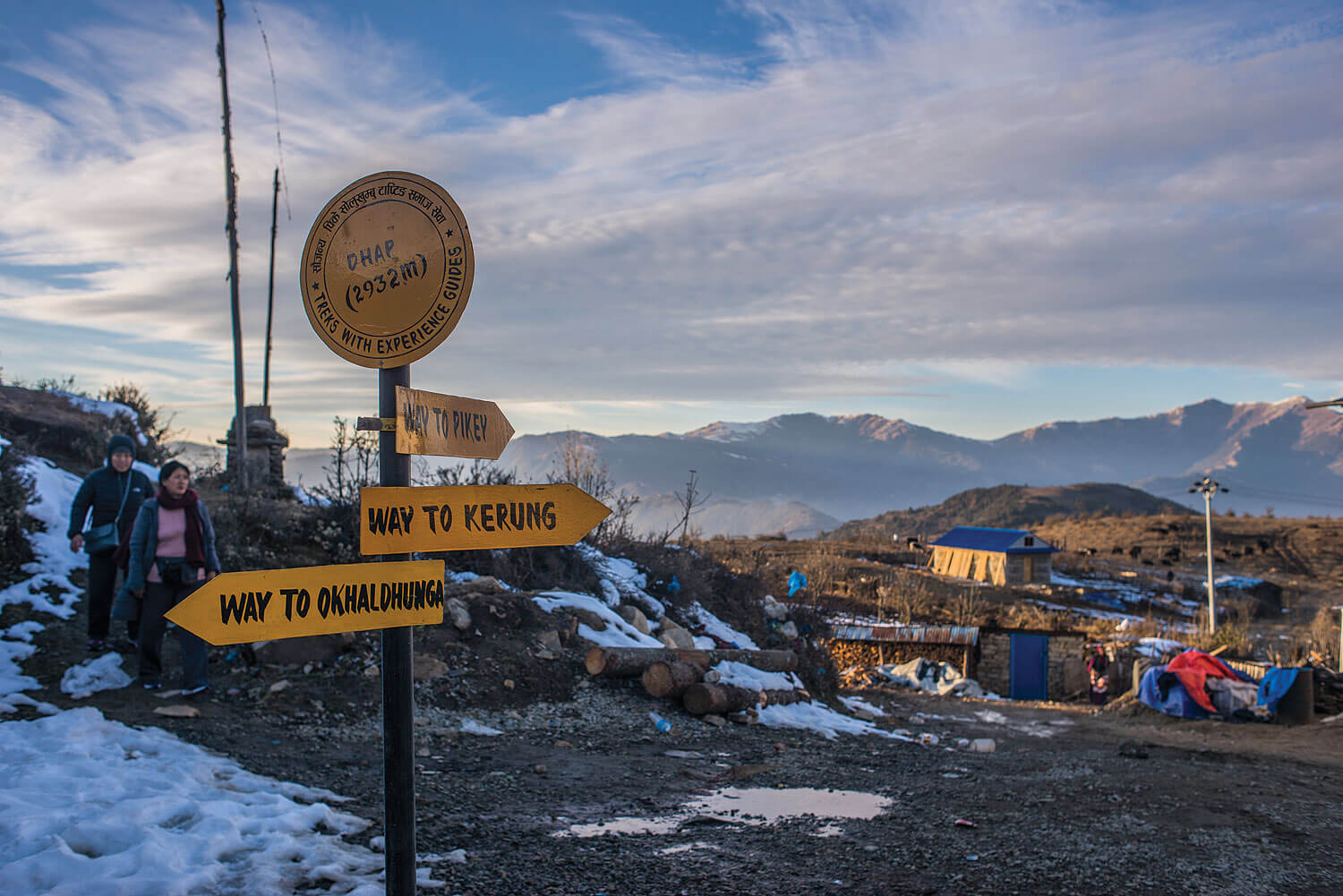
Kathmandu to Dharapani Private Vehicle Hire

Nepal Tour Package

Kathmandu to Dharapani Private Vehicle Hire: Complete

For trekkers beginning the Annapurna Circuit from Dharapani — the gateway village at the junction of the Marsyangdi and Dudh Khola rivers in Manang District — the journey from Kathmandu is one of Nepal’s most dramatic overland approaches. Covering approximately 235 to 240 kilometres and taking 9 to 12 hours depending on road conditions and stops, the Kathmandu-to-Dharapani drive is not a prelude to the Annapurna Circuit — it is the Annapurna Circuit’s opening chapter.

The road follows the Marsyangdi River from the plains to the lower mountains, passes through a sequence of increasingly dramatic valley landscapes, and delivers trekkers at Dharapani (1,860 m). At this exact point, the circuit road effectively ends for most vehicles, and the real trekking begins.

Dharapani is one of the most strategically significant points on the Annapurna Circuit. It sits at the convergence of two great trekking circuits — the Annapurna Circuit coming from Besisahar to the south, and the Manaslu Circuit coming from Arughat and Tsum Valley to the west.

Most modern Annapurna Circuit trekkers now start here rather than in Besisahar, because the road between Besisahar and Dharapani has been significantly improved, and walking alongside a jeep track for 3 to 4 days offers only a fraction of the wilderness experience the upper circuit provides. Starting at Dharapani means beginning the trek immediately in genuinely wild mountain country — and that means getting to Dharapani by vehicle rather than on foot.

Nepal Vehicle Hiring Pvt. Ltd., based in Thamel, Kathmandu, provides the definitive private jeep hire service for the Kathmandu-to-Dharapani route. Our experienced Annapurna-approach drivers, well-maintained 4WD vehicles, hotel-door pickup, and all-inclusive, transparent pricing make the journey to Dharapani as comfortable and time-efficient as the road allows.

This complete 2026 guide covers every kilometre from Kathmandu to Dharapani — distances, altitudes, road quality, key villages, transport options and costs, the permits required, seasonal advice, and the broader Annapurna Circuit context that makes Dharapani the right starting point for most trekkers 6.

Whether you are comparing this with our Kathmandu to Manang jeep service for a higher start point, our Besisahar private vehicle service for a Besisahar drop, or our Kathmandu to Besisahar bus ticket for the highway leg — this guide gives you everything you need to make the right Annapurna Circuit transport decision for your specific trek.

Kathmandu to Dharapani: Distance and Time at a Glance

The road distance from Kathmandu (Thamel) to Dharapani is about 240 km, and it takes 12 hours by private 4WD jeep with reasonable stops. This total breaks cleanly into two road types:

  • Kathmandu to Besisahar: approximately 178 km on the Prithvi Highway and provincial road, taking 5 to 6 hours — smooth national highway to Mugling, then provincial blacktop to Besisahar.
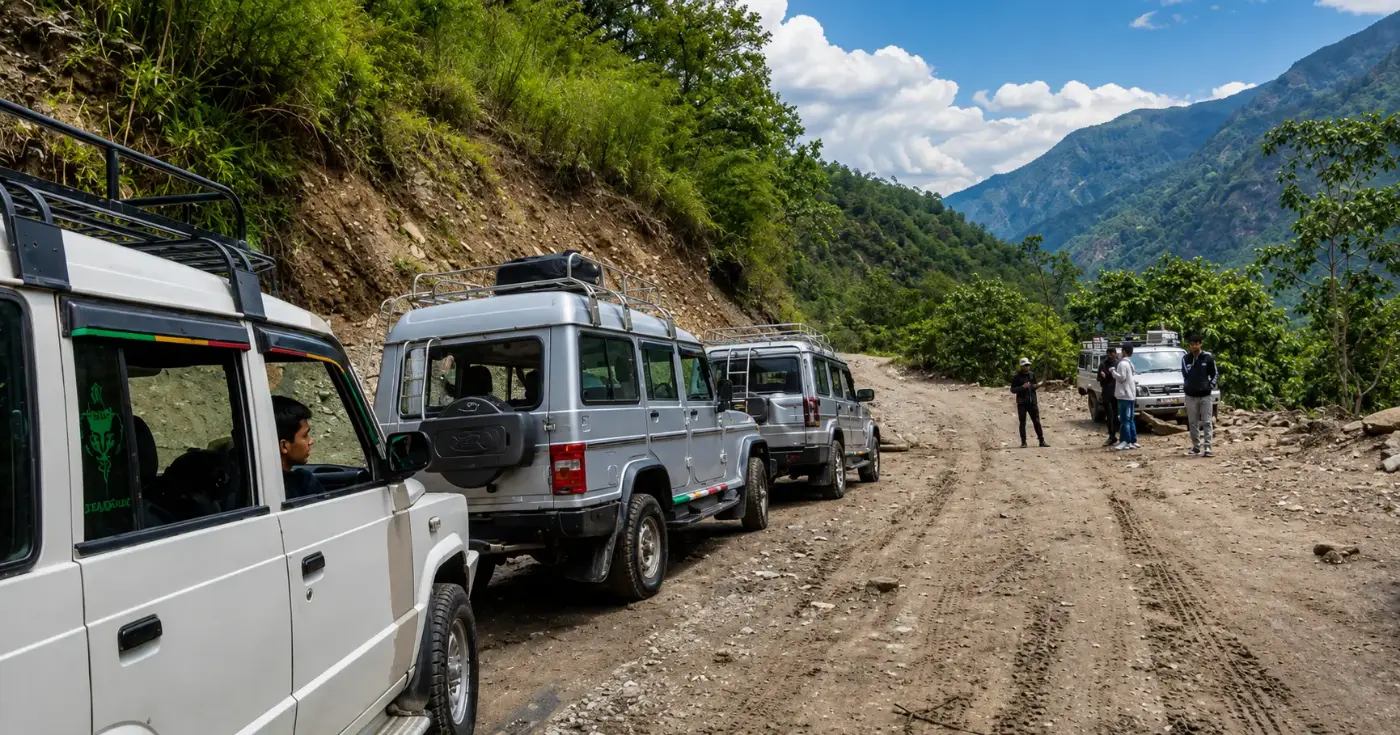
  • Besisahar to Dharapani: approximately 57 to 62 km of rough off-road mountain track, taking 4 to 5 hours — unpaved Marsyangdi valley road requiring 4WD, through Khudi, Bhulbhule, Syange, Jagat, Chamche, Tal, and Dharapani.

The contrast between these two legs is stark. The first 178 kilometres take 5 to 6 hours at a reasonable speed on paved roads. The final 57 to 62 kilometres takes 4 to 5 hours at a slow, careful mountain-road pace.

This is the essential reality of the Kathmandu-to-Dharapani journey: the last quarter of the distance takes almost half the total time. Understanding this helps set appropriate expectations and plan departure timing correctly. Nepal Vehicle Hiring’s standard recommendation for a same-day Dharapani arrival by late afternoon is a 6:00 to 6:30 AM departure from Thamel.

From Pokhara, the distance to Dharapani is approximately 110 km and takes 5 to 6 hours — significantly shorter than the Kathmandu approach. For trekkers already in Pokhara, our Hiace van hire or private car hire for the Pokhara-to-Besisahar leg, combined with a 4WD jeep for the Besisahar-to-Dharapani mountain section, is the most efficient configuration.
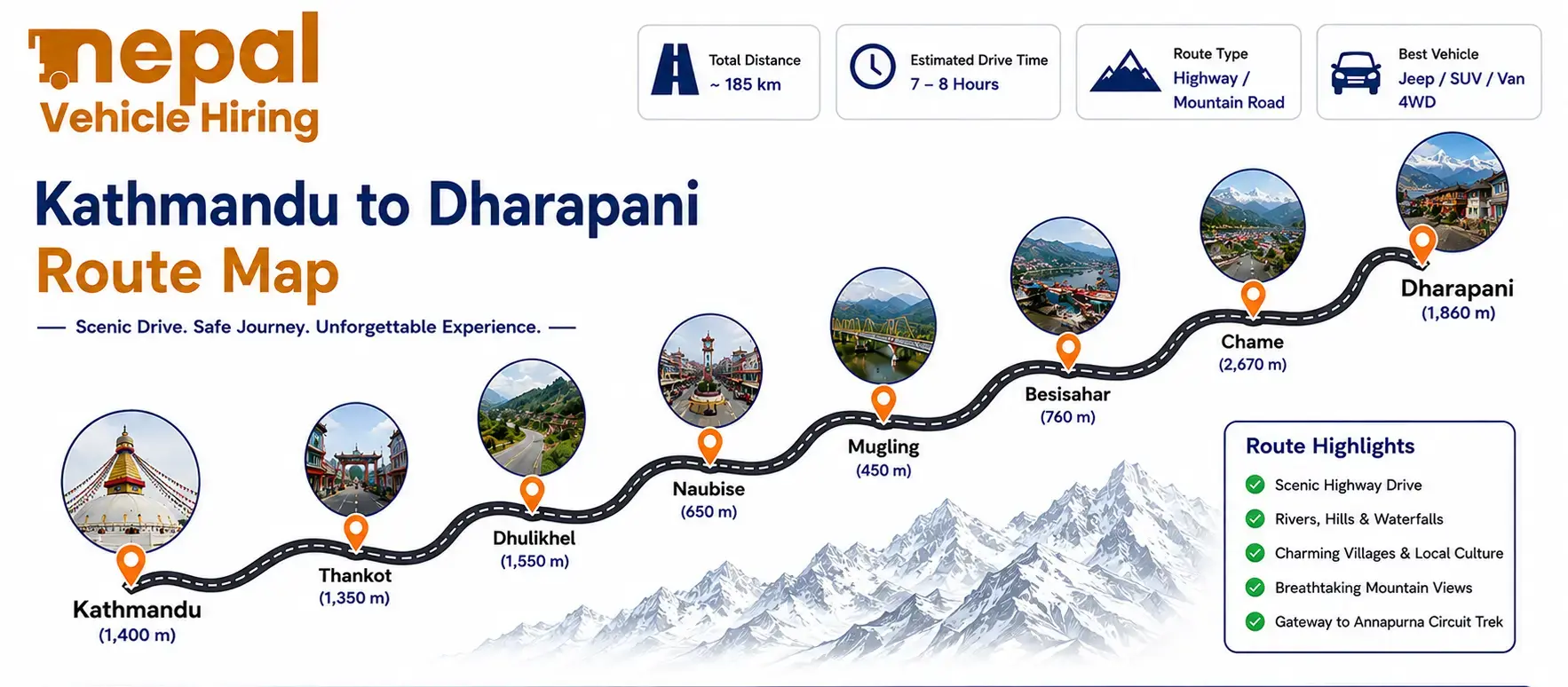
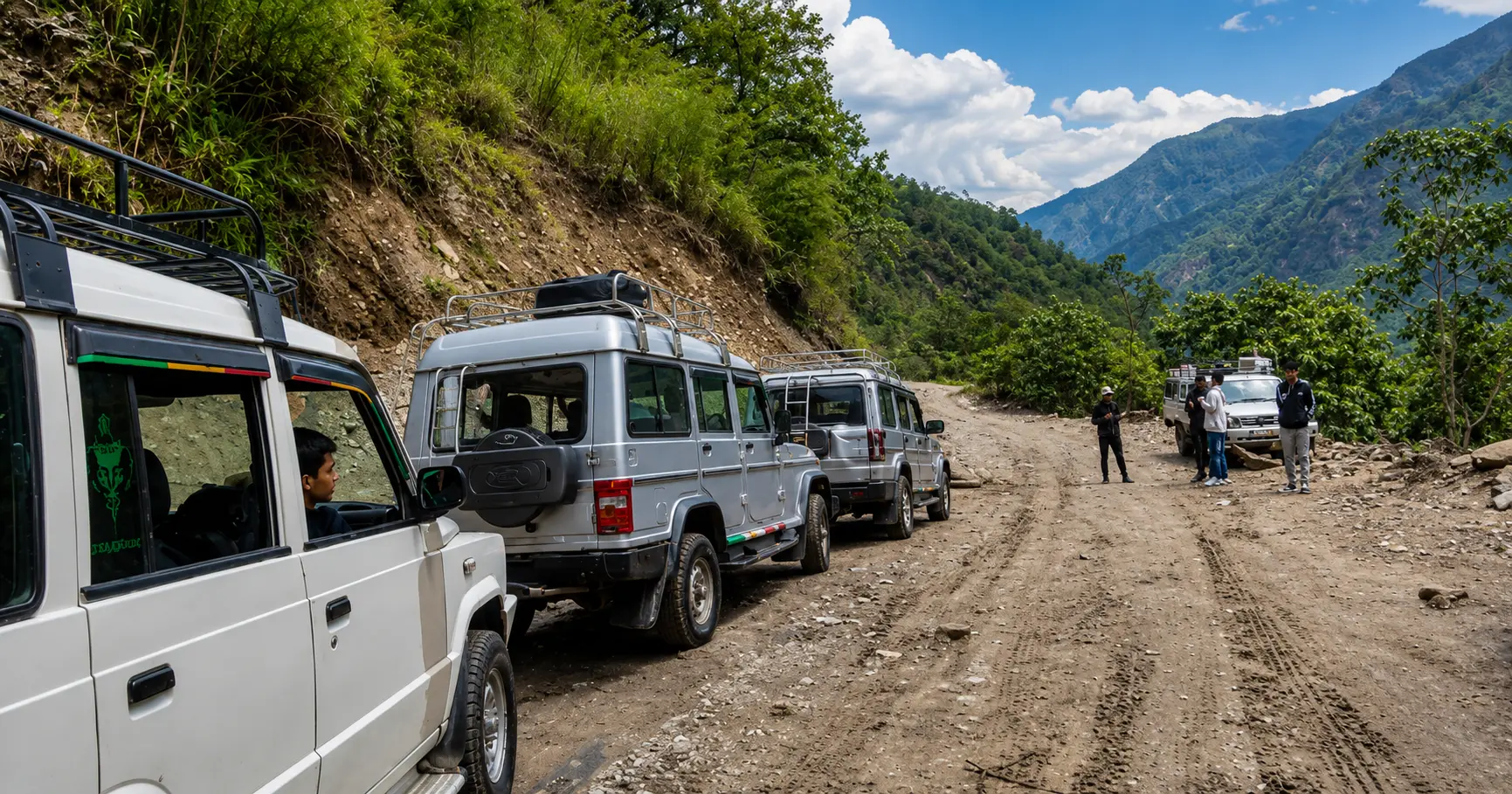
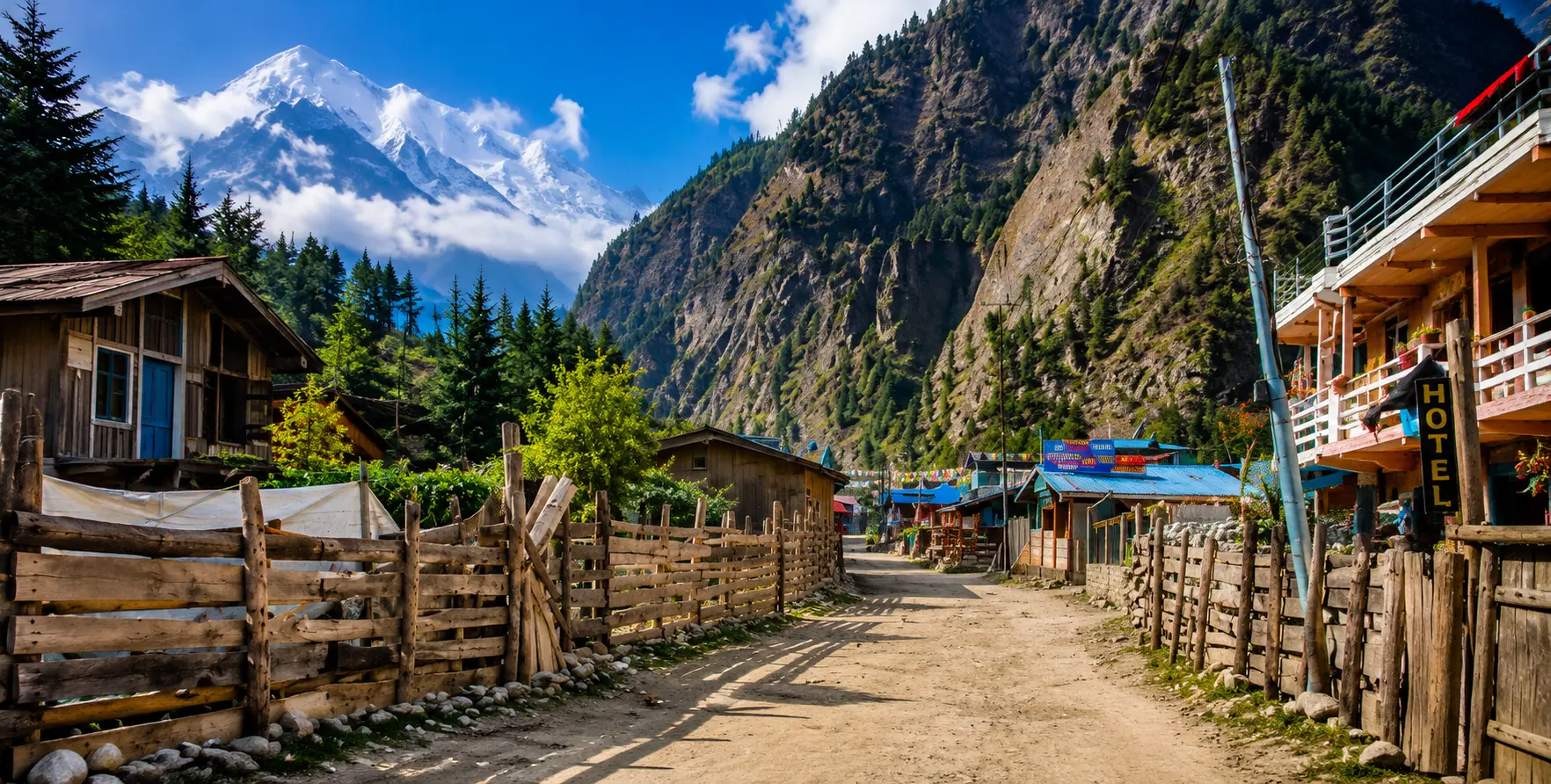
Book Kathmandu to Dharapani Private Vehicle Hire with a reliable 4WD jeep, Scorpio SUV, or other private vehicle. Travel comfortably through Besisahar toward Dharapani, a major starting point for the Annapurna Circuit Trek.

Kathmandu to Dharapani: Complete Section-by-Section Road Guide

Section 1: Kathmandu to Mugling (110 km, 2.5 to 3.5 hours)

The journey begins in Thamel and heads west on the Prithvi Highway — Nepal’s main Kathmandu-Pokhara artery — through the Naubise junction and the Nagdhunga Tunnel (Nepal’s first modern highway tunnel at 2.68 km, significantly reducing Kathmandu exit time) before descending to the Trishuli River gorge. The road follows the river through Malekhu (48 km from Kathmandu) — a popular breakfast stop for early departures, famous for fresh Trishuli River fish — before reaching Mugling (110 km, approximately 2.5 to 3.5 hours) at the confluence of the Trishuli and Marsyangdi rivers.

Mugling (190 m) is the highway junction where Kathmandu-to-Dharapani vehicles leave the Prithvi Highway heading for Dharapani and turn north onto the Marsyangdi Valley Road. The town is famous throughout Nepal for its riverside fish restaurants — the Mugling fish lunch is one of the great culinary traditions of the Prithvi Highway journey. For Dharapani-bound travellers, Mugling is typically the lunch stop: arriving around 10:00 to 11:30 AM for a 6:30 AM Kathmandu departure, with a 30 to 45 min45-minute break before the final stretch to Besisahar and the mountain road beyond.

Section 2: Mugling to Besisahar (68 km, 1.5 to 2 hours)

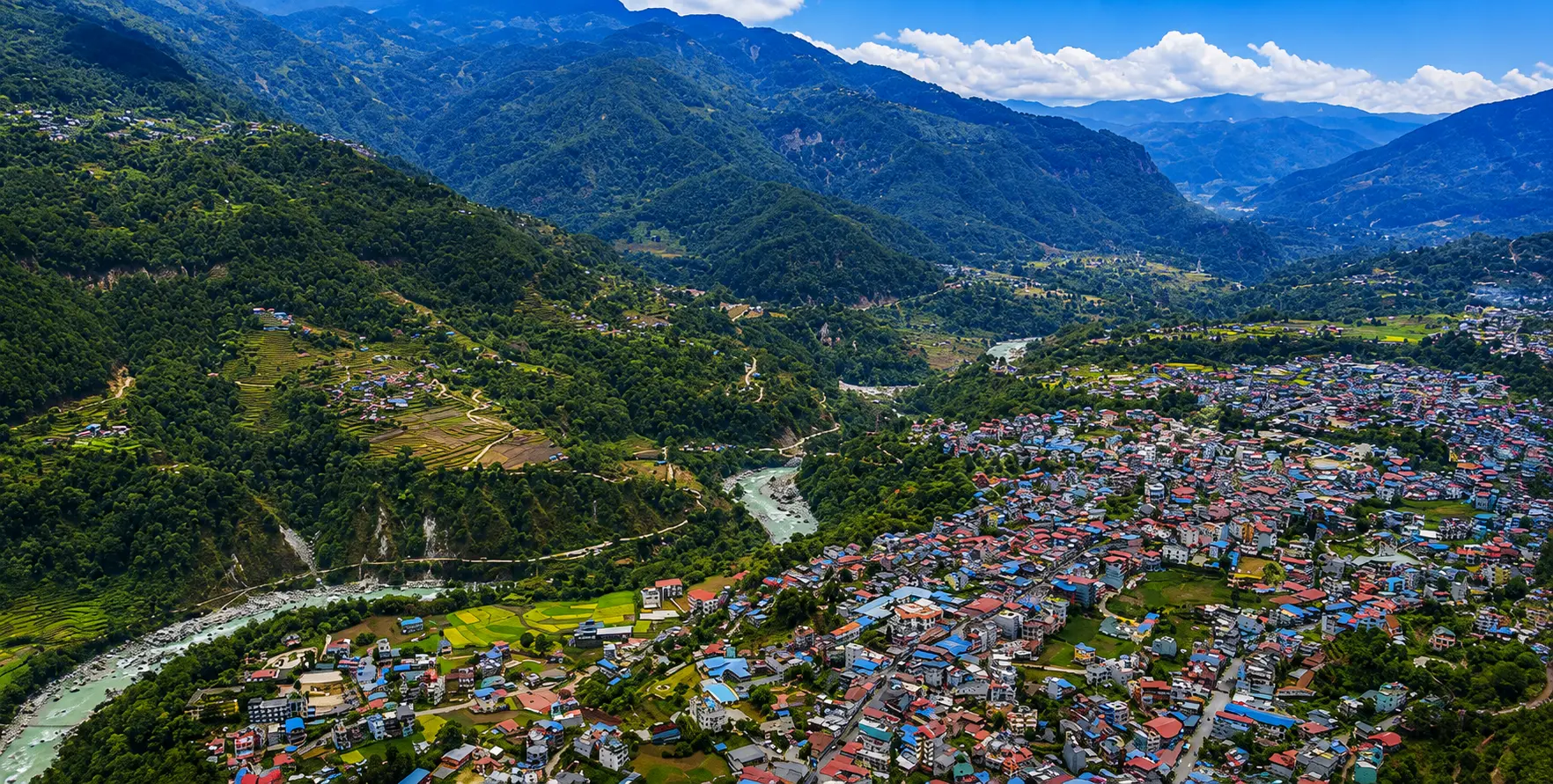
From Mugling, the road turns north from the Prithvi Highway junction. It follows the Marsyangdi River northward toward Dumre junction (134 km from Kathmandu) — where the road to Besisahar branches east from the main highway. From Dumre, the road runs about 10 km to Besisahar (760 m), the last major town and the critical prep point before the mountain road begins.

Besisahar is the essential pause point for every Kathmandu-to-Dharapani vehicle — the last reliable location for:

  • Fuel: the last fuel stations before Dharapani. Nepal Vehicle-Hirers always refuel in Besisahar, regardless of tank level.
  • ATMs: the last reliable cash machines before Chame. There are no ATMs in Dharapani. Carry ample NPR from Besisahar for the full trek.
  • ACAP permit: the Annapurna Conservation Area Permit checkpoint is here if not already obtained in Kathmandu.
  • Vehicle maintenance: do a final tire-pressure and vehicle inspection before the rough mountain road.
  • Rest and supplies: last chance for a proper sit-down meal, pharmacy supplies, and trekking supply top-ups before the trailhead.

Nepal Vehicle Hiring builds a 30-minute Besisahar stop into every Kathmandu-to-Dharapani itinerary. Our drivers handle the full vehicle check, while passengers use ATMs, eat, and gather any supplies. Our Besisahar private vehicle service covers the dedicated Besisahar-to-Dharapani section for trekkers who bus the highway leg and need 4WD from Besisahar northward.

Our Kathmandu to Besisahar bus ticket serves trekkers who want a public bus on the highway section and arrange separate 4WD from Besisahar.
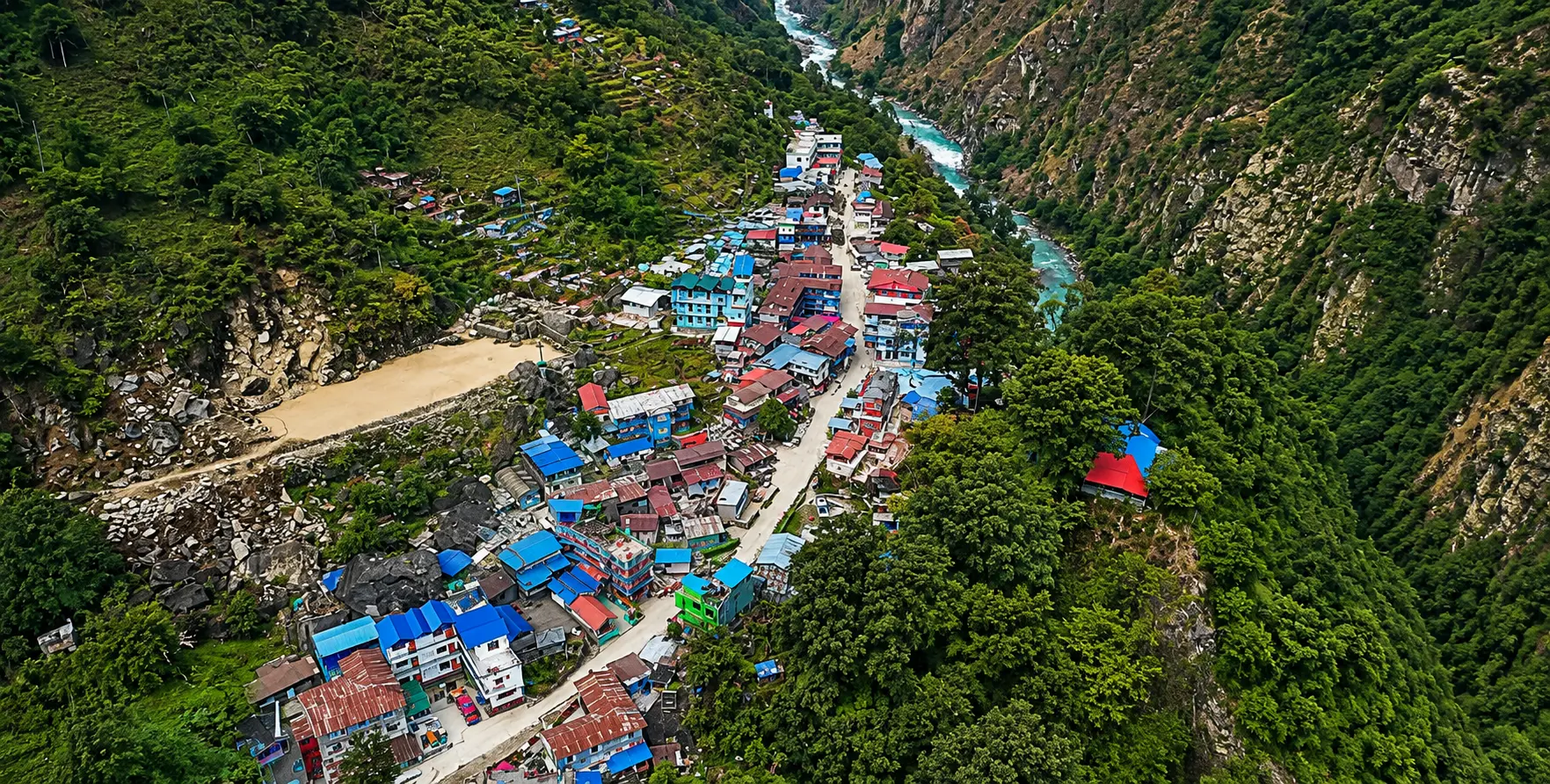
Book Kathmandu to Dharapani Private Vehicle Hire with a reliable 4WD jeep, Scorpio SUV, or other private vehicle. Travel comfortably through Besisahar toward Dharapani, a major starting point for the Annapurna Circuit Trek.

Section 3: Besisahar to Jagat (28 km, 2 to 2.5 hours)

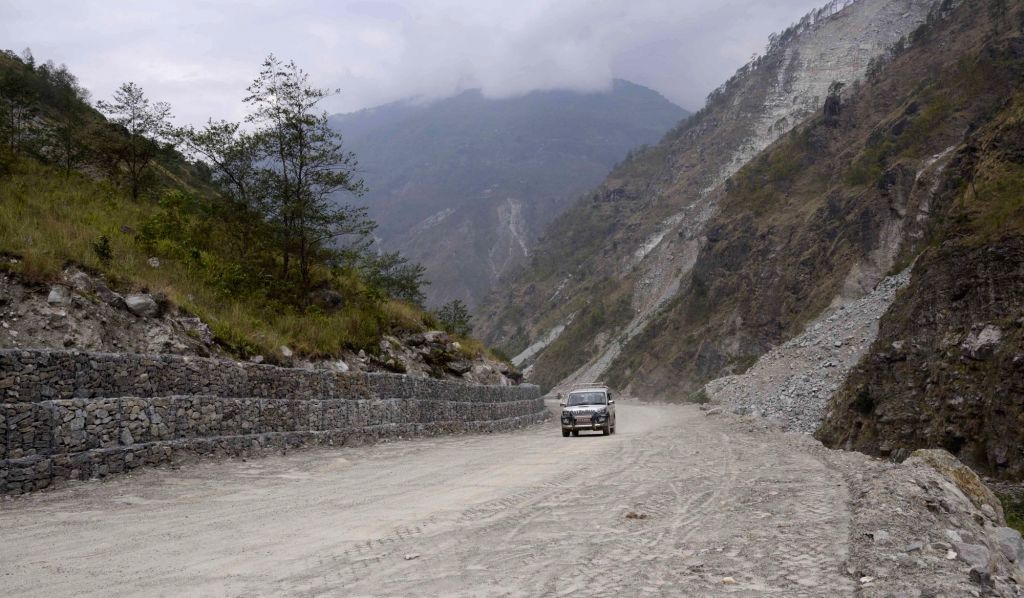
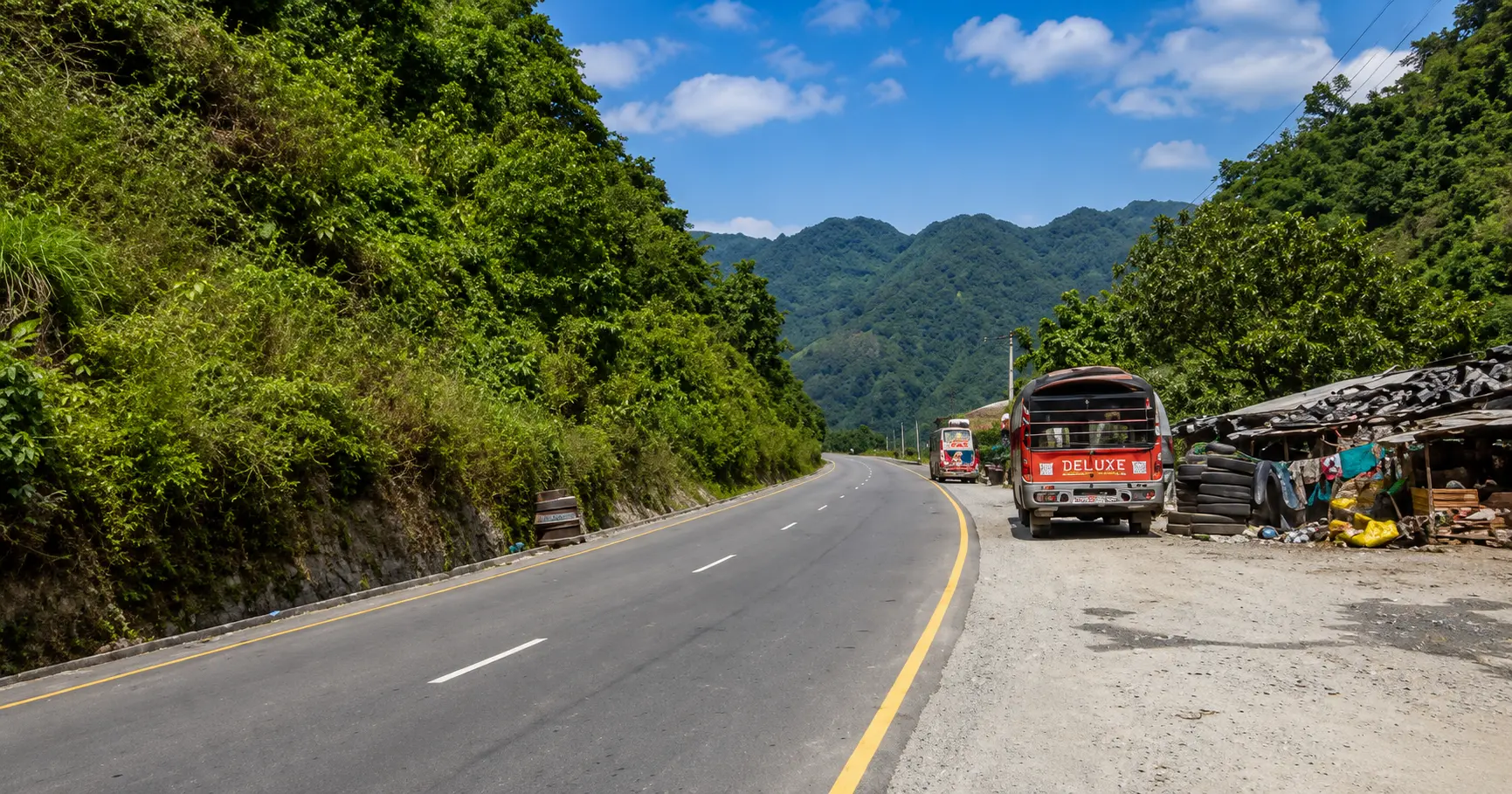
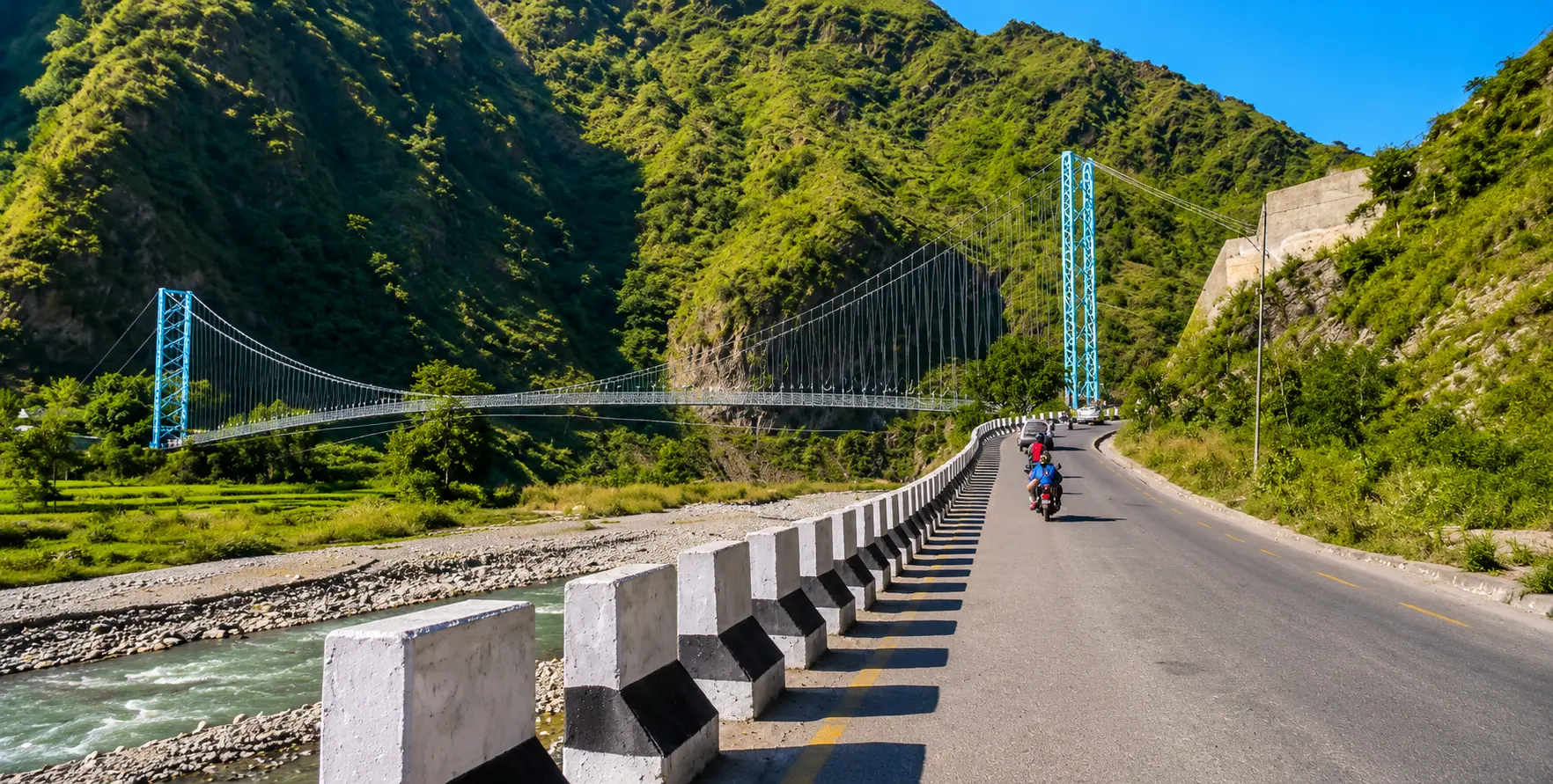
Beyond Besisahar, the paved highway ends and the Marsyangdi valley mountain track begins. This section — the first 28 kilometres of off-road driving from Besisahar to Jagat — is the transition from highway Nepal to mountain Nepal, and the difference is immediately apparent. The road surface changes to compacted gravel, then to rough track, with the Marsyangdi River increasingly audible below and the valley walls rising steeply on both sides.

Key stops on the Besisahar-to-Jagat section:

  • Khudi (790 m) — 5 km north of Besisahar. First suspension bridge crossing over the Marsyangdi. First checkpoint of the mountain road section. The gorge narrows noticeably here.
  • Bhulbhule (840 m) — 10 km from Besisahar. A larger village with guesthouses and tea shops. The road crosses a concrete bridge here and enters the first genuinely narrow gorge section.
  • Ngadi (930 m) — 17 km from Besisahar. Small settlement at a stream confluence. The road begins climbing more steeply after Ngadi.
  • Bahundanda (1,310 m) — 21 km from Besisahar. Ridge-top Brahmin village with wide valley views. Popular tea stop for both vehicle passengers and trekkers. The climb to Bahundanda is one of the steeper sections of this leg.
  • Jagat (1,300 m) — 28 km from Besisahar. The most significant town on this section, with multiple guesthouses and restaurants, and a critical checkpoint. All vehicles stop here, and officials check passengers’ permits (ACAP) and vehicle permits for the Manaslu trekking restricted area for anyone entering the Manaslu region. The section from Jagat onward enters increasingly wild gorge country.

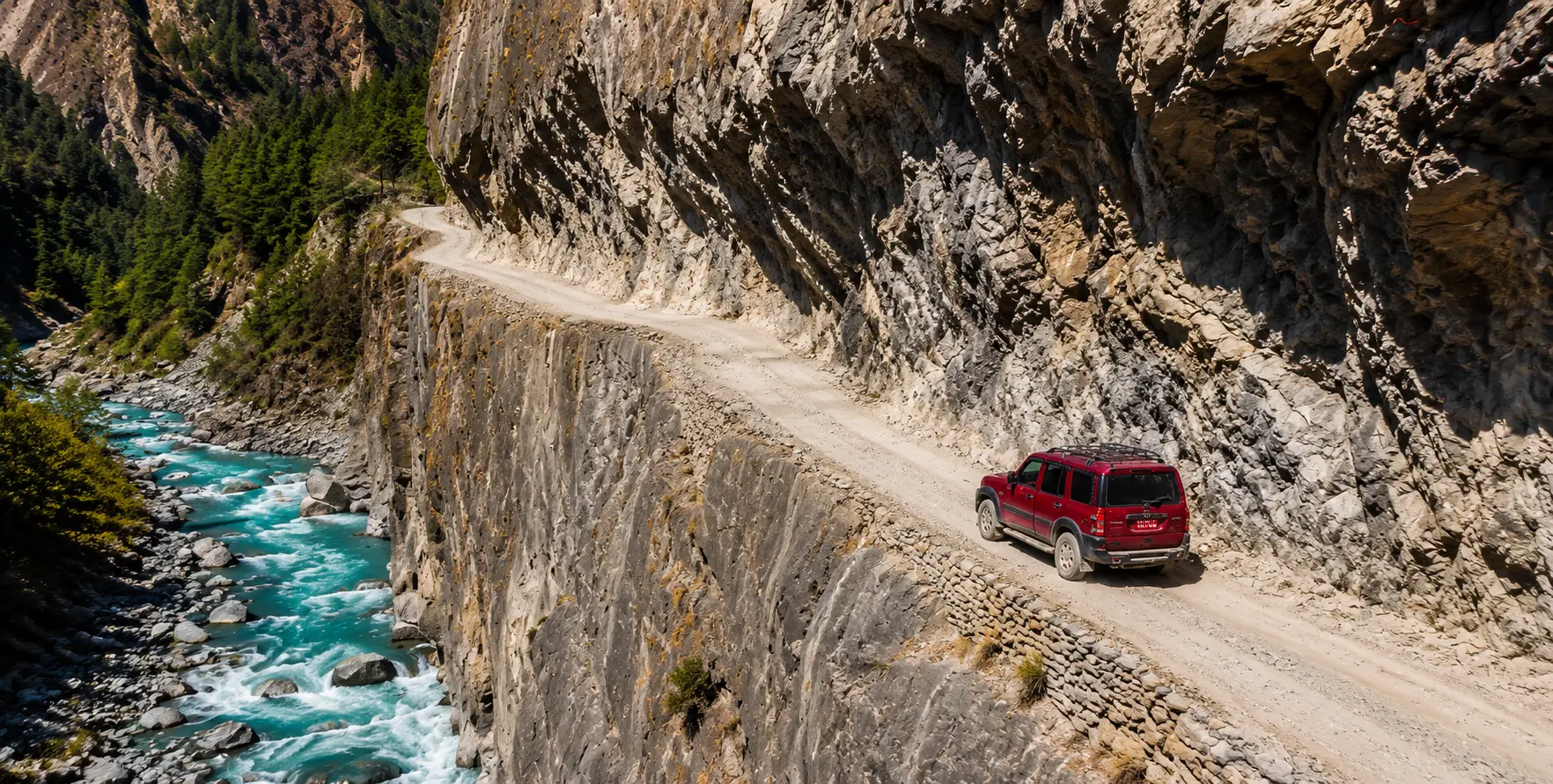
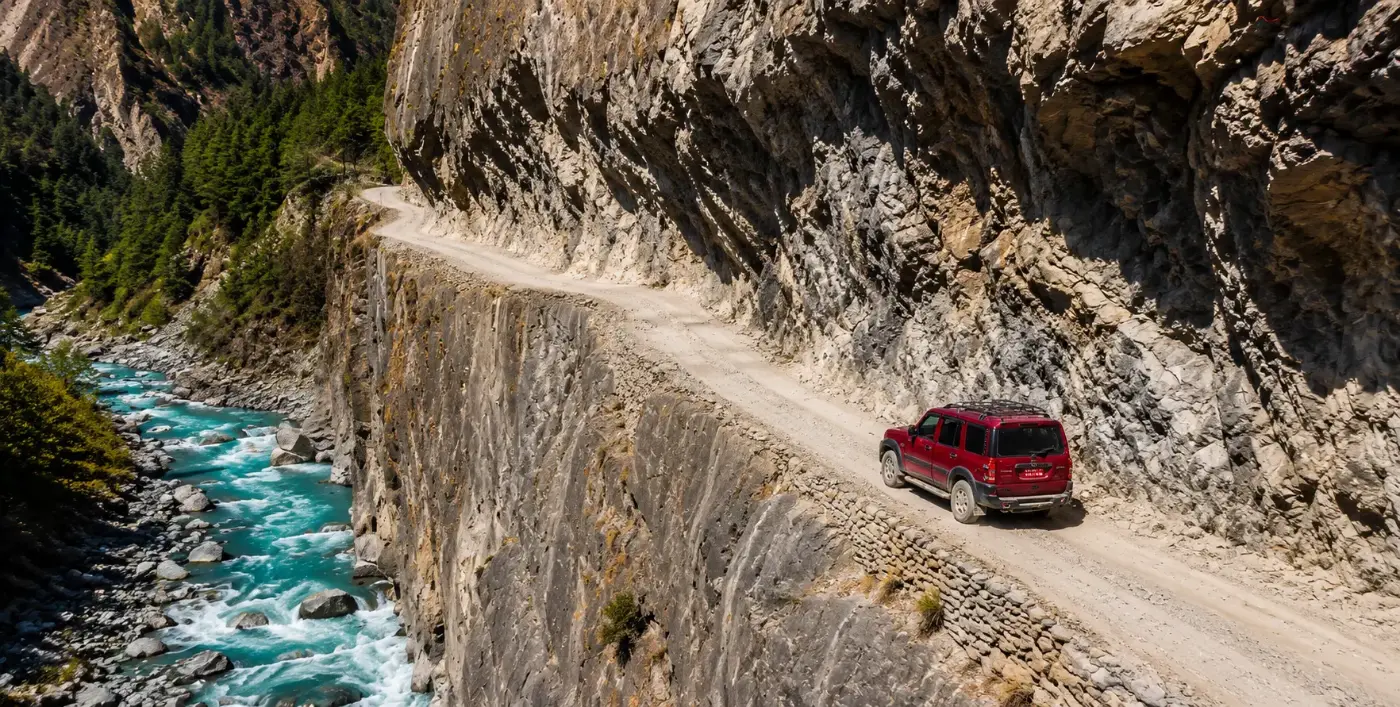
The Besisahar-to-Jagat road section is the roughest and narrowest of the approach to Dharapani. The cliff-side sections between Syange and Jagat in particular — where the road is carved into the base of near-vertical walls above the roaring Marsyangdi — require careful driving and are genuinely challenging in a way that makes the 4WD requirement absolute and non-negotiable. Nepal Vehicle Hiring never sends standard cars or minivans beyond Besisahar.

Section 4: Jagat to Chamche and Tal (15 km, 1.5 to 2 hours)

From Jagat, the road continues through some of the finest gorge scenery on the entire Annapurna Circuit approach. Key stops:

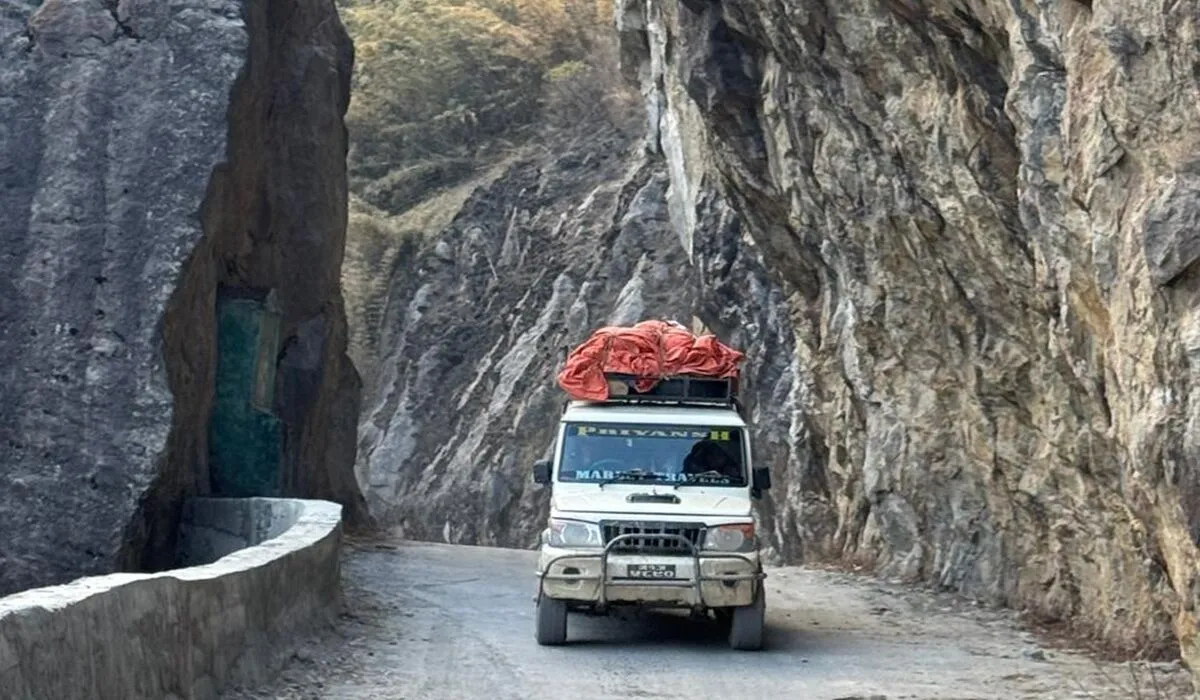
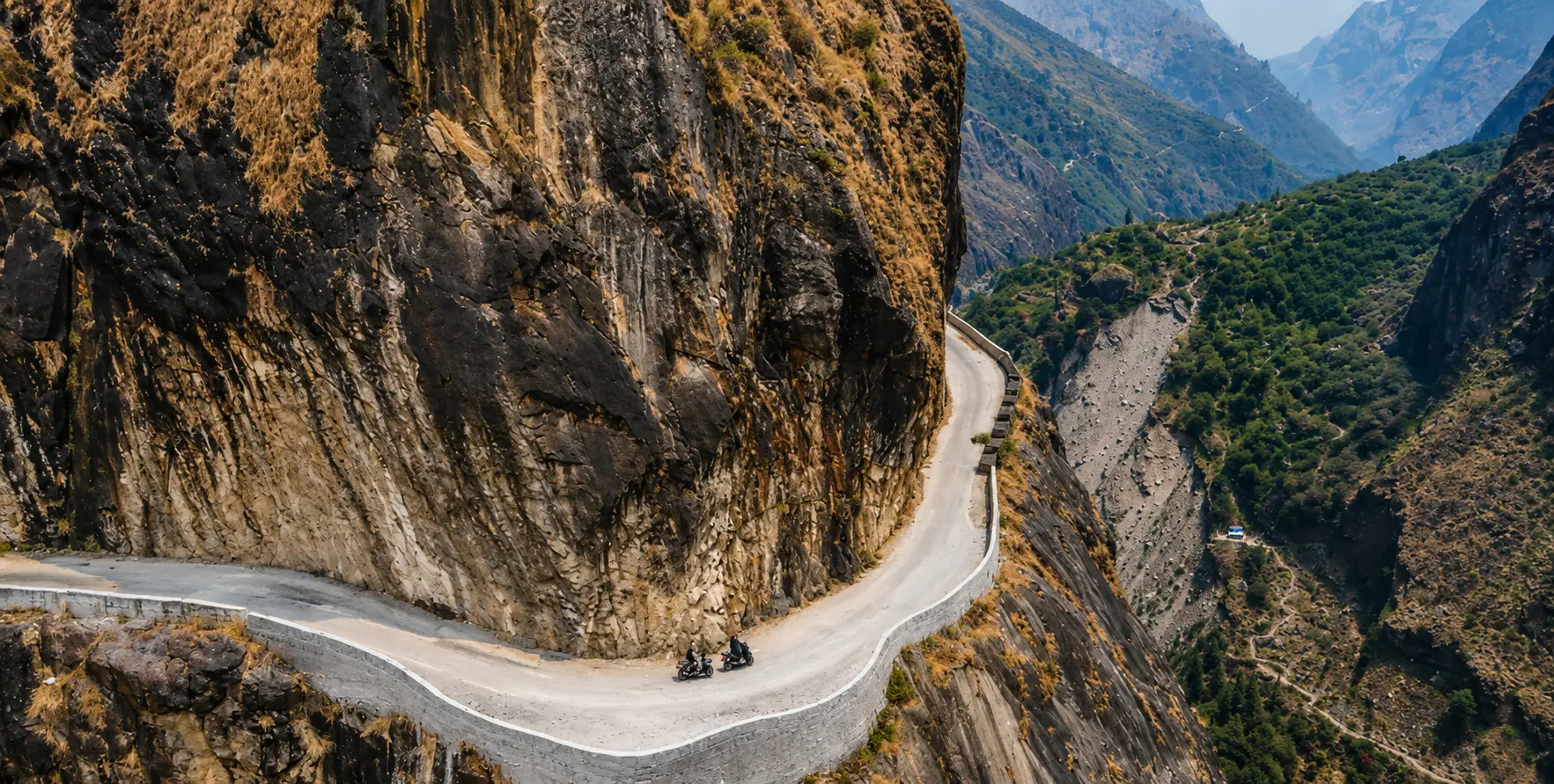
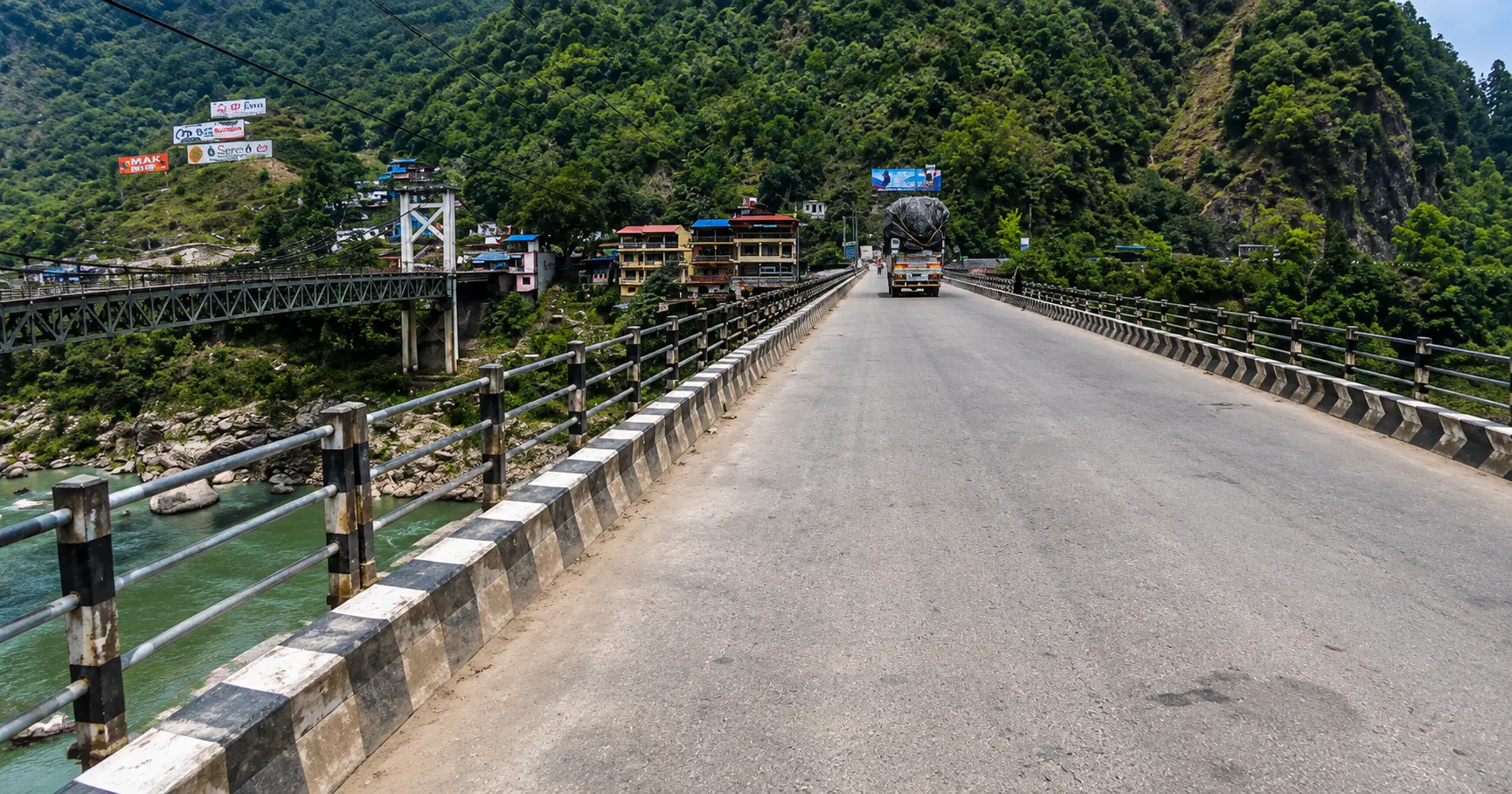
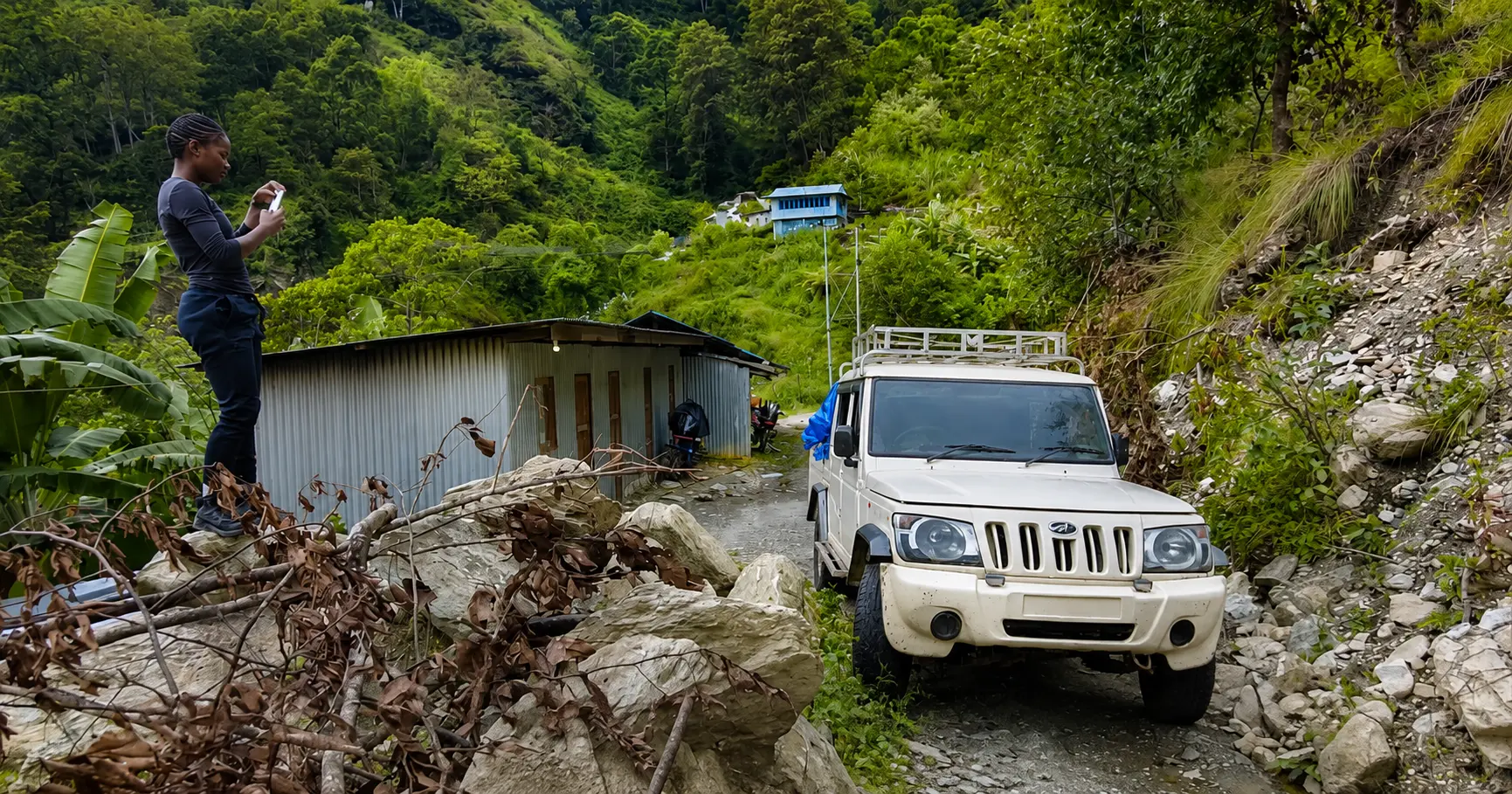
  • Syange (1,100 m) — just north of Jagat, the most dramatic gorge section of the entire drive. The road is literally carved into the cliff base here, with the Marsyangdi thundering below and the opposite wall rising hundreds of meters above. For first-time visitors, this section is the moment they truly grasp the scale of the Himalayan river gorge. A brief stop here — if traffic allows — produces one of the most powerful landscape photographs of the entire journey.
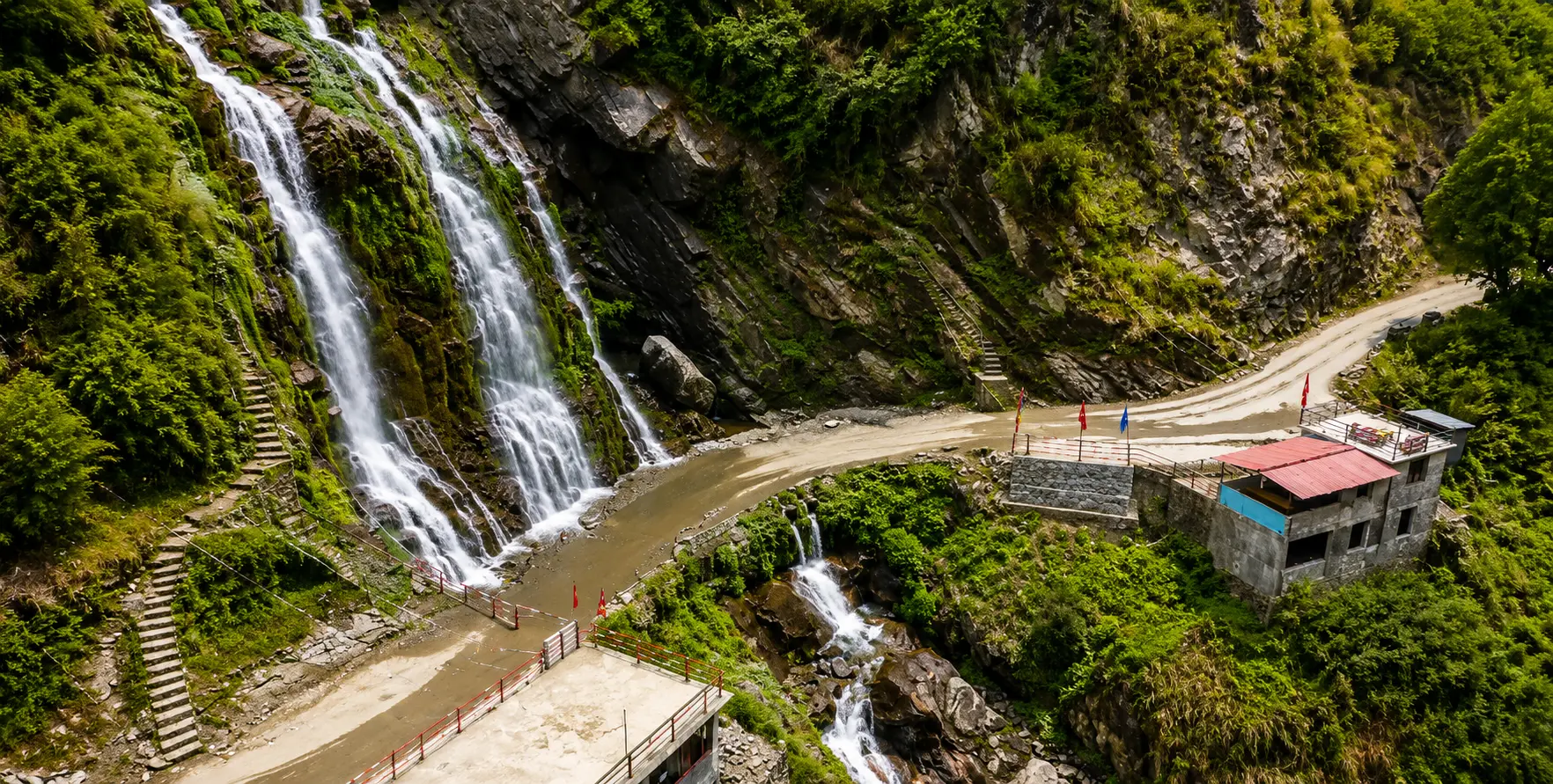
  • Chamche (1,410 m) — a spectacular waterfall visible from the road, plunging from the cliff face above into the gorge below. The Chamche waterfall is one of the most photographed features of the Annapurna Circuit approach road and a natural pause point. The road here is in better condition than the Syange cliff section, with a wider verge for brief stops.
  • Tal (1,700 m) — the gorge opens suddenly into the widest flat-floored valley section on the entire Besisahar-to-Dharapani route. The name ‘Tal’ means lake, and the wide gravel-floored valley is indeed a former glacial lake, drained over thousands of years. The contrast between the narrow cliff gorge just below and this open, sunlit valley bowl is dramatic and beautiful. Tal has several guesthouses and is a popular overnight stop for trekkers walking the lower circuit. It’s also a natural vehicle rest stop — 20 to 30 minutes at Tal, with riverside views and some of the best photography opportunities of the mountain road section.

Section 5: Tal to Dharapani (14 km, 1 to 1.5 hours)

The final 14 kilometres from Tal to Dharapani continue through the narrowing upper gorge, passing through Karte (2,640 m) and Tilje (2,300 m) before reaching Dharapani at 1,860 meters. The road in this section improves slightly compared to the Jagat-to-Tal stretch—the upper valley has better road maintenance, and the surface is more compacted.

The altitude gain from Tal (1,700 m) to Dharapani (1,860 m) over 14 kilometres is relatively modest, meaning this final section is driven at a slightly higher speed than the lower gorge sections.

Dharapani itself sits at the confluence of the Marsyangdi River and the Dudh Khola (White River, so named for its glacier-flour colour). The confluence is visible from the road and has a dramatic character — two powerful rivers meeting in a wide gravel-floored valley beneath towering mountain walls.

The Dharapani checkpoint is where trekkers entering from either circuit direction have their Annapurna and Manaslu permits verified. Nepal Vehicle Hiring’s drivers handle the permit verification formalities, which typically take 5 to 10 minutes.
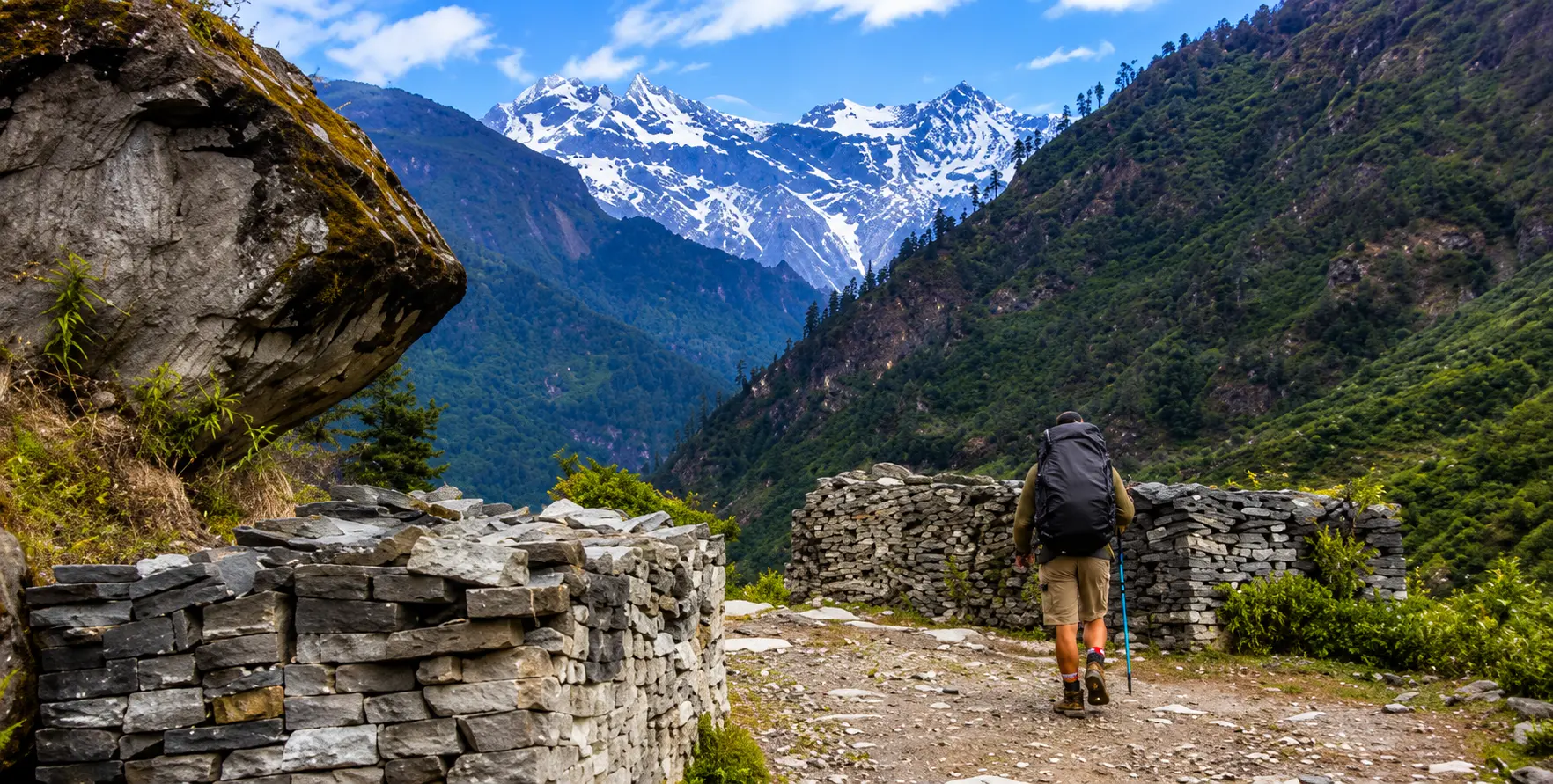
Book Kathmandu to Dharapani Private Vehicle Hire with a reliable 4WD jeep, Scorpio SUV, or other private vehicle. Travel comfortably through Besisahar toward Dharapani, a major starting point for the Annapurna Circuit Trek.

Why Start the Annapurna Circuit at Dharapani?

Most experienced trekkers, guides, and operators now consistently recommend starting the Annapurna Circuit at Dharapani rather than at Besisahar—the traditional starting point. Understanding the reasoning behind this shift helps trekkers make an informed decision about where to end their vehicle hire.

The Road Has Changed the Lower Circuit

The Annapurna Circuit from Besisahar to Dharapani follows the Marsyangdi valley through Khudi, Bahundanda, Jagat, Chamche, and Tal — a section that, before the jeep road was built, offered 3 to 4 days of genuine wilderness trekking through forest and gorge. Today, the same section is a jeep track carrying vehicle traffic—supply jeeps, local transport, and trekking approach vehicles like the one that brought you from Kathmandu.

Walking alongside a road shared with honking jeeps for 3 to 4 days is far less rewarding than the classic circuit description suggests, and many experienced Annapurna Circuit guides now describe this section as the route’s weakest part.

Dharapani Offers Immediate Wild Trekking

From Dharapani, the Annapurna Circuit trail immediately enters genuinely wild mountain country—the road becomes minimal, vehicle traffic drops dramatically, and the landscape shifts to the pristine gorge and forest the Annapurna Circuit is famous for. The first trekking stage from Dharapani to Chame (2,670 m) climbs through pine and oak forest past Bagarchhap and Timang with virtually no vehicle traffic, offering the classic wilderness trekking experience that the lower circuit can no longer reliably provide.

Starting at Dharapani saves 3 to 4 days of walking while improving the overall trekking experience by eliminating the road-walking section.

Better Acclimatisation

Starting at Dharapani (1,860 m) rather than Besisahar (760 m) also improves acclimatisation for the upper circuit. The 1,100-meter difference in starting altitude means Dharapani-start trekkers reach altitude points like Chame (2,670 m) and Pisang (3,200 m) with 1 to 2 more days of acclimatisation than Besisahar-start trekkers on the same calendar day of the trek.

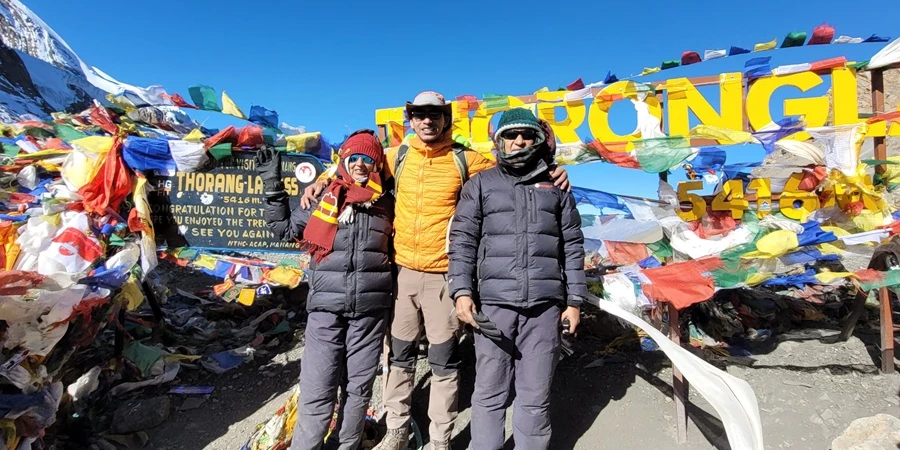
This advantage is meaningful for the Thoacclimatizationg at 5,416 m, where proper acclimatisation is the most important single factor in a safe and successful experience.

Jagat as an Alternative Starting Point

Acclimatisation: Use an intermediate starting point between Besisahar and Dharapani—particularly Jagat (1,300 m)—which preserves the Chamche waterfall section and the Tal valley crossing while avoiding the busiest road sections below Jagat. Nepal Vehicle Hiring can provide a private jeep hire with Jagat as the drop-off point instead of Dharapani — a useful option for trekkers who want to walk the Tal and Chamche sections on foot while still arriving by vehicle for the lower Besisahar-to-Jagat road portion.

Ask about Jagat drop-off pricing when contacting us through our plan your trip page.

Vehicle Options for the Kathmandu to Dharapani Journey

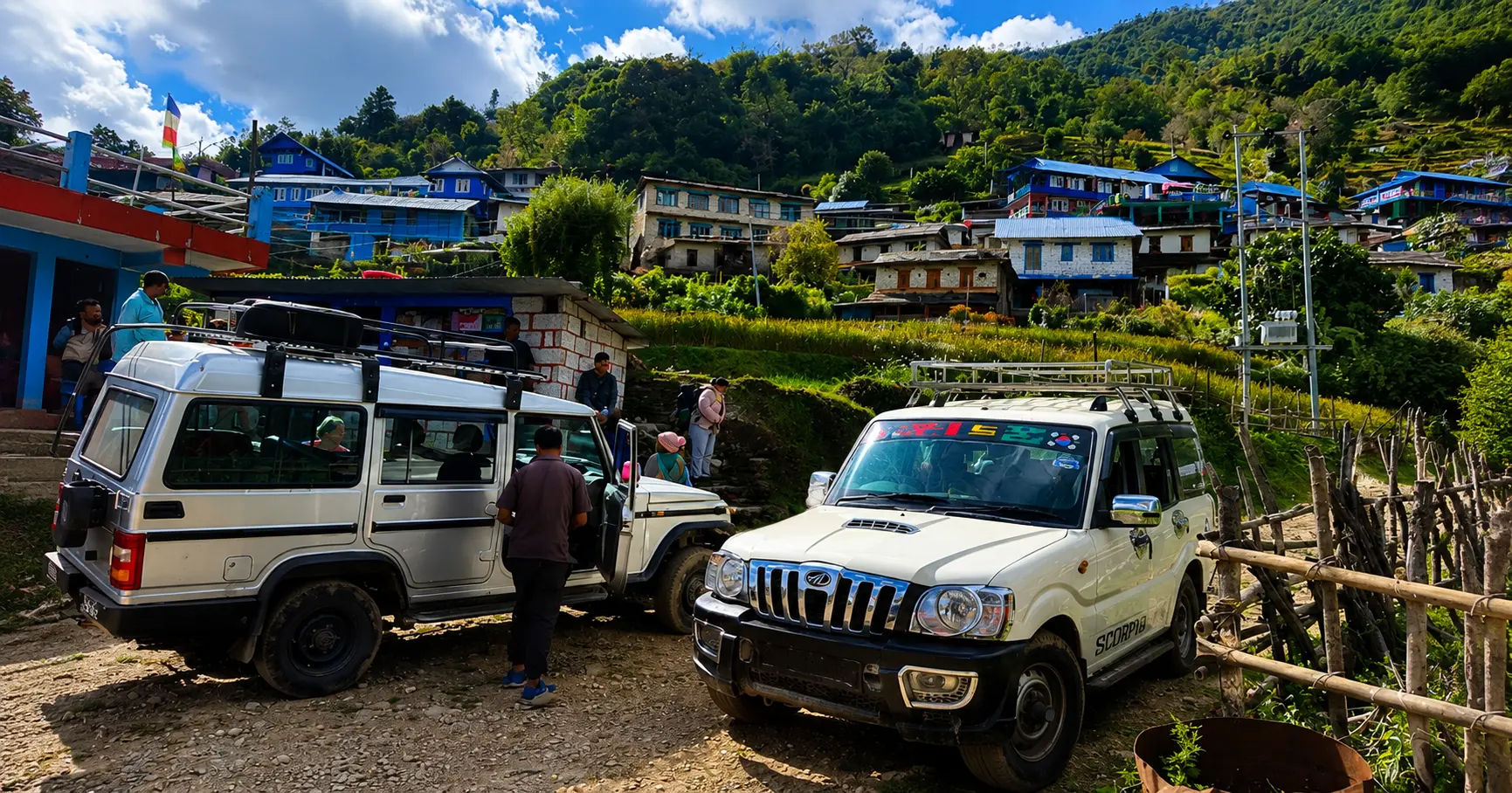
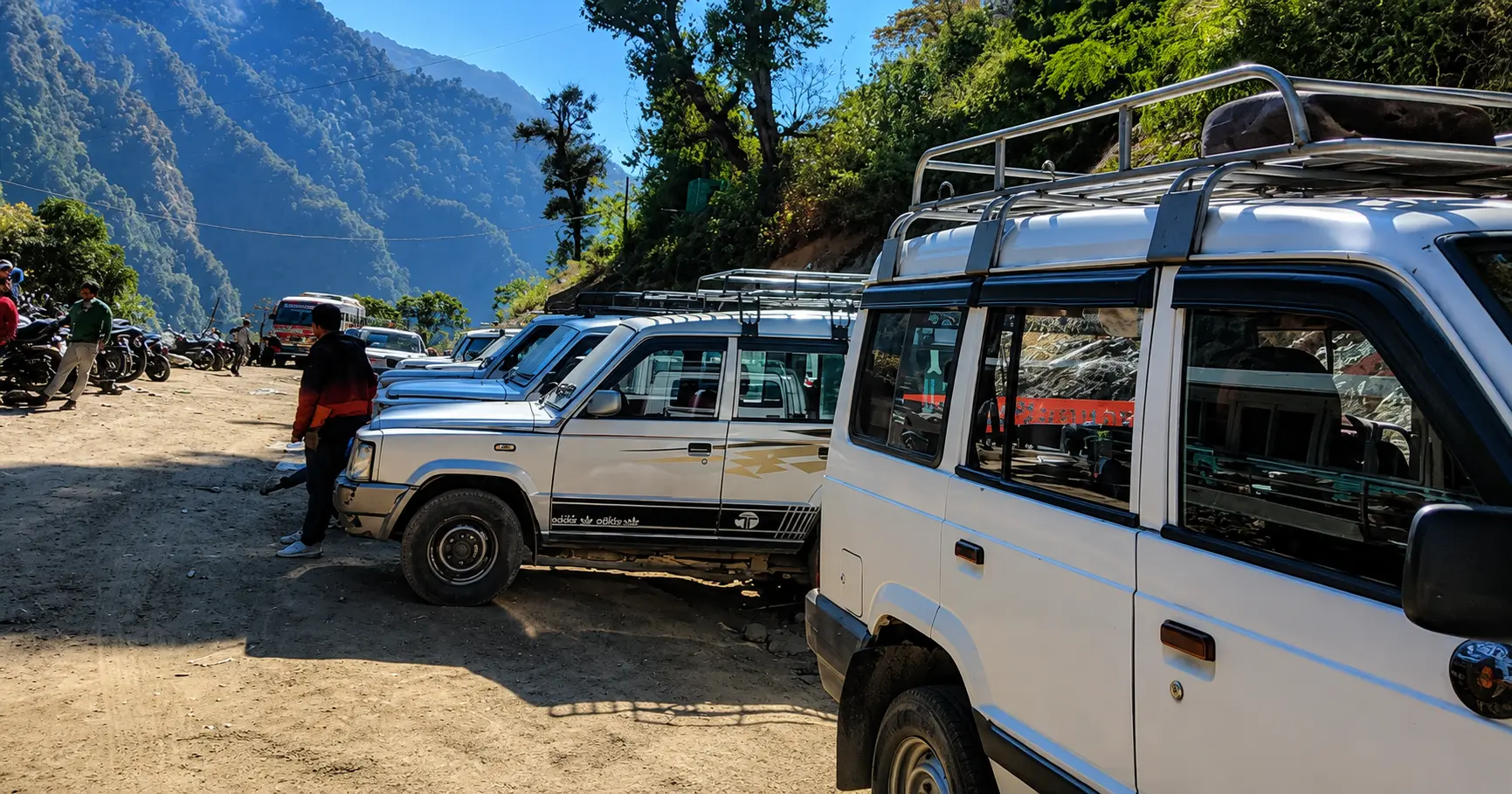
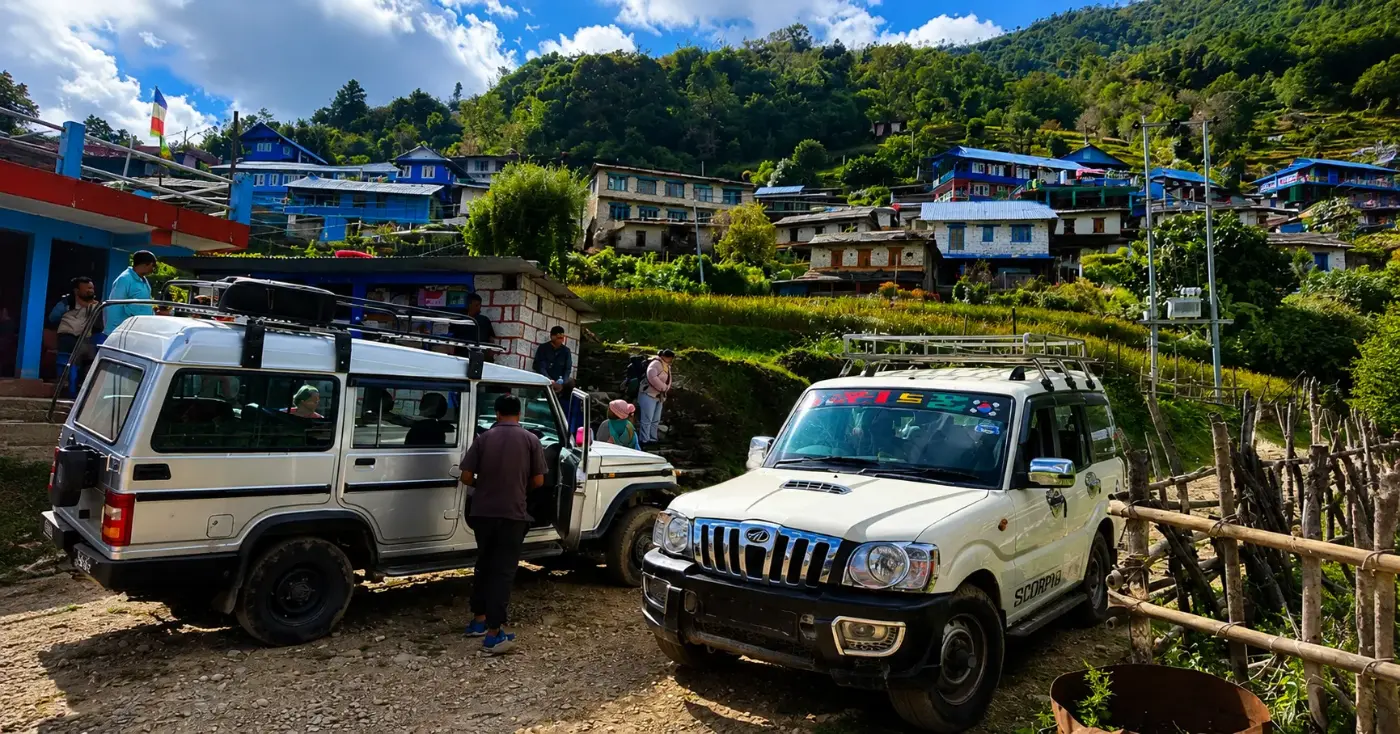
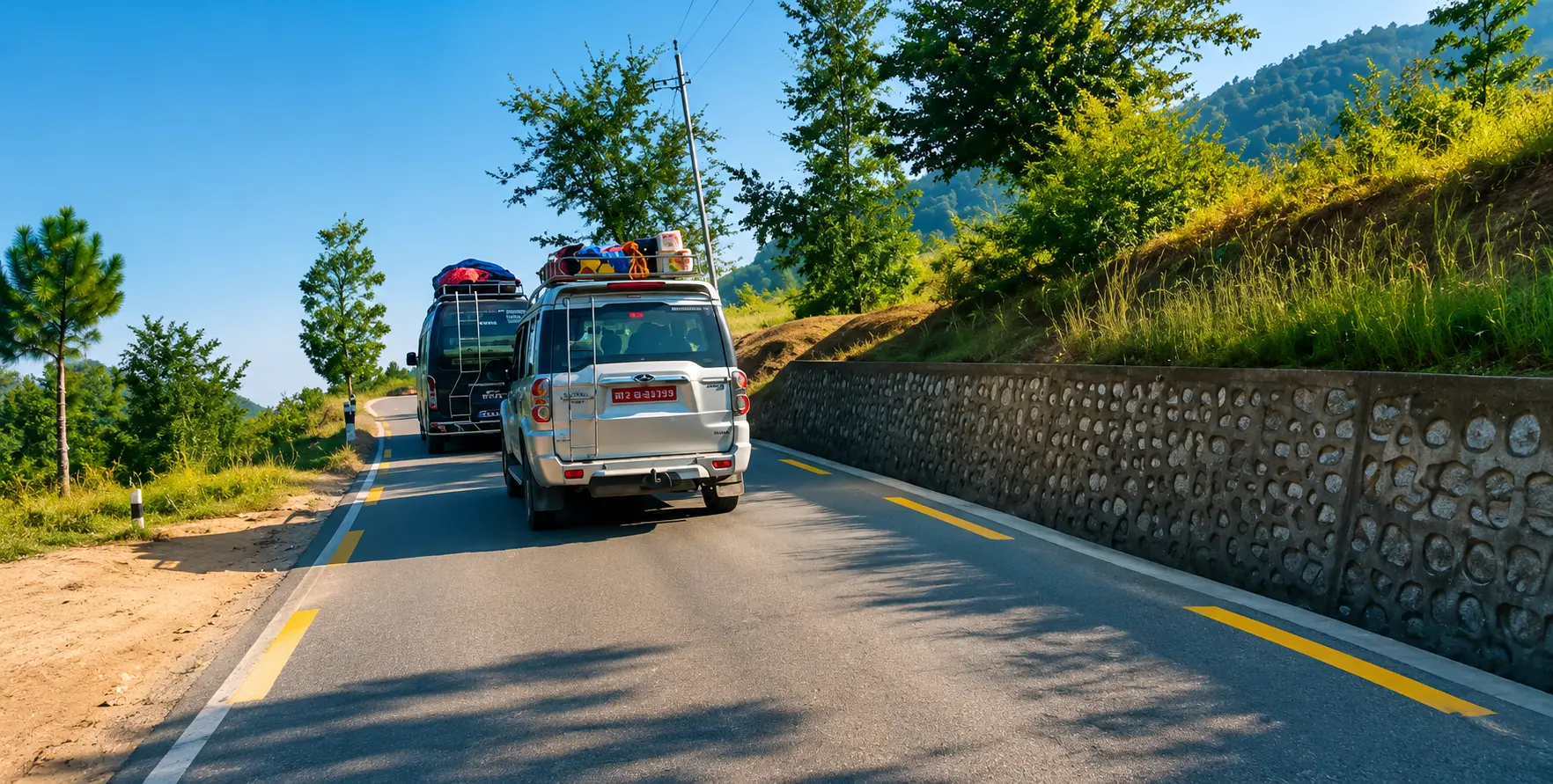
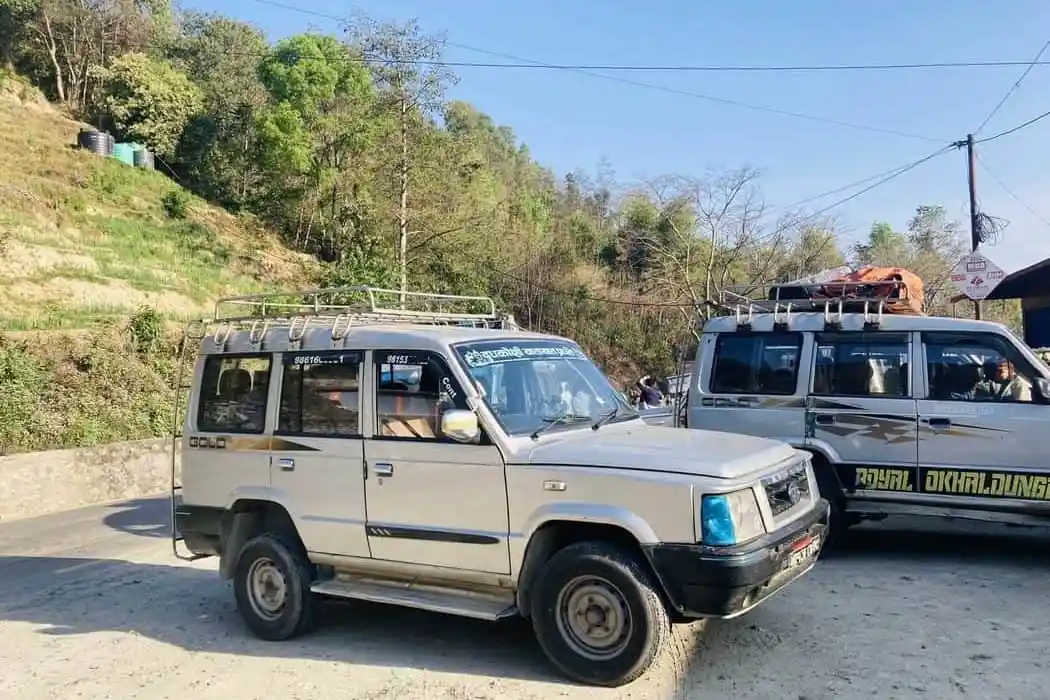
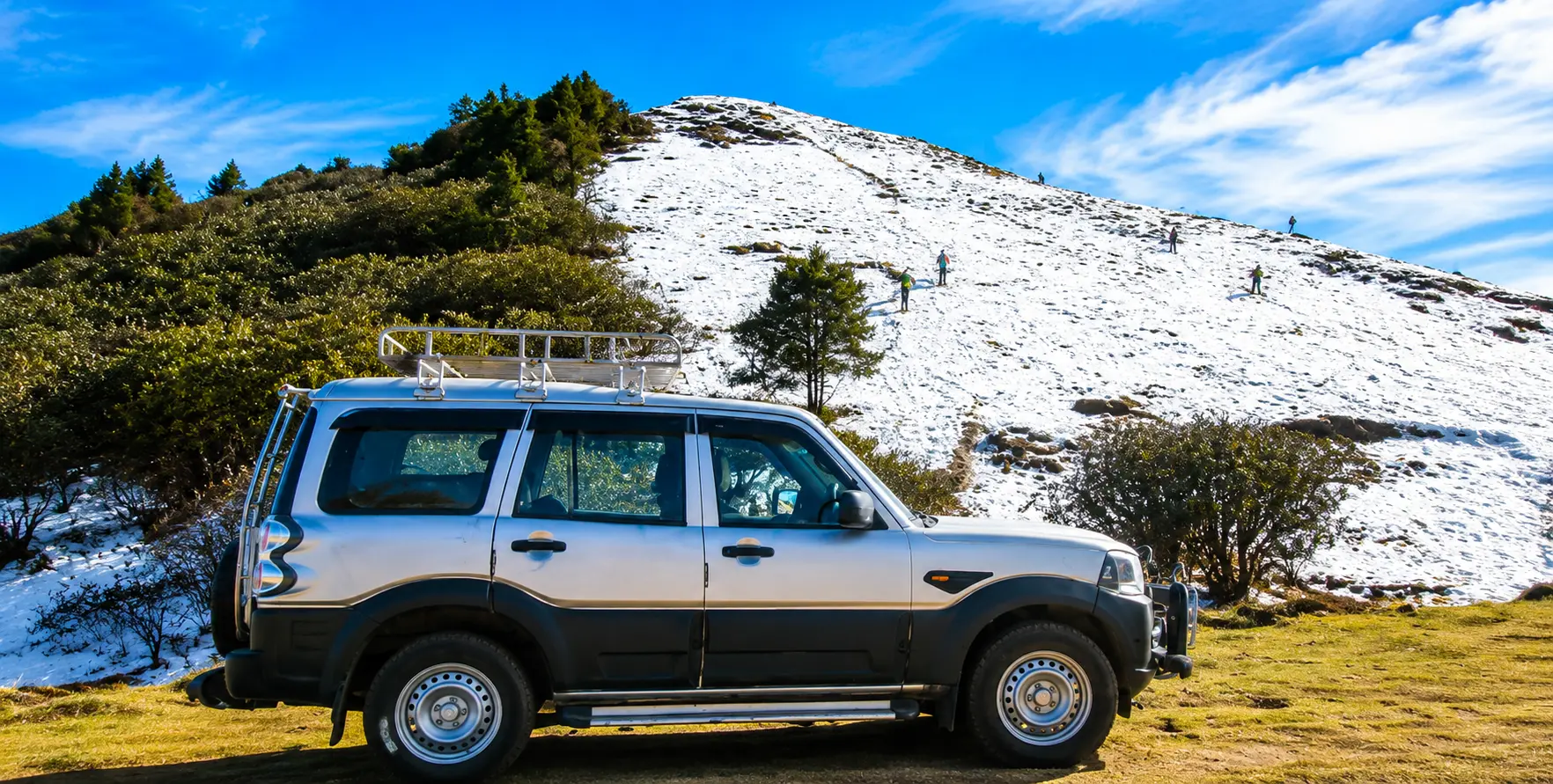
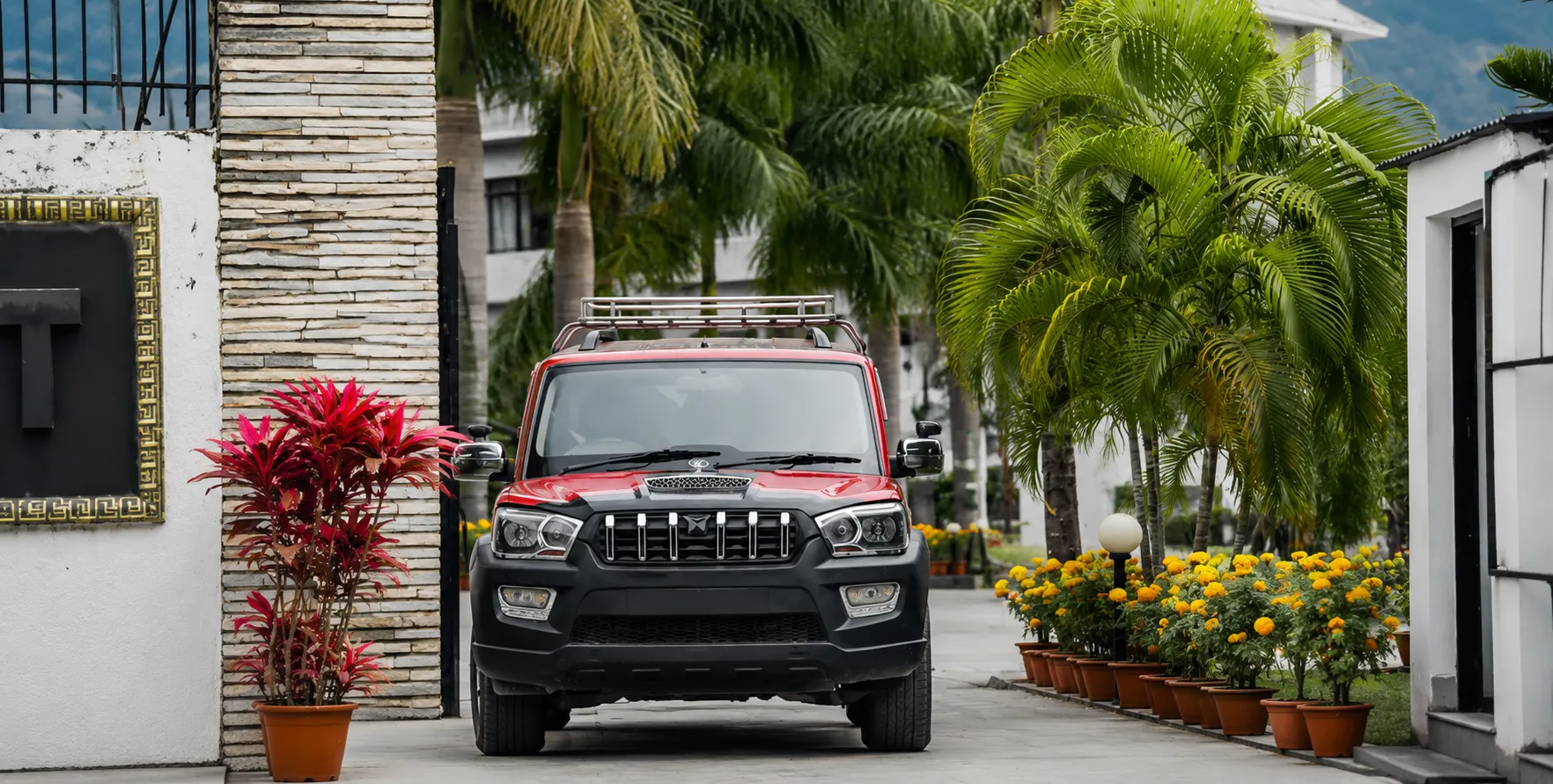
Nepal Vehicle Hiring’s private 4WD jeep hire is the recommended and most popular vehicle option for the Kathmandu-to-Dharapani journey. Our Mahindra Scorpio (5 to 7 passengers) and Toyota Land Cruiser (4 to 5 passengers) offer 4WD traction, high ground clearance, and a comfortable cabin for the 235-kilometre journey.

Swayambhunath visit during Kathmandu Pokhara Tour

Private jeep hire Kathmandu to Dharapani: approximately US$320 per vehicle, all-inclusive — vehicle, experienced Annapurna-approach driver, fuel, and driver’s return costs. Per-person breakdown at various group sizes:

  • 2 passengers: NPR 11,000 to 15,000 per person
  • 3 passengers: NPR 7,333 to 10,000 per person
  • 4 passengers: NPR 5,500 to 7,500 per person — competitive with shared jeep fare
  • 5 passengers: NPR 4,400 to 6,000 per person — often cheaper than shared jeep
  • 6 passengers: NPR 3,667 to 5,000 per person — significantly cheaper than shared jeep

Private jeep hire advantages over shared transport: hotel door pickup at your specified departure time (typically 6:00 to 6:30 AM); stops at Malekhu, Mugling, Besisahar, Jagat, Syange, and Tal at your discretion; luggage stored inside the vehicle rather than on an open roof rack; experienced driver accountable to your group; no waiting at departure points for a vehicle to fill. Contact us through our plan your trip page for current pricing and availability.

Shared Jeep (Budget — NPR 2,000 to 3,500 per person)

Shared jeeps for Dharapani depart from Kathmandu’s Machhapokhari Bus Park (Gongabu) — approximately 15 to 20 minutes from Thamel by taxi or Pathao motorbike. Shared jeeps to Dharapani are not a direct single-vehicle service in most cases — the standard arrangement is a bus or shared jeep from Kathmandu to Besisahar (NPR 300 to 400, 5 to 6 hours), then a separate shared jeep from Besisahar to Dharapani (NPR 1,000 to 1,500 per person, 3 to 4 hours). Total fare: approximately NPR 1,300 to 1,900 per person.

Direct shared jeep services from Kathmandu to Dharapani occasionally operate but are rare and inconsistently available — when they exist, fares are approximately NPR 2,000 to 3,500 per person for the full route, with journey times of 10 to 12 hours. The shared jeep departs when full (7 to 9 passengers) with no fixed schedule.

For solo trekkers and budget pairs, the shared jeep option is the most economical. For groups of 4 or more, Nepal Vehicle Hiring’s private jeep offers competitive per-person costs and much better logistics.

Nepal Tour Package

Nepal Vehicle Hiring Hiace Van + 4WD Jeep (Groups of 8 to 14)

For larger trekking groups of 8 to 14 people, Nepal Vehicle Hiring offers a hybrid configuration: a Hiace van from Kathmandu to Besisahar (178 km, comfortable highway driving). Our Besisahar private vehicle service deploys dedicated 4WD jeeps for the Besisahar-to-Dharapani mountain section.

This configuration gives large groups highway comfort on the long first leg and proper mountain-road vehicles for the challenging Marsyangdi gorge section. The Hiace isn’t suitable beyond Besisahar on the mountain track—our 4WD jeep hire handles that section.

Key Villages Between Kathmandu and Dharapani: What to Know

Mugling (190 m) — The Fish Lunch Capital

Mugling at the Trishuli-Marsyangdi confluence is renowned throughout Nepal for its riverside fish restaurants. Fresh asla (Himalayan snow trout) and sahar (golden mahseer) caught from the Trishuli River each morning are grilled over charcoal and served with beaten rice — one of Nepal’s finest informal roadside dining experiences.

Arriving at Mugling around 10:30 to 11:00 AM for a 6:30 AM departure makes the timing perfect for a Mugling fish lunch before the final push north to Besisahar. The Kathmandu to Pokhara bus passes through Mugling on the highway — Dharapani-bound vehicles diverge at the Mugling-Dumre junction before reaching Pokhara.

Besisahar (760 m) — The Last Proper Town

Besisahar deserves a 30-minute proper stop, not a hurried drive-through. It is the last town with full commercial infrastructure before Dharapani — the last ATMs, last fuel stations, last pharmacy, last hardware store if you need trekking equipment. The ACAP permit checkpoint here verifies documentation before allowing any vehicle to proceed northward.

The Kathmandu-to-Besisahar bus ticket covers the highway approach to this town for trekkers using public transport for the Kathmandu-to-Besisahar leg.

Jagat (1,300 m) — The Gorge Gateway

Jagat is the most important checkpoint village on the Besisahar-to-Dharapani mountain road — all Annapurna and Manaslu trekking permits are verified here. The village sits in a dramatic section of the gorge, with the Marsyangdi audible and visible below.

Nepal Vehicle Hiring drivers are experienced with the Jagat checkpoint process, which typically adds 5 to 10 minutes to the journey. Jagat’s guesthouses are simple but adequate and offer an alternative overnight stop for trekkers starting the lower circuit from here.

Tal (1,700 m) — The Open Valley

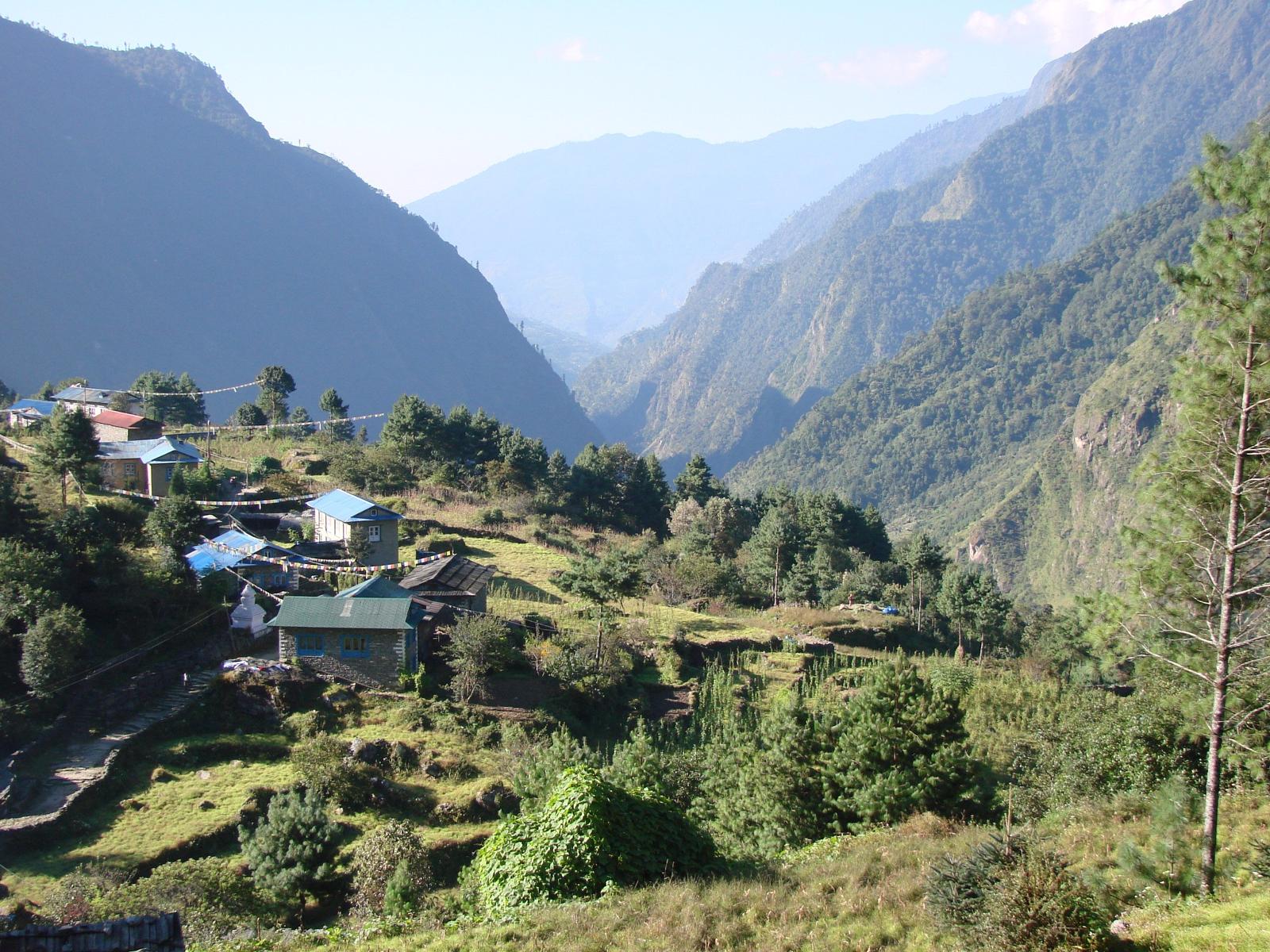
Tal’s wide, flat valley floor — a former glacial lake bed — provides the finest photography opportunity of the entire mountain road section. The wide gravel-floored valley, the Marsyangdi braided across it, the vertical rock walls on both sides, and the distant snow peaks at the valley head create a landscape composition of extraordinary power.

Nepal Vehicle Hiring drivers know the best pull-off point at Tal for vehicle photography — usually a 15 to 20 minute stop here is factored into the journey when working with photography-motivated trekkers or tour groups.

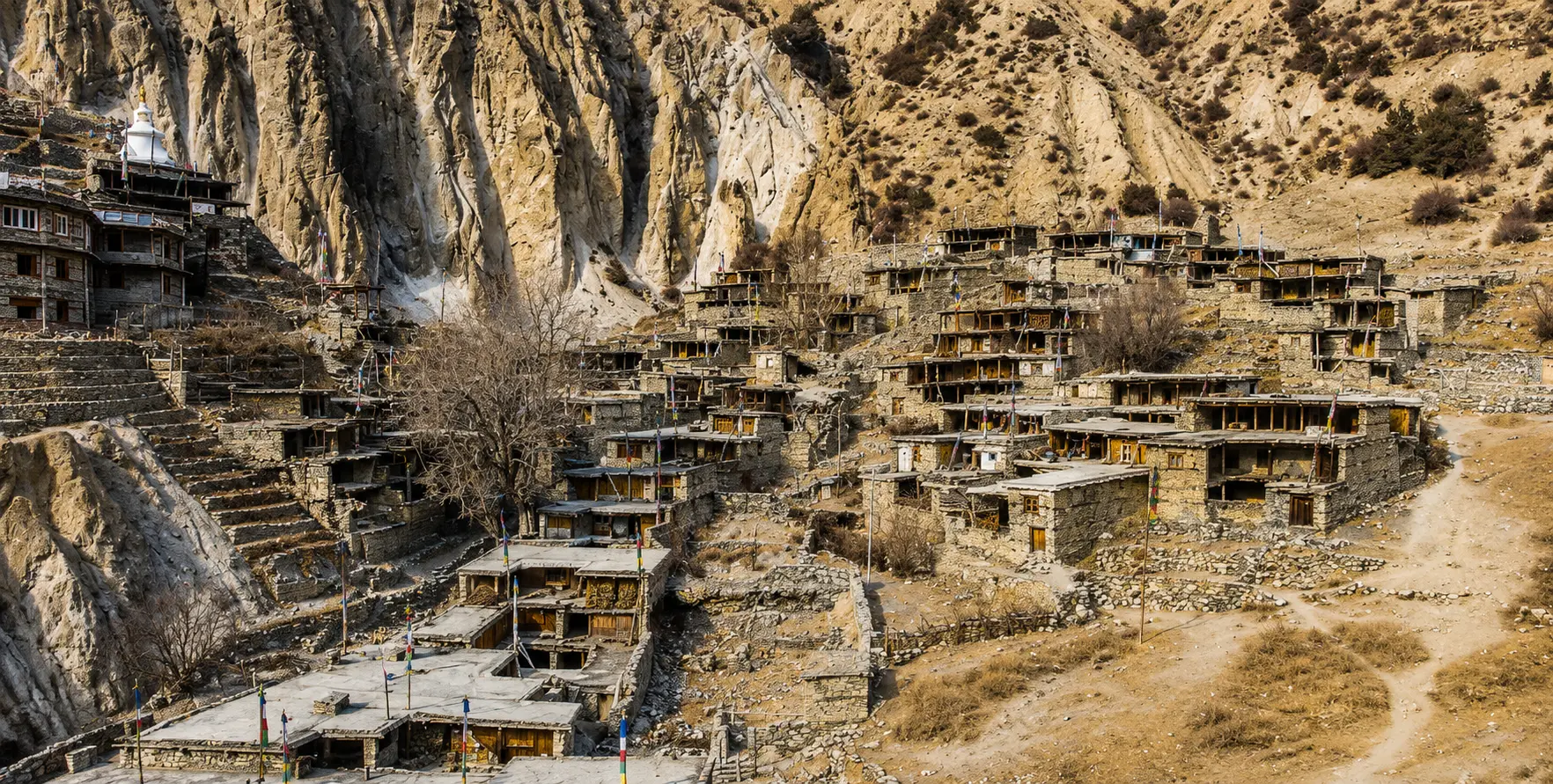
Dharapani (1,860 m) — The Annapurna Circuit Gateway

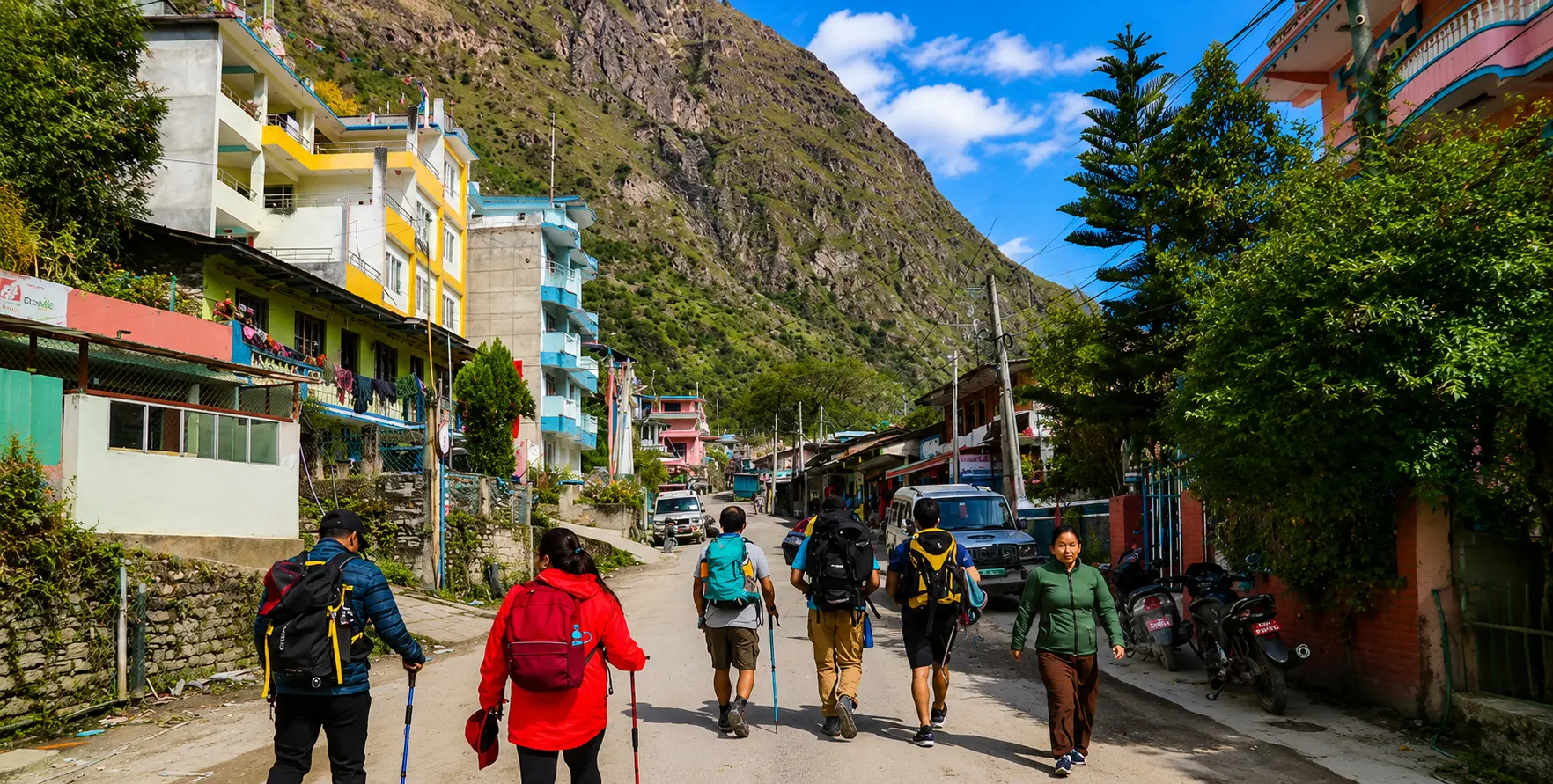
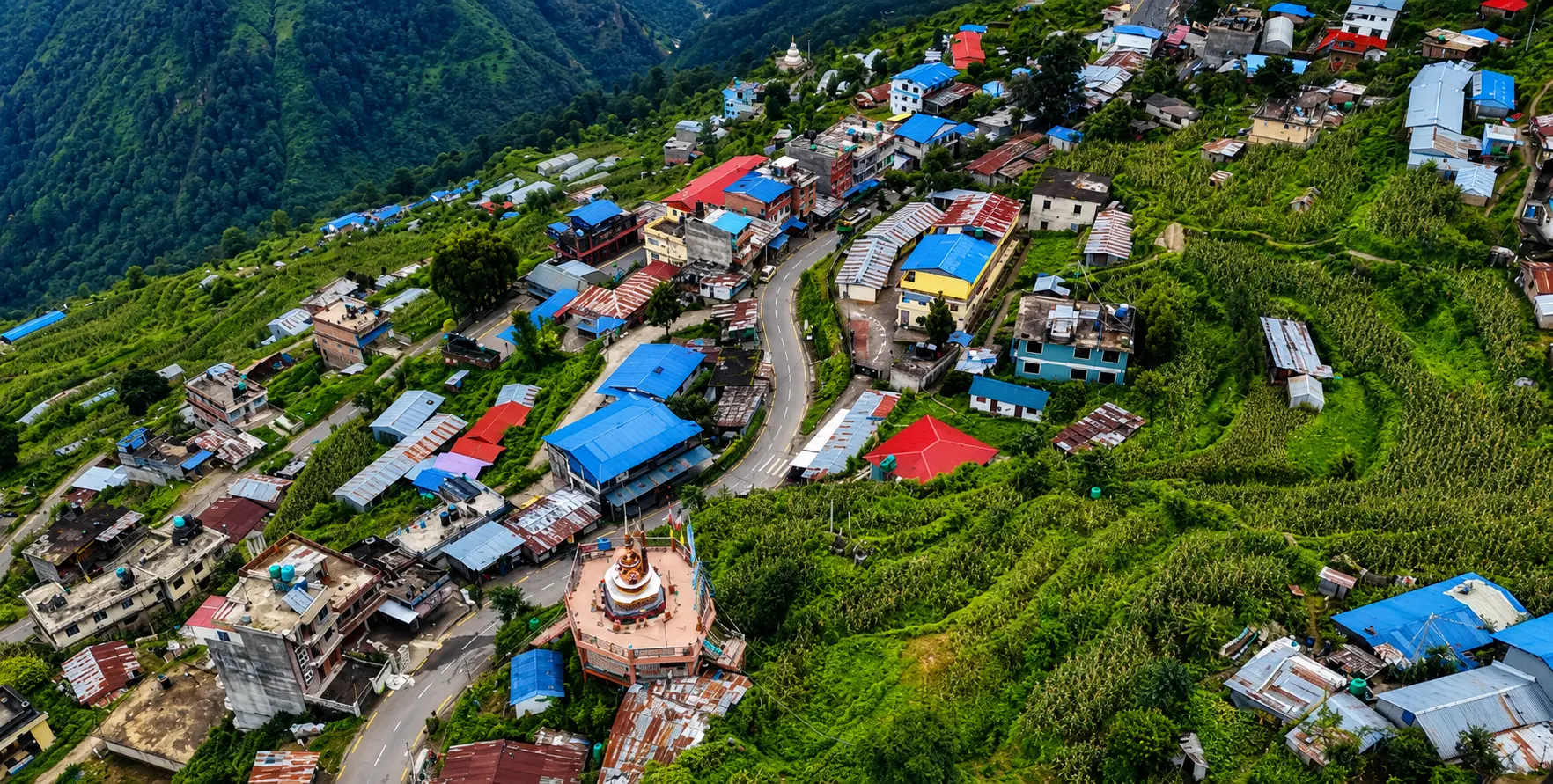
Dharapani is a compact but well-equipped trekker village at the Marsyangdi-Dudh Khola confluence. The main street has 8 to 12 guesthouses, several restaurants serving dal bhat and trekker fare, a permit checkpoint, basic medical facilities, and shops selling trekking supplies.

The Dharapani checkpoint is where trekkers entering the Annapurna Conservation Area from the east get their permits verified. From Dharapani, the trail to Chame (the next major town) takes about 4 to 5 hours of walking—a manageable first day for most trekkers arriving by vehicle in the early-to-mid afternoon.
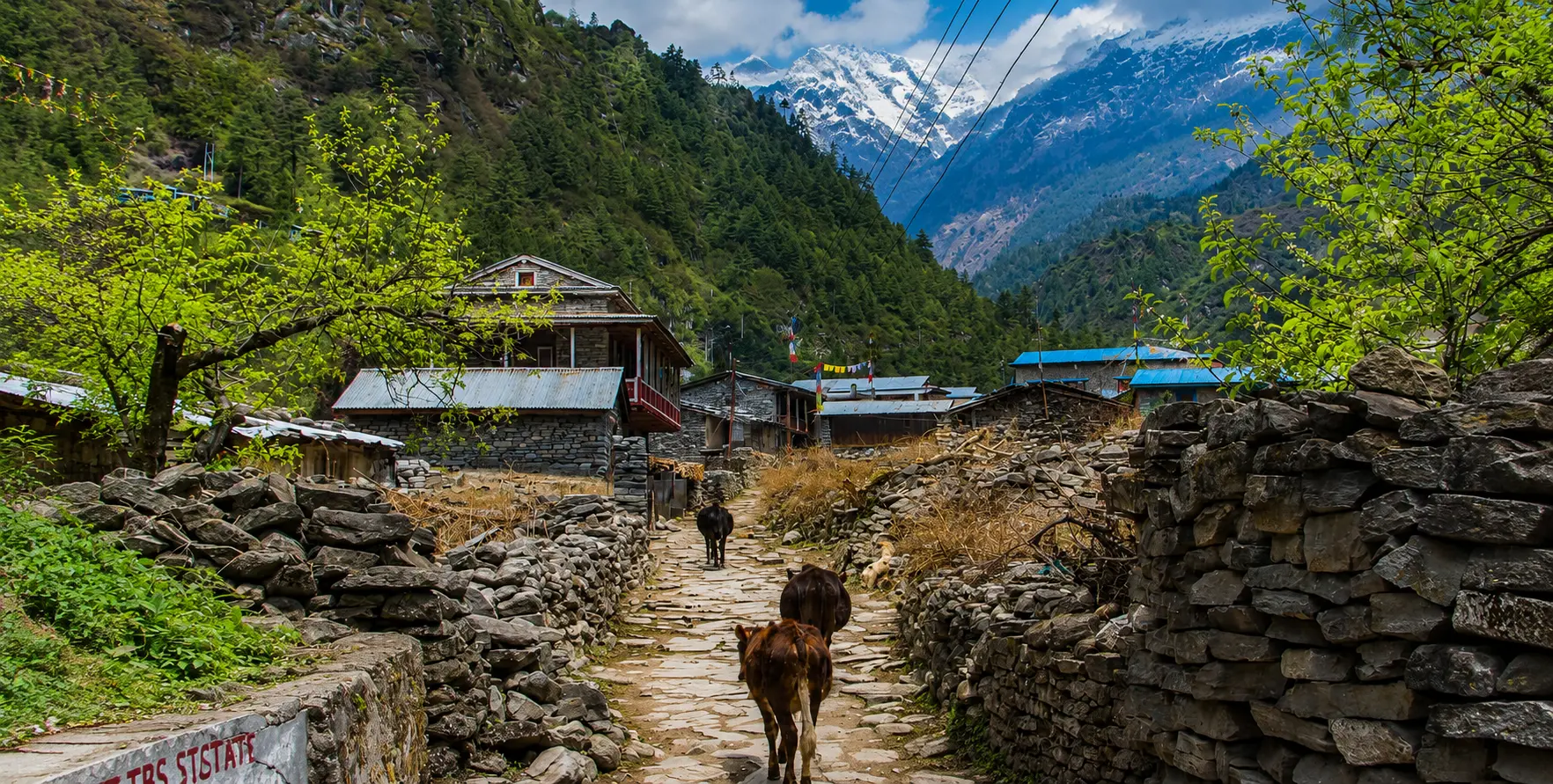
Book Kathmandu to Dharapani Private Vehicle Hire with a reliable 4WD jeep, Scorpio SUV, or other private vehicle. Travel comfortably through Besisahar toward Dharapani, a major starting point for the Annapurna Circuit Trek.

Permits Required for the Kathmandu to Dharapani Journey

Annapurna Conservation Area Permit (ACAP)

The ACAP is mandatory for all foreign nationals entering the Annapurna Conservation Area, which begins at Besisahar and covers the full Annapurna Circuit, including Dharapani, Chame, Manang, and all the way to Jomsom and Muktinath. 2026 fee: NPR 3,000 per person (approximately USD 22 to 25).

The ACAP is checked at Besisahar, Jagat, and Dharapani — carry it at all times after collecting it from the Nepal Tourism Board office in Kathmandu or Pokhara (recommended) or from the Besisahar ACAP office.

TIMS Card

The TIMS (Trekkers’ Information Management System) card requirement was revised in 2023 and is not currently mandatory for Annapurna Circuit trekkers holding a valid ACAP permit. Confirm current requirements with Nepal Vehicle Hiring at the time of booking — regulations can change without published notice. Our plan your trip page inquiry process always includes a current permit status check.

Licensed Guide Requirement

A licensed guide is mandatory for trekking in the Annapurna Conservation Area per current Nepal government regulations. The guide is not required for the vehicle journey from Kathmandu to Dharapani, but must accompany the trek from the Dharapani trailhead onward.

Nepal Vehicle Hiring coordinates with partner licensed guide services — contact us when booking your Dharapani approach vehicle if you need guide arrangements. Time for the Kathmandu to Dharapani Drive

Spring (March to May): Premier Season

Spring delivers the finest conditions for the Kathmandu-to-Dharapani drive. Rhododendrons bloom along the approach hills, the pre-monsoon skies are clear, and the mountain road from Besisahar is in its best annual condition after winter consolidation.

Book Nepal Vehicle Hiring 3 to 5 weeks in advance for April and May departures — peak Annapurna Circuit season means all 4WD jeep hire options fill quickly. The Kathmandu to Manang jeep option (continuing beyond Dharapani to Chame and Manang) is particularly popular in spring for trekkers wanting to minimise road-walking on the lower circuit.

Autumn (September to November): Post-Monsoon Clarity

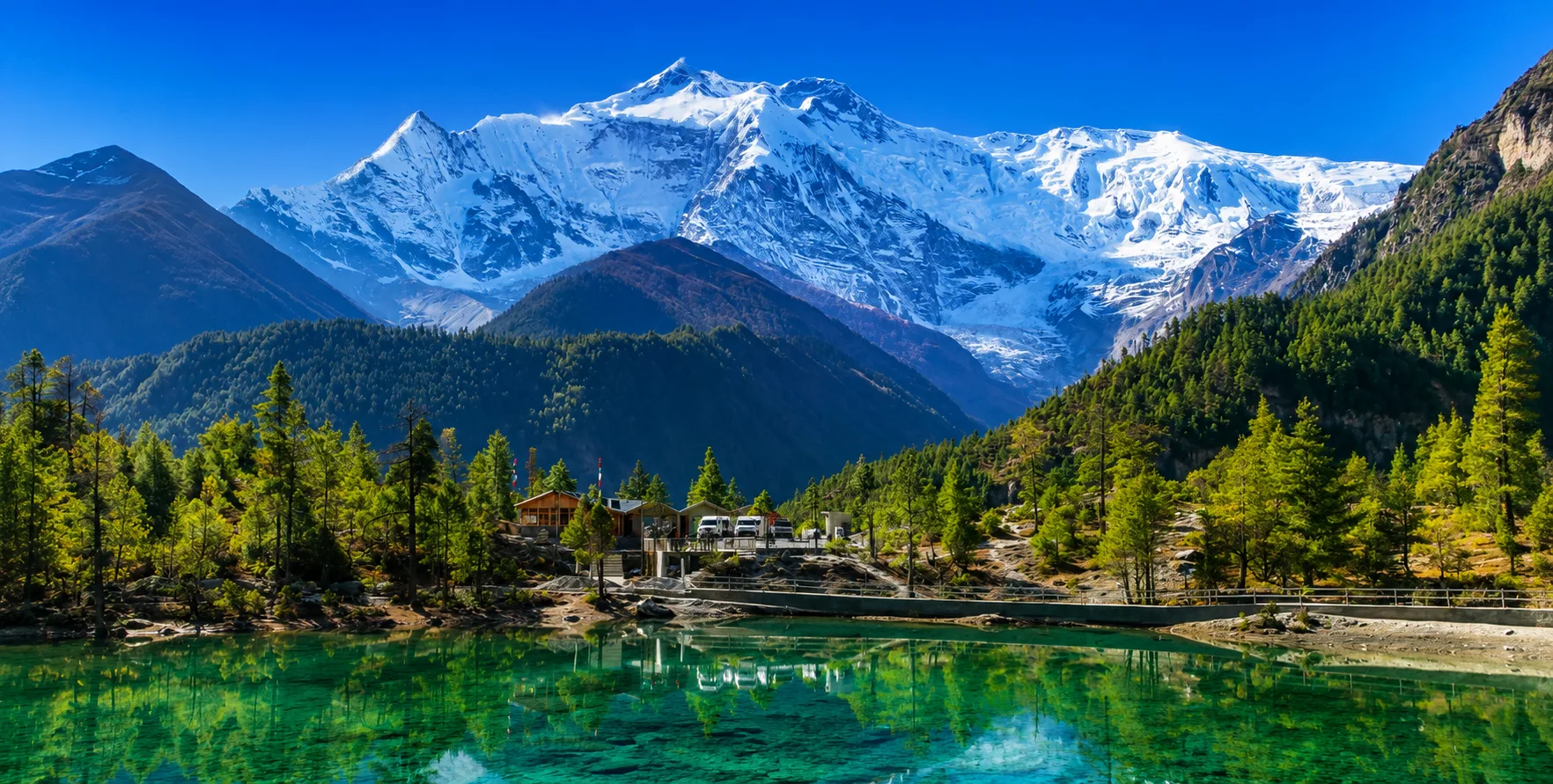
Autumn is Nepal’s peak trekking mini season, offering the best mountain views on the Dharapani approach road. Post-monsoon air clarity means the Himalayan peaks visible at Tal and Dharapani — Manaslu, Annapurna II, and the first glimpses of the upper Marsyangdi snowfields — are exceptionally clear.

The road has been partially repaired after monsoon damage by October. Nepal Vehicle Hiking’s 4WD jeep hire for Dharapani is in maximum demand in October and November—book 4 to 5 weeks in advance.

Monsoon (June to August): Challenging

The monsoon significantly increases difficulty on the Besisahar-to-Dharapani mountain road —landslides, river crossings, and surface damage are more frequent. The Syange and Jagat cliff sections are the most vulnerable. Nepal Vehicle Hiring operates during monsoon and monitors road conditions daily.

Add 1 to 2 hours to travel times for monsoon estimates, and keep schedules flexible. The Besisahar private vehicle service monsoon notes provide the most current road status for the mountain section.

Winter (December to February): Quiet and Cold

Winter is the quietest period on the Annapurna Circuit approach. The road to Dharapani is generally accessible in winter with a 4WD vehicle — the altitude at Dharapani (1,860 m) is not high enough for snow closure on the approach road itself.

However, the trekking above Dharapani becomes significantly more demanding above 3,000 m in December through February. Winter driving on the mountain road requires attention to icy patches in the early morning — Nepal Vehicle Hiring’s winter-experienced drivers depart slightly later (7:00 to 7:30 AM rather than 6:30 AM) to allow morning ice to melt on the mountain sections.

Optimal Departure Timing from Kathmandu for Dharapani

Nepal Vehicle Hiring recommends a departure time from Thamel of 6:00 to 6:30 AM for the Dharapani run. Here is the full day timeline for a 6:30 AM departure:

  • 6:30 AM: Depart Thamel. Clear of Kathmandu morning traffic.
  • 8:30 to 9:00 AM: Malekhu — optional breakfast stop (20 minutes).
  • 10:30 to 11:00 AM: Mugling — lunch stop. Fresh river fish. 30 to 45 minutes.
  • 12:00 to 12:30 PM: Besisahar — fuel, ATM, ACAP permit check, brief rest. 30 minutes.
  • 1:00 to 1:30 PM: Depart Besisahar on mountain road north.
  • 2:30 to 3:00 PM: Jagat — permit checkpoint. 5- to 10-minute stop.
  • 3:00 to 3:30 PM: Chamche Waterfall photo stop. Tal Valley rest stop (20 minutes).
  • 4:30 to 5:30 PM: Arrivein  Dharapani. Guesthouse check-in. Permit registration at checkpoint. Rest before tomorrow’s first day of trekking.

This timeline lets trekkers arrive in Dharapani in the late afternoon—enough time to settle, check permits, organise packs, have dinner, and sleep before the first full trekking day to Chame. Nepal Vehicle Hiring’s hotel door pickup at 6 is guaranteed: no walking to a bus park, no waiting for a shared vehicle to fill, no uncertainty.
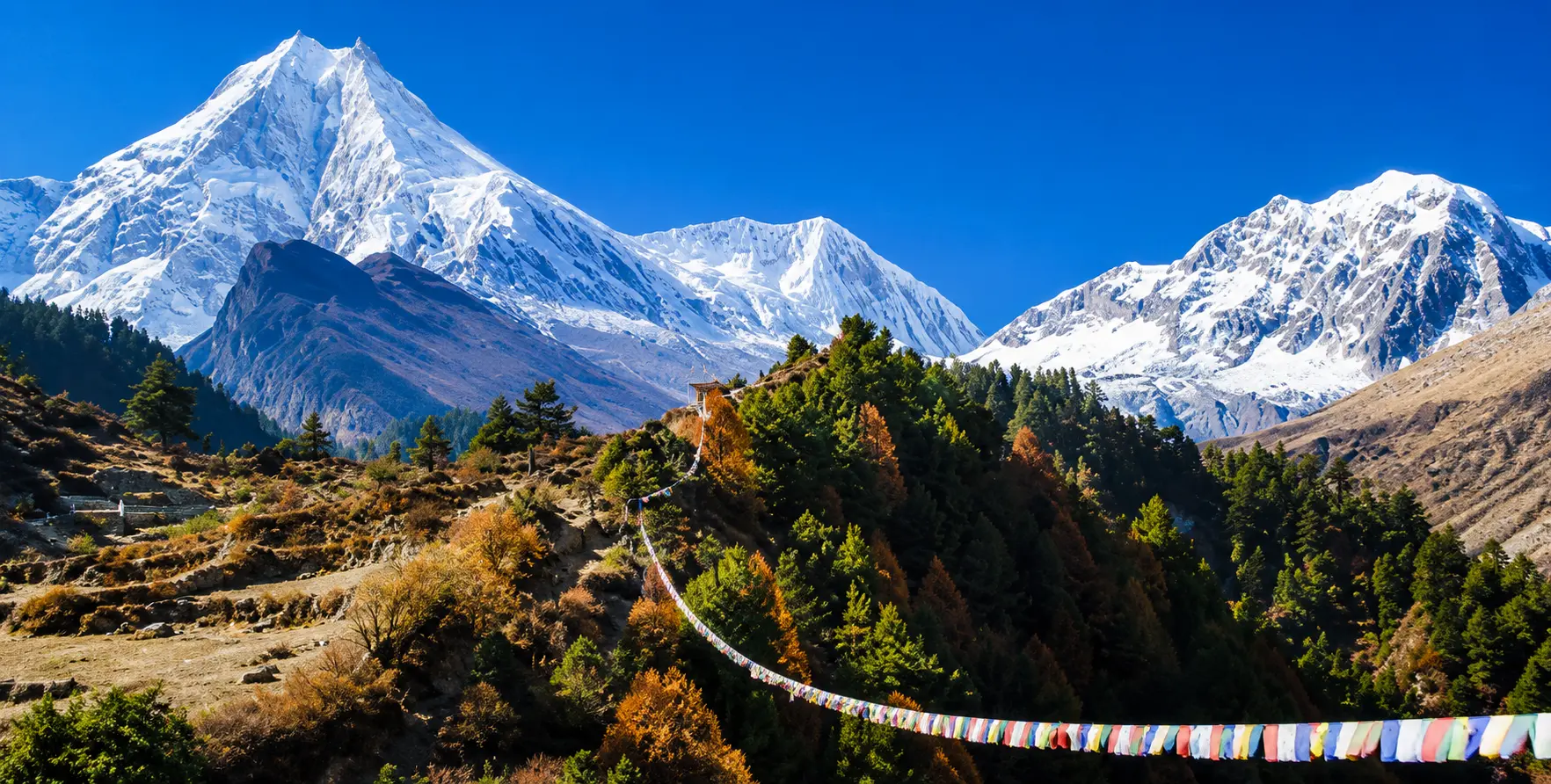
Book Kathmandu to Dharapani Private Vehicle Hire with a reliable 4WD jeep, Scorpio SUV, or other private vehicle. Travel comfortably through Besisahar toward Dharapani, a major starting point for the Annapurna Circuit Trek.

Beyond Dharapani: The Annapurna Circuit Ahead

For trekkers arriving at Dharapani by Nepal Vehicle Hiring’s private jeep, the circuit ahead is one of Nepal’s finest trekking experiences. Understanding the route gives context to the decision to start here:

  • Dharapani (1,860 m) to Chame (2,670 m): Day 1, approximately 22 km, 5 to 6 hours. Follow a trail through Bagarchhap, Danaque, and Timang, with excellent mountain views and minimal vehicle traffic. Chame is the administrative headquarters of Manang District with guesthouses, a bank, ACAP permit recheck, and the famous Paungda Danda curved rock wall just north of town.
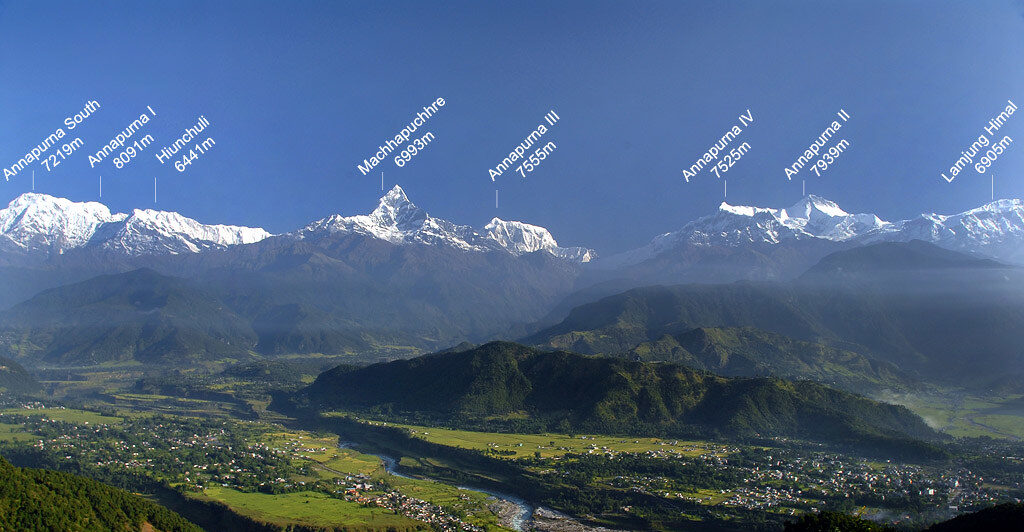
  • Chame to Pisang (3,200 m): Day 2, approximately 17 km, 4 to 5 hours. The first jaw-dropping views of Annapurna II (7,937 m) appear above the valley. Upper Pisang monastery on the ridge above is one of the finest sunset viewpoints on the entire circuit.
  • Pisang to Manang (3,519 m): Day 3, approximately 22 km (upper route via Ghyaru and Ngawal) or 18 km (lower route via Humde). The upper route is universally recommended for its ridge-top views of Annapurna II, III, and IV. Manang is the circuit’s acclimatisation stop. For Nepal Vehicle Hiring’s complete Manang approach service from Kathmandu, see our Kathmandu to Manang acclimatisation
  • Manang to Thorong La Pass (5,416 m) and Muktinath (3,710 m): Days 4 to 6 after acclimatisation. The circuit’s high point and most memorable day. The descent from Thorong La to Muktinath covers 1,600 meters of acclimatisation. Our Muktinath Yatra itinerary covers transport to the sacred site for trekkers continuing to Muktinath Temple.
  • Muktinath to Jomsom to Pokhara: Days 7 to 10+. The lower Kali Gandaki valley circuit ends at Pokhara. Our Pokhara-to-Mustang jeep (in reverse) and Pokhara-to-Nayapul transportation cover the various exit vehicle options from the circuit’s southern end.

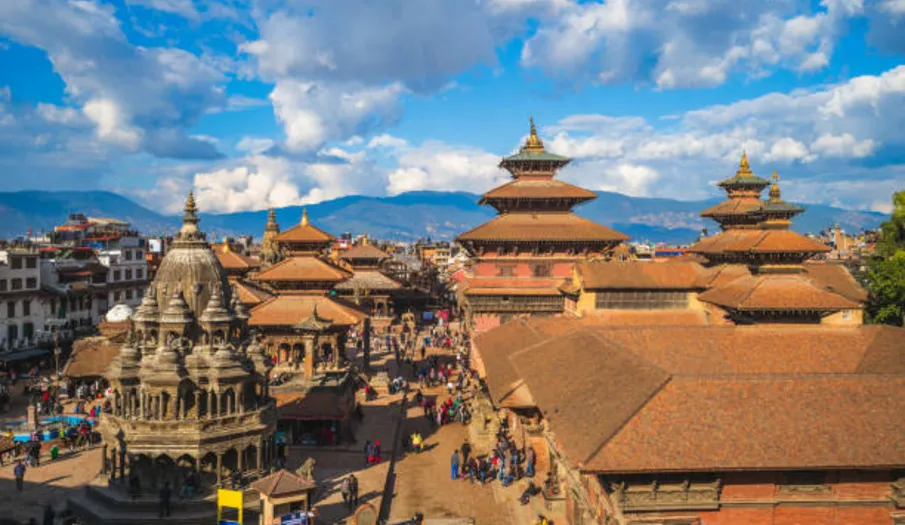
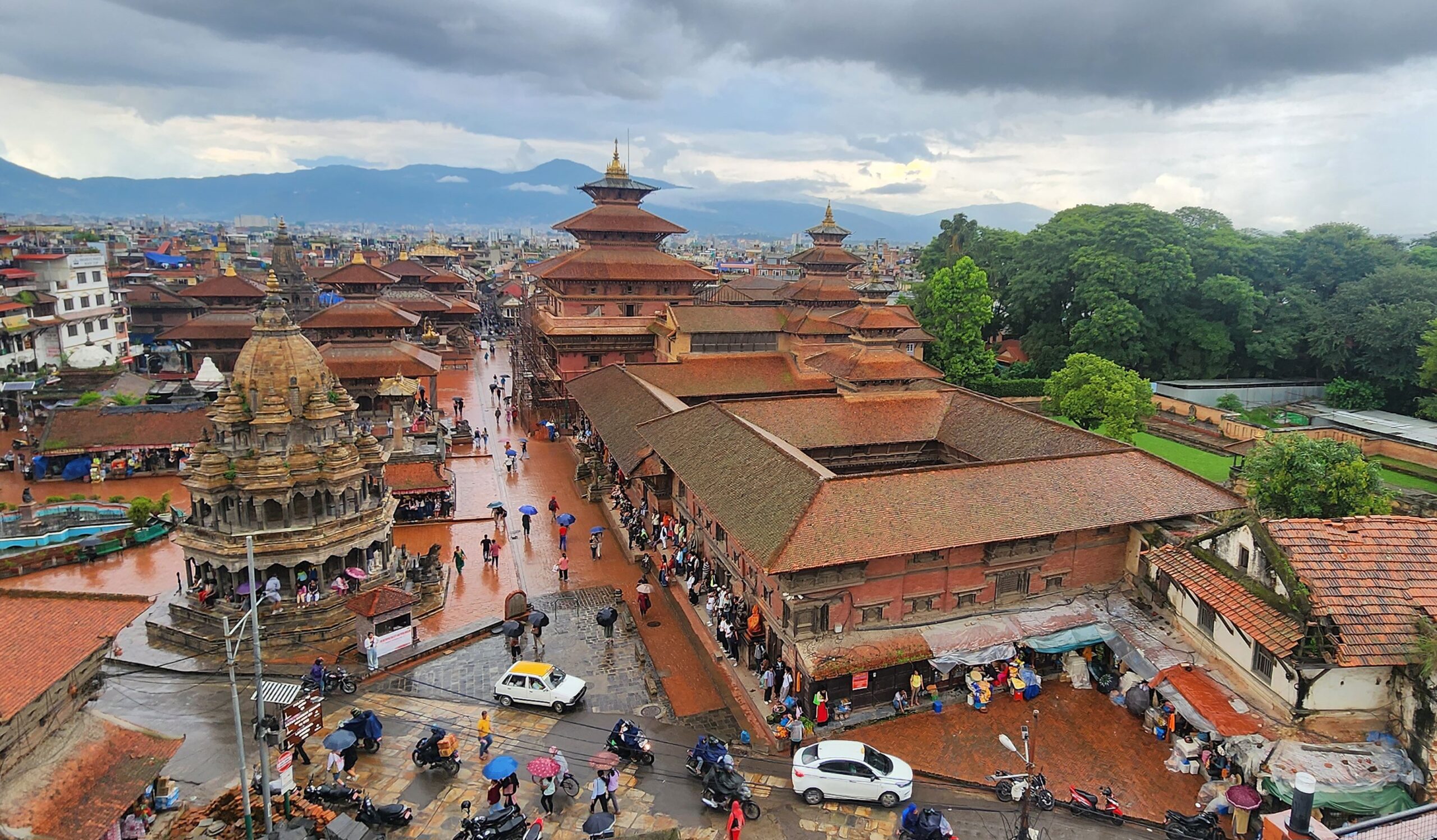
Kathmandu Durbar Square

Nepal Vehicle Hiring: Complete Annapurna Circuit Transport

The Kathmandu-to-Dharapani private vehicle hire is one part of Nepal Vehicle Hiring’s complete transport coverage for the Annapurna Circuit. From the Kathmandu airport transfer that begins your Nepal journey to the circuit exit vehicle that ends it, we coordinate every transport element:

Frequently Asked Questions: Kathmandu to Dharapani Vehicle Hire

How far is it from Kathmandu to Dharapani?

The road distance from Kathmandu (Thamel) to Dharapani is approximately 235 to 240 kilometres. The journey breaks into: Kathmandu to Besisahar (178 km, 5 to 6 hours on paved highway) and Besisahar to Dharapani (57 to 62 km, 4 to 5 hours on rough mountain road).

How long does the drive from Kathmandu to Dharapani take?

By private 4WD jeep with a 6:30 AM Kathmandu departure: 9 to 11 hours total, including a Mugling lunch stop and Besisahar service stop. In monsoon or after heavy rain, add 1 to 2 hours for the mountain road section.

What vehicle is required for the Kathmandu to Dharapani journey?

A 4WD vehicle is mandatory for the Besisahar-to-Dharapani mountain section. Standard cars and Hiace vans aren’t suitable beyond Besisahar. Nepal Vehicle Hiring deploys exclusively from our 4WD jeep hire fleet (Mahindra Scorpio and Toyota Land Cruiser) for the complete Dharapani journey.

Can I take a public bus from Kathmandu to Dharapani?

There is no direct public bus from Kathmandu to Dharapani. The standard public transport combination is: local bus from Kathmandu to Besisahar (NPR 300 to 400, 5 to 6 hours) plus shared jeep from Besisahar to Dharapani (NPR 1,000 to 1,500 per person, 3 to 4 hours), a total of approximately NPR 1,300 to 1,900. For groups of 4 or more, Nepal Vehicle Hiring’s private jeep often offers competitive per-person costs, including hotel pickup.

Should I start the Annapurna Circuit at Besisahar, Jagat, or Dharapani?

Most experienced Annapurna Circuit trekkers and guides in 2026 recommend starting at Dharapani. The Besisahar-to-Dharapani section is now largely a road walk alongside jeep traffic, which significantly reduces the trekking quality. Starting at Dharapani gives you immediate access to the circuit’s best walking while saving 3 to 4 days of less rewarding, road-parallel trail.

Jagat (1,300 m) is a viable intermediate option for trekkers who want to walk the Chamche and Tal section.

How do I book a private jeep from Kathmandu to Dharapani with Nepal Vehicle Hiring?

Contact us through our plan your trip page, WhatsApp, or email [email protected]. Provide your travel date, group size, and preferred departure time. We respond within 24 hours with vehicle confirmation and all-in pricing.

Book Your Kathmandu to Dharapani Private Vehicle with Nepal Vehicle Hiring

Nepal Vehicle Hiring Pvt. Ltd., based in Thamel, Kathmandu, offers top-quality private vehicle service for the Kathmandu-to-Dharapani Annapurna Circuit approach. Hotel-door pickup, experienced Annapurna-approach drivers, transparent all-in pricing, and the flexibility to make the journey’s best stops your own.

Visit our Plan Your Trip page to submit your trek dates, group size, and Dharapani (or alternative) drop-off preference. We respond within 24 hours with a vehicle proposal, driver assignment, and complete all-in pricing. The Annapurna Circuit awaits—let Nepal Vehicle Hiring get you to Dharapani in the condition you need to start your finest Himalayan adventure.
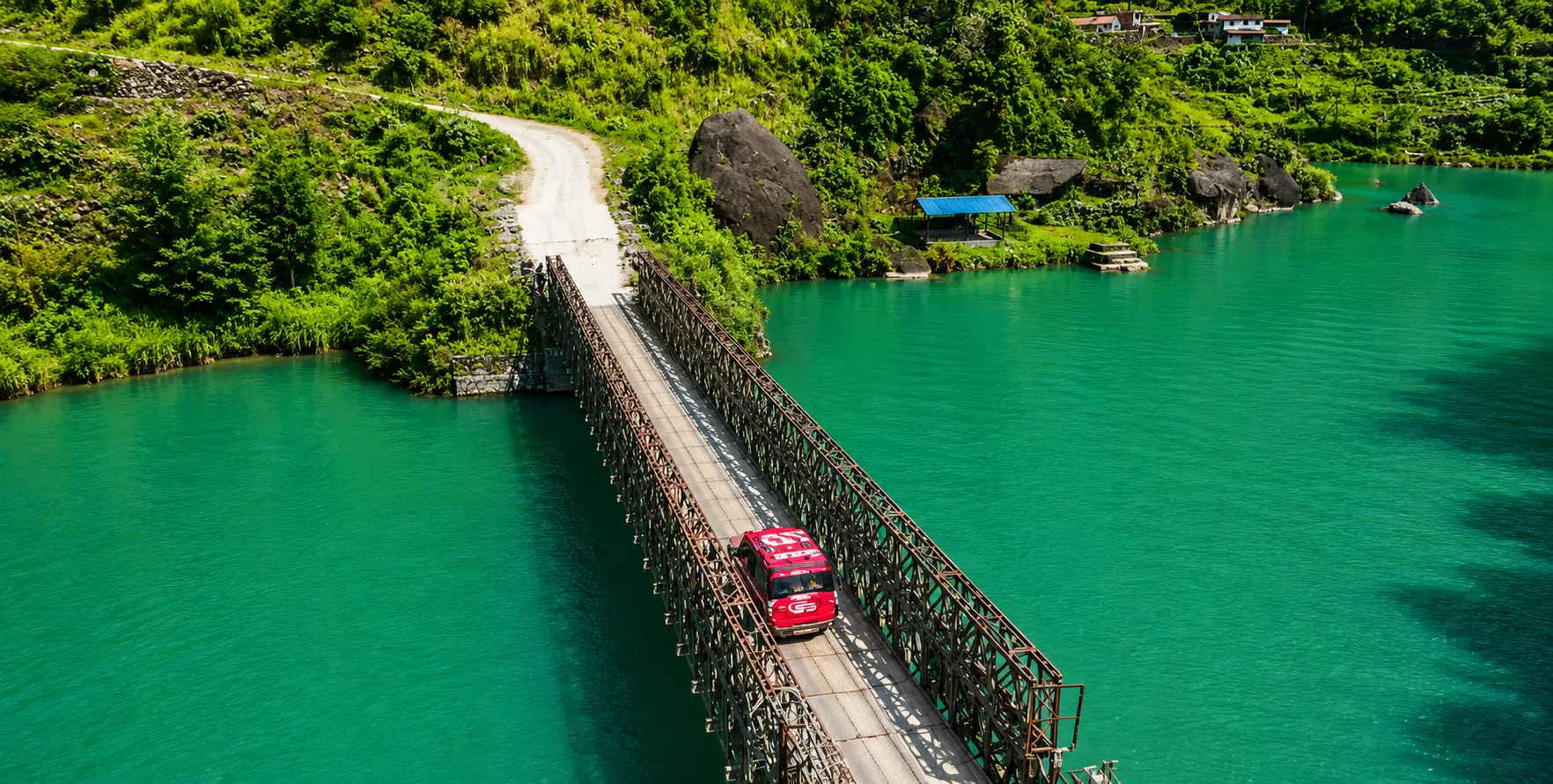
Book Kathmandu to Dharapani Private Vehicle Hire with a reliable 4WD jeep, Scorpio SUV, or other private vehicle. Travel comfortably through Besisahar toward Dharapani, a major starting point for the Annapurna Circuit Trek.

The Marsyangdi River Valley: Understanding the Road’s Character

The Marsyangdi River — the central geographic feature of the entire Kathmandu-to-Dharapani drive — is one of Nepal’s most powerful and most geologically active river systems. Originating from the glaciers of the Annapurna massif above Manang and descending more than 3,000 meters over approximately 110 kilometres to Besisahar, the Marsyangdi has carved one of the deepest and most dramatic river gorges in the central Himalayan range.

Understanding the river’s geography is key to understanding why the Besisahar-to-Dharapani road behaves the way it does — why it is so rough, why it is so slow, and why it is so spectacular.

The Marsyangdi gorge between Besisahar and Dharapani represents one of the world’s most extreme examples of rapid river incision— the process by which a river cuts downward through rock faster than the surrounding landscape can erode laterally. The result is a gorge far deeper relative to its width than most river valleys, with walls rising hundreds of meters almost vertically from the water.

The road through this gorge had to be blasted and carved from those walls in many sections — which is why the Syange cliff section is so dramatically narrow, why the Jagat approach involves such precise driving, and why the road surface is so variable: it is continuously being undermined, damaged, and rebuilt by a river whose sediment load and energy are among the highest in Asia.

The monsoon season dramatically amplifies all of these characteristics. The Marsyangdi in flood — carrying a silty, brown sediment load that turns the river from its dry-season turquoise to an opaque coffee colour — is a genuinely alarming natural force.

It routinely destroys or undermines road sections, takes out suspension bridges, and creates entirely new channel geometries that road maintenance crews must respond to each post-monsoon season. This is why monsoon travel on the Besisahar-to-Dharapani road adds 1 to 2 hours of buffer time to any itinerary, and why Nepal Vehicle Hiring’s monsoon-experienced drivers are so valuable: they know which sections are most vulnerable, which crossings to assess carefully, and when to wait for road clearance rather than push through.

For trekkers, understanding the Marsyangdi’s character also gives depth to the walking experience that begins at Dharapani. The gorge that trekkers must go through for 4 to 5 hours from Besisahar is the same trekking trail that will follow for the first several days of the circuit.

The visual relationship between the road and the river — always present, always audible, always making the road’s existence feel unlikely — is one of the great geographical leitmotifs of the Annapurna Circuit experience.
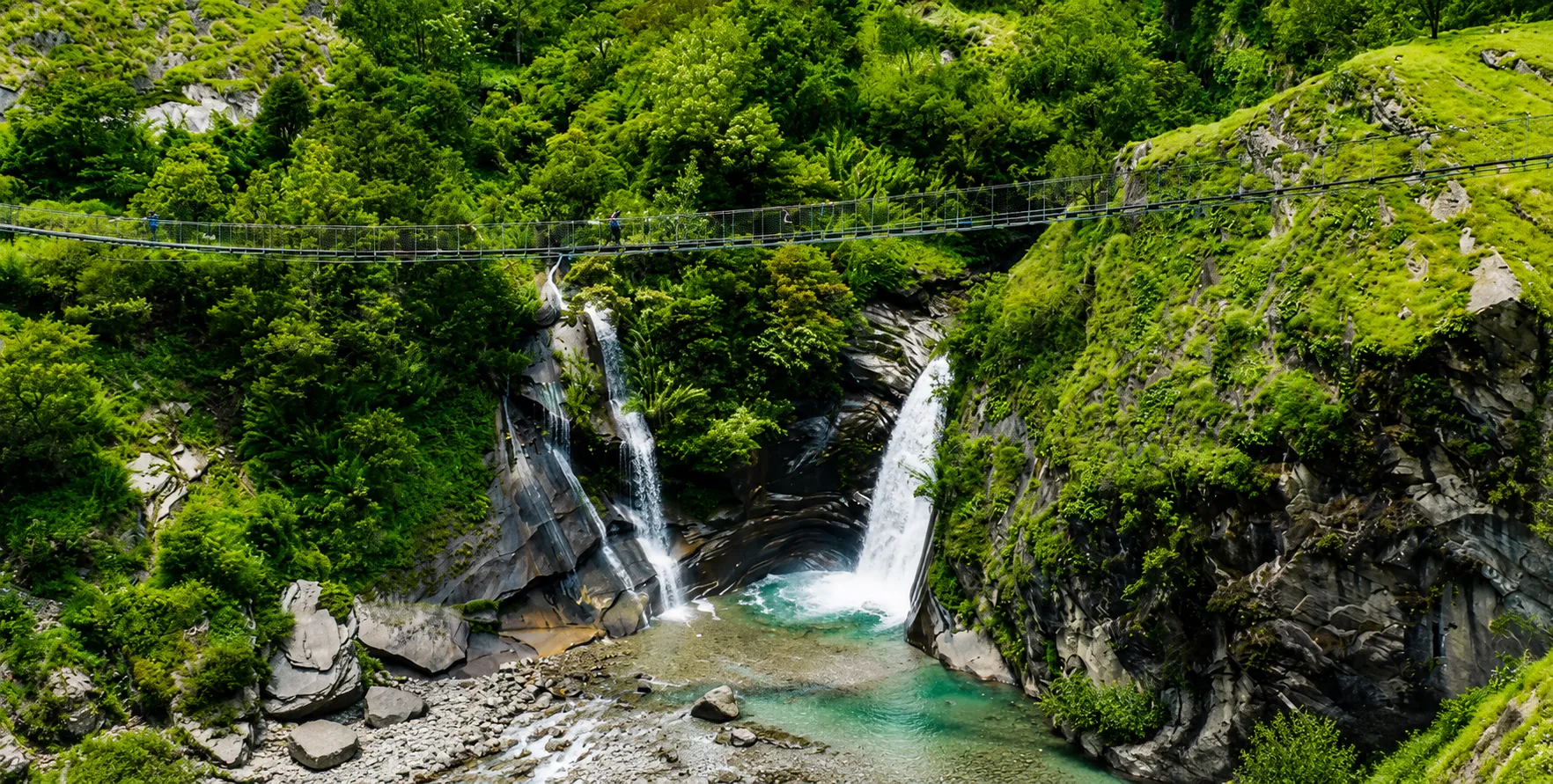
Book Kathmandu to Dharapani Private Vehicle Hire with a reliable 4WD jeep, Scorpio SUV, or other private vehicle. Travel comfortably through Besisahar toward Dharapani, a major starting point for the Annapurna Circuit Trek.

The Manaslu Connection: Why Dharapani Is a Double-Circuit Gateway

One of Dharapani’s most important, and most underappreciated, features is its position as the confluence point not just of two rivers, but of two of Nepal’s finest trekking circuits. The Marsyangdi River, coming from the east, brings the Annapurna Circuit approaching from Besisahar.

The Dudh Kho, coming from the west, st connects to the Manaslu Circuit, which approaches from Arughat and the Tsum Valley. Dharapani is the point where trekkers on these two circuits can meet — or where a trekker completing one circuit can begin the other.

The Manaslu Circuit is Nepal’s second most popular long-distance trekking circuit after the Annapurna Circuit, circling the world’s eighth-highest mountain (Manaslu at 8,163 m) through a restricted area that requires a dedicated Manaslu Circuit permit (USD 100 for the first week, USD 15 per day thereafter) and a mandatory licensed guide. The circuit connects to the Annapurna Circuit at Dharapani, making it possible to complete the Annapurna-Manaslu Grand Circuit, one of Nepal’s most ambitious and rewarding trekking itineraries, covering the high-altitude Thorong La (5,416 m) and Larkya La (5,160 m) passes over approximately 30 days.

For Nepal Vehicle Hiring clients, the Dharapani connection point means that Kathmandu-to-Dharapani vehicle hire serves not only Annapurna Circuit trekkers but also Manaslu Circuit trekkers approaching from the Annapurna side, Manaslu-Annapurna Grand Circuit trekkers, and trekkers who have completed the Manaslu Circuit and want a vehicle pickup at Dharapani for the Kathmandu return. Our private jeep hire covers the complete Dharapani pickup service — whether you arrive at Dharapani from the north (having trekked down from Chame and Bagarchhap) or from the west (having completed the Manaslu Circuit via Samagaon, Larkya La, and Tilje).

Contact us through our Plan Page to arrange a scheduled vehicle pickup in Dharapani on a specific date and time.

Practical Tips for the Kathmandu to Dharapani Drive

What to Pack in Your Day Bag for the Vehicle Journey

The9-9 to11-hour Kathmandu-to-Dharapani drive crosses three distinct climate zones — Kathmandu’s urban warmth (1,350 m), the Trishuli and Marsyangdi valley heat (700 to 1,000 m at the lowest points), and the gradually cooling upper valley as you approach Dharapani (1,860 m). Keep the following accessible in your day bag rather than in your main trekking pack (which will be stored in the jeep’s luggage area or on the roof rack):

  • Warm layer: a fleece or light down jacket for the Dharapani arrival, where late-afternoon temperatures are noticeably cooler than Kathmandu or the valley floor.
  • Water: minimum litres for the mountain road section. The Besisahar-to-Dharapani drive has few reliable places to buy water. Your Nepal Vehicle Hiring driver will advise on the last reliable water stop before the roughest sections.
  • Snacks and trail food: the mountain road from Jagat to Dharapani (approximately 29 km, 2 to 2.5 hours) has very limited food stops. Carry trail bars, nuts, or local biscuits for this section.
  • ACAP permit: keep it accessible in your day bag, not buried in your main pack. They check it at Besisahar, Jagat, and Dharapani. Unpacking at each checkpoint adds time and inconvenience.
  • Motion sickness medication: the switchback sections approaching Jagat and the cliff road at Syange produce significant lateral vehicle motion. Take medication before departure from Besisahar if you are susceptible.
  • Offline maps: download Maps.me or Gaia GPS covering the Lamjung and Manang districts before leaving Kathmandu. Mobile signal is available in Besisahar and Jagat but patchy between them.
  • Cash in NPR: ideally withdraw from Kathmandu before departure. The Besisahar ATM is a backup (sometimes functional, sometimes out of cash). There is no reliable cash source between Besisahar and Chame.
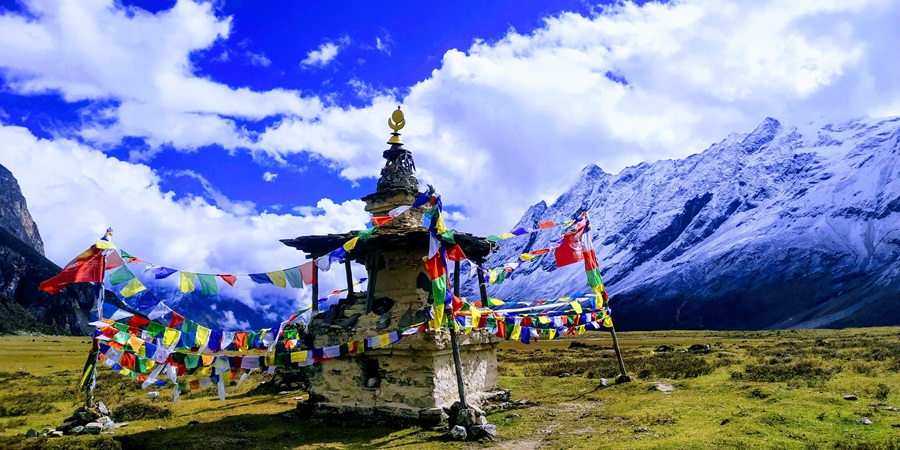
Book Kathmandu to Dharapani Private Vehicle Hire with a reliable 4WD jeep, Scorpio SUV, or other private vehicle. Travel comfortably through Besisahar toward Dharapani, a major starting point for the Annapurna Circuit Trek.

Photography Tips for the Drive

The Kathmandu-to-Dharapani road passes through some of the finest vehicle-accessible photography landscapes in the Annapurna region. Nepal Vehicle Hiring’s private jeep service allows stops at the photographer’s discretion — announce your interest when booking, and our driver will incorporate the following key photography stops into the journey:

  • Malekhu gorge (approximately 48 km from Kathmandu): the early morning light on the Trishuli River in spring and autumn is exceptional — golden-hour quality even at 8:30 AM for a 6:30 AM departure.
  • Mugling confluence (110 km): the visible meeting of the Trishuli and Marsyangdi rivers is best photographed from the bridge or the restaurant terraces overlooking the confluence.
  • Syange cliff road (approximately 205 km from Kathmandu): the narrow cliff-carved road section with the Marsyangdi visible below is one of Nepal’s most dramatic road photography subjects. Brief safe stops are possible at wider points — your driver will identify the best.
  • Chamche waterfall (approximately 210 km): visible directly from the road, the waterfall is best in morning light when it catches direct sun.
  • Tal valley floor (approximately 213 km): the wide, flat former-lake valley with braided river channels and vertical rock walls offers one of the finest compositional opportunities of the entire drive. A 15 to 20-minute stop in Tal allows time for multiple compositions.
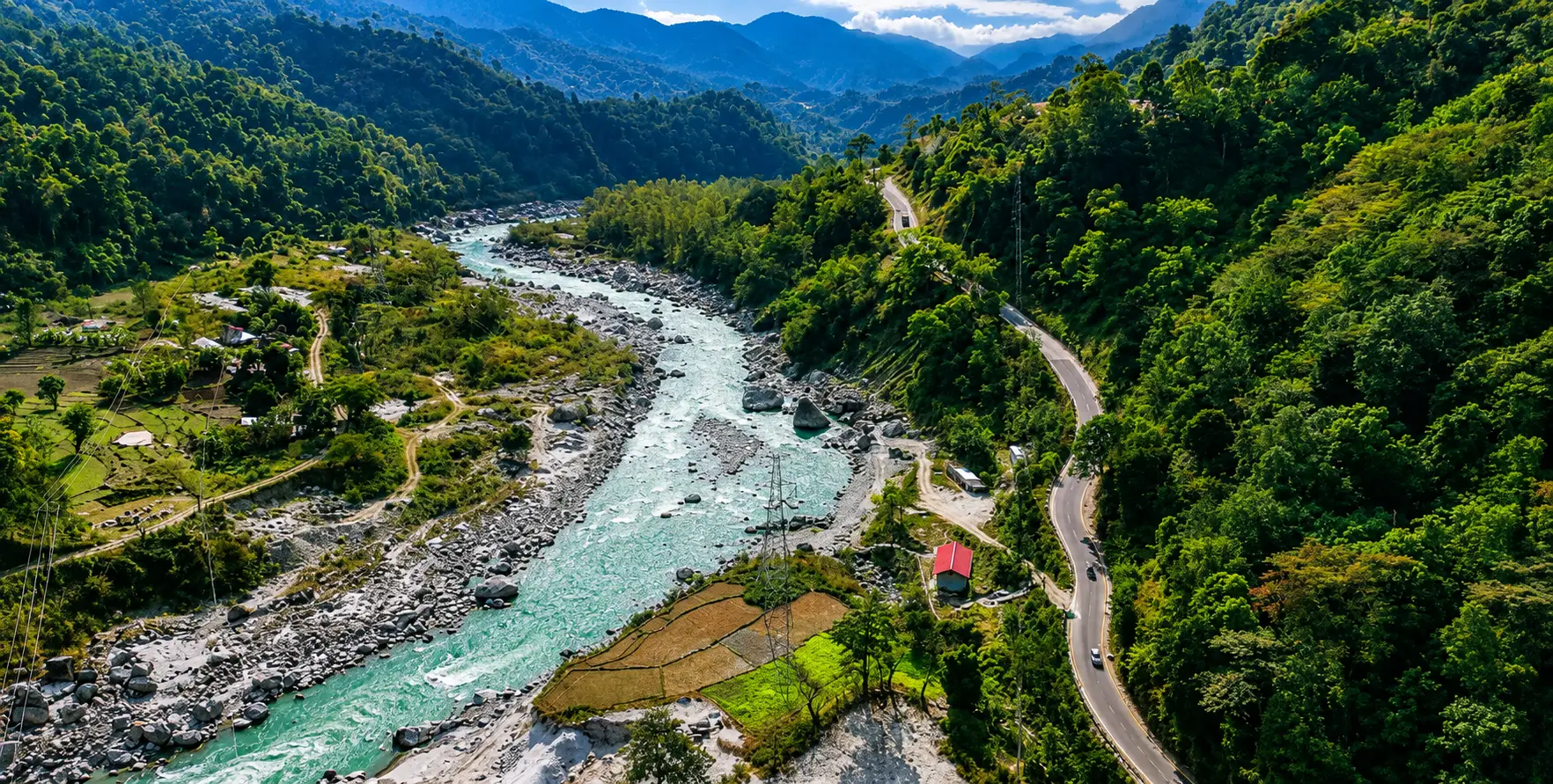
Book Kathmandu to Dharapani Private Vehicle Hire with a reliable 4WD jeep, Scorpio SUV, or other private vehicle. Travel comfortably through Besisahar toward Dharapani, a major starting point for the Annapurna Circuit Trek.

Managing the Besisahar Transfer for Groups

For large groups using Nepal Vehicle Hiring’s Hiace van hire for the Kathmandu-to-Besisahar highway section and 4WD jeeps from Besisahar onward, the Besisahar transfer requires 15 to 20 minutes of vehicle changeover—transferring luggage from the Hiace to the jeeps, briefing on the mountain road section, and finalising permit and fuel stops. Our operations team pre-coordinates this transfer to minimise.

Groups should be prepared for the cramped conditions of the 4WD jeep compared to the Hiace — the available space is reduced. Still, there is less distance (57 to 62 km remaining) even though it takes similar time. The Besisahar lunch stop built in 30 minutes) makes the vehicle transition feel natural and unhurried.

Dharapani as an Overnight Stop: Guesthouses and Facilities

Most trekkers who arrive at Dharapani by vehicle from Kathmandu in the late afternoon (4:30 to 5:30 PM for a 6:30 AM departure) stay one night in Dharapani before beginning the first trekking day to Chame or Bagarchhap. Understanding what Dharapani offers as an overnight stop helps set appropriate expectations:

Dharapani has about 12 guesthouses, from very basic rooms with shared facilities (NPR 300 to 500 per person) to more comfortable lodge-style accommodation with attached bathrooms (NPR 700 to 1,200). The quality gap between Dharapani’s best and worst guesthouses is not enormous — this is a genuine mountain trailhead village rather than a tourist resort — but arriving before 5:00 PM gives you first choice of the better rooms.

Popular guesthouses in Dharapani include Himalayan Guest House, New Annapurna Guest House, and Hotel Dharapani — your Nepal Vehicle Hiring driver will know current recommendations based on recent passenger feedback.

Food in Dharapani is honest and adequate: dal bhat is the staple and is reliably good, with vegetable curry, lentil soup, rice, and seasonal pickle. Western trekker food (pasta, pancakes, fried potatoes, noodle soup) is available but of variable quality at this altitude and in this location.

The dal bhat at almost any Dharapani guesthouse is the nutritionally and culinarily correct choice for the evening before a full day of trekking. Local water is available — treat or boil it if you have any doubts; bottled water is available but environmentally costly at the quantities trekkers consume.

The Dharapani permit checkpoint closes at approximately 5:00-5:30 PM local time. Trekkers arriving after this hour must wait at the checkpoint the following morning before starting the trek. Nepal Vehicle Hiring sets departure timing so that most clients arrive at Dharapani before dark, avoiding logistical issues the following morning.

Mobile signal at Dharapani is available but limited — Nepal Telecom has better coverage than private operators. If you need to make calls or check messages before beginning the circuit, use Dharapani’s main street rather than the tin-roofed guesthouse rooms, which may be in a lower-signal area. Above Dharapani, mobile signal becomes progressively less reliable until you reach Chame (good signal) and then Manang (reasonable Nepal Telecom signal).

Comparing Dharapani with Other Annapurna Circuit Starting Points

The question of where to begin the Annapurna Circuit has evolved significantly since the road network expanded, and the answer in 2026 is different from the answer a decade ago. Here is the complete comparison of all viable vehicle-accessible starting points:

Besisahar was the traditional Annapurna Circuit starting point for decades — the end of the bus line, the beginning of the trail. Today, starting at Besisahar means walking alongside a jeep road for 3 to 4 days through villages that are still interesting but whose trail quality has been compromised by the road construction.

The Nepal Vehicle Hiring Besisahar private vehicle service efficiently takes trekkers to Besisahar if they specifically want to walk the lower circuit; most trekkers in 2026 are better served by continuing to Jagat or Dharapani.

Jagat (1,300 m) — A Good Intermediate Option

Jagat is a useful compromise — below the busiest vehicle traffic sections but above the least rewarding lower valley walking. Trekkers starting at Jagat walk the Chamche waterfall, Tal valley, and upper gorge sections (about to Dharapani) while skipping the Besisahar-to-Jagat road parallel.

Nepal Vehicle Hiring’s private jeep hire can be booked with Jagat as the drop-off point, typically at a slightly lower cost than the full Dharapani service given the shorter mountain road section.

Dharapani is the current consensus recommendation for most Annapurna Circuit trekkers in 2026—experienced guides, trekking operators, and individual trekkers have evaluated the post-road circuit experience enough to reach this conclusion. Starting at Dharapani provides: immediate entry into the circuit’s finest wilderness walking (from Dharapani to Chame, the road is minimal and the environment is genuinely wild); 3 to 4 days of saved trekking time (allowing more time at Manang and Tilicho Lake); a higher starting altitude that improves the acclimatisation profile for Thorong La; and the psychological benefit of stepping out of the vehicle directly onto a proper mountain acclimatisation route rather than into a road-parallel path.

Chame (2,670 m) — For the Most Time-Pressed Trekkers

Trekkers with very limited time sometimes ask about driving all the way to Chame rather than Dharapani — and Nepal Vehicle Hiring’s Kathmandu to Manang jeep service does serve trekkers who want to start at Chame or even at Pisang (3,200 m) or Manang (3,519 m). This approach maximises time for the upper circuit but removes the context-building journey through the lower valley that makes the circuit feel earned.

For a 7 to 10 day trek that focuses exclusively on the Manang-Thorong La section, a Chame or Manang start via our Kathmandu to Manang jeep service is entirely valid.
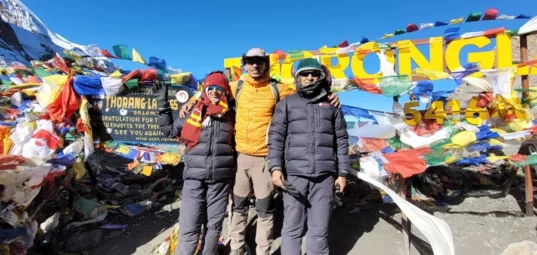
Annapurna Circuit Vehicle Hire

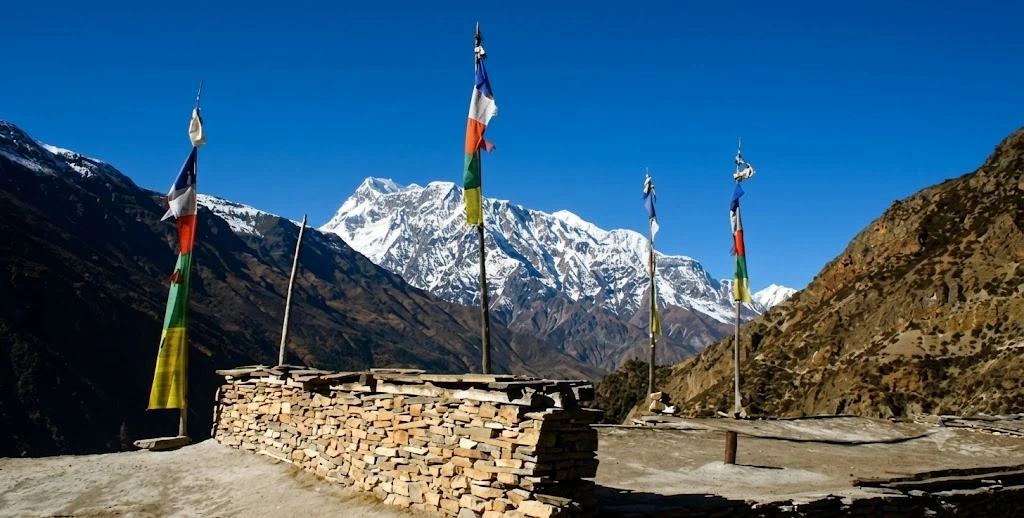
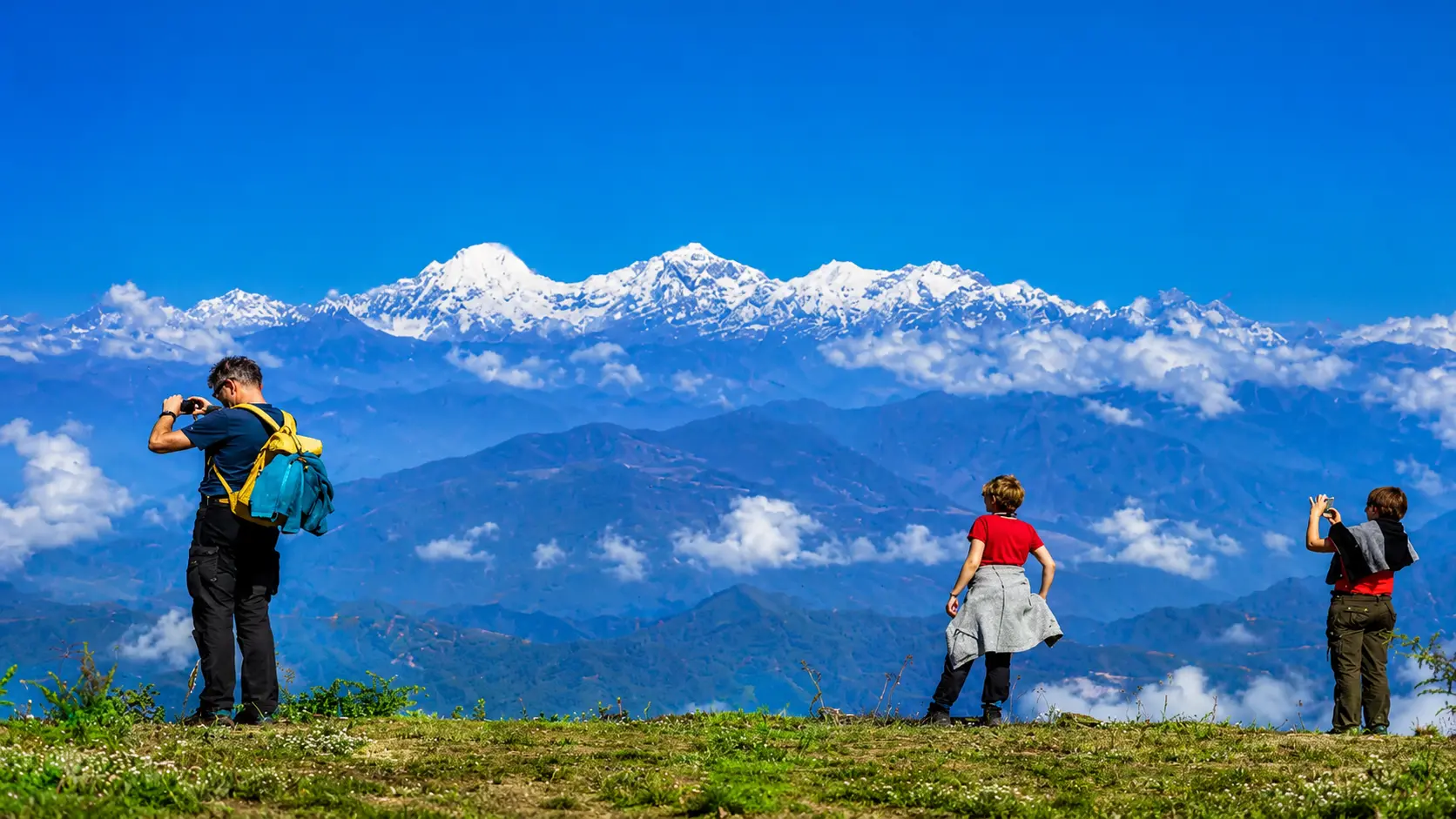
Dharapani trek start point of annapurna range

Annapurna Circuit Best Vehicle Hire — The Complete Guide

The Annapurna Circuit trek is Nepal’s most scenically diverse multi-day trekking route — a complete loop around the Annapurna massif that moves through subtropical river valleys, dense rhododendron forests, traditional Gurung and Magar villages, the high-altitude Tibetan-influenced settlements of Manang and the Mustang plateau, and over the famous 5,416-metre

Thorong La pass before descending to the sacred pilgrimage site of Muktinath and the apple orchards and hot springs of the Kali Gandaki valley. It is also the Nepal trekking route where the question of vehicle hire has changed most dramatically over the past decade — not because the circuit itself has changed

but because the road network serving it has extended progressively deeper into the mountains, transforming what was once a fixed, well-understood transport chain into a set of genuinely evolving options that offer trekkers more flexibility, more efficiency, and more choice than at any previous point in the circuit’s history.

In 2026, trekkers planning the Annapurna Circuit face vehicle hire decisions at multiple stages of their journey: the outward transfer from Kathmandu or Pokhara to the trailhead at Besisahar or beyond, the optional jeep section through the Marsyangdi gorge to Chame or Manang, the descent from Muktinath through the Kali Gandaki valley to Jomsom and Pokhara on the circuit’s exit, and the final return transfer to Kathmandu or the international airport.

Each stage has its own optimal vehicle choice, cost structure, and specific considerations that distinguish a well-arranged Annapurna Circuit vehicle hire from a poorly arranged one. This complete 2026 guide covers it all—the best vehicle for each stage, what it costs, and how Nepal Vehicle Hiring Pvt Ltd provides private jeep hire and transfer coordination that keeps every stage of the circuit’s transport as smooth as the trek itself.

Book Annapurna Circuit Best Vehicle Hire with private 4WD jeeps, Scorpio SUVs, or cars for convenient transportation along the Annapurna Circuit. Arrange pickup and drop-off for Besisahar, Chame, Manang, Muktinath, and other accessible trail points.

The Annapurna Circuit — What Vehicle Hire Actually Means Now

A decade ago, the transport question for the Annapurna Circuit was simple: a bus or jeep to Besisahar, then walking the complete circuit from Besisahar through Chamje, Tal, Dharapani, Chame, Pisang, Manang, Thorong La, Muktinath, Jomsom, and out through the Kali Gandaki valley. Today, the road has fundamentally changed this picture.

A paved or rough road now extends beyond Besisahar to Manang in good condition, meaning a trekker can reach the circuit’s highest-altitude trailhead village entirely by private 4WD jeep, skipping 7 to 10 days of approach walking that many experienced trekkers describe as the least interesting section of the full circuit. On the Kali Gandaki exit side, road access from Jomsom south through the gorge to Beni and Pokhara is similarly well established, and the road north from Jomsom toward Muktinath means the descent from Thorong La to the circuit’s first vehicle connection is now a single day’s walk rather than a multi-day journey.

The practical result is that the Annapurna Circuit offers a spectrum of vehicle hire integration options ranging from purely walking the complete traditional route (maximum trail, minimum vehicle) to a highly vehicle-supplemented fast itinerary that uses private jeep hire for the approach to Manang and the descent from Muktinath, walking only the genuine high-altitude section between Manang and Jomsom via Thorong La (minimum trail, maximum vehicle).

Most trekkers in 2026 choose somewhere in the middle of this spectrum, and the question of where exactly to begin and end the walking section — and consequently which vehicle hire stages are needed — is the central transport planning decision of any Annapurna Circuit trip.

Book Annapurna Circuit Best Vehicle Hire with private 4WD jeeps, Scorpio SUVs, or cars for convenient transportation along the Annapurna Circuit. Arrange pickup and drop-off for Besisahar, Chame, Manang, Muktinath, and other accessible trail points.

Stage 1 — Kathmandu to Besisahar: The Entry Transfer

Every Annapurna Circuit vehicle hire journey begins with the transfer from Kathmandu or Pokhara to Besisahar—the gateway town of Lamjung District at approximately 760 meters, where the paved national highway meets the Marsyangdi River valley approach, and the Annapurna Circuit’s road infrastructure begins. The full details of this transfer are covered in our dedicated Besisahar pickup and drop vehicle hire guide.

We strongly recommend reading that guide alongside this one for anyone planning their complete Annapurna Circuit transport from start to finish.

From Kathmandu. Kathmandu to Besisahar is approximately 173 to 185 kilometres via the Prithvi Highway and the Marsyangdi Valley road, taking 5 to 7 hours by private Scorpio  4WD jeep from Nepal Vehicle Hiring Pvt Ltd. The route follows the Prithvi Highway westward to Mugling junction, then turns north on the Marsyangdi Valley Road through Dumre to Besisahar. The 2026 cost for a private jeep from Kathmandu to Besisahar is approximately US$200 for the full vehicle, carrying 4 to 6 passengers with trekking luggage.

A Toyota Hiace van serves groups of 7 to 14 on this route at NPR 20,000 to 30,000 (USD 150 to 225). For budget-conscious trekkers, the Kathmandu to Besisahar bus covers the same route for approximately NPR 1,000 to 1,500 per person.

From Pokhara. Pokhara to Besisahar is approximately 75 to 90 kilometres via the Prithvi Highway eastward to Dumre and then north to Besisahar — a journey of just 2 to 3 hours by private jeep. For trekkers already in Pokhara before starting the circuit, this short Pokhara-to-Besisahar transfer is the most efficient and comfortable circuit entry option, and the shorter distance makes the per-vehicle cost considerably lower than the Kathmandu equivalent: approximately NPR 7,000 to 12,000 (USD 53 to 90) for a private Scorpio or Hilux.

Nepal Vehicle Hiring Pvt Ltd offers car hire in Pokhara, with hotel pickup from any address in Pokhara Lakeside.

Book Annapurna Circuit Best Vehicle Hire with private 4WD jeeps, Scorpio SUVs, or cars for convenient transportation along the Annapurna Circuit. Arrange pickup and drop-off for Besisahar, Chame, Manang, Muktinath, and other accessible trail points.

Stage 2 — Besisahar to Manang: The Best Jeep Section in Nepal

The road from Besisahar northward through the Marsyangdi gorge to Manang is, in the consistent experience of Nepal Vehicle Hiring Pvt Ltd drivers and of the trekkers they carry, one of the finest and most dramatic overland driving sections anywhere in the country — and it is also the section where the question of the best vehicle for Annapurna Circuit hire is most clearly answered. Beyond Besisahar, the road becomes unpaved, narrow, and technically demanding, with cliff-edge sections, river-bank crossings, exposed gorge driving, and the accumulated surface damage of seasonal weather and heavy jeep traffic that makes any non-4WD vehicle categorically unsuitable.

A Scorpio or Hilux 4WD jeep is the right vehicle for this section—not by preference, but by the terrain’s genuine requirements.

Besisahar to Chame (2,670 m). The first major section of the gorge drive passes through Bhulbhule (845 m), Ngadi, Syange, Jagat (1,340 m), Chamje with its famous waterfall directly beside the road, Tal (1,675 m), Dharapani (1,860 m — where the Manaslu Circuit trek exits and joins the Annapurna Circuit trail), Bagarchap, Danaque, and finally Chame —

the Manang District headquarters at 2,670 meters. The 50-kilometre section from Besisahar to Chame covers the most dramatically enclosed parts of the Marsyangdi gorge. It takes approximately 4 to 6 hours by private 4WD jeep depending on surface conditions and stop time.

For groups specifically wanting to begin walking from Besisahar but complete the gorge section by jeep hire, Chame is the most popular vehicle drop-off alternative to Manang — it sits high enough to begin meaningful acclimatisation while saving 2 to 3 days of approach walking through the less interesting lower gorge.

Chame to Pisang and Manang (3,519 m). Beyond Chame, the landscape opens progressively into the wide U-shaped glacial valley that defines the Annapurna Circuit’s upper section — pine forest giving way to juniper and altitude shrub, Annapurna II’s enormous north face appearing directly ahead as the road rounds the final turns before the Pisang ridge, and the wide, flat basin of Manang finally opening after the last gorge section above Upper Pisang.

Manang village itself, at 3,519 meters, with its yak herds, ancient monasteries, the famous Manang Bakery, and the Gangapurna Glacier immediately above, is the standard and most popular vehicle-hire drop-off point for Annapurna Circuit trekkers using vehicle assistance on the approach. From Manang, the walking section to the Thorong La begins in earnest — first the acclimatisation hike to Ice Lake (4,600 m) or Kyanjin Ri, then the high camp at Thorong Phedi, and finally the pass crossing itself at 5,416 meters.

The 2026 cost for a private jeep from Kathmandu to Manang, covering the full Kathmandu-Besisahar-Manang corridor, is approximately NPR 25,000 to 40,000 (USD 188 to 300) for the full vehicle, one way. From Pokhara, the equivalent Pokhara-Besisahar-Manang package costs approximately NPR 18,000 to 28,000 (USD 135 to 210).

Contact Nepal Vehicle Hiring Pvt Ltd at +977 981-4227196 via WhatsApp or through our plan trip page for current pricing specific to your group size and dates.

Annapurna range

The Vehicle Question — Why Scorpio and Hilux Are the Definitive Answer

The best vehicle for Annapurna Circuit hire is consistent across all operators, all sections, and all seasons: a Mahindra Scorpio or Toyota Hilux 4WD. The reasons are structural, not merely conventional.

Ground Clearance. The unpaved road sections from Besisahar to Manang feature exposed rock formations, active construction rubble, deep monsoon-cut channels, and occasional river-adjacent sections where road surface sits barely above the water level. Standard sedan ground clearance — typically 150 to 170 mm — is insufficient for these sections. The Scorpio and Hilux both offer ground clearance of 200 to 220 mm, providing the margin this terrain demands.

Low-Range 4WD. The steep gradients on multiple sections of the Besisahar-to-Chame and Chame-to-Manang road require genuine low-range differential engagement for controlled descent and ascent — not the terrain-response electronic management of modern SUVs, but the mechanical low-range that a Scorpio or Hilux provides directly. Nepal Vehicle Hiring Pvt Ltd uses these vehicles exclusively for the gorge and upper circuit sections, and our drivers use low range as standard procedure on steeper gradients rather than as an emergency-only measure.

Mechanical Simplicity and Parts Availability. In the Marsyangdi gorge between Besisahar and Chame, the nearest city is hours away by the same rough road. A vehicle breakdown in this section requires a local mechanic in Besisahar, Chame, or an intermediate village to effect repairs. The Mahindra Scorpio and Toyota Hilux are the two most commonly serviced vehicles in Nepal’s mountain districts —

Parts are available in every district headquarters town, and mechanics with specific experience on these models are found throughout the Annapurna-Manaslu region. A modern European or Korean SUV, for all its technical sophistication on paved roads, faces a genuine parts and expertise gap in exactly the sections where reliability matters most.

Load Capacity. A group of 4 to 6 Annapurna Circuit trekkers carries full expedition duffel bags, day packs, and often shared group equipment—a total luggage load that fills a standard vehicle’s boot. The Scorpio and Hilux roof racks, standard on all Nepal Vehicle Hiring Pvt Ltd jeeps, provide the extra luggage platform for this load, with securing ropes included on all mountain route bookings.

Stage 3 — After Thorong La: Muktinath to Jomsom Vehicle Hire

After crossing the Thorong La at 5,416 meters and descending to Muktinath at 3,710 meters, trekkers completing the Annapurna Circuit re-enter the vehicle network. From Muktinath’s Ranipauwa village, a 30- to 45-minute jeep hire takes trekkers to Jomsom at 2,720 meters — or they can walk the same distance in 2 to 3 hours for a final section before transitioning to road transport for the Kali Gandaki descent.

Most trekkers choose the jeep from Ranipauwa to Jomsom, especially after the physical demands of crossing the pass, and Nepal Vehicle Hiring Pvt Ltd’s pre-arranged pickup from Ranipauwa eliminates the need to negotiate with local operators at Muktinath after the most demanding walking day on the entire circuit.

The Jomsom-to-Pokhara road descent follows the same Kali Gandaki valley route described in our dedicated guides to the Muktinath tour from Sunauli: through Kagbeni, Marpha, Tukuche, Kalopani, Ghasa, Tatopani, Dana, and Beni to the Pokhara-Baglung Highway, then onward to Pokhara. This section — approximately 197 kilometres from Jomsom to Pokhara — takes 7 to 9 hours by private jeep and is one of Nepal’s most scenically rewarding full-day road journeys, passing through the deepest gorge on earth between the Dhaulagiri and Annapurna massifs.

In 2026, a private jeep from Jomsom to Pokhara costs approximately US$203 for the full vehicle. Nepal Vehicle Hiring Pvt Ltd coordinates this Jomsom-to-Pokhara circuit exit transfer as part of the complete Annapurna Circuit vehicle hire package.

Book Annapurna Circuit Best Vehicle Hire with private 4WD jeeps, Scorpio SUVs, or cars for convenient transportation along the Annapurna Circuit. Arrange pickup and drop-off for Besisahar, Chame, Manang, Muktinath, and other accessible trail points.

The Alternative Exit — Dharapani to Besisahar and Back to Kathmandu

Not every trekker completing the Annapurna Circuit exits via Jomsom and Pokhara. For trekkers who specifically want to minimise their time in the Kali Gandaki valley (having descended it rapidly after the pass crossing), or who need to return to Kathmandu rather than Pokhara at the circuit’s end, the alternative exit via Dharapani — descending from Muktinath and the Kali Gandaki to Jomsom and then following the high Thorong La descent route back north of the circuit, or more practically walking the standard Annapurna Circuit route in reverse back through Manang to Dharapani — provides jeep hire access at Dharapani for the return journey to Besisahar and Kathmandu.

Dharapani at 1,860 meters is where the Manaslu Circuit trek descends and joins the Annapurna Circuit road — and it is also where the Annapurna Circuit road access begins for trekkers exiting northward. A private jeep from Dharapani to Besisahar takes 2 to 3 hours on the same rough gorge road in reverse, connecting at Besisahar with the paved Marsyangdi Valley road and the Prithvi Highway back to Kathmandu.

Nepal Vehicle Hiring Pvt Ltd’s Besisahar pickup service includes Dharapani area pickups for Annapurna Circuit trekkers, specifically coordinating their exit through this northern circuit entry point.

Book Annapurna Circuit Best Vehicle Hire with private 4WD jeeps, Scorpio SUVs, or cars for convenient transportation along the Annapurna Circuit. Arrange pickup and drop-off for Besisahar, Chame, Manang, Muktinath, and other accessible trail points.

Jomsom — The Hub of the Kali Gandaki Valley

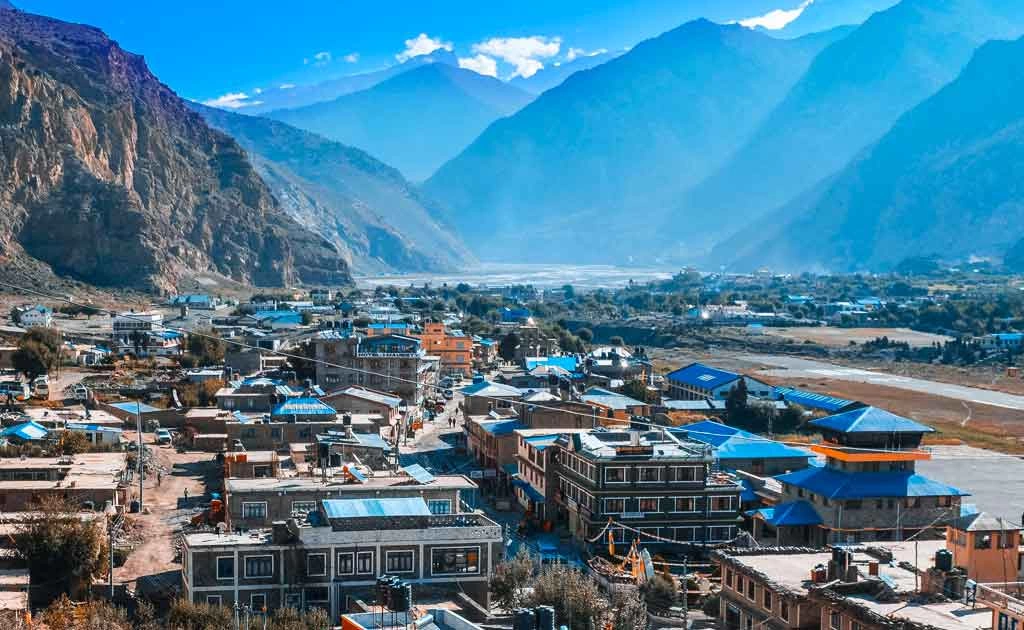
Jomsom, the Mustang District headquarters at 2,720 meters, functions as the vehicle transfer hub of the Annapurna Circuit’s Kali Gandaki exit — the point where trekkers descending from Muktinath, those flying in from Pokhara, and those walking down from the Upper Mustang trek all converge on the same valley floor town and its growing transport network.

Understanding Jomsom’s vehicle-hire ecology in 2026 is essential for anyone planning the Annapurna Circuit exit: local jeeps operate from the Jomsom vehicle stand to Muktinath northward (30-45 minutes) and Beni-Pokhara southward, but on a fill-and-go basis that creates departure uncertainty for groups with fixed onward schedules. A pre-arranged private jeep from Nepal Vehicle Hiring Pvt Ltd, departing Jomsom for Pokhara at a confirmed 6:00 to 7:00 AM, eliminates this uncertainty. It ensures the all-important early departure before the Jomsom wind builds.

Jomsom itself offers a pleasant half-day or overnight stay for trekkers with flexible schedules: the old Jomsom across the river has a quiet, traditional character quite different from the busier commercial strip on the main road, and the views of Nilgiri mountain and Dhaulagiri from the valley floor at the right time of day are among the finest available from any road-accessible point in Nepal.

The trekking agencies, permit offices, and equipment shops in Jomsom make it the last practical place to buy any forgotten gear or arrange any documentation that didn’t make it into Kathmandu or Pokhara planning. Nepal Vehicle Hiring Pvt Ltd’s Jomsom to Pokhara jeep hire includes a flexible early-morning departure from any Jomsom hotel, with hotel pickup; our contact team confirms the exact pickup time based on the client’s Jomsom accommodation address.

Book Annapurna Circuit Best Vehicle Hire with private 4WD jeeps, Scorpio SUVs, or cars for convenient transportation along the Annapurna Circuit. Arrange pickup and drop-off for Besisahar, Chame, Manang, Muktinath, and other accessible trail points.

Vehicle Hire Costs — Every Stage of the Annapurna Circuit

The following 2026 price ranges apply to private Scorpio or Hilux 4WD jeep hire with Nepal Vehicle Hiring Pvt Ltd for the full vehicle (4 to 6 passengers). All prices include driver, fuel, and road tolls. Contact us via WhatsApp at +977 981-4227196 or through our plan trip page for group-specific quotes.

Kathmandu to Besisahar (one way): NPR 13,000 to 26,000 (USD 98 to 180)

Pokhara to Besisahar (one way): NPR 7,000 to20,000 (USD 53 to 140)

Besisahar to Chame (one way): NPR 8,000 to 25,000 (USD 60 to 150)

Besisahar to Manang (one way): NPR 12,000 to 30,000 (USD 90 to 180)

Kathmandu to Manang (full route, one way): NPR 25,000 to 60,000 (USD 188 to 350)

Pokhara to Manang (full route, one way): NPR 18,000 to 40,000 (USD 135 to 300)

Muktinath / Ranipauwa to Jomsom (one way): NPR 3,000 to 10,000 (USD 23 to 60)

Jomsom to Pokhara (one way): NPR 15,000 to 35,000 (USD 113 to 188)

Dharapani to Besisahar to Kathmandu (one way): NPR 18,000 to 28,000 (USD 135 to 210)

For a Toyota Hiace van on paved sections (Kathmandu to Besisahar, Pokhara to Besisahar, Jomsom to Pokhara), add about 20 to 30 per cent to the jeep prices above. For tourist coaster or bus hire for large groups on highway sections, contact our team for specific pricing.

Permits Required for the Annapurna Circuit

The Annapurna Circuit trek passes through the Annapurna Conservation Area. It requires two core permits — both of which must be obtained in Kathmandu or Pokhara before departure, as there is no permit processing facility at any point on the circuit road or trail.

The ACAP (Annapurna Conservation Area Permit) costs NPR 3,000 (approximately USD 22 to 25) per person for foreign nationals, and NPR 1,000 per person for SAARC nationals. Obtain from the Nepal Tourism Board office in Kathmandu or Pokhara. The ACAP is checked at the Besisahar checkpoint — vehicles are not permitted to proceed beyond this point without valid permits for all passengers.

The TIMS Card (Trekkers Information Management System) costs USD 10-20 per person. Obtain from the Nepal Tourism Board or TAAN office in Kathmandu or Pokhara. Nepal’s 2023 trekking guide regulation requires a licensed guide for all Annapurna Circuit trekkers.

For the Nar Phu Valley trek extension branching from Koto village beyond Chame, an additional Restricted Area Permit is required (USD 90 per person per week during peak season). Our contact team will advise on current permit requirements when you book your Annapurna Circuit vehicle hire.

NOTE: Do not attempt to pass the Besisahar ACAP checkpoint without valid permits for all group members. Vehicles are turned back, and you can’t arrange permits at the checkpoint.

Book Annapurna Circuit Best Vehicle Hire with private 4WD jeeps, Scorpio SUVs, or cars for convenient transportation along the Annapurna Circuit. Arrange pickup and drop-off for Besisahar, Chame, Manang, Muktinath, and other accessible trail points.

Season Guide — Best Time for Annapurna Circuit Vehicle Hire

Autumn (October to November) is the definitive peak season for both the Annapurna Circuit trek and the vehicle hire that supports it. Post-monsoon road consolidation makes the Besisahar-to-Manang gorge road at its most drivable; Marpha’s apple orchards are in active harvest; and mountain views from Manang, Thorong La, and Muktinath are at their annual peak.

Private 4WD jeep hire demand is at its highest — book at least 2 weeks in advance for October and November departures.

Spring (March to May) is the second peak: rhododendron forests in the lower gorge between Jagat and Dharapani bloom spectacularly through March and April, the Thorong La is clear of heavy snow by late April, and the Annapurna Circuit permit office processes high volumes of ACAP applications during this window. The Annapurna Base Camp trek runs simultaneously in spring, adding to Vehicle hire demand from Pokhara to Nayapul from the same base city.

Winter (December to February) presents specific challenges on the Annapurna Circuit vehicle route: the Thorong La itself may be completely blocked by heavy snowfall in January and February, making the pass crossing impossible for some weeks. However, the road sections from Besisahar to Manang and from Jomsom to Pokhara generally remain passable in winter dry-season conditions, and Nepal Vehicle Hiring Pvt Ltd offers year-round vehicle transfer services for the circuit.

Monsoon (June to August) brings the highest landslide risk to the Besisahar-to-Chame gorge sections, and unstable snow covers Thorong La. The Kali Gandaki road south from Jomsom is comparatively better sheltered in the Mustang rain shadow but is still affected by washing in gorge sections.

Nepal Vehicle Hiring Pvt Ltd monitors road conditions throughout the monsoon season and advises on the current status before any planned departure through our contact team.

The Thorong La Crossing and Post-Pass Vehicle Access

The Thorong La pass at 5,416 meters is the physical and psychological centrepiece of the Annapurna Circuit trek — the highest point of the circuit, the moment that divides the trek into before and after, and the defining physical challenge that all the acclimatisation days in Manang and the early high camp night at Thorong Phedi (4,450 m) are specifically preparing for. The crossing typically takes 6 to 8 hours from the high camp to Muktinath: a 1,000-metre ascent in the pre-dawn darkness to the pass, the extraordinary dawn panorama from the cairn-marked summit including views of Annapurna I, Gangapurna, Khatung Kang, and the Dhaulagiri range beyond Muktinath, and then the long 1,700-metre descent to Ranipauwa that, while not technically difficult, demands careful knee management over 3 to 4 hours of sustained downhill.

The critical vehicle-hire consideration for the Thorong La crossing is this: once you descend to Ranipauwa, you re-enter the vehicle network. The pre-arranged private jeep from Nepal Vehicle Hiring Pvt Ltd should be confirmed and waiting at Ranipauwa for your expected arrival window — not something to arrange on the descent or after arrival, when the group is tired from one of the most demanding walking days of any Nepal trek.

All Annapurna Circuit vehicle hire packages from Nepal Vehicle Hiring Pvt Ltd include the Ranipauwa pickup as a confirmed, pre-arranged booking element coordinated with the outward Besisahar transfer at the time of initial booking. We share the Jomsom to Pokhara return driver details 24 hours before the expected arrival in Ranipauwa so you can adjust timing via WhatsApp if the pass crossing schedule changes due to weather or group pace.

For trekkers using the Annapurna Circuit guided package from Trek Nepal Himalayas, the vehicle hire coordination from Ranipauwa to Jomsom and Jomsom to Pokhara is managed directly through the trekking agency as part of the end-to-end package — with Nepal Vehicle Hiring Pvt Ltd providing the private jeep fleet for the Kali Gandaki valley descent. For independently organised trekkers, our contact team coordinates the Ranipauwa pickup and Jomsom-to-Pokhara return jeep hire, along with the outward Besisahar booking, as a single arrangement through our plan trip page.

Practical Tips for the Best Annapurna Circuit Vehicle Hire

  • Book both legs together: The outward Kathmandu or Pokhara to Besisahar/Manang jeep and the return Jomsom to Pokhara jeep hire should be booked as a single coordinated arrangement through Nepal Vehicle Hiring Pvt Ltd.
  • Depart Kathmandu or Pokhara by 6:00-7:00 AM: A full day of driving is needed to reach Manang in one push — an early departure ensures daylight arrival.
  • ACAP and TIMS permits first: Obtain in Kathmandu or Pokhara the day before transfer departure. Our team advises on permit offices.
  • Cash at Besisahar and Pokhara: ATMs exist at Besisahar and Chame but are unreliable beyond. Withdraw generous NPR in Pokhara or Besisahar. Manang has an eSewa kiosk that sometimes doesn’t work.
  • Confirm Ranipauwa pickup 24 hours ahead: WhatsApp our driver directly when you reach Thorong Phedi high camp so the Ranipauwa arrival window is updated for the following day.
  • Wind timing at Jomsom: The famous Jomsom valley wind builds from 10 AM. Departures from Jomsom to Pokhara should be by 6:30-7:00 AM to pass the narrowest gorge sections before midday.
  • Pack motion sickness medication: The Besisahar-to-Manang gorge drive involves continuous winding for 6-8 hours. Many trekkers who never experience car sickness find this road an exception.
  • For large groups: Hiace van covers Pokhara to Besisahar; 4WD jeeps cover Besisahar to Manang. Tourist coasters available for highway sections with 13+ passengers.

Starting the Circuit at Bhulbhule — Why Trekkers Are Pushing Beyond Besisahar

One of the most significant practical changes in Annapurna Circuit vehicle hire planning over the past several years has been the progressive shift in the recommended drop-off point further up the valley, beyond Besisahar. While Besisahar remains the ACAP permit checkpoint and the official gateway to the conservation area, experienced trekkers and operators alike increasingly recommend Bhulbhule (845 m, approximately 10 km beyond Besisahar) or even Jagat (1,340 m) as the vehicle hire drop point, reasoning that the Besisahar-to-Bhulbhule road section adds meaningful altitude gain with minimal scenic or cultural reward, and that beginning to walk from Bhulbhule rather than Besisahar saves a low-quality walking hour while adding essentially nothing to the circuit experience.

The argument for Chame as the starting point is even stronger for trekkers with limited time who specifically want to walk only the upper, most scenically dramatic sections of the Annapurna Circuit: from Chame at 2,670 metres, the circuit walk to the Thorong La and descent to Muktinath takes 5 to 7 days and covers the entire high-altitude section — Pisang, Upper and Lower Pisang, Manang, Thorong Phedi, and the pass itself — without any of the subtropical gorge walking that the lower circuit from Besisahar includes. For two-week trekkers specifically who have already completed the full Annapurna Circuit on a previous visit, the Chame-start vehicle hire approach is the most efficient way to experience the circuit’s finest alpine section without repeating the lower gorge.

Book Annapurna Circuit Best Vehicle Hire with private 4WD jeeps, Scorpio SUVs, or cars for convenient transportation along the Annapurna Circuit. Arrange pickup and drop-off for Besisahar, Chame, Manang, Muktinath, and other accessible trail points.

The Manang Acclimatisation Days — Why the Vehicle Drop Is Not the Trek End

A critical planning note for any trekker using private jeep hire to reach Manang directly from Kathmandu or Pokhara: driving to Manang at 3,519 metres in a single day represents a dramatically faster altitude gain than the standard multi-day walking approach, and the standard acclimatisation schedule for the Annapurna Circuit requires that groups who arrive at Manang by vehicle spend a minimum of 2 full rest and acclimatisation days in the village before attempting any ascent toward Thorong La.

The planned acclimatisation activities at Manang — a day hike to Gangapurna Lake (4,000 m) for morning acclimatisation, an ascent to Ice Lake (4,600 m) for the day hike that most experienced Annapurna Circuit guides describe as the single best acclimatisation day available on any Nepal trek, and a rest day focused on rest, hydration, and altitude observation — are genuinely non-optional for safety. Our sister company, Trek Nepal Himalayas, builds these acclimatisation days into the standard itinerary for its Annapurna Circuit trek packages, and we strongly recommend that any group using vehicle hire to Manang through Nepal Vehicle Hiring Pvt Ltd do the same.

Alpine Luxury Treks also builds proper acclimatisation into its top-end Manang-arrival itineraries.

Book Annapurna Circuit Best Vehicle Hire with private 4WD jeeps, Scorpio SUVs, or cars for convenient transportation along the Annapurna Circuit. Arrange pickup and drop-off for Besisahar, Chame, Manang, Muktinath, and other accessible trail points.

The Gorge Road Experience — What the Drive Actually Feels Like

For trekkers arriving at Besisahar for the first time, the section of the Annapurna Circuit road from Besisahar northward through the Marsyangdi gorge is often the most surprising part of the entire circuit. Nothing in the outward paved highway transfer from Kathmandu or Pokhara prepares the traveler for the character of this road: the way the valley walls close in almost immediately beyond Bhulbhule, narrowing from broad agricultural valley to tight gorge within the space of a few kilometres; the waterfalls that appear directly beside the track on cliff faces so close that the vehicle windows mist from the spray on damp days; the river crossings where the road drops to within metres of the Marsyangdi’s churning surface; and the exposed cliff-edge sections where the drop on one side of the vehicle is several hundred metres to the gorge floor below.

The famous Chamje waterfall section, approximately 32 km north of Besisahar, is the gorge drive’s most dramatic single moment: a single-drop waterfall of over 100 meters falls directly beside the road from the cliff face above, creating a permanent rainbow in its spray zone that extends across the track itself in certain light. Most Nepal Vehicle Hiring Pvt Ltd drivers on this route pause briefly at Chamje for photographs — it is one of those specific Nepal road experiences that no photograph fully prepares the traveller for and that images taken in the moment rarely capture adequately.

The total driving experience from Besisahar to Chame, covering approximately 50 kilometres of this terrain in 4 to 6 hours, rivals any mountain road journey in Nepal and is frequently described by travellers who have also done the Langtang Highway, the Manaslu Soti Khola approach via our Kathmandu to Soti Khola service, and the Solukhumbu eastern corridor as the most continuously dramatic of all Nepal’s major trekking transport drives.

The transition at Dharapani is another significant experiential marker on the drive: this is where the gorge road character shifts from the subtropical, humid, waterfall-rich lower gorge into the progressively drier, more open upper valley character that builds toward the Tibetan plateau landscape of Manang. The vegetation changes from dense forest and cultivated terraces to alpine shrub and the first prayer flags and flat-roofed Tibetan-influenced stone houses.

The Manaslu Circuit trek joins the Annapurna Circuit trail at Dharapani, and the ACAP-Manaslu area permit checkpoint at this junction is one of several document checks on the route that Nepal Vehicle Hiring Pvt Ltd drivers manage as a standard part of the transfer.

Book Annapurna Circuit Best Vehicle Hire with private 4WD jeeps, Scorpio SUVs, or cars for convenient transportation along the Annapurna Circuit. Arrange pickup and drop-off for Besisahar, Chame, Manang, Muktinath, and other accessible trail points.

The Upper Pisang Decision — Lower vs Upper Route

One of the most charming aspects of the Annapurna Circuit’s upper section is the choice at Pisang village: the main jeep road continues along the valley floor through Lower Pisang to Manang, while a higher trail climbs steeply to Upper Pisang on the ridge above — a traditional village with a beautiful monastery, dramatic valley views, and the kind of unhurried atmosphere that is increasingly difficult to find on the

Annapurna Circuit as vehicle access has made the lower valley route busier, for trekkers arriving by private jeep from Besisahar and beginning their walk from Manang, the Upper Pisang detour can be incorporated as a day hike from Manang village — a 6-kilometre round trip adding approximately 3 to 4 hours and 300 vertical meters, with the Upper Pisang monastery and its ridge-top panorama of Annapurna II, III, and IV as the reward.

The broader question of which sections of the Annapurna Circuit to walk and which to cover by vehicle hire reflects a genuinely personal trekking philosophy rather than any single correct answer. Our dedicated Besisahar private vehicle guide explores this in detail — the key principle being that sections covered by jeep should be those where the road and the trail occupy the same visual corridor anyway (lower gorge).

In contrast, sections walked should be those where the trail genuinely diverges from the road into different terrain and experience (Upper Pisang, the trail above Manang toward Thorong Phedi, and the high camp and pass itself). Trek Nepal Himalayas builds this philosophy into all its guided Annapurna Circuit packages, with Alpine Luxury Trek offering the highest-comfort version of the same itinerary for travellers wanting top-end guiding and lodge accommodation throughout the circuit.

For practical transport coordination, connecting any combination of vehicle and walking sections, Nepal Vehicle Hiring Pvt Ltd provides private jeep hire for every motorised leg—including short sections like Besisahar to Bhulbhule or Chame to Manang that trekkers sometimes want to cover by vehicle while walking the gorge’s most scenic sections in between. Contact our plan trip team to discuss the best combination for your itinerary, and we will coordinate the vehicle-hire stages around your walking plan.

Combining the Annapurna Circuit with Other Nepal Destinations

The Annapurna Circuit’s twin access cities — Kathmandu for the entry and Pokhara for the Kali Gandaki exit — create natural combination opportunities with Nepal’s broader destination network. Before the circuit, Kathmandu days can include sightseeing, the Bhaktapur heritage tour, and a transfer to Nagarkot for sunrise, all with Nepal Vehicle Hiring Pvt Ltd’s Kathmandu car hire.

After the circuit, a Pokhara extension adds Sarangkot sunrise, the Ghorepani Poon Hill trek via our Pokhara-to-Nayapul transfer, or the Annapurna Base Camp trek.

For a complete western Nepal circuit, the Upper Mustang trek extends naturally from the Annapurna Circuit exit at Jomsom northward into the restricted Mustang kingdom — with the Annapurna Circuit vehicle hire exit at Jomsom positioning trekkers at the Upper Mustang gateway. Our most popular post-circuit wildlife addition is a Chitwan jungle safari extension from Pokhara via our Pokhara to Chitwan bus.

The Langtang Valley trek and Manaslu Circuit trek serve as either preceding or following adventures for experienced trekkers building a multi-region Nepal program, with Manaslu Circuit transport and Salleri Phaplu jeep hire covering the eastern Nepal connections.

Book Annapurna Circuit Best Vehicle Hire with private 4WD jeeps, Scorpio SUVs, or cars for convenient transportation along the Annapurna Circuit. Arrange pickup and drop-off for Besisahar, Chame, Manang, Muktinath, and other accessible trail points.

Manang Village — What to Do While Acclimatising

Manang at 3,519 meters is far more than the Annapurna Circuit’s acclimatisation stopover — it is a genuinely remarkable high-altitude village with its own deep cultural history, extraordinary mountain setting, and range of activities that reward the 2 to 3 rest days that safe acclimatisation requires. For trekkers arriving by private jeep from Nepal Vehicle Hiring Pvt Ltd, Manang is both the end of the vehicle journey and the beginning of the authentic Annapurna Circuit trek experience, and making the most of those acclimatisation days is the difference between arriving at the Thorong La in proper physical condition and arriving depleted before the hardest day of the circuit has even begun.

The Gangapurna Lake day hike, reached in 30 to 40 minutes of gentle walking from the village, offers one of the Annapurna region’s finest glacial lake views: a deep turquoise body of water directly below the Gangapurna Glacier at approximately 3,950 meters, with the glacier’s ice cliffs and moraine visible on the opposing bank and Gangapurna’s 7,455-meter summit directly above.

The Ice Lake (Kicho Tal) ascent, reaching 4,600 meters in 3 to 4 hours of sustained climbing from Manang, is the definitive Manang acclimatisation hike: it climbs high, reaches a dramatic viewpoint overlooking the entire upper Annapurna valley, and returns to sleeping altitude the same day — the precisely correct pattern for high-altitude acclimatisation. The Braga Gompa, a 500-year-old monastery perched dramatically above the village floor 3 kilometres from Manang, houses one of the finest collections of ancient Buddhist statuary and thangka painting in the Annapurna region and is the primary cultural visit of the Manang acclimatisation days.

The famous Manang Bakery deserves specific mention for any Annapurna Circuit trekker arriving by private jeep or on foot: apple pie, cinnamon rolls, and freshly baked bread at 3,519 metres have achieved a near-legendary reputation among Himalayan trekkers worldwide, and the combination of altitude, fresh mountain air, and genuinely excellent baked goods creates a culinary experience memorably out of proportion with what any reasonable traveller would expect at this altitude.

The Manang noodle soup and dal bhat available at the village’s growing range of teahouses similarly reward trekkers who have been fueling a multi-day approach on standardised trail food—Manang has more culinary variety than any other village at this altitude on the Annapurna Circuit. The teahouse competition that has developed in recent years has noticeably raised standards.

Contact Nepal Vehicle Hiring Pvt Ltd at +977 981-4227196 or via our contact page to coordinate your complete Manang arrival and circuit transport package.

Why Nepal Vehicle Hiring Pvt Ltd Is the Best Choice for Annapurna Circuit Hire

  • Gorge road experience: Our drivers have specific, repeated personal experience on the Besisahar-to-Manang gorge road in all seasons — not general-fleet drivers covering this route for the first time.
  • Verified 4WD fleet: Scorpio and Hilux 4WD jeeps for all gorge sections; Hiace van, coaster, and bus for larger groups on paved sections.
  • Complete circuit coordination: Book the outward Kathmandu-Besisahar-Manang transfer and the return Jomsom-Pokhara or Dharapani-Besisahar-Kathmandu leg as a single arrangement.
  • Door-to-door hotel pickup: From any Kathmandu or Pokhara hotel — no navigation to bus parks with full trekking luggage.
  • Transparent pricing: Driver, fuel, and road tolls included — no hidden additions.
  • Permit advisory: Our contact team advises on current ACAP and TIMS requirements when booking.
  • 24/7 booking: WhatsApp +977 981-4227196 or the plan trip page.

Frequently Asked Questions — Annapurna Circuit Vehicle Hire

What is the best vehicle for the Annapurna Circuit?

A Mahindra Scorpio or Toyota Hilux 4WD is the definitive best vehicle for all off-road sections of the Annapurna Circuit, particularly the Besisahar-to-Manang gorge road. Nepal Vehicle Hiring Pvt Ltd uses these exclusively for all mountain sections.

How much does private jeep hire cost for the Annapurna Circuit?

Kathmandu to Besisahar: NPR 13,000-26,000. Besisahar to Manang extension: NPR 12,000-35,000. Jomsom to Pokhara: US$203. Contact us at +977 981-4227196 or via our plan trip page for a group-specific quote.

Should I start the Annapurna Circuit at Besisahar, Bhulbhule, Chame, or Manang?

Besisahar is the ACAP checkpoint and traditional start. Bhulbhule saves 1 walking hour of low-interest road walking. Chame gives access to the circuit’s most scenic alpine section with 5-7 days of walking remaining.

Manang puts trekkers at the acclimatisation village before Thorong La, with 3-4 days of walking remaining. The best drop point depends on your available time and trekking goals.

Do you need a guide for the Annapurna Circuit?

Yes — a licensed guide is mandatory for all Annapurna Circuit trekkers under Nepal’s trekking regulations. Our sister company, Trek Nepal Himalayas, offers fully guided circuit packages coordinated with our vehicle hire service.

Can I return to Kathmandu from the Annapurna Circuit via Dharapani?

Yestekkers exiting at Dharapani can arrange a private jeep from Dharapani to Besisahar, then to Kathmandu via the Prithvi Highway. Nepal Vehicle Hiring Pvt Ltd offers a pre-arranged pickup from Dharapani as part of its Besisahar private vehicle service.

What permits do you need for the Annapurna Circuit?

You need an ACAP (NPR 3,000 per person for foreign nationals) and a TIMS card (USD 10-20 per person). Obtain both in Kathmandu or Pokhara before departure. Our team advises on current requirements at booking time.

Conclusion

The Annapurna Circuit offers more vehicle hire flexibility than any other major Nepal trekking route — from a single Kathmandu to Besisahar bus for budget purists to a fully coordinated private jeep package covering the Kathmandu-Besisahar-Manang entry and the Jomsom-Pokhara Kali Gandaki exit for those seeking maximum comfort and efficiency. The best Annapurna Circuit vehicle hire is not a single arrangement but a thoughtfully staged sequence.

Each section matches the right vehicle, timing, and flexibility the circuit’s evolving road network and the trekker’s ambitions require.

Nepal Vehicle Hiring Pvt Ltd provides every stage of this sequence — from Kathmandu airport transfer to Besisahar private vehicle, through the Marsyangdi gorge to Manang, and from Jomsom back to Pokhara or Kathmandu — with verified 4WD jeeps, experienced drivers, and transparent pricing.

Book your Annapurna Circuit vehicle hire with Nepal Vehicle Hiring Pvt Ltd — call or WhatsApp +977 981-4227196, visit vehiclehiringnepal.com, or plan your circuit transport through our plan trip page.

Kathmandu to Gosaikunda Trek Vehicle Hire

Nepal Tour Package

Kathmandu to Gosaikunda Trek Vehicle Hire: Full Guide

Among Nepal’s Himalayan trekking destinations, Gosaikunda Lake holds a unique position: it is both one off the country’s most spiritually significant pilgrimage sites and one of its finest high-altitude trekking experiences, all within striking distance of Kathmandu. At 4,380 meters above sea level in Langtang National Park, Rasuwa District, Gosaikunda is a glacial lake of extraordinary beauty whose surface—deep turquoise in summer, frozen solid in winter—has been a sacred destination for Hindu pilgrims seeking the blessings of Lord Shiva for centuries.

The name itself is Sanskrit: ‘Gosain’ (saint or master) and ‘kunda’ (lake or pond) — the Lake of the Saint. According to Hindu mythology, Lord Shiva created the lake when he struck the frozen Himalayan ground with his trident to cool himself after swallowing the cosmic ocean’s poison during the churning of the sea of milk.

For trekkers and pilgrims alike, the journey to Gosaikunda begins not at the trailhead but at the vehicle hire desk in Kathmandu — because reaching the two main trailheads for the Gosaikunda trek (Syabrubesi at 1,503 m and Dhunche at 1,960 m) requires a road journey of approximately 122 kilometres from Kathmandu, taking 6 to 9 hours by private vehicle. This approach drive — following the Pasang Lhamu Highway north through the Trishuli valley, past Betrawati, and up through the forests to the Langtang National Park gateway — is itself a significant journey that demands the right vehicle and the right driver.

Nepal Vehicle Hiring Pvt. Ltd., based in Thamel, Kathmandu, is the premier provider of private jeep hire for the Kathmandu-to-Gosaikunda approach, covering both the Syabrubesi and Dhunche trailheads. Our trekking transport services are designed for Langtang region trekkers who need reliable, experienced 4WD transport from their Thamel hotel to their target trailhead

Whether that is Syabrubesi for the classic Gosaikunda circuit via Langtang Valley, Dhunche for the shorter direct Gosaikunda approach, or Sundarijal on the valley rim for the alternative Helambu-Gosaikunda circuit, this complete 2026 guide covers every vehicle option, every trailhead, the road itself section by section, the required permits, transport fares, seasonal conditions, and how Nepal Vehicle Hiring delivers trekkers to the Gosaikunda approach in the best possible condition for the day-to-day walking ahead.

Book Kathmandu to Gosaikunda Trek Vehicle Hire with a private 4WD jeep, Scorpio SUV, or car for a comfortable journey to Dhunche, the main road-access point for the Gosaikunda trekking route.

Gosaikunda Trek Overview: Why the Vehicle Approach Matters

The Gosaikunda trek is one of Nepal’s finest moderate-grade trekking experiences—accessible enough for reasonably fit first-time Himalayan trekkers yet rewarding enough to satisfy experienced walkers, with a mix of forest, alpine meadow, Buddhist monastery culture, and an extraordinary high-altitude lake that makes it a complete Himalayan experience. The standard itinerary covers 60 to 140 kilometres of trekking (depending on whether you include the Langtang Valley extension and/or the Helambu descent) over 6 to 13 days, reaching a high point of 4,610 metres at Lauribina La Pass above Gosaikunda Lake.

There are three main trekking approaches to Gosaikunda, and each begins with a different vehicle journey from Kathmandu:

  • Syabrubesi approach (most popular, 122 km from Kathmandu): Begins at Syabrubesi (1,503 m), follows the Langtang Khola through Bamboo, Lama Hotel, and Langtang Village before reaching Gosaikunda. Can be combined with the classic Langtang Valley trek (10 to 13 days total) or done as a direct Gosaikunda route (7 to 9 days) via Thulo Syabru.
  • Dhunche approach (shorter drive, same road): Branches off at Dhunche (1,960 m) rather than continuing to Syabrubesi, taking a direct trail through Sing Gompa (3,330 m) to Gosaikunda (4,380 m) in 3 to 4 days of walking. Best for trekkers with limited time who want the Gosaikunda experience without the full Langtang Valley circuit.
  • Sundarijal approach (Kathmandu Valley rim start): Begins at Sundarijal on the northeast rim of the Kathmandu Valley (accessible by taxi or local vehicle, approximately 15 km from Thamel), climbs through Helambu to Gosaikunda via Chisapani, Kutumsang, and Ghopte over 5 to 7 days. Returns via Dhunche or Syabrubesi by vehicle.

For all three approaches, Nepal Vehicle Hiring provides the optimal vehicle solution. Our 4WD jeep hire covers both the Syabrubesi and Dhunche drops, our car hire in Nepal handles the Sundarijal approach for small groups, and our Hiace van hire serves groups of 8 to 14 trekkers travelling together to any of these trailheads.

Book Kathmandu to Gosaikunda Trek Vehicle Hire with a private 4WD jeep, Scorpio SUV, or car for a comfortable journey to Dhunche, the main road-access point for the Gosaikunda trekking route.

The Road: Kathmandu to Syabrubesi and Dhunche — Section by Section

The Kathmandu-to-Syabrubesi road follows the Pasang Lhamu Highway (also known as the Trishuli-Dhunche Road, Highway F070). This 122-kilometre mountain road is one of Nepal’s most scenically rewarding approaches to any trekking region. Here is the complete section breakdown:

Kathmandu to Galchhi Junction (35 km, 1 to 1.5 hours)

The journey begins by heading west from Thamel on the Prithvi Highway — Nepal’s main Kathmandu-Pokhara artery — for approximately 35 kilometres to the Galchhi junction (800 m). This section is a fully paved national highway and comfortable for all vehicles.

Kathmandu’s exit traffic can add 30 to 60 minutes to this section if departing between 7:30 and 9:30 AM — Nepal Vehicle Hiring consistently recommends a 6:30 AM departure from Thamel to clear the city before the morning rush peaks. At Galchhi, the Prithvi Highway continues west, and our route turns north onto the Pasang Lhamu Highway toward the Trishuli River and ultimately Syabrubesi.

Galchhi to Trishuli Bazaar (18 km, 45 to 60 minutes)

From Galchhi, the Pasang Lhamu Highway runs north alongside the Trishuli River (870 m) — one of Nepal’s most important whitewater rivers and a stunning gorge section that sets the visual tone for the increasingly dramatic landscape ahead. The river here is fast and clear, flanked by forested hills.

Trishuli Bazaar is a riverside market town with fuel stations, restaurants, and a lively morning market atmosphere. It is the standard breakfast stop for early-morning Syabrubesi-bound vehicles — arriving around 8:00 to 8:30 AM for a 6:30 AM Kathmandu departure. Fresh river trout is a regional speciality at Trishuli’s riverside restaurants.

Nepal Vehicle Hiring drivers always know the best current establishments.

Trishuli to Betrawati (12 km, 30 to 40 minutes)

The 12 kilometres from Trishuli to Betrawati (1,000 m) continue along the river before the road crosses to the east bank. Betrawati is where the vehicle permit checkpoint is located — all vehicles heading north are checked here.

Nepal Vehicle Hiring’s drivers carry all required documentation and handle checkpoint formalities without passenger involvement, typically taking 2 to 5 minutes. Betrawati marks the start of the sustained climb toward Dhunche; the road leaves the river valley and begins ascending into Rasuwa District’s mid-hill country.

Betrawati to Dhunche (50 km, 2 to 2.5 hours)

The 50-kilometre section from Betrawati to Dhunche (1,960 m) is the longest, most scenically dramatic, and most variable stretch of road quality in the entire Kathmandu-Syabrubesi journey. The road climbs from 1,000 meters to 1,960 meters through a landscape of progressive beauty, passing through Ramche (approximately 1,600 m) — a popular tea stop with excellent northward views — before reaching Dhunche.

Near Kalikasthan, about 15 to 20 kilometres north of Betrawati, the peaks of Ganesh Himal (7,422 m) and Langtang Lirung (7,227 m) become visible above the forested ridgelines on a clear morning the first genuine Himalayan peak views of the journey, and the moment many trekkers grasp what lies ahead. In spring (March to April), rhododendron forests near Ramche and Dhunche bloom in full — vivid red and pink blossoms filling the roadside forest in one of Nepal’s finest botanical displays.

Road quality from Betrawati to Dhunche is variable in 2026 — the lower sections (Betrawati to Ramche) are rough but passable, while the upper sections (Ramche to Dhunche) are more challenging — narrower, steeper, and more susceptible to monsoon landslides. This section clearly distinguishes the Nepal Vehicle Hiring private 4WD experience from a public bus journey: our jeeps handle the rough upper sections smoothly, and experienced drivers know every narrow passing point and hazard.

Dhunche (1,960 m) is the administrative headquarters of Rasuwa District, the Langtang National Park permit checkpoint, the last point with a bank (ATM sometimes operational — carry cash from Kathmandu to be safe), and the trailhead for the direct Dhunche-to-Gosaikunda route.

Book Kathmandu to Gosaikunda Trek Vehicle Hire with a private 4WD jeep, Scorpio SUV, or car for a comfortable journey to Dhunche, the main road-access point for the Gosaikunda trekking route.

Dhunche to Syabrubesi (15 km, 1 to 1.5 hours)

Trekkers targeting the Syabrubesi trailhead continue 15 kilometres beyond Dhunche on a narrow, steep descent to Syabrubesi (1,503 m) — the village at the confluence of the Langtang Khola and the Bhote Koshi River. This 570-meter descent in 15 kilometres is a series of tight switchbacks through mixed cloud forest that is beautiful but technically demanding — a 4WD vehicle with high ground clearance is essential for this section.

The descent can be slippery in wet conditions and requires careful mountain road driving in the narrow sections. Nepal Vehicle Hiring’s Langtang-route drivers know this descent well and navigate it confidently, while passengers can focus on the spectacular forest and river valley views.

Syabrubesi’s main roadside stretches 15 to 20 guesthouses and teahouses catering to Langtang and Gosaikunda trekkers, a permit registration checkpoint at the village’s northern edge, and basic supplies for the trek ahead. Nepal Vehicle Hiring drops trekkers directly at their guesthouse — no additional local transport required on arrival.

Swayambhunath visit during Kathmandu Pokhara Tour

Vehicle Options for the Kathmandu to Gosaikunda Approach

Nepal Vehicle Hiring’s private 4WD jeep hire is the recommended vehicle for every Gosaikunda approach — whether you are heading to Syabrubesi, Dhunche, or any point in between. Our Mahindra Scorpio (seats 5 to 7 passengers) and Toyota Land Cruiser (seats 4 to 5 passengers in top-end comfort) handle the full 1122-kilometre Kathmandu-to-Syabrubesi road with the high ground clearance and 4WD traction the Betrawati-to-Syabrubesi mountain section demands.

Private jeep hire for the Kathmandu-to-Syabrubesi journey costs approximately NPR 18,000 to 26,000 per vehicle (USD 130 to 185 at 2026 exchange rates), all-inclusive — vehicle, experienced Langtang-route driver, fuel, and driver accommodation for the overnight in Syabrubesi if required. For a group of 4 trekkers splitting the cost, this equates to approximately NPR 4,500 to 6,250 per person — directly competitive with shared jeep fares, with hotel drop-off and schedule flexibility included.

For 6 trekkers splitting, the per-person cost drops to NPR 3,000 to 4,166 — significantly cheaper than the shared jeep.

Private jeep hire to Dhunche only (not continuing to Syabrubesi) costs approximately NPR 15,000 to 20,000 per vehicle — 15 km and 1 to 1.5 hours less than the full Syabrubesi journey, saving both time and cost for trekkers using the Dhunche-start direct Gosaikunda route.

Contact Nepal Vehicle Hiring through our plan your trip page or WhatsApp +977 981-4227196 for current pricing and availability on all Gosaikunda approach vehicle options.

Hiace Van Hire: Groups of 8 to 14 Trekkers

For trekking groups of 8 to 14 people travelling together to the Gosaikunda trailhead, our Hiace van hire provides comfortable, economical group transport from Kathmandu to Dhunche or Syabrubesi. The Hiace handles the Kathmandu-to-Dhunche section (107 km) well in good conditions.

For the final 115-kilometre Dhunche-to-Syabrubesi descent — the most demanding section—Nepal Vehicle Hiring can arrange a vehicle size assessment based on current road conditions and group size. In the dry season, the Hiace generally handles this section; in the monsoon or after heavy rain, a 4WD jeep is the better vehicle for the descent.

Our Hiace van hire for the Gosaikunda approach is often combined with our Kathmandu to Pokhara bus service for trekking groups spending time in Pokhara before or after their Langtang-Gosaikunda adventure.

Shared Jeep (Budget Option)

Shared jeeps from Kathmandu’s Machhapokhari Bus Park (Balaju) depart for Syabrubesi daily from approximately 6:00 to 7:00 AM when full. Shared jeep fares to Syabrubesi: approximately NPR 1,200 to 1,500 per person (USD 9 to 11). Journey time: 6 hours.

The shared jeep is the cheapest motorised option for the Gosaikunda approach and works well for solo trekkers and budget-conscious pairs. Motorised options: departs when full (potential 30 to 60 minute wait), no flexibility on stops, limited luggage space, and cramped seating in a fully loaded jeep for 7 to 9 hours on mountain roads.

From Machhapokhari Bus Park, add 15 to 20 minutes of taxi or Pathao motorbike travel from Thamel — plan and budget accordingly.

For trekkers comparing the shared jeep with Nepal Vehicle Hiring’s private service: at 4 or more trekkers travelling together, our private 4WD jeep hire delivers per-person costs competitive with the shared jeep fare while providing hot pickup, guaranteed early departure, and luggage stored safely inside the vehicle rather than on an overcrowded roof rack. Use our plan your trip page to request a current quote and comparison.

Public Bus (Budget — NPR 600 to 1,000)

Local buses from Machhapokhari Bus Park serve both Dhunche and Syabrubesi — Dhunche buses run for approximately NPR 600 to 800 per person and take 7 to 8 hours; Syabrubesi buses cost NPR 800 to 1,000 per person and take 8 to 10 hours. Buses depart in the morning (typically 6:00 to 7:00 AM) and are the cheapest available option.

The trade-off is significant: minimal comfort on the rough upper sections, no flexibility on stops, and journey times considerably longer than the private jeep. Public buses suit solo budget trekkers who need maximum flexibility in their schedule.

Nepal Vehicle Hiring does not provide public bus services on this route — we provide private vehicle services that deliver better value for almost every group configuration above 2 passengers.

The Three Gosaikunda Trailheads: Which Is Right for Your Trek?

Syabrubesi (1,503 m): The Classic Gateway — 122 km from Kathmandu

Syabrubesi is the most popular starting point for Gosaikunda treks because it opens access to both the Langtang Valley (northeast) and the Gosaikunda route via Thulo Syabru (south), allowing trekkers to combine both destinations in a single circuit. For the Langtang-Gosaikunda combination — Nepal’s finest medium-length trek combining a spectacular glacial valley with a sacred alpine lake — Syabrubesi is the only logical starting point.

From Syabrubesi, the Gosaikunda approach via Langtang follows: Syabrubesi (1,503 m) → Bamboo (1,960 m) → Lama Hotel (2,470 m) → Langtang Village (3,430 m) → Kyanjin Gompa (3,870 m) → [optional acclimatisation day] → return to Lama Hotel or Syabru Bensi → Thulo Syabru (2,210 m) → Sing Gompaacclimatizationuribina Yak (3,920 m) → Gosaikunda (4,380 m) → Ghopte (3,430 m) → Dhunche (1,960 m) → vehicle return to Kathmandu. Total duration: 10 to 13 days. Total trekking distance: approximately 100 to 140 kilometres

Nepal Vehicle Hiring’s Syabrubesi private jeep drop takes 6 to 8 hours from Thamel (6:30 AM departure, arrival in Syabrubesi 1:00 to 2:30 PM), leaving time for afternoon guesthouse check-in, permit registration at the checkpoint, and preparation for the first day’s walk. Our trekking transport services for the Syabrubesi approach coordinate pickup and drop-off timing with your trek’s specific first-day requirements.

If you need an early 6:30 AM departure to reach Lama Hotel on day one, our driver is at your Thamel hotel door at the agreed time.

Dhunche (1,960 m): The Shorter Approach — 107 km from Kathmandu

Dhunche is the direct approach for trekkers targeting Gosaikunda alone — without the Langtang Valley extension. From Dhunche, the direct Gosaikunda route follows: Dhunche (1,960 m) → Chandanbari/Sing Gompa (3,330 m) → Lauribina Yak (3,920 m) → Gosaikunda (4,380 m) in 3 to 4 days of walking.

The total Dhunche-based Gosaikunda trek takes 5 to 7 days return, making it Nepal’s most accessible high-altitude lake trek from Kathmandu — 5 days total including 2 days of vehicle transport.

The Dhunche approach is particularly popular with: trekkers with limited time (5 to 7 days total trip); Hindu pilgrims making the Gosaikunda sacred lake visit without a full mountain circuit; and experienced trekkers revisiting Gosaikunda who have already done the Langtang Valley circuit on a previous trip. Nepal Vehicle Hiring’s private jeep hire to Dhunche (107 km, 5 to 7 hours) is approximately 15 km shorter and 1 to 1.5 hours faster than the full Syabrubesi run, and the Dhunche-only vehicle cost is lower than the full Syabrubesi service — contact us through the plan your trip page for current Dhunche-specific pricing.

For the return from a Dhunche-start Gosaikunda trek, Nepal Vehicle Hiring can pre-book a return vehicle to collect trekkers at Dhunche on a specific agreed date—eliminating the uncertainty of finding shared transport at the end of a multi-day trek when you are tired and ready to return to Kathmandu. Our 4WD jeep hire return service from Dhunche to Kathmandu takes 5 to 7 hours and can be booked as part of the original drop-off booking.

Sundarijal (1,350 m): The Kathmandu Valley Rim Start — 15 km from Thamel

The Sundarijal approach begins on the northeast rim of the Kathmandu Valley itself — accessible by taxi or Pathao motorbike from Thamel in 20 to 30 minutes. From Sundarijal, the Gosaikunda route via Helambu follows: Sundarijal (1,350 m) → Chisapani (2,215 m) → Kutumsang (2,470 m) → Ghopte (3,530 m) → Lauribina La Pass (4,610 m) → Gosaikunda (4,380 m) over 5 to 6 days of walking.

The return is typically by vehicle from Dhunche or Syabrubesi — meaning the Sundarijal trek exits north onto the Pasang Lhamu Highway and then travels south by vehicle back to Kathmandu.

For the Sundarijal starting point, Nepal Vehicle Hiring provides a simple taxi or car hire in Nepal from Thamel to Sundarijal (15 km, 20 to 30 minutes) as the outward transport, and a full private jeep hire from Dhunche or Syabrubesi back to Kathmandu (107 to 122 km, 5 to 7 hours) as the return. This approach lets trekkers start from the Kathmandu Valley without a long vehicle journey on the outbound leg, while using Nepal Vehicle Hiring’s private jeep for a comfortable return from the trek’s endpoint.

Permits Required for the Gosaikunda Trek in

Langtang National Park Entry Permit

The Langtang National Park Entry Permit is mandatory for all foreign nationals trekking to Gosaikunda. The 2026 fee is NPR 3,000 per person (approximately USD 22 to 25).

SAARC nationals pay NPR 1,000. The permit is checked at the Dhunche checkpoint — the main park entry point — before trekkers proceed to either Syabrubesi or the Dhunche trailhead. Permits can be obtained at:

  • Nepal Tourism Board office, Bhrikutimandap, Kathmandu (most reliable, weekdays 9 AM to 5 PM)
  • The Dhunche checkpoint (available during office hours — less reliable for afternoon arrivals)
  • Through Nepal Vehicle Hiring’s partner agency coordination — we can arrange permit processing in Kathmandu before your departure; contact us via the Plan Your Trip page.

Nepal Vehicle Hiring strongly recommends obtaining the Langtang National Park permit in Kathmandu the day before your departure, to avoid checkpoint delays that could affect first-day trekking plans.

ACAP Permit (for some Gosaikunda routes)

The Gosaikunda area falls within the Langtang National Park boundary, so the Langtang National Park Entry Permit covers the standard trek. The ACAP (Annapurna Conservation Area Permit) is NOT required for Gosaikunda trekking — it is relevant for Annapurna-region treks covered by Nepal Vehicle Hiring’s Kathmandu to Manang jeep service and Besisahar private vehicle service.

Licensed Guide Requirement

Nepal government regulations require a licensed guide for trekking in Nepal’s protected areas, including Langtang National Park. The guide isn’t required for road travel to the trailhead but must accompany all foreign trekkers from the start of the trail. Nepal Vehicle Hiring works with partner licensed guide services — contact us when booking your Gosaikunda approach vehicle to arrange guide coordination as part of the complete trekking support package.

Book Kathmandu to Gosaikunda Trek Vehicle Hire with a private 4WD jeep, Scorpio SUV, or car for a comfortable journey to Dhunche, the main road-access point for the Gosaikunda trekking route.

Best Time for the Kathmandu to Gosaikunda Trek: Seasonal Guide

Spring (March to May): Premier Trekking Season

Spring is the finest season for the Gosaikunda trek and for the Kathmandu-to-Syabrubesi vehicle journey. Rhododendrons bloom along the road from Ramche to Dhunche in March and April — vivid red, pink, and white blossoms that make the approach road as beautiful as the trek itself.

Pre-monsoon skies deliver clear mountain views at Kalikasthan and the Dhunche approach, and the road is in its best annual condition — dry, compacted, and free from monsoon damage. Gosaikunda Lake, while still partially frozen in early March, is fully thawed and dazzling turquoise by late April and May.

Nepal Vehicle Hiring’s trekking transport services to Syabrubesi and Dhunche are at peak demand in spring — book 3 to 4 weeks in advance for the April-May window.

Janai Purnima (July to August): The Pilgrimage Season

The full moon of Shrawan (July or August) marks Janai Purnima — the annual Hindu pilgrimage to Gosaikunda Lake that draws tens of thousands of devotees who believe ritual bathing in the sacred waters on this auspicious day cleanses the sins of a lifetime. During Janai Purnima, Gosaikunda is one of the most extraordinary human gatherings in the Himalayan world — pilgrims chanting, bells ringing, fires burning, the lake surface broken by thousands of ritual bathers in what is, for most observers, one of the most genuinely moving spectacles available in Nepal.

Nepal Vehicle Hiring’s transport to Dhunche and Syabrubesi during Janai Purnima requires booking 0 to 2 months in advance. All vehicles on this route are booked well in advance for the pilgrimage peak. The road is also significantly more congested during this period than at any other time of year.

Our 4WD jeep and Hiace van hire operate during this period, with experienced drivers who know how to manage Janai Purnima traffic on the narrow mountain road. For Hindu pilgrim groups planning a Janai Purnima Gosaikunda visit, our trekking transport services coordinate a full round-trip vehicle for the pilgrimage window.

Autumn (September to November): Post-Monsoon Clarity

Autumn is Nepal’s peak trekking season and offers the best mountain views. On the Gosaikunda route, post-monsoon atmospheric clarity delivers outstanding Himalayan panoramas at every viewpoint — from the Kalikasthan road view of Langtang Lirung to the summit views from Lauribina La Pass at 4,610 meters.

The road from Kathmandu to Syabrubesi is typically assessed and partially repaired by October after monsoon damage. The trail conditions in Langtang National Park are at their annual best. Nepal Vehicle Hiking’s private jeep hire for the Gosaikunda approach books quickly for October and November; book 3 to 4 weeks in advance

Monsoon (June to August): Challenging but Possible

The monsoon brings the most challenging road conditions on the Kathmandu-to-Syabrubesi route; the Betrawati-to-Dhunche section is prone to landslides and surface water damage, and the Dhunche-to-Syabrubesi descent can be slippery and slow. Nepal Vehicle Hiring operates the Gosaikunda approach route throughout the monsoon with daily road-condition monitoring and experienced drivers who know when to proceed and when to wait.

Add 1 to 2 hours to travel time estimates for monsoon driving, and keep your schedule flexible. The trek itself above Gosaikunda is genuinely challenging in monsoon conditions — the trail is wet, some sections can be obscured, and Lauribina La Pass can be dangerous in poor visibility.

Outside of the Janai Purnima pilgrimage window, the monsoon is the quietest and least recommended period for the Gosaikunda trek.

Winter (December to February): Frozen and Quiet

Gosaikunda Lake freezes completely from approximately December through March — transforming from a turquoise alpine lake to a vast sheet of ice and snow that has its own extraordinary stark beauty. Winter trekking to Gosaikunda is possible but demanding: overnight temperatures at the lake can fall to minus 15°C, the Lauribina La Pass requires microspikes or crampons for icy conditions, and most guesthouses above Dhunche have minimal facilities (or are closed) in the depths of winter.

The road to Syabrubesi is generally accessible in winter with a 4WD vehicle, though icy patches near Dhunche in very cold periods can slow the journey. Nepal Vehicle Hiring’s 4WD jeep hire operates year-round with winter-experienced drivers who can assess and advise on road conditions in real time.

Optimal Departure Timing from Kathmandu

For the Kathmandu-to-Syabrubesi journey, Nepal Vehicle Hiring recommends departing Thamel at 6:30 AM. Here is why this timing matters:

  • Clears Kathmandu traffic: departure before 7:00 AM avoids the city’s morning rush hour (7:30 to 9:30 AM) entirely, saving 30 to 90 minutes of urban congestion.
  • Arrives at Trishuli for breakfast: a 6:30 AM departure reaches Trishuli Bazaar at approximately 8:00 to 8:30 AM — perfect timing for a 20-minute breakfast stop before the climb to Dhunche begins.
  • Reaches Dhunche for lunch: arriving at Dhunche at approximately 11:30 AM to 12:30 PM allows a proper lunch stop with time to visit the national park permit checkpoint without rushing.
  • Arrive in Syabrubesi in the early afternoon: a 6:30 AM departure gets trekkers to Syabrubesi guesthouses by about 1:30 to 2:30 PM—leaving the afternoon for rest, choosing a guesthouse, registering permits at the checkpoint, and preparing for day one of the trek.
  • For Dhunche-only drop: a 6:30 AM departure arrives at Dhunche by approximately 11:30 AM to 12:00 PM, allowing a full afternoon for the first day’s walking toward Sing Gompa if desired — an excellent option for energetic trekkers who don’t want to lose a trekking day to vehicle transport.

Nepal Vehicle Hiring’s private vehicle service guarantees the 6:30 AM departure from your Thamel hotel door — no walking to a bus park, no waiting for a vehicle to fill, no uncertainty about departure time. Your driver arrives on time, the vehicle is ready, your trekking bags are loaded, and the Gosaikunda trip begins immediately.
Book Kathmandu to Gosaikunda Trek Vehicle Hire with a private 4WD jeep, Scorpio SUV, or car for a comfortable journey to Dhunche, the main road-access point for the Gosaikunda trekking route.

What to Pack for the Kathmandu to Syabrubesi Vehicle Journey

The 6- to 8-hour Kathmandu-to-Syabrubesi drive crosses multiple altitude zones and road types — preparation for the vehicle journey itself makes a significant difference to comfort on arrival:

  • Layers accessible in a day pack: temperature at Syabrubesi (1,503 m) is noticeably cooler than Kathmandu (1,350 m), and the Dhunche section at 1,960 m can be genuinely cold in the early morning. Keep a fleece in your day bag rather than in the roof-stored trekking bag.
  • Langtang National Park permit: arrange this at the Nepal Tourism Board office in Kathmandu the day before departure. Without it, the Dhunche checkpoint will delay the journey and may require returning to Kathmandu to obtain it — avoidable entirely with preparation. Nepal Vehicle Hiring can help coordinate permits through our Plan Your Trip page.
  • Sufficient cash in NPR: the last reliable ATM is in Trishuli Bazaar (70 km from Kathmandu) or at Dhunche (sometimes operational, but frequently not). Carry NPR 8,000 to 15,000 per person for the full trek — accommodation, food, guide fees, and any emergency expenses.
  • Snacks and 2 litres of water: the road from Betrawati to Dhunche (50 km, 2 to 2.5 hours) has limited food stops. Your Nepal Vehicle Hiring driver will stop at Ramche for tea if requested, but carrying trail snacks and water ensures comfort through this section.
  • Motion sickness medication if needed: the Betrawati-to-Dhunche and Dhunche-to-Syabrubesi sections involve sustained switchback roads that can trigger nausea in susceptible travellers. Take medication before departure rather than waiting for symptoms to appear.
  • Offline maps downloaded: mobile signal is available at Trishuli and Dhunche but patchy on the mountain sections. Download Maps.me or Gaia GPS for the Rasuwa District route before leaving Kathmandu.
  • Left-side seating preference: sit on the left side of the vehicle (facing forward) for the best river gorge views along the Trishuli section and the clearest sightlines toward the Langtang peaks at Kalikasthan. Inform your Nepal Vehicle Hiring driver if you have photography priorities — our drivers know the best stop points for mountain views along the route.

Combining the Gosaikunda Trek with Other Nepal Experiences

The Gosaikunda trek fits naturally into a broader Nepal itinerary that Nepal Vehicle Hiring’s complete fleet can support. Most international trekkers arrive in Kathmandu first, spend 1 to 2 days in the valley, and then head to the Gosaikunda trailhead. Nepal Vehicle Hiring coordinates all elements of this sequence:

After our Kathmandu airport transfer on arrival, trekkers typically spend 1 to 2 days in the Kathmandu Valley—our Kathmandu sightseeing service covers Pashupatinath, Boudhanath, Swayambhunath, and Patan Durbar Square in a single, well-paced day. Our Bhaktapur Durbar Square day tour and Kathmandu-to-Nagarkot sunrise tour offer additional valley experiences before the trek begins.

The Nagarkot sunrise tour is particularly appropriate for Gosaikunda-bound trekkers — the Himalayan panorama from Nagarkot includes the full Langtang range (Langtang Lirung, Ganesh Himal, Dorje Lakpa) that will be the visual backdrop of the coming weeks’ walking.

After completing the Gosaikunda trek and returning to Kathmandu, trekkers commonly continue to Pokhara for lakeside recovery, and the Sarangkot sunrise tour — our Kathmandu to Pokhara bus service and Hiace van hire cover this well-established transit. From Pokhara, many post-Gosaikunda trekkers add the Annapurna Circuit approach for a second Himalayan trekking experience, or the Muktinath Yatra for the spiritual dimension of the Annapurna region.

Our Nepal tour packages and Nepal holiday tours cover all multi-destination combinations that include the Gosaikunda trek alongside broader Nepal experiences.

Frequently Asked Questions: Kathmandu to Gosaikunda Trek Vehicle Hire

How far is Kathmandu from the Gosaikunda trailhead?

The road distance from Kathmandu (Thamel) to Syabrubesi (the main Gosaikunda trailhead) is approximately 122 kilometres, taking 6 to 8 hours by private 4WD jeep. The Dhunche trailhead (for the direct Gosaikunda route) is approximately 107 kilometres, taking 5 to 7 hours. The Sundarijal approach is only 15 kilometres from Thamel —accessible by taxi or car hire in 20 to 30 minutes.

What vehicle is best for the Kathmandu to Syabrubesi drive?

A 4WD vehicle with high ground clearance and an experienced mountain road driver is the right choice for the full Kathmandu-to-Syabrubesi journey. Nepal Vehicle Hiring’s private jeep hire (Mahindra Scorpio or Toyota Land Cruiser) is especially recommended for the Betrawati-to-Dhunche and Dhunche-to-Syabrubesi sections, which have narrower, rougher roads that require mountain-road capability. Standard sedans and cars aren’t suitable for the mountain sections above Betrawati.

Can I take a public bus from Kathmandu to Syabrubesi?

Yes — public buses from Machhapokhari Bus Park run to Syabrubesi for approximately NPR 800 to 1,000 per person and take 8 to 10 hours. This is the cheapest option but the least comfortable.

For 4 or more trekkers travelling together, Nepal Vehicle Hiring’s private jeep hire delivers per-person costs competitive with the shared jeep (NPR 1,200 to 1,500 per person) while providing hot pickup, guaranteed departure time, and flexibility for stops. Visit our plan your trip page for a current per-person cost comparison.

How long does the Gosaikunda trek take?

The Gosaikunda trek duration depends on the route and trailhead: the Dhunche-start direct Gosaikunda route takes 5 to 7 days total (3 to 4 days walking to the lake and back plus 2 days vehicle transport). The Syabrubesi-start Langtang-Gosaikunda combination takes 10 to 13 days.

The Sundarijal-start Helambu-Gosaikunda route takes 8 to 10 days. Nepal Vehicle Hiring coordinates the vehicle transport for all three approaches.

What permits do I need for the Gosaikunda trek?

You need the Langtang National Park Entry Permit (NPR 3,000 for foreign nationals). Obtain it at the Nepal Tourism Board office in Kathmandu before departure — not at the Dhunche checkpoint, which is less reliable. A licensed guide is also required for trekking in the national park.

Nepal Vehicle Hiring can coordinate permit processing through our partner agencies — contact us through the plan your trip page.

Can Nepal Vehicle Hiring arrange both the drop-off and the return pickup? Nepal Vehicle Hiring provides both the outward drop-off (Kathmandu to Syabrubesi/Dhunche) and the return pickup (Syabrubesi/Dhunche to Kathmandu) as a single coordinated booking. The return vehicle is scheduled for your trek completion date, eliminating the uncertainty and discomfort of finding shared transport at the trailhead when you are tired after a multi-day trek. Contact us through our Plan Your Trip page to book both legs together.

Book Kathmandu to Gosaikunda Trek Vehicle Hire with a private 4WD jeep, Scorpio SUV, or car for a comfortable journey to Dhunche, the main road-access point for the Gosaikunda trekking route.

Book Your Kathmandu to Gosaikunda Trek Vehicle with Nepal Vehicle Hiring

Nepal Vehicle Hiring Pvt. Ltd., based in Thamel, Kathmandu, is your specialist transport provider for the Kathmandu-to-Gosaikunda trek approach and return. Our services for Gosaikunda trekkers:

Visit our plan your trip page to submit your trek dates, group size, preferred trailhead (Syabrubesi or Dhunche), and any specific requirements. We respond within 24 hours with a vehicle proposal, driver assignment, and all-in pricing. Gosaikunda Lake—with its extraordinary combination of Himalayan scenery, sacred significance, and wild alpine beauty—awaits.

Nepal Vehicle Hiring will get you to the trailhead safely and on time, ready for every step of the journey ahead.

Gosaikunda Lake: The Sacred Destination That Makes the Journey Worthwhile

Every kilometre of road from Kathmandu to Syabrubesi, every hour of walking from Syabrubesi through Bamboo, Lama Hotel, and Langtang Village, and every steep step of the climb from Sing Gompa through Lauribina Yak to Lauribina La Pass leads trekkers to one of Nepal’s most extraordinary natural and sacred sites. Gosaikunda Lake at 4,380 meters is not merely a trekking destination — it is a place that has been venerated as sacred for centuries longer than modern trekking has existed, a lake whose mythology, visual power, and high-altitude atmosphere combine into an experience that most visitors describe as one of the most affecting moments of their Nepal journey.

The lake sits in a glacially carved bowl at the upper edge of Langtang National Park, surrounded by rocky peaks and high-altitude meadows dotted with wildflowers in summer and buried under heavy snowfall in winter. The water is a deep, almost impossibly vivid shade of turquoise, coloured by glacial flour suspended in the water, catching and scattering light in a way no photograph quite captures.

On a clear autumn morning, the lake’s surface reflects the surrounding peaks and the sky above with mirror-like precision, creating th mirror-like landscape. In the early afternoon, with clouds wreathed around the surrounding ridges and rain breaking the lake’s surface, the atmosphere is entirely different—wilder, more mysterious, and more appropriate to a place Hindu mythology describes as Shiva’s own creation.

The sacred geography around Gosaikunda includes not just the main lake but a sequence of smaller lakes at various altitudes: Saraswatikunda (4,295 m), Bhairavkunda (4,220 m), and Suryakunda (4,610 m), among others — each with its own mythological identity and ritual significance. Hindus understand the Gosaikunda area as a manifestation of the sacred Himalayan tirtha concept—a crossing point between the human world and the divine, where the extraordinary natural environment, altitude, and effort of the journey reduce the distance between devotee and deity.

This is why even physically demanding monsoon pilgrimages to Gosaikunda during Janai Purnima carry so much spiritual merit in the Hindu tradition — the hardship of the journey is itself the offering.

For Buddhist pilgrims and trekkers, the route to Gosaikunda passes through the living Buddhist culture of the Tamang people — the indigenous community of the Rasuwa hills whose villages, monasteries, and daily life express a tradition of Tibetan Buddhism that has maintained extraordinary continuity in this relatively remote mountain district. The gompas at Sing Gompa and the prayer flags strung between the ridgelines above Gosaikunda connect the sacred lake to the wider tradition of Himalayan Buddhist sacred geography, in which high-altitude lakes, passes, and mountain summits are understood as the dwelling places of protective deities.

Book Kathmandu to Gosaikunda Trek Vehicle Hire with a private 4WD jeep, Scorpio SUV, or car for a comfortable journey to Dhunche, the main road-access point for the Gosaikunda trekking route.

The Langtang Valley Connection: Why Most Trekkers Start at Syabrubesi

The fact that Nepal Vehicle Hiring’s most common Gosaikunda drop-off is at Syabrubesi rather than Dhunche reflects a key reality of the trekking experience: the Gosaikunda trek is best when combined with the Langtang Valley circuit, rather than approached directly from Dhunche. Understanding why most experienced trekkers and guides recommend starting in Syabrubesi helps explain why they consistently choose the longer, more challenging vehicle journey to Syabrubesi over the shorter Dhunche drop.

The Langtang Valley offers a trekking experience that, by almost universal agreement, is one of Nepal’s finest. The valley follows the Langtang Khola northeast from Syabrubesi through progressively more dramatic mountain country, passing through the ancient forests of Bamboo and Riverside (named for the features that define each stop), then climbing to the open valley floor at Lama Hotel and the gradually widening upper Langtang where the great peaks begin to dominate the skyline.

Langtang Village (3,430 m) — rebuilt since the devastating 2015 earthquake-triggered avalanche that destroyed the original settlement — is a living Tamang community set directly beneath the wall of the Langtang range, with Langtang Lirung (7,227 m) rising on the northern skyline in a scale that is genuinely difficult to process.

Kyanjin Gompa (3,870 m) at the upper end of the valley is the trek’s first major high-altitude destination. In this small but active monastery community, yak cheese is produced and sold, where the HRA (Himalayan Rescue Association) maintains an outpost during trekking seasons, and where the surrounding peak views (Tserko Ri at 5,033 m offers a full-day hike with panoramic 360-degree mountain views) are among the finest accessible from the Langtang region.

After 1 to 2 nights at Kyanjin Gompa, most trekkers descend back to the Lama Hotel area before crossing west via Syabru Bensi to the Gosaikunda approach via Thulo Syabru and Sing Gompa.

This full Langtang-Gosaikunda circuit covers approximately 100 to 140 kilometres of walking over 10 to 13 days. It offers a complete Himalayan trekking experience: glacial valley, ancient forest, Tamang Buddhist culture, high-altitude yak pastures, a sacred alpine lake, and a Himalayan pass crossing.

The journey begins and ends with Nepal Vehicle Hiring’s vehicle—our private jeep hire delivers trekkers to Syabrubesi on day one. It picks them up from Dhunche or Syabrubesi at the end of the circuit.

Transport for Gosaikunda Pilgrims vs Trekkers: Different Needs, Same Vehicle

The Gosaikunda approach road serves two very different groups: trekkers seeking the experience and Hindu pilgrims visiting for the sacred lake’s spiritual significance inn Nepal. Hiring meets communities’ needs with the same professional, experienced approach.

Trekker Transport Needs

For trekkers, the Gosaikunda vehicle hire is primarily about efficiency, comfort, and timing. Trekkers want to reach the trailhead in good physical condition — not exhausted from a 10-hour bus journey in an overloaded vehicle — with time to settle into their guesthouse, check permits, and rest before the first day of walking.

They may have large trekking bags (60 to 80-litre packs plus day packs) that require proper luggage storage rather than roof-rack tie-downs. They may have a specific trekking schedule linked to booked teahouse accommodation or guide availability.

Nepal Vehicle Hiring’s private jeep hire meets these trekker transport needs: hotel drop-off and pickup, a guaranteed departure time, luggage stored safely inside the vehicle, an experienced driver who manages timing efficiently, and arrival at the trailhead in the mid-afternoon window that allows proper first-day preparation.

Pilgrim Transport Needs

For Hindu pilgrims visiting Gosaikunda — particularly during Janai Purnima — the transport requirements have an additional dimension of spiritual significance. The journey from Kathmandu to the Syabrubesi or Dhunche trailhead is seen as the start of the pilgrimage itself, not just a logistical step.

The vehicle’s quality, the journey’s punctuality, and the dignity of the approach to the sacred mountain region all contribute to the spiritual experience. Nepal Vehicle Hiring’s temple-time-aware approach to religious tour transport, described in detail in our Nepal Nekhor tour and Muktinath Yatra itinerary services, extends equally to the Gosaikunda pilgrim transport — our drivers are briefed on the pilgrimage context of the journey, respectful of the devotional purpose of the trip, and experienced in managing the Janai Purnima traffic on the Pasang Lhamu Highway.

For large pilgrim groups — parties of 15 to 25 people making the Janai Purnima Gosaikunda pilgrimage together — our Coaster bus hire provides group transport to Dhunche, with 4WD jeep hire covering the Dhunche-to-Syabrubesi section if required. For smaller pilgrim families and groups of 4 to 7, our private 4WD jeep hire is the standard approach, offering the flexibility to stop for roadside prayers, photograph mountain views at Kalikasthan and make offerings at the wayside shrines along the Pasang Lhamu Highway.

Book Kathmandu to Gosaikunda Trek Vehicle Hire with a private 4WD jeep, Scorpio SUV, or car for a comfortable journey to Dhunche, the main road-access point for the Gosaikunda trekking route.

Road Improvement Plans for the Kathmandu-Syabrubesi Route

The Kathmandu-to-Syabrubesi road is a road in active transition. The Rasuwa District local government and the provincial government of Gandaki Province have both identified the Pasang Lhamu Highway as a priority development corridor, given its importance as the primary access route for Langtang National Park trekking tourism, for the Rasuwagadhi-Kerung Tibet border crossing, and for connecting the Rasuwa District’s population centres to the Kathmandu Valley. Several improvement initiatives are underway as of 2026:

  • Betrawati to Dhunche surfacing: The most important ongoing infrastructure project on this route is the progressive surfacing of the Betrawati-to-Dhunche section with asphalt rather than compacted gravel. As of 2026, about 40 to 50 per cent of this section is surfaced, with the remainder scheduled for completion in 2027 and 2028. Each surfaced section significantly improves the driving experience; when the project is complete,  the Kathmandu-to-Syabrubesi drive will take about 5 to 6 hours and may be manageable for a wider range of vehicles.
  • Bridge improvements: Several stream crossings in Mati and Dhunche have been upgraded with permanent bridges, replacing vulnerable bridges damaged by floods. These bridge upgrades improve both safety and year-round accessibility on the most critical sections of the approach road.
  • Dhunche-to-Syabrubesi: The final 115-kilometre descent from Dhunche to Syabrubesi remains the most challenging section and the least improved. This section follows a very steep gradient through tight terrain, making road widening difficult and expensive. In the near term (2026 to 2028), this section will likely remain the route’s primary 4WD-essential stretch. Nepal Vehicle Hiring’s jeep fleet is specifically equipped for this section’s demands.

For trekkers planning the Kathmandu-to-Gosaikunda vehicle journey in 2026 and 2027, ongoing road improvements mean conditions will generally be better than in previous years. However, the route remains a mountain road that rewards proper vehicle selection and experienced drivers. Nepal Vehicle Hiring monitors road conditions daily during all seasons and updates our Langtang-route drivers with current surface information before each departure.

Sample Two-Day Gosaikunda Trek Approach Itinerary

For trekkers who want to make the most of the approach without rushing, Nepal Vehicle Hiring recommends a two-day approach that combines the vehicle journey with a night in Dhunche or Syabrubesi and a leisurely exploration of the trailhead area before beginning the main trek:

Day 1: Kathmandu to Syabrubesi or Dhunche

  • 6:30 AM: Nepal Vehicle Hiring: private jeep picks up from Thamel hotel. Trekking bags and day packs loaded.
  • 8:00 to 8:30 AM: Breakfast stop at Trishuli Bazaar. Fresh river trout or dal bhat. 20-minute stop.
  • 9:30 AM: Arrive in Betrawati. Handle vehicle checkpoint formalities with the; handle driver; continue northward toward Ramche and Dhunche.
  • 11:00 to 11:30 AM: Tea stop at Ramche with views of Ganesh Himal and an early sight of the Langtang range. A 10 to 15-minute stop.
  • 12:30 to 1:00 PM: Arrive in Dhunche. Register for the Langtang National Park permit rt the checkpoint. Lunch at Dhunche teahouse. Trekkers starting the Dhunche-route Gosaikunda trek can begin the first hour of walking toward Sing Gompa after lunch.
  • 1:30 to 2:30 PM (Syabrubesi trekkers): Depart Dhunche for the 15-15-kilometre descent to Syabrubesi. Arrive in Syabrubesi approximately 2:30 to 3:30 PM.
  • Afternoon at Syabrubesi: Guesthouse check-in, trail permit verification at the northern checkpoint, equipment check, and rest—optional short exploration of the village and the Langtang Khola riverside.

Day 2: Trek Begins

  • 7:00 AM: First day of trekking from Syabrubesi trailhead. The trail follows the Langtang Khola northeast. First destination: Bamboo (1,960 m, approximately 2 hours from Syabrubesi) or Lama Hotel (2,470 m, approximately 4 to 5 hours) for the Langtang Valley circuit, or Thulo Syabru (2,210 m, approximately 2.5 to 3 hours) for the direct Gosaikunda route.

This two-day approach means you arrive at the trailhead in good physical condition, well-rested and well-fed, with energy intact for day two. Nepal Vehicle Hiring coordinates this approach as a standard option — our driver delivers you to your trailhead guesthouse on day one, and you begin trekking fresh on day two.

Combining the 66- to 888-hour vehicle journey with the trek into an all-day, exhausting experience is possible but not recommended by our experienced team.

Kathmandu Airport Pickup to Thamel and Hotel Drop Guide

Airport pickup

Kathmandu Airport Pickup to Thamel & Hotel Drop: Complete Guide

After a long flight, the last thing you want is confusion outside the arrivals hall. A pre-booked airport pickup to Thamel and hotel drop service means someone will be waiting for you by name the moment you clear customs, whether your hotel is in the middle of Thamel’s alleys or somewhere quieter across the valley in Lazimpat, Boudha, Patan, or Bhaktapur.

This guide explains what happens after you land, how long immigration and baggage claim really take, what a private pickup includes, and how drop-off works if your hotel isn’t in Thamel.

What Happens After You Land at Tribhuvan International Airport

Before you even reach your driver, every arriving passenger goes through a few steps. Most travellers eligible for Visa on Arrival use the electronic kiosks in the arrivals hall to submit their details (or skip this step entirely if they completed the online visa form in advance), then go to the payment counter, and finally to an immigration desk for stamping.

Normally, this process takes about 30 to 60 minutes; during Nepal’s peak trekking seasons of autumn (September to November) and spring (March to May), it can stretch to 60 to 120 minutes if several international flights land close together.

After immigration, you’ll collect your bags at baggage claim and pass through customs before entering the public arrivals hall, where your driver will be waiting.

Book Kathmandu Airport pickup to Thamel with a private car, SUV, jeep, or Hiace van. Enjoy reliable flight monitoring, meet-and-greet service, comfortable travel, and direct door-to-door hotel transfers.

Why Pre-Book Your Airport Pickup

  • No searching for transport after a long flight. You walk out of arrivals, and your name is already on a board.
  • Avoids the tout crowd. The arrivals area outside TIA can be crowded with drivers competing for fares; a pre-arranged pickup means you walk past that entirely.
  • Fixed price, agreed in advance—no negotiation needed after a tiring journey, and no surprises at drop-off.
  • Flight delays are tracked. A professional pickup service adjusts for late or early landings instead of leaving you stranded if your flight isn’t on schedule.

Our Kathmandu airport transfers service is built around exactly this arrival experience — a driver with a name board, real-time flight tracking, and a vehicle ready the moment you’re through customs.

How the Meet-and-Greet Works

Once you share your flight number and arrival time when booking, your driver plans their arrival at the terminal to match — usually waiting just outside the exit doors of the public arrivals area, since drivers generally aren’t permitted inside the secure arrivals hall itself. They’ll hold a name board with your name or your group’s name clearly visible.

If you have a local phone number or WhatsApp active on landing, most drivers will also text or call to confirm they’ve spotted you, which is especially useful during Kathmandu’s busier arrival windows when the crowd outside can be thick.

Gautam,Buddhai,Airport,In,Bhairahawa,,Nepal.,The,International,Terminal,Is

Drop-Off: Thamel and Beyond

While Thamel remains the most common destination for first-time visitors, many travellers stay elsewhere in the Kathmandu Valley—and a private pickup service should cover them just as reliably.

Thamel

The classic backpacker and trekker hub, roughly 5 to 6 kilometres from the airport. Expect 15 to 40 minutes depending on traffic, with narrow lanes near many guesthouses that drivers navigate regularly.

Lazimpat and Durbarmarg

Home to many mid-range and upscale hotels, these areas sit slightly closer to the airport via the eastern approach roads and often offer a smoother, faster drop than going deep into Thamel’s alleys.

Boudhanath and Pashupatinath Areas

Popular with travellers staying near these major religious sites, both are closer to the airport than Thamel, making them one of the shortest drop-off routes.

Patan (Lalitpur)

A quieter alternative to Kathmandu’s tourist core, Patan sits across the Bagmati River and typically takes a bit longer than a Thamel drop due to the extra river crossing and city traffic.

Bhaktapur

Travellers heading straight to Bhaktapur’s heritage hotels can combine their pickup with a stop in Bhaktapur Durbar Square on the way, since the drive takes roughly 45 minutes to an hour, depending on the route.

Nepal Tour Package

Choosing the Right Vehicle for Your Pickup

A private car is comfortable and fits solo travellers, couples, or small families with standard luggage. Larger groups or those with extra trekking gear often prefer a jeep for higher clearance on some hotel access roads.

In contrast, groups of six or more — common with trekking teams or tour groups arriving together — are usually better served by a Hiace van, which keeps everyone and their bags in a single vehicle instead of splitting across multiple cars.

Cost of Airport Pickup and Hotel Drop

Like the reverse Thamel-to-airport journey, pickup and drop-off pricing is generally set per vehicle rather than per passenger, which keeps costs predictable for groups. Rates depend on vehicle type, exact hotel location, and whether the booking includes name-board meet-and-greet service. Drop-off points farther from the airport, such as Patan or Bhaktapur, are usually priced slightly higher than a straightforward Thamel or Lazimpat route because of the extra distance and time.

What to Do If Your Flight Is Delayed

Share your flight number at the time of booking so your pickup can be tracked automatically. A professional airport transfer service will monitor your actual landing time rather than the originally scheduled one, adjusting the driver’s arrival so you’re not left waiting — or worse, so no one is there when you finally clear immigration.

If your delay is significant, it’s worth sending a quick message to your driver or the booking contact once you have new landing details.

Combining Your Pickup With a First Look at the City

If your hotel check-in time is still hours away, or you’d rather not waste your first daylight hours resting, consider extending your pickup into a short city introduction. Many arriving guests add a stop at Kathmandu’s historical heritage sites or take a broader Kathmandu sightseeing loop on the way to their hotel, turning a routine transfer into the trip’s first stop.

Since your vehicle and driver are already private for the journey, this usually only adds modest time and cost compared to booking a separate tour later.

Swayambhunath visit during Kathmandu Pokhara Tour

Airport Pickup vs Arranging Transport After Landing

Arranging transport after landing — whether a prepaid taxi counter or a street taxi outside — works, but means navigating a crowded arrivals area with your luggage, comparing prices, and hoping a driver understands your hotel’s exact location, especially for addresses tucked away in Thamel’s backstreets or a lesser-known guesthouse in Patan.

A pre-booked private pickup removes all of that: your destination is confirmed in advance, your fare is fixed, and your driver already knows the way. For a broader look at why more travellers choose private vehicles across Nepal rather than arranging transport on the fly, see our guide on why private vehicle hire is the smartest way to travel Nepal.

Booking Tips for a Smooth Arrival

  • Share your flight number, airline, and expected landing time when booking
  • Give your exact hotel name and neighbourhood, not just “Thamel” or “Kathmandu,” since many properties share similar names
  • Keep a local contact number or WhatsApp active if possible for last-minute coordination
  • Have small NPR or USD cash on hand for anything needed before you reach your hotel, since not all counters near arrivals accept cards reliably
  • If travelling with a group, confirm ahead whether you need one large vehicle or multiple cars so nobody is left waiting at the curb

Why Book With Nepal Vehicle Hiring Pvt Ltd

We handle pickups and hotel drop-offs across the entire Kathmandu Valley daily, not just Thamel, with drivers who track flights, hold clear name boards, and know how to find addresses down narrow lanes that don’t always show up cleanly on maps. Every booking includes transparent pricing agreed before you land.

Browse our Car, Jeep, and Hiace fleet pages to choose the right vehicle, or check our ultimate Nepal vehicle rental guide for a full picture of transport options once you’ve settled in.

Frequently Asked Questions

Where exactly will my driver meet me? Just outside the public exit doors of the arrivals hall, holding a name board, since drivers cannot enter the secure arrivals area itself.

How long does immigration take on arrival? Typically 30 to 60 minutes during normal periods, and 60 to 120 minutes during Nepal’s peak autumn and spring seasons.

Can I book a hotel drop outside Thamel? Yes — pickups and drop-offs cover the whole Kathmandu Valley, including Lazimpat, Boudha, Patan, and Bhaktapur.

What happens if my flight is delayed? Share your flight number at booking so your pickup is tracked and adjusted automatically to your actual landing time.

Is pickup priced per person or per vehicle? Per vehicle, which is usually more economical for families or groups than arranging individual taxis.

Landing in Kathmandu soon? Book your airport pickup to Thamel or any other hotel drop-off in advance through our contact page and start your trip with someone already waiting for you at arrivals.

For travellers who have completed their trek and plan to explore Kathmandu, we recommend continuing your journey with our trusted sister companies, Trek Nepal Himalayas and Alpine Luxury Treks. We specialise in organising a wide range of travel experiences across Nepal, from classic trekking adventures to cultural and wildlife tours.

Our top offerings include iconic journeys such as the Everest Base Camp Trek, in-depth Kathmandu sightseeing tours, striking Nagarkot sunrise experiences, and exciting Chitwan jungle safari and luxury packages. We can also arrange short hikes, heritage tours, mountain flights, and customised travel plans tailored to your schedule and interests.

Whether you are looking for a budget-friendly trip or a luxury trekking experience with top-end lodges, private guides, and high-end services, we manage every detail professionally. Our goal is to make your transition smooth.

Kathmandu Airport to Patan Private Vehicle Drop Guide

Patan Durbar Square in the Kathmandu Valley

Kathmandu Airport to Patan Private Vehicle Drop Guide: Complete Guide

Not every traveler lands in Kathmandu heading for Thamel. A growing number of visitors choose a Kathmandu airport-to-Patan private vehicle drop instead, skipping the backpacker crowds entirely in favor of Lalitpur’s quieter courtyards, Newari architecture, and one of the best-preserved Durbar Squares in the valley.

This guide covers the real distance and drive time from Tribhuvan International Airport to Patan, what to expect along the way, costs, and why more culturally-minded travelers are choosing this as their first stop in Nepal.

Why Choose Patan Over Thamel

Patan, also known as Lalitpur or by its old Newari name Yala, sits just across the Bagmati River from central Kathmandu. Where Thamel is loud, commercial, and built around trekking shops and backpacker cafes, Patan feels older and calmer — narrow brick streets, centuries-old temples, and the Patan Durbar Square, widely considered one of the finest collections of Newari architecture in the Kathmandu Valley.

Many travelers who plan to spend real time exploring Nepal’s art, history, and craftsmanship base themselves here instead.

Our Kathmandu airport transfers service covers Patan drop-offs just as reliably as Thamel, with drivers familiar with hotel and guesthouse locations around Patan Durbar Square, Pulchowk, and Jawalakhel.

Book a Kathmandu Airport to Patan Private Vehicle Drop Guide with a car, SUV, jeep, or Hiace van. Enjoy reliable airport pickup, comfortable travel, and convenient door-to-door transfers to Patan hotels and nearby destinations.

Distance and Route From the Airport to Patan

By road, Tribhuvan International Airport to Patan covers roughly 7 to 9 kilometers, slightly farther than a straight-line Thamel run but often no slower in practice, since the route can avoid some of central Kathmandu’s most congested junctions. Drivers typically head south through Sinamangal and Koteshwor before crossing toward Kupondole or Thapathali to reach Patan, choosing whichever bridge crossing over the Bagmati River is running clearest at the time.

In light traffic, the drive takes around 20 to 25 minutes. During Kathmandu’s busier daytime hours, expect 35 to 45 minutes, and closer to an hour if you land during evening rush.

What You’ll Pass Along the Way

Depending on the exact route, the drive to Patan often passes near Thapathali and the Bagmati riverbank, giving a first glimpse of the city’s daily rhythm before arriving in Patan’s noticeably quieter streets. Once you’re within Lalitpur, hotels cluster mainly around Patan Durbar Square, Pulchowk, Jawalakhel, and Kupondole, each just a short final stretch from the main crossing points.

Gautam,Buddhai,Airport,In,Bhairahawa,,Nepal.,The,International,Terminal,Is

Cost of an Airport-to-Patan Private Vehicle Drop

As with other airport transfers, pricing is set per vehicle rather than per passenger, which keeps things straightforward for couples, families, or groups traveling together. Because Patan sits slightly farther from the airport than central Thamel, fares typically run a little higher than a straightforward Thamel drop, though the difference is modest. Confirm the exact rate at booking, since it depends on vehicle type and specific hotel location within Patan.

Choosing the Right Vehicle

A private car is a comfortable fit for couples or small families arriving with standard luggage. Larger families or those combining the airport drop with an onward trip may prefer a jeep, while groups of six or more — common with cultural tour groups heading straight into Patan’s art and craft circuit — are better served by a Hiace van, keeping everyone together in one vehicle from the terminal to their hotel door.

Nepal Tour Package

Best Time to Land for a Smooth Drive to Patan

Flights landing before 9 AM or after 8 PM generally reach Patan in well under half an hour. If your arrival falls in the middle of the day, particularly between 11 AM and 6 PM, build extra buffer time into your plans, especially if you’re hoping to check in, freshen up, and still catch the afternoon light over Patan Durbar Square.

Things to Do Once You’ve Settled in Patan

Patan rewards travelers who take their time. Once you’ve dropped your bags, the Durbar Square itself is walkable from most central hotels, along with the Patan Museum, the Golden Temple (Hiranya Varna Mahavihar), and the Kumbeshwar Temple. Many visitors also use Patan as a base for day trips back into central Kathmandu or onward toward the valley’s edges.

If you’d rather not handle the return trip into Kathmandu on your own, our Kathmandu sightseeing service can be arranged from a Patan base just as easily as from Thamel, and a stop at Kathmandu’s historical heritage sites pairs naturally with a Patan stay, given how much of the valley’s heritage architecture sits within a short drive.

Patan vs Thamel vs Other Drop-Off Points

Patan suits travelers prioritizing culture, quiet streets, and easy access to museums and traditional craft workshops over nightlife or trekking gear shops.

Thamel remains the default for trekkers and budget travelers who want the widest choice of gear shops, budget guesthouses, and travel agencies within walking distance of each other.

Lazimpat, Boudha, and Bhaktapur each serve more specific purposes — upscale hotels, proximity to major religious sites, or a heritage-town base respectively — and our drivers cover all of them with the same reliability as a Patan or Thamel run.

Swayambhunath visit during Kathmandu Pokhara Tour

Booking Tips for Your Patan Arrival

  • Share your flight number and landing time so your pickup adjusts automatically to delays.
  • Give your hotel’s exact name and neighborhood within Patan — Durbar Square, Pulchowk, Jawalakhel, and Kupondole all have distinct access routes.
  • Keep a local contact number or WhatsApp active for last-minute coordination with your driver.
  • Ask about a name-board meet-and-greet if this is your first time in Nepal
  • Carry some NPR cash for any small purchases before you reach your hotel

Why Book With Nepal Vehicle Hiring Pvt Ltd

Our drivers cover Patan drop-offs daily, not just the well-worn Thamel route, and know how to navigate the narrower lanes around Patan Durbar Square that don’t always show up cleanly on GPS. Every booking includes transparent, upfront pricing agreed before you land.

Compare vehicle options on our Car, Jeep, and Hiace pages, or read our ultimate Nepal vehicle rental guide for a full picture of transport across the country once you’ve settled in.

Frequently Asked Questions

How far is Patan from the airport? Roughly 7 to 9 kilometers by road, taking about 20 to 45 minutes depending on traffic.

Is Patan a good base instead of Thamel? Yes, especially for travelers prioritizing culture, quiet streets, and easy access to museums and traditional craft areas over trekking shops and nightlife.

Is the drop-off priced differently than a Thamel run? Slightly higher in most cases, reflecting the marginally longer distance and river crossing.

Can I combine my Patan drop-off with sightseeing? Yes, many travelers add a stop at nearby heritage sites on the way if their schedule allows.

What vehicle should I book for a family of five with luggage? A jeep comfortably covers a family this size with standard trekking or travel luggage.

Heading to Lalitpur on your next trip? Book your Kathmandu Airport to Patan Private Vehicle Drop Guide in advance through our contact page and start your stay in Patan without any transport guesswork.

For travelers who have completed their trek and are planning to explore Kathmandu, we recommend continuing your journey with our trusted sister companies Trek Nepal Himalayas and Alpine Luxury Treks. We specialize in organizing a wide range of travel experiences across Nepal, from classic trekking adventures to cultural and wildlife tours.

Our top offerings include iconic journeys such as the Everest Base Camp Trek, in-depth Kathmandu sightseeing tours, striking Nagarkot sunrise experiences, and exciting Chitwan jungle safari and luxury packages. In addition, we can arrange short hikes, heritage tours, mountain flights, and customized travel plans tailored to your schedule and interests.

Whether you are looking for a budget-friendly trip or a luxury trekking experience with top-end lodges, private guides, and high-end services, we ensure every detail is professionally managed. Our goal is to provide a smooth transition from yo.

Manang to Kathmandu Private Jeep Hire Guide

Book a Manang to Kathmandu Private Jeep Hire with a reliable 4WD vehicle or Scorpio SUV. Explore route details, road conditions, travel time, pickup options, and comfortable transport after the Annapurna Circuit Trek.

Manang to Kathmandu Private Jeep Hire Guide: Complete Route, Cost & Booking Guide

After weeks in the high Annapurna, most trekkers want a fast, comfortable ride back to the capital. That’s why Manang to Kathmandu private jeep hire has become the preferred way to finish an Annapurna Circuit trek, a Nar Phu Valley expedition, or a Tilicho Lake side trip.

Instead of retracing days of walking or squeezing into a crowded local bus, you step straight from the mountains into a private 4×4 and get door-to-door to your Kathmandu hotel or the airport.

This guide breaks down everything you need to know about the journey — distance, road conditions, timing, cost, permits, and how it compares to other transport options — so you can plan the final leg of your Himalayan trip with confidence.

Book a Manang to Kathmandu Private Jeep Hire with a reliable 4WD vehicle or Scorpio SUV. Explore route details, road conditions, travel time, pickup options, and comfortable transport after the Annapurna Circuit Trek.

Why Choose a Private Jeep From Manang to Kathmandu

Manang sits at roughly 3,540 meters deep in the Marsyangdi Valley, and the route back to Kathmandu is long, high-altitude, and only partially paved. A private jeep solves three problems at once:

  • Comfort after a long trek. Your legs have already done the work; you don’t have to walk back down to Besisahar over several more days.
  • You choose the departure time, decide where to stop for photos, meals, or monastery visits, and aren’t tied to a fixed public bus schedule.
  • Safety on a demanding road. The stretch between Manang and Besisahar includes gravel switchbacks, river crossings, and narrow cliff-edge sections that experienced local drivers navigate far more safely than self-drivers or shared-vehicle drivers.

At Nepal Vehicle Hiring Pvt Ltd, our dedicated Manang to Kathmandu jeep service is built specifically for this overland transfer, using rugged, well-maintained 4×4 vehicles suited to Annapurna’s mountain tracks.

Kathmandu to Manang jeep

Route Overview: Manang – Chame – Besisahar – Dumre – Kathmandu

The overland journey covers approximately 230–265 kilometres, though the exact figure depends on the final drop point in Kathmandu and seasonal road diversions. It runs through four distinct stages, each with a different road character.

Manang to Chame (Roughly 2–3 Hours)

The first stretch follows the upper Marsyandi Valley on a gravel 4×4 track, passing pine forests, waterfalls, and mani walls. This section offers some of the best mountain panoramas of the entire drive, with Annapurna II, Annapurna IV, and Lamjung Himal visible for long stretches. It’s also the roughest section, so a genuine high-clearance jeep — not a standard sedan — is essential here.

Chame to Besisahar (Roughly 4–5 Hours)

From Chame, the road descends through a series of hairpin bends hugging steep valley walls, dropping in elevation as the landscape shifts from alpine terrain to greener mid-hill villages. Expect occasional landslide-prone patches, particularly just after monsoon season, and short stops as the road narrows near cliff edges. This is broadly the same stretch covered in our guide to the Besisahar to Chame and Upper Pisang jeep route, just travelled in reverse.

Besisahar to Dumre to Kathmandu (Roughly 6–7 Hours)

Once you reach Besisahar — the traditional gateway of the Annapurna Circuit — the road turns to smooth blacktop for the remainder of the trip. The jeep joins the Prithvi Highway near Dumre. It follows the Trishuli and Marsyangdi rivers most of the way back into the Kathmandu Valley, passing Mugling and Malekhu, both popular roadside stops for fresh fish and tea.

Book a Manang to Kathmandu Private Jeep Hire with a reliable 4WD vehicle or Scorpio SUV. Explore route details, road conditions, travel time, pickup options, and comfortable transport after the Annapurna Circuit Trek.

How Long Does the Trip Take?

Door to door, the full Manang to Kathmandu private jeep transfer takes around 12–14 hours of total driving time.  Many travellers split the journey over two days, overnighting in Besisahar or Bhulbhule to avoid the exhausting stretch and enjoy the ride in daylight rather than driving mountain roads after dark. If you’re on a tight schedule, our drivers can also complete the route in one long day, departing Manang before sunrise.

Cost of a Private Jeep From Manang to Kathmandu

A private jeep on this route typically costs around US$558 per vehicle (one-way) and comfortably fits up to 6 passengers, plus backpacks and trekking gear. Because the price is per jeep rather than per person, the cost per traveller drops significantly for groups of four to six, often coming out cheaper than four or five individual seats on a shared jeep once time, comfort, and door-to-door convenience are factored in.

For larger groups finishing a trek together, we also offer a Hiace van for parties of seven or more.

Rates can vary slightly based on season, fuel prices, and specific drop-off location in Kathmandu (Thamel, the airport, or elsewhere in the valley), so it’s worth confirming current pricing directly when booking.

Book a Manang to Kathmandu Private Jeep Hire with a reliable 4WD vehicle or Scorpio SUV. Explore route details, road conditions, travel time, pickup options, and comfortable transport after the Annapurna Circuit Trek.

Best Time of Year for This Route

  • Autumn (September–November): The most popular and reliable window, with clear skies, stable roads, and minimal landslide risk.
  • Spring (March–May): Good visibility and blooming rhododendrons, though afternoon winds can pick up in the upper valley.
  • Winter (December–February): Snow and ice are common near Manang and Chame; only experienced 4×4 drivers with the right vehicle and tyres should attempt this stretch, which is another reason a professionally operated 4WD jeep matters more here than a standard car.
  • Monsoon (June–August): The Besisahar-to-Chame section becomes prone to landslides and slippery surfaces. Travel is still possible but requires flexibility around delays.

Permits and Documents You’ll Need

Since the route runs through the Annapurna Conservation Area, make sure you’re carrying:

  • ACAP (Annapurna Conservation Area Permit): Approximately NPR 3,000 (about USD 25) per person.
  • TIMS Card: Roughly NPR 1,000–2,000 depending on category.
  • Passport and any trekking permits already issued during your Annapurna Circuit trek.

If you obtained these at the start of your trek in Kathmandu or Pokhara, you likely already have everything you need for the exit journey — don’t leave the originals behind at a teahouse. For background on how this protected area works and why these permits exist, our Annapurna Conservation Area guide covers the region’s conservation model in detail.

Book a Manang to Kathmandu Private Jeep Hire with a reliable 4WD vehicle or Scorpio SUV. Explore route details, road conditions, travel time, pickup options, and comfortable transport after the Annapurna Circuit Trek.

What to Pack for the Ride

  • Warm, layered clothing — temperatures swing sharply between Manang’s alpine air and the lowland heat near Kathmandu
  • Snacks and drinking water, since options thin out between Chame and Besisahar
  • Cash in Nepali rupees — ATMs are unreliable or nonexistent for much of the route
  • Motion sickness tablets if you’re sensitive to winding mountain roads
  • A power bank, sunglasses, and a light dust mask for the gravel sections

Private Jeep vs Shared Jeep vs Local Bus

Travellers finishing the Annapurna Circuit in Manang generally have three transport choices. A private jeep offers a fixed departure time, direct door-to-door service, and the comfort of travelling only with your own group, ideal after weeks of trekking.

Shared jeeps depart from Besisahar once full; they’re cheaper per seat but come with unpredictable wait times, cramped seating, and no guarantee of comfort on the rough upper sections. Local buses are the most budget-friendly option but only run from Besisahar onward, meaning you’d still need separate transport for the Manang-to-Besisahar leg, plus longer overall travel time and more stops.

For a broader comparison of options across Nepal’s road network, our ultimate Nepal vehicle rental guide explains how car, jeep, van, and bus hire differ across routes.

Manang hidden valley

Alternative: Flying Out via Hongde Airport

If time is extremely limited, a short domestic flight from Hongde (near Manang) to Pokhara is occasionally available, followed by road transport from Pokhara to Kathmandu. However, this route depends on the weather, seat availability is limited, and flights are frequently cancelled or delayed due to mountain winds—making the overland jeep a more dependable choice for travellers who need certainty in their return schedule, especially those with international flights to catch.

Exploring More of the Annapurna Region En Route

Because the Manang-to-Kathmandu drive passes through some of the Annapurna Circuit’s most storied villages, many travellers break the journey with short stops or side trips. Dharapani, often cited as the most popular starting point of the Annapurna Circuit, lies just off the main route, while those with extra time sometimes combine this transfer with a visit to Sikles or explore transport options from Pokhara to Manang if approaching from the other direction on a future trip.

If your itinerary allows a detour toward Mustang instead, our guide to 4WD jeep hire in Upper Mustang covers that equally dramatic alternative route.

Manang Valley Tour Jeep Rental for Himalayan Mountain Travel in Nepal

Why Book Your Jeep With Nepal Vehicle Hiring Pvt Ltd

We operate well-maintained 4×4 jeeps with drivers who know the Manang–Besisahar–Kathmandu road personally — not just the highway sections, but the tricky gravel switchbacks above Chame where inexperienced drivers struggle most. Every booking includes:

  • Transparent, upfront pricing with no hidden charges
  • Experienced high-altitude drivers familiar with seasonal road conditions
  • Flexible departure times, including early-morning starts
  • Door-to-door drop-off anywhere in the Kathmandu Valley, including the international airport
  • 24/7 customer support before and during your journey

Whether you’re finishing the full Annapurna Circuit, returning from Tilicho Lake, or wrapping up a Nar Phu Valley trek, you can compare our full range of vehicles on the Jeep page or reach out directly through our contact page to lock in your preferred date.

Frequently Asked Questions

How far is Manang from Kathmandu by road? The driving distance is about 230–265 kilometres, depending on the exact route and final drop-off point in Kathmandu.

Can a normal car make this journey? No. The Manang-to-Besisahar section requires a genuine 4×4 with high ground clearance; a standard car or sedan cannot safely handle this terrain.

Is it better to split the drive over two days? Many travelers prefer this, overnighting around Besisahar to avoid a single 12–14 hour drive and to enjoy the scenery in daylight. However, you can also do it in one day with an early departure.

Do I need any special permits for the drive itself? The ACAP and TIMS card you obtained for trekking cover the route, since it runs through the Annapurna Conservation Area.

Ready to book your private jeep hire from Manang to Kathmandu? Contact Nepal Vehicle Hiring for current rates, availability, and a driver who knows this route inside out.

Sunauli to Kathmandu Jeep

Book a Sunauli Border to Kathmandu Jeep with a private 4WD jeep, Scorpio SUV, Hiace van, or car for a safe, comfortable, and reliable transfer from the Nepal-India border to Kathmandu.

Why the Sunauli Border to Kathmandu Jeep Is the Smart Choice for Nepal Travellers

The Sunauli border stands as one of the busiest and most important entry points between Nepal and India, welcoming thousands of tourists, pilgrims, traders, and business travellers daily. Whether you have just crossed from India after clearing immigration or are returning home, getting from Sunauli to Kathmandu takes more than a standard car.

The route winds through the hilly Kathmandu Valley, passes scenic river gorges, climbs and descends significant passes, and ends on the flat, fertile Terai plains. A professional Sunauli border to Kathmandu jeep with high ground clearance, 4WD capability, and experienced Himalayan drivers ensures safety, comfort, and peace of mind.

At vehiclehiringnepal.com, we specialise in Sunauli border to Kathmandu jeep services using our carefully maintained fleet of Toyota Land Cruisers, Hiluxes, Fortuners, and Mahindra Scorpios. These vehicles are built for Nepal’s diverse road conditions—from the winding Prithvi Highway to the flat East-West Highway and the final descent into Siddharthanagar.

Our battle-hardened drivers know every twist, temporary construction zone, and real-time update from the Department of Roads. In 2026, with ongoing highway widening projects and occasional monsoon disruptions, a professional Sunauli border-to-Kathmandu jeep remains the safest, most comfortable option for anyone wanting a private, flexible transfer rather than crowded public buses or shared vans.

The beauty of these journeys lies in their varied landscapes. You start in the bustling border area of Bhairahawa and Butwal, climb into the Mahabharat hills, enjoy striking views of the Trishuli River, and finally descend into the green Terai plains. Many travellers combine a Sunauli border-to-Kathmandu jeep with short treks or luxury packages from sister companies like treknepalhimalayas.com and alpineluxurytreks.com, making it the perfect gateway to Nepal’s Himalayan adventures.

Book a Sunauli Border to Kathmandu Jeep with a private 4WD jeep, Scorpio SUV, Hiace van, or car for a safe, comfortable, and reliable transfer from the Nepal-India border to Kathmandu.

Current Sunauli Border to Kathmandu Road Conditions

The route from Sunauli (Belahiya) to Kathmandu covers approximately 260–285 km and usually takes 8–12 hours depending on traffic, weather, and road conditions. The road is generally well maintained but includes a mix of paved highways, ongoing widening projects, and occasional seasonal challenges.

Recent Department of Roads updates highlight that while major sections remain operational, the Prithvi Highway (especially Mugling–Naubise) experiences periodic landslides and dry landslides after heavy rains. The East-West Highway is expanding more slowly, with temporary gravel patches and construction diversions. Our 4WD hire in Nepal drivers monitor these conditions daily and provide live GPS updates to every client, ensuring smooth transfers even during disruptions.

What Makes Professional 4WD Hire in Nepal Essential for Sunauli to Kathmandu Jeep

Without a proper Sunauli-Kathmandu jeep, the journey becomes stressful. The Prithvi Highway features narrow sections, sharp curves, and cliff-edge drops. The East-West Highway has construction zones and seasonal mud after rains.

Mahindra Scorpios and Toyota Fortuners with 180–221mm ground clearance, locking differentials, and reinforced chassis are ideal. Our drivers have logged thousands of kilometres on this exact route and adjust speed, stop at safe viewpoints, and keep you safe.

Many travellers report that switching from a regular car to a professional jeep significantly reduces discomfort, especially on the Daunne Hill section, where mud and potholes appear during upgrades. The private nature means you control your pace, stop for photos, and enjoy authentic local food instead of crowded highway parks.

Welcome gate at the Sunauli border

The Best Vehicles for Sunauli Border to Kathmandu Jeep Services

At vehiclehiringnepal.com, every Sunauli border to Kathmandu jeep is selected for reliability:

  • Mahindra Scorpio: Our most popular choice — 180–200mm clearance, powerful engine, and excellent value. Ideal for families and groups that want a balance of power and comfort on hilly sections.
  • Toyota Fortuner: 221mm clearance, spacious seating for 5–7 passengers, and refined AC. Perfect for longer journeys with luggage.
  • Toyota Hilux: 280mm ground clearance and strong off-road credentials make it the go-to for any rough patches or monsoon conditions.
  • Toyota Land Cruiser: Legendary durability for the toughest stretches, with 225mm clearance and full-time 4WD.

All vehicles come with professional drivers, full fuel, driver allowance, tolls, parking, and basic first-aid kits. We offer one-way transfers, multi-day rentals, and customised itineraries.

Sunauli to Kathmandu Jeep

Detailed Route Breakdown for Sunauli to Kathmandu Jeep

Sunauli to Butwal (Siddhartha Highway): The final Nepal entry is flat and scenic. Pass through rural villages and rice paddies. Our drivers recommend early departures to avoid border queues.

Butwal to Mugling (East-West Highway): The main highway section. Ongoing widening projects create temporary diversions. Enjoy the contrast as you move from tropical plains to the approaching hills.

Mugling to Naubise (Prithvi Highway): The highlight. Follow the Trishuli River through pine forests and terraced farms. Stop at scenic viewpoints and the famous Malekhu River fish restaurant.

Naubise to Kathmandu (Tribhuvan Highway): Descent into the valley. Traffic is heavier here, but professional drivers and early starts keep you on schedule.

Final Arrival in Kathmandu: Drop-off at your hotel in Thamel, Kathmandu, or anywhere you specify. Flexible timing is standard.

Expert Tips for a Comfortable Sunauli Border to Kathmandu Jeep Journey

  • Best Departure Time: Leave Kathmandu at 5:00–6:00 AM to beat valley traffic.
  • Best Season: September–April for clear skies and stable roads. Avoid heavy monsoon (June–August) unless flexible rebooking is available.
  • What to Pack: Comfortable clothes, motion-sickness remedies (for the hilly section), rain gear, and snacks. All vehicles are air-conditioned.
  • Permits & Border Logistics: Our drivers drop you off directly at the Belahiya immigration gate and help with luggage.
  • Acclimatisation & Comfort: The temperature drops in the hills and rises in the Terai — the jeep’s climate control keeps you comfortable.
  • Group & Luggage: Most vehicles seat 4–7 comfortably with ample roof rack space.

Private 4WD jeep and Scorpio providing transport from Sunauli Border to Kathmandu along Nepal's highway

How to Book a Professional Sunauli Border to Kathmandu Jeep with Us

Booking is straightforward. Visit vehiclehiringnepal.com, select your dates and group size, and receive an instant quote. We confirm availability, provide detailed itineraries, and offer 24/7 support on WhatsApp.

Payment is secure, and we provide real-time road updates.

Many clients also combine a Sunauli border to Kathmandu jeep with accommodation, meals, or onward travel to Pokhara or Lumbini for full packages.

Why Choose Professional Sunauli Border to Kathmandu Jeep Over Public Options

Public buses take 10–12+ hours, share space, and lack flexibility. Private Sunauli border to Kathmandu jeep offers door-to-door service, climate-controlled comfort, scenic stops, and safety on Nepal’s challenging highways. It is a smart choice for busy travellers, families, and anyone returning from India after crossing the border.

The Scenic Beauty Along Sunauli Border to Kathmandu Jeep Routes

The journey transforms from the flat, fertile Terai plains to the green hills of the Kathmandu Valley. You will see the Trishuli River, the Mahabharat mountain range, and lush countryside. Photography stops are encouraged, and our drivers know the best viewpoints without rushing you.

How Recent Monsoon Disruptions  Have Impacted Sunauli to Kathmandu Jeep Travel

The Prithvi Highway has faced multiple disruptions from dry landslides and heavy rains, including blockages near Mugling and Naubise. The Department of Roads has deployed hundreds of excavators, and many sections have reopened after debris clearance. However, occasional nighttime closures and one-way restrictions can extend travel time.

Professional 4WD hire in Nepal drivers with real-time updates keep clients informed and prevent unnecessary delays.

The Role of Professional Drivers in Handling Sunauli to Kathmandu Jeep Road Conditions

Our drivers have logged thousands of kilometres on this exact route and are trained to recognise landslide-prone areas. They monitor weather forecasts, communicate with ACAP and Department of Roads authorities, and make split-second decisions on safe stopping points. This expertise turns potentially dangerous road conditions into smooth, stress-free transfers.

Book a Sunauli Border to Kathmandu Jeep with a private 4WD jeep, Scorpio SUV, Hiace van, or car for a safe, comfortable, and reliable transfer from the Nepal-India border to Kathmandu.

Seasonal Considerations and Road Conditions for Sunauli to Kathmandu Jeep

Spring (March–May) and autumn (September–November) offer the clearest skies, driest roads, and most reliable conditions. Spring brings blooming landscapes, while autumn provides crisp air and fewer crowds. Monsoon (June–September) carries the highest risk of landslides, especially on the Prithvi Highway, but our flexible policies and experienced drivers help keep you safe when travel is necessary.

What to Expect During a Typical Sunauli Border to Kathmandu Jeep Tour

A typical day on our Sunauli border to Kathmandu jeep follows a relaxed yet exciting rhythm. After a comfortable night in Kathmandu, we pick you up early and drive along the Prithvi Highway to Besisahar. From there, the journey becomes more adventurous as you enter the Marsyangdi Valley.

Expect stops at local viewpoints, quick village visits for cultural interaction, and plenty of time to enjoy the scenery from the vehicle’s air-conditioned comfort.

By the time you reach Manang, you will have covered hundreds of kilometres and gained a real appreciation for the Himalayas’ scale. The high trails ahead will reward you with solitude and fresh air, while the descent back offers the most dramatic scenery of all. Throughout the tour, our drivers ensure your safety, provide cultural insights, and keep the journey enjoyable with music and stories of the region.

Nepal Tour Package

How Professional 4WD Hire in Nepal Ensures Safe Annapurna Circuit Road Conditions

At vehiclehiringnepal.com, every 4WD hire in Nepal has locking differentials, a reinforced chassis, and professional drivers with thousands of hours on these exact routes. We monitor conditions in real time and adjust routes accordingly. For example, during the July monsoon disruptions, we kept clients informed via WhatsApp and offered alternatives where possible.

Tips for Safe Sunauli Border to Kathmandu Jeep Travel

  • Always travel with a licensed, experienced 4WD hire-in-Nepal driver.
  • Carry extra water, snacks, and a first-aid kit.
  • Choose vehicles with high ground clearance (200mm+).
  • Book 4–6 weeks in advance during peak season.
  • Combine with luxury trekking packages from treknepalhimalayas.com for the best hybrid experience.
  • Check daily road updates with us on WhatsApp

Swayambhunath visit during Kathmandu Pokhara Tour

Expert Insights: Is the Sunauli to Kathmandu Jeep Route Ruined by Construction?

Many travellers ask whether ongoing widening projects have ruined the journey. The honest answer is no — when planned smartly. The high sections remain spectacular and untouched.

Many trekkers now start at Chame, take the NATT high route, and fly out of Jomsom. This approach delivers the classic experience with modern convenience.

Frequently Asked Questions About Sunauli Border to Kathmandu Jeep

How long does the Sunauli to Kathmandu jeep take?
8–12 hours,s depending on conditions and traffic.

Is the vehicle private?
Yes — fully private for your group.

What vehicles do you offer?
Mahindra Scorpio, Toyota Fortuner, Hilux, and Land Cruiser.

Can I stop for meals?
Yes — we suggest authentic local stops like Malekh Fish Restaurant.

Do you handle border drop-off?
Yes — direct to Belahiya gate.

Is it safe during monsoon?
Yes, with a professional 4WD and real-time updates.

Can families travel comfortably?
Absolutely — Fortuner and Scorpio are ideal.

What about luggage?
Ample space with roof racks.

When should I book?
At least 3–4 weeks in advance during peak season.

Are fuel and tolls included?
Yes — full fuel and all tolls included.

Kathmandu to Bandipur Heritage Day Trip Transport Guide

Enjoy a Kathmandu to Bandipur Day Trip with a private car, 4WD jeep, Scorpio SUV, or Hiace van. Discover Bandipur's charming heritage town, scenic viewpoints, local culture, and comfortable private transportation.

Kathmandu to Bandipur Day Trip Transport Guide

Somewhere between Kathmandu and Pokhara, perched on a long forested ridge 1,030 meters above the Marsyangdi River valley, sits a town almost nobody planned to preserve, and that, by historical accident, became one of Nepal’s most extraordinary living heritage sites. Bandipur was never declared a UNESCO World Heritage Site. It was never the deliberate object of a conservation campaign in the way that Bhaktapur or Patan have been.

It survived in its present, striking, time-capsule condition for one simple, almost ironic reason: in the early 1970s, when engineers built the new Prithvi Highway to connect Kathmandu and Pokhara, they chose a route through the valley floor rather than over the ridge where Bandipur sat. The town, which had thrived for nearly two centuries as central Nepal’s most important commercial crossroads, was bypassed by the modern world in an instant—and in being bypassed, it was saved.

What survived as a result of this historical accident is genuinely extraordinary: a complete, intact, traffic-free Newari trading town, its main bazaar street paved in flagstone and lined on both sides with two- and three-story brick buildings, their carved wooden windows and balconies undisturbed by the concrete development that has transformed almost every other Newari settlement in Nepal over the past half-century. Bandipur today is often described as a living museum—not a recreation, not a heritage park, but a functioning town whose residents still live, trade, worship, and celebrate festivals within the same architectural fabric their merchant ancestors built in the eighteenth and nineteenth centuries.

For a traveller based in Kathmandu, Bandipur represents one of the single best day-trip opportunities available anywhere in central Nepal — a genuine heritage immersion, framed by some of the finest mountain panorama views in the country, reachable in a comfortable four to five hours of driving and offering an experience that, in the words of one well-known Nepal travel writer, feels ‘as if someone took the best of Kathmandu and placed it high up in the mountains, away from the modern world.’ Yet despite its extraordinary character, many first-time Nepal visitors fly past Bandipur on the Prithvi Highway without realising that, just a few kilometres up the ridge above them, an entire intact eighteenth-century trading town goes about its quiet daily life.

This deep-research guide is dedicated to making the Kathmandu to Bandipur journey—as a focused day trip or the foundation for a longer two-day visit—as informed, comfortable, and rewarding as possible. We will trace the route in detail, explore the extraordinary history of how a Magar forest clearing became one of the great trading towns of the Himalayan foothills, walk through what to actually see and do once you arrive, and provide the complete, honest, practical transport guidance that turns a good idea into a smoothly executed day of genuine discovery.

And throughout, Nepal Vehicle Hiring Pvt. Ltd. — Nepal’s trusted private vehicle hire partner with thousands of satisfied travellers and a five-star reputation — stands ready to be the transport backbone of your Bandipur journey, with experienced drivers who know this exact route intimately and a fleet built for exactly this kind of comfortable, flexible, single-day Himalayan excursion.

Enjoy a Kathmandu to Bandipur Day Trip with a private car, 4WD jeep, Scorpio SUV, or Hiace van. Discover Bandipur's charming heritage town, scenic viewpoints, local culture, and comfortable private transportation.

The Extraordinary History of Bandipur — From Magar Forest to Mercantile Crown Jewel

Origins in the Magar Hills

Long before the Newari merchants who gave Bandipur its present character ever arrived, the ridge and surrounding hills of what is now the Tanahun District were the territory of the Magar people — one of the indigenous ethnic groups of the Nepali mid-hills, whose chieftains historically governed several small republics and principalities across what is now central Nepal. The very name ‘Bandipur’ is widely believed to derive from Magar language roots: ‘Ban’ meaning forest, ‘Di’ relating to water, and ‘Pur’ meaning place — a name that speaks plainly of the forested, water-fed hillside that the Magar communities knew and worked long before it became anything resembling a town.

The Magar kingdom of Tanahun, of which the Bandipur area formed a part, was not an easy territory for outside powers to absorb. When Prithvi Narayan Shah, the ambitious king of the small hill state of Gorkha, began his historic campaign in the mid-eighteenth century to unify the fractured patchwork of Himalayan principalities into what would become the modern nation of Nepal, Tanahun proved to be one of his most stubborn and dangerous adversaries.

This kingdom could not be subdued easily. Only after this conquest, and the broader Gorkha unification of the Kathmandu Valley in 1768, did the conditions arise for Bandipur’s transformation into something entirely new.

The Newari Exodus and the Birth of a Trading Town

When Prithvi Narayan Shah’s forces captured the Kathmandu Valley in 1768, the political and economic shock to the valley’s long-established Newar mercantile and artisan communities was profound. Many Newar families, accustomed to the relative autonomy and prosperity of the independent Malla city-states, lost positions of privilege and opportunity within the newly centralised Gorkha kingdom.

In response, in the years and decades that followed, significant numbers of Newar traders — particularly, according to local tradition, families originating from Bhaktapur — began spreading outward from the valley to establish new trading settlements throughout the Nepali hills, seeking fresh commercial opportunities along the ancient routes that had long connected the Indian plains to Tibet.

Bandipur’s ridge-top position made it an almost perfect location for exactly this kind of settlement. It sat directly on a natural corridor along which goods moved between the lowland Terai region near the Indian border and the high Himalayan passes leading toward Tibet.

Its elevated position also helped it escape the malaria that made the lower Terai plains a genuinely dangerous place to live and trade for much of the year—a serious and often deadly hazard in pre-modern Nepal that drove much of the hill-settlement pattern across the country’s middle elevations. The Newar merchants who settled at Bandipur in the late eighteenth and through the nineteenth centuries found, in this breezy, malaria-free, strategically positioned ridge, an outstanding location from which to build a commercial empire.

And build it they did. Throughout the nineteenth century, Bandipur grew into one of central Nepal’s most important commercial centres. In this bazaar town, trade routes from Kathmandu, the high Himalayan regions, and Tibet to the north converged before continuing south, crossing the great Narayani River and passing through the Chitwan jungle lowlands toward the Indian railhead at Narkatiaganj.
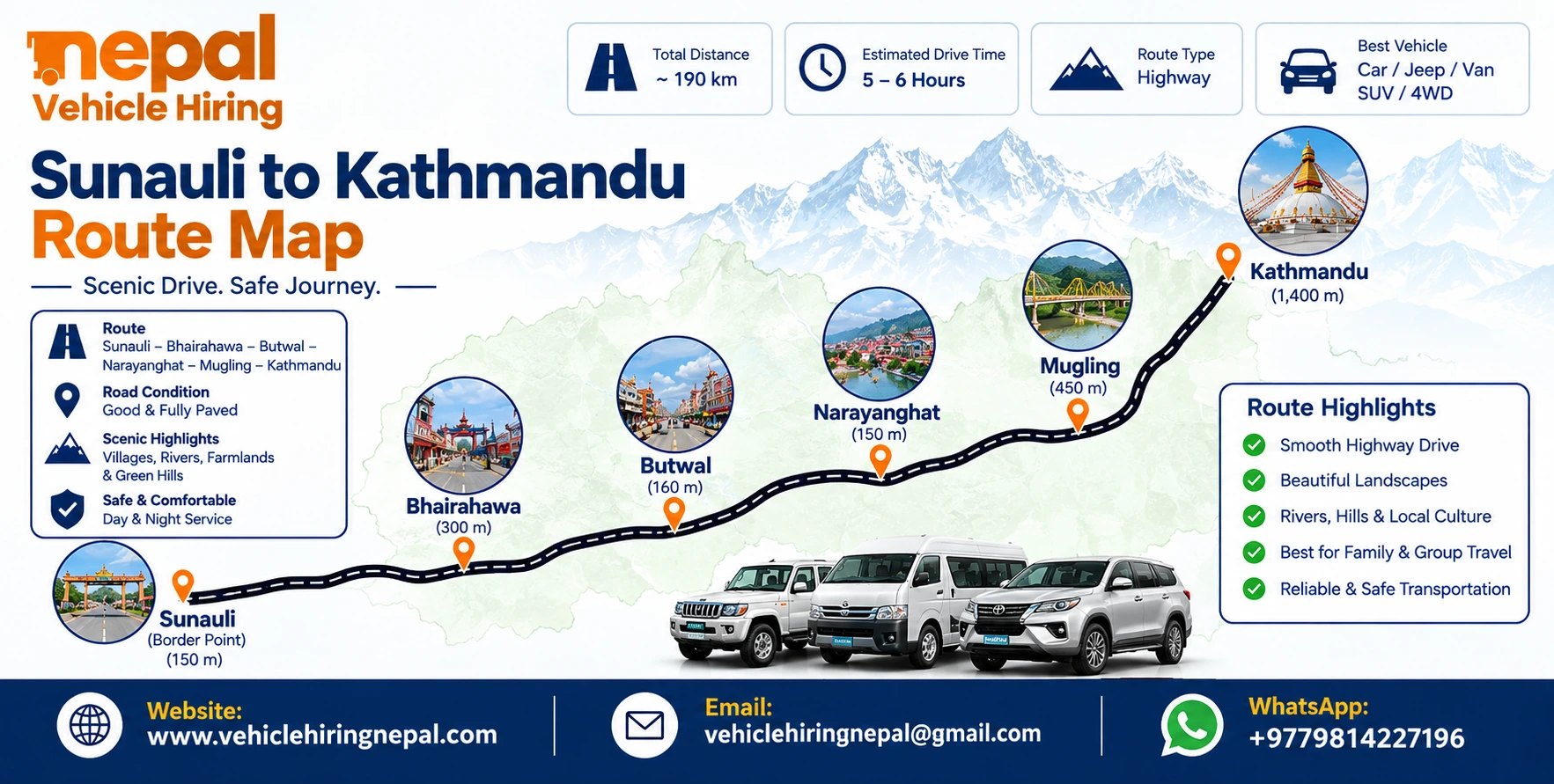
Through this single mountain crossroads passed an extraordinary flow of goods: musk pods, valuable mountain herbs, animal skins, and horses arriving from Tibet in the north; calico cloth, cigarettes, glassware, and kerosene supplied by British India in the south. This trade generated wealth that physically transformed Bandipur—its merchant families used their fortunes to build grand, elaborately carved brick townhouses, temples, and public buildings whose remains visitors marvel at today.

Enjoy a Kathmandu to Bandipur Day Trip with a private car, 4WD jeep, Scorpio SUV, or Hiace van. Discover Bandipur's charming heritage town, scenic viewpoints, local culture, and comfortable private transportation.

The Architecture of Mercantile Prosperity

Bandipur’s architecture is visually and historically distinctive—and repeatedly compared to Bhaktapur, even though Bandipur sits far outside the Kathmandu Valley—because its merchant families adapted Newar building traditions to the hill climate and their direct commercial and cultural ties to British India. The buildings along Bandipur’s main bazaar street are predominantly built from exposed red brick, with deep-set windows that keep interiors cool during the hot months—a sensible hill-climate adaptation of the classic Newari urban townhouse form.

While Kathmandu Valley Newari buildings traditionally use fired clay tile roofing, many of Bandipur’s structures use local slate instead, a material more readily available in the surrounding hills and well suited to this ridge’s slightly different climate and rainfall pattern.

The wood carving on display throughout Bandipur’s bazaar is the town’s true artistic crown jewel and a direct expression of the same UNESCO-recognized Newari craft tradition found in Bhaktapur and Patan, transplanted to and flourishing within this hill town. Look closely at the windows and balconies of the better-preserved merchant houses.

You will find gods, goddesses, mythical creatures, and intricate floral motifs carved with extraordinary precision into wooden lattice screens and door frames — craftsmanship of a quality that rivals anything found in the Kathmandu Valley’s more famous Durbar Squares, executed here by artisans who carried the techniques of their Bhaktapur ancestors into the hills and continued to practice and refine them across generations.

Equally distinctive — and a detail that immediately signals Bandipur’s particular historical character to anyone who has spent time in the Kathmandu Valley’s Newari heritage towns — is the clear colonial-era British Indian influence visible in some of the bazaar’s grander structures. Bandipur’s merchant elite, who grew wealthy through direct and sustained trade with British India, built homes and commercial buildings that blend their inherited Newari architectural vocabulary with stylistic elements absorbed from their trading partners to the south — a synthesis found nowhere else in Nepal’s Newari heritage landscape in quite the same combination, and one of the features that gives Bandipur its unique identity as distinct from, even as it echoes, the heritage towns of the Kathmandu Valley.

The Bypass That Became a Blessing

Bandipur’s commercial golden age could not last forever, and the same broader process of national modernisation that transformed so much of Nepal in the mid-twentieth century drove its eventual eclipse. As Nepal opened itself to the wider world following the political changes of the early 1950s, Pokhara — equipped with an airfield and positioned to become the gateway to the increasingly popular Annapurna trekking region — grew rapidly in strategic and commercial importance.

The decisive blow to Bandipur’s centrality came in 1972, when the new Prithvi Highway was completed, connecting Kathmandu and Pokhara along the valley floor far below Bandipur’s ridge and bypassing the town that had been the essential crossroads of central Nepali trade for nearly two centuries.

The economic consequences for Bandipur in the years that followed were significant and, at the time, surely felt by its residents as a genuine loss: the district administrative headquarters relocated to the new highway town of Damauli, trade volumes collapsed as merchants and transport shifted to the new road, and many of Bandipur’s wealthiest families gradually relocated to the plains or to Kathmandu in search of continued economic opportunity, in some cases abandoning generations-old family properties whose ornately carved doors and windows still stand today, their original owners’ descendants scattered across Nepal and the wider world.
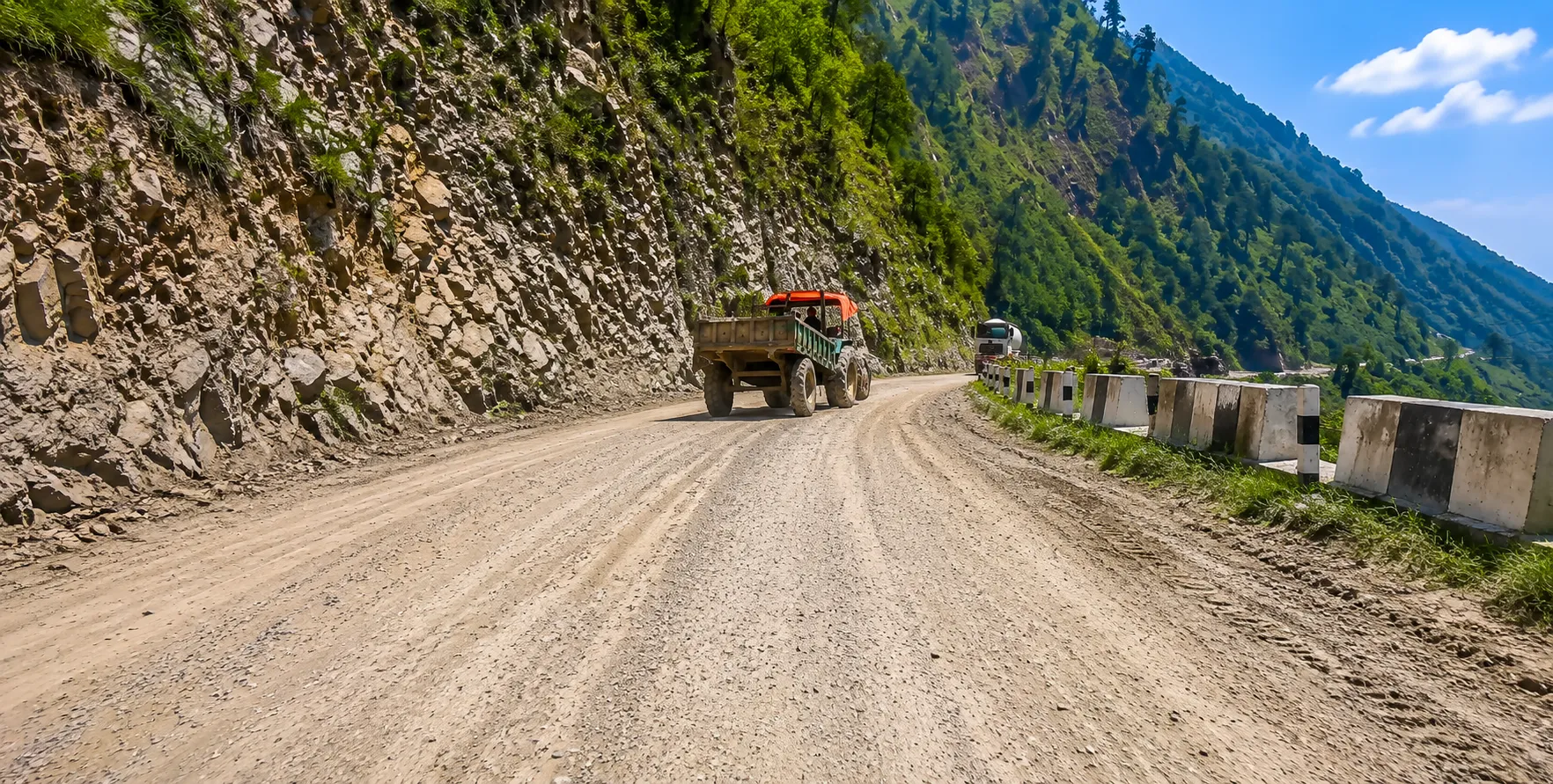
Yet this same economic eclipse produced, in a kind of historical irony heritage conservationists worldwide would recognise, the single greatest gift to Bandipur’s long-term preservation. Because no new investment, road widening, or modern concrete redevelopment ever disturbed Bandipur’s bazaar after the highway bypassed it, the town’s nineteenth-century character was effectively frozen in place.
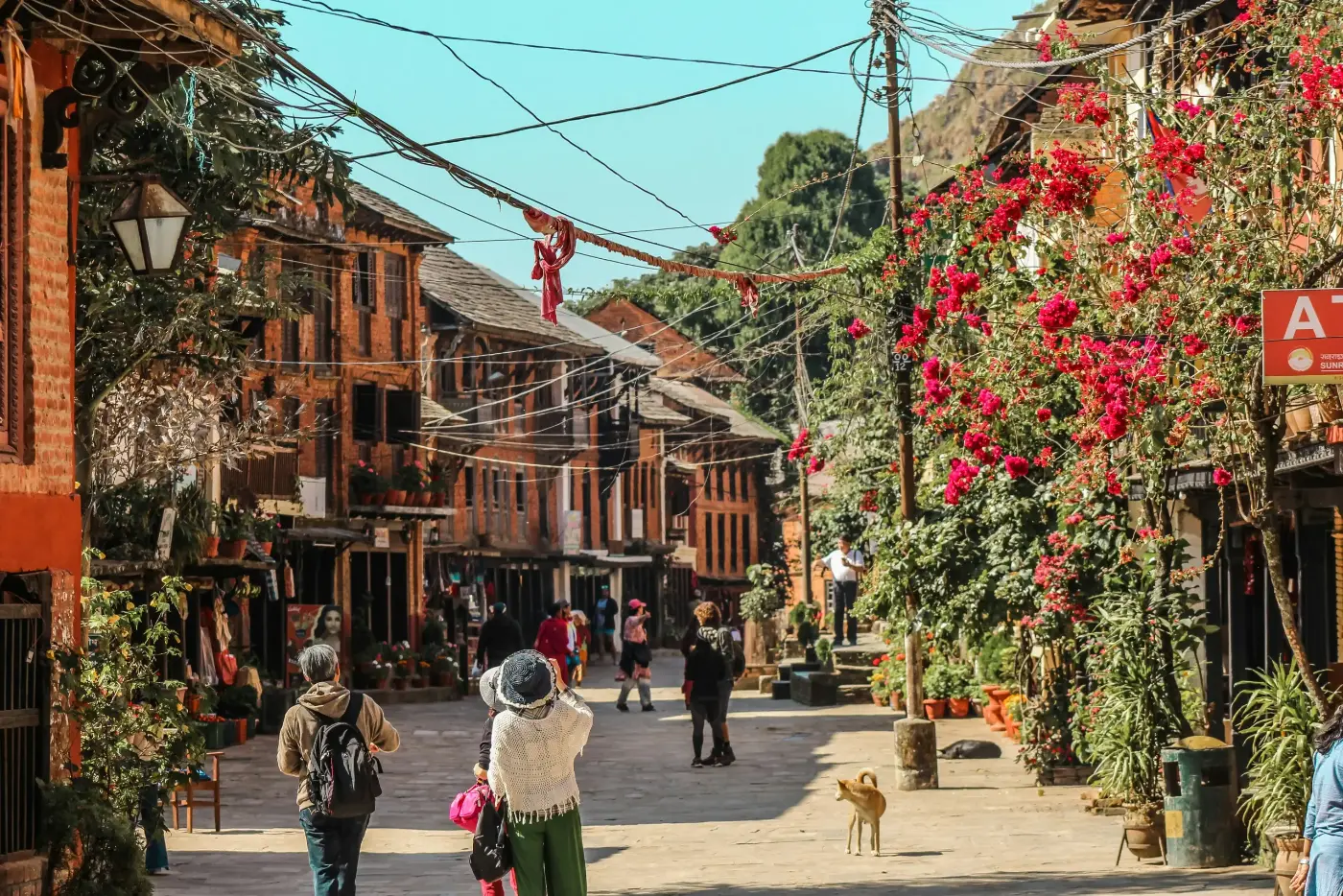
While many other Newari hill settlements across Nepal lost their traditional architecture and urban character once they were incorporated into the country’s expanding road network—their main streets widened for vehicle traffic, their traditional buildings replaced by modern concrete construction—Bandipur, precisely because it was left behind, survived essentially intact. Today, it stands as what is widely and accurately described as Nepal’s best-preserved Newari hill town, where the absence of motorised traffic on its central stone-paved street is not a tourism gimmick but the continuation of a quiet rural reality that has prevailed, uninterrupted, for half a century.

Enjoy a Kathmandu to Bandipur Day Trip with a private car, 4WD jeep, Scorpio SUV, or Hiace van. Discover Bandipur's charming heritage town, scenic viewpoints, local culture, and comfortable private transportation.

The Route: Kathmandu to Bandipur in Detail

Understanding the Geography of the Journey

Bandipur sits in Nepal’s Tanahun District, approximately 143 kilometres west of Kathmandu and roughly 76 kilometres east of Pokhara — making it, quite literally, the natural midpoint stopover on the journey between Nepal’s two largest tourist hubs. For a traveller approaching specifically from Kathmandu, however, Bandipur functions perfectly well as a dedicated single-day round trip, with a typical one-way driving time by private vehicle of approximately four to five hours, depending on traffic conditions through the Kathmandu Valley exit, the time of departure, and the specific route taken in the final approach to the town itself.

The journey follows, for the vast majority of its length, the same Prithvi Highway corridor used by all Kathmandu to Pokhara road traffic — meaning that travellers heading to Bandipur experience precisely the same spectacular sequence of Himalayan foothill scenery that has made this highway one of the most celebrated road journeys in Nepal. From Kathmandu, the route descends out of the valley through the Nagdhunga pass area, then follows the Trishuli River along a dramatic gorge section where the road clings to cliff faces above rushing glacial water, before reaching the riverside settlements of Malekhu and continuing to the busy junction town of Mugling, where the Trishuli and Marsyangdi rivers meet and where most travellers pause for the famous local curd and a change of scenery as the highway turns to follow the Marsyangdi valley westward.

It is in this final stretch beyond Mugling — along the Marsyangdi and then briefly along the route that also serves Besisahar, the starting point of the Annapurna Circuit trek — that the turn-off for Bandipur is reached. The junction town of Dumre, situated directly on the Prithvi Highway, is the critical waypoint for the entire journey; travellers leave the main Kathmandu–Pokhara highway here and begin the final ascent toward Bandipur’s ridge-top position.

From Kathmandu to Dumre is the great majority of the total journey’s distance and time; the final segment from Dumre up to Bandipur itself, while shorter in absolute distance, involves a steady climb of a switchbacking hill road that delivers, in its final kilometres, some of the most rewarding scenery of the entire trip.

Enjoy a Kathmandu to Bandipur Day Trip with a private car, 4WD jeep, Scorpio SUV, or Hiace van. Discover Bandipur's charming heritage town, scenic viewpoints, local culture, and comfortable private transportation.

The Final Ascent — Dumre to Bandipur

From the highway junction at Dumre, the road to Bandipur climbs steadily up the forested ridge the town occupies, gaining several hundred meters over a relatively short distance through pine and broadleaf forest, scattered farming terraces, and small roadside settlements. This final approach road has been progressively improved in recent years.

It is now paved for most of its length, a substantial improvement over the rougher, unpaved conditions that characterised the route in earlier decades and that some older travel accounts still describe. A private vehicle in good condition, driven by an experienced driver familiar with the route, covers this final ascent comfortably, typically in well under an hour from the Dumre junction.

What makes this final stretch of the journey particularly special — and a genuine reward for travellers who have already spent several hours on the road from Kathmandu — is the progressive emergence of the Himalayan panorama as the road climbs. Bandipur’s elevated ridge-top position, at approximately 1,030 to 1,317 metres above sea level depending on the precise point measured, places it at exactly the right elevation and orientation to command sweeping views across the Marsyangdi River valley toward an extraordinary concentration of major Himalayan peaks: the Annapurna range, Dhaulagiri, the unmistakable fishtail silhouette of Machhapuchhre, Manaslu, Langtang Lirung, and Ganesh Himal are all visible from various viewpoints in and around the town on clear days — a mountain panorama of a breadth and quality that few other easily accessible hill towns in Nepal can rival.

Travellers arriving by private vehicle also benefit from being dropped off at the edge of Bandipur’s pedestrianised core. Because the main bazaar street is entirely free of vehicle traffic—one of its most cherished and defining characteristics—private vehicles park in a designated area at the edge of the old town, from which you explore the historic bazaar street and its surrounding lanes entirely on foot.

This short final walk into the traffic-free heart of Bandipur is itself part of the experience’s particular magic: the transition from the ordinary world of roads and engines to the hushed, stone-paved, centuries-old streetscape of the bazaar happens within the space of just a few minutes’ walk.

Alternative Routing and Combination Stops

One key practical strength of hiring a private vehicle for the Kathmandu to Bandipur journey, compared with scheduled public transport, is the freedom to add worthwhile stops along the route without being bound to a bus timetable. The single most popular and rewarding combination stop on this corridor is the Manakamana Temple, accessible via Nepal’s first cable car system at Kurintar, roughly midway along the Prithvi Highway portion of the journey.

The cable car ride to this famous wish-fulfilling goddess temple takes approximately ten minutes each way.

It adds three hours to the day’s itinerary, but for travellers with a full day and a private vehicle, combining Manakamana with Bandipur creates an exceptionally rich single-day cultural circuit that touches both a major living pilgrimage site and an extraordinary preserved heritage town.

Other practical stopping points along the route, well known to experienced drivers on this corridor, include the riverside restaurants near Malekhu, popular for breakfast or an early lunch beside the rushing Trishuli River, and the curd vendors and restaurants clustered around Mugling junction, where the local yoghurt — thick, tangy, and served in small clay pots — is considered among the finest in Nepal and makes for a genuinely memorable roadside refreshment stop partway through the journey.

Enjoy a Kathmandu to Bandipur Day Trip with a private car, 4WD jeep, Scorpio SUV, or Hiace van. Discover Bandipur's charming heritage town, scenic viewpoints, local culture, and comfortable private transportation.

What to See and Experience in Bandipur

Walking the Bazaar — A Street Frozen in Time

The single defining experience of any Bandipur visit is simply walking the length of its main bazaar street — a flagstone-paved, entirely pedestrianised thoroughfare lined on both sides with two– and three-storey brick merchant houses, their wooden balconies often draped in flowering plants, their ground floors now occupied by a mixture of boutique guesthouses, small cafes, souvenir shops selling local handicrafts, and a scattering of buildings still serving the everyday domestic functions of the families who have lived in them for generations.

The complete absence of vehicle traffic and the accompanying absence of engine noise, exhaust, and the general urgency of modern road traffic is, for many visitors, the first and most immediately striking sensory feature of arriving in Bandipur — a stillness and quiet that feels genuinely unusual after even a short time spent in Kathmandu’s traffic-dense streets.

Walking slowly along this street, it is worth pausing to look closely at the architectural details on the older and better-preserved buildings — the carved wooden window lattices, the elaborately decorated doorframes, the subtle variations in brickwork and roofline that distinguish the wealthiest merchant houses from more modest neighbouring structures. Among the historic buildings most frequently pointed out to visitors is the old Padma Library, an eighteenth-century structure with finely carved windows and beams that today houses a modest collection of books, including some in English, and stands as a quiet testament to the cultural aspirations of Bandipur’s prosperous merchant community even at the height of its commercial wealth.

Local guides and longtime residents can point out other notable historic houses—including grand old merchant residences whose intricately carved doors, bearing symbols and motifs that have intrigued visiting scholars but remain unstudied and unexplained, hint at stories largely lost as the original owning families relocated from Bandipur over the past century.

Tundikhel — The Historic Parade Ground and Premier Viewpoint

At the heart of Bandipur’s public space lies Tundikhel, a broad open ground that historically served as a military parade ground for Gurkha soldiers and, at the same time, a key gathering and trading point for merchants during the town’s commercial golden age. Today Tundikhel functions as Bandipur’s primary communal space and, for visitors, as one of its two essential mountain viewpoints — a place to gather in the late afternoon and evening to watch the Himalayan panorama catch the changing light as the sun sets, with the Annapurna, Dhaulagiri, and Manaslu ranges arrayed along the northern horizon in a sweep of snow and rock that, on a genuinely clear day, ranks among the finest easily accessible mountain views in all of Nepal.

Tundikhel’s appeal is not limited to sunset hours, however; it functions throughout the day as a relaxed picnic and gathering spot, and many visitors find that simply sitting on the open grass with a coffee from one of the nearby cafes, watching the slow rhythm of village life and the shifting mountain light, is among the most genuinely restorative experiences that Bandipur has to offer — a deliberate, unhurried counterpoint to the more structured sightseeing itineraries of Kathmandu’s Durbar Squares.

Enjoy a Kathmandu to Bandipur Day Trip with a private car, 4WD jeep, Scorpio SUV, or Hiace van. Discover Bandipur's charming heritage town, scenic viewpoints, local culture, and comfortable private transportation.

Thani Mai Temple and the Sunrise Hike — Bandipur’s Most Rewarded Early Start

For travellers willing to rise before dawn—a genuinely worthwhile sacrifice for anyone visiting Bandipur—the hike up to Thani Mai Temple on the crest of Gurungche Hill is widely regarded as offering the finest mountain panorama in or around the town. The trail begins near the school at the bazaar’s southwest end and climbs steeply for about thirty minutes to the temple top.

On a clear morning, the reward for this short but genuinely demanding ascent is extraordinary: a full 360-degree panorama in which the Himalayan range stretches unbroken along the northern horizon while, below, the valley is frequently blanketed in a sea of morning fog that gives the entire scene the appearance of a vast white lake from which only the highest ridgelines and the distant snow peaks emerge — one of the most photographed and most memorable sunrise scenes available anywhere in the central Nepal hills.

For travellers undertaking Bandipur strictly as a single day trip from Kathmandu rather than staying overnight, the sunrise hike to Thani Mai is, by definition, not accessible — a genuine and honest limitation of the day-trip format that is worth acknowledging directly. Those who can extend their visit to include an overnight stay in one of Bandipur’s heritage guesthouses gain access to this experience, and to the broader, more contemplative rhythm of a town best appreciated at something other than rushed daytime pace; for those constrained to a single day, the Tundikhel viewpoint and the late-afternoon mountain light remain an entirely worthwhile and achievable substitute.

Enjoy a Kathmandu to Bandipur Day Trip with a private car, 4WD jeep, Scorpio SUV, or Hiace van. Discover Bandipur's charming heritage town, scenic viewpoints, local culture, and comfortable private transportation.

Bindhyabasini Temple — The Spiritual Anchor of the Bazaar

At the northern end of Bandipur’s main bazaar street stands the Bindhyabasini Temple, the town’s most significant religious structure and a genuine architectural and devotional landmark in its own right. Dedicated to the goddess Durga in her Bindhyabasini manifestation, this two-tiered temple, now well over two centuries old, is decorated with the same finely detailed woodcarving and stonework traditions found throughout Bandipur’s residential architecture, applied here to overtly sacred rather than commercial purposes.

Within the temple, a statue of the goddess adorned with gold and silver ornaments occupies the central shrine, surrounded by a scattering of smaller shrines dedicated to other deities, including Bhairav and Ganesh — a microcosm of the broader Hindu-Newari devotional landscape that the merchant families who built Bandipur carried with them from the Kathmandu Valley and reconstituted, in full, on this remote hilltop.

Bindhyabasini Temple is also the focal point for several of Bandipur’s most significant annual festivals, and the temple precinct — a broad open courtyard fronting the temple itself — functions as a natural gathering point both for daily devotional visits by residents and for the larger public celebrations that animate the town’s festival calendar throughout the year, discussed in more detail below.

Khadga Devi Temple and the Town’s Wider Sacred Geography

Beyond Bindhyabasini, Bandipur’s bazaar and surrounding lanes contain a scattering of smaller but historically significant shrines and temples, among which the Khadga Devi Temple holds particular local importance, housing a sacred sword (khadga) associated with the goddess and central to specific annual ritual observances. Exploring this wider sacred geography — generally most rewarding in the company of a local guide who can explain the specific stories and ritual functions attached to each shrine — reveals the degree to which Bandipur’s Newar founders successfully transplanted not merely the architectural forms but the full devotional and ritual infrastructure of their Kathmandu Valley origins onto this hilltop, creating a complete and self-sufficient sacred landscape in miniature.

Siddha Cave — Nepal’s Most Accessible Major Cave System

A short distance from the main bazaar, reachable by a brief vehicle transfer and walk, lies Siddha Cave (Siddha Gufa), reputed to be Nepal’s largest cave and one of the most popular half-day excursions from Bandipur. The cave’s vast interior chamber — accessed via a steep stairway descent — contains dramatic limestone formations, including stalactites and stalagmites that local guides point out in shapes evocative of various natural and mythological forms, and the scale of the main chamber, large enough that its full extent is not immediately apparent from the entrance, gives the visit a genuine sense of subterranean adventure that contrasts pleasingly with the more contemplative, architecture-focused experience of the bazaar itself.

Visiting Siddha Cave requires sturdy footwear and a reasonable comfort level with steep, sometimes slippery stone stairways in low light. While headlamps or torches are sometimes available for hire on-site, it’s best to bring your own to ensure a comfortable visit.

Travellers on a tightly timed single-day itinerary from Kathmandu can include a visit to Siddha Cave. Still, it will meaningfully extend the time required in Bandipur—a worthwhile trade-off for those with sufficient daylight hours remaining, but one that should be planned explicitly when arranging the day’s vehicle timing.

Ramkot Village and the Hill Trail — For Those With Extra Time

For visitors extending their stay beyond a single day, or for those on a day trip with extra energy and time to spare, the walking trail to Ramkot village offers another dimension of Bandipur’s surrounding landscape. Ramkot is a traditional Magar and Gurung settlement characterised by distinctive round, thatched-roof houses quite different in form from the brick Newari architecture of Bandipur’s own bazaar, and the roughly eight– to nine-kilometre round-trip walk to reach it, taking approximately two and a half to three hours, passes through terraced farmland and forest with consistently excellent mountain views along the ridge.

This excursion is generally treated as a half-day or full second-day activity rather than something easily folded into a single-day Kathmandu round trip. Still, it is worth knowing about for travellers considering whether a one-night stay might better serve their interests than a strict day trip.

Newari Cuisine in the Hills — Eating Well in Bandipur

One of the expected pleasures of a Bandipur visit for travellers with any interest in food is the chance to sample genuine Newari cuisine prepared in a hill-town context distinct from, yet clearly continuous with, the culinary traditions of Bhaktapur and Patan. The classic Newari ceremonial platter, samay baji — featuring beaten rice, spiced meat, lentil preparations, and pickled accompaniments — is available at several of the bazaar’s restaurants and cafes, alongside other Newari specialities such as yomari (the sweet steamed rice-flour dumpling), bara (the savoury lentil pancake), and chatamari (often described as Newari-style rice flour ‘pizza’).

Local hill cuisine, drawing on the surrounding terraced farms, supplements these Newari dishes with fresh seasonal vegetables, free-range chicken prepared in distinctly Nepali style, and, for travellers staying overnight, often homemade raksi — the traditional distilled spirit served as part of a complete evening meal experience in many of the town’s guesthouses.

Bandipur’s main street is also, somewhat unexpectedly for such a historically remote hill town, home to a genuinely good cafe culture, with balcony seating overlooking the bazaar street offering travellers the chance to sit with a coffee or a slice of locally baked cake, enjoying free Wi-Fi and the gentle rhythm of the pedestrianised street below — a contemporary comfort layered gently onto the town’s nineteenth-century architectural fabric without disrupting its essential historic character.

Bandipur’s Living Festival Calendar

Because Bandipur’s Newar founders brought with them the full devotional and festival traditions of the Kathmandu Valley, the town’s annual calendar remains animated by many of the same major celebrations that define cultural life in Bhaktapur and Patan, even though Bandipur itself sits a considerable distance from the valley and its population today is a smaller, more rural mixture of Newar, Gurung, and Magar communities.

Dasain, the great fifteen-day autumn festival central to the Nepali Hindu calendar, fills Bandipur’s streets and courtyard shrines each year with ritual observances, family gatherings, and the traditional sacrificial offerings that mark this most significant annual celebration nationwide.

During the monsoon month that brings Janai Purnima, Bandipur’s streets see their own distinctive local expression of this sacred thread-changing festival, while Tihar — the festival of lights that follows Dasain — and the boisterous, joyful celebration of Holi in spring both animate the town with colour, music, and the kind of cross-community celebration that briefly erases the usual boundaries of daily routine.

Perhaps most distinctively, the Maghe Sankranti festival in mid-January is associated in Bandipur with a notable local celebration at the town’s own Nyatapola-style tiered temple architecture, drawing crowds for what is described as one of the largest such gatherings in the wider region — a genuine point of local pride and an opportunity for visitors whose travel dates happen to coincide with it to witness Bandipur’s living culture at its most vivid and public. Travellers planning a Bandipur visit around any of these major festival dates should anticipate significantly higher visitor numbers, both domestic and international.

They should arrange transport and overnight accommodation in advance through Nepal Vehicle Hiring Pvt. Ltd. and the relevant guesthouse operators, respectively, as operators have modest guest capacity and can become genuinely booked out during peak festival periods.

Kathmandu to Bandipur Car

The Complete Transport Guide — Getting to Bandipur from Kathmandu

Why Private Vehicle Hire Is the Right Choice for This Journey

Bandipur can technically be reached by public transport — travellers can take a regular tourist or local bus from Kathmandu’s bus park toward Pokhara, disembark at the Dumre junction after roughly five to six hours, and then transfer to one of the local buses or shared jeeps that make the final ascent up to Bandipur itself. This option exists, is used by budget-conscious independent travellers, and can work with enough patience.

But for the specific purpose of a focused day trip from Kathmandu — where time efficiency, schedule control, and the ability to incorporate worthwhile stops along the route all matter enormously — the practical case for private vehicle hire is considerably stronger here than for almost any other Nepal day-trip destination.

The reasoning is straightforward. A public bus journey to Dumre, followed by a transfer wait and a second vehicle for the final ascent, adds multiple unpredictable delays to a journey that already consumes most of a single day each way.

A private vehicle, by contrast, departs precisely when you are ready, drives the full route from your Kathmandu hotel directly to Bandipur’s parking area without any transfer or waiting period, and — critically for a true day-trip itinerary — allows the driver to adjust departure and return timing flexibly based on how much time you actually want to spend exploring the bazaar, the viewpoints, and any combination of stops such as Manakamana, rather than being locked into the fixed schedule of a public bus service back to Kathmandu.

For a day trip specifically — as opposed to an overnight stay — this flexibility is not a luxury but close to a practical necessity. Bandipur sits at the end of a meaningful drive from Kathmandu; arriving with a fixed, inflexible return bus schedule risks either cutting your time in the town uncomfortably short or, worse, missing the return transport altogether and being forced into an unplanned overnight stay.

A private vehicle from Nepal Vehicle Hiring Pvt. Ltd., with a driver who waits in Bandipur (or returns to collect you from Dumre or another agreed point) at the agreed return time, removes this risk and lets you plan and execute a true single-day round trip with confidence.

Bandipur

Vehicle Selection for the Bandipur Route

The Kathmandu to Bandipur route, including its final unpaved-to-paved ascent sections above Dumre, is comfortably manageable in a standard private car or SUV for most of the year and generally does not require the heavier 4WD jeeps that some of Nepal’s more remote mountain routes demand.

That said, Nepal Vehicle Hiring Pvt. Ltd. recommends a capable SUV or compact 4WD vehicle as the optimal choice for this specific journey, both for the genuinely improved comfort it offers on the final winding ascent road to Bandipur and for the additional margin of safety and confidence it provides during the monsoon season, when heavy rainfall can occasionally affect road surface conditions on the steeper sections above Dumre.

For larger groups or families, a Hiace-style van comfortably accommodates the journey on the main highway sections, with a transfer to a smaller vehicle arranged if needed for the final approach during periods of less favourable road conditions — though in good dry-season conditions, larger vehicles generally complete the full journey to Bandipur’s parking area without difficulty.

Whatever vehicle category you choose, the single most important factor in a successful Bandipur day trip by private vehicle is the driver’s experience on this specific route. The Prithvi Highway sections are well known to virtually any experienced Nepal driver, but the final approach road from Dumre to Bandipur — with its switchbacks, its periodic traffic of local vehicles and pedestrians moving between the highway and the hill villages, and its more variable surface conditions compared to the main highway — genuinely benefits from a driver who has made this specific run before and understands its particular character.

Nepal Vehicle Hiring Pvt. Ltd.’s driver team includes individuals with direct, repeated experience on the Bandipur route, ensuring that clients benefit from this local route knowledge rather than relying on a driver navigating the final ascent for the first time.

Enjoy a Kathmandu to Bandipur Day Trip with a private car, 4WD jeep, Scorpio SUV, or Hiace van. Discover Bandipur's charming heritage town, scenic viewpoints, local culture, and comfortable private transportation.

Timing Your Day Trip for Maximum Reward

Given the four-to-five-hour one-way drive, a successful single-day Kathmandu to Bandipur round trip by private vehicle requires a genuinely early departure from Kathmandu, ideally before 6:00 to 6:30 AM. This early start serves multiple purposes simultaneously: it avoids the worst of Kathmandu’s own morning traffic congestion on the city’s exit roads, it positions the vehicle to clear the periodically congested Mugling junction area before the busiest midday traffic period, and it maximises the actual usable daylight time available for exploring Bandipur itself once the long outbound drive is complete.

A realistic timing structure for a focused single-day trip looks approximately as follows: departure from Kathmandu by 6:00–6:30 AM, with an early breakfast stop at one of the riverside restaurants near Malekhu approximately ninety minutes into the journey; arrival at the Mugling junction area, with an optional brief stop for the famous local curd, at roughly the journey’s midpoint; arrival at Dumre and the beginning of the final ascent to Bandipur in the late morning; and arrival in Bandipur itself, ready to begin exploring the bazaar, by approximately 11:00 AM to noon, depending on the exact pace of the journey and any stops taken.

This timing structure leaves a genuinely useful four to five hours for exploring Bandipur’s bazaar, visiting Bindhyabasini Temple, walking to the Tundikhel viewpoint for at least the earlier, still-attractive stages of the afternoon light, and — for those with sufficient remaining time and energy — a visit to Siddha Cave, before a return departure from Bandipur in the mid-to-late afternoon that allows the return drive to Kathmandu to be completed before or shortly after nightfall.

Travellers who find this single-day structure too rushed, or who specifically want to experience the celebrated Thani Mai sunrise hike or prefer a more unhurried pace, should seriously consider converting the trip into a one-night stay, departing Kathmandu in the morning, spending the afternoon and evening exploring Bandipur at a relaxed pace, overnighting in one of the town’s heritage guesthouses, rising before dawn for the Gurungche Hill sunrise hike, and returning to Kathmandu the following day — an itinerary that the great majority of experienced Bandipur visitors and travel writers specifically recommend over the more compressed single-day version, while acknowledging that a well-organized day trip with private vehicle hire remains an entirely legitimate and rewarding option for travellers whose schedule genuinely cannot accommodate an overnight stay.

Enjoy a Kathmandu to Bandipur Day Trip with a private car, 4WD jeep, Scorpio SUV, or Hiace van. Discover Bandipur's charming heritage town, scenic viewpoints, local culture, and comfortable private transportation.

Combining Bandipur with an Onward Journey to Pokhara

Because Bandipur sits almost exactly midway along the Kathmandu–Pokhara corridor, one of the most popular and practically efficient ways to incorporate a Bandipur visit into a broader Nepal itinerary is not as a round-trip day excursion from Kathmandu at all, but as a one-way stopover en route to Pokhara — departing Kathmandu in the morning, spending several hours or an overnight stay exploring Bandipur, and then continuing onward to Pokhara (a further two to three hours of driving from Bandipur) rather than returning to Kathmandu at all. Nepal Vehicle Hiring Pvt. Ltd. readily accommodates this one-way routing.

For travellers whose broader Nepal itinerary already includes a transition from Kathmandu to Pokhara, this approach allows the Bandipur visit to be folded into a journey that the traveller needed to make in any case, rather than requiring a dedicated separate round trip from Kathmandu — often the single most time-and-cost-efficient way to experience Bandipur for travellers with a Pokhara leg already planned.

Practical Tips for Your Bandipur Visit

Comfortable, sturdy walking shoes are essential for any Bandipur visit — the bazaar’s flagstone paving, while charming, is uneven in places. Any excursion to Tundikhel, Thani Mai, or Siddha Cave involves real uphill or stair-based walking, so proper footwear beats casual sandals.

With Bandipur at just over 1,000 meters, mornings and evenings can be noticeably cooler than Kathmandu, especially outside the warmer months; pack a light layer for early-morning or evening viewpoint visits, even when daytime temperatures feel comfortable.

Cash should be carried in adequate quantity, as while Bandipur’s tourism infrastructure has developed considerably in recent years, reliable card payment acceptance and ATM access remain less consistent than in Kathmandu or Pokhara, and many of the town’s smaller cafes, shops, and guesthouses continue to operate primarily or exclusively on a cash basis. As with any of Nepal’s traditional heritage towns, modest dress is appreciated, particularly around the temple precincts, and visitors who take the time to learn even a few basic Nepali greetings tend to find this small effort warmly and genuinely reciprocated by Bandipur’s residents, many of whom retain a strong sense of pride in their town’s history and are happy to share it with visitors who show real interest rather than treating the bazaar as a simple photo backdrop.

The best months for a Bandipur visit, as for most of central Nepal’s hill and mountain viewpoints, are the spring period from March through May and the post-monsoon autumn period from September through November, when skies are at their clearest, and the Himalayan panorama from Tundikhel and Thani Mai is most reliably visible in its full, snow-draped glory. Visits during the summer monsoon months remain entirely possible and offer their own charm—lush green terraced hillsides and a quieter, more contemplative atmosphere with far fewer visitors.

Still, mountain visibility becomes considerably less reliable, so travellers should adjust their expectations and road-condition planning with their vehicle hire provider accordingly.

Enjoy a Kathmandu to Bandipur Day Trip with a private car, 4WD jeep, Scorpio SUV, or Hiace van. Discover Bandipur's charming heritage town, scenic viewpoints, local culture, and comfortable private transportation.

Why Choose Nepal Vehicle Hiring Pvt. Ltd. for Your Bandipur Day Trip

A journey to Bandipur asks a good deal of its transport arrangements: a genuinely long single day on the road, a route that combines fast highway driving with a more technical final ascent, the practical need for real flexibility around timing and stops, and — for travellers attempting the trip as a single day excursion — very little margin for the kind of unpredictable delay that an unreliable vehicle or an inexperienced driver can introduce. Nepal Vehicle Hiring Pvt. Ltd. has built its reputation, reflected in thousands of satisfied clients and a five-star average rating, on dependable, well-maintained vehicles and genuinely experienced, professional drivers that a journey of this character demands.

Every vehicle dispatched for a Bandipur route meets the same rigorous maintenance standard applied across Nepal Vehicle Hiring Pvt. Ltd.’s entire fleet, and drivers assigned to this route are selected for their familiarity with the Prithvi Highway corridor and the specific character of the final Dumre-to-Bandipur ascent. The company’s approach to a day trip of this kind is built around genuine flexibility: clients set their own departure time from their Kathmandu hotel, decide in real time how long they wish to spend exploring the Bandipur bazaar and its viewpoints, and can request combination stops — Manakamana Temple chief among them — without any of the rigidity that a fixed-schedule group tour or public bus journey would impose.

Booking is handled directly and responsively through Nepal Vehicle Hiring Pvt. Ltd.’s WhatsApp line and website, with the company’s team able to advise on the optimal vehicle choice for a given group size, the most sensible departure timing given the traveller’s specific interests within Bandipur, and any seasonal road-condition considerations relevant to the planned travel date. For travellers who decide, after researching the destination, that the richer experience of an overnight stay better suits their interests than a compressed single-day round trip, Nepal Vehicle Hiring Pvt. Ltd. equally accommodates one-way drop-off and later pickup arrangements, or full multi-day vehicle hire that keeps a driver and vehicle available throughout an extended Bandipur stay or an onward continuation to Pokhara.

Conclusion: A Day Trip Worth Every Kilometre

Bandipur occupies a genuinely unusual place in Nepal’s heritage landscape — a town preserved not by deliberate conservation policy but by historical accident, surviving in its present extraordinary condition precisely because the modern road network passed it by half a century ago. The result, for today’s traveller, is a destination that delivers an experience genuinely comparable in architectural and cultural depth to the famous Durbar Squares of the Kathmandu Valley, wrapped in a setting of complete pedestrian tranquillity and framed by one of the finest accessible Himalayan mountain panoramas in the entire country — all within a single comfortable day’s reach of Kathmandu by private vehicle.

Walking Bandipur’s flagstone bazaar street beneath its carved wooden balconies, standing on Tundikhel as the afternoon light moves across the distant Annapurna and Manaslu ranges, and tasting genuine Newari cuisine prepared by a community whose ancestors carried this entire cultural world over a mountain ridge nearly two and a half centuries ago — this is a day trip that rewards every kilometre of the journey required to reach it. Nepal Vehicle Hiring Pvt. Ltd. is ready to be your trusted, experienced, and genuinely flexible transport partner, making this remarkable day achievable in comfort, on your schedule, and without compromise.

Contact our team today to begin planning your Kathmandu to Bandipur heritage day trip.

Book Your Kathmandu to Bandipur Day Trip with Nepal Vehicle Hiring Pvt. Ltd.

Website: www.vehiclehiringnepal.com

WhatsApp (24/7 Support)

Email: [email protected]

Office: Bhagawatisthan, Thamel, Kathmandu, Nepal

Fleet: Private Car | SUV / 4WD Jeep | Hiace Van — matched to your group size

Route: Kathmandu → Malekhu → Mugling → Dumre → Bandipur (and return, or onward to Pokhara)

Flexible Timing: Early departure, your own pace in Bandipur, optional Manakamana stop

Kathmandu to Kharikhola and Surke: Transfer Guide

Book a private 4WD jeep from Kathmandu to Kharikhola and Surke for a safe and comfortable journey to the Everest Region. Perfect for Everest Base Camp trekkers looking for reliable road transportation.

Kathmandu to Kharkhukha and Surkhet — Your Complete  Jeep Transfer Guide

You can reach Nepal’s Everest region in two ways. Most travellers know the first: a short and often weather-delayed domestic flight from Kathmandu — or, increasingly during peak seasons, from Ramechhap’s Manthali Airport — landing at the famously steep Lukla airstrip at 2,860 meters, from where the Everest Base Camp trek begins on foot.

The second route is far older, far less crowded, and far more rewarding for travellers who want their Himalayan journey to begin exactly where the mountain itself begins: at the roadside, in a properly equipped 4WD jeep, winding through Solukhumbu District’s extraordinary hill terrain on an overland drive that ends at the villages of Kharikhola and Surke — two of the most important waypoints on the traditional overland approach to the Khumbu valley and, beyond it, to Everest itself.

Kharikhola sits at approximately 2,100 metres in Solukhumbu District, roughly 230 to 28 kilometres from Kathmandu by road, depending on the exact route taken. Surke, a smaller village slightly higher on the same general approach corridor at around 2,300 metres, sits so close to Lukla that a short, well-marked trail connects the two — making Surke, specifically, the preferred drop-off point for trekkers wishing to join the standard Lukla-based Everest trail without taking the flight, entering the trail system from below rather than from the air and gaining every metre of altitude on foot.

Both villages have historically served as key overnight stops on the Jiri-to-Everest overland trek that, before Lukla’s airstrip was built in 1964, was the standard approach every mountaineering expedition used to reach the Khumbu Valley.

This guide is written for travellers planning a private jeep transfer from Kathmandu to Kharikhola or Surke: the full route, current road conditions, costs, what the drive actually looks like on the ground, what happens when you step out at the trailhead, which trekking routes these two villages give access to, and why Nepal Vehicle Hiring Pvt Ltd is the right private vehicle partner for one of Nepal’s most demanding and most rewarding overland transfers.

Book a private 4WD jeep from Kathmandu to Kharikhola and Surke for a safe and comfortable journey to the Everest Region. Perfect for Everest Base Camp trekkers looking for reliable road transportation.

Kharikhola and Surke — Understanding Where You Are Going and Why

Kharikhola, whose name translates roughly as ‘black river’ from the Nepali words khari (a dark variety of fig tree) and khola (river or stream), is a Sherpa and Rai community village in Solukhumbu District’s lower hills, sitting well below the famous high-altitude Khumbu settlements of Namche Bazaar and Tengboche but on the same continuous walking trail that links the lowland road network to the world’s highest mountain.

The village has a well-established small bazaar with teahouses and basic guesthouses, a functioning medical post, and the kind of mixed Hindu-Buddhist cultural landscape typical of Solukhumbu’s lower altitudes before the trail climbs high enough for the purely Sherpa-Buddhist character of the upper Khumbu to become dominant.

Surke, a smaller settlement positioned higher on the ridge system between Kharikhola and Lukla, occupies a position of particular strategic importance for the overland Everest trekker: it is close enough to Lukla to be joined to it by a direct trail of just two to three hours walking, meaning that a traveller dropped at Surke by private vehicle can reach the Lukla junction point — and thus the beginning of the high-traffic Everest Base Camp trail — within a comfortable morning’s walk, effectively bypassing the flight dependency that defines almost every other approach to the Khumbu.

This connection makes Surke the preferred endpoint for vehicle transfers from Kathmandu aimed specifically at joining the standard EBC trekking route without flying. At the same time, Kharikhola serves those beginning the longer, more in-depth overland walk from the lower-altitude entry point.

The region these two villages sit in — lower Solukhumbu, before the altitude rises into the dramatic Sherpa heartland — has a character quite different from the high Khumbu that international trekkers most commonly associate with the Everest area.

Mixed communities of Sherpa, Rai, Magar, and Chhetri households farm steep terraced hillsides, trade with both the higher villages and the lower road networks of Okhaldhunga and Salleri, and maintain the same blend of Hindu and Buddhist domestic religious practice that characterises the middle hill belt.

Walking through this zone—which trekkers arriving by jeep in Kharikhola or Surke will begin immediately after arrival—gives context for what the Khumbu above was like before the commercial Everest trekking economy developed it into one of the world’s most recognisable Historic Overland Routes — Why Kharikhola and Surke Matter to Everest History.

Before Lukla Airport was built in 1964, with funding organised by Sorganized Hillary through his Himalayan Trust, every mountaineering expedition reaching Everest Base Camp travelled through the villages covered in this guide.

The Jiri to Everest overland route — which continues to be offered as a top-end, historically in-depth trekking itinerary by specialist operators today — passes through Kharikhola as a standard overnight stop, typically reached on Day 8 or 9 of the walk from Jiri, after crossing a sequence of high ridges and river valleys that define one of the most demanding approach marches anywhere in the Himalaya.

Edmund Hillary and Tenzing Norgay themselves passed through this exact terrain in 1953 during the build-up to their historic first ascent of Everest. The trail they walked—carrying expedition supplies across the same Solukhumbu ridge-and-valley terrain that private jeep transfers today reach within a few hours’ walk—is the same route adventurous trekkers still follow when they choose the overland approach over the flight option.

For a traveller arriving at Kharikhola or Surke by 4WD from Kathmandu, stepping out at the trailhead means starting at the same altitude where 1950s Everest expeditions were already halfway through their approach—a genuinely powerful piece of mountain history to carry with you as your boots touch the trail.

This historical richness is one of the main reasons the overland Kathmandu-Kharikhola-Surke approach continues to attract a specific, dedicated category of Everest region trekkers: those who want a more continuous, in-depth, historically grounded journey rather than the Lukla flight’s instant altitude gain. For this reason, experienced guides also strongly recommend it for trekkers with a history of altitude sensitivity, since the gradual ascent through lower Solukhumbu terrain gives the body meaningful time to adapt before the high Khumbu’s demands become the dominant physical challenge.

Kathmandu to Kharikhola and Surke: Transfer Guide

The Complete Route — Kathmandu to Kharikhola and Surke

The road journey from Kathmandu to Kharikhola or Surke follows the same general eastern Nepal highway corridor used by several of the routes covered elsewhere in our blog series, including the Kathmandu to Salleri and Phaplu jeep transfer. The route heads northeast from Kathmandu via the Araniko Highway through Dhulikhel and Banepa, then transitions onto the BP Highway — the Bharatpur-Pathlaiya Road more commonly known as the Sindhuli Highway or the BP Prithvi Highway — which runs east through the hilly midlands of Kavrepalanchok, Sindhuli, and Ramechhap districts before the turn north toward Okhaldhunga and the Solukhumbu road network.

Kathmandu to Dhulikhel — The Familiar Start. The journey begins on the familiar Araniko Highway heading east from Kathmandu, the same route used for the Kodari border transfer and several eastern Nepal destinations covered in our wider blog series.

Dhulikhel, reached at approximately 35 km from central Kathmandu, is the classic first viewpoint stop — the hilltop town offers one of the finest Himalayan panoramas available within an hour’s drive of Kathmandu on a clear morning, with the snow-covered ridgeline from Langtang to the Rolwaling range and the more distant Everest massif all visible across the eastern horizon. Our 4WD jeep hire service includes a brief stop here on request.

Dhulikhel to Khurkot — The BP Highway Descent. From Dhulikhel, the BP Highway drops dramatically into the Sunkoshi River valley through a series of well-engineered switchbacks, reaching Khurkot at approximately 105 km from Kathmandu — the standard mid-morning breakfast stop on most eastern Nepal transfer itineraries run by Nepal Vehicle Hiring Pvt Ltd.

The Sunkoshi River crossing at Khurkot offers one of the journey’s most dramatic visual moments: a wide, fast-flowing river flanked by steep forested hills. From Khurkot, the highway continues east toward the heartland of Sindhuli District.

Book a private 4WD jeep from Kathmandu to Kharikhola and Surke for a safe and comfortable journey to the Everest Region. Perfect for Everest Base Camp trekkers looking for reliable road transportation.

Khurkot to Ghurmi and the Okhaldhunga Turn. The BP Highway continues east through Sindhuli to the Ghurmi junction, where the route for Kharikhola and Surke turns north rather than continuing east toward the Terai.

This turn at Ghurmi — roughly 150 to 160 km from Kathmandu — is the point where the character of the road changes significantly: the comparatively smooth, wider BP Highway gives way to a hill road that climbs toward Okhaldhunga District, the administrative gateway to Solukhumbu, through terrain that grows progressively steeper, narrower, and more dramatically scenic as it ascends.

Okhaldhunga to Salleri — The Final Paved Section. Okhaldhunga, the district headquarters town, reached at approximately 180 to 200 km from Kathmandu, has functioning ATMs, fuel stations, and restaurants — and is the last place where all of these services can be relied upon before the road continues toward Salleri (the Solukhumbu District headquarters) and then to the track toward Kharikhola.

Our private jeep service always includes a fuel top-up and driver rest stop at Okhaldhunga or Salleri to ensure the vehicle is properly serviced for the rougher final approach.

Salleri to Kharikhola and Surke — The Off-Road Final Approach. From Salleri, a rough track continues northward through increasingly dramatic Solukhumbu scenery toward Kharikhola.

This section — variable in surface quality and subject to seasonal monsoon damage — is where the 4WD capability of a properly equipped Scorpio or Hilux from our fleet becomes not a preference but a genuine necessity. River crossings, cliff-edge sections, and surface deterioration from landslide activity make a standard sedan categorically unsuitable for this final approach.

Nepal Vehicle Hiring Pvt Ltd recommends — and exclusively provides — 4WD jeep hire for any transfer beyond Salleri on this corridor.

Total distance from Kathmandu: approximately 230 to 280 km depending on exact routing and final approach conditions. Total drive time by private 4WD jeep: 8 to 11 hours. Nepal Vehicle Hiring Pvt Ltd recommends departing Kathmandu between 5:30 and 6:30 AM to ensure arrival in daylight.

For an overnight split, Okhaldhunga or Salleri makes the most comfortable midpoint.

Nepal Tour Package

Transport Options and Costs

There is effectively one viable option for reaching Kharikhola or Surke from Kathmandu comfortably and safely: a private 4WD jeep booked through a reputable vehicle hire operator in Kathmandu. The reason is straightforward: local buses serve the BP Highway corridor toward Okhaldhunga but require multiple transfers to reach Salleri, and from Salleri onward the only practical motorised transport is a shared jeep that departs on a fill-and-go basis with no predictable schedule — meaning a traveller using public transport faces a journey of 12 to 15 hours involving at minimum three separate vehicle changes, with no control over departure times at any intermediate stage.

A private jeep from Nepal Vehicle Hiring Pvt Ltd covers the entire journey door-to-door from your Kathmandu hotel to the Kharikhola or Surke trailhead, with hotel pickup, a single pre-agreed departure time, one vehicle and one driver for the full journey, and the 4WD capability required for the final off-road section — all included in a single transparent quote. The 2026 cost for a private Scorpio or Hilux 4WD from Kathmandu to Kharikhola or Surke ranges from approximately NPR 24,000 to NPR 35,000 (USD 180 to 265) for the full vehicle one way, carrying 4 to 6 passengers comfortably with full trekking luggage on the roof rack.

For groups of 7 to 12, we can arrange a Hiace van to Salleri, with a separate 4WD jeep covering the final section from Salleri to the trailhead.

A round-trip booking — Kathmandu to Kharikhola or Surke outward, and return from Phaplu, Salleri, or Kharikhola at the trek’s conclusion — is available as a single coordinated package, exactly as described for the Kathmandu to Salleri Phaplu jeep transfer. Trekkers who plan to exit the Everest region by a different route — for example, completing the Everest Base Camp trek and flying back from Lukla to Kathmandu — can book a one-way outward transfer without a return leg, and Nepal Vehicle Hiring Pvt Ltd accommodates this straightforwardly.

Contact our team on WhatsApp or through our plan trip page to confirm current pricing and availability.

The most economical public transport combination available in 2026 runs as follows: a tourist bus or local bus from Kathmandu to Okhaldhunga (approximately NPR 600 to 1,000 per person, 6 to 8 hours), followed by a shared jeep from Okhaldhunga toward Salleri (NPR 400 to 700 per person, 2 to 3 hours), and a further shared jeep from Salleri toward Kharikhola (NPR 500 to 1,000 per person, 2 to 3 hours). Total public transport cost per person: approximately NPR 1,500 to 2,700. Total time: 12 to 16 hours, including waiting at transfer points.

This option is viable for solo budget travellers with maximum time flexibility. Still, it isn’t suitable for trekking groups with fixed itineraries or for travellers who haven’t previously navigated Nepal’s rural shared transport network independently.

Book a private 4WD jeep from Kathmandu to Kharikhola and Surke for a safe and comfortable journey to the Everest Region. Perfect for Everest Base Camp trekkers looking for reliable road transportation.

Road Conditions — What the Kathmandu to Kharikhola Route Actually Looks Like

Understanding what the road looks and feels like over its full length helps travellers plan with realistic expectations. The BP Highway section — from Kathmandu through Dhulikhel, Khurkot, Sindhuli, and toward the Ghurmi junction — is a genuinely good paved highway by Nepal’s standards: wide enough for two-way traffic throughout, freshly resurfaced on many sections as recently as 2023, and providing the kind of smooth, comfortable driving that makes the first three to four hours of the journey more relaxing than demanding.

This section covers roughly 150 to 160 kilometres and takes about three and a half to four hours of continuous driving.

The Ghurmi-to-Okhaldhunga section, climbing north from the BP Highway junction into Okhaldhunga District, is where the road character begins to change: still paved on the majority of its length, but progressively narrower, steeper, and more winding, with the switchback gradients and occasional construction zones typical of Nepal’s hill district connecting roads. This section adds approximately 40 to 50 kilometres and another 1.5 to 2 hours to the journey.

It is the section most affected by seasonal road closures or degradation—monsoon landslides, in particular, can damage several recurring problem sections on this hill approach. Nepal Vehicle Hiring Pvt Ltd monitors these sections through our driver network before any scheduled departure.

From Salleri northward toward Kharikhola, the road transitions fully into unpaved, rough off-road terrain — the kind of surface that makes a 4WD jeep from our fleet not simply comfortable but genuinely necessary for safe completion of the journey.

This final section of approximately 30 to 50 kilometres (depending on current road extension and condition) involves steep climbs, loose surface material, and exposure to river-bank crossings and cliff-edge driving that characterise remote mountain approach roads.

Drive time for this final section varies enormously by conditions: 1.5 to 2 hours in the dry season with good surface, up to 3 to 4 hours or more if monsoon damage has affected specific sections. All of Nepal Vehicle Hiring Pvt Ltd’s 4WD jeep hire for this route uses Scorpio and Hilux vehicles specifically for their ground clearance and low-range capability on exactly this kind of terrain.

No fuel stations exist beyond Salleri on the Kharikhola approach. Nepal Vehicle Hiring Pvt Ltd tops up at Okhaldhunga and Salleri as a standard procedure. Drivers carry emergency reserve fuel.

Do not accept transfers on this route from operators whose vehicles have not been refuelled before Salleri; a fuel-stranded vehicle on the Salleri-to-Kharikhola track has very limited recovery options.

One specific logistical consideration: the road’s current condition toward Kharikhola and Surke changes continuously. Since 2020, road construction has extended the drivable track beyond its previous endpoint, while monsoon seasons have simultaneously damaged earlier extensions in ways that require significant repair time.

 Nepal Vehicle Hiring Pvt Ltd confirms conditions with our Solukhumbu-corridor drivers on the morning of any scheduled departure, and advises clients if the available road extension has changed significantly since their booking — either beneficially (road extended, saving walking time) or adversely (section closed, earlier drop-off point necessary).

Swayambhunath visit during Kathmandu Pokhara Tour

Trekking Trails from Kharikhola and Surke — Your Himalayan Options

Arriving at Kharikhola or Surke by private jeep from Kathmandu gives you access to an extraordinarily rich set of trekking options, from the legendary Everest Base Camp classic trail to quieter, less crowded alternatives that cross the same dramatic Solukhumbu terrain without the heavy foot traffic of the main Khumbu corridor.

The Jiri to Everest Route — Walking Where the Legends Walked

For trekkers specifically choosing to follow the complete historical overland approach, the journey from Kharikhola joins the Jiri to Everest trek at approximately its midpoint — having covered the road sections (Kathmandu to Jiri, Jiri to Salleri, and onward to Kharikhola) by 4WD jeep rather than on foot.

From Kharikhola, the walking trail continues through Bupsa, Khari La pass, Surkhe (Surke), and Lukla, before joining the standard Everest Base Camp trail toward Namche Bazaar, Tengboche, and the Khumbu glacier. Several specialist trekking operators offer this combined jeep-and-walk approach, letting you experience the historical depth of the overland route while compressing the journey into a manageable 16- to 20-day total.

Joining the Standard EBC Trail at Lukla via Surke

Trekkers dropped at Surke specifically by Nepal Vehicle Hiring Pvt Ltd jeep transfer have the option of walking directly to Lukla in two to three hours on a clear, well-marked trail — then joining the standard Everest Base Camp trekking route at Lukla and proceeding through Phakding,

Namche Bazaar, Tengboche, Dingboche, Lobuche, and Gorak Shep to the base camp itself at 5,364 meters. This option gives trekkers the cultural depth of a vehicle-based overland approach, combined with the well-established teahouse infrastructure and clear, guided route of the main Khumbu trail—arguably the best of both worlds for travellers with 12 to 16 days available for the trek itself.

For travellers who prefer luxury trekking over basic teahouse accommodation, an established luxury lodge Everest Base Camp trek itinerary now serves the upper Khumbu section of this route. Similarly, those wanting the convenience of an Oan Verland approach and return can book the Everest Base Camp helicopter return package through Alpine Luxury Treks, including vehicle transport from Kathmandu to Surke by Nepal Vehicle Hiring Pvt Ltd, plus the luxury heli-return from Base Camp.

Book a private 4WD jeep from Kathmandu to Kharikhola and Surke for a safe and comfortable journey to the Everest Region. Perfect for Everest Base Camp trekkers looking for reliable road transportation.

The Pikey Peak Trek — A Quieter Everest Panorama

Trekkers arriving at Phaplu or the Salleri area via the same general vehicle route used for Kharkhukola can branch off toward the Pikey Peak trek, reaching a 4,065-meter viewpoint that Sir Edmund Hillary reportedly described as offering the finest panoramic view of the Everest range available anywhere. Pikey Peak remains dramatically under-visited compared to the main Khumbu corridor, making it one of Nepal’s most compelling return-visit destinations for experienced trekkers who have already completed the standard EBC route.

Gokyo Lakes and the Three Passes

For trekkers who reach the Khumbu via the Surke overland approach and want to explore beyond the standard Everest Base Camp trail, the Gokyo Lakes trek branches off the main Namche-to-Dingboche corridor toward the stunning Gokyo valley and its glacially fed turquoise lakes, while the Three Passes circuit — crossing Kongma La, Cho La, and Renjo La — provides the most comprehensive and demanding version of the Khumbu trekking experience available without technical mountaineering equipment. Our Nepal tour packages page includes details on combined vehicle-and-trekking itineraries for the Solukhumbu region.

Everest View Trek — A Shorter Alternative

A traveller approaching Khumbu via jeep transfer may not have the time or fitness for a full 14-16 day EBC experience. The Everest View Trek — reaching the dramatic viewpoint at Syangboche and the world-famous Everest View Hotel above Namche — delivers a genuine Everest panorama in as little as 7 to 8 days from Lukla, and is entirely within reach for anyone arriving at Surke by private vehicle and walking the short connecting trail to the main Khumbu trail network.

What You See Along the Way — The Journey as Part of the Experience

One of the most consistently underrated aspects of the Kathmandu to Kharikhola / Surke jeep transfer is the quality of the journey itself. Unlike the Kathmandu-to-Lukla flight — which delivers trekkers from urban airport chaos directly into mountain village chaos in under 30 minutes, with no transitional experience of the landscape between — the overland drive covers a remarkable range of Nepali terrain, cultural context, and visual drama across its full 230 to 280 kilometres.

Exiting the Kathmandu Valley through Bhaktapur and Banepa on the way to the Araniko Highway, you’ll pass the medieval temple squares and ancient pottery towns that Kathmandu sightseeing itineraries typically devote a full day to.

Our drivers are happy to include a brief photo stop at the Bhaktapur Durbar Square viewpoint for groups who want to capture the city’s medieval roofscape before the highway leaves the valley behind. Dhulikhel’s famous mountain panorama — viewable from the road with Langtang, Rolwaling, and the Everest massif all visible on clear mornings — offers a natural early photo stop that experienced Nepal Vehicle Hiring Pvt Ltd drivers include as a standard brief pause on this route.

The BP Highway descent from Dhulikhel toward the Sunkoshi River provides some of Nepal’s finest mid-altitude driving scenery: terraced hillsides falling steeply to river valley floors, traditional Tamang and Rai villages visible on opposing ridgelines, and the characteristic mid-hill forest belt — oak, rhododendron, and pine — that covers much of Kavrepalanchok and Sindhuli districts.

The Sunkoshi crossing at Khurkot is a significant visual marker: a wide, powerful river whose geography explains why the BP Highway was engineered at this specific crossing point rather than either higher or lower in the gorge.

Beyond Ghurmi and into Okhaldhunga District, the landscape grows more dramatic as the route climbs through increasingly steep terrain toward the Solukhumbu border. Small bazaar towns — Salleri most notably, with its modest but functional district-centre infrastructure — provide the last clear markers of formal town life before the trail and the high mountains take over entirely from Kharikhola onward.

The drive’s overall visual narrative, from Kathmandu’s urban density to lower Solukhumbu’s dramatic trail-culture landscape in a single day’s private jeep journey, is one of Nepal’s finest and least-celebrated overland sequences.

Altitude and Acclimatisation — Getting the Approach Right

Kharikhola (approximately 2,100 m) and Surke (approximately 2,300 m) are at a manageable altitude that presents minimal direct AMS risk for most travellers: lower than Namche Bazaar, lower than any significant Annapurna trekking destination, and well within the range where a healthy adult arriving from Kathmandu’s 1,400 metres can function normally without acclimatization. The jeep transfer itself, in other words, is not an altitude risk in the way that, for example, driving to Manang from Pokhara which reaches 3,519 metres, requires careful acclimatizationAltitude management becomes genuinely critical in the walking itinerary that begins at the trailhead.

Trekkers joining the Everest Base Camp trail from Surke and walking directly through Phakding to Namche Bazaar on Day 1 — a common itinerary among trekkers who want to maximise their time — are gaining nearly 1,200 meters of altitude in a single day’s walk from Surke to Namche, reaching 3,440 meters at the end of this first walking day.

This significant altitude gain warrants a planned rest day in Namche before continuing higher. The Everest Base Camp trek package itineraries offered by our sister company, Trek Nepal Himalayas, consistently build in this Namche rest day, and we strongly recommend that any traveller using the Surke overland entry point follow the same pattern.

Trekkers using the Kharikhola entry point and beginning the full Jiri to Everest overland walk from here have a natural acclimatisation to the Lukla flight-in approach: the multi-day walk from Kharikhola through Bupsa, Khari La, and Surke before reaching Lukla gains altitude gradually across several trekking days rather than instantaneously, allowing the body meaningful adaptation time before the high Khumbu’s demands begin. This is precisely why the overland approach remains the preferred entry route for high-altitude guides with clients who have a history of altitude sensitivity or limited previous high-altitude experience.

Permits and Documentation for the Kharikhola / Surke Approach

The permit requirements for trekking from Kharikhola or Surke into the Everest region follow the standard Solukhumbu trekking framework. The Everest Base Camp trek specifically requires a Sagarmatha National Park permit (NPR 3,000 / USD 22 for foreign nationals) and a TIMS card (USD 10-20 per person), both obtained in Kathmandu before departure — either through the Nepal Tourism Board office in Kathmandu or through your registered trekking agency.

You cannot obtain these permits at Kharikhola or Surke, and Monjo (the entry checkpoint for Sagarmatha National Park, reached after several days of walking from Surke) enforces checkpoints consistently.

Trekkers using the Surke-to-Lukla walking connection and joining the main EBC trail may also be asked to show a valid Khumbu Pasang Lhamu Rural Municipality entry permit, a local permit system introduced by the Khumbu’s own local government body and in addition to the standard Sagarmatha NP permit. This local permit costs NPR 2,000 per person.

You can arrange it at the local government office in Lukla after the Surke-to-Lukla walk—though it’s always wise to confirm current permit requirements with your trekking agency in Kathmandu before departure, as Nepal’s trekking permit framework evolves regularly.

Nepal’s 2023 trekking regulation requires a licensed guide for all routes in the Solukhumbu region, including the approach via Kharikhola and Surke. This requirement applies regardless of group size or individual trekking experience.

Arrange your licensed guide through a registered Kathmandu trekking agency alongside your jeep transfer booking, and ensure your guide’s credentials are confirmed before the transfer date — permit checkpoints on both the vehicle road approach and the walking trail check guide documentation as well as trekker permits.

Do not carry undeclared cash above the NPR 100,000 limit through road checkpoints in Solukhumbu District. Vehicle passengers are occasionally subject to document checks at district entry points. Nepal Vehicle Hiring Pvt Ltd drivers carry all required vehicle documentation and are experienced with checkpoint procedures on this specific corridor.

Book a private 4WD jeep from Kathmandu to Kharikhola and Surke for a safe and comfortable journey to the Everest Region. Perfect for Everest Base Camp trekkers looking for reliable road transportation.

Season Guide — Best Time for the Kathmandu to Kharikhola / Surke Transfer

The Kathmandu to Kharikhola / Surke road transfer is viable in all seasons but varies significantly in both road conditions and trekking experience quality across the year.

Autumn (September to November) is the best window for this transfer and the Everest trek that follows. Post-monsoon road conditions on the BP Highway and the Okhaldhunga-to-Salleri approach are at their most consolidated and manageable, air clarity above Solukhumbu is exceptional, and the Everest Base Camp trail is at its annual peak for trail atmosphere and mountain-view quality.

This is also the peak demand period for private 4WD jeep hire in eastern Nepal — book at least 2 to 3 weeks in advance.

Spring (March to May) is the second peak trekking season and the preferred time for summit attempts on Everest itself, making the approach trails and the Khumbu above correspondingly busy. Road conditions are generally good, and the rhododendron forests of Solukhumbu’s middle hills are in spectacular bloom through March and April—adding a layer of visual richness to the drive itself.

Luxury Everest Base Camp Lodge Trek itineraries are particularly popular in spring for travellers who want reliable mountain views and lodge-level comfort, increasingly available on the high Khumbu trail.

Winter (December to February) offers the quietest trails in the Everest region and clear, cold skies with excellent mountain visibility. The road to Kharikhola via Salleri is generally passable in winter, though pre-dawn frost on the Okhaldhunga hill sections warrants careful driving on early morning departures.

Winter trekkers in the upper Khumbu should expect genuine sub-zero night temperatures. Our 4WD jeep hire is available year-round for this corridor.

Monsoon (June to August) is the most challenging period for the Kathmandu-to-Kharikhola road transfer specifically. The BP Highway itself remains passable throughout the monsoon. Still, the Ghurmi-to-Okhaldhunga hill section and the Salleri-to-Kharikhola off-road approach carry real landslide risk during heavy rainfall events.

If you plan a monsoon-season transfer, Nepal Vehicle Hiring Pvt Ltd requires an explicit current road status check on the morning of departure and will proactively advise clients if conditions are unsuitable on the scheduled day.

Accommodation Options Along the Route and at the Trailhead

The Kathmandu to Kharikhola / Surke transfer is long enough that many groups, particularly those using the recommended two-day split approach, require overnight accommodation at a midpoint. Salleri, the Solukhumbu District headquarters at approximately 2,400 meters, is the most comfortable and best-serviced overnight option on the route: it has a growing range of guesthouses and small hotels catering to both government workers, traders, and trekkers passing through, with hot shower facilities, reliable electricity, and mobile network coverage that gradually weakens beyond this point toward Kharikhola.

Okhaldhunga, slightly lower on the approach at approximately 1,700 meters, offers a similarly reasonable range of overnight options — somewhat smaller and less developed than Salleri but perfectly adequate for a single night, with the advantage of putting vehicles in a more comfortable, lower-altitude sleeping position before the higher-altitude final section the following morning. Nepal Vehicle Hiring Pvt Ltd 4WD jeep hire packages for the two-day itinerary can include driver accommodation arrangements at both Okhaldhunga and Salleri as a standard part of the booking.

At the trailhead itself — Kharikhola and Surke — basic teahouse accommodation is available in both villages, ranging from simple private or shared rooms with attached or common toilet facilities to slightly more comfortable guesthouses that have been progressively upgraded to serve the small but growing flow of trekkers using the overland approach. Neither village should be expected to match the teahouse comfort levels of Namche Bazaar or Tengboche — the infrastructure here remains genuinely basic and is an honest reflection of the trailhead-level service provision appropriate to villages at this point on the approach corridor.

Book a private 4WD jeep from Kathmandu to Kharikhola and Surke for a safe and comfortable journey to the Everest Region. Perfect for Everest Base Camp trekkers looking for reliable road transportation.

Combining the Kharikhola / Surke Transfer With Other Nepal Adventures

One of the most compelling aspects of planning a Nepal itinerary around the Kathmandu to Kharikhola / Surke overland approach is how naturally it combines with other Nepal destinations before or after the Everest trekking section. Travellers typically spending 3 to 5 days in Kathmandu before their trekking itinerary begins can make excellent use of Kathmandu city sightseeing packages, Bhaktapur day tours, or the dramatic Nagarkot sunrise experience — all of which Nepal Vehicle Hiring Pvt Ltd provides through our car hire and jeep hire services — before the longer transfer to Kharikhola begins.

Post-trek travellers completing the Everest Base Camp experience and flying back to Kathmandu from Lukla commonly add a Pokhara extension to their Nepal itinerary — reached comfortably by Kathmandu to Pokhara bus or by private vehicle — where the Ghorepani Poon Hill trek, the Annapurna Base Camp trek, or simply the Sarangkot sunrise tour provides a contrasting, lower-altitude Himalayan experience before the international flight home. Travellers interested in wildlife before or after the Everest experience often add a Chitwan jungle safari to their itinerary, reachable by bus from Pokhara to Chitwan or by private vehicle.

For travellers interested in multi-destination Himalayan adventures beyond Nepal, our sister company, Trek Nepal Himalaya, offers combined Nepal-Tibet-Bhutan tour packages that pair an Everest region experience with Tibet and Bhutan extensions, as well as luxury Nepal-Tibet tours for travellers seeking the highest-comfort version of this multi-country Himalayan itinerary. Alpine Luxury Treks also offers top-end guiding and lodge accommodation for travellers seeking a luxury trekking experience in the Khumbu region above Surke.

For visitors extending their Nepal stay to the Terai region, the Kathmandu to Lumbini bus and the Nepal tour package covering Kathmandu, Pokhara, Chitwan, and Lumbini together provide a comprehensive introduction to all of Nepal’s UNESCO-listed heritage sites alongside the Himalayan adventure of the Everest region approach.

Book a private 4WD jeep from Kathmandu to Kharikhola and Surke for a safe and comfortable journey to the Everest Region. Perfect for Everest Base Camp trekkers looking for reliable road transportation.

Practical Tips for the Kathmandu to Kharikhola / Surke Transfer

Book your transfer at least one week in advance during peak trekking season (October–November and March–May). Demand for private 4WD jeep hire for eastern Nepal Everest region transfers is high during these windows, and last-minute booking may mean your preferred vehicle type isn’t available. Contact Nepal Vehicle Hiring Pvt Ltd through WhatsApp or through our plan trip inquiry page well ahead of your departure date.

Depart Kathmandu by 5:30 to 6:30 AM for any single-day transfer. The full Kathmandu to Kharikhola distance takes 9 to 11 hours in good conditions, and a late departure risks arriving at the Salleri-to-Kharikhola rough section after dark — a situation our experienced drivers will not attempt given the safety implications of cliff-edge off-road driving at night.

Obtain all permits in Kathmandu before departure. Obtain Sagarmatha National Park permits, TIMS cards, and the Khumbu local permit (if applicable) from the Nepal Tourism Board office in Kathmandu or through your registered trekking agency. You can’t arrange any of these in Kharikhola or Surke.

Our contact team can advise on current permit requirements when you book your transfer.

Withdraw sufficient NPR cash in Kathmandu. ATMs are available at Okhaldhunga and Salleri but become unreliable beyond these points. Cash is the only payment method at teahouses and for porter hire in the lower Solukhumbu area.

Budget generously for the full trekking section, including unexpected overnight stops if weather delays your schedule.

Pack motion sickness medication if you are susceptible. The Ghurmi-to-Okhaldhunga hill section and the Salleri-to-Kharikhola off-road approach both involve continuous winding at moderate to steep gradients, and the combination of altitude change and vehicle motion can affect passengers who do not normally experience car sickness.

Keep trekking gear accessible in the vehicle cabin rather than loading everything onto the roof rack. The Kathmandu to Kharikhola transfer involves significant temperature change — from Kathmandu’s warmth to the cooler conditions at Salleri and Kharikhola — and layering up during the journey is more comfortable than digging through a fully packed roof rack bag.

Confirm your trek guide and porter arrangements before departure day. Nepal Vehicle Hiring Pvt Ltd provides the vehicle transfer component of the Solukhumbu approach — your trekking guide, porter, and broader trekking logistics should be confirmed with a registered trekking agency beforehand.

Our sister company, Trek Nepal Himalayas, offers fully guided EBC trek packages that include both trekking and can be coordinated with our vehicle transfer service.

Book a private 4WD jeep from Kathmandu to Kharikhola and Surke for a safe and comfortable journey to the Everest Region. Perfect for Everest Base Camp trekkers looking for reliable road transportation.

Why Choose Nepal Vehicle Hiring Pvt Ltd for This Transfer

Nepal Vehicle Hiring Pvt Ltd has specific and repeatedly proven experience on the Kathmandu to eastern Solukhumbu road corridor — the same general route used for our Kathmandu to Salleri Phaplu jeep transfer and Kathmandu to Soti Khola jeep services, extended further north to the Kharikhola and Surke trailhead approach. Our drivers have personal, trip-specific knowledge of the road from Ghurmi through Okhaldhunga to Salleri and beyond, including the sections that require careful line selection and the recurring seasonal problem points that can catch unfamiliar drivers by surprise.

Every Kathmandu to Kharikhola or Surke transfer is conducted in a verified 4WD Scorpio or Hilux from our maintained fleet — no exceptions, no last-minute substitution of 2WD vehicles regardless of current road reports. If you need to carry a larger group (7 to 14 people), our Hiace van covers the paved sections to Salleri, with a 4WD jeep transfer for the final off-road approach.

For very large groups that require a full tourist coaster or bus, we coordinate combined-vehicle arrangements; our standard 4WD fleet covers the final approach.

Our pricing is transparent and all-inclusive: every quote includes the driver, fuel, and road tolls. You pay the agreed amount — nothing is added for fuel stops, river crossing fees, or the informal charges that occasionally appear on remote mountain roads when drivers are less transparent about what is included in their arrangement.

For a personal quote, share your itinerary and group size with our booking team on WhatsApp, or submit a written inquiry via our plan trip page.

We also coordinate the return pickup from Phaplu, Salleri, or Kharikhola at the end of your trek — or from Lukla/Phaplu for trekkers who fly back to the Solukhumbu area from the Khumbu and need a road connection back to Kathmandu. Book both legs as a single arrangement through our contact team, and we’ll confirm your end-of-trek transport before you even begin walking—removing the uncertainty of local transfer negotiations after a long, demanding multi-week Everest trekking experience.

Frequently Asked Questions — Kathmandu to Kharikhola and Surke

How far is Kharikhola from Kathmandu, and how long does the drive take?

Kharikhola is approximately 230 to 280 km from Kathmandu by road via the BP Highway, Okhaldhunga, and Salleri. In good conditions, a private 4WD jeep takes 8 to 11 hours. Nepal Vehicle Hiring Pvt Ltd recommends a two-day split, with an overnight in Okhaldhunga or Salleri, for maximum comfort and safety.

What does a private jeep from Kathmandu to Kharikhola or Surke cost?

A private Scorpio or Hilux 4WD from Nepal Vehicle Hiring Pvt Ltd costs approximately NPR 24,000 to 50,000 (USD 180 to 400) for a one-way, full-vehicle hire. Contact us on WhatsApp or via our plan trip page for a specific quote based on your dates and group size.

Is a 4WD vehicle necessary for the Kathmandu to Kharikhola transfer?

Yes — the Salleri to Kharikhola final approach is an unpaved off-road track, so 4WD is not optional but essential. Nepal Vehicle Hiring Pvt Ltd exclusively provides 4WD jeep hire for this route and does not send 2WD vehicles or standard sedans beyond Salleri.

Can I combine this transfer with an Everest Base Camp trek?

Yes — arriving at Surke by private vehicle and walking the 2 to 3 hour connecting trail to Lukla is one of the most popular ways to join the Everest Base Camp trail without taking the Lukla flight. Our sister company, Trek Nepal Himalayas, offers fully guided EBC trek packages that coordinate with the overland approach.

What permits do I need for trekking from Kharikhola or Surke?

A Sagarmatha National Park permit, TIMS card, and (for the Khumbu above Lukla) a Khumbu Pasang Lhamu Rural Municipality permit are required. A licensed guide is mandatory. Obtain all permits in Kathmandu before departure.

Contact our team for current permit guidance when booking your transfer.

What is the best time of year for the Kathmandu to Kharkhukhaa jeep transfer?

October to November (autumn) offers the best road and trail conditions combined with peak mountain visibility. March to May (spring) is the second best window. Monsoon (June to August) carries significant landslide risk on the Salleri-to-Kharikhola approach and is generally not recommended for this specific transfer.

Conclusion

The Kathmandu to Kharikhola and Surke jeep transfer is, for a very specific and very rewarding category of traveller, the finest way to begin an Everest region journey: overland, through some of Nepal’s most dramatic and least-touristed hill terrain, arriving at a trailhead that connects directly to the historical approach route that Tenzing, Hillary, and every Everest expedition before 1964 actually walked.

It is not the quickest way to reach the Khumbu. It is not the most convenient. But it is unquestionably the most complete — delivering the kind of contextual depth, gradual altitude gain, and in-depth transitional experience between Kathmandu and the world’s highest mountain that a 25-minute flight to Lukla, however dramatic, fundamentally cannot provide.

Nepal Vehicle Hiring Pvt Ltd provides the private 4WD jeep transfer that begins this journey properly — from your Kathmandu hotel door, through the BP Highway’s fine midland scenery, over the Okhaldhunga hills, and onto the Solukhumbu off-road approach to the trailhead. For luxury trekking options above Surke, guided Everest Base Camp packages, or any combination of vehicle transfer and Nepal tour package, our team is ready to help you plan the journey in full.

Book your Kathmandu to Kharikhola / Surke private jeep transfer with Nepal Vehicle Hiring Pvt Ltd — call or WhatsApp, or visit vehiclehiringnepal.com to start planning your Everest region overland adventure.

Kathmandu to Birgunj Vehicle Prices

Kathmandu to Birgunj Vehicle Prices – Complete  Border Transport Guide

Birgunj is Nepal’s busiest border crossing for both cargo and passenger traffic—the primary commercial artery connecting Nepal to India via Raxaul in Bihar and one of the most direct, comfortable overland routes out of Kathmandu, thanks to its short distance and fully paved highway. For business travellers, cargo logistics coordinators, pilgrims heading to Patna and Bihar’s sacred sites, and international travellers continuing onward to Kolkata or Delhi by rail, understanding current 2026 vehicle prices, road conditions, and vehicle options for the Kathmandu to Birgunj journey is essential trip-planning knowledge.

This complete guide, brought to you by Vehicle Hiring Nepal, covers everything about the Kathmandu to Birgunj route — distances, the Tribhuvan Highway road guide, current vehicle prices for every vehicle class, the Raxaul border crossing itself, onward Indian rail connections, and how to book reliable private transport. For travellers whose Nepal trip also includes trekking elsewhere in the country, our sister company Trek Nepal Himalayas provides licensed guiding services that pair naturally with our nationwide vehicle network.

Kathmandu to Birgunj Vehicle Prices

Birgunj and Raxaul — Understanding Nepal’s Busiest Border

Birgunj: A major industrial and commercial city in Parsa District, Madhesh Province, Nepal — often called Nepal’s ‘gateway city’ given its role in cross-border trade

Raxaul: The corresponding Indian town in East Champaran District, Bihar, directly across the border from Birgunj

Significance: Nepal’s single busiest land border crossing by cargo volume — a substantial share of Nepal’s imported goods (fuel, consumer products, construction materials, machinery) pass through this crossing from Kolkata port via the Indian rail and road network to Raxaul and onward into Nepal

Distance from Kathmandu: Approximately 135–145 km

Rail Connectivity: Raxaul railway station provides direct connections to Patna, and onward to Kolkata or Delhi — making Birgunj a practical overland gateway for travellers continuing deep into India by train rather than flying

Unlike the more tourist-oriented Sunauli border crossing near Lumbini, Birgunj-Raxaul is primarily a commercial and logistics corridor. However, it remains a viable, often more comfortable route for independent travellers heading to Patna, Bodh Gaya, Varanasi via Bihar, or onward to Kolkata.

The Kathmandu-Birgunj road itself is widely regarded as one of the more comfortable border approach drives in Nepal, without the demanding gorge or mountain sections that complicate journeys to other crossings covered in our broader Nepal to all border vehicle hire guide.

Kathmandu to Birgunj Vehicle Prices

Route Overview: Kathmandu to Birgunj

Total Distance: Approximately 135–145 km

Travel Time: 5–6 hours by private vehicle

Main Route: Kathmandu – Tribhuvan Highway – Daman – Hetauda – Simra – Birgunj

Road Type: Fully paved throughout — no 4WD required at any point

Highest Point: Daman viewpoint area on the Tribhuvan Highway, approximately 2,322 m — offering exceptional Himalayan panorama views on clear days before the road descends into the Terai

The Tribhuvan Highway is Nepal’s oldest highway, built in the 1950s with Indian assistance as the country’s first road connection between Kathmandu and the Indian border, predating even the Prithvi Highway to Pokhara by over a decade. Despite its age, the highway remains well maintained and scenic, climbing over the Mahabharat range via the Daman ridge before descending through Hetauda into the flat Terai plains toward Birgunj.

Stage-by-Stage Road Guide

Stage 1: Kathmandu to Daman (65 km | 2–2.5 hrs)

Depart Kathmandu heading south via Kalanki and Thankot, climbing steadily into the Mahabharat hills. This section is winding but well paved, passing through forested hills and small settlements.

Daman, at approximately 2,322 m, is the highest point on the entire route and offers one of Nepal’s most celebrated roadside Himalayan panoramas — on a clear morning, the view extends from Dhaulagiri in the west to Everest in the east, a rare single-point vista of this breadth accessible directly from a highway rest stop.

Stage 2: Daman to Hetauda (35 km | 1–1.5 hrs)

From Daman, the road descends dramatically through pine and rhododendron forest into the Terai basin, arriving at Hetauda — a substantial Terai industrial town and a natural rest stop for breakfast, fuel, or a comfort break before the final flat run to Birgunj.

Stage 3: Hetauda to Birgunj (45 km | 1–1.5 hrs)

The final section is flat, fast, fully paved Terai highway running through Simra and the agricultural plains of Parsa District directly into Birgunj city. This section shares its general character with the flat highway sections described in our guides to Kathmandu to Chitwan and the wider Terai network.

Complete Distance and Time Table

StageFrom – ToDistanceDrive TimeRoad Type
1Kathmandu → Daman65 km2–2.5 hrsPaved mountain road — Tribhuvan Highway
2Daman → Hetauda35 km1–1.5 hrsPaved descent through forest
3Hetauda → Simra30 km45 minPaved flat Terai highway
4Simra → Birgunj15 km20–30 minPaved flat highway
TOTALKathmandu → Birgunj135–145 km5–6 hrsFully paved throughout

Patan Durbar Square in the Kathmandu Valley

Kathmandu to Birgunj Vehicle Prices

Vehicle TypeCapacityOne-Way Price (USD)Round Trip (USD)Notes
Sedan Car1–3 paxUSD 70–120USD 120–260Fastest, most economical for small groups
SUV / Toyota Fortuner4–5 paxUSD 90–160USD 155–360Comfortable for families
Toyota Hiace Van7–14 paxUSD 110–200USD 185–450Best for groups and business delegations
Toyota Coaster Bus15–22 paxUSD 160–300USD 270–650Large groups, cargo-industry delegations
Full Size Bus23–45 paxUSD 220–400USD 370–850Very large groups

All prices include the driver, fuel, and vehicle insurance for the full one-way or round-trip journey. Because the Kathmandu to Birgunj road is fully paved, any vehicle class is suitable — no 4WD top-end applies as it does on our mountain routes such as the Besisahar to Manang road or Muktinath jeep hire.

Contact Vehicle Hiring Nepal for an exact quote based on your specific travel dates and group size.

Kathmandu to Birgunj Vehicle Prices

Best Vehicle for the Kathmandu to Birgunj Journey

Solo Traveller or Couple: A private sedan is the most economical and comfortable choice, or consider a shared tourist bus/local bus for the lowest cost if budget is the primary concern.

Small Family or Group of 4–5: An SUV or Toyota Fortuner offers good comfort and luggage space for the 5–6 hour journey.

Business Delegations and Cargo Coordinators: A Toyota Hiace van is popular with logistics teams and business travellers who make regular Birgunj crossings, offering space for documents, samples, and multiple team members.

Large Groups or Pilgrimage Parties: A Coaster bus or full-size bus for groups heading toward Patna, Bodh Gaya, or other Bihar pilgrimage sites via Raxaul.

For comparison with vehicle pricing on other Terai routes, see our Kathmandu to Chitwan vehicle guide and Kathmandu to Janakpur vehicle guide, which use similar sedan, SUV, and Hiace pricing structures given the shared flat highway character.

The Raxaul Border Crossing and Onward India Travel

Border Crossing Process: Nepal-side immigration and customs formalities at Birgunj, followed by a short transfer to the Indian-side immigration post at Raxaul

For a full comparison of documentation requirements across all Nepal crossings, see our Nepal to all border vehicle hire guide.

Rail Connections from Raxaul: Direct trains to Patna (Bihar’s capital, approximately 5 hours by rail), with onward connections to Kolkata, Delhi, and the wider Indian rail network

Popular Onward Destinations: Patna, Bodh Gaya (a major Buddhist pilgrimage site, birthplace of Buddhist Enlightenment), Varanasi, and Kolkata

For pilgrims interested in the Buddhist circuit, Birgunj-Raxaul offers a practical alternative gateway to Bodh Gaya compared with the more commonly used Sunauli crossing near Lumbini; some itineraries combine a Lumbini visit with an exit via Birgunj to access the Raxaul rail network toward Bodh Gaya and Varanasi.

As with all Nepal border crossings, Vehicle Hiring Nepal’s service ends at the Nepal-side border post; arrange onward transport into India (taxi, rail, or pre-arranged transfer) separately, either independently at the border or through advance coordination for a smooth combined booking.

Kathmandu to Birgunj Vehicle Prices

Birgunj City and the Wider Parsa Region

Birgunj itself is worth understanding beyond its role as a transit point. As Nepal’s leading industrial city in the eastern-central Terai, it hosts major manufacturing, the Birgunj Dry Port (Nepal’s primary inland customs clearance facility for containerised cargo to and from Kolkata), and a substantial population engaged in cross-border trade. For business travellers, this commercial context clarifies why Birgunj requires more frequent, time-sensitive vehicle bookings than purely tourist-oriented border routes.

The city also serves nearby attractions in Parsa District, including Thraa National Park, a lesser-visited wildlife reserve adjoining Chitwan National Park’s ecosystem and home to similar wildlife populations, including tigers, rhinos, and diverse birdlife, but with far fewer visitors than the more famous Chitwan National Park to the west.

Comparing Birgunj with Nepal’s Other Major India Border Crossings

CrossingDistance from KTMBest ForGuide
Birgunj/Raxaul135–145 kmFastest, most comfortable — business, rail connections to Patna/KolkataThis guide
Sunauli/Belahiya280–300 kmLumbini pilgrims, Buddhist circuit, VaranasiSee our Kathmandu to Lumbini and Nepal border guides
Kakarvitta580–610 kmDarjeeling and Sikkim access via eastern Nepal tea gardensSee our Eastern border vehicle hire guide
Nepalgunj/Jamunaha530 km (fly recommended)Far-western Nepal, Bardia National Park, LucknowSee our Nepal border vehicle hire guide

For a complete comparison of all Nepal border crossings, including China/Tibet routes, see our comprehensive Nepal-to-all-border vehicle hire guide and our focused Eastern border vehicle hire service guide for the Kakarvitta and Darjeeling-Sikkim corridor.

Documentation and Border Crossing Requirements

  • Valid passport with at least 6 months validity remaining
  • Valid Indian visa obtained in advance — not available at the Raxaul border itself
  • Nepal visa exit stamp — confirm your Nepal visa has not expired before crossing
  • Indian and Nepali nationals cross freely without visa requirements under the two countries’ open border arrangement, though carrying valid photo identification is recommended
  • Business travellers carrying commercial samples or documentation should carry appropriate customs paperwork, particularly relevant given Birgunj’s role as Nepal’s primary commercial crossing

Nepal Tour Package

Combining Birgunj with a Wider Nepal Itinerary

Chitwan National Park plus Birgunj: Chitwan sits conveniently between Kathmandu and Birgunj, allowing travellers to combine a wildlife safari with the border crossing in a single itinerary. See our guides to Kathmandu to Chitwan and Chitwan to Pokhara for related route planning.

Lumbini plus Birgunj: For travellers wanting to combine the Buddha’s birthplace with a Birgunj exit rather than the more common Sunauli crossing, see our Kathmandu to Lumbini vehicle guide and Gautam Buddha Airport to Lumbini guide for the Lumbini leg before continuing to Birgunj.

Kathmandu Valley Sightseeing plus Birgunj: Many business travellers combine a short Kathmandu Valley cultural stay — see our Nepal pilgrimage vehicle hire guide and Nuwakot historical and spiritual guide for cultural add-ons — before departing via Birgunj.

Sample Combined Itineraries via Birgunj

Kathmandu Valley plus Chitwan plus Birgunj (4 days): Explore Kathmandu’s heritage sites, drive to Chitwan National Park for a 2-day safari, then continue to Birgunj for the border crossing and onward rail travel to Patna or Kolkata.

Lumbini plus Birgunj Pilgrimage Circuit (5–6 days): Fly or drive to Lumbini via Gautam Buddha Airport or by road using our Kathmandu to Lumbini vehicle guide, then continue east to Birgunj rather than exiting via the closer Sunauli crossing, allowing direct rail access to Bodh Gaya and Varanasi from Raxaul.

Pokhara plus Chitwan plus Birgunj (7 days): Begin in Pokhara using our Kathmandu to Pokhara vehicle guides, continue to Chitwan via our Chitwan to Pokhara route, then exit via Birgunj for onward India travel.

Full Grand Circuit (14+ days): Combine mountain trekking (see Kathmandu to Besisahar and Muktinath jeep hire) with lowland wildlife and pilgrimage (Chitwan and Lumbini) before a final Birgunj border exit — Vehicle Hiring Nepal coordinates every leg as a single continuous booking, with Trek Nepal Himalayas providing guided support for any trekking sections.

Swayambhunath visit during Kathmandu Pokhara Tour

Why Book Ground Transport in Advance for Birgunj

Because Birgunj carries heavy commercial traffic—trucks, cargo vehicles, and business travellers moving in a continuous flow—booking in advance ensures you aren’t competing for last-minute availability with the high volume of routine commercial travel on this corridor. This traffic environment differs meaningfully from more purely tourist-oriented routes, and experienced drivers who know the rhythms of Birgunj commercial traffic, Dry Port congestion patterns, and optimal border-approach timing add real value beyond what a generic driver unfamiliar with this commercial corridor could provide.

Best Time to Travel the Kathmandu to Birgunj Route

October to February — Best Season

Clear skies make the Daman viewpoint especially rewarding during this period, with the Himalayan panorama at its sharpest. Cool, comfortable travel temperatures throughout.

March to May — Warming Season

Road conditions remain good, though Terai temperatures rise significantly by May, making vehicle air conditioning increasingly important on the Hetauda to Birgunj section.

June to September — Monsoon

The Tribhuvan Highway remains passable but can experience localised landslides on the Daman descent section during heavy rain. The flat Terai sections (Hetauda to Birgunj) are rarely affected. Journey times may extend by 30 to 60 minutes.

For broader seasonal planning across Nepal’s road network, see our comprehensive Nepal mountain road transport guide and Kathmandu to Pokhara road condition guide, both of which include month-by-month seasonal breakdowns applicable to Terai highway planning generally.

Nepal Tour Package

What is Included in Your Vehicle Hire

  • Your chosen vehicle — fully maintained and insured
  • Experienced driver familiar with the Tribhuvan Highway and Birgunj border approach
  • Full fuel cost and vehicle insurance for the journey
  • Pickup from your Kathmandu hotel or address
  • Drop-off at the Nepal-side Birgunj border post, with assistance for luggage and orientation
  • Optional Daman viewpoint photo stop
  • 24/7 support throughout

Not included: Indian visa fees, onward Indian rail tickets, personal meals, and accommodation.

For Indian visa and onward Indian-side travel, plan independently or coordinate with your India-based travel agent—Vehicle Hiring Nepal’s service, along with all our route guides (e.g., Nepal to all border vehicle hire), covers the Nepal-side journey only.

How to Book Your Kathmandu to Birgunj Vehicle

  1. Contact Vehicle Hiring Nepal via WhatsApp or visit vehiclehiringnepal.com
  2. Confirm your travel date and group size
  3. Choose your vehicle type based on group size and luggage needs
  4. Mention any combined stops — Chitwan, Lumbini, or Daman viewpoint
  5. Receive booking confirmation with driver details and journey plan

WhatsApp

Email: [email protected]

Website: www.vehiclehiringnepal.com

Sister trekking company: www.treknepalhimalayas.com

Quick Reference Directory — All Vehicle Hiring Nepal Route Guides

For travellers combining Birgunj with a wider Nepal circuit, here is our complete route guide directory:

Kathmandu to Pokhara all vehicle transfer | Kathmandu to Pokhara private jeep | Kathmandu to Pokhara road condition

Kathmandu to Besisahar Hiace | Kathmandu to Manang road guide | Pokhara to Manang | Pokhara to Sikles jeep

Pokhara to Jomsom vehicle | Pokhara to Ghasa jeep | Muktinath jeep hire | Muktinath to Pokhara and Kathmandu return jeep

Pokhara to Lo Manthang jeep | Upper Mustang 4WD jeep | Kathmandu to Arughat | Kathmandu to Manaslu trek transport

Dhaulagiri trek transport | Kathmandu to Chisapani | Nepal mountain road transport | Why choose a 4WD jeep for mountain roads

Pokhara to Everest region transport | Kathmandu to Salleri and Phaplu | Kathmandu to Ramechhap Manthali

Kathmandu to Lumbini vehicle | Gautam Buddha Airport to Lumbini | Bhairahawa Airport pickup vehicle | Bhairahawa Airport to Chitwan | Lumbini to Chitwan vehicle

Kathmandu to Chitwan | Chitwan to Pokhara | Kathmandu to Janakpur | Nepal pilgrimage vehicle hire guide

Kathmandu to Ilam vehicle rental | Kathmandu to Pathivara transport | Eastern Nepal tour vehicle rental | Eastern border vehicle hire service

Nepal to all border vehicle hire | Nuwakot historical and spiritual guide | Pokhara historical and spiritual places | Explore Nepal’s culture and nature

Trekking and Expedition Partners for Your Wider Nepal Journey

If your Nepal trip combines a Birgunj border crossing with trekking elsewhere in the country, we recommend two trusted partners: our sister company Trek Nepal Himalayas, offering licensed guides and full trekking packages across the Annapurna, Everest, Manaslu, and Mustang regions with permit processing support coordinated directly with Vehicle Hiring Nepal’s transport bookings; a top-end expedition service specialising in high-altitude remote journeys, including the Dhaulagiri Circuit and Kanchenjunga Circuit. Both agencies coordinate smoothly with our nationwide vehicle network for a smooth combined itinerary.

Full Nepal Trekking Region Overview for Birgunj-Bound Travellers

Many international travellers using Birgunj as an exit point spend the first part of their trip trekking in Nepal’s mountain regions. If your itinerary included any of the following, Vehicle Hiring Nepal can arrange the connecting transport back to Kathmandu before your Birgunj departure: the Annapurna Circuit via Besisahar and Manang, the Everest region via Salleri and Phaplu or Ramechhap Manthali, the Manaslu Circuit via Arughat, the Dhaulagiri Circuit, or Upper Mustang and Muktinath.

Our dedicated route guides cover each region in depth, and Trek Nepal Himalayas or Alpine Luxury Treks can provide guided support for any of them.

For travellers who explored eastern Nepal’s tea gardens and pilgrimage sites before heading to Birgunj, see our guides to Kathmandu to Ilam and Kathmandu to Pathivara. For those focused on Nepal’s historical and spiritual heritage, our Nuwakot historical and spiritual guide and Pokhara historical and spiritual places guide cover this ground in depth, tying into our broader overview of Nepal’s culture and nature with easy transport.

Frequently Asked Questions

How much does a private vehicle from Kathmandu to Birgunj cost in 2026?

A private sedan costs approximately US$184 one-way, an SUV USD 206 to 307, and a Toyota Hiace van USD 235 to 365, all including driver, fuel, and insurance. Prices vary based on exact travel dates and vehicle availability — contact Vehicle Hiring Nepal for a precise quote.

How long does the drive from Kathmandu to Birgunj take?

The journey takes approximately 5 to 6 hours over the fully paved Tribhuvan Highway, covering roughly 135 to 145 km via Daman and Hetauda.

Is 4WD required for the Kathmandu to Birgunj road?

No. Unlike Nepal’s mountain routes, such as the Besisahar to Manang road or the Kali Gandaki gorge toward Muktinath, the Kathmandu to Birgunj highway is fully paved and accessible to any standard vehicle.

Can I take a train from Raxaul to other parts of India?

Yes. Raxaul railway station, just across the border from Birgunj, offers direct rail connections to Patna and onward to Kolkata, Delhi, and the wider Indian rail network — making Birgunj a practical overland gateway for travellers continuing deep into India.

Can Vehicle Hiring Nepal arrange transport for onward trekking regions before I head to Birgunj?

Yes. We provide connecting transport from any of our mountain and lowland routes back to Kathmandu before your Birgunj departure — including from Pokhara, Chitwan, Lumbini, or any of our trekking region approach roads. Outline your full itinerary when booking.

Does Vehicle Hiring Nepal serve Parsa National Park near Birgunj?

We can arrange transport to Parsa National Park as an extension of your Birgunj-bound journey, offering an alternative or complementary wildlife experience to the nearby, more-visited Chitwan National Park. Mention this interest at booking.

Can Vehicle Hiring Nepal combine a Birgunj crossing with a Chitwan safari?

Yes. Chitwan sits conveniently between Kathmandu and Birgunj, and we regularly arrange combined itineraries visiting Chitwan National Park before continuing to the border. Specify this when booking, and we will plan the full route.

See also our related guides on Kathmandu to Janakpur and Lumbini to Chitwan vehicle hire for other Terai region routes with similar flat highway characteristics.

Final Thoughts

The Kathmandu to Birgunj route offers one of Nepal’s most comfortable and reliable border crossings — a fully paved highway journey through some of the country’s oldest and most historic road infrastructure, culminating in direct rail access into the heart of India via Raxaul and Patna. Whether you are a business traveller, a pilgrim heading toward Bodh Gaya and Varanasi, or simply seeking the most efficient overland exit from Nepal, Vehicle Hiring Nepal provides reliable vehicles and experienced drivers for the full journey.

For the trekking portion of any broader Nepal itinerary, our sister company Trek Nepal Himalayas is ready to help.

Book your Kathmandu to Birgunj vehicle today. WhatsApp | Website: www.vehiclehiringnepal.com | Email: [email protected]

Chat with us