Kathmandu to Langtang Trek Vehicle Hire: The Complete Guide

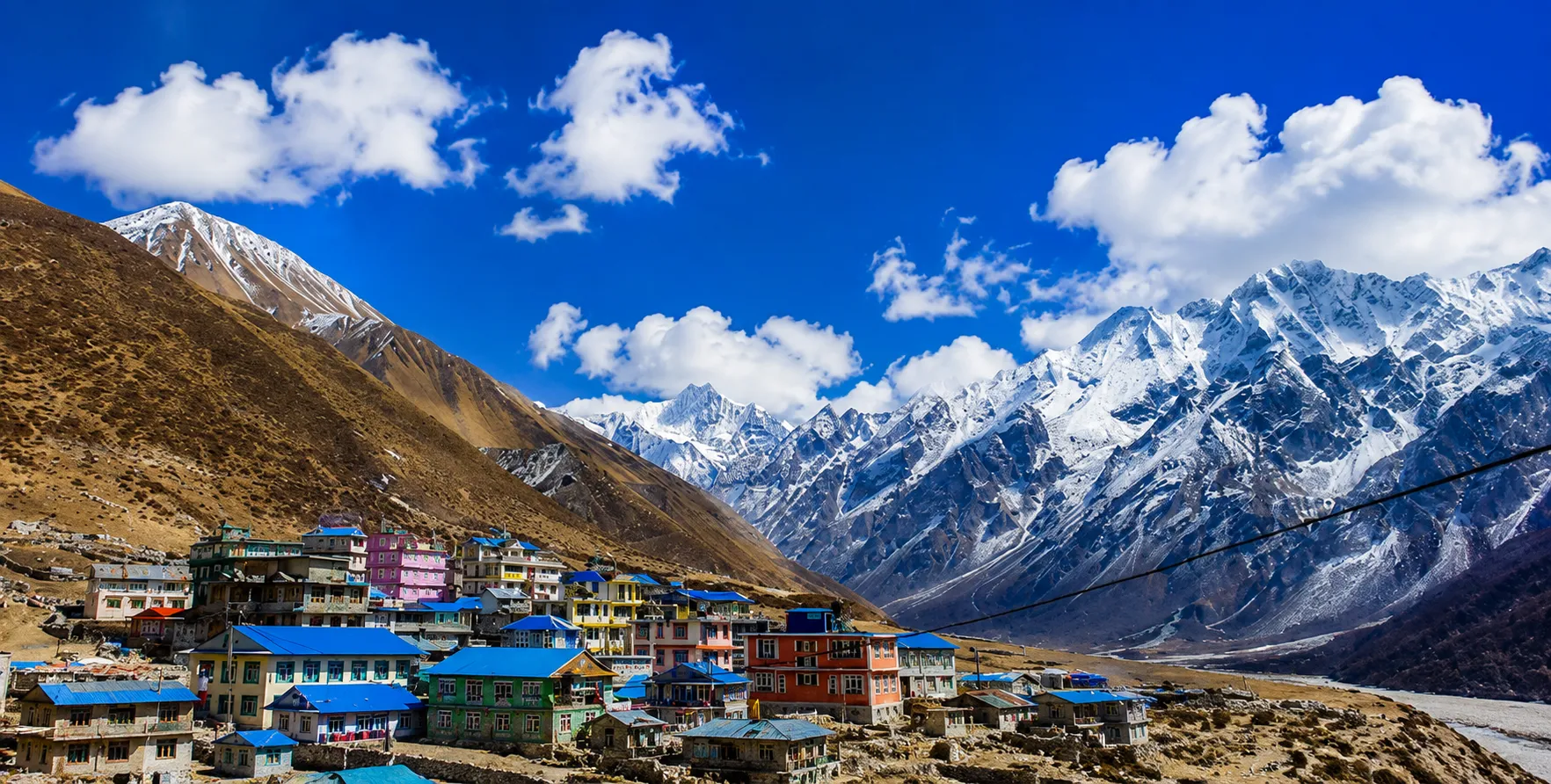
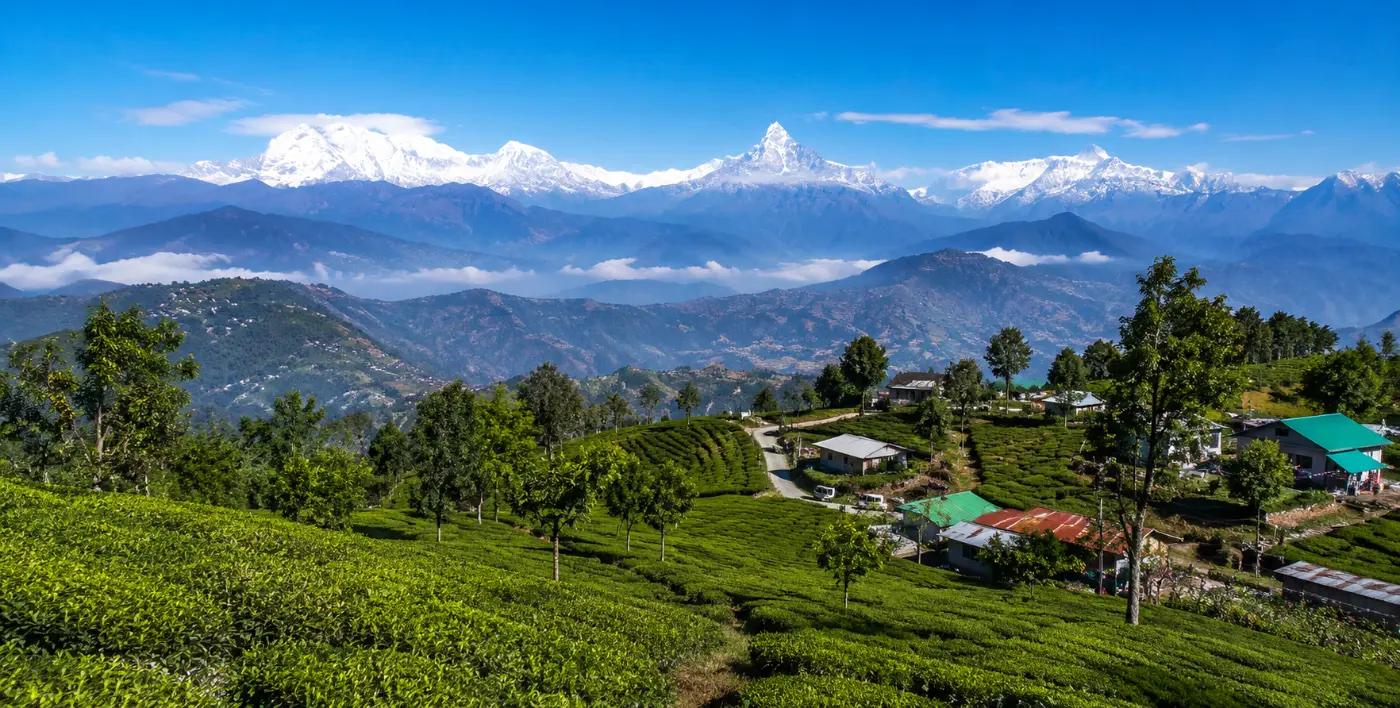
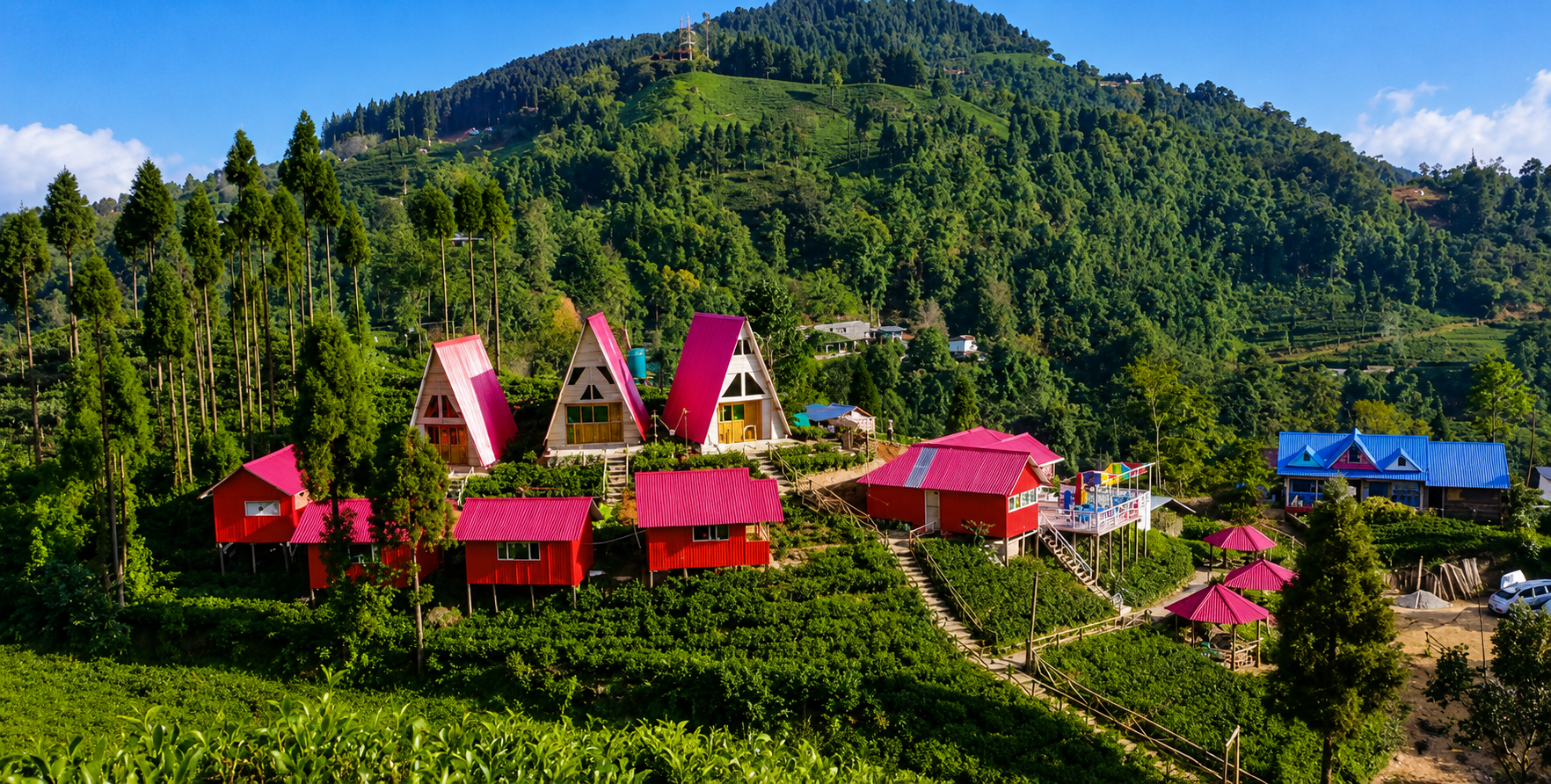
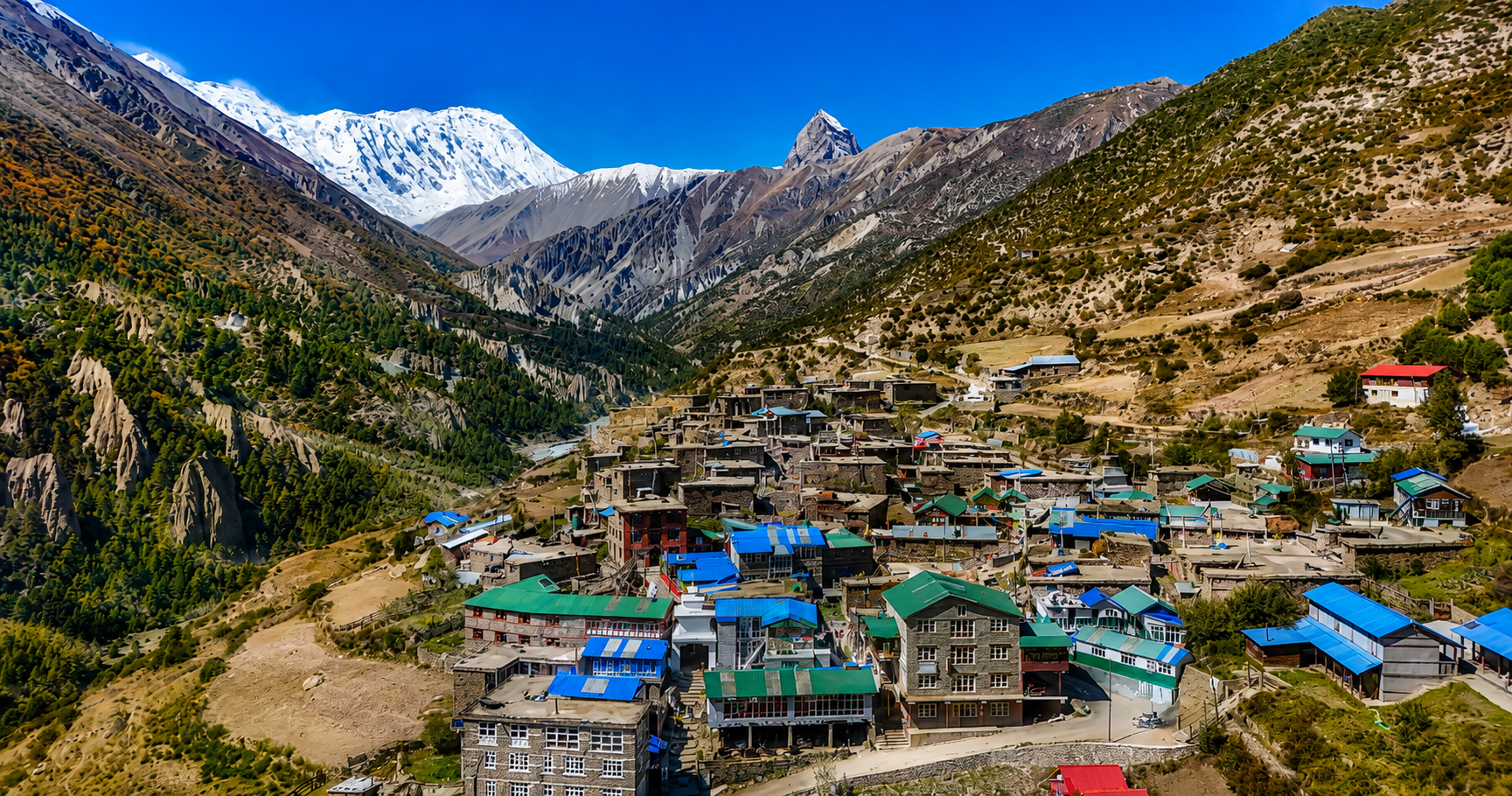
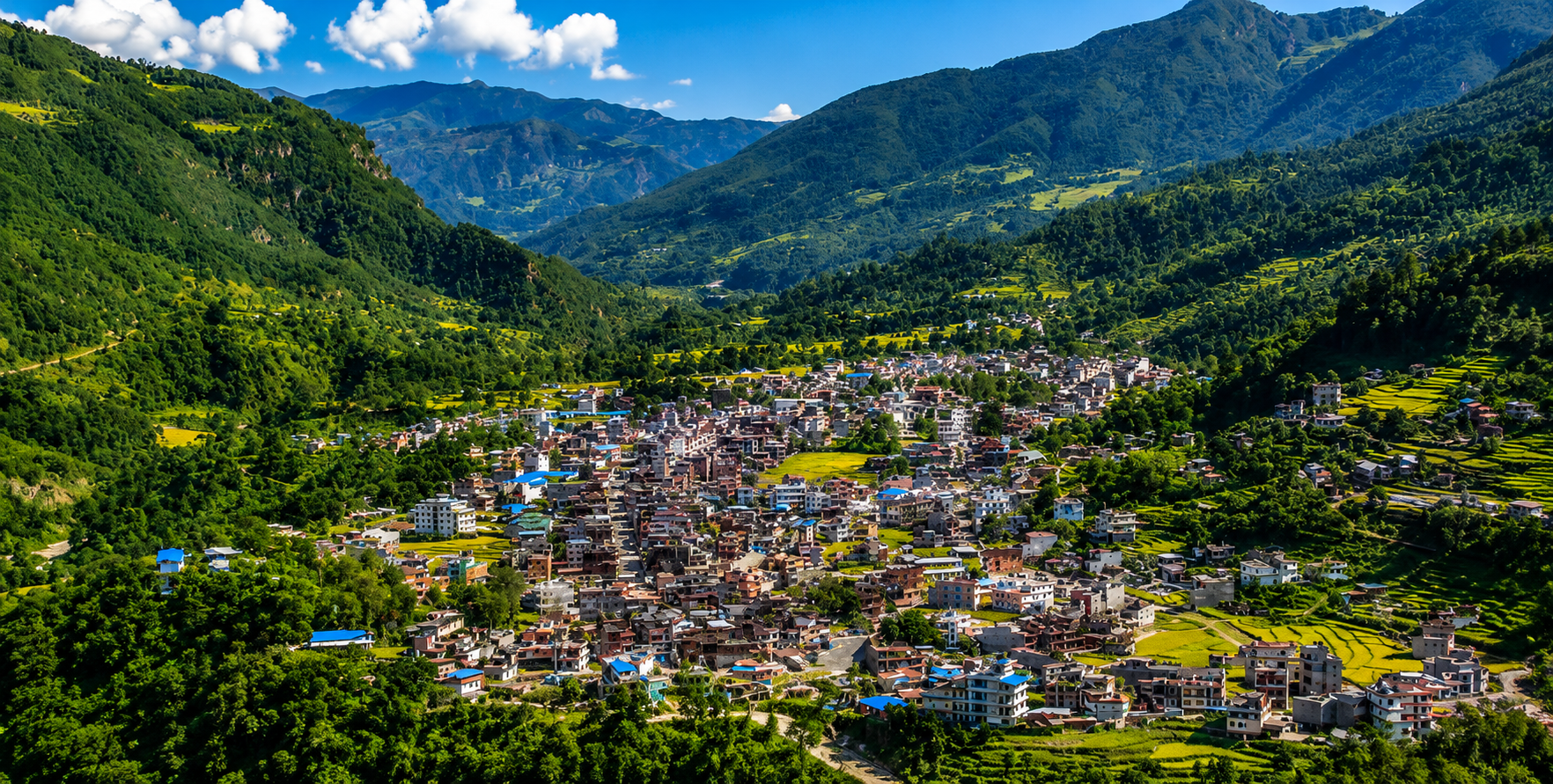
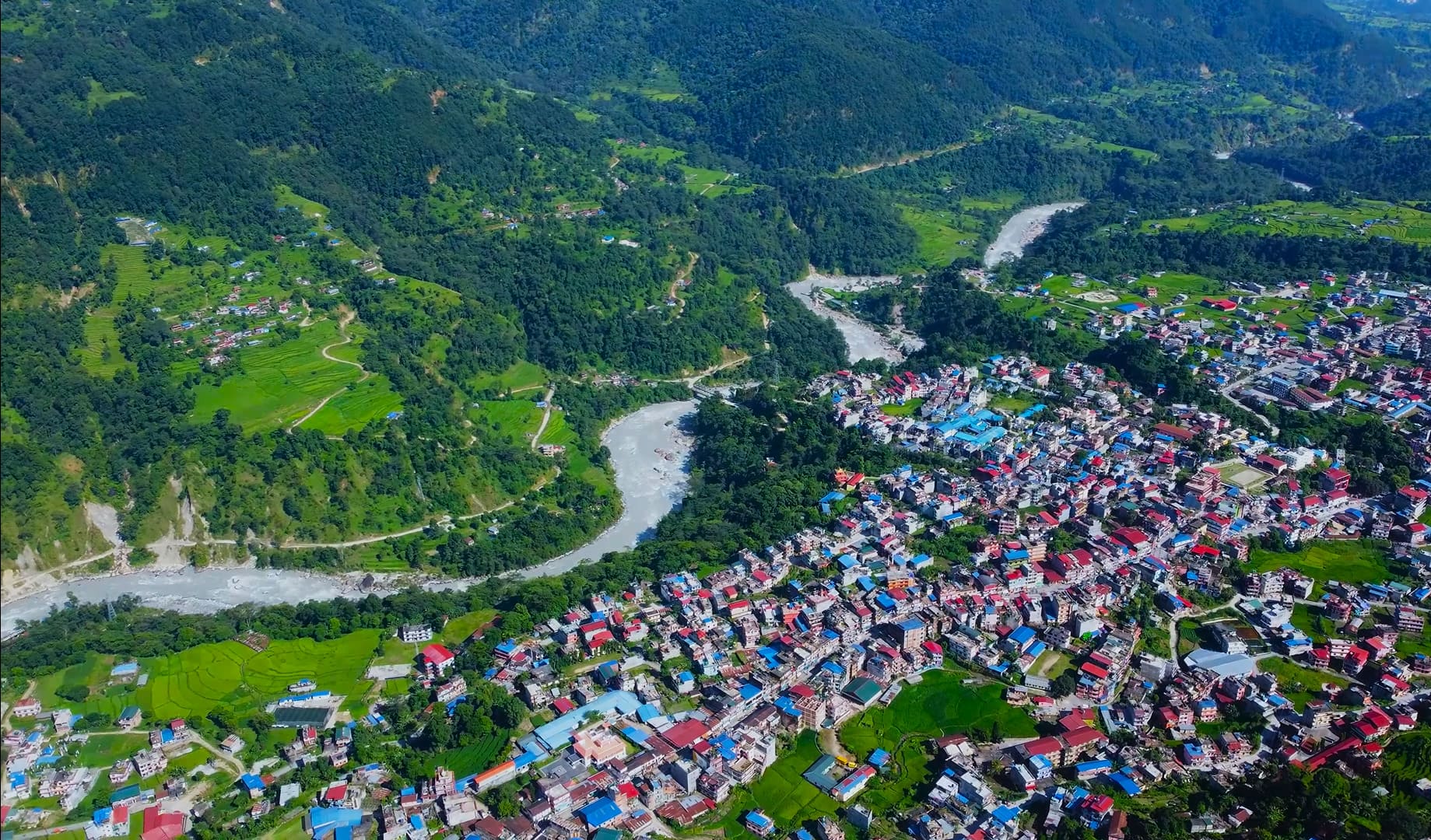
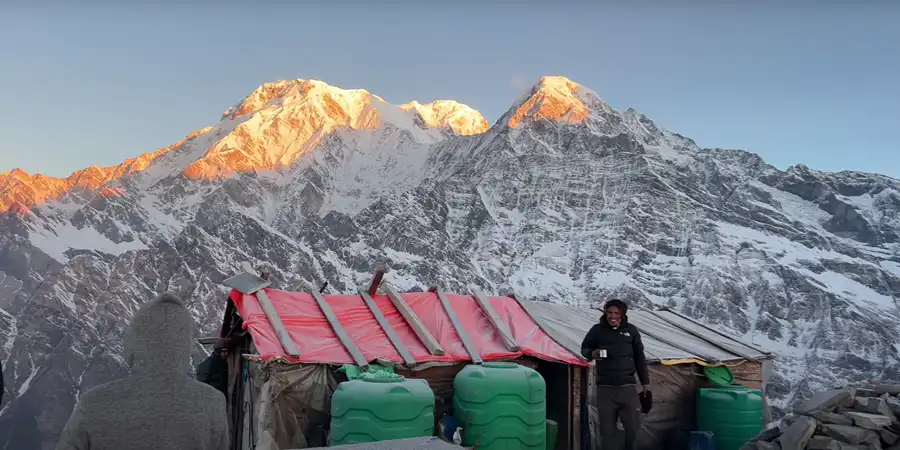
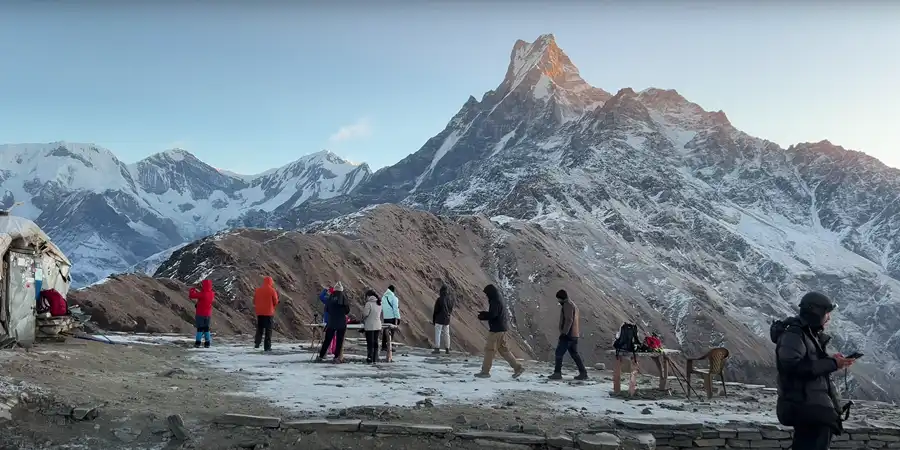
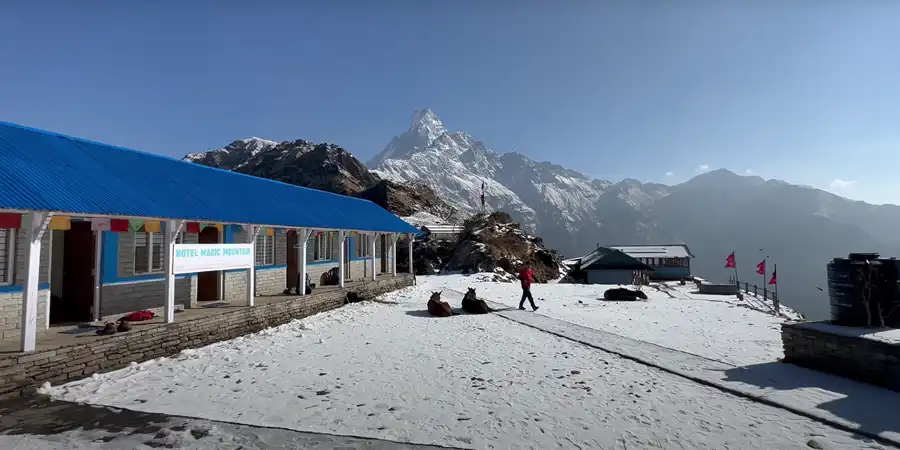
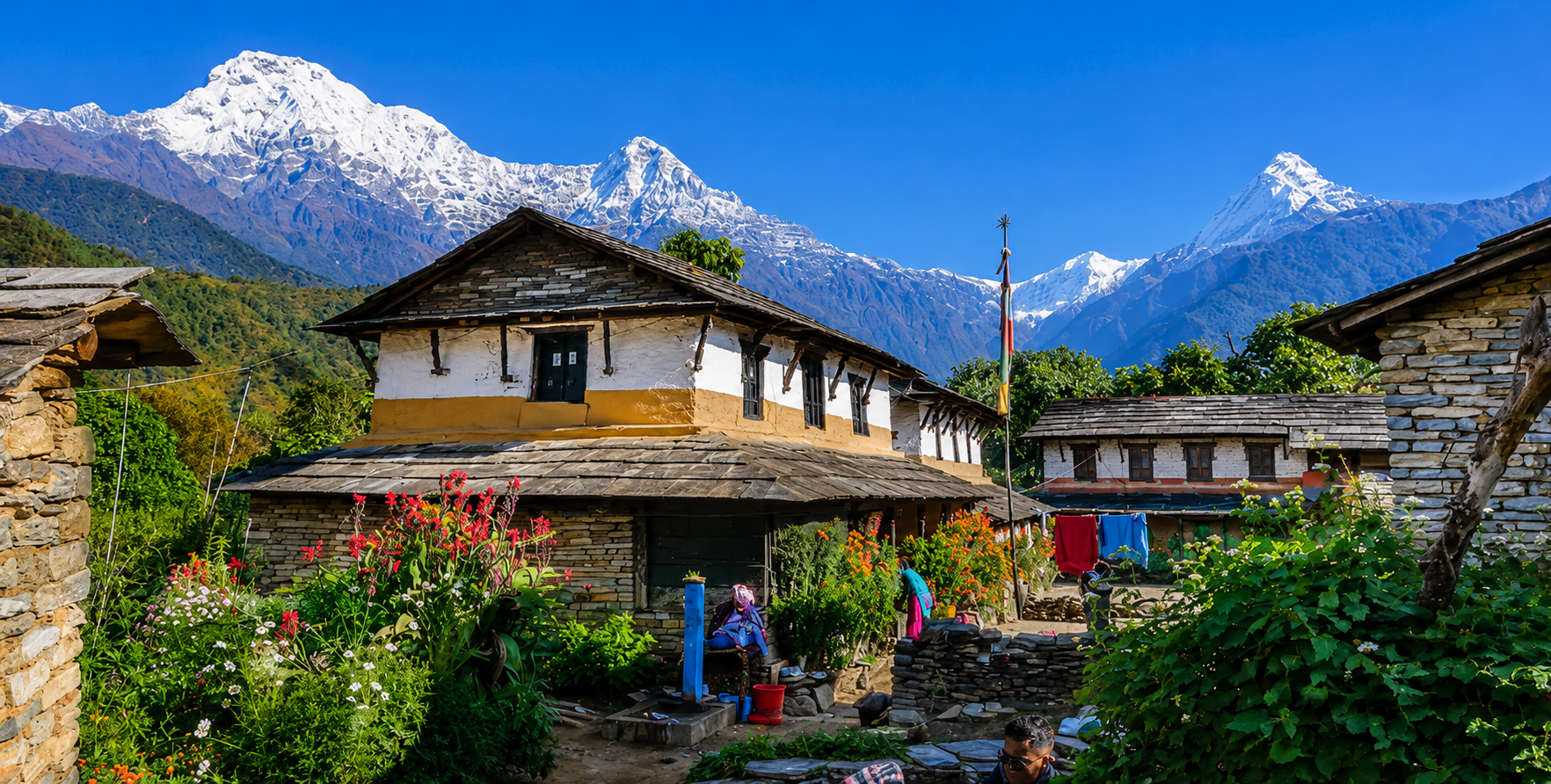
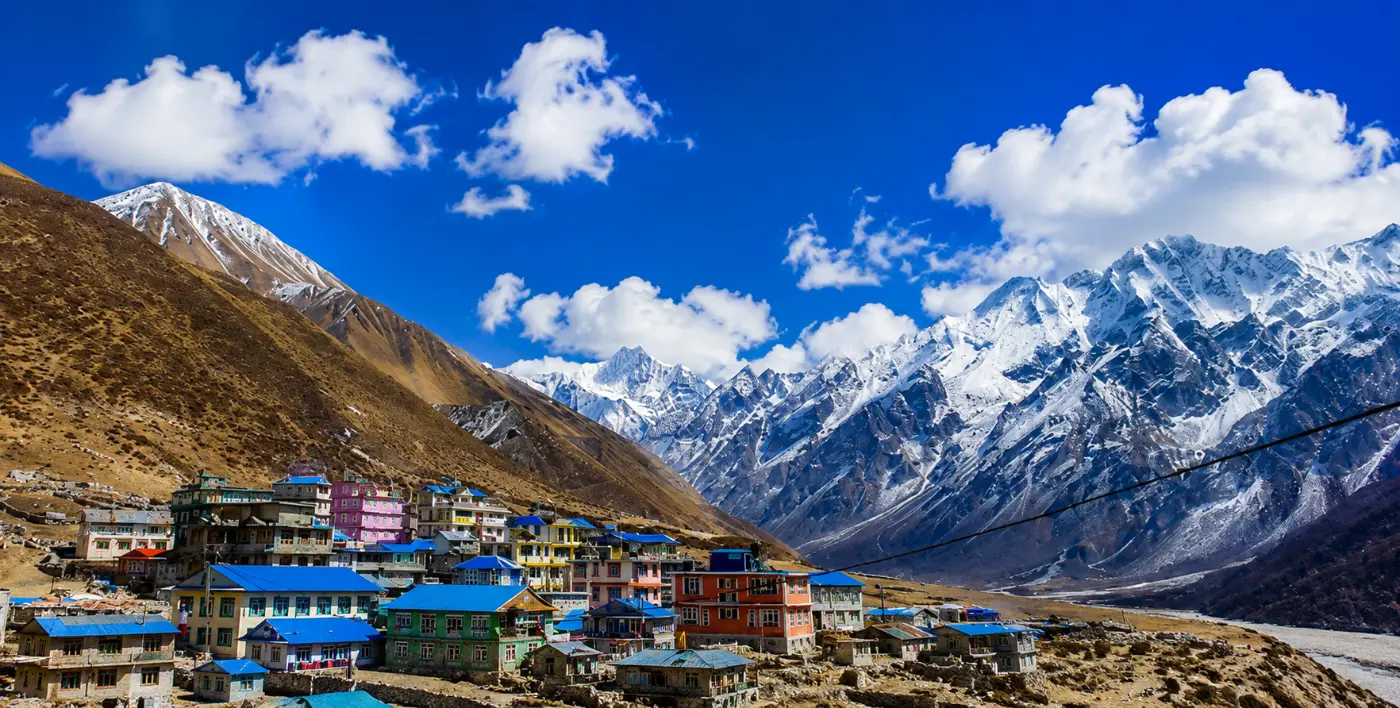
High-quality panoramic view of a colorful mountain village with blue-roof houses below snow-capped Himalayan peaks under a bright blue sky in Nepa

Why the Right Vehicle Makes Your Langtang Trek

The Langtang Valley Trek is one of Nepal’s most celebrated and cherished trekking routes — a striking journey into one of the Himalayas’ most spectacular and culturally rich valleys, just north of Kathmandu. Often described as a ‘valley of glaciers,’ Langtang offers extraordinary high-altitude scenery dominated by the towering Langtang Lirung (7,227 m), Ganesh Himal (7,422 m), and the Jugal Himal range, combined with a deeply authentic encounter with the Tamang people — one of Nepal’s most distinctive and welcoming Himalayan communities.

Unlike trekking routes that require flights to remote mountain airports, the Langtang Valley Trek begins with a road journey directly from Kathmandu — and that road journey is itself a significant, memorable part of the overall experience. The drive from Kathmandu to Syabrubesi — the trailhead village at the gateway of Langtang National Park — covers approximately 120–122 km through a progressively dramatic sequence of landscapes: Kathmandu’s urban sprawl giving way to terraced hillside agriculture, then to the wild gorge of the Trishuli River, then to the increasingly high and remote terrain of the Rasuwa District as you climb toward the Himalayan frontier.

Getting this vehicle journey right — choosing the right vehicle type, booking with a reliable, professional provider, understanding the road conditions and the three available route options, and knowing exactly what to expect at every stage — lays the physical and psychological foundation for your entire Langtang trekking experience. A comfortable, timely, well-managed journey by vehicle means you arrive in Syabrubesi rested and ready to trek.

A poorly planned one — an overcrowded public bus, an inexperienced driver on mountain roads, or a last-minute scramble for shared transport — means you begin your adventure already tired and stressed.

This complete guide to the Kathmandu to Langtang trek vehicle hire covers everything you need: the full route narrative with the three road options, checkpoint distances and altitudes, road conditions by season, private jeep hire costs for all vehicle types, the permits required, the spectacular scenic highlights of the drive, the character of Syabrubesi as your trek starting point, and a clear comparison of all transport options — so you can make the best possible decision for your Langtang journey.

Nepal Vehicle Hiring Pvt. Ltd. — with its trusted 4WD fleet, experienced high-altitude mountain drivers, hotel pickup from anywhere in Kathmandu, and 24/7 WhatsApp support — is the vehicle partner of choice for trekkers heading to Langtang and throughout Nepal.

Kathmandu to Langtang Trek Vehicle — Quick Reference

Trek Trailhead: Syabrubesi Village, Rasuwa District, Bagmati Province
Syabrubesi Altitude: 1,460–1,550 m (4,790–5,085 ft)
Road Distance: Approx. 120–122 km (Kathmandu Thamel to Syabrubesi)
Drive Time: 5–7 hours (private jeep) | 7–10 hours (public/shared bus)
Route Options: 3 routes — Galchhi/Trishuli, Kakani Scenic, Tokha/Bidur
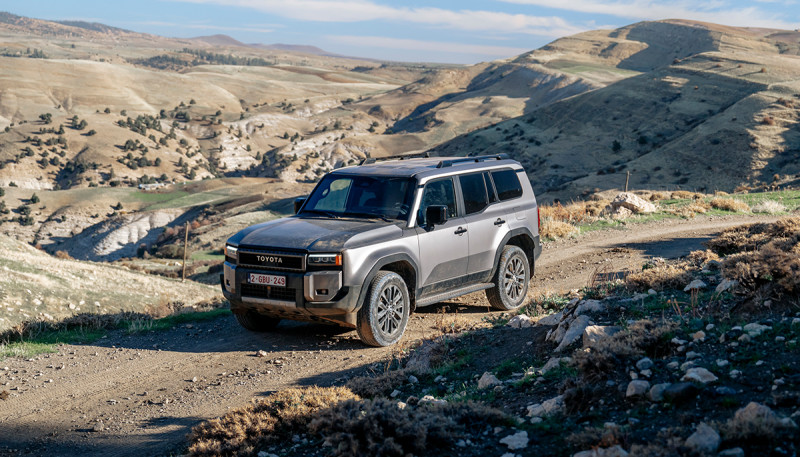
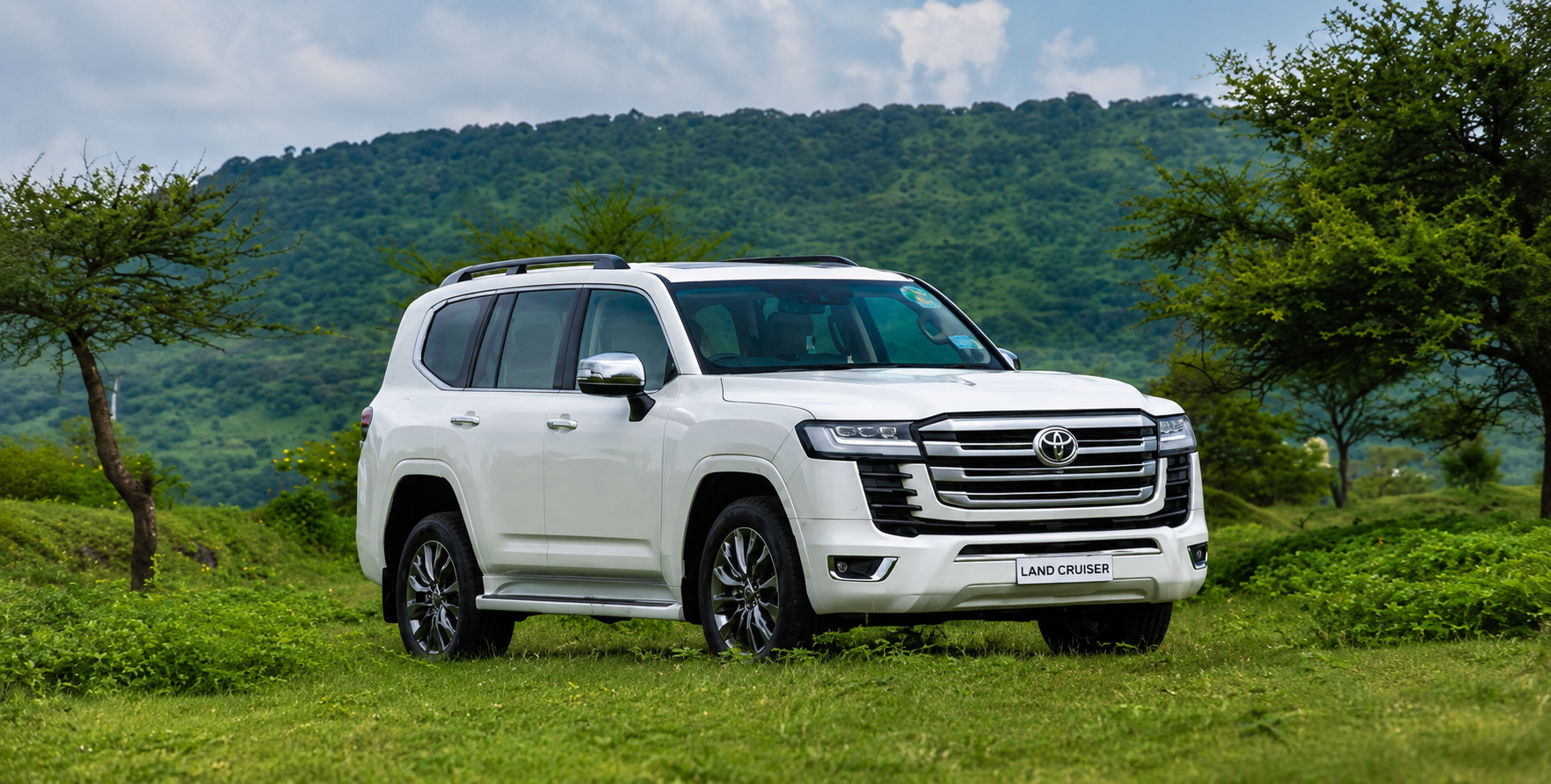
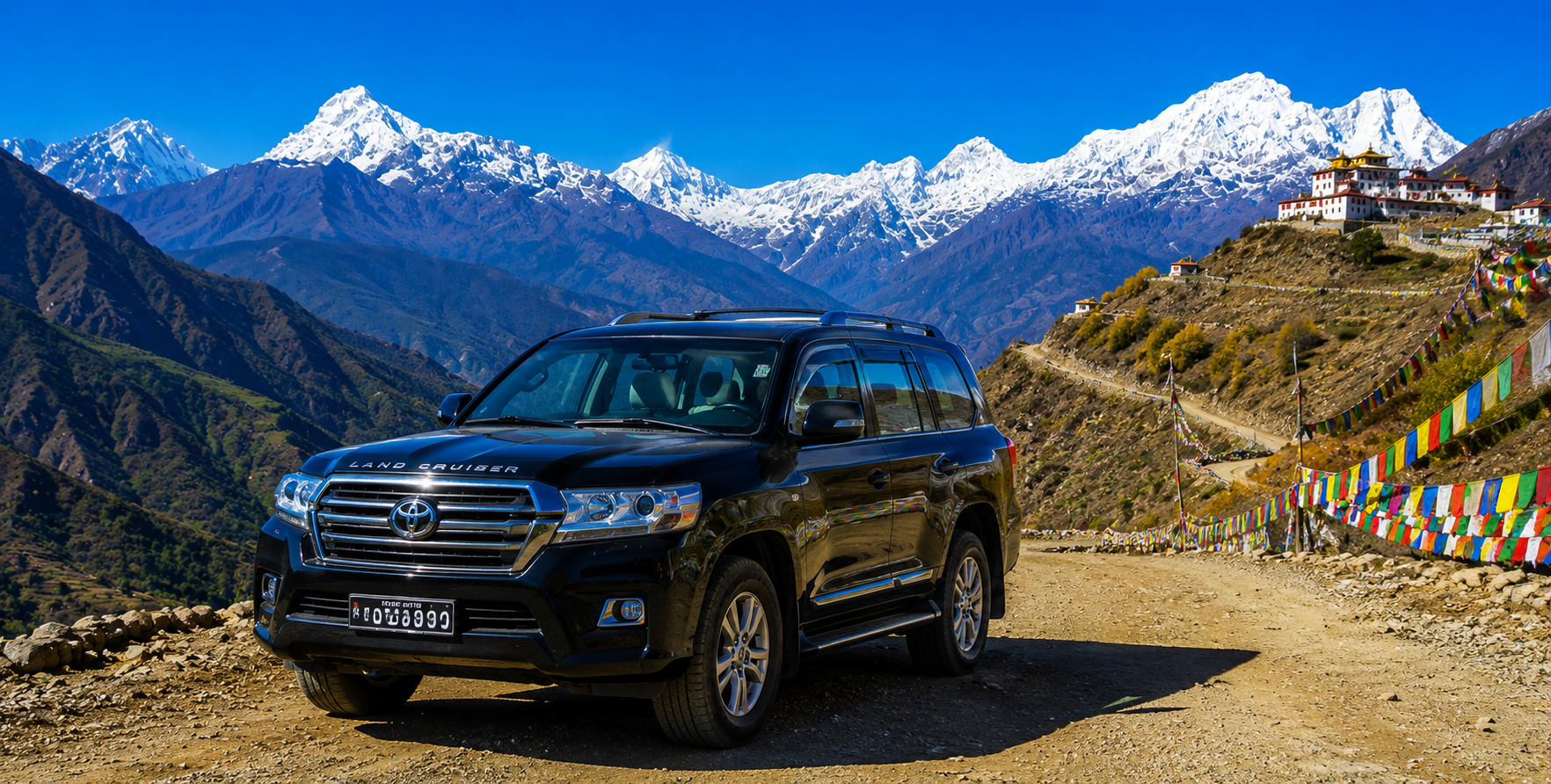
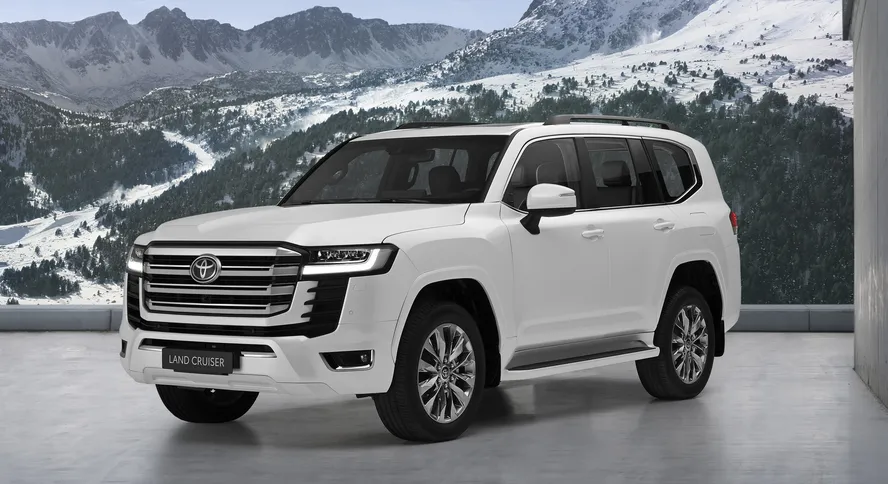
Vehicle Requirement: 4WD Jeep strongly recommended (Fortuner, Hilux, Land Cruiser)
Permits: Langtang National Park Permit (NPR 3,000/person) + TIMS Card (NPR 2,000)
Best Season: October–December and March–May
Trek Gateway To: Langtang Valley, Kyanjin Gompa, Tserko Ri, Tamang Heritage Trail, Helambu
Book With: Nepal Vehicle Hiring Pvt. Ltd. | +977 981-4227196

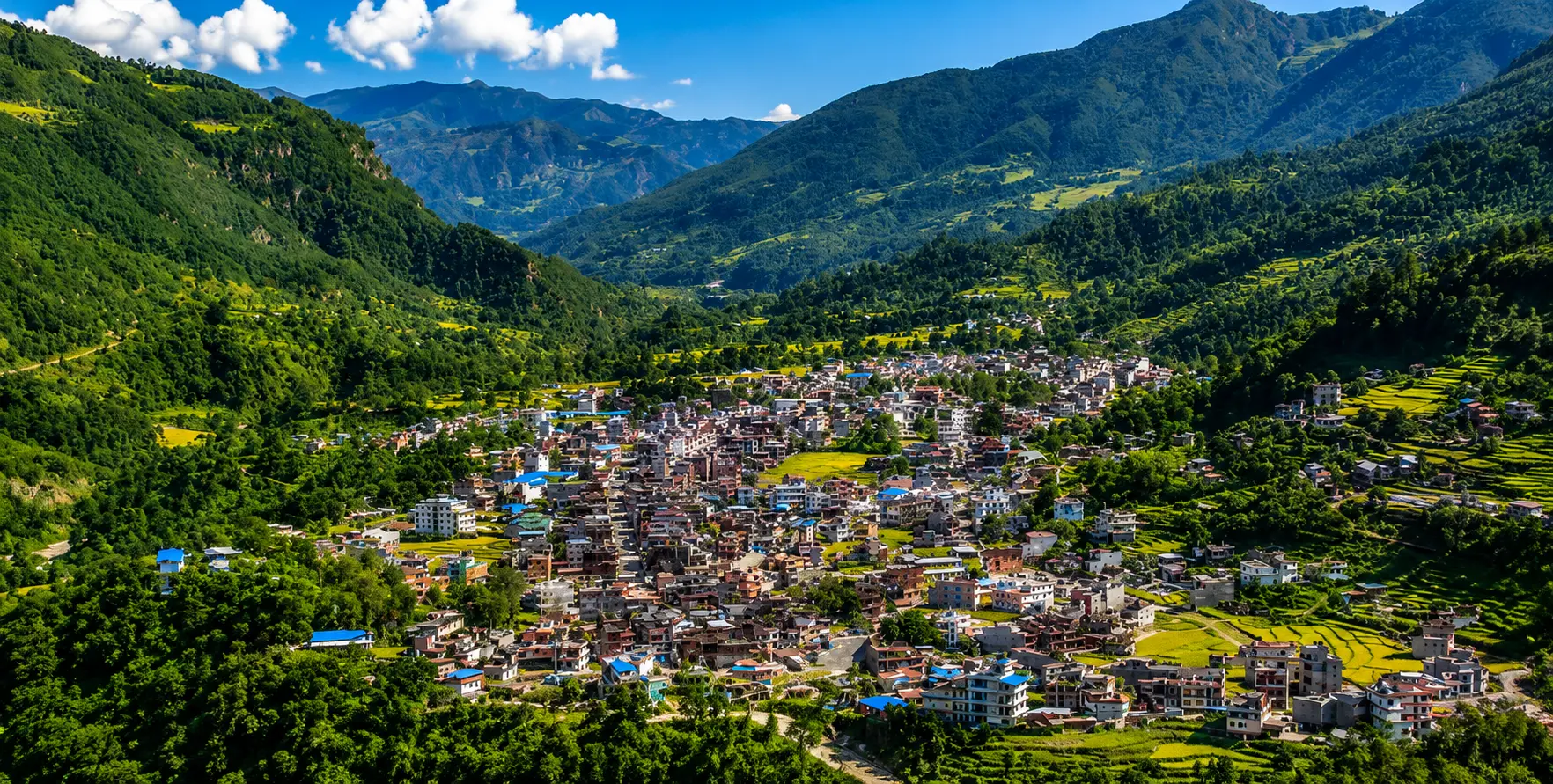
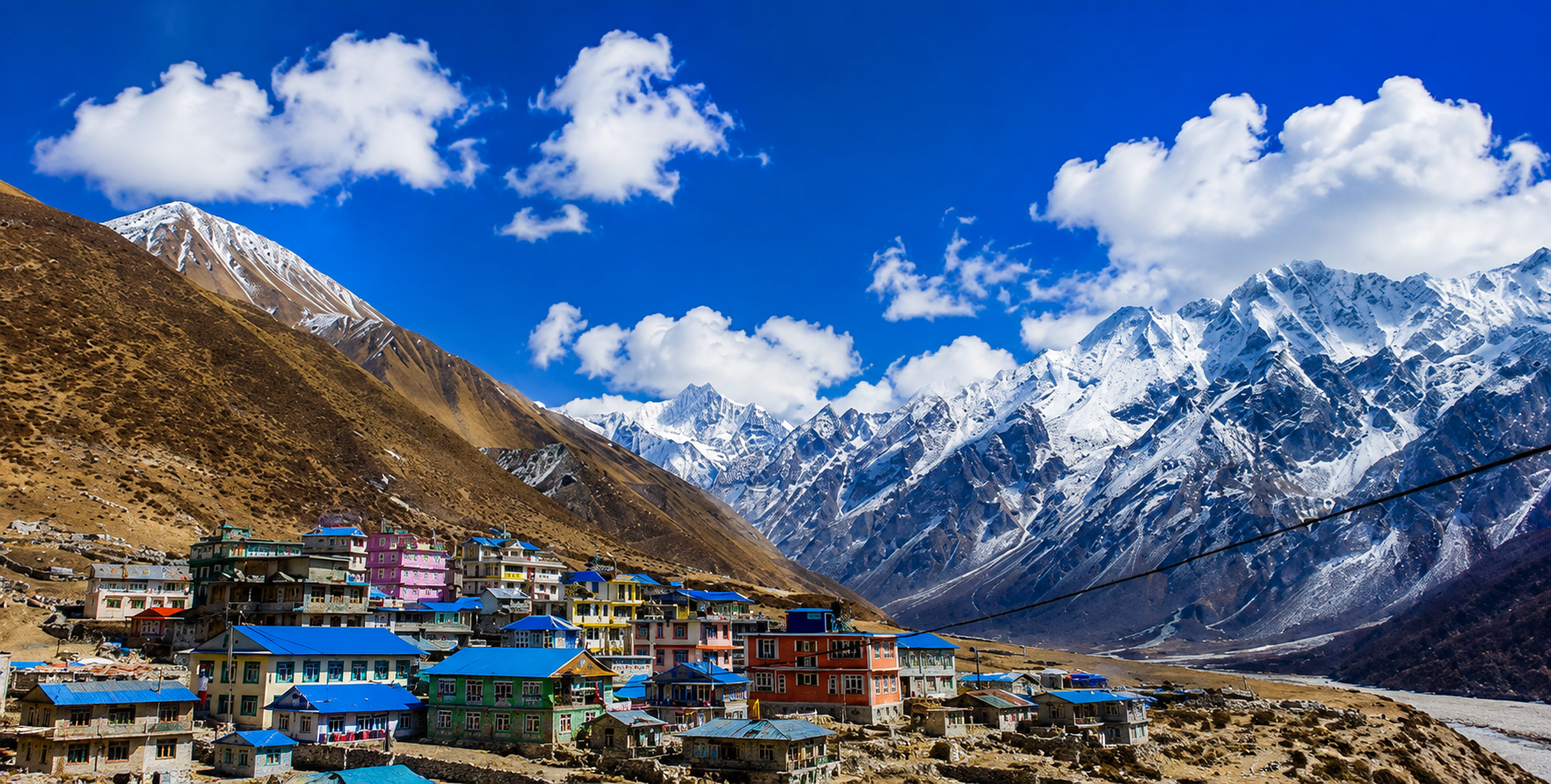
High-quality panoramic view of a colorful mountain village with blue-roof houses below snow-capped Himalayan peaks under a bright blue sky in Nepal

Langtang Valley: Nepal’s Closest High-Alpine Trekking Destination

Why Langtang Is Called the ‘Valley of Glaciers’

The Langtang Valley is a long north-south glacial valley in the Rasuwa District, carved over millennia by the Langtang Khola River and its tributaries, which descend from the high peaks of the Nepal-Tibet border. The valley floor rises from Syabrubesi at about 1,460 meters to the extraordinary Kyanjin Gompa at 3,870 meters—a gain of over 2,400 vertical meters that takes trekkers through a full spectrum of Himalayan ecological zones in just three to four days of walking.

The name ‘Valley of Glaciers’ reflects the extraordinary concentration of glacial ice in the valley’s upper reaches. The Langtang Glacier, Lirung Glacier, and Yala Glacier all descend from peaks above 6,000 meters that ring the upper valley, creating an ice-carved landscape unlike anything else accessible from Kathmandu in a single day’s drive.

From Kyanjin Gompa, the highest point most trekkers reach, the view northward into the glacial amphitheatre of Langtang Lirung and eastward toward the Tibetan Plateau is one of Nepal’s finest high-altitude panoramas.

The valley gained international attention for devastating reasons in April 2015, when the great Nepal earthquake triggered a catastrophic ice avalanche from Langtang Lirung that buried much of Langtang village and killed hundreds of residents and trekkers. The subsequent recovery and rebuilding of the Langtang Valley community have been among Nepal’s most remarkable post-disaster stories — the Tamang people have rebuilt their villages, reopened their teahouses, and welcomed trekkers back with characteristic warmth and resilience.

Trekking in Langtang today is not only a spectacular adventure but a meaningful act of support for a community that has demonstrated extraordinary strength.

Syabrubesi: Your Trek Gateway Village

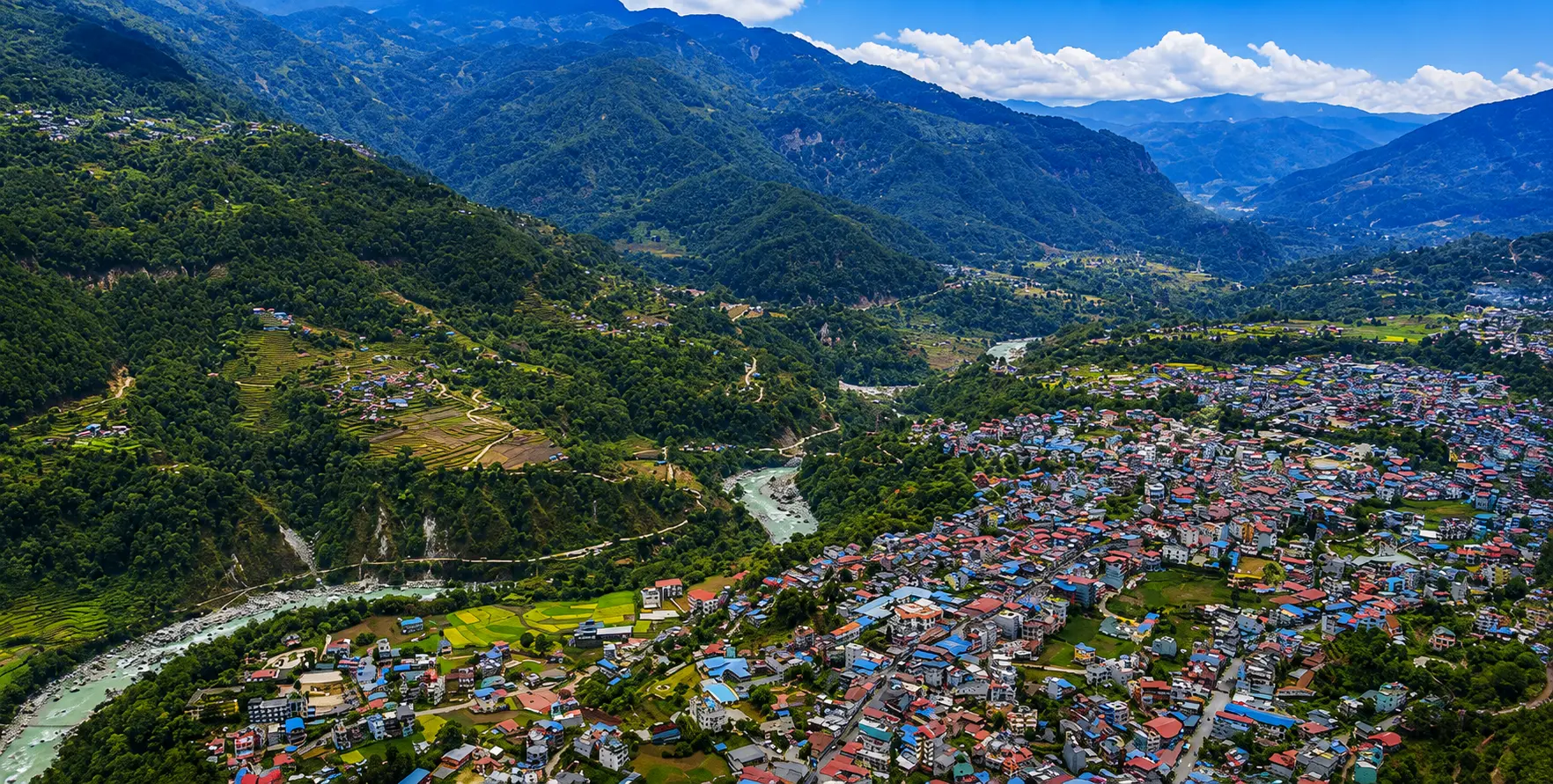
Syabrubesi is a small but lively market town at the confluence of the Langtang Khola and Bhote Koshi rivers, serving as the primary gateway to all treks in the Langtang region. Situated at approximately 1,460–1,550 meters in a dramatic river valley surrounded by forested hillsides, Syabrubesi has grown significantly since the 2015 earthquake reconstruction and now offers a good range of accommodation, restaurants, shops, and facilities for trekkers.

The town has a strong Tamang cultural character—most residents are Tamang, and the architecture, food, and community life reflect this distinct Tibetan-influenced culture.

From Syabrubesi, three distinct trekking routes fan outward: the main Langtang Valley Trek heading eastward up the Langtang Khola; the Tamang Heritage Trail heading south through traditional Tamang villages toward Gatlang, Tatopani, and Briddim; and the Helambu Trek heading south over the Lauribina La Pass toward the Helambu Valley and eventually Kathmandu. This makes Syabrubesi one of Nepal’s most strategically important trek trailheads, as a single-vehicle journey from Kathmandu provides access to three distinct and wonderful trekking experiences.

The Langtang Valley Trek — Overview

The classic Langtang Valley Trek itinerary lasts 7 to 10 days in total, including the drive from Kathmandu. After arriving in Syabrubesi by private jeep on Day 1, trekkers follow the Langtang Khola River Valley upstream through the subtropical forest villages of Bamboo and Ramche, climbing through increasingly alpine terrain to Lama Hotel (2,470 m), then Langtang Village (3,430 m, rebuilt after 2015), then Mundu and Kyanjin Gompa (3,870 m).

Optional high-altitude day hikes from Kyanjin include the spectacular Kyanjin Ri (4,773 m) and the extraordinary Tserko Ri (5,033 m) — one of the finest viewpoints in the entire Langtang region. The return follows the same valley route back to Syabrubesi, where a private vehicle picks up trekkers and returns them to Kathmandu.
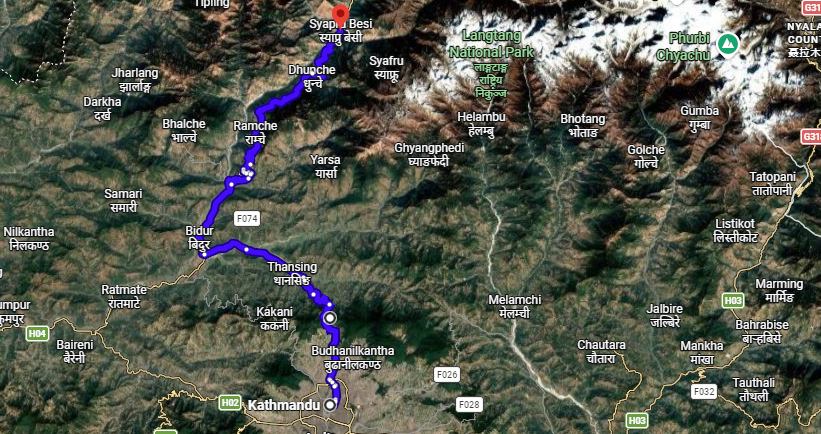
Kathmandu to Syabrubeshi jeep Route
Kathmandu to Syabrubesi Route

The Complete Route: Kathmandu to Syabrubesi (Three Options)

Route Overview — Three Roads to Syabrubesi

Unlike most Nepal trek trailhead drives, which follow a single road, the Kathmandu-to-Syabrubesi journey offers three distinct route options. Each has a different road quality, scenery, drive time, and suitability for different vehicle types. Understanding these three routes is essential for planning your vehicle hire effectively.

RouteDistanceDrive Time (Private Jeep)Road QualityBest For
Route 1: Galchhi/Trishuli Highway (Standard)120–122 km5–6 hrsBest — mostly paved, smooth highwayAll travellers, first-timers, buses & jeeps
Route 2: Kakani Scenic Route115–118 km6–7 hrsMixed — paved but often rougher, narrowerClear days, mountain view lovers, jeeps only
Route 3: Tokha/Bidur Route118–120 km5.5–6.5 hrsGood — paved highway via TokhaAlternative to Route 1, also bus-friendly

The Galchhi/Trishuli Highway route is the most commonly used and most reliable road from Kathmandu to Syabrubesi. It follows the Prithvi Highway westward from Kathmandu to Galchhi (approximately 70 km), then turns northward onto the Pasang Lhamu Highway — the main road connecting Kathmandu to the Rasuwa District and the Nepal-Tibet border.

This highway follows the spectacular Trishuli River gorge northward through Trishuli Bazaar and Betrawati before climbing steeply to Dhunche and descending to Syabrubesi.

CheckpointDistance from KathmanduAltitudeDrive Time from KTM
Balaju / Ring Road (Kathmandu exit)5 km1,350 m15–20 min
Galchhi Junction (Prithvi Hwy turnoff)68 km800 m1.5–2.0 hrs
Trishuli Bazaar76 km870 m2.0–2.5 hrs
Betrawati88 km1,000 m2.5–3.0 hrs
Kalikasthan95 km1,200 m3.0–3.5 hrs
Ramche (Landslide Zone / NP Entry)108 km1,700 m4.0–4.5 hrs
Dhunche (District HQ / Permit Check)112 km2,030 m4.5–5.0 hrs
Thulo Bharkhu117 km1,800 m5.0–5.5 hrs
Syabrubesi (Trek Trailhead)120–122 km1,460 m5.5–6.5 hrs

Stage 1 — Kathmandu to Galchhi (68 km, ~1.5–2 hours): Leaving Kathmandu through Balaju and heading northwest, the road joins the Prithvi Highway — Nepal’s main arterial highway — and heads through the Trishuli River valley. The first hour is through the urban and semi-urban outskirts of the Kathmandu Valley before the road descends dramatically into the Trishuli gorge.

At Galchhi, you leave the Prithvi Highway and turn northward onto the Pasang Lhamu Highway toward the Langtang region. This section is well-paved and the fastest part of the journey.

Stage 2 — Galchhi to Betrawati via Trishuli Bazaar (20 km, ~1 hour): The Pasang Lhamu Highway follows the west bank of the Trishuli River northward through the dramatic gorge landscape. The Trishuli River is a celebrated whitewater rafting destination, and on weekends, you will often see rafting groups on the turquoise water far below the road.

Trishuli Bazaar is a significant town with restaurants, ATMs, and fuel stations — the last reliable ATM before Syabrubesi. Betrawati, a few kilometres farther north, marks where the valley begins to narrow and the road starts climbing more steeply into the Rasuwa hills.

Stage 3 — Betrawati to Dhunche via Kalikasthan and Ramche (24 km, ~1.5–2 hours): This is the most dramatic and demanding section of the drive. Beyond Betrawati, the road climbs steeply through Kalikasthan — where, on clear days, the first extraordinary views of the Langtang range (Langtang Lirung at 7,227 m and Ganesh Himal at 7,422 m) appear on the northern horizon.

The road then passes through the Ramche Landslide Zone — a 3 km section of unpaved or poorly maintained road that is the most technically challenging part of the entire journey, particularly after rainfall. Nepal Vehicle Hiring Pvt. Ltd.’s 4WD vehicles handle this section comfortably. Dhunche (2,030 m), the district headquarters of Rasuwa, is the Langtang National Park permit checkpoint — all trekkers must show permits here.

Stage 4 — Dhunche to Syabrubesi (10 km, ~45–60 minutes): The final stretch from Dhunche descends steeply from 2,030 meters down to Syabrubesi at 1,460 meters through a series of tight switchbacks with dramatic views of the Bhote Koshi valley and the distant Langtang peaks. The road is narrow and winding but paved.

This section gives you your first clear views of the extraordinary river confluence at Syabrubesi and the forested hillsides that frame the entrance to the Langtang Valley. Arriving in Syabrubesi after this spectacular final descent feels like arriving somewhere genuinely remote and wild — the perfect psychological preparation for the trek ahead.

Route 2: Kakani Scenic Route

The Kakani route branches northward from the Kathmandu Valley via the scenic ridge village of Kakani (2,073 m) — a beautiful hilltop settlement with panoramic Himalayan views that is popular with Kathmandu day-trippers. The road climbs from Kathmandu through Nagarjun Forest Reserve to Kakani, then descends to rejoin the Pasang Lhamu Highway near Trishuli Bazaar.

The Kakani route offers potentially spectacular mountain views (Ganesh Himal, Langtang range, and Manaslu on a clear morning). Still, road conditions are often worse than on the Galchhi Highway, and the road is narrower and more winding throughout.

Nepal Vehicle Hiring Pvt. Ltd. recommends this route only for jeep hire (not buses) and only in the dry season with a clear weather forecast. The total drive time is about 6–7 hours because of slower road sections.

Route 3: Tokha / Bidur Route

The Tokha route exits Kathmandu northward through the Tokha area and descends to Bidur before joining the main Pasang Lhamu Highway near Betrawati. This route is slightly shorter than the Galchhi highway in distance, but not significantly faster because road conditions in the Tokha area can be slow.

Some local buses use it, and it suits jeeps and standard vehicles. Nepal Vehicle Hiring Pvt. Ltd. drivers know all three routes and will recommend the best option based on current road conditions, weather, and your vehicle type.
Langtang valley trek

Road Conditions: Kathmandu to Syabrubesi

Kathmandu to Galchhi — Prithvi Highway

The Prithvi Highway section from Kathmandu to Galchhi is a well-maintained, two-lane tarmac road in good condition year-round. This section carries significant heavy vehicle traffic (trucks, buses) heading toward Pokhara and the western regions. Early morning departures (before 7:00 AM) beat the worst of the truck traffic.

Road conditions on this section are excellent in the dry season and generally good in the monsoon, with occasional traffic delays due to minor accidents or construction works.

Galchhi to Betrawati — Pasang Lhamu Highway (Trishuli Section)

The Pasang Lhamu Highway from Galchhi to Betrawati is paved and in reasonable condition. The road follows the Trishuli River gorge and is occasionally damaged by landslides during and immediately after the monsoon season (June–September).

The road is narrower than the Prithvi Highway with less room for passing vehicles, but experienced mountain drivers navigate it comfortably. This section is suitable for all vehicle types in the dry season. During the monsoon, 4WD vehicles are preferred.

Betrawati to Dhunche — The Mountain Climb

This is the most road-condition-sensitive section of the entire Kathmandu-to-Syabrubesi journey. The road climbs over 1,000 vertical meters from Betrawati to Dhunche through increasingly steep and winding terrain. The Ramche Landslide Zone (approximately 3 km before Dhunche) is the most consistently challenging section — unpaved or poorly maintained, narrow, and prone to post-rain surface damage.

In 2026, this section is reported to be better maintained than in previous years. Still, it remains bumpy and rough, and a 4WD vehicle with an experienced mountain driver has a clear advantage over standard vehicles and buses.

Dhunche to Syabrubesi — Final Descent

The descent from Dhunche to Syabrubesi follows a winding, narrow paved road through multiple steep switchbacks. The road is technically demanding for drivers but manageable for all 4WD vehicles. In the monsoon, this section can be affected by minor landslides from the hillsides above the road.

In the dry season, conditions are generally good. This section is not suitable for large buses.

Road SectionCondition (Dry Season)Condition (Monsoon)4WD Required?
Kathmandu to Galchhi (Prithvi Hwy)Excellent — paved, smoothGood — minor traffic delays possibleNo — all vehicles are suitable
Galchhi to Betrawati (Pasang Lhamu Hwy)Good — paved River Gorge RoadFair — occasional landslide riskRecommended but not mandatory
Betrawati to Ramche (Mountain climb)Fair to Good — winding, pavedChallenging — rough surface, wetStrongly recommended
Ramche Landslide Zone (3 km)Rough — unpaved sectionsVery Challenging — muddy, unstableYES — 4WD essential
Dhunche to Syabrubesi (descent)Good — paved, steep switchbacksFair — minor landslide riskStrongly recommended
Critical Vehicle Warning for Langtang Route
Standard sedans and non-4WD cars are NOT recommended beyond Betrawati.
Large tourist buses cannot safely access the final descent to Dhunche–Syabrubesi.
4WD Jeep (Fortuner, Hilux, Land Cruiser, Scorpio) is the IDEAL vehicle for this route.
All Nepal Vehicle Hiring Pvt. Ltd. jeeps are 4WD and driven by mountain-road specialists.
A private 4WD jeep is 2–3 hours faster than a public bus on the Langtang route.
The Ramche Landslide Zone (3 km) is the most challenging section — 4WD handles it best.

Langtang valley trek

Kathmandu to Syabrubesi Vehicle Hire Cost

Private Jeep Hire — One Way, Kathmandu to Syabrubesi

A private jeep hire from Kathmandu to Syabrubesi is the most popular, comfortable, and efficient way for trekking groups, families, and serious trekkers to reach the Langtang trailhead. Hotel pickup from anywhere in Kathmandu, flexible departure times, stops at viewpoints and tea stalls en route, and door-to-trailhead delivery make private hire the clear choice for anyone who values comfort and convenience over minimal cost.

Vehicle TypeCapacityOne-Way Cost (Kathmandu→Syabrubesi)Return Cost (Syabrubesi→Kathmandu)
4WD Jeep (Scorpio/Bolero)1–5 passengersNPR 18,000–22,000 / USD 130–160NPR 16,000–20,000 / USD 116–145
4WD Toyota Fortuner1–6 passengersNPR 22,000–28,000 / USD 160–204NPR 20,000–25,000 / USD 145–182
4WD Toyota Hilux1–5 passengersNPR 20,000–26,000 / USD 145–189NPR 18,000–23,000 / USD 130–167
4WD Toyota Land Cruiser1–7 passengersNPR 27,000–35,000 / USD 196–254NPR 24,000–32,000 / USD 174–232
Hiace Van (to Dhunche only)7–14 passengersNPR 25,000–32,000 / USD 182–232NPR 22,000–28,000 / USD 160–204

Price Inclusions: Professional driver experienced on mountain roads, fuel for the complete journey, vehicle insurance, hotel pickup from anywhere in Kathmandu (Thamel, Lazimpat, Durbar Marg, all central areas), all road tolls and fees, and a vehicle emergency kit.

Price Exclusions: Langtang National Park permit (NPR 3,000/person), TIMS Card (NPR 2,000/person), passenger meals and accommodation, driver meals and accommodation (for multi-day bookings with vehicle waiting in Syabrubesi).

Cost Per Person by Group Size

Group SizeVehicleTotal Vehicle Cost
1–2 people4WD Scorpio / BoleroNPR 18,000–22,000
3–4 people4WD FortunerNPR 22,000–26,000
5–6 people4WD Land CruiserNPR 26,000–32,000
7–10 peopleHiace Van (to Dhunche)NPR 26,000–32,000

For groups of 4 or more, a private 4WD jeep from Nepal Vehicle Hiring Pvt. Ltd. becomes comparable in per-person cost to shared jeep options — while delivering the enormous advantages of hotel pickup, flexible timing, and guaranteed delivery to Syabrubesi without the uncertainty and discomfort of shared transport.
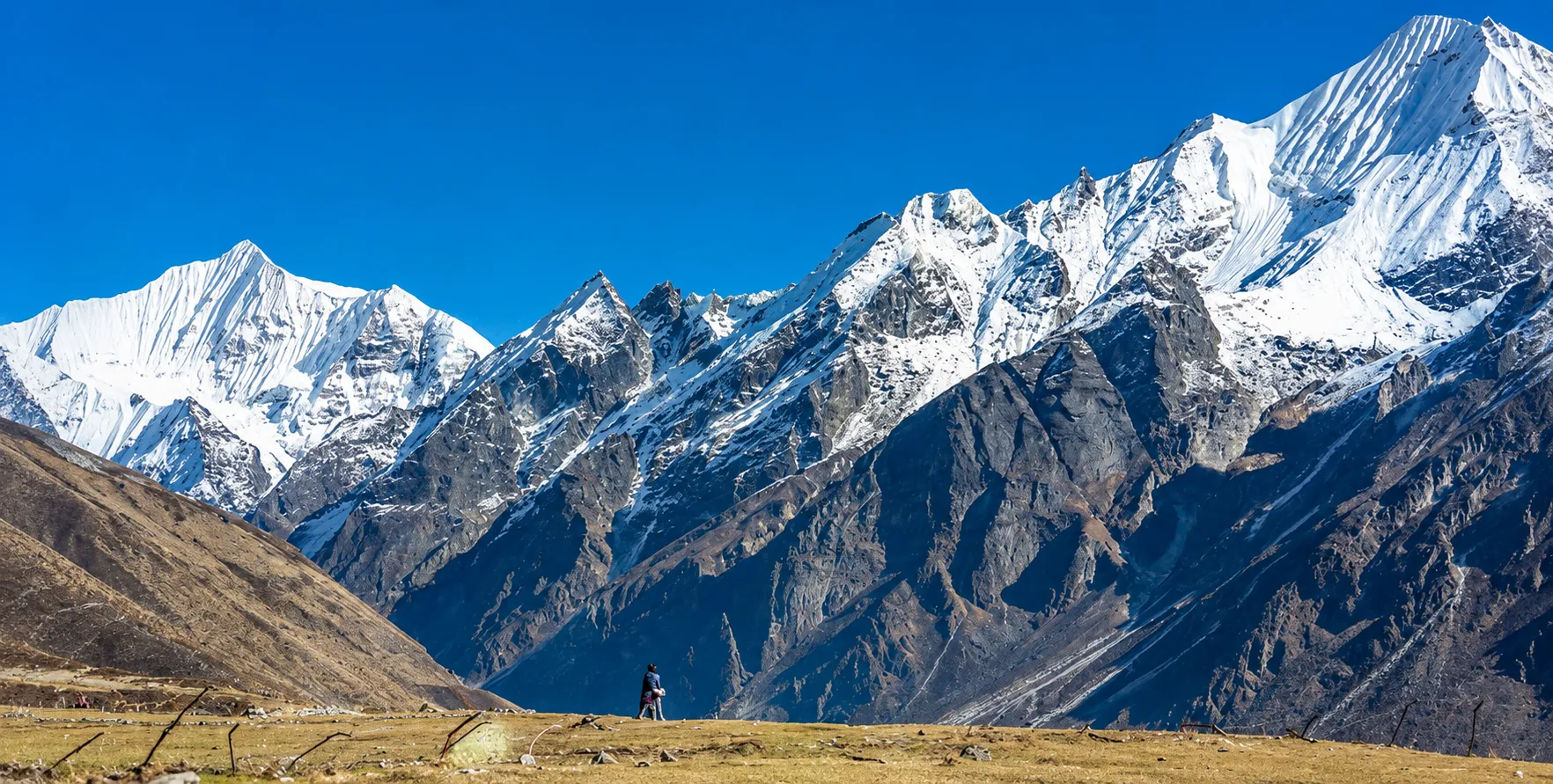
Langtang valley

Shared Jeep and Bus Options — Budget Alternatives

Transport OptionCostDepartureJourney Time
Private Jeep — Nepal Vehicle HiringNPR 18,000–35,000 (full vehicle)Flexible, hotel pickup5–7 hrs
Shared Jeep (Syabrubesi)NPR 1,400–1,800/person7 AM, Machhapokhari Bus Park6–8 hrs
Tourist Bus (Kathmandu–Syabrubesi)NPR 800–1,200/person6–7 AM, various operators7–10 hrs
Local Public BusNPR 300–500/personEarly AM, Machhapokhari8–12 hrs

Vehicle Waiting Service — Syabrubesi Standby

For trekkers who want their private vehicle to remain in Syabrubesi and be available for immediate return at trek completion (without pre-arranging a separate return vehicle), Nepal Vehicle Hiring Pvt. Ltd. offers a vehicle standby service. The vehicle and driver remain in Syabrubesi for the duration of your trek, ready to depart on your schedule.

This is particularly useful for trekkers with tight return flight schedules. Standby pricing is available on request — contact our team for a customised quote based on your trek duration.

Required Permits: Kathmandu to Langtang The Langtang Valley Trek enters Langtang National Park — Nepal’s fourth-largest national park, covering 1,710 square kilometres of outstanding Himalayan terrain, including glaciers, alpine meadows, dense forests, and the internationally important Langtang Biosphere Reserve. All trekkers entering the park must carry valid permits, which are checked at the Dhunche Army Checkpoint and again at the Langtang National Park entrance.

Since April 2023, trekking in Langtang National Park also requires a licensed guide. Checkpoints enforce this rule strictly, and it is non-negotiable. Nepal Vehicle Hiring Pvt. Ltd. can connect you with trusted licensed guide services as part of your trip planning.

Permit / DocumentWho Needs ItCost Where to Obtain
Langtang National Park Entry PermitAll foreign visitors entering Langtang National Park (including vehicle transit to Syabrubesi)NPR 3,000/person (approx. USD 22)Nepal Tourism Board offices, Kathmandu (Bhrikuti Mandap or Pradarshani Marg) or Trishuli Bazaar checkpoint
TIMS Card (Trekkers’ Information Management System)All foreign trekkersNPR 2,000/person individual (NPR 1,000 through registered agencies)Nepal Tourism Board offices — same locations as above
SAARC Nationals — National Park PermitIndia, Bangladesh, Pakistan, Sri Lanka, Bhutan, Maldives, AfghanistanNPR 1,500/personSame as above
SAARC Nationals — TIMSSAARC visitorsNPR 1,500/personSame as above
Nepali NationalsNepali citizensNPR 100 entry permit | No TIMS requiredSame as above
Licensed Guide (MANDATORY since 2023)Required for ALL trekkers in Langtang National Park — enforced at checkpointsUSD 25–35/day (guide fee)Book through registered trekking agencies in Kathmandu or Pokhara

Permits can be obtained at the Nepal Tourism Board office in Kathmandu (Bhrikuti Mandap, near Tundikhel — open Sunday to Friday, 10:00 AM to 5:00 PM). Carry two passport-sized photographs and your original passport for each permit application. Alternatively, permits can sometimes be obtained at the Dhunche checkpoint, but queues are common during peak season — obtaining permits in Kathmandu the day before departure is strongly recommended.

The mandatory requirement for a licensed guide has been fully enforced since its introduction in April 2023. Trekkers without a licensed guide are turned back at the Langtang National Park checkpoints. Nepal Vehicle Hiring Pvt. Ltd. can provide contact details for reputable licensed guide services in Kathmandu.

Scenic Highlights of the Kathmandu to Syabrubesi Drive

The Kathmandu-to-Syabrubesi vehicle journey is far more than a logistical transfer — it is a spectacular introduction to the landscapes and atmosphere of the Langtang region. Here are the key scenic and cultural highlights to watch for en route:

The Trishuli River Gorge (Galchhi to Betrawati)

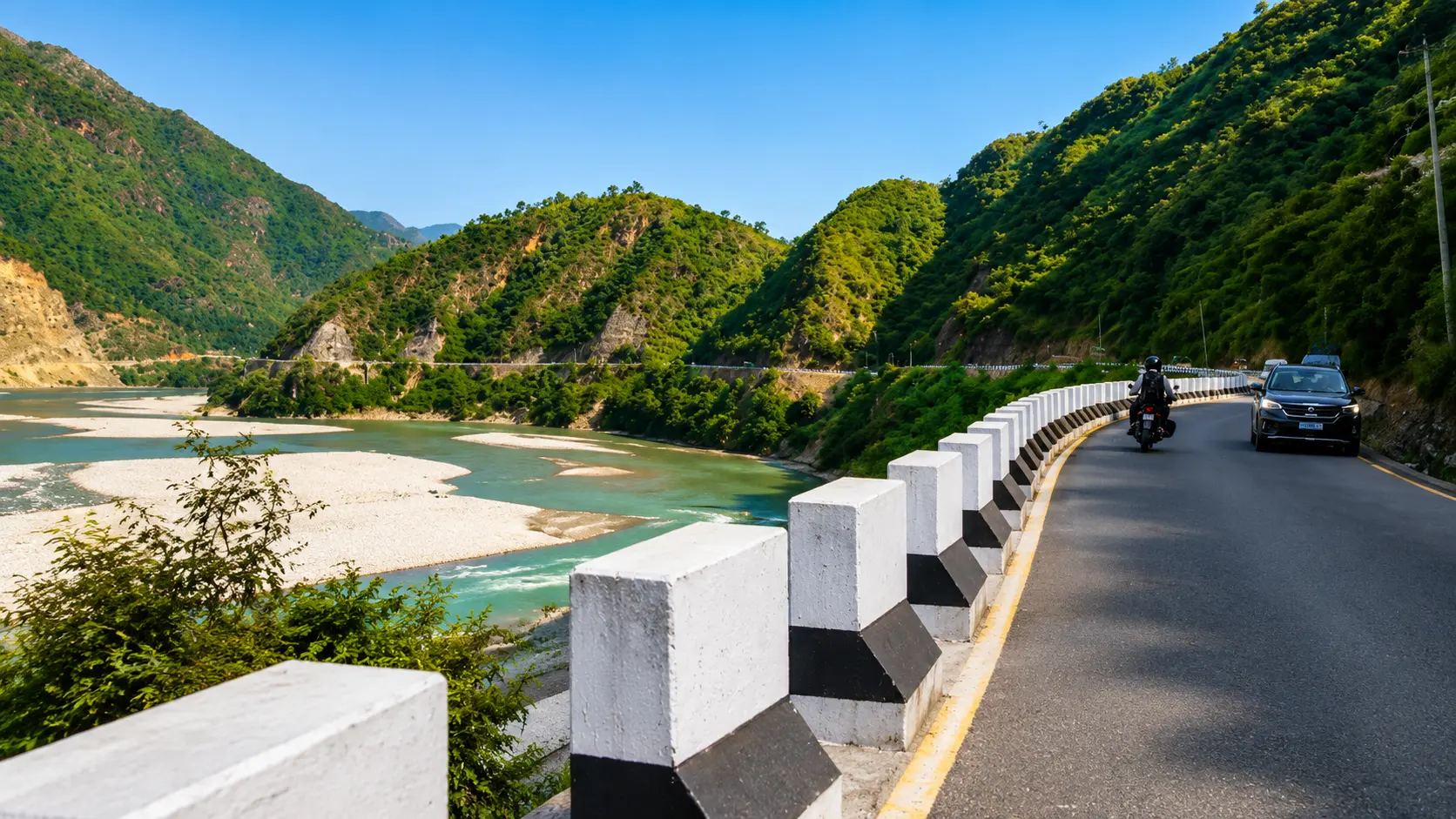
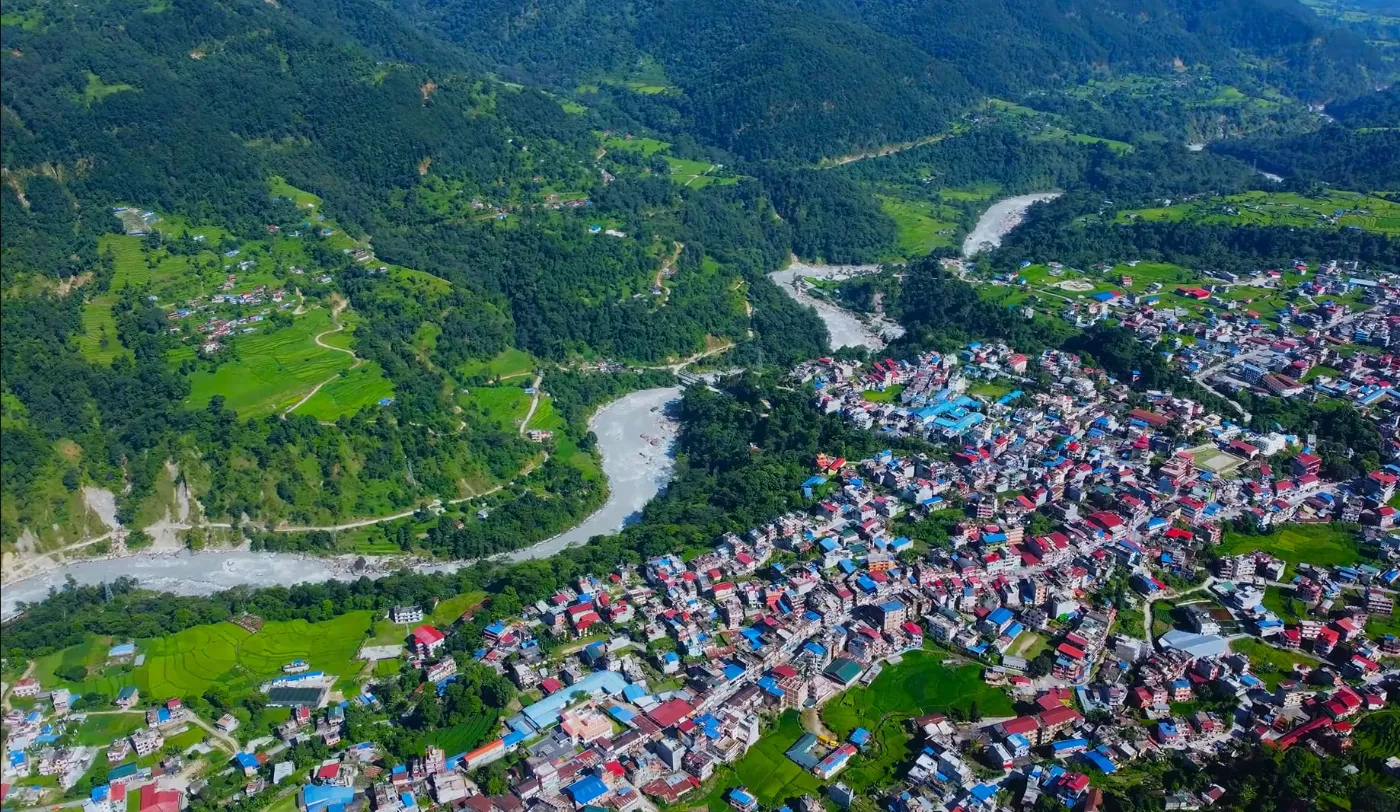
After turning north at Galchhi, the road enters the Trishuli River gorge—one of Nepal’s most dramatic river landscapes. The Trishuli River is a major whitewater rafting destination, and its churning blue-green waters, visible far below the road, create a spectacular backdrop to the drive.

The gorge walls rise steeply on both sides, draped in subtropical vegetation, and the road clings to the cliffside in places with vertiginous drops to the river below. On weekends in season, you will often see groups of rafters navigating the rapids — a vivid reminder that Nepal’s adventure tourism extends far beyond trekking.

Trishuli Bazaar — Last Major Town Before the Mountains

Trishuli Bazaar is a significant town approximately 76 km from Kathmandu and the last sizable settlement on the Kathmandu-Syabrubesi route. The town has several good restaurants, ATMs (the last reliable ones before Syabrubesi — withdraw here!), fuel stations, and basic shops. Many drivers stop here for breakfast or an early tea break.

The surrounding area is historically significant as the site of the Trishuli Hydropower Project, one of Nepal’s earliest major hydroelectric developments.

Kalikasthan — First Himalayan Peak Views

Just beyond the village of Kalikasthan, at approximately 1,200 meters, the valley opens. On clear mornings, the first extraordinary views of the Langtang and Ganesh Himal ranges appear on the northern horizon.

Ganesh Himal (7,422 m) — named after the elephant-headed Hindu deity — and Langtang Lirung (7,227 m) are often the first peaks visible, rising white and massive against the blue sky. Ask your Nepal Vehicle Hiring driver to slow down at the Kalikasthan viewpoint for photographs — it is one of the finest roadside Himalayan views accessible from Kathmandu.

The Ramche Landslide Zone — Evidence of Nepal’s Raw Power

The Ramche area, just before Dhunche, is where the road passes through an active landslide zone that has periodically blocked or damaged the Kathmandu–Syabrubesi road over the years. In 2016, a major landslide temporarily dammed the Trishuli River near this area.

In 2026, the road through Ramche is better maintained than in previous years but remains the roughest section of the journey. This is where your 4WD vehicle earns its value — navigating the unpaved, potholed 3 km section with the confidence and capability that a standard car or bus cannot match.

Dhunche — The Mountain Town Gateway

Dhunche (2,030 m) is the district headquarters of Rasuwa District and the Langtang National Park permit checkpoint. The town sits on a broad ridge with stunning views of the surrounding forested mountains and — on clear days — distant Himalayan peaks.

It has a small bazaar, several teahouses and restaurants, a fuel station (the last one before Syabrubesi), and the national park entry gate where they check permits. Most travellers stop briefly in Dhunche for tea and a permit check.

The landscape at Dhunche — pine and rhododendron forests stretching over hillsides in every direction, with mountain peaks rising above the tree line — announces unambiguously that you have arrived in the Himalayas.

Thulo Bharkhu — Valley Views Before the Final Descent

Between Dhunche and Syabrubesi, the road passes through the Thulo Bharkhu area at approximately 1,800 meters — a spectacular viewpoint above the Bhote Koshi valley. Here, looking down into the deep river valley below and north toward the Nepal-Tibet border peaks, the scale and wildness of the Langtang region become fully apparent for the first time.

The descent from Thulo Bharkhu to Syabrubesi, with its numerous steep switchbacks, is exhilarating in a well-driven 4WD vehicle and marks the final chapter of your drive before reaching the trailhead.
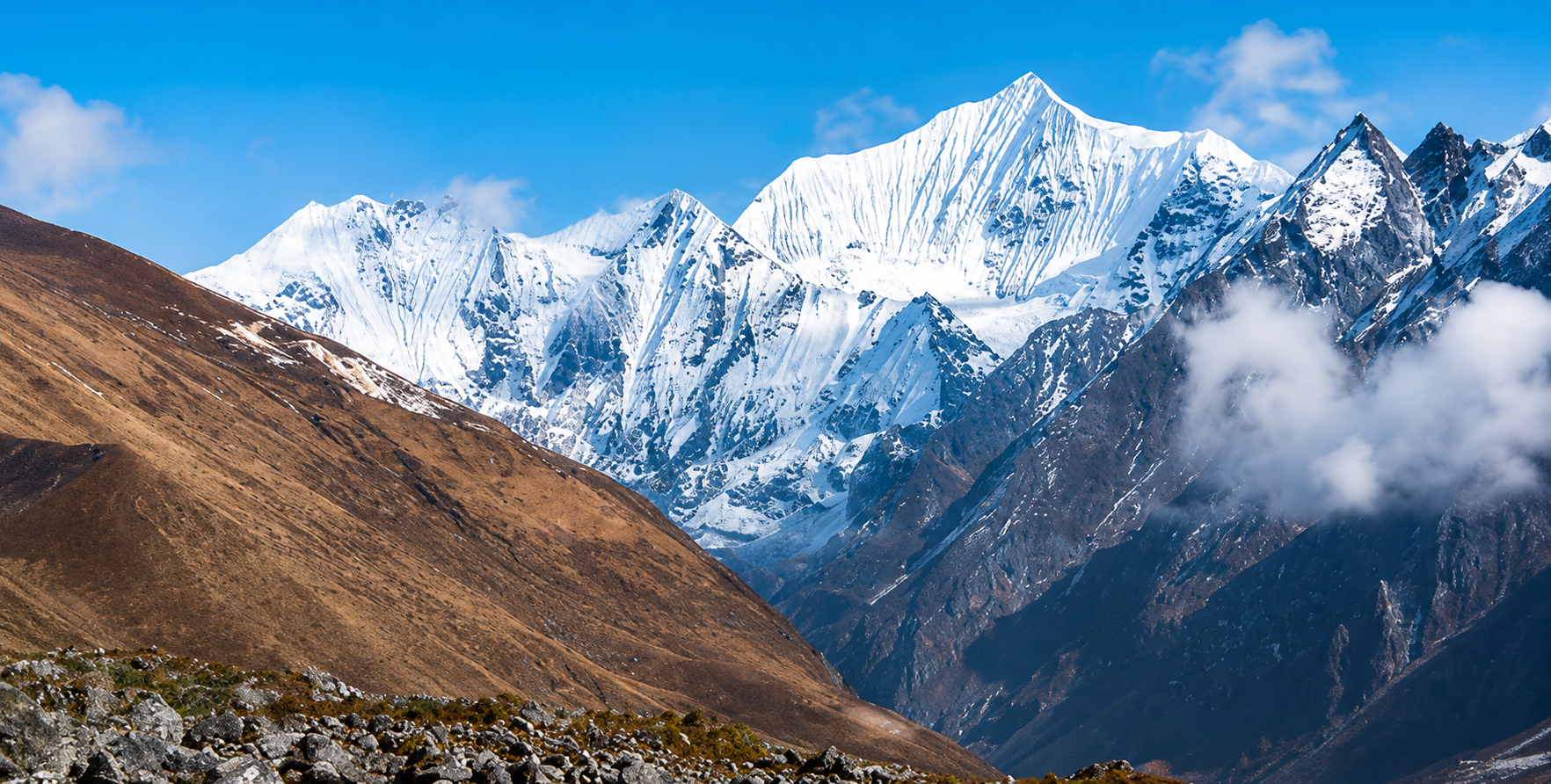
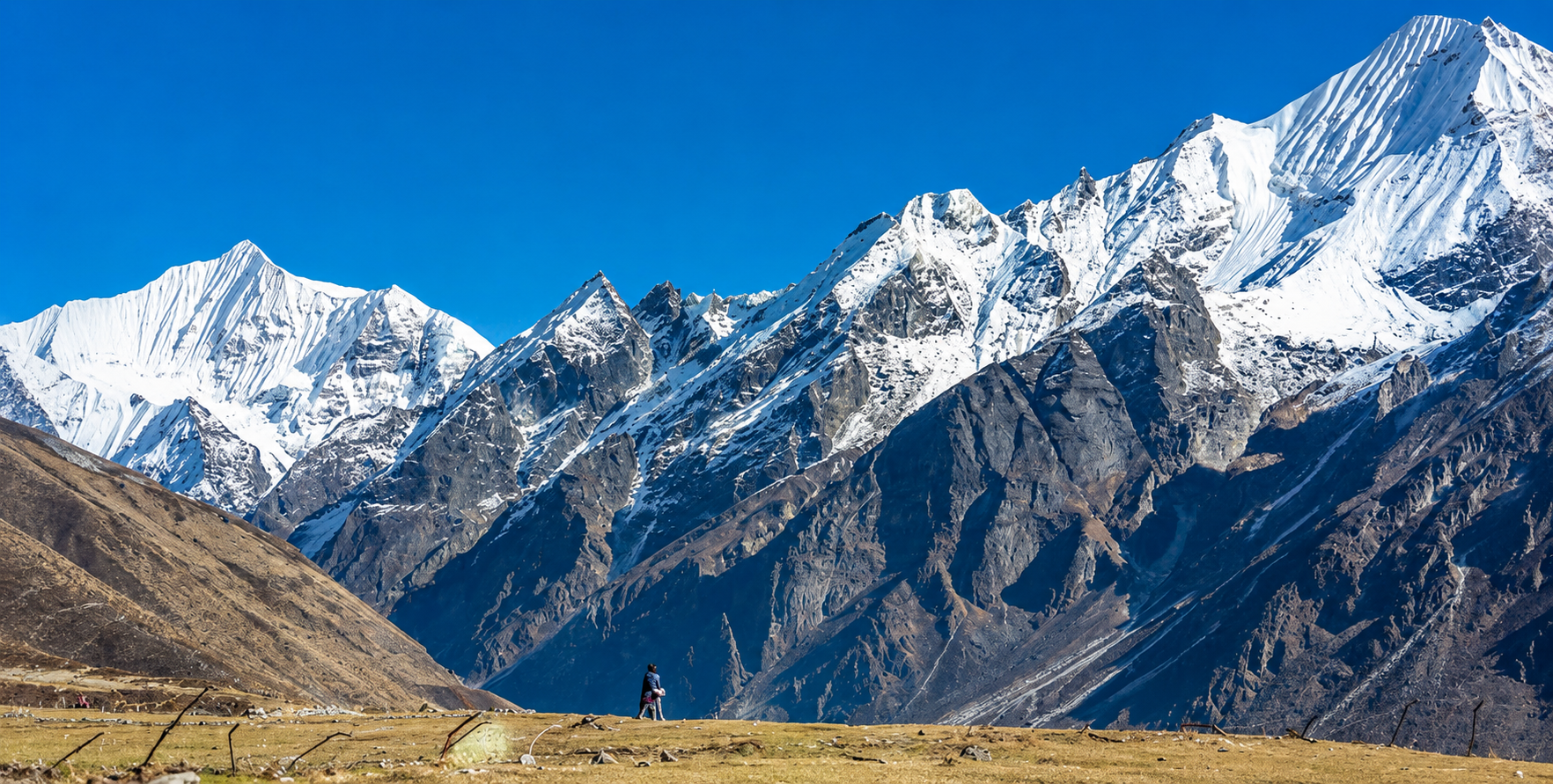
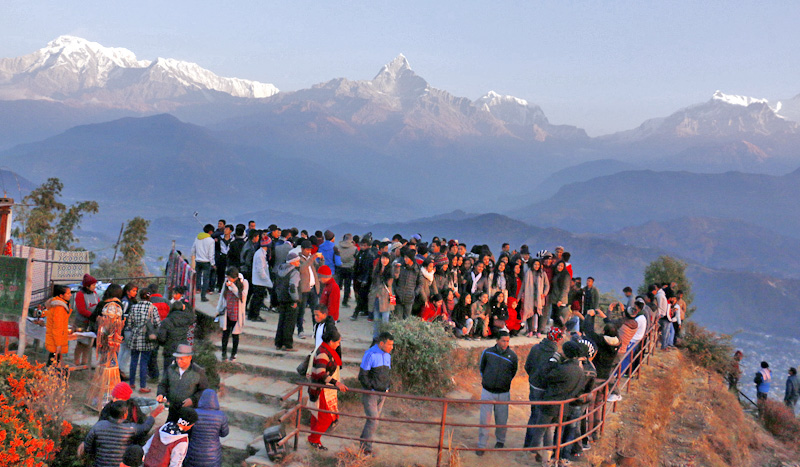
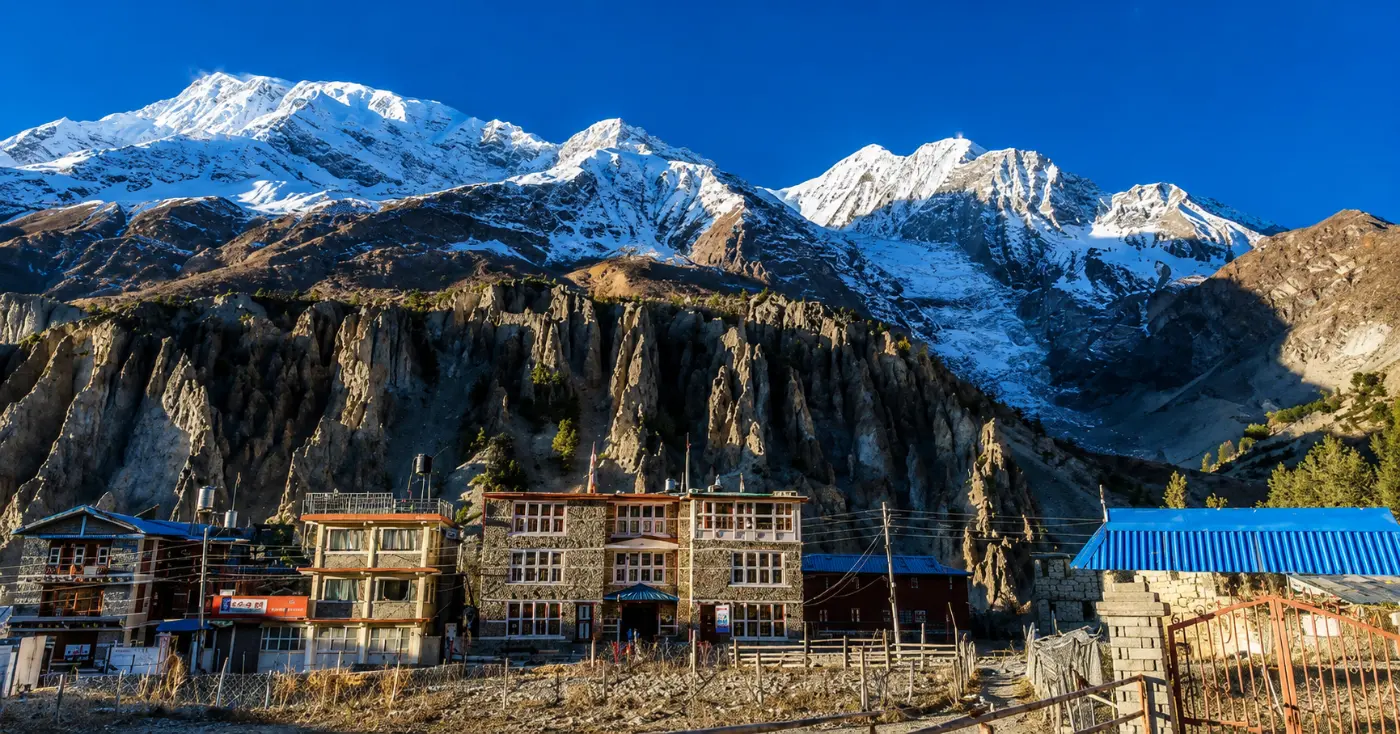
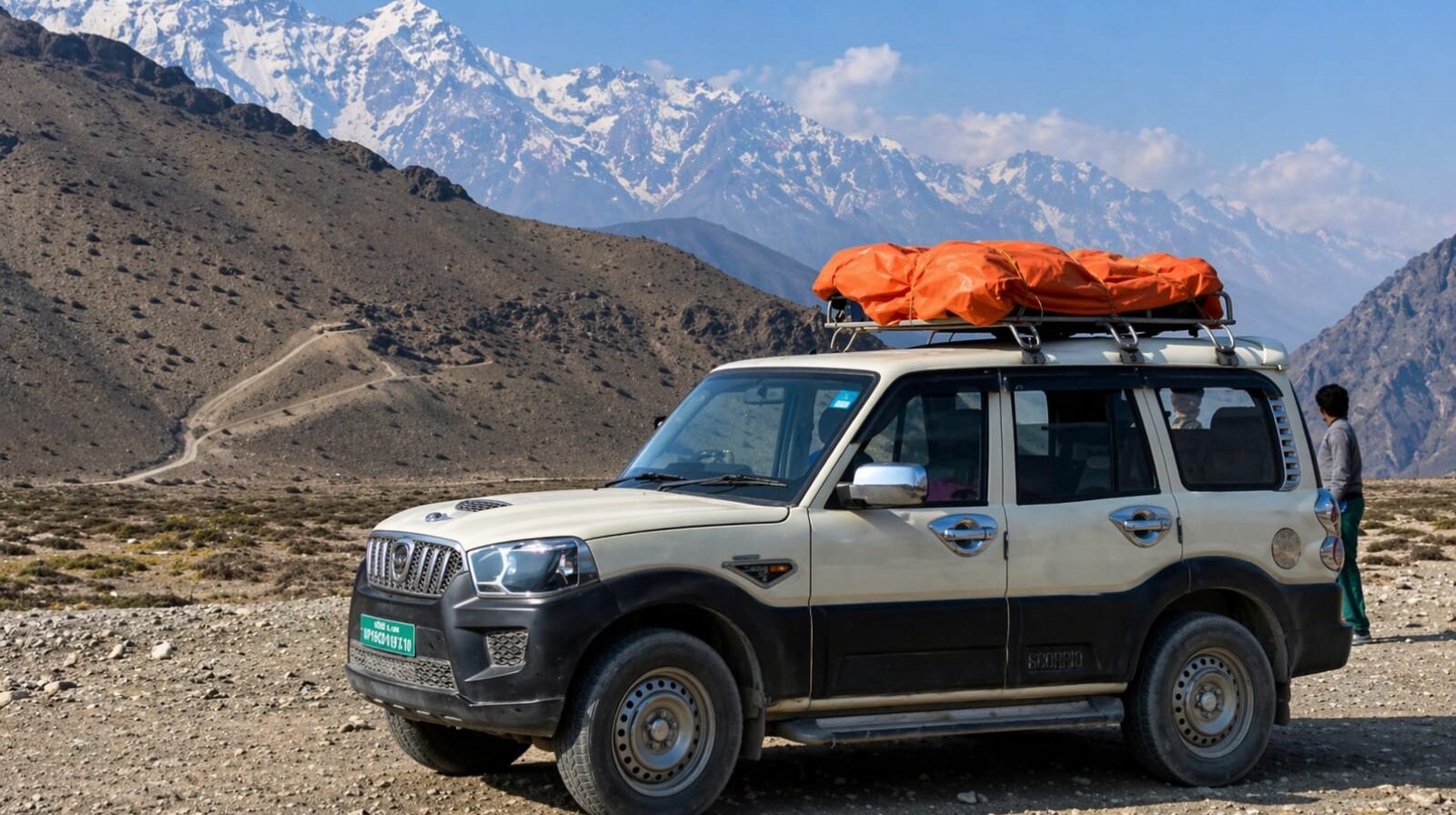
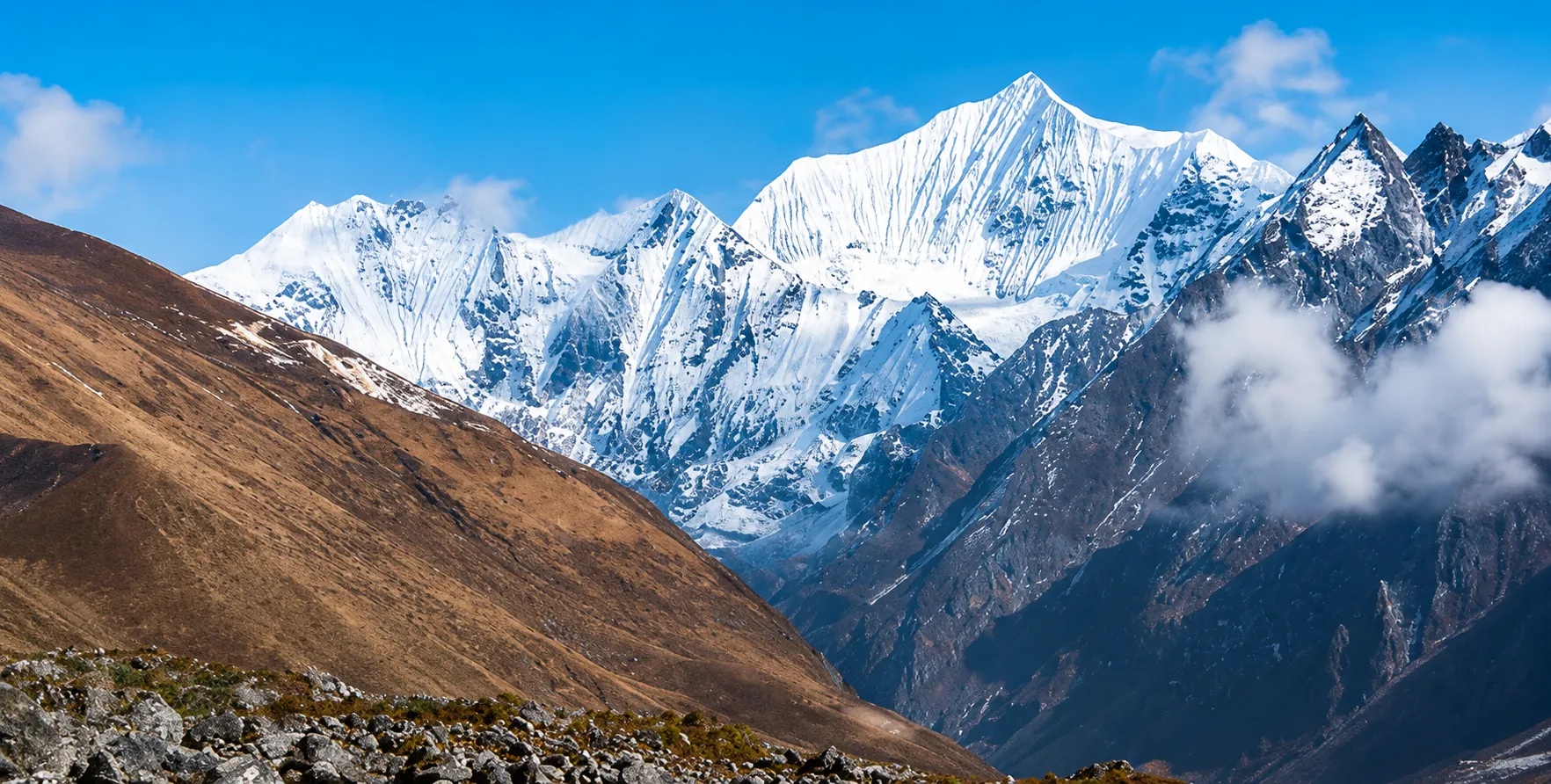
Ultra-clear panoramic view of snow-covered Himalayan mountains with rocky foreground, brown hills, and soft clouds under a bright blue sky in Nepal.

Best Time to Travel from Kathmandu to Langtang

October to December — Autumn Peak Season (BEST)

The post-monsoon autumn season is the finest time for the Kathmandu-to-Syabrubesi drive and the Langtang Valley Trek. October and November offer the most reliably clear mountain views — the air has been washed crystal-clean by the monsoon rains, and Langtang Lirung, Ganesh Himal, and the Jugal Himal chain stand in striking clarity above the valleys. Road conditions are at their best after the monsoon damage has been repaired.

Temperatures in Syabrubesi are pleasant (15–22°C by day) and cool at night. The drive through the Trishuli gorge in October is spectacular, with lush monsoon vegetation still green and the river full and dramatic. This is the most popular season for Langtang trekkers — book your vehicle well in advance.

March to May — Spring Season (EXCELLENT)

Spring is the second peak season for Langtang trekking and the Kathmandu–Syabrubesi drive. The rhododendron forests on the hillsides between Betrawati and Dhunche burst into magnificent bloom in March and April, creating a spectacular floral display visible from the road. Mountain views are generally clear in the mornings before afternoon cloud build-up.

Temperatures warm up progressively through May. The Trishuli River is typically lower and calmer in spring, and the road conditions are generally good following the winter dry period.

December to February — Winter (POSSIBLE WITH PREPARATION)

Winter offers the clearest, coldest conditions on the Kathmandu-to-Syabrubesi route. The mountain views from Kalikasthan in December are often extraordinary — sharp and crystal-clear in the dry winter air. However, snow can fall on the road above Dhunche in January, and the descent from Dhunche to Syabrubesi can become icy.

Nepal Vehicle Hiring Pvt. Ltd. monitors winter road conditions and can advise whether chains or other precautions are needed. Syabrubesi itself rarely receives significant snow, but temperatures are cold (5–10°C by day, -5°C or colder at night). The Langtang Valley trek is possible in winter for well-prepared trekkers.

June to September — Monsoon (CHALLENGING)

The monsoon season brings the most challenging road conditions on the Kathmandu-Syabrubesi route. The Ramche Landslide Zone is most active during heavy monsoon rainfall and can block the road for hours or even days. Landslides also affect sections of the Trishuli Gorge Road between Galchhi and Betrawati.

Nepal Vehicle Hiring Pvt. Ltd. monitors road conditions in real time during the monsoon and will advise clients honestly about current conditions before departure. If road conditions permit, a private 4WD jeep is the only practical vehicle choice for monsoon-season travel on this route.

Why Choose Nepal Vehicle Hiring Pvt. Ltd. for Your Langtang Trek Vehicle

The Kathmandu to Syabrubesi road is one of Nepal’s most demanding and interesting vehicle journeys — a full day on mountain roads that transitions from city highway to remote Himalayan valley. It requires an experienced driver, a capable 4WD vehicle, and a company that knows the route thoroughly in all conditions. Thousands of Langtang trekkers have trusted Nepal Vehicle Hiring Pvt. Ltd. to deliver exactly this standard of service.

Why Nepal Vehicle Hiring Is Your Best Partner for Langtang
50,000+ satisfied customers | 5.0  TripAdvisor | 15,000+ verified 5-star reviews
All-4WD fleet — Fortuner, Hilux, Land Cruiser, Scorpio — all mountain-road ready
Drivers with specific experience on the Pasang Lhamu Highway & Ramche section
Bilingual drivers — English, Nepali, Hindi — will brief you on route highlights
Hotel pickup from anywhere in Kathmandu — Thamel, Lazimpat, Durbar Marg, all areas
Flexible departure — leave at 5:30 AM or 7:00 AM — your schedule, your choice
Real-time road condition monitoring — especially critical for monsoon travel
Return vehicle pickup from Syabrubesi on your specified date — pre-arranged and guaranteed
Transparent all-inclusive pricing — fuel, driver, vehicle, tolls — no hidden charges
24/7 WhatsApp support: +977 981-4227196 | Licensed & Registered | Reg. No. 219204

Our Fleet for the Kathmandu to Syabrubesi Route

VehicleCapacityWhy It’s Right for LangtangBest Group Size
4WD Toyota Fortuner1–6 paxPowerful engine handles the Tamche zone, spacious cabin, excellent AC4–6 people ideal
4WD Toyota Hilux1–5 paxHigh ground clearance, proven mountain performer, good luggage space3–5 people ideal
4WD Toyota Land Cruiser1–7 paxTop-end comfort for long mountain drives, maximum reliability5–7 people ideal
4WD Scorpio / Bolero1–5 paxCost-effective, capable 4WD, good for budget-conscious groups2–4 people ideal
Hiace Van (to Dhunche)7–14 paxFor larger groups — note: only to Dhunche, not full Syabrubesi descent7–14 people (to Dhunche)

Step-by-Step Booking Guide

  • Step 1 — Contact Nepal Vehicle Hiring via WhatsApp (+977 981-4227196), phone, email ([email protected]), or Website (vehiclehiringnepal.com).
  • Step 2 — Share your travel date, group size, Kathmandu hotel name/address, preferred departure time, and whether you need one-way drop-off or return pickup (or both).
  • Step 3 — Choose your vehicle from our recommendations based on group size and budget.
  • Step 4 — Receive the booking confirmation with the driver’s name, vehicle plate number, and driver’s WhatsApp contact.
  • Step 5 — Obtain the Langtang National Park permit and TIMS card from the Nepal Tourism Board office in Kathmandu, the day before departure (at Bhrikuti Mandap, open from 10:00 AM).
  • Step 6 — Arrange your licensed guide if you have not already done so (mandatory since April 2023).
  • Step 7 — Be ready in your hotel lobby at the agreed time — typically 5:30–6:30 AM for the Kathmandu-Syabrubesi trip. Your driver WhatsApps when 10 minutes away.
  • Step 8 — Enjoy the spectacular drive! Your driver will suggest the best stops for views, tea, and meals along the way.

Practical Tips for Your Kathmandu to Langtang Trek Vehicle Journey

A 5:30–6:30 AM departure from Kathmandu is strongly recommended for the Langtang trek vehicle journey. This early start beats the worst of Kathmandu’s morning traffic, allows you to reach Trishuli Bazaar by mid-morning for a comfortable breakfast stop, pass through the Ramche section in good daylight, arrive in Dhunche for a late lunch and permit check, and reach Syabrubesi by mid-afternoon with time to settle into your guesthouse before dark.

Departures after 8:00 AM risk arriving in Syabrubesi in the dark — particularly in winter when daylight hours are shorter.

The ATM Stop at Trishuli Bazaar — Essential

No ATMs are operating between Trishuli Bazaar and Kathmandu on the return journey (most ATMs in Dhunche are unreliable). Budget your cash carefully for the full trek: accommodation and meals (approximately NPR 1,500–2,500 per person per day), guide and porter fees (NPR 2,000–3,000/day for a guide, NPR 1,500–2,000/day for a porter), monastery entrance fees, and incidental expenses.

A trekker doing a 7-day Langtang Valley Trek should carry at least NPR 30,000–40,000 per person in cash. Withdraw at the Trishuli Bazaar ATM on the way — do not rely on Dhunche or Syabrubesi machines.

Motion Sickness Preparation

The Kathmandu to Syabrubesi road has over 1,000 turns, bends, and switchbacks — the route is justifiably famous among Nepalese drivers for its twisting mountain-road character, especially the sections above Betrawati and the descent from Dhunche. If you or any member of your group is susceptible to motion sickness, take appropriate medication before departure (30–60 minutes before the journey begins).

The front passenger seat offers the smoothest ride and the least exposure to motion sickness. Nepal Vehicle Hiring Pvt. Ltd. drivers drive smoothly and at a pace appropriate to the conditions, but the mountain road character is inherent to this route.

What to Pack for the Vehicle Journey

  • Motion sickness medication — taken 30–60 minutes before departure if you are susceptible.
  • Langtang National Park permit and TIMS card — must be in your daypack before leaving Kathmandu.
  • Cash in Nepali Rupees — withdraw from Kathmandu; supplement at Trishuli Bazaar ATM.
  • Snacks and water for the road — approximately 1–1.5 litres of water per person for the drive.
  • Light layers and a jacket — Syabrubesi (1,460 m) is noticeably cooler than Kathmandu, especially in the afternoon or in winter.
  • Camera fully charged — the Trishuli Gorge, Kalikasthan mountain views, and the Dhunche–Syabrubesi descent offer excellent photo opportunities.
  • A small bag of personal essentials is accessible during the drive — most luggage can go in the rear storage area.

Altitude and Acclimatisation at Syabrubesi

Syabrubesi, at 1,460 meters, is well within the altitude range; acclimatisation means visitors should feel comfortable, with no altitude symptoms. However, the Langtang Valley Trek climbs significantly from here, reaching Kyanjin Gompa at 3,870 meters, with optional day hikes to 4,700–5,000 meters.

Proper acclimatisation during the trek itself—taking rest days, drinking plenty of water, and acclimatising—is essential. Most 7–10-day Langtang itineraries are appropriately paced for safe altitude gain. Your licensed guide will advise on acclimatisation during the trek.

Frequently Asked Questions

How long does the drive from Kathmandu to Syabrubesibesi take?

In a private 4WD jeep departing Kathmandu at 6:00 AM, the drive to Syabrubesi takes about 5.5–7 hours, including a breakfast stop in Trishuli Bazaar and a permit check in Dhunche. Public buses and shared jeeps take 7–10 hours or more because of multiple stops and slower driving on mountain roads. A private jeep from Nepal Vehicle Hiring Pvt. Ltd. typically saves 2–3 hours compared with public transport.

Is a 4WD vehicle really necessary for the drive from Kathmandu to Syabrubesi?

Yes — a 4WD vehicle is strongly recommended and, by many measures, essential. The Ramche Landslide Zone (3 km before Dhunche) is unpaved and rough, and after rainfall it becomes muddy and unstable. The descent from Dhunche to Syabrubesi involves steep, tight switchbacks.

A standard car will struggle and potentially fail in these sections. All Nepal Vehicle Hiring Pvt. Ltd. vehicles for this route are 4WD Jeeps (Fortuner, Hilux, Land Cruiser, or Scorpio), ensuring your journey is safe and comfortable throughout.

Do I need permits to ride in a private vehicle to Syabrubesi?

Yes. Even if you are travelling to Syabrubesi by private vehicle rather than trekking on foot, you must carry a valid Langtang National Park permit and TIMS card. The Dhunche Army Checkpoint and Langtang National Park entry gate check all passengers — trekkers and vehicle passengers alike.

Obtain your permits from the Nepal Tourism Board office in Kathmandu before your departure day.

Can I arrange a return vehicle pickup from Syabrubesi after my trek?

Absolutely — this is one of Nepal Vehicle Hiring Pvt. Ltd.’s most popular services for Langtang trekkers. Please tell us your expected trek completion date and time when booking, and we will assign a vehicle for your Syabrubesi pickup on that date. Your driver will WhatsApp you the evening before to confirm timing.

If your trek runs over or under schedule, contact us via WhatsApp, and we will adjust the pickup accordingly.

What other treks can I do from Syabrubesi?

Syabrubesi is the gateway to three major trekking routes: the Langtang Valley Trek (the most popular, 7–10 days round trip), the Tamang Heritage Trail (a spectacular cultural circuit through traditional Tamang villages, 5–8 days), and the Helambu Trek (a lower-altitude cultural trek through the Helambu Valley, 5–7 days, finishing near Kathmandu). Nepal Vehicle Hiring Pvt. Ltd. provides vehicle hire for all three route trailheads from Kathmandu and return transport from various finishing points, depending on your chosen route.

How much cash should I carry for the Langtang Trek?

There are no ATMs between Trishuli Bazaar and Kathmandu on the mountain road. Withdraw sufficient NPR in Kathmandu (and top up at Trishuli Bazaar on the way). Budget approximately NPR 1,500–2,500 per person per day for teahouse accommodation and meals on the trek.

A 7-day Langtang trek budget (excluding permits, guide, porter, and vehicle hire) is approximately NPR 15,000–25,000 per person. Carry an additional 20% buffer for unexpected expenses, emergency needs, or extended stays.

How do I book a Kathmandu-to-Syabrubesi jeep with Nepal Vehicle Hiring?

Contact Nepal Vehicle Hiring Pvt. Ltd. via WhatsApp (+977 981-4227196), phone, email ([email protected]), or the booking form at vehiclehiringnepal.com. Share your travel date, group size, Kathmandu hotel address, and preferred departure time. Our team responds within minutes during business hours.

We recommend booking 3–5 days in advance during peak season (October–November and March–May), when 4WD vehicles for the Langtang route are in high demand.

Kathmandu to Syabrubesi: All Transport Options Compared

Transport OptionCostTimeComfortReliabilityDoor-to-DoorBest For
Private Jeep — Nepal Vehicle HiringNPR 18,000–35,0005–7 hrs★★★★★★★★★★ YesGroups, families, and serious trekkers
Shared Jeep (Machhapokhari)NPR 1,400–1,800/person6–8 hrs★★★☆☆★★★☆☆ NoSolo/couple on moderate budget
Tourist BusNPR 800–1,200/person7–10 hrs★★★☆☆★★★☆☆ NoBudget groups, non-time-sensitive
Local Public BusNPR 300–500/person8–12 hrs★★☆☆☆★★☆☆☆ NoExtreme budget, high tolerance for discomfort
Private Car (non-4WD)NPR 12,000–18,0006–8 hrs★★★☆☆★★☆☆☆ PartialNOT recommended — fails at Ramche section

Conclusion: Your Langtang Adventure Starts with the Right Vehicle

The Langtang Valley Trek is one of Nepal’s greatest short Himalayan adventures — a journey into a glacial valley of extraordinary beauty, rich wildlife, and Tamang cultural depth, accessible from Kathmandu in a single day’s drive. The vehicle journey from Kathmandu to Syabrubesi — following the Trishuli River gorge northward through progressively wilder,d more dramatic mountain terrain — is a spectacular experience that deserves to be enjoyed, not endured.

With Nepal Vehicle Hiring Pvt. Ltd., the Kathmandu-to-Syabrubesi drive is exactly that: an experience. A professional 4WD vehicle will collect you from your hotel before dawn. A smooth run through the morning-lit Trishuli gorge.

A breakfast stop at Trishuli Bazaar as the mountains begin to appear on the northern horizon. The confident navigation of the Ramche section would defeat a lesser vehicle. The dramatic first views of Langtang Lirung and Ganesh Himal from Kalikasthan.

The descent into Syabrubesi as afternoon light fills the river valley. Your first cup of Tamang butter tea at a riverside guesthouse, knowing the real walking begins tomorrow.

That is the Langtang experience at its best. And Nepal Vehicle Hiring Pvt. Ltd. is the vehicle partner that makes it possible.

Book your Kathmandu-to-Langtang trek vehicle today. Our team is available 24/7 on WhatsApp; peak season books up fast, and the mountains are waiting.

Book Your Kathmandu-to-Langtang Trek Vehicle Today!

Website: www.vehiclehiringnepal.com
Phone / WhatsApp: +977 981-4227196  (24/7 — we respond fast)
Email: [email protected]
Office: Bhagawatisthan, Thamel, Kathmandu, Nepal
Route: Kathmandu → Galchhi → Trishuli → Betrawati → Dhunche → Syabrubesi
Fleet: 4WD Fortuner | 4WD Hilux | Land Cruiser | Scorpio | Hiace Van
50,000+ Happy Customers | 5.0 TripAdvisor | 15,000+ Verified Reviews
Hotel Pickup from Kathmandu | Flexible Departure | Return Pickup Available
3 Route Options: Galchhi Standard | Kakani Scenic | Tokha/Bidur
Real-Time Road Condition Monitoring | Licensed & Registered | Reg. No. 219204

Kathmandu to Chitwan Transfer

Chitwan

Kathmandu to Chitwan Transfer: Complete Guide to Car, Jeep, Bus & Van Options

Chitwan National Park — Nepal’s first and most celebrated national park, and a UNESCO World Heritage Site — is the country’s most visited wildlife destination and an essential stop on almost every Nepal itinerary. After the temples, monuments, and cultural richness of Kathmandu Valley, the transition to the lush Terai lowlands of Chitwan — with one-horned rhinoceroses grazing in the grasslands, Bengal tigers moving through the forest, wild elephants at the riverside, and over 544 bird species filling the trees — is one of the most dramatic and rewarding journeys in Asia.

The transfer from Kathmandu to Chitwan covers about 150 to 170 kilometres along the Prithvi Highway and the East-West Highway, taking 5 to 7 hours depending on the mode of transport and traffic conditions. In 2026, travellers will have a wide range of transfer options available —from budget-friendly shared tourist buses to top-end private cars, from spacious family jeeps to large Hiace vans for groups, and from VIP sofa coaches to full coaster buses for larger parties.

At Nepal Vehicle Hiring Pvt Ltd, we offer a complete range of Kathmandu-to-Chitwan transfer services, including private cars, jeeps, Hiace vans, coaster buses, and tourist bus ticket booking. This comprehensive 2026 guide covers every available option, including full cost comparisons, departure details, route highlights, the optional Bandipur detour, seasonal guidance, and expert tips to ensure every Kathmandu-to-Chitwan transfer is smooth, comfortable, and genuinely enjoyable.

All Kathmandu to Chitwan Transfer Options –  Quick Comparison

Transfer OptionTimeCostDepartureComfortBest For
Local / Deluxe Bus6–8 hrsNPR 500–900/personGongabu Bus Park (6 AM)LowCheapest shared option
Tourist Bus (Standard)5–7 hrsNPR 1,000–1,300/personSorhakhutte Tourist Park (7 AM)MediumBudget independent
VIP Sofa Bus (2+1)5–6 hrsNPR 1,400–2,000/personSorhakhutte Tourist Park (7 AM)HighComfort-seeking solo/couple
Night BusOvernightNPR 1,000–1,800/personGongabu / Sorhakhutte (7–10 PM)MediumSave hotel cost
Private Car (Sedan/SUV)4–5 hrsNPR 12,000–20,000 (vehicle)Hotel pickupVery HighCouple, small family
Private Jeep (4WD)4–5 hrsNPR 15,000–24,000 (vehicle)Hotel pickupVery HighGroup of 4–6
Toyota Hiace Van5–6 hrsNPR 20,000–30,000 (vehicle)Hotel pickupVery HighGroup of 7–10
Toyota Coaster5–6 hrsNPR 28,000–42,000 (vehicle)Hotel pickupHighGroup of 12–18
Tourist Bus (Private)5–7 hrsNPR 38,000–60,000 (vehicle)Hotel pickupHighGroup of 25–40

Kathmandu to Chitwan – Journey Quick Facts

DetailInformation
Road DistanceApproximately 150–170 km
Drive Time (Private Vehicle)4 to 5 hours
Drive Time (Tourist Bus)5 to 7 hours
Main RouteKathmandu → Prithvi Highway → Mugling → East-West Highway → Bharatpur → Sauraha
Key Rest StopMugling (midpoint) – Trishuli riverside lunch
Tourist Bus DepartureSorhakhutte Tourist Bus Park, Kathmandu – 7:00 AM
Arrival PointSauraha Bus Park or direct to the resort (private vehicle)
Best Departure Time7:00 AM – 8:00 AM for a comfortable daytime journey
Road ConditionMostly paved; ongoing upgrades near Mugling junction
Scenic HighlightTrishuli River gorge, Narayanghat river plains

Private Vehicle Transfer: Kathmandu to Chitwan

Nepal Vehicle Hiring Pvt Ltd provides professional hotel-to-resort private vehicle transfer services for the Kathmandu-to-Chitwan route. All private vehicles include hotel pickup in Kathmandu and direct resort drop-off in Sauraha:

Pokhara to Chitwan

Private Car – Best for Couples and Small Families

A private car is the ideal choice for solo travellers, couples, and small families of up to 4 people seeking comfort, speed, and door-to-door service for the Kathmandu-to-Chitwan transfer.

Car TypeCapacityOne Way (NPR)One Way (USD)Round Trip (NPR)
Standard Sedan (Dzire/Etios)2–3 paxNPR 12,000–15,000USD 90–120NPR 20,000–30,000
SUV / Crossover3–4 paxNPR 14,000–18,000USD 105–150NPR 24,000–40,000
Top-end SUV4 paxNPR 17,000–22,000USD 127–200NPR 29,000–55,000

The private 4WD jeep is the most popular vehicle for the Kathmandu-to-Chitwan transfer, especially for trekking groups heading to or returning from Chitwan. It offers more space, higher seating, and better luggage capacity than a standard car.

Jeep TypeCapacityOne Way (NPR)One Way (USD)Round Trip (NPR)
Standard Jeep (Scorpio/Bolero)4–5 paxNPR 15,000–26,000USD 112–150NPR 26,000–40,000
4WD Jeep (Hilux/Fortuner)5–6 paxNPR 18,000–24,000USD 135–300NPR 31,000–55,000
Top-end 4WD (Land Cruiser)5–6 paxNPR 22,000–30,000USD 165–400NPR 38,000–90,000

Toyota Hiace Van – Best for Groups of 7 to 10

The Toyota Hiace van is the most practical and economical private vehicle for larger family groups and small tour parties travelling from Kathmandu to Chitwan.

DetailInformation
Seating Capacity7 to 10 passengers comfortably
One-Way CostNPR 20,000–30,000 (USD 150–225)
Round Trip CostNPR 34,000–52,000 (USD 255–390)
Air ConditioningFull front and rear AC
Luggage SpaceLarge rear boot + roof rack
Best ForExtended families, small tour groups, mixed groups

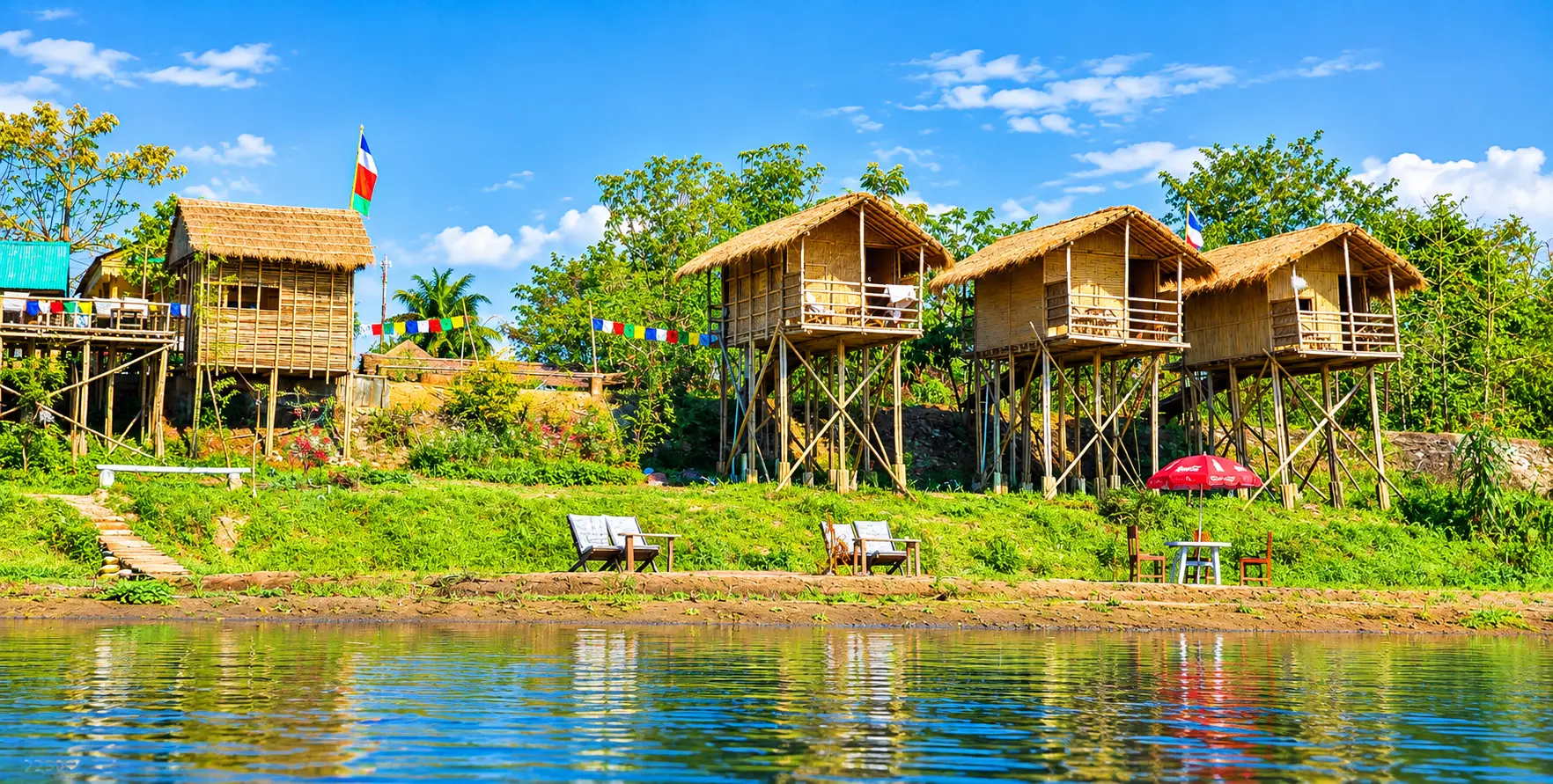
Chitwan Riverside Bamboo Huts and Reflections

Coaster Bus and Tourist Bus – Large Groups

For groups of 12 or more, Nepal Vehicle Hiring offers coaster buses and full tourist buses for the Kathmandu to Chitwan transfer:

VehicleCapacityOne Way (NPR)One Way (USD)Best For
Toyota Coaster12–18 paxNPR 28,000–42,000USD 210–315Medium tour groups, corporate
Mini Bus20–25 paxNPR 35,000–50,000USD 260–375Mid-large groups
Tourist Bus (Private)25–40 paxNPR 38,000–60,000USD 285–450Large tour groups, schools

Note: All private vehicle prices include driver, fuel, and toll charges for the one-way journey from Kathmandu to Chitwan/Sauraha. Contact Nepal Vehicle Hiring for confirmed quotes for your specific travel date and group size.

What Is Included in Your Nepal Vehicle Hiring Private Transfer

  • Hotel pickup from your exact accommodation anywhere in Kathmandu – Thamel, Lazimpat, Boudha, or any area
  • Air-conditioned private vehicle – well-maintained and regularly serviced
  • Professional, licensed driver experienced on the Kathmandu to Chitwan Prithvi Highway
  • Fuel, toll charges, and all driver expenses are included in the quoted price
  • Freedom to stop at Mugling, Bandipur, Narayanghat, or any attraction on request
  • Direct drop-off at your resort or hotel entrance in Sauraha, Chitwan
  • Flexible departure time – leave Kathmandu when you are ready
  • 24-hour Nepal Vehicle Hiring operations contact for any in-journey support

Tourist Bus Options: Kathmandu to Chitwan

Shared tourist buses are the most popular choice for independent travellers and backpackers on the Kathmandu-to-Chitwan route. Here is the complete guide to all bus categories:

Bus TypeSeat LayoutTicket Price (NPR)Ticket Price (USD)DepartureComfort
Local / Deluxe Bus2+2NPR 500–900USD 3.7–6.7Gongabu Bus Park, 6 AMLow–Medium
Standard Tourist Bus2+2NPR 1,000–1,300USD 7.5–9.7Sorhakhutte, 7 AMMedium
Super Deluxe Bus2+2NPR 1,200–1,600USD 9–12Sorhakhutte, 7 AMGood
VIP Sofa Bus2+1NPR 1,400–2,000USD 10.5–15Sorhakhutte, 7–8 AMHigh
Night Bus2+1 or 2+2NPR 1,000–1,800USD 7.5–13.5Gongabu/Sorhakhutte, 7–10 PMMedium

Departure point for tourist buses: Sorhakhutte Tourist Bus Park (also called New Bus Park), about 20- 30 minutes by taxi from Thamel (NPR 400–600). Arrive at least 30 minutes before the 7:00 AM departure.

Kathmandu to Chitwan Tour Package: Complete Travel Guide

Complete Transfer Comparison: Kathmandu to Chitwan

FactorVIP Sofa BusPrivate CarPrivate JeepHiace VanLocal Bus
Journey Time5–6 hrs4–5 hrs4–5 hrs5–6 hrs6–8 hrs
Cost (per person, est.)NPR 1,400–2,000NPR 3,000–7,300*NPR 2,500–6,000*NPR 2,000–4,300*NPR 500–900
Hotel PickupSorhakhutte Bus ParkYes – doorYes – doorYes – doorGongabu Bus Park
Drop-offSauraha Bus ParkResort entranceResort entranceResort entranceSauraha Bus Park
Departure TimeFixed 7 AMFully flexibleFully flexibleFully flexibleFixed 6 AM
Luggage SpaceUnderfloorGoodExcellentExcellentVery limited
Stop FreedomNoneFullFullFullNone
PrivacyShared 25–30 paxCompleteCompleteCompleteNo
Best ForSolo/couple budgetCouple/small familyGroups 4–6Groups 7–10Cheapest

* Per-person cost based on typical group size: car per 2–3 pax, Jeep per 4–5 pax, Hiace per 7–9 pax.

Kathmandu to Chitwan Route – Highlights and Stops

The Prithvi Highway from Kathmandu to Chitwan is a beautiful and varied road journey. Here are the key highlights and recommended stops along the way:

Kathmandu Valley Exit – Chandragiri Hills

As the vehicle leaves Kathmandu, the road climbs through the Chandragiri hills at the valley rim before descending steeply through the Naubise area. This transition from Kathmandu’s dense urban bowl to the open river valley below is dramatic and immediate. On clear days, you can see the Himalayan range behind you as you exit the valley.

Prithvi Highway – Trishuli River Gorge

After Naubise, the Prithvi Highway follows the Trishuli River through a spectacular gorge. The road winds alongside the rushing river for approximately 60 kilometres from Naubise to Mugling, with forested hillsides above, cascading side streams, and traditional Nepali villages clinging to the slopes. This is consistently the most scenic section of the entire Kathmandu-to-Chitwan road journey.

Mugling – The Essential Midway Stop

Mugling sits at the confluence of the Trishuli and Marsyangdi rivers, approximately 90-100 km from Kathmandu, and is Nepal’s most famous roadside stop. Almost every tourist bus and private vehicle stops here for 20 to 30 minutes. Riverside restaurants serve fresh fish curry (Mugling fish curry is legendary throughout Nepal), dal bhat, and snacks.

The riverside setting with the two rivers meeting below is scenic and refreshing. For families with children, Mugling is an excellent stretch-your-legs opportunity.

Bandipur – Optional UNESCO Heritage Town Detour

Bandipur is one of Nepal’s most remarkable heritage destinations — a beautifully preserved Newari hilltop trading town about 8 km off the Prithvi Highway between Dumre and Mugling. With its cobblestone main street, traditional Newari architecture, panoramic mountain views of the Annapurna and Manaslu ranges, and the nearby Siddha Cave (Nepal’s largest cave), Bandipur is an outstanding cultural detour that adds approximately 1 to 1.5 hours to the journey.

With a private vehicle from Nepal Vehicle Hiring, this stop is entirely flexible and on request.

Narayanghat – Terai Entry

After Mugling, the route turns south on the East-West Highway and begins the final descent to the Terai lowlands. Narayanghat is the major city at the Terai entry point, situated at the confluence of the Narayani and Rapti rivers. The transition from the hilly gorge terrain to the flat, green Terai landscape is noticeable and dramatic — the temperature rises, the vegetation becomes denser and more tropical, and Nepal’s character shifts completely.

Bharatpur to Sauraha – Chitwan Approach

From Narayanghat, the route continues to Bharatpur — the administrative headquarters of Chitwan District and one of Nepal’s largest cities — before the final approach road to Sauraha, the main tourist gateway to Chitwan National Park. The approach to Sauraha via Bharatpur passes through flat Terai countryside, with occasional views of the Rapti River and the national park forest on the southern horizon.

Route Overview Table: Kathmandu to Sauraha

StageSectionDistanceRoadTimeNotes
1Kathmandu to Naubise30 kmPrithvi Hwy – paved45 minValley exit, Chandragiri Hills
2Naubise to Mugling65 kmPrithvi Hwy – gorge road1.5–2 hrsTrishuli River gorge – most scenic section
3Mugling Rest Stop0 km–20–30 minRiverside lunch or snacks – all vehicles stop
4Mugling to Narayanghat35 kmEast-West Hwy45 minTerai entry, flat lowlands
5Narayanghat to Bharatpur15 kmPaved – good20 minMajor city, East-West Highway
6Bharatpur to Sauraha22 kmGood approach road30 minNational park edge, resort area
TOTALKathmandu to Sauraha~167 kmMostly paved4–5 hrs (private)Classic Nepal highway journey

Which Transfer Option is Right for You?

Your ProfileBest OptionReason
Solo traveller, budgetVIP Sofa Bus (NPR 1,400–2,000)Best comfort-to-cost ratio for single travellers
Couple on a tight budgetTourist Bus or Sofa BusTwo adjacent seats, affordable, morning schedule
A couple wanting comfortPrivate Car (Sedan/SUV)Door-to-door, flexible, fast, private
Family of 4Private SUV or JeepSpace for bags, flexibility, and hotel pickup
Family of 5–6Private Jeep (Hilux/Fortuner)All family together, boot space, fast
Group of 7–10Toyota Hiace VanOne vehicle, hotel pickup, economical per head
Group of 12–18Toyota CoasterAll together, AC, a professional driver
Large group 25+Private Tourist BusMaximum capacity, single vehicle, group cohesion
Night travellerNight Bus (NPR 1,000–1,800)Save accommodation costs, arrive early
Wants Bandipur stopAny private vehicleOnly private vehicles are allowed off-route detours
Chitwan
Chitwan

What Awaits You at Chitwan National Park

After the Kathmandu to Chitwan transfer, one of Nepal’s greatest wildlife experiences awaits:

Chitwan National Park – UNESCO World Heritage Site

Established in 1973, Chitwan National Park covers 952 square kilometres of subtropical lowland forest, grassland, and river systems. It is home to over 700 one-horned rhinoceroses, a significant population of Bengal tigers (over 100 individuals), wild Asian elephants, gharial and mugger crocodiles, and 544 bird species. Chitwan is consistently rated as one of the finest wildlife destinations in Asia.

Jeep Safari – The Premier Chitwan Experience

The open 4WD jeep safari through the national park’s core zones at dawn and dusk is the most popular and rewarding Chitwan activity. Trained naturalist guides know the best wildlife areas and maximise sightings of rhinoceroses, deer, crocodiles, and occasionally tigers. A half-day or full-day jeep safari is the recommended first activity for any visit to Chitwan.

Jungle Walk on Foot

Walking through Chitwan’s forests on foot with an armed guide is the most intimate wildlife experience the park offers. The proximity to nature — smelling the vegetation, hearing the birds, following tracks — creates a thrilling connection with the jungle ecosystem that no vehicle-based safari can replicate.

Dugout Canoe Ride

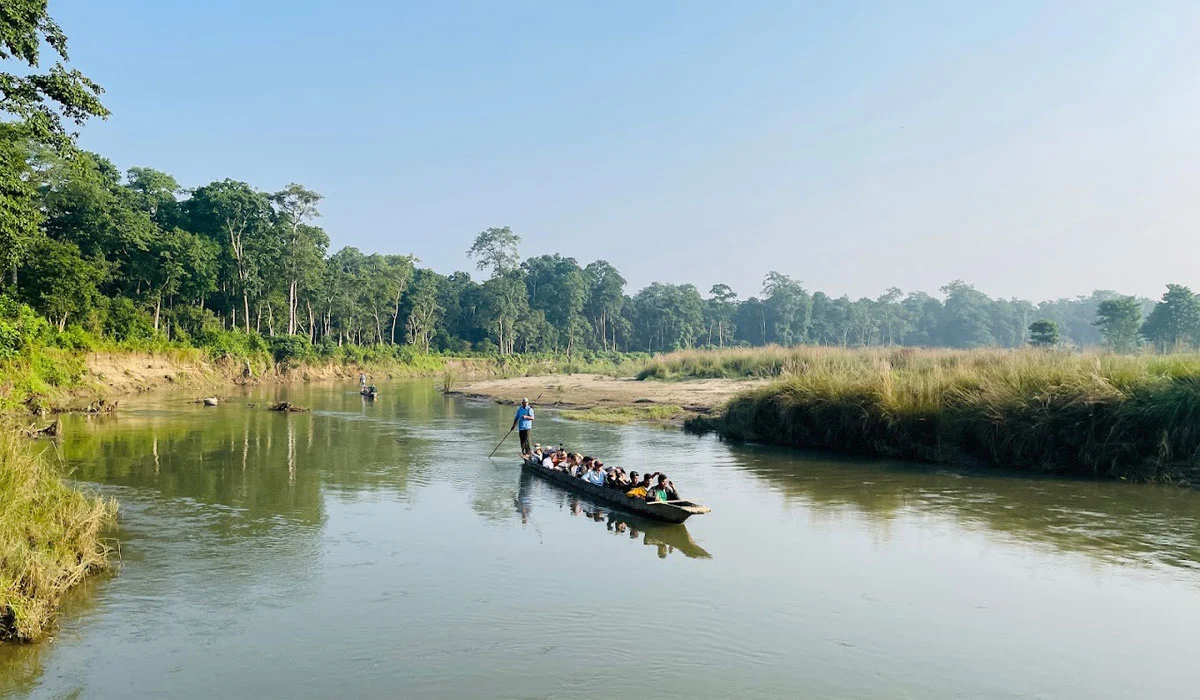
A silent dawn canoe on the Rapti River is the finest way to observe Chitwan’s riverine wildlife — gharials and mugger crocodiles basking on the banks, river kingfishers, otters, and occasionally elephants drinking at the water’s edge. One of the most peaceful and memorable experiences available in Chitwan.

Tharu Cultural Program

The traditional Tharu community stick dance performed at Chitwan resorts every evening is a colourful, energetic cultural introduction to the indigenous Tharu people, the original inhabitants of the Terai lowlands whose remarkable immunity to malaria allowed them to settle this region for centuries before modern development.

KTM to Chitwan

Best Time for the Kathmandu to Chitwan Transfer

Autumn (October to November) – Best Season

Autumn is the finest time for the Kathmandu-to-Chitwan transfer and a visit to Chitwan. The road is in excellent post-monsoon condition, the weather is comfortable (cool in Kathmandu, warm in Chitwan), and wildlife sightings in the park are excellent after the monsoon vegetation flush.

The Trishuli Gorge section of the Prithvi Highway is particularly beautiful in autumn. This is peak season — book all transport in advance.

Spring (March to May) – Excellent

Spring offers warm weather, good road conditions, and active wildlife. March and April are ideal — temperatures are comfortable, and the park’s wildlife is very visible. May becomes hot in the Terai.

The Prithvi Highway is scenic, with rhododendrons visible on the hillsides above the gorge.

Winter (December to February) – Good

Winter is excellent for Chitwan wildlife—the tall elephant grass is burned in late January, dramatically improving visibility in the park. The road is in good condition year-round. Temperatures in Chitwan are cool and comfortable for wildlife walking.

The Kathmandu-to-Chitwan transfer is comfortable with the right layers of clothing.

Monsoon (June to August) – Possible with Caution

The Prithvi Highway can experience occasional landslides near Mugling during the heavy monsoon season. Chitwan’s core zone is closed from June to August. The road journey is generally fine, but allow extra time.

Nepal Vehicle Hiring monitors conditions and advises clients accordingly.

Expert Tips for the Kathmandu to Chitwan Transfer

  • Book your VIP Sofa Bus seat at least 2 to 3 days in advance during October–November and March–April – the25-5 to 30-seat buses sell out quickly.
  • For private vehicles, book at least 2 to 3 days in advance during the off-peak season and 5 to 7 days in advance during peak trekking and wildlife seasons.
  • Depart Kathmandu between 7:00 AM and 8:00 AM to arrive in Sauraha by early afternoon, with time to settle in and do an afternoon jungle activity.
  • For Sorhakhutte Bus Park departures, take a taxi from Thamel at 6:00 AM to arrive at the bus park with 30 minutes to spare before the 7:00 AM bus.
  • Request a Bandipur heritage town stop if you have a private vehicle – it is directly on the route and is one of Nepal’s most rewarding cultural detours.
  • The Mugling stop is typically 20 to 30 minutes – use it for the famous riverside fish curry or a quick lunch.
  • For families with young children, a private vehicle is strongly recommended – the flexibility to make toilet stops, take snack breaks, and maintain child-friendly pacing makes a significant difference.
  • Confirm your Chitwan resort’s arrival procedure before departure – most resorts send a representative to Sauraha Bus Park for tourist bus arrivals.
  • For private vehicle passengers, Nepal Vehicle Hiring drivers drop you off directly at your resort entrance – no need to navigate the Sauraha bus park.
  • Nepal Vehicle Hiring can book the complete Nepal transport sequence – Pokhara to Chitwan, Chitwan to Kathmandu, or Kathmandu to Chitwan, then Pokhara – in a single coordinated arrangement.

What to Pack for the Kathmandu to Chitwan Transfer

  • Light summer clothing for Chitwan (the Terai is hot and humid)
  • Light jacket for the air-conditioned bus or vehicle cabin
  • Water bottle – stay hydrated during the 4- to 6-hour journey
  • Light snacks – biscuits, fruits, energy bars for the journey
  • Insect repellent – essential from the moment you arrive in Chitwan
  • Camera – the Trishuli River gorge and Mugling riverside are excellent photo subjects
  • Motion sickness tablets, if needed – the Prithvi Highway gorge section has curves
  • Nepali cash – for the Mugling stop and resort arrival expenses
  • Chitwan Resort confirmation and contact number for arrival coordination

How to Book Your Kathmandu to Chitwan Transfer with Nepal Vehicle Hiring

Booking your transfer with Nepal Vehicle Hiring Pvt Ltd is simple:

  • Step 1: Contact us via phone, WhatsApp, or at vehiclehiringnepal.com
  • Step 2: Tell us your travel date, number of passengers, hotel name in Kathmandu, and resort/hotel in Sauraha, Chitwan
  • Step 3: Choose your transfer type – private Jeep, Hiace van, coaster, or tourist bus ticket
  • Step 4: Mention any special requirements – Bandipur stop, child seats, extra luggage, flexible timing
  • Step 5: Receive your booking confirmation with driver details, vehicle information, and exact pickup time
  • Step 6: Your driver arrives at your Kathmandu hotel at the confirmed time and takes you directly to your Chitwan resort

We recommend booking 2 to 3 days in advance for off-peak dates and 5 to 7 days in advance for the October–November and March–April peak seasons.

Frequently Asked Questions (FAQ)

How far is Kathmandu from Chitwan?

The road distance from Kathmandu to Chitwan (Sauraha) is approximately 115- 70 kilometres via the Prithvi Highway and the East-West Highway.

How long does the Kathmandu-to-Chitwan transfer take?

By private car or jeep: 4-5 hours, including a stop in Mugling. By tourist bus: 5-7 hours. By local bus: 6 hours.

How much does a private car from Kathmandu to Chitwan cost in 2026?

A private sedan costs US$120 one way. An SUV costs NPR 14,000 to 22,000. A private jeep costs NPR 15,000 to 26,000. A Toyota Hiace van costs NPR 20,000 to 35,000. All include driver and fuel.

Where does the tourist bus to Chitwan depart from in Kathmandu?

Tourist buses to Chitwan depart from Sorhakhutte Tourist Bus Park (also called New Bus Park) in Kathmandu, approximately 20 to 30 minutes by taxi from Thamel, with daily departures at 7:00 AM. Arrive at least 30 minutes early.

Can I stop at Bandipur on the way from Kathmandu to Chitwan?

Yes, with a private vehicle from Nepal Vehicle Hiring. Bandipur is approximately 8 km off the Prithvi Highway between Dumre and Mugling. A stop in Bandipur adds approximately 1 to 1.5 hours to the journey and is highly recommended for first-time visitors to Nepal.

What is the best transport for a family of 5 from Kathmandu to Chitwan?

A private 4WD jeep (Toyota Fortuner or Hilux) is ideal for 5 people. It includes hotel pickup, resort drop-off, 4 to 5 hours of travel time, full luggage space, and the freedom to stop anywhere. Contact Nepal Vehicle Hiring for a confirmed quote.

Is there a direct flight from Kathmandu to Chitwan?

No scheduled domestic flight runs to Sauraha/Chitwan. Road transport by private vehicle or tourist bus is the standard transfer option. The nearest airport to Chitwan is Bharatpur Airport (used mainly by charter flights).

Can I book a return vehicle from Chitwan to Kathmandu at the same time?

Yes. Nepal Vehicle Hiring provides return transfers from Chitwan to Kathmandu and round-trip packages at a combined price. Book both legs together for a smooth Nepal itinerary.

Contact us at vehiclehiringnepal.com.

Book Your Kathmandu to Chitwan Transfer with Nepal Vehicle Hiring

The Kathmandu to Chitwan transfer is one of Nepal’s great road journeys — a transition from the ancient temples and urban energy of the Kathmandu Valley through the spectacular Trishuli River gorge, past the charming heritage town of Bandipur, and into the warm, lush Terai lowlands where the wildlife of Chitwan National Park awaits. Every kilometre of this 150- to 170-kilometre journey offers something new, and arriving at your Chitwan resort with the afternoon free for a first jungle activity is the perfect beginning to one of Nepal’s finest wildlife experiences.

Whether you travel by the excellent-value VIP Sofa Bus, the door-to-door comfort of a private Jeep, the group convenience of a Toyota Hiace, or the large-group logistics of a coaster or tourist bus — Nepal Vehicle Hiring Pvt Ltd has the right vehicle, the right driver, and the right service for your Kathmandu to Chitwan transfer.

Contact Nepal Vehicle Hiring Pvt Ltd today at vehiclehiringnepal.com to book your Kathmandu-to-Chitwan transfer and begin your Chitwan National Park adventure in complete comfort and style.

Book your Kathmandu-to-Chitwan transfer today. WhatsApp: +977 981-4227196 | Email: [email protected]

Kathmandu to Ilam Vehicle Rental: Car, Scorpio and Hiace Guide

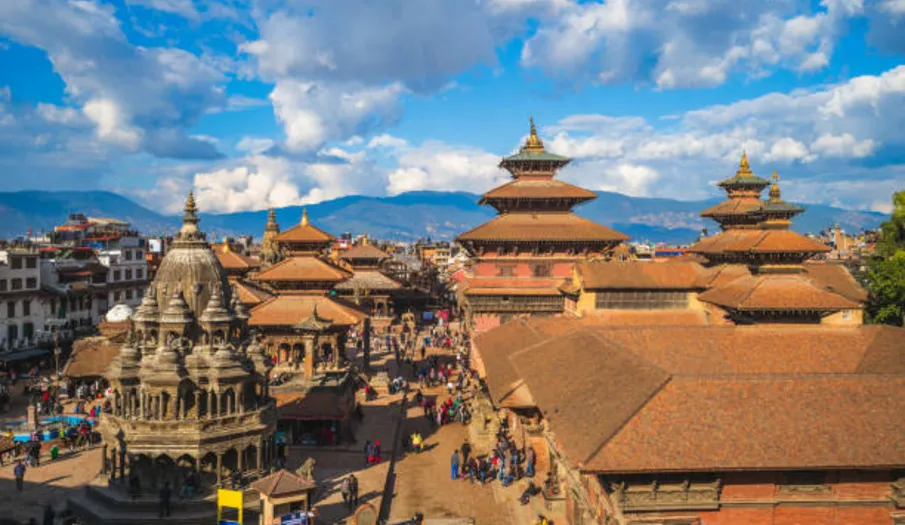
Patan Durbar Square in the Kathmandu Valley

Kathmandu to Ilam Vehicle Rental – Car, Scorpio & Hiace Guide

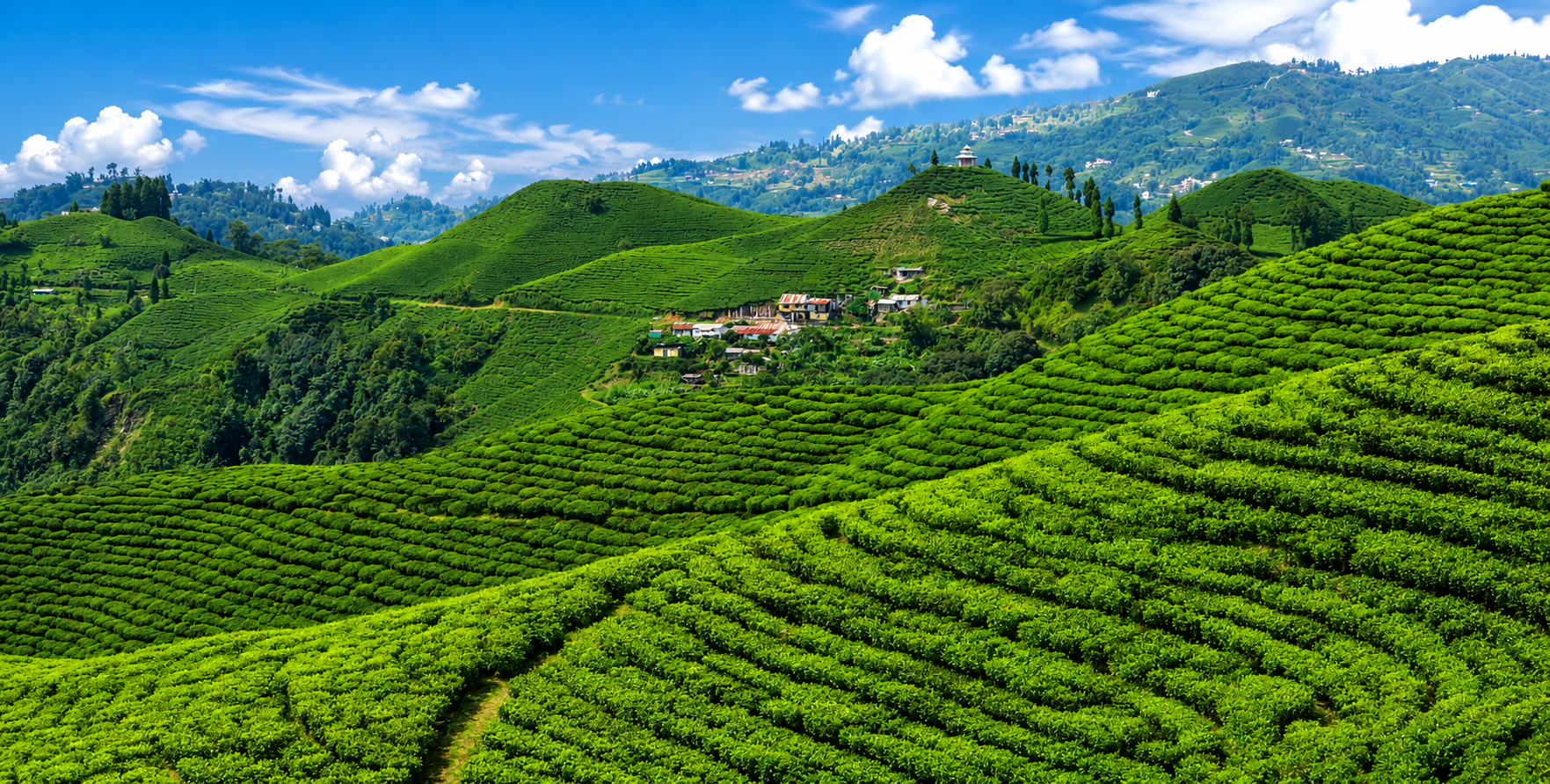
Ilam is Nepal’s most celebrated tea district – a lush, mist-draped highland in the eastern hills of Koshi Province where rolling tea gardens cascade down terraced slopes, cardamom plantations fill the forest floor with fragrance, and panoramic views of Kanchenjunga (8,586 m) – the world’s third-highest mountain – crown the horizon on clear mornings. Ilam is one of Nepal’s finest and least crowded natural destinations, offering a genuine escape from the mountain-circuit tourist trail into the peaceful beauty of eastern Nepal.

Reaching Ilam from Kathmandu by private vehicle is a long but deeply rewarding road journey of approximately 580-610 km through the Terai plains and eastern hill roads. For this eastern Nepal route, the Mahindra Scorpio and the Toyota Hiace van are the two most popular and practical vehicle choices – powerful enough for the mountain road to Ilam bazaar, spacious enough for group travel, and comfortable for the long highway journey across the Terai.

This complete  guide covers the full route, vehicle options, prices, road conditions, Ilam attractions, and how to book with Vehicle Hiring Nepal.

About Ilam – Nepal’s Tea Garden Paradise

Location: Ilam District, Koshi Province, eastern Nepal

Altitude: Ilam Bazaar at 1,200 m – tea gardens between 900 m and 2,100 m

Distance from KTM: Approximately 580–610 km by road

Famous For: Nepal’s finest orthodox teas, cardamom, Kanchenjunga views, trekking

Key Attractions: Mai Pokhari sacred lake, Shree Antu sunrise hill, Kanyam tea gardens, Phikkal

Travel Time: 12 to 15 hours from Kathmandu – 2-day journey recommended

Best Season: March to May (spring – first flush tea) and October to November (autumn)

Vehicle Options: Kathmandu to Ilam

Mahindra Scorpio – Best Choice for Ilam Road

Capacity: 6 to 9 passengers (7-seat and 9-seat versions)

Engine: 2.2L mHawk turbodiesel – powerful on hill roads

Best for: Groups of 5–8, families, trekkers – ideal for the Ilam hill section

The Mahindra Scorpio is the most popular vehicle on the Kathmandu-Ilam route. Its powerful diesel engine confidently handles the steep, winding road from the Terai plains up to Ilam Bazaar at 1,200 m. Its high ground clearance handles rough patches on eastern hill roads.

The spacious interior comfortably seats 6 to 7 passengers with luggage. For monsoon travel, the Scorpio’s 4WD capability gives it a significant safety advantage on wet hill roads.

Toyota Hiace Van – Best for Larger Groups

Capacity: 7 to 14 passengers

Best for: Groups of 8–14 – tea garden tours, family gatherings, corporate groups

The Toyota Hiace is ideal for larger groups making the Kathmandu-to-Ilam journey. With seating for up to 14 passengers and generous roof rack space for group luggage, the Hiace keeps everyone together for the full 2-day journey. It handles the Ilam hill road competently in dry conditions.

For monsoon travel, two Scorpios are preferred over a single Hiace.

Sedan Car – For Solo Travellers and Couples

Capacity: 1 to 3 passengers

Best for: Solo travellers and couples in the dry season – the Birtamod to Ilam road is manageable in dry conditions.

A sedan suits the main Terai highway section. However, the hill road from Birtamod to Ilam Bazaar and excursions to Mai Pokhari and Shree Antu are better handled by the Scorpio. For groups of 4 or more or monsoon travel, the Scorpio is always preferable.

Nepal Tour Package

Vehicle Rental Prices: Kathmandu to Ilam

VehicleCapacityOne-Way (USD)Round Trip (USD)Notes
Mahindra Scorpio6–9 paxUSD 180–400USD 300–680Best for Ilam Hill Road – recommended
Toyota Hiace Van7–14 paxUSD 200–450USD 340–800Best for groups of 8–14
Sedan Car1–3 paxUSD 140–300USD 240–600Solo/couple – dry season only
SUV4–5 paxUSD 170–300USD 290–800Small group – comfortable and capable
Toyota Coaster Bus15–22 paxUSD 280–450USD 460–800Large group tours to Ilam

All prices include driver, full fuel, and vehicle insurance. The 2-day journey requires an overnight stop; driver accommodation is not included. Contact Vehicle Hiring Nepal for exact pricing.

Kathmandu to Ilam Vehicle Rental: Car, Scorpio and Hiace Guide

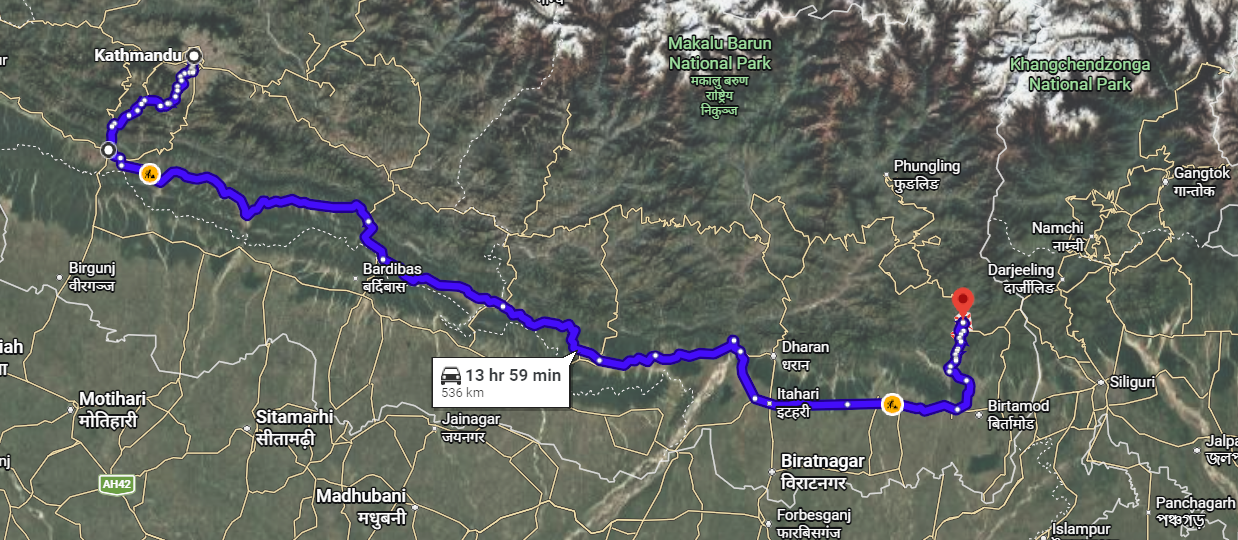
Route Overview: Kathmandu to Ilam

Total Distance: Approximately 580–610 km

Total Drive Time: 12 to 15 hours over 2 days

Day 1 Route: Kathmandu – Hetauda – East-West Highway – Itahari – Birtamod (overnight)

Day 2 Route: Birtamod – Kanyam tea gardens – Ilam Bazaar

Overnight Stop: Dharan or Birtamod – approximately 8–9 hours from Kathmandu

Stage-by-Stage Road Guide

Day 1, Stage 1: Kathmandu to Hetauda (95 km | 2.5 hrs)

Depart Kathmandu early – 5:30 to 6:00 AM. Head south through the Kathmandu Valley and descend through the Mahabharat Hills on the Tribhuvan Highway to Hetauda in the Terai. The Tribhuvan Highway is Nepal’s oldest road – winding, historic, and dramatic, with views over the Terai plains from the hill crests.

Hetauda is a good stop for an early-morning breakfast.

Day 1, Stage 2: Hetauda to Itahari via East-West Highway (330 km | 5.5 hrs)

From Hetauda, join the flat East-West Highway and drive east across Nepal’s Terai agricultural heartland. This is the longest section of the journey – a continuous drive through rice paddies, mustard fields, and subtropical forest. Pass through Chitwan, Sarlahi, Mahottari, Dhanusha, and Sunsari districts.

Stop for lunch in the Janakpur area or any larger Terai town. Arrive in Itahari, a busy junction in eastern Nepal. Dharan, 18 km north of Itahari, is the recommended overnight stop with better hotels and a more pleasant atmosphere.

Day 1 Overnight: Dharan or Birtamod

Dharan (Sunsari District) is the recommended overnight stop – a clean, pleasant hill-edge city with good hotels, restaurants, and the famous Budhasubba Temple, worth a brief visit. Alternatively, Birtamod in Jhapa District – 100 km east of Itahari – is closer to Ilam and a good alternative if you prefer a shorter Day 2 drive.

Day 2: Birtamod to Kanyam to Ilam Bazaar (50 km | 2.5–3 hrs)

Depart your overnight stop early – 6:30 to 7:00 AM. From Birtamod, the road heads north into the Ilam hills on the Mechi Highway. The scenery transforms dramatically from the flat Terai into a lush green hill landscape of bamboo, cardamom forest, and the first tea gardens appearing on the slopes.

Kanyam (1,050 m) is the must-stop of the entire journey – the most famous tea garden viewpoint in Nepal, where rolling green tea gardens cascade down the hillside, and the Jhapa Terai plains stretch to the horizon far below. On clear October and November mornings, Kanchenjunga (8,586 m) appears above the northeastern horizon – a striking surprise.

Buy fresh Ilam tea directly from garden stalls here. Continue to the Phikkal ridge viewpoint, then on to Ilam Bazaar at 1,200 m.

Distance and Time Summary

StageFrom – ToDistanceDrive TimeNotes
Day 1-AKathmandu → Hetauda95 km2.5 hrsTribhuvan Hwy – winding, scenic
Day 1-BHetauda → Itahari330 km5.5 hrsEast-West Hwy – fast, flat Terai
Day 1-CItahari → Birtamod80 km1.5 hrsTerai highway – paved
OVERNIGHTDharan / Birtamod––Hotel overnight
Day 2-ABirtamod → Kanyam35 km1.5 hrsHill road – winding, scenic tea gardens
Day 2-BKanyam → Ilam Bazaar15 km45 minSteep hill road – Scorpio ideal
TOTALKathmandu → Ilam580 km12–14 hrs2 days, including overnight

Swayambhunath visit during Kathmandu Pokhara TourWhy the Scorpio Excels on the Ilam Hill Road
  • Powerful mHawk diesel engine handles steep climbs from Terai base to Kanyam and Ilam without strain
  • High ground clearance manages rough patches, eroded edges, and surface irregularities on the hill road
  • 4WD capability (on 4WD versions) – essential safety advantage in monsoon wet conditions
  • Shorter wheelbase than Hiace – easier to navigate tight switchbacks on the Kanyam to Ilam section
  • 7 to 9 seats – perfect group size for most Ilam visitor parties without the bulk of a full Hiace on narrow roads
  • Dominant local vehicle in eastern Nepal hill roads – drivers are highly experienced on this specific route

Road Conditions: Kathmandu to Ilam
SectionRoad TypeConditionNotes
KTM → HetaudaPaved mountain roadGoodWinding but well-maintained
Hetauda → ItahariEast-West HighwayVery GoodFast, flat Terai road
Itahari → BirtamodPaved flat highwayGoodStandard Terai highway
Birtamod → KanyamPaved hill roadModerateWinding climb – Scorpio ideal
Kanyam → Ilam BazaarPaved/rough hill roadModerateSteep, narrow – Scorpio best
Ilam → Mai PokhariRough hill trackDifficult4WD/Scorpio required
Ilam → Shree AntuRough hill trackDifficult4WD/Scorpio required – unpaved

Kathmandu to Ilam Vehicle Rental: Car, Scorpio and Hiace Guide

Top Attractions in Ilam District

Kanyam – Tea Garden Viewpoint (Must-Stop)

Nepal’s most iconic tea garden viewpoint – rolling green tea garden rows cascade down the hillside with the Jhapa plains visible far below. In October and November, Kanchenjunga (8,586 m) appears above the northeastern horizon on clear mornings. Buy fresh first-flush Ilam tea directly from garden stalls – incomparably fresher than anything in Kathmandu shops.

Your vehicle passes through Kanyam on the way to Ilam Bazaar – a stop here is mandatory.

Mai Pokhari – Sacred Alpine Lake (2,100 m)

A Ramsar-listed sacred alpine lake 22 km north of Ilam Bazaar, surrounded by an ancient rhododendron forest. Home to over 100 bird species and a red panda habitat. The spring rhododendron bloom around Mai Pokhari (March to April) is spectacular.

The drive requires the Scorpio on the rough hill track—a deeply peaceful and beautiful destination.

Shree Antu Hill – Kanchenjunga Sunrise

The finest sunrise viewpoint in eastern Nepal is at an elevation of approximately 2,200 m. On clear October and November mornings, Kanchenjunga and the entire eastern Himalayan chain appear above the horizon at dawn – a panorama rivalling Sarangkot and Poon Hill in scale and drama. Requires a Scorpio on a rough hill track from Ilam Bazaar.

Ilam Tea Factory Tour

The Ilam Tea Processing Factory near the bazaar accepts small groups for guided tours showing the full tea processing cycle – withering, rolling, oxidation, and drying. The smell of fresh tea in the factory is extraordinary. Tours are usually arranged informally at the factory gate.

Pashupatinagar – Border Ridge Town

A fascinating border town at 1,700 m on the Nepal-India border with a unique cross-border market character. Views from the border ridge are spectacular. The drive through the cardamom forest to reach it is scenic.

Best Time to Visit Ilam

March to May (Best – First Flush Tea Season)

Spring is the finest time to visit Ilam. The first flush tea harvest (March to April) produces the most prized, delicately aromatic teas. Rhododendron forests around Mai Pokhari are in spectacular bloom.

Roads are dry and in good condition, making it the most celebrated time to visit the Ilam tea gardens.

October to November (Excellent – Clear Mountain Views)

Post-monsoon skies are brilliantly clear. Kanchenjunga views from Shree Antu and Kanyam are at their finest. The second flush tea harvest produces rich, full-bodied teas.

Roads are fully dry and in excellent condition.

December to February (Good – Clear but Cold)

Quiet and cold in Ilam. Upper hills can have frost and occasional snow. Kanchenjunga views in winter are extraordinarily sharp.

Good for independent travellers wanting Ilam without crowds.

June to September (Monsoon – Difficult)

Heavy rainfall has made the Birtamod-Ilam hill road wet and slippery. Scorpio 4WD is most valuable during the monsoon. Tea gardens are intensely green, but mountain views are obscured and not recommended unless specifically wanting the monsoon experience.

Kathmandu to Ilam Vehicle Rental: Car, Scorpio and Hiace Guide

Accommodation in Ilam

  • Budget Guesthouse: NPR 500 to NPR 1,200 – simple rooms, shared bathroom, local meals
  • Mid-range Hotel: NPR 1,500 to NPR 3,500 – attached bathroom, hot water, restaurant
  • Better Hotels: NPR 3,500 to NPR 6,000 – comfortable rooms, tea garden views, WiFi
  • Tea Estate Homestay: NPR 1,500 to NPR 3,000 – authentic experience with a tea farming family
  • Kanyam Teahouse: NPR 800 to NPR 2,000 – simple rooms with iconic tea garden views

Practical Tips for the Kathmandu to Ilam Journey

  • Plan a minimum of 2 days – overnight in Dharan or Birtamod. Trying to do itg it in one day (12+ hours) is exhausting.
  • Depart Kathmandu by 5:30 to 6:00 AM on Day 1 to reach Dharan before dark
  • The East-West Highway section is long – carry music, podcasts, or audiobooks for the group
  • Carry Nepali Rupees cash – ATMs in Dharan, Birtamod, and Ilam Bazaar, but not on the hill road
  • Stock up on water and snacks before leaving Birtamod – the hill road has limited, reliable stops
  • Motion sickness tablets are recommended for the Birtamod to Ilam switchback section
  • Visit Kanyam tea gardens in the morning – best light for photography and mountain views
  • Purchase fresh Ilam tea directly at Kanyam stalls – incomparably better than packaged supermarket tea

What is Included in Your Vehicle Rental

  • Mahindra Scorpio, Toyota Hiace, sedan, or SUV as selected – fully maintained and insured
  • Professional driver experienced on the Kathmandu to Ilam eastern Nepal route
  • Full fuel cost for the complete 2-day journey
  • Vehicle insurance throughout
  • Pickup from your Kathmandu hotel
  • Drop-off at your Ilam Bazaar hotel or any Ilam destination
  • Flexibility for Kanyam, Phikkal, and scenic stops on the hill road
  • Return journey from Ilam to Kathmandu on your chosen date
  • 24/7 WhatsApp support

Nepal Tour Package

How to Book Your Kathmandu to Ilam Vehicle

  1. Contact Vehicle Hiring Nepal via WhatsApp at +977 981-4227196 or visit vehiclehiringnepal.com
  2. Choose a vehicle – Scorpio for groups of 5–8, Hiace for groups of 9–14
  3. Confirm travel dates and departure time from Kathmandu (5:30–6:00 AM recommended)
  4. Provide the pickup address in Kathmandu
  5. Specify overnight stop preference – Dharan or Birtamod
  6. Mention special stops – Mai Pokhari, Shree Antu, Pashupatinagar
  7. Receive a full 2-day journey plan with the driver’s name and vehicle details

Frequently Asked Questions

How far is Ilam from Kathmandu by road?

Ilam is approximately 580-610 km from Kathmandu. The journey takes 2 days: Day 1 covers roughly 470 to 500 km to Dharan or Birtamod (8 to 9 hours), and Day 2 covers the remaining 90 to 115 km to Ilam via the scenic Kanyam hill road (3 to 4 hours).

The Birtamod-to-Ilam hill road has steep inclines, sharp switchbacks, and rough-surface sections that benefit from the Scorpio’s powerful diesel engine, high ground clearance, and 4WD capability. Excursions to Mai Pokhari and Shree Antu require a Scorpio or similar 4WD vehicle on rough tracks. For monsoon travel, the Scorpio’s 4WD is essential for safety.

Can I do Kathmandu to Ilam in one day?

Not comfortably. The total drive is 12 to 15 hours, including the challenging Birtamod-to-Ilam hill section. Two days with an overnight in Dharan or Birtamod is the standard approach – giving everyone a proper rest and allowing a relaxed morning arrival in Ilam.

What is the best tea to buy in Ilam?

The most prized is first-flush orthodox tea (March to April) – light, aromatic, and delicately floral. The second flush (June) is fuller, with muscatel notes. Ilam green tea and silver tips (white tea) are also excellent.

Purchase directly at Kanyam garden stalls or from the Ilam Tea Factory for the freshest product.

Is Ilam suitable for families with children?

Yes – the gentle tea garden walks, cultural richness, fresh mountain air, and beautiful natural setting are excellent for families. The main challenge is the long 2-day drive – plan regular stops along the East-West Highway and keep children engaged with the changing landscape through the windows.

Final Thoughts

The road from Kathmandu to Ilam is one of Nepal’s great east-west journeys – a 2-day traverse from the mountain capital across the vast Terai plains and up into the misty tea-covered hills of eastern Nepal where Kanchenjunga watches over rolling green gardens. Ilam is one of Nepal’s most rewarding and under-visited destinations – a place of quiet beauty, fragrant air, and extraordinary tea.

The Mahindra Scorpio and Toyota Hiace are the perfect vehicles for this journey – powerful on the eastern hill roads, spacious for the group and luggage, and reliable across the long Terai highway. Vehicle Hiring Nepal provides both vehicles with experienced Eastern Nepal drivers who know every switchback of the Kanyam road.

Book your Kathmandu-to-Ilam vehicle rental today. WhatsApp: +977 981-4227196 | E-mail: [email protected]

Kathmandu to Pokhara Transfer by Every Vehicle Type

Patan Durbar Square in the Kathmandu Valley

Kathmandu to Pokhara  All Vehicle Transfer – Complete Guide

The road from Kathmandu to Pokhara is Nepal’s most travelled highway – a 200 km journey along the famous Prithvi Highway that connects the mountain capital with the lakeside city of Pokhara. Every day, thousands of travellers make this journey by a wide variety of vehicles: private sedans, SUVs, Hiace vans, Coaster buses, tourist buses, and public buses. Each vehicle type offers a different experience, price point, and level of comfort and flexibility.

Whether you are a solo backpacker on a tight budget, a family of five, a trekking group of twelve, or a corporate team of thirty, Vehicle Hiring Nepal has the perfect vehicle for your Kathmandu-to-Pokhara transfer. This complete guide covers every vehicle option available on this route – with full pricing, vehicle descriptions, comfort comparisons, and expert advice on choosing the right vehicle for your group and travel style.

Route Overview: Kathmandu to Pokhara

Distance: Approximately 200 km by road

Travel Time: 5 to 8 hours, depending on vehicle type and traffic

Main Road: Prithvi Highway – Nepal’s primary east-west arterial highway

Key Milestones: Naubise – Malekhu – Mugling Junction (midpoint/lunch stop) – Damauli – Pokhara

Best Departure: 6:00 to 7:30 AM from Kathmandu to arrive in Pokhara by early to mid-afternoon

Arrival Point: Tourist buses arrive at Lakeside (Baidam). Private vehicles deliver directly to your hotel

Scenic Highlight: Trishuli River gorge (Naubise to Mugling) and final Pokhara valley approach with Annapurna views

All Vehicle Options at a Glance

Here is a complete overview of every vehicle type available from Kathmandu to Pokhara in 2026 – from the most budget-friendly to the most comfortable:

Vehicle TypeCapacityPrice RangeTravel TimeBest For
Standard Tourist Bus (shared)Per seatUSD 10–15/person7–8 hrsSolo budget travellers, backpackers
Deluxe Tourist Bus (shared)Per seatUSD 15–20/person7–8 hrsComfort-seeking solo/couple travelers
Greenline Luxury Bus (shared)Per seatUSD 25–30/person6–7 hrsTop-end comfort includes lunch
Private Tourist Bus (full)25–40 paxUSD 300–500 full7–8 hrsLarge groups, schools, tours
Sedan Car (private)1–3 paxUSD 80–150 full car5–6 hrsCouples, small families, fast travel
SUV / Scorpio4–5 paxUSD 120–200 full5–6 hrsFamilies, small groups with luggage
Toyota Hiace Van (private)7–14 paxUSD 130–200 full5–6 hrsGroups, trekkers, corporate teams
Toyota Coaster Bus (private)15–22 paxUSD 250–400 full6–7 hrsMedium groups, school trips, tours
Full-Size Bus (private)23–45 paxUSD 250–500 full6–7 hrsLarge groups, pilgrimage parties
Private Jeep4–6 paxUS150- 20000 full5–6 hrsGroups needing onward mountain travel

All private vehicle prices are for the complete vehicle – not per person. All prices include the driver, fuel, and vehicle insurance. Tourist bus prices are per seat on a shared service.

Contact Vehicle Hiring Nepal for your exact 2026 quote based on your travel date and group size.

Begnas Lake Pokhara

Private Sedan Car – Kathmandu to Pokhara

Capacity: 1 to 3 passengers

Price: USD 100 to USD 150 for the full vehicle one-way

Travel Time: 5 to 6 hours

Models: MG, Honda City, Suzuki Ciaz, Hyundai Berza, BYD Accent

Who is the Sedan Car Best For?

The sedan car is the ideal choice for solo travellers, couples, and small families of up to 3 people who want a private, comfortable, and fast journey without paying for a larger vehicle. For a couple splitting the cost of the sedan, the per-person price (USD 40 to USD 55 each) is only marginally higher than a deluxe tourist bus ticket – with enormous advantages in flexibility, speed, and comfort.

Sedan Car Advantages

  • Fastest option for small groups – no scheduled stops, no fixed route, depart from your hotel door.
  • Air-conditioned throughout – drive in comfort regardless of outside temperature
  • Flexible departure time – leave at any hour that suits your schedule
  • Door-to-door service – hotel in Kathmandu to hotel in Pokhara Lakeside without leaving the vehicle
  • Stop anywhere you choose – riverside tea stop at Malekhu, photo stop at the Trishuli gorge, lunch at any Mugling restaurant
  • Private and quiet – perfect for couples, families with small children, and business travellers

Sedan Car Limitations

  • Limited boot space – maximum 2 to 3 standard bags plus daypacks
  • Not suitable for large trekking packs (70L+) for more than 2 passengers
  • Only suitable for 3 passengers maximum – not cost-effective for groups of 4+

Sarangkot Pokhara

SUV and Jeep – Kathmandu to Pokhara

Capacity: 4 to 6 passengers

Price: USD 150 to USD 200 for the full vehicle one-way

Travel Time: 5 to 6 hours

Models: Private 4Wd Jeep, Scorpio, Sumo

Who is the SUV Best For?

The SUV is the most versatile vehicle for the journey from Kathmandu to Pokhara. A family of 4 to 5, a small group of friends or colleagues, or a group of trekkers with large backpacks will find the SUV offers the best balance of space, comfort, and cost per person across the entire route.

SUV Advantages

  • Spacious interior with genuine comfort for 4 to 5 passengers – not cramped like a sedan with 3
  • Large boot space for trekking packs, family luggage, and camera equipment
  • A high seating position gives excellent road views and a commanding driving presence
  • 4WD capability on Land Cruiser models – essential if continuing onward to Mustang, Manang, or other mountain routes from Pokhara
  • All the flexibility advantages of a private car – door-to-door, depart any time, stop anywhere
  • Per-person cost for a group of 5 (USD 22 to USD 29 each) is less expensive than a deluxe tourist bus

Jeep for Onward Mountain Routes

If you are travelling from Kathmandu to Pokhara and then continuing onward to Mustang, Muktinath, Ghasa, or the Annapurna Circuit, it makes sense to book a  4WD jeep for the full journey from the start. The same vehicle can take you from Kathmandu to Pokhara on Day 1, let you rest overnight, and continue into the Kali Gandaki Valley on Day 2 without changing vehicles or drivers.

Pokhara to Sarangkot Jeep

Toyota Hiace Van – Kathmandu to Pokhara

Capacity: 7 to 14 passengers

Price: USD 160  to USD 250 for the full vehicle one-way

Travel Time: 5 to 6 hours

Model: Toyota Hiace (standard and high-roof versions)

Who is the Hiace Best For?

The Toyota Hiace is Nepal’s most popular group vehicle and the top choice for trekking groups, family gatherings, corporate team travel, and tour groups between 7 and 14 people. For a group of 10 trekkers sharing a Hiace, the per-person cost (USD 13 to USD 17 each) makes it far more economical than any other private vehicle option and comparable to individual tourist bus tickets – while offering the huge advantage of keeping the whole group together in one vehicle.

Hiace Advantages

  • Best value per person for groups of 7 to 14 – often cheaper per seat than tourist bus tickets
  • Keeps the entire group together in one vehicle – no splitting across multiple taxis or buses
  • Full group luggage space for trekking packs, camera bags, and personal luggage
  • Air-conditioned throughout with individual seat recline
  • Private departure from your Kathmandu hotel at any time the group chooses
  • Driver familiar with Pokhara hotel locations – direct drop-off for all passengers
  • Flexible for Mugling lunch stop, Malekhu tea break, or any scenic stop along the route

Hiace vs Tourist Bus – Group Decision Guide

For groups of 7 or more, the Hiace van is almost always a better choice than booking individual seats on tourist buses. You keep the whole group together, depart from your hotel (not the bus park), stop whenever you want, and arrive directly at your hotel in Pokhara.

The per-person price is often similar or lower. The only exception is when group members are arriving in Kathmandu at different times and cannot coordinate a group departure, in which case individual tourist bus tickets may be more practical.

Toyota Coaster Bus – Kathmandu to Pokhara

Capacity: 15 to 22 passengers

Price: USD 250 to USD 400 for the full vehicle one-way

Travel Time: 6 to 7 hours

Model: Toyota Coaster (standard 22-seat configuration)

Who is the Coaster Best For?

The Toyota Coaster is the ideal mid-size bus for medium-large groups of 15 to 22 people. School trips, company outings, cultural tour groups, and extended family travel parties all find the Coaster perfectly sized – smaller than a full bus (making it more agile on the highway) but larger than two Hiace vans (keeping the whole group in one vehicle at a lower combined cost).

Coaster Advantages

  • Keeps groups of 15 to 22 together in a single vehicle – avoids the coordination complexity of two separate Hiace vans
  • More comfortable than a full public bus – dedicated seats, better A/C, cleaner vehicle
  • Per-person cost for a full 22-seat Coaster (USD 8 to USD 10.50 each) is competitive with tourist bus tickets.
  • Comfortable reclining seats with good legroom – better than many shared tourist buses
  • Private departure time and door-to-door service
  • Suitable for luggage undercarriage or roof rack for excess baggage

Coaster for School and Cultural Groups

The Toyota Coaster is extremely popular for school excursions, cultural group tours, and religious pilgrimage parties travelling from Kathmandu to Pokhara. The enclosed, supervised environment of a single Coaster bus is far preferable for school groups than multiple separate vehicles. Vehicle Hiring Nepal has a fleet of well-maintained Coaster buses specifically for group transfers on this route.

Full-Size Private Bus – Kathmandu to Pokhara

Capacity: 23 to 45 passengers (various configurations)

Price: USD 250 to USD 360 for the full vehicle one-way

Travel Time: 6 to 7 hours

Types: Standard bus (30 seats), luxury recliner bus (35–40 seats), sleeper bus (for night journeys)

Who is the Full Bus Best For?

Private full-size bus hire is the choice for large groups of 23 or more – corporate tours, monastery groups, large school trips, extended family gatherings, and conference transport. Chartering a private bus gives all passengers the security and convenience of a private vehicle with the economics of group travel.

Full Bus Advantages

  • Most economical option for large groups – per-person cost for a full 40-seat bus can be as low as USD 6-9. The entire large group travels together in one coordinated vehicle.
  • Private charter means no strangers, no shared stops, and departure at your chosen time.
  • Luggage compartment beneath the bus for excess luggage
  • Option for luxury recliner bus with wider seating, A/C and onboard entertainment
  • Can arrange multiple buses for very large groups – Vehicle Hiring Nepal coordinates multi-vehicle convoys

Tourist Bus (Shared) – Kathmandu to Pokhara

Price: USD 10 to USD 30 per person, depending on service level

Travel Time: 7 to 8 hours (standard) / 6 to 7 hours (Greenline luxury)

Departure: 7:00 AM daily from Kantipath tourist bus park (Thamel area)

Arrival: Pokhara Lakeside (Baidam) tourist bus stop

Standard Tourist Bus – USD 10 to USD 15 per person

The standard tourist bus is a shared coach service with reclining seats and air conditioning, departing Kathmandu at 7:00 AM daily and arriving in Pokhara Lakeside between 2:00 and 3:00 PM. It is designed specifically for international travellers and is a significant step up from local Nepali public buses in terms of comfort and convenience.

One scheduled lunch stop at Mugling (30 to 45 min). Luggage is stored in the undercarriage hold. Suitable for solo and budget-conscious travellers seeking a reasonable travel experience at the lowest price.

Deluxe Tourist Bus – USD 15 to USD 20 per person

The deluxe tourist bus offers wider, more comfortable seats with better legroom, improved air conditioning, and sometimes additional services such as bottled water. The vehicle is typically newer and in better condition than the standard tourist bus. Recommended for travellers who want slightly more comfort than the basic tourist bus without paying Greenline prices.

Nepal  Vehicle Hiring  Luxury Bus – USD 25 to USD 30 per person

Nepal’s premier shared tourist bus service on the Kathmandu-to-Pokhara route. Top-end reclining seats, superior air conditioning, complimentary sit-down lunch at Mugling (included in ticket price), drinking water, and a generally higher standard of vehicle and service. Departs at 8:00 AM.

Greenline is consistently rated the most comfortable and reliable shared bus on this route and is the top recommendation for solo or couple travellers who want the best quality shared-bus option.

Tourist Bus vs Private Vehicle – Who Should Choose What?

FactorTourist Bus (Shared)Private Car/Van
Cost for 1 personUSD 10–30 – cheapest optionUS$120 full car – more expensive
Cost for 4 personsUSD 40–120 total (4 x tickets)USD 120–200 full SUV – often comparable
Cost for 10 personsUSD 200–300 total (10 x tickets)USD 130–250 Hiace – usually cheaper
Departure timeFixed – 7:00 or 8:00 AM onlyAny time you choose
Departure locationTourist bus park (Kantipath)Your hotel door
ArrivalLakeside bus stop (walk/taxi to hotel)Your hotel door
Travel time7–8 hours5–6 hours
StopsFixed – Mugling lunch onlyAnywhere, anytime
LuggageUndercarriage hold (limited)Full boot/van space
PrivacyShared with 30–40 strangersYour group only
Best forSolo, budget, backpackers, couplesGroups, families, trekkers

Key insight: For groups of 4 or more, a private SUV or Hiace van is often more economical per person than individual tourist bus tickets – while providing door-to-door service, faster travel time, and complete flexibility. The tourist bus is truly economical only for solo travellers and couples, for whom the cost of a private vehicle cannot be split among multiple passengers.

The Road: Kathmandu to Pokhara Stage by Stage

The Prithvi Highway from Kathmandu to Pokhara is one of Nepal’s most scenic drives. Here is a complete guide to the route regardless of which vehicle you choose:

Kathmandu to Naubise (30 km | 45 min)

Exit Kathmandu heading west through Kalanki. The road climbs over the Chandragiri foothills before descending to Naubise. Morning rush hour can slow this section – a pre-7:00 AM departure helps.

Clear skies give views back over the Kathmandu Valley as you climb the first ridge.

Naubise to Malekhu (50 km | 1 hr)

The road descends into the spectacular Trishuli River gorge and runs along the riverbank through dense forest. Malekhu is a popular tea and snack stop with riverside restaurants known for fresh fish from the Trishuli River. The left side of the vehicle gives the best views of the river – request a left-side seat on the tourist bus if possible.

Malekhu to Mugling Junction (30 km | 45 min)

Continue along the gorge to Mugling – the busy junction town at the confluence of the Trishuli and Marsyangdi rivers. Mugling is the standard and recommended lunch stop for all vehicles – around the 2.5- to 3-hour mark from Kathmandu. Dozens of roadside restaurants serve dal bhat, noodles, momo, and tea.

Budget 30 to 45 minutes here.

Mugling to Damauli (50 km | 1 hr)

From Mugling, the road turns northwest, following the Marsyangdi River valley. Dumre is the junction for the Annapurna Circuit road heading north. Damauli is a pleasant hill town with views over the confluence of the Seti and Madi rivers.

On clear days, the Annapurna range begins to appear on the northern horizon.

Damauli to Pokhara Lakeside (40 km | 45 min)

The final approach descends gently into the Pokhara valley. On clear mornings, the Annapurna range – including the iconic Machhapuchhre (Fishtail) at 6,993 m – fills the horizon ahead. Private vehicles drop you off directly at your Lakeside hotel.

Tourist buses drop off at the Lakeside (Baidam) bus stop area.

Which Vehicle Should You Choose? – Decision Guide

Not sure which vehicle is right for your group? Use this guide:

Solo Traveler

A tourist bus (standard or Greenline) is your best option. The per-seat price is the lowest available, you meet other travellers, and the journey is perfectly comfortable for a solo rider. If you want privacy and speed, and budget is secondary, a solo sedan car booking is also available.

Couple (2 People)

A shared tourist bus offers the best value per person. However, if you value privacy, flexibility, and a faster journey, splitting a sedan car (USD 40 to USD 55 per person) is a worthwhile upgrade for a much better experience.

Family of 4 to 5

A private SUV or Toyota Fortuner is the clear recommendation. At USD 22 to USD 36 per person (split 4 to 5 ways), the cost is competitive with tourist bus tickets while offering door-to-door service, ample luggage space for family bags, car seats for children, the flexibility to stop for children’s needs, and a much faster journey. A family with young children benefits enormously from the flexibility of a private vehicle.

Trekking Group of 6 to14e

Toyota Hiace van is the outstanding choice. It keeps the whole group together, provides ample space for all trekking packs, departs from your Kathmandu hotel at a time that suits your group, and is economical at USD 13 to USD 43 per person (depending on group size). No more herding everyone onto the 7:00 AM tourist bus or coordinating multiple separate taxis.

Large Group of 15 to 22

Toyota Coaster bus is ideal. A single Coaster keeps the full group coordinated in one vehicle, is more comfortable than squeezing into two Hiace vans, and has a per-person cost that is competitive with tourist bus seats. Perfect for school trips, corporate outings, and cultural group tours.

Very Large Group of 23+

Private full-size bus charter. For groups of 23 or more, a dedicated private bus is the most practical and economical solution. Vehicle Hiring Nepal can also arrange multiple vehicles in a convoy for very large groups that exceed a single bus’s capacity.

Kathmandu to Pokhara by All Vehicle Transfer

Best Time to Travel from Kathmandu to Pokhara

October to November (Peak Season)

The finest time for the Kathmandu to Pokhara journey. Post-monsoon skies are crystal clear, the Annapurna and Manaslu ranges are brilliantly visible from the road, and conditions are ideal. Book all vehicle types – especially tourist bus seats and private vehicles – well in advance, as demand is highest during October and November.

Trekking groups and pilgrimage parties quickly fill vehicles during this peak period.

December to February (Winter – Clear and Quiet)

Winter is excellent for the journey with clear skies and light traffic. Mountain views from the Pokhara valley on arrival are among the year’s sharpest. The Prithvi Highway is fully accessible.

Tourist bus availability is easy. Carry a jacket as the vehicle’s A/C can be cold on winter mornings.

March to May (Spring – Good Season)

Spring is the second-best season, with rhododendrons blooming along the hillsides above the Trishuli gorge. Good mountain views in the morning. Roads are dry and in good condition.

Popular with Annapurna region trekkers heading to Pokhara to start their trek.

June to September (Monsoon)

The Prithvi Highway remains open during monsoon, but heavy rain can slow the journey. Landslides occasionally affect sections of the gorge near Naubise and Mugling. Severe rain can extend journey times by 1 to 2 hours.

Mountain views are generally obscured by cloud. Travel is safe but less comfortable. Private vehicles offer more flexibility during the monsoon than fixed-schedule tourist buses.

Practical Tips for Every Vehicle Type

Tips for Tourist Bus Travelers

  • Book your tourist bus ticket 1 to 3 days in advance during October, November, March, and April – buses fill up in peak season.
  • Request a left-side window seat when purchasing – the left side gives the best Trishuli River views between Naubise and Mugling.
  • Arrive at the tourist bus park on Kantipath by 6:30 AM – buses depart at 7:00 AM sharp and do not wait
  • Keep your daypack with valuables inside the bus – put only checked luggage in the undercarriage hold.
  • The Mugling lunch stop is 30 to 45 minutes – use the facility board; there is an onboard toilet.
  • Dress in layers – tourist bus A/C can be very cold, especially in the morning and in winter months

Tips for Private Vehicle Travelers

  • Depart between 6:00 and 8:00 AM to arrive in Pokhara by early to mid-afternoon, leaving time for sightseeing.s
  • Inform your driver at the time of booking if you want specific stops – Malekhu for tea, Mugling for lunch, and Damauli for a scenic break.
  • For large groups using Hiace or Coaster, confirm luggage arrangement before departure – roof rack if needed for trekking .packs
  • If traveling with children, let us know at the time of booking so we can provide an appropriate vehicle with comfortable seating.
  • The left side of any private vehicle also gives the best gorge views between Naubise and Mugling – arrange seating accordingly.
  • If prone to motion sickness, sit in the front passenger seat and take medication 30 minutes before departure.

Booking Your Kathmandu to Pokhara Vehicle Transfer

Vehicle Hiring Nepal makes booking simple for every vehicle type on the Kathmandu to Pokhara route:

Tourist Bus Ticket Booking

Contact us via WhatsApp or our website with your travel date, preferred bus type (standard, deluxe, or Greenline), and number of passengers. We confirm seat availability and send your ticket details. You can collect your physical ticket from our office in Thamel or receive a digital confirmation.

We can arrange hotel pickup to the bus park if needed.

Private Vehicle Booking

Please tell us your group size, preferred vehicle type, travel date, departure time, and pickup and drop-off addresses. We confirm your booking with driver details, vehicle type, and exact pickup time. Your driver will message you the evening before to confirm the arrangement.

Payment can be made in advance or on the day of travel.

  1. Contact us via WhatsApp or visit vehiclehiringnepal.com
  2. Provide your travel date and preferred departure time
  3. Confirm your group size and luggage requirements
  4. Choose your vehicle type – we advise if you are unsure
  5. Provide pickup address in Kathmandu and drop-off hotel in Pokhara
  6. Receive booking confirmation with driver details and vehicle information

WhatsApp: +977 981-4227196

Email: [email protected]

What is Included in Your Private Vehicle Hire

  • Professional, licensed driver with experience on the Kathmandu to Pokhara route
  • Full fuel cost for the complete journey
  • Vehicle insurance
  • Direct pickup from your Kathmandu hotel or specified address
  • Direct drop-off at your Pokhara hotel or any Lakeside address
  • Flexible rest stops at Malekhu, Mugling, Damauli, or any other point on request
  • 24/7 support before and during the journey

Not included for private vehicles: Personal meals at stops, accommodation, and any additional detour stops beyond Pokhara. Tourist bus tickets do not include hotel pickup (unless specified) or food (except Greenline, which includes lunch).

Frequently Asked Questions

What is the cheapest way to travel from Kathmandu to Pokhara?

The cheapest option is the standard tourist bus, priced at USD 1-15 per person. For solo travelers and couples, this is genuinely the most economical choice. However, for groups of 4 or more, a private Hiace or SUV often works out cheaper per person than individual seats on tourist buses while offering much greater comfort and convenience.

What is the fastest way to travel from Kathmandu to Pokhara by road?

A private sedan car or SUV departing early morning (6:00 AM) with no fixed stops completes the journey in 5 to 5.5 hours – the fastest road option. Tourist buses take 7 to 8 hours due to fixed departure times, scheduled stops, and multiple passenger pickups. Flying from Kathmandu to Pokhara takes 25 minutes but requires airport check-in, transfers, and the risk of weather delays.

Is it safe to travel by tourist bus from Kathmandu to Pokhara?

Yes. Licensed tourist buses operating on the Kathmandu-to-Pokhara route are well-maintained, regularly inspected, and driven by experienced professional drivers. Vehicle Hiring Nepal only sells tickets for licensed, reputable tourist bus operators.

The Prithvi Highway is Nepal’s main national highway and is in good general condition year-round.

Can I book a private bus for my school trip from Kathmandu to Pokhara?

Yes. Vehicle Hiring Nepal specializes in group vehicle bookings, including school trips, corporate outings, and cultural tours. For school groups, we recommend the Toyota Coaster for groups of 15 to 22 students or a full-size bus for larger groups.

All our vehicles are fully insured, and our drivers are experienced in meeting group travel requirements. Contact us with your group size and travel date for a customized quote.

Can I bring large trekking packs on the tourist bus?

Yes, but with limitations. Tourist bus luggage storage is in the undercarriage with a limited total capacity. Very large packs (80L+) can sometimes be difficult to accommodate and may require negotiation with the bus driver for roof storage.

For trekking groups with multiple large packs, a private Hiace van is strongly recommended over the tourist bus – it provides unlimited boot space for all your gear with no risk of luggage issues.

What if I miss the tourist bus departure at 7:00 AM?

If you miss the 7:00 AM tourist bus departure, you have limited options for same-day shared transport. Some operators run a second departure at 8:00 AM (Greenline and select deluxe services). Otherwise, you will need to take a taxi or hire a private vehicle.

Contact Vehicle Hiring Nepal if you miss your bus – we can often arrange a private car or shared taxi within 1 to 2 hours.

Can I travel from Kathmandu to Pokhara at night?

Local overnight buses depart from the Gongabu Bus Park in Kathmandu in the evening (7:00 to 9:00 PM) and arrive in Pokhara in the early morning (3:00 to 5:00 AM). These are basic local buses without A/C and are not recommended for international travelers. Arriving in Pokhara before dawn with luggage is not ideal.

The daytime journey on a tourist bus or private vehicle is significantly preferable.

Final Thoughts

The Kathmandu to Pokhara route is one of Nepal’s most iconic and most travelled road journeys – a 200 km passage through mountain foothills, river gorges, and green valleys that ends with one of the world’s most beautiful city approaches as the Annapurna range fills the horizon over Pokhara. Whether you experience it in a private sedan, a family SUV, a group Hiace van, a shared tourist bus, or a chartered private bus, the journey is memorable and the destination magnificent.

Vehicle Hiring Nepal offers every type of vehicle on this route – from individual tourist bus tickets to full private bus charters. Whatever your group size, budget, or travel preferences, we have the right vehicle for your Kathmandu-to-Pokhara transfer. Book with confidence, knowing your vehicle is reliable, your driver is experienced, and your journey will be completed.

Book your Kathmandu-to-Pokhara vehicle transfer today. WhatsApp: +977 981-4227196 | Website: www.vehiclehiringnepal.com | Email: [email protected]. We are available 24 hours a day, 7 days a week.

Kathmandu to Pokhara Private Jeep: Complete Guide

Patan Durbar Square in the Kathmandu Valley

Kathmandu to Pokhara Private Jeep

When it comes to travelling from Kathmandu to Pokhara, a private jeep hire is the top-end road option – combining the speed and flexibility of a private car with the power, space, and capability of a 4WD vehicle. Whether you are a group of trekkers heading to the Annapurna region with heavy gear, a family wanting maximum comfort on Nepal’s most scenic highway, or a traveller planning to continue onward to Mustang, Jomsom, or the Kali Gandaki valley from Pokhara, a private jeep from Kathmandu meets every requirement with ease.

This complete guide covers everything you need to know about hiring a private jeep from Kathmandu to Pokhara – jeep models, prices, the road route, what makes a jeep the best vehicle choice, how it compares to other options, and how to book your vehicle with Vehicle Hiring Nepal.

Why Choose a Private Jeep from Kathmandu to Pokhara?

A private jeep offers specific advantages over both the tourist bus and a standard sedan car on this route. Here is why trekkers, families, and adventure travellers consistently choose the jeep:

Power and Capacity

Toyota Land Cruisers and Prado jeeps seat 4 to 6 passengers comfortably with full luggage space in the boot. Their larger engines handle the Prithvi Highway’s gradients confidently, and their higher ground clearance provides a better ride over the occasional rough sections of road near Naubise. For trekkers with 70L backpacks, sleeping bags, trekking poles, and camera bags, the jeep boot provides enough space for all gear without compromise.

Onward Mountain Route Capability

The single biggest reason to choose a jeep over a sedan for the Kathmandu-to-Pokhara journey is what comes after Pokhara. If your itinerary continues to Mustang, Muktinath, the Kali Gandaki gorge, Manang, the Annapurna Circuit, Nayapul, or any other mountain destination from Pokhara, you need a 4WD-capable vehicle.

Hiring a Land Cruiser from Kathmandu means the same vehicle, the same experienced driver, and the same comfortable journey continues smoothly from Pokhara into the mountains – no vehicle change, no new driver to brief.

Superior Comfort for Long Journeys

The Toyota Land Cruiser and Prado are among the most comfortable 4WD vehicles available in Nepal. High-quality reclining seats, excellent air conditioning, good sound insulation, and a smooth, high-clearance ride make the 5- to 6-hour Kathmandu-to-Pokhara journey genuinely enjoyable, not merely tolerable. Families with children, elderly travellers, and anyone who values comfort will appreciate the difference between a Land Cruiser and a standard sedan or tourist bus.

Flexibility and Speed

A private jeep departs from your Kathmandu hotel at any time you choose – 5:30 AM for early birds or 8:00 AM for those who prefer a relaxed start. It drops you off directly at your Pokhara hotel, without a bus stop or taxi connection. It covers the 200 km in 5 to 6 hours, 1 to 2 hours faster than the tourist bus on the same route.

Begnas Lake Pokhara

Jeep Models Available: Kathmandu to Pokhara

Vehicle Hiring Nepal provides a range of 4WD jeep models for the Kathmandu-to-Pokhara route. Here is a guide to each:

Toyota Land Cruiser – The Gold Standard

Capacity: 4 to 6 passengers with full luggage

Engine: 4.5L V8 turbodiesel – powerful and fuel-efficient on long highways

Features: Leather seats, powerful A/C, large boot, full 4WD, high ground clearance

Best for: Groups of 4 to 6, trekkers with heavy gear, multi-day mountain journeys from Pokhara

The Toyota Land Cruiser (LC70, LC78, LC79 series) is the most capable and most trusted vehicle in Nepal’s mountain transport fleet. Decades of reliability on Nepal’s roughest roads have made the Land Cruiser the go-to choice for serious mountain travel. The Kathmandu-to-Pokhara journey is smooth, powerful, and comfortable – and when the Pokhara-to-Mustang continuation begins, it is simply the best vehicle available.

Toyota Land Cruiser Prado – Top-end Comfort

Capacity: 4 to 5 passengers with luggage

Engine: 2.8L turbodiesel

Features: Top-end interior, climate control, leather seats, excellent highway ride quality

Best for: Couples, small families, travellers prioritising comfort over maximum luggage capacity

The Prado is a more refined and comfortable vehicle than the workhorse Land Cruiser, with a smoother ride on paved highways, a top-end interior, and a more car-like driving experience. It sacrifices some load capacity compared to the full Land Cruiser. Still, it is an excellent choice for smaller groups seeking the utmost comfort on the Kathmandu-to-Pokhara highway journey.

Toyota Fortuner – Best Value 4WD

Capacity: 5 to 6 passengers with luggage

Engine: 2.8L turbodiesel

Features: 7-seat option, good A/C, comfortable highway ride, solid 4WD

Best for: Families of 4 to 5, groups wanting 4WD capability at a slightly lower price point

The Toyota Fortuner is a popular mid-range SUV that provides genuine 4WD capability at a price point between a standard sedan and the Land Cruiser. Excellent for the Kathmandu-to-Pokhara highway journey and capable on most mountain tracks from Pokhara, though not as capable as the Land Cruiser on the most demanding routes like Soti Khola or Upper Mustang.

Mahindra Bolero / Scorpio – Budget 4WD

Capacity: 4 to 6 passengers

Features: Rugged and capable 4WD, high ground clearance, good boot space

Best for: Budget-conscious trekking groups who need 4WD onward capability

Indian-manufactured Bolero and Scorpio jeeps are widely used in Nepal’s mountain transport network. They are robust, capable, and affordable – a good option for groups where budget is the priority and maximum luxury is not the goal. They’re comfortable on the Pokhara highway, but the ride quality is rougher than Toyota alternatives.

Sarangkot Pokhara

Private Jeep Prices: Kathmandu to Pokhara 2026

Jeep ModelCapacityOne-Way (USD)Round Trip (USD)Best Use
Toyota Land Cruiser4–6 paxUSD 300–600USD 800–1200Full group, heavy gear, mountain onward
Toyota Land Cruiser Prado4–5 paxUSD 300–500USD 700–1200Comfort priority, smaller group
Toyota Fortuner / SUV5–6 paxUSD 300–400USD 700–900Best value 4WD, family, or small group
Mahindra Bolero / Scorpio4–6 paxUSD 120- 200USD 200–450Budget group, 4WD requirement
Sedan Car (for comparison)1–3 paxUSD 100–150USD 200–350No 4WD – Pokhara highway only

All prices include the driver, full fuel for the Kathmandu-to-Pokhara journey, and vehicle insurance. One-way pricing is for the single journey from Kathmandu to Pokhara. Round-trip pricing includes the return journey from Pokhara to Kathmandu on your chosen return date.

For extended multi-day itineraries from Pokhara into Mustang or the Annapurna region, contact Vehicle Hiring Nepal for a combined package quote.

Route Overview: Kathmandu to Pokhara by Jeep

Distance: Approximately 200 km

Travel Time: 5 to 6 hours by private jeep

Main Road: Prithvi Highway – Nepal’s primary east-west arterial highway

Best Departure: 6:00 to 7:00 AM for a comfortable mid-afternoon Pokhara arrival

Recommended Stop: Mugling Junction (halfway) for lunch – 30 min

Arrival: Your Pokhara Lakeside hotel or specified address – direct door-to-door

Stage-by-Stage Road Guide: Kathmandu to Pokhara

Kathmandu to Naubise (30 km | 45 min)

Depart from your Kathmandu hotel and head west through Kalanki. The road climbs through the Chandragiri foothills – a winding but well-paved ascent with views back over the Kathmandu Valley on clear mornings. Descend to Naubise, where the gorge road begins.

Morning traffic from Kathmandu can slow this first section – a 6:00 to 6:30 AM departure beats the worst of it.

Naubise to Malekhu (50 km | 1 hr)

The Prithvi Highway drops into the spectacular Trishuli River gorge and runs alongside the fast-flowing green river through dense forest and dramatic cliff scenery. This is the most beautiful section of the Kathmandu-to-Pokhara drive. Malekhu is a popular riverside stop with tea houses and restaurants famous for fresh fish from the Trishuli River.

Request a left-side seat for the best river views through this section.

Malekhu to Mugling (30 km | 45 min)

Continue west through the deepening gorge to Mugling – the busy junction town at the confluence of the Trishuli and Marsyangdi rivers and the geographical midpoint of the journey. All private vehicles stop here for 20 to 45 minutes.

The Mugling lunch stop is a fixed tradition on this route – dozens of roadside restaurants serve dal bhat, momo, noodles, and cold drinks. Your driver knows the best local options.

Mugling to Damauli (50 km | 1 hr)

From Mugling, the road turns northwest, following the Marsyangdi River toward Pokhara. The landscape opens into a wider, greener valley. Dumre Junction is the turnoff for the Annapurna Circuit road and Besisahar.

Damauli is a pleasant hill town with good views of the Seti and Madi rivers. On clear days, the Annapurna massif appears on the northern horizon as you approach the Pokhara valley.

Damauli to Pokhara Lakeside (40 km | 45 min)

The final approach descends through the Pokhara valley foothills. The Annapurna range – Annapurna South, Machhapuchhre (Fishtail), Annapurna I, and others – fills the entire northern horizon in brilliant detail on clear days. The Phewa Lake valley opens to the south as you enter Pokhara.

Your jeep driver will take you directly to your hotel in Lakeside (Baidam) or wherever you are staying in Pokhara.

Pokhara to Sarangkot Jeep

The Jeep Advantage: Kathmandu to Pokhara to Mountain Destinations

The most compelling reason to hire a jeep rather than a sedan for the Kathmandu-to-Pokhara journey is its off-road capability. A Land Cruiser hired from Kathmandu becomes the vehicle of choice for the most spectacular sections of the journey from Pokhara. Here is what becomes possible with a jeep:

Pokhara to Mustang / Muktinath

The Kali Gandaki gorge road from Beni to Jomsom and up to Muktinath is one of Nepal’s most dramatic and demanding mountain roads. Only a 4WD vehicle with high ground clearance can safely navigate this route. Hiring a Land Cruiser from Kathmandu means your vehicle is already in Pokhara and ready to continue west and north into Mustang the following morning.

Pokhara to Annapurna Circuit (Besisahar / Chame)

Groups beginning the Annapurna Circuit from Besisahar or Chame need 4WD capability beyond Besisahar on the rough Marsyangdi valley track. A Land Cruiser hired from Kathmandu can drive the Prithvi Highway to Pokhara, rest overnight, and continue north to Besisahar and up the mountain track to Chame the following day.

Pokhara to Nayapul / Ghorepani / Ghasa

For trekkers starting the Annapurna Sanctuary, Poon Hill, or Kali Gandaki treks, a jeep provides faster, more comfortable transport from Pokhara to the various trailheads than local shared transport. The same Kathmandu-to-Pokhara jeep can continue the following morning directly to Nayapul, Ghasa, or any Annapurna foothills trailhead.

Who Should Hire a Private Jeep from Kathmandu to Pokhara?

Trekking Groups of 4 to 6 with Heavy Gear

This is the jeep’s core customer on this route. A group of 4 to 6 trekkers with 60 to 80L backpacks, sleeping bags, trekking poles, and camera equipment cannot fit comfortably in a sedan and does not want to split across two vehicles.

The Land Cruiser provides the space, power, and 4WD capability for onward travel from Pokhara in the mountains. At USD 28-36 per person for a group of 4, the price is competitive with quality tourist bus tickets.

Families with Children and Luggage

A family of 4 to 5 with children’s luggage, car seats, camera bags, and personal belongings will find the Land Cruiser or Fortuner genuinely comfortable for the full 5 to 6-hour journey. The flexibility to stop when children need a break, the privacy of a family-only vehicle, and the door-to-door service from a Kathmandu hotel to a Pokhara hotel make the jeep ideal for family travel.

Pilgrims and Travellers Heading to Muktinath

Pilgrims travelling from Kathmandu to Muktinath via Pokhara have no choice but to take a 4WD jeep for the Jomsom-to-Muktinath section. Hiring the jeep from Kathmandu ensures the same vehicle and trusted driver make the full journey – Kathmandu to Pokhara on Day 1, and Pokhara through the Kali Gandaki to Muktinath on Days 2 and 3.

Corporate and Group Travel

Business travellers, conference delegates, and corporate groups value the privacy, comfort, and predictability of a private jeep over shared bus options. The ability to depart at an agreed time, work or rest during the journey, and arrive directly at the destination hotel makes the jeep the professional travel choice for corporate transfers from Kathmandu to Pokhara.

Best Time to Travel from Kathmandu to Pokhara by Jeep

October to November – Peak Season

The finest season for this drive. Post-monsoon skies are brilliantly clear, the Trishuli gorge is vivid green after the rains, and the Annapurna range on the final approach to Pokhara is spectacularly sharp and close. The Prithvi Highway is in excellent condition.

Book your jeep 2 to 4 weeks in advance during October and November,r as trekking group demand is very high.

December to February – Clear Winter

Winter offers exceptional visibility. The mountain views on the approach to Pokhara in December and January are often the sharpest of the year. Traffic is lighter than in peak season.

Roads are clear and in good condition. Carry a fleece or jacket – Pokhara mornings in winter are cool, and the Trishuli gorge can be cold with the vehicle A/C running.

March to May – Spring Season

Spring is excellent. Rhododendrons bloom on the gorge hillsides in March and April. Good mountain views in the morning before the afternoon haze.

Dry roads and comfortable temperatures. Very popular with Annapurna Circuit trekkers heading to Pokhara.

June to September – Monsoon

Travel is possible, but the gorge road can be slow during heavy rain. Occasional landslides affect the Naubise-Mugling section. Journey time can extend to 7- 8 hours during severe rain. rain.

Clouds obscure mountain views; clouds arrive at Pokhara. A private jeep is often preferred over the tourist bus in the monsoon, offering more flexibility for delays and rerouting.

Practical Tips for Your Kathmandu to Pokhara Jeep Journey

  • Depart between 6:00 and 7:00 AM to complete the journey comfortably before the late afternoon and arrive in Pokhara with time to settle in and explore the Lakeside area.
  • Left-side seats in the jeep offer the best views of the Trishuli River between Naubise and Mugling – discuss seating with your group before departure.
  • The Mugling lunch stop is 30 to 45 minutes – use the facilities here, as there are no other major stops.
  • Carry snacks and water for the journey – the tea at Malekhu and lunch at Mugling are the main refreshment stops.
  • Motion sickness tablets are recommended for the Naubise section, which has winding switchbacks.
  • If continuing to Mustang or the Annapurna mountains from Pokhara, confirm the continuation plan with your driver and Vehicle Hiring Nepal before departing Kathmandu.
  • Take photos from the jeep window on the Trishuli Gorge section – the views of the river and cliff walls are excellent from the elevated jeep position.
  • The last 30 km from Damauli to Pokhara offers the best views of the Annapurna range – have your camera ready in the early afternoon when clouds are usually still absent.

Combined Itineraries: Kathmandu to Pokhara Jeep and Beyond

Kathmandu – Pokhara – Mustang / Muktinath

Day 1: Kathmandu to Pokhara by Land Cruiser (5–6 hrs) – overnight at Pokhara Lakeside. Day 2: Pokhara to Tatopani (5–6 hrs) – hot springs, overnight in Tatopani. Day 3: Tatopani to Muktinath via Jomsom (4–5 hrs) – pilgrimage, overnight at Ranipauwa.

Day 4 onward: Muktinath pilgrimage and return. The same Land Cruiser hired from Kathmandu handles every stage of this journey.

Kathmandu – Pokhara – Annapurna Circuit (Besisahar or Chame)

Day 1: Kathmandu to Pokhara by Land Cruiser – overnight in Pokhara. Day 2: Pokhara to Besisahar (3 hrs) and continue to Chame (further 4–5 hrs by 4WD) – overnight in Chame. Day 3: Trek begins from Chame.

Return: Vehicle Hiring Nepal arranges pickup from Nayapul at the end of the circuit.

Kathmandu – Pokhara – Nayapul (Annapurna Sanctuary / Poon Hill)

Day 1: Kathmandu to Pokhara by Land Cruiser – overnight in Pokhara. Day 2 morning: Jeep continues from Pokhara to Nayapul (45 min) – trek begins. Return: pre-arranged vehicle pickup from Nayapul at the end of the trek.

Kathmandu – Chitwan – Pokhara by Jeep

For travellers wanting to combine a Chitwan safari with a visit to Pokhara in one trip: Day 1: Kathmandu to Chitwan (4 hrs). Days 2–3: Safari. Day 4: Chitwan to Pokhara (3.5 hrs).

Days 5+: Pokhara and mountain activities. The same Land Cruiser handles all legs of this itinerary.

What is Included in Your Private Jeep Hire

  • Toyota Land Cruiser, Prado, Fortuner, or Mahindra jeep as selected – fully maintained and insured
  • Experienced, licensed driver with full knowledge of the Kathmandu to Pokhara route
  • Full fuel cost for the Kathmandu to Pokhara journey
  • Vehicle insurance throughout the journey
  • Pickup from your hotel, guesthouse, or any address in Kathmandu
  • Drop-off at your hotel, guesthouse, or any address in Pokhara (Lakeside, Sarangkot, city centre)
  • Mugling lunch stop and any requested scenic or tea stops along the route
  • 24/7 WhatsApp contact with the driver and the Vehicle Hiring Nepal support team

Not included: Personal meals at stops, accommodation in Pokhara, and any continuation journeys beyond Pokhara (quoted separately).

How to Book Your Kathmandu to Pokhara Private Jeep

  1. Contact Vehicle Hiring Nepal via WhatsApp at +977 981-4227196 or visit vehiclehiringnepal.com
  2. Choose your jeep model – Land Cruiser, Prado, Fortuner, 4WD Jeep, Scorpio
  3. Provide your travel date and preferred departure time from Kathmandu
  4. Give your pickup address, hotel name, and area in Kathmandu
  5. Give your drop-off destination – hotel name in Pokhara
  6. Mention any continuation plans from Pokhara – Mustang, Annapurna, Nayapul
  7. Specify any special requirements – roof rack for large packs, child seats, extra luggage space
  8. Receive instant booking confirmation with driver name, jeep model, and pickup time

Frequently Asked Questions

What is the difference between a private jeep and a private sedan from Kathmandu to Pokhara?

Both travel the same paved Prithvi Highway and take the same 5 to 6 hours. The jeep (Land Cruiser or similar) provides significantly more luggage space, seats 4 to 6 passengers comfortably (versus 3 in a sedan), offers 4WD capability for mountain roads beyond Pokhara, sits higher for better views, and costs USD 15 to USD 35 more per vehicle.

For groups of 4 or more, or for travellers continuing to mountain destinations from Pokhara, the jeep is always the better choice.

Is a 4WD jeep necessary for the Kathmandu-to-Pokhara road?

No – the Prithvi Highway from Kathmandu to Pokhara is a fully paved national highway suitable for any vehicle, including sedans and standard cars. You don’t need a 4WD jeep for the Kathmandu-to-Pokhara section itself.

However, if you are continuing from Pokhara to any mountain destination – Mustang, Jomsom, Nayapul for the Kali Gandaki gorge, Besisahar for the Annapurna Circuit – a 4WD jeep becomes essential for those sections. That is why hiring a Land Cruiser from Kathmandu, rather than a sedan, makes excellent sense for trekkers and mountain-bound travellers.

How many passengers can a Land Cruiser carry from Kathmandu to Pokhara?

A standard Toyota Land Cruiser (LC78 or LC79 series) comfortably carries 4 to 6 passengers with full luggage in the boot. Some Land Cruiser configurations have additional seating. The Toyota Land Cruiser Prado typically seats 5 passengers comfortably.

For groups of 7 or more, a Toyota Hiace van or Coaster bus is more appropriate than a single Land Cruiser.

Can I book a one-way jeep from Kathmandu to Pokhara and return by flight?

Yes. Many travellers hire a private jeep one-way from Kathmandu to Pokhara for the scenic drive, then fly back from Pokhara Airport to Kathmandu in 25 minutes at the end of their trip. Vehicle Hiring Nepal can arrange a one-way jeep transfer and also provide a Pokhara-to-airport transfer for your return flight.

Contact us for the best combined pricing.

What jeep is best for continuing to Mustang from Pokhara?

The Toyota Land Cruiser (LC70 series or LC78/79) is the best vehicle for continuing from Pokhara to Mustang via the Kali Gandaki gorge. The gorge road from Beni to Jomsom is one of Nepal’s roughest and most demanding mountain roads – requiring genuine 4WD, high ground clearance, and a powerful diesel engine.

The Land Cruiser excels on this route. The Prado and Fortuner are capable but less suited to the gorge’s most challenging sections. The Bolero is capable but less comfortable for the multi-day Mustang journey.

Can I stop for sightseeing along the Kathmandu-to-Pokhara route?

Yes – a private jeep gives you complete flexibility to stop wherever you wish along the route. Popular stops include the Trishuli riverside at Malekhu for tea and river fish; the Manakamana cable car at Kurintar for the famous Manakamana Temple visit (adds 1.5 to 2 hours); lunch at Mugling; scenic viewpoints above the gorge; and the Marsyangdi River valley between Dumre and Damauli. Let your driver know your preferences when you book.

Final Thoughts

A private jeep from Kathmandu to Pokhara is more than transport – it is the start of a Nepal adventure delivered with maximum comfort, flexibility, and style. The Toyota Land Cruiser on the Prithvi Highway is a perfect pairing – Nepal’s finest road vehicle on one of Nepal’s most scenic drives, delivering you from the mountain capital to the lakeside city with views of the Annapurna range filling the windscreen on the final approach.

For trekkers, the jeep is the obvious choice – it carries all your gear, keeps your group together, and becomes your mountain vehicle the moment you leave Pokhara for the trails. For families, it is the comfortable, flexible, child-friendly alternative to buses. For pilgrims heading to Muktinath, it is the first stage of a sacred journey that the same vehicle will complete all the way to 3,710 m.

Book your Kathmandu-to-Pokhara private jeep with Vehicle Hiking Nepal today. WhatsApp: +977 981-4227196 | Website: www.vehiclehiringnepal.com | Email:[email protected]. We are available 24 hours a day, 7 days a week.

Luxury Jeep Hire in Nepal: 4WD Vehicle Rental for Himalayan Trips

Luxury Jeep Hire in Nepal

Introduction: Luxury Jeep Hire in Nepal – Why Luxury Matters on Nepal’s Mountain Roads

Nepal is a country of superlatives — the world’s highest mountains, the deepest gorges, the most sacred pilgrimage sites, and some of the most dramatically challenging roads on earth  When you invest in a Nepal Himalayan journey — whether a sacred Muktinath pilgrimage, an Upper Mustang expedition, an Annapurna Circuit trekking transfer, or a luxury leisure tour of Nepal’s Golden Triangle — the vehicle you travel in is not merely a means of transport  It is your safety system on cliff-edge mountain tracks, your comfort sanctuary after long hours on rough off-road terrain, your reliable lifeline in remote areas far from the nearest garage or hospital, and the foundation on which the entire quality of your Nepal travel experience is built.

Nepal Vehicle Hiring Pvt Ltd offers Nepal’s finest luxury jeep hire service — a top-end fleet of Toyota Land Cruiser 300, Land Cruiser 250 Prado, Land Cruiser 200, Land Cruiser 70 Series, and Mitsubishi Pajero Sport operated by highly experienced, professional mountain drivers and supported by 24/7 customer service  Our luxury 4WD hire service covers every major route in Nepal — from the smooth highways of the Kathmandu Valley to the extreme off-road challenges of Upper Mustang, the high-altitude tracks to Muktinath at 3,760 m, and the remote wilderness routes to Rara Lake and the far western Karnali region.

This comprehensive guide covers everything travellers, tour operators, corporate clients, and adventure seekers need to know about hiring a luxury jeep in Nepal — our top-end vehicle fleet, the best luxury jeep routes across Nepal, why Land Cruiser hire is the gold standard for Himalayan travel, who benefits most from luxury 4WD hire, and a complete FAQ answering every question about top-end jeep rental in Nepal.

Book your luxury jeep: Nepal Vehicle Hiring – Jeep Hire | All Vehicles | Call/WhatsApp: +977 981-4227196

Nepal Vehicle Hiring Luxury Jeep Hire in Nepal Fleet – Complete  Guide

Nepal Vehicle Hiring’s luxury jeep fleet represents the finest 4WD vehicles currently operating on Nepal’s mountain routes  Every vehicle in our top-end fleet is regularly serviced, thoroughly inspected before each journey, fully insured, and operated by experienced, licensed mountain drivers:

VehicleCapacityEngineGround ClearanceOff-Road RatingBest For
Toyota Land Cruiser 300 (LC300)1–6 pax3.3L V6 TT Diesel225 mmOutstandingVIP Himalayan expeditions, Upper Mustang, top-end corporate
Toyota Land Cruiser 250 Prado1–7 pax2.8L 4-cyl Diesel215 mmExcellentMuktinath, Annapurna, Everest access, luxury family tours
Toyota Land Cruiser 200 (LC200)1–6 pax4.5L V8 Diesel225 mmOutstandingLong-distance mountain expeditions, remote route VIP travel
Toyota Land Cruiser 70 Series1–5 pax4.0L V6 / 4.2L230 mmOutstandingMost demanding off-road routes, Karnali, Dolpo, and extreme terrain
Toyota Land Cruiser Prado (LC150)1–7 pax2.8L Diesel215 mmExcellentFamilies, mid-range top-end groups, and all-mountain routes
Mitsubishi Pajero Sport1–5 pax2.4L Diesel218 mmExcellentComfortable all-terrain travel, corporate tours, and pilgrimage

Luxury Jeep Hire in Nepal

1  Toyota Land Cruiser 300 (LC300) – The Ultimate Nepal Luxury Jeep

The Toyota Land Cruiser 300 Series (LC300) is the pinnacle of Toyota’s legendary Land Cruiser lineage and the finest production 4WD vehicle operating in Nepal in 2026. Launched globally in 2021 and now firmly established in Nepal’s top-end vehicle hire market, the LC300 represents an extraordinary advance over previous Land Cruiser generations in every dimension: power, comfort, technology, and off-road capability.

At its heart sits a 3.3-liter V6 twin-turbocharged diesel engine producing 305 BHP and a massive 700 Nm of torque, mated to a 10-speed automatic transmission that delivers power with computer-controlled precision across Nepal’s wildly varied terrain  The LC300’s Multi-Terrain Select system provides five terrain-specific modes — Dirt, Sand, Mud, Deep Snow, and Rock — while the Crawl Control system automatically manages braking and throttle on ultra-steep descents, freeing the driver to focus entirely on steering through challenging sections.

The LC300’s interior sets a standard of luxury that few vehicles in any category can match. Full leather upholstery, dual-zone climate control, a 12.3-inch panoramic touchscreen infotainment system, top-end JBL sound system, panoramic moonroof, 360-degree surround-view camera, and extensive driver assistance technology combine to create a cabin that feels genuinely VIP-class regardless of whether the vehicle is traversing a Kathmandu highway or climbing a boulder-strewn track to 3,800 meters.

The LC300 is Nepal Vehicle Hiring’s first choice for VIP clients, diplomatic travel, luxury tour groups, and anyone who demands absolutely nothing less than the best.

SpecificationToyota Land Cruiser 300 (LC300)
Engine3.3L V6 twin-turbo diesel | 305 BHP | 700 Nm torque
Transmission10-speed automatic | 4WD with multi-terrain select
Ground Clearance225 mm
4WD SystemLocking centre differential | Multi-Terrain Select (Dirt / Sand / Mud / Deep Snow / Rock)
SuspensionKinetic Dynamic Suspension System (KDSS) | Adaptive Variable Suspension
Seating Capacity6–7 passengers (2+3+2 configuration)
Interior FeaturesLeather upholstery | Dual-zone climate control | 12.3″ touchscreen | Top-end JBL audio | Panoramic sunroof
Safety SystemsToyota Safety Sense (TSS-P) | Pre-collision system | Lane departure alert | Radar cruise control | 360-degree camera
Luggage CapacityWith rear seats folded: 1,200+ litres | Full load: 390 litres behind the rear row
High-Altitude PerformanceProven 5,000+ m capability. Kamachen, Thorong La, Khardung La-level terrain performance

Luxury Jeep Hire in Nepal

2. Toyota Land Cruiser 250 Prado – The Top-end All-Rounder

The Toyota Land Cruiser 250 Prado (LC250) — Nepal’s newest generation of the iconic Prado lineage — combines genuine expedition-grade off-road capability with the interior comfort and technology modern top-end travellers expect. Launched globally in 2024 and now available in Nepal’s hire market in 2026, the LC250 Prado rides on Toyota’s new-generation TNGA-F GA-F ladder-frame platform, offering 50% improved torsional rigidity over its predecessor and delivering a significantly more refined, stable, and composed driving experience on Nepal’s mountain roads.

The LC250 Prado’s 2.8-liter diesel engine produces 204 PS and 500 Nm of torque, paired with an 8-speed automatic transmission and the LC’s signature multi-terrain 4WD system with seven off-road modes. Its  15 mm ground clearance, high-mount double-wishbone front suspension, and trailing-link rear suspension handle Nepal’s off-road mountain tracks with impressive composure.

The cabin seats 7 passengers in three rows — making it the only luxury 4WD in Nepal’s hire market that can comfortably accommodate a family of 7 or a six-member trekking group plus guide in a single top-end vehicle. Interior highlights include full leather seating, a 12-inch touchscreen, a digital instrument cluster, a panoramic sunroof, wireless charging, and an advanced safety suite.

3. Toyota Land Cruiser 200 (LC200) – The Proven Himalayan Workhorse

The Toyota Land Cruiser 200 Series — produced from 2007 to 2021 — is one of the most celebrated and beloved 4WD vehicles in Himalayan travel history. Nepal’s mountain highways, jeep tracks, and remote expedition routes demand a vehicle that can handle them.

The 4.5-litre V8 turbodiesel engine’s prodigious 232 BHP and 650 Nm of torque make it arguably the strongest-pulling 4WD available for Nepal’s steepest mountain climbs, and its battle-proven reliability in extreme conditions — blizzards, flood crossings, altitudes above 5,000 m — is legendary among Nepal’s professional mountain drivers.

For Nepal Vehicle Hiring’s clients, the LC200 offers outstanding performance and luxury at a slightly more accessible price point than the LC300, while delivering equivalent or superior off-road capability on Nepal’s most demanding routes. Its spacious, leather-appointed 6–7-seat interior, excellent climate control, and large luggage area make it ideal for multi-day expeditions to Upper Mustang, Muktinath, Karnali, and Dolpo, where long-distance comfort and proven mountain performance are both non-negotiable.

Luxury Jeep Hire in Nepal

4. Toyota Land Cruiser 70 Series – The Extreme Off-Road Specialist

For Nepal’s most technically demanding and remote routes — the Karnali Highway to Rara Lake, Dolpo circuit, Humla access routes, and the most extreme off-road sections of Upper Mustang — the Toyota Land Cruiser 70 Series is the vehicle of choice for Nepal’s most experienced expedition operators. The LC70’s body-on-frame construction, enormous 230 mm ground clearance, maximum mechanical simplicity, and colossal V6 or 4.2-litre engine torque make it the only production vehicle that can reliably traverse Nepal’s most extreme backcountry terrain.

The LC70 has fewer interior luxury features than the LC300 or Prado, but for pure mountain capability and remote-area reliability, nothing available for hire in Nepal surpasses it.

5. Toyota Land Cruiser Prado (LC150) – The Versatile Luxury Mid-Range

The LC150 Prado — the previous Prado generation, still widely available in Nepal’s hire market — remains one of the most popular luxury jeep choices for a broad range of journeys in Nepal. Combining genuine 4WD mountain capability with a refined, comfortable 7-seat interior, the LC150 Prado is particularly popular for Nepal Golden Triangle family tours, Muktinath pilgrimages, corporate group travel, and trekking-group transfers where comfort, capacity, and proven mountain performance meet all requirements.

Available from Nepal Vehicle Hiring as part of our standard luxury jeep fleet.

6. Mitsubishi Pajero Sport – Practical Luxury at Altitude

The Mitsubishi Pajero Sport rounds out Nepal Vehicle Hiring’s luxury fleet as a practical, comfortable, and capable alternative to the Land Cruiser range for clients prioritising cost-effectiveness without sacrificing off-road confidence. The Pajero Sport’s 2.4-litre diesel engine, 218 mm ground clearance, Super Select 4WD system, and comfortable 5-seat leather interior make it suitable for Nepal’s full range of mountain routes, and its significantly lower hire rate than Land Cruiser models makes it particularly attractive for budget-conscious top-end travellers and small corporate groups.

Private jeeps parked in Mustang

Why Choose a Luxury Jeep Hire in Nepal? The Complete Case

The difference between a standard vehicle hire and a luxury 4WD jeep hire in Nepal is not merely about prestige or comfort preference. In Nepal’s mountainous terrain, your vehicle choice directly affects safety, reliability, wellbeing, and the overall travel experience. Here is the comprehensive case for choosing a luxury jeep:

1. Unparalleled Wellbeing – The Non-Negotiable Factor

Nepal’s most rewarding destinations — Muktinath (3,760 m), Kalinchowk (3,842 m), Upper Mustang, the Annapurna Circuit access, Besisahar to Dharapani — require traversing mountain tracks that test any vehicle to its mechanical limits. A Toyota Land Cruiser’s locking differentials, multi-terrain select, crawl control, and 225 mm ground clearance provide a fundamentally different level of safety on these routes than standard SUVs or conventional 4WDs.

In critical moments — a snow-covered ascent, a loose-rock descent, a river crossing, a cliff-edge narrowing — the quality of your vehicle’s safety systems is the difference between incident-free travel and potential danger. For Nepal Vehicle Hiring, equipping our top-end clients with the finest available vehicles is not a luxury — it is a safety obligation.

2. Wellbeing Across Long Mountain Journeys

A Kathmandu-to-Muktinath journey takes at least 4 driving days (return). A Kathmandu-to-Upwellbeing expedition involves 10+ days of driving. Even a single-day Pokhara-to-Muktinath transfer by vehicle takes 8–10 hours on mountain roads.

The cumulative physical effect of hours in a vehicle with poor suspension, hard seating, and inadequate climate control on rough off-road terrain is significant — arriving at a pilgrimage site or trekking base camp exhausted, sore, and dehydrated rather than rested and ready is a genuinely common outcome of standard vehicle hires on long Nepal mountain routes.

The Land Cruiser’s Kinetic Dynamic Suspension System (KDSS), adaptive dampers, deep leather seating, dual-zone climate control, and noise-insulated cabin transform the same journey into an experience of genuine comfort — arriving physically fresh, mentally alert, and emotionally prepared for the spiritual or trekking experience ahead. For elderly pilgrims, families with young children, travellers with back or joint issues, and anyone whose Nepal journey represents a once-in-a-lifetime investment, the physical difference a luxury Land Cruiser makes over a standard 4WD is not trivial — it is transformative.

3. Equipment and Luggage Security

Nepal’s mountain journeys often involve valuable and sensitive equipment: professional camera systems, drones, medical research instruments, scientific monitoring gear, diplomatic materials, and expensive trekking gear. The Cruiser’s encrypted boot space, secure internal luggage management, and reliable child-lock and alarm systems provide a level of equipment security that standard jeeps and vehicles cannot offer. For film crews, photographers, corporate clients, and expedition teams, this security value is significant.

4. High Altitude Reliability – Where Standard Vehicles Fail

At altitudes above 3,000 meters — approaching Muktinath, traversing the Thorong La, or accessing Manang from the Marsyangdi valley — the thin mountain air creates significant challenges for vehicle engines. Underpowered engines lose power, overheat, and stall at altitude, trapping groups on remote mountain tracks with no way to recover.

The Land Cruiser LC300’s twin-turbo V6 and LC200’s V8 turbodiesel are engineered for high-altitude performance, maintaining full torque delivery at altitudes that would reduce a standard engine to gasping inadequacy. Nepal Vehicle Hiring’s luxury jeeps have proven themselves at 5,000+ meters and are regularly operated on the most altitude-challenging routes in the Himalayan region.

5. Professional Driver Expertise – The Human Safety Factor

Nepal Vehicle Hiring’s luxury jeep service pairs every top-end vehicle with experienced, trained, and specifically licensed mountain drivers. Our luxury fleet drivers are not merely competent vehicle operators — they are mountain specialists with years of experience on the specific routes our clients travel.

They understand road conditions, seasonal hazards, local emergency contacts, altitude-related health indicators, and the cultural and logistical knowledge to serve clients at the highest level. The driver-vehicle combination — not just the vehicle alone — is what makes Nepal Vehicle Hiring’s luxury jeep hire the safest and most professional choice in Nepal.

6. The Status Dimension – First Impressions in Nepal

For diplomatic visitors, business executives, VIP tour clients, and high-profile guests, the vehicle that meets them at Tribhuvan International Airport or their Kathmandu hotel communicates the quality and professionalism of their entire Nepal experience within seconds. A gleaming Toyota Land Cruiser 300 with a uniformed, professional driver sets the tone for a journey of excellence.

Ne al Vehicle Hiring understands this dimension and provides a service that matches the professionalism, presentation, and customer care of Nepal’s finest hotels and tour operators.

Scorpio jeeps on the road in Mustang

Best Luxury Jeep Hire Routes in Nepal – Complete  Guide

Route / DestinationDistanceDaysTerrainRecommended Luxury Jeep
Kathmandu to Muktinath400 km5–7 daysOff-road mountainLC300 / LC200 / Prado
Kathmandu to Upper Mustang500+ km7–10 daysExtreme off-roadLC300 / LC70 Series
Kathmandu to the Everest Region300 km2–3 days’ driveOff-road mountainLC250 Prado / LC200
Kathmandu to Pokhara (Luxury)200 km1 dayPaved highwayLC300 / LC250 Prado / Pajero
Pokhara to Muktinath200 km2 daysOff-road mountainLC300 / LC250 Prado
Kathmandu to Karnali / Rara Lake600+ km5–8 daysExtreme off-roadLC70 / LC200
Kathmandu to Langtang / Syabrubesi120 km1 dayPaved + mountainLC250 Prado / Pajero
Chitwan National Park Safari150 km1–3 daysPaved + jungle trackLC250 Prado / Pajero Sport
Kathmandu Sightseeing / Valley TourWithin valley1 dayPaved + heritage sitesLC250 Prado / LC300 (VIP)

Kathmandu to Muktinath – The Top-end Pilgrimage in a Land Cruiser

The Kathmandu-to-Muktinath luxury Land Cruiser hire is Nepal Vehicle Hiring’s most-booked top-end jeep route. The 400+ km journey via Pokhara, Beni, Tatopani, Jomsom, and Kagbeni takes a minimum of 5 days return (recommended: 7 days). It covers terrain ranging from the smooth Prithvi Highway to the rugged off-road Kali Gandaki valley mountain track between Beni and Muktinath.

The Land Cruiser LC300 or LC250 Prado is the definitive vehicle for this journey — its V6 turbodiesel engine climbs the steep Kagbeni–Muktinath approach at 3,760 m with effortless reserve power, and its suspension absorbs the rough valley-floor track between Ghasa and Jomsom without transmitting jarring to passengers. Its climate-controlled interior maintains passenger comfort through the dramatic temperature range from the subtropical Terai (38°C) to the alpine Mustang (0°C+).

For pilgrims — particularly elderly devotees and families travelling with children — the Land Cruiser’s easy-entry rear doors, wide, comfortable seating, and smooth idle at high altitude make a physically demanding pilgrimage genuinely accessible. Nepal Vehicle Hiring has guided thousands of pilgrims to Muktinath in Land Cruisers and understands the specific needs of this important pilgrimage community.

Kathmandu to Upper Mustang – The Forbidden Kingdom Expedition

Upper Mustang — the former Kingdom of Lo (Lo Manthang), Nepal’s Restricted Area above Kagbeni — is one of the world’s most spectacular, remote, and least-visited Himalayan destinations. The jeep track from Kagbeni to Lo Manthang (82 km) is Nepal’s most demanding highway-accessible off-road route: exposed cliffs, loose scree fields, river crossings, altitude above 3,800 m for the entire route, and the wind-scoured lunar landscape of the Trans-Himalayan rain shadow zone that receives less than 200 mm of annual rainfall.

Sta dard 4WDs frequently break down or get stuck on this route.

Nepal Vehicle Hiring’s Toyota Land Cruiser 300 and LC200 are the only vehicles we deploy for Upper Mustang expeditions — their proven mechanical excellence and our drivers’ intimate knowledge of this route are the twin foundations of safe, successful Upper Mustang jeep tours.

Upper Mustang requires a Restricted Area Permit (USD 500 per person for the first 10 days) in addition to ACAP. Nep l Vehicle Hiring can advise on permit logistics and recommend specialist trekking agencies for combined jeep tour and trekking packages in Upper Mustang.

Kathmandu to Everest Region – Driving to the Roof of the World

Over the past decade, the road to the Everest region has progressively extended from Kathmandu via Salleri (Phaplu) toward Lukla and beyond, now reaching Surkhe and Paiya on the main Everest trail and significantly shortening the walk to Namche Bazaar. Nep l Vehicle Hiring’s luxury Land Cruiser hire covers the Kathmandu–Salleri route (230 km, 7–9 hours) on the winding Sindhuli–Okhaldhunga road — a technically demanding mountain drive that requires genuine 4WD capability and an experienced driver familiar with eastern Nepal’s roads.

The LC250 Prado or LC200 is ideal for this route, comfortably managing the hilly terrain while providing the luggage space required for a full trekking kit for groups of 4–6.

Kathmandu to Karnali Region – Nepal’s Last True Wilderness

The Karnali region of far western Nepal — encompassing Rara Lake (Nepal’s largest and most pristine lake at 2,990 m), Mugu, Humla, and the Karnali Highway — represents Nepal’s most remote and least-visited wilderness. The Karnali Highway from Surkhet to Jumla is one of Nepal’s most technically challenging roads — narrow, unpaved, with steep drops and seasonal river crossings that make it impassable for any vehicle other than a heavily built 4WD like the LC70 or LC200.

Nepal Vehicle Hiring offers dedicated Land Cruiser expeditions to the Karnali region for conservation teams, research groups, and a select few intrepid adventure travellers seeking Nepal’s ultimate wilderness experience.

Nepal’s Heritage Highway – Luxury Kathmandu Valley Sightseeing

Luxury jeep hire isn’t limited to mountain expeditions. Nep l’s Kathmandu Valley is home to seven UNESCO World Heritage Sites within a 30 km radius — Pashupatinath Temple, Boudhanath Stupa, Swayambhunath Stupa, Kathmandu Durbar Square, Patan Durbar Square, Bhaktapur Durbar Square, and the Changu Narayan Temple.

A private Land Cruiser Prado (LC300) heritage tour of the Kathmandu Valley is one of Nepal Vehicle Hiring’s most popular services for VIP international visitors. This driver-guided tour combines all seven sites in a single comfortable, flexible, private-vehicle experience.

The Land Cruiser’s panoramic rear passenger windows, quiet cabin for discussion with the guide or companions, and comfortable seating for the day-long tour make it the finest vehicle for this iconic cultural experience in Nepal.

Who Chooses Luxury Jeep Hire in Nepal? Client Profiles

Client ProfileHow Luxury Jeep Hire Serves Them
International Luxury TouristsVIP Nepal tour circuits in Land Cruiser – no compromise on comfort on mountain routes; matches 5-star hotel standard of service throughout the journey
Hindu & Buddhist PilgrimsTop-end Muktinath Yatra, Lumbini, Pashupatinath, and Janakpur pilgrimages in maximum comfort. Elderly devotees especially benefit from the C Prado’s superior suspension and easy entry.
Trekking Groups: Access to theAnnapurna Circuit, Everest, Manaslu, Langtang, and Upper Mustang. The Land Cruiser carries full trekking equipment + 6 passengers in a single vehicle with zero compromise.
Corporate ExecutivesBusiness travel, site visits, conference transfers, incentive tours. A Land Cruiser provides the executive standard of transport that international business partners expect in Nepal.
Diplomatic & Embassy StaffKathmandu and inter-city diplomatic travel. Security-conscious, comfortable, and reliable transport with experienced, trusted drivers
Honeymooners & CouplesRomantic Nepal tours combining Kathmandu, Pokhara, Chitwan, and Muktinath in a private Land Cruiser – the most comfortable Nepal honeymoon travel experience
Film & Media CrewsRugged equipment transport, remote location access, and reliable multi-day availability for documentary, film, and photography productions in Nepal’s mountains
Adventure ExpeditionsHimalayan base camp approaches (Everest, Manaslu, Kanchenjunga), extreme off-road Nepal expeditions, remote district access for research and conservation teams

International Luxury Tourist Groups – The Nepal VIP Circuit

International tourists travelling to Nepal from Europe, North America, Australia, Japan, South Korea, and the Gulf countries increasingly expect luxury transport standards that match their accommodation. After all, they are staying in Nepal’s finest hotels — the Dwarika’s, Hyatt Regency, Shangri-La, Tiger Mountain Pokhara Lodge, or Tiger Tops — and they expect the vehicle between these landmarks to deliver an equivalent level of quality.

Nepal Vehicle Hiring’s Land Cruiser fleet meets the standards of Nepal’s finest hospitality establishments, providing a consistent, top-end-quality experience throughout your journey in Nepal. Our drivers’ professional presentation, English communication, local knowledge, and cultural sensitivity complement the luxury vehicle to create a holistic VIP experience.

Honeymooners – Nepal’s Most Romantic Journey

Nepal is one of the world’s greatest honeymoon destinations — combining Himalayan grandeur, luxury Himalayan lodges, spiritual depth, and private wilderness experiences in a single extraordinary journey. A private Toyota Land Cruiser 300 or LC250 Prado for two honeymooners — from Kathmandu to Pokhara, then to Muktinath or Chitwan — is the most romantic mode of transport Nepal can offer.

Pr acy, luxury, flexibility, and the dramatic Himalayan backdrop visible through the panoramic windows create memories that last a lifetime. Nepal Vehicle Hiring’s honeymoon packages include fresh flowers and natural scenting in the vehicle cabin, chilled water and Nepali refreshments, and drivers who understand and respect the honeymoon couple’s privacy.

Corporate and Business Travel

For multinational companies, development banks, and international organisations operating in Nepal — the World Bank, ADB, UN agencies, USAID, major NGOs — the Land Cruiser has been the de facto standard vehicle for professional travel in Nepal for decades. Its combination of safety, reliability, professional appearance, and genuine off-road capability makes it the only vehicle that adequately serves the range of destinations corporate travel in Nepal requires — from Kathmandu board meetings to remote district field offices, from Pokhara conference venues to Chitwan CSR project sites. Nepal Vehicle Hiring provides formal corporate rental agreements, GST-compliant invoicing, and dedicated account management for organisations that require structured corporate vehicle hire contracts.

Luxury Land Cruiser vs Standard Jeep – Complete Comparison

FeatureLuxury Land Cruiser / PradoMahindra ScorpioStandard Car / SUV
4WD SystemFull 4WD + locking diffs + low-range4WD + low-rangeAWD or 2WD only
Ground Clearance215–230 mm180–200 mm140–170 mm
Interior ComfortLeather, top-end, VIP-classStandard comfortableStandard only
High-Altitude ReliabilityOutstanding – proven 5,000+ mGood – proven in the Nepal mountainsPoor above 3,500 m
Extreme Weather CapabilitySnow, ice, mud, rock – all terrainSnow/mud with chainsLimited – paved only
Max Passenger ComfortExceptional – long journeysGood – 3–4 hrs comfortableStandard – city/highway only
Safety SystemsABS, VSC, multi-terrain select, crawl controlABS, basic stabilityABS, standard

When a Standard Jeep Is Sufficient

Nepal Vehicle Hiring is transparent about vehicle selection—a Mahindra Scorpio is appropriate for routes that require genuine ground clearance. Comfort, top-end technology, or extreme-terrain capability are not. These: Kalinchowk Scorpio hire, Besisahar–Dharapani trekking transfers, local Kathmandu Valley day trips, and budget-conscious Muktinath pilgrimages where the priority is reaching the sacred site rather than the travel experience itself.

The key differentiator is this: if your Nepal journey involves any of the following — multi-day journeys, extended off-road sections, altitudes above 3,000 m, maximum passenger comfort requirements, VIP presentation standards, or remote area reliability concerns — the investment in a luxury Land Cruiser hire delivers returns in safety, comfort, and reliability that far exceed its cost top-end over a standard jeep hire.

Why Choose Nepal Vehicle Hiring for Luxury Jeep Hire?

Fleet Condition and Maintenance Standards

Nepal Vehicle Hiring’s luxury fleet vehicles are maintained to standards that significantly exceed Nepal’s regulatory minimums. Every luxury jeep undergoes a full mechanical inspection before each mountain expedition, covering engine oil and filter, transmission fluid, brake systems, tyre condition and pressure, 4WD system engagement test, all fluid levels, lights and indicators, battery charge, and emergency equipment completeness.

For multi-day expeditions to Upper Mustang, Karnali, or the Everest region, we perform a more comprehensive pre-trip service, including differential checks and a full suspension inspection.

Driver Quality – The Heart of Our Service

A Land Cruiser is only as good as its driver. Nepal Vehicle Hiring’s luxury fleet drivers are:

  • Holders of Class A+ commercial vehicle licenses from Nepal’s Department of Transport Management
  • Minimum 5 years of experience on their specific assigned routes — Muktinath drivers know the Kali Gandaki valley; Everest region drivers know the Okhaldhunga road
  • English-communicative at a functional to proficient level — able to answer questions, explain stops, manage situations, and communicate with guests throughout the journey
  • Culturally knowledgeable — able to explain the significance of key temples, historical sites, and cultural practices encountered en route
  • Background-checked and referenced — especially important for multi-day remote expeditions where the driver is effectively a trusted companion
  • Trained in basic first aid and altitude awareness protocol, all luxury fleet drivers have attended Nepal Vehicle Hiring’s in-house safety training program

24/7 Support and Communication

For all multi-day luxury jeep hire bookings, Nepal Vehicle Hiring provides a dedicated trip coordinator — a single point of contact available by phone and WhatsApp throughout the journey. The coordinator monitors the group’s progress, stays in touch with the driver, anticipates logistical needs (accommodation, meals, permits, emergencies), and provides real-time problem-solving support from the Nepal Vehicle Hiring operations centre in Kathmandu.

Luxury Jeep Hire in Nepal – Essential Travel Tips

Book in Advance – The LC300 Fills First

The Toyota Land Cruiser 300 is Nepal’s most in-demand luxury hire vehicle — available in smaller numbers than the LC150 Prado or LC20. For Muktinath, Upper Mustang, and multi-day expedition bookings during October, November, March, and April (peak seasons), Nepal Vehicle Hiring recommends booking your Land Cruiser at least 2–4 weeks in advance. For festival and festival-adjacent dates (Dashain, Tihar, Vivah Panchami), we recommend a 1-month booking.

Vehicle Selection Advice – Match Your Route

Choose your vehicle based on your specific route’s demands:

  • Upper Mustang / Extreme Routes: LC300 or LC70 Series only
  • Muktinath / Kali Gandaki route: LC300, LC200, or LC250 Prado
  • Annapurna Circuit access (Besisahar-Dharapani): LC250 Prado or LC150 Prado
  • Kathmandu Valley heritage tours/highways: Any Land Cruiser or Pajero Sport
  • Corporate / VIP city-to-city: LC300 or LC250 Prado

Permits – Plan Before You Depart

Specific mountain routes require permits obtained in Kathmandu or Pokhara before departure. Nepal Vehicle Hiring advises all luxury jeep hire clients to plan their permit requirements at booking:

  • ACAP + TIMS: For all Annapurna Conservation Area routes (Muktinath, Jomsom, Manang, Tatopani, Marpha). Available at NTB offices in Kathmandu and Pokhara.
  • Upper Mustang Restricted Area Permit: USD 500 per person per 10 days. Arrange through a registered Nepal trekking agency before departure.
  • Manaslu Conservation Area Permit: For Tsum Valley and Manaslu Circuit access routes.

Multi-Day Expedition Preparation

For multi-day luxury jeep expeditions (3+ days), Nepal Vehicle Hiring recommends:

  • Confirm all overnight accommodations in advance, especially on the Upper Mustang and Karnali routes, where options are limited
  • Carry adequate cash (NPR and USD) — ATMs are unavailable beyond Jomsom and most mountain districts
  • Pack altitude sickness medication (Diamox) if your route goes above 3,000 m — consult your doctor before departure
  • Carry a sufficient supply of any prescription medications — pharmacies are extremely limited beyond Pokhara and Jomsom
  • Pack a first aid kit with blister treatment, anti-diarrhoeal, paracetamol, and rehydration sachets

How to Book Your Luxury Jeep Hire in Nepal

  • Step 1 – Browse Fleet: Review Nepal Vehicle Hiring’s luxury fleet at com/jeep.
  • Step 2 – Contact Our Luxury Fleet Team: Call or WhatsApp with: travel dates, route or destination, number of passengers, chosen vehicle (LC300, LC250 Prado, LC200, etc.), pick-up location, and any special requirements (child seats, wheelchair access, large equipment, VIP presentation).
  • Step 3 – Receive Custom Quote: Nepal Vehicle Hiring provides a personalised, transparent quote tailored to your specific route and vehicle. Multi-day expedition quotes include driver accommodation and per diem costs.
  • Step 4 – Confirm and Deposit: Confirm your booking with an advance payment (required for luxury fleet bookings and peak-season travel). The booking confirmation includes the driver’s name, vehicle details, and contact information.
  • Step 5 – Your Journey: Your professionally presented driver arrives at your hotel in the immaculate Land Cruiser. Your Nepal luxury journey begins.

Frequently Asked Questions – Luxury Jeep Hire in Nepal

What is the best luxury jeep to hire in Nepal?

The Toyota Land Cruiser 300 (LC300) is Nepal’s finest luxury hire jeep in 2026 — combining the strongest engine (3.3L V6 twin-turbo diesel, 700 Nm), the most advanced off-road technology (Multi-Terrain Select, Crawl Control, KDSS suspension), the most comfortable interior (full leather, 12.3″ touchscreen, panoramic moonroof), and outstanding proven high-altitude performance. For clients where budget is a secondary consideration to capability and comfort, the LC300 is without equal.

The LC250 Prado is the most popular alternative for those requiring 7-seat capacity, luxury, and mountain capability.

What is the difference between the Toyota Land Cruiser 300 and the Land Cruiser 250 Prado?

The key differences in the Nepal hire context are: Engine power: LC300 has a larger 3.3L V6 twin-turbo (305 BHP / 700 Nm) vs LC250 Prado’s 2.8L 4-cyl (204 PS / 500 Nm) — the LC300 delivers significantly more reserve power at altitude  Seating: The g: LC250 Prado seats 7 passengers vs. the LC300’s 6, making the Prado better for family groups  Luxury level: The LC300 has a more top-end cabin  Price: Hiring an LC300 is more expensive  For most Nepal mountain routes, both vehicles are fully capable — the choice comes down to group size, budget, and the relative priority of maximum power versus maximum passenger count.

Is a Land Cruiser necessary for all routes in Nepal?

No — a Land Cruiser is specifically recommended for: routes with demanding off-road sections above 3,000 m (Muktinath, Upper Mustang, Karnali); multi-day expeditions requiring maximum reliability; VIP and top-end client travel; and extreme terrain routes like Dolpo and Humla. For routes like Kalinchowk, Besisahar–Dharapani, and Kathmandu Valley sightseeing, a Mahindra Scorpio or Bolero 4WD provides adequate capability at a significantly lower hire cost.

Nepal Vehicle Hiring will always provide honest advice on the right vehicle for your specific route and requirements.

How much does it cost to hire a Toyota Land Cruiser in Nepal?

Luxury Land Cruiser hire costs vary by vehicle series, route, trip duration, and season. Ne al Vehicle Hiring provides personalised quotes — contact us on WhatsApp or via vehiclehiringnepal.com for a custom quote. General factors that affect pricing: The C300 is priced higher than the LC250 Prado; longer routes cost more; multi-day expeditions include driver accommodation and per diem costs; peak season (Oct–Nov, Mar–May) rates are higher than in the low season.

Can I self-drive a hired Land Cruiser in Nepal?

Self-driving is strongly discouraged for foreign nationals in Nepal, and for most practical purposes, is not offered by Nepal Vehicle Hiring for mountain routes  Nepal’s mountain roads require intimate knowledge of specific route conditions, local hazard awareness, emergency contact networks, and driving skills specific to Nepal’s mountain terrain that foreign visitors cannot reasonably possess  Additionally, foreign nationals require a valid Nepal driving license (obtainable through conversion at the DoTM, with documentation requirements) and comprehensive insurance covering self-drive off-road mountain travel  All Nepal Vehicle Hiring luxury jeep hires include a professional, experienced driver as the standard service.

Do Nepal Vehicle Hiring’s luxury jeeps have GPS and emergency communication?

Yes — all Nepal Vehicle Hiring luxury fleet vehicles are equipped with GPS navigation systems. All drivers carry charged mobile phones with SIMs from Nepal’s major operators (NTC and Ncell) for maximum coverage across Nepal’s diverse network areas. For remote expeditions to areas with limited mobile coverage (Dolpo, Humla, remote Karnali), Nepal Vehicle Hiring advises clients on satellite communication options and route-specific emergency protocols.

Are Nepal Vehicle Hiring’s Land Cruisers suitable for elderly or mobility-limited passengers?

Yes — the Toyota Land Cruiser Prado and LC300 are actually among the best vehicles in Nepal for passengers with mobility limitations Their wide doors, running-board steps, easy-access rear seating, and low door sill height make entry and exit significantly more comfortable than in lower vehicles for elderly devotees, passengers with knee or hip issues, and those using walking aids  Nepal Vehicle Hiring’s drivers are experienced in assisting elderly pilgrims  They can adjust the pace of the journey, the frequency of rest stops, and the physical assistance they provide to suit passengers with mobility needs.

Can Nepal Vehicle Hiring provide a Land Cruiser for the Upper Mustang expedition?

Yes — Upper Mustang jeep expeditions using the Toyota Land Cruiser (LC300 or LC200) are among our specialist services. Upper Mustang requires a Restricted Area Permit (USD 500 per person per 10 days), an ACAP permit, and a registered trekking agency.

Nepal Vehicle Hiring coordinates the vehicle hire component and can recommend specialist Upper Mustang trekking agencies to arrange the full permit and package. Our drivers are experienced specifically on the 82 km Kagbeni-to-Lo Manthang track — Nepal’s most demanding highway-accessible off-road route.

Does Nepal Vehicle Hiring provide luxury jeeps outside Kathmandu?

Yes — Nepal Vehicle Hiring offers luxury Land Cruiser hire in Kathmandu, Pokhara, Chitwan, and other major cities in Nepal. Our most popular non-Kathmandu departure is the Pokhara Airport-to-Muktinath Land Cruiser hire — one of Nepal’s most booked luxury jeep services. We also provide luxury jeep hire based in Pokhara for Annapurna region tours. Contact us on WhatsApp for departures from any Nepalese city.

What is included and what is not included in the luxury jeep hire price?

Included in Nepal Vehicle Hiring’s luxury jeep hire rate are the vehicle, professional driver, fuel, vehicle insurance, and standard equipment. Not included: passenger food, accommodation, permit fees (ACAP, TIMS, Restricted Area), driver accommodation, per diem on multi-day trips (itemised separately in the quote), and driver gratuity. All rates are transparently quoted in writing before booking confirmation — there are no hidden charges with Nepal Vehicle Hiring.

Book Your Luxury Jeep Hire in Nepal Today – Nepal Vehicle Hiring

Nepal’s mountains, temples, and highways deserve to be experienced from the finest possible vehicle. Nepal Vehicle Hiring Pvt Ltd’s luxury Land Cruiser and top-end 4WD jeep hire service delivers the safety, comfort, capability, and professionalism that Nepal’s greatest journeys require — whether you are ascending to the sacred summit of Muktinath, circumnavigating the Annapurna massif, exploring the ancient Forbidden Kingdom of Upper Mustang, completing a VIP Nepal heritage tour, or arriving at a Kathmandu boardroom in appropriate style.

Our Toyota Land Cruiser 300, LC250 Prado, LC200, LC70, and Pajero Sport fleet — maintained to the highest standards, operated by Nepal’s finest mountain drivers, and supported by our 24/7 customer service and dedicated trip coordination team — makes Nepal Vehicle Hiring the unrivalled first choice for top-end 4WD hire across Nepal.

The finest journey begins with the finest vehicle. Book your luxury jeep hire in Nepal today.

Call / WhatsApp: +977 981-4227196 |  Website: vehiclehiringnepal.com  |  Book Land Cruiser or Prado  |  All Vehicle Options

Pokhara to Khangsar Jeep Hire: The Complete Guide

Pokhara to Khangsar Jeep Hire: The Complete Guide

Introduction: The Journey to Khangsar Village

Tucked at an altitude of 3,734 meters above sea level in the remote Manang District of Nepal’s Gandaki Province, Khangsar is one of the most dramatically situated villages in the entire Annapurna region. Set against a striking backdrop of towering Himalayan peaks — including the Annapurna range, Gangapurna, and the majestic Tilicho Peak — Khangsar is both the final point accessible by motor vehicle on the road beyond Manang and the gateway to one of the world’s most spectacular trekking destinations: Tilicho Lake.

Tilicho Lake, at 4,919 meters, is recognised as one of the world’s highest lakes and a sacred site of extraordinary natural beauty. The road to it ends at Khangsar. Beyond here, only legs will carry you.

This makes a Pokhara-to-Khangsar jeep hire not just transportation, but the first chapter of one of Nepal’s greatest high-altitude adventures.

For trekkers planning to walk the Annapurna Circuit, visit Tilicho Lake, or explore the remote highland villages of Manang District, hiring a private 4WD jeep from Pokhara to Khangsar is by far the most practical, comfortable, and efficient mode of transportation. The route passes through some of Nepal’s most spectacular mountain terrain — deep river gorges, ancient Himalayan villages, alpine forests, and soaring peaks — and the journey itself is as memorable as the destination.

This comprehensive guide covers everything you need to know about the Pokhara to Khangsar jeep hire: the full route with distances and highlights, road conditions, costs, required permits, best travel seasons, vehicle options, and why Nepal Vehicle Hiring Pvt. Ltd. is the trusted choice for this challenging high-altitude journey.

Pokhara to Khangsar — Trip Glance

Destination: Khangsar Village, Manang District, Gandaki Province
Altitude: 3,734 m (12,251 ft) above sea level
Total Distance: Approx. 170–185 km from Pokhara (Lakeside)
Total Drive Time: 8–10 hours (one way, depending on road conditions)
Required Vehicle: 4WD Jeep ONLY (Hilux, Fortuner, Land Cruiser, Scorpio)
Road Type: Paved highway (Pokhara–Besisahar), rough mountain off-road (Besisahar–Khangsar)
Best Season: March–May and October–December
Permits Needed: ACAP (Annapurna Conservation Area Permit) + TIMS Card
Gateway To: Tilicho Lake, Tilicho Base Camp, Annapurna Circuit
Book With: Nepal Vehicle Hiring Pvt. Ltd. |+977 981-4227196

Understanding Khangsar: Why This Village Is Your Jeep Hire Destination

What Is Khangsar?

Khangsar is a small, traditional Tibetan-influenced village located approximately 3 km west of the main Annapurna Circuit trail town of Manang. The village sits at 3,734 meters, perched dramatically on a ridge above the Marsyangdi River Valley. It is inhabited primarily by the Manangi people—a semi-nomadic, Tibetan-culture community that has lived in this high-altitude environment for centuries, trading across the Himalayas between Nepal and Tibet.

Khangsar’s architecture is distinctly Tibetan: flat-roofed stone houses, prayer flags snapping in the mountain wind, ancient gompas (Buddhist monasteries), and mani walls (long stone walls inscribed with Buddhist prayers). The village has a population of only a few hundred people but sees many trekkers passing through, particularly those headed to Tilicho Lake.

Khangsar holds special significance in the trekking geography of the Annapurna region: it is the last point accessible by 4WD on this route. Beyond Khangsar, toward Tilicho Base Camp and Tilicho Lake, trekking is only possible on foot. For trekkers who want to skip the lower road sections and start their high-altitude adventure directly, hiring a jeep to Khangsar dramatically shortens the overall trek while still delivering an epic Himalayan road journey.

Why Hire a Jeep Directly to Khangsar (Not Just Manang)?

  • Khangsar is 3 km beyond Manang by a rough jeep track — the very last point accessible by vehicle on this route.
  • Starting your trek from Khangsar rather than Manang saves 1–2 days of trekking and gives you more time to acclimatise above 3,700 m.
  • For trekkers focused specifically on Tilicho Lake (not the full Annapurna Circuit), a Pokhara–Khangsar jeep hire represents the most direct and efficient approach.
  • The road from Manang to Khangsar is extremely rough and requires a 4WD vehicle — not all jeep hire services go this final stretch. Nepal Vehicle Hiring Pvt. Ltd. can drive you all the way to Khangsar.

The Complete Route: Pokhara to Khangsar by Jeep

Route Overview

The journey from Pokhara to Khangsar follows the famous Annapurna Circuit road northward through the Marsyangdi River Valley, gaining altitude continuously from approximately 800 meters at Pokhara (Lakeside) to 3,734 meters at Khangsar. The route passes through a dramatic series of landscape transitions — subtropical hills, deep gorges, alpine forests, and finally the stark, wind-blasted high-altitude terrain of the Manang Valley.

SegmentDistance / Altitude / Road Type
Pokhara (Lakeside) → Dumre70 km | 600 m | Paved Prithvi Highway
Dumre → Besisahar40 km | 760 m | Paved highway
Besisahar → Syange20 km | 1,100 m | Off-road begins (rocky mountain track)
Syange → Dharapani / Chame30 km | 2,710 m | Rough mountain road, river crossings
Chame → Pisang → Braga25 km | 3,300 m | High mountain terrain, dramatic cliffs
Braga → Manang5 km | 3,519 m | Rough gravel road
Manang → Khangsar3 km | 3,734 m | Very rough jeep track (4WD essential)

Total Distance: Approximately 170–185 km from Pokhara Lakeside to Khangsar, depending on the specific route taken and any detours.

Stage-by-Stage Route Description

Stage 1 — Pokhara to Besisahar (approx. 110 km, 2–2.5 hours): The journey begins on the Prithvi Highway — Nepal’s main east-west artery — heading east from Pokhara through the rolling Gandaki Valley. The road is well-paved, and the drive is relatively fast.

The first major town you pass is Damauli, followed by Dumre, where you turn north toward Besisahar. Besisahar is the headquarters of Lamjung District and the traditional starting point of the Annapurna Circuit trek. Here, you will register for your ACAP permit and TIMS card before heading north.

Besisahar has basic restaurants and guesthouses if you need a break.

Stage 2 — Besisahar to Chame (approx. 70 km, 3–4 hours): North of Besisahar, the paved road ends and the adventure begins in earnest. The track follows the Marsyangdi River northward into a narrowing gorge of extraordinary beauty.

The road becomes a rough, rocky mountain track requiring 4WD capability, passing through dramatic villages including Bhulbhule, Ngadi, Jagat, Dharapani, and Bagarchhap. The scenery is spectacular — waterfalls tumbling from vertical cliffs, deep blue river pools, terraced fields clinging to near-vertical hillsides, and occasional glimpses of snow-capped peaks above.

The village of Chame, at 2,710 meters, is the district headquarters of Manang and a good place to rest and acclimatise.

Stage 3 — Chame to Manang (approx. 30 km, 2–3 hours): Above Chame, the terrain transforms dramatically. The valley opens into a broader, drier, Tibetan-style landscape as you gain altitude.

The road passes through Pisang (2,990 m) — where you can spot the extraordinary cliff-side monastery of Upper Pisang — and continues through Braga (3,360 m), home to one of the oldest and most important monasteries in the Annapurna region, to reach the main settlement of Manang (3,519 m). Manang is the largest town on the route, with teahouses, restaurants, a bakery, and a small medical facility. Most trekkers spend 1–2 nights here for acclimatisation.

Stage 4 — Manang to Khangsar (approx. 3 km, 30–45 minutes): The final stretch to Khangsar is short but demands maximum 4WD capability. The rough jeep track climbs 215 vertical meters from Manang (3,519 m) to Khangsar (3,734 m) across rocky, exposed terrain.

In wet or snowy conditions, this section can be extremely challenging even for experienced drivers. Khangsar village is small — a cluster of traditional Manangi stone houses, a gompa, and a handful of simple teahouses for trekkers heading to Tilicho Lake.

Road Conditions: What to Expect on the Pokhara to Khangsar Route

Pokhara to Besisahar — Paved Highway

This first section follows Nepal’s well-maintained Prithvi Highway and the Besisahar feeder road. The tarmac is generally good and allows comfortable, relatively fast driving in a standard vehicle. However, traffic can be heavy on market days and during festival seasons, so an early morning departure (6:30–7:00 AM from Pokhara) is strongly recommended.

Besisahar to Chame — Off-Road Mountain Track

This is where the route transforms from a regular road trip into a genuine Himalayan adventure. The track is unpaved, often rocky, and narrow in places. It crosses several bridges over fast-flowing mountain tributaries and passes through sections where the road is carved directly into cliff faces.

During the monsoon (June–September), sections of the road are frequently washed out or blocked by landslides, and the journey can take significantly longer or become temporarily impassable. A 4WD vehicle with good ground clearance is essential from Besisahar onward.

Chame to Manang — High Mountain Terrain

Above Chame, the road climbs steeply through pine forests and across open ridges with increasingly dramatic mountain views. The surface is rough gravel and compacted earth, punctuated by rocky sections and occasional stream crossings.

The altitude begins to noticeably affect the engine performance of non-4WD vehicles, making a proper mountain 4WD Jeep and an experienced high-altitude driver non-negotiable. Road conditions deteriorate significantly after snowfall, which can occur at any time of year above 3,000 meters.

Manang to Khangsar — The Final Rough Track

The short track from Manang to Khangsar is the most technically demanding section of the entire route. It is narrow and rocky, ascending steeply across terrain that is exposed and unstable in places. In spring and autumn — the main trekking seasons — this track is passable for experienced 4WD drivers in well-maintained vehicles.

In winter (December–February), snow and ice can make this section extremely hazardous. During early spring, the track may be muddy and rutted from snowmelt. Always confirm road conditions with Nepal Vehicle Hiring Pvt. Ltd. before departure.

Critical Vehicle Warning
Standard cars, sedans, and non-4WD vehicles CANNOT go beyond Besisahar.
Regular taxis from Pokhara will NOT take you to Manang or Khangsar.
Only 4WD Jeeps (Hilux, Fortuner, Land Cruiser, Mahindra Scorpio) are suitable.
Your driver MUST have experience on mountain high-altitude roads.
Nepal Vehicle Hiring Pvt. Ltd. provides experienced 4WD drivers for this exact route.

Distance, Altitude & Driving Time Summary

Route PointDistance from PokharaAltitudeDrive Time from Pokhara
Dumre70 km600 m1.5 hrs
Besisahar110 km760 m2.5 hrs
Syange130 km1,100 m3.5 hrs
Dharapani150 km1,943 m5 hrs
Chame160 km2,710 m6.5 hrs
Pisang173 km3,200 m7.5 hrs
Manang180 km3,519 m8.5 hrs
Khangsar183–185 km3,734 m9–10 hrs

Note: All times are approximate for a one-way journey departing from Pokhara between 6:30–7:00 AM. Add 1–2 hours during monsoon season (June–September) or after snowfall. The above estimates do not include rest stops, meal breaks, or permit checks.

Pokhara

Pokhara to Khangsar Jeep Hire Cost

Private Jeep Hire — One Way

Hiring a private 4WD jeep from Pokhara to Khangsar is the most comfortable and flexible option for individuals, couples, small families, or groups of up to 6–7 passengers. With a private hire, you control the departure time, the pace of the journey, the lunch stop location, and how long you spend at scenic viewpoints along the route.

Vehicle OptionApprox. One-Way Cost (Pokhara to Khangsar)
4WD Jeep (Scorpio/Bolero) — up to 5 paxUSD 180–220 / NPR 24,000–30,000
4WD Hilux / Fortuner — up to 6 paxUSD 220–400 / NPR 30,000–37,000
4WD Land Cruiser — up to 7 paxUSD 270–450 / NPR 37,000–46,000
Return Trip (Khangsar to Pokhara)Same rate as one-way (or slightly less)
Round Trip (same vehicle waits)Approx. 1.5x–2x one-way price + driver accommodation

Price Inclusions: Driver service fee, fuel costs, driver insurance, vehicle maintenance and road emergency kit, and parking fees where applicable.

Price Exclusions: ACAP permit (NPR 3,000 per person), TIMS card (NPR 2,000 per person), passenger travel insurance, meals and accommodation for passengers, driver accommodation and meals (separate from vehicle cost for multi-day trips).

Shared Jeep Option (Budget Alternative)

Shared jeeps run from Besisahar to Manang for budget travellers. These depart when full (typically 8–10 passengers) and run on less flexible schedules. Shared jeeps from Besisahar to Manang cost about NPR 1,500–2,500 per person (USD 11–18).

However, shared jeeps typically go only to Manang — not to Khangsar — and departure times are unpredictable. For trekkers with a tight schedule or requiring the final leg to Khangsar, a private jeep hire from Pokhara is strongly recommended.

Cost Comparison: Worth the Investment

A private 4WD jeep hire from Pokhara to Khangsar may appear more expensive than shared transport. Still, when you factor in the full picture — comfort, safety on mountain roads, flexible departure from your hotel, the ability to stop at scenic viewpoints, guaranteed delivery to Khangsar (not just Manang), and the peace of mind of a professional driver — it represents exceptional value for a journey of this nature and distance.

Required Permits for the Pokhara to Khangsar Route

All travellers entering the Annapurna Conservation Area, which begins north of Besisahar, must carry valid permits. Obtain these before departing Pokhara or Kathmandu, or at the permit checkpoint in Besisahar. Nepal Vehicle Hiring Pvt. Ltd. can advise on permit arrangements as part of your booking.

Permit TypeDetails & Cost (2026)
ACAP (Annapurna Conservation Area Permit)Required for ALL foreign nationals entering the Annapurna Conservation Area | Cost: NPR 3,000 per person (approx. USD 22)
TIMS Card (Trekkers’ Information Management System)Required for all trekkers in the Annapurna Region | Cost: NPR 2,000 per person for individuals (NPR 1,000 through trekking agencies)
Where to ObtainNepal Tourism Board offices in Kathmandu (Pradarshani Marg), Pokhara (Lakeside), or at the checkpoint in Besisahar
SAARC NationalsACAP: NPR 1,500 | TIMS: NPR 1,500
Nepali NationalsACAP: NPR 100 | No TIMS required
Additional Manang District EntryNo separate fee is currently required for Khangsar/Manang beyond ACAP+TIMS

Important: Keep your permits with you at all times. Multiple checkpoints along the route will check permits —at Besisahar, Jagat, Dharapani, Chame, and again near Manang. Driving past checkpoints without a valid permit can result in fines and being turned back.

Begnas Lake Pokhara

Best Time to Hire a Jeep from Pokhara to Khangsar

October to November — Peak Autumn Season (BEST)

The post-monsoon autumn season offers the clearest skies, the most stable roads, and the most spectacular mountain views of the entire year. Monsoon rains wash the air clean, revealing the full glory of the Annapurna and Himalayan ranges in crystal-sharp detail.

Daytime temperatures at Khangsar (3,734 m) are cool and pleasant (5–15°C), but they drop significantly at night (-5 to -10°C), so warm clothing is essential. This is the busiest trekking season, so book your jeep hire well in advance — availability can be limited.

March to May — Spring Season (EXCELLENT)

Spring is equally popular for Pokhara-to-Khangsar jeep hire. The rhododendron forests in the lower sections of the route (around 2,000–3,000 m) burst into brilliant red and pink bloom in March and April, creating a spectacular backdrop for the drive. Temperatures are warming up, and the mountain views are generally clear in the mornings.

By May, afternoon cloud build-up is typical. Road conditions are generally good, though the road from Manang to Khangsar may still have some residual winter snow.

December to February — Winter (POSSIBLE WITH CAUTION)

The winter months bring cold, dry, and often sunny conditions. The high-altitude views can be extraordinary in winter, with crisp, clear air. However, snow and ice on the road above Chame — and particularly on the Manang to Khangsar track — can make the journey hazardous or impossible in severe conditions.

Nepal Vehicle Hiring Pvt. Ltd. monitors road conditions continuously and will advise clients on the current winter road status before departure.

June to September — Monsoon Season (CHALLENGING)

The monsoon season brings heavy rainfall to the entire Annapurna region, and the road north of Besisahar is frequently affected by landslides, washed-out sections, and river flooding. While some trekkers brave the monsoon for lush green scenery and empty trails, the Pokhara-to-Khangsar drive takes significantly longer. It poses real logistical risks during this period.

If you must travel during the monsoon, allow extra days, confirm road conditions in advance, and hire only an experienced high-altitude driver. Nepal Vehicle Hiring Pvt. Ltd. keeps up-to-date road condition reports and will be transparent about any risks before booking.

Scenic Highlights on the Pokhara to Khangsar Drive

The Pokhara to Khangsar jeep journey is not merely a transfer — it is a full-day Himalayan adventure through some of the most spectacular terrain in the world. Here are the key highlights to watch out for along the route:

Marsyangdi River Valley

The entire route north of Besisahar follows the Marsyangdi River northward through a gorge of increasing drama and grandeur. The river churns turquoise-green between walls of grey rock and tropical vegetation, and the road — cut into the cliff face in many places — offers vertiginous views down into the gorge and across to the opposite cliff walls.

The river is also used for rafting and kayaking, and you may encounter groups on the water below.

Jagat and Dharapani — Gateway Villages

Tagat (1,300 m) and Dharapani (1,943 m) are key checkpoints on the Annapurna Circuit. Dharapani marks the junction with the trail coming from the Nar-Phu Valley (a restricted trekking area) and is where the landscape begins to shift from subtropical to temperate. Stop here for tea and to stretch your legs—the local teahouses serve excellent dal bhat and apple products from local orchards.

Chame and the Lamjung Himal Views

Chame (2,710 m) is Manang’s district headquarters and the last significant town before you enter the high-altitude Himalayan landscape. The town has a small bazaar, several restaurants, and the first clear views of the high Himalayan peaks above 5,000 meters. Just above Chame, the road passes a natural rock formation — a massive curved cliff face — that channels the valley and offers one of the most dramatic viewpoints on the entire drive.

Upper Pisang and the Annapurna Circuit Views

Above the village of Pisang (3,200 m), the valley opens dramatically into a wide, dry, high-altitude basin reminiscent of the Tibetan Plateau. The monastery of Upper Pisang, perched on a clifftop above the village, is one of the most photogenic sights on the entire route.

From here, the full sweep of the Annapurna range — including Annapurna II (7,937 m), Annapurna III (7,555 m), and Gangapurna (7,455 m) — becomes visible for the first time, creating a mountain panorama of staggering grandeur.

Braga Monastery

The village of Braga (3,360 m), just 2 km short of Manang, is home to one of the most important and oldest Buddhist monasteries in the Annapurna region. Dating back approximately 500 years, Braga Gompa houses an extraordinary collection of ancient Buddhist statues, thangka paintings, and religious artefacts. A short stop here is strongly recommended.

Manang — The High-Altitude Hub

Manang (3,519 m) is the main settlement in this section of the Annapurna Circuit and a significant milestone. The town has grown substantially to serve the trekking industry and now offers a surprisingly wide range of amenities for its remote altitude — multiple teahouses and lodges, a bakery, a small hospital staffed by the Himalayan Rescue Association, and even a cinema showing trekking-themed films.

Trekkers almost always spend 1–2 nights in Manang to acclimatise before heading higher.

Khangsar — The Final Destination

After the rough short drive from Manang, Khangsar village presents a scene of stark, primordial beauty. The village clusters around a ridge above the valley floor, with views north toward the snow-bound peaks of the Khangsar Kang (7,485 m) and east toward Manang and the Gangapurna Glacier.

The small gompa at the edge of the village is worth a visit, and the local teahouses offer simple but hearty Nepali meals. Beyond the village, the trail to Tilicho Lake climbs steeply into even more dramatic high-altitude terrain.

Pokhara to Khangsar Jeep Hire
Khangsar-valley

Khangsar as Your Base: The Gateway to Tilicho Lake

Most of the time, the jeep to Khangsar is the destination, but it’s also the starting point for the iconic trek to Tilicho Lake. Here is a brief overview of what awaits beyond the end of the road:

The Trek from Khangsar to Tilicho Lake

  • Khangsar to Tilicho Base Camp (4,150 m): Approximately 6–7 hours of trekking through alpine meadows, along steep rocky trails above glacial moraines. The terrain is wild and spectacular, with views of multiple Annapurna and Thorong peaks. Basic teahouse accommodation is available at Tilicho Base Camp.
  • Tilicho Base Camp to Tilicho Lake (4,919 m): A challenging 3–4-hour ascent to one of the world’s highest lakes. The final approach crosses a high, exposed ridge prone to afternoon winds. The lake itself is staggeringly beautiful — a deep blue-black crescent of frozen and semi-frozen water set against cliffs of shattered rock and ancient glacier ice, surrounded by peaks on three sides.
  • Return from Tilicho Lake: Most trekkers return from Tilicho Lake to Khangsar the same day or the day after, then either continue on the Annapurna Circuit toward Thorong La Pass or return to Pokhara by jeep.

Tilicho Lake Side Trip as Part of Annapurna Circuit

Many Annapurna Circuit trekkers add the Tilicho Lake side trip as a 2–3-day extension from Manang. The jeep from Pokhara to Khangsar is the fastest way to position yourself for this side trip while saving multiple trekking days on the lower sections of the circuit.

Why Choose Nepal Vehicle Hiring Pvt. Ltd. for Pokhara to Khangsar

The Pokhara-Khangsar route is not a journey for the average vehicle hire company. The road conditions, altitudes, river crossings, and mountain track demands require specifically experienced drivers, well-maintained 4WD vehicles, and a company that knows this route thoroughly. Nepal Vehicle Hiring Pvt. Ltd. has operated in Nepal’s vehicle hire sector for over a decade, with a proven track record of safe, reliable, professional service.

Why Nepal Vehicle Hiring Pvt. Ltd. for High-Altitude Routes
8,000+ satisfied customers | 5.0 TripAdvisor | 200+ verified reviews
Fleet includes Hilux, Fortuner, Land Cruiser — all 4WD, all maintained for mountain roads
Drivers are experienced on mountain routes, including Manang, Mustang, Jomsom & high passes
Bilingual drivers — English, Nepali, Hindi
Hotel pickup from anywhere in Pokhara (Lakeside, New Road, Thamel area)
Road condition monitoring — we advise clients of any hazards before departure
24/7 support: +977 981-4227196
Transparent pricing — no hidden charges; fuel and driver included
Licensed & registered (Company Reg. No. 219204)
Can arrange return pickup from Khangsar or Manang — flexible scheduling

Our Fleet for the Pokhara to Khangsar Route

VehicleCapacityWhy It Works for This Route
Toyota Hilux 4WD4–5 paxExceptional ground clearance, proven mountain performer
Toyota Fortuner 4WD5–6 paxPowerful engine, comfortable for long mountain drives
Toyota Land Cruiser 4WD6–7 paxThe gold standard for extreme mountain terrain
Mahindra Scorpio 4WD5–6 paxReliable, cost-effective option for this route

How to Book Your Pokhara to Khangsar Jeep

  • Step 1 — Contact Nepal Vehicle Hiring Pvt. Ltd. via WhatsApp +977 981-4227196, phone, or Website (vehiclehiringnepal.com)
  • Step 2 — Share your travel date, group size, pickup hotel/location in Pokhara, and whether you need one-way or return service
  • Step 3 — Choose your preferred vehicle from the available fleet options
  • Step 4 — Confirm departure time (recommended: 6:00–6:30 AM for a full-day journey)
  • Step 5 — Receive booking confirmation with driver name, vehicle details, contact number, and meeting point
  • Step 6 — Obtain your ACAP and TIMS permits before or on the morning of departure (permits team can advise)
  • Step 7 — Your driver collects you at your hotel at the agreed time — your Himalayan adventure begins!

Pokhara

Practical Tips for Your Pokhara to Khangsar Jeep Journey

Departure Time

Always depart Pokhara as early as possible — ideally 6:00–6:30 AM. The mountain roads narrow significantly, and the driving becomes more demanding above Besisahar. An early start ensures you reach Khangsar before dark (typically around 5:30–6:00 PM in the mountains).

Late afternoon arrivals in Manang or Khangsar at 3,500+ meters without daylight can be logistically challenging and increase altitude risk.

Acclimatization Warning

This is critically important. Driving directly from Pokhara (800 m) to Khangsar (3,734 m) in a single day is a significant altitude gain of nearly 3,000 meters in 10 hours. Altitude sickness (Acute Mountain Sickness / AMS) is a real risk at these elevations, particularly for travellers who have not been at altitude recently.

Symptoms include headache, nausea, dizziness, and fatigue. Most trekking protocols recommend spending 1–2 nights in Manang (3,519 m) to acclimatise before continuing. Consider stopping in Chame or Manang overnight before proceeding to Khangsar.

What to Pack for the Jeep Journey

  • Warm layers — temperatures drop significantly above 3,000 m, even in summer. Carry a down jacket, fleece, and thermal base layers.
  • Cash in Nepali Rupees — no ATMs beyond Besisahar. Carry sufficient cash for the full trek, including permits, accommodation, and meals.
  • Water and snacks for the road — pack enough food and water for a full day, as roadside options become limited above Chame.
  • Motion sickness tablets — the mountain road is winding and can cause discomfort, particularly on the section from Besisahar to Chame.
  • ACAP and TIMS permits in the vehicle from Besisahar onward.
  • Altitude sickness medication — consult your doctor about Diamox (acetazolamide) before the trip.
  • Personal first-aid kit — minor cuts and abrasions are common on trekking approaches.
  • Sunglasses and sunscreen — UV radiation at 3,700+ meters is intense, even on cloudy days.

Meals Along the Route

The road passes through several villages where meals are available at local teahouses. Recommended stopping points for meals: Besisahar (breakfast/permit check), Dharapani or Chame (lunch — excellent dal bhat, noodle soup, and Tibetan bread available), and arrival dinner at Manang or Khangsar teahouses.

Emergency & Safety Information

  • Himalayan Rescue Association (HRA) has a clinic in Manang staffed during peak season (Oct–Nov and Mar–May) that can assist with altitude-related emergencies.
  • Helicopter evacuation is available from Manang in genuine medical emergencies — ensure your travel insurance covers helicopter evacuation at altitude.
  • Mobile network coverage is available in most major villages (Ncell and Nepal Telecom), but it becomes intermittent above Manang. Notify family/friends of your travel plans before departing from Pokhara.
  • Nepal Vehicle Hiring Pvt. Ltd. maintains 24/7 support — your driver will also have a satellite emergency contact protocol for remote mountain driving.

Frequently Asked Questions — Pokhara to Khangsar Jeep Hire

Can a regular car or taxi go from Pokhara to Khangsar?

No. Standard cars and taxis cannot go beyond Besisahar on this route. From Besisahar onward, a 4WD vehicle is mandatory. The road becomes an unpaved mountain track with rocky terrain, river crossings, steep gradients, and extreme weather exposure that only proper 4WD vehicles with adequate ground clearance can safely navigate.

Nepal Vehicle Hiring Pvt. Ltd. provides exclusively 4WD vehicles for the Manang/Khangsar route.

How long does the drive from Pokhara to Khangsar take?

Approximately 8–10 hours one way, departing Pokhara at 6:00–6:30 AM and arriving in Khangsar in the late afternoon. This includes a lunch stop in Chame or Manang and a brief permit check in Besisahar. In the monsoon season, add 1–2 hours for potential road delays.

Can I hire a jeep from Pokhara to just Manang, not all the way to Khangsar?

Yes, absolutely. Nepal Vehicle Hiring Pvt. Ltd. offers jeep hire to Manang and Khangsar. Many trekkers prefer to be dropped in Manang and walk the 3 km to Khangsar as their first acclimatisation exercise.

Specify your preferred drop-off point when booking.

Can you arrange a return jeep pickup from Khangsar?

Yes. Nepal Vehicle Hiring Pvt. Ltd. can arrange for a vehicle to return to Khangsar (or Manang) on a specified date to pick you up after your Tilicho Lake trek. You must arrange this in advance and confirm it with a return deposit.

The return vehicle will typically collect you in the morning for the drive back to Pokhara (or Kathmandu).

What permits do I need, and can Nepal Vehicle Hiring help with them?

You need an ACAP permit (NPR 3,000 per person) and a TIMS Card (NPR 2,000 per person) to enter the Annapurna Conservation Area. You can obtain these at the Nepal Tourism Board office in Pokhara Lakeside, the Nepal Tourism Board office in Kathmandu, or the checkpoint in Besisahar on the day of travel. Nepal Vehicle Hiring Pvt. Ltd. can advise on permit requirements and procedures as part of your booking.

What is the best vehicle option for a group of 4–5 people?

For 4–5 passengers with trekking gear, the Toyota Hilux 4WD or Toyota Fortuner 4WD is the ideal choice—both offer sufficient power for mountain gradients, excellent ground clearance, comfortable seating, and adequate luggage space. For groups of 6–7, we recommend a Toyota Land Cruiser i

How far in advance should I book?

During peak trekking season (October–November and March–May), we strongly recommend booking your jeep at least 3–5 days in advance. 4WD availability for the Manang/Khangsar route is limited during peak season, and booking early helps ensure both vehicle availability and your preferred departure date. Contact Nepal Vehicle Hiring Pvt. Ltd. via WhatsApp to check availability and confirm your booking.

kathmandu to salleri jeep

Pokhara to Khangsar: Transport Options Compared

OptionCostTimeComfortFlexibilityVerdict
Private 4WD Jeep (Nepal Vehicle Hiring)USD 180–3008–10 hrs★★★★★★★★★★Best Overall
Shared Jeep (Besisahar–Manang)USD 11–18/pax10–12 hrs+★★☆☆☆★★☆☆☆Budget Only
Public Bus to Besisahar + Shared JeepUSD 5–15 total12–14 hrs+★★☆☆☆★☆☆☆☆Not Recommended
Taxi (Pokhara only)N/ACannot go beyond BesisaharN/AN/ANot Suitable

Conclusion: Begin Your Annapurna Adventure the Right Way

The journey from Pokhara to Khangsar by private 4WD jeep is one of the great Himalayan road trips. This all-day mountain adventure takes you from the lakeside warmth of Pokhara through subtropical gorges, ancient trekking villages, pine forests, and dramatic high-altitude terrain, arriving at the threshold of the world’s most spectacular alpine lake.

Whether you are starting the full Annapurna Circuit, heading directly to Tilicho Lake, or exploring the extraordinary Manang Valley, jeep hire from Pokhara to Khangsar combines efficiency, adventure, and comfort in equal measure.

Nepal Vehicle Hiring Pvt. Ltd. has earned the trust of thousands of trekkers, adventurers, and travellers to navigate Nepal’s mountain roads with skill, care, and professionalism. Our 4WD fleet, experienced mountain drivers, transparent pricing, and 24/7 support make us the smart choice for your Pokhara-to-Khangsar jeep hire.

Do not leave this booking to the last minute. During peak season, quality 4WD vehicles with experienced mountain drivers are in high demand. Contact our team today, share your travel dates and group size, and let us take care of everything—so when your wheels start rolling north out of Pokhara, the only thing on your mind is the magnificent mountain world that awaits.

Website: Your Pokhara-to-Khangsar Jeep Today!
Website: www.vehiclehiringnepal.com
Phone / WhatsApp: +977 981-4227196 (24/7)
Email:[email protected]
Office: Bhagawatisthan, Thamel, Kathmandu, Nepal
Vehicle: Toyota Hilux | Toyota Fortuner | Land Cruiser | Mahindra Scorpio (All 4WD)
50k+ Happy Customers | 5.0 Star Rating |15k+ TripAdvisor Reviews
One-Way & Return Jeep Hire | Hotel Pickup from Pokhara
Experienced High-Altitude Drivers | All-Inclusive Transparent Pricing

Pokhara to Besisahar Jeep

Besisahar

Pokhara to Besisahar Jeep 2026: Complete Guide to Cost, Route & Annapurna Circuit Start

Besisahar is one of Nepal’s most important trekking gateway towns. As the district headquarters of Lamjung District and the traditional starting point of the Annapurna Circuit Trek — one of the most celebrated long-distance trekking routes in the world — Besisahar sits at the confluence of the Khudi and Marsyangdi rivers at 76 meters above sea level, surrounded by the forested foothills of the Annapurna Conservation Area.

For trekkers, adventurers, and travellers heading to the Annapurna Circuit from Pokhara, the jeep journey to Besisahar is the natural and most convenient starting point. The route covers approximately 72 to 87 kilometres from Pokhara, depending on the road taken, passing through the Prithvi Highway corridor, the Damauli junction, and then north along the beautiful Marsyangdi River valley to Besisahar.

The drive takes 2 to 3 hours by private jeep- a scenic, comfortable, and efficient start to one of Nepal’s greatest trekking adventures.

At Nepal Vehicle Hiring Pvt Ltd, we provide professional private jeep services from Pokhara to Besisahar and onward to Bhulbhule, Syange, Jagat, Chame, and Manang for trekkers beginning the Annapurna Circuit. This comprehensive 2026 guide covers everything you need—the full route, all vehicle options and costs, road conditions, what to see along the way, Annapurna Circuit trek connections, permits, seasonal guidance, and expert booking tips.

About Besisahar – Gateway to the Annapurna Circuit

Besisahar (also spelt as Sahar or Besishahar) is a lively small city and the headquarters of Lamjung District. Situated at 760 meters above sea level on the east bank of the Marsyangdi River, Besisahar sits at the southern end of the spectacular Marsyangdi gorge, which runs northward to the Manang Valley below the Annapurna and Manaslu massifs.

The town serves a vital practical function for Annapurna Circuit trekkers — it has several banks and ATMs (the last reliable banking before Manang), an ACAP and TIMS permit checkpoint, guesthouses, restaurants, a well-stocked market with trekking supplies, a bus station, and a jeep stand. Most trekking groups that hire a jeep from Pokhara or Kathmandu begin their Annapurna Circuit walk in Besisahar or in the first few villages north of the town.

Besisahar Key FactsDetails
Altitude760 metres above sea level
DistrictLamjung District, Gandaki Province
Distance from Pokhara72–87 km by road
Drive Time from Pokhara2 to 3 hours (private jeep)
Main riverMarsyangdi River (jeep)
ConnectionAnnapurna Circuit Trek starting point
Key FacilitiesATM, banks, permit checkpoint, guesthouses, restaurants, shops
Nearby PeaksLamjung Himal (6,983 m), Annapurna II (7,937 m), visible to the north
ACAP Permit CheckpointYes – all trekkers checked in at Besisahar/Khudi.
Next Trekking Stages BeyondBhulbhule (16 km), Syange (32 km), Jagat (43 km), Chame (90 km)

Why Choose a Private Jeep from Pokhara to Besisahar?

Direct Hotel Pickup – No Morning Bus Station Rush

A private jeep from Nepal Vehicle Hiring picks you up directly from your hotel in Pokhara Lakeside—no need to organise transport to a public bus station with heavy trekking bags before dawn. Your driver arrives at the agreed time and takes your group directly to Besisahar—door to door—with all your gear loaded efficiently and with no stress.

Most Efficient Start to the Annapurna Circuit

Starting the Annapurna Circuit from Pokhara by private jeep to Besisahar is the best option. A 7:00 AM departure from Pokhara gets you to Besisahar by 9:30 to 10:00 AM, leaving the rest of the day to start the first trekking stage to Bhulbhule and beyond.

Flexibility to Continue Beyond Besisahar

Many trekkers choose to skip the lower Marsyangdi Valley road sections and ride a jeep farther north to Bhulbhule, Syange, Jagat, Dharapani, or even Chame. A private jeep from Nepal Vehicle Hiring can take you as far along the Annapurna Circuit road as you want, saving 1 to 3 days of walking the lower trail. We arrange this extension before departure.

Best Value for Trekking Groups

For trekking groups of 4 to 6 people, a private jeep to Besisahar typically costs NPR 1,500 to 2,500 per person when shared — comparable to or only slightly more than a shared jeep, but with hotel pickup, more luggage space, and greater comfort and speed.

Luggage and Porter Equipment Space

Trekking groups often carry substantial luggage — personal bags for each trekker plus porter loads, a guide’s equipment, group supplies, and camera gear. A private jeep from Nepal Vehicle Hiring provides ample boot and roof rack space for all of this, whereas public shared jeeps offer very limited luggage capacity.

Besisahar

Pokhara to Besisahar Jeep – Journey Quick Facts

DetailInformation
Road Distance72–87 km (Pokhara to Besisahar)
Drive Time (Private Jeep)2 to 3 hours
Drive Time (Shared Jeep/Bus)2.5 to 4 hours
RoutePokhara → Prithvi Highway (east) → Damauli → Dumre Junction → Marsyangdi valley road → Besisahar
Road TypePaved Prithvi Highway to Dumre; paved but narrower from Dumre to Besisahar
Vehicle RequiredAny vehicle suitable for Besisahar; 4WD essential beyond Besisahar
Sharing Jeep DeparturePrithvi Chowk / Baglung area, Pokhara
Recommended Departure7:00 AM – 8:00 AM for the full first trekking day
ACAP Permit CheckpointAt Besisahar / Khudi (permit purchased in Pokhara recommended)
Beyond Besisahar4WD jeep mandatory Hulbhule onward to Chame and Manang

Besisahar valley

Vehicle Options: Pokhara to Besisahar Jeep 2026

Vehicle TypeCapacityOne-way Cost (NPR)Round Trip (NPR)Best For
Shared JeeptotalNPR 500–900/personNPR 900–1,600/personSolo budget travellers
Local Bus (per seat)OpenNPR 250–400/personN/ACheapest – slow, stops
Private Car (to Besisahar)2–4 paxUSD 80- 1500USD 140-200Small groups, car only to Besisahar
Private Jeep – Standard4–5 paxUSD 90-150USD 140-250Most popular option
Private Jeep – Hilux/Fortuner5–6 paxUSD150- 2500USD 250-500Best comfort + onward to Chame
Private Jeep – Land Cruiser5–6 paxUSD 200- 350USD 250- 6000Top-end, best for Manang extension
Toyota Hiace Van (to Besisahar only)7–10 paxUSD 150- 200USD 200-350Large group to Besisahar

Note: All private vehicle prices include driver and fuel. Prices may vary by season and vehicle availability. Toyota Hiace and standard cars are not suitable beyond Besisahar due to the rough off-road conditions. 4WD jeep is mandatory from Bhulbhule onward.

Private Jeep Cost Guide: Pokhara to Besisahar and Beyond

Here is the full cost guide for private jeep hire from Pokhara, including extensions beyond Besisahar along the Annapurna Circuit road:

DestinationDistance from PokharaOne Way (NPR)One Way (USD)Notes
Besisahar72–87 kmNPR 7,000–20,000USD 52–150The road is smooth to Dumre, narrow to Besisahar
Bhulbhule87–102 kmNPR 8,500–25,000USD 63–16015 km beyond Besisahar – new concrete road
Syange105–115 kmNPR 10,000–27,000USD 75–17030 km beyond Besisahar, a rough, narrow road starts
Jagat115–125 kmNPR 12,000–30,000USD 90–20043 km beyond Besisahar – 4WD essential
Dharapani130–140 kmNPR 14,000–35,000USD 150–25060 km beyond – cliff road, very rough
Chame155–165 kmNPR 18,000–38,000USD 135–30088 km beyond – high-clearance 4WD mandatory
Manang175–185 kmNPR 25,000–50,000USD 185–400110 km beyond – extreme 4WD, all day

All prices are one-way private vehicle rates from Pokhara. Destination prices are cumulative — the Manang price covers the full journey from Pokhara to Manang. Contact Nepal Vehicle Hiring for confirmed quotes for your specific departure date and group size.

Besisahar town from above

Pokhara to Besisahar Route – Stage by Stage

The drive from Pokhara to Besisahar is a scenic journey through the Gandaki Province foothills, transitioning from the Pokhara valley onto the Prithvi Highway and then turning north into the Marsyangdi River valley. Here is the detailed stage-by-stage breakdown:

Stage 1: Pokhara to Damauli – Approx. 40 km (1 hour)

The journey begins in Pokhara and heads east along the Prithvi Highway. The road is smooth and well-maintained.

You pass through the outskirts of Pokhara, cross the Seti River, and climb through the midhill agricultural landscape before descending to Damauli — the headquarters of Tanahun District, located at the confluence of the Seti and Madi rivers. Damauli is an excellent first stop for tea or an early breakfast if needed.

From the higher sections of the road approaching Damauli, you can first see the Annapurna and Manaslu ranges on the northern horizon.

Stage 2: Damauli to Dumre Junction – Approx. 25 km (35 minutes)

From Damauli, the Prithvi Highway continues east. At Dumre, the road forks — the highway continues east toward Mugling and Kathmandu, while a separate road branches north toward Besisahar and the Marsyangdi valley. Dumre is a busy junction town with fuel stations, teahouses, and shops.

Your Nepal Vehicle Hiring driver will turn north at Dumre toward Besisahar.

Stage 3: Dumre to Besisahar Along the Marsyangdi Valley – Approx. 40 km (1 to 1.5 hours)

From Dumre, the road heads north following the Marsyangdi River upstream through increasingly beautiful terrain. The road passes through several villages, terraced hillsides, and forested stretches. The Marsyangdi River is visible on the left as the road climbs gradually toward Besisahar.

The road is paved throughout but narrows and has occasional rough patches in the final approach to Besisahar. The distant snow peaks of Lamjung Himal and the Annapurna range come progressively into view as you approach the town.

Route Overview Table: Pokhara to Besisahar

StageSectionDistanceRoad ConditionTimeHighlights
1Pokhara to Damauli40 kmPrithvi Hwy – smooth1 hourSeti River, Tanahun hills, first Himalayan views
2Damauli to Dumre25 kmPrithvi Hwy – smooth35 minJunction town, fuel stop, last major highway
3Dumre to Besisahar40 kmPaved, narrower Marsyangdi valley road1–1.5 hrsMarsyangdi River, terraced hills, Lamjung views
TotalPokhara to Besisahar72–87 kmMostly paved2–3 hoursScenic midhill journey to the Annapurna Circuit gateway

Pokhara to Besisahar Jeep

Beyond Besisahar: The Annapurna Circuit Road to Chame and Manang

One of the most significant advantages of hiring a private jeep from Nepal Vehicle Hiring is the ability to continue beyond Besisahar as far north along the Annapurna Circuit road as you wish. Here is a detailed guide to the road conditions and options beyond Besisahar:

Besisahar to Bhulbhule – 15 km (45 minutes)

Bhulbhule (840 m) is the first significant village north of Besisahar and the most common point for trekkers who want to save 1 day on the lower-valley walk. The road from Besisahar to Bhulbhule is a new concrete pavement ais nd in good condition. This is an excellent option for trekkers who want to start the proper trek in Bhulbhule while skipping the walk from Besisahar.

Bhulbhule to Jagat – Approx. 27 km (1.5 to 2 hours)

Beyond Bhulbhule, the road follows the Marsyangdi gorge through Ngadi, Syange, and Tal to Jagat (1,300 m). The road surface becomes progressively rougher — a mix of rocky gravel, steep climbs, and narrow cliff-edge sections. 4WD is essential from this point.

The scenery is spectacular — the gorge narrows dramatically, and the Marsyangdi rushes far below. Jagat marks the Manaslu Conservation Area boundary checkpoint.

Jagat to Chame – Approx. 47 km (2.5 to 3 hours)

From Jagat, the road continues through Chamche, Tal, Dharapani, Bagarchhap, Danaque, and Timang to reach Chame (2,670 m) — the district headquarters of Manang District and the most commonly used ‘skip point’ for Annapurna Circuit trekkers who drive this section. The road is very rough from Jagat onward, with deep ruts, river crossings, and steep gravel climbs that require a fully capable 4WD jeep and an experienced driver.

Chame to Manang – Approx. 25 km (2 to 3 hours)

The road continues from Chame through Pisang to Manang (3,519 m) — the highest point reachable by vehicle on the Annapurna Circuit. The road from Chame to Manang is extremely rough and demanding, passing through the spectacular Paungda Danda cliff and the high-altitude Humde plateau. Reaching Manang directly by jeep from Pokhara saves 4 to 5 days of lower-circuit trekking.

Stage-by-Stage Guide: Beyond Besisahar to Manang

StageFrom BesisaharDistanceRoadDrive TimeAltitude
Besisahar to Bhulbhule0 km start15 kmNew concrete – good45 min840 m
Bhulbhule to Syange15 km17 kmRough, narrow – 4WD recommended1 hr1,100 m
Syange to Jagat32 km11 kmRough, cliff road – 4WD essential45 min1,300 m
Jagat to Dharapani43 km17 kmVery rough, cliff sections1.5 hrs1,860 m
Dharapani to Chame60 km28 kmRough gravel, steep ascent2.5 hrs2,670 m
Chame to Manang88 km25 kmRough high-altitude road2–3 hrs3,519 m

Note: All distances in the ‘From Besisahar’ column are approximate road distances from Besisahar. Distances from Pokhara add approximately 72–87 km to each figure.

Pokhara to Besisahar Jeep

Sharing a jeep from Pokhara to Besisahar

For solo travellers and budget-conscious trekkers, shared jeeps run daily from Pokhara to Besisahar during trekking season. Here are the key details:

DetailInformation
Departure PointPrithvi Chowk or local jeep near Baglung Bus Park, Pokhara
Departure Time7:00 AM – 10:00 AM (departs when full – 7 to 8 passengers)
Journey Time2.5 to 3.5 hours
Cost Per PersonNPR 500–900 per person
LuggageRoof rack available – limited space for large trekking bags
FrequencyDaily during spring and autumn trekking seasons; less frequent in the off-season
Drop-offBesisahar town centre or bus park
Sharing jeeps beyond BesisaharAvailable at Besisahar jeep stand – NPR 800–2,500 per person to Chame/Manang

Pros of Sharing a Jeep

  • Very affordable – NPR 500 to 900 per person
  • Daily departures during trekking season
  • Good opportunity to meet other Annapurna Circuit trekkers
  • No booking required in the off-peak season

Cons of Sharing a Jeep

  • Crowded – 7 to 8 passengers in one vehicle
  • No hotel pickup – must travel independently to the departure point
  • Departs only when full – uncertain waiting time
  • Very limited luggage space – large trekking bags are difficult to manage
  • No freedom to stop along the route for sightseeing or photos

Annapurna Circuit Trek – Jeep Transport Strategy from Pokhara

The Annapurna Circuit is one of the world’s great trekking routes — a 160 to 230 km circuit through the Annapurna Conservation Area crossing the Thorong La Pass (5,416 m). The jeep transport strategy you choose from Pokhara significantly affects your total circuit duration and cost. Here are the main options:

Transport StrategyPokhara Jeep DestinationTrek Start PointTotal Circuit DaysBest For
Classic full circuitBesisaharBesisahar18–21 daysExperienced trekkers with maximum time
Save 1 dayBhulbhuleBhulbhule17–20 daysGood balance of road and trail
Save 2–3 daysJagat or SyangeSyange/Jagat15–18 daysTime-limited trekkers, Manang focus
Save 4–5 daysChameChame12–15 daysCompact circuit, popular choice
Maximum time savingManangManang (acclimatise here)8–10 daysVery time-limited, Thorong La’s focus

Note: Driving to Chame or Manang and starting the trek there saves significant walking days but reduces the cultural and scenic experience of the lower Marsyangdi valley circuit. Nepal Vehicle Hiring recommends Bhulbhule or Jagat as the starting point for the best balance of time efficiency and trekking experience.

Permits Required for the Annapurna Circuit from Besisahar

PermitCostRequired ForWhere to Obtain
ACAP – Annapurna Conservation Area PermitNPR 3,000 (foreigners)All visitors to the ACAP area – Besisahar and beyondNepal Tourism Board, Pokhara Lakeside (recommended), or Besisahar/Khudi checkpoint
TIMS CardNPR 2,000 (foreigners)All trekkers on multi-day routesNepal Tourism Board, Pokhara Lakeside, or Kathmandu
Manaslu Conservation Area PermitNPR 3,000 (foreigners)Trekkers entering the Manaslu area at Jagat checkpointNepal Tourism Board, Pokhara or Kathmandu

IMPORTANT: Nepal Tourism Board recommends obtaining ACAP and TIMS permits in Pokhara before departure, rather than at the Besisahar/Khudi checkpoint. The Pokhara NTB office in Lakeside processes permits efficiently and helps you avoid potential queues at the trail checkpoint. The office is open daily from 9:00 AM to 5:00 PM.

Attractions Along the Pokhara to Besisahar Route

Damauli and the Seti–Madi River Confluence

Damauli, the headquarters of Tanahun District, sits at the confluence of the Seti and Madi rivers — a scenic riverside setting with a pleasant local market and excellent views of the surrounding hills. As the natural midpoint of the Pokhara-to-Besisahar drive, Damauli is the ideal refreshment stop. The riverside teahouses serve excellent fresh Nepali tea, and the first mountain views of the journey appear on the northern horizon from Damauli’s elevated road sections.

Marsyangdi River Valley

The 40 km drive from Dumre to Besisahar along the Marsyangdi River Valley is one of Nepal’s finest river-valley drives. The Marsyangdi — one of Nepal’s most powerful rivers, originating in the high glaciers of Manang and draining the entire Annapurna region — rushes southward through a progressively deeper and more dramatic gorge as the road climbs toward Besisahar.

The river’s turquoise-green colour, the terraced hillsides above, and the first snow-capped peaks appearing on the northern horizon create a journey of ever-improving scenery.

Lamjung Himal Views

As you approach Besisahar from the south, the distinctive snow pyramid of Lamjung Himal (6,983 m) rises directly ahead. This peak, which gives Lamjung District its name, is one of the most elegant mountains in the Annapurna region and a dramatic visual focal point for the final approach to Besisahar. Annapurna II (7,937 m) and Annapurna IV (7,525 m) are also visible from the upper sections of the Marsyangdi valley road.

Besisahar Bazaar

Besisahar’s main bazaar is a lively mix of trekking supply shops, local restaurants, teahouses, and community market stalls. The town has an authentic midhill Nepali market character with a clear adventurous energy — the presence of trekking groups, local guides, and porters preparing for the Annapurna Circuit gives it an exciting departure-point atmosphere.

Most trekking groups stop in Besisahar to confirm permits, withdraw cash (the last reliable ATM before Manang), and have a final meal before starting the trek.

Best Time for Pokhara to Besisahar Jeep

Autumn (September to November) – Best Season

Autumn is the finest season for the drive from Pokhara to Besisahar and for the Annapurna Circuit. Post-monsoon skies are crystal clear, the Marsyangdi valley is at its most verdant and vivid, and the mountain views of Lamjung Himal and the Annapurna range, both from the road and from Besisahar, are outstanding. October and November are peak season; book your private jeep at least 7 days in advance.

Spring (March to May) – Excellent

Spring is the second peak season for the Annapurna Circuit. The road is dry and in good condition. Rhododendron forests bloom magnificently on the Marsyangdi valley hillsides in March and April.

Mountain views are excellent—a superb time for the Pokhara-to-Besisahar jeep journey.

Winter (December to February) – Good

Winter travel to Besisahar is perfectly comfortable — the Pokhara-Besisahar road is open year-round. The road beyond Besisahar to Chame and Manang may be covered in frost and snow above 3,000 m in winter. For trekkers going to the Thorong La or Manang, winter conditions require extra preparation.

The lower sections of the circuit from Besisahar to Chame are generally fine in winter.

Monsoon (June to August) – Possible with Caution

The Pokhara-Besisahar road is generally passable during the monsoon. However, the Marsyangdi valley road beyond Besisahar is significantly more hazardous in the monsoon due to landslides and flooding. Nepal Vehicle Hiring monitors road conditions and advises trekkers on the road’s current state beyond Besisahar before departure.

What to Pack for the Pokhara to Besisahar Jeep Journey

  • ACAP permit and TIMS card – obtain from Nepal Tourism Board in Pokhara before departure
  • Full trekking backpack packed and ready – boot or roof rack space in the jeep; day bag accessible in the vehicle – water, snacks, documents, camera
  • Warm layers for the morning departure – Besisahar mornings are cool
  • Water bottles – refill at teahouses in Damauli or Besisahar
  • Camera – the Marsyangdi valley and Lamjung Himal views are excellent photography subjects
  • Nepali cash – for ATM withdrawal in Besisahar (last reliable ATM before Manang) and first-day trekking expenses
  • Motion sickness tablets, if needed – the road from Dumre to Besisahar has occasional curves
  • Light snack – for the 2 to 3-hour drive

Expert Tips for the Pokhara to Besisahar Jeep

  • Book your private jeep at least 3 to 5 days in advance during October, November, March, and April peak seasons – Besisahar-bound vehicles are in high demand when the Annapurna Circuit is busy.
  • Collect your ACAP and TIMS permits from the Nepal Tourism Board office in Pokhara Lakeside before departure – processing at the Besisahar/Khudi checkpoint can create queues during peak season.
  • Withdraw enough NPR cash in Pokhara before departure – ATMs in Besisahar are the last reliable option before Manang and shouldn’t be your only cash source.
  • Depart from Pokhara by 7:00 AM or 7:30 AM to arrive in Besisahar by 10:00 AM, leaving a full day for the first stage of the trek.
  • If extending beyond Besisahar to Chame or Manang, confirm this with Nepal Vehicle Hiring before departure, so the correct vehicle is arranged – a Hilux or Land Cruiser is required for the rough road beyond Bhulbhule.
  • For trekking groups with porters, a private jeep arranged to carry the porters with the main group from Pokhara saves time compared to meeting them at Besisahar.
  • Tell your driver if you want to stop at Damauli for breakfast or a tea break – it is a pleasant midway stop.
  • Nepal Vehicle Hiring can also arrange the return transfer from Jomsom, Nayapul, Besisahar, or any Annapurna Circuit endpoint at the end of your trek – book this before you start.

How to Book Your Pokhara to Besisahar Jeep with Nepal Vehicle Hiring

Booking your Pokhara to Besisahar jeep with Nepal Vehicle Hiring Pvt Ltd is simple:

  • Step 1: Contact us via phone, WhatsApp, or at vehiclehiringnepal.com
  • Step 2: Share your travel date, group size (trekkers + guide + porters), hotel name in Pokhara, and desired final destination (Besisahar, Bhulbhule, Syange, Jagat, Chame, or Manang)
  • Step 3: Choose your vehicle – standard jeep or Hilux/Fortuner (recommended for Chame+), or Land Cruiser
  • Step 4: Confirm return transfer requirement at trek end – we arrange return from Jomsom, Nayapul, Besisahar, or other endpoint
  • Step 5: Receive booking confirmation with driver details, vehicle information, and pickup time
  • Step 6: Your driver arrives at your Pokhara hotel at the agreed time – your Annapurna adventure begins

We recommend booking at least 3 days in advance for off-peak trips and 5- 7 days in advance during the October–November and March–April peak seasons.

Frequently Asked Questions (FAQ)

How far is Pokhara from Besisahar?

The road distance from Pokhara to Besisahar is approximately 72- 87 kilometres via the Prithvi Highway and the Marsyangdi Valley Road from Dumre.

How long does the drive from Pokhara to Besisahar take?

By private jeep, the journey takes 2 to 3 hours. A shared jeep or local bus takes 2.5 to 4 hours, depending on stops and waiting time.

How much does a private jeep from Pokhara to Besisahar cost?

A private standard jeep costs NPR 7,000- 15,000 (USD 52–100) one way. A private Hilux/Fortuner costs NPR 9,000- 20,000 (USD 67–150). All prices include driver and fuel.

Can the private jeep continue beyond Besisahar to Chame or Manang?

Yes. Nepal Vehicle Hiring private jeeps can continue beyond Besisahar to Bhulbhule, Syange, Jagat, Dharapani, Chame, or Manang. A Toyota Hilux or Land Cruiser is mandatory for the rough road beyond Bhulbhule.

The additional cost from Besisahar to Chame is approximately NPR 10,000 to 18,000, and to Manang, approximately NPR 18,000 to 30,000 additional.

Is a 4WD jeep necessary for the Pokhara-Besisahar route?

The road from Pokhara to Besisahar is paved throughout, and a standard car or jeep is adequate. However, to continue beyond Bhulbhule toward Syange, Jagat, Chame, and Manang, you’ll need a 4WD vehicle with high ground clearance. Nepal Vehicle Hiring recommends booking a Hilux or Fortuner if any extension beyond Besisahar is planned.

Where do I get ACAP and TIMS permits for the Annapurna Circuit?

Permits can be obtained at the Nepal Tourism Board office in Pokhara Lakeside (recommended – efficient and quick) or at the checkpoint in Besisahar/Khudi at the start of the trek. ACAP costs NPR 3,000 for foreign trekkers, and TIMS costs NPR 2,000. Both are required for the Annapurna Circuit.

What is the last ATM before Manang on the Annapurna Circuit?

Besisahar has the last reliably functioning ATM before Manang. There are ATMs in Chame (occasionally working), but they cannot be relied upon. Nepal Vehicle Hiring strongly advises withdrawing sufficient NPR cash from Pokhara or Besisahar before beginning the circuit.

Book Your Pokhara to Besisahar Jeep with Nepal Vehicle Hiring

The drive from Pokhara to Besisahar along the Marsyangdi River valley is the perfect beginning to one of the world’s great trekking adventures. As the Lamjung Himal rises ahead and the Marsyangdi rushes southward beside the road, you feel the Annapurna Circuit already unfolding — the landscapes, the scale, and the anticipation building with every kilometre north.

Nepal Vehicle Hiring Pvt Ltd provides Pokhara’s most reliable, best-maintained, and most professionally driven jeep service for the Annapurna Circuit approach. Whether you are going only as far as Besisahar for the traditional start, or extending all the way to Chame or Manang to maximize your trekking efficiency, we have the right vehicle, the right driver, and the right price for your group.

Contact Nepal Vehicle Hiring Pvt Ltd today at vehiclehiringnepal.com to book your Pokhara-to-Besisahar jeep and start your Annapurna Circuit adventure the right way.

Call / WhatsApp:+977 981-4227196 | E-mail: [email protected]    | Website: vehiclehiringnepal.com  |  Book Scorpio or Land Cruiser  |  Nepal Trekking Packages

Pokhara to Kathmandu Transport

Patan Durbar Square in the Kathmandu Valley

Pokhara to Kathmandu Transport: Complete Guide to All Options, Costs & Tips

Pokhara and Kathmandu are Nepal’s two most important cities — one the adventure and trekking capital beside the Annapurna Himalaya, the other the country’s historical, cultural, and political heart. The 200-kilometre road between them is one of Nepal’s most travelled routes, following the scenic Prithvi Highway through the Trishuli and Marsyangdi river valleys, and hundreds of thousands of travellers take it every year.

In 2026, transport options from Pokhara to Kathmandu range from budget-friendly shared tourist buses to top-end VIP sofa coaches; from private cars for small groups to large Hiace vans for families; and from night buses that let you sleep through the journey to 25-minute domestic flights for those who prioritise speed over comfort. Each option has a distinct price point, comfort level, departure schedule, and travel experience.

At Nepal Vehicle Hiring Pvt Ltd, we offer vehicle services (cars, jeeps, Hiace vans, and buses) for the Pokhara-to-Kathmandu route, along with ticket booking assistance for all tourist bus categories. This comprehensive 2026 guide covers every transport option available, with full cost comparisons, departure details, route highlights, pros and cons, and expert tips to make the Pokhara to Kathmandu journey as comfortable and smooth as possible.

All Pokhara to Kathmandu Transport Options – Quick Comparison

TransportTimeCost Per PersonDepartureComfortBest For
Local/Deluxe Bus7–9 hrsNPR 700–1,200Pokhara Bus Park (6 AM)Low–MediumCheapest option
Tourist Bus (Standard)6–8 hrsNPR 1,000–1,500Lakeside Bus Park (7 AM)MediumBudget independent travellers
VIP Sofa Bus (2+1)6–7 hrsNPR 1,400–2,000Lakeside Bus Park (7–8 AM)HighComfort-conscious solo/couple
Night Sofa BusOvernightNPR 1,500–2,500Lakeside (7–10 PM)Medium-HighSave a night’s hotel
Private Car5–6 hrsNPR 14,000–20,000 (vehicle)Hotel pickupVery HighCouples, small families
Private Jeep5–6 hrsNPR 18,000–28,000 (vehicle)Hotel pickupVery HighGroups of 4–6
Toyota Hiace Van6–7 hrsNPR 25,000–38,000 (vehicle)Hotel pickupVery HighGroups of 7–10
Coaster Bus6–7 hrsNPR 28,000–42,000 (vehicle)Hotel pickupHighGroups of 12–18
Domestic Flight25–30 minUSD 109–150/personPokhara International AirportTop-endMaximum speed

Pokhara to Kathmandu – Journey Quick Facts

DetailInformation
Road DistanceApproximately 200 km
Drive Time (Private Vehicle)5 to 6 hours
Drive Time (Tourist Bus)6 to 8 hours
Main RoutePrithvi Highway – Pokhara → Damauli → Mugling → Kathmandu
Road ConditionMostly paved; ongoing construction near Mugling
Tourist Bus Departure (Lakeside)Pokhara Tourist Bus Park, Lakeside – daily at 7:00 AM
Tourist Bus Departure (Baglung)Pokhara Baglung Bus Park – multiple times
Key Rest StopMugling (~midpoint, Trishuli/Marsyangdi confluence)
Flight Time25 to 30 minutes
Flight PriceUSD 109–150 one way (subject to change)
Best Departure Time7:00 AM – 8:00 AM for a scenic daytime journey

Begnas Lake Pokhara

Tourist Bus Options: Pokhara to Kathmandu 2026

Tourist buses are the most popular choice for independent travellers on the Pokhara-to-Kathmandu journey. Several categories are available at the Pokhara Lakeside Tourist Bus Park:

Standard Tourist Bus (2+2 Seats)

The standard tourist bus operates a fixed daily morning departure from Pokhara Lakeside Bus Park at approximately 7:00 AM. Standard 2+2 seating with air conditioning (in most models), push-back reclining seats, and a window curtain. The most common choice for budget travellers

Standard Bus DetailsInformation
Departure PointPokhara Lakeside Tourist Bus Park
Departure Time7:00 AM daily
Arrival (Kathmandu)Thamel area or Kantipath – approximately 1:30 PM to 3:00 PM
Ticket PriceNPR 1,000–1,300 per person
Seating2+2 push-back reclining
ACYes
Capacity35–40 passengers
Best ForBudget travellers, backpackers

The VIP Sofa Bus is the most popular choice for travellers seeking genuine comfort on the Pokhara-to-Kathmandu route. The 2+1 seating layout means every passenger has either a window or an aisle seat with no middle seat, and the sofa-style reclining seats are significantly wider and more cushioned than standard bus seats.

VIP Sofa Bus DetailsInformation
Departure PointPokhara Lakeside Tourist Bus Park
Departure Time7:00 AM – 8:30 AM (varies by operator)
Arrival (Kathmandu)Approximately 1:00 PM – 2:30 PM
Ticket PriceNPR 1,400–2,000 per person
Seating2+1 wide sofa-style recliners
ACTop-end full AC
Total Seats25–30 passengers
Reading LightYes – individual
USB ChargingSome models
Best ForSolo travellers, couples, and comfort seekers

Night Bus / Night Sofa Bus

For travellers who want to make the most of their time in Pokhara and arrive in Kathmandu ready to start the day, the night bus is an efficient option. Night sofa buses depart Pokhara Lakeside between 7:00 PM and 10:00 PM and arrive in Kathmandu’s Thamel area in the early morning (3:00 AM to 5:00 AM). Top-end sofa buses.

Nig provide blankets. Bus DetailsInformation
Departure PointPokhara Lakeside Tourist Bus Park
Departure Time7:00 PM – 10:00 PM
Arrival (Kathmandu)3:00 AM – 5:00 AM
Ticket PriceNPR 1,500–2,500 per person
BlanketProvided on top-end night sofa buses
Seating2+1 sofa (top-end) or 2+2 (standard)
Best ForTravellers looking to save on hotel accommodation costs
NoteConfirm hotel check-in time for early arrival in Kathmandu

Sarangkot Pokhara

Tourist Bus Type Comparison: Pokhara to Kathmandu 2026

FeatureDeluxe BusTourist BusVIP Sofa BusNight Sofa Bus
Seat Layout2+22+22+12+1 or 2+2
Ticket PriceNPR 700–1,200NPR 1,000–1,500NPR 1,400–2,000NPR 1,500–2,500
LegroomStandardStandard–GoodExcellentGood–Excellent
ACYesYesTop-endTop-end
ReclineBasicPush-backFull sofaFull sofa
Reading LightNoSometimesYesYes
BlanketNoNoNoYes
Arrival TimePMPMPMEarly AM
Hotel SavingsNoNoNoYes (saves 1 night)
Best Comfort Rank4th3rd1st2nd

Pokhara to Sarangkot Jeep

Private Vehicle Options: Pokhara to Kathmandu

Nepal Vehicle Hiring Pvt. Ltd. provides professional private vehicle services along the Pokhara-Kathmandu route. All private vehicles include hotel-to-hotel service, flexible departure time, and freedom to stop anywhere along the route.

VehicleCapacityOne Way (NPR)One Way (USD)Round Trip (NPR)Best For
Private Car (Sedan)2–3 paxNPR 14,000–18,000USD 105–135NPR 24,000–30,000Couples, solo with bags
Private SUV/Crossover3–4 paxNPR 16,000–22,000USD 120–165NPR 28,000–38,000Small family
Private Jeep (Scorpio)4–5 paxNPR 18,000–24,000USD 135–180NPR 30,000–42,000Groups, trekkers
Private Jeep (Hilux/Fortuner)5–6 paxNPR 22,000–30,000USD 165–225NPR 38,000–52,000Top-end groups
Private Land Cruiser5–6 paxNPR 28,000–38,000USD 210–285NPR 48,000–65,000Luxury private travel
Toyota Hiace Van7–10 paxNPR 25,000–38,000USD 185–285NPR 42,000–65,000Large families, groups
Toyota Coaster12–17 paxNPR 32,000–45,000USD 240–335NPR 55,000–75,000Small tour groups
Tourist Bus (Private)25–45 paxNPR 45,000–70,000USD 335–520NPR 75,000–120,000Large tour groups

Note: All private vehicle prices include driver, fuel, and toll charges for the one-way journey from Pokhara to Kathmandu. Prices may vary by season and vehicle availability. Contact Nepal Vehicle Hiring for confirmed quotes.

What Is Included in Your Private Vehicle from Nepal Vehicle Hiring

  • Hotel pickup from your exact accommodation anywhere in Pokhara Lakeside or Pokhara city
  • Air-conditioned private vehicle — well-maintained and regularly serviced
  • Professional, licensed driver experienced on the Pokhara to Kathmandu Prithvi Highway
  • Fuel, toll charges, and driver expenses are included in the quoted price
  • Freedom to stop at Mugling, Bandipur, Damauli, or any attraction along the route on request
  • Drop-off at your exact hotel or accommodation address in Kathmandu
  • Flexible departure time — leave when you are ready, not according to a bus schedule

Pokhara to Kathmandu Transport

Pokhara to Kathmandu by Domestic Flight

For travellers who prioritise speed, the 25- to 30-minute domestic flight from Pokhara International Airport to Tribhuvan International Airport in Kathmandu is the fastest option. The new Pokhara International Airport (opened in 2023) operates multiple daily flights on this route with several airlines.

Flight DetailsInformation
Departure AirportPokhara International Airport (PKR)
Arrival AirportTribhuvan International Airport, Kathmandu (KTM)
Flight Duration25 to 30 minutes
Price RangeUSD 109–150 one way (foreigners); NPR 6,000–8,000 (Nepali citizens)
Airlines OperatingBuddha Air, Yeti Airlines, Shree Airlines, others
Baggage Allowance15–20 kg checked (varies by airline)
FrequencyMultiple daily flights (early morning departures are most common)
Airport to Thamel5 km – approximately 20–30 minutes by taxi
Best ForBusiness travelers, time-sensitive travelers, and those with flight phobias are not applicable.
DrawbackNo road scenery, expensive for groups, and airport check-in time is required. Domestic flight prices in Nepal are significantly higher for foreign passport holders than for Nepali citizens. Prices are subject to change. Always book flights directly with airlines or through reputable agents.

Complete Transport Comparison: Pokhara to Kathmandu

FactorVIP Sofa BusPrivate CarPrivate JeepHiace VanFlight
Journey Time6–7 hours5–6 hours5–6 hours6–7 hours25–30 min
Cost Per PersonNPR 1,400–2,000NPR 3,500–9,000*NPR 3,000–6,000*NPR 2,500–5,400*USD 109–150
Hotel PickupLakeside Bus ParkYes – doorYes – doorYes – doorAirport only
Hotel Drop-offThamel areaYes – doorYes – doorYes – doorAirport only
Departure TimeFixed 7 AMFlexibleFlexibleFlexibleFixed schedule
LuggageUnderfloor compartmentBoot + rackExcellent + rackExcellent + rack15–20 kg checked
Stop FreedomNoneFullFullFullNone
PrivacyShared 25–30 paxCompleteCompleteCompleteShared flight
Best ForSolo/couple budgetCouple/small familyGroups 4–6Groups 7–10Max speed

Per-person cost is calculated by dividing the vehicle price by the typical group size. Private car per person for 2–3 pax, jeep for 4–5 pax, Hiace for 7–9 pax.

Which Transport Option is Right for You?

Your ProfileBest OptionReason
Solo traveller on a budgetVIP Sofa BusBest comfort per rupee for single travellers
le on a budgetVIP Sofa BusTwo adjacent seats or a 2+1 layout for each window
Small family (2+2 children)Private Car or JeepDoor-to-door, flexible, space for bags, no rushing
Group of 4–6Private JeepBest value per person, hotel pickup, fast
Group of 7–10Toyota HiaceAll travel together, AC, hotel pickup, economical
Large group (12–45)Coaster or Tourist BusSingle vehicle, group cohesion, cost-effective
Time-critical travellerDomestic Flight25 min vs 6 hrs – unbeatable when time matters
Night traveller/hotel saverNight Sofa BusSave one night’s accommodation cost
Senior or mobility-limitedPrivate Car or HiaceComfortable boarding, no time pressure, direct
Wants Bandipur stopPrivate VehicleOnly private vehicles are allowed to make off-route stops on request

Pokhara to Kathmandu Route Highlights

The Prithvi Highway from Pokhara to Kathmandu is one of Nepal’s most scenic road journeys. Here are the key highlights along the way:

Pokhara Exit – Seti River Gorge

Shortly after leaving Pokhara, the road crosses the Seti River — a river famous for its remarkably white water caused by glacial flour in suspension. The Seti flows through a deep underground gorge directly beneath parts of Pokhara city. The bridge crossing offers a brief but dramatic view of the gorge.

Damauli – Tanahun District Headquarters

Damauli sits at the confluence of the Seti and Madi rivers, approximately 40 km from Pokhara. It is the first major town on the route and an excellent place to rest, with a riverside setting; the hill town rising above the confluence is attractive, and the local teahouses serve excellent Nepali food.

Bandipur – Optional Heritage Town Detour

The UNESCO candidate heritage hill town of Bandipur lies off the main Prithvi Highway between Damauli and Dumre. This beautifully preserved Newari trading town, with its cobblestone main street, traditional architecture, and panoramic mountain views, is one of Nepal’s finest cultural stops. Adding Bandipur extends the journey by approximately 1 to 1.5 hours, but it is highly recommended for travellers in a private vehicle.

Mugling – The Classic Midway Stop

Mugling sits at the confluence of the Trishuli and Marsyangdi rivers, approximately 105 km from Pokhara and roughly the midpoint of the journey. It is Nepal’s most famous roadside stop — the teahouses and restaurants lining the riverbank serve fresh fish curry, dal bhat, and snacks.

Almost every tourist bus and private vehicle stops here for 20 to 30 minutes. The riverside setting is scenic, and the food is genuinely good.

Prithvi Highway – Trishuli River Gorge

The section of the Prithvi Highway between Mugling and Kathmandu follows the Trishuli River upstream through a dramatic gorge. The road winds alongside the rushing river with forested hillsides above and the occasional Nepali village clinging to the slopes. This is consistently the most photographed section of the entire drive.

Naubise – Final Valley Descent to Kathmandu

From Naubise, the road begins the final descent through the Chandragiri hills into the Kathmandu Valley. The transition from the river gorge terrain to the bowl of the valley is dramatic — the great density of Kathmandu city suddenly appears below as the road descends the final approach. On clear days, you can see the valley and the distant Himalayas from this final ridge section.

Departure Points and Schedules: Pokhara to Kathmandu

Pokhara Lakeside Tourist Bus Park

The Pokhara Lakeside Tourist Bus Park (near Hallan Chowk, Lakeside) is the main departure point for all tourist-class shared buses heading to Kathmandu. The bus park is approximately a 10-minute walk from the central Pokhara Lakeside area, or a short taxi ride (NPR 100 -00).

Bus TypeDeparture TimeTicket PriceArrival KTM
Standard Tourist Bus7:00 AMNPR 1,000–1,3001:30–2:30 PM
VIP Sofa Bus7:00–8:30 AMNPR 1,400–2,0001:00–2:30 PM
Super Deluxe7:00–8:00 AMNPR 1,200–1,6001:15–2:30 PM
Night Sofa Bus7:00–10:00 PMNPR 1,500–2,5003:00–5:00 AM

Private Vehicle Pickup (Nepal Vehicle Hiring)

Nepal Vehicle Hiring offers private vehicle pickup directly from your hotel or guesthouse in Pokhara at any time you specify—no need to travel to a bus station. We recommend a 7:00 AM to 8:00 AM departure for comfortable daytime travel, arriving in Kathmandu between 1:00 PM and 2:00 PM.

Best Time for Pokhara to Kathmandu Travel

Autumn (October to November) – Best Season

Autumn offers the finest road conditions, clearest skies, and most comfortable temperatures for a drive on the Prithvi Highway. The mountain views on the Pokhara departure section and the lush post-monsoon greenery throughout the route make this the finest time of year for the journey. Tourist buses and private vehicles are in peak demand — book in advance.

Spring (March to May) – Excellent

Spring is warm, and the road is in good condition. The Marsyangdi and Trishuli valley sections are particularly beautiful with rhododendrons visible on the hillsides. Mountain views from the Pokhara end of the route are excellent in March and April.

May sees some pre-monsoon haze developing.

Winter (December to February) – Good

Winter travel on the Prithvi Highway is comfortable year-round. Temperatures are cool — bring a light jacket for the journey. Fewer tourists mean less traffic and sometimes better seat availability on tourist buses.

Mountain views near Pokhara can be exceptional in clear winter air.

Monsoon (June to August) – Possible with Caution

The Prithvi Highway near Mugling can experience occasional landslides during the monsoon. Travel is possible, but allow extra time for potential delays. Nepal Vehicle Hiring monitors road conditions and advises clients before departure during the monsoon season.

What to Pack for the Pokhara to Kathmandu Journey

  • Light jacket or fleece – tourist bus AC can be cold, and mountain sections are cooler than Pokhara
  • Water bottle – stay hydrated; Mugling stop is the best refill opportunity
  • Light snacks – biscuits, fruits, nuts for the 6+ hour bus journey
  • Motion sickness tablets – the Trishuli Gorge section has winding roads
  • Camera or phone charged – Marsyangdi valley and Trishuli gorge views are excellent
  • Nepali cash – for the Mugling stop and any incidental expenses
  • Headphones and entertainment for bus travellers – downloaded content for the 6–7-hour journey
  • Travel documents – passport/ID for any checkpoint along the highway

Expert Tips for the Pokhara to Kathmandu Journey

  • For VIP Sofa Bus, book at least 2 to 3 days in advance during October–November and March–April peak seasons – the 25- to 30-seat buses sell out quickly.
  • Arrive at the Lakeside Tourist Bus Park at least 30 minutes before the 7:00 AM departure to find your bus, load luggage, and settle in.
  • For private vehicles, request a Bandipur heritage town stop – it is a remarkable detour that adds only 1 to 1.5 hours and is one of Nepal’s finest cultural experiences.
  • For tourist bus travellers, choose the RIGHT side of the bus (when facing Kathmandu) for the best views of the Trishuli River gorge on the Mugling-to-Kathmandu section.
  • The Mugling rest stop is typically 20 to 30 minutes in; tourist buses stop here, and it’s the best opportunity for a meal on the journey.
  • Night bus travellers should confirm the hotel’s early morning check-in policy before booking – arriving at 4:00 AM at a hotel that opens at 8:00 AM is problematic.
  • Private vehicle from Nepal Vehicle Hiring includes flexible departure – if you want to leave at 9:00 AM rather than 7:00 AM to have a full Pokhara morning, that is entirely your choice.
  • For flight travellers, arrive at Pokhara International Airport at least 1.5 hours before departure – domestic security takes longer than expected.
  • Book the complete Nepal transport sequence with Nepal Vehicle Hiring – Chitwan to Pokhara, Pokhara to Kathmandu, and airport transfers – in a single coordinated arrangement.

How to Book Pokhara to Kathmandu Transport with Nepal Vehicle Hiring

Nepal Vehicle Hiring Pvt Ltd provides both private vehicle hire and tourist bus ticket booking for the Pokhara to Kathmandu route:

  • Step 1: Contact us via phone, WhatsApp, or at vehiclehiringnepal.com
  • Step 2: Tell us your travel date, number of passengers, hotel in Pokhara, and destination hotel in Kathmandu
  • Step 3: Choose your transport type – VIP Sofa Bus ticket, Super Deluxe bus, or private vehicle (car, jeep, Hiace, coaster)
  • Step 4: Receive your booking confirmation with vehicle details, departure time, and driver information
  • Step 5: For private vehicles – your driver arrives at your Pokhara hotel at the confirmed time
  • Step 6: For the tourist bus, we provide guidance on reaching the Lakeside Bus Park and confirming your seat

We recommend booking 2 to 3 days in advance for off-peak travel, and 5 to 7 days in advance during October–November and March–April.

Frequently Asked Questions (FAQ)

How far is Pokhara from Kathmandu?

The road distance from Pokhara to Kathmandu is approximately 200 kilometres along the highway.

How long does the Pokhara to Kathmandu journey take?

By private car or jeep: 5-6 hours. By tourist bus: 6-8 hours. By domestic flight: 25 to 30 minutes.

How much does the Pokhara-to-Kathmandu VIP Sofa Bus ticket cost?

VIP Sofa Bus (2+1 seating) costs NPR 1,400 to 2,000 per person. A standard tourist bus costs NPR 1,000 to 1,500 per person. A night bus costs NPR 1,500 to 2,500 per person.

How much does a private car from Pokhara to Kathmandu cost in 2026?

A private sedan costs US$120 one way. A private jeep costs NPR 18,000 to 24,000. A Toyota Hiace van costs NPR 25,000 to 38,000. All prices include driver and fuel.

Where does the tourist bus depart from in Pokhara?

Tourist buses depart from the Pokhara Lakeside Tourist Bus Park (near Hallan Chowk in the Lakeside area). It is approximately a 10-minute walk from central Lakeside or a short taxi ride. All major tourist bus operators have counters at this bus park.

Can I hire a private vehicle from Pokhara to Kathmandu with hotel pickup?

Yes. Nepal Vehicle Hiring provides hotel-to-hotel private vehicle service – pickup from your hotel in Pokhara and drop-off at your hotel in Kathmandu. Contact us at vehiclehiringnepal.com to book.

Is there a direct flight from Pokhara to Kathmandu?

Yes. Multiple airlines operate direct flights from Pokhara International Airport (PKR) to Tribhuvan International Airport in Kathmandu (KTM). The flight takes 25 to 30 minutes.

Current prices are approximately USD 1109-1109-150 one-way for foreign passport holders.

What is the best transport from Pokhara to Kathmandu for a group of 6 people?

A private jeep (Toyota Fortuner or Hilux) is the ideal option for 6 people. It includes hotel pickup and drop-off in Kathmandu, 5 to 6 hours of travel time, full luggage space, and the flexibility to stop at Bandipur or Mugling. Contact Nepal Vehicle Hiring for a quote.

Can I stop at Bandipur on the way from Pokhara to Kathmandu?

Yes, with a private vehicle from Nepal Vehicle Hiring. Bandipur is a magnificent Newari heritage hill town located approximately 8 km off the Prithvi Highway between Damauli and Dumre. A Bandipur stop adds approximately 1 to 1.5 hours to the journey.

Public tourist buses cannot make this detour.

Book Your Pokhara to Kathmandu Transport with Nepal Vehicle Hiring

The Pokhara to Kathmandu journey is one of Nepal’s great road experiences — the Marsyangdi and Trishuli river gorges, the bustling roadside life of Mugling, the optional heritage town of Bandipur, and the spectacular final descent into the Kathmandu Valley all make the 200-kilometre drive a genuinely engaging travel experience rather than merely functional transport.

Whether you choose the outstanding value of a VIP Sofa Bus, the door-to-door comfort of a private car or jeep, the group convenience of a Toyota Hiace, or the speed of a domestic flight, Nepal Vehicle Hiring Pvt Ltd has the right service for your Pokhara to Kathmandu journey. Thousands of travellers in Nepal choose our tourist bus ticket booking, private vehicle hire, and group transport services every year.

Contact Nepal Vehicle Hiring Pvt Ltd today at vehiclehiringnepal.com to book your Pokhara-to-Kathmandu transport and continue your Nepal adventure with complete confidence.

Direct Bookings & Inquiries /Call / WhatsApp (24/7): +977 981-4227196
E-mail: [email protected]

Pokhara to Mardi Himal Trek Transport

Pokhara to Mardi Himal Trek Route Vehicle

Pokhara to Mardi Himal Trek Route Vehicle: Complete Jeep, Car & Transfer Guide

The Mardi Himal Trek is one of Nepal’s most rewarding and most rapidly growing trekking routes — a spectacular journey through rhododendron and oak forests, sub-alpine meadows, and high-altitude ridgelines to the Mardi Himal Base Camp at 4,200 metres, with close-range views of Machhapuchhre (Fishtail), Annapurna South, Annapurna I, Hiunchuli, and the full Annapurna range that rival anything the more famous ABC and Poon Hill routes can offer, at a fraction of the crowd.

First opened to trekkers in 2012, the Mardi Himal Trek follows a ridge route entirely separate from the classic ABC or Poon Hill trails, ascending through a sequence of dramatically named and beautifully positioned camps — Forest Camp, Low Camp, High Camp, and finally the open viewpoint at 4,200 meters — before descending to the quiet village of Siding or Siwai in the Modi Khola valley below.

Because the Mardi Himal Trek begins and ends at different points, with the most popular starting trailheads at Kande or Dhampus and the most popular finishing points at Siding or Siwai, arranging the right vehicle transfers for both the beginning AND the end of the trek is essential to Mardi Himal trek planning. At Nepal Vehicle Hiring Pvt Ltd, we provide professional vehicle transfers for all Mardi Himal trek starting and ending points. This comprehensive guide covers every trailhead, all vehicle options and costs, the route, and the tips to make your Mardi Himal trek transport smooth.

About the Mardi Himal Trek

The Mardi Himal Trek takes its name from Mardi Himal (5,587 m) — a dramatic ice peak in the Annapurna massif positioned between Machhapuchhre (Fishtail) and Annapurna Base Camp. The route does not summit Mardi Himal but reaches the viewpoint and base camp area at 4,200 meters, where the mountain appears close and overwhelming.

The trek is notable for its distinct character—quieter, less commercial, and with a stronger wilderness feel than the ABC or Poon Hill circuits—despite being close to Pokhara and accessible to moderately fit trekkers; the ridge trail offers constant panoramic views, unlike the valley-floor approach of the ABC route.

Mardi Himal Trek Key FactsDetails
Trek Duration4 to 7 days from Pokhara
Maximum Altitude4,200 meters (Mardi Himal Viewpoint / Base Camp approach)
DifficultyModerate
Trek StyleRidge route – panoramic views throughout
Main Starting TrailheadsKande (most common), Dhampus, Pothana, Hemja/Astam
Main Finishing PointsSiding, Siwai (Kalimati), Lumre, Ghandruk (via descent)
Permit RequiredACAP (NPR 3,000 foreigners) + TIMS Card (NPR 2,000)
Guide RequiredMandatory from April 2023 (ACAP regulation)
Best SeasonSpring (March–May) and Autumn (September–November)
Key ViewsMachhapuchhre/Fishtail, Annapurna South, Annapurna I, Hiunchuli, Mardi Himal
Pokhara to Mardi Himal Trek Route Vehicle
Mardi-himal

All Mardi Himal Trek Trailheads and Finish Points from Pokhara

You can start and finish the Mardi Himal Trek at several different points. Understanding the complete picture of all trailhead options is essential for planning your vehicle transfer correctly:

PointTypeDistance from PokharaDrive TimeAltitudeNotes
KandeStart (most common)22 km via Baglung Hwy45–60 min1,770 mMost popular trailhead – short drive from Pokhara
DhampusStart / End25–35 km1–1.5 hrs1,650 mVia Hemja/Dhikur Pokhari – rough jeep track
PothanaStart (near Dhampus)30–38 km1–2 hrs1,890 mSlightly higher start – shorter to Forest Camp
Hemja / AstamStart (longer)15–20 km30–45 min920 mRoad start, walk to Astam, then Dhampus
SidingFinish (most common)42–50 km from Pokhara2.5–3.5 hrs1,700 mMost common trek end – 4WD Jeep required
Siwai (Kalimati)Finish (alternate)45–55 km from Pokhara2.5–4 hrs1,100 mModi Khola valley – same road as ABC return
LumreFinish (rare)55–65 km3–4 hrs900 mLower valley – less common return point
GhandrukFinish (circuit)55 km2.5–3 hrs1,940 mFor the Mardi–Ghandruk circuit option

Mardi Himal Trek

Why Book a Private Vehicle for the Mardi Himal Trek Transfer?

Outbound Transfer to Kande or Dhampus

The most popular Mardi Himal Trek starting point — Kande — is approximately 22 km from Pokhara on the Baglung Highway and takes about 45 to 60 minutes by vehicle. Dhampus is slightly further and requires a rough jeep track beyond the main highway.

A private vehicle from Nepal Vehicle Hiring picks you up from your hotel in Pokhara Lakeside. It drops you at the exact trailhead entrance, with all your trekking gear loaded and your guide and porter already aboard.

Return Transfer from Siding — 4WD Essential

The return jeep transfer from Siding (the most common Mardi Himal finish point) to Pokhara is the most important vehicle arrangement for the entire trek. The road from Siding back to the main Baglung Highway involves a rough, steep, unpaved jeep track that descends through the Modi Khola valley.

A 4WD jeep is absolutely required for this section. Trekkers who do not arrange their return jeep in advance often wait at Siding for 1 to 2 hours trying to find available transport.

Book Both Transfers Before Starting the Trek

Nepal Vehicle Hiring strongly recommends booking both the outbound transfer (Pokhara to Kande/Dhampus) AND the return transfer (Siding/Siwai to Pokhara) before departing Pokhara. This eliminates uncertainty at the end of the trek, when you arrive at Siding tired and want immediate transport back to your Pokhara hotel. We can arrange for our driver to wait at Siding at your estimated arrival time.

Complete Luggage Management

Many Mardi Himal trekkers carry a full trekking bag on the trail, but also have additional items (extra luggage, valuables, a laptop) that they want to leave safely in Pokhara during the trek. Nepal Vehicle Hiring can arrange a private vehicle to transport your leftover luggage to a secure Pokhara hotel storage facility and collect it on your return, completely solving the luggage management challenge.

Pokhara

Complete Vehicle Cost Guide: All Mardi Himal Transfer Points 2026

Transfer RoutePrivate Jeep (NPR)Private Jeep (USD)Sharing Jeep/paxNotes
Pokhara to Kande (one way)US$55US$55NPR 400–700Smooth Baglung Highway – 45–60 min
Pokhara to Dhampus (one way)US$60US$60NPR 600–1,000Via Hemja jeep track – 1–1.5 hrs, 4WD
Pokhara to Pothana (one way)NPR 5,000–8,000USD 37–60NPR 700–1,100Beyond Dhampus – rough track, 4WD essential
Siding to Pokhara (return)NPR 6,000–9,000USD 45–67NPR 1,000–1,5004WD mandatory – rough Modi Valley track
Siwai to Pokhara (return)NPR 6,000–9,000USD 45–67NPR 900–1,400Similar to Siding – rough jeep track
Lumre to Pokhara (return)NPR 8,000–12,000USD 60–90NPR 1,200–1,800Longer – deep valley access
Ghandruk to Pokhara (return)NPR 8,000–12,000USD 60–90NPR 1,200–1,8004WD mandatory – Ghandruk jeep track
Round Trip: Kande start + Siding returnNPR 9,000–14,500USD 67–108N/ABook both transfers together – best value

Trailhead-by-Trailhead Vehicle Guide

Pokhara to Mardi Himal Trek Route Vehicle
Kande village

Kande (also spelt Khande), at 1,770 meters, is the most popular and most convenient trailhead for the Mardi Himal Trek. Located about 22 kilometres from Pokhara Lakeside on the Pokhara-Baglung Highway, Kande is accessible by any vehicle—the road is smooth and paved, and the drive takes about 45 to 60 minutes from Pokhara.

From Kande, the trail climbs through dense oak and rhododendron forest to Australian Camp (2,060 m) and then continues northeast along the Mardi Himal ridge to Forest Camp, Low Camp, High Camp, and the viewpoint. Trekkers starting at Kande typically reach Mardi Himal Base Camp on Day 3 of a 5-day itinerary.

Pokhara to Kande DetailsInformation
Distance22 km
Drive Time45 to 60 minutes
Road TypeBaglung Highway – paved, smooth
Vehicle RequiredAny vehicle suitable
Private Jeep CostNPR 3,000–5,500 one way
Sharing Jeep CostNPR 400–700 per person
Trek From Kande to Forest Camp4 to 5 hours walk
Trek From Kande to Mardi Base Camp3 to 4 days
NotesMost convenient trailhead – earliest on the trail

Pokhara to Dhampus – Cultural Village Start

Dhampus (1,650 m) is both a magnificent Gurung cultural village and an excellent alternative starting point for the Mardi Himal Trek. Driving to Dhampus rather than Kande immediately puts you in a high Gurung-ridge village with stunning Annapurna panoramas before the trek even begins.

The road to Dhampus from Hemja (15 km from Pokhara) turns off the Baglung Highway and climbs steeply on a rough jeep track through Dhikur Pokhari. A 4WD jeep is required for this final section. From Dhampus, the trail continues to Pothana and then joins the Mardi Himal ridge route.

Pokhara to Mardi Himal Trek Route Vehicle
Dhampus village
Pokhara to Dhampus DetailsInformation
Distance25–35 km
Drive Time1 to 1.5 hours
Road TypePaved to Hemja; rough 4WD jeep track to Dhampus
Vehicle Required4WD Jeep mandatory from Hemja onward
Private Jeep CostNPR 4,500–7,000 per Jeep
Sharing Jeep CostNPR 600–1,000 per person
Cultural BonusDhampus is one of Nepal’s finest Gurung villages, with panoramic Annapurna views
Trek From Dhampus to Forest Camp3 to 4 hours via Pothana

Return Transfer: Siding to Pokhara – The Critical Jeep Arrangement

Siding (also called Sidhing or Siddha Village), at about 1,700 meters, is the most common trek endpoint for the Mardi Himal Trek. After descending from the high ridge through Low Camp and Forest Camp, the trail drops steeply to Siding village in the Modi Khola valley. From Siding, a rough 4WD jeep track descends through the valley to join the Baglung Highway and return to Pokhara.

The Siding-to-Pokhara jeep journey takes approximately 2.5 to 3.5 hours and covers 42 to 50 kilometres. The road from Siding to the highway is rough, steep, and unpaved — a 4WD vehicle with an experienced driver is necessary. Standard cars and local taxis cannot manage this route.

IMPORTANT: Always pre-book your Siding-to-Pokhara return jeep with Nepal Vehicle Hiring BEFORE beginning the trek. Do not expect to find available transport at Siding without prior arrangement, especially during peak trekking season (October, November, March, April).

Siding to Pokhara Return DetailsInformation
Distance42–50 km
Drive Time2.5 to 3.5 hours
Road TypeRough off-road jeep track from Siding to Baglung Highway – 4WD mandatory
Vehicle Required4WD Jeep – absolutely mandatory
Private Jeep CostNPR 6,000–9,000 one way
Sharing Jeep CostNPR 1,000–1,500 per person
Advance BookingEssential – especially in October/November and March/April
The driver waits at the sidingNepal Vehicle Hiring can arrange a driver to wait at the Siding for your arrival.

Pokhara-Pokhara to Mardi Himal Trek Route Vehicle

Return Transfer: Siwai (Kalimati) to Pokhara

Siwai (also called Kalimati or Syauli Bazaar) is an alternative trek endpoint in the lower Modi Khola valley, approximately 45-55 km from Pokhara. Some Mardi Himal trekkers descend via Landruk village to Siwai rather than Sidingding, connecting the Mardi Himal descent with the standard ABC return route.

Siwai to Pokhara DetailsInformation
Distance45–55 km
Drive Time2.5 to 4 hours
Road TypeRough jeep track – 4WD required
Private Jeep CostNPR 6,000–9,000 one way
Sharing JeepNPR 900–1,400 per person
Trek ConnectionModi Khola Valley – also the endpoint for

ABC and Jhinu Danda treks

Pokhara to Mardi Himal Trek Route Vehicle

Complete Mardi Himal Trek Vehicle Packages from Nepal Vehicle Hiring

Nepal Vehicle Hiring offers complete vehicle packages covering both the outbound trailhead transfer AND the return vehicle from Siding or Siwai as a single coordinated booking:

PackageRouteVehicleCost (NPR)Cost (USD)Notes
Package A – Kande Start, Siding ReturnPokhara→Kande + Siding→PokharaStandard JeepNPR 9,000–14,500USD 67–108Most popular Mardi Himal package
Package B – Kande Start + Siding Return (Top-end)Pokhara→Kande + Siding→PokharaHilux/FortunerNPR 12,000–18,000USD 90–135Best comfort for both legs
Package C – Dhampus Start + Siding ReturnPokhara→Dhampus + Siding→PokharaHilux/FortunerNPR 14,500–21,000USD 108–1574WD is essential for both legs
Package D – Kande Start + Ghandruk ReturnPokhara→Kande + Ghandruk→PokharaHilux/FortunerNPR 12,000–20,000USD 90–150For the Mardi–Ghandruk circuit

All package prices include driver and fuel for both legs. Contact Nepal Vehicle Hiring to confirm availability and exact pricing for your trek dates and group size.

Mardi Himal Trek Itineraries and Vehicle Timing Guide

DayActivityOvernightAltitudeVehicle Needed
Day 1Drive Pokhara to Kande (45–60 min) – Trek Kande to Forest Camp (4–5 hrs)Forest Camp2,600 mPokhara to Kande: US$55
Day 2Trek Forest Camp to Low Camp (3–4 hrs)Low Camp3,550 mNone
Day 3Trek from Low Camp to High Camp to Mardi Base Camp Viewpoint – return to High CampHigh Camp3,580 mNone
Day 4Trek from High Camp to Low Camp to Forest Camp to Siding (full day)Siding1,700 mNone
Day 5Return jeep Siding to Pokhara (2.5–3.5 hrs)Pokhara820 mSiding to Pokhara: NPR 6,000–9,000

4-Day Fast Mardi Himal Trek

DayActivityOvernightVehicle
Day 1Drive to Kande (45 min) – Trek Kande→Australian Camp→Forest CampForest CampVehicle on Day 1 only
Day 2Trek Forest Camp→Low Camp→High CampHigh CampNone
Day 3Trek High Camp→Mardi Base Camp viewpoint (4,200 m)→return High Camp→Low CampLow CampNone
Day 4Trek Low Camp→Forest Camp→Siding – Return jeep to PokharaPokharaReturn jeep Day 4

7-Day Mardi Himal Trek – Full Experience

DayActivityOvernight
Day 1Drive Pokhara to Kande – Trek to Australian Camp or PothanaPothana / Australian Camp
Day 2Trek Pothana→Forest CampForest Camp (2,600 m)
Day 3Trek Forest Camp→Low CampLow Camp (3,550 m)
Day 4Trek Low Camp→High CampHigh Camp (3,580 m)
Day 5Trek High Camp→Mardi Base Camp Viewpoint (4,200 m)→High CampHigh Camp
Day 6Trek High Camp→Low Camp→Forest Camp→SidingSiding (1,700 m)
Day 7Return Jeep from Siding to PokharaPokhara

Mardi Himal Trek Route: Camp by Camp Guide

Kande (1,770 m) – The Trailhead

Kande is a small roadside settlement on the Pokhara-Baglung Highway where the Mardi Himal and Australian Camp trail begins. The trail rises steeply through oak and rhododendron forest from Kande. Teahouses in Kande offer breakfast and final supplies before the climb.

Australian Camp (2,060 m) – First Camp Point

Australian Camp is a grassy hilltop clearing approximately 1.5 to 2 hours above Kande, famous for its panoramic views of the Annapurna range. Named for the Australian trekking groups who popularised this viewpoint, it is an excellent first-day rest stop with multiple teahouse lodges.

Forest Camp (2,600 m) – The Forest Gateway

Forest Camp sits in the transition zone between the dense subtropical forest on the lower slopes and the beginning of the high-altitude ridge environment. The camp consists of a small collection of teahouse lodges in a forest clearing, with the Mardi Himal ridge rising above.

From Forest Camp, the trail begins to climb more steeply northward along the ridge to Low Camp – High Country Ent. Campow Camp marks the entry into genuinely high-altitude terrain. The forest gives way to dwarf bamboo and alpine shrubs.

Mountain views open dramatically — Machhapuchhre/Fishtail appears directly ahead for the first time in its full, overwhelming close-range form. Most trekkers need two days to ascend comfortably from Forest Camp to Low Camp, depending on fitness and acclimatisation.

High Camp (80 m) – The Viewpoint. The camp is one of the finest mountain viewpoints accessible on foot in the entire Annapurna region. The camp sits on the open ridge, with the massive white faces of Machhapuchhre, Annapurna South, and Hiunchuli dominating the northern horizon. Mardi Himal itself rises to the northeast. Sunrises from High Camp over these peaks are extraordinary — many trekkers describe the High Camp sunrise as the highlight of the entire Mardi Himal experience.

Mardi Himal Base Camp Viewpoint (4,200 m)

The Mardi Himal Base Camp viewpoint at 4,200 meters is the highest point of the standard Mardi Himal Trek. At this altitude, trekkers stand at the base of the Mardi Himal glacier, with the vertical faces of Machhapuchhre, Annapurna South, and Mardi Himal itself looming above.

The panorama from this point — looking down the ridge to the Pokhara valley far below and up to the 7,000-meter and 8,000-meter peaks above — is one of the most spectacular viewpoints accessible without technical climbing in all of Nepal.

Siding (1,700 m) – The Descent End Point

Siding is a small village at the base of the Mardi Himal descent in the Modi Khola valley. The 4WD jeep pickup point is at the Siding village road access, Siding. The jeep track descends through the Modi Khola valley past Lumre to join the Baglung Highway for the return to Pokhara.

Permits Required for the Mardi Himal Trek

PermitCostRequired ForWhere to Obtain
ACAP – Annapurna Conservation Area PermitNPR 3,000 (foreigners)All visitors entering ACAP from Kande, Dhampus, or any Annapurna trailheadNepal Tourism Board, Pokhara Lakeside
TIMS CardNPR 2,000 (foreigners)All trekkers on multi-day routesNepal Tourism Board, Pokhara Lakeside
Licensed Guide (Mandatory)Varies – typically NPR 3,000–5,000/dayAs of April 1, 2023, all ACAP trekkers must have a licensed, government-approved guide.Arrange through a trekking agency in Pokhara.

IMPORTANT: A licensed, government-approved trekking guide is now mandatory for all trekkers in the Annapurna Conservation Area (including the Mardi Himal Trek) under ACAP regulation, effective from April 1, 2023. Solo trekking without a guide is not permitted. Nepal Vehicle Hiring can help arrange guides.

Begnas Lake Pokhara

Best Time to Trek Mardi Himal and Book Vehicle Transfer

Autumn (October to November) – Best Season

Autumn is the finest season for the Mardi Himal Trek. Post-monsoon clarity delivers extraordinary views from High Camp and the Base Camp viewpoint — Machhapuchhre, Annapurna South, and the Annapurna range appear in perfect focus against deep blue skies.

The road to Kande is excellent, and the Siding return jeep track is in its best post-monsoon condition. October and November are peak season — book all vehicle transfers at least 5 to 7 days in advance.

Spring (March to May) – Excellent

Spring is beautiful on the Mardi Himal Trek. The rhododendron forests between Kande and Forest Camp are in spectacular full bloom in March and April — the trail passes through tunnels of pink, red, and white blossoms. Mountain views are generally excellent.

The Baglung Highway and Siding Road are in good condition—a superb time for the trek and the vehicle transfers.

Winter (December to February) – Cold but Rewarding

Winter trekking on Mardi Himal is possible, and the views can be exceptional — snow-covered peaks against crystal-clear skies create outstanding photography conditions. However, High Camp and the Base Camp approach may have snow cover, making the final section challenging without ice-traction gear. The Kande Road and the Siding Jeep Track are generally open to 4WD vehicles in winter.

Heavy monsoon rainfall makes the Mardi Himal trail extremely slippery above Forest Camp and the Siding return jeep track very hazardous due to landslides and deep mud. The trek is not recommended during the core monsoon months. September marks the beginning of the post-monsoon improvement.

What to Pack for the Pokhara to Mardi Himal Trek Vehicle Transfer

  • ACAP permit and TIMS Card – obtain from Nepal Tourism Board in Pokhara before departure
  • Full trekking backpack with all gear for the complete trek duration
  • Warm down jacket and thermal layers – High Camp nights are well below freezing in autumn and winter
  • Rain jacket – forest sections between Kande and Forest Camp can be wet even in autumn
  • Small daypack accessible in the vehicle – water, snacks, camera, documents for the drive to Kande
  • Water bottles (2 litres minimum) – refill at teahouses along the trail
  • Trekking boots worn from hotel departure – start trekking immediately from the vehicle drop-off at Kande
  • Nepali cash for teahouse accommodation, meals, and guide/porter fees – no ATMs on the Mardi trail
  • Camera with a fully charged battery and a power bank – the Annapurna views from High Camp are extraordinary
  • Sunscreen SPF 50+ and sunglasses – UV intensity is extremely high above 3,000 meters
Pokhara
4WD-jeep

Expert Tips for Mardi Himal Trek Vehicle Transfers

  • Book BOTH the outbound Pokhara to Kande transfer AND the return Siding to Pokhara transfer before leaving Pokhara – returning trekkers who have not arranged this way for unpredictable periods
  • For the return from Siding, Nepal Vehicle Hiring can arrange for the driver to wait at your expected finishing time – communicate your approximate arrival time to us before starting the trek.
  • Request a 4WD Hilux or Fortuner specifically for the Siding return – the Modi Khola valley track requires proper clearance and diff lock capability.
  • Depart from Pokhara to Kande early – a 7:00 AM departure gives you the full day for the Kande to Forest Camp first stage.
  • For the Dhampus start option, depart even earlier (6:30 AM), as the rough jeep track to Dhampus adds time to the approach.
  • The mandatory guide requirement is strictly enforced at the Kande ACAP checkpoint – do not arrive without a licensed guide expecting to pass.
  • Collect your ACAP and TIMS permits from the Nepal Tourism Board in Pokhara Lakeside before the vehicle departs in the morning.
  • Nepal Vehicle Hiring can arrange the complete Mardi Himal trek transport package: Pokhara to Kande outbound, Siding to Pokhara return, and any additional transfers in a single confirmed booking.

How to Book Your Mardi Himal Trek Vehicle with Nepal Vehicle Hiring

Booking your Mardi Himal trek vehicle transfers with Nepal Vehicle Hiring Pvt Ltd is simple:

  • Step 1: Contact us via phone, WhatsApp, or at vehiclehiringnepal.com
  • Step 2: Share your trek start date, trailhead preference (Kande, Dhampus, or Pothana), group size, hotel in Pokhara, and estimated trek finish date
  • Step 3: Choose your vehicle package – outbound only, return only, or complete round-trip package
  • Step 4: Provide your estimated Siding/Siwai arrival time so we can coordinate the return driver timing
  • Step 5: Receive booking confirmation with driver details, vehicle information, and pickup times for both legs
  • Step 6: On the trek start day, your driver picks you up from your hotel and takes you to the trailhead
  • Step 7: On the trek’s final day, your pre-arranged driver is waiting at Siding or Siwai to return you to Pokhara

We recommend booking at least 3 to 5 days in advance, and 7 days in advance during the October, November, March, and April peak seasons.

Frequently Asked Questions (FAQ)

Where does the Mardi Himal Trek start from Pokhara?

The most popular starting point is Kande (1,770 m), approximately 22 km from Pokhara Lakeside on the Baglung Highway (45–60 minutes by vehicle). Alternative starting points include Dhampus (1,650 m) and Pothana (1,890 m), both of which require a rough 4WD jeep track beyond Hemja.

How much does the vehicle transfer from Pokhara to Kande cost?

A private jeep from Pokhara to Kande costs approximately NPR 333,000- 5,500 one-way (USD 22–41). A shared jeep seat costs NPR4,7000 per person. All private vehicle prices include driver and fuel.

Is a 4WD jeep necessary for the Mardi Himal trek transfers?

For the Pokhara-to-Kande outbound transfer, any vehicle type is adequate, as the road is paved. For Dhampus or Pothana start points, a 4WD jeep is mandatory due to the rough hillside track. For the return from Siding or Siwai, a 4WD jeep is essential — the Modi Khola valley track is rough and unpaved and cannot be managed by standard cars or taxis.

Where does the Mardi Himal Trek end, and how do I get back to Pokhara?

The most common endpoint is Siding village in the Modi Khola valley. From Siding, a 4WD jeep returns to Pokhara via the Baglung Highway (2.5 to 3.5 hours; NPR 6,000 to 9,000 for a private jeep). Always pre-book this return jeep with Nepal Vehicle Hiring before starting the trek.

What permits are required for the Mardi Himal Trek?

You need an ACAP permit (NPR 3,000 for foreigners) and a TIMS Card (NPR 2,000). As of April 2023, a licensed, government-approved trekking guide is also mandatory for all trekkers in the ACAP area. Both permits are available from the Nepal Tourism Board in Pokhara Lakeside.

How many days does the Mardi Himal Trek take?

The most popular itinerary is 5 days from Pokhara. A fast 4-day version is possible for fit trekkers. The full experience, including extra exploration days, takes 7 days.

All versions use a vehicle for the Kande starting transfer and a 4WD jeep for the return.

Can Nepal Vehicle Hiring arrange both the outbound and return vehicles as a single booking?

Yes. Nepal Vehicle Hiring provides complete Mardi Himal trek vehicle packages covering the Pokhara to Kande outbound transfer and the Siding to Pokhara return transfer in a single coordinated booking. This ensures your return jeep is confirmed and waiting at the airport on the day you finish your trek.

Book Your Mardi Himal Trek Vehicle with Nepal Vehicle Hiring

The Mardi Himal Trek is one of the most spectacular and personally rewarding short treks from Pokhara — a route that delivers close-range views of Machhapuchhre, Annapurna South, and the Annapurna massif from a high-altitude ridge that feels genuinely remote and wild, despite being just a short vehicle transfer from Pokhara Lakeside.

The vehicle transfers that bookend this trek — from Pokhara to Kande at the start, and from Siding back to Pokhara at the end — are an essential part of the Mardi Himal experience. Booking both in advance with Nepal Vehicle Hiring Pvt Ltd ensures your trek begins and ends with complete peace of mind.

Contact Nepal Vehicle Hiring Pvt Ltd today at vehiclehiringnepal.com to book your Pokhara to Mardi Himal trek route vehicle transfers and begin one of Nepal’s finest ridge trek adventures.

Direct Bookings & Inquiries: vehiclehiringnepal.com
Call / WhatsApp (24/7):+977 981-4227196
E-mail: [email protected]

Chat with us