Pokhara to Mustang Road Overview: Complete Jeep Guide 2026

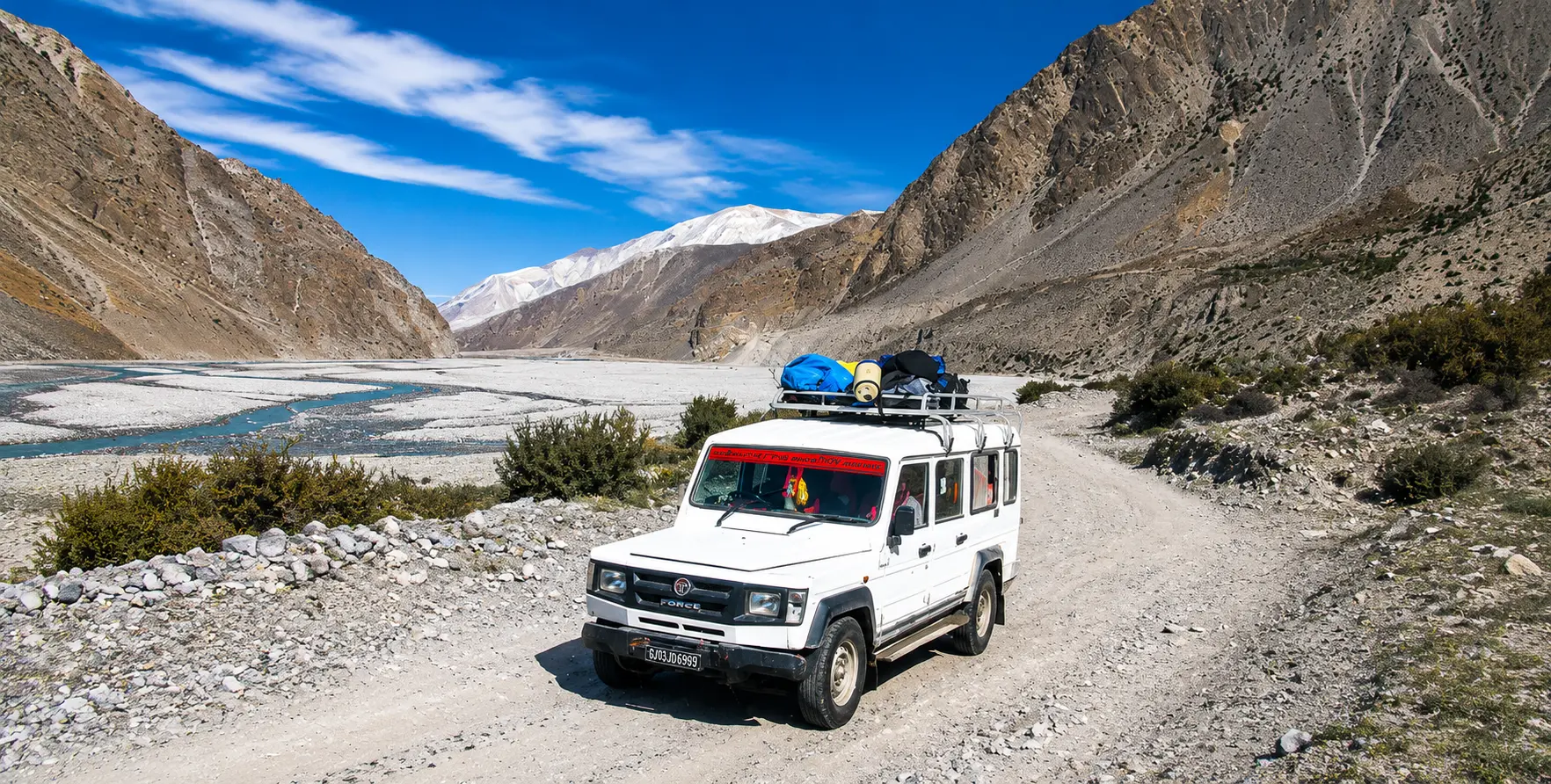
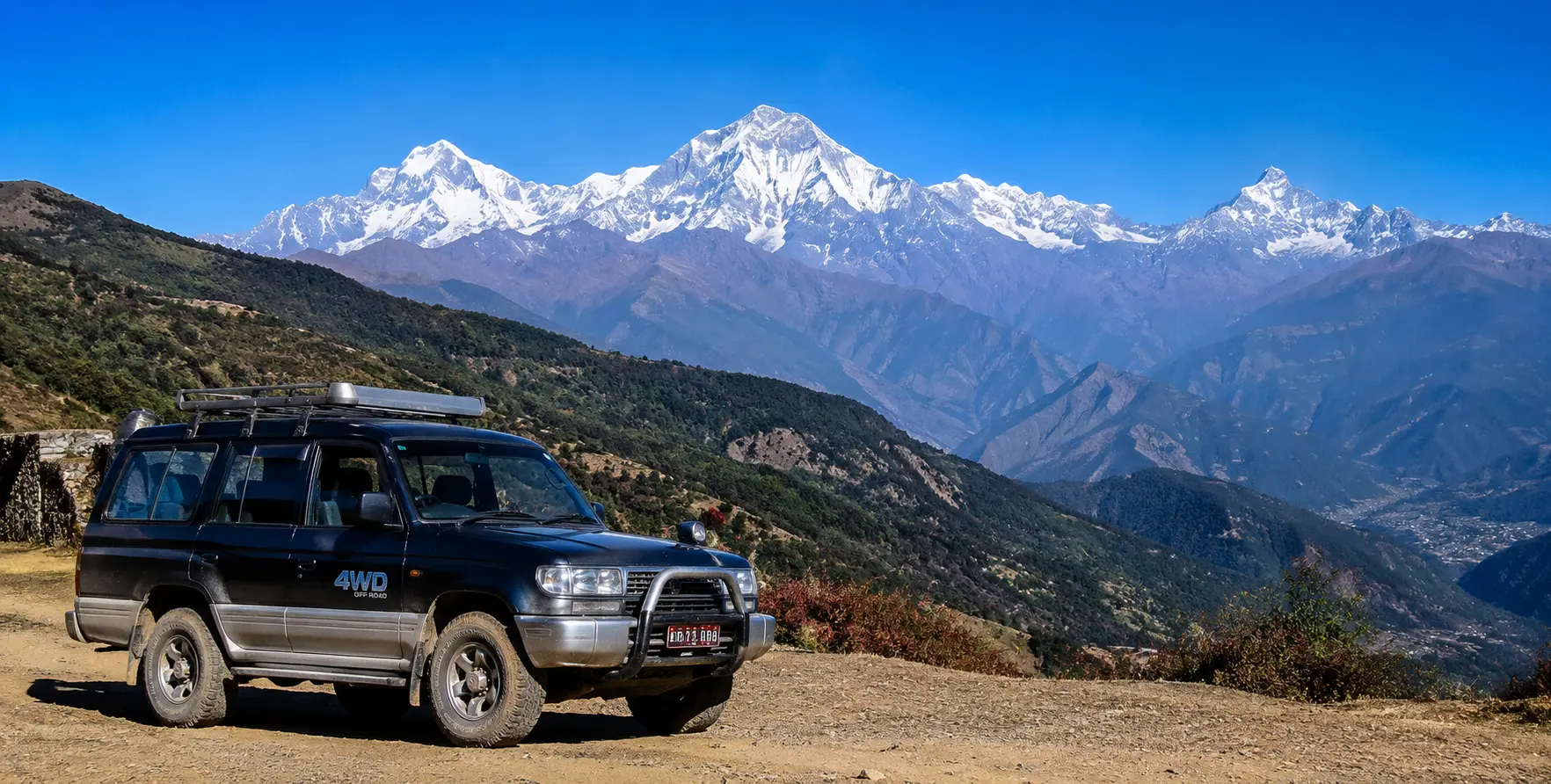
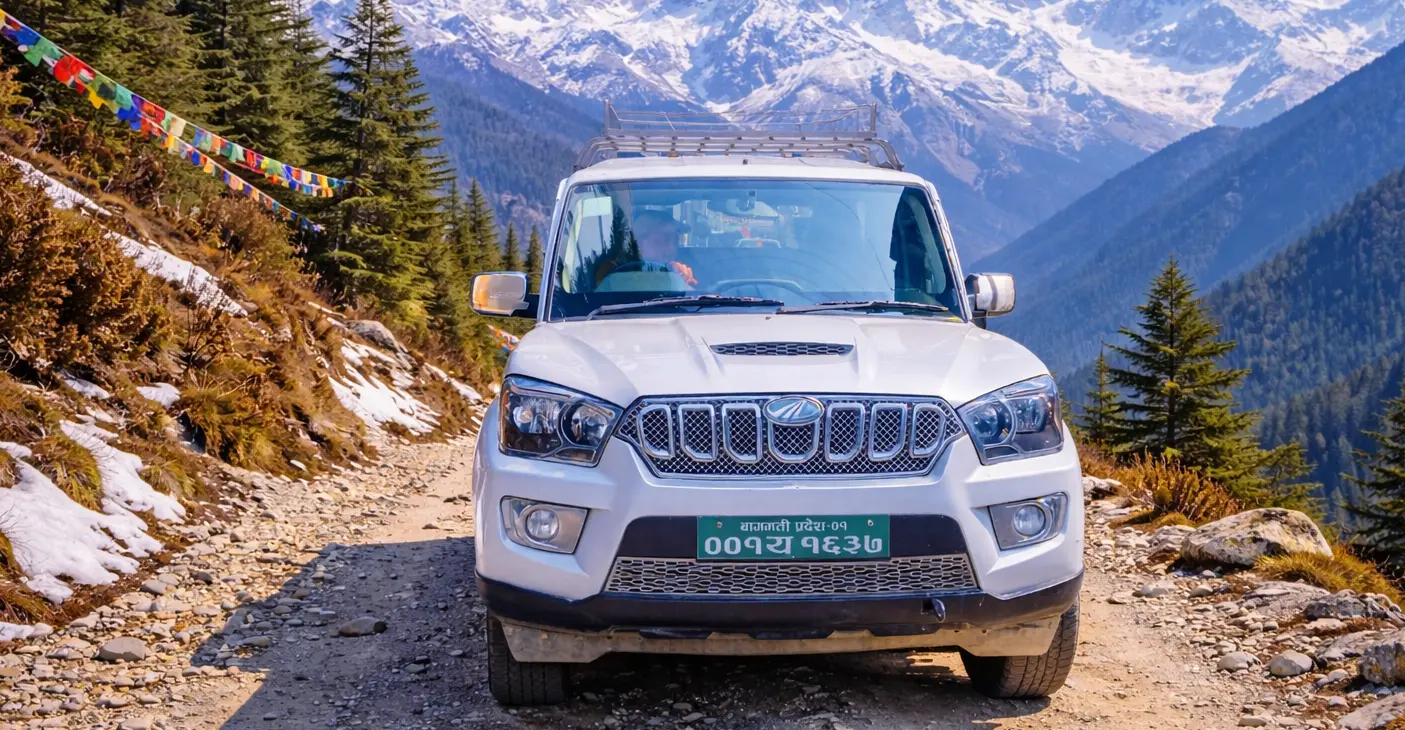
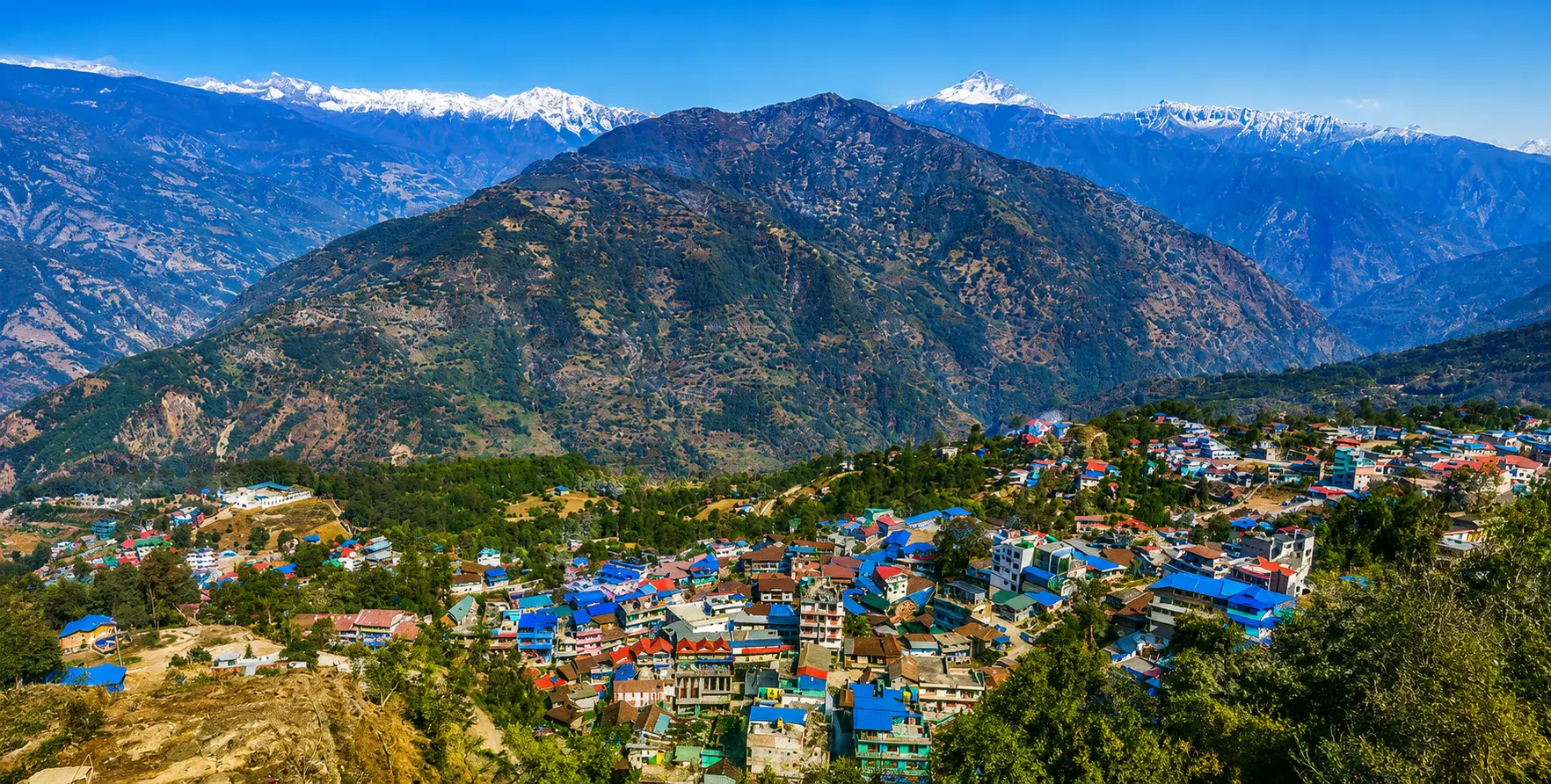
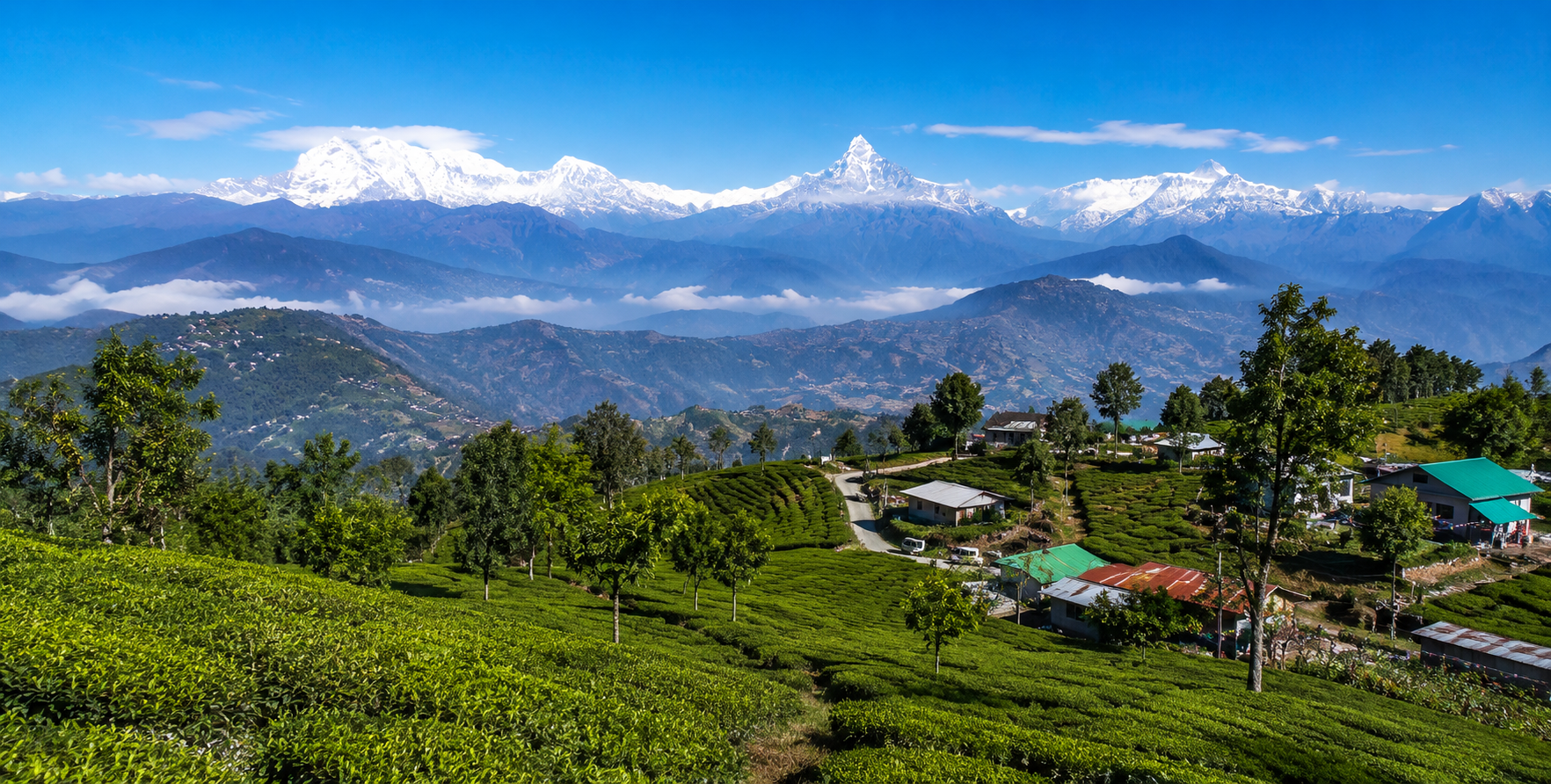
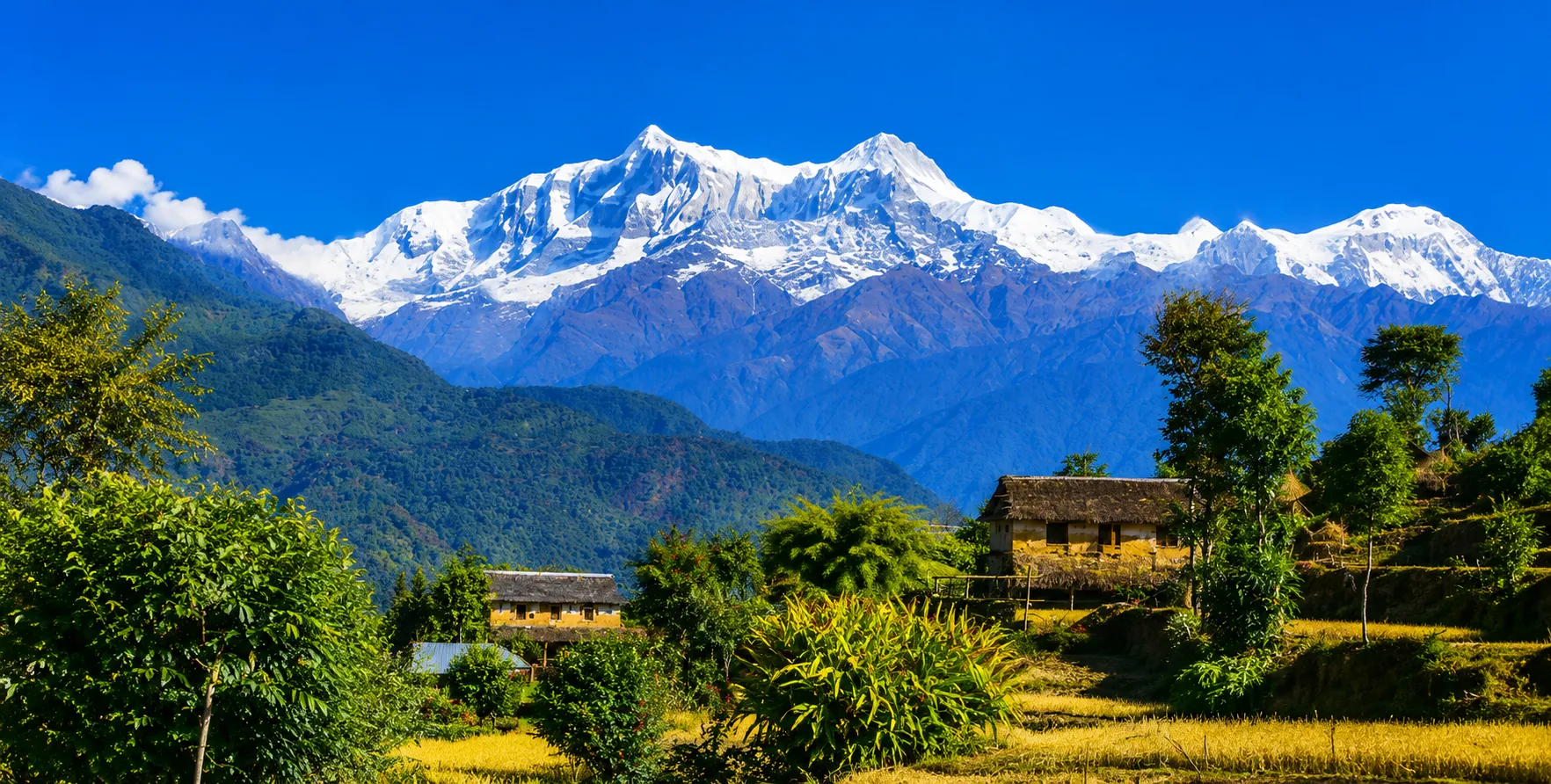
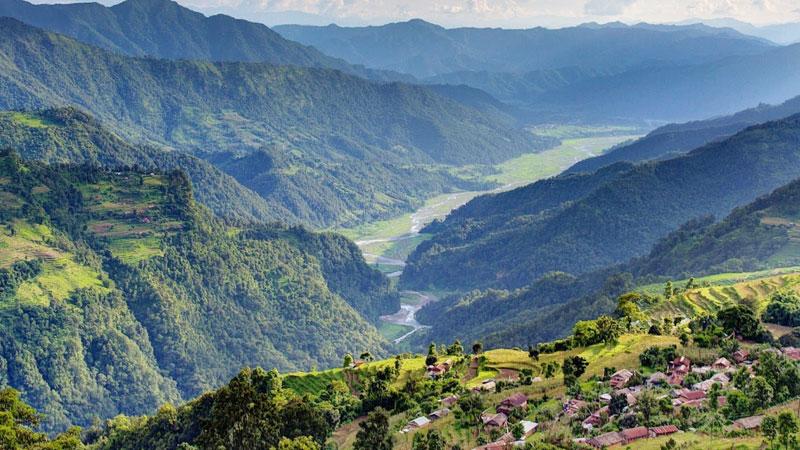
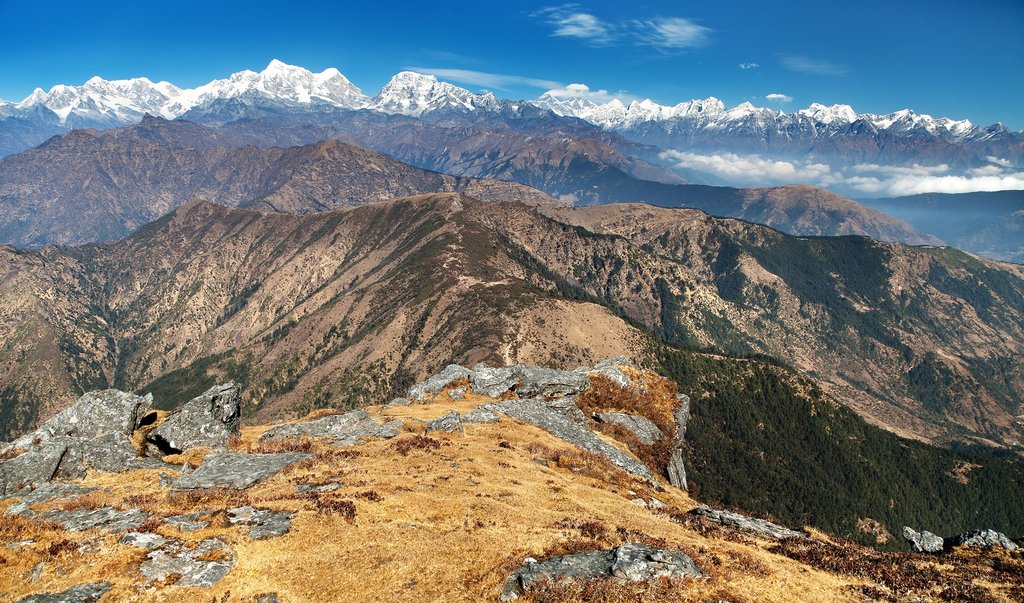
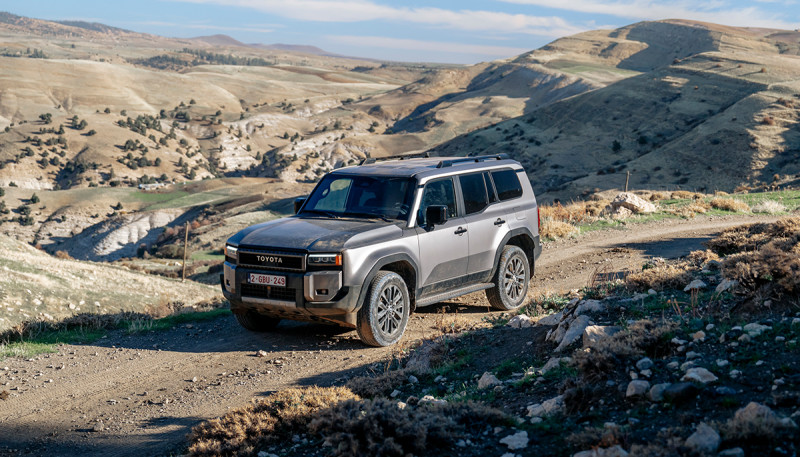
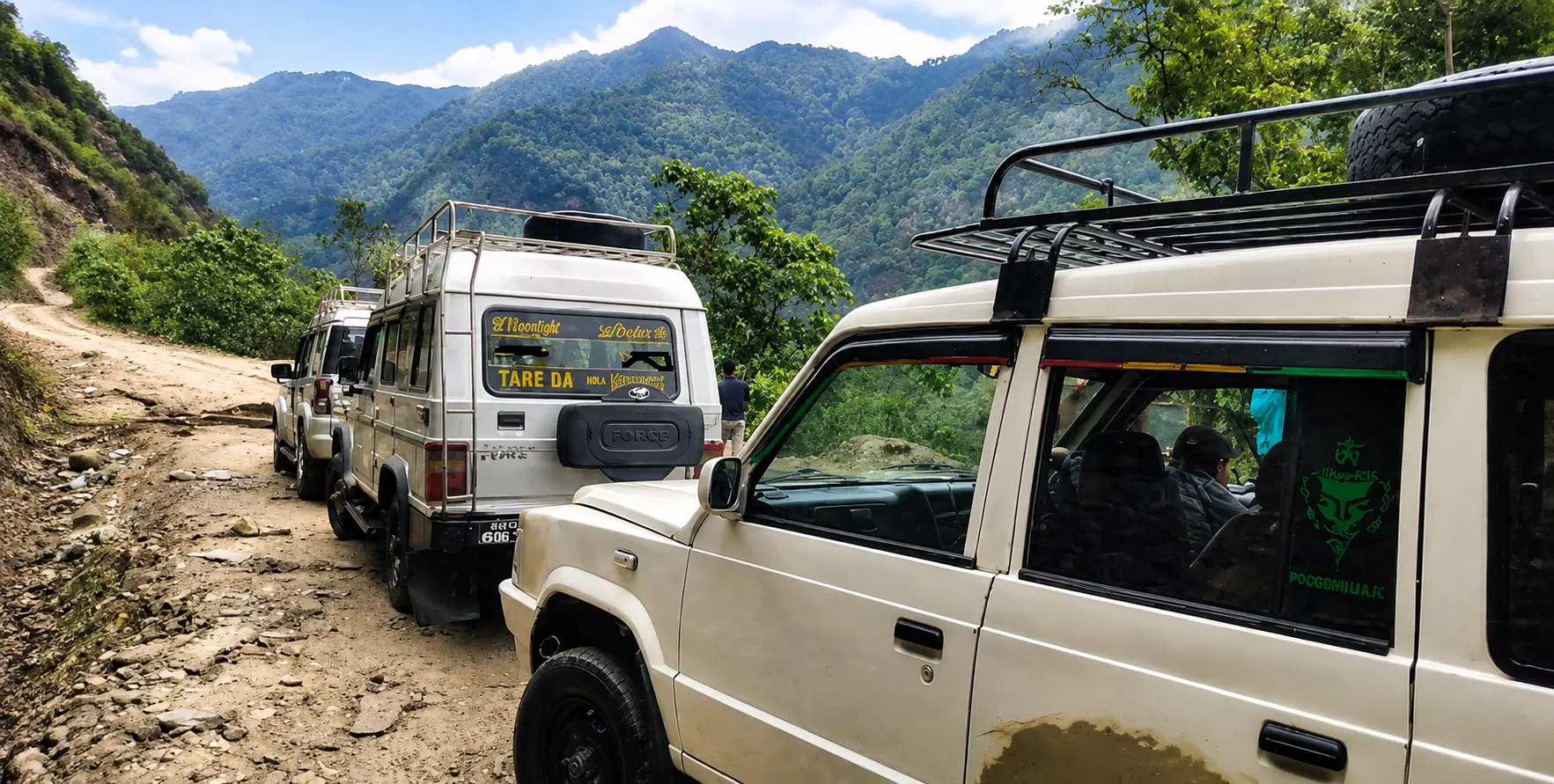
Pokhara to Mustang Road Overview with a 4WD jeep traveling through the Kali Gandaki Valley toward Upper Mustang

Pokhara to Mustang Road Overview: Complete Jeep Guide

There is a road in Nepal that begins beside the reflections of the Annapurna range on Phewa Lake in Pokhara and ends in a 14th-century walled city on the edge of the Tibetan Plateau. It passes through the world’s deepest gorge, climbs through apple orchards and ancient salt-trading villages, crosses a rain shadow boundary where the monsoon loses its grip. The landscape changes from a green valley to a high desert over a few kilometers. Eventually, it delivers the traveler to one of the most extraordinary destinations in Asia: Lo Manthang, the ancient capital of the Kingdom of Lo — what the world knows as Upper Mustang.

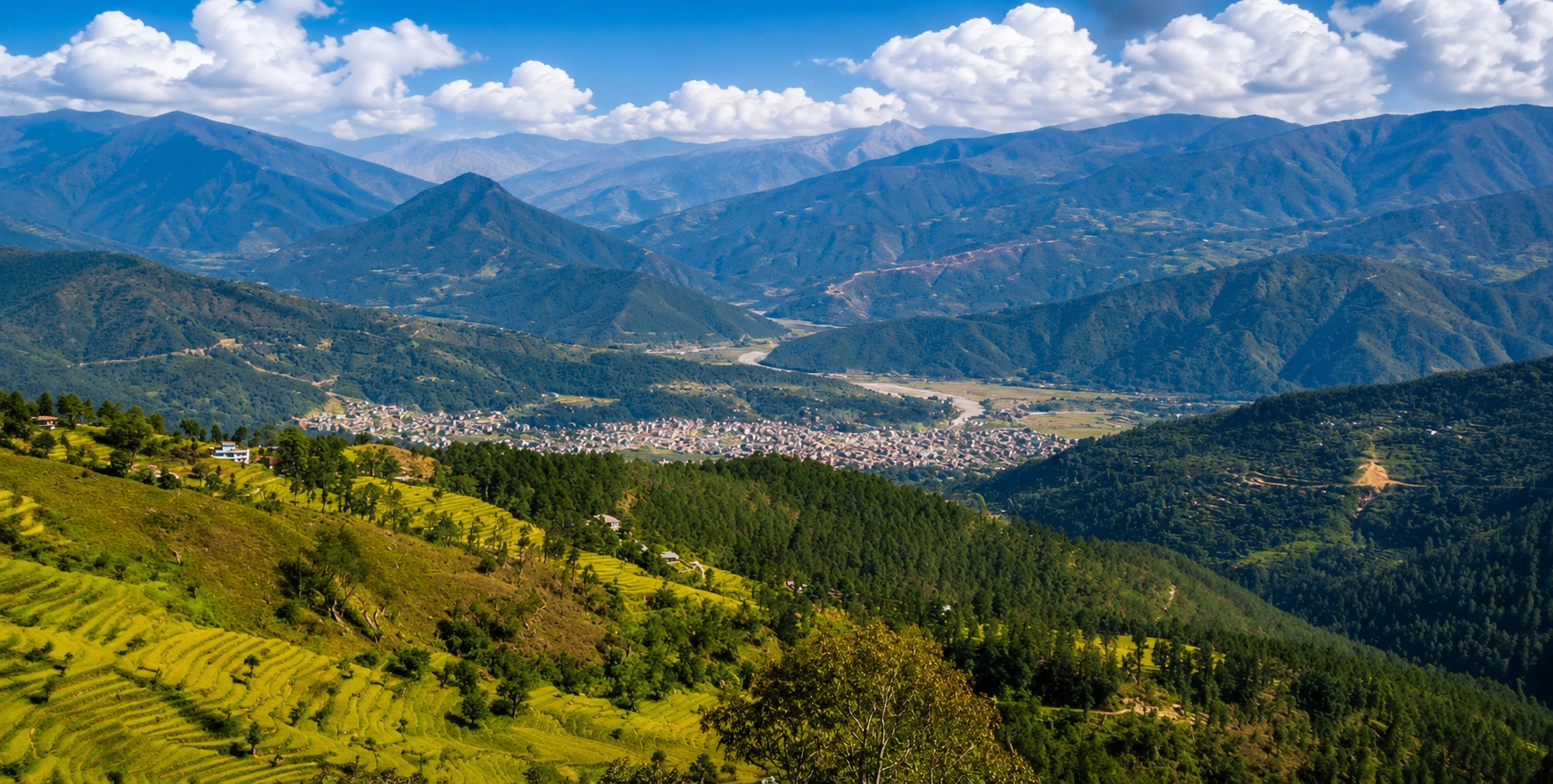
The Pokhara-to-Mustang road is not a single road but a sequence of roads, each with its own character and demands. It begins on a well-paved highway heading northwest through the Myagdi hills, transitions to a rougher mountain track at Beni, follows the Kali Gandaki River gorge through some of the most dramatic scenery in the Himalayan world, and eventually becomes a high-altitude off-road track that only a capable 4WD vehicle with an experienced mountain driver can navigate safely. The total distance from Pokhara to Lo Manthang is approximately 222 kilometers, but those kilometers bear no resemblance to a conventional 222-kilometer road. They are 222 kilometers of Nepal — variable, demanding, spectacular, and utterly unlike anything you will have driven through before.

Nepal Vehicle Hiring Pvt. Ltd., based in Thamel, Kathmandu, offers the definitive Pokhara to Mustang jeep service for this route — well-maintained 4WD vehicles, experienced mountain road drivers who know every section from Pokhara’s Lakeside to Lo Manthang’s palace gates, and an all-in pricing model that removes uncertainty from one of Nepal’s most logistically complex journeys. This guide provides a complete, research-backed road overview for every kilometer of the Pokhara–Mustang route in 2026 and 2027 — distances, altitudes, road conditions, key villages, permit requirements, best stops, and everything else you need to understand and prepare for this extraordinary overland journey.

Whether you are comparing it with the Kathmandu-to-Mustang private jeep option, planning a combined Muktinath Yatra itinerary, or building a broader Nepal tour package that includes Mustang alongside Kathmandu, Pokhara, and Chitwan — this guide has everything you need.
Pokhara to Mustang Road Overview with a 4WD jeep traveling through the Kali Gandaki Valley toward Upper Mustang

Pokhara to Mustang: Full Route Overview and Distance Breakdown

The complete road journey from Pokhara to Lo Manthang is broken into four distinct legs, each with its own road surface, difficulty level, and character. Understanding these legs before you travel helps you set appropriate expectations and plan your overnight stops correctly.

Leg 1: Pokhara to Beni — 85 km, 2.5 to 3 hours

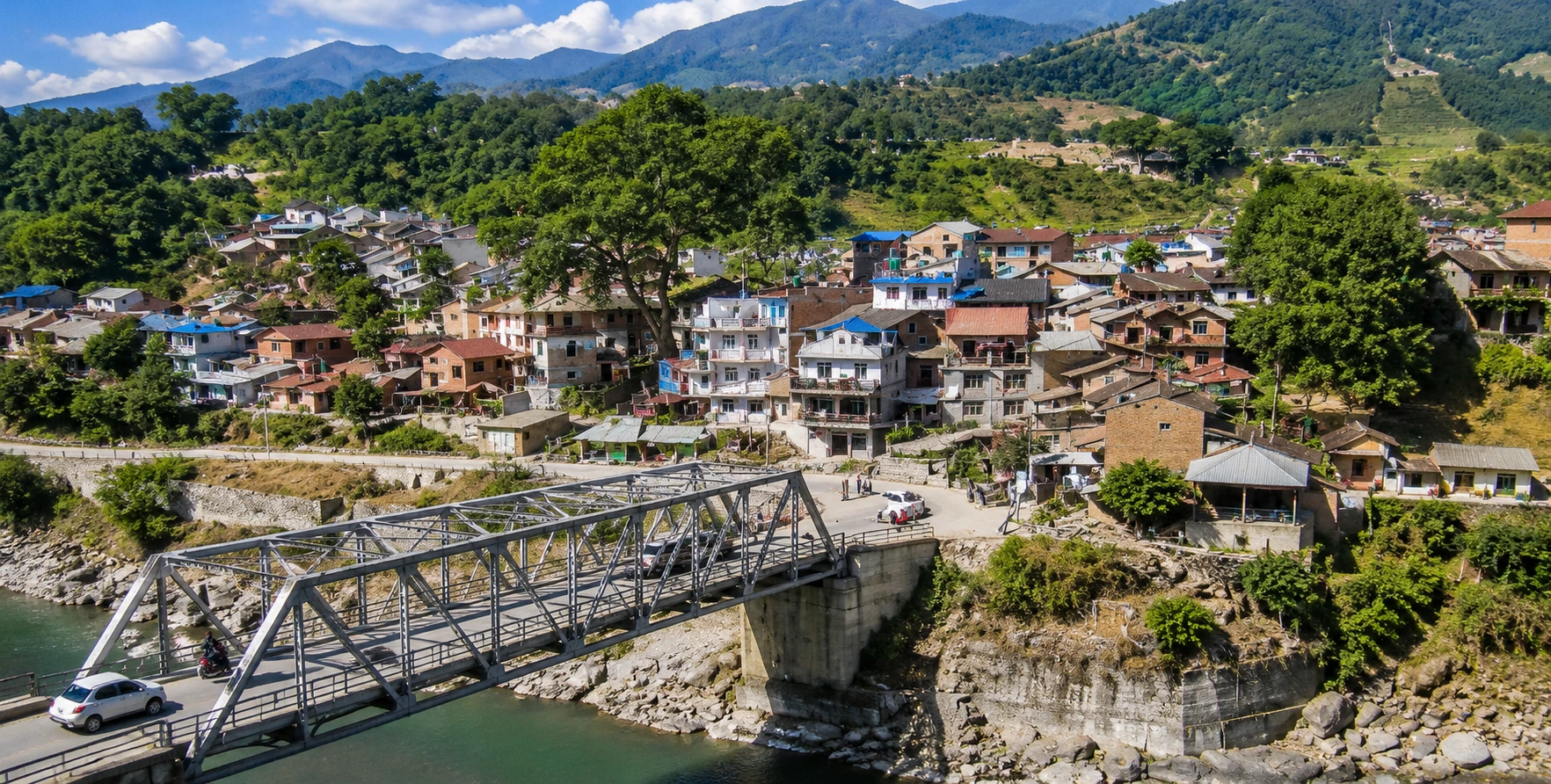
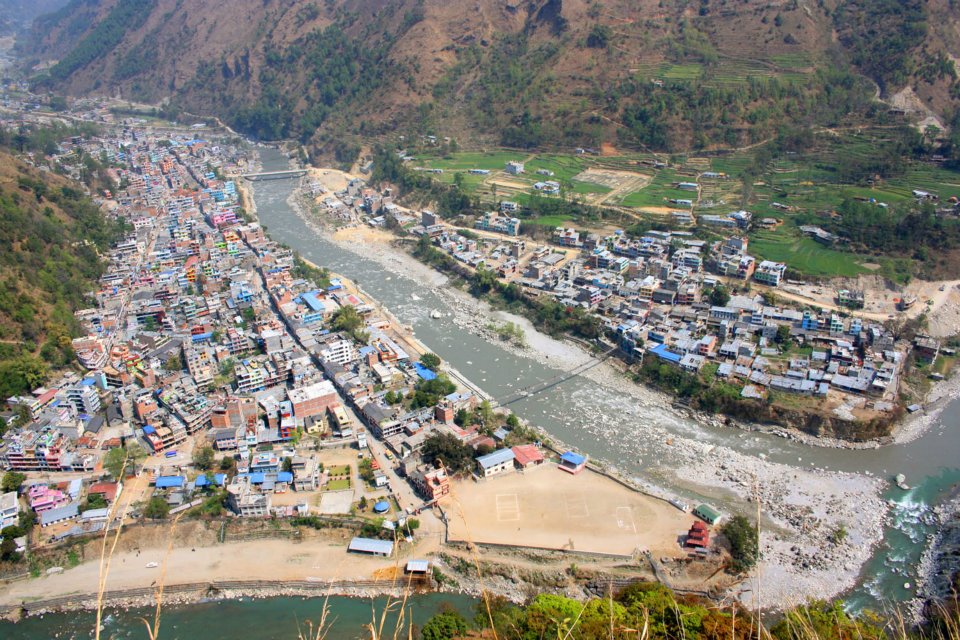
The journey begins in Pokhara’s Lakeside district and heads northwest on a well-maintained paved road through the foothills of Myagdi District. The road passes through Naudanda (Nine Hills) — a ridge viewpoint offering some of the finest panoramic views of the Annapurna range available by road, including Annapurna South, Machhapuchare (the Fishtail), Annapurna I, and Dhaulagiri — before descending to the Modi Khola valley and continuing to Beni (830 m), the headquarters of Myagdi District and the last substantial town before the road turns serious.

The Pokhara–Beni road is predominantly blacktop and well-maintained. It is comfortable for standard vehicles and passes through increasingly dramatic hill country as it approaches Beni. The Sarangkot sunrise tour vehicle that many visitors use for the pre-dawn Pokhara mountain panorama often transitions directly into the Beni departure — travelers who watch the Annapurna sunrise from Sarangkot and then depart for Mustang the same morning are making good use of the northward mountain view that anchors both experiences. Beni itself is a compact town at the confluence of the Myagdi and Kali Gandaki rivers, with basic facilities, fuel, and the last reliable ATM before the mountains.
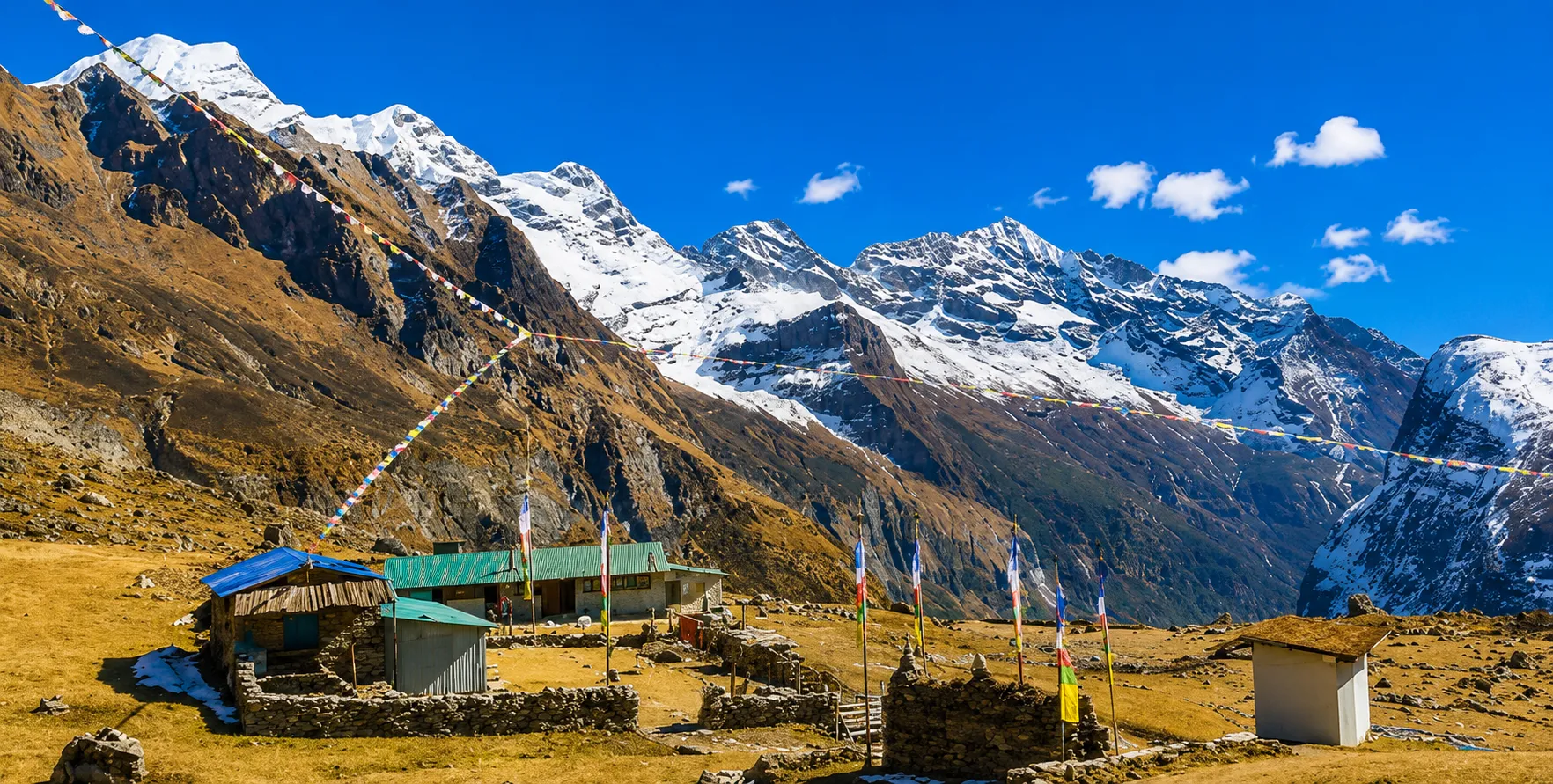
Pokhara to Mustang Road Overview with a 4WD jeep traveling through the Kali Gandaki Valley toward Upper Mustang

Leg 2: Beni to Jomsom — 85 km, 5 to 6 hours

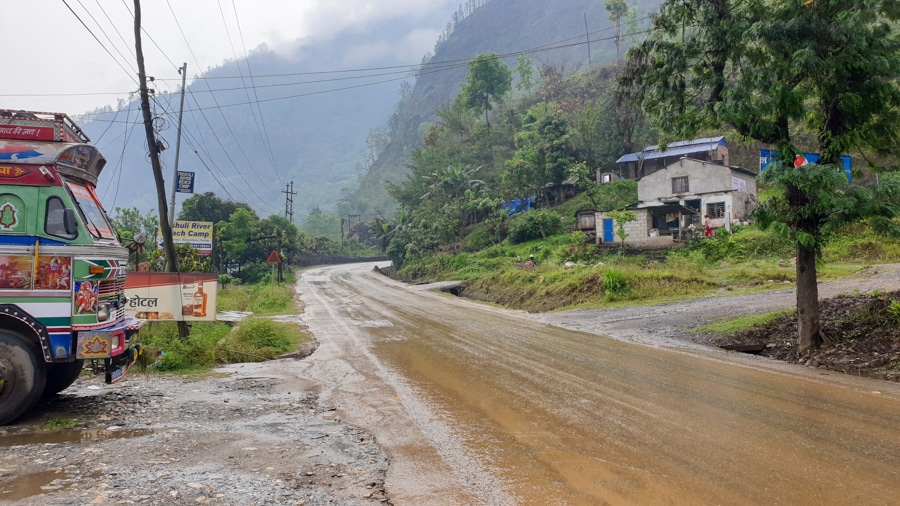
Beyond Beni, the road changes character entirely. The blacktop surface becomes intermittent and ultimately disappears as the road follows the Kali Gandaki River north through an extraordinary gorge. This section — roughly 85 kilometers from Beni to Jomsom — is the most dramatic and most demanding leg of the Pokhara–Mustang drive, and it is where the 4WD requirement becomes absolute. The road is a mix of gravel, compacted rock, and rough track that requires high ground clearance and four-wheel-drive capability, particularly through river-crossing sections and the narrow cliff passages above the Kali Gandaki gorge.

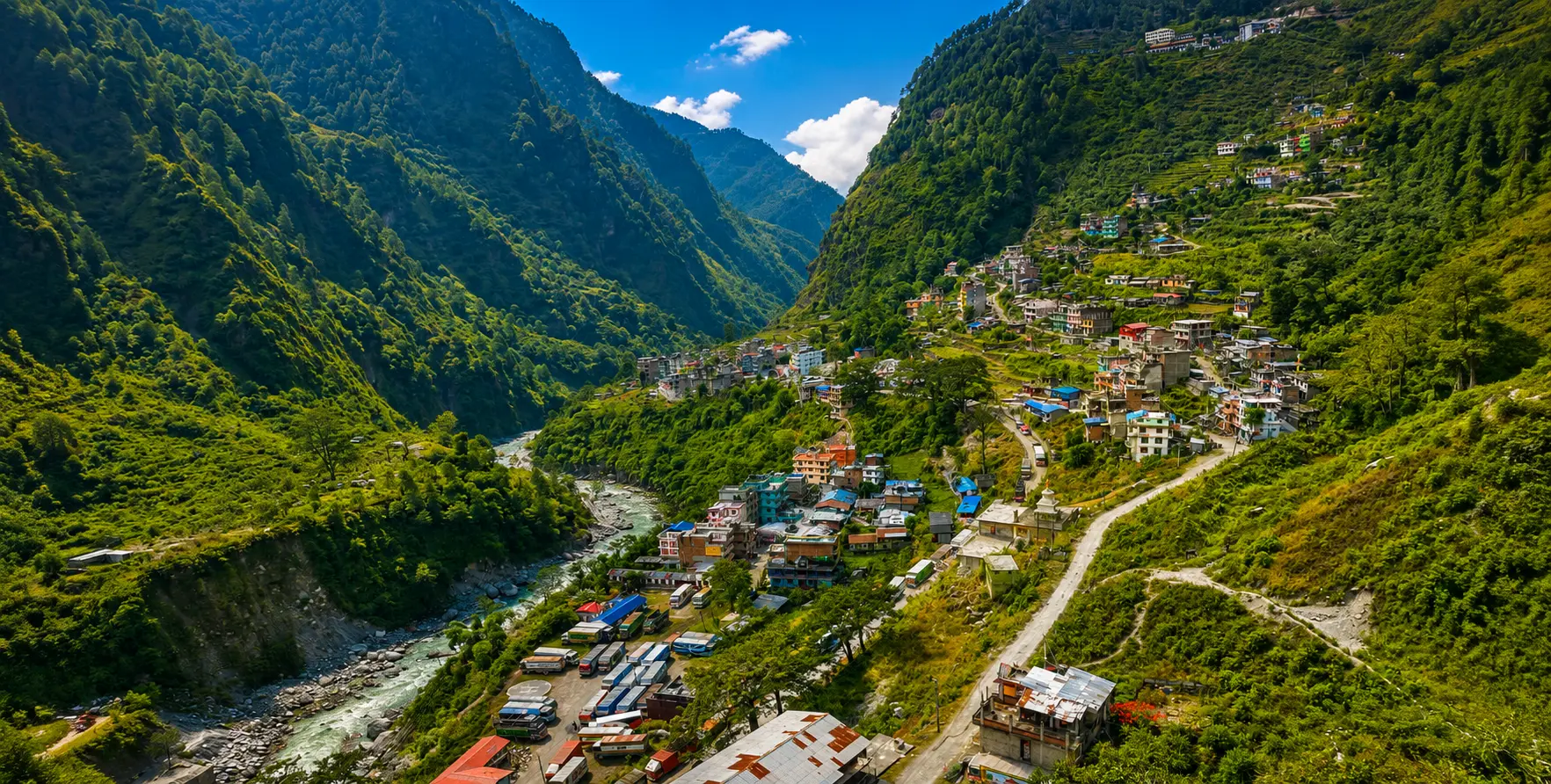
The Kali Gandaki gorge between Beni and Jomsom is widely recognized as the world’s deepest river gorge — the river flows between Dhaulagiri (8,167 m) to the west and Annapurna I (8,091 m) to the east, two of the world’s highest peaks standing barely 35 kilometers apart, with the gorge floor at approximately 1,200 meters. The vertical relief of approximately 7,000 meters from the gorge floor to the mountain summit is unmatched anywhere on Earth, and the experience of driving through this gorge — with the river roaring below and the colossal mountain walls closing in from both sides — is one of the most viscerally impressive natural environments accessible by road anywhere in Nepal.

Key stops along the Beni–Jomsom leg include:

  • Tatopani (1,190 m) — a small village famous throughout Nepal for its natural hot springs beside the Kali Gandaki River. After the rough road from Beni, a 30-minute soak in the thermal pools at Tatopani is one of the most restorative experiences on the entire journey. The village also serves as a lunch stop for most Mustang-bound vehicles, with a cluster of teahouses offering dal bhat and the opportunity to rest before the harder road ahead. Tatopani is approximately 21 kilometers north of Beni.
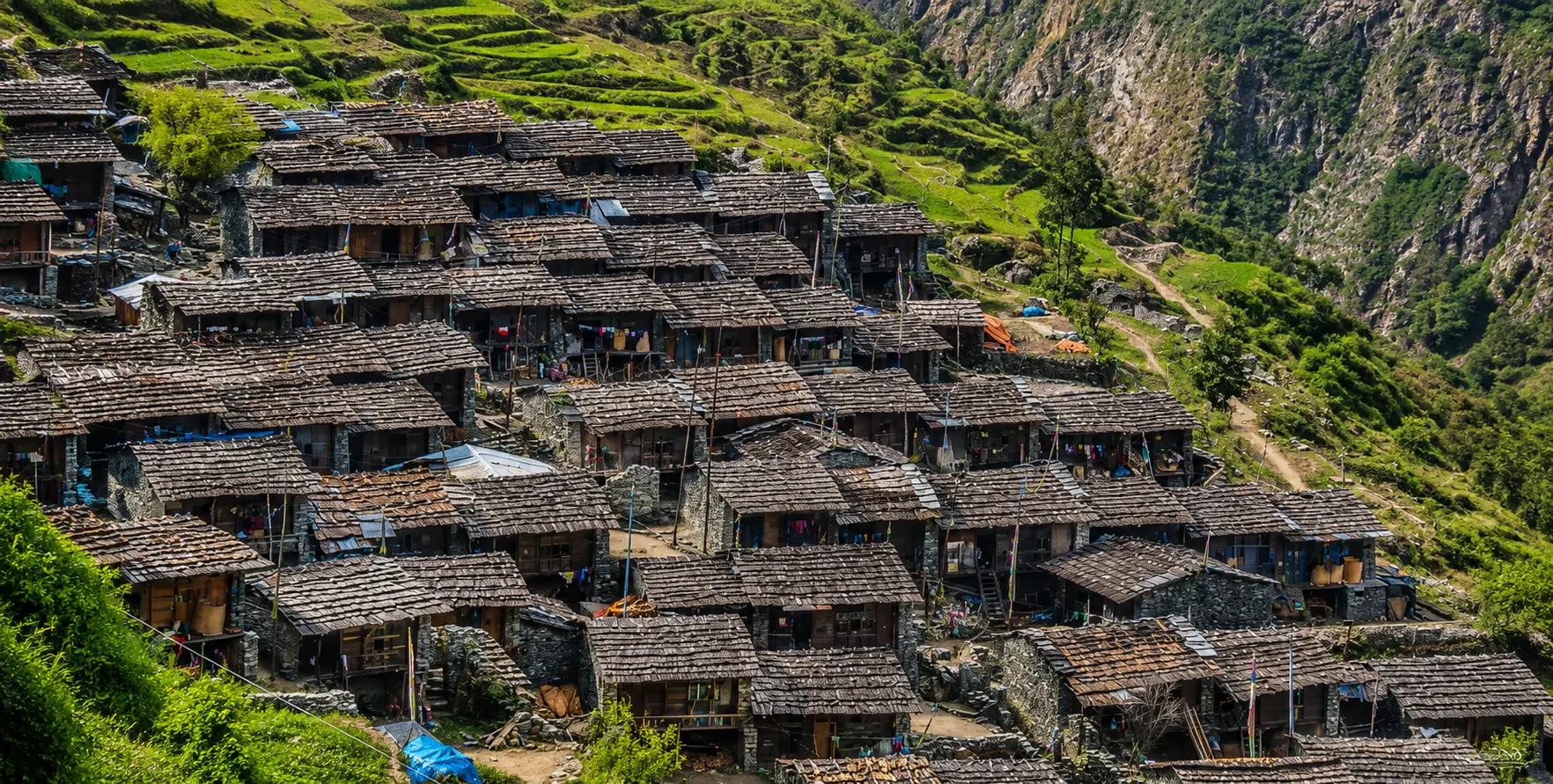
  • Ghasa (2,010 m) — the boundary village between the Annapurna Conservation Area’s lower zone and the upper Mustang region. Ghasa marks the point where the vegetation changes dramatically — the lush subtropical forest of the lower gorge gives way to more arid pine and juniper as the altitude rises. The rain shadow begins to assert itself. Ghasa itself is a traditional Thakali village worth a brief stop to observe the stone houses, prayer flags, and the transition in landscape that defines this crucial boundary point.
  • Kalopani (2,530 m) — arguably the finest mountain viewpoint accessible by road on the entire Beni–Jomsom leg. The Dhaulagiri Icefall — a massive cascade of glacial ice on the eastern face of Dhaulagiri — is directly visible from the road at Kalopani, and at certain times of day (particularly early morning) the icefall catches the light in a way that makes it one of the most spectacular sights in all of Nepal. Several small guesthouses have established themselves at Kalopani specifically to capture the dawn and dusk views. Tukuche Peak (6,920 m), Nilgiri (7,061 m), and Annapurna I also dominate the view here.
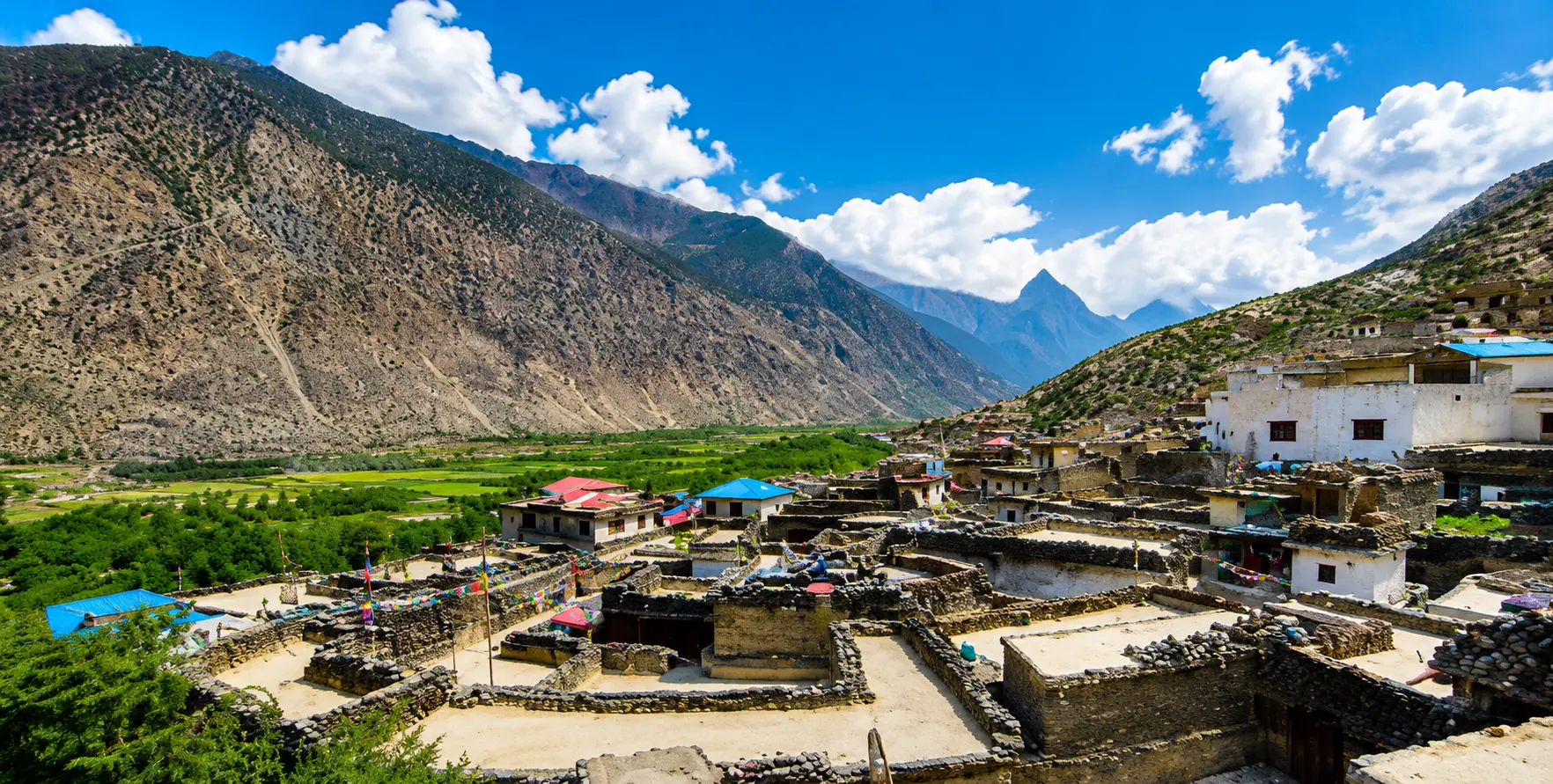
  • Marpha (2,667 m) — the apple orchard capital of Nepal, with beautifully whitewashed, immaculately maintained stone-paved lanes, is famous for producing the finest apples in Nepal and the apple brandy distilled from them. Marpha apple products — dried fruit, juice, brandy — are sold in teahouses across the entire Annapurna and Mustang region. Stopping in Marpha to walk its pristine alleys and visit its monastery is one of the highlights of the lower Mustang drive. The village sits just 14 kilometers south of Jomsom.

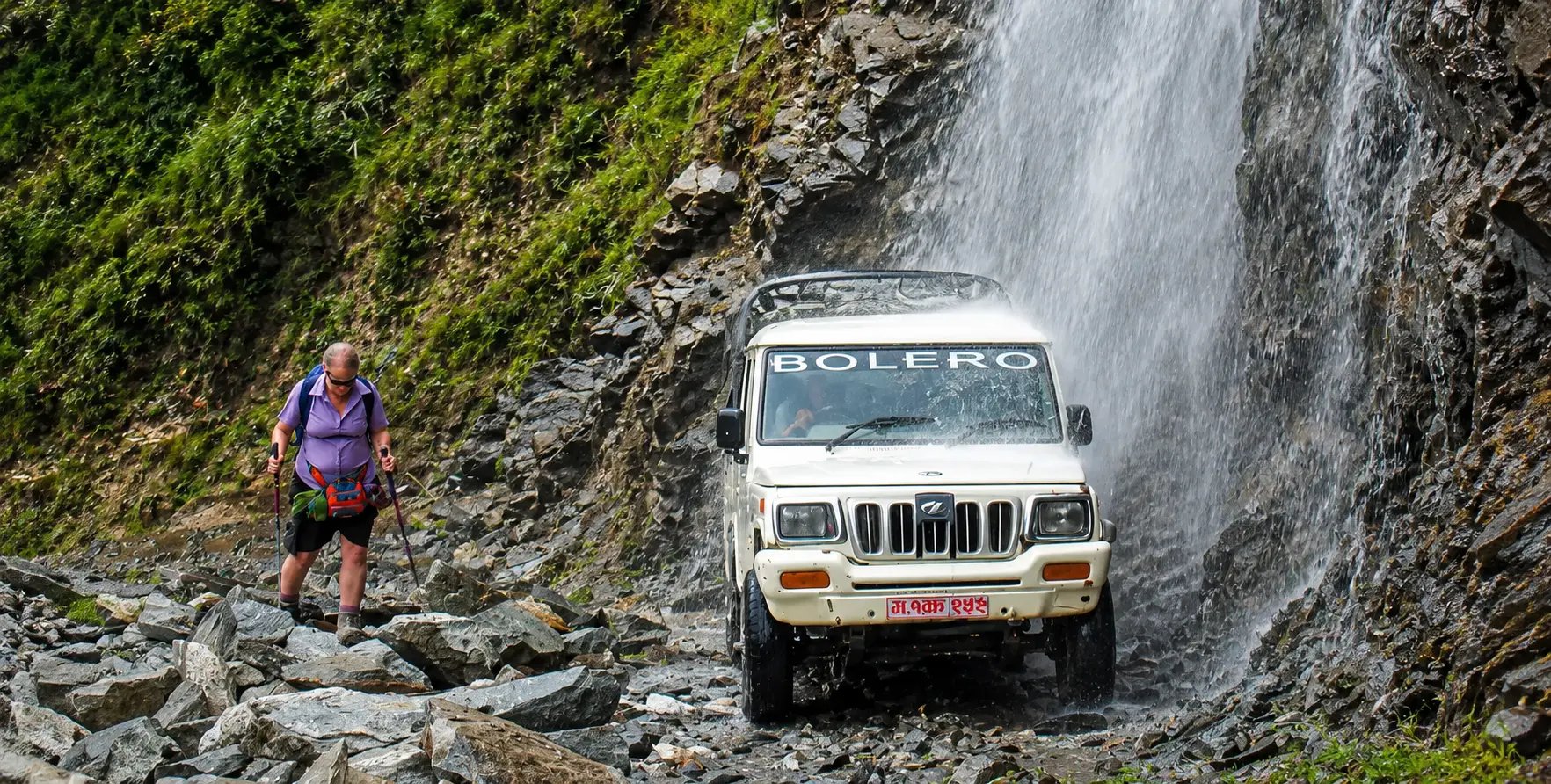
The Rupse Waterfall — a spectacular 300-meter cascade visible from the road — is another memorable sight on this leg, typically encountered between Tatopani and Ghasa. Your Nepal Vehicle Hiring driver will know exactly where to pull over safely for the best view of the waterfall and the gorge section below it.
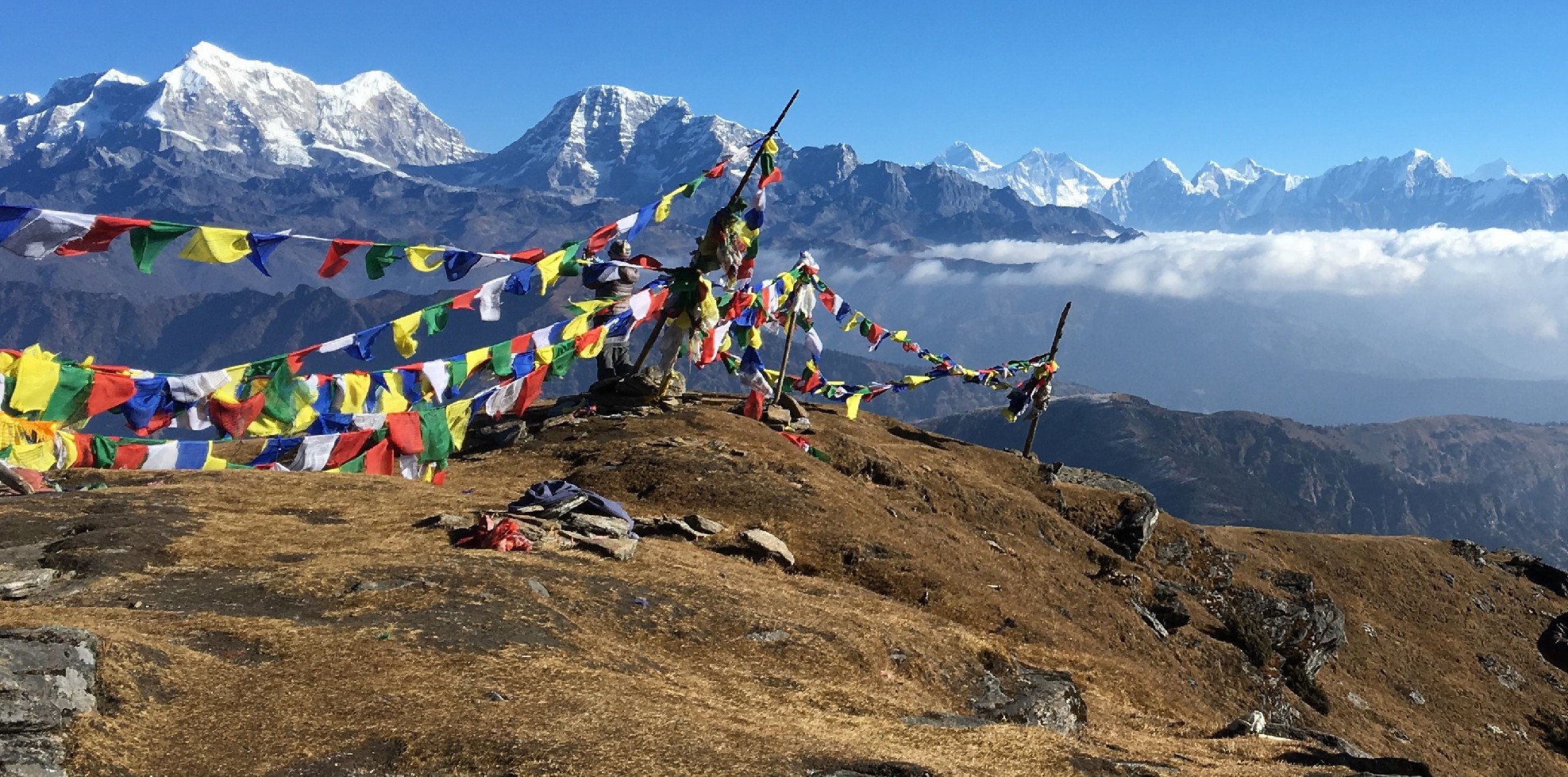
Pokhara to Mustang Road Overview with a 4WD jeep traveling through the Kali Gandaki Valley toward Upper Mustang

Leg 3: Jomsom to Kagbeni — 11 km, 30 to 45 minutes

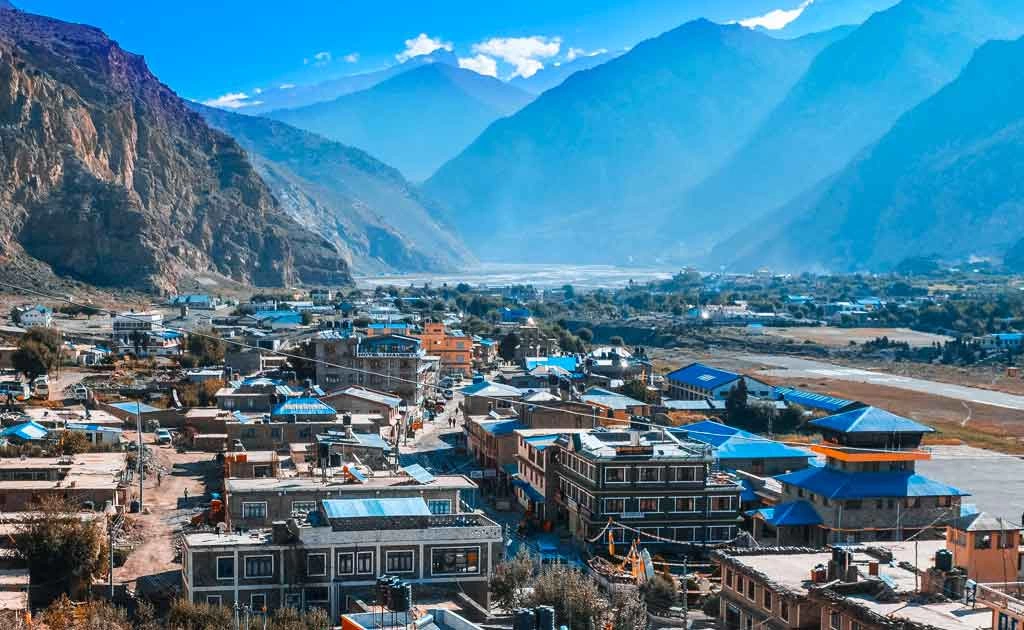
Jomsom (2,720 m) is the district headquarters of Mustang District and the main hub of the Kali Gandaki valley — a surprisingly substantial town with an airport (the small Jomsom Airport receives daily morning flights from Pokhara), government offices, banks, lodges, and trekking equipment shops. Jomsom is the natural overnight stop for vehicles driving up from Beni in a single day, and it is where most travelers spend their first night in the Mustang region before continuing north the following morning.

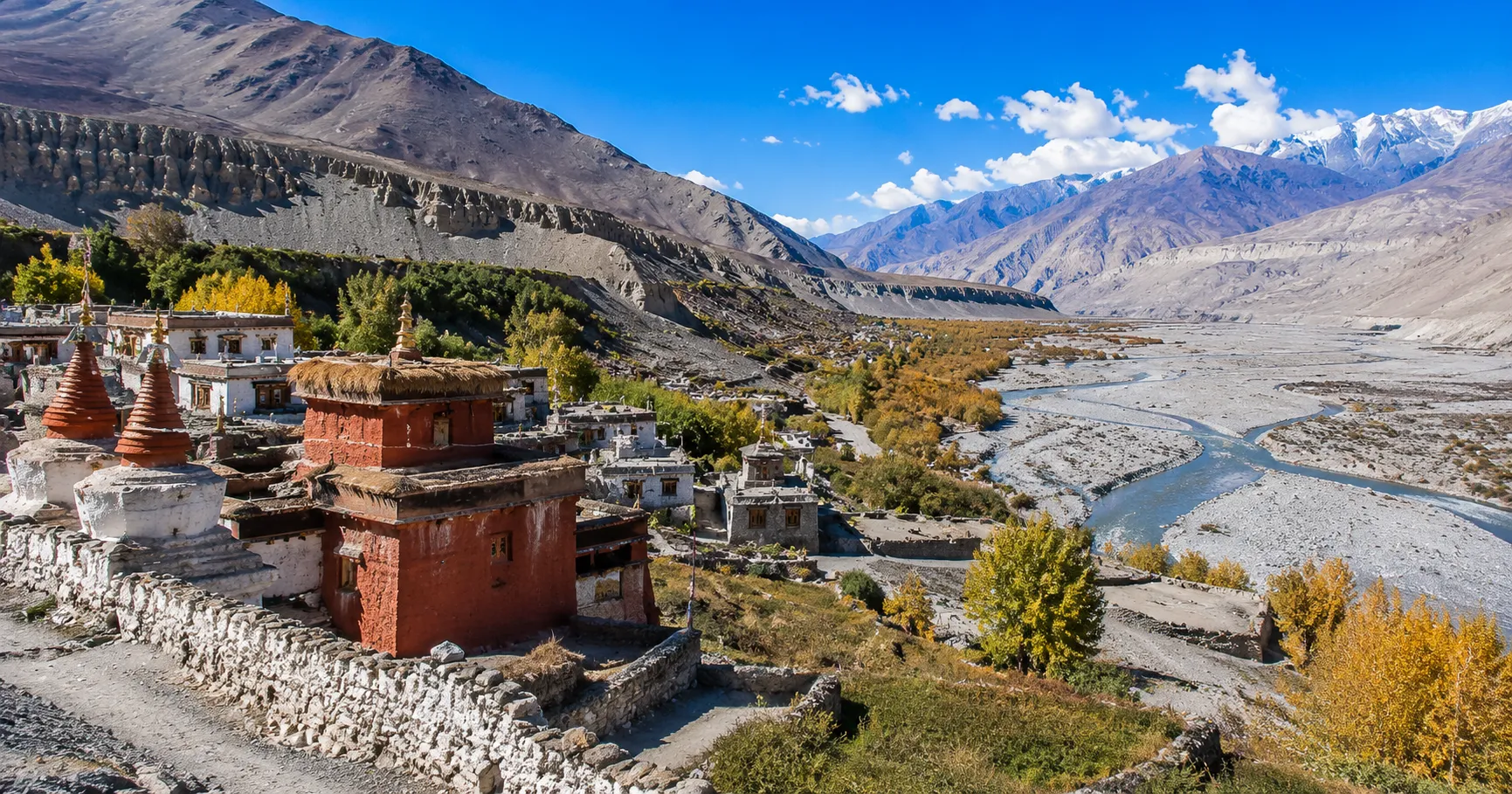
From Jomsom, the road continues 11 kilometers north to Kagbeni (2,810 m) — the medieval gateway village that marks the beginning of Upper Mustang’s restricted zone. The 11-kilometer Jomsom-to-Kagbeni section follows the Kali Gandaki River bank on a relatively flat, easy road taking 30 to 45 minutes by jeep. Kagbeni is one of the most architecturally compelling villages in the entire Mustang region — a cluster of medieval stone buildings, narrow underpass lanes, a dramatically sited red-walled monastery (Kagbeni Gompa), and a confluence of rivers that lends the village a natural drama, reinforced by the sheer scale of the surrounding mountain walls. The Kagbeni checkpoint at the village’s northern exit is where all Restricted Area Permits are checked before allowing entry into Upper Mustang — no traveler passes this point without the RAP, regardless of any other documentation they carry.

Leg 4: Kagbeni to Lo Manthang — 61 km, 3.5 to 5 hours

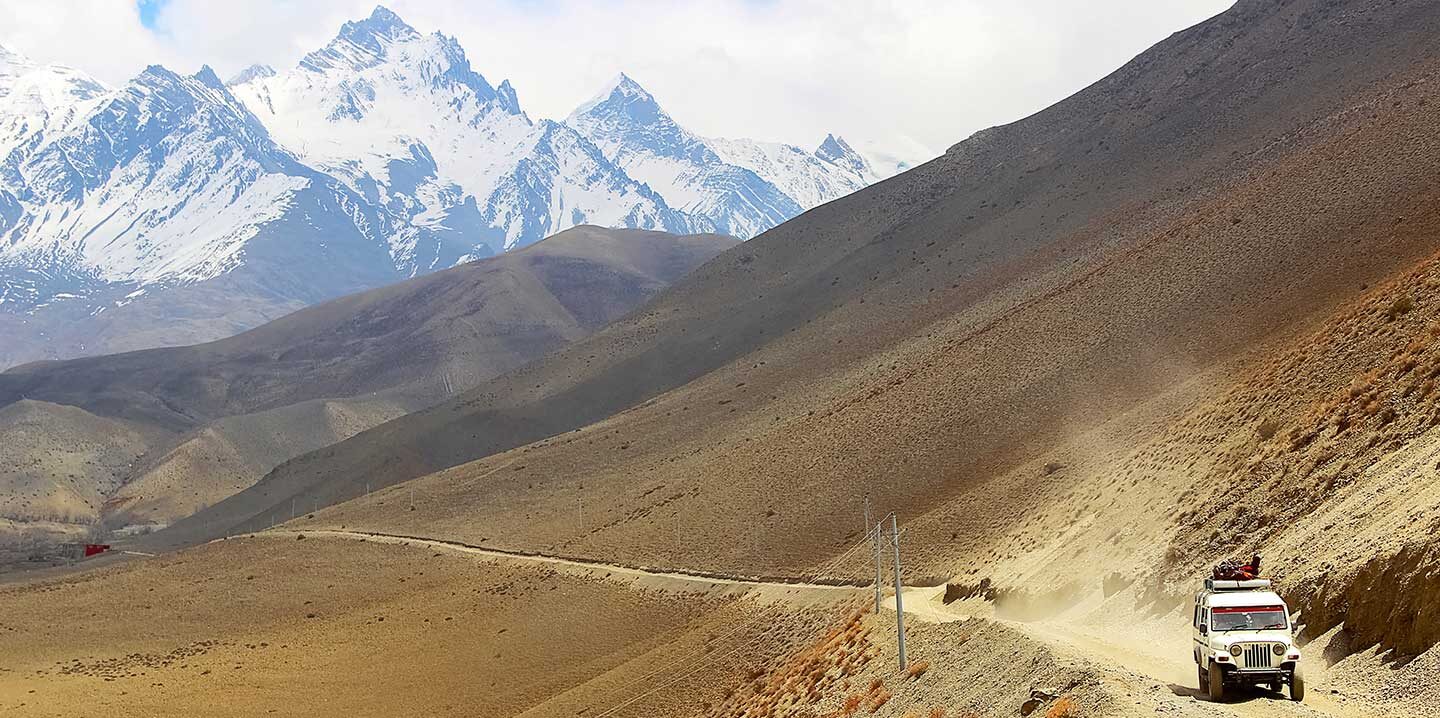
The Kagbeni-to-Lo Manthang section is what gives Upper Mustang its character and reputation. Beyond the checkpost, the road leaves the Kali Gandaki valley behind and enters the true rain-shadow plateau. This landscape shifts from narrow gorge to broad canyon country to high desert plateau over the course of 61 kilometers. This is the section that requires the most capable vehicle and the most experienced driver, featuring steep climbs, exposed traverses above deep gorges, seasonal river fords, and road surfaces that range from compacted gravel to loose rock to raw earth that turns to mud after any rain.

The full Kagbeni–Lo Manthang journey passes through the following key villages and waypoints, each deserving attention:
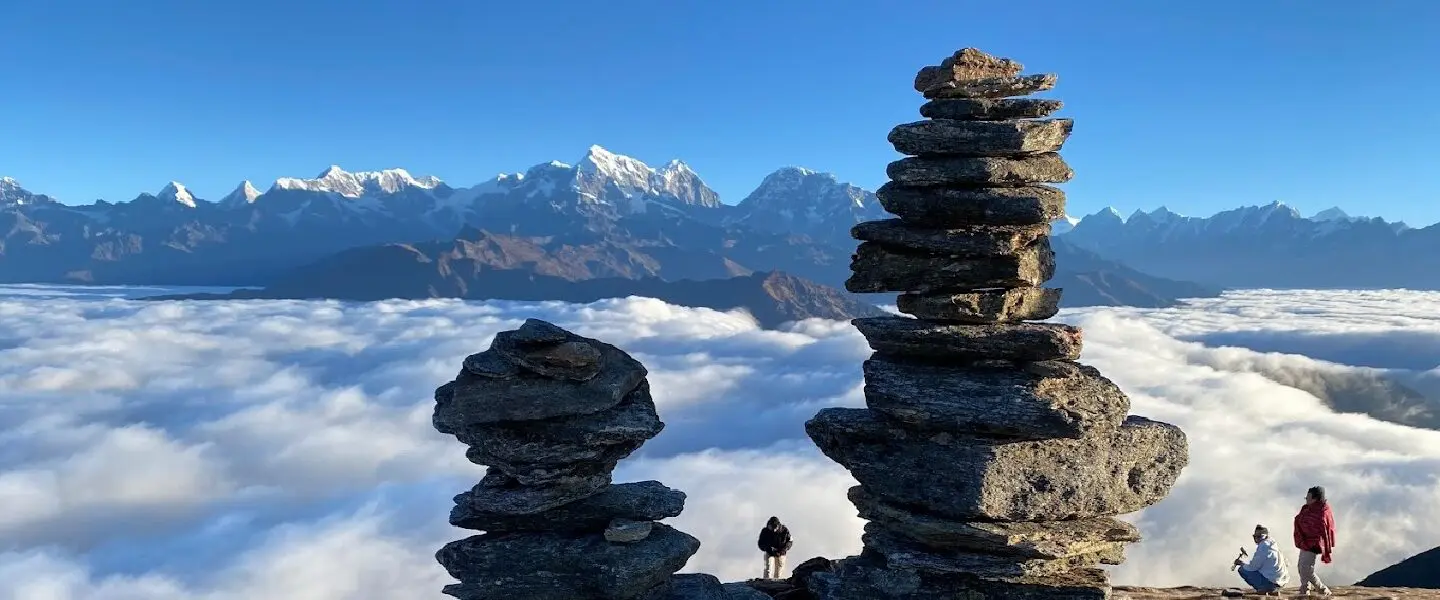
Pokhara to Mustang Road Overview with a 4WD jeep traveling through the Kali Gandaki Valley toward Upper Mustang

The Villages of Upper Mustang: What You See Between Kagbeni and Lo Manthang

Chhusang / Chhuksang (2,980 m): First Village of the Forbidden Kingdom

Approximately 20 kilometers north of Kagbeni, Chhusang (also written Chhuksang) is the first substantial village inside the Upper Mustang restricted zone, sitting at the confluence of the Kali Gandaki and a smaller side valley at 2,980 meters. The village is notable for its striking, eroded red-sandstone cliffs above the settlement — one of the first clear signs that the landscape has shifted into the extraordinary geological theatre of the Mustang plateau. From Chhusang, a short side trip accesses the abandoned village of Tetang and the ruins of Gompa Gang monastery, perched dramatically on a clifftop above the valley. Chhusang typically serves as the first overnight stop for jeep tours that prefer to spread the Kagbeni–Lo Manthang driveovers over two days rather than a single long push.

Chele (3,050 m): Entry to Canyon Country

Chele, approximately 7 kilometers north of Chhusang, announces the full drama of Upper Mustang’s canyon landscape. The road from Chhusang to Chele passes through a narrow gorge where the cliffs glow in shades of ochre, rust, and purple, and where the wind — the famous Mustang wind that blows strongly from the north every afternoon as warm air rises from the plains — begins to make its presence felt. Chele village itself sits at 3,050 meters on a bench above the gorge, with a small monastery, traditional flat-roofed Tibetan-style houses, and views north toward the expanding plateau. The route from Chele begins a sustained climb toward the Syangboche plateau, which provides one of the most dramatic driving sections on the entire Pokhara–Mustang road.

Samar (3,660 m) and the Chungsi Cave

The village of Samar at 3,660 meters is a rewarding pause point — a traditional Loba (Lo-pa) community with a well-maintained gompa, stone walls hung with prayer flags, and a wide plateau view that opens dramatically north and east toward the high Mustang landscape. Between Chele and Samar, and then continuing toward Syangboche, the route passes near the Chungsi Cave Monastery — an ancient meditation cave revered as a site where Guru Padmasambhava (Guru Rinpoche) is said to have meditated during his 8th-century journey through the Himalayan kingdoms. The cave is set dramatically in a canyon wall, accessible by a short trail from the main jeep road. It contains ancient paintings and offerings, making it one of the most spiritually resonant stops in Upper Mustang.

Syangboche (3,800 m): The High Plateau Begins

Syangboche, at 3,800 meters, marks the point at which the road gains the Upper Mustang plateau in earnest. The landscape at this elevation is definitely high-altitude desert. The same barren, wind-scoured terrain characterizes the Tibetan Plateau immediately to the north, with sparse grasses, low scrub, and the bone-dry air of the deep rain shadow. The road at Syangboche crosses the Syangboche La pass (3,850 m) and the nearby Nyi La (4,020 m) — two of the higher passes on the Kagbeni–Lo Manthang route, where the driving demands are at their greatest, and the mountain views are at their most expansive. Dhaulagiri, Tukuche, Nilgiri, Tilicho Peak, and Damodar Danda are all potentially visible from the high points near Syangboche on a clear day.
Pokhara to Mustang Road Overview with a 4WD jeep traveling through the Kali Gandaki Valley toward Upper Mustang

Ghami / Ghemi (3,520 m): The Longest Mani Wall in Nepal

Ghami (also spelled Ghemi), at 3,520 meters, is one of Upper Mustang’s larger and more historically significant villages — a warm, sheltered settlement in a broad valley bowl with substantial cultivated land (barley and buckwheat fields that glow gold in autumn) and one of the most photogenic cultural features on the entire route: the longest mani wall in Nepal. This extraordinary structure — a wall of stones, each carved with Buddhist prayers and mantras, stretching for hundreds of meters — represents centuries of accumulated devotion from the Loba community. Walking along the mani wall, reading the carved inscriptions, and looking across Ghami’s fields to the surrounding plateau is one of the most quietly moving cultural experiences in Upper Mustang. Ghami also has a centuries-old monastery, colorful chortens, and traditional architecture that has changed little in several hundred years.

Dhakmar (3,820 m): The Red Cliffs

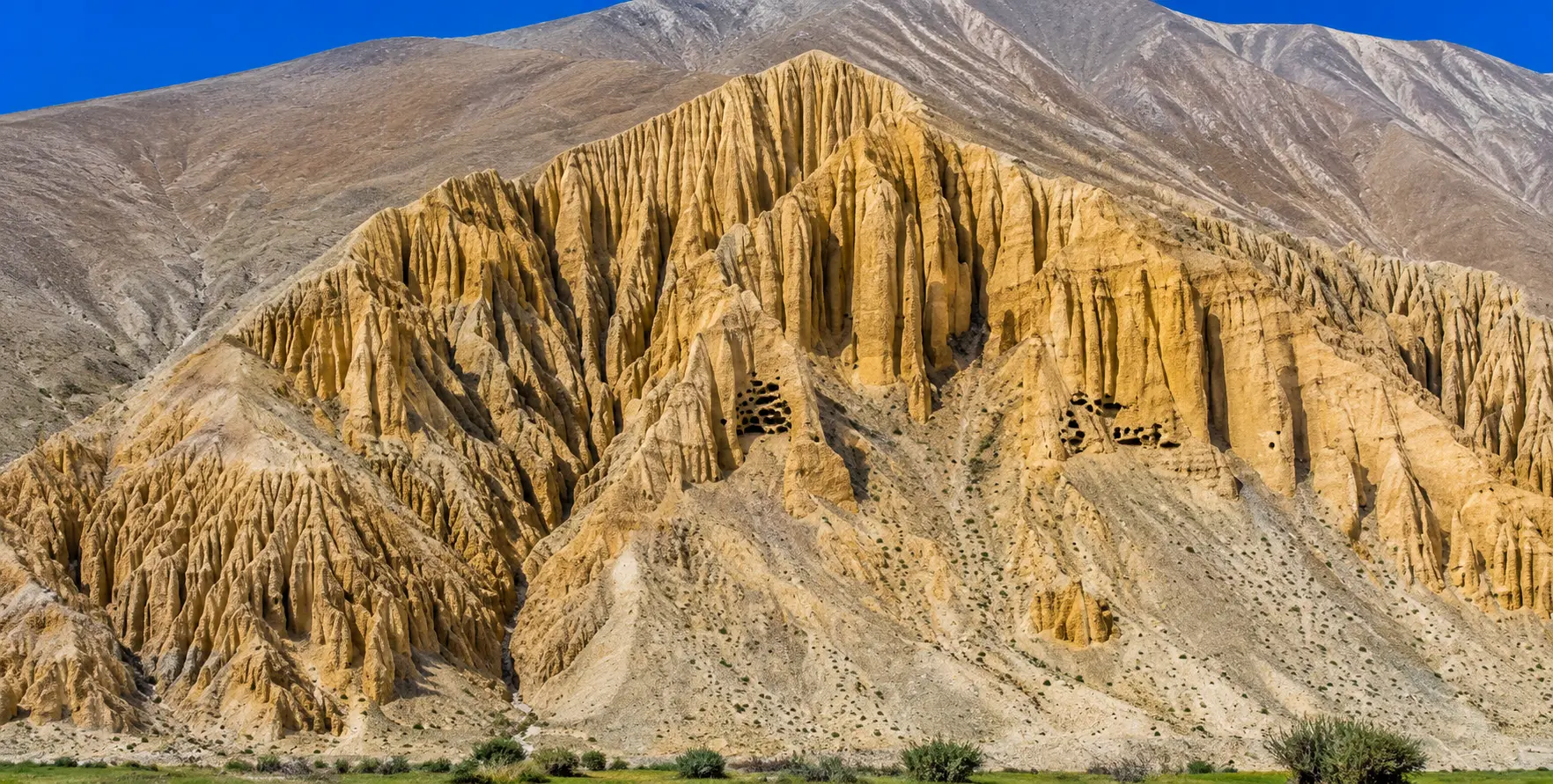
Dhakmar is not the largest village on the route, but it may be the most visually extraordinary. The settlement sits at 3,820 meters beneath a massive escarpment of blood-red sandstone cliffs that glow with an almost surreal intensity at sunrise and sunset — the crimson walls looming above the whitewashed village, creating a color contrast that photographers describe as one of the finest natural compositions in the Himalayas. The Dhakmar cliffs are honeycombed with ancient cave dwellings carved into the rock face at various levels — some accessible only by ladder, others permanently sealed — that are believed to date back more than two thousand years. The drive through Dhakmar — particularly in the late afternoon when the western light catches the cliff face — is one of the highlights of the full Mustang road journey.

Tsarang / Charang (3,560 m): The Palace and the Ancient Monastery

Tsarang (also known as Charang), at 3,560 meters, is the second-largest ustang and one of its most historically significant. The five-story Charang Palace — one of the oldest palace structures in the Mustang region — rises dramatically above the village on a hilltop. At the same time, the Tsarang Gompa (Charang Monastery), built in the 14th century, houses an outstanding collection of ancient thangka paintings, clay sculptures, and Buddhist manuscripts, representing some of the finest religious art in the Himalayan world. The monastery’s inner sanctum murals are particularly remarkable — highly detailed iconographic paintings in the Western Tibetan style that have survived largely intact due to the extreme aridity of the Mustang climate. Tsarang is approximately 2kilometerses south of Lo Manthang and typically serves as the penultimate overnight stop before arriving at the capital.

Lo Manthang (3,840 m): The Walled Capital

The road reaches its conclusion at Lo Manthang — 3,840 meters above sea level, surrounded by high mud-brick walls that have enclosed the ancient capital of the Kingdom of Lo since its founding in 1380 AD by King Ame Pal. Inside those walls, whitewashed houses line narrow alleys, the five-story royal palace of the King of Lo rises above everything, and the monasteries of Thubchen Gompa, Chode Gompa, and Jampa Lhakhang house some of the finest Buddhist art in the entire Himalayan world. The city that the road has been building toward for 222 kilometers from Pokhara is genuinely worth every kilometer of the approach. This living medieval city has survived at the edge of the world, with its culture, architecture, and spiritual traditions essentially intact.

Nepal Vehicle Hiring’s Pokhara to Mustang jeep service delivers you to Lo Manthang’s gates after a journey that most travelers describe as one of the finest overland adventures of their lives. The route’s combination of gorge driving, plateau landscapes, ancient villages, and the steady revelation of the Tibetan cultural world makes the 222-kilometer drive from Pokhara to Lo Manthang not just a means of reaching a destination but a travel experience in its own right.
Pokhara to Mustang Road Overview with a 4WD jeep traveling through the Kali Gandaki Valley toward Upper Mustang

Lower Mustang: The Valley Between Jomsom and Kagbeni

Many travelers focus exclusively on Upper Mustang north of Kagbeni, but the Lower Mustang valley between Jomsom and Kagbeni deserves attention in its own right. This section — which does not require the Restricted Area Permit — contains some of the most interesting cultural landscapes in PTandaki Province, and any vehicle-based Mustang journey should set aside time to explore it properly.

Jomsom itself is worth half a day — the town sits between two dramatic mountain walls with a wide valley floor swept by the famous Mustang wind that builds every afternoon. The small Jomsom Museum covers the cultural and natural history of the Mustang region, and the ACAP office in Jomsom is where conservation area permits can be obtained if not already arranged in Pokhara or Kathmandu. Jomsom’s airport serves twice-daily morning flights from Pokhara — typically Twin Otter or Dornier aircraft that land before the afternoon wind makes flying impossible — and is the flight option for travelers who want to reach Jomsom quickly and then drive or trek northward from there.

Muktinath Temple (3,710 m) — accessible via the Jomsom–Muktinath side road — is one of the most important sacred sites in both Hinduism and Buddhism, located 21 kilometers north of Kagbeni and eastward up the Jhong Khola valley. Our dedicated Muktinath Yatra itinerary covers this section in detail for pilgrims and spiritual travelers. The Muktinath visit can be incorporated into the Pokhara–Mustang itinerary as a side trip before the main push to Lo Manthang, or as a stop on the return journey.
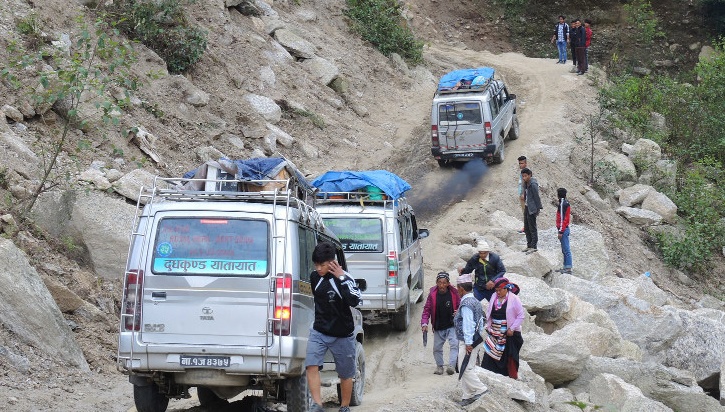
Pokhara to Mustang Road Overview with a 4WD jeep traveling through the Kali Gandaki Valley toward Upper Mustang

Road Conditions on the Pokhara to Mustang Route: Section by Section

Understanding the road conditions on each section of the Pokhara–Mustang route is essential for planning your vehicle choice, your overnight schedule, and your expectations for the journey. The route spans a dramatic range of road quality — from smooth blacktop to raw mountain track — and the conditions change significantly with the seasons.

Pokhara to Beni: Good Blacktop

The Pokhara to Beni section (85 km) is on a predominantly well-maintained paved road with occasional construction sections. Standard vehicles can handle this leg, though Nepal Vehicle Hiring always deploys a 4WD jeep from the outset, given the conditions on the onward mountain road. The road is two lanes for most of its length, narrowing to a single lane in hill sections. Expect 2.5 to 3 hours of comfortable driving with clear mountain views on good-weather mornings.

Beni to Tatopani: Rough Begins

The 21 kilometers from Beni to Tatopani mark the beginning of the rough road. Blacktop becomes patchy and then disappears, replaced by compacted gravel and loose rock. River crossing points exist in this section. The road follows the Kali Gandaki River bank closely, with occasional drops to the river’s edge that demand careful driving. This section takes approximately 1.5 to 2 hours.
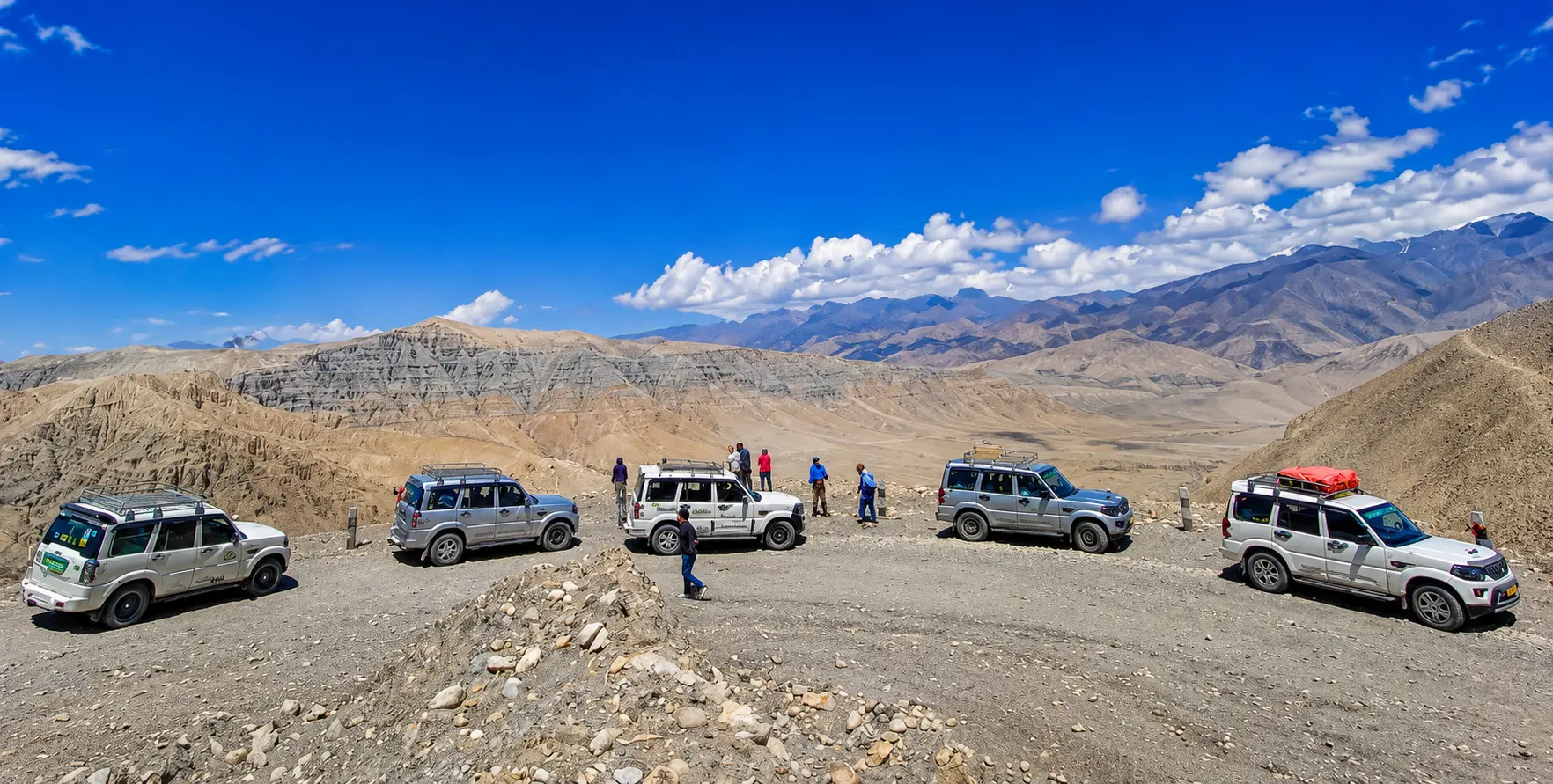
Pokhara to Mustang Road Overview with a 4WD jeep traveling through the Kali Gandaki Valley toward Upper Mustang

Tatopani to Jomsom: The Gorge Road

The remaining 64 kilometers from Tatopani to Jomsom through Ghasa, Kalopani, Tukuche, Marpha, and the upper gorge are the most demanding road section below Kagbeni — consistently rough, narrow in places, and requiring full 4WD engagement through the steeper switchbacks and the river-level sections where the road cuts across unstable scree fans. The afternoon wind in the Kali Gandaki gorge is one of the world’s most powerful valley wind systems, building every afternoon from the south and making conditions increasingly difficult for open vehicles and motorcycles after midday. This is the primary reason Nepal Vehicle Hiring recommends an early departure from Beni (by 7 AM) so that the gorge section is completed before the winds pick up. The Tatopani–Jomsom section takes 3.5 to 4.5 hours depending on conditions.

Kagbeni to Lo Manthang: Full Off-Road

The 61 kilometers from Kagbeni to Lo Manthang via Chhusang, Chele, Syangboche, Ghami, Dhakmar, and Tsarang are genuine off-road — unpaved throughout, with stream crossings, steep climbs, exposed cliff-edge sections, and surfaces ranging from packed gravel to loose shale to raw earth. The passes near Earthyangboche (Nyi La at Earth 0 m) are the highest points on the road, where thin air reduces engine performance,e and driver fatigue requires careful management. This section should be planned as a two-day drive for comfortable overland travel — Kagbeni to Ghami (approximately 40 km, 4 to 5 hours) on day one, and Ghami to Lo Manthang via Tsarang (approximately 21 km, 2 to 3 hours) on day two. Some itineraries with strong drivers and good conditions complete the full Kagbeni–Lo Manthang section in a single long day (7 to 8 hours), but this is physically demanding and leaves little time for en route village exploration.

Monsoon Season Road Conditions (June to September)

The Beni–Jomsom section is particularly vulnerable to monsoon-season disruption. Landslides, rockfalls, and road washouts occur regularly between June and September in the Kali Gandaki gorge, and it is not uncommon for the road to be blocked for periods of hours to several days during heavy monsoon rain. Nepal Vehicle Hiring’s drivers monitor road conditions daily during the monsoon and will proactively advise clients if the route is blocked or alternative scheduling is required.

The Upper Mustang section north of Kagbeni is significantly drier during the monsoon season because it lies within the Himalayan rain shadow. Road conditions there are generally manageable even in the monsoon months, making Upper Mustang one of the few Nepal mountain destinations that remain fully accessible year-round. Travelers specifically targeting monsoon visits to the green lower valley, combined with the dry upper plateau, can do so with proper planning and a reliable 4WD vehicle.
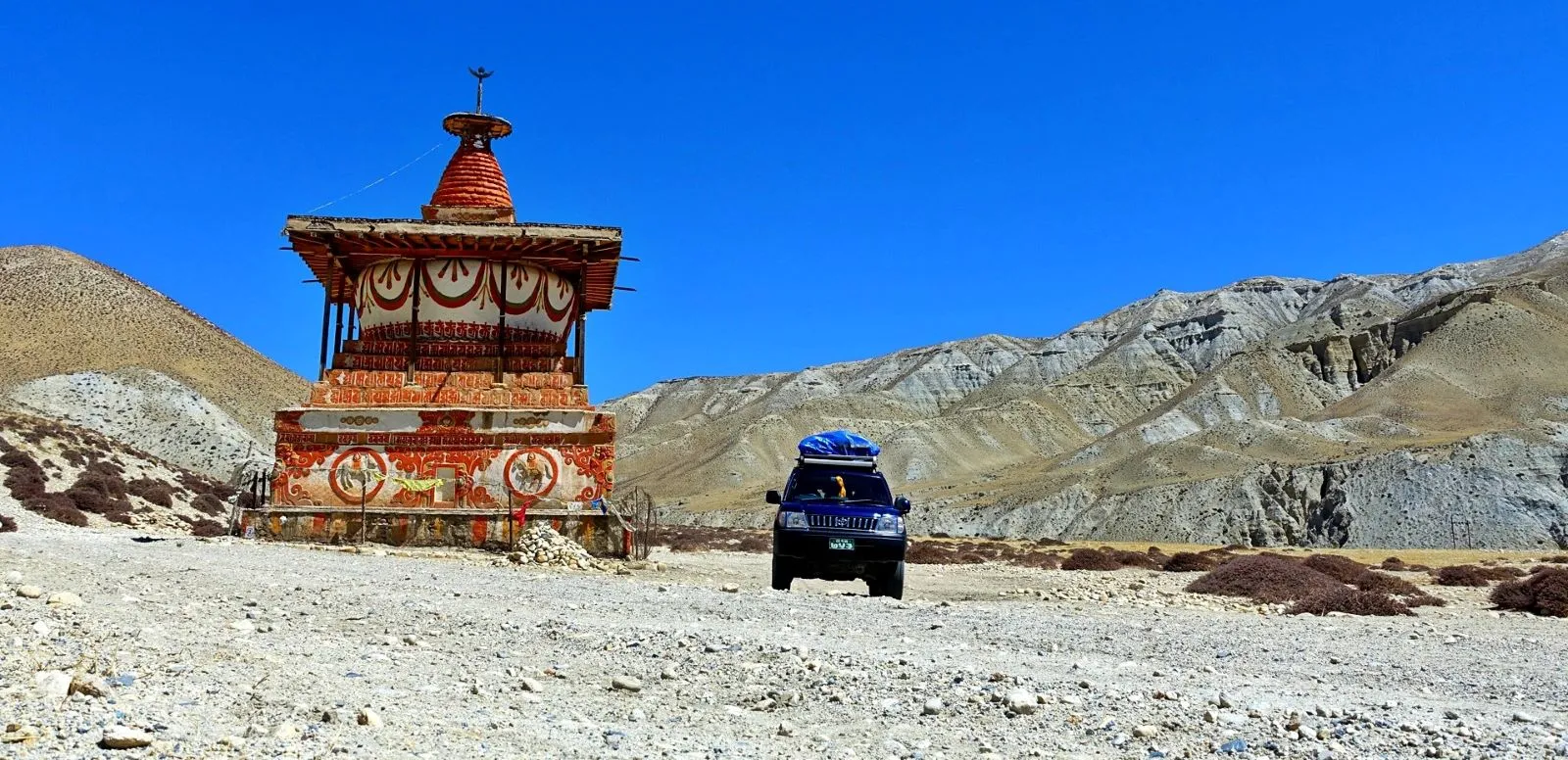
Pokhara to Mustang Road Overview with a 4WD jeep traveling through the Kali Gandaki Valley toward Upper Mustang

Permits Required for the Pokhara to Mustang Road Journey in 2026

The Pokhara–Mustang road journey crosses several administrative and conservation zone boundaries, each with its own permit requirement. Understanding the full permit picture before departure avoids delays at checkpoints and ensures your itinerary is not disrupted.

Annapurna Conservation Area Permit (ACAP)

The ACAP is required for all foreign nationals entering the Annapurna Conservation Area, which covers the Beni–Jomsom corridor and the lower Mustang region. The current fee (2026) is NPR 3,000 (approximately USD 22–25) per person, valid for the duration of your visit without a daily limit. ACAP permits can be obtained at the Nepal Tourism Board office in Kathmandu, at the ACAP office in Pokhara or Beni, or through a registered travel or trekking agency. Nepal Vehicle Hiring coordinates ACAP permit processing through our partner agencies as part of the full Mustang jeep service.

Upper Mustang Restricted Area Permit (RAP)

Entry into Upper Mustang — specifically, the zone north of Kagbeni — requires the Restricted Area Permit (RAP). In November 2025, the Government of Nepal formally overhauled the RAP fee structure, replacing the old flat-fee system (USD 500 per person for the first 10 days) with a daily rate of USD 50 per person per day for the exact number of days spent inside the restricted zone. This means a 3-day visit to Lo Manthang costs USD 150 per person; a 5-day visit costs USD 250 per person — a far more flexible and equitable system that makes shorter visits significantly more affordable than before.

The RAP must be arranged through a licensed Nepal trekking or tour agency — it cannot be obtained independently by foreign nationals. All foreign visitors to Upper Mustang must also travel with a licensed guide. As of March 2026, the minimum group size requirement has been removed, meaning solo foreign travelers can enter Upper Mustang provided they have the RAP and a licensed guide. Nepal Vehicle Hiring works with licensed partner agencies to arrange all permit processing in Pokhara or Kathmandu before departure, ensuring clients arrive at the Kagbeni checkpoint fully documented and ready to proceed without delay.

TIMS Card

The TIMS (Trekkers’ Information Management System) card requirement has been revised in recent years. It is no longer mandatory for travelers holding a valid ACAP permit for the Annapurna and Mustang regions. However, requirements can change, and Nepal Vehicle Hiring recommends confirming the current TIMS requirements with our team at the time of booking rather than assuming they have not changed since this guide was published.
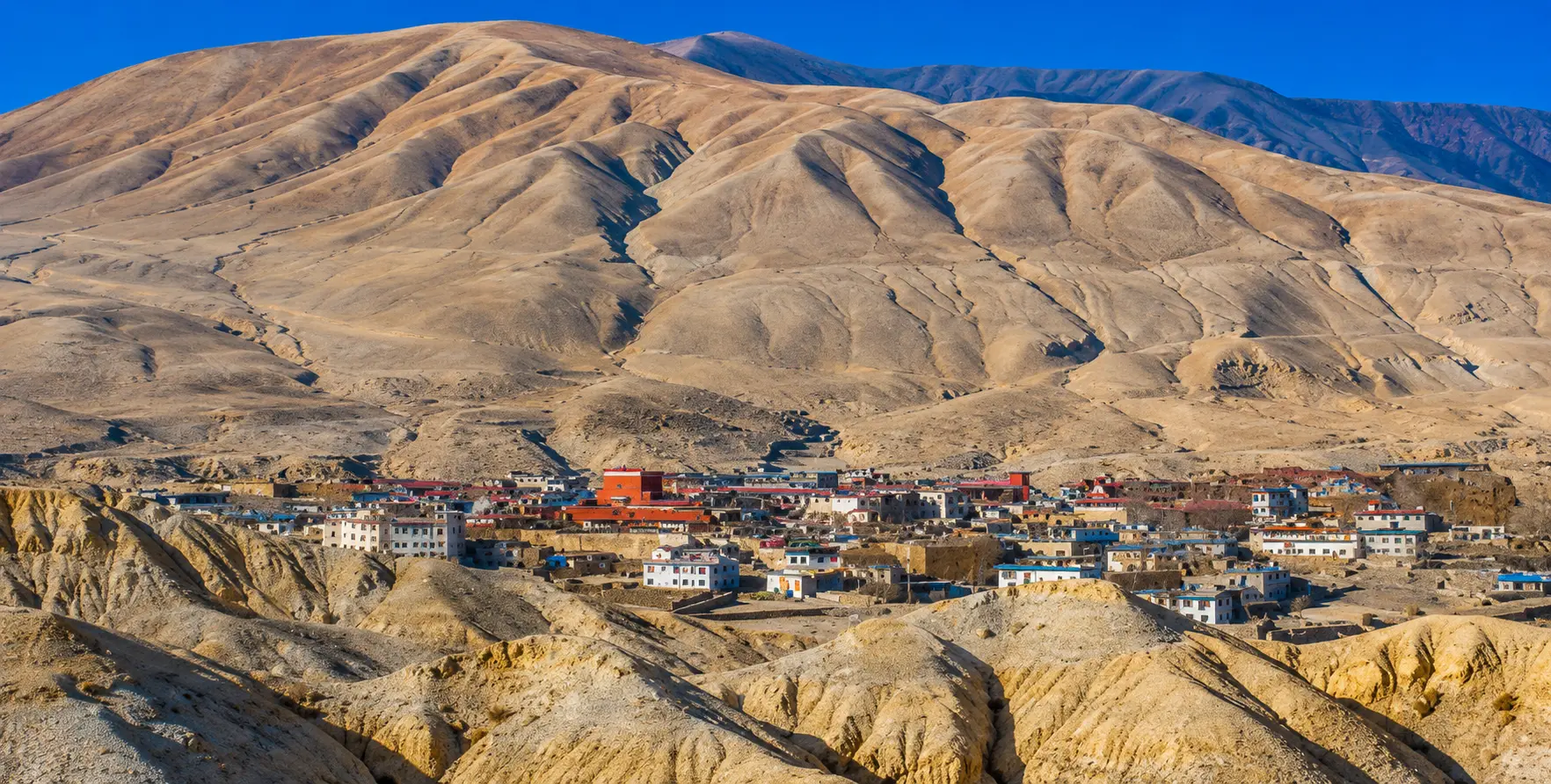
Pokhara to Mustang Road Overview with a 4WD jeep traveling through the Kali Gandaki Valley toward Upper Mustang

The following 7-day itinerary is Nepal Vehicle Hiring’s recommended schedule for a Pokhara–Mustang jeep journey that balances comfortable driving stages with meaningful time for village exploration and acclimatization. It can be adjusted based on your specific time constraints and interests.

  • Day 1: Pokhara to Jomsom via Beni, Tatopani, Ghasa, Kalopani, and Marpha. Depart Pokhara by 6:30 AM. Breakfast at Malekhu or Tatopani. Lunch at Kalopani with Dhaulagiri Icefall view. Visit Marpha Apple Village. Overnight Jomsom. (195 km, 7 to 8 hours with stops.)
  • Day 2: Jomsom exploration and Muktinath side trip. Morning drive to Muktinath Temple (3,710 m) via Kagbeni — see Muktinath Yatra itinerary. Return to Kagbeni for permit registration and overnight. Explore Kagbeni’s medieval lanes and monastery.
  • Day 3: Kagbeni to Ghami via Chhusang, Chele, Chungsi Cave, Samar, and Syangboche. Permit checkpoint at Kagbeni exit. Chungsi Cave stop. Nyi La pass crossing. Overnight Ghami. (Approximately 40 km, 5 to 6 hours.)
  • Day 4: Ghami to Lo Manthang via Dhakmar and Tsarang. Dhakmar Red Cliff stop—Tsarang Palace and Gompa visit. Arrive in Manthang late in the afternoon. Explore Thubchen, Chode, and Jampa monasteries. Overnight Lo Manthang. (Approximately 25 km, 3 to 4 hours.)
  • Day 5: Lo Manthang exploration and Chhoser side trip. Day in the walled city — King’s Palace, Tashi Gephel Palace courtyard, village lanes. Afternoon excursion to Chhoser Valley (Jhong Cave). Overnight Lo Manthang.
  • Day 6: Lo Manthang to Jomsom return via Tsarang, Ghami, Samar, Kagbeni. Permit exit at Kagbeni. Overnight Jomsom.
  • Day 7: Jomsom to Pokhara via Marpha, Tatopani (hot spring stop), Beni. Arrive in Pokhara in the afternoon. Return to the Lakeside Hotel.

This itinerary uses Nepal Vehicle Hiring’s Pokhara-to-Mustang jeep service throughout. All vehicle, driver, and fuel costs are included in the service. Accommodation and food are arranged independently by the client or through our partner agency. Contact us through the “Plan Your Trip “ page to receive a full quote and a customized itinerary.

Pokhara to Mustang Road Overview with a 4WD jeep traveling through the Kali Gandaki Valley toward Upper Mustang

Vehicle Requirements: Why Only a 4WD Jeep Will Do

The Pokhara to Mustang road is one of Nepal’s most vehicle-demanding routes, and the requirement for a capable 4WD with an experienced mountain driver is not a suggestion — it is an absolute necessity. Here is why any other vehicle type is unsuitable:

Standard Cars and Sedans: Not Suitable Beyond Beni

Standard cars and sedans — regardless of brand or age — are completely unsuitable for the Beni–Jomsom road. The river crossings, loose rock surfaces, steep-gradient sections, and narrow cliff passages require ground clearance that no standard car provides. Cars that attempt the Beni–Jomsom road are routinely damaged by rocks scraping the undercarriage, get stuck in river crossings, and are unable to climb the steeper gradient sections. Nepal Vehicle Hiring never deploys sedans or standard cars above Beni for the Mustang route.

Hiace Vans: Suitable for Jomsom Only

Nepal Vehicle Hiring’s Hiace van hire is an excellent vehicle for the Pokhara-to-Beni and Pokhara-to-Jomsom road sections, used by groups of 8 to 14 who want to travel to the Lower Mustang region and Jomsom without the full Upper Mustang jeep requirement. The Hiace handles the Beni–Jomsom road reasonably well in good conditions, though it is more susceptible to monsoon-related road damage than a dedicated 4WD. Beyond Jomsom toward Kagbeni and certainly beyond Kagbeni into Upper Mustang, the Hiace is not appropriate. For Upper Mustang itself, the 4WD jeep takes over from the Hiace at Jomsom.

4WD Jeep: The Only Appropriate Vehicle for Upper Mustang

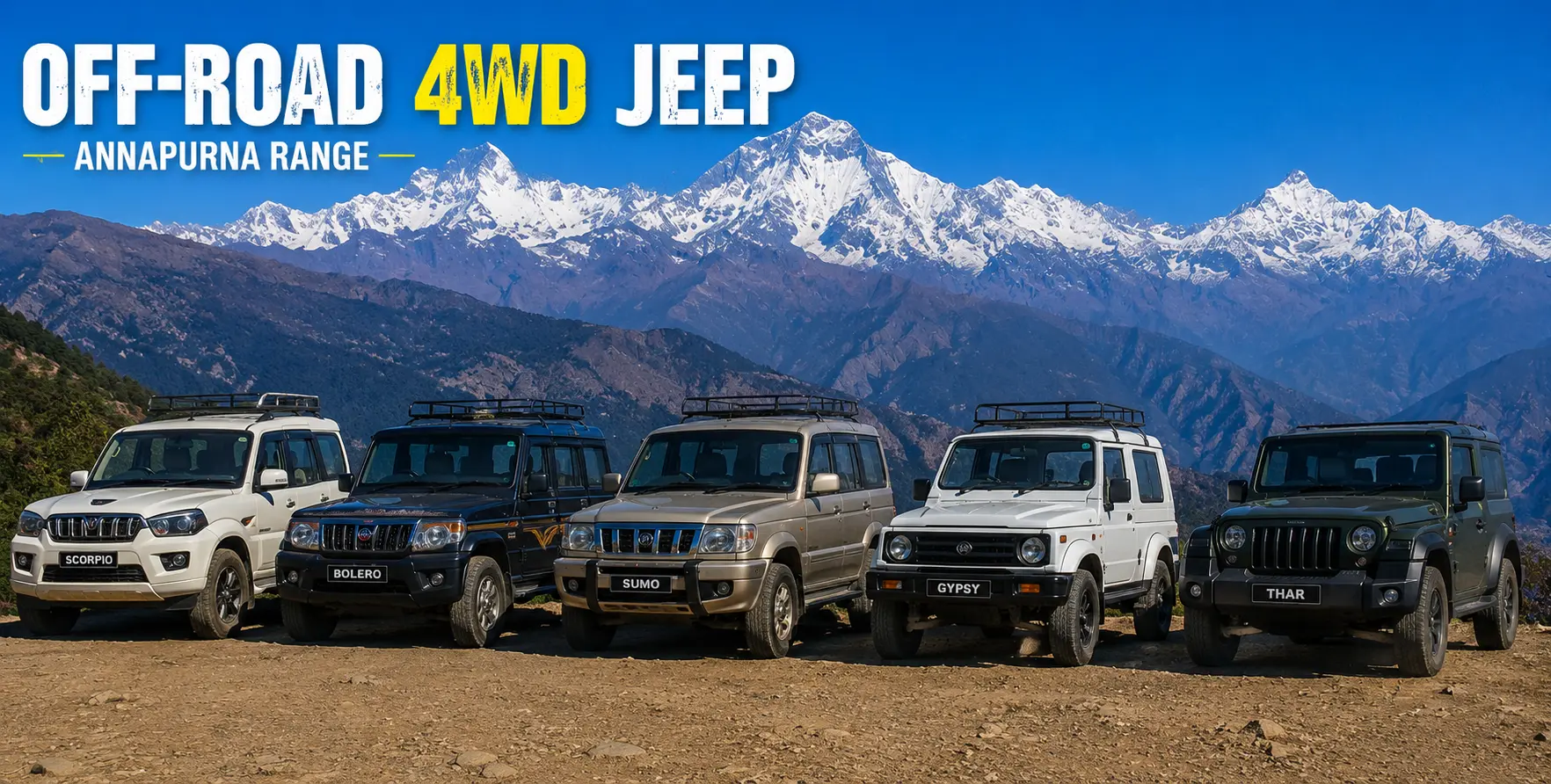
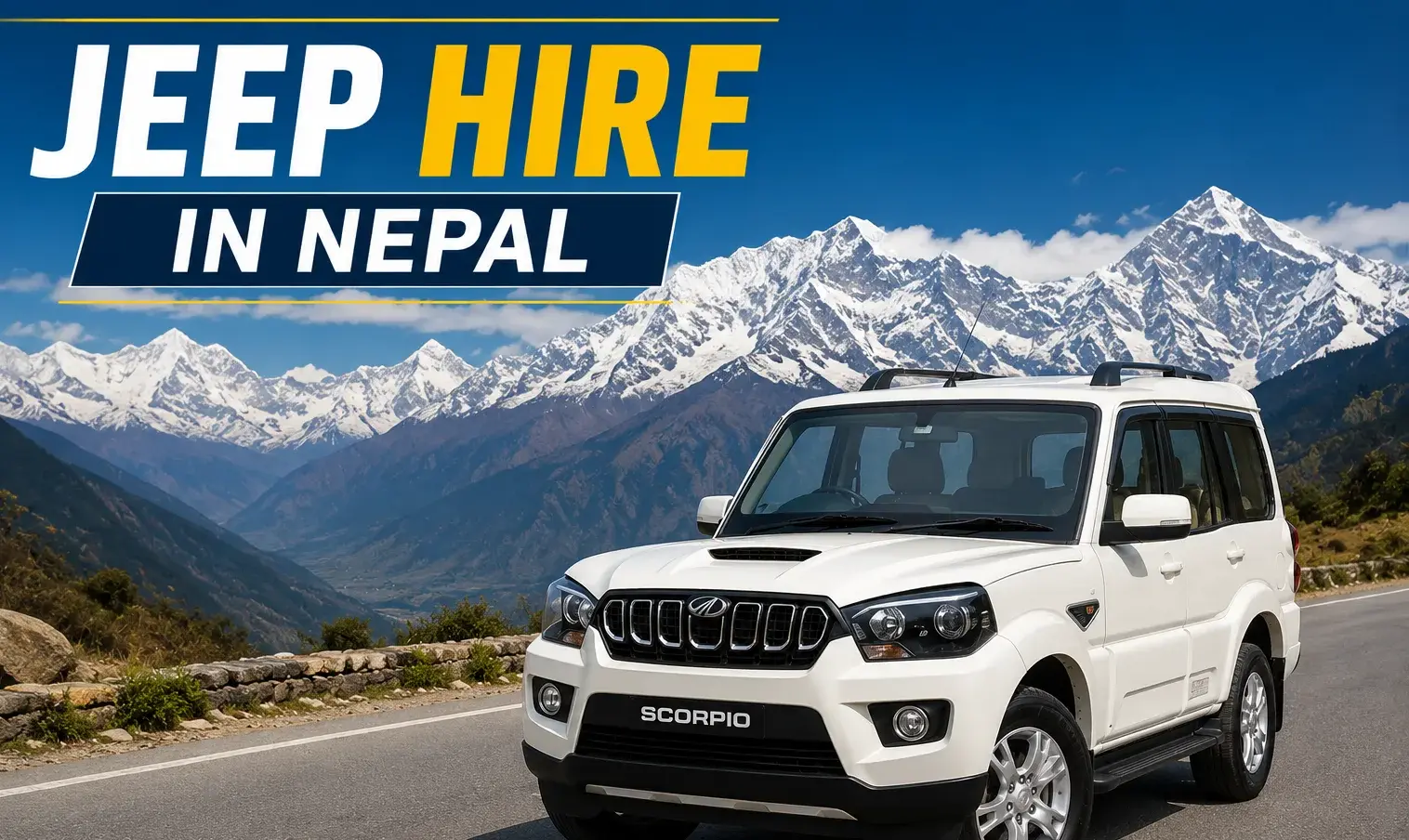
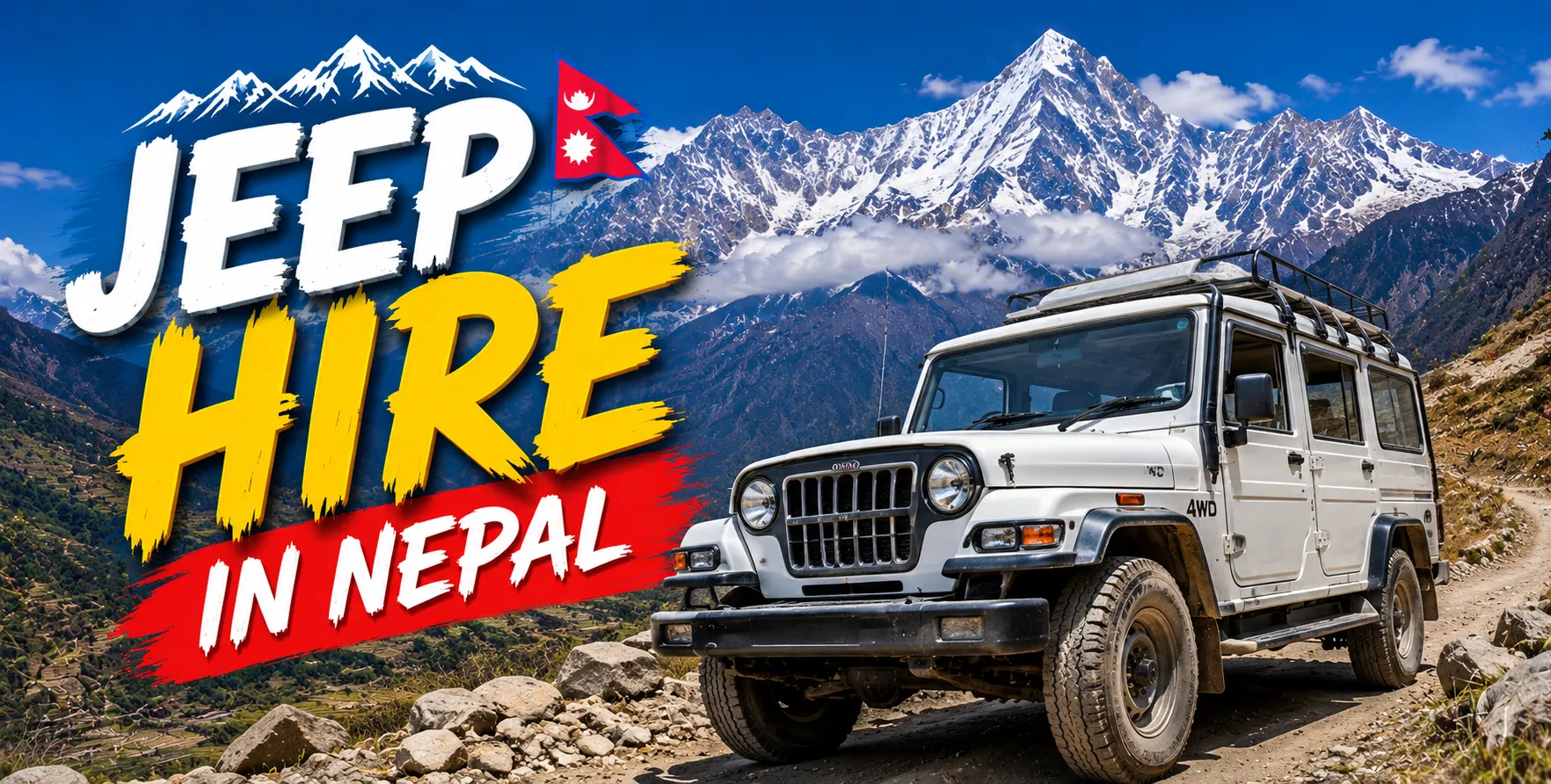
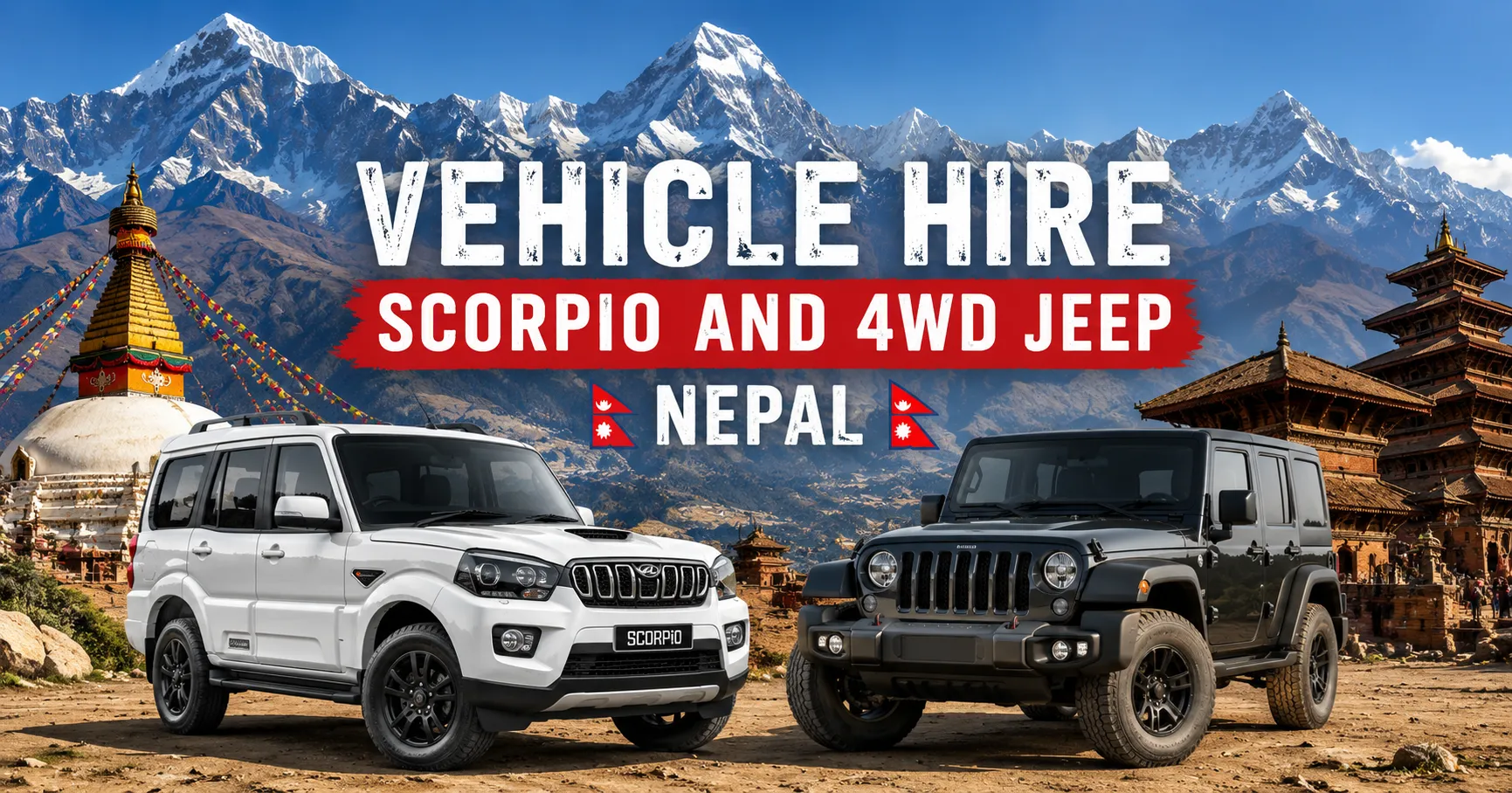
Nepal Vehicle Hiring’s 4WD jeep hire fleet — Mahindra Scorpio and Toyota Land Cruiser options — is the right vehicle for the full Pokhara–Lo Manthang journey. Both vehicles offer high ground clearance, full 4WD capability, a robust suspension rated for rough mountain roads, and the power-to-weight ratio needed to tackle the Nyi La and Syangboche La passes at elevations over 4,000 meters. Our mountain road drivers for the Mustang route have specific experience on every section from Pokhara’s Lakeside to Lo Manthang’s gates — a depth of local knowledge that no city driver with a GPS can replicate.

For travelers beginning their Nepal journey in Kathmandu rather than Pokhara, Nepal Vehicle Hiring’s Kathmandu-to-Mustang private jeep covers the complete overland journey from the capital, including the Prithvi Highway leg to Pokhara and then the full Pokhara–Mustang road as described in this guide.
Pokhara to Mustang Road Overview with a 4WD jeep traveling through the Kali Gandaki Valley toward Upper Mustang

Trekking vs. Jeep on the Pokhara–Mustang Route: What’s Right for You?

Before the road to Lo Manthang was constructed (it reached Kagbeni in the early 2000s and was gradually extended to Lo Manthang over the following decade), trekking was the only way to reach Upper Mustang. The classic Upper Mustang Trek from Jomsom to Lo Manthang covers approximately 125 kilometers return and takes 10 to 14 days of walking. It remains a deeply rewarding experience and arguably the most authentic way to encounter the landscape and villages of Mustang — the pace of walking offers a level of observation and engagement with the environment that driving simply cannot match.

However, the road’s presence has changed the calculation in important ways. The jeep road now follows the same valley as the trekking trail for much of the route, meaning trekkers share the track with vehicle traffic and lose some of the solitude that characterized the pre-road trek. Many experienced Mustang guides now recommend a hybrid approach — using a jeep for some sections (typically the lower gorge from Beni to Jomsom, and the return journey from Lo Manthang) while walking the finest trekking sections (the upper plateau between Kagbeni and Lo Manthang). Nepal Vehicle Hiring’s trekking transport services are designed for exactly this hybrid approach — vehicle drop-off at the trekking start point, vehicle pickup at the trek end point, coordinated as a single seamless booking.

For travelers with limited time, a 7-day full-jeep journey from Pokhara to Lo Manthang and back covers the essential landscape and cultural highlights, leaving more time to explore Lo Manthang itself. For travelers with 14+ days available and a genuine appetite for Himalayan trekking, the walking approach to Upper Mustang is one of the finest trekking experiences in Nepal — right alongside the Annapurna Circuit and the Everest Base Camp trek in terms of landscape and cultural rewards.
Pokhara to Mustang Road Overview with a 4WD jeep traveling through the Kali Gandaki Valley toward Upper Mustang

Best Time to Drive the Pokhara to Mustang Road

Spring (March to May): The Premier Season

Spring is the most popular season for the Pokhara–Mustang jeep drive, and for good reason. The skies are clear, the mountain views are at their pre-monsoon finest, and the Tiji Festival — typically held in May at Lo Manthang — is the most spectacular cultural event in the Mustang calendar. The road is in its best annual condition in spring: the previous monsoon’s damage has been repaired over winter, the surfaces are dry and compacted, and the passes near Syangboche are free of snow. Nepal Vehicle Hiring’s Pokhara-to-Mustang jeep service is in the highest demand during April and May — booking 6 to 8 weeks in advance is strongly recommended for the spring window.

Monsoon (June to August): Surprisingly Good for Upper Mustang

Upper Mustang is one of the few mountain destinations in Nepal that are actively recommended during the monsoon. The rain shadow blocks almost all monsoon precipitation north of Kagbeni, meaning the plateau landscape is dry and clear even as the rest of Nepal disappears under cloud. The lower gorge section from Beni to Jomsom is more challenging during the monsoon due to landslide risk, and Nepal Vehicle Hiring recommends a careful day-by-day assessment of road conditions for this section. But above Jomsom, and certainly above Kagbeni, the monsoon months offer a unique combination of clear plateau sky and vivid green lower-valley views that has its own photographic and experiential appeal.

Autumn (September to November): Post-Monsoon Clarity

Autumn is Nepal’s peak trekking season and one of the finest times for the Mustang drive. Post-monsoon clarity delivers extraordinary mountain views; the road has been assessed and partially repaired after monsoon damage; and the autumn harvest gives the Ghami and Tsarang barley fields a warm golden character. October in Lo Manthang, with the harvest complete and the plateau landscape in its late-season clarity, is one of the finest travel moments in Nepal. Book in advance — autumn demand is second only to spring for our Mustang jeep service.

Winter (December to February): Cold but Possible

Winter visits to Upper Mustang are possible but require careful planning. Lo Manthang experiences temperatures as low as minus 20 to minus 25 degrees Celsius at night in January and February; most teahouses reduce capacity or close entirely, and the Nyi La and Syangboche La passes may be snow-covered and icy. The Beni–Jomsom road section is generally passable in winter, except during heavy snowfall. Winter is best suited to experienced cold-weather travelers seeking the solitude and stark beauty of Mustang in its quietest season.
Pokhara to Mustang Road Overview with a 4WD jeep traveling through the Kali Gandaki Valley toward Upper Mustang

Connecting to the Pokhara–Mustang Road from Kathmandu and Beyond

For most international travelers, the Pokhara–Mustang road begins not in Pokhara but in Kathmandu. The journey from Nepal’s capital adds approximately 200 kilometers and 6 to 7 hours of additional highway driving (or a 25-minute domestic flight) to the total Mustang itinerary. Nepal Vehicle Hiring coordinates the full journey from Kathmandu through a single booking.

Starting with a Kathmandu airport transfer on arrival, travelers typically spend 1 to 2 days in the Kathmandu Valley — our Kathmandu sightseeing service, the Bhaktapur Durbar Square day tour, and the Nagarkot sunrise tour via our Kathmandu to Nagarkot vehicle are the most popular Kathmandu Valley additions before the Mustang departure. The Kathmandu-to-Pokharabus or a private Hiace van hire handles the capital-to-Pokhara leg, with the Mustang jeep departing from Pokhara’s Lakeside the following morning.

Travelers combining Mustang with other Nepal destinations can draw on Nepal Vehicle Hiring’s full fleet: car hire in Nepal for Kathmandu Valley sightseeing, Coaster bus hire, or full bus hire for large-group highway sections, and our dedicated mountain-road jeeps for every section above Beni. The complete Nepal holiday tour packages can include Mustang as the centerpiece of a broader itinerary covering Kathmandu, Pokhara, Chitwan, and Lumbini — all coordinated by a single team with a single point of contact throughout.

Frequently Asked Questions: Pokhara to Mustang Road

How many days does the drive from Pokhara to Lo Manthang take?

The minimum comfortable drive is 3 days from Pokhara to Lo Manthang (Day 1: Pokhara to Jomsom, Day 2: Jomsom to Ghami, Day 3: Ghami to Lo Manthang). Most travellers prefer a 3 to 4 day approach that adds more time in Lo Manthang itself, and our recommended 7-day return itinerary (including 2 nights in Lo Manthang and a Muktinath side trip) is considered the optimal balance of drive time, village exploration, and acclimatization.

Can a standard car or a tourist bus make the Pokhara-to-Mustang journey?

No. Standard cars are not suitable beyond Beni. Tourist buses are not suitable beyond Jomsom. The road from Kagbeni to Lo Manthang — and indeed from Beni onward — requires a 4WD vehicle with high ground clearance. Nepal Vehicle Hiring uses only its dedicated 4WD jeep fleet for the Mustang route.

What is the total road distance from Pokhara to Lo Manthang?

The total road distance from Pokhara’s Lakeside to Lo Manthang is approximately 222 kilometers, broken down as follows: Pokhara to Beni (85 km), Beni to Jomsom (85 km), Jomsom to Kagbeni (11 km), and Kagbeni to Lo Manthang (61 km).

Is the Pokhara-to-Mustang road safe?

With the right vehicle and an experienced driver, the Pokhara–Mustang road is safe and manageable. The risks — rough road surfaces, river crossings, landslide zones in the lower gorge, thin air at altitude — are all manageable by an experienced operator. Nepal Vehicle Hiring’s mountain road drivers have extensive experience on every section of this route and are equipped to handle the conditions typical of Himalayan mountain roads.

Can I fly to Jomsom and drive to Lo Manthang from there?

Yes — this is a popular approach for travelers with limited time. The 220- to 25-minute morning flight from Pokhara to Jomsom (operated by Yeti Airlines and other carriers) saves approximately 7 to 8 hours of driving. From Jomsom, Nepal Vehicle Hiring can arrange a 4WD jeep for the onward journey to Kagbeni and Lo Manthang. Note that Jomsom flights are frequently canceled due to weather and wind conditions, so build flexibility into your schedule and always have a road trip as a backup option. Nepal Vehicle Hiring’s Pokhara-to-Mustang service can be configured for a Jomsom departure if you fly the first leg.

How do I book a jeep from Pokhara to Mustang with Nepal Vehicle Hiring?

Contact us through our plan your trip page, WhatsApp +977 9851013196, or email [email protected] with your travel dates, group size, and preferred itinerary. We respond within 24 hours with a full vehicle proposal, driver assignment, and all-in pricing.
Follow the Pokhara to Mustang Road Overview: Complete Jeep Guide for the best routes, road conditions, travel tips, and private 4WD jeep hire information.

Book Your Pokhara to Mustang Jeep with Nepal Vehicle Hiring

Nepal Vehicle Hiring Pvt. Ltd., based in Thamel, Kathmandu, is your specialist transport partner for the Pokhara–Mustang road journey. Our fleet, our drivers, and our permit coordination services are designed specifically for this extraordinary route, and our team is available seven days a week to help you plan and book the perfect Mustang overland adventure.

Services available for the Pokhara–Mustang route:


Contact us:

The road from Pokhara to Lo Manthang is 222kilometerss of Nepal at its most extraordinary — gorges, villages, plateau, wind, altitude, and at the end of it all, a walled city that has survived on the roof of the world for seven centuries. Nepal Vehicle Hiring will get you there and bring you back, safely and in the comfort that a journey of this caliber deserves.

Essential Packing List for the Pokhara to Mustang Road Journey

The Pokhara to Mustang route spans elevations from 830 meters at Beni to 3,840 meters at Lo Manthang, crossing warm subtropical gorges and frigid high-altitude plateaus in the same overland journey. Packing correctly for this remarkable range of conditions is important — particularly for first-time Himalayan travelers who may underestimate how quickly the temperature, terrain, and environment change as the road climbs northward. Here is what Nepal Vehicle Hiring recommends packing for the full Pokhara-to-Lo Manthang jeep journey.

Warm layers: a down jacket is essential above Jomsom, particularly in the evenings when temperatures drop sharply even in spring and autumn. A thermal base layer, a fleece mid-layer, and a windproof outer shell cover all conditions, from the Beni gorge heat at lower altitudes to the bitter cold of o Manthang above 3,800 mmeters

Sun protection: at 3,840meterss, UV radiation is significantly more intense than at sea level. Sunscreen with SPF 50 or higher, UV-blocking sunglasses rated for high altitude, and a wide-brimmed hat or warm wool cap are essential above Kagbeni. Snow blindness and severe sunburn are genuine risks at the altitude of Lo Manthang if proper protection is neglected.

Cash in Nepali Rupees: there are no ATMs above Jomsom. Carry sufficient rupees for accommodation, food, gratuities, and any emergency expenses for the full Upper Mustang stay. NPR 15,000 to 25,000 per person for a five- to seven-day Upper Mustang visit is a reasonable working minimum, but personal spending on souvenirs, additional excursions, and tips for the licensed guide should be factored in separately.

Altitude medication: Diamox (acetazolamide) can be used preventively at altitudes above 3,000 meters and is particularly relevant for the Kagbeni-to-Lo Manthang section. Consult a qualified doctor before travel. Carry basic ibuprofen for headaches and oral rehydration salts for altitude-related dehydration as standard altitude management tools throughout the journey.

Dust protection: the road above Kagbeni generates significant dust during the dry season, particularly on the exposed plateau sections between Chele and Ghami. A scarf, buff, or quality dust mask for use when the jeep window is open helps protect your lungs and eyes during dustier sections. This is one of the most overlooked practical preparations for the Upper Mustang jeep journey.

Offline maps and a power bank: mobile signal is available in Jomsom and Kagbeni, but becomes very patchy above Kagbeni, inside the restricted zone. Download offline maps covering the Upper Mustang route before departingfrom  Pokhara. A fully charged power bank ensures your camera, phone, and GPS remain functional throughout the multi-day journey when vehicle charging points may not be available.
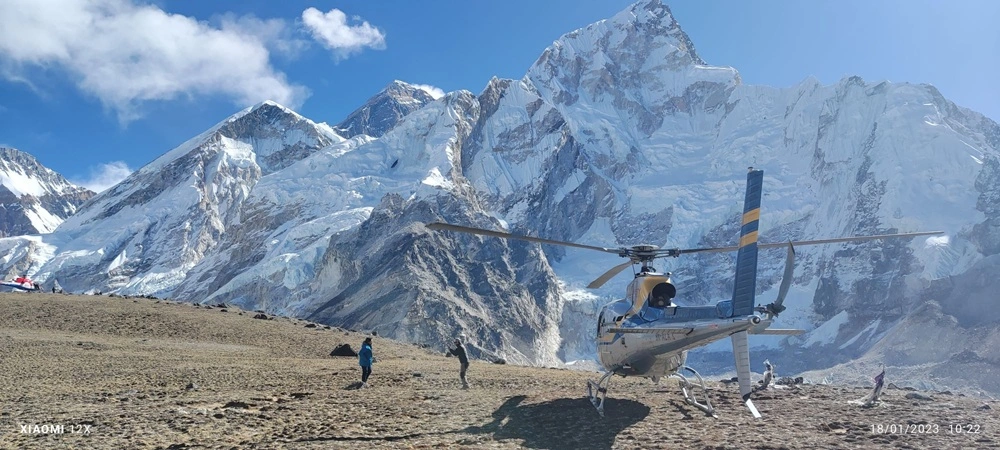
Pokhara to Everest Region Tourist Transport – Complete Guide 2026


Book Pokhara to Everest Region Transport with a private Scorpio or 4WD jeep for a comfortable journey connecting to your Everest trekking adventure.

Pokhara to Everest Region Transport – Complete Guide 2026

The Everest region – home to the world’s highest mountain, the legendary Sherpa culture, the famous Hillary Step, and the iconic viewpoints of Kala Patthar and Gokyo Ri – is the most sought-after trekking destination in Nepal and one of the most iconic adventure destinations on earth. For travelers already in Pokhara after exploring the Annapurna region, the question of how to get from Pokhara to the Everest region is both common and important.

Unlike the Annapurna region, which sits right on Pokhara’s doorstep, the Everest region is on the opposite side of Nepal – requiring a journey back through or via Kathmandu. There are multiple transport options for this cross-country journey, each with different price points, travel times, comfort levels, and conveniences. This complete 2026 guide covers every tourist transport option from Pokhara to the Everest region – bus, private car, domestic flight, and combinations – with prices, journey details, and expert advice from Vehicle Hiring Nepal.

For travelers looking for the best trekking and planning to explore Kathmandu, we recommend continuing your journey with our trusted sister companies, Trek Nepal Himalayas and Alpine Luxury Treks. We specialize in organizing a wide range of travel experiences across Nepal, from classic trekking adventures to cultural and wildlife tours.

Our top offerings include iconic journeys such as the Everest Base Camp Trek, immersive Kathmandu sightseeing tours, breathtaking Nagarkot sunrise experiences, exciting Chitwan jungle safaris, and luxury packages. In addition, we can arrange short hikes, heritage tours, mountain flights, and customized travel plans tailored to your schedule and interests.

Whether you are looking for a budget-friendly trip or a luxury trekking experience with premium lodges, private guides, and high-end services, we ensure every detail is professionally managed. Our goal is to provide a seamless transition from your trekking adventure to a comfortable) and a memorable travel experience in Nepal.

Understanding the Geography: Why Pokhara to Everest is Not Direct

Many travelers are surprised to discover that getting from Pokhara to the Everest region is not a straightforward, direct journey. Here is why:

Pokhara Location: West-central Nepal, Gandaki Province, Annapurna foothills

Everest Region Location: Eastern Nepal, Koshi Province, Solukhumbu District

Direct Distance: Approximately 200 km as the crow flies – but there is no direct road

Road Route via Kathmandu: Approximately 600–650 km total: Pokhara → Kathmandu (200 km) → Kathmandu to Salleri or Phaplu (330 km) or fly to Lukla

The Key Hub: Kathmandu is the unavoidable transit hub for all Pokhara to Everest region journeys


Whether you travel by bus, private car, or a combination of flights, Kathmandu serves as the central transit point between Pokhara in the west and the Everest region in the east. From Kathmandu, travelers either fly to Lukla (the primary gateway for Everest treks) or take a vehicle south and east to Salleri, Phaplu, or Jiri – the road access points to the lower Everest region.


All Transport Options: Pokhara to Everest Region


Route OptionModeTotal TimeTotal Cost (est.)Best For
Pokhara → Kathmandu (bus) → fly LuklaBus + flight1.5–2 daysUSD 25–40 bus + USD 160–190 flight/personBudget travelers, backpackers
Pokhara → Kathmandu (private car) → fly to LuklaCar + flight1–1.5 daysUSD 80–110 car + USD 160–190 flightFamilies, groups, comfort
Fly Pokhara → Kathmandu → fly LuklaFlight + flightSame dayUSD 80–110 + USD 160–190/personFast, short on time
Pokhara → KTM (car) → drive to Salleri/PhapluCar + car2–3 daysUSD 80–110 + USD 180–250 vehicleTrekkers starting the lower circuit
Pokhara → KTM (car) → drive to JiriCar + car2 daysUSD 80–110 + USD 130–170 vehicleJiri route traditional trekkers
Pokhara → KTM (bus) → drive to SalleriBus + jeep3 daysUSD 15–25 bus + USD 180–250 vehicleBudget group, lower Everest entry

Book Pokhara to Everest Region Transport with a private Scorpio or 4WD jeep for a comfortable journey connecting to your Everest trekking adventure.

The most popular route for travelers heading from Pokhara to the Everest region is to first travel from Pokhara to Kathmandu, spend a night in Kathmandu, and then fly from Kathmandu to Lukla the following morning. This is the standard route for the vast majority of Everest Base Camp trekkers starting from Pokhara.

Stage 1: Pokhara to Kathmandu


Transport ModeTravel TimePriceDepartureComfort
Private Car / SUV (1–5 pax)5–6 hrsUSD 80–110 full carAny timeExcellent – door to door
Private Hiace Van (7–14 pax)5–6 hrsUSD 130–165 full vanAny timeExcellent – group together
Tourist Bus (shared)7–8 hrsUSD 10–15 per person7:00 AM fixedGood – shared with others
Greenline Luxury Bus (shared)6–7 hrsUSD 25–30 per person8:00 AM fixedVery Good – includes lunch
Domestic Flight25 minUSD 80–110 per personMultiple dailyFastest – no road scenery


Stage 2: Kathmandu to Lukla by Flight

Airlines: Tara Air, Summit Air, Sita Air – daily flights in season

Flight Duration: 35 to 45 minutes

Ticket Price 2026: USD 160 to USD 190 per person one-way

Departure: Multiple flights 6:00 to 11:00 AM – all flights complete before noon due to mountain weather

Lukla Airport: Tenzing-Hillary Airport at 2,860 m – famous as one of the world’s most extreme airports

Booking: Book at least 2 to 4 weeks in advance in peak season (March–May and October–November)

Cancellation Risk: Moderate to high – Lukla flights are weather-dependent and frequently delayed in monsoon and winter


Vehicle Hiring Nepal provides private car or bus transfers from Pokhara to Kathmandu. We do not sell Lukla flight tickets but can advise on booking. The Lukla flight must be booked through a licensed travel agency or directly with Tara Air / Summit Air.


Book Pokhara to Everest Region Transport with a private Scorpio or 4WD jeep for a comfortable journey connecting to your Everest trekking adventure.

Option B: Fly Pokhara to Kathmandu + Fly to Lukla (Same Day)

For travelers with very limited time who want to reach the Everest region as quickly as possible, it is possible to fly from Pokhara to Kathmandu and then fly from Kathmandu to Lukla on the same day – subject to flight timing.

Pokhara to Kathmandu flight: First flights depart approximately 6:30 to 7:00 AM, arriving in Kathmandu 7:00 to 7:30 AM

Transfer to domestic terminal: 15 to 20 minutes by taxi within Tribhuvan Airport

Kathmandu to Lukla: Flights depart from 6:00 to 10:30 AM – connecting from Pokhara in time for a 9:00–11:00 AM Lukla flight is possible

Total flight cost: USD 80–110 (Pokhara–KTM) + USD 160–190 (KTM–Lukla) = USD 240–300 per person

Risk: If your Pokhara–Kathmandu flight is delayed, you may miss your Lukla flight – allow buffer time


This same-day flight combination is possible but involves risk. We recommend arriving in Kathmandu the evening before and flying to Lukla the following morning for a stress-free start to your Everest trek. Vehicle Hiring Nepal can arrange airport transfers within Kathmandu for the domestic terminal connection.

Pokhara to Everest Region Transport with a private 4WD jeep and Scorpio on Nepal's scenic mountain highways

Option C: Pokhara to Kathmandu + Drive to Salleri / Phaplu

For trekkers who want to begin the Everest region experience from lower altitude and experience the traditional lower Solu Khumbu approach, driving from Kathmandu to Salleri or Phaplu is an increasingly popular alternative to flying to Lukla. This route avoids the unreliable Lukla flights and provides a more gradual altitude acclimatization.

Kathmandu to Salleri by Private Vehicle

  • Distance: Approximately 330 km from Kathmandu to Salleri
  • Travel Time: 8 to 10 hours by private jeep or car
  • Road Type: Kathmandu to Khimti (paved) + Khimti to Salleri (rough mountain road – 4WD recommended)
  • Vehicle: Toyota Land Cruiser or SUV recommended for the Khimti to Salleri section
  • Price: USD 180 to USD 250 for a private Land Cruiser from Kathmandu to Salleri
  • Altitude: Salleri at 2,420 m – good acclimatization point before trekking higher

Kathmandu to Phaplu by Private Vehicle

  • Distance: Approximately 300 km
  • Travel Time: 7 to 9 hours
  • Road Type: Paved to Khimti, then rough mountain road
  • Price: USD 170 to USD 230 private vehicle
  • Altitude: Phaplu at 2,413 m – district hospital, small airport


Both Salleri and Phaplu are in the Solu Khumbu district and serve as alternative entry points to the Everest trekking region that avoid the Lukla flight. From Salleri or Phaplu, trekking routes head north to Namche Bazaar and the Khumbu valley. This lower entry takes 2 to 3 additional trekking days compared to starting in Lukla. Still, it provides important acclimatization and passes through beautiful lower Solu villages that most Everest trekkers rarely see.

Pokhara to Everest Region Transport with a private 4WD jeep and Scorpio on Nepal's scenic mountain highways

Option D: Pokhara to Kathmandu + Drive to Jiri (Classic Route)

Jiri is the traditional starting point of the Everest trek – the route walked by Sir Edmund Hillary and Tenzing Norgay’s expedition support team in 1953 and by all Everest trekkers until Lukla Airport opened in 1964. The Jiri to Namche Bazaar route takes 8 to 10 days of trekking but offers a rich, diverse cultural experience through the Jirel, Sherpa, and Tamang communities of the lower Solu Khumbu.

  • Kathmandu to Jiri Distance: Approximately 188 km
  • Travel Time: 5 to 7 hours by private vehicle
  • Road Type: Araniko Highway to Lamosangu then Jiri road – rough sections
  • Price: USD 130 to USD 170 by private car or USD 170 to USD 220 by Land Cruiser
  • Trek from Jiri to Namche: 8 to 10 days walking (vs 2 days from Lukla)
  • Best For: Traditionalists, trekkers wanting the full Everest experience, those with time


Complete Journey Plans: Pokhara to Everest Region

Plan A: Standard Fast Route (3 Days to Namche)

  • Day 1: Pokhara to Kathmandu by private car (5–6 hrs) – overnight Thamel
  • Day 2: Kathmandu sightseeing and trek preparation – permits, gear, briefing
  • Day 3 AM: Fly Kathmandu to Lukla (35–45 min, depart 6:30–9:00 AM)
  • Day 3: Trek Lukla to Phakding (2,610 m) – 3 to 4 hours trekking
  • Day 4: Trek Phakding to Namche Bazaar (3,440 m) – 5 to 6 hours

Plan B: Comfortable 3-Day Approach via Kathmandu

  • Day 1: Pokhara to Kathmandu by tourist bus (7–8 hrs) or private car (5–6 hrs)
  • Day 2: Kathmandu – Pashupatinath, Boudhanath sightseeing, permits, equipment
  • Day 3: Fly Kathmandu to Lukla – begin trek to Phakding
  • Day 4: Phakding to Namche Bazaar
  • Day 5: Namche acclimatization day

Plan C: Budget Route via Bus

  • Day 1: Tourist bus Pokhara to Kathmandu (7–8 hrs, USD 10–15)
  • Day 2: Kathmandu preparation day
  • Day 3: Fly from Kathmandu to Lukla and trek to Phakding

Plan D: Adventure Route via Jiri or Salleri (Road to Everest)

  • Day 1: Private vehicle Pokhara to Kathmandu (5–6 hrs)
  • Day 2: Kathmandu to Salleri by private vehicle (8–10 hrs) or Jiri (5–7 hrs)
  • Day 3 onwards: Trek from Salleri/Jiri to Namche Bazaar (8–10 days)

Pokhara to Everest Region Transport with a private 4WD jeep and Scorpio on Nepal's scenic mountain highways

Pokhara to Kathmandu – Vehicle Options and Prices 2026

The first leg of any Pokhara-to-Everest-region journey is the Pokhara-to-Kathmandu transfer. Here are all your options:

Vehicle / ServiceCapacityPriceTravel TimeBest For
Private Sedan Car1–3 paxUSD 80–110 full car5–6 hrsCouples, solo with luggage, fast travel
Private SUV / Fortuner4–5 paxUSD 100–130 full car5–6 hrsFamilies, small groups
Private Hiace Van7–14 paxUSD 130–165 full van5–6 hrsTrekking groups, large families
Private Coaster Bus15–22 paxUSD 175–225 full bus6–7 hrsLarge groups, expeditions
Standard Tourist BusPer seatUSD 10–15/person7–8 hrsSolo budget traveler
Greenline Luxury BusPer seatUSD 25–30/person6–7 hrsComfort-seeking solo/couple
Domestic Flight (Pokhara-KTM)Per seatUSD 80–110/person25 minNo time for road, time-critical

Book Pokhara to Everest Region Transport with a private Scorpio or 4WD jeep for a comfortable journey connecting to your Everest trekking adventure.

Kathmandu to Lukla – Flight Information 2026

The Kathmandu-to-Lukla domestic flight is the most critical and weather-sensitive transport link in the entire journey through the Everest region. Here is everything you need to know:

Airlines and Flight Details

Airlines: Tara Air (most popular), Summit Air, Sita Air

Aircraft Type: Twin Otter (small 19-seat turboprop) – designed specifically for mountain airports

Duration: 35 to 45 minutes, Kathmandu to Lukla

Route: Kathmandu (TIA) → Lukla (Tenzing-Hillary Airport, 2,860 m)

Departure Time: All Lukla flights departfrom  6:00 to 11:00 AM – no afternoon flights due to mountain weather

Ticket Price: USD 160 to USD 195 per person one-way in 2026 (peak season premium applies)

Luggage Limit: 15 kg per person, including hand luggage – strict weight limits

Excess Luggage: USD 2 to USD 3 per kg approximately

Book Pokhara to Everest Region Transport with a private Scorpio or 4WD jeep for a comfortable journey connecting to your Everest trekking adventure.

Lukla Flight Reliability

TheKathmandu-to-Luklaa route is one of the most frequently delayed domestic routes in Nepal. Understanding the reliability issues is essential for planning:

  • Weather window: All flights operate early in the morning before mountain clouds and wind develop. After 11:00 AM, Lukla frequently becomes inaccessible.
  • Cancellation rate: In peak season (March–May and October–November), delays are common but usually short (same day). During the monsoon (June–September) and winter (December–February), cancellations are frequent and can last for multiple days.
  • Booking lead time: Book Lukla flights 2 to 4 weeks in advance in peak season – seats sell out quickly
  • Always build 1 to 2 extra days into your itinerary as a buffer for Lukla flight delays – this is essential for all Everest trekkers.
  • If your Lukla flight is canceled, Vehicle Hiring Nepal can assist with alternative transport or same-day accommodation changes in Kathmandu.

Helicopter Alternative to Lukla

For travelers with budget flexibility, a private helicopter charter from Kathmandu to Lukla (or directly to Namche Bazaar at 3,440 m or even to Everest Base Camp at 5,364 m) is available. Helicopter service completely bypasses flight delays and delivers passengers in 20 to 25 minutes, with no weather restrictions. Cost: USD 1,200-2,000 for a helicopter charter (shared among 4-5 passengers). Vehicle Hiring Nepal can connect you with licensed helicopter charter operators in Kathmandu.

Kathmandu to Salleri / Phaplu – Vehicle Hire Guide

For trekkers choosing the road access route to the Everest region from Kathmandu, here is the vehicle guide for the Kathmandu to Salleri and Kathmandu to Phaplu routes:

RouteDistanceTravel TimeVehiclePrice (USD)Road Condition
Kathmandu → Jiri188 km5–7 hrsSedan or SUVUSD 130–180Paved to Lamosangu, then rough
Kathmandu → Salleri330 km8–10 hrsLand CruiserUSD 180–250Rough from Khimti – 4WD needed
Kathmandu → Phaplu300 km7–9 hrsLand CruiserUSD 170–230Rough mountain road – 4WD needed
Kathmandu → Kinja230 km6–8 hrsLand CruiserUSD 150–200Rough section from Lamosangu

Book Pokhara to Everest Region Transport with a private Scorpio or 4WD jeep for a comfortable journey connecting to your Everest trekking adventure.

The Everest Region – What Awaits You

After the transport journey from Pokhara to the Everest region, here is what awaits trekkers and adventurers:

Everest Base Camp Trek (EBC) – The Classic

Duration: 12 to 16 days round trip from Lukla

Max Altitude: Everest Base Camp at 5,364 m or Kala Patthar at 5,643 m

Difficulty: Strenuous – for fit trekkers with proper acclimatization

Highlights: Namche Bazaar, Tengboche Monastery, Dingboche, Lobuche, Gorakshep, EBC, Kala Patthar

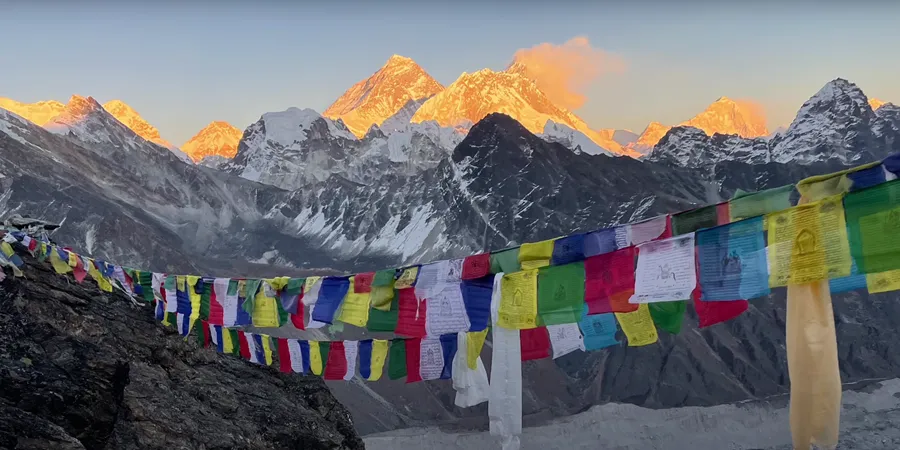
The Everest Base Camp Trek is the world’s most famous trek – a pilgrimage to the foot of the world’s highest mountain through the landscape of the legendary Sherpa culture, ancient monasteries, and the raw beauty of the Khumbu valley. Standing at Kala Patthar with Everest rising above you is one of the defining experiences of a lifetime of travel.

Gokyo Lakes Trek

Duration: 12 to 16 days from Lukla

Max Altitude: Gokyo Ri at 5,357 m

Highlights: Gokyo Lakes (turquoise glacial lakes), Gokyo Ri panorama, Ngozumpa Glacier (Nepal’s longest)

The Gokyo Lakes offer many trekkers an alternative to the EBC route with arguably better Everest views from Gokyo Ri. The five turquoise glacial lakes of the Gokyo valley are among the most beautiful natural features in the entire Khumbu region.

Book Pokhara to Everest Region Transport with a private Scorpio or 4WD jeep for a comfortable journey connecting to your Everest trekking adventure.

Three Passes Trek

Duration: 18 to 21 days

Passes: Renjo La (5,360 m), Cho La (5,420 m), Kongma La (5,535 m)

Difficulty: Very Strenuous – experienced high-altitude trekkers only

The Three Passes Trek is the finest and most demanding long-distance route in the Khumbu – crossing three high mountain passes while visiting EBC, Gokyo Lakes, and multiple Sherpa villages. It is widely considered one of the great trekking circuits in the Himalayan world.

Everest Panorama Trek (Shorter Option)

Duration: 7 to 10 days

Max Altitude: Tengboche Monastery (3,867 m) or Dingboche (4,410 m)

Best For: Trekkers with limited time or who want the Khumbu experience without going all the way to EBC

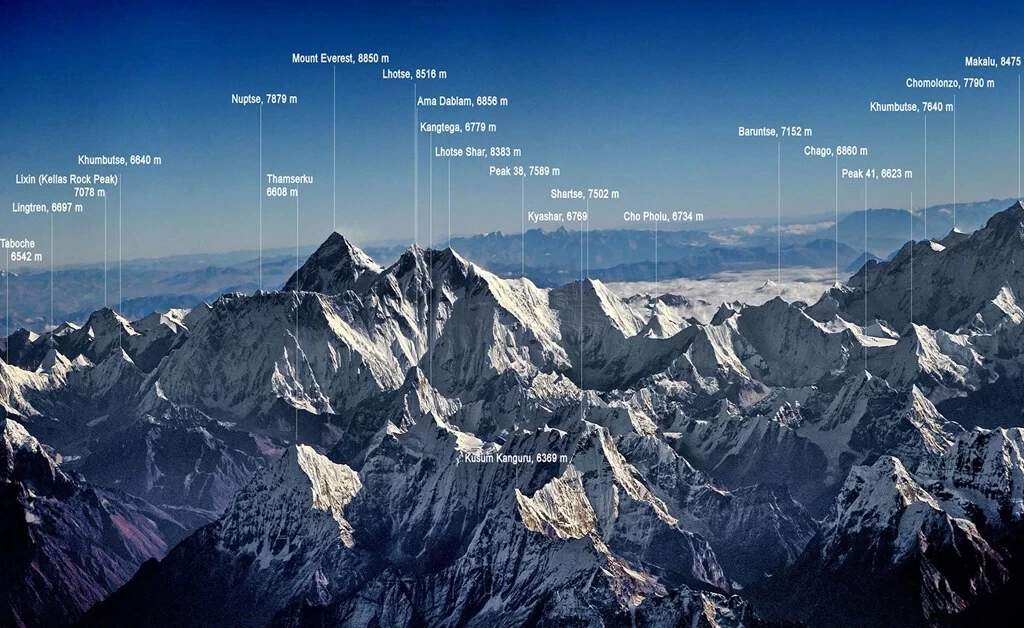
The Everest Panorama Trek offers magnificent views of the Everest region, including Ama Dablam, Lhotse, Nuptse, and Everest itself, without the full commitment of the EBC route. Ideal for travelers combining Pokhara and Everest in a 3-week Nepal itinerary.


Trekking Permits for the Everest Region 2026


PermitCost 2026Where to GetNotes
Sagarmatha National Park Entry PermitNPR 3,000 (~USD 22) for foreignersNepal Tourism Board, Kathmandu, or at the Monjo checkpointMandatory – checked at Monjo gate near Namche
TIMS Card – Trekkers Information ManagementUSD 10Nepal Tourism Board / TAAN, Kathmandu or PokharaRequired for all trekkers on the EBC route
Khumbu Pasang Lhamu Rural Municipality FeeNPR 2,000 (~USD 15)Paid at the checkpoint near Lukla or PhakdingLocal municipality entry fee – newer requirement


Arrange all permits in Kathmandu before departing for Lukla. The Nepal Tourism Board office in Kathmandu (Pradarshani Marg) is the best place to get both the Sagarmatha National Park permit and TIMS card in a single visit. Permit checks are thorough at the Monjo checkpoint near Namche Bazaar.

Nepal Tour Package-Pokhara to Everest Region Transport with a private 4WD jeep and Scorpio on Nepal's scenic mountain highways

Combining Pokhara and Everest in One Nepal Trip

Many travelers want to experience both the Annapurna region (from Pokhara) and the Everest region on a single trip to Nepal. Here are the most practical combined itineraries:

Nepal Classic Circuit – 21 to 25 Days

  • Days 1–2: Arrive Kathmandu – sightseeing, permits
  • Days 3–4: Kathmandu to Pokhara by private vehicle or bus
  • Days 5–7: Pokhara – Annapurna region activity (Poon Hill trek or Sarangkot/sightseeing)
  • Day 8: Pokhara to Kathmandu by private vehicle or bus
  • Day 9: Kathmandu overnight
  • Day 10: Fly Kathmandu to Lukla – begin Everest Base Camp Trek
  • Days 10–22: Everest Base Camp Trek (12-day round-trip to Lukla)
  • Day 23: Fly Lukla to Kathmandu
  • Days 24–25: Kathmandu – depart

Annapurna Circuit + Everest Base Camp – 35 to 40 Days

  • Days 1–3: Kathmandu – arrive, sightseeing, permits
  • Day 4: Kathmandu to Besisahar by Hiace (Annapurna Circuit start)
  • Days 4–20: Full Annapurna Circuit (via Thorong La to Muktinath, Jomsom, Nayapul)
  • Day 21: Nayapul to Pokhara – rest in Pokhara Lakeside
  • Day 22: Pokhara to Kathmandu by private vehicle
  • Day 23: Kathmandu – rest, restock, permits
  • Day 24: Fly Kathmandu to Lukla – Everest trek begins
  • Days 24–36: Everest Base Camp Trek
  • Day 37: Fly Lukla to Kathmandu – depart Nepal

Short Nepal – Pokhara + Everest Panorama – 18 Days

  • Days 1–2: Kathmandu
  • Day 3: Pokhara by vehicle
  • Days 4–5: Pokhara sightseeing
  • Day 6: Pokhara to Kathmandu
  • Day 7: Fly to Lukla – Everest Panorama Trek begins
  • Days 7–15: Everest Panorama Trek to Tengboche and back to Lukla
  • Day 16: Fly Lukla to Kathmandu
  • Days 17–18: Kathmandu – depart

Pokhara to Everest Region Transport with a private 4WD jeep and Scorpio on Nepal's scenic mountain highways

Best Time for Pokhara to Everest Region Transport

October to November (Peak Season – Best)

The finest season for both Pokhara and the Everest region. Clear skies, brilliant mountain views, and optimal trekking conditions. Lukla flights are most reliable in October and November. Book all transport – Pokhara-to-Kathmandu vehicle, Lukla flights, and trekking permits – at least 4 to 6 weeks in advance, as demand is at its highest.

March to May (Excellent – Spring Season)

Spring is excellent for both regions. Rhododendrons bloom magnificently in the lower Khumbu valleys. Everest can be climbed in May – the mountain is alive with expedition activity. Lukla flights are generally reliable in the morning window. Book 4 to 6 weeks ahead.

December to February (Cold – Possible)

Winter is possible for experienced trekkers. Lukla flights are less reliable in January–February due to weather. The Everest region is cold and clear – some say the mountain views are the finest of the year in December: very few trekkers and a unique, quiet atmosphere.

The Everest region receives significant monsoon rainfall from June through September. Trail conditions are difficult, leeches are present at lower altitudes, and Lukla flights are highly unreliable. Unlike Upper Mustang, which is dry during the monsoon, the Khumbu Valley receives full monsoon rain—not recommended for the standard Everest region trek. Some experienced trekkers do the Three Passes route during the monsoon for its unique atmosphere, but it is not for beginners.


Practical Tips: Pokhara to Everest Region

  • Always plan 1 to 2 buffer days in Kathmandu before your Lukla flight – delays are common, and starting an Everest trek stressed by flight delays is not ideal.
  • Book Lukla flights as early as possible – seats fill up 4 to 6 weeks ahead in peak season
  • The 15 kg luggage limit on Lukla flights is strict – pack your main trekking pack carefully and hire a porter for any excess gear.
  • Obtain a Sagarmatha National Park permit and a TIMS card in Kathmandu on the day before your Lukla flight.
  • Take the private car option from Pokhara to Kathmandu if you have trekking gear and large bags – the tourist bus luggage hold has limited space, and your gear is not well-protected
  • Arrange your Kathmandu accommodation before leaving Pokhara – Thamel fills up fast in peak season.
  • If your Lukla flight is canceled on your first attempt, remain calm – delays of 1 to 2 days are very common. Have a book, a local SIM card, and a plan to explore Kathmandu while you wait.
  • The road route via Salleri or Jiri avoids all flight uncertainty – strongly consider this option if you have 10 to 12 days for the lower approach.h
  • Travel insurance covering helicopter evacuation from the Khumbu is essential for all Everest region trekkers


What Vehicle Hiring Nepal Provides for This Route

Vehicle Hiring Nepal specializes in the ground transport portion of the Pokhara to Everest region journey:

  • Private car, Hiace van, or bus transfer from Pokhara to Kathmandu – all vehicle types and group sizes
  • Airport transfers within Kathmandu – hotel to domestic terminal for Lukla flight
  • Kathmandu to Jiri / Salleri / Phaplu vehicle hire for road-access Everest routes
  • Return transport from Kathmandu to Pokhara at the end of your Everest trip
  • 24/7 WhatsApp support – if your Lukla flight is canceled, contact us for same-day Kathmandu accommodation transfer or itinerary adjustment assistance
  • Multi-destination Nepal circuit arrangements – Kathmandu, Pokhara, Chitwan, Everest, Annapurna


We do not sell Lukla flight tickets or arrange trekking permits – these must be obtained through licensed travel agencies and the Nepal Tourism Board. However, we can recommend reliable partners for both.

Pokhara to Everest Region Transport with a private 4WD jeep and Scorpio on Nepal's scenic mountain highways

How to Book Your Pokhara to Everest Region Transport

  1. Contact Vehicle Hiring Nepal via WhatsApp at +977 9851013196 or visit vehiclehiringnepal.com
  2. Tell us your current location (Pokhara) and your Everest region destination plan
  3. Confirm your travel dates – Pokhara departure date and Kathmandu overnight date
  4. Choose your Pokhara to Kathmandu vehicle – car, Hiace, or bus, depending on the group. size
  5. Specify whether you need a Kathmandu airport transfer for your morning Lukla flight.
  6. Specify whether you need a Kathmandu-to-Jiri or Kathmandu-to-Salleri vehicle for the road access option.
  7. Receive booking confirmation with driver details and complete journey plan.

Frequently Asked Questions

Is there a direct road from Pokhara to the Everest region?

No. There is no direct road connecting Pokhara to the Everest region. All road routes must pass through or via Kathmandu. The shortest road route is approximately km5- 650 km total (Pokhara → Kathmandu → Salleri/Jiri) and takes 3 days of driving. Most trekkers take the Pokhara-to-Kathmandu road or bus, then fly from Kathmandu to Lukla.

How much does it cost in total to get from Pokhara to Everest Base Camp?

A rough total transport cost estimate for 2026 (per person, based on a group of 4): Pokhara to Kathmandu by private car, USD 20 to USD 28; Kathmandu accommodation, USD 20 to USD 50; Kathmandu to Lukla flight, USD 160 to USD 195; Lukla return flight, USD 160 to USD 195. Total transport: approximately USD 360-468 per person for the round trip. Add trekking permits (USD 47), porter/guide fees, and accommodation on the trek to the full cost.

How many days should I budget for travel from Pokhara to Lukla?

Budgetfor aa minimum of 2 days: Day 1 – Pokhara to Kathmandu (5 to 8 hours depending on transport); Day 2 – Kathmandu preparation and fly to Lukla (morning flight). We recommend 3 days to allow a full day in Kathmandu for sightseeing, permit processing, and gear preparation without rushing.

What if I only have 2 weeks in Nepal – can I do both Pokhara and Everest?

Yes, but it requires a tight schedule. A 14-day itinerary combining Pokhara and Everest Panorama Trek is possible: 2 days in Kathmandu, 1 day Pokhara to Kathmandu transfer (or fly 25 min), 2 days Pokhara sightseeing, 1 day back to Kathmandu, 1 day fly to Lukla, 7 days Everest Panorama Trek to Tengboche and return to Lukla, fly back to Kathmandu, depart. This is achievable with good planning and no flight delays.

Is the road from Kathmandu to Salleri better than the Lukla flight?

The road to Salleri avoids all flight uncertainty and provides a more gradual altitude acclimatization – both significant advantages. The disadvantage is that it adds 8 to 10 hours of rough-road driving and 2 to 3 days of lower-altitude trekking before reaching the classic Everest scenery above Namche. For trekkers with 18 or more days available, the road to Salleri is a genuinely superior experience. For those with 12 to 14 days, the Lukla flight is more practical.


Final Thoughts

Getting from Pokhara to the Everest region requires planning. Still, the journey itself – through Kathmandu, with its UNESCO heritage sites, and the final dramatic flight over mountain valleys to Lukla – is part of the Everest adventure. The view of Everest and Ama Dablam from your first high ridge above Namche Bazaar makes every hour of travel from Pokhara feel like the most worthwhile journey you have ever made.

Vehicle Hiring Nepal handles ground transport for Pokhara-to-Everest journeys with the reliability and expertise we bring to every Nepal route. From your Pokhara hotel to Kathmandu, from Kathmandu airport to your Thamel hotel, and from Kathmandu to the Jiri or Salleri trailhead – we have the right vehicle, the right driver, and the right support for every leg of your journey.

Book your Pokhara-to-Everest-region transport today. WhatsApp: +977 9851013196 | Website: www.vehiclehiringnepal.com | Email:[email protected]

Kathmandu to Pathivara Transport


Kathmandu to Pathivara Transport with a private Scorpio and 4WD jeep traveling through the mountain roads of eastern Nepal

Kathmandu to Pathivara Transport – Complete Pilgrimage Guide 2026

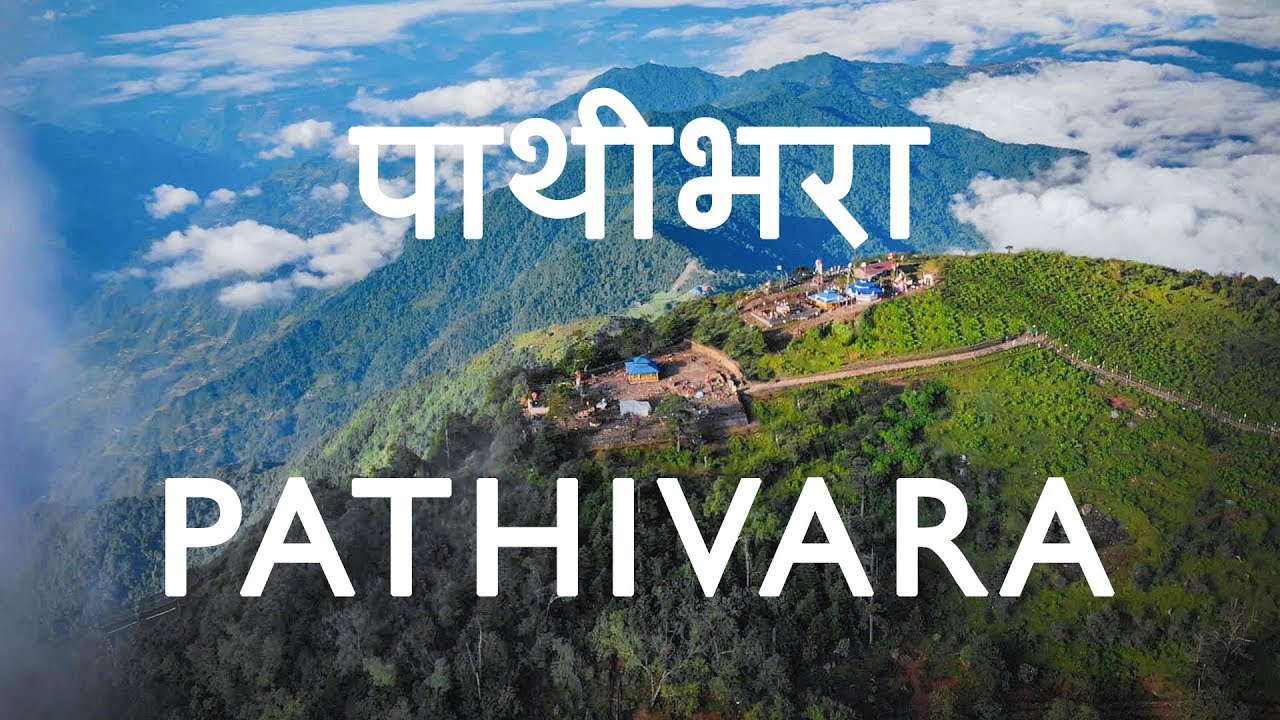
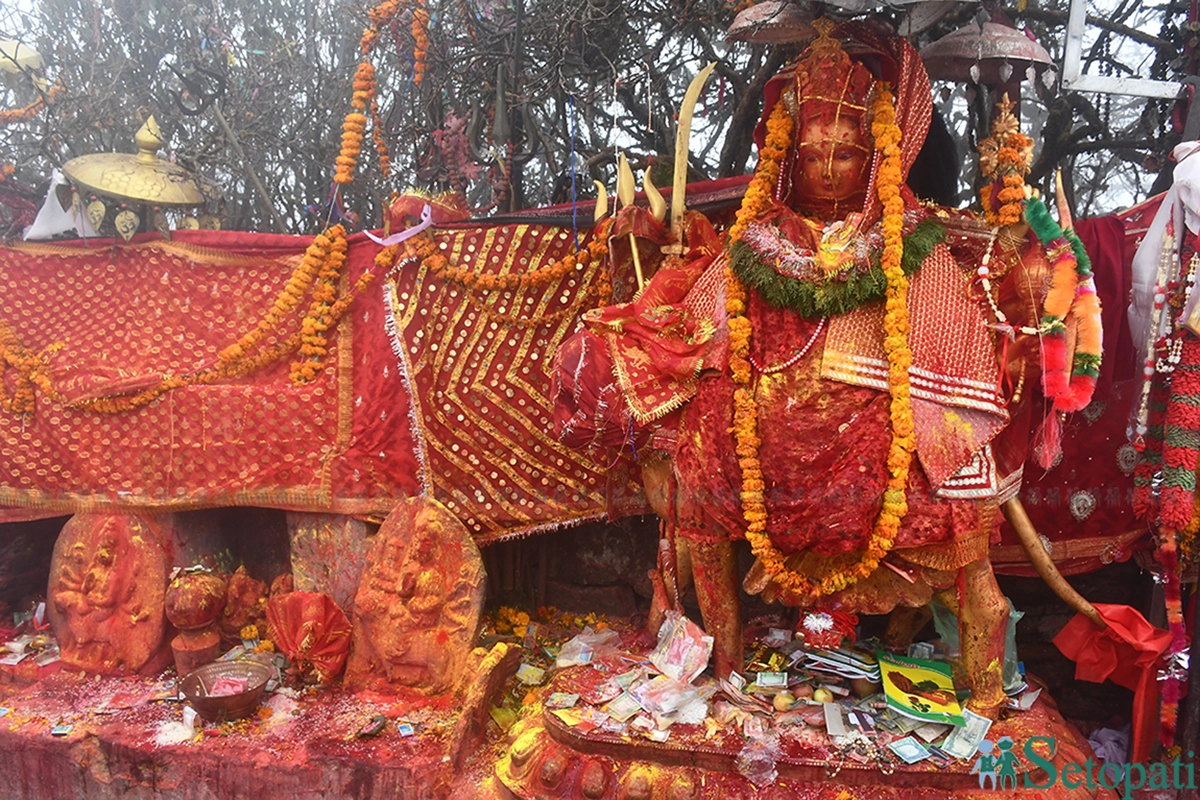
Pathivara Devi Temple – perched at a breathtaking altitude of 3,794 meters in the high Himalayan ridges of Taplejung District in far eastern Nepal – is one of the most powerful and most revered Hindu pilgrimage sites in the entire country. Millions of devotees from Nepal, India, and across the world travel to Pathivara each year to seek the blessings of Goddess Pathivara – a fierce manifestation of Shakti believed to fulfill wishes, remove obstacles, and grant liberation. TheTemplee is surrounded by the majestic Kanchenjunga (8,586 m), Makalu (8,485 m), and Everest (8,849 m) on clear days – a Himalayan panorama of extraordinary scale and beauty.

Getting from Kathmandu to Pathivara is a long, multi-day journey across the breadth of Nepal to the far eastern corner of the country. The route is demanding, the roads are challenging in sections, and the final approach to theTemplee is on foot – but for devotees who complete this pilgrimage, it is one of the most deeply transformative journeys in Nepal. This complete 2026 guide covers every transport option from Kathmandu to Pathivara – private car, Scorpio jeep, Hiace van, bus, and flight combinations – with full route details, prices, road conditions, pilgrimage tips, and booking information.


About Pathivara Devi – The Sacred Goddess of the East

Temple Name: Pathivara Devi Mandir (also Pathibhara Devi Temple)

Location: Phungling Municipality, Taplejung District, Koshi Province, far eastern Nepal

Altitude: 3,794 m above sea level

Distance from KTM: Approximately 600–650 km by road

Distance from Taplejung Bazaar: Approximately 10 km by foot from Phungling (Taplejung Bazaar)

Trek to Temple: 3 to 5 hours uphill walk from Phungling / Chitlang – no vehicle access toTemplee

Deity: Pathivara Devi – a form of Goddess Durga / Shakti revered as the fulfiller of wishes

Famous For: Wish-fulfilling power, Kanchenjunga and eastern Himalayan panorama, deep pilgrimage tradition

Annual Visitors: Over 500,000 pilgrims and tourists annually

Pathivara Devi is considered one of the Shakti Peethas of Nepal – one of the most powerful divine feminine sacred sites – and is particularly revered among the Limbu, Rai, Sherpa, and Brahmin communities of eastern Nepal and the Indian Darjeeling-Sikkim region. The goddess is depicted as a fierce, powerful deity. She is believed to grant prosperity, health, success, and liberation to devoted pilgrims who complete the arduous journey and offer sincere prayer at her shrine.

TheTemplee itself is simple – a stone shrine with a trident (trishul) and the sacred image of the goddess – but the atmosphere at 3,794 m on the Himalayan ridge, with the great eastern peaks surrounding the sacred site and prayer flags streaming in the mountain wind, is one of profound spiritual power. Many pilgrims report extraordinary experiences of grace and answered prayers after completing the Pathivara pilgrimage.

Kathmandu to Pathivara Transport with a private Scorpio and 4WD jeep traveling through the mountain roads of eastern Nepal

Understanding the Journey: Kathmandu to Pathivara

TheKathmandu-to-Pathivaraa journey is one of the longest domestic pilgrimages in Nepal. Here is the key information:

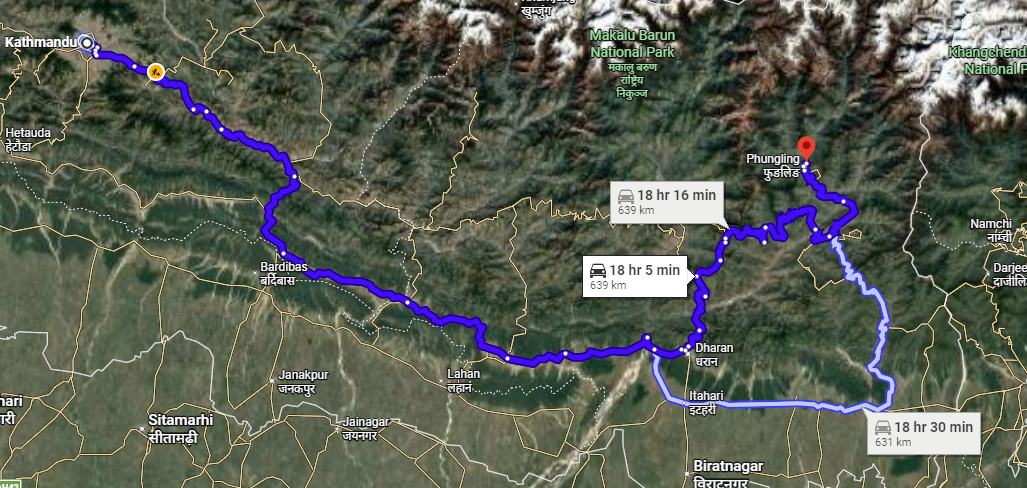
Total Road Distance: Approximately 600–650 km from Kathmandu to Phungling (Taplejung Bazaar)

Road Journey Time: 12 to 16 hours driving – done over 2 to 3 days

Trek to Temple: 10 km from Phungling – 3 to 5 hours uphill walk (no vehicle access)

Total Journey: 3 to 5 days from Kathmandu to theTemplee and back – minimum recommended

Main Road Route: Kathmandu – East-West Highway – Itahari – Dharan – Taplejung road – Phungling – Pathivara (walk)

Alternative Route: Fly Kathmandu to Biratnagar / Taplejung, then vehicle/walk to Pathivara


The journey from Kathmandu to Pathivara is a true pilgrimage – long, challenging, and deeply rewarding. Unlike many Nepali pilgrimages, Pathivara cannot be reached by vehicle all the way – the final 10 km to the Temple is on foot, ascending from Phungling through rhododendron forest and past smaller shrines to the main Pathivara temple at 3,794 m. This walk itself is considered part of the pilgrimage, and many devotees perform it barefoot as an act of devotion.


Vehicle Options: Kathmandu to Taplejung (Phungling)

For the road journey from Kathmandu to Phungling (Taplejung Bazaar), Vehicle Hiring Nepal provides three main vehicle options, each suited to different group sizes and comfort preferences:

Kathmandu to Pathivara Transport with a private Scorpio and 4WD jeep traveling through the mountain roads of eastern Nepal

Mahindra Scorpio – Best Choice for Eastern Nepal Hill Roads

Capacity: 6 to 9 passengers

Engine: 2.2L mHawk turbodiesel – powerful on steep eastern hill roads

4WD: Available – essential for the Dharan to Taplejung mountain section

Best for: Groups of 5 to 7 pilgrims – ideal balance of capacity and hill road capability

The Mahindra Scorpio is the vehicle of choice for the Kathmandu-Taplejung route. The road from Dharan to Phungling (Taplejung) is one of eastern Nepal’s most winding, steep, and demanding mountain roads – rising from 400 m at Dharan to over 1,700 m at Taplejung over approximately 170 km of switchbacks and narrow hill roads. The Scorpio’s powerful diesel engine, high ground clearance, and 4WD capability handle this section with confidence. Local drivers along this route predominantly use Scorpios and Boleros – a testament to thevehicles’s suitability.

Kathmandu to Pathivara Transport with a private Scorpio and 4WD jeep traveling through the mountain roads of eastern Nepal

Toyota Hiace Van – Best for Larger Pilgrimage Groups

Capacity: 7 to 14 passengers

Best for: Groups of 8 to 14 pilgrims – families, community pilgrimage parties

The Toyota Hiace is the practical choice for larger pilgrim groups who need to keep everyone together throughout the long journey. The Hiace handles the flat Terai East-West Highway section comfortably and the Dharan-to-Taplejung hill road in dry conditions. For monsoon travel (June to September), the Scorpio’s 4WD gives it an advantage on the wetter hill roads – for monsoon pilgrimages, two Scorpios may be preferable to a single Hiace for groups of 10 to 14.

Kathmandu to Pathivara Transport with a private Scorpio and 4WD jeep traveling through the mountain roads of eastern Nepal

Sedan Car – For Small Groups and Individuals

Capacity: 1 to 3 passengers

Best for: Solo pilgrims or couples in the dry season

A standard sedan can reach Phungling in the dry season. Still, the steep, winding Dharan-to-Taplejung road and the occasional rough patches on the final approach to Phungling make a more capable vehicle preferable. For pilgrims traveling solo or in pairs, the sedan is economical, but the Scorpio is recommended even for small groups on this specific route.

Local Jeep from Taplejung / Chitlang

From Phungling (Taplejung Bazaar) and from Chitlang (a village approximately 3 km above Phungling on the Pathivara approach road), local jeeps and 4WD vehicles can carry pilgrims to the Chitlang base point – the last vehicle access point before the walking trail to theTemplee begins. This section from Phungling to Chitlang takes approximately 30 to 45 minutes by local jeep. From Chitlang, the walk to Pathivara takes 2.5 to 3.5 hours.

Kathmandu to Pathivara Transport with a private Scorpio and 4WD jeep traveling through the mountain roads of eastern Nepal

Vehicle Rental Prices: Kathmandu to Taplejung 2026


VehicleCapacityOne-Way (USD)Round Trip (USD)Notes
Mahindra Scorpio6–9 paxUSD 220–280USD 370–460Best for this route – recommended
Toyota Hiace Van7–14 paxUSD 250–320USD 420–530Best for groups of 8–14
Sedan Car1–3 paxUSD 170–220USD 290–360Budget option – dry season only
SUV / Toyota Fortuner4–5 paxUSD 200–260USD 340–430Good for small groups – comfortable
Toyota Coaster Bus15–22 paxUSD 340–430USD 570–710Large pilgrimage groups


All prices include the driver, full fuel for the complete journey, and vehicle insurance. The Kathmandu to Taplejung journey is done over 2 to 3 days – driver accommodation during overnight stops is arranged separately and is not included in the vehicle price. Round-trip pricing covers the full return journey from Phungling back to Kathmandu on your chosen return date. Contact Vehicle Hiring Nepal for exact 2026 pricing.

Route Overview: Kathmandu to Phungling (Taplejung)

Total Distance: Approximately 615–650 km

Total Driving Time: 14 to 17 hours – done over 2 to 3 days

Main Route: Kathmandu – Tribhuvan/Araniko Hwy – East-West Hwy – Itahari – Dharan – Basantpur – Taplejung/Phungling

Overnight Stops: Day 1 – Dharan or Birtamod (8–9 hrs from KTM) | Day 2 – Taplejung/Phungling (7–8 hrs from Dharan)

Critical Section: Dharan to Taplejung (170 km, 6–8 hrs) – steep mountain road, 4WD/Scorpio essential

Kathmandu to Pathivara Transport with a private Scorpio and 4WD jeep traveling through the mountain roads of eastern Nepal

Stage-by-Stage Road Guide: Kathmandu to Pathivara

Day 1, Stage 1: Kathmandu to Hetauda (95 km | 2.5 hrs)

Depart Kathmandu from 5:30 to 6:00 AM via the Tribhuvan Highway – Nepal’s historic first road, winding dramatically over the Mahabharat Range from the Kathmandu Valley to the Terai plains below. The Tribhuvan Highway is steep, winding, and scenic, with spectacular views over the Terai from the Daman ridge at an elevation of approximately 2,322 m. Hetauda is a Terai industrial city – a good early morning breakfast stop.

Day 1, Stage 2: Hetauda to Itahari (260 km | 4.5 hrs)

From Hetauda, join the East-West Highway heading east. This long, flat Terai highway section passes through the rice paddies, mustard fields, and subtropical forests of the Chitwan, Sarlahi, and Sunsari districts. The road is wide, paved, and generally fast. Pass through Narayanghat, Gaur, and Lahan, and arrive at Itahari Junction in Sunsari District – the major junction for traffic heading north to Dharan and east to Biratnagar and the Indian border.

Day 1 Overnight: Dharan or Birtamod

From Itahari, continue 20 km north to Dharan – the recommended overnight stop for Day 1. Dharan is an attractive city at the base of the Siwalik Hills with good hotels, restaurants, and the famous Budhasubba Temple. Alternatively, continue 80 km east to Birtamod in Jhapa District if you prefer to be further east for the Day 2 morning start. Total Day 1 driving: approximately 8 to 9 hours from Kathmandu.

Day 2, Stage 3: Dharan to Taplejung / Phungling (170 km | 6–8 hrs)

This is the most challenging and most spectacular section of the entire journey – the long mountain climb from Dharan (400 m) through the eastern hill districts to Phungling / Taplejung Bazaar (1,700 m). Depart Dharan by 6:30 AM.

The road heads north from Dharan into the Siwalik and Mahabharat hills through Dhankuta District, Tehrathum District, and finally Taplejung District. Key towns and landmarks:

  • Dhankuta (1,150 m) – district headquarters, 50 km from Dharan, good morning tea stop. Beautiful hill town with panoramic views
  • Hile (1,900 m) – a busy market town on the ridge with excellent views. Famous junction – the road to Taplejung branches here
  • Basantpur (2,200 m) – the highest point on the Taplejung road, a small market town with tea shops and the first views of the eastern Himalayan range, including Kanchenjunga on clear days
  • Taplejung / Phungling (1,700 m) – the district headquarters, final vehicle destination before the walk to Pathivara begins. Has hotels, restaurants, ATMs, and shops

TheDharan-Taplejungg road is one of eastern Nepal’s most winding and demanding mountain roads. It climbs through dense forest, terraced rice paddies, and traditional Limbu and Rai villages. The road is paved in most sections but has rough patches, particularly after the monsoon. Narrow sections and hairpin bends are frequent from Dhankuta onwards. The Scorpio is the ideal vehicle for this section.


Distance and Time Summary


StageFrom – ToDistanceTimeRoad Type
Day 1-AKathmandu → Hetauda95 km2.5 hrsTribhuvan Hwy – winding mountain road
Day 1-BHetauda → Itahari260 km4.5 hrsEast-West Hwy – flat paved Terai
Day 1-CItahari → Dharan20 km30 minCity road – paved
OVERNIGHTDharanHotel overnight
Day 2-ADharan → Dhankuta50 km2 hrsHill road – paved, steep
Day 2-BDhankuta → Basantpur70 km2.5 hrsMountain road – winding, rough patches
Day 2-CBasantpur → Phungling50 km2 hrsHill road – steep descent to Taplejung
Day 3-APhungling → Chitlang (jeep)3 km30 minRough track – local jeep
Day 3-BChitlang → Pathivara (walk)7 km2.5–3.5 hrsMountain footpath – uphill walk
TOTALKTM → Pathivara548 km + 10 km walk3 daysPaved + mountain road + footpath

Book Kathmandu to Pathivara Transport with a private Scorpio or 4WD jeep for a safe and comfortable journey to the sacred Pathivara Temple in Taplejung.

The Trek to Pathivara Temple

The vehicle journey ends at Phungling (Taplejung Bazaar) or Chitlang, from where all pilgrims continue on foot to theTemplee. This walk is not optional – there is no vehicle access to Pathivara temple itself.

Route Options to the Temple

Option A – Phungling to Pathivara directly: 10 km, – 5 hours uphill. Starting from the bazaar level (1,700 m) and ascending to 3,794 m. Steep in sections. Passes multiple rest stops, small shrines, and teahouses along the trail.

Option B – Jeep to Chitlang, then walk: Local jeep from Phungling to Chitlang (3 km, 30 min), then a 7 km walk from Chitlang to the Pathivara temple (2.5 to 3.5 hours). This is the most popular approach as it reduces total walking time.

Option C – Overnight at Chitlang: Drive to Phungling on Day 2, take a local jeep to Chitlang, overnight at Chitlang teahouses, and begin the walk to Pathivara at dawn on Day 3 for the morning light.

Book Kathmandu to Pathivara Transport with a private Scorpio or 4WD jeep for a safe and comfortable journey to the sacred Pathivara Temple in Taplejung.

The Walking Trail

The trail from Chitlang to Pathivara passes through a rhododendron forest, open meadows with increasingly expansive mountain views, and past several smaller sacred shrines and rest points. The path is well-marked and heavily used by pilgrims – you will never be alone on the trail during peak pilgrimage season. Steel handrails and stone steps have been installed on the steepest sections in recent years, making the climb more manageable for elderly pilgrims and devotees with limited mobility.

As you ascend, the mountain panorama opens progressively. At the Pathivara temple ridge (3,794 m), on clear days you can see Kanchenjunga (8,586 m) to the northeast, Makalu (8,485 m) to the northwest, Everest (8,849 m) in the far west, and the rolling eastern Himalayan ranges in all directions – one of the most extraordinary panoramic views available at any pilgrimage site in Nepal.

Porters and Pony Service

For elderly pilgrims, those with limited mobility, or those carrying heavy offerings, porter and pony services are available from Phungling and Chitlang. Porters carry bags and personal items for approximately NPR 1,000 to NPR 2,000 per trip. Ponies can carry devotees who are unable to walk the full distance to theTemplee for approximately NPR 3,000 to NPR 5,000 for the full ascent. These services are available at the Chitlang departure point and are operated by local community members.

Pathivara Temple – Pilgrimage Experience

The Goddess Pathivara

Pathivara Devi is a fierce manifestation of the Divine Mother – an aspect of Shakti and Durga worshipped primarily by the Kirat (Limbu, Rai) communities of eastern Nepal who consider her the supreme tribal goddess, and by Hindu devotees from across Nepal and India who revere her as a wish-fulfilling goddess of immense power. The name Pathivara may derive from ‘path’ (way/road) and ‘vara’ (boon/blessing) – the goddess who grants boons on the path – or from the Limbu language term for the deity.

Pathivara Devi is worshipped in a simple stone shrine with a prominent trishul (trident) – the symbol of Shakti’s power – as the primary sacred object. The goddess does not have an elaborate anthropomorphic image in the main shrine – she is considered to be formlessly present in the sacred site itself, in the mountain rock, the wind, and the surrounding peaks.

The Sacred Animals

Pathivara is one of Nepal’s most active animal sacrifice pilgrimage sites. Thousands of goats, ducks, and other animals are offered to the goddess each year by devotees fulfilling vows or seeking blessings. Temple priests conduct the sacrifice in the dedicated sacrificial area adjacent to the main shrine. For visitors who are unfamiliar with or uncomfortable with animal sacrifice, this is worth knowing before the visit – the pilgrimage atmosphere during high season (particularly Dashain in October) is very intense.

The Temple Complex

The Pathivara temple complex at 3,794 m includes the main goddess shrine, smaller secondary shrines, a sacred dhara (water spout) where pilgrims bathe ritually, prayer flag lines strung from poles across the ridge, stone rest areas for pilgrims, and basic teahouses where food and tea are available. The Taplejung District government and the Pathivara Development Committee have developed improved facilities, including permanent pilgrim rest areas and a small visitor information center.
Pilgrimage Rituals

The traditional Pathivara pilgrimage sequence for devotees:

  1. Bathe at the sacred dhara (water spout) on arrival – ritual purification before entering the main shrine
  2. Offer flowers, marigold garlands, incense, red cloth, and fruit at the main goddess shrine
  3. Perform pradakshina (circumambulation) of the main shrine clockwise
  4. Offer animal sacrifice if making a vow-fulfillment offering – conducted by temple priests
  5. Sit in meditation or prayer at the viewpoint ridge – facing the Kanchenjunga massif
  6. Take darshan of all secondary shrines and sacred stones on the temple ridge
  7. Purchase and string a prayer flag from the temple complex as an offering
  8. Descend with the feeling of having received the goddess’s blessing and grace

Kathmandu to Pathivara Transport with a private Scorpio and 4WD jeep traveling through the mountain roads of eastern Nepal

Alternative Route: Fly to Biratnagar or Taplejung, then drive / Trek

Fly Kathmandu to Biratnagar + Drive to Taplejung

Flight: Kathmandu to Biratnagar – 45 minutes, USD 80 to USD 110 per person

Drive Biratnagar to Taplejung: Approximately 290 km, 7 to 9 hours by Scorpio or Hiace

Vehicle from Biratnagar: Scorpio NPR 8,000 to NPR 12,000 / Hiace NPR 10,000 to NPR 15,000 (local hire rates)

Total time: 1 day flight + drive vs 2 days full road from Kathmandu

Flying to Biratnagar saves the longKathmandu-to-Teraii driving day. It allows you to complete the Biratnagar-to-Taplejung journey in a single day, arriving in Taplejung the same evening as your flight. This option works well for time-limited pilgrims and is particularly popular during peak pilgrimage season when the road from Kathmandu is congested.

Fly Kathmandu to Taplejung (Suketar Airport)

Flight: Kathmandu to Suketar (Taplejung) – approximately 1 hour, USD 130 to USD 160 per person

Airlines: Tara Air, Summit Air – small aircraft, weather dependent

Advantage: Arrives directly in Taplejung – eliminates all road travel from Kathmandu

Disadvantage: Suketar Airport is very weather-sensitive – frequent delays and cancellations

From the airport: Suketar Airport is approximately 3 km from Phungling – short local transport to the bazaar

Flying directly to Taplejung / Suketar airport is the fastest way to begin the Pathivara pilgrimage, cutting travel time from 2 to 3 road days to a single 1-hour flight. However, Suketar is one of Nepal’s most weather-affected small airports and cancellations are common – always build buffer days into your itinerary. Vehicle Hiring Nepal does not sell these flight tickets but can advise on booking through licensed agencies.


All Transport Options Summary: Kathmandu to Pathivara


OptionRouteTotal TimeApprox. CostBest For
Option A – Full RoadKTM → East-West Hwy → Dharan → Taplejung → walk3–4 days totalUSD 220–280 vehicle + local jeepMost pilgrims complete the journey by road
Option B – Fly BiratnagarKTM → fly BIR → drive Taplejung → walk2–3 daysUSD 80–110 flight + local vehicleTime-saving first leg – common option
Option C – Fly TaplejungKTM → fly Taplejung → local jeep → walk2 daysUSD 130–160 flight + NPR 1,500 jeepFastest – flight cancellation risk
Option D – Bus Kathmandu to Itahari then ScorpioBus + private vehicle3–4 daysUSD 15–25 bus + USD 150–200 vehicleBudget pilgrims


Kathmandu to Pathivara Transport with a private Scorpio and 4WD jeep traveling through the mountain roads of eastern Nepal

Peak Pilgrimage Seasons at Pathivara

Dashain – October (Biggest Season)

Vijaya Dashami during the Dashain festival (September to October) is the single busiest and most auspicious time at Pathivara. Hundreds of thousands of pilgrims from Nepal and India ascend to theTemplee during the Dashain fortnight. Animal sacrifices reach their highest volume. The atmosphere is intensely devotional and festive. The road from Kathmandu to Taplejung is at its most congested – allow extra travel days. Book vehicles 4 to 8 weeks in advance for the Dashain season.

Chaitra Dashain – March / April (Second Major Season)

The spring Dashain (Chaitra Dasain) in March and April is the second peak pilgrimage season at Pathivara. Rhododendron forests below theTemplee are in magnificent bloom. The weather is generally good. A smaller but significant pilgrimage season – book vehicles 2 to 4 weeks ahead.

Year-Round Pilgrimage

Unlike many Nepali sacred sites, Pathivara receives pilgrims year-round. The Temple is always accessible (weather permitting), and pilgrims arrive every day. Outside of Dashain and Chaitra Dasain, visitor numbers are lower and the atmosphere more contemplative. TheTemple’ss power is considered equally present in all seasons.

Monsoon Season (June to September)

The Dharan-Taplejung road is most challenging during the monsoon. Landslides can temporarily block sections of the road and make driving conditions difficult. The trail to the Temple becomes slippery, and leeches are present in the forest section. Travel is possible but requires an experienced driver and a capable 4WD vehicle (Scorpion is recommended). Monsoon clouds may obscure mountain views from the Temple, but many devoted pilgrims choose to travel specifically during the monsoon.

Kathmandu to Pathivara Transport with a private Scorpio and 4WD jeep traveling through the mountain roads of eastern Nepal

Accommodation: Phungling and Chitlang

Phungling (Taplejung Bazaar) – 1,700 m

Phungling has a good range of accommodation for pilgrims arriving after the long journey from Kathmandu:

  • Basic Guesthouse: NPR 400 to NPR 800 per night – simple rooms, shared bathroom, cold water, local food
  • Mid-range Hotel: NPR 800 to NPR 2,000 per night – better rooms, hot water available, restaurant
  • Better Hotels: NPR 2,000 to NPR 4,000 – comfortable rooms, hot shower, Wi-Fi, good Nepali and Indian food
  • Phungling has ATMs, pharmacies, shops for pilgrimage supplies (marigolds, incense, red cloth), and local restaurants
  • Electricity is available but can be unreliable – charge devices during daylight hours

Chitlang – 2,100 m (Last Vehicle Point)

Chitlang has basic teahouses for pilgrims who wish to overnight here before the morning ascent to theTemplee:

  • Teahouse rooms: NPR 300 to NPR 600 per night – very basic, blankets provided, shared facilities
  • Simple meals available – dal bhat, noodles, eggs, tea
  • The advantage of overnighting in Chitlang is a shorter 7 km walk to the Temple on the morning of your pilgrimage, rather than the full 10 km from Phungling.

At theTemplee (3,794 m)

Basic pilgrim shelter is available adjacent to the Pathivara temple complex – simple dormitory-style accommodation with blankets for pilgrims who wish to spend the night at the sacred site. Bring a sleeping bag for warmth at this altitude. Food is very basic at the temple level.


Road Conditions: Kathmandu to Taplejung


SectionSurfaceDifficultyVehicle NeededMonsoon Risk
KTM → Hetauda (Tribhuvan Hwy)Paved mountain roadModerateAny vehicleLow
Hetauda → Itahari (East-West)Paved flat highwayEasyAny vehicleLow (flooding risk)
Itahari → DharanPaved city roadEasyAny vehicleLow
Dharan → DhankutaPaved hill roadModerateScorpio/SUVModerate
Dhankuta → BasantpurPaved/rough mountainHardScorpio/4WDHigh – landslide risk
Basantpur → PhunglingMixed paved/roughModerate-HardScorpio/4WDHigh – landslide risk
Phungling → Chitlang (jeep)Rough trackHardLocal 4WD onlyVery High
Chitlang → Pathivara (walk)Mountain footpathStrenuous walkWalk onlySlippery trail

Kathmandu to Pathivara Transport with a private Scorpio and 4WD jeep traveling through the mountain roads of eastern Nepal

Best Time to Travelfrom  Kathmandu to Pathivara

October (Dashain – Peak Pilgrimage)

The most auspicious and most crowded time. Vijaya Dashami is considered the most powerful day for Pathivara worship. The road from Dharan to Taplejung has been fully repaired after the monsoon and is in the best condition of the year. Clear post-monsoon skies offer the finest Kanchenjunga views from theTemplee. Book vehicles and accommodation 4 to 8 weeks ahead.

March to April (Chaitra Dasain and Spring)

The spring pilgrimage season, with rhododendrons blooming beautifully in the forest below the Temple. Good weather, less crowded than Dashain, and excellent mountain views in the morning. Highly recommended for first-time pilgrims who want a quieter experience.

November to February (Post-Dashain / Winter)

After Dashain crowds thin and the road is in good dry condition. November is excellent – clear skies and cool temperatures. December and January bring cold at the temple altitude (below 0°C at night) and occasional frost on the path. February is improving and still quiet. Good for pilgrims who prefer a contemplative rather than aestival atmosphere.

May and early June

Pre-monsoon season. Roads are dry, temperatures are warm at lower altitudes, and crowds are moderate. As the monsoon approaches in late May and June, road conditions deteriorate and landslide risk increases along the Dhankuta-Taplejung section.


What to Pack for the Kathmandu to Pathivara Journey

For the Long Vehicle Journey

  • Water – 2 liters per person minimum for each driving day
  • Snacks and food for the long East-West Highway section – limited quality food stops in remote sections
  • Motion sickness tablets – the Dharan to Taplejung road has extremely winding sections
  • Warm layer for the hill sections – Dhankuta, Basantpur, and Taplejung are significantly cooler than the Terai
  • Cash in NPR – ATMs in Dhankuta and Taplejung but not on the mountain road sections

For the Pilgrimage Trek to Pathivara

  • Comfortable trekking or walking shoes with good grip – the trail is steep and can be slippery.
  • Warm jacket and wind layer – at 3,794 m the temperature drops sharply, ly and the wind can be very cold.
  • Rain poncho or waterproof jacket – weather at 3,794 m can change quickly
  • Pilgrimage offerings: fresh marigold garlands, red cloth or sindoor, incense, coconut, and fruit – purchased at Phungling bazaar
  • Enough NPR for teahouse food on the trail, porter if needed, and temple donation
  • Personal medications and basic first aid
  • Headlamp – for early morning ascents before dawn
  • Sunscreen and sunglasses – UV radiation is strong at 3,794 m

Kathmandu to Pathivara Transport with a private Scorpio and 4WD jeep traveling through the mountain roads of eastern Nepal

Practical Tips for the Kathmandu to Pathivara Pilgrimage

  • Plan the vehicle journey for at least 2 days – overnight in Dharan, then Taplejung on Day 2. Never attempt to reach Taplejung from Kathmandu in a single day
  • Depart Kathmandu from 5:30 to 6:00 AM on Day 1 to reach Dharan by late afternoon, with time to rest.
  • Depart Dharan by 6:30 AM on Day 2 for Taplejung – the Dhankuta to Taplejung section is long and windy.ng
  • Book your Taplejung hotel in advance for Dashain season – accommodation fills weeks in advance.
  • Take the local jeep from Phungling to Chitlang before beginning the walk – it saves significant energy for the actual ascent to Templemple.
  • Hire a local porter in Chitlang if carrying heavy offerings or if any group member needs assistance – they are highly knowledgeable about the trail.
  • Begin the temple ascent from Chitlang before 8:00 AM on clear mornings for the best Kanchenjunga views and to avoid afternoon clouds.
  • Wear modest, clean clothing for the pilgrimage – traditional dress is respected and appreciated at theTemplee
  • The Dharan to Taplejung section is one of Nepal’s most winding hill roads – take motion sickness medication 30 minutes before this section if needed.
  • Keep emergency cash in a separate place from your main wallet – remote eastern Nepal roads have limited services.

What is Included in Your Vehicle Rental

  • Mahindra Scorpio, Toyota Hiace, or selected vehicle – fully maintained and insured
  • Professional driver experienced on the Kathmandu to Taplejung,g eastern Nepal route
  • Full fuel cost for the complete journey
  • Vehicle insurance throughout
  • Pickup from your Kathmandu hotel at your confirmed departure time
  • Drop-off at Phungling (Taplejung Bazaar)
  • Overnight stop in Dharan with the driver arranging own accommodation
  • Return journey from Phungling to Kathmandu on your confirmed return date
  • 24/7 WhatsApp support during the journey


Not included: Driver’s overnight accommodation (driver arranges own), local jeep from Phungling to Chitlang (NPR 500–800 per seat), porter and pony hire at Chitlang, pilgrimage offerings, your accommodation, personal meals, and any additional detour stops.

Kathmandu to Pathivara Transport with a private Scorpio and 4WD jeep traveling through the mountain roads of eastern Nepal

How to Book Your Kathmandu to Pathivara Transport

  1. Contact Vehicle Hiring Nepal via WhatsApp at +977 9851013196 or visit vehiclehiringnepal.com
  2. Choose your vehicle – Scorpio for groups of 5–8, Hiace for groups of 9–14, Fortuner for 4–5
  3. Confirm your pilgrimage travel dates and Dashain or Chaitra Dasain timing, if applicable.
  4. Provide your pickup address in Kathmandu.
  5. Confirm overnight stop preference – Dharan or Birtamod for Day 1
  6. Specify the return date from Phungling to Kathmandu
  7. Receive a booking confirmation with the driver’s name, vehicle details, and a 2-day journey plan

Frequently Asked Questions

How far isthe  PathivaraTemplee from Kathmandu?

The road distance from Kathmandu to Phungling (Taplejung Bazaar, the vehicle’s endpoint) is approximately 615-650 km. From Phungling, the walk to Pathivara temple is 10 km (or 7 km from Chitlang, reached by local jeep from Phungling). The total journey from Kathmandu to the Pathivara temple is typically 3 days.

Can I visit Pathivara on a single-day trip from Kathmandu?

No. The road distance alone from Kathmandu to Phungling is 615 to 650 km – requiring 2 full days of driving even before the walk to theTemplee. A minimum of 3 days is required: Day 1 – Kathmandu to Dharan; Day 2 – Dharan to Phungling; Day 3 – walk to the Pathivara temple and return to Phungling. A 5-day round trip from Kathmandu is more comfortable and recommended.

Is the Pathivara temple accessible for elderly pilgrims?

Yes, with appropriate assistance. The pony service from Chitlang to near Templemple and the porter service for carrying bags make the pilgrimage accessible to elderly and less mobile devotees. The stone staircase and handrail sections on the trail have been improved in recent years. Many elderly pilgrims from India and Nepal complete the Pathivara pilgrimage with the help of porters and ponies. Inform Vehicle Hiring Nepal at the time of booking if you have elderly group members so that we can advise on the best approach.

What is the best vehicle for the Dhara- Taplejung road?

The Mahindra Scorpio is the best vehicle for the Dharan-Taplejung section. The road is steep, winding, and has rough patches – particularly from Dhankuta to Basantpur and on the final descent to Phungling. Local transport on this route overwhelmingly uses Scorpios and Boleros – a clear indication of which vehicles handle the road best. The Scorpio’s high ground clearance, 4WD, and powerful diesel engine are all put to use on this demanding road.

Are there ATMs along the route from Kathmandu to Taplejung?

ATMs are available in Dharan, Dhankuta, and Phungling (Taplejung Bazaar). There are no ATMs on the mountain road between these towns. Withdraw sufficient Nepali Rupees in Dharan to cover all expenses through to Phungling and beyond – including local jeep hire, porter fees, offerings, and accommodation—budget approximately NPR 5,000 -0,000 per person beyond Dharan for the full Pathivara pilgrimage.

How far in advance should I book for the Dashain season?

For the Dashain (October) pilgrimage, book your vehicle 6 to 10 weeks in advance. Pathivara is one of Nepal’s busiest pilgrimage destinations during Dashain, and vehicles, accommodation, and guides are in extremely high demand. For Chaitra Dasain (March–April), a 3- to 5-week booking is recommended. Outside of these peak seasons, 1 to 2 weeks’ notice is usually sufficient.


Final Thoughts

The journey from Kathmandu to Pathivara is one of Nepal’s most demanding and most rewarding pilgrimages – a3-3 to 5-day odyssey from the Kathmandu Valley across the breadth of the country to the far eastern Himalayas, ending with a challenging ascent to a sacred ridge at 3,794 m where the Goddess Pathivara holds court beneath the gaze of Kanchenjunga, Makalu, and Everest. It is not an easy journey – but for the millions of devotees who complete it each year, it is one that changes lives, fulfills vows, and brings the deepest blessings.

Vehicle Hiring Nepal provides the most reliable and experienced transport service for the Kathmandu-Taplejung route. Our Scorpio and Hiace drivers know the winding Dhankuta to Taplejung road intimately, understand the pilgrimage timing requirements around Dashain and Chaitra Dasain, and provide the dependable service that such a sacred journey deserves.

Book your Kathmandu-to-Pathivara transport today. WhatsApp: +977 9851013196 | Website: www.vehiclehiringnepal.com | Email: [email protected]. Jai Pathivara Devi!

Eastern Nepal Tour Vehicle Rental


Eastern Nepal Tour Vehicle Rental

Eastern Nepal Tour Vehicle Rental – The Complete 2026 Travel and Transport Guide

Eastern Nepal is the country’s least explored and most quietly extraordinary region — a sweep of land stretching from the steaming Terai plains along the Indian border, through the forested Siwalik and Mahabharat hill ranges, up into the rolling tea gardens of Ilam, and finally into the high Himalaya around Kanchenjunga, the third-highest mountain on earth.

While Kathmandu, Pokhara, and the Annapurna and Everest regions absorb the great majority of Nepal’s visitors, eastern Nepal remains a region of wide-open road journeys, uncrowded sacred sites, wetland wildlife reserves, tea estates, and mountain panoramas that rival anything in the country’s more famous corners.

Properly touring eastern Nepal is fundamentally a transport challenge. The region is vast, the distances between highlights are considerable, and much of the most rewarding territory — the Pathivara pilgrimage trail, the Kanchenjunga foothills, the remote eastern hill roads to Ilam and Taplejung — depends on capable vehicles and experienced local drivers rather than on the bus networks and domestic flights that serve the rest of Nepal’s tourist circuit. This is where reliable vehicle rental becomes the single most important factor in determining whether an eastern Nepal trip is a smooth, rewarding journey or a frustrating series of delays and connections.

This in-depth 2026 guide draws together everything a traveler needs to plan an eastern Nepal tour by private vehicle — the full geography and major destinations of the region, vehicle types and rental prices, road conditions and journey times, permit requirements for the restricted areas, seasonal planning advice, sample itineraries from 5 to 14 days, and detailed practical guidance for booking the right vehicle with Vehicle Hiring Nepal.


Why Eastern Nepal Deserves a Place on Your Itinerary

Most first-time visitors to Nepal never venture east of the Kathmandu Valley and the Everest approach road. This is understandable — the established circuits of Kathmandu, Pokhara, Chitwan, and the Everest and Annapurna trekking regions are excellent and well-served by tourism infrastructure. But travelers who do make the journey east discover a Nepal that feels distinctly different: quieter roads, a stronger Kirat and Limbu cultural presence, some of the country’s finest tea, and a version of the Himalaya — the Kanchenjunga massif — that very few foreign visitors ever see up close.

Eastern Nepal also offers a logical and rewarding way to extend a trip to Nepal beyond the standard week or two. For travelers who have already experienced Kathmandu, Pokhara, and perhaps a short Annapurna trek, a swing east into Ilam, Pathivara, and the eastern wildlife reserves provides an entirely fresh set of experiences without repeating ground already covered elsewhere in the country.

  • Genuine off-the-beaten-path travel within a well-established and stable tourism country
  • Nepal’s finest tea-growing region, rivaling Darjeeling just across the border
  • One of the subcontinent’s most powerful Hindu pilgrimage sites is at Pathivara.
  • Close-range views of Kanchenjunga (8,586 m), the world’s third-highest mountain, from accessible roadside viewpoints
  • Significant wetland wildlife at Koshi Tappu, including Nepal’s last wild water buffalo population and world-class birdwatching
  • A rich Mithila cultural heartland around Janakpur, sacred to Hindus as the birthplace of Sita.
  • Far lower visitor density than western Nepal’s major circuits, even during peak season


The Geography of Eastern Nepal — What You’re Touring

Eastern Nepal spans Koshi Province and parts of Madhesh Province, encompassing several distinct geographic and climatic zones that a single tour itinerary can move through within a matter of days:

The Eastern Terai

The flat, fertile lowland belt along the Indian border, running from Janakpur in the west through Rajbiraj, Itahari, and Biratnagar to the Mechi River at the eastern extremity. This zone is hot, agriculturally rich, and dotted with significant cultural and wildlife sites, including Janakpur and the Koshi Tappu Wildlife Reserve.

The Siwalik and Mahabharat Mid-Hills

North of the Terai, the land rises through the Siwalik (Churia) range and the Mahabharat range into the mid-hill belt that includes Dharan, Dhankuta, Hile, and Basantpur. This is a transition zone of forested ridges, traditional Rai and Limbu villages, and increasingly cool temperatures as elevation rises.

The High Eastern Hills

Further north and east, the terrain rises into the genuinely high hill country of Ilam District and Taplejung District — tea garden country around 1,000 to 2,200 m, with the sacred Pathivara temple ridge reaching 3,794 m and the foothills of the Kanchenjunga massif beginning beyond.

The Kanchenjunga Himalaya

At the far northeastern edge of Nepal, the Kanchenjunga Conservation Area protects the approaches to the world’s third-highest mountain (8,586 m), a restricted trekking region of extraordinary biodiversity and very low visitor numbers compared to Everest or Annapurna.

What makes this geographic progression unique within Nepal is its compactness relative to the dramatic change in character it contains. A traveler can leave the sweltering, mango-grove flatlands of the Terai in the morning and, within a single long but comfortable day’s drive, be standing among tea bushes in the cool hill air of Ilam, with the option of continuing further still into alpine and high-Himalayan terrain over the following days. Few single road corridors in Nepal — or indeed in the wider Himalayan region — compress so much climatic and cultural variation into a journey that can be completed entirely by private vehicle without recourse to flights or multi-day treks for the lower and middle sections.

Eastern Nepal Tour Vehicle Rental

Key Destinations for an Eastern Nepal Tour

Ilam — Nepal’s Tea Garden Capital

Ilam Bazaar (1,200 m) and the surrounding tea estates, including the iconic Kanyam viewpoint, form the most photogenic and most visited destination in eastern Nepal outside the high mountains. Rolling tea gardens, cardamom forest, the sacred Mai Pokhari wetland lake, and the Shree Antu sunrise viewpoint with its Kanchenjunga panorama make Ilam a complete destination in its own right.

Pathivara Devi Temple

One of Nepal’s most powerful Hindu pilgrimage sites, Pathivara sits at 3,794 m above Taplejung, reached by vehicle to Phungling (Taplejung Bazaar) or Chitlang, followed by a multi-hour uphill walk. Hundreds of thousands of devotees visit annually, particularly during the Dashain festival.

Kanchenjunga Conservation Area

For serious trekkers, the Kanchenjunga Circuit and Kanchenjunga Base Camp treks reach the base of the world’s third-highest mountain through one of Nepal’s most pristine and least-visited conservation areas, rich in red panda, snow leopard, and Himalayan black bear habitat, as well as exceptional rhododendron forests.

Koshi Tappu Wildlife Reserve

A 176 sq km Ramsar-listed wetland reserve along the Sapta Koshi River in the Terai, Koshi Tappu protects Nepal’s last surviving population of wild water buffalo (Arna) alongside Gangetic river dolphins, gharial crocodiles, and an extraordinary concentration of birdlife — 441 recorded species including many winter migrants from as far as Siberia. It is one of Asia’s premier birdwatching destinations, reached by jeep and boat safaris along the river.

Dharan

A clean, pleasant city at the foot of the Siwalik hills in Sunsari District, Dharan serves as the natural overnight stopping point on the long road journey toward Ilam and Taplejung, and is itself worth a visit for the Budhasubba Temple and its relaxed, leafy atmosphere — quite different from the dustier Terai towns further south.

Biratnagar

Nepal’s second-largest city and the industrial and commercial hub of eastern Nepal, Biratnagar has an internationally capable airport, making it a useful gateway for travelers wishing to fly in or out of eastern Nepal rather than making the full road journey from Kathmandu in both directions.

Janakpur

In the central-eastern Terai, Janakpur is one of Hinduism’s most sacred cities, revered as the birthplace of Goddess Sita and the site of her marriage to Lord Rama. The stunning Janaki Mandir, built in a distinctive Mughal-influenced style, and the vibrant Mithila folk painting tradition make Janakpur a rich cultural detour for travelers touring the eastern Terai.

Itahari and Birtamod

These busy junction towns are less destinations in themselves than essential waypoints — Itahari is the key crossroads connecting the East-West Highway to the Dharan and Biratnagar roads. At the same time, Birtamod in Jhapa District is the launching point for the scenic climb to Ilam via Kanyam.

Dhankuta and Hile

Strung along the winding road between Dharan and Basantpur, Dhankuta (1,150 m) is one of eastern Nepal’s most attractive hill towns — a former British Gurkha recruitment center with a relaxed, orderly charm, stone-paved streets, and excellent panoramic views over the surrounding terraced hills.

A little further on, Hile (1,900 m) is a busy market junction known for its Tibetan and Sherpa-influenced trading community, its dried meat and Tibetan bread stalls, and its position as the historic gateway to both Sankhuwasabha district (home of Makalu Barun National Park) and the road north toward Taplejung. Both towns make excellent rest stops on the long drive from Dharan to Taplejung and reward travelers willing to spend a night rather than push straight through.

Sandakpur and the Tinjure–Milke–Jaljale Ridge

For travelers with extra time and an interest in trekking, the ridge running from Tinjure through Milke Danda to Jaljale, above Hile and Basantpur, contains the largest contiguous rhododendron forest in the world, blazing scarlet and pink across the hillsides each spring. The Sandakpur viewpoint, on the Nepal-India-Sikkim border tri-junction further east, offers an extraordinary eye-level panorama of the Kanchenjunga massif’s southern face — considered by many photographers to be one of the finest accessible Himalayan viewpoints anywhere in Nepal, and reachable by a combination of jeep transport and a short trek from the Ilam or Phidim side.

Kakarvitta and the Mechi Border Region

At Nepal’s far eastern extremity, Kakarvitta on the Mechi River marks the international border crossing with India’s West Bengal and serves as a logical first or final stop for travelers extending an eastern Nepal circuit toward Darjeeling and Sikkim. The flat, fertile Jhapa District surrounding Kakarvitta is itself an important tea and agricultural area, distinct in character from the more famous hill gardens of Ilam above it.

The Living Culture of Eastern Nepal — Kirat, Limbu, and Rai Heritage

Much of eastern Nepal’s hill country, from the Arun valley through Dhankuta, Hile, Ilam, and Taplejung, is the traditional homeland of the Kirat peoples — principally the Limbu and Rai communities, who together represent one of Nepal’s oldest documented ethnic and cultural groups, with their own languages, scripts, animist-influenced religious traditions, and distinctive cuisine. Touring eastern Nepal by vehicle gives travelers a far closer view of this living culture than the standard Kathmandu-Pokhara circuit typically offers.

The Limbu homeland (Limbuwan) historically spans the area between the Arun and Mechi rivers, including much of Taplejung, Panchthar, and Ilam districts — the very corridor that an eastern Nepal vehicle tour passes through on the way to Pathivara and Kanchenjunga. Limbu villages are often recognizable by their distinctive bamboo-and-timber architecture, prayer flags that blend Buddhist and animist Yumaism traditions, and the warm hospitality extended to travelers passing through on the long hill roads.

Rai communities, concentrated through the mid-hills around Dhankuta, Bhojpur, and Khotang, maintain their own rich tradition of Sakela and Sakewa festivals — vibrant communal dances performed twice yearly to mark the agricultural cycle, accompanied by drumming and circular dance formations that visiting travelers occasionally have the good fortune to witness if their journey coincides with these celebrations.

Eastern Nepal’s food culture reflects this heritage in ways distinct from the dal-bhat-dominant cuisine of central and western Nepal. Look out for kinema (a fermented soybean dish unique to the eastern hills), sisnu ko jhol (stinging nettle soup), gundruk (fermented leafy greens, found throughout Nepal but especially prevalent here), locally distilled tongba (warm fermented millet beer served in a wooden vessel with a bamboo straw, a Limbu specialty particularly associated with Ilam and Taplejung), and the distinctive Dhankuta-style dried buffalo meat (sukuti) sold in the market stalls of Hile. A private vehicle tour allows your driver to stop at the small family-run eateries along these roads that serve the most authentic versions of these dishes — places a fixed-schedule bus journey would pass by.

Luxury airport transfer in Nepal with a premium SUV and professional chauffeur at Tribhuvan International Airport-Eastern Nepal Tour Vehicle Rental

Vehicle Fleet for Eastern Nepal Touring

Eastern Nepal’s combination of long, flat Terai highways and steep, winding hill roads means that vehicle choice matters more here than almost anywhere else in Nepal. Vehicle Hiring Nepal provides a complete fleet suited to every stage of a journey in eastern Nepal.

Sedan Car

Capacity: 1 to 3 passengers

Suitable for the flat, paved Terai highway sections (Kathmandu to Itahari, Itahari to Janakpur or Biratnagar) but not recommended for the Ilam and Taplejung hill roads where ground clearance and engine power become important.

Mahindra Scorpio

Capacity: 6 to 9 passengers

The standout vehicle for touring eastern Nepal. The Scorpio’s powerful diesel engine and high ground clearance are precisely matched to the steep, winding roads to Ilam, Kanyam, and Taplejung, while still being comfortable and spacious enough for the long Terai highway sections. Local drivers throughout eastern Nepal overwhelmingly favor the Scorpio for exactly this reason.

Toyota Hiace Van

Capacity: 7 to 14 passengers

Ideal for larger groups and families wanting to stay together for the full circuit. Handles the Terai sections excellently and manages the Ilam and Dharan-Taplejung hill roads well in dry conditions. However, the Scorpio retains an edge in wet or monsoon conditions on the steepest switchback sections.

Toyota Fortuner / SUV

Capacity: 4 to 5 passengers

A comfortable middle option between the sedan and the Scorpio — good highway manners with genuine 4WD capability for the hill sections, ideal for small families or groups of 4 prioritizing comfort.

Toyota Coaster Bus

Capacity: 15 to 22 passengers

For larger tour groups, school trips, and pilgrimage parties touring multiple destinations in eastern Nepal together.


Eastern Nepal Vehicle Rental Prices 2026


Route / ServiceVehiclePrice (USD)Notes
Kathmandu → Itahari/Dharan (one-way)ScorpioUSD 200–250Day 1 of the standard eastern circuit
Kathmandu → Ilam (2-day, full)ScorpioUSD 300–380Via Dharan/Birtamod overnight
Kathmandu → Taplejung (2-day, full)ScorpioUSD 370–460Via Dharan, for Pathivara pilgrimage
Kathmandu → Biratnagar (one-way)Hiace VanUSD 250–320Flat Terai route, larger groups
Kathmandu → Janakpur (one-way)Sedan/SUVUSD 130–180Direct Terai highway
Dharan → Koshi Tappu (local)Jeep/SUVUSD 60–90Half-day wildlife reserve transfer
Biratnagar Airport → Koshi TappuJeepUSD 80–110If flying in to shorten the journey
Eastern Nepal Full Circuit (7–10 days)ScorpioUSD 700–950Kathmandu–Dharan–Ilam–Taplejung–return
Eastern Nepal Full Circuit (7–10 days)Hiace VanUSD 850–1,150Same circuit, groups of 8–12


All prices include the driver, full fuel, and vehicle insurance for the journey. Multi-day eastern Nepal circuits include driver accommodation arrangements during overnight stops, which are typically organized separately at standard local rates. Contact Vehicle Hiring Nepal for an exact 2026 quote tailored to your route, group size, and travel days.

Understanding the Economics of Group Size on Eastern Nepal Routes

Because vehicle hire in eastern Nepal is priced per vehicle rather than per passenger, the economics of group size matter significantly more here than on shorter, more commonly traveled routes. A solo traveler or couple booking a Scorpio for the full Kathmandu–Dharan–Ilam–Taplejung circuit effectively covers the entire USD 700- 950 cost, either alone or split two ways. In contrast, a group of six or seven sharing the same vehicle reduces the per-person cost to a range comparable to, or even below, that of stringing together local buses and shared jeeps for the same journey, while offering vastly greater comfort, flexibility, and time efficiency.

For solo travelers and couples specifically, two practical strategies help manage this cost. First, the fly-in, drive-out hybrid approach described in this guide significantly reduces total vehicle days and, therefore, total cost, since you pay only for ground transport on the shorter regional legs rather than the full Kathmandu-to-Taplejung distance in both directions.

Second, Vehicle Hiring Nepal can sometimes coordinate solo or two-person bookings with other small groups traveling similar eastern Nepal dates and routes, splitting vehicle costs informally — ask us about this option when you enquire, particularly during the busier October-November and Dashain pilgrimage periods when multiple small groups are commonly traveling the same corridor simultaneously.

DestinationDistance from KTMDrive TimeTypical Stop Pattern
Itahari480 km8–9 hrsDay 1 overnight point
Dharan500 km8.5–9.5 hrsDay 1 overnight point (recommended)
Biratnagar520 km9–10 hrsDay: 1 overnight or fly instead
Janakpur380 km7–8 hrsSingle long day or fly to Janakpur
Birtamod580 km9.5–10.5 hrsDay 1 overnight point for Ilam
Ilam Bazaar610 km12–14 hrs total2-day journey via Dharan/Birtamod
Phungling (Taplejung)615–650 km14–17 hrs total2-day journey via Dharan
Koshi Tappu (Kusaha gate)430 km8 hrsVia Itahari, separate detour


Almost every destination in eastern Nepal beyond the immediate Terai requires at least one overnight stop en route from Kathmandu. Dharan and Birtamod are the two standard overnight bases used by Vehicle Hiring Nepal drivers, chosen for their good accommodation options and strategic position for continuing to either Ilam or Taplejung the following day.


The Standard Eastern Nepal Road Route

Most eastern Nepal vehicle tours follow a common backbone route, branching off at different points depending on the specific itinerary:

Kathmandu to Hetauda (Tribhuvan Highway)

The journey begins on Nepal’s oldest highway, climbing over the Mahabharat range via the scenic Daman ridge before descending to the Terai at Hetauda — a winding but well-maintained mountain road of approximately 95 km.

Hetauda to Itahari (East-West Highway)

The long, flat backbone of the journey — Nepal’s main East-West Highway running approximately 280 km through the agricultural heartland of the central and eastern Terai, passing through or near Narayanghat, Gaur, Lahan, and Siraha before reaching the major junction of Itahari in Sunsari District.

Itahari Branch Points

From Itahari, routes branch in three directions depending on the destination: south to Biratnagar and the Indian border crossing area; north to Dharan and onward into the eastern hills toward Dhankuta, Hile, Basantpur, and Taplejung; or further east along the Terai to Birtamod and Jhapa District for the Ilam hill road via Kanyam.

The Eastern Hill Roads

Both the Dharan–Taplejung road and the Birtamod–Ilam road share the same fundamental character: winding, steep, partially rough mountain roads climbing from the Terai floor into tea garden and forest country, demanding a capable vehicle and an experienced local driver.


Permits and Restricted Areas in Eastern Nepal

Several of eastern Nepal’s premier destinations require specific permits, particularly the Kanchenjunga region for trekkers. Vehicle Hiring Nepal provides transport only; trekking permits must be arranged through a registered trekking agency.

DestinationPermit Required2026 Cost (approx.)Notes
Kanchenjunga Conservation AreaRestricted Area Permit (RAP)USD 20/week (first 4 weeks), USD 25/week afterLicensed guide mandatory; as of March 2026, solo trekkers with a guide may now apply; a group of 2 is no longer required
Kanchenjunga Conservation AreaKanchenjunga Conservation Area Permit (KCAP)NPR 2,000 (~USD 15–20)One-time fee, no daily charge, valid for the full trek
Koshi Tappu Wildlife ReserveReserve Entry PermitNPR 1,000/day (foreigners)Per-day fee, paid at the reserve gate, plus 13% VAT
Pathivara / Taplejung areaNone required for the temple itselfNo restricted-area permit is required for the Pathivara pilgrimage by road or on foot.
Ilam and the general eastern hillsNoneOpen area, no special permit required

Note that Nepal’s restricted-area permit system has recently changed. As of March 2026, solo foreign trekkers are now permitted to obtain restricted-area permits for regions such as Kanchenjunga, provided they are accompanied by a licensed guide booked through a registered trekking agency, thereby removing the previous requirement for a minimum group of two trekkers. This is a meaningful change for solo travelers planning a Kanchenjunga extension to their eastern Nepal trip — always confirm current rules with your trekking agency before finalizing plans, as permit policy can continue to evolve.

In practice, the permit process works as follows for travelers planning a Kanchenjunga extension: your registered trekking agency submits your passport details, passport photographs, a copy of your Nepal visa, and proof of travel insurance to the Department of Immigration in Kathmandu, which issues the Restricted Area Permit. The Kanchenjunga Conservation Area Permit is processed separately, either through the Nepal Tourism Board office in Kathmandu or directly at the conservation area entry checkpoint near Taplejung.

Both permits should ideally be finalized before your vehicle departs Kathmandu, since processing cannot be completed once you are already in the eastern hills. Vehicle Hiring Nepal coordinates the timing of your road transport to align with your agency’s permit-processing schedule, so build in at least one full day in Kathmandu for this step before departure if a Kanchenjunga trek is part of your plan.

Unlike the Kanchenjunga region, neither the Pathivara pilgrimage nor general touring in Ilam, Dharan, Dhankuta, or the Terai destinations requires any special permit beyond the standard Nepal entry visa. These areas are fully open and can be visited independently or with only a driver, without the licensed-guide requirement that applies specifically to the restricted Kanchenjunga zone.


Sample Itinerary: 5-Day Eastern Nepal Highlights Tour

  • Day 1: Kathmandu to Dharan by private Scorpio (8.5–9.5 hrs) — overnight Dharan, evening visit to Budhasubba Temple
  • Day 2: Dharan to Koshi Tappu Wildlife Reserve (2–3 hrs) — afternoon jeep and boat safari, overnight at a reserve camp
  • Day 3: Koshi Tappu to Dharan, continue toward Ilam via Birtamod and Kanyam (5–6 hrs) — overnight Ilam Bazaar
  • Day 4: Full day in Ilam — tea garden walks, Kanyam viewpoint, optional Mai Pokhari excursion
  • Day 5: Return journey toward Kathmandu (begin 2-day return, or fly out from Biratnagar/Bhadrapur if time-limited)


Sample Itinerary: 7-Day Culture, Tea, and Wildlife Circuit

  • Day 1: Kathmandu to Janakpur by private vehicle (7–8 hrs) — Janaki Mandir, Mithila art quarter
  • Day 2: Janakpur to Itahari/Dharan (4–5 hrs) — onward connection toward eastern hills
  • Day 3: Dharan to Koshi Tappu (2–3 hrs) — full wildlife reserve day, overnight at reserve camp
  • Day 4: Koshi Tappu to Birtamod, continue to Ilam via Kanyam (5–6 hrs) — overnight in Ilam
  • Day 5: Full Ilam day — tea factory tour, Shree Antu sunrise viewpoint for Kanchenjunga panorama
  • Day 6: Ilam to Dharan, return journey begins (5–6 hrs) — overnight Dharan or Itahari
  • Day 7: Dharan/Itahari to Kathmandu (8.5–9.5 hrs) — arrival evening


Sample Itinerary: 10-Day Pathivara Pilgrimage and Eastern Highlights

  • Day 1: Kathmandu to Dharan by private Scorpio (8.5–9.5 hrs) — overnight Dharan
  • Day 2: Dharan to Phungling/Taplejung via Dhankuta and Basantpur (6–8 hrs) — overnight Taplejung
  • Day 3: Local jeep to Chitlang, trek to Pathivara Temple (3,794 m), pilgrimage rituals, overnight in Chitlang or Phungling
  • Day 4: Return descent to Phungling, rest day or short local excursions
  • Day 5: Phungling to Birtamod via the Taplejung road (6–7 hrs) — overnight Birtamod
  • Day 6: Birtamod to Ilam via Kanyam (1.5–2 hrs) — afternoon tea garden exploration, overnight in Ilam
  • Day 7: Full Ilam day — Shree Antu sunrise, Mai Pokhari excursion
  • Day 8: Ilam to Koshi Tappu via Itahari (5–6 hrs) — afternoon wildlife activity, overnight reserve camp
  • Day 9: Koshi Tappu to Dharan or Itahari (2–3 hrs) — rest, local sightseeing
  • Day 10: Return to Kathmandu (8.5–9.5 hrs)

Sample Itinerary: 14-Day Complete Eastern Nepal and Kanchenjunga Extension

  • Days 1–2: Kathmandu to Dharan, then Taplejung — Pathivara pilgrimage as in the 10-day itinerary above
  • Day 3: Pathivara pilgrimage day
  • Day 4: Taplejung to Suketar/Phungling — jeep to Kanchenjunga trek starting point (e.g., Mitlung or Chiruwa)
  • Days 5–12: Kanchenjunga Conservation Area trekking (lower circuit or base camp approach) with licensed guide — separate from vehicle hire, arranged through trekking agency
  • Day 13: Return jeep transfer from trek end point to Birtamod or Bhadrapur
  • Day 14: Birtamod/Bhadrapur to Ilam for a final day of tea garden relaxation, or fly out from Bhadrapur Airport


This extended itinerary combines the full eastern Nepal road circuit with a genuine Kanchenjunga trekking experience, best suited to travelers with both the time and trekking fitness for a serious mountain extension. Vehicle Hiring Nepal handles all the road transport segments; the Kanchenjunga trek itself requires a separate arrangement with a licensed trekking agency and guide.

Eastern Nepal Tour Vehicle Rental

Flying as a Time-Saving Alternative

For travelers with limited time, eastern Nepal offers useful domestic flight connections that can be combined with vehicle hire on the ground to cut total travel time dramatically:


Flight RouteDurationApprox. Price (USD)Saves vs Road
Kathmandu → Biratnagar45 minUSD 80–1109 hours of road time
Kathmandu → Bhadrapur (Jhapa, for Ilam)50 minUSD 90–12010 hours of road time
Kathmandu → Taplejung (Suketar)~1 hrUSD 130–16014–16 hours of road time
Kathmandu → Janakpur30 minUSD 70–1007–8 hours of road time


A popular hybrid approach is to fly one direction (typically into Biratnagar or Bhadrapur) and arrange ground vehicle hire from the airport onward for the remainder of the circuit, then complete the return leg by road or by a second flight. Vehicle Hiring Nepal can meet you at any of these airports with your vehicle ready for the onward journey — specify your flight arrival details when booking.


Best Time to Tour Eastern Nepal

October to November (Best Overall)

Post-monsoon clarity delivers the finest Kanchenjunga views from Shree Antu and the Ilam hills, dry and stable road conditions throughout the hill sections, and the second-flush tea harvest at its peak. This is also the peak Dashain pilgrimage season at Pathivara — expect significant crowds and book vehicles 4 to 8 weeks in advance.

March to May (Excellent — First Flush Tea Season)

Spring brings Nepal’s most prized first-flush tea harvest in Ilam, blooming rhododendron forests in the mid-hills and around Mai Pokhari, and good mountain visibility in the mornings. Chaitra Dasain brings a second, smaller pilgrimage peak to Pathivara.

December to February (Good for Culture and Lowlands, Cold in the Hills)

Clear skies and comfortable temperatures make this an excellent season for Koshi Tappu birdwatching (peak migratory season) and Terai cultural sites like Janakpur, though Ilam and especially Pathivara and Taplejung experience genuine cold, with possible frost and occasional snow at the highest points.

June to September (Monsoon — Selective Travel)

Heavy rain is affecting the Dharan–Taplejung and Birtamod–Ilam hill roads, increasing the risk of landslides and requiring an experienced 4WD driver. The Terai sections and Koshi Tappu remain accessible, and the tea gardens are at their lushest, but this is generally the most challenging season for a full eastern Nepal circuit.

Bp Highway-Eastern Nepal Tour Vehicle Rental

Road Conditions Summary

SectionSurfaceVehicle NeededDifficulty
Kathmandu → HetaudaPaved mountain roadAny vehicleModerate
Hetauda → Itahari (East-West Hwy)Paved flat highwayAny vehicleEasy
Itahari → DharanPaved city roadAny vehicleEasy
Itahari → BiratnagarPaved flat highwayAny vehicleEasy
Itahari → BirtamodPaved flat highwayAny vehicleEasy
Dharan → Dhankuta → Basantpur → TaplejungPaved/rough mountain roadScorpio/4WDHard
Birtamod → Kanyam → IlamPaved winding hill roadScorpio/SUVModerate
Itahari → Koshi TappuPaved/gravel local roadJeep/SUVEasy–Moderate
Phungling → Chitlang → PathivaraLocal track + footpathLocal 4WD + walkHard (final section on foot)


Practical Tips for an Eastern Nepal Vehicle Tour

  • Plan a minimum of 7 to 10 days for a satisfying circuit covering Ilam, Pathivara, or Kanchenjunga, and Koshi Tappu together — eastern Nepal’s distances are genuinely large.
  • Always budget at least one overnight stop (Dharan or Birtamod) between Kathmandu and any hill destination — attempting these drives in a single day is exhausting and unsafe.
  • Book your Scorpio or Hiace well ahead for October–November and the Dashain pilgrimage period, when both vehicles and Taplejung/Ilam accommodation can sell out
  • Carry sufficient Nepali Rupees cash — ATMs are reliable in Dharan, Itahari, Biratnagar, Birtamod, and Ilam Bazaar, but not on the hill road sections between them
  • Pack layers — the temperature range across an eastern Nepal circuit can span from over 35°C in the Terai to near freezing at Pathivara or in the Kanchenjunga foothills
  • If combining with a Kanchenjunga trek, arrange your licensed guide and permits in Kathmandu well in advance — these cannot be obtained locally in eastern Nepal.
  • Consider the fly-in, drive-out (or vice versa) hybrid approach if your total trip time is limited to 5 to 7 .days
  • Discuss your specific interests with Vehicle Hiring Nepal when booking — our drivers know lesser-visited viewpoints, tea estates, and local food stops throughout the region
  • If birdwatching at Koshi Tappu is a priority, plan your visit for the October to March migratory season, when species diversity is at its annual peak.l peak
  • Where possible, build a rest day into Ilam or Dharan rather than treating every day as a transit day — the long Terai and hill road sections are tiring, and eastern Nepal rewards slowness.e r pace
  • If you plan to cross into India at Kakarvitta as part of a wider regional trip, confirm current visa and border-crossing requirements well in advance, as these are separate from your Nepal vehicle requirements. booking
  • Keep a paper copy of any restricted-area permits on your person at all times within the Kanchenjunga zone — checkpoints inspect physical documents and do not always accept digital. al copies

Pokhara-Eastern Nepal Tour Vehicle Rental

Eastern Nepal Compared to Nepal’s Other Touring Regions

Travelers weighing whether to add eastern Nepal to an existing Kathmandu–Pokhara–Chitwan itinerary often want a clear sense of how the region compares in practical terms. The most important difference is distance and time: eastern Nepal’s key sites sit considerably further from Kathmandu than Pokhara or Chitwan, meaning a worthwhile eastern circuit requires a minimum commitment of around a week rather than the 2 to 4 days that suffice for a Pokhara or Chitwan add-on.

In exchange for the greater time investment, eastern Nepal offers something the more established circuits no longer offer: genuine quiet. Even at the height of the October-November season, Ilam’s tea gardens, the Koshi Tappu wetlands, and the Pathivara pilgrimage trail (outside the specific Dashain festival days) see only a fraction of the visitor numbers found in Pokhara’s Lakeside or on the main Annapurna and Everest trekking trails. Road infrastructure, while perfectly serviceable with the right vehicle, is also noticeably less developed than the main Kathmandu–Pokhara corridor, which is precisely why vehicle choice and driver experience matter more here than almost anywhere else in the country.

For travelers who have already experienced Nepal’s classic circuit and are seeking a meaningfully different second or third visit, or for first-time visitors with two weeks or more who want to move entirely beyond the standard tourist trail, eastern Nepal is often the right answer.


Why Choose Vehicle Hiring Nepal for Eastern Nepal Touring

  • Full fleet of Scorpios, Hiace vans, SUVs, sedans, and Coaster buses specifically suited to eastern Nepal’s mixed Terai and hill terrain.
  • Drivers with genuine experience on the Dharan–Taplejung and Birtamod–Ilam roads, not generic Kathmandu-based drivers unfamiliar with the region
  • Complete itinerary planning support — we can design a full multi-day circuit tailored to your interests, whether culture, wildlife, tea, or pilgrimage-focused
  • Airport pickup coordination at Biratnagar and Bhadrapur for travelers combining flights with ground touring
  • Transparent, fixed pricing agreed before travel begins
  • 24/7 WhatsApp support throughout your eastern Nepal journey


How to Book Your Eastern Nepal Tour Vehicle

  1. Contact Vehicle Hiring Nepal via WhatsApp at +977 9851013196 or visit vehiclehiringnepal. co. Please tell us your interests — tea gardens, pilgrimage, wildlife, culture, or a full combined circuit.
  2. Share your available travel dates and group size.
  3. We recommend the ideal vehicle and propose a day-by-day itinerary matched to your timeframe.
  4. Confirm pickup location — Kathmandu hotel or Biratnagar/Bhadrapur airport
  5. Receive your booking confirmation with driver details and complete itinerary


WhatsApp: +977 9851013196
Email: [email protected]
Website: www.vehiclehiringnepal.com


Frequently Asked Questions

How many days are realistically needed for an eastern Nepal tour?

A minimum of 5 days allows a focused Ilam and Koshi Tappu circuit. A genuinely satisfying tour covering Ilam, Pathivara, and Koshi Tappu together requires 7 to 10 days, given the substantial driving distances involved. Adding a Kanchenjunga trekking extension pushes the total to 14 days or more.

Is it better to fly or drive to eastern Nepal?

It depends on your time budget. Driving the full route from Kathmandu allows you to see the Terai and mid-hills along the way and is more economical for groups sharing a vehicle, but it takes 1.5 to 2 full days each way. Flying into Biratnagar or Bhadrapur and arranging ground transport from there saves significant time and is the better choice for travelers with 5 to 7 days or less.

Do I need a 4WD vehicle for the whole eastern Nepal circuit?

Not for the Terai sections (Kathmandu to Itahari, Janakpur, Biratnagar, Koshi Tappu access roads), which are flat paved highways suitable for any vehicle. A 4WD-capable vehicle like the Mahindra Scorpio is especially important for the Dharan–Taplejung and Birtamod–Ilam hill roads, where steep gradients and occasional rough surfaces are present.

Can Vehicle Hiring Nepal arrange the Kanchenjunga trekking permits and a guide as well?

We provide vehicle transport for the road portions of your journey, including transfers to and from Kanchenjunga trek starting points. The Restricted Area Permit, Kanchenjunga Conservation Area Permit, and a mandatory licensed guide for the trek itself must be arranged through a registered trekking agency — we are happy to recommend trusted partners for this part of your planning.

What is the most efficient eastern Nepal route for a 7-day trip?

The most efficient 7-day circuit combines Dharan, Koshi Tappu, and Ilam, looping back through Itahari to Kathmandu — covering wildlife, tea culture, and scenic hill roads without the additional 2 to 3 days required to reach Taplejung and Pathivara as well. Travelers wanting to include Pathivara should budget at least 9 to 10 days.

Is eastern Nepal safe and comfortable for solo travelers and families alike?

Yes. Eastern Nepal is part of the same stable, welcoming tourism environment as the rest of the country, and both solo travelers and families often appreciate the relative lack of crowds. The main practical considerations are the longer travel distances and the importance of booking a properly equipped vehicle and an experienced driver for the hill road sections — both of which Vehicle Hiring Nepal arranges as standard.

Can I combine an eastern Nepal vehicle tour with onward travel to Darjeeling or Sikkim in India?

Yes, this is a popular extension for travelers with sufficient time. The Kakarvitta border crossing near Birtamod provides direct road access into West Bengal, from where Darjeeling and Sikkim are readily reached. Vehicle Hiring Nepal can arrange your transport up to the Kakarvitta border; onward travel and transport within India fall outside our service area and must be arranged separately on the Indian side.


Final Thoughts

Eastern Nepal rewards travelers willing to commit the extra days that its road distances demand, offering a side of the country that feels genuinely uncrowded and unhurried even during Nepal’s busiest tourist seasons elsewhere. From the tea-scented hills of Ilam to the wetland birdlife of Koshi Tappu and the powerful pilgrimage atmosphere of Pathivara beneath the gaze of Kanchenjunga, this region offers depth and variety that fully justify the journey east.

What makes eastern Nepal work as a travel destination is precisely what makes it demand careful transport planning: its size, its mix of flat highway and steep hill terrain, and its relative distance from Nepal’s central tourism infrastructure.

A capable vehicle and an experienced eastern Nepal driver are not a convenience here so much as the foundation on which the entire trip is built — get the transport right, and Ilam, Pathivara, Koshi Tappu, and the Kanchenjunga foothills open up as one of the most rewarding regional circuits anywhere in the country. Get it wrong, and the same distances that make eastern Nepal special can instead make for a frustrating, exhausting trip.

Vehicle Hiring Nepal’s fleet of Scorpios, Hiace vans, and SUVs, combined with drivers who genuinely know the eastern hill roads, makes touring this remarkable region straightforward, safe, and comfortable. Whether you are planning a focused 5-day tea and wildlife trip or a full 14-day circuit extending into the Kanchenjunga foothills, we have the right vehicle and the local expertise to get you there.

Start planning your tour of eastern Nepal today. WhatsApp: +977 9851013196 | Website: www.vehiclehiringnepal.com | Email: [email protected]

Kathmandu to Tumlingtar Private Jeep

Kathmandu to Tumlingtar Private Jeep

Kathmandu to Tumlingtar Private Jeep

Tumlingtar is one of those small, unassuming Himalayan gateway towns whose importance vastly exceeds its size. Sitting at a modest altitude of around 410 to 460 metres on the floor of the Arun Valley in Sankhuwasabha District, in Nepal’s far eastern Koshi Province, Tumlingtar serves as the principal access point for the Makalu Base Camp Trek — the journey to the foot of the world’s fifth-highest mountain — as well as the increasingly popular Tumlingtar to Lukla trekking route that links the relatively undiscovered Makalu region with the world-famous Everest region via the high pass of Salpa Bhanjyang.

For decades, the overwhelming majority of trekkers heading to Makalu reached Tumlingtar by the short 35- to 50-minute domestic flight from Kathmandu — a journey that, on a clear day, offers some of the most spectacular aerial Himalayan views available on any Nepal domestic route. But Tumlingtar is also connected to Kathmandu by road — a long, genuinely demanding 425 kilometre overland journey through the hills of Sindhuli, the flat Terai stretch of the East-West Highway, and the climbing eastern hill roads through Dharan, Hile, and Khandbari — and for trekkers with the time, the budget constraints, or simply the inclination for a proper overland Himalayan road adventure, a private jeep from Kathmandu to Tumlingtar is an increasingly viable and genuinely rewarding alternative to flying.

This complete 2026 guide covers everything about the Kathmandu to Tumlingtar private jeep journey: the full route, all transport options and their 2026 costs, the onward jeep connection from Tumlingtar to Num for Makalu trekkers, permits, seasonal road conditions, and why Nepal Vehicle Hiring Pvt Ltd is a reliable private vehicle partner for this long but rewarding eastern Nepal journey.

Kathmandu to Tumlingtar Private Jeep

Tumlingtar — Gateway to the Makalu and Arun Valley Region

Tumlingtar’s significance lies almost entirely in its function as a transport hub rather than as a destination in itself. The small airstrip town sits on a flat river terrace above the Arun River, surrounded by terraced farmland and a scattering of basic guesthouses, shops, and Jeep stands that serve trekkers continuing onward into the mountains. From here, the road climbs steadily into the hills toward Khandbari — the headquarters of Sankhuwasabha District and the last town with reliable services before the trek toward Makalu Base Camp genuinely begins.

The Makalu Base Camp Trek itself is one of Nepal’s most rewarding and least crowded major trekking routes — a journey through the Makalu Barun National Park and Conservation Area to the foot of Makalu (8,463 m), the world’s fifth-highest mountain, via the dramatic Barun Valley. Unlike the Everest and Annapurna regions, Makalu has no extensive teahouse infrastructure along much of its route, and trekkers should expect a considerably more remote and basic experience — simple timber lodges, family-run homestays, and a genuine sense of traveling through a landscape that tourism has only lightly touched.

  • Altitude: Approximately 410–460 m (Tumlingtar town itself, on the Arun Valley floor)
  • District: Sankhuwasabha District, Koshi Province, far eastern Nepal
  • Primary function: Gateway airstrip and road-head for Makalu Base Camp Trek and Tumlingtar-Lukla Trek
  • Facilities: Domestic airport, basic guesthouses, jeep stand, small market
  • Best known for: The starting point most trekkers use before continuing by Jeep to Num or Chichira to begin walking toward Makalu

Kathmandu to Tumlingtar Private Jeep

Key Facts at a Glance — Kathmandu to Tumlingtar 2026


Route DetailInformation
Total Road Distance425 km (Kathmandu to Tumlingtar)
Tumlingtar Altitude410–460 m (Sankhuwasabha District, Koshi Province)
Travel Time by Private Jeep8 to 10 hours — often split across 2 days
Flight AlternativeKathmandu to Tumlingtar Airport — 35 to 50 minutes
Flight Cost (2026)USD 120–160 one way; USD 250–310 round trip
Road TypeMostly paved (BP Highway + East-West Highway) with unpaved sections near Khandbari.
General RouteKathmandu → Bardibas (BP Highway) → Itahari → Dharan → Hile → Khandbari → Tumlingtar
4WD Required?Recommended for the final Khandbari–Tumlingtar stretch; not mandatory for the main highway sections
Gateway ForMakalu Base Camp Trek, Arun Valley, Tumlingtar–Lukla Trek, Sankhuwasabha cultural region
Onward from TumlingtarJeep to Khandbari (30 min) and onward to Num/Chichira (Makalu trek start) — 4 to 7 hours off-road
Permits RequiredMakalu Barun National Park / Conservation Area entry fee + TIMS card


This is a Long Overland Journey: At approximately 425 km with sections of genuinely rough road near Khandbari, the Kathmandu-Tumlingtar drive is among the longer domestic road journeys commonly undertaken in Nepal. Nepal Vehicle Hiring Pvt Ltd generally recommends splitting this journey across two days, with an overnight stop in the Itahari or Dharan area, rather than attempting the full distance in a single very long driving day.

Kathmandu to Tumlingtar Private Jeep

Why Choose a Private Jeep Over Flying?

For most Makalu-bound trekkers, the domestic flight from Kathmandu to Tumlingtar remains the fastest and most practical option — but it is not without its limitations, and a private jeep journey offers real, specific advantages for the right kind of traveler.

  • Flight reliability: Tumlingtar flights, like most of Nepal’s mountain domestic routes, are subject to weather-related delays and cancellations, particularly during monsoon and periods of poor visibility — a private jeep removes this uncertainty entirely.
  • Luggage flexibility: Domestic flights to small Nepali airstrips have strict baggage weight limits; a private jeep has no such restrictions, making it useful for expedition-level gear or larger groups with substantial equipment.
  • Budget for larger groups: For a group of 5 to 6 splitting a private jeep, the per-person cost can be comparable to or even lower than the combined cost of multiple flight tickets, particularly when fares rise during peak booking periods.
  • The journey itself as an experience: The overland route passes through some of eastern Nepal’s most beautiful and least-visited hill country — the tea gardens around Hile, the market town of Dharan, and the dramatic final descent into the Arun Valley — offering a cultural and scenic dimension that a 40-minute flight cannot provide.
  • No flight availability on short notice: Tumlingtar flights operate on a limited daily schedule with a small number of seats; a private jeep can depart at any time that suits your schedule.

Nepal Vehicle Hiring Pvt Ltd’s Honest Advice: For trekkers on a tight overall itinerary, flying remains the more time-efficient choice. For groups with flexible schedules, a genuine interest in overland travel, or budget considerations that favor road transport for larger parties, the private jeep journey is a genuinely worthwhile alternative — not simply a fallback option.

All Transport Options — Kathmandu to Tumlingtar 2026


Transport OptionCapacity2026 CostTravel TimeBest For
Private Sedan Car1–3 passengersNPR 32,000–42,000 / USD 240–3158–10 hrs (or 2-day split)Small groups on paved sections
Private Jeep (4WD)4–6 passengersNPR 38,000–52,000 / USD 285–3908–10 hrs (or 2-day split)Trekkers with gear, families, and groups
Private Hiace Van7–14 passengersNPR 48,000–65,000 / USD 360–4909–11 hrs (or 2-day split)Larger trekking or expedition groups
Tourist BusMany passengersNPR 1,200–1,800 per person14–18 hrs (overnight)Budget travelers — long and tiring
Domestic FlightPer seatUSD 120–160 one way35–50 minFastest — best for time-pressed trekkers
Flight + Local Jeep ComboPer seat + shared/privateJeeppUSD 120–160 + USD 25–30 (Tumlingtar–Num)1.5–2 hrs totalMost common choice for Makalu trekkers

Kathmandu to Tumlingtar Private Jeep

A private 4WD jeep is the most practical and comfortable choice for trekking groups traveling by road. The vehicle’s roof rack and cargo capacity comfortably handle full expedition gear for 4 to 6 passengers, and the higher ground clearance is genuinely useful on the rougher sections of road near Khandbari and on any onward continuation toward Num.

  • 2026 cost: NPR 38,000–52,000 (USD 285–390) for the full vehicle, one way
  • Includes: Driver, fuel, road tolls — all-inclusive from Nepal Vehicle Hiring Pvt Ltd
  • Recommended approach: Split across 2 days with an overnight stop in Itahari or Dharan

Domestic Flight — The Standard Choice

Yeti Airlines, Tara Air, and other domestic carriers operate scheduled flights between Kathmandu’s Tribhuvan International Airport and Tumlingtar Airport, typically once or twice daily depending on season and demand. The flight takes approximately 35 to 50 minutes and offers genuinely spectacular views of the eastern Himalayan foothills and, on the clearest days, distant glimpses of Makalu and Everest themselves.

  • 2026 fare: USD 120–160 per person, one way; USD 250–310 round trip
  • Baggage allowance: Typically 10–15 kg checked plus hand luggage — verify with your specific airline
  • Weather sensitivity: Flights can be delayed or canceled due to poor visibility, particularly outside the core autumn and spring trekking seasons

Kathmandu to Tumlingtar Private Jeep

Local or Tourist Bus — Budget Option

Local and tourist buses connect Kathmandu to the eastern Terai and onward to Khandbari/Tumlingtar, typically requiring an overnight journey with one or more vehicle changes at Itahari or Dharan. This is the most economical option but involves considerably more time, discomfort, and uncertainty than either flying or hiring a private vehicle 

  • 2026 fare: NPR 1,200–1,800 per person (with transfers)
  • Travel time: 14 to 18 hours, including waiting and transfer time
  • Best for: Extremely budget-conscious travelers with maximum schedule flexibility

The Route — Kathmandu to Tumlingtar Step by Step


StopDistance from KTMRoadKey Notes
KathmanduStartCity roadsHotel pickup — departure via BP Highway
Sindhuli Hills / BP Highway100 kmBP Highway (hill road)Winding hill section — scenic but slower
Bardibas165–180 kmBP Highway joins the East-West HighwayMajor junction — fuel and food stop
Itahari330 kmEast-West (Mahendra) HighwayMajor eastern junction — common overnight stop
Dharan350 kmPaved link roadEastern hill town — last major city before climbing
Hile390 kmPaved, increasingly windingDhankuta District — tea-growing hill town, viewpoint
Khandbari415 kmMixed paved/roughSankhuwasabha District HQ — fuel, permits, ATM
Tumlingtar425 kmLocal descent roadArun Valley floor — airstrip, jeep stand, trek gateway

Kathmandu to Tumlingtar Private Jeep

Kathmandu to Bardibas — The BP Highway Hill Crossing

The journey begins on the BP Highway, climbing through the hill districts of Kavrepalanchok and Sindhuli before descending to Bardibas, where the route joins the East-West (Mahendra) Highway — Nepal’s principal Terai artery. This initial hill section is winding and comparatively slow, but considerably more direct than the older alternative route via Mugling and Narayanghat.

Bardibas to Itahari — The Long Flat Stretch

From Bardibas, the East-West Highway runs flat and fast through the fertile Terai plains of eastern Nepal, passing through a succession of market towns before reaching Itahari — the major transport junction of eastern Nepal and a natural overnight stopping point for travelers splitting the journey across two days.

Itahari to Dharan and the Climb to Hile

From Itahari, the route turns north toward Dharan, a substantial hill-edge city at the foot of the Mahabharat range, before beginning a steady climb into the hills of Dhankuta District toward Hile — a charming hill town known for its tea gardens and as an important junction for routes continuing further into Nepal’s eastern hill country, including toward Tumlingtar and, in the other direction, toward Basantapur and the trekking routes of the Sankhuwasabha and Solukhumbu border country.

Hile to Khandbari to Tumlingtar — The Final Descent

Beyond Hile, the road continues through increasingly rugged and scenic hill terrain to Khandbari, the headquarters of Sankhuwasabha District and the last significant town with reliable fuel, an ATM, and other services before the final descent to Tumlingtar on the floor of the Arun Valley. This final stretch includes some rougher, partially unpaved sections, and a 4WD vehicle is genuinely useful, though not strictly mandatory in good dry-season conditions.

Onward from Tumlingtar — The Jeep to Num for Makalu Trekkers

For most travelers using Tumlingtar as a gateway, the journey to Kathmandu is only the first leg. The actual start of the Makalu Base Camp Trek lies considerably further into the hills, at the village of Num (or, for some itineraries, the alternative starting point of Chichira) — reached by a further jeep journey of 4 to 7 hours, depending on road conditions, through Khandbari and the dramatic descending and re-ascending terrain that characterises the approach to the Arun River and Barun Valley region.

StopDistance from TumlingtarRoad TypeNotes
Khandbari12–15 kmPavedDistrict headquarters — last reliable services
Leguwaghat / Hururu40–50 kmOff-road, roughDescending toward the Arun River valley
Num Bazaar100–120 kmOff-road, steep, roughMakalu Base Camp Trek starting point — overnight
ChichiraSlightly beyond Num (alt. start)Off-roadAlternative trek starting village


  • Shared Jeep (Tumlingtar to Num): Approximately USD 25–30 per person
  • Private Jeep (Tumlingtar to Num): Approximately USD 150–200 for the full vehicle (5–6 seats)
  • Road character: Increasingly rough and off-road as the route descends toward the Arun River and climbs again toward Num — a 4WD vehicle is genuinely required for this section, regardless of how the main Kathmandu-Tumlingtar leg was completed

Nepal Vehicle Hiring Pvt Ltd can coordinate both the Kathmandu-Tumlingtar leg and the onward Tumlingtar-Num connection as a single, seamless booking for trekkers undertaking the complete overland approach to Makalu Base Camp, eliminating the need to arrange local transport separately upon arrival in Tumlingtar.

Kathmandu to Tumlingtar Private Jeep

What to See Along the Way

Dharan — The Gateway City of the Eastern Hills

Dharan, a substantial and historically significant town at the foot of the Mahabharat range, has long served as a major recruitment and transit point for the British and Indian Gurkha regiments and retains a distinctive cosmopolitan character shaped by generations of military service and the resulting connections to the wider world. The town has good hotels, restaurants, and facilities, making it a sensible overnight stop for travelers splitting the Kathmandu-Tumlingtar journey across two days.

Hile — Tea Gardens and Mountain Views

Hile, perched on a ridge in Dhankuta District, is known for its tea cultivation — a tradition shared with the more famous tea districts further south near Ilam — and, on clear days, offers genuinely impressive views of the eastern Himalayan range, including distant glimpses of Makalu itself. The town’s bazaar has a distinctive hill-trading character, having historically served as an important stop on trade routes connecting the high country to the Terai plains.

Khandbari and the Arun Valley

Khandbari, the headquarters of Sankhuwasabha District, sits on a ridge above the dramatic Arun Valley and serves as the last significant service town before the final descent to Tumlingtar. The surrounding Sankhuwasabha District is home to a rich mix of ethnic communities, including Rai, Sherpa, and Bhote populations, each contributing to a cultural diversity that rewards travelers willing to spend time exploring beyond the immediate transit corridor.

Permits Required

  • Makalu Barun National Park entry fee: Required for all foreign nationals entering the park area on the Makalu Base Camp Trek — obtainable in Kathmandu or at the park entry point
  • TIMS Card: Recommended for trekkers continuing beyond Tumlingtar into the Makalu region — obtainable through the Nepal Tourism Board or a registered trekking agency
  • Licensed guide: Increasingly required under Nepal’s broader 2023 guide regulation for trekking in remote and restricted areas, including Makalu Barun

Arrange your Makalu Barun permits in Kathmandu before departure — facilities for permit processing become progressively more limited the further east and the closer to the mountains you travel.

Kathmandu to Tumlingtar Private Jeep

Season Guide — Best Time for the Journey

SeasonMonthsRoad & Flight ConditionsRecommendation
AutumnOct–NovGood road conditions, reliable flightsBest season — peak Makalu trekking period
WinterDec–FebCold but generally clear; occasional fog delays flightsGood — quieter, clear Himalayan views
SpringMar–MayGood road conditions, rhododendrons bloomingExcellent — second peak season
MonsoonJun–SepRisky — landslide-prone hill sections, frequent flight cancellationsAvoid if possible — high disruption risk


Because this journey combines flat Terai highway driving with substantial hill-road sections, seasonal road conditions matter considerably more here than on a purely flat-plains route. The Hile-Khandbari-Tumlingtar stretch, in particular, can be affected by monsoon-season landslides and surface damage, and Nepal Vehicle Hiring Pvt Ltd monitors current conditions on this corridor and provides proactive advice before departure.

Practical Tips for the Kathmandu to Tumlingtar Journey

  • Decide early whether to split the journey across two days with an overnight stop in Itahari or Dharan — this is the recommended approach for comfort given the substantial distance involved.
  • Book your private Jeeps at least 5 days in advance during the peak Makalu trekking season (October–November and March–May).
  • Carry NPR cash — ATMs become less reliable beyond Itahari and Dharan; Khandbari has the last consistently functioning ATM before Tumlingtar.
  • If continuing to Num for the Makalu trek, confirm whether your booking includes this connecting leg or if it needs to be arranged separately on arrival in Tumlingtar.
  • Pack for the full range of conditions — the journey passes from the mild Kathmandu Valley climate through hot Terai plains to cooler eastern hill country, all within a single long drive.
  • Arrange your Makalu Barun National Park permits and any required guide services in Kathmandu before departure.
  • Build in buffer days if your itinerary depends on a specific onward flight or trek start date — road conditions and the additional Tumlingtar-Num jeep leg can introduce delays, particularly outside the core dry seasons.

Why Choose Nepal Vehicle Hiring Pvt Ltd

  • Long-Distance Route Experience: Our drivers are experienced on the full eastern Nepal corridor — the BP Highway, the East-West Highway, and the hill roads through Dharan, Hile, and Khandbari to Tumlingtar.
  • Flexible One-Day or Two-Day Planning: We can arrange this journey as a single long driving day or, as generally recommended, a comfortable two-day journey with an overnight stop in Itahari or Dharan.
  • Onward Connection Coordination: We can arrange the connecting Tumlingtar-to-Num jeep leg for Makalu-bound trekkers as part of a single seamless booking.
  • All Vehicle Types: Private sedan, 4WD jeep, or Hiace van — sized correctly for your group, with full luggage capacity for trekking and expedition gear.
  • Transparent All-Inclusive Pricing: Driver, fuel, and road tolls are included in every quote for this substantial cross-country journey.
  • 24/7 Booking: WhatsApp or phone at +977-9851343204 — plan this longer eastern Nepal journey with full itinerary support.

Frequently Asked Questions

How far is Kathmandu from Tumlingtar by road?

The road distance from Kathmandu to Tumlingtar is approximately 425 km, taking 8 to 10 hours by private vehicle; alternatively, it is recommended to split the journey over two days with an overnight stop in Itahari or Dharan.

What is the 2026 cost of a private jeep from Kathmandu to Tumlingtar?

A private 4WD jeep costs approximately NPR 38,000 to NPR 52,000 (USD 285 to USD 390) for the full vehicle, one way, including driver and fuel—a private sedan costs slightly less, ranging from NPR 32,000 to NPR 42,000.

Is it better to fly or drive to Tumlingtar?

Flying (35 to 50 minutes, USD 120–160 one way) is faster and the standard choice for most trekkers, but is subject to weather-related delays and cancellations. A private jeep takes 8 to 10 hours but offers complete schedule reliability, no baggage restrictions, and can be more economical for larger groups.

How do I get from Tumlingtar to the Makalu Base Camp trailhead?

From Tumlingtar, a further 4- to 7-hour journey via Khandbari leads to Num (or the alternative starting village of Chichira), where the Makalu Base Camp Trek actually begins. A shared jeep costs approximately USD 25–30 per person; a private jeep costs USD 150–200 for the full vehicle.

Is a 4WD vehicle necessary for the journey from Kathmandu to Tumlingtar?

The main highway sections (BP Highway and East-West Highway) are suitable for any vehicle type. The final stretch from Hile through Khandbari to Tumlingtar includes rougher, partially unpaved sections where a 4WD jeep is recommended, particularly outside the dry season. The onward Tumlingtar-to-Num leg of the Makalu trek requires a 4WD vehicle.

What permits do I need for the Makalu region?

Foreign nationals require the Makalu Barun National Park entry permit, and trekkers should also carry a TIMS card. A licensed guide is increasingly required for this remote restricted region under Nepal’s broader 2023 trekking guide regulation. Arrange all permits in Kathmandu before departure.

Conclusion

The journey from Kathmandu to Tumlingtar is a genuine eastern Nepal road adventure — 425 kilometers through hill country, Terai plains, tea-growing ridges, and a dramatic final descent into the Arun Valley, leading to the gateway of one of the Himalaya’s most rewarding and least-visited major trekking regions. Whether you choose to fly for speed and convenience or take the long road for budget, flexibility, or the simple pleasure of seeing eastern Nepal unfold mile by mile, reaching Tumlingtar is the first real step toward the wild, remote grandeur of the Makalu Barun region.

Nepal Vehicle Hiring Pvt Ltd provides experienced, reliable private vehicle hire for this substantial cross-country journey — with flexible one- or two-day itinerary planning, coordinated onward connections to Num for Makalu trekkers, and the full range of vehicle options to suit any group size and budget.

Book your Kathmandu to Tumlingtar transfer — Call or WhatsApp: +977-9851013196

E-mail: [email protected]

 Kathmandu to Pikey Peak Trek Transport

Kathmandu to Pikey Peak Trek transport with a Scorpio and 4WD jeep on the mountain roads of Nepal

Kathmandu to Pikey Peak Trek Transport

Pikey Peak, at 4,065 metres in Nepal’s Solukhumbu District, has earned a reputation that few moderate-altitude viewpoints anywhere in the Himalaya can match: it is widely said to have been described by Sir Edmund Hillary himself as offering the finest panoramic mountain view in the entire Everest region — a single, sweeping vantage point from which Everest, Lhotse, Makalu, Kanchenjunga, and dozens of other major Himalayan summits arrange themselves across the horizon in an uninterrupted sunrise panorama. Unlike Everest Base Camp, reaching this view requires no flight to Lukla, no multi-day acclimatization schedule, and no risk of serious altitude sickness — making Pikey Peak one of the most accessible, genuinely world-class Himalayan viewpoints in Nepal.

Getting to the Pikey Peak trek, however, begins with a road journey rather than a flight — and this is where careful transport planning matters. The trek’s most common starting point, the small hill village of Dhap, lies approximately 230 to 280 kilometers from Kathmandu by road, depending on the exact route taken, and the journey typically takes 6 to 10 hours, whether you travel by private jeep, shared jeep, or local bus.

The trek then proceeds on foot through Jhapre, the Pikey Peak Base Camp area, and the summit viewpoint, before descending through the Sherpa village of Junbesi to finish in Phaplu or Salleri — from where travelers either drive back to Kathmandu or take a short domestic flight.

This complete 2026 guide covers everything about transport for the Kathmandu to Pikey Peak Trek: the full route to Dhap, all transport options and their 2026 costs, the return journey from Phaplu or Salleri, required permits, a sample trek itinerary, and why Nepal Vehicle Hiring Pvt Ltd is a reliable private vehicle partner for the road sections of this increasingly popular short Himalayan trek.


Kathmandu to Pikey Peak Trek transport with a Scorpio and 4WD jeep on the mountain roads of NepalPikey Peak — Sir Edmund Hillary’s Finest Viewpoint

Pikey Peak sits on a forested ridge in Solukhumbu District, considerably south and west of the main Everest trekking corridor that runs through Lukla, Namche Bazaar, and the Khumbu valley toward Everest Base Camp itself. Because it lies outside the core high-altitude Khumbu region, Pikey Peak offers a fundamentally different trekking experience: lower maximum altitude (4,065 m at the summit, compared to 5,364 m at Everest Base Camp), correspondingly lower risk of altitude sickness, a shorter overall trek duration, and — perhaps most appealing to many travelers — a trail that remains genuinely quiet even during Nepal’s busiest trekking months, when the main Everest Base Camp trail can feel crowded with hundreds of trekkers.

What Pikey Peak does not sacrifice, remarkably, is the quality of the mountain view itself. From the summit viewpoint at dawn, a 270-degree-plus panorama opens across the entire eastern Himalayan range: Everest, Lhotse, and Nuptse cluster together on one section of the horizon, Makalu rises distinctly to the east, and on exceptionally clear days even Kanchenjunga — far to the east on the Sikkim border — becomes visible, alongside the closer peaks of the Rolwaling and Gaurishankar ranges to the west.

The trek’s relatively forgiving altitude profile and shorter duration (typically 5 to 9 days depending on the specific itinerary chosen) have made it one of Nepal’s fastest-growing short trekking options in recent years, frequently recommended as either a standalone trek for travelers with limited time or as an excellent lower-altitude acclimatization and orientation trek before a more demanding Everest region expedition.

Key Facts at a Glance — Kathmandu to Pikey Peak 2026


Route DetailInformation
Trek RegionSolukhumbu District (lower Everest region foothills)
Standard Start PointDhap Bazaar / Dhap Village (~2,900 m)
Standard End PointPhaplu or Salleri
Pikey Peak Altitude4,065 m (summit viewpoint)
Distance — Kathmandu to Dhap230–280 km (sources vary by exact route)
Drive Time — Private Jeep6 to 7 hours (direct) — often 8–10 hrs realistically with stops
Drive Time — Shared Jeep/Bus8 to 10 hours
Distance — Salleri/Phaplu to Kathmandu (return)267 km
Return Drive Time7 to 8 hours
Return Flight OptionPhaplu to Kathmandu — 30 minutes, USD 100–180
Main RouteKathmandu → Dhulikhel → BP Highway → Khurkot → Ghurmi → Dhap
Guide Requirement (2026)Mandatory — licensed guide required since April 2023 regulation
Why Trekkers Choose Pikey PeakPanoramic Everest/Lhotse/Makalu views at moderate altitude, far fewer crowds than EBC

Kathmandu to Pikey Peak Trek transport with a Scorpio and 4WD jeep on the mountain roads of Nepal

The Route Kathmandu to Dhap


StopDistance from KTMRoadKey Notes
KathmanduStart (1,400 m)City roadsEarly departure — typically 5:00–7:00 AM
Dhulikhel35 kmPaved — Araniko/BP HighwayHill viewpoint, photo stop on clear mornings
Khurkot105–126 kmBP HighwayStandard breakfast/rest stop
Ghurmi Junction150 kmBP HighwayRoute continues toward Okhaldhunga/Solukhumbu
Okhaldhunga area175–200 kmMixed paved/roughDistrict headquarters area — last reliable fuel/ATM
Dhap Village230–280 kmLocal hill roadTrek starting point — altitude 2,900 m


The journey to Dhap follows the same BP Highway corridor used for several of our other eastern Nepal route guides — heading northeast from Kathmandu through Dhulikhel and Nagarkot, then descending onto the BP Highway proper through Khurkot and Ghurmi Junction before turning into the Solukhumbu foothills toward Dhap.

The road is paved for most of the distance, with the final stretch into Dhap on rougher, more rural hill roads that make a 4WD vehicle genuinely worthwhile, even if not strictly mandatory in good dry-season conditions.

Most jeep departures for Pikey Peak leave Kathmandu very early — typically between 5:00 AM and 7:00 AM — both to allow sufficient daylight for the long drive and to take advantage of generally lighter early-morning traffic leaving the Kathmandu Valley. Trekking agencies and shared jeep services commonly depart from the Machhapokhari area of Kathmandu.

At the same time, private vehicle hire through Nepal Vehicle Hiring Pvt Ltd offers door-to-door pickup from any hotel in Kathmandu at whatever time best suits your schedule.


All Transport Options — Kathmandu to Dhap 2026


Transport OptionCapacity2026 Cost (one way)Travel TimeBest For
Local Bus (Kathmandu–Dhap)Many passengersUSD 8–12 per person8–10 hrsTightest budget — basic, frequent stops
Shared JeepUp to 7 passengersUSD 20–35 per person8–10 hrsBudget travelers are comfortable sharing
Private Jeep (Scorpio/Hilux 4WD)4–7 passengersUSD 200–300 (full vehicle)6–7 hrs (often 8–9 hrs realistic)Groups, comfort, flexible departure
Private Jeep Round Trip Package4–7 passengersUSD 400–500 (full vehicle, both ways)Same as aboveMost popular choice for trekking groups
Return Flight (Phaplu–Kathmandu)Per seatUSD 100–180~30 minFastest return — book in advance, limited seats

Kathmandu to Pikey Peak Trek transport with a Scorpio and 4WD jeep on the mountain roads of Nepal


A private 4WD jeep is the most comfortable and most flexible way to reach Dhap, particularly valuable given the genuinely long driving distance involved. Nepal Vehicle Hiring Pvt Ltd provides Mahindra Scorpio 4WD and Toyota Hilux 4WD vehicles for this route, both well-suited to the rougher final approach into Dhap and capable of carrying full trekking gear on the roof rack for groups of 4 to 7 passengers.

  • One-way cost: USD 200–300 for the full vehicle
  • Round-trip package: USD 400–500 for the full vehicle, both legs
  • Includes: Driver, fuel, road tolls — all-inclusive from Nepal Vehicle Hiring Pvt Ltd
  • Departure: Flexible — typically 5:00–7:00 AM for the best daylight driving window

Group Value: For 6 trekkers sharing a private jeep round trip at USD 450, the per-person cost is approximately USD 75 for the entire outward and return journey — comparable to shared jeep fares but with vastly superior comfort, hotel pickup, and schedule flexibility.


Kathmandu to Pikey Peak Trek transport with a Scorpio and 4WD jeep on the mountain roads of NepalShared Jeep — Mid-Range Budget Option

Shared jeeps, typically seating up to 7 passengers, operate between Kathmandu and Dhap on a fill-and-depart basis. This is a reasonable middle ground between the cheapest local bus option and a fully private vehicle, though departure times and comfort levels are less predictable.

  • Cost: USD 20–35 per person, one way
  • Travel time: 8 to 10 hours
  • Best for: Budget travelers comfortable sharing with other trekkers

Local Bus — Cheapest Option

Local buses connect Kathmandu to destinations along the BP Highway corridor toward Okhaldhunga, with some services continuing to or near Dhap. This is the most economical option but involves the longest journey time, frequent stops, and the least comfortable seating.

  • Cost: USD 8–12 per person, one way
  • Travel time: 8 to 10 hours, sometimes longer with transfers
  • Best for: Extremely budget-conscious solo travelers with flexible schedules


Kathmandu to Pikey Peak Trek transport with a Scorpio and 4WD jeep on the mountain roads of Nepal

The Return Journey — Phaplu or Salleri to Kathmandu

The Pikey Peak Trek typically finishes at Phaplu or the nearby town of Salleri, both of which offer two distinct return options to Kathmandu.

Return by Road

The drive from Salleri or Phaplu back to Kathmandu covers approximately 267 km. It takes 7 to 8 hours, passing through Jiri — historically the traditional overland starting point for Everest expeditions before the construction of Lukla’s airstrip made flying the standard approach. This route offers its own scenic and cultural rewards, taking in traditional hill villages and a genuine sense of how Everest-bound expeditions traveled before the era of mountain flights.

  • Private jeep: Similar pricing structure to the outward journey — USD 200–300 one way
  • Shared jeep/bus: USD 20–35 per person

Return by Flight

For trekkers who prefer to save time on the return leg, a short domestic flight connects Phaplu Airport directly to Kathmandu in approximately 30 minutes.

  • Cost: Approximately USD 100–180 per person
  • Note: Flights are not daily, and seats are limited — book well in advance, particularly during peak trekking season
  • Weather: Like all of Nepal’s mountain domestic routes, Phaplu flights are subject to occasional weather-related delays

Popular Combination: Many trekkers choose a private jeep for the outward journey to Dhap (for comfort and reliable timing at the start of the trek) and a flight from Phaplu back to Kathmandu at the end of the trek — combining the best of both transport options across the two legs of the journey.

Travel from Kathmandu to Pikey Peak with a private Scorpio or 4WD jeep. Reliable trekking transport, experienced drivers, and comfortable service to the trek starting point.

Permits Required for the Pikey Peak Trek


PermitCost 2026 (approx.)Required WhenNotes
Pikey Peak / Local Area PermitNPR 2,000 (~USD 15) per personAlways, for the standard Dhap–Phaplu routeCollected at local checkpoint
TIMS CardNPR 2,000 (~USD 15) per personAlwaysObtainable via Nepal Tourism Board or trekking agency
Gaurishankar Conservation Area Permit (GCAP)NPR 3,000 (~USD 23) per personOnly if starting from the Shivalaya/Jiri routeNOT required for the standard Dhap–Phaplu route
Sagarmatha National Park PermitNPR 3,000 (~USD 22) per personOnly if the itinerary extends into Sagarmatha NP territoryVerify with your guide if your route includes this
Licensed Guide (mandatory 2026)USD 25–35 per dayAlways, per the April 2023 regulationArranged through any registered trekking agency


Route Matters for Permits: The standard Dhap-to-Phaplu route does NOT require the Gaurishankar Conservation Area Permit — this is only needed if your itinerary starts from Shivalaya or Jiri instead. Confirm your exact planned route with your trekking agency before assuming which permits apply to your specific itinerary.

Travel from Kathmandu to Pikey Peak with a private Scorpio or 4WD jeep. Reliable trekking transport, experienced drivers, and comfortable service to the trek starting point.

Sample Pikey Peak Trek Itinerary


DayActivityAltitude/Notes
Day 1Drive Kathmandu → Dhap (6–10 hrs by jeep)2,900 m — overnight in Dhap
Day 2Trek Dhap → JhapreForest trail, gradual ascent
Day 3Trek Jhapre → Pikey Peak Base CampApproaching the viewpoint ridge
Day 4Pre-dawn hike to Pikey Peak summit (4,065 m) → Jasmane BhanjyangPanoramic Everest, Lhotse, Makalu sunrise view
Day 5Trek to JunbesiSherpa village, monastery, apple orchards
Day 6Trek to Phaplu / Salleri5–6 hrs walking
Day 7Drive (or fly) Phaplu/Salleri → Kathmandu7–8 hrs by road, or ~30 min by flight

This 7-day itinerary is one of the most common formats for the Pikey Peak Trek. However, shorter 5- to 6-day versions and longer 9- to 10-day versions with additional acclimatization or side-trip days are also widely offered by trekking operators. The pre-dawn ascent to the Pikey Peak summit viewpoint on Day 4 is the unquestioned highlight of the entire trek — most itineraries time this specifically to catch the sunrise illuminating the Everest, Lhotse, and Makalu panorama.


Kathmandu to Pikey Peak Trek transport with a Scorpio and 4WD jeep on the mountain roads of Nepal

Season Guide — Best Time for the Journey and Trek


SeasonMonthsRoad & Trail ConditionsRecommendation
AutumnOct–NovExcellent — dry, clearBest season — peak Everest panorama clarity
WinterDec–FebGood but cold; possible light snow near summitGood — quiet, very clear skies
SpringMar–MayGood — dry, rhododendron forests in bloomExcellent — second peak season
MonsoonJun–SepVariable — landslide risk on hill roadsManageable at this lower altitude vs EBC, but views are often clouded


Because Pikey Peak’s maximum altitude is considerably lower than Everest Base Camp, the trek itself remains viable across a slightly wider range of conditions than higher-altitude alternatives — though the clearest and most rewarding mountain panoramas are still concentrated in the core autumn and spring trekking seasons.

The road journey to Dhap, passing through genuine hill country along the BP Highway corridor, is more affected by monsoon-season conditions than the trek itself, and Nepal Vehicle Hiring Pvt Ltd monitors current road conditions on this route and will proactively advise before departure during the wetter months.

Practical Tips for Pikey Peak Trek Transport

  • Book your private jeep at least 3 to 5 days in advance during peak season (October–November and March–May) — Pikey Peak’s growing popularity has significantly increased demand for vehicles on this route in recent years.
  • Depart Kathmandu by 5:00–7:00 AM at the latest — the long drive to Dhap requires the full daylight hours available.
  • If planning to fly back from Phaplu, book your flight as early as possible — seats are limited, and the route does not operate daily.
  • Confirm with your trekking agency exactly which permits your specific route requires — the Dhap-to-Phaplu standard route has different permit requirements from the alternative Shivalaya/Jiri starting route.
  • Carry NPR cash for the journey — ATMs become unreliable beyond Okhaldhunga and are unavailable in Dhap itself.
  • Pack layers for a wide temperature range — the journey moves from the mild Kathmandu Valley climate to the cooler hill altitude of Dhap at 2,900 meters.
  • A licensed guide is mandatory for this trek under Nepal’s 2023 regulations — arrange this through a registered trekking agency before departure, along with your transport booking.
  • If your group is splitting outward and using different return transport modes (jeep outward, flight return, for example), confirm baggage-handling arrangements in advance so gear isn’t left stranded at the wrong end of the route.

Why Choose Nepal Vehicle Hiring Pvt Ltd

  • Eastern Nepal Route Experience: Our drivers are familiar with the BP Highway corridor and the hill roads leading into Dhap and the broader lower Solukhumbu region.
  • Flexible Departure Timing: We accommodate the early 5:00–7:00 AM departures this route typically requires, with door-to-door pickup from any hotel in Kathmandu.
  • Round Trip Coordination: Book your outward Kathmandu-to-Dhap jeep and your return Phaplu/Salleri-to-Kathmandu transport as a single coordinated package.
  • Right Vehicle for the Terrain: Scorpio 4WD and Toyota Hilux 4WD vehicles are suited to the rougher final approach into Dhap, with full luggage capacity for trekking gear.
  • Transparent All-Inclusive Pricing: Driver, fuel, and road tolls are included in every quote.
  • 24/7 Booking: WhatsApp or phone at +977-9851013196 — book your Pikey Peak trek transport with full itinerary support.

Travel from Kathmandu to Pikey Peak with a private Scorpio or 4WD jeep. Reliable trekking transport, experienced drivers, and comfortable service to the trek starting point.

Frequently Asked Questions — Kathmandu to Pikey Peak 2026

How far is Dhap from Kathmandu, and how long does the drive take?

Dhap, the standard starting point for the Pikey Peak Trek, is approximately 230-280 km from Kathmandu, depending on the exact route. A private jeep takes approximately 6 to 7 hours in good conditions, though 8 to 10 hours is a more realistic expectation,n accounting for stops and road conditions. Shared jeeps and local buses typically take 8 to 10 hours.

What is the 2026 cost of a private jeep from Kathmandu to Dhap?

A private jeep costs approximately USD 200 to USD 300 for a full-vehicle one-way trip (carrying 4 to 7 passengers). A round-trip package, covering both the outward journey to Dhap and the return from Phaplu or Salleri, typically costs USD 400-500.

Can I fly back from the Pikey Peak Trek instead of driving?

Yes. A short domestic flight connects Phaplu Airport to Kathmandu in approximately 30 minutes and costs USD 100-180 per person. Flights are not daily and have limited seats, so booking is recommended, particularly during peak trekking season.

Do I need the Gaurishankar Conservation Area Permit for the Pikey Peak Trek?

Only if your itinerary starts from Shivalaya or Jiri rather than the standard Dhap starting point. If you begin your trek from Dhap and finish at Phaplu or Salleri — the most common itinerary — you do not need the Gaurishankar Conservation Area Permit, only the Pikey Peak Local Area Permit and a TIMS card.

Is a guide mandatory for the Pikey Peak Trek?

Yes. Since Nepal’s April 2023 regulation, a licensed guide is mandatory for the Pikey Peak Trek, as for virtually all major trekking routes in Nepal. Arrange this through any registered trekking agency before your departure.

Why is Pikey Peak recommended over Everest Base Camp for some trekkers?

Pikey Peak’s summit altitude of 4,065 metres is considerably lower than Everest Base Camp’s 5,364 metres, resulting in significantly lower altitude sickness risk, a shorter overall trek duration (typically 5 to 9 days versus 12 to 16 days for EBC), and a much quieter trail experience, while still offering a comparably spectacular panoramic view of Everest, Lhotse, Makalu, and the surrounding Himalayan range.

Travel from Kathmandu to Pikey Peak with a private Scorpio or 4WD jeep. Reliable trekking transport, experienced drivers, and comfortable service to the trek starting point.

Conclusion

The journey to Pikey Peak begins, like so many of Nepal’s great trekking adventures, with a long and genuinely scenic road journey — out of the Kathmandu Valley, along the BP Highway, and into the forested hills of lower Solukhumbu, before the trek itself carries travelers up to one of the finest and most accessible Himalayan panoramas anywhere in Nepal. For trekkers seeking the visual reward of an Everest-region viewpoint without the altitude risk, the crowds, or the extended time commitment of the classic Everest Base Camp trek, Pikey Peak represents one of the best-value Himalayan experiences available today.

Nepal Vehicle Hiring Pvt Ltd provides reliable, comfortable private vehicle hire for both legs of this journey — the outward drive to Dhap and the return from Phaplu or Salleri — with flexible early departure times, the right 4WD vehicle for the terrain, and transparent, all-inclusive pricing for trekkers of all group sizes.

Book your Pikey Peak trek transport — Call or WhatsApp: +977-9851013196

E-mail: [email protected]

Kathmandu to Pokhara Luxury Jeep Hire 2026/27

Book a Kathmandu to Pokhara luxury jeep hire for a comfortable private transfer with premium 4WD vehicles, experienced drivers, and flexible departure times.

Kathmandu to Pokhara Luxury Jeep Hire 2026/27

The journey from Kathmandu to Pokhara is, on paper, a deceptively simple proposition: 200 kilometers of highway connecting Nepal’s capital to its most celebrated lakeside city. In practice, it is one of the most scenic overland routes in South Asia — a 6- to 8-hour drive through river gorges, terraced hillsides, Himalayan foothills, and ancient temple towns that delivers a concentrated dose of Nepal’s extraordinary natural and cultural landscape before you have even arrived at your destination. It is also, depending entirely on the vehicle you choose, either the most comfortable introduction to Nepal travel you will ever experience or a physically exhausting ordeal that leaves you stiff, dusty, and ready for nothing more than a long nap the moment you reach Pokhara’s Lakeside.

This is the fundamental distinction that separates a luxury private jeep hire from Kathmandu to Pokhara from a seat on a tourist bus — or, worse, a local bus. The Prithvi Highway is a two-lane single-carriageway road that passes through five districts, follows the Trishuli River for much of its length, and is currently undergoing major widening and infrastructure upgrades (as of 2024–2026) that have created sections of construction delays alongside sections of newly excellent road. On a tourist bus, you board at a fixed time, sit in a fixed seat, stop at fixed intervals for meals, and arrive when the bus arrives — typically after 8 to 10 hours in peak-season traffic, with no control over the experience. In a private luxury jeep with Nepal Vehicle Hiring, you leave from your Thamel hotel at the time you choose, stop wherever interests you along the way, travel in genuine comfort in a well-maintained premium SUV with a professional driver, and arrive in Pokhara refreshed and ready to begin your adventure immediately.

For 2026 and 2027, Nepal Vehicle Hiring Pvt. Ltd. offers the finest private jeep hire between Kathmandu and Pokhara in the region — Toyota Land Cruiser and Mahindra Scorpio options with experienced English-speaking drivers, all-inclusive transparent pricing, and the flexibility to turn a 200-kilometre highway drive into a genuinely memorable journey with stops at Manakamana Temple, Bandipur hill station, the Trishuli River gorge, and the mountain panoramas that open up as you approach Pokhara. This comprehensive guide covers everything you need to know — the route, the road, the vehicles, the best stops, the seasonal considerations, the onward connections from Pokhara, and exactly how to book.

Kathmandu to Pokhara luxury jeep hire with a private Land Cruiser, Prado, or Fortuner on the scenic Prithvi Highway

Why Choose a Luxury Private Jeep Hire Over the Tourist Bus?

Let us address the most obvious question directly: the Kathmandu-to-Pokhara bus is a perfectly functional transport option for budget travelers. It is economical, widely available, and delivers you to Pokhara’s tourist bus park, a manageable walk from Lakeside. If your priority is cost minimization and you are comfortable with shared transport on a fixed schedule, the bus is fine. But fine is not what most travelers visiting Nepal in 2026 and 2027 are looking for — and for good reason.

The Prithvi Highway is not a smooth motorway. <cite index=”15-1″>While the journey is advertised as 6–7 hours, the realistic average travel time on a tourist bus is 8–10 hours, and during peak season or road construction it can stretch to 10–12 hours.</cite> The road is currently being widened from a two-lane to a four-lane highway in several sections, which is excellent news for the future but creates temporary construction delays, rough patches, and detours in the present. On a tourist bus, these delays are experienced collectively and passively — you wait, you have no information, you have no options. In a private vehicle, your experienced driver navigates around delays, takes alternative sections where available, and keeps you informed and in control.

Beyond the schedule, consider the quality of the experience. The Prithvi Highway follows the Trishuli River gorge for much of its first half — one of Nepal’s most dramatic river landscapes, with steep-sided hills plunging to a fast-moving turquoise river below. This is scenery worth stopping for. On a tourist bus, you cannot stop. In a private luxury jeep with Nepal Vehicle Hiring, your driver knows every viewpoint, every safe widening where you can pull over for photographs, and every moment in the journey where the landscape demands attention. The difference between being delivered to Pokhara and actually experiencing the journey between Kathmandu and Pokhara is the difference between a transport function and a travel experience.

There is also the matter of group privacy and conversation. Travelling between Nepal’s two great cities with your family, your trekking companions, or your partner in a private vehicle with only your group aboard is a fundamentally different experience from a shared bus — you can talk freely, make decisions together about where to stop and how long to linger, and arrive in Pokhara having already spent quality time together rather than gritting your teeth through the final hours of a crowded bus journey. For families with children, couples on a romantic trip to Nepal, and groups with genuinely limited time, the private luxury jeep hire is not an indulgence — it is the intelligent choice.

Kathmandu to Pokhara luxury jeep hire with a private Land Cruiser, Prado, or Fortuner on the scenic Prithvi Highway

The Vehicles: Toyota Land Cruiser and Mahindra Scorpio for the Kathmandu–Pokhara Run

Nepal Vehicle Hiring’s jeep hire fleet for the Kathmandu-to-Pokhara route consists of two primary vehicles, each suited to different group sizes and preferences. Understanding the difference helps you choose the right option for your specific needs.

Toyota Land Cruiser: The Premium Choice

The Toyota Land Cruiser is the flagship vehicle in Nepal’s premium private transport sector — the vehicle of choice for VIP delegations, luxury tour groups, and discerning travelers seeking the finest possible road experience. For the Kathmandu-to-Pokhara run, the Land Cruiser’s leather interior, advanced suspension, powerful air conditioning, and spacious cabin make it the most comfortable private vehicle on the Prithvi Highway.

The Land Cruiser seats 4 to 5 passengers in exceptional comfort, with ample luggage space in the rear. Its high ground clearance means that construction sections, temporary rough patches, and the occasional pothole section of the Prithvi Highway are absorbed without any meaningful transfer of discomfort to the cabin — a significant advantage on a route that, while predominantly paved, includes sections that are far from smooth. The Land Cruiser’s full 4WD capability also means that if your Pokhara trip is a starting point for a longer journey deeper into Nepal — to Mustang, to Manang, to the Muktinath pilgrim trail — the same vehicle handles every stage without compromise.

The Land Cruiser is particularly recommended for couples and small families of 2 to 4 people, for travelers with medical conditions that make road comfort a priority, for VIP or business travel, and for anyone combining the Kathmandu–Pokhara leg with an onward mountain road journey such as our Pokhara to Mustang jeep service or the Muktinath Yatra itinerary from Pokhara.

Book a Kathmandu to Pokhara luxury jeep hire for a comfortable private transfer with premium 4WD vehicles, experienced drivers, and flexible departure times.

Mahindra Scorpio: The Smart Balance of Comfort and Capacity

The Mahindra Scorpio is Nepal’s most popular premium SUV for highway and mountain road travel — a vehicle that offers genuine comfort, seating for up to 7 passengers (6 comfortably with luggage), and a robust driving character well-suited to Nepal’s varied road conditions. For groups of 5 to 7, the Scorpio is the standard premium choice — offering a noticeably better experience than a standard car while avoiding the higher per-passenger cost of the Land Cruiser for smaller groups.

The Scorpio’s high-set seating position is one of its practical advantages on the Kathmandu–Pokhara route — passengers sit elevated enough to see over roadside vegetation and across the Trishuli River valley in a way that lower-slung sedans do not allow. This significantly improves the view throughout the journey. The Scorpio is also available in 4WD configuration, making it suitable for continued mountain road travel from Pokhara toward Jomsom, Ghorepani, or other Annapurna region destinations after the highway leg is complete.

Nepal Vehicle Hiring provides both the Land Cruiser and Scorpio with all-inclusive pricing — vehicle hire, professional driver, fuel, driver accommodation for overnight journeys, and all applicable road charges. No hidden costs. No end-of-journey surprises. For current pricing and availability on the Kathmandu–Pokhara route, contact us directly on WhatsApp +977 9851013196 or visit our plan your trip page.

Book a Kathmandu to Pokhara luxury jeep hire for a comfortable private transfer with premium 4WD vehicles, experienced drivers, and flexible departure times.

The Prithvi Highway: Route Overview for 2026 and 2027

The Prithvi Highway (National Highway 17), named after King Prithvi Narayan Shah, who unified modern Nepal, is the primary road connecting Kathmandu and Pokhara. <cite index=”11-1″>It is a 174-kilometer-long highway connecting Naubise — 26kilometerss west of Kathmandu — to Prithvi Chowk in Pokhara, passing through five districts: Kathmandu, Dhading, Chitwan, Tanahu, and Kaski.</cite> The total driving distance from central Kathmandu (Thamel) to Pokhara Lakeside is approximately 200 to 210 kilometers, accounting for the approach through Kathmandu and the final stretch into Lakeside from the Pokhara highway entry point.

<cite index=”32-1″>The highway has undergone major upgrade initiatives in recent years, primarily focused on widening to convert key sections into four-lane roads. The Muglin-Malekhu road-widening project, spanning approximately 38 kilometers, had reached 35 percent physical completion as of November 2025, with work accelerating post-monsoon.</cite> Additionally, <cite index=”32-1″>the Nagdhunga-Sisnekhola Tunnel — Nepal’s first modern road tunnel at 2.68 kilometers long with a 9.5-meter-wide lane — links the Tribhuvan Highway directly to the Prithvi Highway near Thankot and Naubise, reducing travel time from Kathmandu by bypassing the steep gradients of the old exit route.</cite> This tunnel is operational and significantly reduces the time spent in Kathmandu’s exit traffic.

For travelers in 2026 and 2027, this means the highway is in transition. Some sections are newly excellent (freshly paved, widened, smooth), while others are actively under construction with temporary road surfaces and reduced speeds. A private luxury jeep with Nepal Vehicle Hiring’s experienced drivers navigates this transition better than any bus service, because our drivers know the current road conditions in real time and can adjust and route accordingly. The experience will continue to improve year over year as the widening projects are completed, and by late 2026, the most troublesome construction sections are expected to be resolved.

Kathmandu to Pokhara luxury jeep hire with a private Land Cruiser, Prado, or Fortuner on the scenic Prithvi Highway

Key Highway Sections and What to Expect

The first major section from Kathmandu to Naubise (26 km) exits through the Nagdhunga tunnel and descends toward the valley rim — a winding section that is much improved by the tunnel bypass. From Naubise, the highway follows the Trishuli River through Malekhu (48 km from Kathmandu), where the river views are at their most dramatic, and several riverside restaurants have established themselves as reliable breakfast stops for Kathmandu–Pokhara travelers. The Trishuli here is fast, clear, and flanked by steep forested hills — one of the finest river gorge sections of road in Nepal.

From Malekhu, the road continues through Mugling (96 km from Kathmandu) — a busy junction town at the confluence of the Trishuli and Marsyangdi Rivers where the Prithvi Highway meets the road south to Narayanghat and Chitwan. Mugling is famous for its fish restaurants lining the highway — fresh Trishuli River fish grilled to order, served with beaten rice and local vegetables. It is the most popular lunch stop on the entire Kathmandu–Pokhara route and one of the genuine culinary highlights of the journey. Your Nepal Vehicle Hiring driver will know the best places to stop and can factor in a 30- to 45-minute stop in Mugling as part of a relaxed itinerary.

Beyond Mugling, the road leaves the Trishul. It begins climbing through Dumre (134 km from Kathmandu) — the junction town where the road to Besisahar (and ultimately the Annapurna Circuit via our Besisahar private vehicle service and our Kathmandu to Manang jeep route) branches north. From Dumre, the Prithvi Highway turns west through Damauli (164 km from Kathmandu) before the final descent into Pokhara. The landscape becomes noticeably more open in this final section — the tight river gorge gives way to wider valleys, and on clear days the first genuine views of the Annapurna range begin to appear above the western horizon, drawing steadily closer as you approach the city.

Best Stops Between Kathmandu and Pokhara: Making the Most of Your Journey

One of the greatest advantages of traveling by private luxury jeep hire from Kathmandu to Pokhara is the ability to stop whenever and wherever you choose. The Prithvi Highway corridor contains several destinations that deserve more than a glance from a bus window — and a private vehicle makes it possible to stop at all of them without affecting other passengers or missing a fixed schedule. Here are the best stops along the route, all easily incorporated into a relaxed 8- to 9-hour journey with Nepal Vehicle Hiring.

Naubise and the Trishuli River: The First Dramatic Landscape

Within 30 minutes of leaving Thamel, the Nagdhunga-Sisnekhola Tunnel delivers you to Naubise and the beginning of the Prithvi Highway’s most dramatic section. The Trishuli River appears below the road almost immediately, and for the next 70 kilometers, the highway alternately hugs and overlooks one of the finest river-gorge landscapes in Nepal. In the early morning, when ground mist rises from the river,r and the opposite hillsides are still in shadow, the light is particularly beautiful. Several informal viewpoints exist within the first 3kilometerses beyond Naubise — your driver will know the best ones for photography without stopping in unsafe spots.

Malekhu Riverside: Breakfast Stop with a View

Approximately 48 kilometers from Kathmandu, the small highway town of Malekhu sits on the bank of the Trishuli River. It has developed a cluster of riverside restaurants that serve excellent breakfasts for early-morning travelers. Leaving Thamel at 7 AM (the recommended departure time for a relaxed Kathmandu–Pokhara journey), you arrive at Malekhu around 8:30 to 9 AM — exactly the right time for a proper breakfast. The riverside setting, with the Trishuli flowing swiftly below and forested hills framing the view, makes Malekhu a genuinely pleasant 20- to 30-minute stop. In the dry season, the river is clear turquoise; in the monsoon, it runs silty and powerful. Either way, it is worth a photograph.

manakamana temple-Kathmandu to Pokhara luxury jeep hire with a private Land Cruiser, Prado, or Fortuner on the scenic Prithvi Highway

Manakamana Temple: Nepal’s Wish-Fulfilling Goddess

The most significant cultural stop on the Kathmandu–Pokhara highway is Manakamana Temple, accessible via the Manakamana Cable Car from Kurintar base station, approximately 104 kilometers from Kathmandu. <cite index=”30-1″>The small but important Manakamana temple is located off the Prithvi Highway just 6kilometerss before Mugling atop a green hill, dedicated to the goddess Bhagwati, who is said to grant wishes to all those who visit. Built in the 17th century, it is one of Nepal’s most visited pilgrimage sites.</cite> <cite index=”34-1″>The cable car ride to the temple offers stunning panoramic views of the Trishuli River and the surrounding hills and takes 10 to 15 minutes each way.</cite>

<cite index=”31-1″>The temple’s hilltop location at 1,302 meters above sea level provides panoramic views of the Annapurna range, Manaslu, and Ganesh Himal.</cite> Factoring in the cable car ride, temple visit, and any queue time, a Manakamana stop adds approximately 2 to 3 hours to the journey. It is therefore best planned on days when you are not in a hurry to reach Pokhara — a relaxed 10-hour total journey that includes Manakamana is a rich, complete experience. For pilgrim groups, families, and travelers interested in Nepal’s living Hindu tradition, this stop is highly recommended. Saturday and public holidays see the largest crowds; Tuesday and Wednesday mornings are the quietest times to visit. With a private jeep hire from Nepal Vehicle Hiring, your driver waits at the Kurintar base station while you ascend — no fixed schedule, no pressure.

Mugling: The River Fish Capital of the Prithvi Highway

The junction town of Mugling, at the confluence of the Trishuli and Marsyangdi Rivers, is the highway’s most famous lunch stop — a strip of riverside restaurants specializing in freshly caught and grilled river fish that has become a genuinely beloved culinary tradition of the Kathmandu–Pokhara journey. The fish — typically asla (Himalayan snow trout) or sahar (golden mahseer) — is caught fresh from the Trishuli each morning, marinated with local spices, and grilled to order over charcoal. Served with chiura (beaten rice) and simple vegetable curry, it is one of Nepal’s finest informal eating experiences.

Mugling is also where the Prithvi Highway’s most dramatic gorge section ends, and the landscape opens up slightly, making it a natural pause in the journey. A 30- to 45-minute lunch stop in Mugling, eating by the river with the confluence of the Marsyangdi and Trishuli in view, is one of those quiet travel moments that lodge in the memory long after the headline experiences have faded. Your Nepal Vehicle Hiring driver will have specific restaurant recommendations based on current quality — a detail that generic bus services cannot provide.

bandipur-Kathmandu to Pokhara luxury jeep hire with a private Land Cruiser, Prado, or Fortuner on the scenic Prithvi Highway

Bandipur: The Queen of Hills

For travelers with the luxury of an extra hour, the historic hilltop town of Bandipur is the most rewarding detour on the entire Kathmandu–Pokhara route. <cite index=”36-1″>Bandipur is a hilltop settlement 143 kilometres west of Kathmandu and 80 kilometres east of Pokhara, situated at an elevation of 1,317 metres and offering panoramic views of the Annapurna, Manaslu, and Dhaulagiri ranges.</cite> <cite index=”36-1″>Its history began in the 19th century when Newar merchants from Bhaktapur chose it as a trade route between India and Tibet, building their houses to reflect traditional Newari style, architecture, and culture.</cite>

The result is a perfectly preserved Newari hill town — cobbled streets, traditional shophouses with carved wooden facades, temples and bahals arranged along a pedestrian-only main street, and the kind of unhurried, uncrowded atmosphere that feels increasingly rare in Nepal’s more visited destinations. <cite index=”34-1″>You can stroll through the town center to appreciate the traditional architecture, browse local shops, or visit the Siddha Cave — one of the largest caves in Nepal — which is a short trek from Bandipur.</cite>

Bandipur requires a short diversion off the Prithvi Highway at Dumre — approximately 16 kilometers of uphill road to the hilltop town, taking 30 to 40 minutes by private jeep. Adding Bandipur to the Kathmandu–Pokhara journey adds about 2 to 2.5 hours in total (including the drive up, the walk through town, and the return to the highway). The combination of Manakamana and Bandipur in a single journey makes for a deeply rewarding 10- to 11-hour travel day — only really feasible with a private vehicle where you control the schedule. In a private jeep hire with Nepal Vehicle Hiring, this combination is entirely manageable and makes the Kathmandu–Pokhara journey one of the finest day drives in Nepal.

Kathmandu to Pokhara luxury jeep hirewith a private Land Cruiser, Prado, or Fortuner on the scenic Prithvi Highway

Begnas Lake: A Quiet Entry Point Near Pokhara

As you approach Pokhara on the final stretch of the Prithvi Highway, a short detour leads to Begnas Lake — a serene, largely undeveloped lake approximately 15kilometerss east of Pokhara city, surrounded by forest and far less visited than the more famous Phewa Lake at Lakeside. Arriving at Begnas in the late afternoon, when the light is golden on the water and the Annapurna range glows pink in the fading sun, is a gentle and beautiful way to transition from road travel to the Pokhara experience. For travelers with a private vehicle, this 30-minute detour is effortless. For those staying more than one night in Pokhara, Begnas can also be saved as a half-day excursion from the city — easily arranged with the same Nepal Vehicle Hiring service that brought you from Kathmandu.

Prithvi Highway Road Conditions in 2026 and 2027: What Travelers Need to Know

Travelers planning the Kathmandu-to-Pokhara drive in 2026 and 2027 should understand the current road-development context, which has significant practical implications for journey time and comfort.

The Prithvi Highway Widening Project

The Government of Nepal has committed to expanding the Prithvi Highway from its current two-lane single-carriageway to a four-lane divided highway along its full length. This is a long-overdue and genuinely needed infrastructure investment that will dramatically improve the journey when complete. However, the widening is not yet complete. As of early 2026, the most critical sections — particularly the Muglin-Malekhu stretch (approximately 38 kilometers) — were at varying stages of completion, with some newly paved and in excellent condition, while others were still under active construction.

The practical implications for travelers are twofold. First, journey times in 2026 may occasionally be extended due to construction delays — particularly during the post-monsoon period when construction resumes after the wet season. Second, road surfaces in construction zones can be rough, dusty, and bumpy. A private luxury jeep with quality suspension absorbs these conditions far better than a standard tourist bus or a smaller car. This is one of the specific reasons Nepal Vehicle Hiring recommends the Land Cruiser or Scorpio rather than a standard sedan for the Kathmandu–Pokhara route in 2026 and 2027 — the vehicles are built for varied road conditions and deliver genuine cabin comfort even over rough patches.

The Nagdhunga-Sisnekhola Tunnel

One of the most significant recent improvements to the Kathmandu exit experience is the Nagdhunga-Sisnekhola Tunnel, Nepal’s first modern highway tunnel, at 2.68 kilometers long. This tunnel bypasses the old Nagdhunga Pass — previously one of the most congested and time-consuming sections of the Kathmandu exit — and connects directly to the Prithvi Highway near Naubise. Travelers departing Thamel for Pokhara in 2026 benefit from this tunnel, which reduces the Kathmandu exit time by 30 to 60 minutes compared to the pre-tunnel experience. Nepal Vehicle Hiring’s drivers are fully familiar with the tunnel approach and routinely use it for departures bound for Pokhara.

Monsoon Season Road Considerations

The Prithvi Highway passes through several landslide-prone sections, particularly in the Dhading and Chitwan hill sections between Naubise and Mugling. During the monsoon season (June to September), heavy rainfall can trigger landslides that block the highway for a few hours to a full day. Nepal Vehicle Hiring monitors road conditions daily during the monsoon and keeps clients informed of any significant disruptions. Our drivers carry basic emergency supplies and know the alternative routes where they exist. Monsoon travel on this route is generally manageable with experienced private transport — far more so than with fixed-schedule bus services that cannot adapt to delays.


Kathmandu to Pokhara luxury jeep hire with a private Land Cruiser, Prado, or Fortuner on the scenic Prithvi Highway

When to Leave: Optimal Departure Times for the Kathmandu–Pokhara Drive

The timing of your departure from Kathmandu significantly affects the quality and duration of your Kathmandu-to-Pokhara drive. Nepal Vehicle Hiring consistently recommends the following approach based on years of experience managing this route:

Departing from Thamel between 6:30 and 7:30 AM is the optimal strategy for the Kathmandu–Pokhara luxury jeep drive. Kathmandu’s traffic is minimal before 8 AM, allowing you to exit the city quickly via the Nagdhunga Tunnel and reach the Prithvi Highway without the multi-hour delays that mid-morning departures from the capital can incur. An early departure also means you arrive at Malekhu around breakfast time, reach Manakamana or Mugling around midday, and reach Pokhara by mid-afternoon — in time for a relaxed first evening at Lakeside, a sunset walk along Phewa Lake, or, for trekkers, adequate time to arrange the following day’s activities.

Early departure is particularly important if you plan to stop at Manakamana Temple, as the cable car queue is shortest in the early to mid-morning and becomes significantly longer from noon onwards. A 7 AM departure from Thamel gets you to Kurintar Cable Car station around 10 AM — ideal timing for a relatively uncrowded temple visit.

Mid-Morning Departure: 8:30 to 10:00 AM — Acceptable but Slower

If an early departure is not practical — due to a late arrival in Kathmandu the previous night, a morning sightseeing commitment, or simply a preference for a later start — an 8:30 to 10:00 AM departure is workable but comes with longer Kathmandu exit times. The ring road and Nagdhunga approach can be heavily congested during the morning rush hour (7:30 to 9:30 AM), and mid-morning departures typically lose 45 to 90 minutes in Kathmandu traffic before reaching the Prithvi Highway. With this departure window, plan for a 5 to 6 PM arrival in Pokhara, or later if stops are included.

For travelers who want a morning in Kathmandu before departing — a final visit to Boudhanath, a Kathmandu sightseeing tour session, or a morning Bhaktapur Durbar Square day tour before the Pokhara drive — Nepal Vehicle Hiring can coordinate the timing so that the sightseeing vehicle transitions directly to the Pokhara jeep without any gap in service.

Departures from Kathmandu after 11 AM for the drive to Pokhara are generally inadvisable. The combination of midday Kathmandu traffic, afternoon construction delays on the highway, and the risk of arriving in Pokhara after dark (not dangerous, but reducing your ability to enjoy the Lakeside ambiance on arrival) makes afternoon departures a poor option. Nepal Vehicle Hiring will always advise clients to aim for the morning departure window, and our team will structure your Kathmandu schedule accordingly.
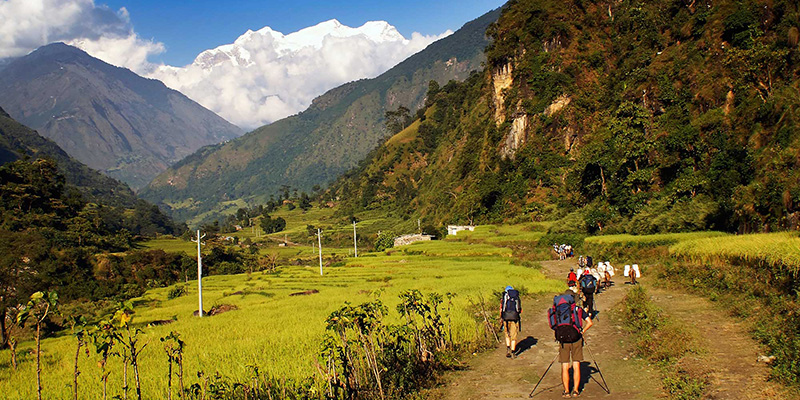
From Pokhara: Onward Journeys with Nepal Vehicle Hiring

For most travelers, the Kathmandu-to-Pokhara luxury jeep hire is not the end of the road — it is the beginning of a broader adventure in Nepal. Pokhara sits at the gateway to some of Nepal’s most extraordinary destinations, and Nepal Vehicle Hiring’s fleet of jeeps, Hiace vans, and Coasters provides seamless onward transport from the city to wherever your journey in Nepal takes you next.

Kathmandu to Pokhara luxury jeep hire with a private Land Cruiser, Prado, or Fortuner on the scenic Prithvi Highway

Pokhara to Mustang: The Forbidden Kingdom Awaits

The most dramatic overland journey available from Pokhara is the drive into Upper Mustang — the ancient walled kingdom of Lo Manthang accessible via the Kali Gandaki gorge road through Beni and Jomsom. Our Pokhara to Mustang jeep service covers the entire journey from Pokhara to Lo Manthang in 2 to 3 days, using the same Land Cruiser or Scorpio that brought you from Kathmandu deep into one of Nepal’s most inaccessible and extraordinary destinations. The Mustang road beyond Kagbeni is among the most challenging roads in Nepal, and an experienced driver and a well-maintained 4WD vehicle are absolute requirements.

Pokhara to Muktinath: The Sacred Temple Journey

For pilgrims and culturally motivated travelers, the Muktinath Yatra itinerary takes you from Pokhara northward to Muktinath Temple at 3,710 meters — one of the most sacred sites in both Hinduism and Buddhism, featuring 108 water spouts, an eternal flame, and a Vishnu temple complex that draws hundreds of thousands of pilgrims annually. Our Hiace van handles the Pokhara-to-Jomsom section, with 4WD jeeps taking over for the final approach to Muktinath. This is the natural extension for Kathmandu–Pokhara travelers whose journey has a spiritual dimension.

Pokhara to Annapurna Circuit Trailheads

For trekkers beginning the Annapurna Circuit or heading to specific entry points in the Annapurna Conservation Area, Nepal Vehicle Hiring offers Pokhara-to-Nayapul transportation for the southern circuit approach, as well as coordinated connections to Besisahar and Dumre for the eastern circuit entry. The Sarangkot sunrise tour is also one of the most popular Pokhara-based activities we arrange — a dawn departure to the Sarangkot viewpoint ridge for the finest Annapurna panorama in the region before the trekking adventure begins.

Pokhara to Chitwan: Adding the Wildlife Dimension

For travelers combining Pokhara with a Chitwan National Park wildlife experience, our Hiace van and car hire fleet covers the Pokhara-to-Chitwan highway leg (approximately 150 kilometers, 4 to 5 hours). This leg, combined with the Kathmandu–Pokhara luxury jeep hire, forms part of the classic Nepal triangle circuit — one of the finest multi-destination combinations in the country. See our Nepal tour package and Nepal holiday tour pages for complete pre-packaged versions of this circuit.

Pokhara to Lumbini: The Pilgrimage Circuit

Lumbini — the birthplace of the Buddha — lies approximately 200 kilometers southwest of Pokhara via Butwal, a 4- to 5-hour drive on the Siddhartha Highway. For pilgrims completing the full Nepal sacred circuit (Pashupatinath, Muktinath, Lumbini), our Nepal Nekhor tour service coordinates all transport across the complete circuit. The Lumbini leg from Pokhara can be handled by our Hiace van hire or car fleet, depending on group size.

Kathmandu to Pokhara luxury jeep hire with a private Land Cruiser, Prado, or Fortuner on the scenic Prithvi Highway

Combining Your Kathmandu–Pokhara Journey with Kathmandu Valley Sightseeing

Most international travelers arrive in Kathmandu first and spend 1 to 3 days in the valley before departing for Pokhara. Nepal Vehicle Hiring provides comprehensive Kathmandu Valley transport that connects seamlessly to the Pokhara departure, meaning a single provider handles every aspect of your Nepal land transport from airport arrival to final destination.

Beginning with our Kathmandu airport transfer service on arrival, you can progress to a full Kathmandu sightseeing tour covering Pashupatinath, Boudhanath, Swayambhunath, and Patan Durbar Square, followed by a dedicated Bhaktapur Durbar Square day tour and the Nagarkot sunrise tour via our Kathmandu to Nagarkot vehicle service. This valley program offers two to three days of world-class cultural experiences before the drive to Pokhara begins.

For trekkers using our mountain approach services — the Kathmandu to Manang jeep, the Kathmandu to Mustang private jeep, or the Besisahar private vehicle — the Pokhara luxury jeep hire naturally fits as either the first leg of a longer mountain road journey or the return transport after the trek circuit is complete. Our operations team coordinates multi-leg itineraries as standard practice, ensuring seamless vehicle transitions and optimized timing for your overall schedule.

Kathmandu to Pokhara luxury jeep hire with a private Land Cruiser, Prado, or Fortuner on the scenic Prithvi Highway

Who Benefits Most from the Kathmandu to Pokhara Luxury Jeep Hire?

The Kathmandu to Pokhara luxury jeep hire from Nepal Vehicle Hiring is specifically the right choice for the following traveler profiles:

Families with Children Traveling with children on a long highway journey requires flexibility — flexibility to stop for bathroom breaks at any moment, to pull over if a child is feeling carsick on the winding sections of the Prithvi Highway, to stop longer at Manakamana or Bandipur if the children are engaged, and to push through the final section if they are tired and irritable. None of this flexibility exists on a tourist bus. A private jeep with a patient, experienced driver who has ferried families on this route many times gives parents complete control of the journey. It transforms what could be a stressful 8-hour challenge into a manageable, enjoyable family road trip. Our car hire in Nepal covers smaller families of 2 to 4; the Scorpio or Land Cruiser handles families of 4 to 6 with luggage and travel gear.
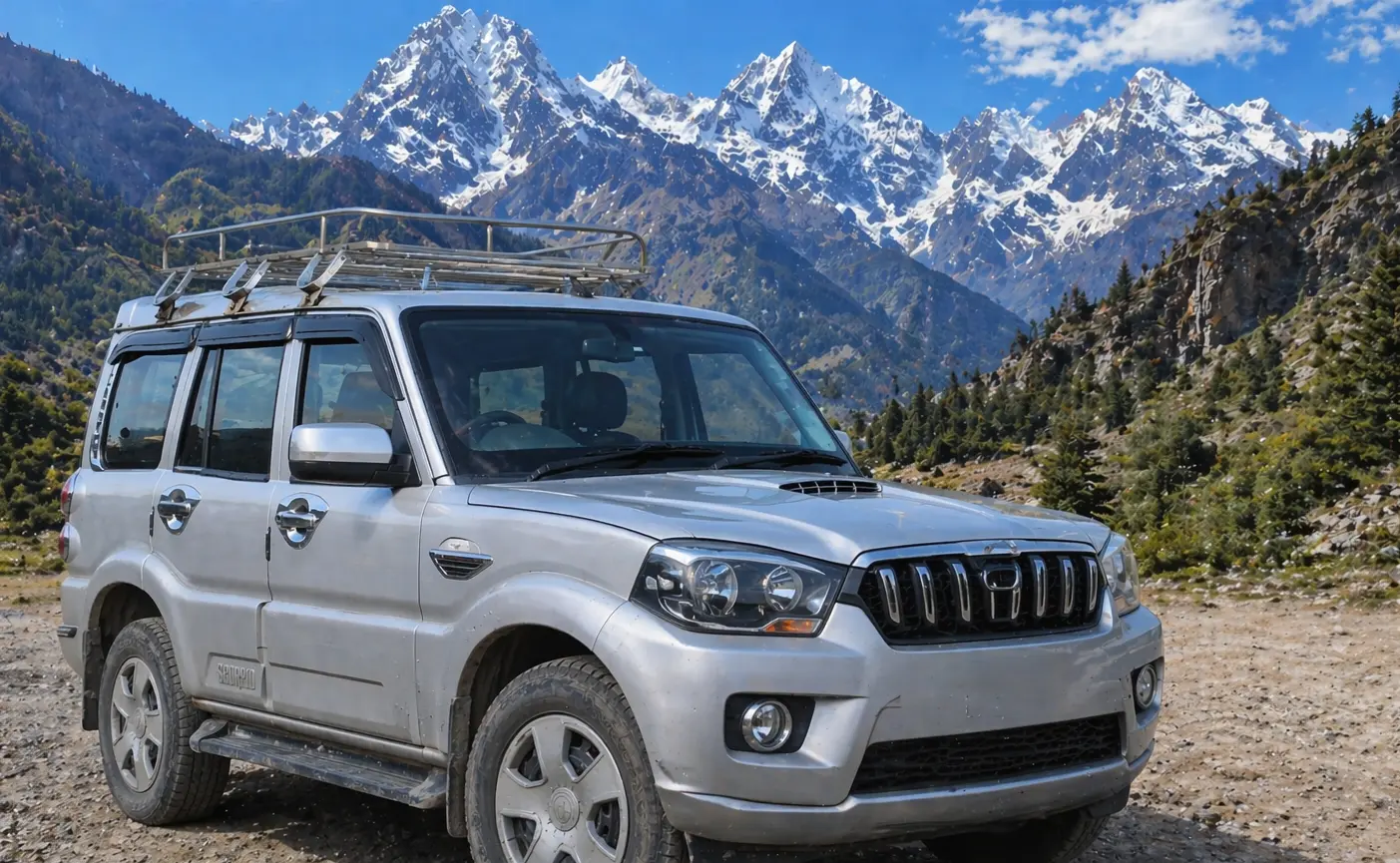
Couples on Romantic Nepal Trips

The Kathmandu–Pokhara drive in a private vehicle, with the Trishuli River below and the Himalayan foothills rising on either side, is a genuinely romantic journey — provided you have the privacy to appreciate it. A couple traveling in the back of a private Land Cruiser, with the front seat free for luggage and complete privacy to talk, sleep, photograph, and experience the journey together, arrives in Pokhara in an entirely different state of mind from that of someone who has shared a tourist bus seat for 8 hours. For honeymoon couples and anniversary travelers,s the luxury jeep hire is not just more comfortable — it is part of the trip.

Senior Travellers

Long bus journeys on Nepal’s mountain highways can be genuinely demanding for older travelers. The combination of hard seating, no individual climate control, fixed stop schedules, and the physical motion of a bus on a winding road creates conditions that are unnecessarily taxing for people who would prefer to travel comfortably. A private jeep with leather seating, individual climate control, the ability to stop whenever needed, and a driver who can adjust the pace to comfort rather than schedule makes the Kathmandu–Pokhara journey accessible and enjoyable for senior travelers who might otherwise choose the 25-minute domestic flight as their only alternative.

Business and VIP Travellers

For business travelers visiting Nepal for corporate purposes, NGO work, government delegations, or high-end tourism development, a Toyota Land Cruiser with a professional driver is the standard expectation for overland transport. Nepal Vehicle Hiring provides VIP vehicle hire with Land Cruiser or premium SUV options that meet international professional travel standards — clean, punctual, comfortable, and driven by a professional who understands the expectations of business travel. We can also coordinate pickup at Kathmandu airport and deliver directly to any hotel in Pokhara.

Trekkers and Adventure Groups

For trekkers heading to the Annapurna region, a private luxury jeep hire to Pokhara is the ideal way to begin the adventure — arriving in Pokhara rested rather than exhausted, with energy to prepare for the trek ahead, buy remaining supplies, and settle into the Lakeside rhythm before moving on. Groups using our trekking transport services can combine the Kathmandu–Pokhara luxury jeep leg with subsequent jeep hire for the approach to Besisahar, Nayapul, or other Annapurna trailheads, handled as a single coordinated multi-leg booking.


Kathmandu to Pokhara luxury jeep hire with a private Land Cruiser, Prado, or Fortuner on the scenic Prithvi Highway

Best Season for Kathmandu to Pokhara Luxury Jeep Hire

Spring (March to May): Clear Skies, Moderate Traffic

Spring is one of the finest times for the Kathmandu–Pokhara drive. Rhododendron forests along the highway hills are in full bloom in March and early April; the air is clear, and the Himalayan peaks are visible from multiple sections of the final approach to Pokhara. Trekking season peaks in April and May, meaning Nepal Vehicle Hiring’s fleet is in high demand — early booking 4 to 6 weeks in advance is recommended for prime spring dates.

Monsoon (June to September): Lush but Variable

The monsoon brings the Prithvi Highway’s most challenging road conditions — occasional landslide delays, muddy construction sections, and reduced visibility. The compensation is the extraordinary lushness of the landscape: the Trishuli River gorge in full monsoon, with waterfalls streaming down every cliff face and the hills an impossibly vivid green, is spectacular. Nepal Vehicle Hiring operates the Kathmandu–Pokhara route year-round, including during the monsoon, with daily road condition checks and experienced drivers who can navigate seasonal challenges. The Kathmandu-to-Pokhara bus remains available as a budget option during this period, but for comfort and reliability during the monsoon, the private jeep is strongly preferred.

Autumn (September to November): The Premier Season

Autumn is Nepal’s absolute peak travel season for good reason — post-monsoon clarity delivers the finest mountain views of the year, the landscape is lush from the recent rains, and the temperatures are perfect. The final approach to Pokhara on a clear autumn morning, when the entire Annapurna range — Dhaulagiri, Annapurna I through IV, Machapuchre, Lamjung Himal — fills the northern horizon in a panorama of extraordinary scale, is one of the great road trip moments in Asia. Nepal Vehicle Hiring’s Land Cruiser and Scorpio fleets operate at full capacity during the autumn peak season. Booking 6 to 8 weeks in advance is strongly recommended for travel in October and November.

Winter (December to February): Quiet and Clear

Winter is an underrated season for the Kathmandu–Pokhara drive. The tourist crowds thin dramatically, Nepal Vehicle Hiring vehicles are readily available without extended advance notice, and the cold, dry air produces crystal-clear mountain visibility that sometimes exceeds even the autumn clarity. Daytime temperatures on the highway are cool and comfortable for road travel. The only consideration is that if your Pokhara trip is a gateway to a Mustang or Manang mountain road journey, winter mountain passes and high-altitude road sections require careful planning and experienced driver judgment — which Nepal Vehicle Hiring’s team always provides.

Frequently Asked Questions: Kathmandu to Pokhara Luxury Jeep Hire 2026/27

How long does the drive from Kathmandu to Pokhara take in a private jeep?

With a private luxury jeep and an early departure from Thamel (6:30 to 7:30 AM), the driving time is approximately 6 to 7 hours without stops. With a Malekhu breakfast stop and a Mugling lunch break, plan for 7.5-8.5 hours total. Adding Manakamana Temple extends the journey to approximately 10 hours. Adding both Manakamana and Bandipur makes for a full 11-hour travel day — best suited to travelers who want to experience the complete journey rather than see Pokhara quickly.

What is included in Nepal Vehicle Hiring’s all-in jeep hire price?

Nepal Vehicle Hiring’s pricing for the Kathmandu-to-Pokhara luxury jeep hire includes the vehicle, professional driver, fuel, driver accommodation and meal allowance (for the driver, not the passengers), and all applicable road charges and tolls. It does not include passenger food, cable car tickets at Manakamana, Bandipur entry fees, or any other personal expenses. There are no hidden charges or end-of-journey additions. Contact us through the ” Plan Your Trip “ page for a specific price quote.

Can I book a return trip from Pokhara to Kathmandu with the same driver?

Yes — Nepal Vehicle Hiring can arrange both the outward and return journeys as part of a single booking, with the same driver or a different one depending on scheduling. Many travelers book the outward Kathmandu–Pokhara jeep hire and then arrange the return after deciding their Pokhara itinerary. We can also arrange one-way hire with the vehicle returning independently — both options are available, with pricing reflecting the different configurations.

Is a 4WD necessary for the drive from Kathmandu to Pokhara? 

The Prithvi Highway is accessible to standard 2WD vehicles and does not require 4WD capability for the highway leg alone. However, Nepal Vehicle Hiring recommends the Scorpio or Land Cruiser (both 4WD or 4WD-capable) for this route in 2026 and 2027 due to ongoing highway construction, which may involve rough, temporary surfaces that benefit from higher ground clearance and better suspension. Additionally, if your Pokhara visit is a gateway to any onward mountain road journey — Mustang, Muktinath, Manang — a 4WD is mandatory for those sections, so starting with a 4WD vehicle ensures seamless continuity.

How far in advance should I book?

For autumn peak season (October–November) and spring peak season (March–May), booking 4 to 6 weeks in advance is strongly recommended for premium Land Cruiser options. The Scorpio fleet has more availability and can typically be booked 1 to 2 weeks in advance during non-peak periods. For festival periods — Dashain in October, Tihar in November, and Tiji Festival in May — book even further in advance, as vehicle demand across the country peaks during these windows. Contact Nepal Vehicle Hiring through our plan your trip page or WhatsApp +977 9851013196 for current availability.

Can I combine the Kathmandu-to-Pokhara jeep with an Everest Base Camp trek transfer?

Absolutely. Nepal Vehicle Hiring provides comprehensive multi-destination transport coordination in Nepal. If your itinerary includes both an EBC trek (requiring Everest Base Camp trek transport to the airport or Ramechhap airstrip) and a Pokhara visit with Annapurna trekking transport, our operations team coordinates all legs as a single managed itinerary. This is one of Nepal Vehicle Hiring’s greatest strengths — the ability to handle complex, multi-destination itineraries in Nepal with a single point of contact and a single standard of service throughout.

How to Book Your Kathmandu to Pokhara Luxury Jeep Hire with Nepal Vehicle Hiring

Booking your luxury private jeep hire from Kathmandu to Pokhara with Nepal Vehicle Hiring is straightforward and can be confirmed quickly:

  • Visit www.vehiclehiringnepal.com and browse our jeep hire fleet and service options.
  • Submit your trip details through our plan your trip page — including your travel date, preferred departure time, group size, vehicle preference (Land Cruiser or Scorpio), and any planned en route stops.
  • Our team responds within 24 hours with a confirmed vehicle, driver assignment, and all-in pricing.
  • Confirm the booking, and we will handle everything — hotel pickup, route planning, stop coordination, and onward transport to Pokhara, if required.


Contact us directly at any time:

WhatsApp / Call: +977 9851013196
Email:[email protected]

Nepal Vehicle Hiring Pvt. Ltd. is based in Thamel, Kathmandu — the heart of Nepal’s tourism district — and is available seven days a week. Our team speaks English, Nepali, and Hindi and has extensive experience assisting international travelers from around the world in designing and executing Nepal transport itineraries of any complexity.

The 200200-kilometerive from Kathmandu to Pokhara is one of Nepal’s great journeys. The Trishuli River gorge at dawn, the pilgrims ascending to Manakamana, the fish grilling over charcoal at Mugling, the ancient lanes of Bandipur, the moment when the Annapurna range fills the horizon as you approach Pokhara in the late afternoon — all of these belong to you when you travel by private luxury jeep. Let Nepal Vehicle Hiring ensure you experience each one in the comfort and privacy you deserve.

Kathmandu to Tamang Heritage Trail Transport

Kathmandu to Tamang Heritage Trail transport with a private 4WD jeep traveling through the Langtang region of Nepal

Kathmandu to Tamang Heritage Trail Transport

The Complete Vehicle Hire and Route Guide to Nepal’s Off-the-Beaten-Path Cultural Trek

Tucked into the Rasuwa district along Nepal’s northern border with Tibet, the 

Tamang Heritage Trail remains one of the country’s most rewarding yet comparatively undiscovered trekking routes. Named for the Tamang people whose Tibetan Buddhist culture, stone-built villages, and centuries-old trade routes define the region, this trek combines striking Himalayan views with a depth of cultural immersion that busier trails often lack. Reaching the trailhead, however, still means the same demanding drive out of Kathmandu that serves the neighbouring Langtang Valley, and getting that first leg of the journey right matters as much as the trek itself.

This guide covers everything travelers need to know about 

vehicle hire and transport for the Kathmandu-to-Tamang Heritage Trail journey, from the drive itself through Trishuli Bazaar and Dhunche to Syabrubesi, to the trekking route’s key villages, permits, seasonal considerations, and how the trail compares to and combines with the better-known Langtang Valley Trek. Nepal Vehicle Hiring has arranged jeep and private vehicle transport along this exact corridor for years, and this article draws directly on that route experience.

What Is the Tamang Heritage Trail

The Tamang Heritage Trail is a relatively recently developed trekking route, established to bring sustainable tourism income directly to Tamang communities living in the villages north and west of Syabrubesi. Unlike the more heavily trekked Langtang Valley route, which follows the Langtang Khola directly toward Kyanjin Gompa, the Tamang Heritage Trail loops through a series of traditional villages, including Gatlang, Tatopani, Nagthali, Thuman, and Briddim, each offering homestay accommodation, traditional Tamang architecture, and direct contact with a culture closely tied to Tibetan Buddhism.

The trail’s defining features include the natural hot springs at Tatopani village, sweeping views of Langtang Lirung and the surrounding peaks from the Nagthali Danda viewpoint, centuries-old monasteries and chortens found throughout the route, and a level of homestay-based cultural exchange that has become increasingly rare on Nepal’s busier trekking circuits. For travelers seeking a shorter, culturally rich trek that avoids the crowds of the Everest and Annapurna regions while remaining relatively accessible from Kathmandu, the Tamang Heritage Trail has become an increasingly popular choice.

Geography: Rasuwa District and the Nepal-Tibet Borderlands

The Tamang Heritage Trail sits within Rasuwa district, largely inside or adjacent to Langtang National Park, in the same broad region as the Langtang Valley and within striking distance of the Rasuwagadhi-Kerung border crossing into Tibet. This proximity to the Tibetan plateau has shaped Tamang culture in the region for centuries, as seen in the area’s monasteries, prayer flags, chortens, and the Tibetan Buddhist practices still actively practiced in villages like Gatlang and Thuman. Elevations along the trail range from around 1,460 meters at Syabrubesi to over 3,650 meters at the Nagthali Danda viewpoint, making it a moderately challenging trek that nonetheless remains accessible to reasonably fit trekkers without requiring the sustained high-altitude endurance of routes like the Everest Base Camp Trek or Annapurna Circuit.

Book reliable Kathmandu to Tamang Heritage Trail transport with private 4WD jeeps and experienced drivers for a comfortable journey to the trek starting point.

The Journey From Kathmandu to Syabrubesi

Nearly every Tamang Heritage Trail itinerary begins with the same overland journey used for the neighboring Langtang Valley Trek: the drive from Kathmandu to Syabrubesi, a distance of roughly 120 kilometers that typically takes seven to eight hours by private vehicle, longer during the monsoon season or when road repairs are underway. The route climbs out of the Kathmandu Valley through Trishuli Bazaar, follows the Trishuli River valley, and continues through Dhunche, the headquarters of Langtang National Park, before descending to Syabrubesi itself, the trailhead town for both the Tamang Heritage Trail and Langtang Valley routes.

This road ranks among the more physically demanding drives in Nepal’s central hill region, with sharp switchbacks, sections of loose gravel, and occasional landslide-related delays, particularly during and immediately after the monsoon months. A genuine four-wheel-drive vehicle with an experienced driver familiar with this specific corridor is strongly recommended rather than a standard car or low-clearance van. Our 

Jeep Hire in Nepal service is built specifically around routes like this one, pairing a Land Cruiser or Prado-class vehicle with a driver experienced on the Trishuli-Dhunche-Syabrubesi corridor.

Travelers combining this trip with time in Kathmandu often begin with a day or two of Valley sightseeing, arranged through our 

Kathmandu sightseeing tour and 

Bhaktapur Durbar Square tour services, along with a 

Kathmandu airport transfer to begin the trip smoothly from the moment they land.

Kathmandu to Tamang Heritage Trail transport with a private 4WD jeep traveling through the Langtang region of Nepal

Vehicle Options for the Syabrubesi Approach

Toyota Land Cruiser and Prado

For small groups of up to four trekkers, a Land Cruiser or Prado remains the most comfortable and reliable option for the Syabrubesi road, offering the ground clearance and suspension needed on the roughest sections between Trishuli Bazaar and Dhunche.

Executive Hiace Vans

Larger trekking groups or families often prefer our 

Hiace hire service for this route, offering considerably more luggage space for group trekking equipment and homestay gifts that visitors to the Tamang villages commonly carry.

Mahindra Bolero and Local Jeeps

Budget-conscious trekkers traveling in smaller groups often choose a Mahindra Bolero-class jeep, as covered in our 

Mahindra Bolero and Tata Sumo trekking transfer guide, which remain practical and cost-effective options for this corridor.

Kathmandu to Tamang Heritage Trail transport with a private 4WD jeep traveling through the Langtang region of Nepal

The Trekking Route: Villages and Highlights

Syabrubesi: The Gateway Town

Syabrubesi serves as the starting and ending point for both the Tamang Heritage Trail and the Langtang Valley Trek, and most trekkers spend at least one night here before setting out, both to arrange final permit checks and to recover from the long drive from Kathmandu.

Gatlang: A Traditional Tamang Village

A short trek from Syabrubesi, Gatlang is one of the most culturally significant stops on the route, known for its traditional stone houses, the historic Chhechen Gompa monastery, and Parvati Kunda, a small sacred lake associated with local Hindu and Buddhist pilgrimage traditions.

Chilime and Tatopani: Hot Springs on the Trail

The village of Tatopani, not to be confused with the larger settlement of the same name on the Muktinath route, offers natural hot springs that provide a welcome rest for trekkers partway through the loop, alongside views of the Chilime hydropower project that has brought modern infrastructure to this otherwise traditional corner of Rasuwa.

Nagthali Danda: The Trail’s Premier Viewpoint

At over 3,650 meters, Nagthali Danda offers one of the finest panoramic views on the entire route, taking in Langtang Lirung, Ganesh Himal, and a wide sweep of the surrounding Rasuwa hills. Many trekkers consider this the scenic high point of the entire Tamang Heritage Trail experience.

Thuman and Briddim: Homestay Villages

Thuman and Briddim have become particularly well known for their community-run homestay programs, offering trekkers a direct, immersive experience of Tamang domestic life, food, and Buddhist practice that is rarely available on Nepal’s busier trekking routes. Briddim, in particular, sits close enough to the Langtang Valley trail that some itineraries combine both routes into a single, longer loop.

Kathmandu to Tamang Heritage Trail transport with a private 4WD jeep traveling through the Langtang region of Nepal

Combining the Tamang Heritage Trail With the Langtang Valley Trek

Because both routes share the same Syabrubesi trailhead and overlap in their lower sections, a growing number of trekkers combine the Tamang Heritage Trail with the 

Langtang Valley Trek, offered by our sister company, Alpine Luxury Treks, is combined into a single extended 10- to 14-day itinerary. This combination allows trekkers to experience both the cultural depth of the Tamang villages and the dramatic high-alpine scenery of the Langtang Valley itself, including Kyanjin Gompa and the glacial landscape beneath Langtang Lirung, without needing a second overland journey from Kathmandu.

For travelers deciding between the two routes as a standalone trek, the Tamang Heritage Trail is generally considered the more culturally focused and less physically demanding option, with lower average elevations and a greater emphasis on village life and homestays. At the same time, the Langtang Valley Trek pushes higher into true alpine terrain with more dramatic mountain scenery but fewer cultural stops along the way.

Proximity to the Rasuwagadhi-Kerung Border

The Tamang Heritage Trail’s villages sit relatively close to the Rasuwagadhi-Kerung border crossing into Tibet, one of the few official overland crossings between Nepal and China. As covered in more depth in our 

Rasuwagadhi Kerung Border Vehicle Hire guide: this border region has historically served as a trade corridor between Tamang communities in Rasuwa and Tibetan traders across the frontier, a history still visible in the architecture, religious practice, and trade goods found in villages like Timure and Thuman. Travelers interested in this border history sometimes extend a Tamang Heritage Trail itinerary with a visit to Timure, though onward travel across the border itself requires separate arrangements and documentation beyond a standard trekking permit.

Permits Required for the Tamang Heritage Trail

Trekkers on the Tamang Heritage Trail require a Langtang National Park entry permit, since much of the route falls within or adjacent to the park boundary, along with a TIMS (Trekkers’ Information Management System) card, standard requirements for most independent and guided trekking in this region of Nepal. Unlike Upper Mustang or other restricted areas, no special additional permit is required for the Tamang Heritage Trail itself, making it more straightforward to arrange than some of Nepal’s more remote trekking routes.

Book reliable Kathmandu to Tamang Heritage Trail transport with private 4WD jeeps and experienced drivers for a comfortable journey to the trek starting point.

Best Time of Year for the Tamang Heritage Trail

Spring (March to May)

Rhododendron forests bloom across the lower sections of the trail during this period, and road conditions on the Syabrubesi approach are generally favorable, making spring one of the two peak seasons for this trek.

Summer and Monsoon (June to August)

Heavy rainfall increases landslide risk on the unpaved sections of the Syabrubesi road, and trails can become slippery underfoot. However,  the lush green hillsides during this period have their own particular appeal for travelers willing to accept less predictable conditions.

Autumn (September to November)

The clearest skies and most stable road and trail conditions of the year, and the busiest season for both the Tamang Heritage Trail and the neighboring Langtang Valley Trek. Vehicle bookings should be arranged well in advance during this period.

Winter (December to February)

Higher sections of the route, particularly around Nagthali Danda, can see snowfall and freezing overnight temperatures, though the lower villages remain accessible and considerably quieter than during peak season.

Road Safety on the Kathmandu to Syabrubesi Route

The road through Trishuli Bazaar and Dhunche toward Syabrubesi passes through active landslide zones, particularly during and shortly after the monsoon. An experienced driver familiar with this specific corridor is essential for both comfort and safety. Vehicles should be inspected for reliable brakes, suspension, and tires before departure, given the strain this route places on a vehicle compared to ordinary city driving. Our drivers assigned to this corridor are selected specifically for their experience navigating these conditions across multiple seasons.


Kathmandu to Tamang Heritage Trail transport with a private 4WD jeep traveling through the Langtang region of Nepal

Cost Factors for Tamang Heritage Trail Transport

Vehicle hire cost for the Kathmandu-to-Syabrubesi route depends primarily on vehicle class and group size, with a private Land Cruiser or Prado costing more than a shared local jeep but offering considerably greater comfort and flexibility for stops along the way. Groups traveling together can reduce the effective per-person cost significantly compared to individual seats on shared transport. Our team is glad to prepare a custom quote based on your group size, travel dates, and whether you plan to combine the Tamang Heritage Trail with the Langtang Valley Trek in a single extended itinerary. Visit our 

homepage or explore our 

Trekking transport section for further route-specific guidance.

How to Book Your Tamang Heritage Trail Transport

Booking is straightforward: share your group size, preferred travel dates, and whether your itinerary includes an extension into the Langtang Valley, and our team will match the right vehicle, whether a Land Cruiser, Prado, or Hiace, along with a driver experienced on the Trishuli-Dhunche-Syabrubesi corridor. Booking at least two to three weeks ahead is recommended during the peak spring and autumn seasons, when both vehicles and drivers are in highest demand.

The History Behind the Tamang Heritage Trail

The Tamang Heritage Trail was developed in the years following Nepal’s broader push to diversify trekking tourism beyond the well-established Everest and Annapurna circuits, with support from conservation and community development organizations working alongside local Tamang communities in Rasuwa district. The goal was straightforward: create a trekking route that channeled tourism income directly into villages that had historically relied on subsistence agriculture, animal husbandry, and small-scale trade across the nearby Tibetan border, while showcasing a distinct ethnic culture that remained relatively unknown to international visitors compared to the Sherpa culture of the Everest region or the Gurung and Magar communities of the Annapurna foothills.

Tamang communities in this part of Nepal trace much of their cultural and religious heritage to Tibetan Buddhism, as reflected in the prevalence of chortens, prayer wheels, and monasteries throughout villages such as Gatlang and Thuman. The trail’s community homestay model, particularly well developed in Briddim and Thuman, was designed to keep a larger share of tourism revenue within these villages than conventional teahouse trekking, where much of the profit margin can flow to lodge owners who may not be local to the immediate community.

Kathmandu to Tamang Heritage Trail transport with a private 4WD jeep traveling through the Langtang region of Nepal

A Typical Tamang Heritage Trail Itinerary

While itineraries vary by operator and trekking pace, a common pattern for the Tamang Heritage Trail spans seven to nine days, including the overland journey from Kathmandu. Day one covers the drive from Kathmandu to Syabrubesi, with an overnight stay at the trailhead. From there, trekkers typically walk to Gatlang on day two, exploring the village’s monastery and Parvati Kunda before continuing toward Chilime and Tatopani on day three, timed to allow a soak in the natural hot springs. Day four usually involves the climb to Nagthali Danda, either as a base for the night or a day hike from a nearby village, taking in the trail’s best mountain panorama. The route then descends through Thuman, often with a homestay night, before continuing to Briddim, another key homestay village, and finally looping back to Syabrubesi to complete the circuit. Groups combining this with the Langtang Valley Trek typically add a further five to seven days, continuing up the Langtang Khola valley from Syabrubesi rather than returning directly to Kathmandu.

What to Pack for the Tamang Heritage Trail

Because the trail spans a range of elevations from around 1,460 meters at Syabrubesi to over 3,650 meters at Nagthali Danda, layered clothing remains essential, with warm layers particularly important for the higher viewpoint sections and cooler evenings in homestay villages. A good pair of broken-in trekking boots, a lightweight rain layer for afternoon showers even outside the monsoon season, and a headlamp for homestays with limited electricity are all worth carrying. Since much of the route relies on homestays rather than conventional teahouses, a sleeping bag liner and personal toiletries are particularly useful, and small gifts or contributions to host families, discussed in advance with a guide or trekking agency, are appreciated, given the direct nature of the homestay exchange.

Kathmandu to Tamang Heritage Trail transport with a private 4WD jeep traveling through the Langtang region of Nepal

Guides, Porters, and Trekking Support

While the Tamang Heritage Trail can technically be walked independently, given adequate trail signage in recent years, a local guide familiar with the homestay network and Tamang cultural etiquette adds considerably to the experience, both in terms of safety on less-traveled sections of the trail and in facilitating a more meaningful cultural exchange with host families. Porters are widely available in Syabrubesi and help make the trek accessible to a broader range of fitness levels, carrying the bulk of the luggage. In contrast, trekkers carry only a day pack between villages.


Tamang Culture and Buddhist Traditions Along the Trail

Tamang identity in Rasuwa is deeply intertwined with Tibetan Buddhist practice, visible in the mani walls, chortens, and prayer flags that line the trail between villages, and in the daily rhythms of monastery life still active in places like Gatlang’s Chhechen Gompa. Many households along the route maintain small shrine rooms, and it is common to see elderly residents spinning prayer wheels or reciting mantras during quiet moments in the village square. Traditional Tamang dress, particularly for women, remains in everyday use in some of the more remote villages, distinct from the clothing typically seen in Kathmandu or the more tourism-influenced parts of the Everest and Annapurna regions.

Language also marks a clear cultural boundary along this route. While Nepali serves as the common language for communication with trekkers and guides, Tamang remains the primary language spoken within households and between neighbors in many of the trail’s villages, part of a broader linguistic and cultural distinctiveness that UNESCO and Nepali cultural preservation bodies have taken an active interest in documenting and supporting in recent years.

Local Cuisine on the Tamang Heritage Trail

Food along the trail reflects both the broader Nepali hill diet and specific Tamang influences shaped by proximity to Tibet. Dal bhat remains widely available and the most reliable option throughout the route, but homestay hosts frequently prepare Tamang specialties as well, including varieties of buckwheat-based bread, hearty potato dishes suited to the region’s high-altitude agriculture, and butter tea, a salted, buttery beverage with clear Tibetan influence that appears more frequently here than in Nepal’s more southern trekking regions. Homestay meals are typically included in the overnight rate, and sharing a meal cooked over a traditional wood-fired stove is often cited by trekkers as one of the most memorable parts of the experience.

Environmental Considerations Along the Trail

Langtang National Park, which encompasses much of the Tamang Heritage Trail route, remains an ecologically significant area, home to red pandas, Himalayan tahr, and a range of high-altitude bird species, as well as dense forests of rhododendron, oak, and pine at lower elevations. Trekkers are encouraged to carry out all non-biodegradable waste, minimize the use of firewood-heated water where possible, given the strain on local forest resources, and respect wildlife viewing distances, particularly in the forested sections between Syabrubesi and Gatlang, where wildlife encounters are more likely than on the more heavily trafficked Langtang Valley trail itself.

Comparing the Tamang Heritage Trail to Other Cultural Treks in Nepal

Nepal offers several trekking routes built primarily around cultural immersion rather than pure high-altitude mountaineering, and the Tamang Heritage Trail compares favorably to alternatives such as the Tsum Valley trek near Manaslu or the lower sections of the Annapurna Circuit around Ghandruk and Landruk, both of which similarly emphasize village culture over summit-focused trekking. What distinguishes the Tamang Heritage Trail is its relative proximity to Kathmandu, requiring only a single day’s overland drive to Syabrubesi rather than the considerably longer approach roads required for Tsum Valley or the more remote sections of Manaslu, making it a practical option for travelers with more limited time who still want a genuinely immersive cultural trekking experience.

Photography Highlights Along the Route

The Tamang Heritage Trail offers a distinct visual character compared to Nepal’s more famous trekking routes, combining traditional stone architecture, terraced hillside agriculture, and dramatic mountain backdrops in a way that feels less curated for tourism than some of the busier Everest and Annapurna trails. Notable photography opportunities include the weathered stone rooftops and prayer flag-draped alleys of Gatlang, the steam rising from the Tatopani hot springs against a backdrop of forested hillsides, the sweeping 360-degree panorama from Nagthali Danda taking in Langtang Lirung and Ganesh Himal, and the quiet, unposed moments of daily village life visible during homestay evenings in Thuman and Briddim.

Health and Altitude Considerations

While the Tamang Heritage Trail reaches a maximum elevation of around 3,650 meters at Nagthali Danda, considerably lower than high-altitude routes like Everest Base Camp or the Annapurna Circuit’s Thorong La crossing, trekkers should still take basic altitude precautions given the relatively rapid ascent from Syabrubesi’s 1,460 meters over a matter of days. Staying well hydrated, pacing ascents rather than rushing between villages, and being alert to symptoms such as headache or unusual fatigue are sensible precautions, particularly for trekkers arriving directly from lower elevations without any prior acclimatization in the Kathmandu Valley.

Kathmandu to Tamang Heritage Trail transport with a private 4WD jeep traveling through the Langtang region of Nepal


Accommodation Standards and Homestay Etiquette

Homestay accommodation along the Tamang Heritage Trail is generally simple, with shared or basic private rooms, communal bathrooms, and meals prepared and eaten with the host family rather than in a separate dining hall, as in conventional teahouses. This arrangement calls for a degree of cultural sensitivity and flexibility not always required on more commercially developed trekking routes: removing shoes before entering living areas, accepting food and tea graciously even if portions feel generous, and showing genuine interest in family life and local customs all contribute to a more rewarding exchange for both trekker and host. Trekking agencies and guides familiar with the specific etiquette expectations of each village can help first-time visitors navigate this experience comfortably.

Connectivity and Communication Along the Trail

Mobile network coverage along the Tamang Heritage Trail remains more limited and inconsistent than on Nepal’s busier trekking routes, with reasonable signal in Syabrubesi and patchy or absent coverage in some of the more remote homestay villages such as Thuman and Briddim. Trekkers should not rely on continuous connectivity throughout the route and are advised to inform family or travel companions of their general itinerary and expected return date before setting out, particularly given the comparatively lower volume of trekking traffic on this route compared to Langtang Valley or the major Everest and Annapurna circuits.

Currency and Practical Logistics

As with most rural trekking routes in Nepal, cash in Nepali rupees is essential throughout the Tamang Heritage Trail, since card payment infrastructure is effectively nonexistent once travelers leave Kathmandu. Homestay costs, meals, and any additional services, such as hot water for washing, are typically settled in cash directly with host families or through a guide who manages group payments. Withdrawing sufficient cash in Kathmandu before departure, with a reasonable buffer for unexpected costs or delays, remains the most practical approach for this route.

Why This Route Appeals to Repeat Visitors to Nepal

A growing number of trekkers exploring the Tamang Heritage Trail are repeat visitors to Nepal who have already completed one or more of the country’s more famous routes, such as Everest Base Camp or the Annapurna Circuit, and are specifically seeking a different kind of experience on a subsequent trip. For this segment of travelers, the trail’s slower pace, lower trekking traffic, and emphasis on direct cultural exchange over dramatic high-altitude scenery offer a genuinely distinct alternative rather than a repeat of a similar trekking formula. Trekking agencies increasingly market the Tamang Heritage Trail specifically to this returning-visitor segment, positioning it as a complementary, rather than competing, experience to Nepal’s more famous circuits.

Combining Vehicle Hire With a Broader Rasuwa District Itinerary

Beyond the Tamang Heritage Trail and Langtang Valley Trek, Rasuwa district offers a handful of additional points of interest that some travelers combine into a longer overland itinerary, including the Chilime hydropower area, the Rasuwagadhi border region, and the broader Trishuli River valley, popular for white-water rafting near Kathmandu. Coordinating these additional stops alongside the core trekking transport requires careful planning for road conditions and driving time. Our team is well-positioned to help design an extended Rasuwa itinerary that complements your core Tamang Heritage Trail or Langtang Valley transport booking.

The Role of Community Tourism in Sustaining the Trail

Unlike many of Nepal’s trekking routes, where lodges and teahouses are often owned by families from outside the immediate community or even outside the region entirely, the Tamang Heritage Trail’s homestay model was specifically designed to keep tourism revenue within the villages that host trekkers. This community tourism approach has had a measurable impact on local development in villages like Briddim and Thuman, funding school improvements, water infrastructure, and continued investment in the homestay network itself. Trekkers choosing this route contribute directly to this model simply by trekking it, choosing this trail, in a small way, a more direct form of community-supporting travel compared to conventional teahouse trekking on busier circuits.

Weather Patterns Specific to the Rasuwa Region

Rasuwa district’s weather is significantly shaped by its position at the base of the Langtang Himal range, with the lower Trishuli valley experiencing a warmer, more monsoon-influenced climate than the higher villages along the Tamang Heritage Trail. Afternoon cloud build-up is common even outside the main monsoon season, particularly around Nagthali Danda, and trekkers hoping for the clearest mountain views are generally advised to plan viewpoint visits for early morning before cloud cover typically develops later in the day. This pattern mirrors similar afternoon weather behavior found throughout much of Nepal’s central hill region, including the better-known Annapurna and Langtang corridors.

Insurance and Emergency Considerations

Given the trail’s relatively remote homestay villages and limited connectivity, trekkers are strongly advised to carry appropriate travel insurance covering trekking activities and, where relevant, emergency helicopter evacuation, standard advice for most of Nepal’s trekking routes, but particularly relevant here given the more limited emergency response infrastructure compared to busier circuits like Everest Base Camp, where helicopter rescue services are more routinely available and rapidly dispatched. A knowledgeable local guide familiar with the nearest emergency evacuation access points, typically via Syabrubesi, adds a meaningful layer of safety for trekkers on this less-traveled route.

Group Size and Booking Considerations for the Trail

The Tamang Heritage Trail’s homestay-based accommodation model means group size planning matters somewhat differently than on conventional teahouse routes. Individual homestay households can typically accommodate only a limited number of trekkers at a time, and larger groups may need to be split across multiple homestays within the same village or coordinated well in advance to ensure adequate capacity, particularly during the busier autumn season. Trekking agencies and vehicle hire operators working this route regularly, such as Nepal Vehicle Hiring, in coordination with our sister companies, maintain established relationships with homestay families that help ensure smooth group logistics even during peak booking periods.

Kathmandu Sightseeing Tour

Extending the Trip: Kathmandu Valley Sightseeing Before or After

Given that most Tamang Heritage Trail itineraries include at least one night in Kathmandu before and after the trek itself, many travelers use this time to explore the Valley’s cultural heritage sites. A visit to Pashupatinath Temple, Nepal’s most significant Hindu pilgrimage site, or the medieval squares of Bhaktapur, through our 

Bhaktapur Durbar Square tour naturally pairs with a Tamang Heritage Trail itinerary, offering a cultural counterpoint in Kathmandu before heading out to the equally rich but very different cultural landscape of rural Rasuwa. A sunrise excursion through our 

Nagarkot Sunrise Tour Vehicle Service offers an additional Himalayan panorama for travelers with an extra day to spare before or after their trek.

Why Choose Nepal Vehicle Hiring for This Route

Nepal Vehicle Hiring has arranged transport along the Kathmandu-Syabrubesi corridor for years, serving trekkers heading to both the Tamang Heritage Trail and the neighboring Langtang Valley. Our drivers assigned to this route are selected specifically for their experience navigating the Trishuli-Dhunche-Syabrubesi road across multiple seasons, and our vehicles undergo regular inspections with particular attention to the brakes, suspension, and tires that this corridor places under genuine strain. Because we work closely with our sister companies, 

Alpine Luxury Treks and Trek Nepal Himalayas can also help coordinate the trekking and homestay aspects of your itinerary alongside the ground transport, ensuring a single, consistent point of contact for your entire Tamang Heritage Trail journey from Kathmandu pickup to final return.

A Note on Responsible Trekking in Tamang Communities

Visitors to the Tamang Heritage Trail are encouraged to approach the homestay experience with genuine respect for the communities hosting them, recognizing that these villages have opened their homes specifically to support sustainable tourism development rather than functioning as a simple commercial transaction. Simple practices, such as asking permission before photographing individuals, particularly during religious ceremonies or private family moments, dressing modestly in keeping with local norms, and showing genuine curiosity about Tamang culture and Buddhist practice rather than treating the visit purely as a scenic backdrop, all contribute to a more respectful and mutually rewarding exchange between trekkers and the communities they pass through.

Kathmandu to Tamang Heritage Trail transport with a private 4WD jeep traveling through the Langtang region of Nepal

Seasonal Booking Patterns for Vehicle Hire on This Route

Demand for private vehicle hire to Syabrubesi follows a similar seasonal rhythm to Nepal’s other major trekking corridors, with autumn representing the peak booking period, followed closely by spring. Because the Tamang Heritage Trail remains less heavily trafficked than the Everest or Annapurna regions, vehicle availability during peak season is generally somewhat easier to secure than on the busiest routes, though booking at least two to three weeks ahead remains sensible, particularly for groups wanting a specific vehicle class or a driver already familiar with combining Tamang Heritage Trail and Langtang Valley logistics in a single itinerary.

The Broader Appeal of Rasuwa District Beyond Trekking

While trekking remains the primary draw for most visitors to Rasuwa district, the region’s proximity to Kathmandu, combined with its dramatic scenery and distinct Tamang culture, has also attracted growing interest from photographers, cultural researchers, and travelers simply seeking a shorter escape from the capital without committing to a full multi-day trek. Day trips or short overnight excursions to Trishuli Bazaar and the lower Rasuwa hills, arranged with a private vehicle, offer a taste of this landscape and culture for travelers with limited time, even without undertaking the full Tamang Heritage Trail circuit.

Comparing Vehicle Standards: Then and Now on the Syabrubesi Road

Travelers who have visited this region of Nepal previously, even five or ten years ago, often note a noticeable improvement in both road conditions and vehicle quality along the Kathmandu-Syabrubesi corridor. Sections of the route that were once notoriously rough have seen gradual upgrading, and the vehicles now commonly used for this journey, well-maintained Land Cruisers and Prados rather than older, less reliable jeeps, reflect the same broader shift toward premium ground transport visible across Nepal’s trekking industry as a whole. This improvement has made routes like the Tamang Heritage Trail and Langtang Valley meaningfully more accessible to a wider range of travelers, including families and older trekkers who might previously have found the approach road too physically demanding to consider.
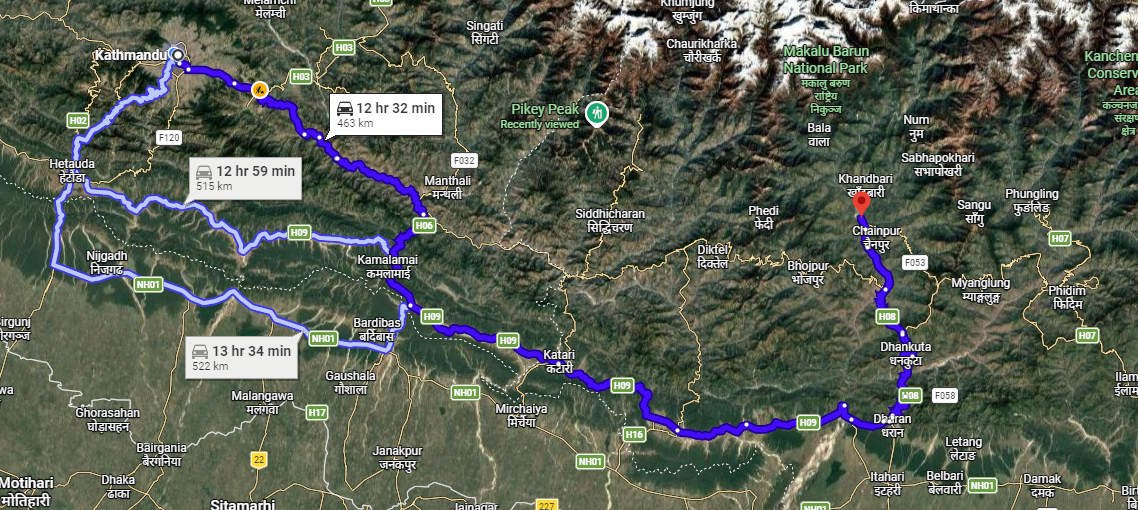
Final Practical Tips Before You Go

  • Book your vehicle and, if needed, your homestay coordination at least two to three weeks ahead during the peak spring and autumn seasons.
  • Carry sufficient Nepali rupees in cash, since card payment infrastructure is essentially unavailable once you leave Kathmandu.
  • Pack layered clothing to handle the elevation range between Syabrubesi and Nagthali Danda, along with a reliable rain layer.
  • Consider a local guide familiar with the homestay network, both for safety and for a richer cultural exchange with host families.
  • Confirm whether your itinerary combines the Tamang Heritage Trail with the Langtang Valley Trek, as this affects both the trekking duration and the permit requirements.
  • Arrange appropriate travel insurance that covers trekking activities and emergency evacuation, given the route’s relatively remote, low-connectivity villages.

Book reliable Kathmandu to Tamang Heritage Trail transport with private 4WD jeeps and experienced drivers for a comfortable journey to the trek starting point.

How This Trail Fits Into Nepal’s Wider Trekking Landscape

Nepal’s trekking regions each occupy a distinct niche within the country’s broader tourism offering, from the high-altitude prestige of Everest Base Camp to the varied ecological zones of the Annapurna Circuit and the pilgrimage significance of routes toward Muktinath. The Tamang Heritage Trail occupies its own niche within this landscape: a shorter, culturally intensive trek that requires only a single day’s overland travel from Kathmandu, positioned as a genuine alternative for travelers seeking depth of cultural experience without the time commitment or crowds associated with Nepal’s more famous circuits. As awareness of this route continues to grow, largely through word of mouth among returning visitors and increasing coverage in specialist trekking guides, it seems likely to become a well-established option among Nepal’s mid-length cultural trekking routes over the coming years.

Planning Your Trip With Confidence

Whether you are drawn to the Tamang Heritage Trail for its homestay culture, its relative proximity to Kathmandu, its Buddhist heritage, or simply as a quieter alternative to Nepal’s busier circuits, getting the transport logistics right from the outset makes a considerable difference to how the rest of the trip unfolds. A well-planned journey from Kathmandu to Syabrubesi, in a properly maintained vehicle with a driver experienced on this specific corridor, sets a smooth, comfortable tone for the cultural immersion and mountain scenery that follow on the trail itself.

A Word on Timing Your Village Stops

Experienced guides on the Tamang Heritage Trail generally recommend scheduling daily walking stages to arrive in each village by early to mid-afternoon, both to allow time to explore before dark and to avoid the more frequent afternoon cloud buildup that can obscure mountain views later in the day, particularly around Nagthali Danda. Starting each day’s walk reasonably early, especially on the climb toward Nagthali itself, gives the best chance of clear morning visibility across Langtang Lirung and the surrounding peaks before clouds typically roll in.

Group Versus Independent Trekking on This Route

While independent trekking has become increasingly feasible on the Tamang Heritage Trail given improved trail signage and a well-established homestay network, many travelers still choose to join a small guided group or arrange a private guide, both for the added safety of local route knowledge and for smoother coordination of homestay bookings, particularly during the busier autumn season when individual homestays may already be committed to other groups. Vehicle hire for the Kathmandu-to-Syabrubesi leg works equally well for independent trekkers and organized groups alike, with the main difference being group size and whether trekking logistics beyond transport are arranged separately or as part of a single coordinated package.
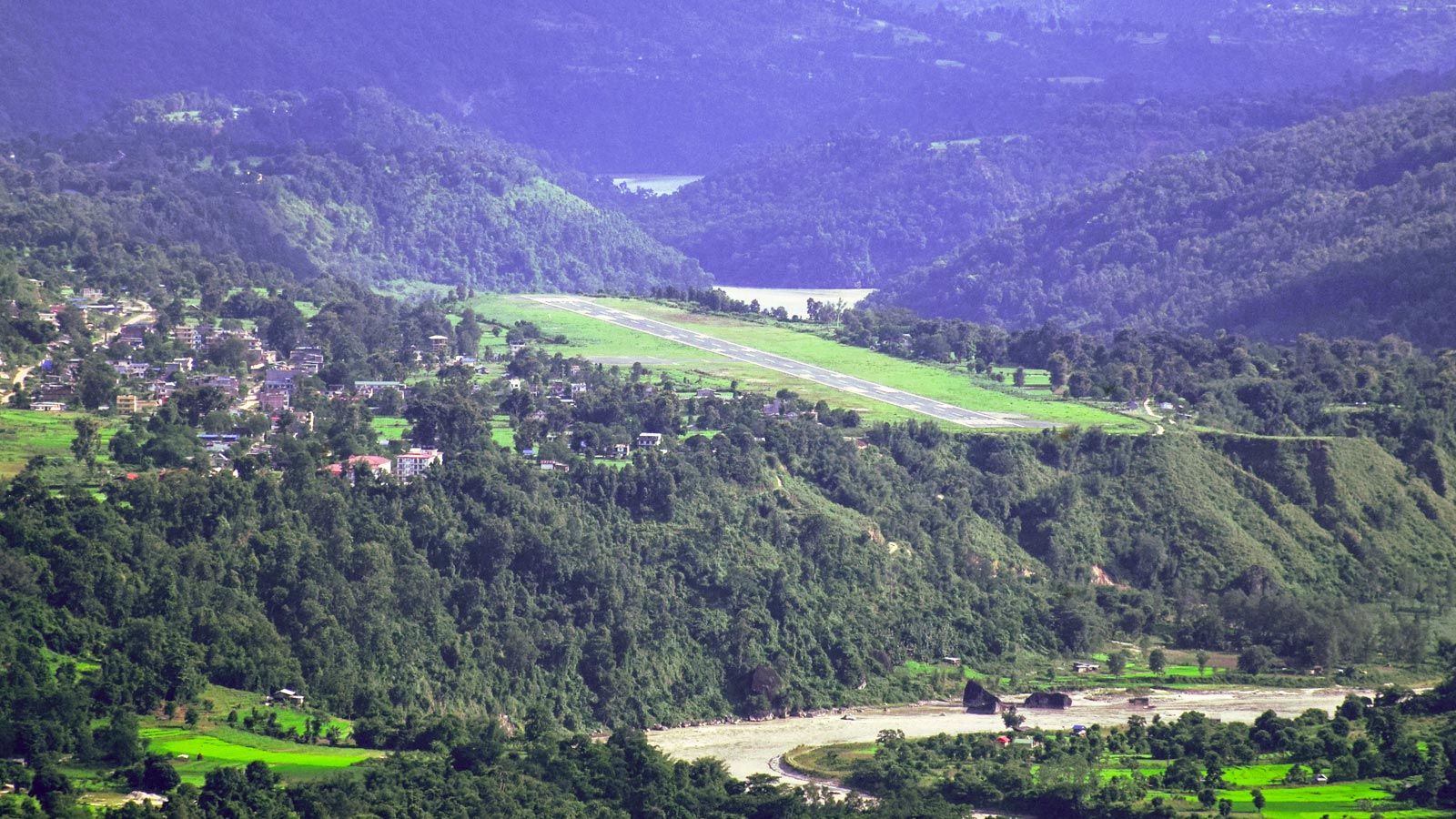
Sample Cost Breakdown for Planning Purposes

While exact pricing depends on vehicle class, group size, and season, travelers planning a budget for this trip should account for three main components: private vehicle hire for the Kathmandu to Syabrubesi round trip, homestay accommodation and meals along the trekking route itself, typically charged per night and generally modest compared to conventional teahouse trekking costs, and any guide or porter fees if travelling with support rather than fully independently. Requesting a detailed quote in advance, covering both the vehicle hire and, if desired, coordinated trekking logistics through our sister companies, allows for accurate budgeting well before departure rather than encountering unexpected costs partway through the trip.
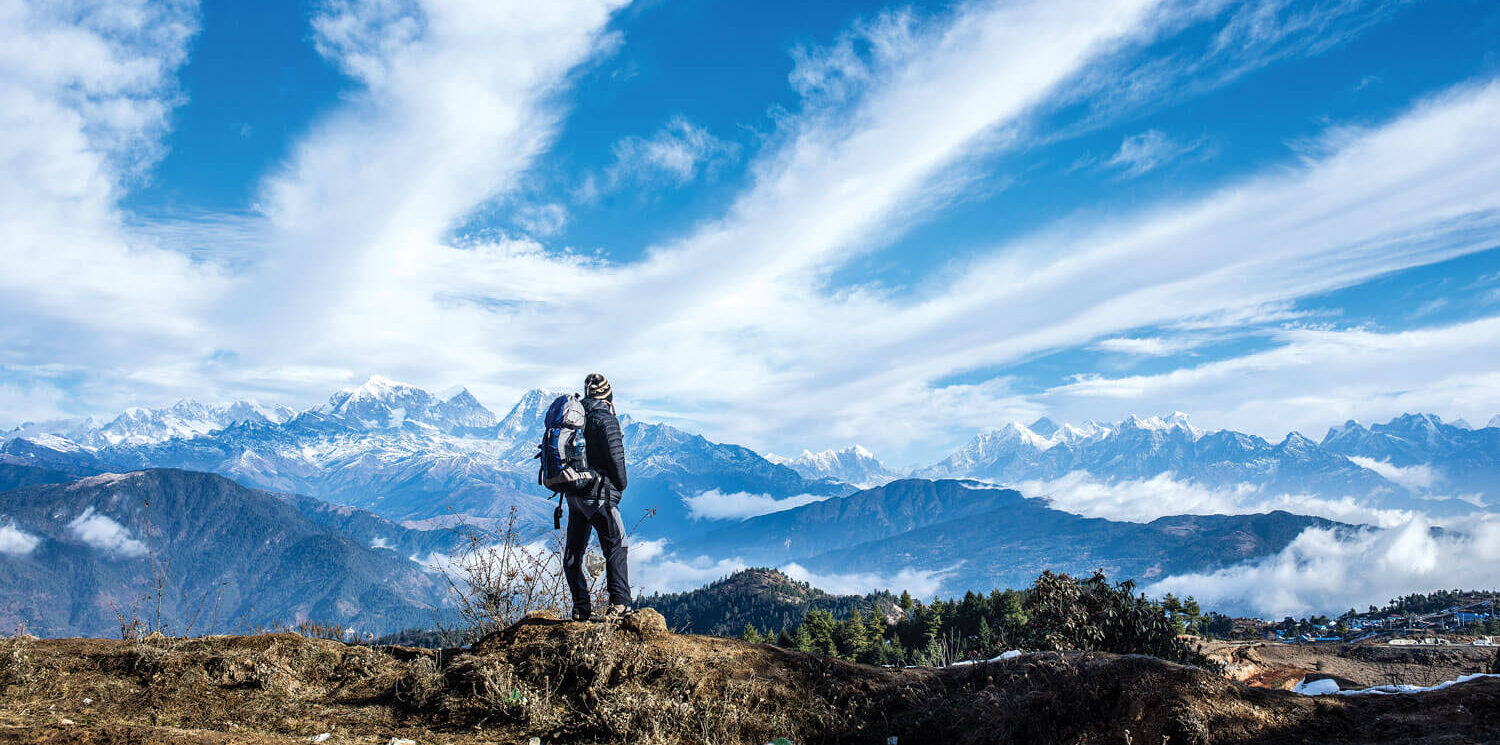
Book reliable Kathmandu to Tamang Heritage Trail transport with private 4WD jeeps and experienced drivers for a comfortable journey to the trek starting point.

What Sets This Route Apart From a Simple Sightseeing Drive

It is worth emphasizing that the Kathmandu-to-Syabrubesi journey, while demanding, is integral to what makes the Tamang Heritage Trail experience distinctive, rather than merely an obstacle to be endured before the real trip begins. The drive itself passes through changing landscapes, from the terraced hillsides near Trishuli Bazaar to the forested slopes approaching Dhunche and the edge of Langtang National Park, offering an early introduction to the ecological and cultural transition between the Kathmandu Valley and the more remote, culturally distinct region travelers are about to enter on foot. Approaching this leg of the journey with the same attention given to the trek itself, rather than treating it as a purely functional transfer, often enriches the overall sense of arrival once trekkers finally reach Syabrubesi and set out toward Gatlang the following morning.

A Trail Still Coming Into Its Own

The Tamang Heritage Trail remains, in many respects, a trekking route still coming into its own within Nepal’s wider tourism landscape, benefiting from steadily improving road access, a maturing homestay network, and growing recognition among both trekking agencies and independent travelers as a genuinely distinctive alternative to the country’s more famous circuits. For travelers willing to trade some of the dramatic high-altitude scenery of Everest or Annapurna for a deeper, more direct cultural encounter with Tamang communities living close to the Tibetan frontier, this trail offers one of the more rewarding and still comparatively uncrowded trekking experiences currently available in Nepal.

Frequently Asked Questions

How long does the drive from Kathmandu to Syabrubesi take?

The drive typically takes seven to eight hours by private vehicle, depending on road conditions and the season, with monsoon-season travel sometimes taking longer due to landslide-related delays.

Is a 4WD vehicle necessary for this route?

Yes. The road through Trishuli Bazaar and Dhunche includes unpaved, rutted sections that are best handled by a genuine four-wheel-drive vehicle, such as a Toyota Land Cruiser or Prado, rather than a standard car.

Can the Tamang Heritage Trail be combined with the Langtang Valley Trek?

Yes. Both routes share the same Syabrubesi trailhead, and many trekkers combine them into a single 10- to 14-day itinerary that covers both the cultural villages of the Tamang Heritage Trail and the alpine scenery of the Langtang Valley.

What permits are required for this trek?

Trekkers need a Langtang National Park entry permit and a TIMS card. No special restricted-area permit is required, unlike for routes such as Upper Mustang.

What is the best season for the Tamang Heritage Trail?

Spring (March to May) and autumn (September to November) offer the most reliable road and trail conditions, with autumn being the busiest season overall.

Are homestays available along the route?

Yes. Villages including Thuman and Briddim have well-established community-run homestay programs, offering an immersive alternative to standard teahouse accommodation.

How difficult is the Tamang Heritage Trail compared to other treks in the region?

It is generally considered less physically demanding than the Langtang Valley Trek or routes like the Everest Base Camp trek, with lower average elevations, yet still includes a challenging climb to the Nagthali Danda viewpoint above 3,650 meters.

Is this trek close to the Nepal-Tibet border?

Yes. The route passes relatively close to the Rasuwagadhi-Kerung border crossing, and trade and religious ties across this same frontier have historically shaped the region’s Tamang culture.

Do I need previous trekking experience for this route?

No prior high-altitude trekking experience is strictly necessary, though a reasonable level of general fitness is helpful given the daily walking distances and the climb to Nagthali Danda. The route is generally considered accessible to both beginners and experienced trekkers.

What is the total trekking distance for the standard loop?

The standard Tamang Heritage Trail loop, from Syabrubesi through Gatlang, Tatopani, Nagthali Danda, Thuman, and Briddim back to Syabrubesi, typically covers 50 to 60 kilometers over 6 to 8 trekking days, depending on the exact route variation and any rest days chosen.

Final Thoughts: A Cultural Journey Worth the Road

The Tamang Heritage Trail offers a rare combination in Nepal’s trekking landscape: genuine cultural immersion, dramatic Himalayan views, and a level of quiet, homestay-based hospitality increasingly hard to find on the country’s busier routes. Reaching it means the same demanding but rewarding drive through Trishuli Bazaar and Dhunche used by trekkers heading into the Langtang Valley, and getting that journey right, with the right vehicle and an experienced driver, sets the tone for everything that follows on the trail itself.

Whether you are drawn by the promise of homestay hospitality, Buddhist heritage, or simply a quieter Himalayan trekking experience, the road to Syabrubesi is where that journey genuinely begins. Contact Nepal Vehicle Hiring today at +977 9851013196 or visit 

vehiclehiringnepal.com to arrange your private jeep or Hiace for the Kathmandu to Tamang Heritage Trail journey, and to help coordinate homestay logistics or a combined Langtang Valley extension for your trip, however your itinerary through Rasuwa district takes shape.

luxury vehicle hire in Nepal

Luxury vehicle hire in Nepal with premium SUV for Kathmandu, Pokhara, Chitwan, and airport transfers
Experience premium travel with luxury vehicle hire in Nepal. Book comfortable SUVs and luxury vehicles for city tours, business trips, airport transfers, weddings, and Himalayan road journeys.

Why Luxury Vehicle Hire Is Transforming Nepal Travel

How Premium Ground Transport Is Reshaping Trekking, Touring, and Pilgrimage Across Nepal

A decade ago, most visitors to Nepal accepted a simple trade-off: comfort or authenticity, but rarely both. Long jeep rides on rutted mountain roads, crowded local buses, and unpredictable airport pickups were treated as an unavoidable part of the adventure, the price paid for reaching the Himalayas. That trade-off is disappearing fast. Across airport transfers, trekking logistics, pilgrimage journeys, and city touring, 

Luxury vehicle hire in Nepal is quietly but fundamentally changing what a trip to Nepal actually feels like, and the shift is visible in nearly every corner of the country’s travel industry.

This article looks at why that shift is happening, where it is most evident, and what it means for travelers planning a trip to Nepal in the years ahead. Nepal Vehicle Hiring has been directly part of this transformation, coordinating premium ground transport across trekking routes, pilgrimage corridors, airport transfers, and touring itineraries. This piece draws on firsthand experience to show that travel in Nepal is changing.

The Shift: From Basic Transport to a Premium Experience

For most of Nepal’s modern tourism history, ground transport was treated as a logistical necessity rather than part of the travel experience itself. Trekkers endured the journey to reach the trail; pilgrims endured the drive to reach the temple; tour groups endured the transfer to reach the hotel. What has changed is a growing recognition among both travelers and operators that the journey itself can be comfortable, memorable, and well-organized, rather than something to be survived.

This shift mirrors a broader global trend in travel, where the quality of the experience is judged end-to-end rather than only at the destination. Travelers who would never accept a poorly maintained rental car at home increasingly expect the same standard in Nepal, and operators who invest in modern vehicles, trained drivers, and professional logistics are the ones capturing this growing segment of the market. Our own 

Ultimate Nepal Vehicle Rental Guide and 

Why Private Vehicle Hire Is the Smartest Way to Travel. Nein, pal. To explore this shift in greater depth, the short version is simple: comfort and authenticity are no longer opposites in travel in Nepal.

Luxury vehicle hire in Nepal featuring Land Cruiser, Prado, Fortuner, Mercedes-Benz, and premium SUVs with professional drivers

Airport Transfers: Setting the Tone From Touchdown

Nowhere is this transformation more visible than at the airport. A private, professionally driven vehicle waiting inside the arrivals hall, with real-time flight tracking and a clean, comfortable cabin, has replaced the chaotic taxi rank as the expected standard for a growing share of visitors. As we explored in detail in our 

Luxury Airport Transfer Nepal 2026/2027 guide. This shift is accelerating as Pokhara’s international airport matures, Gautam Buddha International Airport in Bhairahawa expands, and traveler expectations rise in step with Nepal’s growing profile as a premium travel destination. Our 

Kathmandu airport transfer service and

car hire in Pokhara are both built directly around this expectation, giving travelers a calm, dependable start to their trip rather than a stressful scramble on arrival.

Trekking Transport: Comfort Without Sacrificing Access

Trekking logistics are perhaps the clearest example of how luxury vehicle hire is changing the shape of travel in Nepal, as covered in our In the In the In the 

Luxury Vehicles for Trekking in Nepal guide, a premium Land Cruiser or Prado transforms the often-grueling approach roads toward major trailheads into a genuinely comfortable part of the journey rather than an ordeal to be endured before the real adventure begins.

This matters enormously given how demanding these roads can be. The drive to Besisahar, gateway to the 

Annapurna Circuit Trek, offered by our sister company Alpine Luxury Treks, is the route to Syabrubesi for the 

Langtang Valley Trek, the long haul to Soti Khola for the 

Manaslu Circuit Trek, and the classic overland approach through Salleri and Phaplu toward the 

Everest Base Camp Trek all involve long, rough drives where vehicle quality and driver experience directly affect how a trekker feels on day one of their trip. Our dedicated 

Jeep Hire in Nepal and 

Hiace hire services, along with route-specific transport such as our 

Kathmandu to Besisahar

Kathmandu to Soti Khola, and 

Kathmandu-to-Salleri-Phaplu jeep services are built specifically around this reality.

Shorter, equally popular routes follow the same pattern. The drive from Pokhara to Nayapul, gateway to both the 

Ghorepani Poon Hill Trek and the 

Annapurna Base Camp Trek is increasingly done in a comfortable private car rather than a shared local jeep, arranged through our 

Pokhara to Nayapul transportation service. Our 

Mahindra Bolero and Tata Sumo trekking transfer guide and our broader The 

Best Vehicle Hire Routes for Trekking Trailheads Nepal article, and both go into further detail on how this transformation is playing out, route by route.

Luxury vehicle hire in Nepal featuring Land Cruiser, Prado, Fortuner, Mercedes-Benz, and premium SUVs with professional drivers

Pilgrimage Travel: Sacred Journeys Made More Accessible

Pilgrimage travel has benefited just as much from this shift as trekking has. As detailed in our 

Muktinath Temple: Vehicle Hire and Pilgrimage Route Guide, the demanding overland journey through Beni, Tatopani, Ghasa, and Jomsom toward one of Nepal’s most sacred shrines is now far more accessible to older pilgrims and families than it once was, purely because vehicle quality and driver experience have improved so significantly along this corridor.

The same pattern applies to other major pilgrimage routes across Nepal, including journeys to 

Pashupatinath Temple in Kathmandu, and to Lumbini, the birthplace of Lord Buddha, reachable through our 

Kathmandu-to-Lumbini bus and private vehicle service. Our detailed guide to the 

Kathmandu Tamang Heritage Trail and the 

Korala Tibet border route also reflects how the same premium transport standard is now expected across culturally and religiously significant routes, not only the most famous ones.

City and Valley Touring: A New Standard for Sightseeing

Beyond trekking and pilgrimage, everyday sightseeing around the Kathmandu Valley and Pokhara has quietly absorbed the same expectations. A sunrise excursion through our Nagarkot Sunrise Tour Vehicle Service, a heritage walk arranged via our

Bhaktapur Durbar Square tour, or a lakeside excursion through our 

Sarangkot sunrise tour vehicles in Pokhara are all now commonly booked as private, comfortable experiences rather than shared, schedule-bound group tours. Longer regional connections, such as our 

Kathmandu to Pokhara, BBus and private vehicle services from us, and private vehicle services from 

Pokhara Lumbini reflects the same demand for flexible, comfortable travel between Nepal’s major tourist regions.

Corporate Travel and the MICE Sector

Nepal’s growth as a destination for meetings, incentives, conferences, and exhibitions has brought a wave of corporate travelers who expect premium ground transport as standard. Reliable, punctual, professionally presented transport has become a genuine competitive factor for hotels and conference venues courting this market, and our 

Coaster and Bus hire fleet, alongside our executive 

Hiace hire service is increasingly booked by companies moving delegations and incentive groups around Kathmandu and Pokhara, with the same consistency expected at any major international business destination.

Weddings, Honeymoons, and Celebration Travel

Nepal’s growing popularity as a destination for honeymoons and small destination weddings, particularly around Pokhara’s lakeside setting, has added another dimension to this transformation. Couples planning these trips increasingly treat ground transport as part of the overall experience design, choosing private vehicles that reflect the occasion rather than a purely functional transfer. This trend aligns with and complements our sister companies’ luxury lodge trek offerings, where a private vehicle transfer bookends a honeymoon trek through the Annapurna or Everest regions, offering genuine comfort from start to finish.

Luxury vehicle hire in Nepal featuring Land Cruiser, Prado, Fortuner, Mercedes-Benz, and premium SUVs with professional drivers

Combining Vehicle Hire With Luxury Trekking and Touring Packages

Perhaps the clearest sign of how thoroughly this transformation has taken hold is the growing number of travelers booking vehicle hire and trekking or touring together as a single, coordinated experience, rather than arranging each piece separately. Because Nepal Vehicle Hiring works closely with our sister companies, 

Alpine Luxury Treks and 

Trek Nepal Himalayas: we can coordinate ground transport for any of their luxury lodge treks, classic teahouse treks, helicopter tour packages, or combined packages. 

Nepal, Tibet, and Bhutan tour itineraries, including remote regions such as 

Upper Mustang and the 

Everest Base Camp Luxury Lodge Trek, where premium ground transport and a well-run trekking itinerary reinforce each other rather than operating as separate, disconnected bookings.

Technology and the Digital Booking Expectation

Traveler expectations around booking and communication have shifted just as much as expectations around the vehicles themselves. Real-time flight tracking, clear digital booking confirmations, direct driver contact details shared in advance, and live updates during a journey are now considered standard rather than exceptional, particularly among travelers accustomed to this level of service in other major travel markets. Operators who have invested in this kind of digital infrastructure alongside their physical fleet are the ones best positioned to meet rising expectations through 2026 and beyond.

Driver Training and the Human Side of the Transformation

None of this shift would matter without the people behind the wheel. Across every category discussed here, from airport pickups to multi-day mountain transfers, driver training has become as important a differentiator as vehicle quality itself. Drivers who understand mountain roads, communicate clearly in English, handle luggage and equipment carefully, and remain calm and professional regardless of road conditions or schedule pressure are central to what makes a vehicle hire experience feel genuinely premium rather than simply expensive.

Sustainability Alongside Comfort

Interestingly, this shift toward premium vehicle hire has not come at the expense of sustainability considerations. Well-maintained, properly serviced vehicles run more efficiently than older, poorly kept cars, and consolidating group travel into appropriately sized vehicles reduces the overall number of trips needed for a given group. Many travelers now specifically ask about vehicle age, fuel efficiency, and driver welfare when booking premium transport, and operators who can answer these questions honestly are increasingly favored over those who cannot.

The Broader Economic Impact Across Nepal

This transformation extends well beyond traveler comfort. Premium vehicle hire supports skilled drivers, vehicle maintenance businesses, and guesthouse networks along popular routes, from Tatopani and Marpha on the Muktinath corridor to Besisahar and Syabrubesi on trekking routes. As demand for higher-standard ground transport grows, it creates a stronger incentive for continued investment in vehicle quality, driver training, and road infrastructure, benefiting the wider tourism economy rather than only the travelers who can afford a premium transfer.

What This Means for Travelers Planning a 2026 or 2027 Trip

For travelers planning a trip to Nepal in the near future, this transformation translates into more choice and, generally, greater reliability than in years past. Whether the plan centers on a trek toward Everest or Annapurna, a pilgrimage to Muktinath or Lumbini, a business trip tied to Nepal’s growing MICE sector, or simply a comfortable, well-organized tour of the Kathmandu Valley and Pokhara, premium ground transport is now a realistic and increasingly well-established option rather than a rare luxury reserved for a small handful of travelers.

A Closer Look: Why the Timing Is Right

Several forces are converging at once to accelerate this transformation, and understanding them helps explain why the shift toward premium vehicle hire feels so pronounced right now rather than gradual and unremarkable. Nepal’s tourism sector has recovered strongly in recent years, bringing renewed investment into vehicle fleets, driver training, and road infrastructure that had previously seen only limited upgrades. At the same time, a new generation of travelers, having grown up with app-based ride booking, real-time tracking, and transparent pricing in their home countries, arrives in Nepal expecting a comparable standard rather than accepting the older model of unmarked taxis and informal negotiation.

Social media and travel content have also played a quiet but significant role, with photos and videos of comfortable private Land Cruisers navigating dramatic mountain roads increasingly shaping how prospective travelers imagine a trip to Nepal, well before they book their first flight. This visibility creates its own momentum, as operators who can deliver on that expectation gain a clear advantage over those still offering an older, rougher standard of service.

Luxury vehicle hire in Nepal featuring Land Cruiser, Prado, Fortuner, Mercedes-Benz, and premium SUVs with professional drivers

Traveler Segments Driving the Shift

Returning Visitors With Higher Expectations

Travelers who have visited Nepal before, sometimes years or even decades earlier, often notice this transformation most clearly, since they have a direct point of comparison with how transport used to work. Many actively seek out premium options on a return visit, having experienced the older, more difficult standard firsthand and having no interest in repeating it.

First-Time Visitors From Mature Travel Markets

Travelers arriving from markets with well-established premium travel norms, including much of Europe, North America, Australia, and increasingly parts of Asia, tend to expect a certain baseline of comfort and reliability regardless of destination, and Nepal’s ground transport sector has adapted accordingly to meet this expectation rather than lose these travelers to competing Himalayan destinations.

Multi-Generational and Family Groups

Families traveling together across generations, from young children to grandparents, have particular comfort and safety needs that a premium vehicle meets far more effectively than a shared bus or an aging local jeep, and this segment has grown steadily as more families choose Nepal for a shared, once-in-a-lifetime trip.

A Case in Point: One Journey, Multiple Transformed Legs

Consider a typical present-day itinerary and how thoroughly this shift now touches nearly every stage of it. A traveler lands at Tribhuvan International Airport and is met by a uniformed driver who tracks their flight in real time, rather than searching for a handwritten sign in a crowded arrivals hall. A day of Kathmandu Valley sightseeing follows in a private vehicle, taking in Bhaktapur’s medieval squares and a sunrise view from Nagarkot, rather than a fixed-schedule group tour. From there, a comfortable Land Cruiser carries the traveler toward a trekking trailhead such as Besisahar or Syabrubesi, arriving rested rather than exhausted.

After days on the trail, the same coordinated logistics bring the traveler back to Kathmandu in time for a relaxed final night before departure. A decade ago, nearly every leg of this journey would have involved some degree of discomfort, uncertainty, or improvisation. Today, each stage is handled with a consistent, professional standard, and that consistency, more than any single vehicle upgrade, is what genuinely defines this transformation.

Looking Ahead: What Continued Growth Looks Like

As this transformation continues through 2026, 2027, and beyond, several developments seem likely to shape its next phase. Continued airport expansion, particularly around Pokhara, should continue to shift demand toward locally based premium transport rather than routing everything through Kathmandu. Growing demand for luxury lodge trekking, supported by our sister companies’ expanding itineraries, should further deepen the integration between vehicle hire and trekking logistics. And rising corporate and MICE travel should continue pushing consistent, professional ground transport standards into segments of the market that were previously served by more basic, ad hoc arrangements.

Hire luxury vehicles in Nepal including Land Cruiser, Prado, Fortuner, Mercedes, BMW, and premium vans with professional drivers for tours, business, and VIP travel.

How Nepal Compares to Other Himalayan Destinations

Nepal is not alone in seeing rising demand for premium ground transport, but its position at the heart of the world’s most famous mountain range gives this transformation particular weight. Neighboringdestinations offering Himalayan trekking and touring, including parts of northern India and Bhutan, have seen similar shifts toward higher-standard vehicles and more professional driver services, and Nepal’s tourism sector has nhadto keep pace to remain competitive for travelers weighing multiple Himalayan options  Because Nepal offers by far the widest range of trekking regions, from Everest and Annapurna to Langtang, Manaslu, and Mustang, the pressure to deliver consistent, high-quality ground transport across a much larger and more varied road network has, if anything, been greater here than in more geographically compact competing destinations.

Fleet Investment and What It Actually Involves

Building a genuinely premium vehicle hire operation involves considerably more than simply purchasing newer cars. It requires ongoing investment in regular mechanical servicing, particularly for vehicles working the punishing unpaved routes toward Besisahar, Syabrubesi, and Soti Khola, where brakes, suspension, and tires wear far faster than on ordinary city driving. It requires a genuine training pipeline for drivers, covering not only safe mountain driving but also customer service, English communication, and route-specific knowledge built up over repeated trips along the same corridors. And it requires an administrative and technological backbone to support real-time flight tracking, digital booking confirmation, and reliable communication among drivers, dispatchers, and clients throughout the journey. Operators who have consistently made these investments are well positioned to capture the growing premium segment of Nepal’s travel market.

The Role of Trekking and Tour Agencies in Accelerating the Shift

Trekking and touring agencies have played an important, if sometimes underappreciated, role in accelerating this transformation. As agencies such as our sister companies, Alpine Luxury Treks and Trek Nepal Himalayas, have expanded their luxury lodge trek offerings, they have simultaneously raised client expectations for every other part of the itinerary, including ground transport. A traveler booking a five-star lodge trek naturally expects the vehicle transfer to and from the trailhead to match that same standard, and agencies have responded by partnering closely with vehicle hire operators who can deliver it consistently, rather than leaving ground transport as an afterthought arranged separately by the traveler.

Insurance, Regulation, and the Formalization of the Industry

Alongside rising comfort expectations, Nepal’s vehicle hire sector has also seen gradual formalization, with more operators carrying proper commercial vehicle insurance, maintaining transparent pricing structures, and operating under clear company registration rather than informal, individually negotiated arrangements. This formalization matters enormously for traveler confidence, particularly for those booking multi-day trekking transfers or pilgrimage journeys into remote regions, since it provides real accountability if something goes wrong, whether that is a mechanical breakdown, a scheduling misunderstanding, or a safety incident on a difficult mountain road.

Customer Service Culture and the Human Element

Perhaps the least visible yet most important part of this transformation is a broader cultural shift in how ground transport providers view their role. Where drivers were once viewed primarily as a functional necessity, getting the traveler from one point to another, many operators now train and position drivers as an active part of the overall travel experience: knowledgeable about local history and culture, attentive to comfort and safety, and genuinely invested in how the traveler feels about their trip to Nepal as a whole. This shift in mindset, as much as any specific vehicle upgrade, is what separates a merely functional transfer from a genuinely premium one.

What Hasn’t Changed, and Why That Still Matters

It is worth acknowledging that this transformation has limits. Nepal’s mountain roads remain genuinely challenging, weather-dependent, and occasionally affected by landslides or seasonal closures regardless of how premium the vehicle or how experienced the driver. No investment in vehicles can prepare for the fundamental physical reality of traveling through the world’s highest mountain range, and travelers should still expect long days, occasional delays, and a need for flexibility, particularly during the monsoon season.

What has changed is not the underlying difficulty of the terrain. Still, how comfortably, safely, and predictably travelers can now move through it, and that distinction is worth keeping in mind when planning a trip: premium vehicle hire improves the experience considerably, but it does not, and should not be expected to, remove the genuine adventure at the heart of travel in Nepal.

Frequently Asked Questions

Is luxury vehicle hire only relevant for wealthy travelers?

No. While premium vehicles cost more than a shared bus or basic jeep, the price difference is often modest relative to the overall cost of a Nepal trip, and many travelers on a standard mid-range budget now choose a private vehicle for at least the most demanding legs of their journey, such as trekking transfers or pilgrimage routes.

Which routes benefit most from premium vehicle hire?

Long, unpaved routes with significant elevation change, such as the roads to Besisahar, Syabrubesi, Soti Khola, and Muktinath, show the clearest benefit, since vehicle quality and driver experience directly affect comfort and safety on these corridors.

Can luxury vehicle hire be combined with a trekking or touring package?

Yes. Nepal Vehicle Hiring coordinates directly with our sister companies, Alpine Luxury Treks and Trek Nepal Himalayas, to arrange seamless ground transport around any trekking, pilgrimage, or luxury touring itinerary.

Is this trend limited to Kathmandu and Pokhara?

No. The shift toward premium ground transport is visible across trekking corridors, pilgrimage routes, and regional connections throughout Nepal, including increasingly remote areas such as Upper Mustang and the Manaslu region.

How has airport infrastructure influenced this transformation?

The expansion of Pokhara International Airport and the gradual growth of Gautam Buddha International Airport in Bhairahawa have both increased demand for premium ground transport outside Kathmandu, allowing more travelers to begin their trips with a direct, comfortable connection to their final destinations.

Does premium vehicle hire compromise environmental responsibility?

Not necessarily. Well-maintained vehicles operate more efficiently than poorly serviced older cars, and consolidating group travel into appropriately sized vehicles can reduce the overall environmental footprint of a group’s transport compared to multiple smaller, less efficient trips.

What should travelers look for when choosing a vehicle hire provider?

Look for a properly registered company with a well-maintained fleet, trained and experienced drivers, transparent pricing, and clear digital communication, including flight tracking for airport transfers and realistic route planning for mountain roads.

Is this transformation likely to continue through 2026 and 2027?

All current indicators, including airport expansion, growing demand for luxury trekking, and rising corporate and MICE travel, point to continued growth in premium ground transport standards across Nepal in the coming years.

Seasonal Demand Patterns and Booking Behavior

This transformation has also changed how far in advance travelers now plan their ground transport. A decade ago, arranging a jeep or car in Nepal was often a same-day or next-day affair, negotiated informally on arrival. Today, particularly during the peak spring and autumn trekking seasons, premium vehicles and experienced drivers are frequently booked weeks in advance, mirroring the booking patterns already familiar from flights and trekking permits. This shift reflects growing traveler awareness that the best vehicles and most experienced drivers are a limited resource during peak season. That early booking is now as relevant to securing quality ground transport as it has long been to securing a good trekking guide or a well-located hotel room.

Regional Variation Across Nepal’s Trekking and Touring Zones

The pace of this transformation has not been uniform across all parts of Nepal. The Kathmandu Valley, Pokhara, and the most popular Annapurna and Everest approach routes have seen the fastest and most visible upgrades in vehicle standards and driver training, simply because traveler volume and competition are highest there. More remote corridors, including the roads toward Manaslu, Upper Mustang, and parts of the far western region, are following the same trajectory but at a somewhat slower pace, reflecting smaller traveler numbers and, in some cases, more challenging road conditions that limit how quickly premium vehicle standards can be established. Travelers planning trips to these more remote regions should expect a slightly earlier stage of this transformation, though the trajectory remains consistently upward.

The Connection Between Vehicle Quality and Trip Safety

It is worth stating plainly that this transformation is not simply about comfort for its own sake. A well-maintained vehicle with proper suspension, reliable brakes, and adequate ground clearance, driven by someone genuinely experienced on a specific mountain corridor, is measurably safer than an older, poorly serviced vehicle driven by someone less familiar with the route. As Nepal’s premium vehicle hire sector has grown, it has, in a very real sense, also functioned as a broader safety upgrade across the country’s most demanding roads, even though safety is rarely the primary marketing angle used to describe it.

How This Transformation Shapes First Impressions of Nepal

Traveler reviews and word-of-mouth recommendations increasingly reference the quality of ground transport as part of an overall assessment of a trip to Nepal, alongside more traditional factors like trekking guide quality, lodge comfort, and scenery. This shift has raised the stakes for operators across the industry, since a single poor ground transport experience, whether a late airport pickup or an uncomfortable trekking transfer, can now meaningfully affect how a traveler describes their entire trip to friends, family, and online audiences, regardless of how well every other part of the itinerary went. Operators who recognize this connection between transport quality and overall trip perception are investing accordingly, treating ground transport as a core part of the travel product rather than a peripheral logistics detail.

Practical Advice for Travelers Navigating This Shift

For travelers trying to make sense of Nepal’s rapidly changing ground transport landscape, a few practical principles help. First, book premium vehicle hire as early as reasonably possible, particularly for peak-season trekking or pilgrimage transfers, since the best vehicles and most experienced drivers are in high demand during the busiest times. Second, ask specific questions when booking about the vehicle’s age, the driver’s experience on your particular route, and what happens in the event of a flight delay or road closure, rather than relying on general marketing claims. Third, consider coordinating your entire journey, from airport pickup through trekking or touring transfers, with a single provider where possible, since this consistency tends to produce a smoother overall experience than piecing together transport from multiple separate operators.

How Nepal Vehicle Hiring Fits Into This Broader Shift

Nepal Vehicle Hiring has grown directly alongside this transformation, expanding from a general vehicle hire service into a company coordinating premium ground transport across nearly every major category discussed in this article: airport transfers, trekking trailhead transport, pilgrimage routes, Kathmandu Valley and Pokhara sightseeing, and corporate and group logistics. Our close working relationship with our sister companies, Alpine Luxury Treks and Trek Nepal Himalayas, reflects exactly the kind of coordinated, end-to-end approach that this broader industry shift has made increasingly important, allowing travelers to plan an entire Nepal journey, from the first airport pickup to the final trekking transfer, through a single, consistent point of contact rather than a patchwork of separate arrangements.

A Note on Cultural Sensitivity Amid Modernization

As ground transport standards rise across Nepal, it remains important that this modernization does not come at the expense of the cultural texture that makes travel here distinctive in the first place. The best premium vehicle hire experiences in Nepal combine genuine comfort and reliability with drivers who remain deeply knowledgeable about local culture, history, and etiquette, rather than adopting a generic, placeless standard of service imported wholesale from elsewhere. Nepal’s transformation in ground transport is, at its best, additive rather than replacing what made travel here meaningful; it adds comfort and reliability atop the country’s existing cultural depth rather than displacing it.

The Growing Overlap Between Vehicle Hire and the Trekking Economy

As luxury vehicle hire has expanded, it has become increasingly intertwined with the broader trekking and tourism economy rather than functioning as a standalone service. Guesthouses along popular approach roads, from Tatopani and Marpha on the Muktinath corridor to smaller settlements along the Besisahar and Syabrubesi routes, have adapted to serve a growing volume of comfortable, well-organized traffic, often coordinating directly with transport operators on overnight stops, meal planning, and last-minute itinerary changes.

This deepening relationship among vehicle hire operators, guesthouses, and trekking agencies has created a more resilient, better-coordinated travel ecosystem along Nepal’s major routes, benefiting nearly everyone involved, from the traveler enjoying a smoother journey to the local businesses that support it along the way.

Local drivers themselves have also become an increasingly skilled and specialized workforce as a direct result of this shift. Where driving jobs in Nepal’s tourism sector were once viewed as relatively low-skill positions, the growing demand for drivers who combine mountain driving expertise, English communication skills, and genuine customer service ability has elevated these roles considerably, creating a stronger career path and better working conditions for drivers who invest in developing this broader skill set.

What Travelers Consistently Say About the Difference

Feedback from travelers who have experienced both the older, more basic standard of Nepali ground transport and the newer, premium alternative tends to converge on a few consistent themes. Travelers frequently mention how much less physically draining a long mountain transfer feels in a well-maintained vehicle with a skilled driver than in an older jeep on the same road. They mention the psychological relief of a clearly identified driver waiting at the airport, removing a source of low-grade anxiety that often accompanies international arrival in an unfamiliar country. And they mention, perhaps most tellingly, that the quality of the journey itself has become something they now actively remember and discuss, rather than a forgettable, purely functional part of the trip they were relieved to have survived.

A Broader Reflection on Travel and Comfort in Challenging Terrain

There is a long-standing romantic notion in travel writing that discomfort is somehow inseparable from authenticity, that a rough, uncomfortable journey is more genuine than a smooth, well-organized one. Nepal’s experience over the past several years suggests a more nuanced reality: the mountains, temples, and culture that draw travelers to Nepal remain as authentic and challenging as they have always been, regardless of how comfortable the vehicle that carries them there is. A smoother, better-organised journey to the trailhead does not diminish the genuine physical and spiritual challenge of the trek that follows; if anything, arriving rested and unstressed allows travelers to engage more fully with the parts of the experience that actually matter, the trail itself, the temple, the summit view, or the quiet moment of reflection at a sacred shrine, rather than spending that energy simply recovering from the journey to get there.

Bringing It All Together Across a Full Nepal Itinerary

Stepping back across everything covered in this article, the pattern is consistent: airport transfers, trekking trailhead transport, pilgrimage journeys, city and valley touring, corporate travel, and celebration trips have all moved in the same direction, toward greater comfort, reliability, and professionalism in ground transport. Each of these categories once operated as a largely separate, often improvised part of a trip to Nepal. Today, they increasingly form a single, connected chain of premium service, coordinated from the moment a traveler lands to the moment they depart, whether that journey includes a five-star lodge trek to Everest Base Camp, a pilgrimage to Muktinath, a business conference in Kathmandu, or simply a relaxed week of Valley sightseeing and lakeside relaxation in Pokhara.

This connected approach matters because travel experiences are rarely remembered as a series of disconnected logistics; they are remembered as a whole. A traveler who begins their trip with a smooth, professional airport pickup, continues through comfortable, well-organized transfers to their trekking trailhead or pilgrimage site, and finishes with an equally well-coordinated return journey is far more likely to describe the entire trip as seamless and well-run, even if the destinations themselves vary enormously in character. That sense of seamlessness, more than any individual vehicle feature, is the real product of this transformation.

Why This Matters for Nepal’s Tourism Future

Nepal competes for travelers against destinations across Asia and beyond, many of which have invested heavily in polished, end-to-end travel experiences. The continued growth of premium ground transport gives Nepal’s tourism sector a genuine competitive advantage, allowing it to pair its unmatched natural and cultural assets, the highest mountains on earth, deeply rooted Hindu and Buddhist heritage, and some of the richest trekking terrain anywhere, with a standard of ground logistics that no longer undercuts those assets. As more travelers choose Nepal specifically because they trust the full journey will be well handled, not only the destination itself, this transformation becomes not just a traveler’s convenience but a genuine driver of the country’s ongoing tourism growth.

A Final Snapshot of the Transformation in Numbers and Everyday Terms

While comprehensive nationwide statistics on premium vehicle hire remain limited, the everyday signs of this transformation are visible to anyone who has travelled through Nepal across multiple years: newer vehicles on major trekking corridors, more uniformed drivers at Tribhuvan International Airport’s arrivals hall, a wider range of vehicle classes available through established operators, and a growing number of trekking and tour packages that explicitly include premium ground transport as a core part of the itinerary rather than an optional add-on. None of these signs individually proves a dramatic industry-wide shift. Still, taken together, across airport transfers, trekking logistics, pilgrimage routes, and city touring alike, they describe a travel sector that has moved decisively toward comfort, professionalism, and reliability as standard expectations rather than rare exceptions.

Frequently Asked Questions, Continued

How does this transformation affect budget travelers?

Budget travelers continue to have access to shared buses, local jeeps, and public transport at lower cost, and this transformation has not eliminated those options. What has changed is the range of choice available above that baseline, giving travelers of varying budgets a genuine spectrum of options rather than a single, uniformly rough standard for everyone.

Are luxury vehicles available in more remote parts of Nepal?

Availability in more remote regions, such as Upper Mustang or the far western districts, is improving but remains more limited than in the well-established Kathmandu, Pokhara, and central trekking corridors. Booking well in advance is particularly important for premium vehicle hire in these more remote areas.

What role do trekking agencies play in this shift?

Trekking and touring agencies have driven much of this transformation by raising client expectations across the entire itinerary, not just the trek or tour itself, and by encouraging closer coordination between agencies and vehicle hire operators.

Is this trend specific to international travelers, or does it affect domestic tourism too?

While international travelers have driven much of the visible demand for premium vehicle hire, domestic tourism within Nepal, including for weddings, family trips, and pilgrimage journeys, has also increasingly embraced higher standards of comfort and reliability in ground transport.

How can travelers verify a vehicle hire company meets premium standards before booking?

Look for clear company registration, transparent pricing, verifiable reviews, and a willingness to answer specific questions about vehicle age, driver experience, and contingency planning for delays or route disruptions.

Final Practical Takeaways

  • Book premium ground transport as early as possible, particularly during peak spring and autumn seasons, when the best vehicles and drivers are in highest demand.
  • Consider coordinating airport transfer, sightseeing, and trekking or pilgrimage transport through a single provider for a smoother, more consistent overall journey.
  • Ask specific questions about vehicle age, driver route experience, and contingency plans for delay rather than relying solely on general marketing claims.
  • Recognize that premium vehicle hire improves comfort and reliability but does not eliminate the genuine physical challenges of Himalayan travel, particularly during the monsoon season.
  • Look for operators who combine modern vehicles and professional drivers with genuine cultural knowledge and local hospitality, rather than a generic, imported service standard.

Hire luxury vehicles in Nepal including Land Cruiser, Prado, Fortuner, Mercedes, BMW, and premium vans with professional drivers for tours, business, and VIP travel.

Final Thoughts: A Journey Worth Getting Right

Nepal’s landscapes and cultural sites have always been the reason travelers come, and that fundamental appeal has never needed improving. What has changed, steadily and significantly, is everything that connects a traveler to those landscapes and sites: the pickup at the airport, the drive to the trailhead, the journey to a sacred shrine, the transfer between cities.

Getting that connective tissue right, comfortably, reliably, and professionally, is what this transformation in Nepal travel has ultimately been about, and it is a change worth recognizing for what it is: not a departure from Nepal’s authentic character, but a long-overdue upgrade to the experience of reaching it.

Contact Nepal Vehicle Hiring today at +977 9851013196 or visit 

vehiclehiringnepal.com to arrange your premium vehicle for trekking, pilgrimage, touring, or airport transfer anywhere in Nepal.

From your very first pickup at the airport to the final drive back for your departure flight, our team is ready to help make every leg of your Nepal journey as comfortable, reliable, and memorable as the destinations themselves.

Whatever shape your 2026 or 2027 Nepal itinerary takes, whether centred on a Himalayan trek, a sacred pilgrimage, a business trip, or simply a relaxed cultural tour of the Kathmandu Valley and Pokhara, the same underlying principle applies: the journey between destinations deserves the same care and attention as the destinations themselves, and that is precisely the standard this ongoing transformation in Nepal’s vehicle hire sector continues to build toward, one comfortable, well-organised journey at a time.

A Closing Thought on Value

Ultimately, the value of this transformation is best measured not in the price difference between a shared jeep and a private Land Cruiser, but in the quality of the memories a traveler carries home. A pilgrim who reaches Muktinath rested rather than exhausted, a trekker who begins the Annapurna Circuit refreshed rather than depleted, a family who lands in Kathmandu and steps calmly into a waiting vehicle rather than scrambling through a chaotic taxi rank, all describe a materially different experience of Nepal than travelers faced a decade ago. That difference, multiplied across the tens of thousands of journeys taken through this country each season, is what genuine transformation in an industry actually looks like: not a single dramatic change, but a steady, cumulative improvement in how well a country’s transport matches the extraordinary places it connects.

Nepal Vehicle Hiring remains committed to being part of that steady improvement, one journey, one traveler, and one carefully planned itinerary at a time.

For anyone weighing how to plan their next Nepal trip, that commitment translates into a simple, practical promise: whichever route you take, whichever mountain you aim for, and whichever temple or city you visit, the journey to get there will be treated with the same care, professionalism, and attention as the destination itself.

That is, in the end, the real story behind why luxury vehicle hire is transforming travel in Nepal: not a passing trend in comfort, but a lasting shift in how seriously the country’s tourism sector now treats every part of the journey, from the first mile to the last.

We look forward to being part of that journey with you, whenever and wherever it takes you across Nepal.

From the winding road to Muktinath, to the long haul toward Everest and Annapurna, to the calm, professional pickup waiting at Tribhuvan International Airport, every one of these journeys tells the same underlying story about where Nepal’s travel industry is heading. Comfort, reliability, and genuine care for the traveler experience are no longer optional extras reserved for a narrow luxury segment; they are steadily becoming the baseline expectation across the country’s trekking, touring, and pilgrimage routes alike. That is the real measure of transformation, not a single flashy upgrade, but a broad, sustained shift in how an entire industry chooses to treat the people who travel through it, one vehicle, one driver, and one carefully planned journey at a time.

Thank you for taking the time to explore why this shift matters. We hope it helps you plan a smoother, more comfortable, and truly memorable journey through Nepal, wherever your travels take you next, whether that is a quiet valley temple, a bustling city street, or a remote mountain trailhead waiting at the end of the road. We hope the vehicle that carries you there reflects just how much that journey itself has genuinely come to matter in modern Nepal travel today.

Safe travels, and we look forward to welcoming you to Nepal soon.

Nuwakot Historical and Spiritual Sites Guide – The Complete 2026 Travel and Transport Guide

Nuwakot Historical and Spiritual Sites Guide 2026 featuring Trishuli Bazaar, temples, heritage monuments, and scenic Himalayan landscapes in Nepal.
including temples, heritage villages, and scenic viewpoints.

Nuwakot Historical and Spiritual Sites Guide – The Complete 2026 Travel and Transport Guide

There is a point on the drive northwest from Kathmandu, roughly an hour and a quarter out of the capital, where the road begins to climb from the bank of the Trishuli River, and the landscape changes character in a way that announces you have left the orbit of the city and entered something older.

The hills steepen, the terraced fields become more pronounced, and then — perched on a ridge commanding a sweep of valley and mountain that explains everything about why it was chosen — the seven-story silhouette of Nuwakot Durbar appears against the sky. It is one of the most arresting first sights in Nepal’s entire historical geography, and it is still, astonishingly, one of the least visited.

Nuwakot is where modern Nepal was born. Not in Kathmandu, where Prithvi Narayan Shah eventually planted his capital, but here, on this strategic hilltop above the confluence of the Trishuli and Tadi rivers, where in 1744 CE he won the battle that would trigger the unification of what had been fifty-four separate principalities into a single nation.

Nuwakot was Nepal’s capital for approximately twenty-five years during the height of the Shah dynasty’s unification campaign, and the seven-story palace that dominates the hilltop today — built partly with skilled laborers brought from Lalitpur and partly on the foundations of earlier Malla structures — is one of the finest surviving examples of traditional Nepali palace architecture anywhere in the country.

But Nuwakot is not merely a history lesson. It is simultaneously a living spiritual landscape of active temples, festivals of genuinely ancient origin, and sacred river confluences still visited by pilgrims today.

The Sindure Jatra, which takes place every April, is considered by scholars of Nepali religious culture to be one of the most complex and spiritually potent festivals in the entire country — and it happens here, in this quiet hilltop town, virtually unobserved by the tourist trail that runs straight past its turnoff toward Langtang and Gorkha. This complete 2026 guide explores every dimension of Nuwakot’s historical and spiritual identity and tells you exactly how to get there and experience it well.


For travelers to Nepal looking for the best trek and planning to explore Kathmandu, we recommend continuing your journey with our trusted sister companies, Trek Nepal Himalayas and Alpine Luxury Treks. We specialize in organizing a wide range of travel experiences across Nepal, from classic trekking adventures to cultural and wildlife tours.

Our top offerings include iconic journeys such as the Everest Base Camp Trek, immersive Kathmandu sightseeing tours, breathtaking Nagarkot sunrise experiences, exciting Chitwan jungle safaris, and luxury packages. In addition, we can arrange short hikes, heritage tours, mountain flights, and customized travel plans tailored to your schedule and interests.

Whether you are looking for a budget-friendly trip or a luxury trekking experience with premium lodges, private guides, and high-end services, we ensure every detail is professionally managed. Our goal is to provide a seamless transition from your trekking adventure to a comfortable) and a memorable travel experience in Nepal.

Understanding Nuwakot — The City of Nine Forts

District: Nuwakot District, Bagmati Province, Nepal

District HQ: Bidur (also written Bidewar), the modern administrative center

Historical Capital: Nuwakot town (Nuwakot Bazaar), approximately 6 km above Bidur

Altitude: Nuwakot Durbar sits at approximately 1,128 m; Bidur at approximately 600 m; Devighat at 600 m

Distance from Kathmandu: Approximately 65–75 km by road, 1.5 to 2 hours by private vehicle

Name Origin: From Nawakot — Nawa meaning nine, Kot meaning fort or hilltop holy place. Nuwakot is surrounded by nine strategic hilltops, each with its own fort or sacred site.

Nuwakot Historical and Spiritual Sites Guide 2026 featuring Trishuli Bazaar, temples, heritage monuments, and scenic Himalayan landscapes in Nepal.
Nuwakot-durbar

The district of Nuwakot covers 1,121 square kilometers in the middle hills of central Nepal, bounded by Sindhupalchowk and Kathmandu to the east, Dhading and Rasuwa to the west, Rasuwa to the north, and Dhading and Kathmandu to the south. It is a district of rivers — the Trishuli (Narayani), Tadi, Sali, Linkhu, and Falankhu all flow through its valleys — and of hills, each ridge carrying its own story of military strategy, trade routes, and divine protection.

The name Nawakot originally referred to a specific set of nine fortified hilltops in the district — Belkot, Dhuwakot, Dhaibungkot, Pyaskot, Bhairamkot (also called Bhairabkot), Malakot, Simalkot, Salyankot, and Kalikakot — each commanding a strategic view over the approaches to the Kathmandu Valley. This network of forts was not merely a military design but also a spiritual one. According to local tradition, nine deities oversee and protect Nuwakot from these nine hills, making the district as much a sacred geography as a military one.

The town that bears the district’s name sits atop one of these strategic ridges, its hilltop palace and cluster of temples surveying the Trishuli valley below with the easy authority of a site that has commanded attention for over a thousand years.


Nuwakot and the Birth of Modern Nepal — The Historical Context

To understand why Nuwakot matters as a historical site, it is necessary to understand the political reality of Nepal before 1744. The territory that is now Nepal was then divided into fifty-four separate principalities — kingdoms, city-states, and hill chiefdoms — each ruling its own small domain, competing and occasionally warring with its neighbors, and unable to present a unified response to the growing power of the East India Company in the Indian subcontinent to the south.

The three Malla kingdoms of the Kathmandu Valley — Kantipur, Patan, and Bhaktapur — were the wealthiest and most culturally developed, controlling the vital trans-Himalayan trade routes between India and Tibet. Nuwakot was one of the key nodes on this trade network, sitting at the western entrance to the Kathmandu Valley and controlling traffic on the trade road north toward the Kerung Pass into Tibet.

Prithvi Narayan Shah, who became king of the small principality of Gorkha in 1743 CE at the age of twenty, had understood from an early age that Nepal’s fragmentation made it vulnerable. He had traveled to Varanasi to study statecraft and acquire firearms, had observed the political dysfunction of the Malla kingdoms at close range, and had decided that Nuwakot — controlling the western approach to the Kathmandu Valley and the Tibet trade route — was the essential first strategic prize of his unification campaign.

His first attack on Nuwakot in 1743 failed. But a year later, on 2 October 1744, with a better-equipped army attacking from three directions, Prithvi Narayan Shah took Nuwakot from its Malla-aligned defenders. It was the first domino in the sequence that would ultimately lead to the creation of the nation of Nepal.

The significance of this single military victory is difficult to overstate. By controlling Nuwakot, Prithvi Narayan Shah could cut off the Kathmandu Valley’s access to its Tibet trade revenues — its economic lifeblood — while using the hilltop as a base to surround and strangle the three kingdoms gradually. Over the following twenty-two years,

working outward from Nuwakot as his western stronghold, he systematically took the strategic positions surrounding the valley before finally capturing Kathmandu in 1768. Nuwakot served as Nepal’s de facto capital for approximately twenty-five years, housing the court, the treasury, the military command, and the administrative apparatus of an expanding kingdom.

It was also at Nuwakot that Prithvi Narayan Shah’s life ended. On 11 January 1775, on his 52nd birthday — by a poignant coincidence — the first king of unified Nepal died at Devighat, the sacred river confluence at the foot of the Nuwakot hill, where the Trishuli and Tadi rivers meet. His cremation was performed on the banks of the river at Devighat, as he had reportedly wished. The site of his death and cremation remains a pilgrimage point today, adding another layer of historical-spiritual significance to a district already rich in both.


Nuwakot Durbar, the historic seven-storey palace and ancient royal fortress in Nuwakot District, Nepal.
Nuwakot Durbar is one of Nepal’s most important historical landmarks, showcasing traditional architecture, royal heritage, and panoramic Himalayan views.

Nuwakot Durbar — The Seven-Storey Palace

Official Status: UNESCO World Heritage Tentative List (nominated 2008)

Construction Period: 1744–1762 CE, under the oversight of governors Kalu Pande and Balbhadra Kunwar

Architecture: Traditional Newari/Malla style with seven stories, carved wooden windows, and pagoda-roof elements — laborers brought from Lalitpur (Patan) for the finest woodwork

Current State: Under ongoing restoration following the 2015 Gorkha earthquake; scaffolding covers portions, but the complex remains open and freely accessible to visitors

The seven-storypalace — Saat Tale Darbar — is the defining structure of Nuwakot and one of the tallest and most architecturally distinctive traditional palaces in Nepal. It rises from the hilltop in classic Newari multi-story style, its progressively narrowing floors and tiered roofs giving it a visual authority that dominates the skyline for kilometers in every direction. The palace was not built from scratch in 1744 — it expanded and incorporated earlier Malla-period structures on the same site — but the main construction under Prithvi Narayan Shah’s governors transformed it into the royal palace of a kingdom in the process of becoming a nation.

The architectural language of Nuwakot Durbar is deliberately drawn from the finest Newari palace tradition — the same tradition that produced the Durbar Squares of Kathmandu, Patan, and Bhaktapur. The intricately carved wooden windows, the carved roof struts with their mythological figures, the brick masonry alternating with timber framing, and the steeply pitched pagoda rooflines all speak the visual grammar of Malla-period sacred and royal architecture, even as they serve the political ambitions of the Shah dynasty that displaced the Mallas.

Prithvi Narayan Shah was not simply building a military headquarters; he was building a statement of cultural legitimacy, drawing on the most prestigious architectural tradition available to him and employing the most skilled artisans — the master woodcarvers and bricklayers of Lalitpur — to execute it.

Nuwakot Historical and Spiritual Sites Guide 2026 featuring Trishuli Bazaar, temples, heritage monuments, and scenic Himalayan landscapes in Nepal.

The Palace Complex — Key Structures

The Seven-Storey Main Palace (Saat Tale Darbar): The central and tallest structure, serving as the royal residence, throne hall, and administrative center of Prithvi Narayan Shah’s government. Currently under earthquake restoration.

Ranga Mahal (The Dance Hall): Built in 1726 as an entertainment and cultural annex, facing west, with a distinctive greasy-brick construction. Originally built for the three Malla kings of the Kathmandu Valley as a leisure space during their visits to Nuwakot. Still standing and accessible.

Garad Ghar (Guard House): The eastern structure housing the armed forces and ammunition store of the palace garrison. The prison cells (used during the Shah period) remain visible within the complex.

Rana Bahadur Shah’s House: The northern structure was built in 1795 and later rebuilt during the reign of King Mahendra after its original collapse, and was named for the troubled Shah king who spent periods of his turbulent reign at Nuwakot.

The Bhairav Temple: Immediately adjacent to the palace complex, this is one of Nuwakot’s oldest temples — a site of active worship and the focal point of the Sindure Jatra festival. Golden-roofed, with characteristic red brick construction and carved wooden struts. The heavy sindoor smeared on its ancient carved doorway testifies to the depth and continuity of local devotion.

The Taleju Temple: Visible on a small rise just before the approach to the main palace, the Taleju Temple dates to approximately 1564 CE — making it older than the Saat Tale Darbar itself. Taleju Bhawani was the royal patron deity of the Malla dynasty; her presence here reflects Nuwakot’s Malla-period significance before the Shah conquest. The Taleju temple opens twice yearly for animal sacrifice.

Buddhist Stupa: A small Buddhist stupa on the northern side of the complex whose original construction date is unknown, but which bears an inscription recording its renovation by Prithvi Narayan Shah in 1773. In 2023 (2080 BS), residents added additional chaityas and Buddhist statues to the site.

Lampati (Patan King’s Palace): A two-story structure with a glazed tile roof adjacent to the Bhairavi temple, historically used as a palace by the king of Patan during visits to Nuwakot and now converted to a museum. The Topkhana (arsenal) and Barudkhana (powder store) are also located within the wider complex.


The 2015 Gorkha earthquake, whose epicenter was near Nuwakot, caused significant damage to the palace complex. Restoration work has been ongoing but slow — a common frustration among recent visitors, who find portions of the Durbar covered with scaffolding or cloth.

Despite these limitations, the open areas of the complex remain freely accessible, and the views from the palace terrace — over the Trishuli valley, the forested ridges, and, on clear days, the distant snow peaks of the Ganesh Himal range — remain fully intact. A small, privately run museum adjacent to the Durbar Square houses traditional artifacts and is warmly recommended.

Bhairavi Temple in Nuwakot, Nepal, a sacred Hindu shrine dedicated to Goddess Bhairavi and an important center of Tantric worship.
Bhairavi Temple is one of Nuwakot’s most revered spiritual landmarks, preserving centuries-old Tantric traditions, festivals, and devotion to Goddess Bhairavi.

Bhairavi Temple and the Living Tradition of the Tantric Goddess

The Bhairavi temple at Nuwakot Durbar Square is not simply a historic artifact — it is a living center of active religious devotion, maintained and served by the local Newar community of Nuwakot with the same seriousness and continuity that have characterized its worship since before the Shah period.

Bhairavi is one of the Das Mahavidyas — the ten tantric divine mothers — and in her Nuwakot manifestation she is the patron goddess of the entire district, revered as the protector of the community, the source of fertility and agricultural prosperity, and the cosmic power that determines the fate of the region. She is understood not as a remote or abstract divinity but as an immediate, present, and demanding divine personality who must be regularly propitiated through specific ritual forms — hence the animal sacrifices that mark the major festival occasions.

The temple’s architecture follows the classic Nepali tiered pagoda style in red brick with elaborately carved wooden struts depicting erotic and mythological scenes — a standard feature of tantric temple iconography in the Newari tradition, intended to express the full spectrum of cosmic power, including its creative sexual dimension.

The heavy accumulation of sindoor vermilion powder) On the doorway and threshold is a mark of how actively and for how long this goddess has been worshipped. Each application of sindoor is an individual act of devotion. The layered effect of decades or centuries of offerings creates a surface that is at once an artwork and a devotional record.

Inside the main sanctum, which is accessible to Hindu devotees, the goddess’s image is served by priests who conduct daily puja according to the specific ritual requirements of Bhairavi’s tantric tradition — not the simplified, brahminical Shaiva rites of many other Nepali temples, but a more complex and esoteric practice rooted in the Shakta-Tantric tradition that has been continuously maintained in the Nuwakot Newar community for centuries.

Devotees celebrating Sindure Jatra in Nuwakot, Nepal, covered in red vermilion powder during the traditional Hindu festival.
Sindure Jatra is one of Nepal’s most extraordinary hidden festivals, where devotees in Nuwakot celebrate with vermilion powder, sacred rituals, music, and centuries-old traditions.

The Sindure Jatra — Nepal’s Most Extraordinary Hidden Festival

If there is one reason above all others to time a visit to Nuwakot precisely, it is the Sindure Jatra — the Vermillion Powder Festival — which takes place every year in the Nepali month of Chaitra/Baishakh (approximately April), and which is regarded by scholars of Nepali religious culture as one of the most complex, most ancient, and most spiritually intense festivals in the entire country.

The festival runs for twelve consecutive days, beginning on the 14th lunar day (Chaturdashi) of the bright fortnight of Chaitra. It centers on Goddess Bhairavi of Nuwakot and her relationship with her elder sister, Goddess Jalapa Devi, who resides at Devighat — the sacred river confluence at the foot of the Nuwakot hill, 4 to 5 hours away by chariot procession. The entire twelve days are structured around the theological premise that the younger sister (Bhairavi) must make an annual pilgrimage to visit the elder sister (Jalapa Devi). This family obligation humanizes the divine in a way characteristic of the deepest Nepali religious sensibility.

The Preparation Phase — Days One to Nine

The preparations for the Sindure Jatra begin weeks before the formal opening. On the eighth lunar day, the Dhami — the spirit medium and primary ritual officiant of the festival, a hereditary role within the Nuwakot Newar community — begins collecting rice from households for sacred fermentation, walking through Nuwakot beating a drum as he moves. On the ninth day, a specific pine tree is identified in the surrounding forest, ritually worshipped to appease the spirits within it, then ceremonially felled and shaped into a 63-foot pole to be raised in front of the Bhairavi temple during the festival.

On the thirteenth day of preparation, nine men undertake a ritual journey to Devighat — the elder sister’s home — carrying a fully black or fully white uncastrated goat as a formal offering of invitation to the goddess. This journey is accompanied by prayers asking the elder sister’s permission and blessing for the younger sister’s forthcoming visit. The response — whether the offering is accepted — is interpreted as an oracle about the condition of the two goddesses’ relationship and, by extension, the spiritual condition of Nuwakot itself.

On the first formal day of the festival (Day 1), the Dhami undergoes an ablution ritual from Nuwakot’s own living Kumari — the prepubescent girl regarded as a manifestation of the divine feminine. This tradition parallels the famous Kumari tradition in Kathmandu. The bath symbolizes the purification necessary before the Dhami enters the elevated state of ritual possession. He is then dressed in an elaborate red ceremonial costume with gold and silver accessories, including a nine-headed Naga crown, earrings, bangles, a chain necklace, and an Astamatrika necklace — the regalia of a divine consort.

Devotees preparing for Sindure Jatra in Nuwakot with traditional rituals, temple worship, offerings, and cultural ceremonies during the first nine days.
The first nine days of Sindure Jatra are dedicated to sacred preparations, daily temple rituals, community gatherings, and traditional offerings that lead to the festival’s grand celebration.

The Chariot Procession — The Heart of the Festival

The festival’s most spectacular and physically demanding element is the chariot procession of Goddess Bhairavi — considered the longest in all of Nepal. The chariot, mounted with masks of twelve different gods and goddesses, is pulled by hundreds of community members from the palace complex at Nuwakot Durbar down the steep hill road to Devighat at the Trishuli-Tadi confluence — a journey of 4 to 5 hours each way on foot, through the terraced hillsides and river valleys below the palace.

At Devighat, in the presence of Jalapa Devi and at the sacred confluence of the two rivers, the Dhami enters the deepest state of possession available in the Nepali ritual tradition. The Bajracharya guru performs an esoteric tantric puja, including the sacrifice of a fully black, uncastrated goat.

In this state of possession, the Dhami is understood to receive direct communication from the goddess about Nepal’s future — a national prophecy whispered in confidence to the State Representative present at the ceremony, who then communicates it to the relevant authorities. This divinatory function has no parallel in any other major Nepali festival and gives the Sindure Jatra significance that extends beyond the local community to the national level.

The midnight return of the chariot from Devighat to Nuwakot — completing the 4- to 5-hour uphill journey through the night — is followed by a rest at Dharampani, approximately 550 meters below the Durbar Square, before the final approach to the temple on the third day. The closing ceremony on the 31st of Chaitra (the last day of the Nepali year) consists of the Sindure itself — the throwing of sindoor (vermillion powder) that gives the festival its popular name. Beginning with the festival guardian scattering sindoor over the priest, who then scatters it over the assembled devotees, the act cascades outward through the crowd in a red tide that marks the Nepali New Year and the completion of another annual cycle of the younger sister’s visit to her elder.


The Festival Calendar — Key Dates

Sindure Jatra follows the Nepali lunar calendar, and its exact Gregorian dates shift annually. The festival typically falls between mid-April and early May. In 2026, the festival is expected to begin around the 14th day of the bright fortnight of Chaitra in the Nepali calendar — contact Vehicle Hiring Nepal or check with local sources for the 2026 dates as the Nepali year 2082/2083 progresses.


Devighat Jalpa Devi Temple, a sacred Hindu pilgrimage site in Nuwakot, Nepal, surrounded by hills and the Trishuli River.
Devighat Jalpa Devi Temple is one of Nuwakot’s most revered spiritual destinations, attracting pilgrims with its peaceful setting, ancient traditions, and religious significance.

Devighat — Where Nepal’s Founder Died and the Rivers Meet

Location: Approximately 7 km north of Bidur at the confluence of the Trishuli (Gandaki) and Tadi (Suryamati) rivers, Nuwakot District

Altitude: Approximately 600 m

Significance: Sacred river confluence; site of Jalapa Devi temple; site of King Prithvi Narayan Shah’s death (11 January 1775) and cremation

Devighat — the Goddess’s Bathing Place — is one of those sites where historical and spiritual significance overlap so completely that it is impossible to discuss either dimension without immediately invoking the other. The confluence of the Trishuli and Tadi rivers has been considered sacred for reasons that predate written record — river confluences (triveni or dwariveni) hold profound spiritual significance in the Hindu and Kirat traditions, regarded as places where the boundary between the human and divine worlds becomes thin and where ritual bathing is especially efficacious.

The Jalapa Devi temple at Devighat is the elder sister of Nuwakot’s Bhairavi — a relationship that, as the Sindure Jatra demonstrates, is not merely mythological but is enacted annually in one of Nepal’s most elaborate ritual sequences. Jalapa Devi’s temple sits at the water’s edge, and the sight of Bhairavi’s chariot arriving after its long downhill journey from the palace, to be received at the riverside temple by her elder sister, is one of the most visually and emotionally compelling moments in Nepali religious public life.

The historical dimension of Devighat is equally profound. Prithvi Narayan Shah died here on his 52nd birthday, 11 January 1775, just seven years after completing the unification of Nepal by capturing Kathmandu. According to historical accounts, his cremation was conducted at Devighat per his final wishes. This choice speaks to his personal connection with Nuwakot as the foundation of his life’s work. The site of his cremation is still visible and is visited by those who make the pilgrimage to understand the physical geography of Nepal’s founding.

The Chaitra Purnima festival — held on the full moon day of the Nepali month of Chaitra — brings hundreds of thousands of devotees to Devighat for ritual bathing at the river confluence, making it one of the larger religious gatherings in the Bagmati Province. The golden light of the sunrise and sunset on the Trishuli-Tadi confluence, with the forested hills of Nuwakot rising on all sides, makes Devighat also one of the most photographically beautiful sacred river sites in the central hills.

The Trishuli River flowing through Nuwakot, Nepal, offering sacred pilgrimage sites, scenic landscapes, rafting, kayaking, and outdoor adventure.
The Trishuli River is one of Nepal’s most iconic rivers, combining spiritual significance with thrilling white-water rafting, riverside scenery, and cultural heritage in Nuwakot.

The Trishuli River — Sacred Waters and Adventure

River Name Origin: The Trishuli takes its name from the trishul (trident) of Shiva. According to legend, Shiva struck his trident into the ground high in the Himalayas at Gosaikunda, creating three wells that became the river’s source — hence Trisuli, the River of the Trident.

River Course: Originates in the Gyirong district of Tibet, enters Nepal through the Rasuwa valley at the Kerung gorge, flows south through Nuwakot, and joins the Narayani River at Devghat near Narayanghat before eventually reaching the Ganges.

Rafting Classification: Grade III to III+, suitable for both beginners and experienced rafters

The Trishuli River is simultaneously one of Nepal’s most sacred waterways and its most popular rafting river — a pairing that i. This pairing is not as it might seem, since the Trishuli’s sacred character derives from the same qualities that make it a thrilling rafting destination: its descent from the high Himalayas through deep gorges and its powerful, clear-water flow through the middle hills.

The Trishuli has been one of Nepal’s most important trade arteries since ancient times, carrying goods between the Kathmandu Valley and Tibet via the Kerung Pass. Nuwakot’s strategic position on this trade route was precisely what made it so valuable to Prithvi Narayan Shah — controlling Nuwakot meant controlling the flow of goods and revenues between the valley and its Tibetan trading partners. The river was not merely a geographic feature but an economic and political resource.

For modern visitors, the Trishuli’s rafting stretch between Charaudi (near Galchhi) and Mugling offers a full-day or multi-day adventure through alternating rapids and calm stretches, with the forested hillsides of Nuwakot and Dhading rising on either bank. The Grade III to III+ rapids are sufficiently exciting for most visitors without being genuinely dangerous, and the river’s relatively easy access from Kathmandu — the put-in point at Charaudi is approximately 70 km from the capital on the Prithvi Highway — makes it the most frequently rafted river in Nepal.

Overnight camping on the river’s sandy beaches, with fire-lit evenings under the stars of the Nuwakot hills, is one of central Nepal’s finest adventure experiences.


Other Spiritual and Historical Sites in Nuwakot District

Dupcheshwar Mahadev Temple, a sacred cave temple dedicated to Lord Shiva in Dupcheshwar Rural Municipality, Nuwakot, Nepal.
Dupcheshwar Mahadev Temple is one of Nepal’s most revered Shiva pilgrimage sites, known for its sacred cave, natural beauty, and annual Maha Shivaratri celebrations.

Dupcheshwar Mahadev Temple

Located approximately 18 km from Bidur in the Dupcheshwar Rural Municipality, the Dupcheshwar Mahadev temple is one of Nuwakot District’s most sacred Hindu sites — a Shiva temple perched on a commanding hilltop, offering panoramic views of the Ganesh Himal, Langtang, and surrounding ranges. The temple is considered especially powerful for devotees on Maha Shivaratri and on the full moon days of the Hindu calendar. The approach road passes through beautiful mid-hill countryside.

Indrakamala Mai Temple

Situated approximately 18 km from Bidur and 8 km from the Kakani Rural Municipality Office, the Indrakamala Mai temple is an important local goddess shrine reflecting the dense matrix of sacred sites that characterizes the Nuwakot hills. Local worship traditions at this temple preserve practices specific to the district’s indigenous communities.


Kakani — Panoramic Viewpoint and Colonial Heritage
On the eastern edge of Nuwakot District, Kakani sits at approximately 2,073 m on a ridge that has long been a popular viewpoint and weekend retreat for Kathmandu residents. The panoramic views from Kakani encompass Manaslu (8,163 m), Ganesh Himal, Langtang, and on exceptionally clear days, the entire central Himalayan chain from Dhaulagiri in the west to Everest in the east. During the British Raj, Kakani served as a retreat for senior officials of the British Residency in Kathmandu — a legacy reflected in the remains of a small colonial bungalow. A short but rewarding trek connects Kakani to the high ridge viewpoints above.

Kakani panoramic viewpoint in Nuwakot, Nepal, offering spectacular Himalayan mountain views, forests, and historic colonial heritage.
Kakani Panoramic Viewpoint | Himalayan Views and Colonial Heritage, Nepal
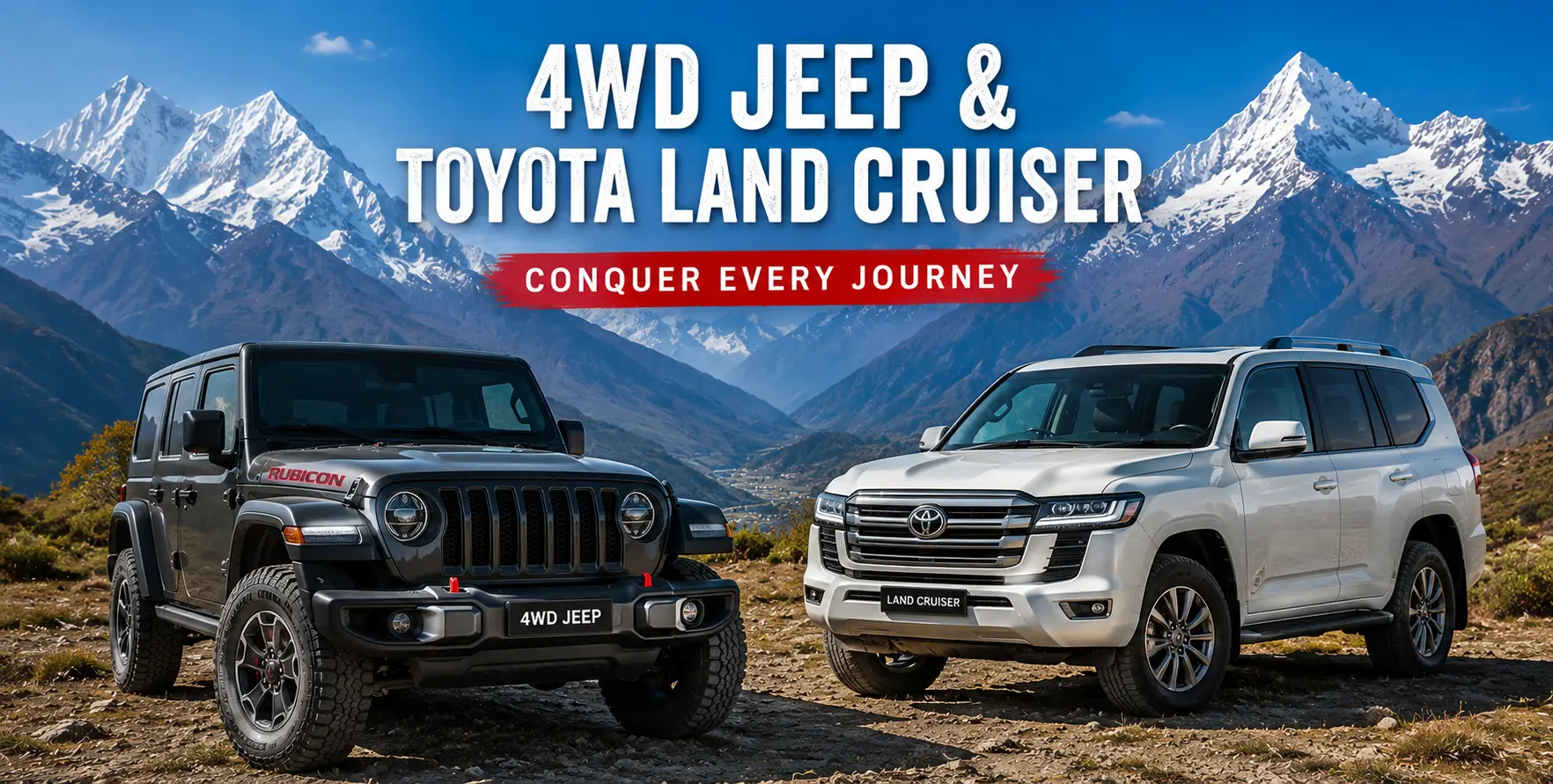
Belkot

The small farming village of Belkot sits on a ridge across the valley from Nuwakot town, offering perhaps the finest distant view of the Nuwakot palace complex from the opposite hillside. Belkot was itself one of the nine forts of the Nawakot system and retains some traces of its historic fortification. The view from Belkot toward the Saat Tale Darbar at dawn, when the morning light picks out the palace’s seven stories against the backdrop of hills and sky, is one of the finest historical landscape views in the central hills.

Trishuli Bazaar

The modern town of Trishuli, on the banks of the Trishuli River below Bidur, is Nuwakot’s commercial heart and the main hub for river rafting operations on this stretch of the river. The riverside market, the suspension bridges, and the daily life of a Nepali river town are themselves worth an hour or two of exploration, and the town’s tea stalls and local restaurants provide the best food options in the lower Nuwakot valley.

Old Trishuli Bazaar in Nuwakot, Nepal, featuring the historic market town, Trishuli River, suspension bridge, and surrounding green hills.
Old Trishuli Bazaar is the historic commercial center of Nuwakot, known for its traditional architecture, riverside setting, and role as a gateway to northern Nepal.

The Cultural Life of Nuwakot — Ethnic Diversity and Festival Calendar

Nuwakot is described locally as a ‘mini-Nepal within Nepal’ — a characterization that accurately reflects its unusual ethnic and cultural diversity. The district’s population includes significant communities of Tamang, Newar, Magar, Brahmin, Chhetri, Sherpa, Gurung, and others, with corresponding diversity in languages (Nepali, Tamang, Newari, and others are all spoken), cultural practices, and religious traditions. This diversity is a direct product of the district’s historic position at the intersection of trade routes, military corridors, and ethnic migration patterns.

The Newar community of Nuwakot town is the primary custodian of the palace complex’s festivals and religious traditions — including the Sindure Jatra, the Narayan Jatra, the Gai Jatra (the Cow Festival honoring the dead), the Shipai Jatra, the Lakhe dance (performed by a masked dancer representing the protective demon-deity), and the Krishna Janmashtami. These festivals, which follow the Newari cultural calendar closely aligned with the Kathmandu Valley tradition, give Nuwakot town a distinctive festive identity rooted in one of Nepal’s most sophisticated urban cultural traditions.

The Tamang community, which dominates much of the surrounding district outside the town, maintains its own distinct tradition of festivals, sacred practices, and shamanic ritual that runs parallel to the Newar temple tradition. The annual cycles of Tamang Buddhist practice, including Loshar (Tamang New Year, celebrated differently from the Tibetan Loshar), sacred site pilgrimages to high-altitude lakes and ridges, and community ritual gatherings, add further layers to the district’s religious calendar.


Kathmandu to Nuwakot — How to Get There

Distance: Approximately 65–75 km depending on route

Travel Time: 1.5 to 2.5 hours by private vehicle

Main Route (Fastest): Kathmandu → Kakani or Balaju → Prithvi Highway → Galchhi junction → turn north along the Trishuli River Highway → Bidur/Trishuli → Nuwakot Bazaar (6 km above Bidur)

Scenic Route (Kakani Road): Kathmandu → Kakani (viewpoint stop recommended) → descend to Nuwakot via the winding hill road — adds 30–45 minutes but offers magnificent valley and mountain views.
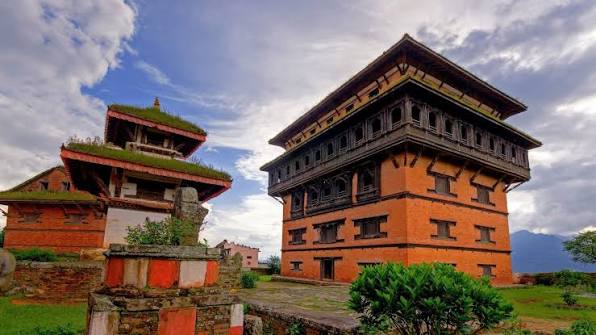
Road Condition: The main route via Galchhi and the Trishuli highway is well-paved and in good condition. The final 6 km climb from Bidur to Nuwakot Bazaar is narrower but paved and manageable by any vehicle.

Vehicle TypeCapacityPrice KTM → Nuwakot (one-way)Price Full Day ReturnBest For
Sedan Car1–3 paxUSD 40–60USD 70–100Couple, solo, day trip
SUV / Fortuner4–5 paxUSD 55–80USD 90–130Small family, comfortable
Toyota Hiace Van7–14 paxUSD 90–130USD 150–200Groups, school trips
Mahindra Scorpio6–9 paxUSD 65–95USD 110–160Larger family, pilgrimage group
Toyota Coaster Bus15–22 paxUSD 140–190USD 230–300Large groups, cultural tours


All prices include the driver, fuel, and vehicle insurance. Full-day return pricing means the driver accompanies you in Nuwakot for the full day and returns you to Kathmandu in the evening. For overnight stays or multi-day Nuwakot visits, daily rates apply from the second day. Contact Vehicle Hiring Nepal for exact 2026 pricing.


Sample Itineraries for aNuwakot’sHistorical and Spiritual Sites

Day Trip: Nuwakot Durbar, Bhairavi Temple, and Devighat

  • 6:30 AM: Depart Kathmandu by private vehicle
  • 8:00–8:30 AM: Arrive Nuwakot Bazaar — walk to Nuwakot Durbar, explore the palace complex and Ranga Mahal, visit the privately-run artifact museum adjacent to the square
  • 9:30 AM: Bhairavi Temple darshan and the Taleju Temple
  • 10:30 AM: Walk the Nuwakot ridge viewpoint — panoramic views of the Trishuli valley and Ganesh Himal range
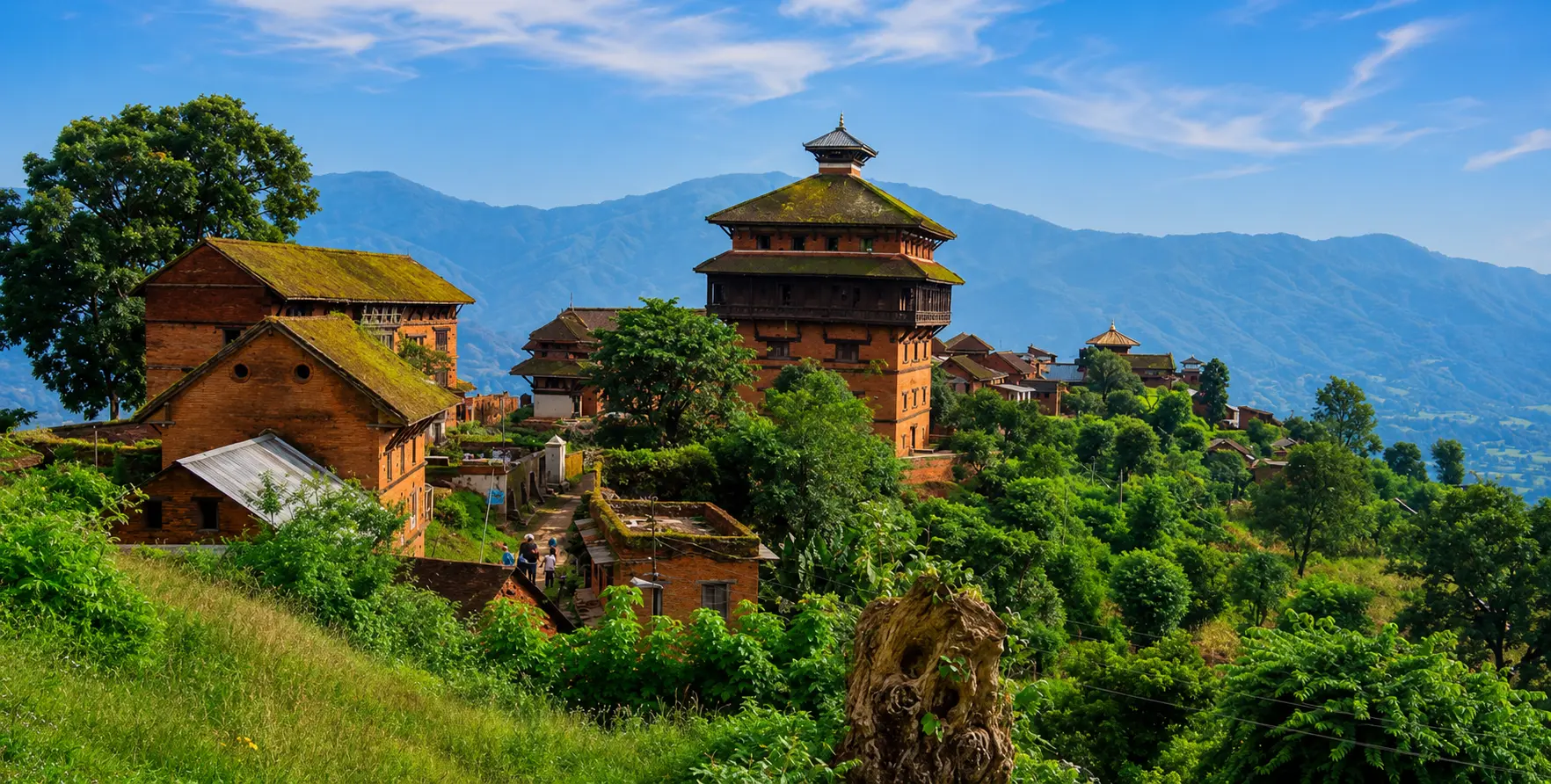
  • 11:30 AM: Drive down to Devighat (20–30 min) — visit Jalapa Devi temple, walk the river confluence, see the cremation site of Prithvi Narayan Shah
  • 1:00 PM: Lunch at Trishuli Bazaar riverside restaurant
  • 2:30 PM: Return to Kathmandu (1.5–2 hrs)
  • 4:00–4:30 PM: Arrive in Kathmandu

Weekend: Nuwakot, Rafting, and Kakani

  • Day 1 (Saturday): Kathmandu to Nuwakot via Kakani (viewpoint stop, 45 min). Nuwakot Durbar complex and temples (2 hrs). Lunch. Devighat sacred site visit. Overnight at The Famous Farm or Bidur homestay.
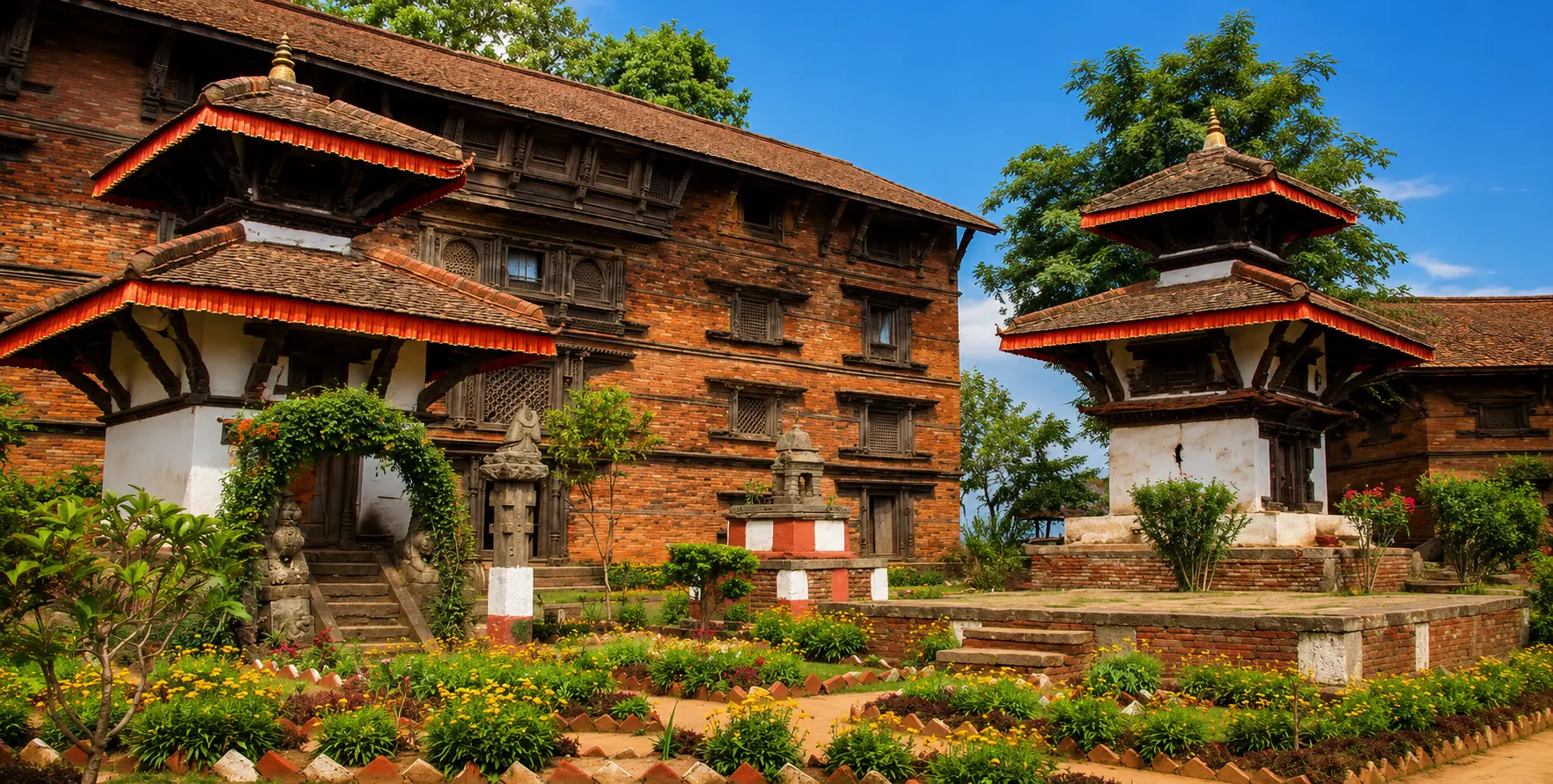
  • Day 2 (Sunday): Trishuli River rafting from Charaudi (full day, including Grade III rapids). Return to Kathmandu via Trishuli Bazaar in the evening.

Sindure Jatra Festival Visit (April)

  • Day 1: Depart Kathmandu at 6:00 AM. Arrive in Nuwakot in time for morning festival ceremonies. Witness the chariot preparation and early rituals at the Bhairavi temple.
  • Day 1 Evening: Overnight at Nuwakot — essential for witnessing the full midnight chariot procession to Devighat and back.
  • Day 2: Full festival day — chariot procession to Devighat (4–5 hours), tantric puja at the river confluence, midnight return procession.
  • Day 3 (optional): Sindure throwing ceremony on New Year’s Day and return to Kathmandu.


Where to Stay in Nuwakot

  • The Famous Farm — The standout accommodation option, a heritage property in a nearly 100-year-old mud-brick farmhouse set in organic gardens with views of the Ganesh Himal range and the royal palace. This ‘eco-luxury hotel’ offers hot showers, excellent fusion and traditional Nepali cuisine, and wooden balconies with arguably the finest view of any hotel in Nuwakot District. Recommended for overnight visits.
  • Hotel Trishuli and Hotel Water Tower — Standard mid-range hotel options in Bidur town, suitable for straightforward overnight stays with basic facilities.
  • Homestays — The local Nuwakot community offers homestays in traditional homes within and around the Durbar Square area, providing an atmospheric, close-to-the-festival experience, particularly during Sindure Jatra: basic comforts, excellent cultural immersion.
  • Kakani Resort Options — For travelers combining Nuwakot with Kakani, several small resorts and lodges on the Kakani ridge offer mountain views and comfortable accommodation at 2,073 m.
Panoramic view of Nuwakot, Nepal during the best travel season, featuring green hills, clear Himalayan skies, historic landmarks, and traditional villages.
The best time to visit Nuwakot is during spring (March to May) and autumn (September to November), when the weather is clear, the mountain views are spectacular, and festivals bring the region to life.

Best Time to Visit Nuwakot

April (Sindure Jatra — Most Culturally Significant)

The Sindure Jatra in Chaitra/Baishakh (approximately April) is the single most compelling reason to time your Nuwakot visit precisely. The twelve-day festival transforms Nuwakot Durbar Square into one of Nepal’s most extraordinary living cultural events, with the chariot procession to Devighat being genuinely unlike anything else available in Nepali festival culture. Book your vehicle with Vehicle Hiring Nepal at least 4 to 6 weeks ahead for festival dates.

October to November (Best General Season)

Post-monsoon clarity brings the finest mountain views from Nuwakot’s ridge, with the Ganesh Himal and Langtang ranges especially vivid in the post-monsoon air. The Dashain festival (October) brings its own festive atmosphere to the temples. Roads are dry and in excellent condition. The weather is cool and comfortable at Nuwakot’s altitude of 1,128 m.

December to February (Quiet and Clear)

Winter is quiet in Nuwakot. Maha Shivaratri in February-March brings a surge of pilgrims to Dupcheshwar Mahadev. The mountain views on clear winter mornings can be exceptional. Nights are cold, but the days are pleasant for walking through the palace complex and along the hill paths.

March to May (Spring — Rhododendron Season)

The approach roads through the mid-hills show beautiful rhododendron color in March and April, and the Sindure Jatra falls in this window. May can be warm at the lower valley elevations.

Monsoon (June to September — Still Accessible)

The Nuwakot road remains accessible throughout the monsoon, though the lower sections can be affected by occasional landslides. The terraced fields become intensely green, and the Trishuli River is at its most powerful. Not the prime season for mountain views but atmospheric and relatively crowd-free.


Practical Tips for Visiting Nuwakot

  • Depart Kathmandu early for a day trip — 6:30 to 7:00 AM ensures you reach the palace complex in the cool morning light, with time to explore fully before the midday heat sets in.
  • The road from Bidur to Nuwakot Bazaar is narrow in sections — inform your driver which specific sites you wish to reach so they can take the appropriate approach roads.
  • Carry Nepali Rupees cash — ATMs are available in Bidur and Trishuli Bazaar but not in Nuwakot town itself.
  • Wear appropriate clothing for both temple visits (covered shoulders and legs) and outdoor walking (comfortable shoes — the palace complex and ridge paths involve uneven stone surfaces)
  • Photography of the cremation rituals and inside the main temple sanctums requires careful judgment — ask local guides before photographing sensitive ceremonies.
  • For the Sindure Jatra, approach the festival as a respectful observer rather than a tourist spectacle — maintain silence during rituals, follow the local crowd movement, and accept that some elements are not intended for general visitors.
  • The Famous Farm should be booked in advance for the Sindure Jatra period and in October–November — available rooms are limited.
  • Combine your Nuwakot visit with a morning or an afternoon of river rafting for a day that blends spirituality, culture, and adventure in a single rewarding circuit.


How to Book Your Kathmandu to Nuwakot Vehicle

  1. Contact Vehicle Hiring Nepal via WhatsApp at +977 9851013196 or visit vehiclehiringnepal.com
  2. Specify your preferred travel date — mention Sindure Jatra if timing your visit for the festival.
  3. Confirm your group size — we recommend the appropriate vehicle for your party.
  4. Please tell us your planned itinerary — Durbar only, Durbar + Devighat, a day trip, or an overnight stay.t
  5. Receive your booking confirmation with driver details and pickup time.


WhatsApp: +977 9851013196
Email: [email protected]
Website: www.vehiclehiringnepal.com


Frequently Asked Questions

How far is Nuwakot from Kathmandu and how long does the drive take?

Nuwakot Durbar is approximately 65-75 km from Kathmandu, depending on the route taken. By private vehicle, the drive takes 1.5 to 2 hours on the main route via the Prithvi Highway and the Trishuli River Road. The scenic route via Kakani adds 30 to 45 minutes but offers spectacular Himalayan views from the Kakani ridge.

Is the Nuwakot Durbar open to visitors despite the earthquake restoration?

Yes. The palace complex at Nuwakot Durbar remains open and freely accessible to all visitors despite the ongoing earthquake restoration work. Some portions of the main seven-story palace are covered with scaffolding. Still, the Ranga Mahal, the Garad Ghar, the Bhairavi and Taleju temples, the Buddhist stupa, and the surrounding complex are all accessible and rewarding. The views from the palace terrace are completely unaffected by the restoration work.

When exactly is the Sindure Jatra in 2026?

The Sindure Jatra follows the Nepali lunar calendar, and its Gregorian dates shift annually. The festival begins on the 14th day of the bright fortnight of Chaitra (approximately mid-April 2026) and continues for twelve days. Contact Vehicle Hiring Nepal or check with a local tourism source in Nuwakot in early 2026 for the exact festival opening date. Book your vehicle and accommodation as soon as the date is confirmed — Nuwakot’s limited accommodation fills quickly for festival dates.

Can Nuwakot be visited as a day trip from Kathmandu?

Yes, comfortably. A day trip covering Nuwakot Durbar, Bhairavi Temple, the ridge viewpoint, and Devighat is achievable in approximately 8 to 9 hours total, including the 1.5- to 2-hour drive each way. Departing Kathmandu at 6:30 AM and returning by 4:30 to 5:00 PM is the standard day-trip pattern. For the Sindure Jatra chariot procession to Devighat and midnight return, an overnight stay in Nuwakot is necessary.

Is rafting on the Trishuli River available on the same day as a visit to Nuwakot?

Yes. The Trishuli River rafting put-in point at Charaudi is on the Prithvi Highway, approximately 15 to 20 minutes from the Galchhi junction, where the Nuwakot road branches off. A combined itinerary — rafting in the morning followed by an afternoon visit to Nuwakot Durbar and Devighat — or the reverse sequence is entirely practical and makes for an excellent full-day circuit from Kathmandu.
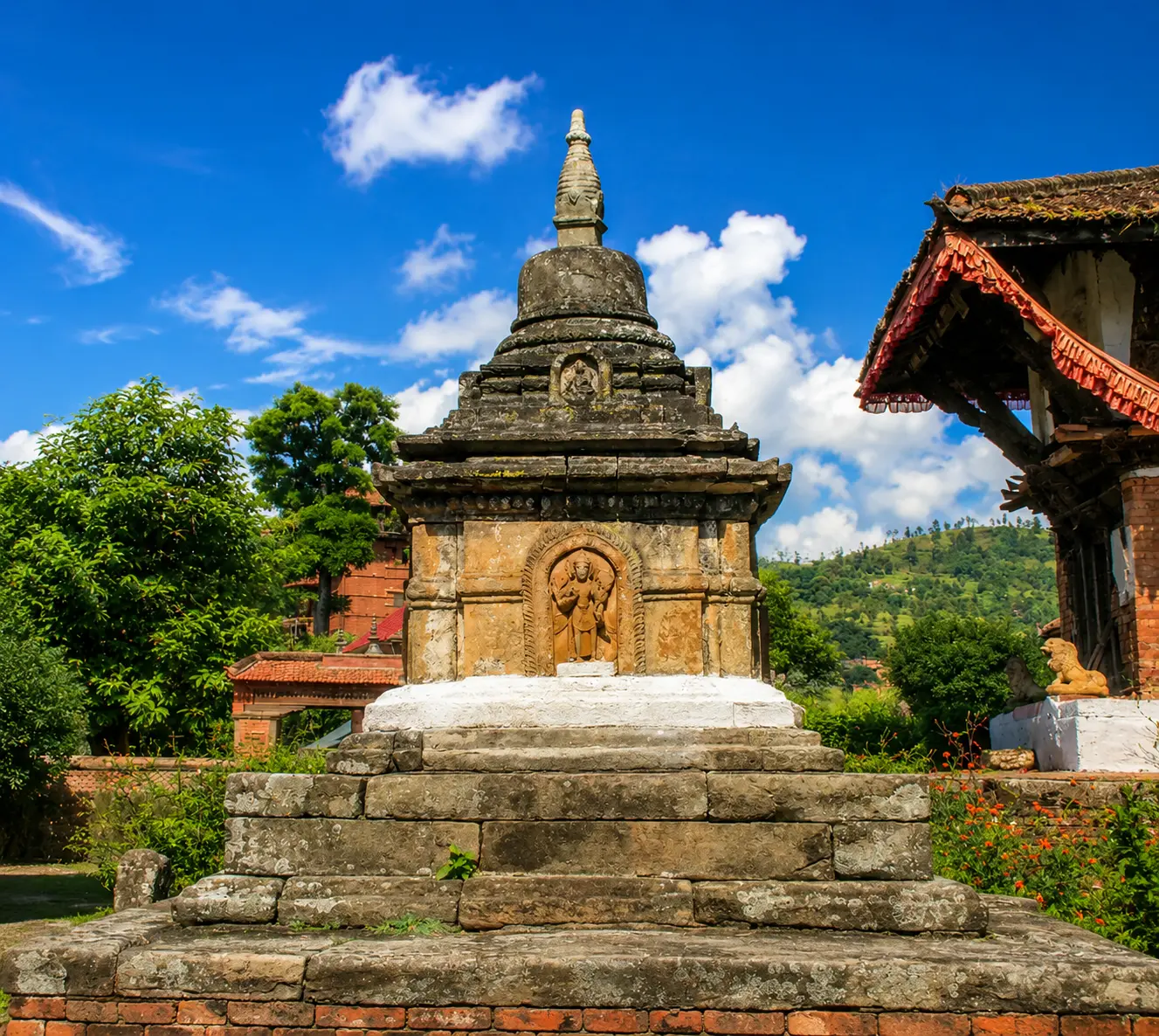
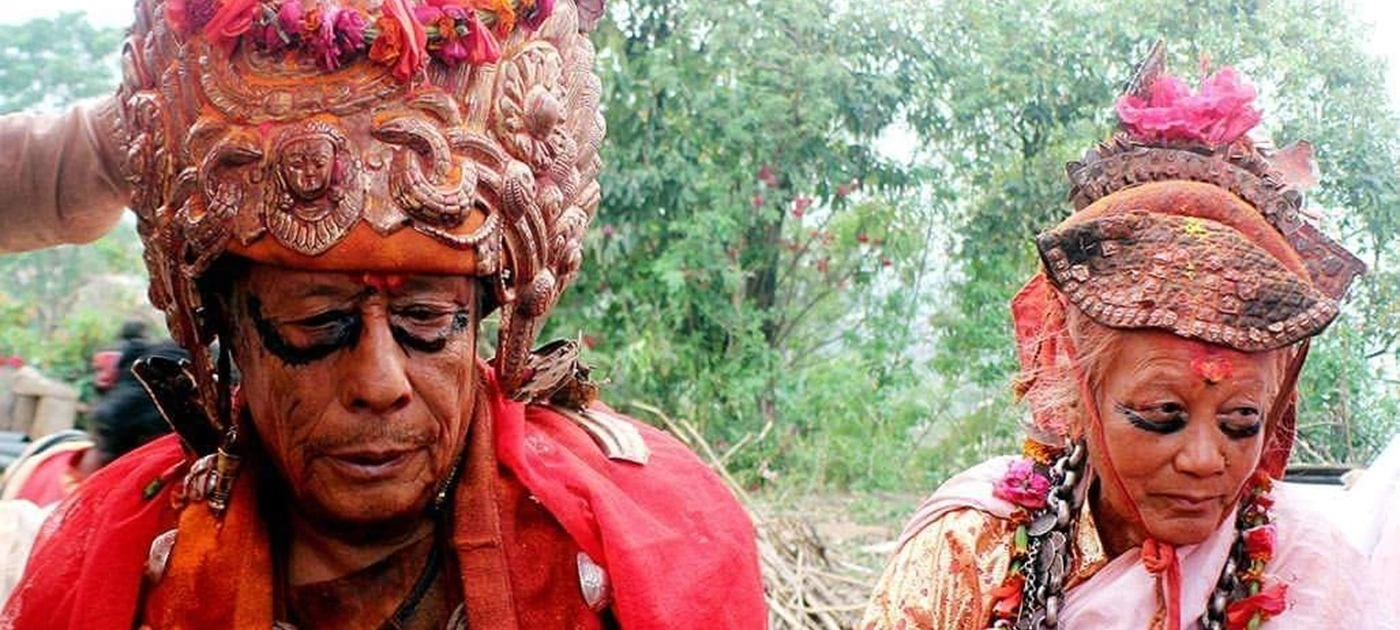
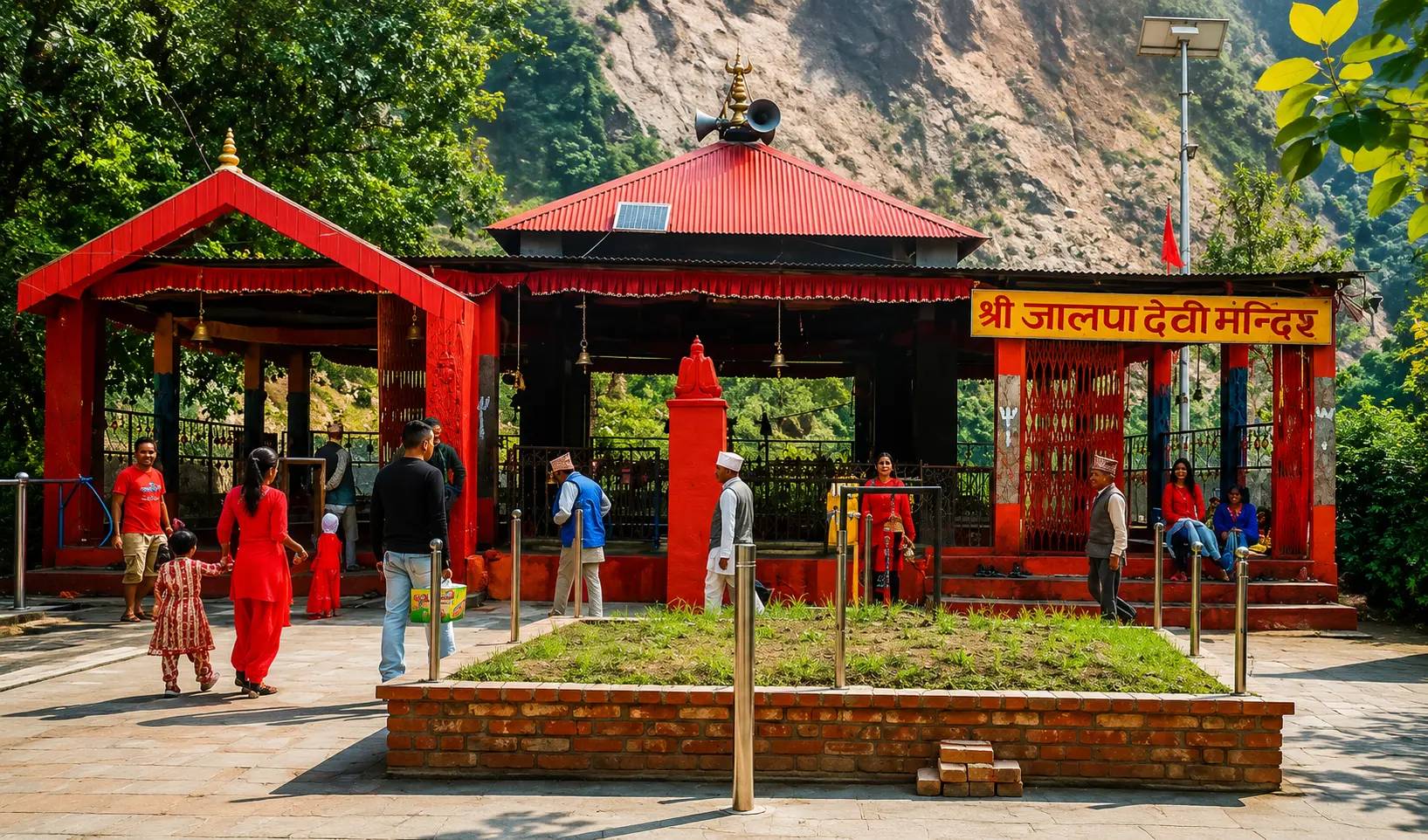
 

Final Thoughts

Nuwakot is one of those destinations in Nepal whose significance is almost the exact opposite of its current popularity. It is where the nation of Nepal was decisively born — the site of the battle that began the unification, the capital that housed the court and the campaign for a quarter-century, and the riverside sacred site where the unifier died and was cremated. It is also the home of one of Nepal’s most complex and spiritually potent festivals, a magnificent traditional palace in the finest Newari architectural tradition, a cluster of active temples with centuries of continuous devotional practice, and a sacred river confluence still visited by pilgrims and marked by the holiest kind of departure any Nepali king could wish for.

And yet Nuwakot receives a fraction of the visitors that pass through it every day on the road to Langtang, to Trishuli rafting, and onward to Pokhara. For travelers who understand what lies behind the sign at the hilltop turnoff, this is not a failure of the destination but an invitation — an opportunity to experience a genuinely significant and beautiful corner of Nepal’s historical and spiritual geography in the kind of quiet that is increasingly difficult to find at more celebrated sites.

Vehicle Hiring Nepal makes the journey from Kathmandu to Nuwakot simple, comfortable, and flexible with a private car or van from your hotel door to the palace gate, timed to specific interests, whether early-morning festival timing or a combined rafting and heritage day. Whatever brings you to Nuwakot, we will get you there.

Book your Kathmandu-to-Nuwakot vehicle today. WhatsApp: +977 9851013196 | Website: www.vehiclehiringnepal.com