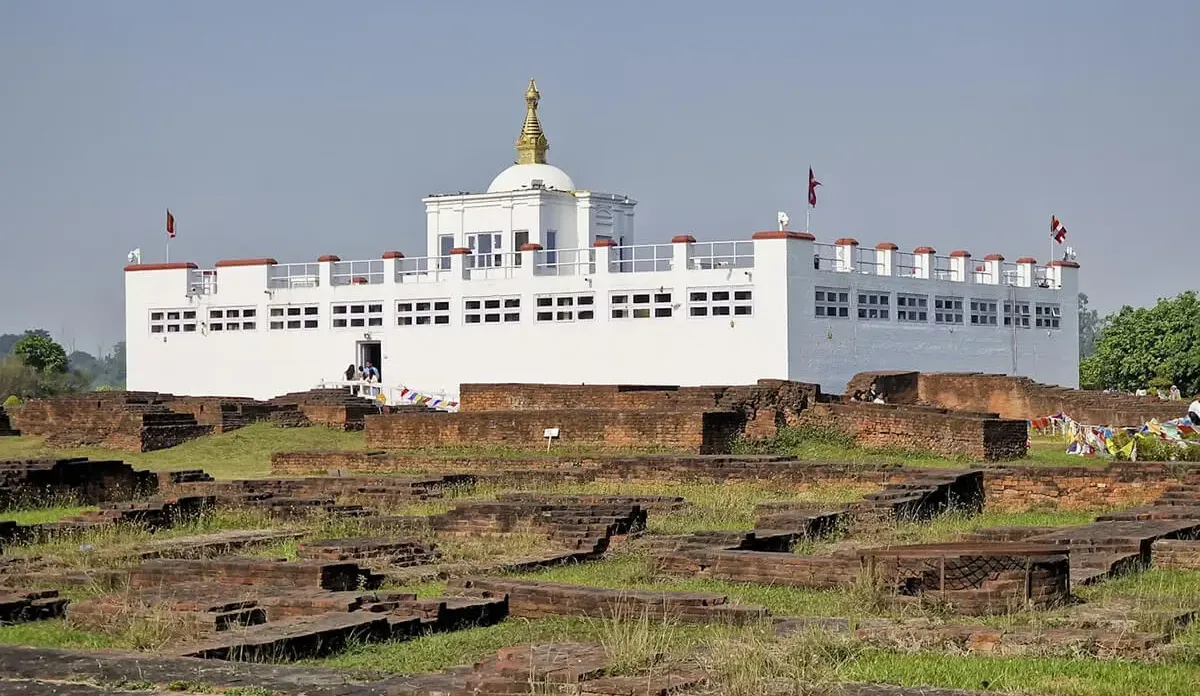
Lumbini’s Hidden Spiritual Places

PokharaLumbini Hidden Spiritual Places: The Lumbini That Most Visitors Never Find
Every year, hundreds of thousands of pilgrims and tourists arrive in Lumbini — the birthplace of Siddhartha Gautama, the historical Buddha, and one of the four holiest sites in Buddhism. They visit the Maya Devi Temple, stand before the Ashokan Pillar, photograph the gleaming white World Peace Pagoda, and walk reverently through the international Monastic Zone with its extraordinary constellation of temples from more than thirty nations.

They leave moved, enriched, and grateful. And they leave having seen, at most, twenty per cent of what Lumbini and its surrounding sacred landscape actually contain.

The Lumbini that most visitors experience is extraordinary. But the Lumbini that lies beyond the tourist path — in the villages, rice fields, and ancient mounds of the broader Rupandehi and Kapilvastu districts — is something altogether more profound, more mysterious, and more challenging to comprehend.

This is the Lumbini of 62 archaeological sites spread across a landscape of ancient kingdoms and forgotten cities. This is Lumbini, where the only stupa in the world believed to contain still the original bodily relics of the Buddha — untouched even by the great Emperor Ashoka — sits quietly on the bank of a river in a rural village, known to most pilgrims only by legend.

This is Lumbini, where the childhood palace of Prince Siddhartha Gautama is still being excavated from beneath centuries of accumulated earth, and where the maternal homeland of his mother, Queen Maya Devi, can still be visited across a river that has barely changed since the time of the Buddha himself.

The hidden spiritual landscape of Lumbini is not merely a collection of additional tourist attractions. It is the spatial biography of one of the most significant human beings who ever lived — a landscape in which every site marks a moment, a relationship, or a spiritual reality from the extraordinary life story of Siddhartha Gautama.

To walk this landscape with genuine knowledge and attention is to step inside the most important story in Buddhist civilisation, touching the earth where it happened and feeling the extraordinary weight of historical and spiritual reality that two and a half millennia of continuous veneration have concentrated into these places.

This deep research guide covers Lumbini’s hidden spiritual places with the thoroughness they deserve — not as a checklist but as a journey. We begin at the well-known sacred core and then move outward, progressively further from the tourist circuits, into the landscapes where ancient kingdoms rose and fell, where Ashoka’s pillars still stand broken in rice fields, where the massacre of

the Shakya people left its trace in an ancient bloodied pond, and where the relics of the Buddha — his actual physical remains after cremation — rest in an earthen mound that human hands have never opened. And with Nepal Vehicle Hiring Pvt. Ltd. as your trusted transport partner, every one of these extraordinary places is within reach of your Lumbini base.

Lumbini demands slow travel, genuine attention, and the willingness to sit with discomfort — the discomfort of a site that does not offer comfortable heritage interpretations but presents instead the raw, unmediated archaeological reality of an ancient world. It demands respect — for the pilgrims who have been coming here for 2,500 years, for the Buddhist communities from thirty nations who have built their spiritual homes within the Monastic Zone, and for the extraordinary landscape itself, which has absorbed the prayers and the tears and the devotion of untold millions of human beings over an immense stretch of time.

This guide is your companion for that slow, attentive, genuinely transformative journey.
Siddhartha Highway

Part One: The Sacred Core — Understanding Lumbini’s Known Heart in Full Depth

Maya Devi Temple — 2,500 Years of Continuous Sacred Geography

Most visitors to Maya Devi Temple see a white modern structure over an archaeological excavation. What they are less likely to understand is the extraordinary depth beneath and within. The Maya Devi Temple marks the precise point — identified by the ancient Marker Stone beneath its floor — where Queen Maya Devi, wife of the Shakya King Suddhodhan of Kapilvastu, gave birth to Prince Siddhartha Gautama in approximately 563 BCE.

The birth took place in the open air of a sala grove as Maya Devi travelled from Kapilvastu to her parents’ home in Devd; she grasped a sala branch. She gave birth standing up, and the newborn prince immediately took seven steps northward, touching the earth with each step and declaring his final birth into existence.

The excavations within the temple compound, conducted over decades by international archaeological teams, including UNESCO, the Government of Nepal, and joint Japanese-Nepali teams, have revealed the foundations of successive temples and shrines built on this exact spot, spanning more than two thousand years. The current structure is approximately the fourth or fifth building to occupy the site, each constructed over the previous one in an act of sacred continuity that has maintained the spot’s religious significance across every political and cultural upheaval that has affected the region over twenty-five centuries.

Lumbini Hidden Spiritual Places featuring Maya Devi Temple, Ramagrama Stupa, Tilaurakot, Devdaha, and ancient Buddhist monasteries

The oldest structural remains identified at the Maya Devi Temple site suggest continuous veneration beginning in approximately the 3rd century BCE — coinciding with the visit of Emperor Ashoka, who erected his famous pillar in 249 BCE as royal confirmation of the site’s identity and spiritual significance. Beneath the foundations of the Kushana-period shrine (1st–4th centuries CE) lie the remains of an even earlier structure, possibly dating to the Mauryan period.

The layering of these successive sacred constructions over the identical point in space for over two millennia is itself one of the most extraordinary testimonies to the continuity of Buddhist devotional tradition anywhere in the world.

The Nativity Sculpture preserved within the temple — a carved sandstone relief depicting Maya Devi grasping the branch of the sala tree with the infant Siddhartha emerging from her right side, attended by the divine figures Indra and Brahma — is the earliest surviving visual representation of the Buddha’s birth anywhere in the world. Dating from the Kushana period and discovered during archaeological excavations, it is displayed within the temple behind protective glass.

It is one of the most significant pieces of Buddhist art. Its iconographic details—the specific gesture of Maya Devi, the position of the infant, the arrangement of the attending deities—reflect established visual conventions followed in Buddhist birth narratives across Asia for the next two thousand years.

What the Nativity Sculpture does not show — and what the textual tradition preserves with extraordinary detail — is the sensory world of the birth. The sal trees in bloom (it was the month of Vaisakha, corresponding to April-May), their fragrance filling the grove. The silence of the natural world that the texts describe as attending the birth of a Bodhisattva.

The spring of water that emerged from the earth to bathe the infant, and the complementary warmth of warm water that descended from the sky. The seven steps — each marked by a lotus flower springing from the earth — and the proclamation: ‘I am the highest in the world. This is my last birth.

There is now no existence again.’

The texts preserve every detail. Standing within the temple, the imagination can reconstruct it. And the Marker Stone beneath your feet confirms that you are standing within meters of where it actually happened.

The Ashokan Pillar — Decoding the World’s Most Important Buddhist Inscription

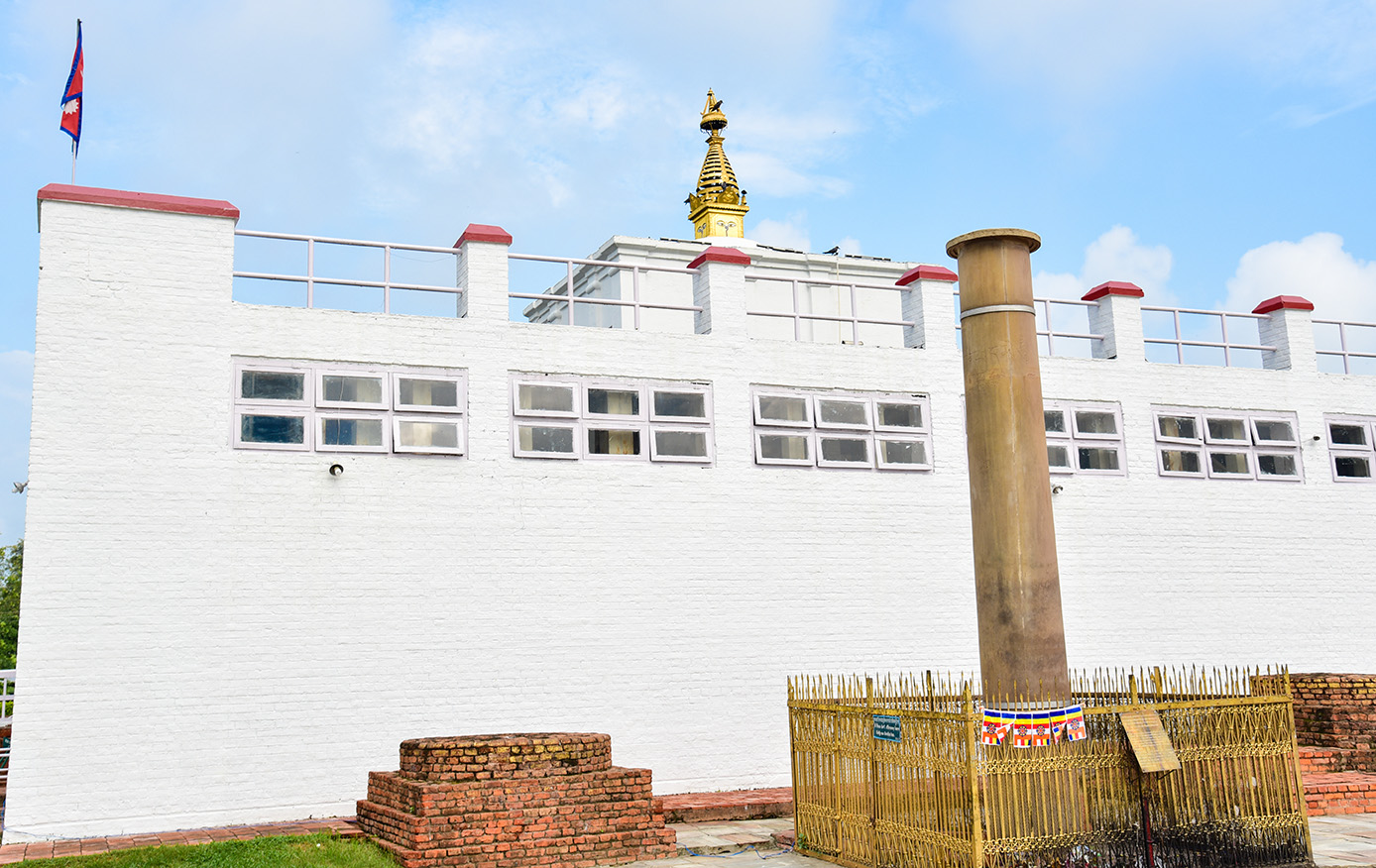
The Ashokan Pillar at Lumbini is the single most important piece of physical historical evidence for the site’s authenticity as the Buddha’s birthplace — and understanding its inscription in full depth transforms it from an ancient monument into a living document of extraordinary historical resonance. Emperor Ashoka — the Mauryan ruler who converted to Buddhism after the catastrophic battle of Kalinga (261 BCE) and dedicated his empire to propagating the Dharma — made a personal pilgrimage to Lumbini in 249 BCE, his twentieth year of reign, accompanied by his Buddhist teacher Upagupta.

The Brahmi inscription on the pillar, translated in full, reads: ‘King Priyadarsi, beloved of the gods, when he had been anointed twenty years, came himself and paid reverence, for here the Buddha Shakyamuni was born. He caused a stone enclosure and a stone pillar to be made.

Because the Lord was born here, the village of Lumbini has been made free of tax and entitled to the eighth part of the produce only.’ Every phrase of this inscription repays close attention.

‘Came himself’ — Ashoka did not send a representative but made the journey himself, a statement of the site’s exceptional significance. ‘Caused to be made a stone enclosure’ — there was already a sacred enclosure before Ashoka, which he formalised in stone. ‘Free of tax’ — the economic privilege conferred on the village community acknowledges and rewards their two-century stewardship of the birthplace.

The pillar itself is 7.2 meters tall at present — what remains after the capital (originally a stone horse figure, since lost) fell and broke the upper shaft. The shaft bears a lightning crack that the archaeological record dates to approximately the 7th century CE, when the Chinese pilgrim Xuanzang visited Lumbini and recorded seeing a ‘stone pillar with a horse on top, but struck by lightning and broken in the middle.’

This is remarkable: Xuanzang’s early medieval account of what he saw precisely matches the pillar’s physical state today. The continuity of eyewitness testimony from the 7th century to the present adds another layer of historical authentication to a site already confirmed by a 3rd-century BCE royal inscription.
Lumbini Hidden Spiritual Places featuring Maya Devi Temple, Ramagrama Stupa, Tilaurakot, Devdaha, and ancient Buddhist monasteries

The Pushkarni Sacred Pond — First Bath of the Bodhisattva

The Pushkarni Pond, immediately adjacent to the Maya Devi Temple, is one of the most consistently underappreciated sacred sites in the entire Lumbini complex. In the Buddhist textual tradition — particularly in the Mahavastu, the Lalitavistara, and the Pali Jataka commentaries — the Pushkarni is described as the sacred bathing tank where Queen Maya Devi bathed and purified herself in the days before the birth, and where the infant Siddhartha received his first ritual bath from the naga kings Nanda and Upananda, who descended from the celestial realms to purify and anoint the newborn Bodhisattva.

The current appearance of the Pushkarni — a partially reconstructed rectangular tank surrounded by ancient brick foundations, with clean water reflecting the surrounding trees — belies its extraordinary age. Excavations by archaeological teams have confirmed that the tank existed in the Mauryan period (3rd century BCE) and was already a place of ritual significance when Emperor Ashoka visited.

The brickwork visible around the tank’s edges includes elements from multiple construction phases spanning many centuries—a palimpsest of devotional maintenance stretching back over two thousand years.

The Pushkarni’s ritual significance continues today: Buddhist pilgrims regularly collect water from the pond in small containers, believing it has healing and purifying properties tied to the place’s sacred history. Hindu pilgrims similarly venerate the pond as a sacred tirtha (sacred crossing place) associated with the divine mother Maya Devi.

The simultaneous Hindu and Buddhist veneration of the Pushkarni reflects Lumbini’s broader religious character. Here, the two great Indian spiritual traditions overlap and interweave in ways that resist simple categorisation.
lubini-Explore Lumbini Hidden Spiritual Places beyond the Maya Devi Temple, including Ramagrama Stupa, Tilaurakot, Devdaha, Gotihawa, Niglihawa, and other sacred Buddhist heritage sites.

The World Peace Pagoda — Japanese Devotion to Global Harmony

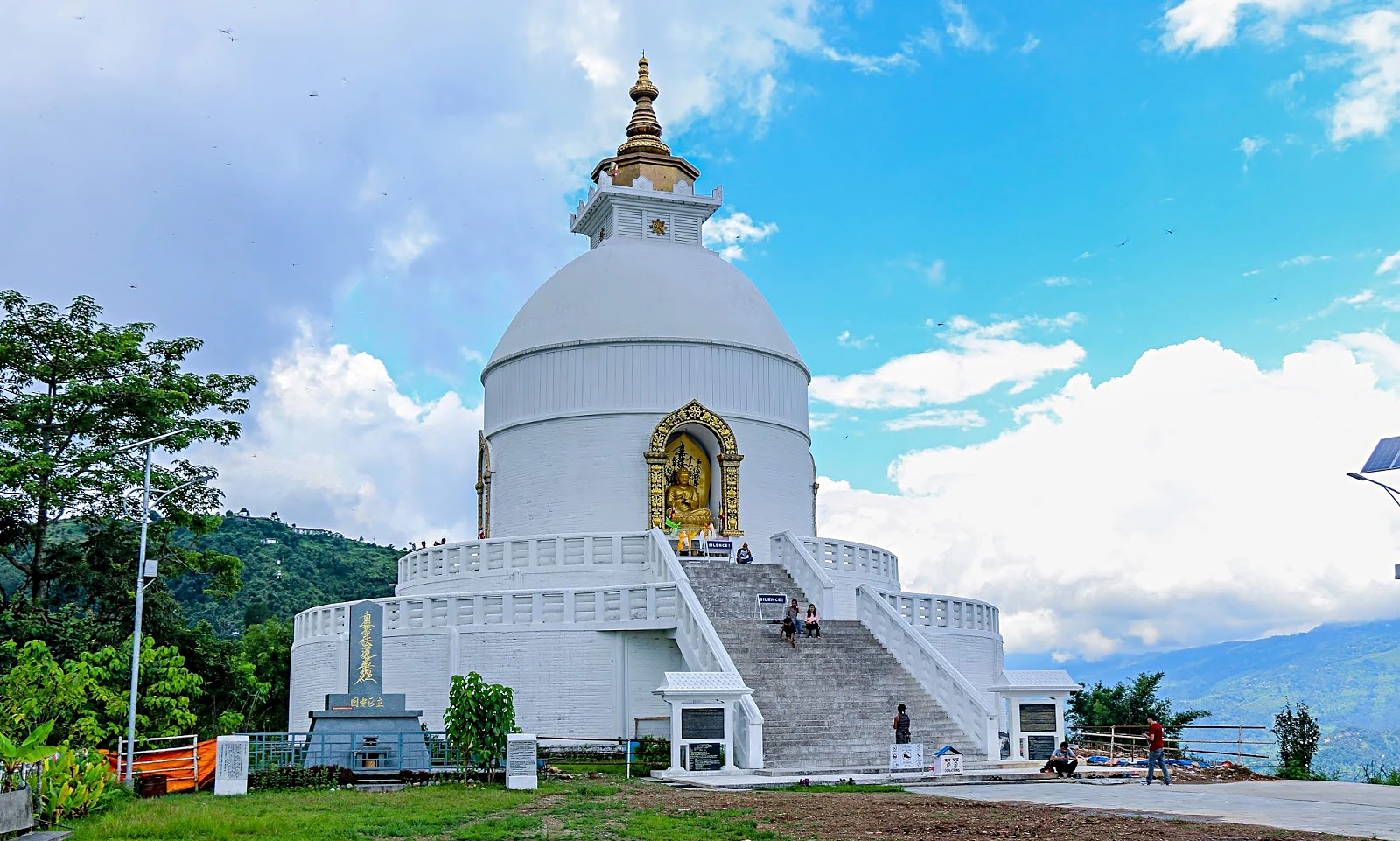
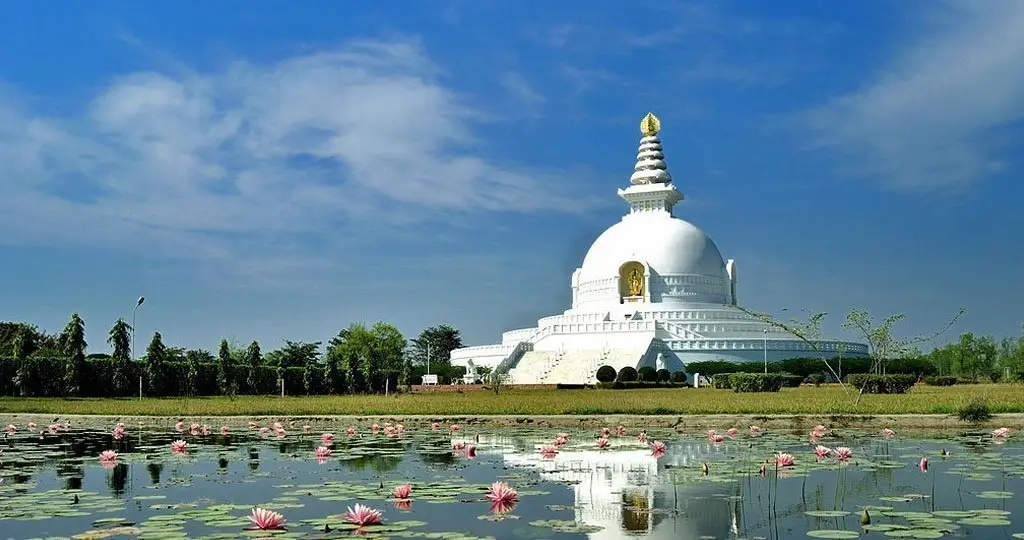
The World Peace Pagoda (Shanti Stupa) at Lumbini stands approximately 1.5 km north of the Sacred Garden at the northernmost end of the Monastic Zone. It is one of the most architecturally and symbolically significant structures in the entire complex.

Built by the Japanese Buddhist organisation Nipponzan-Myohoji under the leadership of the Venerable Nichidatsu Fujii — a Buddhist monk who dedicated his life to building peace pagodas around the world as acts of devotion and commitment to global nonviolence — the Lumbini Shanti Stupa is a gleaming white dome of substantial size, topped with a golden spire, surrounded by four golden Buddha images positioned at the cardinal directions, and set within a peaceful garden that provides meditation space and a long approach walk from the canal.

The Shanti Stupa tradition that produced the Lumbini World Peace Pagoda is itself one of the most extraordinary expressions of Buddhist peace activism in the 20th century. Venerable Fujii, deeply influenced by both Mahatma Gandhi’s nonviolent philosophy and the Nichiren Buddhist tradition, began building peace pagodas in Japan after World War II and Hiroshima—physical embodiments of the vow to work for the cessation of war and violence.

Over the following decades, Nipponzan-Myohoji built peace pagodas in multiple countries, from Japan and India to the United Kingdom and the United States.

The Lumbini pagoda, built in the birthplace of the historical figure whose teachings most profoundly articulate the imperative of nonviolence, is the most symbolically appropriate of all these structures and one of the finest architecturally.

The World Peace Pagoda is best visited at two specific times: early morning, when the rising sun illuminates the white dome and the surrounding prayer flags glow in the dawn light; and at sunset, when the golden spire catches the last light and the reflection of the white dome appears in the canal below. The approach to the pagoda along the canal path in the evening light, with the white structure growing progressively larger and more luminous against the darkening sky, is one of Lumbini’s finest visual experiences and one that many visitors — who leave Lumbini without having walked the full length of the Monastic Zone — unfortunately miss.
Explore Lumbini Hidden Spiritual Places beyond the Maya Devi Temple, including Ramagrama Stupa, Tilaurakot, Devdaha, Gotihawa, Niglihawa, and other sacred Buddhist heritage sites.

The Eternal Peace Flame — The Continuously Burning Symbol

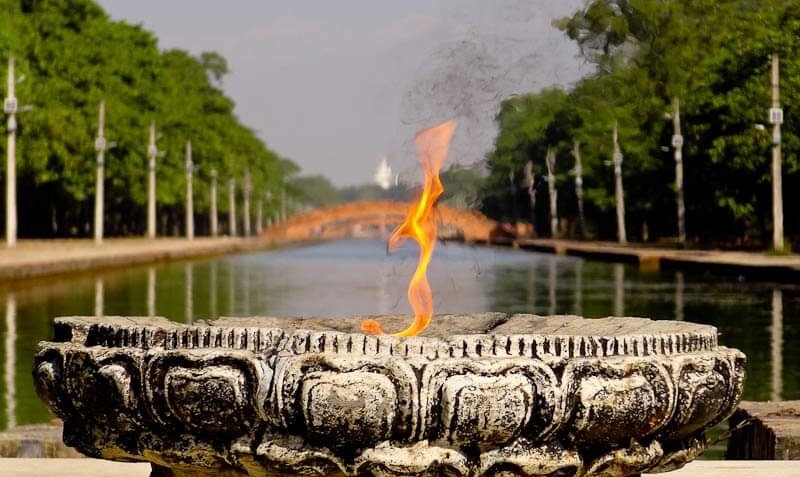
Located within the Monastic Zone compound, the Eternal Peace Flame has burned without interruption since it was ceremonially lit on October 11, 1986 — a moment of symbolic significance in the United Nations International Year of Peace. The flame was lit from fires gathered from diverse global sources representing different traditions and nations — an act of literal synthesis of the world’s flames into a single burning symbol of the aspiration toward human peace and understanding.

It is one of the longest-burning continuous peace flames in the world and perhaps the most spiritually charged, burning in the birthplace of the human being who, more than any other in world history, articulated the connection between inner peace, compassionate practice, and the cessation of violence in the world.

The Eternal Peace Flame is housed in a simple stone structure that protects it from wind and rain while allowing its light to be visible day and night. The constant tending required to keep the flame burning—refuelling, maintaining the wick, protecting it from weather—is performed by the Lumbini Development Trust staff, who regard this as one of their primary ritual obligations.

Pilgrims of many traditions visit the flame throughout the day, pausing before it for prayer, meditation, or simply a moment of silent acknowledgement of the aspiration it represents.

There is something genuinely moving about a flame that has been burning continuously for nearly four decades — that was burning during the fall of the Berlin Wall, during the September 11 attacks, during the COVID-19 pandemic, during every event of the past 38 years that has tested and sometimes shattered the aspiration toward global peace. Its continuity through these events is itself a kind of testimony — not that peace has been achieved, but that the human aspiration toward it has not been extinguished.

Part Two: The International Monastic Zone — A Walking Museum of Global Buddhism

Understanding the Master Plan — Kenzo Tange’s Vision for Unity

The Lumbini Monastic Zone, as it exists in 2026, is not an organic accumulation of sacred buildings — it is a planned spiritual landscape conceived by one of the 20th century’s most distinguished architects. In 1978, the United Nations commissioned Japanese architect Kenzo Tange (1913–2005) — whose other landmark works include the Hiroshima Peace Memorial Museum and the Tokyo National Gymnasium for the 1964 Olympics — to create a Master Plan for developing the Lumbini sacred zone.
Lumbini Hidden Spiritual Places featuring Maya Devi Temple, Ramagrama Stupa, Tilaurakot, Devdaha, and ancient Buddhist monasteries

Tange’s design, which remains the framework for all development at Lumbini to this day, divided the site into three primary areas: the Sacred Garden (containing the Maya Devi Temple and all associated ancient structures), the Monastic Zone (divided into East and West sections by a central canal), and the New Lumbini Village (service infrastructure south of the main zone).

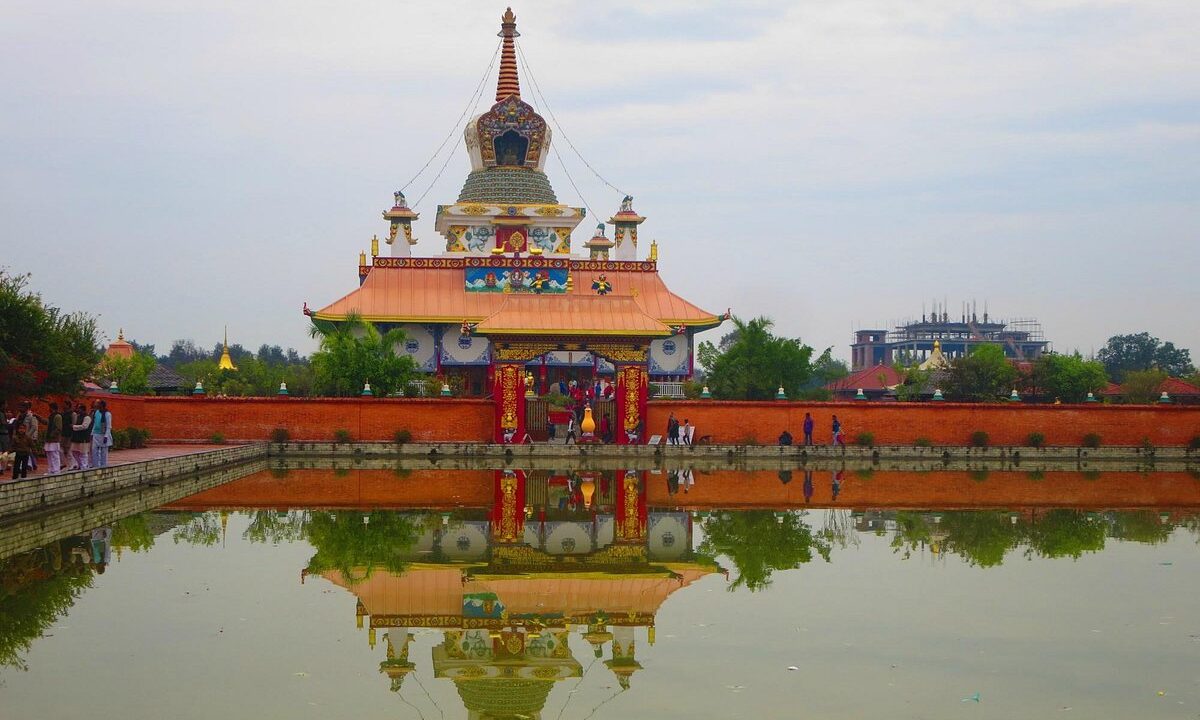
The central canal running the full length of the Monastic Zone—stretching from the Sacred Garden to the World Peace Pagoda—is one of Tange’s most significant design decisions. The canal serves multiple symbolic purposes: it represents the river and pond water that feature in the narrative of the Buddha’s birth; it provides a visual axis that organises the spatial experience of the entire Monastic Zone; it creates a reflective surface that doubles the visual presence of the surrounding monasteries; and it establishes a clear dividing line between the East Zone (reserved for Theravada Buddhist nations of South and Southeast Asia) and the West Zone (dedicated to Mahayana and Vajrayana Buddhist nations of East and Central Asia).

The 42 plots allocated within the Monastic Zone (13 in the East Zone and 29 in the West Zone) were assigned to Buddhist nations and organisations through the Lumbini Development Trust, with each plot-holder responsible for financing, designing, and constructing their own Monastery or meditation centre. The result — now approaching completeness with 32+ structures built or under construction — is the most extraordinary concentration of diverse Buddhist architectural traditions in a single planned space anywhere in the world.

Walking the full length of the canal path from the Sacred Garden to the World Peace Pagoda (approximately 3 km), with the monasteries of thirty nations visible on both sides, is an experience that no description can fully convey.

East Monastic Zone — The Theravada Nations’ Contributions

The East Monastic Zone of Lumbini is dedicated to the Theravada Buddhist tradition, practised in South and Southeast Asian countries including Sri Lanka, Thailand, Myanmar, Cambodia, Laos, and parts of India. The architectural character of the East Zone monasteries reflects the visual languages of these nations’ Buddhist architectural traditions—generally characterised by steep-roofed buildings with layered gables, elaborate carved finials, abundant gilding, and a preference for brilliant white and gold colour combinations characteristic of Theravada sacred architecture throughout the region.
Lumbini Hidden Spiritual Places featuring Maya Devi Temple, Ramagrama Stupa, Tilaurakot, Devdaha, and ancient Buddhist monasteries

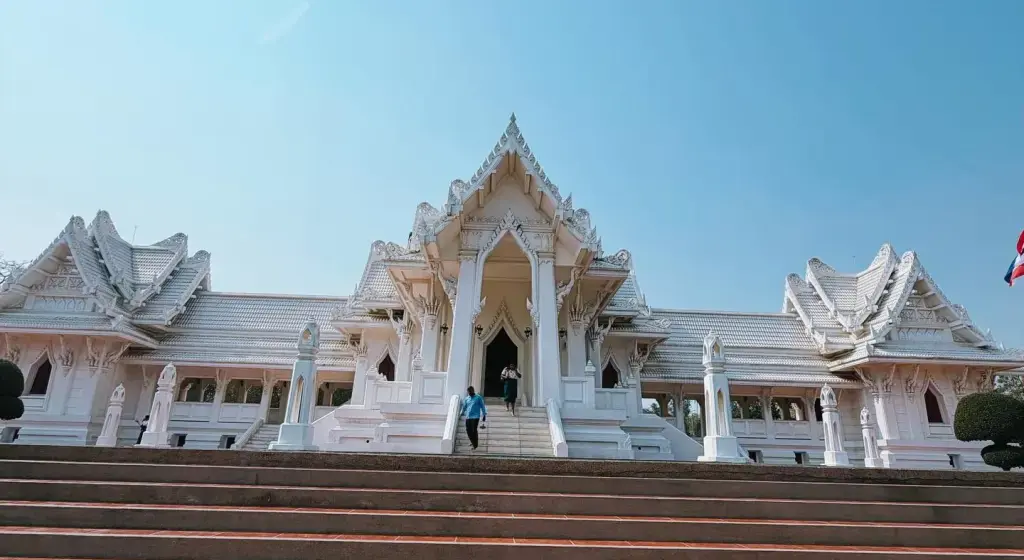
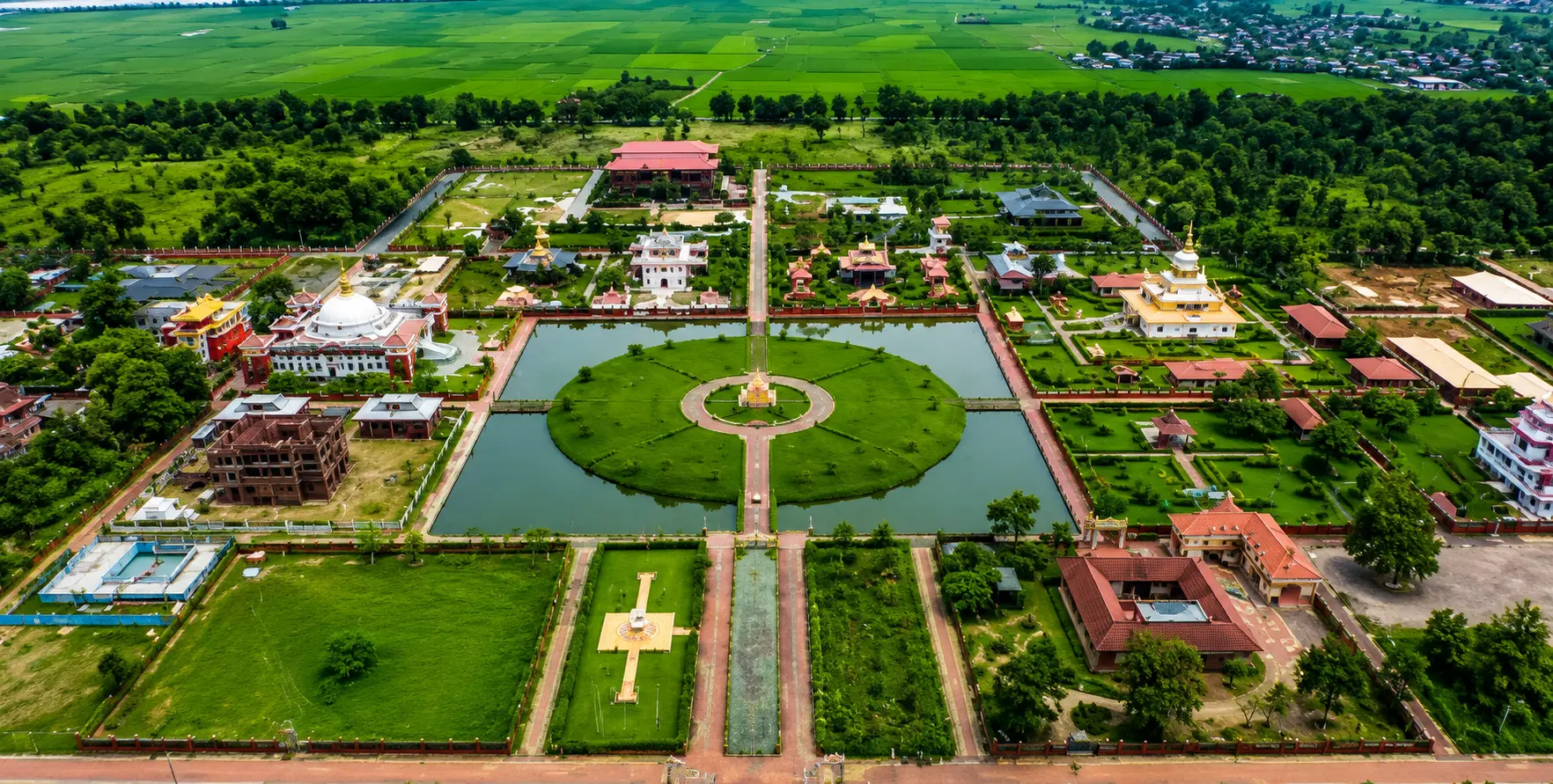
Royal Thai Monastery: The gleaming white marble structure built by the Thai royal family is without question the most visually striking building in the East Monastic Zone and one of the most beautiful in the entire Lumbini complex. The exterior is entirely clad in polished white marble with gold-leaf trim along the tiered roofline—a colour combination that, in the strong Terai sunlight, creates an almost luminescent presence from a considerable distance.

Inside, the main prayer hall centres on an exceptional golden Buddha statue in the Thai style, surrounded by gold-leafed interior surfaces, intricate ceiling paintings in brilliant colours, and the fragrance of jasmine and incense offered by the Thai monks who maintain the Monastery at the principal image. Morning prayer (approximately 6:00–7:00 AM) fills this extraordinary space with the rhythmic, melodic chanting of the Theravada Pali liturgy in the distinctive Thai style — a sound of great beauty that lends the building a distinct dimension of sacred presence beyond its already remarkable visual character.

Myanmar Golden Temple (Lokamani Cula Pagoda): The Myanmar monastery is explicitly modelled after the Shwedagon Pagoda of Yangon — one of the most revered Buddhist structures in the world — and its multi-tiered, gilded spire is visible from much of the Monastic Zone. The complex contains three interconnected prayer halls, a connecting gallery featuring paintings and sculptures of the life of the Buddha, and an exhibition space tracing the history of Buddhism within Myanmar’s distinctive religious culture.

The temple’s metalwork, particularly the ornate lamp holders and railing decorations in the Burmese decorative style, is among the finest examples of traditional Burmese Buddhist craftsmanship found outside Myanmar.

Sri Lankan Monastery: Sri Lanka, as the country most intimately associated with the preservation of the Pali Canon and the Theravada tradition in its most classical form, has built a monastery at Lumbini that reflects this centrality through architectural references to the great Anuradhapura and Polonnaruwa stupas that have defined Buddhist sacred architecture on the island for over two thousand years. The Sri Lankan monastery hosts a community of monks from the Theravada tradition who maintain a rigorous practice schedule, including daily chanting, meditation, and adherence to the traditional Vinaya monastic code.

Cambodian Monastery: The Cambodian Monastery is remarkable for its carved stone entrance portal—a direct architectural reference to the doorways of the Angkor complex, rendered in sandstone-coloured concrete that evokes the great Khmer temple tradition. The interior prayer hall houses a large golden Buddha statue, adorned with elaborate floral offerings and the distinctive blue-gold decorative scheme that distinguishes Cambodian Buddhist temple interiors.

The evening chanting ceremonies at the Cambodian Monastery, conducted in Pali and Khmer by Cambodian monks, are among the most acoustically beautiful in the Monastic Zone.
Lumbini Hidden Spiritual Places featuring Maya Devi Temple, Ramagrama Stupa, Tilaurakot, Devdaha, and ancient Buddhist monasteries

West Monastic Zone — Mahayana and Vajrayana Nations

The West Monastic Zone is dedicated to the Mahayana and Vajrayana Buddhist traditions practised in East and Central Asia — China, Japan, Korea, Vietnam, Tibet (represented through various Tibetan Buddhist organisations based in Germany, France, Nepal, and other countries), Nepal, and Bhutan. The architectural character of the West Zone is correspondingly more diverse and, in some cases, more dramatically original than that of the East Zone — reflecting the broader range of visual traditions represented, from Chinese imperial architecture to Tibetan mandala geometry to Japanese minimalism.

German Monastery (Tergar/Drigung Kagyu — German Tara Foundation): Of all the monasteries in both zones, the German Monastery is the one most consistently identified by knowledgeable visitors and architectural critics as the most extraordinary building in the entire Lumbini complex.

Built under the patronage of the Drigung Kagyu order of Tibetan Buddhism with support from the German-based Tara Foundation, the structure represents a genuinely original synthesis of Tibetan Buddhist sacred architecture and contemporary European design sensibilities.

The exterior tile-and-glass facade uses geometric patterns derived from Tibetan mandala geometry — specifically the mandala of the Chakrasamvara deity, central to the Drigung Kagyu tradition — in an abstracted, modernist visual language that feels neither decoratively busy, as in many Tibetan temples, nor austerely institutional, as in some Western religious architecture.

The interior fresco work is extraordinary: sweeping narrative paintings in brilliant pigments cover the walls and ceiling of the main hall, depicting the cosmological geography of the Buddhist universe, the biographical narrative of the historical Buddha, and the lineage tree of the Drigung Kagyu masters from the time of the Buddha to the present day.

The meditation hall is open to the public during the Monastery’s hours, and the quality of contemplative silence it maintains even during visitor hours is remarkable.

Chinese Monastery: The Chinese Monastery in the West Zone is one of the largest structures in the entire Monastic Zone — a grand pagoda-style complex of considerable scale built in the visual language of traditional Chinese Buddhist temple architecture, with characteristic curved rooflines, red and gold colour palette, and the courtyard-centred spatial organisation typical of Chinese sacred precincts. Guardian figures flank the main entrance gate in the Chinese Buddhist tradition, and the inner courtyard leads to a large prayer hall centred on a massive gilded Buddha in the Chinese style.

The temple has a distinctly Chinese cultural atmosphere — the incense styles, the decorative motifs, the sound of Chinese Buddhist chanting, and even the particular quality of light within the prayer hall all evoke the great monastery complexes of China’s sacred mountain sites.

Korean Buddhist Temple: The Korean temple is notable in the West Zone for the quality of its architectural restraint — a quality that directly reflects the particular aesthetic of Korean Buddhism, which developed over centuries a visual language of clarity, proportion, and refined simplicity that distinguishes it from both the elaborate decorative richness of Chinese Buddhist architecture and the dramatic iconographic intensity of Tibetan Buddhist sacred spaces.

The Korean temple is one of the few Lumbini monasteries that actively offers structured meditation retreat programs for international visitors, providing instruction in Son (Korean Zen) practice in English over typically 3–7 day stays.

Vietnamese Monastery (Phat Quoc Tu): The Vietnamese Monastery is one of the most imposing structures in the West Zone — a multi-level complex of considerable scale built in a synthesis of Vietnamese Buddhist and Chinese architectural influences. The large standing Buddha visible above the Monastery is one of the most prominent vertical elements in the entire Monastic Zone and serves as an effective orientation point for visitors navigating the complex.

The Monastery’s ceremonies, conducted in the Vietnamese Mahayana tradition in the morning and evening, are among the most musically elaborate in the zone — a blend of Sanskrit and Vietnamese chanting, with melodic sequences of considerable beauty.

Drigung Lotus Stupa and French Monastery: The French connection to Lumbini through the Tibetan Buddhist Kagyu lineage has produced a remarkable Great Lotus Stupa of considerable height and architectural elegance in the traditional Tibetan chorten form. The surrounding meditation garden is one of the most peaceful spaces in the entire Monastic Zone — a planted space of flowering trees and stone meditation seats arranged around the stupa’s circumambulation path where walkers can practice kinhin (walking meditation) in relative solitude even during busy visitor periods.

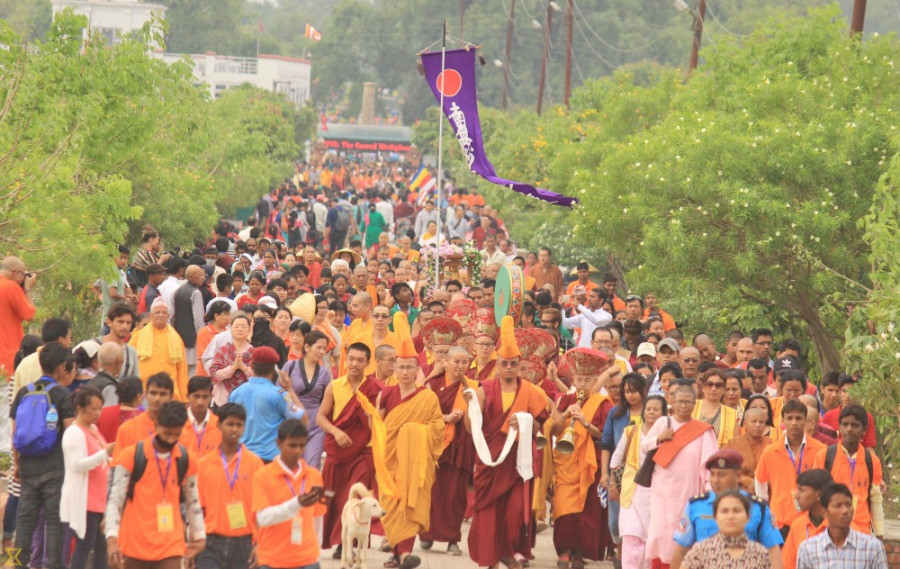
Meditation and Spiritual Practice at the Monasteries — What’s Available in 2026
Lumbini Hidden Spiritual Places featuring Maya Devi Temple, Ramagrama Stupa, Tilaurakot, Devdaha, and ancient Buddhist monasteries

MonasteryPractice TraditionPrograms AvailableDurationLanguage
Korean Buddhist TempleSon (Korean Zen) Buddhism3–7-day meditation retreats; daily sitting sessions open to respectful visitors3–7 daysEnglish / Korean
German Monastery (Drigung Kagyu)Tibetan Vajrayana — Drigung Kagyu lineageShort retreats; meditation hall open to the public; longer retreat arrangements available1 day to 2 weeksEnglish / German / Tibetan
Vietnamese MonasteryVietnamese Mahayana / Pure LandMorning and evening chanting are open to visitors; occasional weekend retreats are available.Day visit or stayVietnamese / English (basic)
Thai MonasteryTheravada — Thai traditionMorning chanting (6:00–7:00 AM) is open to visitors; meditation guidance is availableDay visitThai / English (basic)
Sri Lankan MonasteryTheravada — Sri Lankan traditionMeditation instruction available; monks accept visiting studentsFlexiblePali / Sinhala / English
Lumbini Meditation CCentre(LBCR)Multi-tradition / secular10-day Vipassana retreats; day and weekend mindfulness programs10 days (Vipassana) or 1–2 daysEnglish

Part Three: The Hidden Sacred Outer Circuit — 62 Sites Beyond the Tourist Path

Why the Outer Circuit Matters — Understanding the Full Sacred Landscape

The Lumbini Development Zone’s 4.8 km × 1.6 km footprint contains what most visitors see as ‘Lumbini.’ But the archaeological map of the Buddha’s world extends vastly further.

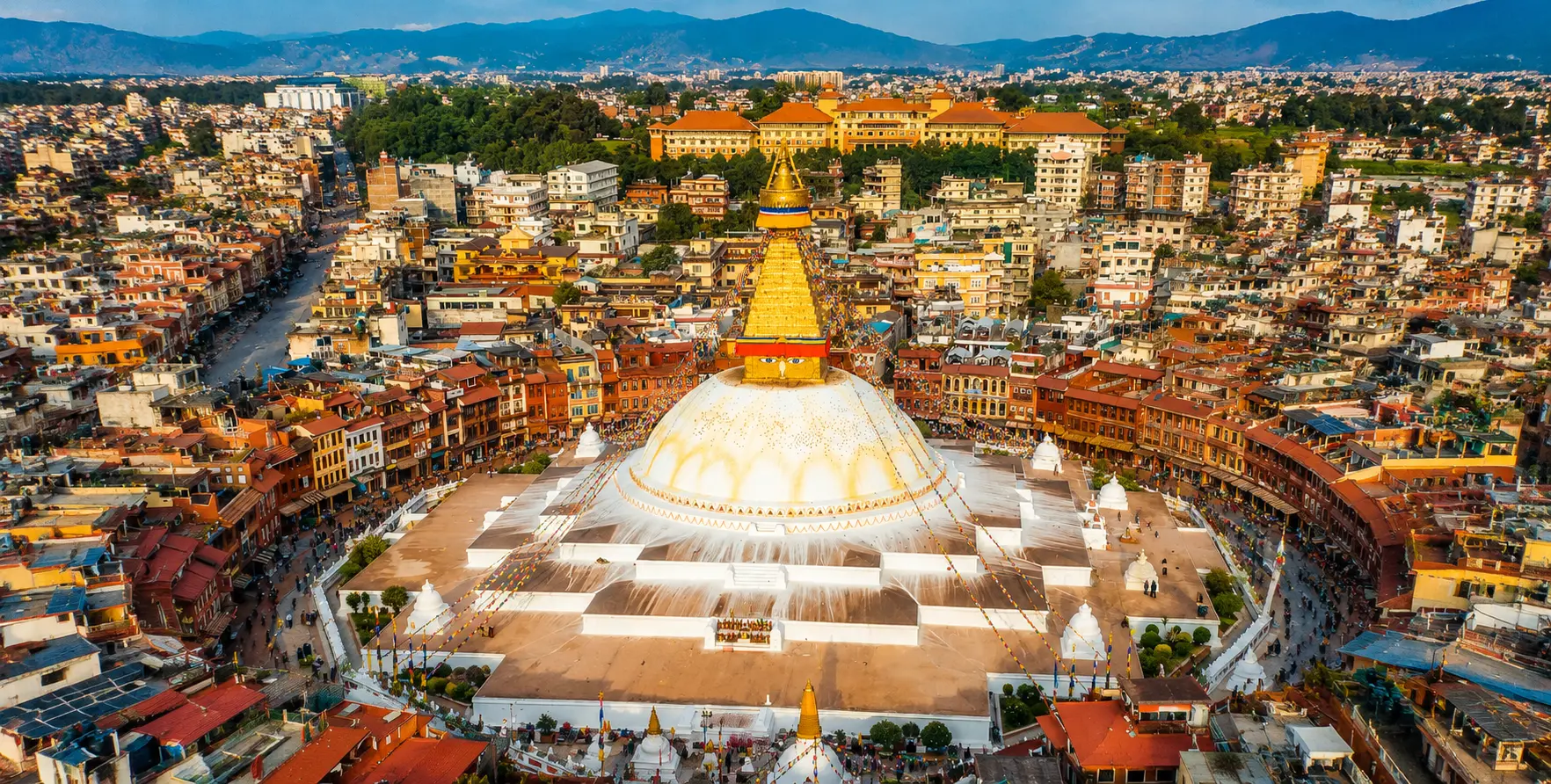
Within a radius of approximately 50 km from the Maya Devi Temple lie the material remains of the Shakya Kingdom — the political and geographic world into which Siddhartha Gautama was born, in which he spent his first 29 years as Prince Siddhartha, and through which his family story, his cultural identity, and the relationships that shaped his biography all played out.

These remains constitute the 62 archaeological sites identified by the Lumbini Development Trust and UNESCO as forming the wider Lumbini sacred landscape. In archaeological terms, this landscape represents the most important concentration of early Buddhist history preserved in any single geographic region.

Understanding what connects these 62 sites is understanding the spatial structure of early Buddhism. The Shakya Kingdom was a small, oligarchic republic (gana-sangha) in the eastern Terai, governed by an assembly of Shakya noble families from its capital at Kapilvastu (modern Tilaurakot).

The Rohini River (to the east, separating it from the Koliya Kingdom) and the Himalayan foothills (to the north) defined its borders. Within this compact political geography,

the entire cast of characters in the Buddha’s biographical narrative lived: his father, King Suddhodhan; his mother,r Maya De; i, his stepmother, Prajapati Gautam; his wife, Yashodhara;, his son, Rahula; his cousins (including the hostile Devadatta and the devoted Ananda); and the Shakya community that King Virudhaka of Kosala would ultimately massacre. The outer sacred circuit visits the places where all of these people lived, where these events occurred, and where the physical traces of this world have been preserved in earth and brick for two and a half millennia.
Lumbini Hidden Spiritual Places featuring Maya Devi Temple, Ramagrama Stupa, Tilaurakot, Devdaha, and ancient Buddhist monasteries

Ramagrama Stupa — The Most Sacred Hidden Site in the Buddhist World

Of all the hidden sacred sites in the Lumbini region, Ramagrama moves visitors most profoundly and powerfully focuses the imagination on the extraordinary historical and spiritual reality of what Lumbini represents. Located approximately 35 km east of Lumbini in the Nawalpur District on the banks of the Jharahi River, the Ramagrama Stupa is a seven-meter-high earthen mound of ancient brick that is, according to both Buddhist textual tradition and modern archaeological evidence, the only one of the original eight stupas built to contain the Buddha’s cremated remains that human hands have never opened.

The history of Ramagrama begins with the death of the historical Buddha at Kushinagar around 483 BCE. After the cremation, eight groups arrived to claim the Buddha’s ashes — the Mallas of Kushinagar (who controlled the cremation site), the Mallas of Pava, the Licchavis of Vaishali, the Shakyas of Kapilvastu, the Bulis of Allakappa, the Koliyas of Ramagrama, the Brahmin Vethadipaka of Vethadipa, and the Moriyas of Pipphalivana.

A Brahmin named Drona supervised the division, keeping the vessel that held the ashes as his own relic. Each group then returned to its capital and built a stupa to house its portion.

Two centuries later, Emperor Ashoka began a program of relic redistribution: he opened seven of the eight original relic stupas, collected the contents, and enshrined them in the 84,000 stupas he is said to have built throughout his empire to spread the Dharma physically across the subcontinent. But he left the Ramagrama Stupa untouched.

The Buddhist text tradition, preserved in Pali, Sanskrit, Chinese, and Tibetan versions, says that when Ashoka arrived at Ramagrama to open the stupa and collect the relics, the nagas (serpent-deities who are guardians of sacred places in both Hindu and Buddhist tradition) appeared before him and demonstrated through miraculous display that they were perfectly capable of venerating the relics themselves — and told Ashoka that his intervention was unnecessary. Ashoka, characteristically respectful of local sacred tradition and the evidence before him, accepted the nagas’ guardianship and departed without opening the stupa.

The result, across two and a half millennia, is the extraordinary reality of Ramagrama today: within the earthen mound visible in a rural field on the Jharahi River bank, there may lie the actual physical remains — the cremated ashes, the bodily relics — of the historical Siddhartha Gautama. One-eighth of the physical remains of one of the most consequential human beings in world history.

The thought is staggering, and no amount of prior intellectual preparation makes it less so when you are standing before the mound itself in the morning light.

Archaeological investigations at Ramagrama — conducted non-invasively, using ground-penetrating radar and other non-destructive methods — have confirmed the ancient nature of the stupa’s brick core and have identified structural elements consistent with Mauryan or pre-Mauryan construction.

The Lumbini Development Trust has made the principled decision not to undertake invasive excavation at Ramagrama, citing both scholarly caution (the risk of damaging or misidentifying what the mound contains) and religious respect for the tradition that the stupa should remain undisturbed. This decision is not universally supported among archaeologists.

Still, it reflects a mature, respectful approach to the intersection of scholarly inquiry and living religious tradition that characterises the best heritage management practice.

The landscape around the Ramagrama Stupa has a particular quality that visitors consistently note and find difficult to describe precisely—a stillness and gravity that feel qualitatively different from those at other sacred sites in the region. The rural setting (rice fields, the Jharahi River, scattered trees, the sound of birds and the distant activity of agricultural life) amplifies rather than diminishes this quality; the earthen mound sits in the actual world, not in a sanitised heritage precinct, and its unassuming presence against the ordinary rural landscape of southern Nepal makes its extraordinary content and history all the more vertiginous in implication.

Ramagrama Access: Distance: ~35 km east of Lumbini | Travel time: 50–60 min by private vehicle | Road: paved main road then rough approach | 4WD jeep recommended for final approach | Entry: Free | Hours: 5:00 AM – 8:00 PM | Nepal Vehicle Hiring Pvt. Ltd. provides dedicated Ramagrama vehicle service — contact WhatsApp
Lumbini Hidden Spiritual Places featuring Maya Devi Temple, Ramagrama Stupa, Tilaurakot, Devdaha, and ancient Buddhist monasteries

Tilaurakot — Where Siddhartha Lived as Prince for 29 Years

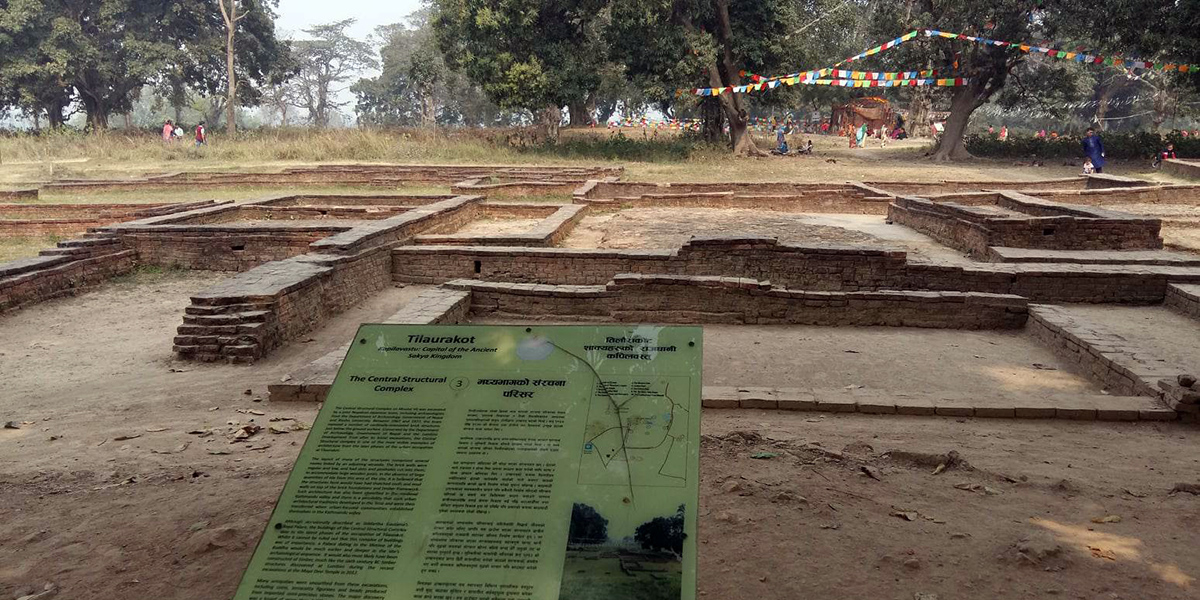
Tilaurakot is the archaeological site identified by the convergent evidence of textual references, coin finds, architectural remains, and comparative topography as the capital of the ancient Shakya Kingdom of Kapilvastu. In this city, the young Siddhartha spent the first 29 years of his life before the Four Sights transformed him, and he undertook the Great Renunciation.

Located about 27 km west of Lumbini, near the town of Taulihawa, Tilaurakot is one of the most historically significant archaeological sites in the Himalayan world and one of the least visited by the international pilgrims who fill the Maya Devi Temple.

The excavated remains at Tilaurakot reveal the physical character of the ancient city: massive fortification walls of rammed earth and brick (the defensive perimeter of the ancient capital), a network of internal structures identified as palace buildings, administrative spaces, and residential quarters, elaborate stupa mounds within and outside the walls erected by later Buddhist devotees to mark sacred sites within the old capital, and the particularly significant remains of the Eastern Gate — the gateway through which, in the biographical narrative, Siddhartha rode out at midnight in his final act of renunciation, leaving behind his wife, his infant son, his father’s kingdom, and the entire comfortable world of his princely existence.

The Eastern Gate of Tilaurakot is the emotional and biographical centre of the entire site. Standing before the excavated foundations of this gateway — knowing what it represents in the most important renunciation narrative in Buddhist tradition — and knowing that you are standing at the approximate physical location of one of the decisive moments in human spiritual history is an experience of quiet intensity that any amount of study or meditation cannot replicate.

The gate through which Siddhartha passed on the night he became the Buddha’s future was this gate, on this ground, under this sky.

Ongoing excavations at Tilaurakot in 2026 continue to reveal the site’s complexity and historical depth. Recent seasons have produced particularly significant coin finds — including pre-Mauryan punch-mark coins of the type circulating in the Shakya Kingdom’s period — along with pottery sequences, architectural phasing data, and structural evidence that progressively refine the chronology of the site’s occupation and the physical character of the ancient capital.

The Tilaurakot archaeological project is one of the most active and productive in South Asia, and the site in 2026 presents an extraordinary combination of excavated past and ongoing discovery.

The Kapilvastu Museum, adjacent to the Tilaurakot site, houses artefacts recovered from excavations — coins, pottery, terracotta figurines, stone sculptures, and miscellaneous archaeological finds spanning from the 7th century BCE to the medieval period. The museum’s collection, while modest by international standards, is historically irreplaceable — material objects from the world of Siddhartha Gautama’s birth, childhood, and early adult life, providing a tactile connection to the Buddha’s biography that no other collection can match.

Tilaurakot Access: Distance: 27 km west of Lumbini | Travel time: 45–60 min | Road: paved throughout | Any vehicle suitable | Entry: Free | Hours: 5:00–17:30 daily | Combine with Kudan, Gotihawa, Niglihawa, and Sagarhawa for full western circuit

Kudan (Nyigrodharama) — The Garden of Reunion

Kudan occupies a unique place in the Lumbini sacred landscape as the site of one of the most emotionally complex and spiritually significant reunions in the entire Buddhist biographical tradition — the return of the enlightened Buddha to the kingdom where he had grown up as Prince Siddhartha, and his meetings with his father the king, his stepmother Prajapati Gautami, his former wife Yashodhara, and most poignantly, his son Rahula whom he had left as an infant on the night of his renunciation and who was now approximately seven years old.

Located about 4.5 km south of Tilaurakot and easily combined into a single day’s itinerary, Kudan was the site of the Nyigrodharama monastery—a great park and Monastery built by King Suddhodhan specifically to receive the returning Buddha. The name ‘Nyigrodharama’ means ‘grove of the Nyigrodha (banyan) tree,’ and the Monastery is named for the banyan tree that stood at its centre, under which the Buddha is said to have first settled upon his arrival in the Kapilvastu area.

The Buddhist texts that describe the events at Kudan are among the most psychologically nuanced in the entire Pali and Sanskrit canonical literature. The meeting between the Buddha and his father, King Suddhodhan — the ageing monarch who had nurtured dreams of his son becoming a world-conquering emperor, only to encounter a wandering mendicant of supreme spiritual authority instead — is presented with remarkable sensitivity to the complexities of paternal pride, grief, and eventual transformation.

Suddhodhan is described as initially unable to prostrate before his son (the traditional greeting between a commoner and a monk). The Buddha’s response — performing a miracle of aerial walking and fire that compelled his father’s eventual prostration — is presented as the specific act required to break the king’s attachment and open his heart to the Dharma.

The encounter between the Buddha and his former wife Yashodhara, and the ordination of his son Rahula, take place within the Nyigrodharama complex at Kudan and are among the most moving scenes in the entire Buddhist hagiographical tradition. Yashodhara, who had maintained strict ascetic practice during her husband’s years of absence, bowed before the Buddha but could not speak.

Rahula, sent by his mother to ask for his ‘inheritance,’ approached the Buddha and asked for what was his — and the Buddha responded by summoning the monk Sariputta and instructing him to ordain the boy, giving him the Dharma itself as his inheritance rather than any material or political legacy.

The current physical remains at Kudan — excavated stupas, the ancient pond (Nyigrodharama pond), and the brick foundations of what were once significant monastic structures — sit in a peaceful rural setting that has retained something of the garden character described in the texts. The Nyigrodharama pond at Kudan, still holding water, still reflecting the surrounding trees, still providing the quiet that makes it one of the most meditative natural spaces in the entire Lumbini region, is the site’s most immediately moving feature.
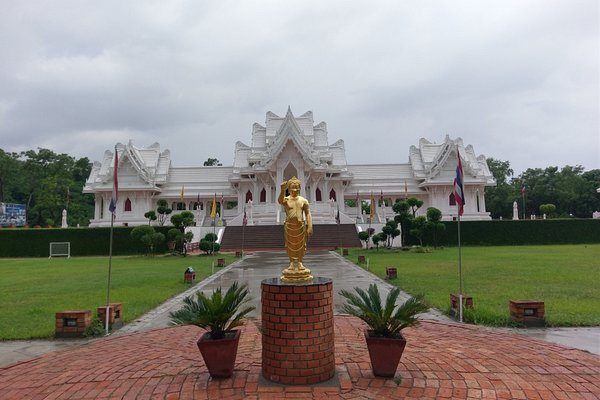
Explore Lumbini Hidden Spiritual Places beyond the Maya Devi Temple, including Ramagrama Stupa, Tilaurakot, Devdaha, Gotihawa, Niglihawa, and other sacred Buddhist heritage site

Devdaha — Queen Maya Devi’s Homeland

Devdaha was the capital of the ancient Koliya Kingdom. It was the neighbouring state of the Shakya Kingdom, separated from it by the Rohini River, and the hometown of Queen Maya Devi, the mother of Siddhartha Gautama.

The significance of Devdaha in the Buddha’s biographical world is profound: this is the place from which Maya Devi set out on the journey that ended at Lumbini with the birth that changed human history; this is the place where the young Siddhartha visited his maternal grandparents; and this is the original home of several women who were central to the biographical world of early Buddhism.

Maya Devi gave birth to Siddhartha while travelling from Kapilvastu to Devadaha; at the time, women returned to their natal home to give birth. The sal grove at Lumbini, where she gave birth, was approximately halfway between the two capitals, and her early labour forced labour forced the birth to happen there rather than in Devadaha as planned.

This detail—that Lumbini was not the planned birth location but an emergency birthplace during travel—lends the sacred site a sense of historical contingency, making the precision of Ashoka’s subsequent identification and marking of the spot even more remarkable.

The town of modern Devdaha preserves traces of the ancient Koliya settlement in its archaeological remains, local temple complexes, and sacred ponds linked to legendary events of Queen Maya Devi’s life. Several Buddhist pagodas and stupas mark sacred sites associated with the Koliya tradition, and the Rohini River still runs, though somewhat diminished from its ancient course, serving as a physical boundary marker that has remained continuous since it separated the Shakya and Koliya kingdoms.

The Buddha himself, in his later teaching career, is recorded as having intervened to prevent a war between the Shakyas and the Koliyas over water rights on the Rohini — a story of extraordinary resonance for our own contemporary world of water conflicts.
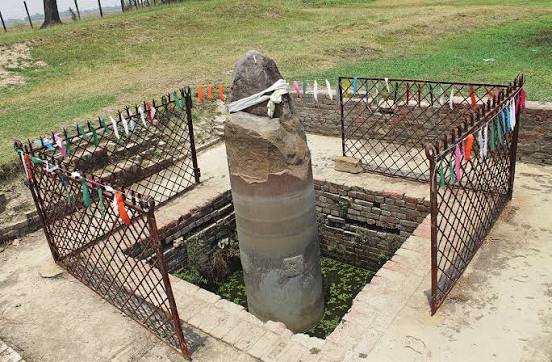
Explore Lumbini Hidden Spiritual Places beyond the Maya Devi Temple, including Ramagrama Stupa, Tilaurakot, Devdaha, Gotihawa, Niglihawa, and other sacred Buddhist heritage sites.

Gotihawa and Niglihawa — The Previous Buddhas’ Sacred Sites

One of the most philosophically fascinating aspects of the Lumbini outer sacred circuit is what it reveals about the Buddhist understanding of time, cosmology, and sacred geography. Buddhist cosmology holds that many Buddhas have arisen across immense spans of cosmic time—beings who achieve complete Enlightenment in succession and teach the Dharma in their respective world-ages.

The texts of the Theravada canon name seven Buddhas of the current cosmic aeon, of whom Shakyamuni (the historical Buddha) is the seventh and most recent. The three immediately preceding Shakyamuni — Vipassi, Sikhi, Vessabhu, Kakusandha, Konagamana (Kanakmuni), and Kassapa — are said to have been born in specific locations, some of which lie within the sacred landscape of the modern Lumbini region.

Gotihawa, located approximately 3 km southwest of Taulihawa (approximately 28 km from Lumbini), is identified in Buddhist textual tradition and confirmed by Emperor Ashoka’s inscribed pillar as the birthplace of Kakusandha (Krakuchanda) Buddha — the first of the three past Buddhas of the present ‘world-aeon’ that includes the historical Shakyamuni. The Ashokan Pillar at Gotihawa — though broken and partially buried — still bears a readable inscription confirming Ashoka’s recognition of the site and his visit to venerate it, along with the remains of a large brick stupa erected to mark the birthplace.

That Ashoka visited and marked not only the birthplace of the historical Buddha but also the birthplaces of previous Buddhas is a remarkable demonstration of how seriously the Mauryan emperor took the Buddhist cosmological framework that extended Buddha-nature across time rather than concentrating it in a single historical figure.

Niglihawa, located about 35 km west of Lumbini, similarly preserves the remains of an Ashokan Pillar marking the birthplace of the sixth Buddha of the current aeon, Konagamana (Kanakmuni) Buddha. The pillar at Niglihawa is particularly historically significant because it bears two separate Ashokan inscriptions: one from the 14th year of Ashoka’s reign and a second from the 20th year, indicating that Ashoka returned to the site a second time to enhance and update his royal dedication.

This double inscription is unique among the surviving Ashokan pillars and reveals the exceptional importance that Ashoka placed on this particular sacred site.
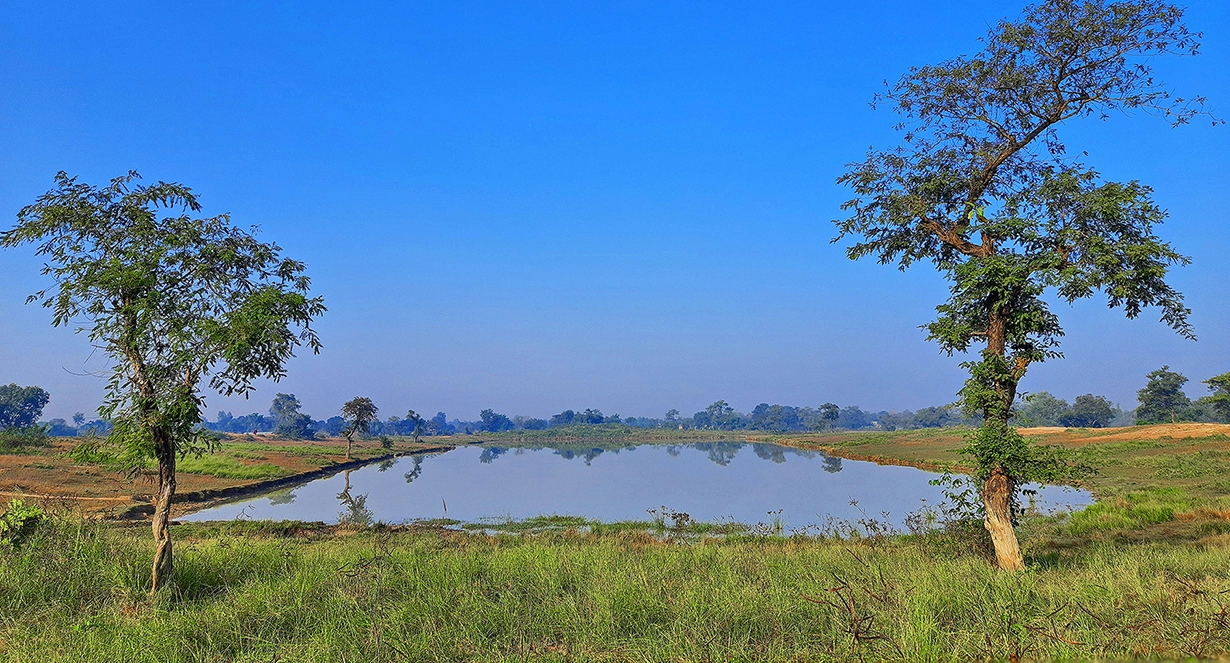
Explore Lumbini Hidden Spiritual Places beyond the Maya Devi Temple, including Ramagrama Stupa, Tilaurakot, Devdaha, Gotihawa, Niglihawa, and other sacred Buddhist heritage sites.

Sagarhawa — Where the Shakya World Ended

Sagarhawa is the most historically sobering site in the entire Lumbini outer circuit — the location identified by archaeologists and the Buddhist textual tradition as the site of the devastation of the Shakya community ordered by King Virudhaka of Kosala late in the historical Buddha’s life. Understanding Sagarhawa requires understanding the extraordinary tragic arc of the final years of the Buddha’s own tribe.

The texts trace the origin of the massacre to a specific act of deception during the marriage negotiations between King Prasenajit of Kosala and the Shakya nobles. When Prasenajit requested a Shakya woman as his principal queen, the Shakya nobles — proud of their lineage and resistant to giving a genuine noble daughter in marriage to an outsider — sent a slave woman of exceptional beauty, Vasabha-khattiya, passing her off as a Shakya noble.

The deception succeeded: Vasabha became queen, and her son by Prasenajit became Prince Virudhaka. When Virudhaka, as a young man, visited the Shakya capital and discovered the truth of his mother’s origins — that the Shakyas considered him of low birth and had been contemptuous of him during his visit — he swore vengeance. He harboured his grievance for years until he became king.

When Virudhaka finally led his army against Kapilvastu, the aging Buddha — at this point in his 70s and spending what would be his final years travelling between the major cities of the Gangetic plain — is said to have intervened three times: sitting beneath a withered tree on the road in the direct path of the advancing army. Three times, Virudhaka stopped his army out of respect for the Buddha.

Three times, the Buddha explained that he sat beneath the withered tree because the Shakya family had no shelter. And three times the army turned back — but the fourth time, Virudhaka came again, and the Buddha did not appear, and the army swept forward to massacre the Shakya people.

Archaeologists identify the massacre site at the great fortified settlement beside the pond known as Lumbini —as Sagarhawa, about 35 km west of Lumbini. Several stupas in the vicinity were erected to honour the memory of those who died, and the large rectangular pond at the heart of the site has associations in local tradition with the blood of the Shakya dead that give it a quality of historical darkness uncommon in a landscape otherwise defined by the luminous narrative of Buddhist Enlightenment.

Standing at Sagarhawa, looking over the old pond toward the earthen mounds that represent the ruins of the ancient fortification, it is possible to feel the weight of the tragic history that ended here — the destruction of the world that gave birth to the Buddha, the annihilation of the community whose very existence had made his biography possible.

Part Four: Complete Practical Guide for Spiritual Seekers

Crafting Your Lumbini Itinerary — Day by Day

DayFocusSitesFirst ActivityKey Experience
Day 1Inner Sacred ZoneMaya Devi Temple, Pushkarni, Ashokan Pillar, Eternal Flame, World Peace Pagoda5:00 AM Sacred Garden at dawnDawn meditation at Maya Devi Temple — before the crowds arrive — is the most moving experience in Lumbini.
Day 2West Monastic Zone deep diveGerman Monastery (full interior), Thai Monastery, Myanmar Temple, Vietnamese Monastery, French Stupa6:00 AM Thai Monastery morning chantingMorning chanting at Thai Monastery — gold hall, Pali chanting, dawn light
Day 3East Monastic Zone + meditationSri Lankan Monastery, Cambodian Monastery, Korean Temple (meditation session), Lumbini Museum9:00 AM Korean Temple meditationKorean Son meditation session — one of Lumbini’s most accessible retreat experiences
Day 4Western Sacred CircuitTilaurakot, Kudan, Gotihawa, Niglihawa, Sagarhawa, Kapilvastu Museum8:00 AM departure from LumbiniStanding at Tilaurakot East Gate — biographical heart of the Buddha’s story
Day 5Eastern Sacred CircuitRamagrama Stupa, Devdaha7:00 AM departure from LumbiniRamagrama Stupa — the only original Buddha relic stupa, never opened in 2,500 years.
Day 6Deep Reflection and ResearchLIRI Library, Lumbini Development Trust, meditation practice, monastery guest houseFlexibleLIRI reading room — the world’s premier specialist library for Buddhist studies in this sacred setting

Explore Lumbini Hidden Spiritual Places beyond the Maya Devi Temple, including Ramagrama Stupa, Tilaurakot, Devdaha, Gotihawa, Niglihawa, and other sacred Buddhist heritage sites.

Deeper Reading — Understanding What You Are Visiting

The Lumbini outer sacred circuit rewards visitors who arrive with prior reading in Buddhist history, archaeology, and biographical tradition. The following books are specifically recommended for deepening the Lumbini experience:

  • ‘Old Path White Clouds’ by Thich Nhat Hanh — A beautifully written narrative retelling of the Buddha’s life story, drawn from the Pali sutras and presented as a readable, vivid historical narrative. Reading this before visiting Lumbini and Tilaurakot transforms every site from an archaeological location to a living scene from a biography.
  • ‘In the Buddha’s Words,’ edited by Bhikkhu Bodhi — An anthology of Pali canon teachings in translation, organised thematically. Reading the early sutras relating to the Buddha’s time in the Kapilvastu region — his meetings with his father, the ordination of Rahula, the return to Devdaha — while visiting those locations creates an unusually direct connection between text and landscape.
  • ‘Lumbini: The Birthplace of the Lord Buddha’ by UNESCO — The official archaeological and heritage documentation of the Lumbini site and its wider sacred landscape. Essential background for understanding the site’s archaeological complexity and the ongoing excavation work.
  • ‘Ashoka and the Decline of the Mauryas’ by Romila Thapar — The definitive scholarly account of Ashoka and his pilgrimage program, essential for understanding the full significance of the Ashokan pillars at Lumbini, Niglihawa, Gotihawa, and throughout the sacred landscape.
  • ‘Power of the Buddha’ by John Snelling — A comprehensive biography of the historical Buddha drawing on the complete range of early Buddhist textual sources, with detailed treatment of the geographical setting of the Sakya Kingdom world.

Food and Accommodation Near the Hidden Sites — Practical 2026 Information

Accommodation in the Lumbini area ranges from monastery guesthouses within the Monastic Zone to commercial hotels in the Lumbini bazaar area and the larger town of Bhairahawa (Siddharthanagar), approximately 22 km south. For visitors planning to visit the outer sacred circuit sites, basing yourself in Lumbini (within the development zone or nearby bazaar) is more convenient than Bhairahawa, as it saves 45 minutes of additional driving each way.

For visitors arriving late in the evening or departing early in the morning by flight from Gautam Buddha International Airport, Bhairahawa offers better commercial hotel options.

  • Monastery guesthouses (within Monastic Zone): NPR 1,500–3,000/night, vegetarian meals, peaceful location. Korean, German, and Vietnamese monasteries all accept spiritual visitors. Advance contact is essential.
  • Lumbini bazaar area hotels: NPR 2,500–6,000/night for mid-range rooms. Several options within 1–2 km of the main Sacred Garden entrance. Convenient for early morning Sacred Garden access.
  • Buddha Maya Garden Hotel and similar: Higher-end Lumbini-area accommodation at NPR 6,000–12,000/night. Well-maintained, good restaurants, closest to the development zone of the former hotels.
  • Bhairahawa commercial hotels: NPR 4,000–10,000 for mid-range; up to NPR 18,000+ for business-class rooms. Better range but 22 km from Lumbini. Best for flight-connection travellers.

Food near the hidden outer sites: Tilaurakot, Kudan, Gotihawa, Niglihawa, and Sagarhawa are all in rural areas with few or no restaurants. Pack lunch and enough water before leaving Lumbini for the outer circuit. Several small teahouses and dhaba-style restaurants operate on the road between Lumbini and Taulihawa and can provide dal bhat or simple snacks in the Taulihawa town area.

Essential Etiquette for Lumbini’s Hidden Spiritual Places

  • Remove footwear before entering the Sacred Garden, Maya Devi Temple, and all monastery buildings — shoe storage is provided at entrances.
  • Dress modestly at all sites — shoulders and knees covered for both men and women. Many monasteries display signs to this effect. Lightweight shawls or scarves are useful cover-ups for tanks and shorts.
  • No photography inside the Maya Devi Temple inner sanctum — signs and guards enforce this rule. Photography is generally permitted in monastery grounds but not always inside prayer halls — check signs or ask.
  • Maintain silence in the Sacred Garden and near the Maya Devi Temple — this is a living place of prayer, not a heritage museum. Phone calls and loud conversation are deeply disrespectful to praying pilgrims.
  • Circumambulate all stupas clockwise (keeping the stupa to your right as you walk). This applies to both the Maya Devi Temple complex and the Ramagrama Stupa.
  • At the outer archaeological sites, stay on marked paths and do not climb on or touch the ancient brick structures. These fragile two-thousand-year-old remains in a tropical climate deteriorate faster with physical contact.
  • At Sagarhawa and sites with historical associations with tragedy and violence, maintain a respectful, contemplative attitude. These are places of deep historical sorrow as well as Buddhist sacred significance.
  • Donations at monasteries: A small donation (NPR 100–500) at monastery donation boxes acknowledges the community’s maintenance of the sacred space and is appreciated. Donations are always discretionary.
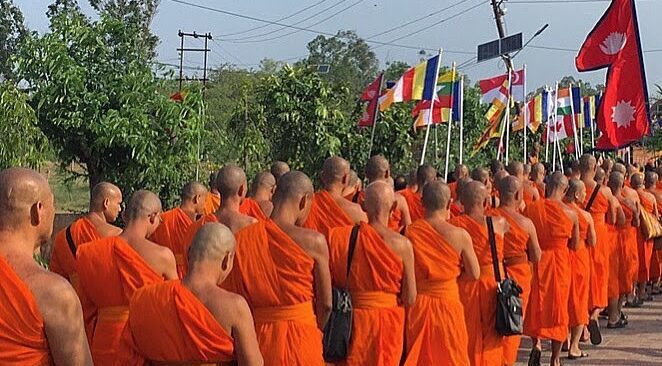
Explore Lumbini Hidden Spiritual Places beyond the Maya Devi Temple, including Ramagrama Stupa, Tilaurakot, Devdaha, Gotihawa, Niglihawa, and other sacred Buddhist heritage sites.

Frequently Asked Questions — Lumbini’s hidden spiritual places.

What is the single most important hidden site at Lumbini that most visitors miss?

Ramagrama Stupa, located approximately 35 km east of Lumbini, is the most historically significant and spiritually profound hidden site in the wider Lumbini sacred landscape. It is the only of the original eight stupas built after the Buddha’s death to contain his cremated remains that has never been opened—making it the oldest continuously preserved Buddhist sacred object in the world and the only site where the historical Buddha’s physical remains may still be present.

The site requires a private vehicle to reach. It is about an hour’s drive from Lumbini, but standing before this unremarkable earthen mound, knowing what it may contain and what it certainly represents, is one of the most moving experiences available to any Buddhist pilgrim.

How many days do I need to see all the important hidden sites?

You need at least 4 full days to do justice to both the inner sacred zone of Lumbini and the most significant outer sites. Day 1: Dawn sacred garden visit + Inner Monastic Zone. Day 2: Complete Monastic Zone (all 32+ monasteries).

Day 3: Western outer circuit — Tilaurakot, Kudan, Gotihawa, Niglihawa, Sagarhawa (full day by vehicle). Day 4: Eastern outer circuit — Ramagrama Stupa and Devdaha (half to full day by vehicle).

An additional 1–2 days for meditation retreat activities, the LIRI Library, and more contemplative engagement with the sites already visited would complete an ideal Lumbini pilgrimage.

Is the Tilaurakot site definitely the capital of ancient Kapilvastu?

Convergent evidence from multiple scholarly disciplines supports identifying Tilaurakot as ancient Kapilvastu—the capital of the Shakya Kingdom and the site of the Buddha’s childhood palace. Archaeological evidence (coin types, pottery sequences, architectural phasing), epigraphic evidence (nearby Niglihawa’s Ashokan pillar marking locations consistent with Tilaurakot being Kapilvastu), textual evidence (distances between sites mentioned in ancient texts matching the current geography), and topographical evidence (Tilaurakot’s location relative to Lumbini and other identified sites) all point to the same identification.

While alternative identifications have been proposed (most notably the site of Piprahwa in the Indian state of Uttar Pradesh), scholarly consensus strongly favours Tilaurakot as ancient Kapilvastu.

Can I attend meditation retreats at Lumbini monasteries as a non-Buddhist?

Yes—several international monasteries in the Lumbini Monastic Zone offer meditation programs explicitly open to non-Buddhist participants. The Korean Buddhist Temple’s meditation retreat programs are specifically designed for international participants and are taught in English without religious preconditions. The German Monastery (Drigung Kagyu) accepts retreat visitors of any background who come with a genuine spiritual interest.

The Lumbini Buddhist Circuit Research (LBCR) centre runs secular Vipassana retreats in the Theravada insight meditation tradition. All programs require advance contact and registration.

How do I get from Kathmandu to Lumbini?

The most popular option is a domestic flight from Tribhuvan International Airport (Kathmandu) to Gautam Buddha International Airport (Bhairahawa)—about 35 minutes of flying time, with multiple daily flights by Buddha Air and Yeti Airlines (NPR 9,000–18,000 per person in 2026). From Bhairahawa Airport, Nepal Vehicle Hiring Pvt. Ltd. provides airport pickup and transfer to Lumbini (approximately 22 km, 45 minutes).

Alternatively, you can hire a private vehicle from Kathmandu to Lumbini (approximately 330 km, 7–8 hours) — Nepal Vehicle Hiring provides this service in Cars, 4WD Jeeps, and Hiace Vans. Contact our team on WhatsApp or vehiclehiringnepal.com to arrange transport.

Are the outer sacred circuit sites accessible during monsoon season?

Most of the outer sacred sites are accessible during the monsoon (June–September) with appropriate caution and a suitable vehicle. The main roads to Tilaurakot, Kudan, and most western circuit sites are paved and manageable in rain.

Some final approach roads to Gotihawa, Sagarhawa, and sections near Ramagrama can become muddy in heavy rain and require a 4WD vehicle. The spiritual experience at the outer sites during monsoon has a particular quality — the lush green landscape, the atmospheric mist, and the absence of other visitors create a contemplative setting of unusual depth.

Nepal Vehicle Hiring Pvt. Ltd. recommends a 4WD Fortuner or Hilux for outer circuit visits during monsoon and monitors road conditions to advise clients on current access.

What is the Lumbini Master Plan and how does it affect what I can see?

The Lumbini Master Plan, designed by Japanese architect Kenzo Tange in 1978 under UNESCO auspices, defines the spatial organisation of the entire Lumbini Development Zone — the 4.8 km × 1.6 km protected area within which the Lumbini Development Trust regulates all development. The plan allocated plots within the Monastic Zone to Buddhist nations and organisations, established the central canal as the organising spatial axis, defined the Sacred Garden as the primary protected archaeological zone, and created the New Lumbini Village as the service infrastructure zone south of the main complex.

The Master Plan has been only partially realised — as of 2026, approximately 32 of the 42 allocated monastery plots have been developed, and several plots remain under construction or in planning. The plan does not address the outer sacred circuit sites (Ramagrama, Tilaurakot, etc.), which the Lumbini Development Trust manages separately in collaboration with the Department of Archaeology.
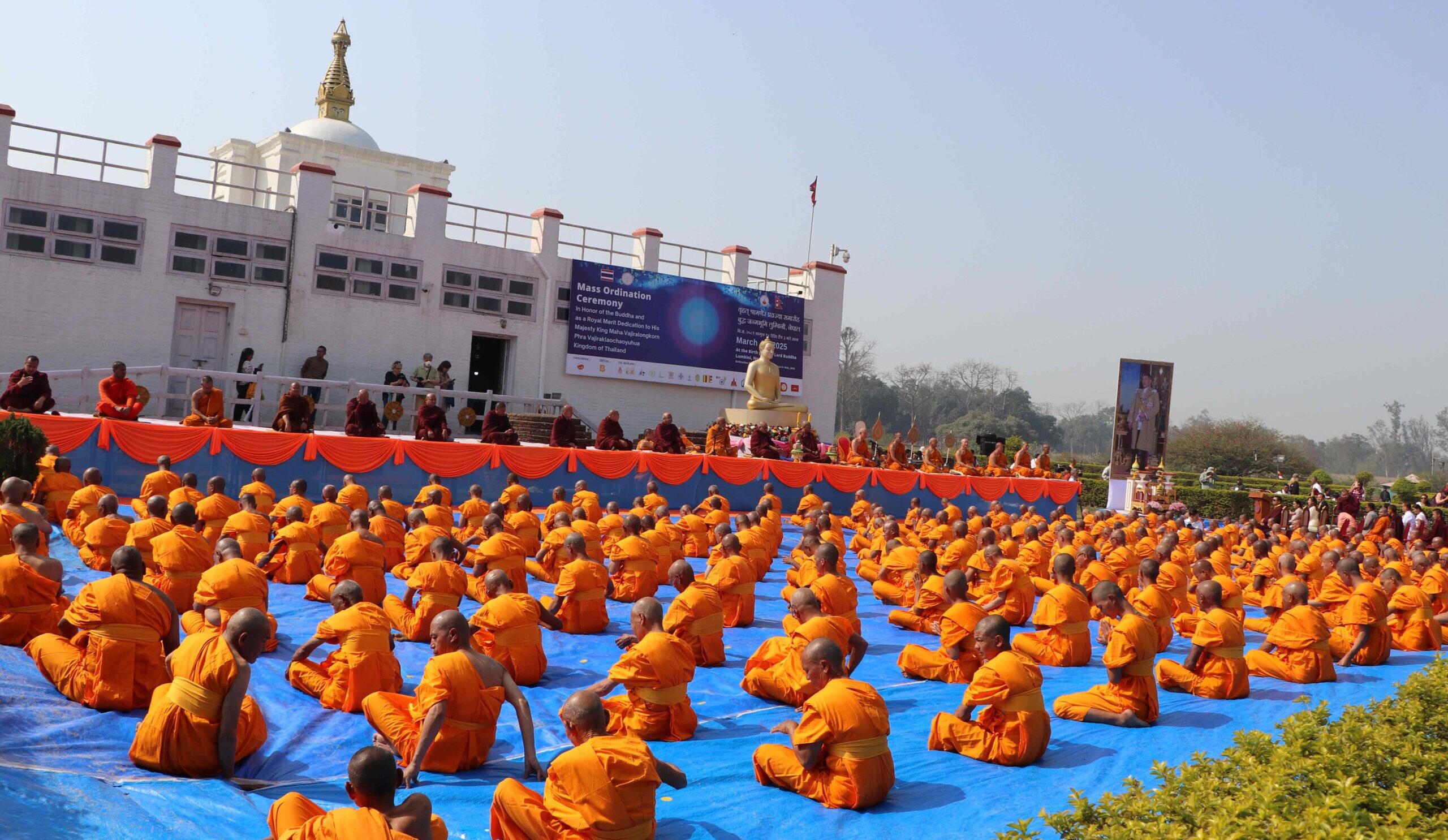
Lumbini Hidden Spiritual Places featuring Maya Devi Temple, Ramagrama Stupa, Tilaurakot, Devdaha, and ancient Buddhist monasteries

Conclusion: The Lumbini That Changes Everything

There are two Lumbinis. The first — the one that tour operators describe, that travel guides summarise in two pages, that Instagram presents in golden-hour photographs of the gleaming World Peace Pagoda — is extraordinary: the Maya Devi Temple marking the exact birthplace of one of history’s greatest spiritual figures, the Ashokan Pillar providing one of the world’s oldest and most important archaeological inscriptions, and the Monastic Zone offering a remarkable walking survey of Buddhist traditions from thirty nations. This first Lumbini is genuinely first-rate and genuinely moving.

The second Lumbini — the one that requires a private vehicle, some planning, a willingness to leave the paved tourist path for the rural roads of the Rupandehi and Kapilvastu districts, and the imaginative and intellectual effort to see what the modest earthen mounds and scattered brick foundations of the outer sites truly represent — is something of a different order entirely. This second Lumbini is where you stand before the only stupa in the world that may contain the Buddha’s actual remains and feel the weight of 2,500 years of preserved sanctity.

It is where you walk through the excavated East Gate of Tilaurakot — the gate through which Siddhartha rode out at midnight on the night of his Great Renunciation — and feel the biographical reality of the Buddha’s life story with an immediacy that no amount of scripture reading can replicate.

It is where the broken Ashokan Pillar in a Niglihawa rice field, forgotten by most tourists, speaks more eloquently about the world of the Buddha than any museum exhibit. It is where the old pond at Sagarhawa, in its melancholy rural setting, reminds you that the very human violence eventually destroyed the world that produced the Buddha, whom he spent his life addressing — and that this makes his achievement of compassion and wisdom not less but more extraordinary.

To visit both Lumbinis — to experience the sacred core in full depth and the hidden outer circuit with genuine attention — is to undergo a spiritual Education that permanently changes your relationship to the Buddha’s story and to the possibility of human wisdom. It is neither a comfortable nor an efficient journey.

It requires time, planning, physical engagement with sometimes remote and unassuming sites, and the willingness to sit with the profound discomfort of historical and spiritual reality presented without comfortable heritage packaging. But for those who make it, it is one of the most significant journeys available to any human being in the world today.

Nepal Vehicle Hiring Pvt. Ltd. is the transport partner that makes this complete Lumbini journey possible — providing professional, reliable, and comfortable vehicle service to every inner and outer sacred site in the Lumbini spiritual landscape. From a 5:00 AM dawn drive to the Sacred Garden to a full-day western circuit through the Tilaurakot archaeological landscape to the deeply moving rural path to Ramagrama Stupa, we are with you at every stage of the most profound journey available in Nepal.

Contact our team today. The hidden Lumbini is waiting.

For travel, trekking, and Annapurna region journeys, we recommend the Annapurna region journey with our trusted sister companies, Trek Nepal Himalayas and Alpine Luxur. We specialise in luxury. We offer a wide range of experiences across Nepal, from classic trekking adventures to cultural and wildlife tours.

Our top offerings include iconic journeys such as the Everest Base Camp helicopter tour, in-depth Kathmandu sightseeing tours, striking Nagarkot sunrise experiences, exciting Chitwan jungle safaris, and luxury packages. We can also arrange short hikes, heritage tours, mountain flights, and customised travel plans tailored to your schedule and interests.

Whether you are looking for a budget-friendly trip or a luxury trekking experience with top-end lodges, private guides, and high-end services, we handle every detail professionally. Our goal is to provide a smooth transition from your trekking adventure to a comfortable) and a memorable travel experience in Nepal.
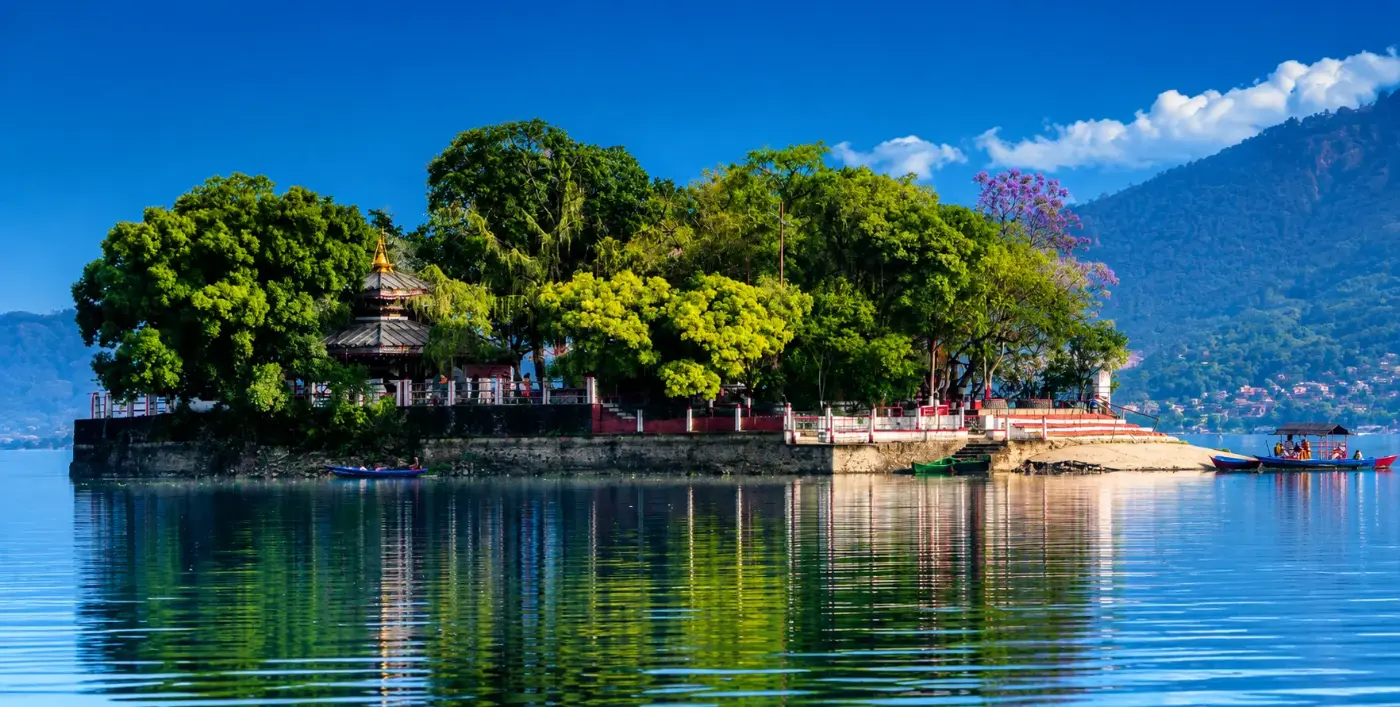
Pokhara Historical and Spiritual Places: The Complete Travel and Transport Guide

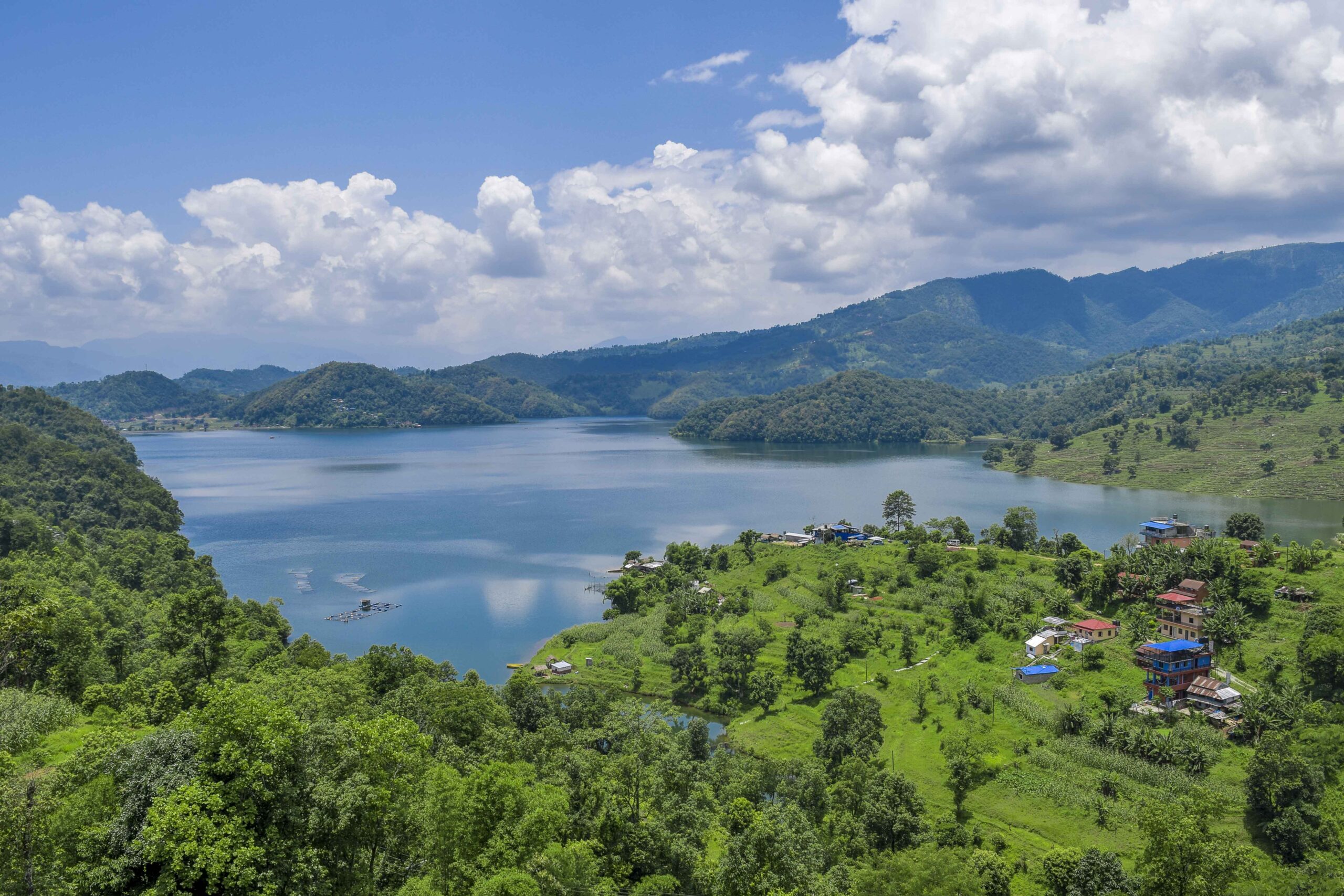
Begnas Lake Pokhara

Pokhara Historical and Spiritual Places – The Complete  Travel and Transport Guide

Most visitors who arrive in Pokhara come for the view — the mirror-still surface of Phewa Lake reflecting the soaring white triangle of Machhapuchhre, the Annapurna range filling the entire northern horizon with an improbable wall of ice and rock. This view, experienced from the Lakeside promenade at dawn or the Sarangkot ridge at sunrise, is one of Asia’s great visual experiences and fully deserves the international reputation that draws hundreds of thousands of travellers to Pokhara each year.

But Pokhara is not, and never has been, only a landscape. It is also a city of genuine historical depth, of ancient temples with origin stories reaching back to the Kaski kingdom that ruled this valley for centuries before Prithvi Narayan Shah’s unification, of sacred caves where Shiva’s presence is said to have been continuously worshipped since before recorded time, of Buddhist monasteries preserving Tibetan culture in exile since 1959, and of a living folk-religious tradition that imbues its lake, its hills, its rivers, and its very geography with spiritual significance.

The historical and spiritual dimensions of Pokhara are, in many ways, the city’s best-kept secret. The modern tourist strip of Lakeside—with its paragliding launches, coffee shops, trekking agencies, and boutique hotels—is less than sixty years old, a product of the post-1960s trekking boom.

Beneath and behind it lies a Pokhara of a much older identity: a Newari trading town of the Kaski kingdom, a waystation on the India-Tibet salt trade route, a city whose most important landmarks are not viewpoints but temples, not adventure start points but pilgrimage sites. This guide explores the deeper Pokhara, documenting its historical and spiritual sites in careful detail and explaining how a private vehicle hire from Vehicle Hiring Nepal makes exploring the full scope of the city’s cultural landscape easy, comfortable, and richly rewarding.

Pokhara and the Kaski Kingdom — A Historical Foundation

The Pokhara Valley lies in the heart of what was historically the Kaski Kingdom — one of the Baize Rajya (twenty-two kingdoms) that fragmented what is now western Nepal during the medieval period. The Kaski kings, ruling from their palace at Kasthamandap in the town of Kaski (not to be confused with Kathmandu’s Kasthamandap), maintained authority over the Pokhara valley and the surrounding trade routes as part of a larger western hill political geography that also included the kingdoms of Parbat, Lamjung, Tanahun, and Gorkha.

Pokhara’s importance as a human settlement derived originally not from its scenic beauty but from its position on the trans-Himalayan trade network. The valley sits at a natural junction where goods moving between the Indian plains and the Tibetan plateau passed through on their way north via the Kali Gandaki gorge and the Mustang corridor.

Salt from Tibet, wool, and animal products moved south; grain, manufactured goods, and devotional items moved north. Pokhara’s Old Bazaar — the area around Bindhyabasini temple — was the commercial and cultural heart of this trade.

In this market town, Newar merchants who had migrated west from the Kathmandu Valley established the trading networks that would define the city’s pre-modern economy.

The Kaski kings ruled this valley until Prithvi Narayan Shah’s unification campaign absorbed it in the 1780s, just over a decade after he captured Kathmandu. The kingdom’s religious and cultural legacy survives most visibly in the temples and sacred sites the Kaski rulers established or patronised—Barahi, Barahi, and others—which remain active centres of Hindu devotion today.

Most of Pokhara’s old city was destroyed in a catastrophic fire in 1949 that locals say started at the Bindhyabasini temple and consumed much of the Old Bazaar. This tragedy wiped out many physical records of the Kaski-period city.

Still, the temples themselves, rebuilt on their original sites, preserve the continuity of the devotional traditions that preceded the fire.

Bindhyabasini Temple — Pokhara’s Oldest and Most Sacred

Location: Mohariya Tole, Old Bazaar area, Pokhara — on a small hillock 3,002 feet (915 m) above sea level

Deity: Goddess Bindhyabasini — an incarnation of Durga/Kali, the guardian deity of Pokhara city

Age: Established in the 17th–18th century (over 300 years of documented worship)

Architecture: White octagonal shikhara-style temple with dome, golden carved metal gate, two golden lions at the entrance

Daily Puja: Nitya Puja begins at 4:00 AM daily; devotees may enter after 5:30 AM

Entry: Free (no entry fee); NPR 20 car park fee; donations welcome

Pokhara Historical and Spiritual Places

Bindhyabasini Temple is the oldest, most revered, and most historically rooted sacred site in Pokhara — the city’s spiritual anchor, the temple from which the Settlement of Pokhara grew outward, and the goddess the local community understands as the guardian deity and protector of the entire valley. Understanding the city’s spiritual geography begins here.

The temple’s origin story blends myth and documented history in the characteristically Nepali way. According to one primary account, King Siddhi Narayan Shah of Kaski visited Vindhyachal mountain in Uttar Pradesh while on pilgrimage in India. In this region, people worship the original Bindhyabasini (Vindhyavasini) goddess.

Deeply moved by the goddess’s power, he sent trusted men to retrieve her sacred image and bring it to Pokhara. During the return journey, the bearers made camp on the hillock in what is now the Mohariya Tole area.

The following morning, the goddess’s image could not be lifted from the ground—a divine sign universally interpreted in Nepali religious tradition as the goddess choosing her own abode. The temple was established on there, and the goddess has been worshipped there ever since.

An alternative version attributes the foundation to King Khadgaman Malla of Parbat, who had a similar divine directive. Both accounts agree on the essential elements: the goddess’s image was brought from Vindhyachal, India; she chose her own location by becoming immovable; and the Kaski kingdom established her temple on that chosen site.

The multiplicity of founding accounts is itself characteristic of major Nepali sacred sites, reflecting the convergence of several devotional communities’ claims to the site’s sanctity over time.

The goddess dwells in the temple not as a sculptural image in the conventional sense but as a Shaligram — a sacred ammonite fossil from the Kali Gandaki River regarded throughout the Hindu tradition as a natural manifestation of Vishnu, and here specifically of the Divine Mother in her fierce aspect. This aniconic, geological form of the divine — older than any human image, shaped by the river and the earth over millions of years — gives the goddess’s presence at Bindhyabasini a quality of primordial authority that no carved idol could replicate.

The Temple Complex

The main Bindhyabasini temple sits on a raised platform surrounded by a park-like compound that includes a remarkable collection of smaller shrines dedicated to the Hindu pantheon: Saraswati (goddess of learning and the arts), Hanuman (the monkey-god of devotion and strength), Shiva (in his Lingam form), Vishnu with Lakshmi, Ganesh (the elephant-headed remover of obstacles), and Jogi Paati — a rest house for wandering ascetics (jogis). On the opposite side of the compound sits the Krishna Mandir, where Krishna Janmashtami (the birthday of Lord Krishna) is celebrated annually with great devotion.

Pokhara Historical and Spiritual Places

The main white octagonal temple, built in the Shikhara style with a distinctive dome, creates a visually striking contrast with the more common pagoda-style temple architecture found elsewhere in Nepal. The octagonal form—rare in Nepali temple architecture—reflects specific geometric principles associated with Tantric sacred architecture, in which the eight directions of space are understood to require ritual acknowledgement and protection.

The golden carved metal gate at the main entrance and the two golden metal lions flanking it are recent additions, reflecting the local Dharmic committee’s ongoing investment in the temple’s physical upkeep.

The view from the temple’s elevated hillock encompasses the entire city of Pokhara spread below to the south and east, with Phewa Lake visible in the middle distance, and, on clear mornings, the Annapurna and Machhapuchhre ranges in spectacular proximity to the north. This combination of spiritual power and physical beauty makes Bindhyabasini’s hilltop one of the finest places in Pokhara to pause and understand the city’s relationship with both its sacred geography and its natural setting.

Festivals at Bindhyabasini

The temple is the focal point of Pokhara’s major Hindu festival calendar. The Navaratri (nine nights of the goddess) is celebrated in both Chaitra (spring) and Ashwin (autumn) and is most significant, featuring nine days of continuous Devi Bhagwat Purana recitation, Durga Bali animal-sacrifice rituals, and Havan (sacred fire) ceremonies.

Maha Shivaratri draws large crowds to the Shiva shrine within the complex. Teej (the women’s festival in August) fills the temple with red-sari-clad women celebrating marital devotion. Krishna Janmashtami brings festivity to the adjacent Krishna Mandir.

Every Saturday — the sacred day of Bhagwati worship in the Nepali tradition — hundreds of devotees arrive from across Pokhara for special puja, and the compound throbs with hymn-singing accompanied by traditional Nepali musical instruments.

Pokhara Historical and Spiritual Places

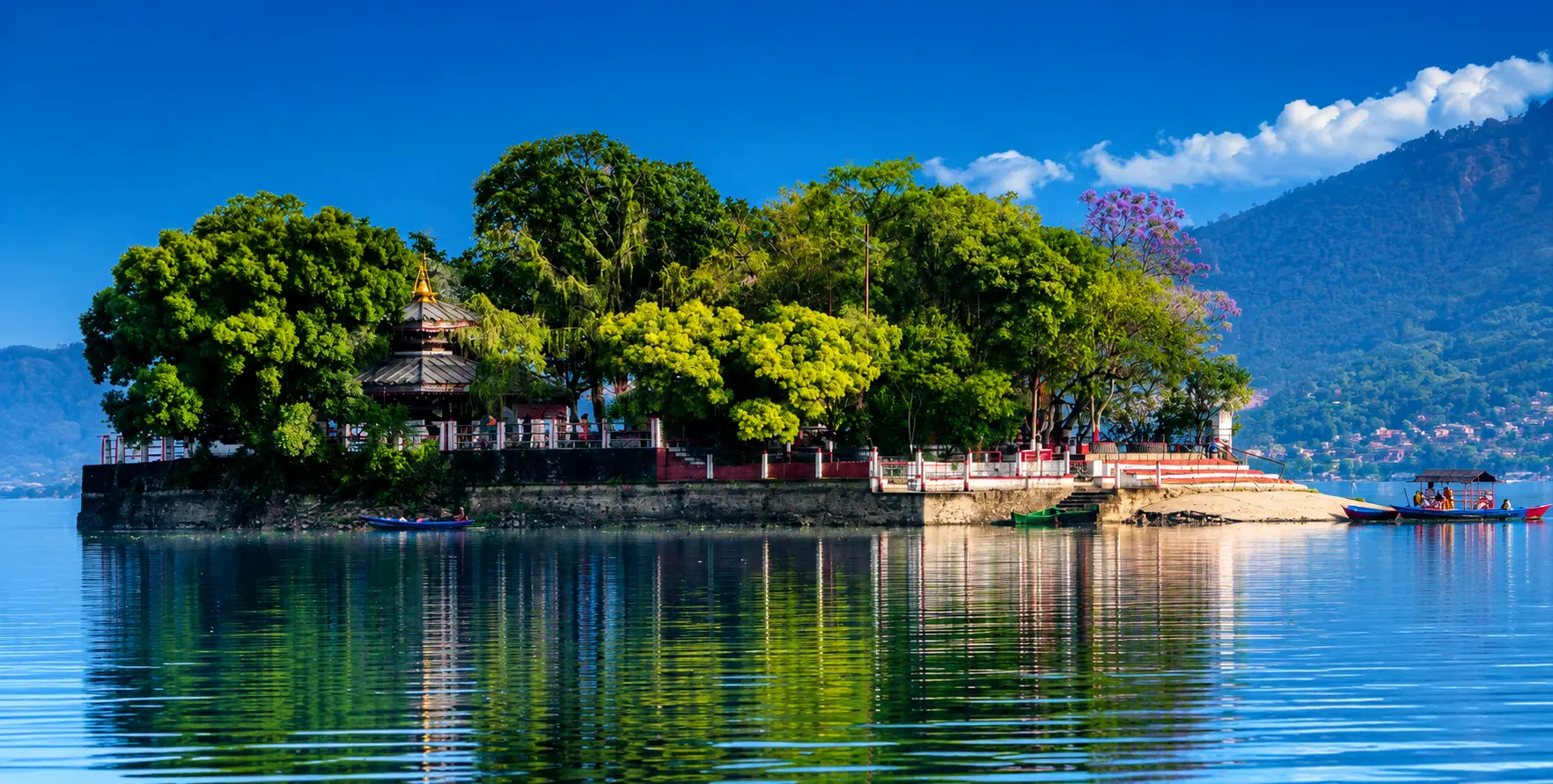
Tal Barahi Temple — The Island Goddess of Phewa Lake

Location: A small island at the centre of Phewa Lake, accessible by a 10- to 15-minute boat ride from the Lakeside boat ghats

Deity: Goddess Barahi — a two-armed incarnation of Durga, specifically associated with boars and protection from water

Age: Founded by the Kaski Kingdom in the 18th century; reconstructed in its current form circa 1971 CE (2017 BS) under King Mahendra

Architecture: Two-story pagoda-style temple in traditional Newari red brick and timber construction

Boat Fare: NPR 50–100 shared boat; NPR 800–1,000 private boat (2026 rates)

Aarti Timings: 7:00 AM and 6:00 PM daily

The Tal Barahi Temple — the Lake Barahi Temple — is arguably Pokhara’s most photographed sacred site and one of the most visually distinctive temple settings in all of Nepal. The small island on which it stands, barely large enough for the temple complex and its surrounding trees, rises from the centre of Phewa Lake like a divine apparition—the two-story red-brick pagoda roofline silhouetted against the Annapurna range on clear mornings in a composition that has become one of Pokhara’s defining images.

Goddess Barahi is a manifestation of Durga, specifically associated with water and Vishnu’s boar form (the Varaha avatar). Her worship on this lake island reflects a specific geographical theology: a powerful goddess installed at the centre of the valley’s largest body of water, ensuring its protection and the safety of those who depend on it.

The Kaski kings who established the temple understood that Phewa Lake was the valley’s most important water resource—feeding the surrounding farmland through its outlet streams—and placing the goddess at its centre was an act of both devotion and practical statecraft.

The boat approach to the temple is itself an essential part of the experience. The 10-to 15-minute row across the lake — in the traditional wooden rowboats that remain the only permitted means of access — lets the temple island grow gradually from a distant silhouette into a detailed sacred space, with the mountain panorama expanding behind it as you move farther from the Lakeside shore.

The reflections of the Annapurna range and Machhapuchhre in the lake’s still morning water, seen from a boat at eye level, are among the most beautiful natural sights in western Nepal.

On the island, devotees remove their footwear and climb the carved wooden steps to the main sanctum, where they worship Goddess Barahi in both anthropomorphic and symbolic forms. The daily aarti at 7:00 AM — lamp flames, bells, and the scent of incense rising over the lake in the morning light — is one of Pokhara’s most serene and spiritually charged moments.

Animal sacrifice, particularly of ducks and goats, is an important element of Barahi worship, especially on Saturdays and during the Dashain festival.

Pokhara Historical and Spiritual Places

Gupteshwor Mahadev Cave — Shiva’s Hidden Sanctuary

Location: Approximately 2 km west of the Davis Falls viewpoint, Pokhara — near the western end of Phewa Lake

Deity: Lord Shiva in his Mahadev (Great God) form, worshipped within a natural limestone cave system.

Cave Length: Approximately 3 km of documented passages; approximately 300–350 m of the main passage is open to public visit

Entry Fee: NPR 100 for Nepali citizens; NPR 300 for SAARC nationals; NPR 500 for non-SAARC foreign visitors (2025–26 rates)

Opening Hours: Daily, approximately 7:00 AM to 6:00 PM

Gupteshwor Mahadev Cave is Pokhara’s most extraordinary natural sacred site — a limestone cavern system of remarkable geological beauty and profound spiritual significance that extends for approximately 33 kilometres through the hillside above the Pardi stream. The cave’s name is perfectly descriptive: Gupt means hidden, and Eshwor is another name for Shiva. The Hidden Shiva.

The sense of encountering the divine in a form that is not immediately visible — present in the darkness of the cave, in the geological formations that devotees read as manifestations of divine energy, in the underground stream that eventually emerges as Davis Falls (Patale Chhango, the Falls of the Underworld) — is precisely what gives Gupteshwor its distinctive spiritual character.

The cave entrance opens at the top of a rocky stairway descending from the road, and the first section is large enough to walk through comfortably before narrowing into passages that require crouching and careful footwork. Artificial lighting illuminates the cave’s geological formations—stalactites, stalagmites, columns, and flowstones built up by centuries of mineral-laden water dripping through limestone—creating a dramatically beautiful underground landscape of dripping stone and reflected water.

At the deepest publicly accessible point of the cave sits the sacred Shiva Lingam  he primary sacred object of the Gupteshwor shrine natural stone formation worshipped as a manifestation of Shiva’s presence since before documented history. The Lingam is perpetually wet from the cave’s interior moisture, a condition regarded as auspicious in Shiva worship — the Lingam is understood to be continuously anointed by the earth itself, requiring no human ritual bathing.

Priests conduct daily puja at this deepest shrine, and the cave’s enclosed acoustics, incense smoke, dripping water, and lingering darkness make worship here profoundly different from any open-air temple.

The connection between Gupteshwor and Davis Falls is one of Pokhara’s most intriguing natural-sacred links. The underground stream that flows through part of the Gupteshwor cave system emerges dramatically at Davis Falls (Patale Chhango). At this underground waterfall, the Pardi stream plunges into a sinkhole, disappears into the earth, and then re-emerges below.

From within the Gupteshwor cave, you can hear and see this underground waterfall at the cave’s deepest accessible point— adding a further dimension of natural drama to the experience of being underground with Shiva. Maha Shivaratri brings the largest annual pilgrimage crowd to Gupteshwor.

Pokhara Historical and Spiritual Places

World Peace Pagoda (Shanti Stupa) — Buddhism Over the Lake

Location: Anadu Hill, south of Phewa Lake, at approximately 1,100 m elevation

Type: Shanti Stupa (Peace Pagoda) — one of 80 such pagodas worldwide, and one of two in Nepal

Builder: Nichidatsu Fujii, Japanese Buddhist monk, founder of the Nipponzan-Myohoji order; local Buddhists assisted

Foundation: Foundation laid 1947; construction began 1973; inaugurated October 30, 1999

Approach: Approximately a 1- to 1.5-hour hike from Lakeside (steep trail through forest); or vehicle access to a point 30 minutes below the stupa; or a short boat ride to the south shore, then hike

Views: 360-degree panorama of Phewa Lake, Pokhara city, and the Annapurna and Dhaulagiri ranges

The World Peace Pagoda on Anadu Hill above the southern shore of Phewa Lake is one of Pokhara’s most architecturally striking landmarks and a major modern Buddhist sacred site. This gleaming white stupa stands on a high ridge with panoramic views across the Pokhara valley, the full extent of Phewa Lake, and, on the clearest days, the full sweep of the Himalaya from Dhaulagiri in the west to Manaslu in the east.

Nichidatsu Fujii (1885–1985), a Japanese Buddhist monk of the Nipponzan-Myohoji order, initiated the Shanti Stupa movement and dedicated his life to building Peace Pagodas worldwide as physical symbols of the Buddhist aspiration toward non-violence and global peace. Fujii had met Mahatma Gandhi in 1931 and been deeply influenced by his philosophy of non-violent resistance; the Peace Pagodas were conceived as a response to the atomic bombings of Hiroshima and Nagasaki in 1945, embodying the Buddhist vow that such violence should never be repeated.

The Pokhara pagoda is one of 80 Shanti Stupas built worldwide by the Nipponzan-Myohoji order.

The stupa is a large white dome in the traditional hemispherical form, surmounted by a golden spire (harmika) and encircled at its base by four gilded Buddha images representing the four directions—the birth, Enlightenment, first teaching, and parinirvana of the Buddha. The platform surrounding the stupa provides the finest 360-degree viewpoint in the entire Pokhara valley at its level, combining the spiritual experience of circumambulating a sacred stupa (clockwise, as is the universal Buddhist practice) with one of Nepal’s finest mountain panoramas.

The hike to the pagoda through the forested Anadu Hill is a significant part of the experience for most visitors — a 1- to 1.5-hour ascent through subtropical forest where rhesus macaques are commonly sighted, birds are abundant, and the increasing elevation gradually reveals the Pokhara valley in its full extent below. The sunrise view from the pagoda platform — the Annapurna range turning gold, the lake still dark below, and the first light catching the white dome — is one of the finest possible beginnings to a Pokhara day.

Pokhara Historical and Spiritual Places

Pumdikot — The Hill of 216 Shiva Lingas and the Giant Shiva

Location: Pumdikot Hill, Pokhara-8, approximately 7 km from central Pokhara

Altitude: Approximately 1,500 m — the highest major sacred site accessible by vehicle in the Pokhara valley

Significance: 216 sacred Shiva Lingas; Shakti Peetha (seat of divine energy); historic Malla, Magar, and Shah dynasty fort and worship site

The Giant Shiva: A 51-meter (167-foot) tall Shiva statue — one of the tallest Shiva statues in the world — was inaugurated in recent years and is visible from across the Pokhara valley.

Pumdikot Hill is one of Pokhara’s most richly layered sacred and historical sites. This high hilltop has served as a military fortification, a Shakti Peetha of concentrated divine energy, a Shiva shrine of ancient origin, and, most recently, the site of one of the world’s tallest Shiva statues, which has transformed Pumdikot into a landmark visible from virtually every point in the Pokhara valley.

The hill’s spiritual identity is defined by its 216 Shiva Lingas — which hold considerable ritual significance in Hindu sacred numerology. The lingas are distributed across the hilltop in a pattern that maps the site’s sacred geography, each an individual object of worship within a larger, integrated devotional landscape.

This density of sacred objects gives Pumdikot a quality different from most individual temple sites: it is less a place with a single divine focus and more a sacred environment in which the divine permeates the entire hillside.

The site’s designation as a Shakti Peetha places it among the most powerful divine feminine sacred sites in the subcontinent—points in the landscape where the concentrated energy of the goddess (Shakti) is understood to reside and be accessible to worshippers in a particularly direct form. During the Malla, Magar, and Shah dynasties, the Bhumeshwor Temple at the summit hosted specific royal rituals for prosperity and military victory — a practice reflecting the understanding that controlling the high ground meant not only a strategic military advantage but also a spiritual one.

The 51-meter Shiva statue at Pumdikot — seated in a meditative posture and visible from across the valley — is the site’s most recent addition and has quickly become one of Pokhara’s most-visited viewpoints for devotees and visitors alike. The view from the statue’s base, encompassing the full Pokhara valley, Phewa Lake, the city, and the unbroken Himalayan wall from Dhaulagiri through Annapurna to Manaslu, rivals anything available from Sarangkot and is considerably less crowded.

Chaitee Dashain in April and Haritalika Teej in September bring the largest festival gatherings to Pumdikot.

Pokhara Historical and Spiritual Places

Pokhara Old Bazaar and the Newari Heritage Quarter

Pokhara’s Old Bazaar — stretching roughly between the Bindhyabasini temple to the north and the Mahendrapul bridge to the south, along what was historically the main trading street — is one of the city’s most historically significant and least tourist-visited areas. The bazaar is not a museum-piece heritage precinct; it is a living market, densely packed with shops selling hardware, textiles, spices, and everyday necessities, whose architectural fabric — stone-paved lanes, multi-story timber-framed houses with carved wooden windows and brick facades — preserves visible echoes of the Newar trading town that occupied this site before the 1949 fire.

The Newar merchant community that settled here from the Kathmandu Valley established Pokhara’s old town as a trade hub, bringing the community organisation, architectural tradition and religious practices, including the construction of the Bindhyabasini and Barahi temples and the festival calendar, that shaped the pre-modern city. Wandering the Old Bazaar’s lanes, past chaityas (small Buddhist shrines) at street corners, water-spout systems (dhara) fed by traditional underground aquifers, and the workshops of traditional artisans, is a form of historical reading unavailable at any formal heritage site.

Among the specific features of the Old Bazaar worth locating are the traditional Newar courtyard houses (bahal-style compounds with inner courtyards), the Bhimsen Mandir (the patron deity of Newar merchants, whose worship was a commercial institution throughout the Kathmandu Valley trading world), and several smaller shrines associated with specific Newar community festivals that are conducted with complete continuity from the pre-modern period but virtually without outside visitors. The Old Bazaar’s morning market, when fresh vegetables, local cheese (churpi), and Pokhara’s own dried fish from Phewa Lake are sold from street-side stalls, is also one of the most authentic daily-life experiences available in the city.

Pokhara Historical and Spiritual Places

Tibetan Refugee Settlements and Buddhist Monasteries

Pokhara hosts some of Nepal’s largest and most culturally significant Tibetan refugee settlements, established following the Tibetan uprising of 1959 and the subsequent flight of tens of thousands of Tibetans across the Himalayan border into Nepal. The Tibetan communities of Pokhara — concentrated in camps at Tashi Palkhel (Hyangja) and Tashiling (Prithvi Narayan Campus area) — have built vibrant cultural institutions including monasteries, schools, craft workshops, and cultural centres that are today among the finest accessible windows into Tibetan Buddhist culture available anywhere outside Tibet itself.

Jangchub Choeling Monastery

Location: Near the Tibetan Camp, Pokhara

Founded: 1967 CE, under the guidance of Lama Dupsing Rinpoche and with the blessings of His Holiness the 14th Dalai Lama

Jangchub Choeling is one of Pokhara’s most important Tibetan Buddhist monasteries, founded in 1967 by Tibetan refugees who arrived in Nepal following 1959. The monastery contains shrines dedicated to Lord Buddha in multiple forms, including Avalokiteshvara (the bodhisattva of compassion) and Manjushri (the bodhisattva of wisdom), as well as elaborately painted thangkas, ritual implements, and the continuous sound of monks in prayer that fills the surrounding lanes at sunrise.

The most spectacular public event associated with Jangchub Choeling is the Mahakala Dance and Rally observed during Sonam Losar (Tibetan New Year, falling in January or February) in the month of Magh. The Mahakala (Great Black) deity is a fierce protector figure in Vajrayana Buddhism, and monks perform a masked dance (Cham) in elaborate costumes to represent the subjugation of negative forces.

The ritual culminates in the burning of a Mahakala effigy, understood to carry away all demons and negative forces affecting the community. This festival draws both Tibetan Buddhists and Hindus — a characteristic Pokhara blending of traditions that would be unimaginable in most other religious contexts.

Tashi Palkhel (Hyangja) Tibetan Settlement

The Tashi Palkhel settlement at Hyangja, approximately 4 km northwest of central Pokhara, is one of the largest and most self-sufficient Tibetan refugee communities in Nepal. The settlement’s Monastery (Ngyiwa Monastery), schools, carpets and craft workshops, and community cultural centre together form a remarkably complete transplanted Tibetan community — a village of Tibet set within the mid-hills of western Nepal, where the traditional material culture, language, food (butter tea, tsampa, momos), religious practice, and social organisation of Tibet are maintained with remarkable fidelity and warmth.

Visitors are genuinely welcome; the carpet workshops, in particular, are worth the time, as you can observe traditional Tibetan carpet-weaving and wool dyeing firsthand.

Pokhara Historical and Spiritual Places

Seti River Gorge and the Sacred Waters

Location: Running through the heart of Pokhara city, the Seti Gandaki River flows in a gorge up to 6meterses deep but only a few meters wide — often completely hidden under the city’s streets and buildings

Sacred Name: Seti means ‘white’ in Nepali — the river carries glacial meltwater from the Annapurna range that is perpetually milky-white from fine glacial sediment

Viewpoints: K.I. Singh Bridge (Khadka Bridge), Mahendrapul Bridge, Ram Ghat, Bagar area gorge viewpoints

The Seti Gandaki River — the White River — is one of Pokhara’s most extraordinary geological and sacred features, and one of its least-publicised. The river flows from the slopes of Annapurna IV and Annapurna II, carrying glacial sediment that gives it a perpetually milky-white colouration the colour of fresh snowmelt, of purification, of the sacred whiteness associated in Hindu iconography with spiritual clarity.

As it enters the Pokhara valley, the Seti Gandaki has carved a limestone gorge of extraordinary dimensions: up to 60 meters deep but in places only 3 to 5 meters wide, it flows largely underground through the city itself, completely invisible from street level except at specific viewpoints where the gorge opens enough to reveal the white water thundering far below.

The Seti’s sacred status in Pokhara’s religious geography is twofold. First, it is a perennial river of glacial origin. This perpetually flowing, never-drying river is a fundamental sacred attribute in the Hindu tradition, associated with the constant flow of divine grace.

Second, its milky whiteness is read as inherently purifying—bathing in the Seti is considered especially efficacious for removing ritual impurity, and its banks at Ram Ghat are used for cremation and post-death ritual bathing, in direct parallel to the role of the Bagmati at Pashupatinath in Kathmandu.

The gorge viewpoints, particularly at the K.I. Singh Bridge and the Mahendrapul area reveal something almost supernatural: a narrow crack in the earth, barely distinguishable from a distance, through which the sound of roaring water rises from invisible depths.

Looking down into the Seti gorge for the first time is consistently startling — the disproportion between the narrow, almost invisible slot at street level and the dramatic hidden river far below is one of Pokhara’s most memorable natural surprises, made more powerful by the white water’s sacred associations.

Pokhara Historical and Spiritual Places

Sarangkot — Historical Fort and Sacred Sunrise Viewpoint

Location: Approximately 5 km northwest of Pokhara Lakeside, 1,592 m elevation

Historical: Site of a Kaski Kingdom fort (kot) — one of the strategic hilltops commanding the Pokhara valley approach

Viewpoint: The most celebrated sunrise viewpoint in western Nepal, with panoramic views of Dhaulagiri, the Annapurna range, and Machhapuchhre

Sarangkot’s fame today rests almost entirely on its reputation as a sunrise viewpoint and paragliding launch site — the ridge from which Pokhara’s most iconic mountain panorama unfolds each clear morning. But Sarangkot was not always a tourist attraction; it was a Kaski Kingdom military fortification, one of the strategic hilltops (kot) from which the Kaski rulers surveyed and controlled the Pokhara valley.

The ruins of the old fort remain, small but visible, on the highest point of the Sarangkot ridge, and a small Kali temple at the summit continues to receive devotees who have made the ascent for devotion rather than mountain photography for centuries.

The sunrise at Sarangkot is, without exaggeration, one of Nepal’s most accessible Himalayan viewpoints; the ridge faces directly north toward the Annapurna range, with Machhapuchhre’s distinctive double summit as the closest major peak at approximately 6,993 m and about 25 km away.

This proximity creates an overwhelming sense of the mountain’s scale that more distant views cannot replicate. At sunrise, the sequence in which the peaks catch the light—first the highest summits in pale pink, then progressively richer gold and orange cascading down the faces as the sun clears the eastern horizon—is a spectacle powerful enough to arrest even the most jaded traveller.

Vehicle Hiring: Nepal vehicles access Sarangkot via the road from Pokhara to the lower viewpoint, from where the final section is a 10- to 15-minute walk to the summit. For sunrise visits, departures from Lakeside are typically from 5:00 to 5:30 AM, with the vehicle waiting below while the group ascends to the summit for sunrise and returns afterwards.

Pokhara Historical and Spiritual Places

Davis Falls (Patale Chhango) — The Underworld Waterfall

Location: Approximately 2 km southwest of Pokhara airport, on the road toward Gupteshwor Cave

Name Meanings: Patale Chhango = Underworld Waterfall (Nepali); ‘Davis Falls’ = named after Mrs Davis (or David), a Swiss tourist who was swept into the falls in 1961

Season: Most spectacular during and immediately after monsoon (July–September); reduced flow in dry season

Davis Falls — or Patale Chhango, the Underworld Waterfall — is one of Pokhara’s most unusual natural attractions and one of the city’s most distinctive sacred-natural sites. The falls occur where the Pardi stream suddenly plunges into a sinkhole in the limestone bedrock and disappears underground, reappearing below as a subterranean waterfall before flowing through the cave system connected to Gupteshwor Mahadev and eventually re-emerging further downhill.

The disappearance of the water into the earth — its descent into the Patale (the Hindu underworld realm below the surface) — is understood in local sacred geography as a place where the boundary between the visible and invisible worlds is especially thin, and where Shiva’s subterranean presence (in the form of the Gupteshwor Lingam just 200 meters away) is most immediate.

The falls are most dramatic during the monsoon season when the Pardi stream is in full flood — a great roaring volume of water vanishing into the limestone with a sound that reverberates through the surrounding hillside.

In the dry winter months, the flow reduces significantly, but the geological structure — the sinkhole, the underground passage, and the connection to Gupteshwor Cave — remains equally interesting. The paved viewing area allows safe observation of the plunge point, and the signage explaining the geological-hydrological connection to Gupteshwor adds an interpretive dimension to the visit.

Pokhara Regional Museum — Understanding the Valley’s History

Location: Near Prithvi Narayan Campus, central Pokhara

Established: 1960 CE — one of Nepal’s older regional museums

The Pokhara Regional Museum houses a collection of archaeological and ethnographic artefacts from Gandaki Province, including traditional tools, domestic objects, musical instruments, religious artefacts, costumes, and photographs documenting the pre-modern material culture of the Pokhara valley and its surrounding hill communities. For visitors who want to understand the historical and cultural context of the sites they are visiting across Pokhara, the museum provides an excellent orientation — the Kaski kingdom objects,

the Thakali and Gurung community artefacts, and the documentation of traditional trade-route culture all help explain the deeper history visible at the valley’s temples and ghats. Often overlooked in favour of more visually dramatic sites, it rewards a 1- to 2-hour visit for travellers interested in historical depth.

Pokhara Historical and Spiritual Places

International Mountain Museum — The Highest Peaks on Earth

Location: Pokhara-6 (near the airport), approximately 3 km from Lakeside

Established: 2002 CE

Content: Comprehensive exhibition on the world’s major mountain ranges, Himalayan climbing history, mountain peoples of Nepal, and mountaineering equipment through the ages

The International Mountain Museum is one of Nepal’s finest specialist museums and one of the most visited cultural attractions in Pokhara — a comprehensive celebration of the Himalayan world, its mountains, its peoples, and the remarkable history of high-altitude mountaineering. The museum covers the geology of the Himalaya (formed by the collision of the Indian and Eurasian tectonic plates approximately 50 million years ago), the history of Himalayan exploration and climbing including the 1953 first ascent of Everest and subsequent ascents of all fourteen 8,000-metre peaks, and the traditional cultures of the mountain communities — Sherpa, Gurung, Tamang, Thakali, and others — whose identity is inseparable from the great peaks among which they have lived for centuries.

For visitors to Pokhara who will trek into the Annapurna region, the museum provides an invaluable contextual foundation — understanding the geological history, the cultural significance, and the physical demands of the mountains they are about to enter adds dimensions of meaning to the trek that pure physical preparation cannot supply. The large-scale models of the major peaks, the exhibits on indigenous mountain spirituality (including the roles of deities and sacred sites in Himalayan communities), and the documentation of expedition history are all well presented and well translated into English.

Devis Fall, Seti Gorge and Gupteshwor — The Sacred Triangle

The area immediately west of Pokhara’s airport — within a radius of about 1 to 2 km — contains three of the city’s most distinctive natural-sacred sites: Gupteshwor Mahadev Cave, Davis Falls (Patale Chhango), and the Seti Gorge viewpoints. These three sites are geologically and spiritually interconnected in a way that makes visiting them as a single circuit deeply rewarding.

The geological connection: the Pardi stream disappears at Davis Falls into the limestone sinkhole, flows underground through the limestone, passes (audibly and visibly at one point) through the Gupteshwor cave system where the Shiva Lingam is enshrined, and eventually re-emerges as part of the Seti Gandaki’s contribution to the Pokhara valley’s hydrology. Water that you see disappearing at Davis Falls, in other words, flows past the feet of Shiva’s sacred Lingam before re-emerging downstream.

The sacred reading of this geology is clear: the water descends into the underworld (Patale), passes through Shiva’s hidden domain (Gupteshwor), and re-emerges purified as part of the sacred Seti — the White River. It is a complete sacred hydrological cycle, comprehensible once you understand the underlying geology, and deeply meaningful within the framework of Shaiva sacred geography, in which Shiva is associated with rivers (the Ganga flows from his hair), caves and mountains, and the underground as much as the sky.

Pokhara to Sarangkot Jeep

Getting Around Pokhara’s Historical and Spiritual Sites by Private Vehicle

Pokhara’s historical and spiritual sites are spread across a valley about 10 to 15 km from east to west and north to south. While some sites — Bindhyabasini, the Old Bazaar — are walkable from central Lakeside, others require meaningful travel: Pumdikot is 7 km and 1,500 m elevation from the city centre; the Tibetan settlements are 4 km northwest; the World Peace Pagoda requires either a 1.5-hour hike or a multi-vehicle approach; and combining multiple sites in a single day without a vehicle is impractical.

A private vehicle from Vehicle Hiring Nepal is the most efficient and comfortable way to combine Pokhara’s diverse historical and spiritual sites in a single half-day or full-day circuit:

SiteDistance from LakesideTime RequiredBest For
Bindhyabasini Temple3 km north45–60 minAll visitors — oldest temple, city views
Old Bazaar3.5 km north45–90 minCultural/historical interest
Tal Barahi TempleBoat from Lakeside Ghat45–90 minTemple + lake experience
Gupteshwor Cave8 km southwest60–90 minSacred cave, geology, Shiva worship
Davis Falls8 km southwest20–30 minNatural sacred site, near Gupteshwor
World Peace Pagoda9 km (then 30 min walk)2–3 hrsBuddhism, panoramic views
Pumdikot (Giant Shiva)7 km, 1,500 m alt1.5–2 hrsShiva shrine, best valley panorama
Sarangkot5 km northwest2–3 hrs (sunrise)Sunrise, Fort history, mountain views
Tibetan Camps (Hyangja)4 km northwest1–2 hrsTibetan Buddhist culture, carpets
International Mountain Museum3 km from Lakeside1.5–2 hrsMountain history, Himalayan culture
Seti River Gorge2–4 km (multiple points)30–45 minSacred river, geological wonder
Pokhara Regional Museum3 km central1–2 hrsHistorical context, valley culture

Sample Itineraries for Pokhara’s Historical and Spiritual Sites

Half-Day Circuit (4–5 Hours) — Core Sacred Sites

  • 8:00 AM: Bindhyabasini Temple — morning puja atmosphere at Pokhara’s oldest temple, panoramic city views from the hilltop
  • 9:00 AM: Old Bazaar — walk the historic lanes, Bhimsen Mandir, traditional Newar architecture
  • 10:00 AM: Seti River Gorge viewpoint at Mahendrapul or K.I. Singh Bridge — the hidden sacred river
  • 10:30 AM: Drive to Gupteshwor Cave — underground Shiva sanctuary, geological marvel
  • 11:30 AM: Davis Falls (Patale Chhango) — the underworld waterfall
  • 12:00 PM: Return to Lakeside — lunch at Lakeside Restaurant
  • Afternoon: Optional boat ride to Tal Barahi Temple for the 6:00 PM evening aarti

Full Day: Pokhara Sacred Sites and Panoramic Viewpoints

  • 5:00 AM: Depart Lakeside for Sarangkot — sunrise over the Annapurna range from the historic fort ridge
  • 7:30 AM: Return to Lakeside — breakfast
  • 9:00 AM: Bindhyabasini Temple morning visit — Saturday puja if available, otherwise quieter weekday atmosphere
  • 10:00 AM: Old Bazaar cultural walk
  • 11:00 AM: Drive to Pumdikot — 216 Shiva Lingas, Shakti Peetha, giant Shiva statue, finest valley panorama
  • 1:00 PM: Lunch at a Pumdikot area restaurant or return to Lakeside
  • 2:30 PM: Gupteshwor Mahadev Cave and Davis Falls circuit
  • 4:00 PM: Boat to Tal Barahi Temple — on the lake for sunset light, attend the 6:00 PM aarti
  • 6:30 PM: Return to Lakeside

Cultural Full Day: Tibetan Monasteries and Buddhist Pokhara

  • 8:00 AM: Tashi Palkhel (Hyangja Tibetan Settlement — monastery, carpet workshop, cultural center
  • 10:30 AM: Jangchub Choeling Monastery — Buddhist shrines, thangkas, monks in prayer
  • 12:00 PM: Lunch at a Tibetan restaurant in the settlement area
  • 2:00 PM: World Peace Pagoda — boat to south shore, hike to stupa (1 to 1.5 hrs), panoramic views
  • 4:30 PM: Tal Barahi Temple by boat for the evening aarti
  • 6:30 PM: Return to Lakeside

Kathmandu to Pokhara tour

Kathmandu to Pokhara by Private Vehicle — Connecting the Two Cities

Most visitors to Pokhara’s historical and spiritual sites arrive from Kathmandu. Vehicle Hiring Nepal provides all vehicle types for the Kathmandu to Pokhara transfer — the natural gateway to Pokhara’s cultural landscape:

VehicleCapacityKTM → Pokhara One-WayTravel TimeBest For
Sedan Car1–3 paxUSD 80–1205–6 hrsCouples, solo
SUV / Fortuner4–5 paxUSD 110–1605–6 hrsSmall families
Toyota Hiace Van7–14 paxUSD 130–2005–6 hrsGroups, pilgrimages
Coaster Bus15–22 paxUSD 175–3306–7 hrsLarge groups
Tourist Busper seatUSD 10–30/person7–8 hrsSolo, budget

The Kathmandu to Pokhara road via the Prithvi Highway passes Manakamana Temple’s cable car base station at Kurintar — a natural en-route pilgrimage stop for groups heading to Pokhara with a spiritual itinerary.

Pokhara-Pokhara Historical and Spiritual Places

Best Time to Visit Pokhara’s Historical and Spiritual Sites

October to November — Peak Season, Finest Mountain Views

Post-monsoon clarity reveals the Annapurna range in full sharpness from every viewpoint, from Sarangkot to Pumdikot. Dashain (October) fills Bindhyabasini and Tal Barahi with devotees and the festive atmosphere of Nepal’s greatest celebration. The weather is crisp and cool, ideal for hikes to Pumdikot and the World Peace Pagoda.

December to February — Clear and Quiet

Maha Shivaratri (February) brings large crowds to Gupteshwor Mahadev and Bindhyabasini. Sonam Losar (January–February) brings the Mahakala Dance festival at Jangchub Choeling Monastery — one of Pokhara’s finest cultural events. Mountain views in December and January are often at their sharpest.

March to May — Spring Rhododendron Season

Spring is excellent for all Pokhara activities. The World Peace Pagoda hike and Pumdikot approach are beautiful with blooming rhododendrons. Pre-monsoon morning mountain views are superb before afternoon haze builds.

Teej in August-September brings a major surge of women’s festival activity to Bindhyabasini.

Monsoon (June to September)

Davis Falls and the Seti Gorge are most dramatic during monsoon floods. The lake and valley are intensely green. However, clouds obscure mountain views and the World Peace Pagoda hike becomes slippery.

The sacred sites themselves are fully operational year-round.

Practical Tips for Visiting Pokhara’s Sacred Sites

  • Dress modestly at all temple sites—cover shoulders and knees, and remove footwear before entering any temple structure.
  • Saturday is the most auspicious and most crowded day at Bindhyabasini and Tal Barahi — expect large local crowds aan nd intense devotional atmosphere; plan accordingly.
  • For Tal Barahi, take the boat early in the morning (7:00–8:30 AM) for the morning aarti and the finest lake light; the Annapurna range reflected in the morning lake is unmatched.
  • For Gupteshwor Cave, wear closed shoes — the cave passages are uneven and damp; avoid white or light clothing as the cave walls are occasionally wet with mineral deposits.
  • For Sarangkot sunrise, arrive at the viewpoint 20 to 30 minutes before the scheduled sunrise time — the pre-dawn approach in darkness is part of the experience.n ce
  • For the World Peace Pagoda hike, carry water and wear sun protection — the upper sections are fully exposed; hire a local guide for the forest trail if unfamiliar with the route.
  • The Tibetan settlements welcome visitors to their monasteries and workshops, but photograph monks and religious rituals only with permission — these are active religious communities, not tourist attractions.
  • Carry NPR cash for entry fees, boat fare, temple donations, and small purchases — card payments are rarely available at sacred sites.

Boats on Phewa Lake in Pokhara

How to Book Your Pokhara Historical and Spiritual Tour Vehicle

  1. Contact Vehicle Hiking Nepal via WhatsApp or visit vehiclehiringnepal. com. Please tell us your current location — Kathmandu (we arrange Kathmandu-to-Pokhara transfer + local Pokhara vehicle) or already in Pokhara.
  2. Confirm your group size and preferred sacred sites itinerary
  3. Specify any festival or early-morning timing requirements (Sarangkot sunrise, Bindhyabasini Saturday puja)
  4. Receive booking confirmation with driver details and vehicle information

WhatsApp
Email:[email protected]

Frequently Asked Questions

Which is the oldest temple in Pokhara?

Bindhyabasini Temple is the oldest temple in Pokhara, with more than 300 years of documented history, established by the Kaski Kingdom in the 17th century. The goddess’s image was brought from Vindhyachal in Uttar Pradesh, India, and the temple was established at its current location in the Mohariya Tole area of the Old Bazaar after the image became immovable at that spot—interpreted as a divine sign indicating her chosen abode.

How do you reach Tal Barahi Temple on Phewa Lake?

Tal Barahi Temple is located on a small island in the middle of Phewa Lake and can only be reached by boat. Boats depart from the main boat ghats at Lakeside (Baidam) continuously during daylight hours.

A shared boat costs approximately NPR 50-100 per person for the 10-15-minute crossing; a private boat costs approximately NPR 800-1,000. The morning aarti at 7:00 AM and the evening aarti at 6:00 PM are the most spiritually significant times to visit.

Is the World Peace Pagoda accessible by vehicle?

The World Peace Pagoda is not fully accessible by vehicle—the final section requires a 30-minute hike from the vehicle access point, or about 1 to 1.5 hours from the lake shore if approaching by boat and trail. Vehicle Hiring Nepal drives you as close as the road allows, and the driver waits below while you complete the walk to the pagoda and back.

The combined boat-and-trail approach from the south shore of Phewa Lake is the most scenic option.

What is the best time of day to visit Bindhyabasini Temple?

Early morning—particularly between 5:30 and 8:00 AM—is the best time to visit Bindhyabasini. The Nitya Puja begins at 4:00 AM, and by 5:30 AM the temple is active with morning worship in the day’s most contemplative atmosphere, before tourist groups arrive and the market at the base of the hill becomes noisy. Saturday mornings are the most devotionally intense but also the most crowded.

How far is Pumdikot from Pokhara and how do you get there?

Pumdikot Hill is about 7 km from central Pokhara, at an altitude of about 1,500 m. A private vehicle from Vehicle Hiring Nepal takes you to the Pumdikot parking area at the base of the final ascent, from where the giant Shiva statue, the 216 Shiva Lingas, and the Shakti Peetha viewpoint are a short walk away.

The drive takes approximately 20 to 30 minutes from Lakeside. Pumdikot is one of the most rewarding single-site visits in the Pokhara valley for the combination of spiritual significance and panoramic views.

Can you combine historical and spiritual sites with adventure activities in Pokhara?

Yes — this combination is one of the most rewarding ways to experience Pokhara fully. A typical Pokhara day might begin with Sarangkot sunrise (fort history + mountain views), continue with a temple circuit (Bindhyabasini, Old Bazaar, Gupteshwor), and close with an afternoon paragliding session from Sarangkot before the Tal Barahi evening aarti on the lake.

Vehicle Hiring Nepal provides transport for the sacred and historical portions of the day, while adventure operators handle paragliding arrangements — we coordinate vehicle timing with your activity schedule.

Final Thoughts

Pokhara’s identity as a first-rate adventure travel and mountain-view destination is entirely deserved — but it is not the whole story of what this city is and has been. The Bindhyabasini temple that anchors the Old Bazaar has welcomed pilgrims and merchants for three centuries, long before the first trekking permit was issued.

The Tal Barahi temple on its lake island was being worshipped during the Kaski kings’ era and into the Shah period before the first international traveller ever arrived in Nepal. Gupteshwor’s sacred Lingam has been offered daily puja in its underground darkness since before written record.

These ancient devotional traditions do not compete with Pokhara’s modern identity as an adventure hub; they deepen and enrich it, giving the city a cultural and spiritual substance that no mountain view alone can provide.

For visitors willing to move beyond the Lakeside promenade and the sunrise-view tower, and for pilgrims who understand that Pokhara is as much a sacred landscape as a scenic one, the city’s historical and spiritual sites offer an entirely different and deeply satisfying Nepal experience — accessible, authentic, and profoundly connected to the living religious and cultural traditions that make Nepal one of the great spiritual destinations on earth.

Vehicle Hiring Nepal provides reliable, comfortable, and expert-guided private vehicle transport for the full range of Pokhara’s historical and spiritual sites, from Kathmandu to Pokhara and throughout the city’s sacred geography. Book your Pokhara cultural tour vehicle today. WhatsApp | Website: www.vehiclehiringnepal.com

Kathmandu: A Hidden Historical, Magnificent and Spiritual Valley – Complete Guide

Patan Durbar Square in the Kathmandu Valley

Kathmandu: A Hidden, Historical, Magnificent and Spiritual Valley – Complete  Guide

Some places on Earth carry the accumulated weight of human civilisation—physically, almost viscerally —where the past isn’t something read about in guidebooks. Still, something breathes in the incense smoke, sounds in the temple bells, and touches the carved surfaces of a doorway worn smooth by two thousand years of hands.

The Kathmandu Valley is one of those places — and, in the view of many serious students of world culture and religious history, the single most concentrated expression of Asian civilisation’s spiritual and artistic achievement that still exists in a living, inhabited, functioning form.

Its own ancient texts describe the valley as Nepal Mandala—a sacred geometric space in the Himalayan foothills where the divine and the human have always occupied the same geography. According to the Swayambhu Purana, one of the valley’s most ancient religious texts, the land itself was created by divine intervention: when Bodhisattva Manjushree drained the primordial lake Nagdaha by cutting the valley rim at Chobar Gorge with his sword of wisdom, the fertile valley floor emerged — and on the hill where a sacred lotus had bloomed in the middle of the lake, the Swayambhunath stupa arose of its own accord — ‘self-existent’ (Swayambhu) — the first sacred monument of a civilization that would spend the next two thousand years building one of the most extraordinary concentrations of religious architecture anywhere on Earth.

This guide is not a standard tourism itinerary — it is an invitation to understand what the Kathmandu Valley actually is: a hidden historical world whose documented civilisation stretches back to the Kirat period around 700 BCE; a magnificent artistic achievement in which the Newar people created temples, sculptures, urban squares, and carved facades that rank among the finest craft traditions in all of Asia; and a living spiritual valley where Hinduism and Buddhism have coexisted, intertwined, and created each other for over seventeen centuries in a syncretic tradition found nowhere else on Earth. The valley has been inscribed as a UNESCO World Heritage Site since 1979, covering seven monument zones — but this designation barely scratches the surface of what the Kathmandu Valley contains and means.

Nepal Vehicle Hiring Pvt Ltd provides private jeep and car hire for heritage and spiritual circuits across the Kathmandu Valley — connecting visitors to every layer of this extraordinary place, from the major UNESCO sites to the hidden corners where the most authentic encounters with Nepal’s living spiritual culture await. Book your Kathmandu heritage circuit | Call/WhatsApp

The Seven UNESCO World Heritage Monument Zones –  Complete Reference

Monument ZoneEraDistance from ThamelEntry Fee (Foreign)Defining Significance
Pashupatinath TempleLicchavi 5th c.5 km eastNPR 1,000Nepal’s holiest Hindu shrine; sacred Bagmati River; Panchamukha Shiva Linga; cremation ghats; Maha Shivaratri
Boudhanath StupaPost 600 CE8 km eastNPR 400Largest stupa in Nepal; heart of Tibetan Buddhism outside Tibet; kora circumambulation; 108 deities at base
Swayambhunath StupaOver 2,000 yrs3 km westNPR 200Valley’s oldest monument; self-arisen stupa; all-seeing Buddha eyes; 365 sacred steps; syncretism of faiths
Kathmandu Durbar SquareMalla–ShahCity centreNPR 1,000Hanuman Dhoka Palace; Kumari Ghar (Living Goddess); Taleju Temple; Kal Bhairav statue; Indra Jatra festival
Patan Durbar SquareMalla period5 km southNPR 1,000Most artistically refined square; Krishna Mandir; Patan Museum; Golden Temple; finest Newari metalwork
Bhaktapur Durbar SquareMalla period14 km eastNPR 1,800Best-preserved medieval city; Nyatapola Pagoda; 55-Window Palace; Pottery Square; Peacock Window
Changu Narayan TempleLicchavi 464 CE12 km NENPR 300Oldest temple in the valley; Nepal’s earliest inscription, 464 CE; open-air Licchavi sculpture museum

Nepal Tour Package

The Hidden History – A Valley Written in 2,700 Years of Human Civilisation

Documented human communities have continuously inhabited the Kathmandu Valley for at least 2,700 years — and the archaeological and mythological record extends considerably further. What makes this history particularly extraordinary is not merely its length but its unbroken continuity: unlike many of the world’s ancient civilisations, the Kathmandu Valley was never abandoned, never reduced to ruins awaiting archaeological excavation, never conquered to the point of cultural erasure.

The ancient trade route connecting India to Tibet passed through this valley for millennia — bringing wealth, cultural exchange, and the meeting of two of Asia’s greatest civilizational streams, Hindu and Buddhist, in a single geographical space that became their common home.

The Kirat Period – Nepal’s First Documented Kingdom

The Kirat dynasty, arriving from the northeastern hill regions approximately 700 BCE, represents the earliest documented political entity in the valley’s written and archaeological record. The Kiratas appear in the epic Mahabharata as martial people of the hills who controlled the valley during the time of the historical Buddha.

Nepali Buddhist tradition holds that the Buddha himself visited the Kathmandu Valley during the reign of the Kirat king Jitedasti. This unverifiable but culturally resonant claim speaks to the depth of the valley’s Buddhist identity. The most significant physical remnant of Kirat occupation is Hadigaon (Handigaon) in eastern Kathmandu—a modern neighbourhood built atop the ruins of what was once the valley’s oldest royal site, where 2,700 years of layered history lie beneath the street surface.

According to the Gopal Raja Vamsavali, Nepal’s oldest royal chronicle, the Kiratas ruled for about 29 king-generations before the Licchavi dynasty gradually supplanted them.

Dynasty / PeriodEraCapitalGreatest Legacy
Prehistoric / GopalMythologicalValley lake / NagdahaManjushree legend; geological lake; foundation mythology; first settlement narratives
Kirat Dynasty700 BCE – 300 CEHadigaonFirst documented rulers; Mahabharata references; Buddhist tradition of Buddha visiting during the Kirat reign
Licchavi Dynasty300 – 879 CEHadigaon / ValleySanskrit inscriptions from 464 CE; Changu Narayan; Hindu-Buddhist synthesis; trade conduit India-Tibet
Thakuri / Transitional879 – 1200 CEVariousPolitical fragmentation; cultural continuity; Newari art foundations; lost period in historiography
Malla Dynasty (United)1200 – 1484 CEKathmandu ValleyCultural and artistic zenith; pagoda architecture refined; trans-Himalayan trade dominance
Three Malla City-States1484 – 1769 CEKTM, Patan, BhaktapurThree rival kingdoms; Durbar Squares built; Nyatapola Pagoda; Krishna Mandir; Newar art at its zenith
Shah Dynasty1769 – 2008 CEKathmanduPrithvi Narayan Shah unification; preservation of Malla heritage; modern Nepal; constitutional monarchy to republic

The Licchavi Miracle – When Stone Became Nepal’s Memory

The Licchavi dynasty (approximately 300–879 CE) represents the most important single turning point in the Kathmandu Valley’s recorded history. These rulers — with deep connections to the Licchavi republic of ancient India, from which the Buddha’s own mother, Queen Maya Devi, came — began systematically documenting their acts in Sanskrit stone inscriptions, creating Nepal’s first genuine historical archive.

The Changu Narayan inscription of 464 CE, recording the military campaigns and donations of King Mandeva I (Manadeva), is simultaneously Nepal’s oldest written document, the foundational text of Nepali historiography, and one of the finest pieces of political Sanskrit literature of its era. Standing before this stone inscription in the Changu Narayan temple courtyard today — reading the first page of Nepal’s written history, carved 1,560 years ago into stone that has outlasted every political structure it described — is one of the most quietly extraordinary experiences available to any visitor to Nepal.

The Licchavi period also produced the valley’s most artistically sophisticated stone sculptures—the Vishnu images at Changu Narayan and Budhanilkantha —whose carving quality rivals the finest Gupta-era sculpture of contemporary India. Most significantly, the Licchavis provided the cultural transmission belt between India and Tibet that shaped the first phase of Buddhist civilisation: Nepali princess Bhrikuti (7th century CE), daughter of King Amshuvarma, married the Tibetan king Songtsen Gampo and is credited in Tibetan tradition as one of the two consorts who brought Buddhism to Tibet and civilised its court.

The Malla Golden Age – When Rivalry Created Art

The Malla dynasty’s arrival in the 12th century initiated what is, by any measure of artistic output, one of the most sustained and extraordinary creative periods in Asian civilizational history. The critical catalyst was the 1484 division of the kingdom between the three sons of King Yaksha Malla — creating the independent city-states of Kathmandu (Kantipur), Patan (Lalitpur), and Bhaktapur.

What followed was three centuries of intense, politically charged artistic rivalry in which each Malla king understood that the quality and magnificence of his temples, palaces, and festivals directly asserted divine favour, royal legitimacy, and cultural superiority over his neighbours.

This competitive devotion — where political ambition and genuine religious sincerity were utterly inseparable — produced the three Durbar Squares, the soaring Nyatapola Pagoda (1702), the incomparable Krishna Mandir (1637), the golden temple facades, the carved peacock windows, and the entire architectural vocabulary that defines Nepal’s cultural identity to this day. Scholarly consensus holds that the multi-tiered pagoda form that spread across East and Southeast Asia originated in Nepal and was transmitted to China along Buddhist trade routes—making the Newar architects of the Malla period one of the most influential architectural communities in Asian history, despite their near-complete obscurity in standard world-history narratives.

Swayambhunath visit during Kathmandu Pokhara Tour

The Magnificent Spiritual Valley – Where Two Great Faiths Became One

The Kathmandu Valley’s most profound and distinctive spiritual characteristic is one that surprises and moves virtually every thoughtful visitor: Hinduism and Buddhism do not merely coexist here — they have intertwined, fertilised each other, and created a third thing, a Nepali religious synthesis that belongs fully to neither tradition and is utterly unique to this valley. The same deity is worshipped with different names in the Hindu and Buddhist traditions.

The same temple courtyard hosts both Buddhist monks and Hindu priests. Followers of both faiths celebrate the same festival. The Kumari — the Living Goddess — is chosen from the Buddhist Shakya caste and worshipped as the incarnation of the Hindu goddess Taleju, with priests of both faiths performing her installation ceremonies.

This is not religious confusion or compromise — it is a sophisticated, centuries-old theological achievement that the entire world would do well to study.

Sacred SiteFaithCore RitualBest Time to Visit
PashupatinathHinduEvening Sandhya Aarti on Bagmati ghats; Maha Shivaratri vigil; Arya Ghat cremation rites5–7 PM daily for Sandhya Aarti. Maha Shivaratri (Feb/Mar) for mass pilgrimage gathering
BoudhanathBuddhistKora (clockwise circumambulation); butter lamp offerings; monks chanting 108 prayersDawn and dusk, when the kora atmosphere is deepest; Losar (Tibetan New Year) for an extraordinary atmosphere
SwayambhunathBothDawn circumambulation; prayer wheel circuit; 365 steps as spiritual ascentSunrise – valley mist below; Buddha Jayanti (May full moon) for mass celebration
Kumari Ghar (Durbar Sq.)BothDarshan (brief appearance of the Living Goddess); Indra Jatra chariot processionMorning for a chance of Kumari darshan; September for Indra Jatra (Sep 23-30, 2026)
Changu NarayanHinduVishnu puja; reading 5th-century stone inscription; sculpture contemplationEarly morning or late afternoon for a quiet atmosphere; Kartik (Oct/Nov) for Haribodini Ekadashi
Guhyeshwari TempleHindu (Shakti)Tantric Shakti worship; yoni pitha shrine; inner mysteries (non-Hindus: outer complex only)Early morning puja; Navaratri festival (Oct) for maximum devotional energy
Nagi Gomba (Shivapuri)BuddhistSilent meditation; forest walking practice; monk teachings occasionally open to guestsAny morning – arriving early before tourism; most powerful in October-November clarity

Nepal Tour Package

Pashupatinath – Where the Cycle of Life and Death Is Visible to All

No place in the Kathmandu Valley — arguably no place in all of Nepal — carries the accumulated spiritual charge of Pashupatinath Temple. Situated on the banks of the Bagmati River in eastern Kathmandu (5 km from Thamel), Pashupatinath is simultaneously Nepal’s most important Hindu shrine, one of the four most significant Shiva temples in the world, and a UNESCO World Heritage Site.

Its 1,500+ year history of continuous worship, royal patronage, artistic development, and pilgrimage has created a temple complex of extraordinary scope — 492 associated temples and shrines, 15 Shivalaya (Shiva lingas), major ghats (cremation and bathing platforms) on both banks of the Bagmati, ashrams for sadhus (wandering holy men), and the main temple: a two-tiered golden-roofed pagoda with silver-plated doors, housing the Panchamukha (five-faced) Shiva Linga — one of the most theologically complex and artistically magnificent sacred objects in Hinduism.

The Panchamukha Linga at Pashupatinath is not merely a religious symbol — it is a complete cosmological statement in carved stone. Each of the five faces — Sadyojata (west, Earth), Vamadeva (north, Water), Aghora (south, Fire), Tatpurusha (east, Air), and Ishana (top, Ether/Sky) — represents one of the five cosmic elements and a distinct philosophical aspect of Shiva’s nature.

The name Pashupatinath encapsulates one of the deepest insights of Shaiva philosophy: Pashu (the individual soul), Pasha (the bonds of ignorance that bind it), and Pati (the Lord who liberates it) — the entire Shaiva Siddhanta philosophical framework compressed into a single name. This is a temple where architecture, iconography, philosophy, and living practice are a single undivided whole.

The experience at Pashupatinath that most profoundly affects visitors is the Arya Ghat, the cremation ghat on the Bagmati River bank, visible from the opposite bank, where non-Hindus stand. Here, in the Air of a warm Kathmandu afternoon, the Hindu understanding of death, rebirth, and liberation plays out literally and without ceremony.

Funeral pyres burn. Families stand in ritual mourning. Priests chant Sanskrit verses.

Ashes enter the sacred river. The cycle of life, death, and renewal — which most of the modern world conceals behind institutional walls and clinical euphemism — is here visible, accepted, sacred, and profoundly ordinary.

Few experiences anywhere in the world dissolve the defensive distance between the observer and the great human universal of mortality more powerfully. The Sandhya Aarti (evening fire ceremony) at 5–7 PM daily adds a layer of ritual beauty to this confrontation with the sacred, making the Pashupatinath evening one of the most powerful spiritual encounters any traveller on Earth can have.

Boudhanath – The Great Mandala of Compassion

If Pashupatinath is the valley’s Hindu heart, Boudhanath is its Buddhist soul — and the two sites together, barely 4 km apart, demonstrate with perfect concision the depth of the Kathmandu Valley’s dual spiritual inheritance. The Boudhanath Stupa — one of the world’s largest spherical stupas, standing 38 metres high with a base circumference of 107 metres — is also the primary centre of Tibetan Buddhist culture outside Tibet itself.

When the Chinese occupation of Tibet from 1959 onward drove tens of thousands of Tibetan refugees into Nepal, Boudhanath became the centre of their exile community — and the 50+ Tibetan Buddhist monasteries that now surround the stupa have transformed the area into one of the world’s most concentrated and active centres of Vajrayana Buddhist scholarship, practice, and art.

The stupa’s iconographic program is a complete cosmological statement. The white hemispheric dome (anda) represents Earth; the square gilded harmika above it represents the four directions and the mind of Enlightenment; the thirteen rings of the spire represent the thirteen stages on the path to Enlightenment; and the crowning parasol represents the Buddha’s sovereignty over all states of existence.

The two enormous, all-seeing eyes painted on each face of the harmika—arguably Nepal’s most recognisable religious image—represent the Buddha’s omniscient awareness, watching over the valley in all four directions. The 108 niches at the base of the dome, each housing a specific deity with a dedicated prayer wheel, form a three-dimensional mandala of the Buddhist universe.

The experience of walking the kora (clockwise circumambulation) of Boudhanath at dawn or dusk — when hundreds of Tibetan pilgrims in traditional dress, monks in maroon robes, and devotees from across the Buddhist world move in a great slow circle around the vast dome, prayer wheels spinning, lips moving in the mantra Om Mani Padme Hum — is one of the most profoundly peaceful, community-felt, and spiritually resonant experiences available to any human being anywhere Eaon EarthThe atmosphere at Boudhanath is not merely religious — it is genuinely compassionate in the specific Mahayana Buddhist sense: a place where the entire community is engaged in a practice oriented toward the liberation of all beings without exception, and where the palpable sincerity of that intention creates a remarkable, tangible peace.

Swayambhunath – The Soul of Kathmandu

Swayambhunath — the ‘Self-Arisen One’ — is the valley’s oldest and perhaps its most mythologically potent sacred site. The stupa’s origin in the valley’s creation mythology—arising spontaneously from the sacred lotus that bloomed in the centre of the primordial lake Nagdaha as Manjushree’s sword drained it—gives it a cosmological priority no other site in the valley can claim.

The site’s documented history extends back at least 1,500 years, with Buddhist texts from the 5th century CE describing it as already ancient and venerated.

Climbing the 365 stone steps that rise to the Swayambhunath hilltop — accompanied by the resident population of rhesus monkeys (hence its popular Western name, ‘Monkey Temple’) who are considered sacred and protected — is the paradigmatic spiritual ascent of the valley: each step corresponds to one day of the year, and the physical effort of the climb is understood as a spiritual preparation for arrival at the summit. At the top, the gleaming white dome, the gilded harmika with its all-seeing eyes, the forest of prayer flags radiating from the spire in every direction, and the panoramic view of the entire Kathmandu Valley below combine to create an experience of arrival at the sacred centre that is simultaneously geographical, physical, and spiritual.

From a cultural-historical perspective, Swayambhunath is particularly extraordinary because it perfectly embodies the Hindu-Buddhist synthesis that defines the Kathmandu Valley. The site is simultaneously a major Buddhist stupa complex and a significant Hindu pilgrimage site, with Hindu temples, shrines to Saraswati and Manjushree, Tibetan Buddhist monasteries, Hindu priests, and Buddhist monks all sharing the same hilltop complex in a centuries-old arrangement of mutual respect and shared sacred space that the rest of the world might profitably study.

The Three Magnificent Cities – Kathmandu, Patan and Bhaktapur

Kathmandu Durbar Square – The Stage of Sacred Kingship

The Kathmandu Durbar Square (Hanuman Dhoka) served as the political and ceremonial heart of the Malla and Shah kingdoms — the stage on which royal coronations, state festivals, military triumphs, and religious ceremonies were enacted before the valley’s population for over five centuries. Its 50+ temples and shrines span multiple centuries of Malla and Shah patronage, making it one of the most architecturally layered religious complexes in South Asia.

The Kasthamandap — the ancient communal pavilion from which Kathmandu takes its name, recently reconstructed using traditional Newar timber-joinery after the 2015 earthquake damage — stands at the square’s heart, its very name a foundation myth: built, according to tradition, from the timber of a single miraculous tree.

The Kumari Ghar (House of the Living Goddess) occupies one side of the square — a three-story, ornately carved building housing the Kumari, a pre-pubescent girl chosen from the Newar Buddhist Shakya caste as the living vessel of the goddess Taleju. The selection process is extraordinary in its rigour: candidates must be between four and five years old, free of any scar or blemish, meeting 32 physical perfections (lakshanas) derived from Hindu-Buddhist theology, and must pass a psychological test of extraordinary demands — walking fearlessly through a dark courtyard filled with severed buffalo heads while masked dancers perform aggressive dances around hethemThe Kumari who passes this test is considered to have demonstrated that she houses the divine Shakti (energy) of Taleju and is installed as a living goddess — worshipped daily, consulted by politicians, and revered as Nepal’s supreme religious authority until puberty ends her term.

The Indra Jatra festival (September 23–30, 2026) is the one occasion on which the Kumari is carried through the city in a towering ceremonial chariot — the single most spectacular religious procession in Nepal.

Patan – The City of Beauty and Metal

Patan (Lalitpur — City of Beauty), 5 km south of Kathmandu across the Bagmati River, is, by most architectural and artistic measures, the finest of the three valley cities — where the Newar craft tradition reached its most refined expression in metalwork, stone sculpture, and temple architecture. The Shakya community of Patan — Buddhist metalworkers of extraordinary skill — produced lost-wax bronze castings of deities that were exported across the Himalayan world, from Bengal to Lhasa, and that are today among the most sought-after objects in major museum collections worldwide.

The Patan Durbar Square is more intimate and more artistically refined than Kathmandu’s square — its atmosphere more scholarly, its scale more contemplative. The Krishna Mandir (1637), built entirely from stone in the shikhara style by King Siddhi Narasimha Malla, rises with 21 gilded pinnacles above friezes depicting the Mahabharata and Ramayana in stone relief that rivals the finest medieval Indian temple carving.

The Patan Museum within the Mul Chowk palace courtyard is widely regarded as the finest museum of Himalayan art in the world—its collection of bronze statues, copper repoussé artwork, and ritual objects is displayed in beautifully restored palace rooms. And the Hiranya Varna Mahavihara (Golden Temple) — a Buddhist monastery whose gilded facade, encrusted with centuries of devotional metalwork, creates an atmosphere of layered sacred time — represents the Newar Buddhist monastic tradition in its most visually concentrated form.

Bhaktapur – The Medieval City Frozen in Time. Bhaktapur (City of Devotees), 14 km east of Kathmandu on the valley’s eastern ridge, is Nepal’s most completely preserved medieval city. This urban landscape comes closest to what the Mallas built. Strict control over modern development within the historic core, combined with the Bhaktapurians‘ great civic pride in their heritage, has preserved a medieval urban environment where daily life still flows through ancient brick-paved courtyards, essentially unchanged for centuries.

The Nyatapola Pagoda (1702) — Nepal’s tallest temple at 30 meters, built by King Bhupatindra Malla in just four years — is the supreme surviving example of Malla-era architecture. It rises on a five-stepped plinth flanked by paired stone guardians of increasing power: Malla wrestlers, elephants, lions, gryphons, and the Tantric goddesses Baghini and Singhini.

It’s perfect proportional refinement — each tier slightly smaller, each roofline slightly steeper — that creates an optical illusion of even greater height. The Nyatapola has survived every earthquake since its completion in 1702, including the devastating 1934 and 2015 earthquakes, with minimal structural damage — a testament to the Newar architects’ profound empirical understanding of seismic forces, achieved centuries before the discipline of earthquake engineering existed.

The Peacock Window in the adjacent Jaiside neighbourhood — a pierced timber screen carved in the form of a peacock’s displayed tail feathers, commissioned in the 1century, still intact — is considered the finest piece of decorative woodcarving in Nepal and among the most accomplished in all of South Asia.

The Living Valley – Festivals That Keep the Ancient World Alive

The Kathmandu Valley’s festivals are not performances for tourists — they are the living continuation of theological, agricultural, political, and community traditions stretching back centuries. They are the mechanism by which the valley’s ancient religious culture reproduces itself across generations, ensuring that the cosmological worldview embedded in its architecture and iconography is not merely preserved as heritage but actively lived as reality.

FestivalPeriod (2026)Primary LocationSignificance
Indra JatraSep 23–30, 2026Kathmandu Durbar Sq.8-day festival: Living Goddess Kumari chariot procession; masked Lakhey dances; Pulu Kisi elephant dance; political legitimation ritual; city boundary rites for the dead
DashainOct 2–12, 2026Valley-wide; Kathmandu Durbar Sq.Nepal’s most important festival; 15 days celebrating Durga’s victory over evil; animal sacrifice; Tika (blessing) ceremony; family reunions across the country
Tihar / DeepawaliOct 20–24, 2026Valley-wideFestival of lights; 5 days honouring crows, dogs, cows, Laxmi, and brothers; illuminated streets; Laxmi puja draws Lakshmi of wealth into the home
Maha Shivarat Feb February 26, 2026Pashupatinath Feb February 26Lord Shiva’s great night; hundreds of thousands of pilgrims; sadhus from across South Asia; all-night vigil; sacred cannabis use permitted; most powerful Hindu event at Pashupatinath
Losar (Tibetan New Year Feb February 28, 2026Boudhanath Stupa Feb February 28Tibetan New Year February 28; processions of monks and community; February 28; ter sculptures; kora with traditional Tibetan dress; Boudhanath at its most vibrant
Buddha Jayanti May 12, 2026SwayambhunathBirthday of Gautama Buddha; mass pilgrimage to Swayambhunath; candlelit circumambulations; white-clad devotees; one of the most visually beautiful nights in the valley
Rato Machhendranath JatraApr–May 2026 (every 4 yrs)Patan / LalitpurMonth-long chariot festival of the Rain God; tallest chariot in South Asia; Bhoto Jatra (Jewelled Vest display); ancient Newari fertility and harvest tradition

Kathmandu Hidden Historical Magnificent Spiritual Valley featuring ancient temples, stupas, heritage squares, and sacred cultural landmarks

Indra Jatra 2026 – The Festival That Defines Kathmandu

Of all the valley’s hundreds of annual festivals, Indra Jatra (September 23–30, 2026) most completely encapsulates what the Kathmandu Valley actually is. This eight-day eruption of chariot processions, masked dances, sacred rice beer, political ceremony, and communal grief operates simultaneously on five distinct registers: mythological (the story of Indra’s capture by the valley’s inhabitants), agricultural (securing the rice harvest), political (legitimising state authority through the Kumari’s blessing), communal (honouring the year’s dead), and cosmological (maintaining the sacred geography of the city through processional re-enactment).

The founding myth is remarkable in its cosmic irreverence: Lord Indra, king of the gods, came secretly to the Kathmandu Valley to steal a specific flower for his mother, was caught by the valley’s residents, who did not recognise him, and was imprisoned and paraded through the streets like a common thief. The festival commemorates this event — and through it, the extraordinary theological assertion that the people of the Kathmandu Valley are sufficiently powerful in sacred terms to arrest the king of heaven.

Every head of state of Nepal since the Malla period has received the Kumari’s blessing during Indra Jatra as an act of political legitimation — the Gorkha conqueror Prithvi Narayan Shah famously chose the day of Indra Jatra in 1769 to march into Kathmandu precisely to claim this blessing. The festival is living proof that in the Kathmandu Valley, mythology and politics have always been the same language.

The Hidden Sacred Sites – What Most Visitors Never Find

Beyond the famous seven UNESCO World Heritage sites, the Kathmandu Valley contains a second, less-visited layer of spiritual and historical significance—sacred sites, ancient villages, and hidden shrines frequented by local devotees, pilgrims, and serious students of Himalayan culture but largely absent from standard tourist itineraries. These are, in many ways, the places where the most authentic encounter with the valley’s living spiritual culture occurs.

Guhyeshwari Temple – The Valley’s Tantric Heart

Just 400 meters from the Pashupatinath complex, Guhyeshwari Temple is one of Nepal’s most important Tantric shrines —and one of the least discussed in tourism literature. The temple is a yoni pitha (a sacred site of the goddess’s creative power) — one of the 51 pitha sites across the Indian subcontinent where, according to Shakta mythology, parts of the goddess Sati’s body fell after her divine dismemberment.

Non-Hindus are not admitted to the inner sanctum. Still, the outer temple complex, the devotional atmosphere, and the significance of understanding why this site exists 400 meters from the holiest Shiva temple in Nepal — the pairing of Shiva and Shakti as complementary cosmic principles — provide essential context for the entire Pashupatinath complex.

Pharping – Where the Cliff Face Itself Is Sacred

Pharping, 15 km south of Kathmandu on the valley’s southern rim, is one of the most spiritually charged locations in the entire Himalayan Buddhist world. In this village, the cliff face is literally sacred, marked by the impression of Guru Rinpoche’s (Padmasambhava’s) face in the rock above his meditation cave. The Asura Cave at Pharping is one of three places in the Kathmandu Valley where the great 8th-century Vajrayana master is said to have meditated and attained realisation. It is still in active use as a meditation retreat by Tibetan Buddhist practitioners from across the world.

The Vajrayogini Temple above the cave — a Tantric goddess temple of great antiquity built into the cliff — and the beautiful Sekh Narayan Temple carved from the cliff face below together make Pharping a concentrated sacred site of extraordinary depth and authenticity, virtually unknown to most visitors yet profoundly significant in Himalayan religious history.

Explore Kathmandu's hidden historical, magnificent, and spiritual valley through ancient temples, UNESCO World Heritage Sites, sacred monasteries, royal palaces, and centuries of living culture.

Changu Narayan – Reading Nepal’s Oldest Temple

Changu Narayan (12 km northeast of Kathmandu), the oldest temple in the valley and home to Nepal’s earliest written inscription (464 CE), is the single destination in the Kathmandu Valley that most directly connects the visitor to the Licchavi period — to the time when Nepal’s history was first written down in the carved Sanskrit of royal proclamations. The temple’s courtyard is a genuine open-air museum of Licchavi-era stone sculpture: Vishnu in his ten avatars, the magnificent Garuda image, Narasimha (the man-lion), Trivikrama (the cosmic measurer), all carved between the 5th and 9th centuries CE with an artistic sophistication that matches anything produced in contemporary India.

The quiet Changu village above the Bhaktapur rim — reached by Nepal Vehicle Hiring jeep in 45 minutes from Thamel and famous for the Nagarkot-to-Changu Narayan descent trail — is one of the valley’s most rewarding half-day destinations for the historically minded visitor.

Bungamati and Khokana – The Twin Sacred Villages

The twin villages of Bungamati and Khokana, 8 km south of Patan, represent the finest surviving examples of traditional Newar mandala urbanism — the medieval town-planning principle in which the village is organised around a central temple as a physical mandala, with streets radiating outward from the sacred centre. Bungamati is the winter home of Rato Machhendranath — the Rain God — whose chariot is brought here in winter and kept until the great Jatra festival in spring.

Khokana’s traditional mustard oil press (kol)—still operating with a wooden mechanism unchanged from the Malla period—offers one of the most tangible, immediate connections to medieval Newar agricultural life in the valley.

Explore Kathmandu's hidden historical, magnificent, and spiritual valley through ancient temples, UNESCO World Heritage Sites, sacred monasteries, royal palaces, and centuries of living culture.

Exploring Kathmandu’s Historical and Spiritual Valley with Nepal Vehicle Hiring

The Kathmandu Valley’s seven UNESCO monument zones span 30+ km of valley terrain, from Changu Narayan in the northeast to Bungamati in the south, with the major spiritual sites of Pashupatinath and Boudhanath in the east and Swayambhunath in the west. Navigating this geography efficiently, comfortably, and with the timing flexibility heritage and spiritual sites demand — early morning at Pashupatinath for the dawn puja, mid-morning at Bhaktapur before tourist coaches arrive, sunset at Swayambhunath for the finest light on the valley below — is only practical with a private vehicle.

As one 2026 heritage tour specialist puts it: “trying to cram all seven Kathmandu UNESCO World Heritage Sites into one day using public transport involves navigating heavy traffic and leaves no time for cultural immersion. To truly appreciate the history and spiritual atmosphere, it is better to split the sites over two or three days with a private driver”. Nepal Vehicle Hiring Pvt Ltd’s private car, jeep, and Hiace van hire for Kathmandu Valley heritage circuits provides exactly this: door-to-door hotel pickup, flexible timing, driver knowledge of traffic patterns and alternative routes, and the capacity to spend exactly the right amount of time at each site without the constraint of bus schedules or shared vehicle departures.

DayMorningAfternoonNepal VH Service
Day 1Pashupatinath Temple (arrive by 6 AM for dawn puja); Guhyeshwari Temple; Boudhanath Stupa kora walkSwayambhunath Stupa at sunset; Kathmandu Durbar Square evening walk; Kumari Ghar vigilNepal VH private car; hotel pickup 5:30 AM; day circuit with driver-guide
Day 2Patan Durbar Square; Hiranya Varna Mahavihara (Golden Temple); Krishna Mandir; Patan MuseumBhaktapur Durbar Square; Nyatapola Pagoda; Pottery Square; 55-Window Palace; Peacock WindowNepal VH Hiace for groups; private car for 1-4 pax; full day with driver
Day 3Changu Narayan Temple (Nepal’s oldest, 464 CE); walk down through Newar villages to BhaktapurKirtipur hilltop medieval fort town; Dhulikhel heritage town and Himalayan viewNepal VH jeep hire; Changu Narayan drop-off; Kirtipur-Dhulikhel circuit
Day 4Pharping Vajrayogini Temple and Asura Cave (Guru Rinpoche meditation cave); Dakshinkali TempleBungamati (Rato Machhendranath winter home); Khokana traditional oil-press villageNepal VH private car; southern valley spiritual circuit
Day 5Budhanilkantha reclining Vishnu (5th-century Licchavi statue); Bishnudwar sacred river-source hike in Shivapuri NPNagarjun / Jamacho Buddhist monastery summit (2,130 m); valley panorama and prayerNepal VH car hire; Budhanilkantha to Nagarjun full day sacred circuit

Dress Code and Cultural Respect at Heritage Sites

All of the Kathmandu Valley’s heritage sites are active religious centres, not museums. Respectful behaviour is not a recommendation; it is a requirement and a moral obligation to the communities for whom these places are sacred. Key points:

  • Dress Code: Shoulders and knees covered at all times. Remove shoes before temple entry. Remove leather items (belts, bags) before entering some inner sanctums.
  • Photography: Ask permission before photographing individuals, especially at Pashupatinath ghats and during rituals. Photography of the Kumari is strictly prohibited.
  • Cremation Ghats (Pashupatinath): Observe with respect from the designated viewpoints on the opposite bank. Do not approach or photograph cremation ceremonies disrespectfully.
  • Non-Hindu Restriction: The main sanctum of the Pashupatinath temple is restricted to Hindus. Guhyeshwari’s inner sanctum is restricted to Hindus. The outer complexes of both are accessible to all.
  • Behaviour at Boudhanath Kora: If you join the kora, always walk clockwise. Silence is appreciated in the inner circuit areas.

Kathmandu Hidden Historical Magnificent Spiritual Valley featuring ancient temples, stupas, heritage squares, and sacred cultural landmarks

Resilience and Renewal – The Valley After 2015

On 25 April 2015, a 7.8 magnitude earthquake struck near Kathmandu, killing nearly 9,000 people and causing catastrophic damage to many of the heritage sites described in this guide. The Kasthamandap was destroyed, the Kathmandu and Patan Durbar Squares suffered significant temple damage, and thousands of traditional Newar homes collapsed. The tragedy was total and immediate.

What followed in the decade since 2015 is a story of remarkable resilience, community-led reconstruction, and a genuine triumph of traditional knowledge. Today, the Kasthamandap has been completely reconstructed using traditional Newar timber-frame joinery without metal nails or concrete—master Newar carpenters drawing on multi-generational craft knowledge to rebuild as their ancestors did.

The Nyatapola Pagoda of Bhaktapur was undamaged, its medieval seismic engineering proving its worth once more after 313 years. Most damaged structures across all seven UNESCO zones have been rebuilt or significantly restored.

In 2024, UNESCO Creative Cities Network designated Kathmandu a UNESCO Creative City of Films — a recognition that the valley’s extraordinary cultural legacy continues to generate living creative energy, not merely historical preservation.

Frequently Asked Questions

When was the Kathmandu Valley inscribed as a UNESCO World Heritage Site?

The Kathmandu Valley was inscribed as a UNESCO World Heritage Site in 1979, covering seven monument zones: the three Durbar Squares of Kathmandu, Patan, and Bhaktapur; the Buddhist stupas of Swayambhunath and Boudhanath; and the Hindu temple complexes of Pashupatinath and Changu Narayan. The inscription recognised their outstanding universal value for cultural heritage, artistic achievement, and living religious significance.

What is the significance of Pashupatinath Temple?

Pashupatinath is Nepal’s most sacred Hindu temple, dedicated to Lord Shiva as Pashupati (Lord of Beings). Its significance operates on multiple levels: theological (the Panchamukha five-faced Shiva Linga encodes a complete cosmological philosophy), historical (1,500+ years of continuous worship from the Licchavi period), political (rulers of Nepal were historically stewards of Pashupatinath, not absolute kings), and experiential: the cremation ghats on the Bagmati River provide an open encounter with the Hindu sacred understanding of life, death, and liberation that is available nowhere else in the world with such directness and depth.

What is the Kumari and why is she significant?

The Kumari is the Living Goddess of the Kathmandu Valley — a pre-pubescent girl chosen from the Newar Buddhist Shakya caste as the living vessel of the goddess Taleju. She is selected through a rigorous process involving 32 physical perfections (lakshanas) and a psychological endurance test.

The Kumari represents the valley’s unique Hindu-Buddhist synthesis: chosen from the Buddhist community, worshipped as a Hindu goddess, and served by priests of both faiths. She is the most extraordinary religious institution in South Asia and the central figure of the Indra Jatra festival.

Is Kathmandu historically significant beyond its temples?

Absolutely— for centuries, Kathmandu was a major nexus of trans-Himalayan trade, where the cultural worlds of India and Tibet met and exchanged. The valley’s Licchavi-period Sanskrit inscriptions from 464 CE are the oldest written documents in Nepal; the Malla-period pagoda architectural tradition may have been the origin of the pagoda form that spread across all of East and Southeast Asia; and the Newar Buddhist metalwork tradition produced some of the finest religious bronzes in Asian art history, examples of which are now in the collections of major museums worldwide.

What is Indra Jatra and when does it take place?

Indra Jatra is Kathmandu’s largest and most complex street festival, running September 23–30, 2026. It commemorates the mythological arrest of Lord Indra by the valley’s residents.

It simultaneously celebrates the agricultural harvest, the communal rites for the year’s dead, the political legitimisation of the state through the Kumari’s blessing, and the cosmological renewal of the city’s sacred geography. The festival features the Kumari chariot procession, Lakhey (demon) masked dances, Pulu Kisi (elephant) dance, and the erection of the ceremonial pole (Yosin) at Hanuman Dhoka.

How should I plan a vehicle-based heritage circuit of the Kathmandu Valley?

Nepal Vehicle Hiring recommends at least 3 days to complete the circuit of seven UNESCO sites plus hidden sacred sites. Day 1: Pashupatinath (dawn, before crowds) + Guhyeshwari + Boudhanath kora + Swayambhunath sunset. Day 2: Patan Durbar Square + Golden Temple + Bhaktapur full afternoon.

Day 3: Changu Narayan + Kirtipur + Pharping sacred circuit. Private car or jeep hire from Nepal Vehicle Hiring provides the flexibility, timing control, and door-to-door service that make this circuit achievable without rushed transitions between sites.

What makes the Kathmandu Valley unique compared to other heritage sites in Asia?

Three qualities combine to make the Kathmandu Valley uniquely extraordinary: (1) Density — seven UNESCO-inscribed monument zones within a single valley, representing 2,000 years of civilisational achievement in a 30 km diameter; (2) Living continuity — unlike many heritage sites, the valley’s temples, shrines, and festivals are actively used by their communities daily, not preserved as static museums; and (3) Unique religious synthesis — the Kathmandu Valley’s Hindu-Buddhist syncretic tradition, manifested in the Kumari institution, the shared sacred sites, and the inseparable interweaving of both faiths in every aspect of Newar cultural life, is found nowhere else Earthrth and represents a model of religious coexistence and creative synthesis of permanent world significance.

Explore the Historical, Magnificent, and Spiritual Kathmandu Valley with Nepal Vehicle Hiring

The Kathmandu Valley is not merely a UNESCO World Heritage Site — it is one of the most remarkable accumulations of human spiritual aspiration, artistic achievement, and civilizational continuity anywhere on Earth. From the 5th-century Sanskrit inscription at Changu Narayan that is Nepal’s first written word, to the Kumari’s brief appearance at her Durbar Square window that has moved kings and commoners alike for centuries, to the dawn kora at Boudhanath where hundreds of pilgrims circle the great mandala of compassion in the early morning mist, to the evening Aarti fire at Pashupatinath where the sacred and the mortal meet at the burning ghat’s edge — every hour in this valley offers encounters of depth, beauty, and meaning that few places on Earth can match.

Nepal Vehicle Hiring Pvt Ltd provides private car, jeep, and Hiace van hire for Kathmandu Valley heritage and spiritual circuits — from the full seven-site UNESCO circuit to the hidden sacred sites of Pharping, Bungamati, Kirtipur, and Changu Narayan, with experienced drivers, flexible timing, door-to-door hotel service, and 24/7 support.

Call / WhatsApp  |  Website: vehiclehiringnepal.com  |  Book Heritage Sightseeing Vehicle  |  Nepal Trekking Packages

Cultural Heritage Temples in Nepal

Pokhara

Best Cultural Heritage Temples in Nepal: A Living Museum of Faith and Architecture

Nepal is one of the rarest places on earth where religion, architecture, and daily life have remained inseparable for more than fifteen centuries. The country’s cultural heritage temples are not preserved relics sealed behind museum glass—they are active places of worship where priests conduct daily rituals, pilgrims travel for weeks to offer prayers, and the rhythms of Hindu and Buddhist ceremony continue unchanged by the tourism that has grown up around them.

This is what makes Nepal’s temple heritage genuinely extraordinary: you can stand at the cremation ghats of Pashupatinath or circle Boudhanath’s stupa with evening pilgrims, and the experience belongs to the living culture you are witnessing rather than a performance staged for visitors.

Nepal has four UNESCO World Heritage Sites, two cultural and two natural. The cultural sites — Kathmandu Valley, inscribed in 1979 and covering seven distinct monument zones, and Lumbini, the birthplace of the Buddha, inscribed in 1997 — contain most of the country’s most celebrated temples, stupas, and historic squares.

Beyond the UNESCO portfolio, Nepal’s temple landscape extends far beyond Kathmandu: the pilgrimage site of Muktinath sits at over 3,700 metres in the Mustang district, Manakamana perches on a cliff above the Trisuli Gorge, Halesi Mahadev is deep in the eastern hills, and dozens of other significant religious sites are scattered across the country’s valleys and mountain regions, each requiring its own transport and access planning. This guide covers the most important ones and points you to the right vehicle hire in Nepal to reach each one.

Understanding Newari Architecture: The Foundation of Nepal’s Temple Heritage

Before visiting individual temples, understanding the architectural tradition behind them transforms the experience from sightseeing into genuine cultural comprehension. Newari architecture, the style that defines virtually every major temple complex in the Kathmandu Valley, developed over roughly a thousand years of refinement by the Newar people, Nepal’s dominant cultural group in the valley, reaching its artistic peak during the Malla dynasty period between approximately 1200 and 1768 CE.

The signature features of Newari temple architecture include multi-tiered pagoda roofs covered in small overlapping terracotta tiles with gilded brass ornamentation along the eaves, intricate timber carvings on windows, doorways, roof struts, and bracket figures, many depicting deities, mythological scenes, and tantric imagery that scholars are still interpreting today, and precisely carved stone sculptures positioned at temple entrances and within courtyards as protective deities and devotional focus points.

The fired-brick-and-mud-mortar construction typical of this style has proven remarkably durable through centuries of seasonal rain, earthquake damage, and the weight of accumulated history. However, the 2015 earthquake, which caused significant damage to several sites in the Kathmandu Valley, reminded us that these structures require ongoing maintenance and expert restoration rather than being permanently invulnerable simply by virtue of having stood for so long.

The coexistence of Hindu and Buddhist elements within the same architectural complexes, and often within single compounds housing both types of shrine, reflects the unique religious syncretism of the Kathmandu Valley, where the two faith traditions developed side by side over many centuries and influenced each other in ways that produced a combined artistic and spiritual vocabulary found nowhere else in the world.

Siddhartha Highway
Pashupatinath Temple

Pashupatinath Temple: Nepal’s Holiest Hindu Shrine

Location: Bagmati River, Kathmandu  |  Entry Fee: NPR 1,000 (approx. US$8.60) for foreign visitors  |  UNESCO: Listed 1979

Pashupatinath Temple is Nepal’s most sacred Hindu site and one of the world’s most important Shiva temples, drawing pilgrims from across Nepal, India, and the broader Hindu world year-round.

Dedicated to Lord Shiva in his manifestation as Pashupati, the Lord of Animals, the main temple complex sits directly on the banks of the Bagmati River, a sacred waterway whose confluence with the Bishnumati River south of Kathmandu is itself considered holy. The complex contains 518 temples and monuments in its inner and outer courtyards, making it more than a single structure; it is a sacred precinct housing shrines to dozens of deities alongside the dominant Pashupati deity.

The main temple, with its distinctive double-roofed pagoda structure, golden roof, and silver doors, is accessible only to Hindu worshippers; non-Hindu visitors view the complex from the eastern bank of the Bagmati, a vantage point that actually provides one of the most memorable perspectives available, looking directly across the river at the main temple façade and along the sacred ghats where open-air cremations take place throughout the day.

Witnessing a cremation at Pashupatinath is a deeply meaningful, if initially confronting, experience that many visitors describe as the most powerful they have encountered anywhere in Nepal, a direct encounter with Hindu philosophy’s embrace of death as a passage rather than an ending, conducted entirely in public without ceremony or obscurity.

The evening Aarati ceremony at Pashupatinath, conducted on the river ghats with oil lamps, bells, chanting, and devotional music, is the best single moment to visit the complex, combining a spiritual atmosphere with the golden light of dusk across the river and the assembled crowd of pilgrims and respectful foreign visitors.

Practical tip: Pashupatinath is located roughly 20 minutes from Thamel by vehicle. A Kathmandu sightseeing tour by private car or Hiace can incorporate Pashupatinath alongside Boudhanath, Swayambhunath, and Kathmandu Durbar Square within a single well-planned day.

Boudhanath Stupa in Kathmandu with colorful prayer flags and the iconic Buddha eyes.
Boudhanath Stupa is a UNESCO World Heritage Site.

Boudhanath Stupa: The Heart of Tibetan Buddhism in Nepal

Location: Boudha, eastern Kathmandu  |  Entry Fee: NPR 400 (approx. US$3.40) for foreign visitors  |  UNESCO: Listed 1979

Boudhanath Stupa is one of the world’s largest spherical stupas and the undisputed centre of Tibetan Buddhist culture in Nepal. Built on a three-dimensional mandala ground plan representing the Buddhist cosmological universe, the stupa’s massive white dome is crowned by a gilded tower painted with the iconic Buddha’s eyes—the all-seeing wisdom eyes that look outward in all four cardinal directions, symbolising the Buddha’s omniscient awareness.

Between the eyes sits a Nepali numeral representing unity, while the third eye symbol marks the centre of the forehead, signifying spiritual awakening.

The area around Boudhanath transformed significantly after 1959, when Tibetan refugees fleeing the Chinese occupation of Tibet settled in the neighbourhood, establishing dozens of monasteries, Buddhist schools, and community institutions that have made the Boudha area the most vibrant centre of living Tibetan Buddhist practice outside Tibet itself.

Today, the kora, the ritual clockwise circumambulation of the stupa performed by pilgrims spinning prayer wheels and chanting, draws hundreds of participants every morning and evening, swelling to thousands during full moon days and major Buddhist festival periods, and creating an atmosphere of quiet collective devotion that visitors of any background can join without formality, religious knowledge, or any prerequisite beyond basic respectfulness and a willingness to move clockwise.

The stupa suffered significant damage in the April 2015 earthquake, with its spire and upper tower sections collapsing, but was subsequently restored through a combination of Nepali government funding, UNESCO technical support, and community donations from Buddhist organisations worldwide.

The restoration was completed by 2016, a timeline widely praised as a remarkable example of rapid, technically sound heritage recovery that honoured the original structure’s proportions and materials rather than simply rebuilding quickly with whatever materials were available. The surrounding neighbourhood of rooftop cafés, incense shops, thangka painting galleries, and monastery courtyards makes Boudhanath one of the most rewarding half-days a visitor to Kathmandu can spend.

Swayambhunath Stupa, also known as the Monkey Temple, overlooking Kathmandu Valley.
Swayambhunath

Swayambhunath: The Ancient Monkey Temple

Location: Hill west of central Kathmandu  |  Entry Fee: NPR 200 for foreign visitors  |  UNESCO: Listed 1979

Perched on a forested hill rising about 77 meters above the western edge of Kathmandu, Swayambhunath is one of the oldest Buddhist monuments in the entire valley, with the site’s religious use dating back at least 2,500 years according to historical sources. However, the current stupa structure draws primarily on medieval Licchavi and Malla-period construction and renovation.

The Sanskrit name Swayambhu translates approximately as ‘self-created’ or ‘self-existent’, reflecting the belief that the stupa emerged spontaneously from the primordial lotus that blossomed when the Kathmandu Valley was still a lake in cosmic prehistory, a founding myth shared in both Hindu and Buddhist versions of the valley’s origin story.

The climb to Swayambhunath, up 365 stone steps, is flanked by statues of deities and inhabited by troops of rhesus macaques that have lived on the hill for centuries, giving the complex its most popular informal name among foreign visitors: the Monkey Temple.

From the hilltop platform, the panoramic view encompasses the entire Kathmandu Valley floor, from the airport to the distant ring of hills, with clear Himalayan peaks visible on autumn and winter mornings beyond the northern rim. The stupa itself sits surrounded by shrines to both Buddhist and Hindu deities in the characteristic syncretistic arrangement that defines Kathmandu Valley’s religious landscape.

Basantapur Durbar Square with ancient palaces and temples in the heart of Kathmandu.
Basantapur Durbar Square

Kathmandu Durbar Square: The Ancient Royal Heart

Location: Basantapur, central Kathmandu  |  Entry Fee: NPR 1,000 (approx. US$8.60) for foreign visitors  |  UNESCO: Listed 1979

Kathmandu Durbar Square served as the royal ceremonial and administrative centre of the Kathmandu kingdom throughout the Malla and early Shah dynasty periods. The complex of palaces, courtyards, and temples clustered here reflects centuries of royal patronage and architectural ambition compressed into a single urban precinct that visitors can walk across in under ten minutes but genuinely explore for hours.

The Hanuman Dhoka Palace, the square’s central structure, takes its name from the statue of Hanuman, the monkey deity, that guards the main entrance, and it houses the coronation site of Nepal’s Shah kings, as well as a museum of royal artefacts.

Key structures within the Durbar Square complex include the Taleju Temple, dedicated to the royal family’s tutelary deity, and Kumari Chowk, the courtyard housing the Kumari, the living goddess tradition unique to the Kathmandu Valley, where a pre-pubescent girl selected through elaborate ritual is revered as a manifestation of the goddess Taleju.

The Kasthamandap, a remarkable structure whose name means ‘house of wood’ and which is believed to have been constructed entirely from the timber of a single sal tree, lending its name to the city of Kathmandu itself. The 2015 earthquake severely damaged parts of the square, and ongoing restoration using traditional materials and techniques continues to rebuild damaged sections, making the square a living document of heritage recovery alongside its ancient monuments.

The square is easiest to explore as part of a Kathmandu sightseeing tour that also includes Boudhanath and Pashupatinath, maximising time between the valley’s most significant cultural sites in a single day.

Patan Durbar Square: The Finest Newari Architecture in Nepal

Location: Mangal Bazar, Lalitpur (Patan)  |  UNESCO: Listed 1979

Patan, historically known as Lalitpur, meaning ‘city of beauty’, was an independent Malla kingdom whose craftsmen and architects are widely regarded as the finest practitioners of the Newari building tradition, and Patan Durbar Square is the most elegant expression of that tradition anywhere in the valley.

The square’s central courtyard is lined on three sides by the Royal Palace of Lalitpur and on the fourth by a dense row of temples dedicated to Krishna, Vishnu, and associated deities, with the overall composition exhibiting a visual harmony that distinguishes Patan’s Durbar Square from the more organic accumulation of structures that characterises the Kathmandu and Bhaktapur squares.

The Patan Museum, housed within the royal palace and widely regarded as Nepal’s finest museum, presents an outstanding collection of bronze statues, religious objects, and architectural elements with comprehensive interpretation that places Newari art within its historical and religious context, making it an excellent first stop before exploring the square and the surrounding Patan old city, whose narrow lanes contain hundreds of individual courtyard temples, stone water spouts, and carved wooden torana doorframes that reward extended exploration well beyond the main Durbar Square precinct.

Bhaktapur Durbar Square: The Best-Preserved Medieval City in Nepal

Location: Bhaktapur city, 14km east of Kathmandu  |  Entry Fee: NPR 1,800 for SAARC visitors, US$15 for other foreign visitors  |  UNESCO: Listed 1979

Bhaktapur, the easternmost of the three historic Malla kingdoms in the Kathmandu Valley, is widely regarded as Nepal’s most completely preserved medieval city, with a historic core that has retained its traditional urban fabric of brick streets, carved wood townhouses, and courtyard temples to a degree that neither Kathmandu nor Patan matches.

The city’s strict vehicle restrictions within the historic centre, combined with an entry-fee system that funds ongoing maintenance and limits casual footfall, have created a preservation environment that keeps Bhaktapur closer to its historical character than anywhere else in the valley. The famous Bhaktapur Durbar Square day tour from Kathmandu is one of the most popular half-day excursions for foreign visitors to the valley, combining architecture, ceramics workshops, and the renowned local Juju Dhau yoghurt in a single short trip.

The Durbar Square itself features several of the most photographed structures in Nepal, including the 55-Window Palace, named for its Palaceordinary carved wood window gallery overlooking the main square, the Nyatapola Temple, Nepal’s tallest standing pagoda at five stories rising 30 meters above its stone plinth, and the Bhairabnath Temple, dedicated to the tantric deity Bhairab. Potters’ Square, a short walk from Durbar Square, remains an active production centre where local potters continue traditional techniques unchanged across many generations, and the main Taumadhi Square to the east of the Durbar offers additional temple architecture centred on Nyatapola’s immediate neighbourhood.

Changu Narayan: Nepal’s Oldest Hindu Temple

Location: Changu village, Bhaktapur district, 22km from Kathmandu  |  Entry Fee: NPR 300 (approx. US$2.60) for foreign visitors  |  UNESCO: Listed 1979

Changu Narayan Temple, perched on a forested ridge north of Bhaktapur, is considered Nepal’s oldest Hindu temple in continuous use, with the site dating to the Lichhavi period and the current main structure dating to the 4th century. However, it was subsequently rebuilt in 1702 after a fire.

Dedicated to Lord Vishnu, the temple complex is remarkable for its extraordinary collection of stone inscriptions and sculptures spanning many centuries, including what is considered the oldest known stone inscription in Nepal, a 5th-century Lichhavi text carved in Sanskrit, alongside stone carvings depicting Vishnu avatars, including Narasimha, the man-lion form, and Vishvarupa, the cosmic form of Vishnu displaying all of creation within his divine body.

Changu Narayan is set within a traditional Newar village whose residents continue to practice traditional farming and craft-based livelihoods, giving the site a genuine living-community context that differentiates it from the more urbanised temple complexes in central Kathmandu.

Many visitors walk to Changu Narayan from Bhaktapur through terraced farmland and rural villages, a roughly two- to three-hour trek that offers a genuinely local perspective on the countryside before arriving at the temple’s forested hilltop setting.

Lumbini, the birthplace of Lord Buddha in Nepal, featuring the Maya Devi Temple and peaceful monastic gardens.
Lumbini is the birthplace of Lord Buddha

Lumbini: The Birthplace of the Buddha

Location: Rupandehi district, Terai region, western Nepal  |  UNESCO: Listed in 1997

Lumbini is one of the four most sacred sites in all of Buddhism, alongside Bodh Gaya (where the Buddha attained Enlightenment), Sarnath (where he delivered his first sermon), and Kushinagar (where he died), and its identification as the specific birthplace of Siddhartha Gautama, the historical Buddha born in approximately 563 BCE, is supported by both Buddhist textual tradition and tangible physical evidence in the form of the Ashoka Pillar, erected by the Mauryan Emperor Ashoka during his pilgrimage to Lumbini in 249 BCE and bearing an inscription that specifically identifies the site as the birth place of the ‘Buddha Shakyamuni’. You can reach Lumbini from Kathmandu by bus or take the shorter route from the nearest major highway city, Bhairahawa.

At the centre of the UNESCO-protected Lumbini Garden stands the Maya Devi Temple, a modern protective structure built over the ancient foundations that mark the precise spot of the Buddha’s birth, revealed through archaeological excavations in the 1990s. The Sacred Garden immediately surrounding the Maya Devi Temple contains the Ashoka Pillar, the sacred Puskarini pond where the Buddha’s mother, Maya Devi, is said to have bathed before giving birth, and a Bodhi tree growing over the exact birth site.

The broader Lumbini monastic zone, designed by Japanese architect Kenzo Tange in the 1970s as a master plan encompassing square kilometres of dedicated Buddhist precinct, contains monasteries constructed by Buddhist communities from around the world — Thai, Japanese, Chinese, Korean, Sri Lankan, Burmese, German, Vietnamese, and many others — each built in the distinct architectural style of its originating tradition, creating an extraordinary comparative gallery of world Buddhist architecture within a single walkable complex.

Muktinath Temple in Mustang, Nepal, a sacred Hindu and Buddhist pilgrimage site surrounded by the Himalayas.

Muktinath Temple: Sacred to Both Hindus and Buddhists

Location: Mustang district, 3,710 meters altitude  |  Access: By jeep from Jomsom or on foot from the Annapurna Circuit

Muktinath, sitting at over 3,710 meters in the Mustang district north of the Annapurna range, holds a unique position in Nepal’s religious landscape as a site considered equally sacred by both Hindu and Buddhist traditions. For Hindus, Muktinath is one of 108 Vishnu shrines in the world and an important point on the Char Dham pilgrimage circuit, with the main temple’s sacred flame, burning continuously at a natural gas vent in the rock, representing the five elements held sacred in Hindu cosmology.

For Tibetan Buddhists, Muktinath is known as Chumig Gyatsa, meaning ‘hundred waters’, referring to the 108 sacred water spouts arranged in a semicircle around the main complex, through which pilgrims walk during ritual purification.

The combination of spiritual significance, a dramatic high-altitude setting, and relatively recent improvements in road access via the expanding Mustang jeep network has made Muktinath one of Nepal’s fastest-growing pilgrimage destinations for both domestic and international visitors. Pilgrims typically reach the temple via Jomsom, by flight from Pokhara or overland by 4WD jeep hire, with the final approach to the temple complex either on foot or by a short vehicle transfer on the partially paved road from Jomsom toward the upper villages.

Travellers combining a Muktinath pilgrimage with Pokhara sightseeing can arrange dedicated jeep hire in Nepal for the complete overland circuit, which increasingly includes road access through the Kali Gandaki valley, supplementing or replacing the traditional Jomsom flight option.

Manakamana Temple in Gorkha, Nepal, a famous Hindu pilgrimage site reached by cable car with scenic Himalayan views.
Manakamana Temple in Gorkha

Manakamana Temple: The Wish-Fulfilling Goddess

Location: Gorkha district, 1,302 meters above the Trisuli Gorge

Manakamana Temple, dedicated to the goddess Bhagwati in her wish-fulfilling aspect, sits on a dramatic cliff-top promontory above the Trisuli River gorge, roughly midway between Kathmandu and Pokhara. The goddess is believed to fulfil the sincere wishes of devoted pilgrims, drawing enormous numbers of Nepali worshippers for whom this is one of the country’s most actively worshipped temples, particularly for marriage blessings, newborn ceremonies, and business prayers.

The temple is now accessible by cable car from Kurintar on the Prithvi Highway. This journey takes roughly 10 minutes and offers extraordinary views of the gorge and the Himalayas, making it a popular stop for travellers already travelling overland between Kathmandu and Pokhara.

Halesi Mahadev Temple in Khotang, Nepal, a sacred cave temple dedicated to Lord Shiva and revered by Hindus, Buddhists, and Kirat followers.
Nepal Nekhor Tour Halesi

Halesi Mahadev Temple: The Kailash of the East

Location: Khotang district, eastern Nepal

Halesi Mahadev Temple, located in the Khotang district of eastern Nepal, is one of the country’s most sacred Shiva temples and is sometimes described as the Kailash of Nepal or the Kailash of the East, referring to its status as a high-importance Shiva site comparable in spiritual significance to Mount Kailash in Tibet.

The temple complex includes a series of natural caves that Hindu and Buddhist traditions attribute to the deity’s presence, with the main cave shrine dedicated to Shiva and adjacent caves associated with Guru Padmasambhava and other figures important to the local blend of Hindu and Vajrayana Buddhist practice.

Halesi remains less visited by foreign tourists than the Kathmandu Valley sites or Muktinath, giving it a more authentically pilgrimage-oriented atmosphere during its major festival periods, particularly the Maha Shivaratri celebrations that draw large numbers of Hindu pilgrims from both Nepal and India each February or March.

The 2015 Earthquake and Nepal’s Heritage Recovery

The April 2015 Gorkha earthquake, which struck with a magnitude of 7.8, severely damaged several of Nepal’s most important cultural heritage sites, including Kathmandu Durbar Square, Patan, Bhaktapur, Changu Narayan, Swayambhunath, and numerous smaller temple complexes throughout the valley and beyond. Initial assessments estimated that hundreds of historically significant structures suffered major damage or complete collapse, with Kathmandu Durbar Square losing the Kasthamandap and Trailokya Mohan Narayan temples, among others, entirely.

The decade since 2015 has seen considerable progress in restoration, supported by Nepali government funding, UNESCO involvement, and bilateral assistance from India, China, the United States, and European nations. Restoration work uses traditional materials and artisanal techniques wherever possible, with significant effort invested in training a new generation of Nepali craftspeople in traditional woodcarving, bricklaying, and metalwork to authentically reconstruct damaged structures, rather than simply replacing them with modern materials that would not match the original visual and structural character.

Restoration workshops at Kathmandu Durbar Square and Bhaktapur have become a living part of the heritage, where visitors can watch master craftspeople use traditional techniques in the open air alongside the monuments being repaired. In 2026, visitors will find most major sites open and functioning. However, active restoration work continues at several locations, making the heritage recovery process itself a visible and interesting aspect of visiting these sites.

Practical Tips for Visiting Nepal’s Cultural Heritage Sites

Entry Fees (2026)

Foreign visitors pay site-specific entry fees at Nepal’s major heritage locations. As of 2026, the approximate fee structure for the most popular sites is: Kathmandu Durbar Square (NPR 1,000 / approx. US$8.60), Pashupatinath (NPR 1,000 / US$8.60), Boudhanath (NPR 400 / US$3.40), Swayambhunath (NPR 200), Changu Narayan (NPR 300 / US$2.60), and Bhaktapur (US$15 for non-SAARC foreign visitors, charged in USD or equivalent).

A combined Kathmandu Valley fee pass covering multiple sites is sometimes available but less commonly offered than individual site tickets; for visitors planning to cover all seven UNESCO monument zones in a single trip, it’s worth asking at the first site you visit about any available multi-site pass.

Dress Code and Temple Etiquette

Modest dress is expected at all of Nepal’s active religious sites, regardless of denomination: shoulders and knees covered is the reliable standard for both men and women, with loose-fitting trousers or long skirts more practical than shorts for a full day of temple touring. Remove shoes before entering any temple’s inner sanctum, and most sites provide basic shoe storage or allow visitors to leave their footwear at the doorstep.

Leather items, including shoes and belts, are sometimes prohibited in the most sacred inner sanctums of Hindu temples, reflecting traditional purity standards; check signage at individual sites.

Timing Your Visits

Most of Nepal’s urban heritage sites are open year-round, though autumn (October–November) and spring (March–May) offer the most comfortable temperatures and weather for extended outdoor sightseeing. Early-morning visits to Boudhanath and Pashupatinath capture the most authentic daily ritual atmosphere, with the kora circumambulation at Boudhanath particularly active before 8 am and the dawn puja at Pashupatinath drawing significant numbers of devotees before tourist numbers build throughout the morning.

The Pashupatinath evening Aarati, timed to sunset, is the best moment of the day at that site and worth arranging an afternoon visit around.

Getting Between Sites

Kathmandu’s cultural heritage sites are distributed across a broad urban area, making it impractical to walk between them in a single day. A private Kathmandu sightseeing tour by car or Hiace van remains the most time-efficient way to cover multiple sites.

At the same time, Bhaktapur requires a dedicated day-tour vehicle from Kathmandu, about 14 kilometres east of the city centre. A Kathmandu-to-Nagarkot drive can include a Bhaktapur stop along the same route, making excellent use of a single day when returning from a Nagarkot sunrise excursion.

Suggested Heritage Temple Itineraries

One Day: Kathmandu Valley Highlights

Morning: Boudhanath kora and monastery visit, followed by Pashupatinath, with an afternoon at the Bagmati riverside. Afternoon: Kathmandu Durbar Square and Kumari courtyard. All three sites can be comfortably covered with a single Kathmandu sightseeing car or Hiace, arranged for the full day.

Two Days: All Seven UNESCO Zones

Day 1 covers Kathmandu Durbar Square, Boudhanath, Pashupatinath, and Swayambhunath. Day 2 covers Bhaktapur Durbar Square, Patan Durbar Square, and Changu Narayan, with an afternoon in Bhaktapur and a walk or vehicle ride to Changu Narayan from the nearby village.

Extended Heritage and Pilgrimage Circuit

For travellers combining Kathmandu’s UNESCO sites with Muktinath and Lumbini, the full circuit typically runs across five to seven days: two days covering Kathmandu Valley sites, an overnight to Lumbini via the Kathmandu to Lumbini bus with a full day at the birthplace site, followed by a return to Kathmandu and then either a flight to Jomsom or an overland jeep route toward Muktinath, combined with the broader Mustang district exploration before returning south.

Traditional Newari festivals in Nepal featuring vibrant processions, cultural dances, chariots, and religious celebrations.

Newari Festivals and Their Connection to Temple Culture

Nepal’s religious calendar is inseparable from its temple heritage, since almost every major festival in the Kathmandu Valley is physically anchored in one or more of its great temple complexes. Indra Jatra, the festival of the rain god Indra celebrated in Kathmandu Durbar Square each August or September, features the public procession of the living goddess Kumari through the streets, watched by tens of thousands of spectators from rooftops, windows, and every vantage point in the old city.

The chariot-pulling ceremony of Bisket Jatra in Bhaktapur in April is centred on the Bhairabnath Temple, with the enormous ceremonial chariot of the deity pulled through the narrow streets by hundreds of devotees in a display of collective devotion that has no close parallel anywhere else in the world, combining the physical effort of the chariot pull with musical processions, street performances, and the ritual raising and lowering of a massive ceremonial pole that marks the Newar new year at the festival climax.

Maha Shivaratri, the great night of Shiva celebrated in February or March, transforms Pashupatinath into Nepal’s largest single religious gathering, drawing hundreds of thousands of devotees and sadhus from Nepal and India for an all-night vigil that turns the entire complex into a sea of devotional activity and sacred fire.

These festivals offer foreign visitors a rare opportunity to witness Nepali religious culture not as a backdrop to daily life but as the full, active foreground, entirely dominating the city’s public space for days at a time. Planning a Nepal trip around one of these major festivals, and ensuring transport is arranged before the peak festival period when private vehicles and accommodation become significantly harder to secure on short notice, produces one of the most culturally rich travel experiences available anywhere in Asia.

The Living Goddess Kumari: Nepal’s Most Unique Religious Tradition

No account of Nepal’s temple culture is complete without the Kumari tradition, which is unique in the world and deeply embedded in the Newari religious culture of the Kathmandu Valley. The Kumari is a pre-pubescent girl selected through elaborate ritual and astrological screening to serve as a living manifestation of the goddess Taleju, the royal protective deity of the Malla kingdoms, who resides in the Kumari Ghar, or Kumari House, adjacent to Kathmandu Durbar Square and in equivalent residences in Patan and Bhaktapur.

Living Goddess Kumari of Nepal dressed in traditional royal attire during a cultural and religious ceremony in Kathmandu.
Living Goddess Kumari

The Kumari is ceremonially revered during her carefully choreographed public appearances at major festivals, where she dispenses blessings through touch and symbolic gesture to ordinary citizens and, historically, Nepal’s monarchs. The tradition reflects a distinctive Newari theological understanding in which the divine is believed to be genuinely present in human form under the right ritual conditions, rather than merely symbolically represented.

Foreign visitors may catch a brief glimpse of the Kumari from the courtyard of Kumari Ghar, where she occasionally appears at a carved window. However, photography is prohibited, and visitors are expected to remain silent and respectful during these appearances.

Buddhist Monasteries and Their Role in Nepal’s Temple Culture

Alongside the great UNESCO-listed stupas and Hindu temple complexes, Nepal’s active monastery network forms an essential part of the country’s living religious culture that foreign visitors should not overlook. The monasteries surrounding Boudhanath alone number in the dozens, ranging from large institutions with hundreds of resident monks and active retreat programs to small hermitage gompa on the hillsides above the valley.

Kopan Monastery, perched on a hill north of Boudhanath, is one of the most internationally recognised Tibetan Buddhist meditation centres outside Tibet, offering courses in Buddhist philosophy and meditation that draw students from across Europe, North America, and Australia, as well as local devotees.

The monastery also maintains a guesthouse for retreat participants, making it possible for travellers with a week or more available to combine a Boudhanath visit with a short residential meditation course in a setting that overlooks the stupa from its hilltop position, a combination of heritage tourism and contemplative practice unusual enough to have attracted genuinely enthusiastic reviews from travellers who would not otherwise have described themselves as meditation practitioners.

In the Everest region, Tengboche Monastery, sitting at roughly 3,870 meters with Everest, Lhotse, and Ama Dablam simultaneously visible from its courtyard, hosts the annual Mani Rimdu festival, a masked dance ceremony celebrating the triumph of Buddhism over older shamanistic traditions, drawing both Sherpa community members and trekkers whose itineraries happen to align with the festival’s lunar-calendar dates. The monastery was rebuilt after a fire in 1989 and remains the spiritual heart of the Khumbu Sherpa community, as well as one of the most dramatically situated monastery complexes in the world.

Traditional heritage architecture beyond the Kathmandu Valley, featuring historic temples, palaces, monasteries, and ancient settlements across Nepal.
Kathmandu Valley

Heritage Architecture Beyond the Kathmandu Valley

While the Kathmandu Valley’s seven UNESCO monument zones rightly dominate most discussions of Nepal’s cultural heritage, significant temple and heritage architecture exists well beyond the valley, offering foreign visitors who venture further afield genuinely rewarding encounters with regional religious traditions often far less visited than the capital’s major sites.

Gorkha Durbar, the ancestral palace and temple complex of the Shah dynasty in Gorkha, roughly midway between Kathmandu and Pokhara, offers a remarkable hilltop complex of pagoda temples and palace buildings with commanding Himalayan views, and it sits directly along the drive route between Kathmandu and the Annapurna region trailheads.

The Bindabasini Temple in Pokhara, dedicated to the goddess Bhagwati and set in an atmospheric old-city location near Pokhara’s bazaar, is the most important active Hindu temple in the Pokhara valley, drawing daily local devotee traffic and offering a more authentically community-oriented experience than the larger, more tourist-adapted temples of Kathmandu. Travellers based in Pokhara who arrange car hire for day trips typically include the Bindabasini Temple, Phewa Lake, and Sarangkot in a single relaxed day of local sightseeing.

Stone Inscriptions, Bronze Statues, and Woodcarving: The Art Forms of Nepal’s Temples

The artistic traditions embedded within Nepal’s temple complexes are as remarkable as the architecture itself, and understanding them transforms a temple visit from passive sightseeing into genuine aesthetic and intellectual engagement.

Newari metalwork, particularly the tradition of lost-wax bronze casting, produced some of Asia’s most sophisticated devotional sculptures, with examples in the Patan Museum and scattered across courtyard shrines throughout the valley, exhibiting technical and expressive qualities that have influenced Buddhist art across much of East and Southeast Asia.

Best cultural heritage temples in Nepal

The tradition continues today in Patan’s metalworking district, where artisan workshops still produce bronze statues using techniques unchanged across many generations, and visitors can watch the casting process firsthand in several open studios near the Durbar Square.

Woodcarving is perhaps the most visible of Nepal’s traditional temple arts, since it appears on virtually every significant temple structure in the valley, on window screens, roof struts, doorframes, torana gateway arches, and bracket figures.

The most intricate woodcarving in Nepal is generally concentrated in Bhaktapur and Patan, where examples dating to the 15th and 16th centuries survive in remarkable condition, depicting multi-armed deities, celestial musicians, erotic bracket figures believed to have a protective tantric function, and interlaced vine and floral motifs of extraordinary refinement.

Stone carving similarly reaches exceptional quality in the valley, with the Changu Narayan complex housing some of Nepal’s finest early Lichhavi-period stone sculptures, and Pashupatinath’s outer complex containing a remarkable accumulation of stone Shiva lingas, deity images, and carved water spouts accumulated across more than a millennium of continuous donation and worship.

Conservation Challenges and the Future of Nepal’s Temple Heritage

Preserving Nepal’s cultural heritage temples faces a complex set of challenges that go well beyond earthquake preparedness. Urban pressure around Kathmandu’s heritage zones, including new construction that encroaches on traditional sight lines and increases ground vibration from traffic and construction near fragile brick structures, represents an ongoing planning and governance challenge that UNESCO and the Nepali government continue to negotiate with developers and local authorities.

Climate change also introduces increasing risks, with more intense monsoon rainfall accelerating the deterioration of mortar joints between bricks and wooden structural elements in temple buildings designed for historical rainfall patterns rather than the heavier precipitation events now becoming more common.

Bhaktapur Durbar Square Day Tour-Best cultural heritage temples in Nepal

Tourism management itself presents conservation challenges, since the high visitor numbers at the most popular sites, particularly Boudhanath, Pashupatinath, and the Bhaktapur Durbar Square, generate wear and vibration that compound over millions of annual visits. Entry-fee systems at major sites direct a portion of revenue toward maintenance.

Still, the gap between conservation costs and available funding remains significant, particularly for smaller, less-visited sites that lack the tourist traffic to generate meaningful entry-fee income yet require equally careful maintenance to prevent deterioration.

Guided vs Self-Guided Temple Visits: What to Know

Hiring a licensed local guide significantly deepens the experience at Nepal’s major heritage temples, since much of the iconographic meaning embedded in carvings, sculptures, and ritual objects is not legible without background knowledge of Hindu and Buddhist cosmology, Newari history, and the specific deity hierarchies represented at each site.

UNESCO-registered guides operating in the Kathmandu Valley combine historical knowledge with practical, on-the-ground navigation of complex multi-compound sites, helping visitors prioritise what to see in limited time and interpret what they see, rather than simply photographing surfaces without context.

Nepal Vehicle Hiring Pvt Ltd can arrange vehicle transport coordinated with licensed guide services for a fully organised heritage temple day, covering multiple sites efficiently with professional interpretation throughout. For bookings, email [email protected] or WhatsApp.

Self-guided visits remain entirely feasible for well-prepared travellers who research sites in advance, use quality guidebooks or audio guides where available, and allow enough time to explore beyond the most obvious main structures.

The risk of self-guided visits is spending most of your time at the most-photographed central monument while missing smaller courtyards, subsidiary shrines, and incidental street-level details that experienced guides and repeat visitors consistently cite as among their most memorable encounters at each site.

Frequently Asked Questions

How many UNESCO World Heritage Sites are in Nepal?

Nepal has four UNESCO World Heritage Sites: two cultural (Kathmandu Valley, listed in 1979, covering seven individual monument zones, and Lumbini, listed in 1997) and two natural (Sagarmatha National Park and Chitwan National Park).

Can non-Hindus enter Pashupatinath Temple?

Non-Hindu visitors are not permitted inside the main Pashupatinath temple’s inner sanctum. Still, they can freely access the outer complex and view the main temple building from the eastern bank of the Bagmati River, which offers an excellent, deeply atmospheric perspective on the complex, including the sacred ghats where cremations take place.

What is the best temple to visit in Nepal for first-time visitors?

Boudhanath Stupa is widely considered the most accessible and atmospherically powerful first temple visit in Nepal, combining manageable entry fees, an inclusive atmosphere that welcomes all visitors to participate in the kora circumambulation, and a consistently active spiritual atmosphere regardless of time of day or year.

Is Bhaktapur worth the entry fee?

Yes. Although it’s the most expensive single site in the Kathmandu Valley for foreign visitors, Bhaktapur offers the most completely preserved historic city environment in Nepal, with a density of architectural and cultural experiences throughout the old city that easily justifies a full half-day or day of exploration well beyond Durbar Square itself.

How do I get to Lumbini from Kathmandu?

The most comfortable and economical option for most travellers is the Kathmandu-to-Lumbini bus service, with the return journey handled by the Lumbini-to-Kathmandu bus. A domestic flight to Bhairahawa Airport, followed by a short local taxi or vehicle to Lumbini, is faster but more expensive.

How do I reach Muktinath Temple?

Muktinath is typically reached by flying from Pokhara to Jomsom, followed by a short jeep or vehicle transfer, or by an overland 4WD jeep route through the Kali Gandaki Valley, which has become increasingly popular as the road network toward Mustang has expanded. For queries about vehicle hire to Muktinath, contact us at [email protected] or WhatsApp

Final Thoughts: Why Nepal’s Temples Are Unlike Anywhere Else

What distinguishes Nepal’s cultural heritage temples from comparable sites elsewhere in Asia is how deeply they remain embedded in active, living religious practice rather than becoming purely heritage-tourism attractions. The priests conducting daily puja at Pashupatinath, the monks performing kora at Boudhanath, the pilgrims ascending Swayambhunath’s steps at dawn—none of these is staged for foreign visitors.

They continue traditions that predate the concept of heritage tourism by many centuries, with or without an audience of camera-carrying visitors. This authenticity is ultimately Nepal’s most irreplaceable cultural asset.

Visiting these sites responsibly — following dress codes, respecting photography restrictions at sensitive ritual moments, keeping voices low in active worship spaces, purchasing souvenirs from local artisan producers rather than imported mass-manufactured items, and hiring licensed local guides who can interpret the rich iconographic and historical complexity these temples contain — enriches both the visitor’s experience and the ongoing sustainability of the communities that maintain these extraordinary sites for future generations.

Nepal Vehicle Hiring Pvt Ltd arranges comfortable, well-organised transport to all of Nepal’s major cultural heritage sites, from a single Kathmandu sightseeing tour to a full pilgrimage circuit that combines Kathmandu, Lumbini, and Muktinath over a week or more. Browse our full range of vehicle hire in Nepal, or explore a complete Nepal tour package tailored to the heritage sites that matter most to you.

To plan your heritage temple journey, email us at [email protected], call or message us on WhatsApp, or visit our contact page—we are ready to help you experience Nepal’s extraordinary cultural heritage with the comfort and reliability your journey deserves.

ACAP Permit – The Annapurna Conservation Area Entry Pass: Complete Guide

ACAP permit Annapurna Conservation Area permit

Introduction: Why the ACAP Permit Is Your Most Important Trekking Document

If you are planning to trek anywhere in the Annapurna region of Nepal — whether the iconic Annapurna Circuit crossing the 5,416-metre Thorong La Pass, the spectacular Annapurna Base Camp (ABC) trek through the glacial Annapurna Sanctuary, the beloved Ghorepani–Poon Hill route for its legendary sunrise mountain panoramas, the increasingly popular Mardi Himal Trek, the sacred Muktinath Temple pilgrimage, or the remote Tilicho Lake expedition — there is one document you absolutely cannot be without: the Annapurna Conservation Area Permit, universally known as the ACAP permit.

The ACAP permit is not optional bureaucratic paperwork. It is a legally mandatory entry pass issued by Nepal’s National Trust for Nature Conservation (NTNC) under the authority of the Government of Nepal. Without it, you cannot legally enter the Annapurna Conservation Area.

Without it, you will be turned back at the first trail checkpoint you encounter. Without it, you may face significant on-the-spot fines. Without it, you also miss the chance to contribute directly to conserving one of the world’s most extraordinary mountain ecosystems.

This contribution makes the ACAP fee one of the most genuinely worthwhile expenditures in any trekker’s budget.

In 2026, the ACAP permit fee is NPR 3,000 for foreign nationals (approximately USD 22–25) and NPR 1,000 for SAARC nationals (from India, Bangladesh, Pakistan, Sri Lanka, Bhutan, Maldives, and Afghanistan). Children under 10 are exempt. NTNC offices in Kathmandu and Pokhara issue permits, which you can also process through the NTNC online portal.

It is valid for the entire Annapurna Conservation Area — one permit covers all routes within the ACA boundary during a single entry.

This complete guide explains everything you need to know about the ACAP permit: what it is and why it exists, what the Annapurna Conservation Area is and why it matters, the exact cost  for all nationalities, how and where to obtain the permit in Kathmandu and Pokhara, what documents you need, which trekking routes require it, the checkpoint system, the relationship between the ACAP and the TIMS card, common mistakes trekkers make, and how your ACAP permit connects to the vehicle hire you need to reach the trailhead — where Nepal Vehicle Hiring Pvt. Ltd. can help.

ACAP Permit  — Quick Reference at a Glance
Full Name: Annapurna Conservation Area Permit (ACAP)
Issuing Authority: National Trust for Nature Conservation (NTNC), Government of Nepal
Cost (Foreign Nationals): NPR 3,000 (approx. USD 22–25)
Cost (SAARC Nationals): NPR 1,000 (approx. USD 7–8)
Cost (Nepali Nationals): Free of charge
Children Under 10: Exempt — no permit required regardless of nationality
Where to Get It: NTNC Office, Kathmandu (Jawalakhel) | NTNC/NTB Office, Pokhara (Damside) | Online: epermit.ntnc.org.np
Documents Needed: Valid passport + 2 passport-sized photos + fee in NPR
Processing Time: 10–20 minutes (in-person, off-peak) | Go early in peak season
Covers: All trekking routes within the 7,629 km² Annapurna Conservation Area
Important: Carry a PRINTED copy — digital versions are often not accepted at remote checkpoints
Trekking without ACAP: Illegal under Nepali law — fines + forced removal from trail

The Origin of the Annapurna Conservation Area Project

The Annapurna Conservation Area Project — from which the ACAP permit takes its name — was established in 1986 by the National Trust for Nature Conservation (NTNC), with support from the World Wildlife Fund and the Government of Nepal. It was Nepal’s first conservation area  distinct from a national park) and remains Nepal’s largest protected area, covering 7,629 square kilometres across the Annapurna, Manaslu, and Lamjung districts of Gandaki Province.

The project was conceived in response to a growing crisis. By the early 1980s, the Annapurna region — which had been opened to foreign trekkers in 1977 — was already experiencing the negative consequences of poorly managed tourism: deforestation driven by the enormous demand for firewood from trekking lodges and teahouses, overgrazing of alpine meadows, accumulation of non-biodegradable waste on pristine mountain trails, and cultural disruption in communities that had little experience of mass tourism or its management.

The forests that had sustained Annapurna communities for centuries were being stripped at an alarming rate.

The Annapurna Conservation Area Project introduced a revolutionary model for protected area management: rather than displacing the local communities (as Nepal’s national parks had done), ACAP actively involved the over 100,000 people living within the conservation area in its management. The project established Local Conservation Area Management Committees (LCAMCs) in villages throughout the area, channelling permit revenue directly into local conservation, Education, and community development projects.

This community-based conservation model has since been adopted across Nepal and recognised internationally as a landmark approach to sustainable mountain tourism.

What the ACAP Permit Does and Why It Matters

The ACAP permit serves three distinct but interconnected purposes, each of which is important for understanding why the fee represents genuine value rather than mere bureaucracy:

  1. Legal Authorisation: The permit is the legal instrument that authorises your entry into the Annapurna Conservation Area. Nepal’s protected area legislation requires all visitors to carry a valid permit, and enforcement at checkpoints throughout the ACA is consistent and thorough. The permit identifies you as a registered visitor to the conservation area, enabling authorities to maintain visitor statistics, respond to emergencies, and plan conservation resources effectively.
  2. Conservation Funding: Revenue from ACAP permit fees goes directly to the Annapurna Conservation Area Project’s conservation and community development programs. These include: trail maintenance and bridge repair; waste management infrastructure in teahouse zones; reforestation and forest management projects; wildlife research and anti-poaching activities; community Education initiatives (schools, health posts, scholarships); clean water supply systems in remote villages; and the training and employment of local conservation staff and park rangers. When you pay for your ACAP permit, you are directly funding the protection and maintenance of the extraordinary landscape you are about to walk through.
  3. Trekker Safety and Records: The permit system creates a registry of who is in the Annapurna Conservation Area at any given time. This information is critical for search-and-rescue operations when trekkers go missing or require emergency assistance. In the Annapurna region, where weather can change rapidly, altitude sickness can affect trekkers at multiple elevations, and trail conditions can become hazardous, the permit registration system’s safety value is real and significant.

Dharapani trek start point of annapurna range

The Annapurna Conservation Area — What You Are Protecting

The Annapurna Conservation Area is not simply a trekking corridor — it is one of the world’s most biologically and culturally diverse mountain landscapes. Understanding what the ACAP protects gives context and meaning to the permit fee, which is easy to overlook when processing paperwork in a Kathmandu office.

The ACA encompasses a remarkable altitudinal range — from subtropical lowlands at approximately 1,000 meters near Pokhara to the extreme high-altitude desert environment above 8,000 meters on the flanks of Annapurna I (8,091 m), the world’s tenth-highest mountain. This extraordinary elevation gradient creates a sequence of distinct ecological zones, each with its own characteristic flora, fauna, and microclimate.

Subtropical broadleaf forest in the lower valleys transitions through temperate mixed forest (including the magnificent rhododendron forests, ablaze with colour in March and April), to temperate coniferous forest, to sub-alpine scrub and alpine meadow, to the high-altitude desert landscape of the Manang and Mustang zones, and finally to permanent snow and glacier above 5,000 meters.

This biodiversity is genuinely outstanding by global standards. The ACA is home to 105 species of mammals — including snow leopard (Panthera uncia), clouded leopard (Neofelis nebulosa), Himalayan black bear (Ursus thibetanus), red panda (Ailurus fulgens), Himalayan tahr (Hemitragus jemlahicus), musk deer (Moschus moschiferus), and the elusive common leopard.

The bird fauna is equally remarkable — 518 species have been recorded within the ACA, including Nepal’s national bird, the Himalayan Monal (Lophophorus impejanus), the Satyr Tragopan, the Koklass Pheasant, the Snow Partridge, and numerous raptors, including the Lammergeier (Bearded Vulture) and the Himalayan Griffon Vulture. The 1,226 species of flowering plants include the iconic rhododendrons (over 30 species), orchids, primulas, and the medicinal plants that have been central to traditional Himalayan healing practice for centuries.

The human dimension of the ACA is equally rich. Over 100,000 people from more than 10 distinct ethnic and linguistic communities — including the Gurung (Tamu), Magar, Thakali, Manangi, and Tibetan-influenced communities of the upper valleys — live within the conservation area boundaries, maintaining cultural traditions, architectural styles, farming systems, and spiritual practices that stretch back centuries.

The ACA program explicitly supports and preserves this living cultural heritage as an integral part of its conservation mission.

ACAP Permit Cost — Fees for All Nationalities

The ACAP permit fee structure is straightforward, with fees set in Nepali Rupees (NPR). All fees must be paid in NPR — foreign currencies are not accepted at the permit offices. If paying digitally (through registered trekking agencies or the NTNC online portal), an additional 2.9% online payment gateway charge applies.

Nationality CategoryACAP Permit Fee Approx. USD EquivalentNotes
Foreign Nationals (Non-SAARC)NPR 3,000USD 22–25All non-SAARC international trekkers
SAARC NationalsNPR 1,000USD 7–8India, Bangladesh, Pakistan, Sri Lanka, Bhutan, Maldives, Afghanistan
Nepali CitizensFree (NPR 0)N/ANo permit fee for Nepali nationals
Children Under 10 YearsFree (NPR 0)N/AExempt regardless of nationality
Online Payment Gateway FeeAdditional 2.9%—Applies only when paying through the NTNC online portal

Important note: For the current trekking season, the Government of Nepal and the NTNC have confirmed no change to the ACAP permit fee from previous years. The NPR 3,000 fee for foreign nationals remains standard and is expected to stay the same. Always verify the current fee on the official NTNC website (ntnc.org.np) or at the permit office before paying, as fees can change between trekking seasons.

Also important: Permits obtained at trail checkpoints (rather than in Kathmandu or Pokhara) cost significantly more — in some cases double the standard office rate. Always obtain your ACAP permit in Kathmandu or Pokhara before reaching the trailhead.

ACAP Permit Cost vs What You Get

At NPR 3,000 (approximately USD 22–25) for foreign nationals, the ACAP permit represents outstanding value given what it provides access to. The Annapurna Conservation Area contains some of the world’s most spectacular mountain scenery, most diverse wildlife habitats, and most culturally rich Himalayan communities — accessible via a first-rate network of teahouse trekking routes that are maintained, in significant part, by ACAP permit revenue.

No other protected area of comparable scale and significance anywhere in Asia charges less than half this amount. The ACAP permit is not an imposition — it is the most direct and tangible way individual trekkers contribute to the long-term conservation of the extraordinary landscape they come to experience.

Where to Get Your ACAP Permit

You can get the ACAP permit from three main sources: NTNC offices in Kathmandu or Pokhara, the NTNC online portal, or a registered trekking agency. Here is a detailed breakdown of each option:

Option 1: NTNC Office in Kathmandu (In-Person)

DetailInformation
Office LocationNTNC Biodiversity Conservation Centre, Jawalakhel, Lalitpur (near the Nepal Tourism Board, Bhrikutimandap / Pradarshani Marg)
Alternative Kathmandu LocationNTNC office near Nepal Tourism Board (NTB) at Pradarshani Marg, Bhrikutimandap — easily accessible from Thamel (10-min walk)
Office HoursSunday to Friday, 9:00 AM – 5:00 PM | Closed Saturday and public holidays
Documents RequiredValid passport (original) | 2 passport-sized photographs (colour) | Fee in NPR cash
Processing Time10–20 minutes in off-peak season | 30–60 minutes in peak season (Oct–Nov, Mar–May)
Best Time to GoBefore 10:00 AM — queues build fast after 11:00 AM in peak season
Payment MethodCash in Nepali Rupees ONLY — carry exact amount or near-exact change

Option 2: NTNC / NTB Office in Pokhara (In-Person)

DetailInformation
Primary Office LocationNTNC Building, Damside (Pardi), near Phewa Lake, Pokhara
Alternative LocationNepal Tourism Board (NTB) office, Pardi, Damside, Ward No. 17, Pokhara
Also AvailableNTNC office near Pokhara Lakeside (near Tourist Police Station)
Office HoursSunday to Friday, 9:00 AM – 5:00 PM | Closed Saturday
Documents RequiredValid passport (original) | 2 passport-sized photographs | Fee in NPR cash
Processing Time10–20 minutes typically | Pokhara office is often less busy than Kathmandu in peak season
Best ForTrekkers beginning their route from Pokhara — most convenient option; permits obtained the day before the trek

Option 3: NTNC Online Portal (epermit.ntnc.org.np)

The National Trust for Nature Conservation has developed an online permit application system accessible at epermit.ntnc.org.np. This lets trekkers apply for and pay for their ACAP permit digitally before arriving in Nepal, without visiting a physical office. The online process requires: uploading a digital passport photo, entering passport details and trekking itinerary information, and paying the fee by card (with the 2.9% gateway surcharge).

However, there is an important practical caveat for 2026: while the online portal is operational, many remote trail checkpoints in the Annapurna Conservation Area lack reliable internet connectivity and cannot verify digital permits electronically. Checkpoint officials in many parts of the ACA — particularly above Manang on the Annapurna Circuit, at Chhomrong on the ABC route, and in the Mustang section — may insist on seeing a printed permit with your photograph and permit number clearly visible.

If you obtain your permit online, always print a copy before leaving for the trailhead.

Option 4: Through a Registered Trekking Agency

If you book your trek through a registered Nepali trekking agency (mandatory for some routes and advisable for all trekkers since the April 2023 licensed guide requirement), the agency will typically arrange your ACAP permit as part of the trek package. The agency processes the permit through its licensed portal, and it will be issued in your name.

Confirm with your agency that it has obtained the permit and that you have received the physical printed document before departing Kathmandu or Pokhara for the trailhead.

Option 5: At Trail Entry Checkpoints (Last Resort Only)

ACAP permits can technically be obtained at some trail entry checkpoints — notably at Besisahar (for the Annapurna Circuit) and at Birethanti (for the ABC and Ghorepani–Poon Hill routes). However, this is strongly discouraged for several reasons: checkpoint permits typically cost significantly more than the standard office rate (sometimes double); checkpoint offices may have queues that delay the start of your trek; and not all checkpoints can issue permits — some only verify them.

Always obtain your ACAP permit at an office in Kathmandu or Pokhara before reaching the trailhead.

Documents Required for the ACAP Permit

The document requirements for the ACAP permit are simple and consistent across all permit offices. Prepare these before visiting the office to ensure a smooth, efficient process:

DocumentDetails / Notes
Valid PassportThe original passport must be presented — photocopies are not sufficient for the initial application. Your passport must be valid for at least 6 months beyond your planned departure from Nepal.
2 Passport-Sized PhotographsRecent colour photographs, passport size (35mm x 45mm or similar). They must be clear, well-lit, and show your full face without glasses. Many photo studios near the Kathmandu NTB office and Pokhara Lakeside can produce these in 10–15 minutes for NPR 100–200.
Permit Fee in NPRNPR 3,000 (foreign nationals) or NPR 1,000 (SAARC nationals) in Nepali Rupees cash. Fees must be in NPR — foreign currency is not accepted at counters.
Nepal Entry VisaYour valid Nepal visa (stamped in your passport or obtained on arrival at the airport). The permit office will verify your visa as part of the application.
Trekking Itinerary (sometimes requested)Some offices ask for a brief description of your planned trekking route. A simple written or verbal description of your itinerary is sufficient — no detailed document is required.
Travel Insurance (for guide registration)If you are registering with a licensed guide (mandatory since April 2023), your guide agency may require proof of travel insurance. This is not required for the ACAP permit itself.

Pro tip: Carry extra passport photos — you will also need them for the TIMS card, guide registration, and potentially restricted-area permits if your route includes Nar-Phu Valley or Upper Mustang. Bringing 8–10 passport photos to Nepal is always a good idea.

ACAP permit Annapurna Conservation Area permit

Which Trekking Routes Require the ACAP Permit?

The ACAP permit is required for entry into the Annapurna Conservation Area — which means it applies to all trekking routes within the ACA boundary. The key phrase is ‘within the ACA boundary’: not just the Annapurna Circuit and ABC, but every trail that crosses into the protected area. Here is a comprehensive breakdown:

Trekking RouteACAP Required?Additional Permits?Key Checkpoints
Annapurna Circuit TrekYES — mandatoryTIMS Card (recommended)Besisahar, Dharapani, Chame, Manang, Thorong Phedi, Muktinath, Jomsom
Annapurna Base Camp (ABC) TrekYES — mandatoryTIMS Card (recommended)Birethanti, Ghandruk, Chhomrong, Sinuwa (occasional)
Ghorepani–Poon Hill TrekYES — mandatoryTIMS Card (recommended)Birethanti or Nayapul entry point
Mardi Himal TrekYES — mandatoryTIMS Card (recommended)Kande or Dhampus at trail start, Forest Camp / High Camp (occasional)
Tilicho Lake Trek (via Manang)YES — covered by standard ACAPTIMS CardSame as Annapurna Circuit (Besisahar, Manang, Khangsar)
Muktinath Temple (by road/vehicle)YES — required for ACA entryNone additional (unless via Jomsom flight)Jomsom area checkpoint
Khopra Danda / Khopra Ridge TrekYES — covered by ACAPNone additionalNayapul / Birethanti entry
Annapurna Sanctuary TrekYES — same as ABC TrekTIMS CardBirethanti, Chhomrong
Nar-Phu Valley TrekYES — ACAP + RAP requiredRestricted Area Permit (RAP) mandatory — separate, additional feeBesisahar, Koto entry to Nar-Phu
Upper Mustang TrekYES — ACAP + RAP requiredRestricted Area Permit: USD 500 for the first 10 daysJomsom, Kagbeni
Panchase Trek (via Kande/Bhadaure)YES — if the route enters the ACATIMS CardKande checkpoint for some routes
Ghandruk Village Visit (vehicle or foot)YES — ACA entry requiredNoneBirethanti checkpoint
Khangsar / Manang (vehicle or trek)YES — part of ACATIMS CardBesisahar, Chame, Manang

Key principle: If your route passes through any part of the 7,629 km² Annapurna Conservation Area — regardless of how you are travelling (on foot, by jeep, or by any other means) — you need a valid ACAP permit. This includes vehicle passengers travelling to destinations like Muktinath (by road through the Mustang region), Ghandruk (via the Birethanti road), and Manang/Khangsar (via the Besisahar highway).

Routes That Do NOT Require ACAP

Trekking routes entirely outside the ACA boundary do not require the ACAP permit. These include: Langtang Valley Trek (requires Langtang National Park permit instead), Everest Base Camp Trek (requires a Sagarmatha National Park permit), Helambu Trek (requires TIMS card), Tamang Heritage Trail beginning sections (check with your guide as the route may enter ACA), and most other routes in Nepal’s other national parks and conservation areas which have their own separate permit systems.

ACAP permit Annapurna Conservation Area permit

ACAP Permit Checkpoints — Where Your Permit Will Be Checked

The Annapurna Conservation Area maintains a systematic network of permit checkpoints along all major trekking routes. Conservation area personnel staff these checkpoints and verify that every trekker entering the ACA carries a valid ACAP permit. The checkpoint system is consistently enforced — trekkers attempting to pass without a valid permit are turned back or fined.

Here is the checkpoint breakdown by major route:

RoutePrimary Entry CheckpointMid-Route CheckpointsNotes
Annapurna CircuitBesisahar (or Bhulbhule)Dharapani, Chame, Manang, Thorong Phedi, Muktinath/Jomsom areaMultiple checks — carry permit accessible, not buried in pack
Annapurna Base CampBirethanti (main)Ghandruk, Chhomrong, Sinuwa (occasional)Birethanti is the key entry point — strictly enforced
Ghorepani–Poon HillBirethanti or NayapulGhorepani (occasional)Same entry as ABC — check at Birethanti essential
Mardi HimalKande or DhampusForest Camp, High Camp (occasional)Entry checkpoint at Kande road-end or Dhampus village
Tilicho Lake (from Manang)Besisahar (initial), KhangsarBetween Manang and KhangsarCovered by standard Annapurna Circuit ACAP
Nar-Phu ValleyKoto village (ACA entry to Nar-Phu)Within Nar-Phu ValleyACAP + RAP both checked — RAP officer accompanies groups
Upper MustangJomsom, Kagbeni (Lo-Manthang approach)Ghami, Lo-ManthangACAP + Restricted Area Permit both verified
Critical Checkpoint Tips
Always carry your PRINTED ACAP permit — digital copies are often NOT accepted in remote areas.
Your permit will have your photograph on it — carry a copy of the relevant pages of your passport as well.
Bribing checkpoint officials is a serious criminal offence in Nepal — never attempt this.
Keep your permit in a waterproof zip-lock bag or document sleeve — mountain weather can be unpredictable.
Checkpoints operate roughly from 6:00 AM to 6:00 PM — plan to pass through during these hours.
Sign the visitor register at each checkpoint — this is part of the safety recording system.
Permits obtained at checkpoints cost significantly MORE than at permit offices — always get yours in advance.

ACAP Permit and the TIMS Card — What’s the Difference?

One of the most common sources of confusion for trekkers planning Annapurna routes is the relationship between the ACAP permit and the TIMS card (Trekkers’ Information Management System). Here is a clear explanation of both documents and their current status in 2026:

ACAP Permit — The Non-Negotiable

The ACAP permit is the primary document required for any trekking in the Annapurna Conservation Area. It is the conservation area entry authorisation, issued by the NTNC under government authority, and enforced at checkpoints throughout the ACA.  The ACAP permit is the only permit that is consistently and universally enforced at Annapurna trail checkpoints. Trekking without it is illegal and will result in being turned back at the first checkpoint you encounter.

TIMS Card — The Situation

The TIMS card (Trekkers’ Information Management System) is a separate registration system managed by the Nepal Tourism Board (NTB) and the Trekking Agencies’ Association of Nepal (TAAN). It was introduced to maintain a database of trekker registrations for safety and emergency management purposes. The cost is NPR 2,000 for individual trekkers and NPR 1,000 for group trekkers (through a registered agency).

The TIMS card situation is nuanced and has caused some confusion: multiple credible sources indicate that the TIMS card is not consistently enforced at Annapurna trail checkpoints in 2026—several reports suggest that checkpoints verify only the ACAP permit, not the TIMS card, on most Annapurna routes. However, other sources and some agencies maintain that the TIMS card remains officially required for Annapurna routes. Nepal Vehicle Hiring Pvt. Ltd.

recommends obtaining both the ACAP permit and TIMS card before trekking to ensure full compliance and avoid any checkpoint issues regardless of current enforcement patterns. The combined cost (NPR 3,000 ACAP + NPR 2,000 TIMS = NPR 5,000 for foreign nationals) remains very reasonable for what is provided.

FeatureACAP PermitTIMS Card
Full NameAnnapurna Conservation Area PermitTrekkers’ Information Management System Card
Issuing AuthorityNTNC (National Trust for Nature Conservation)NTB (Nepal Tourism Board) / TAAN
Cost (Foreign)NPR 3,000NPR 2,000 (individual) / NPR 1,000 (group/agency)
Cost (SAARC)NPR 1,000NPR 1,500 (individual) / NPR 800 (group)
PurposeLegal conservation area entry authorisationTrekker registration for safety and statistics
2026 EnforcementSTRICTLY enforced at all ACA checkpointsInconsistently enforced on Annapurna routes in 2026
Online AvailableYes — epermit.ntnc.org.npYes — through registered agencies (eTIMS)
RecommendationMANDATORY — get this without failRECOMMENDED — get for full compliance
Where to ObtainNTNC offices (Kathmandu/Pokhara) or onlineNTB offices (Kathmandu/Pokhara) or through an agency

The Mandatory Licensed Guide Requirement

Since April 2023, the Government of Nepal has required all trekkers in specified areas — including the Annapurna Conservation Area — to be accompanied by a licensed trekking guide. This requirement is in addition to the ACAP permit and TIMS card, and authorities have consistently enforced it at ACA checkpoints since its introduction.

The licensed-guide requirement means independent solo trekking without a guide is no longer legally permitted in the Annapurna Conservation Area. The Nepal Tourism Board must license the guide, and the guide must be registered with the appropriate authority. When you register for your ACAP permit, you may need to provide your guide’s details.

At trail checkpoints, staff verify both your permit and your guide’s credentials.

If you are booking through a registered trekking agency, the guide requirement is automatically handled as part of your booking. If you arrange your trek independently, you must hire a licensed guide before entering the ACA. Nepal Vehicle Hiring Pvt. Ltd. can connect you with trusted licensed guide services in Kathmandu and Pokhara — contact our team when booking your vehicle hire.

Required Documents Summary — Complete Annapurna Trek Checklist
ACAP Permit (NPR 3,000 for foreign nationals) — MANDATORY
TIMS Card (NPR 2,000 per person) — STRONGLY RECOMMENDED
Licensed Guide — MANDATORY since April 2023
Valid Nepal Entry Visa — REQUIRED
Travel Insurance (recommended by most agencies) — STRONGLY ADVISED
Restricted Area Permit (RAP) — ONLY if entering Nar-Phu Valley or Upper Mustang
Carry ALL printed copies — do not rely solely on digital versions at checkpoints
Carry 6–10 passport photos — needed for ACAP, TIMS, guide registration, and other permits

ACAP Permit and Your Vehicle Hire — How Nepal Vehicle Hiring Helps

Most trekkers heading to Annapurna Conservation Area routes begin their journey with a vehicle ride from Kathmandu or Pokhara to the trek trailhead — whether that is Besisahar (for the Annapurna Circuit), Nayapul/Birethanti (for ABC and Poon Hill), Kande (for the Mardi Himal Trek), or Syabrubesi (for Langtang). Nepal Vehicle Hiring Pvt. Ltd. is the trusted vehicle hire partner for these trailhead journeys, and we help clients ensure they have all required documentation before reaching the checkpoints.

Why Getting Your ACAP Permit Before Your Vehicle Journey Matters

Every major Annapurna trekking trailhead has an ACAP permit checkpoint at or near the road-end or trail entry point. If you arrive at Birethanti by private jeep from Pokhara without your ACAP permit, you will not be allowed to proceed.

You will have to return to Pokhara to obtain the permit — wasting half a day, the cost of the extra vehicle distance, and the best trekking hours of the day. Similarly, arriving at Besisahar from Kathmandu without permits means a frustrating delay at the checkpoint while other trekkers proceed.

Nepal Vehicle Hiring Pvt. Ltd. makes it standard practice to confirm permit status with all trekking clients during booking. Our team will remind you to obtain your ACAP permit (and TIMS card) before your scheduled vehicle pickup date and can guide you to the most convenient permit office near your hotel in Kathmandu or Pokhara.

If you forget to obtain permits in advance, our drivers know the permit offices near the trailheads. They can redirect the vehicle there first, but this always takes extra time, and we strongly advise obtaining permits the day before departure.

ACAP Permit and Vehicle Passengers — Not Just Trekkers

An important point many visitors overlook: the ACAP permit requirement applies to all visitors entering the Annapurna Conservation Area — not only those trekking on foot. If you are travelling by private vehicle to any destination within the ACA boundary — Ghandruk village (via Birethanti), Manang and Khangsar (via Besisahar and the Annapurna Circuit road), Muktinath Temple (via Jomsom), or any other ACA destination accessible by road — you are entering the conservation area and must carry a valid ACAP permit.

Nepal Vehicle Hiring Pvt. Ltd. reminds all vehicle hire clients travelling to ACA destinations of this requirement during booking.

Annapurna range mountain

Our Vehicle Services for ACAP-Zone Destinations

Destination (ACA Zone)Vehicle RouteACAP Required?Nepal Vehicle Hiring Service
Besisahar (Annapurna Circuit start)Kathmandu → BesisaharYESPrivate jeep hire — all vehicle types
Birethanti / Nayapul (ABC/Poon Hill start)Pokhara → Birethanti/NayapulYES4WD jeep or car from Pokhara
Ghandruk VillagePokhara/Kathmandu → GhandrukYES4WD Jeep — Birethanti road section
Manang / KhangsarKathmandu/Pokhara → Manang/KhangsarYES4WD Jeep (Fortuner/Hilux/Land Cruiser)
Muktinath TemplePokhara → Jomsom → MuktinathYESLand Cruiser / Fortuner from Pokhara
Kande (Mardi Himal start)Pokhara → KandeYES (if entering ACA)Car or jeep — Baglung Highway
Tilicho Lake approach (Khangsar)Kathmandu → KhangsarYES4WD Jeep — same as Manang route
Upper Mustang (Lo Manthang)Pokhara → Jomsom → Lo ManthangACAP + RAPLand Cruiser — 2-day journey from Pokhara

Practical Tips for Getting Your ACAP Permit Smoothly

Timing Your Permit Visit

The NTNC permit offices in Kathmandu and Pokhara are open Sunday to Friday, 9:00 AM to 5:00 PM. During peak trekking season (October–November and March–May), the Kathmandu NTB office near Bhrikutimandap can become very busy from mid-morning onward, with queues that significantly extend processing times.

The Pokhara office at Damside is generally less crowded than the Kathmandu office during peak season. In both cities, arriving at 9:00–9:30 AM gives you the best chance of a quick, smooth permit process.

During off-peak season (December–February and June–September), permit offices are rarely busy, and the process typically takes 10–15 minutes from arrival to receiving your printed permit.

Preparing Your Photographs

The most common cause of delay at permit offices is trekkers arriving without passport-sized photographs. These are not optional — the ACAP permit has your photograph printed on it as part of the security and identification system. If you arrive without photos, you will need to leave the queue, visit a nearby photo studio, and return.

Photo studios near the Kathmandu NTB office area (around Thamel and Bhrikutimandap) and near the Pokhara Damside permit office can produce passport-sized prints in 10–15 minutes for NPR 100–200. However, in peak season when offices are busy, leaving the queue to get photos made can mean a long wait on return. Always prepare your photographs the evening before your permit visit — your hotel can usually direct you to the nearest photo studio.

Currency and Payment

You must pay the ACAP permit fee in cash in Nepali Rupees (NPR) at the permit office counter. Foreign currencies — including USD, EUR, GBP, and Indian Rupees — are not accepted. Carry NPR 3,000 (or NPR 1,000 if you are a SAARC national) in cash, preferably as close to the exact amount as possible.

ATMs are widely available near both the Kathmandu and Pokhara permit offices. Withdraw NPR before going to the permit office rather than hoping to exchange currency there.

Protecting Your Permit

Once issued, your ACAP permit is a physical document with your photograph and permit number — it cannot be replaced quickly if lost or damaged. Protect it carefully throughout your trek: keep it in a waterproof zip-lock bag or plastic sleeve, store it in the same secure pocket of your daypack where you keep your passport, and never put it in the bottom of a wet stuff sack or in an outside pocket where it could be lost.

Many experienced trekkers also keep a photocopy of the permit as a backup.

Carry your permit in your daypack — not in your main trekking bag, which a porter carries. You will need to present it at checkpoints throughout the trek, and having it accessible without stopping to unpack your main bag saves time and inconvenience.

Common ACAP Permit Mistakes — And How to Avoid Them

  • Mistake 1: Waiting until you reach the trailhead. Getting permits at checkpoints costs significantly more and wastes valuable trekking time. Always get your permit the day before departure in Kathmandu or Pokhara.
  • Mistake 2: Forgetting passport photos. You can’t get the permit without photos. Carry 6–10 passport photos from home or prepare them the evening before your permit visit.
  • Mistake 3: Carrying only a digital copy. Print your permit — many remote checkpoints cannot verify digital permits and will not accept them.
  • Mistake 4: Assuming one permit covers multiple separate visits. The ACAP permit is valid for a single entry into the ACA. If you leave the conservation area and re-enter (for example, exiting at Nayapul and re-entering at Besisahar for a different route), you need a new permit for the second entry.
  • Mistake 5: Confusing the ACAP with the TIMS. They are different documents issued by different authorities. Both are recommended — check with your guide or agency about current enforcement status.
  • Mistake 6: Not having a licensed guide. Since April 2023, all Annapurna trekkers must have a licensed guide. Entering without one means being turned back at the checkpoint.

Where Does Your ACAP Permit Fee Go? Conservation in Action

Understanding what the ACAP permit fee funds transforms it from a bureaucratic cost into a meaningful contribution. The revenue from ACAP permits is channelled through the National Trust for Nature Conservation and the Local Conservation Area Management Committees into a wide range of conservation and community development programs:

Environmental Conservation

  • Trail maintenance and repair: regular work on the network of trekking trails, bridges, and steps that connect the Annapurna region — including post-monsoon repair of landslide damage.
  • Reforestation projects: planting and monitoring native tree species in areas affected by historical deforestation, particularly in lower-altitude zones near teahouse concentrations.
  • Waste management infrastructure: building and maintaining waste collection points, eco-toilets, and waste management facilities along popular trekking routes.
  • Wildlife monitoring and anti-poaching: funding for conservation staff, camera trap programs, and wildlife corridor management for the ACA’s extraordinary fauna, including snow leopard and red panda.
  • Forest protection: employ community forest guards and support community forestry management groups in villages throughout the ACA.

Community Development

  • Schools and educational facilities: build, maintain, and equip schools in remote ACA villages, and support scholarship programs for local students.
  • Health infrastructure: build and maintain health posts, train community health workers, and support medical outreach in remote communities.
  • Clean water supply: install and maintain clean water systems (gravity-fed pipe systems, water purification) in villages throughout the ACA.
  • Renewable energy: support for micro-hydropower and solar energy projects in remote communities that would otherwise rely entirely on firewood for heating and cooking — a major driver of deforestation.
  • Cultural heritage preservation: documenting and protecting traditional architecture, festivals, crafts, and cultural practices in Gurung, Manangi, Thakali, and other ACA communities.

When you consider this breadth of impact — from snow leopard conservation to village schools to clean water for 100,000 mountain residents — NPR’s $ 3,000 for a foreign trekker’s ACAP permit is among the best-value conservation contributions available anywhere in the world of adventure travel.

Frequently Asked Questions — ACAP Permit

Is the ACAP permit the same as the Annapurna trekking permit?

Yes — the ACAP permit (Annapurna Conservation Area Permit) is the primary trekking permit for all routes in the Annapurna Conservation Area. The terms ‘ACAP permit’ and ‘Annapurna trekking permit’ are used interchangeably, though technically the ACAP is the entry permit to the conservation area, not a trekking route permit per se.

The NTNC (National Trust for Nature Conservation) issues it, and it’s mandatory for all visitors entering the ACA, whether trekking or travelling by vehicle.

Can I get the ACAP permit at the airport in Nepal?

No — the ACAP permit is not available at Tribhuvan International Airport (Kathmandu) or Pokhara Airport. You must obtain it from an NTNC permit office in Kathmandu (Jawalakhel or Bhrikutimandap area) or Pokhara (Damside), through the NTNC online portal, or through a registered trekking agency. Plan to visit the permit office on the day before your trekking vehicle departs from Kathmandu or Pokhara.

How long is the ACAP permit valid?

The ACAP permit is a single-entry permit valid for one visit to the Annapurna Conservation Area. It does not have a fixed expiry date in calendar terms, but it is valid for your current visit — defined as the period from your entry into the ACA until your exit.

If you exit the conservation area and wish to re-enter (for example, to do two separate routes), you need a new permit for the second entry.

Do children need an ACAP permit?

No — children under 10 years of age are exempt from the ACAP permit requirement regardless of nationality. This exemption is official and consistently applied at all ACA checkpoints. Children 10 years and over are subject to the standard permit requirements.

Can I get the ACAP permit on the same day as my trek departure?

Technically, yes — the permit offices open at 9:00 AM, and a same-day permit is possible if you obtain it before your vehicle departs for the trailhead. However, this creates significant logistical stress, particularly in peak season when offices can be very busy. Nepal Vehicle Hiring Pvt. Ltd. strongly recommends obtaining your ACAP permit the day before your scheduled trek vehicle departure, so you start your journey without any last-minute permit anxiety.

What happens if I trek in the Annapurna region without an ACAP permit?

Trekking in the Annapurna Conservation Area without a valid ACAP permit is illegal under Nepali law. If caught at a checkpoint without a permit, you will be denied further access to the trail and required to return to obtain the permit. You may also face an on-the-spot fine that typically exceeds the standard permit cost.

In extreme cases, repeat violations can result in being reported to immigration authorities. There is no benefit to trekking without a permit — the risks and consequences far outweigh any perceived savings.

Does a passenger in a jeep going to Muktinath or Manang need an ACAP permit?

Yes — the ACAP permit requirement applies to all visitors entering the Annapurna Conservation Area, whether trekking on foot or travelling by vehicle. Vehicle passengers travelling to Muktinath, Manang, Khangsar, Ghandruk, or any other destination within the ACA boundary must carry valid ACAP permits. Nepal Vehicle Hiring Pvt. Ltd. confirms permit status for all vehicle-hire clients travelling to ACA destinations during booking.

Can Nepal Vehicle Hiring help me get the ACAP permit?

Nepal Vehicle Hiring Pvt. Ltd. is a vehicle hire company, not a trekking agency, so we cannot issue ACAP permits directly. However, we provide permit guidance as part of our client service: reminding clients of permit requirements during booking, advising on the most convenient permit office relative to your hotel location in Kathmandu or Pokhara, and providing our drivers’ contact details so you can coordinate timing if you need to visit the permit office before vehicle pickup.

We can also connect you with trusted registered trekking agencies who can arrange your ACAP permit, TIMS card, and licensed guide as part of a complete service.

Conclusion: Your ACAP Permit Is Your Passport to the Annapurna World

The Annapurna Conservation Area is one of the natural and cultural wonders of the world — 7,629 square kilometres of Himalayan magnificence encompassing the world’s highest mountains, Nepal’s richest biodiversity, one of Asia’s deepest gorges, centuries-old mountain communities, and a network of trekking routes that draws hundreds of thousands of visitors annually from every corner of the globe. The ACAP permit is your gateway to it all.

At NPR 3,000 for foreign nationals — approximately USD 22–25 — the ACAP permit is one of the most impactful, best-value contributions a traveller can make to mountain conservation anywhere in the world. Every rupee from your permit fee flows directly into the protection of the snow leopards, red pandas, and Himalayan Monals that share the ACA with you; into the schools, health posts, and clean water systems of the 100,000 people who call these mountains home; and into the maintenance of the trails, bridges, and teahouse facilities that make your trekking experience possible.

Get your ACAP permit the day before you trek, from the NTNC office in Kathmandu or Pokhara, with your passport and two passport photographs. Carry the printed copy in a waterproof sleeve in your daypack throughout the trek. Present it willingly and respectfully at every checkpoint — you are in one of the world’s great protected areas, and the permit acknowledges that protecting it matters.

And when you are ready to reach your Annapurna trailhead — whether Besisahar for the Circuit, Birethanti for the Base Camp route, Kande for Mardi Himal, or Ghandruk for the Gurung Heritage Trail — Nepal Vehicle Hiring Pvt. Ltd. is the vehicle hire partner that ensures you arrive on time, in comfort, and with all the support you need for an extraordinary Himalayan adventure.

Book Your Annapurna Trailhead Vehicle — Nepal Vehicle Hiring Pvt. Ltd.

Website: www.vehiclehiringnepal.com
Phone / WhatsApp: +977 981-4227196 (24/7 Support)
Email: [email protected]
Office: Bhagawatisthan, Thamel, Kathmandu, Nepal
Trailhead Routes: Besisahar | Birethanti | Nayapul | Kande | Ghandruk | Manang | Muktinath
Fleet: 4WD Fortuner | Hilux | Land Cruiser | Car | Hiace Van — all ACA routes covered
8,000+ Happy Customers | 5.0 TripAdvisor | 200+ Verified Reviews
We confirm your ACAP permit status before every ACA-destination booking
Hotel Pickup from Kathmandu & Pokhara | Transparent Pricing | Licensed & Registered
ACAP Reminder: Get your permit at NTNC Kathmandu (Bhrikutimandap) or Pokhara (Damside) the day before departure!

Annapurna Conservation Area

Annapurna Conservation Area

Annapurna Conservation Area: Nepal’s Pioneering Model of Community-Led Conservation

Somewhere between the subtropical river valleys of central Nepal and the wind-carved high desert of the Tibetan plateau, an area of land slightly larger than the state of Delaware contains more recorded plant species than the entire British Isles, a vertical range from 760 metres to 8,091 metres that no other single protected area on earth can match, more than one hundred thousand permanent human residents speaking a dozen distinct mother tongues, and one of the most quietly radical experiments in conservation governance that the modern environmental movement has produced. This is the Annapurna Conservation Area — and it is, by any measure, one of the most extraordinary places on the planet, even before a single mountain peak enters the conversation.

Most visitors come to this region for the mountains, and understandably so: the Annapurna massif itself, the deeply sacred and visually overwhelming Machhapuchhre, the close-up intimacy of the Annapurna Sanctuary, and the high passes of the classic circuit trek have made this corner of Nepal one of the most celebrated trekking destinations on earth.

But the conservation area that contains all of this — the legal, ecological, and social structure that has allowed these mountains to remain wild, these forests to remain standing, and these communities to remain intact through four decades of exponential tourism growth — deserves to be understood in its own right. It is not simply a backdrop to the trekking routes that pass through it.

It is one of the most important and most studied experiments in how human beings might live alongside, rather than apart from, a fragile natural world.

This is a longer and more discursive piece than most of the route guides in our blog series, and deliberately so. The Annapurna Conservation Area rewards a slower kind of attention — a willingness to sit with its history, biology, human geography, and genuinely innovative governance model — before ever lacing up a boot or boarding a jeep.

Nepal Vehicle Hiring Pvt Ltd has spent years transporting travellers into every corner of this remarkable landscape, and what follows is our attempt to convey not just the practical facts a visitor needs, but something closer to a real understanding of the place itself.

A Conservation Area Unlike Any Other in Nepal

To understand why the Annapurna Conservation Area matters, it helps to understand what came before it. Nepal’s first protected areas — Chitwan National Park, established in 1973, and Sagarmatha (Everest) National Park, established in 1976 — followed a conservation philosophy imported largely from the Western world: draw a boundary around a wilderness, restrict or remove human settlement and resource use within it, and place the entire area under the strict, often paramilitary, control of a government park authority.

This model, sometimes described by conservation scholars as ‘fortress conservation,’ had real successes in Nepal, particularly in protecting megafauna such as the Bengal tiger and the greater one-horned rhinoceros in the lowland Terai. But it carried a deep and often unacknowledged cost: the people who had lived within or adjacent to these landscapes for generations, and whose traditional land-use practices had often shaped the very ecosystems being protected, were treated as a problem to be managed rather than a resource to be engaged.

By the mid-1980s, conservationists working in Nepal — and a small, determined group of Nepali biologists and social scientists in particular, among them the influential figure of Dr Chandra Prasad Gurung, who would become one of the architects of the new approach — had begun to question whether this model could ever work in the Annapurna region.

The reasons were practical as much as philosophical. The proposed conservation area was already home to well over one hundred thousand people, spread across dozens of villages practising subsistence agriculture, herding, and an increasingly important trekking-tourism economy that had grown rapidly since Nepal first opened to foreign trekkers in the 1960s.

There was, quite simply, no realistic way to evacuate or radically restrict this population’s activities without provoking the kind of resistance, resentment, and ultimately failure that had already begun to characterise more rigid conservation efforts elsewhere in the world.

The solution that emerged — formalised with the establishment of the Annapurna Conservation Area in 1986 under the newly created King Mahendra Trust for Nature Conservation (the organisation now known as the National Trust for Nature Conservation, or NTNC) — was something genuinely new in the history of Nepali conservation, and indeed in the history of protected area management more broadly.

Rather than a government department staffed by uniformed park rangers enforcing exclusion, the Annapurna Conservation Area Project, or ACAP, was designed from its inception as a bottom-up, community-managed conservation initiative. Local people were not treated as obstacles to conservation; they were deliberately and structurally positioned as its primary agents and beneficiaries.

The Architecture of Community-Based Conservation

It would be a mistake to romanticise this model into something simpler or more idealistic than it actually is. ACAP’s governance structure is a carefully engineered system of incentives, institutions, and revenue flows, refined over nearly four decades of practical experience, occasional failure, and continuous adjustment.

At its foundation lies the Integrated Conservation and Development Program, or ICDP — an approach that explicitly links environmental protection to tangible improvements in local livelihoods, on the theory (now well supported by the region’s own track record) that conservation succeeds most durably when the people living closest to a resource have a direct and visible stake in its long-term health.

In practical terms, this means ACAP’s activities extend far beyond wildlife monitoring and forest patrols. The project has invested heavily in alternative and renewable energy infrastructure—back-boiler water heating systems, improved cooking stoves, and micro-hydroelectric installations—specifically designed to reduce the immense pressure a rapidly growing trekking-lodge industry was placing on the region’s forests for firewood.

It has run extensive programs in women’s empowerment and community health, recognising that conservation outcomes are inseparable from the broader social wellbeing of the communities responsible for delivering them.

It has supported the formation of community forest user groups that hold genuine decision-making authority over managing their local forest resources, rather than simply receiving instructions from a central authority. And it has built and maintained the extensive network of trails, bridges, and basic infrastructure that today allows a trekker to walk for weeks across the Annapurna region while rarely being more than a few hours from a teahouse offering a hot meal and a roof — an infrastructure achievement that itself depends on continuous, locally rooted maintenance.

The financial architecture underpinning all of this is, in its own way, as significant as the conservation philosophy itself. Unlike most of Nepal’s national parks, which depend substantially on government budget allocations, ACAP is almost entirely self-financing, funded by entry permit fees paid by trekkers and travellers who pass through the conservation area each year.

This creates a direct,d continuously renewing link between the volume and value of tourism in the region and the resources available for its conservation- a relationship that, when it works well, aligns the economic interests of the tourism industry with the ecological health of the landscape that sustains it.

The governance structure divides the conservation area into seven Unit Conservation Offices — three in the trans-Himalayan north, at Jomsom, Manang, and Lo Manthang, and four on the wetter southern flank of the Annapurna massif, at Ghandruk, Sikles, Bhujung, and Lwang — each responsible for coordinating conservation and development activity within its own portion of this vast and ecologically varied territory.

None of this has been without friction. Scholars who have studied ACAP closely over the decades have documented genuine tensions: disputes over the equitable distribution of tourism revenue between villages with heavy trekker traffic and those with little; debates over how much authority should rest with the central NTNC organisation versus increasingly empowered local conservation area management committees; and the ongoing, unresolved challenge of managing a tourism economy that, in its most successful corridors, now generates pressures — on waste management, on water resources, on traditional architecture and ways of life — that the original 1986 framework could not fully have anticipated.

But by the broad measure that matters most in conservation — whether the forests, the wildlife, and the communities of the Annapurna region remain intact and viable four decades later — the model has worked, and worked well enough that NTNC has since exported variations of the same approach to the Manaslu and Gaurishankar conservation areas elsewhere in Nepal.

Annapurna Conservation Area-Himalayan mountain background for comfortable and adventurous travel.

Annapurna-Range

A Landscape That Defies Easy Description

The sheer physical range of the Annapurna Conservation Area is difficult to convey without sounding like an exaggeration. Within its 7,629 square kilometres — spread across the districts of Manang, Mustang, Kaski, Myagdi, and Lamjung — the land rises from roughly 760 metres above sea level in the warm, paddy-terraced foothills near Besisahar and Nayapul, through dense subtropical and then temperate forest, through the rhododendron and oak belt that gives the region’s mid-hills their characteristic spring colour, through high alpine pasture grazed by yak and blue sheep, and finally into the stark, wind-scoured, almost lunar high-altitude desert of the trans-Himalayan Mustang valley, before culminating at the 8,091-metre summit of Annapurna I itself — the world’s tenth-highest mountain and, statistically, one of the most dangerous 8,000-metre peaks ever attempted by mountaineers.

This vertical compression of nearly every climatic zone found on Earth, from subtropical to high-altitude desert to permanent snow and ice, all within a horizontal distance that a determined traveller can cross in a matter of days, is the single most important fact about the Annapurna region’s ecology. It means biodiversity here is not evenly distributed across the landscape but stacked in dramatic, telescoping bands of altitude — and it means a single multi-week trek through the conservation area can expose a walker to a greater range of distinct ecosystems than an equivalent journey almost anywhere else on the planet.

At the heart of this landscape runs the Kali Gandaki River, which has carved what is generally described as the deepest river gorge on earth — a measurement based not on the simple depth of the river channel itself, but on the vertical distance between the riverbed and the summits of the two great mountains that flank it on either side: Dhaulagiri, at 8,167 metres, to the west, and Annapurna I, at 8,091 metres, to the east. The vertical relief between the Kali Gandaki’s waters and these two summits exceeds 5,500 metres in places — a scale of landscape that is genuinely difficult for the human eye and mind to process even when standing directly within it.

Geologically, the gorge is also a window into deep time: its exposed rock layers contain marine fossils, including the black ammonite stones known locally as Shaligrams and revered by Hindu pilgrims as natural manifestations of Lord Vishnu, dating from the ancient Tethys Sea that once covered this region some sixty million years before the Indian and Eurasian tectonic plates collided and began the slow, ongoing uplift that created the Himalaya.

To the east of this central gorge, the Marsyangdi River has carved its own dramatic valley, the corridor along which the classic Annapurna Circuit trek and its associated jeep road now run, climbing from the warm lowlands near Besisahar through a succession of increasingly dramatic gorge sections to the high, arid, Tibetan-influenced valley of Manang.

And tucked into the glacial basin above Manang, reached only after a demanding climb, lies Tilicho Lake — generally described as the highest lake of its size anywhere on earth, a body of intensely blue glacial water sitting at close to 4,920 metres beneath the sheer faces of the Tilicho and Annapurna peaks, in a setting of such stark, silent grandeur that it has become one of the most sought-after extension destinations for trekkers who have already completed the standard circuit.

The Living Forests — Flora of the Conservation Area

More than 1,200 species of flowering plants have been documented within the Annapurna Conservation Area. This figure places this single protected territory among the richest botanical landscapes in the Himalayan world, and indeed among the richest temperate and subtropical floras on earth, given the area’s modest size.

This diversity is, again, substantially a product of the region’s extreme altitudinal range: as one climbs from the warm valley floor toward the high passes, plant communities shift in a continuous, overlapping succession of distinct ecological zones, each adapted to its own particular combination of temperature, rainfall, and growing season.

In the lower and middle elevations, particularly on the wetter southern flank of the Annapurna massif facing the monsoon winds rising from the Indian Ocean, dense forests of sal, oak, and chestnut give way with increasing altitude to magnificent stands of rhododendron — and it is here, around the village of Ghorepani on the approach to the celebrated Poon Hill viewpoint, that the conservation area contains what is frequently described as the largest contiguous rhododendron forest in the world.

Thirty-eight distinct species of rhododendron have been recorded within the Annapurna Conservation Area, ranging from low shrubs to towering forest trees, and when this extraordinary diversity bursts into bloom each spring — typically across March and April, in a cascading sequence as different species and different altitudes reach their flowering peak at slightly different moments — the hillsides above Ghorepani and across much of the lower Annapurna region turn through successive waves of white, pink, deep red, and occasionally yellow blossom that constitute one of the great floral spectacles of the entire Himalayan world. The rhododendron, known in Nepali as lali gurans, is Nepal’s national flower, and nowhere in the country is its diversity and abundance more visible than within this conservation area.

Above the rhododendron and oak belt, forests of birch, fir, and hemlock give way in turn to high alpine meadow and scrub, dotted in the brief summer growing season with a remarkable diversity of high-altitude wildflowers, many of them used in traditional medicine by local communities and increasingly studied by botanists and pharmacologists for their potential medicinal properties. And in the driest, highest, most exposed reaches of the trans-Himalayan north — the Mustang and upper Manang valleys, lying in the rain shadow cast by the Annapurna and Dhaulagiri massifs to their south — vegetation thins to the hardy, drought-adapted shrubs and grasses characteristic of high-altitude desert, interrupted by the carefully irrigated barley fields, apple orchards, and poplar groves that local communities have cultivated for centuries in the narrow, fertile pockets where mountain streams reach the valley floor.

Annapurna Conservation Area-Himalayan mountain background for comfortable and adventurous travel.
Upper-mustang

The Wild Inhabitants — Fauna of the Annapurna Region

The same altitudinal compression that produces the conservation area’s extraordinary plant diversity also supports an equally remarkable range of animal life, much of it rare, elusive, and of significant global conservation concern. Somewhere in the region’s higher, more remote crags and ridgelines, at altitudes generally above 3,000 metres, moves the snow leopard — perhaps the single most iconic and most rarely seen large mammal in the entire Himalayan range, an apex predator so superbly adapted to its harsh, rocky, high-altitude environment, and so naturally elusive in its behaviour, that even researchers who have spent years studying the species through camera-trap surveys and tracking studies consider a direct sighting to be a matter of exceptional fortune rather than routine observation.

Protecting viable snow leopard habitat and prey populations — principally blue sheep and Himalayan tahr, the wild goat-antelope species that share the highest reaches of the conservation area with the great cat that hunts them — has been a consistent ACAP conservation priority since its inception.

At slightly lower elevations, in the dense temperate forests of the conservation area’s middle altitudes, lives the red panda — a species entirely unrelated, despite the shared name, to the giant panda of China, but equally distinctive in appearance, with rich rust-red fur, a long bushy tail, and an almost entirely bamboo-based diet that makes it acutely vulnerable to the loss or degradation of its specific forest habitat.

The red panda’s endangered status and its particular sensitivity to forest disturbance have made it something of a flagship species for ACAP’s broader forest conservation efforts, a visible and charismatic symbol of the stakes involved in protecting the temperate forest belt on which the species depends.

Beyond these two headline species, the conservation area supports musk deer (hunted historically, and still occasionally illegally, for the valuable musk gland prized in traditional medicine and perfumery), Himalayan black bear, grey wolf, several species of langur monkey, and a long list of smaller mammals that together constitute a recorded mammalian fauna of roughly one hundred species. The bird life is, if anything, even more remarkable in its diversity: more than four hundred and fifty species have been documented within the conservation area’s boundaries, including the spectacular Impeyan monal — known locally as the Danphe, and recognised as Nepal’s national bird — whose iridescent, multi-coloured plumage makes it one of the most visually striking pheasants anywhere in the world. 

Birders are also drawn to the conservation area for its impressive raptor population, including the lammergeier, or bearded vulture, a huge, distinctively marked scavenger that specialises in feeding on bone marrow extracted from carcasses dropped from height onto rocks below, and the Himalayan griffon vulture, whose enormous wingspan and effortless thermal-riding flight are a familiar sight above the region’s high ridgelines.

The conservation area’s herpetofauna — its reptiles and amphibians — receives considerably less popular attention than its mammals and birds, but remains scientifically significant: roughly forty reptile species and just over twenty amphibian species have been recorded, many of them adapted to the specific ecological niches created by the region’s extreme altitudinal range, including several species found at elevations that would be considered extraordinary for reptiles or amphibians almost anywhere else in the world.

Panche-Annapurna Conservation Area-Himalayan mountain background for comfortable and adventurous travel.

A Mosaic of Peoples Within a Single Conservation Boundary

Perhaps the most distinctive feature of the Annapurna Conservation Area, compared with most of the world’s other major protected landscapes, is simply the number and diversity of people who call it home. More than one hundred thousand permanent residents live within the conservation area’s boundaries, spread across several dozen villages and belonging to a range of distinct ethnic and linguistic communities whose presence in this landscape, in several cases, predates the arrival of the conservation area itself and, indeed, the modern Nepali state.

On the wetter, more populous southern flank of the Annapurna massif, Gurung and Magar communities have farmed the steep terraced hillsides for generations, supplementing subsistence agriculture with a long and historically significant tradition of military service — first with the British and Indian Gurkha regiments, and subsequently with the Nepal Army itself — that has profoundly shaped the economic and social structure of villages such as Ghandruk and Sikles, both of which today also serve as important trekking hubs and conservation area unit office locations.

Moving north and west into the higher, drier valleys, the cultural character shifts noticeably: the Thakali people of the Kali Gandaki valley, historically the controllers of the lucrative trans-Himalayan salt trade between Tibet and the Indian plains, have built a reputation for both commercial acumen and culinary sophistication that extends well beyond their home region, while the Manangi people of the upper Marsyangdi valley around Manang village have likewise developed a distinctive trading tradition, taking advantage of historical trade privileges to build successful business networks that, in recent decades, have extended as far as international trading operations.

At the conservation area’s far northern edge, in the high-altitude desert valley of Upper Mustang, the Lhopa or Loba people maintain what is widely regarded as one of the most intact surviving examples of traditional Tibetan culture anywhere in the world — more continuous, in important respects, than what survives within Tibet itself, where decades of disruption under Chinese rule have severed many traditional religious and social structures that remain living practice in and around the walled medieval city of Lo Manthang. And interspersed among these distinct indigenous and trading communities are Hindu hill-caste Brahmin and Chhetri populations, settled across various parts of the conservation area, adding yet another layer to an already remarkably complex social landscape.

This human diversity is not incidental to the conservation area’s identity; in many respects, it is central. ACAP’s founding insistence on community-based management was possible only because these communities already had traditions of collective resource management, local decision-making, and adaptation to a genuinely difficult mountain environment—traditions the conservation project sought to recognise, formalise, and support, rather than displace with an imported bureaucratic alternative.

The conservation area’s various unit conservation offices, deliberately distributed to reflect this underlying cultural geography, function as much as cultural as ecological administrative units, each calibrated to the specific community structures and traditional governance practices of the populations they serve.

Panche-Annapurna Conservation Area-Himalayan mountain background for comfortable and adventurous travel.

Tourism, Trekking, and the Trail Network

It is impossible to discuss the Annapurna Conservation Area today without addressing its standing as one of the most celebrated trekking destinations on earth — a reputation the region has built steadily since Nepal first opened to independent foreign trekkers in the 1960s, and which the conservation area’s careful management has, on balance, sustained and even enhanced over the subsequent decades rather than diminished through overexploitation.

Before the global disruption of international travel in 2020, the conservation area was receiving well over one hundred thousand foreign visitors annually, a figure that places it among the most heavily visited single protected areas anywhere in the Himalayan world, and one that led Lonely Planet to rank the broader Annapurna region among its list of the world’s top tourism destinations.

The classic Annapurna Circuit trek — traditionally taking somewhere between fourteen and twenty-one days to complete on foot, circling the entire Annapurna massif via the dramatic Thorong La pass at 5,416 meters — remains the conservation area’s signature long-distance route. However, the extension of jeep roads along significant sections of its lower course, particularly the Marsyangdi corridor between Besisahar and Manang, has fundamentally changed how many modern trekkers approach the journey, often using vehicle transport to cover the lower sections more efficiently before continuing on foot through the higher and more dramatic terrain above Manang.

The Annapurna Base Camp trek, leading into the striking glacial amphitheatre of the Annapurna Sanctuary, the shorter and increasingly popular Ghorepani-Poon Hill trek with its celebrated sunrise panorama and rhododendron forests, the steadily growing Mardi Himal trek offering close views of Machhapuchhre from a quieter and less developed trail, and the more demanding, restricted-area Nar Phu Valley trek into one of the conservation area’s most remote and culturally distinct corners together constitute a trail network of remarkable variety, capable of accommodating everything from a casual three-day family excursion to a serious multi-week mountaineering-adjacent expedition.

What makes this trail network function as smoothly as it does — allowing, as conservation researchers studying the area have specifically noted, a trekker to walk for days through genuinely remote high-altitude terrain while rarely being more than a few hours from a warm meal, a clean bed, and basic medical assistance — is the extensive teahouse and lodge infrastructure that local communities, supported by ACAP’s broader development programming, have built up over four decades.

This infrastructure is itself a direct expression of the conservation area’s underlying development philosophy: tourism revenue, rather than being extracted by outside operators and exported from the region, flows substantially to the same local families and communities who are also the conservation area’s primary environmental stewards, creating precisely the alignment of economic and ecological interest that the original 1986 framework was designed to achieve.

Panche-Annapurna Conservation Area-Himalayan mountain background for comfortable and adventurous travel.

The Unresolved Tensions of Success

No honest account of the Annapurna Conservation Area can avoid acknowledging that its very success has generated new pressures that the original conservation framework continues to grapple with. The extension of motorable jeep roads into the Marsyangdi and lower Kali Gandaki valleys over the past fifteen to twenty years — roads built primarily to serve the everyday transport needs of local communities, but which have also fundamentally altered the trekking economy along the routes they follow — remains a genuinely contested issue, both within local communities and among the broader trekking and conservation community.

For some lodge owners and villages, particularly those bypassed by the new roads, the shift in trekker traffic toward vehicle-accessible alternatives has led to a real decline in foot-traffic-dependent income. For others, the same roads have opened entirely new forms of tourism revenue, including the off-road jeep touring covered in detail elsewhere in our blog series, and have improved access to markets, healthcare, and Education for communities that previously depended on multi-day walks to reach the nearest road.

Climate change presents a less visible but arguably more serious long-term challenge. The glaciers that feed the Marsyangdi, Kali Gandaki, and Modi Khola river systems — and that ultimately sustain the agricultural communities living throughout the conservation area and far downstream beyond its boundaries — are retreating, as they are across the Himalayan range more broadly, with implications for water availability, agricultural patterns, and the frequency of glacial lake outburst flood events that current research suggests will only intensify in the coming decades.

The conservation area’s role as what ecologists term a critical watershed — a function explicitly recognised in its founding rationale, given that the rivers originating within its boundaries ultimately supply water to millions of people living far downstream in Nepal’s mid-hills and Terai plains — makes these climate pressures a concern that extends well beyond the conservation area’s own resident population.

Waste management, particularly the accumulation of non-biodegradable trekking and tourism-related waste along the most heavily trafficked sections of trail, remains an ongoing operational challenge that ACAP and local community organisations continue to address through a combination of permit-funded clean-up initiatives, waste collection infrastructure at major trekking hubs, and increasingly explicit guidance to visitors regarding responsible waste disposal and plastic reduction.

And the broader question of how to manage visitor volume on the most popular routes — balancing the conservation area’s genuine economic dependence on tourism revenue against the carrying capacity of specific trails, villages, and ecosystems — remains a live and unresolved policy question, addressed in recent years through measures including the 2023 regulation mandating licensed guides for foreign trekkers on major routes, a policy intended in part to improve visitor safety and in part to channel a greater share of tourism revenue toward trained local guiding professionals.

Annapurna Conservation Area-Himalayan mountain background for comfortable and adventurous travel.

Manang Annapurna Range

Permits, Fees, and the Mechanics of Visiting

Every visitor entering the Annapurna Conservation Area — whether on foot, by jeep, or by any other means of transport — is required to obtain the Annapurna Conservation Area Permit, generally referred to simply as ACAP, regardless of which specific trail or route they intend to follow, how long they plan to stay, or how high they intend to travel. This permit requirement applies uniformly throughout the conservation area and is checked at numerous entry checkpoints throughout the region, including Birethanti, Jhinu Danda, Chhomrong, Besisahar, and Jomsom.

The permit fee itself, alongside the related TIMS card that many routes also require, constitutes the principal funding mechanism for the entire ACAP conservation and development programme described throughout this article — meaning that every visitor’s permit fee is, quite literally, financing the trail maintenance, forest conservation, wildlife protection, and community development activity that makes their own visit possible in the first place.

PermitCost (approx.)Mandatory?Where Obtained
ACAP (Annapurna Conservation Area Permit)NPR 3,000 (USD 25–30) per personYes — without exception, for every route inside the ACANepal Tourism Board, Kathmandu or Pokhara; checked at every entry checkpoint
TIMS Card (Trekkers’ Information Management System)USD 10–20 per personEnforcement varies by season and route — increasingly expectedNepal Tourism Board / TAAN office
Licensed GuideUSD 25–35 per dayMandatory since the 2023 regulation for major ACA routesArranged through any registered trekking agency

Beyond the conservation area permit itself, trekkers undertaking the Annapurna Circuit’s extension into the restricted Nar Phu Valley, or continuing beyond Kagbeni into the separately regulated restricted area of Upper Mustang, face additional permit requirements specific to those more tightly controlled zones — reflecting both their particular cultural sensitivity and the Nepali government’s broader policy of managing visitor volume to its most ecologically and culturally fragile border regions.

Dharapani trek start point of annapurna range

ghorepani-poon-hill

Why This Landscape Still Matters

It would be easy, faced with the scale of the Annapurna massif itself, to treat the conservation area surrounding it as a mere administrative formality — the paperwork required to access a trekking route, rather than a subject worthy of attention in its own right. But doing so would mean missing something genuinely important about what this particular stretch of the Himalaya represents, both ecologically and as a working model for how protected landscapes everywhere might be managed more humanely and sustainably.

The Annapurna Conservation Area demonstrates, with nearly four decades of accumulated evidence, that conservation and human community do not have to exist in fundamental opposition to one another — that a landscape can sustain extraordinary biodiversity, protect globally significant and endangered species, preserve geological and ecological features of genuine planetary uniqueness, and simultaneously remain home to over a hundred thousand people pursuing their own traditional and evolving ways of life, provided the governance structure connecting conservation and community is designed with sufficient care, humility, and willingness to adapt.

This is not a small or easily replicated achievement. It is the product of sustained institutional commitment, considerable trial and error, and a foundational decision — made by a small group of Nepali conservationists in the mid-1980s, against the dominant conservation orthodoxy of their time — to trust local communities with the stewardship of their own landscape rather than displacing them in the name of its protection.

For the traveller passing through this conservation area, whether on foot along the high passes of the classic circuit, by jeep through the dramatic gorge country of the Marsyangdi and Kali Gandaki valleys, or simply for a few days around the foothill villages near Pokhara, this underlying story is worth carrying alongside the more immediate, more visually overwhelming experience of the mountains themselves. Every permit fee paid, every teahouse meal purchased, every local guide hired contributes, in a very direct and traceable way, to the continuation of an experiment in conservation that has, against considerable odds, succeeded — and that continues to offer genuine lessons for how the rest of the world might think about the relationship between protected landscapes and the people who call them home.

The Conservation Area at a Glance

Key FactDetail
Established1986 — Nepal’s first conservation area
Total Area7,629 sq km — Nepal’s largest protected area
Districts CoveredManang, Mustang, Kaski, Myagdi, and Lamjung
Managing BodyNational Trust for Nature Conservation (NTNC), via the Annapurna Conservation Area Project (ACAP)
Resident PopulationOver 100,000 people of diverse ethnic and linguistic backgrounds
Altitude Range760–790 m (subtropical valley floor) to 8,091 m (summit of Annapurna I)
Governance ModelCommunity-based — the first protected area in Nepal managed bottom-up by local people, not a paramilitary park authority.
Funding ModelSelf-financed almost entirely through visitor entry permit fees, not the government budget
Global RecognitionRanked among the world’s top tourism destinations by Lonely Planet (2020); cited by UNESCO as an exemplary conservation model (2010)
Annapurna Conservation Area-Himalayan mountain background for comfortable and adventurous travel
Chame-village
CategoryRecorded Species (approx.)Notable Examples
Flowering plantsOver 1,200 species38 species of rhododendron alone — Nepal’s national flower
Mammals100–105 speciesSnow leopard, red panda, Himalayan tahr, musk deer, Himalayan black bear, grey wolf, blue sheep
Birds450–520+ speciesImpeyan monal (Danphe, Nepal’s national bird), blood pheasant, lammergeier, Himalayan griffon vulture
Reptiles39–40 speciesVarious high-altitude and mid-hill lizard and snake species
Amphibians22–23 speciesHigh-altitude frog and toad species adapted to extreme elevation

Getting There — A Practical Note from Nepal Vehicle Hiring Pvt Ltd

Reaching the Annapurna Conservation Area at nearly every access point begins with a road journey before you reach any trekking trail — and the entry point shapes the character of the visit that follows. Travellers heading toward Ghorepani and the famous Poon Hill viewpoint typically begin from Pokhara via Nayapul or Kande; those undertaking the Annapurna Circuit or its Manang extension begin from Besisahar, reached either from Kathmandu or via Pokhara, with the off-road jeep sections beyond Besisahar requiring a genuine 4WD vehicle as described in detail in our dedicated off-road jeep and Besisahar-Manang guides.

Those continuing into the trans-Himalayan north toward Jomsom, Muktinath, and Upper Mustang generally travel from Pokhara along the dramatic Kali Gandaki corridor.

Nepal Vehicle Hiring Pvt Ltd provides private vehicle hire — sedan, 4WD Scorpio, Toyota Hilux, and Toyota Land Cruiser, depending on the specific route’s terrain demands — for every one of these access corridors, along with experienced local drivers, permit guidance, and itinerary knowledge built up over years of operating throughout this conservation area. Whether your interest in the Annapurna Conservation Area is a short cultural excursion to a Gurung village near Pokhara, a full circuit trek requiring careful trailhead logistics, or an extended off-road jeep adventure into Upper Mustang, we are positioned to handle the transport logistics with the same care and attention to detail that this remarkable landscape deserves.

A Model Studied and Exported Far Beyond Annapurna

Over time, the influence of the Annapurna Conservation Area’s governance model has extended well beyond the boundaries of the landscape it was originally designed to protect. By the late 1990s, with more than a decade of operational experience, NTNC began applying the same Integrated Conservation and Development Program philosophy to the Manaslu region immediately to the east, establishing the Manaslu Conservation Area.

With support from the Government of Nepal and the Asian Development Bank, NTNC replicated this approach in Manaslu— a deliberate act of institutional replication that treated the Annapurna experience not as a one-off success but as a transferable template. A similar logic has since informed the establishment of the Gaurishankar Conservation Area, further east, extending the same basic principle of community-anchored, self-financing, bottom-up conservation governance into yet another of Nepal’s ecologically and culturally significant mountain landscapes.

International conservation researchers and protected-area managers have likewise taken sustained interest in the Annapurna case, treating it as one of the most thoroughly documented examples anywhere in the world of what conservation scholarship sometimes terms ‘community-based natural resource management’ operating at genuine landscape scale, rather than within the smaller, more easily controlled pilot projects through which this approach is more commonly tested.

UNESCO’s 2010 assessment of the Annapurna Conservation Area specifically highlighted its innovative fusion of tourism revenue, community empowerment, and ecological protection as a model relevant well beyond Nepal’s borders. Since then, this recognition has drawn conservation delegations and researchers from other Himalayan nations and beyond to study how the model has functioned in practice, including its genuine shortcomings and its more celebrated successes.

This exported influence matters for how we should understand the Annapurna Conservation Area today. It is not simply a successful local arrangement specific to one set of mountain valleys and one set of communities; it is, in a meaningful sense, a piece of conservation infrastructure that has shaped how an entire generation of Nepali conservation practitioners think about the relationship between protected landscapes and the people who inhabit them.

Every subsequent Nepali conservation area established since 1986 has had to reckon, in one way or another, with the precedent set by the Annapurna model — whether by following its example closely, adapting it to different ecological and social circumstances, or consciously departing from it in response to lessons learned along the way.

Dharapani-Annapurna Conservation Area-Himalayan mountain background for comfortable and adventurous travel

Dharapani

Frequently Asked Questions — Annapurna Conservation Area

What is the difference between the Annapurna Conservation Area and ACAP?

The Annapurna Conservation Area (ACA) is the protected landscape itself — the 7,629 square kilometre territory spanning five districts. The Annapurna Conservation Area Project (ACAP) is the management programme, operated by the National Trust for Nature Conservation, that administers conservation and development activities within that landscape. In everyday use, people often use the two terms interchangeably, though technically one refers to the place and the other to the programme that manages it.

When was the Annapurna Conservation Area established, and why was it significant?

The Annapurna Conservation Area was established in 1986, making it Nepal’s first conservation area and, at 7,629 square kilometres, its largest protected area of any kind. Its significance lies in its pioneering community-based management model—the first protected area in Nepal’s conservation history in which local communities were directly and structurally involved in management decisions, rather than being subject to a centrally imposed park authority.

How many people live within the Annapurna Conservation Area?

More than 100,000 permanent residents live within the conservation area’s boundaries, belonging to a wide range of distinct ethnic and linguistic communities including Gurung, Magar, Thakali, Manangi, Lhopa (Loba), and Hindu hill-caste Brahmin and Chhetri populations, among others.

What is the ACAP permit and how much does it cost?

The Annapurna Conservation Area Permit (ACAP) is the mandatory entry permit required for every visitor to the conservation area, regardless of route or duration. As of 2026, the fee is about NPR 3,000 (roughly USD 25-30) for foreign nationals, available from Nepal Tourism Board offices in Kathmandu or Pokhara or, in some cases, online through registered trekking agencies.

What wildlife can be found in the Annapurna Conservation Area?

The conservation area supports the snow leopard, red panda, Himalayan tahr, musk deer, Himalayan black bear, grey wolf, and blue sheep among its approximately 100 recorded mammal species, along with over 450 bird species, including the Impeyan monal (Nepal’s national bird), and a smaller but scientifically significant population of reptiles and amphibians adapted to the region’s extreme altitudinal range.

What is the world’s deepest gorge inside the conservation area?

The Kali Gandaki Gorge, carved by the Kali Gandaki River between the Dhaulagiri and Annapurna massifs, is generally recognised as the world’s deepest river gorge when measured by the vertical relief between the riverbed and the flanking summits — a difference exceeding 5,500 meters in places.

Conclusion

The Annapurna Conservation Area is, in the end, two extraordinary things at once: one of the most biologically and geologically remarkable landscapes in the Himalayan range, and one of the most quietly influential experiments in conservation governance the modern environmental movement has produced. Its mountains, gorges, forests, and high-altitude deserts would be worth protecting on their own merits.

But it is the deliberate, sustained decision to protect that landscape together with, rather than against, the more than one hundred thousand people who call it home that makes the Annapurna Conservation Area something genuinely instructive — a working demonstration, refined over nearly four decades, that conservation and human community can be made to serve one another rather than compete.

Nepal Vehicle Hiring Pvt Ltd is honoured to provide the transport that carries travellers into this landscape — and we hope that, whatever brings you to the Annapurna region — whether the mountains themselves or the deeper story of how this remarkable place has been protected — you leave with a fuller appreciation of both.

Plan your Annapurna region journey — Call or WhatsApp: +977 981-4227196
E-mail:[email protected]

For travellers who have completed their trek and are planning to explore Kathmandu, we recommend continuing your journey with our trusted sister companies, Trek Nepal Himalayas and Alpine Luxury. We specialise in organising a wide range of travel experiences across Nepal, from classic trekking adventures to cultural and wildlife tours.

Our top offerings include iconic journeys such as the Everest Base Camp Trek, in-depth Kathmandu sightseeing tours, striking Nagarkot sunrise experiences, exciting Chitwan jungle safaris, and luxury packages. We can also arrange short hikes, heritage tours, mountain flights, and customised travel plans tailored to your schedule and interests.

Whether you are looking for a budget-friendly trip or a luxury trekking experience with top-end lodges, private guides, and high-end services, we manage every detail professionally. Our goal is to provide a smooth transition from your trekking adventure to a comfortable) and a memorable travel experience in Nepal.
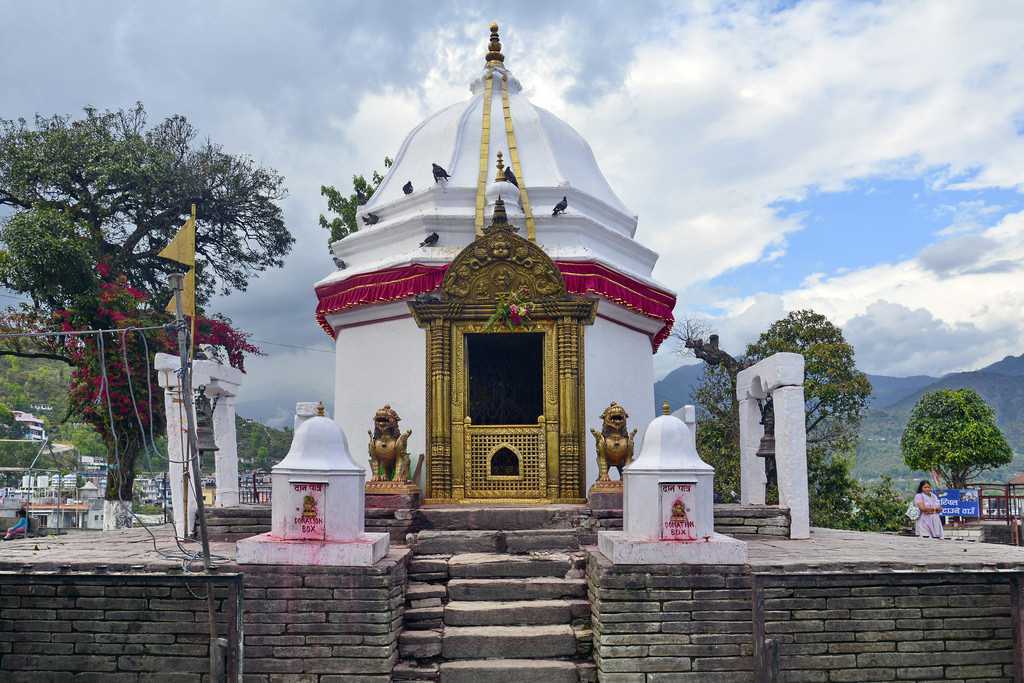
Kathmandu Historical Heritage Sites: The Complete Travel Guide

Patan Durbar Square in the Kathmandu Valley

Why Kathmandu Historical Heritage Sites Are Unlike Anywhere on Earth

Kathmandu, Nepal’s capital, is a place where ancient civilisations and modern life coexist in extraordinary harmony. Set in the foothills of the great Himalayas, this vibrant city is not merely a gateway to mountain trekking—it is one of the most culturally rich and historically significant destinations on the planet. Every alley, every courtyard, every carved wooden window in Kathmandu holds a story stretching back over a thousand years.

The Kathmandu Valley is home to seven UNESCO World Heritage Sites, all recognised for their outstanding universal value and inscribed in 1979. These sites — spread across the three ancient cities of Kathmandu, Patan, and Bhaktapur — represent the pinnacle of Newari civilisation, showcasing striking pagoda-style temples, intricately carved palaces, colossal Buddhist stupas, and sacred Hindu shrines that have been continuously worshipped for centuries.

What makes Kathmandu’s heritage sites truly exceptional is that they are not dead museum pieces. They are living, breathing cultural landscapes. Priests still perform ancient rituals at dawn.

Tibetan monks still circumambulate the great stupas. Communities still gather in centuries-old courtyards for festivals and prayers. The Newar people, the valley’s indigenous inhabitants, continue to weave their art, music, and spirituality into every corner of these sacred spaces.

In this comprehensive guide, we will take you through each of the seven UNESCO-listed heritage sites in detail — covering the history, architecture, spiritual significance, practical travel information, entry fees, and insider tips to make your Kathmandu heritage tour truly memorable. Because exploring seven sites spread across a busy city can be physically and logistically challenging, we will also show you the smartest way to travel between them: hire a private vehicle from Nepal Vehicle Hiring Pvt. Ltd., your trusted, affordable, and reliable transportation partner in Nepal.
Quick Facts: Kathmandu Valley UNESCO World Heritage Sites

At a Glance — Kathmandu Heritage Sites
Total UNESCO Sites: 7 Monument Zones in Kathmandu Valley
UNESCO Inscription Year: 1979 (updated 2006)
Total Area: 188.95 hectares across three districts
Civilisations Represented: Licchavi, Malla, and Shah Dynasties
Religions: Hinduism and Buddhism (often at the same site)
Best Time to Visit: October–December and March–May
All 7 sites can be covered in 1–2 days with a private vehicle
Estimated Total Entry Fees (Foreigner): Approx. NPR 5,000–6,000

Kathmandu Durbar Square (Hanuman Dhoka) — The Royal Heart of the Capital

History & Significance

Kathmandu Durbar Square, also known as Hanuman Dhoka Durbar Square, is the historical and cultural epicentre of Nepal’s capital city. The name ‘Durbar’ means royal court in Nepali, and this sprawling complex was the seat of power for Nepal’s greatest royal dynasties—the Malla kings (12th–18th century) and later the Shah dynasty—until the royal palace was relocated to Narayanhiti in the 19th century.

The square was originally founded in the 3rd century, though the majority of the present structures date from the 12th to the 18th century — the so-called ‘Golden Age’ of Newari art and architecture. During this era, Kathmandu was a thriving hub on the trade route between India and Tibet, and its rulers invested their wealth in building some of Asia’s most spectacular religious and civic monuments.

Walking into Hanuman Dhoka today feels like stepping into another era entirely. A dense cluster of pagoda-style temples, medieval courtyards, ancient statues, and intricately carved wooden balconies dominates the square. It is a visual feast that overwhelms the senses in the best way.

Nepal Tour Package

Key Monuments Inside the Square

  • Hanuman Dhoka Palace Complex — The sprawling royal residence, named after the monkey god Hanuman, whose statue guards the entrance. The palace houses over 40 courtyards and the remarkable nine-story Basantapur Tower, which offers panoramic views of the entire valley.
  • Kumari Ghar (House of the Living Goddess) — One of the square’s most fascinating features is the residence of the Kumari, a young girl selected from the Shakya community and venerated as the living embodiment of the goddess Taleju. Visitors gather in the courtyard to glimpse her at the window between 10:00 AM and 12:00 PM daily.
  • Taleju Temple — The tallest and most magnificent temple in the entire square, built in 1564 by King Mahendra Malla. This three-tiered pagoda is considered the tutelary goddess temple of the Malla kings and is open to non-Hindus only during the Dasain festival.
  • Kal Bhairav — A massive stone relief of Lord Shiva in his fearsome Bhairav manifestation, standing over 10 feet tall. It is believed that anyone who lies before this image will suffer immediate punishment.
  • Kasthamandap — The legendary wooden pavilion believed to have been built from a single tree in the 12th century. This structure gave Kathmandu its very name, though the original was destroyed in the 2015 earthquake and has since been painstakingly reconstructed.
  • Indra Chowk and Asan Bazaar — The vibrant market areas surrounding the square, where vendors sell spices, thangka paintings, prayer beads, and traditional Newari crafts.

Entry Fee & Visiting Hours

Entry Fee: NPR 1,000 for foreign nationals | NPR 150 for SAARC citizens | Free for Nepali nationals

Open Hours: 7:00 AM – 7:00 PM (Daily) | Tribhuvan Museum inside: 10:30 AM – 3:00 PM (Closed Tuesday)

Insider Tips for Kathmandu Durbar Square

  • Arrive early (before 9 AM) for fewer crowds and better lighting for photography.
  • Hire a licensed local guide (approx. NPR 500–800/hour) — the square’s history is incredibly rich and impossible to appreciate fully without expert context.
  • Visit Kumari Ghar between 10 AM and 12 PM to catch a glimpse of the living goddess.
  • Explore the backstreets behind the square to discover hidden temples and authentic Newari life.
  • Be respectful inside temple premises — remove shoes before entering, dress modestly, and ask permission before photographing individuals.

Patan Durbar Square — The City of Fine Arts and Craftsmanship

History & Significance

Patan, also known by its ancient Sanskrit name, Lalitpur (City of Beauty), lies just 5 kilometres south of Kathmandu. Its history dates back to the 2nd century BC, and it is one of Nepal’s oldest continuously inhabited cities. Patan was the capital of one of the three Malla kingdoms that divided the Kathmandu Valley, and its rulers were celebrated throughout the subcontinent for their extraordinary patronage of art, sculpture, and architecture.

Patan Durbar Square is widely regarded as the most architecturally refined of the three Durbar Squares in the Kathmandu Valley. Its symmetry, proportion, and the extraordinary density of temples, courtyards, and sculptures make it arguably the greatest achievement of Newari artistic heritage. The square’s monuments survived the 2015 earthquake better than other sites, and today it stands in remarkable condition.

Patan artisans have produced exquisite bronze sculptures, thangka paintings, and stone carvings for centuries, and this tradition continues today. The streets surrounding the Durbar Square are lined with workshops where you can watch artisans at work using techniques passed down through generations.

Swayambhunath visit during Kathmandu Pokhara Tour

Key Monuments Inside the Square

  • The Royal Palace of Patan — Built primarily during the reign of King Siddhi Narayan Malla in the 17th century, the palace is a masterpiece of Newari architecture. It contains three main courtyards: Mul Chowk (the oldest, used for secret royal rituals), Sundari Chowk (featuring the sacred sunken royal bath, Tusha Hiti), and Mani Keshav Narayan Chowk.
  • Patan Museum — housed inside the royal palace complex — is considered one of Asia’s finest museums. Its collection of medieval Hindu and Buddhist bronze sculptures, stone carvings, and ritual objects is striking. The museum itself is a masterclass in heritage conservation.
  • Krishna Mandir — An extraordinary stone temple built in 1637 by King Siddhi Narayan Malla in a shikhara style (North Indian temple style) rather than the typical Newari pagoda. Its 21 pinnacles and detailed stone panels depicting scenes from the Mahabharata and Ramayana make it unique in the valley.
  • Bhimsen Temple — A multi-storied temple dedicated to Bhimsen, the patron deity of traders, this striking red-and-white structure dominates the northern end of the square.
  • Char Narayan Temple — Dedicated to Lord Vishnu, this temple is notable for its erotic carvings on the roof struts — a common feature in Newari temple architecture believed to ward off lightning and serve as tantric teachings.

Entry Fee & Visiting Hours

Entry Fee: NPR 1,000 (approx. USD 7.50) for foreign nationals | NPR 150 for SAARC | Free for Nepali nationals

Patan Museum: NPR 400 additional | Open 9:00 AM – 5:00 PM (Closed Tuesday)

Insider Tips for Patan Durbar Square

  • Do not miss the Patan Museum — it is easily among the top five museums in all of South Asia.
  • Visit the Mahaboudha Temple nearby — an incredible shikhara-style temple covered entirely in terracotta Buddha tiles.
  • Explore Tumari Chowk and the artisan workshops in the surrounding Mangal Bazaar for authentic bronze work and Newari handicrafts.
  • The square is best enjoyed on foot — the vehicle drop-off point is a short walk away, and many of the finest details are best discovered at a slow, leisurely pace.

Bhaktapur Durbar Square — Nepal’s Best-Preserved Medieval City

History & Significance

Bhaktapur, meaning ‘City of Devotees,’ is the most remarkably preserved medieval city in the Kathmandu Valley. Located 13 kilometres east of Kathmandu, it was the capital of the unified Malla Kingdom from the 12th to the 15th century and later of one of the three independent Malla kingdoms.

When the Shah dynasty conquered the valley in the late 18th century, Bhaktapur lost its political prominence — and that is precisely why it has been so magnificently preserved. Without modern commercial development, its ancient streets, temples, and courtyards have remained largely unchanged for centuries.

Walking through Bhaktapur is an experience unlike any other in Nepal. The city’s narrow, brick-paved lanes, traditional Newari houses with carved wooden windows, and remarkable collection of temples and public squares create an atmosphere that is both ancient and intensely alive. Bhaktapur is home to two of the seven UNESCO World Heritage Sites: Bhaktapur Durbar Square and Changu Narayan Temple.
The city is also famous for its unique Newari culture, its distinctive pottery tradition in Pottery Square, and the extraordinary Nyatapola Temple — the tallest pagoda in Nepal. Bhaktapur’s residents are deeply proud of their heritage and actively participate in preserving and celebrating their living cultural traditions.
Nepal Tour Package

Key Monuments in Bhaktapur

  • 55-Window Palace — Built by King Bhupatindra Malla in the 15th century and completed in 1427, this magnificent palace features 55 elaborately carved windows. The intricate woodwork of the windows is considered one of the finest examples of Newari craftsmanship in the world.
  • Nyatapola Temple — Nepal’s tallest pagoda temple, standing five stories (30 meters). Built in 1702 by King Bhupatindra Malla and completed in just seven months, this temple is dedicated to the goddess Siddhi Lakshmi and has never been seriously damaged by any earthquake.
  • Bhairavnath Temple — A three-storied temple dedicated to Bhairav, the fierce aspect of Lord Shiva. The temple was destroyed in the 2015 earthquake and subsequently rebuilt to its original design.
  • Golden Gate (Sun Dhoka) — Considered the finest piece of art in the valley, this gilded gateway to the Royal Palace courtyard is an extraordinary example of repoussé metalwork.
  • Pottery Square (Talako Tole) — One of Bhaktapur’s most authentic living traditions, where local potters still produce ceramic wares using traditional techniques on hand-operated wheels.
  • Tachupal Tole (Dattatreya Square) — Bhaktapur’s oldest part, centred on the ancient Dattatreya Temple and the Peacock Window — another stunning example of Newari woodcarving.

Entry Fee & Visiting Hours

Entry Fee: NPR 1,500 for foreign nationals (highest of any heritage zone) | NPR 150 for SAARC | Free for Nepali nationals

Open: Daily, all day (most monuments accessible from sunrise to sunset)

Insider Tips for Bhaktapur

  • Plan at least 3-4 hours for Bhaktapur — it is the most complex and richly detailed of the three Durbar Squares.
  • Try Juju Dhau (King Curd) — Bhaktapur’s famous yoghurt sold in earthenware pots and considered Nepal’s finest
  • Also try Chatamari (Newari rice crepes) and Kwati (mixed bean soup) at local restaurants near the square.
  • The Bisket Jatra festival in April (Nepali New Year) is the most spectacular time to visit Bhaktapur.
  • Bhaktapur is best reached by private vehicle — the drive from Kathmandu is about 30–45 minutes, and a private car from Nepal Vehicle Hiring Pvt. Ltd. can make multiple stops en route.

Pashupatinath Temple — The Holiest Hindu Shrine in Nepal

History & Significance

Pashupatinath Temple is not simply a monument — it is the beating spiritual heart of Hindu Nepal, nd one of the most sacred pilgrimage sites for Hindus anywhere in the world. Dedicated to Lord Pashupati, a manifestation of Lord Shiva as ‘Lord of Animals,’ this ancient temple complex sits on the banks of the holy Bagmati River in eastern Kathmandu.

It draws hundreds of thousands of pilgrims from Nepal, India, and across the globe every year.

The main temple is believed to date back to the 4th or 5th century, though some accounts place its origins even earlier, in the 1st century BC. The temple complex as seen today was built in the early 15th century in the classic Newari pagoda style, featuring two-tiered roofs covered in gilded copper.

The complex was listed as a UNESCO World Heritage Site in 1979 and remains one of Nepal’s most visited sites.

Pashupatinath’s spiritual atmosphere is unlike anything else. Along the ghats (sacred riverbank steps) of the Bagmati River, Hindu cremation ceremonies (last rites) are conducted daily and openly.

This may seem confronting to Western visitors, but it is a deeply sacred and ancient tradition that Hindus regard as the most auspicious way to reach moksha (liberation from the cycle of rebirth). Witnessing these ceremonies — with respect and sensitivity — can be one of the most profoundly moving experiences of a lifetime.

What to See at Pashupatinath

  • Main Pashupatinath Temple — The inner sanctum houses a sacred Shiva lingam (symbolic representation of Lord Shiva) and is accessible only to Hindus. Non-Hindus can admire the exterior and the surrounding area, which offers excellent views across the river.
  • The Arya Ghats — The cremation ghats where funeral pyres burn daily. Visitors may observe respectfully from across the river without disturbing the ceremonies.
  • The Sadhus — Holy men (sadhus) in saffron robes with ash-covered faces gather near the temple, offering blessings and posing for photographs (a small donation is expected).
  • Guheswari Temple — A significant Shakti temple near Pashupatinath, dedicated to the goddess Sati.
  • The Surrounding Forest and Deer Park — The peaceful forest surrounding the temple complex is home to deer and monkeys, offering a tranquil contrast to the busy temple area.

Entry Fee & Visiting Hours

Entry Fee: NPR 1,000 for foreign nationals | NPR 150 for SAARC | Free for Nepali nationals and Hindus

Open: 4:00 AM – 12:00 PM and 1:00 PM – 9:00 PM daily | Best visited at sunrise or during evening Aarti (6:30–7:30 PM)

Insider Tips for Pashupatinath

  • The evening Aarti ceremony (around 6:30–7:30 PM) is a magnificent, deeply moving ritual with fire, chanting, and bells — absolutely not to be missed.
  • Come early in the morning to witness the Maha Shivaratri festival if your visit coincides with it (February/March) — thousands of sadhus from across Asia gather here.
  • Dress conservatively — shoulders and knees covered — out of respect for the religious atmosphere.
  • Photography of the cremation ceremonies is sensitive — observe respectfully and always ask before photographing individuals.

Boudhanath Stupa — The Greatest Buddhist Stupa in Nepal

History & Significance

Boudhanath Stupa (also spelt Bauddhanath) is one of the world’s largest Buddhist stupas and the most important centre of Tibetan Buddhism outside Tibet. Rising to a height of 36 meters, its massive white dome and golden spire dominate Kathmandu’s northeastern skyline, creating one of Asia’s most instantly recognisable skylines.

The stupa’s origins are shrouded in legend. Still, most believe it was built in the 5th century during the Licchavi period, possibly over the remains of a Licchavi king. It became a major stopping point on the ancient trade route between Nepal and Tibet.

Over the centuries, it grew into a significant centre of Tibetan Buddhist pilgrimage and learning. Following the Chinese occupation of Tibet in 1959, thousands of Tibetan refugees settled around the stupa, and today the Boudhanath area is one of the most vibrant and authentic Tibetan cultural enclaves outside Tibet.

The stupa was inscribed on the UNESCO World Heritage Site in 1979 and suffered significant damage during the 2015 earthquake. It was beautifully restored over the following years and today stands in magnificent condition, once again drawing hundreds of thousands of pilgrims and visitors annually.

What to See at Boudhanath

  • The Great Stupa — The enormous white dome representing the universe, topped by a gilded tower bearing the all-seeing eyes of the Buddha on each of its four sides. Strings of colourful triangular flags radiate from the spire in all directions.
  • Circumambulation (Kora) — Walk clockwise around the stupa’s base alongside Tibetan pilgrims spinning the 147 prayer wheels that line the perimeter. This meditative practice is deeply meaningful and can be done multiple times.
  • The Surrounding Monasteries — Over 50 Tibetan Buddhist gompas (monasteries) surround the stupa, many of which are open to respectful visitors. Attending a puja (prayer ceremony) inside one of these monasteries is a memorable experience.
  • Rooftop Cafes — Several cafes around the stupa offer rooftop seating with spectacular views of the stupa’s dome, particularly atmospheric at dawn and dusk.

Entry Fee & Visiting Hours

Entry Fee: NPR 400 for foreign nationals | Free for SAARC and Nepali nationals

Open: Dawn to dusk daily | Best visited at sunrise or at dusk when butter lamps are lit

Insider Tips for Boudhanath

  • Visit at dawn (around 5:30–6:30 AM) when the local Tibetan community performs morning kora — the atmosphere is extraordinarily peaceful and authentic.
  • Losar (Tibetan New Year, usually in February) is the most spectacular festival time, with the stupa decorated with thousands of butter lamps and thangkas.
  • The surrounding streets are excellent for shopping — thangka paintings, singing bowls, mala beads, and Buddhist ritual objects are available at competitive prices.

Swayambhunath (Monkey Temple) — The Ancient Hilltop Stupa of Kathmandu

History & Significance

Swayambhunath, popularly known as the Monkey Temple, is one of the oldest and most revered Buddhist sites in the world and one of Nepal’s most iconic images. Perched on a hillock 77 meters above the Kathmandu Valley floor, the stupa can be seen from virtually anywhere in the city, its golden spire glittering in the sunlight and its Buddha eyes gazing serenely in all four directions.

Swayambhunath’s origins stretch back over 2,500 years, making it the oldest Buddhist monument in the entire Kathmandu Valley. According to legend, the valley was once a great lake, and when the Bodhisattva Manjushri drained it with his sword to create habitable land, he chose the Swayambhu hillock as a sacred site.

The name itself means ‘Self-Existent’ — a reference to the belief that the stupa arose spontaneously from the earth without human construction.

The site is sacred to both Buddhists and Hindus, exemplifying the remarkable religious syncretism that characterises all of Kathmandu’s heritage. Alongside Buddhist shrines and Tibetan prayer flags, you will find Hindu temples dedicated to Saraswati and Harati Devi. The resident troops of rhesus macaques — from which the popular nickname ‘Monkey Temple’ derives — add a memorable element of wildness to the spiritual atmosphere.

What to See at Swayambhunath

  • The Great Stupa — The white dome topped by a square harmika (tower) bearing the Buddha’s omniscient eyes. On certain auspicious days, the stupa is wrapped in a golden plate and circumambulated by thousands of pilgrims.
  • The 365 Steps — The main approach to the stupa from the east involves climbing 365 stone steps, one for each day of the year. The ascent is lined with statues of deities, Tibetan prayer wheels, and, of course, the famous monkeys.
  • The Viewpoint — From the hilltop, you are rewarded with a panoramic 360-degree view of the entire Kathmandu Valley — mountains, temples, green hills, and the urban sprawl.
  • Dewa Dharma Monastery — A beautiful Tibetan monastery at the site that offers a serene space for meditation.
  • Harati Devi Temple — A Hindu temple dedicated to the goddess of smallpox and children’s health, located near the main stupa and always busy with local devotees.

Entry Fee & Visiting Hours

Entry Fee: NPR 200 for foreign nationals | Free for SAARC and Nepali nationals

Open: 24 hours daily | Best at sunrise (5:30–7:00 AM) for golden light and morning rituals

Insider Tips for Swayambhunath

  • Visit at sunrise for golden light on the stupa and extraordinary views over the morning mist in the valley below.
  • Keep a firm grip on any food, bags, or sunglasses — the monkeys are famously opportunistic thieves.
  • A road also leads to the western entrance, making it accessible for those who prefer not to climb the 365 steps.

Changu Narayan Temple — Nepal’s Oldest Temple and Lesser-Known Spot

History & Significance

Changu Narayan is Nepal’s oldest standing temple and one of the most historically significant sites in the Kathmandu Valley — yet tourists often overlook it as they rush between more famous sites. Located approximately 12 kilometres northeast of Kathmandu on a forested hilltop near Bhaktapur, this temple complex is a true hidden treasure that rewards those who make the effort to visit.

The temple is dedicated to Lord Vishnu and is believed to have been built as early as the 4th century AD, during the Licchavi period. It houses a stone inscription dated to 464 AD — the oldest written inscription found anywhere in Nepal — making it an invaluable record of the valley’s early history.

The courtyard surrounding the temple is essentially an open-air museum of 5th-century stone sculpture, displaying some of the finest examples of Licchavi-era art ever discovered.

The UNESCO monument zone of Changu Narayan was inscribed in 1979 and encompasses both the temple complex and the traditional Newari village of Changu that surrounds it. The village itself is a living example of traditional Newari settlement patterns and community life.

What to See at Changu Narayan

  • The Main Temple — A two-tiered pagoda structure with gilded metal roofing and finely carved struts depicting the ten incarnations of Lord Vishnu. The main deity inside is the Vishvarupa Vishnu — a form with multiple heads and arms.
  • The Stone Sculpture Gallery — The courtyard is lined with extraordinary Licchavi-era stone sculptures, including the famous eight-armed Vishnu image and the Garuda kneeling before the temple.
  • The Ancient Inscription — The stone inscription from 464 AD, written in Sanskrit, records the victories of King Manadeva — the oldest such inscription in Nepal.
  • Changu Narayan Village — The traditional Newari village around the temple is an authentic, unhurried community with a small local museum that displays traditional crafts and artefacts.

Entry Fee & Visiting Hours

Entry Fee: NPR 300 for foreign nationals | NPR 100 for SAARC | Free for Nepali nationals

Open: Daily 6:00 AM – 7:00 PM | Best combined with a Bhaktapur visit (12 km away)

Insider Tips for Changu Narayan

  • Combine this site with Bhaktapur Durbar Square on the same day, as they are geographically close and both on the eastern side of the valley.
  • The views from the hilltop toward the eastern Himalayas are spectacular — bring a camera with a good zoom lens.
  • Because this is the least visited of the seven sites, you will often find the courtyard beautifully quiet and peaceful.

Complete Entry Fee Summary — All 7 UNESCO World  Heritage Sites (2026)

Below is a consolidated table of entry fees for all UNESCO World Heritage monument zones in the Kathmandu Valley. Prices are in Nepali Rupees (NPR). Note that children under 10 years are typically admitted free at most sites.

Heritage SiteForeignerSAARCOpen Hours
Kathmandu Durbar SquareNPR 1,000NPR 1507:00 AM – 7:00 PM
Patan Durbar SquareNPR 1,000NPR 1509:00 AM – 5:00 PM
Bhaktapur Durbar SquareNPR 1,500NPR 150Sunrise – Sunset
Pashupatinath TempleNPR 1,000NPR 1504:00 AM – 9:00 PM
Boudhanath StupaNPR 400FreeDawn – Dusk
Swayambhunath StupaNPR 200FreeOpen 24 Hours
Changu Narayan TempleNPR 300NPR 1006:00 AM – 7:00 PM

Total Estimated Entry Fees: Approximately NPR 5,400 for a foreigner visiting all 7 sites (roughly USD 40). SAARC citizens pay approximately NPR 700 total for all sites.

How to Travel Between Kathmandu Historical Heritage Sites: Why a Private Vehicle Is the Best Option

The seven UNESCO heritage sites of Kathmandu Valley span three districts—Kathmandu, Lalitpur (Patan), and Bhaktapur—covering nearly 200 square kilometres. While public transport exists, covering all seven sites efficiently and comfortably usually requires a private vehicle, especially if you are travelling with family, a group, or luggage.

Transportation Options Compared

  • Public Buses & Tempos: The cheapest option but extremely crowded, slow, and difficult to navigate for first-time visitors. Routes are complex, and the vehicles are not air-conditioned. Not recommended for heritage sightseeing.
  • Taxis: Available 24/7 in Kathmandu. Convenient for short trips but can be expensive for a full-day multi-site tour, especially if the driver tries to negotiate per trip rather than a day rate.
  • Ride-Hailing Apps (Pathao, inDriver): Good for individual journeys within the city but not ideal for multi-stop heritage tours with waiting time at each site.
  • Private Vehicle Hire with Driver: By far, the most comfortable, convenient, and ultimately cost-effective option for a full-day heritage tour. A dedicated vehicle with a professional driver lets you set your own pace, make spontaneous stops, and avoid the stress of navigation.

Why Choose Nepal Vehicle Hiring Pvt. Ltd.

Nepal Vehicle Hiring Pvt. Ltd. (vehiclehiringnepal.com) is one of Nepal’s most trusted and experienced private vehicle rental companies, operating from the heart of Thamel, Kathmandu. With over 50k + happy customers and a 5.0 TripAdvisor rating from 200+ reviews, we are the vehicle hire company of choice for travellers seeking reliability, comfort, and value.

Why Book Your Heritage Tour Vehicle with Nepal Vehicle Hiring Pvt. Ltd.
50,000+ satisfied customers | 5.0 TripAdvisor rating
Fleet of well-maintained, air-conditioned Cars, Jeeps, Hiace Vans, Coasters & Buses
Professional, bilingual drivers (English, Nepali, Hindi)
24/7 customer support — WhatsApp: +977 981-4227196
Hotel pickup & drop-off included | No hidden charges
Flexible itinerary — you control the schedule
Best price guaranteed | Direct booking, no middlemen
Licensed & registered company (Reg No. 219204)

Available Vehicle Fleet for Heritage Site Tours

Vehicle TypeBest ForCapacityFeatures
Car (Sedan/SUV)Solo or couple1-3 paxAC, comfortable, city-friendly
Jeep / FortunerGroups & trekkers4-6 pax4WD, rugged terrain, luggage space
Hiace VanMedium groups7-14 paxSpacious, AC, ideal for families
Coaster BusLarge groups15-25 paxGroup tours are cost-effective
Tourist BusBudget travellers30+ paxIntercity routes, economical
  • 7:30 AM — Hotel pickup from Thamel or your accommodation in a private, air-conditioned vehicle
  • 8:00 AM — Swayambhunath Stupa (Monkey Temple) — sunrise visit, 60–90 minutes
  • 9:30 AM — Kathmandu Durbar Square (Hanuman Dhoka) — 60–90 minutes
  • 11:30 AM — Pashupatinath Temple — 60 minutes (observe morning rituals and Sadhus)
  • 1:00 PM — Boudhanath Stupa — 45–60 minutes (lunch available at surrounding cafes)
  • 2:30 PM — Drive to Patan (15 min) — Patan Durbar Square & Museum — 90 minutes
  • 4:30 PM — Drive to Bhaktapur (30 min) — Bhaktapur Durbar Square — 90–120 minutes
  • 7:00 PM — Return to hotel in Kathmandu

Optional Day 2 Addition: Changu Narayan Temple can be combined with Bhaktapur on a second day, including a scenic hike or private vehicle drop to the hilltop. Nepal Vehicle Hiring also offers customised multi-day itineraries across Nepal.

Best Time to Visit Kathmandu’s Historical Heritage Sites

Kathmandu has a temperate climate year-round, but certain seasons offer significantly better conditions for heritage sightseeing. Here is a season-by-season breakdown:

October – December (Post-Monsoon — BEST Season)

This is the absolute peak season for visiting Kathmandu’s heritage sites. The monsoon rains have cleared the air of pollution and dust, leaving the skies bright blue and the mountains dramatically visible on the horizon. Temperatures are mild and comfortable (15–25°C during the day).

The festivals of Dasain (September/October) and Tihar/Diwali (October/November) add extraordinary cultural colour to this period, with heritage sites decorated and alive with celebrants.

March – May (Pre-Monsoon — EXCELLENT)

Spring in Kathmandu is beautiful. Temperatures warm up pleasantly (20–28°C), and the surrounding hills burst into colour with rhododendron blooms. The cultural festival of Holi (March) brings joy and colour to the streets.

This is also an excellent time for combining heritage visits with trekking in the Himalayas.

December – February (Winter) — Winter months are cool and dry, with clear skies. Heritage sites are less crowded during the off-season, which is ideal for photography and peaceful exploration. Temperatures can drop to 3–5°C at night but are typically pleasant during daylight hours. Boudhanath is particularly spectacular during Losar (Tibetan New Year, usually in February).

June – September (Monsoon — CHALLENGING)

The monsoon season brings heavy rainfall and humidity that can make outdoor sightseeing uncomfortable. Many trails become slippery, and cloud cover can obscure mountain views. However, the valley’s greenery is lush and beautiful, entry fees are lower, and heritage sites are virtually crowd-free.

With a private vehicle and a flexible schedule, even a monsoon visit can be rewarding.

Essential Practical Tips for Visiting Kathmandu Historical Heritage Sites

What to Wear

  • Dress conservatively at all religious sites — shoulders and knees should be covered for both men and women.
  • Comfortable walking shoes that are easy to slip on and off (you must remove shoes before entering temples).
  • A light jacket or shawl for cooler mornings, particularly October–February.
  • Sunscreen and a hat are essential for summer visits, as midday sun can be intense at altitude.

What to Bring

  • Cash in Nepali Rupees (NPR) — entry fees and most local vendors prefer cash. ATMs are available near major sites but can be unreliable.
  • A reusable water bottle — hydration is important, especially if you are climbing many steps.
  • Camera with a wide-angle lens — the architecture, sculptures, and scale of these sites demand wide-angle photography.
  • A portable power bank for your phone — full-day tours drain smartphone batteries.
  • A guidebook or offline map app — detailed notes on each site’s history greatly enhance your appreciation.

Cultural Etiquette

  • Always walk clockwise around stupas and temples — this is the prescribed direction of circumambulation in both Hinduism and Buddhism.
  • Never point the soles of your feet toward a deity or shrine — this is considered deeply disrespectful in Nepali culture.
  • Do not touch statues, sacred objects, or offerings unless explicitly invited to do so.
  • At Pashupatinath, observe the cremation ghats with quiet, respectful silence — photography of the ceremonies should be done with extreme discretion.
  • When entering monasteries, bow to the main deity and speak softly.

Photography Tips

  • The golden hours at sunrise and sunset provide the most atmospheric light for heritage photography.
  • The rooftop cafes around Boudhanath Stupa offer excellent elevated photography angles.
  • Ask permission before photographing monks, sadhus, or devotees — most will be happy to oblige, and a small donation or a genuine smile of thanks is always appreciated.
  • The 55-Window Palace in Bhaktapur and the Golden Gate are best photographed in the morning light.

Major Festivals at Kathmandu Historical Heritage Sites — Plan Your Visit Around These

Kathmandu’s heritage sites spectacularly come to life during the valley’s many festivals. These celebrations are not tourist performances — they are genuine, ancient religious events observed for centuries and among the most authentic cultural experiences in Asia.

Indra Jatra (August/September): The eight-day festival celebrating the god Indra and the living goddess Kumari takes place in and around Kathmandu Durbar Square. The Kumari is carried through the city in a chariot procession, one of the most spectacular events on the Kathmandu calendar.

Dasain (October): Nepal’s biggest festival, celebrating the goddess Durga’s victory over the buffalo demon Mahishasura. Kathmandu Durbar Square and Patan Durbar Square are decorated magnificently, and the 10th day (Bijaya Dashami) sees the streets filled with celebration.

Tihar / Diwali (October/November): The five-day festival of lights transforms Kathmandu into a glittering spectacle of oil lamps and marigold garlands. Boudhanath and Swayambhunath are particularly beautiful during this festival.

Maha Shivaratri (February/March): Thousands of Hindu pilgrims, sadhus, and devotees gather at Pashupatinath Temple for this major annual festival dedicated to Lord Shiva. The atmosphere is extraordinarily charged with devotion and spectacle.

Losar — Tibetan New Year (February): Boudhanath becomes the epicentre of Tibetan New Year celebrations, with the stupa decorated with thousands of butter lamps and special pujas performed in surrounding monasteries.

Bisket Jatra (April/Nepali New Year): Bhaktapur’s New Year festival is among the most unique in Nepal — featuring the erection of a massive wooden pole (lingo) and chariot processions through the medieval streets.

Frequently Asked Questions (FAQ)

Can I visit all 7 UNESCO sites in one day?

Yes, it is physically possible to visit all seven sites in a single day, but it requires an early start (around 7:00–7:30 AM), a private vehicle, and a well-planned itinerary. It is better to dedicate one full day to the sites in Kathmandu city (Hanuman Dhoka, Swayambhunath, Pashupatinath, Boudhanath) and a second day to Patan, Bhaktapur, and Changu Narayan. Nepal Vehicle Hiring Pvt. Ltd. offers both single-day and multi-day private vehicle packages.

Is there a combined ticket for all heritage sites?

No, there is currently no single combined pass for all seven UNESCO sites in Kathmandu Valley. Each site has its own separate entry fee system. Foreigners must pay at each site individually.

Carry enough cash (NPR) at all times, as most entry counters do not accept card payments.

Which heritage site is the most important to visit?

All seven sites offer unique and irreplaceable experiences. However, if you are limited in time, Pashupatinath, Boudhanath, and Bhaktapur Durbar Square are often considered the three most profound and distinctive experiences. Pashupatinath offers unparalleled spiritual intensity, Boudhanath offers peace and architectural grandeur, and Bhaktapur offers the most complete medieval urban experience.

How do I book a private vehicle for the heritage site tour?

Contact Nepal Vehicle Hiring Pvt. Ltd. directly via phone/WhatsApp at +977 981-4227196, email vehiclehiringnepal.com, or book online at vehiclehiringnepal.com. Share your group size, preferred pickup time, hotel name, and which sites you want to visit, and their team will arrange a customised vehicle with a professional driver.

Are guides available at the heritage sites?

Licensed local guides are available for hire at all seven sites, typically at rates of NPR 500–800 per hour per group. Having an expert guide dramatically enhances the experience at these complex, multi-layered sites. Nepal Vehicle Hiring Pvt. Ltd. can also connect you with recommended English-speaking heritage guides.

Are the heritage sites safe for solo female travellers?

Yes, Kathmandu’s heritage sites are generally safe and well-visited. Use normal travel precautions—stay aware of your surroundings, dress conservatively, and ideally visit with a guide or in a trusted private vehicle that can advise on local customs and safe areas.

How much should I budget for a full-day heritage tour?

A comprehensive one-day budget estimate for a foreign visitor: Entry fees for all sites (NPR 5,400) + private vehicle hire (NPR 6,000–8,000 for a car or jeep for the full day) + guide fees (NPR 3,000–5,000) + meals (NPR 800–1,500) + miscellaneous = Total approximately NPR 15,000–20,000 (USD 110–150). This is exceptional value for a day of first-rate cultural exploration.

Conclusion —Kathmandu Historical Heritage Sites: A Journey Through Civilisations

Kathmandu’s seven UNESCO World Heritage Sites represent one of the greatest concentrations of cultural, spiritual, and architectural achievement anywhere on earth. In the space of a single valley — and in a single remarkable day — you can walk through royal palaces built in the 12th century, circumambulate stupas that have been sacred for over 2,500 years, witness living religious traditions that connect the present to the most ancient roots of human civilisation, and marvel at woodcarving, bronze casting, and stone sculpture that has never been surpassed in the centuries since it was created.

These are not sites that you merely ‘tick off a list.’ They are places that change you — that shift your perspective on what human beings are capable of creating and preserving, and what it means to live in deep, generational connection to a place and a history.

To make the most of your Kathmandu heritage experience, plan well, dress respectfully, carry cash for entry fees, and — above all — give yourself time. Time to sit in an ancient courtyard and absorb the atmosphere. Time to talk with the locals who have grown up in the shadow of these monuments.

Time to let the weight of history settle around your shoulders and the sound of temple bells carry you somewhere outside of ordinary time.

To keep your journey between these extraordinary sites smooth, comfortable, and completely stress-free, trust Nepal Vehicle Hiring Pvt. Ltd.—your dedicated, professional, and affordable vehicle hire partner in Nepal. From airport transfers to full-day heritage sightseeing tours and multi-day excursions to Pokhara, Lumbini, Chitwan, and beyond, Nepal Vehicle Hiring is with you every kilometre of the way.
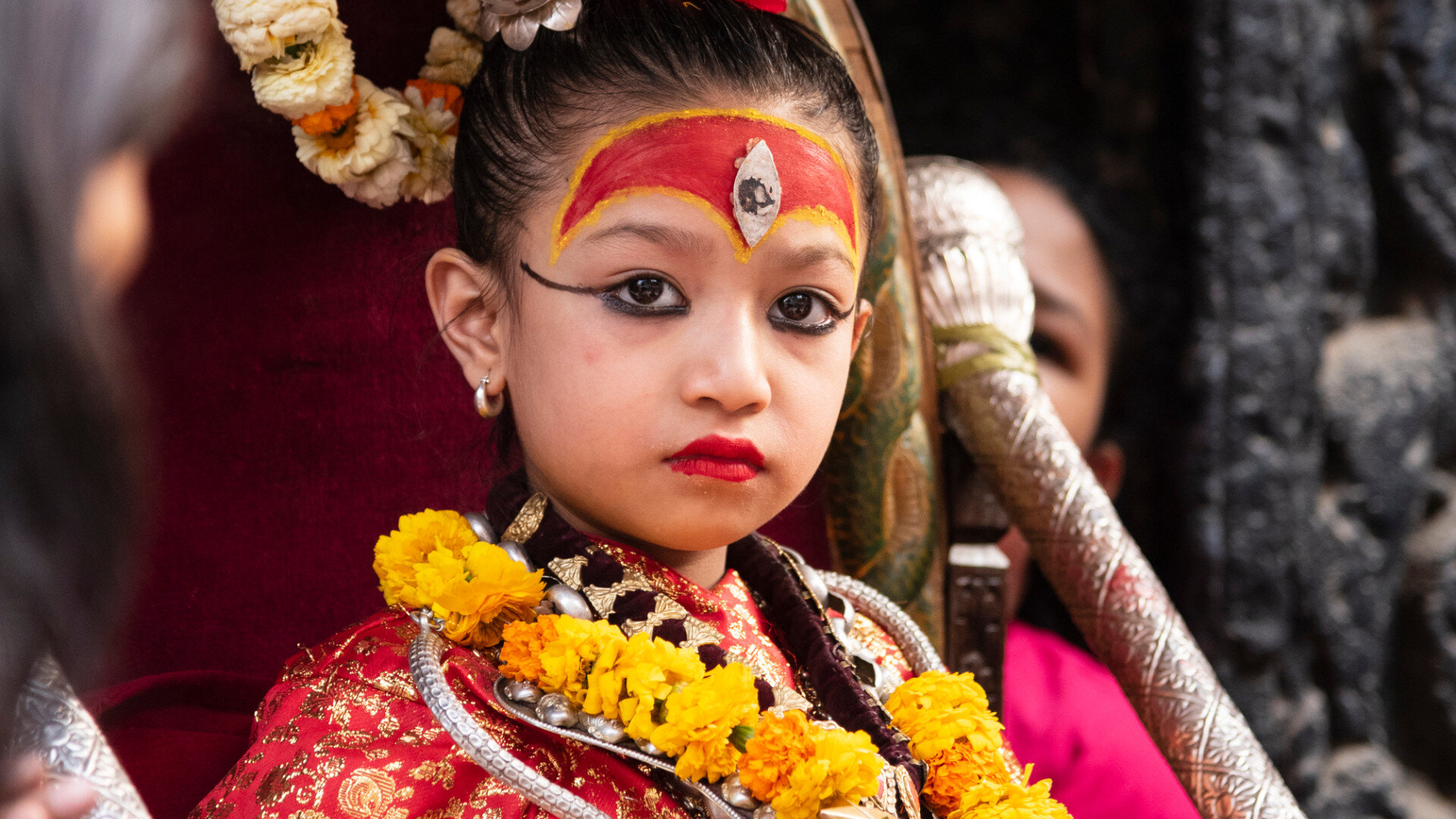
Book Your Kathmandu Historical Heritage Sites Tour Vehicle Today!

Website: www.vehiclehiringnepal.com
Phone / WhatsApp: +977 981-4227196
Email: [email protected]
Office: Bhagawatisthan, Thamel, Kathmandu, Nepal
Fleet: Car | Jeep | Hiace Van | Coaster | Tourist Bus
50k+ Happy Customers | 5.0 Rating |15k+ TripAdvisor Reviews
Private Heritage Tour | Airport Transfers | Multi-Day Nepal Tours
WhatsApp us anytime — we respond 24/7!

Everest Mountain Flight Nepal: Complete Guide

Everest expeditions

Everest Mountain Flight Nepal — Quick Reference
Flight length: about 50 to 60 minutes in the air (allow roughly 3 hours door-to-door, including check-in)
Departs from: Tribhuvan International Airport, Kathmandu domestic terminal, early morning
Typical fare for foreign nationals: roughly USD 250 to USD 280 per person, depending on airline and package
Seating: every passenger gets a window seat on the dedicated scenic aircraft
Best months: October to December and March to May, always the first flights of the morning
Private transfer from Thamel hotel to the domestic terminal and back: from about USD 25-30 by car
After the flight: add a Kathmandu UNESCO sightseeing tour by car, jeep, Hiace van or Coaster bus.
Book transport: Nepal Vehicle Hiring Pvt. Ltd. | WhatsApp | [email protected]

The Easiest Way to Meet the Highest Mountain on Earth

The Everest mountain flight is the simplest way to face the highest mountain on Earth. In roughly one hour, a small turboprop aircraft lifts off from Kathmandu, turns east along the great Himalayan wall, and carries you level with Everest, Lhotse, Makalu and a long procession of snow giants before returning you to the capital while most visitors are still finishing breakfast.

No trekking permit to arrange, no altitude to acclimatise to, and no multi-week itinerary to protect. All it asks of you is an early alarm, a window seat and a reasonably clear morning.

Yet the flight itself is only the middle of the story. The beginning is a quiet pre-dawn pickup from your hotel in Thamel, a short drive through empty streets to the domestic terminal, and a check-in queue that moves faster when you arrive on time and relaxed.

The end is the part many travellers forget to plan: what you do with the rest of a morning that has already delivered the trip’s most spectacular view. This guide covers both halves.

It explains how the flight works, which airlines operate it, what it costs in US dollars, which seat to request, when to go, and how to avoid small mistakes that cost people their best views. It also shows how a punctual private vehicle from Nepal Vehicle Hiring Pvt. Ltd. makes the whole morning smooth and unhurried, from your hotel door to the last temple on your Kathmandu tour.

Everything here is written to stay useful for years. Fares and schedules move slightly with seasons and airline policies, so treat every number as a realistic range and confirm the final figure when you book.

The principles — go early, choose the right season, understand the seating, protect your timing on the ground — never change. If you would like help planning the road side of your morning, message us on WhatsApp or write to [email protected], and our team will build the plan around your flight reporting time.

What Exactly Is the Everest Mountain Flight Nepal?

A Scenic Flight, Not a Landing

The Everest mountain flight is a dedicated scenic flight, not a regular transport service. It takes off from Tribhuvan International Airport in Kathmandu, flies east parallel to the Himalayan range, approaches the Everest region, turns, and flies back along the same line. It does not land anywhere in the mountains.

The aircraft stays well clear of the peaks while still getting close enough that Everest, its neighbours and the long glacial valleys below are clearly visible from the cabin windows. Think of it as a one-hour guided tour of the Himalaya, delivered from the air, with the pilots and cabin crew acting as your hosts and spotters.

Because it is purely scenic, the flight has a different rhythm from a normal domestic hop. Passengers sit so everyone has a window. The crew gives a short briefing about which side of the aircraft sees what at each stage.

A map or peak identification card is commonly handed out so you can match the white summits to their names, and many operators add a small certificate of completion after landing. On good mornings, the captain may also invite passengers to the cockpit one at a time for a few moments of the pilot’s own view, although this is always at the crew’s discretion and never guaranteed.

The Aircraft, the Altitude and the Terminal

Mountain flights use small turboprop aircraft whose slim cabins make a guaranteed window seat for everybody possible. Depending on the airline and the day, this can be a smaller Beechcraft-class aircraft carrying around eighteen passengers or a slightly larger ATR turboprop.

Cruising altitude is high enough to clear the foothills and give a sweeping perspective on the range. The aircraft stays comfortably pressurised, so you don’t need oxygen or worry about altitude sickness. You remain in an ordinary air-conditioned cabin throughout.

Departures leave from the domestic terminal of Tribhuvan International Airport, not the international terminal. This matters more than it sounds, because the two buildings are separate, and an arrival at the wrong entrance on a 5:30 AM taxi ride has ruined more than one morning.
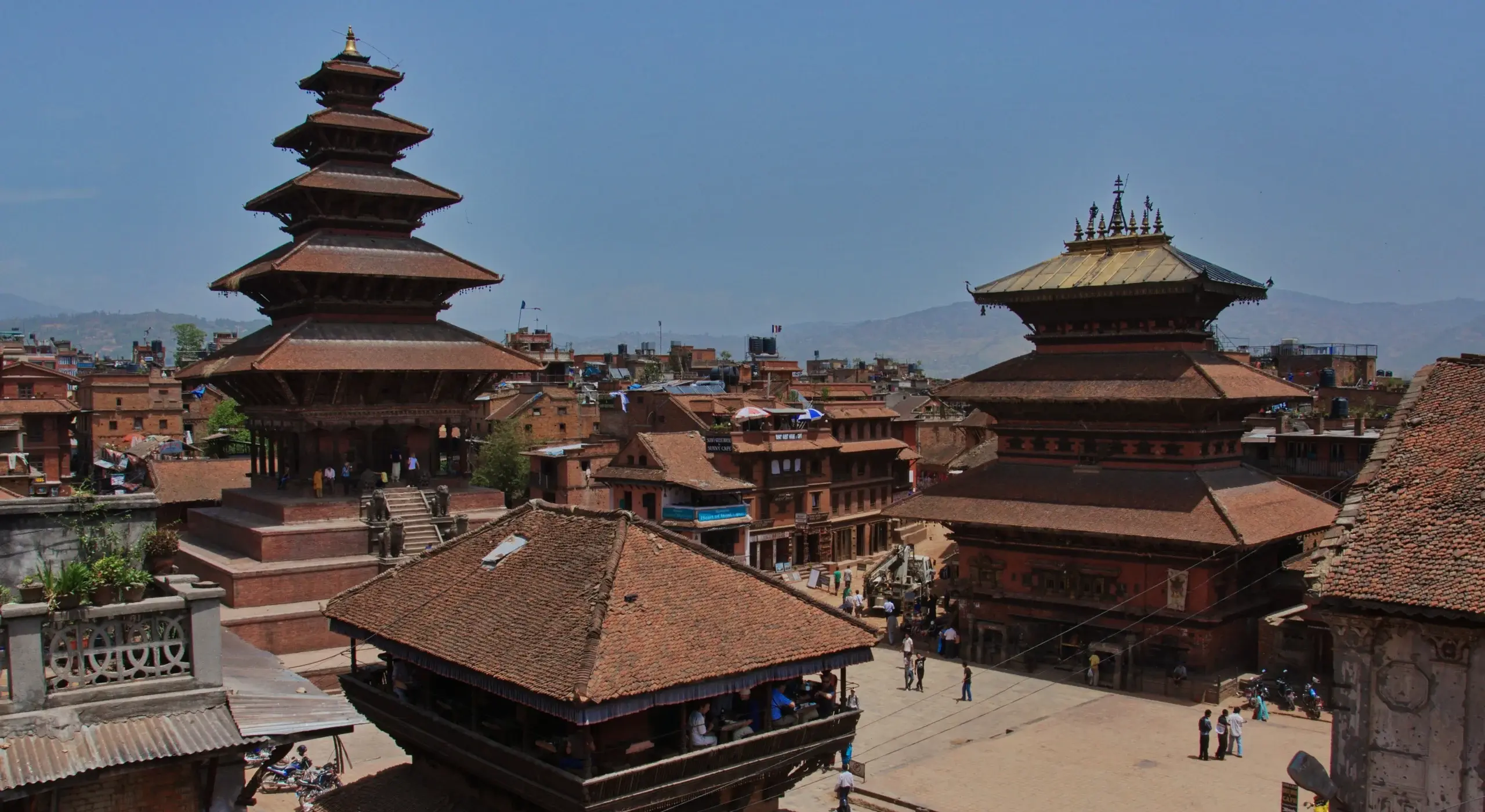
Your driver should know the exact drop-off point for scenic flight passengers, which is one of the small advantages of using a transport company that handles early airport runs every week rather than an occasional taxi. Our airport and city transfer drivers are briefed on the domestic terminal approach, the parking area and the best waiting position so that your pickup after landing is as quick as your drop-off before departure.

Everest Mountain Flight Nepa

The Flight Minute by Minute

Before Take-Off: Pickup, Check-In and Boarding

Most scenic flights depart between roughly 6:30 and 7:30 in the morning, because the Himalayan air is calmest and clearest soon after sunrise and clouds tend to build from mid-morning onward. Working back from that, hotel pickups are usually arranged between about 5:15 and 6:00 AM.

The drive from the heart of Thamel to the domestic terminal takes only fifteen to twenty-five minutes at that hour, but you want a cushion for check-in, security screening and the walk to the departure gate. Arriving about an hour before the scheduled departure is the standard guidance, and arriving earlier on your first Nepal morning removes the stress of an unfamiliar airport.

Boarding is orderly but quick. You’ll be seated in your window seat, the crew will check the cabin, and the aircraft will taxi to the runway. Because mountain flights are scenic services, the operators watch the weather closely before departure.

If visibility to the east is poor, flights can be held, delayed or cancelled, which is why the earliest departures of the day are the most reliable. A flexible attitude and a vehicle that can wait or reschedule easily are real assets on a morning like this, and they’re part of why a private transfer beats a quick taxi.

In the Air: The Outbound and Return Legs

Shortly after take-off, the aircraft climbs over the Kathmandu Valley rim and turns east. In the first half of the flight, the mountains appear on the left-hand side of the cabin, beginning with the Langtang and Jugal ranges and moving through the great peaks of the Rolwaling and then the Khumbu region.

Around the turning point near the Everest region,n the crew announces the closest approach to the highest peaks. The aircraft then turns, and on the return leg the mountains appear on the right-hand side of the cabin, giving passengers on that side their close-up views.

Over the course of the flight, both sides see the whole range, but each side sees different sections up close.

On a good morning, the sequence feels almost theatrical. Foothills glow with early light, white ridges line up on the horizon, and the peaks gradually separate into individual summits as the aircraft draws closer.
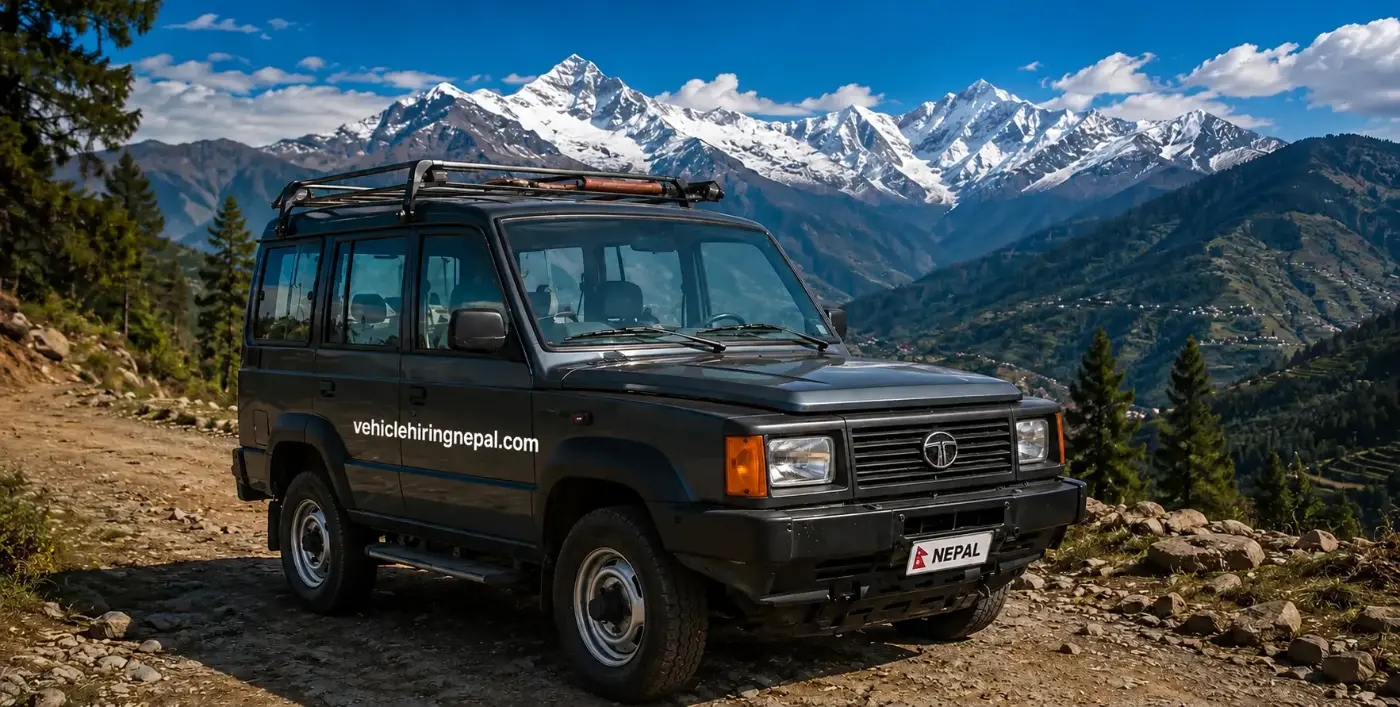
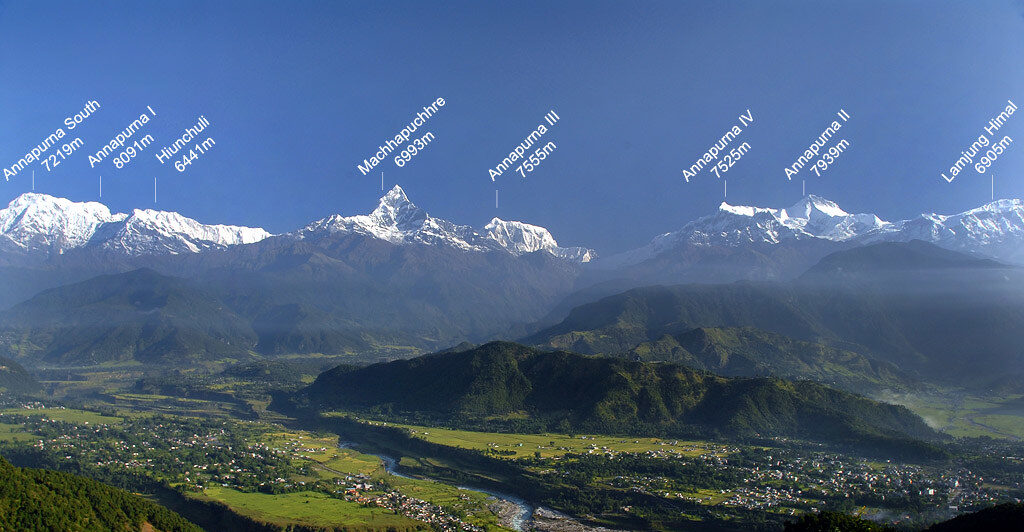
Passengers move toward the cockpit one by one when invited, cameras come out, and the cabin falls into a delighted, slightly breathless quiet. Within an hour, the aircraft is back above the valley, the Kathmandu skyline reappears, and the landing is as smooth as any domestic arrival.

By the time you collect your belongings, the morning has barely begun.

Everest Mountain Flight Nepal: Complete Guide

Which Peaks Will You See?

The Great Names of the Himalaya From One Window

One of the joys of the flight is how many famous mountains appear in a single morning. Commonly seen peaks include Gaurishankar, the twin-summited sacred mountain on the border region; Dorje Lhakpa and the Langtang group near the start of the route; Cho Oyu, the sixth-highest mountain in the world; Nuptse and Lhotse, the immense walls that surround the approach to Everest; Pumori, the elegant pyramid above the Khumbu glacier; Ama Dablam, often named the most beautiful mountain in the Himalaya; Makalu, the fifth-highest mountain on Earth; and, on clear days, Mount Everest itself at about 8,849 metres. Operators often describe the line-up as twenty or more recognisable summits.

What surprises many first-time flyers is that Everest does not dominate the skyline as a postcard suggests. Because the neighbouring peaks are also enormous and some, like Nuptse and Lhotse, stand directly in front of it, Everest can appear as a dark, modest summit behind a white wall.

That is exactly why the crew’s briefing and the identification card matter. Once you know to look for Everest’s black pyramid beside the long wall of Lhotse, the identification clicks into place, and the mountain’s true scale sinks in.

The same is true of Makalu, whose sharp four-sided shape stands apart to the east, and of Ama Dablam, instantly recognisable by its pointed summit and hanging glacier.

If the peaks you see on your flight whet your appetite for the mountains on the ground, you can explore the region by road. Overland approaches such as the classic Jiri trailhead or the higher starting points of Salleri and Phaplu are reached by four-wheel-drive jeep from Kathmandu, and our jeep and trekking transfers cover them with a Scorpio or Bolero jeep and an experienced driver.

For a shorter taste of Himalayan scenery near Kathmandu, the Nagarkot sunrise tour is a classic add-on, and many travellers book it on a different morning from their mountain flight to double their dawn views.

Left Side or Right Side: Choosing Your Seat

How the Seating Really Works

Every passenger on a dedicated scenic aircraft has a window seat, the biggest difference from an ordinary flight. The question that sparks the most debate among travellers is whether the left or the right side is better. The honest answer is that it depends on what you want from the flight.

Because the aircraft flies east with the Himalaya to the north, the left side sees the range first and, on the outbound leg, the broader panorama. After the turning point, the aircraft reverses direction, and the right side gets its turn.

Both sides see the full range during the flight, and on many mornings passengers swap places or lean across during the turn at the crew’s invitation.

A useful rule of thumb that experienced flyers share is to ask for the left side if you want the sweeping, whole-range view and the first sight of Everest, and the right side if you want closer, more detailed views on the return. If you are travelling as a couple or a family, booking one seat on each side lets you share photos afterwards.

Whatever seat you get, follow the crew’s guidance, since they know the day’s routing. Sitting behind the propeller line, when you can, also keeps the blades out of your photographs. None of these choices will make or break the flight, because most passengers come away delighted regardless of seat number.

Window Etiquette and Cockpit Visits

A little cabin etiquette makes the flight better for everyone. Move slowly and calmly during cockpit visits, remove lens hoods or reflections when photographing through the window, and take turns so those on the opposite side can see.

When offered, the cockpit visit lasts only a few minutes per person, so have your camera ready and your photos planned. Remember, this is a courtesy extended by the crew rather than a guaranteed part of the ticket, so don’t be disappointed if the schedule or weather makes it impossible on your particular morning.

Everest Mountain Flight Nepa

Everest Mountain Flight Airlines: Who Flies and How to Compare

The Main Operators

Several Nepali airlines operate scenic Everest flights from Kathmandu. The carriers most commonly associated with the regular morning departures are Buddha Air, Yeti Airlines and Shree Airlines, and some seasons or travel agents also list departures with other operators such as Simrik Air.

Each flies the same basic route along the Himalayan wall and back, so the central experience — a window seat, an hour in the air, and a line-up of the world’s greatest peaks — is shared across all of them. What differs is the detail: the exact aircraft type, the number of departures each morning, the cabin service style, the extras included in the ticket, and the policy for weather delays and cancellations.

Because those details change over time, the most reliable way to choose is to compare a few practical questions rather than rely on any ranking. How many departures does the airline run each morning, and what is the earliest?

More departure slots mean a better chance of rescheduling onto another flight on the same trip if weather interferes. Is the ticket sold with a printed peak map, in-flight commentary and a certificate? What is the stated policy if the flight is cancelled for weather, and what is the policy if you cancel yourself?

And does the quoted price include airport taxes and a private hotel transfer, or are those extras? Answering these questions takes ten minutes and prevents the surprise charges and misunderstandings that give the whole experience a bad start.

Direct Airline Booking Versus Agent Packages

You can buy a mountain flight ticket directly from an airline or its sales channels, through your hotel, or through a travel agency that sells a package including the transfer. Direct tickets can look cheaper on paper, but the flight-only price rarely includes the pre-dawn ride to the domestic terminal or the ride back.

Agent packages bundle the ticket with a hotel pickup and often a guaranteed seating arrangement, which suits travellers who want a single point of contact. Neither approach is universally better. What matters is that the reporting time, pickup time, and transfer details are written down clearly before the day of the flight.

Nepal Vehicle Hiring Pvt. Ltd. concentrates on the ground side of the morning. If you already have a flight ticket from an airline, hotel, or agent, send us your reporting time and hotel location, and we will plan a punctual pickup and a driver who waits for your return.

If you prefer to arrange everything in one conversation, message us on WhatsApp, and our team will explain how we coordinate with your flight booking. Private vehicle options range from a comfortable car for a couple to a Hiace van or Coaster bus for a group so that the same company can handle your airport transfer and onward sightseeing.

Everest Mountain Flight Nepa

Everest Mountain Flight Price in US Dollars

What the Flight Typically Costs

For foreign nationals, the Everest mountain flight typically costs roughly USD 170 to USD 280 per person, depending on the airline, the season, and whether the price includes a private hotel transfer, airport taxes and extras such as a flight certificate. Entry-level flight-only fares sit at the lower end of that range, while packages that include a private pickup, a guaranteed seat arrangement and assistance at the terminal sit toward the middle or upper end.

Indian nationals commonly pay a lower fare when they present valid identification at booking. Children’s fares and infant policies differ by airline, so always confirm them in advance rather than assuming a discount.

These figures are indicative, not fixed. Airlines revise fares from time to time, and taxes and fuel components can shift the final amount. The constant is that the flight is excellent value compared with the cost and effort of seeing the same mountains by any other route.

A helicopter tour that lands in the Everest region costs several times more per person, and a trek to Everest Base Camp takes weeks. One morning and a modest ticket give you the full Himalayan panorama, which is why mountain flights remain the most popular scenic experience for visitors with limited time.

What Is Usually Included and What Is Not

A typical mountain flight ticket includes the flight itself, domestic airport taxes, and the seat. Many packages also include hotel transfers, an Everest flight certificate, and a printed peak identification map. Meals and drinks, personal expenses, entrance fees at any monuments you visit afterwards, and travel insurance are usually not included.

Read the inclusion list carefully, because a cheaper headline price with no transfer can end up costing more than a package that includes everything once you add a taxi to and from the terminal at pre-dawn rates.

Our Ground Transport Prices at a Glance

If you arrange your own flight ticket, Nepal Vehicle Hiring Pvt. Ltd. can help with the ground side. For the hotel-to-terminal-and-back run with the driver waiting during your flight, indicative prices are from about USD 30 to USD 35 by car for up to four passengers, USD 45 to USD 50 by jeep (Scorpio or Bolero) for up to five, USD 65 to USD 70 by Hiace van for groups of up to fourteen, and USD 90 to USD 120 by Coaster bus for groups of fifteen to twenty-two.

If you add a half-day Kathmandu sightseeing tour after landing, the combined morning-to-afternoon service is roughly USD 80 to USD 90 by car, USD 110 to USD 115 by jeep, USD 150 to USD 160 by Hiace and USD 230 to USD 240 by Coaster. These ranges depend on pickup location, waiting time, and the exact route, and we confirm the final price in writing when you book.

Our rates sit slightly above the cheapest budget transport in Nepal, and we explain why in the pricing and value section below.

Everest Mountain Flight Nepa

Best Time of Year and Best Time of Day

The Two Best Seasons

Everest mountain flights operate year-round, but view quality changes dramatically with the season. The two outstanding periods are October to December and March to May. After the monsoon washes dust from the air, autumn air is transparent, peaks stand out in sharp detail, and mornings are cool and calm.

October and November are the clearest of all, and December adds crisp, snowy views with colder mornings. Spring brings warmer air, blooming valleys and generally good views in March and April, though haze can build by May as the pre-monsoon heat rises.

September can be excellent on certain mornings, as the monsoon retreats and the air begins to clear, but it is more weather-dependent. January and February are often very clear but colder and occasionally affected by winter fog around Kathmandu, which can delay the first departures.

The summer monsoon months from June to August bring cloud and rain to much of the Himalaya, reducing the chances of seeing Everest clearly. However, flights still operate and some mornings are surprisingly bright.

If your dates are flexible, plan your Kathmandu stay around the autumn and spring windows, and reserve your mountain flight for your first or second morning so that you can reschedule if the weather misbehaves.

Why Mornings Matter

Mountain flights fly early for a good reason. The Himalayan air is usually calmest and clearest between sunrise and about mid-morning. As the sun heats the lowlands and valleys, convective cloud begins to build, and by late morning the great peaks can disappear behind rising haze or cumulus.

The earliest scheduled departure therefore has the best statistical chance of delivering a clear view, which is why experienced travellers prefer the first slot even though it means a very early start. If your airline offers several departures, choose the earliest one and confirm your pickup accordingly.

Being on time is equally important. If your vehicle is late, check-in can become rushed, boarding can be missed, and operators do not hold scenic flights for latecomers in the way that long-haul airlines might. A punctual, experienced driver is therefore part of the flight experience, not an optional extra.

The drivers at Nepal Vehicle Hiring Pvt. Ltd. plan the pre-dawn run by arriving before the agreed time, knowing the quietest route to the domestic terminal, and keeping a clear line of communication open with you on WhatsApp.

How to Book: Timing, Documents and Practical Steps

How Far in Advance to Book

In the busy autumn and spring seasons, booking your Everest mountain flight two to three days ahead is a sensible minimum, and a week or more is wiser if you have fixed dates or are travelling as a group. Outside peak seasons, same-day or next-day bookings are often possible, but the earliest departures fill first.

Booking early also improves your odds of reserving a preferred seat side, and it gives you time to reschedule if a morning is cancelled for weather. When you travel in a group or with family, book all seats together so that you fly on the same departure.

Documents and What to Bring

Carry your passport or valid photo ID as required by the airline for domestic check-in, along with your ticket confirmation and your driver’s your driver’s contact number. Bring a light jacket or fleece, because early mornings in Kathmandu can be cool, particularly from October to March.

Wear comfortable clothing and shoes, because you will be walking through the terminal and possibly standing in line. Bring a camera or phone with plenty of battery and memory, a soft cloth to wipe the window if needed, and a small bag for belongings.

Leave bulky luggage at the hotel, since cabin space on small aircraft is limited and security checks are quicker with less baggage.

The Role of Your Driver on Flight Morning

A good driver does far more than steer. On a mountain flight morning, the driver confirms the pickup time the night before, arrives early, loads your belongings, takes the quickest route to the right terminal entrance, and waits nearby so you can walk out and find your vehicle immediately after landing.

If your flight is delayed or cancelled, the driver adjusts rather than disappears, which is exactly why a pre-booked private service beats a spontaneous taxi. Our drivers are accustomed to early airport runs, understand the domestic terminal layout, and stay in touch via WhatsApp and phone so they can handle any change in your flight plan calmly.

Weather, Delays and Cancellations

Why Flights Are Sometimes Cancelled

Scenic flights operate in clear-visibility conditions, because the whole point is to see the mountains. If visibility to the east is poor, low cloud covers the foothills, or airport conditions are unsuitable, the operator may delay or cancel the flight.

This is a safety-first decision and a normal part of mountain flying in Nepal, not an airline failure. Early morning departures have the best on-time record, which is another reason to choose the first slot of the day.

What Usually Happens If Your Flight Is Cancelled

Major operators and many agents say that a weather cancellation leads to either a refund or a free reschedule to another available departure. Policies differ, however, and a few products state that a flight that does operate will not be refunded merely because clouds limited the views on the day.

Read the terms before you pay, ask specifically what happens if the flight is cancelled and what happens if it flies in poor visibility, and keep a spare day in your itinerary. If you are cancelled, rebooking for the following morning is usually the quickest solution, and a flexible driver can adjust your pickup time with a message.

Customer cancellations follow different rules from weather cancellations. Some packages refund fully when cancelled more than twenty-four hours before departure, others refund only a portion, and no-shows are generally not refunded. If your plans are uncertain, choose a product with a flexible policy, and tell your driver and transport provider as soon as your plans change so that the vehicle can be rescheduled without penalty on the ground side.

Everest Mountain Flight Nepa

Photography Tips for the Everest Mountain Flight

Getting Sharp, Reflection-Free Photos Through the Window

Photographing through an aircraft window rewards a few simple habits. Turn off the flash, because it reflects off the glass and ruins the shot. Get close to the window without pressing the lens against it, because engine vibration transfers through contact and softens the image.

If the glass is dirty or scratched, wipe the inside gently and choose a slightly different angle to reduce glare. Avoid wearing bright clothing that reflects in the window, and shoot with a fast shutter speed because the aircraft is moving and vibrating.

If you use a phone, tap on the mountains to set focus and exposure, and take several frames rather than just one.

Capturing the Memory and Not Just the Image

Many travellers spend the whole flight behind the lens and miss the experience itself. A better balance is to take a burst of photographs at the key moments — the first appearance of the range, the closest approach to Everest, the cockpit visit — and then put the camera down and look.

The scale of the Himalaya is difficult for any lens to capture, and the memory of seeing it directly is worth more than a hundred identical photographs. Share the view with your companions, point out peaks to each other, and let the experience settle.

After landing, you’ll still have a full morning ahead, and photos of Kathmandu’s heritage sites will complement your mountain pictures.

Getting to the Domestic Terminal: Your Private Vehicle Plan

Choosing the Right Vehicle for Your Group

Four vehicle types cover every mountain flight morning. A car suits solo travellers, couples and small families of up to four, offering comfortable air-conditioned seating and ample space for day bags.

A jeep — a Scorpio or Bolero — suits up to five passengers who want extra headroom, a higher seating position and a more relaxed ride, and it is also the right choice when your wider itinerary includes hill roads. A Hiace van carries up to fourteen passengers and is ideal for family gatherings, friends travelling together and small tour groups.

A Coaster bus carries fifteen to twenty-two and keeps larger groups, corporate teams and school parties together in one vehicle. You can see the whole selection on our vehicle hire page.

For most mountain flight passengers, the decision is simple. Two or three people take a car. A family of five takes a jeep.

A group of ten takes a Hiace. Twenty colleagues on an incentive trip take a Coaster. The price per person falls as the group grows, so shared vehicles are increasingly economical for larger parties.

Because all four vehicle types are maintained to the same standard and driven by experienced professionals, the only question is how many seats you need and how much space your belongings take.

A Realistic Timeline for the Morning

Here is how a typical flight morning runs with a private transfer from Nepal Vehicle Hiring Pvt. Ltd.. The evening before, we confirm your pickup time and driver details on WhatsApp.

Around 5:15 to 5:45 AM your driver picks you up, loads your small bag and drives you 15 minutes to the domestic terminal for check-in, security and boarding. You board for a departure around 6:30 to 7:30. The driver parks nearby and waits.

After landing, around 8:00 to 9:00 AM, you walk out to find the same vehicle ready, and you either return directly to your hotel for breakfast or continue on a sightseeing tour. The whole sequence flows without a single negotiation, because everything has been arranged in advance.

We handle weather or schedule changes just as smoothly. If your flight is delayed, the driver waits and keeps you informed. If it is cancelled, you message us, and we either take you back to the hotel or reschedule the pickup for the next morning at no additional hassle.

This flexibility is why many travellers prefer a pre-booked vehicle to a taxi flagged at dawn. Message us on WhatsApp or [email protected], and we will prepare the plan.

Why Not Just Take a Taxi?

A taxi can get you to the airport, but it cannot promise to be at your door at 5:15 AM, wait for three hours, and be at the exit when you land. Pre-dawn taxis in Kathmandu are scarce, fares are negotiated on the spot, and a driver who leaves after dropping you gives you no easy way back.

If you arrange a taxi for the return, you may stand outside with other travellers hunting for the same limited cars. A scheduled private vehicle removes those uncertainties and gives you a named driver, a confirmed price and a direct phone number.

The small extra cost buys a smooth start to a morning you have spent real money and planning on.

Everest bace camp

Combining the Flight With Kathmandu Sightseeing

The Classic Mountain Flight and UNESCO Tour Morning

The most popular combination is to follow the mountain flight with a Kathmandu sightseeing tour covering the valley’s four great heritage sites. After landing at about 8:30 to 9:00 AM, you return to your hotel for a quick breakfast and refresh, then head out with the same driver at a relaxed pace.

The tour includes Pashupatinath Temple, Nepal’s most sacred Hindu shrine on the Bagmati River; Boudhanath Stupa, one of the world’s largest Buddhist stupas; Swayambhunath, the hilltop Monkey Temple with views over the valley; and Patan Durbar Square, the finest concentration of Newari temple architecture in Kathmandu. Entrance fees are paid separately at each site, and the driver handles parking and timing so that you spend your energy on the sights rather than logistics.

Doing the flight first and the temples second works well because the mountain view is time-critical. If the sky is clear, you have captured it before the weather changes, and the cultural sites are available all day.

The morning mood also flows naturally: a pre-dawn flight over the abode of snow, followed by incense, prayer flags, and ancient courtyards below. A single vehicle booking for the whole morning avoids waiting for separate cars and gives you a driver who has been with you since the first pickup and understands your pace.

Adding Bhaktapur and Nagarkot

Travellers with a few extra days can add the Bhaktapur Durbar Square day tour to see the best-preserved medieval city in the valley, with its pottery square, five-storey temple, and stepped palace courtyards. The Nagarkot sunrise tour is the natural companion to the mountain flight for travellers who want to see the Himalaya twice, once from the air and once from a ridge-top viewpoint, with a very different perspective each time.

Because both trips start before dawn or early in the morning, schedule them on different days from your flight so you aren’t exhausted. A sensible plan is to fly on your first clear morning, tour the temples the same day, and keep Bhaktapur or Nagarkot for the following morning.

Our drivers know the roads, timings and parking at all of these sites, and they can adjust the order if a particular morning looks clearer than expected. For example, if the sky is brilliant at Nagarkot at sunrise, they can advise you to book the mountain flight for the same dawn window instead of waiting.

This kind of day-by-day flexibility is easy to manage when a single transport company coordinates your whole stay, and it is one of the main advantages of building your Kathmandu programme through Nepal Vehicle Hiring Pvt. Ltd..

Everest Mountain Flight Nepa

Beyond Kathmandu: Extending Your Himalayan Journey

Pokhara, Chitwan and Lumbini

Many travellers use the mountain flight as the opening scene of a longer Nepal journey. From Kathmandu, a private transfer to Pokhara takes about five to six hours on the Prithvi Highway and delivers you to a lakeside city with its own spectacular Annapurna panorama.

The car hire in Pokhara service covers Sarangkot sunrise, Phewa Lake, the World Peace Pagoda and the lakeside neighbourhoods. From there, the road leads onward to the Terai: the Buddhist birthplace at Lumbini, which our Lumbini to Chitwan car service connects with Chitwan National Park and its famous rhinoceros and tiger habitat.

A typical sequence is mountain flight and Kathmandu heritage, then Pokhara for lakes and mountains, then Chitwan for wildlife, then Lumbini for pilgrimage, all linked by private vehicles.

Heritage Hill Towns and the India Border

Travellers who enjoy quieter, older Nepal can add the heritage hill town of Bandipur. Our Kathmandu to Bandipur heritage day trip climbs to a car-free Newari bazaar with a mountain-view ridge, and it makes an excellent overnight between Kathmandu and Pokhara.

If you are entering Nepal overland from India, the Sunauli to Pokhara car service delivers you from the border to Pokhara through the Palpa hills, and a mountain flight from Kathmandu then becomes the grand finale of your Nepal journey rather than the introduction. Whichever order you choose, our team can coordinate all the transfers through one WhatsApp conversation so that every vehicle is waiting when you arrive.

Trekking Roadheads for the Inspired

For some travellers, seeing Everest from the air sparks a longer ambition. If you are tempted to walk in the Himalaya after your flight, the road journeys to the trailheads are some of the most scenic and demanding in the country.

The Syabrubesi jeep guide explains the Langtang approach in detail, and our jeep transfers to other trailheads cover the Annapurna, Manaslu and Everest region roadheads with Scorpio and Bolero jeeps driven by experienced mountain drivers. Even if you do not trek this time, the flight gives you a memorable preview of what the trails lead to.

Families, Seniors, Children and First-Time Flyers

Is the Mountain Flight Suitable for Everyone?

The mountain flight is one of Nepal’s most accessible adventures. No physical exertion beyond walking through the terminal and boarding the aircraft, no altitude to adjust to, and no technical skill required.

That makes it suitable for most families with children, for older travellers who cannot trek, and for visitors with limited mobility who want to see the Himalaya without climbing a single step on a trail. The cabin is comfortable, the flight is short, and the crew is accustomed to assisting passengers of all ages.

If anyone in your party has a medical condition or special need, mention it when booking and discuss it with the airline.

Tips for Nervous Flyers and Young Children

First-time or nervous flyers often find the mountain flight gentler than expected because the aircraft flies smoothly in the calm morning air and the views hold your attention. Choose the earliest departure, when conditions are most stable, sit with a companion, and listen to the crew briefing.

Children usually enjoy the window seat, the cockpit visit when offered, and the simple wonder of seeing real mountains from above. Bring a small snack, a light layer for the terminal, and any comfort items that help younger passengers.

A private vehicle with a patient driver reduces stress on the ground, since there is no rush to find a taxi and no negotiation with children waiting beside you.

Families travelling together often fit well in a jeep or Hiace van, with room for strollers, day bags, and a comfortable, unhurried ride. Grandparents appreciate the higher seating of a jeep for easy entry, while a car offers the most economical choice for a small group.

If you are unsure which vehicle suits your family, message our team with the ages and number of people in your party, and we will recommend the right size.

Everest Mountain Flight Nepa

Mountain Flight, Helicopter, Lukla Flight or Trek: Which Is Right for You?

Mountain Flight Versus Helicopter Tour

The two aerial options differ in character, not quality. The fixed-wing mountain flight is a one-hour panoramic flight that takes in the whole range from the cabin of a small passenger aircraft, with every passenger in a window seat and a price within reach of most travellers.

A helicopter tour is a more flexible, more expensive experience that can fly to specific locations, hover for photographs and, in some cases, land at viewpoints in the Everest region. Still, it carries only a handful of passengers and costs several times more per person.

If your budget is limited, if you want to see the whole range, or if you are travelling with a larger group, the mountain flight is the sensible choice. If you want a specific landing or a private charter experience, the helicopter is a better fit.

Mountain Flight Versus the Lukla Flight and Trekking

The Lukla flight is a different kind of journey entirely. It is a short flight to a mountain airstrip that serves as the gateway for the Everest Base Camp trek, and it is a transport service rather than a sightseeing flight.

Trekking to Everest Base Camp takes around two weeks and delivers a profound, physically demanding experience that no flight can match. For travellers with only a few days in Nepal, a mountain flight offers the most Himalaya for the least time.

For travellers with three weeks and the fitness for trekking, the mountain flight can still be a worthwhile first day, giving you a preview from the air before you arrive on the ground.

Mountain Flight Versus Nagarkot Sunrise

The Nagarkot sunrise tour is a ridge-top viewpoint experience about an hour from Kathmandu, offering a long, distant panorama of the eastern Himalaya at dawn. It is cheaper than the mountain flight, requires no airport procedures, and suits travellers who prefer to stay on the ground.

The mountain flight, by contrast, takes you far closer to the peaks and offers a perspective that no viewpoint on the valley rim can match. Many visitors do both, treating them as complementary rather than competing: Nagarkot for a tranquil dawn view with tea in hand, and the mountain flight for the closer, more dramatic encounter. Our transport can cover either or both on separate mornings.

Everest Mountain Flight Nepal

Sample Itineraries Built Around the Mountain Flight

Three Days in Kathmandu

On Day 1, arrive at Tribhuvan Airport, settle into your hotel, and rest. On Day 2, take the early mountain flight, return for breakfast, and spend the late morning and afternoon on a Kathmandu UNESCO sightseeing tour covering Pashupatinath, Boudhanath, Swayambhunath and Patan.

On Day 3, choose between the Bhaktapur day tour and the Nagarkot sunrise before your onward journey. A single car or jeep and one driver can cover all three days, with airport transfers bookending the stay.

Five Days: Kathmandu and Pokhara

Spend your first two days as above, then take a private transfer to Pokhara on Day 3 with a stop at a riverside restaurant. On Day 4, enjoy Sarangkot sunrise, Phewa Lake and the old bazaar using Pokhara car hire.

On Day 5, return to Kathmandu by road or fly, ending your trip with either a final evening in Thamel or a departure transfer. This itinerary gives you the Himalaya from the air, from a ridge, and from a lakeshore, plus the cultural contrasts of the capital and the lake city.

Eight to Ten Days: Mountains, Wildlife and Pilgrimage

Begin with the mountain flight and Kathmandu heritage, then travel to Pokhara for lakes and mountain viewpoints. Continue to Chitwan for a jungle safari, then to Lumbini for the birthplace of the Buddha, and finally return to Kathmandu for your departure.

The Lumbini-to-Chitwan connection and the border-to-Pokhara road make it easy to fit these places together. For a quieter night midway, add the Bandipur heritage town between Kathmandu and Pokhara.

A single transport partner coordinating all these legs means one booking conversation, one payment structure and a consistent standard of vehicle and driver across the whole trip.

Groups, Families and Corporate Travellers

Hiace Vans and Coaster Buses for Group Flights

Group travel is where a well-organised ground plan makes the largest difference. A group of eight to fourteen arrives together in one Hiace van, checks in together and returns together after landing, which keeps everyone on schedule and in good spirits.

A group of fifteen to twenty-two uses a Coaster bus for the same smooth flow. Both vehicle types suit early pre-dawn runs, the waiting period during the flight, and the sightseeing tours afterwards; the price per person drops sharply as the group size rises.

For very large groups that must be split across several flights, we can coordinate multiple vehicles with synchronised timing through one WhatsApp contact.

Corporate Incentives, Conferences and Wedding Parties

Businesses use the mountain flight as an incentive reward, a conference excursion or a team-building morning. Wedding parties and family reunions use it as a shared adventure that guests remember for years.

In every case, the key to success is a clear, written timeline: pickup times by vehicle, reporting times at the terminal, expected return times and the sightseeing or lunch plan afterwards. Our team prepares that timeline and shares it with the group organiser in advance.

If you are planning a group event, email [email protected] with your numbers and dates, and we will respond with a proposal.

Pricing and Value: Why Our Rates Sit Slightly Above the Cheapest Options

An Honest Note on Price

You will find cheaper transport in Kathmandu, and we want to be straightforward about that. Our prices sit slightly above the lowest budget quotes you may see online or on the street.

The difference reflects what you actually receive: regularly serviced, clean vehicles; experienced, courteous drivers; fuel, tolls, and parking included in the quoted price; built-in waiting time; and a team that answers WhatsApp messages around the clock. On a morning as time-sensitive as a mountain flight, a vehicle that arrives early, a driver who knows the terminal, and a plan that survives a delay are worth more than the small extra cost.

The prices in this guide are shown as ranges in US dollars because the final figure depends on pickup location, number of passengers, waiting time and any extra stops. We confirm the exact amount in writing before you travel, and the quoted price is the price you pay, with no surprise additions at the end.

If you compare quotes, compare what is included — fuel, tolls, waiting time, a named driver, a direct contact number — rather than just the headline price. Many travellers find that a slightly higher, clearly inclusive price is better value than a lower price with hidden extras.

See more about our approach on the Nepal Vehicle Hiring Pvt. Ltd. website.

What You Can Expect From Us

  • A confirmed vehicle and driver for your exact flight reporting time, arranged before you travel.
  • Early arrival at your hotel and the quietest route to the domestic terminal
  • A driver who waits for your return and keeps in touch if your flight is delayed
  • Clear USD price ranges, confirmed in writing, with fuel, tolls and parking included
  • Four vehicle types — car, jeep, Hiace van and Coaster bus — for every group size
  • Optional Kathmandu sightseeing, Bhaktapur, Nagarkot and onward transfers booked together
  • A single contact on WhatsApp and email at [email protected]

Everest Mountain Flight Nepal

Book Your Mountain Flight Morning — Nepal Vehicle Hiring Pvt. Ltd.
Website: www.vehiclehiringnepal.com
WhatsApp / Phone: WhatsApp (early morning pickups arranged)
Email: [email protected]
Office: Bhagawatisthan, Thamel, Kathmandu, Nepal | Registration No. 219204
Hotel to domestic terminal and back: from about USD 25 (car) to USD 120 (Coaster bus)
Flight plus Kathmandu sightseeing morning: from about USD 65 (car) to USD 240 (Coaster bus)
Vehicles: Car | Jeep (Scorpio or Bolero) | Hiace Van | Coaster Bus
Add-ons: Kathmandu sightseeing, Bhaktapur tour, Nagarkot sunrise, Pokhara, Chitwan, Lumbini
8,000+ customers | 5.0 TripAdvisor rating | 200+ verified reviews

Frequently Asked Questions About the Everest Mountain Flight

Q: How long is the Everest mountain flight?

The flight lasts about 50 to 60 minutes, and the whole experience takes around 3 hours from hotel pickup to hotel return, including transfers, check-in, and boarding. You can then fill the rest of the morning with a Kathmandu sightseeing tour.

Q: How much does the Everest mountain flight cost?

For foreign nationals, it is typically around USD 250 to USD 280 per person, depending on the airline and whether the price includes a private transfer. Indian nationals often pay a lower fare with valid identification. Always confirm the total price and inclusions at booking, and compare what is covered rather than only the headline number.

Q: Will I actually see Mount Everest?

On a clear morning, yes. Everest is often not the most prominent peak because Lhotse and Nuptse stand in front of it, but the crew points it out, and the identification card helps. The earliest departures and the autumn and spring seasons give the best chances.

If the weather prevents a clear view, the flight may be cancelled, delayed or rescheduled according to the airline’s policy.

Q: Does every passenger get a window seat?

Yes, on the dedicated scenic aircraft, every passenger has a window seat. On the outbound leg, the left side sees the range first; on the return, the right side does. Both sides see the whole range over the flight.

You can request a preferred side when booking, though it is not always guaranteed.

Q: Can I visit the cockpit?

Often, but not always. Crews often invite passengers to the cockpit one at a time for a brief look, subject to the captain’s discretion and the day’s conditions. Treat it as a bonus, not a promise.

Q: What is the best time of year for the flight?

October to December and March to May are the best seasons, with October and November the clearest. Always choose the earliest departure of the day, because mornings are calmest and clearest. The monsoon months are hazier, but some mornings are still bright.

Q: What happens if the flight is cancelled for weather?

The usual practice is a refund or a free reschedule to another departure, but policies differ by operator and package. Read the terms, ask how poor-visibility flights are handled, and keep a spare day in your schedule. Tell your driver promptly so that we can adjust your pickup.

Q: How do I get to the airport at that hour?

Arrange a private transfer in advance. We offer cars, jeeps, Hiace vans and Coaster buses with a driver who picks you up early, waits during the flight and brings you back. Contact us on WhatsApp or by email at [email protected].

Q: Is the flight suitable for children and older travellers?

Yes. It requires no trekking, no altitude adjustment and very little walking. Mention any medical needs when booking, and consider a jeep or Hiace for easy seating and a calm ride on the ground.

Q: Can I combine the flight with other tours?

Absolutely. The most popular combination is the flight followed by Kathmandu UNESCO sightseeing, and many travellers add the Bhaktapur tour or Nagarkot sunrise on other days. We can also arrange onward transfers to Pokhara, Chitwan and Lumbini through one booking.

Everest Mountain Flight Nepal

Conclusion: One Morning, One Memorable View

The Everest mountain flight compresses a lifetime wish into a single morning. In an hour, you see the highest mountains on Earth from a window seat, with no trek, no altitude and no complicated planning, and you are back in time to explore the temples, courtyards and cafes of Kathmandu.

The difference between a good morning and a great one lies in the details: choosing the earliest departure, understanding the seating, reading the weather policy, and having a reliable vehicle waiting at your door at the right time. Those details are small, but together they determine whether you arrive calm and early or flustered and late.

That is where Nepal Vehicle Hiring Pvt. Ltd. fits in. We provide the car, jeep, Hiace van, or Coaster bus; an experienced driver; a clear USD price range; and an always-open WhatsApp line to make your mountain-flight morning smooth from first pickup to last temple.

Message us on WhatsApp, email [email protected], or visit vehiclehiringnepal.com to plan your morning. The mountains will be waiting. Let us make sure you are there on time to see them.

Bhagawatisthan, Thamel, Kathmandu, Nepal | vehiclehiringnepal.com | WhatsApp| [email protected]

Chat with us