Car, Jeep, Hiace and Bus Hire in Nepal

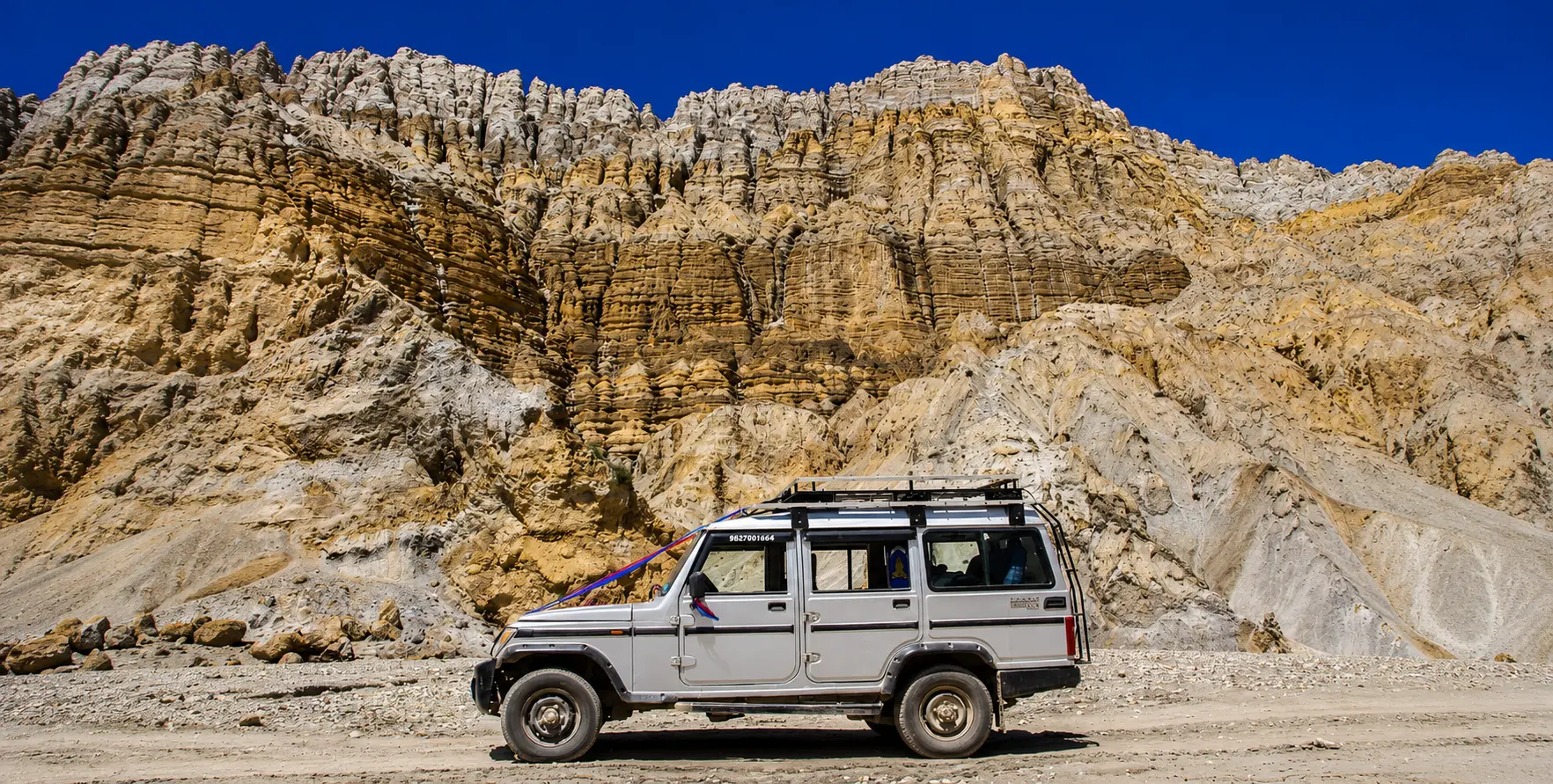
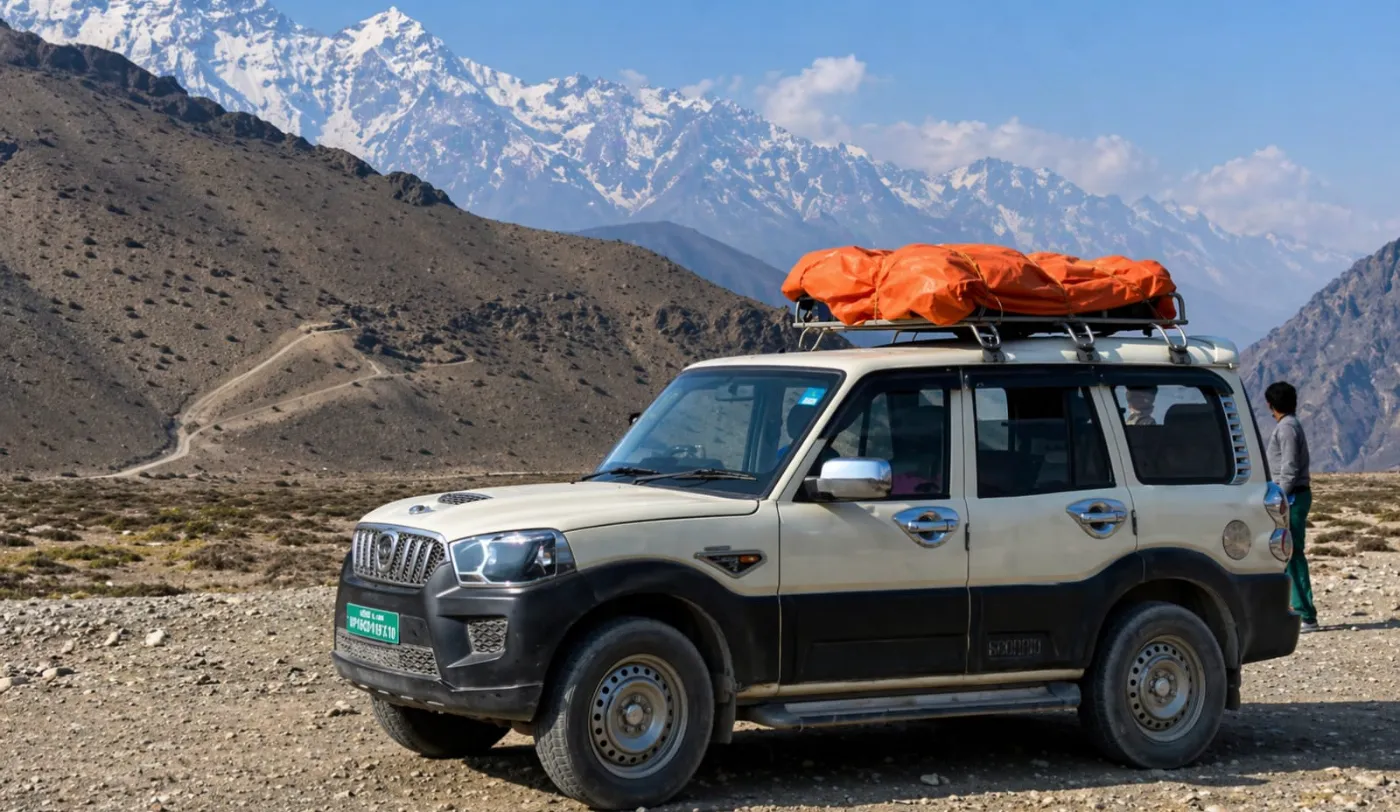
Private Scorpio jeep with luggage on the roof
cars, 4WD jeeps, Toyota Hiace vans, and tourist buses

Nepal’s terrain changes more dramatically, more often, than almost anywhere else on earth — from flat highways through the Terai to hairpin mountain roads climbing thousands of meters, and unpaved tracks that no ordinary car was ever built to handle. This is precisely why there is no single ‘best’ vehicle for travelling around Nepal.

The right choice for car, jeep, Hiace, or bus hire in Nepal depends entirely on your group size, route, budget, and whether your itinerary includes rough mountain roads that demand genuine 4WD capability. This guide compares all four major vehicle categories in detail — what each one is built for, what it costs and which specific Nepal routes suit it best — so that you can book the right vehicle the first time, rather than discovering halfway up a mountain road that your sedan should have been a jeep, or paying for an oversized coaster when a single shared car would have done the job for a couple travelling alone.

Every comparison in this guide links directly to the specific vehicle and route pages on Nepal Vehicle Hiring Pvt Ltd’s website, so you can move straight from reading about a vehicle category to checking availability and pricing for your exact trip.

Quick Overview: car, jeep, Hiace, and bus hire in Nepal

Before diving into the details, here is the short version. A private car suits solo travellers and small families sticking to paved roads — Kathmandu Valley sightseeing, the Kathmandu–Pokhara highway, and Terai routes toward Lumbini and Chitwan.

A 4WD jeep is the only sensible choice once your route includes unpaved mountain roads — Mustang, Manaslu, Annapurna trailheads, and most trekking gateway towns above 2,000 meters. A Hiace van fits families and small groups of up to fourteen who want one comfortable vehicle rather than splitting across two cars.

A tourist bus or coaster suits larger groups and budget-conscious solo travellers between major tourist hubs on fixed schedules and well-paved routes.

How This Guide Is Organised: The vehicle category below follows the same structure: what the vehicle is built for, what it typically costs, which specific Nepal routes it suits best, and where its practical limits lie. Reading through all four sections, even if you already have a vehicle category in mind, helps clarify the trade-offs at the boundaries between categories, since many real Nepal itineraries combine more than one vehicle type across different legs of the same trip, rather than relying on a single vehicle for an entire journey from arrival to departure.

Car Hire in Nepal: Comfort for City and Highway Travel

A standard car hire in Nepal is the most popular choice for travellers on itineraries that stay on paved roads: Kathmandu Valley sightseeing, the Kathmandu–Pokhara highway, transfers to and from the airport, and day trips around Pokhara, Chitwan, and Lumbini. Sedans and small SUVs typically seat one to three passengers comfortably, with luggage space sufficient for a few suitcases, making them ideal for solo travellers and honeymooners who prioritise privacy over carrying capacity.
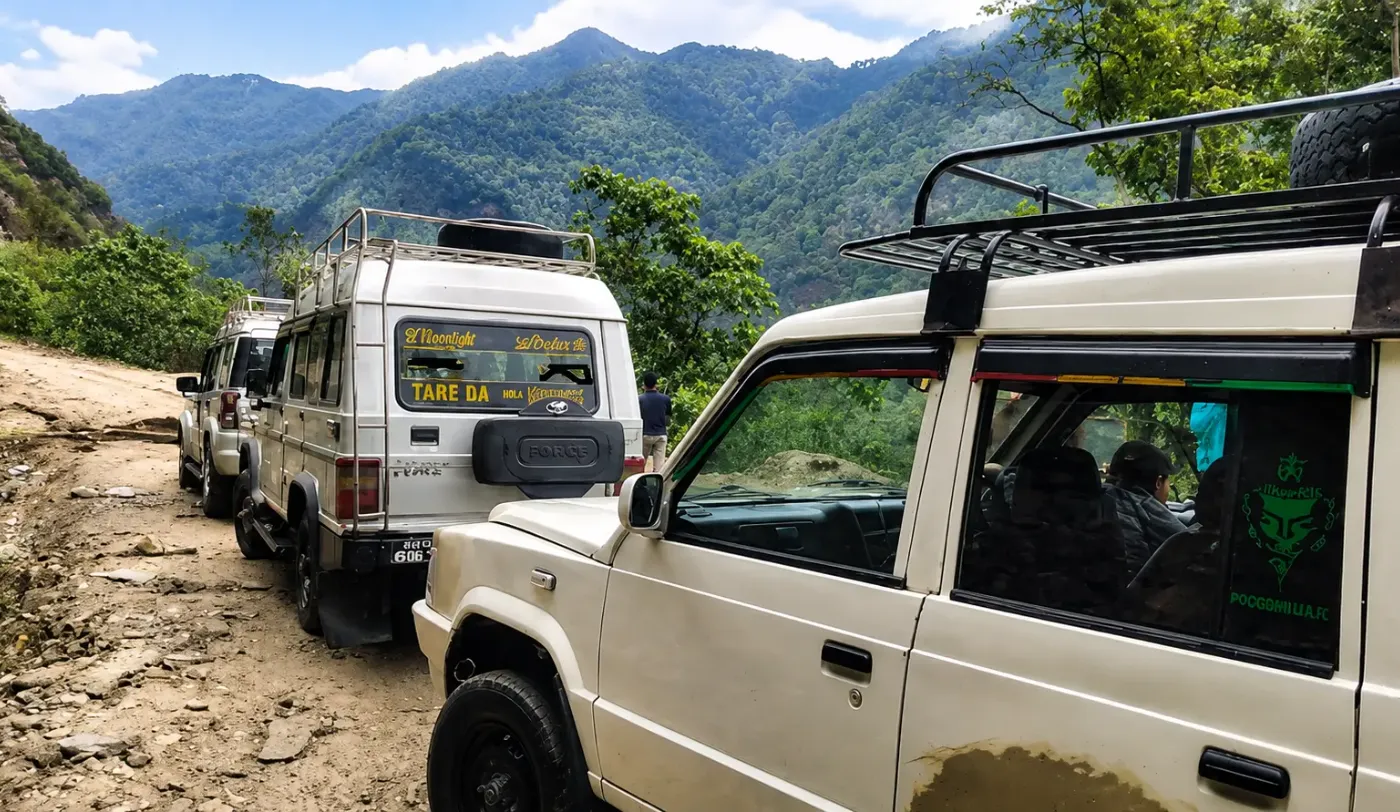
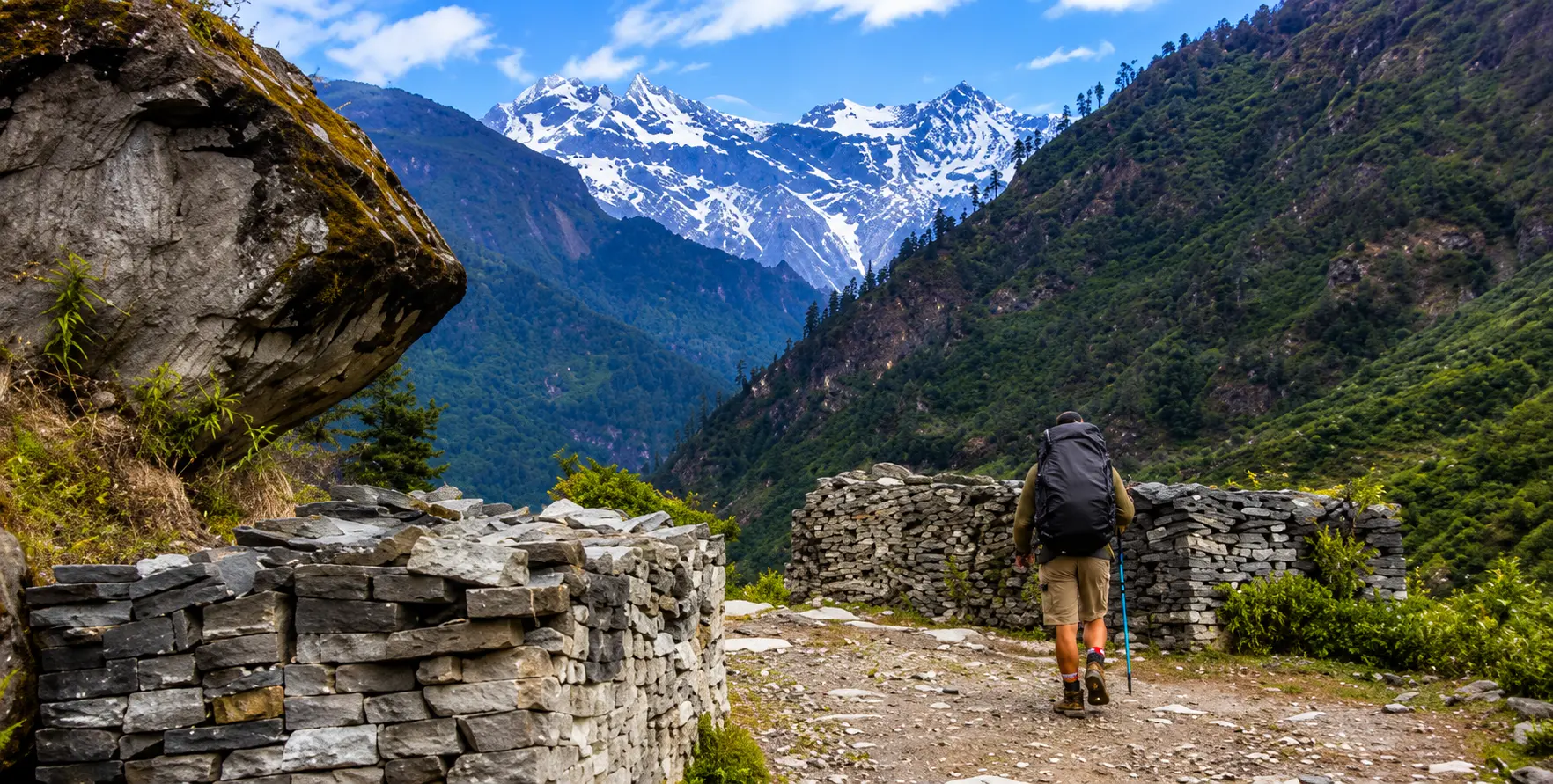
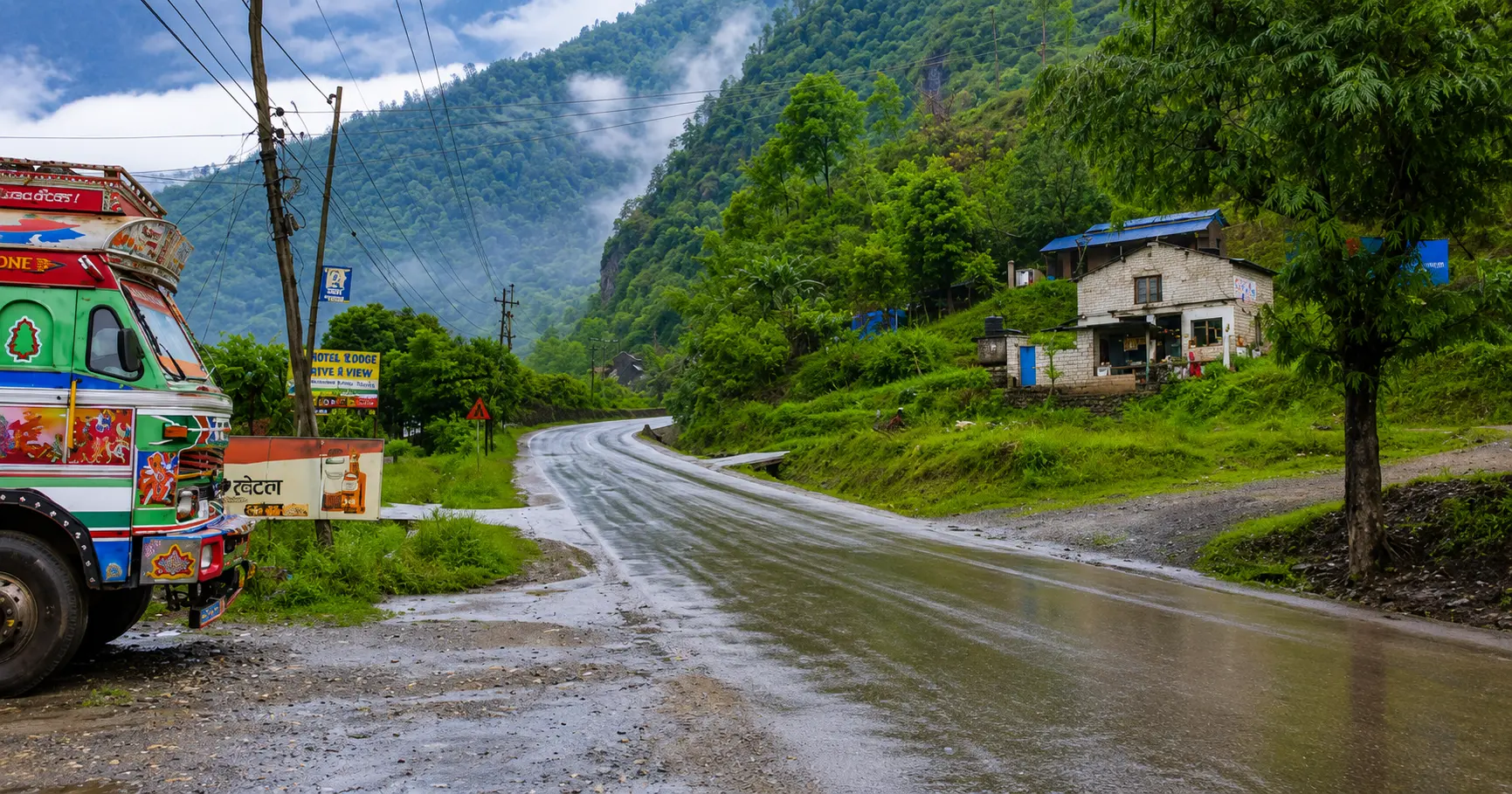
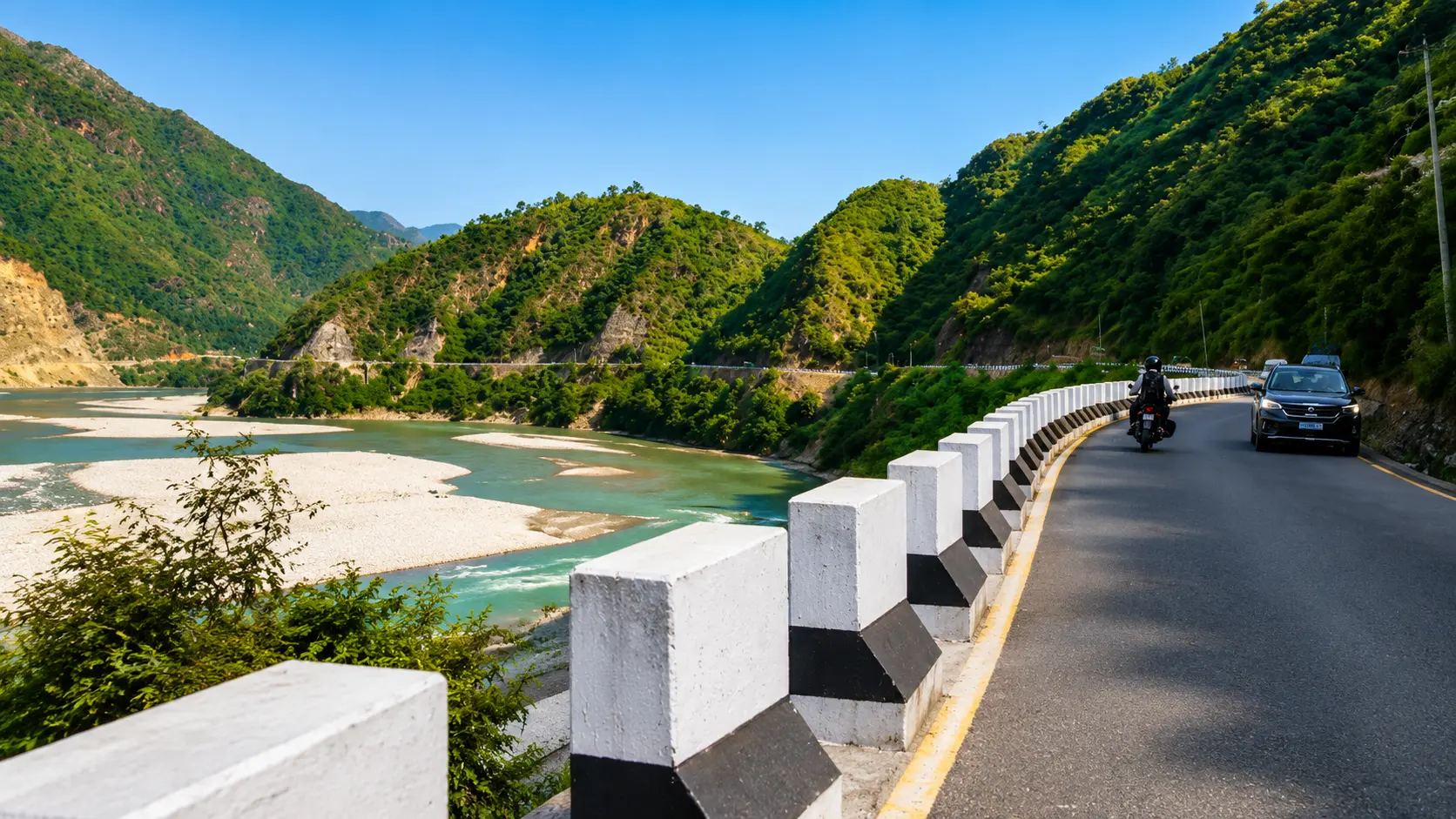
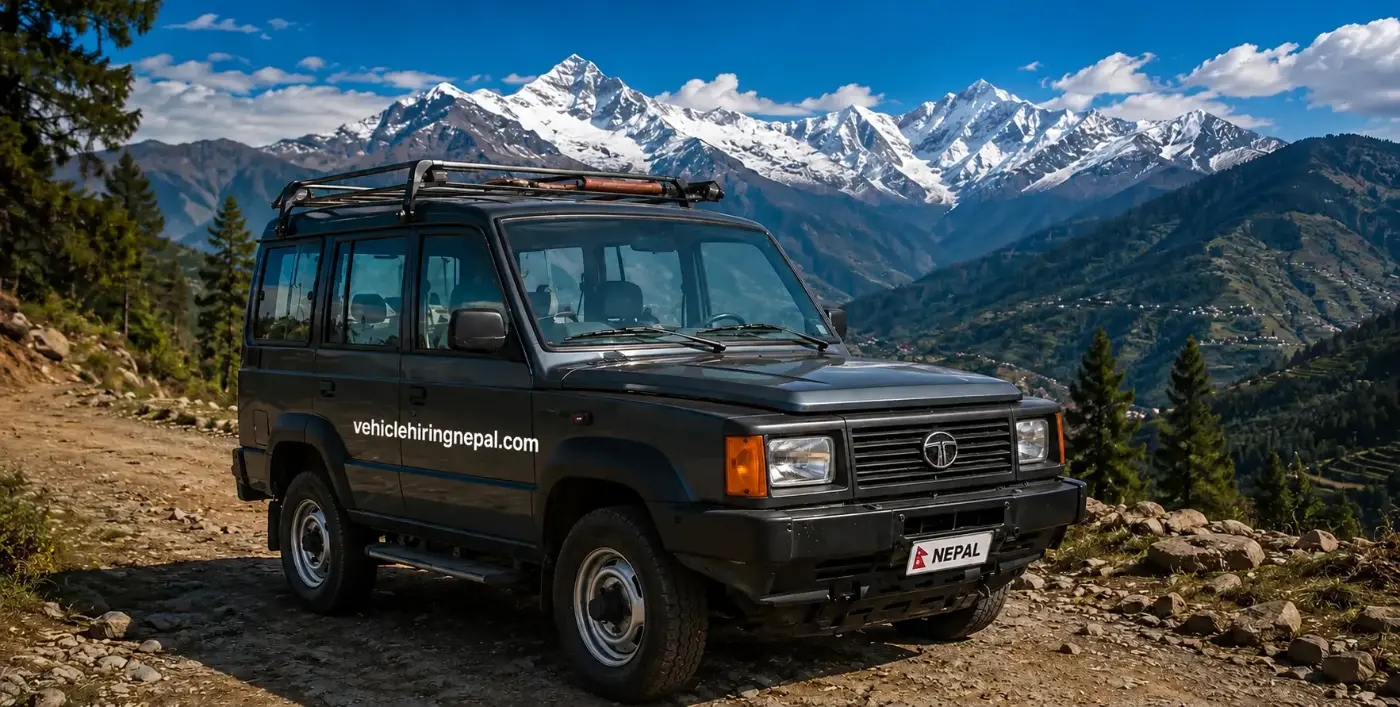
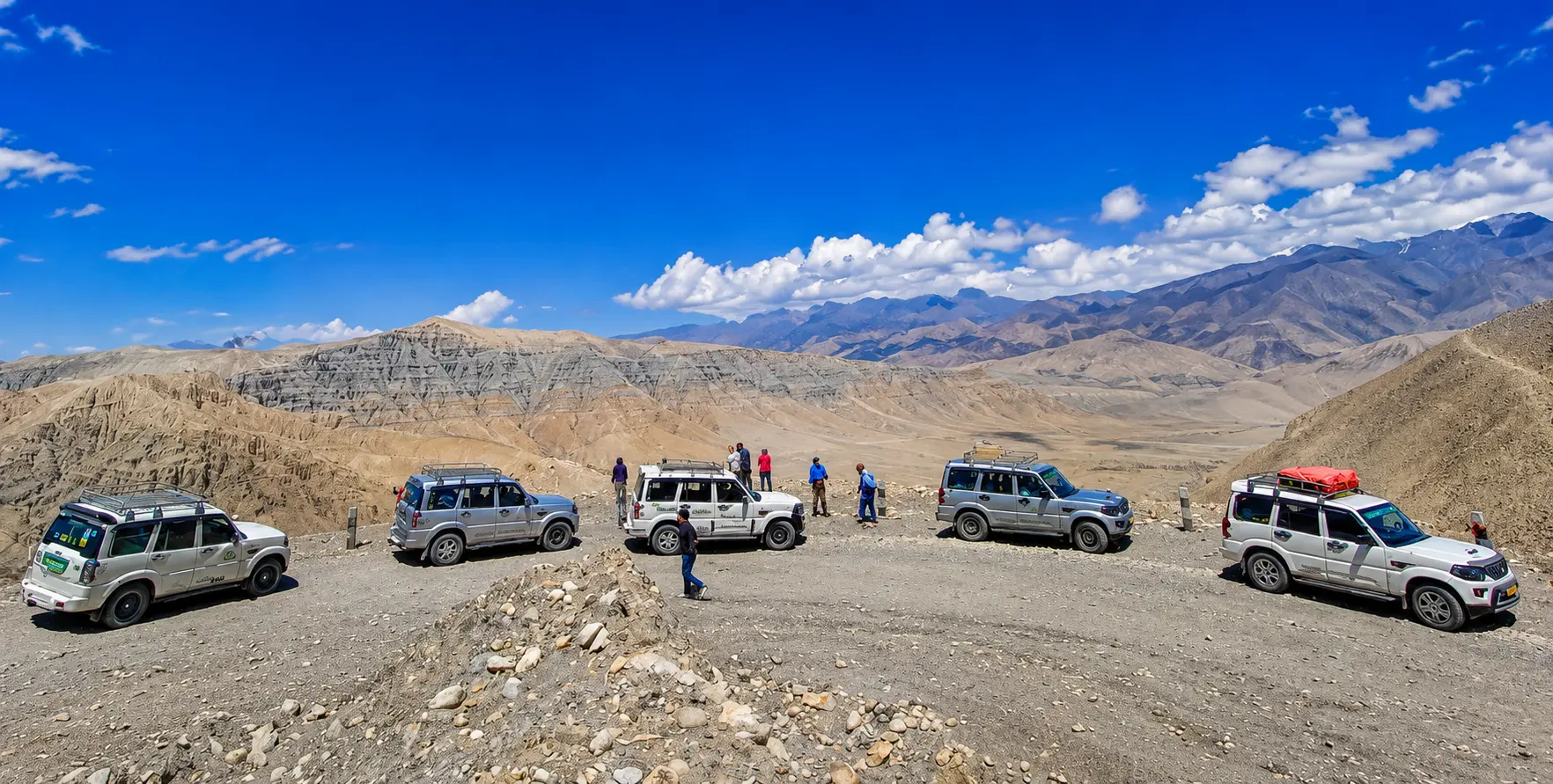
Private jeeps on a mountain road in Nepal

Typical Car Hire Pricing

Within the Kathmandu Valley, sedan hire with a professional driver typically starts around NPR 5,000–6,000 per day (roughly US$38–45), rising modestly for trips outside the valley due to additional fuel and driver accommodation costs. Hourly bookings, useful for half-day sightseeing or short transfers, generally run NPR 600–800 per hour with a minimum booking of around five hours.

These rates conventionally include the driver’s salary, fuel, parking fees, and standard road tolls. However, confirm what is included before booking, since some providers charge extras for late-evening trips on a set mileage allowance.

Best Routes for Car Hire

Cars are not suited to unpaved mountain roads, steep trekking-trailhead access tracks, or routes above roughly 2,000 meters, where road surfaces deteriorate; for any of these, a jeep is the appropriate choice, which is covered next.

Jeep and 4WD Hire in Nepal: The Mountain Specialist

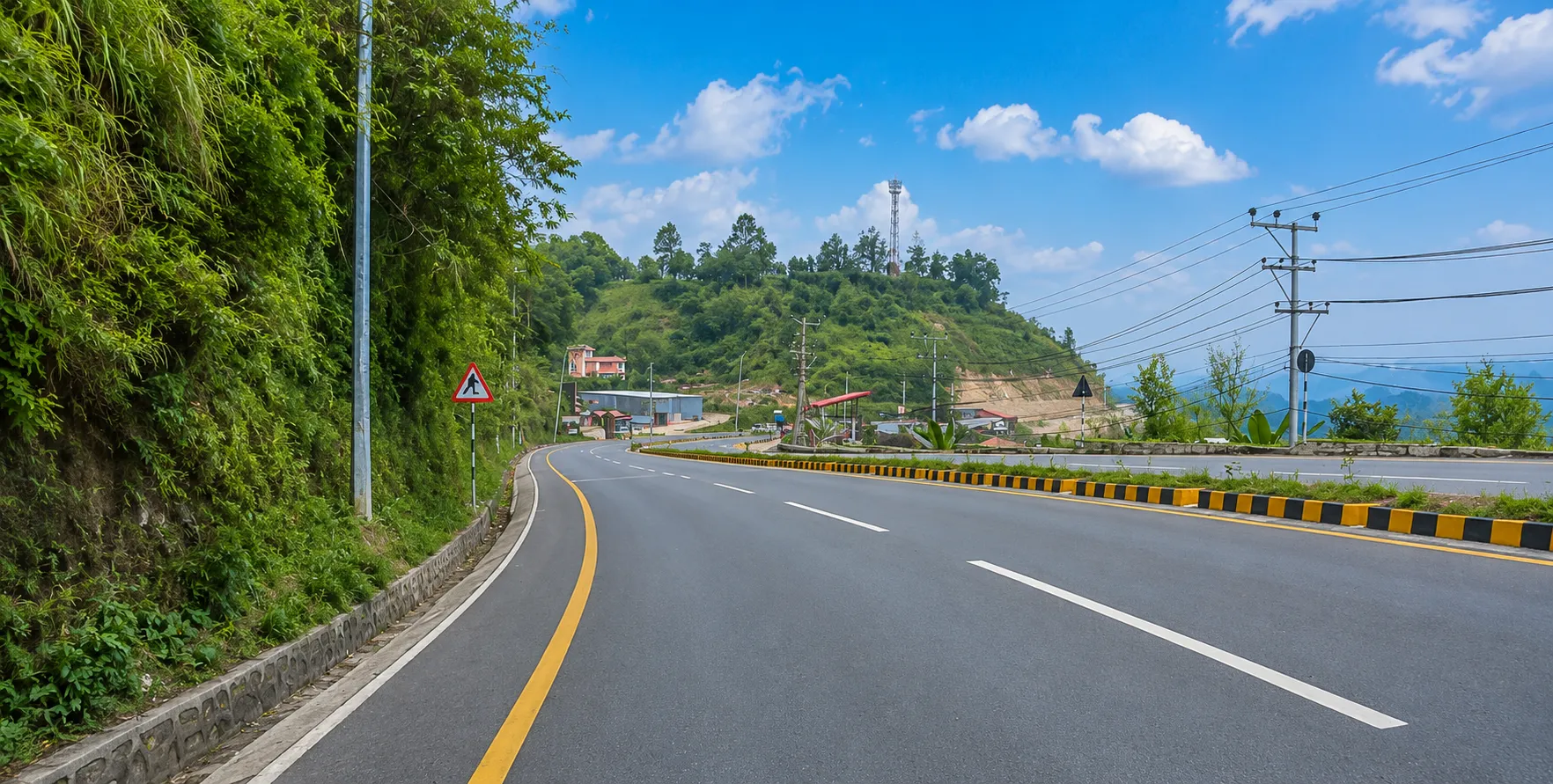
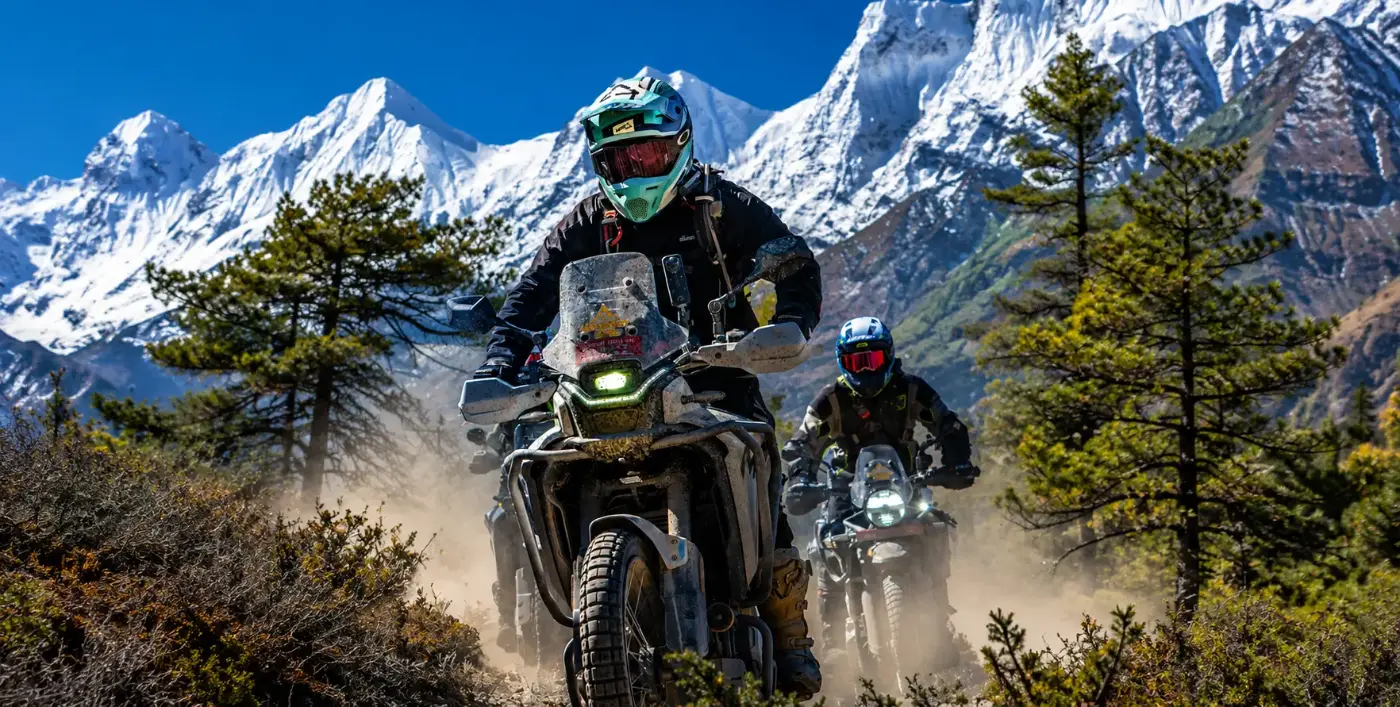
For Nepal’s mountain districts, 4WD hire is not a luxury upgrade; it is a structural requirement. Routes into Mustang, Manang, Manaslu, Dolpa, and most trekking trailheads above 2,000 meters climb steep, unpaved switchbacks that a standard sedan cannot manage safely, especially after monsoon rains wash sections of road into rutted tracks.

A purpose-built jeep hire in Nepal — typically a Mahindra Scorpio, Bolero, Toyota Hilux, or Toyota Land Cruiser Prado — provides the ground clearance, four-wheel drive, and experienced mountain driving needed for these roads.

2WD vs 4WD Jeep: Which Do You Need?

Most Jeep fleets in Nepal offer both two-wheel-drive (2WD) and four-wheel-drive (4WD) variants of the same vehicle models. 2WD Jeeps are a comfortable, slightly more affordable option for long-distance paved highway travel and gentler unpaved stretches.

At the same time, genuine 4WD is essential for steep, loose-surface mountain roads, river crossings, and the high-altitude trekking trailhead access roads common throughout Nepal’s restricted trekking regions. As a rule of thumb, if your itinerary includes any route described online as requiring ‘4WD only’ or passing through districts such as Mustang, Manang, Dolpa, or Manaslu, book a genuine 4WD rather than the cheaper 2WD option.

Typical Jeep Hire Pricing

Jeep hire with a driver typically runs NPR 7,500–9,000 per day (roughly US$56–68) within and immediately around Kathmandu, with rates rising for multi-day mountain itineraries that involve higher fuel consumption, steeper terrain, and overnight accommodation for the driver in remote areas. Standard jeep models such as the Mahindra Scorpio and Bolero comfortably seat up to seven passengers, including the driver, with rooftop space for luggage and trekking gear, making them practical for both family groups and small trekking parties.

Best Routes for Jeep Hire

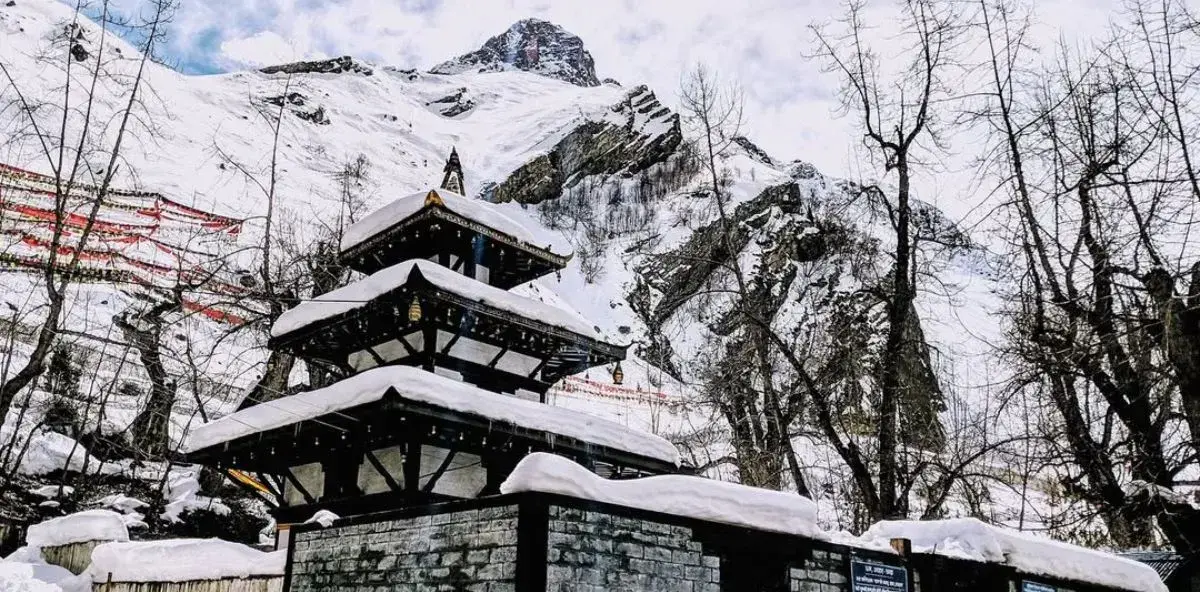
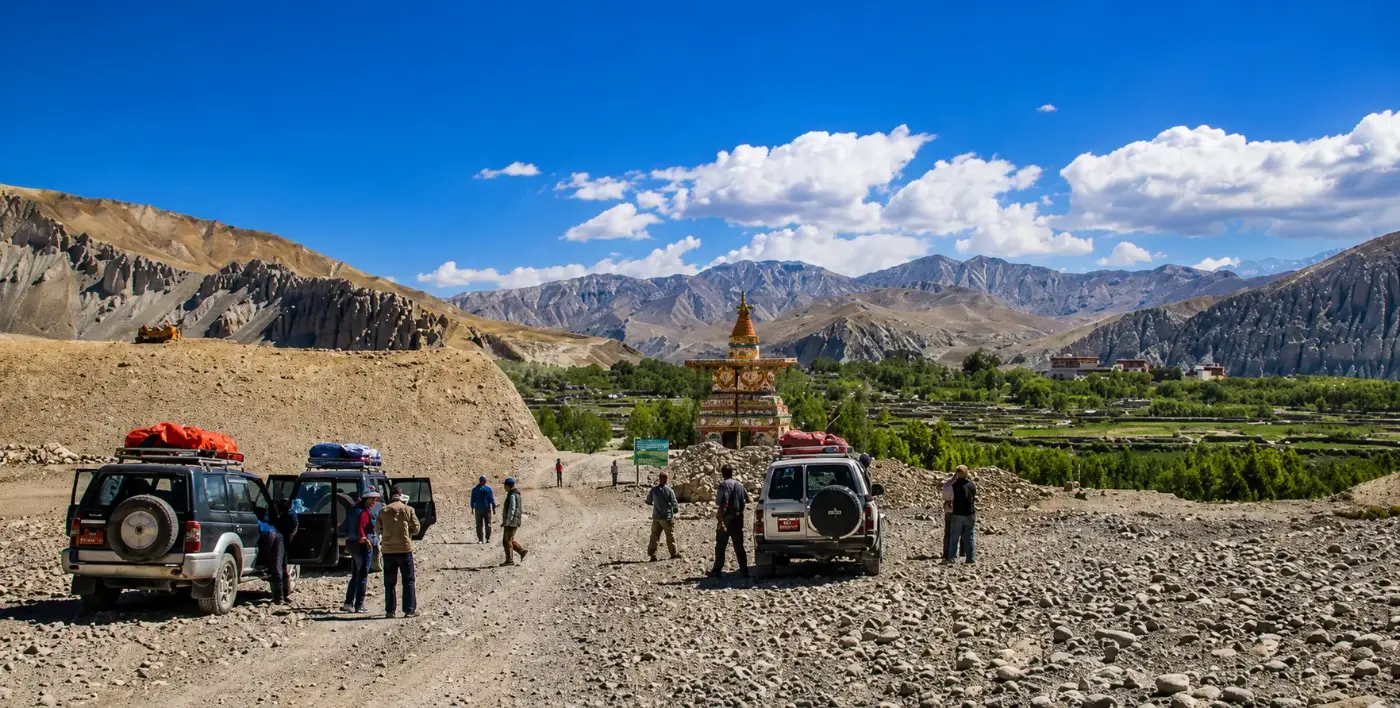
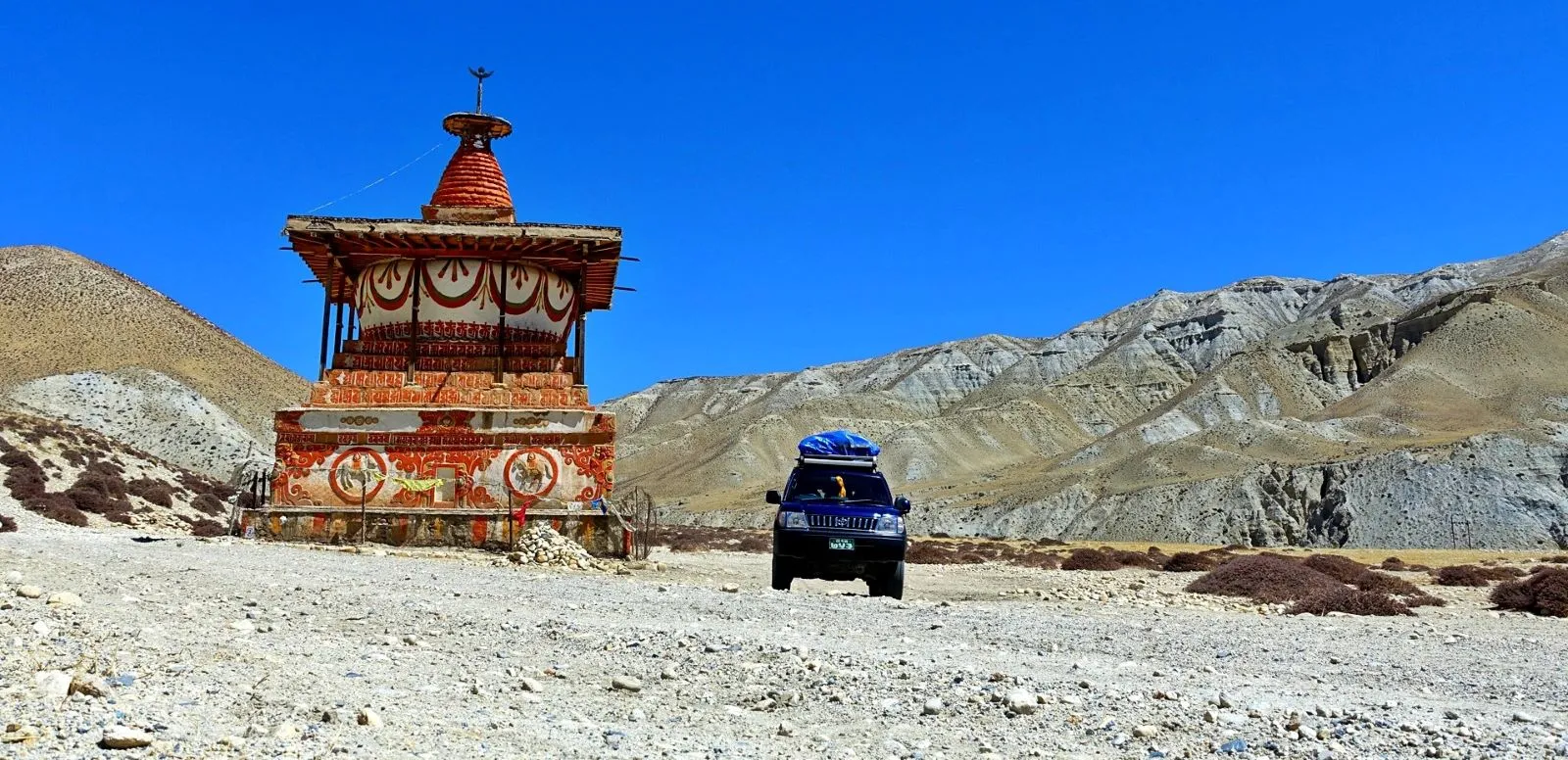
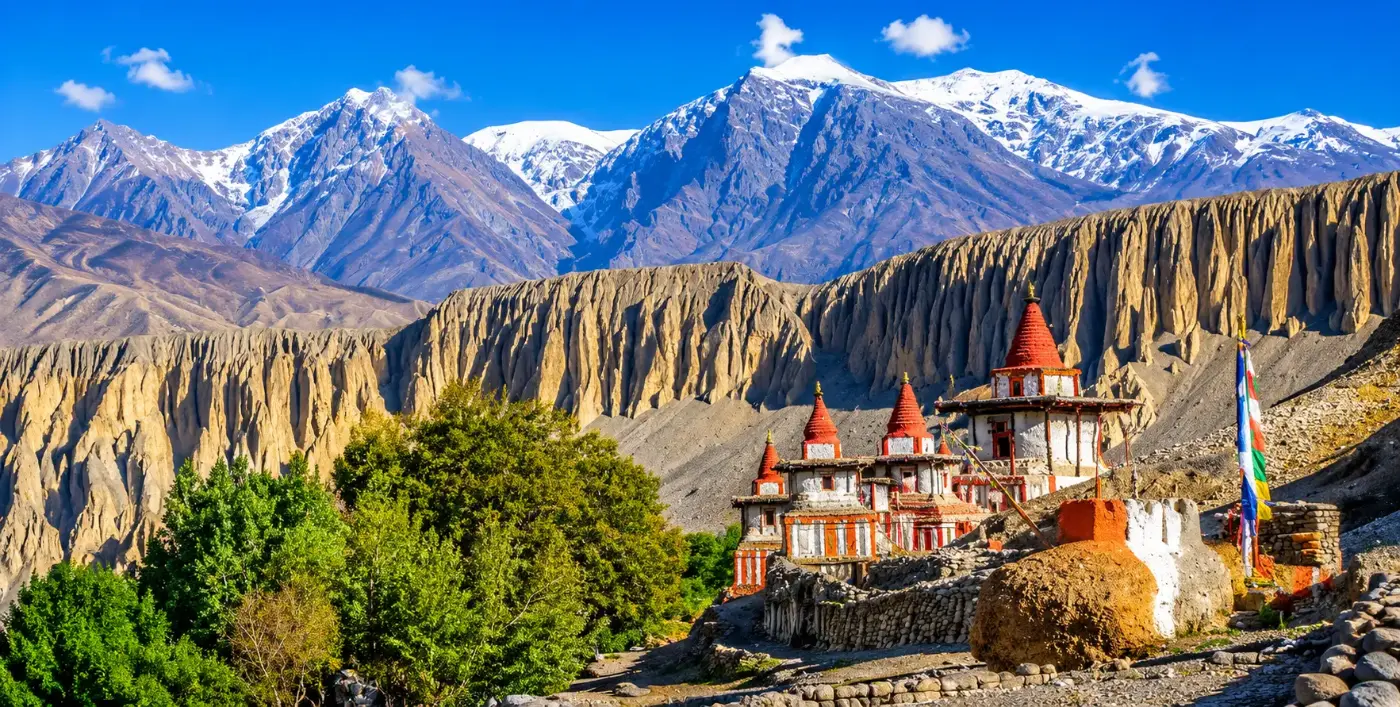
Jeeps are also the standard choice for pilgrimage routes to high-altitude temples such as Muktinath, and for travelling Upper Mustang’s expanding network of jeep-accessible roads, where the terrain shifts from forested hillside to high-altitude desert within a single day’s drive.

Hiace Van Hire in Nepal: The Group Comfort Option

For families and small groups of seven to fourteen people, a Hiace van hire offers the comfort of a single shared vehicle rather than splitting a group across two cars or a car and a jeep. The Toyota Hiace, Nepal’s standard tourist van, offers individual reclining seats, generous luggage space, and — on most tourist-grade models — air conditioning, making it a popular middle ground between a private car’s intimacy and a bus’s economy of scale.

Typical Hiace Hire Pricing

Hiace van hire with a driver typically costs NPR 7,500–9,000 per day for valley and short-distance use, broadly comparable to jeep pricing, with hourly rates around NPR 850 per hour for shorter bookings, subject to a minimum hours requirement. For multi-day touring itineraries combining several cities, daily rates are usually quoted as part of a package that also covers driver accommodation and meals for overnight trips.

Best Uses for Hiace Hire

Hiace vans handle paved and lightly unpaved roads well but, like cars, are not suited to the steepest, roughest mountain trailhead roads — for those routes, a jeep convoy or a smaller group split between jeeps is the more practical choice.

Bus, Coaster, and Tourist Bus Hire in Nepal: Budget and Scale

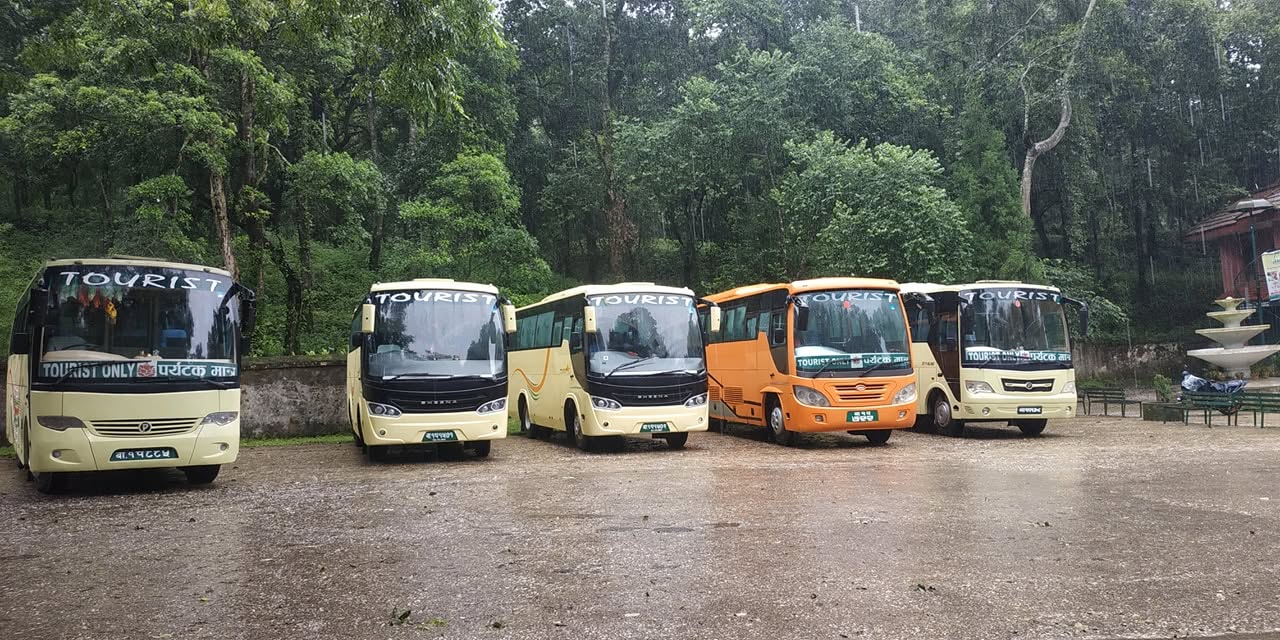
For larger groups, budget-conscious solo travellers, and fixed-route intercity travel, Nepal’s bus hire network is reliable, inexpensive, and well-suited to the country’s main paved tourist corridors. Standard tourist buses operate scheduled daily departures on routes such as Kathmandu–Pokhara, Kathmandu–Lumbini, and Pokhara–Chitwan, with reclining seats, onboard storage, and, on the better-equipped lines, air conditioning and onboard refreshment stops.

For private group charters rather than scheduled seats, a coaster bus—Nepa’s standard 20-seater minibus— offers a cost-effective option for groups of 15–20 travelling on a fixed itinerary, commonly used for company retreats, tour groups, and extended family travel.

Typical Bus and Coaster Pricing

Scheduled tourist bus seats between Kathmandu and Pokhara typically cost around US$10 per person, with similar pricing on the Lumbini and Chitwan corridors, making bus travel by far the most economical way to move between Nepal’s major tourist hubs. Private coaster charters are quoted per day or per itinerary rather than per seat, scaling with route length and number of travel days, and represent better value than multiple car or jeep bookings once a group exceeds roughly fifteen people.

Best Routes for Bus and Coaster Hire

Buses are not recommended for the steep, unpaved trailhead access roads covered earlier under jeep hire; even where a bus route nominally exists toward a mountain district, the ride is typically slower, less comfortable, and less reliable than a private jeep over the same rough terrain.

Side-by-Side: Matching the Vehicle to Your Trip

Solo traveller or couple, city and highway only: A private car hire offers the best balance of comfort, privacy, and cost for Kathmandu sightseeing, airport transfers, and the Kathmandu–Pokhara highway.

Solo traveller, mountain trailhead access: A 2WD or 4WD jeep is necessary once your route leaves paved roads, even for just one or two passengers, since the vehicle choice is dictated by road surface rather than group size on these routes.

Family of four to seven, mixed itinerary: A jeep or Hiace both work well; choose the jeep if any part of the route is unpaved or mountainous, and the Hiace if the entire itinerary stays on paved roads and you want a more spacious, car-like ride.

Group of eight to fourteen, paved or lightly mixed roads: A Hiace van is generally the most comfortable and cost-effective single-vehicle solution for this group size.

Group of fifteen or more, fixed touring itinerary: A coaster bus charter typically offers the best value, particularly for multi-day group tours covering several cities.

Budget solo or pair travel between major cities: Scheduled tourist bus seats on routes like Kathmandu to Pokhara offer the lowest per-person cost for travellers on a tight schedule or with heavy luggage.

What’s Typically Included in a Nepal Vehicle Hire Price

Reputable vehicle hire providers in Nepal, across all four categories covered in this guide, generally structure their pricing to include the driver’s daily salary, fuel for the agreed route, standard road tolls and parking fees, and, for multi-day trips, the driver’s meals and overnight accommodation in towns along the route. What is typically included, and what to confirm before booking, includes: routes beyond the originally agreed route; late-night surcharges for pickups or drop-offs outside standard daytime hours; and any tips for the driver, which remain customary but optional at the end of a satisfactory trip.

For multi-day mountain itineraries in particular, confirm whether the quoted price assumes a fixed number of driving days or a fixed itinerary regardless of weather delays, since road closures from landslides or snow are not uncommon during shoulder seasons and can affect both timing and cost if not clarified up front.

Seasonal Considerations for Vehicle Hire

Nepal’s vehicle hire market generally follows the same seasonal rhythm as its tourism calendar. Autumn (late September through November) and spring (March through May) represent peak demand, when vehicles of every category, but particularly jeeps serving popular trekking trailheads, should be booked at least a week or two in advance to guarantee availability on the exact dates needed.

Monsoon season (June through early September) adds the complication of landslide risk on several mountain roads, making jeep drivers’ local route knowledge especially valuable; experienced operators know which roads remain passable and which require detours.

Winter (December through February) is generally the easiest season for last-minute vehicle bookings outside the main Everest and Annapurna trekking windows. However, some high-altitude roads, including sections of the Mustang and Manang jeep routes, may close temporarily due to snow at the highest passes.

Vehicle Hire for Special Occasions and Pilgrimage Travel

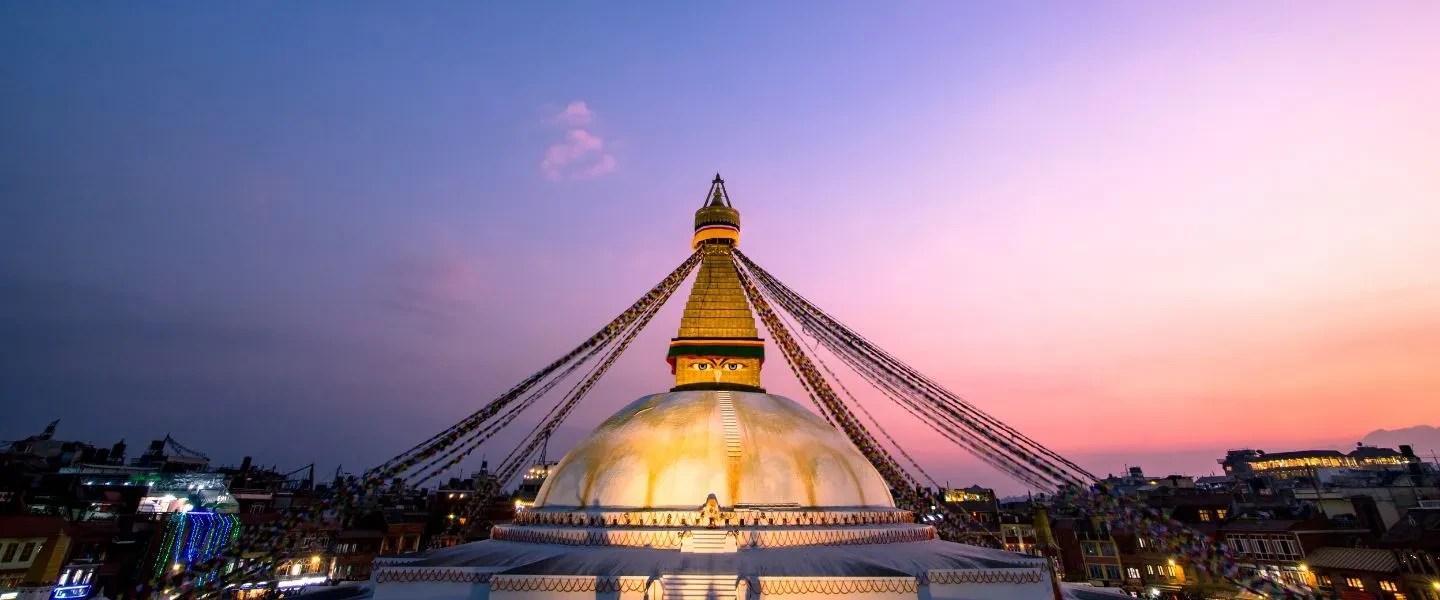
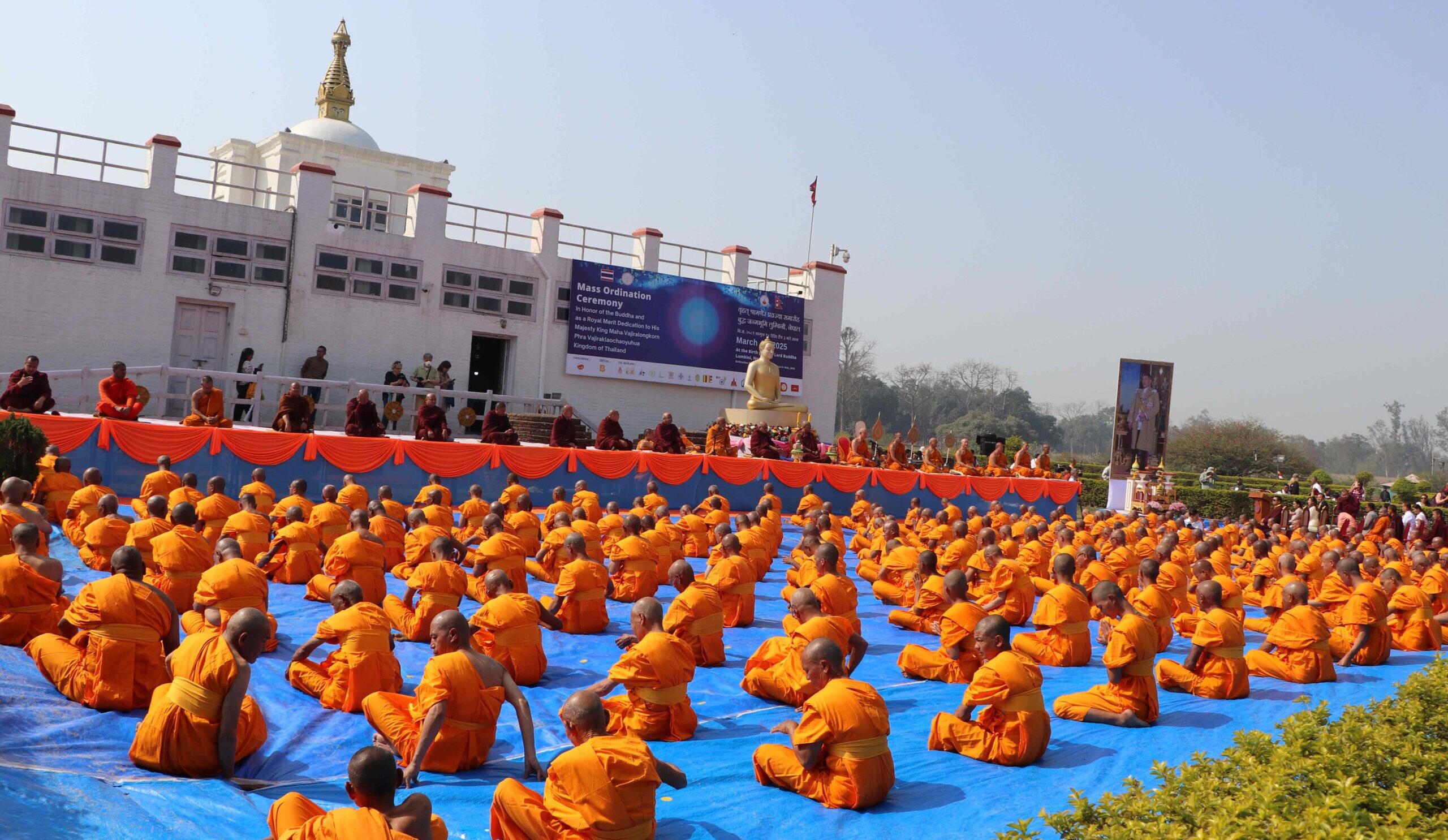
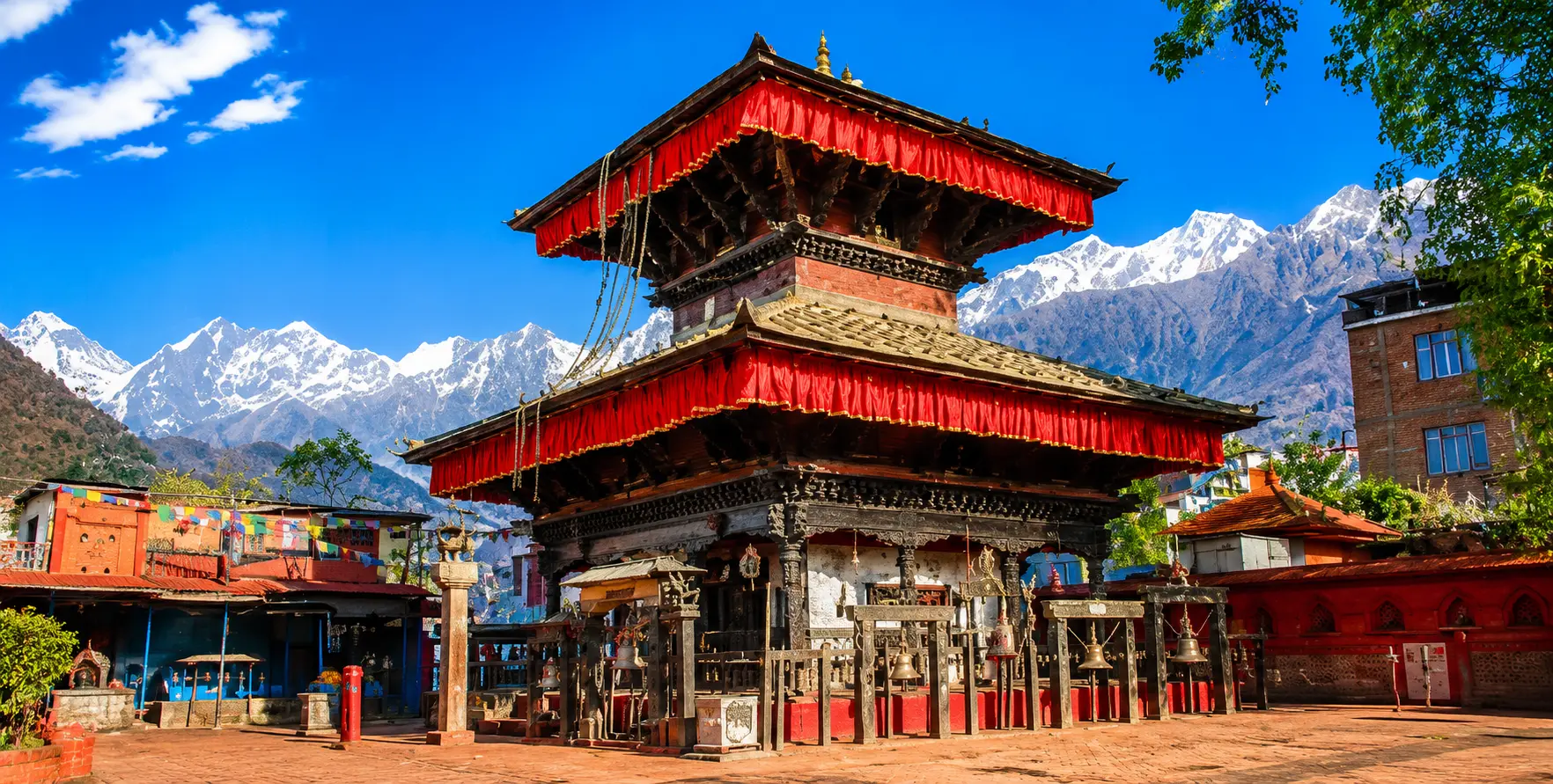
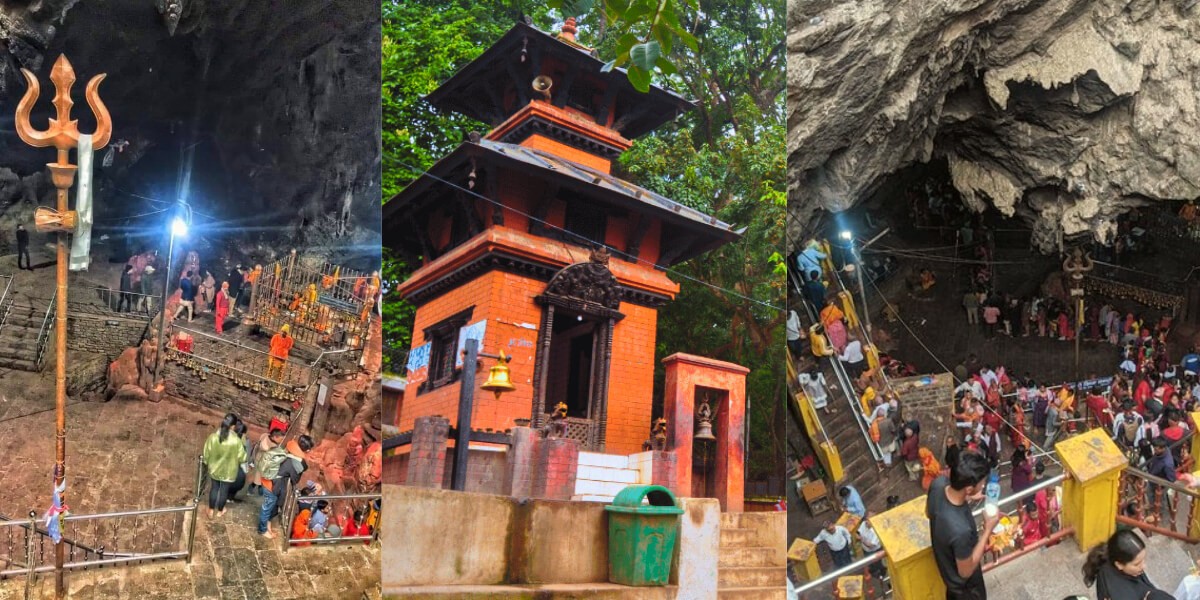
Beyond standard sightseeing and trekking logistics, vehicle hire in Nepal also plays a central role in religious pilgrimage travel, a significant segment of the country’s domestic and international tourism economy. Hindu pilgrims travelling to Muktinath, Pashupatinath, and other sacred sites, alongside Buddhist pilgrims visiting Lumbini, Boudhanath, and Swayambhunath, often have specific scheduling needs tied to auspicious dates and religious festivals, requiring vehicle providers experienced in coordinating around these calendars rather than purely tourist schedules.

Jeep hire, in particular, plays an outsized role in pilgrimage logistics to high-altitude sites like Muktinath, where the final approach road climbs well above 3,000 meters and genuinely demands the same 4WD capability used for standard trekking trailhead access elsewhere in this guide.

Wedding parties, corporate retreats, and milestone celebrations represent another distinct category of vehicle-hire needs, often requiring multiple coordinated vehicles to arrive and depart in sequence, sometimes alongside decoration or branding requests for the vehicles themselves. Reputable providers serving this segment typically offer dedicated coordination for multi-vehicle convoys, ensuring that a ng party’s cars, a Hiace for the families, and a coaster for extended guests all arrive at the correct venue at the correct time without the logistics falling to the event organisers. Hire for Business and Corporate Travel in Nepal.

Nepal’s growing business tourism sector, including conferences, corporate retreats, and site visits for international NGOs and development organisations, relies heavily on reliable vehicle hire services distinct from those for standard leisure tourism. Corporate clients typically prioritise reliability, vehicle presentation, and driver professionalism over the adventure-oriented capability that leisure trekkers might prioritise, so many providers maintain a distinct fleet tier of well-presented sedans and SUVs for executive and corporate transfers, alongside their standard tourist fleet.

For multi-day corporate retreats or site visits spanning several Nepal locations, the same vehicle category logic that applies to leisure travel still holds: a sedan or SUV suits Kathmandu Valley meetings and airport transfers, while site visits to rural project locations outside the valley may require a 4WD jeep depending on the specific road conditions involved, a detail worth clarifying with local project staff before booking transport for an unfamiliar rural route. Many corporate clients also value the option to scale a vehicle fleet up or down across a multi-day program, starting with a single executive car for airport arrival and adding jeeps or a Hiace for field visits later in the itinerary, which a fleet-diverse local provider can typically accommodate far more smoothly than a company relying on a single rental partner with a narrower vehicle range.

Practical Tips for Booking Vehicle Hire in Nepal

  • Book in advance during October–November and March–May, Nepal’s two peak tourist seasons, when popular vehicle categories and routes can sell out, particularly jeeps serving major trekking trailheads.
  • Confirm whether your route requires 4WD specifically, not just ‘a jeep’ — some providers default to 2WD unless 4WD is explicitly requested, which matters considerably on rough mountain roads.
  • Clarify what is included in the quoted price: driver costs, fuel, tolls, and meals are usually included, but always confirm before booking rather than assuming.
  • For group travel, compare the total cost of multiple smaller vehicles with that of a single larger vehicle, such as a Hiace or Coaster — beyond a certain group size, the larger vehicle is almost always more economical and more comfortable.
  • Ask about the driver’s experience on your specific route, particularly for mountain destinations, since local route knowledge meaningfully affects both safety and trip pacing.
  • Pre-book airport transfers rather than negotiating with curbside taxi operators on arrival, since pre-arranged rates are typically more transparent and eliminate wait time.

Vehicle Models Explained: What You’re Actually Riding In

Sedans and SUVs (Car Category)

Nepal’s car hire fleets typically draw from a mix of Japanese, Korean, and Indian models well suited to Kathmandu Valley roads and the Kathmandu–Pokhara highway. Compact sedans like the Suzuki Dzire and Honda Amaze offer fuel-efficient, comfortable rides for one to three passengers.

At the same time, small SUVs and crossovers add a bit more ground clearance and luggage space without stepping into full off-road territory. For travellers seeking a more top-end experience, larger SUVs such as the Toyota Land Cruiser Prado are increasingly offered in a ‘luxury car’ tier, combining genuine comfort with enough capability to handle lightly rough roads if an itinerary occasionally strays off the main highway.

Mahindra Scorpio and Bolero (Jeep Category)

The Mahindra Scorpio is Nepal’s most widely used mountain vehicle, prized for its balance of power, ground clearance, and relatively affordable running costs compared to larger 4WD options. Seating up to seven passengers, including the driver, with full rooftop luggage capacity, the Scorpio handles everything from the steep switchbacks toward Manaslu’s Soti Khola trailhead to the high-altitude tracks of Upper Mustang.

The Mahindra Bolero, a slightly more rugged and basic sibling to the Scorpio, is a popular budget-friendly alternative for the same routes, trading a little cabin refinement for an even lower price point, while remaining fully capable on rough terrain in its 4WD configuration.

Toyota Hilux and Land Cruiser Prado (Top-end Jeep Category)

For travellers seeking a higher comfort tier on mountain routes, the Toyota Hilux and Toyota Land Cruiser Prado offer noticeably smoother rides and more robust off-road engineering than the Scorpio or Bolero, at a correspondingly higher daily rate. These vehicles are particularly popular for VIP transfers, longer multi-day mountain itineraries where ride comfort matters for hours of driving, and travellers seeking a top-end experience for occasions such as honeymoons or milestone celebrations.

Toyota Hiace (Van Category)

The Toyota Hiace remains the standard tourist van across Nepal, valued for its reliability, parts availability, and comfortable individual seating compared to older minibus designs. Tourist-grade Hiace vans typically include air conditioning, tinted windows, and a dedicated luggage compartment separate from the passenger cabin, distinguishing them from the more basic Hiace models used for local public transport.

Coaster and Coach Buses (Bus Category)

The Toyota Coaster, Nepal’s standard 20-seater minibus, bridges the gap between vans and full-size buses and is commonly chartered by tour groups, corporate retreats, and extended families. For larger parties, full-size tourist coaches seating roughly 35 passengers handle the major scheduled routes between Kathmandu, Pokhara, Lumbini, and Chitwan, typically offering reclining seats, onboard sound systems, and scheduled rest stops at clean roadside restaurants along the route.

Why the Driver Matters as Much as the Vehicle

Across every vehicle category covered in this guide, the single factor that most affects trip quality, beyond the vehicle itself, is the driver. Nepal’s mountain roads demand genuine local knowledge: which sections wash out first in monsoon rain, where landslide risk is highest in shoulder seasons, which detours avoid current roadwork, and how to pace a long mountain drive so passengers arrive comfortable rather than exhausted.

An inexperienced driver in a perfectly capable 4WD jeep can still produce a stressful, unsafe trip. In contrast,e an experienced driver in a more modest vehicle often delivers a smoother, more reassuring journey.

When booking any vehicle category, it comes down to the driver’s experience on your intended route, not just their general years of driving experience. A driver who regularly runs the Kathmandu to Soti Khola route, for instance, will know the current state of the Budhi Gandaki Valley better than a driver whose experience is mostly confined to Kathmandu Valley city driving, even if both are equally skilled behind the wheel overall.

Understanding Nepal’s Road Conditions by Region

Nepal’s road network broadly falls into three categories that determine which vehicle type best suits a given route. Major highways — the Prithvi Highway connecting Kathmandu and Pokhara, the Mahendra Highway running the length of the Terai, and the roads linking Kathmandu to Bhaktapur and the airport — are sealed, well-maintained, and suitable for any vehicle category, including standard sedans.

Secondary district roads, connecting smaller towns and the lower stretches of most trekking approach routes, are a mix of paved and unpaved surfaces, generally manageable by a 2WD jeep or Hiace but increasingly rough toward their upper reaches.

The third category, rural and high-altitude trekking access roads, is where this choice matters most. Roads like those toward Soti Khola, Besisahar’s upper reaches, and the jeep tracks through Upper Mustang are unpaved, frequently rutted, and prone to seasonal washouts that can render sections temporarily impassable, even to 4WD vehicles, during heavy monsoon rain.

These roads are precisely why Nepal’s vehicle hire market maintains such a clear distinction between car, jeep, Hiace, and bus categories: the underlying infrastructure genuinely requires different vehicles for different routes, not a matter of marketing or upselling.

Understanding the Full Cost of Vehicle Hire

Beyond the daily or per-route rate quoted by a vehicle hire provider, several additional cost factors are worth understanding before booking. Multi-day mountain itineraries typically include the driver’s overnight accommodation and meals as part of the quoted package, since drivers cannot return to Kathmandu each night on remote routes; this is standard practice and should already be reflected in any quoted multi-day rate rather than appearing as a surprise add-on.

Toll roads and entry fees for certain protected areas, such as national park entrance fees for routes through Chitwan or conservation area fees near Annapurna and Manaslu, are sometimes included in quoted vehicle prices and sometimes charged separately, so it is worth clarifying this distinction explicitly when booking.

Fuel costs are almost always included in quoted daily rates for standard itineraries. Still, it is sensible to confirm whether significant detours or mid-trip itinerary changes would incur additional charges, since most providers price routes based on an agreed distance and itinerary established at the time of booking.

Tipping, while not contractually required, remains a customary and appreciated gesture for drivers at the end of a satisfactory multi-day trip, particularly for challenging mountain routes where driver skill directly affects passenger comfort and safety.

How to Book Vehicle Hire in Nepal: A Step-by-Step Overview

Booking vehicle hire in Nepal, whether for a car, jeep, Hiace, or bus, generally follows a similar process regardless of the provider. Travellers typically start by sharing the itinerary, including pickup and drop-off locations, dates, and any multi-day routing; the provider then responds with a vehicle recommendation and an itemised quote, ideally clarifying what is included (driver, fuel, tolls, accommodation for multi-day trips) and what is excluded.

Confirmation usually requires a partial deposit, with the balance settled on arrival or at trip completion, and most established providers in Kathmandu and Pokhara accept a mix of cash, bank transfer, and, increasingly, card payments for deposits.

For travellers planning a multi-stop itinerary spanning several of the vehicle categories covered in this guide — perhaps a car for Kathmandu sightseeing, a jeep for a mountain trailhead, and a bus for the return leg — booking through a single provider that maintains a full fleet across all categories, such as Nepal Vehicle Hiring Pvt Ltd, simplifies logistics considerably compared to coordinating separate bookings with different companies for each leg of the journey.

This kind of integrated booking also tends to produce more accurate quotes overall, since a single provider managing the full itinerary can plan driver rotations, vehicle positioning, and route sequencing as one coordinated plan rather than as several disconnected bookings that may not account for how each leg interacts with the others in terms of timing, vehicle availability, and driver scheduling across a multi-day trip.

Safety Standards and What to Check Before Booking

Vehicle safety standards vary considerably across Nepal’s vehicle hire market, and a few practical checks help travellers identify reputable providers before committing to a booking. Reputable companies maintain documented vehicle insurance, including third-party coverage, and can confirm this on request; vehicles should be visibly well-maintained, with functioning seatbelts for every passenger seat, a spare tyre, and safety equipment such as a first aid kit and warning triangle, particularly important for mountain routes where breakdown assistance can be hours away.

Drivers operating tourist routes generally need a commercial driving license appropriate to the vehicle class, and experienced operators are usually happy to share their experience and familiarity with the requested route when asked directly. For mountain routes in particular, asking whether the vehicle carries snow chains or recovery equipment for high-altitude winter conditions is reasonable during the November–February window, when some higher passes can experience unexpected early snowfall.

Comfort Considerations for Long-Distance Nepal Drives

Several of Nepal’s most popular routes involve genuinely long driving days, and a few practical considerations help travellers choose the right vehicle for comfort, rather than just capability. The Kathmandu–Pokhara highway, while fully paved, still takes six to eight hours depending on traffic and weather, making the seating comfort and air-conditioning quality a key factor in the experience, not merely a luxury detail.

Mountain jeep routes, while often shorter in raw distance, can involve several hours of continuous, low-speed driving over rough terrain, which is physically more tiring than an equivalent highway distance and is worth factoring into trip planning, particularly for travellers prone to motion sickness or with limited mobility.

For any drive expected to exceed four to five hours, requesting scheduled rest stops in advance, rather than assuming the driver will offer them unprompted, ensures the journey includes reasonable breaks for meals, restroom access, and simply stretching, particularly important on winding mountain roads where the cumulative effect of continuous turns can be considerably more fatiguing than a straight highway drive of similar duration. Travellers, children, or anyone prone to motion sickness should factor this into route planning,   choosing shorter daily driving segments over a single very long push wherever the itinerary allows

Planning Vehicle Logistics for Larger Groups

Group travel in Nepal often requires more careful vehicle planning than solo or couple itineraries, particularly when a group’s size sits awkwardly between categories — too large for a single jeep but not quite justifying a full coaster charter. In these cases, a combination approach often works best: splitting a group of ten or twelve across two jeeps for a mountain trailhead route, for instance, rather than forcing everyone into a single overcrowded vehicle or chartering an oversized coaster that struggles on narrower mountain roads where coasters and full-size buses are sometimes simply unable to pass at all.

For mixed-ability groups — families travelling with young children and elderly members, for example — vehicle choice should also weigh comfort and ease of entry and exit alongside raw capacity. A Hiace van’s lower step height and more car-like seating generally suit less mobile travellers than its higher ground clearance, which, while excellent for rough terrain, can make entry and exit noticeably more difficult for anyone with limited mobility- a worthwhile trade-off to discuss when booking for a mixed-ability group.

Sustainable and Responsible Vehicle Hire Choices

As tourist traffic has grown along Nepal’s most popular routes, several practical choices help travellers reduce their transport footprint without sacrificing comfort or reliability. Sharing a single appropriately sized vehicle for the entire trip, rather than booking multiple smaller vehicles for convenience, reduces both costs and road congestion, which matters on narrow mountain roads where vehicle volume directly affects everyone’s travel time.

Choosing well-maintained, newer-model vehicles, where available, also tends to mean better fuel efficiency and lower emissions per kilometre travelled than fleet vehicles that are common among some budget providers.

Supporting local Nepali-owned vehicle hire operators, rather than international rental chains with comparatively limited local route knowledge, also channels tourism revenue more directly into the communities along Nepal’s major travel corridors, including the drivers, mechanics, and roadside businesses that depend on steady tourist vehicle traffic throughout the high season. This is not simply a feel-good consideration; it tends to produce a more knowledgeable, more invested driver, since locally rooted operators generally have a longer-term stake in their reputation among both fellow operators and the travel agencies who refer repeat business their way.

Self-Drive vs Driver-Included Hire: A Closer Comparison

While self-drive rental exists in Nepal for certain vehicle categories, the overwhelming majority of foreign visitors choose driver-included hire, and for good reason. Nepal’s traffic patterns differ considerably from those in most visitors’ home countries: lane discipline is loosely observed at best in Kathmandu, horn use serves as a primary communication tool rather than an emergency signal, and mountain roads frequently lack guardrails, clear signage, or consistent surface quality, particularly during and immediately after monsoon season.

International visitors attempting to self-drive on unfamiliar mountain roads face a meaningfully higher risk of accidents than experienced local drivers who have spent years learning these routes.

Beyond safety, driver-included hire also removes the practical burden of navigation, parking logistics in congested city centres, and the constant vigilance required by Nepal’s traffic conditions, freeing travellers to actually enjoy the scenery rather than focus entirely on the road ahead. For travellers who want the independence of self-drive, specialist providers still offer it, generally requiring an International Driving Permit, a security deposit, and a valid international credit card.

However, this is a minority choice among foreign visitors rather than the standard approach.

Vehicle Availability Across Nepal’s Main Tourist Hubs

Kathmandu offers by far the widest selection of vehicle categories and individual fleet options, simply because it is the country’s primary entry point and largest tourism hub. Pokhara maintains a strong, well-developed fleet across car, jeep, and Hiace categories,s given its role as the launch point for most Annapurna-region trekking.

However, bus and coaster availability, while still solid, is somewhat more limited than in Kathmandu. Smaller tourist hubs such as Chitwan’s Sauraha and Lumbini generally offer adequate car and jeep availability for local excursions but a more limited selection for long-distance or specialist mountain vehicles, making it more practical to arrange multi-day or mountain-bound vehicle hire from Kathmandu or Pokhara before travelling to these smaller hubs.

This uneven distribution of fleet availability is another reason many travellers find it more convenient to arrange their full vehicle logistics — covering multiple legs of a Nepal itinerary across different vehicle categories — through a single Kathmandu-based provider with a comprehensive fleet, rather than sourcing vehicles locally at each stop along a multi-city itinerary.

Common Mistakes When Hiring Vehicles in Nepal

  • Booking a car or 2WD vehicle for a route that actually requires 4WD. Always specify your exact destination, including the final unpaved stretch, rather than just the nearest major town, since road conditions can change dramatically in the last few kilometres to a trekking trailhead.
  • The assumed price covers the entire trip duration, regardless of delays. Confirm whether weather-related delays on mountain routes affect pricing before departure, particularly during monsoon season.
  • Underestimating group size needs. A group of nine or ten people is awkward for a single jeep or Hiace and may need two vehicles or a coaster; clarify exact passenger and luggage counts when requesting a quote.
  • Booking too close to peak season dates. Popular jeep routes to major trekking trailheads can sell out a week or more in advance during October and November.
  • Not confirming driver language ability for remote routes. While most tourist-facing drivers speak functional English, confirming this in advance helps avoid miscommunication on day mountain trips.

Are there electric or hybrid vehicle options for hire in Nepal?

Electric vehicle adoption in Nepal’s tourist transport sector has grown steadily in recent years, particularly for sightseeing in the Kathmandu Valley and airport transfers, supported by the country’s reliance on domestically generated hydropower, which makes charging electric vehicles both clean and relatively inexpensive compared to imported fuel. Electric sedan and SUV options are increasingly available for travellers seeking low-emission city transport.

However, electric 4WD jeeps for genuine mountain trekking routes remain limited because infrastructure in remote districts is lacking, meaning petrol jeeps will remain the standard choice for mountain itineraries for the foreseeable future.

How far in advance should I book a vehicle hire for a trip to Nepal?

For standard car or Hiace hire within Kathmandu or Pokhara, booking a few days in advance is generally sufficient outside peak season, and many providers can accommodate same-day requests when fleet availability allows. For jeep hire to popular trekking trailheads during October–November and March–May, booking one to two weeks in advance is strongly advised, as street capacity on the most popular mountain routes can become genuinely constrained during the busiest weeks of these peak seasons.

Bus and coaster charters for larger groups typically benefit from several weeks’ advance notice, particularly for multi-day itineraries that require coordinated scheduling across multiple destinations.

Frequently Asked Questions

What is the cheapest way to travel between Kathmandu and Pokhara?

A scheduled seat on the Kathmandu-to-Pokhara bus is the most economical option, typically costing around US$10 per person, compared with the considerably higher cost of a private car, jeep, or domestic flight for the same route.

Do I need a 4WD jeep for the Kathmandu-Pokhara highway?

No. The Kathmandu–Pokhara highway is fully paved and well-maintained, suitable for a standard car or a Hiace van. 4WD jeeps become necessary when the route leaves paved roads, typically toward mountain trekking trailheads or remote districts like Mustang and Manaslu.

How many people fit in a Hiace van?

A standard Hiace van comfortably seats up to fourteen passengers, making it the preferred choice for families and small groups who want to travel together in a single vehicle.

Is it cheaper to hire a jeep or take a public bus to a trekking trailhead?

Public buses are cheaper per person but considerably slower and less comfortable on the rough, unpaved roads typical of trekking trailhead access, and many remote trailheads have no reliable public bus service. A private jeep costs more but saves significant time, offers door-to-door convenience, and is often the only practical option for restricted or very remote trekking regions.

What vehicle is best for a family of five visiting Kathmandu, Pokhara, and Chitwan?

A jeep or Hiace van works well for this itinerary; a jeep is preferable if any leg includes rougher roads, while a Hiace offers slightly more interior space and comfort if the entire route stays on paved highways.

Can I rent a vehicle without a driver in Nepal?

Self-drive rentals are available in Nepal for certain vehicle categories and generally require a national driving permit, a security deposit, and a valid credit card. However, most visitors choose driver-included hire, given Nepal’s unfamiliar traffic patterns, mountain road conditions, and the value of a driver’s local route knowledge, particularly outside the Kathmandu Valley.

Combining Vehicle Categories Across a Single Itinerary

Many of the most satisfying Nepal itineraries do not rely on a single vehicle category throughout; instead, they combine two or three categories strategically across different legs of the trip. A common pattern for first-time visitors looks like this: a car or Hiace for Kathmandu Valley sightseeing and the highway transfer to Pokhara, a jeep for any trekking trailhead access from Pokhara, and a scheduled bus or private car for a final loop through Chitwan before returning to Kathmandu for departure.

This approach matches each leg’s actual conditions and the group’s needs rather than forcing one vehicle type to handle an entire itinerary, including stretches it is particularly suited for. A multi-vehicle itinerary works best when arranged through a single provider from the outset, since coordinating handoffs between vehicle categories, confirming each leg’s specific route and timing, and ensuring drivers are briefed correctly on each segment all become considerably simpler when one company manages the full logistics chain rather than several independent bookings needing to be reconciled against each other.

Final Thoughts: Matching Vehicle to Journey

There is no universally ‘best’ vehicle for travelling around Nepal — only the right vehicle for your specific itinerary, group size, and the road conditions your route actually involves. A car serves city sightseeing and highway travel beautifully but has no business on a mountain trailhead road; a jeep handles that same rough terrain with ease but is unnecessary overkill for a flat Terai transfer; a Hiace comfortably carries a family or small group on paved routes; and a bus or coaster delivers the best value once a group grows large enough or a budget tight enough to make per-seat economics matter most.

Nepal Vehicle Hiring Pvt Ltd maintains a full fleet across all four categories covered in this guide — car, jeep, Hiace, and bus — with experienced drivers who know Nepal’s routes, seasonal road conditions, and trailhead access points firsthand. Browse our full range of vehicle packages, and we’ll include the right vehicle for your itinerary, from arrival to departure.

Still unsure which vehicle suits your specific route? Contact our team directly — we help travellers match the right car, jeep, Hiace, or bus to their exact itinerary every day of the season, whether that means a single half-day city tour or a complex multi-vehicle itinerary spanning several weeks and every corner of the country.

Book your car, jeep, Hiace Bus Pickup & Drop Today

WhatsApp: +977 981-4227196
E-mail: [email protected]

Kathmandu → Salleri  / Kathmandu → pokhara  / Kathmandu → besisahar / kathmandu →  chitwan  / Kathmandu →  Lumbini|  Year-Round Service
Best Time to Visit Nepal

Best Time to Visit Nepal

Ask ten different travellers about the best time to visit Nepal, and you will likely get ten different answers, and all of them could be correct, depending on what each traveller actually wants from their trip. Nepal’s dramatic elevation range, from the steamy lowland Terai near sea level to summits above 8,000 meters, means the country never experiences a single uniform season.

A month that delivers perfect high-altitude trekking weather might be uncomfortably hot in Chitwan.

At the same time, a month ideal for wildlife viewing might be too cold for comfortable trekking above 4,000 meters. This guide breaks down Nepal’s seasons and months in detail, covering weather, trekking conditions, festivals, wildlife viewing, and costs, so you can match your trip dates to your actual priorities rather than relying on a single generic recommendation.

Whichever month you choose, reliable travel between Nepal’s varied regions matters as much as timing. Throughout this guide, we highlight where vehicle hire in Nepal makes a meaningful difference, as road conditions vary considerably with the seasons, particularly on mountain routes.

Quick Answer: Nepal’s Two Peak Seasons

For most travellers, the best time to visit Nepal is autumn (late September through November) or spring (March through May). Autumn delivers the most reliable clear skies of the year, following the monsoon’s cleansing rains, with stable, dry weather and excellent mountain visibility lasting through most of the season. Spring runs a close second, combining good visibility with blooming rhododendron forests and longer daylight hours, though afternoon cloud builds more readily than in autumn.

Both seasons represent Nepal’s peak tourist periods, meaning higher prices, busier trails, and the need to book trekking permits, teahouses, and vehicle hire well in advance, particularly for popular routes. For travellers with flexible dates, even shifting a planned trip by a week or two within these broader windows, toward late October or early November rather than the very first week of October, for instance, can noticeably ease both pricing pressure and trail congestion without meaningfully sacrificing weather reliability.

For travellers prioritising lower costs, quieter trails, or specific interests such as wildlife viewing or off-the-beaten-path regions, winter and even the monsoon season each have genuine advantages, covered in detail below.

Autumn (September to November): Nepal’s Premier Season

September

September marks the tail end of the monsoon, and the transformation it brings is dramatic. By the end of the month, the rains have largely cleared, washing dust and haze from the air and leaving the countryside vivid green and freshly washed. Early September can still see scattered rain, but conditions improve steadily as the month progresses, with the second half offering increasingly reliable trekking weather.

October

October is widely considered Nepal’s single best trekking month and the peak of the autumn tourist season. Skies are reliably clear, temperatures are comfortable for both valley sightseeing and high-altitude trekking, and visibility for Himalayan panoramas is at its best all year.

This is also peak season for popular trekking routes, including Everest Base Camp and the Annapurna Circuit, so book teahouse accommodation, domestic flights to Lukla, and jeep hire in Nepal to mountain trailheads well in advance.

November

November frequently delivers the clearest skies of the year, as the dry post-monsoon air tends to have minimal haze. Trekking conditions remain excellent throughout the month, with daytime temperatures still comfortable, though nights grow noticeably colder at altitude as the month progresses toward winter.

November also tends to have slightly thinner crowds than October’s peak, making it an excellent compromise month for travellers who want autumn’s clarity without October’s busiest trail traffic.

Why Autumn Works So Well

The combination of dry weather, clear mountain visibility, and comfortable temperatures makes autumn ideal for virtually every activity Nepal offers: trekking toward Everest Base Camp or Annapurna Base Camp, sunrise viewing from Nagarkot or Sarangkot, wildlife safaris in Chitwan, and comfortable city sightseeing in Kathmandu and Bhaktapur. Road conditions on mountain routes are also most stable in autumn, since monsoon-related landslide damage is typically cleared and repaired by the start of the season.

Spring (March to May): Nepal’s Second Peak Season

March

March marks the proper start of spring, with rhododendron forests beginning to bloom across the mid-hills and daylight hours lengthening noticeably compared to winter. Temperatures climb steadily through the month, and trekking conditions improve week by week. However, afternoon clouds can occasionally obscure views, a pattern that becomes more pronounced as spring progresses.

April

April is widely regarded as the single best month for trekking in Nepal, combining warm, comfortable daytime temperatures (typically 15–28°C in the valleys) with rhododendron forests at their most spectacular and still-clear morning visibility before afternoon haze builds. This is Nepal’s second major peak season, so book popular routes and accommodation well in advance, and expect 4WD jeep hire to trekking trailheads to be in high demand.

April also hosts Bisket Jatra, a colourful nine-day festival celebrated with dramatic flair in Bhaktapur, where a massive chariot is pulled through the city streets.

May

May is one of the warmest months of the year, with temperatures climbing into the low-to-mid 30s °C in Kathmandu and Pokhara, and even higher in the Terai. It offers the last reliable window for spring trekking before the monsoon arrives in June, with rhododendron season past its peak but mountain views still generally good, especially in the first half of the month.

Afternoon clouds and occasional showers become increasingly common as May progresses, signalling the approaching change of season.

Winter (December to February): Clear Skies, Cold Nights

December

December brings Nepal’s coldest temperatures but also some of its clearest, driest skies, since cold air holds less moisture than autumn or spring. Crowds thin out noticeably compared to the October–November peak, making December an appealing month for travellers who prioritise quieter trails and lower accommodation prices over warmth.

December is also one of the best months for wildlife viewing in Chitwan National Park, where dry conditions and excellent visibility improve the odds of spotting rhinos and, with good fortune, tigers gathering near waterholes.

January

January is Nepal’s coldest month, with Kathmandu Valley nights regularly dropping to around 1–3°C and high-altitude regions experiencing significantly harsher cold, with night temperatures at places like Namche Bazaar or Everest Base Camp routinely falling well below freezing. High mountain passes are frequently snow-blocked during this period, making high-altitude trekking impractical.

However, lower-elevation treks and cultural sightseeing remain entirely feasible. Tiger-watching season in Chitwan begins mid-month as villagers cut back tall grasses, improving wildlife visibility.

February

February starts cold but warms progressively as the month advances, marking the gradual transition toward spring. Late February sees the genuine start of the spring trekking season at lower elevations, though higher peaks may remain obscured by lingering winter cloud. Crowds remain low throughout the month, and Holi, Nepal’s vibrant festival of colour, often falls in late February or early March depending on the lunar calendar.

Why Winter Appeals to Budget and Quiet-Trail Travellers

Winter offers a genuinely different Nepal experience: dramatically fewer crowds on popular trails and at major sightseeing destinations, noticeably lower accommodation and vehicle hire prices compared to peak season, and, on clear days, exceptional mountain visibility thanks to the dry winter air. The trade-off is genuinely cold conditions, particularly at altitude, and the closure of some high mountain passes, meaning winter trekking itineraries generally need to stay at lower elevations than their autumn or spring equivalents.

Monsoon (June to Early September): The Misunderstood Season

June

June marks the arrival of the monsoon across most of Nepal, with regular afternoon and overnight rainfall becoming the norm. Trekking in most regions becomes considerably more difficult, with muddy trails, increased leech activity at lower elevations in forested areas, and a real risk of landslides affecting both walking trails and mountain roads.

Most rain falls overnight or in concentrated afternoon bursts rather than as constant all-day drizzle. This pattern catches some first-time monsoon visitors by surprise when their mornings turn out far more pleasant than they had expected based on the season’s reputation alone. Most of the rain falls overnight or in the afternoon, often leaving mornings fresh, clear, and surprisingly pleasant before clouds build later in the day.

July and August

July is typically the wettest month of the year, with August close behind, and it’s also Nepal’s quietest tourist period for most regions. Trekking is not recommended on the standard Everest or Annapurna routes during the peak monsoon, given the landslide risk and poor visibility, though travellers seeking a different kind of Nepal experience still have real options.

Upper Mustang and Upper Dolpa sit in the rain shadow of the main Himalayan range and remain comparatively dry even at the height of monsoon elsewhere in the country, making this an excellent — and distinctly uncrowded — season to explore these high-desert regions by 4WD jeep. Kathmandu Valley sightseeing also remains entirely feasible throughout the monsoon, since city streets and major temple complexes are unaffected by the landslide risk that closes mountain trails.

Early September

Early September still carries lingering monsoon rain in most years, though conditions noticeably improve as the month progresses toward the clear, dry weather of true autumn. Climate variability in recent years has occasionally delayed monsoon rains slightly into September relative to historical norms, so travellers planning early-September trips should build some weather flexibility into mountain itineraries.

Why Some Travellers Choose Monsoon Deliberately

Monsoon season offers the lowest prices of the year across flights, hotels, and tour packages, often 20–40% below peak-season rates, alongside dramatically thinner crowds at every major destination. The landscape itself transforms into vivid, saturated green, particularly striking on the terraced hillsides of the mid-hills, and travellers focused on cultural sightseeing in Kathmandu, the rain-shadow regions of Mustang and Dolpa, or simply avoiding peak-season crowds often find the monsoon a genuinely rewarding, if less conventional, time to visit.

Best Time to Visit Nepal

Best Months for Trekking, by Route

Everest Base Camp Trek

The best months for the Everest Base Camp trek are October, November, March, and April. October and November offer the clearest post-monsoon skies and most stable weather, while March and April bring warmer temperatures and overlap with the spring mountaineering season.

January and February are too cold for the full trek because of extreme cold at high camps like Gorak Shep, and June through September should be avoided because of landslide risk and poor visibility on the standard route.

Annapurna Circuit and Annapurna Base Camp

Similarly, autumn and spring offer the best conditions for both the Annapurna Circuit and Annapurna Base Camp treks, with the route to Besisahar reached via private vehicle, which is busiest during these peak windows. Winter trekking on the lower Annapurna routes, including the popular Ghorepani–Poon Hill loop, is accessible via bus from Pokhara to Nayapul and remains considerably quieter than during peak season.

Upper Mustang and Upper Dolpa

These rain-shadow regions are the exception to Nepal’s general seasonal pattern, remaining accessible and comparatively dry even during the height of the monsoon, making June through August a genuinely good window for visiting Mustang specifically, alongside the more conventional autumn and spring seasons.

Manaslu Circuit

The Manaslu Circuit, typically accessed via Kathmandu to Soti Khola by jeep, follows the same autumn and spring preference as Everest and Annapurna, with the Larkya La pass crossing requiring stable weather and clear conditions, best found in October–November and March–May.

KTM to Chitwan

Best Time for Wildlife Viewing in Chitwan

Wildlife viewing in Chitwan National Park is best during the dry months of October through April, when vegetation has been cut back, and animals congregate more predictably around the remaining water sources, improving the odds of seeing rhinos, deer, and, with good fortune, Bengal tigers.

December and January are particularly favoured for tiger watching, as villagers traditionally cut tall grasses for thatch around mid-January, dramatically improving sightlines across the park. Chitwan is commonly combined with Pokhara via the Pokhara-to-Chitwan bus. This route works well in nearly any season, given its lower elevation and less monsoon disruption than mountain routes.

Festival Season: Timing Your Trip Around Nepal’s Biggest Celebrations

Nepal’s festival calendar is concentrated heavily in the autumn peak season, adding a cultural dimension to what is already the country’s most popular travel window. Dashain, Nepal’s largest Hindu festival, typically falls in September or October and lasts roughly 15 days, centred on family gatherings and kite flying, with many businesses operating reduced hours during the festival’s peak days.

Tihar, the festival of lights, is followed by two to three weeks of transformation, with homes and streets lit by oil lamps and marigold garlands.

Spring brings its own festival highlights: Holi, the boisterous festival of colours, falls in March, while Bisket Jatra animates Bhaktapur in April with its dramatic chariot-pulling ceremony.

Buddha Jayanti, which marks the Buddha’s birth, typically falls in April or May and draws large crowds to Lumbini, Boudhanath, and Swayambhunath. Travellers who want to experience one of these major festivals should check the exact dates each year, since several follow the lunar calendar and shift accordingly.

Travel Costs by Season

Nepal’s pricing closely follows its tourism calendar. Peak season — autumn and spring — sees the highest prices across flights, hotels, trekking permits, and vehicle hire, along with the tightest availability for popular routes and accommodation, so booking — ideally a month or more ahead — for the most sought-after trekking trailheads and teahouses is strongly advised.

Monsoon season offers the steepest discounts, typically 20–40% below peak rates across flights, hotels, and tour packages. In contrast, winter, excluding the brief Christmas and New Year period, also offers better value than the autumn and spring peaks, without the monsoon’s trekking limitations.

Vehicle hire pricing follows a similar pattern: jeep hire and other transport to popular trekking trailheads are busiest and least flexible on short notice during October–November and March–May, while the same routes are typically easier to book, sometimes even at slightly better rates, during the quieter winter and monsoon windows.

Choosing Your Travel Month by Activity

High-altitude trekking (Everest, Annapurna, Manaslu): October–November or March–April for the most reliable conditions and clearest mountain views.

Budget travel and avoiding crowds: Monsoon (June–August) or winter (December–February, outside the holiday period) for significantly lower prices and thinner crowds.

Wildlife safari in Chitwan: October through April, with December–January offering the best tiger-watching conditions specifically.

Rain-shadow trekking in Mustang or Dolpa: Any season works, including monsoon, given the dry, rain-shadow climate of these specific districts.

Cultural and festival travel: September–October for Dashain and Tihar, or March–April for Holi and Bisket Jatra.

Kathmandu Valley sightseeing only: Nearly any season works well, since temple complexes, Durbar Squares, and city touring are minimally affected by monsoon rain or winter cold compared to high-altitude trekking.

Private jeeps on a mountain road in Nepal
Vehicle hire in Nepal

How Season Affects Vehicle Travel and Road Conditions

Nepal’s road conditions vary considerably by season, directly affecting which vehicle hire option in Nepal suits a given trip. During autumn and spring, mountain roads toward trekking trailheads are typically in their best condition of the year, having been cleared and repaired following monsoon damage, making jeep hire both more comfortable and more predictable in timing.

The Kathmandu–Pokhara highway, served by the Kathmandu -Pokhara bus, remains fully paved and passable in almost all conditions. However, monsoon rain can still cause occasional delays due to landslides on the steeper sections through the hills.

During the monsoon, mountain roads toward remote trailheads like Soti Khola or the upper reaches of Besisahar can experience temporary washouts, making experienced local drivers, who know current road conditions and alternative routes, especially valuable during this period. Winter generally offers stable road conditions at lower and mid elevations, though the highest mountain passes, including sections of the Mustang and Manang jeep routes, can close temporarily following snowfall.

Temperature and Climate Zones Explained

Nepal’s climate cannot be understood through a single national temperature line, since the country spans an extraordinary elevation range within a relatively narrow north-south distance. The Terai zone in the south, bordering India, lies near sea level and experiences a subtropical climate, with summer temperatures regularly exceeding 35°C and humid, monsoon-heavy conditions for much of the year.

The mid-hill region, including Kathmandu and Pokhara, enjoys a far more temperate climate, with comfortable daytime temperatures for most of the year and a genuine four-season pattern recognisable to visitors from temperate countries.

Above roughly 3,000 meters, conditions shift into genuine alpine territory, with even summer nights dropping close to freezing and winter nights regularly falling well below it. This means that a single Nepal itinerary spanning the Terai, the mid-hills, and a high-altitude trek can expose travellers to three distinct climate zones within the same trip, regardless of which season they choose, making layered clothing and flexible planning essential rather than optional for any itinerary that crosses these elevation bands.

Travellers sometimes underestimate how stark this contrast can be in a single day of travel, packing as though the whole trip will resemble Kathmandu’s comfortable valley climate, only to find themselves underprepared once a jeep or trekking trail carries them several thousand meters higher within hours.

As a rough rule of thumb, temperature drops by roughly one degree Celsius for every hundred meters of elevation gained, meaning a comfortable 25°C afternoon in Kathmandu at 1,400 meters can correspond to a distinctly chilly single-digit temperature at a 3,500-meter trekking village on the very same day, a pattern worth remembering when packing for any Nepal itinerary that includes meaningful elevation gain.

Understanding Nepal’s Rainfall Patterns

Nepal’s monsoon rainfall is not evenly distributed across the country, which surprises many first-time visitors expecting uniform wet-season conditions nationwide. The eastern and central regions, including the commonly the commonly trekked Everest and Annapurna area, receive substantially more monsoon rainfall than the western and trans-Himalayan regions, where the main Himalayan range blocks much of the moisture carried up from the Bay of Bengal.

This rain-shadow effect is why Upper Mustang, Upper Dolpa, and parts of Manang remain comparatively dry even during the peak monsoon elsewhere in the country, a pattern consistent enough that experienced trekking operators actively route monsoon-season clients toward these districts.

Even within the wetter regions during monsoon, rainfall timing follows a fairly predictable daily pattern: the heaviest rain typically falls overnight or in the afternoon, often leaving mornings clear, fresh, and surprisingly pleasant before clouds build through the day. Travellers visiting during the shoulder months of late May, early June, or early September can use this pattern to their advantage by scheduling outdoor activities and photography for the mornings, when visibility and comfort are typically at their best, even during an otherwise unsettled period of the year.

Daylight Hours and Trekking Schedules

Daylight availability shifts meaningfully across Nepal’s seasons and directly affects trekking itinerary planning, particularly for longer daily walking stages. Summer months around the June solstice offer Nepal’s longest days, with daylight lasting past 7 pm in Kathmandu, giving trekkers and drivers considerably more flexibility for longer stages or delayed starts.

Winter months around the December solstice see daylight shrink to a much tighter window, often requiring trekking parties and mountain drivers alike to plan departures before dawn to ensure they arrive at the day’s destination with enough daylight remaining.

This seasonal variation in daylight also affects vehicle travel planning for long highway or mountain routes. A six-to-eight-hour drive between Kathmandu and Pokhara comfortably fits within a single daylight window during summer’s long days. Still, during the shorter days of December and January, an early morning departure becomes considerably more important to avoid arriving after dark on routes that are best driven, particularly on mountain sections, in daylight.

This is equally true for jeep routes into trekking trailheads, where the combination of shorter winter daylight and the slower average speeds typical of unpaved mountain roads makes a pre-dawn start genuinely necessary rather than merely advisable for reaching some of the more distant trailheads within a single comfortable driving day.

Shoulder Season Strategy: Late May, Early September, Late February

Travellers seeking to balance good conditions with lower prices and thinner crowds often deliberately target Nepal’s shoulder seasons, rather than choosing strictly between peak season and off-season. Late May offers the final window of spring trekking before monsoon arrives, with rhododendron season past its peak but mountain views often still excellent in the mornings, alongside noticeably lower accommodation demand as the peak spring crowd has largely departed.

Early-to-mid September similarly catches the tail end of the monsoon, with conditions improving rapidly through the month and significantly lower prices than the imminent October peak. However, some weather risk remains given the lingering chance of late monsoon rain.

Late February occupies a similar shoulder position between winter and spring, with rising temperatures, thinning winter crowds, and the first blooms of the approaching rhododendron season, while still avoiding the higher prices and busier trails of the March–April spring peak. These shoulder windows reward flexible travellers willing to accept slightly more variable weather in exchange for better value and quieter trails than the immediately adjacent peak months.

Regional Variation: Same Month, Different Experience

Because Nepal’s geography spans such dramatic elevation contrasts, the same calendar month can offer genuinely different experiences depending on which region a traveller visits. January in Chitwan, at low elevation in the Terai, offers comfortably mild daytime temperatures well suited to wildlife safaris, while January at Everest Base Camp brings genuinely dangerous cold, with night temperatures plunging far below freezing at the highest camps.

Similarly, July in Kathmandu means daily monsoon rain and humid, overcast conditions, while July in Upper Mustang, just a few hundred kilometres away across the Himalayan rain shadow, can deliver clear skies and dry, dusty trekking conditions more reminiscent of a high desert than the wet, green hillsides typical of central Nepal during the same month.

This regional variation means that a generic answer to ‘when is the best time to visit Nepal’ is only ever a starting point; the more useful question for trip planning is almost always ‘when is the best time to visit the specific regions I want to see’, since the right month for a Chitwan-and-Kathmandu trip can differ substantially from the right month for an Everest Base Camp trek or an Upper Mustang jeep expedition, even though all three fall within the borders of the same country.

Working through this region-by-region lens before settling on travel dates, rather than starting with a single calendar month and working backwards, tends to produce itineraries that more closely match traveller expectations once they arrive.

Packing Differently for Each Season

Autumn and Spring Packing

These peak seasons generally call for layered clothing suited to warm daytime temperatures in the valleys and noticeably cooler conditions at altitude or after sunset. A light fleece or down layer, comfortable trekking shoes, sun protection, and a light rain jacket cover most contingencies, with additional insulated layers needed only for treks climbing above roughly 3,500 meters.

Winter Packing

Winter visitors need genuinely warm layers even for city-based itineraries, given Kathmandu’s cold nights, and serious cold-weather gear, including a quality down jacket and warm sleeping bag, for any trekking above 3,000 meters. A warm hat, gloves, and thermal base layers are essential, not optional, for winter trekking itineraries, alongside sun protection, since winter’s clear skies still carry significant UV exposure at altitude despite the cold air temperature.

Monsoon Packing

Monsoon travel calls for genuinely waterproof outer layers rather than simple water-resistant jackets, quick-drying clothing given the high humidity and frequent rain, and footwear with good grip for muddy, slippery trail and road conditions. A dry bag or waterproof pack cover protects electronics and important documents, and insect repellent becomes considerably more important given increased mosquito and leech activity in lower-elevation forested areas during this season.

Air Quality Considerations in Kathmandu Valley

Kathmandu Valley’s air quality varies meaningfully by season, a factor worth considering for travellers with respiratory sensitivities or those hoping for clear mountain views directly from the valley. Pre-monsoon months, particularly March and April, can see elevated haze and particulate levels due to dry conditions, agricultural burning in the wider region, and dust, occasionally reducing visibility even on otherwise clear days.

The monsoon rains that follow have a dramatic cleansing effect, and the immediate post-monsoon period of late September through November typically delivers the valley’s cleanest air and clearest long-distance visibility of the year, reinforcing autumn’s reputation as Nepal’s premier travel season from multiple angles at once, not just weather stability.

Best Time to Visit Nepal
Airport pickup

Best Time to Visit Nepal for First-Time Visitors

First-time visitors to Nepal, especially those on a single trip with no strong preference for a specific activity, are generally best served by visiting in October or April. Both months combine reliable weather, manageable temperatures across the full elevation range that a typical itinerary might cover, and the widest range of fully operational tourist infrastructure, from teahouses and guesthouses to scheduled domestic flights and vehicle hire.

October in particular offers the bonus of overlapping with Nepal’s major autumn festivals, giving first-time visitors a chance to witness Dashain or Tihar celebrations alongside their sightseeing and trekking activities.

For first-time visitors specifically combining Kathmandu sightseeing, a Pokhara stay, and perhaps a short trek or jungle safari, both October and April support the full range of activities comfortably: clear conditions for a Kathmandu sightseeing tour, reliable views from Nagarkot or Sarangkot, good trekking weather for shorter routes like Poon Hill, and decent wildlife viewing odds in Chitwan, even though these are not technically the peak wildlife-viewing months of deep winter.

Best Time to Visit Nepal for Returning Travellers. Travellers who have already experienced Nepal’s classic autumn or spring peak season and are returning for a second or third trip often deliberately choose winter or monsoon for a meaningfully different experience of the same country. Returning visitors frequently report that winter’s quieter trails and clearer light produce some of their most memorable photography, despite the cold. At the same time, monsoon-season visits to Upper Mustang or a purely cultural, Kathmandu-focused itinerary offer a side of Nepal that peak-season crowds can sometimes obscure.

Some returning travellers also use a second or third Nepal trip to explore regions skipped on their first visit entirely, such as the far-eastern Kanchenjunga region or the remote western districts opened more recently to independent trekking, choosing a season specifically around that new region’s particular climate pattern rather than defaulting automatically to the same autumn or spring window used on their original trip.

This pattern of season-travellers deliberately seeking out Nepal’s quieter, less conventional seasons reflects a broader truth about the country: there is no single wrong time to visit, only different trade-offs between weather reliability, crowd levels, cost, and which activities and regions take priority for your trip.

How Nepal’s Best Time to Visit Compares to Neighbouring Regions: Travelling to Nepal, and combining it with visits to neighbouring Bhutan or northern India, often requires reconciling slightly different optimal seasons across these adjoining regions. Tibet’s high-altitude plateau climate aligns reasonably well with Nepal’s autumn and spring windows, making combined Nepal-Tibet itineraries via routes through the Korala border area near Upper Mustang a logical pairing during these shared peak seasons. Bhutan’s climate follows a broadly similar monsoon pattern to Nepal, meaning the same October-November and March-April windows that suit Nepal also tend to suit a combined Nepal-Bhutan itinerary well.

Northern India’s plains, including common gateway cities for travellers entering or exiting Nepal overland, experience considerably hotter summers than Nepal’s hill regions, meaning travellers combining Nepal with northern India destinations like Varanasi or Delhi should factor in that India’s plains can become uncomfortably hot in April and May, even while Nepal’s mid-hill regions remain pleasantly warm during the same weeks, a useful planning distinction for multi-country South Asia itineraries. Nepal-specific seasonal guidance often overlooks this, especially when planning broader regional trips.

Climate Change and Shifting Seasonal Patterns

Nepal’s traditionally reliable seasonal patterns have become more variable in recent years, a trend widely attributed to broader climate change affecting the Himalayan and South Asian region. Monsoon onset and withdrawal dates have become somewhat less predictable than the historical norms long used for trip planning, with some recent years seeing monsoon rains extend into September, beyond what the traditional calendar would suggest, narrowing the reliable window for early-autumn travel slightly compared to past decades.

Glacial retreat across Nepal’s high mountain regions has also become more visible in recent years, with several popular trekking routes showing noticeably different glacial landscapes compared to photographs from even a decade or two earlier.

Trekking agencies and conservation area authorities have responded by updating route guidance and, in some cases, repositioning teahouse infrastructure and trail sections where glacial melt has destabilised previously stable ground, a reminder that even well-established trekking routes can see meaningful year-to-year changes worth checking immediately before departure rather than relying solely on older trip reports or guidebooks.

While these long-term shifts do not fundamentally change the broad seasonal guidance in this article, travellers planning trips close to the traditional season boundaries, such as early September or late May, may benefit from checking more recent, specific weather forecasts and trail condition reports rather than relying purely on historical seasonal averages, given this increasing year-to-year variability.

Booking Timeline: When to Reserve Based on Your Travel Month

For October and November travel, booking trekking permits, teahouse accommodation on popular routes, and jeep hire to major trailheads should ideally be done one to three months in advance, particularly for the most popular routes like Everest Base Camp and the Annapurna Circuit, where capacity can be genuinely tight during the heart of peak season. For travel in March and April, a similar one- to two-month booking window is advisable, with slightly more flexibility than during the October peak, given marginally lower overall visitor volumes.

Winter and monsoon travel generally allows considerably more flexible, closer-to-departure booking, since demand is lower across accommodation, vehicle hire, and trekking permits alike. That said, travellers with fixed international flight dates or limited trip windows are still well served by booking key logistics, particularly any required mountain jeep transport, at least a week or two ahead even in the lower season, to guarantee vehicle availability on the specific dates needed rather than risking a last-minute scramble.

Frequently Asked Questions

What is the single best month to visit Nepal?

October is generally considered the single best all-around month, combining the clearest skies, most stable weather, and best trekking conditions of the year. However, it is also the busiest and most expensive month, so you’ll need to book popular routes and accommodation early.

Is it worth visiting Nepal during monsoon season?

Yes, especially for travellers focused on Kathmandu Valley sightseeing, rain-shadow regions like Upper Mustang and Upper Dolpa, or simply seeking lower prices and thinner crowds. Standard high-altitude trekking routes like Everest Base Camp and the Annapurna Circuit are not recommended during peak monsoon (June–August) due to landslide risk and poor visibility.

When should I avoid trekking to Everest Base Camp?A void

January and February for a full Everest Base Camp trek because of extreme cold at high camps, and avoid June through September because of monsoon-related landslide risk and poor visibility on the standard route.

What is the cheapest time to visit Nepal?

Monsoon season (June–August) offers the lowest prices of the year, typically 20–40% below peak-season rates across flights, hotels, and tour packages, with winter (excluding the Christmas and New Year period) also offering better value than the autumn and spring peaks.

Is Nepal good to visit in December?

Yes. December offers clear, dry skies, noticeably thinner crowds than the October–November peak, and excellent conditions for wildlife viewing in Chitwan National Park. However, nights are cold, particularly at higher elevations, and high-altitude trekking becomes increasingly limited as the month progresses toward January’s deep winter cold.

Many travellers choose December for a quieter, more contemplative version of the classic Nepal sightseeing circuit, trading a few degrees of warmth for noticeably thinner crowds at sites that feel considerably more congested during the October peak season.

Do I need to book a vehicle hire further in advance during peak season?

Yes. During October–November and March–May, popular jeep-hire routes to major trekking trailheads can become genuinely constrained, and booking one to two weeks ahead is strongly advised to guarantee availability on your exact travel dates.

Month-by-Month Snapshot: A Quick Reference. For travellers who want a quick reference rather than reading the full month-by-month breakdown above, here is a condensed summary of what each month typically offers, recognising that conditions vary year to year and by region

  • January: Coldest month, clear skies, low-altitude trekking only; good for Chitwan wildlife viewing and quiet cultural sightseeing.
  • February: Still cold but warming; spring trekking season begins late in the month; thin crowds. Holi festival often falls in late February or early March.
  • March: Spring proper begins; rhododendrons start blooming; temperatures warm; trails increasingly busy.
  • April: Widely considered the single best trekking month alongside October, peak rhododendron bloom, Bisket Jatra festival in Bhaktapur.
  • May: Warmest month, last reliable spring trekking window before monsoon, building afternoon cloud and occasional showers.
  • June: Monsoon arrives; standard trekking routes become difficult; Mustang and Dolpa remain dry, rain-shadow exceptions.
  • July: The wettest month nationally and the quietest tourist period, good for cultural sightseeing and travel in rain-shadow regions.
  • August: Still wet but easing slightly toward the month’s end; landscapes lush and green; low-season pricing throughout.
  • September: Monsoon clears progressively through the month, and conditions improve week by week toward the autumn peak.
  • October: Peak trekking month, with the clearest skies, busiest trails, and highest prices; Dashain and Tihar often fall within this window.
  • November: Often the clearest skies of the entire year, excellent trekking conditions, slightly thinner crowds than in October.
  • December: Cold but dry and clear, thinning crowds, excellent Chitwan wildlife viewing, comfortable lower-elevation travel.

A Note on Indoor and Alternative Activities in Off-Peak Months

Travellers visiting during winter’s coldest weeks or monsoon’s wettest stretches need not abandon outdoor activity entirely, since Nepal offers a meaningful range of activities less affected by weather extremes than high-altitude trekking. Cooking classes, traditional craft workshops, and museum visits in Kathmandu and Patan provide engaging indoor alternatives during heavy rain or bitter cold, while short, lower-elevation excursions to places like Bandipur or Dhulikhel remain comfortable for nearly the entire calendar year, given their moderate mid-hill elevations.

Scenic mountain flights, which climb close to the Himalayan range for dramatic aerial views in under an hour, operate reasonably reliably outside the very wettest weeks of peak monsoon, offering travellers a way to see Everest, Lhotse, and Makalu up close even during a winter or shoulder-season visit when a full trek is not part of the itinerary. Combined with a comfortable Kathmandu sightseeing tour and a day trip to Bhaktapur, these alternative activities round out a satisfying Nepal itinerary even in months that are not technically considered ideal for high-altitude trekking.

Is it safe to drive on Nepal’s mountain roads during the monsoon?

Driving remains possible but requires experienced local drivers familiar with current conditions, as monsoon rain increases the risk of landslides on the steeper, unpaved sections of mountain roads. Reputable jeep hire operators monitor road conditions closely during the monsoon.

They will reroute or delay departures when a specific stretch becomes genuinely unsafe, which is one of the strongest arguments for booking experienced local drivers rather than self-driving on unfamiliar mountain roads during this season.

Which season has the best photography conditions in Nepal?

Late autumn, particularly November, generally offers the best overall conditions for photography, combining the year’s clearest air with still-comfortable temperatures for extended outdoor shooting sessions. Winter’s clear but bitterly cold conditions also produce excellent results for photographers willing to brave the cold for crisp, high-contrast mountain light.

At the same time, monsoon’s dramatic cloud formations and saturated green landscapes appeal to photographers seeking a moodier, less conventional aesthetic than Nepal’s standard clear-sky postcard imagery.

Combining Multiple Regions Across a Single Trip: Travellers planning a comprehensive Nepal itinerary spanning Kathmandu, Pokhara, Chitwan, and a trek often find that a single fixed travel month rarely suits all regions and activities equally well, so it’s worth considering trip sequencing alongside seasonal timing. An itinerary that begins with Kathmandu sightseeing, moves to a Pokhara-based trek, and concludes with a Chitwan safari can be timed. Hence, the trekking portion falls within the optimal autumn or spring window. At the same time, the more weather-flexible Kathmandu and Chitwan segments absorb any shoulder-season uncertainty at the start or end of the trip.

This kind of sequencing also meaningfully affects transport planning. A traveller starting in late September, for instance, might find early days in Kathmandu still affected by lingering monsoon showers, while their later trekking days in October enjoy the season’s best conditions, and their final Chitwan safari via the Pokhara to Chitwan bus benefits from the drier, clearer skies typical of early autumn in the lower-elevation Terai.

Thinking through regional and activity sequencing, rather than picking a single travel month and assuming it suits the entire itinerary equally, tends to yield noticeably better trip outcomes for multi-region travel in Nepal.

Final Thoughts: Matching the Season to Your Trip

There is no universally best time to visit Nepal, only the best time for the specific trip you want to take. Autumn delivers the most reliable clear skies and the best all-round conditions for trekking, sightseeing, and photography, making it the natural default choice for first-time visitors without strong scheduling constraints.

Spring offers a close second, with the bonus of blooming rhododendrons and longer daylight hours. Winter rewards travellers willing to embrace cold nights with dramatically quieter trails, lower prices, and some of the clearest skies of the year, while monsoon, often unfairly dismissed entirely, offers genuine value for cultural travel, rain-shadow trekking in Mustang and Dolpa, and substantial cost savings for budget-conscious visitors.

Whichever season you choose, Nepal Vehicle Hiring Pvt Ltd adjusts its fleet and route planning to match seasonal road conditions, from peak-season jeep hire to mountain trailheads in October and April, to monsoon-ready vehicles for Mustang’s rain-shadow roads in July, to comfortable winter transport for Chitwan wildlife safaris via the Pokhara to Chitwan bus. Browse our full range of vehicle hire in Nepal, or explore a complete Nepal tour package tailored to the season and activities that matter most to you.

Still deciding when to travel? Contact our team; we help travellers match their ideal Nepal itinerary to the right season, route, and vehicle every day of the year.

Kathmandu Sightseeing: Car and SUV Hire Guide

Patan Durbar Square in the Kathmandu Valley

Kathmandu Full Day Sightseeing: Car and SUV Hire Guide

Kathmandu is one of the world’s great cultural capitals, and its sightseeing circuit offers one of Asia’s most concentrated UNESCO heritage experiences. Within an area of roughly 25 by 25 kilometres, the Kathmandu Valley contains seven UNESCO World Heritage Sites, hundreds of active temples and shrines, three former medieval kingdoms each with their own royal square, and a living tradition of Newari art, architecture, and religious practice stretching back more than a thousand years.

The question for any visitor is not whether there is enough to see; it is how to move between sites efficiently, comfortably, and on your own schedule rather than a shared tour bus timetable.

This is precisely the gap a private car or SUV hire fills in the Context of Kathmandu sightseeing, rather than flagging down taxis between sites and navigating a city where meters are rare. Fare negotiation is the norm, or waiting for a shared tourist vehicle that departs on someone else’s schedule; a private car hire gives a traveller or group a dedicated vehicle and driver for the day, moving at their own pace, stopping where they choose, and reaching sites at the times that make the most photographic or devotional sense rather than the most logistically convenient.

At Nepal Vehicle Hiring Pvt Ltd, our Kathmandu sightseeing tour service is built specifically around this model, with a fleet ranging from compact sedans for solo travellers and couples to full-size SUVs for families and groups of five to seven. This guide covers every dimension of that choice: which sites to include, in which order, with which vehicle type, and how to structure a one- or two-day itinerary to get the most out of what the Kathmandu Valley genuinely offers.

This guide is intentionally detailed. Kathmandu rewards preparation — knowing that Pashupatinath is most atmospheric in the early morning, before the cremation ghats fill with the day’s funerary activity, and that Swayambhunath is quietest before 8 AM, when the monkey population is still drowsy.

The tourist groups have not yet arrived, and the Bhaktapur entry ticket allows re-entry over three days, which may affect how you plan your timing. A private car gives you the flexibility to act on this kind of information. This guide gives you the information itself.

Why Private Car or SUV Hire Beats Every Other Sightseeing Option in Kathmandu

Kathmandu’s traffic is real, and its road network is genuinely complicated, especially for visitors unfamiliar with the city. The Ring Road that circles the valley is a useful orientation point.

Still, the old city areas — Thamel, Durbar Square, Asan Bazaar, Boudhanath, Pashupatinath — are connected by a web of narrow lanes, one-way streets, and junctions that don’t match the map intuition you get from other Asian cities. Getting from Swayambhunath to Pashupatinath, for instance, looks like a short distance on a map but can take 45 minutes in mid-morning traffic through the city centre on a shared bus or in a negotiated taxi.

A private car hire eliminates the navigational and negotiation friction of a day of sightseeing. The driver knows the fastest routes between sites at different times of day, knows where to park (which is not obvious at most heritage sites), knows which gate at Pashupatinath the driver can wait at, and can advise on whether the traffic on a particular route is likely to be worse before or after noon.

This local knowledge is part of the hire cost, and it is genuinely valuable in a city where misjudging traffic timing can cost two hours of sightseeing. For families with children or older travellers, the ability to return to the car between sites for water, snacks, rest, and shade is an additional comfort that shared transport cannot provide.

Our Kathmandu sightseeing tour page provides full booking details, while our dedicated Kathmandu one-day urban adventure tour offers a structured itinerary for first-time visitors. Private hires also add a safety and comfort layer that matters in Kathmandu’s traffic density.

Negotiating a taxi fare, particularly in a language the visitor does not speak, creates a potential for overcharging and misunderstanding that is stressful and avoidable. App-based services have improved this somewhat in recent years.

Still, coverage across all heritage sites remains unreliable, and peak-hour surges can make app-based fares comparable to private hire costs, without the continuity of having the same driver throughout the day.

Nepal Tour Package

Choosing the Right Vehicle for Your Kathmandu Full-Day Sightseeing Group

Sedan (Car) — Solo Travellers and Couples

A standard sedan, typically a Hyundai i20, Suzuki Swift, or equivalent, is the most economical option for 1 to 3 passengers on a Kathmandu Valley day tour. Sedans are nimble through narrow old-city lanes, easy to park at heritage sites with limited vehicle access, and fuel-efficient for a full-day city sightseeing circuit covering 50 to 80 kilometres.

The boot space is adequate for daypacks and camera bags. For solo travellers or couples who want to move quickly between sites without the cost of a larger vehicle, the sedan is the default choice. See our car hire in Nepal page for details on the sedan fleet.

SUV / Jeep — Families and Groups of 4 to 7

For families, small groups, or travellers with significant luggage arriving from or departing to a trekking destination on the same day as a Kathmandu sightseeing circuit, an SUV, Mahindra Scorpio, Tata Sumo, or equivalent, provides the seating and luggage capacity that a sedan cannot. The higher ride height also gives rear-seat passengers better views through Kathmandu’s traffic during the drive between sites.

The SUV is also the appropriate vehicle if the sightseeing day is extended to Nagarkot, which involves a hilly road that benefits from ground clearance, or if the group wants to include a detour to one of the valley-rim viewpoints outside the main city circuit. Our jeep hire within the Kathmandu Valley and the broader Jeep fleet page covers SUV options.

Hiace Van — Larger Groups of 8 to 14

Groups of eight or more are best served by a Hiace or equivalent minivan, which can carry the entire party together without splitting into two cars. For school groups, extended-family pilgrimages, or organised cultural tours, the Hiace provides both seating capacity and a slightly elevated cabin, making it easier for the driver to navigate the city. Our Hiace fleet page covers available configurations.

Swayambhunath visit during Kathmandu Pokhara Tour

The Seven UNESCO World Heritage Sites of the Kathmandu Valley

Kathmandu Valley’s seven UNESCO World Heritage Sites — Kathmandu Durbar Square, Patan Durbar Square, Bhaktapur Durbar Square, Swayambhunath, Boudhanath, Pashupatinath, and Changu Narayan — represent one of the world’s most extraordinary concentrations of cultural heritage. They span Newar architecture, Tibetan Buddhism, Shaivite Hinduism, and Vaishnava devotion in a valley small enough to visit all seven in two days by private vehicle.

Kathmandu Durbar Square (Hanuman Dhoka)

The historic royal palace complex of the Kathmandu kingdom sits at the heart of the old city and remains one of Nepal’s most densely layered heritage sites. The Hanuman Dhoka Palace, named for the guardian monkey-god statue at its gate, was the seat of Nepal’s Shah dynasty kings until the nineteenth century and contains a labyrinth of courtyards, audience halls, and ceremonial spaces.

The Kumari Ghar, the residence of Nepal’s Living Goddess, faces the square, and on auspicious days the Kumari appears at her ornate carved window for a brief, much-photographed public appearance. Taleju Temple, visible above the square’s roofline, is the Malla kings’ royal palace and temple, open to the general public only on one day of the year, during Dashain.

The entry fee for foreign visitors is approximately NPR 1,500 in 2026, with the ticket valid for three days.

Swayambhunath Stupa (Monkey Temple)

One of Nepal’s oldest Buddhist shrine complexes, Swayambhunath sits atop a prominent hill on the western edge of the city, its white dome and gold spire painted with the watchful eyes of the Buddha, visible from much of the valley floor. The 365 stone steps leading to the top are lined with small stupas, prayer wheels, and statues, and the hilltop complex offers the best panoramic view of the Kathmandu Valley cityscape available from within the city.

The monkeys that give the site its popular English nickname live throughout the complex and are considered sacred rather than a nuisance, though you should hold camera bags and snack packets firmly. The entry fee for foreign visitors is approximately NPR 200.

Boudhanath Stupa

One of the world’s largest spherical stupas and the spiritual centre of Nepal’s Tibetan Buddhist community, Boudhanath draws pilgrims, monks, and visitors throughout the day in a continuous counterclockwise circumambulation of its massive white dome. The surrounding circular courtyard is lined with Tibetan monasteries, thangka shops, and rooftop cafes, and the atmosphere shifts distinctly from early-morning butter-lamp prayers at the base of the stupa to mid-afternoon tourist hours to the evening kora, when the dome is lit and the butter lamps are relit for the day’s close.

Rebuilt after sustaining damage in the 2015 earthquake, the stupa was restored to its full size and brilliance by 2016 and is now in excellent condition. The entry fee for foreign visitors is approximately NPR 400.

Pashupatinath Temple

Nepal’s most sacred Hindu temple complex, dedicated to Lord Shiva in his form as Pashupati, Lord of Beasts, sits on the banks of the Bagmati River in eastern Kathmandu. Non-Hindu visitors may not enter the main inner sanctum of the primary temple.

Still, they can freely explore the outer complex, which includes dozens of subsidiary shrines, the famous riverside cremation ghats, where open-air funeral pyres burn throughout the day, and the forest ridge above the ghats, populated by sadhus who maintain permanent residences there. Watching a Bagmati riverbank cremation is not voyeuristic if approached respectfully; it is a genuine window into the Hindu understanding of death as a transition rather than an ending, and Pashupatinath makes this visible and accessible in a way that few sacred sites anywhere in the world do.

The entry fee for the outer complex area is approximately NPR 1,000 for foreign visitors.

Patan Durbar Square

The former royal capital of Lalitpur, immediately south of Kathmandu across the Bagmati, many historians and architects consider to contain the finest concentration of Newari craftsmanship in the valley. Krishna Mandir, built entirely of stone rather than the brick-and-wood typical of valley architecture, is a masterpiece of Mughal-influenced Newari design.

Meanwhile, Hiranya Varna Mahavihar, known as the Golden Temple, is an active Buddhist monastery whose interior woodwork and metalwork rank among the most accomplished in Nepal. The Palace Museum, housed in the restored royal Palace, is widely considered Nepal’s best museum and is a strong recommendation for travellers with a genuine interest in the historical and religious context of the palaces across the valley. The entry fee is approximately NPR 1,000 for foreign visitors.

Bhaktapur Durbar Square

Bhaktapur, 13 kilometres east of Kathmandu, is the best-preserved of the three medieval kingdoms and the one that most rewards a dedicated half-day or full-day visit rather than a rushed stop between other sites. The 55-Window Palace, the Nyatapola Temple, and the Dattatraya Temple are the headline monuments.

However, Bhaktapur’s greatest strength is its living urban character: Pottery Square, where traditional clay pots are still made and sun-dried on the street, the woodcarving district around Dattatraya, and the old-town lanes where Bhaktapur cuisine, including the famous juju dhau king curd, is sold fresh from local shops. The entry fee for foreign visitors is approximately NPR 1,800 in 2026, and the ticket is valid for three days, making it worthwhile to buy even if you plan only one day in case you want to return.

Our dedicated Bhaktapur Durbar Square day tour page offers a structured half-day or full-day vehicle hire specifically for Bhaktapur.

Changu Narayan Temple

The oldest surviving temple in the Kathmandu Valley, dating to at least the 4th century CE, Changu Narayan sits on a forested hilltop above the Bhaktapur approach road. It contains some of the finest stone sculpture in the valley, including a multi-armed Vishnu image dated to the Licchavi period and a stone inscription recording the exploits of the 5th-century king Manadeva, the oldest such inscription in Nepal.

Changu Narayan is the least visited of the seven UNESCO sites, which makes it the most peaceful, and the surrounding village retains a genuine agricultural and community character that has been more thoroughly overlaid by tourism in the three Durbar Squares. The entry fee for foreign visitors is approximately NPR 300.

Nagarkot Sunrise Tour

Beyond the UNESCO Circuit: Nagarkot, Other Valley Highlights, and Day Extensions

Nagarkot: Sunrise and Himalayan Panorama

The hilltop settlement of Nagarkot, on the eastern rim of the Kathmandu Valley at approximately 2,100 meters, is the most popular sunrise viewpoint for the Himalayan range within an easy day trip of Kathmandu. On clear mornings, the view from Nagarkot extends from Dhaulagiri in the west across the Ganesh Himal, Langtang, Jugal, and Rolwaling ranges to Makalu and Kanchenjunga in the far east, with Everest visible to the northeast.

The drive from Kathmandu to Nagarkot takes approximately 90 minutes to two hours, making it a viable very early-morning car hire option for a sunrise visit before returning to the city for the main UNESCO sightseeing circuit, or a late-afternoon extension to catch the sunset after a full-valley day. Our Kathmandu-to-Nagarkot vehicle service and Nagarkot sunrise tour services handle this specific excursion.

Chandragiri and Shivapuri: Valley Rim Viewpoints

The Chandragiri Hills, to the southwest of the valley and reachable by cable car from Thankot, offer a different vantage point on the valley and the Himalayan skyline, with the Bhaleshwor Mahadev Temple at the summit adding a religious dimension to the scenic visit. Shivapuri National Park, on the northern rim of the valley, is primarily a hiking and mountain biking destination, but it also offers day hikes to Shivapuri Peak for panoramic views.

The forested approach road from Budhanilkantha makes for a pleasant drive before you reach the park entrance.

Budhanilkantha Temple

The Budhanilkantha temple, 9 kilometres north of central Kathmandu, houses one of Nepal’s most remarkable religious artefacts: a 5-metre stone statue of Vishnu reclining on the cosmic ocean, carved from a single piece of black stone and lying in an open water tank. The artistry is extraordinary, and the scale is unexpected; this is a much larger and more dramatically presented image than most visitors would expect from written descriptions.

Unlike the Pashupatinath inner sanctum, non-Hindus may approach the outer edge of the tank and view the statue directly. It is a strong addition to a second-day Kathmandu Valley circuit and can be easily combined with the Kathmandu historical heritage sites guide for context.

Dakshinkali Temple

Dakshinkali, roughly 22 kilometres southwest of Kathmandu, is one of Nepal’s most important goddess temples and one of the most viscerally intense religious experiences available in the valley. On Tuesdays and Saturdays, which are the major sacrificial days, the temple draws enormous crowds of devotees carrying goats, chickens, and ducks for sacrifice to Kali, and the ritual atmosphere is unlike anything at the valley’s calmer Buddhist and Vaishnava sites.

It is not for all visitors, but for those interested in the blood-sacrifice dimension of Hindu goddess worship and the specific devotional culture of tantric Kali traditions, Dakshinkali is irreplaceable. The drive from Kathmandu takes approximately 45 to 60 minutes, depending on traffic.

Entry Fees at Kathmandu’s Heritage Sites in 2026

Entry fees at Kathmandu’s heritage sites are charged per visit at most sites, with some tickets valid across multiple days, and should be budgeted separately from vehicle hire. The following are the current 2026 fees for foreign (non-SAARC) visitors:

  • Kathmandu Durbar Square — approximately NPR 1,500, valid for three days.
  • Patan Durbar Square — approximately NPR 1,000.
  • Bhaktapur Durbar Square — approximately NPR 1,800, valid for three days.
  • Swayambhunath Stupa — approximately NPR 200.
  • Boudhanath Stupa — approximately NPR 400.
  • Pashupatinath Temple (outer complex) — approximately NPR 1,000.
  • Changu Narayan Temple — approximately NPR 300.

SAARC nationals, including Indian citizens, receive substantially reduced rates at all sites. Nepali citizens enter all heritage sites for free or at a heavily discounted fee. Keep entry tickets, particularly for Bhaktapur and Kathmandu Durbar Square, since they are valid for multiple days and re-entry is permitted; showing a taxi receipt dated within the validity window can help if asked at a checkpoint.

Traffic, Timing, and the Practical Logic of a Kathmandu Sightseeing Day

Kathmandu’s traffic follows predictable patterns that significantly affect how you should structure a sightseeing day, and a good private driver will factor these into routing recommendations. The morning rush from roughly 8 to 10 AM is the worst, particularly on the main Ring Road arteries and the roads into central Kathmandu from the eastern residential areas.

The midday window from 11 AM to 1 PM is generally freer flowing. The afternoon peak from 4 to 7 PM is severe, especially on the roads toward Patan and Bhaktapur.

The practical implication for a sightseeing day is clear: visit sites that are earliest-access-optimal first. Swayambhunath is best before 8 AM, when the morning light is golden, the tourist groups have not yet arrived, and the monkeys are still settling into the day.

Pashupatinath is most atmospheric in the early morning, when the riverside aarti and the first cremations of the day begin. Boudhanath is also better in the early morning for the daily butter-lamp prayers, though the evening kora is equally worth catching if a two-day itinerary allows.

By contrast, Bhaktapur and Patan Durbar Squares are best visited mid-morning to early afternoon, when the light falls well on the stone and brick facade work and the squares are active with local life rather than tour-group crowds.

Parking near heritage sites requires local knowledge. Kathmandu Durbar Square has limited vehicle access to its immediate vicinity, and most drivers park in a designated area several minutes’ walk away. Pashupatinath has a dedicated visitor parking area beyond the outer gate.

Boudhanath has parking along the approach road. Bhaktapur has a dedicated tourist parking area at the city entrance.

A driver who knows these parking points saves meaningful time on a packed sightseeing day — one of the practical advantages of booking a Kathmandu sightseeing tour through an operator whose drivers regularly run this circuit over a random Kathmandu taxi.

Nepal Tour Package

One-Day Kathmandu Sightseeing Itinerary by Private Car

For travellers with a single full day available, this itinerary covers the four core UNESCO sites within Kathmandu city and allows a brief stop in Thamel before evening:

  • 6:00 AM — Arrive before the main tourist rush. Climb the 365 steps in the early morning light, complete the kora around the main stupa, and take in the panoramic valley view before 8 AM.
  • 8:30 AM — Reach the riverside complex as the morning activity is at its height. Walk the outer complex, observe the cremation ghats from the opposite bank, and visit the Gorakhnath Temple area on the hill above.
  • 10:30 AM — Complete a kora around the great stupa, visit one of the surrounding Tibetan monasteries, and take rooftop coffee with a stupa view.
  • 12:30 PM — Lunch in Thamel or Asan Bazaar. A midday break avoids the heat and leaves time for lunch at a recommended local restaurant.
  • 2:00 PM — Kathmandu Durbar Square. The afternoon light falls well on the Hanuman Dhoka Palace facade. Visit the Kumari Ghar courtyard, the Taleju Temple exterior, and Nasal Chowk before the site fills with late-afternoon visitors.
  • 4:30 PM — Optional: Garden of Dreams or Narayanhiti Palace Museum, both within walking distance of Thamel, for a quieter end to the day.

Two-Day Kathmandu Valley Sightseeing Itinerary by Private Car

With two days available, the full valley circuit including Bhaktapur, Patan, Changu Narayan, and Nagarkot becomes achievable at a genuinely comfortable pace:

  • Day 1, Morning — Swayambhunath and Pashupatinath as described in the one-day itinerary above, departing at 6 AM.
  • Day 1, Midday — Boudhanath and lunch in the surrounding Tibetan quarter, with time to browse the thangka galleries and Tibetan artefact shops.
  • Day 1, Afternoon — Patan Durbar Square and the Patan Museum. Allow two to three hours for Patan, the most artistically rich of the three Durbar Squares and the most intellectually rewarding for travellers with a genuine interest in Newari craftsmanship.
  • Day 1, Evening — Drive to Nagarkot for sunset and overnight. The valley view at dusk from Nagarkot is spectacular, and staying there avoids the need for a very early-morning drive from Kathmandu to catch the sunrise. Car hire via our Kathmandu to Nagarkot vehicle
  • Day 2, Early Morning — Nagarkot sunrise. On a clear day, one of the finest Himalayan panoramas is accessible from any road-accessible point in Nepal.
  • Day 2, Morning — Drive to Bhaktapur for a full half-day. Pottery Square, Nyatapola Temple, 55-Window Palace, Dattatraya, and juju dhau king curd at a local shop. Our Bhaktapur Durbar Square day tour page provides a structured itinerary.
  • Day 2, Afternoon — Changu Narayan Temple, the oldest temple in the valley, is quiet and often has few visitors. Then visit Kathmandu Durbar Square, the final UNESCO site, before returning to the hotel.

You can coordinate both one-day and two-day Kathmandu sightseeing itineraries through our Plan a Trip service as part of a broader Nepal itinerary, or book them as standalone day hires directly through our Kathmandu sightseeing tour page. For travellers arriving directly from the airport, our Kathmandu Airport Transfer can start the sightseeing day immediately on arrival, if timing permits.

Kathmandu’s Festival Calendar: Planning Your Sightseeing Around Living Culture

One of the most powerful ways to deepen a Kathmandu sightseeing day is to time it to coincide with one of the valley’s major festivals, when the heritage squares and temple courtyards transform from architectural monuments into living stages for ancient ritual performance. Nepal follows the lunar calendar for most major festivals, so dates shift annually in Gregorian terms, but the approximate seasonal windows stay consistent year to year.

Indra Jatra, held in late August or September at the Kathmandu Durbar Square, is one of the most spectacular festivals in the valley: eight days of masked dances, chariot processions, and public appearances by the Kumari Living Goddess, who blesses the heads of state and the gathered public from her chariot in the square. The festival celebrates the god Indra and the end of the monsoon season, and the Lakhe masked demon dance, performed by young men in elaborate costumes and heavy masks, is one of the finest examples of Newar performing arts tradition visible to any visitor.

Dashain, Nepal’s largest Hindu festival, falls in October and transforms the valley with kite flying, family gatherings, and the smell of marigold garlands. The Pashupatinath area is particularly active during Dashain, with long queues of devotees and dramatic animal sacrifice at the Dashain temples across the valley.

Tihar, the festival of lights that follows Dashain by roughly two weeks, is Nepal’s equivalent of Diwali, with oil lamp and electric light displays decorating every building facade and the five-day festival honouring different animals, deities, and family relationships on successive days.

Bisket Jatra, the Newari New Year festival held in Bhaktapur each April, involves a tug-of-war between the upper and lower parts of the old city over an enormous chariot. This ritual chariot draws enormous crowds.

For travellers in Kathmandu in April, a private car to Bhaktapur during Bisket Jatra offers access to a festival experience most guidebooks understate, and most tour operators fail to schedule around. The key logistical point is that Bhaktapur’s lanes close to vehicle traffic during the chariot procession, and a driver who knows the alternative parking points and approach routes on festival days can make the difference between watching from inside the crowd and being stuck outside the cordon.

For travellers wanting to time their Kathmandu sightseeing to coincide with specific festivals, our Plan a Trip service can advise on the current year’s festival calendar and help structure a day of vehicle hire that captures the best of the heritage circuit alongside whatever living cultural event falls within the travel window.

Combining Kathmandu Full-Day Sightseeing With a Wider Nepal Itinerary

Kathmandu sightseeing almost always forms part of a larger Nepal trip rather than a standalone visit, and the private car hire booked for the valley circuit can connect directly to onward transport legs without rebooking from scratch. The most common continuation from a Kathmandu sightseeing day is the Prithvi Highway transfer to Pokhara, covered by our Kathmandu to Pokhara Bus for group travel or a private vehicle for flexibility.

For trekkers, a Kathmandu sightseeing day followed by a departure to a trekking trailhead—Kathmandu to Syabrubesi Jeep Transfer for Langtang, Kathmandu to Besisahar Private Jeep for the Annapurna Circuit, or Kathmandu to Soti Khola for Manaslu—is the standard start of most Nepal trekking itineraries.

For pilgrims, the Kathmandu Pashupatinath visit is often a starting point rather than an endpoint of a broader pilgrimage circuit that continues to Muktinath via our Kathmandu to Muktinath Jeep service, or to Lumbini via our Kathmandu to Lumbini Bus. For a broader sense of how vehicle hire connects every part of a Nepal itinerary, our Complete Nepal Tourism Guide and unlimited tour and trek vehicle hire guide both expand on the themes introduced here.

Understanding Newari Culture: What the Sightseeing Circuit Is Really About

Most visitors to Kathmandu approach the UNESCO heritage circuit as a series of architecturally impressive monuments to photograph and tick off a list. This approach is entirely valid, but it substantially undersells what is actually available.

The Kathmandu Valley’s temples, squares, and stupas are not archaeological remnants; they are functioning religious and social institutions, most of which are actively used daily by the Newar community whose ancestors built them and whose descendants still maintain them. Understanding even a little of the Newari cultural context transforms a day of Kathmandu sightseeing from an impressive visual experience into something considerably more layered.

The Newar people are the indigenous inhabitants of the Kathmandu Valley, and their civilisation produced the architectural tradition that makes the valley world-famous. Unlike the hill communities of Nepal’s middle mountains, whose cultures are shaped by subsistence agriculture and seasonal herding, the Newars built their identity around urban commerce, religious patronage, and an extraordinarily sophisticated tradition of craft production.

Newar metalworkers, stone carvers, woodcarvers, painters, and architects created every major temple and palace in the valley. Their work spread across the Himalayan region: Newar artisans built the Golden Temple in Lhasa, influenced monastery architecture across Ladakh and Bhutan, and shaped the pagoda temple form that spread from Nepal across East Asia.

The Newar social system is organised around guthi, community associations that maintain the religious festivals, temples, and ritual practices of each neighbourhood. Virtually every festival visible in Kathmandu is a guthi obligation rather than a spontaneous community celebration: the timing, specific rituals, participants, and funds to cover costs are all structured through guthi rules that have governed valley life for centuries.

When you see a procession through Bhaktapur’s old lanes, a community feast laid out in a Patan temple courtyard, or priests performing synchronised rituals at Pashupatinath’s riverside ghats, the underlying organisational structure is almost certainly guthi-based, even if the festival looks spontaneous to an outside observer.

The practical implication for a Kathmandu sightseeing day is that timing matters more than most independent travel guides communicate. The valley is not a museum that opens at 9 AM and closes at 5 PM; it is a living religious city whose most interesting moments- the morning aarti, the midday deity processions, the evening circumambulations, the festival rituals tied to the lunar calendar- happen at times and in places that shift with the season and the religious calendar.

A private car and driver who can respond to spontaneous opportunities, rather than a fixed coach tour schedule, is the transport format that genuinely suits this kind of visit.

Kathmandu full day sightseeing with private car and SUV hire visiting UNESCO heritage sites in Nepal

Kathmandu’s Heritage Sites After the 2015 Earthquake: What Has Changed

The April 2015 Gorkha earthquake, which measured 7.8 on the Richter scale, caused significant damage to the Kathmandu Valley’s heritage sites alongside its devastating human toll. Several structures at Kathmandu Durbar Square collapsed entirely, including the 19th-century Kasthamandap, the ancient wooden pavilion that gave Kathmandu its name and was Nepal’s oldest building.

Dharahara Tower, a 19th-century minaret landmark near the bus park, fell completely. In Bhaktapur, several secondary structures were damaged, while in Patan the damage was less severe and restoration was more advanced. The earthquake also damaged several structures at Swayambhunath and Boudhanath.

By 2026, eleven years after the earthquake, the heritage restoration picture across the valley is substantially positive, with important nuance. Boudhanath was fully restored by 2016 and is in excellent condition. Patan Durbar Square has been largely restored, and the Patan Museum continues to operate at its pre-earthquake standard.

Bhaktapur’s major monuments have been restored, and the city retains its medieval character. Kathmandu Durbar Square has the most visible ongoing work: the Kasthamandap has been rebuilt using traditional materials and methods after a long community consultation process, and restoration of the Hanuman Dhoka Palace complex is ongoing with UNESCO and international conservation funding. The Trailokya Mohan Narayan Temple and several other structures remain scaffolded.

The practical takeaway for 2026 visitors is that the Kathmandu Valley’s heritage experience is fully viable and deeply rewarding, with the caveat that Kathmandu Durbar Square specifically looks different from pre-earthquake photographs, with some structures still scaffolded or enclosed. Visitors interested in the restoration process will find it genuinely fascinating to see traditional Newari carpentry and masonry techniques applied in real time to reconstructing ancient structures.

For the other six UNESCO sites, the visitor experience is essentially unchanged from pre-earthquake conditions.

Photography and the Best Light at Each Kathmandu Heritage Site

The Kathmandu Valley is one of the most photographically extraordinary places in Asia, and a private car that lets you control timing makes the difference between arriving at each site in optimal light and facing the harsh midday conditions that flatten the carved stone and brick facades the valley is famous for.

Swayambhunath is at its photographic best in the early morning before 8 AM, when the first light catches the spire’s gold and the prayer flags stir in the dawn breeze before the day’s wind picks up. The 365-step staircase, with its flanking statues and prayer flags, creates a strong compositional foreground for shots of the spire rising above.

From the hilltop, the valley panorama shot looking east toward Bhaktapur is best in the morning before haze builds.

Pashupatinath’s cremation ghats on the Bagmati River are most active and most photographically atmospheric in the early morning and late afternoon, when natural light falls obliquely across the river,r and the smoke from the ghats catches the light. The rule of thumb here is that photography is acceptable from the opposite bank but should not intrude on families’ grief with a telephoto lens from close range.

A respectful distance and a standard lens, rather than an aggressive telephoto, are more ethical and often more evocative compositions.

Boudhanath’s great dome is most dramatic either in the early morning, when butter lamps are lit and the circumambulation crowd is most devotional, or in the late afternoon, when the western light warms the white dome. The gilded spire catches the last direct sun. The surrounding rooftop cafes provide elevated vantage points for shooting down into the circumambulation crowd, adding a dimension not achievable from ground level.

Bhaktapur’s Nyatapola Temple, Nepal’s tallest pagoda at five stories, is best photographed from the western end of Taumadhi Square in the morning, when eastern sunlight falls across the temple’s face. The 55-Window Palace’s intricately carved windows are best lit in the late morning, when the sun has moved high enough to illuminate the upper windows without casting deep shadows across the lower carvings.

Pottery Square, Bhaktapur’s photographic surprise, is most active mid-morning, when potters are throwing. The palace’s dozens of drying pots cover the square floor in geometric patterns.

Patan Durbar Square’s stone facades photograph best in the low light of early morning or late afternoon, when oblique illumination reveals the texture of the carved stone in a way that flat midday light does not. The golden ratio of Krishna Mandir’s stone columns and the reflections in the royal palace pond near the square offer some of the valley’s best opportunities for architectural photography.

Responsible Visiting: Practical Etiquette at Kathmandu’s Religious Sites

Kathmandu’s heritage sites are working religious places, not theme parks, and several practical etiquette norms apply that are worth understanding before arrival. These are not arbitrary restrictions but reflect genuine religious and cultural significance that the communities maintaining these sites take seriously.

  • Footwear — remove shoes before entering any temple interior, including the inner courtyards of Kathmandu and Patan Durbar Squares, where shrine rooms require it. Carry a lightweight bag for your shoes at sites where shoe storage is not provided, or wear slip-on footwear for easy removal.
  • Clothing — modest clothing covering knees and shoulders is expected at all religious sites. Many sites provide wraps for hire at the entrance gate for visitors who arrive inadequately dressed, but it is more advisable to plan ahead. This applies regardless of personal religious affiliation.
  • Circumambulation direction — Buddhist stupas, including Boudhanath and Swayambhunath, should be circumambulated clockwise. Bon shrines are circumambulated counterclockwise. Following the direction of other worshippers is both respectful and practical.
  • Photography restrictions — photography is prohibited inside many temples’ inner sanctums, including the Kumari Ghar interior and most active shrine rooms in the Durbar Squares. Photography of active rituals, particularly cremation ceremonies at Pashupatinath, requires discretion and a respectful distance. Always look for posted signs restricting photography before pointing a camera into a temple space.
  • Non-Hindu visitors at Pashupatinath — the main Pashupatinath temple inner sanctum is restricted to Hindus only. Non-Hindus are fully welcome in the outer complex and along the riverbank. Attempting to enter the restricted area is both disrespectful and, if discovered, will result in removal. The outer complex is extensive enough that non-Hindu visitors have a full, rich experience without needing or wanting to enter the inner sanctum.
  • Donations and begging — sadhus at Pashupatinath often request a small payment before allowing you to take a photograph. A donation of NPR 50 to 200 is customary if you want a portrait photograph and the sadhu has consented. General donations into temple collection boxes support site maintenance. Don’t feel obligated to give to everyone who approaches; politely declining with a namaste gesture is culturally appropriate.

Frequently Asked Questions About Kathmandu Car and SUV Hire for Sightseeing

How many sites can I realistically visit in a single Kathmandu sightseeing day?

With an early 6 AM start and a private car, you won’t wait for shared transport, so four to five sites in a single day are realistic without feeling rushed. The four core UNESCO city sites — Swayambhunath, Pashupatinath, Boudhanath, and Kathmandu Durbar Square — form a coherent one-day circuit.

Adding Patan or Bhaktapur on the same day is possible but requires a fast pace and is better left for a second day if available.

Is a guide necessary for sightseeing in Kathmandu? Does the car hire driver serve as a guide?

A vehicle hire driver is not a trained cultural guide, and you shouldn’t confuse the two roles. The driver handles navigation, parking, and logistics; a licensed cultural guide explains the historical, religious, and artistic context of each site.

If cultural depth is a priority, hiring a licensed guide as a separate booking on top of the vehicle hire is a genuinely worthwhile addition. However, many travellers find that good preparation from a guidebook or online research, combined with the local knowledge of a driver who has run the circuit hundreds of times,  is enough for a satisfying day of sightseeing without the added cost of a formal guide.

What is the cost of a full-day private car hire for Kathmandu sightseeing?

A full-day private car hire in Kathmandu for a sightseeing circuit typically costs about NPR 5,000 to 7,000 for a sedan and NPR 7,000 to 10,000 for an SUV, including the driver and fuel for the day’s circuit. Entry fees at each site are payable separately by the traveller. Contact us directly for a current quote based on your group size and specific site list.

Can I combine a Kathmandu sightseeing day with an airport arrival on the same day?

Yes, and many travellers do exactly this, particularly those arriving on morning flights who want to make productive use of the day before checking into their hotel. Our Kathmandu Airport Transfer can be extended to a sightseeing day if the flight arrives early enough, with luggage secured in the vehicle or dropped at the hotel before the circuit begins.

Why Book Your Kathmandu Full-Day Sightseeing Car Hire With Nepal Vehicle Hiring

Our drivers run the Kathmandu sightseeing circuit multiple times per week and know the parking situation at every heritage site, the checkpoints where tickets are checked, and the optimal timing for each site in every season. We can match your group size to the right vehicle category from a fleet that spans sedans, SUVs, Hiace vans, and larger buses and coaches for group sightseeing.

And if your Kathmandu day is the start of a wider Nepal trip, we can coordinate the sightseeing day directly into the first leg of your onward travel, whether that means a drive to Pokhara, a trek trailhead transfer, or an airport pickup on departure day.

Book Your Kathmandu Full-Day Sightseeing Car or SUV Hire Today

Whether you are planning a single morning of Kathmandu sightseeing or a full two-day UNESCO valley circuit including Bhaktapur, Nagarkot, and Changu Narayan, Nepal Vehicle Hiring Pvt Ltd can arrange the right car or SUV with an experienced driver who knows every site, every parking point, and every optimal timing window in the valley. Call or message us on WhatsApp, email us at [email protected], or visit vehiclehiringnepal.com to plan your Kathmandu sightseeing day today.

Cultural Heritage Temples in Nepal

Pokhara

Best Cultural Heritage Temples in Nepal: A Living Museum of Faith and Architecture

Nepal is one of the rarest places on earth where religion, architecture, and daily life have remained inseparable for more than fifteen centuries. The country’s cultural heritage temples are not preserved relics sealed behind museum glass—they are active places of worship where priests conduct daily rituals, pilgrims travel for weeks to offer prayers, and the rhythms of Hindu and Buddhist ceremony continue unchanged by the tourism that has grown up around them.

This is what makes Nepal’s temple heritage genuinely extraordinary: you can stand at the cremation ghats of Pashupatinath or circle Boudhanath’s stupa with evening pilgrims, and the experience belongs to the living culture you are witnessing rather than a performance staged for visitors.

Nepal has four UNESCO World Heritage Sites, two cultural and two natural. The cultural sites — Kathmandu Valley, inscribed in 1979 and covering seven distinct monument zones, and Lumbini, the birthplace of the Buddha, inscribed in 1997 — contain most of the country’s most celebrated temples, stupas, and historic squares.

Beyond the UNESCO portfolio, Nepal’s temple landscape extends far beyond Kathmandu: the pilgrimage site of Muktinath sits at over 3,700 metres in the Mustang district, Manakamana perches on a cliff above the Trisuli Gorge, Halesi Mahadev is deep in the eastern hills, and dozens of other significant religious sites are scattered across the country’s valleys and mountain regions, each requiring its own transport and access planning. This guide covers the most important ones and points you to the right vehicle hire in Nepal to reach each one.

Understanding Newari Architecture: The Foundation of Nepal’s Temple Heritage

Before visiting individual temples, understanding the architectural tradition behind them transforms the experience from sightseeing into genuine cultural comprehension. Newari architecture, the style that defines virtually every major temple complex in the Kathmandu Valley, developed over roughly a thousand years of refinement by the Newar people, Nepal’s dominant cultural group in the valley, reaching its artistic peak during the Malla dynasty period between approximately 1200 and 1768 CE.

The signature features of Newari temple architecture include multi-tiered pagoda roofs covered in small overlapping terracotta tiles with gilded brass ornamentation along the eaves, intricate timber carvings on windows, doorways, roof struts, and bracket figures, many depicting deities, mythological scenes, and tantric imagery that scholars are still interpreting today, and precisely carved stone sculptures positioned at temple entrances and within courtyards as protective deities and devotional focus points.

The fired-brick-and-mud-mortar construction typical of this style has proven remarkably durable through centuries of seasonal rain, earthquake damage, and the weight of accumulated history. However, the 2015 earthquake, which caused significant damage to several sites in the Kathmandu Valley, reminded us that these structures require ongoing maintenance and expert restoration rather than being permanently invulnerable simply by virtue of having stood for so long.

The coexistence of Hindu and Buddhist elements within the same architectural complexes, and often within single compounds housing both types of shrine, reflects the unique religious syncretism of the Kathmandu Valley, where the two faith traditions developed side by side over many centuries and influenced each other in ways that produced a combined artistic and spiritual vocabulary found nowhere else in the world.

Siddhartha Highway
Pashupatinath Temple

Pashupatinath Temple: Nepal’s Holiest Hindu Shrine

Location: Bagmati River, Kathmandu  |  Entry Fee: NPR 1,000 (approx. US$8.60) for foreign visitors  |  UNESCO: Listed 1979

Pashupatinath Temple is Nepal’s most sacred Hindu site and one of the world’s most important Shiva temples, drawing pilgrims from across Nepal, India, and the broader Hindu world year-round.

Dedicated to Lord Shiva in his manifestation as Pashupati, the Lord of Animals, the main temple complex sits directly on the banks of the Bagmati River, a sacred waterway whose confluence with the Bishnumati River south of Kathmandu is itself considered holy. The complex contains 518 temples and monuments in its inner and outer courtyards, making it more than a single structure; it is a sacred precinct housing shrines to dozens of deities alongside the dominant Pashupati deity.

The main temple, with its distinctive double-roofed pagoda structure, golden roof, and silver doors, is accessible only to Hindu worshippers; non-Hindu visitors view the complex from the eastern bank of the Bagmati, a vantage point that actually provides one of the most memorable perspectives available, looking directly across the river at the main temple façade and along the sacred ghats where open-air cremations take place throughout the day.

Witnessing a cremation at Pashupatinath is a deeply meaningful, if initially confronting, experience that many visitors describe as the most powerful they have encountered anywhere in Nepal, a direct encounter with Hindu philosophy’s embrace of death as a passage rather than an ending, conducted entirely in public without ceremony or obscurity.

The evening Aarati ceremony at Pashupatinath, conducted on the river ghats with oil lamps, bells, chanting, and devotional music, is the best single moment to visit the complex, combining a spiritual atmosphere with the golden light of dusk across the river and the assembled crowd of pilgrims and respectful foreign visitors.

Practical tip: Pashupatinath is located roughly 20 minutes from Thamel by vehicle. A Kathmandu sightseeing tour by private car or Hiace can incorporate Pashupatinath alongside Boudhanath, Swayambhunath, and Kathmandu Durbar Square within a single well-planned day.

Boudhanath Stupa in Kathmandu with colorful prayer flags and the iconic Buddha eyes.
Boudhanath Stupa is a UNESCO World Heritage Site.

Boudhanath Stupa: The Heart of Tibetan Buddhism in Nepal

Location: Boudha, eastern Kathmandu  |  Entry Fee: NPR 400 (approx. US$3.40) for foreign visitors  |  UNESCO: Listed 1979

Boudhanath Stupa is one of the world’s largest spherical stupas and the undisputed centre of Tibetan Buddhist culture in Nepal. Built on a three-dimensional mandala ground plan representing the Buddhist cosmological universe, the stupa’s massive white dome is crowned by a gilded tower painted with the iconic Buddha’s eyes—the all-seeing wisdom eyes that look outward in all four cardinal directions, symbolising the Buddha’s omniscient awareness.

Between the eyes sits a Nepali numeral representing unity, while the third eye symbol marks the centre of the forehead, signifying spiritual awakening.

The area around Boudhanath transformed significantly after 1959, when Tibetan refugees fleeing the Chinese occupation of Tibet settled in the neighbourhood, establishing dozens of monasteries, Buddhist schools, and community institutions that have made the Boudha area the most vibrant centre of living Tibetan Buddhist practice outside Tibet itself.

Today, the kora, the ritual clockwise circumambulation of the stupa performed by pilgrims spinning prayer wheels and chanting, draws hundreds of participants every morning and evening, swelling to thousands during full moon days and major Buddhist festival periods, and creating an atmosphere of quiet collective devotion that visitors of any background can join without formality, religious knowledge, or any prerequisite beyond basic respectfulness and a willingness to move clockwise.

The stupa suffered significant damage in the April 2015 earthquake, with its spire and upper tower sections collapsing, but was subsequently restored through a combination of Nepali government funding, UNESCO technical support, and community donations from Buddhist organisations worldwide.

The restoration was completed by 2016, a timeline widely praised as a remarkable example of rapid, technically sound heritage recovery that honoured the original structure’s proportions and materials rather than simply rebuilding quickly with whatever materials were available. The surrounding neighbourhood of rooftop cafés, incense shops, thangka painting galleries, and monastery courtyards makes Boudhanath one of the most rewarding half-days a visitor to Kathmandu can spend.

Swayambhunath Stupa, also known as the Monkey Temple, overlooking Kathmandu Valley.
Swayambhunath

Swayambhunath: The Ancient Monkey Temple

Location: Hill west of central Kathmandu  |  Entry Fee: NPR 200 for foreign visitors  |  UNESCO: Listed 1979

Perched on a forested hill rising about 77 meters above the western edge of Kathmandu, Swayambhunath is one of the oldest Buddhist monuments in the entire valley, with the site’s religious use dating back at least 2,500 years according to historical sources. However, the current stupa structure draws primarily on medieval Licchavi and Malla-period construction and renovation.

The Sanskrit name Swayambhu translates approximately as ‘self-created’ or ‘self-existent’, reflecting the belief that the stupa emerged spontaneously from the primordial lotus that blossomed when the Kathmandu Valley was still a lake in cosmic prehistory, a founding myth shared in both Hindu and Buddhist versions of the valley’s origin story.

The climb to Swayambhunath, up 365 stone steps, is flanked by statues of deities and inhabited by troops of rhesus macaques that have lived on the hill for centuries, giving the complex its most popular informal name among foreign visitors: the Monkey Temple.

From the hilltop platform, the panoramic view encompasses the entire Kathmandu Valley floor, from the airport to the distant ring of hills, with clear Himalayan peaks visible on autumn and winter mornings beyond the northern rim. The stupa itself sits surrounded by shrines to both Buddhist and Hindu deities in the characteristic syncretistic arrangement that defines Kathmandu Valley’s religious landscape.

Basantapur Durbar Square with ancient palaces and temples in the heart of Kathmandu.
Basantapur Durbar Square

Kathmandu Durbar Square: The Ancient Royal Heart

Location: Basantapur, central Kathmandu  |  Entry Fee: NPR 1,000 (approx. US$8.60) for foreign visitors  |  UNESCO: Listed 1979

Kathmandu Durbar Square served as the royal ceremonial and administrative centre of the Kathmandu kingdom throughout the Malla and early Shah dynasty periods. The complex of palaces, courtyards, and temples clustered here reflects centuries of royal patronage and architectural ambition compressed into a single urban precinct that visitors can walk across in under ten minutes but genuinely explore for hours.

The Hanuman Dhoka Palace, the square’s central structure, takes its name from the statue of Hanuman, the monkey deity, that guards the main entrance, and it houses the coronation site of Nepal’s Shah kings, as well as a museum of royal artefacts.

Key structures within the Durbar Square complex include the Taleju Temple, dedicated to the royal family’s tutelary deity, and Kumari Chowk, the courtyard housing the Kumari, the living goddess tradition unique to the Kathmandu Valley, where a pre-pubescent girl selected through elaborate ritual is revered as a manifestation of the goddess Taleju.

The Kasthamandap, a remarkable structure whose name means ‘house of wood’ and which is believed to have been constructed entirely from the timber of a single sal tree, lending its name to the city of Kathmandu itself. The 2015 earthquake severely damaged parts of the square, and ongoing restoration using traditional materials and techniques continues to rebuild damaged sections, making the square a living document of heritage recovery alongside its ancient monuments.

The square is easiest to explore as part of a Kathmandu sightseeing tour that also includes Boudhanath and Pashupatinath, maximising time between the valley’s most significant cultural sites in a single day.

Patan Durbar Square: The Finest Newari Architecture in Nepal

Location: Mangal Bazar, Lalitpur (Patan)  |  UNESCO: Listed 1979

Patan, historically known as Lalitpur, meaning ‘city of beauty’, was an independent Malla kingdom whose craftsmen and architects are widely regarded as the finest practitioners of the Newari building tradition, and Patan Durbar Square is the most elegant expression of that tradition anywhere in the valley.

The square’s central courtyard is lined on three sides by the Royal Palace of Lalitpur and on the fourth by a dense row of temples dedicated to Krishna, Vishnu, and associated deities, with the overall composition exhibiting a visual harmony that distinguishes Patan’s Durbar Square from the more organic accumulation of structures that characterises the Kathmandu and Bhaktapur squares.

The Patan Museum, housed within the royal palace and widely regarded as Nepal’s finest museum, presents an outstanding collection of bronze statues, religious objects, and architectural elements with comprehensive interpretation that places Newari art within its historical and religious context, making it an excellent first stop before exploring the square and the surrounding Patan old city, whose narrow lanes contain hundreds of individual courtyard temples, stone water spouts, and carved wooden torana doorframes that reward extended exploration well beyond the main Durbar Square precinct.

Bhaktapur Durbar Square: The Best-Preserved Medieval City in Nepal

Location: Bhaktapur city, 14km east of Kathmandu  |  Entry Fee: NPR 1,800 for SAARC visitors, US$15 for other foreign visitors  |  UNESCO: Listed 1979

Bhaktapur, the easternmost of the three historic Malla kingdoms in the Kathmandu Valley, is widely regarded as Nepal’s most completely preserved medieval city, with a historic core that has retained its traditional urban fabric of brick streets, carved wood townhouses, and courtyard temples to a degree that neither Kathmandu nor Patan matches.

The city’s strict vehicle restrictions within the historic centre, combined with an entry-fee system that funds ongoing maintenance and limits casual footfall, have created a preservation environment that keeps Bhaktapur closer to its historical character than anywhere else in the valley. The famous Bhaktapur Durbar Square day tour from Kathmandu is one of the most popular half-day excursions for foreign visitors to the valley, combining architecture, ceramics workshops, and the renowned local Juju Dhau yoghurt in a single short trip.

The Durbar Square itself features several of the most photographed structures in Nepal, including the 55-Window Palace, named for its Palaceordinary carved wood window gallery overlooking the main square, the Nyatapola Temple, Nepal’s tallest standing pagoda at five stories rising 30 meters above its stone plinth, and the Bhairabnath Temple, dedicated to the tantric deity Bhairab. Potters’ Square, a short walk from Durbar Square, remains an active production centre where local potters continue traditional techniques unchanged across many generations, and the main Taumadhi Square to the east of the Durbar offers additional temple architecture centred on Nyatapola’s immediate neighbourhood.

Changu Narayan: Nepal’s Oldest Hindu Temple

Location: Changu village, Bhaktapur district, 22km from Kathmandu  |  Entry Fee: NPR 300 (approx. US$2.60) for foreign visitors  |  UNESCO: Listed 1979

Changu Narayan Temple, perched on a forested ridge north of Bhaktapur, is considered Nepal’s oldest Hindu temple in continuous use, with the site dating to the Lichhavi period and the current main structure dating to the 4th century. However, it was subsequently rebuilt in 1702 after a fire.

Dedicated to Lord Vishnu, the temple complex is remarkable for its extraordinary collection of stone inscriptions and sculptures spanning many centuries, including what is considered the oldest known stone inscription in Nepal, a 5th-century Lichhavi text carved in Sanskrit, alongside stone carvings depicting Vishnu avatars, including Narasimha, the man-lion form, and Vishvarupa, the cosmic form of Vishnu displaying all of creation within his divine body.

Changu Narayan is set within a traditional Newar village whose residents continue to practice traditional farming and craft-based livelihoods, giving the site a genuine living-community context that differentiates it from the more urbanised temple complexes in central Kathmandu.

Many visitors walk to Changu Narayan from Bhaktapur through terraced farmland and rural villages, a roughly two- to three-hour trek that offers a genuinely local perspective on the countryside before arriving at the temple’s forested hilltop setting.

Lumbini, the birthplace of Lord Buddha in Nepal, featuring the Maya Devi Temple and peaceful monastic gardens.
Lumbini is the birthplace of Lord Buddha

Lumbini: The Birthplace of the Buddha

Location: Rupandehi district, Terai region, western Nepal  |  UNESCO: Listed in 1997

Lumbini is one of the four most sacred sites in all of Buddhism, alongside Bodh Gaya (where the Buddha attained Enlightenment), Sarnath (where he delivered his first sermon), and Kushinagar (where he died), and its identification as the specific birthplace of Siddhartha Gautama, the historical Buddha born in approximately 563 BCE, is supported by both Buddhist textual tradition and tangible physical evidence in the form of the Ashoka Pillar, erected by the Mauryan Emperor Ashoka during his pilgrimage to Lumbini in 249 BCE and bearing an inscription that specifically identifies the site as the birth place of the ‘Buddha Shakyamuni’. You can reach Lumbini from Kathmandu by bus or take the shorter route from the nearest major highway city, Bhairahawa.

At the centre of the UNESCO-protected Lumbini Garden stands the Maya Devi Temple, a modern protective structure built over the ancient foundations that mark the precise spot of the Buddha’s birth, revealed through archaeological excavations in the 1990s. The Sacred Garden immediately surrounding the Maya Devi Temple contains the Ashoka Pillar, the sacred Puskarini pond where the Buddha’s mother, Maya Devi, is said to have bathed before giving birth, and a Bodhi tree growing over the exact birth site.

The broader Lumbini monastic zone, designed by Japanese architect Kenzo Tange in the 1970s as a master plan encompassing square kilometres of dedicated Buddhist precinct, contains monasteries constructed by Buddhist communities from around the world — Thai, Japanese, Chinese, Korean, Sri Lankan, Burmese, German, Vietnamese, and many others — each built in the distinct architectural style of its originating tradition, creating an extraordinary comparative gallery of world Buddhist architecture within a single walkable complex.

Muktinath Temple in Mustang, Nepal, a sacred Hindu and Buddhist pilgrimage site surrounded by the Himalayas.

Muktinath Temple: Sacred to Both Hindus and Buddhists

Location: Mustang district, 3,710 meters altitude  |  Access: By jeep from Jomsom or on foot from the Annapurna Circuit

Muktinath, sitting at over 3,710 meters in the Mustang district north of the Annapurna range, holds a unique position in Nepal’s religious landscape as a site considered equally sacred by both Hindu and Buddhist traditions. For Hindus, Muktinath is one of 108 Vishnu shrines in the world and an important point on the Char Dham pilgrimage circuit, with the main temple’s sacred flame, burning continuously at a natural gas vent in the rock, representing the five elements held sacred in Hindu cosmology.

For Tibetan Buddhists, Muktinath is known as Chumig Gyatsa, meaning ‘hundred waters’, referring to the 108 sacred water spouts arranged in a semicircle around the main complex, through which pilgrims walk during ritual purification.

The combination of spiritual significance, a dramatic high-altitude setting, and relatively recent improvements in road access via the expanding Mustang jeep network has made Muktinath one of Nepal’s fastest-growing pilgrimage destinations for both domestic and international visitors. Pilgrims typically reach the temple via Jomsom, by flight from Pokhara or overland by 4WD jeep hire, with the final approach to the temple complex either on foot or by a short vehicle transfer on the partially paved road from Jomsom toward the upper villages.

Travellers combining a Muktinath pilgrimage with Pokhara sightseeing can arrange dedicated jeep hire in Nepal for the complete overland circuit, which increasingly includes road access through the Kali Gandaki valley, supplementing or replacing the traditional Jomsom flight option.

Manakamana Temple in Gorkha, Nepal, a famous Hindu pilgrimage site reached by cable car with scenic Himalayan views.
Manakamana Temple in Gorkha

Manakamana Temple: The Wish-Fulfilling Goddess

Location: Gorkha district, 1,302 meters above the Trisuli Gorge

Manakamana Temple, dedicated to the goddess Bhagwati in her wish-fulfilling aspect, sits on a dramatic cliff-top promontory above the Trisuli River gorge, roughly midway between Kathmandu and Pokhara. The goddess is believed to fulfil the sincere wishes of devoted pilgrims, drawing enormous numbers of Nepali worshippers for whom this is one of the country’s most actively worshipped temples, particularly for marriage blessings, newborn ceremonies, and business prayers.

The temple is now accessible by cable car from Kurintar on the Prithvi Highway. This journey takes roughly 10 minutes and offers extraordinary views of the gorge and the Himalayas, making it a popular stop for travellers already travelling overland between Kathmandu and Pokhara.

Halesi Mahadev Temple in Khotang, Nepal, a sacred cave temple dedicated to Lord Shiva and revered by Hindus, Buddhists, and Kirat followers.
Nepal Nekhor Tour Halesi

Halesi Mahadev Temple: The Kailash of the East

Location: Khotang district, eastern Nepal

Halesi Mahadev Temple, located in the Khotang district of eastern Nepal, is one of the country’s most sacred Shiva temples and is sometimes described as the Kailash of Nepal or the Kailash of the East, referring to its status as a high-importance Shiva site comparable in spiritual significance to Mount Kailash in Tibet.

The temple complex includes a series of natural caves that Hindu and Buddhist traditions attribute to the deity’s presence, with the main cave shrine dedicated to Shiva and adjacent caves associated with Guru Padmasambhava and other figures important to the local blend of Hindu and Vajrayana Buddhist practice.

Halesi remains less visited by foreign tourists than the Kathmandu Valley sites or Muktinath, giving it a more authentically pilgrimage-oriented atmosphere during its major festival periods, particularly the Maha Shivaratri celebrations that draw large numbers of Hindu pilgrims from both Nepal and India each February or March.

The 2015 Earthquake and Nepal’s Heritage Recovery

The April 2015 Gorkha earthquake, which struck with a magnitude of 7.8, severely damaged several of Nepal’s most important cultural heritage sites, including Kathmandu Durbar Square, Patan, Bhaktapur, Changu Narayan, Swayambhunath, and numerous smaller temple complexes throughout the valley and beyond. Initial assessments estimated that hundreds of historically significant structures suffered major damage or complete collapse, with Kathmandu Durbar Square losing the Kasthamandap and Trailokya Mohan Narayan temples, among others, entirely.

The decade since 2015 has seen considerable progress in restoration, supported by Nepali government funding, UNESCO involvement, and bilateral assistance from India, China, the United States, and European nations. Restoration work uses traditional materials and artisanal techniques wherever possible, with significant effort invested in training a new generation of Nepali craftspeople in traditional woodcarving, bricklaying, and metalwork to authentically reconstruct damaged structures, rather than simply replacing them with modern materials that would not match the original visual and structural character.

Restoration workshops at Kathmandu Durbar Square and Bhaktapur have become a living part of the heritage, where visitors can watch master craftspeople use traditional techniques in the open air alongside the monuments being repaired. In 2026, visitors will find most major sites open and functioning. However, active restoration work continues at several locations, making the heritage recovery process itself a visible and interesting aspect of visiting these sites.

Practical Tips for Visiting Nepal’s Cultural Heritage Sites

Entry Fees (2026)

Foreign visitors pay site-specific entry fees at Nepal’s major heritage locations. As of 2026, the approximate fee structure for the most popular sites is: Kathmandu Durbar Square (NPR 1,000 / approx. US$8.60), Pashupatinath (NPR 1,000 / US$8.60), Boudhanath (NPR 400 / US$3.40), Swayambhunath (NPR 200), Changu Narayan (NPR 300 / US$2.60), and Bhaktapur (US$15 for non-SAARC foreign visitors, charged in USD or equivalent).

A combined Kathmandu Valley fee pass covering multiple sites is sometimes available but less commonly offered than individual site tickets; for visitors planning to cover all seven UNESCO monument zones in a single trip, it’s worth asking at the first site you visit about any available multi-site pass.

Dress Code and Temple Etiquette

Modest dress is expected at all of Nepal’s active religious sites, regardless of denomination: shoulders and knees covered is the reliable standard for both men and women, with loose-fitting trousers or long skirts more practical than shorts for a full day of temple touring. Remove shoes before entering any temple’s inner sanctum, and most sites provide basic shoe storage or allow visitors to leave their footwear at the doorstep.

Leather items, including shoes and belts, are sometimes prohibited in the most sacred inner sanctums of Hindu temples, reflecting traditional purity standards; check signage at individual sites.

Timing Your Visits

Most of Nepal’s urban heritage sites are open year-round, though autumn (October–November) and spring (March–May) offer the most comfortable temperatures and weather for extended outdoor sightseeing. Early-morning visits to Boudhanath and Pashupatinath capture the most authentic daily ritual atmosphere, with the kora circumambulation at Boudhanath particularly active before 8 am and the dawn puja at Pashupatinath drawing significant numbers of devotees before tourist numbers build throughout the morning.

The Pashupatinath evening Aarati, timed to sunset, is the best moment of the day at that site and worth arranging an afternoon visit around.

Getting Between Sites

Kathmandu’s cultural heritage sites are distributed across a broad urban area, making it impractical to walk between them in a single day. A private Kathmandu sightseeing tour by car or Hiace van remains the most time-efficient way to cover multiple sites.

At the same time, Bhaktapur requires a dedicated day-tour vehicle from Kathmandu, about 14 kilometres east of the city centre. A Kathmandu-to-Nagarkot drive can include a Bhaktapur stop along the same route, making excellent use of a single day when returning from a Nagarkot sunrise excursion.

Suggested Heritage Temple Itineraries

One Day: Kathmandu Valley Highlights

Morning: Boudhanath kora and monastery visit, followed by Pashupatinath, with an afternoon at the Bagmati riverside. Afternoon: Kathmandu Durbar Square and Kumari courtyard. All three sites can be comfortably covered with a single Kathmandu sightseeing car or Hiace, arranged for the full day.

Two Days: All Seven UNESCO Zones

Day 1 covers Kathmandu Durbar Square, Boudhanath, Pashupatinath, and Swayambhunath. Day 2 covers Bhaktapur Durbar Square, Patan Durbar Square, and Changu Narayan, with an afternoon in Bhaktapur and a walk or vehicle ride to Changu Narayan from the nearby village.

Extended Heritage and Pilgrimage Circuit

For travellers combining Kathmandu’s UNESCO sites with Muktinath and Lumbini, the full circuit typically runs across five to seven days: two days covering Kathmandu Valley sites, an overnight to Lumbini via the Kathmandu to Lumbini bus with a full day at the birthplace site, followed by a return to Kathmandu and then either a flight to Jomsom or an overland jeep route toward Muktinath, combined with the broader Mustang district exploration before returning south.

Traditional Newari festivals in Nepal featuring vibrant processions, cultural dances, chariots, and religious celebrations.

Newari Festivals and Their Connection to Temple Culture

Nepal’s religious calendar is inseparable from its temple heritage, since almost every major festival in the Kathmandu Valley is physically anchored in one or more of its great temple complexes. Indra Jatra, the festival of the rain god Indra celebrated in Kathmandu Durbar Square each August or September, features the public procession of the living goddess Kumari through the streets, watched by tens of thousands of spectators from rooftops, windows, and every vantage point in the old city.

The chariot-pulling ceremony of Bisket Jatra in Bhaktapur in April is centred on the Bhairabnath Temple, with the enormous ceremonial chariot of the deity pulled through the narrow streets by hundreds of devotees in a display of collective devotion that has no close parallel anywhere else in the world, combining the physical effort of the chariot pull with musical processions, street performances, and the ritual raising and lowering of a massive ceremonial pole that marks the Newar new year at the festival climax.

Maha Shivaratri, the great night of Shiva celebrated in February or March, transforms Pashupatinath into Nepal’s largest single religious gathering, drawing hundreds of thousands of devotees and sadhus from Nepal and India for an all-night vigil that turns the entire complex into a sea of devotional activity and sacred fire.

These festivals offer foreign visitors a rare opportunity to witness Nepali religious culture not as a backdrop to daily life but as the full, active foreground, entirely dominating the city’s public space for days at a time. Planning a Nepal trip around one of these major festivals, and ensuring transport is arranged before the peak festival period when private vehicles and accommodation become significantly harder to secure on short notice, produces one of the most culturally rich travel experiences available anywhere in Asia.

The Living Goddess Kumari: Nepal’s Most Unique Religious Tradition

No account of Nepal’s temple culture is complete without the Kumari tradition, which is unique in the world and deeply embedded in the Newari religious culture of the Kathmandu Valley. The Kumari is a pre-pubescent girl selected through elaborate ritual and astrological screening to serve as a living manifestation of the goddess Taleju, the royal protective deity of the Malla kingdoms, who resides in the Kumari Ghar, or Kumari House, adjacent to Kathmandu Durbar Square and in equivalent residences in Patan and Bhaktapur.

Living Goddess Kumari of Nepal dressed in traditional royal attire during a cultural and religious ceremony in Kathmandu.
Living Goddess Kumari

The Kumari is ceremonially revered during her carefully choreographed public appearances at major festivals, where she dispenses blessings through touch and symbolic gesture to ordinary citizens and, historically, Nepal’s monarchs. The tradition reflects a distinctive Newari theological understanding in which the divine is believed to be genuinely present in human form under the right ritual conditions, rather than merely symbolically represented.

Foreign visitors may catch a brief glimpse of the Kumari from the courtyard of Kumari Ghar, where she occasionally appears at a carved window. However, photography is prohibited, and visitors are expected to remain silent and respectful during these appearances.

Buddhist Monasteries and Their Role in Nepal’s Temple Culture

Alongside the great UNESCO-listed stupas and Hindu temple complexes, Nepal’s active monastery network forms an essential part of the country’s living religious culture that foreign visitors should not overlook. The monasteries surrounding Boudhanath alone number in the dozens, ranging from large institutions with hundreds of resident monks and active retreat programs to small hermitage gompa on the hillsides above the valley.

Kopan Monastery, perched on a hill north of Boudhanath, is one of the most internationally recognised Tibetan Buddhist meditation centres outside Tibet, offering courses in Buddhist philosophy and meditation that draw students from across Europe, North America, and Australia, as well as local devotees.

The monastery also maintains a guesthouse for retreat participants, making it possible for travellers with a week or more available to combine a Boudhanath visit with a short residential meditation course in a setting that overlooks the stupa from its hilltop position, a combination of heritage tourism and contemplative practice unusual enough to have attracted genuinely enthusiastic reviews from travellers who would not otherwise have described themselves as meditation practitioners.

In the Everest region, Tengboche Monastery, sitting at roughly 3,870 meters with Everest, Lhotse, and Ama Dablam simultaneously visible from its courtyard, hosts the annual Mani Rimdu festival, a masked dance ceremony celebrating the triumph of Buddhism over older shamanistic traditions, drawing both Sherpa community members and trekkers whose itineraries happen to align with the festival’s lunar-calendar dates. The monastery was rebuilt after a fire in 1989 and remains the spiritual heart of the Khumbu Sherpa community, as well as one of the most dramatically situated monastery complexes in the world.

Traditional heritage architecture beyond the Kathmandu Valley, featuring historic temples, palaces, monasteries, and ancient settlements across Nepal.
Kathmandu Valley

Heritage Architecture Beyond the Kathmandu Valley

While the Kathmandu Valley’s seven UNESCO monument zones rightly dominate most discussions of Nepal’s cultural heritage, significant temple and heritage architecture exists well beyond the valley, offering foreign visitors who venture further afield genuinely rewarding encounters with regional religious traditions often far less visited than the capital’s major sites.

Gorkha Durbar, the ancestral palace and temple complex of the Shah dynasty in Gorkha, roughly midway between Kathmandu and Pokhara, offers a remarkable hilltop complex of pagoda temples and palace buildings with commanding Himalayan views, and it sits directly along the drive route between Kathmandu and the Annapurna region trailheads.

The Bindabasini Temple in Pokhara, dedicated to the goddess Bhagwati and set in an atmospheric old-city location near Pokhara’s bazaar, is the most important active Hindu temple in the Pokhara valley, drawing daily local devotee traffic and offering a more authentically community-oriented experience than the larger, more tourist-adapted temples of Kathmandu. Travellers based in Pokhara who arrange car hire for day trips typically include the Bindabasini Temple, Phewa Lake, and Sarangkot in a single relaxed day of local sightseeing.

Stone Inscriptions, Bronze Statues, and Woodcarving: The Art Forms of Nepal’s Temples

The artistic traditions embedded within Nepal’s temple complexes are as remarkable as the architecture itself, and understanding them transforms a temple visit from passive sightseeing into genuine aesthetic and intellectual engagement.

Newari metalwork, particularly the tradition of lost-wax bronze casting, produced some of Asia’s most sophisticated devotional sculptures, with examples in the Patan Museum and scattered across courtyard shrines throughout the valley, exhibiting technical and expressive qualities that have influenced Buddhist art across much of East and Southeast Asia.

Best cultural heritage temples in Nepal

The tradition continues today in Patan’s metalworking district, where artisan workshops still produce bronze statues using techniques unchanged across many generations, and visitors can watch the casting process firsthand in several open studios near the Durbar Square.

Woodcarving is perhaps the most visible of Nepal’s traditional temple arts, since it appears on virtually every significant temple structure in the valley, on window screens, roof struts, doorframes, torana gateway arches, and bracket figures.

The most intricate woodcarving in Nepal is generally concentrated in Bhaktapur and Patan, where examples dating to the 15th and 16th centuries survive in remarkable condition, depicting multi-armed deities, celestial musicians, erotic bracket figures believed to have a protective tantric function, and interlaced vine and floral motifs of extraordinary refinement.

Stone carving similarly reaches exceptional quality in the valley, with the Changu Narayan complex housing some of Nepal’s finest early Lichhavi-period stone sculptures, and Pashupatinath’s outer complex containing a remarkable accumulation of stone Shiva lingas, deity images, and carved water spouts accumulated across more than a millennium of continuous donation and worship.

Conservation Challenges and the Future of Nepal’s Temple Heritage

Preserving Nepal’s cultural heritage temples faces a complex set of challenges that go well beyond earthquake preparedness. Urban pressure around Kathmandu’s heritage zones, including new construction that encroaches on traditional sight lines and increases ground vibration from traffic and construction near fragile brick structures, represents an ongoing planning and governance challenge that UNESCO and the Nepali government continue to negotiate with developers and local authorities.

Climate change also introduces increasing risks, with more intense monsoon rainfall accelerating the deterioration of mortar joints between bricks and wooden structural elements in temple buildings designed for historical rainfall patterns rather than the heavier precipitation events now becoming more common.

Bhaktapur Durbar Square Day Tour-Best cultural heritage temples in Nepal

Tourism management itself presents conservation challenges, since the high visitor numbers at the most popular sites, particularly Boudhanath, Pashupatinath, and the Bhaktapur Durbar Square, generate wear and vibration that compound over millions of annual visits. Entry-fee systems at major sites direct a portion of revenue toward maintenance.

Still, the gap between conservation costs and available funding remains significant, particularly for smaller, less-visited sites that lack the tourist traffic to generate meaningful entry-fee income yet require equally careful maintenance to prevent deterioration.

Guided vs Self-Guided Temple Visits: What to Know

Hiring a licensed local guide significantly deepens the experience at Nepal’s major heritage temples, since much of the iconographic meaning embedded in carvings, sculptures, and ritual objects is not legible without background knowledge of Hindu and Buddhist cosmology, Newari history, and the specific deity hierarchies represented at each site.

UNESCO-registered guides operating in the Kathmandu Valley combine historical knowledge with practical, on-the-ground navigation of complex multi-compound sites, helping visitors prioritise what to see in limited time and interpret what they see, rather than simply photographing surfaces without context.

Nepal Vehicle Hiring Pvt Ltd can arrange vehicle transport coordinated with licensed guide services for a fully organised heritage temple day, covering multiple sites efficiently with professional interpretation throughout. For bookings, email [email protected] or WhatsApp.

Self-guided visits remain entirely feasible for well-prepared travellers who research sites in advance, use quality guidebooks or audio guides where available, and allow enough time to explore beyond the most obvious main structures.

The risk of self-guided visits is spending most of your time at the most-photographed central monument while missing smaller courtyards, subsidiary shrines, and incidental street-level details that experienced guides and repeat visitors consistently cite as among their most memorable encounters at each site.

Frequently Asked Questions

How many UNESCO World Heritage Sites are in Nepal?

Nepal has four UNESCO World Heritage Sites: two cultural (Kathmandu Valley, listed in 1979, covering seven individual monument zones, and Lumbini, listed in 1997) and two natural (Sagarmatha National Park and Chitwan National Park).

Can non-Hindus enter Pashupatinath Temple?

Non-Hindu visitors are not permitted inside the main Pashupatinath temple’s inner sanctum. Still, they can freely access the outer complex and view the main temple building from the eastern bank of the Bagmati River, which offers an excellent, deeply atmospheric perspective on the complex, including the sacred ghats where cremations take place.

What is the best temple to visit in Nepal for first-time visitors?

Boudhanath Stupa is widely considered the most accessible and atmospherically powerful first temple visit in Nepal, combining manageable entry fees, an inclusive atmosphere that welcomes all visitors to participate in the kora circumambulation, and a consistently active spiritual atmosphere regardless of time of day or year.

Is Bhaktapur worth the entry fee?

Yes. Although it’s the most expensive single site in the Kathmandu Valley for foreign visitors, Bhaktapur offers the most completely preserved historic city environment in Nepal, with a density of architectural and cultural experiences throughout the old city that easily justifies a full half-day or day of exploration well beyond Durbar Square itself.

How do I get to Lumbini from Kathmandu?

The most comfortable and economical option for most travellers is the Kathmandu-to-Lumbini bus service, with the return journey handled by the Lumbini-to-Kathmandu bus. A domestic flight to Bhairahawa Airport, followed by a short local taxi or vehicle to Lumbini, is faster but more expensive.

How do I reach Muktinath Temple?

Muktinath is typically reached by flying from Pokhara to Jomsom, followed by a short jeep or vehicle transfer, or by an overland 4WD jeep route through the Kali Gandaki Valley, which has become increasingly popular as the road network toward Mustang has expanded. For queries about vehicle hire to Muktinath, contact us at [email protected] or WhatsApp

Final Thoughts: Why Nepal’s Temples Are Unlike Anywhere Else

What distinguishes Nepal’s cultural heritage temples from comparable sites elsewhere in Asia is how deeply they remain embedded in active, living religious practice rather than becoming purely heritage-tourism attractions. The priests conducting daily puja at Pashupatinath, the monks performing kora at Boudhanath, the pilgrims ascending Swayambhunath’s steps at dawn—none of these is staged for foreign visitors.

They continue traditions that predate the concept of heritage tourism by many centuries, with or without an audience of camera-carrying visitors. This authenticity is ultimately Nepal’s most irreplaceable cultural asset.

Visiting these sites responsibly — following dress codes, respecting photography restrictions at sensitive ritual moments, keeping voices low in active worship spaces, purchasing souvenirs from local artisan producers rather than imported mass-manufactured items, and hiring licensed local guides who can interpret the rich iconographic and historical complexity these temples contain — enriches both the visitor’s experience and the ongoing sustainability of the communities that maintain these extraordinary sites for future generations.

Nepal Vehicle Hiring Pvt Ltd arranges comfortable, well-organised transport to all of Nepal’s major cultural heritage sites, from a single Kathmandu sightseeing tour to a full pilgrimage circuit that combines Kathmandu, Lumbini, and Muktinath over a week or more. Browse our full range of vehicle hire in Nepal, or explore a complete Nepal tour package tailored to the heritage sites that matter most to you.

To plan your heritage temple journey, email us at [email protected], call or message us on WhatsApp, or visit our contact page—we are ready to help you experience Nepal’s extraordinary cultural heritage with the comfort and reliability your journey deserves.

Adventure Bike Rental in Nepal: Complete Guide to Routes and Requirements

Royal Enfield Himalayan 450, KTM 390 Adventure R, Royal Enfield Himalayan 411, Royal Enfield Classic 350, Royal Enfield Classic 500, Bajaj Pulsar and Hero adventure motorcycles in Mustang Valley with the ancient Mustang Kingdom, Nepal.

Adventure Bike Rental Nepal – Complete Guide to Routes and Requirements

There is a particular sensation that no other form of travel in Nepal quite replicates: the moment a motorbike crests the final switchback above Beni and the lush, dripping greenery of the lower Kali Gandaki valley gives way, almost without warning, to the stark ochre cliffs and the thin, high-altitude light of the Mustang rain shadow. In a car or jeep, you watch this transition through the window.

On a motorbike, you feel the air temperature drop, you smell the change in vegetation, you lean into the same wind that bends the prayer flags above Kagbeni. This is the essential appeal of adventure motorbike riding in Nepal — a country whose mountain roads were never designed for comfort but were, almost by accident, designed for exactly this kind of riding: narrow, technical, constantly changing in surface and gradient, and threaded through some of the most overwhelming mountain scenery on the planet.

Nepal has, over the past decade, quietly become one of the most significant adventure motorcycling destinations in Asia, drawing riders not only from Europe and North America but increasingly from across the wider region, all converging on Kathmandu’s Thamel district and Pokhara’s Lakeside in search of the same thing: a Royal Enfield, a tank of fuel, and a road that climbs into the highest mountains on Earth. In 2026, this scene has matured considerably — rental fleets have modernised with newer adventure-specific machines, permit systems for restricted areas like Upper Mustang have been reformed to be more accessible, and the gap between casual scooter rental and serious expedition-grade touring has become sharply defined.

This is also, candidly, one of the riskier and more demanding forms of travel in Nepal, and an honest guide must treat it as such. Nepal’s roads mix tarmac, dirt, gravel, sand, and sometimes nothing at all within the same kilometre. Altitude affects both rider and machine.

Night riding is genuinely dangerous. And the documentation requirements — an International Driving Permit with a motorcycle endorsement, the correct insurance, and, in certain regions, specific government permits — are not mere bureaucratic formalities but genuine prerequisites for both legal riding and meaningful financial protection if something goes wrong.

This guide from Nepal Vehicle Hiring Pvt Ltd provides the complete, currently researched picture of adventure bike rental in Nepal: the machines available, the major touring routes from gentle Kathmandu Valley loops to the demanding heights of Upper Mustang, the legal and insurance requirements every rider must satisfy, realistic costs, and the honest comparison between self-guided rental and supported guided touring that every prospective rider should weigh before committing.

For travellers who prefer a four-wheeled alternative on the same spectacular routes, Nepal Vehicle Hiring provides private 4WD jeep hire across Nepal’s mountain regions. Call/ WhatsApp

Choosing Your Machine – What You Should Actually Ride in Nepal

The single most consequential decision in planning an adventure motorbike trip in Nepal is choosing the right machine — and in 2026, the answer has become remarkably clear and consistent across virtually every experienced operator in the country.

Royal Enfield Himalayan 450, KTM 390 Adventure, R Himalayan 4,11 Classic,350, 500, Bajaj Hero Motorcycle Tour, Mustang Nepal

The Royal Enfield Himalayan – Nepal’s Definitive Touring Bike

As one veteran Nepal motorcycle tour operator who has run Himalayan tours for years and personally ridden every major route the country offers, I put it bluntly: there is really only one serious choice for touring Nepal — the Royal Enfield Himalayan 411cc. This isn’t marketing language; it reflects a hard-won practical consensus built on years of breakdowns, river crossings, and remote-area repairs.

The reasoning is entirely pragmatic rather than aspirational. Parts are everywhere — every mechanic in even the smallest mountain town in Nepal knows this bike intimately, and a mechanical failure in a place like Tatopani or Jomsom can typically be addressed locally, something that would be impossible with a top-end European adventure bike.

The Himalayan’s long-travel suspension, 21-inch front wheel, and manageable curb weight make it genuinely capable on poor surfaces without requiring the rider to be an expert off-road specialist. Its fuel economy of approximately 25–30 km per litre is a genuinely important practical factor on routes like Upper Mustang, where petrol stations can be 100 km apart and running dry in a remote high-altitude desert is a serious problem rather than a minor inconvenience.

And critically, the rental cost of about USD 35–50 per day, including basic insurance, puts it within reach of most travellers, whereas a top-end adventure machine—assuming one could even be found for rent in Nepal—would cost three times as much.

The newer Royal Enfield Himalayan 450 has also entered Nepal’s rental fleets in 2026, offering a more modern engine platform, improved electronics, and better ergonomics than the long-running 411cc model, while retaining the essential virtues of widespread parts availability and manageable weight. Riders booking through more established 2026-era rental operations in Thamel and Pokhara’s Lakeside increasingly find the 450 alongside the proven 411cc, and the choice between them generally comes down to personal preference for the newer, more refined platform versus the older engine’s proven reliability.

Adventure-Specific Alternatives – KTM and CFMoto

A smaller but growing segment of Nepal’s top-end rental market now offers genuine adventure-touring machines such as the KTM 390 Adventure R and the CFMoto 450MT, typically through specialist operators who pair rental with mandatory guided support rather than offering self-rental. These machines offer more modern suspension technology, better off-road ergonomics, and noticeably sharper performance than the Himalayan, appealing to experienced riders seeking a more technically capable platform for routes such as the roughest sections of Upper Mustang.

The trade-off is straightforward: these bikes cost significantly more to rent, parts and specialist mechanical support are far less available outside Kathmandu and Pokhara, and most operators require an accompanying guide rather than permitting independent self-rental. For experienced adventure riders seeking a more capable machine and willing to pay the top-end and accept the guided-tour requirement, these represent a genuine upgrade over the Himalayan; for most visiting riders, the Himalayan remains the more practical and easier-to-arrange choice.

Smaller Bikes and Scooters – For City and Short-Range Use Only

Nepal’s rental market also includes a wide range of smaller commuter and trail bikes — the Honda XR150, Bajaj Pulsar, Yamaha FZ, and various 125cc–150cc scooters — typically priced from USD 15–25 per day for the smallest machines, rising to USD 25–40 for mid-range 200cc–250cc bikes. These are genuinely appropriate and sensible choices for city riding in Kathmandu or Pokhara, short excursions to nearby valley-rim destinations like Nagarkot or Dhulikhel, and gentle exploration for riders with no intention of attempting serious mountain touring.

Several reputable operators also stock the Royal Enfield Classic 350, Honda CRF 250L, and KTM Duke 250 as mid-tier options between commuter scooters and the full adventure-touring Himalayan—capable machines for moderate mountain riding but generally less suited to the most demanding high-altitude, restricted-area routes than the purpose-built Himalayan.

Royal Enfield Himalayan 450 KTM 390 Adventure R Himalayan 411 Classic 350 500 Bajaj Hero Motorcycle Tour Mustang Nepal
Adventure bike Nepal

Where to Rent – Kathmandu, Pokhara and the Established Rental Ecosystem

Nepal’s adventure bike rental market is concentrated in two locations, each serving a slightly different purpose in a typical rider’s itinerary.

Thamel, Kathmandu – The Largest Selection

Thamel is Nepal’s largest motorbike rental hub by a clear margin, with dozens of rental shops clustered along the district’s main streets offering everything from basic scooters to fleets of Royal Enfield Himalayans. This concentration of competing operators in Thamel generally produces the most competitive pricing in the country, and the sheer volume of available stock means a rider arriving without a reservation can usually still find an appropriate machine, particularly outside the absolute peak October–November season.

Thamel is the natural starting point for riders planning to begin their Nepal motorcycle journey directly from Kathmandu — whether heading toward Pokhara and onward to Mustang, exploring the Kathmandu Valley rim roads as a standalone short tour, or undertaking a longer circuit through Gorkha, the southern plains, and back.

Lakeside, Pokhara – Smaller but Strategically Positioned

Pokhara’s Lakeside rental scene is smaller than Thamel’s but increasingly significant, and in 2026 it will be notably elevated by the arrival of more professional, higher-standard operators. One recent 2026 review captures the shift well, describing a Pokhara rental operation offering brand-new KTM 390 Adventure R and Himalayan 450 machines kept in genuinely well-maintained condition, and noting that this represents the new standard for Upper Mustang motorbike hire in 2026.

Pokhara’s strategic value is geographic: it sits at the natural gateway to the Mustang and Manang regions, meaning riders beginning their Mustang or Annapurna Circuit tour from Pokhara save the day or more of riding that a Kathmandu start would otherwise require, and arrive at the most demanding section of their route with a machine and body that are already warmed up rather than fatigued from the long initial transit.

Most riders adopt a hybrid approach: renting in Kathmandu, riding the relatively straightforward Prithvi Highway to Pokhara as the first leg of the tour, then continuing from Pokhara into the mountains — though renting directly in Pokhara for Mustang-focused itineraries is an entirely viable and increasingly well-supported alternative.

Chitwan and Lumbini – Limited but Present

A handful of shops in Chitwan and Lumbini also offer scooter rentals. However, the selection is genuinely limited, and you shouldn’t rely on these locations as a primary rental source for any serious adventure-touring plan. They are useful primarily for riders who have already completed a mountain circuit and want a scooter for local exploration during the Terai leg of a broader Nepal trip.

The Documentation You Actually Need – And the Gap Most Riders Fall Into

This is, without exaggeration, the most important section of this guide because it addresses a genuine, well-documented gap between what is legally and practically required to ride a motorbike in Nepal and what most rental shops actually enforce when handing over the keys.

The International Driving Permit – Legally Required, Rarely Checked at the Rental Desk

Nepal requires an International Driving Permit (IDP) with a motorcycle endorsement for all foreign riders, obtained from your home country’s automobile association before you travel. It typically costs USD 15–30 and is valid for one year.

Critically, your home license must itself carry a motorcycle endorsement — the IDP is a translation document and cannot grant permissions your underlying license does not already have. A car-only license, translated into an IDP, still does not authorise motorcycle riding in Nepal.

Here is the uncomfortable reality most guidebooks gloss over, as one detailed 2026 specialist guide states directly: many rental shops in Thamel and Lakeside Pokhara do not ask to see an IDP or even a driving license—they hand over the keys once you pay the rental fee and a deposit. This creates a genuinely dangerous false sense of security among travellers, who reasonably but incorrectly conclude that if the rental shop didn’t ask for documentation, the documentation must not really matter.

It does matter — enormously, in two completely separate and serious ways.

First, the legal exposure: police checkpoints are common on every major highway in Nepal, with the Prithvi Highway between Kathmandu and Pokhara alone featuring several, and checkpoint frequency increases substantially on routes popular with tourist riders, including the road toward Upper Mustang, the Annapurna Circuit highway section, and the Kathmandu Valley rim roads. Officers at these checkpoints routinely ask foreign riders for documentation. If you cannot produce a valid IDP, you face an on-the-spot fine — typically NPR 1,000–5,000 — and your bike may be held until the correct documents are produced, a genuinely disruptive outcome in the middle of a remote multi-day tour.

Royal Enfield Himalayan 450 adventure motorcycle in Mustang Valley with Himalayan mountains, Ne

Second, and far more consequential, is the insurance exposure. Travel insurance companies are explicit and consistent on this point: if you are involved in an accident while riding without a valid license — meaning an IDP plus an underlying home license with a motorcycle endorsement — your claim will almost certainly be denied.

This denial applies specifically to medical evacuation, which in remote mountain areas of Nepal typically means a helicopter rescue costing USD 5,000–15,000 — a sum that becomes the rider’s personal financial responsibility entirely if the insurance claim is rejected on documentation grounds.

As the specialist guide summarises with appropriate bluntness: riding without an IDP effectively means riding without insurance, regardless of what your policy says on paper. The roughly USD 20 cost of obtaining the IDP before travel is trivial compared to this level of financial exposure, and Nepal Vehicle Hiring strongly urges every prospective rider to obtain a proper IDP with a motorcycle endorsement before arriving in Nepal, regardless of whether any individual rental shop asks for it.

For Extended Stays – The Nepali Driving License Option

Riders planning to stay in Nepal for more than three months or intending to return for multiple riding trips over time should consider obtaining a genuine Nepali driving license from the Department of Transport Management in Ekantakuna, Lalitpur. This provides more durable and unambiguous legal standing than repeatedly relying on an IDP, which has only a one-year validity and must be renewed and reissued by the rider’s home country for each subsequent trip.

Insurance – Standard Travel Policies Do Not Cover This

A second critical gap that catches many riders unprepared is that standard travel insurance policies do not cover motorbike riding. This is not a Nepal-specific quirk — it reflects the general international insurance industry treatment of motorcycling as a higher-risk activity requiring specific coverage.

Riders need a policy that explicitly includes motorbike touring as a covered activity, and ideally one that specifically covers helicopter evacuation from remote mountain areas, given the realistic possibility of needing exactly this kind of rescue on Nepal’s more remote routes. Budget USD 120–250 for a two-week policy that includes appropriate motorcycle cover.

Established providers, including World Nomads and True Traveller, offer adventure sports add-ons that specifically include motorbike riding. However, riders should always check the engine capacity limit on any policy, as some policies exclude bikes with engines over 125 cc. This category includes virtually every adventure-touring machine discussed in this guide, including the Royal Enfield Himalayan. Separately, most Nepal rental shops themselves do not offer comprehensive insurance on the rented bike — confirm precisely what damage and theft coverage, if any, is included in your rental agreement before signing, since the gap between what the rental company covers and what your personal travel insurance covers can otherwise leave significant financial exposure unaddressed on both sides.

Deposits and Security – Protecting Yourself as Much as the Rental Shop

Every legitimate rental shop in Nepal requires a security deposit, with the amount varying by vehicle value: a Royal Enfield typically requires a USD 400–500 cash deposit. In contrast,e a smaller scooter might require only USD 200. Some shops will accept a colour photocopy of your passport in place of a cash deposit, and a small but growing number of more established operators now accept credit card pre-authorisation. However, this remains relatively rare in Nepal.

The one absolute rule every rider should follow without exception: never hand over your original passport as a deposit, regardless of how the rental shop frames the request or how reputable the shop appears. A photocopy serves the same verification purpose without exposing you to the serious practical and legal complications of being without your original travel document in a foreign country.

Kathmandu Valley Day Rides – The Essential Warm-Up

Before committing to a multi-day mountain tour, every rider — but particularly anyone new to riding in Nepal’s specific conditions — should spend one to three days riding the Kathmandu Valley rim roads: the loop through Nagarkot, Dhulikhel, and Bhaktapur that circles the eastern and southeastern edge of the valley.

This route offers genuinely rewarding riding in its own right — climbing to Nagarkot’s celebrated Himalayan viewpoint, descending through the preserved Newari heritage town of Dhulikhel, and threading the medieval brick lanes around Bhaktapur — while remaining entirely on paved or well-maintained roads, with regular fuel stations, mobile phone coverage throughout, and a forgiving margin for the inevitable early mistakes of adjusting to Nepal’s specific traffic culture and road surface unpredictability.

Experienced Nepal motorcycle tour operators explicitly recommend this Kathmandu Valley loop as a good warm-up before a longer tour, and the reasoning goes well beyond simple skill-building. It lets a rider assess a rental machine’s mechanical condition and their own physical comfort before committing to a route where a problem cannot be easily resolved.

It provides an early, low-stakes encounter with Nepal’s distinctive road hazards — unmarked potholes, animals on the road, motorcycles and trucks overtaking at blind corners, and the complete absence of the predictable lane discipline that riders from most other countries take for granted.

Royal Enfield Himalayan 450, KTM 390 Adventure R, Royal Enfield Himalayan 411, Royal Enfield Classic 350, Royal Enfield Classic 500, Bajaj Pulsar and Hero adventure motorcycles in Mustang Valley with the ancient Mustang Kingdom, Nepal.

The Lower Mustang Loop – Nepal’s Finest Accessible Adventure Ride

For riders seeking a substantial, scenically extraordinary mountain tour without the additional permit complexity and cost of the restricted Upper Mustang zone, the Lower Mustang loop — Jomsom to Muktinath and back, typically completed as part of a five-to-seven-day circuit from Pokhara — is what one veteran operator calls their favourite ride in Nepal. Crucially, this route requires no restricted-area permit, making it significantly more affordable and logistically simpler than its Upper Mustang counterpart while still delivering an experience of comparable visual and emotional power.

The route begins in Pokhara, descends to Beni, and then follows the Kali Gandaki River valley northward into the rain shadow of the Annapurna massif. The landscape transformation along this stretch is one of the most dramatic in all of Nepal’s road network: lush subtropical forest gives way, within a matter of hours of riding, to arid, almost Tibetan high desert terrain, the vegetation thinning and the cliff colours shifting toward ochre and red as the road climbs and the surrounding peaks intercept the monsoon moisture that would otherwise reach this valley.

The section between Beni and Jomsom is where a rider’s actual technical skill is genuinely tested. The road here is carved directly into cliff faces, crosses rivers sometimes via proper bridges and sometimes via simple fords with no bridge at all, and turns to deep, loose gravel in extended sections.

After rainfall, rockfalls can block the route for hours– a genuine operational hazard rather than a remote theoretical risk, and one that underscores why daylight-only riding and conservative pacing matter so much on this stretch.

Along the way, riders pass through Tatopani, where the natural hot springs provide a genuinely necessary and deeply welcome opportunity to soothe a body that has spent hours absorbing the impact of a technical gravel road; Marpha, known across Nepal as the country’s apple brandy capital and one of the most architecturally beautiful traditional villages on the entire route; and finally Jomsom itself — windy, dusty, and dramatically surrounded by peaks exceeding 8,000 metres on both sides of the valley.

The undisputed high point of the Lower Mustang loop, both literally and in every other sense, is Muktinath Temple at 3,710 metres, a site sacred to both Hindus and Buddhists, situated directly beneath the Thorong La pass, with the full Annapurna range rising dramatically behind it. Riders typically spend a night at Jomsom or Muktinath before retracing the route back to Pokhara, completing a circuit that delivers an extraordinarily complete sample of Nepal’s mountain riding character — technical gravel sections, river crossings, dramatic altitude and climate transition, deep cultural immersion in Thakali and Tibetan-influenced villages, and a genuinely sacred destination as its emotional centrepiece — all without the restricted area bureaucracy of the Upper Mustang zone proper.

Upper Mustang – Nepal’s Flagship Adventure Motorbike Destination

Upper Mustang is, by consistent consensus among virtually every Nepal motorcycle tour operator, the single most popular and most celebrated advanced motorbike route in the entire country — and in 2026, a significant regulatory change will make it considerably more accessible than it has been for the preceding decade.

The 2026 Permit Reform – Why This Is the Year to Go

For years, accessing Upper Mustang required payment of a flat USD 500 Restricted Area Permit fee regardless of how many days a visitor actually spent in the region — a structure that effectively penalised shorter, more focused itineraries and made Upper Mustang a significant financial commitment even for riders who only wanted a few days in the restricted zone. In 2026, the Nepalese government fundamentally restructured this system, replacing the flat fee with a daily rate of USD 50 per person.

As one Nepal permit specialist summarises the practical effect: this reform delivers a lower overall permit cost for shorter visits, genuinely flexible travel durations, and makes the route considerably more accessible to adventure riders while still protecting the region’s unique culture and environment and continuing to support local Mustang communities through permit revenue.

The practical consequence for motorbike tourers specifically: a focused four-to-five-day Upper Mustang ride now costs meaningfully less in permit fees than it would have under the old flat-rate system, while riders planning a more extended exploration of the region still have the option to pay proportionally for additional days rather than being forced into an inflexible single fee structure regardless of actual time spent in the restricted zone.

Royal Enfield Himalayan 450 adventure motorcycle in Mustang Valley with Himalayan mountains, Nepal.
Royal-Enfield-Himalayan 450-adventure-motorcycle

What the Restricted Area Permit Requires

Beyond the daily permit fee, Upper Mustang has two additional mandatory requirements that riders must understand before planning their route. First, an Annapurna Conservation Area Permit (ACAP), costing approximately NPR 3,000 (around USD 20), is also required, since the route to Upper Mustang necessarily passes through ACAP territory in its lower sections before reaching the restricted zone proper.

Second, and most significantly for riders accustomed to independent travel elsewhere in Nepal: a licensed guide is mandatory throughout Upper Mustang, and independent unguided travel in this region is not permitted under any circumstances.

This guide requirement is not bureaucratic friction to be worked around—it reflects Upper Mustang’s status as a genuinely sensitive border region adjoining the Tibet Autonomous Region of China, where Nepal’s government carefully manages foreign access for both cultural preservation and broader diplomatic reasons. Reputable motorbike tour operators handle all of these permits and guide arrangements as a standard, fully included component of any Upper Mustang package.

The Riding Experience – Beyond Jomsom, Into the Forbidden Kingdom

Where the Lower Mustang loop turns back at Muktinath, Upper Mustang continues considerably further north, through Kagbeni and into the genuinely otherworldly high desert terrain of the former Kingdom of Lo, climaxing at the walled medieval capital of Lo Manthang — a settlement whose Tibetan Buddhist culture, royal palace, and ancient monasteries remained substantially isolated from the outside world until the region first opened to foreign visitors in 1992.

Riders describe the terrain in this section as feeling genuinely like crossing into a different country entirely — eroded red and ochre cliffs, scattered chortens and mani walls, ancient cave dwellings carved into vertical rock faces, and an atmosphere of profound, windswept remoteness unlike anywhere else accessible by road in Nepal. A typical guided Upper Mustang motorbike tour runs about eleven days. It starts around USD 1,990 per person for a genuinely private tour involving only the booking party rather than a mixed group of strangers, reflecting the comprehensive logistics, permit handling, accommodation, and support infrastructure required for this remote and regulated region.

The Annapurna Circuit by Road – A Demanding Seven-to-Ten-Day Alternative

For riders who want the cultural and scenic breadth of the famous Annapurna Circuit trekking route but prefer to experience it on a motorbike rather than on foot, a road-based version of the circuit — typically structured as a seven-to-ten-day tour following the trekking route via Manang and the Thorong Phedi approach — has become an increasingly established option in Nepal’s adventure riding scene. This is a genuinely demanding route, with some sections extremely rough — considerably more technically challenging in places than the Lower Mustang loop, given the steeper gradients, higher average altitude, and rougher track surfaces on the eastern Manang side of the circuit.

This route is generally recommended only for riders with prior off-road or adventure-touring experience, or those undertaking it as part of a fully guided and supported tour with a backup vehicle.

The Solo Long-Distance Circuit – What a Genuine Independent Journey Looks Like

Beyond structured tour routes, some of the most compelling testimony to Nepal motorbike touring comes from riders who have undertaken genuinely independent, extended journeys covering much of the country in a single rental period. One documented example, shared on a respected international motorcycle rental review platform: a rider collected a Honda CRF 250L in Kathmandu, spent a couple of days riding around the city before heading west to Pokhara, obtained trekking permits there and rode up the western side of the Annapurna region through Beni into Jomsom, continued through the Mustang region to Muktinath where the road literally ended, completed several days of high-altitude hiking, then returned to Pokhara before riding on to Gorkha, descending from the Himalayan foothills to Lumbini at the Indian border, crossing the southern Terai plains to Sauraha for a Chitwan National Park wildlife safari, and finally riding back to Kathmandu to close the loop — a journey the rider himself described as an amazing solo journey with some of the toughest riding but most rewarding scenes I have ever seen, completed over twenty-five days for a total rental cost of approximately USD 900 cash, with the CRF 250 singled out as, in the rider’s own assessment, absolutely the best bike for the environment.

This kind of extended, multi-region solo circuit represents the genuine outer edge of what independent adventure riding in Nepal can deliver: a journey spanning the full vertical range of the country’s geography, from the high Himalaya down to the subtropical Terai plains, woven together entirely on two wheels and entirely on the rider’s own schedule. It is also, candidly, not a journey to attempt as a first experience of riding in Nepal — the rider in this account had clearly developed sufficient comfort and competence with Nepal’s specific riding conditions before attempting a route of this length and diversity, and the same progression — starting with shorter, better-supported routes before attempting an extended independent circuit — is the responsible approach for any rider new to the country.

KTM 390 Adventure R motorcycle on the scenic roads of Mustang, Nepal
Explore Mustang Valley with the powerful KTM 390 Adventure R.

Self-Guided Rental Versus Guided Tour – An Honest Comparison

Every prospective motorbike rider in Nepal eventually faces the same fundamental decision: rent a motorbike independently and plan your own route, or join a guided tour with organised support. Both are entirely legitimate approaches, and the right choice depends heavily on a rider’s experience level, risk tolerance, and the specific route under consideration.

Self-guided rental is, on the surface, considerably cheaper — a Royal Enfield Himalayan rental at USD 35–50 per day compares favourably with guided tour packages that run into the thousands of dollars for a comparable duration. But as one experienced operator frames the real trade-off: self-guided looks cheaper on paper, but consider what you actually lose — there is no backup jeep if the bike breaks down, which does happen; no mechanic on hand; no guide who actually knows the specific roads, their danger points, and local driving patterns; no pre-arranged accommodation in remote villages where finding a bed can otherwise be genuinely difficult; and no organised support if something goes seriously wrong in a remote area with no mobile signal.

For a rider’s first Nepal motorbike trip specifically, the consistent professional recommendation is that a guided tour is worth the cost difference, precisely because the margin for serious consequence from a relatively minor problem — a mechanical failure, a moderate fall, a missed turn onto an unmarked track — is considerably higher in Nepal’s mountain regions than in most other adventure riding destinations.

On a guided tour, the structure typically involves the guide riding ahead and setting the pace appropriate to the group’s collective skill level. At the same time, a backup support vehicle follows behind, carrying tools, spare parts, and a first-aid kit, so if a bike breaks down or a rider has an accident, organised help is available almost immediately rather than hours or potentially days away. This support structure is particularly valuable on routes like Upper Mustang, where remoteness, altitude, and limited mobile coverage compound the consequences of any breakdown or incident without nearby support.

There is also a social dimension worth noting: riding as part of an organised group tour means travelling alongside fellow riders from genuinely different countries and backgrounds, each bringing their own story to the trail, with shared costs for accommodation and meals reducing the individual financial burden compared to solo travel. At the same time, you still retain meaningful choices about pace and engagement on the road itself. Many riders describe this social dimension — the people they meet along the way — as nearly as significant to their overall experience as the riding and scenery themselves.

Altitude, Weather, and the Physical Demands of Himalayan Riding

Riding a motorbike at altitude is a meaningfully different physical and mechanical proposition from riding at sea level, and Nepal’s mountain routes routinely push well above 33,000 meters— Muktinath at 3,710 m, Manang on the Annapurna Circuit road well above that, and sections of Upper Mustang reaching even higher.

The thinner air at these altitudes affects both rider and machine simultaneously. For the rider, it means reduced physical stamina, a real possibility of altitude-related symptoms such as headache and fatigue developing over the course of a multi-day ascent, and a generally heightened sense of physical exertion even during what would otherwise be unremarkable riding — the same acclimatisation principles that apply to trekkers at equivalent altitudes apply equally to riders.

A sensible itinerary builds in the same gradual altitude gain and adequate rest as a responsible trekking schedule. For the machine, engine power output drops noticeably at altitude, particularly on carburetted engines such as those found on older Royal Enfield models, since the thinner air contains proportionally less oxygen for combustion — riders should expect their bike to feel meaningfully less responsive above 3,000 metres than it did at the start of the trip, and should adjust their riding expectations and overtaking decisions accordingly rather than assuming consistent performance throughout a route with significant altitude variation.

Night riding deserves its own explicit and unambiguous warning, repeated consistently across every credible Nepal motorcycle guide: do not ride after dark. The reasoning is straightforward and serious — many vehicles in rural Nepal operate without functioning lights, road markings are essentially non-existent outside the main cities, and potholes and other hazards that would be easily visible in daylight become genuinely invisible at night.

Every multi-day Nepal motorbike itinerary should be structured with generous daylight margins, building in earlier-than-strictly-necessary departure times and conservative daily distance targets specifically to avoid the situation of arriving at a destination after dark because the day’s riding took longer than anticipated — a situation that, on Nepal’s mountain roads, is unfortunately common even for experienced and well-prepared riders.

adventure bike rental in NepalRoyal Enfield Himalayan 450 KTM 390 Adventure R Himalayan 411 Classic 350 500 Bajaj Hero Motorcycle Tour Mustang Nepal

Costs, Cash, and Practical Logistics on the Road

Fuel prices in Nepal have risen meaningfully through 2025 and into 2026, with petrol in Kathmandu reaching approximately NPR 202 per litre (around USD 1.35) by April 2026, following three separate price increases driven by broader geopolitical disruptions to fuel supply chains. Prices outside Kathmandu typically run five to ten rupees higher per litre, reflecting transport costs to more remote fuel stations.

A Royal Enfield Himalayan averaging around 30 km per litre means a rider covering 100–150 km in a typical riding day should budget roughly USD 4–7 in daily fuel costs, or approximately USD 30–50 for fuel across a complete seven-day tour. On routes like Upper Mustang, where considerable distances can separate fuel stations, riders should carry a spare fuel container as a genuine practical precaution rather than an optional extra.

Cash management is a consistently emphasised practical point in every credible 2026 Nepal motorcycle guide: card payments are unreliable outside Kathmandu and Pokhara, and while ATMs do exist in larger towns,s including Chitwan, Pokhara, and Lumbini, they are not guaranteed to function reliably or accept foreign-issued cards. Riders should carry sufficient Nepali rupees in cash for their entire trip duration before departing from a major city, budgeting approximately NPR 3,000–5,000 (USD 20–33) per day for personal spending on a guided tour, where accommodation and most meals are typically pre-arranged and included, rising to NPR 5,000–8,000 (USD 33–53) per day for self-guided riders who must independently cover food, fuel, and accommodation at each stop.

Essential Practical Tips for Adventure Bike Rental in Nepal

  • Obtain a Genuine IDP with Motorcycle Endorsement Before Travel: Do not rely on the fact that a rental shop fails to ask for documentation — this does not exempt you from the legal and insurance requirements, and the financial exposure from an unrecognised claim during a serious accident vastly outweighs the modest cost of arranging proper documentation in advance.
  • Confirm Your Travel Insurance Specifically Covers Motorbike Touring: Standard travel policies typically exclude motorcycling entirely. Buy a specific adventure sports add-on or specialist policy, and check the engine capacity limit, since many policies exclude bikes above 125cc—a category that includes the Royal Enfield Himalayan and most genuine touring machines.
  • Choose the Royal Enfield Himalayan for Serious Touring: Its combination of nationwide parts availability, manageable weight, capable suspension, and reasonable fuel economy makes it the consistently recommended choice for any route beyond Kathmandu Valley day rides.
  • Never Hand Over Your Original Passport as a Rental Deposit: A colour photocopy serves the same verification purpose without the serious complications of travelling without your original passport.
  • Complete a Kathmandu Valley Warm-Up Ride First: The Nagarkot-Dhulikhel-Bhaktapur loop offers a valuable, lower-stakes introduction to Nepal’s riding conditions before committing to a remote multi-day mountain tour.
  • Budget Realistic Fuel and Cash Reserves: Carry sufficient Nepali rupees for your full trip, as card and ATM reliability drops sharply outside Kathmandu and Pokhara, and carry a spare fuel container on routes with widely spaced petrol stations such as Upper Mustang.
  • Never Ride After Dark: Build conservative daily distance targets and early departure times into every multi-day itinerary specifically to avoid arriving at any destination after nightfall.
  • Strongly Consider a Guided Tour for Your First Nepal Ride: The backup vehicle, mechanical support, local route knowledge, and pre-arranged accommodation a guided tour provides offer real risk reduction, especially on remote or restricted-area routes like Upper Mustang.
  • Confirm Upper Mustang Permit and Guide Arrangements in Advance: Independent unguided riding in Upper Mustang is not permitted under any circumstances. Reputable operators arrange the ACAP permit, the daily Restricted Area Permit, and the mandatory licensed guide as a single integrated package.

Muglin

Frequently Asked Questions

What is the best motorbike to rent for touring Nepal?

The Royal Enfield Himalayan (411cc or the newer 450cc) is the consistently recommended choice for genuine adventure touring in Nepal, thanks to its nationwide spare-parts availability, capable long-travel suspension, manageable weight, and reasonable fuel economy of about 30 km per litre. Rental costs are approximately USD 35–50 per day, including basic insurance.

Do I really need an International Driving Permit to rent a motorbike in Nepal?

Yes, legally and practically. While many rental shops do not check for an IDP at the point of rental, this does not exempt riders from the legal requirement, and riding without one effectively voids most travel insurance coverage in the event of an accident — including helicopter medical evacuation, which can cost USD 5,000–15,000. Obtain your IDP with a motorcycle endorsement from your home country before travelling to Nepal.

What permits are required for motorbike travel in Upper Mustang?

Upper Mustang requires a Restricted Area Permit at USD 50 per person per day (reduced from a flat USD 500 fee in 2026), plus an ACAP permit of approximately NPR 3,000, and a mandatory licensed guide — independent unguided riding in this region is not permitted under any circumstances.

Is the Lower Mustang loop suitable for less experienced riders?

Lower Mustang is more accessible than Upper Mustang in terms of permits. However, it’s still a genuinely technical route, particularly the Beni-to-Jomsom section, which involves cliff-carved roads, river crossings, and loose gravel. Riders should have some prior off-road experience or join a guided tour with backup support.

How much should I budget for a week-long motorbike tour in Nepal?

For self-guided rental: approximately USD 250–350 for bike rental, USD 30–50 for fuel, and USD 230–370 for cash expenses (accommodation, food) over seven days — roughly USD 500–750 total. Guided tours, which include accommodation, permits, a guide, and backup vehicle support, typically start from around USD 1,990 for an eleven-day private Upper Mustang tour.

Should I rent independently or join a guided motorbike tour?

For first-time Nepal riders, a guided tour is strongly recommended—the backup vehicle, mechanic, local route knowledge, and pre-arranged accommodation provide meaningful risk reduction on Nepal’s demanding, remote mountain roads. Experienced riders comfortable with technical off-road conditions and self-sufficient travel may reasonably choose independent rental, particularly for the unrestricted Lower Mustang and Kathmandu Valley routes.

Plan Your Nepal Adventure with Nepal Vehicle Hiring

Adventure motorbike riding in Nepal delivers an experience that no other form of travel quite matches — the direct, unfiltered sensation of the Himalaya’s changing air, light, and terrain passing immediately around you rather than through a window. It is also a serious undertaking that rewards careful preparation: the right machine, genuine documentation, appropriate insurance, and an honest assessment of your own experience level against the demands of routes like Upper Mustang and the Annapurna Circuit road.

For travellers who prefer the comfort, capacity, and professional driver support of four-wheeled travel across these same extraordinary routes, Nepal Vehicle Hiring Pvt Ltd provides private 4WD jeep and Land Cruiser hire to Mustang, Muktinath, the Annapurna region, and across Nepal’s complete mountain road network, with experienced route-specific drivers and full transparency on pricing and service.

Call / WhatsApp |  E-mail: [email protected]    |  Book Your Nepal Vehicle  |  Nepal Trekking Packages

MCAP Permit Guide

Trekker obtaining MCAP Permit guide for the Manaslu Conservation Area in Nepal
Manaslu Circuit and Tsum Valley Trek.

The MCAP Permit: Complete Guide to the Manaslu Conservation Area Permit

When trekkers begin researching the Manaslu Circuit Trek — one of Nepal’s most celebrated, most demanding, and most culturally rewarding long-distance trekking routes — they quickly discover that the region operates under a significantly more complex permit framework than the Annapurna or Langtang circuits they may have attempted before. Three distinct permits, issued by two separate government bodies, must be in a trekker’s possession before they can legally set foot on the restricted section of the Manaslu trail.

Of these three, the Manaslu Conservation Area Permit — universally abbreviated to MCAP — is perhaps the most fundamental and the most directly connected to the long-term well-being of the extraordinary landscape through which the Manaslu Circuit passes.

The MCAP is not a bureaucratic inconvenience or a revenue-raising exercise dressed up in conservation language. It is the primary legal instrument through which Nepal’s government, working through the National Trust for Nature Conservation (NTNC), regulates access to and manages the health of one of the Himalayan region’s most significant protected landscapes.

The Manaslu Conservation Area, established in 1998, covers 1,663 square kilometres of terrain spanning extraordinary ecological and cultural diversity — from subtropical forest in the lower Budhi Gandaki valley to alpine meadow and high-altitude desert above 4,000 meters, from the ethnically Nepali villages of the lower route to the Tibetan Buddhist communities of Nubri and Tsum that the high valleys contain. Understanding what the MCAP is, why it exists, and what it represents — rather than simply how to obtain it — fundamentally enriches the experience of every trekker who carries it into the Manaslu wilderness.

This deep research guide addresses the MCAP from every angle relevant to a trekker planning the Manaslu Circuit: the conservation area’s history, geography, and ecological significance; the complete legal and regulatory framework governing the permit; the precise costs in Nepali rupees and US dollars for every nationality category; the step-by-step process for obtaining it; the network of checkpoints where it is verified along the route; its relationship to the other two mandatory permits.

The Restricted Area Permit (RAP) and the Annapurna Conservation Area Permit (ACAP) — that together make up the Manaslu Circuit’s full permit requirement; the specific provisions for the Tsum Valley extension that many trekkers add to the standard circuit; and the broader context of what the permit system means for the future of trekking in one of Nepal’s most precious protected landscapes.

Nepal Vehicle Hiring Pvt Ltd (vehiclehiringnepal.com) has included this comprehensive MCAP permit guide as part of its commitment to ensuring that every client approaching the Manaslu Circuit, whether independently or as part of a package, arrives at the trailhead fully informed and properly documented.

Our private 4WD jeep service for the Kathmandu-to-Arughat and Kathmandu-to-Soti Khola approach roads — the two principal starting points for the Manaslu Circuit — is directly connected to the permit-planning process. Clients who book trailhead transfers with us can access permit guidance and, where needed, referrals to trusted registered agencies for assistance with permit processing.

YouTube video

Understanding the Manaslu Conservation Area: Landscape, Ecology, and Significance

Establishment and Administration

The Manaslu Conservation Area (MCA) was formally established in 1998 under Nepal’s National Parks and Wildlife Conservation Act and covers 1,663 square kilometres in the Gorkha District of Gandaki Province. The National Trust for Nature Conservation (NTNC), a semi-autonomous government organisation mandated to conserve biodiversity and promote sustainable development across Nepal’s protected areas, manages it.

The choice of NTNC rather than the Department of National Parks and Wildlife Conservation for MCA management reflects the hybrid conservation-development mission of the area: the Manaslu Conservation Area is explicitly designed not just to protect its natural heritage but to support the communities living within it through a model of conservation that integrates local people’s needs and traditional knowledge into management decision-making rather than excluding them.

This integrated approach distinguishes the conservation area model from the national park model, which governs other protected areas such as Sagarmatha (Everest) and Langtang. In a national park, core zones prohibit most forms of resource extraction and permanent human settlement.

In a conservation area, local communities retain their right to live within the protected landscape and to use its resources — for fuel, fodder, building materials, and food — within limits set through collaborative management agreements that seek to balance current community needs against the long-term viability of the natural systems on which both communities and ecosystems depend. MCAP fees fund conservation programs, trail maintenance, community development projects, and the administrative infrastructure needed to manage this balance over time.

Geographic Boundaries and Terrain

The Manaslu Conservation Area occupies a roughly rectangular zone in the upper Budhi Gandaki watershed, bounded on the north and northwest by the Nepal-Tibet border, on the east by the Annapurna Conservation Area boundary near Dharapani, and on the south and west by the lower reaches of the Budhi Gandaki River system below the village of Jagat. The Manaslu Massif dominates the area, anchored by Manaslu itself at 8,16 meters, the world’s eighth-highest mountain, along with several other major peaks, including Himalchuli (7,893 m), Peak 29 or Ngadi Chuli (7,871 m), and Baudha Himal (6,672 m).

The Budhi Gandaki River drains the central valley, flowing southward through a gorge that ranks among the most dramatic and least accessible in the entire Nepal Himalaya.

The terrain of the conservation area spans an elevation range from approximately 1,400 metres in the lower valleys near Arughat to over 8,000 metres at the summit of Manaslu, encompassing within this vertical distance a complete sequence of Himalayan ecological zones: tropical and subtropical forest in the lowest reaches, temperate oak and rhododendron forest in the middle altitude band, sub-alpine conifer and birch forest above 3,000 metres, alpine meadow and scrub between 4,000 and 5,000 metres, and the permanent ice and snow zone of the high peaks above. This ecological sequence supports extraordinary biodiversity, including populations of snow leopard, Himalayan tahr, musk deer, Himalayan black bear, red panda, and grey wolf among mammals, as well as over 100 bird species, ranging from subtropical forest specialists to high-altitude Himalayan endemics.

Cultural Landscape

The human geography of the Manaslu Conservation Area is as richly diverse as its natural landscape. The lower valley is home to Gurung, Magar, and mixed-caste Nepali communities whose agricultural and pastoral practices reflect centuries of adaptation to the middle-hill environment.

Above Jagat, as the route enters the restricted zone and the valley deepens toward the high Himalaya, the communities transition to the ethnically Tibetan Nubri people — a community of Tibetan Buddhist practice and Tibetan language whose presence in this high valley reflects centuries of Tibetan cultural expansion southward across the Himalayan range. The upper valley villages of Sama Gaon, Samdo, and Dharmasala are Nubri settlements whose monasteries, prayer flags, and traditional architecture could easily be mistaken for Tibetan plateau communities, so complete is the cultural continuity with the world north of the Nepal-Tibet border.

The Tsum Valley, which branches off the main Manaslu Circuit route near Chumling and can be visited as a significant extension requiring its own additional permit, is home to the Tsumba people — another ethnically Tibetan community whose cultural preservation has been even more complete than that of the main valley communities, partly because of the valley’s particular geographic isolation. Himalayan scholars and anthropologists widely describe Tsum as one of the most perfectly preserved examples of traditional Tibetan Buddhist village culture anywhere in the world accessible to visitors, and the experience of walking through its ancient villages and monasteries carries a quality of temporal dislocation that few other destinations in Nepal or indeed anywhere in the world can replicate.

Trekker obtaining MCAP Permit guide for the Manaslu Conservation Area in Nepal
Manaslu-Conservation-Area-in-Nepal

The Manaslu Conservation Area Permit derives its authority from Nepal’s National Parks and Wildlife Conservation Act 2029 (1973 in the Western calendar), which establishes the legal framework for all protected areas in Nepal, and from the specific management regulations established by the NTNC for the Manaslu Conservation Area following its formal gazette notification in 1998. Under this framework, entry into the Manaslu Conservation Area without a valid entry permit is a punishable offence, and conservation area staff and associated security personnel are authorised to turn back, detain, or fine individuals found inside the conservation area without the required documentation.

The permit system operates through a network of entry and checkpoint offices along the trekking routes that access the conservation area. Most trekkers approaching the Manaslu Circuit from Kathmandu must obtain the primary entry permit before reaching the first checkpoint, located near Arughat or Soti Khola; those approaching from the Annapurna Circuit must do so near Dharapani.

This requirement is strictly enforced, and the consequences of attempting to enter without a permit — including significant fines, forced return, and the loss of the entire investment made in reaching the trailhead — make obtaining a permit in advance not merely advisable but essential.

What the MCAP Is and Is Not

Understanding what the MCAP covers and what it does not matters for planning, since the Manaslu Circuit’s full permit requirement involves three separate documents whose scope and issuing authorities differ in ways trekkers sometimes find confusing. The MCAP specifically authorises entry into the Manaslu Conservation Area — the protected landscape managed by the NTNC.

It covers the full trail from the lower-valley entry point near Arughat or Soti Khola through the conservation area, specifically from the village of Philim, where the conservation area boundary is officially located, to the area’s exit at Dharapani, where the Manaslu Circuit connects with the Annapurna Circuit.

Critically, the MCAP does not authorise entry into the Restricted Area that lies within the conservation area. The section of the Manaslu Circuit between Jagat and Sama Gaon — roughly the middle section of the route through the high valley — constitutes a designated Restricted Area under Nepal’s foreign travel regulations, governed not by the NTNC but by the Department of Immigration through a separate permit instrument: the Restricted Area Permit (RAP).

A trekker with only the MCAP can legally enter the conservation area up to Jagat from the south and beyond Sama Gaon from the north toward Dharapani, but cannot legally enter the zone between these two villages without also holding a valid RAP. In practice, all trekkers completing the Manaslu Circuit need both the MCAP and the RAP, since the Larkya La Pass crossing — the circuit’s defining high point — lies within the restricted zone.

The ACAP is the third permit, required for the section of the Manaslu Circuit that exits the Manaslu Conservation Area and enters the Annapurna Conservation Area near Dharapani as trekkers descend toward Besisahar and the end of the circuit. Even trekkers who do not intend to continue on the Annapurna Circuit beyond Dharapani must hold a valid ACAP to legally pass through the Dharapani area and out to the Besisahar road.

The boundary between the two conservation areas isn’t a line you can easily skirt, and checkpoint staff at Dharapani verify ACAP possession as part of the standard permit inspection for all trekkers exiting the Manaslu route.

Trekker obtaining MCAP Permit guide for the Manaslu Conservation Area in Nepal
Larke La pass, Manaslu Circuit

MCAP Permit Cost Complete Breakdown by Nationality

The MCAP permit fee structure is among the most straightforward of the three Manaslu Circuit permits, with a flat per-person rate that does not vary by season, visit duration, or number of days spent within the conservation area. This simplicity distinguishes it from the RAP, which applies different rates by season and adds daily fees beyond the first week.

The MCAP is a one-time entry fee: pay it once, carry the resulting permit, and it authorises your full traverse of the Manaslu Conservation Area regardless of how many days you spend within it.

For foreign nationals who are not citizens of SAARC member states — meaning the vast majority of international trekkers from Europe, North America, Australia, East Asia, and elsewhere outside South Asia — the MCAP currently costs NPR 3,000 per person, equivalent to approximately USD 22-25 at current exchange rates. Multiple verified sources confirm this figure as the current rate, with one source noting the equivalent as NPR 3,000 or USD 22.46 per person.

Payment is made in Nepali rupees at Nepal Tourism Board offices, and the USD equivalent is informational rather than an alternative payment currency —permit fees at Nepal’s government offices are settled in NPR.

For citizens of SAARC member nations—India, Bangladesh, Sri Lanka, Pakistan, Afghanistan, Bhutan, and the Maldives—the MCAP fee is NPR 1,000 per person, reflecting the preferential rate structure Nepal applies to visitors from neighbouring South Asian countries across most of its protected-area permit system. Nepali citizens who require a conservation area entry permit for their activities within the MCA pay NPR 100 per person.

Children under ten years of age are exempt from the MCAP fee entirely, making it one of the few Manaslu Circuit permit components that do not apply to young children in trekking families.

It is important to note that permit fee rates in Nepal are subject to periodic government revision, and while the NPR 3,000 figure for non-SAARC foreigners has remained stable across the period covered by this guide’s research, trekkers planning journeys further into the future should verify current rates with the Nepal Tourism Board or a registered trekking agency before finalising their budget. The Nepal Tourism Board’s official offices in Kathmandu, at Bhrikutimandap, are open Sunday through Saturday, except on public holidays, from 9 AM to 5 PM, and provide authoritative, up-to-date information on all conservation area permit fees.

Complete Manaslu Circuit Permit Cost Summary

PermitNon-SAARC (NPR)Non-SAARC (USD)SAARC (NPR)Seasonal Variation
MCAP (Manaslu Conservation Area Permit)NPR 3,000~USD 22–25NPR 1,000None — flat fee year-round
ACAP (Annapurna Conservation Area Permit)NPR 3,000~USD 22–25NPR 1,000None — flat fee year-round
RAP (Restricted Area Permit) — Sep to Nov—USD 100 first weekN/A+ USD 15/day from day 8
RAP (Restricted Area Permit) — Dec to Aug—USD 75 first weekN/A+ USD 10/day from day 8
Tsum Valley RAP (optional extension)—USD 35/weekN/AIn addition to the main RAP
TIMS Card (not required for Manaslu)NPR 2,000 (if needed)~USD 15–16NPR 1,000Not required with RAP in place
Trekker with MCAP Permit guide for the Manaslu Circuit and Tsum Valley Trek in Nepal
Manaslu Circuit and Tsum Valley Trek.

How to Obtain the MCAP: Step-by-Step Process

The Application Route

You can obtain the MCAP either directly from Nepal Tourism Board offices in Kathmandu or Pokhara, or through a registered trekking agency on your behalf. In practice, the overwhelming majority of trekkers obtain all three Manaslu Circuit permits — MCAP, ACAP, and RAP — simultaneously through their registered trekking agency, since this consolidated approach eliminates the need for multiple separate visits to different government offices and ensures that permit applications are processed by staff familiar with the specific documentation requirements and procedural steps involved.

The Restricted Area Permit, in particular, can only be issued through a registered trekking agency and cannot be obtained by individual trekkers directly from the Department of Immigration — making agency involvement not just convenient but mandatory for at least one component of the full permit set.

For trekkers who prefer to handle permit acquisition themselves—perhaps those who have arranged their trek independently and need to manage the administrative side directly—the process begins at the Nepal Tourism Board office in Kathmandu at Bhrikutimandap. The MCAP and ACAP can be applied for and issued at this office without agency assistance, provided the applicant presents the correct documentation and fee.

The office accepts only cash payment in Nepali rupees, so trekkers should bring the appropriate amount in NPR before visiting. Recent sources confirm that the application process has been partially digitised, with online application forms available for advance submission, reducing the time required at the physical office for verification and permit printing and shortening the overall application process.

Required Documents for MCAP Application

The documentation required for the MCAP application is straightforward compared to the more extensive requirements of the RAP. The core requirements, confirmed across multiple current sources, are as follows. A valid passport with at least 6 months’ remaining validity at the time of the trek is the primary identification document required.

Two printed passport-sized photographs are required for the physical permit, which is produced as a laminated card featuring the trekker’s photograph alongside their permit details. Carry this physical permit on the trail at all times and present it at checkpoints along the route.

A completed application form, either filled out at the Nepal Tourism Board office or submitted online in advance, must accompany the other documents. Proof of payment of the permit fee, in NPR at the issuing office, completes the documentation requirement.

One important practical point: passport photographs for the MCAP must be printed physical photographs, not digital images, because the permit production process requires physical photos for lamination. Trekkers who arrive at the Nepal Tourism Board without printed photographs can typically find photo services at nearby shops in the Bhrikutimandap area or in the broader Thamel district, but building this into the plan rather than discovering the need at the office saves time and reduces the stress of last-minute scrambling before a permit-sensitive departure date.

YouTube video

Processing Time and Practical Logistics

Under normal circumstances, the MCAP is issued on the same day as the application, typically within 1 to 2 hours of submitting the completed application and fee to the Nepal Tourism Board. The Department of Immigration, which issues the RAP, has a longer processing time—typically at least 1.5 hours for standard applications through the full official verification process involving multiple officers and ultimately the signature of the Director General of Immigration.

Processing times may be longer if the online system is unavailable and the application must be processed manually, which occasionally occurs during busy periods or technical outages.

These processing realities translate into a practical recommendation that trekkers allow a full day in Kathmandu specifically for permit processing, preferably two to three working days before their planned departure for the trailhead. Trying to process all three Manaslu Circuit permits the day before departure introduces significant risk: any delay in processing— a system outage, a documentation gap, or a longer-than-expected queue at either office—could cause you to miss a planned departure, with cascading consequences for a tightly scheduled itinerary.

Investing an extra day in Kathmandu for comfortable permit processing is considerably less costly than the alternatives.

Tip: Most experienced Manaslu Circuit operators recommend arriving in Kathmandu at least three to four days before your intended trailhead departure date, using the extra time to process permits at a comfortable pace, acclimatise slightly to Nepal’s climate and time zone, explore Kathmandu’s extraordinary cultural sites, and complete any remaining gear or supply acquisitions before heading north toward the mountains.

The Restricted Area Permit: The MCAP’s Essential Companion

No guide to the MCAP would be complete without a thorough treatment of the Restricted Area Permit, since the two documents are functionally inseparable for any trekker completing the standard Manaslu Circuit. The RAP governs access to the Manaslu Circuit zone between Jagat and Sama Gaon—the section of the route closest to the Nepal-Tibet border.

This proximity to the border, combined with the desire to protect both the fragile cultural ecosystem of the Nubri communities and the politically sensitive border zone itself, motivates the designation of a restricted area.

Nepal’s government has classified the Manaslu region as a restricted area since trekking first opened there in 1991, a designation maintained and refined over the intervening three decades as the trekking industry has grown. The management of visitor impacts on remote cultural and natural landscapes has improved.

The restricted area status serves multiple concurrent purposes: it controls the total number of visitors in a zone where infrastructure is limited and cultural communities are vulnerable to rapid change; it maintains a security buffer near the Chinese border that Nepal’s government considers prudent regardless of trekking considerations; it requires the engagement of local guides, supporting the economy of communities within the restricted zone; and it generates the top-end permit fee revenue that funds a larger share of conservation and community development spending than the lower-cost conservation area permits can support.

The RAP is issued exclusively through registered trekking agencies — a requirement that cannot be circumvented through any combination of individual applications or government office visits. The application requires passport details, a valid Nepal visa, a completed online application form, payment of the applicable fee, and the agency’s sponsorship letter confirming that the applying agency is serving the trekker.

The permit is a laminated document similar to the MCAP, produced after a multi-stage verification process at the Department of Immigration involving at least three officers and the Director General’s signature. This process reflects the higher security sensitivity associated with restricted-area access compared to standard conservation-area permits.

Unlike the flat-fee MCAP, the RAP fee structure is both season- and duration-sensitive. During the peak season from September through November, the RAP costs USD 100 per person for the first 7 days within the restricted zone, plus USD 15 per person per day from the 8th day onward.

In the off-peak season from December through August, the first-week rate drops to USD 75 per person, with an additional USD 10 per person per day from day 8 onward. For standard Manaslu Circuit itineraries of eleven to fourteen days—in which the restricted zone section between Jagat and Sama Gaon typically accounts for seven to ten days of the total trek—the RAP alone is the largest single permit cost component, significantly exceeding the combined MCAP and ACAP fees.

Trekker with MCAP Permit guide for the Manaslu Circuit and Tsum Valley Trek in Nepal
Manaslu Circuit and Tsum Valley Trek.

The Annapurna Conservation Area Permit: The Circuit’s Exit Permit

The requirement for an Annapurna Conservation Area Permit on the Manaslu Circuit surprises many trekkers who do not initially appreciate the geographic continuity between the two conservation areas at the trek’s southern exit near Dharapani. The Manaslu Circuit Trek, as classically completed, does not end at the edge of the Manaslu Conservation Area but continues southward through the lower Marsyangdi Valley, the road to Besisahar, or onward to Kathmandu.

This journey necessarily passes through territory managed by the Annapurna Conservation Area Project from approximately Dharapani southward.

The ACAP fee mirrors the MCAP in its structure: NPR 3,000 for non-SAARC foreigners, NPR 1,000 for SAARC nationals, with no seasonal variation and no daily fee beyond the flat one-time rate. The Nepal Tourism Board issues the ACAP like the MCAP; you can obtain it at the same time as the MCAP during the same visit, and it requires the same documents—passport, passport photos, and the completed application with fee.

For most trekkers, getting the MCAP and ACAP together in a single Nepal Tourism Board visit is the most efficient approach, reducing the total government office time required for conservation area permits to a single transaction.

Some trekking operators and independent trekkers occasionally ask whether the ACAP is strictly necessary when their Manaslu Circuit exit route avoids entering the Annapurna Conservation Area—for example, by arranging vehicle pickup in Dharapani before crossing the ACAP boundary. This question deserves an honest answer: the boundary between the two conservation areas near Dharapani is a physical geographic line with a checkpoint, and where trekkers must hold an ACAP can depend on the specific route taken from the Manaslu exit to the road.

The safest and most reliably compliance-ensuring approach is to obtain the ACAP as part of the standard permit set before departing Kathmandu, since the cost is modest, the acquisition is simple, and the alternative of being turned back at a Dharapani checkpoint because of a missing ACAP — after completing a demanding 14-day circuit — is a consequence out of all proportion to the inconvenience of having the permit in hand from the outset.

The Tsum Valley Extension: Additional Permit Requirements

Tsum Valley, accessible via a branch trail from the main Manaslu Circuit route near Chumling, is one of Nepal’s most extraordinary off-the-beaten-path trekking destinations and is chosen by an increasing proportion of Manaslu Circuit trekkers as a significant extension of their journey. The Tsumba people who inhabit this isolated lateral valley are among the most perfectly culturally preserved Tibetan Buddhist communities accessible to trekkers anywhere in Nepal — their villages, monasteries, festivals, and daily practices maintaining a traditional character that the more accessible communities of the main Manaslu Circuit have inevitably modified somewhat through greater exposure to the trekking economy.

Trekker with MCAP Permit guide for the Manaslu Circuit and Tsum Valley Trek in Nepal
Manaslu Circuit and Tsum Valley Trek.

Entering Tsum Valley requires an additional Restricted Area Permit beyond the standard Manaslu Circuit RAP, since the valley lies within a separately designated restricted zone. The Tsum Valley Restricted Area Permit costs USD 35 per person per week, and the entry duration is typically calculated from the point of entering the Tsum Valley trail junction to the point of returning to the main Manaslu Circuit route.

Tsum Valley extensions require approximately one to two weeks of trekking, making the permit cost either USD 35 or USD 70 per person, depending on itinerary length. Additionally, the Tsum Valley extension route passes through portions of the Annapurna Conservation Area on its approach from the main circuit junction, making an ACAP permit relevant for this extension and reinforcing its value even for trekkers who might otherwise question the necessity of ACA  on the standard circuit.

The application process for the Tsum Valley RAP follows the same agency-only channel as the main Manaslu RAP. Applicants must submit through a registered trekking company with the required documentation.

Because the Tsum Valley is even more remote and less developed than the main Manaslu Circuit in terms of teahouse infrastructure, and because conservation managers view access to its communities as more culturally sensitive than in the main valley, the RAP system plays a particularly important role in regulating and limiting access to Tsum.

The relatively small number of trekkers who complete the full Tsum Valley extension each season — compared to the main circuit — is a direct result of the permit requirement and the additional time commitment involved, and the cultural preservation benefit of this lower traffic is widely recognised by researchers studying the relationship between tourism access and cultural change in Himalayan communities.

Permit Checkpoints on the Manaslu Circuit: Where and What to Expect

Understanding the checkpoint system on the Manaslu Circuit helps trekkers prepare for permit inspections, rather than being caught off guard by the frequency and thoroughness of document checks along the route. The Manaslu Circuit is one of Nepal’s most systematically checkpoint-monitored trekking routes, reflecting both its restricted-area status and the government’s emphasis on ensuring that only properly permitted visitors access the region.

The first major checkpoint is located at or near the entry to the Manaslu Conservation Area, typically at Arughat or, more commonly, at the trail entry points near Soti Khola, where rangers verify that trekkers hold a valid MCAP and record their entry. This is usually where rangers first scrutinise the MCAP and cross-reference its details—including the trekker’s photograph, name, nationality, and permit number—against the physical permit document.

A second checkpoint at Jagat marks the entry to the Restricted Area, where RAP documents are verified with particular care, given the higher security sensitivity of the restricted zone beyond. Additional checkpoints at Chumling (where Tsum Valley permits are checked for those entering that extension), at Sama Gaon, and at Dharapani verify permit possession at the end of the restricted zone and at the transition to the Annapurna Conservation Area, respectively.

At each checkpoint, trekkers should expect to present all permit documents at once — MCAP, RAP, and ACAP—along with their passport, which serves as the primary identification document for verifying permit names and photographs. The checkpoint process is generally thorough but not lengthy for trekkers with complete documentation; the most common source of significant delay at checkpoints is missing or incomplete documents, which can result in trekkers being held at the checkpoint while the issuing agency is contacted for verification or, in the worst case, being turned back from the restricted zone entry altogether.

This possibility—turning back at Jagat after three or four days of trekking from the road because of a missing RAP—is one of the most significant preventable risks in Manaslu Circuit planning and is entirely avoidable with proper advance permit acquisition.

Carry permits physically, not digital images on a phone or other device. The checkpoint process involves a physical inspection of the permit document, including an examination of the photograph lamination to confirm that the permit has not been transferred from another person.

Because permits are explicitly non-transferable and non-refundable, and because they show the holder’s photograph on the face of the document, any attempt to use another person’s permit would be illegal and immediately detectable at the first checkpoint.

Trekking without valid MCAP, RAP, and ACAP in the Manaslu Circuit region is an offence under Nepal’s National Parks and Wildlife Conservation Act. Violations can result in significant fines, immediate expulsion from the conservation area, and potential complications with future Nepal visa applications. No exceptions are made for missing documentation — ensure all three permits are in your possession before leaving Kathmandu.

Trekker with MCAP Permit guide for the Manaslu Circuit and Tsum Valley Trek in Nepal
Manaslu Circuit and Tsum Valley Trek.

Where the Permit Fees Go: Conservation and Community Impact

Many trekkers ask what permit fees actually accomplish — beyond serving as entry tickets to a protected landscape — but few get a satisfying answer. Understanding the answer for the MCAP requires understanding both the institutional structure of the NTNC, which manages the Manaslu Conservation Area’s revenue and expenditure, and the specific program areas that conservation area permit income has historically supported.

The NTNC’s approach to Manaslu Conservation Area management explicitly links permit revenue to four priority areas: biodiversity conservation and wildlife monitoring; trail and infrastructure maintenance within the conservation area; community development projects in the villages along the trekking routes; and the administrative costs of the conservation area management system itself. In practice, this means that a meaningful portion of each NPR 3,000 MCAP fee flows into programs that directly benefit both the natural systems and the human communities that the permit system is designed to protect.

Biodiversity conservation spending in the Manaslu Conservation Area has supported wildlife monitoring programs for snow leopard, red panda, and Himalayan tahr populations in high-altitude zones above the main trekking corridor, as well as habitat restoration in lower-altitude forest zones affected by fuelwood collection pressures from communities within the area. The NTNC has collaborated with international conservation organisations, including the WWF and the IUCN, on specific program elements, bringing both additional funding and technical expertise to MCA conservation work that NTNC’s own resources alone could not have sustained.

Community development spending from MCA permit revenue has funded primary school improvements, basic health post infrastructure, drinking water system development, and small-scale livelihood support programmes in the villages most directly affected by trekking traffic — an allocation that reflects the conservation area management model’s commitment to ensuring that the communities living within the protected landscape benefit tangibly from the revenues generated by visitors who come specifically to experience the remarkable landscape and culture those communities have maintained. This community benefit dimension is also a significant factor in local communities’ ongoing willingness to support conservation measures rather than oppose them as constraints on their livelihood options.

Trail maintenance spending has funded the construction and repair of bridges, stone stairways, and trail surfaces along the Manaslu Circuit — physical infrastructure that benefits trekkers directly while also improving year-round access for local communities to essential services and markets. The extraordinary quality of some of the trail infrastructure in the Manaslu Conservation Area — particularly the suspended bridges over the Budhi Gandaki gorge — reflects the NTNC’s investment of permit revenue in engineering solutions that balance trekker safety with environmental appropriateness in a landscape where large-scale construction would be both ecologically damaging and practically impossible.

Prithivi highway road png
Jeep hire for the Manaslu trek

Getting to the Manaslu Circuit Trailhead: Vehicle Hire from Kathmandu

With permits secured in Kathmandu, trekkers focus on reaching the Manaslu Circuit trailhead. This journey requires a dedicated 4WD hire for the approach roads from Kathmandu to the starting points at Arughat Bazaar or Soti Khola, both of which involve road conditions that demand appropriate vehicles and experienced drivers.

The approach to Arughat, the more commonly used northern trailhead for the Manaslu Circuit, covers approximately 140 to 150 kilometres from Kathmandu and takes six to eight hours by private 4WD jeep. The route follows the Prithvi Highway westward from Kathmandu, then turns north toward Gorkha town and continues along increasingly rough roads to Arughat itself.

The road quality deteriorates significantly beyond Gorkha town, with sections of loose gravel, narrow lanes, and occasional rough patches that call for a vehicle with good ground clearance and a driver experienced on this specific approach road. From Arughat, many trekkers also arrange a local jeep transfer of approximately three to four hours to Soti Khola or Machha Khola, pushing the walking start point deeper into the valley and saving a day’s road walking on a route that, beyond Arughat, remains drivable for experienced jeep operators.

Nepal Vehicle Hiring Pvt Ltd (vehiclehiringnepal.com) provides private 4WD jeep hire for the Kathmandu-to-Arughat and Kathmandu-to-Soti Khola approach roads, with vehicles specifically maintained for these route conditions and drivers who have completed these routes multiple times. Our current pricing for the Kathmandu to Arughat transfer ranges from NPR 18,000 to NPR 28,000 for a full private vehicle that accommodates up to six passengers with trekking gear.

The Kathmandu-to-Soti Khola transfer, including the additional rough road beyond Arughat, costs NPR 22,000 to 32,000 for the full vehicle. All rates include the vehicle, driver, fuel, and tolls.

For trekkers completing the Manaslu Circuit in the standard direction — entering from Arughat or Soti Khola and exiting near Dharapani — the return transport from the circuit exit point near Dharapani to Kathmandu typically follows the Besisahar highway corridor, with a private vehicle transfer of approximately four to five hours covering the 175 kilometres from Besisahar to Kathmandu. Pre-arranging this return transfer through Nepal Vehicle Hiring Pvt Ltd removes the uncertainty of finding transport in Dharapani or Besisahar after a physically demanding circuit.

It lets trekkers reach their Kathmandu hotel at a predictable time, rather than waiting for whatever shared transport might be available.

Frequently Asked Questions About the MCAP Permit

Can I obtain the MCAP permit without a trekking agency?

Yes — you can obtain the MCAP and ACAP directly from the Nepal Tourism Board offices in Kathmandu or Pokhara without involving a trekking agency, provided you have the required documents and fee in NPR. The Restricted Area Permit, however, can only be issued through a registered trekking agency and requires agency involvement.

Since all three permits are required for the Manaslu Circuit, agency involvement is effectively mandatory, even though you could theoretically obtain the MCAP and ACAP independently. Most trekkers find it simplest to obtain all three through their agency in a single coordinated process.

Is the MCAP valid for multiple entries or only a single entry?

The MCAP is valid for single entry only and is non-transferable and non-refundable. This means that once you enter the Manaslu Conservation Area under your MCAP, you cannot use the same permit to re-enter after exiting.

Trekkers who plan to visit the Manaslu Conservation Area on multiple separate trips must obtain a new MCAP for each entry. The permit’s single-entry, non-refundable nature also means you should confirm applications only once trek departure dates are firmly set, since a cancelled or postponed trek results in a permit fee that cannot be recovered.

Does the MCAP cover the Tsum Valley extension?

No. The MCAP generally covers access to the Manaslu Conservation Area, but entering Tsum Valley requires a separate Restricted Area Permit for Tsum Valley, costing USD 35 per person per week and issued through a registered trekking agency, in the same manner as the main Manaslu RAP. Trekkers planning a Tsum Valley extension must arrange this additional permit before leaving Kathmandu, as it cannot be obtained after reaching the trail junction.

What happens if I lose my MCAP on the trail?

Losing a permit on the Manaslu Circuit is genuinely problematic, since permits are checked at multiple points along the route and a missing document can result in being held at a checkpoint or turned back. The best practical advice is to keep permits in a waterproof document holder at all times and to carry a photocopy as backup reference — though note that photocopies are not accepted as substitutes for the original at official checkpoints.

If you lose an original permit, contact your trekking agency immediately and ask them to contact the issuing authority to confirm the permit’s validity. Still, no administrative solution is guaranteed once a permit is lost in a remote section of the trail.

Do children need an MCAP?

Children under ten are exempt from the MCAP fee and do not need a separate permit to enter the Manaslu Conservation Area. Children over ten, regardless of age, are subject to the same permit requirements as adult trekkers. Families trekking with children of mixed ages should confirm each child’s age with the Nepal Tourism Board at the time of application to ensure the correct documentation is prepared for all group members.

Trekker obtaining MCAP Permit Guide for the Manaslu Conservation Area in Nepal

Conclusion: The MCAP as Gateway and Responsibility

The Manaslu Conservation Area Permit is, at its simplest, an administrative requirement—a piece of paper without which entry into a protected landscape is illegal and access to one of Nepal’s greatest trekking experiences is impossible. But more than that, the MCAP is far more than an entry ticket.

It is the point of legal connection between the visiting trekker and the extraordinary landscape and community they are about to experience — the moment at which a person acknowledges, by paying a fee and accepting a document, that the Manaslu Conservation Area exists within a framework of law and management that has been created to protect something worth protecting, and that their presence within it carries both the privilege of access and the responsibility of care.

The Manaslu Conservation Area is home to snow leopards and red pandas, to the ancient monasteries of Nubri, to the time-preserved communities of Tsum, to the glacial grandeur of Manaslu’s southern flanks, and to the extraordinary human achievement of communities that have made meaningful lives in one of Earth’s most demanding environments across many centuries. The NPR 3,000 that a non-SAARC trekker pays for their MCAP is a genuinely modest contribution to the ongoing work of keeping this landscape and these communities in the condition that makes them worth visiting.

Understanding what that fee supports — and holding the permit that carries that understanding into the mountains — is part of what distinguishes a genuinely aware trekker from one who passes through.

Nepal Vehicle Hiring Pvt Ltd is proud to support every stage of the Manaslu Circuit adventure, from the initial permit-planning consultation that clients can request alongside their trailhead vehicle booking, through the private 4WD jeep transfers that deliver trekkers to the Arughat or Soti Khola trailheads in the condition that demanding Himalayan trekking demands — well-rested, properly documented, and ready for what the mountains ahead will ask of them.

Book Your Manaslu Circuit Jeep Transfer Today

E-mail:[email protected]
WhatsApp

Kathmandu → Arughat  |  Kathmandu → Soti Khola  |  Dharapani → Kathmandu Return

Private 4WD Jeeps  |   Experienced Mountain Drivers  |  Transparent NPR & USD Pricing  |  24/7 Support

Adventure Bike Hire in Nepal: The Complete Guide to Motorcycle Rentals

Royal Enfield Himalayan 450, KTM 390 Adventure R, Royal Enfield Himalayan 411, Royal Enfield Classic 350, Royal Enfield Classic 500, Bajaj Pulsar and Hero adventure motorcycles in Mustang Valley with the ancient Mustang Kingdom, Nepal.

Introduction: Why Nepal Is Every Adventure Rider’s Dream

Nepal. The word alone sets the pulse of a certain kind of traveller racing — the traveller who sees a mountain road not as an obstacle to be navigated but as an invitation to be answered. For adventure motorcyclists, Nepal is not simply one of the world’s great riding destinations.

It is the riding destination e where the terrain, the culture, the challenge, and the reward combine in proportions impossible to find anywhere else on earth.

In Nepal, the motorcycle is not merely a vehicle. It is the ideal instrument for experiencing a country that changes with extraordinary rapidity across both altitude and culture.

In a single day of riding—from the subtropical valleys near Pokhara northward through the Kali Gandaki gorge and into the arid, wind-blasted Mustang plateau—a rider passes through terrain that in most countries would take weeks to cover. The shift from lush rice terraces to Tibetan desert plateau, from Hindu temples to Buddhist cave monasteries, from sea-level heat to high-altitude cold, all compressed into a single memorable riding day: this is what Nepal on a motorcycle means.

Adventure bike hire in Nepal has grown substantially as a market in 2026, driven by an increasing international rider community that has discovered what overlanders and motorcyclists have known for decades: Nepal’s combination of the world’s most dramatic mountain roads, an astonishingly diverse cultural landscape, reasonable costs, and improving rental infrastructure makes it a bucket-list riding destination that delivers on every promise. In 2026, you can hire a brand-new Royal Enfield Himalayan 450 or KTM 390 Adventure R from top-end rental operators in Kathmandu and Pokhara at competitive daily rates, complete with safety gear, route maps, and, in some cases, organised support.

This complete 2026 guide covers everything an adventure rider needs to know about hiring a bike in Nepal: the available motorcycle models and their suitability for different route types, rental costs and what is included, the legal requirements for foreign riders, the key riding routes from easy day trips to multi-week mountain expeditions, the permits required for specific regions, safety gear and road safety considerations, and how Nepal Vehicle Hiring Pvt. Ltd.’s support vehicle service can transform your Nepal motorcycle adventure from a solo challenge into a fully supported expedition.

Adventure Bike Hire Nepal — Quick Reference 2026
Most Popular Bike: Royal Enfield Himalayan 450 — from USD 42/day in Pokhara
Top-end Option: KTM 390 Adventure R — from USD 52/day (new in 2026 at Zero Km Pokhara)
Budget Option: Royal Enfield Classic 350 / Bajaj Pulsar — from USD 15–25/day
Off-Road Choice: Honda CRF300L — from USD 38–55/day (limited availability)
Rental Hubs: Kathmandu (Thamel area) | Pokhara (Lakeside / Zero Km Hub)
Legal Requirement: International Driving Permit (IDP) + valid home motorcycle license — MANDATORY
Key Permits: ACAP (NPR 3,000) for Annapurna/Mustang | Upper Mustang RAP (USD 500/10 days)
Best Riding Season: October–November and March–May
Support Vehicle: Nepal Vehicle Hiring Pvt. Ltd. provides 4WD jeep support for all major routes
Support Vehicle Booking:+977 981-4227196 | [email protected]

Why Nepal Is the World’s Premier Adventure Motorcycle Destination

The Geography — Built for Riders

Nepal’s geographic diversity underpins its appeal as a motorcycle destination. The country spans approximately 880 km from east to west. Still, within that relatively compact territory, the terrain rises from the subtropical Terai lowlands at barely 60 meters above sea level to the summit of Mount Everest at 8,849 meters — a vertical range of nearly 9,000 meters that creates every conceivable type of riding terrain within a single country.

The roads that traverse this extraordinary landscape range from smooth modern tarmac on the main inter-city highways to rough gravel mountain tracks carved into cliff faces at 4,000 meters to unpaved desert trails through the ochre landscape of Upper Mustang that require genuine off-road riding skill. In a single Nepal motorcycle trip, a rider can experience highway riding, mountain switchback tarmac, high-altitude gravel, desert off-road, and river-valley tracks — a variety of road surfaces and terrain that most motorcyclists would need to visit five different countries to equal.

The road network has improved steadily in recent years. Major routes like the Prithvi Highway (Kathmandu to Pokhara), the Siddhartha Highway, and sections of the Beni-Baglung Highway are in increasingly good condition for highway-standard motorcycling. The Annapurna Circuit road has been extended and improved, though the upper sections remain appropriately rough for adventure riding.

The new road to Upper Mustang — completed in sections through the 2010s — has made the ancient Forbidden Kingdom accessible to adventure riders for the first time.

The Culture — Every Village a Discovery

What makes Nepal motorcycle touring genuinely extraordinary — and what separates it from pure adrenaline activities like track days or enduro riding — is the cultural landscape you ride through. Nepal is not empty terrain. It is one of the most culturally dense landscapes in Asia, with ancient temples, traditional villages, active monasteries, and living spiritual practices visible at virtually every bend in the road.

Riding through Nepal on an adventure bike, you are constantly encountering things that demand you stop: the whitewashed stupa suddenly visible through a gap in the pine forest; the ancient carved stone image of Vishnu sitting in a roadside niche that has been there for a thousand years; the procession of monks crossing the road in front of you with their saffron robes and chanting voices; the teahouse run by a Gurung grandmother who has been making the best dal bhat on this road for forty years. The motorcycle gives you the freedom and pace to respond to these encounters in a way a car or bus does not—you can stop anywhere, at any moment, and step into the world that surrounds the road.

This mix of riding adventure and cultural immersion consistently generates the extraordinary reviews Nepal motorcycle hire receives. Riders describe not only the technical challenge and scenic beauty of the rides, but also the human encounters—the moments of connection with the mountain communities they pass through —as among the most moving experiences of their lives.

The Cost — First-Rate at a Fraction of Global Prices

Nepal’s adventure bike hire rates in 2026 represent exceptional value by international standards. A Royal Enfield Himalayan 450 — currently the most celebrated adventure motorcycle in the world for its off-road capability, engine character, and suitability for mountainous terrain — is available for hire in Pokhara for about USD 42–52 per day, with a helmet included. The same bike, rented in the UK, Europe, or New Zealand, would cost USD 100–180 per day.

Beyond the bike hire rate, Nepal’s cost of adventure motorcycling is dramatically lower than equivalent experiences in developed countries: fuel is cheaper, accommodation at mountain teahouses costs a fraction of a Western hotel, meals of dal bhat (the traditional Nepali rice and lentil dish that fuels trekkers and riders alike) cost NPR 200–500, and the road infrastructure — while demanding — provides the authentic mountain riding experience that riders pay enormous premiums to access in places like the Scottish Highlands or the Swiss Alps.

 Royal Enfield Himalayan 450 adventure motorcycle in the Mustang Valley, Nepal.
Royal-Enfield-Himalayan-450-hire-in-nepal

The Adventure Bikes Available for Hire in Nepal (2026)

Royal Enfield Himalayan 450 — The 2026 King of Nepal Motorcycle Hire

The Royal Enfield Himalayan 450 is the dominant choice for adventure motorcycle rentals in Nepal in 2026, representing a significant upgrade over the previous-generation Himalayan 411 that established the model’s reputation on Nepal’s mountain roads. The new 450cc liquid-cooled engine delivers substantially more power than its predecessor (39.5 bhp vs 24.3 bhp) while retaining

the low-rev torque character that makes the Himalayan so effective on Nepal’s steep gradient roads. Combined with a new 43mm USD front fork, a monoshock rear, 21-inch front and 17-inch rear spoke wheels, and a comprehensive electronics suite including ABS and traction control modes, the new Himalayan 450 is genuinely one of the most capable mid-displacement adventure motorcycles available globally.

In Nepal, the Himalayan 450 has the practical advantages of excellent parts availability (Royal Enfield has a significant dealership and service network in Nepal), familiarity to local mechanics who have worked on the platform for years, and a riding character — upright position, smooth power delivery, predictable handling — that is forgiving and accessible for riders who may not be the most experienced off-road riders but want to tackle Nepal’s mountain roads with confidence. Rental operators in both Kathmandu and Pokhara report that the Himalayan 450 is fully booked weeks in advance during peak riding season.

Rental rate: USD 42–75 per day from Pokhara; USD 35–65 per day from Kathmandu. A helmet is typically included. Safety gear (jacket, gloves, boots) is available at an additional cost.

Weekly rates offer 15–25% discount vs daily rates. Best for: Annapurna Circuit, Upper Mustang, Pokhara to Muktinath, Kathmandu Valley exploration, Langtang approach road. Suitable for riders with moderate to good motorcycle experience.

 KTM 390 Adventure R motorcycle on the scenic roads of Mustang, Nepal.
Explore Mustang Valley with the powerful KTM 390 Adventure R.

KTM 390 Adventure R — The Top-end 2026 Choice

The KTM 390 Adventure R represents the top end of Nepal’s adventure bike rental market in 2026 — a significantly more capable off-road machine than the Himalayan, with WP XPLOR suspension front and rear, a 21-inch front wheel, off-road tyres, and a higher-revving engine with sharper throttle response.

The 390 Adventure R is the tool of choice for riders who have more off-road experience and want to push the Nepal terrain harder — it handles the rocky sections of Upper Mustang, the loose gravel of the Marsyangdi valley, and the technical mountain tracks with a confidence and precision that the Himalayan cannot quite match.

New for 2026, the KTM 390 Adventure R is available at the Zero Km Pokhara hub — riders describe them as brand-new machines kept in top condition. Zero Km has quickly established itself as Pokhara’s top-end motorcycle rental service, with a rider-focused atmosphere, an excellent selection of gear, and genuine expertise in planning routes for Upper Mustang and the Annapurna Circuit.

Rental rate: USD 52–90 per day from Pokhara. Safety gear available. Limited availability — booking essential.

Best For: Upper Mustang off-road sections, Annapurna Circuit technical sections, Marsyangdi Valley, riders wanting maximum off-road performance. Recommended for experienced off-road riders.

Adventure Bike Hire in Nepal 2026: Best Motorcycle Rentals Nepal

Royal Enfield Himalayan 411 — The Classic Choice

The original Royal Enfield Himalayan 411 remains available for hire in Nepal in 2026 and is a capable, popular choice for most routes. The 411cc air-cooled single-cylinder engine produces 24.3 bhp — enough for Nepal’s roads if you use appropriate gearing and riding technique.

The Himalayan 411’s advantages over the 450 are its greater availability (it has been in production longer and the rental fleet is larger), its slightly lower cost, and the familiarity that experienced Nepal riders have developed with its specific characteristics on mountain roads.

For riders who will primarily stick to the main riding routes — Kathmandu to Pokhara, Pokhara to Muktinath, the lower Annapurna Circuit sections — the Himalayan 411 remains an entirely appropriate choice and a genuinely enjoyable riding companion. Its mechanical simplicity also makes it slightly easier to rebuild in remote areas where a breakdown might occur.

Rental rate: USD 28–50 per day from Kathmandu and Pokhara. The most widely available bike in Nepal’s rental market.

Best For: All main Nepal routes, riders who want a proven, widely available machine, and budget-conscious adventure riders.

 Honda CRF300L dual-sport motorcycle exploring off-road trails in Mustang, Nepal.
Honda-CRF300L-Mustang-Valley.

Honda CRF300L — The Off-Road Specialist

The Honda CRF300L is the choice for dedicated off-road riders who prioritise trail capability over highway comfort. Lighter than the Royal Enfield (163 kg vs the Himalayan 450’s 196 kg), with dedicated off-road suspension, proper off-road knobby tyre fitment, and a compact, lightweight chassis designed for technical terrain, the CRF300L can reach places on Nepal’s mountain tracks that heavier adventure bikes struggle to follow.

For the Thorong La Pass crossing on the Annapurna Circuit, the most technical mountain biking sections, and the rocky desert tracks of Upper Mustang’s most remote corners, the CRF300L is the weapon of choice.

The CRF300L’s disadvantage for Nepal touring is its limited highway comfort — the relatively low seat height and small windscreen make long tarmac stretches tiring — and its lower availability in Nepal’s rental market compared to Royal Enfield options.

Rental rate: USD 38–65 per day. Limited availability — check with operators in Kathmandu and Pokhara several weeks in advance.

Best For: Technical off-road sections, experienced off-road riders, Thorong La Pass crossing, Upper Mustang extreme sections.

 Royal Enfield Classic 350 motorcycle with the beautiful Mustang mountains in Nepal.
Royal-Enfield-Classic-350

Royal Enfield Classic 350/500 — Style on the Highway

The Royal Enfield Classic 350 and Classic 500 are available for hire across Nepal and are popular choices for riders who primarily travel on the main highways — the Kathmandu-to-Pokhara Prithvi Highway, the Siddhartha Highway to Lumbini, and the valley roads of the Kathmandu region. These bikes aren’t adventure motorcycles in the off-road sense, but they suit Nepal’s better roads and deliver the characteristic Royal Enfield thump and character many riders come to Nepal specifically to experience.

The Classic 350 is the most affordable Royal Enfield hire option and is widely used in Nepal by local riders, meaning parts availability and local mechanic familiarity are excellent. For a rider planning a Kathmandu-to-Pokhara trip, a Pokhara Valley exploration, or a Kathmandu heritage circuit, the Classic 350 is an entirely appropriate and enjoyable choice.

Rental Rate (2026): Classic 350: USD 15–30/day | Classic 500: USD 30–90/day. Most affordable Royal Enfield option.

Bajaj Pulsar / Hero Models — Budget City Riding

At the budget end of Nepal’s motorcycle hire market, local brands like Bajaj Pulsar (150–200 cc) and Hero models offer affordable options for city exploration and short valley excursions. These bikes are entirely unsuitable for mountain adventure routes but are widely available, inexpensive, and sufficient for day trips around Kathmandu or the lake area of Pokhara.

Rental rates start from approximately USD 8–15 per day. Not recommended for any route beyond paved city roads.

MotorcycleEngineDaily Rate (2026)Best RoutesOff-Road RatingAvailability
Royal Enfield Himalayan 450450cc liquid-cooledUSD 42–75All Nepal adventure routes★★★★☆High — widely available
KTM 390 Adventure R373cc liquid-cooledUSD 52–90Off-road, Upper Mustang, Annapurna Circuit★★★★★Limited — Pokhara only
Royal Enfield Himalayan 411411cc air-cooledUSD 28–50All main Nepal routes★★★★☆Very high — most available
Honda CRF300L286cc liquid-cooledUSD 38–65Technical off-road, Thorong La★★★★★Low — limited stock
Royal Enfield Classic 500499cc air-cooledUSD 30–90Highways, valley roads★★☆☆☆Medium — select operators
Royal Enfield Classic 350349cc air-cooledUSD 15–30City, highways, valley roads★★☆☆☆Very high — most common
Bajaj Pulsar / Hero150–200ccUSD 8–15City only — Kathmandu, Pokhara★☆☆☆☆Very high — everywhere
 Honda CRF300L dual-sport motorcycle exploring off-road trails in Mustang, Nepal.
Honda CRF300L is built for off-road adventures across Mustang Valley.

Where to Hire Your Adventure Bike in Nepal

Kathmandu — The Capital Rental Scene

Kathmandu’s Thamel district — the tourist hub of Nepal’s capital — is the primary location for motorcycle rental operators. Several established rental shops operate in and around Thamel, offering a range from budget local bikes to well-maintained Royal Enfield models. The best-reviewed Kathmandu rental operators are known for responsive WhatsApp communication, professional service, and the ability to have a bike ready the same day for riders with an International Driving Permit.

Kathmandu-based rentals are ideal for riders who want to explore the Kathmandu Valley first before heading to Pokhara or other destinations by road on their hired bike. The valley’s rich heritage circuit — Bhaktapur, Patan, Nagarkot, Changu Narayan, Kakani — is excellent motorcycle exploration territory, and the highways connecting Kathmandu to Pokhara (200 km, Prithvi Highway) and to the Langtang region (120 km, Pasang Lhamu Highway) both begin from Kathmandu.

Pokhara — Nepal’s Premier Adventure Bike Hub

Pokhara has established itself as Nepal’s premier adventure motorcycle rental hub in 2026, with the best concentration of quality bikes, experienced operators, and top-end rental services in the entire country. The city’s position as the gateway to the Annapurna region — and the starting point of both the Annapurna Circuit and the road to Upper Mustang — makes it the natural base for Nepal’s most spectacular motorcycle routes.

The Zero Km Pokhara hub, prominently reviewed in 2026, represents the newest and most top-end motorcycle rental operation in Nepal — new-generation bikes (Royal Enfield Himalayan 450, KTM 390 Adventure R), professional gear selection, a rider-community cafe atmosphere, and deep local expertise in route planning for Upper Mustang and Annapurna Circuit motorcycle tours. For riders seeking the best bikes and the best pre-ride briefing in Nepal, Zero Km Pokhara is the benchmark for 2026.

Established rental operations around Pokhara Lakeside have long track records with the Royal Enfield Himalayan 411 and Scram models, offering the advantages of familiarity, reliability, and local knowledge that guide riders to places they would never find without insider help. The best Pokhara rental shops go far beyond handing over a key—they plan routes, book accommodation, provide contact networks at key waypoints, and, in some cases, offer guided convoy tours led by experienced local riders.

CityRental Hub AreaBikes AvailablePrice RangeNotes
KathmanduThamel districtRE Himalayan 411/450, Classic 350/500, Bajaj PulsarUSD 15–65/dayGood availability; same-day rental often possible; best for valley exploration and Pokhara highway
PokharaLakeside / Zero Km HubRE Himalayan 411/450, RE Scram 440, KTM 390 Adventure R, Honda CRFUSD 28–90/dayBest quality and newest bikes in 2026; top-end operators; ideal base for Mustang and Annapurna routes
BesisaharAnnapurna Circuit startsLimited — mostly shared/local optionsVariableVery limited rental availability — bring a bike from Kathmandu or Pokhara
JomsomUpper Mustang gatewayLocal shared bikes for short Mustang sections onlyVariableNot a reliable rental location — always bring a bike from Pokhara

International Driving Permit — The Non-Negotiable

Foreign nationals riding motorcycles in Nepal must carry a valid International Driving Permit (IDP) endorsed specifically for motorcycle operation. This is not optional, advisory, or negotiable — it is a firm legal requirement enforced at police checkpoints, and riding without one can result in fines, vehicle confiscation, and invalid travel insurance for any accident claim.

You must obtain the IDP before you travel to Nepal — it cannot be issued there. In most countries, IDPs are issued by the national automobile association (AA in the UK, AAA in the USA, NRMA in Australia, etc.) and cost approximately USD 15–25. The process typically takes 1–3 days by post, or you can get it the same day at a local AA office.

Take your valid home-country motorcycle license, a passport-sized photograph, and the application form. The IDP is valid for 1 year and must be carried with your original home-country license at all times while riding in Nepal.

Note specifically: the IDP must be endorsed for motorcycles (Category A). An IDP for cars only (Category B) does not authorise motorcycle riding in Nepal. Check the categories endorsed on your IDP before departure.

Home Country Motorcycle License

In addition to the IDP, you must carry your original home country motorcycle driving license (not a photocopy) at all times when riding. An IDP and an original home license provide legal authorisation to ride in Nepal. Some checkpoints primarily check the IDP; others check both the IDP and the original home license.

Carry both documents in a waterproof holder accessible in your jacket pocket — not buried in your luggage.

Nepal Driving Regulations — Key Rules for Foreign Riders

  • Drive on the LEFT side of the road — Nepal follows the British-style left-hand traffic convention.
  • Helmet-wearing is legally mandatory for riders and pillion passengers — wear a helmet at all times, even in cities where you may see local riders without one.
  • Speed limits: 40 km/h in urban areas, 80 km/h on highways. Speed enforcement is increasing in Nepal.
  • No mobile phone use while riding — Nepal law prohibits handheld phone use while operating a vehicle.
  • Alcohol and riding: zero tolerance is the effective practice — Nepal’s police can and do conduct spot checks. Never ride after consuming alcohol.
  • At checkpoints, stop completely, turn off the engine, remove the helmet, and present documents politely. Checkpoints are frequent on mountain routes and primarily verify permits and licenses.
  • Night riding is strongly discouraged on mountain roads — poor road lighting, wandering livestock, and reduced visibility of road hazards make it genuinely dangerous.
DocumentMandatory?Where to ObtainNotes
International Driving Permit (IDP) — Category A (motorcycle)YES — legally requiredYour home country automobile association BEFORE travelling to NepalMust be valid; must specifically include motorcycle (Category A) endorsement
Original Home Country Motorcycle LicenseYES — carry with IDPYour home country licensing authorityOriginal document, not a photocopy. Must be current and valid.
Nepal Entry VisaYESNepal Embassy/Consulate in your country OR on arrival at TIA, KathmanduStandard tourist visa — 15/30/90 day options
Bike Rental AgreementYES (from operator)Your rental shop in Kathmandu or PokharaCarry with you — identifies vehicle ownership in case of a police check
ACAP PermitYES if entering Annapurna Conservation AreaNTNC offices in Kathmandu or PokharaNPR 3,000 per person — covers all ACA routes
Upper Mustang RAPYES if going to Upper MustangDepartment of Immigration, Kathmandu — through a registered agencyUSD 500 per person for the first 10 days — must be obtained in advance
Travel Insurance (motorcycle-specific)Strongly recommendedYour home country insurance providerMust explicitly cover motorcycle riding in Nepal and helicopter evacuation

Muglin

Top Adventure Bike Routes in Nepal (2026)

Route 1: Pokhara to Muktinath — The Classic Kali Gandaki Ride

If you are new to Nepal motorcycle riding and want to experience the country’s most spectacular and accessible road adventure, the ride from Pokhara northward through the Kali Gandaki gorge to the sacred Muktinath Temple (3,800 m) is the perfect choice — a route that delivers dramatic mountain scenery, wild river gorge riding, extraordinary cultural encounters, and a sacred destination of deep spiritual significance, all within a comfortable 2–3 day round trip from Pokhara.

The route follows the Beni-Baglung Highway north from Pokhara through the market town of Beni and into the Kali Gandaki River valley—the world’s deepest gorge by some geological measurements —flanked by the 8,000-meter peaks of Dhaulagiri and Annapurna. The road passes through Tatopani (with its famous natural hot springs — a mandatory post-ride recovery stop), Ghasa, Dana, and the characteristic villages of the lower Mustang cultural zone before reaching Jomsom (2,720 m), the district headquarters of Mustang and a bustling little town with an airstrip, hotels, and fuel.

From Jomsom, the road continues another 20 km to the sacred complex of Muktinath Temple (3,800 m) — one of the most important pilgrimage sites in all of Hindu and Buddhist Asia, where a natural gas flame burns eternally from a spring and where the combination of Hindu and Buddhist sacred architecture creates an atmosphere of concentrated spiritual intensity that is genuinely affecting, even for non-religious riders. The approach road to Muktinath from Jomsom climbs steeply on a rough gravel track, giving the final approach to the temple the character of a genuine off-road challenge.

Route Details: Pokhara to Muktinath: approximately 165 km | 2 days riding (Day 1: Pokhara to Tatopani or Jomsom; Day 2: Jomsom to Muktinath and return or continue north). Altitude: 3,800 m maximum. Road: paved to Jomsom (with rough sections); gravel from Jomsom to Muktinath.

Bike: Royal Enfield Himalayan 450 or 411 ideal. Permits: ACAP (NPR 3,000) required from Pokhara.

Route 2: Annapurna Circuit — Nepal’s Greatest Motorcycle Loop

The Annapurna Circuit is Nepal’s most celebrated multi-day motorcycle route — a complete loop around the entire Annapurna massif that covers approximately 300–400 km of riding across the full spectrum of Nepal’s road types: smooth new tarmac, rough mountain gravel, river valley tracks, and the ultimate challenge — the crossing of the Thorong La Pass at 5,416 metres, the highest motorable pass regularly crossed by adventure motorcyclists in the entire Annapurna region.

The circuit begins in Besisahar (approximately 170 km from Kathmandu or from Pokhara). It follows the Marsyangdi River northward through a sequence of environments of increasing dramatic intensity — subtropical forest, traditional Gurung villages, then Tibetan-influenced communities above the tree line, and finally the raw, high-altitude terrain of Manang Valley and Thorong Phedi.

The Thorong La crossing (typically done with a very early morning departure — 4:00–5:00 AM from Thorong Phedi) is the defining moment of the entire circuit for motorcycle riders — a climb of nearly 1,000 vertical meters on rough, rocky trail to the pass summit, followed by a spectacular descent to Muktinath on the western side.

The return from Muktinath to Pokhara via Jomsom and the Kali Gandaki gorge completes the circuit — the afternoon descent through the gorge, with Dhaulagiri and Annapurna flanking the valley, is one of the most visually rewarding riding experiences on the entire route. The complete circuit typically takes 8–12 days of riding, depending on the pace and the number of rest days taken.

Route Details: Total distance: 300–400 km (depending on starting point). Duration: 8–12 days. Max altitude: 5,416 m (Thorong La Pass).

Bike: Royal Enfield Himalayan 450 or KTM 390 Adventure is strongly recommended. Permits: ACAP + TIMS. Fuel: Carry extra from Chame or Manang — limited fuel above Manang.

Support vehicle: strongly recommended for luggage and emergency backup.

Adventure Bike Hire in Nepal 2026 Best Motorcycle Rentals Nepal -Adventure motorcycles in Mustang Valley and Mustang Kingdom, Nepal. Ride the Royal Enfield Himalayan 450, KTM 390 Adventure R, Himalayan 411, Classic 350/500, Bajaj Pulsar, and Hero bikes through one of Nepal's most scenic Himalayan landscapes.

Route 3: Upper Mustang — The Forbidden Kingdom Motorcycle Expedition

Upper Mustang is the ultimate Nepal motorcycle adventure — the road to the ancient walled city of Lo Manthang (3,840 m) through a landscape of red and ochre desert cliffs, ancient cave monastery complexes, and Tibetan-culture villages that feel genuinely removed from the 21st century. The Upper Mustang region was closed to foreign visitors until 1992, and the aura of mystery and remoteness that earned it the name ‘the Forbidden Kingdom’ still clings to its landscape.

The ride from Kagbeni (the entry checkpoint for the restricted Upper Mustang zone) northward to Lo Manthang is largely off-road — compacted desert gravel, rocky tracks, sand, and occasional river crossings that give the route the character of a genuine off-road expedition rather than a mountain-road ride. Wind is a major factor: the Kali Gandaki valley is one of the world’s most powerful natural wind tunnels, and afternoon gusts of 60–80 km/h are common.

Every experienced Upper Mustang rider follows the same rule: be off the road by noon.

The rewards for the logistical challenge are extraordinary. Lo Manthang’s ancient whitewashed walls, the multi-story palace of the Lo Kings, the 15th-century monastery with its remarkable tantric murals, the cave complex at Chhoser — these are experiences with virtually no equivalent elsewhere in Asia, accessible to the motorcycle rider in a way that is fundamentally different from the vehicle tour experience.

Route Details: Total distance (from Pokhara): 380 km to Lo Manthang. Duration: 10–14 days total. Max altitude: approx. 4,200 m on some tracks.

Road: Paved to Jomsom, gravel/rough to Kagbeni, off-road beyond. Bike: KTM 390 Adventure R or Royal Enfield Himalayan 450 recommended. Permits: ACAP + Upper Mustang RAP (USD 500/10 days) — must be obtained in advance through a registered agency.

Fuel: Limited beyond Jomsom — carry jerry cans. Support vehicle: ESSENTIAL for this route.

Route 4: Kathmandu Valley Heritage Loop

Not every Nepal motorcycle adventure requires a multi-day expedition. For riders who are based in Kathmandu and want a rewarding full-day or two-day motorcycle exploration, the Kathmandu Valley Heritage Loop is an outstanding choice — a circuit of the valley’s outer rim connecting the first-rate heritage destinations of Bhaktapur, Nagarkot, Dhulikhel, Namobuddha, Panauti, and Kakani in a single riding day of approximately 100–150 km.

The Valley Heritage Loop offers the unique combination of first-rate cultural heritage (three of the seven UNESCO World Heritage Sites in the Kathmandu Valley are on or near the circuit) with genuinely enjoyable motorcycling terrain — the hill roads connecting the valley’s rim viewpoints are winding, relatively traffic-free, and offer consistent mountain and valley views. The road to Nagarkot (2,195 m) for a dawn mountain view, the descent through the village roads of Bhaktapur’s outskirts, and the ridge road to Kakani through Shivapuri forest are all particularly rewarding riding sections.

Route Details: Distance: 100–150 km (full circuit). Duration: 1–2 days. Max altitude: 2,195 m (Nagarkot).

Road: Paved throughout — some winding hill roads. Bike: Any motorcycle is suitable, including the Classic 350. Permits: None required. Ideal: First day’s ride for new arrivals to Nepal before a longer expedition.

Route 5: Kathmandu to Pokhara — The Great Nepal Highway Ride

The 200 km ride from Kathmandu to Pokhara along the Prithvi Highway is Nepal’s most popular motorcycle touring route and an essential part of any motorcycle trip in Nepal. The highway descends from the Kathmandu Valley through the Nagdhunga Pass.

Then it follows the spectacular Trishuli River gorge westward—one of the finest river-gorge motorcycle roads in Asia—before crossing to the Modi Khola watershed and approaching Pokhara, with the Annapurna range progressively revealing itself above the hills ahead.

The Prithvi Highway is primarily a highway ride rather than an off-road adventure. Still, its mix of Trishuli Gorge scenery, the interesting roadside towns of Malekhu and Mugling, the memorable approach to Pokhara with its first mountain panorama, and the comfortable cafe-stop potential makes it a thoroughly satisfying motorcycle day.

Most riders complete the journey in 5–7 hours,s depending on stops, departing Kathmandu by 7:00 and arriving in Pokhara by early afternoon.

Route Details: Distance: 200 km. Duration: 1 day (5–7 hours riding time). Max altitude: approximately 1,000 m. Road: Paved throughout — excellent condition on most sections.

Bike: A motorcycle,e including the Classic 350. Permits: None required for highway only.

Route 6: Everest Foothills Road — Solu Khumbu by Motorbike

For riders who want to explore the eastern Himalayan approaches and get as close to the Everest region as the road network allows, the route from Kathmandu eastward through the Sindhupalchok and Solukhumbu districts to Salleri and Phaplu offers a different dimension of Nepal motorcycle adventure from the more popular Annapurna routes. The road is rougher, the terrain more remote, and the cultural landscape — deep Sherpa country, ancient rhododendron forests, Buddhist monasteries perched on ridgelines — is extraordinary.

The road to Salleri (approximately 300 km from Kathmandu via Okhaldhunga) involves a long, demanding day of riding on mixed surfaces, but rewards with a level of remoteness and cultural authenticity that the more frequently ridden western routes cannot match. Beyond Phaplu, rough tracks continue toward the higher Solu Khumbu valley — approaching the Everest base camp trekking corridor from the south in a direction that few motorcycle riders ever take.

Route Details: Distance: approximately 300 km (Kathmandu to Salleri). Duration: 2–3 days minimum. Altitude: 2,340 m at Salleri.

Road: Mixed paved/rough beyond Okhaldhunga. Bike: Royal Enfield Himalayan 450 or KTM 390 recommended. Permits: Sagarmatha NP permit if entering park boundary (NPR 3,000).

Bg highway
Explore the striking landscapes of Mustang, Nepal, with the powerful Crossfire 250 adventure motorcycle.

Safety Gear, Road Safety,t y and Essential Preparation

Safety Gear — What You Need for Nepal Riding

Safety gear selection for Nepal motorcycle riding requires balancing protection against the very real physical risks of mountain road riding with the practical reality of tropical and sub-tropical temperatures at lower altitudes. Riders who overdress for protection at high altitude will be dangerously overheated in the Terai and lower valleys; those who underdress for comfort at low altitude will be dangerously exposed at high altitude, where temperatures can drop below zero even in the riding months.

  • Full-face helmet: Non-negotiable for all Nepal riding — open-face helmets provide inadequate protection on the rocky, potholed mountain roads where a crash can happen at low speed with high impact. CE-certified helmets are strongly preferred; many rental operators include them. The quality varies — bring your own if possible or purchase a quality helmet in Kathmandu or Pokhara.
  • Motorcycle jacket with CE armour (CE armour back): Essential for mountain riding where road surfaces can change without warning. A textile jacket with ventilation zippers helps manage temperature across Nepal’s extreme altitude range. Waterproof capability is useful for monsoon-edge season riding.
  • Riding gloves: Full-finger gloves with knuckle protection — required for gravel sections where hand protection in a fall is critical. Bring a thin inner liner for cold high-altitude mornings.
  • Motorcycle boots with ankle protection: Minimum requirement for mountain road riding. Proper motorcycle boots with torsion resistance protect against ankle and foot injuries common in Nepal’s rocky off-road sections.
  • Knee and shin guards: Strongly recommended for Upper Mustang and Annapurna Circuit off-road sections where low-speed falls on rocks are possible.
  • Layers: Nepal’s altitude range demands a layering system. A base layer, a mid layer (fleece), and a windproof outer layer let you adjust as you ride from 800 m to 3,800 m in a single day. A down vest compressed into a tank bag is excellent for cold early mornings and high-altitude sections.

Road Hazards Specific to Nepal

  • Livestock on roads: Cattle, goats, and dogs regularly occupy Nepal’s mountain roads — particularly at dawn and dusk when animals move between pasture and village. Maintain speed appropriate to visibility and treat every blind corner as potentially occupied by an animal.
  • Road surface variability: Nepal’s mountain roads change surface character without warning — smooth tarmac gives way to gravel, gravel to dirt, dirt to rocks, rocks back to smooth tarmac, sometimes within a hundred meters. Ride at a speed appropriate to the worst surface ahead, not the best surface beneath you.
  • Landslide debris: During and after the monsoon, sections of the mountain road may be covered in rocks, mud, or debris from above. Approach any area where the cliff face meets the road edge with caution and reduced speed.
  • Vehicles on the wrong side: Nepal’s mountain roads are narrow and often have blind corners. Local trucks, buses, and jeeps coming from the opposite direction may occupy the centre or the wrong side of the road while rounding tight corners. Adopt a defensive riding position and sound your horn before blind bends.
  • Altitude effects on performance: Both the rider and the motorcycle perform less well above 3,000 m. Fatigue, reduced concentration, and possible altitude-related symptoms may set in; the motorcycle’s engine loses power; altitude increases — the Himalayan 450’s liquid-cooled fuel injection manages altitude better than older carburetted bikes. Still, all bikes lose significant power above 4,000 m.
  • Wind in Kali Gandaki valley: Afternoon winds (12:00–18:00) in the Kali Gandaki gorge can reach 60–80 km/h, making motorcycle riding genuinely hazardous. Plan your ride to avoid the exposed gorge section before noon.

Mechanical Preparation and Emergency Kit

Mechanical reliability can be the difference between a great Nepal motorcycle adventure and a stressful ordeal in a remote location. Before accepting a rental bike, insist on checking tyre condition and pressure (both tyres), brake condition (front and rear), chain tension and lubrication, all electrical systems (lights, horn), engine oil level, and that you understand the fuel capacity and fuel gauge.

A reputable rental operator will have performed all of these checks and will welcome your verification.

  • Carry these items on every Nepal mountain ride: puncture repair kit (tyre levers, patches, CO2 inflators or mini pump), chain lube, basic tool kit (the rental operator should provide), zip ties and duct tape, spare brake and clutch levers (the most common casualty in a low-speed fall), headtorch/flashlight, emergency cash in NPR, paper map of the route (phone GPS fails in remote areas), small first aid kit, and altitude sickness medication (Diamox/acetazolamide — consult a doctor before the trip).

Insurance for Nepal Motorcycle Hire

This is one of the most important and most frequently overlooked aspects of motorcycle planning in Nepal. Standard travel insurance policies almost universally exclude motorcycle riding — meaning that any accident on a hired motorcycle in Nepal, regardless of its severity, may result in you personally bearing the full cost of medical treatment, helicopter evacuation, repatriation, and any liability to third parties.

In Nepal, a helicopter evacuation following a mountain accident can cost USD 3,000–8,000, which is typically the minimum cost for a serious high-altitude incident.

Before your Nepal motorcycle trip, obtain a travel insurance policy that explicitly covers: motorcycle riding (as a rider, not a pillion), the engine size of the bike you are hiring (some policies only cover bikes up to 250cc), trekking and riding at the altitudes you will reach, helicopter evacuation from remote areas, and emergency medical treatment in Nepal. World Nomads is widely recommended for its comprehensive adventure sports coverage.

Verify your policy by reading the exclusions section carefully, not just the headline coverage.

 Adventure Bike Hire in Nepal 2026 Best Motorcycle Rentals Nepal -Royal Enfield Himalayan 450 adventure motorcycle in the Mustang Valley, Nepal.
Royal Enfield Himalayan 450

The Case for a Support Vehicle — Why Every Serious Nepal Bike Tour Needs One

What a Support Vehicle Changes

The difference between a Nepal motorcycle adventure with a dedicated support vehicle and one without is the difference between a supported expedition and a solo gamble. This is not hyperbole — it is the consistent conclusion of experienced Nepal riders at all levels. A support vehicle fundamentally changes the risk profile, comfort level, carrying capacity, and peace of mind of the entire adventure.

Nepal Vehicle Hiring Pvt. Ltd. provides 4WD support vehicle services specifically designed for motorcycle touring groups on all of Nepal’s major routes. Our Land Cruiser, Fortuner, and Hilux fleet are fully capable on every road surface that adventure riders encounter, from the Prithvi Highway to the rocky desert tracks of Upper Mustang.

Our drivers have specific experience supporting motorcycle groups — they know the route, the rendezvous points, and how to handle the logistics of a moving motorcycle convoy with a vehicle backup.

What Your Support Vehicle Carries and Does

  • Luggage: Your full camping gear, extra clothing layers, sleeping bag, food supplies, and personal effects travel in the support vehicle — leaving your bike carrying only what you need for the day’s riding. This dramatically improves bike handling, reduces rider fatigue, and makes the riding experience more enjoyable overall, particularly on rougher off-road sections.
  • Spare fuel: On routes where petrol stations are absent or unreliable (beyond Manang on the Annapurna Circuit, beyond Jomsom in Upper Mustang), the support vehicle carries additional fuel in jerry cans — eliminating the range anxiety that severely limits riding confidence in remote areas.
  • Spare parts and tools: Tire repair equipment, spare tubes, spare chain links, brake pads, clutch and brake levers, basic hand tools, and a compressor — all carried in the support vehicle where they are accessible without adding weight to the motorcycle.
  • Emergency transport: In case of a mechanical failure (even a brand-new bike can develop a fault in Nepal’s demanding terrain), the support vehicle can transport the bike or the rider. In the event of a rider injury or altitude sickness, the support vehicle provides immediate road transport to the nearest medical facility.
  • Accommodation and logistics coordination: Your driver (in communication with Nepal Vehicle Hiring’s operations team) can contact ahead of time to confirm accommodation availability, arrange permits at checkpoints, and handle any logistical challenges that arise along the route.
  • Rest and shelter: During rest stops, lunch breaks, or weather waits, the support vehicle provides a comfortable, dry, warm shelter that makes multi-hour waits at mountain passes or during sudden weather changes significantly more comfortable.

Support Vehicle Cost Guide

RouteSupport VehicleDurationApprox. Cost (Vehicle Only)Notes
Pokhara to Muktinath (return)4WD Fortuner/Hilux2–3 daysNPR 28,000–38,000Includes driver, fuel, and all road tolls
Annapurna Circuit (full loop)4WD Land Cruiser8–12 daysNPR 120,000–180,000Multi-day rate, driver accommodation, separate
Upper Mustang Expedition4WD Land Cruiser10–14 daysNPR 180,000–260,000Essential on this route — fuel carry is critical
Kathmandu–Pokhara HighwayCar or Jeep1 dayNPR 18,000–28,000Luggage + rider backup for highway ride
Kathmandu Valley Heritage LoopCar or Jeep1 dayNPR 10,000–15,000Light support for valley rides
Everest Foothills (Salleri)4WD Hilux3–5 daysNPR 55,000–80,000Essential beyond Okhaldhunga

Complete Cost Guide — Adventure Bike Hire in Nepal 2026

Cost ItemCost (2026)Notes
RE Himalayan 450 hireUSD 42–75/dayHelmet typically included; gear extra
RE Himalayan 411 hireUSD 28–50/dayMost widely available — good value
KTM 390 Adventure R hireUSD 52–90/dayTop-end — limited to Pokhara (Zero Km)
Honda CRF300L hireUSD 38–65/dayLimited availability — book in advance
RE Classic 350/500 hireUSD 15–90/dayBudget to top-end; highway/valley riding
Helmet (provided by operator)Usually includedVerify quality — consider your own helmet
Full gear set (jacket, gloves, boots)USD 5–15/day extraAvailable at most operators; quality varies
IDP (International Driving Permit)USD 15–25 (home country)Obtain before travel — essential
ACAP PermitNPR 3,000 (USD 22) per personRequired for Annapurna/Mustang routes
TIMS CardNPR 2,000 per personRecommended for trekking/riding routes
Upper Mustang RAPUSD 500 per person (first 10 days)Must be obtained in advance through the agency
Fuel (litre, Nepal 2026)NPR 160–190 (approx. USD 1.15–1.38)Carry extra jerry cans for remote sections
Teahouse accommodation (per night)NPR 300–1,000 (USD 2–7)Basic room; food extra NPR 500–1,500/day
Travel Insurance (motorcycle-specific)USD 50–120/weekWorld Nomads or equivalent — essential
Support 4WD Vehicle (Nepal Vehicle Hiring)NPR 18,000–30,000/day (multi-day discount)Full expedition support — see route table above
Adventure Bike Hire in Nepal 2026 Best Motorcycle Rentals Nepal -Royal Enfield Himalayan 450, KTM 390 Adventure R, Royal Enfield Himalayan 411, Royal Enfield Classic 350, Royal Enfield Classic 500, Bajaj Pulsar and Hero adventure motorcycles in Mustang Valley with the ancient Mustang Kingdom, Nepal.
Adventure motorcycles in Mustang Valley and Mustang Kingdom, Nepal. Ride the Royal Enfield Himalayan 450, KTM 390 Adventure R, Himalayan 411, Classic 350/500, Bajaj Pulsar, and Hero bikes through one of Nepal’s most scenic Himalayan landscapes.

Frequently Asked Questions

Do I need an International Driving Permit to hire a bike in Nepal?

Yes — absolutely and without exception. Foreign nationals riding motorcycles in Nepal must carry a valid International Driving Permit (IDP) endorsed for motorcycle operation (Category A), along with their original home-country motorcycle license.

Riding without an IDP is illegal in Nepal, can result in fines and vehicle confiscation, and invalidates your travel insurance for any accident claim. Obtain your IDP from your home country’s automobile association before travelling to Nepal. You can’t get it in Nepal.

What is the best bike to hire for a first Nepal motorcycle adventure?

For most riders visiting Nepal for the first time, the Royal Enfield Himalayan 450 (or 411 if the 450 is unavailable) is the ideal choice. It was purpose-designed for Himalayan road conditions, is widely available in both Kathmandu and Pokhara, has excellent parts and mechanic availability across Nepal, and its riding character — upright position, predictable handling, strong low-end torque — is forgiving and accessible to riders who are competent but not highly experienced off-road.

Rental rates of USD 42–75/day represent excellent value for a bike of this capability.

Can I hire a bike in Kathmandu and ride it to Pokhara and Upper Mustang?

Yes — most reputable Kathmandu rental operators allow their bikes to travel throughout Nepal (with the important exception that some restrict crossing state or district borders without prior notification — always confirm the territorial scope of your rental agreement). The Kathmandu-to-Pokhara highway ride is entirely standard for hired bikes.

Upper Mustang requires an additional Restricted Area Permit (RAP) — some Kathmandu rental operators may have requirements regarding this, so confirm at the time of booking. Many riders prefer to hire in Pokhara specifically for Upper Mustang trips, as Pokhara-based operators have more expertise in planning Upper Mustang routes.

Is the Thorong La Pass (5,416 m) crossable by motorbike?

Yes — the Thorong La Pass on the Annapurna Circuit is motorcycle-crossable and one of Nepal’s most celebrated riding achievements. However, it requires specific preparation: an experienced rider, a capable motorcycle (Royal Enfield Himalayan 450 or KTM 390 strongly recommended), mandatory acclimatisation rest at Manang (at least one full day) before the crossing attempt, a 4:00–5:00 AM departure from Thorong Phedi on crossing day, favourable weather conditions, and a support vehicle positioned on the Muktinath (western) side.

Do not attempt the Thorong La crossing on a Classic or city bike — the engine demands at 5,400 m are beyond their capability.

What permits do I need to ride a motorcycle in Nepal?

For riding within Kathmandu Valley and on main highways: no special permits beyond IDP and license. For entering the Annapurna Conservation Area (Annapurna Circuit, Pokhara to Muktinath/Jomsom, Ghandruk): ACAP permit (NPR 3,000 per person) + TIMS card (NPR 2,000) are required.

For Upper Mustang beyond Kagbeni: ACAP + Restricted Area Permit (USD 500 per person for the first 10 days) — must be obtained through a registered agency in Kathmandu before the ride. For Langtang region: Langtang National Park permit (NPR 3,000). Always verify current permit requirements as regulations can change between seasons.

Do I need a support vehicle for motorcycle touring in Nepal?

For routes on the main highways (Kathmandu–Pokhara, Siddhartha Highway) and in the Kathmandu Valley, a support vehicle is convenient but not essential. For the Annapurna Circuit, Pokhara to Muktinath, and especially for Upper Mustang, a support 4WD vehicle is very strongly recommended — it carries luggage (dramatically improving bike handling), transports spare fuel for remote sections, provides mechanical backup in case of breakdown, and offers emergency transport in case of injury or illness.

Nepal Vehicle Hiring Pvt. Ltd. provides dedicated motorcycle tour support vehicles for all major routes in Nepal. Contact us at +977 981-4227196

When is the best time to hire an adventure bike in Nepal?

October to November (post-monsoon autumn) is the best overall riding season — clear mountain views, dry roads, stable weather, and ideal temperatures at altitude. March to May (spring) is equally excellent, with the bonus of rhododendron forests in bloom along the mountain routes.

December to February is possible for lower routes, but the Thorong La and high Mustang sections may be snow-affected. June to September (monsoon) is not recommended for mountain riding — landslide risk and poor road conditions make the standard mountain routes genuinely hazardous. However,h Upper Mustang (in the rain shadow) remains rideable.

Conclusion: The Open Road Across the Roof of the World Awaits

Adventure bike hire in Nepal in 2026 has never offered better bikes, better routes, or better supporting infrastructure than it does today. The arrival of the Royal Enfield Himalayan 450, the KTM 390 Adventure R, and a new generation of top-end rental operators who understand exactly what a serious adventure rider needs from their Nepal motorcycle experience has elevated Nepal’s bike hire scene to a genuinely first-rate level.

And the roads — they’re still Nepal’s roads: the most dramatic, the most diverse, the most challenging, and the most rewarding motorcycle terrain on the planet. The Prithvi Highway gorge at dawn. The first views of the Annapurna range above the Kali Gandaki.

The silence of the Mustang plateau at 3,800 meters with only the wind and the prayer flags for company—the smoke of a morning fire in a teahouse courtyard after a cold night at Thorong Phedi.

The final push up the rocky trail to the Thorong La summit with the whole Himalayan world spread out below. These are not merely motorcycle experiences. They are life experiences, compressed into riding days that leave an impression no other country can match.

And with Nepal Vehicle Hiring Pvt. Ltd. alongside you — our 4WD fleet carrying your gear, your spare fuel, and your peace of mind — you can ride lighter, ride further, and ride with the confidence that comes from knowing that whatever the mountain throws at you, you have professional backup at every waypoint.

Contact us today to arrange support for your Nepal adventure motorcycle tour. The road to the Forbidden Kingdom is waiting.

Book Your Adventure Bike Support Vehicle with Nepal Vehicle Hiring!

Website: www.vehiclehiringnepal.com
Phone / WhatsApp: +977 981-4227196 (24/7 — Instant Response)
Email: [email protected]
Office: Bhagawatisthan, Thamel, Kathmandu, Nepal
port F Toyota Land Cruiser | Fortuner 4WD | Hilux 4WD
Routes Supported: Pokhara–Muktinath | Annapurna Circuit | Upper Mustang | Everest Foothills | All major routes
8,000+ Happy Customers | 5.0 TripAdvisor | 1000+ Verified Reviews
Luggage Transport | Spare Fuel | Emergency Backup | 24/7 Communication
Full Tour Support or Specific Route Segments — Flexible Arrangement
Licensed & Registered | Company Reg. No. 219204 | Best Price Guaranteed

ACAP Permit – The Annapurna Conservation Area Entry Pass: Complete Guide

ACAP permit Annapurna Conservation Area permit

Introduction: Why the ACAP Permit Is Your Most Important Trekking Document

If you are planning to trek anywhere in the Annapurna region of Nepal — whether the iconic Annapurna Circuit crossing the 5,416-metre Thorong La Pass, the spectacular Annapurna Base Camp (ABC) trek through the glacial Annapurna Sanctuary, the beloved Ghorepani–Poon Hill route for its legendary sunrise mountain panoramas, the increasingly popular Mardi Himal Trek, the sacred Muktinath Temple pilgrimage, or the remote Tilicho Lake expedition — there is one document you absolutely cannot be without: the Annapurna Conservation Area Permit, universally known as the ACAP permit.

The ACAP permit is not optional bureaucratic paperwork. It is a legally mandatory entry pass issued by Nepal’s National Trust for Nature Conservation (NTNC) under the authority of the Government of Nepal. Without it, you cannot legally enter the Annapurna Conservation Area.

Without it, you will be turned back at the first trail checkpoint you encounter. Without it, you may face significant on-the-spot fines. Without it, you also miss the chance to contribute directly to conserving one of the world’s most extraordinary mountain ecosystems.

This contribution makes the ACAP fee one of the most genuinely worthwhile expenditures in any trekker’s budget.

In 2026, the ACAP permit fee is NPR 3,000 for foreign nationals (approximately USD 22–25) and NPR 1,000 for SAARC nationals (from India, Bangladesh, Pakistan, Sri Lanka, Bhutan, Maldives, and Afghanistan). Children under 10 are exempt. NTNC offices in Kathmandu and Pokhara issue permits, which you can also process through the NTNC online portal.

It is valid for the entire Annapurna Conservation Area — one permit covers all routes within the ACA boundary during a single entry.

This complete guide explains everything you need to know about the ACAP permit: what it is and why it exists, what the Annapurna Conservation Area is and why it matters, the exact cost  for all nationalities, how and where to obtain the permit in Kathmandu and Pokhara, what documents you need, which trekking routes require it, the checkpoint system, the relationship between the ACAP and the TIMS card, common mistakes trekkers make, and how your ACAP permit connects to the vehicle hire you need to reach the trailhead — where Nepal Vehicle Hiring Pvt. Ltd. can help.

ACAP Permit  — Quick Reference at a Glance
Full Name: Annapurna Conservation Area Permit (ACAP)
Issuing Authority: National Trust for Nature Conservation (NTNC), Government of Nepal
Cost (Foreign Nationals): NPR 3,000 (approx. USD 22–25)
Cost (SAARC Nationals): NPR 1,000 (approx. USD 7–8)
Cost (Nepali Nationals): Free of charge
Children Under 10: Exempt — no permit required regardless of nationality
Where to Get It: NTNC Office, Kathmandu (Jawalakhel) | NTNC/NTB Office, Pokhara (Damside) | Online: epermit.ntnc.org.np
Documents Needed: Valid passport + 2 passport-sized photos + fee in NPR
Processing Time: 10–20 minutes (in-person, off-peak) | Go early in peak season
Covers: All trekking routes within the 7,629 km² Annapurna Conservation Area
Important: Carry a PRINTED copy — digital versions are often not accepted at remote checkpoints
Trekking without ACAP: Illegal under Nepali law — fines + forced removal from trail

The Origin of the Annapurna Conservation Area Project

The Annapurna Conservation Area Project — from which the ACAP permit takes its name — was established in 1986 by the National Trust for Nature Conservation (NTNC), with support from the World Wildlife Fund and the Government of Nepal. It was Nepal’s first conservation area  distinct from a national park) and remains Nepal’s largest protected area, covering 7,629 square kilometres across the Annapurna, Manaslu, and Lamjung districts of Gandaki Province.

The project was conceived in response to a growing crisis. By the early 1980s, the Annapurna region — which had been opened to foreign trekkers in 1977 — was already experiencing the negative consequences of poorly managed tourism: deforestation driven by the enormous demand for firewood from trekking lodges and teahouses, overgrazing of alpine meadows, accumulation of non-biodegradable waste on pristine mountain trails, and cultural disruption in communities that had little experience of mass tourism or its management.

The forests that had sustained Annapurna communities for centuries were being stripped at an alarming rate.

The Annapurna Conservation Area Project introduced a revolutionary model for protected area management: rather than displacing the local communities (as Nepal’s national parks had done), ACAP actively involved the over 100,000 people living within the conservation area in its management. The project established Local Conservation Area Management Committees (LCAMCs) in villages throughout the area, channelling permit revenue directly into local conservation, Education, and community development projects.

This community-based conservation model has since been adopted across Nepal and recognised internationally as a landmark approach to sustainable mountain tourism.

What the ACAP Permit Does and Why It Matters

The ACAP permit serves three distinct but interconnected purposes, each of which is important for understanding why the fee represents genuine value rather than mere bureaucracy:

  1. Legal Authorisation: The permit is the legal instrument that authorises your entry into the Annapurna Conservation Area. Nepal’s protected area legislation requires all visitors to carry a valid permit, and enforcement at checkpoints throughout the ACA is consistent and thorough. The permit identifies you as a registered visitor to the conservation area, enabling authorities to maintain visitor statistics, respond to emergencies, and plan conservation resources effectively.
  2. Conservation Funding: Revenue from ACAP permit fees goes directly to the Annapurna Conservation Area Project’s conservation and community development programs. These include: trail maintenance and bridge repair; waste management infrastructure in teahouse zones; reforestation and forest management projects; wildlife research and anti-poaching activities; community Education initiatives (schools, health posts, scholarships); clean water supply systems in remote villages; and the training and employment of local conservation staff and park rangers. When you pay for your ACAP permit, you are directly funding the protection and maintenance of the extraordinary landscape you are about to walk through.
  3. Trekker Safety and Records: The permit system creates a registry of who is in the Annapurna Conservation Area at any given time. This information is critical for search-and-rescue operations when trekkers go missing or require emergency assistance. In the Annapurna region, where weather can change rapidly, altitude sickness can affect trekkers at multiple elevations, and trail conditions can become hazardous, the permit registration system’s safety value is real and significant.

Dharapani trek start point of annapurna range

The Annapurna Conservation Area — What You Are Protecting

The Annapurna Conservation Area is not simply a trekking corridor — it is one of the world’s most biologically and culturally diverse mountain landscapes. Understanding what the ACAP protects gives context and meaning to the permit fee, which is easy to overlook when processing paperwork in a Kathmandu office.

The ACA encompasses a remarkable altitudinal range — from subtropical lowlands at approximately 1,000 meters near Pokhara to the extreme high-altitude desert environment above 8,000 meters on the flanks of Annapurna I (8,091 m), the world’s tenth-highest mountain. This extraordinary elevation gradient creates a sequence of distinct ecological zones, each with its own characteristic flora, fauna, and microclimate.

Subtropical broadleaf forest in the lower valleys transitions through temperate mixed forest (including the magnificent rhododendron forests, ablaze with colour in March and April), to temperate coniferous forest, to sub-alpine scrub and alpine meadow, to the high-altitude desert landscape of the Manang and Mustang zones, and finally to permanent snow and glacier above 5,000 meters.

This biodiversity is genuinely outstanding by global standards. The ACA is home to 105 species of mammals — including snow leopard (Panthera uncia), clouded leopard (Neofelis nebulosa), Himalayan black bear (Ursus thibetanus), red panda (Ailurus fulgens), Himalayan tahr (Hemitragus jemlahicus), musk deer (Moschus moschiferus), and the elusive common leopard.

The bird fauna is equally remarkable — 518 species have been recorded within the ACA, including Nepal’s national bird, the Himalayan Monal (Lophophorus impejanus), the Satyr Tragopan, the Koklass Pheasant, the Snow Partridge, and numerous raptors, including the Lammergeier (Bearded Vulture) and the Himalayan Griffon Vulture. The 1,226 species of flowering plants include the iconic rhododendrons (over 30 species), orchids, primulas, and the medicinal plants that have been central to traditional Himalayan healing practice for centuries.

The human dimension of the ACA is equally rich. Over 100,000 people from more than 10 distinct ethnic and linguistic communities — including the Gurung (Tamu), Magar, Thakali, Manangi, and Tibetan-influenced communities of the upper valleys — live within the conservation area boundaries, maintaining cultural traditions, architectural styles, farming systems, and spiritual practices that stretch back centuries.

The ACA program explicitly supports and preserves this living cultural heritage as an integral part of its conservation mission.

ACAP Permit Cost — Fees for All Nationalities

The ACAP permit fee structure is straightforward, with fees set in Nepali Rupees (NPR). All fees must be paid in NPR — foreign currencies are not accepted at the permit offices. If paying digitally (through registered trekking agencies or the NTNC online portal), an additional 2.9% online payment gateway charge applies.

Nationality CategoryACAP Permit Fee Approx. USD EquivalentNotes
Foreign Nationals (Non-SAARC)NPR 3,000USD 22–25All non-SAARC international trekkers
SAARC NationalsNPR 1,000USD 7–8India, Bangladesh, Pakistan, Sri Lanka, Bhutan, Maldives, Afghanistan
Nepali CitizensFree (NPR 0)N/ANo permit fee for Nepali nationals
Children Under 10 YearsFree (NPR 0)N/AExempt regardless of nationality
Online Payment Gateway FeeAdditional 2.9%—Applies only when paying through the NTNC online portal

Important note: For the current trekking season, the Government of Nepal and the NTNC have confirmed no change to the ACAP permit fee from previous years. The NPR 3,000 fee for foreign nationals remains standard and is expected to stay the same. Always verify the current fee on the official NTNC website (ntnc.org.np) or at the permit office before paying, as fees can change between trekking seasons.

Also important: Permits obtained at trail checkpoints (rather than in Kathmandu or Pokhara) cost significantly more — in some cases double the standard office rate. Always obtain your ACAP permit in Kathmandu or Pokhara before reaching the trailhead.

ACAP Permit Cost vs What You Get

At NPR 3,000 (approximately USD 22–25) for foreign nationals, the ACAP permit represents outstanding value given what it provides access to. The Annapurna Conservation Area contains some of the world’s most spectacular mountain scenery, most diverse wildlife habitats, and most culturally rich Himalayan communities — accessible via a first-rate network of teahouse trekking routes that are maintained, in significant part, by ACAP permit revenue.

No other protected area of comparable scale and significance anywhere in Asia charges less than half this amount. The ACAP permit is not an imposition — it is the most direct and tangible way individual trekkers contribute to the long-term conservation of the extraordinary landscape they come to experience.

Where to Get Your ACAP Permit

You can get the ACAP permit from three main sources: NTNC offices in Kathmandu or Pokhara, the NTNC online portal, or a registered trekking agency. Here is a detailed breakdown of each option:

Option 1: NTNC Office in Kathmandu (In-Person)

DetailInformation
Office LocationNTNC Biodiversity Conservation Centre, Jawalakhel, Lalitpur (near the Nepal Tourism Board, Bhrikutimandap / Pradarshani Marg)
Alternative Kathmandu LocationNTNC office near Nepal Tourism Board (NTB) at Pradarshani Marg, Bhrikutimandap — easily accessible from Thamel (10-min walk)
Office HoursSunday to Friday, 9:00 AM – 5:00 PM | Closed Saturday and public holidays
Documents RequiredValid passport (original) | 2 passport-sized photographs (colour) | Fee in NPR cash
Processing Time10–20 minutes in off-peak season | 30–60 minutes in peak season (Oct–Nov, Mar–May)
Best Time to GoBefore 10:00 AM — queues build fast after 11:00 AM in peak season
Payment MethodCash in Nepali Rupees ONLY — carry exact amount or near-exact change

Option 2: NTNC / NTB Office in Pokhara (In-Person)

DetailInformation
Primary Office LocationNTNC Building, Damside (Pardi), near Phewa Lake, Pokhara
Alternative LocationNepal Tourism Board (NTB) office, Pardi, Damside, Ward No. 17, Pokhara
Also AvailableNTNC office near Pokhara Lakeside (near Tourist Police Station)
Office HoursSunday to Friday, 9:00 AM – 5:00 PM | Closed Saturday
Documents RequiredValid passport (original) | 2 passport-sized photographs | Fee in NPR cash
Processing Time10–20 minutes typically | Pokhara office is often less busy than Kathmandu in peak season
Best ForTrekkers beginning their route from Pokhara — most convenient option; permits obtained the day before the trek

Option 3: NTNC Online Portal (epermit.ntnc.org.np)

The National Trust for Nature Conservation has developed an online permit application system accessible at epermit.ntnc.org.np. This lets trekkers apply for and pay for their ACAP permit digitally before arriving in Nepal, without visiting a physical office. The online process requires: uploading a digital passport photo, entering passport details and trekking itinerary information, and paying the fee by card (with the 2.9% gateway surcharge).

However, there is an important practical caveat for 2026: while the online portal is operational, many remote trail checkpoints in the Annapurna Conservation Area lack reliable internet connectivity and cannot verify digital permits electronically. Checkpoint officials in many parts of the ACA — particularly above Manang on the Annapurna Circuit, at Chhomrong on the ABC route, and in the Mustang section — may insist on seeing a printed permit with your photograph and permit number clearly visible.

If you obtain your permit online, always print a copy before leaving for the trailhead.

Option 4: Through a Registered Trekking Agency

If you book your trek through a registered Nepali trekking agency (mandatory for some routes and advisable for all trekkers since the April 2023 licensed guide requirement), the agency will typically arrange your ACAP permit as part of the trek package. The agency processes the permit through its licensed portal, and it will be issued in your name.

Confirm with your agency that it has obtained the permit and that you have received the physical printed document before departing Kathmandu or Pokhara for the trailhead.

Option 5: At Trail Entry Checkpoints (Last Resort Only)

ACAP permits can technically be obtained at some trail entry checkpoints — notably at Besisahar (for the Annapurna Circuit) and at Birethanti (for the ABC and Ghorepani–Poon Hill routes). However, this is strongly discouraged for several reasons: checkpoint permits typically cost significantly more than the standard office rate (sometimes double); checkpoint offices may have queues that delay the start of your trek; and not all checkpoints can issue permits — some only verify them.

Always obtain your ACAP permit at an office in Kathmandu or Pokhara before reaching the trailhead.

Documents Required for the ACAP Permit

The document requirements for the ACAP permit are simple and consistent across all permit offices. Prepare these before visiting the office to ensure a smooth, efficient process:

DocumentDetails / Notes
Valid PassportThe original passport must be presented — photocopies are not sufficient for the initial application. Your passport must be valid for at least 6 months beyond your planned departure from Nepal.
2 Passport-Sized PhotographsRecent colour photographs, passport size (35mm x 45mm or similar). They must be clear, well-lit, and show your full face without glasses. Many photo studios near the Kathmandu NTB office and Pokhara Lakeside can produce these in 10–15 minutes for NPR 100–200.
Permit Fee in NPRNPR 3,000 (foreign nationals) or NPR 1,000 (SAARC nationals) in Nepali Rupees cash. Fees must be in NPR — foreign currency is not accepted at counters.
Nepal Entry VisaYour valid Nepal visa (stamped in your passport or obtained on arrival at the airport). The permit office will verify your visa as part of the application.
Trekking Itinerary (sometimes requested)Some offices ask for a brief description of your planned trekking route. A simple written or verbal description of your itinerary is sufficient — no detailed document is required.
Travel Insurance (for guide registration)If you are registering with a licensed guide (mandatory since April 2023), your guide agency may require proof of travel insurance. This is not required for the ACAP permit itself.

Pro tip: Carry extra passport photos — you will also need them for the TIMS card, guide registration, and potentially restricted-area permits if your route includes Nar-Phu Valley or Upper Mustang. Bringing 8–10 passport photos to Nepal is always a good idea.

ACAP permit Annapurna Conservation Area permit

Which Trekking Routes Require the ACAP Permit?

The ACAP permit is required for entry into the Annapurna Conservation Area — which means it applies to all trekking routes within the ACA boundary. The key phrase is ‘within the ACA boundary’: not just the Annapurna Circuit and ABC, but every trail that crosses into the protected area. Here is a comprehensive breakdown:

Trekking RouteACAP Required?Additional Permits?Key Checkpoints
Annapurna Circuit TrekYES — mandatoryTIMS Card (recommended)Besisahar, Dharapani, Chame, Manang, Thorong Phedi, Muktinath, Jomsom
Annapurna Base Camp (ABC) TrekYES — mandatoryTIMS Card (recommended)Birethanti, Ghandruk, Chhomrong, Sinuwa (occasional)
Ghorepani–Poon Hill TrekYES — mandatoryTIMS Card (recommended)Birethanti or Nayapul entry point
Mardi Himal TrekYES — mandatoryTIMS Card (recommended)Kande or Dhampus at trail start, Forest Camp / High Camp (occasional)
Tilicho Lake Trek (via Manang)YES — covered by standard ACAPTIMS CardSame as Annapurna Circuit (Besisahar, Manang, Khangsar)
Muktinath Temple (by road/vehicle)YES — required for ACA entryNone additional (unless via Jomsom flight)Jomsom area checkpoint
Khopra Danda / Khopra Ridge TrekYES — covered by ACAPNone additionalNayapul / Birethanti entry
Annapurna Sanctuary TrekYES — same as ABC TrekTIMS CardBirethanti, Chhomrong
Nar-Phu Valley TrekYES — ACAP + RAP requiredRestricted Area Permit (RAP) mandatory — separate, additional feeBesisahar, Koto entry to Nar-Phu
Upper Mustang TrekYES — ACAP + RAP requiredRestricted Area Permit: USD 500 for the first 10 daysJomsom, Kagbeni
Panchase Trek (via Kande/Bhadaure)YES — if the route enters the ACATIMS CardKande checkpoint for some routes
Ghandruk Village Visit (vehicle or foot)YES — ACA entry requiredNoneBirethanti checkpoint
Khangsar / Manang (vehicle or trek)YES — part of ACATIMS CardBesisahar, Chame, Manang

Key principle: If your route passes through any part of the 7,629 km² Annapurna Conservation Area — regardless of how you are travelling (on foot, by jeep, or by any other means) — you need a valid ACAP permit. This includes vehicle passengers travelling to destinations like Muktinath (by road through the Mustang region), Ghandruk (via the Birethanti road), and Manang/Khangsar (via the Besisahar highway).

Routes That Do NOT Require ACAP

Trekking routes entirely outside the ACA boundary do not require the ACAP permit. These include: Langtang Valley Trek (requires Langtang National Park permit instead), Everest Base Camp Trek (requires a Sagarmatha National Park permit), Helambu Trek (requires TIMS card), Tamang Heritage Trail beginning sections (check with your guide as the route may enter ACA), and most other routes in Nepal’s other national parks and conservation areas which have their own separate permit systems.

ACAP permit Annapurna Conservation Area permit

ACAP Permit Checkpoints — Where Your Permit Will Be Checked

The Annapurna Conservation Area maintains a systematic network of permit checkpoints along all major trekking routes. Conservation area personnel staff these checkpoints and verify that every trekker entering the ACA carries a valid ACAP permit. The checkpoint system is consistently enforced — trekkers attempting to pass without a valid permit are turned back or fined.

Here is the checkpoint breakdown by major route:

RoutePrimary Entry CheckpointMid-Route CheckpointsNotes
Annapurna CircuitBesisahar (or Bhulbhule)Dharapani, Chame, Manang, Thorong Phedi, Muktinath/Jomsom areaMultiple checks — carry permit accessible, not buried in pack
Annapurna Base CampBirethanti (main)Ghandruk, Chhomrong, Sinuwa (occasional)Birethanti is the key entry point — strictly enforced
Ghorepani–Poon HillBirethanti or NayapulGhorepani (occasional)Same entry as ABC — check at Birethanti essential
Mardi HimalKande or DhampusForest Camp, High Camp (occasional)Entry checkpoint at Kande road-end or Dhampus village
Tilicho Lake (from Manang)Besisahar (initial), KhangsarBetween Manang and KhangsarCovered by standard Annapurna Circuit ACAP
Nar-Phu ValleyKoto village (ACA entry to Nar-Phu)Within Nar-Phu ValleyACAP + RAP both checked — RAP officer accompanies groups
Upper MustangJomsom, Kagbeni (Lo-Manthang approach)Ghami, Lo-ManthangACAP + Restricted Area Permit both verified
Critical Checkpoint Tips
Always carry your PRINTED ACAP permit — digital copies are often NOT accepted in remote areas.
Your permit will have your photograph on it — carry a copy of the relevant pages of your passport as well.
Bribing checkpoint officials is a serious criminal offence in Nepal — never attempt this.
Keep your permit in a waterproof zip-lock bag or document sleeve — mountain weather can be unpredictable.
Checkpoints operate roughly from 6:00 AM to 6:00 PM — plan to pass through during these hours.
Sign the visitor register at each checkpoint — this is part of the safety recording system.
Permits obtained at checkpoints cost significantly MORE than at permit offices — always get yours in advance.

ACAP Permit and the TIMS Card — What’s the Difference?

One of the most common sources of confusion for trekkers planning Annapurna routes is the relationship between the ACAP permit and the TIMS card (Trekkers’ Information Management System). Here is a clear explanation of both documents and their current status in 2026:

ACAP Permit — The Non-Negotiable

The ACAP permit is the primary document required for any trekking in the Annapurna Conservation Area. It is the conservation area entry authorisation, issued by the NTNC under government authority, and enforced at checkpoints throughout the ACA.  The ACAP permit is the only permit that is consistently and universally enforced at Annapurna trail checkpoints. Trekking without it is illegal and will result in being turned back at the first checkpoint you encounter.

TIMS Card — The Situation

The TIMS card (Trekkers’ Information Management System) is a separate registration system managed by the Nepal Tourism Board (NTB) and the Trekking Agencies’ Association of Nepal (TAAN). It was introduced to maintain a database of trekker registrations for safety and emergency management purposes. The cost is NPR 2,000 for individual trekkers and NPR 1,000 for group trekkers (through a registered agency).

The TIMS card situation is nuanced and has caused some confusion: multiple credible sources indicate that the TIMS card is not consistently enforced at Annapurna trail checkpoints in 2026—several reports suggest that checkpoints verify only the ACAP permit, not the TIMS card, on most Annapurna routes. However, other sources and some agencies maintain that the TIMS card remains officially required for Annapurna routes. Nepal Vehicle Hiring Pvt. Ltd.

recommends obtaining both the ACAP permit and TIMS card before trekking to ensure full compliance and avoid any checkpoint issues regardless of current enforcement patterns. The combined cost (NPR 3,000 ACAP + NPR 2,000 TIMS = NPR 5,000 for foreign nationals) remains very reasonable for what is provided.

FeatureACAP PermitTIMS Card
Full NameAnnapurna Conservation Area PermitTrekkers’ Information Management System Card
Issuing AuthorityNTNC (National Trust for Nature Conservation)NTB (Nepal Tourism Board) / TAAN
Cost (Foreign)NPR 3,000NPR 2,000 (individual) / NPR 1,000 (group/agency)
Cost (SAARC)NPR 1,000NPR 1,500 (individual) / NPR 800 (group)
PurposeLegal conservation area entry authorisationTrekker registration for safety and statistics
2026 EnforcementSTRICTLY enforced at all ACA checkpointsInconsistently enforced on Annapurna routes in 2026
Online AvailableYes — epermit.ntnc.org.npYes — through registered agencies (eTIMS)
RecommendationMANDATORY — get this without failRECOMMENDED — get for full compliance
Where to ObtainNTNC offices (Kathmandu/Pokhara) or onlineNTB offices (Kathmandu/Pokhara) or through an agency

The Mandatory Licensed Guide Requirement

Since April 2023, the Government of Nepal has required all trekkers in specified areas — including the Annapurna Conservation Area — to be accompanied by a licensed trekking guide. This requirement is in addition to the ACAP permit and TIMS card, and authorities have consistently enforced it at ACA checkpoints since its introduction.

The licensed-guide requirement means independent solo trekking without a guide is no longer legally permitted in the Annapurna Conservation Area. The Nepal Tourism Board must license the guide, and the guide must be registered with the appropriate authority. When you register for your ACAP permit, you may need to provide your guide’s details.

At trail checkpoints, staff verify both your permit and your guide’s credentials.

If you are booking through a registered trekking agency, the guide requirement is automatically handled as part of your booking. If you arrange your trek independently, you must hire a licensed guide before entering the ACA. Nepal Vehicle Hiring Pvt. Ltd. can connect you with trusted licensed guide services in Kathmandu and Pokhara — contact our team when booking your vehicle hire.

Required Documents Summary — Complete Annapurna Trek Checklist
ACAP Permit (NPR 3,000 for foreign nationals) — MANDATORY
TIMS Card (NPR 2,000 per person) — STRONGLY RECOMMENDED
Licensed Guide — MANDATORY since April 2023
Valid Nepal Entry Visa — REQUIRED
Travel Insurance (recommended by most agencies) — STRONGLY ADVISED
Restricted Area Permit (RAP) — ONLY if entering Nar-Phu Valley or Upper Mustang
Carry ALL printed copies — do not rely solely on digital versions at checkpoints
Carry 6–10 passport photos — needed for ACAP, TIMS, guide registration, and other permits

ACAP Permit and Your Vehicle Hire — How Nepal Vehicle Hiring Helps

Most trekkers heading to Annapurna Conservation Area routes begin their journey with a vehicle ride from Kathmandu or Pokhara to the trek trailhead — whether that is Besisahar (for the Annapurna Circuit), Nayapul/Birethanti (for ABC and Poon Hill), Kande (for the Mardi Himal Trek), or Syabrubesi (for Langtang). Nepal Vehicle Hiring Pvt. Ltd. is the trusted vehicle hire partner for these trailhead journeys, and we help clients ensure they have all required documentation before reaching the checkpoints.

Why Getting Your ACAP Permit Before Your Vehicle Journey Matters

Every major Annapurna trekking trailhead has an ACAP permit checkpoint at or near the road-end or trail entry point. If you arrive at Birethanti by private jeep from Pokhara without your ACAP permit, you will not be allowed to proceed.

You will have to return to Pokhara to obtain the permit — wasting half a day, the cost of the extra vehicle distance, and the best trekking hours of the day. Similarly, arriving at Besisahar from Kathmandu without permits means a frustrating delay at the checkpoint while other trekkers proceed.

Nepal Vehicle Hiring Pvt. Ltd. makes it standard practice to confirm permit status with all trekking clients during booking. Our team will remind you to obtain your ACAP permit (and TIMS card) before your scheduled vehicle pickup date and can guide you to the most convenient permit office near your hotel in Kathmandu or Pokhara.

If you forget to obtain permits in advance, our drivers know the permit offices near the trailheads. They can redirect the vehicle there first, but this always takes extra time, and we strongly advise obtaining permits the day before departure.

ACAP Permit and Vehicle Passengers — Not Just Trekkers

An important point many visitors overlook: the ACAP permit requirement applies to all visitors entering the Annapurna Conservation Area — not only those trekking on foot. If you are travelling by private vehicle to any destination within the ACA boundary — Ghandruk village (via Birethanti), Manang and Khangsar (via Besisahar and the Annapurna Circuit road), Muktinath Temple (via Jomsom), or any other ACA destination accessible by road — you are entering the conservation area and must carry a valid ACAP permit.

Nepal Vehicle Hiring Pvt. Ltd. reminds all vehicle hire clients travelling to ACA destinations of this requirement during booking.

Annapurna range mountain

Our Vehicle Services for ACAP-Zone Destinations

Destination (ACA Zone)Vehicle RouteACAP Required?Nepal Vehicle Hiring Service
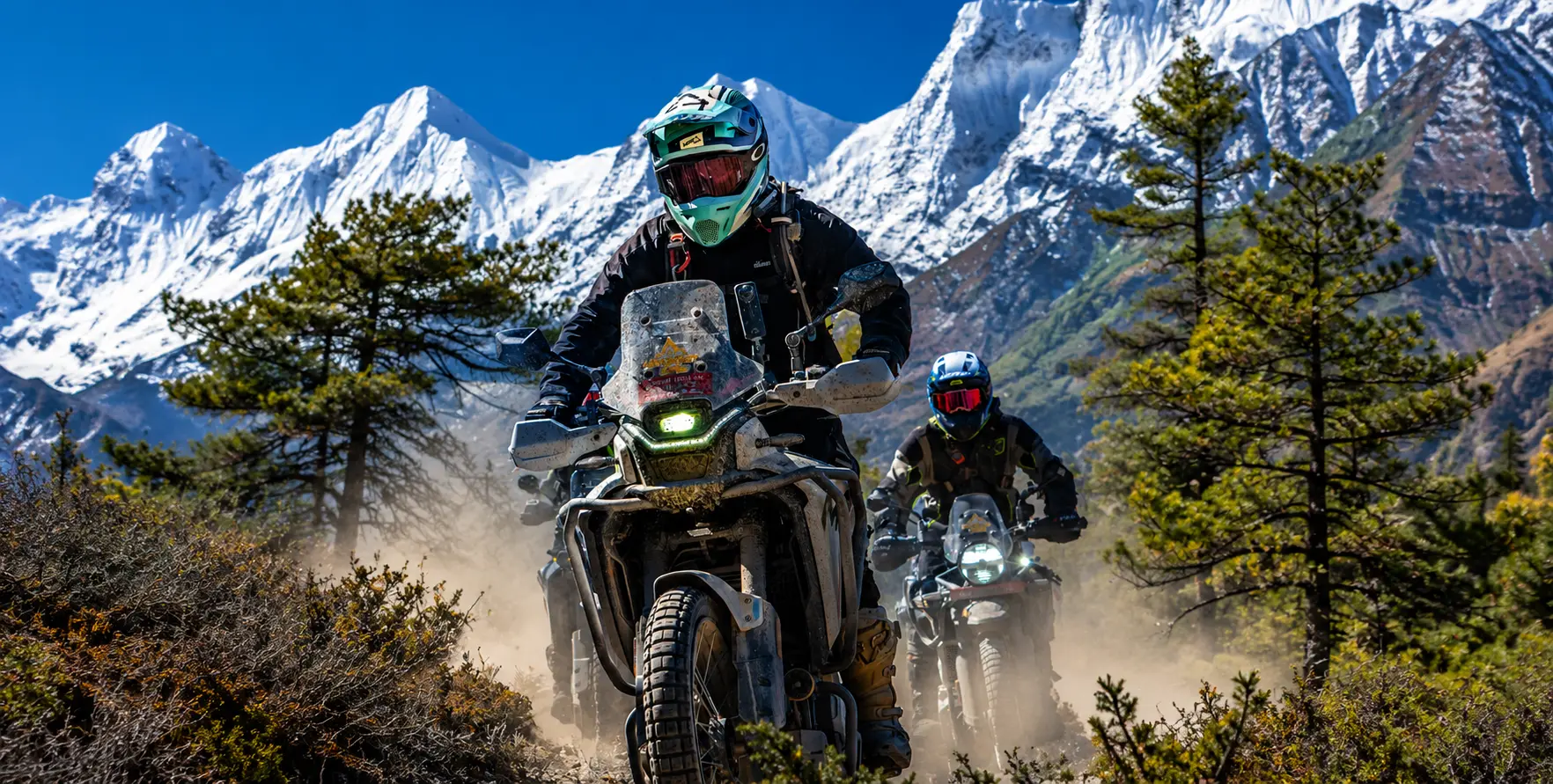
Besisahar (Annapurna Circuit start)Kathmandu → BesisaharYESPrivate jeep hire — all vehicle types
Birethanti / Nayapul (ABC/Poon Hill start)Pokhara → Birethanti/NayapulYES4WD jeep or car from Pokhara
Ghandruk VillagePokhara/Kathmandu → GhandrukYES4WD Jeep — Birethanti road section
Manang / KhangsarKathmandu/Pokhara → Manang/KhangsarYES4WD Jeep (Fortuner/Hilux/Land Cruiser)
Muktinath TemplePokhara → Jomsom → MuktinathYESLand Cruiser / Fortuner from Pokhara
Kande (Mardi Himal start)Pokhara → KandeYES (if entering ACA)Car or jeep — Baglung Highway
Tilicho Lake approach (Khangsar)Kathmandu → KhangsarYES4WD Jeep — same as Manang route
Upper Mustang (Lo Manthang)Pokhara → Jomsom → Lo ManthangACAP + RAPLand Cruiser — 2-day journey from Pokhara

Practical Tips for Getting Your ACAP Permit Smoothly

Timing Your Permit Visit

The NTNC permit offices in Kathmandu and Pokhara are open Sunday to Friday, 9:00 AM to 5:00 PM. During peak trekking season (October–November and March–May), the Kathmandu NTB office near Bhrikutimandap can become very busy from mid-morning onward, with queues that significantly extend processing times.

The Pokhara office at Damside is generally less crowded than the Kathmandu office during peak season. In both cities, arriving at 9:00–9:30 AM gives you the best chance of a quick, smooth permit process.

During off-peak season (December–February and June–September), permit offices are rarely busy, and the process typically takes 10–15 minutes from arrival to receiving your printed permit.

Preparing Your Photographs

The most common cause of delay at permit offices is trekkers arriving without passport-sized photographs. These are not optional — the ACAP permit has your photograph printed on it as part of the security and identification system. If you arrive without photos, you will need to leave the queue, visit a nearby photo studio, and return.

Photo studios near the Kathmandu NTB office area (around Thamel and Bhrikutimandap) and near the Pokhara Damside permit office can produce passport-sized prints in 10–15 minutes for NPR 100–200. However, in peak season when offices are busy, leaving the queue to get photos made can mean a long wait on return. Always prepare your photographs the evening before your permit visit — your hotel can usually direct you to the nearest photo studio.

Currency and Payment

You must pay the ACAP permit fee in cash in Nepali Rupees (NPR) at the permit office counter. Foreign currencies — including USD, EUR, GBP, and Indian Rupees — are not accepted. Carry NPR 3,000 (or NPR 1,000 if you are a SAARC national) in cash, preferably as close to the exact amount as possible.

ATMs are widely available near both the Kathmandu and Pokhara permit offices. Withdraw NPR before going to the permit office rather than hoping to exchange currency there.

Protecting Your Permit

Once issued, your ACAP permit is a physical document with your photograph and permit number — it cannot be replaced quickly if lost or damaged. Protect it carefully throughout your trek: keep it in a waterproof zip-lock bag or plastic sleeve, store it in the same secure pocket of your daypack where you keep your passport, and never put it in the bottom of a wet stuff sack or in an outside pocket where it could be lost.

Many experienced trekkers also keep a photocopy of the permit as a backup.

Carry your permit in your daypack — not in your main trekking bag, which a porter carries. You will need to present it at checkpoints throughout the trek, and having it accessible without stopping to unpack your main bag saves time and inconvenience.

Common ACAP Permit Mistakes — And How to Avoid Them

  • Mistake 1: Waiting until you reach the trailhead. Getting permits at checkpoints costs significantly more and wastes valuable trekking time. Always get your permit the day before departure in Kathmandu or Pokhara.
  • Mistake 2: Forgetting passport photos. You can’t get the permit without photos. Carry 6–10 passport photos from home or prepare them the evening before your permit visit.
  • Mistake 3: Carrying only a digital copy. Print your permit — many remote checkpoints cannot verify digital permits and will not accept them.
  • Mistake 4: Assuming one permit covers multiple separate visits. The ACAP permit is valid for a single entry into the ACA. If you leave the conservation area and re-enter (for example, exiting at Nayapul and re-entering at Besisahar for a different route), you need a new permit for the second entry.
  • Mistake 5: Confusing the ACAP with the TIMS. They are different documents issued by different authorities. Both are recommended — check with your guide or agency about current enforcement status.
  • Mistake 6: Not having a licensed guide. Since April 2023, all Annapurna trekkers must have a licensed guide. Entering without one means being turned back at the checkpoint.

Where Does Your ACAP Permit Fee Go? Conservation in Action

Understanding what the ACAP permit fee funds transforms it from a bureaucratic cost into a meaningful contribution. The revenue from ACAP permits is channelled through the National Trust for Nature Conservation and the Local Conservation Area Management Committees into a wide range of conservation and community development programs:

Environmental Conservation

  • Trail maintenance and repair: regular work on the network of trekking trails, bridges, and steps that connect the Annapurna region — including post-monsoon repair of landslide damage.
  • Reforestation projects: planting and monitoring native tree species in areas affected by historical deforestation, particularly in lower-altitude zones near teahouse concentrations.
  • Waste management infrastructure: building and maintaining waste collection points, eco-toilets, and waste management facilities along popular trekking routes.
  • Wildlife monitoring and anti-poaching: funding for conservation staff, camera trap programs, and wildlife corridor management for the ACA’s extraordinary fauna, including snow leopard and red panda.
  • Forest protection: employ community forest guards and support community forestry management groups in villages throughout the ACA.

Community Development

  • Schools and educational facilities: build, maintain, and equip schools in remote ACA villages, and support scholarship programs for local students.
  • Health infrastructure: build and maintain health posts, train community health workers, and support medical outreach in remote communities.
  • Clean water supply: install and maintain clean water systems (gravity-fed pipe systems, water purification) in villages throughout the ACA.
  • Renewable energy: support for micro-hydropower and solar energy projects in remote communities that would otherwise rely entirely on firewood for heating and cooking — a major driver of deforestation.
  • Cultural heritage preservation: documenting and protecting traditional architecture, festivals, crafts, and cultural practices in Gurung, Manangi, Thakali, and other ACA communities.

When you consider this breadth of impact — from snow leopard conservation to village schools to clean water for 100,000 mountain residents — NPR’s $ 3,000 for a foreign trekker’s ACAP permit is among the best-value conservation contributions available anywhere in the world of adventure travel.

Frequently Asked Questions — ACAP Permit

Is the ACAP permit the same as the Annapurna trekking permit?

Yes — the ACAP permit (Annapurna Conservation Area Permit) is the primary trekking permit for all routes in the Annapurna Conservation Area. The terms ‘ACAP permit’ and ‘Annapurna trekking permit’ are used interchangeably, though technically the ACAP is the entry permit to the conservation area, not a trekking route permit per se.

The NTNC (National Trust for Nature Conservation) issues it, and it’s mandatory for all visitors entering the ACA, whether trekking or travelling by vehicle.

Can I get the ACAP permit at the airport in Nepal?

No — the ACAP permit is not available at Tribhuvan International Airport (Kathmandu) or Pokhara Airport. You must obtain it from an NTNC permit office in Kathmandu (Jawalakhel or Bhrikutimandap area) or Pokhara (Damside), through the NTNC online portal, or through a registered trekking agency. Plan to visit the permit office on the day before your trekking vehicle departs from Kathmandu or Pokhara.

How long is the ACAP permit valid?

The ACAP permit is a single-entry permit valid for one visit to the Annapurna Conservation Area. It does not have a fixed expiry date in calendar terms, but it is valid for your current visit — defined as the period from your entry into the ACA until your exit.

If you exit the conservation area and wish to re-enter (for example, to do two separate routes), you need a new permit for the second entry.

Do children need an ACAP permit?

No — children under 10 years of age are exempt from the ACAP permit requirement regardless of nationality. This exemption is official and consistently applied at all ACA checkpoints. Children 10 years and over are subject to the standard permit requirements.

Can I get the ACAP permit on the same day as my trek departure?

Technically, yes — the permit offices open at 9:00 AM, and a same-day permit is possible if you obtain it before your vehicle departs for the trailhead. However, this creates significant logistical stress, particularly in peak season when offices can be very busy. Nepal Vehicle Hiring Pvt. Ltd. strongly recommends obtaining your ACAP permit the day before your scheduled trek vehicle departure, so you start your journey without any last-minute permit anxiety.

What happens if I trek in the Annapurna region without an ACAP permit?

Trekking in the Annapurna Conservation Area without a valid ACAP permit is illegal under Nepali law. If caught at a checkpoint without a permit, you will be denied further access to the trail and required to return to obtain the permit. You may also face an on-the-spot fine that typically exceeds the standard permit cost.

In extreme cases, repeat violations can result in being reported to immigration authorities. There is no benefit to trekking without a permit — the risks and consequences far outweigh any perceived savings.

Does a passenger in a jeep going to Muktinath or Manang need an ACAP permit?

Yes — the ACAP permit requirement applies to all visitors entering the Annapurna Conservation Area, whether trekking on foot or travelling by vehicle. Vehicle passengers travelling to Muktinath, Manang, Khangsar, Ghandruk, or any other destination within the ACA boundary must carry valid ACAP permits. Nepal Vehicle Hiring Pvt. Ltd. confirms permit status for all vehicle-hire clients travelling to ACA destinations during booking.

Can Nepal Vehicle Hiring help me get the ACAP permit?

Nepal Vehicle Hiring Pvt. Ltd. is a vehicle hire company, not a trekking agency, so we cannot issue ACAP permits directly. However, we provide permit guidance as part of our client service: reminding clients of permit requirements during booking, advising on the most convenient permit office relative to your hotel location in Kathmandu or Pokhara, and providing our drivers’ contact details so you can coordinate timing if you need to visit the permit office before vehicle pickup.

We can also connect you with trusted registered trekking agencies who can arrange your ACAP permit, TIMS card, and licensed guide as part of a complete service.

Conclusion: Your ACAP Permit Is Your Passport to the Annapurna World

The Annapurna Conservation Area is one of the natural and cultural wonders of the world — 7,629 square kilometres of Himalayan magnificence encompassing the world’s highest mountains, Nepal’s richest biodiversity, one of Asia’s deepest gorges, centuries-old mountain communities, and a network of trekking routes that draws hundreds of thousands of visitors annually from every corner of the globe. The ACAP permit is your gateway to it all.

At NPR 3,000 for foreign nationals — approximately USD 22–25 — the ACAP permit is one of the most impactful, best-value contributions a traveller can make to mountain conservation anywhere in the world. Every rupee from your permit fee flows directly into the protection of the snow leopards, red pandas, and Himalayan Monals that share the ACA with you; into the schools, health posts, and clean water systems of the 100,000 people who call these mountains home; and into the maintenance of the trails, bridges, and teahouse facilities that make your trekking experience possible.

Get your ACAP permit the day before you trek, from the NTNC office in Kathmandu or Pokhara, with your passport and two passport photographs. Carry the printed copy in a waterproof sleeve in your daypack throughout the trek. Present it willingly and respectfully at every checkpoint — you are in one of the world’s great protected areas, and the permit acknowledges that protecting it matters.

And when you are ready to reach your Annapurna trailhead — whether Besisahar for the Circuit, Birethanti for the Base Camp route, Kande for Mardi Himal, or Ghandruk for the Gurung Heritage Trail — Nepal Vehicle Hiring Pvt. Ltd. is the vehicle hire partner that ensures you arrive on time, in comfort, and with all the support you need for an extraordinary Himalayan adventure.

Book Your Annapurna Trailhead Vehicle — Nepal Vehicle Hiring Pvt. Ltd.

Website: www.vehiclehiringnepal.com
Phone / WhatsApp: +977 981-4227196 (24/7 Support)
Email: [email protected]
Office: Bhagawatisthan, Thamel, Kathmandu, Nepal
Trailhead Routes: Besisahar | Birethanti | Nayapul | Kande | Ghandruk | Manang | Muktinath
Fleet: 4WD Fortuner | Hilux | Land Cruiser | Car | Hiace Van — all ACA routes covered
8,000+ Happy Customers | 5.0 TripAdvisor | 200+ Verified Reviews
We confirm your ACAP permit status before every ACA-destination booking
Hotel Pickup from Kathmandu & Pokhara | Transparent Pricing | Licensed & Registered
ACAP Reminder: Get your permit at NTNC Kathmandu (Bhrikutimandap) or Pokhara (Damside) the day before departure!

Annapurna Conservation Area

Annapurna Conservation Area

Annapurna Conservation Area: Nepal’s Pioneering Model of Community-Led Conservation

Somewhere between the subtropical river valleys of central Nepal and the wind-carved high desert of the Tibetan plateau, an area of land slightly larger than the state of Delaware contains more recorded plant species than the entire British Isles, a vertical range from 760 metres to 8,091 metres that no other single protected area on earth can match, more than one hundred thousand permanent human residents speaking a dozen distinct mother tongues, and one of the most quietly radical experiments in conservation governance that the modern environmental movement has produced. This is the Annapurna Conservation Area — and it is, by any measure, one of the most extraordinary places on the planet, even before a single mountain peak enters the conversation.

Most visitors come to this region for the mountains, and understandably so: the Annapurna massif itself, the deeply sacred and visually overwhelming Machhapuchhre, the close-up intimacy of the Annapurna Sanctuary, and the high passes of the classic circuit trek have made this corner of Nepal one of the most celebrated trekking destinations on earth.

But the conservation area that contains all of this — the legal, ecological, and social structure that has allowed these mountains to remain wild, these forests to remain standing, and these communities to remain intact through four decades of exponential tourism growth — deserves to be understood in its own right. It is not simply a backdrop to the trekking routes that pass through it.

It is one of the most important and most studied experiments in how human beings might live alongside, rather than apart from, a fragile natural world.

This is a longer and more discursive piece than most of the route guides in our blog series, and deliberately so. The Annapurna Conservation Area rewards a slower kind of attention — a willingness to sit with its history, biology, human geography, and genuinely innovative governance model — before ever lacing up a boot or boarding a jeep.

Nepal Vehicle Hiring Pvt Ltd has spent years transporting travellers into every corner of this remarkable landscape, and what follows is our attempt to convey not just the practical facts a visitor needs, but something closer to a real understanding of the place itself.

A Conservation Area Unlike Any Other in Nepal

To understand why the Annapurna Conservation Area matters, it helps to understand what came before it. Nepal’s first protected areas — Chitwan National Park, established in 1973, and Sagarmatha (Everest) National Park, established in 1976 — followed a conservation philosophy imported largely from the Western world: draw a boundary around a wilderness, restrict or remove human settlement and resource use within it, and place the entire area under the strict, often paramilitary, control of a government park authority.

This model, sometimes described by conservation scholars as ‘fortress conservation,’ had real successes in Nepal, particularly in protecting megafauna such as the Bengal tiger and the greater one-horned rhinoceros in the lowland Terai. But it carried a deep and often unacknowledged cost: the people who had lived within or adjacent to these landscapes for generations, and whose traditional land-use practices had often shaped the very ecosystems being protected, were treated as a problem to be managed rather than a resource to be engaged.

By the mid-1980s, conservationists working in Nepal — and a small, determined group of Nepali biologists and social scientists in particular, among them the influential figure of Dr Chandra Prasad Gurung, who would become one of the architects of the new approach — had begun to question whether this model could ever work in the Annapurna region.

The reasons were practical as much as philosophical. The proposed conservation area was already home to well over one hundred thousand people, spread across dozens of villages practising subsistence agriculture, herding, and an increasingly important trekking-tourism economy that had grown rapidly since Nepal first opened to foreign trekkers in the 1960s.

There was, quite simply, no realistic way to evacuate or radically restrict this population’s activities without provoking the kind of resistance, resentment, and ultimately failure that had already begun to characterise more rigid conservation efforts elsewhere in the world.

The solution that emerged — formalised with the establishment of the Annapurna Conservation Area in 1986 under the newly created King Mahendra Trust for Nature Conservation (the organisation now known as the National Trust for Nature Conservation, or NTNC) — was something genuinely new in the history of Nepali conservation, and indeed in the history of protected area management more broadly.

Rather than a government department staffed by uniformed park rangers enforcing exclusion, the Annapurna Conservation Area Project, or ACAP, was designed from its inception as a bottom-up, community-managed conservation initiative. Local people were not treated as obstacles to conservation; they were deliberately and structurally positioned as its primary agents and beneficiaries.

The Architecture of Community-Based Conservation

It would be a mistake to romanticise this model into something simpler or more idealistic than it actually is. ACAP’s governance structure is a carefully engineered system of incentives, institutions, and revenue flows, refined over nearly four decades of practical experience, occasional failure, and continuous adjustment.

At its foundation lies the Integrated Conservation and Development Program, or ICDP — an approach that explicitly links environmental protection to tangible improvements in local livelihoods, on the theory (now well supported by the region’s own track record) that conservation succeeds most durably when the people living closest to a resource have a direct and visible stake in its long-term health.

In practical terms, this means ACAP’s activities extend far beyond wildlife monitoring and forest patrols. The project has invested heavily in alternative and renewable energy infrastructure—back-boiler water heating systems, improved cooking stoves, and micro-hydroelectric installations—specifically designed to reduce the immense pressure a rapidly growing trekking-lodge industry was placing on the region’s forests for firewood.

It has run extensive programs in women’s empowerment and community health, recognising that conservation outcomes are inseparable from the broader social wellbeing of the communities responsible for delivering them.

It has supported the formation of community forest user groups that hold genuine decision-making authority over managing their local forest resources, rather than simply receiving instructions from a central authority. And it has built and maintained the extensive network of trails, bridges, and basic infrastructure that today allows a trekker to walk for weeks across the Annapurna region while rarely being more than a few hours from a teahouse offering a hot meal and a roof — an infrastructure achievement that itself depends on continuous, locally rooted maintenance.

The financial architecture underpinning all of this is, in its own way, as significant as the conservation philosophy itself. Unlike most of Nepal’s national parks, which depend substantially on government budget allocations, ACAP is almost entirely self-financing, funded by entry permit fees paid by trekkers and travellers who pass through the conservation area each year.

This creates a direct,d continuously renewing link between the volume and value of tourism in the region and the resources available for its conservation- a relationship that, when it works well, aligns the economic interests of the tourism industry with the ecological health of the landscape that sustains it.

The governance structure divides the conservation area into seven Unit Conservation Offices — three in the trans-Himalayan north, at Jomsom, Manang, and Lo Manthang, and four on the wetter southern flank of the Annapurna massif, at Ghandruk, Sikles, Bhujung, and Lwang — each responsible for coordinating conservation and development activity within its own portion of this vast and ecologically varied territory.

None of this has been without friction. Scholars who have studied ACAP closely over the decades have documented genuine tensions: disputes over the equitable distribution of tourism revenue between villages with heavy trekker traffic and those with little; debates over how much authority should rest with the central NTNC organisation versus increasingly empowered local conservation area management committees; and the ongoing, unresolved challenge of managing a tourism economy that, in its most successful corridors, now generates pressures — on waste management, on water resources, on traditional architecture and ways of life — that the original 1986 framework could not fully have anticipated.

But by the broad measure that matters most in conservation — whether the forests, the wildlife, and the communities of the Annapurna region remain intact and viable four decades later — the model has worked, and worked well enough that NTNC has since exported variations of the same approach to the Manaslu and Gaurishankar conservation areas elsewhere in Nepal.

Annapurna Conservation Area-Himalayan mountain background for comfortable and adventurous travel.

Annapurna-Range

A Landscape That Defies Easy Description

The sheer physical range of the Annapurna Conservation Area is difficult to convey without sounding like an exaggeration. Within its 7,629 square kilometres — spread across the districts of Manang, Mustang, Kaski, Myagdi, and Lamjung — the land rises from roughly 760 metres above sea level in the warm, paddy-terraced foothills near Besisahar and Nayapul, through dense subtropical and then temperate forest, through the rhododendron and oak belt that gives the region’s mid-hills their characteristic spring colour, through high alpine pasture grazed by yak and blue sheep, and finally into the stark, wind-scoured, almost lunar high-altitude desert of the trans-Himalayan Mustang valley, before culminating at the 8,091-metre summit of Annapurna I itself — the world’s tenth-highest mountain and, statistically, one of the most dangerous 8,000-metre peaks ever attempted by mountaineers.

This vertical compression of nearly every climatic zone found on Earth, from subtropical to high-altitude desert to permanent snow and ice, all within a horizontal distance that a determined traveller can cross in a matter of days, is the single most important fact about the Annapurna region’s ecology. It means biodiversity here is not evenly distributed across the landscape but stacked in dramatic, telescoping bands of altitude — and it means a single multi-week trek through the conservation area can expose a walker to a greater range of distinct ecosystems than an equivalent journey almost anywhere else on the planet.

At the heart of this landscape runs the Kali Gandaki River, which has carved what is generally described as the deepest river gorge on earth — a measurement based not on the simple depth of the river channel itself, but on the vertical distance between the riverbed and the summits of the two great mountains that flank it on either side: Dhaulagiri, at 8,167 metres, to the west, and Annapurna I, at 8,091 metres, to the east. The vertical relief between the Kali Gandaki’s waters and these two summits exceeds 5,500 metres in places — a scale of landscape that is genuinely difficult for the human eye and mind to process even when standing directly within it.

Geologically, the gorge is also a window into deep time: its exposed rock layers contain marine fossils, including the black ammonite stones known locally as Shaligrams and revered by Hindu pilgrims as natural manifestations of Lord Vishnu, dating from the ancient Tethys Sea that once covered this region some sixty million years before the Indian and Eurasian tectonic plates collided and began the slow, ongoing uplift that created the Himalaya.

To the east of this central gorge, the Marsyangdi River has carved its own dramatic valley, the corridor along which the classic Annapurna Circuit trek and its associated jeep road now run, climbing from the warm lowlands near Besisahar through a succession of increasingly dramatic gorge sections to the high, arid, Tibetan-influenced valley of Manang.

And tucked into the glacial basin above Manang, reached only after a demanding climb, lies Tilicho Lake — generally described as the highest lake of its size anywhere on earth, a body of intensely blue glacial water sitting at close to 4,920 metres beneath the sheer faces of the Tilicho and Annapurna peaks, in a setting of such stark, silent grandeur that it has become one of the most sought-after extension destinations for trekkers who have already completed the standard circuit.

The Living Forests — Flora of the Conservation Area

More than 1,200 species of flowering plants have been documented within the Annapurna Conservation Area. This figure places this single protected territory among the richest botanical landscapes in the Himalayan world, and indeed among the richest temperate and subtropical floras on earth, given the area’s modest size.

This diversity is, again, substantially a product of the region’s extreme altitudinal range: as one climbs from the warm valley floor toward the high passes, plant communities shift in a continuous, overlapping succession of distinct ecological zones, each adapted to its own particular combination of temperature, rainfall, and growing season.

In the lower and middle elevations, particularly on the wetter southern flank of the Annapurna massif facing the monsoon winds rising from the Indian Ocean, dense forests of sal, oak, and chestnut give way with increasing altitude to magnificent stands of rhododendron — and it is here, around the village of Ghorepani on the approach to the celebrated Poon Hill viewpoint, that the conservation area contains what is frequently described as the largest contiguous rhododendron forest in the world.

Thirty-eight distinct species of rhododendron have been recorded within the Annapurna Conservation Area, ranging from low shrubs to towering forest trees, and when this extraordinary diversity bursts into bloom each spring — typically across March and April, in a cascading sequence as different species and different altitudes reach their flowering peak at slightly different moments — the hillsides above Ghorepani and across much of the lower Annapurna region turn through successive waves of white, pink, deep red, and occasionally yellow blossom that constitute one of the great floral spectacles of the entire Himalayan world. The rhododendron, known in Nepali as lali gurans, is Nepal’s national flower, and nowhere in the country is its diversity and abundance more visible than within this conservation area.

Above the rhododendron and oak belt, forests of birch, fir, and hemlock give way in turn to high alpine meadow and scrub, dotted in the brief summer growing season with a remarkable diversity of high-altitude wildflowers, many of them used in traditional medicine by local communities and increasingly studied by botanists and pharmacologists for their potential medicinal properties. And in the driest, highest, most exposed reaches of the trans-Himalayan north — the Mustang and upper Manang valleys, lying in the rain shadow cast by the Annapurna and Dhaulagiri massifs to their south — vegetation thins to the hardy, drought-adapted shrubs and grasses characteristic of high-altitude desert, interrupted by the carefully irrigated barley fields, apple orchards, and poplar groves that local communities have cultivated for centuries in the narrow, fertile pockets where mountain streams reach the valley floor.

Annapurna Conservation Area-Himalayan mountain background for comfortable and adventurous travel.
Upper-mustang

The Wild Inhabitants — Fauna of the Annapurna Region

The same altitudinal compression that produces the conservation area’s extraordinary plant diversity also supports an equally remarkable range of animal life, much of it rare, elusive, and of significant global conservation concern. Somewhere in the region’s higher, more remote crags and ridgelines, at altitudes generally above 3,000 metres, moves the snow leopard — perhaps the single most iconic and most rarely seen large mammal in the entire Himalayan range, an apex predator so superbly adapted to its harsh, rocky, high-altitude environment, and so naturally elusive in its behaviour, that even researchers who have spent years studying the species through camera-trap surveys and tracking studies consider a direct sighting to be a matter of exceptional fortune rather than routine observation.

Protecting viable snow leopard habitat and prey populations — principally blue sheep and Himalayan tahr, the wild goat-antelope species that share the highest reaches of the conservation area with the great cat that hunts them — has been a consistent ACAP conservation priority since its inception.

At slightly lower elevations, in the dense temperate forests of the conservation area’s middle altitudes, lives the red panda — a species entirely unrelated, despite the shared name, to the giant panda of China, but equally distinctive in appearance, with rich rust-red fur, a long bushy tail, and an almost entirely bamboo-based diet that makes it acutely vulnerable to the loss or degradation of its specific forest habitat.

The red panda’s endangered status and its particular sensitivity to forest disturbance have made it something of a flagship species for ACAP’s broader forest conservation efforts, a visible and charismatic symbol of the stakes involved in protecting the temperate forest belt on which the species depends.

Beyond these two headline species, the conservation area supports musk deer (hunted historically, and still occasionally illegally, for the valuable musk gland prized in traditional medicine and perfumery), Himalayan black bear, grey wolf, several species of langur monkey, and a long list of smaller mammals that together constitute a recorded mammalian fauna of roughly one hundred species. The bird life is, if anything, even more remarkable in its diversity: more than four hundred and fifty species have been documented within the conservation area’s boundaries, including the spectacular Impeyan monal — known locally as the Danphe, and recognised as Nepal’s national bird — whose iridescent, multi-coloured plumage makes it one of the most visually striking pheasants anywhere in the world. 

Birders are also drawn to the conservation area for its impressive raptor population, including the lammergeier, or bearded vulture, a huge, distinctively marked scavenger that specialises in feeding on bone marrow extracted from carcasses dropped from height onto rocks below, and the Himalayan griffon vulture, whose enormous wingspan and effortless thermal-riding flight are a familiar sight above the region’s high ridgelines.

The conservation area’s herpetofauna — its reptiles and amphibians — receives considerably less popular attention than its mammals and birds, but remains scientifically significant: roughly forty reptile species and just over twenty amphibian species have been recorded, many of them adapted to the specific ecological niches created by the region’s extreme altitudinal range, including several species found at elevations that would be considered extraordinary for reptiles or amphibians almost anywhere else in the world.

Panche-Annapurna Conservation Area-Himalayan mountain background for comfortable and adventurous travel.

A Mosaic of Peoples Within a Single Conservation Boundary

Perhaps the most distinctive feature of the Annapurna Conservation Area, compared with most of the world’s other major protected landscapes, is simply the number and diversity of people who call it home. More than one hundred thousand permanent residents live within the conservation area’s boundaries, spread across several dozen villages and belonging to a range of distinct ethnic and linguistic communities whose presence in this landscape, in several cases, predates the arrival of the conservation area itself and, indeed, the modern Nepali state.

On the wetter, more populous southern flank of the Annapurna massif, Gurung and Magar communities have farmed the steep terraced hillsides for generations, supplementing subsistence agriculture with a long and historically significant tradition of military service — first with the British and Indian Gurkha regiments, and subsequently with the Nepal Army itself — that has profoundly shaped the economic and social structure of villages such as Ghandruk and Sikles, both of which today also serve as important trekking hubs and conservation area unit office locations.
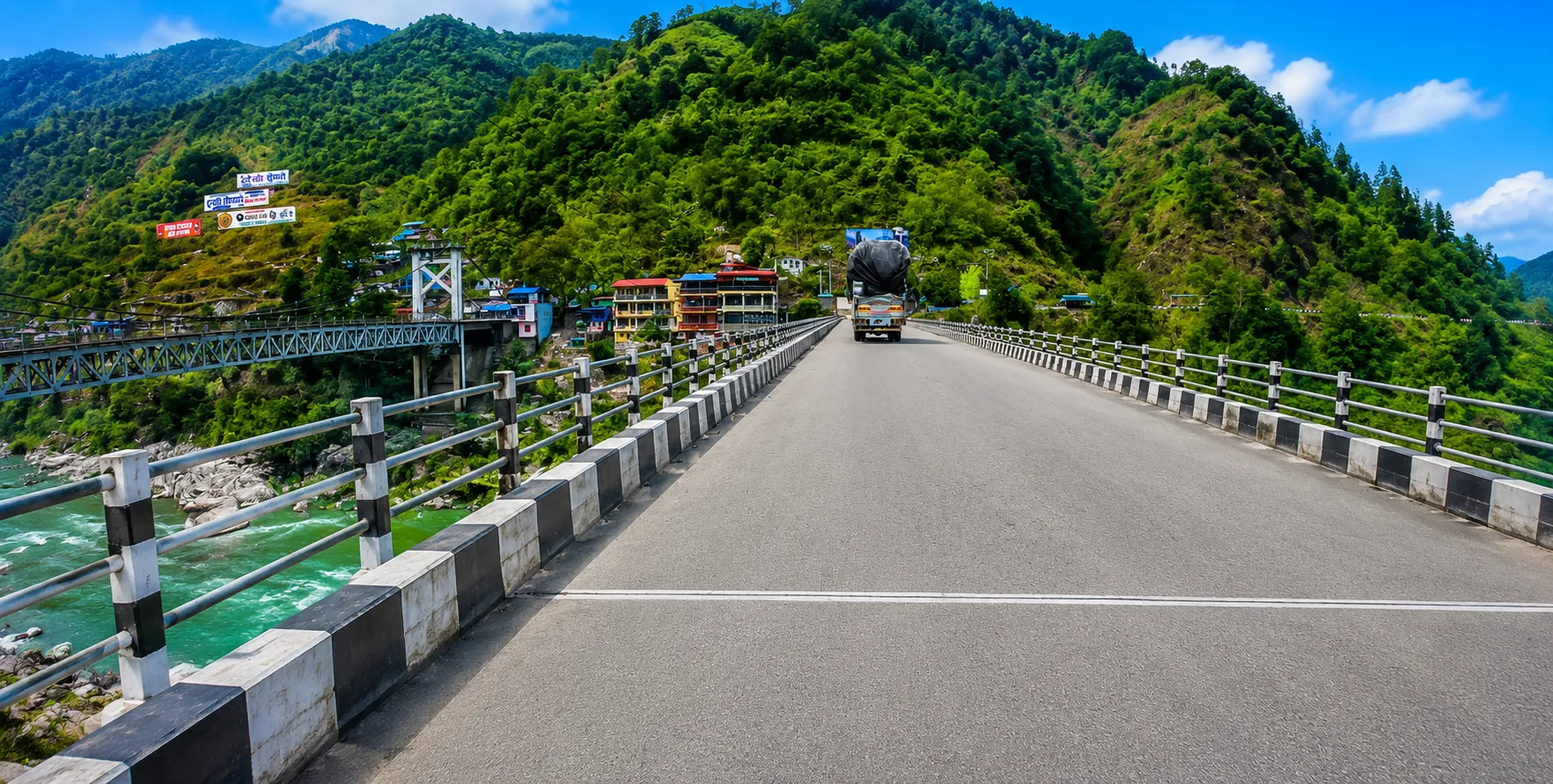
Moving north and west into the higher, drier valleys, the cultural character shifts noticeably: the Thakali people of the Kali Gandaki valley, historically the controllers of the lucrative trans-Himalayan salt trade between Tibet and the Indian plains, have built a reputation for both commercial acumen and culinary sophistication that extends well beyond their home region, while the Manangi people of the upper Marsyangdi valley around Manang village have likewise developed a distinctive trading tradition, taking advantage of historical trade privileges to build successful business networks that, in recent decades, have extended as far as international trading operations.

At the conservation area’s far northern edge, in the high-altitude desert valley of Upper Mustang, the Lhopa or Loba people maintain what is widely regarded as one of the most intact surviving examples of traditional Tibetan culture anywhere in the world — more continuous, in important respects, than what survives within Tibet itself, where decades of disruption under Chinese rule have severed many traditional religious and social structures that remain living practice in and around the walled medieval city of Lo Manthang. And interspersed among these distinct indigenous and trading communities are Hindu hill-caste Brahmin and Chhetri populations, settled across various parts of the conservation area, adding yet another layer to an already remarkably complex social landscape.
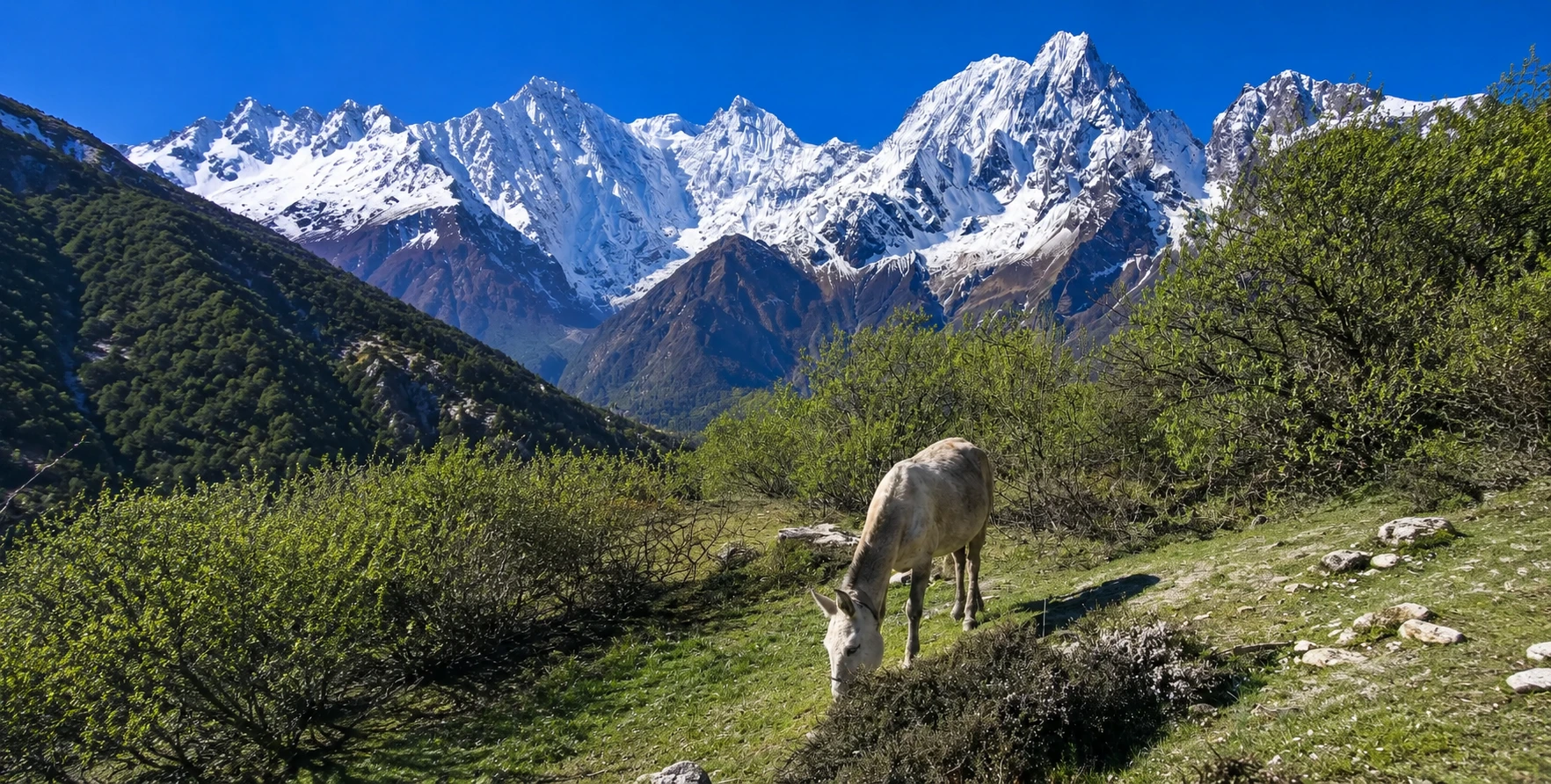
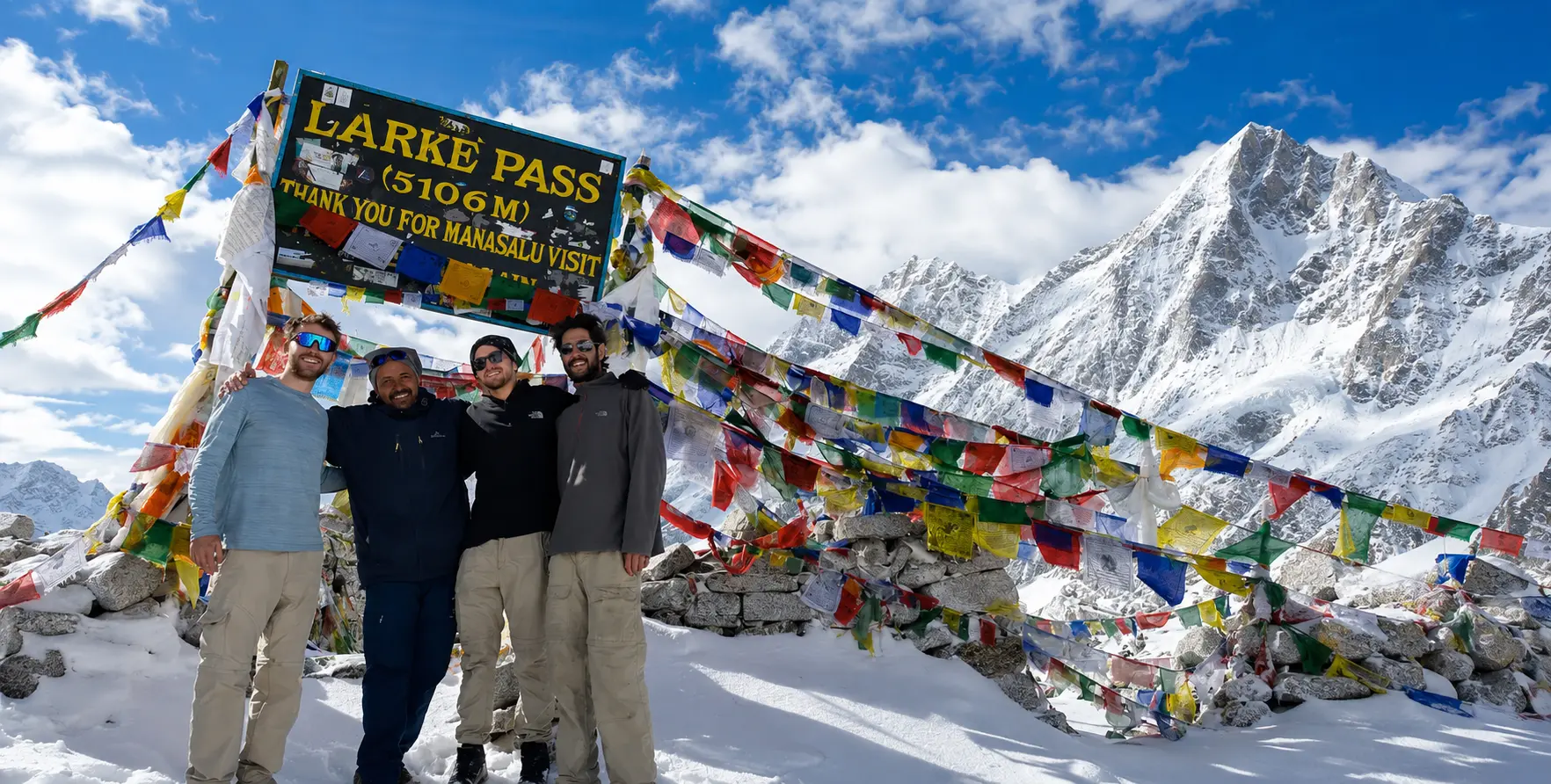
This human diversity is not incidental to the conservation area’s identity; in many respects, it is central. ACAP’s founding insistence on community-based management was possible only because these communities already had traditions of collective resource management, local decision-making, and adaptation to a genuinely difficult mountain environment—traditions the conservation project sought to recognise, formalise, and support, rather than displace with an imported bureaucratic alternative.

The conservation area’s various unit conservation offices, deliberately distributed to reflect this underlying cultural geography, function as much as cultural as ecological administrative units, each calibrated to the specific community structures and traditional governance practices of the populations they serve.

Panche-Annapurna Conservation Area-Himalayan mountain background for comfortable and adventurous travel.

Tourism, Trekking, and the Trail Network

It is impossible to discuss the Annapurna Conservation Area today without addressing its standing as one of the most celebrated trekking destinations on earth — a reputation the region has built steadily since Nepal first opened to independent foreign trekkers in the 1960s, and which the conservation area’s careful management has, on balance, sustained and even enhanced over the subsequent decades rather than diminished through overexploitation.

Before the global disruption of international travel in 2020, the conservation area was receiving well over one hundred thousand foreign visitors annually, a figure that places it among the most heavily visited single protected areas anywhere in the Himalayan world, and one that led Lonely Planet to rank the broader Annapurna region among its list of the world’s top tourism destinations.

The classic Annapurna Circuit trek — traditionally taking somewhere between fourteen and twenty-one days to complete on foot, circling the entire Annapurna massif via the dramatic Thorong La pass at 5,416 meters — remains the conservation area’s signature long-distance route. However, the extension of jeep roads along significant sections of its lower course, particularly the Marsyangdi corridor between Besisahar and Manang, has fundamentally changed how many modern trekkers approach the journey, often using vehicle transport to cover the lower sections more efficiently before continuing on foot through the higher and more dramatic terrain above Manang.

The Annapurna Base Camp trek, leading into the striking glacial amphitheatre of the Annapurna Sanctuary, the shorter and increasingly popular Ghorepani-Poon Hill trek with its celebrated sunrise panorama and rhododendron forests, the steadily growing Mardi Himal trek offering close views of Machhapuchhre from a quieter and less developed trail, and the more demanding, restricted-area Nar Phu Valley trek into one of the conservation area’s most remote and culturally distinct corners together constitute a trail network of remarkable variety, capable of accommodating everything from a casual three-day family excursion to a serious multi-week mountaineering-adjacent expedition.

What makes this trail network function as smoothly as it does — allowing, as conservation researchers studying the area have specifically noted, a trekker to walk for days through genuinely remote high-altitude terrain while rarely being more than a few hours from a warm meal, a clean bed, and basic medical assistance — is the extensive teahouse and lodge infrastructure that local communities, supported by ACAP’s broader development programming, have built up over four decades.

This infrastructure is itself a direct expression of the conservation area’s underlying development philosophy: tourism revenue, rather than being extracted by outside operators and exported from the region, flows substantially to the same local families and communities who are also the conservation area’s primary environmental stewards, creating precisely the alignment of economic and ecological interest that the original 1986 framework was designed to achieve.

Panche-Annapurna Conservation Area-Himalayan mountain background for comfortable and adventurous travel.

The Unresolved Tensions of Success

No honest account of the Annapurna Conservation Area can avoid acknowledging that its very success has generated new pressures that the original conservation framework continues to grapple with. The extension of motorable jeep roads into the Marsyangdi and lower Kali Gandaki valleys over the past fifteen to twenty years — roads built primarily to serve the everyday transport needs of local communities, but which have also fundamentally altered the trekking economy along the routes they follow — remains a genuinely contested issue, both within local communities and among the broader trekking and conservation community.

For some lodge owners and villages, particularly those bypassed by the new roads, the shift in trekker traffic toward vehicle-accessible alternatives has led to a real decline in foot-traffic-dependent income. For others, the same roads have opened entirely new forms of tourism revenue, including the off-road jeep touring covered in detail elsewhere in our blog series, and have improved access to markets, healthcare, and Education for communities that previously depended on multi-day walks to reach the nearest road.

Climate change presents a less visible but arguably more serious long-term challenge. The glaciers that feed the Marsyangdi, Kali Gandaki, and Modi Khola river systems — and that ultimately sustain the agricultural communities living throughout the conservation area and far downstream beyond its boundaries — are retreating, as they are across the Himalayan range more broadly, with implications for water availability, agricultural patterns, and the frequency of glacial lake outburst flood events that current research suggests will only intensify in the coming decades.

The conservation area’s role as what ecologists term a critical watershed — a function explicitly recognised in its founding rationale, given that the rivers originating within its boundaries ultimately supply water to millions of people living far downstream in Nepal’s mid-hills and Terai plains — makes these climate pressures a concern that extends well beyond the conservation area’s own resident population.

Waste management, particularly the accumulation of non-biodegradable trekking and tourism-related waste along the most heavily trafficked sections of trail, remains an ongoing operational challenge that ACAP and local community organisations continue to address through a combination of permit-funded clean-up initiatives, waste collection infrastructure at major trekking hubs, and increasingly explicit guidance to visitors regarding responsible waste disposal and plastic reduction.

And the broader question of how to manage visitor volume on the most popular routes — balancing the conservation area’s genuine economic dependence on tourism revenue against the carrying capacity of specific trails, villages, and ecosystems — remains a live and unresolved policy question, addressed in recent years through measures including the 2023 regulation mandating licensed guides for foreign trekkers on major routes, a policy intended in part to improve visitor safety and in part to channel a greater share of tourism revenue toward trained local guiding professionals.

Annapurna Conservation Area-Himalayan mountain background for comfortable and adventurous travel.

Manang Annapurna Range

Permits, Fees, and the Mechanics of Visiting

Every visitor entering the Annapurna Conservation Area — whether on foot, by jeep, or by any other means of transport — is required to obtain the Annapurna Conservation Area Permit, generally referred to simply as ACAP, regardless of which specific trail or route they intend to follow, how long they plan to stay, or how high they intend to travel. This permit requirement applies uniformly throughout the conservation area and is checked at numerous entry checkpoints throughout the region, including Birethanti, Jhinu Danda, Chhomrong, Besisahar, and Jomsom.

The permit fee itself, alongside the related TIMS card that many routes also require, constitutes the principal funding mechanism for the entire ACAP conservation and development programme described throughout this article — meaning that every visitor’s permit fee is, quite literally, financing the trail maintenance, forest conservation, wildlife protection, and community development activity that makes their own visit possible in the first place.

PermitCost (approx.)Mandatory?Where Obtained
ACAP (Annapurna Conservation Area Permit)NPR 3,000 (USD 25–30) per personYes — without exception, for every route inside the ACANepal Tourism Board, Kathmandu or Pokhara; checked at every entry checkpoint
TIMS Card (Trekkers’ Information Management System)USD 10–20 per personEnforcement varies by season and route — increasingly expectedNepal Tourism Board / TAAN office
Licensed GuideUSD 25–35 per dayMandatory since the 2023 regulation for major ACA routesArranged through any registered trekking agency

Beyond the conservation area permit itself, trekkers undertaking the Annapurna Circuit’s extension into the restricted Nar Phu Valley, or continuing beyond Kagbeni into the separately regulated restricted area of Upper Mustang, face additional permit requirements specific to those more tightly controlled zones — reflecting both their particular cultural sensitivity and the Nepali government’s broader policy of managing visitor volume to its most ecologically and culturally fragile border regions.

Dharapani trek start point of annapurna range

ghorepani-poon-hill

Why This Landscape Still Matters

It would be easy, faced with the scale of the Annapurna massif itself, to treat the conservation area surrounding it as a mere administrative formality — the paperwork required to access a trekking route, rather than a subject worthy of attention in its own right. But doing so would mean missing something genuinely important about what this particular stretch of the Himalaya represents, both ecologically and as a working model for how protected landscapes everywhere might be managed more humanely and sustainably.

The Annapurna Conservation Area demonstrates, with nearly four decades of accumulated evidence, that conservation and human community do not have to exist in fundamental opposition to one another — that a landscape can sustain extraordinary biodiversity, protect globally significant and endangered species, preserve geological and ecological features of genuine planetary uniqueness, and simultaneously remain home to over a hundred thousand people pursuing their own traditional and evolving ways of life, provided the governance structure connecting conservation and community is designed with sufficient care, humility, and willingness to adapt.

This is not a small or easily replicated achievement. It is the product of sustained institutional commitment, considerable trial and error, and a foundational decision — made by a small group of Nepali conservationists in the mid-1980s, against the dominant conservation orthodoxy of their time — to trust local communities with the stewardship of their own landscape rather than displacing them in the name of its protection.

For the traveller passing through this conservation area, whether on foot along the high passes of the classic circuit, by jeep through the dramatic gorge country of the Marsyangdi and Kali Gandaki valleys, or simply for a few days around the foothill villages near Pokhara, this underlying story is worth carrying alongside the more immediate, more visually overwhelming experience of the mountains themselves. Every permit fee paid, every teahouse meal purchased, every local guide hired contributes, in a very direct and traceable way, to the continuation of an experiment in conservation that has, against considerable odds, succeeded — and that continues to offer genuine lessons for how the rest of the world might think about the relationship between protected landscapes and the people who call them home.

The Conservation Area at a Glance

Key FactDetail
Established1986 — Nepal’s first conservation area
Total Area7,629 sq km — Nepal’s largest protected area
Districts CoveredManang, Mustang, Kaski, Myagdi, and Lamjung
Managing BodyNational Trust for Nature Conservation (NTNC), via the Annapurna Conservation Area Project (ACAP)
Resident PopulationOver 100,000 people of diverse ethnic and linguistic backgrounds
Altitude Range760–790 m (subtropical valley floor) to 8,091 m (summit of Annapurna I)
Governance ModelCommunity-based — the first protected area in Nepal managed bottom-up by local people, not a paramilitary park authority.
Funding ModelSelf-financed almost entirely through visitor entry permit fees, not the government budget
Global RecognitionRanked among the world’s top tourism destinations by Lonely Planet (2020); cited by UNESCO as an exemplary conservation model (2010)
Annapurna Conservation Area-Himalayan mountain background for comfortable and adventurous travel
Chame-village
CategoryRecorded Species (approx.)Notable Examples
Flowering plantsOver 1,200 species38 species of rhododendron alone — Nepal’s national flower
Mammals100–105 speciesSnow leopard, red panda, Himalayan tahr, musk deer, Himalayan black bear, grey wolf, blue sheep
Birds450–520+ speciesImpeyan monal (Danphe, Nepal’s national bird), blood pheasant, lammergeier, Himalayan griffon vulture
Reptiles39–40 speciesVarious high-altitude and mid-hill lizard and snake species
Amphibians22–23 speciesHigh-altitude frog and toad species adapted to extreme elevation

Getting There — A Practical Note from Nepal Vehicle Hiring Pvt Ltd

Reaching the Annapurna Conservation Area at nearly every access point begins with a road journey before you reach any trekking trail — and the entry point shapes the character of the visit that follows. Travellers heading toward Ghorepani and the famous Poon Hill viewpoint typically begin from Pokhara via Nayapul or Kande; those undertaking the Annapurna Circuit or its Manang extension begin from Besisahar, reached either from Kathmandu or via Pokhara, with the off-road jeep sections beyond Besisahar requiring a genuine 4WD vehicle as described in detail in our dedicated off-road jeep and Besisahar-Manang guides.

Those continuing into the trans-Himalayan north toward Jomsom, Muktinath, and Upper Mustang generally travel from Pokhara along the dramatic Kali Gandaki corridor.

Nepal Vehicle Hiring Pvt Ltd provides private vehicle hire — sedan, 4WD Scorpio, Toyota Hilux, and Toyota Land Cruiser, depending on the specific route’s terrain demands — for every one of these access corridors, along with experienced local drivers, permit guidance, and itinerary knowledge built up over years of operating throughout this conservation area. Whether your interest in the Annapurna Conservation Area is a short cultural excursion to a Gurung village near Pokhara, a full circuit trek requiring careful trailhead logistics, or an extended off-road jeep adventure into Upper Mustang, we are positioned to handle the transport logistics with the same care and attention to detail that this remarkable landscape deserves.

A Model Studied and Exported Far Beyond Annapurna

Over time, the influence of the Annapurna Conservation Area’s governance model has extended well beyond the boundaries of the landscape it was originally designed to protect. By the late 1990s, with more than a decade of operational experience, NTNC began applying the same Integrated Conservation and Development Program philosophy to the Manaslu region immediately to the east, establishing the Manaslu Conservation Area.

With support from the Government of Nepal and the Asian Development Bank, NTNC replicated this approach in Manaslu— a deliberate act of institutional replication that treated the Annapurna experience not as a one-off success but as a transferable template. A similar logic has since informed the establishment of the Gaurishankar Conservation Area, further east, extending the same basic principle of community-anchored, self-financing, bottom-up conservation governance into yet another of Nepal’s ecologically and culturally significant mountain landscapes.

International conservation researchers and protected-area managers have likewise taken sustained interest in the Annapurna case, treating it as one of the most thoroughly documented examples anywhere in the world of what conservation scholarship sometimes terms ‘community-based natural resource management’ operating at genuine landscape scale, rather than within the smaller, more easily controlled pilot projects through which this approach is more commonly tested.

UNESCO’s 2010 assessment of the Annapurna Conservation Area specifically highlighted its innovative fusion of tourism revenue, community empowerment, and ecological protection as a model relevant well beyond Nepal’s borders. Since then, this recognition has drawn conservation delegations and researchers from other Himalayan nations and beyond to study how the model has functioned in practice, including its genuine shortcomings and its more celebrated successes.

This exported influence matters for how we should understand the Annapurna Conservation Area today. It is not simply a successful local arrangement specific to one set of mountain valleys and one set of communities; it is, in a meaningful sense, a piece of conservation infrastructure that has shaped how an entire generation of Nepali conservation practitioners think about the relationship between protected landscapes and the people who inhabit them.

Every subsequent Nepali conservation area established since 1986 has had to reckon, in one way or another, with the precedent set by the Annapurna model — whether by following its example closely, adapting it to different ecological and social circumstances, or consciously departing from it in response to lessons learned along the way.

Dharapani-Annapurna Conservation Area-Himalayan mountain background for comfortable and adventurous travel

Dharapani

Frequently Asked Questions — Annapurna Conservation Area

What is the difference between the Annapurna Conservation Area and ACAP?

The Annapurna Conservation Area (ACA) is the protected landscape itself — the 7,629 square kilometre territory spanning five districts. The Annapurna Conservation Area Project (ACAP) is the management programme, operated by the National Trust for Nature Conservation, that administers conservation and development activities within that landscape. In everyday use, people often use the two terms interchangeably, though technically one refers to the place and the other to the programme that manages it.

When was the Annapurna Conservation Area established, and why was it significant?

The Annapurna Conservation Area was established in 1986, making it Nepal’s first conservation area and, at 7,629 square kilometres, its largest protected area of any kind. Its significance lies in its pioneering community-based management model—the first protected area in Nepal’s conservation history in which local communities were directly and structurally involved in management decisions, rather than being subject to a centrally imposed park authority.

How many people live within the Annapurna Conservation Area?

More than 100,000 permanent residents live within the conservation area’s boundaries, belonging to a wide range of distinct ethnic and linguistic communities including Gurung, Magar, Thakali, Manangi, Lhopa (Loba), and Hindu hill-caste Brahmin and Chhetri populations, among others.

What is the ACAP permit and how much does it cost?

The Annapurna Conservation Area Permit (ACAP) is the mandatory entry permit required for every visitor to the conservation area, regardless of route or duration. As of 2026, the fee is about NPR 3,000 (roughly USD 25-30) for foreign nationals, available from Nepal Tourism Board offices in Kathmandu or Pokhara or, in some cases, online through registered trekking agencies.

What wildlife can be found in the Annapurna Conservation Area?

The conservation area supports the snow leopard, red panda, Himalayan tahr, musk deer, Himalayan black bear, grey wolf, and blue sheep among its approximately 100 recorded mammal species, along with over 450 bird species, including the Impeyan monal (Nepal’s national bird), and a smaller but scientifically significant population of reptiles and amphibians adapted to the region’s extreme altitudinal range.

What is the world’s deepest gorge inside the conservation area?

The Kali Gandaki Gorge, carved by the Kali Gandaki River between the Dhaulagiri and Annapurna massifs, is generally recognised as the world’s deepest river gorge when measured by the vertical relief between the riverbed and the flanking summits — a difference exceeding 5,500 meters in places.

Conclusion

The Annapurna Conservation Area is, in the end, two extraordinary things at once: one of the most biologically and geologically remarkable landscapes in the Himalayan range, and one of the most quietly influential experiments in conservation governance the modern environmental movement has produced. Its mountains, gorges, forests, and high-altitude deserts would be worth protecting on their own merits.

But it is the deliberate, sustained decision to protect that landscape together with, rather than against, the more than one hundred thousand people who call it home that makes the Annapurna Conservation Area something genuinely instructive — a working demonstration, refined over nearly four decades, that conservation and human community can be made to serve one another rather than compete.

Nepal Vehicle Hiring Pvt Ltd is honoured to provide the transport that carries travellers into this landscape — and we hope that, whatever brings you to the Annapurna region — whether the mountains themselves or the deeper story of how this remarkable place has been protected — you leave with a fuller appreciation of both.

Plan your Annapurna region journey — Call or WhatsApp: +977 981-4227196
E-mail:[email protected]

For travellers who have completed their trek and are planning to explore Kathmandu, we recommend continuing your journey with our trusted sister companies, Trek Nepal Himalayas and Alpine Luxury. We specialise in organising a wide range of travel experiences across Nepal, from classic trekking adventures to cultural and wildlife tours.

Our top offerings include iconic journeys such as the Everest Base Camp Trek, in-depth Kathmandu sightseeing tours, striking Nagarkot sunrise experiences, exciting Chitwan jungle safaris, and luxury packages. We can also arrange short hikes, heritage tours, mountain flights, and customised travel plans tailored to your schedule and interests.

Whether you are looking for a budget-friendly trip or a luxury trekking experience with top-end lodges, private guides, and high-end services, we manage every detail professionally. Our goal is to provide a smooth transition from your trekking adventure to a comfortable) and a memorable travel experience in Nepal.

Mustang Full Guide: Upper and Lower Mustang Vehicle Hire

Mustang

Mustang Full Guide: Upper & Lower Mustang — Jeep Tour, Trek & Vehicle Hire

The name Mustang conjures one of the most evocative landscapes in all of Nepal — a high-altitude world where wind-carved canyons of ochre and rust-red rock drop to the turquoise-blue waters of the Kali Gandaki River, where medieval walled cities perch on desert plateaus, where ancient Buddhist monasteries hold centuries of sacred art in near-perfect preservation, and where the skyline is defined by some of the most dramatic peaks on Earth: Dhaulagiri at 8,167 metres to the west, Annapurna at 8,091 metres to the east, and the striking Nilgiri massif looming directly above the valley floor.

Mustang is one of the most remarkable places you can reach by vehicle anywhere on the planet — and for travellers willing to commit to the journey, it delivers cultural and natural richness that stays with visitors for the rest of their lives.

Many first-time travellers do not realise that ‘Mustang’ encompasses two distinct geographic and administrative zones, each with its own character, permit requirements, key destinations, and optimal vehicle hire arrangements. Lower Mustang — also known as Southern Mustang or simply the Kali Gandaki Valley — covers the region from the Kali Gandaki gorge’s lower reaches at Beni through the dramatic river canyon to the ancient gateway town of Kagbeni, encompassing

the famous villages of Tatopani, Ghasa, Kalopani, Tukuche, Marpha, Jomsom, and Muktinath. Lower Mustang requires only the standard Annapurna Conservation Area Permit (ACAP) and is open to all visitors, with no special restrictions or group-size requirements. It is Nepal’s most dramatic highway drive destination, a journey that most visitors describe as extraordinary even before the formal trekking begins.

Upper Mustang — formerly the independent Kingdom of Lo — begins at the police and ACAP checkpoint just north of Kagbeni and extends northward to the ancient walled capital of Lo Manthang and beyond toward the Nepal-Tibet border near the Korala Pass. Upper Mustang is an officially restricted area, closed to foreign visitors until 1992 and still controlled.

Entry requires a special Restricted Area Permit (RAP) costing USD 500 per person for the first ten days (with USD 50 per day thereafter under the new daily extension rule), a minimum group of two foreign nationals, and a licensed guide at all times. This additional layer of control has kept Upper Mustang genuinely less visited than the main Annapurna corridors, preserving a cultural and landscape character that feels  — authentically off the beaten path.

This complete guide to Guideom Nepal Vehicle Hiring Pvt Ltd (vehiclehiringnepal.com) covers both regions in full detail, drawing on thorough 2 research into accommodation costs, permit fees, jeep distances, driving times, road conditions, and cultural content. Every distance, cost, and timing figure reflects current information from multiple verified sources.

Whether you are planning a 3-day Lower Mustang overland escape, a 10-day Upper Mustang jeep tour, a classic 14-day trek over the Thorong La Pass, or a combined circuit that covers both regions in one journey, this guide gives you everything you need to plan your Mustang adventure with total confidence.

Understanding Mustang: Geography, History, and Culture

Geographic Setting

Mustang District sits in the Gandaki Province of north-central Nepal, immediately north of the Annapurna Conservation Area and sandwiched between two of the world’s eight-thousanders. The district is bisected from north to south by the Kali Gandaki River, which flows through what is widely described as the world’s deepest gorge — a designation based on the vertical drop from the summits of Annapurna and Dhaulagiri on either side to the river between them, a difference of nearly 6,000 meters.

The Kali Gandaki Gorge is the primary geographic feature that has shaped both Mustang’s landscape and human history, serving for millennia as the most practical high-altitude trade corridor between the Tibetan plateau to the north and the Indo-Gangetic plains to the south.

Upper Mustang, north of Kagbeni, sits in the pronounced rain shadow cast by the Annapurna and Dhaulagiri massifs, receiving minimal monsoon rainfall and developing a landscape strikingly reminiscent of the Tibetan Plateau, which it geographically and culturally resembles. The contrast between the lush, green terraced hillsides on the approach from Beni and the stark, wind-sculpted desert of the upper valley is one of the most dramatic landscape transitions in Nepal, occurring over just a few hours of driving as the valley narrows and climbs beyond Marpha and Jomsom.

The Kingdom of Lo: A History

Upper Mustang’s historical identity is inseparable from the Kingdom of Lo. This independent Tibetan-culture kingdom controlled this valley from the 14th century through its formal integration into the Kingdom of Nepal in 1795. It maintained cultural and administrative autonomy for decades thereafter.

Founded by the Loba chieftain Ame Pal around 1380 CE, the Kingdom of Lo established its capital at Lo Manthang — still the principal settlement of Upper Mustang today — and built the elaborate palace, monastery, and city wall complex that defines the walled city’s extraordinary appearance.

The kingdom’s wealth came mainly from controlling the trans-Himalayan trade route and collecting customs duties on the salt and grain caravans that passed through Lo Manthang on the route between Tibet and India.

The formal abolition of Nepal’s monarchy in 2008 technically ended Lo Manthang’s royal lineage. Still, the current Loba king — Jigme Dorje Palbar Bista — remains respected by the Loba community as a traditional cultural authority and spiritual figure.

Upper Mustang’s population numbers about 6,000, all of whom follow Tibetan Buddhism, speak the Tibetan-derived Loba language as their primary tongue, and maintain traditions of dress, ceremony, and agricultural practice that connect them far more closely to the Tibetan plateau than to Nepal’s more familiar hill cultures.

Tiji festival Upper mustang-Mustang Full Guide: Upper & Lower Mustang Vehicle Hire
Tiji Festival, Upper Mustang

The Tiji Festival: Mustang’s Most Spectacular Event

No cultural event in all of Nepal’s calendar quite matches the Tiji Festival of Lo Manthang for sheer visual and spiritual impact. Held annually in Lo Manthang over three days in May according to the Tibetan lunar calendar — the 2026 dates fall on May 13-15 — the Tiji Festival enacts a mythological narrative of the triumph of Jono over the demon who threatened to destroy the world by creating drought and flooding.

The festival involves three days of elaborate masked dance performances by monks from Lo Manthang’s principal monasteries, wearing costumes and masks of extraordinary craftsmanship, who perform before the entire assembled community in the courtyard of the ancient city. For travellers who time their Upper Mustang visit to coincide with Tiji, the experience transcends ordinary cultural tourism and becomes a more genuine spiritual witness.

Lower Mustang: Key Destinations, Road Guide & Vehicle Hire

Lower Mustang — the section of Mustang District south of Kagbeni, roughly corresponding to the Kali Gandaki corridor from Beni to the Upper Mustang checkpoint — is one of Nepal’s most dramatic and diverse overland destinations, offering a concentration of natural and cultural highlights within a relatively compact driving distance that makes it ideal for travellers with limited time who still want a genuinely extraordinary Himalayan experience.

The Drive: Pokhara to Jomsom via Kali Gandaki Gorge

The overland journey from Pokhara to Jomsom — the administrative centre of Mustang District and the main hub for Lower Mustang tourism — covers approximately 143 to 197 kilometres, depending on the specific route, and takes between 7 and 11 hours by private 4WD jeep. The route follows the Bhupi Sherchan Highway from Pokhara through Beni (109 km, approximately 3 hours on smooth concrete road), then transitions to rough off-road driving through Tatopani, Ghasa, Kalopani, Tukuche, and Marpha before reaching Jomsom.

The off-road Beni to Jomsom section covers about 60 kilometres and takes 4 to 5 hours, making the road conditions the dominant factor in the journey’s demands.

This drive through the Kali Gandaki Gorge is one of Nepal’s great overland journeys, combining geological drama — the vertical canyon walls tower hundreds of meters above the road on both sides in the most confined sections — with cultural richness, from the ancient hot springs at Tatopani to the wind-carved rock formations of the upper gorge and the apple orchards of Marpha. The road runs alongside a river famous for its saligram fossils—ancient ammonite stones that Hindu tradition associates with Lord Vishnu and that lie scattered throughout the riverbed in numbers that astonish first-time visitors.

Key Villages and Destinations in Lower Mustang

Tatopani — Natural Hot Springs and Gorge Drama (1,190 m)

Tatopani — whose name literally means ‘hot water’ in Nepali — is one of the most popular rest stops along the Kali Gandaki corridor, famous for its natural sulfur hot springs that draw trekkers and vehicle travellers for a restorative soak after hours of mountain road travel. The springs sit directly beside the river, and the contrast between the hot mineral water and the cold, rushing Kali Gandaki alongside creates an atmospheric bathing experience unlike anything available in more conventional tourist destinations.

The village suffered significant damage in the 2015 earthquake but has been substantially rebuilt, and its cluster of lodges, teahouses, and hot spring facilities now serves the steady stream of overland travellers and trekkers passing through on the Annapurna Circuit.

Marpha — The Apple Capital of Nepal (2,667 m)

Marpha is arguably the most charming village in all of Lower Mustang, a beautifully preserved Thakali settlement of whitewashed stone houses connected by narrow, flagstone-paved lanes so narrow that vehicles cannot pass and only pedestrians and pack animals move through. Marpha is famous throughout Nepal for its apple orchards — the valley’s microclimate and altitude create ideal conditions for apple cultivation — and the local apple products, including fresh apples, apple brandy (a locally distilled spirit with a cult following among trekkers), apple pie, apple juice, and dried apple rings ar, are among the most distinctive culinary specialities anywhere on the Nepal trekking circuit.

A short walk through Marpha village’s covered lanes, plus a visit to the ancient Sakya monastery and the local distillery, is an essential stop on any Lower Mustang vehicle tour.

kagbeni-Mustang Full Guide: Upper & Lower Mustang Vehicle Hire

Jomsom — The Hub of Mustang (2,720 m)

Jomsom is the administrative capital of Mustang district, a busy and surprisingly well-equipped small town strung along the banks of the Kali Gandaki River at an elevation of 2,720 meters. The town has a domestic airport — serviced by Tara Air and other carriers with regular flights from Pokhara (a spectacular 20-to-25-minute flight that costs USD 120 to USD 140 per person one-way, though subject to frequent weather delays) — alongside a Nepal Bank branch with an ATM, several comfortable hotels and teahouses, restaurants, shops, and the full complement of trekking support services.

Jomsom functions as the principal base and staging point for both Lower Mustang day trips and the onward approach to Upper Mustang, and most multi-day Mustang itineraries include at least one overnight here.

Just 5 kilometres from Jomsom, the freshwater Dhumba Lake, at 2,830 metres near Thini Village, offers a peaceful detour with striking mountain reflections on calm mornings. At the same time, the ancient Bon-tradition monastery in Lupra village — one of Nepal’s last surviving Bon communities, where just 14 families maintain a 12th-century monastery through a hereditary priesthood system — offers a genuinely rare encounter with Nepal’s pre-Buddhist religious tradition on any trekking circuit.

Kagbeni — Gateway to the Hidden Kingdom (2,804 m)

Kagbeni is one of the most atmospheric villages in the entire Kali Gandaki corridor — a medieval Tibetan-influenced settlement of narrow alleyways, ancient mud-brick houses, prayer wheels, and chortens, dominated by a hilltop monastery visible from a considerable distance as the vehicle approaches from Jomsom along the flat riverbed track. The village sits at the confluence of the Kali Gandaki and Kag Khola rivers and has historically served as the gateway settlement controlling access to Upper Mustang, a role maintained today by the police checkpoint just north of the village, where all visitors must present their permits before continuing into the restricted zone.

Kagbeni rewards a leisurely exploration on foot — the monastery contains frescoes and statues of genuine antiquity, the village’s covered lanes create a maze-like atmosphere distinct from any other settlement in Nepal, and the views from the terrace above the village toward the Upper Mustang plateau to the north and the Annapurna peaks to the south are outstanding. Many vehicle tour operators include a one- to two-hour stop in Kagbeni specifically for this exploration, separate from any time spent at the checkpoint processing permits.

Muktinath — The Sacred Shrine at 3,710 Meters

Muktinath Temple complex, situated at 3,710 meters at the foot of the Thorong La Pass, is the most sacred destination in the entire Mustang region for millions of Hindu and Buddhist pilgrims who visit Nepal annually. As one of the 108 Divya Desams (holy Vishnu shrines) in the Hindu tradition and as the site of the natural miracle of an eternal flame burning above a spring of water — considered one of the most auspicious natural phenomena in Himalayan religious geography — Muktinath draws pilgrims from across India, Nepal, and the broader Hindu and Buddhist world.

The temple complex includes the main Vishnu shrine, the 108 sacred water spouts (Muktidhara) where devotees take ritual baths in icy mountain water, the Jwala Devi temple, where a natural gas flame burns perpetually, and an adjoining Buddhist monastery maintained by Tibetan Buddhist monks.

The drive from Jomsom to Muktinath covers approximately 19 kilometres of relatively smooth, paved road (the final stage from Kagbeni northward is largely paved and takes about 45 minutes to 1 hour by jeep), making Muktinath one of the most accessible high-altitude pilgrimage destinations in Nepal. Private jeep hire from Jomsom to Muktinath costs NPR 3,000 to NPR 4,500 for the full vehicle — an extremely reasonable rate for access to one of Nepal’s holiest sites.

Mustang Full Guide: Upper & Lower Mustang Vehicle Hire)

Lower Mustang Key Sites: Quick Reference

Village/SiteAltitudeDistance from PokharaKey AttractionNo Permit Needed
Tatopani1,190 m85 kmNatural hot springs, gorge sceneryYes
Marpha2,667 m130 kmApple orchards, Thakali culture, distilleryYes (ACAP only)
Jomsom2,720 m143 kmDistrict HQ, ATM, airport, Dhumba Lake, Bon monasteryYes (ACAP only)
Kagbeni2,804 m155 kmMedieval village, gateway to Upper MustangYes (ACAP only)
Muktinath3,710 m197 kmSacred Hindu/Buddhist temple, 108 spouts, eternal flameYes (ACAP only)

Upper Mustang: The Forbidden Kingdom in Detail

Beyond the Kagbeni checkpoint, where the restricted area permit is verified and stamped, the landscape and experience of Mustang transform into something markedly different from anything in Lower Mustang — or indeed anywhere else in Nepal. The desert plateau stretches northward with an austere grandeur that feels fundamentally Tibetan rather than Nepali; the villages become increasingly remote and traditional, and the sense of entering a place that the modern world has touched only lightly intensifies with every kilometre gained toward Lo Manthang.

Chele, Syangboche and the Approach Plateau (3,055–3,930 m)

The first two major villages north of Kagbeni in the Upper Mustang restricted zone are Chele (approximately 3,055 m, reached 30 km north of Kagbeni by a rough 4WD track taking 2 to 3 hours) and Syangboche (3,800 m, a further 30 km north and 2 to 3 more hours of rough driving).

The road between Kagbeni and Chele involves the most technically demanding driving of the entire Mustang route — steep switchbacks above the Kali Gandaki gorge, narrow cliff-side tracks carved into the rock face, and the kind of loose-surface gradient that demands both low-range gearing and experienced driver judgment. Beyond Chele, the road climbs to the plateau proper at Syangboche, crossing Syangboche Pass at about 3,800 meters and offering panoramic views of the Mustang landscape in all directions.

Along this section, the sky caves carved into the ochre cliff faces appear with increasing frequency—the remarkable ancient cave complexes that archaeologists believe served as habitation, burial, meditation retreat, and storage sites for Mustang’s prehistoric and early-medieval inhabitants. The Chhoser sky caves, accessible via a short detour off the main route approximately 20 kilometres north of Lo Manthang, are the most extensively documented and most dramatically photogenic of these cave complexes, with thousands of individual chambers cut into cliff faces at heights that would have required sophisticated rope-and-ladder systems for access.

Ghami and Tsarang: Villages of the High Plateau (3,520–3,560 m)

Ghami (also spelt Ghiling or Geling in some itineraries) is a significant village on the Upper Mustang plateau, at approximately 3,520 meters, offering excellent views of the surrounding desert landscape and the distant peaks of Tibet to the north. The village has a monastery and several well-preserved traditional houses. It serves as a standard overnight stop on both trekking and jeep tour itineraries between Syangboche and Lo Manthang.

The area around Ghami is notable for its collection of ancient mani walls — long stone barriers inscribed with Buddhist mantras — that stretch for hundreds of meters along the route, creating one of the most distinctive visual elements of the Upper Mustang plateau.

Tsarang (also written as Charang), at approximately 3,560 meters, is another significant cultural stop between Ghami and Lo Manthang, with a hilltop dzong (fortress) and a large monastery containing significant 14th-century murals and statuary.

The fort at Tsarang, though largely ruined, commands dramatic views across the plateau and provides context for the Kingdom of Lo’s military history during its period of greatest political independence. Tsarang is also notable for its traditional Loba houses with flat roofs and painted walls, which distinguish Upper Mustang’s domestic architecture from Lower Mustang’s stone houses.

Lo Manthang: The Walled Capital (3,840 m)

Lo Manthang is the destination toward which every Mustang itinerary ultimately points — an ancient walled city that has stood since the 14th century and that continues to function as the cultural, spiritual, and administrative heart of the Loba community. Approaching Lo Manthang by vehicle across the plateau, the city materialises with startling suddenness from the desert landscape — the white-painted perimeter walls, approximately 150 meters along the long axis, rising abruptly from the ochre Earth, with the monastery rooftops visible above.

Lo-Manthang-Mustang Full Guide: Upper & Lower Mustang Vehicle Hire

Within the walls, Lo Manthang rewards careful, unhurried exploration. The three principal monasteries — Thubchen Gompa, Jampa Gompa (Champa Lhakhang), and Chode Gompa — contain some of the finest surviving examples of 14th- and 15th-century Tibetan Buddhist mural painting and sculptural art anywhere in the world, preserved in extraordinary condition by the region’s extreme dryness and its long closure to the outside world.

The Royal Palace, a four-story mud-brick structure that served as the residence of the Kingdom of Lo’s hereditary rulers, stands at the centre of the city and can be visited with appropriate permissions, offering a glimpse into the domestic and ceremonial life of a medieval Himalayan royal family.

The streets of Lo Manthang are narrow and labyrinthine, connecting the monasteries, palace, residential compounds, and community spaces of a living urban settlement that has maintained its traditional character despite the growing number of visitors it receives each year. The morning atmosphere — monks processing to prayer, elderly Loba residents completing their daily kora (circumambulation) of the city’s perimeter, the smell of butter lamps drifting from open monastery doors — offers one of the most authentically medieval urban experiences in Asia.

Beyond Lo Manthang: Luri Gompa and the Korala Pass Area

For travellers with extra time and an appetite for deeper exploration, two destinations north of Lo Manthang extend the Upper Mustang adventure into territory even fewer visitors reach. Luri Gompa, located approximately aa4-hour drive from Lo Manthang at an altitude of 4,950 meters, is one of the oldest monasteries in the Mustang region, featuring remarkable cave-monastery architecture and some of the finest ancient Buddhist art in the Upper Mustang system.

Most Upper Mustang jeep tour itineraries of 10 days or more include a day excursion to Luri Gompa.

The Korala Pass area, approximately 20 kilometres north of Lo Manthang and accessible by a rough 4WD track, brings vehicles to the Nepal-Tibet border — a sealed checkpoint that is not open to international crossing but that provides one of the most dramatic frontier viewpoints in all of Nepal, looking north across the Tibetan plateau toward the distant interior.

The drive from Lo Manthang to Korala passes through Tingkhar village and the Chhoser sky cave complex, making the excursion one of the most rewarding full-day activities in the entire Upper Mustang program.

Upper Mustang Jeep Route: Stage by Stage

StageRouteDistanceDrive TimeAltitudeRoad Type
1Pokhara → Jomsom143 km7–9 hrs820–2,720 mPaved + rough off-road
2Jomsom → Kagbeni18 km45 min2,720–2,804 mMainly paved
3Kagbeni → Chele / Syangboche60 km4–5 hrs2,804–3,930 m4WD off-road track
4Syangboche → Ghami → Tsarang45 km3–4 hrs3,520–3,560 mRough plateau track
5Tsarang → Lo Manthang15 km1–1.5 hrs3,840 mPlateau track
6 (Optional)Lo Manthang → Luri Gompa45 km4 hrs3,950 mVery rough track
7 (Optional)Lo Manthang → Korala area20 km1.5–2 hrs4,200–4,660 mRough 4WD track
TOTAL (Pokhara to Lo Manthang)280 km2–3 full driving daysUp to 3,840 mMixed

Permits for Mustang: Complete  Guide

The permit structure for Mustang is one of the most important practical elements to understand before planning any trip to the region, since costs and requirements differ significantly between Lower and Upper Mustang and have changed in recent years.

Lower Mustang Permits (South of Kagbeni)

Travel through Lower Mustang — the entire Kali Gandaki corridor from Beni through Tatopani, Marpha, Jomsom, Kagbeni, and Muktinath — requires only the Annapurna Conservation Area Permit (ACAP).

This costs NPR 3,000 (approximately USD 22-25) for non-SAARC nationals and NPR 200 for SAARC nationals (India, Bangladesh, Sri Lanka, Pakistan, Bhutan, Maldives). No restricted-area permit, guide requirement, or minimum group size applies to travel in Lower Mustang. The TIMS card (NPR 2,000 for non-SAARC) is additionally required for trekkers, but may be waived for those travelling by flight both in and out via Jomsom.

Note: A lower Mustang ACAP entry fee of approximately USD 25 applies to all visitors to the conservation area, including vehicle tour travellers who are not trekking. Confirm the current exact rate with your operator or the Nepal Tourism Board before departure.

Kagbeni-Mustang Full Guide: Upper & Lower Mustang Vehicle Hire

Upper Mustang Permits (North of Kagbeni)

Entering the restricted zone north of Kagbeni requires a Restricted Area Permit (RAP) in addition to the ACAP. Nepal’s Department of Immigration manages the RAP, which can only be arranged through a government-registered trekking agency — individual travellers cannot obtain it directly. The key requirements and costs as of 2025/26 are:

PermitCostDurationWho IssuesGroup Requirement
Restricted Area Permit (RAP)USD 500 per personFirst 10 days inside restricted zoneDepartment of Immigration (via agency)Minimum 2 foreign nationals + licensed guide
P extensionUSD 50 per person per dayEach additional day beyond 10SameSame
ACAP (Annapurna Conservation Area)NPR 3,000 non-SAARC / NPR 200 SAARCFull duration of tripNepal Tourism BoardNone
TIMS CardNPR 2,000 non-SAARC / NPR 1,000 SAARCFull duration of tripNepal Tourism Board / TAANNone
Licensed Guide (mandatory)Arranged through an agencyFull Upper Mustang durationTAAN-registeredMust be licensed

Complete Vehicle Hire Costs: Pokhara to Mustang

The following cost tables consolidate vehicle hire rates for both Lower and Upper Mustang journeys, based on current market research. All Nepal Vehicle Hiring Pvt Ltd’s rates are fully inclusive of the vehicle, an experienced driver, fuel, and tolls.

Route / ServiceVehicleCost (NPR)Cost (USD)DurationNotes
Pokhara → Jomsom (one-way overland)4WD JeepNPR 28,000–38,000$210–$2857–9 hrsKali Gandaki Gorge route
Pokhara → Jomsom (return)4WD JeepNPR 48,000–65,000$360–$488Multi-dayRound trip with waiting
Jomsom → Muktinath (private hire)Private JeepNPR 3,000–4,500$22–$341–1.5 hrsFull vehicle hire
Jomsom → Kagbeni (private hire)Private JeepNPR 1,500–3,000$11–$2230–45 minGateway to Upper Mustang
Pokhara → Lo Manthang (full overland)Land CruiserNPR 45,000–65,000$338–$4882–3 daysOne way, full Upper Mustang
Pokhara ⇔ Lo Manthang (round trip)Land CruiserNPR 80,000–120,000$600–$9008–12 daysFull Upper Mustang jeep tour
Lo Manthang day hire (excursions)4WD JeepNPR 12,000–18,000$90–$135Full dayKorala, Luri Gompa, Chhoser
Kathmandu → Pokhara (for Mustang approach)SUV / Toyota FortunerNPR 17,000–22,000$128–$1656–8 hrsIf flying Pokhara→Jomsom
Pokhara → Jomsom by flight (note only)Domestic flightUSD 120–140 one-way$120–$14020–25 minNot a jeep, but a common alternative

Tip: For the complete Upper Mustang round trip from Pokhara, booking a Toyota Land Cruiser VX or Prado (rather than a standard jeep) adds approximately NPR 20,000 to NPR 30,000 to the total vehicle hire cost but transforms the quality of the multi-day driving experience significantly — a worthwhile investment given that driving may account for 6 to 9 hours on some itinerary days.

Mustang Full Guide: Upper & Lower Mustang Vehicle Hire-Luxury 4WD Jeep Hire in Nepal features three premium off-road SUVs with a Himalayan mountain background for comfortable and adventurous travel.

Getting to Mustang: All Transport Options Compared

The overland jeep journey from Pokhara through the Kali Gandaki Gorge is the most in-depth and experientially complete way to approach Mustang, combining the dramatic scenery of the world’s deepest gorge with stops at Tatopani, Marpha, and Jomsom before reaching the Upper Mustang gateway at Kagbeni.

This approach is strongly preferred by experienced Nepal travellers specifically because the gorge journey is itself a major highlight — one that the flight from Pokhara to Jomsom completely bypasses. A private 4WD jeep from Pokhara to Jomsom costs US$203 one-way, takes 7 to 9 hours, and accommodates up to 6 passengers plus luggage.

Flight: Pokhara to Jomsom

The domestic flight from Pokhara to Jomsom operates on a tight weather window—flights run only from about 7:00 AM to 11:00 AM each day, as afternoon winds in the Kali Gandaki Gorge make flying impossible. The one-way cost of USD 120-140 per person makes this considerably more expensive per passenger than a shared jeep.

However, it saves approximately 7 hours of driving and offers spectacular aerial views of Dhaulagiri and Annapurna that the road approach cannot match. Flights are notoriously susceptible to weather-related cancellations, and travellers relying on the Jomsom flight for a time-sensitive connection should always build in at least one backup day into their itinerary. Many seasoned Mustang travellers prefer to fly one way and drive the other, combining aerial views with the gorge experience.

Kathmandu to Pokhara: Setting Up the Mustang Approach

For travellers starting in Kathmandu, the first step is reaching Pokhara — either by domestic flight (30-40 minutes, approximately USD 80-100 per person) or by private vehicle along the Prithvi Highway (200 km, approximately 6-8 hours, NPR 17,000-22,000 for a private car or SUV).

Nepal Vehicle Hiring Pvt Ltd provides comfortable private vehicle transfers for this first leg as part of a coordinated Mustang tour package, allowing travellers to combine the Kathmandu-Pokhara scenic drive with an early arrival in Pokhara and position themselves for a next-morning departure toward Mustang.

Best Season for Upper and Lower Mustang

Mustang’s seasonal calendar differs meaningfully from most of Nepal’s other trekking and travel destinations, mainly because Upper Mustang’s rain-shadow location gives it access windows that don’t exist in rain-exposed destinations in Nepal.

SeasonMonthsLower MustangUpper MustangRoad ConditionsRecommended?
SpringMar–MayExcellent — clear, warm daysExcellent — Tiji Festival in MayGood, dryHighly recommended
MonsoonJun–AugDifficult — road disruptionsUNIQUE advantage — rain shadow, dryPoor (lower), Good (upper)Upper only
AutumnSep–NovExcellent — best conditionsExcellent — clear skiesExcellentBest overall
WinterDec–FebCold but passable (lower reaches)Difficult — snow, closed passesVariable — snow above 3000mLower only

The unique monsoon advantage of Upper Mustang deserves emphasis: while June through August is Nepal’s least favourite season for virtually every other region due to rain, leeches, and poor visibility, Upper Mustang sits in the rain shadow of the Annapurna and Dhaulagiri ranges and receives minimal monsoon precipitation.

This makes it the only major Nepal trekking/jeep tour destination where June, July, and August represent a genuinely viable and even enjoyable travel window — indeed som, some experienced travellers specifically choose this period for the emptier trails, lower accommodation rates, and the dramatic quality of the monsoon clouds building over the surrounding peaks while the Upper Mustang plateau remains dry and clear.

Mustang Full Guide: Upper & Lower Mustang Vehicle Hire-Luxury 4WD Jeep Hire in Nepal features three premium off-road SUVs with a Himalayan mountain background for comfortable and adventurous travel.

Practical Tips for Mustang Travel

  • Book permits well in advance for Upper Mustang — the RAP application requires passport copies, photos, a detailed itinerary, and a guarantee letter from a registered agency, and takes 2 to 3 working days to process.
  • Withdraw sufficient NPR cash in Pokhara before departure — Jomsom has ATMs, but they are sometimes unreliable; carry enough for all expected expenses, including accommodation, meals, and local jeeps.
  • Depart Pokhara by 6:00–7:00 AM for the overland drive to Jomsom to ensure a comfortable mid-afternoon arrival in Jomsom or Kagbeni with daylight for settling in.
  • The strong afternoon winds in the Kali Gandaki Gorge — typically starting from around noon and reaching considerable strength by 2:00–3:00 PM — affect both driving comfort and aircraft operations; schedule demanding sections of the drive or any walking for morning .hours
  • Carry warm layers at all times — temperatures at Lo Manthang (3,840 m) can drop sharply even in summer. The journey from Lo Manthang to the Korala Pass area reaches 4,660 m, where conditions can be genuinely cold. Mobile connectivity: NTC and Ncell coverage is available in Jomsom, Kagbeni, and Muktinath,th but becomes sporadic further north into Upper Mustang; download offline maps and key information before departing Jomsom.
  • Photography: Upper Mustang’s extraordinary landscape rewards early morning and late afternoon light — the high-altitude colours are most vivid before the afternoon wind and dust haze build
  • Altitude: Lo Manthang at 3,840 m is high enough to cause altitude sickness in some visitors; anyone arriving quickly from Pokhara (820 m) should plan a rest day and stay hydrated
  • Book accommodation in Lo Manthang in advance during peak season (October–November and the Tiji Festival period in May) — accommodation is limited and fills quickly

Suggested Itineraries: Lower and Upper Mustang

Option A: 3-Day Lower Mustang Overland Escape (From Pokhara)

Day 1: Early departure from Pokhara by private 4WD jeep; drive through Beni, Tatopani (hot springs stop), Ghasa, and Kalopani; explore Marpha village; reach Jomsom by late afternoon. Day 2: Jomsom area exploration (Dhumba Lake, Lupra Bon monastery), afternoon drive to Kagbeni for village exploration and overnight.

Day 3: Morning drive from Kagbeni to Muktinath (45 min), temple visit and ritual bath, return to Jomsom, drive back toward Pokhara (overnight at Tatopani or continue to Pokhara). Total vehicle hire is approximately NPR 35,000 to NPR 55,000 for the complete private jeep arrangement.

Option B: 8-Day Upper Mustang Jeep Tour (From Pokhara)

Day 1: Pokhara to Jomsom overland (7-9 hrs). Day 2: Jomsom to Kagbeni (permit check), continue to Chele (4-5 hrs). Day 3: Chele to Lo Manthang via Syangboche, Ghami, Tsarang (6-8 hrs).

Day 4: Lo Manthang exploration — Thubchen, Jampa, Chode monasteries, palace. Day 5: Korala Pass / Chhoser cave excursion by jeep (full day). Day 6: Lo Manthang to Jomsom (return south, 6-8 hrs).

Day 7: Jomsom to Pokhara (7-9 hrs). Day 8: Rest/buffer day or extend in Pokhara. Total RAP permit cost: USD 500 per person (5 days inside restricted zone at current daily rate structure).

Total vehicle hire: NPR 80,000 to NPR 110,000 for a complete private jeep.

Option C: 14-Day Classic Upper Mustang Trek + Jeep Return

This itinerary combines the classic Annapurna Circuit approach — flying or driving to Jomsom, then trekking north through Kagbeni and the full Upper Mustang restricted zone to Lo Manthang over 6-7 days of walking — with a return by private jeep from Lo Manthang back to Jomsom and then Pokhara, saving 4-5 days of return walking while still completing the northward journey on foot at the trek’s natural pace. Vehicle hire for the return leg from Lo Manthang to Pokhara: NPR 40,000 to NPR 55,000.

Mustang Full Guide: Upper & Lower Mustang Vehicle Hire-Luxury 4WD Jeep Hire in Nepal features three premium off-road SUVs with a Himalayan mountain background for comfortable and adventurous travel.

Frequently Asked Questions

What is the difference between Upper and Lower Mustang?

Lower Mustang covers the Kali Gandaki corridor from Beni through Tatopani, Marpha, Jomsom, Kagbeni, and Muktinath. It requires only the ACAP permit and is open to all visitors without group restrictions.

Upper Mustang begins north of the Kagbeni checkpoint, covers Lo Manthang and beyond, and requires a Restricted Area Permit (RAP) of USD 500 per person for 10 days (USD 50/day extension), a mandatory licensed guide, and a minimum of 2 foreign nationals travelling together.

How much does the Upper Mustang permit cost?

The Upper Mustang Restricted Area Permit costs USD 500 per person for the first 10 days inside the restricted zone, with USD 50 per person per day for any additional days beyond 10.  Individual-day permits can be issued without a mandatory 10-day minimum, making shorter tours more cost-effective. You also need the ACAP (NPR 3,000, non-SAARC) and the TIMS card (NPR 2,000, non-SAARC).

Total permit costs for a 7-day Upper Mustang tour: approximately USD 520–540 per person.

How long does the drive from Pokhara to Lo Manthang take?

The overland drive from Pokhara to Lo Manthang covers approximately 280 kilometres. It typically takes 2 to 3 full driving days, with overnight stops at Jomsom (Day 1) and Ghami or Chele (Day 2) before reaching Lo Manthang on Day 3. A single-day drive for the entire distance is not practical given the road conditions and distance involved.

Can I visit Upper Mustang without a guide?

No. A licensed guide is mandatory for all foreign visitors to Upper Mustang. Independent travel in the restricted zone is not permitted. Your guides must be registered with TAAN (Trekking Agencies’ Association of Nepal) and hold a current license.

The guide requirement applies equally to jeep tour travellers and trekkers.

Is a 4WD jeep necessary for the entire Mustang route?

A 4WD vehicle is essential from Beni onward on the overland approach, and absolutely required for all driving north of Kagbeni into Upper Mustang. The road from Beni to Jomsom is approximately half off-road with rough, bumpy surfaces.

Beyond Kagbeni, the track to Lo Manthang is entirely off-road and requires a proper 4WD, high ground clearance, and an experienced mountain driver. Do not use standard cars or vans north of Beni.

When is the Tiji Festival in 2026?

The 2026 Tiji Festival in Lo Manthang falls on May 13–15, according to the Tibetan lunar calendar. This is the most spectacular cultural event in Upper Mustang and one of the finest cultural experiences available anywhere in Nepal. Vehicle hire and accommodation in Lo Manthang fill quickly for the Tiji Festival period — booking 6 to 8 weeks in advance is strongly recommended.

What vehicle does Nepal Vehicle Hiring Pvt Ltd recommend for Upper Mustang?

For the complete Pokhara-to-Lo Manthang overland journey, Nepal Vehicle Hiring Pvt Ltd recommends a Toyota Land Cruiser (VX or Prado series) as the optimal combination of interior comfort and genuine off-road capability for this demanding multi-day route. For Lower Mustang only (Pokhara to Jomsom/Muktinath), a Toyota Fortuner or equivalent is appropriate and offers good value.

All vehicles are provided with experienced mountain drivers familiar with the specific demands of the Kali Gandaki corridor and the Upper Mustang track.

Conclusion: Your Mustang Adventure Starts Here

Mustang is, without exaggeration, one of the most extraordinary travel destinations anywhere on Earth — a region where an ancient kingdom’s medieval capital still stands intact, where a landscape of desert canyons and wind-sculpted rock formations frames the world’s highest peaks, where the Kali Gandaki River cuts the world’s deepest gorge between walls of ochre and stone, and where a living Tibetan Buddhist culture maintains traditions that centuries of isolation have kept almost perfectly preserved.

Lower Mustang is accessible to every traveller with an ACAP permit and a reliable 4WD vehicle; Upper Mustang rewards those willing to invest in additional permits, offering a journey that consistently delivers one of the most profound experiences a Nepali destination can offer

Nepal Vehicle Hiring Pvt Ltd provides private 4WD vehicle hire for every stage of Lower and Upper Mustang travel—from the first overland kilometre out of Pokhara to the final frontier excursion to the Korala Pass area north of Lo Manthang. Our vehicles are maintained for the demands of the Kali Gandaki corridor and the Upper Mustang track; our drivers are experienced on these roads in every season, and our transparent, all-inclusive pricing in both NPR and USD ensures you know exactly what your Mustang adventure costs before you confirm a booking.

Whether you are planning a compact 3-day Lower Mustang overland escape, a full 10-day Upper Mustang jeep tour to Lo Manthang and beyond, or a combined itinerary that takes in the hot springs of Tatopani, the apple orchards of Marpha, the sacred ghats of Muktinath, the medieval streets of Lo Manthang, and the frontier drama of the Korala Pass all within a single well-organised journey, Nepal Vehicle Hiring Pvt Ltd has the right vehicle, the right driver, and the right experience to make your Mustang adventure everything it deserves to be.

Book Your Mustang Vehicle Hire Today  

WhatsApp: +977 981-4227196
E-mail:[email protected]

Lower Mustang (Jomsom, Muktinath)  |  Upper Mustang (Lo Manthang, Korala)  |  4WD Jeep & Land Cruiser

Chat with us