Experience Nepal Better with Safe Vehicle Rental

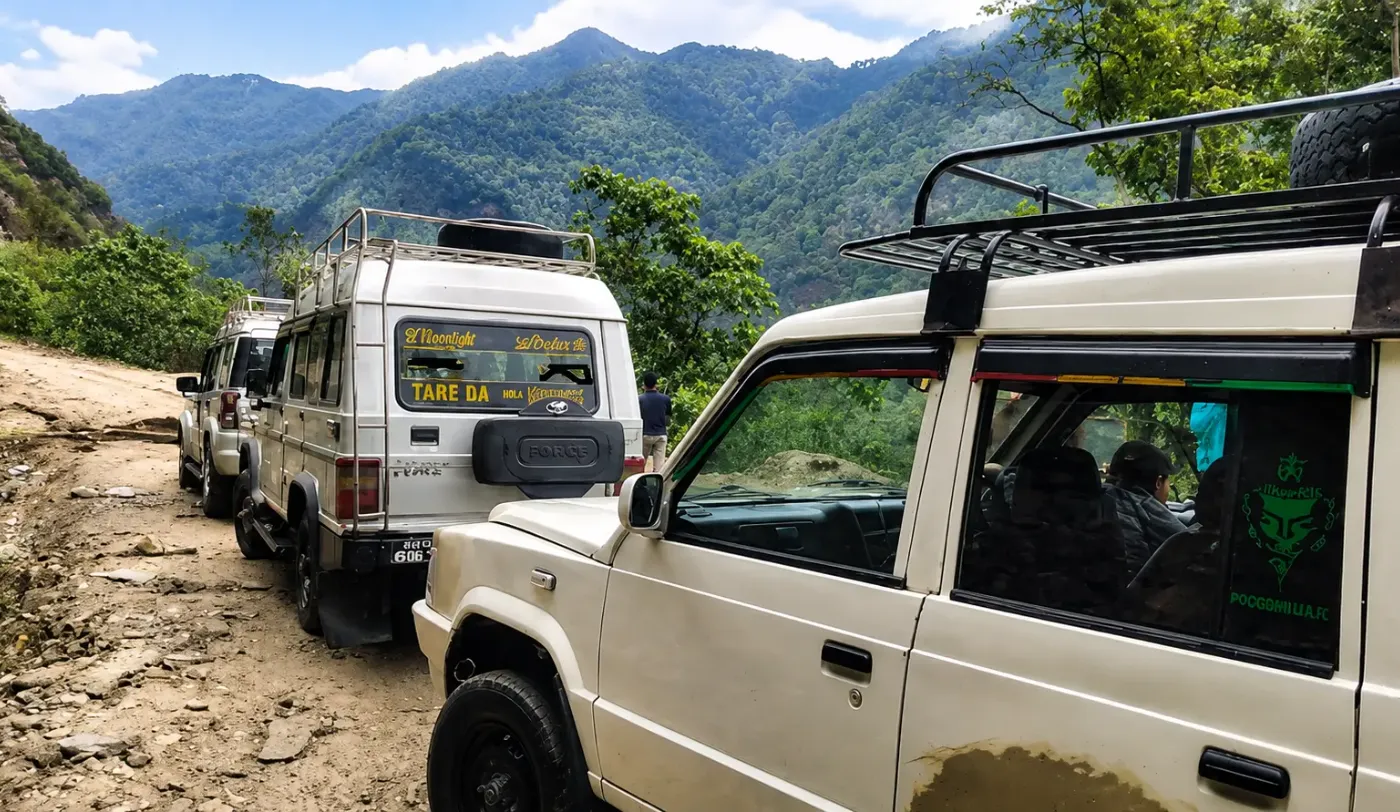
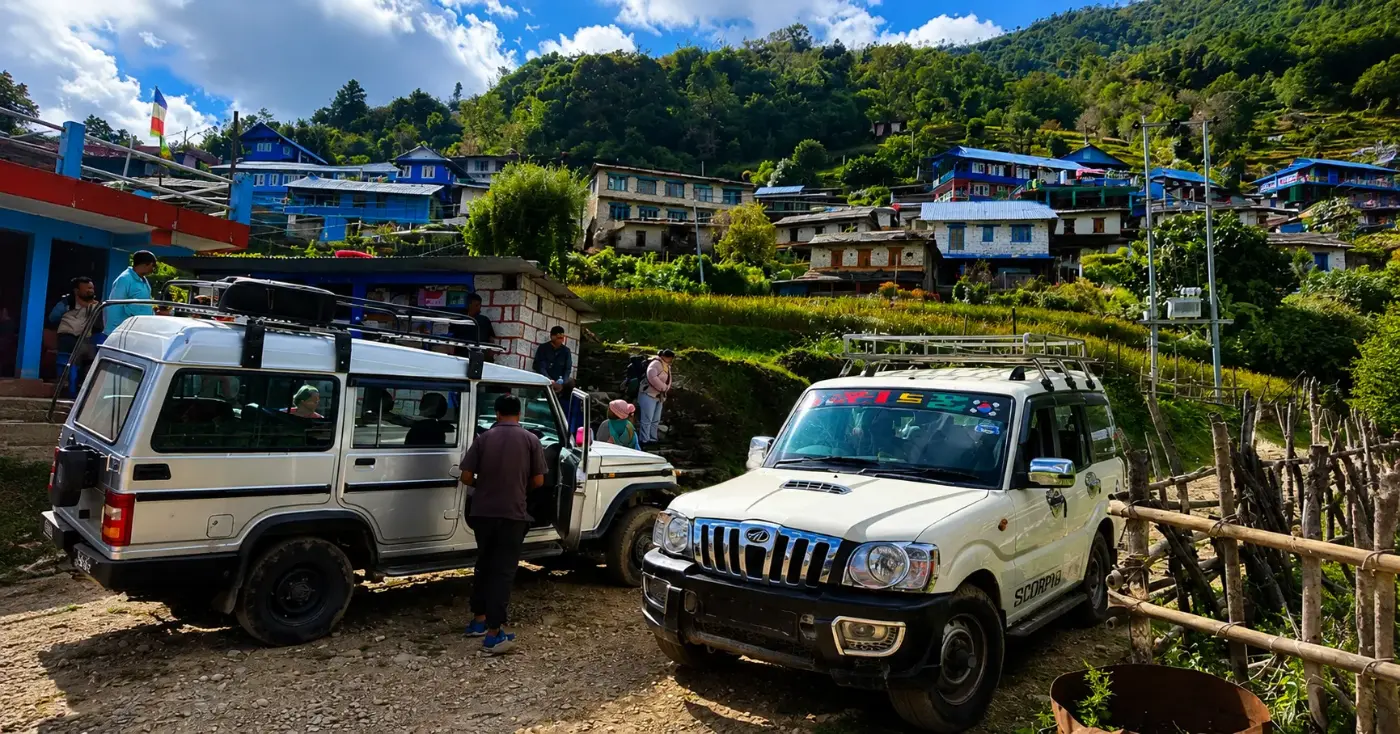
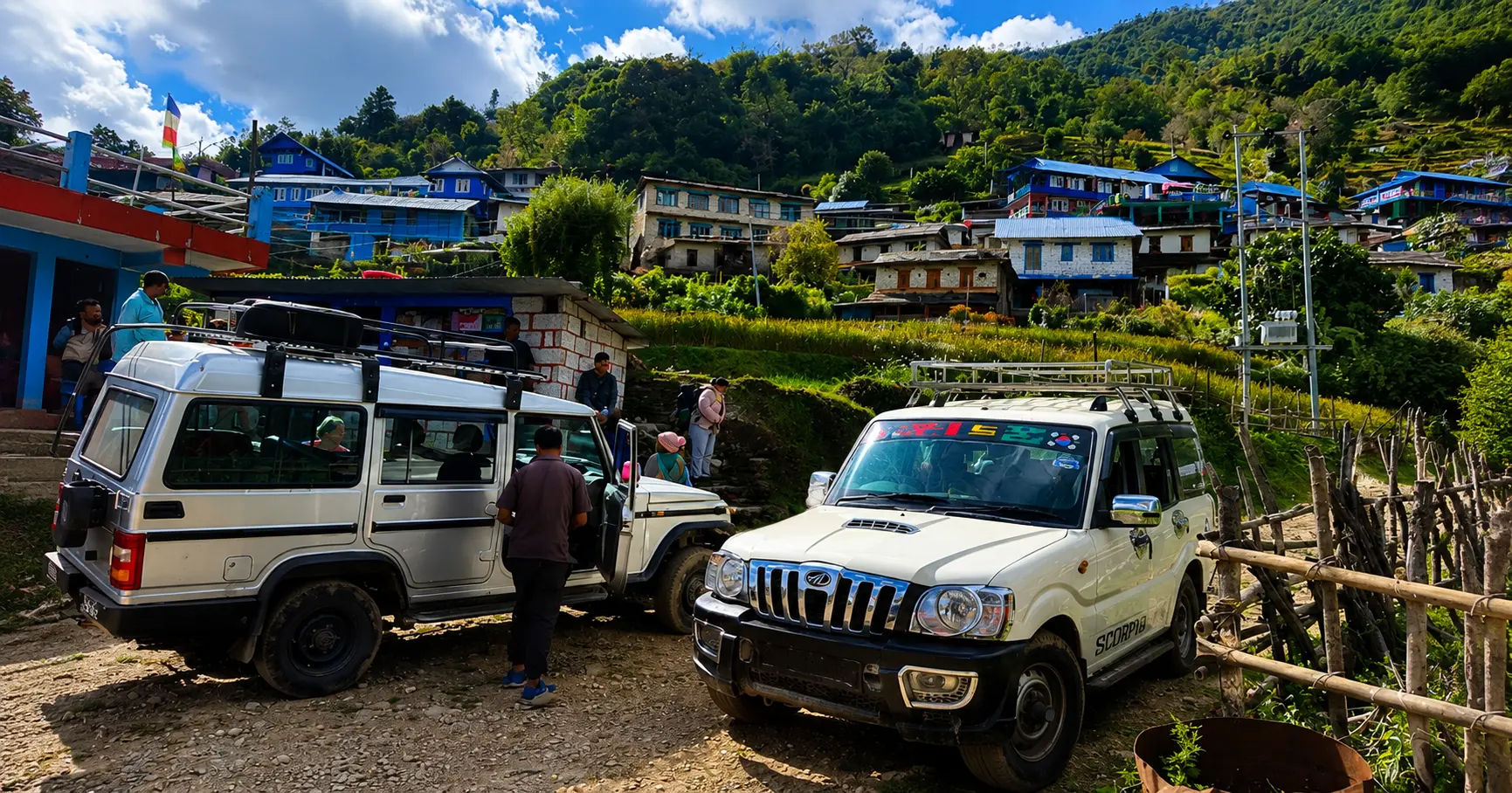
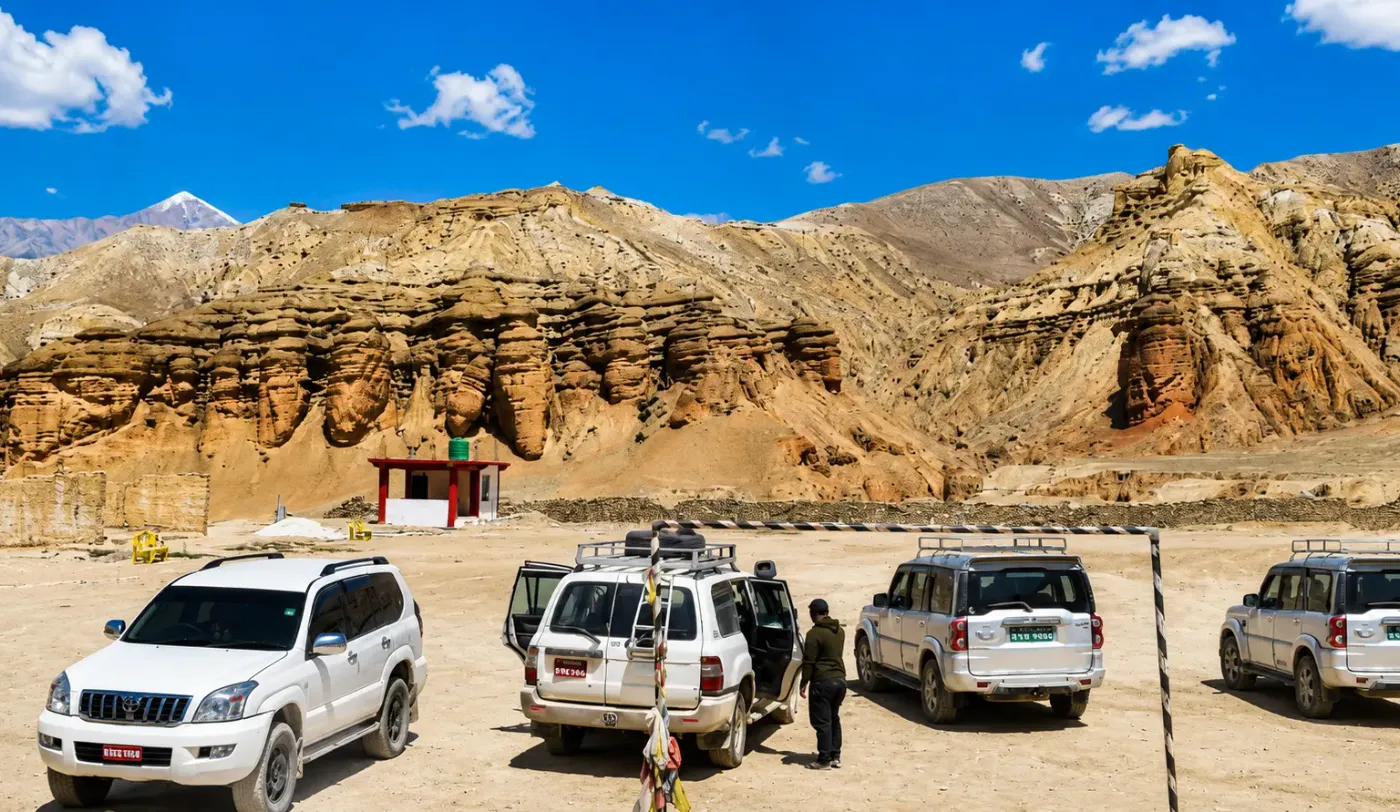
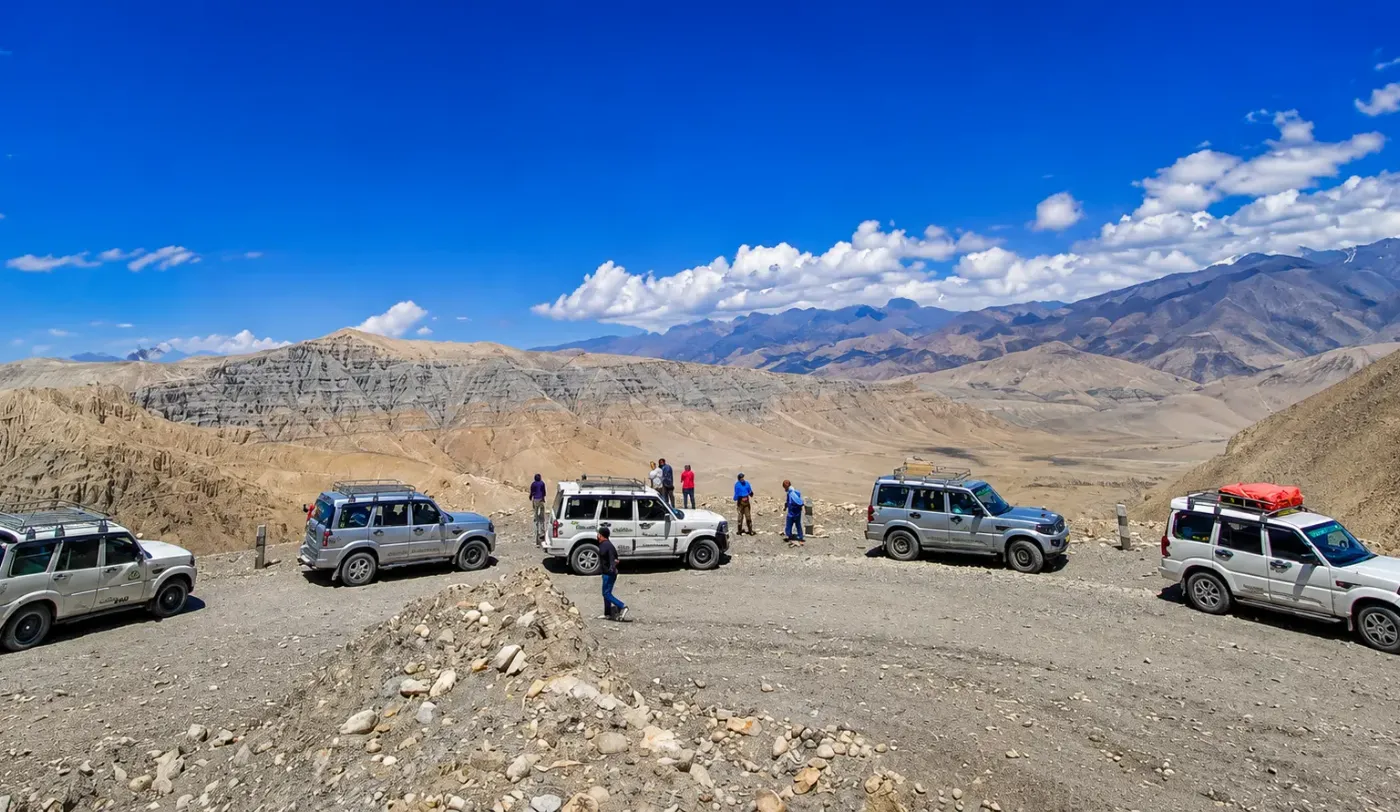
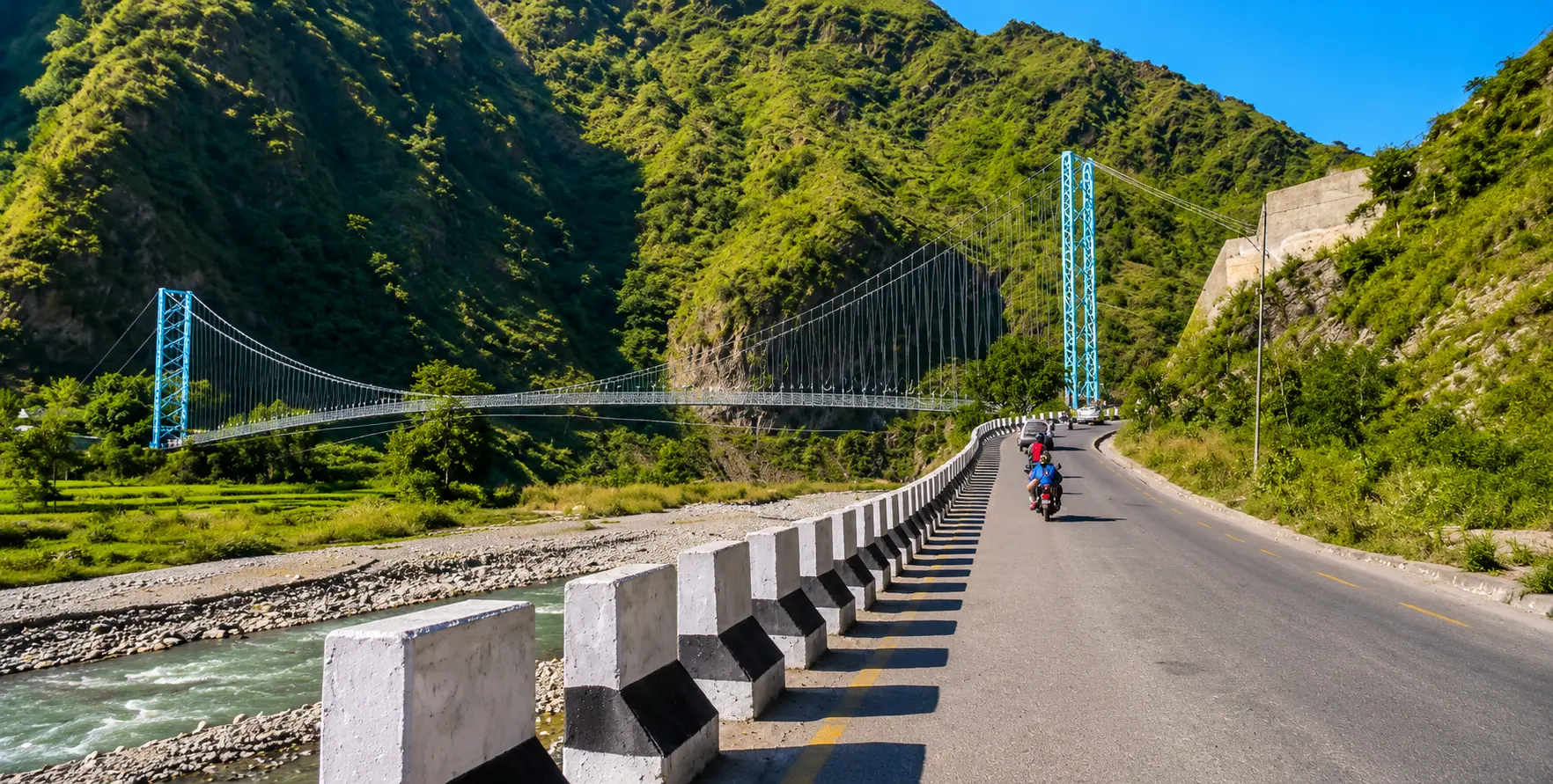
Scorpio jeeps on the road in Mustang

Experience Nepal Better with Safe Vehicle Rental Services

Nepal is a country that rewards the traveler who moves through it on their own terms — not waiting at bus parks for an overloaded public vehicle to fill and depart, not sharing a seat with strangers on a route that takes twice as long as it should, and not arriving at a destination in the dark because the shared transport schedule was incompatible with the trekking or pilgrimage itinerary that gives the journey its meaning. The difference between experiencing Nepal through its public transport network and experiencing it through a safe private vehicle rental service is not merely a comfort difference — it is a fundamental difference in how much of Nepal you actually experience, how safely you travel its mountain roads, and how much of your limited time you spend in transit versus in the places you came to see.

Nepal Vehicle Hiring Pvt Ltd has provided safe vehicle rental services across Nepal’s travel landscape since our founding — from the standard Kathmandu airport transfer that begins every international visitor’s Nepal journey to the most remote 4WD jeep hire for the Manaslu trek approach or the Rolwaling Valley trailhead. Our fleet covers every vehicle type that Nepal’s diverse terrain and visitor requirements demand.

Our drivers are verified, experienced, and professionally presented. Our pricing is transparent and all-inclusive—driver, fuel, and road tolls —with no hidden additions at the end of the journey.

This guide lays out why safe vehicle rental in Nepal transforms the Nepal experience—and shows, through every major Nepal destination and journey type, exactly how Nepal Vehicle Hiring Pvt Ltd delivers that transformation.

Nepal’s Transport Geography — Why the Right Vehicle Matters

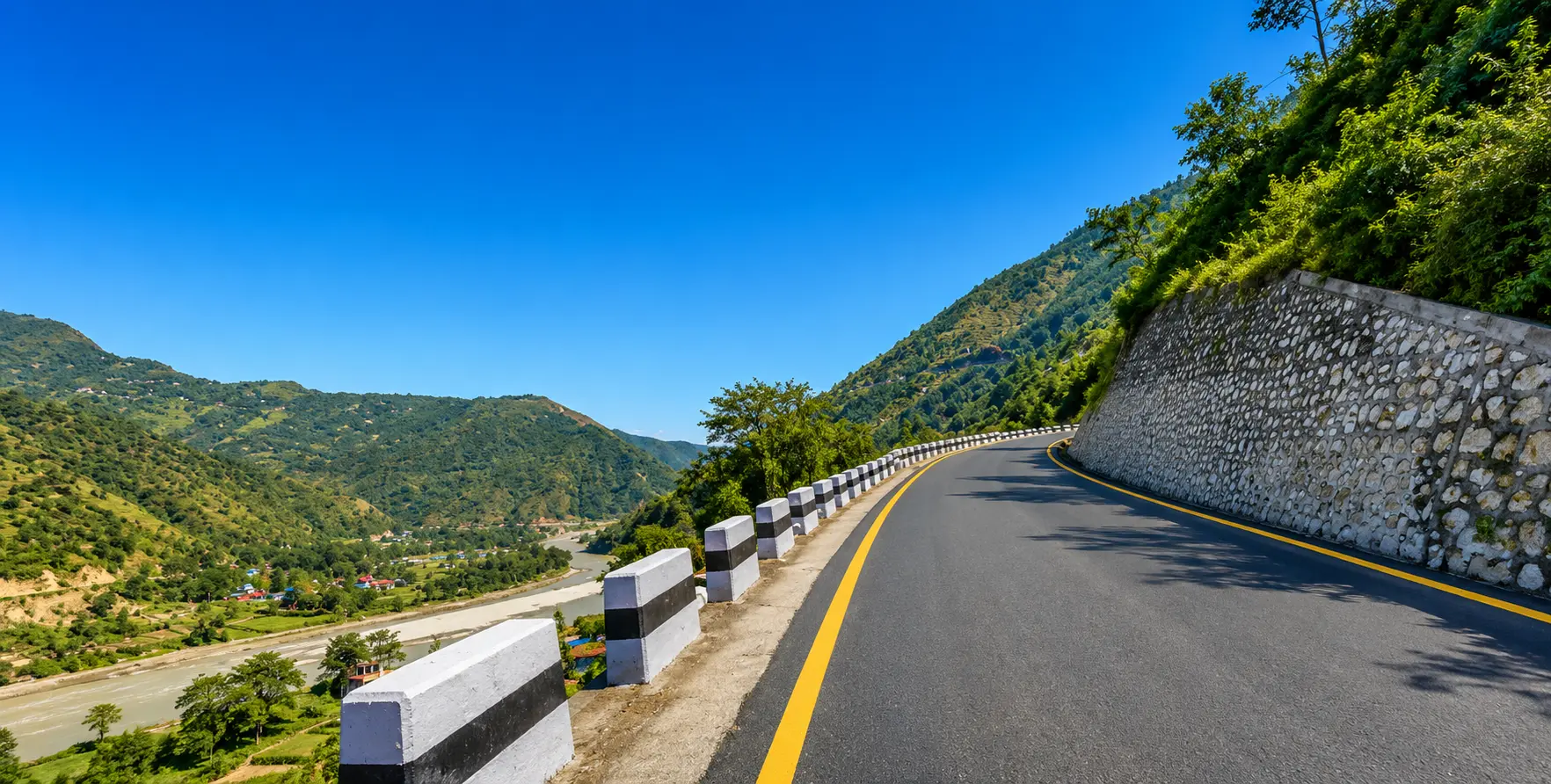
Nepal’s geography creates transport challenges that visitors accustomed to European or North American road networks frequently underestimate until they encounter them directly. The country’s road network stretches from the Terai plains at about 60 meters above sea level to the highest motorable points in the Himalayan foothills at 3,500 to 4,000 meters — a vertical range of nearly 4,000 meters that most major route segments must climb or descend within a few dozen kilometers.

The result is a highway system marked by steep gradients, tight hairpin curves, narrow carriageways, exposed cliff-edge sections, variable surface quality, and seasonal damage patterns from a monsoon climate that deposits 80 to 90 percent of its annual rainfall in 4 months.

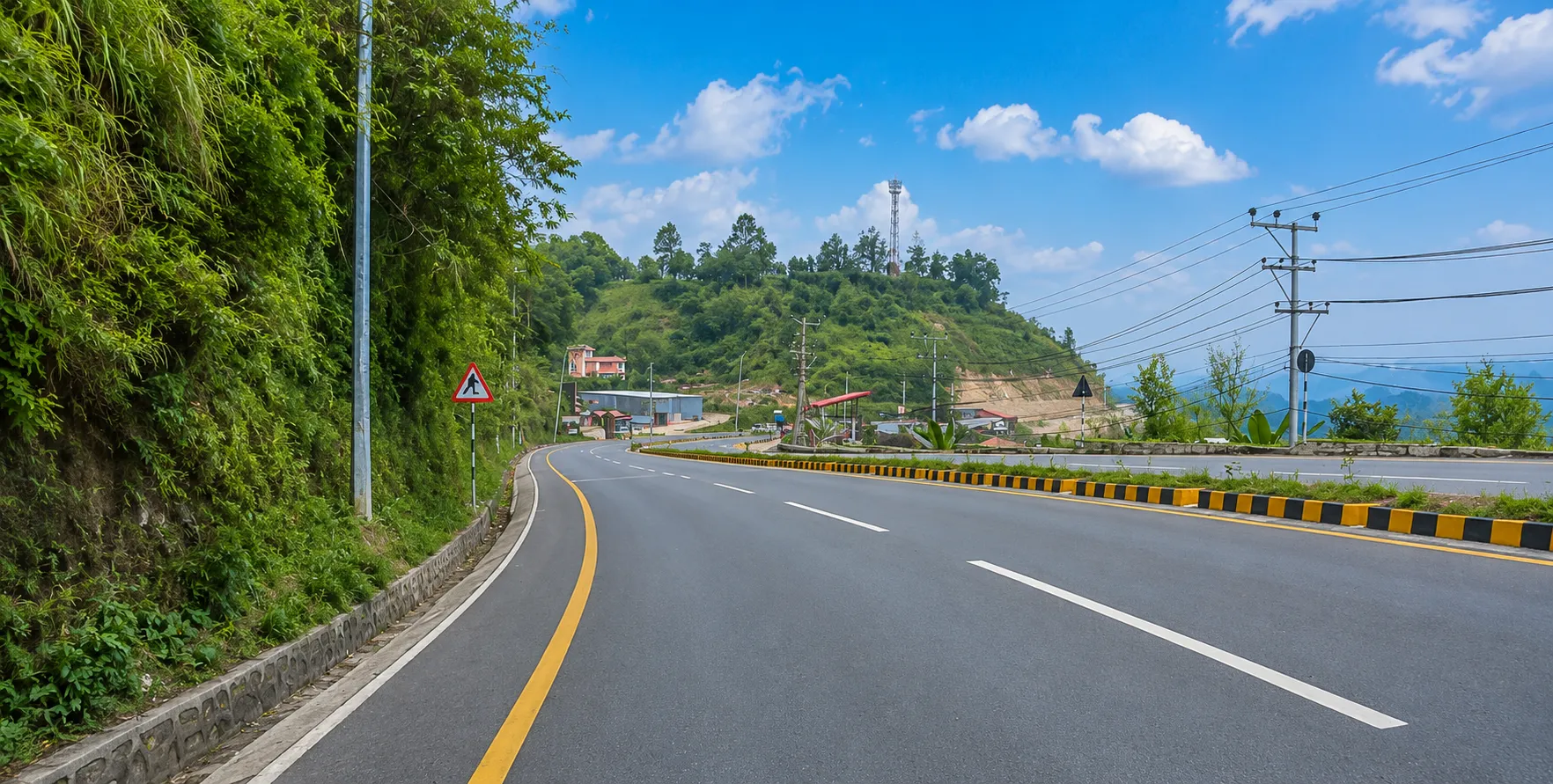
This geography means that the vehicle type is not a luxury choice but a practical necessity for safe travel on Nepal’s mountain roads. The Prithvi Highway to Pokhara is Nepal’s finest and most comfortable highway — and even this route is better experienced in a private vehicle than in a crowded public bus.

The Trishuli-to-Dhunche section of the Pasang Lhamu Highway for the Langtang Valley trek approach, the Dumre-to-Besisahar section for the Annapurna Circuit approach, the gorge road from Besisahar to Manang, and the approaches to virtually every major trekking trailhead in Nepal are categorically safer and more comfortable in a private hired vehicle driven by a professional who knows the specific road.

The Safe Vehicle Rental Difference — What It Actually Means

The term ‘safe vehicle rental’ encompasses several specific elements that distinguish Nepal Vehicle Hiring Pvt Ltd‘s service from informal vehicle hire arrangements.

Mechanically Verified Vehicles. Every vehicle in the Nepal Vehicle Hiring Pvt Ltd fleet undergoes regular mechanical inspection, covering brakes, tires, engine oil, coolant, and all safety-critical systems, before any departure for a mountain road journey. This is not a paperwork exercise — it is a genuine pre-departure check conducted by our maintenance team that has specific knowledge of the conditions these vehicles will encounter.

A brake failure on the descent from Ramche to Trishuli Bazaar, or a tire blowout on the exposed cliff sections above Besisahar, has consequences no itinerary contingency can address. Mechanical verification before departure is the foundation of safe mountain vehicle rental.

Professionally Licensed and Experienced Drivers. All Nepal Vehicle Hiring Pvt Ltd drivers hold valid Nepal Transport Management Office licenses for their specific vehicle class. Beyond licensing, we select drivers for their route experience—drivers assigned to the Besisahar gorge road have personal, repeated driving experience on that route.

Drivers assigned to the Langtang approach road know the Ramche Landslide Zone’s specific behavior in wet and dry conditions. Drivers assigned to the Manaslu trek transport know the Arughat-to-Soti Khola road section’s cliff-edge characteristics. This route-specific knowledge is the most important safety element of mountain road driving — more important than the vehicle’s mechanical condition.

Road Condition Monitoring. Nepal Vehicle Hiring Pvt Ltd does not dispatch vehicles on routes we cannot confirm as currently safe. Every booking for a mountain road transfer includes a morning-of departure check through our driver network for current road conditions on that specific route.

If a section is reported blocked, restricted, or compromised by overnight weather or recent landslide activity, we contact the client before departure and advise on options: schedule adjustment, alternative routing, or rescheduling. This proactive monitoring is particularly important for monsoon-season travel on routes with known landslide vulnerability.

Transparent All-Inclusive Pricing. A safe vehicle rental is also financially transparent: the price quoted at booking is the price paid at journey end, with no supplementary fuel charges, driver overtime fees, or ‘mountain road extra’ additions. Nepal Vehicle Hiring Pvt Ltd‘s pricing structure covers driver, fuel, and road tolls in all quoted rates — the client books a journey, not a meter.

This predictability is both practically convenient and a genuine safety feature: knowing the total cost in advance eliminates negotiation disputes at the end of the journey that, on remote mountain roads after a long day’s travel, create the kind of stress safe travel planning is designed to prevent.
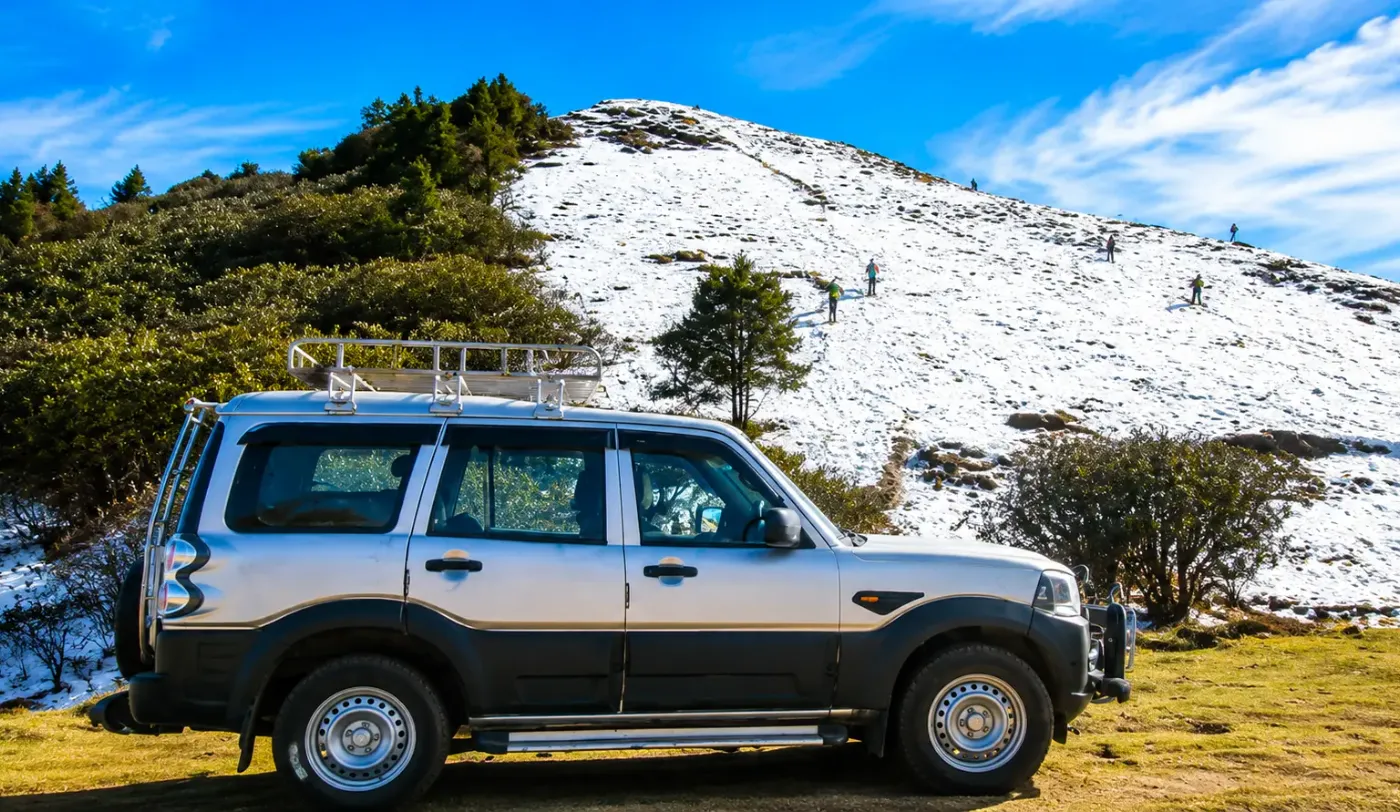
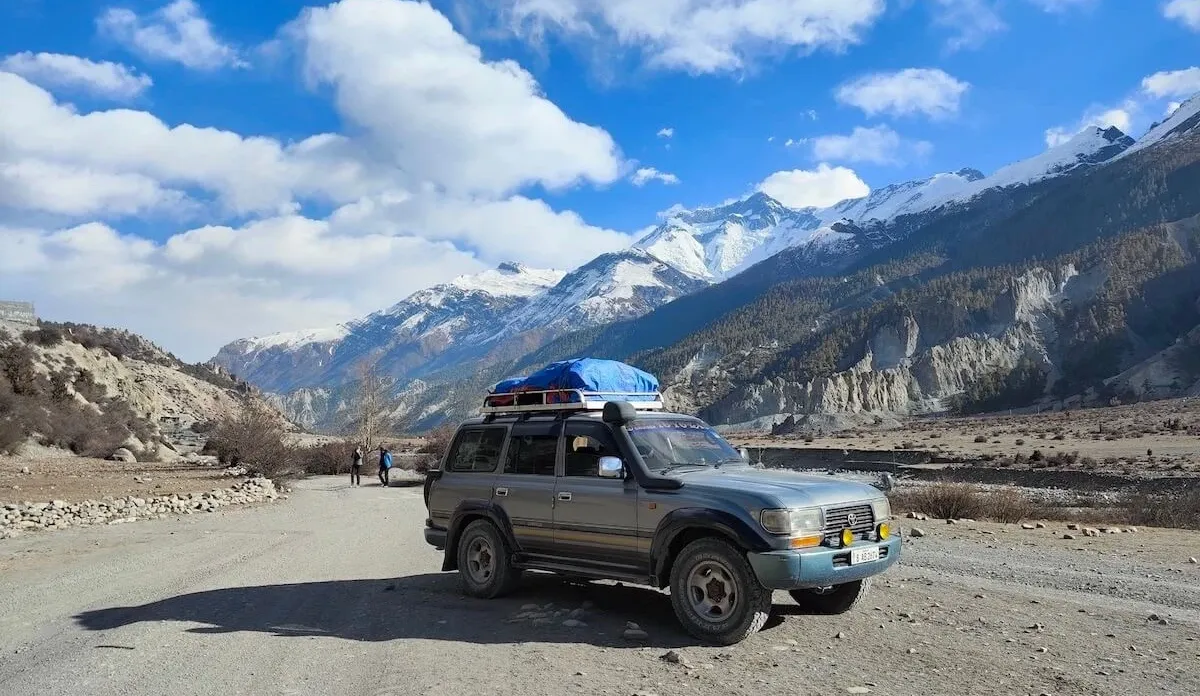
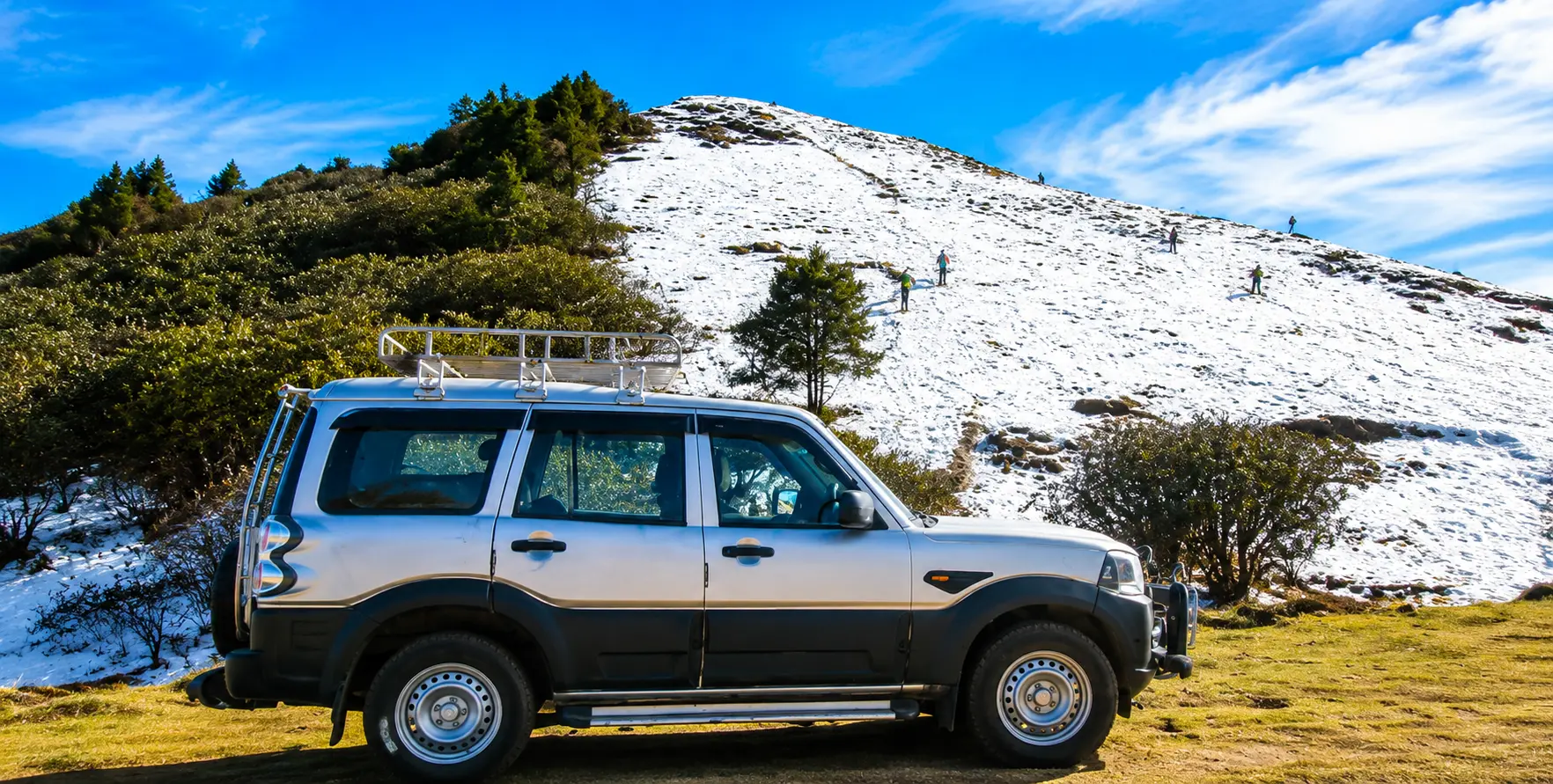
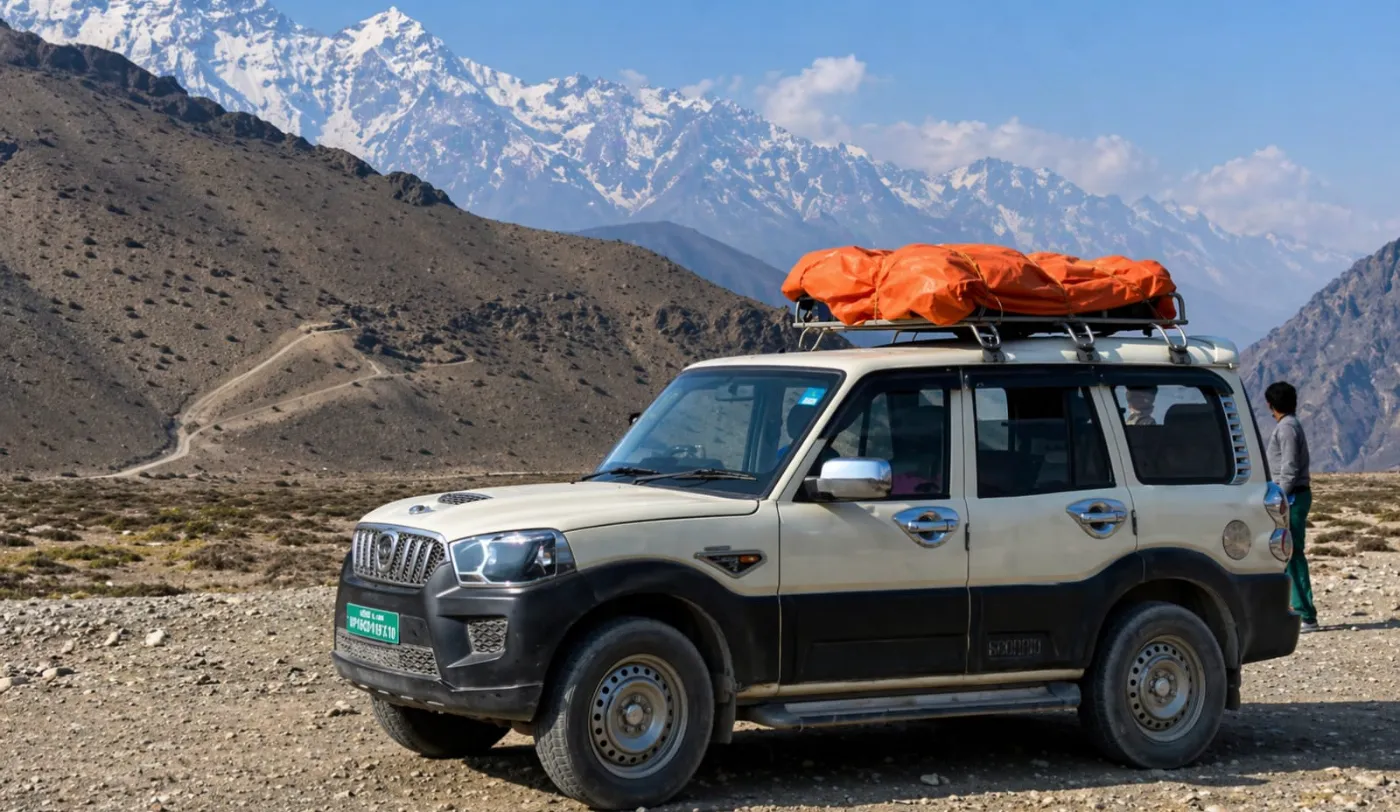
Scorpio jeep beside a snow-covered hillside

The Nepal Vehicle Hiring Fleet — The Right Vehicle for Every Journey

Nepal’s diverse road terrain — from the Terai’s flat national highways to the Himalayan gorge roads’ extreme gradients — requires a correspondingly diverse vehicle fleet. Nepal Vehicle Hiring Pvt Ltd maintains all major vehicle categories specifically for the Nepal road environment.

Private Sedan — The City and Highway Standard. For Kathmandu city car hire, airport transfers, and all journeys on paved national highways, the private sedan — Toyota Corolla, Hyundai Accent, Suzuki Swift — provides comfortable, air-conditioned transport for 3 to 4 passengers. Our car hire in Nepal covers the Kathmandu to Pokhara highway, Kathmandu sightseeing, Bhaktapur heritage tours, Nagarkot sunrise transfers, and all urban-to-trailhead connections on paved roads.

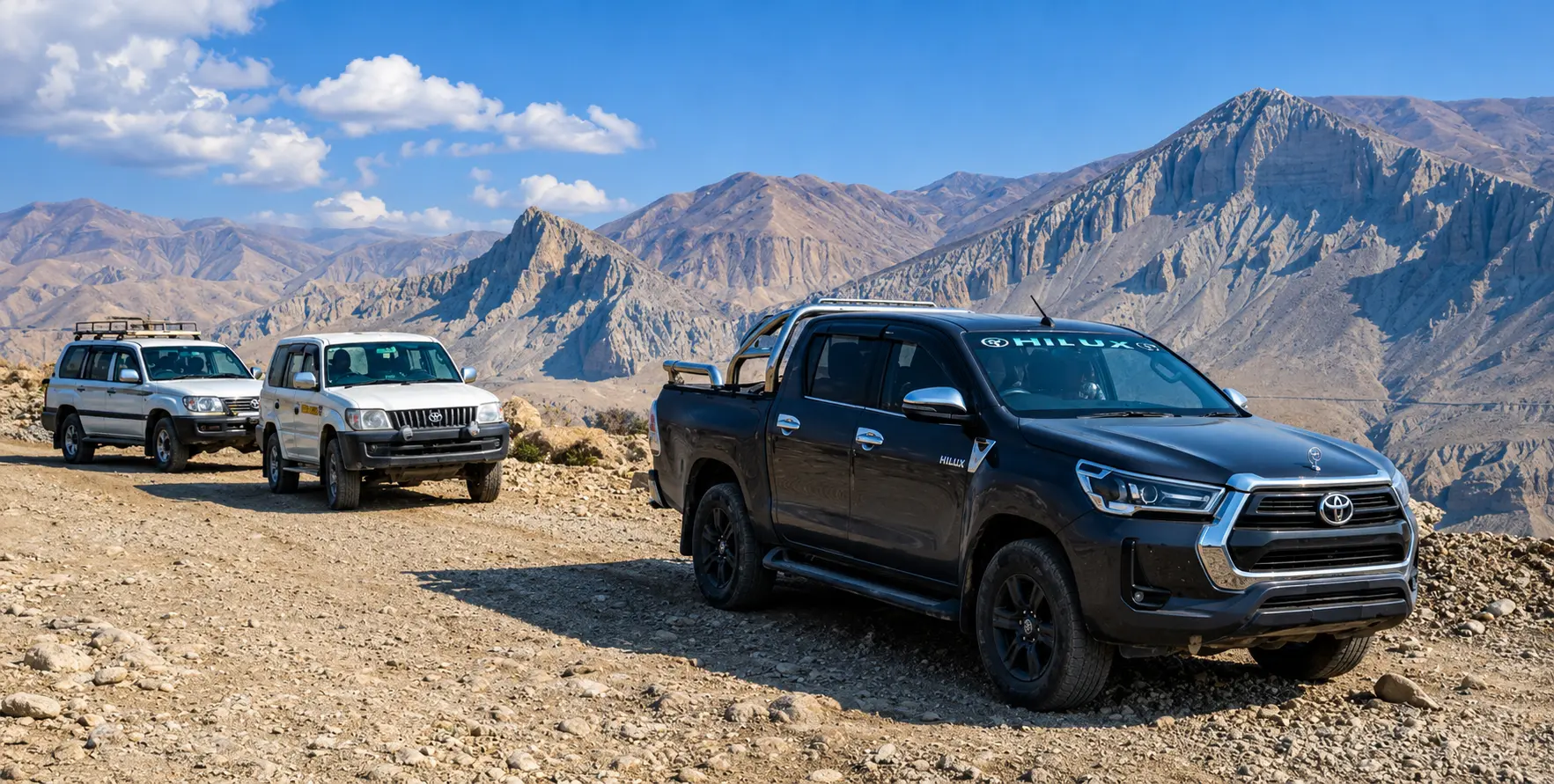
Private 4WD Jeep (Scorpio or Hilux) — The Mountain Road Specialist. The private 4WD Scorpio or Hilux jeep is Nepal’s definitive mountain-road vehicle—the standard recommendation for every trekking trailhead transfer that involves unpaved sections, steep gradients, or exposed terrain. Our jeep hire covers: Besisahar private vehicle for the Annapurna Circuit, Soti Khola jeep for the Manaslu Circuit trek, Salleri Phaplu jeep for the Everest overland approach, the Muktinath tour from Sunauli, and all Himalayan pilgrimage and trekking transfers.

Toyota Hiace Van — The Group Standard. The Toyota Hiace van hire serves groups of 7 to 14 passengers on Nepal’s paved highway corridors — the Prithvi, Mahendra, BP, and Siddhartha Highways. For trekking groups, temple and pilgrimage parties, corporate teams, and families, the Hiace provides comfortable, together-in-one-vehicle transport for the highway legs of any Nepal itinerary.

Combined with 4WD jeeps for off-road sections, the Hiace forms the highway leg of our multi-vehicle group arrangements.

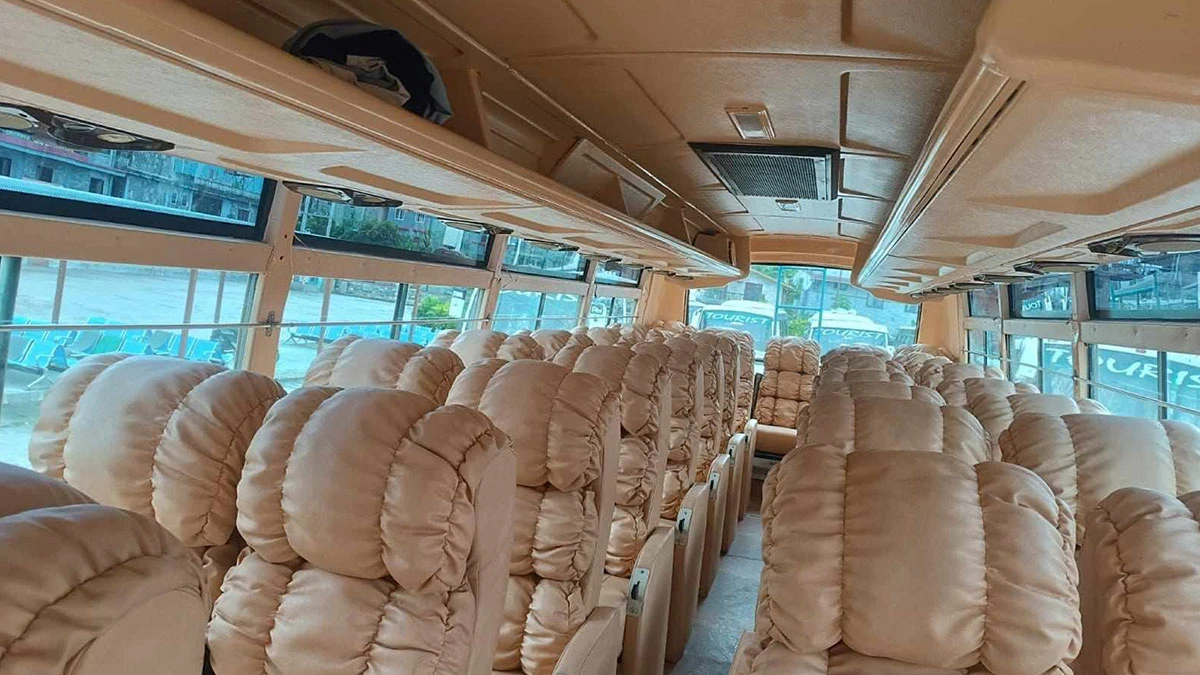
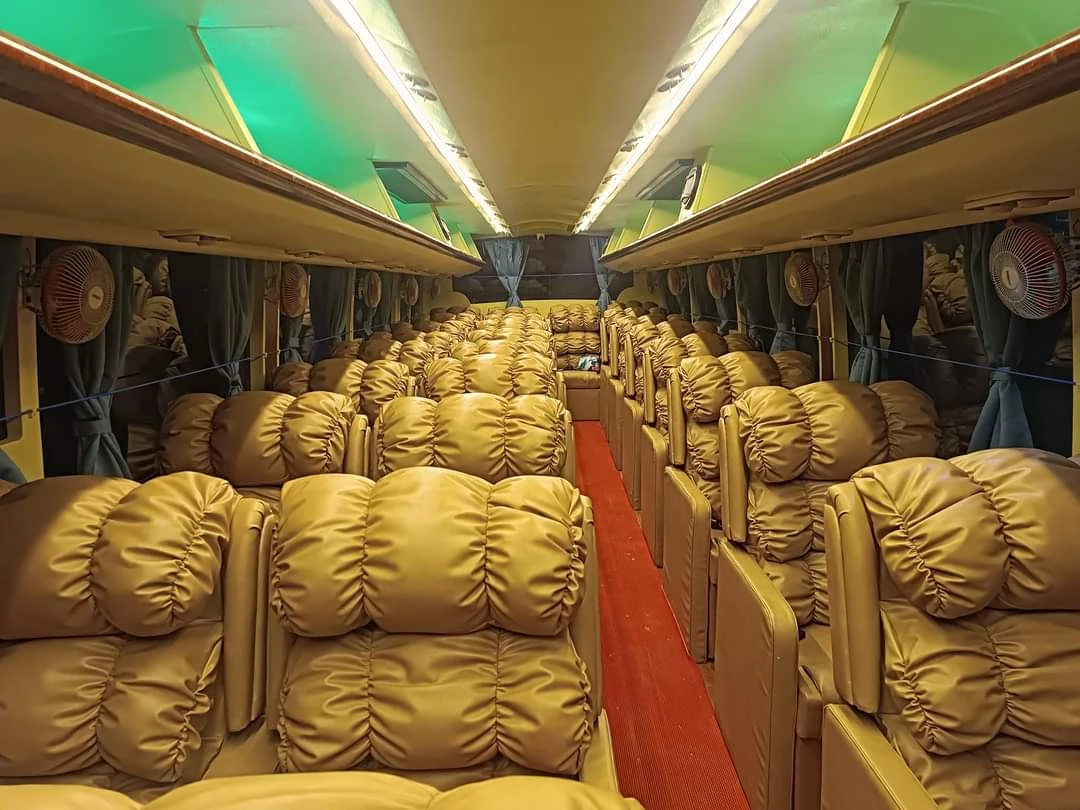
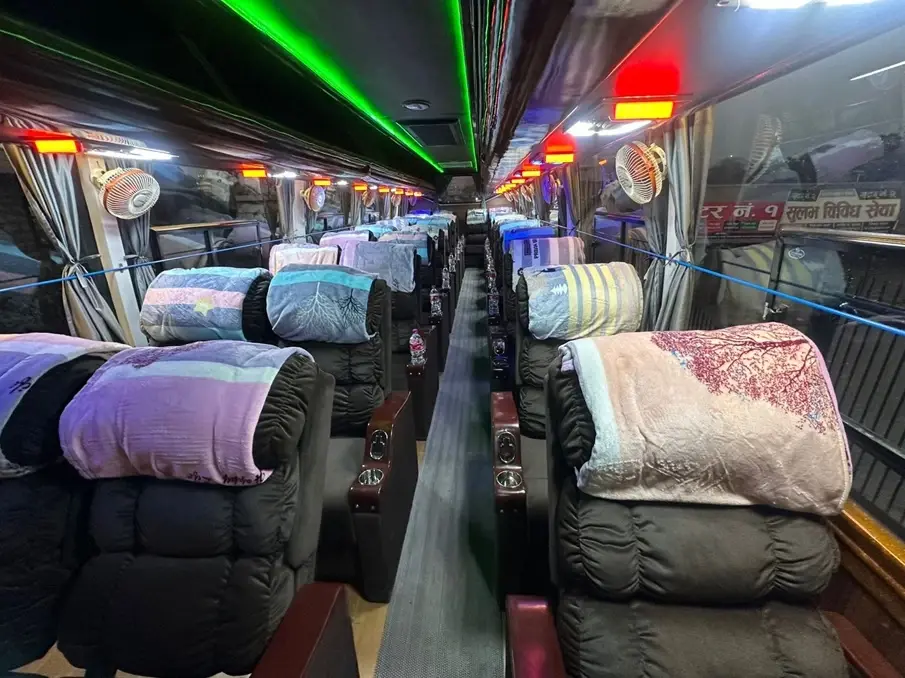
Tourist Coaster — The Medium Group Solution. The tourist coaster carries 14 to 22 passengers in reclining, air-conditioned seats on Nepal’s national highway network. For conference groups, larger pilgrimage parties, and medium-to-large tour groups, the coaster provides the best combination of capacity, comfort, and cost-efficiency for highway travel.

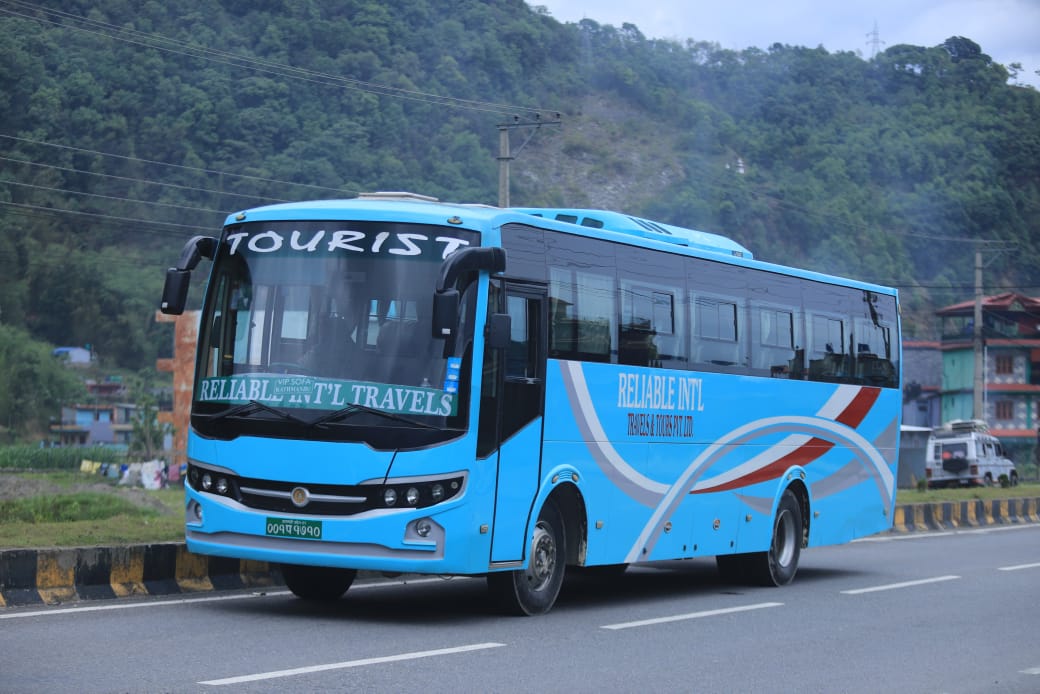
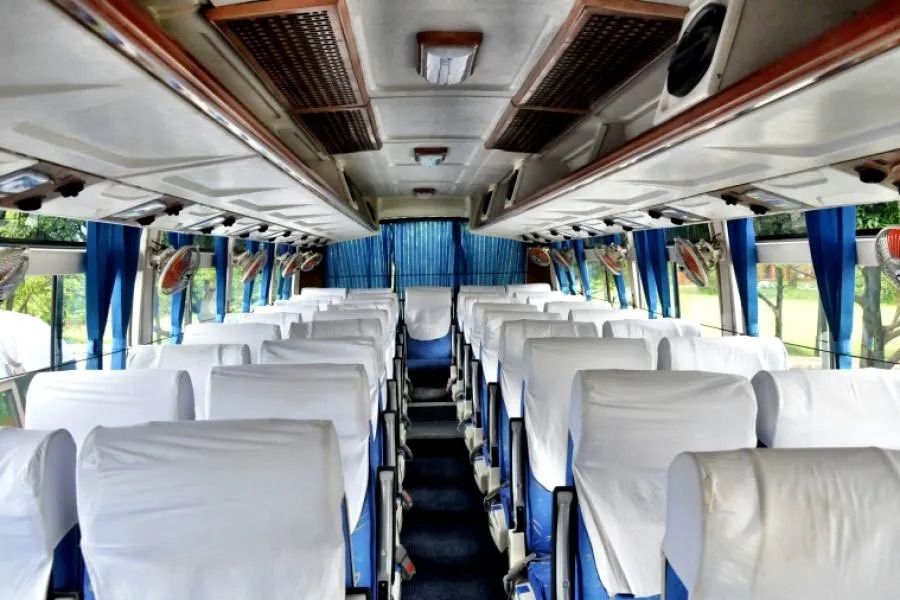
Tourist Bus — The Large Group Fleet. The full-size tourist bus handles groups of 25 to 45 passengers for Nepal’s most popular long-distance routes: Kathmandu to Pokhara bus, Kathmandu to Lumbini bus, Pokhara to Chitwan bus, and Pokhara to Kathmandu bus. Large religious groups, school trek parties, corporate incentive groups, and major pilgrimage convoys use our bus hire for these highway connections.

Experiencing Kathmandu Safely — The Capital’s Heritage Network

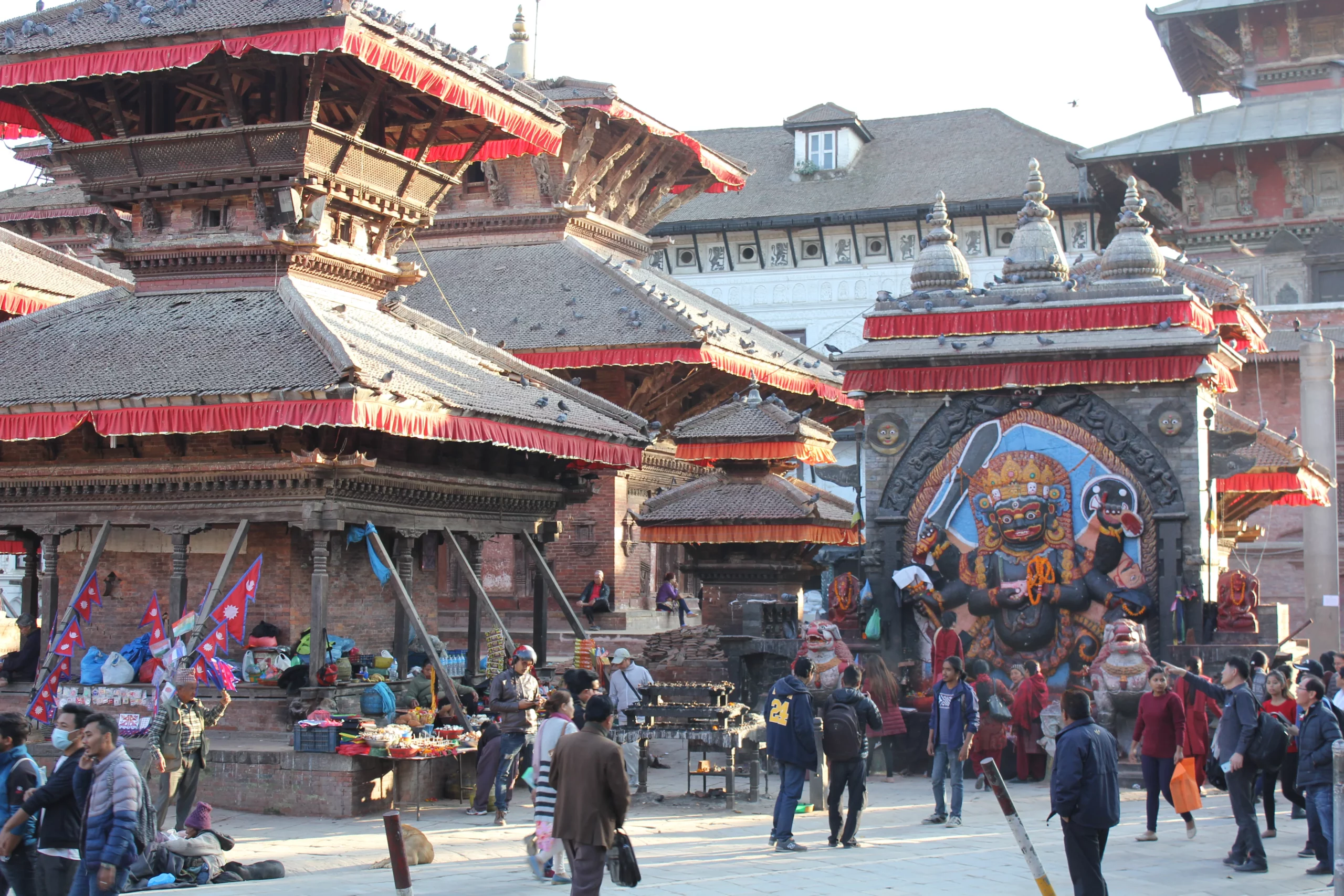
Kathmandu is one of the world’s great heritage cities — a UNESCO World Heritage Site complex of seven monument zones encompassing two thousand years of Newar Buddhist and Hindu artistic tradition — and experiencing it through a private car hire from Nepal Vehicle Hiring Pvt Ltd versus Kathmandu’s taxi network is the difference between a planned, informed heritage circuit and a reactive, negotiation-heavy series of disconnected visits.

Our Kathmandu sightseeing car hire covers the full UNESCO heritage circuit: Pashupatinath Temple (one of the most important Shiva shrines in the world), Boudhanath Stupa (the largest Tibetan Buddhist stupa in the world, rebuilt and gleaming since the 2015 earthquake restoration), Swayambhunath (the ancient stupa on the valley’s western hill, visible from across Kathmandu), and Patan Durbar Square (the finest medieval Newar palace complex in the valley, with the Golden Temple and the Krishna Mandir as its centrepieces). Our driver waits at each site while the group explores at their own pace — no taxi negotiation for the next destination, no time pressure, and no uncertainty about the total cost.

The Bhaktapur heritage day tour by private car from Nepal Vehicle Hiring Pvt Ltd takes visitors 13 kilometers east of Kathmandu to the finest and most completely preserved medieval Newar city in the valley — with its famous 55-Window Palace, the Vatsala temple, Dattatreya Square, and the potters’ quarter where traditional black pottery is still made by hand using ancient techniques. The Nagarkot sunrise transfer — a pre-dawn private car hire to the Kathmandu Valley’s eastern rim viewpoint — delivers the famous Himalayan dawn panorama from Langtang to Everest that many visitors describe as Nepal’s most visually overwhelming single moment.

And the Kathmandu airport transfer by private car from Nepal Vehicle Hiring Pvt Ltd begins every international visitor’s Nepal experience with the professional, hotel-to-terminal service that sets the tone for the entire visit.

Experiencing Nepal Batter Trekking Trailheads Safely

Every major Nepal trek begins with a road journey from Kathmandu or Pokhara to a trailhead — and the quality of that road journey sets the tone for everything that follows. A trailhead transfer done well means arriving rested, on schedule, with all luggage intact, having made any necessary stops (ATM, equipment purchase, permit checkpoint) without rushing.

A trailhead transfer done poorly means hours of crowded public transport, a scramble for the shared jeep at the bus park, and arrival at the trailhead fatigued before the trek has even begun.

Annapurna Circuit Approach. The Besisahar private vehicle hire from Nepal Vehicle Hiring Pvt Ltd covers the Kathmandu-to-Besisahar approach (173 to 185 km, 5 to 7 hours) with a professional driver, hotel pickup, and the option to extend to Chame or Manang by 4WD jeep for the gorge road beyond Besisahar. The Annapurna Circuit trek deserves to begin with the energy and focus that a well-organized transfer delivers.

Everest Region Approach. The Kathmandu to Salleri Phaplu jeep hire provides an overland route to the Everest region’s Solu Khumbu district — an extraordinary 2-day drive through eastern Nepal’s BP Highway and hill districts that takes trekkers to the Phaplu or Salleri trailhead for the walking approach to Namche Bazaar. For trekkers flying to Lukla, our Kathmandu airport transfer covers the Tribhuvan International to domestic terminal connection for the Lukla flight.

Trek Nepal Himalayas offers the Everest Base Camp trek and its luxury version, the EBC lodge trek, with Nepal Vehicle Hiring Pvt Ltd handling all road-transport legs.

Manaslu Circuit Approach. The Kathmandu to Soti Khola jeep transfer and our Manaslu trek transport service provide the approach to the Manaslu Circuit trek‘s trailheads at Soti Khola or Machha Khola. The Manaslu Circuit is one of Nepal’s finest and most complete mountain circuit experiences, and it begins with one of Nepal’s most demanding single-day road journeys — a 5 a.m. departure essential for a dawn arrival at the trailhead.

Langtang Valley Approach. The Kathmandu to Syabrubesi private jeep hire for the Langtang Valley trek navigates the Pasang Lhamu Highway’s demanding Ramche Landslide Zone in a 4WD vehicle specifically because this section requires ground clearance and road experience that shared transport cannot guarantee. For the current Syabrubesi road status following the August 2026 flood, contact our team before booking.

Pokhara-Based Treks. Our Pokhara to Nayapul transport covers the Ghorepani Poon Hill trek and Annapurna Base Camp trek approach. Our Pokhara car hire covers all in-Pokhara transfers, and our Sarangkot sunrise vehicle delivers the pre-dawn Annapurna range panorama that many visitors describe as Nepal’s finest mountain viewpoint experience.

Experiencing Nepal’s Pilgrimage Sites Safely

Nepal is one of the world’s most important pilgrimage countries — home to the birthplace of Lord Buddha at Lumbini, the sacred Hindu pilgrimage sites of Pashupatinath and Muktinath, the high-altitude Buddhist sacred lake of Gosaikunda, and the starting point for the Kailash Mansarovar Yatra via the Hilsa border crossing. Each of these pilgrimage destinations has its own vehicle hire requirements, which Nepal Vehicle Hiring Pvt Ltd covers through our complete Nepal tour package and private vehicle hire network.

Lumbini — The Buddha’s Birthplace. The UNESCO World Heritage Site of Lumbini in Rupandehi District, 22 kilometers from the Sunauli border with India, is accessible from Kathmandu by our Kathmandu to Lumbini bus or private vehicle hire along the Mahendra Highway. The Maya Devi Temple, the Ashoka Pillar, the Puskarini sacred pond, and the international monastery zone of the Lumbini Development Area together create one of the most important and most moving sacred sites in the world — and reaching it in a private car from Nepal Vehicle Hiring Pvt Ltd allows the pilgrimage journey to begin from any Kathmandu hotel door.

Muktinath — The 106th Divya Desam. The sacred Muktinath temple at 3,710 meters in Mustang District, with its 108 sacred water spouts and eternal flame, is one of Hinduism’s most revered Vaishnavite pilgrimage sites. Our Muktinath vehicle hire covers the full circuit: Kathmandu to Pokhara bus or private jeep for the approach, Pokhara car hire for the overnight, and private vehicle hire from Pokhara to Muktinath via the Kali Gandaki gorge.

For Indian pilgrims crossing at Sunauli, our Sunauli-to-Muktinath pilgrimage vehicle package covers the full round trip.

Pashupatinath and the Kathmandu Sacred Sites. The Pashupatinath Temple — one of the most important Shiva temples in the Hindu world — is included in our Kathmandu sightseeing car hire, along with Boudhanath, Swayambhunath, and the Patan heritage zone. Our Kathmandu car hire provides the vehicle that connects these sacred sites in a smooth, driver-guided circuit.

Experiencing Nepal’s Wildlife Safely — Chitwan and Beyond

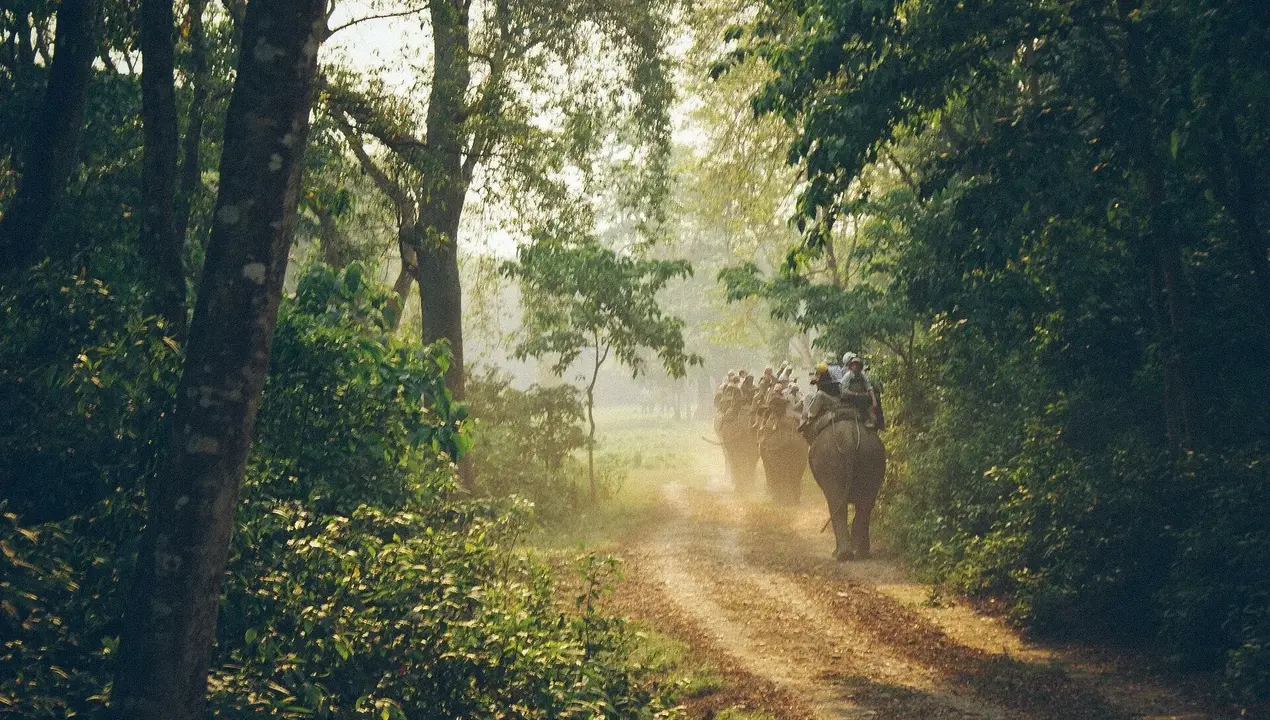
Chitwan National Park — Nepal’s first national park and a UNESCO World Heritage Site — is home to the one-horned rhinoceros, Bengal tiger, Asian elephant, gharial crocodile, and one of the finest bird communities in South Asia, making it one of the bcontinent’s est wildlife destinations  Reaching Chitwan from Kathmandu or Pokhara by safe private vehicle hire or our comfortable Pokhara to Chitwan bus sets the right tone for the wildlife experience ahead. The Chitwan jungle safari from Trek Nepal Himalayas provides the guided in-park experience.

Bardia National Park in far western Nepal, more remote and with even higher wildlife density than Chitwan, is reachable via the Mahendra Highway westward from the Terai corridor—a longer overland journey well-suited to our Hiace van hire for groups or private jeep for smaller parties.

Experiencing Nepal’s Cultural Diversity Safely

Nepal’s extraordinary cultural diversity — 125 officially recognised ethnic communities, eight world religions practiced within its borders, more than 90 languages spoken by its population of 30 million — is experienced most authentically not in the tourist zones of Thamel or the developed areas of Pokhara Lakeside, but in the villages, market towns, and cultural centres that visitors reach by the roads our private vehicle rental services navigate. The medieval Newar towns of the Kathmandu Valley — Bhaktapur, Bungamati, Khokana, Thimi — the Tibetan-influenced communities of the Mustang and Manang districts, the Thakali villages of the Kali Gandaki gorge, the Tamang communities of the Rasuwa and Nuwakot hill districts, and the Tharu communities of the western Terai all exist at the ends of roads that a private car hire or private jeep from Nepal Vehicle Hiring Pvt Ltd can reach comfortably and safely.

The Bhaktapur heritage day tour by private vehicle is one of our most consistently requested services precisely because Bhaktapur’s medieval character — its stone-paved lanes, traditional craftspeople, and temple-centered public life — reveals itself most fully to visitors who arrive without the time pressure of a shared tour bus schedule. Our driver waits while the group explores Bhaktapur’s pottery square, watches the craftspeople at work, and has lunch at a traditional Newari restaurant — a luxury of time that public transport and group tours cannot provide.

How to Choose a Safe Vehicle Rental Service in Nepal

The Nepal vehicle rental market includes professional operators like Nepal Vehicle Hiring Pvt Ltd and many informal arrangements, street-side taxi drivers offering day hire, guesthouse-arranged vehicles with unknown mechanical histories, and online platform listings that aggregate drivers without systematic vetting of vehicle condition or driver licensing. Choosing between these options with confidence requires knowing what a genuinely safe Nepal vehicle rental service looks like.

  • Verify vehicle maintenance: Ask specifically whether vehicles are mechanically inspected before mountain road journeys. Nepal Vehicle Hiring Pvt Ltd can confirm our pre-departure inspection practice directly.
  • Confirm driver licensing: Nepal’s Transport Management Office issues licenses by vehicle class. Your driver should hold the appropriate license for the vehicle category used— a commercial van license for the Hiace, a heavy vehicle license for buses.
  • Check route experience: A driver’s familiarity with the specific road makes the most significant safety difference. We assign drivers by route experience, not by nearest-available rotation.
  • Confirm all-inclusive pricing: Get the full price confirmed in writing before departure — driver, fuel, and all tolls included. Nepal Vehicle Hiring Pvt Ltd’s pricing is all-inclusive by standard practice.
  • Check road condition policy: A responsible operator has a policy of not dispatching vehicles when road conditions are unsafe and of monitoring conditions in real time. Ask our team about our road monitoring practice for any planned mountain route.
  • Book in advance: Reputable operators book ahead — the best drivers and best-maintained vehicles are reserved first. Contact Nepal Vehicle Hiring Pvt Ltd at least 3 to 5 days before departure for standard transfers and at least 1 to 2 weeks for mountain routes in peak season.

The Complete Nepal Vehicle Rental Menu — Every Journey Covered

Nepal Vehicle Hiring Pvt Ltd provides safe vehicle rental services across Nepal’s complete travel landscape:

Kathmandu: Airport transfers, city car hire, sightseeing packages, Bhaktapur heritage tours, Nagarkot sunrise, car hire in Nepal.

Annapurna Region: Besisahar private vehicle, Kathmandu to Besisahar bus, Pokhara to Nayapul transport, Pokhara car hire, Sarangkot sunrise.

Everest Region: Salleri Phaplu jeep, Panch Pokhari trek transport.

Manaslu Region: Soti Khola jeep hire, Manaslu trek transport.

Highway Routes: Kathmandu to Pokhara bus, Kathmandu to Lumbini bus, Pokhara to Chitwan bus, Pokhara to Kathmandu bus.

Remote Nepal: Surkhet to Rara Lake jeep, Nepalgunj connection for Simikot, VIP guest transport, corporate and MICE vehicle hire.

Pilgrimage: Muktinath from Sunauli, Lumbini circuits, Kathmandu sacred site packages — all through our Nepal tour packages and plan trip page.

Nepal’s Road Network — Understanding What You’re Driving On

Understanding Nepal’s road network is the essential context for understanding why safe vehicle rental matters more here than in almost any other travel destination. Nepal has approximately 30,000 kilometers of road, but this figure masks enormous variation in quality, accessibility, and safety profile.

The Prithvi Highway from Kathmandu to Pokhara and the Mahendra Highway across the Terai are paved, maintained, and by Himalayan country standards reasonably wide. The Arniko Highway from Kathmandu toward the Tibet border is paved for its main section but narrows significantly in the gorge sections.

And the approach roads to Nepal’s major trekking trailheads — the roads that Nepal Vehicle Hiring Pvt Ltd’s jeep hire service navigates every week of the trekking season — are a different category entirely.

The approach road from Besisahar to Manang for the Annapurna Circuit trek gorge section is a single-lane track cut into the Marsyangdi River gorge wall at heights of 100 to 300 meters above the river. On this technically demanding mountain road, negotiating oncoming vehicles at passing points requires the specific skill of a driver who has done this exact negotiation hundreds of times.

The approach to Soti Khola for the Manaslu Circuit trek from the Budhi Gandaki valley involves river crossings and steep descents that a first-time Nepal driver should not attempt without prior route knowledge. The Salleri-Phaplu road from the BP Highway into the Solukhumbu district follows a narrow hill road through eastern Nepal that, while paved in many sections, includes sustained gradients and tight curve sequences that require consistent driver attention and mechanical reliability for the full duration.

Beyond the physical characteristics of the roads, Nepal’s transport network presents a specific safety concern that all visitors should understand before renting any vehicle or booking any transport: driver fatigue. Nepal’s public transport drivers often run long routes on tight schedules with inadequate rest breaks.

This pattern has contributed to a disproportionate share of Nepal’s road accidents, which are statistically concentrated in the early morning and late afternoon when fatigue effects are highest. Nepal Vehicle Hiring Pvt Ltd‘s standard operating procedure for all long mountain road transfers includes mandatory rest breaks at identified safe stopping points, a maximum daily driving time policy for our drivers, and a schedule that ensures drivers arrive at their departure point having had adequate rest before the journey begins.

This is not a marketing claim but a genuine operational practice that distinguishes professional vehicle rental service from informal hire.
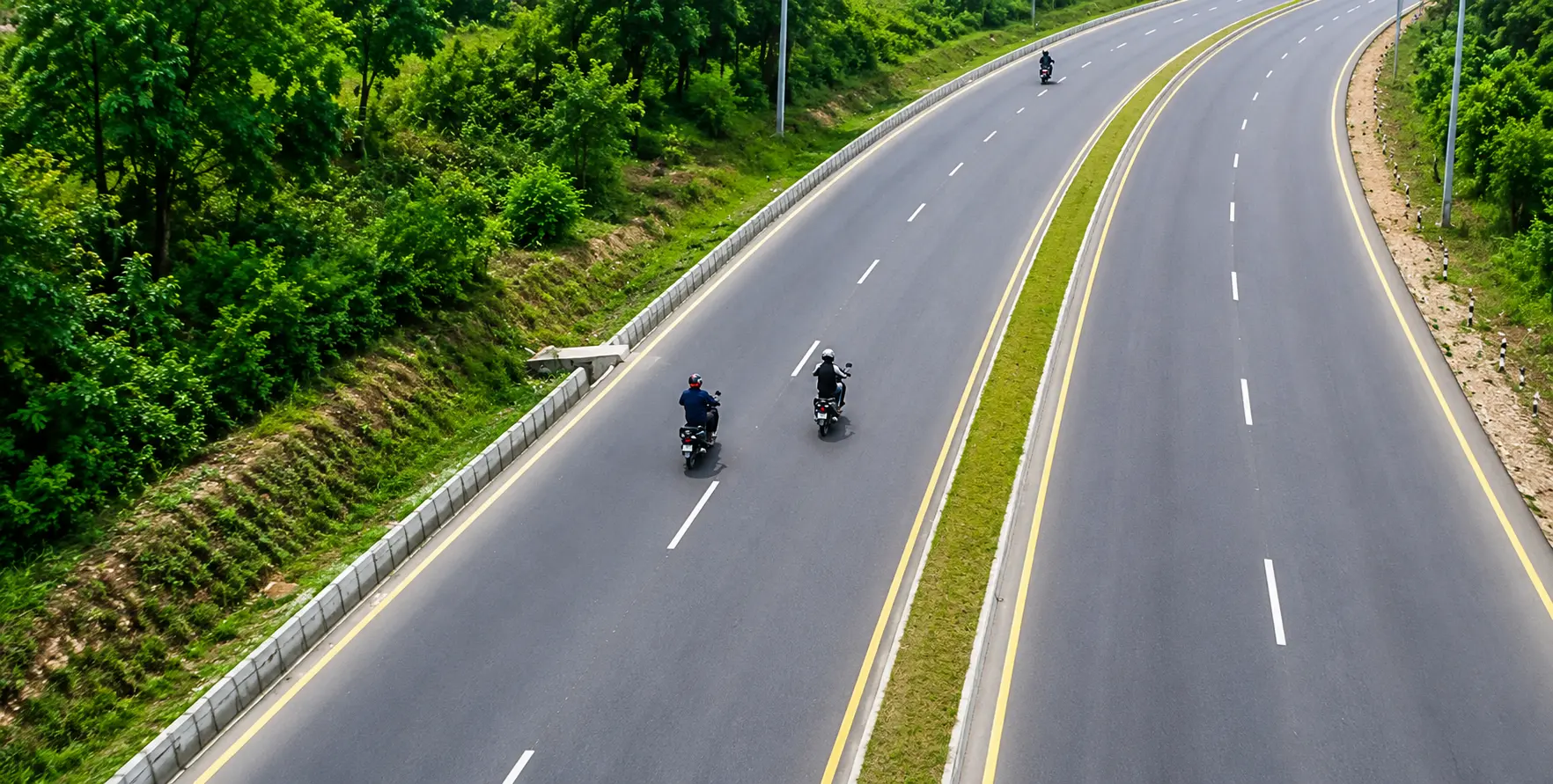
Experience Nepal better with safe vehicle rental services in Nepal, offering private cars, 4WD jeeps, SUVs, Hiace vans, and buses with experienced drivers for comfortable tours, trekking transfers, pilgrimages, and long-distance travel.

Experiencing the Prithvi Highway — Kathmandu to Pokhara by Private Vehicle

The Kathmandu-to-Pokhara journey on the Prithvi Highway is Nepal’s finest long-distance road experience — a 20200-kilometer drive that, in a comfortable private vehicle from Nepal Vehicle Hiring Pvt Ltd, delivers approximately 5 to 7 hours of extraordinary Himalayan scenery, river gorge beauty, and the cultural texture of Nepal’s working mid-hill communities. The highway passes through Nuwakot, crosses the Trishuli River gorge at Malekhu, follows the river southward through Mugling’s famous roadside restaurant strip, and then climbs westward through the Himalayan foothills to Pokhara — arriving with the Annapurna range dominating the northern horizon in a visual announcement of the destination that no domestic flight could replicate.

The Trishuli River gorge section between Malekhu and Mugling is consistently described by visitors traveling the Kathmandu to Pokhara route as the highway’s most striking segment — the river runs alongside the road in a series of Grade 3 to 4 rapids visible from the vehicle window, the gorge walls create a dramatic narrowing that concentrates the landscape’s scale, and the occasional commercial rafting groups visible on the river surface add a human adventure dimension to the view. In a private vehicle from Nepal Vehicle Hiring Pvt Ltd, you can stop at scenic viewpoints along this section for photography—a flexibility neither bus transport nor a shared taxi provides.

The Manakamana Temple cable car station at Mugling — visible on the hillside above the highway junction — is one of Nepal’s most visited pilgrimage sites, accessible by a cable car that rises 1,300 vertical meters from the Trishuli valley floor to the hilltop temple in under 10 minutes. Nepal Vehicle Hiring Pvt Ltd’s Kathmandu-to-Pokhara private vehicle hire includes an optional Manakamana stop for groups who want to combine the pilgrimage visit with the highway journey — the cable car ride and temple visit take approximately 2 to 3 hours, and our driver waits at the Mugling station throughout.

Experiencing Nepal’s Festivals and Cultural Calendar

Nepal’s extraordinarily rich festival calendar — Dashain, Tihar, Indra Jatra, Bisket Jatra, Gai Jatra, Maha Shivaratri, Buddha Jayanti, and dozens of others across its 125 ethnic communities — creates specific transport demands and opportunities that a private vehicle rental service can serve with the flexibility that fixed public transport schedules cannot. Major festivals like Dashain (Nepal’s most important Hindu festival, typically in October) and Tihar (the festival of lights, typically in November) create an enormous movement of people returning to home villages, a seasonal surge in public transport demand that raises prices, reduces availability and significantly extends journey times.

Visitors who have arranged private vehicle hire through Nepal Vehicle Hiking Pvt Ltd before the festival season begins are insulated from this disruption.

The specific festivals at specific locations create unique transport opportunities: Bisket Jatra in Bhaktapur in April, where the famous chariot-pulling festival transforms the medieval city’s main streets into a participation spectacle; the Maha Shivaratri festival at Pashupatinath in February or March, when hundreds of thousands of pilgrims from Nepal and India gather at the temple complex for an overnight celebration; and the Indra Jatra festival in Kathmandu’s Durbar Square in September, when the living goddess Kumari is carried through the old city in a chariot procession. Our Kathmandu sightseeing car hire covers festival-day visits to all Kathmandu Valley heritage sites, with drivers who know the specific vehicle access routes and parking points near each major festival site.

Experiencing Nepal’s Sunrise and Sunset Viewpoints

Nepal’s sunrise and sunset viewpoints — Nagarkot, Sarangkot, Kalinchowk, Poon Hill, and Thyangboche — are among the most photographed mountain vistas on earth, and reaching them at the right time requires the pre-dawn private vehicle hire that Nepal Vehicle Hiring Pvt Ltd provides as a popular service category.

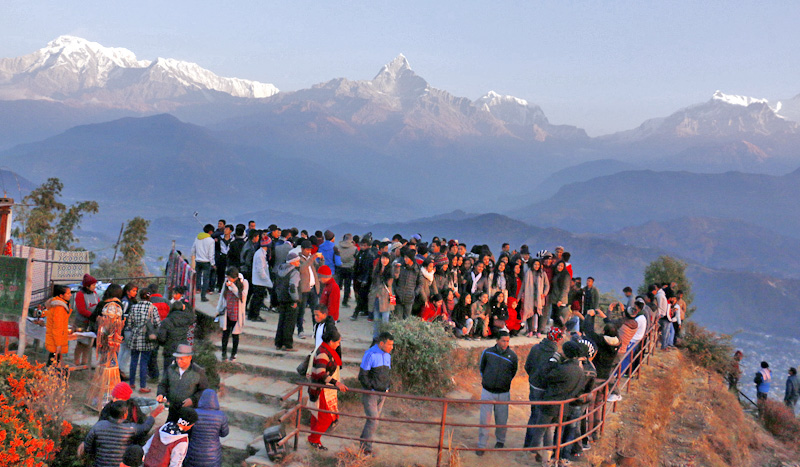
The Nagarkot sunrise transfer from Kathmandu — a pre-4:00 AM departure in a private car to the hilltop viewpoint east of the valley — delivers visitors to the Nagarkot viewpoint in time for the first Himalayan glow on the peaks from Langtang to the Everest massif. The view on a clear morning is one of the finest in Nepal: 90 kilometers of continuous Himalayan skyline from the Ganesh Himal in the west to the Jugal Himal and Rolwaling range in the east, with the highest peaks including Gauri Shankar, Melungtse, and, on exceptional clarity days, Everest’s distinctive pyramid visible 140 kilometers to the southeast.

Our driver arrives at the hotel at the confirmed pre-dawn time, navigates the 30-kilometer approach road in darkness, and waits at the viewpoint during the sunrise — available for immediate departure when the group is ready to return to Kathmandu.

The Sarangkot sunrise vehicle from Pokhara provides the classic Annapurna-range sunrise panorama — Machhapuchhre’s symmetrical peak, Annapurna I, Annapurna III, and Dhaulagiri visible in one of the world’s most celebrated mountain-and-lake compositions as the Pokhara valley fills with morning light below the peaks. Our Pokhara car hire covers the Sarangkot pre-dawn transfer from any Pokhara hotel, with the vehicle waiting for the full sunrise-and-descent sequence before returning to Lakeside.

The Permit and Documentation Ecosystem — How Vehicle Hire Helps

Nepal’s trekking and conservation area permit system requires specific documentation to be verified at multiple checkpoints on every major trekking route. For travelers arriving at these checkpoints in a private vehicle from Nepal Vehicle Hiring Pvt Ltd, the checkpoint process is managed with the kind of efficient knowledge that a driver who has been through the same checkpoint hundreds of times can provide: knowing which documents to have ready, which window to approach, and how long the verification process takes — practical intelligence that converts a potential 30-minute wait into a 5-minute confirmation.

The Besisahar ACAP checkpoint for Annapurna Conservation Area trekkers, the Dhunche checkpoint for Langtang National Park trekkers, the Soti Khola checkpoint for Manaslu Conservation Area permits, and the permit checkpoints for all other major trekking corridors are all familiar stops for Nepal Vehicle Hiring Pvt Ltd’s route-experienced drivers. Our contact team advises on current permit requirements for every trekking corridor at the time of booking.

This service prevents the common and costly mistake of arriving at a checkpoint without the correct documentation.

Experiencing Nepal as a Family — Safe Vehicle Rental for Family Groups

Nepal is increasingly visited by family groups — parents with children, multi-generational families, and extended family reunion groups — for whom the combination of Nepal’s cultural richness, its accessibility (no altitude sickness below 3,000 meters, which covers all the cultural and wildlife destinations), and its genuine adventure character creates a family travel proposition of unusual depth. Family groups have specific vehicle requirements that Nepal Vehicle Hiring Pvt Ltd serves particularly well: the need to keep the entire group together in one vehicle, the benefit of a driver who can adapt pace and stops to the energy levels and interests of children and older family members, and the peace of mind of a mechanically reliable vehicle with a seatbelt-equipped, child-seat-compatible interior.

Our Hiace van hire is the most popular vehicle for family groups of 6 to 12 people—keeping the whole family together for the Kathmandu to Pokhara journey, the Chitwan safari approach, the Lumbini pilgrimage circuit, and Kathmandu Valley heritage sightseeing. For smaller families of 3 to 5 people, the private car hire provides the right size with the same professional driver standard.

For family trekking groups where some members continue to a trailhead by 4WD jeep while others visit heritage sites, Nepal Vehicle Hiring Pvt Ltd coordinates the itinerary vehicle arrangements through our plan trip page.

The Multi-Day Nepal Circuit — Coordinating Complex Itineraries

The most ambitious Nepal visitors combine Kathmandu heritage with Pokhara’s mountain lakeside, Chitwan’s wildlife, a major trek, and sometimes a Lumbini pilgrimage or Muktinath yatra — creating a comprehensive Nepal circuit across two to three weeks. Coordinating transport for a circuit of this complexity requires a partner with a complete fleet, operational coordination capacity, and a single-point-of-contact relationship that eliminates the need to negotiate separately for every vehicle at every destination.

Nepal Vehicle Hiring Pvt Ltd provides exactly this for multi-leg Nepal circuits.

A complete Kathmandu-Pokhara-Chitwan-Lumbini-return circuit arranged through a single booking: airport transfer on arrival, Kathmandu sightseeing car hire for heritage days, private jeep or bus to the trekking trailhead, Kathmandu to Pokhara vehicle, Pokhara car hire for lakeside days, Pokhara to Chitwan bus, and Kathmandu to Lumbini bus. Each leg is confirmed, the contact number is consistent, and a single inquiry on our plan trip page initiates full coordination.

For the trekking circuit specifically — where the trek end date may shift by 1 to 2 days — Nepal Vehicle Hiring Pvt Ltd builds schedule flexibility into multi-leg bookings. Our contact team stays in WhatsApp communication throughout the trek for real-time departure confirmation, adjusting the next-leg vehicle accordingly.

This real-time coordination—unavailable with public transport—is one of the most practically valuable services Nepal Vehicle Hiring Pvt Ltd provides for multi-day itineraries. Combined with Alpine Luxury Treks and Trek Nepal Himalayas’ guided experiences, our transport network delivers a complete Nepal visit of the highest quality across every leg of the journey. Contact us on WhatsApp or through our plan trip page.

Experiencing Remote Nepal — The Roads Less Traveled

Nepal’s most famous destinations — Everest Base Camp, the Annapurna Circuit, Chitwan, Pokhara — attract most of Nepal’s international visitors. But beyond these well-established circuits lies a Nepal of extraordinary additional depth: the Rolwaling Valley trek in Dolakha District, the Kanchenjunga Base Camp trek in the far east near the Indian-Sikkim border, the Helambu trek on Kathmandu’s northern ridgeline, and the Panch Pokhari trek into the Jugal Himal.

These less-traveled treks require the same private jeep hire transport approach as the major treks — in some cases demanding even more route-specific knowledge from the driver because the roads are less frequently used and less well-maintained than the main trekking corridors.

Nepal Vehicle Hiring Pvt Ltd’s vehicle hire network extends to these remote approach roads. Our drivers serve the Shigati trailhead for the Rolwaling Valley approach, the Phidim and Taplejung approaches for the Kanchenjunga circuit, and the Melamchi and Sundarijal approaches for the Helambu circuit.

For travelers seeking Nepal’s quieter, deeper experiences — the remote valleys, the uncommercialized communities, the treks where other trekkers are measured in dozens rather than thousands per season — Nepal Vehicle Hiring Pvt Ltd provides the private vehicle rental service that gets them to the starting point of those experiences as safely and professionally as it serves the most popular routes. Plan your remote Nepal adventure through our plan trip page or contact our team on WhatsApp.

Why Nepal Vehicle Hiring Pvt Ltd — The Safe Choice

  • Verified, maintained fleet: Private jeeps, cars, Hiace vans, coasters, and buses — all mechanically inspected before mountain road assignments.
  • Route-experienced drivers: Assigned based on specific route knowledge, not by availability. The gorge road driver knows the gorge road.
  • Hotel pickup anywhere: From any Kathmandu or Pokhara hotel — no bus park navigation with full trekking luggage.
  • All-inclusive transparent pricing: Driver, fuel, and tolls — quoted and confirmed at booking.
  • Real-time road monitoring: We do not dispatch on unsafe routes. Morning-of road status checks are standard for all mountain transfers.
  • 24/7 booking: WhatsApp or plan trip page.

Solo Travelers and Small Groups — Private Vehicle Hire for Independent Exploration

Solo travelers and small groups of 2 to 3 people face a specific Nepal transport dilemma: the private vehicle hire cost, divided among fewer passengers, is higher per person than for a group of 4 to 6 — but the shared alternative involves fixed departure times, crowded conditions, and the kind of schedule inflexibility that makes spontaneous exploration impossible. For the solo traveler or small group who values the freedom to stop at the Manakamana cable car station on the way to Pokhara, to detour to Nuwakot Palace on the way to Syabrubesi, or to extend the Bhaktapur visit by 90 minutes when the potters’ quarter proves more interesting than expected, the per-person top-end of private vehicle hire from Nepal Vehicle Hiring Pvt Ltd is the price of time and freedom — and for most visitors, it is the right trade.

For solo travelers on the Kathmandu-to-trailhead routes — particularly the Salleri-Phaplu jeep for Everest, the Soti Khola jeep for Manaslu, and the Besisahar vehicle for Annapurna — Nepal Vehicle Hiring Pvt Ltd offers the option to share a private jeep booking with other solo trekkers departing on the same route on the same day, reducing the per-person cost while maintaining the departure time flexibility and hotel pickup convenience that shared public jeeps cannot provide. Contact our team on WhatsApp to enquire about same-route shared jeep hire arrangements.

The Nepal solo travel experience is one of the finest in the world — the country’s well-established trekking infrastructure, the warmth and curiosity of Nepali communities toward international visitors, and the physical access to landscapes of global significance within a country whose safe and stable environment supports independent exploration at a standard rare among adventure travel destinations. Nepal Vehicle Hiring Pvt Ltd is the transport partner that makes the solo Nepal journey as smooth, safe, and rewarding as any organized group tour—providing private-vehicle quality at a cost that, for all but the most budget-constrained solo traveler, is the right investment in the Nepal experience.

Contact us on WhatsApp or through our plan trip page to begin planning your Nepal journey today.

Nepal rewards the traveler who invests in the right transport: arriving rested at the trailhead instead of fatigued from an overcrowded bus, reaching the sunrise viewpoint on time instead of missing the dawn light, and moving between Nepal’s extraordinary destinations with the confidence of a verified vehicle and a professional driver. Choosing safe vehicle rental services from Nepal Vehicle Hiring Pvt Ltd means experiencing more of Nepal—more comfortably, more safely, and more on your own terms than any alternative transport arrangement provides. Book via WhatsApp or our plan trip page.

The Nar Phu Valley trek branching from the Annapurna Circuit’s Koto village, the Muldai View trek in the Myagdi hills, and countless lesser-known Nepal trekking corridors all begin with the same essential transport requirement: a reliable, safe private vehicle hire from Nepal Vehicle Hiring Pvt Ltd that delivers the group to the trailhead on time, in comfort, and ready for the adventure ahead. Our complete Nepal trekking transport network covers all of them — from the mainstream to the remote — through a single professional vehicle hire relationship that begins with a message to our team or a submission through our plan trip page.

Frequently Asked Questions — Safe Vehicle Rental in Nepal

What is the safest type of vehicle for Nepal mountain roads?

A private 4WD Scorpio or Hilux jeep is the safest vehicle for Nepal’s mountain roads, providing 4WD traction, high ground clearance, and mechanical reliability for steep, unpaved, exposed terrain.

How much does private car hire cost in Nepal?

For a standard sedan: about NPR 8,000 to 14,000 (USD 60 to 105) for Kathmandu to Besisahar. For a 4WD jeep: US$200 for the same route. Contact Nepal Vehicle Hiring Pvt Ltd on WhatsApp for specific route pricing.

Is private vehicle hire better than public buses in Nepal?

For most international visitors, yes — hotel pickup, fixed departure time, no shared space, and the safety advantages of a mechanically verified vehicle with a route-experienced driver outweigh the cost top-end. For groups of 4 or more, the per-person cost difference is often minimal.

Can I book a vehicle for my full Nepal itinerary?

Yes — Nepal Vehicle Hiring Pvt Ltd coordinates complete multi-leg Nepal itineraries covering all transport requirements. Use our plan trip page to submit your full requirements.

Conclusion

Nepal offers an extraordinary range of experiences — mountain treks, pilgrimage journeys, wildlife encounters, heritage city explorations, and cultural encounters with 125 ethnic communities across landscapes that range from tropical jungle to permanent snowfield. Accessing all of this safely, comfortably, and on your own terms requires a safe vehicle rental service that understands Nepal’s roads, maintains its fleet, employs route-experienced drivers, and prices transparently.

Nepal Vehicle Hiring Pvt Ltd is that service — covering every Nepal journey from the Kathmandu airport transfer that begins the visit to the remote trailhead jeep hire that begins the trek.

Experience Nepal better with Nepal Vehicle Hiring Pvt Ltd — call or WhatsApp, visit vehiclehiringnepal.com, or plan your complete Nepal journey through our plan trip page.
Best Vehicle for Nepal Highway Travel

Private Scorpio jeep with luggage on the roof

Best Vehicle for Nepal Highway Travel: Complete Route-by-Route Guide

In most countries, choosing a road-trip vehicle is mainly a matter of comfort and fuel economy — the road is paved, the surface consistent, and any modern vehicle of appropriate size handles the journey competently. Nepal is not like most countries. Nepal’s road network combines some of Asia’s finest mountain highway scenery with terrain diversity ranging from flat subtropical Terai plains at 70 meters above sea level to mountain passes exceeding 5,000 meters,

all within a country the size of a single mid-sized Indian state. In a single Nepal road trip, a traveller can encounter a smooth national highway, a winding two-lane gorge road carved into cliff faces above a roaring river, a rough gravel track through a construction zone, and a narrow mountain track with no guardrails and a sheer drop visible from the passenger window.

Choosing the wrong vehicle type can cause discomfort at best and a genuine safety risk at worst.

This complete guide from Nepal Vehicle Hiking Pvt Ltd (vehiclehiringnepal.com) provides thorough, up-to-date, route-specific vehicle selection guidance for Nepal’s principal highway corridors.

It covers every major Nepal highway — the Prithvi Highway from Kathmandu to Pokhara, the BP Highway to eastern Nepal, the Siddhartha Highway south to Sunauli, the Pasang Lhamu Highway north toward Tibet, the East-West Highway across the Terai, and the mountain road corridors to Upper Mustang and the Manaslu, Annapurna, and Langtang trekking regions — with specific vehicle recommendations for each, based on the actual road conditions each route presents.

Whether you approach the Everest Base Camp Trek via the BP Highway and Salleri overland route, start the Annapurna Circuit Trek from Besisahar, or begin the Manaslu Circuit Trek from Soti Khola, the vehicle you choose for the approach journey profoundly shapes the experience from the first kilometre out of Kathmandu.

The guide covers five vehicle categories: sedan cars and compact SUVs, mid-size and top-end SUVs, 4WD jeeps (Land Cruiser class), Toyota Hiace vans, and larger bus and coaster options for group travel. This guide’s core purpose is to match the right vehicle to each Nepal highway—and it underpins Nepal Vehicle Hiring Pvt Ltd’s vehicle-assignment philosophy for every booking.

Understanding Nepal’s Highway Categories: The Three-Tier Road System

Category 1: Paved National Highways

Category 1 covers Nepal’s major inter-city sealed highways: the Prithvi Highway (Kathmandu to Pokhara), the BP Highway (Kathmandu to eastern Nepal), the Siddhartha Highway (Butwal to Sunauli), and the East-West Highway (Mahendra Highway) across the Terai. These roads are sealed, maintained to national highway standards, and navigable by any well-maintained vehicle — sedan, SUV, van, or bus.

The challenge on Category 1 roads is not road quality but traffic management, monsoon-season damage in specific sections, and occasional construction disruptions.

Category 2: Semi-Paved Mountain Approaches

Category 2 covers roads that begin on sealed highway but transition to partially sealed or gravel surface as they approach mountain destinations. The Pasang Lhamu Highway from Dhunche toward Syabrubesi, the Marsyangdi valley road from Besisahar toward Manang, and the approach roads to Nagarkot and Dhulikhel fall here.

These roads need more than a sedan’s capabilities — some ground clearance, robust suspension — but not the full 4WD low-range capability of a true off-road jeep. A top-end SUV handles Category 2 adequately; a 4WD jeep handles them with comfortable reserve capacity.

Category 3: Off-Road Mountain Tracks

Category 3 covers unpaved, rough, narrow mountain sections serving remote trekking trailheads. The Soti Khola to Jagat extension on the Manaslu Circuit approach, the Pokhara to Jomsom Mustang overland road beyond Tatopani, and the approach roads into the Upper Mustang restricted zone fall here.

These are genuinely off-road sections that require a proper 4WD jeep— a Toyota Land Cruiser or Mahindra Scorpio. Sedans, compact SUVs, and Hiace vans should not attempt Category 3 roads.

For trekkers approaching the Tsum Valley Trek or the Manaslu Circuit Trek via upper Gorkha District roads, Category 3 conditions are the norm beyond Arughat Bazaar.

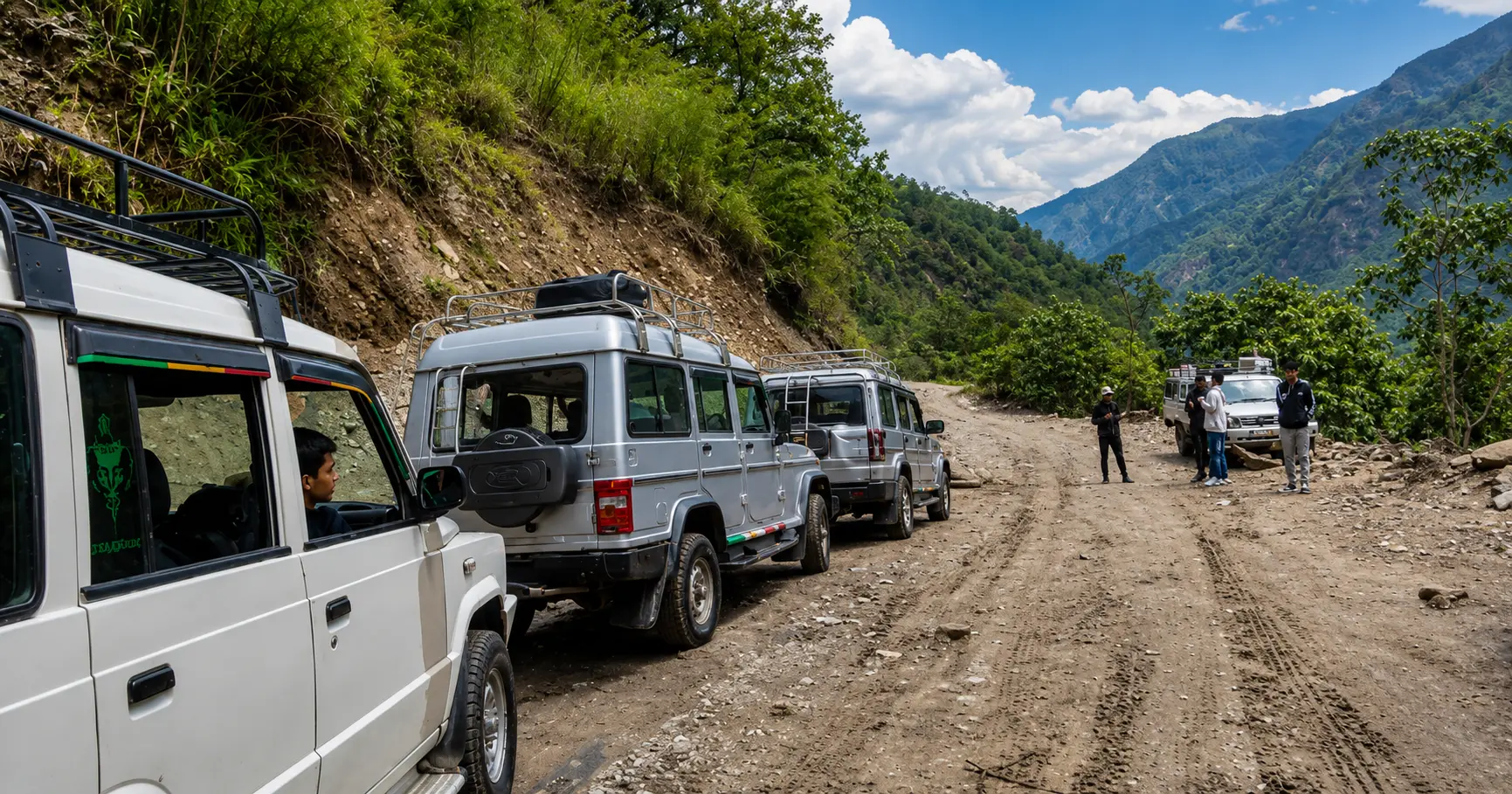
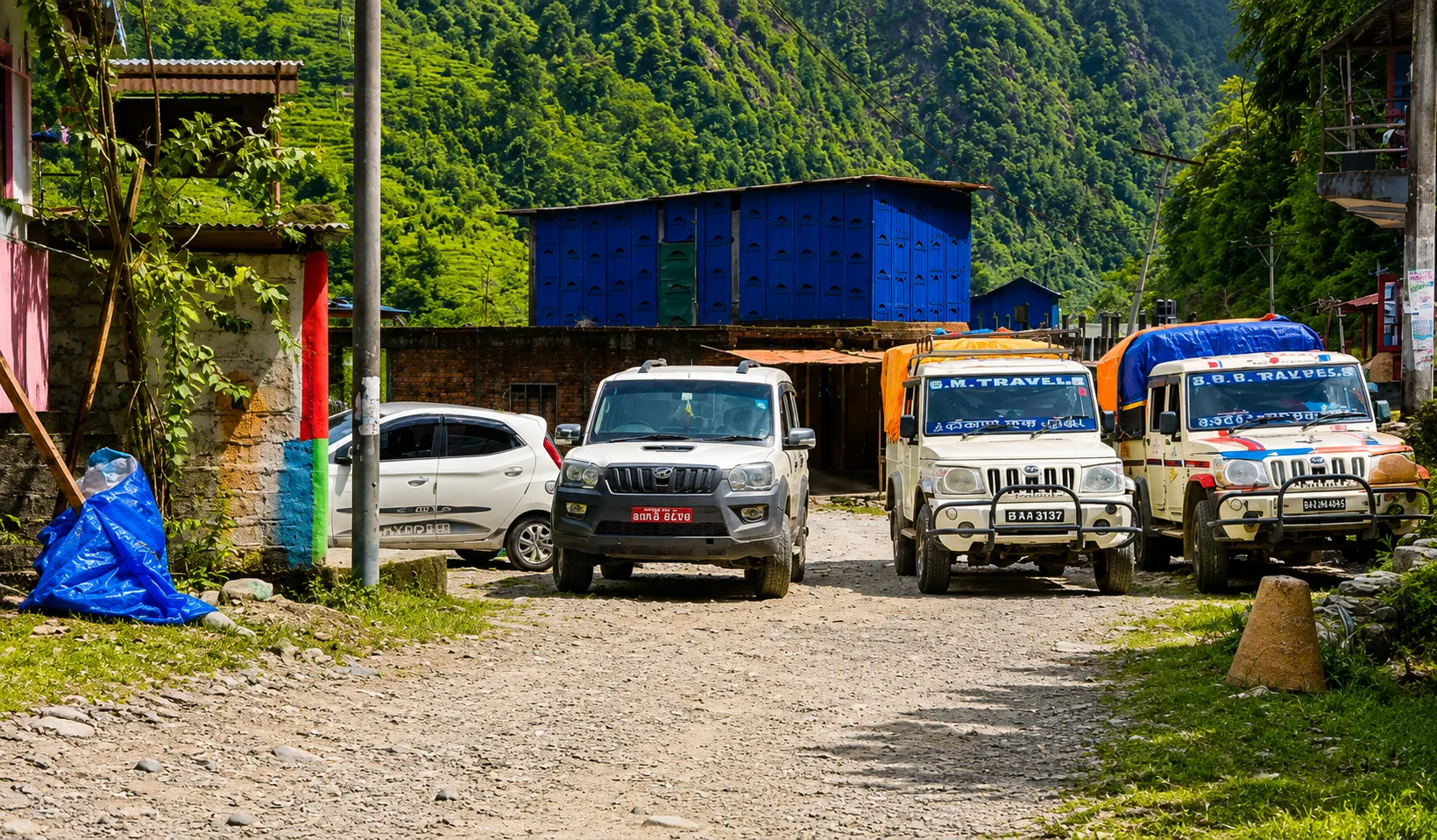
Private jeeps on a mountain road in Nepal

Route-by-Route Vehicle Recommendations

Prithvi Highway: Kathmandu to Pokhara — 200 km, 6–8 hrs

The Prithvi Highway (NH16) is Nepal’s most travelled tourist road — the sealed highway through the Trishuli and Marsyangdi river gorge corridors connecting Kathmandu with Pokhara. This category 1 road is generally well maintained, and its scenic gorge sections make it one of Asia’s finest highway drives.

Trekkers heading to the Annapurna Base Camp Trek, the Ghorepani Poon Hill Trek, or the Annapurna Circuit Trek all travel this highway as the first major leg of their Nepal journey.

Best vehicle: A comfortable sedan or mid-size SUV is ideal for individuals and couples. For groups of 6 or more, a Hiace van provides the best combination of space and highway comfort. The Toyota Fortuner handles this route with exceptional refinement.

A full-size Land Cruiser jeep is more vehicle than the Prithvi Highway demands—its higher fuel consumption and rougher cabin ride make it a less comfortable highway companion, without offering any practical off-road advantage on this sealed Category 1 corridor.

Nepal Vehicle Hiring Pvt Ltd’s Kathmandu to Pokhara private vehicle service offers both top-end SUVs and Hiace vans for this route, matching the right vehicle to your group size. The famous Mugling junction fish restaurants at the Trishuli-Marsyangdi confluence are the standard midpoint stop — ask your driver for the best riverside option.

BP Highway: Kathmandu to Eastern Nepal — 400 km to Biratnagar, 8–10 hrs

The BP Koirala Highway runs east from Kathmandu through Banepa, Dhulikhel, and Sindhuli District to Bardibas and the East-West Highway junction. The Sindhuli section is a significant mountain road that provides dramatically better Kathmandu-eastern Nepal connectivity than the older Terai routing.

Trekkers beginning the Kanchenjunga Base Camp Trek travel this corridor before turning north at Biratnagar toward Taplejung. The BP Highway is Category 1 on its main sections, with Category 2 characteristics in some mountain sections of Sindhuli District.

Best vehicle: A private car or comfortable SUV handles the BP Highway adequately in good road conditions. For groups, the Hiace van hire is the standard group transport choice for eastern Nepal highway travel, accommodating 12 to 14 passengers on a road whose sealed surface and manageable gradients keep the van within its optimal operating range throughout.

Siddhartha Highway: Pokhara/Butwal to Sunauli India Border — 170 km, 4–5 hrs

The Siddhartha Highway (NH17) connects Pokhara and Butwal southward through the Palpa District’s scenic hill terrain to the Terai plains and the Sunauli-Bhairahawa India border. The Palpa District section from Waling to Butwal is the most technically demanding portion — a winding mountain road with several challenging sections on the descent to the Terai. This is Category 1 to Category 2 transitional character throughout.

Best vehicle: A mid-size SUV with good suspension and confident mountain-road performance is recommended for the Palpa District section. For Indian pilgrims using this route for the Kailash Yatra approach — the same highway that connects Sunauli to Kathmandu via Pokhara — Nepal Vehicle Hiring Pvt Ltd’s private jeep or Hiace van hire provides group-appropriate transport.

The Terai sections south of Butwal toward Bhairahawa are flat and suitable for any vehicle, including a standard sedan.

East-West Highway: The Mahendra Highway Across the Terai — 1,027 km total

The East-West Highway (NH1) is Nepal’s longest road, crossing the entire Terai lowland belt from the eastern Mechi border to the western Mahakali border, with elevations rarely exceeding 500 meters. As Nepal’s busiest freight corridor, it carries heavy goods vehicles day and night on a two-lane sealed national highway of variable but generally adequate quality. Travellers from Jhapa to Kathmandu, and those connecting eastern Nepal trekking regions to the capital, use this highway extensively.

Best vehicle: A comfortable car or SUV with reliable air conditioning is the priority — the Terai’s warm temperatures make climate control more important than ground clearance on this flat Category 1 road. For groups crossing the Terai, Hiace van hire is the best group vehicle, and bus hire serves larger institutional groups of 30 or more on this flat, highway-standard corridor.

During monsoon season, a higher-clearance vehicle provides useful additional capability at low-lying river-crossing sections most affected by seasonal flooding.

Pasang Lhamu Highway: Kathmandu to Syabrubesi and Rasuwagadhi — 130 km, 6–9 hrs

The Pasang Lhamu Highway heads north from Kathmandu through Nuwakot District to Trishuli Bazaar, Dhunche, and Syabrubesi — the gateway to the Langtang Valley Trek. This highway is Category 1 from Kathmandu to Dhunche, transitioning to Category 2 on the Dhunche-Syabrubesi descent, which involves narrower, less consistently maintained road sections where ground clearance matters.

Best vehicle: A proper 4WD jeep is the recommended minimum for the complete Kathmandu to Syabrubesi route. Nepal Vehicle Hiking Pvt Ltd’s Kathmandu to Syabrubesi jeep transfer service specifically provides Land Cruiser or equivalent vehicles for this route—offering both comfort for a 6-to-9-hour journey and the capability reserve for the variable final sections.

A top-end SUV like the Fortuner handles the main highway section well but may be tested by the Dhunche-Syabrubesi descent after monsoon rainfall.

Manaslu Circuit Approach: Kathmandu to Soti Khola and Jagat — 126–175 km, 7–11 hrs

The Manaslu Circuit approach roads belong firmly to Category 2 (Arughat to Soti Khola) and Category 3 (Soti Khola to Jagat). The Manaslu Circuit Trek and the adjacent Tsum Valley Trek both approach via the Budhi Gandaki gorge on roads that demand genuine 4WD capability, high ground clearance, and a driver with specific experience on this corridor.

The 2023 road extension to Jagat is unpaved, narrow, and carved into cliff faces above the river gorge.

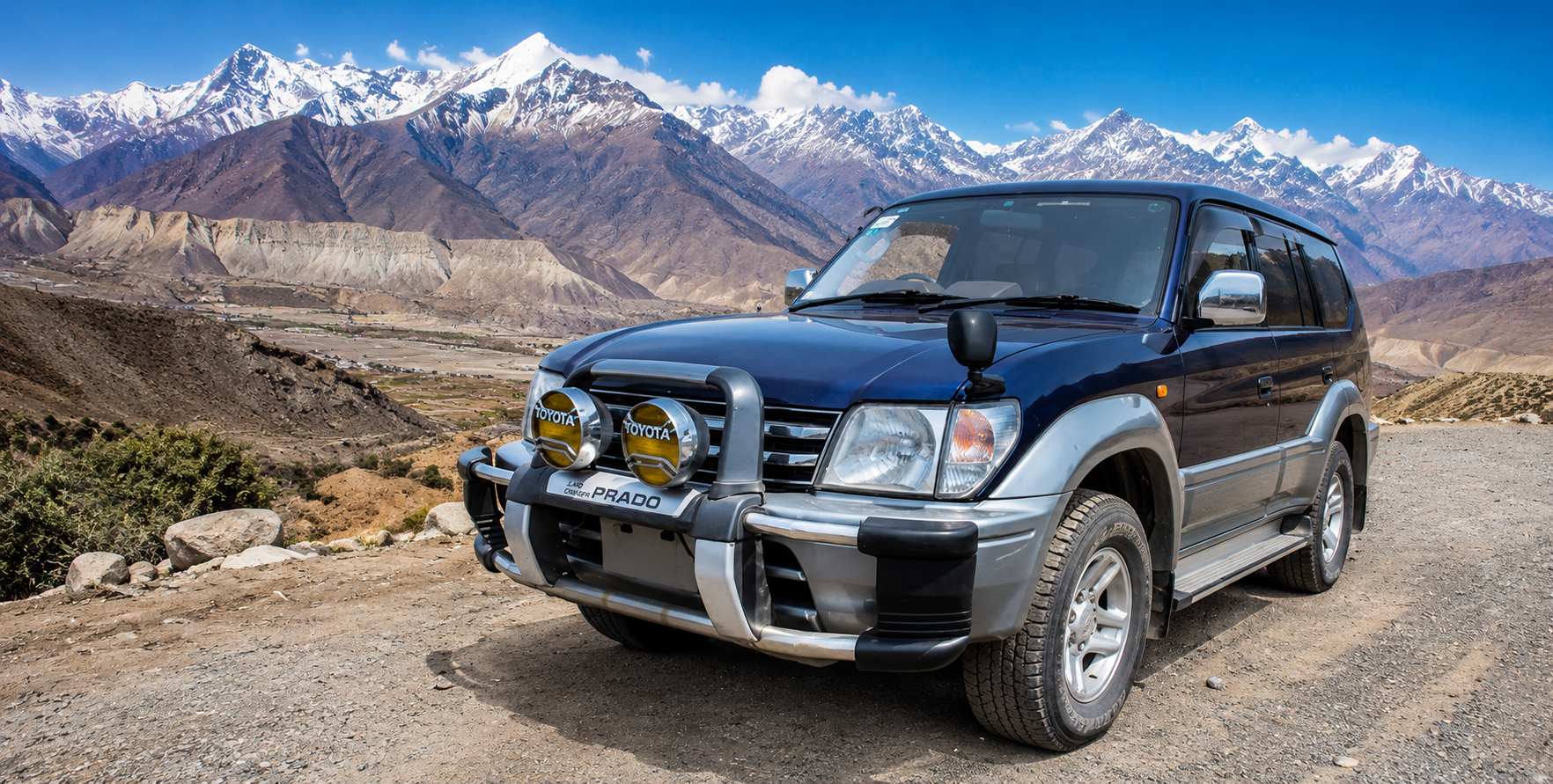
Best vehicle: A Toyota Land Cruiser (Prado or VX) is the clear recommendation for the Jagat approach. Nepal Vehicle Hiring Pvt Ltd’s Kathmandu-to-Soti Khola jeep service provides the established Manaslu approach transfer, with an extended Jagat option for trekkers who want to start at the restricted-zone checkpoint rather than walk the road-construction-affected lower valley section.

Annapurna Approaches: Besisahar, Nayapul, Ghandruk

The Annapurna region has multiple vehicle access points with different road categories. Nayapul (42 km from Pokhara on a paved road) and the initial Besisahar section are Category 1 — sedan adequate. The Besisahar-to-Manang mountain track beyond Chamje is Category 2 to Category 3, where a 4WD jeep becomes essential.

Trekkers starting the Annapurna Circuit Trek from the upper valley should book our Kathmandu-to-Manang jeep service. For the Ghorepani Poon Hill Trek and Annapurna Base Camp Trek via Nayapul, our Pokhara-to-Nayapul transport uses a standard car or SUV on the paved Nayapul road.

In contrast, the Pokhara to Ghandruk jeep ride uses a 4WD for the steeper, unpaved Ghandruk approach.

Upper Mustang Route: Pokhara to Lo Manthang — 220 km, 2–3 days

The Pokhara to Jomsom section of the Upper Mustang route follows the Kali Gandaki Gorge — the world’s deepest gorge — on a road that begins as Category 1 (Pokhara to Beni) but transitions firmly to Category 3 beyond Tatopani, where the road narrows, roughens, and demands genuine 4WD capability. The Upper Mustang Trek is one of Nepal’s most extraordinary restricted-zone adventures, and the vehicle must handle the Kali Gandaki’s demanding track conditions throughout.

Best vehicle: Toyota Land Cruiser (Prado or VX) without compromise. No other vehicle category suits the full Mustang overland route. Nepal Vehicle Hiring Pvt Ltd’s Pokhara to Upper Mustang overland jeep service provides Land Cruiser-class vehicles with drivers with extensive Mustang route experience—an essential combination for a route that presents different challenges each season.

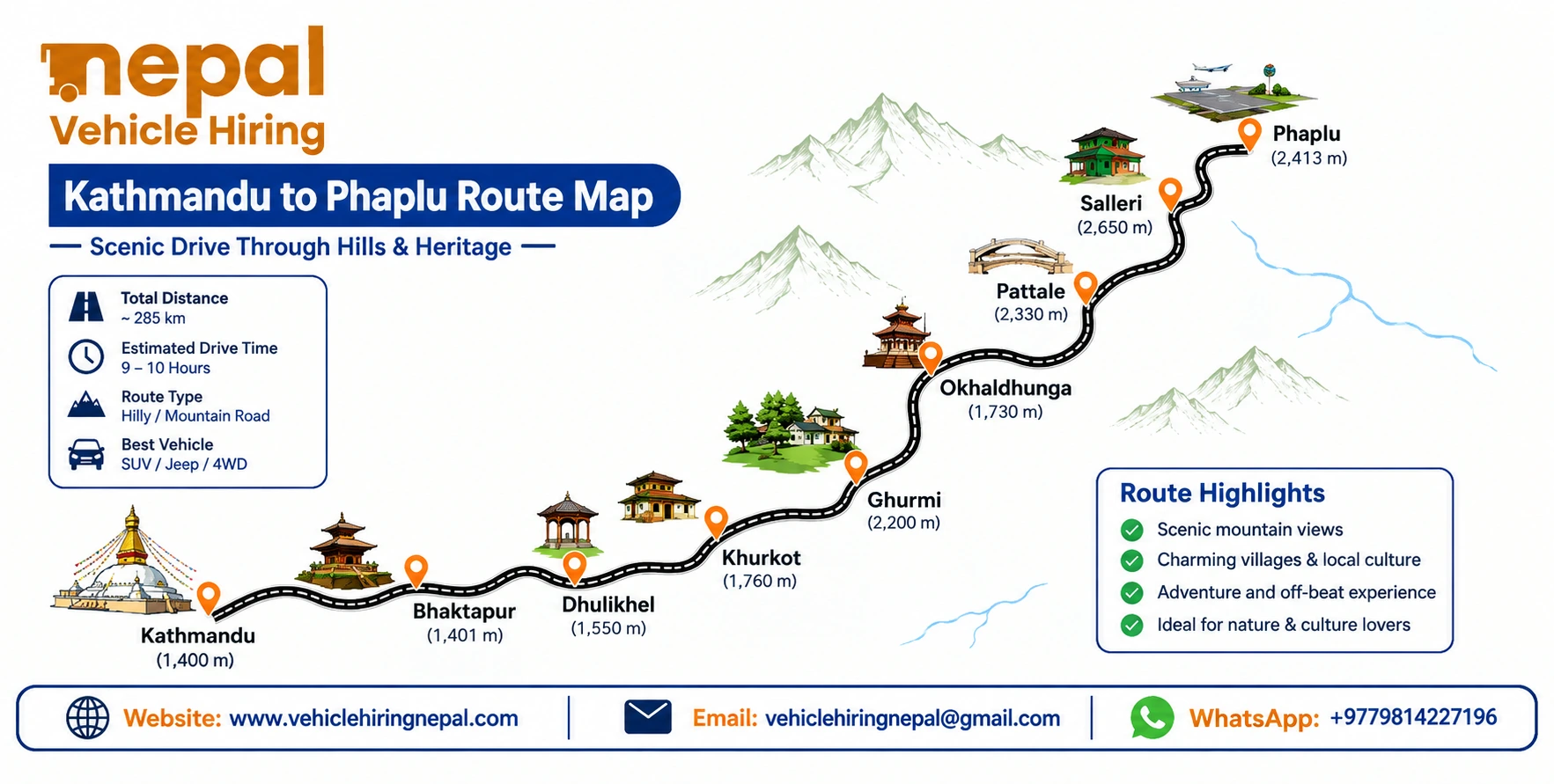
Everest Region Overland: Kathmandu to Salleri and Phaplu — 267 km, 8–10 hrs

The overland approach to the Everest region via Salleri and Phaplu — the road alternative to the Lukla domestic flight — follows the BP Highway east from Kathmandu before turning north into the Solukhumbu District through progressively more demanding terrain. The BP Highway section is Category 1, but the Okhaldhunga-Salleri-Phaplu section transitions firmly to Category 2, with some Category 3 characteristics on the approach tracks to higher village trailheads.

Trekkers who choose this overland approach to the Everest Base Camp Trek and Gokyo Lake Trek gain a meaningful acclimatisation advantage by starting at 2,400 meters rather than flying to Lukla at 2,860 meters.

Best vehicle: A 4WD jeep is recommended for the full Kathmandu to Salleri/Phaplu route. Nepal Vehicle Hiring Pvt Ltd’s Kathmandu to Salleri and Phaplu service offers 4WD jeep hire with experienced drivers familiar with the eastern Solukhumbu corridor.

Vehicle-by-Vehicle Analysis: Strengths and Limitations for Nepal Highways

Sedan Cars and Compact SUVs

Standard sedans and compact SUVs—Toyota Corolla, Hyundai Elantra, Suzuki Ertiga, Tata Nexon, Hyundai Creta—are Nepal’s most economical private vehicle options for Category 1 highway travel. They offer adequate performance on Nepal’s paved national highways, comfortable interiors for long highway journeys, good fuel efficiency on flat Terai and highway sections, and enough boot space for 3 to 4 passengers’ luggage.

Strengths: Lower hire cost, comfortable on paved highways, fuel-efficient, good city parking. Best for Prithvi Highway, East-West Highway, Kathmandu to Chitwan, Kathmandu to Lumbini, and Kathmandu Valley sightseeing. Nepal Vehicle Hiring Pvt Ltd’s private car hire service provides Toyota Corolla, Hyundai Elantra, and similar options for Category 1 highway programs.

Limitations: Insufficient ground clearance for Category 2 and 3 roads, limited luggage capacity for large trekking packs, and no 4WD when required. Not suitable for the Syabrubesi descent, the Manaslu Circuit approach beyond Arughat, or the Mustang route beyond Tatopani.

Mid-Size and Top-end SUVs: Toyota Fortuner, Hyundai Tucson

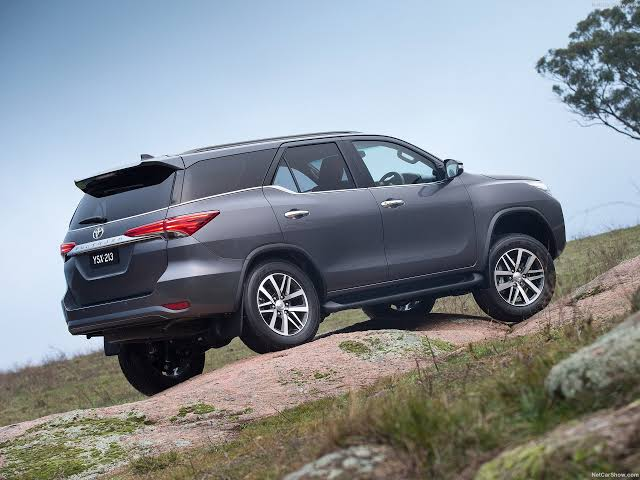
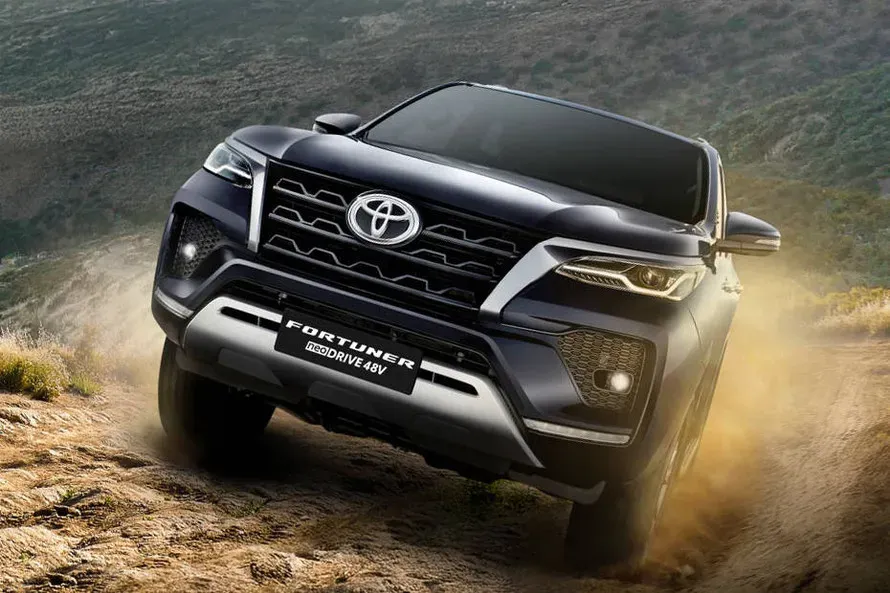
The mid-size and top-end SUV category is Nepal’s fastest-growing private highway vehicle segment — offering the right balance of highway comfort, higher ground clearance, and robust construction for Category 1 and Category 2 roads. The Toyota Fortuner combines powerful road performance with a comfortable 7-seat interior and genuine Category 2 capability, making it one of Nepal’s most versatile all-purpose highway vehicles today.

Strengths: Comfortable for 5 to 6 passengers, higher ground clearance than sedans, strong highway performance, modern safety features. Best for Kathmandu to Pokhara, Kathmandu to Chitwan, Kathmandu to Lumbini, and Category 2 approach roads like the Pasang Lhamu Highway to Dhunche. Nepal Vehicle Hiring Pvt Ltd’s private car hire service includes top-end SUV options for clients who want the best balance of comfort and light off-road capability.

4WD Jeeps: Toyota Land Cruiser and Mahindra Scorpio

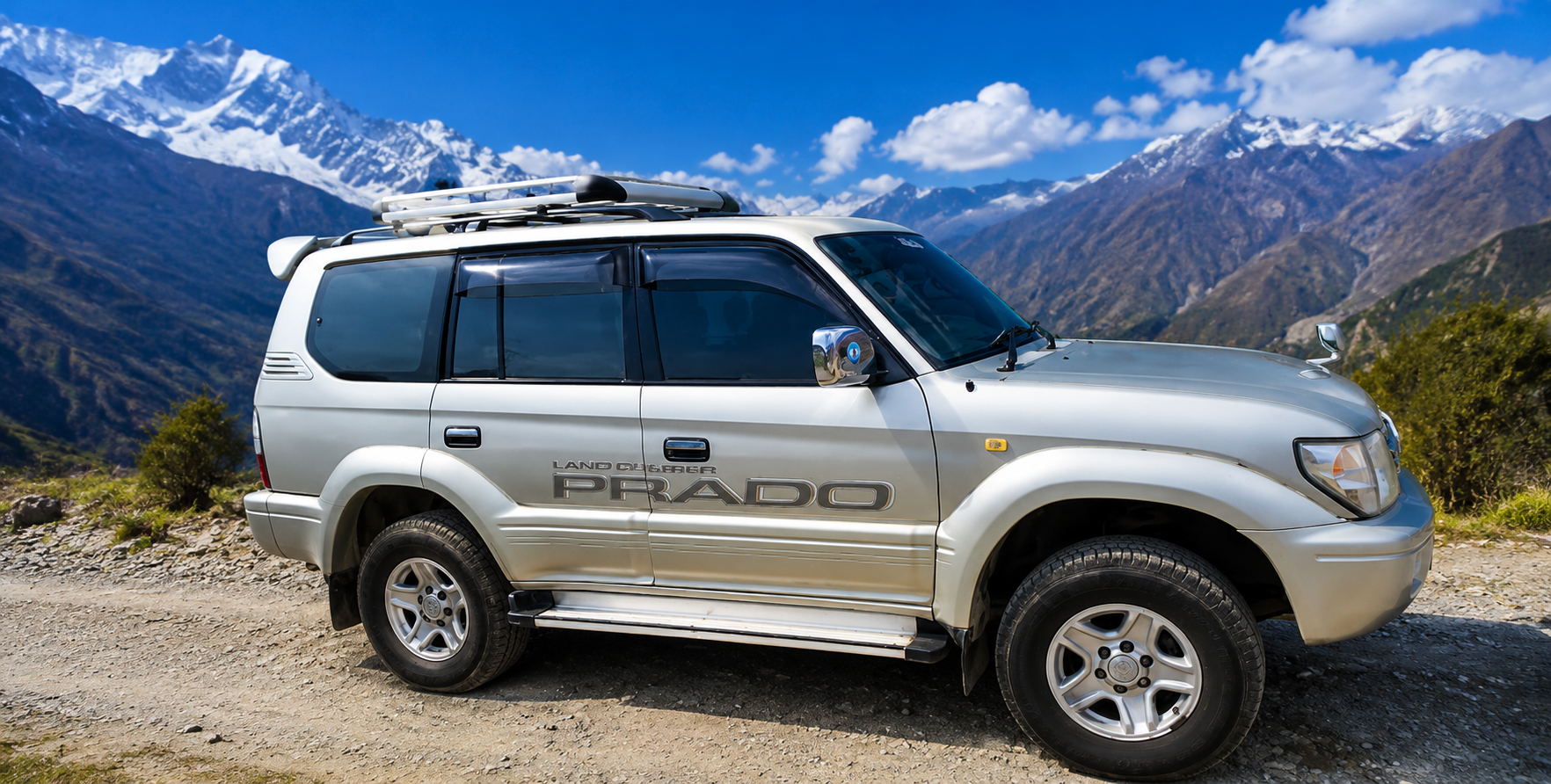
The 4WD jeep is Nepal’s most important private highway vehicle for any journey, including Category 2 or Category 3 road sections. The Toyota Land Cruiser Prado and VX are the top-end options, delivering the finest combination of mountain-road capability and interior comfort available in any Nepal hire vehicle.

The Mahindra Scorpio offers proven 4WD mountain-track capability at a meaningfully lower hire rate, making it the most cost-effective mountain-road option when the Land Cruiser’s interior refinement isn’t the priority. Our 4WD jeep hire service provides both options with route-appropriate assignments—Land Cruiser for the longest and most demanding approaches like Upper Mustang and the Everest overland, and Scorpio for the Manaslu and Langtang corridors, where capability, not luxury, is the primary requirement.

Strengths: Genuine 4WD capability, high ground clearance, spacious 7-seat interior, reliable climate control, and robust construction for extended mountain-road use. Best for every Category 2 and Category 3 road in Nepal — Syabrubesi, Soti Khola, Jagat, Jomsom, Upper Mustang, Salleri-Phaplu, and all other mountain approach corridors. Essential for the Everest Three Passes region approach and the Manaslu upper valley roads.

Toyota Hiace Van

The Toyota Hiace is Nepal’s most important group highway vehicle — the workhorse of the country’s tourist and private transport sector for groups of 8 to 14 passengers across every Category 1 and Category 2 highway corridor. Nepal Vehicle Hiking Pvt Ltd’s Hiace van hire service serves all major Nepal highway routes, offering the most economical per-person private vehicle rate for medium groups across the East-West Highway, Prithvi Highway, BP Highway, and Siddhartha Highway corridors.

Strengths: 12- to 14-seat capacity, comfortable seating for long highway journeys, reliable on Nepal’s sealed national highway network, adequate luggage space, and very competitive per-person hire costs. Best for all Category 1 highway routes with groups of 8 to 14. Limitations: Not recommended for Category 3 off-road sections — the Manaslu Circuit approach beyond Arughat and the Mustang route beyond Tatopani require a jeep arrangement instead.

Coaster and Bus for Large Group Highway Travel

For groups of 20 or more on Nepal’s national highway network, Toyota Coaster hire (20 to 24 passengers) and full bus hire (30 to 45 passengers) provide the most economical per-person highway transport. Appropriate for all Category 1 routes and major Category 2 sections without the narrowest mountain track characteristics. Corporate events, educational institution trips, large family gatherings, and festival travel all generate demand for these larger vehicles.

Route and Vehicle Summary Table

RouteDistanceBest VehicleRoad CategoryNotes
Kathmandu to Pokhara (Prithvi Hwy)200 kmCar/SUV or HiaceCategory 1Sedan adequate; Hiace for 8+ passengers
Kathmandu to Chitwan140 kmCar or SUVCategory 1Flat, paved; any vehicle suitable
Kathmandu to Lumbini310 kmCar or SUVCategory 1Via Prithvi + Siddhartha; paved throughout
Kathmandu to Syabrubesi130 km4WD JeepCat 1-2Final Dhunche–Syabrubesi descent demands a jeep
Kathmandu to Besisahar175 kmCar or SUVCategory 1Prithvi Highway; sedan adequate
Besisahar to Manang (jeep)70 km4WD JeepCat 2-3Mountain track; jeep essential beyond Besisahar
Kathmandu to Soti Khola126 km4WD JeepCat 2-3Gorkha district; jeep required beyond Arughat
Kathmandu to Jagat175 km4WD Jeep (Land Cruiser)Category 3Extension road; Land Cruiser or Scorpio only
Pokhara to Jomsom / Upper Mustang200 km4WD Land CruiserCategory 3Kali Gandaki Gorge; Land Cruiser essential
Pokhara to Nayapul42 kmCar or SUVCategory 1Paved; sedan entirely adequate
Pokhara to Ghandruk55 km4WD JeepCategory 2Steeper unpaved approach; jeep recommended
Kathmandu to Ramechhap135 kmCar or JeepCat 1-2BP Highway; car adequate in good conditions
East-West Highway (Terai)VariesCar, Hiace, or BusCategory 1Flat sealed highway; Hiace/bus for groups
Kathmandu to Salleri/Phaplu267 km4WD JeepCat 2-3Extended BP Highway; jeep for full approach

Seasonal Vehicle Selection: How Road Conditions Change Through the Year

Nepal’s seasonal variation fundamentally affects which vehicle best suits specific highway routes. Understanding the seasonal dimension of vehicle selection is as important as understanding the route-based dimension — the same road that a sedan handles comfortably in October may require a jeep in July.

The monsoon season (June through August) is when traction most directly affects safety. Heavy monsoon rainfall softens road surfaces, destabilises cuts, and causes temporary flooding at low-lying river crossings.

The East-West Highway near major river crossings is most affected by monsoon flooding; the Pasang Lhamu Highway and Gorkha District mountain approaches are most affected by landslides. During monsoon, a 4WD jeep becomes the recommended choice even on routes where a standard car is adequate in dry conditions — the extra ground clearance and 4WD capability provide a margin on temporarily compromised sections.

Autumn (September to November) delivers Nepal’s finest road conditions of the year — post-monsoon surfaces are newly stable, drainage is effective, and dry weather prevents new damage. This is when Nepal’s trekking seasons peak, with the Everest Base Camp Trek, Annapurna Circuit Trek, Langtang Valley Trek, and Gokyo Lake Trek all at peak traffic.

Autumn brings the highest demand for vehicles, so booking is essential. Spring (March to May) offers similar road quality, plus the added visual reward of rhododendron blooms along mountain highway sections.

Winter (December to February) brings the clearest skies and finest mountain visibility from Nepal’s highway viewpoints. Still, it can bring early morning frost on high-altitude approach road sections—where 4WD capability and appropriate tyres matter more than in dry autumn. The Nagarkot and Sarangkot sunrise viewpoints are at their visual best in winter, with the complete Himalayan panorama visible in crystal clarity.

The Cost Factor: Vehicle Economics for Nepal Highway Travel

Vehicle selection for Nepal highway travel involves a cost-benefit calculation. Nepal Vehicle Hiring Pvt Ltd’s all-inclusive per-vehicle pricing makes this straightforward: a private car hire costs NPR 5,000 to NPR 8,000 per day, a 4WD jeep hire NPR 8,000 to NPR 15,000 per day, and a Hiace van hire NPR 7,500 to NPR 12,000 per day, representing the three principal cost tiers.

The cost difference between car and jeep hire runs approximately NPR 3,000 to NPR 7,000 per day.

For routes where a standard car genuinely suffices — Kathmandu to Pokhara, East-West Highway — choosing a jeep pays no practical dividend while adding unnecessary cost. For routes where a jeep is genuinely required — Kathmandu to Syabrubesi, the Manaslu Circuit approach, Upper Mustang — the cost top-end isn’t discretionary; it’s essential for safe, reliable operation.

The core principle: match the vehicle to the route’s actual demands, not to a general impression of what Nepal roads are like. Over-specifying (Land Cruiser on the Prithvi Highway) wastes money. Under-specifying (sedan on the Soti Khola approach) creates risk.

For groups, per-person economics consistently favour the Hiace van on Category 1 highway routes — NPR 10,000/day divided by 12 passengers = NPR 833 per person, competitive with public bus fares while delivering private-vehicle flexibility, hotel pickup, and luggage security. For mountain road journeys requiring jeeps, coordinating 2 Land Cruisers for a group of 12 at NPR 12,000 each = NPR 2,000 per person — still far below the per-person cost of individual transport arrangements and delivering the full jeep capability the mountain road demands.

Practical Checklist: Choosing the Right Nepal Highway Vehicle

  • Identify your route’s road category before choosing a vehicle — Category 1 (sedan acceptable), Category 2 (SUV or jeep), Category 3 (4WD jeep only)
  • Consider the season — monsoon conditions upgrade the recommended vehicle category by one level for most mountain approach roads.
  • Calculate per-person cost with your actual group size — for 4 or more passengers, private vehicle per-person cost frequently matches or beats public transport.
  • Book in advance for peak seasons (October-November and March-May) — top-end vehicles like Land Cruiser Prado are limited in fleet and fill early.
  • Confirm all-inclusive pricing — the quote should specify the vehicle, driver, fuel for the agreed itinerary, parking, and tolls.
  • Request route-experienced drivers — ask specifically that the assigned driver has completed your specific route before, not just general Nepal driving experience.
  • For multi-day journeys, confirm driver rest arrangements — Nepal Vehicle Hiring Pvt Ltd provides dual-driver arrangements for overnight extended drives exceeding 10 hours.
  • Consider the return journey: for open-jaw trekking circuits (Kathmandu-to-Jagat and Dharapani-to-Kathmandu return), book both legs together for guaranteed return availability.ty.

Nepal Vehicle Hiring Pvt Ltd: Route-Matched Vehicle Assignment for Every Nepal Highway

Nepal Vehicle Hiring Pvt Ltd’s fleet and booking philosophy focus on route-matched vehicle assignment. Our private car hire service assigns appropriate sedans and compact SUVs for Category 1 highway journeys. Our 4WD jeep hire service assigns Land Cruiser and Scorpio options for Category 2 and 3 mountain road journeys.

Our Hiace van hire, coaster hire, and bus hire cover group highway travel across every capacity range. We match route-experienced drivers to each highway corridor.

This driver completes the Kathmandu to Syabrubesi run multiple times per week and provides better service on that route than a general hire driver making it for the first time.

Our complete route-specific services cover every major Nepal highway: Kathmandu to Pokhara (Prithvi Highway, car or Hiace). Kathmandu to Syabrubesi (Pasang Lhamu Highway, 4WD jeep). Kathmandu to Besisahar and Kathmandu to Manang (jeep; Annapurna Circuit approach).

Kathmandu to Soti Khola (Manaslu Circuit, 4WD jeep). Kathmandu to Salleri-Phaplu (Everest overland, 4WD jeep).

Kathmandu to Muktinath jeep (Mustang pilgrimage corridor). Pokhara to Nayapul, Pokhara to Ghandruk jeep, Pokhara to Ghorepani Poon Hill jeep, and Pokhara to Upper Mustang overland jeep.

City and valley services: Kathmandu airport transfer, Kathmandu sightseeing, Bhaktapur day tour, Nagarkot sunrise tour, Sarangkot sunrise vehicle, Pokhara car hire. Our Nepal tour packages coordinate vehicle selection across multi-destination itineraries. Plan your complete trip or contact us at +977 981-4227196 (WhatsApp/Viber).

Our trekking transport services and Everest Base Camp Trek support cover the full trekking network. Visit vehiclehiringnepal.com to book.

Deep Dive: Nepal’s Most Challenging Highway Sections

Nepal’s highway network includes sections that consistently challenge even experienced drivers and well-prepared vehicles—sections whose reputations among Nepal’s professional vehicle operators are built on accumulated firsthand knowledge of what each demands. Knowing these challenging sections in advance helps travellers choose the right vehicle and understand what it will face.

The Trishuli Gorge Section: Prithvi Highway

The Trishuli River gorge section of the Prithvi Highway between Malekhu and Mugling is the most technically demanding portion of the Kathmandu-Pokhara route—a sequence of cliff-side switchbacks where the two-lane road clings to the gorge wall, with the river far below and the rock face rising sharply above.

This section is fully paved and well maintained, but its tight bends, occasional single-lane pinch points at rock outcrops, and heavy freight traffic demand attentive driving and a vehicle with responsive steering. Any modern sedan or SUV handles this section competently with an experienced driver; what matters is alertness and familiarity with the road’s specific pinch-point locations, not the vehicle’s mechanical specifications.

The gorge section’s scenery is spectacular — the Trishuli River’s turquoise water visible between the road and the canyon wall, cascading side waterfalls crossing the road through culverts, and the valley progressively opening as the road approaches Mugling and the confluence with the Marsyangdi River. Trekkers heading toward the Annapurna Circuit Trek or the Ghorepani Poon Hill Trek via Pokhara pass through this section on their approach — and returning trekkers often describe the gorge drive as one of their most memorable Nepal road experiences, particularly in the post-monsoon autumn when the river is at its fullest and most dramatic.

The Krishna Bhir Section: Prithvi Highway Near Dhading

The Krishna Bhir section of the Prithvi Highway between Malekhu and Daraundi has a history of landslide susceptibility, making it one of Nepal’s most weather-monitored highway sections during monsoon season.

Several major slide events have temporarily closed this section in recent monsoon seasons, and road condition monitoring during June through August is standard practice for any Nepal Vehicle Hiring Pvt Ltd vehicle assigned to the Kathmandu-Pokhara route during this period. The section is passable and well-maintained for most of the year; heavy-rainfall monsoon periods specifically elevate risk beyond the normal Category 1 road profile.

The Dhunche to Syabrubesi Descent

Experienced Nepal Vehicle Hiring Pvt Ltd drivers consistently identify the 23-kilometre descent from Dhunche at 1,982 meters to Syabrubesi at 1,503 meters on the Pasang Lhamu Highway as the most technically demanding section of the complete Kathmandu-Syabrubesi route. The road narrows significantly on this descent, the surface quality deteriorates below the standard of the Trishuli-Dhunche approach section, and several sections involve single-lane, cliff-side driving that requires reversing to let oncoming vehicles pass.

This is why our Kathmandu to Syabrubesi jeep transfer service requires a 4WD vehicle rather than a standard car or SUV. The extra ground clearance and 4WD capability provide a meaningful safety and reliability margin on sections of this descent that test vehicle capability in ways the approach road does not.

Trekkers beginning the Langtang Valley Trek experience this descent as the final road stage before the trail begins, and arriving at Syabrubesi in a well-prepared jeep with an experienced driver makes the transition from vehicle to trail start noticeably more relaxed than the alternative.

The Kali Gandaki Gorge: Pokhara to Jomsom

The Kali Gandaki Gorge road from Beni southward to Tatopani and then northward to Jomsom runs through what is technically the world’s deepest river gorge — the chasm between the Dhaulagiri and Annapurna massifs through which the Kali Gandaki River has carved its extraordinary passage.

The road through this gorge alternates between rough unpaved track, riverside floodplain driving where the road crosses the riverbed, and cliff-face cut road with steep drops to the river below. The afternoon Kali Gandaki wind is a consistent meteorological phenomenon that funnels powerfully northward up the gorge from the Terai plains every afternoon and creates driving conditions where dust can reduce visibility and sustained strong side-wind pressure.

This is why Nepal Vehicle Hiring Pvt Ltd’s Pokhara to Upper Mustang overland jeep service specifies Land Cruiser-class vehicles for this route without exception. Adventurers heading to the Upper Mustang Trek begin their journey through one of the world’s most geographically dramatic road environments, where the right vehicle makes an adventure, and the wrong vehicle makes a genuinely stressful experience.

Vehicle Selection for Nepal’s Trekking Trailhead Approaches: The Complete Trek-by-Trek Guide

Matching the right approach vehicle to each trekking route is one of Nepal Vehicle Hiring Pvt Ltd’s core competencies. The following trek-by-trek guide consolidates our recommendations based on the actual road character of each approach:

Everest Base Camp Trek via Lukla flight (Ramechhap Airport): Private car or jeep for the 2:2:00 a.m. Kathmandu to Ramechhap transfer (130 km, Category 1 BP Highway). Any well-maintained vehicle can handle this route; the main consideration is driver alertness for the pre-dawn departure.

Everest Base Camp Trek via Salleri-Phaplu overland: 4WD jeep for the complete Kathmandu to Salleri and Phaplu service (267 km, Category 2-3 beyond Okhaldhunga). The Everest Base Camp Trek via overland approach offers superior acclimatisation and cultural richness versus the direct Lukla flight — the right jeep makes this extended approach as comfortable as the superior trekking experience it delivers justifies.

Three Passes Trek via Lukla or overland: Same vehicle considerations as EBC — the Everest Three Passes Trek uses identical approach infrastructure whether accessing Lukla via Ramechhap Airport transfer or via the overland Salleri route.

Gokyo Lake Trek: Same Lukla or Salleri overland approach as EBC. The Gokyo Lake Trek is one of Nepal’s finest high-altitude lake experiences — the turquoise Gokyo Lakes beneath Cho Oyu and the 360-degree panorama from Gokyo Ri making it arguably more visually spectacular than the EBC itself. The approach vehicle sets the tone for this extraordinary journey.

Annapurna Circuit Trek: Private car to Besisahar (Category 1), then 4WD jeep from Besisahar toward Manang (Category 2-3). The Annapurna Circuit Trek is Nepal’s most comprehensive mountain circuit — 160 to 230 kilometres of trail crossing the 5,416-meter Thorong La Pass. Starting from Manang by jeep, rather than walking the road-dominated lower Marsyangdi section, is increasingly the preferred approach.

Annapurna Base Camp Trek: Car or SUV to Nayapul from Pokhara (Category 1, 42 km). The Annapurna Base Camp Trek is Nepal’s most popular moderately challenging trek — the Annapurna Sanctuary’s glacial amphitheatre beneath Annapurna I, a destination of extraordinary mountain intimacy. The Nayapul approach road is paved throughout, making this one of Nepal’s most straightforward trailhead transfers.

Langtang Valley Trek: 4WD jeep for the Kathmandu to Syabrubesi transfer (Category 1-2). The Langtang Valley Trek is Nepal’s closest major Himalayan trek to Kathmandu, with the Kyanjin Gompa glacier valley and the Tamang cultural landscape creating one of Nepal’s most accessible yet deeply rewarding trekking experiences. The jeep for the approach reflects the demands of the Dhunche-Syabrubesi descent, not the main highway character.

Manaslu Circuit Trek: 4WD jeep for the Kathmandu to Soti Khola service (Category 2-3 beyond Arughat). The Manaslu Circuit Trek is Nepal’s finest restricted-zone circuit — the 5,106-meter Larkya La crossing and the remote Nubri valley creating a wilderness experience more authentic than any other major Nepal circuit—Land Cruiser for the Jagat extension; Scorpio adequate for Soti Khola.

Tsum Valley Trek: 4WD jeep for the Gorkha district approach via the same corridor as the Manaslu Circuit. The Tsum Valley Trek is Nepal’s most culturally pristine Buddhist valley experience—a community whose isolation has preserved a traditional way of life that no more accessible Nepal trek can replicate. The demanding approach road has helped preserve Tsum’s remarkable character.

Upper Mustang Trek: Land Cruiser for the Pokhara to Upper Mustang overland jeep service (Category 3 beyond Tatopani, no alternative vehicle appropriate). The Upper Mustang Trek to Lo Manthang — the ancient walled city of Nepal’s last Tibetan-heritage kingdom — is one of Asia’s most extraordinary cultural trekking destinations.

The Land Cruiser approach through the world’s deepest gorge is an adventure many Mustang visitors describe as one of their most memorable Nepal experiences.

Muktinath Tour: Kathmandu to Muktinath jeep service provides the 4WD jeep for the multi-day pilgrimage approach to the sacred temple at 3,710 meters. The Muktinath Tour is one of Nepal’s most important Hindu and Buddhist pilgrimage circuits — the same Kali Gandaki corridor approach that serves Upper Mustang also serves Muktinath, and the Land Cruiser’s comfort matters for pilgrim groups that may include elderly devotees for whom the vehicle journey’s quality is as important as the destination’s sanctity.

Multi-Destination Nepal Road Trips: Combining Routes and Vehicle Types

Many Nepal travellers plan journeys that combine multiple destinations across different road categories: a Kathmandu sightseeing day followed by a Pokhara highway drive, then an Annapurna Circuit approach, or an Everest region overland journey combined with a post-trek Pokhara extension. These multi-destination itineraries require a vehicle selection strategy that accounts for changing road character across legs, rather than selecting a single vehicle for the entire journey based on its most demanding section.

The most common multi-destination Nepal road trip combining different vehicle categories is the Kathmandu-Pokhara-Mustang itinerary. The first leg — Kathmandu to Pokhara on the Prithvi Highway — is a Category 1 road ideally served by a comfortable sedan or Hiace van for groups.

The second leg — Pokhara to Jomsom and Upper Mustang — is Category 3 from Tatopani onward and requires a Land Cruiser. Nepal Vehicle Hiring Pvt Ltd coordinates this vehicle transition smoothly: a Hiace van for the Kathmandu-to-Pokhara highway, then a Land Cruiser for the Pokhara-to-Upper Mustang overland jeep journey.

Attempting the entire Kathmandu to Mustang journey in a single Land Cruiser wastes the jeep’s capability top-end on the Category 1 Prithvi Highway section while paying the higher daily jeep rate. The coordinated approach — right vehicle for each leg — is both more economical and more comfortable.

For the Manaslu Circuit combined with an Annapurna extension, the open-jaw character of the Manaslu route creates a natural vehicle transition: a jeep approach from Kathmandu to the Manaslu Circuit trailhead (Soti Khola or Jagat), a trek completing at Dharapani, and then either a private vehicle from Dharapani to Pokhara for the Annapurna extension or a direct Dharapani to Kathmandu return by private vehicle.

Nepal Nepal Vehicle Hiring Pvt Ltd coordinates both legs—the outbound Manaslu approach and the return from Dharapani—as a single booking, ensuring the return vehicle assigned at Dharapani is road-appropriate for the Marsyangdi Valley trek to complete the circuit.

For trekkers combining the Langtang Valley Trek with the Gokyo Lake Trek or the Everest Base Camp Trek in a single extended Nepal adventure, Nepal Vehicle Hiring Pvt Ltd provides coordinated vehicle arrangements for both approach journeys — the Kathmandu to Syabrubesi jeep for the Langtang approach and the Ramechhap or Salleri transfer for the Everest approach — with transparent individual pricing for each leg and combined booking efficiency that saves time and coordination effort.

Our Nepal tour packages accommodate these multi-trek vehicle coordination needs, and our trip planning service helps design a vehicle arrangement that makes the complete multi-destination Nepal adventure as logistically smooth as its extraordinary trekking content. Contact us at+977 981-4227196 to discuss the right vehicle combination for your specific Nepal highway journey.

Understanding these multi-destination vehicle coordination strategies before booking eliminates the most common and most costly Nepal vehicle hire mistake: choosing a single vehicle type for a multi-leg journey based on its most demanding section, then paying the top-end vehicle rate for Category 1 highway sections that a far more economical sedan or Hiace would handle equally well.

Nepal Vehicle Hiring Pvt Ltd’s transparent per-leg pricing and multi-leg coordination make it easy to choose the right vehicle for every road segment, even on the most complex Nepal itineraries, from your first arrival at Kathmandu airport through every highway and mountain road to your final destination.

Frequently Asked Questions

What is the best vehicle for the Kathmandu to Pokhara highway?

A comfortable sedan or mid-size SUV is ideal for small groups on the Prithvi Highway. For 6 or more passengers, a Hiace van hire provides the best combination of space and highway comfort. Nepal Vehicle Hiring Pvt Ltd’s Kathmandu to Pokhara private vehicle service offers both options, with route-matched vehicle assignments.

Contact +977 981-4227196 to book.

Do I need a 4WD jeep for all Nepal highway travel?

No — only for Category 2 and Category 3 mountain approach roads. The Prithvi, East-West, and BP highways are Category 1 paved roads where a sedan or SUV is entirely adequate.

You specifically need a 4WD jeep for routes like the Syabrubesi descent, the Manaslu Circuit approach beyond Arughat, and the Upper Mustang Trek overland route beyond Tatopani. Use Nepal Vehicle Hiring Pvt Ltd’s 4WD jeep hire service for these mountain road journeys.

What is the best vehicle for the Annapurna Circuit approach?

It depends on how deep into the valley you drive. You can reach Besisahar by car or SUV from Kathmandu. The mountain track beyond Besisahar toward Chame and Manang requires a 4WD jeep.

Nepal Vehicle Hiring Pvt Ltd’s Kathmandu-to-Besisahar vehicle service and Kathmandu-to-Manang jeep service cover both legs. The Annapurna Circuit Trek is one of Nepal’s greatest mountain adventures —starting in the right vehicle ensures you arrive at the trailhead rested and on time.

What vehicle should a group of 10 people hire for Nepal highway travel?

Hiring a Toyota Hiace van is the most appropriate and cost-effective option for a group of 10 on Category 1 national highway routes. Per-person cost at NPR 10,000/day for 10 passengers = NPR 1,000 per person — competitive with public bus fares while delivering private vehicle flexibility. For mountain road routes requiring 4WD, Nepal Vehicle Hiring Pvt Ltd coordinates the standard arrangement of multiple 4WD jeeps in convoy.

What is the best vehicle for the Langtang Trek approach?

A 4WD jeep hire is recommended for the full Kathmandu-to-Syabrubesi journey that begins the Langtang Valley Trek. The main section of the Pasang Lhamu Highway can handle a top-end SUV, but the final Dhunche-Syabrubesi descent consistently rewards a Land Cruiser’s capability reserve. Nepal Vehicle Hiring Pvt Ltd’s Kathmandu-to-Syabrubesi jeep transfer is the dedicated service for this route, operated by drivers who make this run multiple times a week.

Conclusion: The Right Vehicle for Every Nepal Road

Nepal’s highways are among the world’s most spectacular and varied — demanding vehicle-selection knowledge that no standard ‘rent-a-car’ approach can replace. From the smooth Prithvi Highway gorge drive where a comfortable sedan delivers the finest travel experience, to the Budhi Gandaki gorge extension road to Jagat where only a

Land Cruiser is appropriate, to the Kali Gandaki Gorge toward Upper Mustang where any vehicle below 4WD jeep standard is simply wrong — the principle is always the same: match the vehicle to the road, not the road to the vehicle.

Nepal Vehicle Hiring Pvt Ltd’s route-matched vehicle assignment philosophy delivers this principle in practice for every booking, ensuring that whether you are approaching the Everest Base Camp Trek, the Manaslu Circuit Trek, the Annapurna Circuit Trek, or the Ghorepani Poon Hill Trek, the vehicle carrying you to the trailhead is the right one for the road ahead. Contact Nepal Vehicle Hiring Pvt Ltd at +977 981-4227196 or visit vehiclehiringnepal.com to book the right vehicle for your Nepal highway journey. Plan your complete trip with our expert team today.

Toyota Prado Hire in Nepal: The Complete Guide

Way to manthali airport bp highway

The Toyota Prado — Nepal’s Premier Luxury 4WD Hire Vehicle

In Nepal’s top-end 4WD hire market, the Toyota Land Cruiser Prado holds a unique and highly sought-after position. It serves both the sophisticated urban traveller who demands luxury and refinement and the serious off-road adventurer who needs genuine four-wheel-drive capability to reach Nepal’s most remote and spectacular destinations.

It carries the legendary Land Cruiser name — with all the trust, durability, and prestige that name commands worldwide — while packaging those qualities in a more accessible, more agile, and arguably more elegantly styled form than the flagship Land Cruiser 200 or 300 series.

In Nepal specifically, the Toyota Land Cruiser Prado has become the vehicle of choice for an extraordinarily diverse range of clients: the Indian VIP pilgrimage group visiting Pashupatinath and Muktinath in comfort and dignity; the European couple on a luxury Himalayan adventure honeymoon; the senior diplomat or UN official requiring professional transport between Kathmandu meetings and district field visits; the family of five combining Kathmandu heritage sightseeing with a Chitwan wildlife safari; and the experienced trekker wanting to reach the trailhead for Upper Mustang or the Annapurna Circuit in a vehicle that matches the seriousness of the journey ahead.

This complete 2026 guide to Toyota Prado hire in Nepal covers everything prospective clients need to know: the full technical specification and feature set of the Prado (both the classic LC150 series and the new LC250 series), why the Prado is particularly well-suited to Nepal’s unique terrain mix, the full range of destinations and routes served by the Prado in Nepal, detailed pricing for different hire durations and destinations, a comparison of the Prado against other top-end vehicle options, practical guidance on getting the most from your Prado hire, and a step-by-step guide to booking your Prado through Nepal Vehicle Hiring Pvt. Ltd.

Nepal Vehicle Hiring Pvt. Ltd. — with over 8,000 satisfied clients, a 5.0 TripAdvisor rating, and a meticulously maintained fleet of Toyota Land Cruiser Prados driven by Nepal’s most professional mountain road drivers — is your trusted Prado hire partner across all of Nepal.

Private Scorpio jeep with luggage on the roof

What Is the Toyota Land Cruiser Prado? Nepal’s Most Prestigious Mid-Size 4WD

The Prado Heritage — Seven Decades of Land Cruiser DNA

The Toyota Land Cruiser Prado is a mid-size SUV in Toyota’s legendary Land Cruiser family. This lineage stretches back to 1951 when Toyota introduced its first purpose-built four-wheel-drive vehicle, inspired by the WWII-era Jeep but designed from the outset to be more reliable and more capable.

Over seven decades, the Land Cruiser family has evolved into one of the world’s most trusted and respected off-road vehicle ranges, with the flagship Land Cruiser, the mid-size Prado, and the compact FJ Cruiser each addressing different segments of the top-end 4WD market.

Toyota introduced the Prado as a distinct model in 1984 to offer a more refined, road-comfortable version of the classic Land Cruiser for buyers who wanted the brand’s off-road credentials with a more urban-friendly, passenger-focused package. Four generations of the Prado have followed, each adding refinement, technology, and capability while preserving the core qualities — robust construction, outstanding reliability, genuine off-road performance, and the iconic Land Cruiser badge — that have made it one of the most coveted SUVs in Asia, Africa, and the Middle East.

In Nepal, the Toyota Land Cruiser Prado has been the preferred vehicle of governments, international organisations, embassies, luxury tour operators, and discerning private travellers for over two decades. Its combination of on-road comfort, genuine off-road capability, prestigious appearance, and Toyota’s unmatched reliability makes it ideally suited to Nepal’s demanding terrain and the high standards expected by the top-end market segment it serves.

The Prado in Nepal — LC150 vs LC250: Understanding the Two Generations

Nepal’s Toyota Prado hire market features two distinct generations: the established, proven LC150 series (produced from 2009 to 2024) and the new LC250 series (launched globally in 2024 and becoming increasingly available in Nepal’s top-end hire market from 2025 onward). Understanding the differences between these two generations helps you select the right Prado for your Nepal journey.

SpecificationLC150 Prado (Classic)LC250 Prado (New Generation)
Production Years2009–20242024–present (GA-F platform)
Engine2.8L 4-Cyl Turbo Diesel | 177 PS | 450 Nm2.8L 4-Cyl Turbo Diesel | 245 PS | 500 Nm
Transmission6-speed automatic8-speed automatic
4WD SystemPart-time 4WD + KDSS | Multi-Terrain SelectFull-time 4WD | Multi-Terrain Select (7 modes)
PlatformTraditional body-on-frame (J150)TNGA-F body-on-frame (50% more rigid than LC150)
Ground Clearance210–215 mm225 mm
Seating5 or 7 (with 3rd row)5 or 7 (with 3rd row)
Interior QualityTop-end — leather, touchscreen, ambient lightingSignificantly upgraded — modern luxury, larger screens
Safety SystemsVSC, ABS, HAC, DAC, Pre-CollisionPre-Collision, Lane Departure, Radar Cruise, more
Hire AvailabilityWidely available in NepalLimited but growing in Nepal hire market
Hire Cost DifferenceStandard top-end rateHigher — latest model top-end applies

Both the LC150 and LC250 Prado generations are exceptional vehicles for travel in Nepal. The LC150 is the more proven and widely available option with an outstanding track record on Nepal’s mountain roads. The LC250 offers the latest technology, more engine power, enhanced safety systems, and a markedly more modern, comfortable interior.

Nepal Vehicle Hiring Pvt. Ltd. operates both generations — contact our team to confirm current availability and pricing for each.

Book Toyota Prado Hire in Nepal for premium and comfortable travel across city roads, highways, and mountain routes. A Prado is a suitable option for private tours, trekking transfers, pilgrimage journeys, and luxury road trips with a professional driver.

Toyota Prado Key Features: Why It Excels in Nepal

1. Multi-Terrain 4WD System — Built for Every Nepal Road Surface

The Toyota Land Cruiser Prado’s four-wheel-drive system is one of the most sophisticated and driver-friendly in its class—a critical feature for Nepal’s wide variety of road surfaces. The LC150 Prado’s Kinetic Dynamic Suspension System (KDSS) actively adjusts the stabiliser bars to improve on-road handling and off-road articulation — keeping the vehicle composed and comfortable on smooth highways while dramatically improving wheel contact on uneven mountain terrain.

The Multi-Terrain Select system — available on both the LC150 and LC250 — allows the driver to select from multiple terrain modes (Auto, Mud/Sand, Loose Rock, Rock, Mogul on LC150; Auto, Sand, Dirt, Deep Mud, Snow, Rock on LC250) that automatically optimise engine throttle response, brake modulation, and traction control for the specific surface being driven. In Nepal’s context, this means confident mountain driving from Kathmandu’s city streets (Auto mode) through the muddy post-monsoon sections of the Ramche landslide zone (Mud mode) to the rocky tracks above Jomsom toward Muktinath (Rock mode) — all in a single journey, with a single vehicle switch between modes.

2. Commanding Ground Clearance and Approach Angles

The Prado’s ground clearance of 210–225 mm (depending on generation and specification) is one of the most important practical attributes for mountain road driving in Nepal. Nepal’s roads—particularly above 2,000 meters—often feature protruding rocks, deep ruts, water-filled potholes, and rough compacted gravel surfaces that can damage lower-slung standard SUVs The Prado’s elevated ride height lets it navigate these obstacles with confidence, protecting the vehicle’s underside and delivering a smoother ride by absorbing surface variations through travel suspension rather than transferring them to the cabin.

The vehicle’s approach angle (28 degrees, LC150) and departure angle (25 degrees, LC150) allow it to tackle steep ascents and descents — critical for the switchback mountain roads above Betrawati (Langtang route), the descent from Dhunche to Syabrubesi, and the steep jeep tracks of the Kali Gandaki gorge above Jomsom. These are not abstract engineering specifications — they translate directly into the ability to complete journeys safely that would defeat lesser vehicles.

3. Top-end Cabin — Long-Distance Comfort at Nepal’s Highest Standard

Inside the Toyota Land Cruiser Prado, passengers discover a cabin that genuinely delivers on the vehicle’s top-end positioning. The LC150 Prado interior features high-quality leather seating (on top trim variants), a modern touchscreen infotainment system with navigation, dual-zone automatic air conditioning with independent front and rear controls, ambient interior lighting, top-end audio, multiple USB charging ports throughout the cabin, and generous headroom and legroom in both first and second rows.

The third row (in 7-seat configurations) is more compact and best suited to children or shorter-duration journeys.

The new LC250 Prado takes interior quality a significant step further — with a 12.3-inch touchscreen, a 10-inch digital instrument cluster, genuine leather upholstery, heated and ventilated front seats, a panoramic sunroof (on selected trims), ambient LED lighting, and a dramatically more modern and top-end overall impression that closes the gap with European luxury SUVs considerably. For clients booking the LC250 specifically, the cabin experience is one of the finest available in any vehicle for hire in Nepal.

4. Safety Systems — Peace of Mind on Nepal’s Mountain Roads

Nepal’s mountain roads present great driving challenges: narrow lanes with no barriers above sheer drops, poor visibility on tight switchbacks, loose gravel, sudden shifts from paved to unpaved roads, and the ever-present risk of landslide debris or rockfall. The Toyota Prado’s comprehensive safety systems—developed over seven decades of Land Cruiser engineering—provide meaningful electronic assistance that significantly reduces these risks.

Key safety systems in the LC150 Prado include: Vehicle Stability Control (VSC) preventing oversteer and understeer on loose surfaces; Traction Control System (TCS) preventing wheel spin on slippery or uneven terrain; Hill-start Assist Control (HAC) preventing rollback on steep uphill starts; Downhill Assist Control (DAC) maintaining controlled speed on steep descents without brake pumping; Anti-lock Braking System (ABS) with Electronic Brake-force Distribution (EBD) and Brake Assist for maximum braking performance; and a Pre-Collision System for forward collision warning and automatic emergency braking.

The LC250 also adds Lane Departure Alert with steering control, Blind Spot Monitor, Rear Cross Traffic Alert, Proactive Driving Assist, and an advanced Pre-Collision System with cyclist and pedestrian detection. Together, these systems create a substantially safer driving environment on Nepal’s most challenging roads.

5. Fuel Efficiency and Mountain Performance

The Prado’s 22.8-litre turbocharged diesel engine delivers an excellent combination of power and fuel economy, well suited to Nepal’s demanding terrain. On highway sections of major Nepal routes (Kathmandu to Pokhara, Kathmandu to Chitwan), the diesel engine achieves approximately 12–14 km per litre, providing impressive range between fuel stops.

On mountain roads with significant climbs and descents (Langtang, Mustang, Annapurna approaches), economy drops to approximately 8–10 km per litre but remains competitive. The diesel engine’s high torque at low rpm—450 Nm at 1,600–2,800 rpm in the LC150, 500 Nm at 1,600–2,800 rpm in the LC250—delivers effortless hill-climbing without aggressive gear changes, keeping mountain driving smooth and composed for both driver and passengers.

Book Toyota Prado Hire in Nepal for premium and comfortable travel across city roads, highways, and mountain routes. A Prado is a suitable option for private tours, trekking transfers, pilgrimage journeys, and luxury road trips with a professional driver.

Top Destinations for Toyota Prado Hire in Nepal

1. Kathmandu City and Valley — VIP Urban Transfers and Heritage Sightseeing

Kathmandu is where the Toyota Prado’s dual personality — urban sophistication and off-road readiness — is most immediately apparent. The vehicle navigates the capital’s busy, often chaotic streets with composure, with an elevated driving position that offers practical safety advantages and clear visibility to reduce stress.

For hotel-to-hotel transfers, airport pickups, business meeting transport, and multi-site heritage sightseeing circuits, the Prado’s top-end appearance and spacious, air-conditioned comfort make it the natural choice for discerning clients.

Kathmandu’s narrower streets — particularly in the old city areas of Thamel, Indrachowk, and the lanes approaching Pashupatinath and Boudhanath — require careful navigation, and the Prado’s dimensions (more compact than the Land Cruiser 200) give it a meaningful advantage in these environments. The 7-UNESCO-heritage-site sightseeing circuit (Pashupatinath, Boudhanath, Swayambhunath, Kathmandu Durbar Square, Patan Durbar Square, Bhaktapur Durbar Square, Changu Narayan) is one of the most popular Prado hire itineraries in Kathmandu Valley and one that perfectly showcases the vehicle’s ability to transition between highway driving, city navigation, and the uphill approaches to hilltop monument sites.

The 200 km drive from Kathmandu to Pokhara along the Prithvi Highway is one of Nepal’s most celebrated road journeys — a spectacular transit through the Trishuli River gorge, across the productive agricultural valleys of the Gandaki Province, and into the lakeside beauty of Pokhara with the Annapurna range growing progressively larger on the northern horizon. In a Toyota Prado from Nepal Vehicle Hiring Pvt. Ltd., this 5–6 hour journey is a genuinely pleasurable top-end experience: leather seating, dual-zone air conditioning, superior sound insulation that reduces road noise to a whisper, and panoramic views through the Prado’s large windows of some of Nepal’s finest scenery.

The Kathmandu to Pokhara Prado hire is particularly popular with honeymoon couples, VIP delegations, and corporate teams who want to arrive in Pokhara having truly enjoyed the journey, not simply endured it. Nepal Vehicle Hiring Pvt. Ltd. drivers know the best stops along this route — the Trishuli riverside viewpoints, the riverside restaurants at Mugling, the first mountain viewpoints approaching Pokhara — and will suggest pauses appropriate to your schedule and preferences.

3. Pokhara to Muktinath — The Sacred High-Altitude Journey

The journey from Pokhara to Muktinath Temple (3,800 m) via the Kali Gandaki gorge and Jomsom is one of Nepal’s most spectacular and challenging road journeys — and one for which the Toyota Prado is ideally suited. The route combines the smooth Siddhartha Highway south of Pokhara with the dramatically scenic (and occasionally rough) jeep track up the world’s deepest gorge through Tatopani, Ghasa, Marpha, Jomsom, and Kagbeni to Muktinath.

The Prado’s Multi-Terrain Select system, high ground clearance, and powerful diesel engine handle every surface transition on this route with confidence.

Muktinath is one of the holiest sites in both Hinduism and Tibetan Buddhism—a temple at 3,800 meters where a natural eternal flame burns from the earth, fed by underground natural gas, alongside the sacred 108 water spouts and a carved stone Vishnu figure. The journey to Muktinath by Toyota Prado from Pokhara (approximately 8–10 hours driving) is an increasingly popular alternative to flying to Jomsom and trekking, especially for pilgrims, older visitors, or those with limited time who want to reach this sacred site in comfort.

Nepal Vehicle Hiring Pvt. Ltd. Prado drivers are experienced on the full Pokhara-to-Muktinath route and can arrange an English-speaking guide on request.

4. Kathmandu to Chitwan — Luxury Wildlife Safari Transfer

The drive from Kathmandu to Chitwan National Park (Sauraha) — approximately 170 km, 4–5 hours via the Prithvi Highway and Muglin-Narayanghat road — is one of the smoothest and most comfortable long-distance drives in Nepal, and the Toyota Prado makes it feel even more so. Chitwan National Park is Nepal’s premier wildlife destination: one-horned rhinoceroses, Bengal tigers, Asian elephants, gharial crocodiles, and an extraordinary diversity of bird species inhabit the UNESCO World Heritage Site’s terai forests and river systems.

For guests staying at Chitwan’s top-end lodges and resorts, arriving by Toyota Prado from Kathmandu rather than by tourist bus perfectly matches the standard of their accommodation and wildlife experience. Nepal Vehicle Hiring Pvt. Ltd.’s Prado fleet handles the Kathmandu to Chitwan route comfortably in any season, including the post-monsoon period when roads can be damp, and the jungle is at its lushest.

5. Kathmandu to Lumbini — Lord Buddha’s Birthplace in Top-end Comfort

Lumbini — the birthplace of Siddhartha Gautama (Lord Buddha) around 563 BC — is one of the world’s most significant sacred sites and a UNESCO World Heritage Site, drawing Buddhist pilgrims from across Asia. Located about 330 km west of Kathmandu in the Rupandehi District of the Terai lowlands, Lumbini is a 7–9 hour drive from Kathmandu via the Prithvi Highway to Pokhara, then the Siddhartha Highway south to Butwal and the Terai.

For Buddhist pilgrim groups, monastery delegations, and cultural tourists making this significant journey, the Toyota Prado provides a dignified, comfortable vehicle for travel to one of humanity’s most sacred places. The Mayadevi Temple (marking the exact spot of the Buddha’s birth), the sacred pond where the young Siddhartha was bathed, the Ashoka Pillar erected in 249 BC, and the international monastery zone where more than 20 nations have built stunning Buddhist monuments — all are accessible from the Lumbini Development Zone.

A Prado hire provides the ideal vehicle for a comprehensive site circuit.

6. Upper Mustang Jeep Tour — The Forbidden Kingdom

For the most adventurous and prestigious Prado hire experience in Nepal, the Upper Mustang jeep tour stands in a category of its own. Upper Mustang — the ancient Kingdom of Lo, accessible to outsiders only since 1992 — is a high-altitude Tibetan-landscape desert of striking dramatic beauty: ochre and red eroded cliffs, cave complexes carved by ancient inhabitants, centuries-old Buddhist monasteries, and the medieval walled city of Lo Manthang at 3,840 meters.

The road from Jomsom north through Kagbeni to Lo Manthang is rough, remote, and demanding—exactly the kind of terrain the Prado’s full 4WD capability, Multi-Terrain Select, and high ground clearance were designed for.

An Upper Mustang Toyota Prado tour from Pokhara (typically 8–12 days) is one of Nepal’s most exclusive and memorable travel experiences — combining the extraordinary Himalayan desert landscape of the Mustang plateau with the cultural depth of Tibetan Buddhist Lo Kingdom heritage, all experienced from the top-end comfort of a Land Cruiser Prado with an expert local driver who knows every turn of this remarkable route.

7. Nagarkot, Dhulikhel, and Kavrepalanchok Hill Resorts

The hill resort areas east of Kathmandu — Nagarkot (2,195 m), Dhulikhel (1,550 m), Namobuddha (1,750 m), Panauti, and Balthali — are among the most popular short-break destinations for Kathmandu residents and visiting travellers alike. Famous for panoramic views of the Himalayan range (Everest, Lhotse, and Makalu to the east; Ganesh Himal, Manaslu, and the Annapurnas to the west on the clearest days), these hill destinations are accessible from Kathmandu via good paved roads in 45–90 minutes.

The Toyota Prado handles these routes effortlessly and provides the top-end comfort hill-resort guests expect from their ground transport.

8. Everest View — Ramechhap and Salleri Road Access

For trekkers and travellers approaching the Everest region by road rather than the increasingly congested Lukla flight, Nepal Vehicle Hiring Pvt. Ltd. provides Toyota Prado hire from Kathmandu to the eastern hill districts of Ramechhap (Manthali Airport) and Salleri (Solu Khumbu gateway). These drives traverse Nepal’s eastern hill roads—progressively more mountainous and scenic as you move east from Kathmandu—and the Prado’s 4WD capability and mountain-road performance ensure a safe, comfortable journey to these less-visited but extraordinarily rewarding eastern Nepal destinations.

Book Toyota Prado Hire in Nepal for premium and comfortable travel across city roads, highways, and mountain routes. A Prado is a suitable option for private tours, trekking transfers, pilgrimage journeys, and luxury road trips with a professional driver.

Toyota Prado Hire Cost in Nepal

Long-Distance Route Pricing (One Way)

RouteLC150 Prado (One Way)LC250 Prado (One Way)Drive Time
Kathmandu → PokharaNPR 28,000–50000NPR 35,000–70,0005–6 hours
Pokhara → Muktinath (via Jomsom road)NPR 32,000–60,000NPR 40,000–80,0008–10 hours
Kathmandu → Chitwan (Sauraha)NPR 22,000–50,000NPR 28,000–70,0004–5 hours
Kathmandu → LumbiniNPR 38,000–70,000NPR 48,000–90,0007–9 hours
Kathmandu → Syabrubesi (Langtang)NPR 24,000–60,000NPR 30,000–800,0005–7 hours
Kathmandu → GorkhaNPR 16,000–40000NPR 20,000–60,0004–5 hours
Kathmandu → Salleri / PhapluNPR 26,000–70000NPR 32,000–90,0006–8 hours
Kathmandu → NagarkotNPR 8,000–20,000NPR 10,000–40,0001.5–2 hours
Pokhara → GhandrukNPR 14,000–30,000NPR 18,000–40,0003–4 hours

Multi-Day Package Rates

Tour PackageDurationLC150 Prado RateIncludes
Kathmandu Heritage + Nagarkot Tour2 daysNPR 30,000–70,000Driver, fuel, 2 days unlimited valley + Nagarkot
Kathmandu–Pokhara–Chitwan Circuit7 daysNPR 160,000–320,000Full 7-day exclusive hire, all routes
Pokhara to Muktinath Return3 daysNPR 80,000–210,000Return journey + 1 waiting day in Muktinath
Upper Mustang Prado Tour10 daysNPR 280,000–580,000Full expedition, Jomsom to Lo Manthang
Nepal Grand Circuit12–14 daysNPR 340,000–880,000Kathmandu + Pokhara + Mustang + Chitwan + Lumbini

All rates include: Professional driver, fuel for all journeys, vehicle insurance, hotel pickup from any Kathmandu or Pokhara location, road tolls and parking fees, emergency vehicle kit.

Not included: Passenger accommodation and meals, guide fees, national park or monument entry fees, trekking permits, driver accommodation on overnight stays (charged at cost, approximately NPR 1,000–1,500/night).

Why Choose Nepal Vehicle Hiring Pvt. Ltd. for Your Toyota Prado Hire?

In Nepal’s competitive top-end vehicle hire market, Nepal Vehicle Hiring Pvt. Ltd. stands out for consistent, high-quality service across three critical dimensions: vehicle quality, driver professionalism, and customer support. These are not aspirational claims—they are backed by our 5.0 TripAdvisor rating from 200+ verified international client reviews and the repeat-booking rate from our corporate and tour operator client base.

Why Nepal Vehicle Hiring Is Nepal’s Trusted Prado Hire Provider

TripAdvisor — 200+ verified reviews | 8,000+ satisfied customers across all vehicle types. Well-maintained Prado fleet — LC150 & LC250 series | Regular Toyota-authorized servicing Professional drivers — mountain-road certified, bilingual (English/Nepali/Hindi), uniformed. Nepal-wide service — Kathmandu, Pokhara, Chitwan, Lumbini, Mustang, Langtang, Everest region.

Full AC, leather, dual-zone climate control — representing the highest standard24/7 support: WhatsApp — instant response guaranteed

Our Prado Driver Standards — The Top-end Difference

A Toyota Prado with a mediocre driver is simply an expensive taxi. A Toyota Prado with one of Nepal Vehicle Hiring Pvt. Ltd.’s professional drivers is a genuinely top-end travel experience. We select our Prado drivers through the most rigorous process in our fleet, befitting the clients and occasions this vehicle typically serves.

All Prado drivers hold advanced mountain-driving certification, have at least five years of experience on Nepal’s top-end vehicle routes, have verified English-language proficiency (conversational and route-narrative level), and pass a client-service assessment covering punctuality, presentation, passenger management, and cultural knowledge.

In practice, this means your Prado driver arrives at your hotel 5–10 minutes early, in uniform, with your name on a greeting card for airport pickups. They help with luggage, confirm the day’s itinerary, point out the most interesting aspects of the landscape, recommend the best meal stops on long routes, and communicate proactively about any schedule changes or route adjustments.

For VIP and corporate clients especially, our Prado drivers understand that their professionalism extends the client’s experience—and they take that responsibility seriously.

How to Book Your Toyota Prado Hire in Nepal

7-Step Booking Process

  • Step 1 — Contact Nepal Vehicle Hiring Pvt. Ltd. via WhatsApp, phone, email ([email protected]), or the booking form at vehiclehiringnepal.com. Our team responds within minutes during business hours and within 1 hour at any time.
  • Step 2 — Share your requirements: travel date(s), destination or full route itinerary, number of passengers, pickup location (hotel name and address), preferred departure time, and preferred Prado generation (LC150 or LC250 if you have a preference).
  • Step 3 — Specify any special requirements: airport meet-and-greet service, onboard refreshments, child seats, an English-speaking guide in addition to the driver, particular scenic stops, or corporate billing arrangements.
  • Step 4 — Receive your detailed quotation with full pricing breakdown, vehicle confirmation (including approximate year and specification), and driver background information.
  • Step 5 — Confirm your booking. For multi-day tours and corporate accounts, we may require a booking deposit. For single-day hires and transfers, confirmation is typically without deposit.
  • Step 6 — Receive your booking confirmation document with the driver’s name, direct WhatsApp number, vehicle plate number, vehicle colour and model year, and precise pickup instructions.
  • Step 7 — On travel day, your Prado arrives at your hotel at the agreed time. Your uniformed driver greets you, helps with your luggage, and ensures your vehicle is immaculate. Your top-end Nepal journey begins.

Booking Lead Times and Peak Season Advice

For single-day Kathmandu Valley Prado hires, we can often confirm bookings with 48 hours’ notice. For long-distance routes and multi-day packages, we recommend booking 5–7days in advance. For top-end multi-day tours (Upper Mustang, Nepal Grand Circuit, Muktinath pilgrimage circuits), please book 10–14 days in advance to allow proper preparation.

During Nepal’s peak tourism seasons — October–November (post-monsoon autumn) and March–May (spring) — demand for Toyota Prado hire is highest, and vehicles book out quickly. Clients planning Prado hire during these periods are strongly advised to book 3–4 weeks in advance.

Corporate and VIP Account Services

Nepal Vehicle Hiring Pvt. Ltd. offers dedicated corporate and VIP account services for organisations and individuals requiring regular Prado hire. Benefits include a named account manager for all bookings; priority Prado availability even during peak season; monthly consolidated invoicing with detailed trip reports; discounted rates on volume bookings (5+ trips per month); 24/7 emergency vehicle access for VIP client requirements; and customised booking protocols aligned to your organisation’s internal travel policies. Contact our team to discuss a corporate account arrangement.

Practical Tips for Your Toyota Prado Hire in Nepal

Maximising Your Prado Experience

  • Book the 7-seater configuration if you have 5–6 passengers plus luggage—the third row folds flat to create excellent luggage space or can seat additional passengers while keeping luggage in the rear boot.
  • For heritage sightseeing tours, request a licensed guide in addition to your Prado driver — the driver handles the vehicle. In contrast, the guide handles the cultural interpretation, letting both excel in their respective roles.
  • Request your preferred temperature setting at the start of the journey — the Prado’s dual-zone climate control lets you set front (driver area) and rear (passenger area) temperatures independently, keeping everyone comfortable regardless of preference.
  • For photography enthusiasts, the Prado’s large panoramic windows make it an excellent vehicle for in-transit photography on mountain roads—clean glass, stable chassis vibration damping, and a large viewing area combine for excellent results.
  • For the Muktinath and Upper Mustang routes, confirm current fuel station locations with your Nepal Vehicle Hiring driver — the last reliable fuel stations before the high-altitude sections are in Pokhara (for Muktinath) and Jomsom (for Upper Mustang). Your driver will ensure the vehicle is fully fuelled before entering remote sections.

Altitude Awareness for High-Altitude Prado Routes

For Prado hire routes that reach significant altitude — Muktinath (3,800 m), Upper Mustang (up to 4,200 m), Gosaikunda (4,380 m), or high mountain passes — altitude sickness (AMS) is a genuine health consideration for passengers. The Toyota Prado’s sealed, pressurised-feeling cabin doesn’t eliminate altitude effects but can temporarily mask mild symptoms.

Nepal Vehicle Hiring Pvt. Ltd. recommends consulting your doctor about AMS prevention medications before the journey; ascending gradually with overnight stops at intermediate altitudes; staying well hydrated throughout; and letting your driver know about any symptoms (headache, nausea, dizziness) so they can adjust the pace or recommend a lower-altitude rest.

What to Expect at Airport Pickup

For Toyota Prado airport pickup service (Tribhuvan International Airport, Kathmandu), Nepal Vehicle Hiring Pvt. Ltd. follows a professional protocol: your uniformed driver arrives at the arrivals hall 30 minutes before your expected landing time; they hold a card with your name prominently displayed; they assist with trolley and luggage to the vehicle; they confirm your hotel destination and any intermediate stops; and they provide a brief route commentary on the approximately 20–30 minute drive to your hotel. For clients arriving on late-night or early-morning flights, our drivers remain available regardless of the hour — this is what 24/7 service means in practice.

Frequently Asked Questions — Toyota Prado Hire in Nepal

What is the difference between hiring a Toyota Prado and a Toyota Fortuner in Nepal?

Both the Prado and Fortuner are excellent top-end 4WD vehicles, but they differ in several important ways. The Prado carries the prestigious Land Cruiser nameplate and sits higher in the Toyota SUV hierarchy—it has a more refined interior, a more sophisticated suspension system (KDSS on the LC150), and a stronger association with VIP and luxury travel.

The Fortuner is slightly more compact, more fuel-efficient, and marginally more agile in city environments. For VIP transfers, corporate clients, and high-prestige occasions, clients often prefer the Prado. For trekking trailhead transfers, budget-conscious family groups, and standard mountain road journeys, the Fortuner offers excellent value and capability.

Nepal Vehicle Hiring Pvt. Ltd. can recommend the best vehicle for your specific journey and requirements.

Is the Toyota Prado suitable for the Muktinath and Jomsom road?

Yes—the Toyota Land Cruiser Prado is one of the best vehicles for the Pokhara to Muktinath route via the Jomsom road. The Kali Gandaki gorge road above Tatopani includes rough sections, stream crossings, rocky terrain, and high-altitude passes that the Prado’s Multi-Terrain Select system, 4WD capability, and ground clearance handle with confidence.

Nepal Vehicle Hiring Pvt. Ltd.’s Prado drivers are specifically experienced on this route. Note that the Jomsom road has seasonal variations in condition — the monsoon period can make sections temporarily impassable; contact our team for current road condition updates.

How many passengers can a Toyota Prado carry in Nepal?

The Toyota Land Cruiser Prado is available in both 5-seat (2-row) and 7-seat (3-row with fold-flat third row) configurations. In Nepal Vehicle Hiring Pvt. Ltd.’s fleet, we primarily operate the 7-seat configuration.

For groups of 5–6 passengers with luggage, we fold the third row flat to create rear luggage space, providing an effective 5–6 passenger capacity with comfortable luggage accommodation. For groups of 7 passengers with minimal luggage (daypacks only), you can use the full 7-seat configuration.

Specify your passenger count and luggage volume when booking so we can advise the optimal configuration.

What is the most affordable way to hire a Toyota Prado in Nepal?

Nepal Vehicle Hiring Pvt. Ltd. offers Toyota Prado hire at some of the most competitive rates in Nepal’s top-end vehicle market — significantly below the NPR 35,000–50,000 per day quoted by some operators. Our Kathmandu Valley full-day LC150 Prado rate starts from NPR 15,000 (approximately USD 109).

For the best value, book directly with us (no middlemen or agency markup), book for multiple days to access multi-day tour pricing, travel in the off-peak season (December–February and June–September), and combine Prado hire with return transport in a single package booking. Contact our team for a specific quote on your itinerary.

Is self-drive available for the Toyota Prado hire in Nepal?

Nepal Vehicle Hiring Pvt. Ltd. does not currently offer self-drive hire of any vehicle in our top-end fleet, including the Toyota Prado. All Prado hires include a professional driver.

Nepal’s driving conditions — particularly on mountain roads — require specific local knowledge, familiarity with Nepal’s right-hand-traffic conventions, awareness of seasonal road hazards, and expertise in 4WD mountain driving that visitors without local experience would find highly challenging. Our professional drivers add significant value to the Prado hire experience through their road knowledge, cultural insight, and genuine commitment to client safety and satisfaction.

Can I hire a Toyota Prado for a wedding or special event?

Yes — Nepal Vehicle Hiring Pvt. Ltd. offers Toyota Prado hire for weddings, anniversaries, VIP events, and special occasions. The Prado’s prestigious appearance, spacious cabin, and professional driver service make it an excellent choice for wedding-day transport for the main couple or key family members. We can arrange basic wedding decorations upon advance request.

Contact our team at least one week before the event to discuss your specific requirements, preferred decoration style, and event timeline for a fully customised wedding vehicle package.

Conclusion: The Toyota Prado — Nepal’s Ultimate Travel Companion

The Toyota Land Cruiser Prado is more than a hire vehicle in Nepal — it is a statement of intent. When you choose a Prado for your Nepal journey, you are choosing a vehicle that has been refined over four generations and seven decades to handle exactly the kind of terrain Nepal presents: mountain roads that demand 4WD confidence, city streets that require refined handling and top-end comfort, high-altitude passes that test engine performance, and the unpredictable surfaces of remote Himalayan valleys that demand maximum ground clearance and Multi-Terrain Select sophistication.

You are also choosing a vehicle with one of the world’s most respected automotive nameplates—one that diplomats, heads of state, UN officials, and luxury travellers worldwide recognise as the global benchmark for capable, prestigious four-wheel-drive transport. In Nepal, where the Prado’s combination of attributes is more relevant and more immediately tested than almost anywhere else on earth, this recognition carries genuine meaning.

Nepal Vehicle Hiring Pvt. Ltd. brings to every Toyota Prado hire the same commitment to excellence that the Prado itself represents: a meticulously maintained vehicle presented to an immaculate standard, a professional and knowledgeable driver who enhances every journey, transparent pricing that rewards the client’s trust, and 24/7 support that means you are never alone on Nepal’s extraordinary roads.

Whether you are arriving at Tribhuvan International Airport for a VIP transfer to your five-star Kathmandu hotel, beginning a 10-day Upper Mustang expedition from Pokhara, making a sacred pilgrimage to Muktinath from the comfort of a leather-seated 4WD, or exploring the UNESCO heritage sites of the Kathmandu Valley on a full-day private circuit — the Toyota Prado from Nepal Vehicle Hiring Pvt. Ltd. is the vehicle that does justice to the extraordinary country you have come to experience.

Contact our team today. Nepal is waiting — and so is your Prado.

Book Your Toyota Prado Hire in Nepal Today!

Website: www.vehiclehiringnepal.com

WhatsApp (24/7

Email: [email protected]

Office: Bhagawatisthan, Thamel, Kathmandu, Nepal

Pokhara Bus Ticket Price

Find the latest Pokhara Bus Ticket Price for tourist and public buses, including Kathmandu to Pokhara routes, departure schedules, facilities, travel times, and booking information.

Pokhara Bus Ticket Price: The Complete Guide to Every Route, Bus Class, and Fare

Pokhara sits at the centre of Nepal’s overland travel network, and figuring out the real Pokhara bus ticket price before you travel can be surprisingly confusing. Between standard local buses, deluxe tourist coaches, and VIP Sofa buses, and between routes heading to Kathmandu, Chitwan, Lumbini, or the Annapurna trailheads, fares can range from a few hundred rupees to well over two thousand for what looks, on paper, like the same journey.

Part of the confusion comes from Pokhara’s role in Nepal’s travel geography. Sitting on the shores of Phewa Lake with the Annapurna range as a backdrop, the city functions simultaneously as a lakeside holiday destination in its own right, the main gateway for Annapurna Circuit and Annapurna Base Camp trekkers, and a mandatory stop on the classic Kathmandu-Pokhara-Chitwan ‘Golden Triangle’ route most first-time visitors follow.

Each role pulls travellers in a different direction, onto a different route, and often into a different bus class, which is why ticket prices quoted online can vary so widely depending on which journey someone describes.

This guide is built to clear that confusion up entirely. We’ll walk through every major route in and out of Pokhara, explain exactly what separates a cheap local bus fare from a top-end VIP Sofa ticket, break down realistic price ranges for 2026, and help you decide when a bus makes sense and when a private vehicle is the smarter call.

If you only read one section, make it the bus-class breakdown below — it explains almost every price difference you’ll encounter across every route in this guide.

Why Pokhara Bus Prices Vary So Much

Ask three different people what a Pokhara bus ticket costs and you’ll likely get three different answers, and all three could be correct. The reason is that ‘bus ticket to Pokhara’ isn’t a single product — it’s a spectrum spanning at least three distinct comfort tiers, multiple operators with different pricing strategies, seasonal demand swings, and the gap between booking through a hotel desk, a street agent, or directly online.

A backpacker paying roughly NPR 800 for a cramped local bus and a honeymooning couple paying close to NPR 3,000 for a VIP Sofa seat are technically buying the same route. Still, almost nothing else about their journey is the same.

There’s also a currency and rounding effect worth flagging. Nepali operators quote in NPR, while many international booking platforms and blogs convert to USD using whichever exchange rate happened to be current when the page was last updated.

A fare quoted as ‘USD 10’ on one site and ‘USD 13’ on another may reflect different snapshots of the same NPR 1,300 ticket, not a real price difference. Throughout this guide, we quote both NPR and approximate USD ranges so you can double-check any figure you come across elsewhere.

Understanding this spectrum is the single most useful thing you can do before booking, because it means you can stop asking ‘what’s the price’ and start asking ‘what’s the price for the comfort level I actually want, on the specific route and date I’m travelling.’ That’s exactly what the rest of this guide breaks down, route by route and class by class.

Understanding Nepal’s Bus Classes. Some combination of four broad categories serves every route out of Pokhara. Not every category runs on every route, but understanding all four makes every price in this guide immediately easier to interpret, and it’s worth reading this section in full even if you already know which route you’re taking.

Local or Standard Buses

The cheapest way to travel by far, local buses use basic 2×2 seating with minimal padding, no reliable air conditioning, and no amenities beyond a seat and a luggage rack, often on the roof rather than in an underfloor hold. They stop frequently to pick up and drop off local passengers, which stretches journey times considerably compared with a tourist-oriented service that stops only at designated rest points.

Fares are typically a fraction of tourist bus prices — sometimes less than half — but the trade-off is real: crowded aisles, unpredictable departure times, luggage handled with far less structure, and a much less comfortable ride, especially over Nepal’s winding mountain highways. Local buses suit only the most budget-conscious travellers who are comfortable navigating Nepali-language signage and schedules with little tourist infrastructure support, and they are generally not recommended for a first visit to Nepal unless budget is the absolute overriding priority.

Find the latest Pokhara Bus Ticket Price for tourist and public buses, including Kathmandu to Pokhara routes, departure schedules, facilities, travel times, and booking information.

Deluxe or Standard Tourist Buses

This is the default choice for most independent tourists and remains the backbone of Nepal’s tourist transport network. Deluxe buses run on fixed daily schedules for foreign visitors, departing from designated tourist bus parks rather than chaotic local stations.

They offer air conditioning, reclining 2×2 seating, complimentary drinking water, and scheduled rest stops for meals and toilet breaks. Fares generally range from USD 10 to 15 (roughly NPR 1,200 to 1,800), depending on the route, season, and operator, making this tier the most reliable balance of cost and comfort for most travellers moving between Pokhara, Kathmandu, Chitwan, and Lumbini.

Luggage allowance is typically generous enough for a standard backpack or suitcase plus a daypack, stored in an underfloor hold with a claim tag system similar to checked airline baggage.

VIP Sofa Buses

The top-end tier, and the fastest-growing segment of Nepal’s tourist bus market, is the VIP Sofa Bus. Rather than the standard 2×2 seating layout, VIP Sofa Buses use a 2×1 configuration—two seats on one side of the aisle and a single seat on the other—giving every passenger significantly more width, a wider aisle, and deep-cushioned, fully reclining sofa-style seats with padded armrests and adjustable headrests.

Add to that USB charging at every seat, WiFi on some major routes, a dedicated bus attendant in addition to the driver, and included passenger insurance, and it’s easy to see why VIP Sofa fares run noticeably higher than deluxe tickets, generally in the NPR 1,600 to 3,500 range depending on the route and season. For a full breakdown of this bus category across all of Nepal’s routes, see our VIP Sofa Bus hire guide.

Because each VIP Sofa Bus carries fewer passengers than a standard deluxe bus of the same length, seats sell out faster during peak periods, so book further in advance.

Find the latest Pokhara Bus Ticket Price for tourist and public buses, including Kathmandu to Pokhara routes, departure schedules, facilities, travel times, and booking information.

Night Buses

On flatter, well-lit highway routes — primarily those running through the Terai plains rather than mountain roads — some operators run overnight services, departing in the evening and arriving the following morning. Night buses on VIP Sofa vehicles are particularly popular for longer routes like Kathmandu to Lumbini, where the fully reclining seat becomes a genuinely restful overnight option, effectively combining a night’s accommodation cost with your travel day.

Nepal Vehicle Hiring’s policy, like most reputable operators, restricts night services to safe, flat Terai routes and avoids overnight driving on winding mountain highways for safety reasons—a distinction worth checking with any operator, since not every company applies the same restriction.

Private Charter as a Fifth Option

Technically outside the ‘bus ticket’ category but worth mentioning here since it changes the entire pricing conversation: any of the bus classes above can also be booked as a private charter, where your group hires the entire vehicle rather than individual seats. This flips the pricing model from per person to per vehicle, which can become more cost-effective than you might expect once a group reaches four to six travellers, while also removing the fixed schedule entirely. We cover this trade-off in more depth later in this guide.

Kathmandu To pokhara Sofa Bus-Find the latest Pokhara Bus Ticket Price for tourist and public buses, including Kathmandu to Pokhara routes, departure schedules, facilities, travel times, and booking information.

Kathmandu to Pokhara and Pokhara to Kathmandu Bus Ticket Price

This is Nepal’s busiest tourist bus corridor, and understandably the route most people ask about when searching for a Pokhara bus ticket price. The journey covers approximately 200 kilometres along the Prithvi Highway.

While road conditions have steadily improved in recent years as widening and resurfacing work has progressed, journey times still typically run 6 to 8 hours, depending on traffic, weather, and delays around the Mugling junction. In this notorious bottleneck, the routes to Pokhara, Chitwan, and Bardiya all converge.

On the standard tourist bus tier, fares generally fall between NPR 1,200 and 1,800 (roughly USD 9 to 14). At the same time, VIP Sofa Bus tickets on the same route typically run NPR 1,600 to 3,500 (roughly USD 12 to 26), the wide range reflecting differences between operators, how far in advance you book, and seasonal demand.

Both tiers usually offer a 7:00 AM morning departure from Kathmandu’s Sorhakhutte tourist bus hub, with some operators also running an evening departure around 7:00 PM, sometimes from a secondary point like Balaju. Buses arrive at Pokhara’s Tourist Bus Park, within easy walking distance of the Lakeside hotel district or a short taxi ride away.

For current departure times and fare details on this route, see our Kathmandu to Pokhara bus and Kathmandu to Pokhara bus tickets pages, our dedicated Kathmandu to Pokhara VIP Sofa Bus ticket page for the top-end tier, or the return-direction Pokhara to Kathmandu bus page.

What to Expect Along the Way

The Prithvi Highway is one of Nepal’s most scenic drives, tracing the Trishuli River gorge before opening onto the Pokhara valley with Annapurna and Machhapuchchhre views on a clear day. Most tourist and VIP buses schedule two stops: a shorter tea-and-toilet break, typically around Malekhu or Naubise, and a longer meal stop, most commonly at Mugling, well known among travellers for its riverside grilled-fish restaurants.

Delays around Mugling are common because it’s a major road junction; if you hit a slow patch, the honest answer is that patience is the only real fix, since traffic reports rarely reach the bus before you’re already through it.

The Bandipur Stopover Option

Roughly two-thirds of the way along the route, the hillside town of Dumre marks the turnoff for Bandipur, a beautifully preserved Newari hill town many independent travellers choose to break their journey at rather than ride straight through to Pokhara. A scheduled tourist bus won’t detour here, but a private vehicle can, and a fair number of travellers use a private car or jeep specifically to combine the Kathmandu-Pokhara leg with a night in Bandipur — something worth considering if a fixed bus schedule feels too rigid for the trip you have in mind.

Family and First-Time Traveller Considerations

For families travelling with young children, ren or anyone taking their first long-distance Nepal bus journey, the choice between deluxe and VIP often comes down to the length of the ride. Six to eight hours is a long stretch for a young child in a standard reclining seat.

The VIP Sofa tier’s extra legroom, wider seats and overall comfort can make a meaningful practical difference on this route, even setting amenities aside. Motion sickness is also worth planning for on the winding gorge sections between roughly the two- and four-hour marks of the journey; keep medication in hand luggage rather than checked bags, a simple precaution worth taking regardless of bus class.

Pokhara to Chitwan Bus Ticket Price

The Pokhara-Chitwan corridor is the second most common route for travellers completing Nepal’s classic ‘Golden Triangle’ circuit of Kathmandu, Pokhara, and Chitwan. The journey covers roughly 145 to 150 kilometres and takes 4 to 6 hours, running south along the Prithvi Highway before turning toward Chitwan’s Sauraha gateway.

Standard deluxe tourist bus fares on this route are among the most affordable of the major tourist corridors, typically around USD 10 (roughly NPR 1,200 to 1,300) per ticket. At the same time, VIP Sofa options follow the broader NPR 1,600 to 3,500 pattern seen on other routes.

Full schedule and fare details are on our Pokhara to Chitwan bus page.

Most services depart Pokhara’s Tourist Bus Park early in the morning and arrive in Sauraha in the early afternoon—timing that works well for travellers who want a full afternoon free for an initial jungle walk or canoe ride before their first scheduled safari activity the following day. As with the Kathmandu route, expect a couple of scheduled rest stops along the way, and be prepared for possible delays around Dumre, where the Besisahar road branches off toward the Annapurna Circuit trailhead.

Travellers connecting onward toward Kathmandu after their Chitwan safari, rather than looping back to Pokhara, can check the Chitwan to Kathmandu bus or Kathmandu to Chitwan VIP Sofa Bus Ticket pages for that leg, since fares and schedules differ slightly from the Pokhara-Chitwan connection covered here.

Kathmandu to chitwan Bus Tickets-Find the latest Pokhara Bus Ticket Price for tourist and public buses, including Kathmandu to Pokhara routes, departure schedules, facilities, travel times, and booking information.

Pokhara to Lumbini Bus Ticket Price

Direct Pokhara-to-Lumbini tourist bus services are less common than the Kathmandu and Chitwan routes, and many travellers instead route through Kathmandu or Butwal, or arrange a private vehicle for more flexibility. Where direct or connecting tourist bus services are available, fares tend to sit in a similar or slightly higher range than the Kathmandu-Lumbini corridor, given the added distance from Pokhara — generally in the USD 15 to 25 range depending on bus class and specific routing, with the journey often taking 7 to 9 hours.

Because scheduling and routing can be less predictable on this leg, many travellers heading to Lumbini for the birthplace of Buddha find it more efficient to book a private vehicle directly for the full journey, or to route through Kathmandu using our Kathmandu to Lumbini bus and Lumbini to Kathmandu bus services, which run considerably more frequently and predictably than the direct Pokhara connection. Pilgrim groups, many of whom include elderly travellers making a long journey for religious reasons, often prioritise the VIP Sofa tier or a private vehicle on this route, given how demanding a 7 to 9-hour journey can be in a standard seat.

Pokhara to Besisahar and the Annapurna Trailheads

Travellers heading toward the Annapurna Circuit typically aren’t looking at a conventional ‘bus ticket’ in the same sense as the Kathmandu or Chitwan routes — this leg is more commonly covered by shared or private jeep, given the mountain terrain and the more specialised trailhead destinations. Our Pokhara to Manang transport guide covers this corridor in depth, while shorter hops toward Besisahar are covered on our Besisahar private vehicle hire page.

Shared jeeps on these routes are generally priced per seat. They are considerably cheaper than a private charter, but with far less flexibility around departure time and comfort—a trade-off similar to choosing a standard bus over a VIP Sofa service on the flatter routes covered above.

For trekkers heading toward Nayapul, the classic starting point for the Annapurna Base Camp and Ghorepani Poon Hill routes, our Pokhara to Nayapul transportation page covers pricing and timing for that shorter, more frequently travelled leg. In contrast, those heading toward Sikles can check our Pokhara to Sikles jeep rental guide.

In general, the shorter the trailhead route, the more likely a shared jeep will run that day without needing to be booked far in advance, while longer routes deeper into the Annapurna region benefit from booking ahead, particularly at the start and end of trekking season when trailhead traffic is heaviest.

Kathmandu to Pokhara Deluxe Bus-Find the latest Pokhara Bus Ticket Price for tourist and public buses, including Kathmandu to Pokhara routes, departure schedules, facilities, travel times, and booking information.

Local Pokhara Transport and Day-Trip Vehicle Pricing

Not every ‘Pokhara bus ticket’ question is about leaving the city — plenty of travellers are really asking about getting around Pokhara itself or reaching nearby viewpoints. A sunrise trip to Sarangkot, Pokhara’s famous Himalayan viewpoint, is rarely done by public bus because it requires an early departure, typically well before dawn; most visitors book a private vehicle instead, covered on our Sarangkot sunrise tour vehicle page.

For general car hire while based in Pokhara — whether for day trips, airport transfers, or onward travel — see our car hire in Pokhara page, which covers vehicle options separate from the fixed-schedule tourist bus network.

Within Lakeside, most attractions along Phewa Lake, the World Peace Pagoda viewpoint, and the Old Bazaar are close enough to walk or reach by a short taxi ride. Hence, a bus ticket rarely comes into play for purely local sightseeing.

It’s really the onward and day-trip journeys — Sarangkot, Begnas Lake, or a half-day loop toward the Mahendra Cave area — where the choice between a shared local option and a private vehicle becomes relevant. For early departures or fixed groups, a private vehicle is almost always more practical than waiting for a public option that may not run at that hour.

Arriving in Pokhara: Tourist Bus Park to Lakeside

Every tourist and VIP Sofa bus arriving from Kathmandu, Chitwan, or elsewhere drops passengers at Pokhara’s Tourist Bus Park, a short distance from the Lakeside hotel and guesthouse district, not directly in it. On arrival, expect a scrum of taxi drivers and hotel touts near the bus park entrance; if you’ve already booked a hotel, most guesthouses can arrange a pickup if you give your bus and approximate arrival time, avoiding last-minute negotiation after a long journey.

If not, a short taxi ride into Lakeside is inexpensive and straightforward, and most drivers here are used to dealing with arriving tourists.

This is also the point where a private vehicle transfer shows its value most clearly: rather than a bus-park drop-off followed by a separate taxi negotiation, a private car or jeep booked for the full Kathmandu-Pokhara or Chitwan-Pokhara journey takes you directly to your hotel’s door, which matters more than it might sound like after a 6-to-8-hour journey with luggage.

Seasonal Price Variations Throughout the Year

Bus ticket prices on every route in this guide fluctuate with Nepal’s tourism seasons, though the swings are generally more modest than with flights or hotel rates. During the autumn peak season (September through November) and the spring trekking season (March through May), demand for seats on all Pokhara routes rises sharply, particularly on VIP Sofa services.

Fares often creep toward the upper end of the ranges quoted throughout this guide, with a real risk of full buses if you don’t book a few days ahead.

Breaking this down month by month: October and November typically see the year’s highest demand, coinciding with the Dashain and Tihar festival travel surge and peak Annapurna and Everest trekking season, meaning both a general demand spike and a specific squeeze on any route feeding trekking trailheads. March through May sees a second, slightly smaller peak tied to spring trekking season and generally clearer mountain visibility.

June through August, the monsoon months, are the quietest and often the most flexible for last-minute bookings. However, this comes with a real trade-off: heavier rainfall increases the risk of landslides and road delays on mountain sections of the Prithvi Highway, which can turn a 6-hour journey into a considerably longer one and, in rare cases, can suspend a route entirely for a day.

December through February sits in between — moderate demand, generally reliable roads at these lower-altitude routes, and occasional early-morning fog delays around the Kathmandu Valley rim that can push back departure times, particularly in late December and January.

Nepal’s major festival periods—particularly Dashain and Tihar in the autumn—deserve special mention, since domestic travel demand spikes as Nepalis return to their home districts, and both bus fares and seat availability can be affected even on routes primarily used by tourists. If your travel dates overlap with these festivals, booking further in advance than usual is worth the extra effort, and it’s worth asking directly whether the quoted fare already includes a festival-period adjustment.

Factors That Affect Your Bus Ticket Price

Beyond the bus class and season already covered, a handful of other factors shift the exact fare you’ll be quoted for any given route:

  • Booking channel. Booking directly through an operator or a reputable local agency is generally cheaper than booking through a third-party international platform. However, the latter can offer more assurance for first-time visitors unfamiliar with Nepal’s booking landscape. Booking window. Last-minute bookings during peak season can carry a top-end, or be unavailable on your preferred date, pushing you toward a pricier alternative departure.
  • Day vs night departure. Night VIP Sofa services on eligible routes sometimes carry a modest top-end over daytime departures, reflecting the added driver rotation and overnight operational costs.
  • Group size and private charter. Booking an entire bus privately is priced per vehicle rather than per seat, which changes the math considerably for larger groups compared with individual tickets.
  • Fuel price fluctuations. Like most transport pricing in Nepal, bus fares can shift modestly in response to changes in fuel costs over the course of a year.
  • Seat position. Some operators charge a small top-end for front-row or single-side VIP Sofa seats, given the added privacy and view compared with a standard row seat.
  • Nationality-based pricing. While uncommon on bus tickets compared with park entry fees, it’s worth confirming that the quoted fare is the standard tourist rate rather than a marked-up walk-up price occasionally offered to visibly foreign travelers at busy bus parks.

Coasters and Mini-Buses: A Fifth Vehicle Category Worth Knowing

Alongside the four bus classes already covered, small minibus-sized groups traveling to or from Pokhara sometimes choose a coaster or minibus rather than a full-size tourist or VIP Sofa bus. This sits closer to the private charter end of the minibus spectrum than the shared-seat bus network, typically booked by a single group — a family, a small tour party, or a corporate team — rather than sold as individual tickets.

Pricing is per vehicle, similar to a full private bus charter, and the appeal is largely the same as private car or jeep hire: a fixed departure time chosen by your group, flexible stops, and a size that suits eight to twenty passengers more efficiently than either a small private car or a full-size 30-plus-seat coach.

Understanding Your Ticket: Confirmation, Cancellation, and Changes

A standard tourist or VIP Sofa bus ticket in Nepal typically shows your name, travel date, departure time and point, seat number (on VIP Sofa services; deluxe tickets sometimes use open or lightly assigned seating), and the operator’s contact details. Keep a photo of your ticket on your phone in addition to any paper copy, since bus park check-in staff often confirm bookings against a phone screen as well as a printed slip.

Cancellation and change policies vary meaningfully between operators, so it’s worth asking directly at the time of booking rather than assuming a standard policy applies. Across Nepal’s tourist bus market, cancellations made a day or more in advance are more likely to receive a partial refund or free rebooking than same-day cancellations, and VIP Sofa tickets, given their smaller per-bus capacity, tend to have stricter change policies than deluxe tickets.

If your plans are genuinely uncertain, ask specifically about flexibility before paying rather than after.

Currency, Payment, and Tipping on Nepal’s Bus Routes

Nearly all bus ticket payments in Nepal, whether booked online, through a hotel desk, or directly at the bus park, are ultimately settled in Nepali rupees, even when a website or agent quotes you a figure in US dollars for convenience. Card payment is increasingly available for online bookings.

Still, it remains unreliable or nonexistent at physical ticket counters and virtually all highway rest stops, so carry a reasonable amount of cash in small denominations for incidental costs, even if you prepaid your main ticket by card.

Tipping is not mandatory or strictly expected in Nepal’s bus culture, as it is for meals or hotel service. Still, on VIP Sofa services, where a dedicated attendant actively assists passengers throughout a long journey, a modest tip at the end of the trip is appreciated and increasingly common, particularly from international travellers used to tipping in their home country.

There is no fixed expectation here, and no bus operator will ask for or require it.

Find the latest Pokhara Bus Ticket Price for tourist and public buses, including Kathmandu to Pokhara routes, departure schedules, facilities, travel times, and booking information.

Driver Standards, Vehicle Safety, and Road Conditions

Nepal’s tourist and VIP Sofa bus operators generally meet higher standards than the local bus network, with licensed commercial drivers, scheduled vehicle maintenance, and, on reputable services, passenger insurance included in the ticket price. That said, Nepal’s highway network, including the Prithvi Highway that carries most Pokhara-bound traffic, includes genuinely challenging sections — river gorges, landslide-prone slopes during monsoon, and stretches still undergoing widening or resurfacing work at any given time.

None of this is unique to buses; the same roads carry private vehicles, and the same seasonal cautions apply regardless of vehicle type.

A reasonable general practice, and one most reputable Nepal-based operators already follow, is to avoid unnecessary night travel on winding mountain sections, prioritise operators that can demonstrate vehicle maintenance and driver experience, and treat any operator unwilling to answer basic safety questions as a signal to book elsewhere. This applies as much to a cheap local bus fare as it does to a top-end VIP Sofa ticket — price alone is not a reliable indicator of safety standards.

Sample Trip Budgets: What Different Travellers Actually Pay

Numbers in isolation can be hard to translate into a real trip, so it’s worth walking through how the ranges in this guide play out for a few common traveler profiles making the Kathmandu-Pokhara-Chitwan loop, the most popular multi-leg journey for first-time visitors to Nepal.

The solo backpacker travelling on standard deluxe tourist buses for all three legs of the loop — Kathmandu to Pokhara, Pokhara to Chitwan, and Chitwan back to Kathmandu — is looking at a combined bus fare total that rarely exceeds the cost of a single one-way domestic flight, making this by far the most budget-efficient way to complete the classic circuit, with the trade-off being roughly 15 to 18 hours of total travel time spread across the three legs.

The couple splitting VIP Sofa tickets for the same loop pays noticeably more per person than the backpacker above, but still well under what either domestic flights or a private vehicle for two would cost, while gaining the wider seating and attendant service that make longer legs, particularly Kathmandu-Pokhara, considerably more comfortable.

The family of four considering a private vehicle for the same loop, once the per-vehicle charter cost is divided by four passengers, frequently finds the per-person cost landing close to, or only modestly above, individual VIP Sofa tickets, while gaining door-to-door pickup at each leg, the flexibility to stop for children’s needs, and short detours like Manakamana or Bandipur that a fixed bus schedule can’t accommodate. This is the calculation worth doing explicitly before assuming a private vehicle is automatically the pricier option for a group.

Begnas Lake Pokhara

Bus vs Flight vs Private Vehicle: Full Cost Comparison

Domestic flights between Kathmandu and Pokhara take around 25 minutes in the air, a dramatic time saving over a 6 to 8 hour bus journey, but at a considerably higher price point, and flights remain vulnerable to weather-related delays and cancellations, particularly during monsoon season and periods of poor mountain visibility. For travellers on a tight schedule, the time saved often justifies the cost; for those with flexible itineraries, it rarely does, especially since the Prithvi Highway drive is itself considered one of Nepal’s more scenic overland routes rather than simply a means to an end.

Tourist and VIP Sofa buses sit at the value end of the spectrum covered throughout this guide — affordable, reliable, and scenic, with the trade-off being a full-day commitment to the journey itself and a fixed departure schedule that doesn’t adjust to your preferences.

Private vehicle hire costs more than a shared bus ticket. Still, it delivers a meaningfully different experience: your own departure time, the ability to stop for photos or side trips like Manakamana or Bandipur along the way, and door-to-door pickup and drop-off rather than a walk from the tourist bus park to your hotel.

For 3 or more people, the per-person cost of a private car or jeep often closes the gap with individual VIP Sofa tickets, while offering far more flexibility. Our Kathmandu to Pokhara vehicle rental page covers this option in detail, and our broader case for this approach is laid out in why private vehicle hire is the smartest way to travel Nepal.

As a rough way to think about total trip cost, not just the ticket price: a solo backpacker on a standard deluxe bus, factoring in a rest-stop meal or two, gets one of the cheapest ways to cover this distance anywhere in the world. A family of four splitting a private jeep, once divided per person, often lands closer to VIP Sofa pricing than people expect, while gaining a private, flexible, door-to-door journey—which is why private vehicle hire has grown steadily more popular among groups and families over individual bus tickets in recent years.

The Prithvi Highway: A Brief History Behind the Journey

Completed in the 1970s as Nepal’s first major highway link between Kathmandu and Pokhara, the Prithvi Highway transformed a journey that once took several days on foot or by mule track into a single-day drive. Named after King Prithvi Narayan Shah, the highway follows the Trishuli and Marsyangdi river valleys for much of its length, a routing choice driven as much by the mountainous terrain as by engineering preference — there wasn’t a flatter path available between the two cities.

Decades of incremental widening, resurfacing, and bridge reconstruction have gradually reduced typical journey times. However, sections through the steepest gorge terrain remain inherently slower than a flat highway of the same length would be anywhere else in the world.

Understanding this context helps explain why, even with continued road investment, the 200-kilometre Kathmandu-Pokhara journey is unlikely ever to match the point-to-point speed of a flatter Terai route of similar distance, and why the scenic value of the drive is, for many travellers, a genuine part of the appeal rather than simply an inconvenience to be minimised.

Planning Your Itinerary Around Bus Travel

For travellers building a full Nepal itinerary rather than booking each leg as it comes up, map your bus and vehicle choices against your overall schedule before committing to individual tickets. A common mistake is booking a fixed-schedule deluxe or VIP Sofa bus for every leg of a trip that also includes a multi-day trek, only to find the trekking end date doesn’t align neatly with the next bus departure, resulting in an unplanned extra night or a rushed connection.

Build in a buffer day around any leg that connects directly to a trek start or end point, or default to a private vehicle for those specific legs while using shared buses for the more flexible portions of your trip, to avoid this common planning trap.

It’s also worth deciding early whether your priority for this trip is minimising cost, minimising time, or maximising comfort and flexibility; the right bus class and vehicle choice depends on which of those three goals matters most to you on a given leg. Few travellers optimise for all three simultaneously on every leg of a Nepal trip, and that’s a reasonable trade-off to make consciously rather than by default.

Kathmandu- pokhara Bus-Find the latest Pokhara Bus Ticket Price for tourist and public buses, including Kathmandu to Pokhara routes, departure schedules, facilities, travel times, and booking information.

How to Book Pokhara Bus Tickets

Tickets on every route covered in this guide can generally be booked through several channels, each with its own trade-offs. Booking online in advance, directly through an operator’s website or a reputable local booking service, gives you a confirmed seat and printed or digital ticket before you arrive, which is particularly valuable during peak season.

Booking through your hotel or guesthouse travel desk is the most common approach for independent travellers already in Nepal, and it usually carries only a small service markup in exchange for convenience and someone to answer questions in English.

Booking directly at the tourist bus park, either the day before or on the morning of travel, remains possible outside of peak periods. However, it carries the real risk that your preferred departure or bus class is sold out, especially for VIP Sofa seats, which have far fewer seats per vehicle than deluxe buses.

Whichever channel you choose, arrive at the bus park at least 20 to 30 minutes before departure, as luggage loading and seat check-in take time, especially on busier morning departures.

For travellers who prefer to lock in their entire Nepal itinerary before arrival, booking your Pokhara-bound bus ticket, or a private vehicle alternative, alongside your accommodation and any trekking permits at the same time can save a genuine amount of on-the-ground coordination once you’re actually in the country and dealing with jet lag, altitude adjustment, or a tight day-by-day schedule.

What to Expect On Board, by Class

On a standard deluxe tourist bus, expect 2×2 reclining seating, working air conditioning, a bottle of drinking water, and two scheduled stops along most routes — one shorter break and one longer meal stop. Toilets on board are uncommon on this tier; rest stops handle that need instead.

On a VIP Sofa Bus, expect the wider 2×1 sofa-style seating described earlier in this guide, individual USB charging, a dedicated attendant checking on passenger comfort throughout the journey, and on select major routes, onboard WiFi (though connectivity in the deeper river gorge sections of most routes is unreliable across every network in Nepal, so downloading entertainment offline beforehand is a smart backup).

On both tiers, luggage is generally stored in an underfloor hold with a reasonable per-passenger allowance, plus space for a smaller bag inside the cabin.As a general travel precaution, keep valuables and travel documents with you rather than in checked luggage, not because of a specific issue with Nepal’s bus operators. Rest-stop restaurants along major routes are generally used by tourist groups and offer both Nepali and simpler Western-style options, along with reasonably clean toilet facilities, though standards vary by stop.

Accessibility for Travelers with Limited Mobility

Nepal’s tourist bus infrastructure, including VIP Sofa services, was not primarily designed with wheelchair accessibility in mind, and boarding typically involves a few steps up into the vehicle without a ramp or lift. Travellers with limited mobility are generally better served by a private vehicle, where boarding assistance and vehicle choice can be arranged directly with the driver or operator ahead of time, than by a fixed-schedule shared bus where accommodating limited mobility within a tight turnaround is harder to guarantee.

If you still prefer a shared bus, call the operator directly to discuss boarding arrangements rather than assuming standard accommodations will be available on arrival.

Tips for Families, Solo Travellers, and Elderly Passengers

Families travelling with children benefit most from the VIP Sofa tier’s extra space on longer routes like Kathmandu-Pokhara or Kathmandu-Lumbini, and from booking a private vehicle where the budget allows, given the flexibility to stop more frequently than a fixed-schedule bus would allow. Solo travellers, particularly women travelling independently, generally report tourist and VIP Sofa buses as a safe, well-established part of Nepal’s tourism infrastructure, though the usual common-sense precautions — keeping bags close, avoiding late-arrival routes into unfamiliar bus parks after dark, and confirming your onward transport or hotel pick-up in advance — apply here as they would anywhere.

Elderly travellers, including pilgrimage groups heading toward Lumbini or Muktinath-bound trekkers passing through Pokhara, generally find the VIP Sofa tier’s deep recline and wider seat much easier on longer routes than a standard deluxe seat, and operators are generally used to helping older passengers with boarding and luggage. If mobility is a specific concern, it’s worth calling ahead to confirm boarding arrangements at your specific departure point, since bus park platforms are not always step-free.

Money-Saving Tips for Pokhara Bus Travel

  • Book 3 to 7 days ahead during shoulder season, and 1 to 2 weeks ahead during autumn, spring, or festival periods, since last-minute fares and availability both worsen closer to peak dates.
  • Compare deluxe and VIP Sofa fares directly for your specific date, since the price gap between them can narrow or widen noticeably depending on demand.
  • Consider a morning rather than evening departure where both are offered, since morning buses are typically the higher-demand, better-maintained service on most routes.
  • For groups of three or more, price out a private vehicle alongside individual bus tickets before assuming the bus is automatically cheaper per person
  • Carry Nepali rupees in small denominations for rest-stop meals, since card payment is unreliable at highway restaurants regardless of which bus class you’re on.
  • Ask directly whether a quoted online fare already includes any booking or service fee, since some platforms add this at checkout rather than displaying it upfront.

Sarangkot Pokhara

When to Choose a Private Vehicle Instead of a Bus

A shared bus, even at the VIP Sofa tier, still runs on someone else’s schedule and follows someone else’s stops. If your priority is photographing the Annapurna range at a specific viewpoint along the Prithvi Highway, visiting Manakamana Temple by cable car en route, spending a night in Bandipur’s hilltop old town partway through the journey, or simply avoiding the fixed 7:00 AM departure entirely, a private car, jeep, or Hiace gives you that control in a way no shared bus schedule can.

For larger groups, our coaster and full tourist bus hire services let you charter an entire vehicle privately while keeping bus-style comfort, combining the flexibility of a private hire with the space of a full-size coach.

As a rough rule of thumb worth carrying through this whole guide: solo travellers and pairs on a fixed budget generally get the best value from a standard deluxe or VIP Sofa bus ticket, while families, small groups, or anyone with an itinerary that doesn’t fit neatly into a 7:00 AM fixed departure tend to find better overall value, comfort, and time efficiency in a private vehicle, even accounting for the higher upfront cost.

Environmental Considerations and Shared Travel

Choosing a shared tourist or VIP Sofa bus over a private vehicle or domestic flight is also, incidentally, the lower-impact option in terms of fuel use per passenger, since a single bus carrying 20 to 30 travellers replaces what would otherwise be several private cars or a portion of a flight’s fuel burn. For travellers weighing this factor alongside cost and comfort, it’s a reasonable additional point in favour of the shared bus network for at least some legs of a Nepal itinerary, even where a private vehicle is chosen for others based on flexibility needs.

Explore More Nepal Routes, Tours, and Vehicles

Pokhara is rarely the only stop on a Nepal itinerary. Here’s a fuller map of the routes, tours, and vehicle options we cover, in case your trip extends beyond the bus classes and fares discussed above.

Kathmandu Valley Sightseeing

Round out a Pokhara trip with time in the capital: Kathmandu sightseeing, a stop at Kathmandu’s historical heritage sites, a full day at Bhaktapur Durbar Square, sunrise views via Kathmandu to Nagarkot vehicle hire or the dedicated Nagarkot sunrise tour, and reliable Kathmandu airport transfers on arrival or departure.

Trekking Routes and Annapurna/Mustang Approaches

If your Pokhara trip connects to trekking, see our guides to Kathmandu to Soti Khola, Kathmandu to Salleri-Phaplu, Kathmandu to Besisahar bus ticket, the Everest Base Camp trek, and our general trekking services. For the Annapurna Circuit specifically, see Manang to Kathmandu private jeep hire, the reverse Kathmandu to Manang jeep, Besisahar to Chame and Upper Pisang, why Dharapani is the Annapurna Circuit’s most popular starting point, Kathmandu to Ghandruk private jeep hire, and the Annapurna Conservation Area.

Heading further west, see our Upper Mustang 4WD jeep guide and places to visit in Mustang. Groups heading toward Gorkha can see our Kathmandu to Gorkha jeep service and our note on choosing a genuine 4WD jeep, while travellers wanting extra comfort throughout can look at luxury trek vehicle hire.

Vehicle Fleet and Other Transfers

For choosing between vehicle types generally, see our jeep and SUV comparison, our Scorpio jeep hire and Toyota Land Cruiser 4WD hire pages, our alternate Hiace van hire listing, general car hire in Nepal, and our bus fleet page. For travellers connecting through Chitwan onward to the border or elsewhere, see Chitwan to Birgunj border transport, our Kathmandu to Chitwan luxury car hire, and the Janakpur airport transfer service.

Plan and Learn More

Use our plan your trip tool to sketch a full itinerary, learn more about us, or browse our blog for further route guides across Nepal.

Why Book With Nepal Vehicle Hiring Pvt Ltd

We operate both shared-seat tourist and VIP Sofa bus services and full private vehicle charters across every route covered in this guide, with transparent, upfront pricing confirmed before you book — no surprise fees at the bus park, and no guesswork about which bus class you’re actually getting. Whether you’re booking a single VIP Sofa seat for a solo trip to Pokhara or chartering a full coaster for a group heading on to Chitwan and Lumbini, our team can walk you through the exact fare and schedule for your specific travel dates.

For a broader look at vehicle options across the country, see our ultimate Nepal vehicle rental guide, or browse our full Nepal tour package options if you’d like your Pokhara travel bundled into a complete multi-destination itinerary.

Frequently Asked Questions

What is the cheapest way to travel to or from Pokhara by bus? A standard local bus is the cheapest option by a wide margin, though with a significant comfort trade-off; among tourist-oriented services, a standard deluxe tourist bus is generally cheaper than a VIP Sofa ticket on the same route.

How much does a VIP Sofa Bus ticket to Pokhara cost? Generally, it costs NPR 1,600 to 3,500 (roughly USD 12 to 26), depending on the season, operator, and how far in advance you book.

How long does the Kathmandu-Pokhara bus journey take? Typically 6 to 8 hours, depending on traffic, weather, and any delays around the Mugling junction.

Is it cheaper to fly or take the bus to Pokhara? The bus is considerably cheaper; flights cost significantly more but save several hours of travel time.

Can I book a Pokhara bus ticket on the day of travel? Often, yes, outside peak season, but availability, particularly for VIP Sofa seats, isn’t guaranteed, so booking is recommended during autumn, spring, and festival periods.

Do Pokhara buses include meals in the ticket price? No, passengers pay for rest-stop meals separately, typically NPR 300 to 700 per person.

Is there a direct bus from Pokhara to Lumbini? Direct services are less frequent than the Kathmandu or Chitwan routes; many travellers route through Kathmandu or arrange a private vehicle instead.

What’s the difference between a deluxe and a VIP Sofa bus? Seating configuration is the core difference — 2×2 reclining seats on deluxe buses versus wider 2×1 sofa-style seating with more amenities on VIP Sofa buses.

Can I charter a full bus privately for my group? Yes, private charter is available and priced per vehicle rather than per seat, giving your group full control over departure time and stops.

Is it safe to travel by public bus in Nepal? Tourist and VIP Sofa buses operated by reputable companies are generally safe and well-maintained, with experienced drivers on established routes; standard advice like keeping valuables with you and choosing daytime travel on mountain routes still applies.

Does the ticket price change between morning and evening departures? Sometimes; night VIP Sofa services on eligible routes can carry a modest top-end over daytime departures.

Can I get a refund if I need to cancel my bus ticket? Policies vary by operator; cancellations made further in advance are more likely to receive a partial refund or free rebooking than same-day changes, so confirm the policy at booking.

How much luggage can I bring on a Pokhara tourist bus? Most tourist and VIP Sofa services allow a standard backpack or suitcase in the underfloor hold plus a smaller bag in the cabin; confirm exact limits with your operator if you’re carrying oversized trekking gear.

Is a private vehicle a better option than a bus for a family with kids? For many families, yes — the flexibility to stop when needed and the door-to-door convenience often outweigh the higher cost compared with fixed bus schedules.

Where do Pokhara-bound buses arrive, and how do I get to my hotel? Buses arrive at Pokhara’s Tourist Bus Park, a short taxi ride or walk from the Lakeside hotel district; many guesthouses can arrange pick-up if given your arrival details in advance.

Do I need to tip the attendant on a VIP Sofa service? It’s not mandatory, but a modest tip at the end of the journey is appreciated and increasingly common on VIP Sofa services with a dedicated attendant.

Can I pay for my bus ticket by card? Card payment is increasingly available for online bookings, but cash is still the more reliable option at physical ticket counters and highway rest stops.

Is the Prithvi Highway safe to travel during monsoon season? Generally, yes,s with a reputable operator, though landslide-related delays are more common during heavy monsoon rainfall than in dry season months.

What’s the difference between a coaster charter and a VIP Sofa bus ticket? A coaster charter is a private vehicle booked per group at a per-vehicle price, while a VIP Sofa ticket is an individual seat on a shared, fixed-schedule departure.

Should I book my Pokhara transport before arriving in Nepal? It’s not required outside peak season, but booking in advance removes one variable from your itinerary and is strongly recommended during autumn, spring, and festival periods.

Ready to lock in your travel plans? Compare current Pokhara bus ticket prices across deluxe and VIP Sofa options, or ask our team about a private vehicle alternative through our contact page. Whichever route you’re taking out of Pokhara, we can match the right vehicle and budget to your trip.

Complete Your Nepal Journey with Trusted Travel Experiences

For travellers who have completed their trek and are planning to explore Kathmandu, we recommend continuing your journey with our trusted sister companies Trek Nepal Himalayas and Alpine Luxury Treks. We specialise in organising a wide range of experiences across Nepal, from classic trekking adventures to cultural and wildlife tours.

Our top offerings include iconic journeys such as the Everest Base Camp Trek, in-depth Kathmandu sightseeing tours, striking Nagarkot sunrise experiences, and exciting Chitwan jungle safari and luxury packages. We can also arrange short hikes, heritage tours, mountain flights, and customised travel plans tailored to your schedule and interests.

Whether you want a budget-friendly trip or a luxury trekking experience with top-end lodges, private guides, and high-end services, we manage every detail professionally. Our goal is to provide a smooth transition from your trekking adventure to a comfortable) and a memorable travel experience in Nepal.

Chitwan VIP Sofa Bus Ticket Price

KTM to Chitwan

Chitwan VIP Sofa Bus Ticket Price

If you’re planning a jungle safari after Kathmandu or Pokhara, understanding the Chitwan VIP Sofa bus ticket price before you book saves both money and a fair bit of confusion, since Nepal’s tourist buses come in several comfort tiers with genuinely different seating, amenities, and fares.

This guide breaks down what ‘VIP’ actually means on a Nepal bus ticket, how VIP Sofa Bus fares to Chitwan compare with standard and deluxe options, and what to expect on both the Kathmandu and Pokhara routes.

What Does ‘VIP’ Mean on a Nepal Bus Ticket?

Nepal’s tourist bus market generally splits into three comfort tiers. A standard or local bus uses basic 2×2 seating with minimal amenities, offering the cheapest fare but the least comfort. A deluxe tourist bus steps up with air conditioning, reclining 2×2 seats, and complimentary water.

A VIP Sofa Bus goes further still, using a 2×1 layout — two seats on one side of the aisle and a single seat on the other — giving each passenger noticeably more width, a wider aisle, and full-recline sofa-style seating, along with USB charging, WiFi on select routes, and a dedicated bus attendant.

Nepal Vehicle Hiring’s full VIP Sofa Bus hire guide covers this seating format across all our routes in detail, but this article focuses specifically on pricing and logistics for the Chitwan run.

Check the Chitwan VIP Sofa Bus Ticket Price and compare luxury bus services, routes, travel time, seating comfort, onboard facilities, and booking options for a comfortable journey to Chitwan.

Chitwan VIP Sofa Bus Ticket Price: Kathmandu to Chitwan

On the Kathmandu-Chitwan route, standard tourist bus fares typically run in the range of USD 10 to 13 per ticket, while VIP Sofa Bus fares sit noticeably higher, generally falling in the broader NPR 2,000 to 3,500 range across Nepal’s VIP routes, reflecting the wider seats, reduced passenger count per bus, and additional amenities. The exact VIP fare depends on the season, how far in advance you book, and whether you’re booking an individual seat or chartering the full vehicle privately.

The Kathmandu to Chitwan run covers approximately 150 kilometers in 4 to 5 hours via the Prithvi Highway to Mugling, then south through Narayanghat to Sauraha. For full departure times, current fares, and online booking, see our dedicated Kathmandu to Chitwan VIP Sofa Bus Ticket page, or the standard Chitwan to Kathmandu bus for the return leg.

Chitwan VIP Sofa Bus Ticket Price: Pokhara to Chitwan

The Pokhara-Chitwan route covers around 145 kilometers in 5 to 6 hours, with standard deluxe tourist bus fares around USD 10 per ticket. A VIP Sofa upgrade on this route follows the same broader pricing pattern as the Kathmandu run, trading a larger passenger count for wider individual seating. Full details on departure times and amenities are on our Pokhara to Chitwan bus page.

What’s Included in a VIP Sofa Bus Fare

  • 2×1 sofa-style reclining seats with padded armrests and adjustable headrests, giving noticeably more personal space than a standard 2×2 bus
  • Air conditioning with individual overhead vents
  • Complimentary sealed mineral water at boarding
  • USB charging at every seat, with WiFi available on select major routes
  • A dedicated bus attendant, in addition to the driver, on VIP services
  • Passenger accidental medical insurance included on the fare

Not included in the standard fare: meals at highway rest stops (typically NPR 300-700 per person, paid directly at the restaurant), porter fees, and Chitwan National Park entry fees for safari activities once you arrive.

Kathmandu To Chitwan Sofa Bus-Check the Chitwan VIP Sofa Bus Ticket Price and compare luxury bus services, routes, travel time, seating comfort, onboard facilities, and booking options for a comfortable journey to Chitwan.

VIP Sofa Bus vs Deluxe vs Standard: Which Should You Choose

Standard or local buses are the cheapest way to reach Chitwan, with basic 2×2 seating, no air conditioning, and no amenities. They work for very budget-conscious travelers comfortable with a longer, more crowded ride.

Deluxe tourist buses strike a middle ground — air-conditioned, reasonably comfortable reclining seats, and a fair price around USD 10 to 13, making this the most common choice for independent travelers heading to Sauraha.

VIP Sofa Buses cost more but deliver more comfort meaningfully on a 4 to 6 hour highway journey — wider individual seating, a dedicated attendant, and amenities that make the ride itself part of a comfortable trip rather than something to simply endure. This tier suits travelers prioritizing comfort, families with children, elderly passengers, or anyone who’d rather arrive at their jungle lodge relaxed instead of stiff from a cramped seat.

Check the Chitwan VIP Sofa Bus Ticket Price and compare luxury bus services, routes, travel time, seating comfort, onboard facilities, and booking options for a comfortable journey to Chitwan.

Private Charter: Booking the Whole VIP Sofa Bus

For groups, tour operators, or families traveling together, chartering an entire VIP Sofa Bus is priced per vehicle rather than per seat, which can work out more efficiently than booking many individual tickets — and comes with full control over departure time and hotel pick-up rather than a fixed shared schedule. This is especially useful for larger parties heading into Chitwan together for a jungle safari package.

If your group is smaller, a private jeep or Hiace may be a more efficient option than a full bus charter, or for maximum comfort on a smaller scale, see our Kathmandu to Chitwan luxury car hire page.

Best Time to Book and Seasonal Price Changes

Fares tend to rise slightly during Nepal’s peak tourist seasons — autumn (September to November) and spring (March to May) — when demand for Chitwan’s wildlife safaris is highest. Booking 3 to 7 days in advance is generally sufficient outside of major Nepali festivals, but during Dashain, Tihar, or other holiday periods, booking 1 to 2 weeks ahead is strongly advised, since VIP Sofa Bus capacity per departure is smaller than a standard bus.

Booking Tips

  • Confirm whether your fare is per seat on a shared departure or a full private charter, since pricing structures differ.
  • Ask about hotel pick-up if you’re booking a private charter — this avoids a separate trip to the bus park.
  • Carry NPR cash for highway rest-stop meals, since these aren’t included in the ticket price.
  • Book earlier during festival periods and peak trekking/safari season (Sept-Nov, Mar-May)
  • Double-check your Sauraha or Chitwan drop-off point, since some services drop at the Tourist Bus Park while others offer direct lodge pick.-up

Why Book With Nepal Vehicle Hiring Pvt Ltd

We operate both VIP Sofa Bus and standard deluxe services on the Chitwan route, with transparent per-seat and private charter pricing confirmed before you book, experienced drivers, and a dedicated attendant on all VIP services. Whether you’re joining a shared morning departure or chartering a full bus for your group, our team can walk you through the exact fare for your travel dates.

Browse our full bus and coaster fleet pages, or check the ultimate Nepal vehicle rental guide for a full comparison of transport options across the country, including our Nepal tour package options if you’d like Chitwan included in a longer itinerary.

Frequently Asked Questions

What is the price difference between a standard and VIP bus to Chitwan? Standard and deluxe tourist buses generally run USD 10 to 13, while VIP Sofa Bus fares are higher, reflecting wider individual seating and added amenities.

How long does the VIP Sofa Bus take from Kathmandu to Chitwan? Around 4 to 5 hours for the roughly 150-kilometer route via the Prithvi Highway and Mugling.

Is WiFi available on the Chitwan VIP Sofa Bus? WiFi availability varies by route; USB charging is reliably available at every seat regardless.

Can I charter a full VIP Sofa Bus for my group? Yes, private charter is available and priced per vehicle, with flexible departure time and hotel pick-up.

Are meals included in the VIP bus ticket price? No, highway rest-stop meals are paid separately, typically NPR 300-700 per person.

Planning your Chitwan jungle safari? Check current Chitwan VIP bus ticket prices and departure times, or reach out through our contact page to book your seat or charter the full bus for your group.

Nepal Holiday Tour Vehicle Hire

Private jeeps parked in Mustang

Nepal Holiday Tour Vehicle Hire: Complete Planning Guide

Nepal is one of the world’s great holiday destinations — a country that packs Himalayan peaks, ancient UNESCO temple cities, jungle wildlife, mountain lakes, and some of Asia’s most compelling cultural traditions into an area smaller than many single countries. In a single two-week Nepal holiday, a traveller can stand at Pashupatinath’s sacred ghats at dawn, watch one-horned rhinos in Chitwan’s grasslands in the afternoon, and wake the next morning to the Annapurna range reflected in Pokhara’s Phewa Lake.

This concentration of first-rate experiences makes Nepal a destination that rewards every type of holiday traveller—the adventure seeker, the cultural historian, the spiritual pilgrim, and the family looking for something genuinely different.

The key to experiencing Nepal’s full richness is transport — having the right vehicle for the right route at the right time. A Nepal holiday circuit might require a comfortable sedan for smooth Terai highways, a 4WD jeep for mountain approach roads, a Hiace van for a group of twelve moving between cities, and a Coaster bus for a large pilgrim party on a sacred circuit.

Getting any of these wrong turns a spectacular Nepal holiday into a logistics problem.

Nepal Vehicle Hiring Pvt. Ltd., based in Thamel, Kathmandu, provides the complete vehicle solution for Nepal holiday tours. Our Nepal holiday tour service coordinates all vehicle elements of your circuit as a single managed booking. This guide covers every major holiday circuit, every vehicle type, transport costs, seasonal advice, and exactly how Nepal Vehicle Hiring makes the transport element of your Nepal holiday the best it can be.

Why Private Vehicle Hire Is the Right Choice for Nepal Holiday Tours

The choice between a shared tourist bus and private vehicle hire is the most important transport decision for any Nepal holiday. Private vehicle hire wins on almost every relevant dimension:

  • Schedule control: Nepal’s finest experiences happen at specific times — Pashupatinath Aarti, Nagarkot sunrise, Phewa Lake mountain reflection at dawn. Tourist buses run on fixed schedules that rarely align with these time-sensitive moments. Private vehicles depart when you do.
  • Door-to-door delivery: Nepal Vehicle Hiring picks you up at your Thamel hotel door and drops you at your exact destination address. No taxi-to-bus-park logistics, no last-mile uncertainty on arrival in a new city.
  • Stop flexibility: Nepal’s finest photography and landscape moments happen roadside — the Trishuli River gorge on the Prithvi Highway, the Paungda Danda rock face on the Annapurna approach. A private vehicle stops wherever your group decides.
  • Mountain road safety: Nepal’s approach roads to Mustang, Manang, Gosaikunda, and the Kerung border require proper 4WD vehicles with experienced mountain drivers. Tourist buses are inappropriate for these roads.
  • Group economics: For groups of 4 or more, private vehicle hire per-person costs compete directly with tourist bus fares while delivering all the advantages above. At 6 passengers, private hire is often cheaper per person than a tourist bus seat.

Nepal Vehicle Hiring’s pricing is per-vehicle, not per-person — the more people in your group, the better value private hire becomes. Our car hire in Nepal for 2 to 4 passengers, 4WD jeep hire for 4 to 7, Hiace van hire for 8 to 14, Coaster bus hire for 15 to 25, and full bus hire for 25 to 45 all use this transparent model.

Scorpio jeeps on the road in Mustang

Major Nepal Holiday Tour Circuits and Vehicle Requirements

The Nepal Triangle: Kathmandu, Pokhara, Chitwan

The Nepal Triangle is the foundational holiday circuit — Kathmandu’s UNESCO heritage, Pokhara’s mountain lakeside beauty, and Chitwan’s jungle wildlife. For a 7- to 10-day trip, this combination delivers Nepal in its most accessible and compelling form.

Vehicle sequence: airport transfer → Kathmandu sightseeing → Bhaktapur day tour → Nagarkot sunrise via Kathmandu to Nagarkot vehicle → Kathmandu to Pokhara → Sarangkot sunrise vehicle → car hire or Hiace to Chitwan → return to Kathmandu for airport transfer.

Nepal Tour Package: Adding Muktinath and Lumbini

The extended 10 to 14 day circuit adds Muktinath Yatra — the sacred mountain temple at 3,710 m — and Lumbini (birthplace of the Buddha) to the Triangle. This circuit uses the full Nepal Vehicle Hiring fleet: 4WD jeep hire for the Pokhara-to-Mustang mountain section; Hiace van hire for the Pokhara-to-Lumbini Terai highway; and car hire or Hiace for the Lumbini-to-Janakpur eastern Terai leg. The Nepal tour package service coordinates all legs.

Nepal Trekking Holiday: Approach and Exit Transport

For trekking-centred Nepal holidays, Nepal Vehicle Hiring covers the vehicle approach to the trailhead and exit from it:

Nepal Pilgrimage Holiday: The Sacred Circuit

The Nepal Nekhor tour is Nepal’s sacred circuit — Pashupatinath (Kathmandu), Manakamana (Prithvi Highway), Muktinath (Mustang), and Lumbini (Terai). Vehicle sequence: airport transfer → Kathmandu sightseeing → Kathmandu to Pokhara bus → Muktinath Yatra itinerary by 4WD jeep → Hiace van hire to Lumbini → return to Kathmandu → airport transfer.

Upper Mustang Holiday: The Forbidden Kingdom

Upper Mustang — the ancient walled kingdom of Lo at 3,840 m — is Nepal’s most dramatic jeep-accessible holiday destination. Nepal Vehicle Hiring’s Pokhara-to-Mustang jeep service and Kathmandu-to-Mustang private jeep cover the full approach. Lo Manthang, the Tiji Festival (May), and the 61-kilometre off-road plateau drive north of Kagbeni make Upper Mustang the standout adventure holiday destination in Nepal’s vehicle-accessible landscape.

Nepal Vehicle Hiring Fleet for Holiday Tours

Private Car Hire (2 to 4 Passengers)

Our private car hire in Nepal is ideal for couples, solo travellers, and small families. Perfect for: Kathmandu airport transfer; Kathmandu sightseeing; Bhaktapur Durbar Square day tour; Nagarkot sunrise tour; Sarangkot sunrise tour; and Pokhara-Chitwan highway day trips. For mountain sections, upgrade to our 4WD jeep hire.

4WD Jeep Hire (4 to 7 Passengers)

Our 4WD jeep hire — Mahindra Scorpio and Toyota Land Cruiser — is essential for every mountain section of a Nepal holiday tour. No 4WD means no Muktinath, no Manang, no Mustang, no Gosaikunda trailhead. The Land Cruiser is Nepal’s top-end holiday vehicle: leather interior, advanced climate control, and the finest suspension for Nepal’s mountain roads.

Hiace Van Hire (8 to 14 Passengers)

Our Hiace van hire is the most frequently booked vehicle for group Nepal holiday tours. Covers Kathmandu to Pokhara (with Manakamana stop), Pokhara to Chitwan, Kathmandu to Lumbini, Kathmandu to Janakpur, and all Terai circuits. Combines with 4WD jeeps at mountain section transition points.

Coaster Bus Hire (15 to 25 Passengers)

Our Coaster bus hire serves mid-size groups — corporate tours, extended families, educational institution visits. Individual reclining seats with air-conditioning on all Nepal highway corridors. Combines with 4WD jeep hire for mountain sections.

Full Bus Hire (25 to 45 Passengers)

Our full bus hire covers the largest Nepal holiday groups on all main highway corridors. Most commonly used for large pilgrim groups, corporate incentive tours, and association group visits—all-in pricing, air-conditioned, experienced drivers.

Sample Nepal Holiday Tour Itineraries with Vehicle Plans

7-Day Nepal Classic: Kathmandu, Pokhara, Chitwan

10-Day Nepal Discovery: Adding Muktinath

  • Days 1 to 4: As above (Kathmandu → Pokhara).
  • Day 5: Depart Pokhara at 6:00 AM by jeep to Mustang on the Muktinath Yatra itinerary. Drive through the Kali Gandaki Gorge to Jomsom. Overnight.
  • Day 6: Jomsom to Muktinath darshan — 108 water spouts, eternal flame. Return to Jomsom. Overnight.
  • Day 7: Return Jomsom to Pokhara by Pokhara to Mustang jeep (return). Arrive in Pokhara in the afternoon.
  • Day 8: Pokhara to Chitwan by Hiace van hire. Afternoon arrival in Chitwan.
  • Day 9: Full-day wildlife activities in Chitwan.
  • Day 10: Chitwan to Kathmandu. Airport transfer. Departure.

14-Day Nepal Grand Tour: Complete Circuit

Tour Nepal holiday tour service coordinates this 14-day circuit— every vehicle transition pre-arranged, every hotel pickup confirmed, every timing decision optimised.

Nepal Honeymoon Holiday: Top-end Private Circuit

Nepal is an exceptional honeymoon destination. Nepal Vehicle Hiring’s Toyota Land Cruiser private hire transforms every circuit leg into a luxury experience:

Key Nepal Holiday Destinations and Vehicle Access

Kathmandu Valley: The Cultural Core

Private vehicles can reach all seven of the Kathmandu Valley’s UNESCO World Heritage monument zones within the valley’s compact 30-kilometre diameter. Nepal Vehicle Hiring’s Kathmandu sightseeing service covers all seven in a single well-paced day. Our Bhaktapur Durbar Square day tour dedicates a full day to Nepal’s finest medieval city.

Our Kathmandu-to-Nagarkot sunrise tour delivers the finest accessible Himalayan panorama in Nepal before breakfast.

Pokhara: The Mountain Lakeside

Pokhara’s combination of Phewa Lake, Annapurna panorama, and Nepal’s most developed adventure tourism infrastructure makes it the country’s most visited city. Nepal Vehicle Hiring’s Sarangkot sunrise tour vehicle is the definitive Pokhara experience. Our Pokhara-to-Nayapul transportation reaches the Annapurna foothills for day hikes and the Poon Hill circuit approach.

The Kathmandu-to-Pokhara bus or private vehicle gets holiday groups from the capital in 6 to 8 hours.

Chitwan National Park

Chitwan National Park — UNESCO World Heritage Site, home to the one-horned rhinoceros, Bengal tiger, and river dolphin — is Nepal’s premier wildlife destination. Nepal Vehicle Hiring’s car hire in Nepal, Hiace van hire, and Coaster bus hire cover the Kathmandu-to-Chitwan (200 km, 4 to 5 hours) and Pokhara-to-Chitwan (150 km, 3 to 4 hours) highway connections.

Combining Chitwan with Lumbini (approximately 150 km via Narayanghat) creates one of Nepal’s finest Terai dual-destination circuits.

Muktinath: Nepal’s Most Sacred Mountain Temple

Muktinath Temple (3,710 m) — 108 water spouts, an eternal natural gas flame, and a sacred Vishnu complex — draws hundreds of thousands of Hindu and Buddhist pilgrims annually. Our dedicated Muktinath Yatra itinerary covers complete transport from Pokhara to Mustang by jeep, or from Kathmandu to Mustang by private jeep, for the full overland approach.

Upper Mustang: Lo Manthang

Upper Mustang — the ancient walled capital of Lo Manthang at 3,840 m — is Nepal’s most dramatic jeep-accessible destination: high Tibetan plateau, medieval walled city, ancient cave monasteries, and the spectacular Tiji Festival in May. Our Pokhara-to-Mustang jeep and Kathmandu-to-Mustang private jeep cover the full approach.

Lumbini: Birthplace of the Buddha

Lumbini — UNESCO World Heritage Site and one of the four most sacred Buddhist pilgrimage destinations in the world — is 22 km east of the India-Nepal border at Bhairahawa. Our Hiace van hire, Coaster bus hire, car hire, and bus hire all serve the Kathmandu-to-Lumbini and Pokhara-to-Lumbini highway connections as part of the Nepal Nekhor tour and Nepal holiday tour circuits.

Seasonal Guide: Best Time for Nepal Holiday Tours

Spring (March to May): Peak Season

Nepal’s primary holiday season. Rhododendrons blooming, clear pre-monsoon skies, full tourism infrastructure at peak quality. The Tiji Festival at Lo Manthang in May is the most spectacular cultural event in the Mustang holiday calendar.

Book 4 to 6 weeks in advance for all spring holiday tour vehicles across our 4WD jeep hire, Hiace van hire, and Coaster bus hire.

Autumn (September to November): The Other Perfect Season

Post-monsoon autumn delivers Nepal’s finest combination of clear mountain views, comfortable temperatures, and lush landscapes. October and November are Nepal Vehicle Hiring’s busiest months across every service—Kathmandu to Pokhara bus, private jeep hire, Hiace van hire, and full bus hire all reach maximum utilisation. Book 5 to 6 weeks in advance for peak October and November.

Monsoon (June to September): Budget and Adventure

Nepal’s quietest and most budget-friendly season. Upper Mustang and Muktinath (rain-shadow zone) are excellent monsoon destinations — our Pokhara to Mustang jeep and Kathmandu to Mustang private jeep operate reliably throughout monsoon in the northern rain-shadow regions. Accommodation rates drop 20 to 40 per cent from peak.

Nepal Vehicle Hiring’s full fleet operates year-round with monsoon-experienced drivers.

Winter (December to February): Quiet and Clear

Nepal’s off-season — lowest vehicle rates, best availability, excellent mountain view clarity. Chitwan and Lumbini are at their most comfortable in winter. Car hire, Hiace van hire, Coaster bus hire, and full bus hire are all readily available with minimal booking in December through February.

Nepal Holiday Tour Vehicle Hire: Cost Guide

All Nepal Vehicle Hiring prices are all-inclusive — vehicle, driver, fuel, driver accommodation for multi-day tours, and all road charges: no hidden supplements, no end-of-journey additions.

  • Car hire in Nepal (per day, within valley): NPR 4,000 to 10,000
  • Car hire Kathmandu to Pokhara (one way): US$120
  • 4WD jeep hire Kathmandu to Pokhara: US$160
  • Hiace van hire Kathmandu to Pokhara: NPR 18,000 to 30,000
  • Coaster bus hire Kathmandu to Pokhara: NPR 25,000 to 40,000
  • 4WD jeep hire Pokhara to Muktinath (2 days): NPR 25,000 to 45,000
  • 4WD jeep hire Pokhara to Lo Manthang, Upper Mustang (5 to 7 days): NPR 60,000 to 85,000
  • Full bus hire Kathmandu to Lumbini (one way): NPR 35,000 to 50,000

All prices are approximate 2026 reference rates. Contact us through our Plan Your Trip page for a confirmed quote for any specific circuit, date, and vehicle type.

Why Nepal Vehicle Hiring for Your Holiday Tour

Nepal Vehicle Hiring has served international holiday tour clients across every Nepal circuit for many years. What distinguishes our service:

  • Single provider for the complete circuit: one booking covers every vehicle from airport arrival to airport departure. No coordination between multiple local operators, no gaps in service.
  • Route-specific driver expertise: our Mustang-route drivers know the Kali Gandaki gorge; our Annapurna-approach drivers know the Besisahar mountain road; our Kathmandu Valley drivers know every UNESCO monument’s parking, timing, and approach. Local knowledge that GPS cannot replace.
  • 24/7 WhatsApp operations: our team is available on WhatsApp +977 981-4227196 throughout your Nepal holiday tour, providing real-time support for any schedule change, road condition update, or unexpected requirement.
  • Transparent all-in pricing: confirmed before departure, with no end-of-journey additions. The price quoted is the price paid.
  • Full fleet under one contract: car hire, 4WD jeep, Hiace van, Coaster bus, and full bus — every vehicle your Nepal holiday tour requires, from a single provider.

Frequently Asked Questions: Nepal Holiday Tour Vehicle Hire

What is included in Nepal Vehicle Hiring’s all-in price?

Vehicle, professional driver, fuel, driver accommodation and meals allowance for multi-day tours, and all road and bridge charges: no hidden supplements, no tip obligations (though appreciated), no end-of-journey additions.

How far in advance should I book holiday tour vehicles?

October to November: 5 to 6 weeks. April to May: 4 to 6 weeks. December to March: 1 to 2 weeks.

Festival periods (Dashain, Maha Shivaratri, Tiji, Buddha Jayanti): 2 to 3 months. Contact us via the Plan Your Trip page.
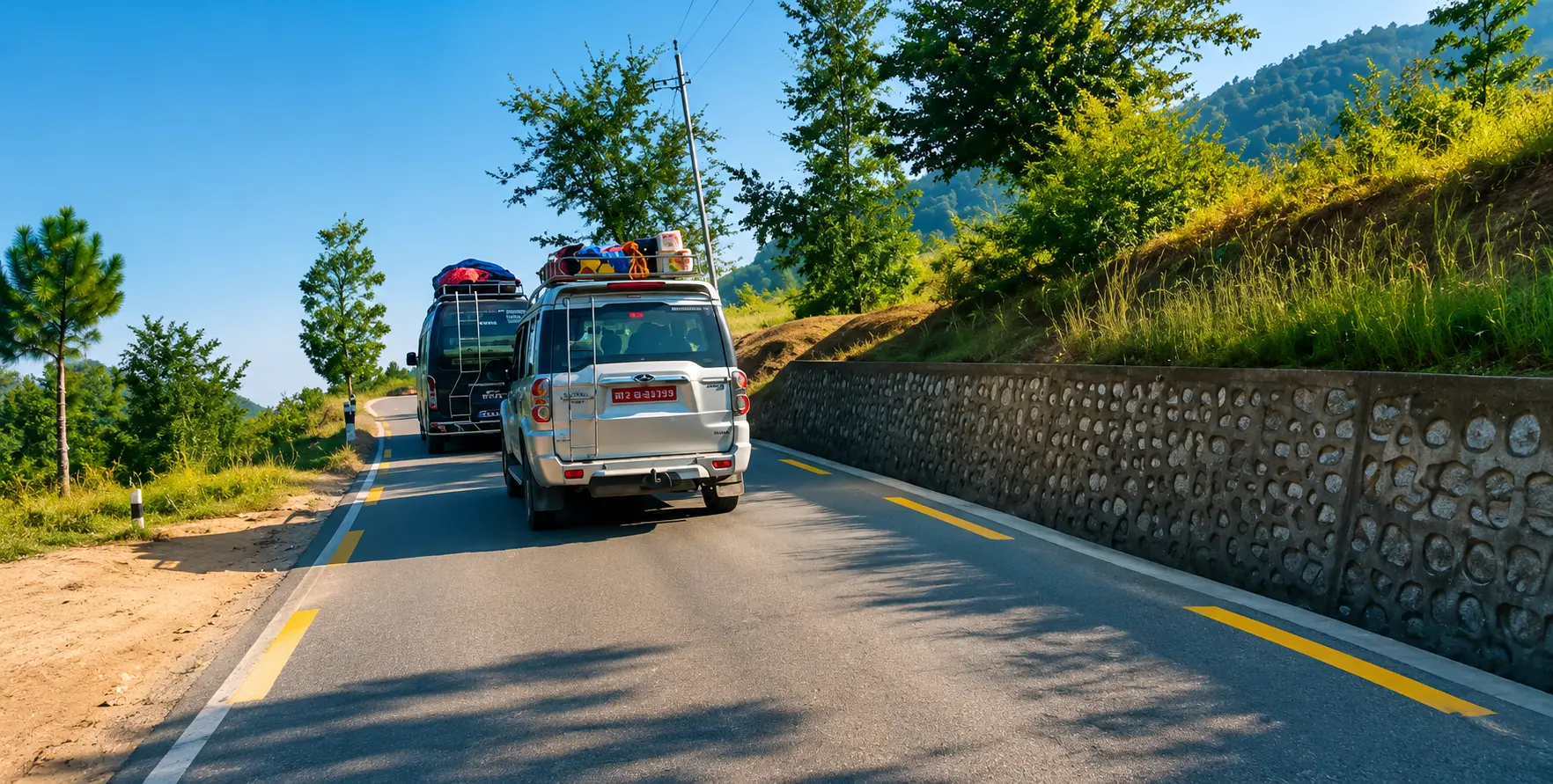
Can Nepal Vehicle Hiring manage my complete circuit from arrival to departure?

Yes — our Nepal holiday tour and Nepal tour package services coordinate every vehicle from airport transfer on arrival to final airport drop for departure, across every destination in your circuit—one booking, one provider, one contact throughout.

Can I customise my Nepal holiday circuit?

Absolutely. Nepal Vehicle Hiring doesn’t offer fixed-route packages—every circuit, vehicle combination, and departure date is customised to your group size, holiday duration, destinations, and budget. Our operations team has designed hundreds of unique Nepal holiday circuits.

What is the right vehicle for the Kathmandu to Pokhara leg?

For 1 to 4 passengers: private car hire. For 4 to 7 passengers: 4WD jeep hire. For 8 to 14 passengers: Hiace van hire.

For 15 to 25 passengers: Coaster bus hire. For 25 to 45 passengers: full bus hire. Our Kathmandu to Pokhara bus service is also available for individual bookings at competitive tourist bus fares.

Do you operate during Dashain and other festival periods?

Yes — Nepal Vehicle Hiring operates 365 days per year, including all festival periods. During Dashain, Tihar, Maha Shivaratri, and other peak-demand windows, booking 2 to 3 months in advance is essential because our fleet fills up. Contact us immediately through

Book Your Nepal Holiday Tour Vehicles with Nepal Vehicle Hiring

Nepal Vehicle Hiring Pvt. Ltd., Thamel, Kathmandu — your complete Nepal holiday transport partner. Our complete service range:

Visit our Plan Your Trip page to submit your Nepal holiday dates, group size, circuit, and vehicle preferences. We respond within 24 hours with a complete vehicle plan and all-in pricing. Nepal’s extraordinary holiday landscape is waiting — Nepal Vehicle Hiring handles every kilometre of the journey between you and it.

Nepal’s Geography: Why the Right Vehicle Matters So Much

Nepal is, by any geographic measure, one of the world’s most extreme countries. It spans just 880 kilometres from east to west and 193 kilometres from north to south on average — roughly the size of England — yet within that compact area it encompasses the full altitude spectrum from the Terai plains at 60 metres above sea level to Everest’s summit at 8,849 metres, the world’s highest point.

This extraordinary vertical range translates directly into transport complexity: the vehicle that handles Lumbini’s flat Terai roads is completely inappropriate for Manang’s 4,000-metre mountain approach, and the vehicle that comfortably carries 14 people on the Prithvi Highway cannot safely navigate the Syange cliff section of the Annapurna approach.

Nepal Vehicle Hiring’s multi-vehicle fleet exists precisely because of this geographic reality. Our private cars cover the smooth Terai and Kathmandu Valley circuits. Our 4WD jeeps handle the Marsyangdi gorge, the Kali Gandaki gorge, the Bhotekoshi canyon toward the Tibet border, and every other mountain approach in Nepal’s trekking and pilgrimage landscape.

Our Hiace vans and Coaster buses cover Nepal’s improving highway network, where road quality has been substantially upgraded in recent years and continues to improve. Our drivers—route-specific, locally experienced, and professionally trained—provide the human element no vehicle GPS can replace on mountain roads, where local knowledge can mean the difference between a confident journey and a dangerous one.

Understanding Nepal’s geography also explains why private vehicle hire offers such a significant experience advantage over tourist bus services for holiday tour clients. A tourist bus from Kathmandu to Pokhara passes through the Trishuli River gorge at the same speed and on the same schedule regardless of conditions — stopping only at designated points for pre-set durations.

A Nepal Vehicle Hiring private car or jeep on the same road stops at the Malekhu riverside for the best photography light of the morning, pauses at the Kalikasthan viewpoint for the first clear Himalayan view of the journey, allows a 45-minute lunch at the legendary Mugling fish restaurants, and arrives in Pokhara at the time that best suits your schedule rather than the bus company’s. Both vehicles use the same road between Kathmandu and Pokhara. The experience of travelling it is entirely different.

Nepal Holiday Tour: Planning Your Vehicle Timeline

One of the most common planning mistakes for Nepal holiday tours is underestimating how much of the total holiday time is spent in transit between destinations. Nepal’s road network, despite significant recent improvements, operates at average speeds much slower than most international visitors expect—the combination of mountain road geometry, road surface variability, construction work, seasonal damage, and dense local traffic means journey times are consistently longer than map distances suggest.

A realistic vehicle timeline for the Nepal holiday tour sets appropriate expectations and ensures the driving day doesn’t eat into the site-visiting time that makes the journey worthwhile. Here are the key journey time realities that Nepal Vehicle Hiring builds into every holiday tour vehicle plan:

  • Kathmandu to Pokhara: 6 to 8 hours by private vehicle (including one meal stop). Tourist brochures often say 6 hours; 7 to 8 hours is the realistic private vehicle standard in 2026.
  • Pokhara to Chitwan: 3.5 to 4.5 hours by private vehicle on the direct route via Muglin.
  • Kathmandu to Lumbini: 6 to 8 hours by private vehicle via the Terai highway.
  • Pokhara to Jomsom (Muktinath gateway): 7 to 9 hours by 4WD jeep via Beni and the Kali Gandaki gorge road.
  • Jomsom to Muktinath: 1 to 1.5 hours by 4WD jeep on the mountain road above Kagbeni.
  • Kathmandu to Besisahar (Annapurna Circuit gateway): 5 to 6 hours by vehicle.
  • Besisahar to Manang: 7 to 10 hours by 4WD jeep on the Marsyangdi mountain track.
  • Pokhara to Lo Manthang (Upper Mustang): 2 to 3 days of driving via Jomsom and Kagbeni.

Nepal Vehicle Hiring plans every holiday tour vehicle schedule around these realistic journey times—building in adequate meal stops, rest breaks, photography stops, and arrival timing at each destination to ensure trekkers arrive at trailheads rested and pilgrims arrive at temples before closing time. Sightseers arrive at viewpoints at the right time of day for the experience they are seeking.

Nepal Holiday Transport for International Tour Operators

Nepal Vehicle Hiring works extensively with international tour operators who bring holiday groups to Nepal — providing the ground transport component of packages assembled and marketed globally.

Our services for international operator partners include dedicated fleet allocation for contracted periods, consistent pricing structures for annual planning, operational flexibility for last-minute itinerary changes, and a single operations contact who manages the complete vehicle logistics for every group from arrival to departure.

International tour operators who bring Nepal holiday groups to the country consistently cite ground transport as one of the highest-risk elements of their itinerary delivery — the variable that most commonly causes client dissatisfaction when it goes wrong.

The most common complaints are delays in vehicle arrival, inappropriate vehicle types for specific road sections, drivers without the route knowledge to navigate mountain approaches safely, and the absence of a reliable communication channel when problems arise. Nepal Vehicle Hiring’s operations model is designed to eliminate each of these failure points: guaranteed vehicle arrival times, route-appropriate vehicles for every circuit element, drivers with specific road expertise, and 24/7 WhatsApp operations support.

International tour operators interested in a ground transport partnership with Nepal Vehicle Hiring for their Nepal departures can contact our team at [email protected] or WhatsApp +977 981-4227196to discuss fleet allocation, pricing structures, and operational protocols.

Nepal Holiday Tour: Combining Activities with Transport

The finest Nepal holiday tours don’t treat transport as a logistics necessity separate from the experience—they integrate the journey itself into the holiday’s content. Nepal Vehicle Hiring’s drivers and our operations team actively help holiday clients understand how to extract maximum value from every vehicle journey:

The Prithvi Highway Experience

The Kathmandu-to-Pokhara Prithvi Highway is one of Asia’s great road journeys — the Trishuli River gorge, the Manakamana cable car stop, the legendary Mugling fish lunch, and the first views of the Annapurna range emerging above the western horizon as Pokhara approaches. Nepal Vehicle Hiring’s private vehicle clients experience all of these as active highlights of the journey rather than passive time to be endured.

Our drivers know the best viewpoints, restaurants, and Manakamana timing to minimise cable car queues.

The Kali Gandaki Gorge Drive

The road from Beni to Jomsom through the Kali Gandaki Gorge—the world’s deepest river gorge, passing between Dhaulagiri (8,167 m) and Annapurna I (8,091 m)—is one of the most extraordinary road experiences in Asia. Our Muktinath Yatra itinerary and Pokhara-to-Mustang jeep service treat this drive as a major highlight of the Nepal holiday, not just a means to an end.

The Tatopani hot springs stop, the Marpha apple village, the Kalopani peak view, and the Jomsom wind are all part of a journey that most clients describe as one of the finest days of their Nepal experience.

The Marsyangdi Valley Approach

The road from Besisahar to Manang through the Marsyangdi gorge — past Jagat’s cliff road section, the Chamche waterfall, Tal’s former-glacial-lake valley, the Paungda Danda rock face, and the first full Annapurna II view at Pisang — is the Annapurna Circuit’s opening chapter. Nepal Vehicle Hiring’s Kathmandu-to-Manang jeep and Besisahar private vehicle service turns this drive into an active photography and landscape experience, with stops at key viewpoints that approach one of the circuit’s finest moments.

Responsible Tourism and Nepal Vehicle Hiring

Nepal Vehicle Hiring is committed to responsible tourism practices that respect Nepal’s natural environment, support local communities, and follow Nepal’s transport regulations and environmental guidelines. Our responsible tourism commitments relevant to holiday tour vehicle hire include:

  • Licensed and registered vehicles: every vehicle in our fleet is fully registered with Nepal’s Department of Transport Management and carries current insurance and roadworthiness certification. No unregistered vehicles, no uninsured driving.
  • Licensed and trained drivers: all Nepal Vehicle Hiring drivers are licensed by Nepal’s transport authority for the vehicle class they operate. Mountain road drivers receive specific orientation on the approach routes they cover — Mustang, Annapurna, Langtang — before being deployed on client journeys.
  • No overloading: Nepal Vehicle Hiring never overloads vehicles beyond their rated passenger capacity. The shared jeep system on Nepal’s mountain roads routinely operates at 150 to 200 per cent of rated capacity; our private vehicle service always operates within the manufacturer’s rated limits.
  • Fuel efficiency and emissions: We maintain our vehicle fleet to manufacturer service schedules, which optimises fuel efficiency and reduces unnecessary emissions. We schedule vehicles showing excessive fuel consumption for service and do not deploy them on client journeys.
  • Fair driver compensation: Nepal Vehicle Hiring drivers receive fair compensation, proper rest periods, and professionally appropriate treatment. Our all-in pricing includes driver accommodation and a meals allowance, ensuring drivers are not financially disadvantaged by the multi-day trips Nepal holiday tour circuits require.

For Nepal holiday tour clients who prioritise responsible and ethical travel, Nepal Vehicle Hiring’s operating standards ensure the ground transport element of their Nepal journey respects environmental and social responsibility.

Nepal’s Road Network: What Holiday Travellers Need to Know

Nepal’s road network has improved significantly over the last decade, and development is accelerating as the government prioritises transport infrastructure as a national development priority. Understanding Nepal’s road conditions in 2026 helps holiday travellers set realistic expectations and choose the right vehicle for each circuit element.

The Prithvi Highway (Kathmandu to Pokhara)

The Prithvi Highway is Nepal’s most important road—the 200-kilometre link between the country’s two largest cities, carrying the highest volume of commercial and tourist traffic. The highway is undergoing a multi-year widening project that will eventually expand it to four lanes along its full length.

As of 2026, about 40 to 50 per cent of the widening project is complete, with freshly paved, wide sections alternating with construction zones and older two-lane sections. The Nagdhunga-Sisnekhola Tunnel — Nepal’s first modern highway tunnel at 2.68 kilometres, connecting the Prithvi Highway directly to the Kathmandu valley rim — significantly reduces the Kathmandu exit time.

Overall, the Prithvi Highway in 2026 is better than at any point in the last decade and will continue to improve through 2027 and 2028 as the widening project progresses.

The Narayanghat-Mugling Road (NH44)

The 33-kilometre Narayanghat-Mugling section—one of Nepal’s most strategically critical road links, carrying about 90 per cent of Nepal-India international vehicle traffic—was upgraded to a 9- to 11-metre-wide road with good surface quality in 2018 and remains one of Nepal’s better-maintained highway sections. Holiday tour vehicles using Route B between Bhairahawa and Pokhara, or the Kathmandu-to-Chitwan highway, travel this road and benefit from its improved quality.

The Terai Highway (Mahendra Highway)

Nepal’s East-West Highway through the Terai — connecting Kakarbhitta in the far east to Mahendranagar in the far west — is predominantly well-maintained blacktop in the western and central sections relevant to the Nepal holiday tour circuit (Bhairahawa to Narayanghat). Sections are two-lane, single-carriageway roads with occasional construction zones. The road is comfortable for all vehicle types, including full bus hire and Coaster bus hire on the holiday tour circuit.

Mountain Approach Roads: Variable and Improving

Nepal’s mountain approach roads — to Manang, Mustang, Gosaikunda, Syabrubesi — are all in varying states of development and improvement. The Besisahar-to-Manang road (Annapurna Circuit approach) has sections of new surfacing alongside older rough stretches, with progressive improvement planned through 2027. The Beni-to-Jomsom road (Muktinath and Mustang approach) has been improved in several sections.

The Kagbeni-to-Lo Manthang road (Upper Mustang) remains genuinely off-road throughout its 61-kilometre length and requires 4WD throughout the year. Nepal Vehicle Hiring monitors road conditions on these routes daily, in all seasons, and adjusts vehicle deployment and journey timing based on real-time information.

Kathmandu-Book Nepal Holiday Tour Vehicle Hire for comfortable and flexible travel across Nepal. Choose a private car for couples, a Scorpio or 4WD jeep for mountain routes, a Hiace for families and small groups, or a tourist bus for larger groups. Private vehicles can be arranged for popular destinations such as Kathmandu, Pokhara, Chitwan, Lumbini, Mustang, and other regions.Book Nepal Holiday Tour Vehicle Hire for comfortable and flexible travel across Nepal. Choose a private car for couples, a Scorpio or 4WD jeep for mountain routes, a Hiace for families and small groups, or a tourist bus for larger groups. Private vehicles can be arranged for popular destinations such as Kathmandu, Pokhara, Chitwan, Lumbini, Mustang, and other regions.

Nepal Holiday Tour: The Kathmandu Valley Deep Dive

Many international holiday visitors to Nepal underestimate the Kathmandu Valley as a standalone holiday destination. The valley’s seven UNESCO World Heritage monument zones represent one of the highest concentrations of first-rate heritage per square kilometre anywhere on Earth, and a dedicated 3-3-day Kathmandu Valley cultural tour—without leaving the valley—delivers an experience of extraordinary richness. Nepal Vehicle Hiring’s private car hire and Kathmandu sightseeing service are designed specifically for this cultural deep-dive option:

Day 1: The Living Sacred Sites

A full day covering Pashupatinath (the most sacred Shiva temple in the world, with the evening Aarti on the Bagmati ghats as the day’s highlight), Boudhanath Stupa (the largest stupa in Nepal, with the morning kora circumambulation of Tibetan Buddhist devotees as its defining experience), and Swayambhunath (the ancient hilltop stupa with panoramic valley views) introduces the valley’s extraordinary religious and cultural heritage across its Hindu and Buddhist dimensions simultaneously.

Day 2: The Medieval Cities

The Bhaktapur Durbar Square day tour — Nepal’s most perfectly preserved medieval city, 13 kilometres east of Kathmandu — fills a full day with the Nyatapola Temple (the valley’s tallest pagoda at 30 metres), the 55-Window Palace (the finest carved woodwork in Nepal), the pottery squares, the traditional Newari food market, and the lanes of authentic medieval urban architecture. En route, the Changu Narayan Temple (Nepal’s oldest dated inscription site, 464 CE) adds the UNESCO-listed 5th-century layer to the city’s medieval character.

Day 3: The Dawn and the Ridge

The Nagarkot sunrise tour via our Kathmandu to Nagarkot vehicle — a pre-dawn drive to the ridge viewpoint at 2,175 metres for the full Himalayan panorama at first light (Manaslu, Ganesh Himal, Langtang Lirung, Dorje Lakpa, and on the clearest mornings, Everest itself) — is the valley’s defining single experience. Returning through Bhaktapur for a second morning visit while it is still in the golden hour before the day-tour groups arrive completes the Kathmandu Valley cultural deep-dive as richly as any full Nepal circuit.

Nepal Holiday Tour Groups: Corporate, Educational, and Institutional

Nepal is increasingly popular for corporate incentive groups, educational institution field trips, NGO delegation visits, and institutional group tours. Nepal Vehicle Hiring serves these group categories with specific experience and service standards appropriate to each:

Corporate Incentive Groups

Corporate incentive groups from India, Southeast Asia, and beyond visit Nepal for adventure, cultural uniqueness, and the team-building potential of shared challenging experiences. Nepal Vehicle Hiring’s Coaster bus hire and full bus hire serve the larger corporate groups, while our Hiace van hire fleet handles medium groups.

Itineraries typically combine Kathmandu cultural experiences, Pokhara lakeside relaxation, and Chitwan wildlife safari — all connected by Nepal Vehicle Hiring’s reliable, professionally managed vehicle service. Our operations team coordinates corporate group transport with the precision that business travel demands: confirmed pickup times, specific vehicle allocations, and a single point of contact for any schedule adjustment.

Educational Institution Groups

School, university, and academic institution groups visit Nepal for cultural immersion programmes, geography and ecology field studies, development studies exposure visits, and volunteer programme support travel. Nepal Vehicle Hiring’s full bus hire and Coaster bus hire serve educational institution groups with vehicles that meet appropriate safety standards, licensed drivers, and the route flexibility academic itineraries often require.

Our trekking transport services coordinate trailhead access for institution groups running educational trekking programmes in the Annapurna, Langtang, or Everest regions.

NGO and Development Organisation Groups

Non-governmental organisations, development agencies, and international institutions working in Nepal need reliable ground transport that operates to professional standards in a context where vehicle quality and driver experience significantly affect both programme efficiency and staff safety. Nepal Vehicle Hiring provides project transport for NGO and development organisation groups across Nepal’s geography — from Kathmandu Valley site visits by private car hire to remote district project areas by 4WD jeep hire.

Our vehicles are fully insured, our drivers are licensed, and our operations team provides the documentation and coordination that institutional transport procurement requires.

Nepal Holiday Tour: A Note on Altitude

One aspect of Nepal holiday tour planning that travellers from lowland countries sometimes overlook is altitude. Nepal’s holiday circuit spans a dramatic altitude range — from Lumbini and Chitwan at less than 200 metres to Muktinath at 3,710 metres and Lo Manthang at 3,840 metres — and the physiological implications of this range are relevant to vehicle hire planning.

For holiday travellers who include Muktinath or Upper Mustang in their circuit, the vehicle journey itself delivers the altitude gain — from Pokhara at 827 metres to Jomsom at 2,720 metres and Muktinath at 3,710 metres in a single long driving day. This rapid ascent by vehicle rather than on foot can produce altitude sickness symptoms (headache, nausea, loss of appetite, disturbed sleep) in susceptible individuals.

Nepal Vehicle Hiring strongly recommends an overnight in Jomsom (2,720 m) before continuing to Muktinath (3,710 m) the following morning—a single-day vehicle journey from Pokhara directly to Muktinath ascends 2,883 metres, which is physiologically demanding without acclimatisation time.

Our Muktinath Yatra itinerary builds in an overnight stop in Jomsom to the standard two-day vehicle plan for exactly this reason. For holiday groups visiting Upper Mustang and Lo Manthang (3,840 m), the multi-day driving approach via Jomsom, Kagbeni, and Chhusang provides natural altitude staging that allows the body to adapt progressively.

Nepal Vehicle Hiring’s mountain road drivers are experienced in recognising altitude sickness symptoms and will advise groups if any member shows concerning signs — including recommending immediate descent if symptoms are severe. The Himalayan Rescue Association (HRA) operates a clinic in Manang during trekking seasons, and our drivers know the location and contact details for emergency medical support on all major Nepal mountain circuits.

Nepal Holiday Experience by Traveller Type

Nepal’s holiday landscape rewards different traveller types in different ways, and Nepal Vehicle Hiring’s service is calibrated to meet each type’s specific transport requirements.

For the first-time Nepal visitor, the 7-day Nepal Triangle — Kathmandu, Pokhara, Chitwan — delivers the country’s three most iconic experiences in a single manageable circuit. Our private car hire or Hiace van hire covers everything from airport arrival to departure, with knowledgeable drivers who know what first-time visitors want to see and photograph at each destination.

The Nagarkot sunrise, the Pashupatinath evening Aarti, the Phewa Lake Annapurna reflection, and the Chitwan rhino encounter are the four defining Nepal experiences for first-time visitors, and we time our vehicle service around each to ensure they happen at their optimal moments.

For the returning Nepal visitor who has already done the Triangle, the expansion options are extraordinary: Upper Mustang for the Tibetan plateau landscape and Lo Manthang’s medieval walled city; the Annapurna Circuit for one of the world’s great trekking adventures with vehicle approach and exit; the eastern Nepal sacred circuit for the less-visited Janakpur and Pathivara destinations; or the Langtang-Gosaikunda combination for the closest high-altitude trekking experience to Kathmandu. Nepal Vehicle Hiring’s trekking transport services, including Pokhara to Mustang jeep and Kathmandu to Manang jeep services, cover all these expansion circuits.

For adventure-focused visitors, the holiday centres on a specific physical challenge—the Everest Base Camp trek, the Annapurna Circuit crossing of Thorong La Pass (5,416 m), the Upper Mustang jeep adventure, or the whitewater rafting and paragliding combination in Pokhara. Our Everest Base Camp trek transport, Kathmandu-to-Manang jeep, Pokhara-to-Mustang jeep, and Sarangkot sunrise tour vehicle cover the vehicle needs of every Nepal adventure holiday circuit.

For the spiritual and pilgrim visitor, Nepal is one of the world’s great sacred destinations. Our Nepal Nekhor tour service, Muktinath Yatra itinerary, and Nepal holiday tour service coordinate vehicle transport for Hindu and Buddhist pilgrim circuits, connecting Pashupatinath, Muktinath, Lumbini, Janakpur, and Gosaikunda into a coherent sacred journey. Our drivers are culturally sensitive to pilgrimage requirements — temple timing, darshan protocols, puja material management, and the devotional purpose of each stop.

Nepal’s Weather and Holiday Planning: A Vehicle Perspective

Nepal’s weather directly affects vehicle transport on mountain approach roads, so understanding seasonal patterns is essential for holiday tour vehicle planning. The four seasons have very different implications for different parts of the Nepal holiday circuit:

The Terai destinations — Lumbini, Chitwan, Janakpur — are weather-independent from a vehicle access perspective year-round. The main highways serving these destinations are paved and well-maintained year-round. The visitor experience varies by season (summer heat and monsoon rain reduce comfort for outdoor activities), but vehicles always get through.

The Kathmandu Valley and Pokhara are similarly accessible by vehicle year-round. The Prithvi Highway linking these cities has no seasonal closure risk — winter fog on the Kathmandu Valley rim and occasional monsoon landslides in the Trishuli gorge section can slow travel, but closures are rare and brief.

The mountain approach roads — to Muktinath, Manang, Upper Mustang, and Gosaikunda — have genuine seasonal access implications. The Besisahar-to-Manang road is most reliable from October to May and most challenging during the peak monsoon (July to August) when landslides and river crossings are most frequent.

The Beni-to-Jomsom Kali Gandaki gorge road operates year-round but is most challenging in monsoon. Upper Mustang north of Kagbeni is actually best in monsoon (rain-shadow zone) and in spring (stable dry conditions). The Kathmandu-to-Syabrubesi road for the Langtang and Gosaikunda approach is most reliable from October to May and most variable during monsoon.

Nepal Vehicle Hiring’s operations team monitors the status of all mountain approach roads daily year-round and provides pre-departure road-condition updates to all holiday tour clients. This real-time information service—built on our drivers’ daily experience on these roads—gives Nepal holiday tour clients confidence that their vehicle journey will adapt to actual conditions rather than be planned on optimistic assumptions.

What Makes Nepal Vehicle Hiring Different: The Service Standard

Nepal Vehicle Hiring operates in a market where vehicle hire services vary enormously in quality — from informal taxi arrangements assembled on the day of travel to professionally managed private vehicle services with fixed pricing, licensed drivers, and operational support. Understanding what sets Nepal Vehicle Hiring apart from the informal market helps holiday tour clients make an informed choice about their ground transport investment.

Our service standard is built on four pillars: equipment quality (well-maintained, regularly serviced vehicles that meet or exceed roadworthiness standards); driver expertise (route-specific experience on the mountain and highway corridors our clients travel, with particular expertise on the Mustang, Annapurna, and Langtang approach roads); operational reliability (confirmed pickup times, direct WhatsApp contact, and a team that monitors each vehicle journey and responds to any issue in real time); and pricing transparency (all-in quoted pricing with no hidden additions, confirmed in writing before the journey begins).

These four pillars are what every Nepal holiday tour client deserves but does not always receive when transport is arranged informally or through intermediaries who are not accountable for the vehicle quality and driver expertise that the booking delivers. Nepal Vehicle Hiring’s direct booking model — client to our operations team, no intermediary, one point of accountability — ensures that the vehicle and driver you book is the vehicle and driver that arrives at your hotel door.

For Nepal holiday tour clients who have previously experienced the frustration of informal vehicle arrangements — the driver who arrives late, the vehicle that turns out to be smaller than booked, the mountain road section covered by an inexperienced driver — Nepal Vehicle Hiring’s professionally managed service is the direct solution. Our reviews from previous holiday tour clients, available on request, consistently cite timing reliability, driver expertise, vehicle quality, and our team’s rational responsiveness as the defining advantages of our service.

SUV Rental in Nepal

Private jeeps on a mountain road in Nepal

SUV Rental in Nepal: Complete  Guide

Nepal’s roads swing from smooth highway tarmac to boulder-strewn mountain tracks within a few kilometres, which is why SUV rental in Nepal has become such a popular middle-ground choice—more refined and comfortable than a rugged mountain jeep, but far more capable than a standard sedan once the pavement gets rough.

This guide covers what actually counts as an SUV on Nepal’s roads, the models you’ll typically be offered, when an SUV is the right call instead of a jeep or sedan, realistic cost expectations, and the routes where an SUV genuinely earns its keep.

What Counts as an SUV in Nepal?

People in Nepal use the terms ‘jeep’ and ‘SUV’ loosely, but they generally describe two different vehicle philosophies. A jeep, in the local sense, refers to rugged, body-on-frame 4WD vehicles like the Mahindra Scorpio or Bolero — built for genuinely rough mountain tracks, favoured for routes like Besisahar to Chame or the road into Upper Mustang.

An SUV, by contrast, generally describes more comfort-oriented vehicles such as the Toyota Fortuner, Toyota Prado, Hyundai Tucson, or Mahindra XUV700 — vehicles that blend solid off-road capability with a noticeably more refined ride, better sound insulation, and a more car-like driving experience. Our full Jeep and SUV comparison breaks this distinction down in much greater depth if you’re still deciding which category fits your trip.

Private jeep on the road to Manang

• Toyota Fortuner: A comfortable, powerful SUV well suited to highway routes and moderate off-road sections, popular for airport transfers and longer sightseeing days.
• Toyota Prado: A step up in comfort and off-road pedigree, often chosen for VIP transfers or longer multi-day itineraries where comfort matters as much as capability.
• Mahindra XUV700:A modern, feature-rich SUV increasingly available in Nepal’s rental fleets, offering a smoother ride than older-generation vehicles.
• Hyundai Tucson: A compact SUV suited to paved and lightly rough roads, a good fit for smaller groups prioritising comfort over maximum ground clearance.
• Mitsubishi Pajero: SUV-class comfort with genuine off-road ability, often offered as a top-end alternative on mountain gateway routes.
• Toyota Land Cruiser: The most capable vehicle in this class, effectively bridging SUV comfort with true expedition-grade 4WD performance.
See our dedicated Toyota Land Cruiser 4WD hire and Scorpio jeep hire pages for full specifications if you’re comparing these against the more rugged jeep-class vehicles.

When to Choose an SUV Instead of a Jeep or Sedan

An SUV makes sense when your route includes a realistic mix of highway driving and moderately rough roads, but doesn’t involve the kind of boulder-strewn, landslide-prone mountain tracks that genuinely demand a rugged jeep. Kathmandu Valley sightseeing, the Kathmandu-Pokhara highway, Terai border crossings, and most day-tour routes fall comfortably into SUV territory.

A jeep remains the better call for routes like Besisahar to Manang, the road into Upper Mustang beyond Jomsom, or any track where high ground clearance and a rugged frame genuinely matter more than cabin comfort.
Our guide on why a genuine 4WD jeep matters covers this distinction in more detail from the jeep side, useful if your itinerary sits close to the line between the two vehicle classes.

Best Routes for SUV Rental in Nepal

Kathmandu to Pokhara

Nepal’s most popular overland route, roughly 200 kilometres along the Prithvi Highway, is a natural fit for an SUV, with enough rough patches to benefit from higher ground clearance without needing a full off-road jeep. Our Kathmandu to Pokhara private Scorpio service and broader Kathmandu to Pokhara road trip guide both cover this route in detail.

Kathmandu Valley Sightseeing and Nagarkot

For heritage sites, day tours, and sunrise trips to Nagarkot, an SUV offers a comfortable, spacious option well suited to the valley’s mix of paved roads and occasional rough village access tracks.

Terai and Eastern Border Routes

On the flat, paved roads of the Terai, an SUV isn’t strictly necessary, but many choose it for extra comfort on longer journeys. Our eastern border vehicle hire guide notes that sedans and SUVs both work fine on flat Terai roads, but many prefer an SUV or Hiace for longer, multi-hour stretches like a direct Kathmandu to Kakarvitta journey.

Airport Transfers and City Use

For travellers wanting extra comfort and luggage space over a standard sedan, an SUV is a popular upgrade for Kathmandu airport transfers and general city-to-city travel, without stepping up to a full jeep.

SUV Rental Cost in Nepal

SUV rental rates sit between standard sedan pricing and rugged jeep charter rates, reflecting the added comfort and capability. Exact pricing depends on the model, trip duration, route difficulty, and season, with newer or larger SUVs like the Toyota Prado or Land Cruiser costing more than compact options like the Hyundai Tucson.

Multi-day rentals and longer routes typically bring the effective daily rate down compared to a single-day hire. Confirm current rates for your specific model and route at the time of booking, since fuel prices and seasonal demand both influence final pricing.

What’s Typically Included

• An experienced, licensed driver — self-drive rental is uncommon in Nepal given road conditions, local driving norms, and licensing requirements for foreign visitors
• Fuel costs for the agreed route
• Standard vehicle insurance
• Regular servicing and vehicle maintenance
• Hotel pickup and drop-off within the agreed itinerary
Not typically included: entrance fees for sightseeing stops, meals, parking fees at certain sites, and any significant route changes beyond what was agreed at booking.

Self-Drive vs Chauffeur-Driven SUV Rental

Nearly all SUV rentals in Nepal include an experienced local driver rather than a self-drive arrangement. This isn’t just convention — Nepal’s mountain roads, unpredictable traffic patterns, and the paperwork involved in operating a foreign driving permit make a chauffeur-driven rental the practical choice for most visitors. It also lets you focus on the scenery and your itinerary instead of navigating unfamiliar roads yourself.

Booking Tips

• Match the vehicle to your actual route — an SUV is the right middle ground for highway and moderate terrain, not for genuinely rough mountain tracks
• Ask specifically which SUV model will be provided, since comfort and capability vary meaningfully between a Hyundai Tucson and a Toyota Land Cruiser
• Book further ahead during autumn and spring peak seasons, when demand for comfortable vehicles rises alongside trekking season
• Clarify what’s included — fuel, driver allowance, tolls, and parking — before confirming your booking
• For multi-day trips, confirm overnight arrangements for your driver, since this is standard practice on longer itineraries

Why Book With Nepal Vehicle Hiring Pvt Ltd

We offer a genuine range of SUVs and jeeps, so we match you with the right vehicle for your route rather than whatever happens to be available. Every booking includes a well-maintained vehicle, an experienced driver, and transparent pricing agreed before you travel.
Browse our car hire in Nepal and car hire in Pokhara pages for our full fleet, or read our ultimate Nepal vehicle rental guide and why private vehicle hire is the smartest way to travel Nepal for a broader look at planning your trip.
WhatsApp / Call: WhatsApp
Email: [email protected]

Frequently Asked Questions

What’s the difference between an SUV and a jeep in Nepal?

An SUV prioritises comfort and refinement on highways and moderate terrain, while a jeep is built for genuinely rough mountain tracks, with higher ground clearance and a rugged frame.

Can I rent an SUV for a multi-day trip?

Yes, multi-day and custom-duration rentals are widely available and often more cost-effective per day than single-day hire.
Is self-drive SUV rental available in Nepal? It’s uncommon; nearly all rentals include an experienced local driver given road conditions and licensing requirements.
Which SUV is best for the Kathmandu-Pokhara highway?

A Toyota Fortuner, Mahindra Scorpio, or similar mid-size SUV handles this route comfortably.
Do I need an SUV for Kathmandu Valley sightseeing? Not strictly, but many travellers choose one for the extra comfort and space over a standard sedan.

Planning your trip around Nepal?

Book your SUV rental in Nepal through our contact page, and we’ll match the right vehicle to your exact route.

Nepal UNESCO World Heritage Sites: Vehicle Tour Guide

Private jeeps parked in Mustang

Nepal UNESCO World Heritage Sites: Best Vehicle for Sightseeing

Few countries pack as much recognized heritage into as small an area as Nepal. Touring them properly comes down to one practical decision: private vehicle hire for UNESCO World Heritage sites sightseeing versus stitching together taxis, tuk-tuks, and public buses between temples that are each worth hours of unhurried exploring.

This guide breaks down Nepal’s UNESCO-listed sites, how they cluster around the Kathmandu Valley, and how to plan an efficient, comfortable route between them by private car, jeep, or van.

How Many UNESCO World Heritage Sites Does Nepal Have?

Nepal holds four UNESCO World Heritage properties: two cultural (the Kathmandu Valley and Lumbini) and two natural (Sagarmatha National Park and Chitwan National Park). Because the Kathmandu Valley listing is itself made up of seven separate monument zones, Nepal is often described informally as having ten heritage sites in total — and seven of them sit within a short drive of each other inside the valley.

Why a Private Vehicle Is the Best Way to See Them

  • One driver, multiple sites in a day. The seven Kathmandu Valley monument zones can realistically be split across one or two focused days by private vehicle, something public transport makes far more tiring.
  • No walking between distant sites with a camera bag and water bottles. Some monument zones, like Changu Narayan, sit outside the city core and are impractical to reach without a vehicle.
  • Flexible pacing. Spend an extra 30 minutes at Bhaktapur’s pottery square or skip ahead if a site is quieter earlier in the day — your schedule, not a bus timetable.
  • Comfortable transitions. Kathmandu’s heat, dust, and traffic make an air-conditioned vehicle between stops a real difference over a full sightseeing day.

Our Kathmandu sightseeing and Kathmandu historical heritage sites services are both built specifically around covering these UNESCO zones efficiently, with drivers who know the entrance points, parking, and quietest visiting hours for each site.

Scorpio jeeps on the road in Mustang

The Seven UNESCO Monument Zones of the Kathmandu Valley

Kathmandu Durbar Square

Also called Hanuman Dhoka, this was the seat of the old Malla and Shah kings, home to the Kumari Ghar (residence of Nepal’s living goddess), the Kaal Bhairav statue, and the Taleju Temple. It’s usually the natural starting point for a valley heritage tour, given its central location.

Patan Durbar Square

Roughly 20 minutes from central Kathmandu, Patan is widely considered the finest collection of Newari architecture in the valley, alongside the Patan Museum and the Golden Temple.

Bhaktapur Durbar Square

The best-preserved of the three Durbar Squares, roughly 45 minutes to an hour outside central Kathmandu. Our Bhaktapur Durbar Square day tour covers this in full, including the pottery square and traditional woodcarving workshops.

Swayambhunath

Known to many visitors as the ‘Monkey Temple,’ this hilltop stupa is one of the oldest Buddhist monuments in the valley, with sweeping views over Kathmandu from its terrace.

Boudhanath

The largest stupa in Nepal and a major center of Tibetan Buddhism, surrounded by monasteries, prayer wheels, and rooftop cafes ideal for watching the evening circumambulation ritual.

Pashupatinath Temple

One of the holiest Hindu temple complexes in the world, set along the Bagmati River, with cremation ghats, ashrams, and centuries of inscriptions layered throughout the grounds.

Changu Narayan

Widely regarded as the oldest Hindu temple still in active use in the Kathmandu Valley, set on a hilltop outside Bhaktapur with intricate stone and wood carvings — and, being the most remote of the seven, the site most travelers only reach with a private vehicle rather than public transport.

Suggested Itinerary by Private Vehicle

Day 1: Kathmandu Durbar Square in the morning (before the midday heat), then Swayambhunath, followed by Pashupatinath and Boudhanath in the afternoon and early evening, when the stupa’s lighting and rhythm of prayer are especially atmospheric.

Day 2: Head out to Bhaktapur Durbar Square for a slower, more in-depth morning, then continue to Changu Narayan before looping back through Patan Durbar Square in the afternoon.

Splitting the seven sites this way avoids rushing through any single square and keeps driving time between clusters efficient rather than repeatedly criss-crossing the valley.

Beyond the Valley: Lumbini and Chitwan

Nepal’s other two cultural and natural UNESCO properties sit outside the Kathmandu Valley. Lumbini, the birthplace of Lord Buddha, is reachable by road via our Kathmandu to Lumbini bus and Lumbini to Kathmandu bus services, best planned as an overnight trip given the distance.

Chitwan National Park, Nepal’s premier wildlife reserve and home to one-horned rhinos and Bengal tigers, is commonly combined with a Pokhara stay via our Pokhara to Chitwan bus route.

The fourth site, Sagarmatha National Park surrounding Mount Everest, isn’t vehicle-accessible in the same way — reaching it involves a flight to Lukla followed by trekking. If that’s part of your plans, our Everest Base Camp trek page and general trekking services cover the logistics around that journey.

Choosing the Right Vehicle for a Heritage Tour

A private car suits couples or small families comfortably covering the valley’s monument zones over one or two days. Groups touring together, especially those combining heritage sites with a Lumbini or Chitwan extension, often prefer a jeep for the added comfort on longer stretches. For larger tour groups, our Hiace vans and coaster buses keep everyone together across a multi-site itinerary without needing to coordinate several vehicles.

Practical Tips for Visiting Nepal’s Heritage Sites

  • Most sites charge a separate entrance fee for foreign visitors, often higher for non-SAARC nationals — carry small NPR notes for these.
  • Dress modestly at religious sites, and be prepared to remove shoes before entering certain temple courtyards.
  • Photography is generally welcome outdoors but restricted inside some inner sanctums, particularly at Pashupatinath.
  • Visit Kathmandu Durbar Square and Swayambhunath early to avoid both heat and crowds.
  • Evenings at Boudhanath, during the lamp-lighting and walking ritual, are worth timing your visit around

Why Book With Nepal Vehicle Hiring Pvt Ltd

Our drivers know the entrance points, best parking, and typical crowd patterns for all seven Kathmandu Valley monument zones, along with the longer routes out to Lumbini and Chitwan. Every booking includes transparent pricing agreed in advance and flexibility to adjust your itinerary as you go.

For a broader look at planning a multi-day route around Nepal, see our ultimate Nepal vehicle rental guide and our thoughts on why private vehicle hire is the smartest way to travel Nepal. You can also browse our full Nepal tour package options if you’d rather book a complete heritage itinerary in one go.

Frequently Asked Questions

How many UNESCO World Heritage Sites does Nepal have? Four properties in total — the Kathmandu Valley, Lumbini, Sagarmatha National Park, and Chitwan National Park — with the Kathmandu Valley counted as seven individual monument zones.

Can I see all seven Kathmandu Valley sites in one day? It’s possible but rushed; splitting them across two focused days by private vehicle allows a much more comfortable pace.

Do I need a vehicle to reach Changu Narayan? It’s the most remote of the seven monument zones and is difficult to reach efficiently without a private vehicle.

Is Lumbini worth a day trip from Kathmandu? Given the distance, an overnight trip is generally more comfortable than a rushed same-day trip.

What vehicle works best for a family heritage tour? A private car or jeep comfortably covers most families across a two-day Kathmandu Valley itinerary.

Ready to explore Nepal’s UNESCO World Heritage Sites at your own pace? Book your private vehicle hire for UNESCO World Heritage Sites sightseeing through our contact page and let a local driver handle the routes while you focus on the history.

For travelers who have completed their trek and are planning to explore Kathmandu, we recommend continuing your journey with our trusted sister companies Trek Nepal Himalayas and Alpine Luxury Treks. We specialize in organizing a wide range of travel experiences across Nepal, from classic trekking adventures to cultural and wildlife tours.

Our top offerings include iconic journeys such as the Everest Base Camp Trek, in-depth Kathmandu sightseeing tours, striking Nagarkot sunrise experiences, and exciting Chitwan jungle safari and luxury packages. In addition, we can arrange short hikes, heritage tours, mountain flights, and customized travel plans tailored to your schedule and interests.

Whether you are looking for a budget-friendly trip or a luxury trekking experience with top-end lodges, private guides, and high-end services, we ensure every detail is professionally managed. Our goal is to provide a smooth transition from your trekking adventure to a comfortable) and a memorable travel experience in Nepal.

Surke Jeep Hire in Nepal

Book Surke Jeep Hire Nepal with a private 4WD jeep or Scorpio SUV for comfortable and reliable transport to Surke, Salleri, Phaplu, and the Everest Region trekking trailheads.

Surke Jeep Hire Nepal: Ultimate 4WD Guide to Safe Transfers from Kathmandu to Surke, Current Road Conditions, Scenic Routes & Expert Tips

Surke (also spelt Surke), a peaceful village in Khumbu Pasanglhamu Rural Municipality just below Lukla at 2,290 meters, has become one of Nepal’s most important roadheads for the Everest region. With the new 64-kilometre jeep track completed in late 2024 and officially opened in January 2025, motor vehicles now reach Surkhe directly from Salleri, making overland travel to the Khumbu Himalayas possible without relying solely on the famous Lukla flight.

Whether you’re trekking to Everest Base Camp, a family seeking a scenic Himalayan adventure, or a climber preparing for safe acclimatisation, a professional Surke Jeep Hire Nepal service offers the perfect blend of comfort, reliability, and adventure.

At vehiclehiringnepal.com, we specialise in Surke Jeep Hire Nepal using our battle-hardened fleet of Toyota Land Cruisers, Mahindra Scorpios, Toyota Fortuners, and Hiluxes. Our experienced drivers know every twist of the BP Highway, the narrow mountain tracks through Okhaldhunga, and the final 64 km of rugged road to Surkh.

In 2026, with ongoing road upgrades and new construction sections, professional Surke Jeep Hire Nepal ensures you arrive safely, comfortably, and ready for whatever adventure awaits — whether that is the classic Everest Base Camp trek or a luxury hybrid journey combining jeep comfort with guided trekking packages from our sister companies treknepalhimalayas.com and alpineluxurytreks.com.

The journey from Kathmandu to Surke is not just a transfer; it is a true Himalayan experience through terraced fields, pine forests, river gorges, and dramatic mountain views. Many travellers split the trip into two days, one to Salleri or Phaplu and one to Surke, allowing time to rest and enjoy the scenery.

Whether you arrive from Kathmandu or need a Surke Jeep Hire Nepal for onward travel, our services provide door-to-door flexibility, real-time road updates, and complete peace of mind.

Book Surke Jeep Hire Nepal with a private 4WD jeep or Scorpio SUV for comfortable and reliable transport to Surke, Salleri, Phaplu, and the Everest Region trekking trailheads.

Why Choose a Private Jeep from Kathmandu to Surke

Choosing a private Surke Jeep Hire Nepal over shared jeeps or public buses offers unmatched comfort, flexibility, and safety for travellers who want a more personalised experience. Private jeeps provide air-conditioned seating for your entire group, ample luggage space with roof racks, professional drivers who adjust speed to road conditions, and the freedom to stop anywhere along the route for striking photos or quick cultural stops.

with new road sections like the Kharikhola to Thamdanda upgrade and the final Paiya to Surke track now fully motorable, private Surke Jeep Hire Nepal vehicles handle the rougher off-road sections with ease while keeping you safe during potential monsoon disruptions. Families, couples, and small groups especially benefit from private hire, as it eliminates the unpredictability of shared jeeps that may leave late or split into multiple vehicles.

Our drivers have logged thousands of kilometres on the Kathmandu-to-Salleri-to-Surkhe route and provide real-time WhatsApp updates, so you reach Surkhe relaxed and ready for your next adventure.

Surkhe Jeep Hire Nepal Overview

Surke Jeep Hire Nepal offers professional 4WD rentals, equipped and driven for the rugged Himalayan roads leading to Surke, the newest roadhead below Lukla. This service has transformed access to the Everest region, allowing trekkers, mountaineers, and adventurers to reach a comfortable starting point at 2,290 meters instead of relying entirely on flights to Lukla (2,860 meters).

At vehiclehiringnepal.com, our Surke Jeep Hire Nepal services are tailored to 2026 conditions, including the newly opened Salleri-to-Surkhe tracks. We maintain a fleet of vehicles with 200–280mm ground clearance, full-time or part-time 4WD systems, and professional drivers trained on these exact routes. Whether you need a one-way transfer from Kathmandu to Surkhe, a multi-day rental for exploration, or a fully customised itinerary, our services deliver reliability, comfort, and expert guidance throughout the journey.

Book Surke Jeep Hire Nepal with a private 4WD jeep or Scorpio SUV for comfortable and reliable transport to Surke, Salleri, Phaplu, and the Everest Region trekking trailheads.

Kathmandu to Surke Distance

The total distance from Kathmandu (starting at Koteshwor) to Surke is approximately 300–325 km, depending on the exact route and stopping points. The journey breaks down into two main sections: Kathmandu to Salleri/Phaplu (roughly 267–270 km) on the BP Highway, and Salleri to Surke (64 km) on the new mountain track.

This makes Surke Jeep Hire Nepal an ideal gateway for Everest Base Camp trekkers and those seeking an overland adventure through the Solukhumbu region.

Travel Time

Travel time varies by season, vehicle, and road conditions, but it typically takes 14–18 hours for a direct drive or 2–3 days when splitting the journey for comfort. Day 1 usually covers the distance from Kathmandu to Salleri or Phaplu in 8–10 hours, with an overnight stay. Day 2 covers the challenging 64 km from Salleri to Surke in 6–8 hours. Professional Surke Jeep Hire Nepal services from vehiclehiringnepal.com recommend early-morning departures (5:00–6:00 AM) to beat traffic and weather, ensuring you arrive in Surkhe by evening.Surke Jeep Hire in Nepal

Road Route

Kathmandu (Koteshwor) ➜ Dhulikhel

Your journey starts in Koteshwor, Kathmandu’s eastern gateway. The road follows the Araniko Highway to Dhulikhel, a beautiful hill town known for its panoramic Himalayan views. This section is well paved and takes about 1 to 1.5 hours, depending on traffic.

Dhulikhel is a popular breakfast stop before continuing the drive.

Khurkot (via BP Highway) ➜ Ghurmi

From Dhulikhel, the route joins the scenic BP Highway (B.P. Koirala Highway), one of Nepal’s most beautiful highways. Passing through Khurkot, the road follows winding hills, river valleys, and lush forests before reaching Ghurmi in Okhaldhunga District.

This section offers excellent mountain scenery and several roadside restaurants for lunch and refreshments.

Okhaldhunga ➜ Salleri / Phaplu (End of Day 1)

After Ghurmi, the road climbs through Okhaldhunga Bazaar towards Salleri and Phaplu, the administrative and tourism centres of Solukhumbu District. The road becomes steeper and rougher in places, but remains accessible to a 4WD jeep. Most travellers spend the night in Salleri or Phaplu before continuing towards Surke the next morning.

Book Surke Jeep Hire Nepal with a private 4WD jeep or Scorpio SUV for comfortable and reliable transport to Surke, Salleri, Phaplu, and the Everest Region trekking trailheads.

Phaplu ➜ Ringmo

Leaving Phaplu, the route heads north to Ringmo, passing through beautiful Sherpa settlements, pine forests, and cultivated hillsides. The drive is relatively short but offers stunning views of the surrounding mountains. Ringmo is an important village on the road to the Everest region.

Taksindu ➜ Nunthala

The journey continues through Taksindu, home to the famous Taksindu Monastery and a scenic viewpoint overlooking the Himalayan range. From here, the road descends to Thonthala, a traditional Sherpa and Rai village that serves as an important stop for trekkers and jeep travellers

From Nunthala, the road continues to Jubing before reaching Kharikhola, one of the most popular overnight stops for trekkers following the classic Everest trail. The route passes through forests, suspension bridges, and picturesque villages, offering spectacular views of the surrounding hills.

Bupsa ➜ Paiya ➜ Surke

The final section passes through Bupsa and Paiya, featuring several steep climbs and rough mountain roads best suited to experienced 4WD drivers. The journey ends at Surke, a small village located below Lukla. From Surke, trekkers can begin their Everest Base Camp trek on foot, avoiding the Lukla flight while enjoying a scenic approach through the lower Khumbu region.

Our recommended Jeep Hire Nepal route follows this scenic path: From Kathmandu (Koteshwor), you drive the paved Arniko Highway to Dhulikhel (1,550m), then join the BP Highway toward Khurkot, Ghurmi, and Okhaldhunga. Day 1 ends at Salleri (2,360m) or Phaplu (2,413m).

On Day 2, the jeep tracks through Ringmo, Taksindu, Nunthala, Jubing, Kharikhola, Bupsa, Paiya, and finally to Surke (2,290m). This route offers constant views of the Dudh Koshi River, terraced farms, and distant Everest peaks, making it one of Nepal’s most rewarding drives.

Book Surke Jeep Hire Nepal with a private 4WD jeep or Scorpio SUV for comfortable and reliable transport to Surke, Salleri, Phaplu, and the Everest Region trekking trailheads.

Detailed Road Conditions

The Kathmandu-to-Salleri section is mostly paved blacktop in good condition year-round, though some sections near Okhaldhunga may have gravel patches. The Salleri-to-Surke track is a narrow, winding dirt road with hairpin turns and occasional rocky sections.

In 2026, the newly constructed 64 km track from Kharikhola to Thamdanda and from Paiya to Surke is fully motorable for 4WD vehicles, but it remains unpaved, with steep grades and switchbacks. Landslides are common after heavy rains, and the monsoon (June–September) can bring temporary closures.

Professional Surke Jeep Hire Nepal vehicles with high ground clearance and experienced drivers handle these conditions safely. Recent upgrades have improved reliability, and our team provides daily road updates to keep travel smooth.

Best Vehicle Options

At vehiclehiringnepal.com, we offer the best vehicles for Surke Jeep Hire Nepal based on terrain demands:

  • Mahindra Scorpio: Excellent value with 180–200mm clearance; ideal for families and groups on the hilly sections.
  • Mahindra Bolero: Strong 4WD capability and spacious seating; perfect for the rougher Salleri-to-Surke track.
  • Toyota Hiace: Spacious for larger groups (7–15 passengers) with good comfort on longer transfers.
  • Toyota Land Cruiser or Hilux: Top choice for extreme off-road sections with 225–280mm clearance and legendary durability.

All vehicles come with professional drivers, full fuel, tolls, parking, and basic first-aid kits. We offer one-way transfers, multi-day rentals, and customised packages.

Scorpio jeeps on the road in Mustang

Private Jeep Cost Guide

Private Surke Jeep Hire Nepal typically costs NPR 250,000- 400,000 round-trip for a group of 4–6 passengers (approximately $1,800–$2,900 USD), depending on vehicle type, season, and inclusions. Shared jeeps are cheaper but less comfortable. Our transparent pricing includes driver allowance, tolls, and full fuel.

Shared Jeep vs Private Jeep

Shared jeeps are budget-friendly (around $25–$35 per person) but offer limited flexibility and comfort. Private jeeps provide door-to-door service, air conditioning, and full group control — the smarter choice for comfort and safety on this route.

Family Travel

For families, our Surke Jeep Hire Nepal services are ideal. Vehicles like the Fortuner or Hiace offer ample space for luggage and passengers, while professional drivers ensure safety on the winding tracks. Many families combine the journey with luxury trekking packages from treknepalhimalayas.com.

Group Travel

Groups of 5–7 can book a single private jeep for convenience. Our larger vehicles or multiple vehicles ensure everyone travels together, with ample space for trekking gear and stops along the route.

Scorpio jeep beside a snow-covered hillside

Airport Transfer Options

We offer smooth Surke Jeep Hire Nepal transfers from Tribhuvan International Airport in Kathmandu to your Surke destination, with flexible timings and direct drop-off.

Hotel Pickup and Drop-off

Our drivers pick up and drop off from any hotel in Kathmandu, making the entire journey smooth whether you are arriving or departing.

Safety Tips

Always travel with a licensed, experienced driver. Carry extra water, snacks, and a first-aid kit. Choose vehicles with high ground clearance.

Book 4–6 weeks in advance during peak season and check daily road updates with us.

Book Surke Jeep Hire Nepal with a private 4WD jeep or Scorpio SUV for comfortable and reliable transport to Surke, Salleri, Phaplu, and the Everest Region trekking trailheads.

Best Time to Travel

The best time for Surke Jeep Hire Nepal is spring (March–May) and autumn (September–November) when roads are dry and clear. Avoid monsoon (June–August) due to landslides unless you have flexible rebooking.

Monsoon Road Information

During the monsoon, landslides and muddy conditions can close sections of the Salleri-to-Surke track. Professional Surke Jeep Hire Nepal provides real-time updates to keep clients informed and, where possible, offers alternatives.

Winter Travel Advice

Winter (December–February) brings cooler temperatures and possible snow near Salleri and Thamdanda. Experienced drivers and well-maintained 4WD vehicles handle these conditions safely, but we recommend starting early and packing warm clothing.

Documents Required

Valid passport, visa, and any required permits for restricted areas. Our team helps with trekking documentation and vehicle registration.

Book Surkhe Jeep Hire Nepal with a private 4WD jeep or Scorpio SUV for comfortable and reliable transport to Surkhe, Salleri, Phaplu, and the Everest Region trekking trailheads.

Vehicle Rental Process

Visit vehiclehiringnepal.com, select your dates and group size, and receive an instant quote. We confirm availability, provide detailed itineraries, and offer 24/7 support (WhatsApp.

What’s Included

Professional driver, full fuel, tolls, parking, a basic first-aid kit, and road-condition updates. All vehicles are well-maintained for 2026 conditions.

What’s Excluded

Personal meals, accommodation, trekking permits, and any extra fuel beyond the full tank provided.

Book Surkhe Jeep Hire in Nepal with a private 4WD jeep or Scorpio SUV for comfortable and reliable transport to Surkhe, Salleri, Phaplu, and the Everest Region trekking trailheads.

Why Book with Nepal Vehicle Hiring

We combine superior vehicles, experienced drivers, and deep local knowledge of the Kathmandu-to-Surke route. Our 24/7 support and flexible policies make every journey stress-free.

Nearby Attractions

Surke is the perfect starting point for the Everest Base Camp trek (a 1.5–2-hour uphill walk to Lukla), the Gokyo Lakes, and cultural visits to nearby villages. Combine with luxury trekking packages from our sister companies for a complete adventure.

Suggested Itineraries

  • 2-Day Everest Base Camp by Road: Day 1: Kathmandu to Salleri; Day 2: Surke + short trek to Lukla.
  • 3-Day Hybrid Adventure: Jeep to Surke, trek to Gokyo Lakes, and return by jeep.
  • Custom Itinerary: Extend with luxury trekking or mountain biking from treknepalhimalayas.com.

Frequently Asked Questions ( FAQs)

How long does the Kathmandu-to-Surke jeep take? 14–18 hours total, often split into 2 days.

Is the vehicle private? Yes — fully private for your group with a professional driver.

What vehicles do you offer? Mahindra Scorpio, Bolero, Hiace, Fortuner, and Land Cruiser.

Can I do it during monsoon? Only if road conditions are updated and you have professional guidance.

Do you offer airport transfers? Yes — smooth pickup from Tribhuvan Airport to Surkhe.

Is fuel included? Full fuel and all tolls are included in the package.

Can families travel comfortably? Absolutely — spacious vehicles and expert drivers are ideal.

Final Travel Tips

  • Travel early in the morning to avoid afternoon weather.
  • Pack layered clothing, rain gear, and motion-sickness remedies.
  • Combine with trekking packages from treknepalhimalayas.com for the best experience.
  • Always confirm current road conditions with us before departure.

Ready to experience the Everest region by road with a professional, trustworthy Surke Jeep Hire Nepal? Let vehiclehiringnepal.com turn your travel dreams into reality with safe, scenic, and memorable journeys.

4WD Jeep Hire Cost in Nepal

Share jeep

Nepal 4WD jeep hire costs: Land Cruiser, Fortuner & Hilux rates by route.

One of the most common questions travellers, trekkers, and adventure-seekers ask when planning a trip to Nepal is straightforward: how much does it cost to hire a 4WD jeep in Nepal? The answer, as with most things in a country of Nepal’s geographic complexity and pricing diversity, is more nuanced than a single number can capture — it depends on the vehicle model, the route, the duration of hire, the season, the specific service inclusions, and the quality and professionalism of the hire provider.

Understanding these variables is the difference between confidently booking the right vehicle at a fair price and arriving in Nepal confused by wildly different quotations you cannot properly evaluate.

This comprehensive guide covers every dimension of 4WD jeep hire costs in Nepal — the verified market rates for each major vehicle model, the cost structure for different route types, the factors that cause prices to vary, what is and is not included in different pricing approaches, how to evaluate quotations, and how the all-inclusive pricing of Nepal Vehicle Hiring Pvt. Ltd. compares to the market. Whether you are planning a single-day Kathmandu Valley sightseeing tour, a multi-day expedition to Upper Mustang, a trailhead transfer for the Annapurna Circuit, or a return pickup from Syabrubesi after the Langtang Trek, this guide gives you the verified cost information you need to plan and budget your Nepal vehicle hire with confidence.

Throughout this guide, internal links point to specific Nepal Vehicle Hiring Pvt. Ltd. service pages where you can get exact quotations for your specific route, dates, and vehicle requirements. The company’s 24-hour line at +WhatsApp provides instant quotations for any route combination, and all rates quoted are fully transparent and all-inclusive — no hidden fuel surcharges, no undisclosed toll fees, no driver meal charges added at the journey’s end.

Bp highway

4WD Jeep Hire Cost Nepal — Quick Reference

Toyota Fortuner 4WD: NPR 12,000–30,000/day (Kathmandu Valley) | NPR 18,000–50,000 (mountain routes)

Toyota Land Cruiser 4WD: NPR 18,000–35,000/day (valley) | NPR 28,000–60,000 (mountain routes)

Toyota Hilux 4WD: NPR 14,000–30,000/day (valley) | NPR 20,000–50,000 (rough mountain tracks)

Toyota Land Cruiser Prado 4WD: NPR 16,000–35,000/day (valley) | NPR 24,000–60,000 (mountain)

Kathmandu to Pokhara (private jeep): NPR 22,000–28,000 one-way | NPR 18,000–24,000 return

Kathmandu to Besisahar: NPR 18,000–26,000 one-way

Pokhara to Muktinath: US$313 one-way (4WD essential)

Upper Mustang full expedition jeep: NPR 35,000–65,000/day 

 All rates from Nepal Vehicle Hiring Pvt. Ltd. are ALL-INCLUSIVE: driver + fuel + tolls

 Get an exact quote: WhatsApp | vehiclehiringnepal.com

Why 4WD Jeep Hire Costs Vary — The Key Pricing Factors

Vehicle Model — The Primary Cost Driver

The single most important factor determining 4WD jeep hire cost in Nepal is the vehicle model. Nepal’s 4WD hire market offers a clear hierarchy of models—from the Toyota Fortuner at the accessible end to the Toyota Land Cruiser 200 series at the top end—with pricing that reflects each model’s purchase and running costs, as well as the capability and comfort it delivers.

The Toyota Fortuner is Nepal’s most popular mid-range 4WD and offers the best value combination of genuine off-road capability and a comfortable cabin for most standard Nepal routes. The Toyota Land Cruiser commands a 40 to 60 per cent top-end over the Fortuner for the same route, reflecting its V8 engine power, larger cabin, superior off-road electronics, and greater overall capability on the most demanding mountain roads.

The Toyota Hilux 4WD sits between these two in price for most routes. It’s recommended for heavy gear loads, rough track sections, and clients who prioritise mechanical robustness over passenger comfort.

Route Type — Highway vs Mountain Track

The road type on the planned route is the second major cost variable in Nepal 4WD jeep hire pricing. Nepal’s operators — and Nepal Vehicle Hiring Pvt. Ltd. specifically — use a clear route-based pricing structure that reflects the different demands placed on the vehicle and driver across different road types.

A Kathmandu to Pokhara private jeep transfer on the smooth Prithvi Highway is priced differently from a Kathmandu to Besisahar transfer that includes the rougher Marsyangdi Valley road, which is again priced differently from a Pokhara to Muktinath jeep hire that involves the demanding Kali Gandaki gorge route, which is different again from an Upper Mustang expedition jeep rental on the remote desert plateau tracks that represent Nepal’s most technically demanding road.

The reasoning behind route-based pricing is practical: rough mountain tracks cause significantly greater vehicle wear than highway driving, consume more fuel per kilometre due to lower average speeds and more demanding gradient work, and require drivers with specific route knowledge and higher concentration levels — all of which represent real costs that responsible operators reflect in their pricing. A provider offering identical 4WD jeep hire rates for both a Kathmandu Valley day tour and an Upper Mustang expedition is either underpricing the expedition (and cutting corners on vehicle maintenance or driver quality) or overpricing the city tour — neither of which serves clients well.

Duration — Day Rate vs Multi-Day Rate

The duration of the 4WD jeep hire significantly affects the per-day cost. Standard single-day rates — which assume up to approximately 10 hours of vehicle use within one calendar day — are quoted for most Nepal Vehicle Hiring Pvt. Ltd. bookings.

For multi-day hires of three or more consecutive days, Nepal Vehicle Hiring Pvt. Ltd. offers reduced per-day rates that reflect the economies of scale of sustained vehicle deployment and the reduced repositioning costs. Multi-day 4WD jeep hire packages for specific trekking circuits — the Annapurna Circuit support vehicle service, the Upper Mustang expedition package, or a combined Kathmandu-Pokhara-Besisahar circuit — are priced on a total journey basis rather than per-day, with Nepal Vehicle Hiring Pvt. Ltd. quoting a fully inclusive figure that covers all days of vehicle deployment.

Season — Peak vs Off-Peak Pricing

Nepal’s 4WD jeep hire costs vary modestly by season, driven by demand rather than fundamental changes in operating costs. The peak seasons of October–November and March–May see the highest demand for private jeep hire, particularly for trekking trailhead transfers, which are most in demand when trails are at their most popular—and operators respond by charging at the top of their range.

The off-peak seasons of December–February and June–September see lower demand and correspondingly better value pricing, with Nepal Vehicle Hiring Pvt. Ltd. offering its most competitive rates during these periods. Trekkers with flexible timing who plan Nepal jeep hire in November (after the October peak) or in the first two weeks of October can often secure better rates while still enjoying excellent conditions.

All-Inclusive vs Exclusive Pricing — The Critical Distinction

The most important factor for travellers comparing 4WD jeep hire quotations in Nepal is understanding whether the quoted rate is all-inclusive or exclusive and, specifically, what is and isn’t included. Two quotations for the same route and vehicle can appear to be NPR 5,000 apart but actually differ by NPR 15,000 when hidden extras are revealed.

Nepal Vehicle Hiring Pvt. Ltd.‘s rates are always all-inclusive: every quotation covers the driver, fuel for the full route, vehicle insurance, all road tolls and permit checkpoints, and hotel pickup from anywhere in Kathmandu or Pokhara. No fuel surcharges are added at the end of the journey, no toll fees are presented as extras, and no driver meal costs are transferred to the client.

Some Nepal vehicle hire operators quote a base rate that covers only the vehicle and add fuel separately—often at a per-kilometre charge that can substantially increase the total cost on longer routes. Others quote rates that exclude road tolls, which on Nepal’s major highway routes can add NPR 2,000 to 5,000 to a single journey.

Still others charge separately for driver accommodation on multi-day routes — a legitimate cost but one that should be disclosed upfront. When comparing Nepal jeep hire quotations, always ask explicitly: is fuel included? Are tolls included?

Are driver meals and accommodation for overnight routes included? Only after clarifying these inclusions can you meaningfully compare two rates.

Learn about the latest 4WD Jeep Hire Cost in Nepal, including private rental prices, popular vehicle options such as Land Cruiser, Prado, Scorpio, and Bolero, plus the best routes for trekking and overland adventures.

Why the Fortuner Dominates Nepal’s 4WD Hire Market

The Toyota Fortuner 4WD is Nepal’s single most popular vehicle for private hire across the full range of routes and client types — the vehicle that appears most frequently in Nepal Vehicle Hiring Pvt. Ltd.’s booking records, the one most recommended by experienced Nepal travel operators, and the one whose combination of genuine 4WD capability, top-end cabin comfort, adequate luggage space, and competitive pricing makes it the best overall value in the Nepal jeep hire market for the vast majority of route types. The Fortuner’s 2.2-litre turbo-diesel engine, 279 mm ground clearance, and part-time 4WD system with low-range capability handle everything from Kathmandu Valley sightseeing to the demanding approach roads to the Annapurna Circuit trailheads and the Langtang National Park gateway at Syabrubesi with consistent confidence.

Toyota Fortuner Hire Rates

Kathmandu Valley Day Hire (Fortuner): NPR 12,000–30,000 per day. This rate covers a full day of private vehicle use (up to 10 hours) within the Kathmandu Valley, including hotel pickup and delivery, fuel for the entire circuit, and all tolls.

The Kathmandu sightseeing tour covering Boudhanath Stupa, Pashupatinath Temple, Swayambhunath, and Patan Durbar Square is a typical full-day Fortuner hire. The Bhaktapur Durbar Square day tour combined with Changu Narayan Temple and Nagarkot is another popular full-day Fortuner circuit.

Kathmandu to Nagarkot Sunrise Tour: NPR 8,000–12,000. The Nagarkot sunrise tour is a popular half-day service departing Kathmandu at 4:30–5:00 AM for the mountain panorama at dawn and returning by mid-morning. Fortuner rates for this service reflect the shorter duration and the straightforward paved road to Nagarkot.

Kathmandu to Pokhara (Fortuner, one-way): NPR 22,000–28,000. The most popular long-distance private jeep hire route in Nepal — 200 km along the Prithvi Highway, taking 5–7 hours—all-inclusive rate covering hotel pickup in Kathmandu, all fuel, tolls, and hotel delivery in Pokhara.

Pokhara car hire per day (Fortuner): NPR 10,000–14,000. Car hire in Pokhara for Lakeside sightseeing, Sarangkot sunrise, Phewa Lake area, and day trips in the Annapurna foothills.

Kathmandu to Besisahar (Annapurna Circuit trailhead): NPR 18,000–22,000 one-way. The Besisahar jeep transfer for Annapurna Circuit trekkers — 170 km on the Prithvi Highway plus the Marsyangdi Valley road approach. All-inclusive from Kathmandu hotel.

Kathmandu to Syabrubesi (Langtang Trek gateway): NPR 18,000–24,000 one-way. The Syabrubesi jeep transfer for Langtang Valley, Gosaikunda, and Tamang Heritage Trail trekkers — 122–130 km via the Tokha-Galchhi shortcut, 6–7 hours.

Pokhara to Muktinath (Fortuner, one-way): NPR 25,000–32,000. The famous Muktinath jeep hire from Pokhara through the Kali Gandaki gorge — one of Nepal’s most scenic and rewarding day drives, 165 km to the sacred temple at 3,800 m.

Kathmandu to Salleri/Phaplu (Everest region road access): US$350 one-way. The Salleri jeep transfer for the Everest region road approach alternative to the Lukla flight — 267 km on the BP Koirala Highway, 8–9 hours.

Toyota Land Cruiser 4WD Hire Cost — Nepal’s Top-end Choice

When the Land Cruiser Is Worth the Top-end

The Toyota Land Cruiser 4WD costs about 40- 60 per cent more than the Fortuner for equivalent routes. This top-end is fully justified in specific use cases, but it’s unnecessary for others.

The Land Cruiser is specifically worth its top-end for: groups of five to seven passengers who need the larger cabin and third-row seating; routes involving the most demanding off-road sections (Upper Mustang, Rara Lake, Api Himal approach); multi-day expeditions where the superior long-distance comfort of the Land Cruiser cabin significantly reduces passenger fatigue; and VIP, corporate, or luxury travel contexts where the vehicle’s prestige and top-end cabin finish are part of the service package.

Toyota Land Cruiser Hire Rates

Kathmandu Valley Day Hire (Land Cruiser): NPR 18,000–30,000 per day. For groups of 5–7 on Kathmandu sightseeing tours, the Land Cruiser per-person cost is competitive with, or lower than, individual taxi rates while delivering a single, unified private-vehicle experience.

Kathmandu to Pokhara: NPR 28,000–50,000. The top-end Kathmandu to Pokhara private vehicle—perfect for large families, corporate groups, or VIP clients who want the most comfortable and prestigious road vehicle on Nepal’s most-travelled tourist route.

Pokhara to Muktinath: NPR 32,000–60,000 one-way. The Land Cruiser’s V8 engine delivers significantly better high-altitude performance than the Fortuner on the Jomsom-to-Muktinath climb at 3,500–3,800 m. For groups of 5–7 on the Muktinath pilgrimage jeep hire, the per-person cost is very similar to the Fortuner.

Upper Mustang Expedition: NPR 35,000–55,000 per day. The Upper Mustang jeep expedition is the most expensive and most demanding 4WD hire service in Nepal’s standard portfolio—a multi-day journey on rough desert plateau tracks that requires the Land Cruiser’s full capability, an experienced expedition driver, and the full-time 4WD system provided by the Land Cruiser’s permanent AWD.

Kathmandu to Machha Khola (Manaslu Circuit gateway): NPR 24,000–32,000 one-way. The Machha Khola jeep transfer for Manaslu Circuit trekkers — 160 km to the Budhi Gandaki gorge trailhead via Dhading Besi and Arughat.

Kathmandu to Gokuleshwor (Api Himal Trek gateway): NPR 55,000–80,000 (multi-day, Dhangadhi to trailhead). The most remote and most expensive standard Nepal 4WD transfer route — requiring a Land Cruiser for the demanding far-western road conditions.

Learn about the latest 4WD Jeep Hire Cost in Nepal, including private rental prices, popular vehicle options such as Land Cruiser, Prado, Scorpio, and Bolero, plus the best routes for trekking and overland adventures.

Toyota Hilux 4WD Hire Cost — The Workhorse Option

The Toyota Hilux 4WD occupies a distinctive pricing position in Nepal’s jeep hire market—typically priced between the Fortuner and Land Cruiser for standard routes, but recommended for routes where its pickup configuration and exceptional 310 mm ground clearance offer functional advantages over SUV-bodied alternatives. The Hilux is the vehicle of choice for: heavy gear loads where the open truck bed provides cargo capacity that an SUV boot cannot match; the roughest mountain tracks where maximum ground clearance is needed; trekking team support vehicles where a combination of passenger cabin and gear-carrying load bed is the optimal configuration; and any itinerary where mechanical robustness and ease of roadside repair are prioritised above passenger comfort.

Toyota Hilux 4WD Day Hire (mountain routes): NPR 14,000–20,000. Competitive with the Fortuner on most standard routes, while offering superior cargo capacity and ground clearance. Particularly popular for trekking team support vehicle hire, adventure-bike support jeeps, and any booking that needs to carry large equipment loads.

Hilux for Extreme Routes (Manaslu, Rara, Api Himal): NPR 20,000–32,000 per day. The Hilux’s exceptional mechanical robustness makes it the preferred choice for Nepal’s most remote and demanding routes in the Machha Khola transfer beyond Arughat, the Rara Lake overland, and the Api Himal access road beyond Gokuleshwor.

Route-by-Route Cost Breakdown — Every Major Nepal Jeep Hire Route

Kathmandu Valley Sightseeing Routes

A private 4WD jeep Kathmandu sightseeing tour is the most popular day hire service in Nepal’s capital. A full-day circuit covering Boudhanath Stupa, Pashupatinath Temple, Swayambhunath, Patan Durbar Square, and Kathmandu Durbar Square in a Fortuner costs NPR 12,000–30,000 all-inclusive.

Adding Bhaktapur Durbar Square (14 km from the city centre) extends the circuit slightly but stays within the standard Kathmandu day hire rate. The Nagarkot sunrise tour — departing at 4:30 AM for the mountain panorama — is quoted as a half-day service at NPR 8,000–12,000 for a Fortuner.

For groups exploring the valley independently, a full-day private Fortuner hire with a flexible itinerary—stopping at the sites that interest the group for as long as they choose—offers exceptional value compared to taxi-by-taxi navigation. The per-person cost for a group of five sharing a Fortuner at NPR 30,000 is only NPR 2,800 — less than most individual taxi fares for a single heritage site visit.

Kathmandu to Pokhara — Nepal’s Busiest Route

The Kathmandu to Pokhara private jeep hire is Nepal’s most frequently booked vehicle transfer service—the 200 km Prithvi Highway journey between the country’s two largest cities. Nepal Vehicle Hiring Pvt. Ltd.‘s all-inclusive rate for a one-way Toyota Fortuner transfer is NPR 22,000–60,000; for a Land Cruiser, NPR 28,000–50,000. For groups of four to six trekkers sharing the vehicle, the Fortuner per-person cost of approximately NPR 4,000–6,000 competes directly with VIP bus rates while delivering hotel-to-hotel service, flexible timing, and the freedom to stop at Malekhu riverside restaurants, the famous Mugling curd vendors, and any roadside viewpoint along the route.

For travellers also planning a Bhaktapur day tour before departing for Pokhara, Nepal Vehicle Hiring Pvt. Ltd. offers a combined heritage sightseeing and highway transfer arrangement that picks up from a Kathmandu hotel, visits Bhaktapur in the morning, and continues to Pokhara in the afternoon — a smooth single-vehicle arrangement at a combined rate that represents better value than two separate bookings.

Learn about the latest 4WD Jeep Hire Cost in Nepal, including private rental prices, popular vehicle options such as Land Cruiser, Prado, Scorpio, and Bolero, plus the best routes for trekking and overland adventures.

Trekking Trailhead Transfers — Cost by Route

Nepal’s trekking trailhead transfers represent a distinct category of 4WD jeep hire with specific pricing logic. Unlike city day hire or highway transfers, trailhead transfers involve a one-way journey to a destination where the client begins walking — meaning the vehicle must also return empty (or with a return booking), which is reflected in the pricing.

Nepal Vehicle Hiring Pvt. Ltd. prices these as point-to-point transfers rather than day rates, providing clear all-inclusive pricing for each specific origin-to-destination combination.

Kathmandu to Besisahar (Annapurna Circuit): NPR 18,000–26,00) | NPR 22,000–50,000 (Land Cruiser). 170 km, 5–6 hours. The Annapurna Circuit trailhead transfer is one of Nepal’s most frequently booked trekking jeep hires.

Pokhara to Nayapul (Poon Hill/ABC trailhead): NPR 4,000–7,000 (Fortuner). 42 km from Pokhara — the starting point for the Ghorepani Poon Hill Trek and the Annapurna Base Camp Trek—short distance, but 4WD is useful for the final road section.

Kathmandu to Syabrubesi (Langtang Trek): NPR 18,000–30,000  | NPR 22,000–60,000 (Land Cruiser). 122 km via the Tokha-Galchhi shortcut, 6–7 hours. The Syabrubesi jeep transfer serves the Langtang Valley Trek, Gosaikunda Trek, and Tamang Heritage Trail.

Kathmandu to Machha Khola (Manaslu Circuit): NPR 20,000–30,000 | NPR 26,000–60,000 . 160 km via Dhading Besi and Arughat — 7–8 hours. 4WD essential beyond Arughat.

Kathmandu to Salleri/Phaplu (Everest road approach): NPR 28,000–35,000  | NPR 35,000–80,000 (Land Cruiser). 267 km on the BP Highway — 8–10 hours. The Everest region road-access transfer replaces the Lukla flight.

Pokhara Region Jeep Hire Costs — The Adventure Hub

Car hire in Pokhara is the second most active segment of Nepal Vehicle Hiring Pvt. Ltd.’s market after Kathmandu, and pricing for Pokhara-based 4WD hire reflects both the wide variety of destinations accessible from the city and each route’s specific demands.

Pokhara to Sarangkot (paragliding viewpoint): NPR 1,500–3,000 return. Short but popular — the sunrise run to Sarangkot for paragliding launch or the famous Annapurna panorama.

Pokhara to Jomsom (Mustang gateway, one-way): NPR 22,000–30,000 (Fortuner). 150 km along the Kali Gandaki gorge to the Mustang District headquarters — one of Nepal’s most dramatic road drives.

Pokhara to Muktinath (sacred temple, one-way): NPR 25,000–35,000  | NPR 32,000–70,000 (Land Cruiser). The Muktinath pilgrimage jeep hire — the most popular long-distance Pokhara vehicle hire route.

Pokhara to Ghandruk/Chhomrong (Annapurna foothills): NPR 8,000–30,000. 4WD required for the steep hill roads above Nayapul toward the traditional Gurung village.

Pokhara full-day sightseeing (lake, temples, viewpoints): NPR 10,000–30,000 (Fortuner). The comprehensive Pokhara city circuit including Phewa Lake, Bindhabasini Temple, World Peace Pagoda, Seti Gorge, and International Mountain Museum.

Group Cost Economics — When 4WD Hire Beats Every Alternative

The Per-Person Maths That Changes Everything

One of the most important and most underestimated aspects of 4WD jeep hire costs in Nepal is group economics—how a vehicle rate that looks expensive for a solo traveller becomes excellent value when shared among three, four, five, or six travellers. Thpal Vehicle Hiring Pvt. Ltd., like most professional Nepal vehicle hire providers, charges for the vehicle rather than the passenger —meaning that whether one or six people ride in a Fortuner, the vehicle rate is the same.

Consider the Kathmandu to Pokhara private Fortuner hire at NPR 25,000 all-inclusive. For a solo traveller, this compares with a VIP bus ticket at NPR 2,500 — an apparent 10x price difference that makes the bus seem obviously better value.

But for a group of five travellers sharing the Fortuner, the per-person cost is NPR 5,000 — twice the VIP bus fare but with hotel-to-hotel door service, a chosen departure time, the flexibility to stop at Malekhu and Mugling, a 5–7 hour journey instead of 8–10 hours, and a private cabin. For many groups, this calculation makes the private Fortuner hire not merely a luxury option but the clearly sensible choice.

Group economics become even more compelling for trekking trailhead transfers. A Kathmandu-to-Besisahar Fortuner hire at NPR 20,000, shared among six trekkers, costs NPR 3,333 per person—comparable to shared jeep alternatives from Kathmandu bus parks, but with the private-vehicle advantages of hotel pickup, a chosen departure time, and direct delivery to the trailhead rather than the main bus stop.

What Is Included in Nepal Vehicle Hiring Pvt. Ltd. Rates

Every rate quoted by Nepal Vehicle Hiring Pvt. Ltd. for 4WD jeep hire in Nepal is all-inclusive — a single, transparent number that covers the following:

  • Professional driver — experienced, licensed, and route-familiar. For mountain routes, we assign drivers based on documented route experience.
  • Fuel for the complete journey — there is no per-kilometer fuel charge added after the journey. The rate quoted is the rate paid.
  • All road tolls and checkpoint fees along the agreed route — Nepal’s highways have multiple toll points; these are included in every Nepal Vehicle Hiring rate.
  • Hotel pickup from anywhere in Kathmandu (for Kathmandu-origin bookings) or from any Pokhara hotel (for Pokhara-origin bookings).
  • Hotel delivery at the destination — for city-to-city transfers, the driver delivers passengers directly to their hotel, not to a general drop point.
  • Vehicle insurance for the journey.
  • 24-hour support throughout the journey — the driver’s number and the Nepal Vehicle Hiring operations team number are both provided at booking confirmation.

What is not included (and transparently stated at booking): passenger meals and entry fees for tourist sites visited during the journey; driver accommodation costs for multi-day routes (quoted separately as a daily allowance of NPR 800–1,200); and any significant route extension beyond the agreed itinerary (priced and agreed before extension).

How to Get the Best 4WD Jeep Hire Value in Nepal

Book Early During Peak Season

During Nepal’s peak trekking seasons of October–November and March–May, quality 4WD jeeps from reputable providers like Nepal Vehicle Hiring Pvt. Ltd. are in high demand and can be fully booked days or even weeks in advance. Booking at least one week ahead during these peak periods ensures vehicle availability and the best rate — last-minute bookings may find reduced availability or top-end pricing.

During off-peak periods (December–February and June–September), same-day or next-day bookings are usually possible at the best available rates.

Travel in a Group for Maximum Value

As the group economics section above demonstrates, the per-person cost of private 4WD jeep hire falls dramatically as group size increases. Solo travellers who can coordinate timing with others — family members, trekking companions, other guests at the same Thamel hotel — to fill a Fortuner to four or five passengers transform the economics entirely.

Nepal Vehicle Hiring Pvt. Ltd. can sometimes connect travellers on similar routes and schedules who want to share vehicle costs— contact the team via WhatsApp to enquire about this possibility.

Choose All-Inclusive Pricing Over Headline Rates

When comparing Nepal jeep hire quotations, always verify that the comparison is like-for-like on inclusions. A 4WD jeep hire rate of NPR 15,000 that excludes fuel (adding NPR 6,000–8,000 on a long route), tolls (adding NPR 2,000–4,000), and driver meals (adding NPR 600–1,000) may be more expensive in total than Nepal Vehicle Hiring Pvt. Ltd.’s all-inclusive rate of NPR 22,000. Always ask: Is this rate all-inclusive?

Combine Multiple Services with a Single Provider

Booking multiple services through Nepal Vehicle Hiring Pvt. Ltd.—such as a Kathmandu sightseeing day tour, followed by a Bhaktapur day trip, followed by the Kathmandu to Besisahar trailhead transfer—enables package pricing that is more favourable than booking each service separately. Contact Nepal Vehicle Hiring Pvt. Ltd. with your full Nepal itinerary for a comprehensive package quotation.

Nepal Vehicle Hiring Pvt. Ltd. — Transparent Pricing, Trusted Service

Nepal Vehicle Hiring Pvt. Ltd. has built its reputation as Nepal’s most trusted 4WD vehicle hire provider on a foundation of transparent pricing, well-maintained vehicles, and professionally experienced drivers. With over 8,000 satisfied customers, a 5.0 TripAdvisor rating, and 200+ verified five-star reviews, the company’s track record across every major Nepal jeep hire route — from Kathmandu Valley sightseeing tours to Upper Mustang expeditions, from Pokhara car hire to Nagarkot sunrise tours, from Besisahar trailhead transfers to Langtang Trek pickups — reflects the consistency and quality that Nepal vehicle hire at its best should deliver.

Get Your 4WD Jeep Hire Quote from Nepal Vehicle Hiring Pvt. Ltd.

Website: www.vehiclehiringnepal.com

  WhatsApp (24/7 — Instant Quotations)

Email: [email protected]

Office: Bhagawatisthan, Thamel, Kathmandu, Nepal

Fleet: 4WD Jeep | Scorpio  | 4Wd Sumo  | | Hiace Van

All Rates: 100% All-Inclusive — Driver + Fuel + Tolls + Hotel Pickup

All Routes Covered: Kathmandu Valley | Pokhara | Besisahar | Syabrubesi | Salleri | Muktinath | Upper Mustang

Learn about the latest 4WD Jeep Hire Cost in Nepal, including private rental prices, popular vehicle options such as Land Cruiser, Prado, Scorpio, and Bolero, plus the best routes for trekking and overland adventures.

Frequently Asked Questions — 4WD Jeep Hire Costs in Nepal

How much does a full-day jeep hire cost in Kathmandu?

A full-day private 4WD jeep hire in Kathmandu (up to 10 hours, within the valley) costs NPR 12,000–15,000 for a 4WD Jeep and NPR 18,000–25,000 for a Land Cruiser, all-inclusive. For the Kathmandu sightseeing tour covering major heritage sites, the Bhaktapur Durbar Square day trip, or the Nagarkot sunrise tour, contact Nepal Vehicle Hiring Pvt. Ltd. for the route-specific rate.

How much is a jeep from Kathmandu to Pokhara?

A private jeep hire from Kathmandu to Pokhara costs NPR 22,000–28,000 or NPR 28,000–38,000, one-way, all-inclusive. For a group of four to six people, the per-person Fortuner cost of NPR 4,000–6,000 is competitive with VIP bus alternatives while delivering hotel-to-hotel service and full schedule flexibility.

Is the jeep hire rate per vehicle or per person?

Nepal Vehicle Hiring Pvt. Ltd. quotes 4WD jeep hire rates per vehicle, not per person. The same vehicle rate applies whether one or six passengers are travelling. This means the more people share the vehicle, the lower the per-person cost—making private jeep hire particularly good value for families and groups of four or more.

What is the most expensive jeep hire route in Nepal?

The most expensive 4WD jeep hire routes in Nepal are the multi-day expeditions to the most remote destinations: Upper Mustang (NPR 35,000–55,000 per day in a Land Cruiser), Rara Lake overland, and the Api Himal trailhead transfer through far-western Nepal. These rates reflect the exceptional demand on the routes, fuel consumption, driver expertise, and vehicle wear in Nepal’s most challenging road environments.

Does the jeep hire rate include fuel in Nepal?

Nepal Vehicle Hiring Pvt. Ltd.‘s rates always include fuel. Every jeep hire quotation is all-inclusive: driver + fuel + tolls + hotel pickup. However, some Nepal operators quote base rates that exclude fuel — always confirm inclusions before comparing quotations.

Contact Nepal Vehicle Hiring Pvt. Ltd. on WhatsApp for a transparent all-inclusive quotation for your specific route.

How do I get the best rate for 4WD jeep hire in Nepal?

For the best value on Nepal 4WD jeep hire: travel in a group of 4+ to share vehicle costs; book at least one week ahead during October–November and March–May peak seasons; ask explicitly whether rates are all-inclusive; and compare total cost (including fuel, tolls, and extras) rather than headline rates. Nepal Vehicle Hiring Pvt. Ltd. provides instant all-inclusive quotations via WhatsApp — the quickest way to get a verified, transparent rate for your specific route and dates.

Conclusion: Know Your Numbers, Travel with Confidence

Understanding 4WD jeep hire costs in Nepal before you arrive in Kathmandu or Pokhara helps you evaluate quotations fairly, spot good value, and avoid overcharging that targets uninformed visitors. The rates in this guide reflect the all-inclusive pricing of Nepal Vehicle Hiring Pvt. Ltd. — a company whose 8,000+ satisfied clients and 5.0 TripAdvisor rating reflect a consistent commitment to transparent, fair, and genuinely high-quality 4WD vehicle hire across every route in Nepal.

Whether you need a Toyota Fortuner for a Kathmandu sightseeing day, a Land Cruiser for an Upper Mustang expedition, a Hilux for a Manaslu Circuit trailhead transfer, or a Pokhara to Muktinath jeep hire for a sacred pilgrimage, Nepal Vehicle Hiring Pvt. Ltd.. Contact us today on WhatsApp or vehiclehiringnepal.com — and travel Nepal with the vehicle, the driver, and the pricing clarity that your adventure deserves.

Chat with us